Category Archives: Uncategorized

House Passes Infrastructure Bill as Democrats Pave Way for Huge Social Spending Package 

House Passes Infrastructure Bill as Democrats Pave Way for Huge Social Spending Package

Fred Lucas  @FredLucasWH / November 05, 2021

 width=

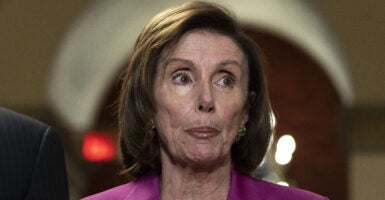
“We will have a Thanksgiving gift for the American people in a way that is historic and transformative,” says House Speaker Nancy Pelosi, pictured speaking to reporters Friday night on her way to the House Chamber at the Capitol. (Photo: Drew Angerer/Getty Images)

The House passed a $1.2 trillion infrastructure spending bill late Friday night, advancing legislation held for ransom for months by Democrats’ left flank to ensure passage of a much more expensive social spending package.

The House vote completed about 11:30 p.m. was 228-206, with 13 Republicans joining all but six Democrats in support of the infrastructure spending plan and sending President Joe Biden a much-needed victory for his signature. 

Six of the House’s most liberal Democrats voted against the measure, CNN reported: Reps. Jamaal Bowman of New York, Cori Bush of Missouri, Alexandria Ocasio-Cortez of New York, Ilhan Omar of Minnesota, Ayanna Pressley of Massachusetts, and Rashida Tlaib of Michigan.

Democrats have 221 seats in the House, Republicans hold 213. One seat is vacant.

Want to keep up with the 24/7 news cycle? Want to know the most important stories of the day for conservatives? Need news you can trust? Subscribe to The Daily Signal’s email newsletter. Learn more >>

The infrastructure bill, long touted as bipartisan because Senate Republicans helped craft it, includes billions for improving mass transportation, expanding broadband internet access, and increasing green energy subsidies. 

House Speaker Nancy Pelosi and other Democrat leaders also pledged to pass a $1.75 trillion social spending bill by Thanksgiving. 

“We will have a Thanksgiving gift for the American people in a way that is historic and transformative,” Pelosi, D-Calif., told reporters late Friday on Capitol Hill. 

Pelosi made the promise after winning approval of a procedural rule to make the social spending bill easier to pass, to get the party’s progressive wing on board for the more popular infrastructure measure. 

Even so, Ocasio-Cortez and five other progressives voted against the infrastructure bill, which they long had demanded be considered at the same time as the less popular social spending bill.

The price tag of the social spending measure is down from the $3.5 trillion originally proposed by Biden and congressional Democrats and dubbed the Build Back Better Act, a name that echoes Biden’s 2020 campaign slogan. 

On the House floor later in the night, Pelosi said the social spending bill not only would pass before Thanksgiving but would be more “transformative” than the Affordable Care Act, better known as Obamacare. 

“This is even bigger than that, in fact it strengthens the Affordable Care Act,” she said.

Congress passed the Affordable Care Act in late 2009 and early 2010 without a single Republican vote. 

House Majority Leader Steny Hoyer, D-Md., Pelosi’s deputy, expressed optimism ahead of the vote on the infrastructure bill.

“These two bills will make, as the president says, a generational change for our country,” Hoyer told reporters. “I believe the votes today, to pass the infrastructure bill and provide for a path forward by adopting the rule for the passage of the Build Back Better legislation will be a giant step forward. And I am absolutely convinced beyond a doubt, that before Thanksgiving, the week of the 15th, we will pass the Build Back Better legislation.” 

House members spent much of late afternoon and early evening Friday voting on a motion to stop debate on the social spending bill, as Republicans opposed it and five centrist Democrats insisted on seeing a score on the cost from the Congressional Budget Office. 

“We’ve had five members of the other party say they will not vote for this bill unless they had a CBO score,” Rep. Tom Cole, R-Okla., said on the House floor, referring to Democrats. “I hope they hold true to that. We simply should not proceed until we have a CBO score.”

“We’ll have our differences of opinion—fair enough,” Cole said. “But the American people and all of us in this chamber ought to know what this bill costs before any us are asked to cast a vote.”

Senate and House Republicans have been nearly united in opposition to the $1.7 trillion spending bill, which conservatives view as a slimmed-down wish list of the left’s big-government socialism policy goals, for which the price tag originally was more than double at $3.5 trillion.

Biden and other Democrats have claimed repeatedly that the massive social spending bill has “zero cost” and is “paid for.”

But conservatives dismissed this narrative.

“The bill’s passage speeds up the reckless socialist spending bill. This is a harbinger for future economic problems,”  David Ditch, a policy analyst in the Hermann Center for the Federal Budget at The Heritage Foundation, said in a written statement released immediately after the vote. Ditch added:

The plan expands far beyond the traditional definition of infrastructure to include radical social objectives and a ‘Green New Deal 2.0.’ It spends tens of billions on subsidizing electric vehicles and charging stations, electric buses, electric ferry boats, ‘green’ energy production, mandating reports on climate change, and even half a billion dollars to try to cool down pavement in cities. 

The 13 House Republicans who voted for the infrastructure spending bill are: Reps. Don Bacon of Nebraska, Brian Fitzpatrick of Pennsylvania, Andrew Gabarino of New York, Anthony Gonzalez of Ohio, John Katko of New York. Adam Kinzinger of Illinois, Nicole Malliotakis of New York, David McKinley of West Virginia, Tom Reed of New York, Chris Smith of New Jersey, Fred Upton of Michigan, Jeff Van Drew of New Jersey, and Don Young of Alaska.

Rep. Jason Smith, R-Mo., spoke on the House floor about the infrastructure bill’s chaotic path to a vote there. 

“It has been quite a ‘Groundhog Day’ when you watch what has been going on with this legislation over and over,” Smith said, referring to the 1993 movie comedy in which the protagonist, played by Bill Murray, keeps waking up to face similar circumstances. 

“It started out with a 2,400-page bill. Last Tuesday, a new 1,700-page bill was dropped. This week, on Wednesday, an additional 2,135-page bill was dropped, and none of the bills have been completely scored. What we do know after 11 p.m. last night, [is] they made additional changes to the 2,135 [-page] bill that was dropped on Wednesday.” 

Heritage Action for America, a conservative grassroots organization that counts almost 2 million activists nationwide, released a statement from Executive Director Jessica Anderson on the pending vote on the infrastructure bill. (Heritage Action is the grassroots partner of The Heritage Foundation, parent organization of The Daily Signal.)

“Democrats’ sweeping losses this week in Virginiaand so many other places is the first sign that Americans have rejected President Biden and Speaker Pelosi’s extreme agenda,” Anderson said, adding:

Within the same week, Democrats in Congress ignored Americans and pressed forward with their radical plan to fundamentally remake America. Tonight’s vote on the first part of the Democrats’ leftist agenda is the most out of touch that Congress has been since the passage of Obamacare. Any member who votes for the infrastructure bill is effectively voting yes for the entire ‘Build Back Broke’ plan and the left’s extreme agenda.

The Senate passed the infrastructure spending measure in July, when 19 Republicans, including Senate Minority Leader Mitch McConnell of Kentucky, voted for it with 48 Democrats and two independents (Bernie Sanders of Vermont and Angus King of Maine) who caucus with the Democrats.  

The Congressional Budget Office estimated that the Senate-passed infrastructure spending bill would increase federal budget deficits by $256 billion as well as drive up the per-household national debt, Ditch noted.

The bipartisan infrastructure bill would spend about $65 billion to expand broadband internet service. Of that, about $3 billion would go toward “achieving digital equity,” which includes ensuring that prison inmates have high-speed internet. 

The infrastructure legislation also would devote $55 billion to local water systems and includes $100 billion worth of infrastructure grants that the Department of Transportation would distribute to local communities. 

The bill would spend $1 billion for a “reconnecting communities” program aimed at doing away with major highways in urban communities. It would fund mass transportation and Amtrak at the same rate as roads, even though individual drivers make up a significantly larger number of those traveling. 

The infrastructure bill, as Heritage’s Ditch noted, would spend billions on subsidies for electric vehicles as well as for charging stations for those vehicles, electric buses, and electric ferry boats, and to attempt to cool pavement in cities. It calls for $125 million for states to conduct studies and pilot projects on a “miles traveled” tax on cars. 

The third version of Democrats’ social spending plan, the one dubbed the Build Back Better Act and now heading for a vote by Thanksgiving, would increase means-tested welfare spending by $756 billion over the next five years. 

It’s not certain that this version of what Democrat leaders call “human infrastructure” will survive in the Senate, where two Democrats—Joe Manchin of West Virginia and Kyrsten Sinema of Arizona—have been most vocal about the cost. 

The newest version includes a paid family leaveprovision that would reduce the amount of leave in the original plan from 12 weeks to four weeks. 

Under the original plan, the Treasury Department would administer the program. The revised plan would shift the paid leave program to the Social Security Administration. 

The social spending bill also imposes price controls on prescription drugs. The federal government, under the proposal, would set prices in Medicare for a limited number of drugs if those drugs account for substantial spending in Medicare. 

Previous proposals applied price controls to prescription drugs in all markets, not just Medicare.

In his statement, Heritage’s Ditch said:

Congress and the Biden administration need to get the federal government out of the way by embracing fiscal reforms, cutting red tape, and abandoning massive tax-and-spend legislation that would further cripple America’s economy. Democrats have proven that the more they intervene in the economy, the worse the crisis will get.

In one of the more unusual provisions championed by the left, the social spending bill also includes a state and local tax deduction, known as SALT, ranging from $10,000 to $72,500. 

Democrats skewed this provision to subsidize high-income earners in high-tax states. It would benefit high earners in high-tax, predominantly Democrat states such as New York, New Jersey, and California.

Smith, the Missouri Republican, blasted the Democrats for making the tax deductions a priority in the final changes. 

“Do you know what their priority was in those changes?” Smith asked rhetorically. “To give millionaires larger tax breaks. That was their priority. They try to tell you this legislation is about the kids and the babies and all about the children. That’s a bunch of hogwash.” 

Congress eliminated the state deduction in the 2017 tax reform law passed during the first year of the Trump administration that lowered rates and eliminated some tax loopholes. The Democrats are pushing to revive it. 

The Joint Committee on Taxation estimated that federal revenues would fall by $222 billion over the next five years.  The Tax Foundation estimated that 80% of the SALT deductions would benefit taxpayers making more than $200,000 a year. 

The latest version of the proposed Build Back Better Act would provide a tax subsidy for union dues to be used for political activity, as well as for “unprofitable” news outlets. 

The bill also would provide a tax break of up to $250 for union dues. It would be available only to “full” union members who don’t opt out of paying the portion of dues that goes toward supporting unions’ political causes and campaign contributions.

The earliest version of Democrats’ spending bill included special tax credits to local newspapers and broadcast outlets. That was taken out in the second version, but added back and expanded in the third. Eligibility also was expanded to media outlets with up to 1,500 employees. 

This would expand beyond small media outlets, since major metropolitan newspapers listed on LinkedIn as having fewer than 1,000 employees include the Hartford Courant, The Kansas City Star, the Miami Herald, the Houston Chronicle, the New York Post, the Orange County Register, and The Oregonian. 

Ken McIntyre contributed to this reportwhich was modified immediately after publication to reflect the final size of the infrastructure bill and to add details of the final floor vote.


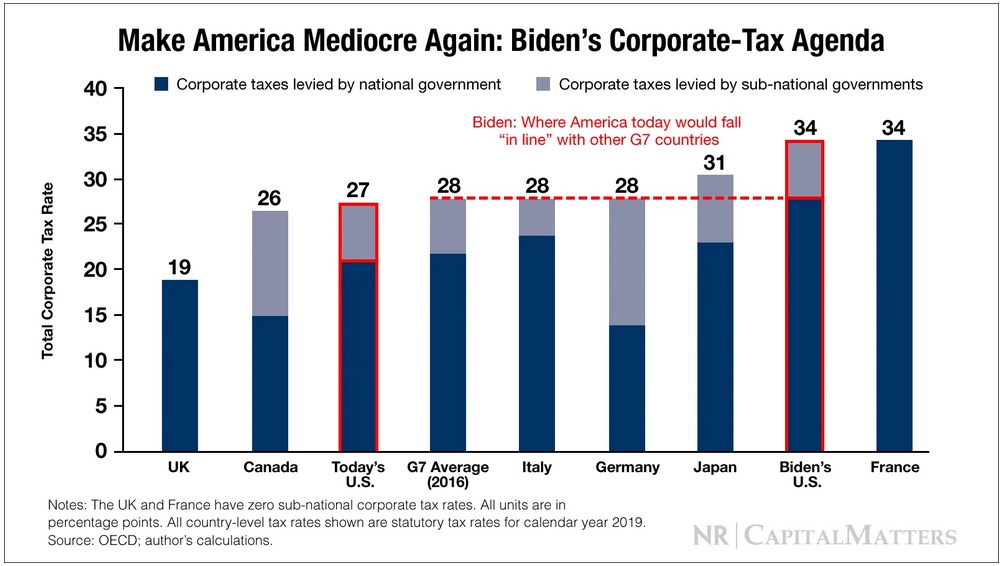
Biden Wants the U.S. to Be #1…in a Bad Way

The good news is that President Biden wants the United States to be at the top. The bad news is that he wants America to be at the top in bad ways. My

  • The highest corporate income tax rate.
  • The highest capital gains tax rate.
  • The highest level of double taxation.

We can now add another category, based on the latest iteration of his budget plan.

According to the Tax Foundation, the United States would havethe develop world’s most punitive personal income tax.

Worse than France and worse than Greece. How embarrassing.

In their report, Alex Durante and William McBride explain how the new plan will raise tax rates in a convoluted fashion.

High-income taxpayers would face a surcharge on modified adjusted gross income (MAGI), defined as adjusted gross income less investment interest expense. The surcharge would equal 5 percent on MAGI in excess of $10 million plus 3 percent on MAGI above $25 million, for a total surcharge of 8 percent. The plan would also redefine the tax base to which the 3.8 percent net investment income tax (NIIT) appliesto include the “active” part of pass-through income—all taxable income above $400,000 (single filer) or $500,000 (joint filer) would be subject to tax of 3.8 percent due to the combination of NIIT and Medicare taxes. Under current law, the top marginal tax rate on ordinary income is scheduled to increase from 37 percent to 39.6 percent starting in 2026. Overall, the top marginal tax rate on personal income at the federal level would rise to 51.4 percent. In addition to the top federal rate, individuals face taxes on personal income in most U.S. states. Considering the average top marginal state-local tax rate of 6.0 percent, the combined top tax rate on personal income would be 57.4 percent—higher than currently levied in any developed country.

Needless to say, this will make the tax code more complex.

Lawyers and accountants will win and the economy will lose.

I’m not sure why Biden and his big-spender allies have picked a complicated way to increase tax rates, but that doesn’t change that factthat people will have less incentive to engage in productive behavior.

What matters is the marginal tax rate on people who are thinking about earning more income.

And they’ll definitely choose to earn less if tax rates increase, particularly since well-to-do taxpayers have considerable controlover the timing, level, and composition of their income.

P.S. Based on what happened in the 1980s, we can safely assume that Biden’s class-warfare plan won’t raise much money.

Biden Pick Becerra’s Indecent, Indefensible Legal Assault on Nuns, Human Life

Sean Spicer  @seanspicer / October 26, 2021

 width=

COMMENTARY BY

Sean Spicer@seanspicer

Sean Spicer, who served as press secretary in the Trump White House, is the host of “Spicer & Co.” on Newsmax TV.

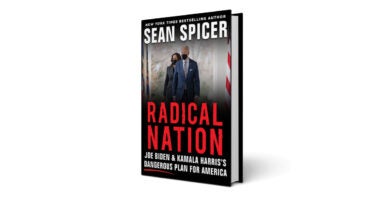
The following is excerpted from Trump White House press secretary Sean Spicer’s new book “Radical Nation: Joe Biden and Kamala Harris’s Dangerous Plan for America.“ It is available here and elsewhere.

Founded in France in 1839, the Little Sisters of the Poor is a Catholic order of nuns who operate 29 care homes across the United States. The nuns take vows of chastity, poverty, obedience, and hospitality, and they serve Christ by serving the elderly poor. 

When the Patient Protection and Affordable Care Act (aka ACA or “Obamacare”) was enacted in March 2010, it required employers to offer health insurance plans that included contraceptives, abortifacients, and sterilizations—all of which violate the precepts of the Catholic Church. 

Though the ACA exempted churches, it did not exempt faith-based ministries such as the Little Sisters of the Poor. These ministries were subject to fines if they did not comply—and the Little Sisters refused to comply. 

St. Paul once wrote that all who will live godly in Christ Jesus will suffer persecution. The Obama administration was determined to make good on that biblical promise and proceeded to persecute the Little Sisters all the way to the U.S. Supreme Court. 

In 2016, the Supreme Court directed the Obama administration to compromise with the Little Sisters and “arrive at an approach going forward” to end the standoff. The Obama administration failed to achieve that goal before leaving office.  

In 2017, the Trump administration took over and structured an accommodation that resolved the Little Sisters’ problems with the ACA mandate. In October of that year, the Department of Health and Human Services issued an updated religious-exemption rule that protected religious nonprofit organizations such as the Little Sisters of the Poor.  

Case closed, right? Wrong.  

The next month, November 2017, attorneys general from several states, including Pennsylvania and California, ramped up the persecution of the Little Sisters. They went to court and obtained a nationwide injunction against the new HHS rule. Pennsylvania and California sued the federal government, asking the judges to force the Little Sisters to comply with the Obamacare mandate or face millions of dollars in penalties.

In July 2019, the 3rd U.S. Circuit Court of Appeals ruled against the Little Sisters in the Pennsylvania case. In October 2019, the 9th U.S. Circuit Court of Appeals ruled against the Little Sisters in the California case. At that point, the Little Sisters asked the U.S. Supreme Court for a definitive ruling.  

On July 8, 2020, the Supreme Court delivered a decisive 7 to 2 ruling in favor of the Little Sisters of the Poor. The court affirmed the religious liberty exemptions for faith-based organizations. The Little Sisters of the Poor would not have to pay for abortions under the Obamacare mandates. After spending over a decade fighting federal and state governments in the courts, the Little Sisters could finally get back to serving the poor in peace. 

The Little Sisters set an example for us all, refusing to back down in the face of government pressure. They were determined to serve the elderly poor without lending support or endorsement to abortion. They correctly understood that the assault on their freedom was an assault on the sanctity of human life. 

Is this really why government exists? To harass and intimidate nuns who are simply living out their faith and serving the poor? It’s hard to believe, but there are people in government who get up in the morning and say, “I’m going to punish a Catholic ministry today! I’m going to scare nuns and force them to pay for abortions!” 

I mean, such a person would have to be a mustache-twirling villain of the Snidely Whiplash variety, right? 

Well, meet one of the persecutors of the Little Sisters of the Poor—namely, President Joe Biden’s secretary of health and human services, Xavier Becerra. In November 2017, after the Little Sisters had already prevailed once in the Supreme Court, it was Becerra [then the state attorney general] who made the decision for California to sue again in federal court to take away the nuns’ religious exemption. He lost that case in 2020—but the following year, Biden tapped Becerra to lead the Department of Health and Human Services, the very agency he had unsuccessfully sued in 2017. 

In February, Becerra was in a Senate confirmation hearing for the Biden Cabinet post, trying to explain away his relentless pursuit of the Little Sisters of the Poor. Sen. John Thune, R-S.D., said to him, “It does seem like, as attorney general, you spent an inordinate amount of time and effort suing pro-life organizations, like Little Sisters of the Poor, or trying to ease restrictions or expand abortion.” 

Apparently realizing how bad his pursuit of the Little Sisters looked, Becerra replied, “I have never sued the nuns, any nuns. I’ve never sued any affiliation of nuns, and my actions have always been directed at the federal agencies.” 

It’s a flimsy alibi. Becerra did, in fact, sue to force a religious order of nuns to pay for Obamacare’s contraceptive and abortifacient mandates. Moreover, the case is named State of California v. Little Sisters of the Poor. It doesn’t get any plainer than that. Had Becerra won his case, the Little Sisters would have lost millions of dollars, along with their First Amendment rights. Becerra pursued the nuns in court for three years. 

Despite his evasive testimony, Becerra did sue nuns, an act of cold-hearted villainy that would have done Snidely Whiplash proud. As Sen. Tom Cotton, R-Ark., tweeted on Feb. 24, “Xavier Becerra is now claiming he didn’t sue nuns because he wants to get confirmed. But Becerra did sue nuns. He repeatedly harassed the Little Sisters of the Poor. That’s why he should be rejected by the Senate.”  

In selecting Becerra to head HHS, Biden signaled his intention to move America to the extreme edge of pro-abortion policy. No American politician has ever demonstrated more enthusiasm for unrestricted abortion than Becerra.  

I am a proud member of the National Association of Christian Lawmakers and I attended the convention in Dallas in July and we have officially launched a nationwide push against abortion rights.

The article below notes:

At its first annual policy conference last weekend, group members voted to make a controversial new Texas law, the “Texas Heartbeat Bill,” the organization’s first piece of model legislation, meaning that similar bills may soon pop up in state capitols across the country.

Also I am excited to report that the WASHINGTON POST wrote in September 3, 2021:

Announcing he planned to introduce a copycat bill, Arkansas state Sen. Jason Rapert (R), the founder and president of the National Association of Christian Lawmakers, shared a template of legislation lawmakers in other states could fill in the blanks on and reproduce.

At the July 17th session of THE CHRISTIAN LAWMAKERS meeting in Dallas, I really got a lot out of the expert panel moderated by Texas State Senator Bryan Hughes entitled ABOLISHING ABORTION IN AMERICA. Here below is what Wikipedia says about Senator Hughes:

On March 11, 2021, Hughes introduced a fetal heartbeat bill entitled the Texas Heartbeat Bill (SB8) into the Texas Senate and state representative Shelby Slawson of Stephenville, Texas introduced a companion bill (HB1515) into the state house.[22]The bill allows private citizens to sue abortion providers after a fetal heartbeat has been detected.[22] The SB8 version of the bill passed both chambers and was signed into law by Texas Governor Greg Abbott on May 19, 2021.[22] It took effect on September 1, 2021.[22]

Whatever Happened To The Human Race? | Episode 1 | Abortion of the Human…

Tucker: Democrats have abandoned their ‘my body, my choice’ argument

These Christian lawmakers are on the offensive against abortion

That National Association of Christian legislators has made the so-called ‘Texas Heartbeat Bill’ the basis for its first piece of model legislation

Arkansas state Sen. Jason Rapert presides over a Senate committee at the state Capitol in Little Rock, Ark. in this March 14, 2018, file photo. Rapert’s National Association of Christian Lawmakers met recently to talk model legislation and pass resolutions. Kelly P. Kissel, Associated Press

The National Association of Christian Lawmakers has officially launched a nationwide push against abortion rights.

At its first annual policy conference last weekend, group members voted to make a controversial new Texas law, the “Texas Heartbeat Bill,” the organization’s first piece of model legislation, meaning that similar bills may soon pop up in state capitols across the country.

The model legislation, called the Heartbeat Model Act, was accepted unanimously by the executive committee during a Saturday meeting.

The Texas bill it is based upon, Senate Bill 8, bans abortions once a fetal heartbeat can be detected, which can occur as early as six weeks into a pregnancy. The legislation also allows for any state resident to bring a civil suit against a doctor who performs an abortion after a heartbeat is detectable. Under the law, a woman who has an abortion would be liable to civil suits, as would anyone who supported her in the act — from family members to the receptionist who checks her in at a clinic.

Not only is the doctor liable, but anyone found aiding and abetting,” said Texas legislator Bryan Hughes, the bill’s author, during the Saturday meeting, which was led by the organization’s founder and president, Arkansas state Sen. Jason Rapert.Texas state Rep. Bryan Hughes speaks during the opening session of the 2015 legislative session on Tuesday, Jan. 13, 2015, in Austin, Texas. Eric Gay, Associated Press

Speaking to the Deseret News on Monday, Rapert said the provision allowing residents to bring civil suits against anyone involved in an abortion is like “putting a SCUD missile on that heartbeat bill — they can’t stop it.”

Rapert was the author of a similar 2013 bill in Arkansas, portions of which were later struck down by a federal judge. At least a dozen states have implemented a variety of abortion restrictions in recent years, leading numerous observers to say that the landmark 1973 Supreme Court abortion ruling, Roe v. Wade, is under threat.

Critics of the legislation have likened the Texas law to putting “a bounty on the head” of anyone involved in an abortion; they have also called it “unconstitutional.” Last week, a group of providers filed a federal lawsuit in an attempt to derail the law, which is supposed to go into effect in September.

Speaking Saturday to the Christian legislators gathered in Dallas, Hughes reminded the legislators that the Heartbeat Model Act is just a starting point and that the legislation will have to be tailored to work within each state’s laws.A anti-abortion supporter argues with those who attended a press conference and rally held by the Planned Parenthood Action Council of Utah outside of the Capitol in Salt Lake City on Aug. 25, 2015. Stacie Scott, Deseret News

The National Association of Christian Lawmakers formed last year with three key goals: to offer conservative, Christian legislators networking opportunities,; to help lawmakers share bills that have been successful in their states so that legislators elsewhere might push through similar legislation; and to support Christians running for local, state or national office.

At the policy conference last week, the organization worked toward meeting these goals in various ways, including by approving the Heartbeat Model Act. The executive committee also passed a resolution supporting Israel’s “right to defend itself from terror attacks” and creating a standing American-Israeli Committee.

Speaking to the executive committee, Rabbi Leonid Feldman, who was born in the Soviet Union and was imprisoned there for his pro-Israel activities, remarked that the Jewish people “remember our friends.”

This conference and this organization will be remembered by the Jewish people,” he said.

The organization also approved a resolution in support of “election integrity.”

The executive committee also approved a second piece of model legislation: the National Motto Display Model Act. Based on bills passed in Arkansas in 2017 and this year in Texas, the legislation requires public schools to display the national motto “In God We Trust” when printed versions of the motto are donated to schools or copies of the national motto are bought with funds from private donors.

“As the Texas House sponsor of the Motto Act, I am proud to see a model put out by the NACL so that legislators from every other state can have a mechanism to ensure our citizens — especially our school-age children — are reminded of our nation’s motto,” said Tom Oliverson, a state representative from Texas and chairman of the National Association of Christian Lawmakers’ national legislative council.

During the executive committee’s meeting on Saturday, Rapert said Hobby Lobby would make frames available for a reduced price if they’ll be used for national motto displays.

Asked Monday what other pieces of legislation the organization might adopt as model legislation in the future, Rapert told the Deseret News that the National Association of Christian Lawmakers is already weighing some options.

Since religious freedom is central to the organization, it could end up adopting model legislation similar to bills promoted in Texas this year by Oliverson. He supported three measures designed to make it harder for the government to force church closures during public emergencies, like the COVID-19 pandemic, and a bill that would ensure homeowners’ associations can’t infringe on homeowners’ rights to display religious symbols.

Supreme Court votes 5-4 to leave Texas abortion law in place

Chief Justice John Roberts dissented along with the court’s three liberal justices

Associated Press

WASHINGTON — A deeply divided Supreme Court is allowing a Texas law that bans most abortions to remain in force, for now stripping most women of the right to an abortion in the nation’s second-largest state.

The court voted 5-4 to deny an emergency appeal from abortion providers and others that sought to block enforcement of the law that went into effect Wednesday. But the justices also suggested that their order likely isn’t the last word on whether the law can stand because other challenges to it can still be brought.

The Texas law, signed by Republican Gov. Greg Abbott in May, prohibits abortions once medical professionals can detect cardiac activity, usually around six weeks and before many women know they’re pregnant.

It is the strictest law against abortion rights in the United States since the high court’s landmark Roe v. Wade decision in 1973 and part of a broader push by Republicans nationwide to impose new restrictions on abortion. At least 12 other states have enacted bans early in pregnancy, but all have been blocked from going into effect.

The high court’s order declining to halt the Texas law came just before midnight Wednesday. The majority said those bringing the case had not met the high burden required for a stay of the law.

“The Court’s order is emphatic in making clear that it cannot be understood as sustaining the constitutionality of the law at issue.”— Chief Justice John Roberts

Chief Justice John Roberts (Supreme Court)

Chief Justice John Roberts (Supreme Court)

“In reaching this conclusion, we stress that we do not purport to resolve definitively any jurisdictional or substantive claim in the applicants’ lawsuit. In particular, this order is not based on any conclusion about the constitutionality of Texas’s law, and in no way limits other procedurally proper challenges to the Texas law, including in Texas state courts,” the unsigned order said.

Chief Justice John Roberts dissented along with the court’s three liberal justices. Each of the four dissenting justices wrote separate statements expressing their disagreement with the majority.

Roberts noted that while the majority denied the request for emergency relief “the Court’s order is emphatic in making clear that it cannot be understood as sustaining the constitutionality of the law at issue.”

The vote in the case underscores the impact of the death of the liberal Justice Ruth Bader Ginsburg last year and then-president Donald Trump’s replacement of her with conservative Justice Amy Coney Barrett. Had Ginsburg remained on the court there would have been five votes to halt the Texas law.

Justice Sonia Sotomayor called her conservative colleagues’ decision “stunning.” “Presented with an application to enjoin a flagrantly unconstitutional law engineered to prohibit women from exercising their constitutional rights and evade judicial scrutiny, a majority of Justices have opted to bury their heads in the sand,” she wrote.

“A majority of Justices have opted to bury their heads in the sand.”— Justice Sonia Sotomayor

Justice Sonia Sotomayor (Supreme Court)

Justice Sonia Sotomayor (Supreme Court)

Texas lawmakers wrote the law to evade federal court review by allowing private citizens to bring civil lawsuits in state court against anyone involved in an abortion, other than the patient. Other abortion laws are enforced by state and local officials, with criminal sanctions possible.

In contrast, Texas’ law allows private citizens to sue abortion providers and anyone involved in facilitating abortions. Among other situations, that would include anyone who drives a woman to a clinic to get an abortion. Under the law, anyone who successfully sues another person would be entitled to at least $10,000.

In her dissent, Justice Elena Kagan called the law “patently unconstitutional,” saying it allows “private parties to carry out unconstitutional restrictions on the State’s behalf.” And Justice Stephen Breyer said a “woman has a federal constitutional right to obtain an abortion during” the first stage of pregnancy.

After a federal appeals court refused to allow a prompt review of the law before it took effect, the measure’s opponents sought Supreme Court review.

In her dissent, Justice Elena Kagan called the law “patently unconstitutional,” saying it allows “private parties to carry out unconstitutional restrictions on the State’s behalf.” And Justice Stephen Breyer said a “woman has a federal constitutional right to obtain an abortion during” the first stage of pregnancy.

After a federal appeals court refused to allow a prompt review of the law before it took effect, the measure’s opponents sought Supreme Court review.

In a statement early Thursday after the high court’s action, Nancy Northup, the head of the Center for Reproductive Rights, which represents abortion providers challenging the law, vowed to “keep fighting this ban until abortion access is restored in Texas.”

“We are devastated that the Supreme Court has refused to block a law that blatantly violates Roe v. Wade. Right now, people seeking abortion across Texas are panicking — they have no idea where or when they will be able to get an abortion, if ever. Texas politicians have succeeded for the moment in making a mockery of the rule of law, upending abortion care in Texas, and forcing patients to leave the state — if they have the means — to get constitutionally protected healthcare. This should send chills down the spine of everyone in this country who cares about the constitution,” she said.

Texas has long had some of the nation’s toughest abortion restrictions, including a sweeping law passed in 2013. The Supreme Court eventually struck down that law, but not before more than half of the state’s 40-plus clinics closed.

Even before the Texas case arrived at the high court the justices had planned to tackle the issue of abortion rights in a major case after the court begins hearing arguments again in the fall. That case involves the state of Mississippi, which is asking to be allowed to enforce an abortion ban after 15 weeks of pregnancy.

Associated Press writer Paul J. Weber in Austin, Texas, contributed to this report.

—-

June 23, 2021

President Biden c/o The White House 1600 Pennsylvania Avenue NW Washington, DC 20500

Dear Mr. President,

I wanted to reach out to you because of some of the troubling moral issues coming out of your administration.

Over and over on my blog I have written about your efforts as Vice President and President to attack legally the rights of our unborn babies in the USA. These views of yours are due to your allegiance to the humanist worldview which Francis Schaeffer and Tim LaHaye exposed in their books. Your vast support from humanist groups in the 2020 election proves my point. No wonder we have seen criminals let go and an effort by Democrats (namely VP Harris) to defund the police. The Bible recognizes the sinful nature of humans and calls for the authorities to have the power of the sword in Romans 13! However, there have been times when the IRS has been used against freedom of expression such as the past persecution of the Tea Party. The Founding Fathers did NOT think the King was above the law! Unfortunately many lawmakers today don’t care about the law very much it seems which is a result of loss of a Christian Consensus influence in our society!

I recently read this article below:

The Archbishop Who Fears for Joe Biden’s Soul

America’s second-ever Catholic president supports abortion rights, leaving the bishops unsure about how to move forward.By Emma Green

MARCH 14, 2021 

Archbishop Joseph Naumann is anxious about President Joe Biden’s soul. The two men are in some ways similar: cradle Catholics born in the 1940s who witnessed John F. Kennedy become America’s first Catholic president. Both found a natural home in the Democratic Party—in Naumann’s midwestern family, asking Catholics if they were Democrats was a redundancy. Naumann became a priest and Biden became a politician, but their paths really diverged over the issue of abortion. Now in his 70s, Naumann watched Biden—America’s second Catholic president—transform into a vocal supporter of abortion rights while competing for the 2020 Democratic presidential nomination. Naumann runs the Archdiocese of Kansas City in Kansas and also leads what the Catholic bishops describe as their pro-life activities. He has suggested that Biden should no longer call himself a devout Catholic. At the very least, Naumann says, Biden should stop receiving Communion, a holy sacrament in Catholic life.

The United States Conference of Catholic Bishops recently convened a working group to discuss how the bishops should interact with Biden, and how they should deal with the challenge of having a visibly Catholic president who defies Church teachings on a central issue. Naumann was part of that group. Conflicts have already arisen: Naumann recently co-authored a statement expressing moral concerns about the Johnson & Johnson vaccine, which was developed and tested using cell lines from aborted fetal tissue. He also joined a statement from a group of the country’s top bishops celebrating the passage of the American Rescue Plan Act, but called it “unconscionable that Congress has passed the bill without critical protections needed to ensure that billions of taxpayer dollars are used for life-affirming health care and not for abortion.”

John MacArthur gave a sermon in June of 2021 entitled “When Government Rewards Evil and Punishes Good” and in that sermon he makes the following points:

INTRODUCTION AND DISCUSSION OF ROMANS 13

GOVERNMENT CAN FORFEIT ITS AUTHORITY

THE WORLD IS THE ENEMY OF THE GOSPEL

ALL OF HUMAN HISTORY IS PROGRESSING TOWARD A GLOBAL KINGDOM UNDER THE POWER OF SATAN

ONE FALSE WORLD RELIGION IS FINAL PLAY BY SATAN

REAL PERSECUTION CAN ONLY BE DONE BY GOVERNMENT

PERSECUTION IN BOOK OF DANIEL

THE LAW IS KING AND NOT THE GOVERNOR OF CALIFORNIA

GOVERNMENT HAS BECOME PURVEYOR OF WICKEDNESS

THERE IS A PLACE FOR CIVIL DISOBEDIENCE

DOES GOVERNMENT WIN?

Let me just share a portion of that sermon with you and you can watch it on You Tube:

GOVERNMENT HAS BECOME PURVEYOR OF WICKEDNESS 

One New Testament writer says that Romans 13 has “caused more unhappiness and misery . . . than any other . . . verses in the New Testament by the license they have given to tyrants . . . used to justify a host of horrendous abuses of individual human rights.” Hitler’s Holocaust, racism in the apartheid of South Africa, Cantrell says, “Both the Jews in Germany and blacks in South Africa were viewed as a threat to public health and national security. . . . “‘Trust us,’ said government . . . ‘we truly have your best interests at heart. All we want to do is help . . . keep you safe.’”

Government has already become the purveyor of wickedness. Government is a murderer, slaughtering millions of infants in abortion; elevating the LGBTQ agenda, the bizarre transgender deception. The culture has become anti-truth, we all know that. The truth is the biggest threat to lies. William Pitt, well-known name in English history, said this: “Necessity (i.e., public health, common good) is the plea [of] every infringement of human freedom: it is the argument of tyrants. “Get people afraid, and they’ll do whatever you want. A fearful society will always comply; panicking people will believe anything” [(Cantrell)].

“During the gruesome and bloody days of the French Revolution, when 40,000 innocent [people] lost their heads,” you would be interested to know who was operating the guillotine: the Committee for Public Safety [(Cantrell)]. One writer says, “Governments now get voted into power by promising to oversee housing, education, medicine, the economy, [the] currency, a minimum income, food, water, land, and the list goes on. The government become a parent, and the citizens are dependents. The government in this role becomes a monstrous juggernaut of bureaucracy, devouring taxes and trying to regulate every detail of life.” And they definitely want to regulate the church and silence its proclamation.

In his book The Glorious Body of Christ, Kuiper wrote, “Our age is one of ecclesiastical passivism. . . . When a church ceases to be militant it also ceases to be a church of Jesus Christ. . . . A truly militant church stands opposed to the world both without its walls and within. . . . Time and again in its history the church has found it necessary to assert its sovereignty over against usurpations by the state.” And Kuiper gave some biblical examples, like when King Saul or King Uzziah usurped the priesthood, stating, “In both cases a representative of the state was severely punished for encroaching [on] the sovereignty of the church.”

“Lord Macaulay of England summed up the Puritan reputation this way” [(Cantrell)]. He said of the Puritans, “He bowed himself in the dust before his Maker; [as] he set his foot on the neck of his king.” Kuiper says, “Ours is an age of state totalitarianism. All over the world statism is [rising] . . . . In consequence, in many lands the church finds itself utterly at the mercy of the state whose mercy often proves cruelty, while in others the notion is rapidly gaining ground that the church exists and operates by the state’s permission.” We do not operate by the state’s permission; we operate by the Lord’s command.

—-

Francis Schaeffer discusses this more in his fine book CHRISTIAN MANIFESTO:

PAGE 437

CHAPTER 3 THE DESTRUCTION OF FAITH AND FREEDOM

And now it is all gone!

In most law schools today almost no one studies William Blackstone unless he or she is taking a course in the history of law. We live in a secularized society and in secularized, sociological law. By sociological law we mean law that has no fixed base but law in which a group of people decides what is sociologically good for society at the given moment; and wha they arbitrarily decide becomes law. Oliver Wendall Holmes (1841-1935) made totally clear that this was his position. Frederick Moore Vinson (1890-1953), former Chief Justice of the United States Supreme Court, said, “Nothing is more certain in modern society than the principle that there are no absolutes.” Those who hold this position themselves call it sociological law. 

As the new sociological law has moved away from the original base of the Creator giving the “inalienable rights,” etc., it has been natural that this sociological law has then also moved away from the Constitution. William Bentley Ball, in his paper entitled “Religious Liberty: The Constitutional Frontier,” says: 

i propose that secularism militates against religious liberty, and indeed against personal freedoms generally, for two reasons: first, the familiar fact that secularism does not recognize the existence of the “higher law”; second, because, that being so, secularism tends toward decisions based on the pragmatic public policy of the moment and inevitably tends to resist the submitting of those policies to the “higher” criteria of a constitution. 

This moving away from the Constitution is not only by court rulings, for example the First Amendment rulings, which are the very reversal of the original purpose of the First Amendment (see pp. 433, 434), but in other ways as well. Quoting again from the same paper by William Bentley Ball:

Our problem consists also, as perhaps this paper has well enough indicated, of more general constitutional delegation of legislative power and ultra vires. The first is where the legislature hands over its powers to agents through the conferral of regulatory power unaccompanied by strict standards. The second is where the agents make up powers on their own–assume powers not given them by the legislature. Under the first, the government of laws largely disappears and the government of men largely replaces it. Under the second, agents’ personal “home-made law replaces the law of the elected representatives of the people. 

Naturally, this shift from the Judeo-Christian basis for law and the shift away from the restraints of the Constitution automatically militates against religious liberty. Mr. Ball closes his paper:

Fundamentally, in relation to personal liberty, the Constitution was aimed at restraint of the State. Today, in case after case relating to religious liberty, we encounter the bizarre presumption that it is the other way around; that the State is justified in whatever actions, and that religion bears a great burden of proof to overcome that presumption. 

It is our job, as Christian lawyers, to destroy that presumption at every turn. 

As lawyers discuss the changes in law in the United States, often they speak of the influence of the laws involved in the reentrance of the southern states into the national government after the Civil War. These indeed must be considered. But they were not the reason for the drastic change in law in our country. This reason was the takeover by the totally other world view which never have given the form and freedom in government we have had in Northern Europe (including the United States). That is the central factor in the change. 

PAGE 439

It is parallel to the difference between modern science beginning with Copernicus and Galileo and the materialistic science which took over the last century. Materialistic thought would never have produced modern science. Modern science was produced on the Christian base. That is, because an intelligent Creator had created the universe we can in some measure understand the universe and there is, therefore, a reason for observation and experimentation to be pursued. 

Then there was a shift into materialistic science based on a philosophic change to the materialistic concept of final reality. This shift was based on no addition to the facts known. It was a choice, in faith, to see things that way. No clearer expression of this could be given than Carl Sagan’s arrogant statement on public television–made without any scientific proof for the statement–to 140 million viewers: “The cosmos is all that is or ever was or ever was or ever will be.” He opened the series, COSMOS, with this essentially creedal declaration and went on to build every subsequent conclusion upon it. 

There is exactly the same parallel in law. The materialistic-energy, chance concept of final reality never would have produced the form and freedom in government we have in this country and in other Reformation countries. But now it has arbitrarily and arrogantly supplanted the historic Judeo-Christian Consensus that provided the base for form and freedom in government. The Judeo-Christian consensus gave greater freedoms than the world has ever known, but it also contained the freedoms so that they did not pound society to pieces. The materialistic concept of reality would not have produced the form-freedom balance, and now that it has taken over it cannot maintain the balance. It has destroyed it. 

Will Durant and his wife Ariel together wrote The Story of Civilization. The Durants received the 1976 Humanist Pioneer Award. In The Humanist magazine of February 1977, Will Durant summed up the humanist problem with regard to personal ethics and social order: “Moreover, we shall find it no easy task to mold a natural ethic strong enough to maintain moral restraint and social order without the support of supernatural consolations, hopes, and fears.”

Poor Will Durant! It is not just difficult, it is impossible. He should have remembered the quotation he and Ariel Durant gave from the agnostic Renan in their book The Lessons of History. According to the Durants, Renan said in 1866: “If Rationalism wishes to govern the world without regard to the religious needs of the soul, the experience of the French Revolution is there to teach us the consequences of such a blunder.” And the Durants themselves say in the same context: “There is no significant example in history, before our time, of a society successfully maintaining moral life without the aid of religion.”

PAGE 440 

Along with the decline of the Judie-Christian consensus we have come to a new definition and connotation of “pluralism.” Until recently it meant that the Christianity flowing from the Reformation is not now as dominant in the country and in society as it was in the early days of the nation. After about 1848 the great viewpoints not shaped by Reformation Christianity. This, of course, is the situation which exists today. Thus as we stand for religious freedom today, we need to realize that this must include a general religious freedom from the control of the state for all religion. It will not mean just freedom for those who are Christians. It is then up to Christians to show that Christianityis the Truth of total reality in the open marketplace of freedom. 

This greater mixture in the United States, however, is now used as an excuse for the new meaning and connotation  of pluralism. It now is used to mean that all types of situations are spread out before us, and that it really is up to each individual to grab one or the other on the way past, according to the whim of personal preference. What you take is only a matter of personal choice, with one choice as valid as another. Pluralism has come to mean that everything is acceptable. This new concept of pluralism suddenly is everywhere. There is no right or wrong; it is just a matter of your personal preference. On a recent SIXTY MINUTES program on television, for example, the questions of euthanasia of the old and the growing of marijuana as California’s largest paying crop were presented this way. One choice is as valid as another. It is just a matter of personal preference. This new definition and connotation of pluralism is presented in many forms, not only in personal ethics, but in society’s ethics and in the choices concerning law, 

PAGE 440

Now I have a question. In these shifts that have come in law, where have the Christian lawyers been? I really ask you that. The shift has come gradually, but it has only come to its peak in the last 40 or 50 years. Where have the Christian lawyers been? Surely the Christian lawyers should have been the ones to have sounded the trumpet clear and loud, not just in bits and pieces but looking at the totality of what was occurring. Now, a nonlawyer like myself believes I have a right to feel let down because the Christian lawyers did not blow the trumpets clearly between, let us say, 1940 and 1970. 


PAGE 441

When I wrote HOW SHOULD WE THEN LIVE? From 1974 to 1976 I worked out of a knowledge of secular philosophy. I moved from the results in secular philosophy, to the results in liberal theology, to the results in the arts, and then I turned to the courts, and especially the Supreme Court. I read Oliver Wendell Holmes and others, and I must say, I was totally appalled by what I read. It was an exact parallel to what i had already known so well from my years of study in philosophy, theology, and the other disciplines. 

In the book and film series HOW SHOULD WE THEN LIVE? I used the Supreme Court abortion case as the clearest illustration of arbitrary sociiological law. But it was only the clearest illustration. The law is shot through with this kind of ruling. It is similar to choosing Fletcher’s situational ethics and point to it as the clearest illustration of how our society now functions with no fixed ethics. This is only the clearest illustration because in many ways our society functions on unfixed, situational ethics. The abortion case in law is exactly the same. It is only the clearest case. Law in this country has become situational law, using the term Fletcher used for his ethics. That is, a small group of people decide arbitrarily what, from their viewpoint, is for the good of society at that precise moment and they make it law, binding the whole society by their personal arbitrary decisions. 

But of course! What would we expect? These things are the natural, inevitable results of the material-energy, humanistic concept of the final basic reality. From the material-energy, chance concept of final reality, final reality is, and must be b it nature, silent as to values, principles, or any basis for law. There is no way to ascertain “the ought:” from “the is.” Not only should we have known what this would have produced, but on the basis of this viewpoint of reality, we should have recognized that there are no other conclusions that this view could produce. It is a natural result of really believing that the basic reality of all things is merely material-energy, shaped into its present form by impersonal chance. 

No, we must say that the Christians in the legal profession did not ring the bell, and we are indeed very, very far down the road toward a totally humanistic culture. At this moment we are in a humanistic culture, but we are happily not in a totally humanistic culture. But what we must realize is that the drift has been all in this direction. if it is not turned around we will move very rapidly into a totally humanistic culture. 

PAGE 442 

The law, and especially the courts, is the vehicle to force this total humanistic way of thinking upon the entire population.This is what has happened. The abortion law is a perfect example. The Supreme Court abortion ruling invalidated abortion lawsin all fifty states, even though it seems clear that in 1973 the majority of Americans were against abortion. It did not matter. The Supreme Court arbitrarily ruled that abortion was legal, and overnight they overthrew the state laws and forced their will on the majority, even though their ruling was arbitrary both legally and medically. Thus law and the courts became the vehicle for forcing a totally secular concept on the population.

—-

Thank you so much for your time. I know how valuable it is. I also appreciate the fine family that you have and your commitment as a father and a husband. I also respect you for putting your faith in Christ for your eternal life. I am pleading to you on the basis of the Bible to please review your religious views concerning abortion. It was the Bible that caused the abolition movement of the 1800’s and it also was the basis for Martin Luther King’s movement for civil rights and it also is the basis for recognizing the unborn children. I wanted to encourage you to investigate the work of Dr. Bernard Nathanson who like you used to be pro-abortion. I also want you to watch the You Tube series WHATEVER HAPPENED TO THE HUMAN RACE? by Francis Schaeffer and Dr. C. Everett Koop. Also it makes me wonder what our the moral climate Of our nation is when we concentrate more on potential mistakes of the police and we let criminals back on the street so fast! Our national was founded of LEX REX and not REX LEX!

Sincerely,

Everette Hatcher III, 13900 Cottontail Lane, Alexander, AR 72002, ph 501-920-5733,

PS: In this series of letters John MacArthur covers several points. In the first letter, he quotes you saying that the greatest threat to America—he said on one occasion—is systemic racism, which doesn’t exist; he said white supremacy, which doesn’t exist with any power; and then he said global warming, which doesn’t exist either, and if it does, God’s in charge of it.

In reality the greatest threat to this nation is the government, the government. And I want to show you how we are to understand that. Turn to Romans 13

In the 2nd letter, Dr. MacArthur noted When government turns the divine design on its head and protects those who do evil and makes those who do good afraid, it forfeits its divine purpose

In the 3rd letter Dr. MacArthur noted The world is the enemy of the gospel. The world is the enemy of the church. I pointed out that this manifests itself today in the form of HUMANISM.

In the 4th letter Dr. MacArthur points out how much today the devil is having his way in our society and that the Bible predicts that these will get worse!

In the 5th letter Francis Schaeffer points out “The HUMANIST MANIFESTOS not only say that humanism is a religion, but the Supreme Court has declared it to be a religion. The 1961 case of Torcaso v. Watkins specifically defines secular humanism as a religion equivalent to theistic and other non theistic religions.”

In the 6th letter Dr. MacArthur noted God has given government the sword, the power; and when they prostitute that power and they begin to punish those who do good and protect those who do evil, they wield that power against the people of God.

In the 7th letter Dr. MacArthur asserted, Throughout history, even in the Western world, people lived under what was called the divine right of kings. Kings were believed to have had a divine right. This was absolute monarchy. What broke that was basically the Reformers. The Reformers—a little phrase was “the law is king,” not the man.

In the 8th letter Dr. MacArthur noted that today the United States “Government has already become the purveyor of wickedness. Government is a murderer, slaughtering millions of infants in abortion.”

In the 9th letter the article

Judge gives preliminary OK to $3.5M settlement of IRS case is discussed about the 2013 lawsuit during the Barack Obama administration over treatment of conservative groups who said they were singled out for extra IRS scrutiny on tax-exempt status applications. Then Dr. MacArthur talks about persecution in the Book of Daniel.

“These are groups of law-abiding citizens who should have never had their First Amendment rights infringed upon by the IRS,” Jenny Beth Martin, president of the Tea Party Patriots umbrella group, said Wednesday. “These are groups that want the government to be accountable.”

The government has been used to persecuting people they don’t like for centuries! Let me just share a portion of that sermon by John MacArthur with you and you can watch it on You Tube: 

PERSECUTION IN BOOK OF DANIEL

In the 10th letter Dr. MacArthur noted:

THERE IS A PLACE FOR CIVIL DISOBEDIENCE

Francis Schaeffer, who died in 1984, says, “If [there’s] no final place for civil disobedience, then the government has been made autonomous, anas such, it has been put in the place of the living God.” And that point is exactly when the early Christians performed their acts of civil disobedience, even when it cost them their lives. “Acts of State which contradict God’s [Laws] are illegitimate and acts of tyranny. Tyranny is ruling without the sanction of God. To resist tyranny is to honour God. . . . The bottom line is that at a certain point there is not only the right, but the duty to disobey the State.”

Whatever Happened To The Human Race? | Episode 4 | The Basis for Human Dignity


Sunday Night Prime – Dr. Bernard Nathanson – Fr Groeschel, CFR with Fr …

——

Francis Schaeffer

Francis Schaeffer pictured above

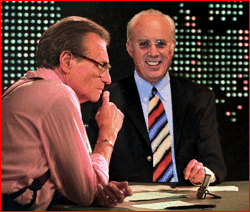
Larry King had John MacArthur as a guest on his CNN program several times.

https://youtu.be/Tfq-maVMxiM

When Government Rewards Evil and Punishes Good

_________________________

Related posts:

Al Mohler on Kermit Gosnell’s abortion practice

May 15, 2013 – 7:46 am

Francis Schaeffer: “Whatever Happened to the Human Race” (Episode 1) ABORTION OF THE HUMAN RACE Published on Oct 6, 2012 by AdamMetropolis ________________ Picture of Francis Schaeffer and his wife Edith from the 1930′s above. I was sad to read about Edith passing away on Easter weekend in 2013. I wanted to pass along this fine […]By Everette Hatcher III | Posted in Francis SchaefferProlife | Edit | Comments (0)

Taking on Ark Times Bloggers on various issues Part U “Do men have a say in the abortion debate?” (includes the film SLAUGHTER OF THE INNOCENTS and editorial cartoon)

May 14, 2013 – 1:08 am

I have gone back and forth and back and forth with many liberals on the Arkansas Times Blog on many issues such as abortion, human rights, welfare, poverty, gun control  and issues dealing with popular culture. Here is another exchange I had with them a while back. My username at the Ark Times Blog is Saline […]By Everette Hatcher III | Posted in Francis SchaefferProlife | Edit | Comments (0)

Taking on Ark Times Bloggers on various issues Part T “Abortion is a dirty business” (includes video “Truth and History” and editorial cartoon)

May 9, 2013 – 7:19 am

I have gone back and forth and back and forth with many liberals on the Arkansas Times Blog on many issues such as abortion, human rights, welfare, poverty, gun control  and issues dealing with popular culture. Here is another exchange I had with them a while back. My username at the Ark Times Blog is Saline […]By Everette Hatcher III | Posted in Francis SchaefferProlife | Edit | Comments (0)

“Sanctity of Life Saturday” Abortion supporters lying in order to further their clause? Window to the Womb (includes video ABORTION OF THE HUMAN RACE)

April 6, 2013 – 12:01 am

It is truly sad to me that liberals will lie in order to attack good Christian people like state senator Jason Rapert of Conway, Arkansas because he headed a group of pro-life senators that got a pro-life bill through the Arkansas State Senate the last week of January in 2013. I have gone back and […]By Everette Hatcher III | Posted in Arkansas TimesFrancis SchaefferMax BrantleyProlife | Edit | Comments (0)

Taking on Ark Times Bloggers on various issues Part D “If you can’t afford a child can you abort?”Francis Schaeffer Quotes part 4 includes the film ABORTION OF THE HUMAN RACE) (editorial cartoon)

April 5, 2013 – 6:30 am

I have gone back and forth and back and forth with many liberals on the Arkansas Times Blog on many issues such as abortion, human rights, welfare, poverty, gun control  and issues dealing with popular culture. Here is another exchange I had with them a while back. My username at the Ark Times Blog is Saline […]By Everette Hatcher III | Posted in Francis SchaefferProlife | Edit | Comments (0)

Taking on Ark Times Bloggers on various issues Part C “Abortion” (Francis Schaeffer Quotes part 3 includes the film SLAUGHTER OF THE INNOCENTS) (editorial cartoon)

April 3, 2013 – 6:07 am

I have gone back and forth and back and forth with many liberals on the Arkansas Times Blog on many issues such as abortion, human rights, welfare, poverty, gun control  and issues dealing with popular culture. Here is another exchange I had with them a while back. My username at the Ark Times Blog is Saline […]By Everette Hatcher III | Posted in Francis SchaefferProlife | Edit | Comments (0)

Taking on Ark Times Bloggers on various issues Part B “Gendercide” (Francis Schaeffer Quotes Part 2 includes the film ABORTION OF THE HUMAN RACE) (editorial cartoon)

April 2, 2013 – 9:30 am

I have gone back and forth and back and forth with many liberals on the Arkansas Times Blog on many issues such as abortion, human rights, welfare, poverty, gun control  and issues dealing with popular culture. Here is another exchange I had with them a while back. My username at the Ark Times Blog is Saline […]By Everette Hatcher III | Posted in Francis SchaefferProlife | Edit | Comments (0)

SANCTITY OF LIFE SATURDAY “AngryOldWoman” blogger argues that she has no regrets about past abortion

March 30, 2013 – 1:29 am

Sometimes you can see evidences in someone’s life of how content they really are. I saw  something like that on 2-8-13 when I confronted a blogger that goes by the name “AngryOldWoman” on the Arkansas Times Blog. See below. Leadership Crisis in America Published on Jul 11, 2012 Picture of Adrian Rogers above from 1970′s […]By Everette Hatcher III | Posted in Adrian RogersArkansas TimesProlife | Edit | Comments (0)

“Sanctity of Life Saturday” The Church Awakens: Whatever Happened to the Human Race? (includes the video ABORTION OF THE HUMAN RACE)

March 9, 2013 – 9:35 am

In the film series “WHATEVER HAPPENED TO THE HUMAN RACE?” the arguments are presented  against abortion (Episode 1),  infanticide (Episode 2),   euthenasia (Episode 3), and then there is a discussion of the Christian versus Humanist worldview concerning the issue of “the basis for human dignity” in Episode 4 and then in the last episode a close […]By Everette Hatcher III | Posted in Francis SchaefferProlife | Edit | Comments (0)

Taking on Ark Times Bloggers on various issues Part H “Are humans special?” includes film ABORTION OF THE HUMAN RACE) Reagan: ” To diminish the value of one category of human life is to diminish us all”

April 10, 2013 – 6:43 am

I have gone back and forth and back and forth with many liberals on the Arkansas Times Blog on many issues such as abortion, human rights, welfare, poverty, gun control  and issues dealing with popular culture. Here is another exchange I had with them a while back. My username at the Ark Times Blog is Saline […]By Everette Hatcher III | Posted in Francis SchaefferProlife | Edit | Comments (0)

Taking on Ark Times Bloggers on various issues Part G “How do moral nonabsolutists come up with what is right?” includes the film “ABORTION OF THE HUMAN RACE”)

April 9, 2013 – 6:36 am

I have gone back and forth and back and forth with many liberals on the Arkansas Times Blog on many issues such as abortion, human rights, welfare, poverty, gun control  and issues dealing with popular culture. Here is another exchange I had with them a while back. My username at the Ark Times Blog is Saline […]By Everette Hatcher III | Posted in Francis SchaefferProlife | Edit | Comments (3)

Taking on Ark Times Bloggers on various issues Part E “Moral absolutes and abortion” Francis Schaeffer Quotes part 5(includes the film SLAUGHTER OF THE INNOCENTS) (editorial cartoon)

April 7, 2013 – 6:25 am

I have gone back and forth and back and forth with many liberals on the Arkansas Times Blog on many issues such as abortion, human rights, welfare, poverty, gun control  and issues dealing with popular culture. Here is another exchange I had with them a while back. My username at the Ark Times Blog is Saline […]By Everette Hatcher III | Posted in Francis SchaefferProlife | Edit | Comments (2)

Francis Schaeffer’s “How should we then live?” Video and outline of episode 10 “Final Choices” (Schaeffer Sundays)

January 8, 2012 – 12:54 am

E P I S O D E 1 0   Dr. Francis Schaeffer – Episode X – Final Choices 27 min FINAL CHOICES I. Authoritarianism the Only Humanistic Social Option One man or an elite giving authoritative arbitrary absolutes. A. Society is sole absolute in absence of other absolutes. B. But society has to be […]By Everette Hatcher III | Posted in Francis Schaeffer | Tagged francis crickhitler and stalinjohn kenneth galbraithrobert theobaldyoutube | Edit | Comments (0)

Francis Schaeffer’s “How should we then live?” Video and outline of episode 9 “The Age of Personal Peace and Affluence” (Schaeffer Sundays)

January 1, 2012 – 12:51 am

E P I S O D E 9 Dr. Francis Schaeffer – Episode IX – The Age of Personal Peace and Affluence 27 min T h e Age of Personal Peace and Afflunce I. By the Early 1960s People Were Bombarded From Every Side by Modern Man’s Humanistic Thought II. Modern Form of Humanistic Thought Leads […]By Everette Hatcher III | Posted in Francis Schaeffer | Tagged free speech movementparis riotspersonal peace.sproul plazawww youtube | Edit | Comments (0)

Francis Schaeffer’s “How should we then live?” Video and outline of episode 8 “The Age of Fragmentation” (Schaeffer Sundays)

December 25, 2011 – 12:45 am

E P I S O D E 8 Dr. Francis Schaeffer – Episode VIII – The Age of Fragmentation 27 min I saw this film series in 1979 and it had a major impact on me. T h e Age of FRAGMENTATION I. Art As a Vehicle Of Modern Thought A. Impressionism (Monet, Renoir, Pissarro, Sisley, […]By Everette Hatcher III | Posted in Francis Schaeffer | Tagged airplane designhttp www youtubemarcel duchamp artpost impressionismvan gogh gauguin | Edit | Comments (0)

Francis Schaeffer’s “How should we then live?” Video and outline of episode 7 “The Age of Non-Reason” (Schaeffer Sundays)

December 18, 2011 – 12:41 am

E P I S O D E 7 Dr. Francis Schaeffer – Episode VII – The Age of Non Reason I am thrilled to get this film series with you. I saw it first in 1979 and it had such a big impact on me. Today’s episode is where we see modern humanist man act […]By Everette Hatcher III | Posted in Francis Schaeffer | Tagged french existentialismhumanist philosophershumanistic philosophynatural freedomwww youtube | Edit | Comments (0)

Francis Schaeffer’s “How should we then live?” Video and outline of episode 6 “The Scientific Age” (Schaeffer Sundays)

December 11, 2011 – 12:37 am

E P I S O D E 6 How Should We Then Live 6#1 Uploaded by NoMirrorHDDHrorriMoN on Oct 3, 2011 How Should We Then Live? Episode 6 of 12 ________ I am sharing with you a film series that I saw in 1979. In this film Francis Schaeffer asserted that was a shift in […]By Everette Hatcher III | Posted in Francis Schaeffer | Tagged biblical foundations.biblical influencefrench proseneo darwinismwww youtube | Edit | Comments (0)

Francis Schaeffer’s “How should we then live?” Video and outline of episode 5 “The Revolutionary Age” (Schaeffer Sundays)

December 4, 2011 – 12:33 am

E P I S O D E 5 How Should We Then Live? Episode 5: The Revolutionary Age I was impacted by this film series by Francis Schaeffer back in the 1970′s and I wanted to share it with you. Francis Schaeffer noted, “Reformation Did Not Bring Perfection. But gradually on basis of biblical teaching there […]By Everette Hatcher III | Posted in Francis Schaeffer | Tagged christian foundationsfreedom of pressfreedom of religionlex rexwww youtube | Edit | Comments (0)

Francis Schaeffer’s “How should we then live?” Video and outline of episode 4 “The Reformation” (Schaeffer Sundays)

November 27, 2011 – 12:26 am

Dr. Francis Schaeffer – Episode IV – The Reformation 27 min I was impacted by this film series by Francis Schaeffer back in the 1970′s and I wanted to share it with you. Schaeffer makes three key points concerning the Reformation: “1. Erasmian Christian humanism rejected by Farel. 2. Bible gives needed answers not only as to […]By Everette Hatcher III | Posted in Francis Schaeffer | Tagged authority of the biblechristian humanismold testament prophetsschool of athens.thomas cromwell | Edit | Comments (0)

“Schaeffer Sundays” Francis Schaeffer’s “How should we then live?” Video and outline of episode 3 “The Renaissance”

November 20, 2011 – 10:03 am

Francis Schaeffer’s “How should we then live?” Video and outline of episode 3 “The Renaissance” Francis Schaeffer: “How Should We Then Live?” (Episode 3) THE RENAISSANCE I was impacted by this film series by Francis Schaeffer back in the 1970′s and I wanted to share it with you. Schaeffer really shows why we have so […]By Everette Hatcher III | Posted in Francis Schaeffer | Edit | Comments (0)

Francis Schaeffer’s “How should we then live?” Video and outline of episode 2 “The Middle Ages” (Schaeffer Sundays)

November 13, 2011 – 12:13 am

  Francis Schaeffer: “How Should We Then Live?” (Episode 2) THE MIDDLE AGES I was impacted by this film series by Francis Schaeffer back in the 1970′s and I wanted to share it with you. Schaeffer points out that during this time period unfortunately we have the “Church’s deviation from early church’s teaching in regard […]By Everette Hatcher III | Posted in Francis Schaeffer | Tagged byzantine artconservative evangelicalismgothic architecture.gregorian chantsnaturalism in art | Edit | Comments (0)

Francis Schaeffer’s “How should we then live?” Video and outline of episode 1 “The Roman Age” (Schaeffer Sundays)

November 6, 2011 – 12:01 am

Francis Schaeffer: “How Should We Then Live?” (Episode 1) THE ROMAN AGE   Today I am starting a series that really had a big impact on my life back in the 1970′s when I first saw it. There are ten parts and today is the first. Francis Schaeffer takes a look at Rome and why […]

By Everette Hatcher III | Posted in Francis Schaeffer | Edit | Comments (0)

Daniel Mitchell OF CENTER FOR FREEDOM AND PROSPERITY article The Party of the Rich Is Pushing a Tax Cut for Rich People


The Party of the Rich Is Pushing a Tax Cut for Rich People

There’s a political party in the United States – the Democrats – that represents rich people and it is trying very hard to cut taxes for those rich people.

Since I don’t resent rich people (indeed, I applaud them if they earn their money honestly), I generally want lower taxes for upper-income taxpayers. But I don’t want special tax breaks for rich people. Instead, I want to cut their taxes in ways that promote greater national prosperity so that I’ll benefit as well.

Sadly, those aren’t the options the Democrats are choosing.

They are putting all their energy into a dramatic expansion of the state and local tax deduction. This is the tax break that rich people get when they use state and local tax payments to reduce the amount of taxable income they report to the IRS.

It was curtailed as part of the 2017 tax law and now Democrats want to expand it.

The restored tax break would be available to everyone, they say, but let’s look at who really benefits.

The Committee for a Responsible Federal Budget is a middle-of-the-road group, and it points out that more only 2.5 percent of the tax cut would go to people making less than $100K per year.

The Tax Policy Center is a left-of-center organization and it also points out that expanding the deduction for state and local taxes means a windfall for the rich.

Here’s TPC’s chart showing that almost all the gains go to those in the top quintile.

While Democrats in Congress are pushing this big tax cut for the rich, some folks on the left are not very happy about what’s happening.

often disagree with Catherine Rampell of the Washington Post, but she makes some excellent points in her recent column on the SALT deduction.

Wrong. A disaster. Obscene. These are among the ways liberal budget wonks have described Democrats’ determination to give a huge windfall to the rich by repealing the cap on state and local tax (SALT) deductions. …Households making $1 million or more a yearwould receive roughly half the benefit of this policy, according to estimates from the Tax Policy Center. About 70 percent of the benefit would go to households making at least $500,000. …Nearly every millionaire (93 percent)…would get a tax cut, with an average size of $48,000. …As a result, the top 5 percent of households would still likely see their taxes go down on net, after accounting for all tax provisions in the budget bill.

The New York Times made similar points about Democrats in an editorial earlier this year.

…the party is flirting with a major change in tax policy that would allow the wealthiest Americans to pay lower taxes. …Proponents of an unlimited SALT deduction say they are seeking to help middle-class taxpayers.If so, they should go back to the drawing board. The top 20 percent of American households, ranked by income, would receive 96 percent of the benefits of the change… The primary beneficiaries would be an even smaller group of the very wealthiest Americans. The 1 percent of households with the highest incomes would receive 54 percent of the benefit, on average paying about $36,000 less per year in federal income taxes.

Honest folks on the left aren’t just upset that congressional Democrats are pushing a big tax cut for rich people.

They’re also upset that this big tax cut is crowding out some other priorities for the left – such as additional spending.

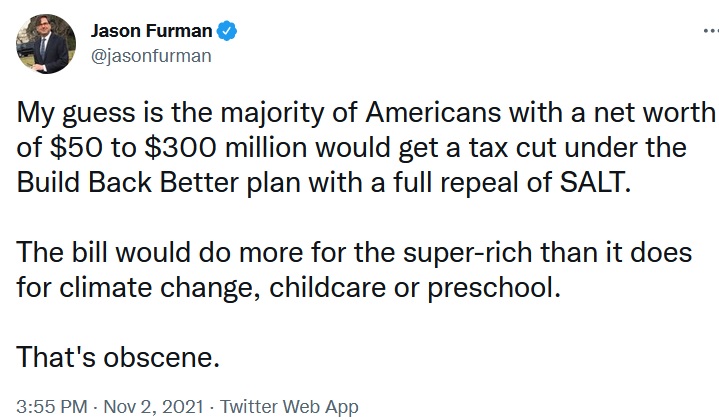
This tweet from Jason Furman (a former top economist for Obama) captures this sentiment.

The bottom line is that the most important constituency for many elected Democrats is not poor people.

It’s rich people and the politicians at the state and local levelwho represent those rich people.

I’ll close by observing that I don’t want more spending and I also don’t want a special tax break that subsidizes bad policy by state and local politicians, so I’m  obviously not in full agreement with Mr. Furman.

So the best result is for Biden’s entire agenda to implode. That would be a win for American taxpayers, a win for the American economy, and a win for long-suffering residents of blue states.

P.S. Yes, resentment against success motivates many people on the left, but elected Democrats are not the same as left-wing activists.


Biden’s Dishonest Budget Gimmickry

Having been in Washington for close to 40 years, I’ve seen lots of budget dishonesty, but nothing compares to Joe Biden’s claim that his profligate budget proposals have zero cost.

According to the official numbers, that’s a $3.5 trillion lie.

In reality, as I noted in July, it’s much bigger.

Let’s investigate this issue. I’ll start by noting that I have mixed feelings about the Committee for a Responsible Federal Budget (CRFB). They think controlling red ink should be the main focus of fiscal policy, whereas I think controlling spending should be the top goal.

That being said, CRFB’s staff have a well-deserved reputation for being thorough and careful when producing fiscal analysis.

So it’s worth noting that the group estimates that the Biden’s fiscal agenda would actually cost between $5 trillion and $5.5 trillion over 10 years, much higher than the “official” estimate of $3.5 trillion.

Here are some of the bottom-line numbers from their report.

That’s a truncated version of their table. If you want to see all the gory details, click here.

You’ll also be able to read the group’s analysis, including these key excerpts.

While the actual cost of this new legislation will ultimately depend heavily on details that have yet to be revealed, we estimate the policies under consideration could cost between $5 trillion and $5.5 trillion over a decade, assuming they are made permanent. In order to fit these proposals within a $3.5 trillion budget target, lawmakers apparently intend to have some policies expire before the end of the ten-year budget window,using this oft-criticized budget gimmick to hide their true cost. …To fit $5 trillion to $5.5 trillion…into a $3.5 trillion budget, background documents to reporters explain that “the duration of each program’s enactment will be determined based on scoring and Committee input.”  In other words, tax credits and spending programs will be set to expire at some point before the end of the decade, in the hope that future lawmakers will extend these programs. …This budget gimmick…would obscure the true cost of the legislation

The Wall Street Journal opined about Biden’s gimmickry.

Democrats are grasping for ways to finance their cradle-to-grave welfare state, with the left demanding what they claim is $3.5 trillion over 10 years. The truth is that even that gargantuan number hides the real cost of their plans. The bills moving through committees are full of delayed starts, phony phase-outs, and cost shifting to states designed to fit $3.5 trillion into a 10-year budget window…Start with the child allowance… Democrats have hidden the real cost by extending the allowance only through 2025. Even if Republicans gain control of Congress and the White House in 2024, Democrats and their media allies will bludgeon them to extend the payments… Democrats are using a different time shift to disguise the cost of their Medicare expansion…delaying the phase-in of the much more expensive dental benefit to 2028. This “saves” $420 billion over 10 years, but the costs explode after that. …the new universal child-care entitlement…gives $90 billion to the states—but only from 2022 to 2027. …The bottom line: $3.5 trillion is merely the first installment of a bill that would put government at the commanding heights of family life and the economy for decades to come. Tax increases will follow as far as the eye can see.

Regarding the final sentence of the above excerpt, the tax increases in Biden’s budget are merely an appetizer.

Ultimately, a European-sized welfare state requires European-style taxeson lower-income and middle-class households.

In other words, a value-added tax, along with higher payroll taxes, higher energy taxes, and higher income tax rates on ordinary workers (with this unfortunate Spaniard being a tragic example).

But we do have a tiny bit of good news.

A small handful of Democrats are resisting Biden’s budget, which means the package presumably will have to shrink in order to get sufficient votes.

But this good news may be fake news if Biden and his allies in Congress simply expand the use of dishonest accounting.

Brian Riedl of the Manhattan Institute documents some of this likely dishonesty in a column for the New York Post.

How does Congress cut a $3.5 trillion spending bill down to $1.5 trillion? By using gimmicks to hide its true cost. …Progressives have been abusing these gimmicks from the start. They began with a reconciliation proposal that would cost nearly $5 trillion over the decade. Then, in order to cut the bill’s “official” cost closer to $4 trillion, the bill’s authors included a December 2025 expiration of the $130 billion annual expansion of the child tax credit…Of course, no one believes that Congress will actually allow the child tax credit to be reduced at the end of 2025… Democrats purposely selected for “expiration” a popular middle-class benefit that they know even a future Republican Congress or president would not dare take away from voters. …expensive child care subsidies, family leave, and “free” community college benefits may also have their full cost hidden with fake expiration dates early into the 10-year scoring window. Lawmakers fully expect to extend these policies later, ultimately raising the cost of the total reconciliation bill closer to the $3.5 trillion target (or even higher). …Progressives are also discussing delaying the proposed new Medicare dental benefits until 2028, which legitimately saves money within the 10-year scoring window but also hides a larger long-term cost.

I realize that it’s not a big revelation to write that politicians are dishonest (Washington, after all, is a “wretched hive of scum and villainy“).

And I also realize that that the main problem with Biden’s plan is the economic damage it will cause, not the reliance on phony accounting.

But truth should matter a little bit, even in a town where lying about fiscal policy is a form of art.

The Double-Barreled Danger of Biden’s Plan to Expand the Welfare State

The United States has a big economic advantage over Europe in part because the burden of welfare spending is lower.

This means fewer people trapped in government dependency in America. And it means a smaller tax burden in America.

But some of our friends on the left think it is bad news that the United States isn’t more like Europe.

They want more redistribution in America and they may get their wish if Congress approves Biden’s so-called American Families Plan.

The Economist has an article about Biden’s radical proposal, which would, as they correctly note, “Europeanise the American welfare state.”

President Joe Biden is proposing an ambitious reweaving of the American safety-net, which the White House says will cost $1.8trn. The American Families Plan has bits of the European welfare state that have long been missing in the country—a child allowance, paid family leave, universal pre-school, subsidised child care and free community college—but contains no reference to work requirements. …So how did Democrats go from Clintonism—which implicitly conceded the Reaganite critique that too much governmental assistance is a very bad thing—to its present-day unconcern about (even relish for) deficit-financed expansions of the safety-net?

Here are some of the specific details from the story, including discussion of Biden’s plan for per-child handouts.

This would bring America more in line with the rest of the developed world: the average government spending on benefits such as child allowances, family leave and early education is 2.1% of GDP in the OECD club of mostly rich countries. In America, it is just 0.6%. …A generous child allowance is the main anti-poverty tool in most rich countries—and also one that America lacks. One such scheme was created this year as part of the covid-19 relief bill that the president signed in March. It will pay most families $3,000 per year per child ($3,600 for young children)… The president’s plan proposes to extend these payments until 2025. Some Democrats think they should simply be made permanent.

The Wall Street Journal opined about Biden’s plan last month.

It’s more accurate to call this the plan to make the middle class dependent on government from cradle to grave. The government will tell you sometime later, after you’re hooked to the state, how it will force you to pay for it. We’d call the price tag breathtaking, but by now what’s another $2 trillion?…But the cost, while staggering, isn’t the only or even the biggest problem. The destructive part is the way the plan seeks to insinuate government cash and the rules that go with it into all of the major decisions of family life. The goal is to expand the entitlement state to make Americans rely on government and the political class for everything they don’t already provide. …This is now about mainlining benefits to middle-class families so they become addicted to government—and to the Democratic Party that has become the promoting agent of government.

I agree with the WSJ. Biden wants to create more dependency, even if that means eviscerating Bill Clinton’s very successful welfare reform.

For my contribution to this discussion, I want to make two points about the practical implications of Biden’s plan to “Europeanise” the United States.

First, it is impossible to have a European-sized government without massive tax increases. And since there aren’t enough rich people to finance big government, that inevitably means low-income and middle-class taxpayers will have to be hit with much bigger fiscal burdens. Which is exactly what has happened in Europe (and lots of honest people on the left openly admit a bigger welfare state would require similar policies in the United States).

Second, it is impossible to have a European-sized government and still maintaina big economic advantage over Europe. Higher spending and higher taxes will combine to reduce work, saving, investment, and entrepreneurship. Simply stated, European fiscal policy will lead to European economic results, and that will be very bad news for ordinary Americans since living standards are 30 percent-40 percent lower on the other side of the Atlantic Ocean.

It’s also worth noting that the United States ranks very high in societal capital, and that presumably will erode if more people are lured into government dependency.

P.S. Biden used to oppose a government-guaranteed income, correctly realizing it would undermine the work ethic.

P.P.S. The United States already faces a huge long-run challengebecause of entitlement spending, so it’s remarkable – in a bad way – that Biden wants to step on the gas rather than hit the brakes.


Consolation Humor: When Leftists Finally Understand Economics and Morality

I have three types of humor I periodically share.

  1. Libertarian Humor
  2. Gun Control Humor
  3. Socialism/Communism Humor

Today, we’re going to venture into “consolation humor.” At least that’s the best term I can think of for the following two memes, both of which show what happens when leftists suddenly grasp reality.

In our first example, a woman learns that envy actually is a negative personality trait.

Maybe she’ll also learn at some point that spending other people’s money isn’t compassion (another person needs to learn that lesson as well).

In our second example, a young woman is bereft after learning that there isn’t a magic money tree to finance never-ending goodies from government.

Maybe she should watch this video as part of her therapy?

P.S. This great cartoon from Chuck Asay shows what happens when people don’t learn about scarcity.

Gun Control Humor

Time to add to the collection of humor about gun control.

We’ll start with this observation from Ron Swanson (who periodically makes cameo appearances since he was TV’s most famous libertarian) about the relationship between gun laws and crime rates.

Next is a cartoon strip with an amusing twist.

For what it’s worth, I buy t-shirts that already have the right message.

Here’s a hotel employee giving a much-needed wake-up call.

Our next item features a sensible observation from Elizabeth Warren, followed by an equally sensible observation from Dan Gannon.

Next, we have an example of the “slippery slope” in action.

By the way, the above image is real. The United Kingdom has some of the world’s silliest anti-gun policies, which were the gateway drug for absurd anti-knife laws (and even – I’m not joking – anti-teaspoon laws).

I’ve saved the best for last, as usual.

Here’s “Fauxcahontas” getting a clever response from Meme Cat.

Just in case you don’t get the joke, Senator Elizabeth Warren falsely claimed Indian ancestry, even using her fake-minority status to get preferential treatment.

P.S. I also recommend this mockery of Sen. Warren’s approach to class warfare.

—-

Reusable: biden obama gun control speechPresident Barack Obama announces the creation of an interagency task force for guns as as Vice President Joseph Biden listens on.Getty Images

Is Gun Control Dead?

In recent months, governments released prisoners and announced that some laws wouldn’t be enforced because of the coronavirus. Now, with protests against police misbehavior, we’re seeing governments fail to maintain law and order.

As suggested by this excellent Reason video, these developments bolster the case against gun control.

But does this mean politicians will be more supportive of the 2nd Amendment?

The answer (at least for anyone with an IQ above room temperature)should be yes.

From an economic perspective, one major goal is to change the cost-benefit analysis for criminals. If bad guys have to worry that good guys may be armed, that significantly increases the potential cost of illegal behavior.

A well-functioning system of law enforcement can help, of course, but that’s not a description of how things work in some communities – even in normal times, much less when there’s civil unrest.

But all this evidence and analysis doesn’t seem to matter for Joe Biden. A look at his campaign website shows support for a wide range of gun-control laws from the soon-to-be Democratic nominee.

…gun violence is a public health epidemic. …In 1994, Biden – along with Senator Dianne Feinstein – secured the passage of 10-year bans on assault weapons and high-capacity magazines. As president, Joe Biden will defeat the NRA again. …As president, Biden will: …Ban the manufacture and sale of assault weapons and high-capacity magazines. …Regulate possession of existing assault weapons under the National Firearms Act. …Biden supports legislation restricting the number of firearms an individual may purchase per month to one. …End the online sale of firearms and ammunitions. …Give states incentives to set up gun licensing programs.

What’s especially discouraging is that Biden apparently hasn’t learned anything about so-called assault weapons since 1994.

In a 2019 column for Reason, Jacob Sullum dissected Biden’s incoherent views on the topic.

Joe Biden…is still proud of the ban on “assault weapons”… Biden argues that it made mass shootings less common…, citing a study reported in The Journal of Trauma and Acute Care Surgery last January. But that is not what the researchers, led by New York University epidemiologist Charles DiMaggio, actually found.…The study…looked not at the number of mass shootings, as Biden claims, but the number of mass-shooting deaths as a share of all firearm homicides. The difference in total fatalities during the period when the ban was in effect amounted to 15 fewer deaths over a decade, or 1.5 a year on average, including mass shootings that did not involve weapons covered by the ban. …The causal mechanism imagined by Biden is even harder to figure out. He describes “assault weapons” as “military-style firearms designed to fire rapidly.” But they do not fire any faster than any other semi-automatic. …Under the 1994 ban, removing “military-style” features such as folding stocks, flash suppressors, or bayonet mounts transformed forbidden “assault weapons” into legal firearms, even though the compliant models fired the same ammunition at the same rate with the same muzzle velocity as the ones targeted by the law.

I wonder if Biden understands the policy he’s advocating.

Does he think that “assault weapons” are actual machine guns, capable of firing multiple rounds with one pull on the trigger (a remarkably common misconception among gun-control advocates)?

Or, if he understands that a so-called assault weapon is just like any other gun (firing one round each time the trigger is pulled), then why would he think anything would be achieved by banning some guns and leaving others (that work the same way) legal?

Perhaps most relevant, does he even care what the evidence shows?

The bottom line is that people are “voting with their dollars” for gun ownership for the simple reason that they know it’s unwise to trust government (either to protect them from crime or to respect their rights).

But that doesn’t mean their constitutional freedoms will be secure if Biden wins the 2020 election.

P.S. The good news is that there will be widespread civil disobedience if politicians push for new gun bans.

P.P.S. Another silver lining is that we’ll get more and more clever humor mocking gun control.

The Case Against Biden’s Class-Warfare Tax Policy, Part II

In Part I of this series, I expressed some optimism that Joe Biden would not aggressively push his class-warfare tax plan, particularly since Republicans almost certainly will wind up controlling the Senate.

But the main goal of that column was to explain that the internal revenue code already is heavily weighted against investors, entrepreneurs, business owners and other upper-income taxpayers.

And to underscore that point, I shared two charts from Brian Riedl’s chartbook to show that the “rich” are now paying a much larger share of the tax burden – notwithstanding the Reagan tax cuts, Bush tax cuts, and Trump tax cuts – than they were 40 years ago.

Not only that, but the United States has a tax system that is more “progressive” than all other developed nations (all of whom also impose heavy tax burdens on upper-income taxpayers, but differ from the United States in that they also pillage lower-income and middle-class residents).

In other words, Biden’s class-warfare tax plan is bad policy.

Today’s column, by contrast, will point out that his tax increases are impractical. Simply stated, they won’t collect much revenue because people change their behavior when incentives to earn and report income are altered.

This is especially true when looking at upper-income taxpayers who – compared to the rest of us – have much greater ability to change the timing, level, and composition of their income.

This helps to explain why rich people paid five times as much tax to the IRS during the 1980s when Reagan slashed the top tax rate from 70 percent to 28 percent.

When writing about this topic, I normally use the Laffer Curve to help people understand why simplistic assumptions about tax policy are wrong (that you can double tax revenue by doubling tax rates, for instance). And I point out that even folks way on the left, such as Paul Krugman, agree with this common-sense view (though it’s also worth noting that some people on the right discredit the concept by making silly assertions that “all tax cuts pay for themselves”).

But instead of showing the curve again, I want to go back to Brian Riedl’s chartbook and review his data on of revenue changes during the eight years of the Obama Administration.

It shows that Obama technically cut taxes by $822 billion (as further explained in the postscript, most of that occurred when some of the Bush tax cuts were made permanent by the “fiscal cliff” deal in 2012) and raised taxes by $1.32 trillion (most of that occurred as a result of the Obamacare legislation).

If we do the math, that means Obama imposed a cumulative net tax increase of about $510 billion during his eight years in office

But, if you look at the red bar on the chart, you’ll see that the government didn’t wind up with more money because of what the number crunchers refer to as “economic and technical reestimates.”

Indeed, those reestimates resulted in more than $3.1 trillion of lost revenue during the Obama years.

don’t want the politicians and bureaucrats in Washington to have more tax revenue, but I obviously don’t like it when tax revenues shrink simply because the economy is stagnant and people have less taxable income.

Yet that’s precisely what we got during the Obama years.

To be sure, it would be inaccurate to assert that revenues declined solely because of Obama’s tax increase. There were many other bad policies that also contributed to taxable income falling short of projections.

Heck, maybe there was simply some bad luck as well.

But even if we add lots of caveats, the inescapable conclusion is that it’s not a good idea to adopt policies – such as class-warfare tax rates – that discourage people from earning and reporting taxable income.

The bottom line is that we should hope Biden’s proposed tax increases die a quick death.

P.S. The “fiscal cliff” was the term used to describe the scheduled expiration of the 2001 and 2003 Bush tax cuts. According to the way budget data is measured in Washington, extending some of those provisions counted as a tax cut even though the practical impact was to protect people from a tax increase.

P.P.S. Even though Biden absurdly asserted that paying higher taxes is “patriotic,” it’s worth pointing out that he engaged in very aggressive tax avoidance to protect his family’s money.

President Joe Biden Will Be Bad, but a President Kamala Harris Would Be Worse

Joe Biden has a very misguided economic agenda. I’m especially disturbed by his class-warfare tax agenda, which will be bad news for American workers and American competitiveness.

The good news, as I wrote earlier this year, is that he probably isn’t serious about some of his worst ideas.

Biden is a statist, but not overly ideological. His support for bigger government is largely a strategy of catering to the various interest groups that dominate the Democratic Party. The good news is that he’s an incrementalist and won’t aggressively push for a horrifying FDR-style agenda if he gets to the White House.

But what if Joe Biden’s health deteriorates and Kamala Harris – sooner or later – winds up in charge?

That’s rather troubling since her agenda was far to the left of Biden’s when they were competing for the Democratic nomination.

And it doesn’t appear that being Biden’s choice for Vice President has led her to moderate her views. Consider this campaign ad, where she openly asserted that “equitable treatment means we all end up at the same place.”

The notion that we should strive for equality of outcomes rather than equality of opportunity is horrifying.

For all intents and purposes,Harris has embraced a harsh version of redistributionism where everyone above average is punished and everyone below average is rewarded.

This goes way beyond a safety net and it’s definitely a recipe for economic misery since people on both sides of the equationhave less incentive to be productive.

I’m not the only one to be taken aback by Harris’ dogmatic leftism.

Robby Soave, writing for Reason, is very critical of her radical outlook.

Harris gives voice to a leftist-progressive narrative about the importance of equity—equal outcomes—rather than mere equality before the law. …Harris contrasted equal treatment—all people getting the same thing—with equitable treatment,which means “we all end up at the same place.” …This may seem like a trivial difference, but when it comes to public policy, the difference matters. A government shouldbe obligated to treat all citizens equally, giving them the same access to civil rights and liberties like voting, marriage, religious freedom, and gun ownership. …A mandate to foster equity, though, would give the government power to violate these rights in order to achieve identical social results for all people. 

And, in a column for National Review, Brad Polumbo expresses similar reservations about her views.

Whether she embraces the label “socialist” or not, Harris’s stated agenda and Senate record both reveal her to be positioned a long way to the left on matters of economic policy. From health care to the environment to housing, Harris thinks the answer to almost every problem we face is simply more government and more taxpayer money — raising taxes and further indebting future generations in the process.…Harris…supports an astounding $40 trillion in new spending over the next decade. In a sign of just how far left the Democratic Party has shifted on economics, Harris backs more than 20 times as much spending as Hillary Clinton proposed in 2016. …And this is not just a matter of spending. During her failed presidential campaign, Harris supported a federal-government takeover of health care… The senator jumped on the “Green New Deal” bandwagon as well. She co-sponsored the Green New Deal resolution in the Senate that called for a “new national, social, industrial, and economic mobilization on a scale not seen since World War II and the New Deal era.” …she supports enacting price controls on housing across the country. …The left-wing group Progressive Punch analyzed Harris’s voting record and found that she is the fourth-most liberal senator, more liberal even than Massachusetts senator Elizabeth Warren. Similarly, the nonpartisan organization GovTrack.us deemed Harris the furthest-left member of the Senate for the 2019 legislative year. (Spoiler alert: If your voting record is to the left of Bernie Sanders, you might be a socialist.)

To be fair, Harris is simply a politician, so we have no idea what she really believes. Her hard-left agenda might simply be her way of appealing to Democratic voters, much as Republicans who run for president suddenly decide they support big tax cuts and sweeping tax reform.

But whether she’s sincere or insincere, it’s troubling that she actually says it’s the role of government to make sure we all “end up at the same place.”

Let’s close with a video clip from Milton Friedman. At the risk of understatement, he has a different perspective than Ms. Harris.

Since we highlighted Harris’ key quote, let’s also highlight the key quote from Friedman.

Amen.

P.S. It appears Republicans will hold the Senate, which presumably (hopefully?) means that any radical proposals would be dead on arrival, regardless of whether they’re proposed by Biden or Harris.

P.P.S. Harris may win the prize for the most economically illiterate proposal of the 2020 campaign.

——

Will Biden’s Class-Warfare Tax Plan Lead to an Exodus of Job Creators?

After Barack Obama took office (and especially after he was reelected), there was a big uptick in the number of rich people who chose to emigrate from the United States. 

There are many reasons wealthy people choose to move from one nation to another, but Obama’s embrace of class-warfare tax policy (including FATCA) was seen as a big factor.

Joe Biden’s tax agenda is significantly more punitive than Obama’s, so we may see something similar happen if he wins the 2020 election.

Given the economic importance of innovatorsentrepreneurs, and inventors, this would be not be good news for the American economy.

The New York Times reported late last year that the United States could be shooting itself in the foot by discouraging wealthy residents.

…a different group of Americans say they are considering leaving — people of both parties who would be hit by the wealth tax… Wealthy Americans often leave high-tax states like New York and California for lower-tax ones like Florida and Texas. But renouncing citizenship is a far more permanent, costly and complicated proposition. …“America’s the most attractive destination for capital, entrepreneurs and people wanting to get a great education,” said Reaz H. Jafri, a partner and head of the immigration practice at Withers, an international law firm. “But in today’s world, when you have other economic centers of excellence — like Singapore, Switzerland and London — people don’t view the U.S. as the only place to be.” …now, the price may be right to leave. While the cost of expatriating varies depending on a person’s assets, the wealthiest are betting that if a Democrat wins…, leaving now means a lower exit tax. …The wealthy who are considering renouncing their citizenship fear a wealth tax less than the possibility that the tax on capital gains could be raised to the ordinary income tax rate, effectively doubling what a wealthy person would pay… When Eduardo Saverin, a founder of Facebook…renounced his United States citizenship shortly before the social network went public, …several estimates said that renouncing his citizenship…saved him $700 million in taxes.

The migratory habits of rich people make a difference in the global economy.

Here are some excerpts from a 2017 Bloomberg story.

Australia is luring increasing numbers of global millionaires, helping make it one of the fastest growing wealthy nations in the world… Over the past decade, total wealth held in Australia has risen by 85 percent compared to 30 percent in the U.S. and 28 percent in the U.K… As a result, the average Australian is now significantly wealthier than the average American or Briton. …Given its relatively small population, Australia also makes an appearance on a list of average wealth per person. This one is, however, dominated by small tax havens.

Here’s one of the charts from the story.

As you can see, Australia is doing very well, though the small tax havens like Monaco are world leaders.

I’m mystified, however, that the Cayman Islands isn’t listed.

But I’m digressing.

Let’s get back to our main topic. It’s worth noting that even Greece is seeking to attract rich foreigners.

The new tax law is aimed at attracting fresh revenues into the country’s state coffers – mainly from foreigners as well as Greeks who are taxed abroad – by relocating their tax domicile to Greece, as it tries to woo “high-net-worth individuals” to the Greek tax register.The non-dom model provides for revenues obtained abroad to be taxed at a flat amount… Having these foreigners stay in Greece for at least 183 days a year, as the law requires, will also entail expenditure on accommodation and everyday costs that will be added to the Greek economy. …most eligible foreigners will be able to considerably lighten their tax burden if they relocate to Greece…nevertheless, the amount of 500,000 euros’ worth of investment in Greece required of foreigners and the annual flat tax of 100,000 euros demanded (plus 20,000 euros per family member) may keep many of them away.

The system is too restrictive, but it will make the beleaguered nation an attractive destination for some rich people. After all, they don’t even have to pay a flat tax, just a flat fee.

Italy has enjoyed some success with a similar regime to entice millionaires.

Last but not least, an article published last year has some fascinating details on the where rich people move and why they move.

The world’s wealthiest people are also the most mobile. High net worth individuals (HNWIs) – persons with wealth over US$1 million – may decide to pick up and move for a number of reasons. In some cases they are attracted by jurisdictions with more favorable tax laws… Unlike the middle class, wealthy citizens have the means to pick up and leave when things start to sideways in their home country. An uptick in HNWI migration from a country can often be a signal of negative economic or societal factors influencing a country. …Time-honored locations – such as Switzerland and the Cayman Islands – continue to attract the world’s wealthy, but no country is experiencing HNWI inflows quite like Australia. …The country has a robust economy, and is perceived as being a safe place to raise a family. Even better, Australia has no inheritance tax

Here’s a map from the article.

The good news is that the United States is attracting more millionaires than it’s losing (perhaps because of the EB-5 program).

The bad news is that this ratio could flip after the election. Indeed, it may already be happening even though recent data on expatriation paints a rosy picture.

The bottom line is that the United States should be competing to attract millionaires, not repel them. Assuming, of course, politicians care about jobs and prosperity for the rest of the population.

P.S. American politicians, copying laws normally imposed by the world’s most loathsome regimes, have imposed an “exit tax” so they can grab extra cash from rich people who choose to become citizens elsewhere.

P.P.S. I’ve argued that Australia is a good place to emigrate even for those of us who aren’t rich.

—-


Question of the Week: Which Department of the Federal Government Should Be the First to Be Abolished?

I was asked last week which entitlement program is most deserving of reform.

While acknowledging that Social Security and Medicare also are in desperate need of modernization, I wrote that Medicaid reformshould be the first priority.

But I’d be happy if we made progress on any type of entitlement reform, so I don’t think there are right or wrong answers to this kind of question.

We have the same type of question this week. A reader sent an email to ask “Which federal department should be abolished first?”

I guess this is what is meant when people talk about a target-rich environment. We have an abundance of candidates:

But if I have to choose, I think the Department of Housing and Urban Development should be first on the chopping block.

Raze the building and put a layer of salt over the earth to make sure it can never spring back to life

I’ve already argued that there should be no federal government involvement in the housing sector and made the same argument on TV. And I’ve also shared some horror stories about HUD waste and incompetence.

Heck, I even made HUD the background image for my video on the bloated and overpaid bureaucracy in Washington.

It’s also worth noting that there’s nothing about housing in Article I, Section VIII, of the Constitution. For those of us who have old-fashioned values about playing by the rules, that means much of what takes place in Washington – including housing handouts – is unconstitutional.

Simply stated, there is no legitimate argument for HUD. And I think there would be the least political resistance.

As with the answer to the question about entitlements, this is a judgment call. I’d be happy to be proven wrong if it meant that politicians were aggressively going after another department. Anything that reduces the burden of government spending is a step in the right direction


Milton Friedman on Spending

October 3, 2020 by Dan Mitchell

I identified four heroes from the “Battle of Ideas” video I shared in late August – Friedrich Hayek, Milton Friedman, Ronald Reagan, and Margaret Thatcher. Here’s one of those heroes, Milton Friedman, explaining what’s needed to control big government.

Why Milton Friedman Saw School Choice as a First Step, Not a Final One

On his birthday, let’s celebrate Milton Friedman’s vision of enabling parents, not government, to be in control of a child’s education.

Wednesday, July 31, 2019
Kerry McDonald
Kerry McDonald

EducationMilton FriedmanSchool ChoiceSchooling

Libertarians and others are often torn about school choice. They may wish to see the government schooling monopoly weakened, but they may resist supporting choice mechanisms, like vouchers and education savings accounts, because they don’t go far enough. Indeed, most current choice programs continue to rely on taxpayer funding of education and don’t address the underlying compulsory nature of elementary and secondary schooling.

Skeptics may also have legitimate fears that taxpayer-funded education choice programs will lead to over-regulation of previously independent and parochial schooling options, making all schooling mirror compulsory mass schooling, with no substantive variation.

Milton Friedman had these same concerns. The Nobel prize-winning economist is widely considered to be the one to popularize the idea of vouchers and school choice beginning with his 1955 paper, “The Role of Government in Education.” His vision continues to be realized through the important work of EdChoice, formerly the Friedman Foundation for Education Choice, that Friedman and his economist wife, Rose, founded in 1996.

July 31 is Milton Friedman’s birthday. He died in 2006 at the age of 94, but his ideas continue to have an impact, particularly in education policy.

Friedman saw vouchers and other choice programs as half-measures. He recognized the larger problems of taxpayer funding and compulsion, but saw vouchers as an important starting point in allowing parents to regain control of their children’s education. In their popular book, Free To Choose, first published in 1980, the Friedmans wrote:

We regard the voucher plan as a partial solution because it affects neither the financing of schooling nor the compulsory attendance laws. We favor going much farther. (p.161)

They continued:

The compulsory attendance laws are the justification for government control over the standards of private schools. But it is far from clear that there is any justification for the compulsory attendance laws themselves. (p. 162)

The Friedmans admitted that their “own views on this have changed over time,” as they realized that “compulsory attendance at schools is not necessary to achieve that minimum standard of literacy and knowledge,” and that “schooling was well-nigh universal in the United States before either compulsory attendance or government financing of schooling existed. Like most laws, compulsory attendance laws have costs as well as benefits. We no longer believe the benefits justify the costs.” (pp. 162-3)

Still, they felt that vouchers would be the essential starting point toward chipping away at monopoly mass schooling by putting parents back in charge. School choice, in other words, would be a necessary but not sufficient policy approach toward addressing the underlying issue of government control of education.

In their book, the Friedmans presented the potential outcomes of their proposed voucher plan, which would give parents access to some or all of the average per-pupil expenditures of a child enrolled in public school. They believed that vouchers would help create a more competitive education market, encouraging education entrepreneurship. They felt that parents would be more empowered with greater control over their children’s education and have a stronger desire to contribute some of their own money toward education. They asserted that in many places “the public school has fostered residential stratification, by tying the kind and cost of schooling to residential location” and suggested that voucher programs would lead to increased integration and heterogeneity. (pp. 166-7)

To the critics who said, and still say, that school choice programs would destroy the public schools, the Friedmans replied that these critics fail to

explain why, if the public school system is doing such a splendid job, it needs to fear competition from nongovernmental, competitive schools or, if it isn’t, why anyone should object to its “destruction.” (p. 170)

What I appreciate most about the Friedmans discussion of vouchers and the promise of school choice is their unrelenting support of parents. They believed that parents, not government bureaucrats and intellectuals, know what is best for their children’s education and well-being and are fully capable of choosing wisely for their children—when they have the opportunity to do so.

They wrote:

Parents generally have both greater interest in their children’s schooling and more intimate knowledge of their capacities and needs than anyone else. Social reformers, and educational reformers in particular, often self-righteously take for granted that parents, especially those who are poor and have little education themselves, have little interest in their children’s education and no competence to choose for them. That is a gratuitous insult. Such parents have frequently had limited opportunity to choose. However, U.S. history has demonstrated that, given the opportunity, they have often been willing to sacrifice a great deal, and have done so wisely, for their children’s welfare. (p. 160).

Sign-Up: Receive Kerry’s Weekly Parenting and Education Newsletter!

Today, school voucher programs exist in 15 states plus the District of Columbia. These programs have consistently shown that when parents are given the choice to opt-out of an assigned district school, many will take advantage of the opportunity. In Washington, D.C., low-income parents who win a voucher lottery send their children to private schools.

The most recent three-year federal evaluationof voucher program participants found that while student academic achievement was comparable to achievement for non-voucher students remaining in public schools, there were statistically significant improvements in other important areas. For instance, voucher participants had lower rates of chronic absenteeism than the control groups, as well as higher student satisfaction scores. There were also tremendous cost-savings.

In Wisconsin, the Milwaukee Parental Choice Program has served over 28,000 low-income students attending 129 participating private schools.

According to Corey DeAngelis, Director of School Choice at the Reason Foundation and a prolific researcher on the topic, the recent analysis of the D.C. voucher program “reveals that private schools produce the same academic outcomes for only a third of the cost of the public schools. In other words, school choice is a great investment.”

In Wisconsin, the Milwaukee Parental Choice Program was created in 1990 and is the nation’s oldest voucher program. It currently serves over 28,000 low-income students attending 129 participating private schools. Like the D.C. voucher program, data on test scores of Milwaukee voucher students show similar results to public school students, but non-academic results are promising.

Recent research found voucher recipients had lower crime rates and lower incidences of unplanned pregnancies in young adulthood. On his birthday, let’s celebrate Milton Friedman’s vision of enabling parents, not government, to be in control of a child’s education.

According to Howard Fuller, an education professor at Marquette University, founder of the Black Alliance for Educational Options, and one of the developers of the Milwaukee voucher program, the key is parent empowerment—particularly for low-income minority families.

In an interview with NPR, Fuller said: “What I’m saying to you is that there are thousands of black children whose lives are much better today because of the Milwaukee parental choice program,” he says. 
“They were able to access better schools than they would have without a voucher.”

Putting parents back in charge of their child’s education through school choice measures was Milton Friedman’s goal. It was not his ultimate goal, as it would not fully address the funding and compulsion components of government schooling; but it was, and remains, an important first step. As the Friedmans wrote in Free To Choose:

The strong American tradition of voluntary action has provided many excellent examples that demonstrate what can be done when parents have greater choice. (p. 159).

On his birthday, let’s celebrate Milton Friedman’s vision of enabling parents, not government, to be in control of a child’s education.

Kerry McDonald

Milton Friedman

Related posts:


“Friedman Friday” (“Free to Choose” episode 1 – Power of the Market. part 7 of 7)

March 16, 2012 – 12:25 am

  Michael Harrington:  If you don’t have the expertise, the knowledge technology today, you’re out of the debate. And I think that we have to democratize information and government as well as the economy and society. FRIEDMAN: I am sorry to say Michael Harrington’s solution is not a solution to it. He wants minority rule, I […] By Everette Hatcher III | Posted in Current Events, Milton Friedman | Edit | Comments (0)

“Friedman Friday” (“Free to Choose” episode 1 – Power of the Market. part 6 of 7)

March 9, 2012 – 12:29 am

PETERSON: Well, let me ask you how you would cope with this problem, Dr. Friedman. The people decided that they wanted cool air, and there was tremendous need, and so we built a huge industry, the air conditioning industry, hundreds of thousands of jobs, tremendous earnings opportunities and nearly all of us now have air […] By Everette Hatcher III | Posted in Current Events, Milton Friedman | Edit | Comments (0)

“Friedman Friday” (“Free to Choose” episode 1 – Power of the Market. part 5 of 7)

March 2, 2012 – 12:26 am

Part 5 Milton Friedman: I do not believe it’s proper to put the situation in terms of industrialist versus government. On the contrary, one of the reasons why I am in favor of less government is because when you have more government industrialists take it over, and the two together form a coalition against the ordinary […] By Everette Hatcher III | Posted in Current Events, Milton Friedman | Edit | Comments (0)

“Friedman Friday” (“Free to Choose” episode 1 – Power of the Market. part 4 of 7)

February 24, 2012 – 12:21 am

The fundamental principal of the free society is voluntary cooperation. The economic market, buying and selling, is one example. But it’s only one example. Voluntary cooperation is far broader than that. To take an example that at first sight seems about as far away as you can get __ the language we speak; the words […] By Everette Hatcher III | Posted in Current Events, Milton Friedman | Edit | Comments (0)

“Friedman Friday” (“Free to Choose” episode 1 – Power of the Market. part 3 of 7)

February 17, 2012 – 12:12 am

  _________________________   Pt3  Nowadays there’s a considerable amount of traffic at this border. People cross a little more freely than they use to. Many people from Hong Kong trade in China and the market has helped bring the two countries closer together, but the barriers between them are still very real. On this side […] By Everette Hatcher III | Posted in Current Events, Milton Friedman | Edit | Comments (0)

“Friedman Friday” (“Free to Choose” episode 1 – Power of the Market. part 2 of 7)

February 10, 2012 – 12:09 am

  Aside from its harbor, the only other important resource of Hong Kong is people __ over 4_ million of them. Like America a century ago, Hong Kong in the past few decades has been a haven for people who sought the freedom to make the most of their own abilities. Many of them are […] By Everette Hatcher III | Posted in Current Events, Milton Friedman | Edit | Comments (0)

“Friedman Friday” (“Free to Choose” episode 1 – Power of the Market. part 1of 7)

February 3, 2012 – 12:07 am

“FREE TO CHOOSE” 1: The Power of the Market (Milton Friedman) Free to Choose ^ | 1980 | Milton Friedman Posted on Monday, July 17, 2006 4:20:46 PM by Choose Ye This Day FREE TO CHOOSE: The Power of the Market Friedman: Once all of this was a swamp, covered with forest. The Canarce Indians […]

Milton Friedman The Power of the Market 1-5

Debate on Milton Friedman’s cure for inflation

September 29, 2011 – 7:24 am

If you would like to see the first three episodes on inflation in Milton Friedman’s film series “Free to Choose” then go to a previous post I did. Ep. 9 – How to Cure Inflation [4/7]. Milton Friedman’s Free to Choose (1980) Uploaded by investbligurucom on Jun 16, 2010 While many people have a fairly […]

By Everette Hatcher III | Also posted in Current Events | Tagged dr friedman, expansion history, income tax brackets, political courage, www youtube | Edit | Comments (0)

“Friedman Friday” Milton Friedman believed in liberty (Interview by Charlie Rose of Milton Friedman part 1)

April 19, 2013 – 1:14 am

Charlie Rose interview of Milton Friedman My favorite economist: Milton Friedman : A Great Champion of Liberty  by V. Sundaram   Milton Friedman, the Nobel Prize-winning economist who advocated an unfettered free market and had the ear of three US Presidents – Nixon, Ford and Reagan – died last Thursday (16 November, 2006 ) in San Francisco […] By Everette Hatcher III | Posted in Milton Friedman | Edit | Comments (0)

What were the main proposals of Milton Friedman?

February 21, 2013 – 1:01 am

Stearns Speaks on House Floor in Support of Balanced Budget Amendment Uploaded by RepCliffStearns on Nov 18, 2011 Speaking on House floor in support of Balanced Budget Resolution, 11/18/2011 ___________ Below are some of the main proposals of Milton Friedman. I highly respected his work. David J. Theroux said this about Milton Friedman’s view concerning […] By Everette Hatcher III | Posted in Milton Friedman | Edit | Comments (0)

“Friedman Friday,” EPISODE “The Failure of Socialism” of Free to Choose in 1990 by Milton Friedman (Part 1)

December 7, 2012 – 5:55 am

Milton Friedman: Free To Choose – The Failure Of Socialism With Ronald Reagan (Full) Published on Mar 19, 2012 by NoNationalityNeeded Milton Friedman’s writings affected me greatly when I first discovered them and I wanted to share with you. We must not head down the path of socialism like Greece has done. Abstract: Ronald Reagan […] By Everette Hatcher III | Posted in Milton FriedmanPresident Obama | Edit | Comments (1)

Defending Milton Friedman

July 31, 2012 – 6:45 am

What a great defense of Milton Friedman!!!!   Defaming Milton Friedman by Johan Norberg This article appeared in Reason Online on September 26, 2008  PRINT PAGE  CITE THIS      Sans Serif      Serif Share with your friends: ShareThis In the future, if you tell a student or a journalist that you favor free markets and limited government, there is […]

FRIEDMAN FRIDAY When I think of our welfare state society it makes me think of words of Milton Friedman: society that puts equality before freedom will get neither. A society that puts freedom before equality will get a high degree of both!

—-

When I think of our welfare state society it makes me think of words of Milton Friedman: society that puts equality before freedom will get neither. A society that puts freedom before equality will get a high degree of both.


Linda and Leo, Wards of the State

During his 2012 reelection campaign, Barack Obama created a fictional character named Julia and showed how she could mooch off taxpayers from cradle to grave.

Given Biden’s reputation as a plagiarizer, I guess we shouldn’t be surprised that the White House has reincarnated Julia as part of a push to trap more people in government dependency.

Here is the story of Linda and Leo.

The shocking part of the story, right at the start, is that Linda actually has a job in the private sector.

But Linda soon figures out that she can use the coercive power of government to take money from her neighbors.

She starts with Biden’s per-child handout.

She then puts her son into government-subsidized child care (with no discussion, of course, of how third-party payer causes prices to skyrocket).

I can only imagine the nursery rhymes he’ll hear in that setting.

She then enrolls him in a “free” pre-K program, presumably unaware that such programs have no evidence of success (but at least Biden will be happy that this program creates more unionized teachers to fight against quality education).

Next, her son enters taxpayer-funded community college (another third-party payer problem).

After college, he gets a job, which is nominally in the private sector, but which largely exists because of government distortions (all jobs are not created equal).

Last but not least, Linda gets to rely on taxpayers in her old age, thanks to other programs that are designed to produce additional overpaid government employees.

Let’s close this depressing celebration of dependency by shifting to humor.

Here’s a tweet about Biden’s people plagiarizing Obama’s people.

While I appreciate the satire, I’m quite worried about the long-run impact of Biden’s agenda (i.e., becoming Greece).

P.S. Regarding Obama’s Julia, here’s a great Michael Ramirez cartoon and here’s some clever Iowahawk satire.

P.P.S. And here’s my two-cartoon set on what happens as more and more people are lured into the wagon of government dependency.

President Joe Biden Will Be Bad, but a President Kamala Harris Would Be Worse

Joe Biden has a very misguided economic agenda. I’m especially disturbed by his class-warfare tax agenda, which will be bad news for American workers and American competitiveness.

The good news, as I wrote earlier this year, is that he probably isn’t serious about some of his worst ideas.

Biden is a statist, but not overly ideological. His support for bigger government is largely a strategy of catering to the various interest groups that dominate the Democratic Party. The good news is that he’s an incrementalist and won’t aggressively push for a horrifying FDR-style agenda if he gets to the White House.

But what if Joe Biden’s health deteriorates and Kamala Harris – sooner or later – winds up in charge?

That’s rather troubling since her agenda was far to the left of Biden’s when they were competing for the Democratic nomination.

And it doesn’t appear that being Biden’s choice for Vice President has led her to moderate her views. Consider this campaign ad, where she openly asserted that “equitable treatment means we all end up at the same place.”

The notion that we should strive for equality of outcomes rather than equality of opportunity is horrifying.

For all intents and purposes,Harris has embraced a harsh version of redistributionism where everyone above average is punished and everyone below average is rewarded.

This goes way beyond a safety net and it’s definitely a recipe for economic misery since people on both sides of the equationhave less incentive to be productive.

I’m not the only one to be taken aback by Harris’ dogmatic leftism.

Robby Soave, writing for Reason, is very critical of her radical outlook.

Harris gives voice to a leftist-progressive narrative about the importance of equity—equal outcomes—rather than mere equality before the law. …Harris contrasted equal treatment—all people getting the same thing—with equitable treatment,which means “we all end up at the same place.” …This may seem like a trivial difference, but when it comes to public policy, the difference matters. A government shouldbe obligated to treat all citizens equally, giving them the same access to civil rights and liberties like voting, marriage, religious freedom, and gun ownership. …A mandate to foster equity, though, would give the government power to violate these rights in order to achieve identical social results for all people. 

And, in a column for National Review, Brad Polumbo expresses similar reservations about her views.

Whether she embraces the label “socialist” or not, Harris’s stated agenda and Senate record both reveal her to be positioned a long way to the left on matters of economic policy. From health care to the environment to housing, Harris thinks the answer to almost every problem we face is simply more government and more taxpayer money — raising taxes and further indebting future generations in the process.…Harris…supports an astounding $40 trillion in new spending over the next decade. In a sign of just how far left the Democratic Party has shifted on economics, Harris backs more than 20 times as much spending as Hillary Clinton proposed in 2016. …And this is not just a matter of spending. During her failed presidential campaign, Harris supported a federal-government takeover of health care… The senator jumped on the “Green New Deal” bandwagon as well. She co-sponsored the Green New Deal resolution in the Senate that called for a “new national, social, industrial, and economic mobilization on a scale not seen since World War II and the New Deal era.” …she supports enacting price controls on housing across the country. …The left-wing group Progressive Punch analyzed Harris’s voting record and found that she is the fourth-most liberal senator, more liberal even than Massachusetts senator Elizabeth Warren. Similarly, the nonpartisan organization GovTrack.us deemed Harris the furthest-left member of the Senate for the 2019 legislative year. (Spoiler alert: If your voting record is to the left of Bernie Sanders, you might be a socialist.)

To be fair, Harris is simply a politician, so we have no idea what she really believes. Her hard-left agenda might simply be her way of appealing to Democratic voters, much as Republicans who run for president suddenly decide they support big tax cuts and sweeping tax reform.

But whether she’s sincere or insincere, it’s troubling that she actually says it’s the role of government to make sure we all “end up at the same place.”

Let’s close with a video clip from Milton Friedman. At the risk of understatement, he has a different perspective than Ms. Harris.

Since we highlighted Harris’ key quote, let’s also highlight the key quote from Friedman.

Amen.

P.S. It appears Republicans will hold the Senate, which presumably (hopefully?) means that any radical proposals would be dead on arrival, regardless of whether they’re proposed by Biden or Harris.

P.P.S. Harris may win the prize for the most economically illiterate proposal of the 2020 campaign.

——

Will Biden’s Class-Warfare Tax Plan Lead to an Exodus of Job Creators?

After Barack Obama took office (and especially after he was reelected), there was a big uptick in the number of rich people who chose to emigrate from the United States. 

There are many reasons wealthy people choose to move from one nation to another, but Obama’s embrace of class-warfare tax policy (including FATCA) was seen as a big factor.

Joe Biden’s tax agenda is significantly more punitive than Obama’s, so we may see something similar happen if he wins the 2020 election.

Given the economic importance of innovatorsentrepreneurs, and inventors, this would be not be good news for the American economy.

The New York Times reported late last year that the United States could be shooting itself in the foot by discouraging wealthy residents.

…a different group of Americans say they are considering leaving — people of both parties who would be hit by the wealth tax… Wealthy Americans often leave high-tax states like New York and California for lower-tax ones like Florida and Texas. But renouncing citizenship is a far more permanent, costly and complicated proposition. …“America’s the most attractive destination for capital, entrepreneurs and people wanting to get a great education,” said Reaz H. Jafri, a partner and head of the immigration practice at Withers, an international law firm. “But in today’s world, when you have other economic centers of excellence — like Singapore, Switzerland and London — people don’t view the U.S. as the only place to be.” …now, the price may be right to leave. While the cost of expatriating varies depending on a person’s assets, the wealthiest are betting that if a Democrat wins…, leaving now means a lower exit tax. …The wealthy who are considering renouncing their citizenship fear a wealth tax less than the possibility that the tax on capital gains could be raised to the ordinary income tax rate, effectively doubling what a wealthy person would pay… When Eduardo Saverin, a founder of Facebook…renounced his United States citizenship shortly before the social network went public, …several estimates said that renouncing his citizenship…saved him $700 million in taxes.

The migratory habits of rich people make a difference in the global economy.

Here are some excerpts from a 2017 Bloomberg story.

Australia is luring increasing numbers of global millionaires, helping make it one of the fastest growing wealthy nations in the world… Over the past decade, total wealth held in Australia has risen by 85 percent compared to 30 percent in the U.S. and 28 percent in the U.K… As a result, the average Australian is now significantly wealthier than the average American or Briton. …Given its relatively small population, Australia also makes an appearance on a list of average wealth per person. This one is, however, dominated by small tax havens.

Here’s one of the charts from the story.

As you can see, Australia is doing very well, though the small tax havens like Monaco are world leaders.

I’m mystified, however, that the Cayman Islands isn’t listed.

But I’m digressing.

Let’s get back to our main topic. It’s worth noting that even Greece is seeking to attract rich foreigners.

The new tax law is aimed at attracting fresh revenues into the country’s state coffers – mainly from foreigners as well as Greeks who are taxed abroad – by relocating their tax domicile to Greece, as it tries to woo “high-net-worth individuals” to the Greek tax register.The non-dom model provides for revenues obtained abroad to be taxed at a flat amount… Having these foreigners stay in Greece for at least 183 days a year, as the law requires, will also entail expenditure on accommodation and everyday costs that will be added to the Greek economy. …most eligible foreigners will be able to considerably lighten their tax burden if they relocate to Greece…nevertheless, the amount of 500,000 euros’ worth of investment in Greece required of foreigners and the annual flat tax of 100,000 euros demanded (plus 20,000 euros per family member) may keep many of them away.

The system is too restrictive, but it will make the beleaguered nation an attractive destination for some rich people. After all, they don’t even have to pay a flat tax, just a flat fee.

Italy has enjoyed some success with a similar regime to entice millionaires.

Last but not least, an article published last year has some fascinating details on the where rich people move and why they move.

The world’s wealthiest people are also the most mobile. High net worth individuals (HNWIs) – persons with wealth over US$1 million – may decide to pick up and move for a number of reasons. In some cases they are attracted by jurisdictions with more favorable tax laws… Unlike the middle class, wealthy citizens have the means to pick up and leave when things start to sideways in their home country. An uptick in HNWI migration from a country can often be a signal of negative economic or societal factors influencing a country. …Time-honored locations – such as Switzerland and the Cayman Islands – continue to attract the world’s wealthy, but no country is experiencing HNWI inflows quite like Australia. …The country has a robust economy, and is perceived as being a safe place to raise a family. Even better, Australia has no inheritance tax

Here’s a map from the article.

The good news is that the United States is attracting more millionaires than it’s losing (perhaps because of the EB-5 program).

The bad news is that this ratio could flip after the election. Indeed, it may already be happening even though recent data on expatriation paints a rosy picture.

The bottom line is that the United States should be competing to attract millionaires, not repel them. Assuming, of course, politicians care about jobs and prosperity for the rest of the population.

P.S. American politicians, copying laws normally imposed by the world’s most loathsome regimes, have imposed an “exit tax” so they can grab extra cash from rich people who choose to become citizens elsewhere.

P.P.S. I’ve argued that Australia is a good place to emigrate even for those of us who aren’t rich.

—-


Question of the Week: Which Department of the Federal Government Should Be the First to Be Abolished?

I was asked last week which entitlement program is most deserving of reform.

While acknowledging that Social Security and Medicare also are in desperate need of modernization, I wrote that Medicaid reformshould be the first priority.

But I’d be happy if we made progress on any type of entitlement reform, so I don’t think there are right or wrong answers to this kind of question.

We have the same type of question this week. A reader sent an email to ask “Which federal department should be abolished first?”

I guess this is what is meant when people talk about a target-rich environment. We have an abundance of candidates:

But if I have to choose, I think the Department of Housing and Urban Development should be first on the chopping block.

Raze the building and put a layer of salt over the earth to make sure it can never spring back to life

I’ve already argued that there should be no federal government involvement in the housing sector and made the same argument on TV. And I’ve also shared some horror stories about HUD waste and incompetence.

Heck, I even made HUD the background image for my video on the bloated and overpaid bureaucracy in Washington.

It’s also worth noting that there’s nothing about housing in Article I, Section VIII, of the Constitution. For those of us who have old-fashioned values about playing by the rules, that means much of what takes place in Washington – including housing handouts – is unconstitutional.

Simply stated, there is no legitimate argument for HUD. And I think there would be the least political resistance.

As with the answer to the question about entitlements, this is a judgment call. I’d be happy to be proven wrong if it meant that politicians were aggressively going after another department. Anything that reduces the burden of government spending is a step in the right direction


Milton Friedman on Spending

October 3, 2020 by Dan Mitchell

I identified four heroes from the “Battle of Ideas” video I shared in late August – Friedrich Hayek, Milton Friedman, Ronald Reagan, and Margaret Thatcher. Here’s one of those heroes, Milton Friedman, explaining what’s needed to control big government.

Why Milton Friedman Saw School Choice as a First Step, Not a Final One

On his birthday, let’s celebrate Milton Friedman’s vision of enabling parents, not government, to be in control of a child’s education.

Wednesday, July 31, 2019
Kerry McDonald
Kerry McDonald

EducationMilton FriedmanSchool ChoiceSchooling

Libertarians and others are often torn about school choice. They may wish to see the government schooling monopoly weakened, but they may resist supporting choice mechanisms, like vouchers and education savings accounts, because they don’t go far enough. Indeed, most current choice programs continue to rely on taxpayer funding of education and don’t address the underlying compulsory nature of elementary and secondary schooling.

Skeptics may also have legitimate fears that taxpayer-funded education choice programs will lead to over-regulation of previously independent and parochial schooling options, making all schooling mirror compulsory mass schooling, with no substantive variation.

Milton Friedman had these same concerns. The Nobel prize-winning economist is widely considered to be the one to popularize the idea of vouchers and school choice beginning with his 1955 paper, “The Role of Government in Education.” His vision continues to be realized through the important work of EdChoice, formerly the Friedman Foundation for Education Choice, that Friedman and his economist wife, Rose, founded in 1996.

July 31 is Milton Friedman’s birthday. He died in 2006 at the age of 94, but his ideas continue to have an impact, particularly in education policy.

Friedman saw vouchers and other choice programs as half-measures. He recognized the larger problems of taxpayer funding and compulsion, but saw vouchers as an important starting point in allowing parents to regain control of their children’s education. In their popular book, Free To Choose, first published in 1980, the Friedmans wrote:

We regard the voucher plan as a partial solution because it affects neither the financing of schooling nor the compulsory attendance laws. We favor going much farther. (p.161)

They continued:

The compulsory attendance laws are the justification for government control over the standards of private schools. But it is far from clear that there is any justification for the compulsory attendance laws themselves. (p. 162)

The Friedmans admitted that their “own views on this have changed over time,” as they realized that “compulsory attendance at schools is not necessary to achieve that minimum standard of literacy and knowledge,” and that “schooling was well-nigh universal in the United States before either compulsory attendance or government financing of schooling existed. Like most laws, compulsory attendance laws have costs as well as benefits. We no longer believe the benefits justify the costs.” (pp. 162-3)

Still, they felt that vouchers would be the essential starting point toward chipping away at monopoly mass schooling by putting parents back in charge. School choice, in other words, would be a necessary but not sufficient policy approach toward addressing the underlying issue of government control of education.

In their book, the Friedmans presented the potential outcomes of their proposed voucher plan, which would give parents access to some or all of the average per-pupil expenditures of a child enrolled in public school. They believed that vouchers would help create a more competitive education market, encouraging education entrepreneurship. They felt that parents would be more empowered with greater control over their children’s education and have a stronger desire to contribute some of their own money toward education. They asserted that in many places “the public school has fostered residential stratification, by tying the kind and cost of schooling to residential location” and suggested that voucher programs would lead to increased integration and heterogeneity. (pp. 166-7)

To the critics who said, and still say, that school choice programs would destroy the public schools, the Friedmans replied that these critics fail to

explain why, if the public school system is doing such a splendid job, it needs to fear competition from nongovernmental, competitive schools or, if it isn’t, why anyone should object to its “destruction.” (p. 170)

What I appreciate most about the Friedmans discussion of vouchers and the promise of school choice is their unrelenting support of parents. They believed that parents, not government bureaucrats and intellectuals, know what is best for their children’s education and well-being and are fully capable of choosing wisely for their children—when they have the opportunity to do so.

They wrote:

Parents generally have both greater interest in their children’s schooling and more intimate knowledge of their capacities and needs than anyone else. Social reformers, and educational reformers in particular, often self-righteously take for granted that parents, especially those who are poor and have little education themselves, have little interest in their children’s education and no competence to choose for them. That is a gratuitous insult. Such parents have frequently had limited opportunity to choose. However, U.S. history has demonstrated that, given the opportunity, they have often been willing to sacrifice a great deal, and have done so wisely, for their children’s welfare. (p. 160).

Sign-Up: Receive Kerry’s Weekly Parenting and Education Newsletter!

Today, school voucher programs exist in 15 states plus the District of Columbia. These programs have consistently shown that when parents are given the choice to opt-out of an assigned district school, many will take advantage of the opportunity. In Washington, D.C., low-income parents who win a voucher lottery send their children to private schools.

The most recent three-year federal evaluationof voucher program participants found that while student academic achievement was comparable to achievement for non-voucher students remaining in public schools, there were statistically significant improvements in other important areas. For instance, voucher participants had lower rates of chronic absenteeism than the control groups, as well as higher student satisfaction scores. There were also tremendous cost-savings.

In Wisconsin, the Milwaukee Parental Choice Program has served over 28,000 low-income students attending 129 participating private schools.

According to Corey DeAngelis, Director of School Choice at the Reason Foundation and a prolific researcher on the topic, the recent analysis of the D.C. voucher program “reveals that private schools produce the same academic outcomes for only a third of the cost of the public schools. In other words, school choice is a great investment.”

In Wisconsin, the Milwaukee Parental Choice Program was created in 1990 and is the nation’s oldest voucher program. It currently serves over 28,000 low-income students attending 129 participating private schools. Like the D.C. voucher program, data on test scores of Milwaukee voucher students show similar results to public school students, but non-academic results are promising.

Recent research found voucher recipients had lower crime rates and lower incidences of unplanned pregnancies in young adulthood. On his birthday, let’s celebrate Milton Friedman’s vision of enabling parents, not government, to be in control of a child’s education.

According to Howard Fuller, an education professor at Marquette University, founder of the Black Alliance for Educational Options, and one of the developers of the Milwaukee voucher program, the key is parent empowerment—particularly for low-income minority families.

In an interview with NPR, Fuller said: “What I’m saying to you is that there are thousands of black children whose lives are much better today because of the Milwaukee parental choice program,” he says. 
“They were able to access better schools than they would have without a voucher.”

Putting parents back in charge of their child’s education through school choice measures was Milton Friedman’s goal. It was not his ultimate goal, as it would not fully address the funding and compulsion components of government schooling; but it was, and remains, an important first step. As the Friedmans wrote in Free To Choose:

The strong American tradition of voluntary action has provided many excellent examples that demonstrate what can be done when parents have greater choice. (p. 159).

On his birthday, let’s celebrate Milton Friedman’s vision of enabling parents, not government, to be in control of a child’s education.

Kerry McDonald

Milton Friedman

Related posts:


“Friedman Friday” (“Free to Choose” episode 1 – Power of the Market. part 7 of 7)

March 16, 2012 – 12:25 am

  Michael Harrington:  If you don’t have the expertise, the knowledge technology today, you’re out of the debate. And I think that we have to democratize information and government as well as the economy and society. FRIEDMAN: I am sorry to say Michael Harrington’s solution is not a solution to it. He wants minority rule, I […] By Everette Hatcher III | Posted in Current Events, Milton Friedman | Edit | Comments (0)

“Friedman Friday” (“Free to Choose” episode 1 – Power of the Market. part 6 of 7)

March 9, 2012 – 12:29 am

PETERSON: Well, let me ask you how you would cope with this problem, Dr. Friedman. The people decided that they wanted cool air, and there was tremendous need, and so we built a huge industry, the air conditioning industry, hundreds of thousands of jobs, tremendous earnings opportunities and nearly all of us now have air […] By Everette Hatcher III | Posted in Current Events, Milton Friedman | Edit | Comments (0)

“Friedman Friday” (“Free to Choose” episode 1 – Power of the Market. part 5 of 7)

March 2, 2012 – 12:26 am

Part 5 Milton Friedman: I do not believe it’s proper to put the situation in terms of industrialist versus government. On the contrary, one of the reasons why I am in favor of less government is because when you have more government industrialists take it over, and the two together form a coalition against the ordinary […] By Everette Hatcher III | Posted in Current Events, Milton Friedman | Edit | Comments (0)

“Friedman Friday” (“Free to Choose” episode 1 – Power of the Market. part 4 of 7)

February 24, 2012 – 12:21 am

The fundamental principal of the free society is voluntary cooperation. The economic market, buying and selling, is one example. But it’s only one example. Voluntary cooperation is far broader than that. To take an example that at first sight seems about as far away as you can get __ the language we speak; the words […] By Everette Hatcher III | Posted in Current Events, Milton Friedman | Edit | Comments (0)

“Friedman Friday” (“Free to Choose” episode 1 – Power of the Market. part 3 of 7)

February 17, 2012 – 12:12 am

  _________________________   Pt3  Nowadays there’s a considerable amount of traffic at this border. People cross a little more freely than they use to. Many people from Hong Kong trade in China and the market has helped bring the two countries closer together, but the barriers between them are still very real. On this side […] By Everette Hatcher III | Posted in Current Events, Milton Friedman | Edit | Comments (0)

“Friedman Friday” (“Free to Choose” episode 1 – Power of the Market. part 2 of 7)

February 10, 2012 – 12:09 am

  Aside from its harbor, the only other important resource of Hong Kong is people __ over 4_ million of them. Like America a century ago, Hong Kong in the past few decades has been a haven for people who sought the freedom to make the most of their own abilities. Many of them are […] By Everette Hatcher III | Posted in Current Events, Milton Friedman | Edit | Comments (0)

“Friedman Friday” (“Free to Choose” episode 1 – Power of the Market. part 1of 7)

February 3, 2012 – 12:07 am

“FREE TO CHOOSE” 1: The Power of the Market (Milton Friedman) Free to Choose ^ | 1980 | Milton Friedman Posted on Monday, July 17, 2006 4:20:46 PM by Choose Ye This Day FREE TO CHOOSE: The Power of the Market Friedman: Once all of this was a swamp, covered with forest. The Canarce Indians […]

Milton Friedman The Power of the Market 1-5

Debate on Milton Friedman’s cure for inflation

September 29, 2011 – 7:24 am

If you would like to see the first three episodes on inflation in Milton Friedman’s film series “Free to Choose” then go to a previous post I did. Ep. 9 – How to Cure Inflation [4/7]. Milton Friedman’s Free to Choose (1980) Uploaded by investbligurucom on Jun 16, 2010 While many people have a fairly […]

By Everette Hatcher III | Also posted in Current Events | Tagged dr friedman, expansion history, income tax brackets, political courage, www youtube | Edit | Comments (0)

“Friedman Friday” Milton Friedman believed in liberty (Interview by Charlie Rose of Milton Friedman part 1)

April 19, 2013 – 1:14 am

Charlie Rose interview of Milton Friedman My favorite economist: Milton Friedman : A Great Champion of Liberty  by V. Sundaram   Milton Friedman, the Nobel Prize-winning economist who advocated an unfettered free market and had the ear of three US Presidents – Nixon, Ford and Reagan – died last Thursday (16 November, 2006 ) in San Francisco […] By Everette Hatcher III | Posted in Milton Friedman | Edit | Comments (0)

What were the main proposals of Milton Friedman?

February 21, 2013 – 1:01 am

Stearns Speaks on House Floor in Support of Balanced Budget Amendment Uploaded by RepCliffStearns on Nov 18, 2011 Speaking on House floor in support of Balanced Budget Resolution, 11/18/2011 ___________ Below are some of the main proposals of Milton Friedman. I highly respected his work. David J. Theroux said this about Milton Friedman’s view concerning […] By Everette Hatcher III | Posted in Milton Friedman | Edit | Comments (0)

“Friedman Friday,” EPISODE “The Failure of Socialism” of Free to Choose in 1990 by Milton Friedman (Part 1)

December 7, 2012 – 5:55 am

Milton Friedman: Free To Choose – The Failure Of Socialism With Ronald Reagan (Full) Published on Mar 19, 2012 by NoNationalityNeeded Milton Friedman’s writings affected me greatly when I first discovered them and I wanted to share with you. We must not head down the path of socialism like Greece has done. Abstract: Ronald Reagan […] By Everette Hatcher III | Posted in Milton FriedmanPresident Obama | Edit | Comments (1)

Defending Milton Friedman

July 31, 2012 – 6:45 am

What a great defense of Milton Friedman!!!!   Defaming Milton Friedman by Johan Norberg This article appeared in Reason Online on September 26, 2008  PRINT PAGE  CITE THIS      Sans Serif      Serif Share with your friends: ShareThis In the future, if you tell a student or a journalist that you favor free markets and limited government, there is […]

OPEN LETTER TO WOODY ALLEN ABOUT HIS COMMENT: “You know it, it just takes the pleasure out of everything. I mean, you’re gonna die, I’m gonna die, the audience is gonna die, the network’s gonna– The sponsor. Everything! GAIL I know, I know, and your hamster. MICKEY (nodding emphatically) Yes!

—-

My FAVORITE clip from HANNAH AND HER SISTERS

—-

October 22, 2021

Woody Allen c/o Randon House, 1745 Broadway, New York,NY 10019

Dear Woody,

I wanted to quote from HANNAH AND HER SISTERS and then make some comments.


MICKEY
(sighing and gesturing)
If there’s nothing wrong with me
(pacing back to the
desk and Gail)
then why does he want me to come
back for tests?!
GAIL
(gesturing)
Well, he has to rule out certain
things.
(sighing)
MICKEY
Like what?! What?
GAIL
(shrugging)
I don’t know. Cancer, I–
MICKEY
(interrupting)
Don’t say that! I don’t want to
hear that word!
(gesturing)
Don’t mention that while I’m in the
building.
48.

                  GAIL
          (gesturing)
      But you don't have any symptoms!
                  MICKEY
          (gesturing)
      You--I got the classic symptoms of a
      brain tumor!

Mickey sighs.
GAIL
Two months ago, you thought you had
a malignant melanoma.
MICKEY
(gesturing)
Naturally, I, I–Do you know I–The
sudden appearance of a black spot on
my back!
GAIL
It was on your shirt!
MICKEY
(sighing)
I–How was I to know?!
(pointing to his back)
Everyone was pointing back here.
He sighs again as Gail, frustrated, gestures impatiently to
the papers on the desk.
GAIL
Come on, we’ve got to make some
booking decisions.
Mickey begins pacing around the room again. He wrings his
hands and blows on them.
MICKEY
I can’t. I can’t think of it.
This morning, I was so happy, you
know. Now I, I don’t know what went
wrong.
(sighing)
GAIL
Eh, you were miserable this morning!
We got bad reviews, terrible ratings,
the sponsors are furious…
49.

                  MICKEY
          (pacing back to the
           desk, still wringing
           his hands)
      No, I was happy, but I just didn't
      realize I was happy.

LATER IN HANNAH AND HER SOSTERS


MICKEY (V.O.)
It’s over. I’m face-to-face with
eternity.

DR. BROOKS
(offscreen)
…grown quite large without being
detected…
(trailing off
indistinctly as Mickey
continues his
anguished ramblings)
MICKEY (V.O.)
Not later, but now. I’m so frightened
I can’t move, speak, or breathe.
As Mickey finishes his speech, the “real” Dr. Brooks is seen
walking into the office. The previous scene had been a
figment of Mickey’s imagination, a nightmare fantasy only.
Holding Mickey’s X-rays, the “real” Dr. Brooks walks past
the same row of books to the light panel.
DR. BROOKS
Well, you’re just fine. There’s
absolutely nothing here at all.
And your tests are all fine.
(switching on the
light on the panel
and propping up the
X-rays)
I must admit, I was concerned, given
your symptoms.
(turning to look at
the offscreen Mickey)
What caused this hearing loss in one
ear, I guess we’ll never really know
for sure. But whatever it was, it’s
certainly not anything serious at
all.
(nodding)
I’m very relieved.
107.
CUT TO:

EXT. MOUNT SINAI HOSPITAL – DAY
Once again, Mickey is seen leaving the building, but this
time he bounds down the steps, jumping for joy. He runs
swirling down the street, clapping his hands, happy with
relief. Upbeat, uptempo jazz plays in the background.
Several cars pass as Mickey joyfully runs. Suddenly he stops,
his hand to his mouth, reflecting.
CUT TO:
INT. MICKEY’S OFFICE – DAY
Gail sits in a chair in front of a bookshelf. A sofa, a
coffee table holding periodicals, and an endtable with a
lamp complete the tableau. Gail’s hands are clasped on her
lap.
GAIL
What do you mean you’re quitting?
Why? The news is good! You don’t
have canc–the thing.
Mickey, standing behind his desk, his back to the camera,
his coat still on, looks out at the Manhattan skyline.
MICKEY
Do you realize what a thread we’re
all hanging by?

GAIL
(offscreen)
Mickey, you’re off the hook. You
should be celebrating.
MICKEY
(walking around to
the front of his
desk, gesturing)
Can you understand how meaningless
everything is? Everything! I’m
talking about nnnn–our lives, the
show…the whole world, it’s
meaningless.
GAIL
(gesturing)
Yeah…but you’re not dying!
MICKEY
No, I’m not dying now,
but, but
(MORE)
108.

                  MICKEY (CONT'D)
          (gesturing)
      you know, when I ran out of the
      hospital, I, I was so thrilled because
      they told me I was going to be all
      right.  And I'm running down the
      street, and suddenly I stop, 'cause
      it hit me, all right, so, you know,
      I'm not going to go today.
      I'm okay.  I'm not going to go
      tomorrow.
          (pointing)
      But eventually, I'm going to be in
      that position.

Gail gets up from her chair. She walks past Mickey to a
nearby cabinet. She opens a drawer, rummaging around for
something. The camera follows her, leaving Mickey briefly.
GAIL
You’re just realizing this now?
MICKEY
(offscreen)
Well, I don’t realize it now, I know
it all the time, but, but I managed
to stick it in the back of my mind…
As Mickey continues to talk offscreen, Gail closes the cabinet
drawer and walks to a file cabinet behind Mickey’s desk.
MICKEY
…because it-it’s a very horrible
thing to… think about!
Gail opens the file cabinet and takes out a pack of gum.
She slams it closed, distracted.
GAIL
(muttering)
Yeah. What?
MICKEY
(turning to Gail)
Can I tell you something? Can I
tell you a secret?
GAIL
(nodding impatiently
as she walks around
the desk)
Yes, please.
109.

                  MICKEY
          (pointing)
      A week ago, I bought a rifle.
                  GAIL
          (sitting on the arm
           of a chair near Mickey)
      No.
                  MICKEY
          (overlapping, nodding
           and gesturing)
      I went into a store, I bought a rifle.
      I was gonna... You know, if they
      told me that I had a tumor, I was
      going to kill myself.  The only thing
      that mighta stopped me, might've, is
      my parents would be devastated.  I
      would, I woulda had to shoot them,
      also, first.  And then, I have an
      aunt and uncle, I would have... You
      know, it would have been a bloodbath.
                  GAIL
          (shrugging, unwrapping
           a stick of gum)
      Tch, well, you know, eventually it,
      it is going to happen to all of us.
                  MICKEY
      Yes, but doesn't that ruin everything
      for you?  That makes everything...

Gail sighs. She pops a piece of gum into her mouth as Mickey
continues to speak.
MICKEY
(continuing)
…you know it, it just takes the
pleasure out of everything.
(gesturing, pointing)
I mean, you’re gonna die, I’m gonna
die, the audience is gonna die, the
network’s gonna– The sponsor.
Everything!
GAIL
(chewing)
I know, I know, and your hamster.
MICKEY
(nodding emphatically)
Yes!
110.

                  GAIL
          (chewing and pointing
           to Mickey)
      Listen, kid, I think you snapped
      your cap.

Mickey sighs.
GAIL
(continuing, chewing
loudly)
Maybe you need a few weeks in Bermuda,
or something. Or go to a whorehouse!
No?
MICKEY
(shaking his head,
his hand to his chest)
I can’t stay on this show. I gotta
get some answers.
Otherwise
(pausing and holding
his head)
I’m telling you, I’m going to do
something drastic

1984 SOUNDWORD LABRI CONFERENCE VIDEO – Q&A With Francis & Edith Schaeffer

I have spent alot of time talking about Woody Allen films on this blog and looking at his worldview. He has a hopelessmeaningless, nihilistic worldview that believes we are going to turn to dust and there is no afterlife. Even though he has this view he has taken the opportunity to look at the weaknessesof his own secular view. I salute him for doing that. That is why I have returned to his work over and over and presented my own Christian worldview as an alternative. Take a moment and read again a good article on Woody Allen below. There are some links below to some other posts about him.

Francis Schaeffer two months before he died made the following comments in Knoxville, TN in 1984 and he comments on Woody Allen:

I would emphasize and it grows on me always with intensified strength the older I live that there is only ONE REASON to be a Christian and that is because it is TRUTH. There is no other reason to be a Christian.

The reason to become a Christian is not because it gives you butterflies in your stomach on Sunday morning. The reason for being a Christian is because it is true.

We at L’Abri talk about it being TRUE TRUTH and we are talking about it not just being religiously true but true in all reality. In other words, if you don’t have the Bible and you don’t act upon it, it isn’t that you just don’t know how to escape hell and go to heaven, you do that too happily, but it also is true that without the Bible we won’t know who God is and we would know who people are.

That is what is wrong with our generation and that is why it accepted abortion and the infanticide and youth euthanasia came in quickly with such a flood because this generation doesn’t understand who people are.

I don’t know if you saw the TIME editorial a short time ago called THINKING ANIMAL THOUGHTS. It did so much better than most of our evangelical magazines did on dealing with this because what they said was (it was from a non-christian point of view) if you take away the biblical view of who God is and man being made in his image then there is no basis for a distinction between human life and other forms of life. You only have distinctions and that is life and non-life, and he carried it out quite properly to its extension. What right does the human race to perform experimentation’s on animals if the human race is good and the human race is only the same qualification of life? This author really understood the game much better than most Christians seem to understand it.

What I’m saying is without the Bible it isn’t just that you don’t know how to go to heaven, but without the Bible you don’t know who people are and you don’t know what this world is. When you watch the birds fly across the sky  if you really don’t have the Bible to tell you who created this world and what the world is even the birds flying across the sky is very different. We have many people that come to L’Abri that have thought this out to the very end properly and that is there is no meaning to life, no meaning to life, no meaning to human life. They are not wrong. They are right.

The younger generation who grab the needle and shoot it up because they can’t find any meaning to life, they are not wrong. They are right. if you take the Bible away it is not just that people are lost for eternity, but they are lost now. They have no meaning to life…. If I was talking to a gentleman I was sitting next  to on an airplane about Christ I wouldn’t necessarily start off quoting Bible verses. I would go back rather to their dilemma if they hold the modern worldview of the final reality only being energy, etc., I would start with that. I would begin as I stress in the book THE GOD WHO IS THERE about their own [humanist] prophets who really show where their view goes. For instance, Jacques Monod, Nobel Prize winner from France, in his book NECESSITY AND CHANCE said there is no way to tell the OUGHT from the IS. In other words, you live in a TOTALLY SILENT  universe. 
—-

The men like Monod and Sartre or whoever the man might know that is his [humanist] prophet and they point out quite properly and conclusively what life is like, not just that there is no meaningfulness in life but everyone according to modern man is just living out some kind of game plan. It may be knocking 1/10th of a second off a downhill ski run or making one more million dollars. But all you are doing is making a game plan within the mix of a meaningless situation. WOODY ALLEN exploits this very strongly in his films. He really lives it. I feel for that man, and he has expressed it so thoroughly in ANNIE HALL and MANHATTAN and so on.

———

Let us go back to this comment of yours:

MICKEY: you know it, it just takes the
pleasure out of everything.
(gesturing, pointing)
I mean, you’re gonna die, I’m gonna
die, the audience is gonna die, the
network’s gonna– The sponsor.
Everything!
GAIL
(chewing)
I know, I know, and your hamster.
MICKEY
(nodding emphatically)
Yes!

NOW LOOK AT FRANCIS S CHAEFFER’S COMMENTS ON KING SOLOMON IN ECCLESIASTES:

Ecclesiastes 2:14-15

14 The wise person has his eyes in his head, but the fool walks in darkness. And yet I perceived that the same event happens to all of them. 15 Then I said in my heart, “What happens to the fool will happen to me also. Why then have I been so very wise?” And I said in my heart that this also is vanity.

The Hebrew is stronger than this and it says “it happens EVEN TO ME,” Solomon on the throne, Solomon the universal man. EVEN TO ME, even to Solomon.

Ecclesiastes 3:18-21

18 I said in my heart with regard to the children of man that God is testing them that they may see that they themselves are but beasts.19 For what happens to the children of man and what happens to the beasts is the same; as one dies, so dies the other. They all have the same breath, and man has no advantage over the beasts, for all is vanity.[n] 20 All go to one place. All are from the dust, and to dust all return.21 Who knows whether the spirit of man goes upward and the spirit of the beast goes down into the earth?

What he is saying is as far as the eyes are concerned everything grinds to a stop at death.

Ecclesiastes 4:16

16 There was no end of all the people, all of whom he led. Yet those who come later will not rejoice in him. Surely this also is vanity and a striving after wind.

That is true. There is no place better to feel this than here in Switzerland. You can walk over these hills and men have walked over these hills for at least 4000 years and when do you know when you have passed their graves or who cares? It doesn’t have to be 4000 years ago. Visit a cemetery and look at the tombstones from 40 years ago. Just feel it. IS THIS ALL THERE IS? You can almost see Solomon shrugging his shoulders.

—-

In 1978 I heard the song “Dust in the Wind” by Kansas when it rose to #6 on the charts. That song told me thatKerry Livgren the writer of that song and a member of Kansas had come to the same conclusion that Solomon had. I remember mentioning to my friends at church that we may soon see some members of Kansas become Christians because their search for the meaning of life had obviously come up empty even though they had risen from being an unknown band to the top of the music business and had all the wealth and fame that came with that. Furthermore, like Solomon and Coldplay, they realized death comes to everyone and “there must be something more.”

Livgren wrote:

“All we do, crumbles to the ground though we refuse to see, Dust in the Wind, All we are is dust in the wind, Don’t hang on, Nothing lasts forever but the Earth and Sky, It slips away, And all your money won’t another minute buy.”

Both Kerry Livgren and Dave Hope of Kansas became Christians eventually. Kerry Livgren first tried Eastern Religions and Dave Hope had to come out of a heavy drug addiction. I was shocked and elated to see their personal testimony on The 700 Club in 1981 and that same  interview can be seen on youtube today. Livgren lives in Topeka, Kansas today where he teaches “Diggers,” a Sunday school class at Topeka Bible Church. Hope is the head of Worship, Evangelism and Outreach at Immanuel Anglican Church in Destin, Florida.

The movie maker Woody Allen has embraced the nihilistic message of the song “Dust in the Wind” by Kansas. David Segal in his article, “Things are Looking Up for the Director Woody Allen. No?” (Washington Post, July 26, 2006), wrote, “Allen is evangelically passionate about a few subjects. None more so than the chilling emptiness of life…The 70-year-old writer and director has been musing about life, sex, work, death and his generally futile search for hope…the world according to Woody is so bereft of meaning, so godless and absurd, that the only proper response is to curl up on a sofa and howl for your mommy.”

The song “Dust in the Wind” recommends, “Don’t hang on.” Allen himself says, “It’s just an awful thing and in that context you’ve got to find an answer to the question: ‘Why go on?’ ”  It is ironic that Chris Martin the leader of Coldplay regards Woody Allen as his favorite director.

Lets sum up the final conclusions of these gentlemen:  Coldplay is still searching for that “something more.” Woody Allen has concluded the search is futile. Livgren and Hope of Kansas have become Christians and are involved in fulltime ministry. Solomon’s experiment was a search for meaning to life “under the sun.” Then in last few words in the Book of Ecclesiastes he looks above the sun and brings God back into the picture: “The conclusion, when all has been heard, is: Fear God and keep His commandments, because this applies to every person. For God will bring every act to judgment, everything which is hidden, whether it is good or evil.”

The answer to find meaning in life is found in putting your faith and trust in Jesus Christ. The Bible is true from cover to cover and can be trusted.

Thank you again for your time and I know how busy you are.

Everette Hatcher, everettehatcher@gmail.comhttp://www.thedailyhatch.org, cell ph 501-920-5733, 13900 Cottontail Lane, Alexander, AR 72002 United States


Related posts:


I love Woody Allen’s latest movie “Midnight in Paris”
June 12, 2011 – 11:52 pm

“Woody Wednesday” A 2010 review of Woody Allen’s Annie Hall

February 27, 2013 – 7:34 am

I have spent alot of time talking about Woody Allen films on this blog and looking at his worldview. He has a hopeless, meaningless, nihilistic worldview that believes we are going to turn to dust and there is no afterlife. Even though he has this view he has taken the opportunity to look at the weaknesses of […]By Everette Hatcher III | Posted in Current Events | Edit | Comments (0)

“Woody Wednesday” In 2009 interview Woody Allen talks about the lack of meaning of life and the allure of younger women

February 20, 2013 – 1:58 am

I have spent alot of time talking about Woody Allen films on this blog and looking at his worldview. He has a hopeless, meaningless, nihilistic worldview that believes we are going to turn to dust and there is no afterlife. Even though he has this view he has taken the opportunity to look at the weaknesses of […]By Everette Hatcher III | Posted in Current Events | Edit | Comments (0)

Woody Allen video interview in France talk about making movies in Paris vs NY and other subjects like God, etc

February 20, 2013 – 12:49 am

Woody Allen video interview in France Related posts: “Woody Wednesdays” Woody Allen on God and Death June 6, 2012 – 6:00 am Good website on Woody Allen How can I believe in God when just last week I got my tongue caught in the roller of an electric typewriter? If Jesus Christ came back today and […]By Everette Hatcher III | Posted in Current Events | Edit | Comments (0)

“Woody Wednesday” Woody Allen on the Emptiness of Life by Toby Simmons

February 13, 2013 – 7:48 am

I have spent alot of time talking about Woody Allen films on this blog and looking at his worldview. He has a hopeless, meaningless, nihilistic worldview that believes we are going to turn to dust and there is no afterlife. Even though he has this view he has taken the opportunity to look at the weaknesses of […]By Everette Hatcher III | Posted in Current Events | Edit | Comments (0)

Woody Allen interviews Billy Graham (Woody Wednesday)

February 6, 2013 – 1:49 am

A surprisingly civil discussion between evangelical Billy Graham and agnostic comedian Woody Allen. Skip to 2:00 in the video to hear Graham discuss premarital sex, to 4:30 to hear him respond to Allen’s question about the worst sin and to 7:55 for the comparison between accepting Christ and taking LSD. ___________________ The Christian Post > […]By Everette Hatcher III | Posted in Current Events | Edit | Comments (0)

“Woody Allen Wednesdays” can be seen on the www.thedailyhatch.org

February 4, 2013 – 4:54 am

Crimes and Misdemeanors: A Discussion: Part 1 If you like Woody Allen films as much as I do then join me every Wednesday for another look the man and his movies. Below are some of the posts from the past: “Woody Wednesday” How Allen’s film “Crimes and Misdemeanors makes the point that hell is necessary […]By Everette Hatcher III | Posted in Current Events | Edit | Comments (0)

“Woody Wednesday” Great Documentary on Woody Allen

January 30, 2013 – 7:35 am

I really enjoyed this documentary on Woody Allen from PBS. Woody Allen: A Documentary, Part 1 Published on Mar 26, 2012 by NewVideoDigital Beginning with Allen’s childhood and his first professional gigs as a teen – furnishing jokes for comics and publicists – WOODY ALLEN: A DOCUMENTARY chronicles the trajectory and longevity of Allen’s career: […]By Everette Hatcher III | Posted in Current Events | Edit | Comments (0)

“Woody Wednesday” Discussion of Woody Allen’s 1989 movie “Crimes and Misdemeanors” (Part 6)

January 23, 2013 – 12:36 am

Crimes and Misdemeanors: A Discussion: Part 3 Uploaded by camdiscussion on Sep 23, 2007 Part 3 of 3: ‘Is Woody Allen A Romantic Or A Realist?’ A discussion of Woody Allen’s 1989 movie, Crimes and Misdemeanors, perhaps his finest. By Anton Scamvougeras. http://camdiscussion.blogspot.com/ antons@mail.ubc.ca______________ One of my favorite Woody Allen movies and I reviewed […]By Everette Hatcher III | Posted in Uncategorized | Edit | Comments (0)

“Woody Wednesday” Discussion of Woody Allen’s 1989 movie “Crimes and Misdemeanors” (Part 5)

January 16, 2013 – 12:35 am

Crimes and Misdemeanors: A Discussion: Part 2 Uploaded by camdiscussion on Sep 23, 2007 Part 2 of 3: ‘What Does The Movie Tell Us About Ourselves?’ A discussion of Woody Allen’s 1989 movie, perhaps his finest. By Anton Scamvougeras. http://camdiscussion.blogspot.com/ antons@mail.ubc.ca _________________- One of my favorite Woody Allen movies and I reviewed it earlier but […]By Everette Hatcher III | Posted in Current Events | Edit | Comments (0)

In 2009 interview Woody Allen talks about the lack of meaning of life and the allure of younger women

January 14, 2013 – 6:52 am

I have spent alot of time talking about Woody Allen films on this blog and looking at his worldview. He has a hopeless, meaningless, nihilistic worldview that believes we are going to turn to dust and there is no afterlife. Even though he has this view he has taken the opportunity to look at the weaknesses of […]By Everette Hatcher III | Posted in Current Events | Edit | Comments (0)

“Woody Allen Wednesdays” can be seen on the www.thedailyhatch.org

January 13, 2013 – 4:55 am

Crimes and Misdemeanors: A Discussion: Part 1 If you like Woody Allen films as much as I do then join me every Wednesday for another look the man and his movies. Below are some of the posts from the past: “Woody Wednesday” How Allen’s film “Crimes and Misdemeanors makes the point that hell is necessary […]By Everette Hatcher III | Posted in Current Events | Edit | Comments (0)

Woody Allen on the Emptiness of Life by Toby Simmons

January 10, 2013 – 2:48 pm

I have spent alot of time talking about Woody Allen films on this blog and looking at his worldview. He has a hopeless, meaningless, nihilistic worldview that believes we are going to turn to dust and there is no afterlife. Even though he has this view he has taken the opportunity to look at the weaknesses of […]By Everette Hatcher III | Posted in Current Events | Edit | Comments (0)

“Woody Wednesday” Discussion of Woody Allen’s 1989 movie “Crimes and Misdemeanors” (Part 4)

January 9, 2013 – 12:32 am

Crimes and Misdemeanors: A Discussion: Part 1 Uploaded by camdiscussion on Sep 23, 2007 Part 1 of 3: ‘What Does Judah Believe?’ A discussion of Woody Allen’s 1989 movie, perhaps his finest. By Anton Scamvougeras. http://camdiscussion.blogspot.com/ antons@mail.ubc.ca _____________ One of my favorite films is this gem by Woody Allen “Crimes and Misdemeanors”: Film Review By […]By Everette Hatcher III | Posted in Uncategorized | Edit | Comments (0)

“Woody Wednesday” Discussion of Woody Allen’s 1989 movie “Crimes and Misdemeanors” (Part 3)

January 2, 2013 – 12:30 am

Crimes and Misdemeanors: A Discussion: Part 3 Uploaded by camdiscussion on Sep 23, 2007 Part 3 of 3: ‘Is Woody Allen A Romantic Or A Realist?’ A discussion of Woody Allen’s 1989 movie, Crimes and Misdemeanors, perhaps his finest. By Anton Scamvougeras. http://camdiscussion.blogspot.com/ antons@mail.ubc.ca______________ One of my favorite Woody Allen movies and I reviewed […]By Everette Hatcher III | Posted in Current Events | Edit | Comments (0)

“Woody Wednesday” Discussion of Woody Allen’s 1989 movie “Crimes and Misdemeanors” (Part 2)

December 26, 2012 – 12:27 am

Crimes and Misdemeanors: A Discussion: Part 2 Uploaded by camdiscussion on Sep 23, 2007 Part 2 of 3: ‘What Does The Movie Tell Us About Ourselves?’ A discussion of Woody Allen’s 1989 movie, perhaps his finest. By Anton Scamvougeras. http://camdiscussion.blogspot.com/ antons@mail.ubc.ca _________________- One of my favorite Woody Allen movies and I reviewed it earlier but […]By Everette Hatcher III | Posted in Current Events | Edit | Comments (0)

“Woody Wednesday” Discussion of Woody Allen’s 1989 movie “Crimes and Misdemeanors” (Part 1)

December 19, 2012 – 7:05 am

Crimes and Misdemeanors: A Discussion: Part 1 Uploaded by camdiscussion on Sep 23, 2007 Part 1 of 3: ‘What Does Judah Believe?’ A discussion of Woody Allen’s 1989 movie, perhaps his finest. By Anton Scamvougeras. http://camdiscussion.blogspot.com/ antons@mail.ubc.ca _____________ Today I am starting a discusssion of the movie “Crimes and Misdemeanors” by Woody Allen. This 1989 […]By Everette Hatcher III | Posted in Current Events | Edit | Comments (0)

—-

Why Texas Heartbeat Law Matters: Pro-Life Leaders Speak Out 

Why Texas Heartbeat Law Matters: Pro-Life Leaders Speak Out

Mary Margaret Olohan  @MaryMargOlohan /November 02, 2021

The Daily Signal’s Mary Margaret Olohan interviewed top pro-life leaders Monday at the Supreme Court, where the justices were hearing oral arguments on the Texas heartbeat law, which protects unborn babies once a pregnancy is about 6 weeks along.

I am a proud member of the National Association of Christian Lawmakers and I attended the convention in Dallas in July and we have officially launched a nationwide push against abortion rights.

The article below notes:

At its first annual policy conference last weekend, group members voted to make a controversial new Texas law, the “Texas Heartbeat Bill,” the organization’s first piece of model legislation, meaning that similar bills may soon pop up in state capitols across the country.

Also I am excited to report that the WASHINGTON POST wrote in September 3, 2021:

Announcing he planned to introduce a copycat bill, Arkansas state Sen. Jason Rapert (R), the founder and president of the National Association of Christian Lawmakers, shared a template of legislation lawmakers in other states could fill in the blanks on and reproduce.

At the July 17th session of THE CHRISTIAN LAWMAKERS meeting in Dallas, I really got a lot out of the expert panel moderated by Texas State Senator Bryan Hughes entitled ABOLISHING ABORTION IN AMERICA. Here below is what Wikipedia says about Senator Hughes:

On March 11, 2021, Hughes introduced a fetal heartbeat bill entitled the Texas Heartbeat Bill (SB8) into the Texas Senate and state representative Shelby Slawson of Stephenville, Texas introduced a companion bill (HB1515) into the state house.[22]The bill allows private citizens to sue abortion providers after a fetal heartbeat has been detected.[22] The SB8 version of the bill passed both chambers and was signed into law by Texas Governor Greg Abbott on May 19, 2021.[22] It took effect on September 1, 2021.[22]

Whatever Happened To The Human Race? | Episode 1 | Abortion of the Human…

Tucker: Democrats have abandoned their ‘my body, my choice’ argument

These Christian lawmakers are on the offensive against abortion

That National Association of Christian legislators has made the so-called ‘Texas Heartbeat Bill’ the basis for its first piece of model legislation

Arkansas state Sen. Jason Rapert presides over a Senate committee at the state Capitol in Little Rock, Ark. in this March 14, 2018, file photo. Rapert’s National Association of Christian Lawmakers met recently to talk model legislation and pass resolutions. Kelly P. Kissel, Associated Press

The National Association of Christian Lawmakers has officially launched a nationwide push against abortion rights.

At its first annual policy conference last weekend, group members voted to make a controversial new Texas law, the “Texas Heartbeat Bill,” the organization’s first piece of model legislation, meaning that similar bills may soon pop up in state capitols across the country.

The model legislation, called the Heartbeat Model Act, was accepted unanimously by the executive committee during a Saturday meeting.

The Texas bill it is based upon, Senate Bill 8, bans abortions once a fetal heartbeat can be detected, which can occur as early as six weeks into a pregnancy. The legislation also allows for any state resident to bring a civil suit against a doctor who performs an abortion after a heartbeat is detectable. Under the law, a woman who has an abortion would be liable to civil suits, as would anyone who supported her in the act — from family members to the receptionist who checks her in at a clinic.

Not only is the doctor liable, but anyone found aiding and abetting,” said Texas legislator Bryan Hughes, the bill’s author, during the Saturday meeting, which was led by the organization’s founder and president, Arkansas state Sen. Jason Rapert.Texas state Rep. Bryan Hughes speaks during the opening session of the 2015 legislative session on Tuesday, Jan. 13, 2015, in Austin, Texas. Eric Gay, Associated Press

Speaking to the Deseret News on Monday, Rapert said the provision allowing residents to bring civil suits against anyone involved in an abortion is like “putting a SCUD missile on that heartbeat bill — they can’t stop it.”

Rapert was the author of a similar 2013 bill in Arkansas, portions of which were later struck down by a federal judge. At least a dozen states have implemented a variety of abortion restrictions in recent years, leading numerous observers to say that the landmark 1973 Supreme Court abortion ruling, Roe v. Wade, is under threat.

Critics of the legislation have likened the Texas law to putting “a bounty on the head” of anyone involved in an abortion; they have also called it “unconstitutional.” Last week, a group of providers filed a federal lawsuit in an attempt to derail the law, which is supposed to go into effect in September.

Speaking Saturday to the Christian legislators gathered in Dallas, Hughes reminded the legislators that the Heartbeat Model Act is just a starting point and that the legislation will have to be tailored to work within each state’s laws.A anti-abortion supporter argues with those who attended a press conference and rally held by the Planned Parenthood Action Council of Utah outside of the Capitol in Salt Lake City on Aug. 25, 2015. Stacie Scott, Deseret News

The National Association of Christian Lawmakers formed last year with three key goals: to offer conservative, Christian legislators networking opportunities,; to help lawmakers share bills that have been successful in their states so that legislators elsewhere might push through similar legislation; and to support Christians running for local, state or national office.

At the policy conference last week, the organization worked toward meeting these goals in various ways, including by approving the Heartbeat Model Act. The executive committee also passed a resolution supporting Israel’s “right to defend itself from terror attacks” and creating a standing American-Israeli Committee.

Speaking to the executive committee, Rabbi Leonid Feldman, who was born in the Soviet Union and was imprisoned there for his pro-Israel activities, remarked that the Jewish people “remember our friends.”

This conference and this organization will be remembered by the Jewish people,” he said.

The organization also approved a resolution in support of “election integrity.”

The executive committee also approved a second piece of model legislation: the National Motto Display Model Act. Based on bills passed in Arkansas in 2017 and this year in Texas, the legislation requires public schools to display the national motto “In God We Trust” when printed versions of the motto are donated to schools or copies of the national motto are bought with funds from private donors.

“As the Texas House sponsor of the Motto Act, I am proud to see a model put out by the NACL so that legislators from every other state can have a mechanism to ensure our citizens — especially our school-age children — are reminded of our nation’s motto,” said Tom Oliverson, a state representative from Texas and chairman of the National Association of Christian Lawmakers’ national legislative council.

During the executive committee’s meeting on Saturday, Rapert said Hobby Lobby would make frames available for a reduced price if they’ll be used for national motto displays.

Asked Monday what other pieces of legislation the organization might adopt as model legislation in the future, Rapert told the Deseret News that the National Association of Christian Lawmakers is already weighing some options.

Since religious freedom is central to the organization, it could end up adopting model legislation similar to bills promoted in Texas this year by Oliverson. He supported three measures designed to make it harder for the government to force church closures during public emergencies, like the COVID-19 pandemic, and a bill that would ensure homeowners’ associations can’t infringe on homeowners’ rights to display religious symbols.

Supreme Court votes 5-4 to leave Texas abortion law in place

Chief Justice John Roberts dissented along with the court’s three liberal justices

Associated Press

WASHINGTON — A deeply divided Supreme Court is allowing a Texas law that bans most abortions to remain in force, for now stripping most women of the right to an abortion in the nation’s second-largest state.

The court voted 5-4 to deny an emergency appeal from abortion providers and others that sought to block enforcement of the law that went into effect Wednesday. But the justices also suggested that their order likely isn’t the last word on whether the law can stand because other challenges to it can still be brought.

The Texas law, signed by Republican Gov. Greg Abbott in May, prohibits abortions once medical professionals can detect cardiac activity, usually around six weeks and before many women know they’re pregnant.

It is the strictest law against abortion rights in the United States since the high court’s landmark Roe v. Wade decision in 1973 and part of a broader push by Republicans nationwide to impose new restrictions on abortion. At least 12 other states have enacted bans early in pregnancy, but all have been blocked from going into effect.

The high court’s order declining to halt the Texas law came just before midnight Wednesday. The majority said those bringing the case had not met the high burden required for a stay of the law.

“The Court’s order is emphatic in making clear that it cannot be understood as sustaining the constitutionality of the law at issue.”— Chief Justice John Roberts

Chief Justice John Roberts (Supreme Court)

Chief Justice John Roberts (Supreme Court)

“In reaching this conclusion, we stress that we do not purport to resolve definitively any jurisdictional or substantive claim in the applicants’ lawsuit. In particular, this order is not based on any conclusion about the constitutionality of Texas’s law, and in no way limits other procedurally proper challenges to the Texas law, including in Texas state courts,” the unsigned order said.

Chief Justice John Roberts dissented along with the court’s three liberal justices. Each of the four dissenting justices wrote separate statements expressing their disagreement with the majority.

Roberts noted that while the majority denied the request for emergency relief “the Court’s order is emphatic in making clear that it cannot be understood as sustaining the constitutionality of the law at issue.”

The vote in the case underscores the impact of the death of the liberal Justice Ruth Bader Ginsburg last year and then-president Donald Trump’s replacement of her with conservative Justice Amy Coney Barrett. Had Ginsburg remained on the court there would have been five votes to halt the Texas law.

Justice Sonia Sotomayor called her conservative colleagues’ decision “stunning.” “Presented with an application to enjoin a flagrantly unconstitutional law engineered to prohibit women from exercising their constitutional rights and evade judicial scrutiny, a majority of Justices have opted to bury their heads in the sand,” she wrote.

“A majority of Justices have opted to bury their heads in the sand.”— Justice Sonia Sotomayor

Justice Sonia Sotomayor (Supreme Court)

Justice Sonia Sotomayor (Supreme Court)

Texas lawmakers wrote the law to evade federal court review by allowing private citizens to bring civil lawsuits in state court against anyone involved in an abortion, other than the patient. Other abortion laws are enforced by state and local officials, with criminal sanctions possible.

In contrast, Texas’ law allows private citizens to sue abortion providers and anyone involved in facilitating abortions. Among other situations, that would include anyone who drives a woman to a clinic to get an abortion. Under the law, anyone who successfully sues another person would be entitled to at least $10,000.

In her dissent, Justice Elena Kagan called the law “patently unconstitutional,” saying it allows “private parties to carry out unconstitutional restrictions on the State’s behalf.” And Justice Stephen Breyer said a “woman has a federal constitutional right to obtain an abortion during” the first stage of pregnancy.

After a federal appeals court refused to allow a prompt review of the law before it took effect, the measure’s opponents sought Supreme Court review.

In her dissent, Justice Elena Kagan called the law “patently unconstitutional,” saying it allows “private parties to carry out unconstitutional restrictions on the State’s behalf.” And Justice Stephen Breyer said a “woman has a federal constitutional right to obtain an abortion during” the first stage of pregnancy.

After a federal appeals court refused to allow a prompt review of the law before it took effect, the measure’s opponents sought Supreme Court review.

In a statement early Thursday after the high court’s action, Nancy Northup, the head of the Center for Reproductive Rights, which represents abortion providers challenging the law, vowed to “keep fighting this ban until abortion access is restored in Texas.”

“We are devastated that the Supreme Court has refused to block a law that blatantly violates Roe v. Wade. Right now, people seeking abortion across Texas are panicking — they have no idea where or when they will be able to get an abortion, if ever. Texas politicians have succeeded for the moment in making a mockery of the rule of law, upending abortion care in Texas, and forcing patients to leave the state — if they have the means — to get constitutionally protected healthcare. This should send chills down the spine of everyone in this country who cares about the constitution,” she said.

Texas has long had some of the nation’s toughest abortion restrictions, including a sweeping law passed in 2013. The Supreme Court eventually struck down that law, but not before more than half of the state’s 40-plus clinics closed.

Even before the Texas case arrived at the high court the justices had planned to tackle the issue of abortion rights in a major case after the court begins hearing arguments again in the fall. That case involves the state of Mississippi, which is asking to be allowed to enforce an abortion ban after 15 weeks of pregnancy.

Associated Press writer Paul J. Weber in Austin, Texas, contributed to this report.

—-

June 23, 2021

President Biden c/o The White House 1600 Pennsylvania Avenue NW Washington, DC 20500

Dear Mr. President,

I wanted to reach out to you because of some of the troubling moral issues coming out of your administration.

Over and over on my blog I have written about your efforts as Vice President and President to attack legally the rights of our unborn babies in the USA. These views of yours are due to your allegiance to the humanist worldview which Francis Schaeffer and Tim LaHaye exposed in their books. Your vast support from humanist groups in the 2020 election proves my point. No wonder we have seen criminals let go and an effort by Democrats (namely VP Harris) to defund the police. The Bible recognizes the sinful nature of humans and calls for the authorities to have the power of the sword in Romans 13! However, there have been times when the IRS has been used against freedom of expression such as the past persecution of the Tea Party. The Founding Fathers did NOT think the King was above the law! Unfortunately many lawmakers today don’t care about the law very much it seems which is a result of loss of a Christian Consensus influence in our society!

I recently read this article below:

The Archbishop Who Fears for Joe Biden’s Soul

America’s second-ever Catholic president supports abortion rights, leaving the bishops unsure about how to move forward.By Emma Green

MARCH 14, 2021 

Archbishop Joseph Naumann is anxious about President Joe Biden’s soul. The two men are in some ways similar: cradle Catholics born in the 1940s who witnessed John F. Kennedy become America’s first Catholic president. Both found a natural home in the Democratic Party—in Naumann’s midwestern family, asking Catholics if they were Democrats was a redundancy. Naumann became a priest and Biden became a politician, but their paths really diverged over the issue of abortion. Now in his 70s, Naumann watched Biden—America’s second Catholic president—transform into a vocal supporter of abortion rights while competing for the 2020 Democratic presidential nomination. Naumann runs the Archdiocese of Kansas City in Kansas and also leads what the Catholic bishops describe as their pro-life activities. He has suggested that Biden should no longer call himself a devout Catholic. At the very least, Naumann says, Biden should stop receiving Communion, a holy sacrament in Catholic life.

The United States Conference of Catholic Bishops recently convened a working group to discuss how the bishops should interact with Biden, and how they should deal with the challenge of having a visibly Catholic president who defies Church teachings on a central issue. Naumann was part of that group. Conflicts have already arisen: Naumann recently co-authored a statement expressing moral concerns about the Johnson & Johnson vaccine, which was developed and tested using cell lines from aborted fetal tissue. He also joined a statement from a group of the country’s top bishops celebrating the passage of the American Rescue Plan Act, but called it “unconscionable that Congress has passed the bill without critical protections needed to ensure that billions of taxpayer dollars are used for life-affirming health care and not for abortion.”

John MacArthur gave a sermon in June of 2021 entitled “When Government Rewards Evil and Punishes Good” and in that sermon he makes the following points:

INTRODUCTION AND DISCUSSION OF ROMANS 13

GOVERNMENT CAN FORFEIT ITS AUTHORITY

THE WORLD IS THE ENEMY OF THE GOSPEL

ALL OF HUMAN HISTORY IS PROGRESSING TOWARD A GLOBAL KINGDOM UNDER THE POWER OF SATAN

ONE FALSE WORLD RELIGION IS FINAL PLAY BY SATAN

REAL PERSECUTION CAN ONLY BE DONE BY GOVERNMENT

PERSECUTION IN BOOK OF DANIEL

THE LAW IS KING AND NOT THE GOVERNOR OF CALIFORNIA

GOVERNMENT HAS BECOME PURVEYOR OF WICKEDNESS

THERE IS A PLACE FOR CIVIL DISOBEDIENCE

DOES GOVERNMENT WIN?

Let me just share a portion of that sermon with you and you can watch it on You Tube:

GOVERNMENT HAS BECOME PURVEYOR OF WICKEDNESS 

One New Testament writer says that Romans 13 has “caused more unhappiness and misery . . . than any other . . . verses in the New Testament by the license they have given to tyrants . . . used to justify a host of horrendous abuses of individual human rights.” Hitler’s Holocaust, racism in the apartheid of South Africa, Cantrell says, “Both the Jews in Germany and blacks in South Africa were viewed as a threat to public health and national security. . . . “‘Trust us,’ said government . . . ‘we truly have your best interests at heart. All we want to do is help . . . keep you safe.’”

Government has already become the purveyor of wickedness. Government is a murderer, slaughtering millions of infants in abortion; elevating the LGBTQ agenda, the bizarre transgender deception. The culture has become anti-truth, we all know that. The truth is the biggest threat to lies. William Pitt, well-known name in English history, said this: “Necessity (i.e., public health, common good) is the plea [of] every infringement of human freedom: it is the argument of tyrants. “Get people afraid, and they’ll do whatever you want. A fearful society will always comply; panicking people will believe anything” [(Cantrell)].

“During the gruesome and bloody days of the French Revolution, when 40,000 innocent [people] lost their heads,” you would be interested to know who was operating the guillotine: the Committee for Public Safety [(Cantrell)]. One writer says, “Governments now get voted into power by promising to oversee housing, education, medicine, the economy, [the] currency, a minimum income, food, water, land, and the list goes on. The government become a parent, and the citizens are dependents. The government in this role becomes a monstrous juggernaut of bureaucracy, devouring taxes and trying to regulate every detail of life.” And they definitely want to regulate the church and silence its proclamation.

In his book The Glorious Body of Christ, Kuiper wrote, “Our age is one of ecclesiastical passivism. . . . When a church ceases to be militant it also ceases to be a church of Jesus Christ. . . . A truly militant church stands opposed to the world both without its walls and within. . . . Time and again in its history the church has found it necessary to assert its sovereignty over against usurpations by the state.” And Kuiper gave some biblical examples, like when King Saul or King Uzziah usurped the priesthood, stating, “In both cases a representative of the state was severely punished for encroaching [on] the sovereignty of the church.”

“Lord Macaulay of England summed up the Puritan reputation this way” [(Cantrell)]. He said of the Puritans, “He bowed himself in the dust before his Maker; [as] he set his foot on the neck of his king.” Kuiper says, “Ours is an age of state totalitarianism. All over the world statism is [rising] . . . . In consequence, in many lands the church finds itself utterly at the mercy of the state whose mercy often proves cruelty, while in others the notion is rapidly gaining ground that the church exists and operates by the state’s permission.” We do not operate by the state’s permission; we operate by the Lord’s command.

—-

Francis Schaeffer discusses this more in his fine book CHRISTIAN MANIFESTO:

PAGE 437

CHAPTER 3 THE DESTRUCTION OF FAITH AND FREEDOM

And now it is all gone!

In most law schools today almost no one studies William Blackstone unless he or she is taking a course in the history of law. We live in a secularized society and in secularized, sociological law. By sociological law we mean law that has no fixed base but law in which a group of people decides what is sociologically good for society at the given moment; and wha they arbitrarily decide becomes law. Oliver Wendall Holmes (1841-1935) made totally clear that this was his position. Frederick Moore Vinson (1890-1953), former Chief Justice of the United States Supreme Court, said, “Nothing is more certain in modern society than the principle that there are no absolutes.” Those who hold this position themselves call it sociological law. 

As the new sociological law has moved away from the original base of the Creator giving the “inalienable rights,” etc., it has been natural that this sociological law has then also moved away from the Constitution. William Bentley Ball, in his paper entitled “Religious Liberty: The Constitutional Frontier,” says: 

i propose that secularism militates against religious liberty, and indeed against personal freedoms generally, for two reasons: first, the familiar fact that secularism does not recognize the existence of the “higher law”; second, because, that being so, secularism tends toward decisions based on the pragmatic public policy of the moment and inevitably tends to resist the submitting of those policies to the “higher” criteria of a constitution. 

This moving away from the Constitution is not only by court rulings, for example the First Amendment rulings, which are the very reversal of the original purpose of the First Amendment (see pp. 433, 434), but in other ways as well. Quoting again from the same paper by William Bentley Ball:

Our problem consists also, as perhaps this paper has well enough indicated, of more general constitutional delegation of legislative power and ultra vires. The first is where the legislature hands over its powers to agents through the conferral of regulatory power unaccompanied by strict standards. The second is where the agents make up powers on their own–assume powers not given them by the legislature. Under the first, the government of laws largely disappears and the government of men largely replaces it. Under the second, agents’ personal “home-made law replaces the law of the elected representatives of the people. 

Naturally, this shift from the Judeo-Christian basis for law and the shift away from the restraints of the Constitution automatically militates against religious liberty. Mr. Ball closes his paper:

Fundamentally, in relation to personal liberty, the Constitution was aimed at restraint of the State. Today, in case after case relating to religious liberty, we encounter the bizarre presumption that it is the other way around; that the State is justified in whatever actions, and that religion bears a great burden of proof to overcome that presumption. 

It is our job, as Christian lawyers, to destroy that presumption at every turn. 

As lawyers discuss the changes in law in the United States, often they speak of the influence of the laws involved in the reentrance of the southern states into the national government after the Civil War. These indeed must be considered. But they were not the reason for the drastic change in law in our country. This reason was the takeover by the totally other world view which never have given the form and freedom in government we have had in Northern Europe (including the United States). That is the central factor in the change. 

PAGE 439

It is parallel to the difference between modern science beginning with Copernicus and Galileo and the materialistic science which took over the last century. Materialistic thought would never have produced modern science. Modern science was produced on the Christian base. That is, because an intelligent Creator had created the universe we can in some measure understand the universe and there is, therefore, a reason for observation and experimentation to be pursued. 

Then there was a shift into materialistic science based on a philosophic change to the materialistic concept of final reality. This shift was based on no addition to the facts known. It was a choice, in faith, to see things that way. No clearer expression of this could be given than Carl Sagan’s arrogant statement on public television–made without any scientific proof for the statement–to 140 million viewers: “The cosmos is all that is or ever was or ever was or ever will be.” He opened the series, COSMOS, with this essentially creedal declaration and went on to build every subsequent conclusion upon it. 

There is exactly the same parallel in law. The materialistic-energy, chance concept of final reality never would have produced the form and freedom in government we have in this country and in other Reformation countries. But now it has arbitrarily and arrogantly supplanted the historic Judeo-Christian Consensus that provided the base for form and freedom in government. The Judeo-Christian consensus gave greater freedoms than the world has ever known, but it also contained the freedoms so that they did not pound society to pieces. The materialistic concept of reality would not have produced the form-freedom balance, and now that it has taken over it cannot maintain the balance. It has destroyed it. 

Will Durant and his wife Ariel together wrote The Story of Civilization. The Durants received the 1976 Humanist Pioneer Award. In The Humanist magazine of February 1977, Will Durant summed up the humanist problem with regard to personal ethics and social order: “Moreover, we shall find it no easy task to mold a natural ethic strong enough to maintain moral restraint and social order without the support of supernatural consolations, hopes, and fears.”

Poor Will Durant! It is not just difficult, it is impossible. He should have remembered the quotation he and Ariel Durant gave from the agnostic Renan in their book The Lessons of History. According to the Durants, Renan said in 1866: “If Rationalism wishes to govern the world without regard to the religious needs of the soul, the experience of the French Revolution is there to teach us the consequences of such a blunder.” And the Durants themselves say in the same context: “There is no significant example in history, before our time, of a society successfully maintaining moral life without the aid of religion.”

PAGE 440 

Along with the decline of the Judie-Christian consensus we have come to a new definition and connotation of “pluralism.” Until recently it meant that the Christianity flowing from the Reformation is not now as dominant in the country and in society as it was in the early days of the nation. After about 1848 the great viewpoints not shaped by Reformation Christianity. This, of course, is the situation which exists today. Thus as we stand for religious freedom today, we need to realize that this must include a general religious freedom from the control of the state for all religion. It will not mean just freedom for those who are Christians. It is then up to Christians to show that Christianityis the Truth of total reality in the open marketplace of freedom. 

This greater mixture in the United States, however, is now used as an excuse for the new meaning and connotation  of pluralism. It now is used to mean that all types of situations are spread out before us, and that it really is up to each individual to grab one or the other on the way past, according to the whim of personal preference. What you take is only a matter of personal choice, with one choice as valid as another. Pluralism has come to mean that everything is acceptable. This new concept of pluralism suddenly is everywhere. There is no right or wrong; it is just a matter of your personal preference. On a recent SIXTY MINUTES program on television, for example, the questions of euthanasia of the old and the growing of marijuana as California’s largest paying crop were presented this way. One choice is as valid as another. It is just a matter of personal preference. This new definition and connotation of pluralism is presented in many forms, not only in personal ethics, but in society’s ethics and in the choices concerning law, 

PAGE 440

Now I have a question. In these shifts that have come in law, where have the Christian lawyers been? I really ask you that. The shift has come gradually, but it has only come to its peak in the last 40 or 50 years. Where have the Christian lawyers been? Surely the Christian lawyers should have been the ones to have sounded the trumpet clear and loud, not just in bits and pieces but looking at the totality of what was occurring. Now, a nonlawyer like myself believes I have a right to feel let down because the Christian lawyers did not blow the trumpets clearly between, let us say, 1940 and 1970. 


PAGE 441

When I wrote HOW SHOULD WE THEN LIVE? From 1974 to 1976 I worked out of a knowledge of secular philosophy. I moved from the results in secular philosophy, to the results in liberal theology, to the results in the arts, and then I turned to the courts, and especially the Supreme Court. I read Oliver Wendell Holmes and others, and I must say, I was totally appalled by what I read. It was an exact parallel to what i had already known so well from my years of study in philosophy, theology, and the other disciplines. 

In the book and film series HOW SHOULD WE THEN LIVE? I used the Supreme Court abortion case as the clearest illustration of arbitrary sociiological law. But it was only the clearest illustration. The law is shot through with this kind of ruling. It is similar to choosing Fletcher’s situational ethics and point to it as the clearest illustration of how our society now functions with no fixed ethics. This is only the clearest illustration because in many ways our society functions on unfixed, situational ethics. The abortion case in law is exactly the same. It is only the clearest case. Law in this country has become situational law, using the term Fletcher used for his ethics. That is, a small group of people decide arbitrarily what, from their viewpoint, is for the good of society at that precise moment and they make it law, binding the whole society by their personal arbitrary decisions. 

But of course! What would we expect? These things are the natural, inevitable results of the material-energy, humanistic concept of the final basic reality. From the material-energy, chance concept of final reality, final reality is, and must be b it nature, silent as to values, principles, or any basis for law. There is no way to ascertain “the ought:” from “the is.” Not only should we have known what this would have produced, but on the basis of this viewpoint of reality, we should have recognized that there are no other conclusions that this view could produce. It is a natural result of really believing that the basic reality of all things is merely material-energy, shaped into its present form by impersonal chance. 

No, we must say that the Christians in the legal profession did not ring the bell, and we are indeed very, very far down the road toward a totally humanistic culture. At this moment we are in a humanistic culture, but we are happily not in a totally humanistic culture. But what we must realize is that the drift has been all in this direction. if it is not turned around we will move very rapidly into a totally humanistic culture. 

PAGE 442 

The law, and especially the courts, is the vehicle to force this total humanistic way of thinking upon the entire population.This is what has happened. The abortion law is a perfect example. The Supreme Court abortion ruling invalidated abortion lawsin all fifty states, even though it seems clear that in 1973 the majority of Americans were against abortion. It did not matter. The Supreme Court arbitrarily ruled that abortion was legal, and overnight they overthrew the state laws and forced their will on the majority, even though their ruling was arbitrary both legally and medically. Thus law and the courts became the vehicle for forcing a totally secular concept on the population.

—-

Thank you so much for your time. I know how valuable it is. I also appreciate the fine family that you have and your commitment as a father and a husband. I also respect you for putting your faith in Christ for your eternal life. I am pleading to you on the basis of the Bible to please review your religious views concerning abortion. It was the Bible that caused the abolition movement of the 1800’s and it also was the basis for Martin Luther King’s movement for civil rights and it also is the basis for recognizing the unborn children. I wanted to encourage you to investigate the work of Dr. Bernard Nathanson who like you used to be pro-abortion. I also want you to watch the You Tube series WHATEVER HAPPENED TO THE HUMAN RACE? by Francis Schaeffer and Dr. C. Everett Koop. Also it makes me wonder what our the moral climate Of our nation is when we concentrate more on potential mistakes of the police and we let criminals back on the street so fast! Our national was founded of LEX REX and not REX LEX!

Sincerely,

Everette Hatcher III, 13900 Cottontail Lane, Alexander, AR 72002, ph 501-920-5733,

PS: In this series of letters John MacArthur covers several points. In the first letter, he quotes you saying that the greatest threat to America—he said on one occasion—is systemic racism, which doesn’t exist; he said white supremacy, which doesn’t exist with any power; and then he said global warming, which doesn’t exist either, and if it does, God’s in charge of it.

In reality the greatest threat to this nation is the government, the government. And I want to show you how we are to understand that. Turn to Romans 13

In the 2nd letter, Dr. MacArthur noted When government turns the divine design on its head and protects those who do evil and makes those who do good afraid, it forfeits its divine purpose

In the 3rd letter Dr. MacArthur noted The world is the enemy of the gospel. The world is the enemy of the church. I pointed out that this manifests itself today in the form of HUMANISM.

In the 4th letter Dr. MacArthur points out how much today the devil is having his way in our society and that the Bible predicts that these will get worse!

In the 5th letter Francis Schaeffer points out “The HUMANIST MANIFESTOS not only say that humanism is a religion, but the Supreme Court has declared it to be a religion. The 1961 case of Torcaso v. Watkins specifically defines secular humanism as a religion equivalent to theistic and other non theistic religions.”

In the 6th letter Dr. MacArthur noted God has given government the sword, the power; and when they prostitute that power and they begin to punish those who do good and protect those who do evil, they wield that power against the people of God.

In the 7th letter Dr. MacArthur asserted, Throughout history, even in the Western world, people lived under what was called the divine right of kings. Kings were believed to have had a divine right. This was absolute monarchy. What broke that was basically the Reformers. The Reformers—a little phrase was “the law is king,” not the man.

In the 8th letter Dr. MacArthur noted that today the United States “Government has already become the purveyor of wickedness. Government is a murderer, slaughtering millions of infants in abortion.”

In the 9th letter the article

Judge gives preliminary OK to $3.5M settlement of IRS case is discussed about the 2013 lawsuit during the Barack Obama administration over treatment of conservative groups who said they were singled out for extra IRS scrutiny on tax-exempt status applications. Then Dr. MacArthur talks about persecution in the Book of Daniel.

“These are groups of law-abiding citizens who should have never had their First Amendment rights infringed upon by the IRS,” Jenny Beth Martin, president of the Tea Party Patriots umbrella group, said Wednesday. “These are groups that want the government to be accountable.”

The government has been used to persecuting people they don’t like for centuries! Let me just share a portion of that sermon by John MacArthur with you and you can watch it on You Tube: 

PERSECUTION IN BOOK OF DANIEL

In the 10th letter Dr. MacArthur noted:

THERE IS A PLACE FOR CIVIL DISOBEDIENCE

Francis Schaeffer, who died in 1984, says, “If [there’s] no final place for civil disobedience, then the government has been made autonomous, anas such, it has been put in the place of the living God.” And that point is exactly when the early Christians performed their acts of civil disobedience, even when it cost them their lives. “Acts of State which contradict God’s [Laws] are illegitimate and acts of tyranny. Tyranny is ruling without the sanction of God. To resist tyranny is to honour God. . . . The bottom line is that at a certain point there is not only the right, but the duty to disobey the State.”

Whatever Happened To The Human Race? | Episode 4 | The Basis for Human Dignity


Sunday Night Prime – Dr. Bernard Nathanson – Fr Groeschel, CFR with Fr …

——

Francis Schaeffer

Francis Schaeffer pictured above

Larry King had John MacArthur as a guest on his CNN program several times.

https://youtu.be/Tfq-maVMxiM

When Government Rewards Evil and Punishes Good

_________________________

Related posts:

Al Mohler on Kermit Gosnell’s abortion practice

May 15, 2013 – 7:46 am

Francis Schaeffer: “Whatever Happened to the Human Race” (Episode 1) ABORTION OF THE HUMAN RACE Published on Oct 6, 2012 by AdamMetropolis ________________ Picture of Francis Schaeffer and his wife Edith from the 1930′s above. I was sad to read about Edith passing away on Easter weekend in 2013. I wanted to pass along this fine […]By Everette Hatcher III | Posted in Francis SchaefferProlife | Edit | Comments (0)

Taking on Ark Times Bloggers on various issues Part U “Do men have a say in the abortion debate?” (includes the film SLAUGHTER OF THE INNOCENTS and editorial cartoon)

May 14, 2013 – 1:08 am

I have gone back and forth and back and forth with many liberals on the Arkansas Times Blog on many issues such as abortion, human rights, welfare, poverty, gun control  and issues dealing with popular culture. Here is another exchange I had with them a while back. My username at the Ark Times Blog is Saline […]By Everette Hatcher III | Posted in Francis SchaefferProlife | Edit | Comments (0)

Taking on Ark Times Bloggers on various issues Part T “Abortion is a dirty business” (includes video “Truth and History” and editorial cartoon)

May 9, 2013 – 7:19 am

I have gone back and forth and back and forth with many liberals on the Arkansas Times Blog on many issues such as abortion, human rights, welfare, poverty, gun control  and issues dealing with popular culture. Here is another exchange I had with them a while back. My username at the Ark Times Blog is Saline […]By Everette Hatcher III | Posted in Francis SchaefferProlife | Edit | Comments (0)

“Sanctity of Life Saturday” Abortion supporters lying in order to further their clause? Window to the Womb (includes video ABORTION OF THE HUMAN RACE)

April 6, 2013 – 12:01 am

It is truly sad to me that liberals will lie in order to attack good Christian people like state senator Jason Rapert of Conway, Arkansas because he headed a group of pro-life senators that got a pro-life bill through the Arkansas State Senate the last week of January in 2013. I have gone back and […]By Everette Hatcher III | Posted in Arkansas TimesFrancis SchaefferMax BrantleyProlife | Edit | Comments (0)

Taking on Ark Times Bloggers on various issues Part D “If you can’t afford a child can you abort?”Francis Schaeffer Quotes part 4 includes the film ABORTION OF THE HUMAN RACE) (editorial cartoon)

April 5, 2013 – 6:30 am

I have gone back and forth and back and forth with many liberals on the Arkansas Times Blog on many issues such as abortion, human rights, welfare, poverty, gun control  and issues dealing with popular culture. Here is another exchange I had with them a while back. My username at the Ark Times Blog is Saline […]By Everette Hatcher III | Posted in Francis SchaefferProlife | Edit | Comments (0)

Taking on Ark Times Bloggers on various issues Part C “Abortion” (Francis Schaeffer Quotes part 3 includes the film SLAUGHTER OF THE INNOCENTS) (editorial cartoon)

April 3, 2013 – 6:07 am

I have gone back and forth and back and forth with many liberals on the Arkansas Times Blog on many issues such as abortion, human rights, welfare, poverty, gun control  and issues dealing with popular culture. Here is another exchange I had with them a while back. My username at the Ark Times Blog is Saline […]By Everette Hatcher III | Posted in Francis SchaefferProlife | Edit | Comments (0)

Taking on Ark Times Bloggers on various issues Part B “Gendercide” (Francis Schaeffer Quotes Part 2 includes the film ABORTION OF THE HUMAN RACE) (editorial cartoon)

April 2, 2013 – 9:30 am

I have gone back and forth and back and forth with many liberals on the Arkansas Times Blog on many issues such as abortion, human rights, welfare, poverty, gun control  and issues dealing with popular culture. Here is another exchange I had with them a while back. My username at the Ark Times Blog is Saline […]By Everette Hatcher III | Posted in Francis SchaefferProlife | Edit | Comments (0)

SANCTITY OF LIFE SATURDAY “AngryOldWoman” blogger argues that she has no regrets about past abortion

March 30, 2013 – 1:29 am

Sometimes you can see evidences in someone’s life of how content they really are. I saw  something like that on 2-8-13 when I confronted a blogger that goes by the name “AngryOldWoman” on the Arkansas Times Blog. See below. Leadership Crisis in America Published on Jul 11, 2012 Picture of Adrian Rogers above from 1970′s […]By Everette Hatcher III | Posted in Adrian RogersArkansas TimesProlife | Edit | Comments (0)

“Sanctity of Life Saturday” The Church Awakens: Whatever Happened to the Human Race? (includes the video ABORTION OF THE HUMAN RACE)

March 9, 2013 – 9:35 am

In the film series “WHATEVER HAPPENED TO THE HUMAN RACE?” the arguments are presented  against abortion (Episode 1),  infanticide (Episode 2),   euthenasia (Episode 3), and then there is a discussion of the Christian versus Humanist worldview concerning the issue of “the basis for human dignity” in Episode 4 and then in the last episode a close […]By Everette Hatcher III | Posted in Francis SchaefferProlife | Edit | Comments (0)

Taking on Ark Times Bloggers on various issues Part H “Are humans special?” includes film ABORTION OF THE HUMAN RACE) Reagan: ” To diminish the value of one category of human life is to diminish us all”

April 10, 2013 – 6:43 am

I have gone back and forth and back and forth with many liberals on the Arkansas Times Blog on many issues such as abortion, human rights, welfare, poverty, gun control  and issues dealing with popular culture. Here is another exchange I had with them a while back. My username at the Ark Times Blog is Saline […]By Everette Hatcher III | Posted in Francis SchaefferProlife | Edit | Comments (0)

Taking on Ark Times Bloggers on various issues Part G “How do moral nonabsolutists come up with what is right?” includes the film “ABORTION OF THE HUMAN RACE”)

April 9, 2013 – 6:36 am

I have gone back and forth and back and forth with many liberals on the Arkansas Times Blog on many issues such as abortion, human rights, welfare, poverty, gun control  and issues dealing with popular culture. Here is another exchange I had with them a while back. My username at the Ark Times Blog is Saline […]By Everette Hatcher III | Posted in Francis SchaefferProlife | Edit | Comments (3)

Taking on Ark Times Bloggers on various issues Part E “Moral absolutes and abortion” Francis Schaeffer Quotes part 5(includes the film SLAUGHTER OF THE INNOCENTS) (editorial cartoon)

April 7, 2013 – 6:25 am

I have gone back and forth and back and forth with many liberals on the Arkansas Times Blog on many issues such as abortion, human rights, welfare, poverty, gun control  and issues dealing with popular culture. Here is another exchange I had with them a while back. My username at the Ark Times Blog is Saline […]By Everette Hatcher III | Posted in Francis SchaefferProlife | Edit | Comments (2)

Francis Schaeffer’s “How should we then live?” Video and outline of episode 10 “Final Choices” (Schaeffer Sundays)

January 8, 2012 – 12:54 am

E P I S O D E 1 0   Dr. Francis Schaeffer – Episode X – Final Choices 27 min FINAL CHOICES I. Authoritarianism the Only Humanistic Social Option One man or an elite giving authoritative arbitrary absolutes. A. Society is sole absolute in absence of other absolutes. B. But society has to be […]By Everette Hatcher III | Posted in Francis Schaeffer | Tagged francis crickhitler and stalinjohn kenneth galbraithrobert theobaldyoutube | Edit | Comments (0)

Francis Schaeffer’s “How should we then live?” Video and outline of episode 9 “The Age of Personal Peace and Affluence” (Schaeffer Sundays)

January 1, 2012 – 12:51 am

E P I S O D E 9 Dr. Francis Schaeffer – Episode IX – The Age of Personal Peace and Affluence 27 min T h e Age of Personal Peace and Afflunce I. By the Early 1960s People Were Bombarded From Every Side by Modern Man’s Humanistic Thought II. Modern Form of Humanistic Thought Leads […]By Everette Hatcher III | Posted in Francis Schaeffer | Tagged free speech movementparis riotspersonal peace.sproul plazawww youtube | Edit | Comments (0)

Francis Schaeffer’s “How should we then live?” Video and outline of episode 8 “The Age of Fragmentation” (Schaeffer Sundays)

December 25, 2011 – 12:45 am

E P I S O D E 8 Dr. Francis Schaeffer – Episode VIII – The Age of Fragmentation 27 min I saw this film series in 1979 and it had a major impact on me. T h e Age of FRAGMENTATION I. Art As a Vehicle Of Modern Thought A. Impressionism (Monet, Renoir, Pissarro, Sisley, […]By Everette Hatcher III | Posted in Francis Schaeffer | Tagged airplane designhttp www youtubemarcel duchamp artpost impressionismvan gogh gauguin | Edit | Comments (0)

Francis Schaeffer’s “How should we then live?” Video and outline of episode 7 “The Age of Non-Reason” (Schaeffer Sundays)

December 18, 2011 – 12:41 am

E P I S O D E 7 Dr. Francis Schaeffer – Episode VII – The Age of Non Reason I am thrilled to get this film series with you. I saw it first in 1979 and it had such a big impact on me. Today’s episode is where we see modern humanist man act […]By Everette Hatcher III | Posted in Francis Schaeffer | Tagged french existentialismhumanist philosophershumanistic philosophynatural freedomwww youtube | Edit | Comments (0)

Francis Schaeffer’s “How should we then live?” Video and outline of episode 6 “The Scientific Age” (Schaeffer Sundays)

December 11, 2011 – 12:37 am

E P I S O D E 6 How Should We Then Live 6#1 Uploaded by NoMirrorHDDHrorriMoN on Oct 3, 2011 How Should We Then Live? Episode 6 of 12 ________ I am sharing with you a film series that I saw in 1979. In this film Francis Schaeffer asserted that was a shift in […]By Everette Hatcher III | Posted in Francis Schaeffer | Tagged biblical foundations.biblical influencefrench proseneo darwinismwww youtube | Edit | Comments (0)

Francis Schaeffer’s “How should we then live?” Video and outline of episode 5 “The Revolutionary Age” (Schaeffer Sundays)

December 4, 2011 – 12:33 am

E P I S O D E 5 How Should We Then Live? Episode 5: The Revolutionary Age I was impacted by this film series by Francis Schaeffer back in the 1970′s and I wanted to share it with you. Francis Schaeffer noted, “Reformation Did Not Bring Perfection. But gradually on basis of biblical teaching there […]By Everette Hatcher III | Posted in Francis Schaeffer | Tagged christian foundationsfreedom of pressfreedom of religionlex rexwww youtube | Edit | Comments (0)

Francis Schaeffer’s “How should we then live?” Video and outline of episode 4 “The Reformation” (Schaeffer Sundays)

November 27, 2011 – 12:26 am

Dr. Francis Schaeffer – Episode IV – The Reformation 27 min I was impacted by this film series by Francis Schaeffer back in the 1970′s and I wanted to share it with you. Schaeffer makes three key points concerning the Reformation: “1. Erasmian Christian humanism rejected by Farel. 2. Bible gives needed answers not only as to […]By Everette Hatcher III | Posted in Francis Schaeffer | Tagged authority of the biblechristian humanismold testament prophetsschool of athens.thomas cromwell | Edit | Comments (0)

“Schaeffer Sundays” Francis Schaeffer’s “How should we then live?” Video and outline of episode 3 “The Renaissance”

November 20, 2011 – 10:03 am

Francis Schaeffer’s “How should we then live?” Video and outline of episode 3 “The Renaissance” Francis Schaeffer: “How Should We Then Live?” (Episode 3) THE RENAISSANCE I was impacted by this film series by Francis Schaeffer back in the 1970′s and I wanted to share it with you. Schaeffer really shows why we have so […]By Everette Hatcher III | Posted in Francis Schaeffer | Edit | Comments (0)

Francis Schaeffer’s “How should we then live?” Video and outline of episode 2 “The Middle Ages” (Schaeffer Sundays)

November 13, 2011 – 12:13 am

  Francis Schaeffer: “How Should We Then Live?” (Episode 2) THE MIDDLE AGES I was impacted by this film series by Francis Schaeffer back in the 1970′s and I wanted to share it with you. Schaeffer points out that during this time period unfortunately we have the “Church’s deviation from early church’s teaching in regard […]By Everette Hatcher III | Posted in Francis Schaeffer | Tagged byzantine artconservative evangelicalismgothic architecture.gregorian chantsnaturalism in art | Edit | Comments (0)

Francis Schaeffer’s “How should we then live?” Video and outline of episode 1 “The Roman Age” (Schaeffer Sundays)

November 6, 2011 – 12:01 am

Francis Schaeffer: “How Should We Then Live?” (Episode 1) THE ROMAN AGE   Today I am starting a series that really had a big impact on my life back in the 1970′s when I first saw it. There are ten parts and today is the first. Francis Schaeffer takes a look at Rome and why […]

By Everette Hatcher III | Posted in Francis Schaeffer | Edit | Comments (0)

RESPONDING TO HARRY KROTO’S BRILLIANT RENOWNED ACADEMICS!! Part 162H PAUSING to look at the life of John Raymond Smythies (Letter about BEYOND THE FRINGE comics Jonathan Miller, Peter Cook, Dudley Moore and Alan Bennett)

I was saddened to learn of the passing of Dr. John Raymond Smythies on January 28, 2019 in La Jolla, CA,  and I wanted to spend time on several posts concentrating on him. I have several tributes, but the best I read can be found at this link.

______

__

__________

Photo of Larry Joe Speaks

Larry Joe Speaks, 69, of Cabot, passed Friday, April 7, 2017. He was born August 20, 1947 in Fort Smith, Arkansas to the late Joe and Doris Speaks. H

The sermon WHO IS JESUS? was preached by Adrian Rogers (pictured below)  and my good friend Larry Speaks (pictured above) gave out hundreds of CD copies of it before he died on April 7, 2017 at the age of 69.

Image result for adrian rogers jesus

Dr Keith Krell and his family pictured below:

Image result for Keith Krell

Woody Allen  and Mariel Hemingway pictured below: 

Image result for woody allen

__

Image result for francis schaeffer c. everett koop

__

Image result for francis schaeffer c. everett koop

__

The Visit of the Queen of Sheba to King Solomon’, oil on canvas painting by Edward Poynter, 1890

Related image

____

Image result for adrian rogers family
On the left are David and Kelly Rogers and their sons Jonathan and Stephen Rogers. During the sermon illustration in WHO IS JESUS? Adrian Rogers told of calling little Jonathan when his family was missionaries in Madrid, Spain.

The band Big Daddy Weave pictured below:

Image result for Big Daddy Weave:

__

Your relative Richard Dawkins with comedian Ricky Gervais

Image result for Ricky Gervais richard dawkins

_

May 28, 2017

John Raymond Smythies, Center for Brain and Cognition,
La Jolla, CA 92093-0109

Dear Dr. Smythies,

On November 21, 2014 I received a letter from Nobel Laureate Harry Kroto and it said:

…Please click on this URL http://vimeo.com/26991975

and you will hear what far smarter people than I have to say on this matter. I agree with them.

Harry Kroto

___

When I clicked on the link that Dr. Kroto gave me it led me to a video entitled, “Another 50 Renowned Academics Speaking About God (Part 2),” and in the 95th quote I heard these words from you:

I would like to describe how mescaline works. These hallucination drugs have a very specific action in two ways. Number 1 they produce fantastic visual hallucinations. These are described by the people who have them (most of them are down to earth scientists such as MacDonald Critchley) as being more beautiful than anything they have ever seen in normal art. Some of these people have the sort of experience as union with God, mystical experiences and so on.

I am in the process of posting on my blog a response to your statement and your life work as it relates to the existence of God. I have attempted to respond to all of Dr. Kroto’s friends arguments and I have posted my responses one per week for over a year now. Here are some of my earlier posts:

Arif Ahmed, Sir David AttenboroughMark Balaguer, Horace Barlow, Michael BatePatricia ChurchlandAaron CiechanoverNoam Chomsky,Alan DershowitzHubert DreyfusBart Ehrman, Stephan FeuchtwangDavid Friend,  Riccardo GiacconiIvar Giaever , Roy GlauberRebecca GoldsteinDavid J. Gross Brian Greene, Susan GreenfieldStephen F Gudeman,  Alan Guth, Jonathan HaidtTheodor W. HänschBrian Harrison,  Hermann HauserRoald Hoffmann,  Bruce HoodHerbert Huppert,  Gareth Stedman JonesSteve JonesShelly KaganMichio Kaku,  Stuart Kauffman,  Lawrence KraussHarry KrotoGeorge LakoffElizabeth Loftus,  Alan MacfarlanePeter MillicanMarvin MinskyLeonard Mlodinow Yujin NagasawaAlva NoeDouglas Osheroff,  Jonathan Parry,  Saul PerlmutterHerman Philipse,  Carolyn PorcoRobert M. PriceLisa RandallLord Martin Rees,  Oliver SacksJohn SearleMarcus du SautoySimon SchafferJ. L. Schellenberg,   Lee Silver Peter Singer,  Walter Sinnott-ArmstrongRonald de SousaVictor StengerBarry Supple,   Leonard SusskindRaymond TallisNeil deGrasse Tyson,  .Alexander VilenkinSir John WalkerFrank WilczekSteven Weinberg, and  Lewis Wolpert,

I have had some time to reflect on Larry Speaks’ funeral service and I wanted to share a few thoughts with you.
When I think of the 34 years I knew Larry it reminds me of all the laughs we had together. Larry’s funeral was a happy occasion as we laughed at the many stories about Larry’s life.
There was the occasion that Larry gave a  neighbor of his a chance to work at Larry’s SOUTHERN FRUIT AND GROCERY STORE  because his neighbor had nothing to do and that would keep him busy. We will call him Barry. Barry was a little strange but tried to be very helpful. There was the time Barry was trying to kill a fly with a fly swatter and accidentally busted the electric OPEN sign near the front window. Also Barry would ignore Larry’s instructions not  to talk politics with the customers and  get into arguments with the customers. Eventually Larry had to tell Barry that his help was no longer needed after a while. Larry said probably the first hint he got that Barry couldn’t handle the job was when Barry filled up his car tank with gas and he shook his car because Barry said that allowed more gas to get into the tank!!!
LAUGHTER is something you have been around. I have seen the YouTube videos of BEYOND THE FRINGE with your friends Jonathan Miller, Peter Cook, Dudley Moore and Alan Bennett. I have got a lot of laughs by watching those clips. Peter Cook once said, “Hitler was a very peculiar person wasn’t he? He was another dominator you know — Hitler. And he was a wonderful ballroom dancer. Not many people know that.”
Image result for david attenborough Jonathan miller
As you know I am writing you a series of letters on Solomon’s efforts to find a meaning and purpose to life. In the Book of Ecclesiastes what are all of the 6 “L” words that Solomon looked into? He looked into  learning (1:16-18), laughter, ladies, luxuries,  and liquor (2:1-3, 8, 10, 11), and labor (2:4-6, 18-20).
Probing the area of LAUGHTER was one of Solomon’s first places to start. In Ecclesiastes 2:2 he starts this quest but he concludes it is not productive to be laughing the whole time and not considering the serious issues of life. “I said of laughter, “It is foolishness;” and of mirth, “What does it accomplish?” (2:2).   Then Solomon  asserted the nihilistic statement in Ecclesiastes 2:17: “So I hated life, because the work that is done under the sun was grievous to me. All of it is meaningless, a chasing after the wind.”
Keith Krell in his article, 3. Trivial Pursuits (Ecclesiastes 1:12-2:26), notes:

What would it take to make you happy? What if you had the wealth of Bill Gates or Donald Trump? Would this make you happy? What if you had the success of Oprahor Martha Stewart? Do you think you could be happy? What if you had the brains of Carl Sagan or Stephen Hawking? Do you think you could be happy? Let me guess. Your answer is, “I don’t know, but I’d sure like to give it a try.”

A few people have been able to possess wealth, success, and intelligence just as I described. Solomon, the third king of Israel, was one of them. In some ways he had everything. He had a thousand wives and concubines, enormous wealth, international respect, and unparalleled wisdom. What he didn’t always have, however, was a reason for living. He didn’t always have happiness. He fits the pattern of the highly gifted, extremely ambitious person who climbs the ladder of success—only to contemplate jumping off once he’s reached the top.39

In the first eleven verses of Ecclesiastes chapter one, Solomon examined three broad categories in his search for the key to life: human history, physical nature, and human nature. Now in 1:12-2:26, he narrows his search to his own personal experience.40 In a sense he takes us on his own spiritual sojourn as he searches for satisfaction in life. In the memoirs that follow Solomon informs us that he sought satisfaction in four broad categories, but wound up empty-handed.

  • Humor (2:2). Solomon writes, “I said to myself, ‘Come now, I will test you with pleasure. So enjoy yourself.’ And behold, it too was futility. I said of laughter, ‘It is madness,’ and of pleasure, ‘What does it accomplish?’”57 Solomon mocks “laughter” as “madness.” I’m not surprised he labeled it “madness.” Do you really think the leading comedians of our day are sincerely satisfied with life? Has humor given them an inside track on human happiness? Hardly.58 It is easy to seek to lose ourselves in comedy and entertainment whether it is in a theater, in front of our TV, or on-line. Although it can seem like a great escape, it leaves us empty in the end.
_____
Francis Schaeffer quoted Woody Allen in his book WHATEVER HAPPENED TO THE HUMAN RACE? (co-authored by Dr. C. Everett Koop):
One of the most striking developments in the last half-century is the growth of a profound pessimism among both the well-educated and less-educated people. The thinkers in our society have been admitting for a long time that they have no final answers at all.
Take Woody Allen, for example. Most people know his as a comedian, but he has thought through where mankind stands after the “religious answers” have been abandoned. In an article in Esquire (May 1977), he says that man is left with:
… alienation, loneliness [and] emptiness verging on madness…. The fundamental thing behind all motivation and all activity is the constant struggle against annihilation and against death. It’s absolutely stupefying in its terror, and it renders anyone’s accomplishments meaningless.
Allen sums up his view in his film Annie Hall with these words: “Life is divided into the horrible and the miserable.”
Many would like to dismiss this sort of statement as coming from one who is merely a pessimist by temperament, one who sees life without the benefit of a sense of humor. Woody Allen does not allow us that luxury. He speaks as a human being who has simply looked life in the face and has the courage to say what he sees. If there is no personal God, nothing beyond what our eyes can see and our hands can touch, then Woody Allenis right: life is both meaningless and terrifying.
__
Solomon’s experiment was a search for meaning to life “under the sun.” Then in last few words in the Book of Ecclesiastes he looks above the sun and brings God back into the picture: “The conclusion, when all has been heard, is: Fear God and keep His commandments, because this applies to every person. For God will bring every act to judgment, everything which is hidden, whether it is good or evil.”
_____

As you know the sermon WHO IS JESUS? was Larry’s favorite sermon and he gave hundreds of that CD copies away.  Let me share a little from that message but first let me give you some background information.

In 1979 I went  on a mission trip to Toronto and  then to Europe  with my good friend David Rogers. We were involved with the group  Operation Mobilization (OM). After the OM Mission Conference in Belgium,  David went to Austria and I went to England. In Manchester, England our group went to the homes of Muslims and Hindus and shared  the gospel.

Fast forward several years later, I  got involved in my family business, but David continued in  missions and  moved to Spain.

Now the illustration from the sermon WHO IS JESUS? by Adrian Rogers:

The other day we called our son David in Madrid, Spain.Momma Bear is burning up our telephone and our bill is going to be big, talking to David and Kelly and little Jonathan. It is an amazing thing that in Memphis,  Tennessee when she picks up a phone  she eliminates everyone that doesn’t have a phone. And then when she dials the first digit that deals with the country Spain she eliminates all other countries. And then when she dials a couple more digits she eliminates all the other cities in Spain except Madrid. And then when she dials a couple more digits she eliminates a lot of people in a particular city in Spain. And then when she dials that last digit it eliminates every home except the very last home which belongs to our son David. 

That is amazing that there are billions of people in the world and  with a phone you can start closing the focus. My friend that is what the Old Testament does.

In Genesis 3, we read about the One who will bruise the head of the serpent. In Genesis 12, He is going to come from the seed of Abraham. In Genesis 22, we read about the sacrifice of Isaac on the very mountain where Jesus was later crucified! The entire book of Leviticus is filled with pictures of blood-atoning sacrifices for sin. You’ll read about the prophetic crucifixion of Jesus in Psalm 22. In Micah 5:2, it is told clearly that Jesus will be born in Bethlehem. There is only one person on the end of the line and his name is Jesus.

__

No wonder Larry chose the song YOURS WILL BE to be sung at his funeral. It blessed me tremendously today when I heard it sung. Look it up on You Tube “Yours will Be (The Only Name)”  by Big Daddy Weave:

Yours will be
The only name that matters to me
The only one whose favor I seek
The only name that matters to me

Yours will be
The friendship and affection I need
To feel my Father smiling on me
The only name that matters to me

And Yours is the name, the name that has saved me
Mercy and grace, the power that forgave me and Your love
Is all I’ve ever needed

When I wake up in the Land of Glory
With the saints I will tell my story
There will be one name that I proclaim, Jesus, Jesus, Jesus, just that Name

The answer to find meaning in life is found in putting your faith and trust in Jesus Christ. Just two days ago I attended a U2 concert in Dallas and I heard them sing the song I STILL HAVEN’T FOUND WHAT I’M LOOKING FOR. That  song was perplexing to me because in the song they claim to be believers in Christ, but they are still looking for satisfaction and meaning to their lives outside of Christ. This morning in his sermon, Brandon Barnard, one of our teaching pastors at FELLOWSHIP BIBLE CHURCH noted concerning Hebrews 12:1-3:

We have to look to Jesus , the Founder and Perfecter of our faith. Jesus is the one who completes us. The problem is that many of us are looking to other things to give us joy, peace, hope, meaning and purpose in life. We are looking to relationships, leisure, hobbies and all these other places to fulfill us, but we should look to Jesus. 

Thanks for your time.

Sincerely,

Everette Hatcher, everettehatcher@gmail.com, http://www.thedailyhatch.org, cell ph 501-920-5733, Box 23416, LittleRock, AR 72221

On November 21, 2014 I received a letter from Nobel Laureate Harry Kroto and it said:

…Please click on this URL http://vimeo.com/26991975

and you will hear what far smarter people than I have to say on this matter. I agree with them.

Harry Kroto

Nick Gathergood, David-Birkett, Harry-Kroto

I have attempted to respond to all of Dr. Kroto’s friends arguments and I have posted my responses one per week for over a year now. Here are some of my earlier posts:

Arif Ahmed, Sir David AttenboroughMark Balaguer, Horace Barlow, Michael BatePatricia ChurchlandAaron CiechanoverNoam Chomsky,Alan DershowitzHubert Dreyfus, Bart Ehrman, Stephan FeuchtwangDavid Friend,  Riccardo GiacconiIvar Giaever , Roy GlauberRebecca GoldsteinDavid J. Gross,  Brian Greene, Susan GreenfieldStephen F Gudeman,  Alan Guth, Jonathan HaidtTheodor W. Hänsch, Brian Harrison,  Hermann HauserRoald Hoffmann,  Bruce HoodHerbert Huppert,  Gareth Stedman Jones, Steve JonesShelly KaganMichio Kaku,  Stuart Kauffman,  Lawrence KraussHarry Kroto, George LakoffElizabeth Loftus,  Alan MacfarlanePeter MillicanMarvin MinskyLeonard Mlodinow,  Yujin NagasawaAlva NoeDouglas Osheroff,  Jonathan Parry,  Saul PerlmutterHerman Philipse,  Carolyn PorcoRobert M. PriceLisa RandallLord Martin Rees,  Oliver Sacks, John SearleMarcus du SautoySimon SchafferJ. L. Schellenberg,   Lee Silver Peter Singer,  Walter Sinnott-ArmstrongRonald de Sousa, Victor StengerBarry Supple,   Leonard Susskind, Raymond TallisNeil deGrasse Tyson,  .Alexander Vilenkin, Sir John WalkerFrank WilczekSteven Weinberg, and  Lewis Wolpert,

In  the second video below in the 95th clip in this series are his words but today I just wanted to pause and look at this life. 

Quote from Dr. John Raymond Smythies

I would like to describe how mescaline works. These hallucination drugs have a very specific action in two ways. Number 1 they produce fantastic visual hallucinations. These are described by the people who have them (most of them are down to earth scientists such as MacDonald Critchley) as being more beautiful than anything they have ever seen in normal art. Some of these people have the sort of experience as union with God, mystical experiences and so on.

50 Renowned Academics Speaking About God (Part 1)

Another 50 Renowned Academics Speaking About God (Part 2)

A Further 50 Renowned Academics Speaking About God (Part 3)

__

Related posts:

FRANCIS SCHAEFFER ANALYZES ART AND CULTURE Part 53 THE BEATLES (Part E, Stg. Pepper’s and John Lennon’s search in 1967 for truth was through drugs, money, laughter, etc & similar to King Solomon’s, LOTS OF PICTURES OF JOHN AND CYNTHIA) (Feature on artist Yoko Ono)

The John Lennon and the Beatles really were on a long search for meaning and fulfillment in their lives  just like King Solomon did in the Book of Ecclesiastes. Solomon looked into learning (1:12-18, 2:12-17), laughter, ladies, luxuries, and liquor (2:1-2, 8, 10, 11), and labor (2:4-6, 18-20). He fount that without God in the picture all […]

FRANCIS SCHAEFFER ANALYZES ART AND CULTURE Part 52 THE BEATLES (Part D, There is evidence that the Beatles may have been exposed to Francis Schaeffer!!!) (Feature on artist Anna Margaret Rose Freeman )

______________   George Harrison Swears & Insults Paul and Yoko Lucy in the Sky with Diamonds- The Beatles The Beatles:   I have dedicated several posts to this series on the Beatles and I don’t know when this series will end because Francis Schaeffer spent a lot of time listening to the Beatles and talking […]

FRANCIS SCHAEFFER ANALYZES ART AND CULTURE Part 51 THE BEATLES (Part C, List of those on cover of Stg.Pepper’s ) (Feature on artist Raqib Shaw )

  The Beatles in a press conference after their Return from the USA Uploaded on Nov 29, 2010 The Beatles in a press conference after their Return from the USA. The Beatles:   I have dedicated several posts to this series on the Beatles and I don’t know when this series will end because Francis […]

FRANCIS SCHAEFFER ANALYZES ART AND CULTURE Part 50 THE BEATLES (Part B, The Psychedelic Music of the Beatles) (Feature on artist Peter Blake )

__________________   Beatles 1966 Last interview I have dedicated several posts to this series on the Beatles and I don’t know when this series will end because Francis Schaeffer spent a lot of time listening to the Beatles and talking and writing about them and their impact on the culture of the 1960’s. In this […]

FRANCIS SCHAEFFER ANALYZES ART AND CULTURE Part 49 THE BEATLES (Part A, The Meaning of Stg. Pepper’s Cover) (Feature on artist Mika Tajima)

_______________ The Beatles documentary || A Long and Winding Road || Episode 5 (This video discusses Stg. Pepper’s creation I have dedicated several posts to this series on the Beatles and I don’t know when this series will end because Francis Schaeffer spent a lot of time listening to the Beatles and talking and writing about […]

FRANCIS SCHAEFFER ANALYZES ART AND CULTURE PART 48 “BLOW UP” by Michelangelo Antonioni makes Philosophic Statement (Feature on artist Nancy Holt)

_______________ Francis Schaeffer pictured below: _____________________ I have included the 27 minute  episode THE AGE OF NONREASON by Francis Schaeffer. In that video Schaeffer noted,  ” Sergeant Pepper’s Lonely Hearts Club Band…for a time it became the rallying cry for young people throughout the world. It expressed the essence of their lives, thoughts and their feelings.” How Should […]

FRANCIS SCHAEFFER ANALYZES ART AND CULTURE Part 47 Woody Allen and Professor Levy and the death of “Optimistic Humanism” from the movie CRIMES AND MISDEMEANORS Plus Charles Darwin’s comments too!!! (Feature on artist Rodney Graham)

Crimes and Misdemeanors: A Discussion: Part 1 ___________________________________ Today I will answer the simple question: IS IT POSSIBLE TO BE AN OPTIMISTIC SECULAR HUMANIST THAT DOES NOT BELIEVE IN GOD OR AN AFTERLIFE? This question has been around for a long time and you can go back to the 19th century and read this same […]

FRANCIS SCHAEFFER ANALYZES ART AND CULTURE PART 46 Friedrich Nietzsche (Featured artist is Thomas Schütte)

____________________________________ Francis Schaeffer pictured below: __________ Francis Schaeffer has written extensively on art and culture spanning the last 2000years and here are some posts I have done on this subject before : Francis Schaeffer’s “How should we then live?” Video and outline of episode 10 “Final Choices” , episode 9 “The Age of Personal Peace and Affluence”, episode 8 […]

FRANCIS SCHAEFFER ANALYZES ART AND CULTURE Part 45 Woody Allen “Reason is Dead” (Feature on artists Allora & Calzadilla )

Love and Death [Woody Allen] – What if there is no God? [PL] ___________ _______________ How Should We then Live Episode 7 small (Age of Nonreason) #02 How Should We Then Live? (Promo Clip) Dr. Francis Schaeffer 10 Worldview and Truth Two Minute Warning: How Then Should We Live?: Francis Schaeffer at 100 Francis Schaeffer […]

FRANCIS SCHAEFFER ANALYZES ART AND CULTURE Part 44 The Book of Genesis (Featured artist is Trey McCarley )

___________________________________ Francis Schaeffer pictured below: ____________________________ Francis Schaeffer “BASIS FOR HUMAN DIGNITY” Whatever…HTTHR Dr. Francis schaeffer – The flow of Materialism(from Part 4 of Whatever happened to human race?) Dr. Francis Schaeffer – The Biblical flow of Truth & History (intro) Francis Schaeffer – The Biblical Flow of History & Truth (1) Dr. Francis Schaeffer […]

____________

____

__

As Supreme Court Hears Challenges to Abortion Law, Texas Senator Tells Why He Wrote Heartbeat Act 

As Supreme Court Hears Challenges to Abortion Law, Texas Senator Tells Why He Wrote Heartbeat Act

Mary Margaret Olohan  @MaryMargOlohan /November 01, 2021

 width=

“When there is a heartbeat the doctor can detect, the doctor cannot take that life in an abortion,” says Bryan Hughes, the Texas state senator who authored the Heartbeat Act, in discussing what sets his legislation apart in an interview Monday with The Daily Signal’s Mary Margaret Olohan outside the U.S. Supreme Court. (Photo: The Daily Signal) 

Texas state Sen. Bryan Hughes, author of one of the most controversial pieces of abortion legislation in decades, insisted Monday that his law is focused on protecting every “little baby” with a heartbeat. 

The Texas Republican stood steps away from the Supreme Court building as the nine justices heard oral arguments in challenges to Texas’ Heartbeat Act. 

“This law is about human life, a little baby growing inside her mother’s womb,” Hughes told The Daily Signal in an interview. “When there is a heartbeat the doctor can detect, the doctor cannot take that life in an abortion. That’s all the bill is about.”

Texas’ Heartbeat Act, or SB8, has particularly angered pro-abortion media, activists, and lawmakers, as it allows private citzens to sue anyone who “knowingly engages in conduct that aids or abets the performance or inducement of an abortion.” 

The law also states that anyone who sues over an abortion of an unborn baby with heartbeat in Texas may be awarded $10,000 “for each abortion” performed, induced, aided, or abetted. 

An unborn baby’s heart begins beating at about 6 weeks. 

Hughes, 52, whose district east of Dallas includes Tyler, said that Texas lawmakers passed the Heartbeat Act in a way that it would immediately take effect and “begin saving lives.” 

“Since Sept. 1, it has been in effect,” Hughes said of the law. “And now in Texas, abortion doctors are not doing abortions of little babies if they have a heartbeat.” 

“Other state heartbeat laws rely on the government to enforce them,” the state senator explained. “But you may have seen [that] last year, dozens of district attorneys around the country publicly stated, ‘We will not enforce pro-life laws.’ So if the government won’t enforce the law, the people of Texas will.” 

Texas lawmakers relied on English common law that says private citizens are allowed to bring cases on behalf of the common good, Hughes told The Daily Signal. 

“So we took this long-standing legal principle and applied it here so that the people can enforce the law,” he said. “So if a doctor does an abortion on a little baby with a heartbeat in Texas, any person can bring suit against that doctor to hold him accountable for taking that life. That’s how this bill works.” 

If a nurse working in an abortion clinic knew that a doctor knowingly had aborted a baby with a heartbeat, or if the doctor had failed to check for a heartbeat and performed an abortion, that nurse could sue, Hughes said.

“It would have to be knowledge that the abortion is being done on a baby with a heartbeat—so only people with knowledge of that,” he said.

Media and activists have wildly misinterpreted the law, the Texas state senator continued, referring to the commonly cited example of an Uber driver.

“People talk about the Uber driver,” he said. “It’s kind of like robbing the bank: If the bank robber takes Uber to the bank and the Uber driver knows he’s the getaway driver, then he’s aiding and abetting. If he doesn’t know, he’s not aiding and abetting. The same logic applies here. It requires knowledge and intent to do an abortion on a little baby with a heartbeat.” 

Hughes said he was confident that the Supreme Court would follow the law, leaving Texas’ Heartbeat Act intact. 

“This Texas law is on strong legal ground, based on the Constitution, based on federal statute, federal common law, court decisions,” he said. “We believe the Supreme Court will follow the law and will leave this law in place and let Texas continue to protect innocent human life.” 

Have an opinion about this article? To sound off, please email letters@DailySignal.com and we’ll consider publishing your edited remarks in our regular “We Hear You” feature. Remember to include the URL or headline of the article plus your name and town and/or state.

I am a proud member of the National Association of Christian Lawmakers and I attended the convention in Dallas in July and we have officially launched a nationwide push against abortion rights.

The article below notes:

At its first annual policy conference last weekend, group members voted to make a controversial new Texas law, the “Texas Heartbeat Bill,” the organization’s first piece of model legislation, meaning that similar bills may soon pop up in state capitols across the country.

Also I am excited to report that the WASHINGTON POST wrote in September 3, 2021:

Announcing he planned to introduce a copycat bill, Arkansas state Sen. Jason Rapert (R), the founder and president of the National Association of Christian Lawmakers, shared a template of legislation lawmakers in other states could fill in the blanks on and reproduce.

At the July 17th session of THE CHRISTIAN LAWMAKERS meeting in Dallas, I really got a lot out of the expert panel moderated by Texas State Senator Bryan Hughes entitled ABOLISHING ABORTION IN AMERICA. Here below is what Wikipedia says about Senator Hughes:

On March 11, 2021, Hughes introduced a fetal heartbeat bill entitled the Texas Heartbeat Bill (SB8) into the Texas Senate and state representative Shelby Slawson of Stephenville, Texas introduced a companion bill (HB1515) into the state house.[22]The bill allows private citizens to sue abortion providers after a fetal heartbeat has been detected.[22] The SB8 version of the bill passed both chambers and was signed into law by Texas Governor Greg Abbott on May 19, 2021.[22] It took effect on September 1, 2021.[22]

Whatever Happened To The Human Race? | Episode 1 | Abortion of the Human…

Tucker: Democrats have abandoned their ‘my body, my choice’ argument

These Christian lawmakers are on the offensive against abortion

That National Association of Christian legislators has made the so-called ‘Texas Heartbeat Bill’ the basis for its first piece of model legislation

Arkansas state Sen. Jason Rapert presides over a Senate committee at the state Capitol in Little Rock, Ark. in this March 14, 2018, file photo. Rapert’s National Association of Christian Lawmakers met recently to talk model legislation and pass resolutions. Kelly P. Kissel, Associated Press

The National Association of Christian Lawmakers has officially launched a nationwide push against abortion rights.

At its first annual policy conference last weekend, group members voted to make a controversial new Texas law, the “Texas Heartbeat Bill,” the organization’s first piece of model legislation, meaning that similar bills may soon pop up in state capitols across the country.

The model legislation, called the Heartbeat Model Act, was accepted unanimously by the executive committee during a Saturday meeting.

The Texas bill it is based upon, Senate Bill 8, bans abortions once a fetal heartbeat can be detected, which can occur as early as six weeks into a pregnancy. The legislation also allows for any state resident to bring a civil suit against a doctor who performs an abortion after a heartbeat is detectable. Under the law, a woman who has an abortion would be liable to civil suits, as would anyone who supported her in the act — from family members to the receptionist who checks her in at a clinic.

Not only is the doctor liable, but anyone found aiding and abetting,” said Texas legislator Bryan Hughes, the bill’s author, during the Saturday meeting, which was led by the organization’s founder and president, Arkansas state Sen. Jason Rapert.Texas state Rep. Bryan Hughes speaks during the opening session of the 2015 legislative session on Tuesday, Jan. 13, 2015, in Austin, Texas. Eric Gay, Associated Press

Speaking to the Deseret News on Monday, Rapert said the provision allowing residents to bring civil suits against anyone involved in an abortion is like “putting a SCUD missile on that heartbeat bill — they can’t stop it.”

Rapert was the author of a similar 2013 bill in Arkansas, portions of which were later struck down by a federal judge. At least a dozen states have implemented a variety of abortion restrictions in recent years, leading numerous observers to say that the landmark 1973 Supreme Court abortion ruling, Roe v. Wade, is under threat.

Critics of the legislation have likened the Texas law to putting “a bounty on the head” of anyone involved in an abortion; they have also called it “unconstitutional.” Last week, a group of providers filed a federal lawsuit in an attempt to derail the law, which is supposed to go into effect in September.

Speaking Saturday to the Christian legislators gathered in Dallas, Hughes reminded the legislators that the Heartbeat Model Act is just a starting point and that the legislation will have to be tailored to work within each state’s laws.A anti-abortion supporter argues with those who attended a press conference and rally held by the Planned Parenthood Action Council of Utah outside of the Capitol in Salt Lake City on Aug. 25, 2015. Stacie Scott, Deseret News

The National Association of Christian Lawmakers formed last year with three key goals: to offer conservative, Christian legislators networking opportunities,; to help lawmakers share bills that have been successful in their states so that legislators elsewhere might push through similar legislation; and to support Christians running for local, state or national office.

At the policy conference last week, the organization worked toward meeting these goals in various ways, including by approving the Heartbeat Model Act. The executive committee also passed a resolution supporting Israel’s “right to defend itself from terror attacks” and creating a standing American-Israeli Committee.

Speaking to the executive committee, Rabbi Leonid Feldman, who was born in the Soviet Union and was imprisoned there for his pro-Israel activities, remarked that the Jewish people “remember our friends.”

This conference and this organization will be remembered by the Jewish people,” he said.

The organization also approved a resolution in support of “election integrity.”

The executive committee also approved a second piece of model legislation: the National Motto Display Model Act. Based on bills passed in Arkansas in 2017 and this year in Texas, the legislation requires public schools to display the national motto “In God We Trust” when printed versions of the motto are donated to schools or copies of the national motto are bought with funds from private donors.

“As the Texas House sponsor of the Motto Act, I am proud to see a model put out by the NACL so that legislators from every other state can have a mechanism to ensure our citizens — especially our school-age children — are reminded of our nation’s motto,” said Tom Oliverson, a state representative from Texas and chairman of the National Association of Christian Lawmakers’ national legislative council.

During the executive committee’s meeting on Saturday, Rapert said Hobby Lobby would make frames available for a reduced price if they’ll be used for national motto displays.

Asked Monday what other pieces of legislation the organization might adopt as model legislation in the future, Rapert told the Deseret News that the National Association of Christian Lawmakers is already weighing some options.

Since religious freedom is central to the organization, it could end up adopting model legislation similar to bills promoted in Texas this year by Oliverson. He supported three measures designed to make it harder for the government to force church closures during public emergencies, like the COVID-19 pandemic, and a bill that would ensure homeowners’ associations can’t infringe on homeowners’ rights to display religious symbols.

Supreme Court votes 5-4 to leave Texas abortion law in place

Chief Justice John Roberts dissented along with the court’s three liberal justices

Associated Press

WASHINGTON — A deeply divided Supreme Court is allowing a Texas law that bans most abortions to remain in force, for now stripping most women of the right to an abortion in the nation’s second-largest state.

The court voted 5-4 to deny an emergency appeal from abortion providers and others that sought to block enforcement of the law that went into effect Wednesday. But the justices also suggested that their order likely isn’t the last word on whether the law can stand because other challenges to it can still be brought.

The Texas law, signed by Republican Gov. Greg Abbott in May, prohibits abortions once medical professionals can detect cardiac activity, usually around six weeks and before many women know they’re pregnant.

It is the strictest law against abortion rights in the United States since the high court’s landmark Roe v. Wade decision in 1973 and part of a broader push by Republicans nationwide to impose new restrictions on abortion. At least 12 other states have enacted bans early in pregnancy, but all have been blocked from going into effect.

The high court’s order declining to halt the Texas law came just before midnight Wednesday. The majority said those bringing the case had not met the high burden required for a stay of the law.

“The Court’s order is emphatic in making clear that it cannot be understood as sustaining the constitutionality of the law at issue.”— Chief Justice John Roberts

Chief Justice John Roberts (Supreme Court)

Chief Justice John Roberts (Supreme Court)

“In reaching this conclusion, we stress that we do not purport to resolve definitively any jurisdictional or substantive claim in the applicants’ lawsuit. In particular, this order is not based on any conclusion about the constitutionality of Texas’s law, and in no way limits other procedurally proper challenges to the Texas law, including in Texas state courts,” the unsigned order said.

Chief Justice John Roberts dissented along with the court’s three liberal justices. Each of the four dissenting justices wrote separate statements expressing their disagreement with the majority.

Roberts noted that while the majority denied the request for emergency relief “the Court’s order is emphatic in making clear that it cannot be understood as sustaining the constitutionality of the law at issue.”

The vote in the case underscores the impact of the death of the liberal Justice Ruth Bader Ginsburg last year and then-president Donald Trump’s replacement of her with conservative Justice Amy Coney Barrett. Had Ginsburg remained on the court there would have been five votes to halt the Texas law.

Justice Sonia Sotomayor called her conservative colleagues’ decision “stunning.” “Presented with an application to enjoin a flagrantly unconstitutional law engineered to prohibit women from exercising their constitutional rights and evade judicial scrutiny, a majority of Justices have opted to bury their heads in the sand,” she wrote.

“A majority of Justices have opted to bury their heads in the sand.”— Justice Sonia Sotomayor

Justice Sonia Sotomayor (Supreme Court)

Justice Sonia Sotomayor (Supreme Court)

Texas lawmakers wrote the law to evade federal court review by allowing private citizens to bring civil lawsuits in state court against anyone involved in an abortion, other than the patient. Other abortion laws are enforced by state and local officials, with criminal sanctions possible.

In contrast, Texas’ law allows private citizens to sue abortion providers and anyone involved in facilitating abortions. Among other situations, that would include anyone who drives a woman to a clinic to get an abortion. Under the law, anyone who successfully sues another person would be entitled to at least $10,000.

In her dissent, Justice Elena Kagan called the law “patently unconstitutional,” saying it allows “private parties to carry out unconstitutional restrictions on the State’s behalf.” And Justice Stephen Breyer said a “woman has a federal constitutional right to obtain an abortion during” the first stage of pregnancy.

After a federal appeals court refused to allow a prompt review of the law before it took effect, the measure’s opponents sought Supreme Court review.

In her dissent, Justice Elena Kagan called the law “patently unconstitutional,” saying it allows “private parties to carry out unconstitutional restrictions on the State’s behalf.” And Justice Stephen Breyer said a “woman has a federal constitutional right to obtain an abortion during” the first stage of pregnancy.

After a federal appeals court refused to allow a prompt review of the law before it took effect, the measure’s opponents sought Supreme Court review.

In a statement early Thursday after the high court’s action, Nancy Northup, the head of the Center for Reproductive Rights, which represents abortion providers challenging the law, vowed to “keep fighting this ban until abortion access is restored in Texas.”

“We are devastated that the Supreme Court has refused to block a law that blatantly violates Roe v. Wade. Right now, people seeking abortion across Texas are panicking — they have no idea where or when they will be able to get an abortion, if ever. Texas politicians have succeeded for the moment in making a mockery of the rule of law, upending abortion care in Texas, and forcing patients to leave the state — if they have the means — to get constitutionally protected healthcare. This should send chills down the spine of everyone in this country who cares about the constitution,” she said.

Texas has long had some of the nation’s toughest abortion restrictions, including a sweeping law passed in 2013. The Supreme Court eventually struck down that law, but not before more than half of the state’s 40-plus clinics closed.

Even before the Texas case arrived at the high court the justices had planned to tackle the issue of abortion rights in a major case after the court begins hearing arguments again in the fall. That case involves the state of Mississippi, which is asking to be allowed to enforce an abortion ban after 15 weeks of pregnancy.

Associated Press writer Paul J. Weber in Austin, Texas, contributed to this report.

—-

June 23, 2021

President Biden c/o The White House 1600 Pennsylvania Avenue NW Washington, DC 20500

Dear Mr. President,

I wanted to reach out to you because of some of the troubling moral issues coming out of your administration.

Over and over on my blog I have written about your efforts as Vice President and President to attack legally the rights of our unborn babies in the USA. These views of yours are due to your allegiance to the humanist worldview which Francis Schaeffer and Tim LaHaye exposed in their books. Your vast support from humanist groups in the 2020 election proves my point. No wonder we have seen criminals let go and an effort by Democrats (namely VP Harris) to defund the police. The Bible recognizes the sinful nature of humans and calls for the authorities to have the power of the sword in Romans 13! However, there have been times when the IRS has been used against freedom of expression such as the past persecution of the Tea Party. The Founding Fathers did NOT think the King was above the law! Unfortunately many lawmakers today don’t care about the law very much it seems which is a result of loss of a Christian Consensus influence in our society!

I recently read this article below:

The Archbishop Who Fears for Joe Biden’s Soul

America’s second-ever Catholic president supports abortion rights, leaving the bishops unsure about how to move forward.By Emma Green

MARCH 14, 2021 

Archbishop Joseph Naumann is anxious about President Joe Biden’s soul. The two men are in some ways similar: cradle Catholics born in the 1940s who witnessed John F. Kennedy become America’s first Catholic president. Both found a natural home in the Democratic Party—in Naumann’s midwestern family, asking Catholics if they were Democrats was a redundancy. Naumann became a priest and Biden became a politician, but their paths really diverged over the issue of abortion. Now in his 70s, Naumann watched Biden—America’s second Catholic president—transform into a vocal supporter of abortion rights while competing for the 2020 Democratic presidential nomination. Naumann runs the Archdiocese of Kansas City in Kansas and also leads what the Catholic bishops describe as their pro-life activities. He has suggested that Biden should no longer call himself a devout Catholic. At the very least, Naumann says, Biden should stop receiving Communion, a holy sacrament in Catholic life.

The United States Conference of Catholic Bishops recently convened a working group to discuss how the bishops should interact with Biden, and how they should deal with the challenge of having a visibly Catholic president who defies Church teachings on a central issue. Naumann was part of that group. Conflicts have already arisen: Naumann recently co-authored a statement expressing moral concerns about the Johnson & Johnson vaccine, which was developed and tested using cell lines from aborted fetal tissue. He also joined a statement from a group of the country’s top bishops celebrating the passage of the American Rescue Plan Act, but called it “unconscionable that Congress has passed the bill without critical protections needed to ensure that billions of taxpayer dollars are used for life-affirming health care and not for abortion.”

John MacArthur gave a sermon in June of 2021 entitled “When Government Rewards Evil and Punishes Good” and in that sermon he makes the following points:

INTRODUCTION AND DISCUSSION OF ROMANS 13

GOVERNMENT CAN FORFEIT ITS AUTHORITY

THE WORLD IS THE ENEMY OF THE GOSPEL

ALL OF HUMAN HISTORY IS PROGRESSING TOWARD A GLOBAL KINGDOM UNDER THE POWER OF SATAN

ONE FALSE WORLD RELIGION IS FINAL PLAY BY SATAN

REAL PERSECUTION CAN ONLY BE DONE BY GOVERNMENT

PERSECUTION IN BOOK OF DANIEL

THE LAW IS KING AND NOT THE GOVERNOR OF CALIFORNIA

GOVERNMENT HAS BECOME PURVEYOR OF WICKEDNESS

THERE IS A PLACE FOR CIVIL DISOBEDIENCE

DOES GOVERNMENT WIN?

Let me just share a portion of that sermon with you and you can watch it on You Tube:

GOVERNMENT HAS BECOME PURVEYOR OF WICKEDNESS 

One New Testament writer says that Romans 13 has “caused more unhappiness and misery . . . than any other . . . verses in the New Testament by the license they have given to tyrants . . . used to justify a host of horrendous abuses of individual human rights.” Hitler’s Holocaust, racism in the apartheid of South Africa, Cantrell says, “Both the Jews in Germany and blacks in South Africa were viewed as a threat to public health and national security. . . . “‘Trust us,’ said government . . . ‘we truly have your best interests at heart. All we want to do is help . . . keep you safe.’”

Government has already become the purveyor of wickedness. Government is a murderer, slaughtering millions of infants in abortion; elevating the LGBTQ agenda, the bizarre transgender deception. The culture has become anti-truth, we all know that. The truth is the biggest threat to lies. William Pitt, well-known name in English history, said this: “Necessity (i.e., public health, common good) is the plea [of] every infringement of human freedom: it is the argument of tyrants. “Get people afraid, and they’ll do whatever you want. A fearful society will always comply; panicking people will believe anything” [(Cantrell)].

“During the gruesome and bloody days of the French Revolution, when 40,000 innocent [people] lost their heads,” you would be interested to know who was operating the guillotine: the Committee for Public Safety [(Cantrell)]. One writer says, “Governments now get voted into power by promising to oversee housing, education, medicine, the economy, [the] currency, a minimum income, food, water, land, and the list goes on. The government become a parent, and the citizens are dependents. The government in this role becomes a monstrous juggernaut of bureaucracy, devouring taxes and trying to regulate every detail of life.” And they definitely want to regulate the church and silence its proclamation.

In his book The Glorious Body of Christ, Kuiper wrote, “Our age is one of ecclesiastical passivism. . . . When a church ceases to be militant it also ceases to be a church of Jesus Christ. . . . A truly militant church stands opposed to the world both without its walls and within. . . . Time and again in its history the church has found it necessary to assert its sovereignty over against usurpations by the state.” And Kuiper gave some biblical examples, like when King Saul or King Uzziah usurped the priesthood, stating, “In both cases a representative of the state was severely punished for encroaching [on] the sovereignty of the church.”

“Lord Macaulay of England summed up the Puritan reputation this way” [(Cantrell)]. He said of the Puritans, “He bowed himself in the dust before his Maker; [as] he set his foot on the neck of his king.” Kuiper says, “Ours is an age of state totalitarianism. All over the world statism is [rising] . . . . In consequence, in many lands the church finds itself utterly at the mercy of the state whose mercy often proves cruelty, while in others the notion is rapidly gaining ground that the church exists and operates by the state’s permission.” We do not operate by the state’s permission; we operate by the Lord’s command.

—-

Francis Schaeffer discusses this more in his fine book CHRISTIAN MANIFESTO:

PAGE 437

CHAPTER 3 THE DESTRUCTION OF FAITH AND FREEDOM

And now it is all gone!

In most law schools today almost no one studies William Blackstone unless he or she is taking a course in the history of law. We live in a secularized society and in secularized, sociological law. By sociological law we mean law that has no fixed base but law in which a group of people decides what is sociologically good for society at the given moment; and wha they arbitrarily decide becomes law. Oliver Wendall Holmes (1841-1935) made totally clear that this was his position. Frederick Moore Vinson (1890-1953), former Chief Justice of the United States Supreme Court, said, “Nothing is more certain in modern society than the principle that there are no absolutes.” Those who hold this position themselves call it sociological law. 

As the new sociological law has moved away from the original base of the Creator giving the “inalienable rights,” etc., it has been natural that this sociological law has then also moved away from the Constitution. William Bentley Ball, in his paper entitled “Religious Liberty: The Constitutional Frontier,” says: 

i propose that secularism militates against religious liberty, and indeed against personal freedoms generally, for two reasons: first, the familiar fact that secularism does not recognize the existence of the “higher law”; second, because, that being so, secularism tends toward decisions based on the pragmatic public policy of the moment and inevitably tends to resist the submitting of those policies to the “higher” criteria of a constitution. 

This moving away from the Constitution is not only by court rulings, for example the First Amendment rulings, which are the very reversal of the original purpose of the First Amendment (see pp. 433, 434), but in other ways as well. Quoting again from the same paper by William Bentley Ball:

Our problem consists also, as perhaps this paper has well enough indicated, of more general constitutional delegation of legislative power and ultra vires. The first is where the legislature hands over its powers to agents through the conferral of regulatory power unaccompanied by strict standards. The second is where the agents make up powers on their own–assume powers not given them by the legislature. Under the first, the government of laws largely disappears and the government of men largely replaces it. Under the second, agents’ personal “home-made law replaces the law of the elected representatives of the people. 

Naturally, this shift from the Judeo-Christian basis for law and the shift away from the restraints of the Constitution automatically militates against religious liberty. Mr. Ball closes his paper:

Fundamentally, in relation to personal liberty, the Constitution was aimed at restraint of the State. Today, in case after case relating to religious liberty, we encounter the bizarre presumption that it is the other way around; that the State is justified in whatever actions, and that religion bears a great burden of proof to overcome that presumption. 

It is our job, as Christian lawyers, to destroy that presumption at every turn. 

As lawyers discuss the changes in law in the United States, often they speak of the influence of the laws involved in the reentrance of the southern states into the national government after the Civil War. These indeed must be considered. But they were not the reason for the drastic change in law in our country. This reason was the takeover by the totally other world view which never have given the form and freedom in government we have had in Northern Europe (including the United States). That is the central factor in the change. 

PAGE 439

It is parallel to the difference between modern science beginning with Copernicus and Galileo and the materialistic science which took over the last century. Materialistic thought would never have produced modern science. Modern science was produced on the Christian base. That is, because an intelligent Creator had created the universe we can in some measure understand the universe and there is, therefore, a reason for observation and experimentation to be pursued. 

Then there was a shift into materialistic science based on a philosophic change to the materialistic concept of final reality. This shift was based on no addition to the facts known. It was a choice, in faith, to see things that way. No clearer expression of this could be given than Carl Sagan’s arrogant statement on public television–made without any scientific proof for the statement–to 140 million viewers: “The cosmos is all that is or ever was or ever was or ever will be.” He opened the series, COSMOS, with this essentially creedal declaration and went on to build every subsequent conclusion upon it. 

There is exactly the same parallel in law. The materialistic-energy, chance concept of final reality never would have produced the form and freedom in government we have in this country and in other Reformation countries. But now it has arbitrarily and arrogantly supplanted the historic Judeo-Christian Consensus that provided the base for form and freedom in government. The Judeo-Christian consensus gave greater freedoms than the world has ever known, but it also contained the freedoms so that they did not pound society to pieces. The materialistic concept of reality would not have produced the form-freedom balance, and now that it has taken over it cannot maintain the balance. It has destroyed it. 

Will Durant and his wife Ariel together wrote The Story of Civilization. The Durants received the 1976 Humanist Pioneer Award. In The Humanist magazine of February 1977, Will Durant summed up the humanist problem with regard to personal ethics and social order: “Moreover, we shall find it no easy task to mold a natural ethic strong enough to maintain moral restraint and social order without the support of supernatural consolations, hopes, and fears.”

Poor Will Durant! It is not just difficult, it is impossible. He should have remembered the quotation he and Ariel Durant gave from the agnostic Renan in their book The Lessons of History. According to the Durants, Renan said in 1866: “If Rationalism wishes to govern the world without regard to the religious needs of the soul, the experience of the French Revolution is there to teach us the consequences of such a blunder.” And the Durants themselves say in the same context: “There is no significant example in history, before our time, of a society successfully maintaining moral life without the aid of religion.”

PAGE 440 

Along with the decline of the Judie-Christian consensus we have come to a new definition and connotation of “pluralism.” Until recently it meant that the Christianity flowing from the Reformation is not now as dominant in the country and in society as it was in the early days of the nation. After about 1848 the great viewpoints not shaped by Reformation Christianity. This, of course, is the situation which exists today. Thus as we stand for religious freedom today, we need to realize that this must include a general religious freedom from the control of the state for all religion. It will not mean just freedom for those who are Christians. It is then up to Christians to show that Christianityis the Truth of total reality in the open marketplace of freedom. 

This greater mixture in the United States, however, is now used as an excuse for the new meaning and connotation  of pluralism. It now is used to mean that all types of situations are spread out before us, and that it really is up to each individual to grab one or the other on the way past, according to the whim of personal preference. What you take is only a matter of personal choice, with one choice as valid as another. Pluralism has come to mean that everything is acceptable. This new concept of pluralism suddenly is everywhere. There is no right or wrong; it is just a matter of your personal preference. On a recent SIXTY MINUTES program on television, for example, the questions of euthanasia of the old and the growing of marijuana as California’s largest paying crop were presented this way. One choice is as valid as another. It is just a matter of personal preference. This new definition and connotation of pluralism is presented in many forms, not only in personal ethics, but in society’s ethics and in the choices concerning law, 

PAGE 440

Now I have a question. In these shifts that have come in law, where have the Christian lawyers been? I really ask you that. The shift has come gradually, but it has only come to its peak in the last 40 or 50 years. Where have the Christian lawyers been? Surely the Christian lawyers should have been the ones to have sounded the trumpet clear and loud, not just in bits and pieces but looking at the totality of what was occurring. Now, a nonlawyer like myself believes I have a right to feel let down because the Christian lawyers did not blow the trumpets clearly between, let us say, 1940 and 1970. 


PAGE 441

When I wrote HOW SHOULD WE THEN LIVE? From 1974 to 1976 I worked out of a knowledge of secular philosophy. I moved from the results in secular philosophy, to the results in liberal theology, to the results in the arts, and then I turned to the courts, and especially the Supreme Court. I read Oliver Wendell Holmes and others, and I must say, I was totally appalled by what I read. It was an exact parallel to what i had already known so well from my years of study in philosophy, theology, and the other disciplines. 

In the book and film series HOW SHOULD WE THEN LIVE? I used the Supreme Court abortion case as the clearest illustration of arbitrary sociiological law. But it was only the clearest illustration. The law is shot through with this kind of ruling. It is similar to choosing Fletcher’s situational ethics and point to it as the clearest illustration of how our society now functions with no fixed ethics. This is only the clearest illustration because in many ways our society functions on unfixed, situational ethics. The abortion case in law is exactly the same. It is only the clearest case. Law in this country has become situational law, using the term Fletcher used for his ethics. That is, a small group of people decide arbitrarily what, from their viewpoint, is for the good of society at that precise moment and they make it law, binding the whole society by their personal arbitrary decisions. 

But of course! What would we expect? These things are the natural, inevitable results of the material-energy, humanistic concept of the final basic reality. From the material-energy, chance concept of final reality, final reality is, and must be b it nature, silent as to values, principles, or any basis for law. There is no way to ascertain “the ought:” from “the is.” Not only should we have known what this would have produced, but on the basis of this viewpoint of reality, we should have recognized that there are no other conclusions that this view could produce. It is a natural result of really believing that the basic reality of all things is merely material-energy, shaped into its present form by impersonal chance. 

No, we must say that the Christians in the legal profession did not ring the bell, and we are indeed very, very far down the road toward a totally humanistic culture. At this moment we are in a humanistic culture, but we are happily not in a totally humanistic culture. But what we must realize is that the drift has been all in this direction. if it is not turned around we will move very rapidly into a totally humanistic culture. 

PAGE 442 

The law, and especially the courts, is the vehicle to force this total humanistic way of thinking upon the entire population.This is what has happened. The abortion law is a perfect example. The Supreme Court abortion ruling invalidated abortion lawsin all fifty states, even though it seems clear that in 1973 the majority of Americans were against abortion. It did not matter. The Supreme Court arbitrarily ruled that abortion was legal, and overnight they overthrew the state laws and forced their will on the majority, even though their ruling was arbitrary both legally and medically. Thus law and the courts became the vehicle for forcing a totally secular concept on the population.

—-

Thank you so much for your time. I know how valuable it is. I also appreciate the fine family that you have and your commitment as a father and a husband. I also respect you for putting your faith in Christ for your eternal life. I am pleading to you on the basis of the Bible to please review your religious views concerning abortion. It was the Bible that caused the abolition movement of the 1800’s and it also was the basis for Martin Luther King’s movement for civil rights and it also is the basis for recognizing the unborn children. I wanted to encourage you to investigate the work of Dr. Bernard Nathanson who like you used to be pro-abortion. I also want you to watch the You Tube series WHATEVER HAPPENED TO THE HUMAN RACE? by Francis Schaeffer and Dr. C. Everett Koop. Also it makes me wonder what our the moral climate Of our nation is when we concentrate more on potential mistakes of the police and we let criminals back on the street so fast! Our national was founded of LEX REX and not REX LEX!

Sincerely,

Everette Hatcher III, 13900 Cottontail Lane, Alexander, AR 72002, ph 501-920-5733,

PS: In this series of letters John MacArthur covers several points. In the first letter, he quotes you saying that the greatest threat to America—he said on one occasion—is systemic racism, which doesn’t exist; he said white supremacy, which doesn’t exist with any power; and then he said global warming, which doesn’t exist either, and if it does, God’s in charge of it.

In reality the greatest threat to this nation is the government, the government. And I want to show you how we are to understand that. Turn to Romans 13

In the 2nd letter, Dr. MacArthur noted When government turns the divine design on its head and protects those who do evil and makes those who do good afraid, it forfeits its divine purpose

In the 3rd letter Dr. MacArthur noted The world is the enemy of the gospel. The world is the enemy of the church. I pointed out that this manifests itself today in the form of HUMANISM.

In the 4th letter Dr. MacArthur points out how much today the devil is having his way in our society and that the Bible predicts that these will get worse!

In the 5th letter Francis Schaeffer points out “The HUMANIST MANIFESTOS not only say that humanism is a religion, but the Supreme Court has declared it to be a religion. The 1961 case of Torcaso v. Watkins specifically defines secular humanism as a religion equivalent to theistic and other non theistic religions.”

In the 6th letter Dr. MacArthur noted God has given government the sword, the power; and when they prostitute that power and they begin to punish those who do good and protect those who do evil, they wield that power against the people of God.

In the 7th letter Dr. MacArthur asserted, Throughout history, even in the Western world, people lived under what was called the divine right of kings. Kings were believed to have had a divine right. This was absolute monarchy. What broke that was basically the Reformers. The Reformers—a little phrase was “the law is king,” not the man.

In the 8th letter Dr. MacArthur noted that today the United States “Government has already become the purveyor of wickedness. Government is a murderer, slaughtering millions of infants in abortion.”

In the 9th letter the article

Judge gives preliminary OK to $3.5M settlement of IRS case is discussed about the 2013 lawsuit during the Barack Obama administration over treatment of conservative groups who said they were singled out for extra IRS scrutiny on tax-exempt status applications. Then Dr. MacArthur talks about persecution in the Book of Daniel.

“These are groups of law-abiding citizens who should have never had their First Amendment rights infringed upon by the IRS,” Jenny Beth Martin, president of the Tea Party Patriots umbrella group, said Wednesday. “These are groups that want the government to be accountable.”

The government has been used to persecuting people they don’t like for centuries! Let me just share a portion of that sermon by John MacArthur with you and you can watch it on You Tube: 

PERSECUTION IN BOOK OF DANIEL

In the 10th letter Dr. MacArthur noted:

THERE IS A PLACE FOR CIVIL DISOBEDIENCE

Francis Schaeffer, who died in 1984, says, “If [there’s] no final place for civil disobedience, then the government has been made autonomous, anas such, it has been put in the place of the living God.” And that point is exactly when the early Christians performed their acts of civil disobedience, even when it cost them their lives. “Acts of State which contradict God’s [Laws] are illegitimate and acts of tyranny. Tyranny is ruling without the sanction of God. To resist tyranny is to honour God. . . . The bottom line is that at a certain point there is not only the right, but the duty to disobey the State.”

Whatever Happened To The Human Race? | Episode 4 | The Basis for Human Dignity


Sunday Night Prime – Dr. Bernard Nathanson – Fr Groeschel, CFR with Fr …

——

Francis Schaeffer

Francis Schaeffer pictured above

Larry King had John MacArthur as a guest on his CNN program several times.

https://youtu.be/Tfq-maVMxiM

When Government Rewards Evil and Punishes Good

_________________________

Related posts:

Al Mohler on Kermit Gosnell’s abortion practice

May 15, 2013 – 7:46 am

Francis Schaeffer: “Whatever Happened to the Human Race” (Episode 1) ABORTION OF THE HUMAN RACE Published on Oct 6, 2012 by AdamMetropolis ________________ Picture of Francis Schaeffer and his wife Edith from the 1930′s above. I was sad to read about Edith passing away on Easter weekend in 2013. I wanted to pass along this fine […]By Everette Hatcher III | Posted in Francis SchaefferProlife | Edit | Comments (0)

Taking on Ark Times Bloggers on various issues Part U “Do men have a say in the abortion debate?” (includes the film SLAUGHTER OF THE INNOCENTS and editorial cartoon)

May 14, 2013 – 1:08 am

I have gone back and forth and back and forth with many liberals on the Arkansas Times Blog on many issues such as abortion, human rights, welfare, poverty, gun control  and issues dealing with popular culture. Here is another exchange I had with them a while back. My username at the Ark Times Blog is Saline […]By Everette Hatcher III | Posted in Francis SchaefferProlife | Edit | Comments (0)

Taking on Ark Times Bloggers on various issues Part T “Abortion is a dirty business” (includes video “Truth and History” and editorial cartoon)

May 9, 2013 – 7:19 am

I have gone back and forth and back and forth with many liberals on the Arkansas Times Blog on many issues such as abortion, human rights, welfare, poverty, gun control  and issues dealing with popular culture. Here is another exchange I had with them a while back. My username at the Ark Times Blog is Saline […]By Everette Hatcher III | Posted in Francis SchaefferProlife | Edit | Comments (0)

“Sanctity of Life Saturday” Abortion supporters lying in order to further their clause? Window to the Womb (includes video ABORTION OF THE HUMAN RACE)

April 6, 2013 – 12:01 am

It is truly sad to me that liberals will lie in order to attack good Christian people like state senator Jason Rapert of Conway, Arkansas because he headed a group of pro-life senators that got a pro-life bill through the Arkansas State Senate the last week of January in 2013. I have gone back and […]By Everette Hatcher III | Posted in Arkansas TimesFrancis SchaefferMax BrantleyProlife | Edit | Comments (0)

Taking on Ark Times Bloggers on various issues Part D “If you can’t afford a child can you abort?”Francis Schaeffer Quotes part 4 includes the film ABORTION OF THE HUMAN RACE) (editorial cartoon)

April 5, 2013 – 6:30 am

I have gone back and forth and back and forth with many liberals on the Arkansas Times Blog on many issues such as abortion, human rights, welfare, poverty, gun control  and issues dealing with popular culture. Here is another exchange I had with them a while back. My username at the Ark Times Blog is Saline […]By Everette Hatcher III | Posted in Francis SchaefferProlife | Edit | Comments (0)

Taking on Ark Times Bloggers on various issues Part C “Abortion” (Francis Schaeffer Quotes part 3 includes the film SLAUGHTER OF THE INNOCENTS) (editorial cartoon)

April 3, 2013 – 6:07 am

I have gone back and forth and back and forth with many liberals on the Arkansas Times Blog on many issues such as abortion, human rights, welfare, poverty, gun control  and issues dealing with popular culture. Here is another exchange I had with them a while back. My username at the Ark Times Blog is Saline […]By Everette Hatcher III | Posted in Francis SchaefferProlife | Edit | Comments (0)

Taking on Ark Times Bloggers on various issues Part B “Gendercide” (Francis Schaeffer Quotes Part 2 includes the film ABORTION OF THE HUMAN RACE) (editorial cartoon)

April 2, 2013 – 9:30 am

I have gone back and forth and back and forth with many liberals on the Arkansas Times Blog on many issues such as abortion, human rights, welfare, poverty, gun control  and issues dealing with popular culture. Here is another exchange I had with them a while back. My username at the Ark Times Blog is Saline […]By Everette Hatcher III | Posted in Francis SchaefferProlife | Edit | Comments (0)

SANCTITY OF LIFE SATURDAY “AngryOldWoman” blogger argues that she has no regrets about past abortion

March 30, 2013 – 1:29 am

Sometimes you can see evidences in someone’s life of how content they really are. I saw  something like that on 2-8-13 when I confronted a blogger that goes by the name “AngryOldWoman” on the Arkansas Times Blog. See below. Leadership Crisis in America Published on Jul 11, 2012 Picture of Adrian Rogers above from 1970′s […]By Everette Hatcher III | Posted in Adrian RogersArkansas TimesProlife | Edit | Comments (0)

“Sanctity of Life Saturday” The Church Awakens: Whatever Happened to the Human Race? (includes the video ABORTION OF THE HUMAN RACE)

March 9, 2013 – 9:35 am

In the film series “WHATEVER HAPPENED TO THE HUMAN RACE?” the arguments are presented  against abortion (Episode 1),  infanticide (Episode 2),   euthenasia (Episode 3), and then there is a discussion of the Christian versus Humanist worldview concerning the issue of “the basis for human dignity” in Episode 4 and then in the last episode a close […]By Everette Hatcher III | Posted in Francis SchaefferProlife | Edit | Comments (0)

Taking on Ark Times Bloggers on various issues Part H “Are humans special?” includes film ABORTION OF THE HUMAN RACE) Reagan: ” To diminish the value of one category of human life is to diminish us all”

April 10, 2013 – 6:43 am

I have gone back and forth and back and forth with many liberals on the Arkansas Times Blog on many issues such as abortion, human rights, welfare, poverty, gun control  and issues dealing with popular culture. Here is another exchange I had with them a while back. My username at the Ark Times Blog is Saline […]By Everette Hatcher III | Posted in Francis SchaefferProlife | Edit | Comments (0)

Taking on Ark Times Bloggers on various issues Part G “How do moral nonabsolutists come up with what is right?” includes the film “ABORTION OF THE HUMAN RACE”)

April 9, 2013 – 6:36 am

I have gone back and forth and back and forth with many liberals on the Arkansas Times Blog on many issues such as abortion, human rights, welfare, poverty, gun control  and issues dealing with popular culture. Here is another exchange I had with them a while back. My username at the Ark Times Blog is Saline […]By Everette Hatcher III | Posted in Francis SchaefferProlife | Edit | Comments (3)

Taking on Ark Times Bloggers on various issues Part E “Moral absolutes and abortion” Francis Schaeffer Quotes part 5(includes the film SLAUGHTER OF THE INNOCENTS) (editorial cartoon)

April 7, 2013 – 6:25 am

I have gone back and forth and back and forth with many liberals on the Arkansas Times Blog on many issues such as abortion, human rights, welfare, poverty, gun control  and issues dealing with popular culture. Here is another exchange I had with them a while back. My username at the Ark Times Blog is Saline […]By Everette Hatcher III | Posted in Francis SchaefferProlife | Edit | Comments (2)

Francis Schaeffer’s “How should we then live?” Video and outline of episode 10 “Final Choices” (Schaeffer Sundays)

January 8, 2012 – 12:54 am

E P I S O D E 1 0   Dr. Francis Schaeffer – Episode X – Final Choices 27 min FINAL CHOICES I. Authoritarianism the Only Humanistic Social Option One man or an elite giving authoritative arbitrary absolutes. A. Society is sole absolute in absence of other absolutes. B. But society has to be […]By Everette Hatcher III | Posted in Francis Schaeffer | Tagged francis crickhitler and stalinjohn kenneth galbraithrobert theobaldyoutube | Edit | Comments (0)

Francis Schaeffer’s “How should we then live?” Video and outline of episode 9 “The Age of Personal Peace and Affluence” (Schaeffer Sundays)

January 1, 2012 – 12:51 am

E P I S O D E 9 Dr. Francis Schaeffer – Episode IX – The Age of Personal Peace and Affluence 27 min T h e Age of Personal Peace and Afflunce I. By the Early 1960s People Were Bombarded From Every Side by Modern Man’s Humanistic Thought II. Modern Form of Humanistic Thought Leads […]By Everette Hatcher III | Posted in Francis Schaeffer | Tagged free speech movementparis riotspersonal peace.sproul plazawww youtube | Edit | Comments (0)

Francis Schaeffer’s “How should we then live?” Video and outline of episode 8 “The Age of Fragmentation” (Schaeffer Sundays)

December 25, 2011 – 12:45 am

E P I S O D E 8 Dr. Francis Schaeffer – Episode VIII – The Age of Fragmentation 27 min I saw this film series in 1979 and it had a major impact on me. T h e Age of FRAGMENTATION I. Art As a Vehicle Of Modern Thought A. Impressionism (Monet, Renoir, Pissarro, Sisley, […]By Everette Hatcher III | Posted in Francis Schaeffer | Tagged airplane designhttp www youtubemarcel duchamp artpost impressionismvan gogh gauguin | Edit | Comments (0)

Francis Schaeffer’s “How should we then live?” Video and outline of episode 7 “The Age of Non-Reason” (Schaeffer Sundays)

December 18, 2011 – 12:41 am

E P I S O D E 7 Dr. Francis Schaeffer – Episode VII – The Age of Non Reason I am thrilled to get this film series with you. I saw it first in 1979 and it had such a big impact on me. Today’s episode is where we see modern humanist man act […]By Everette Hatcher III | Posted in Francis Schaeffer | Tagged french existentialismhumanist philosophershumanistic philosophynatural freedomwww youtube | Edit | Comments (0)

Francis Schaeffer’s “How should we then live?” Video and outline of episode 6 “The Scientific Age” (Schaeffer Sundays)

December 11, 2011 – 12:37 am

E P I S O D E 6 How Should We Then Live 6#1 Uploaded by NoMirrorHDDHrorriMoN on Oct 3, 2011 How Should We Then Live? Episode 6 of 12 ________ I am sharing with you a film series that I saw in 1979. In this film Francis Schaeffer asserted that was a shift in […]By Everette Hatcher III | Posted in Francis Schaeffer | Tagged biblical foundations.biblical influencefrench proseneo darwinismwww youtube | Edit | Comments (0)

Francis Schaeffer’s “How should we then live?” Video and outline of episode 5 “The Revolutionary Age” (Schaeffer Sundays)

December 4, 2011 – 12:33 am

E P I S O D E 5 How Should We Then Live? Episode 5: The Revolutionary Age I was impacted by this film series by Francis Schaeffer back in the 1970′s and I wanted to share it with you. Francis Schaeffer noted, “Reformation Did Not Bring Perfection. But gradually on basis of biblical teaching there […]By Everette Hatcher III | Posted in Francis Schaeffer | Tagged christian foundationsfreedom of pressfreedom of religionlex rexwww youtube | Edit | Comments (0)

Francis Schaeffer’s “How should we then live?” Video and outline of episode 4 “The Reformation” (Schaeffer Sundays)

November 27, 2011 – 12:26 am

Dr. Francis Schaeffer – Episode IV – The Reformation 27 min I was impacted by this film series by Francis Schaeffer back in the 1970′s and I wanted to share it with you. Schaeffer makes three key points concerning the Reformation: “1. Erasmian Christian humanism rejected by Farel. 2. Bible gives needed answers not only as to […]By Everette Hatcher III | Posted in Francis Schaeffer | Tagged authority of the biblechristian humanismold testament prophetsschool of athens.thomas cromwell | Edit | Comments (0)

“Schaeffer Sundays” Francis Schaeffer’s “How should we then live?” Video and outline of episode 3 “The Renaissance”

November 20, 2011 – 10:03 am

Francis Schaeffer’s “How should we then live?” Video and outline of episode 3 “The Renaissance” Francis Schaeffer: “How Should We Then Live?” (Episode 3) THE RENAISSANCE I was impacted by this film series by Francis Schaeffer back in the 1970′s and I wanted to share it with you. Schaeffer really shows why we have so […]By Everette Hatcher III | Posted in Francis Schaeffer | Edit | Comments (0)

Francis Schaeffer’s “How should we then live?” Video and outline of episode 2 “The Middle Ages” (Schaeffer Sundays)

November 13, 2011 – 12:13 am

  Francis Schaeffer: “How Should We Then Live?” (Episode 2) THE MIDDLE AGES I was impacted by this film series by Francis Schaeffer back in the 1970′s and I wanted to share it with you. Schaeffer points out that during this time period unfortunately we have the “Church’s deviation from early church’s teaching in regard […]By Everette Hatcher III | Posted in Francis Schaeffer | Tagged byzantine artconservative evangelicalismgothic architecture.gregorian chantsnaturalism in art | Edit | Comments (0)

Francis Schaeffer’s “How should we then live?” Video and outline of episode 1 “The Roman Age” (Schaeffer Sundays)

November 6, 2011 – 12:01 am

Francis Schaeffer: “How Should We Then Live?” (Episode 1) THE ROMAN AGE   Today I am starting a series that really had a big impact on my life back in the 1970′s when I first saw it. There are ten parts and today is the first. Francis Schaeffer takes a look at Rome and why […]

By Everette Hatcher III | Posted in Francis Schaeffer | Edit | Comments (0)
MUSIC MONDAY The Lyrical Faith of Sufjan Stevens


—-

Sufjan Stevens – Seven Swans Album

The Lyrical Faith of Sufjan Stevens

matthewbrake84 matthewbrake844 years ago

The Lyrical Faith of Sufjan Stevens

matthewbrake84 matthewbrake844 years ago

Though he is not a ‘Christian musician,’ indie singer-songwriter Sufjan Stevens has built a cult following among Christian listeners, and his haunting music has a deeply religious quality.

Stevens’ ethereal songs frequently convey musings about faith, while at other times, he is directly talking to God. Religious imagery is especially prominent in his albums Seven Swans and Carrie and Lowell.

Seven Swans has songs about the transfiguration of Christ and Abraham’s sacrifice of Isaac, pivotal experiences in the lives of both figures. Both songs deal with sacrifice:

‘Abraham, put off your son

Take instead the ram

Until Jesus comes’

Several songs later, “The Transfiguration” should be a joyous celebration of Christ’s arrival, but Sufjan points to the sorrow that is still to come:

‘The voice of God: the most beloved son

Consider what he says to you, consider what’s to come

the prophecy was put to death

Was put to death, and so will the son’

Over and over again, Stevens points the listener back to the truth that suffering will come into every human life—even the Son of God’s.

This theme continues in Carrie and Lowell, written about the death of Stevens’ mother. The album is a modern day lamentation; Stevens’ quiet voice cries out to God in mourning, seeking for an understanding of the pain that has entered his life. “God, of Elijah, how?” Steven’s asks in his song “Drawn to the Blood.”

‘For my prayer has always been love?

What did I do to deserve this?’

“I was recording songs as a means of grieving, making sense of it,” Stevens said of the album in an interviewwith the Guardian. “But the writing and recording wasn’t the salve I expected. I fell deeper and deeper into doubt and misery. It was a year of real darkness.”

The music grapples honestly with this darkness, not attempting to explain away death but simply to mourn it—a breach from some musicians who portray a prosperity gospel version of Christianity.

Not much is known about Steven’s personal life, but in a 2005 interview he said that he attends an Anglo-Catholic Episcopal church. “I kind of admire it for being so traditional and sort of unchanging and unwavering in a lot of its doctrine, but also very sort of open and broad in its understanding of human nature,” he said of the church.

This Anglo-Catholic sensibility shines through in his music. Steven’s songs are rooted in a traditional faith and a strong sense of aesthetics but don’t shy away from exploring the whole range of human emotion. In his music, people feel joy, pain, and sorrow—sometimes all at once.

Listening to Stevens’ Christmas songs—of which there are dozens—is a unique experience. Advent is a season of expectation and Christmas one of joy, but Stevens carries the same sorrow-tinged beauty into this music. Melancholy Christmas music isn’t something Stevens’ invented—just listen to Coventry Carol—but he continues the trend. His rendition of “O Come, O Come Emmanuel” is so quiet it’s almost pleading, begging to believe that the Christ child is truly on his way.

‘Star of terrifying effigies

when the night falls

I carry myself to the fortress

Of your glorious cost’

That’s what Christ’s birth represents: it is beautiful, but it is “terrifying” because of the change it represents for the world. And it is costly, because while Christ is still being born we already know how he must die.

Stevens’ most bizarre Christmas song is his rendition of “Do You Hear What I Hear,” a remixed, almost techno version of the original that carries on for nine minutes. The lyrics are the same, but it ends with a loop of the “do you feel what I feel?”

Ultimately, that’s what Stevens’ music makes us do: feel. His music pushes us past the saccharine and the hollow to feel the reality of a life of faith, with all its beauty and sorrow.

Carina Julig is a journalism and political science student at the University of Colorado Boulder, where she studies the intersection of religion and politics. She is an editor at the CU Independent.

Seven Swans

Seven Swans is a folk rock music album by Sufjan Stevens, released on March 16, 2004 on Sounds Familyre Records. It is Stevens’ fourth studio album and features songs about Christian spiritual themes, figures such as Abraham, and Christ‘s Transfiguration.[2][3] The songs are primarily “lush acoustic compositions” with Stevens’ banjo.[2] It was recorded and produced by Daniel C. Smith, Sufjan’s close friend. The album was released on compact disc by Sounds Familyre Records and vinyl LP; the vinyl was released by Burnt Toast Vinyl.

Critical receptionEdit

Seven Swans
Studio album by Sufjan Stevens
ReleasedMarch 16, 2004
GenreIndie folk[1]
Length46:19
LabelSounds Familyre (original release)
Asthmatic Kitty (2016 reissue)
ProducerDaniel Smith
Sufjan Stevens chronology
Michigan
(2003)Seven Swans
(2004)Illinois
(2005)
Singles from Seven Swans
The Dress Looks Nice on You
Released: March 8, 2004
Aggregate scores
SourceRating
Metacritic87/100[4]
Review scores
SourceRating
AllMusic4/5 stars[5]
Drowned in Sound8/10[6]
Entertainment WeeklyA−[7]
The Guardian4/5 stars[8]
Mojo4/5 stars[9]
Pitchfork8.1/10[2]
Q3/5 stars[10]
Rolling Stone3/5 stars[11]
SpinA−[12]
Uncut4/5 stars[13]

Seven Swans has a score of 87 out of 100 based on 23 reviews at Metacritic, indicating a “universal acclaim” rating from the site.[4] The Guardian called it “a record of remarkable delicacy”[8] and Spindescribed the album as sounding “like Elliott Smithafter ten years of Sunday school“.[12] In December 2004, American webzine Somewhere Cold ranked Seven Swans No. 3 on their 2004 Somewhere Cold Awards Hall of Fame list.[14]

Thematic elementsEdit

Many of the songs on Seven Swans tell stories directly from the Bible. “Abraham” references the bible story wherein Abraham is tested by God and told to sacrifice his only son Isaac. Abraham, at the last moment and with knife in hand, is stopped by an angel and instead sacrifices a ram to God. The final song, “Transfiguration”, is a “bittersweet note of Jesus’ requisite suffering”.[2] “A Good Man Is Hard To Find” is based on a first-person account by The Misfit character from Flannery O’Connor short storyof the same name.[2] The lyrics of the title song, “Seven Swans,” loosely allude to the events of the Book of Revelation.

Track listingEdit

All tracks written by Sufjan Stevens.

  1. “All the Trees of the Field Will Clap Their Hands” – 4:14
  2. “The Dress Looks Nice on You” – 2:32
  3. “In the Devil’s Territory” – 4:57
  4. “To Be Alone with You” – 2:44
  5. “Abraham” – 2:33
  6. “Sister” – 6:00
  7. “Size Too Small” – 3:04
  8. “We Won’t Need Legs to Stand” – 2:12
  9. “A Good Man Is Hard to Find” – 3:16
  10. “He Woke Me Up Again” – 2:43
  11. “Seven Swans” – 6:33
  12. “The Transfiguration” – 5:18

Bonus 7″

  1. “I Went Dancing with My Sister”
  2. “Waste of What Your Kids Won’t Have”

PersonnelEdit

Seven Swans ReimaginedEdit

Seven Swans Reimagined
Remix album by Various Artists
ReleasedMarch 29, 2011
Length60:52
LabelOn Joyful Wings

In 2011 a cover album reimagining the songs from Seven Swans was released. Many of the artists featured on this album had worked with Stevens in the past.[15][16]

Track listingEdit

All lyrics are written by Sufjan Stevens.

No.TitleArtistLength
1.“All the Trees of the Field Will Clap Their Hands”Bonnie “Prince” Billy5:24
2.“The Dress Looks Nice on You”The Gregory Brothers2:20
3.“In the Devil’s Territory”Derek Webb4:25
4.“To Be Alone with You”Joshua James3:32
5.“Abraham”Denison Witmer, Devin Greenwood & Caithlin De Marrais3:07
6.“Sister”Unwed Sailor6:06
7.“Size Too Small”Wakey!Wakey!3:36
8.“We Won’t Need Legs to Stand”Elin K. Smith3:34
9.“A Good Man is Hard to Find”DM Stith3:29
10.“He Woke Me Up Again”Half-Handed Cloud1:52
11.“Seven Swans”Carl Hauck5:27
12.“The Transfiguration”David Crowder*Band5:27
13.“I Went Dancing With My Sister”Jason Harrod4:42
14.“Waste of What Your Kids Won’t Have” (with Gregory Paul)Shannon Stephens5:02
15.“Borderline”Inlets2:49
Total length:60:52

“The Dress Looks Nice on You”Edit

“The Dress Looks Nice on You”
Single by Sufjan Stevens
from the album Seven Swans
A-side“The Dress Looks Nice on You”
B-side“Borderline”
ReleasedMarch 8, 2004
Length5:57
LabelRough Trade
Songwriter(s)Sufjan Stevens
Producer(s)Daniel Smith
Sufjan Stevens singles chronology
The Dress Looks Nice on You” 
(2004)”I Walked” 
(2010)

7″ limited edition single of “The Dress Looks Nice on You” was released by Rough Trade in support of the album on March 8, 2004. The single features the song “Borderline” as a B-side.

  1. “The Dress Looks Nice on You”  – 2:32
  2. “Borderline”  – 3:25

References

External links

Related posts:

MUSIC MONDAY Rolling Stones New Album Part 8 Blue & Lonesome is the album any Rolling Stones fan would have wished for – review Neil McCormick, music critic

January 23, 2017 – 12:05 am

MUSIC MONDAY Rolling Stones New Album Part 8 Rolling Stones – Hoo Doo Blues Blue & Lonesome is the album any Rolling Stones fan would have wished for – review 9 Comments Evergreen: The Rolling Stones perform in Cuba earlier this year CREDIT: REX FEATURES Neil McCormick, music critic 22 NOVEMBER 2016 • 12:19PM The Rolling […]By Everette Hatcher III | Posted in Current Events | Edit|Comments (0)

MUSIC MONDAY Rolling Stones New Album Part 7 The Rolling Stones Alexis Petridis’s album of the week The Rolling Stones: Blue & Lonesome review – more alive than they’ve sounded for years

January 16, 2017 – 12:01 am

MUSIC MONDAY Rolling Stones New Album Part 7 Rolling Stones – Everybody Knows About My Good Thing The Rolling Stones Alexis Petridis’s album of the week The Rolling Stones: Blue & Lonesome review – more alive than they’ve sounded for years 4/5stars Mick Jagger’s voice and harmonica drive an album of blues covers that returns […]By Everette Hatcher III | Posted in Current Events | Edit|Comments (0)

MUSIC MONDAY Rolling Stones New Album Part 6 Music Review: ‘Blue & Lonesome’ by the Rolling Stones By Gregory Katz | AP November 29

January 9, 2017 – 12:59 am

MUSIC MONDAY Rolling Stones New Album Part 6 Rolling Stones – Just Like I Treat You   Music Review: ‘Blue & Lonesome’ by the Rolling Stones By Gregory Katz | AP November 29 The Rolling Stones, “Blue & Lonesome” (Interscope) It shouldn’t be a surprise, really, but still it’s a bit startling to hear just how well […]By Everette Hatcher III | Posted in Current Events | Edit|Comments (0)

MUSIC MONDAY Rolling Stones New Album Part 5 Review: The Rolling Stones make blues magic on ‘Blue & Lonesome’ Maeve McDermott , USATODAY6:07 p.m. EST November 30, 2016

January 2, 2017 – 12:56 am

MUSIC MONDAY Rolling Stones New Album Part 5 Rolling Stones – Everybody Knows About My Good Thing Review: The Rolling Stones make blues magic on ‘Blue & Lonesome’ Maeve McDermott , USATODAY6:07 p.m. EST November 30, 2016 (Photo: Frazer Harrison, Getty Images) Before the Rolling Stones were rock icons, before its members turned into sex […]By Everette Hatcher III | Posted in Current Events | Edit|Comments (0)

MUSIC MONDAY Rolling Stones New Album Part 4 Rolling Stones, ‘Blue & Lonesome’: Album Review By Michael Gallucci November 30, 2016 1:34 PM

December 26, 2016 – 12:51 am

MUSIC MONDAY Rolling Stones New Album Part 4 Rolling Stones – Little Rain       Rolling Stones, ‘Blue & Lonesome’: Album Review By Michael Gallucci November 30, 2016 1:34 PM Read More: Rolling Stones, ‘Blue & Lonesome’: Album Review | http://ultimateclassicrock.com/rolling-stones-blue-lonesome-review/?trackback=tsmclip The Rolling Stones were never really a thinking band. A shrewd one, for sure, […]By Everette Hatcher III | Posted in Current Events | Edit|Comments (0)

MUSIC MONDAY Rolling Stones New Album Part 3 Rolling Stones – ‘Blue & Lonesome’ Review Barry Nicolson 12:52 pm – Dec 2, 2016

December 19, 2016 – 12:48 am

MUSIC MONDAY Rolling Stones New Album Part 3 The Rolling Stones Mick Jagger chats about new album “Blue & Lonesome” on BBC Breakfast 02 Dec 2016 Rolling Stones – I Gotta Go     Rolling Stones – ‘Blue & Lonesome’ Review Barry Nicolson 12:52 pm – Dec 2, 2016 57shares The Stones sound their youngest […]By Everette Hatcher III | Posted in Current Events | Edit|Comments (0)

MUSIC MONDAY Rolling Stones New Album Part 2 Review The Rolling Stones’ new blues album is an amplified death wheeze. And it rules

December 12, 2016 – 12:45 amBy Everette Hatcher III | Posted in Current Events | Edit|Comments (0)

MUSIC MONDAY Rolling Stones New Album Part 1 Review: The Rolling Stones Reinvigorate the Blues on ‘Blue and Lonesome’ Our take on rock legends’ first LP since 2005

December 5, 2016 – 12:36 am

MUSIC MONDAY Rolling Stones New Album Part 1 The Rolling Stones – Ride ‘Em On Down Published on Dec 1, 2016 Taken from Blue & Lonesome, the brand new album out now. Buy it at http://www.rollingstones.com/blueandl…. Directed by François Rousselet http://www.riffrafffilms.tv/video/dir… Produced by Natalie Arnett Riff Raff Films http://www.riffrafffilms.tvhttp://www.rollingstones.com/http://www.facebook.com/therollingstoneshttp://twitter.com/RollingStoneshttp://www.rollingstones.com/newsletter Rolling Stones […]By Everette Hatcher III | Posted in Current Events | Edit|Comments (0)

MUSIC MONDAY Karen Carpenter’s tragic story

November 28, 2016 – 12:16 am

_____________ Carpenters Close To You Karen Carpenter’s tragic story Karen Carpenter’s velvet voice charmed millions in the 70s… but behind the wholesome image she was in turmoil. Desperate to look slim on stage – and above all desperate to please the domineering mother who preferred her brother – she became the first celebrity victim of […]By Everette Hatcher III | Posted in Current Events | Edit|Comments (0)

MUSIC MONDAY The Carpenters!!!

November 21, 2016 – 6:29 am

carpenters -We’ve Only Just Begun The Carpenters – Yesterday Once More (INCLUDES LYRICS) The Carpenters – There’s a kind of hush The Carpenters – Greatest Hits Related posts: MUSIC MONDAY Paul McCartney Mull Of Kintyre November 13, 2016 – 10:29 am Paul McCartney Mull Of Kintyre-Original Video-HQ Uploaded on Nov 25, 2011 Paul McCartney Mull Of […]By Everette Hatcher III | Posted in Current Events | Edit|

When I think of our welfare state society it makes me think of words of Milton Friedman: society that puts equality before freedom will get neither. A society that puts freedom before equality will get a high degree of both!

—-

When I think of our welfare state society it makes me think of words of Milton Friedman: society that puts equality before freedom will get neither. A society that puts freedom before equality will get a high degree of both.


Linda and Leo, Wards of the State

During his 2012 reelection campaign, Barack Obama created a fictional character named Julia and showed how she could mooch off taxpayers from cradle to grave.

Given Biden’s reputation as a plagiarizer, I guess we shouldn’t be surprised that the White House has reincarnated Julia as part of a push to trap more people in government dependency.

Here is the story of Linda and Leo.

The shocking part of the story, right at the start, is that Linda actually has a job in the private sector.

But Linda soon figures out that she can use the coercive power of government to take money from her neighbors.

She starts with Biden’s per-child handout.

She then puts her son into government-subsidized child care (with no discussion, of course, of how third-party payer causes prices to skyrocket).

I can only imagine the nursery rhymes he’ll hear in that setting.

She then enrolls him in a “free” pre-K program, presumably unaware that such programs have no evidence of success (but at least Biden will be happy that this program creates more unionized teachers to fight against quality education).

Next, her son enters taxpayer-funded community college (another third-party payer problem).

After college, he gets a job, which is nominally in the private sector, but which largely exists because of government distortions (all jobs are not created equal).

Last but not least, Linda gets to rely on taxpayers in her old age, thanks to other programs that are designed to produce additional overpaid government employees.

Let’s close this depressing celebration of dependency by shifting to humor.

Here’s a tweet about Biden’s people plagiarizing Obama’s people.

While I appreciate the satire, I’m quite worried about the long-run impact of Biden’s agenda (i.e., becoming Greece).

P.S. Regarding Obama’s Julia, here’s a great Michael Ramirez cartoon and here’s some clever Iowahawk satire.

P.P.S. And here’s my two-cartoon set on what happens as more and more people are lured into the wagon of government dependency.

President Joe Biden Will Be Bad, but a President Kamala Harris Would Be Worse

Joe Biden has a very misguided economic agenda. I’m especially disturbed by his class-warfare tax agenda, which will be bad news for American workers and American competitiveness.

The good news, as I wrote earlier this year, is that he probably isn’t serious about some of his worst ideas.

Biden is a statist, but not overly ideological. His support for bigger government is largely a strategy of catering to the various interest groups that dominate the Democratic Party. The good news is that he’s an incrementalist and won’t aggressively push for a horrifying FDR-style agenda if he gets to the White House.

But what if Joe Biden’s health deteriorates and Kamala Harris – sooner or later – winds up in charge?

That’s rather troubling since her agenda was far to the left of Biden’s when they were competing for the Democratic nomination.

And it doesn’t appear that being Biden’s choice for Vice President has led her to moderate her views. Consider this campaign ad, where she openly asserted that “equitable treatment means we all end up at the same place.”

The notion that we should strive for equality of outcomes rather than equality of opportunity is horrifying.

For all intents and purposes,Harris has embraced a harsh version of redistributionism where everyone above average is punished and everyone below average is rewarded.

This goes way beyond a safety net and it’s definitely a recipe for economic misery since people on both sides of the equationhave less incentive to be productive.

I’m not the only one to be taken aback by Harris’ dogmatic leftism.

Robby Soave, writing for Reason, is very critical of her radical outlook.

Harris gives voice to a leftist-progressive narrative about the importance of equity—equal outcomes—rather than mere equality before the law. …Harris contrasted equal treatment—all people getting the same thing—with equitable treatment,which means “we all end up at the same place.” …This may seem like a trivial difference, but when it comes to public policy, the difference matters. A government shouldbe obligated to treat all citizens equally, giving them the same access to civil rights and liberties like voting, marriage, religious freedom, and gun ownership. …A mandate to foster equity, though, would give the government power to violate these rights in order to achieve identical social results for all people. 

And, in a column for National Review, Brad Polumbo expresses similar reservations about her views.

Whether she embraces the label “socialist” or not, Harris’s stated agenda and Senate record both reveal her to be positioned a long way to the left on matters of economic policy. From health care to the environment to housing, Harris thinks the answer to almost every problem we face is simply more government and more taxpayer money — raising taxes and further indebting future generations in the process.…Harris…supports an astounding $40 trillion in new spending over the next decade. In a sign of just how far left the Democratic Party has shifted on economics, Harris backs more than 20 times as much spending as Hillary Clinton proposed in 2016. …And this is not just a matter of spending. During her failed presidential campaign, Harris supported a federal-government takeover of health care… The senator jumped on the “Green New Deal” bandwagon as well. She co-sponsored the Green New Deal resolution in the Senate that called for a “new national, social, industrial, and economic mobilization on a scale not seen since World War II and the New Deal era.” …she supports enacting price controls on housing across the country. …The left-wing group Progressive Punch analyzed Harris’s voting record and found that she is the fourth-most liberal senator, more liberal even than Massachusetts senator Elizabeth Warren. Similarly, the nonpartisan organization GovTrack.us deemed Harris the furthest-left member of the Senate for the 2019 legislative year. (Spoiler alert: If your voting record is to the left of Bernie Sanders, you might be a socialist.)

To be fair, Harris is simply a politician, so we have no idea what she really believes. Her hard-left agenda might simply be her way of appealing to Democratic voters, much as Republicans who run for president suddenly decide they support big tax cuts and sweeping tax reform.

But whether she’s sincere or insincere, it’s troubling that she actually says it’s the role of government to make sure we all “end up at the same place.”

Let’s close with a video clip from Milton Friedman. At the risk of understatement, he has a different perspective than Ms. Harris.

Since we highlighted Harris’ key quote, let’s also highlight the key quote from Friedman.

Amen.

P.S. It appears Republicans will hold the Senate, which presumably (hopefully?) means that any radical proposals would be dead on arrival, regardless of whether they’re proposed by Biden or Harris.

P.P.S. Harris may win the prize for the most economically illiterate proposal of the 2020 campaign.

——

Will Biden’s Class-Warfare Tax Plan Lead to an Exodus of Job Creators?

After Barack Obama took office (and especially after he was reelected), there was a big uptick in the number of rich people who chose to emigrate from the United States. 

There are many reasons wealthy people choose to move from one nation to another, but Obama’s embrace of class-warfare tax policy (including FATCA) was seen as a big factor.

Joe Biden’s tax agenda is significantly more punitive than Obama’s, so we may see something similar happen if he wins the 2020 election.

Given the economic importance of innovatorsentrepreneurs, and inventors, this would be not be good news for the American economy.

The New York Times reported late last year that the United States could be shooting itself in the foot by discouraging wealthy residents.

…a different group of Americans say they are considering leaving — people of both parties who would be hit by the wealth tax… Wealthy Americans often leave high-tax states like New York and California for lower-tax ones like Florida and Texas. But renouncing citizenship is a far more permanent, costly and complicated proposition. …“America’s the most attractive destination for capital, entrepreneurs and people wanting to get a great education,” said Reaz H. Jafri, a partner and head of the immigration practice at Withers, an international law firm. “But in today’s world, when you have other economic centers of excellence — like Singapore, Switzerland and London — people don’t view the U.S. as the only place to be.” …now, the price may be right to leave. While the cost of expatriating varies depending on a person’s assets, the wealthiest are betting that if a Democrat wins…, leaving now means a lower exit tax. …The wealthy who are considering renouncing their citizenship fear a wealth tax less than the possibility that the tax on capital gains could be raised to the ordinary income tax rate, effectively doubling what a wealthy person would pay… When Eduardo Saverin, a founder of Facebook…renounced his United States citizenship shortly before the social network went public, …several estimates said that renouncing his citizenship…saved him $700 million in taxes.

The migratory habits of rich people make a difference in the global economy.

Here are some excerpts from a 2017 Bloomberg story.

Australia is luring increasing numbers of global millionaires, helping make it one of the fastest growing wealthy nations in the world… Over the past decade, total wealth held in Australia has risen by 85 percent compared to 30 percent in the U.S. and 28 percent in the U.K… As a result, the average Australian is now significantly wealthier than the average American or Briton. …Given its relatively small population, Australia also makes an appearance on a list of average wealth per person. This one is, however, dominated by small tax havens.

Here’s one of the charts from the story.

As you can see, Australia is doing very well, though the small tax havens like Monaco are world leaders.

I’m mystified, however, that the Cayman Islands isn’t listed.

But I’m digressing.

Let’s get back to our main topic. It’s worth noting that even Greece is seeking to attract rich foreigners.

The new tax law is aimed at attracting fresh revenues into the country’s state coffers – mainly from foreigners as well as Greeks who are taxed abroad – by relocating their tax domicile to Greece, as it tries to woo “high-net-worth individuals” to the Greek tax register.The non-dom model provides for revenues obtained abroad to be taxed at a flat amount… Having these foreigners stay in Greece for at least 183 days a year, as the law requires, will also entail expenditure on accommodation and everyday costs that will be added to the Greek economy. …most eligible foreigners will be able to considerably lighten their tax burden if they relocate to Greece…nevertheless, the amount of 500,000 euros’ worth of investment in Greece required of foreigners and the annual flat tax of 100,000 euros demanded (plus 20,000 euros per family member) may keep many of them away.

The system is too restrictive, but it will make the beleaguered nation an attractive destination for some rich people. After all, they don’t even have to pay a flat tax, just a flat fee.

Italy has enjoyed some success with a similar regime to entice millionaires.

Last but not least, an article published last year has some fascinating details on the where rich people move and why they move.

The world’s wealthiest people are also the most mobile. High net worth individuals (HNWIs) – persons with wealth over US$1 million – may decide to pick up and move for a number of reasons. In some cases they are attracted by jurisdictions with more favorable tax laws… Unlike the middle class, wealthy citizens have the means to pick up and leave when things start to sideways in their home country. An uptick in HNWI migration from a country can often be a signal of negative economic or societal factors influencing a country. …Time-honored locations – such as Switzerland and the Cayman Islands – continue to attract the world’s wealthy, but no country is experiencing HNWI inflows quite like Australia. …The country has a robust economy, and is perceived as being a safe place to raise a family. Even better, Australia has no inheritance tax

Here’s a map from the article.

The good news is that the United States is attracting more millionaires than it’s losing (perhaps because of the EB-5 program).

The bad news is that this ratio could flip after the election. Indeed, it may already be happening even though recent data on expatriation paints a rosy picture.

The bottom line is that the United States should be competing to attract millionaires, not repel them. Assuming, of course, politicians care about jobs and prosperity for the rest of the population.

P.S. American politicians, copying laws normally imposed by the world’s most loathsome regimes, have imposed an “exit tax” so they can grab extra cash from rich people who choose to become citizens elsewhere.

P.P.S. I’ve argued that Australia is a good place to emigrate even for those of us who aren’t rich.

—-


Question of the Week: Which Department of the Federal Government Should Be the First to Be Abolished?

I was asked last week which entitlement program is most deserving of reform.

While acknowledging that Social Security and Medicare also are in desperate need of modernization, I wrote that Medicaid reformshould be the first priority.

But I’d be happy if we made progress on any type of entitlement reform, so I don’t think there are right or wrong answers to this kind of question.

We have the same type of question this week. A reader sent an email to ask “Which federal department should be abolished first?”

I guess this is what is meant when people talk about a target-rich environment. We have an abundance of candidates:

But if I have to choose, I think the Department of Housing and Urban Development should be first on the chopping block.

Raze the building and put a layer of salt over the earth to make sure it can never spring back to life

I’ve already argued that there should be no federal government involvement in the housing sector and made the same argument on TV. And I’ve also shared some horror stories about HUD waste and incompetence.

Heck, I even made HUD the background image for my video on the bloated and overpaid bureaucracy in Washington.

It’s also worth noting that there’s nothing about housing in Article I, Section VIII, of the Constitution. For those of us who have old-fashioned values about playing by the rules, that means much of what takes place in Washington – including housing handouts – is unconstitutional.

Simply stated, there is no legitimate argument for HUD. And I think there would be the least political resistance.

As with the answer to the question about entitlements, this is a judgment call. I’d be happy to be proven wrong if it meant that politicians were aggressively going after another department. Anything that reduces the burden of government spending is a step in the right direction


Milton Friedman on Spending

October 3, 2020 by Dan Mitchell

I identified four heroes from the “Battle of Ideas” video I shared in late August – Friedrich Hayek, Milton Friedman, Ronald Reagan, and Margaret Thatcher. Here’s one of those heroes, Milton Friedman, explaining what’s needed to control big government.

Why Milton Friedman Saw School Choice as a First Step, Not a Final One

On his birthday, let’s celebrate Milton Friedman’s vision of enabling parents, not government, to be in control of a child’s education.

Wednesday, July 31, 2019
Kerry McDonald
Kerry McDonald

EducationMilton FriedmanSchool ChoiceSchooling

Libertarians and others are often torn about school choice. They may wish to see the government schooling monopoly weakened, but they may resist supporting choice mechanisms, like vouchers and education savings accounts, because they don’t go far enough. Indeed, most current choice programs continue to rely on taxpayer funding of education and don’t address the underlying compulsory nature of elementary and secondary schooling.

Skeptics may also have legitimate fears that taxpayer-funded education choice programs will lead to over-regulation of previously independent and parochial schooling options, making all schooling mirror compulsory mass schooling, with no substantive variation.

Milton Friedman had these same concerns. The Nobel prize-winning economist is widely considered to be the one to popularize the idea of vouchers and school choice beginning with his 1955 paper, “The Role of Government in Education.” His vision continues to be realized through the important work of EdChoice, formerly the Friedman Foundation for Education Choice, that Friedman and his economist wife, Rose, founded in 1996.

July 31 is Milton Friedman’s birthday. He died in 2006 at the age of 94, but his ideas continue to have an impact, particularly in education policy.

Friedman saw vouchers and other choice programs as half-measures. He recognized the larger problems of taxpayer funding and compulsion, but saw vouchers as an important starting point in allowing parents to regain control of their children’s education. In their popular book, Free To Choose, first published in 1980, the Friedmans wrote:

We regard the voucher plan as a partial solution because it affects neither the financing of schooling nor the compulsory attendance laws. We favor going much farther. (p.161)

They continued:

The compulsory attendance laws are the justification for government control over the standards of private schools. But it is far from clear that there is any justification for the compulsory attendance laws themselves. (p. 162)

The Friedmans admitted that their “own views on this have changed over time,” as they realized that “compulsory attendance at schools is not necessary to achieve that minimum standard of literacy and knowledge,” and that “schooling was well-nigh universal in the United States before either compulsory attendance or government financing of schooling existed. Like most laws, compulsory attendance laws have costs as well as benefits. We no longer believe the benefits justify the costs.” (pp. 162-3)

Still, they felt that vouchers would be the essential starting point toward chipping away at monopoly mass schooling by putting parents back in charge. School choice, in other words, would be a necessary but not sufficient policy approach toward addressing the underlying issue of government control of education.

In their book, the Friedmans presented the potential outcomes of their proposed voucher plan, which would give parents access to some or all of the average per-pupil expenditures of a child enrolled in public school. They believed that vouchers would help create a more competitive education market, encouraging education entrepreneurship. They felt that parents would be more empowered with greater control over their children’s education and have a stronger desire to contribute some of their own money toward education. They asserted that in many places “the public school has fostered residential stratification, by tying the kind and cost of schooling to residential location” and suggested that voucher programs would lead to increased integration and heterogeneity. (pp. 166-7)

To the critics who said, and still say, that school choice programs would destroy the public schools, the Friedmans replied that these critics fail to

explain why, if the public school system is doing such a splendid job, it needs to fear competition from nongovernmental, competitive schools or, if it isn’t, why anyone should object to its “destruction.” (p. 170)

What I appreciate most about the Friedmans discussion of vouchers and the promise of school choice is their unrelenting support of parents. They believed that parents, not government bureaucrats and intellectuals, know what is best for their children’s education and well-being and are fully capable of choosing wisely for their children—when they have the opportunity to do so.

They wrote:

Parents generally have both greater interest in their children’s schooling and more intimate knowledge of their capacities and needs than anyone else. Social reformers, and educational reformers in particular, often self-righteously take for granted that parents, especially those who are poor and have little education themselves, have little interest in their children’s education and no competence to choose for them. That is a gratuitous insult. Such parents have frequently had limited opportunity to choose. However, U.S. history has demonstrated that, given the opportunity, they have often been willing to sacrifice a great deal, and have done so wisely, for their children’s welfare. (p. 160).

Sign-Up: Receive Kerry’s Weekly Parenting and Education Newsletter!

Today, school voucher programs exist in 15 states plus the District of Columbia. These programs have consistently shown that when parents are given the choice to opt-out of an assigned district school, many will take advantage of the opportunity. In Washington, D.C., low-income parents who win a voucher lottery send their children to private schools.

The most recent three-year federal evaluationof voucher program participants found that while student academic achievement was comparable to achievement for non-voucher students remaining in public schools, there were statistically significant improvements in other important areas. For instance, voucher participants had lower rates of chronic absenteeism than the control groups, as well as higher student satisfaction scores. There were also tremendous cost-savings.

In Wisconsin, the Milwaukee Parental Choice Program has served over 28,000 low-income students attending 129 participating private schools.

According to Corey DeAngelis, Director of School Choice at the Reason Foundation and a prolific researcher on the topic, the recent analysis of the D.C. voucher program “reveals that private schools produce the same academic outcomes for only a third of the cost of the public schools. In other words, school choice is a great investment.”

In Wisconsin, the Milwaukee Parental Choice Program was created in 1990 and is the nation’s oldest voucher program. It currently serves over 28,000 low-income students attending 129 participating private schools. Like the D.C. voucher program, data on test scores of Milwaukee voucher students show similar results to public school students, but non-academic results are promising.

Recent research found voucher recipients had lower crime rates and lower incidences of unplanned pregnancies in young adulthood. On his birthday, let’s celebrate Milton Friedman’s vision of enabling parents, not government, to be in control of a child’s education.

According to Howard Fuller, an education professor at Marquette University, founder of the Black Alliance for Educational Options, and one of the developers of the Milwaukee voucher program, the key is parent empowerment—particularly for low-income minority families.

In an interview with NPR, Fuller said: “What I’m saying to you is that there are thousands of black children whose lives are much better today because of the Milwaukee parental choice program,” he says. 
“They were able to access better schools than they would have without a voucher.”

Putting parents back in charge of their child’s education through school choice measures was Milton Friedman’s goal. It was not his ultimate goal, as it would not fully address the funding and compulsion components of government schooling; but it was, and remains, an important first step. As the Friedmans wrote in Free To Choose:

The strong American tradition of voluntary action has provided many excellent examples that demonstrate what can be done when parents have greater choice. (p. 159).

On his birthday, let’s celebrate Milton Friedman’s vision of enabling parents, not government, to be in control of a child’s education.

Kerry McDonald

Milton Friedman

Related posts:


“Friedman Friday” (“Free to Choose” episode 1 – Power of the Market. part 7 of 7)

March 16, 2012 – 12:25 am

  Michael Harrington:  If you don’t have the expertise, the knowledge technology today, you’re out of the debate. And I think that we have to democratize information and government as well as the economy and society. FRIEDMAN: I am sorry to say Michael Harrington’s solution is not a solution to it. He wants minority rule, I […] By Everette Hatcher III | Posted in Current Events, Milton Friedman | Edit | Comments (0)

“Friedman Friday” (“Free to Choose” episode 1 – Power of the Market. part 6 of 7)

March 9, 2012 – 12:29 am

PETERSON: Well, let me ask you how you would cope with this problem, Dr. Friedman. The people decided that they wanted cool air, and there was tremendous need, and so we built a huge industry, the air conditioning industry, hundreds of thousands of jobs, tremendous earnings opportunities and nearly all of us now have air […] By Everette Hatcher III | Posted in Current Events, Milton Friedman | Edit | Comments (0)

“Friedman Friday” (“Free to Choose” episode 1 – Power of the Market. part 5 of 7)

March 2, 2012 – 12:26 am

Part 5 Milton Friedman: I do not believe it’s proper to put the situation in terms of industrialist versus government. On the contrary, one of the reasons why I am in favor of less government is because when you have more government industrialists take it over, and the two together form a coalition against the ordinary […] By Everette Hatcher III | Posted in Current Events, Milton Friedman | Edit | Comments (0)

“Friedman Friday” (“Free to Choose” episode 1 – Power of the Market. part 4 of 7)

February 24, 2012 – 12:21 am

The fundamental principal of the free society is voluntary cooperation. The economic market, buying and selling, is one example. But it’s only one example. Voluntary cooperation is far broader than that. To take an example that at first sight seems about as far away as you can get __ the language we speak; the words […] By Everette Hatcher III | Posted in Current Events, Milton Friedman | Edit | Comments (0)

“Friedman Friday” (“Free to Choose” episode 1 – Power of the Market. part 3 of 7)

February 17, 2012 – 12:12 am

  _________________________   Pt3  Nowadays there’s a considerable amount of traffic at this border. People cross a little more freely than they use to. Many people from Hong Kong trade in China and the market has helped bring the two countries closer together, but the barriers between them are still very real. On this side […] By Everette Hatcher III | Posted in Current Events, Milton Friedman | Edit | Comments (0)

“Friedman Friday” (“Free to Choose” episode 1 – Power of the Market. part 2 of 7)

February 10, 2012 – 12:09 am

  Aside from its harbor, the only other important resource of Hong Kong is people __ over 4_ million of them. Like America a century ago, Hong Kong in the past few decades has been a haven for people who sought the freedom to make the most of their own abilities. Many of them are […] By Everette Hatcher III | Posted in Current Events, Milton Friedman | Edit | Comments (0)

“Friedman Friday” (“Free to Choose” episode 1 – Power of the Market. part 1of 7)

February 3, 2012 – 12:07 am

“FREE TO CHOOSE” 1: The Power of the Market (Milton Friedman) Free to Choose ^ | 1980 | Milton Friedman Posted on Monday, July 17, 2006 4:20:46 PM by Choose Ye This Day FREE TO CHOOSE: The Power of the Market Friedman: Once all of this was a swamp, covered with forest. The Canarce Indians […]

Milton Friedman The Power of the Market 1-5

Debate on Milton Friedman’s cure for inflation

September 29, 2011 – 7:24 am

If you would like to see the first three episodes on inflation in Milton Friedman’s film series “Free to Choose” then go to a previous post I did. Ep. 9 – How to Cure Inflation [4/7]. Milton Friedman’s Free to Choose (1980) Uploaded by investbligurucom on Jun 16, 2010 While many people have a fairly […]

By Everette Hatcher III | Also posted in Current Events | Tagged dr friedman, expansion history, income tax brackets, political courage, www youtube | Edit | Comments (0)
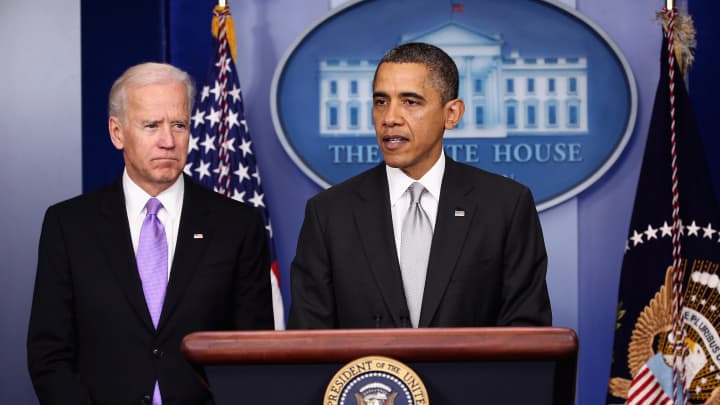
“Friedman Friday” Milton Friedman believed in liberty (Interview by Charlie Rose of Milton Friedman part 1)

April 19, 2013 – 1:14 am

Charlie Rose interview of Milton Friedman My favorite economist: Milton Friedman : A Great Champion of Liberty  by V. Sundaram   Milton Friedman, the Nobel Prize-winning economist who advocated an unfettered free market and had the ear of three US Presidents – Nixon, Ford and Reagan – died last Thursday (16 November, 2006 ) in San Francisco […] By Everette Hatcher III | Posted in Milton Friedman | Edit | Comments (0)

What were the main proposals of Milton Friedman?

February 21, 2013 – 1:01 am

Stearns Speaks on House Floor in Support of Balanced Budget Amendment Uploaded by RepCliffStearns on Nov 18, 2011 Speaking on House floor in support of Balanced Budget Resolution, 11/18/2011 ___________ Below are some of the main proposals of Milton Friedman. I highly respected his work. David J. Theroux said this about Milton Friedman’s view concerning […] By Everette Hatcher III | Posted in Milton Friedman | Edit | Comments (0)

“Friedman Friday,” EPISODE “The Failure of Socialism” of Free to Choose in 1990 by Milton Friedman (Part 1)

December 7, 2012 – 5:55 am

Milton Friedman: Free To Choose – The Failure Of Socialism With Ronald Reagan (Full) Published on Mar 19, 2012 by NoNationalityNeeded Milton Friedman’s writings affected me greatly when I first discovered them and I wanted to share with you. We must not head down the path of socialism like Greece has done. Abstract: Ronald Reagan […] By Everette Hatcher III | Posted in Milton FriedmanPresident Obama | Edit | Comments (1)

Defending Milton Friedman

July 31, 2012 – 6:45 am

What a great defense of Milton Friedman!!!!   Defaming Milton Friedman by Johan Norberg This article appeared in Reason Online on September 26, 2008  PRINT PAGE  CITE THIS      Sans Serif      Serif Share with your friends: ShareThis In the future, if you tell a student or a journalist that you favor free markets and limited government, there is […]

10 Downsides to the Democratic Spending Plan 

OCTOBER 29, 2021 5:01PM

10 Downsides to the Democratic Spending Plan

By Chris Edwards


SHARE

President Biden has released a framework for his Build Back Better plan, which he hopes will gain the support of Democrats in the House and Senate. The plan includes spending increases of $1.85 trillion over 10 years, but that figure relies on gimmicky accounting and the actual cost would be higher.

The plan includes new and expanded subsidies for housing, preschool, renewable energy, health care, elderly care, electric cars, child care, school meals, higher education, farming, refundable tax credits, and other activities. The aim is to pass the plan as a reconciliation bill, which requires 51 votes in the Senate.

The spending would be funded by a $2 trillion tax increase, thus likely damaging investment, hiring, and growth. A rule of thumb is that each dollar of an income tax increase causes about 50 cents of deadweight losses or economic damage. Thus, a $2 trillion tax increase would damage the private sector by about $3 trillion.

But the spending itself would be harmful even without a tax increase. Let’s look at 10 downsides to the Democratic spending plan.

States Can Do It. Much of the proposed spending is for activities that states can fund themselves. Expanding subsidy programs is a bad idea, but such programs are even more inefficient when imposed top‐​down by Washington. If West Virginia or Arizona want to subsidize housing, preschool, or renewable energy, they can do so with their own state revenues. There is no need for aid from the federal government, especially when it is running large budget deficits while West VirginiaArizona, and other states have large surpluses. State and local tax revenues are currently up 11 percent over pre‐​pandemic levels.

Private Sector Can Do It. Some proposed spending is for activities that the private sector is already doing, so there is no need for new subsidies. The plan would increase subsidies for electric vehicles even though EV sales are already booming. In other cases, the plan would subsidize activities that the private sector would address by itself if governments got out of the way. The plan, for example, includes $150 billion in housing subsidies, but governments are causing the affordable housing problem by restricting supply with excessively tight zoning and building regulations.

Fix Existing Policies. The plan includes $555 billion in subsidies to address climate change, but the government itself imposes policies that exacerbate the harms from climate‐​related disasters such as hurricanes, droughts, and fires. Furthermore, the green way to fund infrastructure is through user charges that restrain resource use, but the Democrats plan to subsidize infrastructure, which is not green or efficient. Rather than creating new subsidies to address climate change, the government should fix its current anti‐​green policies.

Federal Overload. Policymakers do a poor job of managing and overseeing the vast array of current federal programs, and new programs would further overload them. The federal budget at $6.8 trillion is 150 times larger than the average state government budget of $45 billion. Most federal politicians have probably never even heard of hundreds of the government’s 2,300 or so programs, let alone actively oversee them.

Democracy. The spending plan would reduce democratic control of government. When the federal government funds state and local activities, decision​making moves from elected state and local officials to unelected and unknown officials in far‐​away Washington. The Democratic plan would move control over activities such as preschool and child care to federal bureaucrats. In an April speech, President Biden lauded “democracy” 16 times, but his spending plan would result in more top‐​down mandates on state and local activities.

Diversity. Residents of each state have varying preferences for spending programs and taxes. State governments can maximize value by tailoring policies to those preferences. But the Democratic proposals would undermine such beneficial diversity by imposing one‐​size‐​fits‐​all rules for energy, preschool, child care, and other activities. Biden promised that he would bring the nation together, but trying to force conformity on Americans with top‐​down programs would increase anger and division.

Corporate Welfare. Democratic leaders often rail against corporate subsidies, yet their spending plan includes subsidies for industries such as housing, automobiles, and energy. The subsidies would increase the feeding frenzy of corporate lobbying in Washington.

Costly Regulations. Federal subsidies come tied to regulations that raise costs for the states, cities, businesses, and organizations that receive funding. Federal infrastructure subsidies, for example, come tied to labor and environmental rules that raise costs and delay projects. The Democratic spending plan would probably lead to costly new rules imposed on education, energy, housing, preschool, child care, and other activities.

Fraud and Waste. Federal subsidy programs suffer from waste and fraud because state and local administrators have little incentive to restrain costs when the funds come “free” from Washington. Programs such as Medicaid and school lunches have long had high fraud rates, and we have seen massive fraud in recent pandemic aid to the states. Meanwhile, federally funded projects, such as light‐​rail systems, often suffer from large cost overruns. The new hand‐​out programs would likely suffer these same problems.

Programs With Poor Records. The Biden administration promised that it would follow “evidence‐​based policymaking,” but Biden’s plan would expand programs that have poor track records. For example, the plan would expand workforce training subsidies, but such efforts have never worked very well. And the plan would expand the earned income tax credit, but the program has an error and fraud rate of about 20 percent and it creates work disincentives as income rises and the credit is phased out.


The Economic Damage of Biden’s Fiscal Agenda

President Biden’s fiscal agenda of higher taxes and bigger government is not a recipe for prosperity.

How much will it hurt the economy?

Last month, I shared the results of a new study I wrote with Robert O’Quinn for the Club for Growth Foundation.

We based our results on a wide range of economic research, especially a scholarly study from the Congressional Budget Office, and found a big drop in economic output, employment and labor income.

Most troubling was the estimate of a long-run drop in living standards, which would be especially bad news for young people.

Today, I want to share some different estimates of the potential impact of Biden’s agenda.

A study for the Texas Public Policy Foundation, authored by  E. J. Antoni, Vance Ginn, and Stephen Moore, found even higher levels of economic damage. Here are some main excerpts.

President Biden and congressional Democrats seek to spend another $6.2 trillion over the next decade, spread across at least two bills that comprise their “Build Back Better” plan. This plan includes heavy taxing, spending, and debt, which contributes to reducing growth rates for GDP, employment, income, and capital stock.  Compared to baseline growth over the next decade, this plan will result in estimated dynamic economic effects of 5.3 million fewer jobs, $3.7 trillion less in GDP, $1.2 trillion less in income, and $4.5 trillion in new debt.…There are many regulatory changes and transfer payments in current legislation whose effects have not been included in this paper but are worth mentioning in closing since they will have many of the same effects as the tax increases discussed in this paper. Extending or expanding the enhanced Child Tax Credit, Earned Income Tax Credit, Child and Dependent Care Tax Credit, and more, disincentivizes working, reducing incomes, investment, and GDP. Just the changes to these three tax credits alone are expected to cause a loss of 15,000 jobs… Permanently expanding the health insurance premium tax credits would similarly have a negative effect… Regulatory changes subsidizing so-called green energy while increasing tax and regulatory burdens on fossil fuels also result in a less efficient allocation of resources.

If we focus on gross domestic product (GDP), the TPPF estimates a drop in output of $3.7 trillion, which is higher than my study, which showed a drop of about $3 trillion.

Part of the difference is that TPPF looked at the impact of both the so-callled infrastructure spending package and Biden’s so-called Build Back Better plan, while the study for the Club for Growth Foundation only looked at the impact of the latter.

So it makes sense that TPPF would find more aggregate damage.

And part of the difference is that economists rarely agree on anything because there are so many variables and different experts will assign different weights to those variables.

So the purpose of sharing these numbers is not to pretend that any particular study perfectly estimates the effect of Biden’s agenda, but rather to simply get a sense of the likely magnitude of the economic damage.

Speaking of economic damage, here’s a table from the TPPF showing state-by-state job losses.

I’ll close by noting that you can also use common sense to get an idea of what will happen if Biden’s agenda is approved.

He wants to make the United States more like Western Europe’s welfare states, so all we have to do is compare U.S. living standards and economic performance to what’s happening on the other side of the Atlantic Ocean.

And when you do that, the clear takeaway is that it’s crazy to “catch up” to nations that are actually way behind.

Biden’s Tax Plan Contains a Poison Pill for American Firms that Compete in Global Markets

May 24, 2021 by Dan Mitchell

As explained here, here, here, and here, I don’t like Biden’s class-warfare tax policy.

I’m especially concerned about his approach to business taxation.

  1. He wants to penalize American-based companies with the highest corporate tax rate among all developed nations.
  2. He wants to export that bad policy to the rest of the world with a “global minimum tax” – sort of an OPEC for politicians.
  3. He wants to handicap American multinational companies with taxes that don’t apply to foreign-based firms.

Regarding the third point, I wrote a column on that topic for the Orange County Register.

Here’s how I described Biden’s proposal.

Biden has proposed several tax increases that specifically target American firms that compete in world markets. Most notably, the Administration has proposed to double the tax rate on “global intangible low-tax income” (GILTI) from 10.5 percent to 21 percent. Translated from tax jargon to English, this is largely a tax on the income American firms earn overseas from intellectual property, most notably patents and royalties. Keep in mind, by the way, that this income already is subject to tax in the nations where it is earned. Most other nations do not handicap their companies with similar policies, so this means that American firms will face a big competitive disadvantage – especially when fighting for business in low-tax jurisdictions such as Hong Kong, Ireland, Singapore, Switzerland, and most of Eastern Europe.

And here are some additional reasons why it is very bad news.

…let’s simply look at the bottom-line impact of what Biden is proposing. The Tax Foundation estimates that, “The proposal would impose a 9.4 percent average surtax on the foreign activities of U.S. multinationals above and beyond the taxes levied by foreign governments” and “put U.S. multinationals at a competitive disadvantage relative to foreign corporations.” …a stagging $1.2 trillion tax increase on these companies. …This is not just bad for the competitiveness of American-based companies, it is also bad policy. Good fiscal systems, such as the flat tax, are based on “territorial taxation,” which is the common-sense notion that countries only tax economic activity inside their borders. …Many other nations follow this approach, which is why they will reap big benefits if Biden’s plan to hamstring American companies is approved. The key thing to understand is that the folks in Washington have the power to raise taxes on American companies competing abroad, but they don’t have the ability to raise taxes on the foreign companies in those overseas markets.

The Wall Street Journal‘s editorial page has been sounding the alarm on this issue as well.

Here are some excerpts from an editorial back in April.

…the tax on global intangible low-tax income, known as Gilti, which was created by the 2017 tax reform. …Gilti was flawed from the start…but Mr. Biden would make it worse in every respect. …The 2017 tax law set the statutory Gilti rate at…10.5%. Mr. Biden would increase that to 21%… the effective rate companies actually pay is higher. This is because Gilti embedded double taxation in the tax code. …Gilti allows a credit of only 80% of foreign taxes, with no carry-forwards or carry-backs. …Raising the statutory rate to 21% increases that effective rate to 26.25%. This new Biden effective minimum tax would be higher than the statutory tax rates in most countries even in Western Europe… The Biden plan would further increase the effective Gilti rate by expanding the tax base on which it’s paid. …A third Biden whammy would require companies to calculate tax bills on a country-by-country basis. …Requiring companies to calculate taxable profits and tax credits individually for every country in which a company operates will create a mountain of compliance costs for business and work for the Internal Revenue Service. …The Biden Administration and its progressive political masters have decided they don’t care about the global competitiveness of American companies.

Let’s close with some international comparisons.

According to the most-recent International Tax Competitiveness Index, the United States ranks #21 out of 35 nations, which is a mediocre score.

But the United States had been scoring near the bottom, year after year, before the Trump tax reform bumped America up to #21. So there was some progress.

If the Biden plan is approved, however, it is a near-certainly that the U.S. will be once again mired at the bottom. And this bad policy will lead to unfortunate results for American workers and American competitiveness.


Biden’s Infrastructure Boondoggle Will Undermine Growth

President Biden has proposed a massive $2 trillion-plus infrastructure plan. Here are the two things everyone should understand.

  1. It will hurt growth because it will be financed with very harmful tax increases, most notably a big increase in the corporate tax rate that will undermine competitiveness.
  2. It will hurt growth because the new spending will divert resources from the productive sector of the economy, leading to inefficient allocation of labor and capital.

Actually, there’s another thing everyone should understand. As illustrated by this summary from the Washington Post, it’s not really an infrastructure plan. It’s a spend-money-on-anything-and-everything plan, presumably to reward various interest groups.

Though I guess we have to give the Biden Administration points for consistency. The President’s COVID relief plan from earlier this year had very little to do with the pandemic, so we shouldn’t be surprised to see that the infrastructure plan has very little to do with infrastructure.

The Wall Street Journal editorialized about this bait-and-switch scam.

Most Americans think of infrastructure as roads, highways, bridges and other traditional public works. That’s why it polls well… Yet this accounts for a mere $115 billion of Mr. Biden’s proposal. There’s another $25 billion for airports and $17 billion for ports and waterways that also fill a public purpose. The rest of the $620 billion earmarked for “transportation” are subsidies for green energyand payouts to unions for the jobs his climate regulation will kill. …The magnitude of spending is something to behold. There’s $85 billion for mass transit plus $80 billion for Amtrak, which is on top of the $70 billion that Congress appropriated for mass transit in three Covid spending bills. The money is essentially a bailout for unions… Then there’s $174 billion for electric vehicles, including money to build 500,000 charging stations and for consumer “incentives” on top of the current $7,500 federal tax credit to buy an EV. …Mr. Biden is also redefining infrastructure as social-justice policy and income redistribution. …His plan also includes $213 billion for affordable housing, $100 billion for retrofitting public schools, $25 billion for child-care facilities and $400 billion for increasing home-health care.

Michael Boskin, a professor at Stanford, is not optimistic that Biden’s plan will generate good results.

Joe Biden’s $2.3 trillion infrastructure plan would be many times larger than previous such bills, only about one-third of it would meet even a broad definition of “infrastructure.” …What could possibly go wrong? A lot. …federal spending would crowd out private and local government spending, with a substantial risk of boondoggles piling up along the way.…The Biden plan is rife with opportunities for earmarked pork-barrel projects (bridges to nowhere) and crony capitalist corporate welfare (next-generation Solyndras). Consider California High-Speed Rail, an infrastructure train wreck that will soon be begging for a bailout from the Biden administration. It originally used a grant from President Barack Obama’s 2009 “stimulus” package to pay, six years later, for a tiny initial rail line. Yet, because the project’s projected total San Francisco to Los Angeles cost has tripled to $100 billion.

And even if the plan was nothing but real infrastructure, that wouldn’t be a cause for optimism.

Kenneth Rogoff, a professor at Harvard, wrote late last year that governments have a terrible track record with cost overruns.

…perhaps the biggest obstacle to improving infrastructure in advanced economies is that any new project typically requires navigating difficult right-of-way issues, environmental concerns, and objections from apprehensive citizens… The “Big Dig” highway project in my hometown of Boston, Massachusetts was famously one of the most expensive infrastructure projects in US history. The scheme was originally projected to cost $2.6 billion, but the final tab swelled to more than $15 billion… The construction of New York City’s Second Avenue Subway was a similar experience, albeit on a slightly smaller scale. In Germany, the new Berlin Brandenburg Airport recently opened nine years behind schedule and at three times the initial estimated cost.

Amen. I wrote a column about the infamous Second Avenue Subway, and I’ve also repeatedly opined about how government projects always wind up costing much more than initial projections.

Let’s wrap up by looking at an economic analysis of Biden’s plan by the University of Pennsylvania’s Penn Wharton Budget Model.

The overall macroeconomic effects of enacting the AJP, including both its spending and tax provisions, are shown in Table 4. …After the AJP’s new spending ends in 2029, however, its tax increases persist—as a result, federal debt ends up 6.4 percent lower by 2050, relative to the current law baseline.Despite the decline in government debt, the investment-disincentivizing effects of the AJP’s business tax provisions decrease the capital stock by 3 percent in 2031 and 2050. The decline in capital makes workers less productive despite the increase in productivity due to more infrastructure, dragging hourly wages down by 0.7 percent in 2031 and 0.8 percent in 2050. Overall, GDP is 0.9 percent lower in 2031 and 0.8 percent lower in 2050.

Here’s Table 4, which I’ve augmented by circling the two most important statistics.

The immediate lesson from all of this is that Biden’s plan is a boondoggle waiting to happen (just as would have been the case with Trump).

The longer-term lesson is that we should get the federal government out of the business of infrastructure.


The Political Consequences of Tax Migration

When I ask my left-leaning friends what they think about the flight of investors, entrepreneurs, and business owners from high-tax states, I tend to get three responses.

  1. It isn’t actually happening (these are my friends who apparently don’t know how to read).
  2. It’s happening, but it doesn’t matter (data from the IRS suggests it actually is significant).
  3. It’s happening, but high-tax states will be better off without these selfish and greedy people.

The folks making the third point actually have a decent argument, at least in terms of short-run political outcomes. Democrats rarely have to worry about retaining control of states like CaliforniaNew YorkIllinois, and New Jersey now that many Republican-leaning voters have moved away.

But sometimes short-run benefits are exceeded by long-run costs, and the recent data on congressional redistricting from the Census Bureau is a good example.

As you can see, there’s a continuing shift of political power – as measured by seats in Congress – from blue states to red states.

Patrick Gleason of Americans for Tax Reform explains what this means in a column for Forbes.

Over the past decade Americans have been voting with their feet in favor of states with lower overall tax burdens… As a result, high tax states…are set to lose congressional clout for the next decade, to the benefit of low tax states… the seven states that will lose congressional seats due to stagnant population growth have higher top income tax rates and greater overall tax burdens, on average, than do the six states gaining seats. In fact, the average top personal income tax rate for states losing seats in congress is 6.5%, which is 46% greater than the 4.45% average top income tax rate for states gaining seats.

Some people may want to dismiss Mr. Gleason’s column since he works for a group that supports smaller government.

But you can find the same analysis in this column in the Washington Post by Aaron Blake.

…what does the new breakdown mean from a partisan perspective? All told, five seats will migrate from blue states to red ones — owing to population shifts from the Rust Belt, the Northeast and California to the South and other portions of the West. Five of the seven seats being added also go to states under complete GOP control of redistricting, with three of seven being taken away coming from states in which Democrats have some measure of control over the maps. …That should help Republicans… The Cook Political Report estimates the shifts are worth about 3.5 seats… As for the electoral college in future presidential elections, …Michigan and Pennsylvania…are states Democrats probably need to win in the near future, meaning it’s probably a bigger loss for them. …If we reran the 2020 electoral college with the new electoral votes by state, Biden’s margin would shrink from 306-232 to 303-235. That seems negligible. But if you overlay the 2000 presidential results — three reapportionments ago — on the current electoral vote totals, George W. Bush’s narrow win with 271 electoral votes becomes a much more decisive win with 290. That gives you a sense where things have trended.

Let’s now return to the hypothesis that tax-motivated migration is playing a role.

Here’s an instructive tweet from Andrew Wilford of the National Taxpayers Union.https://platform.twitter.com/embed/Tweet.html?dnt=true&embedId=twitter-widget-0&features=eyJ0ZndfZXhwZXJpbWVudHNfY29va2llX2V4cGlyYXRpb24iOnsiYnVja2V0IjoxMjA5NjAwLCJ2ZXJzaW9uIjpudWxsfSwidGZ3X2hvcml6b25fdHdlZXRfZW1iZWRfOTU1NSI6eyJidWNrZXQiOiJodGUiLCJ2ZXJzaW9uIjpudWxsfX0%3D&frame=false&hideCard=false&hideThread=false&id=1386785330020356103&lang=en&origin=https%3A%2F%2Fdanieljmitchell.wordpress.com%2F2021%2F04%2F27%2Fthe-political-consequences-of-tax-migration%2F&sessionId=fbae0e0c1efd7628dbdc1ee1673d407a81777661&siteScreenName=wordpressdotcom&theme=light&widgetsVersion=ff2e7cf%3A1618526400629&width=550px

I’ll wrap up today’s column by augmenting the data in Mr. Wilford’s tweet.

Because not only are there, on average, lower tax burdens in the states gaining congressional seats, but every one of them has some very desirable feature of its tax code.

To be sure, not all of the state-to-state migration is due to tax policy. There are all sorts of other policies that determine whether a state is an attractive place for people looking to relocate.

And there are other factors (family, climate, etc) that have nothing to do with public policy.

All things considered, however, being a low-tax state means more jobs, growth, and people, at least when compared with being a high-tax state.

P.S. If you’re interested in seeing how states rank in various indices, click herehere, and here.

The Suddenly Real Threat of a Higher Corporate Income Tax Rate

After November’s election, I figured we would have gridlock. Biden would propose some statist ideas, but they would be blocked by Republicans in the Senate.

All things considered, not a bad outcome.

But Democrats won the run-off elections yesterday for both Georgia Senate seats, which means they now have total control of Washington.

And that means, as I recently warned, a much bigger threat that Biden’s proposed tax increases may get enacted.

That won’t be good news for America’s economy or American competitiveness.

Today, let’s focus on the biggest tax increase that the President Elect is proposing.

In an article for National Review, Joseph Sullivan writes about the adverse impact of Biden’s increase in the corporate tax rate.

Biden’s corporate-tax proposal is remarkable. …If the U.S. adopted Biden’s proposed federal tax rate, its overall corporate-tax rate would not be “in line” with the rest of the G7. Assuming U.S. state and local corporate taxes stayed the same, Biden’s proposal would result in nearly the highest overall corporate-tax rate in the G7, according to data from the OECD. The U.S. would be tied with France. …The average overall corporate rate among the G7 has fallen to 25 percent… With the G7 average trending in one direction, Biden would move the U.S. in the opposite direction.

In other words, while the Biden team claims that a higher corporate tax won’t be too damaging because it will be similar to the rate in other major nations, the U.S. actually will be tied with France once you include the impact of state corporate tax burdens.

Here’s the chart included with the article.

And don’t forget that there are many other economies where the corporate tax rate is well below the G7 average.

The bottom line is that the United States currently ranks only #19out of 35 nations in the Tax Foundation’s competitiveness ranking for OECD nations.

The good news is that being #19 is much better than being #31, which is where the U.S. was in 2016.

The bad news is that Biden wants to undo much of the 2017 reform, as well as impose other tax increases. And that means a much lower competitiveness score in the future.

Which ultimately means lower wages for American workers.

P.S. Although the proposed increase in the corporate rate is theoretically the biggest revenue raiser in Biden’s tax plan, I will safely predict that it won’t raise nearly as much revenue as projected by static revenue estimates. I wasn’t able to educate Obama on this issue, and I’m even less hopeful of getting through to Biden.

—-

Three Economics Risks for 2021 and Beyond

In an interview with Fox Business last week, I touched on three policies (easy money from the Fed, Biden’s class-warfare tax agenda, and the ever-increasing burden of federal spending) that create risks for the economy in 2021.

I didn’t have a chance to elaborate in the interview, but it’s worth noting that Biden will inherit two of the aforementioned problems.

Trump has been profligate with our money, and he was that way even before the coronavirus became an excuse to open the budgetary spigot. Moreover, he was just like Obama in pressuring the Federal Reserve for Keynesian-style monetary policy.

Unfortunately, there’s no reason to think Biden will try to reverse those mistakes.

Indeed, he wants expand the burden of federal spending. And, regarding monetary policy, appointing Janet Yellen as Secretary of Treasury certainly suggests he is comfortable with the current approach.

And to make matters worse, he definitely wants a more punitive tax system. We will shortly learn whether Democratstake control of the Senate, which presumably would give Biden more leeway to enact his class-warfare tax agenda.

As I said in the interview, that would create economic headwinds.

P.S. I mentioned in the interview that we have “three Americas” with regards to coronavirus. I’m not sure I was completely clear, so here’s what I was trying to get across.

  1. Tourism-reliant states – They are going to be in bad shape until coronavirus is in the rear-view mirror and people feel comfortable with traveling and socializing.
  2. Lock-down states – They have higher unemployment rates because more businesses are shut down.
  3. Laissez-faire states – These are the states that generally allow businesses to remain open and have lower unemployment rates.

For what it’s worth, I think it’s best to let businesses stay open and to allow them and their customers to assess safety risks. It will be interesting to see whether any link is discovered between state policy and coronavirus rates.

P.P.S. At the risk of over-simplification, bad fiscal policy erodes the economy’s long-run growth rate. Bad monetary policy, by contrast, is what causes economic volatility and downturns.


Another Leftist Has an Epiphany on Guns

I’m (unfortunately) not a rich person, but that doesn’t stop me from opposing punitive taxes on successful entrepreneurs, investors, and small business owners.

Likewise, I’m not a gun aficionado, but that doesn’t stop me from opposing efforts to restrict the rights of law-abiding people to own and bear arms.

In part, my views on guns are driven by cost-benefit analysis. Simply stated, the evidence is fairly clear that there is less crime when bad people have to worry that potential victims have the ability to defend themselves.

But I also very much agree with the constitutional argument for gun ownership, as well as the “societal disarray” argument.

Interestingly, it seems that more folks on the left are coming to their senses on the issue of gun control, generally for practical reasons rather than philosophical reasons.

  • In 2012, I shared some important observations from Jeffrey Goldberg, a left-leaning writer for The Atlantic. In his column, he basically admitted his side was wrong about gun control.
  • Then, in 2013, I wrote about a column by Justin Cronin in the New York Times. He self-identified as a liberal, but explained how real-world events have led him to become a supporter of private gun ownership.
  • In 2015, I shared a column by Jamelle Bouie in Slate, who addressed the left’s fixation on trying to ban so-called assault weapons and explains that such policies are meaningless.
  • More recently, in 2017, Leah Libresco wrote in the Washington Post that advocates of gun control are driven by emotion rather empirical research and evidence.
  • Last but not least, Alex Kingsbury in 2019 acknowledged the futility of gun control in a column for the New York Times.

Today, we’re going to add to the collection.

Charles Blow of the New York Times recently wrote about how he has become more understanding of why fellow blacks want to own guns.

Growing up in rural northern Louisiana, everyone I knew, at least every household, seemed to have guns. …Gun ownership was the norm in those parts, including in the Black community. It was not associated with danger but with safety. …Indeed, one could argue that the right to bear arms in this country has never been so brazenly and openly abridged as it has against Black people. Many state codes prohibited Black gun ownership before the Civil War and allowed for the disarmament of Black people after. …When I moved north, first to Detroit and then to New York, I moved into a mental space of more stringent gun control. …city dwellers simply didn’t have the same need for weapons as the people in the rural community where I was raised… I, like many, were convinced that fewer guns in the Black community would make it safer. But, for many Black people, that sentiment has turned. …gun sales to Black people are surging. …I, as much as anyone, would like to live in a society in which all citizens felt safe without the need of personal firearms. America could have created such a society. However, it chose not to. …many Black people feel the need to defend themselves from their own country.

To be sure, Mr. Blow can’t be considered a full convert to the 2nd Amendment. That being said, I think it’s nonetheless remarkable that even a committed, hard-core leftist has (partially) seen the light.

Though I can’t resist quibbling with one point in his column.He wrote, “America could have created” a society where gun control would be desirable because no guns would be needed, but “it chose not to.”

I would replace “it chose not to” with “our government is not sufficiently competent.”

Heck, I would probably add “or trustworthy” as well. Given the unsavory history of gun control, Mr. Blow should be among the first to appreciate that argument.

P.S. In 2018, I shared the story of Ryan Moore, another leftist who changed his mind on gun control. But since he also evolved away from being a leftist, I don’t include him

—-

Reusable: biden obama gun control speechPresident Barack Obama announces the creation of an interagency task force for guns as as Vice President Joseph Biden listens on.Getty Images


Is Gun Control Dead?

In recent months, governments released prisoners and announced that some laws wouldn’t be enforced because of the coronavirus. Now, with protests against police misbehavior, we’re seeing governments fail to maintain law and order.

As suggested by this excellent Reason video, these developments bolster the case against gun control.

But does this mean politicians will be more supportive of the 2nd Amendment?

The answer (at least for anyone with an IQ above room temperature)should be yes.

From an economic perspective, one major goal is to change the cost-benefit analysis for criminals. If bad guys have to worry that good guys may be armed, that significantly increases the potential cost of illegal behavior.

A well-functioning system of law enforcement can help, of course, but that’s not a description of how things work in some communities – even in normal times, much less when there’s civil unrest.

But all this evidence and analysis doesn’t seem to matter for Joe Biden. A look at his campaign website shows support for a wide range of gun-control laws from the soon-to-be Democratic nominee.

…gun violence is a public health epidemic. …In 1994, Biden – along with Senator Dianne Feinstein – secured the passage of 10-year bans on assault weapons and high-capacity magazines. As president, Joe Biden will defeat the NRA again. …As president, Biden will: …Ban the manufacture and sale of assault weapons and high-capacity magazines. …Regulate possession of existing assault weapons under the National Firearms Act. …Biden supports legislation restricting the number of firearms an individual may purchase per month to one. …End the online sale of firearms and ammunitions. …Give states incentives to set up gun licensing programs.

What’s especially discouraging is that Biden apparently hasn’t learned anything about so-called assault weapons since 1994.

In a 2019 column for Reason, Jacob Sullum dissected Biden’s incoherent views on the topic.

Joe Biden…is still proud of the ban on “assault weapons”… Biden argues that it made mass shootings less common…, citing a study reported in The Journal of Trauma and Acute Care Surgery last January. But that is not what the researchers, led by New York University epidemiologist Charles DiMaggio, actually found.…The study…looked not at the number of mass shootings, as Biden claims, but the number of mass-shooting deaths as a share of all firearm homicides. The difference in total fatalities during the period when the ban was in effect amounted to 15 fewer deaths over a decade, or 1.5 a year on average, including mass shootings that did not involve weapons covered by the ban. …The causal mechanism imagined by Biden is even harder to figure out. He describes “assault weapons” as “military-style firearms designed to fire rapidly.” But they do not fire any faster than any other semi-automatic. …Under the 1994 ban, removing “military-style” features such as folding stocks, flash suppressors, or bayonet mounts transformed forbidden “assault weapons” into legal firearms, even though the compliant models fired the same ammunition at the same rate with the same muzzle velocity as the ones targeted by the law.

I wonder if Biden understands the policy he’s advocating.

Does he think that “assault weapons” are actual machine guns, capable of firing multiple rounds with one pull on the trigger (a remarkably common misconception among gun-control advocates)?

Or, if he understands that a so-called assault weapon is just like any other gun (firing one round each time the trigger is pulled), then why would he think anything would be achieved by banning some guns and leaving others (that work the same way) legal?

Perhaps most relevant, does he even care what the evidence shows?

The bottom line is that people are “voting with their dollars” for gun ownership for the simple reason that they know it’s unwise to trust government (either to protect them from crime or to respect their rights).

But that doesn’t mean their constitutional freedoms will be secure if Biden wins the 2020 election.

P.S. The good news is that there will be widespread civil disobedience if politicians push for new gun bans.

P.P.S. Another silver lining is that we’ll get more and more clever humor mocking gun control.

The Case Against Biden’s Class-Warfare Tax Policy, Part II

In Part I of this series, I expressed some optimism that Joe Biden would not aggressively push his class-warfare tax plan, particularly since Republicans almost certainly will wind up controlling the Senate.

But the main goal of that column was to explain that the internal revenue code already is heavily weighted against investors, entrepreneurs, business owners and other upper-income taxpayers.

And to underscore that point, I shared two charts from Brian Riedl’s chartbook to show that the “rich” are now paying a much larger share of the tax burden – notwithstanding the Reagan tax cuts, Bush tax cuts, and Trump tax cuts – than they were 40 years ago.

Not only that, but the United States has a tax system that is more “progressive” than all other developed nations (all of whom also impose heavy tax burdens on upper-income taxpayers, but differ from the United States in that they also pillage lower-income and middle-class residents).

In other words, Biden’s class-warfare tax plan is bad policy.

Today’s column, by contrast, will point out that his tax increases are impractical. Simply stated, they won’t collect much revenue because people change their behavior when incentives to earn and report income are altered.

This is especially true when looking at upper-income taxpayers who – compared to the rest of us – have much greater ability to change the timing, level, and composition of their income.

This helps to explain why rich people paid five times as much tax to the IRS during the 1980s when Reagan slashed the top tax rate from 70 percent to 28 percent.

When writing about this topic, I normally use the Laffer Curve to help people understand why simplistic assumptions about tax policy are wrong (that you can double tax revenue by doubling tax rates, for instance). And I point out that even folks way on the left, such as Paul Krugman, agree with this common-sense view (though it’s also worth noting that some people on the right discredit the concept by making silly assertions that “all tax cuts pay for themselves”).

But instead of showing the curve again, I want to go back to Brian Riedl’s chartbook and review his data on of revenue changes during the eight years of the Obama Administration.
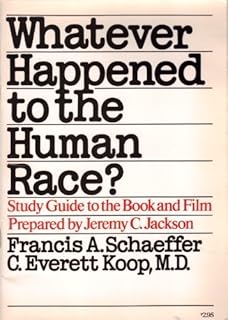
It shows that Obama technically cut taxes by $822 billion (as further explained in the postscript, most of that occurred when some of the Bush tax cuts were made permanent by the “fiscal cliff” deal in 2012) and raised taxes by $1.32 trillion (most of that occurred as a result of the Obamacare legislation).

If we do the math, that means Obama imposed a cumulative net tax increase of about $510 billion during his eight years in office

But, if you look at the red bar on the chart, you’ll see that the government didn’t wind up with more money because of what the number crunchers refer to as “economic and technical reestimates.”

Indeed, those reestimates resulted in more than $3.1 trillion of lost revenue during the Obama years.

don’t want the politicians and bureaucrats in Washington to have more tax revenue, but I obviously don’t like it when tax revenues shrink simply because the economy is stagnant and people have less taxable income.

Yet that’s precisely what we got during the Obama years.

To be sure, it would be inaccurate to assert that revenues declined solely because of Obama’s tax increase. There were many other bad policies that also contributed to taxable income falling short of projections.

Heck, maybe there was simply some bad luck as well.

But even if we add lots of caveats, the inescapable conclusion is that it’s not a good idea to adopt policies – such as class-warfare tax rates – that discourage people from earning and reporting taxable income.

The bottom line is that we should hope Biden’s proposed tax increases die a quick death.

P.S. The “fiscal cliff” was the term used to describe the scheduled expiration of the 2001 and 2003 Bush tax cuts. According to the way budget data is measured in Washington, extending some of those provisions counted as a tax cut even though the practical impact was to protect people from a tax increase.

P.P.S. Even though Biden absurdly asserted that paying higher taxes is “patriotic,” it’s worth pointing out that he engaged in very aggressive tax avoidance to protect his family’s money.

President Joe Biden Will Be Bad, but a President Kamala Harris Would Be Worse

Joe Biden has a very misguided economic agenda. I’m especially disturbed by his class-warfare tax agenda, which will be bad news for American workers and American competitiveness.

The good news, as I wrote earlier this year, is that he probably isn’t serious about some of his worst ideas.

Biden is a statist, but not overly ideological. His support for bigger government is largely a strategy of catering to the various interest groups that dominate the Democratic Party. The good news is that he’s an incrementalist and won’t aggressively push for a horrifying FDR-style agenda if he gets to the White House.

But what if Joe Biden’s health deteriorates and Kamala Harris – sooner or later – winds up in charge?

That’s rather troubling since her agenda was far to the left of Biden’s when they were competing for the Democratic nomination.

And it doesn’t appear that being Biden’s choice for Vice President has led her to moderate her views. Consider this campaign ad, where she openly asserted that “equitable treatment means we all end up at the same place.”

The notion that we should strive for equality of outcomes rather than equality of opportunity is horrifying.

For all intents and purposes,Harris has embraced a harsh version of redistributionism where everyone above average is punished and everyone below average is rewarded.

This goes way beyond a safety net and it’s definitely a recipe for economic misery since people on both sides of the equationhave less incentive to be productive.

I’m not the only one to be taken aback by Harris’ dogmatic leftism.

Robby Soave, writing for Reason, is very critical of her radical outlook.

Harris gives voice to a leftist-progressive narrative about the importance of equity—equal outcomes—rather than mere equality before the law. …Harris contrasted equal treatment—all people getting the same thing—with equitable treatment,which means “we all end up at the same place.” …This may seem like a trivial difference, but when it comes to public policy, the difference matters. A government shouldbe obligated to treat all citizens equally, giving them the same access to civil rights and liberties like voting, marriage, religious freedom, and gun ownership. …A mandate to foster equity, though, would give the government power to violate these rights in order to achieve identical social results for all people. 

And, in a column for National Review, Brad Polumbo expresses similar reservations about her views.

Whether she embraces the label “socialist” or not, Harris’s stated agenda and Senate record both reveal her to be positioned a long way to the left on matters of economic policy. From health care to the environment to housing, Harris thinks the answer to almost every problem we face is simply more government and more taxpayer money — raising taxes and further indebting future generations in the process.…Harris…supports an astounding $40 trillion in new spending over the next decade. In a sign of just how far left the Democratic Party has shifted on economics, Harris backs more than 20 times as much spending as Hillary Clinton proposed in 2016. …And this is not just a matter of spending. During her failed presidential campaign, Harris supported a federal-government takeover of health care… The senator jumped on the “Green New Deal” bandwagon as well. She co-sponsored the Green New Deal resolution in the Senate that called for a “new national, social, industrial, and economic mobilization on a scale not seen since World War II and the New Deal era.” …she supports enacting price controls on housing across the country. …The left-wing group Progressive Punch analyzed Harris’s voting record and found that she is the fourth-most liberal senator, more liberal even than Massachusetts senator Elizabeth Warren. Similarly, the nonpartisan organization GovTrack.us deemed Harris the furthest-left member of the Senate for the 2019 legislative year. (Spoiler alert: If your voting record is to the left of Bernie Sanders, you might be a socialist.)

To be fair, Harris is simply a politician, so we have no idea what she really believes. Her hard-left agenda might simply be her way of appealing to Democratic voters, much as Republicans who run for president suddenly decide they support big tax cuts and sweeping tax reform.

But whether she’s sincere or insincere, it’s troubling that she actually says it’s the role of government to make sure we all “end up at the same place.”

Let’s close with a video clip from Milton Friedman. At the risk of understatement, he has a different perspective than Ms. Harris.

Since we highlighted Harris’ key quote, let’s also highlight the key quote from Friedman.

Amen.

P.S. It appears Republicans will hold the Senate, which presumably (hopefully?) means that any radical proposals would be dead on arrival, regardless of whether they’re proposed by Biden or Harris.

P.P.S. Harris may win the prize for the most economically illiterate proposal of the 2020 campaign.

——

Will Biden’s Class-Warfare Tax Plan Lead to an Exodus of Job Creators?

After Barack Obama took office (and especially after he was reelected), there was a big uptick in the number of rich people who chose to emigrate from the United States. 

There are many reasons wealthy people choose to move from one nation to another, but Obama’s embrace of class-warfare tax policy (including FATCA) was seen as a big factor.

Joe Biden’s tax agenda is significantly more punitive than Obama’s, so we may see something similar happen if he wins the 2020 election.

Given the economic importance of innovatorsentrepreneurs, and inventors, this would be not be good news for the American economy.

The New York Times reported late last year that the United States could be shooting itself in the foot by discouraging wealthy residents.

…a different group of Americans say they are considering leaving — people of both parties who would be hit by the wealth tax… Wealthy Americans often leave high-tax states like New York and California for lower-tax ones like Florida and Texas. But renouncing citizenship is a far more permanent, costly and complicated proposition. …“America’s the most attractive destination for capital, entrepreneurs and people wanting to get a great education,” said Reaz H. Jafri, a partner and head of the immigration practice at Withers, an international law firm. “But in today’s world, when you have other economic centers of excellence — like Singapore, Switzerland and London — people don’t view the U.S. as the only place to be.” …now, the price may be right to leave. While the cost of expatriating varies depending on a person’s assets, the wealthiest are betting that if a Democrat wins…, leaving now means a lower exit tax. …The wealthy who are considering renouncing their citizenship fear a wealth tax less than the possibility that the tax on capital gains could be raised to the ordinary income tax rate, effectively doubling what a wealthy person would pay… When Eduardo Saverin, a founder of Facebook…renounced his United States citizenship shortly before the social network went public, …several estimates said that renouncing his citizenship…saved him $700 million in taxes.

The migratory habits of rich people make a difference in the global economy.

Here are some excerpts from a 2017 Bloomberg story.

Australia is luring increasing numbers of global millionaires, helping make it one of the fastest growing wealthy nations in the world… Over the past decade, total wealth held in Australia has risen by 85 percent compared to 30 percent in the U.S. and 28 percent in the U.K… As a result, the average Australian is now significantly wealthier than the average American or Briton. …Given its relatively small population, Australia also makes an appearance on a list of average wealth per person. This one is, however, dominated by small tax havens.

Here’s one of the charts from the story.

As you can see, Australia is doing very well, though the small tax havens like Monaco are world leaders.

I’m mystified, however, that the Cayman Islands isn’t listed.

But I’m digressing.

Let’s get back to our main topic. It’s worth noting that even Greece is seeking to attract rich foreigners.

The new tax law is aimed at attracting fresh revenues into the country’s state coffers – mainly from foreigners as well as Greeks who are taxed abroad – by relocating their tax domicile to Greece, as it tries to woo “high-net-worth individuals” to the Greek tax register.The non-dom model provides for revenues obtained abroad to be taxed at a flat amount… Having these foreigners stay in Greece for at least 183 days a year, as the law requires, will also entail expenditure on accommodation and everyday costs that will be added to the Greek economy. …most eligible foreigners will be able to considerably lighten their tax burden if they relocate to Greece…nevertheless, the amount of 500,000 euros’ worth of investment in Greece required of foreigners and the annual flat tax of 100,000 euros demanded (plus 20,000 euros per family member) may keep many of them away.

The system is too restrictive, but it will make the beleaguered nation an attractive destination for some rich people. After all, they don’t even have to pay a flat tax, just a flat fee.

Italy has enjoyed some success with a similar regime to entice millionaires.

Last but not least, an article published last year has some fascinating details on the where rich people move and why they move.

The world’s wealthiest people are also the most mobile. High net worth individuals (HNWIs) – persons with wealth over US$1 million – may decide to pick up and move for a number of reasons. In some cases they are attracted by jurisdictions with more favorable tax laws… Unlike the middle class, wealthy citizens have the means to pick up and leave when things start to sideways in their home country. An uptick in HNWI migration from a country can often be a signal of negative economic or societal factors influencing a country. …Time-honored locations – such as Switzerland and the Cayman Islands – continue to attract the world’s wealthy, but no country is experiencing HNWI inflows quite like Australia. …The country has a robust economy, and is perceived as being a safe place to raise a family. Even better, Australia has no inheritance tax

Here’s a map from the article.

The good news is that the United States is attracting more millionaires than it’s losing (perhaps because of the EB-5 program).

The bad news is that this ratio could flip after the election. Indeed, it may already be happening even though recent data on expatriation paints a rosy picture.

The bottom line is that the United States should be competing to attract millionaires, not repel them. Assuming, of course, politicians care about jobs and prosperity for the rest of the population.

P.S. American politicians, copying laws normally imposed by the world’s most loathsome regimes, have imposed an “exit tax” so they can grab extra cash from rich people who choose to become citizens elsewhere.

P.P.S. I’ve argued that Australia is a good place to emigrate even for those of us who aren’t rich.

—-


Question of the Week: Which Department of the Federal Government Should Be the First to Be Abolished?

I was asked last week which entitlement program is most deserving of reform.

While acknowledging that Social Security and Medicare also are in desperate need of modernization, I wrote that Medicaid reformshould be the first priority.

But I’d be happy if we made progress on any type of entitlement reform, so I don’t think there are right or wrong answers to this kind of question.

We have the same type of question this week. A reader sent an email to ask “Which federal department should be abolished first?”

I guess this is what is meant when people talk about a target-rich environment. We have an abundance of candidates:

But if I have to choose, I think the Department of Housing and Urban Development should be first on the chopping block.

Raze the building and put a layer of salt over the earth to make sure it can never spring back to life

I’ve already argued that there should be no federal government involvement in the housing sector and made the same argument on TV. And I’ve also shared some horror stories about HUD waste and incompetence.

Heck, I even made HUD the background image for my video on the bloated and overpaid bureaucracy in Washington.

It’s also worth noting that there’s nothing about housing in Article I, Section VIII, of the Constitution. For those of us who have old-fashioned values about playing by the rules, that means much of what takes place in Washington – including housing handouts – is unconstitutional.

Simply stated, there is no legitimate argument for HUD. And I think there would be the least political resistance.

As with the answer to the question about entitlements, this is a judgment call. I’d be happy to be proven wrong if it meant that politicians were aggressively going after another department. Anything that reduces the burden of government spending is a step in the right direction


Milton Friedman on Spending

October 3, 2020 by Dan Mitchell

I identified four heroes from the “Battle of Ideas” video I shared in late August – Friedrich Hayek, Milton Friedman, Ronald Reagan, and Margaret Thatcher. Here’s one of those heroes, Milton Friedman, explaining what’s needed to control big government.

Why Milton Friedman Saw School Choice as a First Step, Not a Final One

On his birthday, let’s celebrate Milton Friedman’s vision of enabling parents, not government, to be in control of a child’s education.

Wednesday, July 31, 2019
Kerry McDonald
Kerry McDonald

EducationMilton FriedmanSchool ChoiceSchooling

Libertarians and others are often torn about school choice. They may wish to see the government schooling monopoly weakened, but they may resist supporting choice mechanisms, like vouchers and education savings accounts, because they don’t go far enough. Indeed, most current choice programs continue to rely on taxpayer funding of education and don’t address the underlying compulsory nature of elementary and secondary schooling.

Skeptics may also have legitimate fears that taxpayer-funded education choice programs will lead to over-regulation of previously independent and parochial schooling options, making all schooling mirror compulsory mass schooling, with no substantive variation.

Milton Friedman had these same concerns. The Nobel prize-winning economist is widely considered to be the one to popularize the idea of vouchers and school choice beginning with his 1955 paper, “The Role of Government in Education.” His vision continues to be realized through the important work of EdChoice, formerly the Friedman Foundation for Education Choice, that Friedman and his economist wife, Rose, founded in 1996.

July 31 is Milton Friedman’s birthday. He died in 2006 at the age of 94, but his ideas continue to have an impact, particularly in education policy.

Friedman saw vouchers and other choice programs as half-measures. He recognized the larger problems of taxpayer funding and compulsion, but saw vouchers as an important starting point in allowing parents to regain control of their children’s education. In their popular book, Free To Choose, first published in 1980, the Friedmans wrote:

We regard the voucher plan as a partial solution because it affects neither the financing of schooling nor the compulsory attendance laws. We favor going much farther. (p.161)

They continued:

The compulsory attendance laws are the justification for government control over the standards of private schools. But it is far from clear that there is any justification for the compulsory attendance laws themselves. (p. 162)

The Friedmans admitted that their “own views on this have changed over time,” as they realized that “compulsory attendance at schools is not necessary to achieve that minimum standard of literacy and knowledge,” and that “schooling was well-nigh universal in the United States before either compulsory attendance or government financing of schooling existed. Like most laws, compulsory attendance laws have costs as well as benefits. We no longer believe the benefits justify the costs.” (pp. 162-3)

Still, they felt that vouchers would be the essential starting point toward chipping away at monopoly mass schooling by putting parents back in charge. School choice, in other words, would be a necessary but not sufficient policy approach toward addressing the underlying issue of government control of education.

In their book, the Friedmans presented the potential outcomes of their proposed voucher plan, which would give parents access to some or all of the average per-pupil expenditures of a child enrolled in public school. They believed that vouchers would help create a more competitive education market, encouraging education entrepreneurship. They felt that parents would be more empowered with greater control over their children’s education and have a stronger desire to contribute some of their own money toward education. They asserted that in many places “the public school has fostered residential stratification, by tying the kind and cost of schooling to residential location” and suggested that voucher programs would lead to increased integration and heterogeneity. (pp. 166-7)

To the critics who said, and still say, that school choice programs would destroy the public schools, the Friedmans replied that these critics fail to

explain why, if the public school system is doing such a splendid job, it needs to fear competition from nongovernmental, competitive schools or, if it isn’t, why anyone should object to its “destruction.” (p. 170)

What I appreciate most about the Friedmans discussion of vouchers and the promise of school choice is their unrelenting support of parents. They believed that parents, not government bureaucrats and intellectuals, know what is best for their children’s education and well-being and are fully capable of choosing wisely for their children—when they have the opportunity to do so.

They wrote:

Parents generally have both greater interest in their children’s schooling and more intimate knowledge of their capacities and needs than anyone else. Social reformers, and educational reformers in particular, often self-righteously take for granted that parents, especially those who are poor and have little education themselves, have little interest in their children’s education and no competence to choose for them. That is a gratuitous insult. Such parents have frequently had limited opportunity to choose. However, U.S. history has demonstrated that, given the opportunity, they have often been willing to sacrifice a great deal, and have done so wisely, for their children’s welfare. (p. 160).

Sign-Up: Receive Kerry’s Weekly Parenting and Education Newsletter!

Today, school voucher programs exist in 15 states plus the District of Columbia. These programs have consistently shown that when parents are given the choice to opt-out of an assigned district school, many will take advantage of the opportunity. In Washington, D.C., low-income parents who win a voucher lottery send their children to private schools.

The most recent three-year federal evaluationof voucher program participants found that while student academic achievement was comparable to achievement for non-voucher students remaining in public schools, there were statistically significant improvements in other important areas. For instance, voucher participants had lower rates of chronic absenteeism than the control groups, as well as higher student satisfaction scores. There were also tremendous cost-savings.

In Wisconsin, the Milwaukee Parental Choice Program has served over 28,000 low-income students attending 129 participating private schools.

According to Corey DeAngelis, Director of School Choice at the Reason Foundation and a prolific researcher on the topic, the recent analysis of the D.C. voucher program “reveals that private schools produce the same academic outcomes for only a third of the cost of the public schools. In other words, school choice is a great investment.”

In Wisconsin, the Milwaukee Parental Choice Program was created in 1990 and is the nation’s oldest voucher program. It currently serves over 28,000 low-income students attending 129 participating private schools. Like the D.C. voucher program, data on test scores of Milwaukee voucher students show similar results to public school students, but non-academic results are promising.

Recent research found voucher recipients had lower crime rates and lower incidences of unplanned pregnancies in young adulthood. On his birthday, let’s celebrate Milton Friedman’s vision of enabling parents, not government, to be in control of a child’s education.

According to Howard Fuller, an education professor at Marquette University, founder of the Black Alliance for Educational Options, and one of the developers of the Milwaukee voucher program, the key is parent empowerment—particularly for low-income minority families.

In an interview with NPR, Fuller said: “What I’m saying to you is that there are thousands of black children whose lives are much better today because of the Milwaukee parental choice program,” he says. 
“They were able to access better schools than they would have without a voucher.”

Putting parents back in charge of their child’s education through school choice measures was Milton Friedman’s goal. It was not his ultimate goal, as it would not fully address the funding and compulsion components of government schooling; but it was, and remains, an important first step. As the Friedmans wrote in Free To Choose:

The strong American tradition of voluntary action has provided many excellent examples that demonstrate what can be done when parents have greater choice. (p. 159).

On his birthday, let’s celebrate Milton Friedman’s vision of enabling parents, not government, to be in control of a child’s education.

Kerry McDonald

Milton Friedman

Related posts:


“Friedman Friday” (“Free to Choose” episode 1 – Power of the Market. part 7 of 7)

March 16, 2012 – 12:25 am

  Michael Harrington:  If you don’t have the expertise, the knowledge technology today, you’re out of the debate. And I think that we have to democratize information and government as well as the economy and society. FRIEDMAN: I am sorry to say Michael Harrington’s solution is not a solution to it. He wants minority rule, I […] By Everette Hatcher III | Posted in Current Events, Milton Friedman | Edit | Comments (0)

“Friedman Friday” (“Free to Choose” episode 1 – Power of the Market. part 6 of 7)

March 9, 2012 – 12:29 am

PETERSON: Well, let me ask you how you would cope with this problem, Dr. Friedman. The people decided that they wanted cool air, and there was tremendous need, and so we built a huge industry, the air conditioning industry, hundreds of thousands of jobs, tremendous earnings opportunities and nearly all of us now have air […] By Everette Hatcher III | Posted in Current Events, Milton Friedman | Edit | Comments (0)

“Friedman Friday” (“Free to Choose” episode 1 – Power of the Market. part 5 of 7)

March 2, 2012 – 12:26 am

Part 5 Milton Friedman: I do not believe it’s proper to put the situation in terms of industrialist versus government. On the contrary, one of the reasons why I am in favor of less government is because when you have more government industrialists take it over, and the two together form a coalition against the ordinary […] By Everette Hatcher III | Posted in Current Events, Milton Friedman | Edit | Comments (0)

“Friedman Friday” (“Free to Choose” episode 1 – Power of the Market. part 4 of 7)

February 24, 2012 – 12:21 am

The fundamental principal of the free society is voluntary cooperation. The economic market, buying and selling, is one example. But it’s only one example. Voluntary cooperation is far broader than that. To take an example that at first sight seems about as far away as you can get __ the language we speak; the words […] By Everette Hatcher III | Posted in Current Events, Milton Friedman | Edit | Comments (0)

“Friedman Friday” (“Free to Choose” episode 1 – Power of the Market. part 3 of 7)

February 17, 2012 – 12:12 am

  _________________________   Pt3  Nowadays there’s a considerable amount of traffic at this border. People cross a little more freely than they use to. Many people from Hong Kong trade in China and the market has helped bring the two countries closer together, but the barriers between them are still very real. On this side […] By Everette Hatcher III | Posted in Current Events, Milton Friedman | Edit | Comments (0)

“Friedman Friday” (“Free to Choose” episode 1 – Power of the Market. part 2 of 7)

February 10, 2012 – 12:09 am

  Aside from its harbor, the only other important resource of Hong Kong is people __ over 4_ million of them. Like America a century ago, Hong Kong in the past few decades has been a haven for people who sought the freedom to make the most of their own abilities. Many of them are […] By Everette Hatcher III | Posted in Current Events, Milton Friedman | Edit | Comments (0)

“Friedman Friday” (“Free to Choose” episode 1 – Power of the Market. part 1of 7)

February 3, 2012 – 12:07 am

“FREE TO CHOOSE” 1: The Power of the Market (Milton Friedman) Free to Choose ^ | 1980 | Milton Friedman Posted on Monday, July 17, 2006 4:20:46 PM by Choose Ye This Day FREE TO CHOOSE: The Power of the Market Friedman: Once all of this was a swamp, covered with forest. The Canarce Indians […]

Milton Friedman The Power of the Market 1-5

Debate on Milton Friedman’s cure for inflation

September 29, 2011 – 7:24 am

If you would like to see the first three episodes on inflation in Milton Friedman’s film series “Free to Choose” then go to a previous post I did. Ep. 9 – How to Cure Inflation [4/7]. Milton Friedman’s Free to Choose (1980) Uploaded by investbligurucom on Jun 16, 2010 While many people have a fairly […]

By Everette Hatcher III | Also posted in Current Events | Tagged dr friedman, expansion history, income tax brackets, political courage, www youtube | Edit | Comments (0)

“Friedman Friday” Milton Friedman believed in liberty (Interview by Charlie Rose of Milton Friedman part 1)

April 19, 2013 – 1:14 am

Charlie Rose interview of Milton Friedman My favorite economist: Milton Friedman : A Great Champion of Liberty  by V. Sundaram   Milton Friedman, the Nobel Prize-winning economist who advocated an unfettered free market and had the ear of three US Presidents – Nixon, Ford and Reagan – died last Thursday (16 November, 2006 ) in San Francisco […] By Everette Hatcher III | Posted in Milton Friedman | Edit | Comments (0)

What were the main proposals of Milton Friedman?

February 21, 2013 – 1:01 am

Stearns Speaks on House Floor in Support of Balanced Budget Amendment Uploaded by RepCliffStearns on Nov 18, 2011 Speaking on House floor in support of Balanced Budget Resolution, 11/18/2011 ___________ Below are some of the main proposals of Milton Friedman. I highly respected his work. David J. Theroux said this about Milton Friedman’s view concerning […] By Everette Hatcher III | Posted in Milton Friedman | Edit | Comments (0)

“Friedman Friday,” EPISODE “The Failure of Socialism” of Free to Choose in 1990 by Milton Friedman (Part 1)

December 7, 2012 – 5:55 am

Milton Friedman: Free To Choose – The Failure Of Socialism With Ronald Reagan (Full) Published on Mar 19, 2012 by NoNationalityNeeded Milton Friedman’s writings affected me greatly when I first discovered them and I wanted to share with you. We must not head down the path of socialism like Greece has done. Abstract: Ronald Reagan […] By Everette Hatcher III | Posted in Milton FriedmanPresident Obama | Edit | Comments (1)

Defending Milton Friedman

July 31, 2012 – 6:45 am

What a great defense of Milton Friedman!!!!   Defaming Milton Friedman by Johan Norberg This article appeared in Reason Online on September 26, 2008  PRINT PAGE  CITE THIS      Sans Serif      Serif Share with your friends: ShareThis In the future, if you tell a student or a journalist that you favor free markets and limited government, there is […]