Category Archives: Current Events

FRANCIS SCHAEFFER ANALYZES ART AND CULTURE Part 53 THE BEATLES (Part E, Stg. Pepper’s and John Lennon’s search in 1967 for truth was through drugs, money, laughter, etc & similar to King Solomon’s, LOTS OF PICTURES OF JOHN AND CYNTHIA) (Feature on artist Yoko Ono)

John Lennon and the Beatles really were on a long search for meaning and fulfillment in their lives  just like King Solomon did in the Book of Ecclesiastes. Solomon looked into learning (1:12-18, 2:12-17), laughter, ladies, luxuries, and liquor (2:1-2, 8, 10, 11), and labor (2:4-6, 18-20). Solomon found that without God in the picture all these pursuits were a “chasing of the wind.”

John Lennon – Imagine HD

John and Cynthia Lennon

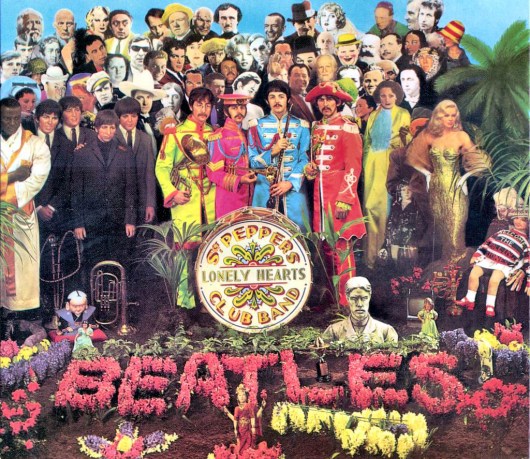
I have dedicated several posts to this series on the Beatles and I don’t know when this series will end because Francis Schaeffer spent a lot of time listening to the Beatles and talking and writing about them and their impact on the culture of the 1960’s. In this series we have looked at several areas in life where the Beatles looked for meaning and hope but also we have examined some of the lives of those  writers, artists, poets, painters, scientists, athletes, models, actors,  religious leaders, musicians, comedians, and philosophers  that were put on the cover of Sergeant Pepper’s Lonely Hearts Club Band album. We have discovered that many of these individuals on the cover have even taken a Kierkegaardian leap into the area of nonreason in order to find meaning for their lives and that is the reason I have included the 27 minute  episode THE AGE OF NONREASON by Francis Schaeffer. In that video Schaeffer noted,  ” Sergeant Pepper’s Lonely Hearts Club Band…for a time it became the rallying cry for young people throughout the world. It expressed the essence of their lives, thoughts and their feelings.”

 Sergeant Pepper’s Lonely Hearts Club Band Album really did look at every potential answer to meaning in life and to as many people as the Beatles could imagine had the answers to life’s big questions. One of the persons on the cover did have access to those answers and I am saving that person for last in this series on the Beatles. 

How Should We then Live Episode 7 small (Age of Nonreason)

When we were very happy together

When we were very happy together (John Lennon’s two wives and two sons pictured above.

________________

ap650208011.jpg

Beatle John Lennon, lights up a cigarette as he and his wife Cynthia arrive at London Airport Feb. 8, 1965 after their skiing holiday in St. Moritz, Switzerland.
AP

The Beatles’ Ringo Starr pays tribute to Cynthia Lennon

John Lennon’s former wife dies following battle with cancer

The Beatles‘ Ringo Starr has taken to twitter to pay tribute to Cynthia Lennon.

The former wife of The Beatles’ John Lennon passed away today (April 1) at her home in Mallorca, Spain following what is described as “a short but brave battle with cancer.” She was 75.

Ringo tweeted, “Peace and love to Julian Lennon God bless Cynthia love Ringo and Barbaraxx”
______________

I had planned to put in another blog post today about the Beatles but I decided to focus on John today and what was going on in his life in 1967 when Sgt Pepper’s was coming out. I heard on the CBS radio news on 4-1-15 at 11 am that Cynthia Lennon had died at age 75 and an audio clip from the below interview given on the program “60 Minutes” was played and this is what was said between Cynthia and Mike Wallace:

MW: He said that he changed, and you didn’t. And that that is what eventually led to the breakup.

CL: [Nods] I think we both changed. But I did not want to go down the road that John was going.

MW: Which road?

CL: WHICH WAS THE ROAD OF “ENLIGHTENMENT” AS FAR AS DRUGS WAS CONCERNED.  John was in a more trapped situation than I was.

___________

Later in this interview:

MW: And LSD was his road to self-discovery?

CL: That was the beginning. HE WAS ALWAYS SEARCHING. JOHN ALWAYS LOOKING FOR THE TRUTH, AN IDEAL, A DREAM. And I suppose once he’d got hooked on that situation and the mental state, he thought he’d found something new in life that nobody else had.

____________

No truer words were ever spoken. John in 1967 when the album  Sergeant Pepper’s Lonely Hearts Club Band was about to come out was in the middle of some big changes in his life.  He was searching for meaning in life in what I call the 6 big L words just like King Solomon did in the Book of Ecclesiastes. He looked into  learning (1:16-18), laughter, ladies, luxuries,  and liquor (2:1-3, 8, 10, 11), and labor (2:4-6, 18-20).

ECCLESIASTES 1:16-18  LEARNING

16 I said in my heart, “I have acquired great wisdom, surpassing all who were over Jerusalem before me, and my heart has had great experience of wisdom and knowledge.” 17 And I applied my heart to know wisdom and to knowmadness and folly. I perceived that this also is but a striving after wind.

18 For in much wisdom is much vexation,
    and he who increases knowledge increases sorrow.

ECCLESIASTES 2:1-3, 8, 10, 11 LAUGHTER (v. 2), LIQUOR (v. 3), LUXURIES (v. 8), and LADIES (v. 8, “many concubines”)

v. 1 I said in my heart, “Come now, I will test you with pleasure; enjoy yourself.” But behold, this also was vanity.[i] 2 I said of laughter, “It is mad,” and of pleasure, “What use is it?” I searched with my heart how to cheer my body with wine—my heart still guiding me with wisdom—and how to lay hold on folly, till I might see what was good for the children of man to do under heaven during the few days of their life.

v. 8  I also gathered for myself silver and gold and the treasure of kings and provinces. I got singers, both men and women, and many concubines,[j] the delight of the sons of man. v 10-11 And whatever my eyes desired I did not keep from them. I kept my heart from no pleasure, for my heart found pleasure in all my toil, and this was my reward for all my toil. 11 Then I considered all that my hands had done and the toil I had expended in doing it, and behold, all was vanity and a striving after wind, and there was nothing to be gained under the sun.

ECCLESIASTES 2:4-6, 18-20 LABOR

4 I made great works. I built houses and planted vineyards for myself. I made myself gardens and parks, and planted in them all kinds of fruit trees. I made myself pools from which to water the forest of growing trees. 18 I hated all my toil in which I toil under the sun, seeing that I must leave it to the man who will come after me, 19 and who knows whether he will be wise or a fool? Yet he will be master of all for which I toiled and used my wisdom under the sun. This also is vanity. 20 So I turned about and gave my heart up to despair over all the toil of my labors under the sun,

YOU CAN SEE JOHN LENNON’S EFFORTS IN THESE SAME AREAS OF HIS LIFE TOO. In the first part of his career he put almost all of his time into his music (his labor), and when he achieved fame and fortune (luxuries) he turned to laughter (the movie Hard Days Night demonstrated this well), and then to drugs (Solomon only had liquor to turn to since LSD had not been invented yet). Next when he was unsatisfied with his first marriage he married another woman and then in 1974 actually left Yoko and lived in LA getting drunk continually and having sex with many woman (ladies).

Finally Cynthia and Yoko noted something else about John’s journey:

CL: HE BECAME LESS INTERESTED IN THE ORIGINAL DREAM OF BECOMING FAMOUS AND BECOMING WEALTHY,  and that didn’t matter to him anymore. He had that, he had it all….

MW: He seemed to be always searching, whether it was drugs — a lot of them — or vegetarianism, or the Maharishi.

YO: I know, HE WAS ALWAYS SEARCHING. WE WERE ALWAYS SEARCHING. Together we went through macrobiotic, we went through vegetarian. And, um…we went…we went into all sorts, actually. Primal therapy.

_____

John also tried searching into learning about religions and other things that may bring him a meaning in life, but he never found it. (Actually I found Steve Turner’s article “John Lennon’s Born-Again Phase,” very enlightening.  Turner noted that Lennon “enjoyed watching some of America’s best-known evangelists—Pat Robertson, Billy Graham, Jim Bakker, and Oral Roberts. In 1972 he had written a desperate letter to Roberts confessing his dependence on drugs and his fear of facing up to ‘the problems of life.’ ” Sadly, after a short period of investigating Christianity Lennon turned back into a strong critic of Christianity.) NONE OF THESE 6 “L” WORDS CAN BRING SATISFACTION IN LIFE IF GOD IS NOT IN THE PICTURE.

Francis Schaeffer noted that Solomon took a look at the meaning of life on the basis of human life standing alone between birth and death “under the sun.” This phrase UNDER THE SUN appears over and over in Ecclesiastes. The Christian Scholar Ravi Zacharias noted, “The key to understanding the Book of Ecclesiastes is the term UNDER THE SUN — What that literally means is you lock God out of a closed system and you are left with only this world of Time plus Chance plus matter.” 

If you are an atheist then you have a naturalistic materialistic worldview, and this short book of Ecclesiastes should interest you because the wisest man who ever lived in the position of King of Israel came to THREE CONCLUSIONS that will affect you.

FIRST, chance and time have determined the past, and they will determine the future.  (Ecclesiastes 9:11-13)

These two verses below  take the 3 elements mentioned in a naturalistic materialistic worldview (time, chance and matter) and so that is all the unbeliever can find “under the sun” without God in the picture. You will notice that these are the three elements that evolutionists point to also.

Ecclesiastes 9:11-12 is following: I have seen something else under the sun: The race is not to the swift or the battle to the strong, nor does food come to the wise or wealth to the brilliant or favor to the learned; but time and chance happen to them all. Moreover, no one knows when their hour will come: As fish are caught in a cruel net, or birds are taken in a snare, so people are trapped by evil times that fall unexpectedly upon them.

SECOND, Death is the great equalizer (Eccl 3:20, “All go to the same place; all come from dust, and to dust all return.”)

THIRD, Power reigns in this life, and the scales are not balanced(Eccl 4:1, 8:15)

Ecclesiastes 4:1-2: “Next I turned my attention to all the outrageous violence that takes place on this planet—the tears of the victims, no one to comfort them; the iron grip of oppressors, no one to rescue the victims from them.” Ecclesiastes 8:14; “ Here’s something that happens all the time and makes no sense at all: Good people get what’s coming to the wicked, and bad people get what’s coming to the good. I tell you, this makes no sense. It’s smoke.”

Solomon had all the resources in the world and he found himself searching for meaning in life and trying to come up with answers concerning the afterlife. However, it seems every door he tries to open is locked. Today men try to find satisfaction in learning, liquor, ladies, luxuries, laughter, and labor and that is exactly what Solomon tried to do too.  None of those were able to “fill the God-sized vacuum in his heart” (quote from famous mathematician and philosopher Blaise Pascal). You have to wait to the last chapter in Ecclesiastes to find what Solomon’s final conclusion is.

In 1978 I heard the song “Dust in the Wind” by Kansas when it rose to #6 on the charts. That song told me that Kerry Livgren the writer of that song and a member of Kansas had come to the same conclusion that Solomon had. I remember mentioning to my friends at church that we may soon see some members of Kansas become Christians because their search for the meaning of life had obviously come up empty even though they had risen from being an unknown band to the top of the music business and had all the wealth and fame that came with that. Furthermore, Solomon realized death comes to everyone and there must be something more.

Livgren wrote:

All we do, crumbles to the ground though we refuse to see, Dust in the Wind, All we are is dust in the wind, Don’t hang on, Nothing lasts forever but the Earth and Sky, It slips away, And all your money won’t another minute buy.”

Take a minute and compare Kerry Livgren’s words to that of the late British humanist H.J. Blackham:

On humanist assumptions, life leads to nothing, and every pretense that it does not is a deceit. If there is a bridge over a gorge which spans only half the distance and ends in mid-air, and if the bridge is crowded with human beings pressing on, one after the other they fall into the abyss. The bridge leads nowhere, and those who are pressing forward to cross it are going nowhere….It does not matter where they think they are going, what preparations for the journey they may have made, how much they may be enjoying it all. The objection merely points out objectively that such a situation is a model of futility“( H. J. Blackham, et al., Objections to Humanism (Riverside, Connecticut: Greenwood Press, 1967).

_____________________________________

Both Kerry Livgren and the bass player DAVE HOPE of Kansas became Christians eventually. Kerry Livgren first tried Eastern Religions and DAVE HOPE had to come out of a heavy drug addiction. I was shocked and elated to see their personal testimony on The 700 Club in 1981 and that same  interview can be seen on youtube today. Livgren lives in Topeka, Kansas today where he teaches “Diggers,” a Sunday school class at Topeka Bible Church. DAVE HOPE is the head of Worship, Evangelism and Outreach at Immanuel Anglican Church in Destin, Florida.

Those who reject God must accept three realities of their life UNDER THE SUN.  FIRST, death is the end and SECOND, chance and time are the only guiding forces in this life.  FINALLY, power reigns in this life and the scales are never balanced. In contrast, Dave Hope and Kerry Livgren believe death is not the end and the Christian can  face death and also confront the world knowing that it is not determined by chance and time alone and finally there is a judge who will balance the scales.

Solomon’s experiment was a search for meaning to life “under the sun.” Then in last few words in the Book of Ecclesiastes he looks above the sun and brings God back into the picture: “The conclusion, when all has been heard, is: Fear God and keep His commandments, because this applies to every person. For God will bring every act to judgment, everything which is hidden, whether it is good or evil.”

Cynthia Lennon & Yoko Ono @ 60 Minutes


_

Cynthia Lennon 1939 – 2015

A diligent search to find and approach the copyright holders of the photographs appearing in this video has taken place but in some cases without success. If you hold the copyright for any of the photographs used please email contact@julianlennon.com

http://www.julianlennon.com/cynthialennon

___________________________________

The Two Mrs. Lennons: Cynthia Lennon was John's first wife; Yoko Ono was his second wife, who he married on March 20, 1969.The Two
Mrs. LennonsWhat Was It Like To Have Been Married To John Lennon?Courtesy of 60 MinutesMike Wallace Talks to Cynthia Lennon and Yoko Ono About the Man They Both at One Time Called “Husband.”
The following interviews are from the 1987 60 Minutes feature ”The Two Mrs. Lennons.” The interviews were conducted by Mike Wallace. (This isn’t the whole transcript, so there is some missing text in certain sections.) ~ladyjeanMike Wallace & Cynthia LennonCynthia Lennon: He’s [John Lennon] made his mistakes on the front pages of newspapers all over the world. He’s no saint, never was.Mike Wallace: What is it that…it’s his music? It’s his persona?CL: It’s everything about the man that…it’s his vulnerability, it’s his cheek. It’s the fact that he bared his soul. Foolishly, stupidly, but he bared his soul — for everybody else to see.MW: He said that he changed, and you didn’t. And that that is what eventually led to the breakup.CL: [Nods] I think we both changed. But I did not want to go down the road that John was going.MW: Which road?CL: Which was the road of ”enlightenment” as far as drugs were concerned. John was in a more trapped situation than I was.MW: Trapped?CL: Trapped in his own mind, and in the Beatles’ situation and the pressure of the music and the pop world. And I think he’d had enough and wanted to escape that. I had nothing to escape. I wasn’t looking for anything else. I wasn’t searching in my mind for new experiences on a mental state.MW: And he was?CL: Yeah.MW: And LSD was his road to self-discovery?CL: That was the beginning. He was always searching, John. Always looking for the truth, an ideal, a dream. And I suppose once he’d got hooked on that situation and the mental state, he thought he’d found something new in life that nobody else had.MW: Was it very destructive of your marriage?CL: Well, yes. I think that any drugs are destructive of anything and everyone. But the reality of life was slipping by John. He wasn’t aware anymore. He became less interested in the original dream of becoming famous and becoming wealthy, and that didn’t matter to him anymore. He had that, he had it all.MW: Was he writing music at this time?

CL: No, no. It was a period of great, great change in John’s life. He didn’t know which direction he was going to take. The direction was chosen for him, anyway.

MW: By?

CL: Well, by his meeting with Yoko. That was it.

Wallace voice-over: Cynthia says it was after an acid trip that John first met Yoko Ono at a London art gallery and became intrigued with Yoko’s avant-garde art.

CL: That was the first contact. And then we had a few letters from Yoko asking for help, you know, with her cause and her art, and then it just…

MW: And you were not suspicious?

CL: [Sighs] It’s very hard to be suspicious under those circumstances. John was just surrounded at the time by very weird people.

MW: So she was just another nutty person?

CL: Well, at the time, yes. [Smiles]

MW: And then the time came when she threw herself into the back seat of the limousine in between the two of you?

CL: Well, that was an occasion, it was something to do with the Maharishi. We went to a meeting, and Yoko happened to be at the meeting. And she asked for a lift to wherever it was she was living and she got in the car. I said to John, ”Why?” He said, ”I don’t know.” And that was it.

MW: She was “determined.”

CL: Well, only Yoko can say that, not me. It happened, these things happen in life. I knew at the time there was nothing I could do to stop what was happening. He was hell-bent on something. And it happened to end up he was hell-bent on Yoko.

MW: What was her appeal? What was it he found in her that was so compelling? She seemed to cast a kind of spell.

CL: What he was looking for was a woman and a man combined. Someone he could call a pal, someone who was a woman, someone who encompassed everything in his life. He wanted to thin down his life with one person that he could put his trust in and believe in.

MW: When you saw the two of them doing their bed-ins for peace in Amsterdam and Canada, what did you think?

CL: I was sad. I was truly sad. Because I saw a man that I knew in the early days…I had seen a boy change into a man…and had suddenly become a laughingstock. Seeing this man, who wasn’t John anymore, doing the wildest things. But then again, it was in the name of peace, so everybody sort of tried to understand.
Mike Wallace & Yoko Ono

Mike Wallace: What attracted you to John, John to you?

Yoko Ono: Well, it’s very difficult. You can write a book about that. But um, and then again, maybe you can’t. Because it’s the kind of magic that you can’t express in words maybe. But we didn’t know it was going to be like this.

MW: You sent him letters. You sent him flowers. And finally you even put yourself into the limousine in between him and Cynthia.

YO: [Shifts] Well, that’s not how it happened.

Wallace voice-over: Yoko insists that she did not pursue John Lennon. But she does acknowledge their affair began in earnest when Cynthia was off in Italy and Yoko’s husband was in France.

MW: The bed-ins for peace, first in Amsterdam and then in Montreal, what did they accomplish, aside from making you look…

YO: Ridiculous?

MW: Oh. Ridiculous. Yeah.

YO: Well, we were just clowns. And we knew about that. That we were clowns. And through clowning, we thought maybe we could communicate to the people about uh…importance of world peace. Give peace a chance.

[Footage of John and Yoko staging a bed-in is shown.]

YO: We went through some very tough times because, um, the press was not very kind to us. Especially to me. And I think they were…

MW: Why? Why were they so angry at you? Because they were
not kind to you.

YO: Oh, I know! Well, ask them. I mean, I don’t know why they weren’t kind to me.

MW: You were an intruder…

YO: Well, um…

MW: That was the perception, I think.

YO: [Nods] Probably. I mean, I didn’t really think that I was such an intruder.

Wallace voice-over: But the Beatles’ record producer and other members of the band found her presence irritating and she sat in on their studio sessions.

YO: But to me it was nothing for me to be sitting there. In fact, I think that there were moments that, um…uh…I felt that, um, I was repressing my own creative instincts, and…by just sitting there.

MW: Really?

YO: But there was something that, um…I felt that we were doing it because we loved each other.

MW: He seemed to be always searching, whether it was drugs — a lot of them — or vegetarianism, or the Maharishi.

YO: I know, he was always searching. We were always searching. Together we went through macrobiotic, we went through vegetarian. And, um…we went…we went into all sorts, actually. Primal therapy.

MW: In the search for what? And what did you find?

YO: In the search for truth and health and…

MW: Health through LSD? Health through drugs? Vegetarianism I can understand.

YO: Well, health can be mental health as well. I mean, we wanted to find the true wisdom of…uh…life.

MW: John admitted he had a problem with violence. He said, ”I was a hitter. I couldn’t express myself and I hit. I fought men and I hit women. That is why I’m always on about peace. You see, it’s the most violent of people who go for love and peace.”

YO: He’s very right.

MW: Was he a hitter when you lived with him?

YO: No he wasn’t.

MW: He never hit you?

YO: No.

Paul McCartney, Yoko Ono Pay Tribute to Cynthia Lennon

Paul McCartney and Yoko Ono both paid tribute to Cynthia Lennon today.

Lennon, who was married the Beatles great John Lennon from 1962 to 1968, died today at her home in Spain. She was 75.

“The news of Cynthia’s passing is very sad. She was a lovely lady who I’ve known since our early days together in Liverpool,” McCartney said in a statement to ABC News. “She was a good mother to Julian and will be missed by us all, but I will always have great memories of our times together.”

Ono added, I’m very saddened by Cynthia’s death. She was a great person and a wonderful mother to Julian. She had such a strong zest for life and I felt proud how we two women stood firm in the Beatles family. Please join me in sending love and support to Julian at this very sad time.”

The British native “passed away today at her home in Mallorca, Spain, following a short but brave battle with cancer,” a representative told ABC News in a statement. “Her son Julian Lennon was at her bedside throughout. The family are thankful for your prayers. Please respect their privacy at this difficult time.”

As stated in the announcement, Cynthia and John had one child together — Julian, 51.

Cynthia met the legendary musician while the two were both studying at the Liverpool College of Art in the late 1950’s. Lennon eventually married Yoko Ono in 1969 after the couple’s split.

PHOTO: Julian Lennon and Cynthia Lennon, the son and first wife of John Lennon, attend the unveiling of the John Lennon monument Peace & Harmony at Chavasse Park, Oct. 9, 2010, in Liverpool, England.

David Munn/WireImage/Getty Images
PHOTO: Julian Lennon and Cynthia Lennon, the son and first wife of John Lennon, attend the unveiling of the John Lennon monument ‘Peace & Harmony’ at Chavasse Park, Oct. 9, 2010, in Liverpool, England.

After Lennon was murdered in 1980, Cynthia and Ono both spoke to “60 Minutes” about the singer.

“He’s made his mistakes, on the front pages of newspapers, all over the world,” Cynthia Lennon said. “But he bared his soul for everybody else to see.”

When asked what led to the famed split, Cynthia said, “I think we both changed. It was natural that we both change. But I did not want to go down the road John was going … I had nothing to escape. I wasn’t looking for anything else. I wasn’t searching in my mind for new experiences on a mental state.”

Cynthia Lennon was married three more times after the 1968 split, most recently being widowed in 2013 when her husband Noel Charles died.

She is survived by her son Julian, who posted an “In Loving Memory” video on YouTube that starts with the lyrics, “You gave your life for me. You gave your life for love.” The video is coupled with intimate pictures of the Lennon family from the 1960’s.

John Lennon, Mick Jagger and May Pang attend the 2nd Annual AFI Lifetime Achievement Awards honoring James Cagney at the Beverly Hilton Hotel

March 13, 1974

John Lennon, Mick Jagger and May Pang attend the 2nd Annual AFI Lifetime Achievement Awards honoring James Cagney at the Beverly Hilton Hotel

David Bowie and John Lennon attend the 17th Annual Grammy Awards at Uris Theater, New York, March 1

1975

David Bowie and John Lennon attend the 17th Annual Grammy Awards at Uris Theater, New York, March 1

_____________

The Beatles are featured in this episode below and Schaeffer noted,  ” Sergeant Pepper’s Lonely Hearts Club Band…for a time it became the rallying cry for young people throughout the world.”

How Should We then Live Episode 7 small (Age of Nonreason)

Francis Schaeffer pictured below:
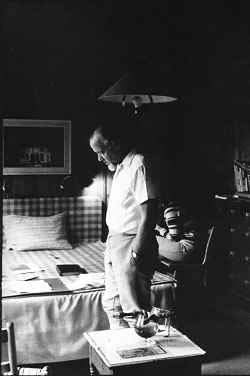
_______________-

Francis Schaeffer has written extensively on art and culture spanning the last 2000 years and here are some posts I have done on this subject before : Francis Schaeffer’s “How should we then live?” Video and outline of episode 10 “Final Choices” episode 9 “The Age of Personal Peace and Affluence”episode 8 “The Age of Fragmentation”episode 7 “The Age of Non-Reason” episode 6 “The Scientific Age” , episode 5 “The Revolutionary Age” episode 4 “The Reformation” episode 3 “The Renaissance”episode 2 “The Middle Ages,”, and  episode 1 “The Roman Age,” . My favorite episodes are number 7 and 8 since they deal with modern art and culture primarily.(Joe Carter rightly noted,Schaefferwho always claimed to be an evangelist and not a philosopher—was often criticized for the way his work oversimplified intellectual history and philosophy.” To those critics I say take a chill pill because Schaeffer was introducing millions into the fields of art and culture!!!! !!! More people need to read his works and blog about them because they show how people’s worldviews affect their lives!

J.I.PACKER WROTE OF SCHAEFFER, “His communicative style was not that of a cautious academic who labors for exhaustive coverage and dispassionate objectivity. It was rather that of an impassioned thinker who paints his vision of eternal truth in bold strokes and stark contrasts.Yet it is a fact that MANY YOUNG THINKERS AND ARTISTS…HAVE FOUND SCHAEFFER’S ANALYSES A LIFELINE TO SANITY WITHOUT WHICH THEY COULD NOT HAVE GONE ON LIVING.”

Francis Schaeffer’s works  are the basis for a large portion of my blog posts and they have stood the test of time. In fact, many people would say that many of the things he wrote in the 1960’s  were right on  in the sense he saw where our western society was heading and he knew that abortion, infanticide and youth enthansia were  moral boundaries we would be crossing  in the coming decades because of humanism and these are the discussions we are having now!)

There is evidence that points to the fact that the Bible is historically true as Schaeffer pointed out in episode 5 of WHATEVER HAPPENED TO THE HUMAN RACE? There is a basis then for faith in Christ alone for our eternal hope. This link shows how to do that.

Francis Schaeffer in Art and the Bible noted, “Many modern artists, it seems to me, have forgotten the value that art has in itself. Much modern art is far too intellectual to be great art. Many modern artists seem not to see the distinction between man and non-man, and it is a part of the lostness of modern man that they no longer see value in the work of art as a work of art.” 

Many modern artists are left in this point of desperation that Schaeffer points out and it reminds me of the despair that Solomon speaks of in Ecclesiastes.  Christian scholar Ravi Zacharias has noted, “The key to understanding the Book of Ecclesiastes is the term ‘under the sun.’ What that literally means is you lock God out of a closed system, and you are left with only this world of time plus chance plus matter.” THIS IS EXACT POINT SCHAEFFER SAYS SECULAR ARTISTS ARE PAINTING FROM TODAY BECAUSE THEY BELIEVED ARE A RESULT OF MINDLESS CHANCE.

There is evidence that points to the fact that the Bible is historically true as Schaeffer pointed out in episode 5 of WHATEVER HAPPENED TO THE HUMAN RACEThere is a basis then for faith in Christ alone for our eternal hope. This link shows how to do that.

The Bible and Archaeology – Is the Bible from God? (Kyle Butt 42 min)

You want some evidence that indicates that the Bible is true? Here is a good place to start and that is taking a closer look at the archaeology of the Old Testament times. Is the Bible historically accurate? Here are some of the posts I have done in the past on the subject: 1. The Babylonian Chronicleof Nebuchadnezzars Siege of Jerusalem2. Hezekiah’s Siloam Tunnel Inscription. 3. Taylor Prism (Sennacherib Hexagonal Prism)4. Biblical Cities Attested Archaeologically. 5. The Discovery of the Hittites6.Shishak Smiting His Captives7. Moabite Stone8Black Obelisk of Shalmaneser III9A Verification of places in Gospel of John and Book of Acts., 9B Discovery of Ebla Tablets10. Cyrus Cylinder11. Puru “The lot of Yahali” 9th Century B.C.E.12. The Uzziah Tablet Inscription13. The Pilate Inscription14. Caiaphas Ossuary14 B Pontius Pilate Part 214c. Three greatest American Archaeologists moved to accept Bible’s accuracy through archaeology.

______________

The best album ever?

The Beatles are featured in this episode below by Francis Schaeffer:

How Should We then Live Episode 7 small (Age of Nonreason)

_______________
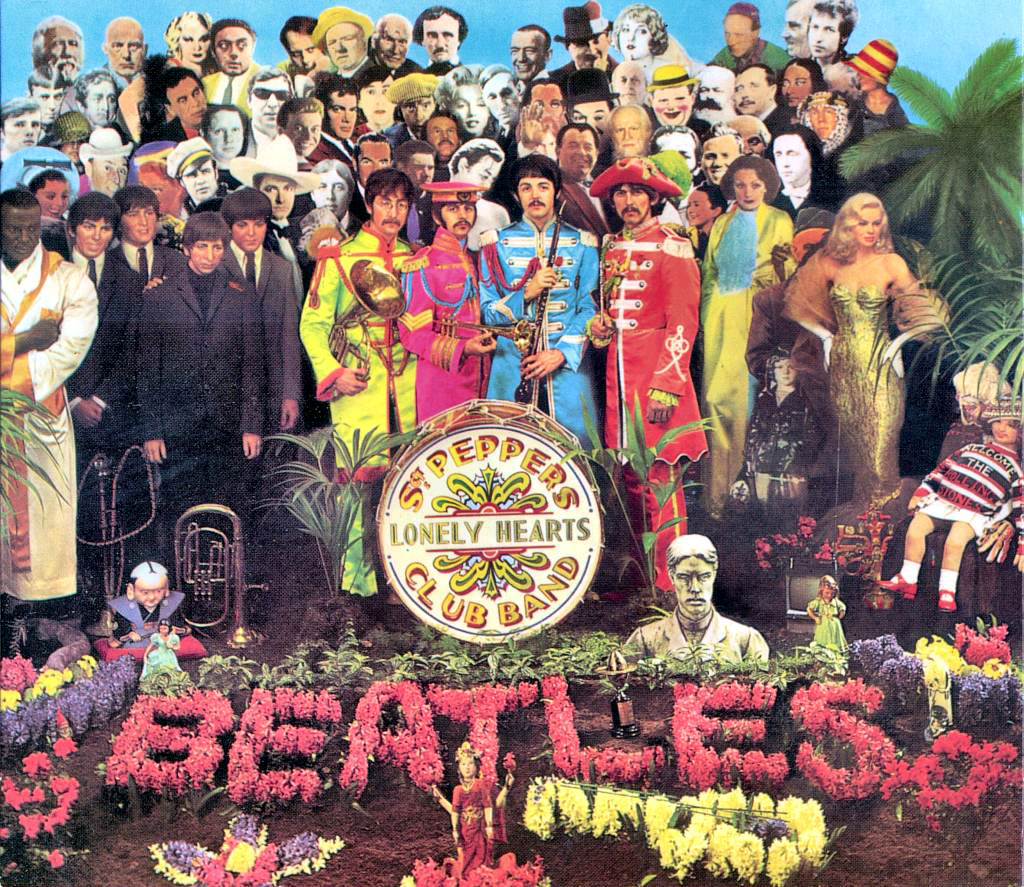
Francis Schaeffer noted that the Beatles’s album Seargent Pepper’s Lonely Hearts Club Band communicated “psychedelic music, with open statements concerning drug-taking, [and] was knowingly presented as a religious answer”.

 Here is the song that is probably the most influenced by drugs:

Lucy in the Sky with Diamonds- The Beatles

Uploaded on Jan 18, 2009

Lucy in the Sky with Diamonds
The Beatles
Sgt Peppers Lonely Hearts Club Band

Lyrics
Picture yourself in a boat on a river,
With tangerine trees and marmalade skies
Somebody calls you, you answer quite slowly,
A girl with kaleidoscope eyes.
Cellophane flowers of yellow and green,
Towering over your head.
Look for the girl with the sun in her eyes,
And she’s gone.
Lucy in the sky with diamonds.
Follow her down to a bridge by a fountain
Where rocking horse people eat marshmellow pies,
Everyone smiles as you drift past the flowers,
That grow so incredibly high.
Newspaper taxis appear on the shore,
Waiting to take you away.
Climb in the back with your head in the clouds,
And you’re gone.
Lucy in the sky with diamonds,
Picture yourself on a train in a station,
With plasticine porters with looking glass ties,
Suddenly someone is there at the turnstyle,
The girl with the kaleidoscope eyes.

___________________________________________________________

Sgt Pepper It Was 40 Years Ago Today 1 Hour BBC TV Special.avi

Published on Feb 14, 2013

Sgt. Pepper – It Was 40 Years Ago Today 1 Hour BBC TV Special

_____________

Artist featured today is Yoko Ono


YES YOKO ONO
Oct. 25, 2003 (Sat) to Jan. 12, 2004 (Mon)

CEILING PAINTING (YES PAINTING) 1966
Collection of the artist
Photo by Oded Lobl
Courtesy Japan Society, New York
©YOKO ONO

Yoko Ono’s activities as an artist span a truly broad variety of genres: art, music, film, and performance. Her work over the past four decades has taken her around the world, in which process she has come to influence a great number of people, starting with John Lennon.

Back in November 1966, she exhibited her “Ceiling Painting” (or the “YES Painting”) at the Indica Gallery of London. Viewers had to climb up a white ladder in the center of the room, from where a magnifying glass hanging from the ceiling allowed them to view the word “YES” written in tiny letters on a framed piece of paper affixed to the ceiling. In fact, the work brought Ono and John Lennon together for the first time – some say that she used the work to seduce the already-married Lennon. There is a famous episode in which Lennon, having climbed up the ladder and read what was written, said, “I would have been quite disappointed if it had said ‘NO,’ but was saved by the fact it said ‘YES’,” The two married in 1969.

The “YES” in the title of the exhibition symbolizes the way that Yoko Ono emphasizes the positive in her works and activities. The following quote illustrates that attitude: “‘YES’ was my work and John encountered it and he went up the stairs and he looked at this word that said ‘Yes.’ At the time I didn’t really think it would be taken so personally. But I don’t really connect it with John as much as I connect it with my view of life. My view of life is the fact that there were many incredible negative elements in my life, and in the world, and because of that I had to conjure up a positive attitude within me in balance to the most chaotic … and I had to balance that by activating the ‘Yes’ element. ‘Yes’ is an expression that I always carried and that I’m carrying.”

The “YES Yoko Ono” Exhibition was originally organized in 2000 by the Japan Society (New York), with Alexandra Munroe serving as curator, assisted by Jon Hendricks as consulting curator. The exhibition won raves after touring around America, and has since moved to destinations overseas. In 2001, it won first prize for best museum show originating in New York by the International Association of Art Critics, the highest accolade in the museum profession. Munroe will be visiting at ATM at the beginning of the exhibition on October 25 to give a press conference and an opening talk.

Surprisingly, the ATM exhibition is the first full-fledged Yoko Ono retrospective ever to be held in Japan. It will feature 130 of her works – some from as far back as the 1960s, continuing down to the present – including 60 objects, 50 photographs and documents, five films, and 15 installations. Many of her works become “complete” only with participation by viewers, and some of the pieces on exhibit at Mito this time encourage an active connection by those viewing them. One of those will be her installation of 100 coffins, suggesting life and death. The “YES Yoko Ono” exhibition, a true compendium of this artist’s body of work, argues for the importance of coexistence, imagination, and communication, and contains many messages that need to be relayed to the contemporary world, replete with uncertainty as it is.

PLAY IT BY TRUST 1966/1991
Contemporary Art Gallery, Art Tower Mito 2003
Photo by Keizo Kioku
©YOKO ONO
HALF A ROOM 1967
Contemporary Art Gallery, Art Tower Mito 2003
Photo by Keizo Kioku
©YOKO ONO
AMAZE 1971/2003
Contemporary Art Gallery, Art Tower Mito 2003
Photo by Keizo Kioku
©YOKO ONO
BED-IN FOR PEACE 1969
Contemporary Art Gallery, Art Tower Mito 2003
Photo by Keizo Kioku
©YOKO ONO
EX-IT 1997/2003
Contemporary Art Gallery, Art Tower Mito 2003
Photo by Keizo Kioku
©YOKO ONO
WAR IS OVER! 1969/2003
Contemporary Art Gallery, Art Tower Mito 2003
Photo by Keizo Kioku
©YOKO ONO


Yoko Ono at the plaza, Art Tower Mito, Oct. 4, 2003

Notes on Yoko Ono, Grapefruit, Original Manuscript, 1964

Grapefruittext2
Yoko Ono’s Grapefruit original manuscript on view for the first time, Stendhal Gallery, 2009

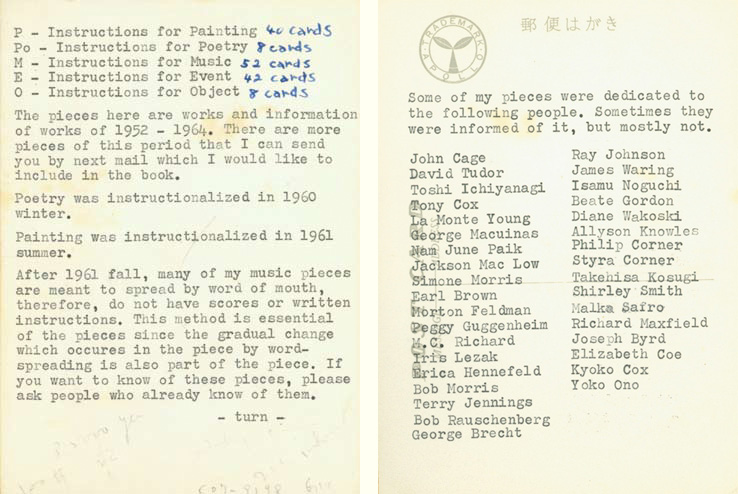
150 pieces comprise the original manuscript of Yoko Ono’s pivotal 1964 work Grapefruit. Assembled into an artist’s book and originally published in Tokyo in a limited edition of 500 (Simon and Schuster would release a mass market edition in 1970), the small, rectilinear cards each contain simple, hand-typed instructions, such as “Imagine the clouds dripping. Dig a hole in your garden to put them in.” (Cloud Piece, 1963) This format, which became a crucial precursor to conceptualism, emerged from the event scores by artists attending John Cage’s Experimental Music Composition classes at the New School in New York—in particular, George Brecht and La Monte Young.

Event scores, invented by George Brecht, are simple directives to complete mundane tasks. To perform Brecht’s 1961 piece EXIT for instance, one would simply exit a doorway. The idea, which recall Happenings with less theatricality, was to highlight facets of everyday life—and more conceptually, critique traditional artistic representation. Similar to a musical score, event scores could be performed and reinterpreted by anyone. These event scores became a key artistic praxis of Fluxus, with numerous artists offering their own interpretations of the medium, including the likes of Ken Friedman and Allison Knowles.
grapefruitsidebyside

By the end of 1960, Yoko Ono and La Monte Young had begun to host performances featuring emerging avant-garde artists in Yoko Ono’s Chambers St. loft. It was these performances that drew the attention of George Maciunas, who offered Yoko Ono a solo exhibition of her “Instruction Paintings” at his short-lived AG Gallery, located at 925 Madison Avenue, in the summer of 1961. Shortly thereafter, Fluxus was born.

Although Yoko Ono’s instruction pieces—some of which were assembled during a brief stay in a sanatorium in Japan following the dissolution of her first marriage—reflect the same format as the Fluxus event scores pioneered by George Brecht, they occupy a separate poetic and imaginative dimension. Brecht’s scores confound the boundaries between text and physical performance, while Yoko Ono’s provoke a more cerebral, illusory performance.

An introductory card from original manuscript reads, “Some of my pieces were dedicated to the following people. Sometimes they were informed of it but mostly not.” The list that follows contains the names of fellow artists, friends, and Fluxus components, from George Maciunas to Robert Rauschenberg, to Isamu Noguchi, to Peggy Guggenheim, revealing the array of individuals who inspired Yoko and consorted within her closest social circle.

The original Grapefruit manuscript is further bestrewn with handwritten notes, reflecting Ono’s whimsy. It is this imaginative use of language that paved the way for the first wave of conceptual artists, including Lawrence Weiner and Sol LeWitt, to materialize in the 1960s.  Perhaps then, Grapefruit can be regarded not only as a seminal Fluxus work and Yoko Ono’s magnum opus, but also the crown jewel of Conceptualism—and accordingly, on a broader level, a paragon of Postwar contemporary art.
facebook_photo_download_115297621918916

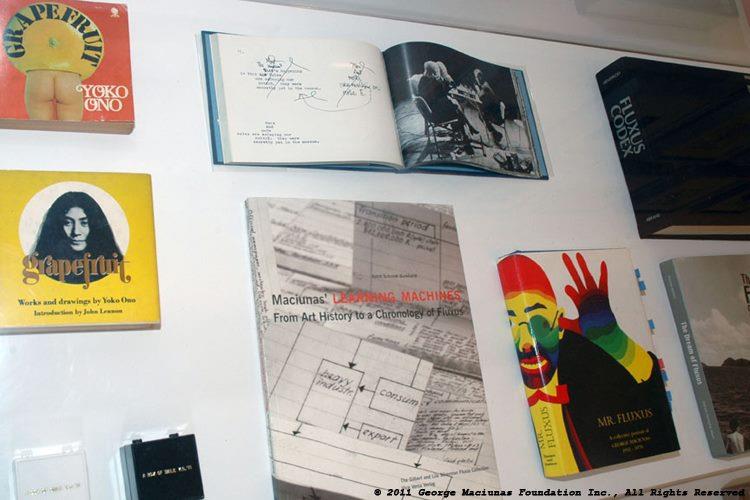
Grapefruit second edition on display with other Fluxus research materials at Stendhal Gallery, 2009

Grapefruit

October 18, 2006 – April 1, 2007

image

Yoko Ono: Grapefruit, 1964/1971 (back cover); New York: Simon & Schuster; 5 1/4 x 5 1/4 in.; gift of Jacquelynn Baas.

“My paintings, which are all instruction paintings (and meant for others to do), come after collage and assemblage (1915) and happening (1950) came into the art world. Considering the nature of my painting, any of the above three words or a new word can be used instead of the word painting. But I like the old word painting because it immediately connects with “wall painting” painting, and it is nice and funny.”—Yoko Ono

It was in 1966 at the Indica Gallery in London that Yoko Ono first met her future husband John Lennon, and later that year, she presented him with a copy of her book of instruction pieces, Grapefruit. Years afterward, Lennon cited the powerful effect the book had on him, inspiring him to write his lyrical masterpiece and hymn to peace “Imagine.”

The Berkeley Art Museum is delighted to present an exhibition of Yoko Ono’s instruction paintings selected from that groundbreaking publication. Gracefully expressive, enchanting, and original, the paintings are presented as wall texts that fill the gallery in the same way that paintings on canvas do. However, the conceptual nature of the art offers the beholder a means of taking the paintings home in the form of a do-it-yourself idea.

In the spirit of imagination, and as a kind of homage, we have included among the instruction paintings on view all those in which the word “imagine” appears, including spring 1963’s Cloud Piece (“Imagine the clouds dripping. Dig a hole in your garden to put them in), which also appears on Lennon’s Imagine album sleeve.

In addition to the instruction paintings, a few ephemeral works from the museum’s collection, such as an edition of Grapefruit and a brochure from the exhibition Yoko at Indica, will be shown, as will a copy of Lennon’s Imagine LP. Sparingly interspersed among the instruction paintings, like puffy clouds in a clear sky, will be a few watercolors—images of sky—by Ono’s fellow Fluxus artist Geoffrey Hendricks.

Born in Japan in 1933, Ono, a pioneer of Conceptual art, has lived her life combining her talents as artist and poet, musician, and tireless advocate for peace and love. Grapefruitwas originally published in Japan in 1964 in an edition of 500 copies. It has since been reprinted in many languages and editions. Yoko Ono has generously donated IMAGINE PEACE buttons to be distributed free to viewers throughout the course of the exhibition. Special thanks for her support of the exhibition, and for permission to reproduce the texts in this fashion.

In January and February, the exhibition is complemented by a PFA series, Yoko Ono: Imagine Film.

Stephanie Cannizzo
Curatorial Associate

_____________________

David Bowie, Art Garfunkel, Paul Simon, Yoko Ono and John Lennon at the Grammy Awards, New York, March 1

1975

Control over art

One of the art making aspect that Gutai experimented was giving up control over the art making process. Shozo Shimamoto was one of the early member of Gutai, some claimed that perhaps he should be considered as Guitai’s co-founder as Yoshihara but nontheless, Shimamoto was one of the prominent figure of Gutai and his works reflects the philosophy of Gutai. 

One of Shimamoto’s work was Sakuhin in 1962. This piece was created by filling bottles with paint and hurling the bottles at the canvas. In a way, this method of creating a painting was very similar to Jackson Pollock’s splash painting technique. However, Shimamoto used unconventional material, which is the bottle filled with paint, as the brush. Both Pollock and Shimamoto had little control over the outcome of the painting due to the fact that they used whole body movements to paint instead of only using hand and wrist as would a traditional painter. Shimamoto utilized materials in a such an unconventional way that the artwork itself became less meaningful compare to the creation process or the concept. The painting in this case was not intended to have a subject matter nor composition. In other words, it was more about the performance and the finished work was merely a record of the process.

As a Fluxus artist, Yoko Ono’s performance “Cut Piece” also touched on the idea of control over the artwork. In Yoko Ono’s Cut Piece, she set up the performance stage and allowed the users to participate and take control of the act. The entire piece consist of different audience cutting off pieces of Yoko Ono’s clothing as she sat in the same place for the entire duration of the performance. The Cut Piece emphasized on the experience aspect of the artwork for both the artist herself and the audience. The one of the most intriguing part of Yoko Ono’s piece is the repeatable aspect and the variation between the repeated performance. Since the piece only required a group of audience with cutting abilities, the work can be re-enacted without much difficulties. In addition, due to the fact that the audience are the art-marking process in the Cut Piece, the cutting experience and the final result will be different each time. Therefore, the artist had basically no control over the outcome of the piece and this fact begs the question of whether the piece should be consider entirely the artist’s work.

XXXXXXXXXXXXXXXXXXXXXX

THURSDAY, JULY 11, 2013

Yoko Ono: Yes!

Like many people, I first heard of Yoko Ono as the woman who broke up the Beatles.  I also vividly recall people snickering about her records, saying she howled instead of singing.  In reality, Yoko Ono was a major figure in the 60s art scene, whose work contributed to conceptualism, happenings, fluxus, and video art.  She was also a musical pioneer, making recordings that forecast subsequent currents in punk, riot grrl feminism, lo-fi, art rock, and noise pop.  A grand retrospective at the Louisiana museum outside of Copenhagen offers an opportunity to appreciate her contributions to art.

John Lennon apparently met Ono in 1966, at a London gallery, where she was installing a show.  He asked if he could hammer a nail into the hammer piece (top): a plane piece of wood, which gallery visitors could modify by hammering provided nails.  She said no.  Lennon also reports adoring Ono’s ceiling piece (above,source): a ladder with a magnifying glass hanging above it, and the word “yes” in tiny letters on the ceiling.  The Lennon legacy has made the pieces so legendary that their artistic significance is almost forgotten.  That is a shame.  The hammer piece was a clever innovation.  Kurt Schwitters had hammered art together decades earlier, but this piece helped to re-write the relationship between artist and view.  The idea of artist as grand master is replaced with the idea of artist as someone who invites viewers to create.  The ceiling piece raises questions about the ontology of art.  Where is the piece?  Is it the ladder?  The word?  The activity of climbing and looking?  Are artworks beautiful things?  Do they have fixed meanings?
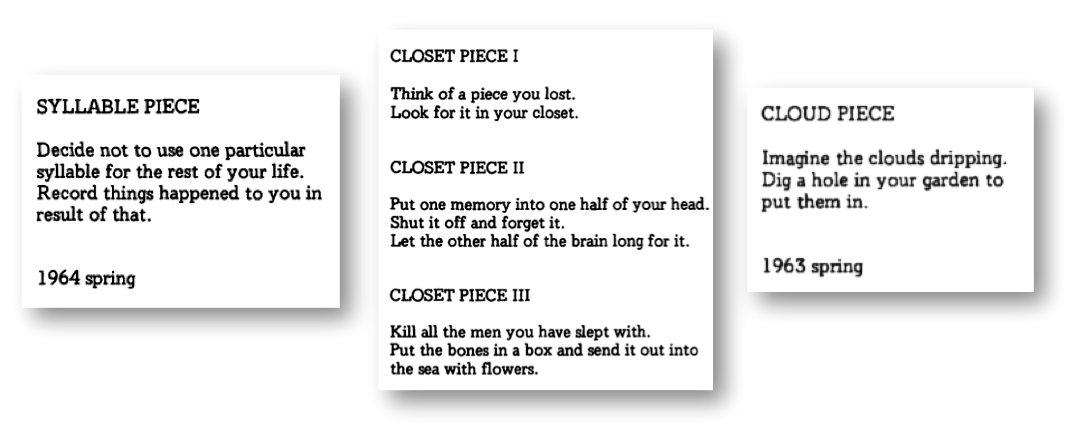
Like other pioneers of conceptualism (Weiner and Kosuth, for example), words have been a central part of Ono’s practice.  Among her most celebrated works, are the pieces described in her book Grapefruit.  Each page contains an instruction, like the ones above, to engage in an activity.  Some of these activities are impossible to carry out.  They vary from charming, silly, and absurd, to poetic and profound.  Grapefruit is a monument in conceptual art.  They perfectly exemplify Sol Lewitt’s precept that artworks are ideas, and that it doesn’t matter whether they are (or can be) physically instantiated.  Lewitt’s own works never realized that vision as well as Ono’s.  Like her, he often created works in the form of instructions, but the products created by following these instructions remain fairly traditional, or, in Duchamp’s phrase, retinal.
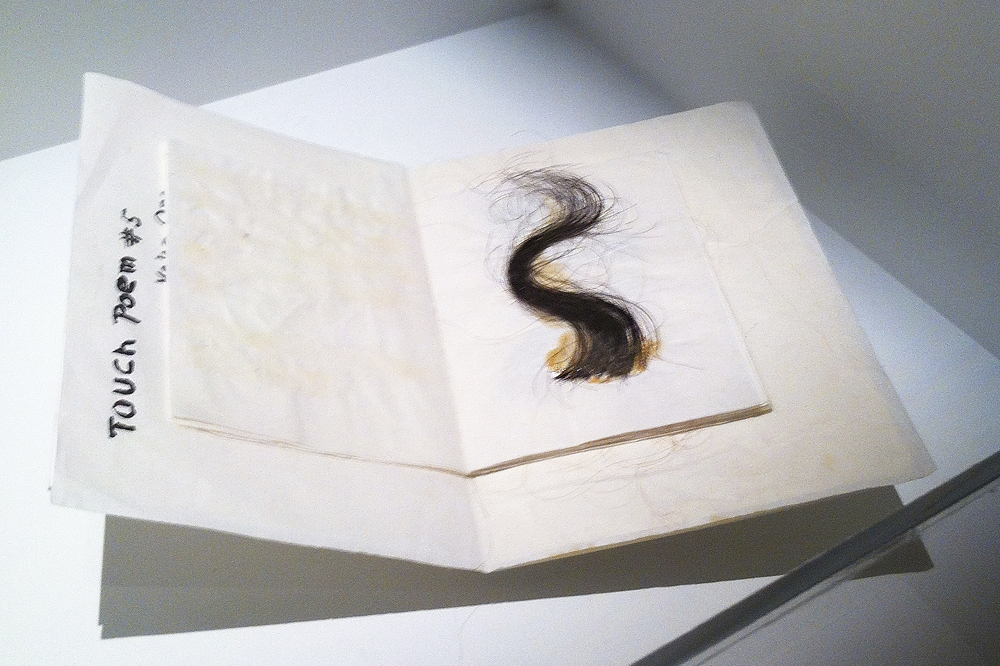
Ono’s interest in the intersection of art and language is well represented in the Danish retrospective.  We find word pieces, mail art, and instructions of various kinds.  Words were important conceptualists because they moved beyond the the focus on the visual in art.  Ono goes beyond the visual in other ways as well.  There is for example, “touch poem” consisting of a lock of hair (above).  In another piece, visitors are invited to feel the air inside an plexiglass podium.  There is also a charm machine containing plastic containers containing nothing.  Emptiness is a preoccupation in Ono’s work, and also in traditional Japanese aesthetics (consider the negative space of a Zen rock garden).  We are invited to ask, Is air really nothing?  Can something invisible be art?  Are concrete objects more valuable or meaningful than the ether that surrounds us?

It is noteworthy, in this context, that Ono was a philosophy student, indeed the first woman in the philosophy department at her prestigious Japanese university.  She ended up dropping out, but her art can certainly be regarded as philosophy.  It is also political at times as well.

Behind the charm machine, in the photograph, there are a series of uniform images, and below each is an inscription describing a traumatic biographical event, such as a time when Ono was fondled by a doctor.  Ono also lived through the bombing of Tokyo at the end of WWII, and she was active in the peace movement and woman’s movement of the late 1960s.  The exhibition is punctuated by political works, such as a suspended constellation of critic cages made to commemorate massacres (above).


The exhibit focusses more, however, on Ono’s Zen-infused conceptual works.  The image above is a detail of a long shelf containing water jars with the names of famous personages.  The list ranges from Picasso to Hitler.  Here we can see Camus next to Madonna.  The piece is a great equalizer.  For Ono, everyone is really just made of the same transparent ubiquitous stuff.  It is a political statement, but also a philosophical one.

The piece on the right is a clear panel, proportioned like a painting, engraved with the words, “Paining to let the evening light go through.”  It asks, as Duchamp had done, about whether art is a window onto reality.  But it is also a celebration of natural beauty, and not just an intellectual joke.
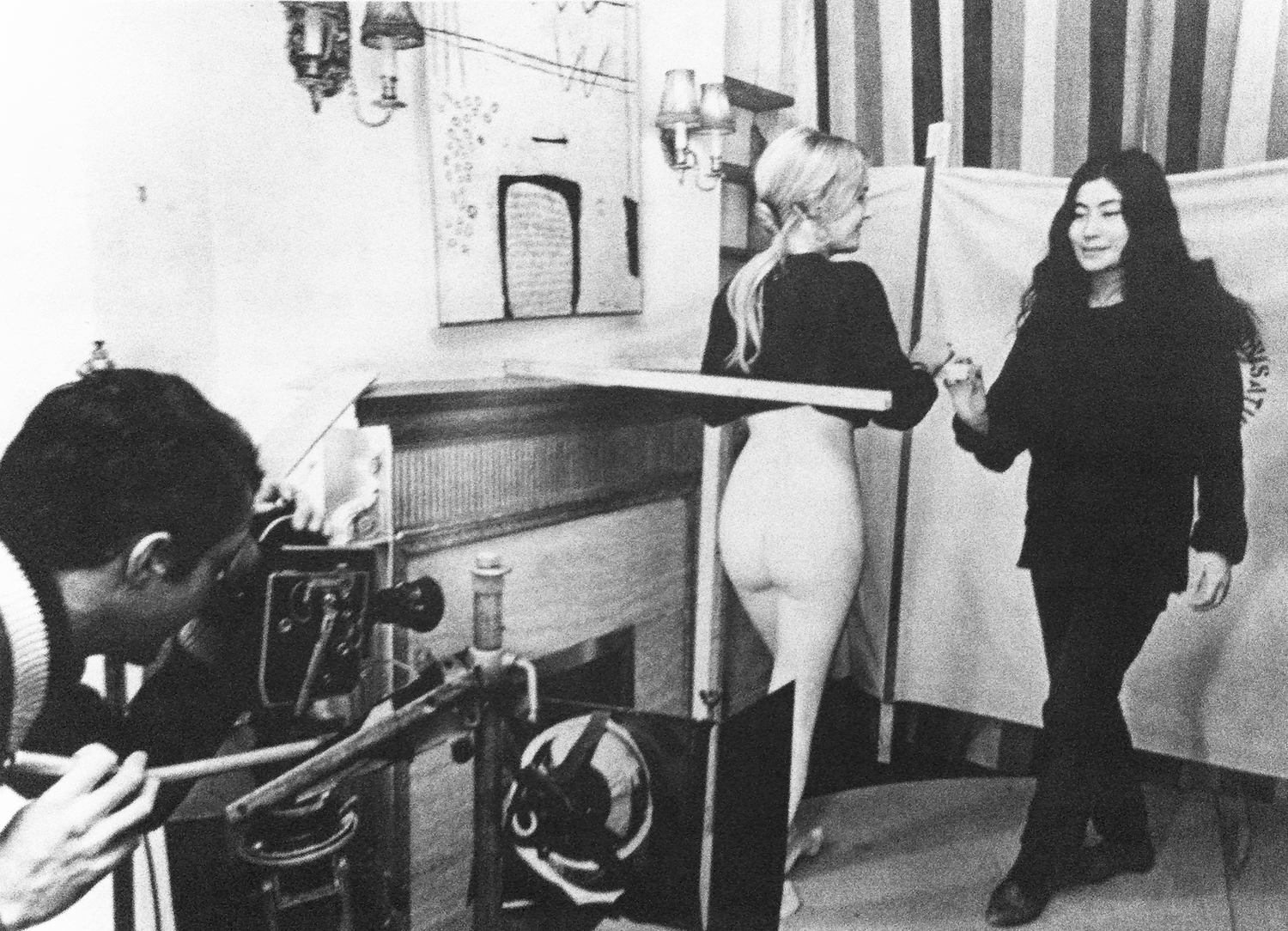
The exhibit also does a good job highlighting Ono’s work as a performance artist and video artist.  It includes her piece Four (a minimal fluxus name), which shows how buttocks move as people walk.  The image on the screen pays homage, in a witty way, to formal abstractionists, like Malevich.  The photo below captures the film in production.
Even more famous is Ono’s Cut Piece, in which spectators are invited to snip off her clothing.  This concept anticipates Abramavic among others, and is a landmark in the history of performance art.  It is also an important feminist work, drawing attention well before the Guerrilla Girls, to the sexualization of women in Western visual culture.
Another interesting example, which also deals with the female body, is Fly: here a fly, which became Ono’s alter ego, moves along a naked woman’s body.  It brings to mind the custom of including flies in Dutch still like paintings, to represent the impermanence of beauty.
The fly film also related to Ono’s musical work.  Around the same time, she began making musical records.  She had been involved in music for a decade already, and John Cage was an early mentor as she broke into the art scenes.  But, after joining forces with Lennon, Ono began producing commercial pop records.  Her first two were overtly, even aggressively avant garde — more challenging than almost any other mass marketed music of the time.  The second record was called Fly, and an excerpt can be heard below.

The Louisiana show does not aim to present Ono’s musical works, but this is an important omission.  In a way, Ono’s visual art died when she met Lennon.  People blame her for destroying the Beatles, but the Beatles were already done.  Much more more profound was the effect that the Beatles had on Ono.  She was a major figure in the underground art scene before she met Lennon, but she later became redefined (and reviled) as Lennon’s wife, and latter as his widow, rather than as a significant artist in her own right.  Ono has continued to make visual art in the decades since meeting Lennon, much of which is on display in the show.  Some this work is excellent (including the crickets and water pieces mentioned above), but her most important artworks precede her marriage, and her later work is often parasitic on earlier ideas.  Being married to rock’s biggest celebrity may have altered her artistic trajectory, or, worse still, stifled artistic progress.  But she did continue to innovate in other ways, after marrying Lennon, and her greatest achievements were in music.

After Ono’s two avant garde records, she records some material that was more accessible.  Her crowing achievement is the uneven but excellent double album, Approximately Infinite Universe.  The album varies stylistically, with a lot of blues, funk, and rock coming through with Lennon’s (and occasionally Mick Jagger’s) guitars.  But there is also a lot of experimentation here, and overtly feminist lyrics.  Some of the songs have a punk rock sensibility, like the stripped down number above.  Hearing this record, it is impossible not to think of Patti Smith, the X-Ray Spex (note the saxophone), Bikini Kill, and Deerhoof.  Decades of musical innovation are anticipated in these tracks, and hindsight has shown that Ono was well ahead of the curve.  She can be seen, in this light, as one of the major figures in recent music.   The Louisiana exhibition also properly confirms Ono’s place as an important figure in the recent history of art.

_____

Related posts:

Francis Schaeffer’s “How should we then live?” Video and outline of episode 10 “Final Choices” (Schaeffer Sundays)

E P I S O D E 1 0   Dr. Francis Schaeffer – Episode X – Final Choices 27 min FINAL CHOICES I. Authoritarianism the Only Humanistic Social Option One man or an elite giving authoritative arbitrary absolutes. A. Society is sole absolute in absence of other absolutes. B. But society has to be […]

Francis Schaeffer’s “How should we then live?” Video and outline of episode 9 “The Age of Personal Peace and Affluence” (Schaeffer Sundays)

E P I S O D E 9 Dr. Francis Schaeffer – Episode IX – The Age of Personal Peace and Affluence 27 min T h e Age of Personal Peace and Afflunce I. By the Early 1960s People Were Bombarded From Every Side by Modern Man’s Humanistic Thought II. Modern Form of Humanistic Thought Leads […]

Francis Schaeffer’s “How should we then live?” Video and outline of episode 8 “The Age of Fragmentation” (Schaeffer Sundays)

E P I S O D E 8 Dr. Francis Schaeffer – Episode VIII – The Age of Fragmentation 27 min I saw this film series in 1979 and it had a major impact on me. T h e Age of FRAGMENTATION I. Art As a Vehicle Of Modern Thought A. Impressionism (Monet, Renoir, Pissarro, Sisley, […]

Francis Schaeffer’s “How should we then live?” Video and outline of episode 7 “The Age of Non-Reason” (Schaeffer Sundays)

E P I S O D E 7 Dr. Francis Schaeffer – Episode VII – The Age of Non Reason I am thrilled to get this film series with you. I saw it first in 1979 and it had such a big impact on me. Today’s episode is where we see modern humanist man act […]

Francis Schaeffer’s “How should we then live?” Video and outline of episode 6 “The Scientific Age” (Schaeffer Sundays)

E P I S O D E 6 How Should We Then Live 6#1 Uploaded by NoMirrorHDDHrorriMoN on Oct 3, 2011 How Should We Then Live? Episode 6 of 12 ________ I am sharing with you a film series that I saw in 1979. In this film Francis Schaeffer asserted that was a shift in […]

Francis Schaeffer’s “How should we then live?” Video and outline of episode 5 “The Revolutionary Age” (Schaeffer Sundays)

E P I S O D E 5 How Should We Then Live? Episode 5: The Revolutionary Age I was impacted by this film series by Francis Schaeffer back in the 1970′s and I wanted to share it with you. Francis Schaeffer noted, “Reformation Did Not Bring Perfection. But gradually on basis of biblical teaching there […]

Francis Schaeffer’s “How should we then live?” Video and outline of episode 4 “The Reformation” (Schaeffer Sundays)

Dr. Francis Schaeffer – Episode IV – The Reformation 27 min I was impacted by this film series by Francis Schaeffer back in the 1970′s and I wanted to share it with you. Schaeffer makes three key points concerning the Reformation: “1. Erasmian Christian humanism rejected by Farel. 2. Bible gives needed answers not only as to […]

“Schaeffer Sundays” Francis Schaeffer’s “How should we then live?” Video and outline of episode 3 “The Renaissance”

Francis Schaeffer’s “How should we then live?” Video and outline of episode 3 “The Renaissance” Francis Schaeffer: “How Should We Then Live?” (Episode 3) THE RENAISSANCE I was impacted by this film series by Francis Schaeffer back in the 1970′s and I wanted to share it with you. Schaeffer really shows why we have so […]

Francis Schaeffer’s “How should we then live?” Video and outline of episode 2 “The Middle Ages” (Schaeffer Sundays)

  Francis Schaeffer: “How Should We Then Live?” (Episode 2) THE MIDDLE AGES I was impacted by this film series by Francis Schaeffer back in the 1970′s and I wanted to share it with you. Schaeffer points out that during this time period unfortunately we have the “Church’s deviation from early church’s teaching in regard […]

Francis Schaeffer’s “How should we then live?” Video and outline of episode 1 “The Roman Age” (Schaeffer Sundays)

Francis Schaeffer: “How Should We Then Live?” (Episode 1) THE ROMAN AGE   Today I am starting a series that really had a big impact on my life back in the 1970′s when I first saw it. There are ten parts and today is the first. Francis Schaeffer takes a look at Rome and why […]

By Everette Hatcher III | Posted in Francis Schaeffer | Edit | Comments (0)

____________

________

APOLOGETICS, CULTURAL LITURGIES, AND OUR POSTMODERN AGE March 26, 2015

______________

pearceyYesterday, I began a conversation with Nancy Pearcey about her new book, Finding Truth: 5 Principles for Unmasking Atheism, Secularism, and Other God SubstitutesToday, we continue this discussion and focus on the benefits and limits of worldview training.

Trevin Wax: James K. A. Smith makes the case that worldview analysis isn’t enough when it comes to discipleship, since we are formed by cultural liturgies, not just philosophical beliefs. What are the limits of worldview training?

Nancy Pearcey: The issue raised by James K. A. Smith is whether we are shaped less by belief than by practice — by ways of life or what he calls “liturgies.” The idea of the primacy of practice comes out of postmodernism, which claims that people’s beliefs are shaped by the patterns of life embodied in their communities. On one hand, that seems obvious. On the other hand, when we borrow an idea from an existing intellectual tradition, we must analyze it carefully to make sure we are not absorbing non-biblical assumptions in the process.

The idea that individuals are constituted by their communities is a common theme in a philosophical tradition called continental philosophy. The theme can be traced back to the German philosopher Hegel, who taught that the real actor in history is not the individual but a Universal Mind, a kind of collective consciousness. As philosopher Robert Solomon explains, the Universal Mind creates the world “through the shared aspects of a culture, a society, and above all through a shared language.” Individuals are constituted by the customs, values, and habits of the groups to which they belong.

Over time, Hegel’s Universal Mind was dropped, but what remained was the idea that individuals are shaped by communal forces. They are not producers of culture so much as products of a particular culture with its forms of life.

In our own day, this has led to the postmodern claim that ideas are merely social constructions stitched together by cultural forces. Individuals are little more than mouthpieces for communities based on race, class, gender, ethnicity, and sexual identity. The implication is that people believe what they do not because they have good reasons but because they are black or white, male or female, Asian or Hispanic, or whatever.

This is radically dehumanizing. It implies that individuals are powerless to rise above the communities to which they belong. It is a form of reductionism that dissolves individual identity into group identity. Christian philosopher Dooyeweerd called it the “ideology of community.”

In Finding Truth, I argue that every worldview gets some things right, which means we can be open and respectful, gleaning what is good wherever we find it. Postmodernism has been a helpful corrective to modernism. It has done good service in countering the lonely individualism of the Enlightenment’s autonomous self. It rejects the modernist project of thinkers like Bacon and Descartes to start history over from scratch within the isolated individual consciousness.

But just as we should not uncritically accept Enlightenment-inspired philosophies, so we should not uncritically accept postmodernism.

Postmodernists reject the Enlightenment ideal of neutral, objective knowledge on the grounds that everyone’s perspective is “situated” in a context that is particular, local, and historically contingent. But they often overlook the fact that their own claims are likewise situated. After all, where did postmodernism come from? As we just saw, it is a strand of modern European intellectual history, stemming from post-Hegelian continental philosophy with its claim that consciousness is shaped by communal ways of life. Postmodernists are just as restricted by their own historical horizons as the more traditional people whom they tend to look down on.

Finding Truth gives guidelines for practicing biblical discernment with any set of ideas, identifying what they get right and where they go wrong.

Trevin Wax: You present a five-step approach to apologetics:

  • Identify the idol.
  • Identify the reductionism.
  • Test the worldview.
  • Show how it’s self-defeating.
  • Make a case for a Christian worldview.

How did you develop this approach, and why do you believe it is a helpful way of conversing with unbelievers?

Nancy Pearcey: Romans 1 describes the dynamics of the person struggling to avoid God. It unfolds a series of actions — a drama of divine-human interaction — that is the source of all worldviews, from ancient times to our own. The great plot line of history is the tug of war between God and humanity. On one hand, God reaches out to humanity to make himself known. On the other hand, humans desperately seek to avoid knowing him by creating God substitutes.

When conversing with non-Christians, then, we can start where Paul does: with general revelation, a body of knowledge that is available to everyone because it is part of universal human experience. An important aspect of that knowledge is our direct awareness of human nature. As philosopher Étienne Gilson puts it, because humans are capable of choosing, the first cause that created them must have a will. Because humans are capable of thinking, the first cause that created them must have a mind. In short, because a human is a someone and not asomething, the source of human life must also be a Someone. As the Psalmist says, “Does he who fashioned the ear not hear? Does he who formed the eye not see?” (Ps 94:9)

When humans create God substitutes, however, those lead inevitably to a lower view of human nature. The technical term is reductionism. Those who exchange the glory of God for something in the created world will also exchange the image of God for something in creation.

For example, take materialism, since that is the dominant worldview in the academic world. Its idol is matter. Everything else is reduced to material objects produced by material forces. Anything that does not fit in the materialist box is dismissed as an illusion, including free will, mind, spirit, soul, consciousness. Humans are said to be essentially robots — complex biochemical machines. Reductionism is a strategy for suppressing the truth: For if we can reduce humans to machines operating by natural forces, then we can explain their origin by purely natural forces.

But can anyone actually live like a machine? Of course not. Philosopher John Searle jokes that if people deny free will, then when ordering at a restaurant they should say, “Just bring me whatever the laws of nature have determined I will get.” It seems to be part of undeniable, inescapable human experience that we have the power to make choices, that we are not robots.

In Finding Truth, I give several astonishing quotes by leading scientists and scholars who admit that their own worldview does not fit the world as they themselves experience it. The example my students always remember best is Rodney Brooks, professor emeritus at MIT. Brooks writes that a human being is just “a big bag of skin full of biomolecules” interacting by the laws of physics and chemistry. It is difficult to actually see people that way, he admits. But “when I look at my children, I can, when I force myself … see that they are machines.”

But is that how Brooks treats them? Not at all. “I give them my unconditional love,” even though love has no “rational analysis” in his worldview. It sticks out of his materialist box. Robots don’t love. Brooks’s philosophy is too limited to account for reality as he himself experiences it.

So the Romans 1 strategy equips us to dialog with non-Christians because it incorporates what everyone knows by general revelation. The person before you has a profound experiential knowledge of being made in God’s image—and that knowledge keeps breaking through even when his worldview tells him he is a machine made in the image of matter.

Trevin Wax: Worldview analysis has been offered in other books. What’s really new here, and how can we use it with non-Christians?

Nancy Pearcey: : There are two major ways to test a philosophy or worldview: (1) Test it externally against the world and (2) test it internally for logical consistency. These are the same questions we raise in testing any idea — whether in a science lab, a court of law, or when asking a friend why she showed up late.

What makes the Romans 1 approach unique is that it tells you why these tests work.

We can be confident that every non-Christian worldview will fail the first test. Why? Because, as we already saw, every non-Christian worldview is reductionistic. As Romans explains, those who reject the Creator will idolize some part of the created order. You might think of it as trying to stuff all of reality into a box. But a part is never enough to explain the whole. Something will stick out of the box. The theory does not match the real world.

We can also be confident that non-Christian worldviews will fail the second test. Why? Again because of the reductionism. When you hold a lower view of humanity, that will include the human mind—our cognitive faculties, rationality, reason. Yet how does a worldview support itsown case? By using reason. Thus when it discredits reason, it undercuts its own case. It is self-refuting. It commits suicide.

The technical term is self-referential absurdity, and you will see it applied regularly by philosophers and apologists — but with no rationale or method. What is unique about the Romans 1 approach is that it tells you why it works and how to apply it. Find the reductionism: That’s the point where it will commit suicide.

The Romans 1 strategy works with non-Christians because it relies on what everyone recognizes as good reasoning. Even the term “idols” is used by secular thinkers (ever since Nietzsche’s famous essay “Twilight of the Idols“). Afterward, we can draw back the curtain and explain the deeper metaphysical grounding: The Romans 1 narrative, with its dramatic account of idols and suppression, is the larger framework that gives these strategies their theological rationale and weaves them into a dynamic unity.

To quote one of my students, using the strategy in Finding Truth ”is like the difference between driving around Los Angeles with just a set of directions (turn left, turn right) compared to having a map of the whole city. The map gives you the overall perspective.” The five principles provide a map to navigate any system of ideas.

Trevin Wax: Several of the chapters in this book deal with both Enlightenment materialism and postmodernism, which critiques the hubris of Enlightenment philosophy. Which of these two philosophies do you believe is ascending today?

Nancy Pearcey: In the modern age, Western thought and culture has split into two streams. In the 20th century, they were labeled the analytic and the continental traditions. The analytic tradition traces its roots to British empiricism and is associated with philosophies that claim to be science-based, such as materialism and naturalism. The continental tradition traces its roots to the Romantic protest against the Enlightenment, and includes philosophies such as idealism, phenomenology, existentialism, and postmodernism. (I describe these two traditions in much greater detail in Saving Leonardo, showing how each give rise to distinctive schools of art, literature, and music.)

Analytic philosophy is taught in some 90 percent of American philosophy departments, so it is more familiar to most people (even if they don’t know the name). Continental thought, on the other hand, has swept through the humanities: English, history, theology, ethics, the social sciences, and so on.

Perhaps the best way to understand their relationship is summarized in the fact/value split: Modernism lays claim to the fact realm, while postmodernism is rampant in the value realm.

The upshot is that Christians need to know how to interact critically with both of these philosophical traditions, gleaning what is good while sorting out what is contrary to a biblical worldview.


_________________

__________

Interview with Nancy Pearcey; 23 February 2015

Published on Feb 23, 2015

In conjunction with WORLD Magazine, Patrick Henry College presents its interview with Nancy Pearcey as a part of the Newsmaker Interview Series with Marvin Olasky, editor-in-chief at WORLD and Distinguished Chair of Journalism and Public Policy at PHC. For more information on Patrick Henry College, visit our website here http://www.phc.edu.

Related posts:

FRANCIS SCHAEFFER ANALYZES ART AND CULTURE Part 52 THE BEATLES (Part D, There is evidence that the Beatles may have been exposed to Francis Schaeffer!!!) (Feature on artist Anna Margaret Rose Freeman )

______________ I have dedicated several posts to this series on the Beatles and I don’t know when this series will end because Francis Schaeffer spent a lot of time talking and writing about them and their impact on the culture of the 1960’s. Lucy in the Sky with Diamonds- The Beatles The Beatles: The Beatles […]

FRANCIS SCHAEFFER ANALYZES ART AND CULTURE Part 51 THE BEATLES (Part C, List of those on cover of Stg.Pepper’s ) (Feature on artist Raqib Shaw )

________________ I have dedicated several posts to this series on the Beatles and I don’t know when this series will end because Francis Schaeffer spent a lot of time talking and writing about them and their impact on the culture of the 1960’s. The Beatles: The Beatles and their album St. Pepper’s Lonely Hearts Club […]

FRANCIS SCHAEFFER ANALYZES ART AND CULTURE Part 50 THE BEATLES (Part B, The Psychedelic Music of the Beatles) (Feature on artist Peter Blake )

__________________ I have dedicated several posts to this series on the Beatles and I don’t know when this series will end because Francis Schaeffer spent a lot of time talking and writing about them and their impact on the culture of the 1960’s. The Beatles are featured in this episode below and Schaeffer noted,  ” Sergeant Pepper’s […]

FRANCIS SCHAEFFER ANALYZES ART AND CULTURE Part 49 THE BEATLES (Part A, The Meaning of Stg. Pepper’s Cover) (Feature on artist Mika Tajima)

_______________ I have dedicated several posts to this series on the Beatles and I don’t know when this series will end because Francis Schaeffer spent a lot of time talking and writing about them and their impact on the culture of the 1960’s. Great Album The Beatles are featured in this episode below and Schaeffer […]

FRANCIS SCHAEFFER ANALYZES ART AND CULTURE PART 48 “BLOW UP” by Michelangelo Antonioni makes Philosophic Statement (Feature on artist Nancy Holt)

_______________ Francis Schaeffer pictured below: _____________________ Why am I doing this series FRANCIS SCHAEFFER ANALYZES ART AND CULTURE? John Fischer probably expressed it best when he noted: Schaeffer was the closest thing to a “man of sorrows” I have seen. He could not allow himself to be happy when most of the world was desperately lost […]

FRANCIS SCHAEFFER ANALYZES ART AND CULTURE Part 47 Woody Allen and Professor Levy and the death of “Optimistic Humanism” from the movie CRIMES AND MISDEMEANORS Plus Charles Darwin’s comments too!!! (Feature on artist Rodney Graham)

Crimes and Misdemeanors: A Discussion: Part 1 ___________________________________ Today I will answer the simple question: IS IT POSSIBLE TO BE AN OPTIMISTIC SECULAR HUMANIST THAT DOES NOT BELIEVE IN GOD OR AN AFTERLIFE? This question has been around for a long time and you can go back to the 19th century and read this same […]

FRANCIS SCHAEFFER ANALYZES ART AND CULTURE PART 46 Friedrich Nietzsche (Featured artist is Thomas Schütte)

____________________________________ Francis Schaeffer pictured below: ______________ Francis Schaeffer has written extensively on art and culture spanning the last 2000years and here are some posts I have done on this subject before : Francis Schaeffer’s “How should we then live?” Video and outline of episode 10 “Final Choices” , episode 9 “The Age of Personal Peace and Affluence”, episode 8 […]

FRANCIS SCHAEFFER ANALYZES ART AND CULTURE Part 45 Woody Allen “Reason is Dead” (Feature on artists Allora & Calzadilla )

Love and Death [Woody Allen] – What if there is no God? [PL] ___________   _______________ How Should We then Live Episode 7 small (Age of Nonreason) #02 How Should We Then Live? (Promo Clip) Dr. Francis Schaeffer 10 Worldview and Truth Two Minute Warning: How Then Should We Live?: Francis Schaeffer at 100 Francis […]

FRANCIS SCHAEFFER ANALYZES ART AND CULTURE Part 44 The Book of Genesis (Featured artist is Trey McCarley )

___________________________________ Francis Schaeffer pictured below: ____________________________ Francis Schaeffer “BASIS FOR HUMAN DIGNITY” Whatever…HTTHR Dr. Francis schaeffer – The flow of Materialism(from Part 4 of Whatever happened to human race?) Dr. Francis Schaeffer – The Biblical flow of Truth & History (intro) Francis Schaeffer – The Biblical Flow of History & Truth (1) Dr. Francis Schaeffer […]

FRANCIS SCHAEFFER ANALYZES ART AND CULTURE Part 43 “Freedom within Form” (Featured artist is Jan Fabre)

________________ Francis Schaeffer “BASIS FOR HUMAN DIGNITY” Whatever…HTTHR Dr. Francis schaeffer – The flow of Materialism(from Part 4 of Whatever happened to human race?) Dr. Francis Schaeffer – The Biblical flow of Truth & History (intro) Francis Schaeffer – The Biblical Flow of History & Truth (1) Dr. Francis Schaeffer – The Biblical Flow of […]

_________________

3 Latest Video Releases from Taylor Swift!!!

________________

Taylor Swift – Blank Space

Published on Nov 10, 2014

Watch Taylor’s new video for “Blank Space”. No animals, trees, automobiles or actors were harmed in the making of this video. Taylor’s new release 1989 is Available Now on iTunes http://www.smarturl.it/TS1989.

Taylor Swift – Shake It Off

Published on Aug 18, 2014

Taylor’s new release 1989 is Available Now featuring the hit single “Shake It Off” and her latest single “Blank Space”. http://www.smarturl.it/TS1989

Music video by Taylor Swift performing Shake It Off. (C) 2014 Big Machine Records, LLC.

Taylor Swift – Style

Published on Feb 13, 2015

Check out Taylor’s new stunning video for “Style”. Taylor’s multi-platinum release 1989 is Available Now on iTunes http://www.smarturl.it/TS1989.

Related posts:


MUSIC MONDAY The Dennis Jernigan Story

_____________ Dennis Jernigan – You Are My All In All Uploaded on Oct 18, 2009 Dennis Jernigan – You Are My All In All __________________________________________ Dennis Jernigan: Freedom From Homosexuality (LIFE Today / James Robison) Published on Apr 12, 2013 A man caught in homosexuality reveals the process by which he found deliverance and freedom. […]

MUSIC MONDAY Wikipedia’s top 18 songs of the Velvet Underground and Nico

Wikipedia’s top 18 songs of the Velvet Underground and Nico _____________ Nico – My Heart is Empty Uploaded on Feb 25, 2010 Nico – Camera Obscura [1985] Nico Icon (Documentary)part 5 The Very Best of The Velvet Underground From Wikipedia, the free encyclopedia Jump to: navigation, search There are Velvet Underground compilation albums with similar […]

MUSIC MONDAY All Tomorrow’s Parties” and “Sunday Morning” are two of the best songs by the Velvet Underground and Nico!!!

All Tomorrow’s Parties” and “Sunday Morning” are two of the best songs by the Velvet Underground and Nico!!! Nico Icon (Documentary) part6. _________________ The Velvet Underground-Sunday Morning _______________ Velvet Underground-All Tomorrow’s Parties Sunday Morning (The Velvet Underground song) From Wikipedia, the free encyclopedia Jump to: navigation, search “Sunday Morning” Single by The Velvet Underground from the […]

MUSIC MONDAY Nothing’s Gonna Stop Us Now by Starship

Nothing’s Gonna Stop Us Now From Wikipedia, the free encyclopedia Not to be confused with Nothing’s Gonna Stop Us or Nothing’s Gonna Stop Me Now. “NOTHING’S GONNA STOP US NOW” SINGLE BY STARSHIP FROM THE ALBUM NO PROTECTION B-SIDE “Layin’ It on the Line” RELEASED January 30, 1987[1] FORMAT 7″ single & 12″ single RECORDED September 26, […]

MUSIC MONDAY Al Hirt’s Clarinet player “Pee Wee Spitelera”

My friend Sean Michel had an uncle named Pee Wee Spitelera and you will notice Pee Wee at the 4 minute mark take off on his  clarinet in this video below on the Dinah Shore Show in 1960. Al Hirt on the Dinah Shore Chevy Show 1960 Blue Clarinet-Pee Wee Spitelera Uploaded on Aug 16, […]

MUSIC MONDAY: The Mysterious History of the song “Kumbaya”

Tribute To The Seekers ~ Kumbaya Uploaded on Dec 2, 2007 Tribute To The Seekers The Seekers were a group of Australian folk-influenced popular musicians which was formed in Melbourne, Victoria, Australia, in 1962. They were the first Australian popular music group to achieve significant chart and sales success in the United Kingdom and the […]

MUSIC MONDAY Little Rock native David Hodges co-wrote Avril Lavigne song “Hello Heartache”

Little Rock native David Hodges co-wrote Avril Lavigne song “Hello Heartache” Avril Lavigne – Hello Heartache (Lyric Video) Avril Lavigne, ‘Avril Lavigne’: Track-By-Track Review Articles Reviews By Jason Lipshutz, New York | November 04, 2013 4:33 PM EST “A first taste like honey, you were so yum/Can’t wait for a second, cause it’s so fun,” […]

MUSIC MONDAY Little Rock native David Hodges co-wrote the Avril Lavigne song “Give you what you like”

Little Rock native David Hodges co-wrote the Avril Lavigne song “Give you what you like” Give You What You Like – Avril Lavigne (Sub. English-Español) Here are the lyrics: If you give me what I want Then Ill give you what you like When you turn off the lights I get stars in my eyes […]

MUSIC MONDAY ABBA and their tax policy!!!

___________     One of my favorite groups growing up was ABBA. Here are some of my favorite songs: Liberals hate tax deductions even if they are legitimate!!! ABBA and the Story of the Most-Inane-Ever Tax Controversy February 18, 2014 by Dan Mitchell The tax code is a complicated nightmare, particularly for businesses. Some people may think this is because […]

MUSIC MONDAY My favorite M TV videos from 1980’s

My favorite M TV videos from 1980’s All Those Years Ago – John Lennon & George Harrison Michael Jackson – Beat It (Digitally Restored Version) Uploaded on Apr 11, 2011 Music video by Michael Jackson performing Beat It. © 1982 MJJ Productions Inc. Abba – Super Trouper Naked Eyes – Always Something There Modern English […]


________________

CAN YOUR CONGREGATION ANSWER THE QUESTIONS OF A POST-CHRISTIAN SOCIETY? March 25, 2015

_______________________

Interview with Nancy Pearcey; 23 February 2015

Published on Feb 23, 2015

In conjunction with WORLD Magazine, Patrick Henry College presents its interview with Nancy Pearcey as a part of the Newsmaker Interview Series with Marvin Olasky, editor-in-chief at WORLD and Distinguished Chair of Journalism and Public Policy at PHC. For more information on Patrick Henry College, visit our website here http://www.phc.edu.

Pearcey_FindingTruth

Ever since I was a teenager, I have benefited from the work of thinkers like Chuck Colson and Nancy Pearcey. Their book How Now Shall We Live? forced me to examine assumptions and answer the question of why I believed Christianity to be true. Nancy Pearcey’s Total Truth was also an important book in my spiritual development. It pointed me in the direction of Francis Schaeffer and led me to a deeper consideration of philosophy and worldview analysis.

Nancy Pearcey is a professor and scholar in residence at Houston Baptist University, and she has recently released a new book, Finding Truth: 5 Principles for Unmasking Atheism, Secularism, and Other God SubstitutesToday and tomorrow, she joins me on the blog for a conversation about evangelism, apologetics, and worldview training.

Trevin Wax: Nancy, It’s been more than ten years since Total Truth came out. How has the landscape in North America changed, and how have recent trends shaped your work in Finding Truth?

Nancy Pearcey: Total Truth makes the case that Christianity is a worldview that is meant to be applied not just to religious life but to all of life. Finding Truth gives people the tools to do it.

Christians are often stymied because they simply don’t know how to apply biblical truth to all of life. As a result, they are continually in retreat before competing ideas. The dominant theories in virtually all fields are secular, and sometimes explicitly anti-Christianity. In order to obey the cultural mandate, we need a strategy that empowers us to show where those theories are mistaken, and then to craft positive biblical alternatives.

Finding Truth offers a 5-part strategy that equips us to penetrate to the core of any worldview and weigh its claims. As one of my students said, “Your book is different from any other book I’ve read on apologetics. Other books are informational; they tell us about various worldviews. Your book teaches us how to actually do apologetics.”


Trevin Wax: You write: “Churches have an obligation to equip their congregations to answer the questions that inevitably arise from living in a post-Christian society.” What are some of the common questions you find churches have a difficult time answering?

Nancy Pearcey: The core question is the same one that I wrestled with as a teenager: How do we know that Christianity is true? We should be Christians only because we are persuaded that the gospel is true.

When I stumbled upon L’Abri in the early 1970s, I was a young adult steeped in relativism and skepticism. I had to be persuaded that there is such a thing as truth before I could even consider whether Christianity might be that truth. Today relativism is far more widespread. Polls show that even in the church, teens are likely to say that there are many ways to God, or to say that statements about God’s existence are subjective, based on emotional experience.

Yet church youth groups rarely teach apologetics, majoring instead on games and goodies. The goal seems to be to engineer events that ratchet up emotional commitment, as though sheer intensity of experience will compensate for intellectual doubts. But emotional intensity is not enough to block out teens’ questions. If anything, it leads them to redefine Christianity in purely emotional terms —which leaves them even more vulnerable when they finally do face their questions.

Finding Truth equips young people — and their parents, pastors, and teachers — to craft answers to the many competing worldviews they encounter, whether secular or religious.


Trevin Wax: Many people, especially in the Reformed world, are questioning the role that worldview training plays in discipleship. How do you respond?

Nancy Pearcey: There are many levels of Christian discipleship, but clearly the first one is to stay Christian.

Many Christian homes, schools, and churches are not equipping young people to maintain even the basic conviction that Christianity is true. Sociologist Bradley Wright at the University of Connecticut asked former Christians why they de-converted. The researchers expected to hear stories about people leaving the church because they had been hurt or emotionally wounded — relationship issues. To their surprise, the reason given most frequently by former Christians was that they could not get answers to their doubts and questions. In fact, they could not even get the church to treat their questions seriously. A former Southern Baptist (obviously still angry) said, “Christians always use the word ‘faith’ as their last word when they are too stupid to answer a question.”

Christian Smith, a sociologist at Notre Dame, reports similar results. In Soul Searching, he found that the reason given most often by teens who left their religion was that they had unanswered doubts and questions. I hear the same story far too often myself.

Recently a mother told me with tears in her eyes that her son had lost his faith at a state university. Her son was a psychology major, and ever since Freud, most psychological theories have treated Christianity as a symptom of neurosis, an infantile regression, the projection of an imaginary father figure in the sky. The young man came from a strong, warm Christian family and church, but he was completely unprepared to critically evaluate the theories he was learning in the classroom. Within a semester, he had abandoned his religious upbringing altogether.

How can we help a psychology student respond to Freud’s charge that religion is a symptom of emotional immaturity? An English student seeking to answer Foucault’s charge that truth claims are merely power plays? A law student whose professor insists that law has no relation to morality? A unique feature of Finding Truth is that it teaches a strategy that can be applied universally. No more memorizing specific arguments for each theory. We can be confident that Romans 1 applies to all of them.


Trevin Wax: Your book is primarily focused on the flaws in prevailing philosophies. But you also recognize that most people don’t think, “I need a personal philosophy” for life and then sign up for a course. Much of our outlook on life is absorbed through books and movies and music. 

Nancy Pearcey: You’re alluding here to cultural apologetics. It was Francis Schaeffer who first taught evangelicals the value of cultural apologetics — of tracing ideas as they permeate society through the arts, literature, and pop culture. This is where most people pick up their ideas about life. My earlier book, Saving Leonardo, interacts deeply with the arts: I argue that it is imperative for Christians to learn the skill of deciphering worldviews when they come to us not in words, where they are easier to recognize, but in the idiom of image, plot line, composition, and characterization.

Yet to recognize worldviews embedded in art forms, obviously we must first be familiar with those worldviews. And we must have the skills to critically assess them.

Those competencies are what Finding Truth teaches. Since the proof of the pudding is in the eating, I offer what my students have said. An undergraduate wrote, “The method of critique you taught in this class has been incredibly helpful to me, not just in class but in my life — reading books and watching movies.” A master’s student wrote, “When watching television or movies with my family, I used to be afraid of secular ideas seeping into my psyche, but now I finally have the skills to identify and critique them. My kids are intrigued and delighted.”

Once you master the five principles from Romans 1, you will be equipped to think critically and creatively about any theory in any field.


Trevin Wax: Tomorrow, my interview with Nancy Pearcey will continue. We will discuss James K. A. Smith’s critique of “worldview training,” and how we engage in apologetics in a postmodern age.


_______________


Related posts:

FRANCIS SCHAEFFER ANALYZES ART AND CULTURE Part 52 THE BEATLES (Part D, There is evidence that the Beatles may have been exposed to Francis Schaeffer!!!) (Feature on artist Anna Margaret Rose Freeman )

______________ I have dedicated several posts to this series on the Beatles and I don’t know when this series will end because Francis Schaeffer spent a lot of time talking and writing about them and their impact on the culture of the 1960’s. Lucy in the Sky with Diamonds- The Beatles The Beatles: The Beatles […]

FRANCIS SCHAEFFER ANALYZES ART AND CULTURE Part 51 THE BEATLES (Part C, List of those on cover of Stg.Pepper’s ) (Feature on artist Raqib Shaw )

________________ I have dedicated several posts to this series on the Beatles and I don’t know when this series will end because Francis Schaeffer spent a lot of time talking and writing about them and their impact on the culture of the 1960’s. The Beatles: The Beatles and their album St. Pepper’s Lonely Hearts Club […]

FRANCIS SCHAEFFER ANALYZES ART AND CULTURE Part 50 THE BEATLES (Part B, The Psychedelic Music of the Beatles) (Feature on artist Peter Blake )

__________________ I have dedicated several posts to this series on the Beatles and I don’t know when this series will end because Francis Schaeffer spent a lot of time talking and writing about them and their impact on the culture of the 1960’s. The Beatles are featured in this episode below and Schaeffer noted,  ” Sergeant Pepper’s […]

FRANCIS SCHAEFFER ANALYZES ART AND CULTURE Part 49 THE BEATLES (Part A, The Meaning of Stg. Pepper’s Cover) (Feature on artist Mika Tajima)

_______________ I have dedicated several posts to this series on the Beatles and I don’t know when this series will end because Francis Schaeffer spent a lot of time talking and writing about them and their impact on the culture of the 1960’s. Great Album The Beatles are featured in this episode below and Schaeffer […]

FRANCIS SCHAEFFER ANALYZES ART AND CULTURE PART 48 “BLOW UP” by Michelangelo Antonioni makes Philosophic Statement (Feature on artist Nancy Holt)

_______________ Francis Schaeffer pictured below: _____________________ Why am I doing this series FRANCIS SCHAEFFER ANALYZES ART AND CULTURE? John Fischer probably expressed it best when he noted: Schaeffer was the closest thing to a “man of sorrows” I have seen. He could not allow himself to be happy when most of the world was desperately lost […]

FRANCIS SCHAEFFER ANALYZES ART AND CULTURE Part 47 Woody Allen and Professor Levy and the death of “Optimistic Humanism” from the movie CRIMES AND MISDEMEANORS Plus Charles Darwin’s comments too!!! (Feature on artist Rodney Graham)

Crimes and Misdemeanors: A Discussion: Part 1 ___________________________________ Today I will answer the simple question: IS IT POSSIBLE TO BE AN OPTIMISTIC SECULAR HUMANIST THAT DOES NOT BELIEVE IN GOD OR AN AFTERLIFE? This question has been around for a long time and you can go back to the 19th century and read this same […]

FRANCIS SCHAEFFER ANALYZES ART AND CULTURE PART 46 Friedrich Nietzsche (Featured artist is Thomas Schütte)

____________________________________ Francis Schaeffer pictured below: ______________ Francis Schaeffer has written extensively on art and culture spanning the last 2000years and here are some posts I have done on this subject before : Francis Schaeffer’s “How should we then live?” Video and outline of episode 10 “Final Choices” , episode 9 “The Age of Personal Peace and Affluence”, episode 8 […]

FRANCIS SCHAEFFER ANALYZES ART AND CULTURE Part 45 Woody Allen “Reason is Dead” (Feature on artists Allora & Calzadilla )

Love and Death [Woody Allen] – What if there is no God? [PL] ___________   _______________ How Should We then Live Episode 7 small (Age of Nonreason) #02 How Should We Then Live? (Promo Clip) Dr. Francis Schaeffer 10 Worldview and Truth Two Minute Warning: How Then Should We Live?: Francis Schaeffer at 100 Francis […]

FRANCIS SCHAEFFER ANALYZES ART AND CULTURE Part 44 The Book of Genesis (Featured artist is Trey McCarley )

___________________________________ Francis Schaeffer pictured below: ____________________________ Francis Schaeffer “BASIS FOR HUMAN DIGNITY” Whatever…HTTHR Dr. Francis schaeffer – The flow of Materialism(from Part 4 of Whatever happened to human race?) Dr. Francis Schaeffer – The Biblical flow of Truth & History (intro) Francis Schaeffer – The Biblical Flow of History & Truth (1) Dr. Francis Schaeffer […]

FRANCIS SCHAEFFER ANALYZES ART AND CULTURE Part 43 “Freedom within Form” (Featured artist is Jan Fabre)

________________ Francis Schaeffer “BASIS FOR HUMAN DIGNITY” Whatever…HTTHR Dr. Francis schaeffer – The flow of Materialism(from Part 4 of Whatever happened to human race?) Dr. Francis Schaeffer – The Biblical flow of Truth & History (intro) Francis Schaeffer – The Biblical Flow of History & Truth (1) Dr. Francis Schaeffer – The Biblical Flow of […]


_________________

MUSIC MONDAY The Dennis Jernigan Story

_____________

Dennis Jernigan – You Are My All In All

Uploaded on Oct 18, 2009

Dennis Jernigan – You Are My All In All

__________________________________________

Dennis Jernigan: Freedom From Homosexuality (LIFE Today / James Robison)

Published on Apr 12, 2013

A man caught in homosexuality reveals the process by which he found deliverance and freedom. Original air date April 18, 2013.

_________________

Dennis Jernigan and Friends – Great is The Lord Almighty

Uploaded on Jun 22, 2010

Awesome song!

_______________

Who Can Satisfy – Jernigan

Published on Mar 1, 2012

Who on earth, could comfort me
and love me like You do?
Who could ever be more faithful true?
I will trust in You; I will trust in You, my God

There is a fountain who is a King
Victorious Warrior and Lord of everything
My Rock, my Shelter, my very own
Blessed Redeemer, who reigns upon
the throne

Living water, rain down Your life on me
Cleasing me, refreshing me with life abundantly
River, full of life, I’ll go where You lead
I will trust in You, I will trust in You, my God

SHOW LESS

When The Night Is Falling – Dennis Jernigan

Uploaded on Jun 26, 2008

The “Break My Heart O’ God” album, written by the talented Dennis Jernigan, has been a source of healing and comfort in my family for many years. Therefore, I’m grateful for YouTube as a way of sharing this anointed music with those who may not of heard it yet. May you feels God’s Love for you as you listen to this music written by and from Dennis Jernigan’s heart.

____________________________

06 Thank You, Lord. -Dennis Jernigan

__________________

DJ’s Testimony

E-mail Print

Prelude

For many years and generations, our society has been losing a most valuable ingredient. Why do we see so many perversions come to be accepted as “normal” and “natural?” I personally believe that men don’t know how to be men and fathers don’t know how to be fathers to their children. I believe women long to be women but men have run away from their responsibilities leaving the women to be both mother and father. This will never work. A child, whether a son or a daughter, gains his identity from his or her father. If the father is not there, either physically or emotionally, how can he instill any worth or identity upon the child? Our only hope is in learning how much our heavenly Father desires a close and intimate relationship with His children and becoming the children He says we are.

What you are about to read is a story of hope…and the reason we sing…the reason we will never stop praising the Lord Jesus Christ. The following is our personal witness of the love and power of Jesus Christ in our lives. As you read, we are asking the Lord to break your heart by the things that break His heart. And may you realize your Father’s great love for you! You see, it’s time for the Church to be honest. If we can’t be honest then how can we be healed? And if we can’t love one another enough to see healing in our own lives, how can we love a lost and dying world enough to see healing in their lives? No sin is too little or too big. They are all filthy before Him! All we know is we have been called to bring hope and healing to the lost and dying! How He loves you, child!

Dennis & Melinda Jernigan

DJ’s Testimony

We Have Believed A Lie!
Before I begin my story, you must know that I desire to bring honor to my earthly father and mother as well as to my heavenly Father. The reason I share the things I am about to share with you is because I believe many people will be able to identify with what I have “gone through.” My greatest desire is that you would come to know the Father even more intimately than I have. Because we are all born sinners we all have some very basic needs. Yes, we have physical needs. But I’m referring to the many emotional and spiritual needs we are born with. Little children gain their identity through their father. I can remember being a little boy and desiring my daddy’s approval and acceptance for every area of my life. Being a father of both boys and girls myself I can see not only how my sons need me to help them realize “who they are” but my daughters as well. One of my daughters may “do” her own hair and come to my wife, Melinda, and ask how it looks. But it takes dad’s stamp of approval before she will really believe that it looks acceptable. And isn’t that the way it should be with our heavenly Father? I desire to gain my worth and acceptance from my heavenly Father? I desire to gain my worth and acceptance from my heavenly Father and who He says I am. As a father, I desire to nurture my children in such a way that they do not become dependent upon me but are able to transfer their deep needs to their heavenly Father. I realize I will never be perfect as a father, husband, worship leader, or person. But my Father is perfect–in every way! My healing has come and will continue to come as I seek an intimate and life-giving relationship with Him.

I was born in Sapulpa, Oklahoma. Soon after my birth, my parents moved to the farm my grandparents (Samuel Washington and Myrtle Mae Snyder) had built…the farm where my father was raised. We lived three miles from the small town of Boynton, Oklahoma (Pop. approx. 400) where my brothers and I attended school. The Lord gifted me from an early age to play the piano. By the time I was nine years old I was regularly playing for the worship times at First Baptist Church. This was also the church my grandfather Herman Everett Johnson had pastored. This was the church where my parents, Samuel Robert Jernigan and Peggy Yvonne Johnson, had met. My father had also “led singing” here from the earliest I can remember (as he presently does today). When I was about six or seven years old, my grandmother Jernigan moved back to the farm in a trailer next to the old farmhouse where we lived. And each day after school I could be found at my grandmother’s house practicing piano conveniently forgetting about my chores.

It was through my grandmother Jernigan that the Lord taught me to play the piano. Since we lived so far from any town with a music teacher, I had to learn to play by ear. My grandma was very patient with me and taught me how to “chord” for “church playing!” It was also my grandma who told me there was more to a relationship with Jesus than getting saved. She once told me that she would know my grandpa Jernigan when she got to heaven because the Lord had told her his “new name in glory!” I was in awe! God spoke to my grandma…but I could never hear him speak to me. Needless to say, I grew very close to this godly woman. It would be many, many years before I would begin to realize the full impact that she was to have and is having on my life.

My relationship with my parents, from talking with many others over the years, was quite typical for my generation. We were not an affectionate family. While I did feel affection from my mother, I never remember receiving physical affection from my father or among my brothers and myself. My daddy was very hard working. We were not poor…but we were not rich monetarily. In addition to working the farm, my dad was employed by a utility company and eventually worked as a mechanic for many years. Since I have gotten older, God has reminded me of many ways my father expressed affection and love for me as I was growing up. My problem was not my father. My problem was that I believed a lie. Once Satan got his foot in the door of my heart, any rejection – no matter how big or how small was perceived as a lack of love from my dad (or whomever I felt rejected by at the time).

Looking back, I realize that I was a very selfish child. From the earliest I can remember, I found it hard to believe anyone loved me. I felt worthless. Since I didn’t believe anyone loved me, I couldn’t really receive love. What I did discover, though, was that if I did something well, people would like me. So, I tried to be the best in whatever I did: schoolwork, basketball, music, etc….But I became so frustrated because no matter how well I performed, it never seemed to be good enough. I was very miserable and felt all alone (even though I wasn’t alone!). Sports and grades weren’t giving me any hope…neither was music. Because I made choices based upon how or what I perceived people thought of me, I became a very selfish person…usually at the expense of others and most often as the expense of my little brothers. What people thought was so good, my outward performance, soon began to hide the deepest hurts and failures of my heart. And I must add that my daddy and mama never missed one single event I was involved in while growing up, this should have spoken volumes to me. Still I chose to believe a lie.

Now I need to tell you about what I consider to be the most painful part of my life, a part I tried to hide. Since I felt so rejected, I allowed it to permeate every part of my life. What I didn’t realize was that Satan was lying to me, all the while trying to keep me from God’s plan for my life. This included the sexual part of my life. In this area I felt so ashamed and afraid of rejection that I became even more selfish and perverted in my way of thinking. As a boy I needed a role model to show me the way to manhood. But because I felt rejected by the main man in my life I, in turn, rejected him and began to yearn for intimacy with a man in perverse ways. Because of this wrong thinking I came to believe I was homosexual. It must have begun early in my life because I remember having those feelings for the same gender at a very early age. I hid this from others through high school and through my four years at Oklahoma Baptist University even though it wasn’t hidden from those I had relations with. I might add that even though I was involved in homosexuality through my college days that I still regard that time with fondness. It is in looking back that I can see the awesome and mighty hand of God ministering His love to me in the midst of my sin and confusion. Because of my lack of musical training while growing up, my musical studies at OBU were like learning a whole new language. To be able to actually read and write the music I could see or hear was like a whole new world opening up to me. This would be very valuable later in my life as I began to express my heart and my feelings in song.

Upon my graduation from OBU in 1981, God began to move in supernatural ways that even I couldn’t see! One of these instances was a simple music concert. A group called The Second Chapter of Acts was going to be in concert in Norman, Oklahoma, and I knew that I was supposed to go. By that time in my life I was looking for anybody who was real, someone who had a real walk with the Lord. Among Christian musicians, I was looking for more than entertainers. So, I went to their concert. I knew by the words they said and the music they sang that these people were genuine, and the message was born out of times of desperation in their own lives. I needed hope. As I listened to Annie Herring speak and sing I was overwhelmed by the love she spoke of. This was the love I had dreamed of but still couldn’t believe was available to me! So I listened very intently with great expectation–until she came to the song *”Mansion Builder.” This song caught my deepest attention because of the simple phrase, “Why should I worry? Why should I fret? I’ve got a Mansion Builder Who ain’t through with me yet?” All of a sudden she just stopped in the middle of the song and said, “There are those of you here who are dealing with things that you have never told anyone and you are carrying those burdens and that’s wrong–that’s sin and you need to let those hurts go and give them to the Lord. We are going to sing the song again and I want you to lift your hands to the Lord–and all of those burdens that you are carrying, I want you to place them in your hands and lift your hurts to Him.” This was all new to me–worship and praise. I had always thought before that this was just an emotional response that didn’t really mean anything. But you know what it did for me? As I lifted my hands, God became more real to me than I had ever imagined! The lifting of my hands was more than a physical action. My hands were an extension of my heart! I realized that Jesus had lifted His hands for me–upon the cross. I realized that He truly was beside me a nd that He was willing to walk with me and carry me and just be honest with me. And I could be honest with Him! At that moment, I cried out to God and lifted those burdens to the Lord and said, “Lord Jesus, I can’t change me or the mess I’ve gotten myself into–but you can!” And you know what? He did change me!

At that time I acknowledged the fact that I was totally helpless and I turned everything in my life over to Jesus–my thoughts, my emotions, my physical body…and my past. Basically, I took responsibility for my own sins and yielded every right to Jesus–my right to be loved, my right even to life. Because of my choice to sin, I deserved death and hell–and that’s where Jesus came in. At that point, something wonderful began to take place in my life…I began to hear the Lord speak to my heart–“Dennis, I love you. I have always loved you! Dennis, you are my child–I love you no matter what. Dennis, I will always love you!” It was then that I lost the need to be accepted or loved by others because I realized Jesus would love me and accept me no matter what, even when I was rejected by others! It was also at this same time that those sexually perverse thoughts and desires were changed…and He began to replace them with holy and pure thoughts about what sexual love was all about. You see, the sexual drive is a creative drive and Satan knows that if he can pervert that drive, he can kill and pervert God’s creativity in us.

This all seems to fit in place for me now. For when I was about nine years old, I felt the Lord speak to me that I would someday have a large family of my own…with nine children! I thought, “Lord, You must be crazy. How can I have children if I have homosexual (unnatural) desires?” Do you see what Satan was trying to do? Not only is God blessing me with a wonderful marriage and many children, He continues to pour out His music in my heart. It is out of the gratefulness of my heart towards the Lord that I will have all the children He will bless me with and I will never stop singing praise to His name. The secret–the key for me is knowing that Jesus loves me and that I need Him desperately more every day…and realizing that He wants to change me–to change my heart–every day. My desire is to come into His presence (lay myself on the altar) that He might change me into His own image. You see, when I was nine years old, Jesus began calling me to Himself. On September8, 1968, I asked my mother how to be saved. She explained the plan of God’s salvation–that we were all sinners and that we deserved to perish in hell. I was saved that Sunday afternoon and baptized that same evening. I believe that I was saved when I was nine years old, but because I looked and perceived my heavenly Father through my own perverted image of my earthly father, I couldn’t fully receive all He had in store for me–like acceptance and forgiveness. It is so amazing to me that He loved me enough to preserve my life the way he has in this day and age of promiscuity, perversion, and sexually transmitted diseases like AIDS. One thing that kept me going during the early years of my life when I felt like giving up and living in sin, was the fact that Jesus kept calling me. If He was God then there was truly hope for me! The most precious thing of all is that He loves me with all His heart…and that’s how I want to love Him. Because of this relationship with Jesus, my healing has been and will be a continual process…until the day I die and can see Him face to face!

Another major point of change for me came during this same time in 1981–yet another divine setup! A close friend found out about my past. I knew I would be disgraced and rejected now! When he confronted me, I ran from the house and continued to run until I could run no more. At that point, I simply cried out to God to speak to me. At the same, my eyes were directed to look into the darkness of the evening sky where I was drawn to a puffy white cloud floating above. This cloud looked like an old man with a beard and outstretched arms. Near this cloud was a smaller cloud in the shape of a lamb. As I watched, the bearded man engulfed the little lamb in His arms. I knew immediately that God was speaking to me…that this was what He wanted to do for me in this time of need. I then had the grace to return and “face the music.” But that’s not what happened! This friend was a true friend. He told me he loved me and was willing to stand with me as I walked through this time of deliverance in my life. And you know what else happened? God began to bring others into my life who were willing to love me unconditionally and to walk with me through the trials of my life–no matter what–for my complete healing.

In 1983, God called me to marry my wife, Melinda. I assumed that since I considered myself to be healed that there was no need to share my past with her. But I soon realized that I was really still trying to hide–which meant I still carried a burden and that I was still more concurred with what man thought of me than what God thought of me. Soon after we were married, the babies started coming! And with the babies, the added pressure of responsibility to deal with the real issues of total healing in my life. Hiding the truth would keep me from the healing God wanted for me in my life.

Because I hid these things from others, my relationships could never truly be what God wanted them to be–because in true love there is no fear. I was always afraid to tell anyone because I thought no one would love me. Why am I telling you now? Well, on July 13, 1988, I realized God wanted to take the greatest failures and weaknesses of my life and make them my greatest strengths–and that Satan wanted me to keep them hidden so he could use them against me. But like the prostitute, Mary Magdalene, I realized that to hide those things kept me from fellowship and freely loving the One I loved the most–Jesus. Not only this, but if I confessed my past freely, Satan would have no ammunition against me. So here’s what I did. In July of 1988, I shared what I just told you (in a much more brief way!) with my church…and something beautiful took place. People began to come out of the woodwork who had been hurting just like me and even more so, men and women who were involved in homosexuality (sodomy), women who were abused by their fathers, those who had been raped and never told anyone, and even those who had abortions, etc. As they confessed their sins and hurts, Jesus was able to begin healing all their past. On that day, I publicly laid down my life and my reputation to serve Jesus in an awesome way. However, I want my life to be broken and poured out life the perfume Mary Magdalene used to wash Jesus’ feet even though they said she was foolish. I want to lay down my life and reputation for others just as my Lord Jesus did for me. Imagine that–the perfect King of the Universe humbled Himself and gave up all His power and glory because He loves me! I can do no less!

Since the day I first shared my past publicly, God has called me to tell others what He has done for me–to lead and call others into intimacy with Jesus through the avenue of music and worship. It was after such a time of sharing in my hometown of Boynton in 1989 that I began to realize the true depth and extent of God’s great love for me and the calling upon my life and the role of my grandmother Jernigan’s vision and prayer upon my ministry. After leading worship at the Boynton Community Center, one of my grandma’s old prayer partners said to me, “Isn’t it wonderful how your grandmother’s prayers have been answered?” Amid feelings of shock and tears of joy, I asked, “What prayers?” And she answered, “Didn’t you know? Your grandmother told me how she would stand behind you as you practiced the piano at her house each day and would ask god to use you mightily in His kingdom to lead in music and worship! And He has answered her prayers!”

Your circumstances, your sins, your wounds, etc., may all be different than mine, but the answer is still the same–Jesus.

Your circumstances, your sins, your wounds, etc., may all be different than mine, but the answer is still the same–Jesus. You may have been sinned against and wounded very deeply. For those times you are not guilty! If you have been used or abused in any way, you can be healed. Do not receive the false guilt that Satan would try to put on you because of circumstances that were beyond your control. I urge you to deal with your own heart and the things you were (and are) responsible for–like attitudes, actions, thoughts, and feelings! There is hope for the hurting. If you are like me, you may need radical surgery. Surgery may take more time than it takes to put a Band-Aid on a wound. But surgery generally gets to the cause and doesn’t just cover up or pacify the symptoms of the wound. If you are willing, you can get to the root(s) of your sin(s). I urge you to get to the root of and deal with whatever you may be facing.

I’ve been there and found the way out, and I must share my story–the story of Jesus with those who are hurting. Aren’t we all hurting in one-way or another?

The bottom line is this: I can’t make it one day without the Lord. I ask Him to fill me with His spirit day-by-day and moment-by-moment and to lead me. You see, we are all helpless and in need of a Father to care for us. And He is the Father Who will never leave us or forsake us. He is the Father Who enjoys our presence more than we could ever enjoy His! I am no longer afraid of what others think of me (at least I’m asking the Lord to help me in that area!). Please pray for me and my family as we seek God’s direction for our lives. I love you.

In His Love and Grace,
Dennis

________________

Related posts:

MUSIC MONDAY John Mark McMillan is the man who wrote the song “How He Loves”

__________ “How He Loves” – Live Performance Video Published on Jan 22, 2013 John Mark McMillan – How He Loves (Live performance video from Threshing Floor Studios in Lincolnton, NC) __________________________ The Heart of John Mark McMillan The singer-songwriter talks about "How He Loves," needing to have tragedy in worship music and authenticity. By Kevin […]

MUSIC MONDAY Keith Green’s song To Obey Is Better Than Sacrifice and the issue of Sexual Purity!!!

______ Christians should obey the Lord in the area of sexuality too!!! Earlier I wrote about Rebecca St. James and his “True Love Waits” movement and how God will bless those who seek to wait for marriage to be sexually active with their spouse. Today I am going to highlight one of my favorite songs […]

MUSIC MONDAY Cary Grant as Cole Porter

______ Cary Grant as Cole Porter   night and day-you do something to me song Uploaded on Dec 4, 2009 http://download21th.blogspot.com/ you do something to me song from night and day.Night and Day is a 1946 Technicolor Warner Bros. biographical film of the life of American composer and songwriter Cole Porter. It was directed by […]

MUSIC MONDAY Cole Porter’s song “True Love” in the movie HIGH SOCIETY sung by Bing Crosby

Cole Porter’s song “True Love” in the movie HIGH SOCIETY sung by Bing Crosby True Love .. Grace and Bing .. Full scene. ____________ True Love (song) From Wikipedia, the free encyclopedia Jump to: navigation, search For other uses, see True love (disambiguation). “True Love” Single by Richard Chamberlain from the album Richard Chamberlain Sings B-side […]

MUSIC MONDAY Cole Porter “Let’s Do it, Let’s Fall in Love” in the movie MIDNIGHT IN PARIS

Cole Porter “Let’s Do it, Let’s Fall in Love” in the movie MIDNIGHT IN PARIS Midnight in Paris – Let’s Do It Let’s do it : Cole Porter.( Midnight in Paris ) Celebrate Wikipedia Loves Libraries at your institution in October/November. Let’s Do It, Let’s Fall in Love From Wikipedia, the free encyclopedia Jump to: […]

MUSIC MONDAY Cole Porter’s song “Anything goes” was also used in the Francis Schaeffer film WHATEVER HAPPENED TO THE HUMAN RACE?

Cole Porter’s song “Anything goes” was also used in the Francis Schaeffer film WHATEVER HAPPENED TO THE HUMAN RACE? _______________ It’s De-Lovely – Anything Goes.mpg Anything Goes (song) From Wikipedia, the free encyclopedia Jump to: navigation, search This article is about the Cole Porter song. For other songs with the same title, see Anything Goes […]

MUSIC MONDAY Ethel Merman and Bing Crosby Sing “You’re the Top” which is great song written by Cole Porter

Ethel Merman and Bing Crosby Sing “You’re the Top” which is great song written by Cole Porter ________________ Ethel Merman and Bing Crosby Sing “You’re the Top” You’re the Top From Wikipedia, the free encyclopedia Jump to: navigation, search “You’re The Top” is a Cole Porter song from the 1934 musical Anything Goes. It is […]

MUSIC MONDAY Jim Morrison’s sad drug death was followed by Pamela Courson’s sad story!!!

Jim Morrison’s sad drug death was followed by Pamela Courson’s sad story!!! pamela courson/ jim morrison interview   Interview with Jim Morrison’s father and sister Uploaded on Aug 9, 2010 This interview is from “When You’re Strange” DVD bonus material. I do not own this video and own no rights to it! Pamela Courson Uploaded […]

MUSIC MONDAY The life of Lou Reed (includes videos from 1960′s and 1970′s)

The life of Lou Reed (includes videos from 1960′s and 1970′s) ____________ Rock & Roll – Velvet Underground The Velvet Underground – Venus in Furs – Live 1) Lou Reed – Sweet Jane – live in Paris, 1974 Velvet Underground-”Sunday Morning” from “Velvet Underground and Nico” LP Lou Reed From Wikipedia, the free encyclopedia Jump […]

John Lennon and Bob Dylan Conversation mention Johnny Cash and his song “Big River”

Johnny Cash – Big River

Uploaded on Jan 16, 2008

Grand Ole Opry, 1962

_______________________________

John Lennon and Bob Dylan Conversation mention Johnny Cash and his song “Big River”

_______________________

Big River (Johnny Cash song)

From Wikipedia, the free encyclopedia
Jump to: navigation, search
“Big River”
Single by Johnny Cash
from the album Sings the Songs That Made Him Famous
Released March 1958
Genre Rockabilly
Length 2:35
Label Sun
Writer(s) Johnny Cash
Producer Sam Phillips, Jack Clement
Johnny Cash singles chronology
Ballad of a Teenage Queen
(1958)
Big River
(1958)
Guess Things Happen That Way
(1958)

Big River” is a song written and originally recorded by Johnny Cash. Released as a single by Sun Records in 1958, it went as high as #4 on the Billboard country music charts and stayed on the charts for 14 weeks.[1] A verse omitted from the original recording was later performed during Johnny Cash’s live performances.[2]

Cover versions

Ian Tyson (of Ian and Sylvia) included a spirited version of Big River on the duo’s “Lovin’ Sound” album released in 1967, with David Rae on lead guitar. The Grateful Dead played a cover version of this song in 396 live performances[3]. It appears on many of their concert recordings, such as Dick’s Picks Volume 1 (Grateful Dead Records). It was also included in a 2003 tribute to Johnny Cash, Johnny’s Blues: A Tribute To Johnny Cash (Northern Blues), in a version by Colin Linden. Trick Pony recorded a version of Big River with Johnny Cash and Waylon Jennings on their debut album. Australian band Cold Chisel included a live version of the song on their 2003 Ringside reunion tour and DVD. Hank Williams Jr. covered this song on his 1970 album; Singing My Songs – Johnny Cash, which contains exclusively songs by Johnny Cash. The Secret Sisters also recorded a version of the song in 2011, with Jack White playing backing guitar.[4] Bob Dylan and The Band also recorded a version of the song in 1967 during The Basement Tapes sessions. It was never officially released, but can be found on many bootlegs. Johnny Cash was featured in a cover performed by The Highwaymen, a country supergroup featuring Cash, Willie Nelson, Waylon Jennings and Kris Kristofferson. This cover is slightly more upbeat, skewing to “Outlaw Country.”

Chart performance

Chart (1958) Peak
position
U.S. Billboard Hot Country Singles 4
U.S. Billboard Hot 100 14

Song information

References

  1. ^ Wiki Music Guide
  2. ^ Big River information
  3. ^ http://www.setlists.net/?search=true&venue=&city=&state=&month=&day=&year=&songs=big+river&submit=Search
  4. ^ “Secret Sisters cover”. Retrieved 2011-01-28.


Related posts:

My favorite Johnny Cash song “God’s Gonna Cut You Down

Wikipedia noted: Johnny Cash recorded a version of “God’s Gonna Cut You Down” on American V: A Hundred Highways in 2003, with an arrangement quite different from most known gospel versions of the song. A music video, directed by Tony Kaye,[1] was made for this version in late 2006. It featured a number of celebrities, including: David Allan Coe (Intro) Travis Barker […]

1986 – Miss America, Kelly Cash (Johnny Cash’s great niece)

1986 – Miss America, Kelly Cash (Johnny Cash’s great niece) _______________________________ Miss America 1988 — Pre-Evening Gown Performance 1986 – Miss America, Kelly Cash Kellye Cash Miss America 1987 I Bowed On My Knees-Kellye Cash Sheppard Uploaded on Jun 14, 2010 Kellye live at First Baptist Church, Milan, TN Sunday morning, June 6th, 2010 Miss […]

Johnny Cash (Part 6)

I got to see Cash perform in 1978 in Memphis. Johnny Cash remembered for his faith-based music Johnny Cash was remembered for how his music “sang the faith” in an article published on Sunday in the Italian Bishops’ Conference’s newspaper Avvenire. Without his faith, the article said, “the voice of Cash would not have been […]

Johnny Cash (Part 5)

I really liked Johnny Cash. Here is an article about his faith: Real Hard Cash Russell D. Moore on the Path of the Man in Black There was an empty seat at this year’s MTV Music Video Awards​. The late Johnny Cash​ wasn’t there. It’s not as though Cash frequented the Generation X​/Y annual awards […]

Johnny Cash (Part 4)

I got to hear Johnny Cash sing in person back in 1978.  Here is a portion of an article about his Christian Testimony. The Man Came Around   “Being a Christian isn’t for sissies,” Cash said once. “It takes a real man to live for God—a lot more man than to live for the devil, […]

Johnny Cash (Part 3)

I got to hear Johnny Cash sing in person back in 1978.  Here is a portion of an article about his Christian Testimony. The Man Came Around   A Walking Contradiction Cash’s daughter, singer-songwriter Rosanne Cash, once pointed out that “my father was raised a Baptist, but he has the soul of a mystic. He’s […]

Johnny Cash (Part 2)

I got to hear Johnny Cash sing in person back in 1978 at a Billy Graham Crusade in Memphis. Here is a portion of an article about his Christian Testimony. The Man Came Around Cash also made major headlines when he shared his faith on The Johnny Cash Show, a popular variety program on ABC […]

Johnny Cash (Part 1)

I got to hear Johnny Cash sing in person back in 1978. Here is a portion of an article about his Christian Testimony. The Man Came Around Johnny Cash was not ashamed of his Christian faith—though it was sometimes a messy faith—and even got some encouragement from Billy Graham along the way. Dave Urbanski | […]

“Music Monday” People in the Johnny Cash video “God’s Gonna Cut You Down”

Wikipedia noted: Johnny Cash recorded a version of “God’s Gonna Cut You Down” on American V: A Hundred Highways in 2003, with an arrangement quite different from most known gospel versions of the song. A music video, directed by Tony Kaye,[1] was made for this version in late 2006. It featured a number of celebrities, […]


MUSIC MONDAY Wikipedia’s top 18 songs of the Velvet Underground and Nico

Wikipedia’s top 18 songs of the Velvet Underground and Nico

_____________

Nico – My Heart is Empty

Uploaded on Feb 25, 2010

Nico – Camera Obscura [1985]

Nico Icon (Documentary)part 5

The Very Best of The Velvet Underground

From Wikipedia, the free encyclopedia
Jump to: navigation, search
There are Velvet Underground compilation albums with similar titles: The Best of The Velvet Underground: Words and Music of Lou Reed (1989) and The Best of The Velvet Underground: The Millennium Collection (2000).
The Very Best of The Velvet Underground
Greatest hits album by The Velvet Underground
Released March 31, 2003
Recorded 1966–1970, New York City and Hollywood, United States
Genre Rock, art rock, experimental rock, folk rock
Length 74:29
Language English
Label Polydor
Producer Andy Warhol, Tom Wilson, The Velvet Underground, Geoff Haslam, Shel Kagan
The Velvet Underground chronology
Squeeze
(1973)
The Very Best of the Velvet Underground
(2003)
Professional ratings
Review scores
Source Rating
Allmusic 4/5 stars [1]

The Very Best of The Velvet Underground is a compilation album by The Velvet Underground. It was released in Europe on March 31, 2003, by Polydor, the record label that oversees the band’s Universal Music Group back catalogue.

The Very Best of The Velvet Underground was released on the back of a successful Hyundai television advert, which featured the band’s 1970 recording “I’m Sticking with You” off Loaded (Fully Loaded Edition). The version included in this compilation is the 1969 VU take, however, despite the cover sticker’s claim to the contrary.

Track listing

All tracks performed by The Velvet Underground except † The Velvet Underground & Nico. All titles written by Lou Reed except as noted.

  1. Sweet Jane
  2. I’m Sticking with You” (1969 version)
  3. I’m Waiting for the Man
  4. “What Goes On”
  5. White Light/White Heat
  6. All Tomorrow’s Parties“†
  7. Pale Blue Eyes
  8. Femme FataleҠ
  9. Heroin
  10. Here She Comes Now” (Reed, Cale, Morrison)
  11. Stephanie Says
  12. Venus in Furs
  13. “Beginning to See the Light”
  14. I Heard Her Call My Name
  15. Some Kinda Love” (alternate take)
  16. “I Can’t Stand It”
  17. Sunday Morning” (Reed, Cale)†
  18. Rock & Roll

(1, 18) taken from Loaded; (2, 11, 16) taken from VU; (3, 6, 8–9, 12, 17) taken from The Velvet Underground & Nico; (4, 7, 13, 15) taken from The Velvet Underground; (5, 10, 14) taken from White Light/White Heat.

Personnel

The Velvet Underground
Additional musicians
  • Nico – lead vocals on “All Tomorrow’s Parties” and “Femme Fatale”, backing vocals on “Sunday Morning”
Technical staff

References

____________

the velvet undergound &nico – Femme Fatale

Femme Fatale (song)

From Wikipedia, the free encyclopedia
Jump to: navigation, search
“Femme Fatale”

Single b/w “Sunday Morning
Single by The Velvet Underground and Nico
from the album The Velvet Underground & Nico
A-side Sunday Morning
Released December 1966 (single)
March 1967 (album)
Recorded April 1966, Scepter Studios, New York City
Genre Pop[1]
Length 2:39
Label Verve Records
Writer(s) Lou Reed
Producer Andy Warhol
The Velvet Underground chronology
All Tomorrow’s Parties / I’ll Be Your Mirror
(1966)
Sunday Morning / Femme Fatale
(1966)
White Light/White Heat / Here She Comes Now
(1968)

Femme Fatale” is a song by The Velvet Underground from their 1967 debut album The Velvet Underground & Nico, with lead vocals by Nico. At producer Andy Warhol‘s request, band frontman Lou Reed wrote the song about Warhol superstar Edie Sedgwick.[2] The song was released as a B-Side to “Sunday Morning” in December 1966. It is one of the gentler songs of the album, coming as a direct contrast to the previous, abrasive song, “I’m Waiting for the Man“.

Personnel

Cover versions

The song has been covered by numerous artists, including:

References

  1. Jump up ^ A. Zak, The Velvet Underground Companion: Four Decades of Commentary (Music Sales Group, 22 Dec 2000), ISBN 0825672422, p. 78.
  2. Jump up ^ Bockris, Victor (1994). Transformer: The Lou Reed Story. New York: Simon & Schuster. p. 107. ISBN 0-684-80366-6. “Andy said I should write a song about Edie Sedgwick. I said ‘Like what?’ and he said ‘Oh, don’t you think she’s a femme fatale, Lou?’ So I wrote ‘Femme Fatale’ and we gave it to Nico. (Lou Reed)”
  3. Jump up ^ Full Albums: The Velvet Underground & Nico. covermesongs.com. Retrieved 14 September 2012
  4. Jump up ^ “Tour history – songs : Femme Fatale (Velvet Underground)”. Spfc.org. Retrieved 2013-07-20.

________________

______________

Related posts:

Jim Morrison’s sad drug death was followed by Pamela Courson’s sad story!!!

Jim Morrison’s sad drug death was followed by Pamela Courson’s sad story!!! pamela courson/ jim morrison interview   Interview with Jim Morrison’s father and sister Uploaded on Aug 9, 2010 This interview is from “When You’re Strange” DVD bonus material. I do not own this video and own no rights to it! Pamela Courson Uploaded […]

I’m Waiting for the Man sung by Nico in 1982 (about waiting for drug fix)

__________ NICO – I’m Waiting For The Man – (1982, Warehouse, Preston, UK)   One of the top 10 songs from The Velvet Underground and Nico is the song “I’m Waiting for the Man I’m Waiting for the Man From Wikipedia, the free encyclopedia Jump to: navigation, search “I’m Waiting for the Man” Song by […]

The life of Lou Reed (includes videos from 1960′s and 1970′s)

The life of Lou Reed (includes videos from 1960′s and 1970′s) ____________ Rock & Roll – Velvet Underground The Velvet Underground – Venus in Furs – Live 1) Lou Reed – Sweet Jane – live in Paris, 1974 Velvet Underground-”Sunday Morning” from “Velvet Underground and Nico” LP Lou Reed From Wikipedia, the free encyclopedia Jump […]

Jim Morrison’s relationship with Nico

Jim Morrison’s relationship with Nico   Nico Icon documentary part 1. Nico Icon documentary part 2. ______________ Jim Morrison at Andy Warhol’s Party.wmv (with Nico) Uploaded on Apr 26, 2010 From the Oliver Stone movie. The Doors. _______________________ nico discusses jim morrison. Uploaded on Jan 2, 2008 nico discusses jim, and how he impacted her […]

Pictures and Videos of Edie Sedgwick and the story of her losing battle against drugs and alcohol Part 2

Pictures and Videos of Edie Sedgwick and the story of her losing battle against drugs and alcohol Part 2 Drugs and alcohol have taken the life of many people and I have posted many times about their unfortunate deaths. Whitney Houston, Amy Winehouse, Gary Thain, Janis Joplin, Jimi Hendrix, Brian Jones, Kurt Cobain, and Jim […]

Pictures and Videos of Edie Sedgwick and the story of her losing battle against drugs and alcohol Part 1

Pictures and Videos of Edie Sedgwick and the story of her losing battle against drugs and alcohol Part 1 Factory Girl – The Real Edie Uploaded on Aug 30, 2011 Friends and family of Edie Sedgwick discuss what the factory girl was really like, and the battles and relationships she went through _____________ Edie Sedgwick Excerpt […]

Crystal Bridges Museum of American Art opens on 11-11-11

  Around 4 years ago I was in Philadelphia and the local radio station had a talk show that was blasting Alice Walton for coming into town and buying  the 1876 Thomas Eakins’ masterpiece “The Gross Clinic” which was hanging at the  Jefferson Medical College. However, the people of Philadelphia were given 45 days to […]

By Everette Hatcher III | Posted in Arkansas Times, Current Events | Tagged , , , , , , | Edit | Comments (0)

____________

Audrey W. Johnson: Bible Study Ambassador By Bernard R. DeRemer

____________

Audrey W. Johnson: Bible Study Ambassador

By Bernard R. DeRemer

Miss Johnson at the dedication of the Bible Study Fellowship headquarters at San Antonio, 1981.Audrey W. Johnson (1907-84), a native of England, grew up in a Christian home but went through a period of agnosticism, due to the influence of secular philosophers. Outwardly, she seemed to enjoy life but inwardly she struggled with quiet despair.

Then “suddenly God’s mysterious revelation was given to me. I can only say with Paul, ‘It pleased God to reveal His Son in me.’”1 In tears she joyfully came to know Christ as Savior and began a lifelong love for the Word of God.

After dedicated and diligent private study (a biography reveals no advanced formal education from that point) she sailed for China in 1936 under the China Inland Mission (now Overseas Missionary Fellowship).

During the horrors of World War II, the Japanese interned her with others in huts which were former horse stables. Hers “held 89 cots with six open toilets and two small wash basins… Conditions ranged from stifling heat in the summer to freezing cold in the winter.”

Food was limited to rice with a one-inch cube of meat daily. As a result “she dropped from 145 lbs. to less than 105.” Yet in spite of all the suffering and privation, she recognized and rejoiced in God’s providential care.

After the war, she served on the faculty of the China Bible Seminary in Shanghai. However, in 1948 she suffered house arrest by the Communists. Two years later, in the wake of their takeover, she was forced to leave her chosen field.

Audrey settled in California, though her heart was longing for China. At this providential time, five women, already well instructed, asked her to teach them the Bible. “Who hath despised the day of small things?” (Zech. 4:10) and other passages mightily challenged her and she agreed.

She dictated a few simple questions, following the method of study she had adopted after her return from unbelief:

1. What does the passage say?

2. What did it mean to the people in the day it was written?

3. What does it mean to me?”

As a result, the Bible Study Fellowship (BSF) was founded in 1958 at Oakland. The years ahead would see tremendous growth and blessing.

Miss Johnson was “deeply committed to the authority of Scripture. She taught it with power and lived by it in her life and ministry.”

Thus began what became her life work. She believed “that God desired personally to impact the life of anyone willing to go alone with Him, to study prayerfully the Bible for himself, and to do whatever the Holy Spirit taught him. The various aspects of BSF were developed to encourage this personal, daily interaction with God through a disciplined study of the Bible, as well as its application.”

Her brief time in China had providentially prepared her for this great and growing ministry.

“Though fully occupied with her own organization, she was interested in the work and ministry of others. Her friendship with Francis Schaeffer of L’Abri Fellowship was a source of mutual encouragement. She was a charter member of the Council for Biblical Inerrancy and for a time was the only woman on its board of directors.”

Later the work was moved to San Antonio, Texas, after a generous gift of land for the construction of expanded facilities.

Miss Johnson developed cancer, which in spite of treatment and much prayerful intercession, worsened and then claimed her in 1984.

Today BSF has 1,000 classes in 34 countries serving about 225,000 adults and 60,000 children. People from all walks of life, varied cultures, and religious backgrounds attend “to learn the Bible.” Information is available from 1-877-273-3228.

Audrey Johnson planned and prepared well. Surely her works do follow her.

1. From “Miss J.,” by Gwynn Johnson, in More Than Conquerors; © 1992 Moody Bible Institute; excerpts used by permission.

________

The Bible and Archaeology – Is the Bible from God? (Kyle Butt 42 min)


Adrian Rogers on Darwinism

How Should We Then Live?: The Rise and Decline of Western Thought and Culture (2 hrs)

Francis Schaeffer “BASIS FOR HUMAN DIGNITY” Whatever…HTTHR

Francis Schaeffer Whatever Happened to the Human Race (Episode 1) ABORTION

Dr. Francis schaeffer – The flow of Materialism(from Part 4 of Whatever happened to human race?)

Dr. Francis Schaeffer – The Biblical flow of Truth & History (intro)

____________

Related posts:

Atheists confronted: How I confronted Carl Sagan the year before he died jh47

In today’s news you will read about Kirk Cameron taking on the atheist Stephen Hawking over some recent assertions he made concerning the existence of heaven. Back in December of 1995 I had the opportunity to correspond with Carl Sagan about a year before his untimely death. Sarah Anne Hughes in her article,”Kirk Cameron criticizes […]

My correspondence with George Wald and Antony Flew!!!

FRANCIS SCHAEFFER ANALYZES ART AND CULTURE Part 41 Sarvepalli Radhakrishnan (Featured artist is Marina Abramović)

FRANCIS SCHAEFFER ANALYZES ART AND CULTURE Part 40 Timothy Leary (Featured artist is Margaret Keane)

FRANCIS SCHAEFFER ANALYZES ART AND CULTURE Part 39 Tom Wolfe (Featured artist is Richard Serra)

FRANCIS SCHAEFFER ANALYZES ART AND CULTURE Part 38 Woody Allen and Albert Camus “There is but one truly serious philosophical problem, and that is suicide” (Feature on artist Hamish Fulton Photographer )

FRANCIS SCHAEFFER ANALYZES ART AND CULTURE Part 37 Mahatma Gandhi and “Relieving the Tension in the East” (Feature on artist Luc Tuymans)

FRANCIS SCHAEFFER ANALYZES ART AND CULTURE Part 36 Julian Huxley:”God does not in fact exist, but act as if He does!” (Feature on artist Barry McGee)

FRANCIS SCHAEFFER ANALYZES ART AND CULTURE Part 35 Robert M. Pirsig (Feature on artist Kerry James Marshall)

FRANCIS SCHAEFFER ANALYZES ART AND CULTURE Part 34 Aleksandr Solzhenitsyn (Feature on artist Shahzia Sikander)

FRANCIS SCHAEFFER ANALYZES ART AND CULTURE Part 33 Aldous Huxley (Feature on artist Matthew Barney )

FRANCIS SCHAEFFER ANALYZES ART AND CULTURE Part 32 Steven Weinberg and Woody Allen and “The Meaningless of All Things” (Feature on photographer Martin Karplus )

FRANCIS SCHAEFFER ANALYZES ART AND CULTURE Part 31 David Hume and “How do we know we know?” (Feature on artist William Pope L. )

FRANCIS SCHAEFFER ANALYZES ART AND CULTURE Part 30 Rene Descartes and “How do we know we know?” (Feature on artist Olafur Eliasson)

FRANCIS SCHAEFFER ANALYZES ART AND CULTURE Part 29 W.H. Thorpe and “The Search for an Adequate World-View: A Question of Method” (Feature on artist Jeff Koons)

FRANCIS SCHAEFFER ANALYZES ART AND CULTURE Part 28 Woody Allen and “The Mannishness of Man” (Feature on artist Ryan Gander)

FRANCIS SCHAEFFER ANALYZES ART AND CULTURE Part 27 Jurgen Habermas (Featured artist is Hiroshi Sugimoto)

FRANCIS SCHAEFFER ANALYZES ART AND CULTURE Part 26 Bettina Aptheker (Featured artist is Krzysztof Wodiczko)

FRANCIS SCHAEFFER ANALYZES ART AND CULTURE Part 25 BOB DYLAN (Part C) Francis Schaeffer comments on Bob Dylan’s song “Ballad of a Thin Man” and the disconnect between the young generation of the 60’s and their parents’ generation (Feature on artist Fred Wilson)

FRANCIS SCHAEFFER ANALYZES ART AND CULTURE Part 24 BOB DYLAN (Part B) Francis Schaeffer comments on Bob Dylan’s words from HIGHWAY 61 REVISITED!! (Feature on artist Susan Rothenberg)

FRANCIS SCHAEFFER ANALYZES ART AND CULTURE Part 23 BOB DYLAN (Part A) (Feature on artist Josiah McElheny)Francis Schaeffer on the proper place of rebellion with comments by Bob Dylan and Samuel Rutherford

FRANCIS SCHAEFFER ANALYZES ART AND CULTURE Part 22 “The School of Athens by Raphael” (Feature on the artist Sally Mann)

FRANCIS SCHAEFFER ANALYZES ART AND CULTURE Part 21 William B. Provine (Feature on artist Andrea Zittel)

FRANCIS SCHAEFFER ANALYZES ART AND CULTURE Part 20 Woody Allen and Materialistic Humanism: The World-View of Our Era (Feature on artist Ida Applebroog)

FRANCIS SCHAEFFER ANALYZES ART AND CULTURE Part 19 Movie Director Luis Bunuel (Feature on artist Oliver Herring)

FRANCIS SCHAEFFER ANALYZES ART AND CULTURE Part 18 “Michelangelo’s DAVID is the statement of what humanistic man saw himself as being tomorrow” (Feature on artist Paul McCarthy)

FRANCIS SCHAEFFER ANALYZES ART AND CULTURE Part 17 Francis Schaeffer discusses quotes of Andy Warhol from “The Observer June 12, 1966″ Part C (Feature on artist David Hockney plus many pictures of Warhol with famous friends)

FRANCIS SCHAEFFER ANALYZES ART AND CULTURE Part 16 Francis Schaeffer discusses quotes of Andy Warhol from “The Observer June 12, 1966″ Part B (Feature on artist James Rosenquist plus many pictures of Warhol with famous friends)

FRANCIS SCHAEFFER ANALYZES ART AND CULTURE Part 15 Francis Schaeffer discusses quotes of Andy Warhol from “The Observer June 12, 1966″ Part A (Feature on artist Robert Indiana plus many pictures of Warhol with famous friends)

FRANCIS SCHAEFFER ANALYZES ART AND CULTURE Part 14 David Friedrich Strauss (Feature on artist Roni Horn )

FRANCIS SCHAEFFER ANALYZES ART AND CULTURE Part 13 Jacob Bronowski and Materialistic Humanism: The World-View of Our Era (Feature on artist Ellen Gallagher )

FRANCIS SCHAEFFER ANALYZES ART AND CULTURE Part 12 H.J.Blackham and Materialistic Humanism: The World-View of Our Era (Feature on artist Arturo Herrera)

FRANCIS SCHAEFFER ANALYZES ART AND CULTURE Part 11 Thomas Aquinas and his Effect on Art and HOW SHOULD WE THEN LIVE? Episode 2: THE MIDDLES AGES (Feature on artist Tony Oursler )

FRANCIS SCHAEFFER ANALYZES ART AND CULTURE Part 10 David Douglas Duncan (Feature on artist Georges Rouault )

FRANCIS SCHAEFFER ANALYZES ART AND CULTURE Part 9 Jasper Johns (Feature on artist Cai Guo-Qiang )

FRANCIS SCHAEFFER ANALYZES ART AND CULTURE Part 8 “The Last Year at Marienbad” by Alain Resnais (Feature on artist Richard Tuttle and his return to the faith of his youth)

FRANCIS SCHAEFFER ANALYZES ART AND CULTURE Part 7 Jean Paul Sartre (Feature on artist David Hooker )

FRANCIS SCHAEFFER ANALYZES ART AND CULTURE Part 6 The Adoration of the Lamb by Jan Van Eyck which was saved by MONUMENT MEN IN WW2 (Feature on artist Makoto Fujimura)

FRANCIS SCHAEFFER ANALYZES ART AND CULTURE Part 5 John Cage (Feature on artist Gerhard Richter)

FRANCIS SCHAEFFER ANALYZES ART AND CULTURE Part 4 ( Schaeffer and H.R. Rookmaaker worked together well!!! (Feature on artist Mike Kelley Part B )

FRANCIS SCHAEFFER ANALYZES ART AND CULTURE Part 3 PAUL GAUGUIN’S 3 QUESTIONS: “Where do we come from? What art we? Where are we going? and his conclusion was a suicide attempt” (Feature on artist Mike Kelley Part A)

FRANCIS SCHAEFFER ANALYZES ART AND CULTURE Part 2 “A look at how modern art was born by discussing Monet, Renoir, Pissaro, Sisley, Degas,Cezanne, Van Gogh, Gauguin, Seurat, and Picasso” (Feature on artist Peter Howson)

FRANCIS SCHAEFFER ANALYZES ART AND CULTURE Part 1 HOW SHOULD WE THEN LIVE? “The Roman Age” (Feature on artist Tracey Emin)

_________________


_________

MUSIC MONDAY All Tomorrow’s Parties” and “Sunday Morning” are two of the best songs by the Velvet Underground and Nico!!!

All Tomorrow’s Parties” and “Sunday Morning” are two of the best songs by the Velvet Underground and Nico!!!

Nico Icon (Documentary) part6.

_________________

The Velvet Underground-Sunday Morning

_______________

Velvet Underground-All Tomorrow’s Parties

Sunday Morning (The Velvet Underground song)

From Wikipedia, the free encyclopedia
Jump to: navigation, search
“Sunday Morning”
Single by The Velvet Underground
from the album The Velvet Underground & Nico
B-side Femme Fatale
Released December 1966 (single)
March 1967 (album)
Recorded November 1966 Mayfair Studios, New York City
Genre Pop,[1] psychedelic rock,[2] art rock[3]
Length 2:56
Label Verve
Writer(s) Lou Reed, John Cale
Producer Tom Wilson
The Velvet Underground singles chronology
All Tomorrow’s Parties / I’ll Be Your Mirror
(1966)
Sunday Morning / Femme Fatale
(1966)
White Light/White Heat / Here She Comes Now
(1968)
The Velvet Underground & Nico track listing
  1. Sunday Morning
  2. I’m Waiting for the Man
  3. Femme Fatale
  4. Venus in Furs
  5. Run Run Run
  6. All Tomorrow’s Parties
  7. Heroin
  8. There She Goes Again
  9. I’ll Be Your Mirror
  10. The Black Angel’s Death Song
  11. European Son

Sunday Morning” is a song by The Velvet Underground. It is the opening track on their 1967 debut album The Velvet Underground & Nico. It was also released as a single in 1966 with “Femme Fatale“.

Recording

In late 1966, “Sunday Morning” was the final song to be recorded for The Velvet Underground & Nico. It was requested by Tom Wilson, who thought the album needed another song with lead vocals by Nico with the potential to be a successful single. The final master tape of side one of the album shows “Sunday Morning” only penciled in before “I’m Waiting for the Man“.

Wilson brought the band into a New York City recording studio in November. The song was written with Nico’s voice in mind by Lou Reed and John Cale on a Sunday morning. The band previously performed it live with Nico singing lead, but when it came time to record it, Lou Reed sang the lead vocal. Nico would instead sing backing vocals on the song.

Aiming to create a hit for the album, “Sunday Morning” features noticeably more lush and professional production than the rest of the songs on the album. The song’s prominent use of celesta was the idea of John Cale, who noticed the instrument in the studio and decided to use it for the song.

Personnel

Cover versions

“Sunday Morning” has been covered by various bands, including Rusty, Villagers, Bettie Serveert, Beck, Chris Coco & Nick Cave, Nina Hagen, James, Oh-OK, Elizabeth Cook, NY Loose, The Feelies, Orchestral Manoeuvres in the Dark, The Queers, Strawberry Switchblade, and Matthew Sweet & Susanna Hoffs.[4] The song has also been covered by Belle & Sebastian during live shows. A live version recorded by Oh-OK is compiled on The Complete Recordings.

A cover of the song by the Doug Anthony All Stars was used in a season 1 episode of DAAS Kapital, but did not appear on the DVD set of the sci-fi sitcom due to “contractual reasons… and because we never paid to use it in the first place,” according to Paul McDermott. In its place is the newly recorded original song “Saturday’s The Day For Leaving”.[5] During the song, the DVD displays text to this effect, before mentioning the original version “is still on YouTube“.[6]

The chord progression is used in Kramer‘s “Don’t Come Around“, which includes the lyric, “I love this song,” presumably referring to the Velvet Underground song rather than the Kramer song.

Notes

  1. Jump up ^ The Velvet Underground & Nico: Review. allmusic.com. Retrieved 04 July 2012.
  2. Jump up ^ DeRogatis, Jim (2003). Turn on Your Mind: Four Decades of Great Psychedelic Rock. Hal Leonard Corporation. p. 79. ISBN 1617802158. Retrieved August 1, 2013. “…psychedelic rock masterpiece…”
  3. Jump up ^ DeRogatis, Jim (February 14, 2003). “Gettin’ Your Groove On”. Chicago Sun-Times. p. 26. Retrieved August 1, 2013. “…this enduring art-rock masterpiece…”
  4. Jump up ^ Full Albums: The Velvet Underground & Nico. covermesongs.com. Retrieved 14 September 2012
  5. Jump up ^ All Star secrets revealed – Doug Anthonys share anecdotes, Chortle.co.uk, 13 April 2013.
  6. Jump up ^ DAAS Kapital DVD, S1E3 “Gluttony” (DVD). ABC. 2013.

_________________

Velvet Underground-All Tomorrow’s Parties

Uploaded on Jun 28, 2010

Video was created using a video from Rai Tre. The video is them jamming live most likely at The Factory in New York. Not sure of year. Song is from The Velvet Underground And Nico. (Album) TheDrakeHotel also uses this video.

Copyright Rai Tre (For Video)
Copyright Verve Records (For Song)

_____________

All Tomorrow’s Parties

From Wikipedia, the free encyclopedia
Jump to: navigation, search
“All Tomorrow’s Parties”
Single by The Velvet Underground
from the album The Velvet Underground & Nico
B-side I’ll Be Your Mirror
Released July 1966 (single)
March 1967 (album)
Recorded April 1966 at Scepter Studios in New York City
Genre Experimental rock, art rock, psychedelic rock[1]
Length 2:49 (single version)
6:00 (album version)
Label Verve (VK10427)
Writer(s) Lou Reed
Producer Andy Warhol
The Velvet Underground singles chronology
All Tomorrow’s Parties” / I’ll Be Your Mirror
(1966)
Sunday Morning” / “Femme Fatale
(1966)
The Velvet Underground & Nico track listing
  1. Sunday Morning
  2. I’m Waiting for the Man
  3. Femme Fatale
  4. Venus In Furs
  5. Run Run Run
  6. All Tomorrow’s Parties
  7. Heroin
  8. There She Goes Again
  9. I’ll Be Your Mirror
  10. The Black Angel’s Death Song
  11. European Son

All Tomorrow’s Parties” is a song by The Velvet Underground, written by Lou Reed and released on the group’s 1967 debut album, The Velvet Underground & Nico.

Inspiration for the song came from Reed’s observation of the Warhol clique; according to Reed, the song is “a very apt description of certain people at the Factory at the time. … I watched Andy. I watched Andy watching everybody. I would hear people say the most astonishing things, the craziest things, the funniest things, the saddest things.”[2] The song was Andy Warhol’s favorite by The Velvet Underground.[3]

The song has notably lent its name to a music festival, a William Gibson novel, and a Yu Lik-wai film. The song also appears prominently in the horror film The Lords of Salem.

Recording

The song was recorded at Scepter Studios, New York, during April 1966. It features a piano motif played by Cale (initially written as an exercise) based largely on tone clusters. It was one of the first pop songs to make use of prepared piano[4] (a chain of paper clips were intertwined with the piano strings to change their sounds). The song also features the ostrich guitar tuning by Reed, by which all of the guitar strings were tuned to D.[3]

Nico provides lead vocals. The song was originally recorded with only one track of her vocals; they were later double-tracked for the final album version. Most versions of the album use this version of the song, though the initial 1987 CD release uses the original mix without the double-tracking.

Personnel

Alternate versions

Ludlow Street Loft, July 1965

The earliest known recorded version of “All Tomorrow’s Parties” was recorded on reel to reel tape by Lou Reed, John Cale and Sterling Morrison in a New York apartment loft on Ludlow Street. With Reed on acoustic guitar, the song features a strong folk music sound—particularly in Cale and Morrison’s harmony vocals—which critic David Fricke[5] suggests demonstrates Reed’s fondness for Bob Dylan. This version, released on the Peel Slowly and See box set, is composed of multiple takes, which add up to a time of 18:26.

Single version, July 1966

An edited version of the song was released in July 1966 as a single with “I’ll Be Your Mirror” as a B-side. The song cuts out about half of the studio version at just under three minutes. It did not chart.

This version later became available in 2002 on the “Deluxe Edition” of The Velvet Underground & Nico.

Cover versions

Both Nico and Lou Reed have recorded solo versions of the song. Other artists who have covered it include Jun Togawa, Apoptygma Berzerk,[6] the Ass Ponys, Buffalo Tom, Japan,[7] Bauhaus, Jeff Buckley, Icehouse,[8] Los Tres,[9] The Method Actors, Nick Cave and the Bad Seeds,[10] the Oysterband, Tom Robinson, Kikka Sirén, Simple Minds,[11] Siouxsie and the Banshees,[12] Rasputina, Kendra Smith, Bryan Ferry,[13] June Tabor, Johnette Napolitano, Iron and Wine, Deerhoof, Hole, The Music Tapes, Ordo Rosarius Equilibrio and Black Tape for a Blue Girl. Les Rita Mitsouko covered the song for the Velvet Underground tribute album Les Enfants du Velvet in 1985.

Sample

Menu
0:00
The sixth track from The Velvet Underground & Nico, featuring Nico’s double-tracked lead vocals. This sample contains the beginning of the third verse.

Problems playing this file? See media help.

References

  1. Jump up ^ J. DeRogatis, Turn On Your Mind: Four Decades of Great Psychedelic Rock (Milwaukie, Michigan: Hal Leonard, 2003), ISBN 0-634-05548-8, p. 80.
  2. Jump up ^ Fricke, David (1995). Peel Slowly and See liner notes, p.22
  3. ^ Jump up to: a b Harvard, Joe (2007) [2004]. The Velvet Underground & Nico. 33⅓. New York, NY: Continuum International Publishing Group. pp. 107 / 109–110. ISBN 0-8264-1550-4.
  4. Jump up ^ Mitchell, Tim Sedition and Alchemy : A Biography of John Cale, 2003, ISBN 0-7206-1132-6
  5. Jump up ^ David Fricke, liner notes for the Peel Slowly and See box set (Polydor, 1995)
  6. Jump up ^ “Apoptygma Berzerk’s All Tomorrow’s Parties cover of The Velvet Underground and Nico’s All Tomorrow’s Parties”. WhoSampled.com. Retrieved 18 July 2013.
  7. Jump up ^ “Japan’s All Tomorrow’s Parties cover of The Velvet Underground and Nico’s All Tomorrow’s Parties”. WhoSampled.com. Retrieved 18 July 2013.
  8. Jump up ^ Kelvin Hayes. “The Berlin Tapes review on Allmusic”. Allmusic. Rovi Corporation. Retrieved 18 July 2013.
  9. Jump up ^ “Los Tres’s All Tomorrow’s Parties cover of The Velvet Underground and Nico’s All Tomorrow’s Parties”. WhoSampled.com. Retrieved 18 July 2013.
  10. Jump up ^ “Full Albums: The Velvet Underground & Nico » Cover Me”. Covermesongs.com. Retrieved 2012-01-13.
  11. Jump up ^ MacKenzie Wilson. “Neon Lights review on Allmusic”. Allmusic. Rovi Corporation. Retrieved 18 July 2013.
  12. Jump up ^ “O Baby, Pt. 1 review on Allmusic”. Allmusic. Rovi Corporation. Retrieved 18 July 2013.
  13. Jump up ^ Ned Raggett. “Taxi review on Allmusic”. Allmusic. Rovi Corporation. Retrieved 18 July 2013.

______________

______________

Related posts:

Jim Morrison’s sad drug death was followed by Pamela Courson’s sad story!!!

Jim Morrison’s sad drug death was followed by Pamela Courson’s sad story!!! pamela courson/ jim morrison interview   Interview with Jim Morrison’s father and sister Uploaded on Aug 9, 2010 This interview is from “When You’re Strange” DVD bonus material. I do not own this video and own no rights to it! Pamela Courson Uploaded […]

I’m Waiting for the Man sung by Nico in 1982 (about waiting for drug fix)

__________ NICO – I’m Waiting For The Man – (1982, Warehouse, Preston, UK)   One of the top 10 songs from The Velvet Underground and Nico is the song “I’m Waiting for the Man I’m Waiting for the Man From Wikipedia, the free encyclopedia Jump to: navigation, search “I’m Waiting for the Man” Song by […]

The life of Lou Reed (includes videos from 1960′s and 1970′s)

The life of Lou Reed (includes videos from 1960′s and 1970′s) ____________ Rock & Roll – Velvet Underground The Velvet Underground – Venus in Furs – Live 1) Lou Reed – Sweet Jane – live in Paris, 1974 Velvet Underground-”Sunday Morning” from “Velvet Underground and Nico” LP Lou Reed From Wikipedia, the free encyclopedia Jump […]

Jim Morrison’s relationship with Nico

Jim Morrison’s relationship with Nico   Nico Icon documentary part 1. Nico Icon documentary part 2. ______________ Jim Morrison at Andy Warhol’s Party.wmv (with Nico) Uploaded on Apr 26, 2010 From the Oliver Stone movie. The Doors. _______________________ nico discusses jim morrison. Uploaded on Jan 2, 2008 nico discusses jim, and how he impacted her […]

Pictures and Videos of Edie Sedgwick and the story of her losing battle against drugs and alcohol Part 2

Pictures and Videos of Edie Sedgwick and the story of her losing battle against drugs and alcohol Part 2 Drugs and alcohol have taken the life of many people and I have posted many times about their unfortunate deaths. Whitney Houston, Amy Winehouse, Gary Thain, Janis Joplin, Jimi Hendrix, Brian Jones, Kurt Cobain, and Jim […]

Pictures and Videos of Edie Sedgwick and the story of her losing battle against drugs and alcohol Part 1

Pictures and Videos of Edie Sedgwick and the story of her losing battle against drugs and alcohol Part 1 Factory Girl – The Real Edie Uploaded on Aug 30, 2011 Friends and family of Edie Sedgwick discuss what the factory girl was really like, and the battles and relationships she went through _____________ Edie Sedgwick Excerpt […]

Crystal Bridges Museum of American Art opens on 11-11-11

  Around 4 years ago I was in Philadelphia and the local radio station had a talk show that was blasting Alice Walton for coming into town and buying  the 1876 Thomas Eakins’ masterpiece “The Gross Clinic” which was hanging at the  Jefferson Medical College. However, the people of Philadelphia were given 45 days to […]

By Everette Hatcher III | Posted in Arkansas Times, Current Events | Tagged , , , , , , | Edit | Comments (0)

____________

MUSIC MONDAY Al Hirt’s Clarinet player “Pee Wee Spitelera”

My friend Sean Michel had an uncle named Pee Wee Spitelera and you will notice Pee Wee at the 4 minute mark take off on his  clarinet in this video below on the Dinah Shore Show in 1960.Trumpeter Al Hirt performing with clarinetist Pee Wee Spitelera at FSU homecoming in Tallahassee.

Al Hirt on the Dinah Shore Chevy Show 1960

Blue Clarinet-Pee Wee Spitelera

Uploaded on Aug 16, 2010

Clarinetist at Al Hirts’ Club, New Orleans

__________________________

Wabash Cannonball & Detour-Pee Wee Spitelera

Uploaded on Aug 16, 2010

Clarinetist at Al Hirts’ Club, New Orleans

When The Saints Go Marching In – Al Hirt jazz trumpet solo Bb version

From the album “Our Man in New Orleans” released from RCA Victor in 1963  here the transcription of the Al Hirt solo on one of the most known gospel hymn: “When the Saints go marching in” interpretated in the traditional New Orleans style. Al Hirt trumpet, Pee Wee Spitelera clarinet, Jerry Hirt trombone, Ronnie Dupont piano, Lowell Miller double bass, Frank Hudec drums.

____________

Al Hirt – trumpet
Pee Wee Spitelera – clarinet
Joe Prejean – trombone
Ellis Marsalis – piano
Rodrigo Sines – bass
Mike Oshetski – saxophone
Paul Ferrera – drums

At the peak of his celebrity, from the late ’50s through the 70s, New Orleans native Al Hirt gained a national reputation for his crisp, catchy trumpet work on simple pop confections like “Java,” “Cotton Candy” and “Sugar Lips.” Affectionately known by his friends as “Jumbo,” the hulking trumpeter considered himself more an entertainer than a jazz musician, though his ebullient brand of Dixieland was imbued with swing and dazzling improvisations. At the time of his appearance at the inaugural New Orleans Jazz Festival in 1970, Hirt owned his own Bourbon Street club where he regularly performed. Fronting a professional crew consisting of pianist Ellis Marsalis (father of Wynton Marsalis, whom Hirt is said to have given his first trumpet), clarinetist Pee Wee Spitelera, trombonist Joe Prejean, saxophonist Mike Oshetski, former Louis Prima drummer Paul Ferrera and bassist Rodrigo Sines, Hirt delivered an entertaining set (with some brusque, humorous and frequently politically incorrect banter between songs).

A generous bandleader, Hirt individually features each of his sidemen during this set at the Municipal Auditorium. They open with a pyrotechnic take on Jelly Roll Morton’s “Royal Garden Blues” that makes the classic Bix Beiderbecke & The Wolverines version from 1924 sound like it’s standing still. Every one in the band gets a solo taste here, with clarinetist Spitelera and saxophonist Oshetski making the strongest contributions. At the end of this bristling opener, they each trade rapid-fire eight-bar phrases with drummer Ferrera before bringing the piece to an exhilarating conclusion. They next downshift into the ballad “Paula’s Theme,” a Hirt original from the soundtrack to Viva Max! a madcap satirical film from 1970 starring Peter Ustinov and Jonathan Winters. Clarinetist Spitelera showcases his most expressive playing on “Danny Boy,” jumping up to the high register at the conclusion of this poignant Irish anthem while trombonist Prejean delivers a lovely, lyrical reading of the Tommy Dorsey theme song, “I’m Getting Sentimental Over You.” Tenor saxophonist Oshetski, whom Hirt calls “the greatest jazz player in the band,” is then featured on a mellow bossa nova rendition of the 1967 Herman’s Hermits hit tune “There’s a Kind of Hush,” sounding a touch like tenor great Stan Getz with his warm tone and fluid lines.

Pianist Marsalis, whose own modern jazz quartet was featured on the New Orleans Jazz Festival bill the previous night, is next featured on a swinging piano trio rendition of the ballad “Secret Love,” which is underscored by Ferrera’s brisk brushwork and creatively syncopated playing on the kit. Bassist Sines, a native of Costa Rica who was attending Loyola University at the time of this concert, carries the melody on the jazz standard “Body And Soul,” which also has him improvising freely throughout the piece. Hirt steps up to the plate on the swinging set-closer, a syncopated Dixieland version of Stephen Foster’s “Old Folks at Home (Swanee River).” And dig his quote at the tag from “Way Down Yonder in New Orleans.”

Born Alois Maxwell Hirt (on November 7, 1922) in New Orleans, he picked up his first trumpet at age six. By age 16, he began playing professionally at the local Fair Grounds Racetrack. In 1940, Hirt enrolled at the Cincinnati Conservatory of Music, where he studied with Dr. Frank Simon, a former soloist with the John Philip Sousa Orchestra. Following a stint in the Army, he broke in with various big bands during the Swing era, making his mark as a featured soloist with the Tommy Dorsey Orchestra. In 1950, Hirt became first trumpet and soloist with Horace Heidt’s Orchestra and by 1955 he began playing with fellow New Orleanian, clarinetist Pete Fountain. He recorded some regional albums as a leader in the late ’50s before signing a lucrative contract with RCA, debuting with 1961’s The Greatest Horn in the World. Subsequent albums like Cotton Candy and Honey in the Horn were Top 10 best sellers, but it was his million-selling, Grammy-winning hit single from 1963, “Java,” that brought Hirt international stardom. He flashed his technical prowess on the frenetic theme to the 1966 TV show The Green Hornet starring Van Williams and Bruce Lee. The following year, Hirt became a minority owner in the NFL expansion New Orleans Saints football team.

On February 8, 1970, Hirt was injured while riding on a Mardi Gras float. He claims to have been struck in the mouth by a brick thrown from the crowd, and he makes a joking reference to it in his 1970 New Orleans Jazz Festival performance. Hirt continued performing and recording for various labels through the ’80s and ’90s. He died at his home in New Orleans on April 27, 1999, at age 76. (Bill Milkowski)

Related posts:

Tribute to Keith Green who died 32 years ago today!!!

This is a tribute to Keith Green who died 32 years ago today!!! On July 28, 1983 I was sitting by the radio when CBS radio news came on and gave the shocking news that Keith Green had been killed by an airplane crash in Texas with two of his children. 7 months later I […]

People in the Johnny Cash video “God’s Gonna Cut You Down”

Wikipedia noted: Johnny Cash recorded a version of “God’s Gonna Cut You Down” on American V: A Hundred Highways in 2003, with an arrangement quite different from most known gospel versions of the song. A music video, directed by Tony Kaye,[1] was made for this version in late 2006. It featured a number of celebrities, […]