Monthly Archives: April 2023

Dan Mitchell article: Is Switzerland the World’s Best Nation? (Francis Schaeffer in his book HOW SHOULD WE THEN LIVE? makes a similar point about the Swiss!)

______

Is Switzerland the World’s Best Nation?

In the past, I’ve referred to Switzerland as the world’s most sensible nation.

Does that make it also the world’s best nation?

I actually won’t try to answer that question, but we can say that Switzerland is the world’s most libertarian nation and a role model for others.

At least according to the Human Freedom Index, which ranks nations based on both economic and personal liberty.

Here are the 25 jurisdictions that lead the rankings.

For what it’s worth, Switzerland also was in first place the previous year.

New Zealand, which had been in first place in earlier years, still ranks very high. Estonia is in third place and several other European nations round out the top 10.

The United States, meanwhile, fell to #23, which is disappointing but predictable given the subpar politicians that have governed the nation this century.

But Hong Kong has suffered an even bigger fall. It’s now ranked #34, which is not good for a jurisdiction that used to lead the rankings as recently as 2016.

For those interested, here’s a description of how the Human Freedom Index is calculated, along with some of the grim findings.

The Human Freedom Index (HFI) presents a broad measure of human freedom, understood as the absence of coercive constraint. This eighth annual index uses 83 distinct indicators of personal and economic freedom… Human freedom deteriorated severely in the wake of the coronavirus pandemic. Most areas of freedom fell, including significant declines in the rule of law; freedom of movement, expression, association and assembly; and freedom to trade. On a scale of 0 to 10, where 10 represents more freedom, the average human freedom rating for 165 jurisdictions fell from 7.03 in 2019 to 6.81 in 2020. On the basis of that coverage, 94.3 percent of the world’s population saw a fall in human freedom from 2019 to 2020, with many more jurisdictions decreasing (148) than increasing (16) their ratings and 1 remaining unchanged. The sharp decline in freedom in 2020 comes after years of slow descent following a high point in 2007.

Here’s some additional analysis, most of it depressing.

The rating for France fell from 8.65 in 2007 to 7.8 in 2020, Brazil’s rating decreased from 7.61 to 6.86, the United States’ score dropped from 8.92 to 8.23, and Mexico’s rating fell from 7.27 to 6.6. … some countries that ranked high on personal freedom ranked significantly lower in economic freedom. For example, Sweden ranked 1st in personal freedom but fell to 33rd place in economic freedom, and Argentina ranked 29th in personal freedom but 161st in economic freedom. Similarly, some countries that ranked high in economic freedom found themselves significantly lower in personal freedom. For example, Singapore ranked 2nd in economic freedom while ranking 81st in personal freedom.

I’ll close by observing that Syria is the lowest-ranked nation, followed by Yemen, Venezuela, Iran, and Egypt.

P.S. Here are five more reasons to admire Switzerland.

Francis Schaeffer in his book HOW SHOULD WE THEN LIVE? makes a similar point about the Swiss:

PAGE 159 36%

36 Independence Hall, Philadelphia. “… the lay-  ing down of forms and freedoms.” National  Park Service Photo.  

The Reformation in northern Europe also  contributed to checks and balances in govern-  ment. This idea was, of course, not new in the  sixteenth century. Some form of checks and  balances was implicit in some medieval polit-  ical thought, as we saw earlier, and a particular  form of it is central to so-called Polybian re-  publicanism, which supposedly exemplified the  best elements in Greek and Roman practice.  Polybian republicanism is named for Polybius  (c. 198–c. 117 B.C.), a Greek who wrote a history  of the growth of the Roman Republic in terms  which were designed to cause his fellow Greeks  to accept Roman rule. Polybian republi-  canism—which Niccolò Machiavelli 1469–1527) embraced—was, however,  economically and politically elitist. Since  Machiavelli had witnessed the destruction of  Florentine republicanism, he was interested in  the Polybian theory of political cycles, which in-  volved a cyclical view of history. Machiavelli  therefore wrote The Prince, advocating firm  autocratic rule, because in his view only the  dictatorial regime of the “ideal” prince could  push along the cycle of political history; only  the exercise of ruthlessness could improve the  cycles. Machiavelli already showed in his day  that ultimately the humanist Renaissance had  no more of a universal in political morals than  it had in personal morals. Machiavelli’s The  Prince—destined to become a handbook of  political practice used by heads of state as re-  mote in time as Benito Mussolini (1883–1945)  and Adolf Hitler (1889–1945)—stands in sharp contrast to the checks-and-balances tradition  encouraged by the Reformation.

The Reformers were not romantic about  man. With their strong emphasis on the Fall,  they understood that since every person is in-  deed a sinner there is a need for checks and  balances, especially on people in power. For  this reason, Calvin himself in Geneva did not  have the authority often attributed to him. As  we have seen, Calvin had been greatly influ-  enced by the thinking of Bucer in regard to  these things. In contrast to a formalized or in-  stitutional authority, Calvin’s influence was  moral and informal. This was so not only in  political matters (in which historians recognize  that Calvin had little or no direct say), but also  in church affairs. For example, he preferred to  have the Lord’s Supper given weekly, but he  allowed the will of the majority of the pastors in Geneva to prevail. Thus the Lord’s Supper was  celebrated only once every three months.

Each Reformation country showed the prac-  tice of checks and balances in different forms.  Switzerland (whose national political life was  shaped by the Reformation tradition even  though not all its cantons followed the Refor-  mation) is especially interesting in this regard.  Since the mid-nineteenth century, the Swiss  have separated geographically the legislative  and executive parts of government from the  judiciary, placing the former in Bern, the latter  in Lausanne. In Great Britain came the checks  and balances of a king, two Houses of Parlia-  ment, and the courts. Today the monarch has  less authority than when the division of power  was made, but the concept of checks and bal-  ances continues. The United States has a  slightly different arrangement, but with the same basic principle. The White House covers  the executive administration; Congress, in two  balanced parts, is the legislature; the Supreme  Court embodies the judiciary. In the Refor-  mation countries, there was a solution to the  “form” or “chaos” problem in society.

We must repeat that when Christians who  came out of the Reformation tradition had  more influence than they do now on the con-  sensus in the northern European culture (which  would include the United States, Canada, Aus-  tralia, New Zealand, and so on), this did not  mean that they achieved perfection.

How Should We Then Live | Season 1 | Episode 5 | The Revolutionary Age

Terror Robespierre and the French Revolution

_______

Image result for francis schaeffer

Francis Schaeffer noted:

In the French Revolution, human reason was made supreme and christianity was pushed aside. In 1789, with the French Revolution at its height, the members of the National Assembly swore to establish a constitution: The Declaration of the Rights of Man. To make their outlook clear, the French changed the calendar and called 1792 the “year one,” and destroyed many of the things of the past, even suggesting the destruction of the cathedral at Chartres. They proclaimed the goddess of Reason in Notre-Dame Cathedral in Paris and in other churches in France, including Chartres. In Paris, the goddess was personified by an actress, Demoiselle Candeille, carried shoulder high into the cathedral by men dressed in Roman costumes.
 Like the humanists of the Renaissance, the men of the Enlightenment pushed aside the Christian base and heritage and looked back to the old pre-Christian times. When the French Revolution tried to reproduce the English conditions without the Reformation base, but rather on Voltaire’s humanistic base, the result was a bloodbath and a rapid breakdown into the authoritarian rule of Napoleon Bonaparte (1769-1821).

Image result for Maximilien Robespierre
 In Sept. 1792 began the massacre in which some 1,300 prisoners were killed. Before it was all over, the government and its agents killed 40,000 people, many of them peasants. Maximilien Robespierre (1758-1794), the revolutionary leader, was himself executed in July 1794. This destruction came not from outside the system; it was produced by the system.
 The influence of the Declaration of the Rights of Man, as seen within the context of the French Revolution, can hardly be overestimated. Within a period of two years, an extreme form of democracy had been established and all titles of privilege abolished. In subsequent decades, based on the achievements of the revolution, political theorists began suggesting even more dramatic changes in government–changes that in the 20th century are called socialism, Communism, and anarchism. It is no exaggeration to say that subsequent revolutions in Europe, especially the Russian Revolution of 1917, had their antecedent in the ideas and practices that were spawned by the French Revolution.

________________

__________________________________________

December 09, 2007

___________________

Martha Colburn Brings the War Home | “New York Close Up” | Art21

Featured artist is Martha Colburn

Martha Colburn

Martha Colburn was born in 1971 in Gettysburg, Pennsylvania, formerly lived and worked in New York, and currently lives between Amsterdam and Lisbon.

Colburn began working with film in the ’90s when she acquired a used projector and began splicing found footage into her works. Now, she works for years on a single project, and her films result from intensive research and meticulously rendered stop-motion animations that include photography, collage, and painting.

The artist’s vibrant imagery can belie the seriousness of the themes she addresses, which include America’s history of war and violence, and crystal-meth addiction in rural areas. While her work is viewed in both film and art contexts, she has said that the individual films are secondary to the ideas and images behind her work.

Links:
Artist’s website

________________

Related posts:

FRANCIS SCHAEFFER ANALYZES ART AND CULTURE Part 53 THE BEATLES (Part E, Stg. Pepper’s and John Lennon’s search in 1967 for truth was through drugs, money, laughter, etc & similar to King Solomon’s, LOTS OF PICTURES OF JOHN AND CYNTHIA) (Feature on artist Yoko Ono)

The John Lennon and the Beatles really were on a long search for meaning and fulfillment in their lives  just like King Solomon did in the Book of Ecclesiastes. Solomon looked into learning (1:12-18, 2:12-17), laughter, ladies, luxuries, and liquor (2:1-2, 8, 10, 11), and labor (2:4-6, 18-20). He fount that without God in the picture all […]

FRANCIS SCHAEFFER ANALYZES ART AND CULTURE Part 52 THE BEATLES (Part D, There is evidence that the Beatles may have been exposed to Francis Schaeffer!!!) (Feature on artist Anna Margaret Rose Freeman )

______________   George Harrison Swears & Insults Paul and Yoko Lucy in the Sky with Diamonds- The Beatles The Beatles:   I have dedicated several posts to this series on the Beatles and I don’t know when this series will end because Francis Schaeffer spent a lot of time listening to the Beatles and talking […]

FRANCIS SCHAEFFER ANALYZES ART AND CULTURE Part 51 THE BEATLES (Part C, List of those on cover of Stg.Pepper’s ) (Feature on artist Raqib Shaw )

  The Beatles in a press conference after their Return from the USA Uploaded on Nov 29, 2010 The Beatles in a press conference after their Return from the USA. The Beatles:   I have dedicated several posts to this series on the Beatles and I don’t know when this series will end because Francis […]

FRANCIS SCHAEFFER ANALYZES ART AND CULTURE Part 50 THE BEATLES (Part B, The Psychedelic Music of the Beatles) (Feature on artist Peter Blake )

__________________   Beatles 1966 Last interview I have dedicated several posts to this series on the Beatles and I don’t know when this series will end because Francis Schaeffer spent a lot of time listening to the Beatles and talking and writing about them and their impact on the culture of the 1960’s. In this […]

FRANCIS SCHAEFFER ANALYZES ART AND CULTURE Part 49 THE BEATLES (Part A, The Meaning of Stg. Pepper’s Cover) (Feature on artist Mika Tajima)

_______________ The Beatles documentary || A Long and Winding Road || Episode 5 (This video discusses Stg. Pepper’s creation I have dedicated several posts to this series on the Beatles and I don’t know when this series will end because Francis Schaeffer spent a lot of time listening to the Beatles and talking and writing about […]

FRANCIS SCHAEFFER ANALYZES ART AND CULTURE PART 48 “BLOW UP” by Michelangelo Antonioni makes Philosophic Statement (Feature on artist Nancy Holt)

_______________ Francis Schaeffer pictured below: _____________________ I have included the 27 minute  episode THE AGE OF NONREASON by Francis Schaeffer. In that video Schaeffer noted,  ” Sergeant Pepper’s Lonely Hearts Club Band…for a time it became the rallying cry for young people throughout the world. It expressed the essence of their lives, thoughts and their feelings.” How Should […]

FRANCIS SCHAEFFER ANALYZES ART AND CULTURE Part 47 Woody Allen and Professor Levy and the death of “Optimistic Humanism” from the movie CRIMES AND MISDEMEANORS Plus Charles Darwin’s comments too!!! (Feature on artist Rodney Graham)

Crimes and Misdemeanors: A Discussion: Part 1 ___________________________________ Today I will answer the simple question: IS IT POSSIBLE TO BE AN OPTIMISTIC SECULAR HUMANIST THAT DOES NOT BELIEVE IN GOD OR AN AFTERLIFE? This question has been around for a long time and you can go back to the 19th century and read this same […]

FRANCIS SCHAEFFER ANALYZES ART AND CULTURE PART 46 Friedrich Nietzsche (Featured artist is Thomas Schütte)

____________________________________ Francis Schaeffer pictured below: __________ Francis Schaeffer has written extensively on art and culture spanning the last 2000years and here are some posts I have done on this subject before : Francis Schaeffer’s “How should we then live?” Video and outline of episode 10 “Final Choices” , episode 9 “The Age of Personal Peace and Affluence”, episode 8 […]

FRANCIS SCHAEFFER ANALYZES ART AND CULTURE Part 45 Woody Allen “Reason is Dead” (Feature on artists Allora & Calzadilla )

Love and Death [Woody Allen] – What if there is no God? [PL] ___________ _______________ How Should We then Live Episode 7 small (Age of Nonreason) #02 How Should We Then Live? (Promo Clip) Dr. Francis Schaeffer 10 Worldview and Truth Two Minute Warning: How Then Should We Live?: Francis Schaeffer at 100 Francis Schaeffer […]

FRANCIS SCHAEFFER ANALYZES ART AND CULTURE Part 44 The Book of Genesis (Featured artist is Trey McCarley )

___________________________________ Francis Schaeffer pictured below: ____________________________ Francis Schaeffer “BASIS FOR HUMAN DIGNITY” Whatever…HTTHR Dr. Francis schaeffer – The flow of Materialism(from Part 4 of Whatever happened to human race?) Dr. Francis Schaeffer – The Biblical flow of Truth & History (intro) Francis Schaeffer – The Biblical Flow of History & Truth (1) Dr. Francis Schaeffer […]

_

________________

Trump’s Triumphs, From A to Z, vs. Biden’s Botches


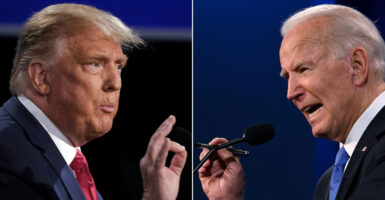
This combination photo, created Oct. 22, 2020, shows then-President Donald Trump and his president-to-be challenger, Joe Biden, during a presidential debate at Belmont University in Nashville, Tennessee, on Oct. 22, 2020. (Photos: Brendan Smialowski and Jim Watson/ AFP/Getty Images)

America is sinking among the waves of incompetence, impotence, and fiscal incontinence of democratic socialist President Joe Biden. It is jarring to recall how much brighter things looked just 27 months ago, after four years of President Donald Trump’s triumphs, and before Biden arrived and wrecked everything.

From A to Z, here are 26 things that Trump got right:  

Abraham Accords: Trump brokered four peace agreements among Israel and other countries—Bahrain, the United Arab Emirates, Morocco, and Sudan.

Border wall: Trump’s 458 miles of concrete and steel fortified the border and curbed illegal immigration before Biden obliterated America’s southern frontier.


Consular offices in Jerusalem were upgraded to a U.S. Embassy, thus enforcing the relevant statute that Presidents Bill Clinton through Barack Obama circumvented.

Deregulation: Trump promised to kill two old regulations for every new one imposed. American Action Forum counts 4.7 existing rules junked per new one implemented.

Energy Independence: Trump achieved the impossible dream of U.S. self-reliance and then made America globally dominant as a net exporter of energy for the first time since 1952.

Freedom-of-speech protection, per Trump’s executive order, became a prerequisite for colleges to receive federal funds.

Gorsuch, Kavanaugh, and Barrett joined the Supreme Court. Meanwhile, 223 other constitutionalists whom Trump nominated reached the federal bench.

Historically Black Colleges and Universitiesscored an advocacy office in the White House, a permanent stream of federal funds, and year-round Pell Grants, to aid their summer school students. HBCU presidents begged Obama in vain for these things. Trump invited them to the Oval Office in his fifth week in Washington, listened, and approved their requests.

Iran nuclear deal: Killed.

Javelin anti-tank missiles that Trump provided have helped Ukraine stymie Russian invaders.

Keystone XL pipeline: Approved.

“Little Rocket Man,” Kim Jong Un, met thrice with Trump. While North Korea did not scrap its nuclear weapons program, it conducted zero atomic tests after this odd couple first huddled in Singapore on June 12, 2018. Kim detonated four nukes under Obama-Biden.

Mexico, Canada, and the U.S. signed a new trade deal that replaced the North American Free Trade Agreement.

NATO’s finances soared, as Trump prodded U.S. allies to boost Western collective defense by $400 billion through 2024.

Opportunity Zones incentivized $78 billion in private capital to 8,768 largely low-income, minority communities.

Poverty fell to a rate of 10.5%, the lowest since 1959, when federal figures were first collected. Before COVID-19 unleashed hell on Earth, the strongest economy in 60 years drove black poverty to 18.8%, a record low.

Qassem Soleimani, Iranian Revolutionary Guard Corps chief, was droned to smithereens on Trump’s order. Tehran’s ayatollahs promptly learned some manners.

Right to Try legislation freed terminally ill patients to use promising treatments that awaited Food and Drug Administration approval.

Space Force: Trump’s out-of-this world promise became reality as the Pentagon’s newest armed service.

Tax Cuts and Jobs Act: This $1.9 trillion tax reduction unleashed massive economic growth that most benefited lower-income Americans.

Unemployment hit all-time lows for blacks and Hispanics and triggered the lowest female unemployment rate since September 1953.

Veterans secured broader medical freedoms through VA Choice and swift punishment for abusive VA employees.

Washington, D.C.’s school-voucher program was reauthorized with a $45 million appropriation.

Xi Jinping and other Chinese Communist Party members restrained themselves when Trump deployed his peace through strength strategy. Under Biden, Red China does whatever it wants, from an unprecedented mock blockade of Taiwan to spy balloons vacuuming up intelligence over America to U.S.-based CCP “police stations” that terrorize dissidents.

Yes votes for the First Step Act totaled 358 in the House (including 176 Democrats) and 87 in the Senate (among them, 47 Democrats). This overwhelmingly bipartisan criminal justice reformmeasure let nonviolent prisoners, many of them black, return to their communities.

Zero American wars began under Trump. The dovish consequences of his hawkish command were exactly the opposite of the “Push the nuclear button NOW!” belligerence that his deranged critics forecast.

Wouldn’t four more years of Trump be better than four years of Biden?

The Daily Signal publishes a variety of perspectives. Nothing written here is to be construed as representing the views of The Heritage Foundation.

Have an opinion about this article? To sound off, please email letters@DailySignal.com and we’ll consider publishing your edited remarks in our regular “We Hear You” feature. Remember to include the url or headline of the article plus your name and town and/or state.

Defending the (Prudent Understanding of the) Laffer Curve

I’ve written dozens of articles about the Laffer Curveand most of that verbiage can be summarized in these five points.

  • The Laffer Curve helps to illustrate that excessive tax rates result in less taxable activity.
  • All public finance economists – even those on the left – agree there is a Laffer Curve.
  • The Laffer Curve does not mean tax cuts are self-financing or that tax increases lose revenue.
  • Different types of taxes produce different responses, so there is more than one Laffer Curve.
  • There is a real debate about the shape of the Laffer Curve and the ideal point on the curve.

The fifth point recognizes that well-meaning and knowledgeable people can vigorously disagree.

Do changes in tax policy have big effects or small effects on the economy? How much revenue feedback will occur if there is a change in tax rates?

Just a couple of examples of questions that I have endlessly debated with reasonable folks on the left.

But let’s focus today on the unreasonable left. Or, to be more specific, let’s look at an editorial from the St. Louis Post-Dispatch.

Here are some portions of that newspaper’s simplistic screed.

…the deficit explosion…effectively disproved his theory that cutting taxes on the rich would increase government tax revenue. …Laffer continues to be unchastened…, even as Britain reels from a leadership shuffle caused by the catastrophic application of his very theories. Hand it to Laffer: Seldom does someone who is so often proven wrong have the gumption to maintain he’s right…His famous “Laffer curve” presumes to prove that tax cuts for the rich will spur economic investment, causing such strong economic growth that the government’s tax revenue would actually rise instead of falling. …Yes, the economy was robust in the 1980s after Reagan’s historic tax cuts. But that’s also when the era of big budget deficits began. …congressional Republicans and President Donald Trump in 2017 slashed corporate taxes in what they claimed was a necessary economy-booster… Then-Treasury Secretary Stephen Mnuchin’s famous vow that the tax-cut plan would “pay for itself” in growth — the very definition of Laffer’s theory — has since been exposed as the voodoo it always was.

Almost every sentence in the above excerpt cries out for correction.

For instance, Reagan and his team never claimed that the 1981 tax cuts would be self-financing (though IRS data shows that lower tax rates on the rich did produce more revenue).

There were big deficits because of the 1980-1982 double-dip recession, and that spike in red ink mostly took place before Reagan’s tax cuts went into effect.

And it’s absurd to blame the United Kingdom’s political instability on tax cuts that never occurred.

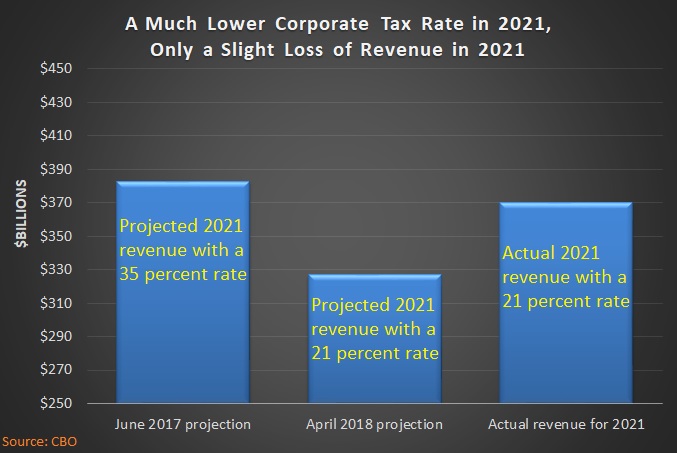
If Secretary Mnunchin claimed the entire tax cut would pay for itself, he clearly deserves to be mocked, but it’s worth noting that the lower corporate tax rate from the 2017 reform is very close to being self-financing.

Not that we should be surprised. Both the IMF and OECD have research showing that lower corporate tax rates do not necessarily lead to lower corporate tax revenues.

The bottom line is that the editorial board of the St. Louis Post-Dispatch obviously puts ideology above accuracy.

P.S. I can’t resist sharing one other excerpt from the editorial.

“The Kansas Experiment,” was a debacle. The state’s economy didn’t skyrocket, but the deficit did, forcing deep cuts to education before the legislature finally acknowledged defeat and reversed the tax cuts.

Once again, the editors are showing that ideology trumps accuracy. Here’s what really happened in Kansas. I hope we can have more defeats like that! Though I’ll be the first to admit that North Carolina is a much better role model.

Corporate Tax Rates and Taxable Income

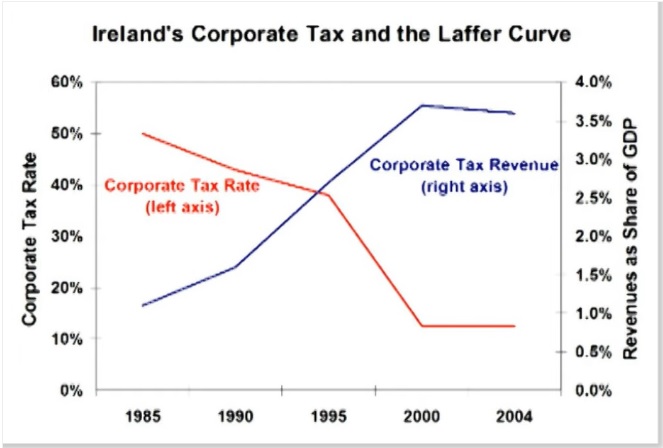
In the case of business taxation, the most visually powerful evidence for the Laffer Curve is what happened to corporate tax revenue in Ireland after the corporate tax rate was slashed from 50 percent to 12.5 percent.

Tax revenue increased dramatically. Not just in nominal terms. Not just in inflation-adjusted terms.

Corporate receipts actually climbed as a share of GDP.

And this was during the decades when economic output was rapidly expanding.

In other words, the Irish government got a much bigger slice of a much bigger pie after tax rates were dramatically lowered.

Now let’s look at some evidence from a new study. Three professors from the University of Utah (Jeffrey Coles, Elena Patel, and Nather Seegert), and a Treasury Department economist (Matthew Smith) estimated what happens to taxable income for U.S. companies when there is a change in the corporate tax rate.

In response to a 10% increase in the expected marginal tax rate, private U.S. firms decrease taxable income by 9.1%, which indicates a discernibly more elastic response than prevailing estimates. This response reflects a decrease in taxable income of 3.0%arising from real economic responses to a firm’s scale of operations and 6.1% arising from accounting transactions via (for example) revenue and expense timing. Responsiveness to the corporate tax rate is more elastic if a firm uses cash (9.9%) rather than accrual accounting (7.4%), if the firm is small (9.9%) rather than large (8.6%), and if the firm discounts future cash flows at a lower rate.

The paper is filled with equation, graphs, and jargon, but the above excerpt tells us everything we need to know.

When tax rates go up, taxable income goes down (both because there is less economic activity and because companies have more incentive to manipulate the tax code).

Thus confirming what I wrote back in 2016 about taxable income being the key variable.

By the way, this does not mean that lower tax rates lead to more revenue. Or that higher tax rate produce less revenue.

Such big swings only happen in rare circumstances.

But it does mean that politicians will not grab as much money as they hope when they increase tax rates. And that they won’t lose as much revenue as they fear when they lower tax rates (and we saw that most recently with the 2017 tax reform).

I’ll close by noting that this is additional evidence for why we should be thankful that Biden’s proposal for higher corporate tax rates was not enacted.

P.S. The chart at the beginning of this column may be the most visually powerful evidence for the corporate Laffer Curve. The most empirically powerful evidence, however, comes from very unlikely sources – the pro-tax IMF and the pro-tax OECD.

March 3, 2021

President Biden c/o The White House
1600 Pennsylvania Avenue NW
Washington, DC 20500

Dear Mr. President,

______________________________

Dan Mitchell shows how ignoring the Laffer Curve is like running a stop sign!!!!

I’m thinking of inventing a game, sort of a fiscal version of Pin the Tail on the Donkey.

Only the way it will work is that there will be a map of the world and the winner will be the blindfolded person who puts their pin closest to a nation such asAustralia or Switzerland that has a relatively low risk of long-run fiscal collapse.

That won’t be an easy game to win since we have data from the BISOECD, and IMF showing that government is growing far too fast in the vast majority of nations.

We also know that many states and cities suffer from the same problems.

A handful of local governments already have hit the fiscal brick wall, with many of them (gee, what a surprise) from California.

The most spectacular mess, though, is about to happen in Michigan.

The Washington Post reports that Detroit is on the verge of fiscal collapse.

After decades of sad and spectacular decline, it has come to this for Detroit: The city is $19 billion in debt and on the edge of becoming the nation’s largest municipal bankruptcy. An emergency manager says the city can make good on only a sliver of what it owes — in many cases just pennies on the dollar.

This is a dog-bites-man story. Detroit’s problems are the completely predictable result of excessive government. Just as statism explains the problems of Greece. And the problems of California. And the problems of Cyprus. And theproblems of Illinois.

I could continue with a long list of profligate governments, but you get the idea. Some of these governments are collapsing at a quicker pace and some at a slower pace. But all of them are in deep trouble because they don’t follow my Golden Rule about restraining the burden of government spending so that it grows slower than the private sector.

Detroit obviously is an example of a government that is collapsing sooner rather than later.

Why? Simply stated, as the size and scope of the public sector increased, that created very destructive economic and political dynamics.

More and more people got lured into the wagon of government dependency, which puts an ever-increasing burden on a shrinking pool of producers.

Meanwhile, organized interest groups such as government bureaucrats used their political muscle to extract absurdly excessive compensation packages, putting an even larger burden of the dwindling supply of taxpayers.

But that’s not the main focus of this post. Instead, I want to highlight a particular excerpt from the article and make a point about how too many people are blindly – perhaps willfully – ignorant of the Laffer Curve.

Check out this sentence.

Property tax collections are down 20 percent and income tax collections are down by more than a third in just the past five years — despite some of the highest tax rates in the state.

This is a classic “Fox Butterfield mistake,” which occurs when someone fails to recognize a cause-effect relationship. In this case, the reporter should have recognized that tax collections are down because Detroit has very high tax rates.

The city has a lot more problems than just high tax rates, of course, but can there be any doubt that productive people have very little incentive to earn and report taxable income in Detroit?

And that’s the essential insight of the Laffer Curve. Politicians can’t – or at least shouldn’t – assume that a 20 percent increase in tax rates will lead to a 20 percent increase in tax revenue. They also have to consider the degree to which a higher tax rate will cause a change in taxable income.

In some cases, higher tax rates will discourage people from earning more taxable income.

In some cases, higher tax rates will discourage people from reporting all the income they earn.

In some cases, higher tax rates will encourage people to utilize tax loopholes to shrink their taxable income.

In some cases, higher tax rates will encourage migration, thus causing taxable income to disappear.

Here’s my three-part video series on the Laffer Curve. Much of this is common sense, though it needs to be mandatory viewing for elected officials (as well as the bureaucrats at the Joint Committee on Taxation).

The Laffer Curve, Part I: Understanding the Theory

Uploaded by  on Jan 28, 2008

The Laffer Curve charts a relationship between tax rates and tax revenue. While the theory behind the Laffer Curve is widely accepted, the concept has become very controversial because politicians on both sides of the debate exaggerate. This video shows the middle ground between those who claim “all tax cuts pay for themselves” and those who claim tax policy has no impact on economic performance. This video, focusing on the theory of the Laffer Curve, is Part I of a three-part series. Part II reviews evidence of Laffer-Curve responses. Part III discusses how the revenue-estimating process in Washington can be improved. For more information please visit the Center for Freedom and Prosperity’s web site: http://www.freedomandprosperity.org

Part 2

Part 3

P.S. Just in case it’s not clear from the videos, we don’t want to be at the revenue-maximizing point on the Laffer Curve.

P.P.S. Amazingly, even the bureaucrats at the IMF recognize that there’s a point when taxes are so onerous that further increases don’t generate revenue.

P.P.P.S. At least CPAs understand the Laffer Curve, probably because they help their clients reduce their tax exposure to greedy governments.

P.P.P.P.S. I offered a Laffer Curve lesson to President Obama, but I doubt it had any impact.

___________________________

Thank you so much for your time. I know how valuable it is. I also appreciate the fine family that you have and your commitment as a father and a husband.

Sincerely,

Everette Hatcher III, 13900 Cottontail Lane, Alexander, AR 72002, ph 501-920-5733,

Williams with Sowell – Minimum Wage

Thomas Sowell

Thomas Sowell – Reducing Black Unemployment

By WALTER WILLIAMS

—-

Ronald Reagan with Milton Friedman
Milton Friedman The Power of the Market 2-5

Related posts:

Dan Mitchell: Question of the Week: Has the European Fiscal Crisis Ended?

We got to cut spending or we will be in a fiscal crisis like Greece!!! Question of the Week: Has the European Fiscal Crisis Ended? January 12, 2013 by Dan Mitchell I’ve frequently commented on Europe’s fiscal mess and argued that excessive government spending is responsible for both the sovereign debt crisis and the economic stagnation […]

Taxes made simple by Dan Mitchell of the Cato Institute

The Flat Tax: How it Works and Why it is Good for America Uploaded by afq2007 on Mar 29, 2010 This Center for Freedom and Prosperity Foundation video shows how the flat tax would benefit families and businesses, and also explains how this simple and fair system would boost economic growth and eliminate the special-interest […]

Cartoons from Dan Mitchell’s blog that demonstrate what Obama is doing to our economy (Obama’s out of control spending not helped by raising taxes on rich)

I have put up lots of cartoons from Dan Mitchell’s blog before and they have got lots of hits before. Many of them have dealt with the economy, eternal unemployment benefits, socialism,  Greece,  welfare state or on gun control. President Obama really does think that all his answers lie in raising taxes on the rich when the […]

Dan Mitchell of the Cato Institute gives overview of economic policy and he praises Clinton and Reagan

__________ President Reagan, Nancy Reagan, Tom Selleck, Dudley Moore, Lucille Ball at a Tribute to Bob Hope’s 80th birthday at the Kennedy Center. 5/20/83. __________________________ Dan Mitchell is very good at giving speeches and making it very simple to understand economic policy and how it affects a nation. Mitchell also talks about slowing the growth […]

Cartoons from Dan Mitchell’s blog that demonstrate what Obama is doing to our economy (cartoon on entitlements)

The Laffer Curve – Explained Uploaded by Eddie Stannard on Nov 14, 2011 This video explains the relationship between tax rates, taxable income, and tax revenue. The key lesson is that the Laffer Curve is not an all-or-nothing proposition, where we have to choose between the exaggerated claim that “all tax cuts pay for themselves” […]

Open letter to President Obama (Part 296) (Laffer curve strikes again!!)

President Obama c/o The White House 1600 Pennsylvania Avenue NW Washington, DC 20500 Dear Mr. President, I know that you receive 20,000 letters a day and that you actually read 10 of them every day. I really do respect you for trying to get a pulse on what is going on out here. The way […]

Open letter to President Obama (Part 282, How the Laffer Curve worked in the 20th century over and over again!!!)

Dan Mitchell does a great job explaining the Laffer Curve President Obama c/o The White House 1600 Pennsylvania Avenue NW Washington, DC 20500 Dear Mr. President, I know that you receive 20,000 letters a day and that you actually read 10 of them every day. I really do respect you for trying to get a […]

Laffer curve hits tax hikers pretty hard (includes cartoon)

I have put up lots of cartoons from Dan Mitchell’s blog before and they have got lots of hits before. Many of them have dealt with the economy, eternal unemployment benefits, socialism,  Greece,  welfare state or on gun control. Today’s cartoon deals with the Laffer curve. Revenge of the Laffer Curve…Again and Again and Again March 27, 2013 […]

Editorial cartoon from Dan Mitchell’s blog on California’s sorry state of affairs

I have put up lots of cartoons from Dan Mitchell’s blog before and they have got lots of hits before. Many of them have dealt with the sequester, economy, eternal unemployment benefits, socialism,  minimum wage laws, tax increases, social security, high taxes in California, Obamacare,  Greece,  welfare state or on gun control. President Obama’s favorite state must be California because […]

Portugal and the Laffer Curve

Class Warfare just don’t pay it seems. Why can’t we learn from other countries’ mistakes? Class Warfare Tax Policy Causes Portugal to Crash on the Laffer Curve, but Will Obama Learn from this Mistake? December 31, 2012 by Dan Mitchell Back in mid-2010, I wrote that Portugal was going to exacerbate its fiscal problems by raising […]

Political arguments against higher taxes from Dan Mitchell

Republicans would be stupid to raise taxes. Don’t Get Bamboozled by the Fiscal Cliff: Five Policy Reasons and Five Political Reasons Why Republicans Should Keep their No-Tax-Hike Promises December 6, 2012 by Dan Mitchell The politicians claim that they are negotiating about how best to reduce the deficit. That irks me because our fiscal problem is […]

President Obama ignores warnings about Laffer Curve

The Laffer Curve – Explained Uploaded by Eddie Stannard on Nov 14, 2011 This video explains the relationship between tax rates, taxable income, and tax revenue. The key lesson is that the Laffer Curve is not an all-or-nothing proposition, where we have to choose between the exaggerated claim that “all tax cuts pay for themselves” […]

Dan Mitchell looks at Obama’s tax record

Dan Mitchell’s article and the video from his organization takes a hard look at President Obama’s tax record. Dissecting Obama’s Record on Tax Policy October 30, 2012 by Dan Mitchell The folks at the Center for Freedom and Prosperity have been on a roll in the past few months, putting out an excellent series of videos […]

Dan Mitchell: “Romney is Right that You Can Lower Tax Rates and Reduce Tax Preferences without Hurting the Middle Class”

The Laffer Curve, Part I: Understanding the Theory Uploaded by afq2007 on Jan 28, 2008 The Laffer Curve charts a relationship between tax rates and tax revenue. While the theory behind the Laffer Curve is widely accepted, the concept has become very controversial because politicians on both sides of the debate exaggerate. This video shows […]

The Laffer Curve Wreaks Havoc in the United Kingdom

I got to hear Arthur Laffer speak back in 1981 and he predicted what would happen in the next few years with the Reagan tax cuts and he was right with every prediction. The Laffer Curve Wreaks Havoc in the United Kingdom July 1, 2012 by Dan Mitchell Back in 2010, I excoriated the new […]

By Everette Hatcher III | Posted in Cato Institute | Tagged  | Edit | Comments (0)

Dan Mitchell: Maryland to Texas, but Not Okay to Move from the United States to Singapore?

You can’t blame someone for leaving one state for another if they have a better an opportunity to make money. Maryland to Texas, but Not Okay to Move from the United States to Singapore? July 12, 2012 by Dan Mitchell I’ve commented before about entrepreneurs, investors, and small business owners migrating from high tax states such […]

Liberals act like the Laffer Curve does not exist.

Raising taxes will not work. Liberals act like the Laffer Curve does not exist. The Laffer Curve Shows that Tax Increases Are a Very Bad Idea – even if They Generate More Tax Revenue April 10, 2012 by Dan Mitchell The Laffer Curve is a graphical representation of the relationship between tax rates, tax revenue, and […]

Dan Mitchell shows why soak-the-rich tax policy does not work

Dan Mitchell of the Cato Institute shows why Obama’s plan to tax the rich will not solve our deficit problem.   Explaining in the New York Post Why Obama’s Soak-the-Rich Tax Policy Is Doomed to Failure April 17, 2012 by Dan Mitchell I think high tax rates on certain classes of citizens are immoral and discriminatory. If the […]

Dan Mitchell of the Cato Institute takes on liberals on PBS

You want the rich to pay more? Dan Mitchell observed:I explained that “rich” taxpayers declared much more income and paid much higher taxes after Reagan reduced the top tax rate from 70 percent to 28 percent. Liberals don’t understand good tax policies. Against 3-1 Odds, Promoting Good Tax Policy on Government TV April 12, 2012 by […]

Dan Mitchell of the Cato Institute takes on the Buffett Rule

Class warfare again from President Obama.  Rejecting the Buffett Rule and Fighting Obama’s Class Warfare on CNBC April 10, 2012 by Dan Mitchell I’ve already explained why Warren Buffett is either dishonest or clueless about tax policy. Today, on CNBC, I got to debate the tax scheme that President Obama has named after the Omaha investor. […]

By Everette Hatcher III | Posted in Cato InstituteTaxes | Edit | Comments (0)

Tucker Carlson last talk as representative of Fox News!!!

——

“What you’re watching is not a political movement,” Fox News host Tucker Carlson says Friday night at The Heritage Foundation’s 50th anniversary gala. “It’s evil.” (Photo: Erin Gruznow for The Heritage Foundation)


OXON HILL, Md.—The battle for America today is one between good and evil, popular Fox News host Tucker Carlson said Friday night in his keynote address at The Heritage Foundation’s 50th anniversary gala.

“What you’re watching is not a political movement,” Carlson said. “It’s evil.”

The side of evil is characterized by violence, hate, disorder, division, disorganization, and filth, Carlson said in remarks at the black-tie-optional affair at the Gaylord National Resort & Convention Center here. And praying to protect America against such things is something he too often forgets to do, he told a ballroom audience of about 2,000.

The battle is not about economics or policy papers, Carlson said, as it was in 1991 when he began his first job at The Heritage Foundation as a fact-checker on the same day communist hard-liners staged a coup in the Soviet Union. (The Daily Signal is Heritage’s multimedia news organization.)


“The side of good is characterized by calmness, tranquility, peace, lack of conflict, cleanliness,” Carlson said. “And evil is characterized by their opposites.”

Now, the Fox News host said, those on the side of goodness must assess and challenge phenomena such as the transgender and pro-abortion movements—and the old mindset won’t work. 

Arguing that abortion is a positive good is actually promoting “child sacrifice,” Carlson said, to resounding applause from the audience of about 2,000.

“The weight of the government and a lot of corporate interests are behind transgenderism,” he added. “None of this makes sense in conventional political terms.”

When he looks around, Carlson said, he sees people under the pressure of the present moment. His fellow Americans are saying things they don’t believe and can’t define to avoid cancellation due to humanity’s herd instinct, he said. 

Heritage Foundation President Kevin Roberts introduced Carlson.

“God bless him for having the courage” not to knuckle under to political correctness, Robert said of Carlson, adding: “I know that all of you are grateful for his witness … to that [American] flag there.”

Carlson’s speech capped not only Heritage’s evening gala but its two-day 50th Anniversary Leadership Summit, which brought together elected officials, conservative leaders, former government officials, and other Heritage supporters to discuss the future of America and an agenda for the next president.

A speech by Florida Gov. Ron DeSantis, a Republican, closed the Leadership Summit, which also featured remarks from Senate Republicans Mike Lee of Utah, Josh Hawley of Missouri, Tim Scott of South Carolina, and JD Vance of Ohio.

America has “terrible people in charge,” Carlson said hours later, from government officials to clergymen to educators. 

With a note of disbelief at the change in a few years, Carlson spoke of the so-called LGBTQIA+ movement, quipping: “Find a plus and I’ll interview them.” 

He then turned serious.

“There always is a countervailing force at work, a counteracting force to the badness,” Carlson told the appreciative crowd. “It’s called goodness.”

A group of Americans always will stand against left-wing ideology by refusing to betray their faith, dignity, or autonomy in going along with something that is demonstrably not true, he said.

“There’s nothing you can do to make me do that,” Carlson said, to applause.

“The second you decide to tell the truth about something, you are filled with this power from somewhere else,” he said. “The more you tell the truth, the stronger you become.”

The reverse is true about lying, Carlson said, a practice that makes people “weak and afraid.”

Many Americans pay a heavy price for telling the truth, yet stand firm, he said, and they are heroes to him. 

Carlson credited those who speak the truth against diversity, equity, and inclusion initiatives, called DEI, even when it costs them their careers.

He repeatedly encouraged his audience to pray for America, rather than giving in to debilitating worry about their nation—something he said he often forgets to do himself. 

Carlson urged prayer for the nation even as he mocked himself as an Episcopalian, one of “the Samaritans of Christianity.”

“I don’t pray enough for the country, and I should,” he said. 

Carlson hosts Fox News’ flagship prime-time cable news program “Tucker Carlson Tonight,” consistently drawing more than 3 million viewers nightly. Since the 2017 launch of the show, which airs weeknights at 8 p.m. Eastern time, Carlson steadily has built it into the top-ranking cable news show in prime time.

A sharp-tongued, quick-witted commentator and questioner, Carlson most recently demonstrated his clout by airing a two-part interview this week with Tesla and SpaceX executive Elon Musk, who continues to torment the Left as the new CEO of Twitter.

Roberts and Carlson traded quips in a brief question-and-answer session after the Fox News host’s speech.

When Roberts asked about the biggest social and cultural change Carlson has seen in the past 10 or more years, he quickly replied: “The lack of information.”

Citing Musk in the recent interview, Carlson explained:

He had such a wonderful line, he said, ‘The most likely outcome is the most ironic outcome.’ And … I would argue that’s a Christian precept, actually. It’s [in] the Beatitudes; you know, ‘The first shall be last.’ And the opposite of what you think is going to happen, happens, so often.

The core promise of the internet was as much information as we’ve ever had, at your fingertips. And the result has been a centralization of information, which is deliberate needless to say, unnoticed by most people, that results in more control of information than we could even have imagined 20 years ago.

Polling, Carlson said, suggests hundreds of millions of Americans don’t have the facts about issues that affect them, as was seen during the COVID-19 pandemic.

“That challenges the idea of democracy, which rests on the notion of an informed voting public, the citizen,” he told Roberts, adding:

The last thing I’ll say is don’t throw away your hard-copy books, because they are the repository, the enduring repository [of knowledge] … because they can’t be disappeared, because they exist physically. And I would say a corollary to this is don’t throw away your relationships with people, because they can’t be disappeared either.

In response to Roberts’ question about what his audience should have “top of mind” in the morning, Carlson said: “The very first thing you should do every single day is tell the people you love that you love them.”

Carlson’s keynote was his first speech at a Heritage event since 2018, when the Fox host and commentator received the organization’s Salvatori Prize for American Citizenship, an award that recognizes work to protect and advance American values.

Carlson actually began his journalism career at Heritage, working for Policy Journal, a quarterly journal it published at the time.

Roberts, who took over as the think tank’s seventh president in late 2021, praised Carlson in February for his influence and courage while announcing the commentator’s participation in Heritage’s 50th anniversary celebration.

“Tucker Carlson is a fearless American who is unafraid to challenge the Washington regime, ask tough questions, and hold the ruling elite accountable. His nightly show is must-see TV for anyone who realizes we have limited window of time to save this country,” Roberts said in the announcement.

Before becoming a standout in the Fox News lineup, Carlson co-founded and served as editor-in-chief of The Daily Caller as a conservative news organization. He is the former host of MSNBC’s “Tucker” and CNN’s “Crossfire.”

Carlson also is host of the Fox Nation streaming series “Tucker Carlson Today” and “Tucker Carlson Originals.” He is the author of the books “Ship of Fools: How a Selfish Ruling Class Is Bringing America to the Brink of Revolution” and “The Long Slide: Thirty Years in American Journalism.”

This report was updated within an hour of publication to include Carlson’s comments from the brief Q&A.

Have an opinion about this article? To sound off, please email letters@DailySignal.com and we’ll consider publishing your edited remarks in our regular “We Hear You” feature. Remember to include the url or headline of the article plus your name and town and/or state.


Tucker: This video tells a different story of Jan 6


Democrats Upset as Fox’s Carlson Debunks Their Jan. 6 Lies With Capitol Video

Fox News host Tucker Carlson—seen here at a National Review Institute Ideas Summit on March 29, 2019, in Washington, D.C.—made use this week of some of the more than 40,000 hours of Capitol video to refute many of the claims of the partisan Jan. 6 committee. (Photo: Chip Somodevilla/Getty Images)


After reviewing some 41,000 hours of security camera videos, Tucker Carlson and his Fox News team this week refuted numerous lies that Democrats have trafficked since Jan. 6, 2021.

The following are the five biggest:

Footage from outside the Capitol shows an initial cadre of violent extremists breaking windows and kicking down doors. “It was awful,” Carlson said. “We hate vandalism. We hate assault.”

But new video shows hundreds, perhaps thousands, of people who walked calmly between velvet ropes within the Capitol. Many took photos of paintings in the Rotunda. Two of them quietly perused a literature table and walked away with free publications.


Many of these unarmed protesters innocently wandered into the Capitol, after overwhelmed guards threw the doors open. Evidently, they thought that Jan. 6 was an open house on Capitol Hill.

Should these people have been there? No.

Were they armed revolutionaries? No.

  • Wearing red-white-and-blue face paint and fur-wrapped Viking horns, an Arizona Navy veteran named Jacob Chansley—dubbed “the QAnon Shaman”—was that day’s highest-profile protester.

The Justice Department called Chansley “the most prominent symbol of a violent insurrection.” Former federal prosecutor Paul Butler said on MNSBC: “Chansley is a stone-cold thug.” 

Security cameras witnessed a far-from-dangerous Chansley on what the New York Post called a “Tour de Farce.” Police escorted him through the Capitol. At least nine officers surrounded him. Two tried to open locked doors for him. None arrested him. Indeed, his armed guides ushered him into the Senate chamber. 

Rather than attack them there, Chansley prayed: “Thank you, Heavenly Father, for taking the inspiration needed to these police officers to allow us into the building.”

Should Chansley have been there? No.

Was he a “stone-cold thug?” No.

  • CBS News blamed some 2,000 Jan. 6 rioters for “causing the deaths of five police officers.” MSNBC’s Joe Scarborough claimed that “Donald Trump’s supporters … killed police officers.” 

Some rioters, in fact, battled and beat cops. They should be locked up.

There were law enforcement personnel who perished—“none of whom died at the scene on Jan. 6,” according to FactCheck.org. Four committed suicide—three days, eight days, and two of them, six months later, respectively.

Tragic and horrible? Yes. 

Did Trump supporters kill them? No. 

CNN’s Anderson Cooper said: “Officer Brian Sicknick died after being hit in the head with a fire extinguisher during the fight.”

New Jan. 6 video, in fact, shows Sicknick alive, well, and on duty inside the Capitol, after rioters supposedly killed him, outside the building. He wore a helmet, which shielded him from fatal cranial trauma. 

“Officer Brian Sicknick died of natural causes,” an April 19, 2021, Capitol Police statement declared. The Washington, D.C., coroner determined that two strokes killed Sicknick on Jan. 7, 2021.

A depressing and untimely demise? Yes.

Murder by Trump supporters? No.

  • According to the Jan. 6 committee, “On January 5th, [Trevor] Hallgren took a tour of the Capitol with [Rep. Barry Loudermilk, R-Ga.] during which he took pictures of hallways and staircases.”

Lie: Loudermilk showed the carefully plotting putschists how to succeed.

Truth: Loudermilk took some 15 constituents through the Rayburn House Office Building, across the street from the Capitol. None of Loudermilk’s guests was in the Capitol the next day.

  • “Later that day, [Sen. Josh Hawley, R-Mo.] fled after those protesters he helped to rile up stormed the Capitol,” said then-Rep. Elaine Luria, D-Va., a member of the committee, which then presented a recording of Hawley running down a Senate hallway. The audience roared with derisive laughter.

New video shows that Hawley followed Capitol Police advice and was at least the 25th person to sprint past that security camera.

Of course, that unraveled the Democrats’ lies. So, they padlocked the truth until House Republicans set it free.

The Daily Signal publishes a variety of perspectives. Nothing written here is to be construed as representing the views of The Heritage Foundation.

Have an opinion about this article? To sound off, please email letters@DailySignal.com and we’ll consider publishing your edited remarks in our regular “We Hear You” feature. Remember to include the url or headline of the article plus your name and town and/or state.


——-


left undermines America width=

The left praises democracy when elected but claims the right will destroy democracy when it loses. Pictured: Former presidential candidate Hillary Clinton discusses the 2016 election during her 2017 book tour. (Photo: Bastiaan Slabbers, NurPhoto/Getty Images)


Recently, Democrats have been despondent over President Joe Biden’s sinking poll numbers. His policies on the economy, energy, foreign policy, the border, and COVID-19 all have lost majority support.

As a result, the left now variously alleges that either in 2022, when it expects to lose the Congress, or in 2024, when it fears losing the presidency, Republicans will “destroy democracy” or stage a coup.

A cynic might suggest that those on the left praise democracy when they get elected, only to claim it is broken when they lose. Or they hope to avoid their defeat by trying to terrify the electorate. Or they mask their own revolutionary propensities by projecting them onto their opponents.

After all, who is trying to federalize election laws in national elections contrary to the spirit of the Constitution? Who wishes to repeal or circumvent the Electoral College? Who wishes to destroy the more than 180-year-old Senate filibuster, the over 150-year-old nine-justice Supreme Court, and the more than 60-year-old 50-state union?

Who is attacking the founding constitutional idea of two senators per state?

The Constitution also clearly states that “When the President of the United States is tried, the Chief Justice shall preside.” Who slammed through the impeachment of former President Donald Trump without a presiding chief justice?

Never had a president been either impeached twice or tried in the Senate as a private citizen. Who did both?

The left further broke prior precedent by impeaching Trump without a special counsel’s report, formal hearings, witnesses, and cross-examinations.

Who exactly is violating federal civil rights legislation?

New York City’s Department of Health and Mental Hygiene in December decided to ration new potentially lifesaving COVID-19 medicines, partially on the basis of race, in the name of “equity.”

The agency also allegedly used racial preferences to determine who would be first tested for COVID-19. Yet such racial discrimination seems in direct violation of various title clauses of the 1964 Civil Rights Act.

That law makes it clear that no public agency can use race to deny “equal utilization of any public facility which is owned, operated, or managed by or on behalf of any State or subdivision thereof.” Who is behind the new racial discrimination?

In summer 2020, many local- and state-mandated quarantines and bans on public assemblies were simply ignored with impunity—if demonstrators were associated with Black Lives Matter or protesting the police.

Currently, the Biden administration is also flagrantly embracing the neo-Confederate idea of nullifying federal law.

The Biden administration has allowed nearly 2 million foreign nationals to enter the United States illegally across the southern border—in hopes they will soon be loyal constituents.

The administration has not asked illegal entrants either to be tested for or vaccinated against COVID-19. Yet all U.S. citizens in the military and employed by the federal government are threatened with dismissal if they fail to become vaccinated.

Such selective exemption of lawbreaking non-U.S. citizens, but not millions of U.S. citizens, seems in conflict with the equal protection clause of the 14th Amendment.

After entering the United States illegally, millions of immigrants are protected by some 550 “sanctuary city” jurisdictions. These revolutionary areas all brazenly nullify immigration law by refusing to allow federal immigration authorities to deport illegal immigrant lawbreakers.

At various times in our nation’s history—1832, 1861-65, and 1961-63—America was either racked by internal violence or fought a civil war over similar state nullification of federal laws.

In the last five years, we have indeed seen many internal threats to democracy.

Hillary Clinton hired a foreign national to concoct a dossier of dirt against her presidential opponent. She disguised her own role by projecting her efforts to use Russian sources onto Trump. She used her contacts in government and media to seed the dossier to create a national hysteria about “Russian collusion.” Clinton urged Biden not to accept the 2020 result if he lost, and herself claimed Trump was not a legitimately elected president.

The chairman of the Joint Chiefs of Staff has violated laws governing the chain of command. Some retired officers violated Article 88 of the Uniform Code of Military Justice by slandering their commander in chief. Others publicly were on record calling for the military to intervene to remove an elected president.

Some of the nation’s top officials in the FBI and intelligence committee have misled or lied under oath either to federal investigators or the U.S. Congress, again, mostly with impunity.

All these sustained revolutionary activities were justified as necessary to achieve the supposedly noble ends of removing Trump.

The result is Third World-like jurisprudence in America aimed at rewarding friends and punishing enemies, masked by service to social justice.

We are in a dangerous revolutionary cycle. But the threat is not so much from loud, buffoonish, one-day rioters on Jan. 6. Such clownish characters did not for 120 days loot, burn, attack courthouses and police precincts, cause over 30 deaths, injure 2,000 policemen, and destroy at least $2 billion in property—all under the banner of revolutionary justice.

Even more ominously, stone-cold sober elites are systematically waging an insidious revolution in the shadows that seeks to dismantle America’s institutions and the rule of law as we have known them.


(C)2022 Tribune Content Agency, LLC.

The Daily Signal publishes a variety of perspectives. Nothing written here is to be construed as representing the views of The Heritage Foundation. 


Have an opinion about this article? To sound off, please email letters@DailySignal.com and we’ll consider publishing your edited remarks in our regular “We Hear You” feature. Remember to include the URL or headline of the article plus your name and town and/or state.


The Honorable Representative Adam Kinzinger of Illinois, Washington D.C.

Dear Representative Adam Kinzinger, 

I noticed that you are a pro-life representative that has a long record of standing up for unborn babies! It was in the 1970’s when I was first introduced to the works of Francis Schaeffer and Dr. C. Everett Koop and I wanted to commend their writings and films to you.

I recently read about your impressive pro-life record:

Washington, DC – Today, Congressman Adam Kinzinger (IL-16) joined his House Republican colleagues in a press conference urging Democratic leadership to allow a vote on the Born Alive protections. The proposal would protect babies who survive abortion and provide them with the same medical care that any other premature baby would receive. Yesterday, the Democrats blocked the proposed legislation—for the 17th time—from coming before the House for a vote.

Joining the Congressman and House Republican leaders at the press conference this morning was Jill Stanek, an Illinois nurse and pro-life advocate who has witnessed the devastating realities of these pro-abortion laws. The Illinois legislature is currently debating two abortion bills, similar to the extreme pro-abortion agendas in New York and Virginia. 

It seems you have a grudge against President Trump while our freedoms under President Biden are being taken away. I recommend to you the article below:

The January 6 Insurrection Hoax

 • Volume 50, Number 9 • Roger Kimball

Roger Kimball
Editor and Publisher, The New Criterion

Mr. Kimball concludes his article with these words: 

That’s one melancholy lesson of the January 6 insurrection hoax: that America is fast mutating from a republic, in which individual liberty is paramount, into an oligarchy, in which conformity is increasingly demanded and enforced.

Another lesson was perfectly expressed by Donald Trump when he reflected on the unremitting tsunami of hostility that he faced as President. “They’re after you,” he more than once told his supporters. “I’m just in the way.”


Bingo.

You can google and get Roger Kimball article “The January 6 Insurrection Hoax”

NOW WHAT DID YOU DO TO TURN YOUR BACK ON OUR LIBERTY AND PERPETUATE THE HOAX THAT JANUARY 6TH WAS AN INSURRECTION? Read below!! 

9 Republicans voted to hold Trump aide Bannon in contempt of Congress


There were a few Republicans Thursday who surprised observers when they voted in support of holding former Trump adviser Steve Bannon in contempt of Congress and referring him to the Justice Department for criminal prosecution.

Prior to the vote, four Republicans were considered a lock to approve the criminal referral, according to Capitol Hill sources: Reps. Liz Cheney of Wyoming, Adam Kinzinger of Illinois, Fred Upton of Michigan and Anthony Gonzalez of Ohio.


Cheney and Kinzinger are on the House select committee investigating the Jan. 6 insurrection at the U.S. Capitol, and have for months stood alone as the only two House Republicans willing to speak out against former President Donald Trump’s continued lies about the 2020 election. They were the only two House Republicans to vote for the formation of the select committee on June 30.

House Speaker Nancy Pelosi formed the select committee after Republicans rejected a bipartisan commission that would have been evenly split between five Democrats and five Republicans. Only 35 Republicans voted for that measure when itpassed the House of Representatives, and it was defeated by a GOP filibuster in the Senate.

WASHINGTON, DC - JULY 27:  (L-R) Rep. Jamie Raskin (D-MD), Rep. Liz Cheney (R-WY) and Rep. Adam Kinzinger (R-IL) arrive for the House Select Committee hearing investigating the January 6 attack on the U.S. Capitol on July 27, 2021 at the Canon House Office Building in Washington, DC. Members of law enforcement will testify about the attack by supporters of former President Donald Trump on the U.S. Capitol. According to authorities, about 140 police officers were injured when they were trampled, had objects thrown at them, and sprayed with chemical irritants during the insurrection. (Photo by Drew Angerer/Getty Images)


More

Upton has served in the House for more than three decades, since 1987, and will face a primary challenge next year because of his willingness to stand up to Trump.

Gonzalez is retiring from Congress next year, after only four years in the House. “While my desire to build a fuller family life is at the heart of my decision, it is also true that the current state of our politics, especially many of the toxic dynamics inside our own party, is a significant factor in my decision,” Gonzalez said in September when heannounced he would not seek another term.


The remaining five Republicans included three who voted for impeachment — Peter Meijer of Michigan, John Katko of New York and Jaime Herrera Beutler of Washington — and two House Republicans who did not vote to impeach Trump: Nancy Mace of South Carolina and Brian Fitzpatrick of Pennsylvania.

Do you realize that Americans rights are being taken away from them and would you like an example? I am going to quote Mr. Kimball again.  You can google and get Roger Kimball article “The January 6 Insurrection Hoax”

Trump seems never to have discerned what a viper’s nest our politics has become for anyone who is not a paid-up member of The Club. 

Maybe Trump understands this now. I have no insight into that question. I am pretty confident, though, that the 74 plus million people who voted for him understand it deeply. It’s another reason that The Club should be wary of celebrating its victory too expansively. 

Friedrich Hayek took one of the two epigraphs for his book, The Road to Serfdom, from the philosopher David Hume. “It is seldom,” Hume wrote, “that liberty of any kind is lost all at once.” Much as I admire Hume, I wonder whether he got this quite right. Sometimes, I would argue, liberty is erased almost instantaneously.

I’d be willing to wager that Joseph Hackett, confronted with Hume’s observation, would express similar doubts. I would be happy to ask Mr. Hackett myself, but he is inaccessible. If the ironically titled “Department of Justice” has its way, he will be inaccessible for a long, long time—perhaps as long as 20 years. 

Joseph Hackett, you see, is a 51-year-old Trump supporter and member of an organization called the Oath Keepers, a group whose members have pledged to “defend the Constitution against all enemies foreign and domestic.” The FBI does not like the Oath Keepers—agents arrested its leader in January and have picked up many other members in the months since. Hackett traveled to Washington from his home in Florida to join the January 6 rally. According to court documents, he entered the Capitol at 2:45 that afternoon and left some nine minutes later, at 2:54. The next day, he went home. On May 28, he was apprehended by the FBI and indicted on a long list of charges, including conspiracy, obstruction of an official proceeding, destruction of government property, and illegally entering a restricted building. 

As far as I have been able to determine, no evidence of Hackett destroying property has come to light. According to his wife, it is not even clear that he entered the Capitol. But he certainly was in the environs. He was a member of the Oath Keepers. He was a supporter of Donald Trump. Therefore, he must be neutralized.

Joseph Hackett is only one of hundreds of citizens who have beenbranded as “domestic terrorists” trying to “overthrow the government” and who are now languishing, in appalling conditions, jailed as political prisoners of an angry state apparat.

Let me recommend that you read this letter below from Senator Ron Johnson and his colleagues:

Sen. Johnson and Colleagues Request Answers from DOJ on Unequal Application of Justice to Protestors


WASHINGTON — U.S. Sen. Ron Johnson (R-Wis.), along with senators Tommy Tuberville (R-Ala.), Mike Lee (R-Utah), Rick Scott (R-Fla.), and Ted Cruz (R-Texas), sent a letter on Monday to Attorney General Merrick Garland requesting information on the unequal application of justice between the individuals who breached the Capitol on Jan. 6, and those involved in the unrest during the spring and summer of 2020. The senators sent 18 questions to the attorney general on what steps the DOJ has taken to prosecute individuals who committed crimes during both events, and requested a response by June 21.

“Americans have the constitutional right to peaceably assemble and petition the government for a redress of grievances,” the senators wrote. “This constitutional right should be cherished and protected. Violence, property damage, and vandalism of any kind should not be tolerated and individuals that break the law should be prosecuted. However, the potential unequal administration of justice with respect to certain protestors is particularly concerning.”


The full text of the letter can be found here and below.


June 7, 2021 

The Honorable Merrick B. Garland

Attorney General

U.S. Department of Justice

950 Pennsylvania Avenue, NW

Washington, DC 20530


Dear Attorney General Garland:

The U.S. Department of Justice (DOJ) is currently dedicating enormous resources and manpower to investigating and prosecuting the criminals who breached the U.S. Capitol on January 6, 2021. We fully support and appreciate the efforts by the DOJ and its federal, state and local law enforcement partners to hold those responsible fully accountable.

We join all Americans in the expectation that the DOJ’s response to the events of January 6 will result in rightful criminal prosecutions and accountability.  As you are aware, the mission of the DOJ is, among other things, to ensure fair and impartial administration of justice for all Americans.  Today, we write to request information about our concerns regarding potential unequal justice administered in response to other recent instances of mass unrest, destruction, and loss of life throughout the United States. 

During the spring and summer of 2020, individuals used peaceful protests across the country to engage in rioting and other crimes that resulted in loss of life, injuries to law enforcement officers, and significant property damage.[1]  A federal court house in Portland, Oregon, has been effectively under siege for months.[2]  Property destruction stemming from the 2020 social justice protests throughout the country will reportedly result in at least $1 billion to $2 billion in paid insurance claims.[3] 

                In June 2020, the DOJ reportedly compiled the following information regarding last year’s unrest:

  • “One federal officer [was] killed, 147 federal officers [were] injured and 600 local officers [were] injured around the country during the protests, frequently from projectiles.”[4]
  • According to the Bureau of Alcohol, Tobacco, Firearms and Explosives (ATF), “since the start of the unrest there has been 81 Federal Firearms License burglaries of an estimated loss of 1,116 firearms; 876 reported arsons; 76 explosive incidents; and 46 ATF arrests[.]”[5]

Despite these numerous examples of violence occurring during these protests, it appears that individuals charged with committing crimes at these events may benefit from infrequent prosecutions and minimal, if any, penalties.  According to a recent article, “prosecutors have approved deals in at least half a dozen federal felony cases arising from clashes between protesters and law enforcement in Oregon last summer. The arrangements — known as deferred resolution agreements — will leave the defendants with a clean criminal record if they stay out of trouble for a period of time and complete a modest amount of community service, according to defense attorneys and court records.”[6]       

                DOJ’s apparent unwillingness to punish these individuals who allegedly committed crimes during the spring and summer 2020 protests stands in stark contrast to the harsher treatment of the individuals charged in connection with the January 6, 2021 breach of the U.S. Capitol Building in Washington, D.C.  To date, DOJ has charged 510 individuals stemming from Capitol breach.[7]  DOJ maintains and updates a webpage that lists the defendants charged with crimes committed at the Capitol.  This database includes information such as the defendant’s name, charge(s), case number, case documents, location of arrest, case status, and informs readers when the entry was last updated.[8]  No such database exists for alleged perpetrators of crimes associated with the spring and summer 2020 protests.  It is unclear whether any defendants charged with crimes in connection with the Capitol breach have received deferred resolution agreements.

Americans have the constitutional right to peaceably assemble and petition the government for a redress of grievances.  This constitutional right should be cherished and protected.  Violence, property damage, and vandalism of any kind should not be tolerated and individuals that break the law should be prosecuted.  However, the potential unequal administration of justice with respect to certain protestors is particularly concerning.  In order to assist Congress in conducting its oversight work, we respectfully request answers to the following questions by June 21, 2021:  

Spring and Summer 2020 Unrest:

  1. Did federal law enforcement utilize geolocation data from defendants’ cell phones to track protestors associated with the unrest in the spring and summer of 2020?  If so, how many times and for which locations/riots?  
  1. How many individuals who may have committed crimes associated with protests in the spring and summer of 2020 were arrested by law enforcement using pre-dawn raids and SWAT teams?
  1. How many individuals were incarcerated for allegedly committing crimes associated with protests in the spring and summer of 2020? 
  1. How many of these individuals are or were placed in solitary confinement?  What was the average amount of consecutive days such individuals were in solitary confinement?
  1. How many of these individuals have been released on bail?
  1. How many of these individuals were released on their own recognizance or without being required to post bond?
  1. How many of these individuals were offered deferred resolution agreements?[9]
  1. How many DOJ prosecutors were assigned to work on cases involving defendants who allegedly committed crimes associated with protests in the spring and summer of 2020?
  1. How many FBI personnel were assigned to work on cases involving defendants who allegedly committed crimes associated with protests in the spring and summer of 2020?

January 6, 2021 U.S. Capitol Breach:

  1. Did federal law enforcement utilize geolocation data from defendants’ cell phones to track protestors associated with the January 6, 2021 protests and Capitol breach?  If so, how many times and how many additional arrests resulted from law enforcement utilizing geolocation information?
  2. How many individuals who may have committed crimes associated with the Capitol breach were arrested by law enforcement using pre-dawn raids and SWAT teams?
  1. How many individuals are incarcerated for allegedly committing crimes associated with the Capitol breach?
  1. How many of these individuals are or were placed in solitary confinement?  What was the average amount of consecutive days such individuals were in solitary confinement?
  1. How many of these individuals have been released on bail?
  1. How many of these individuals have been released on their own recognizance or without being required to post bond?
  1. How many of these individuals were offered deferred resolution agreements?
  1. How many DOJ prosecutors have been assigned to work on cases involving defendants who allegedly committed crimes associated with the Capitol breach?
  1. How many FBI personnel were assigned to work on cases involving defendants who allegedly committed crimes associated with the Capitol breach?

Sincerely,


Ron Johnson

United States Senator


Tommy Tuberville

United States Senator


Mike Lee                                                            

United States Senator


Rick Scott

United States Senator


Ted Cruz

United States Senator


###


[1] Jennifer Kingson, Exclusive: $1 billion-plus riot damage is most expensive in insurance history, Axios, Sept. 16, 2020, https://www.axios.com/riots-cost-property-damage-276c9bcc-a455-4067-b06a-66f9db4cea9c.html.

[2] Conrad Wilson and Jonathan Levinson, Protesters, federal officers clash outside Portland’s courthouse Thursday, OPB, Mar. 12, 2021, https://www.opb.org/article/2021/03/12/protesters-vandalize-portlands-federal-courthouse-again/.

[3] Jennifer Kingson, Exclusive: $1 billion-plus riot damage is most expensive in insurance history, Axios, Sept. 16, 2020, https://www.axios.com/riots-cost-property-damage-276c9bcc-a455-4067-b06a-66f9db4cea9c.html.

[5] Id.

[6] Josh Gerstein, Leniency for defendants in Portland clashes could affect Capitol riot cases, Politico, Apr. 14, 2021, https://www.politico.com/news/2021/04/14/portland-capitol-riot-cases-481346.

[7] Madison Hall et al., 493 people have been charged in the Capitol insurrection so far. This searchable table shows them all., Insider, accessed June 4, 2021, https://www.insider.com/all-the-us-capitol-pro-trump-riot-arrests-charges-names-2021-1.

[8] Capitol Breach Cases, U.S. Dep’t of Justice, accessed May 21, 2021, https://www.justice.gov/usao-dc/capitol-breach-cases?combine=&order=title&sort=asc.

[9] Josh Gerstein, Leniency for defendants in Portland clashes could affect Capitol riot cases, Politico, Apr. 14, 2021, https://www.politico.com/news/2021/04/14/portland-capitol-riot-cases-481346.

—-

I want to recommend to you a video on YOU TUBE that runs 28 minutes and 39 seconds by Francis Schaeffer entitled because it discusses the founding of our nation and what the FOUNDERS believed: 

How Should We Then Live | Season 1 | Episode 5 | The Revolutionary Age


Thank you for your time, and again I want to thank you for your support of the unborn little babies!

Sincerely,

Everette Hatcher, 13900 Cottontail Lane, AR 72002, cell 501-920-5733, everettehatcher@gmail.com, http://www.thedailyhatch.org

——————————————————————————————

——

Dr. Francis schaeffer How Should We Then Live | Season 1 | Episode 5 | The Revolutionary Age


– Whatever happened to human race? PART 1 Co-authored by Francis Schaeffer and Dr. C. Everett Koop)

C. Everett Koop
C. Everett Koop, 1980s.jpg
 
13th Surgeon General of the United States
In office
January 21, 1982 – October 1, 1989

Dr. Francis Schaeffer – Whatever Happened To The Human Race? | Episode 2 | Slaughter of the Innocents

Francis Schaeffer – Whatever Happened To The Human Race? | Episode 3 | Death by Someone’s Choice

Mr. Hentoff with the clarinetist Edmond Hall in 1948 at the Savoy, a club in Boston.

Dr. Francis Schaeffer – Whatever Happened To The Human Race? | Episode 4 | The Basis for Human Dignity 

Image<img class=”i-amphtml-blurry-placeholder” src=”data:;base64,Edith Schaeffer with her husband, Francis Schaeffer, in 1970 in Switzerland, where they founded L’Abri, a Christian commune.

________________

______________________

March 23, 2021

President Biden c/o The White House 1600 Pennsylvania Avenue NW Washington, DC 20500

Dear Mr. President,

I really do respect you for trying to get a pulse on what is going on out here. I know that you don’t agree with my pro-life views but I wanted to challenge you as a fellow Christian to re-examine your pro-choice view. Although we are both Christians and have the Bible as the basis for our moral views, I did want you to take a close look at the views of the pro-life atheist Nat Hentoff too.  Hentoff became convinced of the pro-life view because of secular evidence that shows that the unborn child is human. I would ask you to consider his evidence and then of course reverse your views on abortion.

___________________

The pro-life atheist Nat Hentoff wrote a fine article below I wanted to share with you.

Nat Hentoff is an atheist, but he became a pro-life activist because of the scientific evidence that shows that the unborn child is a distinct and separate human being and even has a separate DNA. His perspective is a very intriguing one that I thought you would be interested in. I have shared before many   cases (Bernard Nathanson, Donald Trump, Paul Greenberg, Kathy Ireland)    when other high profile pro-choice leaders have changed their views and this is just another case like those. I have contacted the White House over and over concerning this issue and have even received responses. I am hopeful that people will stop and look even in a secular way (if they are not believers) at this abortion debate and see that the unborn child is deserving of our protection.That is why the writings of Nat Hentoff of the Cato Institute are so crucial.

In the film series “WHATEVER HAPPENED TO THE HUMAN RACE?” the arguments are presented  against abortion (Episode 1),  infanticide (Episode 2),   euthanasia (Episode 3), and then there is a discussion of the Christian versus Humanist worldview concerning the issue of “the basis for human dignity” in Episode 4 and then in the last episode a close look at the truth claims of the Bible.

Francis Schaeffer

__________________________

I truly believe that many of the problems we have today in the USA are due to the advancement of humanism in the last few decades in our society. Ronald Reagan appointed the evangelical Dr. C. Everett Koop to the position of Surgeon General in his administration. He partnered with Dr. Francis Schaeffer in making the video below. It is very valuable information for Christians to have.  Actually I have included a video below that includes comments from him on this subject.

Francis Schaeffer Whatever Happened to the Human Race (Episode 1) ABORTION

_____________________________________


Dr. Francis schaeffer – from Part 5 of Whatever happened to human race?) Whatever Happened To The Human Race? | Episode 5 | Truth and History

Dr. Francis Schaeffer – A Christian Manifesto – Dr. Francis Schaeffer Lecture

Francis Schaeffer – A 700 Club Special! ~ Francis Schaeffer 1982

Dr. Francis Schaeffer – 1984 SOUNDWORD LABRI CONFERENCE VIDEO – Q&A With Francis & Edith Schaeffer

________________

Jewish World Review June 12, 2006/ 16 Sivan, 5766


Insisting on life

http://www.NewsandOpinion.com | A longtime friend of mine is married to a doctor who also performs abortions. At the dinner table one recent evening, their 9-year-old son — having heard a word whose meaning he didn’t know — asked, “What is an abortion?” His mother, choosing her words carefully, described the procedure in simple terms.

“But,” said her son, “that means killing the baby.” The mother then explained that there are certain months during which an abortion cannot be performed, with very few exceptions. The 9-year-old shook his head. “But,” he said, “it doesn’t matter what month. It still means killing the babies.”

Hearing the story, I wished it could be repeated to the justices of the Supreme Court, in the hope that at least five of them might act on this 9-year-old’s clarity of thought and vision.

The boy’s spontaneous insistence on the primacy of life also reminded me of a powerful pro-life speaker and writer who, many years ago, helped me become a pro-lifer. He was a preacher, a black preacher. He said: “There are those who argue that the right to privacy is of a higher order than the right to life.

“That,” he continued, “was the premise of slavery. You could not protest the existence or treatment of slaves on the plantation because that was private and therefore out of your right to be concerned.”

This passionate reverend used to warn: “Don’t let the pro-choicers convince you that a fetus isn’t a human being. That’s how the whites dehumanized us … The first step was to distort the image of us as human beings in order to justify what they wanted to do — and not even feel they’d done anything wrong.”

That preacher was Jesse Jackson. Later, he decided to run for the presidency — and it was a credible campaign that many found inspiring in its focus on what still had to be done on civil rights. But Jackson had by now become “pro-choice” — much to the appreciation of most of those in the liberal base.

The last time I saw Jackson was years later, on a train from Washington to New York. I told him of a man nominated, but not yet confirmed, to a seat on a federal circuit court of appeals. This candidate was a strong supporter of capital punishment — which both the Rev. Jackson and I oppose, since it involves the irreversible taking of a human life by the state.

I asked Jackson if he would hold a press conference in Washington, criticizing the nomination, and he said he would. The reverend was true to his word; the press conference took place; but that nominee was confirmed to the federal circuit court. However, I appreciated Jackson’s effort.

On that train, I also told Jackson that I’d been quoting — in articles, and in talks with various groups — from his compelling pro-life statements. I asked him if he’d had any second thoughts on his reversal of those views.

Usually quick to respond to any challenge that he is not consistent in his positions, Jackson paused, and seemed somewhat disquieted at my question. Then he said to me, “I’ll get back to you on that.” I still patiently await what he has to say.

As time goes on, my deepening concern with the consequences of abortion is that its validation by the Supreme Court, as a constitutional practice, helps support the convictions of those who, in other controversies — euthanasia, assisted suicide and the “futility doctrine” by certain hospital ethics committees — believe that there are lives not worth continuing.

Around the time of my conversation with Jackson on the train, I attended a conference on euthanasia at Clark College in Worcester, Mass. There, I met Derek Humphry, the founder of the Hemlock Society, and already known internationally as a key proponent of the “death with dignity” movement.

He told me that for some years in this country, he had considerable difficulty getting his views about assisted suicide and, as he sees it, compassionate euthanasia into the American press.

“But then,” Humphry told me, “a wonderful thing happened. It opened all the doors for me.”

“What was that wonderful thing?” I asked.

“Roe v. Wade,” he answered.

The devaluing of human life — as the 9-year-old at the dinner table put it more vividly — did not end with making abortion legal, and therefore, to some people, moral. The word “baby” does not appear in Roe v. Wade — let alone the word “killing.”

And so, the termination of “lives not worth living” goes on.


______________________

Thank you so much for your time. I know how valuable it is. I also appreciate the fine family that you have and your commitment as a father and a husband. Now after presenting the secular approach of Nat Hentoff I wanted to make some comments concerning our shared Christian faith.  I  respect you for putting your faith in Christ for your eternal life. I am pleading to you on the basis of the Bible to please review your religious views concerning abortion. It was the Bible that caused the abolition movement of the 1800’s and it also was the basis for Martin Luther King’s movement for civil rights and it also is the basis for recognizing the unborn children.

Sincerely,

Everette Hatcher III, 13900 Cottontail Lane, Alexander, AR 72002, ph 501-920-5733,

Related posts:

Al Mohler on Kermit Gosnell’s abortion practice

Francis Schaeffer: “Whatever Happened to the Human Race” (Episode 1) ABORTION OF THE HUMAN RACE Published on Oct 6, 2012 by AdamMetropolis ________________ Picture of Francis Schaeffer and his wife Edith from the 1930′s above. I was sad to read about Edith passing away on Easter weekend in 2013. I wanted to pass along this fine […]

Taking on Ark Times Bloggers on various issues Part U “Do men have a say in the abortion debate?” (includes the film SLAUGHTER OF THE INNOCENTS and editorial cartoon)

I have gone back and forth and back and forth with many liberals on the Arkansas Times Blog on many issues such as abortion, human rights, welfare, poverty, gun control  and issues dealing with popular culture. Here is another exchange I had with them a while back. My username at the Ark Times Blog is Saline […]

Taking on Ark Times Bloggers on various issues Part T “Abortion is a dirty business” (includes video “Truth and History” and editorial cartoon)

I have gone back and forth and back and forth with many liberals on the Arkansas Times Blog on many issues such as abortion, human rights, welfare, poverty, gun control  and issues dealing with popular culture. Here is another exchange I had with them a while back. My username at the Ark Times Blog is Saline […]

“Sanctity of Life Saturday” Abortion supporters lying in order to further their clause? Window to the Womb (includes video ABORTION OF THE HUMAN RACE)

It is truly sad to me that liberals will lie in order to attack good Christian people like state senator Jason Rapert of Conway, Arkansas because he headed a group of pro-life senators that got a pro-life bill through the Arkansas State Senate the last week of January in 2013. I have gone back and […]

Taking on Ark Times Bloggers on various issues Part D “If you can’t afford a child can you abort?”Francis Schaeffer Quotes part 4 includes the film ABORTION OF THE HUMAN RACE) (editorial cartoon)

I have gone back and forth and back and forth with many liberals on the Arkansas Times Blog on many issues such as abortion, human rights, welfare, poverty, gun control  and issues dealing with popular culture. Here is another exchange I had with them a while back. My username at the Ark Times Blog is Saline […]

Taking on Ark Times Bloggers on various issues Part C “Abortion” (Francis Schaeffer Quotes part 3 includes the film SLAUGHTER OF THE INNOCENTS) (editorial cartoon)

I have gone back and forth and back and forth with many liberals on the Arkansas Times Blog on many issues such as abortion, human rights, welfare, poverty, gun control  and issues dealing with popular culture. Here is another exchange I had with them a while back. My username at the Ark Times Blog is Saline […]

Taking on Ark Times Bloggers on various issues Part B “Gendercide” (Francis Schaeffer Quotes Part 2 includes the film ABORTION OF THE HUMAN RACE) (editorial cartoon)

I have gone back and forth and back and forth with many liberals on the Arkansas Times Blog on many issues such as abortion, human rights, welfare, poverty, gun control  and issues dealing with popular culture. Here is another exchange I had with them a while back. My username at the Ark Times Blog is Saline […]


SANCTITY OF LIFE SATURDAY “AngryOldWoman” blogger argues that she has no regrets about past abortion

Sometimes you can see evidences in someone’s life of how content they really are. I saw  something like that on 2-8-13 when I confronted a blogger that goes by the name “AngryOldWoman” on the Arkansas Times Blog. See below. Leadership Crisis in America Published on Jul 11, 2012 Picture of Adrian Rogers above from 1970′s […]


“Sanctity of Life Saturday” The Church Awakens: Whatever Happened to the Human Race? (includes the video ABORTION OF THE HUMAN RACE)

In the film series “WHATEVER HAPPENED TO THE HUMAN RACE?” the arguments are presented  against abortion (Episode 1),  infanticide (Episode 2),   euthenasia (Episode 3), and then there is a discussion of the Christian versus Humanist worldview concerning the issue of “the basis for human dignity” in Episode 4 and then in the last episode a close […]

Taking on Ark Times Bloggers on various issues Part H “Are humans special?” includes film ABORTION OF THE HUMAN RACE) Reagan: ” To diminish the value of one category of human life is to diminish us all”

I have gone back and forth and back and forth with many liberals on the Arkansas Times Blog on many issues such as abortion, human rights, welfare, poverty, gun control  and issues dealing with popular culture. Here is another exchange I had with them a while back. My username at the Ark Times Blog is Saline […]

Taking on Ark Times Bloggers on various issues Part G “How do moral nonabsolutists come up with what is right?” includes the film “ABORTION OF THE HUMAN RACE”)

I have gone back and forth and back and forth with many liberals on the Arkansas Times Blog on many issues such as abortion, human rights, welfare, poverty, gun control  and issues dealing with popular culture. Here is another exchange I had with them a while back. My username at the Ark Times Blog is Saline […]

Taking on Ark Times Bloggers on various issues Part E “Moral absolutes and abortion” Francis Schaeffer Quotes part 5(includes the film SLAUGHTER OF THE INNOCENTS) (editorial cartoon)

I have gone back and forth and back and forth with many liberals on the Arkansas Times Blog on many issues such as abortion, human rights, welfare, poverty, gun control  and issues dealing with popular culture. Here is another exchange I had with them a while back. My username at the Ark Times Blog is Saline […]

Francis Schaeffer’s “How should we then live?” Video and outline of episode 10 “Final Choices” (Schaeffer Sundays)

E P I S O D E 1 0   Dr. Francis Schaeffer – Episode X – Final Choices 27 min FINAL CHOICES I. Authoritarianism the Only Humanistic Social Option One man or an elite giving authoritative arbitrary absolutes. A. Society is sole absolute in absence of other absolutes. B. But society has to be […]

Francis Schaeffer’s “How should we then live?” Video and outline of episode 9 “The Age of Personal Peace and Affluence” (Schaeffer Sundays)

E P I S O D E 9 Dr. Francis Schaeffer – Episode IX – The Age of Personal Peace and Affluence 27 min T h e Age of Personal Peace and Afflunce I. By the Early 1960s People Were Bombarded From Every Side by Modern Man’s Humanistic Thought II. Modern Form of Humanistic Thought Leads […]

Francis Schaeffer’s “How should we then live?” Video and outline of episode 8 “The Age of Fragmentation” (Schaeffer Sundays)

E P I S O D E 8 Dr. Francis Schaeffer – Episode VIII – The Age of Fragmentation 27 min I saw this film series in 1979 and it had a major impact on me. T h e Age of FRAGMENTATION I. Art As a Vehicle Of Modern Thought A. Impressionism (Monet, Renoir, Pissarro, Sisley, […]

Francis Schaeffer’s “How should we then live?” Video and outline of episode 7 “The Age of Non-Reason” (Schaeffer Sundays)

E P I S O D E 7 Dr. Francis Schaeffer – Episode VII – The Age of Non Reason I am thrilled to get this film series with you. I saw it first in 1979 and it had such a big impact on me. Today’s episode is where we see modern humanist man act […]

Francis Schaeffer’s “How should we then live?” Video and outline of episode 6 “The Scientific Age” (Schaeffer Sundays)

E P I S O D E 6 How Should We Then Live 6#1 Uploaded by NoMirrorHDDHrorriMoN on Oct 3, 2011 How Should We Then Live? Episode 6 of 12 ________ I am sharing with you a film series that I saw in 1979. In this film Francis Schaeffer asserted that was a shift in […]

Francis Schaeffer’s “How should we then live?” Video and outline of episode 5 “The Revolutionary Age” (Schaeffer Sundays)

E P I S O D E 5 How Should We Then Live? Episode 5: The Revolutionary Age I was impacted by this film series by Francis Schaeffer back in the 1970′s and I wanted to share it with you. Francis Schaeffer noted, “Reformation Did Not Bring Perfection. But gradually on basis of biblical teaching there […]

Francis Schaeffer’s “How should we then live?” Video and outline of episode 4 “The Reformation” (Schaeffer Sundays)

Dr. Francis Schaeffer – Episode IV – The Reformation 27 min I was impacted by this film series by Francis Schaeffer back in the 1970′s and I wanted to share it with you. Schaeffer makes three key points concerning the Reformation: “1. Erasmian Christian humanism rejected by Farel. 2. Bible gives needed answers not only as to […]

“Schaeffer Sundays” Francis Schaeffer’s “How should we then live?” Video and outline of episode 3 “The Renaissance”

Francis Schaeffer’s “How should we then live?” Video and outline of episode 3 “The Renaissance” Francis Schaeffer: “How Should We Then Live?” (Episode 3) THE RENAISSANCE I was impacted by this film series by Francis Schaeffer back in the 1970′s and I wanted to share it with you. Schaeffer really shows why we have so […]

Francis Schaeffer’s “How should we then live?” Video and outline of episode 2 “The Middle Ages” (Schaeffer Sundays)

  Francis Schaeffer: “How Should We Then Live?” (Episode 2) THE MIDDLE AGES I was impacted by this film series by Francis Schaeffer back in the 1970′s and I wanted to share it with you. Schaeffer points out that during this time period unfortunately we have the “Church’s deviation from early church’s teaching in regard […]

Francis Schaeffer’s “How should we then live?” Video and outline of episode 1 “The Roman Age” (Schaeffer Sundays)

Francis Schaeffer: “How Should We Then Live?” (Episode 1) THE ROMAN AGE   Today I am starting a series that really had a big impact on my life back in the 1970′s when I first saw it. There are ten parts and today is the first. Francis Schaeffer takes a look at Rome and why […]

By Everette Hatcher III | Posted in Francis Schaeffer | Edit | Comments (0)

MUSIC MONDAY Beatles 1995 song REAL LOVE

______

The Beatles – Real Love

_______

Real Love (Beatles song)

From Wikipedia, the free encyclopedia
“Real Love”
Song by John Lennon from the album Imagine: John Lennon
Released 10 October 1988
Recorded New York City
Length 2:48
Label
Writer(s) John Lennon
Producer(s)
“Real Love”
Real-love1.jpg
Single by The Beatles
from the album Anthology 2
B-side Baby’s in Black(Live)
Released 4 March 1996
Format
Recorded
Genre Rock
Length 3:54
Label Apple 58544
Writer(s) John Lennon
Producer(s) Jeff Lynne
The Beatles singles chronology
Free as a Bird
(1995)
Real Love
(1996)
Music sample
MENU
0:00
Music video
“Real Love” on YouTube

Real Love” is a song written by John Lennon, and recorded with overdubs by the three surviving Beatles in 1995 for release as part of The Beatles Anthology project. To date, it is the last released record of new material credited to the Beatles.

Lennon made six takes of the song in 1979 and 1980 with “Real Life”, a different song that merged with “Real Love”. The song was ignored until 1988 when the sixth take was used on the documentary soundtrack Imagine: John Lennon.

“Real Love” was subsequently reworked by the three surviving former members of the Beatles (Paul McCartney, George Harrison and Ringo Starr) in early 1995, an approach also used for another incomplete Lennon track, “Free as a Bird“. “Real Love” was released as a Beatles single in 1996 in the United Kingdom, United States and many other countries; it was the opening track on the Beatles’ Anthology 2 album. It is the last “new” credited Beatles song to originate and be included on an album. To date, it is the last single by the group to become a top 40 hit in the US.

The song reached number 4 and number 11, respectively, in the UK and US singles charts, and earned a gold record more quickly than a number of the group’s other singles. The song was not included on the BBC Radio 1 playlist, prompting criticism from fans and British members of parliament. After the release of “Free as a Bird” and “Real Love”, Starr commented: “Recording the new songs didn’t feel contrived at all, it felt very natural and it was a lot of fun, but emotional too at times. But it’s the end of the line, really. There’s nothing more we can do as the Beatles.”[1]

Early origins[edit]

According to Beatles biographer John T. Marck, “Real Love” originated as part of an unfinished stage play that Lennon was working on at the time titled “The Ballad of John and Yoko”. The song was first recorded in 1977 with a hand-held tape recorder on his piano at home. Eventually the work evolved under the title “Real Life”, a song Lennon would record at least six takes of in 1979 and 1980, and then abandoned. The song was eventually combined with elements of another Lennon demo, “Baby Make Love to You”.[2] In June 1978, Lennon and his wife Yoko Ono told the press that they were working on a musical, “The Ballad of John and Yoko”, which had been planned during the previous year.[3] Songs proposed to be included up to this point were “Real Love” and “Every Man Has a Woman Who Loves Him“.[3]

In later versions, Lennon altered portions of the song; for example, “no need to be alone / it’s real love / yes, it’s real love” became “why must it be alone / it’s real / well it’s real life.” Some takes included an acoustic guitar, while the eventual Beatles release features Lennon on piano, with rudimentary double-tracked vocals, and a tambourine. The version released in 1996 most closely reflected the lyrical structure of the early demo takes of the song.[4]

Lennon appears to have considered recording “Real Love” for his and Ono’s 1980 album Double Fantasy. A handwritten draft of the album’s running order places it as the possible opening track on side two.[5] The song remained largely forgotten until 1988, when the take 6 of “Real Love” appeared on the Imagine: John Lennon soundtrack album. The song was also released on the Acoustic album in 2004. The demo with just Lennon on piano was issued in 1998 on John Lennon Anthology and then later on Working Class Hero: The Definitive Lennon.

Reuniting the Beatles[edit]

Before the Anthology project, the closest the Beatles had come to reuniting on record (while all four members were still alive) was for Starr’s Ringo album in 1973, when Lennon, Harrison and Starr collaborated on “I’m the Greatest“. By the early 1990s, the idea of redoing some of Lennon’s old songs was inspired by former Beatles road manager Neil Aspinall and Harrison, who first requested some demos from Ono. In January 1994, McCartney went to New York City for Lennon’s induction into the Rock and Roll Hall of Fame. While there, he received at least four songs from Ono. According to Aspinall, it was “two cassettes” which “might have been five or six tracks”. Ono said of the occasion: “It was all settled before then, I just used that occasion to hand over the tapes personally to Paul. I did not break up the Beatles, but I was there at the time, you know? Now I’m in a position where I could bring them back together and I would not want to hinder that.”[6]

In an interview, McCartney remarked:

Yoko said “I’ve got a couple of tracks I’ll play you, you might be interested”. I’d never heard them before but she explained that they’re quite well known to Lennon fans as bootlegs. I said to Yoko, “Don’t impose too many conditions on us, it’s really difficult to do this, spiritually. We don’t know, we may hate each other after two hours in the studio and just walk out. So don’t put any conditions, it’s tough enough. If it doesn’t work out, you can veto it.” When I told George and Ringo I’d agreed to that, they were going, “What? What if we love it?” It didn’t come to that, luckily.[6]

McCartney, Harrison and Starr then focused their attention on four songs: “Free as a Bird“, “Real Love”, “Grow Old with Me” and “Now and Then“. Of these, they liked “Free as a Bird” the most, and worked hard on it. Eventually the song was released as the first new Beatles single since 1970. The remaining Beatles then turned their attention to “Real Love”, which, co-producer Jeff Lynne later remarked, at least “had a complete set of words”.[7]

Working in the studio[edit]

With George Martin declining to produce the new recording, the Beatles brought in Electric Light Orchestra‘s Jeff Lynne, who had worked extensively with Harrison, including as part of the Traveling Wilburys, and had already co-produced “Free as a Bird”.[1] The first problem that the team had to confront was the low quality of the demo, as Lennon had recorded it on a hand-held tape recorder. Lynne recalled:

We tried out a new noise reduction system, and it really worked. The problem I had with “Real Love” was that not only was there a 60 cycles mains hum going on, there was also a terrible amount of hiss, because it had been recorded at a low level. I don’t know how many generations down this copy was, but it sounded like at least a couple. So I had to get rid of the hiss and the mains hum, and then there were clicks all the way through it … We’d spend a day on it, then listen back and still find loads more things wrong … It didn’t have any effect on John’s voice, because we were just dealing with the air surrounding him, in between phrases. That took about a week to clean up before it was even usable and transferable to a DAT master. Putting fresh music to it was the easy part![1]

Although “Real Love” was more complete than “Free as a Bird”, which had required the addition of some lyrics by McCartney,[6] the song also suffered from problems with Lennon’s timing. Lynne recalled that “it took a lot of work to get it all in time so that the others could play to it.”[7] Lynne emphasised that the three remaining Beatles were keen to ensure the song sounded very “Beatles-y”: “What we were trying to do was create a record that was timeless, so we steered away from using state-of the-art gear. We didn’t want to make it fashionable.”[7]

As with “Free as a Bird”, the Beatles worked at McCartney’s studio in Sussex, with the intention of producing another single. Added to the demo were the sounds of a double bass (originally owned by Elvis Presley’s bassist, Bill Black), Fender Jazz bass guitar, a couple of Fender Stratocaster guitars, one of which was Harrison’s psychedelically-painted “Rocky” Strat (as seen in the “I Am the Walrus” video), as well as a Ludwig drum kit.[7] Other than their regular instruments, a Baldwin Combo Harpsichord (as played by Lennon on the Beatles song “Because“) and a harmonium (which appeared on the band’s 1965 hit single “We Can Work It Out“) were also used. During the recording process, it was decided to speed up the tape, thereby raising the key from D minor to E flat minor.[8]

As their sound engineer, the Beatles opted for Geoff Emerick, who had not only worked with them to a great extent in the 1960s, but is often credited with many of the Beatles’ audio inventions. The assistant engineer was Jon Jacobs, who had worked with McCartney and Emerick since the late 1970s. The attitude in the studio was very relaxed, according to Lynne: “Paul and George would strike up the backing vocals – and all of a sudden it’s the Beatles again! … I’d be waiting to record and normally I’d say, ‘OK, Let’s do a take’, but I was too busy laughing and smiling at everything they were talking about.” Starr said that the lightheartedness was key to ensuring he, Harrison and McCartney could focus on the task: “We just pretended that John had gone on holiday or out for tea and had left us the tape to play with. That was the only way we could deal with it, and get over the hurdle, because [it] was really very emotional.”[7]

Music video[edit]

The single’s video features shots of the three remaining Beatles recording in Sussex, mixed with shots of the Beatles taken during their career. Geoff Wonfor, who directed the Anthology documentary, filmed the Beatles recording in the studio with a handheld camcorder, as they did not want to be aware of the camera recording. Kevin Godley, who co-directed the music video, said that it was meant to be a “fly on the wall thing”.[1]

Two different versions of the video were made. The first version aired during the second installment of The Beatles Anthology television mini-series on ABC, at the end of the episode. The second version is the more common of the two, and appears on the Anthology DVD set. The most notable difference between the two is in the way the videos begin: the first is presented by a strawberry – possibly a reference to “Strawberry Fields Forever“, although also quite likely a nod to Godley’s “Strawberry Studios” – while the second opens with a piano (the piano chord at the beginning).

Release[edit]

Although “Real Love” was released as single in both the UK and US on 4 March 1996, the first time the song was publicly aired was on 22 November 1995, when the American television network, the American Broadcasting Company (ABC) aired the second episode of The Beatles Anthology. The single debuted on the British charts on 16 March 1996 at number 4, selling 50,000 copies in its first week.[9] The single’s chart performance was subsequently hindered by BBC Radio 1‘s exclusion of “Real Love” from its playlist. Reuters, which described Radio 1 as “the biggest pop music station in Britain”, reported that the station had declared: “It’s not what our listeners want to hear … We are a contemporary music station.”[10]

Beatles spokesman Geoff Baker responded by saying that the band’s response was “Indignation. Shock and surprise. We carried out research after the Anthology was launched and this revealed that 41% of the buyers were teenagers.”[11] The station’s actions contrasted strongly with what had occurred at the launch of “Free as a Bird” the year before, when Radio 1 became the first station to play the song on British airwaves. The exclusion of “Real Love” provoked a fierce reaction from fans also, and elicited comment from two members of parliament (MPs). Conservative MP Harry Greenway called the action censorship, and urged the station to reverse what he called a ban.[10]

An angry McCartney wrote an 800-word article for British newspaper The Daily Mirror about the alleged ban, in which he stated: “the Beatles don’t need our new single, ‘Real Love’, to be a hit. It’s not as if our careers depend on it … It’s very heartening to know that, while the kindergarten kings of Radio 1 may think the Beatles are too old to come out to play, a lot of younger British bands don’t seem to share that view. I’m forever reading how bands like Oasis are openly crediting the Beatles as inspiration, and I’m pleased that I can hear the Beatles in a lot of the music around today.” The letter was published on 9 March, the day after Radio 1 announced the “ban”.[11][dead link]

The station’s controller, Matthew Bannister, denied that the failure to include “Real Love” was a ban, saying that it merely meant that the song had not been included on the playlist of each week’s 60 most regularly featured songs.[citation needed] The station also hit back by devoting a “Golden Hour” to the group’s music as well as music by bands influenced by the Beatles. This “Golden Hour” concluded with a playing of “Real Love”.[12]

“Real Love” fell out of the British charts in seven weeks, never topping its initial position of number 4. In the US, the single entered the charts on 30 March, and peaked at number 11.[13] After four months, 500,000 copies had been sold in the US.[9][14] The Beatles’ compilation album Anthology 2, which included the song, eventually topped the British and American albums charts.[15][16]

John Lennon’s solo versions appear on several Lennon compilations, the film Imagine: John Lennon, and also in a 2007 ad campaign for J. C. Penney.[17] On 6 November 2015, Apple Records released a new deluxe version of the 1 album in different editions and variations (known as 1+). Most of the tracks on 1 have been remixed from the original multi-track masters by Giles Martin. Martin and Jeff Lynne also remixed “Real Love” for the DVD and Blu-ray releases. The remix of “Real Love” cleans up Lennon’s vocal further, and reinstates a several deleted elements originally recorded in 1995, such as lead guitar phrases and drum fills, as well as making the harpsichord and harmonium more prominent in the mix.

Lyrics and melody[edit]

The song’s lyrics have been interpreted by one reviewer to be conveying the message that “love is the answer to loneliness” and “that connection is the antidote to unreality.”[18]

The song has been sped up 12% from the demo, apparently to “effect the … snappy tempo” as Alan W. Pollack has speculated. The tune is nearly completely pentatonic, comprising primarily the notes E, F, G, B and C. The refrain is higher than the verse; while the verse covers a full octave, the refrain, at its peak, is a fifth higher.[19]

The instrumental intro is four measures long, and the verse and refrain are eight measures. The introduction occurs in parallel E minor,[20] with the main thrust of the song being in E major. There are several other occasions where Lennon moves to a chord from the parallel minor, e.g. in the chorus where the progression moves from a major tonic (I) chord to a minor subdominant (iv) chord. The move to minor harmony happens on the words ‘alone’ and ‘afraid’. This combination of lyrics and harmony turning at the same point is a common Beatles device, and helps give the song a wistful feeling. The outro largely comprises the last half of the refrain repeated seven times, slowly fading out.[19]

Personnel[edit]

Sixth take
Beatles version

According to Ian MacDonald[21] and Mark Lewisohn:[22]

Track listings[edit]

All tracks written by Lennon–McCartney, except where noted.

7″ (R6425)
  1. “Real Love” (Lennon) – 3:54
    • Recorded at The Dakota, New York City, circa 1979 (original demo) and at The Mill Studio, Sussex, in February 1995.
  2. Baby’s in Black” – 3:03
    • Recorded live at the Hollywood Bowl on 29 August 1965 (spoken introduction by Lennon) and 30 August 1965 (song performance).
CD (CDR6425)
  1. “Real Love” (Lennon) – 3:54
  2. “Baby’s in Black” – 3:03
  3. Yellow Submarine” – 2:48
    • Recorded at EMI Studios, London, on 26 May and 1 June 1966. A new remix with a previously unreleased “marching” introduction with the sound effects mixed higher in volume throughout.
  4. Here, There and Everywhere” – 2:23
    • Recorded at EMI Studios, London, on 16 June 1966. This is a combination of take 7 (a mono mix of the basic track with McCartney’s guide vocal) with a 1995 stereo remix of the harmony vocals as overdubbed onto take 13 superimposed at the end.

Charts and certifications[edit]

Charts[edit]

Chart (1996) Peak
position
Australia (ARIA)[24] 6
Belgium (Ultratop 50 Flanders)[25] 50
Germany (Official German Charts)[26] 45
Finland (Suomen virallinen lista)[27] 4
France (SNEP)[28] 36
Ireland (IRMA)[29] 8
Netherlands (Single Top 100)[30] 21
Sweden (Sverigetopplistan)[31] 2
Switzerland (Schweizer Hitparade)[32] 26
UK Singles (Official Charts Company)[33] 4
US Billboard Hot 100[34] 11
US Cash Box Top 100[35] 10

Certifications[edit]

Region Certification Certified units/Sales
United States (RIAA)[36] Gold 500,000^
*sales figures based on certification alone
^shipments figures based on certification alone

Tom Odell version[edit]

“Real Love”
Real-Love-by-Tom-Odell.jpg
Single by Tom Odell
Released 6 November 2014
Format Digital download
Genre Pop
Length 2:21
Label Sony
Writer(s) John Lennon
Tom Odell singles chronology
I Know
(2013)
Real Love
(2014)
Wrong Crowd
(2016)

In 2014, English singer-songwriter Tom Odell released a cover version of the song. It was released on 6 November 2014 in the United Kingdom as a digital download through Sony. The song was selected as the soundtrack to the John Lewis 2014 Christmas advertisement and was later included on the “Spending All My Christmas With You” EP released in 2016.

Chart performance

On 9 November 2014 (week ending 15 November 2014), “Real Love” debuted at number 21 in the UK Singles Chart with only 3 days of sales, and then reached a new peak of number 7 the following week.

Track listing
Digital download
No. Title Length
1. “Real Love” 2:21

Chart performance[edit]

Weekly charts
Chart (2014) Peak
position
Ireland (IRMA)[37] 16
Netherlands (Single Top 100)[38] 89
Scotland (Official Charts Company)[39] 9
UK Singles (Official Charts Company)[33] 7
Release history
Region Date Format Label
United Kingdom 6 November 2014 Digital download Sony

Other versions[edit]

Regina Spektor recorded a cover version of “Real Love” for Instant Karma: The Amnesty International Campaign to Save Darfur, released in June 2007. She performed that cover at Bonnaroo the same month.[40]

Adam Sandler performed the song in the 2009 film Funny People. This version is also found on the film’s soundtrack.

The Last Royals released a cover version of “Real Love” on September 1, 2015 [41][42]

 External links[edit]

____

Real Love
All my little plans and schemes
Lost like some forgotten dreams
Seems that all I really was doing
Was waiting for you
Just like little girls and boys
Playing with their little toys
Seems like all they really were doing
Was waiting for love
Don’t need to be alone
No need to be alone
It’s real love, it’s real
Yes, it’s real love, it’s real
From this moment on I know
Exactly where my life will go
Seems that all I really was doing
Was waiting for love
Don’t need to be afraid
No need to be afraid
It’s real love, it’s real
Yes, it’s real love, it’s real
Thought I’d been in love before
But in my heart, I wanted more
Seems like all I really was doing
Was waiting for you
Don’t need to be alone
It’s real love, it’s real
Yes, it’s real love, it’s real
It’s real love, it’s real
Yes, it’s real love, it’s real
It’s real love, it’s real
Yes, it’s real love, it’s real
It’s real love, it’s real

Related posts:

FRANCIS SCHAEFFER ANALYZES ART AND CULTURE Part 63 THE BEATLES (Part O , BECAUSE THE BEATLES LOVED HUMOR IT IS FITTING THAT 6 COMEDIANS MADE IT ON THE COVER OF “SGT. PEPPER’S”!) (Feature on artist H.C. Westermann )

__________________ A Funny Press Interview of The Beatles in The US (1964) Funny Pictures of The Beatles Published on Oct 23, 2012 funny moments i took from the beatles movie; A Hard Days Night ___________________ Scene from Help! The Beatles Funny Clips and Outtakes (Part 1) The Beatles * Wildcat* (funny) Uploaded on Mar 20, […]

FRANCIS SCHAEFFER ANALYZES ART AND CULTURE Part 62 THE BEATLES (Part N The last 4 people alive from cover of Stg. Pepper’s and the reason Bob Dylan was put on the cover!) (Feature on artist Larry Bell)

_____________________ Great article on Dylan and Sergeant Pepper’s Lonely Hearts Club Band Cover: A famous album by the fab four – The Beatles – is “Sergeant peppers lonely hearts club band“. The album itself is one of the must influential albums of all time. New recording techniques and experiments with different styles of music made this […]

FRANCIS SCHAEFFER ANALYZES ART AND CULTURE Part 61 THE BEATLES (Part M, Why was Karl Marx on the cover of Stg. Pepper’s?) (Feature on artist George Petty)

__________________________ Beatles 1966 Last interview 69 THE BEATLES TWO OF US As a university student, Karl Marx (1818-1883) joined a movement known as the Young Hegelians, who strongly criticized the political and cultural establishments of the day. He became a journalist, and the radical nature of his writings would eventually get him expelled by the […]

FRANCIS SCHAEFFER ANALYZES ART AND CULTURE Part 60 THE BEATLES (Part L, Why was Aleister Crowley on the cover of Stg. Pepper’s?) (Feature on artist Jann Haworth )

____________ Aleister Crowley on cover of Stg. Pepper’s: _______________ I have dedicated several posts to this series on the Beatles and I don’t know when this series will end because Francis Schaeffer spent a lot of time listening to the Beatles and talking and writing about them and their impact on the culture of the 1960’s. […]

FRANCIS SCHAEFFER ANALYZES ART AND CULTURE Part 466 4th LETTER TO HUGH HEFNER “I have no idea what we are doing here, but we are here and that wasn’t just man’s invention. I mean there is something beyond all of this” Featured Artist is Tabaimo

October 26, 2015

Hugh Hefner
Playboy Mansion  
10236 Charing Cross Road
Los Angeles, CA 90024-1815

Dear Mr. Hefner,

In the first three letters I sent you I referenced the sermon “THE PLAYBOY’S PAYDAY,” by Adrian Rogers (1931-2005) but I am not going to do that in this letter. Looking back I wish I had started off with this letter because it does not even mention your occupation once. I truly do care for you and have prayed for you and look at you as a fellow human being who Christ came and died for. I personally am a dirty rotten sinner and I am ashamed to say that I don’t deserve to go to Heaven. Nevertheless, I am forgiven and for that I am eternally grateful.

As you have gone through life it seems there has been a change in your perspective. Let’s compare two quotes from you. 

In 1974 in an interview with R. Couri Hay Hefner noted:

Beyond a certain point a person would be a fool to suggest that he really knows the answers and I don’t. In other words, I have no idea what we are doing here, but we are here and that wasn’t just man’s invention.  I mean there is something beyond all of this and whether it has a purpose or a point, grander plan. I don’t know. No one knows and those who pretend to know strike me as being rather pompous.

The main two points you make here is that there probably is a higher power but anyone who pretends to know about this higher power is kidding their selves and they strike you as “rather pompous.” However, in a later interview I sense that you have softened that view some. THIRTY  YEARS LATER IN AN INTERVIEW WITH LEE STROBEL I READ THESE WORDS:

LEE STROBEL: But…but if there is good evidence that Jesus did return
from the dead then that goes a long way.

HUGH HEFNER: Listen, I will say that if one had, any real evidence
that indeed that, that Jesus did, you know, return from the dead
then that is the beginning of a dropping of a series of dominoes that
takes us to all kinds of wonderful things.

LEE STROBEL: Right.

HUGH HEFNER: It assures an afterlife and…

LEE STROBEL: Yeah,

HUGH HEFNER: …all kinds of things that we would all hope is true.

LEE STROBEL: Mmmhmmm.

HUGH HEFNER: I mean you know, I mean I’m at the head of the line in
term of wishing that it’s all true.

HUGH ARE YOU TELLING ME THAT YOU DO WISH “that it’s all true.” Are you saying that even there is a chance you will be called “pompous” yourself if you follow the evidence where it leads and eventually become a Christian? I really do hope you are willing to take a look today.

I am going to provide you some evidence at the end of this letter that indicates the Bible is true. Therefore, we can believe the Bible’s claim of an afterlife. The real question is: Are you really wanting to know the truth? Let me further explain what I mean.

One of my favorite messages by Adrian Rogers is called  “WHO IS JESUS?”and he goes through the Old Testament and looks at the scriptures that describe the Messiah.  I want to encourage you to listen to this audio message which I will send to anyone anywhere anytime AND I HAVE ENCLOSED ONE IN THIS LETTER FOR YOU HEF!!!! I have given thousands of these CD’s away over the years that contain this message and they all contain the following story from Adrian Rogers.  Here is how the story goes:

Years ago Adrian Rogers counseled with a NASA scientist and his severely depressed wife. The wife pointed to her husband and said, “My problem is him.” She went on to explain that her husband was a drinker, a liar, and an adulterer. Dr. Rogers asked the man if he were a Christian. “No!” the man laughed. “I’m an atheist.”

“Really?” Dr. Rogers replied. “That means you’re someone who knows that God does not exist.”

“That’s right,” said the man.

“Would it be fair to say that you don’t know all there is to know in the universe?”

“Of course.”

“Would it be generous to say you know half of all there is to know?”

“Yes.”

“Wouldn’t it be possible that God’s existence might be in the half you don’t know?”

“Okay, but I don’t think He exists.”

“Well then, you’re not an atheist; you’re an agnostic. You’re a doubter.”

“Yes, and I’m a big one.”

“It doesn’t matter what size you are. I want to know what kind you are.”

“What kinds are there?”

“There are honest doubters and dishonest doubters. An honest doubter is willing to search out the truth and live by the results; a dishonest doubter doesn’t want to know the truth. He can’t find God for the same reason a thief can’t find a policeman.”

“I want to know the truth.”

“Would you like to prove that God exists?”

“It can’t be done.”

“It can be done. You’ve just been in the wrong laboratory.Jesus said, ‘If any man’s will is to do His will, he will know whether my teaching is from God or whether I am speaking on my own authority’ (John 7:17). I suggest you read one chapter of the book of John each day, but before you do, pray something like this, ‘God, I don’t know if You’re there, I don’t know if the Bible is true, I don’t know if Jesus is Your Son. But if You show me that You are there, that the Bible is true, and that Jesus is Your Son, then I will follow You. My will is to do your will.”

The man agreed. About three weeks later he returned to Dr. Rogers’s office and invited Jesus Christ to be his Savior and Lord.

HUGH ARE YOU LIKE THAT ROBBER WHO CAN’T FIND A POLICE? Let me give a you a couple of challenges. FIRST, take 59 minutes and listen to the complete CD “Who is Jesus?” by Adrian Rogers and the last 15 minutes of the CD includes lots of evidence showing that the Bible is true. SECOND, then take the gospel of John and read one chapter a day and read it and pray and ask God to reveal its truth to you everyday.

Below is a piece of that evidence given by Francis Schaeffer and Dr. C. Everett Koop in their book WHATEVER HAPPENED TO THE HUMAN RACE? Chapter 5 concerning the accuracy of the Bible:

There is also a confirmation of what the Bible says concerning the Egyptian King Tirhakah who came up to oppose the Assyrians. Confirmation of his reality is typified by a sphinx-ram in the British Museum (British Museum Ref. B.B.1779). The small figure between the legs of the ram is a representation of King Tirhakah. The Bible says that when Sennacherib heard that  Tirhakah, king of Eqypt, was coming to fight against him, he sent messengers to tell Hezekiah that help from Egypt would be of no use to him.

2 Kings 19:9, 10 Now the king heard concerning Tirhakah king of Cush, “Behold, he has set out to fight against you.” So he sent messengers again to Hezekiah, saying,10 “Thus shall you speak to Hezekiah king of Judah: ‘Do not let your God in whom you trust deceive you by promising that Jerusalem will not be given into the hand of the king of Assyria. (Isaiah 37:9-10 also says about the same thing.)

The date of Sennacherib’s campaign in Palestine is 701 B.C., and something which has often puzzled historians is the role of Tirhakah, who was not king of Egypt and Ethiopia until 690 B.C. But the solution to this problem is simple. In 701 B.C. Tirhakahwas only a prince at the side of his military brother, the new Pharaoh Shebitku, who sent Tirhakah with an army to help Hezekiah fend off the Assyrian advance. But the story in Kings and Isaiah does not end in 701 B.C. It carries right through to the death of Sennacherib in 681 B.C., which is nine years after Tirhakah had become king of Egypt and Ethiopia. In other words, the biblical narrative, from the standpoint of 681 B.C., mentions Tirhakah by the title he bore at that time (that is, 681 B.C.), not as he was in 701 B.C. This is still done today, using a man’s title as he is known at the time of writing even it one is speaking of a previous time in his personal history.

Unaware of the the importance of these facts, and falling into wrong interpretations of some of Tirhakah’s inscriptions, some Old Testament scholars have stumbled over each in their eagerness to diagnose historical errors in the Books of the Kings and Isaiah. But as the archaeological confirmation shows, they were quite mistaken. What is striking about these archaeological finds is the way they often converge; there is often not just one line of evidence but several in which the biblical account is confirmed. We do not have confirmation of every single detail in the biblical account, by any means. Nor do we need such total confirmation in view of the amount of evidence there is. To insist on confirmation at every point would be to treat the Bible in a prejudiced way, simply because it is the Bible. The fact that is a religious book does not mean that it cannot also be true when it deals with history.

Not all archaeological finds have a convergence of many different interrelated lines like these around the life of Hezekiah, but they are no less striking. For example, take the “ration tablets”discovered in the ruins of Bablyon. The Bible tells us that after the Assyrians had destroyed the nothern kingdom of Samaria (around 721 B.C.), the southern kingdom, Judah, survived for almost another 150 years until approximately 586 B.C. By this time Assyria, one of the greatest military powers of the ancient world, had been defeated by Bablyon, a neighboring state to the east. That was in 609 B.C. Four years later the Babylonian general, Nebuchadnezzar–then the crown prince–came west and completely defeated Necho II, king of Egypt, at the battle of Carchemish. As a result of this victory he laid claim to Judah, which had previously been in the sphere of influence of Egypt. King Jehoiakim of Judah thus now paid tribute to the Babylonians. The Bible tells us that Jehoiakim rebelled three years later: “During Jehoiakim’s reign Nebuchadnezzar king of Bablyon invaded the land, and Jehoiakim became his vassal for three years. But then he changed his mind and rebelled against Nebuchnezzar” (II Kings 24:1).

The political background for this step can be understood from the Babylonian Chronicles (British Museum, Ref. 21946, records events from 597 B.C. down to 594). These were a compressed chronological summary of the principal events from the Babylonian court. There had been a crucial battle in 601 B.C. between the Egyptians and the Babylonians. This had left both sides weakened, and Jehoiakim took this opportunity to declare his independence of the Babylonian king. His independence, or rather Judah’s independence, did not last long, for Jehoiakim himself died in 598 B.C., leaving his throne and the crisis to his son, Jehoiachin. Second Kings (II Kings 24:10-12, 17) tells us what happened:

10 At that time the servants of Nebuchadnezzar king of Babylon came up to Jerusalem, and the city was besieged. 11 And Nebuchadnezzar king of Babylon came to the city while his servants were besieging it, 12 and Jehoiachin the king of Judah gave himself up to the king of Babylon, himself and his mother and his servants and his officials and his palace officials. The king of Babylon took him prisoner in the eighth year of his reign. 17 And the king of Babylon made Mattaniah, Jehoiachin’s uncle, king in his place, and changed his name to Zedekiah.

The story of Jehoiachin does not end there, however. The royal family were kept at the court of Nebuchadnezzar, and the Bible says that they , like other royal captives, were provided for by the king with rations of grain and oil (II Kings 25:27-30):

27 And in the thirty-seventh year of the exile of Jehoiachin king of Judah, in the twelfth month, on the twenty-seventh day of the month, Evil-merodach king of Babylon, in the year that he began to reign, graciously freed[a] Jehoiachin king of Judah from prison.28 And he spoke kindly to him and gave him a seat above the seats of the kings who were with him in Babylon. 29 So Jehoiachin put off his prison garments. And every day of his life he dined regularly at the king’s table, 30 and for his allowance, a regular allowance was given him by the king, according to his daily needs, as long as he lived.

The records of these allowances referred to in the Bible were unearthed in excavations in Babylon in basement storerooms of the royal palace (in Staat-Liches Museum, East Berlin, Vorderas Abteilung; Babylon 28122 and 28126). These are known as the “ration tablets” and they record who received such “rations.” In these, Jehoiachin is mentioned by name.

We also have confirmation of the Babylonian advance towards Judah in Nebuchadezzar’s first campaign. Among the ruins of Lachish were discovered a number of ostraca. Ostraca are broken pieces of earthenware called postherds, which were used for writing on in ink. (The Lachish ostraca are in the Palestinian Archaeological Museum, Jerusalem.) These brief letters reveal the increasing tensions within the growing state of Judah and tie in well with the picture given in the Bible by the Book of Jeremiah the Prophet. In Ostracon VI, the princes are accused of “weakening our hands” (that is, discouraging the writers), which is the very phraseology used in the Bible by the Judean princes against Jeremiah. Also, the use of fire beacons for signaling is found in both Ostracon IV and Jeremiah 6:1, each using the same terminology.

These events took place around the year 600 B.C. Events we considered earlier in relation to the capture of Lachish by Sennacherib during the reign of Hezekiah were around the year 700 B.C.

Pharaoh Tirhakah

This wall carving was fashioned in the 7th century BC in the Edifice of Tirhakah in the Karnak Temple complex, which is located in modern day Luxor, Egypt. The building is made of sandstone and the carving shows Pharaoh Tirhakah on the left and baboons on the right worshipping the Egyptian god Re. Pharaoh Tirhakah, originally from the Kingdom of Cush,  is referred to in the Bible in both 2 Kings 19:9 and Isaiah 37:9.

Jehoiachin Ration Document

This clay tablet from ancient Babylon describes monthly rations allowed to Jehoiachin, a Jewish king. The Biblical account of King Jehoiachin is found in 2 Kings 25:29-30, which also states that he received a “regular allowance” from the king of Babylon. The tablet was made in c. 595-570 BC, and was discovered in Babylon in c. 1900.  The text is in the Akkadian language using cuneiform script, and the tablet measures roughly 4 x 4 inches. The artifact is now located in the Museum of the Ancient Near East, Pergamum Museum, Berlin.

___________

Thank you again for your time and I know how busy you are.

Everette Hatcher, everettehatcher@gmail.comhttp://www.thedailyhatch.org, cell ph 501-920-5733, Box 23416, LittleRock, AR 72221

PS: I plan to write you again and will be responding to your past statements like I did today. PLEASE TAKE A CHANCE AND POP THAT CD “Who is Jesus?” into the computer and listen to it!!! It may give you more hope for the future than you have ever had!!!

Tabaimo

Featured artist is Tabaimo

Tabaimo was born in Hyogo, Japan in 1975. Tabaimo’s drawings and video installations probe the unsettling themes of isolation, contagion, and instability that seem to lurk beneath daily existence in contemporary Japan. She draws aesthetic inspiration for her animated videos from a combination of Japanese art forms—ukiyoe woodcuts, manga, and anime—while she often sets her layered, surrealistic narratives in domestic interiors and communal spaces such as public restrooms, commuter trains, and bathhouses.

Tabaimo populates her work with uncanny characters that, either through mutation or as victims of inexplicable violence, become fragmented in their relationships to the environment and their own identity. Installed in theatrical, stage-like settings, her work is attuned to the architecture and the viewers within it.

Tabaimo graduated from Kyoto University of Art and Design (1999). Her work has appeared in major exhibitions at the Venice Biennale (2011, 2007); Parasol unit foundation for contemporary art, London (2010, 2007); Yokohama Museum of Art, Tokyo (2010); National Museum of Art, Osaka (2010); Philadelphia Museum of Art (2010); Moderna Museet, Stockholm (2009); Museum of Contemporary Art, Los Angeles (2007); Fondation Cartier pour l’art contemporain, Paris (2006); Hara Museum of Contemporary Art, Tokyo (2006, 2003); Israel Museum, Jerusalem (2005); National Gallery of Victoria, Melbourne (2004); Walker Art Center, Minneapolis (2003); and the São Paulo Bienal (2002). Tabaimo lives and works in Nagano, Japan.

Related posts:

Ecclesiastes 2 — The Quest For Meaning and the failed examples of Howard Hughes and Hugh Hefner

June 27, 2013 – 12:49 am

Ecclesiastes 2-3 Published on Sep 19, 2012 Calvary Chapel Spring Valley | Sunday Evening | September 16, 2012 | Derek Neider _____________________________ I have written on the Book of Ecclesiastes and the subject of the meaning of our lives on several occasions on this blog. In this series on Ecclesiastes I hope to show how secular […] By Everette Hatcher III | Posted in Current Events | Edit | Comments (0)

May 4, 2017 – 1:40 am

 Is Love All You Need? Jesus v. Lennon Posted on January 19, 2011 by Jovan Payes 0 On June 25, 1967, the Beatles participated in the first worldwide TV special called “Our World”. During this special, the Beatles introduced “All You Need is Love”; one of their most famous and recognizable songs. In it, John Lennon […] By Everette Hatcher III | Posted in Francis Schaeffer | Edit | Comments (0)

April 6, 2017 – 12:25 am

___________________ Something happened to the Beatles in their journey through the 1960’s and although they started off wanting only to hold their girlfriend’s hand it later evolved into wanting to smash all previous sexual standards. The Beatles: Why Don’t We Do It in the Road? _______ Beatle Ringo Starr, and his girlfriend, later his wife, […] By Everette Hatcher III | Posted in Current Events | Edit | Comments (0)

December 15, 2016 – 7:18 am

__________ Marvin Minsky __ I was sorry recently  to learn of the passing of one of the great scholars of our generation. I have written about Marvin Minsky several times before in this series and today I again look at a letter I wrote to him in the last couple of years. It is my […] By Everette Hatcher III | Posted in Adrian RogersFrancis Schaeffer | Edit | Comments (0)

FRANCIS SCHAEFFER ANALYZES ART AND CULTURE Part 118 THE BEATLES (Why was Tony Curtis on cover of SGT PEP?) (Feature on artist Jeffrey Gibson )

June 30, 2016 – 5:35 am

Why was Tony Curtis on the cover of SGT PEPPERS? I have no idea but if I had to hazard a guess I would say that probably it was because he was in the smash hit SOME LIKE IT HOT.  Above from the  movie SOME LIKE IT HOT __ __ Jojo was a man who […] By Everette Hatcher III | Posted in Current Events | Edit | Comments (0)

March 3, 2016 – 12:21 am

FRANCIS SCHAEFFER ANALYZES ART AND CULTURE Part 465 The Apologetics For Postmodernism by Rick Shrader ( Featured artist is Stephen Petronio)

______________

The Apologetics For Postmodernism by Rick Shrader

Episode VII – The Age of Non Reason

___________________________________________

I love the works of Francis Schaeffer and I have been on the internet reading several blogs that talk about Schaeffer’s work and the work below  by Rick Shrader was really helpful. Schaeffer’s film series “How should we then live?  Wikipedia notes, “According to Schaeffer, How Should We Then Live traces Western history from Ancient Rome until the time of writing (1976) along three lines: the philosophic, scientific, and religious.[3] He also makes extensive references to art and architecture as a means of showing how these movements reflected changing patterns of thought through time. Schaeffer’s central premise is: when we base society on the Bible, on the infinite-personal God who is there and has spoken,[4] this provides an absolute by which we can conduct our lives and by which we can judge society.  Here are some posts I have done on this series: Francis Schaeffer’s “How should we then live?” Video and outline of episode 10 “Final Choices” episode 9 “The Age of Personal Peace and Affluence”episode 8 “The Age of Fragmentation”episode 7 “The Age of Non-Reason” episode 6 “The Scientific Age”  episode 5 “The Revolutionary Age” episode 4 “The Reformation” episode 3 “The Renaissance”episode 2 “The Middle Ages,”, and  episode 1 “The Roman Age,” .

In the film series “WHATEVER HAPPENED TO THE HUMAN RACE?” the arguments are presented  against abortion (Episode 1),  infanticide (Episode 2),   euthanasia (Episode 3), and then there is a discussion of the Christian versus Humanist worldview concerning the issue of “the basis for human dignity” in Episode 4 and then in the last episode a close look at the truth claims of the Bible.

Francis Schaeffer

Article Index
Postmodernism-By Rick Shrader
Section 1: The History of Postmodernism
Section 2: The Expressions of Postmodernism
Section 3: The Apologetics for Postmodernism
All Pages
Page 4 of 4

Section III

The Apologetics For Postmodernism

The most important question for any Christian to face is how to reach his own generation.  We understand that the only really important question is the eternal question and understanding our culture has always been a key to reaching the culture.   Douglas Groothuis wrote, “Our souls reflect our worlds and our worlds reflect our souls.  One who aspires to understand the nature of the soul ought, then, to be an auditor of culture.”[65] But there have always been disagreements over the appropriate ways to reach each generation in their own culture.

It is easy to ignore the changes in culture and refuse to “become all things to all men” but it is also easy to become what the culture is in order to reach it.  Franky Schaeffer, in 1981, lamented the over-reaction by the new Christian left in reaching this new generation:

Today, we still have this kind of utilitarianism.  However, to complicate matters there is a new breed of utilitarianism, which has come about largely through those who (often for correct reasons) have rebelled against the materialistic consumer-oriented utilitarian activity for activity’s sake position of the church.

Unfortunately, those who have rebelled have latched on to another nineteenth-century phenomenon and have been infiltrated by it and just as damaged as those they have rebelled against.[66]

It seems to this author that either extreme is wrong.  Nothing is compromised by learning about the culture in which one lives, nor by trying to think like they think.  We cannot retreat out of the world to win the world.  But while learning about our culture, we must not adopt the philosophy and life-style that is contrary to God.  Retreat is wrong and capitulation is wrong, but infiltration with confrontation must be accomplished.

There are four areas in which the Christian must keep the right balance in a postmodern age.

Truth and Reality

The Apostle Paul tells us that we must have “our loins girt about with truth” (Eph 6:14).  God’s Word is filled with the importance of standing for truth as a testimony to God in the world.  We are to “buy the truth and sell it not” (Prov 23:23), that is, we must give everything we have to get it and once we have it, we must not give it up for any price.  The reason for this emphasis on truth in God’s Word is that lying, or being contrary to what is true, is a denial of God’s reality.  We are told that God cannot lie (Titus 1:2) and in fact it would be impossible for such a thing to happen (Heb 6:18).  God’s very nature is truth and our very ministry is “For the truth’s sake, which dwelleth in us, and shall be with us for ever” (2 John 2).  God’s world was a perfectly truthful world until Satan introduced an element that is contrary to God’s nature—a lie (John 8:44).  Man’s selfish nature is inclined to agree with the lies of Satan in opposition to the truth of God.  This opposition may manifest itself in false claims, actions that are contrary to God’s will, thoughts that arise out of a selfish heart, immoral actions contrary to God’s holy character, breaking the laws of the land or any number of “lies.”  The believer simply cannot agree with a lie whether by word or deed.  Such a thing is sin for him because it is contrary to God and the way He made the world.

As our study has shown, never in the history of Christianity has truth been more under attack, not just the truthfulness of certain biblical propositions, but the very existence of truth as a possibility.  Without the possibility of truth, the postmodern man sees no reality in history or science.  Francis Schaeffer, some years ago wrote, “History as history has always presented problems, but as the concept of the possibility of true truth has been lost, the erosion of the line between history and the fantasy the writer wishes to use as history for his own purposes is more and more successful as a tool of manipulation.”[67] Believers must not give in to this same manipulation.  Ron Mayers points out, “The individual who says he is a Christian, but does not live like a Christian, actually gives the lie to his own testimony.  Unfortunately, unbelievers interpret this contradiction as an indication of the absence of truth in the claims of Christianity.”[68]

In reaching the postmodern whether by words and actions or by worship styles and homiletics, Christians must show the reality of God and His hand in this world by displaying an unswerving loyalty to truth.  One recent article lamented, in the onslaught of attacks on truth, that “the church in North America is not answering postmodernists effectively, and we are losing ground so rapidly that many church leaders are ready to join the new postmodern consensus.”[69] Such capitulation must never take place.

We must be careful of evangelistic stealth ministries.  If we are trying to draw the postmodern into our churches by presenting the things he likes (music, style, language, technology, etc) while at the same time hiding fundamental Christian practices (prayer, communion, baptism, self-denial, piety), it will backfire on us.  It is not that the postmodern will be turned off by this.  That is the bedrock of his world.  There is no absolute truth and all practices are to be individually selected according to each person’s likes and dislikes.  In an ironic way, Christian ministries that cater to the postmodern’s likes and dislikes, are actually agreeing that Christianity can be taken or left as each individual (or generation) pleases.  These people will stay around as long as it benefits them to do so.

Worship and Immanence

To the postmodern, worship is mere technological symbolism over substance.  We have discovered that in his world the symbols are the substance.  Groothuis writes, “The image is everything because the essence has become unknown and unknowable.”[70] Because he sees reality and truth as being constructed at the moment, worship need not go beyond the worship act.  This amounts to worshiping worship.  The more “real” the worship service seems, the less a postmodern person needs or wants anything beyond that.  Some years ago, Vance Havner quoted Newton D. Baker as saying, “The effect of modern inventions has been to immeasurably increase the difficulty of deliberation and contemplation about large and important issues.”[71] I believe it was Hitler who was the first to mesmerize audiences with multi-media presentations which made the individual forget his personal struggles and become caught up in the emotion of the moment.

We must proclaim God as transcendent—but not too transcendent.  His ways are not our ways and He is above the limitations of the world.  But He is not so far away that we cannot know Him.  And we must proclaim God as immanent—but not too immanent.  He condescends to men of low estate.  But He is not the world itself, nor the music, nor the emotion of a worship service.  We are not converted by “getting in touch” with the immanent.  C.S. Lewis wrote, “Until a certain spiritual level has been reached, the promise of immortality will always operate as a bribe which vitiates the whole religion and infinitely inflames those very self-regards which religion must cut down and uproot.”[72] We must be very careful not to give the sinner what he wants, but rather what he needs.  And usually, in the spiritual realm, what a sinner needs is not at all what he wants.  Pascal wrote centuries ago, “They imagine that such a conversion consists in a worship of God conducted, as they picture it, like some exchange or conversation.”[73]

Perhaps no word has grown up in our worship services like the word “community.”  Active churches are seeking community among attendees in order to draw them into the “group” and thereby seek a commitment from them.  The fellowship of believers cannot be minimized in the New Testament nor in our churches.  But understanding the postmodern man, we must be careful how the newcomer sees the group relationship.  Francis Schaeffer, a sage of sorts concerning the coming postmodern era, in 1971 warned:

Now we are ready to start talking about the community.  I would stress again, however, that a person does not come into relationship with God when he enters the Christian community, whether it is a local church or any other form of community.  As I have said, the liberals have gone on to promote other concepts of community.  They teach that the only way you can be in relationship to God is when you are in a group.  The modern concept is that you enter into community; in this community there is horizontal relationship; in these small I-Thou relationships you can hope that there is a big I-Thou relationship.

This is not the Christian teaching.  There is no such thing as a Christian community unless it is made up of individuals who are already Christians through the work of Christ.  One can talk about Christian community until one is green, but there will be no Christian community except on the basis of a personal relationship with the personal God through Christ.[74]

It would be abnormal if Christians did not want to reach the present generation in any way they could.  But because we are also of this postmodern age, we must ask the sobering question:  Are we changing our worship style because it is what will reach the lost?  Or are we changing our worship style because it is what we like?  The early church reached the lost by doing what God wanted them to do in order to worship Him.

Culture and Moral Law

We are coming dangerously close to believing that culture is morally neutral.  Most definitions, however, will necessarily include some word like “expression” or “achievement” to describe the thing called culture.  We ought to remember that the root of culture is “cult.”  It is a society, or at least the norms of a society, that have been formulated by the members of that cult.  That is why John Leo can decry the absence of truth by saying, “This casualness in popular culture is reinforced by trends in the intellectual world which hold that truth is socially constructed and doesn’t exist in the real world.”[75] That is why gangs develop strict codes concerning the clothing they wear, language they use and attitudes they must have, because their cult has necessarily created its own culture.  The moral value of such culture is abundantly expressed in the mores developed by the people of that culture.

Culture is the spirit of the age.  It can be a healthy spirit expressed by believers, but because it is the expression of human beings, it is usually a sinful spirit.  The New Testament combines the word “world” (kosmos) with the word “age” (aion) to give us this picture.  We are not to be conformed to the “aion” (Rom 12:2); when we were lost, we walked according to the “aion” of this “world” (Eph 2:2); Demas forsook Paul, having loved “this present aion” or actually, this “now age” (2 Tim 4:10).  We walk in this world, the “kosmos,” because we are creatures here, but we do not walk by its spirit, the “aion.” Peter said we should not be “fashioning ourselves” (1 Pet 1:14) to this world by our selfish desires.

Many secular culture-watchers have argued for postmodernism’s affect on the culture in a moral way.  Steven Connor, professor of English at Birkbeck College, London University writes, “In popular culture as elsewhere, the postmodern condition is not a set of symptons that are simply present in a body of sociological and textual evidence, but a complex effect of the relationship between social practice and the theory that organizes, interprets and legitimates its forms.”[76] Edward O. Wilson writes, “If these premises are correct, it follows that one culture is as good as any other in the expression of truth and morality, each in its own special way.”[77]

Sadly, it is the churches that have been slow to realize and admit that current culture cannot be adapted and used in any way it chooses.  While church leaders have ignored the moral implications of popular culture, other Christian leaders have had to sound the warning.  Ravi Zacharias writes, “History is replete with examples of unscrutinized cultural trends that were uncritically accepted yet brought about dramatic changes of national import . . . Cultures have a purpose, and in the whirlwind of possibilities that confront society, reason dictates that we find justification for the way we think and why we think, beyond chance existence.”[78] David Wells writes, “Culture, then, is the outward discipline in which inherited meanings and morality, beliefs and ways of behaving are preserved.  It is that collectively assumed scheme of understanding that defines both what is normal and what meanings we should attach to public behavior.”[79] David Chilton, writing about liberal Christian revolutionaries, says, “Revolution is a religious faith.  All men, created in the image of God, are fundamentally religious: all cultural activity is essentially an outgrowth of man’s religious position; for our life and thought are exercised either in obedience to, or rebellion against, God.”[80]

Though culture is often ignored by unwary believers as having moral significance, the postmodern attaches meaning to almost everything he does as well as to what the church does.  Veith reminds us, “Every cultural artifact is thus construed as a ‘text.’ That is, every human creation is analogous to language.  To use a postmodernist slogan, ‘The world is a text.’  Governments, worldviews, technologies, histories, scientific theories, social customs, and religions are all essentially linguistic constructs.”[81] We were better instructed by Robinson Crusoe, watching the cannibals devour their comrades and saying, “whose barbarous customs, were their own disaster, being in them a token indeed of God’s having left them, with the other nations of that part of the world, to such stupidity and to such inhuman courses.”[82] We should be so observant of the spirit of our own age.

Normally we react to the situation which we have observed firsthand, especially if we have grown uncomfortable with obvious inconsistencies.  Douglas McLachlan responds to cultural abuses from conservatives:

Fundamentalists have tended to limit the application of Christian truth to personal life styles while failing to see its application to the great cultural issues of our day.    There are occasions when we will have to turn our attention away from such things as hem lines and hair lengths (and there is a place for dealing with modesty in both dress and grooming—Paul and Peter did!) and to focus on such issues as encroaching secularism, avaricious materialism, pervasive evolutionism and defiant feminism.[83]

In the conservative church-growth scene, however, many are sounding alarms against those who see no difficulty in bringing today’s culture into the church.  William H. Willimon says, “In leaning over to speak to the modern world, I fear we may have fallen in.”[84] John MacArthur writes, “The culture around us has declared war on all standards, and the church is unwittingly following suit. . . . It is, once again, a capitulation to the relativism of an existential culture.”[85] Francis Schaeffer wrote, “Furthermore, if we acquiesce, we will no longer be the redeeming salt for our culture—a culture which is committed to the concept that both morals and laws are only a matter of cultural orientation, of statistical averages. . . If our reflex action is always accommodation regardless of the centrality of the truth involved, there is something wrong.”[86] Groothuis adds, “It is no coincidence that those churches that most readily incorporate elements of contemporary culture into their worship services are also least likely to appreciate the need to confront and to transform contemporary culture according to biblical truth.”[87]

William Bennett, former chairman of the National Endowment for the Humanities and Secretary of Education, as well as the author of many books dealing with culture, writes, “My worry is that people are not unsettled enough; I don’t think we are angry enough.  We have become inured to the cultural rot that is settling in.  Like Paulina, we are getting used to it, even though it is not a good thing to get used to.”[88] Perhaps we have lost our zeal for God and gained a zeal for the success that cultural relationships brings.

In 1941, Vance Havner wrote these timely words:

There was Demas, who forsook Paul, having loved this present world.  Doubtless he had started out in dead earnest, maybe with plenty of fire, but the pull of the old life and the charm of the world were too much for him.  Think not, however, of Demas merely as the sort lured away today by dances and movies.  Certainly all that belongs to this present world, but we are in danger of restricting “worldliness” to a few pet evils, forgetting that what is in mind here is the age in which Demas lived.  The spirit of the times got him, and he got into the tempo of it, was carried away with the surge of it.[89]

Repentance and Faith

A.W. Tozer wrote, “To the question, ‘What must I do to be saved?’ we must learn the correct answer.  To fail here is not to gamble with our souls; it is to guarantee eternal banishment from the face of God.  Here we must be right or be finally lost.”[90] This must be our bottom line with the postmodern man.  Here we cannot be content to have learned what it takes to gather people together week after week, to have been culturally savvy enough to attract attention, or to have been well-liked and accepted by our generation.  The postmodern man can follow every demand we make of him, even pray whatever we ask him to pray, and in his mind simply be adding Christianity to the file of other practical self-helps.

If we are truly interested in being “culturally relevant” in the most important thing, we will study our generation to find out how we can bring them to repentance and faith.  If all we are doing is winning their approval we have failed.  It is not success for a Christian simply to “build a church” or “gather a crowd.”   Years ago J. Gresham Machen wrote:

Faith is being exalted so high today that men are being satisfied with any kind of faith, just so it is faith.  It makes no difference what is believed, we are told, just so the blessed attitude of faith is there.  The undogmatic faith, it is said, is better than the dogmatic, because it is purer faith—faith less weakened by the alloy of knowledge.[91]

The postmodernist may be the easiest sinner to invite to faith that we have seen in two hundred years!  The problem will be whether we can know if that faith is the biblical faith of the New Testament.

To begin with, we must remember that the postmodern man doesn’t regard history as having actually taken place.  As Craig says, “Indeed, it is not clear whether there really is such a thing as the past on a thoroughgoing post-modernist view.”[92] Or as Benjamin Woolley writes, “Artificial reality is the authentic postmodern condition, and virtual reality its definitive technological expression . . . . The artificial is the authentic.”[93] This is why we are evangelizing on thin ice when we turn our church services into technological playlands for the postmodern’s sake, and then ask him to respond to a real, historical message.  It is existentialism, not Christianity, that talks much about faith but admits we cannot know the historical facts behind the faith.

Connor, in a chapter on postmodern performance, argues that the medium is what is real to a postmodernist, and the message behind the medium has no urgency or reality after the medium is finished.  He writes:

Sound and image are simultaneous with the ‘real’ music that is being performed (although, of course, in the case of most contemporary music the ‘original’ sound is usually itself only an amplified derivation from an initiating signal), even if it remains obvious that what is most real about the event is precisely the fact that it is being projected as mass experience . . . .  In the case of the ‘live’ performance, the desire for originality is a secondary effect of various forms of reproduction.  The intense ‘reality’ of the performance is not something that lies behind the particulars of the setting, the technology and the audience; its reality consists in all of that apparatus of representation.[94]

The critical point for the presentation of Christianity is that the message of salvation must be believed as historically true regardless of the quality of the medium.  If Adam and Eve did not live, then perhaps we have no real sin for which to repent.  If Jesus Christ did not live, die and resurrect as the Bible says, then there is no Christian message.  Of all the world’s religion, Christianity is the only one that depends solely on a historical miracle being a fact!  Machen wrote, “Salvation does depend upon what happened long ago, but the event of long ago has effects that continue until today.”[95] The postmodern man is in a precarious position of denying, or at least doubting, everything in the past and yet still claiming to have faith.  He tells the Christian to “get real” but has bought into the notion (i.e. “Minimalism”) that nothing is real outside of his own mind.

For this man, everything is a “text” which tells him the usability of what he is seeing.  To dress like him, talk like him, play his music and recreate his world inside the church (or even inside the individual Christian life), may well be telling him that the church’s message is no more “real” than his own, individualized message.  This doesn’t mean he won’t like it or commit to it:  it means that he never buys it as really real.

In 1 Corinthians 14, Paul was concerned that when lost people came in the church, they might see the same kind of emotional displays that they saw in their pagan temples and simply add their Christian experience to their pagan experiences.  “But,” he writes, “if all prophesy, and there come in one that believeth not, or one unlearned, he is convinced of all, he is judged of all: and thus are the secrets of his heart made manifest; and so falling down on his face he will worship God, and report that God is in you of a truth” (1 Cor 14:24-25).  We ought to be concerned when the postmodern man comes into our services and is as comfortable there as he is in his own world.

John Knox wrote, “The man, I say, that understands and knows his own corrupt nature and God’s severe judgment, most gladly will receive the free redemption offered by Christ Jesus, which is the only victory that overthrows Satan and his power.”[96] We have to trust the power of the gospel message and the work of the Holy Spirit enough to believe that when a man is uncomfortable and feels out of place in church, though he may be far from his world, he is close to the kingdom of God.  This is the path of conviction down which everyone must come if he is to come to Christ.  Yet, to feel uncomfortable is the epitome of wrong for the postmodern man.  Truth does not matter, but protecting one’s space matters most.  The gospel appeal, therefore, is a delicate moment for the postmodernist.

When Machen wrote in 1923, he was writing to the modern man and his social and liberal tendencies.  This excerpt, however, may still be exactly our problem reaching the postmodern man.

The fundamental fault of the modern Church is that she is busily engaged in an absolutely impossible task—she is busily engaged in calling the righteous to repentance.  Modern preachers are trying to bring men into the Church without requiring them to relinquish their pride; they are trying to help men avoid the conviction of sin.  The preacher gets up into the pulpit, opens the Bible, and addresses the congregation somewhat as follows:  ‘You people are very good,’ he says; ‘you respond to every appeal that looks toward the welfare of the community. Now we have in the Bible—especially in the life of Jesus—something so good that we believe it is good enough even for you good people.’  Such is modern preaching.  But it is entirely futile.  Even our Lord did not call the righteous to repentance, and probably we shall be no more successful than He.[97]

We must not find ourselves agreeing with the postmodern man.  Our stewardship is to preach the wonderful grace of God through the gospel of Jesus Christ.  No generation has been promised that such a task would be easy or popular.  But the call to ministry is a call to the proclamation of truth and to believe that what God asks us to give is exactly what our generation needs.

Conclusion

We are all asked to “be ready always to give an answer to every man that asketh you a reason of the hope that is in you with meekness and fear” (1 Peter 3:15).  It may be easier to recognize error than to find a way to combat it.  The churches of Jesus Christ must search the Scriptures for truth and then give it out without violating sacred principles.  There will always be room for variation as we take the gospel to the people where we live.  The concern in this section has been that we do not think we are reaching the postmodern man just because we attract him.  The success syndrome may be harder to fight with this generation than ever before simply because this generation can and will follow anything with little or no real commitment.  There must be a telling reason why our churches are as large and active as any time in recent history and yet the commitment levels of those making professions of faith are so low.

When we stand before Christ we will be asked to give account of “how” we built on the foundation, not “how much.”  Our stewardship is to proclaim what our King has given us to proclaim.  It is an awesome task and sometimes we feel inadequate.  But the rewards for faithful service will be worth it all.

The apologist, C.S. Lewis, once finished an argument this way.

One last word.  I have found that nothing is more dangerous to one’s own faith than the work of an apologist.  No doctrine of that Faith seems to me so spectral, so unreal as one that I have just successfully defended in a public debate.  For a moment, you see, it has seemed to rest on oneself: as a result, when you go away from that debate, it seems no stronger than that weak pillar.  That is why we apologists take our lives in our hands and can be saved only by falling back continually from the web of our own arguments, as from our intellectual counters, into the Reality—from Christian apologetics into Christ Himself.  That also is why we need one another’s continual help—oremus pro invice


[1] Gene Edward Veith, Jr. Postmodern Times (Wheaton: Crossway Books, 1994), 29.

[2] Ibid., 31.

[3] Thomas Oden, “The Death Of Modernity” The Challenge of Postmodernism (Wheaton: BridgePoint Books, 1995), 20.

[4] Veith, Postmodern Times, 27.

[5] Carl F.H. Henry, The Challenge of Postmodernism (Wheaton: BridgePoint Books, 1995), 34.

[6] Veith, Postmodern Times, 35.

[7] Ibid.

[8] H.R. Rookmaaker, Modern Art and the Death of a Culture (Wheaton: Crossway Books, 1994), 170.

[9] Francis Schaeffer, The Great Evangelical Disaster (Wheaton: Crossway Books, 1992), 49.

[10] Veith, Postmodern Times, 38.

[11] Toynbee, A Study Of History, Quoted by Veith, Postmodern Times, 44.

[12] John Silber, “Will Our Media Moguls Do The Right Thing?”, AFA Journal, September 1995, 16.

[13] C.S. Lewis, The Abolition Of Man (New York: MacMillan Pub. Co., 1955), 34-35.

[14] Veith, Postmodern Times, 39.

[15] Oden, “The Death Of Modernity,” The Challenge Of Postmodernism, 25.

[16] Os Guinness, Fit Bodies, Fat Minds (Grand Rapids: Baker Book, 1994), 102.

[17] Francis Schaeffer, The Great Evangelical Disaster, 90.

[18] Interview with Ravi Zacharias, “Reaching the Happy Thinking Pagan: How Can We Present the Christian   Message to Postmodern People?” Leadership Magazine, Spring 1995, 23.

[19] Veith, Postmodern Times, 86.

[20] Tim Keller, “Preaching Morality in an Amoral Age” Christianity Today, Inc./Leadership Journal, copyright 1996.  Downloaded from AOL, 1/24/96.

[21] David Dockery, “Preface” The Challenge of Postmodernism, 14.

[22] Quoted by John Leo, “True Lies vs. Total Recall” U.S. News & World Report, August 7, 1995.

[23] Gene Veith, Postmodern Times, 72.

[24] Francis Schaeffer, The Great Evangelical Disaster, 98-99.

[25] Ravi Zacharias, Deliver Us From Evil (Dallas:  Word Publishing, 1996), 53.

[26] Gene Veith, Postmodern Times, 74.

[27] Os Guinness, Fit Bodies, Fat Minds, 102-103.

[28] Cal Thomas, “The Gospel According to Bill Should Not Fool Anyone” Ft. Collins Coloradoan, nd.

[29] John Ankerberg & John Weldon, Protestants & Catholics: Do They Now Agree? (Eugene: Harvest House, 1995), 113.

[30] Gene Edward Veith, Jr., Modern Fascism (St. Louis:  Concordia Publishing House, 1993), 37.

[31] Carl F.H. Henry, “Postmodernism: The New Spectre?” The Challenge Of Postmodernism, 36.

[32] Gene Veith, Postmodern Times, 56.

[33] Roger Lundin, “The Pragmatics of Postmodernism” Christian Apologetics in the Postmodern World Phillip, TimothyR. And Okholm, Dennis L., Ed. (Downer’s Grove:  InterVarsity Press, 1995), 32.

[34] Quoted by Steve Rabey, “This Is Not Your Boomer’s Generation” Leadership, Fall 1996, 17.

[35] Gene Veith, Postmodern Times, 132.

[36] Albert Mohler, “Evangelical: What’s in a Name?”  The Coming Evangelical Crisis, John H. Armstrong, Ed. (Chicago:  Moody Press, 1996), 38.

[37] Francis Schaeffer, The Church At The End Of The 20th Century (Wheaton: Crossway Books, 1994), 91.

[38] Gene Edward Veith, Jr. State Of The Arts (Wheaton:  Crossway Books, 1991), 54.

[39] Ibid., 60.

[40] In Schaeffer’s book, The God Who Is There, he shows how all of the “fine arts” drop below “the line of despair.”  Just as modern art broke all of the rules of representation on canvass, modern music broke all of the rules of structure and composition.  This was modern man expressing himself as the highest form of evolution, not able to be bound by any laws.

[41] H.R. Rookmaaker, 161.

[42] Veith, The State Of The Arts, 21.

[43] George Will, “The Shocking Bourgeoisie” The Morning After (New York: MacMillan, 1986), 55.

[44] John G. Stackhouse, Jr., “From Architecture To Argument,” Christian Apologetics in a Postmodern World, 40.

[45] Ibid, 41.

[46] Ibid

[47] Francis Schaeffer, The God Who Is There (Downer’s Grove: InterVarsity Press, 1968), 35.

[48] Gene Veith, Postmodern Times, 117.

[49] Quoted by Robert Wright, “Can Machines Think?” Time Magazine, March 25, 1996.

[50] Leonard Payton, “How Shall We Then Sing,” The Coming Evangelical Crisis, 198.

[51] Gene Veith, Postmodern Times, 61.

[52] Francis Schaeffer, The Church At The End Of The Twentieth Century (Wheaton: Crossway Books, 1994), 50.

[53] Neil Postman, Technopoly (New York: Vintage Books, 1992), 52.

[54] Douglas Groothuis, The Soul In Cyberspace (Grand Rapids: Baker Books, 1997), 53.

[55] Quoted by Douglas Groothuis, Ibid., 54.

[56] Neil Postman, Technopoly, 67.

[57] Groothuis, The Soul In Cyberspace, 65.

[58] Quoted by Groothuis, Ibid., 125.

[59] Ibid., 122.

[60] J. Gresham Machen, Christianity And Liberalism (Grand Rapids: Eerdmans, 1977), 121.

[61] Neil Postman, Technopoly, 18-19.

[62] A.W. Tozer, The Pursuit Of God (Harrisburg: Christian Publications, 1958), 69.

[63] Gene Veith, Postmodern Times, 209.

[64] Os Guinness, Fit Bodies, Fat Minds, 110.

[65] Douglas Groothuis, The Soul In CyberSpace, 23.

[66] Franky Schaeffer, Addicted To Mediocrity (Wheaton:  Crossway Books, 1993), 69.

[67] Francis Schaeffer, The Church At The End Of The Twentieth Century,  89.

[68] Ron Mayers, Balanced Apologetics (Grand Rapids:  Kregel, 1984), 58.

[69] Jim Leffel and Dennis McCallum, “The Postmodern Challenge: facing the spirit of the age,” Christian Research Journal, Fall 1996, 35.

[70] Groothuis, The Soul in Cyberspace, 16.

[71] Quoted by Vance Havner, Rest Awhile (New York: Revell, 1941), 11.

[72] C.S. Lewis, God In The Dock (Grand Rapids: Eerdmans, 1994), 130.

[73] Blaise Pascal, Pensees (New York: Penquin, 1966) 27/378, 137.

[74] Francis Schaeffer, The Church At The End Of The Twentieth Century, 54-55.

[75] John Leo, “This column is mostly true,” U.S. News & World Report, December 16, 1996, 17.

[76] Steven Connor, Postmodernist Culture (Oxford, UK: Blackwell Publishers, 1997) 205.

[77] Edward O. Wilson, “Back From Chaos,” The Atlantic Monthly, March, 1998, 58.

[78] Ravi Zacharias, Deliver Us From Evil, 17.

[79] Quoted by David Doran, “Market-Driven Ministry: Blessing or Curse?” Detroit Baptist Seminary Journal, Fall 1996, 212.

[80] David Chilton, Productive Christians in an Age of Guilt Manipulators (Tyler:  ICE, 1985) 3.

[81] Veith, Postmodern Times, 52.

[82] Daniel Defoe, Robinson Crusoe (Chicago:  Moody)  209.

[83] Douglas McLachlan, Reclaiming Authentic Fundamentalism (Independence, MO: AACS, 1993) 18.

[84] William H. Willimon, “This Culture Is Overrated” Christianity Today, May 19, 1997, 27.

[85] John MacArthur, Reckless Faith (Wheaton: Crossway Books, 1994), 45.

[86] Francis Schaeffer, The Great Evangelical Disaster, 64.

[87] Douglas Groothuis, Christianity That Counts (Grand Rapids: Baker, 1994), 81.

[88] William Bennett, “Redeeming Our Time,” Imprimis, Hillsdale College, November 1995, 3.

[89] Vance Havner, Rest Awhile (New York:  Revell, 1941), 46.

[90] A.W. Tozer, The Best Of A.W. Tozer (Grand Rapids: Baker, 1991), 100.

[91] J. Gresham Machen, Christianity and Liberalism (Eerdman’s, 1977), 141.

[92] William Lane Craig, Reasonable Faith, 167.

[93] Quoted by Douglas Groothuis, The Soul In CyberSpace, 27.

[94] Connor, 174-175.

[95] Machen, 71.

[96] John Knox, “On the First Temptation of Christ,” Orations, Mayo Hazeltine, Ed., 1349.

[97] Machen, 68.

Featured artist is Stephen Petronio

Stephen Petronio was born in 1956 in Newark, New Jersey, and lives and works in New York City. Trained in improvisation and dance techniques, Petronio became the first male member of the Trisha Brown Dance Company in 1979. He went on to found the Stephen Petronio Company, for which he currently serves as the choreographer and artistic director. Over the course of his career in dance and choreography, Petronio has honed a unique, highly nuanced, yet succinct movement language that explores the complex possibilities of the body to address the unknown. Petronio has collaborated with a diverse range of visual artists, including Cindy Sherman, Janine Antoni, and Nick Cave.

_

Related posts:

Taking on Ark Times Bloggers on various issues Part A “The Pro-life Issue” (Francis Schaeffer Quotes Part 1 includes the film SLAUGHTER OF THE INNOCENTS) (editorial cartoon)

I have gone back and forth and back and forth with many liberals on the Arkansas Times Blog on many issues such as abortion, human rights, welfare, poverty, gun control  and issues dealing with popular culture. Here is another exchange I had with them a while back. My username at the Ark Times Blog is Saline […]

“Schaeffer Sunday” Francis Schaeffer: “Whatever Happened to the Human Race” (Episode 1) ABORTION OF THE HUMAN RACE

It is not possible to know where the pro-life evangelicals are coming from unless you look at the work of the person who inspired them the most. That person was Francis Schaeffer.  I do care about economic issues but the pro-life issue is the most important to me. Several years ago Adrian Rogers (past president of […]

The movie “Les Miserables” and Francis Schaeffer

I got this off a Christian blog spot. This person makes some good points and quotes my favorite Christian philosopher Francis Schaeffer too. Prostitution, Chaos, and Christian Art The newest theatrical release of Victor Hugo’s 1862 novel “Les Miserables” was released on Christmas, but many Christians are refusing to see the movie. The reason simple — […]

“Schaeffer Sunday” Francis Schaeffer is one of the great evangelical theologians of our modern day

Francis Schaeffer was truly a great man and I enjoyed reading his books. A theologian #2: Rev. Francis Schaeffer Duriez, Colin. Francis Schaeffer: An Authentic Life. Wheaton, IL: Crossway Books, 2008. Pp. 240. Francis Schaeffer is one of the great evangelical theologians of our modern day. I was already familiar with some of his books and his […]

“Schaeffer Sundays” Francis Schaeffer’s own words concerning infanticide and youth enthansia

Francis Schaeffer: “Whatever Happened to the Human Race?” (Episode 2) SLAUGHTER OF THE INNOCENTS Published on Oct 6, 2012 by AdamMetropolis ___________ The 45 minute video above is from the film series created from Francis Schaeffer’s book “Whatever Happened to the Human Race?” with Dr. C. Everett Koop. This book  really helped develop my political views […]

Francis Schaeffer’s wife Edith passes away on Easter weekend 2013 Part 7 (includes pro-life editorial cartoon)

The Francis and Edith Schaeffer Story Pt.1 – Today’s Christian Videos The Francis and Edith Schaeffer Story – Part 3 of 3 Francis Schaeffer: “Whatever Happened to the Human Race” (Episode 1) ABORTION OF THE HUMAN RACE Published on Oct 6, 2012 by AdamMetropolis ________________ Picture of Francis Schaeffer and his wife Edith from the […]

The Mark of the Christian by Francis Schaeffer Part 1

  THE MARK OF A CHRISTIAN – CLASS 1 – Introduction Published on Mar 7, 2012 This is the introductory class on “The Mark Of A Christian” by Francis Schaeffer. The class was originally taught at Redeemer Presbyterian Church in Overland Park, KS by Dan Guinn from FrancisSchaefferStudies.org as part of the adult Sunday School hour […]

“Schaeffer Sundays” Francis Schaeffer’s own words concerning humanist dominated public schools in USA even though country was founded on a Christian base

Francis Schaeffer: “Whatever Happened to the Human Race?” (Episode 2) SLAUGHTER OF THE INNOCENTS Published on Oct 6, 2012 by AdamMetropolis The 45 minute video above is from the film series created from Francis Schaeffer’s book “Whatever Happened to the Human Race?” with Dr. C. Everett Koop. This book  really helped develop my political views concerning […]

“Schaeffer Sundays” Francis Schaeffer’s own words concerning where the Bible-believing Christians been the last few decades

Francis Schaeffer: “Whatever Happened to the Human Race” (Episode 1) ABORTION OF THE HUMAN RACE Published on Oct 6, 2012 by AdamMetropolis The 45 minute video above is from the film series created from Francis Schaeffer’s book “Whatever Happened to the Human Race?” with Dr. C. Everett Koop. This book  really helped develop my political views […]

Taking on Ark Times Bloggers on various issues Part E “Moral absolutes and abortion” Francis Schaeffer Quotes part 5(includes the film SLAUGHTER OF THE INNOCENTS) (editorial cartoon)

I have gone back and forth and back and forth with many liberals on the Arkansas Times Blog on many issues such as abortion, human rights, welfare, poverty, gun control  and issues dealing with popular culture. Here is another exchange I had with them a while back. My username at the Ark Times Blog is Saline […]

“Schaeffer Sundays” Francis Schaeffer’s own words concerning religious liberals and humanists

Francis Schaeffer: “Whatever Happened to the Human Race” (Episode 5) TRUTH AND HISTORY Published on Oct 7, 2012 by AdamMetropolis The 45 minute video above is from the film series created from Francis Schaeffer’s book “Whatever Happened to the Human Race?” with Dr. C. Everett Koop. This book  really helped develop my political views concerning abortion, […]

FRANCIS SCHAEFFER ANALYZES ART AND CULTURE Part 464 My 6th LETTER TO HUGH HEFNER “Well, I think I’ve lived long enough to see the world change…I was the guy that tried to give sex a good name” Featured artist is Gülsün Karamustafa

This is a picture of Bellevue Baptist in Memphis in 1926. Lee Auditorium had been built in 1924. During the 1970’s our youth choir practice was held there and the Sunday School Classes I was part of was in the building on the left on the third floor.

R.G.Lee, Ramsey Pollard and Adrian Rogers in 1972 in front of Bellevue Baptist in Memphis.

Dr. Robert Greene Lee was born in a log cabin on November 11, 1886.[5] The son of a South Carolina sharecropper, he worked his way through school, ultimately graduating with a doctorate in international law from Chicago Law School in 1919.[5] Lee preached the sermon Pay-Day Someday more than 1,200 times at Bible conferences, in state capitol buildings, churches, universities, youth camps, and ballparks across the nation and around the world.[4] At the time of his death on July 20, 1978, an estimated 3 million people had heard him preach Pay-Day Someday.[4] Presiding at the 1951 meeting in San Francisco, he introduced a young Billy Graham to the SBC.[7] Years later, Graham paid tribute to Lee at his death calling him “one of the towering giants of the 20th century”.[7] 

__________

November 11, 2015

Hugh Hefner
Playboy Mansion  
10236 Charing Cross Road
Los Angeles, CA 90024-1815

Dear Mr. Hefner,

This is the sixth letter I have written you. Each letter has a response to your statements in the past. Like today some of those letters have referenced a sermon called  “THE PLAYBOY’S PAYDAY,” by Adrian Rogers (1931-2005)  and today I am going to tell you where Rogers got that title from. HUGH, YOU WERE BORN IN 1926 and since then there have been only four pastors at Bellevue Baptist Church in Memphis, Tennessee where I grew up (R.G. Lee till 1959, Ramsey Pollard till 1972, Adrian Rogers till 2004 and Steve Gaines presently). Robert G. Lee’s famous sermon preached over 1200 times was about King Ahab and his wife Queen Jezebel and it was called PAYDAY SOME DAY and that is where Rogers got the idea for his sermon title.

In 2003 in an interview with FOX NEWS you noted:

Well, I think I’ve lived long enough to see the world change…I was the guy that tried to give sex a good name. Everybody talked about sex, but I was trying to give it a good name. 

Hef, those who follow the plan of marriage put out in the Bible are able to enjoy sex. It seems that you have been a proponent of sex outside of marriage. In fact, in the first letter I just responded to your views of premarital sex. The harlot is condemned in the Bible and the fifth chapter of Proverbs does a great job of describing her. Proverbs notes that her kind has brought death  prematurely to so many young men through the ages (and vice versa because Solomon was writing Proverbs as advice to his son so the same advice could be given to daughters about men).

Today I also want to talk to you about Queen Jezebel who was married to the evil King Ahab of Israel in the Old Testament and the archaeological evidence that has been found that indicates she was a real person.

In 1984 Adrian Rogers said in sermon, “Playboy’s Payday,” these words:

Proverbs 5  v 1 My son, give attention to my wisdom, Incline your ear to my understanding; That you may observe discretion And your lips may reserve knowledge. For the lips of an adulteress drip honey And smoother than oil is her speech; But in the end she is bitter as  wormwood, Sharp as a two-edged sword. Her feet go down to death, Her steps take hold of Sheol. She does not ponder the path of life…

Look if you will in verse 23.  “He shall die without instruction:and in the greatness of his folly he shall go astray.” To die without instruction, to die without knowledge, is to die in a sin.   It is to die and go to Hell! Death! Death! Death! That’s the Playboy’s Payday. And this is a message that needs to be heard across America today.  I mean, across America! Young people today are getting information from everyplace except the Word of God.

_____

__

ADRIAN ROGERS PICTURED AT WHITE HOUSE AFTER BEING ELECTED PRESIDENT OF SOUTHERN BAPTIST CONVENTION

Since I am from Arkansas I have had the opportunity to be around Jim Bob and Michelle Duggar and their children on several occasions. Over the years we have watched their show19 Kids and Counting” and we have been amazed at how many of their children have Biblical names that start with the letter “J.” However, I have to make the observation that they skipped the name JEZEBEL!!!!

Robert G. Lee has described Jezebel well:

I introduce to you Jezebel, daughter of Ethbaal, King of Tyre (I Kings 16:31), and wife of Ahab, the King of Israel — a king’s daughter and a king’s wife, the evil genius at once of her dynasty and of her country. Infinitely more daring and reckless was she in her wickedness than was her wicked husband. Masterful, indomitable, implacable, a devout worshiper of Baal, she hated anyone and everyone who spoke against or refused to worship her pagan god. As blunt in her wickedness and as brazen in her lewdness was she as Cleopatra, fair sorceress of the Nile. She had all the subtle and successful scheming of Lady Macbeth, all the adulterous desire and treachery of Potiphar’s wife (Gen. 39:7-20), all the boldness of Mary Queen of Scots, all the cruelty and whimsical imperiousness of Katherine of Russia, all the devilish infamy of a Madame Pompadour, and, doubtless, all the fascination of personality of a Josephine of France. Most of that which is bad in all evil women found expression through this painted viper of Israel. She had that rich endowment of nature which a good woman ought always to dedicate to the service of her day and generation. But, alas! This idolatrous daughter of an idolatrous king of an idolatrous people engaging with her maidens in worship unto Ashtoreth — the personification of the most forbidding obscenity, uncleanness, and sensuality — became the evil genius who wrought wreck, brought blight and devised death. She was the beautiful and malicious adder coiled upon the throne of the nation.

In 1975 at Bellevue Baptist Church I had the honor to hear Dr. Robert G. Lee preach his famous sermon PAYDAY SOME DAY and I wanted to share another portion of it with you from this article by  Jon Akin  which was posted on December 19, 2009 in his article, “SBC Heroes: RG Lee – Part 3 (Payday Someday).

Payday is a narrative sermon. Lee masterfully tells the story of Naboth, Ahab, Jezebel, and Elijah (from 1 Kings 21 & 2 Kings 9) as a theater tragedy with eight scenes: the real-estate request, the pouting potentate, the wicked wife, the message meaning murder, the fatal fast, the visit to the vineyard, the alarming appearance, and payday itself.

Ahab and Jezebel cheat Naboth out of his vineyard, and Jezebel signs a letter ordering his assassination. It looks as though evil will triumph and go unnoticed by God. Lee erupts, “Where is God? Where is God? Is He blind and He cannot see? Is He deaf and He cannot hear? Is He dumb and He cannot speak? Is He paralyzed and He cannot move? Where is God?” Then, Lee assures his audience, “Wait just a minute, and we shall find out.” As a result, Elijah announces God’s judgment sentence upon Ahab and Jezebel, “Ahab, as the Lord God liveth before whom I stand, God sent me here to tell you that someday, someday, where the dogs licked Naboth’s blood will the dogs lick thy blood, even thine. And Ahab God sent me here to tell you that someday, here, by the walls of Jezreel the dogs will eat Jezebel.” All happens according to God’s word. The sermon is about God’s judgment. God must and will judge sin. He may not punish today or tomorrow, but He will punish eventually.

Lee pauses the story after Elijah passes God’s judgment sentence and begins to drive home application. He tells his audience that “Payday Someday” is written “in the constitution of God’s universe.” God has revealed the reality of judgment in His Word, and it cannot be sidestepped or avoided. Sin will be repaid. It may not be today, but it will happen “Someday.” Lee lists certain sins and the payday God promises for them, “Oh, you can take God’s name in vain, if you will, if you’re indecent enough to be a profane swearer, but I have a book that tells us about the cursers payday, ‘God will not hold him guiltless who taketh His name in vain.’ You can tell lies, if you will, forgetting that lying lips are an abomination unto God… Here’s the payday, ‘All liars,’ says this book, ‘shall have their part in the lake that burneth with fire and brimstone.’…You can live to flesh and sex, if you will, like thousands do, but I have book that tells us about the payday for that, ‘the works of the flesh are these: adultery, fornication, uncleaness…’ Well, what’s the payday? God says that, ‘He who soweth to his flesh will of his flesh reap rotten flesh, corruption, carrion, which buzzards love.’”

Lee presses play on the story and describes how God’s payday came on Ahab and Jezebel. An arrow kills Ahab. He is stood up on the chariot while the bottom fills with his blood. Then, the dogs leap up in the chariot and lick his blood, “according to the word of God spoken by Elijah the Tishbite… God said it, and it was done. ‘The wicked shall be turned into Hell with all the nations that forget God.’ God says that, and it shall be done!” Lee’s point is that just as God’s promised payday came upon Ahab, so God’s promised payday will come upon all sinners. God’s payday continues to come to bear as Jehu, the newly anointed king of Israel, is told to blot out the house of Ahab. Jehu kills Jehoram, son of Ahab and Jezebel, and soldiers place his body in the vineyard Jehoram’s parents stole from Naboth. Lee points out the irony, “Listen, the vineyard they got by shedding Naboth’s blood is now stained with their own blood as it flowed in the veins of their son Jehoram. God’s payday train is coming into station, and all the powers of men and hell can’t put on the brakes…” Finally, Jehu commands eunuchs to throw Jezebel down from a palace window. They do, and the dogs eat her, leaving her head, feet, and hands. Lee pleads with his listeners to escape the sinner’s payday for the Christian’s payday though Jesus Christ saying, ““The only way I know for any man or woman on earth to escape the sinner’s payday on earth and the sinner’s hell beyond – making sure of the Christian’s payday – is through Christ Jesus, who took the sinner’s place on the cross, becoming for all sinners all that God must judge, that sinners through faith in Christ Jesus might become all that God cannot judge.”

IS THE STORY OF JEZEBEL JUST A FABLE ABOUT A MADE UP PERSON? I believe that God created the universe and reached out to humankind with the Bible. Below is a piece of that evidence given by Francis Schaeffer and Dr. C. Everett Koop in their book WHATEVER HAPPENED TO THE HUMAN RACE? Chapter 5 concerning the accuracy of the Bible and the existence of the Queen Jezebel:

We now take a jump back in time to the middle of the ninth century before Christ, that is, about 850 B.C. Most people have heard of Jezebel. She was the wife of Ahab, the king of the northern kingdom of Israel. Her wickedness has become so proverbial that we talk about someone as a “Jezebel.” She urged her husband to have Naboth killed, simply because Ahab had expressed his liking for a piece of land owned by Naboth, who would not sell it. The Bible tells us also that she introduced into Israel the worship of her homeland, the Baal worship of Tyre. This led to the opposition of Elijah the Prophet and to the famous conflict on Mount Carmel between Elijah and the priests of Baal.

Here again one finds archaeological confirmations of what the Bible says. Take for example: “As for the other events of Ahab’s reign, including all he did, the palace he built and inlaid with ivory, and the cities he fortified, are they not written in the book of the annals of the kings of Israel?” (I Kings 22:39).

This is a very brief reference in the Bible to events which must have taken a long time: building projects which probably spanned decades. Archaeological excavations at the site of Samaria, the capital, reveal something of the former splendor of the royal citadel. Remnants of the “ivory house” were found and attracted special attention (Palestinian Archaeological Museum, Jerusalem). This appears to have been a treasure pavilion in which the walls and furnishings had been adorned with colored ivory work set with inlays giving a brilliant too, with the denunciations revealed by the prophet Amos:

“I will tear down the winter house along with the summer house; the houses adorned with ivory will be destroyed and the mansions will be demolished,” declares the Lord. (Amos 3:15)

Other archaeological confirmation exists for the time of Ahab. Excavations at Hazor and Megiddo have given evidence of  the extent of fortifications carried out by Ahab. At Megiddo, in particular, Ahab’s works were very extensive including a large series of stables formerly assigned to Solomon’s time.

On the political front, Ahab had to contend with danger from the Aramacaus king of Syria who besieged Samaria, Ahab’s capital. Ben-hadad’s existence is attested by a stela (a column with writing on it) which has been discovered with his name written on it (Melquart Stela, Aleppo Museum, Syria). Again, a detail of history given in the Bible is shown to be correct.

The seal bears four letters (YZBL) interspersed around the images. Although scholars have long recognized the similarity of the inscription to the name Jezebel, they have usually refrained from making a connection to the infamous Queen Jezebel, Phoenician wife of the Israelite king Ahab. With the reconstruction of two additional letters (L’) in the damaged area at the top, however, author Marjo Korpel argues that the inscription originally read L’YZBL, or “(belonging) to Jezebel” and was in fact the personal seal of the Biblical queen.

© The Israel Museum, Jerusalem
MIRROR IMAGE. Because most seals were pressed into wet pottery or into small blobs of clay used to secure scrolls— serving much like a signature— symbols and letters were often carved in reverse. When stamped into the clay, the seal images and inscription would appear correctly. This photo of the Jezebel seal and its impression, or bulla, show the seal in reverse and in proper stance.

___________

Thank you again for your time and I know how busy you are.

Everette Hatcher, everettehatcher@gmail.comhttp://www.thedailyhatch.org, cell ph 501-920-5733, Box 23416, LittleRock, AR 72221

PS: I plan to write you again and will be responding to your past statements like I did today. Be honest Hef, you never really thought Queen Jezebel was a historical person until today did you?

XXXXXXXXXXX

Featured artist is Gülsün Karamustafa

Gülsün Karamustafa was born in 1946 in Ankara, Turkey. She lives and works in Istanbul. Including painting, sculpture, video, and installation, Karamustafa’s work deals with gender, migration, identity, and history.

Often described as one of Turkey’s most courageous and outspoken artists, Karamustafa has long been driven by her political ideals. Following political imprisonment in the 1970s, the artist painted a series of portraits of incarcerated women. Describing herself as a chronographer of Turkey’s modern history, Karamustafa is interested both in the stories that are glossed over as well as the ways in which history can be reinterpreted. In the late 1980s, her practice evolved from figurative painting to incorporate multimedia practices

Related posts:

Ecclesiastes 2 — The Quest For Meaning and the failed examples of Howard Hughes and Hugh Hefner

June 27, 2013 – 12:49 am

Ecclesiastes 2-3 Published on Sep 19, 2012 Calvary Chapel Spring Valley | Sunday Evening | September 16, 2012 | Derek Neider _____________________________ I have written on the Book of Ecclesiastes and the subject of the meaning of our lives on several occasions on this blog. In this series on Ecclesiastes I hope to show how secular […] By Everette Hatcher III | Posted in Current Events | Edit | Comments (0)

May 4, 2017 – 1:40 am

 Is Love All You Need? Jesus v. Lennon Posted on January 19, 2011 by Jovan Payes 0 On June 25, 1967, the Beatles participated in the first worldwide TV special called “Our World”. During this special, the Beatles introduced “All You Need is Love”; one of their most famous and recognizable songs. In it, John Lennon […] By Everette Hatcher III | Posted in Francis Schaeffer | Edit | Comments (0)

April 6, 2017 – 12:25 am

___________________ Something happened to the Beatles in their journey through the 1960’s and although they started off wanting only to hold their girlfriend’s hand it later evolved into wanting to smash all previous sexual standards. The Beatles: Why Don’t We Do It in the Road? _______ Beatle Ringo Starr, and his girlfriend, later his wife, […] By Everette Hatcher III | Posted in Current Events | Edit | Comments (0)

December 15, 2016 – 7:18 am

__________ Marvin Minsky __ I was sorry recently  to learn of the passing of one of the great scholars of our generation. I have written about Marvin Minsky several times before in this series and today I again look at a letter I wrote to him in the last couple of years. It is my […] By Everette Hatcher III | Posted in Adrian RogersFrancis Schaeffer | Edit | Comments (0)

FRANCIS SCHAEFFER ANALYZES ART AND CULTURE Part 118 THE BEATLES (Why was Tony Curtis on cover of SGT PEP?) (Feature on artist Jeffrey Gibson )

June 30, 2016 – 5:35 am

Why was Tony Curtis on the cover of SGT PEPPERS? I have no idea but if I had to hazard a guess I would say that probably it was because he was in the smash hit SOME LIKE IT HOT.  Above from the  movie SOME LIKE IT HOT __ __ Jojo was a man who […] By Everette Hatcher III | Posted in Current Events | Edit | Comments (0)

March 3, 2016 – 12:21 am

FRANCIS SCHAEFFER ANALYZES ART AND CULTURE Part 463 LETTER TO HUGH HEFNER “I have no idea what we are doing here, but we are here and that wasn’t just man’s invention. I mean there is something beyond all of this and whether it has a purpose or a point, grander plan” Featured Artist is RAAAF

Francis Schaeffer seen below:

Image result for francis schaeffer

___

Adrian Rogers seen below in 1981 with Ronald Reagan

Image result for young adrian rogers

__

_______

November 24, 2016

Hugh Hefner
Playboy Mansion  
10236 Charing Cross Road
Los Angeles, CA 90024-1815

Dear Mr. Hefner,

Today is Thanksgiving and we both have so much to be thankful for, but who are we thankful to? The Pilgrims were thankful to the God of the Bible and that is who I am thankful to also. Let me ask you about a quote of yours that I read from an interview you gave in 1974 with R. Couri Hay:

I have no idea what we are doing here, but we are here and that wasn’t just man’s invention.  I mean there is something beyond all of this and whether it has a purpose or a point, grander plan. I don’t know.

Evidently you do believe there possibly a personal God that created this whole world. That is what I wanted to talk you about today.

It is true that you are a prominent public figure and that you are known for your views on the sexual revolution. I want to talk to you about probably the most well known academic in the area of atheistic philosophy and my interaction with him over the last few decades.

I have more articles posted on my blog about the last few years of Antony Flew’s life than any other website in the world probably. The reason is very simple. I had the opportunity to correspond with Antony Flew back in the middle 90’s and he said that he had the opportunity to listen to several of the cassette tapes that I sent him with messages from Adrian Rogers and he also responded to several of the points I put in my letters that I got from Francis Schaeffer’s materials. The ironic thing was that I purchased the sermon IS THE BIBLE TRUE? originally from the Bellevue Baptist Church Bookstore in 1992 and in the same bookstore in 2008 I bought the book THERE IS A GOD by Antony Flew. Back in 1993 I decided to contact some of the top secular thinkers of our time and I got my initial list of individuals from those scholars that were mentioned in the works of both Francis Schaeffer and Adrian Rogers. Schaeffer had quoted Flew in his book ESCAPE FROM REASON. It was my opinion after reviewing the evidence that Antony Flew was the most influential atheistic philosopher of the 20th century, and, of course, that all changed in 2003 when Flew became a believer in God!!!!

The Fine Tuning Argument for the Existence of God from Antony Flew:

Imagine entering a hotel room on your next vacation. The CD player on the bedside table is softly playing a track from your favorite recording. The framed print over the bed is identical to the image that hangs over the fireplace at home. The room is scented with your favorite fragrance…You step over to the minibar, open the door, and stare in wonder at the contents. Your favorite beverage. Your favorite cookies and candy. Even the brand of bottled water you prefer…You notice the book on the desk: it’s the latest volume by your favorite author…

Chances are, with each new discovery about your hospitable new environment, you would be less inclined to think it has all a mere coincidence, right? You might wonder how the hotel managers acquired such detailed information about you. You might marvel at their meticulous preparation. You might even double-check what all this is going to cost you. But you would certainly be inclined to believe that someone knew you were coming.      There Is A God  (2007)  p.113-4

HUGH AGAIN I COME BACK TO YOUR OWN WORDS: “I have no idea what we are doing here, but we are here and that wasn’t just man’s invention.  I mean there is something beyond all of this and whether it has a purpose or a point, grander plan. I don’t know.”

___

Hugh, in 2015 I wrote you a dozen letters and they gave evidence from the historical record concerning the accuracy of the Bible in such issues as HEZEKIAH’S TUNNEL, Egyptian King Tirhakah, the Moabite (Mesha) Stone, Archaeology of Ahab and Jezebel, the Hittites, the BLACK OBELISK, and also the amazing evidence from the DEAD SEA SCROLLS that confirms that the Bible we have now is so close to what they had thousands of years ago.

Today I wanted to give you just a small portion from the message A PLACE CALLED HELL by Adrian Rogers:

Why I Believe in Hell

  • The words of Jesus teach it. There are at least 162 texts in the New Testament that speak of Hell and the judgment of the lost, over 70 issued by Jesus Christ Himself. I believe in Hell because I believe in Jesus.
  • The death of Jesus demonstrates it. If there’s no Hell from which men need to be saved, Jesus did not need to die and Calvary is the blunder of the ages.
  • The justice of God demands it. God is just. Acts of unspeakable injustice on earth will be accounted for. There is a judgment to face, a time when things are made right, when equity does come.

In Closing…

God doesn’t want you to go to Hell. I want to tell you, dear friend, God has placed a blockade on the road to Hell, and it is the cross of Jesus Christ. If you go to Hell, you’ll have to climb over His cross to get there. God is lifting up the blood-stained cross of the Lord Jesus Christ saying, “Please, don’t go to Hell!” It was created not for you but for Satan and his minions. God is pleading with you today. With nail-pierced hands Christ is pleading with you today. The Holy Spirit is pleading today. And if you have loved ones who are lost, tell them about the Lord Jesus.

Soon we’re going to meet the Lord. Jesus died to save you from Hell. With His blood He paid your sin debt. Your sin will be pardoned in Christ or punished in Hell, but it will never be overlooked. Come to Jesus. Trust Him. “Believe on the Lord Jesus Christ, and thou shalt be saved.” You don’t have to go to Hell if you don’t want to.

(End of Sermon)

___

How do you avoid hell? You must  believe in what Jesus Christ did for you on the cross, repent of your sins, and commit the rest of your life to Him. This is not a ritual, just a prayerful guideline for your sincere step of faith:

“Father, I know that I have broken your laws and my sins have separated me from you. I am truly sorry, and now I want to turn away from my past sinful life toward you. Please forgive me, and help me avoid sinning again. I believe that your son, Jesus Christ died for my sins, was resurrected from the dead, is alive, and hears my prayer. I invite Jesus to become the Lord of my life, to rule and reign in my heart from this day forward. Please send your Holy Spirit to help me obey You, and to do Your will for the rest of my life. In Jesus’ name I pray, Amen.”

___

Sincerely,

Everette Hatcher, everettehatcher@gmail.com, http://www.thedailyhatch.org, cell ph 501-920-5733, Box 23416, LittleRock, AR 72221

Francis Schaeffer has rightly noted concerning Hugh Hefner that Hefner’s goal  with the “playboy mentality is just to smash the puritanical ethnic.” I have made the comparison throughout this series of blog posts between Hefner and King Solomon (the author of the BOOK of ECCLESIASTES).  I have noticed that many preachers who have delivered sermons on Ecclesiastes have also mentioned Hefner as a modern day example of King Solomon especially because they both tried to find sexual satisfaction through the volume of women you could slept with in a lifetime.

Ecclesiastes 2:8-10 The Message (MSG)

I piled up silver and gold,
        loot from kings and kingdoms.
I gathered a chorus of singers to entertain me with song,
    and—most exquisite of all pleasures—
    voluptuous maidens for my bed.

9-10 Oh, how I prospered! I left all my predecessors in Jerusalem far behind, left them behind in the dust. What’s more, I kept a clear head through it all. Everything I wanted I took—I never said no to myself. I gave in to every impulse, held back nothing. I sucked the marrow of pleasure out of every task—my reward to myself for a hard day’s work!

1 Kings 11:1-3 English Standard Version (ESV)

11 Now King Solomon loved many foreign women, along with the daughter of Pharaoh: Moabite, Ammonite, Edomite, Sidonian, and Hittite women, from the nations concerning which the Lord had said to the people of Israel, “You shall not enter into marriage with them, neither shall they with you, for surely they will turn away your heart after their gods.” Solomon clung to these in love.He had 700 wives, who were princesses, and 300 concubines. And his wives turned away his heart.

Francis Schaeffer observed concerning Solomon, “You can not know woman by knowing 1000 women.”

Featured artists today are RAAAF:

Established in the Netherlands in 2006, the design collective RAAAF (Rietveld Architecture-Art-Affordances, formerly known as Rietveld Landscape) consists of the brothers Ronald and Erik Rietveld and Arna Mačkić. With backgrounds in architecture, design, and philosophy, the members of RAAAF produce context-specific works that imagine potential ways of living.

For the project The End of Sitting, they designed a chair-free office space composed of modules of varying heights, depths, and configurations, in which people can sit in countless adjustable positions. Vacant NL consisted of a model of ten thousand vacant government buildings in the Netherlands, in a call to the government to make use of these unoccupied spaces. Taking inspiration from the US artist and architect Lebbeus Woods, RAAAF is interested in design freed from historical conventions and expectations.

Links:
Artists’s website

___

Related posts:

Ecclesiastes 2 — The Quest For Meaning and the failed examples of Howard Hughes and Hugh Hefner

June 27, 2013 – 12:49 am

Ecclesiastes 2-3 Published on Sep 19, 2012 Calvary Chapel Spring Valley | Sunday Evening | September 16, 2012 | Derek Neider _____________________________ I have written on the Book of Ecclesiastes and the subject of the meaning of our lives on several occasions on this blog. In this series on Ecclesiastes I hope to show how secular […] By Everette Hatcher III | Posted in Current Events | Edit | Comments (0)

May 4, 2017 – 1:40 am

 Is Love All You Need? Jesus v. Lennon Posted on January 19, 2011 by Jovan Payes 0 On June 25, 1967, the Beatles participated in the first worldwide TV special called “Our World”. During this special, the Beatles introduced “All You Need is Love”; one of their most famous and recognizable songs. In it, John Lennon […] By Everette Hatcher III | Posted in Francis Schaeffer | Edit | Comments (0)

April 6, 2017 – 12:25 am

___________________ Something happened to the Beatles in their journey through the 1960’s and although they started off wanting only to hold their girlfriend’s hand it later evolved into wanting to smash all previous sexual standards. The Beatles: Why Don’t We Do It in the Road? _______ Beatle Ringo Starr, and his girlfriend, later his wife, […] By Everette Hatcher III | Posted in Current Events | Edit | Comments (0)

December 15, 2016 – 7:18 am

__________ Marvin Minsky __ I was sorry recently  to learn of the passing of one of the great scholars of our generation. I have written about Marvin Minsky several times before in this series and today I again look at a letter I wrote to him in the last couple of years. It is my […] By Everette Hatcher III | Posted in Adrian RogersFrancis Schaeffer | Edit | Comments (0)

FRANCIS SCHAEFFER ANALYZES ART AND CULTURE Part 118 THE BEATLES (Why was Tony Curtis on cover of SGT PEP?) (Feature on artist Jeffrey Gibson )

June 30, 2016 – 5:35 am

Why was Tony Curtis on the cover of SGT PEPPERS? I have no idea but if I had to hazard a guess I would say that probably it was because he was in the smash hit SOME LIKE IT HOT.  Above from the  movie SOME LIKE IT HOT __ __ Jojo was a man who […] By Everette Hatcher III | Posted in Current Events | Edit | Comments (0)

March 3, 2016 – 12:21 am

FRANCIS SCHAEFFER ANALYZES ART AND CULTURE PART 462 My letter to Patricia Arquette who appears in the video “God’s Gonna Cut You Down” by Johnny Cash Featured artist is Daniel Golden

____

Image result for Patricia Arquette johnny cash

Image result for Patricia Arquette
250 × 272Images may be subject to copyright. Learn More

Johnny Cash – God’s Gonna Cut You Down

Johnny Cash’s version of the traditional God’s Gonna Cut You Down, from the album “American V: A Hundred Highways”, was released as a music video on November 9 2006, just over three years after Cash died. Producer Rick Rubin opens the music video, saying, “You know, Johnny always wore black. He wore black because he identified with the poor and the downtrodden…”. What follows is a collection of black and white clips of well known pop artists wearing black, each interacting with the song in their own way. Some use religious imagery. Howard sits in his limo reading from Ezekiel 34, a Biblical passage warning about impending judgment for false shepherd. Bono leaning on a graffiti-filled wall between angel’s wings and a halo, pointing to the words, “Sinners Make The Best Saints. J.C. R.I.P.” A number of artists wear or hold crosses.

Faces in Johnny Cash God's Gonna Cut You Down music video

Artists appear in this order: Rick Rubin, Iggy Pop, Kanye West, Chris Martin, Kris Kristofferson, Patti Smith, Terence Howard, Flea (Red Hot Chili Peppers), Q-Tip, Adam Levine (Maroon 5), Chris Rock, Justin Timberlake, Kate Moss, Sir Peter Blake (Sgt Peppers Artist), Sheryl Crow, Denis Hopper, Woody Harrelson, Amy Lee of Evanescence, Tommy Lee, Natalie Maines, Emily Robison, Martie Maguire (Dixie Chicks), Mick Jones, Sharon Stone, Bono, Shelby Lynne, Anthony Kiedis, Travis Barker, Lisa Marie Presley, Kid Rock, Jay Z, Keith Richards, Billy Gibbons, Corinne Bailey Rae, Johnny Depp, Graham Nash, Brian Wilson, Rick Rubin and Owen Wilson. The video finishes with Rick Rubin traveling to a seaside cliff with friend Owen Wilson to throw a bouquet of flowers up in the air.

March 16, 2019

Patricia Arquette

Beverly Hills, CA 90212-2605
USA

Dear Patricia,

I understand that you are Jewish. If Johnny Cash was here today, I bet he would share something like this below from the scriptures. Johnny was a student of the whole Bible. He wrote the book THE MAN IN WHITE about the apostle Paul and it took him 10 years to write and in that book you can tell that he spent much time in research asking Jewish leaders what life was like for the Jews in the 1st century in Palestine while being occupied by the Romans.

I know that you will spending lots of time in the scriptures and I wanted to share with you some key scriptures that talk about the Messiah. Patrick Zukeran of Probe Ministries wrote the article below:

Liar, Lunatic, or Lord?

A serious study of the Gospels leads a person to one of three conclusions about Jesus: He was (1) an evil lying villain, (2) a preposterously deluded madman, or (3) the Messiah, the Son of God. It is ludicrous for anyone who has studied His life to take the position that He was simply a good teacher. Only one of the three conclusions is a logical possibility.

Jesus made some outrageous claims no ordinary person would dare to make. First, He claimed to be God. His statements of equality with God meant He believed that He possessed the authority, attributes, and adoration belonging to God. He proclaimed authority over creation, forgiveness of sins, and life and death. He declared to possess the attributes of God. He emphatically stated that He was the source of truth and the only way to eternal life. Only Jesus among the significant leaders of history made such claims.

Here are a few of His outrageous claims. When “Philip said, Lord, show us the Father.’ Jesus answered. . . .Anyone who has seen me has seen the Father’” (John 14:8-9). Once, when the Pharisees were disparaging Jesus and challenging Him, Jesus responded, ” I and the Father are one.’ Again the Jews picked up stones to stone Him, but Jesus said to them, I have shown you many great miracles from the Father. For which of these do you stone me?’ We are not stoning you for any of these,’ replied the Jews, but for blasphemy, because you, a mere man, claim to be God’” (John 10:30-33). It is clear in these two statements, Jesus claimed to be God. His opponents clearly understood His declaration of equality with God.

When challenged by the scholars on His authority over Abraham, the father of the Jews, Jesus replied, “Your father Abraham rejoiced at the thought of seeing my day; he saw it and was glad.’ The Jews said to Him, You are not yet fifty years old, and you have seen Abraham!’ I tell you the truth,’ Jesus answered, before Abraham was born, I am!’” (John 8:56-58). Jesus clearly believed He had existed two thousand years earlier and knew Abraham.

On the issue of life and death Jesus stated, “I am the resurrection and the life. He who believes in me will live, even though he dies” (John 11:25). Here He believed He had authority over life and death.

Finally, Jesus accepted and encouraged others to worship Him. Throughout the Gospels the disciples worshiped Jesus as seen in Matthew 14:33 and John 9:38. Jesus states in John 5:22-23, “Moreover, the Father judges no one but has entrusted all judgment to the Son, that all may honor the Son just as they honor the Father. He who does not honor the Son does not honor the Father, who sent Him.” Jesus knew the Old Testament command “Worship the Lord your God, and serve Him only” (Matt. 4:10). Despite this, Jesus encouraged others to worship Him. Either He was mad (insane), or He was who He claimed to be and deserves our worship as God incarnate.

After reading such claims, it is impossible for anyone to say He was merely a good teacher. A man making claims like these must either be a diabolical liar, insane, or God incarnate. For the remainder of this essay we will be discussing which of these conclusions is most plausible.

A Villain, A Madman, or God Incarnate?

We have established at this point that Jesus made some astounding claims about himself. He presumed to be God, claimed the authority and attributes of God, and encouraged others to worship Him as God. If, however, Jesus was a liar, then He knew His message was false but was willing to deceive thousands with claims He knew were untrue. That is, Jesus knew that He was not God, He did not know the way to eternal life, and He died and sent thousands to their deaths for a message He knew was a lie. This would make Jesus history’s greatest villain (and perhaps, a demon) for teaching this wicked lie. He would have also been history’s greatest fool for it was these claims that lead Him to His death.

Few, if any, seriously hold to this position. Even the skeptics unanimously agree that He was at least a great moral teacher. William Lecky, one of Britain’s most respected historians and an opponent of Christianity writes, “It was reserved for Christianity to present the world an ideal character which through all the changes of eighteen centuries has inspired the hearts of men with an impassioned love.”{1}

However, it would be inconsistent and illogical to believe that Jesus was a great moral teacher if some of those teachings contained immoral lies about himself. He would have to be a stupendous hypocrite to teach others honesty and virtue and all the while preach the lie that He was God. It is inconceivable to think that such deceitful, selfish, and depraved acts could have issued forth from the same being who otherwise maintained from the beginning to the end the purest and noblest character known in history.

Since the liar conclusion is not logical, let us assume He really believed He was God but was mistaken. If He truly believed He had created the world, had seen Abraham two thousand years before, and had authority over death, and yet none of this was true, we can only conclude that He was mad or insane.

However, when you study the life of Jesus, He clearly does not display the characteristics of insanity. The abnormality and imbalance we find in a deranged person are not there. His teachings, such as the Sermon on the Mount, remain one of the greatest works ever recorded. Jesus was continually challenged by the Pharisees and lawyers, highly educated men whose modern day equivalent would be our university professors. They were fluent in several languages and were known for their scholarship of the Old Testament and Jewish law. They challenged Jesus with some of the most profound questions of their day and Jesus’ quick answers amazed and silenced them. In the face of tremendous pressure, we find He exemplified the greatest composure.

For these reasons, the lunatic argument is not consistent. If both the liar and the lunatic options are not consistent with the facts, we must take a serious look at the third option: that Jesus was really God. The next question is, does He prove to have the credentials of God? Let us investigate this possibility.

Messianic Prophecy

Thus far we have learned that Jesus is unique among all men for the profound statements He made about His divinity. We concluded that it is impossible to state He was simply a good moral teacher. From His amazing statements, He must be a liar, a lunatic, or God. Since the first two were not conceivable, we will begin looking at the third alternative, that He really is God. First, we must see if He had the credentials for these claims.

One of the most incredible types of evidence is the testimony of prophecy. The Old Testament contains a number of messianic prophecies made centuries before Christ appeared on the earth. The fact that He fulfilled each one is powerful testimony that He was no ordinary man. Allow me to illustrate this point using eight prophecies.

• Genesis 12:1-3 states the Messiah would come from the seed of Abraham.

• Genesis 49:10 states that He would be of the tribe of Judah.

• 2 Samuel 7:12 states that Messiah would be of the line of King David.

• Micah 5:2 states that He would be born in the city of Bethlehem.

• Daniel 9:24 states He would die or be “cut off” exactly 483 years after the declaration to reconstruct the temple in 444 B.C.

• Isaiah 53 states that the Messiah would die with thieves, then be buried in a richman’s tomb.

• Psalm 22:16 states upon His death His hands and His feet would be pierced. This is quite significant since Roman crucifixion had not been invented at the time the Psalmist was writing.

• Isaiah 49:7 states that Messiah would be known and hated by the entire nation. Not many men become known by their entire nation, and even less are despised by the entire nation.

Now calculate the possibility of someone fulfilling these by coincidence. Let us suppose you estimate there is a one in a hundred chance a man could fulfill just one of these prophecies by chance. That would mean when all eight are put together there is a 1/10 to the 16th power probability that they were fulfilled by chance. Mathematician Peter Stoner estimates 1/10 to the 17th power possibility that these prophecies were fulfilled by chance.{2} Mathematicians have estimated that the possibility of sixteen of these prophecies being fulfilled by chance are about 1/10 to the 45th power.{3} That’s a decimal point followed by 44 zeroes and a 1! These figures show it is extremely improbable that these prophecies could have been fulfilled by accident. The figures for fulfillment of the 109 major prophecies are staggering.{4}

Skeptics have objected to the testimony of prophecy, stating they were written after the times of Jesus and therefore fulfill themselves. However, the evidence overwhelmingly shows these prophecies were clearly written centuries before Christ. It is an established fact even by liberal scholars that the Old Testament canon was completed by 450 B.C. The Septuagint, the Greek translation of the Old Testament, was completed in the reign of Ptolemy Philadelphus in 250 B.C. The Dead Sea Scrolls discovered in 1948 contained the books of the Old Testament. Prophetic books like Isaiah were dated by paleographers to be written in 100 B.C.{5} Once again, these prophecies were confirmed to have been written centuries before Christ, and no religious leader has fulfilled anything close to the number of prophecies Jesus has fulfilled.

Notes
1. William Lecky, History of European Morals from Augustus to Charlemagne (New York: D.Appleton and Company, 1903), p. 8.
2. Josh McDowell, Evidence That Demands a Verdict (San Bernadino, Calif.: Here’s Life Publishers, 1979), p. 167.
3. Norman Geisler, When Skeptics Ask (Wheaton, Ill.:Victor Press, 1990), p. 116.
4. Tim LaHaye, Jesus, Who is He? (Sisters, Ore.: Multnomah Books, 1996), p. 176.
5. Norman Geisler and William Nix, A General Introduction to the Bible (Chicago: Moody Press, 1986), pp. 365-66.
6. Peter Carsten Theide and Matthew D’Ancona, Eyewitness to Jesus (New York: Doubleday, 1996), p. 163.
7. Anonymous, “One Solitary Life,” quoted in Tim LaHaye, Jesus, Who is He?, p. 68.

Bibliography

1. Craig, William Lane. Apologetics: An Introduction. Chicago: Moody Press, 1984.

2. Geisler, Norman. When Skeptics Ask. Wheaton, Ill.: Victor Press, 1990.

3. Geisler, Norman, & Nix, William. A General Introduction to the Bible. Chicago: Moody Press, 1986.

4. Hume, David. An Enquiry Concerning Human Understanding. Oxford, England: Clarendon Press, 1902.

5. LaHaye, Tim. Jesus, Who Is He? Sisters, Ore.: Multnomah Books, 1996.

6. Lecky, William. History of European Morals from Augustus to Charlemagne. New York: D. Appleton and Co., 1903. Page 8.

7. Lewis, C. S. Miracles. New York: Macmillan Publishing, 1960.

8. Little, Paul. Know Why You Believe. Downers Grove, Ill.: InterVarsity Press, 1988.

9. Nash, Ronald. Faith and Reason. Grand Rapids, Mich.: Zondervan Publishing, 1988.

10. McDowell, Josh. Evidence That Demands a Verdict. San Bernadino, Calif.: Here’s Life Publishers, 1979.

11. Stott, John. Basic Christianity. Downers Grove, Ill.: Inter Varsity Press, 1971.

12. Theide, Peter Carsten, and D’Ancona, Matthew. Eyewitness to Jesus. New York: Doubleday, 1996.

13. Walvoord, John. Prophecy Knowledge Handbook. Wheaton, Ill.: Victor Press, 1990.

©2000 Probe Ministries.


About the Author

Patrick ZukeranPatrick Zukeran is a Hawaii-based research associate with Probe Ministries. He has a B.A. in Religion from Point Loma Nazarene University, a Th.M. from Dallas Theological Seminary, and a D.Min. from Southern Evangelical Seminary. He is an author, radio talk show host, and a national and international speaker on apologetics, cults, world religions, Bible, theology, and current issues. His nationally syndicated radio talk show “Evidence and Answers” is broadcast on the KTLW Network (covering the West Coast), through all of Asia (through World Harvest Radio), and on the web at evidenceandanswers.org. Before joining Probe, Pat served for twelve years as an Associate Pastor. He can be reached at pzukeran@probe.org.

What is Probe?

Probe Ministries is a non-profit ministry whose mission is to assist the church in renewing the minds of believers with a Christian worldview and to equip the church to engage the world for Christ. Probe fulfills this mission through our Mind Games conferences for youth and adults, our 3-minute daily radio program, and our extensive Web site at www.probe.org.

Further information about Probe’s materials and ministry may be obtained by contacting us at:

Probe Ministries
2001 W. Plano Parkway, Suite 2000
Plano TX 75075
(972) 941-4565

You and I have something in common and it is the song GOD’S GONNA CUT YOU DOWN. You were in the video and my post about that video entitled, People in the Johnny Cash video “God’s Gonna Cut You Down” is the most popular post I have done in recent years. It ranked #1 for all of 2015 and I have over 1,000,000 hits on my http://www.thedailyhatch.org blog site. The ironic thing is that I never knew what a big deal Johnny Cash was until he had died. I grew up in Memphis with his nephew Paul Garrett and we even went to the same school and church. Paul’s mother was Johnny Cash’s sister Margaret Louise Garrett.

Stu Carnall, an early tour manager for Johnny Cash, recalled, “Johnny’s an individualist, and he’s a loner….We’d be on the road for weeks at a time, staying at motels and hotels along the way. While the other members of the troupe would sleep in, Johnny would disappear for a few hours. When he returned, if anyone asked where he’d been, he’d answer straight faced, ‘to church.'”

Have you ever taken the time to read the words of the song?

You can run on for a long time
Run on for a long time
Sooner or later God’ll cut you down
Go tell that long tongue liar
Go and tell that midnight rider
Tell the rambler,
The gambler,
The back biter
Tell ’em that God’s gonna cut ’em down
Well my goodness gracious let me tell you the news
My head’s been wet with the midnight dew
I’ve been down on bended knee talkin’ to the man from Galilee
He spoke to me in the voice so sweet
I thought I heard the shuffle of the angel’s feet
He called my name and my heart stood still
When he said, “John go do My will!”

 Well you may throw your rock and hide your hand

Workin’ in the dark against your fellow man
But as sure as God made black and white
What’s down in the dark will be brought to the light
You can run on for a long time
Run on for a long time
Sooner or later God’ll cut you down
___
Johnny Cash sang this song of Judgment because he knew the Bible says in  Romans 6:23, “For the wages of sin is death; but the GIFT OF GOD IS ETERNAL LIFE THROUGH JESUS CHRIST OUR LORD.” The first part of this verse is about the judgment sinners must face if not pardoned, but the second part is about Christ who paid our sin debt!!! Did you know that Romans 6:23 is part of what we call the Roman Road to Christ. Here is how it goes:
  • Because of our sin, we are separated from God.
    For all have sinned and fall short of the glory of God.  (Romans 3:23)
  • The Penalty for our sin is death.
    For the wages of sin is death, but the gift of God is eternal life in Jesus Christ our Lord. (Romans 6:23)
  • The penalty for our sin was paid by Jesus Christ!
    But God demonstrates His own love toward us, in that while we were yet sinners, Christ died for us. (Romans 5:8)
  • If we repent of our sin, then confess and trust Jesus Christ as our Lord and Savior, we will be saved from our sins!
    For whoever calls on the name of the Lord shall be saved.  (Romans 10:13)
    …if you confess with your mouth the Lord Jesus and believe in your heart that God has raised Him from the dead, you will be saved. For with the heart one believes unto righteousness, and with the mouth confession is made unto salvation. (Romans 10:9,10)

The answer to find meaning in life is found in putting your faith and trust in Jesus Christ. The Bible is true from cover to cover and can be trusted.

Thanks for your time.

Everette Hatcher, everettehatcher@gmail.com, http://www.thedailyhatch.org, cell ph 501-920-5733, Box 23416, LittleRock, AR 72221

PS:If one repents and puts trust in Christ alone for eternal life then he or she will be forgiven. Francis Schaeffer noted, “If Satan tempts you to worry over it, rebuff him by saying I AM FORGIVEN ON THE BASIS OF THE WORK OF CHRIST AS HE DIED ON THE CROSS!!!

  • American singer and civil rights activist Odetta recorded a traditional version of the song. Musician Sean Michel covered the song during his audition on Season 6 of American Idol. Matchbox Twenty also used the song before playing “How Far We’ve Come” on their “Exile in America” tour.

  • The New Jersey rock band The Gaslight Anthem have also covered the song.[citation needed] Canadian rock band Three Days Grace has used the song in the opening of their live shows, as well as the rock band Staind . Bobbie Gentry recorded a version as “Sermon” on her album The Delta Sweete. Guitarist Bill Leverty recorded a version for his third solo project Deep South, a tribute album of traditional songs. Tom Jones recorded an up-tempo version which appears on his 2010 album Praise & BlamePow woW recorded a version with the Golden Gate Quartet for their 1992 album Regagner les Plaines and performed a live version with the quartet in 2008. A cover of the song by Blues Saraceno was used for the Season 8 trailer of the TV series DexterPedro Costarecorded a neo-blues version for the Discovery channel TV show Weed Country (2013). Virginia based folk rock band Carbon Leaf covered the song many times during their live shows.
  • Chart positions[edit]

    Moby version: “Run On”[edit]

    Chart (1999) Peak
    position
    UK Singles Chart 33

    Johnny Cash version[edit]

    Chart (2006) Peak
    position
    UK Singles Chart 77

  • American Idol contestant ministers in Chile

  • SANTIAGO, Chile (BP)–Sean Michel smiled through his distinctive, foot-long beard as he slid the guitar strap over his shoulder and greeted the crowd at El Huevo nightclub with what little Spanish he knows. The former American Idol contestant and his band then erupted into the sounds of Mississippi Delta blues-rock.But unlike other musicians who played that night, the Sean Michel band sang about every person’s need for God and the salvation that comes only through faith in Jesus Christ.”We came down [to Chile] to open doors that other ministries couldn’t,” said Jay Newman, Michel’s manager. “To get in places that only a rock band could — to create a vision for new church-planting movements among the underground, disenfranchised subcultures of Chile.”The Sean Michel band recently traveled through central Chile playing more than 15 shows in bars, churches, schools and parks. The group consists of Southern Baptists Sean Michel, lead singer; Alvin Rapien, lead guitarist; Seth Atchley, bass guitarist; and Tyler Groves, drummer.”Although we’re a blues rock ‘n’ roll band, we’re an extension of the church,” Michel said. “We’re kind of like ‘musicianaries,’ if you will.”MISSIONS-MINDED MUSICIANSThe band formed after Michel and Newman met as students at Ouachita Baptist University in Arkadelphia, Ark. While there, the two began recording and selling Michel’s music as a way to raise money for mission trips to Africa and Asia.”We were just trying to raise money for a mission trip, but we’d also seen God speaking to people through the music,” Michel said. “So we were like, ‘Well, maybe we need to do something with this,’ and we became a music ministry. But it’s always been rooted in missions and … in the Great Commission.”Michel graduated from Ouachita in 2001, Newman in 2004. In 2007, Newman talked Michel into auditioning for American Idol. The exposure Michel received through the television show gained a wider audience for their ministry.”The whole American Idol thing was so weird,” Michel said. “We just kind of went on a whim. But the Lord used it in a big way.”During his tryout, Michel belted out a soulful rendition of Johnny Cash’s “God’s Gonna Cut You Down.” The video of the audition went viral on the Internet.Soon he was doing radio interviews in which he identified himself as a Christian and directed listeners to the band’s Gospel-laden MySpace page. On their next mission trip to Asia, Michel and Newman found that being recognizable gave them access to venues they couldn’t have entered before.The band is now an official extension of First Southern Baptist Church of Bryant, Ark., where the musicians have long been active members serving in the music and youth ministries. Every mission trip they have taken has involved working with International Mission Board (IMB) missionaries.”We’re Southern Baptist,” Michel said. “That’s who we roll with.”TOUR DE FAITH”With short-term mission trips, you can plan, but you just got to be willing for your plans to change,” said Michel. When the band arrived in Chile, they were surprised to find that their schedule wasn’t nearly as full as expected. Almost no public venues had booked shows, and many rock-wary churches had declined to host the band.”The biggest barrier we had was the pastors,” said Cliff Case, an IMB missionary in Santiago, Chile, and a 1984 graduate of Ouachita Baptist. “The older pastors on two or three different occasions gave excuses for not doing it. It was a real frustration in that sense.”Disappointed by the lack of interest, the band prayed for God’s help. They met Jose Campos — or Pépe, as the band came to know him. Campos works with music and youth for the Ministry of the Down and Out, an independent Christian ministry that seeks to reach the often-overlooked demographics of Santiago.Campos was able to use his connections to book shows for the band in venues they wouldn’t have known about otherwise.

    “Had we met Pépe (Campos) two or three weeks before the group came, there’s no telling how many shows we might have done,” said Case, who met Newman at Ouachita when Case and his wife, Cinthy, were missionaries-in-residence there.

    Campos booked the show at El Huevo, possibly Chile’s most popular club. Playing there has given the band musical credibility among Chilean rockers. And, one Chilean church reported that a youth accepted Christ after hearing Newman talk before a show. The band already is contemplating a return tour next year.

    OPENING NEW DOORS

    Sharing the Gospel through their songs is only the beginning for the Sean Michel band. Their vision is to be a catalyst to help churches — and missionaries — connect with the lost people of their communities.

    “God is not saving the world through rock bands,” Michel said. “He’s saving the world through the church. And it will always be through the local body.”

    The band wants to see churches take ministry beyond the church doors.

    “If you’re going to want to legitimately reach lost people, you’re going to have to get out,” Michel said. “Go out into the dark places. Those are the places we need to be to reach out.”

    The band’s ministry in Chile opened new doors for IMB missionaries to reach the young, musical subculture of Chilean society.

    “They laid the groundwork for more opportunities,” Case said. “Now we have a network of who to talk to and how to get organized. We can focus on how to use the work they’re doing so we can win people to the Lord and plant some churches.”


    Tristan Taylor is an International Mission Board writer living in the Americas.

Having shown work at New York’s MoMA PS1 and Amsterdam’s Foam museum, Daniel Gordon is know for the vibrant and often-perplexing documentation of his working practice. Here, a new film by Art21, known for its flagship PBS series Art in the Twenty-First Century, which this season will be hosted by actress Claire Danes, takes us into Gordon’s studio—a door away from where his artist wife works. Read more on NOWNESS – http://bit.ly/2a4IFnG
___

Subscribe to NOWNESS here: http://bit.ly/youtube-nowness

Like NOWNESS on Facebook: http://bit.ly/facebook-nowness
Follow NOWNESS on Twitter: http://bit.ly/twitter-nowness
Daily exclusives for the culturally curious: http://bit.ly/nowness-com
Behind the scenes on Instagram: http://bit.ly/instagram-nowness
Curated stories on Tumblr: http://bit.ly/tumblr-nowness
Inspiration on Pinterest: http://bit.ly/pinterest-nowness
Staff Picks on Vimeo: http://bit.ly/vimeo-nowness
Subscribe on Dailymotion: http://www.dailymotion.com/nowness
Follow NOWNESS on Google+: http://bit.ly/google-nowness

Daniel Gordon (artist)

From Wikipedia, the free encyclopedia

Daniel Gordon
Born 1980
Brooklyn
Nationality American
Education Bard College,
Yale School
Known for Artistphotography

Daniel Gordon (born 1980 in Boston, Mass.) is an American artist who lives and works in Brooklyn, New York.

Contents

[hide]

Life and work[edit]

Gordon is best known for producing large color photographs that operate somewhere between collage and set-up photography. His work, as described by the New York Times, “Involves creating figurative tableaus from cut paper and cut-out images that Mr. Gordon then photographs. In addition, he seems motivated by a deeply felt obsession with the human body and the discomforts of having one.”[1]

He has exhibited his work in solo exhibitions at Zach Feuer Gallery,[2] Wallspace,[3] and Leo Koenig, Inc., Projekte[4] in New York City and Claudia Groeflin Gallery in Zürich, Switzerland.[5] Gordon has been included in exhibitions at the Museum of Modern Art,[6] the Saatchi Gallery[7] in London, Gallery 400 at the University of Illinois, and he was included in MoMA PS1‘s[8] Greater New York 2010. He is the author of Portrait Studio (onestar press, 2009)[9] and Flying Pictures (powerHouse books, 2009).[10] His work is in the collection of the Museum of Modern Art,[11] New York. Gordon was a guest lecturer at Sarah Lawrence College in 2009.

Education[edit]

  • 2004-2006 Yale School of Art, Master of Fine Arts, New Haven, CT
  • 1999-2004 Bard College, Annandale-on-Hudson, NY

Images[edit]

External links[edit]

References[edit]

  1. Jump up^ Roberta Smith, Daniel Gordon: A World of Scissors and Paper That’s Captured in Photographs, The New York Times, June 30, 2007
  2. Jump up^ Zach Feuer Gallery, NYC
  3. Jump up^ Wallspace, NYC
  4. Jump up^ Leo Koenig, Inc., Projekte
  5. Jump up^ Claudia Groeflin Gallery, Zurich
  6. Jump up^ Vince Aletti, Critics Notebook, The New Yorker, November 2, 2009
  7. Jump up^ Saatchi Gallery, London
  8. Jump up^ MoMA PS1
  9. Jump up^ onestar press, Paris
  10. Jump up^ powerHouse Books
  11. Jump up^ Museum of Modern Art, New York
Authority control WorldCat IdentitiesVIAF103857696ISNI0000 0000 8404 9549ULAN500293806

Categories:

___

Article by Dan Mitchell: A Grim Assessment of British Fiscal Policy

A Grim Assessment of British Fiscal Policy

I have been very pessimistic in recent years about the United Kingdom. Now, having just finished giving speeches in Bristol and London, I’m even more pessimistic.

The core problem is that the burden of government spending has expanded dramatically in recent years,in part because of the pandemic.

But there’s been no move to undo the damage. Instead, the (supposedly) conservative governments of Boris Johnson and Rishi Sunak have kept the spigots open.

So there’s a new spending baseline showing a permanent expansion in the fiscal burden.

And this does not even include all the additional spending that almost surely will get added because of demographic change.

Sadly, none of the experts I met with on my trip expressed much hope of reversing the nation’s fiscal decline.

Indeed, most of them have a a glum outlook. Including the ones I didn’t talk to. For instance, Fiona Bulmer authored some depressing analysis for CapXabout the U.K.’s faux conservatives.

Now a Tory government boasts that it is spending “£407 billion on support for families, jobs and businesses”, borrowing is at its highest level since the war – and that’s only the start. …Ministers, commentators, the Bank of England…seem to believe that we have now finally created a climate in which the magic money tree can flourish. …spending discipline has been completely abandoned over the past year. …We used to believe that individuals and businesses would always be better at spending their own money than government, instead we must now celebrate that the Department of Transport is giving people £50 vouchers to get their bikes mended. The problem is that once public spending becomes celebrated as a virtue then the culture of cost constraint disappears and every part of government will adopt the Oliver Twist approach and constantly come back for more.

As you might expect, governments that spend too much also have bad tax systems.

That certainly is true in the United Kingdom. But, as reported by the Economist, the U.K. seemingly tries to make taxes as punitive as possible.

People in England, Wales and Northern Ireland pay a basic rate of income tax of 20% on annual earnings over £12,570 ($15,612)… Britons must also pay national-insurance contributions (NICs) of 12% of weekly earnings over £242… Recent university graduates with student debt must pay an additional 9% on anything they earn over £27,295. A 40% income-tax rate kicks in at slightly over £50,000, which is when parents also begin to be taxed on a welfare payment known as child benefit.The result can be a 60% marginal tax rate for those with two children and a 70% rate for those with three. For every £1 earned above £100,000, you lose 50p of the £12,570 tax-free allowance; the allowance falls to zero if your income is £125,140 or more. That means at least a 60% marginal tax rate for high-earning taxpayers—rising to over 100% for parents who start losing tax-free child-care benefits as well. …Value-added tax…is levied at a 20% rate on most final purchases by consumers. …Britain has some of the highest taxes on property of any country in the OECD.

Is there any hope of fixing this mess?

That is unlikely, given the profligacy of today’s Tory politicians.

But there is a solution if any of them eventually decide to be on the side of taxpayers. Writing for CapX, Gavin Rice opines that it is time to reform the welfare state and limit spending growth.

Despite Thatcher’s revolutionary attempt to shift responsibility back onto individuals and families, …the welfare state has grown and grown. Since 1948, welfare spending has risen from £11bn to well over £200bn, in today’s money – that’s 18 times more spent on social security than under Clement Attlee’s supposedly socialist Labour government.…spending…has also risen as a proportion of national income from around 4% in 1947 to over 10% by 2019, and is projected to rise to over 12% by 2065. …to sustain even pre-Covid spending habits over the medium term, the Office for Budget Responsibility has estimated that taxes would need to rise by one third in order to stabilise debt… Britain has an ‘inverse pyramid’ society with a minority of working adults sustaining a majority of economically inactive citizens. …when public spending requirements outstrip that growth, there’s a problem.

Since it reflects my Golden Rule, I particularly appreciate the last sentence in the above excerpt.

But I don’t appreciate how recent British Prime Ministers have violated that rule.

Makes me wonder whether Boris Johnson and Rishi Sunak are doing more damage to good fiscal policy in the U.K. than George Bush and Donald Trump did to good fiscal policy in the U.S.?

Tax Cartels Mean Ever-Higher Tax Rates

When President Biden proposed a “global minimum tax” for businesses, I immediately warned that would lead to ever-increasing tax rates.

Ross Kaminsky of KHOW and I discussed how this is already happening.

I hate being right, but it’s always safe to predict that politicians and bureaucrats will embrace policies that give more power to government.

Especially when they are very anxious to stifle tax competition.

For decades, people in government have been upset that the tax cuts implemented by Ronald Reagan and Margaret Thatchertriggered a four-decade trend of lower tax rates and pro-growth tax reform.

That’s the reason Biden and his Treasury Secretary proposed a 15 percent minimum tax rate for businesses.

And it’s the reason they now want the rate to be even higher.

Though even I’m surprised that they’re already pushing for that outcome when the original pact hasn’t even been approved or implemented.

Here are some passages from a report by Reuters.

Treasury Secretary Janet Yellen will press G20 counterparts this week for a global minimum corporate tax rate above the 15% floor agreed by 130 countries last week…the global minimum tax rate…is tied to the outcome of legislation to raise the U.S. minimum tax rate, a Treasury official said.The Biden administration has proposed doubling the U.S. minimum tax on corporations overseas intangible income to 21% along with a new companion “enforcement” tax that would deny deductions to companies for tax payments to countries that fail to adopt the new global minimum rate. The officials said several countries were pushing for a rate above 15%, along with the United States.

Other kleptocratic governments naturally want the same thing.

A G7 proposal for a global minimum tax rate of 15% is too low and a rate of at least 21% is needed, Argentina’s finance minister said on Monday, leading a push by some developing countries… “The 15% rate is way too low,” Argentine Finance Minister Martin Guzman told an online panel hosted by the Independent Commission for the Reform of International Corporate Taxation. …”The minimum rate being proposed would not do much to countries in Africa…,” Mathew Gbonjubola, Nigeria’s tax policy director, told the same conference.

Needless to say, I’m not surprised that Argentina is on the wrong side.

And supporters of class warfare also are agitating for a higher minimum rate. Here are some excerpts from a column in the New York Times by Gabriel Zucman and Gus Wezerek.

In the decades after World War II, close to 50 percent of American companies’ earnings went to state and federal taxes. …it was a golden period. …President Biden should be applauded for trying to end the race to the bottom on corporate tax rates. But even if Congress approves the 15 percent global minimum corporate tax, it won’t be enough. …the Biden administration to give working families a real leg up, it should push Congress to enact a 25 percent minimum tax, which would bring in about $200 billion in additional revenue each year. …With a 25 percent minimum corporate tax, the Biden administration would begin to reverse decades of growing inequality. And it would encourage other countries to do the same, replacing a race to the bottom with a sprint to the top.

I can’t resist making two observations about this ideological screed.

  1. Even the IMF and OECD agree that the so-called race to the bottom has not led to a decline in corporate tax revenues, even when measured as a share of economic output.
  2. Since companies legally avoid rather than illegally evade taxes, the headline of the column is utterly dishonest – but it’s what we’ve learned to expect from the New York Times.

The only good thing about the Zucman-Wezerek column is that it includes this chart showing how corporate tax rates have dramatically declined since 1980.

P.S. For those interested, the horizontal line at the bottom is for Bermuda, though other jurisdictions (such as Monaco and the Cayman Islands) also deserve credit for having no corporate income taxes.

P.P.S. If you want to know why high corporate tax rates are misguided, click here. And if you want to know why Biden’s plan to raise the U.S. corporate tax rate is misguided, click here. Or here. Or here.

P.P.P.S. And if you want more information about why Biden’s global tax cartel is bad, click here, here, and here.

I enjoyed this article below because it demonstrates that the Laffer Curve has been working for almost 100 years now when it is put to the test in the USA. I actually got to hear Arthur Laffer speak in person in 1981 and he told us in advance what was going to happen the 1980’s and it all came about as he said it would when Ronald Reagan’s tax cuts took place. I wish we would lower taxes now instead of looking for more revenue through raised taxes. We have to grow the economy:

What Mitt Romney Said Last Night About Tax Cuts And The Deficit Was Absolutely Right. And What Obama Said Was Absolutely Wrong.

Mitt Romney repeatedly said last night that he would not allow tax cuts to add to the deficit.  He repeatedly said it because over and over again Obama blathered the liberal talking point that cutting taxes necessarily increased deficits.

Romney’s exact words: “I want to underline that — no tax cut that adds to the deficit.”

Meanwhile, Obama has promised to cut the deficit in half during his first four years – but instead gave America the highest deficits in the history of the entire human race.

I’ve written about this before.  Let’s replay what has happened every single time we’ve ever cut the income tax rate.

The fact of the matter is that we can go back to Calvin Coolidge who said very nearly THE EXACT SAME THING to his treasury secretary: he too would not allow any tax cuts that added to the debt.  Andrew Mellon – quite possibly the most brilliant economic mind of his day – did a great deal of research and determined what he believed was the best tax rate.  And the Coolidge administration DID cut income taxes and MASSIVELY increased revenues.  Coolidge and Mellon cut the income tax rate 67.12 percent (from 73 to 24 percent); and revenues not only did not go down, but they went UP by at least 42.86 percent (from $700 billion to over $1 billion).

That’s something called a documented fact.  But that wasn’t all that happened: another incredible thing was that the taxes and percentage of taxes paid actually went UP for the rich.  Because as they were allowed to keep more of the profits that they earned by investing in successful business, they significantly increased their investments and therefore paid more in taxes than they otherwise would have had they continued sheltering their money to protect themselves from the higher tax rates.  Liberals ignore reality, but it is simply true.  It is a fact.  It happened.

Then FDR came along and raised the tax rates again and the opposite happened: we collected less and less revenue while the burden of taxation fell increasingly on the poor and middle class again.  Which is exactly what Obama wants to do.

People don’t realize that John F. Kennedy, one of the greatest Democrat presidents, was a TAX CUTTER who believed the conservative economic philosophy that cutting tax rates would in fact increase tax revenues.  He too cut taxes, and he too increased tax revenues.

So we get to Ronald Reagan, who famously cut taxes.  And again, we find that Reagan cut that godawful liberal tax rate during an incredibly godawful liberal-caused economic recession, and he increased tax revenue by 20.71 percent (with revenues increasing from $956 billion to $1.154 trillion).  And again, the taxes were paid primarily by the rich:

“The share of the income tax burden borne by the top 10 percent of taxpayers increased from 48.0 percent in 1981 to 57.2 percent in 1988. Meanwhile, the share of income taxes paid by the bottom 50 percent of taxpayers dropped from 7.5 percent in 1981 to 5.7 percent in 1988.”

So we get to George Bush and the Bush tax cuts that liberals and in particular Obama have just demonized up one side and demagogued down the other.  And I can simply quote the New York Times AT the time:

Sharp Rise in Tax Revenue to Pare U.S. Deficit By EDMUND L. ANDREWS Published: July 13, 2005

WASHINGTON, July 12 – For the first time since President Bush took office, an unexpected leap in tax revenue is about to shrink the federal budget deficit this year, by nearly $100 billion.

A Jump in Corporate Payments On Wednesday, White House officials plan to announce that the deficit for the 2005 fiscal year, which ends in September, will be far smaller than the $427 billion they estimated in February.

Mr. Bush plans to hail the improvement at a cabinet meeting and to cite it as validation of his argument that tax cuts would stimulate the economy and ultimately help pay for themselves.

Based on revenue and spending data through June, the budget deficit for the first nine months of the fiscal year was $251 billion, $76 billion lower than the $327 billion gap recorded at the corresponding point a year earlier.

The Congressional Budget Office estimated last week that the deficit for the full fiscal year, which reached $412 billion in 2004, could be “significantly less than $350 billion, perhaps below $325 billion.”

The big surprise has been in tax revenue, which is running nearly 15 percent higher than in 2004. Corporate tax revenue has soared about 40 percent, after languishing for four years, and individual tax revenue is up as well
.

And of course the New York Times, as reliable liberals, use the adjective whenever something good happens under conservative policies and whenever something bad happens under liberal policies: ”unexpected.”   But it WASN’T ”unexpected.”  It was EXACTLY what Republicans had said would happen and in fact it was exactly what HAD IN FACT HAPPENED every single time we’ve EVER cut income tax rates.

The truth is that conservative tax policy has a perfect track record: every single time it has ever been tried, we have INCREASED tax revenues while not only exploding economic activity and creating more jobs, but encouraging the wealthy to pay more in taxes as well.  And liberals simply dishonestly refuse to acknowledge documented history.

Meanwhile, liberals also have a perfect record … of FAILUREThey keep raising taxes and keep not understanding why they don’t get the revenues they predicted.

The following is a section from my article, “Tax Cuts INCREASE Revenues; They Have ALWAYS Increased Revenues“, where I document every single thing I said above:

The Falsehood That Tax Cuts Increase The Deficit

Now let’s take a look at the utterly fallacious view that tax cuts in general create higher deficits.

Let’s take a trip back in time, starting with the 1920s.  From Burton Folsom’s book, New Deal or Raw Deal?:

In 1921, President Harding asked the sixty-five-year-old [Andrew] Mellon to be secretary of the treasury; the national debt [resulting from WWI] had surpassed $20 billion and unemployment had reached 11.7 percent, one of the highest rates in U.S. history.  Harding invited Mellon to tinker with tax rates to encourage investment without incurring more debt. Mellon studied the problem carefully; his solution was what is today called “supply side economics,” the idea of cutting taxes to stimulate investment.  High income tax rates, Mellon argued, “inevitably put pressure upon the taxpayer to withdraw this capital from productive business and invest it in tax-exempt securities. . . . The result is that the sources of taxation are drying up, wealth is failing to carry its share of the tax burden; and capital is being diverted into channels which yield neither revenue to the Government nor profit to the people” (page 128).

Mellon wrote, “It seems difficult for some to understand that high rates of taxation do not necessarily mean large revenue to the Government, and that more revenue may often be obtained by lower taxes.”  And he compared the government setting tax rates on incomes to a businessman setting prices on products: “If a price is fixed too high, sales drop off and with them profits.”

And what happened?

“As secretary of the treasury, Mellon promoted, and Harding and Coolidge backed, a plan that eventually cut taxes on large incomes from 73 to 24 percent and on smaller incomes from 4 to 1/2 of 1 percent.  These tax cuts helped produce an outpouring of economic development – from air conditioning to refrigerators to zippers, Scotch tape to radios and talking movies.  Investors took more risks when they were allowed to keep more of their gains.  President Coolidge, during his six years in office, averaged only 3.3 percent unemployment and 1 percent inflation – the lowest misery index of any president in the twentieth century.

Furthermore, Mellon was also vindicated in his astonishing predictions that cutting taxes across the board would generate more revenue.  In the early 1920s, when the highest tax rate was 73 percent, the total income tax revenue to the U.S. government was a little over $700 million.  In 1928 and 1929, when the top tax rate was slashed to 25 and 24 percent, the total revenue topped the $1 billion mark.  Also remarkable, as Table 3 indicates, is that the burden of paying these taxes fell increasingly upon the wealthy” (page 129-130).

Now, that is incredible upon its face, but it becomes even more incredible when contrasted with FDR’s antibusiness and confiscatory tax policies, which both dramatically shrunk in terms of actual income tax revenues (from $1.096 billion in 1929 to $527 million in 1935), and dramatically shifted the tax burden to the backs of the poor by imposing huge new excise taxes (from $540 million in 1929 to $1.364 billion in 1935).  See Table 1 on page 125 of New Deal or Raw Deal for that information.

FDR both collected far less taxes from the rich, while imposing a far more onerous tax burden upon the poor.

It is simply a matter of empirical fact that tax cuts create increased revenue, and that those [Democrats] who have refused to pay attention to that fact have ended up reducing government revenues even as they increased the burdens on the poorest whom they falsely claim to help.

Let’s move on to John F. Kennedy, one of the most popular Democrat presidents ever.  Few realize that he was also a supply-side tax cutter.

Kennedy said:

“It is a paradoxical truth that tax rates are too high and tax revenues are too low and the soundest way to raise the revenues in the long run is to cut the rates now … Cutting taxes now is not to incur a budget deficit, but to achieve the more prosperous, expanding economy which can bring a budget surplus.”

– John F. Kennedy, Nov. 20, 1962, president’s news conference


“Lower rates of taxation will stimulate economic activity and so raise the levels of personal and corporate income as to yield within a few years an increased – not a reduced – flow of revenues to the federal government.”

– John F. Kennedy, Jan. 17, 1963, annual budget message to the Congress, fiscal year 1964

“In today’s economy, fiscal prudence and responsibility call for tax reduction even if it temporarily enlarges the federal deficit – why reducing taxes is the best way open to us to increase revenues.”

– John F. Kennedy, Jan. 21, 1963, annual message to the Congress: “The Economic Report Of The President”


“It is no contradiction – the most important single thing we can do to stimulate investment in today’s economy is to raise consumption by major reduction of individual income tax rates.”

– John F. Kennedy, Jan. 21, 1963, annual message to the Congress: “The Economic Report Of The President”


“Our tax system still siphons out of the private economy too large a share of personal and business purchasing power and reduces the incentive for risk, investment and effort – thereby aborting our recoveries and stifling our national growth rate.”

– John F. Kennedy, Jan. 24, 1963, message to Congress on tax reduction and reform, House Doc. 43, 88th Congress, 1st Session.


“A tax cut means higher family income and higher business profits and a balanced federal budget. Every taxpayer and his family will have more money left over after taxes for a new car, a new home, new conveniences, education and investment. Every businessman can keep a higher percentage of his profits in his cash register or put it to work expanding or improving his business, and as the national income grows, the federal government will ultimately end up with more revenues.”

– John F. Kennedy, Sept. 18, 1963, radio and television address to the nation on tax-reduction bill

Which is to say that modern Democrats are essentially calling one of their greatest presidents a liar when they demonize tax cuts as a means of increasing government revenues.

So let’s move on to Ronald Reagan.  Reagan had two major tax cutting policies implemented: the Economic Recovery Tax Act (ERTA) of 1981, which was retroactive to 1981, and the Tax Reform Act of 1986.

Did Reagan’s tax cuts decrease federal revenues?  Hardly:

We find that 8 of the following 10 years there was a surplus of revenue from 1980, prior to the Reagan tax cuts.  And, following the Tax Reform Act of 1986, there was a MASSIVE INCREASEof revenue.

So Reagan’s tax cuts increased revenue.  But who paid the increased tax revenue?  The poor?  Opponents of the Reagan tax cuts argued that his policy was a giveaway to the rich (ever heard that one before?) because their tax payments would fall.  But that was exactly wrong.  In reality:

“The share of the income tax burden borne by the top 10 percent of taxpayers increased from 48.0 percent in 1981 to 57.2 percent in 1988. Meanwhile, the share of income taxes paid by the bottom 50 percent of taxpayers dropped from 7.5 percent in 1981 to 5.7 percent in 1988.”

So Ronald Reagan a) collected more total revenue, b) collected more revenue from the rich, while c) reducing revenue collected by the bottom half of taxpayers, and d) generated an economic powerhouse that lasted – with only minor hiccups – for nearly three decades.  Pretty good achievement considering that his predecessor was forced to describe his own economy as a “malaise,” suffering due to a “crisis of confidence.” Pretty good considering that President Jimmy Carter responded to a reporter’s question as to what he would do about the problem of inflation by answering, “It would be misleading for me to tell any of you that there is a solution to it.”

Reagan whipped inflation.  Just as he whipped that malaise and that crisis of confidence.

________

The Laffer Curve, Part III: Dynamic Scoring