The men in the south of Europe, the men of the Renaissance, struggled with themselves trying to find what “could give unity to life.” They were looking for some universal that “could give meaning to life and to morals.” In the north of Europe there was the beginning of another great movement that would come to be known as the Reformation that was emerging from the shadow of the Renaissance. This movement in the north of Europe was a reaction “against the distortions which had gradually appeared in both a religious and a secular form.” Too often the Renaissance and the Reformation are seen as two distinct and separate periods of history. In reality there is such overlap between the periods that it would be better to study them as different sides of the same coin. Francis Schaeffer suggests that: “The High Renaissance in the south and the Reformation in the north must always be considered side by side. They dealt with the same basic problems, but they gave completely opposite answers and brought forth completely opposite results.”
There are two important forerunners to the Reformation that we have mentioned in an earlier class – these were John Wycliffe(1320-1384) and John Huss(1369-1415). Their lives overlapped much of the Renaissance period. For example, their lives overlapped Giotto’s, Dante’s, Petrarch’s, and Boccaccio’s (Wycliffe) and Brunnelleschi’s, Masaccio’s and van Eyck’s (Huss).
John Wycliffe emphasized the Bible as the supreme authority, and he produced an English translation of the Bible that gained great acceptance throughout Europe. John Huss’ importance is explained by Schaeffer as that he “returned to the teachings of the Bible and of the early church and stressed that the Bible is the only source of final authority and that salvation comes only through Christ and His work. He further developed Wycliffe’s views on the priesthood of all believers.”
The beliefs of these early reformers were in opposition to the humanistic elements which had crept into the church. These elements had “led to the authority of the church being accepted as equal to, or greater than, the authority of the Bible and . . . emphasized human work as a basis for meriting the merit of Christ.”
Wycliffe and Huss set the footers upon which the coming Reformation would be built. Yet like much of Christian history these footers were set in blood. Huss was invited to attend the Council of Constance 1414-1418 which was convened to bring an end to the “Great Schism” in which the church had become divided by the creation of two and then three popes. In addition, the council addressed the issue of two great reforms: 1) To reform the corrupt morals of the church and 2) To eradicate heresies, especially those of Wycliffe and Huss. As Schaeffer tells us Huss “promised safe conduct to speak at the Council of Constance, . . . was betrayed and burned at the stake there on July 6, 1415.” Hussites, followers of John Huss, founded what was called the Bohemian Brethren, which were the roots for what came to be the Moravian Church.
Many people have mistakenly categorized the Reformation as an attempt to overthrow the Roman Catholic Church. This is wrong. The Reformation movement began as a reaction to the humanistic elements that had infiltrated the church. It was a reaction against the idea that the authority of the church was equal to or in some quarters even greater than that of the Bible. It was a reaction against the concepts that man could “earn” the merit of Christ, which stood in sharp contrast to what Luther recognized as the “grace” of Christ. The Reformation was about returning to the Bible as the final authority and that an individual’s salvation came only through grace and was based only on Christ and His works, not man’s. It is also worth remembering that there was no Roman Catholic Church at this time – there was just the church.
Humanism did not just suddenly appear in the church during the time of the Renaissance but rather it was the culmination of a slow infiltration process that had been growing over time. By 1500 A.D. it was threatening to strangle the church. Let’s briefly look at the impact of humanism on the church of the Renaissance. First, we see that the authority of the church was now equal to or greater than the authority of the Bible. When we speak of the authority of the church, we are speaking of man and man’s decisions being on par with the revealed word of God. It is a small jump from here to where man supercedes an authority which is not understood for being dominant. Second, was the perversion that man’s works were of greater importance for his salvation than Christ’s grace. We are still influenced by this today when people think that they will go to heaven because of their good deeds, ignoring the fact that it is only because of Christ’s work, His grace and His blood that any man can stand before God and be “saved.” Third, was the increasing blending of pagan thinking with biblical thinking. This is readily apparent in the art of the Renaissance, in the paintings of Raphael, Michelangelo and the writings of Dante to name a few.
The goal of Reformers, while certainly not entirely successful, was to make the Bible their standard, their rule, for living not just church. While there where many areas of life that the Reformers didn’t do well in, they did bring about a movement back to the Bible as the rule for all live and a return to the example of set by the early church.
It has been said that the while the Renaissance and the Reformation dealt with the same questions, they arrived at completely different answers. This is true and even though the question from which both the Renaissance and the Reformation began was the same, their eventual answers were very different. Schaeffer points to Thomas Aquinas as the primary reason that the Renaissance went off in the direction that it did. Remember Aquinas thought that while the will of man was fallen after the events in the Garden of Eden, man’s mind was not affected. This led people to think that man was quite capable of learning the answers to the great questions by looking only to themselves and human reason.
However the Reformers understood that man was completely corrupted in the “fall” and that if one was to find the answers to the great questions of life, man would have to look outside of himself and that the proper starting point for any inquiry was not man but God. “. . . in contrast to the Renaissance humanists, they refused to accept the autonomy of human reason, which acts as though the human mind is infinite, with all knowledge within its realm. Rather, they took seriously the Bible’s own claim for itself – that it is the only final authority. And they took seriously that man needs the answers given by God in the Bible to have adequate answers not only for how to be in an open relationship with God, but also for how to know the present meaning of life and how to have final answers in distinguishing between right and wrong. That is, man needs not only a God who exists, but a God who has spoken in a way that can be understood.”
Schaeffer gives us a concise statement of the difference between the Renaissance and the Reformation when he says: “Because the Reformers did not mix humanism with their position, but took instead a serious view of the Bible, they had no problem of meaning for the individual things, the particulars; they had no nature-versus-grace problem. One could say that the Renaissance centered in autonomous man, while the Reformation centered in the infinite-personal God who had spoken in the Bible. In the answer the Reformation gave, the problem of meaning for individual things, including man, was so completely answered that the problem – as a problem – did not exist. The reason for this is that the Bible gives a unity to the universal and the particulars.”
For the Reformers the Bible was the foundation of what they believed. They believed that the Bible tells us true things about God and that one can “know true things about God because God has revealed Himself” – to man in the Bible. While man cannot know all about God, he can know the truth about God. For Schaeffer and the Reformers, they can know the “truth about that which is the ultimate universal.” The Bible tells us the truth about “meaning, morals, and values.” The Bible also tells the truth about our world, about nature and the people in it. It is not the Bible’s purpose to provide us with “exhaustive truth” about nature, man and the universe but what it does give us is true. And it is this truth which is ultimately important, as Schaeffer tells us. “So one can know many true things about nature, especially why things exist and why they have the form they have. Yet, because the Bible does not give exhaustive truth about history and the cosmos, historians and scientists have a job to do, and their work is not meaningless. To be sure, there is a total break between God and His creation, that is, between God and created things; God is infinite – and created things are finite. But man can know both truth about God and truth about the things of creation because in the Bible God has revealed Himself and has given man the key to understanding God’s world.”
The importance of the truth that the Bible gives us about man cannot be ignored. The Bible tells us that man is made in the image of God. It is for this reason that man as an individual and as society can be great. But here we start first with God. Humanism, whose starting and ending point is man has, ultimately, no sense of meaning or worth to give man, except what each man decides to give himself.
The Bible explains that man is also a “fallen” being and that he has separated himself from God. Because man is not in the proper relationship with God, all of men are sinners and have fallen short of the glory of God. It is the Bible and its truth about man that allowed the Reformers to “could understand both their greatness and their cruelty.”
Over the passing centuries, the church, rather than being a guide to lead man to God had become a wall between man and God. Schaeffer gives us a great example of this in his discussion about the “Rood Screen.” The rood screen was used to separate the people from the altar. The Reformation with the return to the Bible, taught that man “could come to God directly by faith through the finished work of Christ. That is, Christ’s sacrifice on the cross was of infinite value, and people cannot do and need not do anything to earn or add to Christ’s work. But this can be accepted as an unearned gift. It was sola gratia, grace only.” This and the Bible, and the Bible only, sola scriptura, is what enabled the Reformers understanding of God and provided them with the “intellectual and practical answers needed in this present life.”
One of the “raps” against the Reformation that one hears way too frequently is that the Reformation was “antagonistic” to the arts. The reason for this accusation is that the Reformers, in trying to purify their religion by removing certain “inappropriate images,” did in fact destroy what others looked at as works of art. But for the Reformer it was the inappropriateness of the image and the fact that it was leading people astray that was being destroyed not the destruction of art for art’s sake. Schaeffer tells us: “The men of the Reformation saw that the Bible stressed that there is only one mediator between God and man, Christ Jesus. Thus, in the pressure of that historic moment, they sometimes destroyed the images – not as works of art but as religious images which were contrary to the Bible’s emphasis on Jesus as the only mediator.”
It is critical for a proper understanding of the Reformation period to remember for the people of that period “art was an intimate part of life.” If art was destroyed, it was not as art but rather for its “anti-Christian religious significance. Art for the people of this period was not looked upon just for its aesthetic value but rather they looked upon art from the view point of its “truth and religious significance.” If one considers the artistic achievements of the Reformation, especially in music and painting, it is easy to see why those who insist that the Reformation was against the arts are wrong.
A significant moment in history occurred in the Reformation when the congregations in many of the churches as part of the direct approach to God were allowed to sing. In 1562 a hymn book of comprising the Psalms set to music was published. Luther, a fine singer and musician in his own right, wrote the words and music for more than a few hymns – the best known probably being “A Mighty Fortress Is Our God.” Do not underestimate the impact of these hymns and others like them on the culture. Luther’s inscription to a hymn book published by his choir director, Johann Walther, provides us an insight into both Luther and the culture’s understanding of the importance of art and especially music in the life of the people. “I wish that the young men might have something to rid them of their love ditties and wanton songs and might instead of these learn wholesome things and thus yield willingly to the good; also, because I am not of the opinion that all the arts shall be crushed to earth and perish through the Gospel, as some bigoted persons pretend, but would willingly see them all, and especially music, servants of Him who gave and created them.”
Music became the favored mode of expression of the Reformation. Of the many great composers of the time, none surpassed the music of Johann Sebastian Bach (1658-1750). He and his music were true products of the Reformation. “His music was a direct result of the Reformation culture and the biblical Christianity of the time, which was so much a part of Bach himself. There would have been no Bach had there been no Luther. Bach wrote on his score initials representing such phrases as: “With the help of Jesus” – “To God alone be the glory” – “In the name of Jesus.” It was appropriate that the last thing Bach the Christian wrote was “Before Thy Throne I Now Appear.” Bach consciously related both the form and the words of his music to biblical truth.
Another composer deserving mention is Handel, the author of what has become known simply as Handel’s Messiah, written in 1741. As Schaeffer comments, “Even the order of the selections follows with extreme accuracy the Bible’s teaching about the Christ as the Messiah. For example, Handel did not put the “Hallelujah Chorus” at the end, but in its proper place in the flow of the past and future history of Christ. Many modern performances often place it at the end as a musical climax, but Handel followed the Bible’s teaching exactly and placed it at that future historic moment when the Bible says Christ will come back to rule upon the earth – at that point where the Bible prophetically (in the Book of Revelation) puts the cry of “King of kings and Lord of lords!”
Painting of the Reformation was equally significant. The German painter Albrecht Dürer was a man of the Reformation. His famous woodcuts of the Apocalypse and his copperplate engravings of The Knight, Death, and the Devil, and St. Jerome in His Cell are not only compelling works of art but they clearly mark him as a man, as a painter, of the Reformation.
Dürer, Bach, and Handel, are clearly examples of the impact of the Reformation on the arts. It also follows that a man’s world view is reflected in his art or “creative output.” Schaeffer explains it this way: “A person’s world-view almost always shows through in his creative output, however, and thus the marks on the things he creates will be different. This is so in all fields – for example, in the art of the Renaissance compared to that of the Reformation, or in the direction man’s creative stirrings in science will assume, and whether and how the stirring will continue. In the case of the Reformation the art showed the good marks of its biblical base.”
The clearest example of this is in the life of the Reformation painter Rembrandt (1606 – 1669). For whatever reasons the fact that Rembrandt was a Christian and the influence of his beliefs as a Christian on his art is all but forgotten today. Rembrandt understood that Christ died on the cross for his sins and this is captured in his famous work Raising of the Cross. “A man in a blue painter’s beret raises Christ upon the cross. That man is Rembrandt himself – a self-portrait. He thus stated for all the world to see that his sins had sent Christ to the cross.”
Like Dürer, Bach, and Handel, Rembrandt was clearly a man and a product of the Reformation. His Christian world view is plainly depicted in all of his art. “Rembrandt shows in all his work that he was a man of the Reformation; he neither idealized nature nor demeaned it. Moreover, Rembrandt’s biblical base enabled him to excel in painting people with psychological depth. Man was great, but man was also cruel and broken, for he had revolted against God. Rembrandt’s painting was thus lofty, yet down to earth.” Schaeffer summarizes this study by drawing upon the conclusions of Jacob Burckhardt (1818-1897) from his history: The Civilization of the Renaissance in Italy. Speaking of Burckhardt Schaeffer says: “He indicated that freedom was introduced both in the north by the Reformation and in the south by the Renaissance. But in the south it went to license; in the north it did not. The reason was that in Renaissance humanism man had no way to bring forth a meaning to the particulars of life and no place from which to get absolutes in morals. But in the north, the people of the Reformation, standing under the teaching of Scripture, had freedom and yet at the same time compelling absolute values.”
God please once again bless Your people with a sense of “compelling absolute values.” Amen!
MUSIC MONDAY Rolling Stones New Album Part 8 Rolling Stones – Hoo Doo Blues Blue & Lonesome is the album any Rolling Stones fan would have wished for – review 9 Comments Evergreen: The Rolling Stones perform in Cuba earlier this year CREDIT: REX FEATURES Neil McCormick, music critic 22 NOVEMBER 2016 • 12:19PM The Rolling […]By Everette Hatcher III | Posted in Current Events | Edit|Comments (0)
MUSIC MONDAY Rolling Stones New Album Part 7 Rolling Stones – Everybody Knows About My Good Thing The Rolling Stones Alexis Petridis’s album of the week The Rolling Stones: Blue & Lonesome review – more alive than they’ve sounded for years 4/5stars Mick Jagger’s voice and harmonica drive an album of blues covers that returns […]By Everette Hatcher III | Posted in Current Events | Edit|Comments (0)
MUSIC MONDAY Rolling Stones New Album Part 6 Rolling Stones – Just Like I Treat You Music Review: ‘Blue & Lonesome’ by the Rolling Stones By Gregory Katz | AP November 29 The Rolling Stones, “Blue & Lonesome” (Interscope) It shouldn’t be a surprise, really, but still it’s a bit startling to hear just how well […]By Everette Hatcher III | Posted in Current Events | Edit|Comments (0)
MUSIC MONDAY Rolling Stones New Album Part 5 Rolling Stones – Everybody Knows About My Good Thing Review: The Rolling Stones make blues magic on ‘Blue & Lonesome’ Maeve McDermott , USATODAY6:07 p.m. EST November 30, 2016 (Photo: Frazer Harrison, Getty Images) Before the Rolling Stones were rock icons, before its members turned into sex […]By Everette Hatcher III | Posted in Current Events | Edit|Comments (0)
MUSIC MONDAY Rolling Stones New Album Part 3 The Rolling Stones Mick Jagger chats about new album “Blue & Lonesome” on BBC Breakfast 02 Dec 2016 Rolling Stones – I Gotta Go Rolling Stones – ‘Blue & Lonesome’ Review Barry Nicolson 12:52 pm – Dec 2, 2016 57shares The Stones sound their youngest […]By Everette Hatcher III | Posted in Current Events | Edit|Comments (0)
_____________ Carpenters Close To You Karen Carpenter’s tragic story Karen Carpenter’s velvet voice charmed millions in the 70s… but behind the wholesome image she was in turmoil. Desperate to look slim on stage – and above all desperate to please the domineering mother who preferred her brother – she became the first celebrity victim of […]By Everette Hatcher III | Posted in Current Events | Edit|Comments (0)
carpenters -We’ve Only Just Begun The Carpenters – Yesterday Once More (INCLUDES LYRICS) The Carpenters – There’s a kind of hush The Carpenters – Greatest Hits Related posts: MUSIC MONDAY Paul McCartney Mull Of Kintyre November 13, 2016 – 10:29 am Paul McCartney Mull Of Kintyre-Original Video-HQ Uploaded on Nov 25, 2011 Paul McCartney Mull Of […]By Everette Hatcher III | Posted in Current Events | Edit|
Which explains why folks on the left don’t like him, which is a perfectly reasonable reaction from their perspective.
But what’s not reasonable is the way some of them butcher facts in pursuit a big-government agenda.
For instance, Paul Waldman of the Washington Post has a column claiming that Joe Biden is finally, after 40 years, ending the Reagan revolution.
…the old-school plutocrats who have long controlled the party’s policy agenda…are getting very frightened of the reconciliation bill Democrats are negotiating. …The reconciliation bill really does represent an undoing of Reaganism. …The bill would reverse what Ronald Reagan wrought on government spending… Reagan famously said that “government is not the solution to our problem; government is the problem.” His great achievement was to make that the default assumption of public debate, the paradigm under which the country would operate for decades. It held sway even during periods of Democratic rule. Bill Clinton embraced the Reagan paradigm… the Democratic reconciliation bill is most revolutionary. It would reinforce the safety net — largely temporary programs such as unemployment insurance and food stamps, meant to help when you experience a crisis — but it would also create a new system of social infrastructure… All of which would go far beyond what was in place before Reagan. …it really is a threat to the legacy of Reaganism.
Some of what Waldman wrote is correct.
Reagan did point out that “government is the problem.”
And we did get a bit of Reagan-style spending restraint under Bill Clinton (though one can certainly argue that the post-1994 GOP Congress deserves some or all of the credit).
But he is wildly wrong in his main point about a dominant Reagan-inspired paradigm on government spending.
Here’s a chart based on Table 8.2, which shows total domestic spending (column E + column H) in inflation-adjusted dollars. As you can see, outlays have exploded in the post-Reagan years (and I included both 2019 and 2020 data to show that it’s not just the coronavirus-related spending increases from last year).
Not let’s look at Table 8.4, which allows us to show domestic spending (also column E + column H) as a share of economic output.
We see that the burden of such outlays declined significantly under Reagan. Sadly, all that progress evaporated (and then some) by 2019.
Legal Fellow, Meese CenterZack is a legal fellow in the Meese Center for Legal and Judicial Studies at The Heritage Foundation.
Activists hold signs as they take part in a rally in support of D.C. statehood near the U.S. Capitol in Washington, D.C. on March 22, 2021.MANDEL NGAN / AFP / Getty Images
KEY TAKEAWAYS
Our nation’s capital was always meant to be unique. The founders wanted it to be a federal district, existing beyond the confines or influence of any one state.
H.R. 51 would require Congress to ignore the plain command of the 23rd Amendment.
Even those who support D.C. statehood admit district residents enjoy special benefits due to where they live and would enjoy an outsize influence in Congress.Copied
Our nation’s capital was always meant to be unique. The founders wanted it to be a federal district, existing beyond the confines or influence of any one state.
Some lawmakers want to change that.
“What made sense in 1800,” Rep. Jamie Raskin said, “is insensible and indefensible today.” Democrats have introduced H.R. 51, which proposes to transform most of the District of Columbia into our nation’s 51st state by simple legislation. What this bill and its advocates ignore, however, is that Congress doesn’t have the power to do that. As the Justice Department noted during the Carter administration: “If [the original reasons for creating the district] have lost validity, the appropriate response [is] to provide statehood for the District by constitutional amendment rather than to ignore the Framers’ intentions.”
Get exclusive insider information from Heritage experts delivered straight to your inbox each week. Subscribe to The Agenda >>
This is not some trivial matter of process. As the Reagan DOJ noted, the question of D.C. statehood is “a constitutional issue that goes to the very foundation of our federal union.”
The 23rd Amendment, which provides presidential and vice presidential electors to the district and its residents, poses the most serious constitutional obstacle to the district becoming a state by simple legislation. If the district were to become a state, leaving only a sliver of land to the federal government, the 23rd Amendment would still provide three Electoral College votes to the new, shrunken federal capital. The minidistrict would be occupied by only a handful of people—perhaps only the first family living in the White House.
And while H.R. 51 calls on Congress and the states to pass a new constitutional amendment on an expedited basis to repeal the 23rd Amendment, it provides no guarantees and no specific timeline for doing so. The bill itself recognizes this is a problem. Unfortunately, it attempts to deal with it in a wholly unconstitutional and problematic way.
H.R. 51 would require Congress to ignore the plain command of the 23rd Amendment that “the District constituting the seat of Government of the United States shall appoint in such manner as Congress may direct” electors for president and vice president. Instead, it would require Congress to fail to appoint any such electors by simply striking the District of Columbia from a few statutory definitions.
Are we really comfortable with Congress seeking to nullify a constitutional amendment by simple legislation? The obvious answer to that must be “no.”
The next obvious question is whether Congress should transform the district into a state by simple legislation, even if it could. Again, the answer is no.
Contrary to assertions of political powerlessness by D.C. statehood advocates, as Antonin Scalia observed when still a judge on the D.C. Circuit Court of Appeals, “It is … fanciful to consider as ‘politically powerless’ a city whose residents include a high proportion of the officers of all three branches of the federal government and their staffs.”
Indeed, all district residents already enjoy significant benefits by the very nature of living in the seat of the federal government, including close proximity and personal access to hundreds of federal officials. And yes, district residents can even make their views on this or any other subject known to virtually every member of Congress with a simple act such as placing a sign in their yard or window. If someone in Wyoming takes a similar action, how many members of Congress will see it? Maybe three? In the district, many, many more inevitably will.
Apparently, though, it’s controversial to point out this obvious fact.
Even those who support D.C. statehood admit district residents enjoy special benefits due to where they live and would enjoy an outsize influence in Congress because of it. Raskin has noted that “representatives from [the new state] will carry with them many special advantages.” In addition to having the local press corps double as the national press corps, “the representatives from [the new state], likely living minutes from their offices, will theoretically devote more time to institutional and committee politics and less to constant travel back and forth across the country, increasing their importance and influence on Capitol Hill.”
This seems like exactly the sort of “awe or influence” that James Madison wrote about in Federalist 43, the very thing that the framers wanted to avoid. Serious though these practical arguments are, the greater issue is the constitutional problems plaguing H.R. 51.
So, while those who support D.C. statehood can put up their yard signs, I’ll put up mine, too, reminding everyone that the Constitution must be our first focus and that the Constitution forbids D.C. statehood in this manner.
This piece originally appeared in the Washington Examiner
April 6, 2021
Office of Senator Kirsten Gillibrand, New York United States Senate Washington, D.C. 20510
Dear Senator Gillibrand,
I noticed that you signed a 2017 letter strongly supporting the filibuster. Why are you thinking about abandoning that view now?
Does your change of view have anything to do with Biden now being in office?
As progressives push hard for Democrats to eliminate the legislative filibuster after gaining control of the Senate, House and the presidency, many Democratic senators are distancing themselves from a letter they signed in 2017 backing the procedure.
Sens. Susan Collins, R-Maine, and Chris Coons, D-Del., led a letter in 2017 that asked Republican Leader Mitch McConnell, R-Ky., and Democratic Leader Chuck Schumer, D-N.Y., to preserve the legislative filibuster. As it’s existed for decades, the filibuster requires 60 votes in order to end debate on a bill and proceed to a final vote.
“We are writing to urge you to support our efforts to preserve existing rules, practices, and traditions” on the filibuster, the letter said.
Besides Collins and Coons, 59 other senators joined on the letter. Of that group, 27 Democratic signatories still hold federal elected office. Twenty-six still hold their Senate seats, and Vice President Harris assumed her new job on Jan. 20, vacating her former California Senate seat.
Sen. Chris Coons, D-Del., speaks as the Senate Judiciary Committee hears from legal experts on the final day of the confirmation hearing for Supreme Court nominee Amy Coney Barrett, on Capitol Hill in Washington, Thursday, Oct. 15, 2020. Coons has softened his support for the legislative filibuster in recent years after leading an effort to protect it in 2017. (AP Photo/J. Scott Applewhite)
But now, the momentum among Senate Democrats is for either full abolition of the filibuster or significantly weakening it. President Biden endorsed the latter idea Tuesday, announcing his support for a “talking filibuster.”
“I don’t think that you have to eliminate the filibuster, you have to do it what it used to be when I first got to the Senate back in the old days,” Biden told ABC. “You had to stand up and command the floor, you had to keep talking.”
The legislative filibuster has been a 60-vote threshold for what is called a “cloture vote” — or a vote to end debate on a bill — meaning that any 41 senators could prevent a bill from getting to a final vote. If there are not 60 votes, the bill cannot proceed.
The “talking filibuster” — as it was most recently seriously articulated by Sen. Jeff Merkley, D-Ore., in 2012 — would allow 41 senators to prevent a final vote by talking incessantly, around-the-clock, on the Senate floor. But once those senators stop talking, the threshold for a cloture vote is lowered to 51.
Harris’ office confirmed to Fox News Wednesday that she is now aligned with Biden on the filibuster issue. She’d previously taken an even more hostile position to the filibuster, saying she would fully “get rid” of it “to pass a Green New Deal” at a CNN town hall in 2019.
The legislative filibuster has been a 60-vote threshold for what is called a “cloture vote” — or a vote to end debate on a bill — meaning that any 41 senators could prevent a bill from getting to a final vote. If there are not 60 votes, the bill cannot proceed.
The “talking filibuster” — as it was most recently seriously articulated by Sen. Jeff Merkley, D-Ore., in 2012 — would allow 41 senators to prevent a final vote by talking incessantly, around-the-clock, on the Senate floor. But once those senators stop talking, the threshold for a cloture vote is lowered to 51.
Harris’ office confirmed to Fox News Wednesday that she is now aligned with Biden on the filibuster issue. She’d previously taken an even more hostile position to the filibuster, saying she would fully “get rid” of it “to pass a Green New Deal” at a CNN town hall in 2019.
Coons, who led the 2017 letter along with Collins, has also distanced himself from his previous stance.
Vice President Kamala Harris attends a ceremonial swearing-in for Sen. Patrick Leahy, D-Vt., as President Pro Tempore of the Senate on Capitol Hill in Washington, Thursday, Feb. 4, 2021. Harris has changed her stance on the legislative filibuster since signing a letter in 2017 backing it. (Michael Reynolds/Pool via AP) (AP)
“I’m going to try my hardest, first, to work across the aisle,” he said in September when asked about ending the filibuster. “Then, if, tragically, Republicans don’t change the tune or their behavior at all, I would.”
Fox News reached out to all of the other 26 Democratic signatories of the 2017 letter, and they all either distanced themselves from that position or did not respond to Fox News’ inquiry.
“Less than four years ago, when Donald Trump was President and Mitch McConnell was the Majority Leader, 61 Senators, including more than 25 Democrats, signed their names in opposition to any efforts that would curtail the filibuster,” a GOP aide told Fox News. “Other than the occupant of the White House, and the balance of power in the Senate, what’s changed?”
“I’m interested in getting results for the American people, and I hope we will find common ground to advance key priorities,” Sen. Tim Kaine. D-Va., said in a statement. “If Republicans try to use arcane rules to block us from getting results for the American people, then we’ll have a conversation at that time.”
Added Sen. Mark Warner, D-Va: “I am still hopeful that the Senate can work together in a bipartisan way to address the enormous challenges facing the country. But when it comes to fundamental issues like protecting Americans from draconian efforts attacking their constitutional right to vote, it would be a mistake to take any option off the table.”
“Senator Stabenow understands the urgency of passing important legislation, including voting rights, and thinks it warrants a discussion about the filibuster if Republicans refuse to work across the aisle,” Robyn Bryan, a spokesperson for Sen. Debbie Stabenow, D-Mich., said.
FILE – In this Oct. 26, 2018, file photo, Sen.Bob Casey, D-Pa., speaks to reporters in the studio of KDKA-TV in Pittsburgh. Casey has reversed his stance on the legislative filibuster since signing a 2017 letter in support of it. (AP Photo/Gene J. Puskar, File)
Representatives for Sen. Bob Casey, D-Pa., pointed to recent comments he made on MSNBC.
“Yes, absolutely,” Casey said when asked if he would support a “talking filibuster” or something similar. “Major changes to the filibuster for someone like me would not have been on the agenda even a few years ago. But the Senate does not work like it used to.”
“I hope any Democratic senator who’s not currently in support of changing the rules or altering them substantially, I hope they would change their minds,” Casey added.
Representatives for Sen. Angus King, I-Vt., who caucuses with Democrats, meanwhile, references a Bangor Daily News editorial that said King was completely against the filibuster in 2012 but now believes it’s helpful in stopping bad legislation. It said, however, that King is open to “modifications” similar to a talking filibuster.
The senators who did not respond to questions on their 2017 support of the filibuster were Sens. Joe Manchin. D-W.Va.; Patrick Leahy, D-Vt.; Amy Klobuchar, D-Minn.; Jeanne Shaheen, D-N.H.; Michael Bennet, D-Colo.; Martin Heinrich, D-N.M.; Sherrod Brown, D-Ohio; Dianne Feinstein, D-Calif.; Kirsten Gillibrand, D-N.Y.; Brian Schatz, D-Hawaii; Cory Booker, D-N.J.; Maria Cantwell, D-Wash.; Maize Hirono, D-Hawaii; John Tester, D-Mont.; Tom Carper, D-Del.; Maggie Hassan, D-N.H.; Tammy Duckworth, D-Ill.; Jack Reed, D-R-I.; Ed Markey, D-Mass.; Sheldon Whitehouse, D-R.I.; and Bob Menendez, D-N.J.
Some of these senators, however, have addressed the filibuster in other recent comments.
Sen. Dianne Feinstein, D-Calif., on Wednesday was asked if she supported changing the filibuster threshold by CNN and said she is still opposed to the idea. “Not at this time,” Feinstein said.
Sen. Mazie Hirono, D-Hawaii, speaks to reporters on Capitol Hill in Washington, Thursday, Jan. 30, 2020, during the impeachment trial of President Donald Trump on charges of abuse of power and obstruction of Congress. Hirono has changed her opinion on the legislative filibuster since signing a 2017 letter supporting it. (AP Photo/Julio Cortez)
Sen. Maize Hirono, D-Hawaii, meanwhile said last week she is already for getting rid of the current 60-vote threshold and thinks other Democrats will sign on soon.
“If Mitch McConnell continues to be totally an obstructionist, and he wants to use the 60 votes to stymie everything that President Biden wants to do and that we Democrats want to do that will actually help people,” Hirono said, “then I think the recognition will be among the Democrats that we’re gonna need to.”
The most recent talk about either removing or significantly weakening the filibuster was spurred by comments from Manchin that appeared to indicate he would be open to a talking filibuster. He said filibustering a bill should be more “painful” for a minority.
Manchin appeared to walk back any talk of a talking filibuster on Wednesday, however.
“You know where my position is,” he said. “There’s no little bit of this and a little bit — there’s no little bit here. You either protect the Senate, you protect the institution and you protect democracy or you don’t.”
Manchin and Sen. Kyrsten Sinema, D-Ariz., both committed to supporting the current form of the filibuster earlier this year. Sinema was not in the Senate in 2017.
Senate Minority Mitch McConnell, R-Ky., said their comments gave him the reassurance he needed to drop a demand that Senate Majority Leader Chuck Schumer, D-N.Y., put filibuster protections into the Senate’s organizing resolution.
But with Manchin seeming to flake at least in the eyes of some, other Democrats are beginning to push harder for filibuster changes.
The illegitimate other side here is the self-described “pro-life” opposition to legalized abortion. And one can only presume, given Gillibrand’s maximalist view, it includes those who would keep abortion legal but also impose restrictions on it.
Gillibrand added that opposition to abortion should be regarded in the same way we regard racism. In other words, critics of abortion need to be banished from the public square. They need to be treated with all the loathing and disdain we reserve for racial bigots.
Senator I also wanted to talk to you about the pro-abortion view you hold and where it may lead in the future.
Carl Sagan asserted, “A morality that depends on, and changes with, technology is a fragile morality.” I would go one step further. A morality that is based on selfishness will take us further down the road to infanticide.
Adrian Rogers observed:
Pro-choice is rooted in selfishness. Pro-choice advocates want you to beliece that abortion is really an act of mercy. But the truth is that 97% of the abortions in America are convenience abortions.
The following fictional letter suggests what could well lie in the logical outcome of a policy of eliminating unwanted people.
January 22, 2023
Dear Mom:
Can you believe it is already the year 2023? I’m still writing ’22 on everything! It seems like only yesterday that I was sitting in the first grade and celebrating the change to a new century.
I know we really haven’t chatted since Christmas, Mom, and I’m sorry. Anyway, I have some difficult news to share with you, and I really didn’t want to call and talk face to face.
But before I get to that, let me report that Ted’s had a big promotion, and I should be up for a hefty raise this year if I keep putting in all those crazy hours-you know how I work at it. Yes, we’re still struggling to pay the bills.
Little Timmy’s been okay at Kindergarten, although he complains about going. But then, he wasn’t happy about the day care center either. So what can we do? He’s been a real problem, Mom. He’s a good kid, but quite honestly, he’s an unfair burden on us at this time in our lives.
Ted and I have talked this through, and we have finally made a choice. Plenty of other families have made the same choice and are really better off today.
Our pastor is supportive of our choice. He pointed out the family is a system, and the demands of one member shouldn’t be allowed to ruin the whole. The pastor told us to be prayerful and to consider all the factors as to what is right to make our family work. He says that even though he probably wouldn’t do it himself, the choice really is ours. He was kind enough to refer us to a children’s clinic near here, so at least that part is easy.
Don’t get me wrong, Mom-I’m not an uncaring mother. I do feel sorry for the little guy. I think he heard Ted and me talking about it the other night. I turned and saw him standing at the bottom of the stairs in his PJ’s with his little teddy bear that you gave him under his arm-and his eyes were sort of welled up with tears.
Mom, the way he looked at me just about broke my heart, but I honestly believe this is better for Timmy too. It’s not fair to force him to live in a family that can’t give him the time and attention he deserves.
And please, Mom, don’t give me the kind of grief that grandma gave you over your abortions. It’s the same thing, you know. There’s really no difference.
We’ve told Timmy he’s just going in for a vaccination. Anyway, they say the termination procedure is painless. I guess it’s just as well that you haven’t seen that much of little Timmy lately. Please give my love to Dad.
Your daughter,
—-
Pure fiction, yes. But I wonder if the time is not coming coming.
Francis Schaeffer and Adrian Rogers
Sincerely,
Everette Hatcher III, 13900 Cottontail Lane, Alexander, AR 72002, ph 501-920-5733 everettehatcher@gmail.com
(Emailed to White House on 12-21-12.) President Obama c/o The White House 1600 Pennsylvania Avenue NW Washington, DC 20500 Dear Mr. President, I know that you receive 20,000 letters a day and that you actually read 10 of them every day. I really do respect you for trying to get a pulse on […]By Everette Hatcher III | Posted in Milton Friedman, President Obama, spending out of control, Taxes | Edit | Comments (0)
(Emailed to White House on 12-21-12.) President Obama c/o The White House 1600 Pennsylvania Avenue NW Washington, DC 20500 Dear Mr. President, I know that you receive 20,000 letters a day and that you actually read 10 of them every day. I really do respect you for trying to get a pulse on what is […]By Everette Hatcher III | Posted in Milton Friedman, President Obama, Ronald Reagan, spending out of control, Taxes | Edit | Comments (0)
(Emailed to White House on 12-21-12) President Obama c/o The White House 1600 Pennsylvania Avenue NW Washington, DC 20500 Dear Mr. President, I know that you receive 20,000 letters a day and that you actually read 10 of them every day. I really do respect you for trying to get a pulse on what is […]By Everette Hatcher III | Posted in President Obama, Ronald Reagan, spending out of control, Taxes | Edit | Comments (0)
The federal government has a spending problem and Milton Friedman came up with the negative income tax to help poor people get out of the welfare trap. It seems that the government screws up about everything. Then why is President Obama wanting more taxes? _______________ Milton Friedman – The Negative Income Tax Published on […]By Everette Hatcher III | Posted in President Obama, spending out of control, Taxes | Edit | Comments (0)
I was sad to read that the Speaker John Boehner has been involved in punishing tea party republicans. Actually I have written letters to several of these same tea party heroes telling them that I have emailed Boehner encouraging him to listen to them. Rep. David Schweikert (R-AZ),Justin Amash (R-MI), and Tim Huelskamp (R-KS). have been contacted […]By Everette Hatcher III | Posted in Current Events, Speaker of the House John Boehner, spending out of control | Edit | Comments (0)
Michael Tanner of the Cato Institute in his article, “Hitting the Ceiling,” National Review Online, March 7, 2012 noted: After all, despite all the sturm und drang about spending cuts as part of last year’s debt-ceiling deal, federal spending not only increased from 2011 to 2012, it rose faster than inflation and population growth combined. […]By Everette Hatcher III | Posted in spending out of control, Taxes| Edit | Comments (0)
Michael Tanner of the Cato Institute in his article, “Hitting the Ceiling,” National Review Online, March 7, 2012 noted: After all, despite all the sturm und drang about spending cuts as part of last year’s debt-ceiling deal, federal spending not only increased from 2011 to 2012, it rose faster than inflation and population growth combined. […]By Everette Hatcher III | Posted in spending out of control, Taxes| Edit | Comments (0)
Some of the heroes are Mo Brooks, Martha Roby, Jeff Flake, Trent Franks, Duncan Hunter, Tom Mcclintock, Devin Nunes, Scott Tipton, Bill Posey, Steve Southerland and those others below in the following posts. THEY VOTED AGAINST THE DEBT CEILING INCREASE IN 2011 AND WE NEED THAT TYPE OF LEADERSHIP NOW SINCE PRESIDENT OBAMA HAS BEEN […]By Everette Hatcher III | Posted in spending out of control, Taxes| Edit | Comments (0)
I hated to see that Allen West may be on the way out. ABC News reported: Nov 7, 2012 7:20am What Happened to the Tea Party (and the Blue Dogs?) Some of the Republican Party‘s most controversial House members are clinging to narrow leads in races where only a few votes are left to count. […]By Everette Hatcher III | Posted in Current Events | Edit | Comments (0)
Rep Himes and Rep Schweikert Discuss the Debt and Budget Deal Michael Tanner of the Cato Institute in his article, “Hitting the Ceiling,” National Review Online, March 7, 2012 noted: After all, despite all the sturm und drang about spending cuts as part of last year’s debt-ceiling deal, federal spending not only increased from 2011 […]By Everette Hatcher III | Posted in spending out of control, Taxes| Edit | Comments (0)
Those policies hinder American prosperity (as honest folks on the left acknowledge), but we can survive with slower growth. What really worries me is that we may eventually reach a tipping point of too many people riding in the wagon (and out-voting the people who pull the wagon).
Simply stated, we don’t want America to become another Greece.
But this cartoon may be a more effective argument for getting government out of the business of interfering with market forces. It’s simple, direct, and gets the point across. I’m not sure that always happens with my writing.
My former intern, Orphe Divougny, also did a very good job in explaining why politicians shouldn’t interfere with the right of workers and employers to enter into labor contracts.
Max Brantley is wrong about Tom Cotton’s accusation concerning the rise of welfare spending under President Obama. Actually welfare spending has been increasing for the last 12 years and Obama did nothing during his first four years to slow down the rate of increase of welfare spending. Rachel Sheffield of the Heritage Foundation has noted: […]
I have put up lots of cartoons from Dan Mitchell’s blog before and they have got lots of hits before. Many of them have dealt with the economy, eternal unemployment benefits, socialism, Greece, welfare state or on gun control. I think Max Brantley of the Arkansas Times Blog was right to point out on 2-6-13 that Hillary […]
I thought it was great when the Republican Congress and Bill Clinton put in welfare reform but now that has been done away with and no one has to work anymore it seems. In fact, over 40% of the USA is now on the government dole. What is going to happen when that figure gets over […]
Again we have another shooting and the gun control bloggers are out again calling for more laws. I have written about this subject below and on May 23, 2012, I even got a letter back from President Obama on the subject. Now some very interesting statistics below and a cartoon follows. (Since this just hit the […]
watch?v=llQUrko0Gqw] The federal government spends about 10% on roads and public goods but with the other money in the budget a lot of harm is done including excessive regulations on business. That makes Obama’s comment the other day look very silly. A Funny Look at Obama’s You-Didn’t-Build-That Comment July 28, 2012 by Dan Mitchell I made […]
I have written a lot about this in the past and sometimes you just have to sit back and laugh. Laughing at Obama’s Bumbling Class Warfare Agenda July 13, 2012 by Dan Mitchell We know that President Obama’s class-warfare agenda is bad economic policy. We know high tax rates undermine competitiveness. And we know tax increases […]
Dan Mitchell Discussing Dishonest Budget Numbers with John Stossel Uploaded by danmitchellcato on Feb 11, 2012 No description available. ______________ Dan Mitchell of the Cato Institute has shown before how excessive spending at the federal level has increased in recent years. A Humorous Look at Obama’s Screwy Budget Math May 31, 2012 by Dan Mitchell I’ve […]
Sometimes it is so crazy that you just have to laugh a little. The European Mess, Captured by a Cartoon June 22, 2012 by Dan Mitchell The self-inflicted economic crisis in Europe has generated some good humor, as you can see from these cartoons by Michael Ramirez and Chuck Asay. But for pure laughter, I don’t […]
Another great cartoon on President Obama’s efforts to create jobs!!! A Simple Lesson about Job Creation for Barack Obama December 7, 2011 by Dan Mitchell Even though leftist economists such as Paul Krugman and Larry Summers have admitted that unemployment insurance benefits are a recipe for more joblessness, the White House is arguing that Congress should […]
Dan Mitchell hits the nail on the head and sometimes it gets so sad that you just have to laugh at it like Conan does. In order to correct this mess we got to get people off of government support and get them in the private market place!!!! Chuck Asay’s New Cartoon Nicely Captures Mentality […]
Cato Institute scholar Dan Mitchell is right about Greece and the fate of socialism: Two Pictures that Perfectly Capture the Rise and Fall of the Welfare State July 15, 2011 by Dan Mitchell In my speeches, especially when talking about the fiscal crisis in Europe (or the future fiscal crisis in America), I often warn that […]
John Stossel report “Myth: Gun Control Reduces Crime Sheriff Tommy Robinson tried what he called “Robinson roulette” from 1980 to 1984 in Central Arkansas where he would put some of his men in some stores in the back room with guns and the number of robberies in stores sank. I got this from Dan Mitchell’s […]
I have put up lots of cartons and posters from Dan Mitchell’s blog before and they have got lots of hits before. Many of them have dealt with the economy, eternal unemployment benefits, socialism, Greece, welfare state or on gun control. Amusing Gun Control Picture – Circa 1999 April 3, 2010 by Dan Mitchell Dug this gem out […]
We got to cut spending and stop raising the debt ceiling!!! When Governments Cut Spending Uploaded on Sep 28, 2011 Do governments ever cut spending? According to Dr. Stephen Davies, there are historical examples of government spending cuts in Canada, New Zealand, Sweden, and America. In these cases, despite popular belief, the government spending […]
I have put up lots of cartons and posters from Dan Mitchell’s blog before and they have got lots of hits before. Many of them have dealt with the economy, eternal unemployment benefits, socialism, Greece, welfare state or on gun control. On 2-6-13 the Arkansas Times Blogger “Sound Policy” suggested, “All churches that wish to allow concealed […]
Gun Free Zones???? Stalin and gun control On 1-31-13 ”Arkie” on the Arkansas Times Blog the following: “Remember that the biggest gun control advocate was Hitler and every other tyrant that every lived.” Except that under Hitler, Germany liberalized its gun control laws. __________ After reading the link from Wikipedia that Arkie provided then I responded: […]
On 1-31-13 I posted on the Arkansas Times Blog the following: I like the poster of the lady holding the rifle and next to her are these words: I am compensating for being smaller and weaker than more violent criminals. __________ Then I gave a link to this poster below: On 1-31-13 also I posted […]
A Texas doctor claimed Saturday that he has deliberately violated the state’s new abortion law in order to help test whether it’s legal.
Alan Braid, an obstetrician-gynecologist in San Antonio, explained his actions in an essay published in The Washington Post.
Braid writes that he understands “there could be legal consequences” because of his action.
“But I wanted to make sure that Texas didn’t get away with its bid to prevent this blatantly unconstitutional law from being tested.”
He added later: “I understand that by providing an abortion beyond the new legal limit, I am taking a personal risk, but it’s something I believe in strongly.”
“I understand that by providing an abortion beyond the new legal limit, I am taking a personal risk, but it’s something I believe in strongly.”— Alan Braid, obstetrician-gynecologist in San Antonio
Texas Gov. Greg Abbott, a Republican, signed the abortion bill into law in May and it took effect Sept. 1.
Jonathan Mitchell, a former Texas solicitor general who helped prepare the bill, defended it in a legal brief submitted to the U.S. Supreme Court in which he calls on the court to overturn Roe v. Wade, the 1973 high court decision that legalized abortion, The Guardian reported.
Mitchell argues in the brief that a higher degree of personal integrity in response to a court ban on abortions would help make illegal abortions unnecessary, according to the news outlet.
“Women can ‘control their reproductive lives’ without access to abortion; they can do so by refraining from sexual intercourse,” Mitchell writes. “One can imagine a scenario in which a woman has chosen to engage in unprotected (or insufficiently protected) sexual intercourse on the assumption that an abortion will be available to her later. But when this court announces the overruling of Roe, that individual can simply change their behavior in response to the court’s decision if she no longer wants to take the risk of an unwanted pregnancy.”
The Supreme Court is expected to address a Mississippi case in its next term that could affect Roe v. Wade, The Guardian reported.
But Braid doesn’t support a return to the days before Roe v. Wade, he writes in the Post.
A pro-life demonstrator holds a placard inside the Texas Statehouse in Austin, July 12, 2013. (Reuters)
“For me, it is 1972 all over again,” Braid writes. At that time, he continues, abortions in Texas were available mostly to women of economic means who could afford to travel to states like California, Colorado or New York to have the procedure done. He claims that Texas’ new law returns the state to those days.
He claims he watched three teenagers die from the effects of illegal abortions while performing emergency-room duty as an OB-GYN resident at a San Antonio hospital.
On Sept. 6, five days after the new Texas law took effect Sept. 1, he writes, he provided an abortion to a woman in the first trimester of her pregnancy – a violation of the state law.
“I acted because I had a duty of care to this patient, as I do for all patients, and because she has a fundamental right to receive this care.”
Last Tuesday, the U.S. Justice Department asked a federal judge in Texas to temporarily halt the implementation of the new Texas law.
Texas Gov. Greg Abbott speaks at a news conference, Tuesday, June 8, 2021, in Austin, June 22, 2021. (Associated Press)
The emergency motion seeking a temporary restraining order comes days after the DOJ sued Texas over the law, claiming it was enacted to “prevent women from exercising their constitutional rights.”
The law went into effect on Sept. 1 after being upheld in a 5-4 decision by the U.S. Supreme Court. It is the strictest abortion law in the country. Critics say many women don’t yet know they’re pregnant at six weeks – around the time when a fetal heartbeat can first be detected – and the law makes no exceptions for rape or incest
“It’s clearly unconstitutional,” Attorney General Merrick Garland said earlier this month. “The obvious and expressly acknowledged intention of this statutory scheme is to prevent women from exercising their constitutional rights.”
Texas Attorney General Ken Paxton and other Republicans have vowed to defend the new law.
“Biden should focus on fixing the border crisis, Afghanistan, the economy and countless other disasters instead of meddling in states’ sovereign rights,” Paxton wrote on Twitter on Sept. 9. “I will use every available resource to fight for life.”
I am a proud member of the National Association of Christian Lawmakers and I attended the convention in Dallas in July and we have officially launched a nationwide push against abortion rights.
The article below notes:
At its first annual policy conference last weekend, group members voted to make a controversial new Texas law, the “Texas Heartbeat Bill,” the organization’s first piece of model legislation, meaning that similar bills may soon pop up in state capitols across the country.
Announcing he planned to introduce a copycat bill, Arkansas state Sen. Jason Rapert (R), the founder and president of the National Association of Christian Lawmakers, shared a template of legislation lawmakers in other states could fill in the blanks on and reproduce.
At the July 17th session of THE CHRISTIAN LAWMAKERS meeting in Dallas, I really got a lot out of the expert panel moderated by Texas State Senator Bryan Hughes entitled ABOLISHING ABORTION IN AMERICA. Here below is what Wikipedia says about Senator Hughes:
On March 11, 2021, Hughes introduced a fetal heartbeat bill entitled the Texas Heartbeat Bill (SB8) into the Texas Senate and state representative Shelby Slawson of Stephenville, Texas introduced a companion bill (HB1515) into the state house.[22]The bill allows private citizens to sue abortion providers after a fetal heartbeat has been detected.[22] The SB8 version of the bill passed both chambers and was signed into law by Texas Governor Greg Abbott on May 19, 2021.[22] It took effect on September 1, 2021.[22]
Whatever Happened To The Human Race? | Episode 1 | Abortion of the Human…
—
Tucker: Democrats have abandoned their ‘my body, my choice’ argument
Arkansas state Sen. Jason Rapert presides over a Senate committee at the state Capitol in Little Rock, Ark. in this March 14, 2018, file photo. Rapert’s National Association of Christian Lawmakers met recently to talk model legislation and pass resolutions. Kelly P. Kissel, Associated Press
The National Association of Christian Lawmakers has officially launched a nationwide push against abortion rights.
At its first annual policy conference last weekend, group members voted to make a controversial new Texas law, the “Texas Heartbeat Bill,” the organization’s first piece of model legislation, meaning that similar bills may soon pop up in state capitols across the country.
The model legislation, called the Heartbeat Model Act, was accepted unanimously by the executive committee during a Saturday meeting.
The Texas bill it is based upon, Senate Bill 8, bans abortions once a fetal heartbeat can be detected, which can occur as early as six weeks into a pregnancy. The legislation also allows for any state resident to bring a civil suit against a doctor who performs an abortion after a heartbeat is detectable. Under the law, a woman who has an abortion would be liable to civil suits, as would anyone who supported her in the act — from family members to the receptionist who checks her in at a clinic.
Not only is the doctor liable, but anyone found aiding and abetting,” said Texas legislator Bryan Hughes, the bill’s author, during the Saturday meeting, which was led by the organization’s founder and president, Arkansas state Sen. Jason Rapert.Texas state Rep. Bryan Hughes speaks during the opening session of the 2015 legislative session on Tuesday, Jan. 13, 2015, in Austin, Texas. Eric Gay, Associated Press
Speaking to the Deseret News on Monday, Rapert said the provision allowing residents to bring civil suits against anyone involved in an abortion is like “putting a SCUD missile on that heartbeat bill — they can’t stop it.”
Rapert was the author of a similar 2013 bill in Arkansas, portions of which were later struck down by a federal judge. At least a dozen states have implemented a variety of abortion restrictions in recent years, leading numerous observers to say that the landmark 1973 Supreme Court abortion ruling, Roe v. Wade, is under threat.
Speaking Saturday to the Christian legislators gathered in Dallas, Hughes reminded the legislators that the Heartbeat Model Act is just a starting point and that the legislation will have to be tailored to work within each state’s laws.A anti-abortion supporter argues with those who attended a press conference and rally held by the Planned Parenthood Action Council of Utah outside of the Capitol in Salt Lake City on Aug. 25, 2015. Stacie Scott, Deseret News
The National Association of Christian Lawmakers formed last year with three key goals: to offer conservative, Christian legislators networking opportunities,; to help lawmakers share bills that have been successful in their states so that legislators elsewhere might push through similar legislation; and to support Christians running for local, state or national office.
At the policy conference last week, the organization worked toward meeting these goals in various ways, including by approving the Heartbeat Model Act. The executive committee also passed a resolution supporting Israel’s “right to defend itself from terror attacks” and creating a standing American-Israeli Committee.
Speaking to the executive committee, Rabbi Leonid Feldman, who was born in the Soviet Union and was imprisoned there for his pro-Israel activities, remarked that the Jewish people “remember our friends.”
This conference and this organization will be remembered by the Jewish people,” he said.
The organization also approved a resolution in support of “election integrity.”
The executive committee also approved a second piece of model legislation: the National Motto Display Model Act. Based on bills passed in Arkansas in 2017 and this year in Texas, the legislation requires public schools to display the national motto “In God We Trust” when printed versions of the motto are donated to schools or copies of the national motto are bought with funds from private donors.
“As the Texas House sponsor of the Motto Act, I am proud to see a model put out by the NACL so that legislators from every other state can have a mechanism to ensure our citizens — especially our school-age children — are reminded of our nation’s motto,” said Tom Oliverson, a state representative from Texas and chairman of the National Association of Christian Lawmakers’ national legislative council.
During the executive committee’s meeting on Saturday, Rapert said Hobby Lobby would make frames available for a reduced price if they’ll be used for national motto displays.
Asked Monday what other pieces of legislation the organization might adopt as model legislation in the future, Rapert told the Deseret News that the National Association of Christian Lawmakers is already weighing some options.
Since religious freedom is central to the organization, it could end up adopting model legislation similar to bills promoted in Texas this year by Oliverson. He supported three measures designed to make it harder for the government to force church closures during public emergencies, like the COVID-19 pandemic, and a bill that would ensure homeowners’ associations can’t infringe on homeowners’ rights to display religious symbols.
WASHINGTON — A deeply divided Supreme Court is allowing a Texas law that bans most abortions to remain in force, for now stripping most women of the right to an abortion in the nation’s second-largest state.
It is the strictest law against abortion rights in the United States since the high court’s landmark Roe v. Wade decision in 1973 and part of a broader push by Republicans nationwide to impose new restrictions on abortion. At least 12 other states have enacted bans early in pregnancy, but all have been blocked from going into effect.
The high court’s order declining to halt the Texas law came just before midnight Wednesday. The majority said those bringing the case had not met the high burden required for a stay of the law.
“The Court’s order is emphatic in making clear that it cannot be understood as sustaining the constitutionality of the law at issue.”— Chief Justice John Roberts
Chief Justice John Roberts (Supreme Court)
“In reaching this conclusion, we stress that we do not purport to resolve definitively any jurisdictional or substantive claim in the applicants’ lawsuit. In particular, this order is not based on any conclusion about the constitutionality of Texas’s law, and in no way limits other procedurally proper challenges to the Texas law, including in Texas state courts,” the unsigned order said.
Chief Justice John Roberts dissented along with the court’s three liberal justices. Each of the four dissenting justices wrote separate statements expressing their disagreement with the majority.
Roberts noted that while the majority denied the request for emergency relief “the Court’s order is emphatic in making clear that it cannot be understood as sustaining the constitutionality of the law at issue.”
The vote in the case underscores the impact of the death of the liberal Justice Ruth Bader Ginsburg last year and then-president Donald Trump’s replacement of her with conservative Justice Amy Coney Barrett. Had Ginsburg remained on the court there would have been five votes to halt the Texas law.
Justice Sonia Sotomayor called her conservative colleagues’ decision “stunning.” “Presented with an application to enjoin a flagrantly unconstitutional law engineered to prohibit women from exercising their constitutional rights and evade judicial scrutiny, a majority of Justices have opted to bury their heads in the sand,” she wrote.
“A majority of Justices have opted to bury their heads in the sand.”— Justice Sonia Sotomayor
Justice Sonia Sotomayor (Supreme Court)
Texas lawmakers wrote the law to evade federal court review by allowing private citizens to bring civil lawsuits in state court against anyone involved in an abortion, other than the patient. Other abortion laws are enforced by state and local officials, with criminal sanctions possible.
In contrast, Texas’ law allows private citizens to sue abortion providers and anyone involved in facilitating abortions. Among other situations, that would include anyone who drives a woman to a clinic to get an abortion. Under the law, anyone who successfully sues another person would be entitled to at least $10,000.
In her dissent, Justice Elena Kagan called the law “patently unconstitutional,” saying it allows “private parties to carry out unconstitutional restrictions on the State’s behalf.” And Justice Stephen Breyer said a “woman has a federal constitutional right to obtain an abortion during” the first stage of pregnancy.
After a federal appeals court refused to allow a prompt review of the law before it took effect, the measure’s opponents sought Supreme Court review.
In her dissent, Justice Elena Kagan called the law “patently unconstitutional,” saying it allows “private parties to carry out unconstitutional restrictions on the State’s behalf.” And Justice Stephen Breyer said a “woman has a federal constitutional right to obtain an abortion during” the first stage of pregnancy.
After a federal appeals court refused to allow a prompt review of the law before it took effect, the measure’s opponents sought Supreme Court review.
In a statement early Thursday after the high court’s action, Nancy Northup, the head of the Center for Reproductive Rights, which represents abortion providers challenging the law, vowed to “keep fighting this ban until abortion access is restored in Texas.”
“We are devastated that the Supreme Court has refused to block a law that blatantly violates Roe v. Wade. Right now, people seeking abortion across Texas are panicking — they have no idea where or when they will be able to get an abortion, if ever. Texas politicians have succeeded for the moment in making a mockery of the rule of law, upending abortion care in Texas, and forcing patients to leave the state — if they have the means — to get constitutionally protected healthcare. This should send chills down the spine of everyone in this country who cares about the constitution,” she said.
Texas has long had some of the nation’s toughest abortion restrictions, including a sweeping law passed in 2013. The Supreme Court eventually struck down that law, but not before more than half of the state’s 40-plus clinics closed.
Even before the Texas case arrived at the high court the justices had planned to tackle the issue of abortion rights in a major case after the court begins hearing arguments again in the fall. That case involves the state of Mississippi, which is asking to be allowed to enforce an abortion ban after 15 weeks of pregnancy.
Associated Press writer Paul J. Weber in Austin, Texas, contributed to this report.
—-
—
June 23, 2021
President Biden c/o The White House 1600 Pennsylvania Avenue NW Washington, DC 20500
Dear Mr. President,
I wanted to reach out to you because of some of the troubling moral issues coming out of your administration.
Over and over on my blog I have written about your efforts as Vice President and President to attack legally the rights of our unborn babies in the USA. These views of yours are due to your allegiance to the humanist worldview which Francis Schaeffer and Tim LaHaye exposed in their books. Your vast support from humanist groups in the 2020 election proves my point. No wonder we have seen criminals let go and an effort by Democrats (namely VP Harris) to defund the police. The Bible recognizes the sinful nature of humans and calls for the authorities to have the power of the sword in Romans 13! However, there have been times when the IRS has been used against freedom of expression such as the past persecution of the Tea Party. The Founding Fathers did NOT think the King was above the law! Unfortunately many lawmakers today don’t care about the law very much it seems which is a result of loss of a Christian Consensus influence in our society!
America’s second-ever Catholic president supports abortion rights, leaving the bishops unsure about how to move forward.By Emma Green
MARCH 14, 2021
Archbishop Joseph Naumann is anxious about President Joe Biden’s soul. The two men are in some ways similar: cradle Catholics born in the 1940s who witnessed John F. Kennedy become America’s first Catholic president. Both found a natural home in the Democratic Party—in Naumann’s midwestern family, asking Catholics if they were Democrats was a redundancy. Naumann became a priest and Biden became a politician, but their paths really diverged over the issue of abortion. Now in his 70s, Naumann watched Biden—America’s second Catholic president—transform into a vocal supporter of abortion rights while competing for the 2020 Democratic presidential nomination. Naumann runs the Archdiocese of Kansas City in Kansas and also leads what the Catholic bishops describe as their pro-life activities. He has suggested that Biden should no longer call himself a devout Catholic. At the very least, Naumann says, Biden should stop receiving Communion, a holy sacrament in Catholic life.
The United States Conference of Catholic Bishops recently convened a working group to discuss how the bishops should interact with Biden, and how they should deal with the challenge of having a visibly Catholic president who defies Church teachings on a central issue. Naumann was part of that group. Conflicts have already arisen: Naumann recently co-authored a statement expressing moral concerns about the Johnson & Johnson vaccine, which was developed and tested using cell lines from aborted fetal tissue. He also joined a statement from a group of the country’s top bishops celebrating the passage of the American Rescue Plan Act, but called it “unconscionable that Congress has passed the bill without critical protections needed to ensure that billions of taxpayer dollars are used for life-affirming health care and not for abortion.”
John MacArthur gave a sermon in June of 2021 entitled “When Government Rewards Evil and Punishes Good” and in that sermon he makes the following points:
INTRODUCTION AND DISCUSSION OF ROMANS 13
GOVERNMENT CAN FORFEIT ITS AUTHORITY
THE WORLD IS THE ENEMY OF THE GOSPEL
ALL OF HUMAN HISTORY IS PROGRESSING TOWARD A GLOBAL KINGDOM UNDER THE POWER OF SATAN
ONE FALSE WORLD RELIGION IS FINAL PLAY BY SATAN
REAL PERSECUTION CAN ONLY BE DONE BY GOVERNMENT
PERSECUTION IN BOOK OF DANIEL
THE LAW IS KING AND NOT THE GOVERNOR OF CALIFORNIA
GOVERNMENT HAS BECOME PURVEYOR OF WICKEDNESS
THERE IS A PLACE FOR CIVIL DISOBEDIENCE
DOES GOVERNMENT WIN?
Let me just share a portion of that sermon with you and you can watch it on You Tube:
GOVERNMENT HAS BECOME PURVEYOR OF WICKEDNESS
One New Testament writer says that Romans 13 has “caused more unhappiness and misery . . . than any other . . . verses in the New Testament by the license they have given to tyrants . . . used to justify a host of horrendous abuses of individual human rights.” Hitler’s Holocaust, racism in the apartheid of South Africa, Cantrell says, “Both the Jews in Germany and blacks in South Africa were viewed as a threat to public health and national security. . . . “‘Trust us,’ said government . . . ‘we truly have your best interests at heart. All we want to do is help . . . keep you safe.’”
Government has already become the purveyor of wickedness. Government is a murderer, slaughtering millions of infants in abortion; elevating the LGBTQ agenda, the bizarre transgender deception. The culture has become anti-truth, we all know that. The truth is the biggest threat to lies. William Pitt, well-known name in English history, said this: “Necessity (i.e., public health, common good) is the plea [of] every infringement of human freedom: it is the argument of tyrants. “Get people afraid, and they’ll do whatever you want. A fearful society will always comply; panicking people will believe anything” [(Cantrell)].
“During the gruesome and bloody days of the French Revolution, when 40,000 innocent [people] lost their heads,” you would be interested to know who was operating the guillotine: the Committee for Public Safety [(Cantrell)]. One writer says, “Governments now get voted into power by promising to oversee housing, education, medicine, the economy, [the] currency, a minimum income, food, water, land, and the list goes on. The government become a parent, and the citizens are dependents. The government in this role becomes a monstrous juggernaut of bureaucracy, devouring taxes and trying to regulate every detail of life.” And they definitely want to regulate the church and silence its proclamation.
In his book The Glorious Body of Christ, Kuiper wrote, “Our age is one of ecclesiastical passivism. . . . When a church ceases to be militant it also ceases to be a church of Jesus Christ. . . . A truly militant church stands opposed to the world both without its walls and within. . . . Time and again in its history the church has found it necessary to assert its sovereignty over against usurpations by the state.” And Kuiper gave some biblical examples, like when King Saul or King Uzziah usurped the priesthood, stating, “In both cases a representative of the state was severely punished for encroaching [on] the sovereignty of the church.”
“Lord Macaulay of England summed up the Puritan reputation this way” [(Cantrell)]. He said of the Puritans, “He bowed himself in the dust before his Maker; [as] he set his foot on the neck of his king.” Kuiper says, “Ours is an age of state totalitarianism. All over the world statism is [rising] . . . . In consequence, in many lands the church finds itself utterly at the mercy of the state whose mercy often proves cruelty, while in others the notion is rapidly gaining ground that the church exists and operates by the state’s permission.” We do not operate by the state’s permission; we operate by the Lord’s command.
—-
Francis Schaeffer discusses this more in his fine book CHRISTIAN MANIFESTO:
PAGE 437
CHAPTER 3 THE DESTRUCTION OF FAITH AND FREEDOM
And now it is all gone!
In most law schools today almost no one studies William Blackstone unless he or she is taking a course in the history of law. We live in a secularized society and in secularized, sociological law. By sociological law we mean law that has no fixed base but law in which a group of people decides what is sociologically good for society at the given moment; and wha they arbitrarily decide becomes law. Oliver Wendall Holmes (1841-1935) made totally clear that this was his position. Frederick Moore Vinson (1890-1953), former Chief Justice of the United States Supreme Court, said, “Nothing is more certain in modern society than the principle that there are no absolutes.” Those who hold this position themselves call it sociological law.
As the new sociological law has moved away from the original base of the Creator giving the “inalienable rights,” etc., it has been natural that this sociological law has then also moved away from the Constitution. William Bentley Ball, in his paper entitled “Religious Liberty: The Constitutional Frontier,” says:
i propose that secularism militates against religious liberty, and indeed against personal freedoms generally, for two reasons: first, the familiar fact that secularism does not recognize the existence of the “higher law”; second, because, that being so, secularism tends toward decisions based on the pragmatic public policy of the moment and inevitably tends to resist the submitting of those policies to the “higher” criteria of a constitution.
This moving away from the Constitution is not only by court rulings, for example the First Amendment rulings, which are the very reversal of the original purpose of the First Amendment (see pp. 433, 434), but in other ways as well. Quoting again from the same paper by William Bentley Ball:
Our problem consists also, as perhaps this paper has well enough indicated, of more general constitutional delegation of legislative power and ultra vires. The first is where the legislature hands over its powers to agents through the conferral of regulatory power unaccompanied by strict standards. The second is where the agents make up powers on their own–assume powers not given them by the legislature. Under the first, the government of laws largely disappears and the government of men largely replaces it. Under the second, agents’ personal “home-made law replaces the law of the elected representatives of the people.
Naturally, this shift from the Judeo-Christian basis for law and the shift away from the restraints of the Constitution automatically militates against religious liberty. Mr. Ball closes his paper:
Fundamentally, in relation to personal liberty, the Constitution was aimed at restraint of the State. Today, in case after case relating to religious liberty, we encounter the bizarre presumption that it is the other way around; that the State is justified in whatever actions, and that religion bears a great burden of proof to overcome that presumption.
It is our job, as Christian lawyers, to destroy that presumption at every turn.
As lawyers discuss the changes in law in the United States, often they speak of the influence of the laws involved in the reentrance of the southern states into the national government after the Civil War. These indeed must be considered. But they were not the reason for the drastic change in law in our country. This reason was the takeover by the totally other world view which never have given the form and freedom in government we have had in Northern Europe (including the United States). That is the central factor in the change.
PAGE 439
It is parallel to the difference between modern science beginning with Copernicus and Galileo and the materialistic science which took over the last century. Materialistic thought would never have produced modern science. Modern science was produced on the Christian base. That is, because an intelligent Creator had created the universe we can in some measure understand the universe and there is, therefore, a reason for observation and experimentation to be pursued.
Then there was a shift into materialistic science based on a philosophic change to the materialistic concept of final reality. This shift was based on no addition to the facts known. It was a choice, in faith, to see things that way. No clearer expression of this could be given than Carl Sagan’s arrogant statement on public television–made without any scientific proof for the statement–to 140 million viewers: “The cosmos is all that is or ever was or ever was or ever will be.” He opened the series, COSMOS, with this essentially creedal declaration and went on to build every subsequent conclusion upon it.
There is exactly the same parallel in law. The materialistic-energy, chance concept of final reality never would have produced the form and freedom in government we have in this country and in other Reformation countries. But now it has arbitrarily and arrogantly supplanted the historic Judeo-Christian Consensus that provided the base for form and freedom in government. The Judeo-Christian consensus gave greater freedoms than the world has ever known, but it also contained the freedoms so that they did not pound society to pieces. The materialistic concept of reality would not have produced the form-freedom balance, and now that it has taken over it cannot maintain the balance. It has destroyed it.
Will Durant and his wife Ariel together wrote The Story of Civilization. The Durants received the 1976 Humanist Pioneer Award. In The Humanist magazine of February 1977, Will Durant summed up the humanist problem with regard to personal ethics and social order: “Moreover, we shall find it no easy task to mold a natural ethic strong enough to maintain moral restraint and social order without the support of supernatural consolations, hopes, and fears.”
Poor Will Durant! It is not just difficult, it is impossible. He should have remembered the quotation he and Ariel Durant gave from the agnostic Renan in their book The Lessons of History. According to the Durants, Renan said in 1866: “If Rationalism wishes to govern the world without regard to the religious needs of the soul, the experience of the French Revolution is there to teach us the consequences of such a blunder.” And the Durants themselves say in the same context: “There is no significant example in history, before our time, of a society successfully maintaining moral life without the aid of religion.”
PAGE 440
Along with the decline of the Judie-Christian consensus we have come to a new definition and connotation of “pluralism.” Until recently it meant that the Christianity flowing from the Reformation is not now as dominant in the country and in society as it was in the early days of the nation. After about 1848 the great viewpoints not shaped by Reformation Christianity. This, of course, is the situation which exists today. Thus as we stand for religious freedom today, we need to realize that this must include a general religious freedom from the control of the state for all religion. It will not mean just freedom for those who are Christians. It is then up to Christians to show that Christianityis the Truth of total reality in the open marketplace of freedom.
This greater mixture in the United States, however, is now used as an excuse for the new meaning and connotation of pluralism. It now is used to mean that all types of situations are spread out before us, and that it really is up to each individual to grab one or the other on the way past, according to the whim of personal preference. What you take is only a matter of personal choice, with one choice as valid as another. Pluralism has come to mean that everything is acceptable. This new concept of pluralism suddenly is everywhere. There is no right or wrong; it is just a matter of your personal preference. On a recent SIXTY MINUTES program on television, for example, the questions of euthanasia of the old and the growing of marijuana as California’s largest paying crop were presented this way. One choice is as valid as another. It is just a matter of personal preference. This new definition and connotation of pluralism is presented in many forms, not only in personal ethics, but in society’s ethics and in the choices concerning law,
PAGE 440
Now I have a question. In these shifts that have come in law, where have the Christian lawyers been? I really ask you that. The shift has come gradually, but it has only come to its peak in the last 40 or 50 years. Where have the Christian lawyers been? Surely the Christian lawyers should have been the ones to have sounded the trumpet clear and loud, not just in bits and pieces but looking at the totality of what was occurring. Now, a nonlawyer like myself believes I have a right to feel let down because the Christian lawyers did not blow the trumpets clearly between, let us say, 1940 and 1970.
PAGE 441
When I wrote HOW SHOULD WE THEN LIVE? From 1974 to 1976 I worked out of a knowledge of secular philosophy. I moved from the results in secular philosophy, to the results in liberal theology, to the results in the arts, and then I turned to the courts, and especially the Supreme Court. I read Oliver Wendell Holmes and others, and I must say, I was totally appalled by what I read. It was an exact parallel to what i had already known so well from my years of study in philosophy, theology, and the other disciplines.
In the book and film series HOW SHOULD WE THEN LIVE? I used the Supreme Court abortion case as the clearest illustration of arbitrary sociiological law. But it was only the clearest illustration. The law is shot through with this kind of ruling. It is similar to choosing Fletcher’s situational ethics and point to it as the clearest illustration of how our society now functions with no fixed ethics. This is only the clearest illustration because in many ways our society functions on unfixed, situational ethics. The abortion case in law is exactly the same. It is only the clearest case. Law in this country has become situational law, using the term Fletcher used for his ethics. That is, a small group of people decide arbitrarily what, from their viewpoint, is for the good of society at that precise moment and they make it law, binding the whole society by their personal arbitrary decisions.
But of course! What would we expect? These things are the natural, inevitable results of the material-energy, humanistic concept of the final basic reality. From the material-energy, chance concept of final reality, final reality is, and must be b it nature, silent as to values, principles, or any basis for law. There is no way to ascertain “the ought:” from “the is.” Not only should we have known what this would have produced, but on the basis of this viewpoint of reality, we should have recognized that there are no other conclusions that this view could produce. It is a natural result of really believing that the basic reality of all things is merely material-energy, shaped into its present form by impersonal chance.
No, we must say that the Christians in the legal profession did not ring the bell, and we are indeed very, very far down the road toward a totally humanistic culture. At this moment we are in a humanistic culture, but we are happily not in a totally humanistic culture. But what we must realize is that the drift has been all in this direction. if it is not turned around we will move very rapidly into a totally humanistic culture.
PAGE 442
The law, and especially the courts, is the vehicle to force this total humanistic way of thinking upon the entire population.This is what has happened. The abortion law is a perfect example. The Supreme Court abortion ruling invalidated abortion lawsin all fifty states, even though it seems clear that in 1973 the majority of Americans were against abortion. It did not matter. The Supreme Court arbitrarily ruled that abortion was legal, and overnight they overthrew the state laws and forced their will on the majority, even though their ruling was arbitrary both legally and medically. Thus law and the courts became the vehicle for forcing a totally secular concept on the population.
—-
Thank you so much for your time. I know how valuable it is. I also appreciate the fine family that you have and your commitment as a father and a husband. I also respect you for putting your faith in Christ for your eternal life. I am pleading to you on the basis of the Bible to please review your religious views concerning abortion. It was the Bible that caused the abolition movement of the 1800’s and it also was the basis for Martin Luther King’s movement for civil rights and it also is the basis for recognizing the unborn children. I wanted to encourage you to investigate the work of Dr. Bernard Nathanson who like you used to be pro-abortion. I also want you to watch the You Tube series WHATEVER HAPPENED TO THE HUMAN RACE? by Francis Schaeffer and Dr. C. Everett Koop. Also it makes me wonder what our the moral climate Of our nation is when we concentrate more on potential mistakes of the police and we let criminals back on the street so fast! Our national was founded of LEX REX and not REX LEX!
Sincerely,
Everette Hatcher III, 13900 Cottontail Lane, Alexander, AR 72002, ph 501-920-5733,
PS: In this series of letters John MacArthur covers several points. In the first letter, he quotes you saying that the greatest threat to America—he said on one occasion—is systemic racism, which doesn’t exist; he said white supremacy, which doesn’t exist with any power; and then he said global warming, which doesn’t exist either, and if it does, God’s in charge of it.
In reality the greatest threat to this nation is the government, the government. And I want to show you how we are to understand that. Turn to Romans 13
In the 2nd letter, Dr. MacArthur noted When government turns the divine design on its head and protects those who do evil and makes those who do good afraid, it forfeits its divine purpose
In the 3rd letter Dr. MacArthur noted The world is the enemy of the gospel. The world is the enemy of the church. I pointed out that this manifests itself today in the form of HUMANISM.
In the 4th letter Dr. MacArthur points out how much today the devil is having his way in our society and that the Bible predicts that these will get worse!
In the 5th letter Francis Schaeffer points out “The HUMANIST MANIFESTOS not only say that humanism is a religion, but the Supreme Court has declared it to be a religion. The 1961 case of Torcaso v. Watkins specifically defines secular humanism as a religion equivalent to theistic and other non theistic religions.”
In the 6th letter Dr. MacArthur noted God has given government the sword, the power; and when they prostitute that power and they begin to punish those who do good and protect those who do evil, they wield that power against the people of God.
In the 7th letter Dr. MacArthur asserted, Throughout history, even in the Western world, people lived under what was called the divine right of kings. Kings were believed to have had a divine right. This was absolute monarchy. What broke that was basically the Reformers. The Reformers—a little phrase was “the law is king,” not the man.
In the 8th letter Dr. MacArthur noted that today the United States “Government has already become the purveyor of wickedness. Government is a murderer, slaughtering millions of infants in abortion.”
Judge gives preliminary OK to $3.5M settlement of IRS case is discussed about the 2013 lawsuit during the Barack Obama administration over treatment of conservative groups who said they were singled out for extra IRS scrutiny on tax-exempt status applications. Then Dr. MacArthur talks about persecution in the Book of Daniel.
“These are groups of law-abiding citizens who should have never had their First Amendment rights infringed upon by the IRS,” Jenny Beth Martin, president of the Tea Party Patriots umbrella group, said Wednesday. “These are groups that want the government to be accountable.”
The government has been used to persecuting people they don’t like for centuries! Let me just share a portion of that sermon by John MacArthur with you and you can watch it on You Tube:
Francis Schaeffer, who died in 1984, says, “If [there’s] no final place for civil disobedience, then the government has been made autonomous, and as such, it has been put in the place of the living God.” And that point is exactly when the early Christians performed their acts of civil disobedience, even when it cost them their lives. “Acts of State which contradict God’s [Laws] are illegitimate and acts of tyranny. Tyranny is ruling without the sanction of God. To resist tyranny is to honour God. . . . The bottom line is that at a certain point there is not only the right, but the duty to disobey the State.”
Whatever Happened To The Human Race? | Episode 4 | The Basis for Human Dignity
Sunday Night Prime – Dr. Bernard Nathanson – Fr Groeschel, CFR with Fr …
——
Francis Schaeffer pictured above
Larry King had John MacArthur as a guest on his CNN program several times.
Francis Schaeffer: “Whatever Happened to the Human Race” (Episode 1) ABORTION OF THE HUMAN RACE Published on Oct 6, 2012 by AdamMetropolis ________________ Picture of Francis Schaeffer and his wife Edith from the 1930′s above. I was sad to read about Edith passing away on Easter weekend in 2013. I wanted to pass along this fine […]By Everette Hatcher III | Posted in Francis Schaeffer, Prolife | Edit | Comments (0)
I have gone back and forth and back and forth with many liberals on the Arkansas Times Blog on many issues such as abortion, human rights, welfare, poverty, gun control and issues dealing with popular culture. Here is another exchange I had with them a while back. My username at the Ark Times Blog is Saline […]By Everette Hatcher III | Posted in Francis Schaeffer, Prolife | Edit | Comments (0)
I have gone back and forth and back and forth with many liberals on the Arkansas Times Blog on many issues such as abortion, human rights, welfare, poverty, gun control and issues dealing with popular culture. Here is another exchange I had with them a while back. My username at the Ark Times Blog is Saline […]By Everette Hatcher III | Posted in Francis Schaeffer, Prolife | Edit | Comments (0)
It is truly sad to me that liberals will lie in order to attack good Christian people like state senator Jason Rapert of Conway, Arkansas because he headed a group of pro-life senators that got a pro-life bill through the Arkansas State Senate the last week of January in 2013. I have gone back and […]By Everette Hatcher III | Posted in Arkansas Times, Francis Schaeffer, Max Brantley, Prolife | Edit | Comments (0)
I have gone back and forth and back and forth with many liberals on the Arkansas Times Blog on many issues such as abortion, human rights, welfare, poverty, gun control and issues dealing with popular culture. Here is another exchange I had with them a while back. My username at the Ark Times Blog is Saline […]By Everette Hatcher III | Posted in Francis Schaeffer, Prolife | Edit | Comments (0)
I have gone back and forth and back and forth with many liberals on the Arkansas Times Blog on many issues such as abortion, human rights, welfare, poverty, gun control and issues dealing with popular culture. Here is another exchange I had with them a while back. My username at the Ark Times Blog is Saline […]By Everette Hatcher III | Posted in Francis Schaeffer, Prolife | Edit | Comments (0)
I have gone back and forth and back and forth with many liberals on the Arkansas Times Blog on many issues such as abortion, human rights, welfare, poverty, gun control and issues dealing with popular culture. Here is another exchange I had with them a while back. My username at the Ark Times Blog is Saline […]By Everette Hatcher III | Posted in Francis Schaeffer, Prolife | Edit | Comments (0)
Sometimes you can see evidences in someone’s life of how content they really are. I saw something like that on 2-8-13 when I confronted a blogger that goes by the name “AngryOldWoman” on the Arkansas Times Blog. See below. Leadership Crisis in America Published on Jul 11, 2012 Picture of Adrian Rogers above from 1970′s […]By Everette Hatcher III | Posted in Adrian Rogers, Arkansas Times, Prolife | Edit | Comments (0)
In the film series “WHATEVER HAPPENED TO THE HUMAN RACE?” the arguments are presented against abortion (Episode 1), infanticide (Episode 2), euthenasia (Episode 3), and then there is a discussion of the Christian versus Humanist worldview concerning the issue of “the basis for human dignity” in Episode 4 and then in the last episode a close […]By Everette Hatcher III | Posted in Francis Schaeffer, Prolife | Edit | Comments (0)
I have gone back and forth and back and forth with many liberals on the Arkansas Times Blog on many issues such as abortion, human rights, welfare, poverty, gun control and issues dealing with popular culture. Here is another exchange I had with them a while back. My username at the Ark Times Blog is Saline […]By Everette Hatcher III | Posted in Francis Schaeffer, Prolife | Edit | Comments (0)
I have gone back and forth and back and forth with many liberals on the Arkansas Times Blog on many issues such as abortion, human rights, welfare, poverty, gun control and issues dealing with popular culture. Here is another exchange I had with them a while back. My username at the Ark Times Blog is Saline […]By Everette Hatcher III | Posted in Francis Schaeffer, Prolife | Edit | Comments (3)
I have gone back and forth and back and forth with many liberals on the Arkansas Times Blog on many issues such as abortion, human rights, welfare, poverty, gun control and issues dealing with popular culture. Here is another exchange I had with them a while back. My username at the Ark Times Blog is Saline […]By Everette Hatcher III | Posted in Francis Schaeffer, Prolife | Edit | Comments (2)
Francis Schaeffer’s “How should we then live?” Video and outline of episode 3 “The Renaissance” Francis Schaeffer: “How Should We Then Live?” (Episode 3) THE RENAISSANCE I was impacted by this film series by Francis Schaeffer back in the 1970′s and I wanted to share it with you. Schaeffer really shows why we have so […]By Everette Hatcher III | Posted in Francis Schaeffer | Edit | Comments (0)
Francis Schaeffer: “How Should We Then Live?” (Episode 1) THE ROMAN AGE Today I am starting a series that really had a big impact on my life back in the 1970′s when I first saw it. There are ten parts and today is the first. Francis Schaeffer takes a look at Rome and why […]
We’ve now reached the stage where bad ideas are being turned into legislation. Today’s analysis looks at what the House Ways & Means Committee (the one in charge of tax policy) has unveiled. Let’s call this the Biden-Pelosi plan.
And we’re going to use some great research from the Tax Foundation to provide a visual summary of what’s happening.
We’ll start with a very depressing look at the decline in American competitiveness if the proposal becomes law (the good news is that we’ll still be ahead of Greece!).
Next, let’s look at the Tax Foundation’s map of capital gains tax rates if the plan is approved.
Our third visual is good news (at least relatively speaking).
Biden wanted the U.S. to have the developed world’s highest corporate tax rate. But the plan from the House of Representatives would “only” put America in third place.
Here’s another map, in this case looking at tax rates on non-corporate businesses (small businesses and other entities that get taxed by the 1040 form).
This is not good news for America’s entrepreneurs. Especially the ones unfortunate enough to do business in New York.
Last but not least, here’s the Tax Foundation’s estimate of what will happen to the economy if the Biden-Pelosi tax plan is imposed on the nation.
There are two things to understand about these depressing growth numbers.
First, small differences in growth rates produce very large consequences when you look 20 years or 30 years into the future. Indeed, this explains why Americans enjoy much higher living standards than Europeans (and also why Democrats are making a big economic mistake to copy European fiscal policy).
Second, the Tax Foundation estimated the economic impact of the Biden-Pelosi tax plan. But don’t forget that the economy also will be negatively impacted by a bigger burden of government spending. So the aggregate economic damage will be significantly larger when looking at overall fiscal policy.
One final point. In part because of the weaker economy (i.e., a Laffer Curve effect), the Tax Foundation also estimated that the Biden-Pelosi tax plan will generate only $804 billion over the next 10 years.
P.S. Here’s some background for those who are not political wonks. Biden proposed a budget with his preferred set of tax increases and spending increases. But, in America’s political system (based on separation of powers), both the House and Senate get to decide what they like and don’t like. And even though the Democrats control both chambers of Congress, they are not obligated to rubber stamp what Biden proposed. The House will have a plan, the Senate will have a plan, and they’ll ultimately have to agree on a joint proposal (with White House involvement, of course). The same process took place when Republicans did their tax bill in 2017.
P.P.S. It’s unclear whether the Senate will make things better or worse. The Chairman of the Senate Finance Committee, Ron Wyden, has some very bad ideas about capital gains taxation and politicians such as Elizabeth Warren are big proponents of a wealth tax.
Ross Kaminsky of KHOW and I discussed how this is already happening.
I hate being right, but it’s always safe to predict that politicians and bureaucrats will embrace policies that give more power to government.
Especially when they are very anxious to stifle tax competition.
For decades, people in government have been upset that the tax cuts implemented by Ronald Reagan and Margaret Thatchertriggered a four-decade trend of lower tax rates and pro-growth tax reform.
That’s the reason Biden and his Treasury Secretary proposed a 15 percent minimum tax rate for businesses.
And it’s the reason they now want the rate to be even higher.
Though even I’m surprised that they’re already pushing for that outcome when the original pact hasn’t even been approved or implemented.
Treasury Secretary Janet Yellen will press G20 counterparts this week for a global minimum corporate tax rate above the 15% floor agreed by 130 countries last week…the global minimum tax rate…is tied to the outcome of legislation to raise the U.S. minimum tax rate, a Treasury official said.The Biden administration has proposed doubling the U.S. minimum tax on corporations overseas intangible income to 21% along with a new companion “enforcement” tax that would deny deductions to companies for tax payments to countries that fail to adopt the new global minimum rate. The officials said several countries were pushing for a rate above 15%, along with the United States.
Other kleptocratic governments naturally want the same thing.
A G7 proposal for a global minimum tax rate of 15% is too low and a rate of at least 21% is needed, Argentina’s finance minister said on Monday, leading a push by some developing countries… “The 15% rate is way too low,” Argentine Finance Minister Martin Guzman told an online panel hosted by the Independent Commission for the Reform of International Corporate Taxation. …”The minimum rate being proposed would not do much to countries in Africa…,” Mathew Gbonjubola, Nigeria’s tax policy director, told the same conference.
Needless to say, I’m not surprised that Argentina is on the wrong side.
And supporters of class warfare also are agitating for a higher minimum rate. Here are some excerpts from a column in the New York Times by Gabriel Zucman and Gus Wezerek.
In the decades after World War II, close to 50 percent of American companies’ earnings went to state and federal taxes. …it was a golden period. …President Biden should be applauded for trying to end the race to the bottom on corporate tax rates. But even if Congress approves the 15 percent global minimum corporate tax, it won’t be enough. …the Biden administration to give working families a real leg up, it should push Congress to enact a 25 percent minimum tax, which would bring in about $200 billion in additional revenue each year. …With a 25 percent minimum corporate tax, the Biden administration would begin to reverse decades of growing inequality. And it would encourage other countries to do the same, replacing a race to the bottom with a sprint to the top.
I can’t resist making two observations about this ideological screed.
Even the IMF and OECD agree that the so-called race to the bottom has not led to a decline in corporate tax revenues, even when measured as a share of economic output.
Since companies legally avoid rather than illegally evade taxes, the headline of the column is utterly dishonest – but it’s what we’ve learned to expect from the New York Times.
The only good thing about the Zucman-Wezerek column is that it includes this chart showing how corporate tax rates have dramatically declined since 1980.
P.S. For those interested, the horizontal line at the bottom is for Bermuda, though other jurisdictions (such as Monaco and the Cayman Islands) also deserve credit for having no corporate income taxes.
P.P.S. If you want to know why high corporate tax rates are misguided, click here. And if you want to know why Biden’s plan to raise the U.S. corporate tax rate is misguided, click here. Or here. Or here.
P.P.P.S. And if you want more information about why Biden’s global tax cartel is bad, click here, here, and here.
I enjoyed this article below because it demonstrates that the Laffer Curve has been working for almost 100 years now when it is put to the test in the USA. I actually got to hear Arthur Laffer speak in person in 1981 and he told us in advance what was going to happen the 1980’s and it all came about as he said it would when Ronald Reagan’s tax cuts took place. I wish we would lower taxes now instead of looking for more revenue through raised taxes. We have to grow the economy:
Mitt Romney repeatedly said last night that he would not allow tax cuts to add to the deficit. He repeatedly said it because over and over again Obama blathered the liberal talking point that cutting taxes necessarily increased deficits.
Romney’s exact words: “I want to underline that — no tax cut that adds to the deficit.”
The fact of the matter is that we can go back to Calvin Coolidge who said very nearly THE EXACT SAME THING to his treasury secretary: he too would not allow any tax cuts that added to the debt. Andrew Mellon – quite possibly the most brilliant economic mind of his day – did a great deal of research and determined what he believed was the best tax rate. And the Coolidge administration DID cut income taxes and MASSIVELY increased revenues. Coolidge and Mellon cut the income tax rate 67.12 percent (from 73 to 24 percent); and revenues not only did not go down, but they went UP by at least 42.86 percent (from $700 billion to over $1 billion).
That’s something called a documented fact. But that wasn’t all that happened: another incredible thing was that the taxes and percentage of taxes paid actually went UP for the rich. Because as they were allowed to keep more of the profits that they earned by investing in successful business, they significantly increased their investments and therefore paid more in taxes than they otherwise would have had they continued sheltering their money to protect themselves from the higher tax rates. Liberals ignore reality, but it is simply true. It is a fact. It happened.
Then FDR came along and raised the tax rates again and the opposite happened: we collected less and less revenue while the burden of taxation fell increasingly on the poor and middle class again. Which is exactly what Obama wants to do.
People don’t realize that John F. Kennedy, one of the greatest Democrat presidents, was a TAX CUTTERwho believed the conservative economic philosophy that cutting tax rates would in fact increase tax revenues. He too cut taxes, and he too increased tax revenues.
So we get to Ronald Reagan, who famously cut taxes. And again, we find that Reagan cut that godawful liberal tax rate during an incredibly godawful liberal-caused economic recession, and he increased tax revenue by 20.71 percent (with revenues increasing from $956 billion to $1.154 trillion). And again, the taxes were paid primarily by the rich:
“The share of the income tax burden borne by the top 10 percent of taxpayers increased from 48.0 percent in 1981 to 57.2 percent in 1988. Meanwhile, the share of income taxes paid by the bottom 50 percent of taxpayers dropped from 7.5 percent in 1981 to 5.7 percent in 1988.”
So we get to George Bush and the Bush tax cuts that liberals and in particular Obama have just demonized up one side and demagogued down the other. And I can simply quote the New York Times AT the time:
WASHINGTON, July 12 – For the first time since President Bush took office, an unexpected leap in tax revenue is about to shrink the federal budget deficit this year, by nearly $100 billion.
A Jump in Corporate Payments On Wednesday, White House officials plan to announce that the deficit for the 2005 fiscal year, which ends in September, will be far smaller than the $427 billion they estimated in February.
Mr. Bush plans to hail the improvement at a cabinet meeting and to cite it as validation of his argument that tax cuts would stimulate the economy and ultimately help pay for themselves.
Based on revenue and spending data through June, the budget deficit for the first nine months of the fiscal year was $251 billion, $76 billion lower than the $327 billion gap recorded at the corresponding point a year earlier.
The Congressional Budget Office estimated last week that the deficit for the full fiscal year, which reached $412 billion in 2004, could be “significantly less than $350 billion, perhaps below $325 billion.”
The big surprise has been in tax revenue, which is running nearly 15 percent higher than in 2004. Corporate tax revenue has soared about 40 percent, after languishing for four years, and individual tax revenue is up as well.
And of course the New York Times, as reliable liberals, use the adjective whenever something good happens under conservative policies and whenever something bad happens under liberal policies: ”unexpected.” But it WASN’T ”unexpected.” It was EXACTLY what Republicans had said would happen and in fact it was exactly what HAD IN FACT HAPPENED every single time we’ve EVER cut income tax rates.
The truth is that conservative tax policy has a perfect track record: every single time it has ever been tried, we have INCREASED tax revenues while not only exploding economic activity and creating more jobs, but encouraging the wealthy to pay more in taxes as well. And liberals simply dishonestly refuse to acknowledge documented history.
Now let’s take a look at the utterly fallacious view that tax cuts in general create higher deficits.
Let’s take a trip back in time, starting with the 1920s. From Burton Folsom’s book, New Deal or Raw Deal?:
In 1921, President Harding asked the sixty-five-year-old [Andrew] Mellon to be secretary of the treasury; the national debt [resulting from WWI] had surpassed $20 billion and unemployment had reached 11.7 percent, one of the highest rates in U.S. history. Harding invited Mellon to tinker with tax rates to encourage investment without incurring more debt. Mellon studied the problem carefully; his solution was what is today called “supply side economics,” the idea of cutting taxes to stimulate investment. High income tax rates, Mellon argued, “inevitably put pressure upon the taxpayer to withdraw this capital from productive business and invest it in tax-exempt securities. . . . The result is that the sources of taxation are drying up, wealth is failing to carry its share of the tax burden; and capital is being diverted into channels which yield neither revenue to the Government nor profit to the people” (page 128).
Mellon wrote, “It seems difficult for some to understand that high rates of taxation do not necessarily mean large revenue to the Government, and that more revenue may often be obtained by lower taxes.” And he compared the government setting tax rates on incomes to a businessman setting prices on products: “If a price is fixed too high, sales drop off and with them profits.”
And what happened?
“As secretary of the treasury, Mellon promoted, and Harding and Coolidge backed, a plan that eventually cut taxes on large incomes from 73 to 24 percent and on smaller incomes from 4 to 1/2 of 1 percent. These tax cuts helped produce an outpouring of economic development – from air conditioning to refrigerators to zippers, Scotch tape to radios and talking movies. Investors took more risks when they were allowed to keep more of their gains. President Coolidge, during his six years in office, averaged only 3.3 percent unemployment and 1 percent inflation – the lowest misery index of any president in the twentieth century.
Furthermore, Mellon was also vindicated in his astonishing predictions that cutting taxes across the board would generate more revenue. In the early 1920s, when the highest tax rate was 73 percent, the total income tax revenue to the U.S. government was a little over $700 million. In 1928 and 1929, when the top tax rate was slashed to 25 and 24 percent, the total revenue topped the $1 billion mark. Also remarkable, as Table 3 indicates, is that the burden of paying these taxes fell increasingly upon the wealthy” (page 129-130).
Now, that is incredible upon its face, but it becomes even more incredible when contrasted with FDR’s antibusiness and confiscatory tax policies, which both dramatically shrunk in terms of actual income tax revenues (from $1.096 billion in 1929 to $527 million in 1935), and dramatically shifted the tax burden to the backs of the poor by imposing huge new excise taxes (from $540 million in 1929 to $1.364 billion in 1935). See Table 1 on page 125 of New Deal or Raw Deal for that information.
FDR both collected far less taxes from the rich, while imposing a far more onerous tax burden upon the poor.
It is simply a matter of empirical fact that tax cuts create increased revenue, and that those [Democrats] who have refused to pay attention to that fact have ended up reducing government revenues even as they increased the burdens on the poorest whom they falsely claim to help.
Let’s move on to John F. Kennedy, one of the most popular Democrat presidents ever. Few realize that he was also a supply-side tax cutter.
“It is a paradoxical truth that tax rates are too high and tax revenues are too low and the soundest way to raise the revenues in the long run is to cut the rates now … Cutting taxes now is not to incur a budget deficit, but to achieve the more prosperous, expanding economy which can bring a budget surplus.”
– John F. Kennedy, Nov. 20, 1962, president’s news conference
“Lower rates of taxation will stimulate economic activity and so raise the levels of personal and corporate income as to yield within a few years an increased – not a reduced – flow of revenues to the federal government.”
– John F. Kennedy, Jan. 17, 1963, annual budget message to the Congress, fiscal year 1964
“In today’s economy, fiscal prudence and responsibility call for tax reduction even if it temporarily enlarges the federal deficit – why reducing taxes is the best way open to us to increase revenues.”
– John F. Kennedy, Jan. 21, 1963, annual message to the Congress: “The Economic Report Of The President”
“It is no contradiction – the most important single thing we can do to stimulate investment in today’s economy is to raise consumption by major reduction of individual income tax rates.”
– John F. Kennedy, Jan. 21, 1963, annual message to the Congress: “The Economic Report Of The President”
“Our tax system still siphons out of the private economy too large a share of personal and business purchasing power and reduces the incentive for risk, investment and effort – thereby aborting our recoveries and stifling our national growth rate.”
– John F. Kennedy, Jan. 24, 1963, message to Congress on tax reduction and reform, House Doc. 43, 88th Congress, 1st Session.
“A tax cut means higher family income and higher business profits and a balanced federal budget. Every taxpayer and his family will have more money left over after taxes for a new car, a new home, new conveniences, education and investment. Every businessman can keep a higher percentage of his profits in his cash register or put it to work expanding or improving his business, and as the national income grows, the federal government will ultimately end up with more revenues.”
– John F. Kennedy, Sept. 18, 1963, radio and television address to the nation on tax-reduction bill
Which is to say that modern Democrats are essentially calling one of their greatest presidents a liar when they demonize tax cuts as a means of increasing government revenues.
So let’s move on to Ronald Reagan. Reagan had two major tax cutting policies implemented: the Economic Recovery Tax Act (ERTA) of 1981, which was retroactive to 1981, and the Tax Reform Act of 1986.
Did Reagan’s tax cuts decrease federal revenues? Hardly:
We find that 8 of the following 10 years there was a surplus of revenue from 1980, prior to the Reagan tax cuts. And, following the Tax Reform Act of 1986, there was a MASSIVE INCREASEof revenue.
So Reagan’s tax cuts increased revenue. But who paid the increased tax revenue? The poor? Opponents of the Reagan tax cuts argued that his policy was a giveaway to the rich (ever heard that one before?) because their tax payments would fall. But that was exactly wrong. In reality:
“The share of the income tax burden borne by the top 10 percent of taxpayers increased from 48.0 percent in 1981 to 57.2 percent in 1988. Meanwhile, the share of income taxes paid by the bottom 50 percent of taxpayers dropped from 7.5 percent in 1981 to 5.7 percent in 1988.”
So Ronald Reagan a) collected more total revenue, b) collected more revenue from the rich, while c) reducing revenue collected by the bottom half of taxpayers, and d) generated an economic powerhouse that lasted – with only minor hiccups – for nearly three decades. Pretty good achievement considering that his predecessor was forced to describe his own economy as a “malaise,” suffering due to a “crisis of confidence.” Pretty good considering that President Jimmy Carter responded to a reporter’s question as to what he would do about the problem of inflation by answering,“It would be misleading for me to tell any of you that there is a solution to it.”
Reagan whipped inflation. Just as he whipped that malaise and that crisis of confidence.
I have been bugging people at Bellevue Baptist tape library in Memphis for this following message for 29 years and it now has become available. In fact, I had to construct from my memory from 1976 what the outline from that sermon and I incorrectly said it was
HERE BELOW IS SOLOMON’S SEARCH IN THE AREA OF THE 6 “L” WORDS. He looked into learning (1:16-18), laughter, ladies, luxuries, and liquor (2:1-3, 8, 10, 11), and labor (2:4-6, 18-20).
In fact, now I have rediscovered that it actually was:
LEARNING, LAUGHING, LIQUOR, LUXURY, LUST, and finally he looked in the last chapter of ECCLESIASTES and stopped looking for meaning in life from other things and turned his attention to obeying the LORD!
My only mistakes in my memory was changing LUST to LADIES and the subject of LABOR was also covered in discussion on LUXURY. I also didn’t realize he added one more L word in with the LORD.
Here is the link to that message I heard in April of 1976 at Evangelical Christian School by Adrian Rogers:
I started this series of posts on September 12, 2021 which was on the 90th birthday of Adrian Rogers. It featured some of the popular posts on my blog focusing on some great messages by Dr. Rogers but today I want to share a message that Adrian Rogers loved to share with young people and I had been able to access this message again until recently when my son and grandson pointed me to the OUT OF THE VAULT series and the APP which I added to my phone! Since I just discovered this I started working on this post and I have included the message THE QUEST FOR THE BEST at this link https://subsplash.com/loveworthfinding/lb/mi/+h3z74mr and the edited transcript below. But first let me give you a summary of what took place after I heard this message back in April of 1976 when I was 14 and in the 8th grade.
There are 5 events that took place from April of 1976 to May 15, 1994 that affected my blog (2011-present) more than any other events.
First, I heard a sermon THE QUEST FOR THE BEST by Adrian Rogers on Ecclesiastes at my Junior High Chapel that started my life long love of the Book of Ecclesiastes.
Second, the song DUST IN THE WIND by the rock group KANSAS was released in January of 1978 and I linked it’s message to that of Ecclesiastes.
Third, in 1981 on the 700 Club that both Kerry Livgren and Dave Hope of KANSAS had been born again and put their faith alone in Christ for their eternal salvation.
Fourth, in 1990 I heard a recorded message from the 1960’s by Francis Schaeffer on the Book of Ecclesiastes. It shows the 5 pessimist conclusions humanists must come to when looking at life UNDER THE SUN (without God in the picture).
Fifth, I sent out over 250 letters on Ecclesiastes and Evolution to prominent skeptics and scientists across the world with the song DUST IN THE WIND in the first 3 minutes on the audio tape followed by Adrian Rogers sermon FOUR BRIDGES THE EVOLUTIONIST CAN NOT CROSS.
Adrian Rogers: Evolution Fact or Fiction (#1914)
This message on Ecclesiastes was originally given by Adrian Rogers on June 20, 1973 under the title THE QUEST FOR THE BEST but I heard him give it to the Evangelical Christian School Junior High Chapel in April of 1976 when I was a 14 year old 8th grader. That started me on a journey of studying the Book of Ecclesiastes and on January 16, 1978 the song DUST IN THE WIND was released and the song peaked at No. 6 on the Billboard Hot 100 the week of April 22, 1978, That song told me that Kerry Livgren the writer of that song and a member of Kansas had come to the same conclusion that Solomon had. I remember mentioning to my friends at church that we may soon see some members of Kansas become Christians because their search for the meaning of life had obviously come up empty even though they had risen from being an unknown band to the top of the music business and had all the wealth and fame that came with that.
Livgren wrote:
“All we do, crumbles to the ground though we refuse to see, Dust in the Wind, All we are is dust in the wind, Don’t hang on, Nothing lasts forever but the Earth and Sky, It slips away, And all your money won’t another minute buy.”
Kansas – Dust in the Wind (Official Video)
Both Kerry Livgren and Dave Hope of Kansas became Christians eventually. Kerry Livgren first tried Eastern Religions and Dave Hope had to come out of a heavy drug addiction. I was shocked and elated to see their personal testimony on The 700 Club in 1981 and that same interview can be seen on youtube today. Livgren lives in Topeka, Kansas today where he teaches “Diggers,” a Sunday school class at Topeka Bible Church. Hope is the head of Worship, Evangelism and Outreach at Immanuel Anglican Church in Destin, Florida.
Kerry Livgren/Dave Hope: 700 Club Interview (Kansas) Part 1
Kerry Livgren/Dave Hope: 700 Club Interview (Kansas) Part 2
HERE BELOW IS EDITED TRANSCRIPT OF THE MESSAGE I HEARD IN APRIL OF 1976
The Quest for the Best June 20, 1973: king Solomon says in Ecclesiastes 1:1-2:
The words of the Preacher, the son of David, king in Jerusalem. Vanity of vanities, saith the Preacher, vanity of vanities; all is vanity.
What Solomon is saying is nothing in life makes sense to me.
Some college students were asked to define life for the school paper. Here are some definitions that won honorable mention:
“Life is a jail sentence that we get for the crime of being born.” “Life is a disease for which the only cure is death.” “Life is a joke that isn’t even funny.”
These young people were privileged enough to be in college, and supposedly they have fine minds. Nonetheless, they have gotten it backward.
Isn’t that a shame that young people feel that way about life? They are not finding the real meaning of life. If you look in the Book of Ecclesiastes Solomon tried several things before he found the right thing.
The first thing he tried was LEARNING. Ecclesiastes 1:17-18: And I gave my heart to know wisdom, and to know madness and folly: I perceived that this also is vexation of spirit.For in much wisdom is much grief: and he that increaseth knowledge increaseth sorrow.
Learning alone can not make you happy. You can have a head full of knowledge and an empty heart. When you take a man and give him an education but his heart is not right with God all you make out of that man is a clever devil. A man has to have an education before he can forge a check. He has to read. Really there never was a more educated nation than Nazi Germany. Intelligence and learning alone is certainly not the answer. Solomon found that out and he said it is vanity.
So after he tried LEARNING, Solomon tried LAUGHING. He thought maybe he had been too serious minded.
Ecclesiastes 2:1-2: I said in mine heart, Go to now, I will prove thee with mirth, therefore enjoy pleasure: and, behold, this also is vanity. I said of laughter, It is mad: and of mirth, What doeth it?
Solomon said Eat, drink and be merry. If you would have seen Solomon in this stage then he would have had a big smile on his face and given you a big handshake and a pat on the back and he wouldn’t have had a serious thought in his mind. He may have looked happy but as he looked back on it, it was also vanity.
A world war one song was PACK UP YOUR TROUBLES IN YOUR KIT-BAG AND SMILE, SMILE, SMILE written by Felix Powell. Do you know how Mr. Powell died? He committed suicide.
The third thing Solomon tried was LIQUOR. Ecclesiastes 2:3I sought in mine heart to give myself unto wine, but Solomon found this to be vanity too.
I am certain if Solomon lived today not only would he try wine, but he would have dropped some acid, and he would have smoked a little grass. He would have done whatever was necessary to blow his mind and to get stoned. He thought this was the answer.
Shakespeare said
“O God, that men should put an enemy in their mouths to steal away their brains!” One fellow said he decided when he was young he would not drink because he saw a drunk getting into a car and he could not close the door because his leg was half out and he kept slamming the door on his leg. He decided right then he wouldn’t ever drink.
Next King Solomon tried LUXURY. Ecclesiastes 2:4-18:
I made me great works; I builded me houses; I planted me vineyards:
5 I made me gardens and orchards, and I planted trees in them of all kind of fruits:
6 I made me pools of water, to water therewith the wood that bringeth forth trees:
7 I got me servants and maidens, and had servants born in my house; also I had great possessions of great and small cattle above all that were in Jerusalem before me:
8 I gathered me also silver and gold, and the peculiar treasure of kings and of the provinces: I gat me men singers and women singers, and the delights of the sons of men, as musical instruments, and that of all sorts.
Whatever he wanted he was rich enough to buy. I dare say many listening to me today think that buying happiness is possible and you are dead wrong. Solomon said in Ecclesiastes 5:10: He that loveth silver shall not be satisfied with silver; nor he that loveth abundance with increase: this is also vanity.
Many people in this world have greed as their creed and their motto is get all you can and can all you get and let the rest of the world go to hell. A lot of people think this and they think if they get enough money they will be happy. Money can buy almost anything but happiness. It can take you almost anywhere except to heaven. You can have plenty in your purse and nothing in your person, and King Solomon discovered that.
Someone asked Mr. Rockefeller “How much money is enough money?” He replied, “Just one more dollar.”
Next King Solomon tried LUST. Ecclesiastes 2:10 “And whatsoever mine eyes desired I kept not from them.” Solomon had 700 wives. He had the first Bunny Club. He believed for a while in Hugh Hefner’s philosophy and he thought maybe this was the answer to life. You see he is searching. He is trying to find what the true meaning of life is. Let me tell you young people that when it comes to the difference between love and lust you better know the difference.
Solomon happens to be talking to his son; that’s why he’s talking to his son about the girls. But I just want to say a word to some of you girls, also, about some of these guys. You know what a man will do? He’ll come to a girl and date a girl and take her out and wine her and dine her and then he’ll begin to say to her, I love you. I really love you. He’ll tell her that several times. He’ll just pour the sugar in her ear, and then he’ll say to her, Do you love me? And if she says, Yes, then he’ll say, Prove it. And what he means by that is he wants her to show her love, to prove her love by sexual immorality. If there’s one thing that doesn’t prove love, it’s that.
Do you know what proves love? Do you know what really proves love? You are able to appreciate and enjoy a person and that person’s character without having to sully their purity by doing it.
This guy says to this gal, Oh, I just can’t wait. I just can’t wait! I just can’t wait! The Bible says Jacob waited for Rachel seven years because of the love that he had for her, and it seemed as a few days. You see, lust can’t wait. Love can wait. Lust wants to get. Love wants to give. And when that guy says, I love you, I love you, I love you, what he really means is I love me, I love me, I love me. Oh, he loves you, but not with Bible love.
A man goes out here in an orange grove. He gets one of those big succulent oranges. He takes his pin knife and cuts a plug out of it, puts it up to his mouth, and squeezes all of the juice out of it. Then he throws it on the ground like a piece of garbage, wipes his mouth and says, Man, I just love oranges. Young lady, that’s the way he loves you! And when you’re left like a piece of garbage, he says, Boy, that was wonderful. Aren’t oranges good! But what he really means is, I love me.
____________
ADDITIONAL SCRIPTURES FROM ECCLESIASTES BELOW
Ecclesiastes 2:8-10The Message (MSG)
I piled up silver and gold, loot from kings and kingdoms. I gathered a chorus of singers to entertain me with song, and—most exquisite of all pleasures— voluptuous maidens for my bed.
9-10 Oh, how I prospered! I left all my predecessors in Jerusalem far behind, left them behind in the dust. What’s more, I kept a clear head through it all. Everything I wanted I took—I never said no to myself. I gave in to every impulse, held back nothing. I sucked the marrow of pleasure out of every task—my reward to myself for a hard day’s work!
1 Kings 11:1-3 English Standard Version (ESV)
11 Now King Solomon loved many foreign women, along with the daughter of Pharaoh: Moabite, Ammonite, Edomite, Sidonian, and Hittite women, 2 from the nations concerning which the Lord had said to the people of Israel, “You shall not enter into marriage with them, neither shall they with you, for surely they will turn away your heart after their gods.” Solomon clung to these in love. 3 He had 700 wives, who were princesses, and 300 concubines. And his wives turned away his heart.
(Francis Schaeffer observed concerning Solomon, “You can not know woman but knowing 1000 women.”)
King Solomon in Ecclesiastes 2:11 sums up his search for meaning in the area of the Sexual Revolution with these words, “…behold, all was vanity and a striving after wind, and there was nothing to be gained under the sun.”
————-
BACK TO ADRIAN ROGERS TRANSCRIPT
People say “Free Love.” If it is free then it is not love. Love is committment. People say, “You are just trying to keep me from having fun. I am trying to let you have fun. When God says “Don’t commit adultery” or “Flee Fornification” God is trying to keep sex for you. It is God’s most precious gift. Don’t defile it. You wait until you can have a sanctified and holy marriage. Because if you break God’s laws you will also break your heart.
God’s laws are for your welfare.
God is not a tyrant in heaven making a bunch of laws to make you squirm like a worm in hot ashes as you try to keep those laws. God loves you. Every time God says “Thou shalt not,” God is simply saying, “Don’t hurt yourself.” And every time God says, “Thou shalt,” God is saying, “Help yourself to happiness.” God has something so wonderful for you. If you obey God’s laws you will discover it is the way to happiness and peace.
King Solomon tried LUST and he found that was not the answer. He tried all of these other things and he looked everywhere he knew to look but then he discovered the meaning in his quest for the best. Do you know he tried last of all that really satisfied him?
The Answer is found in Ecclesiastes 12:13-14:
Let us hear the conclusion of the whole matter: Fear God, and keep his commandments: for this is the whole duty of man. For God shall bring every work into judgment, with every secret thing, whether it be good, or whether it be evil.
He tried the LORD. Let us hear the conclusion of the whole matter: Fear God.. He said take it from a man who tried everything and give your heart to the LORD. Not only is Solomon saying give your heart to the LORD but he is saying do it while you are young. I know what a lot of you are thinking which is “One of these days I will try the LORD when I get old and it is no more fun to go around and party then I will try the LORD when I get to be an old man like Solomon was.” Well, hear is what Solomon said in Ecclesiastes 12:1:
Remember now thy Creator in the days of thy youth, while the evil days come not, nor the years draw nigh, when thou shalt say, I have no pleasure in them;
God knew there would be preachers like Adrian Rogers talking to guys and gals like you. So God put this in the Bible. You don’t have to learn certain things by experience. You can learn some things from God’s word. You can simply take them by faith. People say “Young people just have to sew their wild oats.” No they don’t but if they do sew them then they have to reap them. But how better to learn from God’s word? Solomon is saying I wish someone had told me this when I was a teenager. Here is a man with a burned out life and he wrote in God’s inspired word I tried the rest of that and it doesn’t work and the conclusion of the whole matter is fear God. You say “Adrian Rogers you are a preacher so I would expect you to say that.” I loved the LORD as a highschool senior and I was president of my class and captain of the football team. The girl I dated knew the Lord Jesus. We ended our dates with prayer and I am married to her now. I tell you as I look back on my high school and my college I thank God that I knew the Lord.
I’d be a Christian if there were no Heaven or Hell, just to know the Lord Jesus Christ in this life. Don’t feel sorry for me because I know the Lord. I am not losing anything. Friends all around me are trying to find what the heart yearns for by sin undermine, I have the secret, I know where it is found, only true pleasures in Jesus abound. Jesus is all people need in this world today.
Blindly they strive, for sin darkens their way.
Oh to pull back the grim curtains of night,
One look at Jesus, and all will be light. (Harry D. Loes)
The most glorious fact in the world is that you can know God personally. The saddest fact is that so many fail to do it.
May God protect you and give you peace, joy and health and may your generation help us out the mess that my generation got us into. God bless you and we love you and thank God for you.
—-
On May 25, 1994 the 10th anniversary of Francis Schaeffer’s passing I mailed out 250 letters to prominent scientists and atheists. Here are links to the 4 posts I did showing the letter I wrote to Harvard’s Stephen Jay Gould (1st part), (2nd Part) (3nd part), and (4th part). Here below is the first part:
1103 × 793Images may be subject to copyright. Learn More
The first portion of my 5-15-94 letter to Stephen Jay Gould with 3 more parts at these links (2nd Part) (3nd part), and (4th part).
On May 15, 1994 on the 10th anniversary of the passing of Francis Schaeffer I mailed the following letter to Stephen Jay Gould.
Could you take 3 minutes and attempt to refute the nihilistic message of the song (DUST IN THE WIND) which appears at the beginning of the enclosed audio tape followed by Adrian Rogers sermon FOUR BRIDGES THE EVOLUTIONIST CAN NOT CROSS.
Back in 1980 I watched the series COSMOS and on May 5, 1994 I again sat down to watch it again. In this letter today I will tell you of 3 GENTLEMEN who contemplated the world around them. The first one is an evolutionist by the name of Carl Sagan. Mr. Sagan is what I would call a humanist full of optimism.
The second man also sought to contemplate the world around him and this man was King Solomon of Israel. In the Book of Ecclesiastes, Solomon limits himself to the question of human life lived “under the sun” between birth and death and what answers this would give (that is exactly what Mr. Sagan has done in COSMOS).It is this belief that life is only between birth and death that eventually causes Solomon to embrace nihilism. In the first few words of Ecclesiastes he observes the continual cycles of the earth and makes some very interesting conclusions”…to search for understanding about everything in the universe.”
The third man I want to mention is Francis Schaeffer who I believe was the greatest Christian philosopher of the 20th century. However, when he was a young agnostic many years ago he also had an experience similar to King Solomon’s when he contemplated the world and universe around him.contemplated the world and the universe around him.CARLSAGAN:”Our contemplations of the Cosmos stir us. There is a tingling in the spine, a catch in the voice, a faint sensation as if a distant memory of falling from a great height. We know we are approaching the grandest of mysteries.”KING SOLOMON: Ecclesiastes 1:2-11;3:18-19 (Living Bible): 2 In my opinion, nothing is worthwhile; everything is futile. 3-7 For what does a man get for all his hard work?Generations come and go, but it makes no difference.[b] The sun rises and sets and hurries around to rise again. The wind blows south and north, here and there, twisting back and forth, getting nowhere.* The rivers run into the sea, but the sea is never full, and the water returns again to the rivers and flows again to the sea . .everything is unutterably weary and tiresome. No matter how much we see, we are never satisfied; no matter how much we hear, we are not content. History merely repeats itself…For men and animals both breathe the same air, and both die. So mankind has no real advantage over the beasts; what an absurdity!—-What Solomon said ties into this following statement by evolutionist Douglas Futuyma – “Whether people are explicitly religious or not they tend to imagine that humans are in some sense the center of the universe. And what evolution does is to remove humans from the center of the universe. We are just one product of a very long historical process that has given rise to an enormous amount of organisms, and we are just one of them. So in one sense there is nothing special about us.”
———-
FRANCIS SCHAEFFER: There is no doubt in my mind that Solomon had the same experience in his life that I had as a younger man (at the age of 18 in 1930). I remember standing by the sea and the moon arose and it was copper and beauty. Then the moon did not look like a flat dish but a globe or a sphere since it was close to the horizon. One could feel the global shape of the earth too. Then it occurred to me that I could contemplate the interplay of the spheres and I was exalted because I thought I can look upon them with all their power, might, and size, but they could contempt nothing. Then came upon me a horror of great darkness because it suddenly occurred to me that although I could contemplate them and they could contemplate nothing yet they would continue to turn in ongoing cycles when I saw no more forever and I was crushed.
__________________PAGE 1 B
Solomon died 3000 years ago and Francis Schaeffer passed away on May 15, 1984 exactly 10 years ago.I firmly believe Solomon was correct when he said in Ecclesiastes 7:2 “It is better to spend your time at funerals than at festivals. For you are going to die, and it is a good thing to think about it while there is time.”Suppose that you to learn that you only had just one year to live—the number of your days would be 365. What would you do with the precious few days that remained to you? With death stalking you, you would have little interest in trivial subjects and would instead be concerned with essentials. I know that is what I did when I was bed ridden in a hospital in Memphis at age 15. I was told that I may not live. My thoughts turned to spiritual things.
Thank you for your time.
Sincerely,Everette Hatcher III, (13900 Cottontail Lane, Alexander, AR 72002 current address) P.O. Box 23426, Little Rock, AR 72221TIME MAGAZINE May 28, 1984:DIED, Francis Schaeffer, 72. Christian theologian and a leading scholar of evangelical Protestantism; of cancer; in Rochester, Minn. Schaeffer, a Philadelphia-born Presbyterian, and his wife in 1955 founded L’Abri (French for ‘the shelter’), a chalet in the Swiss Alps known among students and intellectuals for a reasoned rather than emotional approach to religious counseling. His 23 philosophical books include the bestseller How Should We Then Live? (1976).” (January 30, 1912-May 15, 1985)
Adrian Rogers is pictured below and Francis Schaeffer above.
Watching the film HOW SHOULD WE THEN LIVE? in 1979 impacted my life greatly
Francis Schaeffer in the film WHATEVER HAPPENED TO THE HUMAN RACE?
__________________ Beatles 1966 Last interview I have dedicated several posts to this series on the Beatles and I don’t know when this series will end because Francis Schaeffer spent a lot of time listening to the Beatles and talking and writing about them and their impact on the culture of the 1960’s. In this […]By Everette Hatcher III | Posted in Francis Schaeffer | Tagged George Harrison, John Lennon, Paul MacCartney, Peter Blake, Ringo Starr | Edit | Comments (1)
_______________ The Beatles documentary || A Long and Winding Road || Episode 5 (This video discusses Stg. Pepper’s creation I have dedicated several posts to this series on the Beatles and I don’t know when this series will end because Francis Schaeffer spent a lot of time listening to the Beatles and talking and writing about […]By Everette Hatcher III | Posted in Francis Schaeffer | Tagged Beatles, Mika Tajima | Edit|Comments (0)
_______________ Francis Schaeffer pictured below: _____________________ I have included the 27 minute episode THE AGE OF NONREASON by Francis Schaeffer. In that video Schaeffer noted, ” Sergeant Pepper’s Lonely Hearts Club Band…for a time it became the rallying cry for young people throughout the world. It expressed the essence of their lives, thoughts and their feelings.” How Should […]By Everette Hatcher III | Posted in Francis Schaeffer | Tagged Blow Up, David Hemmings,Michelangelo Antonioni, Nancy Holt, Sarah Miles., Vanessa Redgrave | Edit |Comments (0)
Crimes and Misdemeanors: A Discussion: Part 1 ___________________________________ Today I will answer the simple question: IS IT POSSIBLE TO BE AN OPTIMISTIC SECULAR HUMANIST THAT DOES NOT BELIEVE IN GOD OR AN AFTERLIFE? This question has been around for a long time and you can go back to the 19th century and read this same […]By Everette Hatcher III | Posted in Francis Schaeffer, Woody Allen | Tagged alan alda, Anjelica Huston, mia farrow, Sam Waterston | Edit | Comments (0)
Love and Death [Woody Allen] – What if there is no God? [PL] ___________ _______________ How Should We then Live Episode 7 small (Age of Nonreason) #02 How Should We Then Live? (Promo Clip) Dr. Francis Schaeffer 10 Worldview and Truth Two Minute Warning: How Then Should We Live?: Francis Schaeffer at 100 Francis Schaeffer […]By Everette Hatcher III | Posted in Francis Schaeffer, Woody Allen | Tagged Allora & Calzadilla |Edit| Comments (0)
___________________________________ Francis Schaeffer pictured below: ____________________________ Francis Schaeffer “BASIS FOR HUMAN DIGNITY” Whatever…HTTHR Dr. Francis schaeffer – The flow of Materialism(from Part 4 of Whatever happened to human race?) Dr. Francis Schaeffer – The Biblical flow of Truth & History (intro) Francis Schaeffer – The Biblical Flow of History & Truth (1) Dr. Francis Schaeffer […]By Everette Hatcher III | Posted in Francis Schaeffer | Tagged Trey McCarley | Edit | Comments (0)
Justice Clarence Thomas became the latest member of the U.S. Supreme Court to take aim at the media, defending the court as nonpartisan Thursday as he warned against “destroying our institutions because they don’t give us what we want, when we want it,” according to reports.
“I think the media makes it sound as though you are just always going right to your personal preference,” Thomas told an audience at the University of Notre Dame, the Washington Post reported. “So if they think you are anti-abortion or something personally, they think that’s the way you always will come out. They think you’re for this or for that. They think you become like a politician.”
“I think the media makes it sound as though you are just always going right to your personal preference.” — Justice Clarence Thomas, U.S. Supreme Court
Thomas’ words came in the wake of the high court’s controversial 5-4 decision earlier this month to allow a restrictive Texas abortion law to take effect. Critics worry it could lead to the landmark Roe v. Wade decision being overturned.
Thomas has previously called on the court to overturn the 1973 ruling that legalized abortion throughout the U.S.
Last weekend, newest Justice Amy Coney Barrett defended her colleagues, saying they were not “partisan hacks.” She also blamed the media for making decisions that “seem results-oriented.”
“Sometimes, I don’t like the results of my decisions. But it’s not my job to decide cases based on the outcome I want,” she said. “Judicial philosophies are not the same as political parties.”
Supreme Court Associate Justice Clarence Thomas is seen on the South Lawn of the White House, Oct. 26, 2020. (Getty Images)
Thomas agreed with that sentiment.
“You do your job and you go cry alone,” he said. But he also warned against judges acting politically.
“The court was thought to be the least dangerous branch and we may have become the most dangerous.”
“The court was thought to be the least dangerous branch and we may have become the most dangerous.” — Justice Clarence Thomas, U.S. Supreme Court
Liberal Justice Stephen Breyer also recently reassured that his court colleagues weren’t “junior league” politicians, according to the Post.
Following the abortion decision, Democrats have revived their call to add seats to the Supreme Court to try to shift its majority left after former President Trump added three conservative justices.
Democrats’ calls to pack the court grew to a fever pitch when Barrett was confirmed about a week before the 2020 presidential election after bitter memories of then-Senate Majority Leader Mitch McConnell refusing to give then-President Obama’s nominee, Merrick Garland, a confirmation hearing after Garland was nominated to replace Justice Antonin Scalia, who died suddenly in 2016.
McConnell claimed at the time that the next president should decide.
The court is scheduled to hear a Mississippi case over a law that bans abortions in the state at 15 weeks in the upcoming term, according to The Hill.
I am a proud member of the National Association of Christian Lawmakers and I attended the convention in Dallas in July and we have officially launched a nationwide push against abortion rights.
The article below notes:
At its first annual policy conference last weekend, group members voted to make a controversial new Texas law, the “Texas Heartbeat Bill,” the organization’s first piece of model legislation, meaning that similar bills may soon pop up in state capitols across the country.
Announcing he planned to introduce a copycat bill, Arkansas state Sen. Jason Rapert (R), the founder and president of the National Association of Christian Lawmakers, shared a template of legislation lawmakers in other states could fill in the blanks on and reproduce.
At the July 17th session of THE CHRISTIAN LAWMAKERS meeting in Dallas, I really got a lot out of the expert panel moderated by Texas State Senator Bryan Hughes entitled ABOLISHING ABORTION IN AMERICA. Here below is what Wikipedia says about Senator Hughes:
On March 11, 2021, Hughes introduced a fetal heartbeat bill entitled the Texas Heartbeat Bill (SB8) into the Texas Senate and state representative Shelby Slawson of Stephenville, Texas introduced a companion bill (HB1515) into the state house.[22]The bill allows private citizens to sue abortion providers after a fetal heartbeat has been detected.[22] The SB8 version of the bill passed both chambers and was signed into law by Texas Governor Greg Abbott on May 19, 2021.[22] It took effect on September 1, 2021.[22]
Whatever Happened To The Human Race? | Episode 1 | Abortion of the Human…
—
Tucker: Democrats have abandoned their ‘my body, my choice’ argument
Arkansas state Sen. Jason Rapert presides over a Senate committee at the state Capitol in Little Rock, Ark. in this March 14, 2018, file photo. Rapert’s National Association of Christian Lawmakers met recently to talk model legislation and pass resolutions. Kelly P. Kissel, Associated Press
The National Association of Christian Lawmakers has officially launched a nationwide push against abortion rights.
At its first annual policy conference last weekend, group members voted to make a controversial new Texas law, the “Texas Heartbeat Bill,” the organization’s first piece of model legislation, meaning that similar bills may soon pop up in state capitols across the country.
The model legislation, called the Heartbeat Model Act, was accepted unanimously by the executive committee during a Saturday meeting.
The Texas bill it is based upon, Senate Bill 8, bans abortions once a fetal heartbeat can be detected, which can occur as early as six weeks into a pregnancy. The legislation also allows for any state resident to bring a civil suit against a doctor who performs an abortion after a heartbeat is detectable. Under the law, a woman who has an abortion would be liable to civil suits, as would anyone who supported her in the act — from family members to the receptionist who checks her in at a clinic.
Not only is the doctor liable, but anyone found aiding and abetting,” said Texas legislator Bryan Hughes, the bill’s author, during the Saturday meeting, which was led by the organization’s founder and president, Arkansas state Sen. Jason Rapert.Texas state Rep. Bryan Hughes speaks during the opening session of the 2015 legislative session on Tuesday, Jan. 13, 2015, in Austin, Texas. Eric Gay, Associated Press
Speaking to the Deseret News on Monday, Rapert said the provision allowing residents to bring civil suits against anyone involved in an abortion is like “putting a SCUD missile on that heartbeat bill — they can’t stop it.”
Rapert was the author of a similar 2013 bill in Arkansas, portions of which were later struck down by a federal judge. At least a dozen states have implemented a variety of abortion restrictions in recent years, leading numerous observers to say that the landmark 1973 Supreme Court abortion ruling, Roe v. Wade, is under threat.
Speaking Saturday to the Christian legislators gathered in Dallas, Hughes reminded the legislators that the Heartbeat Model Act is just a starting point and that the legislation will have to be tailored to work within each state’s laws.A anti-abortion supporter argues with those who attended a press conference and rally held by the Planned Parenthood Action Council of Utah outside of the Capitol in Salt Lake City on Aug. 25, 2015. Stacie Scott, Deseret News
The National Association of Christian Lawmakers formed last year with three key goals: to offer conservative, Christian legislators networking opportunities,; to help lawmakers share bills that have been successful in their states so that legislators elsewhere might push through similar legislation; and to support Christians running for local, state or national office.
At the policy conference last week, the organization worked toward meeting these goals in various ways, including by approving the Heartbeat Model Act. The executive committee also passed a resolution supporting Israel’s “right to defend itself from terror attacks” and creating a standing American-Israeli Committee.
Speaking to the executive committee, Rabbi Leonid Feldman, who was born in the Soviet Union and was imprisoned there for his pro-Israel activities, remarked that the Jewish people “remember our friends.”
This conference and this organization will be remembered by the Jewish people,” he said.
The organization also approved a resolution in support of “election integrity.”
The executive committee also approved a second piece of model legislation: the National Motto Display Model Act. Based on bills passed in Arkansas in 2017 and this year in Texas, the legislation requires public schools to display the national motto “In God We Trust” when printed versions of the motto are donated to schools or copies of the national motto are bought with funds from private donors.
“As the Texas House sponsor of the Motto Act, I am proud to see a model put out by the NACL so that legislators from every other state can have a mechanism to ensure our citizens — especially our school-age children — are reminded of our nation’s motto,” said Tom Oliverson, a state representative from Texas and chairman of the National Association of Christian Lawmakers’ national legislative council.
During the executive committee’s meeting on Saturday, Rapert said Hobby Lobby would make frames available for a reduced price if they’ll be used for national motto displays.
Asked Monday what other pieces of legislation the organization might adopt as model legislation in the future, Rapert told the Deseret News that the National Association of Christian Lawmakers is already weighing some options.
Since religious freedom is central to the organization, it could end up adopting model legislation similar to bills promoted in Texas this year by Oliverson. He supported three measures designed to make it harder for the government to force church closures during public emergencies, like the COVID-19 pandemic, and a bill that would ensure homeowners’ associations can’t infringe on homeowners’ rights to display religious symbols.
WASHINGTON — A deeply divided Supreme Court is allowing a Texas law that bans most abortions to remain in force, for now stripping most women of the right to an abortion in the nation’s second-largest state.
It is the strictest law against abortion rights in the United States since the high court’s landmark Roe v. Wade decision in 1973 and part of a broader push by Republicans nationwide to impose new restrictions on abortion. At least 12 other states have enacted bans early in pregnancy, but all have been blocked from going into effect.
The high court’s order declining to halt the Texas law came just before midnight Wednesday. The majority said those bringing the case had not met the high burden required for a stay of the law.
“The Court’s order is emphatic in making clear that it cannot be understood as sustaining the constitutionality of the law at issue.”— Chief Justice John Roberts
Chief Justice John Roberts (Supreme Court)
“In reaching this conclusion, we stress that we do not purport to resolve definitively any jurisdictional or substantive claim in the applicants’ lawsuit. In particular, this order is not based on any conclusion about the constitutionality of Texas’s law, and in no way limits other procedurally proper challenges to the Texas law, including in Texas state courts,” the unsigned order said.
Chief Justice John Roberts dissented along with the court’s three liberal justices. Each of the four dissenting justices wrote separate statements expressing their disagreement with the majority.
Roberts noted that while the majority denied the request for emergency relief “the Court’s order is emphatic in making clear that it cannot be understood as sustaining the constitutionality of the law at issue.”
The vote in the case underscores the impact of the death of the liberal Justice Ruth Bader Ginsburg last year and then-president Donald Trump’s replacement of her with conservative Justice Amy Coney Barrett. Had Ginsburg remained on the court there would have been five votes to halt the Texas law.
Justice Sonia Sotomayor called her conservative colleagues’ decision “stunning.” “Presented with an application to enjoin a flagrantly unconstitutional law engineered to prohibit women from exercising their constitutional rights and evade judicial scrutiny, a majority of Justices have opted to bury their heads in the sand,” she wrote.
“A majority of Justices have opted to bury their heads in the sand.”— Justice Sonia Sotomayor
Justice Sonia Sotomayor (Supreme Court)
Texas lawmakers wrote the law to evade federal court review by allowing private citizens to bring civil lawsuits in state court against anyone involved in an abortion, other than the patient. Other abortion laws are enforced by state and local officials, with criminal sanctions possible.
In contrast, Texas’ law allows private citizens to sue abortion providers and anyone involved in facilitating abortions. Among other situations, that would include anyone who drives a woman to a clinic to get an abortion. Under the law, anyone who successfully sues another person would be entitled to at least $10,000.
In her dissent, Justice Elena Kagan called the law “patently unconstitutional,” saying it allows “private parties to carry out unconstitutional restrictions on the State’s behalf.” And Justice Stephen Breyer said a “woman has a federal constitutional right to obtain an abortion during” the first stage of pregnancy.
After a federal appeals court refused to allow a prompt review of the law before it took effect, the measure’s opponents sought Supreme Court review.
In her dissent, Justice Elena Kagan called the law “patently unconstitutional,” saying it allows “private parties to carry out unconstitutional restrictions on the State’s behalf.” And Justice Stephen Breyer said a “woman has a federal constitutional right to obtain an abortion during” the first stage of pregnancy.
After a federal appeals court refused to allow a prompt review of the law before it took effect, the measure’s opponents sought Supreme Court review.
In a statement early Thursday after the high court’s action, Nancy Northup, the head of the Center for Reproductive Rights, which represents abortion providers challenging the law, vowed to “keep fighting this ban until abortion access is restored in Texas.”
“We are devastated that the Supreme Court has refused to block a law that blatantly violates Roe v. Wade. Right now, people seeking abortion across Texas are panicking — they have no idea where or when they will be able to get an abortion, if ever. Texas politicians have succeeded for the moment in making a mockery of the rule of law, upending abortion care in Texas, and forcing patients to leave the state — if they have the means — to get constitutionally protected healthcare. This should send chills down the spine of everyone in this country who cares about the constitution,” she said.
Texas has long had some of the nation’s toughest abortion restrictions, including a sweeping law passed in 2013. The Supreme Court eventually struck down that law, but not before more than half of the state’s 40-plus clinics closed.
Even before the Texas case arrived at the high court the justices had planned to tackle the issue of abortion rights in a major case after the court begins hearing arguments again in the fall. That case involves the state of Mississippi, which is asking to be allowed to enforce an abortion ban after 15 weeks of pregnancy.
Associated Press writer Paul J. Weber in Austin, Texas, contributed to this report.
—-
—
June 23, 2021
President Biden c/o The White House 1600 Pennsylvania Avenue NW Washington, DC 20500
Dear Mr. President,
I wanted to reach out to you because of some of the troubling moral issues coming out of your administration.
Over and over on my blog I have written about your efforts as Vice President and President to attack legally the rights of our unborn babies in the USA. These views of yours are due to your allegiance to the humanist worldview which Francis Schaeffer and Tim LaHaye exposed in their books. Your vast support from humanist groups in the 2020 election proves my point. No wonder we have seen criminals let go and an effort by Democrats (namely VP Harris) to defund the police. The Bible recognizes the sinful nature of humans and calls for the authorities to have the power of the sword in Romans 13! However, there have been times when the IRS has been used against freedom of expression such as the past persecution of the Tea Party. The Founding Fathers did NOT think the King was above the law! Unfortunately many lawmakers today don’t care about the law very much it seems which is a result of loss of a Christian Consensus influence in our society!
America’s second-ever Catholic president supports abortion rights, leaving the bishops unsure about how to move forward.By Emma Green
MARCH 14, 2021
Archbishop Joseph Naumann is anxious about President Joe Biden’s soul. The two men are in some ways similar: cradle Catholics born in the 1940s who witnessed John F. Kennedy become America’s first Catholic president. Both found a natural home in the Democratic Party—in Naumann’s midwestern family, asking Catholics if they were Democrats was a redundancy. Naumann became a priest and Biden became a politician, but their paths really diverged over the issue of abortion. Now in his 70s, Naumann watched Biden—America’s second Catholic president—transform into a vocal supporter of abortion rights while competing for the 2020 Democratic presidential nomination. Naumann runs the Archdiocese of Kansas City in Kansas and also leads what the Catholic bishops describe as their pro-life activities. He has suggested that Biden should no longer call himself a devout Catholic. At the very least, Naumann says, Biden should stop receiving Communion, a holy sacrament in Catholic life.
The United States Conference of Catholic Bishops recently convened a working group to discuss how the bishops should interact with Biden, and how they should deal with the challenge of having a visibly Catholic president who defies Church teachings on a central issue. Naumann was part of that group. Conflicts have already arisen: Naumann recently co-authored a statement expressing moral concerns about the Johnson & Johnson vaccine, which was developed and tested using cell lines from aborted fetal tissue. He also joined a statement from a group of the country’s top bishops celebrating the passage of the American Rescue Plan Act, but called it “unconscionable that Congress has passed the bill without critical protections needed to ensure that billions of taxpayer dollars are used for life-affirming health care and not for abortion.”
John MacArthur gave a sermon in June of 2021 entitled “When Government Rewards Evil and Punishes Good” and in that sermon he makes the following points:
INTRODUCTION AND DISCUSSION OF ROMANS 13
GOVERNMENT CAN FORFEIT ITS AUTHORITY
THE WORLD IS THE ENEMY OF THE GOSPEL
ALL OF HUMAN HISTORY IS PROGRESSING TOWARD A GLOBAL KINGDOM UNDER THE POWER OF SATAN
ONE FALSE WORLD RELIGION IS FINAL PLAY BY SATAN
REAL PERSECUTION CAN ONLY BE DONE BY GOVERNMENT
PERSECUTION IN BOOK OF DANIEL
THE LAW IS KING AND NOT THE GOVERNOR OF CALIFORNIA
GOVERNMENT HAS BECOME PURVEYOR OF WICKEDNESS
THERE IS A PLACE FOR CIVIL DISOBEDIENCE
DOES GOVERNMENT WIN?
Let me just share a portion of that sermon with you and you can watch it on You Tube:
GOVERNMENT HAS BECOME PURVEYOR OF WICKEDNESS
One New Testament writer says that Romans 13 has “caused more unhappiness and misery . . . than any other . . . verses in the New Testament by the license they have given to tyrants . . . used to justify a host of horrendous abuses of individual human rights.” Hitler’s Holocaust, racism in the apartheid of South Africa, Cantrell says, “Both the Jews in Germany and blacks in South Africa were viewed as a threat to public health and national security. . . . “‘Trust us,’ said government . . . ‘we truly have your best interests at heart. All we want to do is help . . . keep you safe.’”
Government has already become the purveyor of wickedness. Government is a murderer, slaughtering millions of infants in abortion; elevating the LGBTQ agenda, the bizarre transgender deception. The culture has become anti-truth, we all know that. The truth is the biggest threat to lies. William Pitt, well-known name in English history, said this: “Necessity (i.e., public health, common good) is the plea [of] every infringement of human freedom: it is the argument of tyrants. “Get people afraid, and they’ll do whatever you want. A fearful society will always comply; panicking people will believe anything” [(Cantrell)].
“During the gruesome and bloody days of the French Revolution, when 40,000 innocent [people] lost their heads,” you would be interested to know who was operating the guillotine: the Committee for Public Safety [(Cantrell)]. One writer says, “Governments now get voted into power by promising to oversee housing, education, medicine, the economy, [the] currency, a minimum income, food, water, land, and the list goes on. The government become a parent, and the citizens are dependents. The government in this role becomes a monstrous juggernaut of bureaucracy, devouring taxes and trying to regulate every detail of life.” And they definitely want to regulate the church and silence its proclamation.
In his book The Glorious Body of Christ, Kuiper wrote, “Our age is one of ecclesiastical passivism. . . . When a church ceases to be militant it also ceases to be a church of Jesus Christ. . . . A truly militant church stands opposed to the world both without its walls and within. . . . Time and again in its history the church has found it necessary to assert its sovereignty over against usurpations by the state.” And Kuiper gave some biblical examples, like when King Saul or King Uzziah usurped the priesthood, stating, “In both cases a representative of the state was severely punished for encroaching [on] the sovereignty of the church.”
“Lord Macaulay of England summed up the Puritan reputation this way” [(Cantrell)]. He said of the Puritans, “He bowed himself in the dust before his Maker; [as] he set his foot on the neck of his king.” Kuiper says, “Ours is an age of state totalitarianism. All over the world statism is [rising] . . . . In consequence, in many lands the church finds itself utterly at the mercy of the state whose mercy often proves cruelty, while in others the notion is rapidly gaining ground that the church exists and operates by the state’s permission.” We do not operate by the state’s permission; we operate by the Lord’s command.
—-
Francis Schaeffer discusses this more in his fine book CHRISTIAN MANIFESTO:
PAGE 437
CHAPTER 3 THE DESTRUCTION OF FAITH AND FREEDOM
And now it is all gone!
In most law schools today almost no one studies William Blackstone unless he or she is taking a course in the history of law. We live in a secularized society and in secularized, sociological law. By sociological law we mean law that has no fixed base but law in which a group of people decides what is sociologically good for society at the given moment; and wha they arbitrarily decide becomes law. Oliver Wendall Holmes (1841-1935) made totally clear that this was his position. Frederick Moore Vinson (1890-1953), former Chief Justice of the United States Supreme Court, said, “Nothing is more certain in modern society than the principle that there are no absolutes.” Those who hold this position themselves call it sociological law.
As the new sociological law has moved away from the original base of the Creator giving the “inalienable rights,” etc., it has been natural that this sociological law has then also moved away from the Constitution. William Bentley Ball, in his paper entitled “Religious Liberty: The Constitutional Frontier,” says:
i propose that secularism militates against religious liberty, and indeed against personal freedoms generally, for two reasons: first, the familiar fact that secularism does not recognize the existence of the “higher law”; second, because, that being so, secularism tends toward decisions based on the pragmatic public policy of the moment and inevitably tends to resist the submitting of those policies to the “higher” criteria of a constitution.
This moving away from the Constitution is not only by court rulings, for example the First Amendment rulings, which are the very reversal of the original purpose of the First Amendment (see pp. 433, 434), but in other ways as well. Quoting again from the same paper by William Bentley Ball:
Our problem consists also, as perhaps this paper has well enough indicated, of more general constitutional delegation of legislative power and ultra vires. The first is where the legislature hands over its powers to agents through the conferral of regulatory power unaccompanied by strict standards. The second is where the agents make up powers on their own–assume powers not given them by the legislature. Under the first, the government of laws largely disappears and the government of men largely replaces it. Under the second, agents’ personal “home-made law replaces the law of the elected representatives of the people.
Naturally, this shift from the Judeo-Christian basis for law and the shift away from the restraints of the Constitution automatically militates against religious liberty. Mr. Ball closes his paper:
Fundamentally, in relation to personal liberty, the Constitution was aimed at restraint of the State. Today, in case after case relating to religious liberty, we encounter the bizarre presumption that it is the other way around; that the State is justified in whatever actions, and that religion bears a great burden of proof to overcome that presumption.
It is our job, as Christian lawyers, to destroy that presumption at every turn.
As lawyers discuss the changes in law in the United States, often they speak of the influence of the laws involved in the reentrance of the southern states into the national government after the Civil War. These indeed must be considered. But they were not the reason for the drastic change in law in our country. This reason was the takeover by the totally other world view which never have given the form and freedom in government we have had in Northern Europe (including the United States). That is the central factor in the change.
PAGE 439
It is parallel to the difference between modern science beginning with Copernicus and Galileo and the materialistic science which took over the last century. Materialistic thought would never have produced modern science. Modern science was produced on the Christian base. That is, because an intelligent Creator had created the universe we can in some measure understand the universe and there is, therefore, a reason for observation and experimentation to be pursued.
Then there was a shift into materialistic science based on a philosophic change to the materialistic concept of final reality. This shift was based on no addition to the facts known. It was a choice, in faith, to see things that way. No clearer expression of this could be given than Carl Sagan’s arrogant statement on public television–made without any scientific proof for the statement–to 140 million viewers: “The cosmos is all that is or ever was or ever was or ever will be.” He opened the series, COSMOS, with this essentially creedal declaration and went on to build every subsequent conclusion upon it.
There is exactly the same parallel in law. The materialistic-energy, chance concept of final reality never would have produced the form and freedom in government we have in this country and in other Reformation countries. But now it has arbitrarily and arrogantly supplanted the historic Judeo-Christian Consensus that provided the base for form and freedom in government. The Judeo-Christian consensus gave greater freedoms than the world has ever known, but it also contained the freedoms so that they did not pound society to pieces. The materialistic concept of reality would not have produced the form-freedom balance, and now that it has taken over it cannot maintain the balance. It has destroyed it.
Will Durant and his wife Ariel together wrote The Story of Civilization. The Durants received the 1976 Humanist Pioneer Award. In The Humanist magazine of February 1977, Will Durant summed up the humanist problem with regard to personal ethics and social order: “Moreover, we shall find it no easy task to mold a natural ethic strong enough to maintain moral restraint and social order without the support of supernatural consolations, hopes, and fears.”
Poor Will Durant! It is not just difficult, it is impossible. He should have remembered the quotation he and Ariel Durant gave from the agnostic Renan in their book The Lessons of History. According to the Durants, Renan said in 1866: “If Rationalism wishes to govern the world without regard to the religious needs of the soul, the experience of the French Revolution is there to teach us the consequences of such a blunder.” And the Durants themselves say in the same context: “There is no significant example in history, before our time, of a society successfully maintaining moral life without the aid of religion.”
PAGE 440
Along with the decline of the Judie-Christian consensus we have come to a new definition and connotation of “pluralism.” Until recently it meant that the Christianity flowing from the Reformation is not now as dominant in the country and in society as it was in the early days of the nation. After about 1848 the great viewpoints not shaped by Reformation Christianity. This, of course, is the situation which exists today. Thus as we stand for religious freedom today, we need to realize that this must include a general religious freedom from the control of the state for all religion. It will not mean just freedom for those who are Christians. It is then up to Christians to show that Christianityis the Truth of total reality in the open marketplace of freedom.
This greater mixture in the United States, however, is now used as an excuse for the new meaning and connotation of pluralism. It now is used to mean that all types of situations are spread out before us, and that it really is up to each individual to grab one or the other on the way past, according to the whim of personal preference. What you take is only a matter of personal choice, with one choice as valid as another. Pluralism has come to mean that everything is acceptable. This new concept of pluralism suddenly is everywhere. There is no right or wrong; it is just a matter of your personal preference. On a recent SIXTY MINUTES program on television, for example, the questions of euthanasia of the old and the growing of marijuana as California’s largest paying crop were presented this way. One choice is as valid as another. It is just a matter of personal preference. This new definition and connotation of pluralism is presented in many forms, not only in personal ethics, but in society’s ethics and in the choices concerning law,
PAGE 440
Now I have a question. In these shifts that have come in law, where have the Christian lawyers been? I really ask you that. The shift has come gradually, but it has only come to its peak in the last 40 or 50 years. Where have the Christian lawyers been? Surely the Christian lawyers should have been the ones to have sounded the trumpet clear and loud, not just in bits and pieces but looking at the totality of what was occurring. Now, a nonlawyer like myself believes I have a right to feel let down because the Christian lawyers did not blow the trumpets clearly between, let us say, 1940 and 1970.
PAGE 441
When I wrote HOW SHOULD WE THEN LIVE? From 1974 to 1976 I worked out of a knowledge of secular philosophy. I moved from the results in secular philosophy, to the results in liberal theology, to the results in the arts, and then I turned to the courts, and especially the Supreme Court. I read Oliver Wendell Holmes and others, and I must say, I was totally appalled by what I read. It was an exact parallel to what i had already known so well from my years of study in philosophy, theology, and the other disciplines.
In the book and film series HOW SHOULD WE THEN LIVE? I used the Supreme Court abortion case as the clearest illustration of arbitrary sociiological law. But it was only the clearest illustration. The law is shot through with this kind of ruling. It is similar to choosing Fletcher’s situational ethics and point to it as the clearest illustration of how our society now functions with no fixed ethics. This is only the clearest illustration because in many ways our society functions on unfixed, situational ethics. The abortion case in law is exactly the same. It is only the clearest case. Law in this country has become situational law, using the term Fletcher used for his ethics. That is, a small group of people decide arbitrarily what, from their viewpoint, is for the good of society at that precise moment and they make it law, binding the whole society by their personal arbitrary decisions.
But of course! What would we expect? These things are the natural, inevitable results of the material-energy, humanistic concept of the final basic reality. From the material-energy, chance concept of final reality, final reality is, and must be b it nature, silent as to values, principles, or any basis for law. There is no way to ascertain “the ought:” from “the is.” Not only should we have known what this would have produced, but on the basis of this viewpoint of reality, we should have recognized that there are no other conclusions that this view could produce. It is a natural result of really believing that the basic reality of all things is merely material-energy, shaped into its present form by impersonal chance.
No, we must say that the Christians in the legal profession did not ring the bell, and we are indeed very, very far down the road toward a totally humanistic culture. At this moment we are in a humanistic culture, but we are happily not in a totally humanistic culture. But what we must realize is that the drift has been all in this direction. if it is not turned around we will move very rapidly into a totally humanistic culture.
PAGE 442
The law, and especially the courts, is the vehicle to force this total humanistic way of thinking upon the entire population.This is what has happened. The abortion law is a perfect example. The Supreme Court abortion ruling invalidated abortion lawsin all fifty states, even though it seems clear that in 1973 the majority of Americans were against abortion. It did not matter. The Supreme Court arbitrarily ruled that abortion was legal, and overnight they overthrew the state laws and forced their will on the majority, even though their ruling was arbitrary both legally and medically. Thus law and the courts became the vehicle for forcing a totally secular concept on the population.
—-
Thank you so much for your time. I know how valuable it is. I also appreciate the fine family that you have and your commitment as a father and a husband. I also respect you for putting your faith in Christ for your eternal life. I am pleading to you on the basis of the Bible to please review your religious views concerning abortion. It was the Bible that caused the abolition movement of the 1800’s and it also was the basis for Martin Luther King’s movement for civil rights and it also is the basis for recognizing the unborn children. I wanted to encourage you to investigate the work of Dr. Bernard Nathanson who like you used to be pro-abortion. I also want you to watch the You Tube series WHATEVER HAPPENED TO THE HUMAN RACE? by Francis Schaeffer and Dr. C. Everett Koop. Also it makes me wonder what our the moral climate Of our nation is when we concentrate more on potential mistakes of the police and we let criminals back on the street so fast! Our national was founded of LEX REX and not REX LEX!
Sincerely,
Everette Hatcher III, 13900 Cottontail Lane, Alexander, AR 72002, ph 501-920-5733,
PS: In this series of letters John MacArthur covers several points. In the first letter, he quotes you saying that the greatest threat to America—he said on one occasion—is systemic racism, which doesn’t exist; he said white supremacy, which doesn’t exist with any power; and then he said global warming, which doesn’t exist either, and if it does, God’s in charge of it.
In reality the greatest threat to this nation is the government, the government. And I want to show you how we are to understand that. Turn to Romans 13
In the 2nd letter, Dr. MacArthur noted When government turns the divine design on its head and protects those who do evil and makes those who do good afraid, it forfeits its divine purpose
In the 3rd letter Dr. MacArthur noted The world is the enemy of the gospel. The world is the enemy of the church. I pointed out that this manifests itself today in the form of HUMANISM.
In the 4th letter Dr. MacArthur points out how much today the devil is having his way in our society and that the Bible predicts that these will get worse!
In the 5th letter Francis Schaeffer points out “The HUMANIST MANIFESTOS not only say that humanism is a religion, but the Supreme Court has declared it to be a religion. The 1961 case of Torcaso v. Watkins specifically defines secular humanism as a religion equivalent to theistic and other non theistic religions.”
In the 6th letter Dr. MacArthur noted God has given government the sword, the power; and when they prostitute that power and they begin to punish those who do good and protect those who do evil, they wield that power against the people of God.
In the 7th letter Dr. MacArthur asserted, Throughout history, even in the Western world, people lived under what was called the divine right of kings. Kings were believed to have had a divine right. This was absolute monarchy. What broke that was basically the Reformers. The Reformers—a little phrase was “the law is king,” not the man.
In the 8th letter Dr. MacArthur noted that today the United States “Government has already become the purveyor of wickedness. Government is a murderer, slaughtering millions of infants in abortion.”
Judge gives preliminary OK to $3.5M settlement of IRS case is discussed about the 2013 lawsuit during the Barack Obama administration over treatment of conservative groups who said they were singled out for extra IRS scrutiny on tax-exempt status applications. Then Dr. MacArthur talks about persecution in the Book of Daniel.
“These are groups of law-abiding citizens who should have never had their First Amendment rights infringed upon by the IRS,” Jenny Beth Martin, president of the Tea Party Patriots umbrella group, said Wednesday. “These are groups that want the government to be accountable.”
The government has been used to persecuting people they don’t like for centuries! Let me just share a portion of that sermon by John MacArthur with you and you can watch it on You Tube:
Francis Schaeffer, who died in 1984, says, “If [there’s] no final place for civil disobedience, then the government has been made autonomous, and as such, it has been put in the place of the living God.” And that point is exactly when the early Christians performed their acts of civil disobedience, even when it cost them their lives. “Acts of State which contradict God’s [Laws] are illegitimate and acts of tyranny. Tyranny is ruling without the sanction of God. To resist tyranny is to honour God. . . . The bottom line is that at a certain point there is not only the right, but the duty to disobey the State.”
Whatever Happened To The Human Race? | Episode 4 | The Basis for Human Dignity
Sunday Night Prime – Dr. Bernard Nathanson – Fr Groeschel, CFR with Fr …
——
Francis Schaeffer pictured above
Larry King had John MacArthur as a guest on his CNN program several times.
Francis Schaeffer: “Whatever Happened to the Human Race” (Episode 1) ABORTION OF THE HUMAN RACE Published on Oct 6, 2012 by AdamMetropolis ________________ Picture of Francis Schaeffer and his wife Edith from the 1930′s above. I was sad to read about Edith passing away on Easter weekend in 2013. I wanted to pass along this fine […]By Everette Hatcher III | Posted in Francis Schaeffer, Prolife | Edit | Comments (0)
I have gone back and forth and back and forth with many liberals on the Arkansas Times Blog on many issues such as abortion, human rights, welfare, poverty, gun control and issues dealing with popular culture. Here is another exchange I had with them a while back. My username at the Ark Times Blog is Saline […]By Everette Hatcher III | Posted in Francis Schaeffer, Prolife | Edit | Comments (0)
I have gone back and forth and back and forth with many liberals on the Arkansas Times Blog on many issues such as abortion, human rights, welfare, poverty, gun control and issues dealing with popular culture. Here is another exchange I had with them a while back. My username at the Ark Times Blog is Saline […]By Everette Hatcher III | Posted in Francis Schaeffer, Prolife | Edit | Comments (0)
It is truly sad to me that liberals will lie in order to attack good Christian people like state senator Jason Rapert of Conway, Arkansas because he headed a group of pro-life senators that got a pro-life bill through the Arkansas State Senate the last week of January in 2013. I have gone back and […]By Everette Hatcher III | Posted in Arkansas Times, Francis Schaeffer, Max Brantley, Prolife | Edit | Comments (0)
I have gone back and forth and back and forth with many liberals on the Arkansas Times Blog on many issues such as abortion, human rights, welfare, poverty, gun control and issues dealing with popular culture. Here is another exchange I had with them a while back. My username at the Ark Times Blog is Saline […]By Everette Hatcher III | Posted in Francis Schaeffer, Prolife | Edit | Comments (0)
I have gone back and forth and back and forth with many liberals on the Arkansas Times Blog on many issues such as abortion, human rights, welfare, poverty, gun control and issues dealing with popular culture. Here is another exchange I had with them a while back. My username at the Ark Times Blog is Saline […]By Everette Hatcher III | Posted in Francis Schaeffer, Prolife | Edit | Comments (0)
I have gone back and forth and back and forth with many liberals on the Arkansas Times Blog on many issues such as abortion, human rights, welfare, poverty, gun control and issues dealing with popular culture. Here is another exchange I had with them a while back. My username at the Ark Times Blog is Saline […]By Everette Hatcher III | Posted in Francis Schaeffer, Prolife | Edit | Comments (0)
Sometimes you can see evidences in someone’s life of how content they really are. I saw something like that on 2-8-13 when I confronted a blogger that goes by the name “AngryOldWoman” on the Arkansas Times Blog. See below. Leadership Crisis in America Published on Jul 11, 2012 Picture of Adrian Rogers above from 1970′s […]By Everette Hatcher III | Posted in Adrian Rogers, Arkansas Times, Prolife | Edit | Comments (0)
In the film series “WHATEVER HAPPENED TO THE HUMAN RACE?” the arguments are presented against abortion (Episode 1), infanticide (Episode 2), euthenasia (Episode 3), and then there is a discussion of the Christian versus Humanist worldview concerning the issue of “the basis for human dignity” in Episode 4 and then in the last episode a close […]By Everette Hatcher III | Posted in Francis Schaeffer, Prolife | Edit | Comments (0)
I have gone back and forth and back and forth with many liberals on the Arkansas Times Blog on many issues such as abortion, human rights, welfare, poverty, gun control and issues dealing with popular culture. Here is another exchange I had with them a while back. My username at the Ark Times Blog is Saline […]By Everette Hatcher III | Posted in Francis Schaeffer, Prolife | Edit | Comments (0)
I have gone back and forth and back and forth with many liberals on the Arkansas Times Blog on many issues such as abortion, human rights, welfare, poverty, gun control and issues dealing with popular culture. Here is another exchange I had with them a while back. My username at the Ark Times Blog is Saline […]By Everette Hatcher III | Posted in Francis Schaeffer, Prolife | Edit | Comments (3)
I have gone back and forth and back and forth with many liberals on the Arkansas Times Blog on many issues such as abortion, human rights, welfare, poverty, gun control and issues dealing with popular culture. Here is another exchange I had with them a while back. My username at the Ark Times Blog is Saline […]By Everette Hatcher III | Posted in Francis Schaeffer, Prolife | Edit | Comments (2)
Francis Schaeffer’s “How should we then live?” Video and outline of episode 3 “The Renaissance” Francis Schaeffer: “How Should We Then Live?” (Episode 3) THE RENAISSANCE I was impacted by this film series by Francis Schaeffer back in the 1970′s and I wanted to share it with you. Schaeffer really shows why we have so […]By Everette Hatcher III | Posted in Francis Schaeffer | Edit | Comments (0)
Francis Schaeffer: “How Should We Then Live?” (Episode 1) THE ROMAN AGE Today I am starting a series that really had a big impact on my life back in the 1970′s when I first saw it. There are ten parts and today is the first. Francis Schaeffer takes a look at Rome and why […]
I have written before about those heroes of mine that have resisted raising the debt ceiling but in the end I have always been disappointed and here we go again!
But first let me give you a taste of something I wrote about 10 years ago on this same issue!
What would happen if the debt ceiling was not increased? Yes President Obama would probably cancel White House tours and he would try to stop mail service or something else to get on our nerves but that is what the Republicans need to do.
All but four Republican senators have signed a pledge that they will not vote to raise the debt ceiling, sending another warning to Democrats that they are on their own on the pressing issue.
Sen. Ron Johnson (R-WI) circulated a letter during the chamber’s vote-a-rama on the $3.5 trillion budget resolution Wednesday, signing up a majority of his fellow Republicans in an effort to link the Democrats’ proposed spending package with the statutory debt limit imposed on the federal government by Congress, which covers spending that has already been approved and must be paid by the U.S. Treasury.
In the letter, which is addressed to “Our Fellow Americans,” the Republican signatories claim that Democrats are responsible for increased federal spending and so must be responsible for raising the debt limit. “We will not vote to increase the debt ceiling, whether that increase comes through a stand-alone bill, a continuing resolution, or any other vehicle,” the letter says. “Democrats, at any time, have the power through reconciliation to unilaterally raise the debt ceiling, and they should not be allowed to pretend otherwise.”
The Republicans who didn’t sign the letter are Sens. Susan Collins of Maine, John Kennedy of Louisiana, Lisa Murkowski of Alaska and Richard Shelby of Alabama.
Why now: A two-year suspension of the debt ceiling expired at the end of July, forcing the U.S. Treasury to begin taking “extraordinary measures” to keep paying its bills as it waits for Congress to either raise or suspend the limit before the country is forced to default. Democrats opted not to include an increase in the debt ceiling in their budget resolution, which would have made it possible to raise the limit without Republican support, though they still have the option of revising the resolution to include such a provision.
What Democrats say: Democrats point out that much of the increased debt in recent years was produced during former President Trump’s administration. “I cannot believe that Republicans would let the country default,” Senate Majority Leader Chuck Schumer (D-NY) said Wednesday. “It has always been bipartisan to deal with the debt ceiling. When Trump was president I believe the Democrats joined with him to raise it three times.”
President Biden told reporters Wednesday that trillions in debt were added “on the Republicans’ watch” but said he was confident that the GOP would act in time. “They are not going to let us default,” he said.
The bottom line: No one expects Congress to allow the U.S. to default, but it looks like we could be in for a high-stakes game of chicken in the coming weeks — and the markets are starting to notice. According to Reuters Wednesday, “Some U.S. Treasury bill yields are beginning to reflect concerns that lawmakers may wait until the last minute to increase or suspend the debt ceiling.”
Sixty Six who resisted “Sugar-coated Satan Sandwich” Debt Deal (Part 37)
This post today is a part of a series I am doing on the 66 Republican Tea Party favorites that resisted eating the “Sugar-coated Satan Sandwich” Debt Deal. Actually that name did not originate from a representative who agrees with the Tea Party, but from a liberal.
Rep. Emanuel Clever (D-Mo.) called the newly agreed-upon bipartisan compromise deal to raise the debt limit “a sugar-coated satan sandwich.”
“This deal is a sugar-coated satan sandwich. If you lift the bun, you will not like what you see,” Clever tweeted on August 1, 2011.
Washington, DC – Today, Rep. Andy Harris voted against the debt ceiling increase. The plan did not require passage of a balanced budget amendment, which Rep. Harris feels is essential to bringing permanent common sense accountability to Washington.
“A balanced budget amendment is the only way to make sure the federal government spends what it takes in and lives within its means,” said Rep. Andy Harris. “Over the past few weeks I have repeatedly voted for reasonable proposals to raise the debt ceiling that included passage of a balanced budget amendment. But I didn’t come to Washington to continue writing blank checks. Maryland’s families and job creators sent me to Congress to permanently change the way Washington does business. I appreciate Speaker Boehner’s remarkable, historic efforts to craft a proposal to solve the debt ceiling issue. But today’s debt ceiling deal just doesn’t go far enough to build an environment for job creation by requiring passage of a balanced budget amendment to bring permanent common sense accountability to Washington.”
Currently, the U.S. Government has a national debt of $14.3 trillion and runs an annual deficit of $1.65 trillion.
Famous comedian Norm Macdonald, who described himself as a Christian, passed away unexpectedly Tuesday after a nine-year battle with cancer.
Lori Jo Hoekstra, a friend of the 61-year-old celebrity, said the comedian “had been fighting cancer for nearly a decade but was determined to keep his struggle away from his family, friends, and fans,” according to the New York Post.
“He was most proud of his comedy,” she said. “He never wanted the diagnosis to affect the way the audience or any of his loved ones saw him. Norm was a pure comic. He once wrote that ‘a joke should catch someone by surprise, it should never pander.’ He certainly never pandered. Norm will be missed terribly.”
In addition to his famous role as anchor of the “Weekend Update” on “SNL,” Macdonald wrote for the erstwhile comedy “Roseanne” and appeared on “The Drew Carey Show.” He also brought his signature brand of comedy to multiple movies.
Macdonald made headlines a few years ago when he drew the ire of leftists on social media for tweeting about Christianity. In a tweet he later deleted, Macdonald wrote, “The Enlightenment turned us away from truth and toward a darkling weakening horizon, sad and gray to see. The afterglow of Christianity is near gone now, and a Stygian silence lurks in wait.”
The comedian’s tweet, posted in 2018, was a reference to the 18th-century cultural shift away from the imitation and depiction of the sacred to a focus on self-indulgence and decadence. From then, people began favoring secular reasoning and science above spirituality.
That was not the only time Macdonald had taken up for Christianity.
In 2015, when he served as a judge on NBC’s “Last Comic Standing,” Macdonald schooled a contestant for mocking Christianity during his routine.
Fellow judge Roseanne Barr told comedian Harrison Greenbaum his jokes about the Bible were “brave,” an assertion with which Macdonald staunchly disagreed.
“I don’t think the Bible jokes are brave at all,” he said at the time. “If you think you’re gonna take on an entire religion, you should maybe know what you’re talking about.”
He went on to tell Greenbaum that, if he’s going to reference the “Harry Potter” novels, he should know author J.K. Rowling once said the novels were inspired by Christianity.
Macdonald later told The Hollywood Reporter he didn’t care for Greenbaum’s “smugness” and didn’t think it was courageous to mock Christianity in this day and age. Instead, he argued, it would be “brave” to say, “Jesus Christ is our Lord and Savior.”
Two years before that, while talking with the late interviewer Larry King, Macdonald described himself as a Christian, quipping that he knew it wasn’t “a stylish thing to say.”
“What people don’t understand about faith is that you have to choose it,” he told King. “They think that you believe it. But you have to choose it. … There’s a lot of things, I have faith, but I don’t really believe in DNA. If I was on a jury, and a guy was — his DNA was on a cigarette, I’d go, ‘I don’t know what DNA is.’”
“I don’t have faith in science,” he continued. “Haven’t scientists always been wrong? Like, they used to think the sun went around the earth. … Back then, everybody at that time thought that guy was smart. Why at this time do we think the earth goes around the sun?”
In 2017, he tweeted this on Reformation Day, “Scripture. Faith. Grace. Christ, Glory of God. Smart man says nothing is a miracle. I say everything is.”
In a separate interview with King, however, Macdonald suggested he felt more at home in Judaism, telling the anchor he was “on a spiritual journey.”
“I believe there’s a God, but I’m unsure of His nature,” he said in the updated interview. “So I consult a rabbi often because they’re the people that know the Bible the best. … I’ve had more time with Judaism than with any other religion.”
EDITOR’S NOTE: In reporting about steps that high-profile individuals may be taking to seek God or start a relationship with Him, CBN does not endorse past or current behavior that may not line up with the Word of God. As we report positive developments in celebrities’ spiritual journeys, we encourage our readers to pray for anyone and everyone in the news, that the fruit of God would grow in all of our lives.
***As the number of voices facing big-tech censorship continues to grow, please sign up for Faithwire’s daily newsletter and download the CBN News app to stay up-to-date with the latest news from a distinctly Christian perspective.***
Foreigner‘s lone remaining founding member, guitarist Mick Jones, has been at the helm of the legendary American rock group since 1976. But if you’ve seen the band lately, it seems like they’re just getting started, with Jones putting together a turbo-charged version of the group, which has been fronted by Kelly Hansen since 2005. But even though 2009’s Can’t Slow Down proved that they still had the goods to make a damn fine Foreigner album, it’s their chart-reigning period from 1977-84 with Lou Gramm as the lead singer, that make up the songs on our list of the Top 10 Foreigner Songs.
10
‘Night Life’
From: ‘4’ (1981)
Our list of the Top 10 Foreigner Songs begins with this album track, which drew simple inspiration from the hookers that were hanging out outside New York’s Electric Lady studios where the band was hard at work on ‘4.” Hearing Lou Gramm singing about getting “caught up in the action” suggests that some members of the band just might have taken advantage of “those bad girls hanging around.”
‘Blue Morning, Blue Day’
From: ‘Double Vision’ (1978)
The tangled relationship depicted in “Blue Morning, Blue Day” is very clearly reaching its breaking point and Gramm delivers the final kiss-off to his apparently soon to be ex-lover, telling her “Well, honey don’t telephone / ‘Cause I won’t be alone / I need someone to make me feel better.” Or to put it another way, here’s a quarter, call someone who cares.
‘Head Games’
From: ‘Head Games’ (1979)
“Head Games” remains as one of the best lasting artifacts of the Jones/Gramm partnership, a song that can usually be found in the second slot of Foreigner’s modern-day setlist. A soaring opening riff from Jones leads into urgent lyrical communication from Gramm, who struggles to figure out and face the true mental reality of his fractious relationship.
Let’s talk about the conversion of a rockstar. Lou Gramm spent 26 years as the front man of the famous rock band “Foreigner”. He is the voice behind the great classics “I wanna know what love is” (1984) and “Waiting for a girl like you” (1981), two of the most succesful singles in the 80’s, which respectively ranked the #1 and #2 in the chart music position all around the world.
But there’s more than meets the eye, and not everyhting was sucess for this amazing singer. As years went by, his life would experince ups and downs, but more deeply than many of us. It’s so true that in his life “there’s been heartache and pain“, but there’s also been hope and faith that he eventually found in Christianity.
This time, I’m sharing the transcription of a conversation that Scott Ross from CBN held in an interview with Lou Gramm, in which he shares the experiences that changed him radically. He openly talks about his struggles, and he speaks sincerely about his feelings, telling us how he got this new faith that helped him to overcame the most difficult and troubled times of his life.
Scott: At a point of your life, when you were extremely succesful, did you bind to the whole rock n’roll scene… you know, sex, drugs and rock n’roll? Were you living that stuff?
Lou Gramm: “Yes, I was… all of it. Thought I grew up in a good solid family background, I honestly felt that drugs and alcohol were changing me into a person ― or had changed me into a person ― that I didn’t recognize anymore”.
Scott: How did that happen?
Lou Gramm: “I think it was more like when I came to New York. It was prevalent. And most of the guys of the band kept different hours. I was used to be operating in the morning and in bed by midnight. When we would record, a lot of times we would begin recording at about 5 or near 6 pm, and work until 4 or 5 of the next morning. At that time my sensibilities were not clear anymore, and just would begin to… be one of the guys.”
Scott: How were you feeling?
Lou Gramm: “I could feel myself changing inside in a negative way. It was just party after party and it became very habitual. When I tried to stop, I was very surprised that what was fun before, became something that I absolutely needed, and at that point I knew that it was way past the recreational and I began to really dislike the person that I had become.”
Scott: Did you had all the trappings of success and what you wanted?
Lou Gramm: “What I thought I needed. And I needed more of the same.”
Scott: More success?
Lou Gramm: “And everyhting I was in.”
Scott: So how did you finally realize that this reality wasn’t really for you…?
Foreigner performed in the Madison Square Garden,
at the Atlantic Records 40th Anniversary
a 13-hours New York concert on May 14, 1988.
Lou [nodding his head]: “At the end of an afterparty, after a showparty, and I knew my wife and children would be expecting me, but, at number one, I could’t drive myself, nor did I wanna have them see me like that. So I stayed the night in Manhattan and grappled with the person I had become.”
Scott: What did you see?
Lou: “Something that I didn’t like, I didn’t like and didn’t respect and I saw the possibility of my own demise. It was in this huge, posh hotel room that I got down on my knees asking for God’s help to heal me and help me to get rid myself of this horrible addiction. I just started praying, because I knew there wasn’t anybody in the world that could help me.”
Scott: Did you know how to pray?
Lou: “I think I just started talking to God, it wasn’t necessary a prayer in a pre-fabicated form. It was a conversation.”
Scott: Saying…?
Lou Gramm: “That I didn’t want to be in this position and that I really believed that that lifestyle had the better of me and that I couldn’t walk away from it on my own, that I needed it, more than it needed me; and I prayed for the strenght and the sense to break the chains.”
The Hazelden Foundation in Minessota
Scott: What happened?
Lou: “The next morning I called a place that a friend have told me about, called ‘Hazelden’ in Minnesota, and went to rehab. I didn’t know for what was it but it was a good facility and there was a pastor as part of the rehab to re-connect with God. That’s where I became a Christian. I received Jesus that moment.”
Scott: Did you prayed, “Jesus Christ, come into my life”?
Lou: “Yes, I was asked if I was sure about it. I definitely did it because that’s what I wanted for a long time and it was an option that He was offering to me.”
Scott: Did you tell your bandmates?
Lou: “Not right away, but when I returned in the next tour months later, nothing in the band had changed. They said they were all thrilled that I had cleaned myself up. After a show, as usual, we were driving on the bus to the next city, and the cocaine lines and the joints came out, and I let them know that I wouldn’t be doing that with them anymore.”
Scott: And the response was?
Lou: “ ―‘What in the world’s wrong with you?’―”
Scott: About your relationship with Jesus, how did your bandmates received that?
Lou: “Most of them were pretty angry, because making the desition changed me from the old.It kept for, I’m saying, about another seven or eight years, but there were more and more breaks between tours and the next album, in which I was heavily involved in the melody and the lyrics, started having inferences to God.”
In 1990, Lou had departed from the band (which is one of the “breaks between” tours he talks about). Later he rejoined and in the next Foreigner album, “Mr. Moonlight”, he clearly expressed some glimpses of a new faith who was putting down roots in his music composition:
Lou:“Totally. We had a young girl who was a singer, and whenever we would have shows coming up, we would have at end of each show about one week, and she would find a real talented and soulfull choir; and when we would perform alive, the choir would come on stage and sing that song with us. And it would bring the house down every time.
They were always Christian choirs, baptist, sometimes white, sometimes black, sometimes mixed, but the point is that they would sing the song with a soulfull feeling, to me there was no doubt what the song was about.
I remember when we were recording the song a friend of Mick Jones came in, and he was a representative for a small gospel group of New Jersey. He suggested that we should use a choir for that song, and suggested a choir that he was involved in, the ‘New Jersey Mass Choir‘. They came in, and before they sang, they made a big circle and hold their hands and said the Lord’s prayer while we were in the control room. When they started singing, it was just changed!, it changed the meaning of the song. The song was big enough in its lyrics, that when the choir was put on it, kind of got a double meaning, so that it could be about a person and his God, you know.”
Just after collaborating in Petra’s album “Petra Praise 2: We Need Jesus”, in 1997, some juncture hit when Gramm was diagnosed with a rare type of brain tumor called a “craniopharyngioma”. Fortunately, it was benign, but the complex surgery to remove it actually threatened, not only the singer’s career, but his very life as well.
Lou: “I got intense headaches when I would wake up in the morning. I didn’t know why that was coming. Also I would call my mom and dad who have had the same phone number over 20 years and I couldn’t remember the last four numbers. That started to really scare me. I would see people at the grocery store who I had known for 10 or 15 years and couldn’t remember their name. The doctor recommended that I would go for an MRI [Magnetic resonance imaging], and they found a tumor in the frontal lobe of my brain about the size of an egg that had tentacles wrapped around my optic nerve and my pituitary glandand. They determined that it had been growing in me since birth. I thought I was in a bad dream, really. I just couldn’t figure out”
Scott: Was it operable?
Lou: “Some told that it was so big that they knew they couldn’t operate, other said that it’d be extremely difficult and they didn’t hope a lot of hope of success. I went back to home, thinking that I was going to die.
One night I was watching a segment about a doctor in Boston, who is provider of laser surgery that he was using to operate brain tumors that were considered “inappropriate”. They gave a phone number, and I was on the phone early the next morning, I talked to his assistant and told her what my prognostic was and she told me that there was a cancellation on Thursday and that I should come to Boston that very day. It was Tuesday.”
Scott: They didn’t give you so much time to think a lot…
Lou: “And I did. Thursday morning about 4:30 am, they were wheeling me into the operating room and they had the drip in my to put me under. I was praying to God that if He wanted to take me, I was ready. I didn’t pray for Him to let me live; I prayed that He may do His will. The operation took 19 hours but the tumor was successfully removed. I was very happy to be alive.”
The operation’s effects and the heavy medication caused Lou’s weight to balloon from 145
pounds to 260 in a year. He would lose his train of thought, fall asleep in the middle of conversations and get aptia. He had three car crashes after falling asleep at the wheel.
Scott: How long did it take you to get back on stage?
Lou: “The operation was in April and I was performing in August. I shouldn’t have been anywhere near a stage, however, I was told by management that Foreigner had commitments and that I needed to get on the road. I knew it was way to early. I couldn’t remember the words to any of the songs. They all had to be written down in big marker pens and taped to the floor because I couldn’t figured out all the words, I lost key words. When the band would take the stage, I could see people gone and the reviews were like ‘what happened to Lou?, it’s like he’s taking too much pasta’”
Scott: In the middle of all that, was there desilutionment?
Lou: “A little bit. I thought that when the operation was over, there would be a recovering, but it took at least 4 and half or 5 years to start feeling any better. I felt that God was testing me. At 2001 and 2002 , I would wake up in the morning feeling more tired that I went to bed at night.”
Scott: What happened to the marriage?
Lou: “Over. Lost. She told I wasn’t the man she fell in love with. When the mariage ended and we went to court, it was really obvious that I was uncapable of seeing my two little twins much, cause I could barely take care of myself.”
Scott: What happened to your brothers and friends?
Lou: “My brothers and friends were good, I had a lot of people visiting me and helping me, cooking for me as a child in bed.”
Scott: When did it change?
Lou: “About 2002, I just noticed that litle by little my conciousness and my thoughts were coming to me more naturally and I was feeling better. I was told that maybe my creativity would have been damaged by the operation, but I realized that I was still able to create and compose music.”
Lou’s faith in God, not only has endured after his battle with the brain tumour and his troubled times;
It also has kept him hopeful, and it has been growing as a mustard tree,
even to the extent that he has decided to dedicate an essential part of his carreer
to compose praises to The Lord
Lou remained with Foreigner for years, but he finally parted ways in 2003. Since leaving Foreigner, Gramm’s health would continue to improve. He has lost half the weight he gained after the operation, and in 2009, he decided to start a new Christian musical project called “The Lou Gramm Band”.
Lou: “I had thought a lot about making a Christian rock album, not a trade back to payback the Lord for letting me live, but I have a God-given talent, and I felt and wanted to honour Him by using it for Him.
Right before my dad passed away in 2002, he had just got the three Gramm brothers in the room, and said that it was mom’s and his hope that someday the boys would do something together.
https://youtube.googleapis.com/v/HzACd1AFhX8&source=udsEven though my brothers and my friends believe in God they were not sure about what I wanted to do. But they jumped on board and as soon as we started writing songs and they heard the lyrics and the powerful music, they were moved. They really loved it now.”
During the late and early decade 2000, Lou has been performing Foreigner songs with his new band.
Though it has not became famous in the market due to the lack of advertising, his Christian music album remains as one of the most powerful testimonies of his commitment and faith.
The God-given talent of this rock-legend is very strong and alive, and his music continues to be promising. With electric guitars, rhythmic drumming, fresh melodies, complex guitar solos, keyboard accompaniment, soothing backing vocals, and sense of conviction in the high-pitched voice behind; the songs in the album “The Lou Gramma Band” is conveys high-quality music, great compositions, and powerful Christian messages. Take the lyrics of this, his latest album, into account:
In “You Saved Me“, Lou recapitulates the moment of his conversion:
“With my feet firmly planted on the shores of sin
I was lost, and afraid
For into the sorrow I was livin’ in
I felt down, and I prayed
I found trouble, and sorrow
had taken hold on me
Trouble and anguish
Please deliver me!
YOU saved me!
I was all alone, and the time was right
YOU saved me!
Shine the light of the day in the darkest night
YOU saved me!
I was all alone, and the time was right
YOU saved me!
I can close my eyes, but I still see the light
Free ourselves from who we are
I can’t do it alone
I let you know how I feel
…
I never lose heart
I pray for, my Lord, to give me hope
Cos’ dark days and winding roads
It’s all I’ve known
YOU saved me!
I was all alone, and the time was right
YOU saved me!
Shine the light of the day in the darkest night
YOU saved me!
I was all alone, and the time was right
YOU saved me!
I can close my eyes, but I still see the light
and when I lost myself
You took my hand
I found trouble, and sorrow
had taken hold on me
Trouble, and anguish
Please, deliver me!
…
I live by my faith
my faith
Now I call upon my Lord
To save me
To save me”
In “Willing To Forgive” (a powerful, precious and inspiring song!), Lou celebrates God’s forviness:
“Called me out from my darkness, to learn the secrets of my soul
Uncertain of my first step, I’ve gotta search until I know
In my desperation, it’s the life that I have lived
I can feel my vindication, but You’re willing to forgive!
You’re willing to forgive! You’re willing to forgive!
You’re willing to forgive!
Rise up and follow, my faith is not in vain!
In my time of reflection, please be standing in the rain
You give understanding!
And I get what I deserve!
Oh LORD!
It’s YOU!
that I serve!
You’re willing to forgive! You’re willing to forgive!
You’re willing to forgive!
In “I Wanna Testify”, Lou raises up his voice saying that “he just want to testify” what God’s love has made in his life:
“Friends, inquisitive friends, are asking what’s come over me
A change, there’s been a change, it‘s so plain for everyone to see
Love won’t get on me and it took me by surprise
Happiness is all around me
You can even see it in my eyes,
yeah, yeah, yeah
I just wanna testify what Your love has done for me!
I just wanna testify what Your love has done for me,
yeah, yeah, yeah!
It might be… a mighty long way
a mighty long way, a mighty long way
Once I was a halo man, and with your lonely heart it dwell
The love came sneaking up on me, and brought a light to an empty shell
Well, I heard so many times before that love can’t be so bad
I just got to tell you now!
That it’s the best LOVE I’ve ever had,
hey, yeah, yeah!
I just wanna testify what Your love has done for me!
I just wanna testify what Your love has done for me!
yeah, yeah, yeah!
hmmm… Precious!
sure been precious to me!
hhhhmmm… Precious!
sure been precious to me,
yeah, yeah, yeah!
I just wanna testify what Your love has done for me!
I just wanna testify what Your love has done for me!
yeah, yeah, yeah!
In “Made to be broken” (a very vigorous song), Lou declares
“I’m a man with a mission, in the very heart of darkness
at the edge of existance…
I’ve got a heart, that’s made to be broken
The harder I try, to hold on to my Lord Oh yeah!…
You gave me resistance…
Can we still make from his to be at the edge of existance…
I’ve got a heart, that’s made to be broken
The harder I try, to hold on to my Lord
I’ve got a heart, that’s made to be broken
The harder I try, to hold on to my Lord
I cast all my chains until nothing remains
Only my Faith in You Lord
Now You know where I’ve been
Lost in the every end But it’s all in Your hands, my Lord…”
The album also includes an excellent and sweet version of Billy Preston’s “That’s The Way God Planned It“, in which Lou sings at the top of his lungs and with a strong voice:
“Why can’t we be humble, like the good Lord said?
He promised to exalt us! for love is the way!
How men be so greedy when there’s so much left?
All things are God given! and they all have been blessed!
That’s the way!
God planned it!
That’s the way!
God wants it to be!
Didn’t He?
Well, that’s the way!
God planned it
That’s the way!
God wants it to be!
for you and me!
Yeah, yeah, yeah, yeah, yeah!
Let not your heart be troubled,
Let mourning sobbing cease;
Learn to help one another!
And live in perfect peace!
If we just be humble, like the Good Lord said!
He promised to exalt us, for LOVE is the way!
That’s the way!
God planned it!
That’s the way!
God wants it to be!
doesn’t He?
You better believe me!: that’s the way!
God planned it!
That’s the way!
God wants it to be,
for you and me
that’s the way, all right,
come on! come on! come on!
I hope you get this message! and where you won’t others will
You don’t understand me, but I’ll love you still!
That’s the way!
God planned it!
That’s the way!
God wants it to be!
You better believe me!: that’s the way!
God planned it!
That’s the way!
God wants it to be!
In “Baptized by Fire” (a very rockish song), Lou sings:
“All the things I cannot see, when no one is watching me I caught site Heaven, and the streets of Gold
It’s gonna take some time, it won’t happen over night;
but the hearts of darkness, will appear in plain sight, plain sight!
The voice of my prayers…! He can hear me anywhere!
Baptized by fire,
caught up on this high wire
Now feel my blood run cold,
Oh Lord heal my wounded soul!
…
There will be no dispair! He can hear me anywhere!”
In “Redeemer” (another rockish song)
“I don’t look at things the way I used to
My whole desires have lost their gains
Through the doorway of love
There’s a threshold of pain
Redeemer, gotta get it in the light
Redeemer, now You better put yourself in the fight”
In “Rattle Yer Bones”, he shouts:
“Something’s missing in our day
I’ve got a heart and a spirit
…
The circumstances out of control
I was a fugitive, a vagabond,
and I walked this salty earth
I’m not a held slave of this world
I’ve got to get the strength that I need
Rattle Yer Bones
Walk on stone
…
I‘ve been redeemed,
this new life in me
and you will see The Truth
when You look in His eyes
Rattle Yer Bones
Walk on stone…
Rattle Yer Bones
Seven times a day“
In “Single Vision”, Lou call his nation to turn to God again:
“Is the way of this cold world
I keep my distance
and the days full of darkness
I give my resistance
Any kept secret, will come to light
Just because I feel it, It don’t make it right
But I know who’ll be there!
In the light of a single vision
One nation under God
In the light of a single vision
In the visible,
Our country will have gone
Turn my eyes from the darkness
and those that seek my soul
Let, my Lord, mighty Truth
Shine, light, more than than gold
In my desperation, and the end of my pride
even if it’s painful, it’s always on my side
And I know You’ll be there
In the light of a single vision
One nation under God
In the light of a single vision
In the visible,
Our country will have gone…
Don’t take our Lord from the classrooms
Please let us say our prayers of thanks
And when we pledge to our country
I know that without Him
we will never be free
In the light of a single vision
One nation under God
In the light of a single vision
In the visible,
Our country will have gone“
In the track “Our Lord Never Fails“, Lou sings about God’s fidelity:
“Our Lord never fails,
He heals the broken hearted
Our Lord never fails
now that’s His only way
Our Lord never fails,
He’s Truth and He’s wisdom,
Our Lord never fails
Lights up our darkest day
My heart is wounded withn me,
Love is just beyond my reach
I come out from the darkness
I hear the words that You teach
Our Lord never fails,
He heals the broken hearted
Our Lord never fails
now that’s His only way
Our Lord never fails,
He’s Truth and He’s wisdom,
Our Lord never fails
Lights up our darkest day
Our Lord never fails,
He will liberate your soul
Our Lord never fails
If you walk by faith alone,
Our Lord never fails
He’s got this single vision,
Our Lord never fails
Our Lord never fails“
Lou composed a hard-rock worship song called “So Great!”:
“SO great, SO great, is Our LORD!
SO great, SO great, is Our LORD!
The fire in my heart, is already kindled and burning
I take hold of His words, that God sends me,
His truth and His mercy!
SO great, SO great, is Our LORD!
SO great, SO great, is Our LORD!
(My faith is my Lord)
When there is no way, to satisfy the longing of my soul
Well, it’s then that I pray to my Lord
my rock and my fortress!
…Well I’ve made my decision
And that’s all I need!
(Just then, after a guitar solo in the same song,
a chorus of children voices retake verses from Foreigner’s song “Real World“):
…lay me down to sleep
I pray the Lord my soul to keep
and If I die before I wakeI pray The LORD my soul to take
I pray The LORD my soul to take!
SO great, SO great! SO greatis Our LORD!
SO great, SO great! SO greatis Our LORD!
My LORD!…”
In an interview on july 2013, Lou remembers the time where he passed through health problem. He reflects and says it was a nightmare, but one that “I guess it was in God’s time that he was gonna bring me some glimpse of normalcy and little peace in my llife, you know, and the fog did lifted and I started thinking a lot clear and I actually that I was getting better. ” He discusses how it was an honor to be inducted to the “Songwriters Hall of Fame” in 2013, and the possibility of performing again together with Mick Jones; something that –at this time– have already happened a couple of times. Wearing a cross on his neck, he told with a smile that he is now on his third marriage and his wife is expecting.
__ Glen Campbell’s Greatest Hits Compilation – Complete Set Related posts: MUSIC MONDAY Washed Out: ‘I wish I could have a 9 to 5 life’ Ernest Greene’s debut album confirms his place at the forefront of the chillwave scene. So why is he so worried? August 22, 2016 – 12:36 am _ Washed Out – Life […]
_ Washed Out – Life Of Leisure (Full Album) | HD Washed Out: ‘I wish I could have a 9 to 5 life’ Ernest Greene’s debut album confirms his place at the forefront of the chillwave scene. So why is he so worried? Ernest Greene, aka Washed Out: ‘At no point was I actively […]
__ Washed Out – Within and Without (Full Album) Washed Out’s Ernest Greene Finds Fulfillment in 9-to-5 Grind, ‘Portlandia’ Fame Laura Ferreiro Live Nation•August 27, 2014 On Monday, Sept. 1 at 7:45 p.m. PT/10:45 p.m. ET, Yahoo Live will live stream Washed Out’s concert from First Avenue in Minneapolis. Tune in HERE to watch! Anyone […]
__ Washed Out – Feel it all around Washed Out From Wikipedia, the free encyclopedia “Ernest Greene” redirects here. For the member of the Little Rock Nine, see Ernest Green. This article is about the musician. For the film, see Washed Out (film). Washed Out Washed Out performing in October 2009 Background information Birth name […]
Jimi Hendrix & Cream – Sunshine Of Your Love Jimi Hendrix & Eric Clapton Jimi Hendrix & Mick Jagger Jimi Hendrix & Keith Richards Jimi Hendrix & Brian Jones Jimi Hendrix & Janis Joplin Jimi Hendrix with Cream & Pink Floyd Even “Legends” want to meet a “Legend” Jimi Hendrix: ‘You never told me he […]
JIMI HENDRIX : FINAL INTERVIEW . Uploaded on Feb 5, 2011 Jimi Hendrix being interviewed in England just seven days before his death . September 11th 1970 Hear Jimi Hendrix’s Final Interview from September 11, 1970 Posted 02/24/2015 by Damian Fanelli On September 11, 1970, NME’s Keith Allston interviewed Jimi Hendrix in England. The interview […]
Chas Chandler mentored Jimi Hendrix!!! The History of Jimi Hendrix and Chas Chandler’s Split By Dave Swanson December 2, 2015 10:24 AM Read More: The History of Jimi Hendrix and Chas Chandler’s Split |http://ultimateclassicrock.com/chas-chandler-leaves-jimi-hendrix/?trackback=tsmclipSHARE TWEET EMAIL EMAIL REDDIT Express, Hulton Archive, Getty Images After leaving the Animals in mid 1966, bassist Chas Chandler […]
Dan Peek -All Things Are Possible Dan Peek Testimony America – Lonely People Dan Peek From Wikipedia, the free encyclopedia Dan Peek Peek performs on the AVRO show TopPop in 1972. Background information Birth name Daniel Milton Peek Born November 1, 1950 Panama City, Florida Died July 24, 2011 (aged 60) Farmington, Missouri Genres Folk […]
______ Chuck Girard Band “Sometimes Alleluia” 1979 Published on Apr 24, 2015 Recently unearthed video of Chuck Girard Band performing the song “Sometimes Alleluia” from Chuck’s 1977 album, “Chuck Girard”. Performance is at Calvary Chapel, Costa Mesa, CA circa 1979. Personnel: Jon Linn, electric guit., Larry Myers, rhythm guit, , Terry Clark, keyboards, Jay Truax, […]
Calvin Harris – Feel So Close Related posts: MUSICC MONDAY My two favorite songs from Harry Nilsson!!! June 20, 2016 – 12:09 am Harry Nilsson – Everybody’s Talkin’ (1969) Harry Nilsson – Without You 1972 (HD) Harry Nilsson From Wikipedia, the free encyclopedia For the Swedish footballer, see Harry Nilsson (footballer). Harry Nilsson Nilsson in 1974 […]
Humanism is the primary modern philosophical enemy of Christianity. Even so, most Christians know little, if anything about it – what it is, or how it functions. The term “humanism” has been around since the Renaissance, although only recently has the man on the street began to use it. Many who do use the term do not sufficiently understand its ideals and concepts.
To help clarify this lack of understanding, “humanism” and some of its related terms will be defined within their historical and philosophical contexts and some short working philosophical definitions of modern humanism will be given. Humanism will be shown to be a method for making decisions. Major philosophical concepts of humanism will be briefly noted, after which terms that modify humanism will be discussed. Finally the seriousness of humanism will be demonstrated by noting its progress in its opposition to Christianity.
Humanistic Terms Often Need Clarification
Humanism is often confusing to people because the primary meanings of many of its basic words have changed. Humanism is often associated with related words such as “humanist,” “humane,” “humanities,” and “humanitarian.” Words may sometimes have dual meanings. However, their primary meanings are generally consistent with the time period in which they are used. Modern humanism frequently promotes its acceptance by utilizing confusion created by words that have dual meanings. A proper understanding of humanism requires knowledge of how a particular word is used within its historical or philosophical context. The original meanings of words related to humanism are generally best understood within their historical context. The current meanings of these words are generally best understood within their philosophical context.
Humanism
Although “humanism” is a philosophical, religious and moral point of view as old as human civilization itself,”[2] and although “humanism traces its roots from ancient China, classical Greece and Rome, through the Renaissance, and the Enlightenment to the scientific revolution of the modern world,”[3] the primary impetus toward the development of modern humanism comes from the Renaissance era, and was strongly re-enforced by the so-called age of Enlightenment.
Petrarch (1304-1374) is considered to be “the father of the new humanism.”[4] A steady stream of professional humanists came after Petrarch. For Petrarch and his peers, humanism meant veneration for the works of ancient humanity, especially the literature of Greece and Rome. Although the content of humanistic studies at first included early church history, Renaissance humanism clearly emphasized non-Christian literature.
Humanist
Most humanists of the early Renaissance, being Catholic, would have claimed themselves to be Christians. Strictly speaking, a “humanist” then was a scholar who engaged in the study of “humane” literature. It was then called “profane” to distinguish it from biblical literature. The “humane” literature then studied was primarily the classical Greek and Latin languages and the ancient non-Christian literary documents written in those languages. Since these scholars studied primarily the “humane” literary works of humanity, their studies were categorically referred to as the “humanities”.
The word “humanists” during the Renaissance era simply described an individual who was a student of humane literature. Although a “humanist” may still be a student of humane literature, the term today does not necessarily refer to a student of humanities. That’s because as Renaissance humanists studied ancient humane literature, they began to accept the beliefs, values, and concepts they read from non-Christian literature. It was not long until they came to prefer a sort of human autonomy rooted in the belief that man is his own judge – totally independent from God. God was either removed from their portraits of reality, or God was placed in the far distant background, and man was positioned at center stage.
Because humanists rejected God in practical matters, the word “humanist” came to mean not only one who studied ancient works of humanity, but also one who believed ancient non-Christian human ideals and values. Whereas the word “humanist” had originally designated what a person did, it came in time to designate what a person believed. The word “humanist” may now describe one who is not even a student of the humanities, but who nonetheless believes those concepts that have come to public consciousness from “humane” literature.
Humanities
The study of humanities for university students today differs from the study of humanities by Renaissance humanists. University students today generally read modern translations of ancient literary words such as Homer’s Illiad and The Odyssey, and the Latin works by Ovid and Virgil, etc., although they do not generally study these works in their original languages. Moreover humanities as studied by modern university students is not limited to literature. Rather, the study of humanities generally includes many other type works of humanity in such fields as music and the arts, in addition to a historical study of the Renaissance humanists and their works.
Humane
Like the words “humanities” and “humanist,” the word “humane” sometimes undergoes changes in its meaning. Whereas it was once designated non-Christian literature, it is now often used to imply human conduct that is kind, tender, merciful and compassionate. This meaning of “humane” is changed because of its association with a concept of modern humanism about the nature of man, namely, that man is basically good.
The Bible does not teach that mankind is basically good. Rather it declares that by Adam sin entered into the world (Romans 5:12), that everyone sins (Roman 3:23; 3:10), and that therefore all everyone is in need of salvation (Romans 1:16, 17; Titus 2:11; Hebrews 2:1-3; 5:9). This does not mean, however, that all people are basically evil. Rather, the Bible declares that people are free to choose whether they will do good or whether they will do evil (John 5:28-29; 2 Corinthians 5:10).
The humanist portrayal of mankind as basically good reflects the strong influence of modern humanism upon our culture. Moreover, cultural acceptance of humanity as “humane” has now influenced the general concept of humanism, so that many, who do not realize the horrible consequences of modern humanism, mistakenly think that a humanistic lifestyle is one of compassionate concern and caring for humanity.
Humanitarian
Likewise, the word “humanitarian” has also changed its meaning from what it was originally. “Humanitarianism was the term originally applied to the followers of a group of eighteenth-century theologians who affirmed the humanity but denied the deity of Christ. It was later used when speaking of the Religion of Humanity, and it carries the subsidiary meaning of the worship of the human race. It is only recently that humanitarianism has come to imply almost exclusively the doing of good deeds that help people. That recent usage should not be allowed to obscure the origins and motivations of humanitarianism. It is above all a religious term.”[5]
Just as words related to humanism have had their meanings changed, so also the meaning of “humanism” itself has also changed. Whereas “humanism” once referred to respect for classical writings of antiquity, the term has now come to mean a respect for human (as opposed to Godly) values that are recorded in these non-Christian documents. Modern humanism must therefore be understood within its philosophical context, not its historical origins.
Humanism May Be Defined Philosophically
There is no single philosophical definition of humanism that is a commonly accepted standard for everyone. There are about as many definitions as there are scholars who discuss the subject. Nonetheless, some basic ideals of humanism may be perceived through reviewing some short working philosophical definitions.
“Simply defined, humanism is man’s attempt to solve his problems independently of God.”[6]
“Humanism is the religion which deifies man and dethrones God.”[7]
Humanism is “a pre-occupation with man as the supreme value in the universe and the sole solver of the problems of the universe.”[8]
“Humanism is a philosophy which affirms the value of what is human, or which holds that humans have value in and of themselves.”[9]
“Humanism is the viewpoint that men have but one life to live and that human happiness is its own justification and needs no sanction or support from supernatural sources; that, in any case, the supernatural does not exist.”[10]
“Humanism is the placing of Man at the center of all things and making him the measure of all things.” It “means Man beginning from himself, with no knowledge except what he himself can discover and no standards outside himself.”[11]
The basic idea of humanism was expressed by the ancient Greek, Protagoras (c. 485-415 BC) when he said, “Man is the measure of all things, of things that are, that they are; and of things that are not, that they are not.”[12] Humanism sounds positive, being for man. However, to the Christian, humanism is really negative, being against God. “Humanism is a polite term for atheism.”[13] In practice, humanism is a system of beliefs about humanity that excludes God from reality and makes man the judge of all things.
Humanism Is A Method For Making Decisions
However helpful scholarly definitions may be, humanism cannot really be understood until it’s realized that it is primarily a method to be used in making moral decisions. As Paul Kurtz puts it, “[s]ecular humanism is not so much a specific morality as it is a method for the explanation and discovery of rational principles.”[14]
This method is best understood when illustrated. Below are three paragraphs of a magazine article designed for teenagers.[15] As you read these paragraphs, see if you recognize modern humanism. You’ll notice that the word “humanism” (or its related terms) does not appear in these paragraphs. However, some basic concepts of modern humanism are there. Ask yourself whether you agree with the ideas expressed in these paragraphs. Here’s the first one.
“Decisions are an essential part of living. You have to make decisions every day of your life, from deciding what to wear to school to deciding what type work you want to do for the rest of your life. You even have to decide whether or not you want to have a sexual relationship. This is what the decisions section is about.”
That paragraph is primarily introductory. While there may be nothing within it with which we would disagree explicitly, an older generation than ours would have been shocked to read that there are implied alternatives regarding “whether or not you want to have a sexual relationship.”
Godly people understand that a “sexual relationship” outside of marriage is sinful. “You shall not commit adultery” (Exodus 20:14; Deuteronomy 5:18) “Flee fornication” (I Corinthians 6:18), and “whoever looks at a woman to lust for her has already committed adultery with her in his heart” (Matthew 5:28), are but a few prohibitions from God on this subject. For all who respect God’s authority, there is no reason to even consider the question of “whether or not you want to have a sexual relationship.”
Now read the second paragraph.
“We’ve asked a doctor, a minister, two parents and three teenagers to tell us how they feel about sex. These are their opinions and not necessarily yours. We only hope that when you read their letters, you will be able to understand why they made the kind of decisions that they did. This will hopefully help you find the why’s behind your decisions.”
Did you notice the implication in that paragraph? What is implicit there is explicit in the next paragraph.
“The decision of whether or not to have sex is not a one-time thing. Each time that you have or do not have sex, when the opportunity arises, a choice is made. It takes careful thought. Think about your feelings, important people’s opinions that you value, your religious beliefs, and any other thing that influences how you think, feel, or behave. You are the only person who knows what is right for you. The final decision is yours.”
Do you agree that you are the only person who knows what is right for you? Did you notice that in these paragraphs appealed to the only human authorities? These paragraphs do not appeal to Divine authority – God, Christ, or the Bible. Nor do they suggest that any human authority is better for you than you are for yourself! In other words, these paragraphs teach that you are sovereign in determining your own conduct!
In contrast, the Bible teaches that God is the only sovereign being (Genesis 1:1; 14:19; Exodus 8:22; 15:18; Deuteronomy 4:39; I Chronicles 19:11-12; Psalms 22:28: 24:1; Acts 17:24-31; Romans 14:11). The Bible teaches that man needs guidance from God because “the way of man is not in himself; it is not in man who walks to direct his own steps” (Jeremiah 10:23). “There is a way which seems right to a man, but its end is the way of death” (Proverbs 14:12; 16:25).
Placing humanity at the center of all things, and making humanity the judge of all things is the primary belief and method of modern humanism. While modern humanism may be considered a type of atheism, it is unlike atheism in that it does not generally argue about the existence of God. Its method is simply to assume that God does not exist. By assuming that God does not exist, humanism dismisses God as irrelevant and makes man his own God. Because humanism rejects God and the Bible, moral decisions can then be based only upon what man learns from nature through natural experiences and observations. While all men may glean from the best of human wisdom in arriving at personal moral decisions, in the final analysis, each man determines for himself what is right and what is wrong.
This belief and process of modern humanism is boldly declared within basic documents of humanism. Humanism affirms that “moral values derive their source from human experience. Ethics is autonomous and situational, needing no theological or ideological sanction. Ethics stems from human needs and interest.”[16] “We reject all religious, ideological, or moral codes that denigrate the individual, suppress freedom, dull intellect, dehumanize personality. We believe in maximum individual autonomy consonant with social responsibility . . . the possibilities of individual freedom of choice exist in human life and should be increased.”[17] The sixth article of Humanist Manifesto II declares that “individuals should be permitted to express their sexual proclivities and pursue their life-styles as they desire.” The fourth item of A Secular Humanist Declaration states that “secularists deny that morality needs to be deduced from religious belief or that those who do not espouse a religious doctrine are immoral.” And the conclusion of that document includes the statement that “secular humanism places trust in human intelligence rather than in divine guidance.”
Philosophical Concepts of Humanism
Modern humanism is a method of thinking that dethrones God and deifies humanity. It is also a philosophical worldview that has certain well-defined major concepts. While all humanists do not necessarily subscribe to every aspect of these concepts, they are generally agreed upon a broad consensus. These concepts are clearly documented by Humanist Manifestos I and II, A SecularHumanist Declaration, and A Declaration of Interdependence: A New Global Ethics.[18]
Major philosophical concepts of modern humanism can be summarized under three basic categories – God, nature, and man. Concepts regarding the first two categories can be quickly and easily summarized. Regarding God – humanist generally believe either that God does not exist, or that, if he does, he is not relevant to mankind. Humanists therefore believe that theism is unrealistic and detrimental to humanity. Regarding nature – humanists believe that the universe is “self-existing,” that nature is all there is, and that all things within nature, including mankind, evolve by chance.
Humanist concepts regarding mankind are not so briefly summarized. Humanism is essentially a human-centered philosophy. It is concerned primarily with mankind’s physical and moral natures. But these must be understood, according to humanists, by human reasoning, scientific observations, and critical thinking rather than by divine revelation.
Humanists realize that tensions exist between themselves and theists and that if humanism is to prevail over theism, then God and Divine revelation must be excluded from the process by which people acquire knowledge of all things. They therefore insist upon the right to inquire freely about everything and to act according to their own understandings of humanity and nature without social or legal restrictions imposed upon them by believers in God. If humanists are to achieve their desired freedoms and objectives, they think it essential to their cause that public policies in governmental, professional and social areas of human life not be determined according to Divine revelation, but only from knowledge gleaned by human reasoning, scientific discoveries, and critical intelligence.
Humanists believe that humans have only a physical nature. They deny that mankind is spiritual, or that humans have life after death. Humanists believe that mankind is self-sufficient through the use of reason and critical intelligence. That is, they think that humanity needs no Divine guidance or direction from any source other than humanity. Humanists believe that humanity is basically good. That is, they think people do not sin, and therefore that people have no need of eternal salvation. Since humanity is assumed to be basically good, then whatever mankind does which does not encroach on others’ freedoms is also thought to be good. Thus, the use of pornography, by those who desire it, is sanctioned by humanism.
Humanists believe that man is a moral being. Morality to humanists, however, does not mean the same thing as it does to Christians. Christians believe that moral standard is set by God. It is absolute, constant, and fixed by God in scripture. For humanists, however, moral standards are relative, situational, and autonomous. That is, for humanists, morality is pluralistic, determined by each person for himself. A person is moral, according to humanism, whenever he or she does whatever he of she thinks is right. For Christians, however, a person is moral whenever he or she does whatever God says is right.
Humanists believe there is one moral principle that is universal to all people. That’s the principle of “moral equality.” By that, humanists mean that all people are morally equal. Therefore, all discrimination, whether based on age, sex, religion, race, color, national origin, etc., is considered to be immoral. Humanists apply their principle of moral equality to all people in two major ways. One is related to sex, the other is related to economics.
As applied to sex, the humanistic principle of moral equality means that men and women have equal authority, rights, and functions, in every aspect of life. In other words, there should be no distinguishable differences of authority between men and women in society, and neither should there be distinguishable differences of sexual roles between men and women. In practical terms, this means that husbands should have no more authority over their families than do their wives, that wives should have no more responsibility for house-keeping than do their husbands, and that husbands should have no more responsibility for providing for their families than do their wives. It also means that marriage is but only one legitimate arrangement of convenience for cohabitation between men and women. It means that homosexual and lesbian marriages are just as permissible as are heterosexual marriages. It means that unmarried couples living together are equally as respectable as are married couples and that “short of harming others or compelling them to do likewise, individuals should be permitted to express their sexual proclivities and pursue their lifestyles as they desire.”[19]
As applied to economics, the humanistic principle of moral equality means that society “should provide means to satisfy basic [individual] economic, health, and cultural needs, including wherever resources make possible, a guaranteed annual income.”[20] In other words, humanism is generally opposed to an economy based upon capitalism. It usually insists upon an economy based upon socialistic premises. In practical terms, this means that there should be no economic categories of the rich and the poor, but that all individuals should be economically equal. It means that individuals are not necessarily responsible to provide economically for themselves and their families, but that civil governments are responsible for providing economic needs for all their citizens. It also means, whenever this principle is carried to its logical conclusion, that nationalism must eventually be eliminated, and that in its place must be established an international one-world government. Since economic growth and development is worldwide in scope, humanism declares that “it is the moral obligation of the developed nations to provide – through an international authority that safeguards human rights – massive technical, agricultural, medical, and economic assistance, including birth control techniques, to the developing portions of the globe.”[21]Humanists believe that in order to help less-developed nations become more self-sufficient “we need to work out some equitable form of taxation on a worldwide basis.”[22]
Modifiers of Humanism: Secular, Religious, and Christian
Any assessment of humanism would not be complete if it did not include an understanding of terms that sometimes are used to modify the word “humanism”. Three major terms often used to modify humanism are “secular,” “religious,” and “Christian.” Confusion often surrounds these terms as modifiers of humanism just as confusion surrounds the word “humanism” itself.
Secular Humanism
The most common term now used to modify humanism is the word “secular,” which comes from the Latin saeculum. It means ‘time’ or ‘age.’ Secular is that which pertains to this world, temporal, related to, or connected with worldly things. Secularism knows nothing of the majesty of a sovereign God who transcends and rules over the universe.
In contrast to secularism, Christianity promotes belief in God and in heavenly and eternal things. No one doubts that Christianity is a religion. Humanists want people to equate religion with concerns about God, the church, personal salvation, and things heavenly and eternal. Since humanists reject beliefs about God, personal salvation, eternal life, etc., humanists want people to think of humanism as secular, not as religious.
A major modern popular concept of the secular is that there are certain areas of human life and activity that may be legitimately separated from religion. These areas of life are now generally presumed to include politics, the arts, education, science, commerce, entertainment, economics, foreign affairs, environmental issues, industry, journalism, transportation, business, civil governments, etc. By applying the term “secular” to all these areas, humanism identifies itself with all these areas, and seeks to separate them from the influence of religion.
Humanists argue that religious people should confine their religion to matters of worship and attending to the spiritual needs of individuals in their private lives. They argue that religion is only a private matter, and that therefore Christians should have nothing to do with these public matters. Many who profess Christianity seem to have accepted this humanistic way of thinking. Humanists have deceived many professed Christians into believing that the categorical distinction between the secular and the religious is a proper distinction. It is not! The Bible never makes a categorical distinction between the secular and the religious. In fact, the modern concept of the secular, as distinguished from the religious, is never found in the Bible. This categorical distinction is a relatively modern concept, unknown to history until after the time of Thomas Acquinas (1225-1274 AD).
Religion touches all areas of life. The Christian religion is just as concerned with life in this world as it is with eternal life. For Christians, there is no area of life that should not be regulated by the word of God. “Whatever you do, in word or deed, do all in the name of the Lord Jesus” (Colossians 3:17). Any Christian who thinks his religion is only a private matter has too limited an understanding of Christianity. Christians cannot be the salt of the earth, the light of the world, or a leavening influence within the world unless the Christian faith is applied to all public and private sectors of life.
Religious Humanism
Humanists have not always wanted people to think of humanism as secular. They now want people to think of them as secular because that now seems to be to their advantage. There was a time, however, when humanists thought it was to their advantage to be known as a religion. They then used the word “religious” to modify humanism. Although modern humanists do not now generally refer to their philosophy as a religion, and although many of them will object to modern humanism being classified as a religion, it is nonetheless true that modern humanism is indeed a religion.
Modern humanism claims to be a religion. Claims made by humanists that humanism is a religion date back more than a century. “As early as 1872, Octavius B. Frothingham wrote Religion of Humanity in which he used the doctrine of evolution to establish a humanistic, naturalistic concept of religious and ethical values.”[23] In 1930, Charles F. Potter, one of the signers of Humanist Manifesto I, wrote a book entitled Humanism: A New Religion. The first sentence in the preface states, “The purpose of this book is to set forth . . . the main outline and principal points of the new religion called humanism.”[24] Many other statements in that book also claim that humanism is a religion. The signers of Humanist Manifesto I believed that the circumstances of their world had “created a situation which requires a new statement of the means and purposes of religion.”[25] They believed that “to establish such a religion is a major necessity of the present.”[26] They declared that in “order that religious humanism may be better understood, we, the undersigned, desire to make certain affirmations which we believe the facts of our contemporary life demonstrate.”[27]Humanist Manifesto I affirmed fifteen principles. Of these, eight use language that requires recognition that humanism be considered a religion. The last paragraph of that document begins with the words, “So stands the theses of religious humanism.”[28] Forty years later, Paul Kurtz stated that Humanist Manifesto I “was concerned with expressing a general religious and philosophical outlook”[29] He also noted that Humanist Manifesto II also addressed itself to “the problems of religion.”[30]
In addition to claiming to be a religion, humanism has religious characteristics. Among these are faith assumptions, attempts to answer basic and ultimate religious concerns, creedal statements, etc.[31] Moreover, humanism has been legally declared, on several occasions, to be a religion. The U. S. Supreme Court declared in 1961 that among “religions in this country which do not teach what would generally be considered a belief in the existence of God are Buddhism, Taoism, Ethical Culture, secular Humanism and others.”[32]
Humanists apparently do not now wish for humanism to be considered a religion because – with the prevailing concept of the secular as opposed to the religious, if humanism were generally thought of as a religion – humanism would then have no better standing in the popular mind than is now generally given to Christianity. Moreover, humanism would then not be able to identify itself with the secular. In short, religion was once held in high esteem in this country. Now, however, religion is out, secularism is in!
As religion, humanism is a form of self-worship. Humanism as self-worship in our society manifests itself in two primary ways. One is the quest for things (materialism) and the other is the quest for pleasure (hedonism). The quest for these makes many moderns act like they think humanity is only physical and temporal. Whereas humanism emphasizes self-hood, Christianity emphasizes self-denial (Matthew 16:24; Mark 8:34; Luke 9:23). For Christians, material things and pleasurable experiences are not evil in themselves, but their singular pursuit causes modern man to forget the spiritual nature and eternal destiny of his soul. Christians should remember that Jesus taught that in order to gain life, one must lose it (Matthew 16:25; Luke 17:33; John 12:25).
Christian Humanism
Just as the term “religious” preceded “secular” in modifying humanism, so also did the word “Christian” precede “religious” in modifying humanism. There are two senses in which the word “Christian” has been used as a modifier of humanism. The first sense is of Catholic scholars like Erasmus of Rotterdam and Thomas More in England who studied ancient classical literature, but who professed belief in Christ. The other sense relates to persons of more recently times, like C. S. Lewis and other Christian apologists. For them, humanism meant something different from that indicated by modern humanism. For them, humanism referred to the dignity of man as created by God and made in Cod’s image. Man’s eternal worth, his dominion over nature, his immortality and his creative ability were central concepts of Christian humanism. Even here, however, many who considered themselves Christian humanists had so compromised Christianity with naturalism that they were often more in tune with modern humanism than they were with Christianity.[33]
The strength of modern humanism is such that, for all practical purposes, the expression “Christian humanism” is now a contradiction in terms inasmuch as genuine Christianity is generally realized to be just the opposite of humanism. Paul Kurtz, a leading spokesman of modern humanism and former editor of The Humanist magazine, says “Humanism cannot in any fair sense of the word apply to one who still believes in God as the source and the creator of the universe. Christian Humanism would be possible only for those who are willing to admit that they are atheistic Humanists. It surely does not apply to God-intoxicated believers.”[34]
Humanism Is Now The Primary Philosophical Enemy of Christianity
Until the 1960s the word “humanism” was seldom heard by the man on the street. Most Christians seem to find it difficult to believe that in the battle for the mind of modern men, humanism has confronted Christianity and now appears to have greater influence in the Western World than does Christianity. Christians know that biblical morality has severely deteriorated since mid-twentieth century, but Christians have generally not known why.
Now, all of a sudden, Christians are beginning to learn that humanism has ruling control over every discipline of study in all public elementary and secondary schools, and in all state colleges and universities; that humanism is the major ruling philosophy in all major professions such as law, medicine, the media, sociology and psychology; and that it’s values dictate most policies of our federal and state bureaucracies. Humanism rules in industry and commerce, in the arts and in foreign affairs. Humanism has turned the Christian world upside down – a reversal from accomplishments of apostolic Christianity! (See Acts 17:6).
A thought provoking assessment of changes humanism has brought about in modern America is given by William A. Stanmeyer. He writes that . . .
“in the watershed generation since World War II, secular humanism took an aggressive, intolerant, even imperialistic stance. Through variegated cultural and legal changes, secular humanists have modified the public order so that it no longer reinforces Christian values or supports private religious efforts to transmit traditional standards, norms, and values to one’s children. Society’s public policies and laws are no longer a simple extension of the basic commitments and priorities of the Christian individuals who make up that society. In field after field of human endeavor, an extraordinary transformation has take place, as if a butterfly has reversed the process of metamorphosis and changed from a beautiful winged flutterer back to an ugly crawling caterpillar. A society not long ago Christian is now pagan, and the change took place right before our eyes! At the risk of some over-simplification one could summarize the metamorphosis this way: three decades ago, the secular humanist voice was scarcely heard in public policy; two decades ago, it was one among a few; one decade ago, it became the loudest and most influential; in the decade to come, it will seek to silence all other voices. As they seek to gain control of the organs of public policy, the secular humanists will attack enclaves of Christian communal life, such as schools, hospitals, and other charitable organizations transfused with religious commitment. Their goal will be to reduce Christian influence on public morality to the most token and accidental sort”[35]
After giving numerous examples of how humanism has changed, and is still changing our society, Stanmeyer then says, “an ominous pattern is developing: a multifaceted campaign is mounting to remove Christian influence from society entirely – from its schools, its medical practice, its social service institutions, its laws.”[36]
Conclusion
We who claim to be Christians have allowed humanism to make fundamental changes within our culture. Humanism will continue to change our culture until and unless we Christians understand it. We must rise up against modern humanism, “stand in the gap” (Ezekiel 22:30), do battle against it where it is most operative and powerful, and restore the principles of Christianity to the cultural and legal foundations which govern our society.
[4]Francis A. Schaeffer, How Should We Then Live? The Rise and Decline of WesternThought and Culture (Old Tappan, N. J.: Fleming H. Revell Company. 1976), 58.
[5]Herbert Schlossberg. Idols For Destruction: Christian Faith and Its Confrontation with American Society. (Nashville: Thomas Nelson Publishers, 1983), 50, with footnote, “See theOxford English Dictionary, Vol. 5, 445; alsoEncyclopedia Brittanica, 11th ed., 1911, Vol. 13, 872.”
[6]Tim LaHaye. The Battle For the Mind. (Old Tappan, NJ: Fleming H. Revell Company, 1980), 26.
[7]Homer Duncan. Secular Humanism: The Most Dangerous Religion in America (Lubbock, TX: Missionary Crusader, 1979), 7.
[8]John Eidsmoe. The Christian Legal Advisor (Milford, MI: Mott Media, 1984), 180.
[9]Norman Geisler. Is Man the Measure? An Evaluation of Contemporary Humanism. (Grand Rapids: Baker Book House, 1983), 104.
[10]Corliss Lamont. The Philosophy of Humanism. (New York: Frederick Ungar Publishing Co., 1949).
[11]Francis Schaeffer. The Christian Manifesto. (Westchester, IL: Crossway Books, 1981), 23-24.
[12]Milton C. Nahm, ed.Selections From Early Greek Philosophy. (Crofts, 1934), 239, as cited by A. James Reichley. Religion in American Public Life(Washington, DC: The Brookings Institution, 1985), 42.
[13]James Curry, President of American Humanist Association. Quoted from FAC-Sheet #18-A, “Humanism,”Plymouth Rock Foundation, O. Box 425, Martborough, NH 03455-1425.
[18]Humanist Manifesto I was drafted by Roy Wood Sellers. It was first published in The New Humanist, (May/June, 1933, Vol. VI, No. 3). It was signed by thirty-four people, including John Dewey. Humanist Manifesto II was first published in The Humanist, (September/October, 1973, Vol. XXXIII, No. 5). It was signed by 114 prominent persons, including Isaac Asimov, Edd Doerr, Anthony Flew, Sidney Hook, Lester Kirkendall, Paul Kurtz, Corless Lamont, Lester Mondale, and B. F. Skinner. A Secular Humanist Declaration was drafted by Paul Kurtz. It first appeared in Free Inquiry, (Winter, 1980/81, Vol. 1, No. 1. 3-6). In that issue it was endorsed by fifty-eight people from eight countries, among which were Isaac Asimov, Joseph Fletcher, Sidney Hook, Floyd Matson, and B. F. Skinner. Twenty-three additional endorsements too late for publication then arrived for listing in the next issue. A Declaration of Interdependence: A New Global Ethics first appeared in Free Inquiry, (Fall, 1988, Vol. 8, No. 4, 4-7). It was endorsed by fourteen Humanist Laureates of the Academy of Humanism. This document was also endorsed by the Board of Directors of the International Humanist and Ethical Union and the Tenth World Congress of the International Humanist and Ethical Union.
[31]For further discussion of humanism as a religion, read Chapter 12, “Humanism as an Establishment of Religion,” of John Eidsmoe, The Christian Legal Advisor, 170-199; and Homer Duncan, The Religion of Secular Humanism and The Public Schools, (Lubbock, TX: Missionary Crusader, 1983)
[33]For a discussion of “Christian humanism,” read Chapter 8, “Christian Humanism,” of Norman L. Geisler, Is Man The Measure? An Evaluation of Contemporary Humanism, (Grand Rapids: Baker book House, 1983), 95-107.
[34]Cited by James Hitchcock, What Is Secular Humanism? Why Humanism Became Secular and How It Is Changing Our World, (Ann Arbor, MI: Servant Books, 1982), 15, 17.
[35]William A. Stanmeyer,Clear and Present Danger: Church and State in Post-Christian America. (Ann Arbor, MI: Servant Books, 1983), 4-5.
I have gone back and forth and back and forth with many liberals on the Arkansas Times Blog on many issues such as abortion, human rights, welfare, poverty, gun control and issues dealing with popular culture. Here is another exchange I had with them a while back. My username at the Ark Times Blog is Saline […]By Everette Hatcher III | Posted in Biblical Archaeology, Francis Schaeffer, Prolife | Edit | Comments (0)
I have posted many of the sermons by John MacArthur. He is a great bible teacher and this sermon below is another great message. His series on the Book of Proverbs was outstanding too. I also have posted several of the visits MacArthur made to Larry King’s Show. One of two most popular posts I […]By Everette Hatcher III | Posted in Adrian Rogers, Current Events | Edit | Comments (0)
I have posted many of the sermons by John MacArthur. He is a great bible teacher and this sermon below is another great message. His series on the Book of Proverbs was outstanding too. I also have posted several of the visits MacArthur made to Larry King’s Show. One of two most popular posts I […]By Everette Hatcher III | Posted in Adrian Rogers, Current Events | Tagged Bible Prophecy, john macarthur | Edit | Comments (0)
Prophecy–The Biblical Prophesy About Tyre.mp4 Uploaded by TruthIsLife7 on Dec 5, 2010 A short summary of the prophecy about Tyre and it’s precise fulfillment. Go to this link and watch the whole series for the amazing fulfillment from secular sources. http://www.youtube.com/watch?v=qvt4mDZUefo ________________ John MacArthur on the amazing fulfilled prophecy on Tyre and how it was fulfilled […]By Everette Hatcher III | Posted in Biblical Archaeology | Edit | Comments (1)
John MacArthur on the Bible and Science (Part 2) I have posted many of the sermons by John MacArthur. He is a great bible teacher and this sermon below is another great message. His series on the Book of Proverbs was outstanding too. I also have posted several of the visits MacArthur made to Larry […]By Everette Hatcher III | Posted in Current Events | Edit | Comments (0)
John MacArthur on the Bible and Science (Part 1) I have posted many of the sermons by John MacArthur. He is a great bible teacher and this sermon below is another great message. His series on the Book of Proverbs was outstanding too. I also have posted several of the visits MacArthur made to Larry […]By Everette Hatcher III | Posted in Current Events | Edit | Comments (0)
Adrian Rogers – How you can be certain the Bible is the word of God Great article by Adrian Rogers. What evidence is there that the Bible is in fact God’s Word? I want to give you five reasons to affirm the Bible is the Word of God. First, I believe the Bible is the […]By Everette Hatcher III | Posted in Adrian Rogers, Biblical Archaeology | Edit | Comments (0)
Is there any evidence the Bible is true? Articles By PleaseConvinceMe Apologetics Radio The Old Testament is Filled with Fulfilled Prophecy Jim Wallace A Simple Litmus Test There are many ways to verify the reliability of scripture from both internal evidences of transmission and agreement, to external confirmation through archeology and science. But perhaps the […]By Everette Hatcher III | Posted in Biblical Archaeology, Current Events | Edit | Comments (0)
I have gone back and forth and back and forth with many liberals on the Arkansas Times Blog on many issues such as abortion, human rights, welfare, poverty, gun control and issues dealing with popular culture. Here is another exchange I had with them a while back. My username at the Ark Times Blog is […]By Everette Hatcher III | Posted in Francis Schaeffer, Prolife | Edit | Comments (0)
Here is some very convincing evidence that points to the view that the Bible is historically accurate. Archaeological and External Evidence for the Bible Archeology consistently confirms the Bible! Archaeology and the Old Testament Ebla tablets—discovered in 1970s in Northern Syria. Documents written on clay tablets from around 2300 B.C. demonstrate that personal and place […]By Everette Hatcher III | Posted in Biblical Archaeology | Edit | Comments (0)
The John Lennon and the Beatles really were on a long search for meaning and fulfillment in their lives just like King Solomon did in the Book of Ecclesiastes. Solomon looked into learning (1:12-18, 2:12-17), laughter, ladies, luxuries, and liquor (2:1-2, 8, 10, 11), and labor (2:4-6, 18-20). He fount that without God in the picture all […]
______________ George Harrison Swears & Insults Paul and Yoko Lucy in the Sky with Diamonds- The Beatles The Beatles: I have dedicated several posts to this series on the Beatles and I don’t know when this series will end because Francis Schaeffer spent a lot of time listening to the Beatles and talking […]
The Beatles in a press conference after their Return from the USA Uploaded on Nov 29, 2010 The Beatles in a press conference after their Return from the USA. The Beatles: I have dedicated several posts to this series on the Beatles and I don’t know when this series will end because Francis […]
__________________ Beatles 1966 Last interview I have dedicated several posts to this series on the Beatles and I don’t know when this series will end because Francis Schaeffer spent a lot of time listening to the Beatles and talking and writing about them and their impact on the culture of the 1960’s. In this […]
_______________ The Beatles documentary || A Long and Winding Road || Episode 5 (This video discusses Stg. Pepper’s creation I have dedicated several posts to this series on the Beatles and I don’t know when this series will end because Francis Schaeffer spent a lot of time listening to the Beatles and talking and writing about […]
_______________ Francis Schaeffer pictured below: _____________________ I have included the 27 minute episode THE AGE OF NONREASON by Francis Schaeffer. In that video Schaeffer noted, ” Sergeant Pepper’s Lonely Hearts Club Band…for a time it became the rallying cry for young people throughout the world. It expressed the essence of their lives, thoughts and their feelings.” How Should […]
Crimes and Misdemeanors: A Discussion: Part 1 ___________________________________ Today I will answer the simple question: IS IT POSSIBLE TO BE AN OPTIMISTIC SECULAR HUMANIST THAT DOES NOT BELIEVE IN GOD OR AN AFTERLIFE? This question has been around for a long time and you can go back to the 19th century and read this same […]
____________________________________ Francis Schaeffer pictured below: __________ Francis Schaeffer has written extensively on art and culture spanning the last 2000years and here are some posts I have done on this subject before : Francis Schaeffer’s “How should we then live?” Video and outline of episode 10 “Final Choices” , episode 9 “The Age of Personal Peace and Affluence”, episode 8 […]



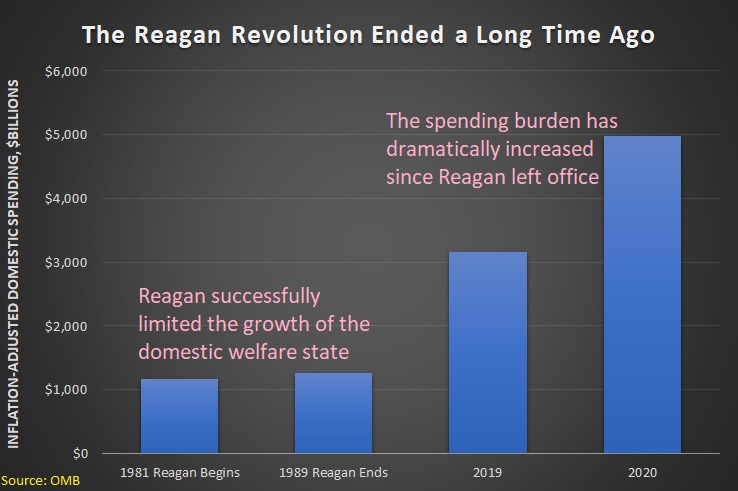
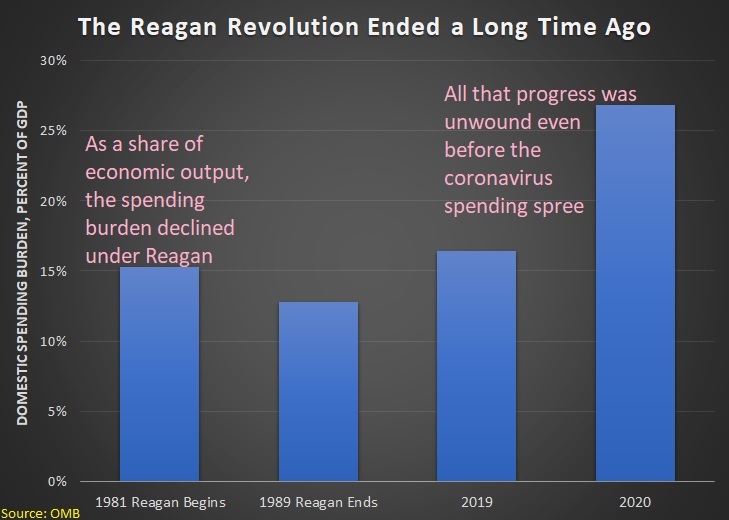



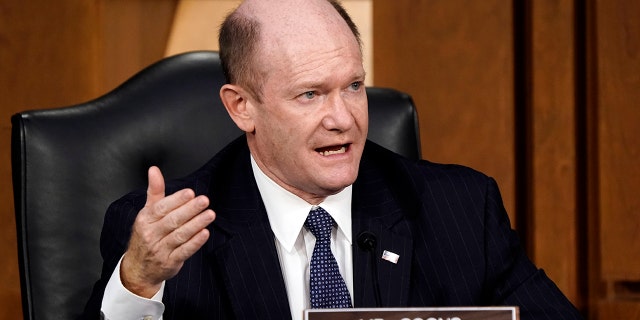

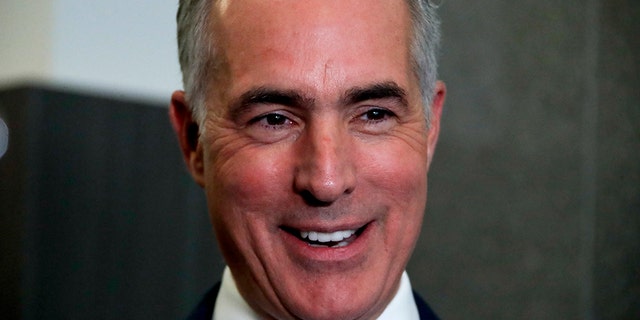





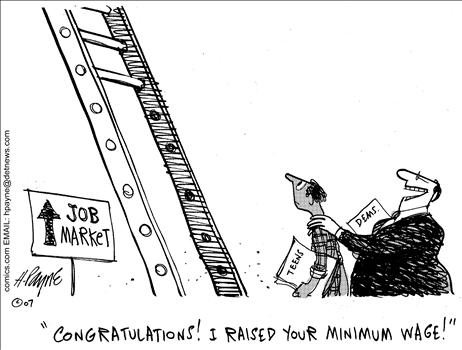
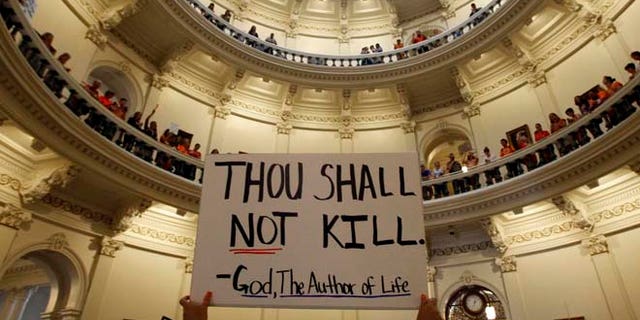
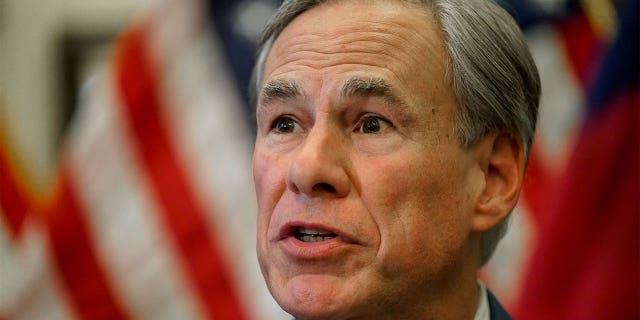
:no_upscale()/cdn.vox-cdn.com/uploads/chorus_image/image/69607892/AP20205603273979.0.jpg) Arkansas state Sen. Jason Rapert presides over a Senate committee at the state Capitol in Little Rock, Ark. in this March 14, 2018, file photo. Rapert’s National Association of Christian Lawmakers met recently to talk model legislation and pass resolutions. Kelly P. Kissel, Associated Press
Arkansas state Sen. Jason Rapert presides over a Senate committee at the state Capitol in Little Rock, Ark. in this March 14, 2018, file photo. Rapert’s National Association of Christian Lawmakers met recently to talk model legislation and pass resolutions. Kelly P. Kissel, Associated Press/cdn.vox-cdn.com/uploads/chorus_asset/file/22726922/AP898166992908.jpg) Texas state Rep. Bryan Hughes speaks during the opening session of the 2015 legislative session on Tuesday, Jan. 13, 2015, in Austin, Texas. Eric Gay, Associated Press
Texas state Rep. Bryan Hughes speaks during the opening session of the 2015 legislative session on Tuesday, Jan. 13, 2015, in Austin, Texas. Eric Gay, Associated Press/cdn.vox-cdn.com/uploads/chorus_asset/file/22726936/merlin_1112102.jpg) A anti-abortion supporter argues with those who attended a press conference and rally held by the Planned Parenthood Action Council of Utah outside of the Capitol in Salt Lake City on Aug. 25, 2015. Stacie Scott, Deseret News
A anti-abortion supporter argues with those who attended a press conference and rally held by the Planned Parenthood Action Council of Utah outside of the Capitol in Salt Lake City on Aug. 25, 2015. Stacie Scott, Deseret News
















:max_bytes(150000):strip_icc()/King-Solomon-GettyImages-537859698-57cd84f13df78c71b62edb3b.jpg)




















 The Daily Hatch
