Category Archives: Francis Schaeffer

FRANCIS SCHAEFFER ANALYZES ART AND CULTURE Part 68 THE BEATLES (PART R WHY WAS JOHNNY WEISSMULLER CHOSEN TO BE ON COVER OF SGT. PEPPER’S?) Artist featured today is Eduardo Paolozzi

Ever want to buy an island and just get back to nature and forget about all society and leave all your problems behind? There was a time that the Beatles attempted to do just that!!!!

Tarzan Escapes (1936) – 2-Tarzan and Jane Waking in the Treehouse

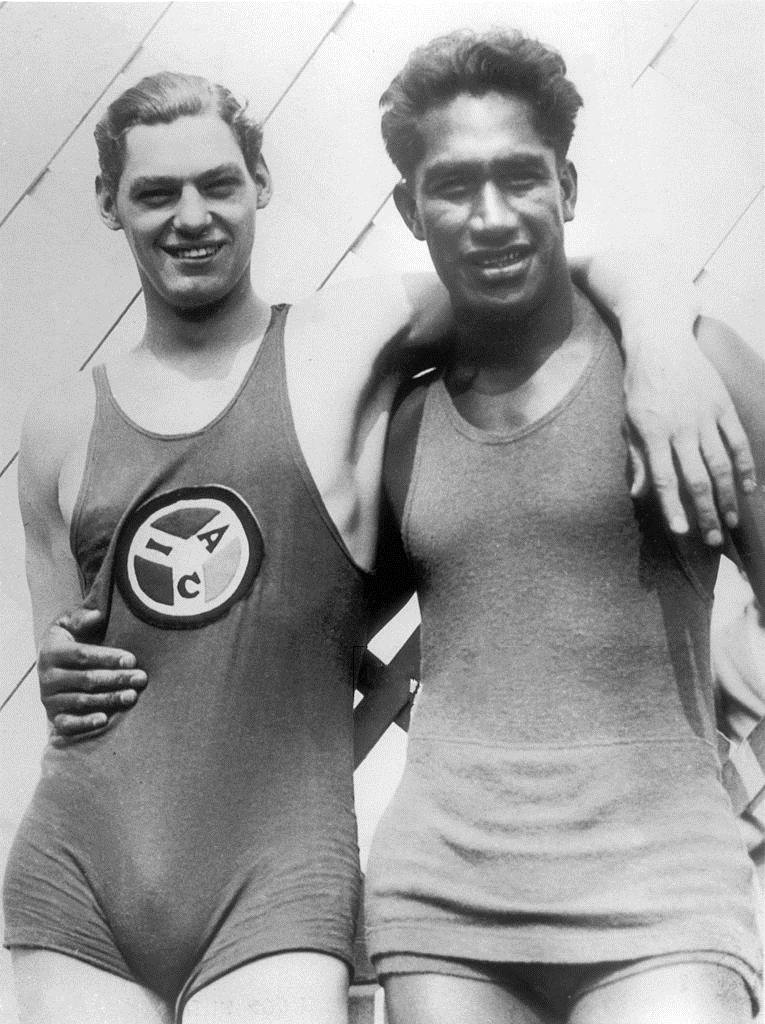
File:Johnny Weissmuller and Duke Kahanamoku at Olympics.jpg
_______________

Tarzan Finds A Son 1939 PART 1

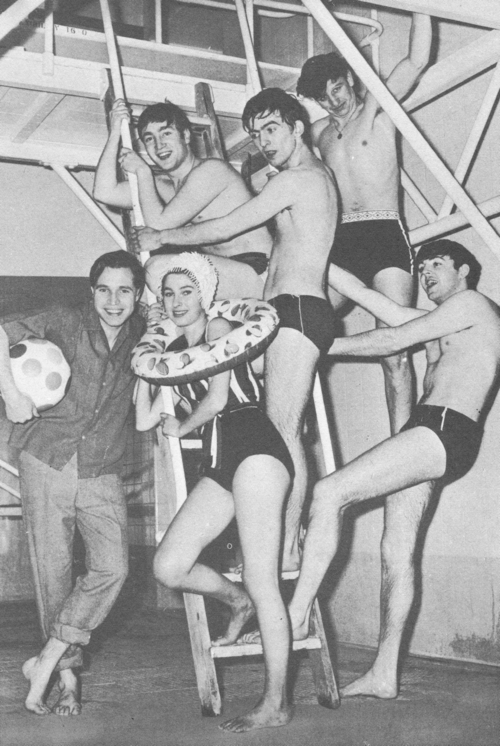
The Beatles, working on the movie “Eight arms To Hold You” in Nassau, Bahamas, went swimming in the pool at the Nassau Beach Hotel, with their clothes February 23, 1965. From left to right: RIngo Starr, John Lennon and George Harrison, with Paul McCartney in the back. (AP Photo)

THE BEATLES

Tarzan The Ape Man (1932) – Tarzan Returns Jane

Uploaded on Apr 10, 2011

After Tarzan (Johnny Weismuller) kidnaps Jane (Maureen O’Sullivan), she gradually warms to him, and when he sympathizes and returns her to her father, they do not want to part.

Johnny Weissmuller competes at the 1924 Olympic Games in Paris.

Tarzan Escapes (1936) – 1-Tarzan and Jane Sleeping in the Treehouse

__________
______________

Tarzan and His Mate; A Tribute

Johnny Sheffield, Maureen O'Sullivan and Johnny Weissmuller in Tarzan’s Secret Treasure (1941). It was announced today that Johnny Sheffield has died at age 79.

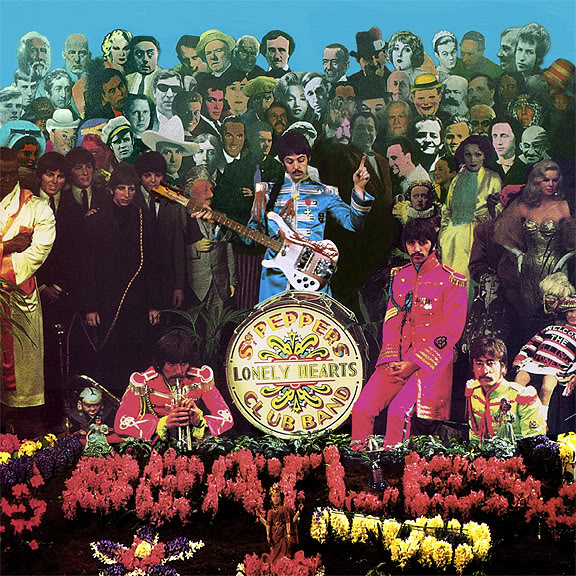
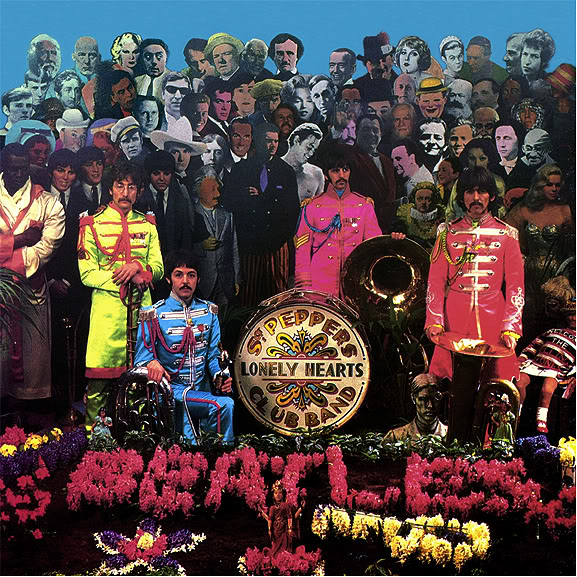
Why was Johnny Weissmuller on the cover of Sergeant Pepper’s Lonely Hearts Club Band? I have a theory and it is tied into the idea of the “noble savage” which I think intrigued the Beatles. We know that it was the Beatles that put forth Weissmuller’s name for inclusion on the cover (they probably grew up watching Tarzan movies rerun on TV like I did on Saturday afternoons) and we also know that the idea of getting away from civilization appealed to the Beatles.

Jean-Jacques Rousseau philosopher from Geneva, he lived in the 18th century, he thought that primitive man, the noble savage to be superior to civilized man. He felt that the enlightenment with its emphasis on reason, the arts and the sciences caused man to lose more than he gained.
Rousseau saw the restraints of civilization as evils.
 
“Man was born free but everywhere he is in chains!” He demanded not just freedom from God or the Bible but freedom from any kind of restraint, freedom from culture, freedom from authority, absolute freedom for the individual with the individual at the center of the universe. When applied to the individual his concept led to the bohemian ideal where the hero was the man who fought all standards, all values and all restraints of society.
 
When Rousseau applied his concept of autonomous freedom to society his concept would not function. “Whosoever refuses to obey the general shall be compelled to do so by the whole body.” Rousseau wrote this in 1762. This means nothing less than that he will be forced to be free. In other words tyranny. A tyranny that carried its position to its logical conclusion in the reign of terror in the French Revolution. Robespierre, the king of the terror, saw himself putting Rousseau‘s ideas into practice.
 
Paul Gauguin was a follower of  Jean-Jacques Rousseau. In his hunt for total freedom he deserted his family.  He went to Tahiti hoping to find there the noble savage. There he found the idea of the noble savage to be an illusion.
 
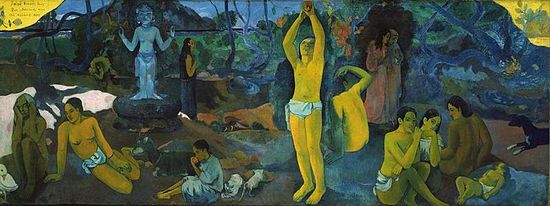
As he worked in this painting “Where Do We Come From? What Are We? Where Are We Going?” (1897),  he also wrote about it. He called it a philosophic work comparable to the gospel, but what a gospel. Gauguin himself said, “Close to the death of an old woman a strange stupid bird concludes, ‘Wince, What, Wither. Oh sorrow thou art my master. Fate how cruel thou art and always vanquished I revolt.‘”
What he found in Tahiti was death and cruelty.
 
That man is good by nature as Rousseau claimed is no more true of primitive man than of civilized man. When Gauguin finished this painting he tried to commit suicide but he did not succeed.
(“Where Do We Come From? What Are We? Where Are We Going?” pictured below)
(Paul Gauguin pictured below)

Moving to an island or to Africa and finding the noble savage was not a satisfactory answer to the Beatles search for peace. However, there was one person the Beatles put on the cover of Sergeant Pepper’s Lonely Hearts Club Band that did have access to the answers to the big questions of life and we will look at this person’s life later in this series. 

The Beatles- Hey Jude Legendado HD

Johnny Weissmuller Poster

Biography

Jump to: Overview (5) | Mini Bio (1) | Spouse (6) | Trivia (26) | Personal Quotes (7) | Salary (1)

Overview (5)

Date of Birth 2 June 1904Freidorf, Banat, Austria-Hungary (now Romania)
Date of Death 20 January 1984Acapulco, Mexico  (series of strokes)
Birth Name Peter Johann Weissmüller
Nickname Big John
Height 6′ 3″ (1.91 m)

Mini Bio (1)

Johnny Weissmuller was born Peter Johann Weißmüller in Freidorf, near Timisoara, today Romania, then a part of the Austro-Hungarian Empire. Weissmuller would later claim to have been born in Windber, Pennsylvania, probably to ensure his eligibility to compete as part of the US Olympic team. Weissmüller was one of two boys born to Petrus Weissmuller, a miner, and his wife Elisabetha (Kersch), who were both Banat Swabians, an ethnic German population in Southeast Europe. A sickly child, he took up swimming on the advice of a doctor. He grew to be a 6′ 3″, 190-pound champion athlete – undefeated winner of five Olympic gold medals, 67 world and 52 national titles, holder of every freestyle record from 100 yards to the half-mile. In his first picture, Glorifying the American Girl (1929), he appeared as an Adonis clad only in a fig leaf. After great success with a jungle movie, MGM head Louis B. Mayer, via Irving Thalberg, optioned two of Edgar Rice Burroughs‘ Tarzan stories. Cyril Hume, working on the adaptation ofTarzan the Ape Man (1932), noticed Weissmuller swimming in the pool at his hotel and suggested him for the part of Tarzan. Weissmuller was under contract to BVD to model underwear and swimsuits; MGM got him released by agreeing to pose many of its female stars in BVD swimsuits. The studio billed him as “the only man in Hollywood who’s natural in the flesh and can act without clothes”. The film was an immediate box-office and critical hit. Seeing that he was wildly popular with girls, the studio told him to divorce his wife and paid her $10,000 to agree to it. After 1942, however, MGM had used up its options; it dropped the Tarzan series and Weissmuller, too. He then moved to RKO and made six more Tarzans. After that he made 16 Jungle Jim (1948) programmers for Columbia. He retired from movies to run private business in Fort Lauderdale, Florida.

– IMDb Mini Biography By: Ed Stephan <stephan@cc.wwu.edu>

_________________

Come Together- The Beatles

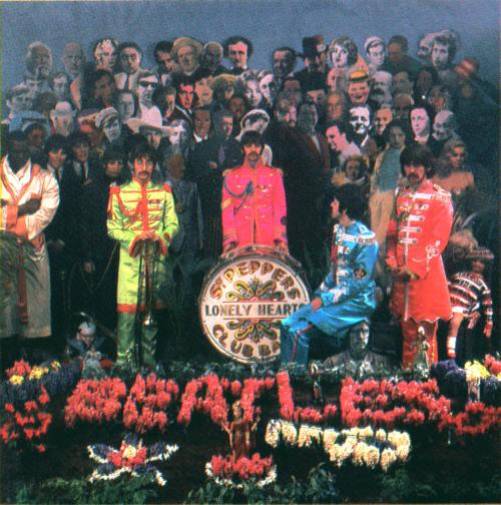
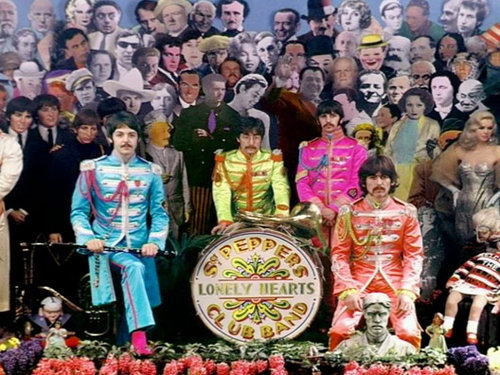
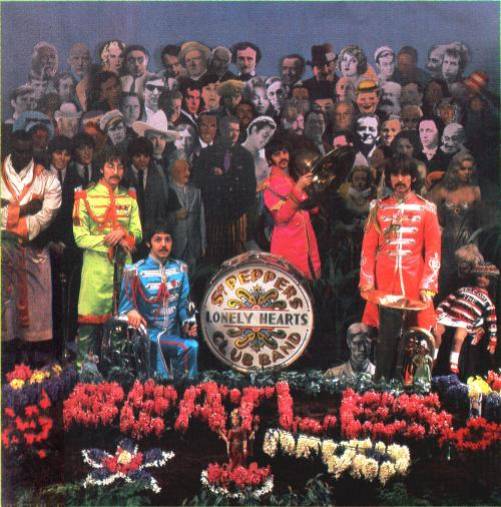
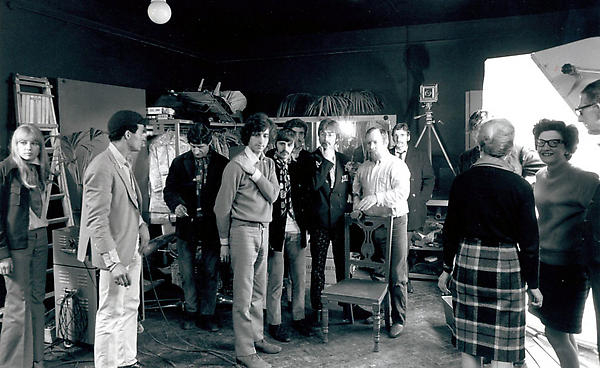
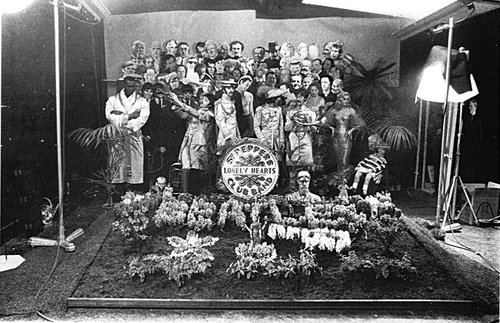
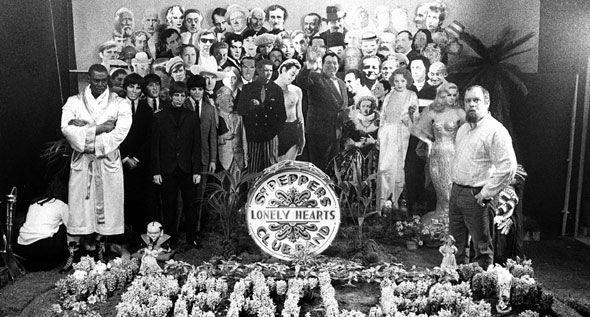
Outtakes From The Beatles’ Cover Shoot For Sgt. Pepper’s Lonely Hearts Club Band

Apr 25, 2015

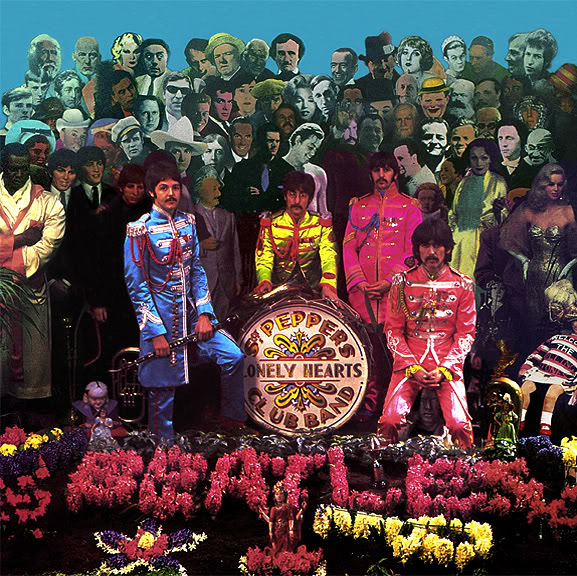
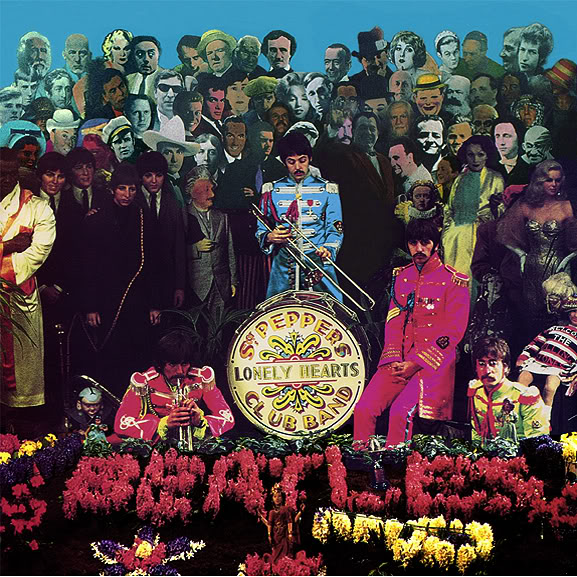
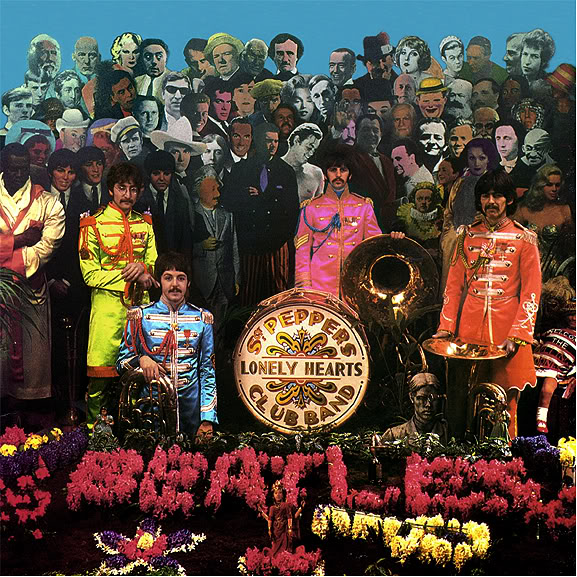
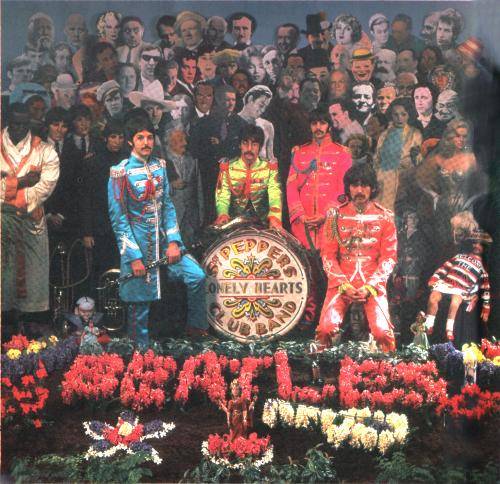
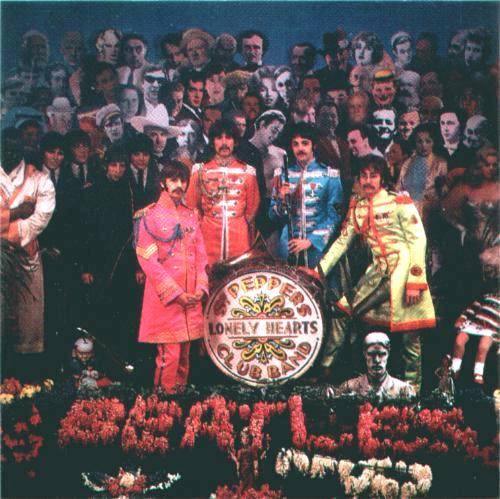
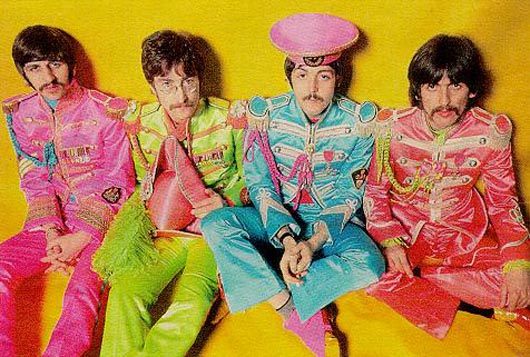
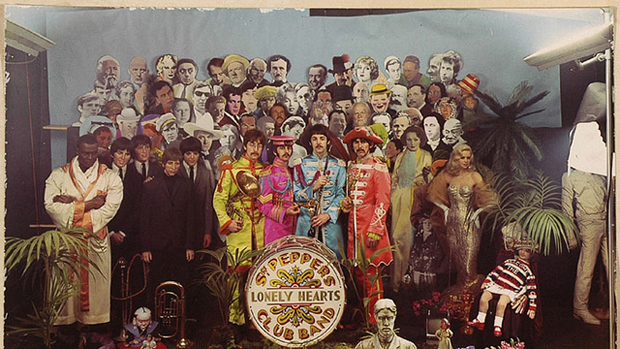
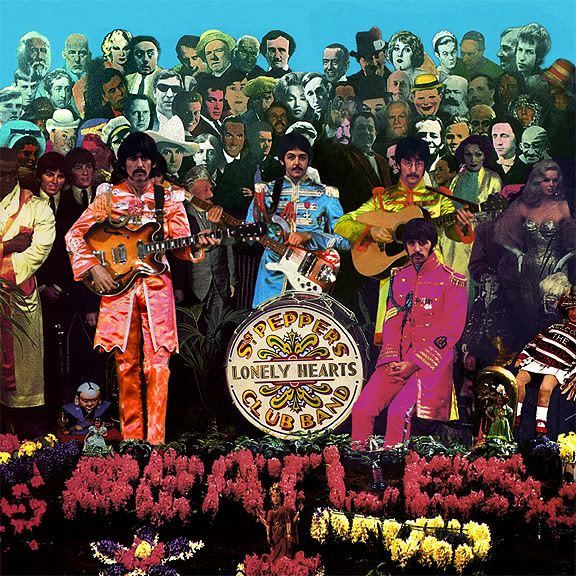
The Beatles’​ Sgt. Pepper’s Lonely Hearts Club Band album cover was designed by the pop artists Peter Blake and Jann Haworth from an ink drawing by McCartney. It was art-directed by Robert Fraser and photographed by Michael Cooper. The front of the LP included a colourful collage featuring the Beatles in costume as the Sgt. Pepper’s Lonely Hearts Club Band, standing with a group of life-sized cardboard cut-outs of famous people. The heavy moustaches worn by the group reflected the growing influence of hippie style trends, while their clothing “spoofed the vogue in Britain for military fashions”, writes the Beatles biographer Jonathan Gould. The centre of the cover depicts the Beatles standing behind a drum skin, on which the fairground artist Joe Ephgrave painted the words of the album’s title. In front of the drum skin is an arrangement of flowers that spell out “Beatles”. The group were dressed in satin day-glo-coloured military-style uniforms that were manufactured by the theatrical costumer M. Berman Ltd. in London.
Cover shoot for Sgt Pepper (1)

Cover shoot for Sgt Pepper (2)

Cover shoot for Sgt Pepper (3)

Cover shoot for Sgt Pepper (4)

Cover shoot for Sgt Pepper (5)

Cover shoot for Sgt Pepper (6)

Cover shoot for Sgt Pepper (7)

Cover shoot for Sgt Pepper (8)

Cover shoot for Sgt Pepper (9)

Cover shoot for Sgt Pepper (10)

Cover shoot for Sgt Pepper (11)

Cover shoot for Sgt Pepper (12)

Cover shoot for Sgt Pepper (13)

Cover shoot for Sgt Pepper (14)

Cover shoot for Sgt Pepper (15)

Cover shoot for Sgt Pepper (16)

Cover shoot for Sgt Pepper (17)The

Cover shoot for Sgt Pepper

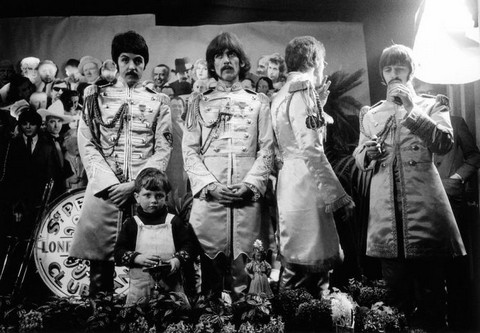
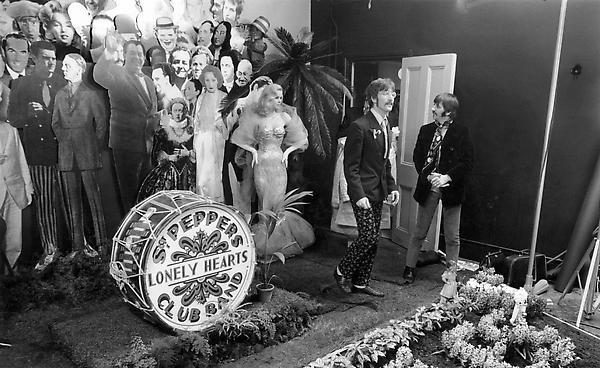
Prior to a late night recording session at Abbey Road, The Beatles visited Michael Cooper’s London photographic studio where the cover photographs for Sgt Pepper’s Lonely Hearts Club Band were taken.

The full photograph used for the cover of Sgt Pepper's Lonely Hearts Club Band

The shoot took place at 4 Chelsea Manor Studios, 1-11 Flood Street, just off King’s Road in Chelsea. The studios opened in 1902, and Cooper established his studio from 22 July 1966.

The Beatles arrived in the late afternoon. The soon-to-be-famous collage, designed by Peter Blake and his wife Jann Haworth, had been assembled in the studio during the preceding eight days.

A contract dated 14 April 1967 described the various fees for the session, including a misspelling of the album title:

Hire and use of Michael Cooper Studios for 8 days including personnel (3 fulltime assistants) plus overtime and expenses to staff for additional work during Easter weekend: £625.0.054 copy negatives @ 10/6 each: 28.7.054 20″x16″ prints @ 17/6 each: 47.5.0Photography fee (SGT. PEPPER’S LONELY HEARTS BAND set and centre spread, closeup): 250.0.0Art direction fee (Layout and co-ordination of sleeve and inserts, cutouts, song sheets, production of mechanical rough and artwork by Al Vandenberg for Michael Cooper Studios, including co-ordination and supervision of all aspects of design and artwork from Peter Blake and Simon & Marekka; supervision and co-ordination of printing, retouching and blockmaking): £350.0.0Special fee to Peter Blake: £200.0.0

In addition to the front cover shot, The Beatles also posed for the images used on the back cover and the gatefold sleeve.

The cover had come about after Paul McCartney came up with the album title. He took some ideas to his art dealer friend Robert Fraser, who suggested they use Blake, Haworth and Cooper to realise the concept.

We had an original meeting with all four Beatles, Robert Fraser and Brian Epstein; most of the subsequent talking was done with Paul at his house and with John there sometimes.
Peter Blake

McCartney’s initial idea was to stage a presentation featuring a mayor and a corporation, with a floral clock and a selection of photographs of famous faces on the wall behind The Beatles.

He asked the others to list their choices for the photographs; the original list, complete with misspellings, was given to Fraser and Blake:

Yoga’s; Marquis de Sade; Hitler; Neitch; Lenny Bruce; Lord Buckley; Alistair Crowley; Dylan Thomas; James Joyce; Oscar Wilde; William Burroughs; Robert Peel; Stockhausen; Auldus Huxley; H.G. Wells; Izis Bon; Einstein; Carl Jung; Beardsley; Alfred Jarry; Tom Mix; Johnny Weissmuller; Magritte; Tyrone Power; Carl Marx; Richard Crompton; Tommy Hanley; Albert Stubbins; Fred Astaire.

McCartney took the list and sketches to Peter Blake, who developed the concept further. Further names were added and others fell by the wayside.

Jesus and Hitler were among John Lennon’s choices, but they were left off the final list. Gandhi, meanwhile, was disallowed by Sir Joseph Lockwood, the head of EMI, after he told them they would have problems having the sleeve printed in India.

________________

George Harrison and Eric Clapton – While my guitar gently weeps

Uploaded on Oct 30, 2010

Concierto realizado para The Princes Trust del año 1987.Con la participacion de :
George Harrison: Guitarra y voz
Eric Clapton: Guitarra (como curiosidad, es una lespaul)
Jeff Lyne: Guitarra
Phil Collins: Bateria
Ringo Starr: Bateria
Ray Cooper: Percusion
Mark King: Bajo
Elton John: Piano
Jool Holland: Piano

There is evidence that points to the fact that the Bible is historically true as Schaeffer pointed out in episode 5 of WHATEVER HAPPENED TO THE HUMAN RACEThere is a basis then for faith in Christ alone for our eternal hope. This link shows how to do that.

The Bible and Archaeology – Is the Bible from God? (Kyle Butt 42 min)

You want some evidence that indicates that the Bible is true? Here is a good place to start and that is taking a closer look at the archaeology of the Old Testament times. Is the Bible historically accurate? Here are some of the posts I have done in the past on the subject: 1. The Babylonian Chronicleof Nebuchadnezzars Siege of Jerusalem2. Hezekiah’s Siloam Tunnel Inscription. 3. Taylor Prism (Sennacherib Hexagonal Prism)4. Biblical Cities Attested Archaeologically. 5. The Discovery of the Hittites6.Shishak Smiting His Captives7. Moabite Stone8Black Obelisk of Shalmaneser III9A Verification of places in Gospel of John and Book of Acts., 9B Discovery of Ebla Tablets10. Cyrus Cylinder11. Puru “The lot of Yahali” 9th Century B.C.E.12. The Uzziah Tablet Inscription13. The Pilate Inscription14. Caiaphas Ossuary14 B Pontius Pilate Part 214c. Three greatest American Archaeologists moved to accept Bible’s accuracy through archaeology.

September 19, 2011

By Elvis Costello

I first heard of the Beatles when I was nine years old. I spent most of my holidays on Merseyside then, and a local girl gave me a bad publicity shot of them with their names scrawled on the back.

This was 1962 or ’63, before they came to America. The photo was badly lit, and they didn’t quite have their look down; Ringo had his hair slightly swept back, as if he wasn’t quite sold on the Beatles haircut yet.

I didn’t care about that; they were the band for me. The funny thing is that parents and all their friends from Liverpool were also curious and proud about this local group. Prior to that, the people in show business from the north of England had all been comedians. The Beatles even recorded for Parlophone, which was a comedy label, as if they believed they might be a passing novelty act.

I was exactly the right age to be hit by them full-on. My experience — seizing on every picture, saving money for singles and EPs, catching them on a local news show — was repeated over and over again around the world. It wasn’t the first time anything like this had happened, but the Beatles achieved a level of fame and recognition known previously only to Charlie Chaplin, Brigitte Bardot and Elvis Presley, along with a little of the airless exclusivity of astronauts, former presidents and other heavyweight champions.

Every record was a shock. Compared to rabid R&B evangelists like the Rolling Stones, the Beatles arrived sounding like nothing else. They had already absorbed Buddy Holly, the Everly Brothers and Chuck Berry, but they were also writing their own songs. They made writing your own material expected, rather than exceptional.

And John Lennon and Paul McCartney were exceptional songwriters; McCartney was, and is, a truly virtuoso musician; George Harrison wasn’t the kind of guitar player who tore off wild, unpredictable solos, but you can sing the melodies of nearly all of his breaks. Most important, they always fit right into the arrangement. Ringo Starr played the drums with an incredibly unique feel that nobody can really copy, although many fine drummers have tried and failed. Most of all, John and Paul were fantastic singers.

Lennon, McCartney and Harrison had stunningly high standards as writers. Imagine releasing a song like “Ask Me Why” or “Things We Said Today” as a B side. They made such fantastic records as “Paperback Writer” b/w “Rain” or “Penny Lane” b/w “Strawberry Fields Forever” and only put them out as singles. These records were events, and not just advance notice of an album. Then they started to really grow up: simple love lyrics to adult stories like “Norwegian Wood,” which spoke of the sour side of love, and on to bigger ideas than you would expect to find in catchy pop lyrics.

They were the first group to mess with the aural perspective of their recordings and have it be more than just a gimmick. Engineers like Geoff Emerick invented techniques that we now take for granted, in response to the group’s imagination. Before the Beatles, you had guys in lab coats doing recording experiments, but you didn’t have rockers deliberately putting things out of balance, like a quiet vocal in front of a loud track on “Strawberry Fields Forever.” You can’t exaggerate the license that this gave to everyone from Motown to Jimi Hendrix.

My absolute favorite albums are Rubber Soul and Revolver. On both records you can hear references to other music — R&B, Dylan, psychedelia — but it’s not done in a way that is obvious or dates the records. When you picked up Revolver, you knew it was something different. Heck, they are wearing sunglasses indoors in the picture on the back of the cover and not even looking at the camera . . . and the music was so strange and yet so vivid. If I had to pick a favorite song from those albums, it would be “And Your Bird Can Sing” . . . no, “Girl” . . . no, “For No One” . . . and so on, and so on. . . .

Their breakup album, Let It Be, contains songs both gorgeous and jagged. I suppose ambition and human frailty creeps into every group, but they delivered some incredible performances. I remember going to Leicester Square and seeing the film of Let It Be in 1970. I left with a melancholy feeling.

Someone recently gave me an assembly of newsreel footage, which illustrates how swiftly the band was drained of the bright and joyful wit presented as a public face.

In one early sequence, McCartney tells reporters that they will soon appear on The Ed Sullivan Show and then points into the camera: “There he is, hi, Ed, and Mrs. Ed” — “and Mr. Ed,” chimes Ringo. It might have been practiced, but it plays entirely off-the-cuff.

Just a year later, they are seen at a press conference in Los Angeles for their final tour. Suits and ties are a thing of the past. Staring down a series of dismal attempts at provocation from the press corps, they look exhausted and disenchanted.

When probed by one blowhard to respond to a Time magazine critique that “Day Tripper” was about a prostitute and “Norwegian Wood” about a lesbian, McCartney responds, “We were just trying to write songs about prostitutes and lesbians.” In the laughter that follows, he mutters, “Cut.” They were giving the impression that the game was up, but in truth, they were just getting started.

The word “Beatlesque” has been in the dictionary for quite a while now. You hear them in Harry Nilsson’s melodies; in Prince’s Around the World in a Day; in the hits of ELO and Crowded House and in Ron Sexsmith’s ballads. You can hear that Kurt Cobain listened to the Beatles and mixed their ideas with punk and metal. They can be heard in all sorts of one-off wonders from the Knickerbockers’ “Lies” and the Flamin’ Groovies’ “Shake Some Action.” The scope and license of the White Album has permitted everyone from OutKast to Radiohead to Green Day to Joanna Newsom to roll their picture out on a broader, bolder canvas.

Now, I’ll admit that I’ve stolen my share of Beatles licks, but around the turn of the Nineties, I got to co-write 12 songs with Paul McCartney and even dared to propose that he too reference some of the Beatles’ harmonic signatures — as, astonishingly, he had made up another musical vocabulary for Wings and during his solo career.

In 1999, a little time after Linda McCartney’s passing, Paul performed at the Concert for Linda, organized by Chrissie Hynde. During the rehearsal, I was singing harmony on a Ricky Nelson song with him, and Paul called out the next tune: “All My Loving.”

I said, “Do you want me to take the harmony line the second time round?” And he said, “Yeah, give it a try.” I’d only had 35 years to learn the part. There was inevitably a poignant feeling to this song, written long before he had even met Linda:

Close your eyes and I’ll kiss you
Tomorrow I’ll miss you
Remember I’ll always be true.

At the show, it was very different. The second Paul sang the opening lines, the crowd’s reaction was so intense that it all but drowned the song out. It was very thrilling, but also disconcerting.

Perhaps I understood in that moment one of the reasons why the Beatles had to stop performing. The songs weren’t theirs anymore. They belonged to everybody.

This is an updated version of an essay that appeared in RS 946.

75

‘Think for Yourself’

the beatles 100 greatest songs
Michael Ochs Archives/Getty Images

Writer: Harrison
Recorded: November 8, 1965
Released: December 6, 1965
Not released as a single

In the fall of 1965, the Beatles were rushing to complete their new album, Rubber Soul, by Christmas. Short of material, the band took a stab at a new Harrison song, which had the working title “Won’t Be There With You.” Knocked out in one take, and clocking in at just 2:19, “Think for Yourself” clearly wasn’t a song the band spent much time on. Lennon flubbed attempt after attempt at the vocals, and fits of giggling — likely the result of joints being passed — couldn’t have helped. But the tune is better for it — from McCartney’s fuzzed-out bass to Starr’s skittering drums, “Think for Yourself” has an unchained, garage-band feel. And who was Harrison so angry at, anyway? Even he wasn’t quite sure. “All this time later,” Harrison wrote in 1980, “I don’t quite recall who inspired that! Probably the government.”

Appears On: Rubber Soul

Related
The 500 Greatest Albums of All Time: ‘Rubber Soul’
George Harrison Gets Back: Rolling Stone’s 1987 Cover Story
Photos: Rolling Stone Readers Pick the Top 10 Beatles Albums

74

‘Yellow Submarine’

the beatles 100 greatest songs
Keystone/Getty Images

Main Writer: McCartney
Recorded: May 26 and June 1, 1966
Released: August 8, 1966
9 weeks; No. 2

The Beatles’ most beloved kiddie song was written for — who else? — Ringo. As McCartney explained, “I thought, with Ringo being so good with children — a knockabout-uncle type — it might not be a bad idea for him to have a children’s song.” Years later, “Yellow Submarine” remains the gateway drug that turns little children into Beatle fans, with that cheery singalong chorus. It inspired the Beatles’ 1968 animated film, as well as Starr’s unofficial sequel on Abbey Road, “Octopus’ Garden.”

George Martin drew on his experience as a producer of comedy records for Beyond the Fringe and The Goon Show, providing an array of zany sound effects to create the nautical atmosphere. Lennon blew bubbles, while he and McCartney shouted out orders to the faux submarine crew (“Full speed ahead!”) through a filter. A few friends even came by the studio to help out with sound effects, including Marianne Faithfull and the Rolling Stones’ Brian Jones.

Appears On: Revolver

Related
Photos: Inside the Rock and Roll Hall of Fame’s Beatles Exhibit
Disney Kills ‘Yellow Submarine’ Remake
Photos: The Beatles on the Cover of Rolling Stone

Co-stars: Maureen O’Sullivan, Cheetah and Johnny Weissmuller in the 1932 film Tarzan The Ape Man

73

‘Everybody’s Got Something to Hide Except for Me and My Monkey’

the beatles 100 greatest songs
Cummings Archives/Redferns

Main Writer: Lennon
Recorded: June 27, July 1 and 23, 1968
Released: November 25, 1968
Not released as a single

In 1980, Lennon said that this White Album explosion of blistering guitars and barking vocals was about his relationship with Yoko Ono: “Everybody seemed to be paranoid except for us two, who were in the glow of love. . . . Everybody was sort of tense around us. You know, ‘What is she doing here at the session?'”

But McCartney believed the song was really about heroin, which Lennon and Ono had begun taking without telling the others. “John started talking about fixes and monkeys,” he said. “It was a harder terminology, which the rest of us weren’t into.” Looking back, Lennon said, “We sniffed a little when we were in real pain. We took ‘H’ because of what the Beatles and their pals were doing to us.”

Appears On: The Beatles

Follow us: @rollingstone on Twitter | RollingStone on Facebook

Cheetah the 1930s Tarzan chimp dies aged 80 – but was he the real star and even that old?

Read more: http://www.dailymail.co.uk/news/article-2079272/Tarzan-chimp-Cheetah-dies-aged-80-But-real-star-old.html#ixzz3fy425N9b
Follow us: @MailOnline on Twitter | DailyMail on Facebook

One of Hollywood’s most famous animals, Cheetah the chimpanzee from the Tarzan movies of the early 1930s, has died aged 80.

The Suncoast Primate Sanctuary in Palm Harbor, Florida, has revealed the chimp believed to be the iconic simian star of the golden age of film died on Christmas Eve of kidney failure.

It is claimed he outlived both of his co-stars Johnny Weissmuller, who died in 1984 aged 79, and Maureen O’Sullivan, who played Tarzan’s mate Jane and who died aged 87 in 1998.

SCROLL DOWN FOR VIDEO

Hollywood icon: Cheetah (left) was the most famous chimp in the world. Here he starred in the 1945 film Tarzan Escapes with Weissmuller, who died in 1984 aged 79, and Maureen O'Sullivan, who played Jane

Hollywood icon: Cheetah (left) was the most famous chimp in the world. Here he starred in the 1945 film Tarzan Escapes with Weissmuller, who died in 1984 aged 79, and Maureen O’Sullivan, who played Jane

King of the Swingers: Cheetah (right) In the 1939 hit Tarzan Finds a Son

King of the Swingers: Cheetah (right) In the 1939 hit Tarzan Finds a Son

However, the story of Cheetah is mired in mystery as some have claimed he was not the same animal and some have disputed his age.

In 2008 claims about another chimp, who in 2005 was handed a Guinness world record as the oldest non-human primate, were debunked after research carried out by the journalist Richard Rosen revealed he could not have been born until the 1960s.

Sanctuary outreach director Debbie Cobb said the recently departed Cheetah was outgoing, loved finger painting and American football and liked to see people laugh.

She added the jungle swinger seemed to be tuned into human feelings was soothed by nondenominational Christian music.

‘He was very compassionate,’ Ms Cobb said. ‘He could tell if I was having a good day or a bad day.

‘He was always trying to get me to laugh if he thought I was having a bad day. He was very in tune to human feelings.’

The character of Cheetah was the comic relief in the Tarzan series starring American Olympic gold medal swimmer Weissmuller.

Co-stars: Maureen O'Sullivan, Cheetah and Johnny Weissmuller in the 1932 film Tarzan The Ape Man

Co-stars: Maureen O’Sullivan, Cheetah and Johnny Weissmuller in the 1932 film Tarzan The Ape Man

Ms Cobb said Cheetah came to the sanctuary from Weissmuller’s estate sometime around 1960. She added that he wasn’t a troublemaker.

However, sanctuary volunteer Ron Priest did admit that when the superstar chimp didn’t like what was going on, he would throw faeces.

‘When he didn’t like somebody or something that was going on, he would pick up some poop and throw it at them. He could get you at 30ft with bars in between.’

Outlived: Johnny Weissmuller as Tarzan and Maureen O'Sullivan is Jane in this scene from the classic 1936 movie Tarzan Escapes

Outlived: Johnny Weissmuller as Tarzan and Maureen O’Sullivan is Jane in this scene from the classic 1936 movie Tarzan Escapes

‘CHEETA’ ON A ‘LIFETIME OF FAME’

Me Cheeta: The Autobiography was written by James Lever, with help from Cheeta

In a 2008 spoof tell-all autobiography (pictured right)written by James Lever, Me Cheeta, revealed some of his thoughts on his Hollywood career:

On his career longevity: ‘I acted into my thirties. Most chimps retire by the age of ten because they won’t do what they’re told. I didn’t want to end up in a lab with an electrode in my forehead.’

On his Hollywood legacy: ‘I can’t deny that I’d like my own star on the Hollywood Walk of Fame, but I have been turned down for the last three years. I’m not bitter. I’ve had a rich career. Every day is a blessing.’

On painting: ‘The art world credits me with starting Ape-stract painting, but I don’t like to blow my own trumpet. I prefer the piano.’

On healthy living: ‘My only vices are hamburgers and caffeine-free Coke. Fresh fruit, vegetables and monkey chow are the key. It’s tough that the chow tastes like dog food.’

On Johnny Weissmuller: ‘Dear old Johnny was more typecast than I was. I remember we were both up for the role of Terry in On the Waterfront and the casting director told Johnny he was wasting his time. I got a callback but it came to nothing. He went off to start a swimming-pool company. Swimming was never my thing.’

He added Cheetah stood out because of his ability to stand up – shoulders tall, back straight – and walk like a person.

It was claimed the chimp in the films, who was 4ft and 10st 2lb, was ‘discovered’ as a newborn by an animal trainer on a trip to Africa in April 1932.

He appeared soon afterwards alongside Weissmuller in Tarzan And His Mate, and went on to star in a dozen films about the jungle hero who swung from tree to tree.

His character was a product of the movies, as a chimp never appeared in any of the Tarzan novels by Edgar Rice Burroughs that the films were based on.

It was claimed another chimp, Cheeta, appeared in 50 movies before his final appearance, as Chee-Chee in 1967’s Doctor Dolittle.

He was then cared for at a foundation in Palm Springs, California, paying for his keep with his ‘Ape-stract’ paintings which sell for £75 a time.

In 2008 Esquire magazine published his ‘memoirs’ which also joked that he made a small fortune working as a body double for actor Robin Williams.

Chimpanzees in captivity regularly live to about 50, a decade longer than those in the wild.

Another old-timer was Fifi, a star attraction at Sydney’s Taronga Zoo until her death at the age of 60 last July.

The character of Cheetah was honoured with a star on the Palm Springs Walk of Stars in 1995. His star is at 110 South Palm Canyon Drive.

There have been several unsuccessful campaigns to secure a star for the pretender Cheeta on the Hollywood Walk of Fame, which gained the support of Hillary Clinton.

Cheeta’s trainer, Tony Gentry, claimed that the chimp was born in the early 1930s, but other sources claim he was not born until 1960.

It is known various chimps played Cheetah in different scenes in the 1932 and 1934 films, Tarzan the Ape Man and Tarzan and His Mate.

But while one of the chimps is known to have died in 1938, the chimp that died on December 24 could be one of the other actors then known as Zippy or Harry but since renamed.

Sadly, the world may never know.

Imposter: Cheeta the chimp, when he was 76, making a promo music video to accompany his cover of the 1975 hit song 'Convoy'

Imposter: Cheeta the chimp, when he was 76, making a promo music video to accompany his cover of the 1975 hit song ‘Convoy’

Monkeying around: Cheeta playing piano at his home in Palm Springs in 2003

Monkeying around: Cheeta playing piano at his home in Palm Springs in 2003

Read more: http://www.dailymail.co.uk/news/article-2079272/Tarzan-chimp-Cheetah-dies-aged-80-But-real-star-old.html#ixzz3fy3sfJzX
Follow us: @MailOnline on Twitter | DailyMail on Facebook

________________

Featured artist today is Eduardo Paolozzi

_________

The Independent Group_ Eduardo Paolozzi.flv

Original Creators: Eduardo Paolozzi

Original Creators: Eduardo Paolozzi

Each week we pay homage to a select “Original Creator”—an iconic artist from days gone by whose work influences and informs today’s creators. These are artists who were innovative and revolutionary in their fields. Bold visionaries and radicals, groundbreaking frontiersmen and women who inspired and informed culture as we know it today. This week: Eduardo Paolozzi.

Mostly known for his sculptures of unprecedented composition, Eduardo Luigi Paolozzi (1924-2005) is also revered as one of the most instrumental underpinnings of British pop art. The collage-based works of this extraordinarily inventive printmaker remain as some of the finest fossils of pop art, fetishizing the unconventional, the crude and the gruff into a new and provocative milieu.

Born from Italian descent in Leith of Edinburgh in 1924, Paolozzi spent his early years refining his technique as a draftsman, drawing for hours on end in his parents’ ice cream parlour. The young artist also realized his curiosity for collecting knickknacks, a precursor to his future pop art collections, as he accrued an extensive collection of matchboxes, cigarette cards, clippings from American magazines and other found objects.

I was a Rich Man’s Plaything (1947)

Meet The People (1948)

Studying at the Edinburgh College of Art in 1943, St. Martin’s School of Art in 1944 and finally at the Scale School of Art in Oxford from 1945 to 1947, Paolozzi found himself continuously on the periphery of what was conventional, questioning boundaries and enjoying Picasso whilst his educators gravely disagreed. Still, his works as a student deemed recognition. In 1947, Paolozzi sold his works at his first solo exhibition at the Mayor Gallery in London.

For the next two years, the inquisitive artist moved to Paris, mingling with the likes of Arp, Giacometti and Brâncuși and immersing himself on the ideas of Dada, Surrealism and art brut. It was here Paolozzi produced his first mercurial collages, born out of inspiration from Dada photomontages. Snipping kitchen appliance adverts from American magazines, didactic illustrations from science books and meretricious covers from cheap reads, he cut and pasted the roots to what would become an iconoclastic movement less than a decade later.

Real Gold (1949)

An Empire of Silly Statistics . . . A Fake War for Public Relations (1968)

Returning to London, Paolozzi focused his collage technique in both printmaking and sculpture as well as film. During the 1950s, his works echoed a cut-and-paste mentality: a clash of culled sources intentionally displaced and randomly rearranged. His prints reveal abrupt seams, juxtaposing images of glamour girls and automotive machinery. Assembled from scrap yard junk, his roughly cast sculptures, as archetypes of the age of technology, are neither smooth nor subtle in composition or impression.

In 1952, Paolozzi co-founded the London-based Independent Group, an informal group of artists and thinkers at the Institute of Contemporary Arts that shared discussions on their uncommon interests on culture “as found,” by reinterpreting technology and popular culture. They were also considered the forerunners of British pop art. In their first meeting, Paolozzi projected a scrapbook of his collages that portrayed mished-mashed snippets of an all-American lifestyle. The notable I was a Rich Man’s Plaything was shown and was the first visual artwork described as ‘pop art’ (art critic Lawrence Alloway first coined the term in 1954). The exposition of this raw and radical aesthetic gave way to the decisive exploration for new approaches in contemporary visual culture.

Installation from Parallel of Life and Art exhibition (1953)
Courtesy of The Independent Group

Poster for This Is Tomorrow exhibition (1956)
Courtesy of The Independent Group

This cutting and clashing of ideas and information became significantly realized in the wildly pedagogical exhibitions he collaborated on with Alison and Peter Smithson and Nigel Henderson: Parallel Of Life and Art (1953) and This Is Tomorrow (1956). Combining notions of technology, ethnography and archaeology through art, photography and installation, Paolozzi, the Smithsons and Henderson found an unforeseen connection in the value and relevance of popular mass culture, further cementing the pillars towards a new medium of expression and thought.

Still from collaged film History is Nothing (1963)

Wittgenstein In New York (1965)

The 1950s and 1960s were probably the most prolific periods of Paolozzi’s creative career. In 1965, he produced a markedly affluent portfolio in the pop art genre, a collection of 12 screen prints, and also an ode to Austrian philosopher Ludwig Wittgenstein: As Is When. By arranging abstract patterns, text, images of airplanes and Disney characters, the collection—as many of Paolozzi’s works foreshadow—questions the relationship between man and machines, giving a historic peek into the personality of the era as well as one of its founders.

As a dedicated advocate of pop culture, not for its beauty but rather for its fickle and temporary nature, Paolozzi prodigiously sculpted and pasted an exemplary canon of disparate ideas and rash innovations that continue to seep into today’s world of art and technology. His legacy, his works born from his insatiable curiosity and his propensity to provoke, remain as an iconic scrapbook of 21st century visual culture.

Eduardo Paolozzi

Eduardo Paolozzi, sculptor/printmaker, born in Edinburgh of Italian descent.  Many of his sculptures were assemblages of discarded pieces which he then cast into different metals.  Some of his sculptures were deconstructed pieces so that the inside of the head becomes exposed.  He used lots of different materials and created sculptures on a large scale.

He was also one of the key instigators of ‘Pop Art’.  He collected images from American magazines and he was also given material by ex-servicemen.  The images presented a seductive world of glamour and wealth which contrasted with war ravaged Europe.  For Paolozzi this was the iconography of a New World  He produced collages which showed his fascination with popular culture, technology and American consumerism.

I encountered this sculpture at the University of Birmingham last year. It was a gift to the University from Paolozzi a huge bronze statue ‘for Faraday’ a work in homage to the great 19th Century scientist.
IMG_0171

Eduardo Paolozzi Biography

Artist, Sculptor (1924–2005)
Sculptor Eduardo Paolozzi’s collage work combining surrealism with elements of popular culture and technology led him to be credited as the inventor of Pop Art.

Synopsis

Eduardo Paolozzi was born on March 7, 1924, in Edinburgh, Scotland. In the 1940s and ’50s, he made sculptures and collages that combined surrealism with pop culture and modern machinery. In the 1960s, he further incorporated machinery into his art. He spent the 1970s working on abstract art reliefs. Through the 1980s and ’90s, he took public commissions. He died on April 22, 2005, in London, England.

Early Life

Eduardo Luigi Paolozzi was born on March 7, 1924, in Edinburgh, Scotland, an only child of parents of Italian descent. In 1943, Paolozzi enrolled at the Edinburgh College of Art, with the intention of becoming a commercial artist. After a brief stint in the Royal Pioneer Corps, he transferred to London’s St. Martin’s School of Art in 1944. By the following year, he had changed his career path and begun studying sculpture at the Slade School of Fine Art. Paolozzi completed his course load there in 1947.

Surrealism and Collage

In the late 1940s, Paolozzi spent time in Paris, France, shadowing such surrealist artists as Jean Dubuffet and Alberto Giacometti. During this time, Paolozzi started making sculptures and collages that uniquely combined the influences of surrealism with elements of popular culture and contemporary machinery. A collection of Paolozzi’s collages, comprised of clippings he pulled from magazines American soldiers had given him in Paris, were later displayed in a slideshow at the Institute of Contemporary Arts in 1952. To many, the slideshow designated Paolozzi as the “inventor of Pop Art.”

Teaching and the Human Form

In 1949, Paolozzi started teaching at the London’s Central School of Art and Design. He retained the position until 1955, after which he displayed his bronze cast sculptures in the “This is Tomorrow” exhibit at the White Chapel Art Gallery. During this period, Paolozzi’s primary focus was the suffering human form.

Throughout his career as an artist, Paolozzi would teach at a number of art institutions, including his alma mater, St. Martin’s School of Art.

Industrial Art

In the 1960s, Paolozzi further incorporated the theme of modern machinery into his art, through collaboration with industry engineering companies—which provided him with materials, equipment and workspace. Aluminum became Paolozzi’s new material of choice, as he littered his work with discarded machine parts. Fused together through drilling, bolting and welding, the sum total of the parts produced ground-breaking artwork with sharp geometric edges that still managed to be suggestive of the human form. Through his industrial art, Paolozzi made a social statement about man’s role in the age of technology.

Abstract Relief

Paolozzi spent much of the 1970s working on abstract art, including screen printing and reliefs. His color schemes were largely monochromatic during this time—a major departure from his previous, colorful work. One formidable product of this stage in Paolozzi’s career was a commission of panels for the ceiling of Cleish Castle in Kinross-shire, Scotland.

Public Commissions

Through the 1980s and ’90s, Paolozzi continued to accept public commissions. Among his best-known commissioned work is a 10-foot bronze statue of Sir Isaac Newton. Based on poet William Blake’s allegorical depiction of Newton, the statue was sculpted for the piazza of the British Library.

Death

After a long period of illness following a stroke in 2001, Eduardo Paolozzi died on April 22, 2005, in London, England. He was survived by his three daughters—Louise, Anna and Emma—from his former marriage to Freda Elliot.

______________

Related posts:

FRANCIS SCHAEFFER ANALYZES ART AND CULTURE Part 67 THE BEATLES (Part Q, RICHES AND LUXURIES NEVER SATISFIED THE BEATLES! ) (Feature on artist Derek Boshier )

_____________ The Beatles were looking for lasting satisfaction in their lives and their journey took them down many of the same paths that other young people of the 1960’s were taking. No wonder in the video THE AGE OF NON-REASON Schaeffer noted,  ” Sergeant Pepper’s Lonely Hearts Club Band…for a time it became the rallying cry for young people throughout […]

FRANCIS SCHAEFFER ANALYZES ART AND CULTURE Part 66 THE BEATLES (Part P, The Beatles’ best song ever is A DAY IN THE LIFE which in on Sgt Pepper’s!) (Feature on artist and clothes designer Manuel Cuevas )

  SGT. PEPPER’S LONELY HEARTS CLUB BAND ALBUM was the Beatles’ finest work and in my view it had their best song of all-time in it. The revolutionary song was A DAY IN THE LIFE which both showed the common place part of everyday life and also the sudden unexpected side of life.  The shocking […]

FRANCIS SCHAEFFER ANALYZES ART AND CULTURE Part 65 THE BEATLES (Part O, The 1960’s SEXUAL REVOLUTION was on the cover of Sgt. Pepper’s!) (Featured artist is Pauline Boty)

_ The Beatles wrote a lot about girls!!!!!! The Beatles – I Want To Hold your Hand [HD] The Beatles – ‘You got to hide your love away’ music video Uploaded on Nov 6, 2007 The Beatles – ‘You got to hide your love away’ music video. The Beatles – Twist and Shout [live] THE […]

FRANCIS SCHAEFFER ANALYZES ART AND CULTURE Part 64 THE BEATLES (Part P The Meaning of Stg. Pepper’s song SHE’S LEAVING HOME according to Schaeffer!!!!) (Featured artist Stuart Sutcliffe)

__________ Melanie Coe – She’s Leaving Home – The Beatles Uploaded on Nov 25, 2010 Melanie Coe ran away from home in 1967 when she was 15. Paul McCartney read about her in the papers and wrote ‘She’s Leaving Home’ for Sgt.Pepper’s. Melanie didn’t know Paul’s song was about her, but actually, the two did […]

FRANCIS SCHAEFFER ANALYZES ART AND CULTURE Part 63 THE BEATLES (Part O , BECAUSE THE BEATLES LOVED HUMOR IT IS FITTING THAT 6 COMEDIANS MADE IT ON THE COVER OF “SGT. PEPPER’S”!) (Feature on artist H.C. Westermann )

__________________ A Funny Press Interview of The Beatles in The US (1964) Funny Pictures of The Beatles Published on Oct 23, 2012 funny moments i took from the beatles movie; A Hard Days Night ___________________ Scene from Help! The Beatles Funny Clips and Outtakes (Part 1) The Beatles * Wildcat* (funny) Uploaded on Mar 20, […]

FRANCIS SCHAEFFER ANALYZES ART AND CULTURE Part 62 THE BEATLES (Part N The last 4 people alive from cover of Stg. Pepper’s and the reason Bob Dylan was put on the cover!) (Feature on artist Larry Bell)

_____________________ Great article on Dylan and Sergeant Pepper’s Lonely Hearts Club Band Cover: A famous album by the fab four – The Beatles – is “Sergeant peppers lonely hearts club band“. The album itself is one of the must influential albums of all time. New recording techniques and experiments with different styles of music made this […]

FRANCIS SCHAEFFER ANALYZES ART AND CULTURE Part 61 THE BEATLES (Part M, Why was Karl Marx on the cover of Stg. Pepper’s?) (Feature on artist George Petty)

__________________________ Beatles 1966 Last interview 69 THE BEATLES TWO OF US As a university student, Karl Marx (1818-1883) joined a movement known as the Young Hegelians, who strongly criticized the political and cultural establishments of the day. He became a journalist, and the radical nature of his writings would eventually get him expelled by the […]

FRANCIS SCHAEFFER ANALYZES ART AND CULTURE Part 60 THE BEATLES (Part L, Why was Aleister Crowley on the cover of Stg. Pepper’s?) (Feature on artist Jann Haworth )

____________ Aleister Crowley on cover of Stg. Pepper’s: _______________ I have dedicated several posts to this series on the Beatles and I don’t know when this series will end because Francis Schaeffer spent a lot of time listening to the Beatles and talking and writing about them and their impact on the culture of the 1960’s. […]

FRANCIS SCHAEFFER ANALYZES ART AND CULTURE Part 59 THE BEATLES (Part K, Advocating drugs was reason Aldous Huxley was on cover of Stg. Pepper’s) (Feature on artist Aubrey Beardsley)

(HD) Paul McCartney & Ringo Starr – With a Little Help From My Friends (Live) John Lennon The Final Interview BBC Radio 1 December 6th 1980 A young Aldous Huxley pictured below: _______   Much attention in this post is given to the songs LUCY IN THE SKY WITH DIAMONDS and TOMORROW NEVER KNOWS which […]

FRANCIS SCHAEFFER ANALYZES ART AND CULTURE Part 58 THE BEATLES (Part J, Why was Carl Gustav Jung on the cover of Stg. Pepper’s?) (Feature on artist Richard Merkin)

___________

“Truth Tuesday” Taking on Ark Times Bloggers on the “Absurdity of Life without God!!” Part 2 (NIETZSCHE predicted that someday people would realize the implications of their atheism)

Is the Bible historically accurate? Here are some of the posts I have done in the past on the subject: 1. The Babylonian Chronicleof Nebuchadnezzars Siege of Jerusalem2. Hezekiah’s Siloam Tunnel Inscription. 3. Taylor Prism (Sennacherib Hexagonal Prism)4. Biblical Cities Attested Archaeologically. 5. The Discovery of the Hittites6.Shishak Smiting His Captives7. Moabite Stone8Black Obelisk of Shalmaneser III9A Verification of places in Gospel of John and Book of Acts., 9B Discovery of Ebla Tablets10. Cyrus Cylinder11. Puru “The lot of Yahali” 9th Century B.C.E.12. The Uzziah Tablet Inscription13. The Pilate Inscription14. Caiaphas Ossuary14 B Pontius Pilate Part 214c. Three greatest American Archaeologists moved to accept Bible’s accuracy through archaeology.

The Bible and Archaeology – Is the Bible from God? (Kyle Butt 42 min)

Existentialism and the Meaningful Life [The Common Room]

Published on Jul 7, 2015

Torrey Common Room Discussion with Janelle Aijian, Matt Jenson, and Diane Vincent

How Can We Demonstrate that Objective Moral Values Exist to a Nihilist Who Holds

Published on Dec 17, 2012

For more resources visit: http://www.reasonablefaith.org

The Bethinking National Apologetics Day Conference: “Countering the New Atheism” took place during the UK Reasonable Faith Tour in October 2011. Christian academics William Lane Craig, John Lennox, Peter J Williams and Gary Habermas lead 600 people in training on how to defend and proclaim the credibility of Christianity against the growing tide of secularism and New Atheist popular thought in western society.

In this session, William Lane Craig delivers his critique of Richard Dawkins’ objections to arguments for the existence of God, followed by questions and answers from the audience. In this clip, Dr Craig addresses a question about how objective moral values can be demonstrated to a Nihilist, who hold that they are illusory.

Richard Dawkins Vs. William Lane Craig Debate

Uploaded on Oct 23, 2011

Richard Dawkins TIMES:
7:20
32:15
1:03:05
1:19:33
1:39:33

William Lane Craig TIMES:
13:39
46:27
1:14:04
1:36:08

__________________

Francis Schaeffer – The Biblical Flow of History & Truth (1)

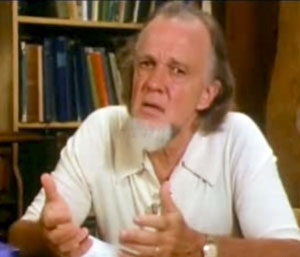
Francis Schaeffer pictured below

File:Francis Schaeffer.jpg

_________________

Life without God in the picture is absurdity!!!. That was the view of King Solomon when he wrote the Book of Ecclesiastes 3000 years ago and it is the view of many of the modern philosophers today. Modern man has tried to come up with a lasting meaning for life without God in the picture (life under the sun), but it is not possible. Without the infinite-personal God of the Bible to reveal moral absolutes then man is left to embrace moral relativism. In a time plus chance universe man is reduced to a machine and can not find a place for values such as love. Both of Francis Schaeffer’s film series have tackled these subjects and he shows how this is reflected in the arts.

Here are some posts I have done on the series “HOW SHOULD WE THEN LIVE? : Francis Schaeffer’s “How should we then live?” Video and outline of episode 10 “Final Choices” episode 9 “The Age of Personal Peace and Affluence”episode 8 “The Age of Fragmentation”episode 7 “The Age of Non-Reason” episode 6 “The Scientific Age”  episode 5 “The Revolutionary Age” episode 4 “The Reformation” episode 3 “The Renaissance”episode 2 “The Middle Ages,”, and  episode 1 “The Roman Age,” .

In the film series “WHATEVER HAPPENED TO THE HUMAN RACE?” the arguments are presented  against abortion (Episode 1),  infanticide (Episode 2),   euthenasia (Episode 3), and then there is a discussion of the Christian versus Humanist worldview concerning the issue of “the basis for human dignity” in Episode 4 and then in the last episode a close look at the truth claims of the Bible.

I have discussed many subjects with my liberal friends over at the Ark Times Blog in the past and I have taken them on now on the subject of the absurdity of life without God in the picture. Most of my responses included quotes from William Lane Craig’s book THE ABSURDITY OF LIFE WITHOUT GOD.  Here is the result of one of those encounters from June of 2013:

I wrote:

Zatharus, let me show you the result of your atheism. You wrote, “You are here because your parents had sex; knowledge of an afterlife is even less knowable than a before life; other than that created by the person, 42. Can we now discuss the dichotomy of existentialism?”
Then you quoted, Friedrich Nietzsche, “To live is to suffer, to survive is to find some meaning in the suffering.”
________________
NIETZSCHE understood what a lot of people today fail to realize.

William Lane Craig writes:

Do you understand the gravity of the alternatives before us? For if God exists, then there is hope for man. But if God does not exist, then all we are left with is despair. Do you understand why the question of God’s existence is so vital to man? As Francis Schaeffer aptly put it, “If God is dead, then man is dead, too.”

Unfortunately, the mass of mankind do not realize this fact. They continue on as though nothing has changed. I’m reminded of NIETZSCHE’S story of the madman who in the early morning hours burst into the marketplace, lantern in hand, crying, “I seek God! I seek God!” Since many of those standing about did not believe in God, he provoked much laughter. “Did God get lost?” they taunted him. “Or is he hiding? Or maybe he has gone on a voyage or emigrated!” Thus they yelled and laughed. Then, writes Nietzsche, the madman turned in their midst and pierced them with his eyes.

“Whither is God?” he cried, “I shall tell you. We have killed him—you and I. All of us are his murderers. But how have we done this? How were we able to drink up the sea? Who gave us the sponge to wipe away the entire horizon? What did we do when we unchained this earth from its sun? Whither is it moving now? Away from all suns? Are we not plunging continually? Backward, sideward, forward, in all directions? Is there any up or down left? Are we not straying as through an infinite nothing? Do we not feel the breath of empty space? Has it not become colder? Is not night and more night coming on all the while? Must not lanterns be lit in the morning? Do we not hear anything yet of the noise of the gravediggers who are burying God? … God is dead…. And we have killed him. How shall we, the murderers of all murderers, comfort ourselves?”14

The crowd stared at the madman in silence and astonishment. At last he dashed his lantern to the ground. “I have come too early,” he said. “This tremendous event is still on its way—it has not yet reached the ears of man.” People did not yet truly comprehend the consequences of what they had done in killing God. But NIETZSCHE predicted that someday people would realize the implications of their atheism; and this realization would usher in an age of nihilism—the destruction of all meaning and value in life. The end of Christianity, wrote NIETZSCHE, means the advent of nihilism. This most gruesome of guests is standing already at the door. “Our whole European culture is moving for some time now,” wrote NIETZSCHE, “with a tortured tension that is growing from decade to decade, as toward a catastrophe: restlessly, violently, headlong, like a river that wants to reach the end, that no longer reflects, that is afraid to reflect.”15

MOST PEOPLE STILL DO NOT REFLECT ON THE CONSEQUENCES OF ATHEISM AND SO, LIKE THE CROWD IN THE MARKETPLACE, GO UNKNOWINGLY ON THEIR WAY. But when we realize, as did Nietzsche, what atheism implies, then his question presses hard upon us: how shall we, the murderers of all murderers, comfort ourselves?

Related posts:

Francis Schaeffer’s “How should we then live?” Video and outline of episode 10 “Final Choices” (Schaeffer Sundays)

E P I S O D E 1 0   Dr. Francis Schaeffer – Episode X – Final Choices 27 min FINAL CHOICES I. Authoritarianism the Only Humanistic Social Option One man or an elite giving authoritative arbitrary absolutes. A. Society is sole absolute in absence of other absolutes. B. But society has to be […]

Francis Schaeffer’s “How should we then live?” Video and outline of episode 9 “The Age of Personal Peace and Affluence” (Schaeffer Sundays)

E P I S O D E 9 Dr. Francis Schaeffer – Episode IX – The Age of Personal Peace and Affluence 27 min T h e Age of Personal Peace and Afflunce I. By the Early 1960s People Were Bombarded From Every Side by Modern Man’s Humanistic Thought II. Modern Form of Humanistic Thought Leads […]

Francis Schaeffer’s “How should we then live?” Video and outline of episode 8 “The Age of Fragmentation” (Schaeffer Sundays)

E P I S O D E 8 Dr. Francis Schaeffer – Episode VIII – The Age of Fragmentation 27 min I saw this film series in 1979 and it had a major impact on me. T h e Age of FRAGMENTATION I. Art As a Vehicle Of Modern Thought A. Impressionism (Monet, Renoir, Pissarro, Sisley, […]

Francis Schaeffer’s “How should we then live?” Video and outline of episode 7 “The Age of Non-Reason” (Schaeffer Sundays)

E P I S O D E 7 Dr. Francis Schaeffer – Episode VII – The Age of Non Reason I am thrilled to get this film series with you. I saw it first in 1979 and it had such a big impact on me. Today’s episode is where we see modern humanist man act […]

Francis Schaeffer’s “How should we then live?” Video and outline of episode 6 “The Scientific Age” (Schaeffer Sundays)

E P I S O D E 6 How Should We Then Live 6#1 Uploaded by NoMirrorHDDHrorriMoN on Oct 3, 2011 How Should We Then Live? Episode 6 of 12 ________ I am sharing with you a film series that I saw in 1979. In this film Francis Schaeffer asserted that was a shift in […]

Francis Schaeffer’s “How should we then live?” Video and outline of episode 5 “The Revolutionary Age” (Schaeffer Sundays)

E P I S O D E 5 How Should We Then Live? Episode 5: The Revolutionary Age I was impacted by this film series by Francis Schaeffer back in the 1970′s and I wanted to share it with you. Francis Schaeffer noted, “Reformation Did Not Bring Perfection. But gradually on basis of biblical teaching there […]

Francis Schaeffer’s “How should we then live?” Video and outline of episode 4 “The Reformation” (Schaeffer Sundays)

Dr. Francis Schaeffer – Episode IV – The Reformation 27 min I was impacted by this film series by Francis Schaeffer back in the 1970′s and I wanted to share it with you. Schaeffer makes three key points concerning the Reformation: “1. Erasmian Christian humanism rejected by Farel. 2. Bible gives needed answers not only as to […]

“Schaeffer Sundays” Francis Schaeffer’s “How should we then live?” Video and outline of episode 3 “The Renaissance”

Francis Schaeffer’s “How should we then live?” Video and outline of episode 3 “The Renaissance” Francis Schaeffer: “How Should We Then Live?” (Episode 3) THE RENAISSANCE I was impacted by this film series by Francis Schaeffer back in the 1970′s and I wanted to share it with you. Schaeffer really shows why we have so […]

Francis Schaeffer’s “How should we then live?” Video and outline of episode 2 “The Middle Ages” (Schaeffer Sundays)

  Francis Schaeffer: “How Should We Then Live?” (Episode 2) THE MIDDLE AGES I was impacted by this film series by Francis Schaeffer back in the 1970′s and I wanted to share it with you. Schaeffer points out that during this time period unfortunately we have the “Church’s deviation from early church’s teaching in regard […]

Francis Schaeffer’s “How should we then live?” Video and outline of episode 1 “The Roman Age” (Schaeffer Sundays)

Francis Schaeffer: “How Should We Then Live?” (Episode 1) THE ROMAN AGE   Today I am starting a series that really had a big impact on my life back in the 1970′s when I first saw it. There are ten parts and today is the first. Francis Schaeffer takes a look at Rome and why […]

Francis Schaeffer: “Whatever Happened to the Human Race” (Episode 5) TRUTH AND HISTORY

Francis Schaeffer: “Whatever Happened to the Human Race” (Episode 5) TRUTH AND HISTORY Published on Oct 7, 2012 by AdamMetropolis This crucial series is narrated by the late Dr. Francis Schaeffer and former Surgeon General Dr. C. Everett Koop. Today, choices are being made that undermine human rights at their most basic level. Practices once […]

Francis Schaeffer: “Whatever Happened to the Human Race” (Episode 4) THE BASIS FOR HUMAN DIGNITY

The opening song at the beginning of this episode is very insightful. Francis Schaeffer: “Whatever Happened to the Human Race” (Episode 4) THE BASIS FOR HUMAN DIGNITY Published on Oct 7, 2012 by AdamMetropolis This crucial series is narrated by the late Dr. Francis Schaeffer and former Surgeon General Dr. C. Everett Koop. Today, choices […]

Francis Schaeffer: “Whatever Happened to the Human Race” (Episode 3) DEATH BY SOMEONE’S CHOICE

Francis Schaeffer: “Whatever Happened to the Human Race” (Episode 3) DEATH BY SOMEONE’S CHOICE Published on Oct 6, 2012 by AdamMetropolis This crucial series is narrated by the late Dr. Francis Schaeffer and former Surgeon General Dr. C. Everett Koop. Today, choices are being made that undermine human rights at their most basic level. Practices […]

Francis Schaeffer: “Whatever Happened to the Human Race?” (Episode 2) SLAUGHTER OF THE INNOCENTS

Francis Schaeffer: “Whatever Happened to the Human Race?” (Episode 2) SLAUGHTER OF THE INNOCENTS Published on Oct 6, 2012 by AdamMetropolis This crucial series is narrated by the late Dr. Francis Schaeffer and former Surgeon General Dr. C. Everett Koop. Today, choices are being made that undermine human rights at their most basic level. Practices […]

Francis Schaeffer: “Whatever Happened to the Human Race” (Episode 1) ABORTION OF THE HUMAN RACE

It is not possible to know where the pro-life evangelicals are coming from unless you look at the work of the person who inspired them the most. That person was Francis Schaeffer.  I do care about economic issues but the pro-life issue is the most important to me. Several years ago Adrian Rogers (past president of […]

Ecclesiastes, Purpose, Meaning, and the Necessity of God by Suiwen Liang (Quotes Will Durant, Madalyn Murray O’Hair, Stephen Jay Gould,Richard Dawkins, Jean-Paul Sartre,Bertrand Russell, Leo Tolstoy, Loren Eiseley,Aldous Huxley, G.K. Chesterton, Ravi Zacharias, and C.S. Lewis.)

Ecclesiastes 2-3 Published on Sep 19, 2012 Calvary Chapel Spring Valley | Sunday Evening | September 16, 2012 | Derek Neider _____________________________ I have written on the Book of Ecclesiastes and the subject of the meaning of our lives on several occasions on this blog. In this series on Ecclesiastes I hope to show how secular […]

Robert Leroe on Ecclesiastes (Mentions Thomas Aquinas, Princess Diana, Mother Teresa, King Solomon, King Rehoboam, Eugene Peterson, Chuck Swindoll, and John Newton.)

Ecclesiastes 1 Published on Sep 4, 2012 Calvary Chapel Spring Valley | Sunday Evening | September 2, 2012 | Pastor Derek Neider _____________________ I have written on the Book of Ecclesiastes and the subject of the meaning of our lives on several occasions on this blog. In this series on Ecclesiastes I hope to show how […]
Super Bowl, Black Eyed Peas, and the Meaning of Life and Ecclesiastes

Ecclesiastes 8-10 | Still Searching After All These Years Published on Oct 9, 2012 Calvary Chapel Spring Valley | Sunday Evening | October 7, 2012 | Pastor Derek Neider _______________________ Ecclesiastes 11-12 | Solomon Finds His Way Published on Oct 30, 2012 Calvary Chapel Spring Valley | Sunday Evening | October 28, 2012 | Pastor Derek Neider […]
Brian LePort on Ecclesiastes

Ecclesiastes 6-8 | Solomon Turns Over a New Leaf Published on Oct 2, 2012 Calvary Chapel Spring Valley | Sunday Evening | September 30, 2012 | Pastor Derek Neider _____________________ I have written on the Book of Ecclesiastes and the subject of the meaning of our lives on several occasions on this blog. In this series […]

J.W. Wartick on Ecclesiastes

Ecclesiastes 4-6 | Solomon’s Dissatisfaction Published on Sep 24, 2012 Calvary Chapel Spring Valley | Sunday Evening | September 23, 2012 | Pastor Derek Neider ___________________ I have written on the Book of Ecclesiastes and the subject of the meaning of our lives on several occasions on this blog. In this series on Ecclesiastes I hope […]

Overview of the Book of Ecclesiastes

Overview of the Book of Ecclesiastes Overview of the Book of EcclesiastesAuthor: Solomon or an unknown sage in the royal courtPurpose: To demonstrate that life viewed merely from a realistic human perspective must result in pessimism, and to offer hope through humble obedience and faithfulness to God until the final judgment.Date: 930-586 B.C. Ecclesiastes 2-3 Published on Sep 19, […]

Doy Moyer on the Book of Ecclesiastes and Apologetics

Ecclesiastes 1 Published on Sep 4, 2012 Calvary Chapel Spring Valley | Sunday Evening | September 2, 2012 | Pastor Derek Neider _____________________ I have written on the Book of Ecclesiastes and the subject of the meaning of our lives on several occasions on this blog. In this series on Ecclesiastes I hope to show how […]

Solomon was the author of Ecclesiastes

Ecclesiastes 8-10 | Still Searching After All These Years Published on Oct 9, 2012 Calvary Chapel Spring Valley | Sunday Evening | October 7, 2012 | Pastor Derek Neider _______________________ Ecclesiastes 11-12 | Solomon Finds His Way Published on Oct 30, 2012 Calvary Chapel Spring Valley | Sunday Evening | October 28, 2012 | Pastor Derek Neider […]

By Everette Hatcher III | Posted in Current Events | Edit | Comments (0)

“Schaeffer Sunday” Here is Wikipedia entry on Schaeffer’s book “He is There and He is not silent”

Here is Wikipedia entry on Schaeffer’s book “He is There and He is not silent”

______________

How Should We then Live Episode 7 small (Age of Nonreason)

#02 How Should We Then Live? (Promo Clip) Dr. Francis Schaeffer

The clip above is from episode 9 THE AGE OF PERSONAL PEACE AND AFFLUENCE

10 Worldview and Truth

In above clip Schaeffer quotes Paul’s speech in Greece from Romans 1 (from Episode FINAL CHOICES)

Two Minute Warning: How Then Should We Live?: Francis Schaeffer at 100

A Christian Manifesto Francis Schaeffer

Francis Schaeffer “BASIS FOR HUMAN DIGNITY” Whatever…HTTHR

_______________________

I love the works of Francis Schaeffer and I have been on the internet reading several blogs that talk about Schaeffer’s work and the work below was really helpful. Schaeffer’s film series “How should we then live?  Wikipedia notes, “According to Schaeffer, How Should We Then Live traces Western history from Ancient Rome until the time of writing (1976) along three lines: the philosophic, scientific, and religious.[3] He also makes extensive references to art and architecture as a means of showing how these movements reflected changing patterns of thought through time. Schaeffer’s central premise is: when we base society on the Bible, on the infinite-personal God who is there and has spoken,[4] this provides an absolute by which we can conduct our lives and by which we can judge society.  Here are some posts I have done on this series: Francis Schaeffer’s “How should we then live?” Video and outline of episode 10 “Final Choices” episode 9 “The Age of Personal Peace and Affluence”episode 8 “The Age of Fragmentation”episode 7 “The Age of Non-Reason” episode 6 “The Scientific Age”  episode 5 “The Revolutionary Age” episode 4 “The Reformation” episode 3 “The Renaissance”episode 2 “The Middle Ages,”, and  episode 1 “The Roman Age,” .

Here is Wikipedia entry on Schaeffer’s book “He is There and He is not silent”:

He Is There and He Is Not Silent

From Wikipedia, the free encyclopedia
Jump to: navigation, search

He Is There and He Is Not Silent is a philosophical work written by American apologist and Christian theologian Francis A. Schaeffer, Wheaton, IL:Tyndale House, first published in 1972. It is Book Three in Volume One of The Complete Works of Francis A. Schaeffer A Christian Worldview. Westchester, IL:Crossway Books, 1982. This is the third book of Francis Schaeffer’s “Trilogy.”

Contents

[hide]

[edit] Overview

He Is There and He Is Not Silent is divided into four chapters, followed by two appendices. The first of these chapters deals with metaphysics; the second, morals; and the third and fourth, epistemology. The first appendix concerns revelation and the second the concept of faith. To give the reader an idea of what the book is about, an overview of “Chapter 1. The Metaphysical Necessity” is presented.

[edit] Table of contents

Introduction

Chapter 1. The Metaphysical Necessity

In the opening chapter, Schaeffer, after briefly defining “metaphysics,” states two dilemmas concerning humankind. First, he claims that humans exhibit “mannishness” and have a personal nature, separating them from the impersonal, but that humans are also finite. Second, he points out the contrast between the nobility and the cruelty of man. He then presents his view of the two classes of answers to these dilemmas.

First, what Schaeffer calls the “Line of Despair” (and associates with existentialism): that there is no logical answer to the dilemmas, and that all is “chaotic, irrational, and absurd.” Schaeffer characterizes this view as impossible to hold in practice, because order is necessary for life. Schaeffer also accuses advocates of this viewpoint of utilizing logic when it suits their arguments, but attacking logic when it is convenient.

The second class of answers Schaeffer postulates is that logic exists, and that the subject of metaphysics is open to rational discussion. Within this category, Schaeffer discusses three specific answers: first, existence ex nihilo, that all that exists “has come out of absolutely nothing.” Schaeffer labels this answer “unthinkable.” Second, Schaeffer lists the “impersonal beginning,” and along with it, “reductionism.” His criticism is that such an answer fails to give meaning or significance to particulars. Furthermore, he alleges that there is no proof that an impersonal beginning could produce complexity or personality. Schaeffer also attacks pantheism in this vein, which he labels “paneverythingism,” propounding that while it provides an answer for unity and universals, it fails to explain the origin of diversity and particulars.

Finally, Schaeffer introduces the answer of the personal beginning. In addition to providing an explanation for both complexity and personality, Schaeffer writes that the answer to the dilemma of both unity/universals and diversity/particulars may be found in the doctrine of the Trinity.

Returning to the two dilemmas given at the beginning of the chapter, Schaeffer describes what he calls the “Personal-Infinite God.” On the side of personality, Schaeffer posits a “chasm” between God and Man, on the one side, and the animal, the flower, and the machine on the other. On the side of infiniteness, Schaeffer moves the chasm to between God and Man. The existence of this “complete chasm,” Schaeffer says, is the origin of our confusion on issues of metaphysics.

Schaeffer finishes the chapter by concluding that there is a “God who is there,” reprising the titular phrase of his book, The God Who Is There. However, he extends beyond this by describing revelatory knowledge, via the idea that God has spoken: “He is not silent.”

Chapter 2. The Moral Necessity

Chapter 3. The Epistemological Necessity: The Problem

Chapter 4. The Epistemological Necessity: The Answer

Appendix A. Is Propositional Revelation Nonsense?

Appendix B. “Faith” Versus Faith

[edit] References

[edit] External links

FRANCIS SCHAEFFER ANALYZES ART AND CULTURE Part 67 THE BEATLES ( RICHES AND LUXURIES NEVER SATISFIED THE BEATLES! ) (Feature on artist Derek Boshier )

All four of the Beatles grew up poor or lower middle class and they did discover once they hit it big that luxuries and money did not bring satisfaction to their lives. So they continued to search for that missing thing that could give them peace in their lives.

The Beatles Money (That’s What I Want) 

Julian and John Lennon meet the HAPPY DAYS crew:

mick jagger john lennon and yoko ono by bob gruen nyc 1972

The Beatles were looking for lasting satisfaction in their lives and their journey took them down many of the same paths that other young people of the 1960’s were taking. No wonder in the video THE AGE OF NON-REASON Schaeffer noted,  ” Sergeant Pepper’s Lonely Hearts Club Band…for a time it became the rallying cry for young people throughout the world. It expressed the essence of their lives, thoughts and their feelings.” 

Today we will look at the path of pursuing money and luxuries in an attempt to bring lasting satisfaction into one’s life.

How Should We then Live Episode 7 small (Age of Nonreason)

A Really Big Show – The Beatles: Backstage at “The Ed Sullivan Show” – Pictures – CBS News

The Beatles Money (That’s What I Want) (Live) [HD]

The Beatles were always searching during the 1960’s for a meaning for their lives. Cynthia Lennon said of John, “HE WAS ALWAYS SEARCHING. JOHN ALWAYS LOOKING FOR THE TRUTH, AN IDEAL, A DREAM.”

No truer words were ever spoken. John in 1967 when the album  Sergeant Pepper’s Lonely Hearts Club Band was about to come out was in the middle of some big changes in his life.  He was searching for meaning in life in what I call the 6 big L words just like King Solomon did in the Book of Ecclesiastes. He looked into  learning (1:16-18), laughter, ladies, luxuries,  and liquor (2:1-3, 8, 10, 11), and labor (2:4-6, 18-20).

In college in 1980, my professor, Dr. Blake, talked a lot about the Beatles. He asked students to speak up because he was a big fan of rock music in the 1960’s when he lost a lot of his hearing. He pointed out that the lyrics in rock music are not always consistent. He noted that the Beatles hit “Money (That’s What I Want)” was followed by the later hit “Can’t Buy Me Love.” 

The Beatles – Can’t Buy Me Love (Live)

I think the Beatles did look long and hard into the area of luxuries for their satisfaction and like King Solomon they found it to be “vanity and a striving after the wind.”

_________

Ecclesiastes 2:4-11English Standard Version (ESV)

I made great works. I built houses and planted vineyards for myself. I made myself gardens and parks, and planted in them all kinds of fruit trees. I made myself pools from which to water the forest of growing trees. I bought male and female slaves, and had slaves who were born in my house. I had also great possessions of herds and flocks, more than any who had been before me in Jerusalem. 8 I also gathered for myself silver and gold and the treasure of kings and provinces. I got singers, both men and women, and many concubines,[a]the delight of the sons of man.

So I became great and surpassed all who were before me in Jerusalem. Also my wisdom remained with me. 10 And whatever my eyes desired I did not keep from them. I kept my heart from no pleasure, for my heart found pleasure in all my toil, and this was my reward for all my toil. 11 Then I considered all that my hands had done and the toil I had expended in doing it, and behold, all was vanity and a striving after wind, and there was nothing to be gained under the sun.

John Lennon later wrote the song “Watching the Wheels” that indicated he did not care that people thought he was crazy for dropping out of the money-making music business in 1976 to help raise his son. That demonstrated to me that Lennon had discovered  how empty a pursuit of building wealth is while ignoring your family.In the article “Alistair Begg on The Beatles,” April 1, 2003, Begg noted:

The Beatles first said money was everything (in the song “Money“), then they said that love could give you anything you want onFrom Me to You“, and then they recordCan’t Buy Me Love“. What do you see in this progression?

(Francis Schaeffer pictured below)

Francis Schaeffer noted that Solomon in the Book of Ecclesiastes took a look at the meaning of life on the basis of human life standing alone between birth and death “under the sun.” This phrase UNDER THE SUN appears over and over in Ecclesiastes. The Christian Scholar Ravi Zacharias noted, “The key to understanding the Book of Ecclesiastes is the term UNDER THE SUN — What that literally means is you lock God out of a closed system and you are left with only this world of Time plus Chance plus matter.” 

If you are an atheist then you have a naturalistic materialistic worldview, and this short book of Ecclesiastes should interest you because the wisest man who ever lived in the position of King of Israel came to THREE CONCLUSIONS that will affect you.

FIRST, chance and time have determined the past, and they will determine the future.  (Ecclesiastes 9:11-13)

These two verses below  take the 3 elements mentioned in a naturalistic materialistic worldview (time, chance and matter) and so that is all the unbeliever can find “under the sun” without God in the picture. You will notice that these are the three elements that evolutionists point to also.

Ecclesiastes 9:11-12 is following: I have seen something else under the sun: The race is not to the swift or the battle to the strong, nor does food come to the wise or wealth to the brilliant or favor to the learned; but time and chance happen to them all. Moreover, no one knows when their hour will come: As fish are caught in a cruel net, or birds are taken in a snare, so people are trapped by evil times that fall unexpectedly upon them.

SECOND, Death is the great equalizer (Eccl 3:20, “All go to the same place; all come from dust, and to dust all return.”)

THIRD, Power reigns in this life, and the scales are not balanced(Eccl 4:1, 8:15)

Ecclesiastes 4:1-2: “Next I turned my attention to all the outrageous violence that takes place on this planet—the tears of the victims, no one to comfort them; the iron grip of oppressors, no one to rescue the victims from them.” Ecclesiastes 8:14; “ Here’s something that happens all the time and makes no sense at all: Good people get what’s coming to the wicked, and bad people get what’s coming to the good. I tell you, this makes no sense. It’s smoke.”

Solomon had all the resources (and luxuries) in the world and he found himself still searching for meaning in life and trying to come up with answers concerning the afterlife. However, it seems every door he tries to open is locked. Today men try to find satisfaction in learning, liquor, ladies, luxuries, laughter, and labor and that is exactly what Solomon tried to do too.  None of those were able to “fill the God-sized vacuum in his heart” (quote from famous mathematician and philosopher Blaise Pascal). You have to wait to the last chapter in Ecclesiastes to find what Solomon’s final conclusion is.

In 1978 I heard the song “Dust in the Wind” by Kansas when it rose to #6 on the charts. That song told me that Kerry Livgren the writer of that song and a member of Kansas had come to the same conclusion that Solomon had. I remember mentioning to my friends at church that we may soon see some members of Kansas become Christians because their search for the meaning of life had obviously come up empty even though they had risen from being an unknown band to the top of the music business and had all the wealth and fame that came with that. Furthermore, Solomon realized death comes to everyone and there must be something more.

Livgren wrote:

All we do, crumbles to the ground though we refuse to see, Dust in the Wind, All we are is dust in the wind, Don’t hang on, Nothing lasts forever but the Earth and Sky, It slips away, And all your money won’t another minute buy.”

Take a minute and compare Kerry Livgren’s words to that of the late British humanist H.J. Blackham:

On humanist assumptions, life leads to nothing, and every pretense that it does not is a deceit. If there is a bridge over a gorge which spans only half the distance and ends in mid-air, and if the bridge is crowded with human beings pressing on, one after the other they fall into the abyss. The bridge leads nowhere, and those who are pressing forward to cross it are going nowhere….It does not matter where they think they are going, what preparations for the journey they may have made, how much they may be enjoying it all. The objection merely points out objectively that such a situation is a model of futility“( H. J. Blackham, et al., Objections to Humanism (Riverside, Connecticut: Greenwood Press, 1967).

_____________________________________

Both Kerry Livgren and the bass player DAVE HOPE of Kansas became Christians eventually. Kerry Livgren first tried Eastern Religions and DAVE HOPE had to come out of a heavy drug addiction. I was shocked and elated to see their personal testimony on The 700 Club in 1981 and that same  interview can be seen on youtube today. Livgren lives in Topeka, Kansas today where he teaches “Diggers,” a Sunday school class at Topeka Bible Church. DAVE HOPE is the head of Worship, Evangelism and Outreach at Immanuel Anglican Church in Destin, Florida.

Those who reject God must accept three realities of their life UNDER THE SUN.  FIRST, death is the end and SECOND, chance and time are the only guiding forces in this life.  FINALLY, power reigns in this life and the scales are never balanced. In contrast, Dave Hope and Kerry Livgren believe death is not the end and the Christian can  face death and also confront the world knowing that it is not determined by chance and time alone and finally there is a judge who will balance the scales.

Solomon’s experiment was a search for meaning to life “under the sun.” Then in last few words in the Book of Ecclesiastes he looks above the sun and brings God back into the picture: “The conclusion, when all has been heard, is: Fear God and keep His commandments, because this applies to every person. For God will bring every act to judgment, everything which is hidden, whether it is good or evil.”

Kansas, circa 1973 (Phil Ehart, Kerry Livgren, Steve Walsh, Rich Williams, Robby Steinhardt, Dave Hope) (photo credit: DON HUNSTEIN)

Kansas, circa 1973 (Phil Ehart, Kerry Livgren, Steve Walsh, Rich Williams, Robby Steinhardt, Dave Hope) (photo credit: DON HUNSTEIN)

____________

You can hear DAVE HOPE and Kerry Livgren’s stories from this youtube link:

(part 1 ten minutes)

Kerry Livgren

(part 2 ten minutes)

Dave Hope

Kansas – Dust In The Wind

Uploaded on Nov 7, 2009

______________

There is evidence that points to the fact that the Bible is historically true as Schaeffer pointed out in episode 5 of WHATEVER HAPPENED TO THE HUMAN RACEThere is a basis then for faith in Christ alone for our eternal hope. This link shows how to do that.

The Bible and Archaeology – Is the Bible from God? (Kyle Butt 42 min)

You want some evidence that indicates that the Bible is true? Here is a good place to start and that is taking a closer look at the archaeology of the Old Testament times. Is the Bible historically accurate? Here are some of the posts I have done in the past on the subject: 1. The Babylonian Chronicleof Nebuchadnezzars Siege of Jerusalem2. Hezekiah’s Siloam Tunnel Inscription. 3. Taylor Prism (Sennacherib Hexagonal Prism)4. Biblical Cities Attested Archaeologically. 5. The Discovery of the Hittites6.Shishak Smiting His Captives7. Moabite Stone8Black Obelisk of Shalmaneser III9A Verification of places in Gospel of John and Book of Acts., 9B Discovery of Ebla Tablets10. Cyrus Cylinder11. Puru “The lot of Yahali” 9th Century B.C.E.12. The Uzziah Tablet Inscription13. The Pilate Inscription14. Caiaphas Ossuary14 B Pontius Pilate Part 214c. Three greatest American Archaeologists moved to accept Bible’s accuracy through archaeology.

Below is a piece of that evidence given by Francis Schaeffer concerning the accuracy of the Bible.

TRUTH AND HISTORY (chapter 5 of WHATEVER HAPPENED TO THE HUMAN RACE?, under footnote #94)

If we take another hundred-year step backwards in time, we come to King Solomon, son of David. On his death the Jewish Kingdom was divided into two sections as a result of a civil revolt. Israel to the north with Jeroboam as king and Judah (as it was called subsequently) to the south under Rehoboam, Solomon’s son. In both the Book of Kings and Chronicles in the Bible we read how during Rehoboam’s reign: 25 In the fifth year of King Rehoboam, Shishak king of Egypt came up against Jerusalem. (I Kings 14:25; II Chronicles 12:2), and how Shishak stripped Rehoboam of the wealth accumulated by his able father, Solomon. The reality of this event is confirmed by archaeology to a remarkable degree.

Shishak subdued not only Rehoboam but Jeroboam as well. The proof of this comes first from a fragment in a victory monument erected by Shishak and discovered at Megiddo, a city in the land of Israel. So the Egyptian king’s force swept northwards, subdued the two Jewish kings, and then erected a victory monument to that effect. Traces of the destruction have also been discovered in such cities as Hazor, Gezer, and Megiddo. These confirm what was written in Second Chronicles:

And he took the fortified cities of Judah and came as far as Jerusalem. Then Shemaiah the prophet came to Rehoboam and to the princes of Judah, who had gathered at Jerusalem because of Shishak, and said to them, “Thus says theLord, ‘You abandoned me, so I have abandoned you to the hand of Shishak.’”Then the princes of Israel and the king humbled themselves and said, “TheLord is righteous.” When the Lord saw that they humbled themselves, the word of the Lord came to Shemaiah: “They have humbled themselves. I will not destroy them, but I will grant them some deliverance, and my wrath shall not be poured out on Jerusalem by the hand of Shishak. Nevertheless, they shall be servants to him, that they may know my service and the service of the kingdoms of the countries.”

So Shishak king of Egypt came up against Jerusalem. He took away the treasures of the house of the Lord and the treasures of the king’s house. He took away everything. He also took away the shields of gold that Solomon had made…( II Chronicles 12:4-9)

Further confirmation comes from the huge victory scene engraved on Shishak’s order at the Temple of Karnak in Egypt. The figure of the king is somewhat obscured, but he is clearly named and he is seen smiting Hebrew captives before the god Amon, and there are symbolic rows of names of conquered towns of Israel and Judah.

Solomon’s is remembered also for his great wealth. The Bible tells us:

14 Now the weight of gold that came to Solomon in one year was 666 talents of gold, 15 besides that which came from the explorers and from the business of the merchants, and from all the kings of the west and from the governors of the land. 16 King Solomon made 200 large shields of beaten gold; 600 shekels[a]of gold went into each shield. 17 And he made 300 shields of beaten gold; three minas[b] of gold went into each shield. And the king put them in the House of the Forest of Lebanon. (I Kings 10:14-17)

This wealth that the Bible speaks of has been challenged. Surely, some have said, these figures are an exaggeration. Excavations, however, have confirmed enormous quantities of precious metals, owned and distributed by kings during this period. For example, Shishak’s son Osorkon I (statuette of Osorkon I, Brooklyn Museum, New York), the one who stood to gain from the booty carried off from Rehoboam’s capital, is reported to have made donations to his god Amon totaling 470 tons of precious metal, gold, and silver, during only the first four years of his reign. This, of course, is much more than Solomon’s 66 talents which equals approximately twenty tons of gold per annum. We also have confirmation of the Bible’s reference to Solomon’s gold as coming from Ophir. The location of Ophir is still unknown, but an ostracon dated a little later than Solomon’s time actually mentions that thirty shekels of gold had come from Ophir for Beth-horon.

Megiddo, The Place of Battles

Non-Technical – Nov 05, 2014 – by Col. (Ret.) David G. Hansen PhD

Megiddo aerial view

Tell el-Mutsellim, Megiddo. An aerial photo of the 35-acre tell looking south. In the lower center right of the 19-acre summit is the gate system. The shaft to the water tunnel is visible in the upper right and exposed on the left side of the tell is the archaeological cut exposing an Early Bronze Age cultic center with a round altar.

Many Christians travel to Megiddo and walk to the 15-acre (6 hectare) summit because of its eschatological significance. There they look at the excavated buildings, walls, water and gate system and then move to the north edge of the mound where they have a magnificent view of the valley, or more correctly, plain, which spreads out before them known as the “Jezreel” in the OT and “Esdraelon” in NT times (Esdraelon being the Greek modification of Jezreel). The plain separates the Galilean hills in the north from Mounts Carmel and Gilboa to the south. The immensity of the plain is so astonishing that when Napoleon Bonaparte first viewed it, he was reported to have said: “All the armies of the world could maneuver their forces on this vast plain…There is no place in the whole world more suited for war that this…[It is] the most natural battleground of the whole earth” (Cline 2002: 142).

1.2 mi (2 km) southeast of Megiddo is the entrance to the Wadi ‘Ara, a narrow north-south pass through the Carmel Mountain ridge. The south end of the Wadi ‘Ara exits onto the Sharon Plain and the Mediterranean coast; the north opens to the Jezreel Plain. The international highway traversed this pass and carried traders and armies from Asia, Europe and Africa. Megiddo’s strategic importance lay in one’s ability to use its nearby hill to monitor such traffic.

In addition to its strategic location, Megiddo had access to the agriculture products from the rich soils of the Jezreel Plain. The Hebrew translation of Jezreel, “God sows,” illustrates the land’s fertility. When George Adam Smith, a late 19th-century AD traveler, stood on Mount Gilboa and surveyed the Jezreel Plain, he wrote:

The valley was green with bush and dotted by white villages…But the rest of the plain [as] a great expanse of loam, red and black, which in a more peaceful land would be one sea of waving wheat with island villages; but has mostly been what its modern name implies, a free, wild prairie…(1966: 253).

And when the American scholar and explorer, Edward Robinson, visited the area in 1852, he wrote:

The prospect [view] from the Tell [i.e. Tell el-Mutsellim] is a noble one; embracing the whole of the glorious plain; than which there is not a richer upon earth…A city situated either on the Tell or on the ridge [Mt. Carmel] behind it, would naturally give its name to the adjacent plain and waters; as we know was the case with Megiddo…The Tell would indeed present a splendid site for a city (as quoted in Davies 1986: 4).

Megiddo’s mound has a copious spring emanating from a small cave near its base that provided water for those who settled there. Aharoni, in his comprehensive historical geography of the Holy Land, lists four criteria for occupation: strategic location, access to roads, water and agricultural lands (Aharoni 1979: 106–107). Meggido’s location met all four.2

Jezreel

Jezreel Plain from Megiddo. Sprawling on the ridge in the distance is the modern city of Nazareth. In the distance on the right side of the photo is the high round mound of Mt. Tabor near where Deborah defeated Sisera (Jgs 4, 5).

Entrance to Megiddo

Entrance to the Megiddo Pass from the northeast. In the upper part of the photo the road begins to weave its way through the hills into Wadi ‘Ara and on south toward the Mediterranean plain. The modern road follows the ancient route of the international highway through Mt. Carmel. Megiddo is 1.2 mi (2 km) to the right (N) of where the road enters the hills. The world’s earliest recorded battle occurred here between Syrian princes and Pharaoh Thutmosis III (ca. 1469 BC). Judah’s king Josiah was fatally wounded when he confronted another pharaoh, Neco, near here ca. 609 BC (2 Kgs 23:29; 2 Chr 35:20–24).

The downside for being such an attractive site was the probability of war as nations sought to control this place for their own ends. Like bears drawn to honey, realms fought at and near Megiddo for fruit of the Jezreel Plain, to control and tax international traffic, or secure lines of communication to and from far-flung lands. In his historical review of Megiddo and its surrounds, Cline counts no fewer than 34 wars there from ca. 2350 BC to AD 2000 and adds, “nearly every invading force [of Israel] has fought a battle in the Jezreel Valley” (2002: 11). Proof of this can be seen in some of the 20 occupational levels dating from the Chalcolithic to Persian periods (ca. 5000–332 BC), with evidence that they met their ends in fiery destruction (DeVries 1997: 215).

[Megiddo] was easily accessible to traders and migrants from all directions; but at the same time it could, if powerful enough, control access to means of these routes and so direct the course of both trade and war. It is not surprising therefore that it was at most periods of antiquity one of the wealthiest cities of Palestine, or that it was a prize often fought over and when secured strongly defended (Davies 1986: 10).

Excavations

The first deliberate archaeological excavations at Tell el- Mutesellim were in 1903–1905, by G. Schumacher on behalf of the German Society for Oriental Research. He had a north-south trench dug the length of the mound that exposed several Iron Age (ca. 1200–600 BC) buildings, and he made soundings along the walls at other places on the site (Aharoni 1993: 1004–1005). Among his finds was a royal official’s seal from the reign of Jeroboam II (ca. 793–753 BC; 2 Kgs 14:23–25). The seal, made of jasper with the image of a crouching lion, had an inscription, “(belonging) to Shema’ Servant of Jeroboam,” the only reference to Jeroboam II outside of the Bible. Unfortunately, the seal has disappeared and only a copy exists (Wood 2000: 119).

Excavations were renewed in 1925 by the Oriental Institute of Chicago at the encouragement of Egyptologist James Henry Breasted and financially underwritten by John D. Rockefeller, Jr. This work continued until 1939, when it was interrupted by the onset of World War II. The goal of the first field director, Clarence Fisher, was to clear the mound layer-by-layer. After four years it became obvious the effort could not be sustained on such a grand scale, and the scope became more limited. For those who are familiar with archaeological techniques used today, it may be of interest that H.G. Guy, who replaced Fisher in 1927, was the first to “use ‘locus numbers’ to designate rooms and or other small areas and the taking of aerial photographs of major structures by means of a camera attached to a captive balloon” (Davies 1986: 19–20).

Yigael Yadin started work at Megiddo in 1960 on behalf of the Institute of Archaeology at the Hebrew University of Jerusalem, with additional seasons in 1961, 1966, 1967 and 1971. Yadin helped to clarify the dating of many buildings uncovered by previous excavators. Yadin’s colleagues continued excavating until 1974 (Aharoni 1993: 1005). Since 1992, and every other year since, excavations have been done under the direction of Israel Finkelstein, David Ussishkin and Baruch Halpern, and under the auspices of Tel Aviv University and The Pennsylvania State University. Their work continues to shed light on previously excavated areas as well as performing reconstruction activities to make the site more comprehensible for visitors (Finkelstein, Ussishkin, Halpern 2008: 1944–1950).

History

The occupation of Megiddo could have begun as early as ca. 5000 BC (Davies 1986: 25). By 2700 BC a large village was there, surrounded by a great wall—the largest and strongest ever built on the mound (Aharoni 1993: 1007). Visible at the bottom of a large archaeological cut is a worship complex from this period, with a 26Z ft (8 m) diameter circular altar, 5 ft (1.5 m) high, with a flight of stairs to its top. This was also the time when Megiddo became the target of the first known recorded military campaign. An Egyptian tomb inscription from the Early Bronze Age described how Weni, a general under Pharaoh Pepi I (ca. 2325–2275 BC), invaded the region and found fortified towns, excellent vineyards and fine orchards (Aharoni 1979: 135–37). Weni campaigned four more times around Megiddo to put down insurrections, probably local farmers chafing under oppressive Egyptian rule (Hansen 1991: 85).

In succeeding generations Megiddo continued to attract Egyptian interest, and was the site of the world’s earliest battle for which a detailed account exists. Carved on the walls of Karnak in Egypt is a well-preserved description of how Pharaoh Thutmosis III, one of Egypt’s greatest sovereigns and her finest military strategist, fought a coalition of Syrian princes at Megiddo ca.1469 BC. The Syrians had occupied Megiddo and controlled the pass through the Carmel ridge, the Wadi ‘Ara. Thutmosis moved a large army from Egypt to a place just south of the entrance to the Wadi ‘Ara. Contemplating his next move, Thutmosis consulted his generals, who urged him not to consider the Wadi ‘Ara but to use two other less narrow valleys north and south of the ‘Ara. His staff feared an ambush in the narrow ‘Ara pass. Disregarding their advice, Thutmosis ordered the army through the Wadi ‘Ara. They traversed the pass unmolested and exited onto the Jezreel Plain, surprising the Syrian princes who had anticipated that the Egyptian army would come through the two other, less dangerous, routes. In the ensuing battle the Syrians were able to escape to the safety of Megiddo where, after a seven-month siege, the city fell.3After the siege, the amount of agricultural spoils captured by Thutmosis is impressive: “…1,929 cows, 2,000 goats, and 20,500 sheep…[The] of the harvest which is majesty carried off from the Megiddo acres: 207,300 [+ x] sacks of wheat, apart from what was cut as forage by his majesty’s army…” (Pritchard 1958: 181–82). It is estimated the wheat, alone, measured 450,000 bushels (Pritchard 1958: 182 n.1). Megiddo was a very wealthy and fertile target, indeed!

Small ivory box

Small box carved from a single block of ivory, 2.95 in (7.5 cm) high, 5.25 x 4.75 in (13.5 x 12 cm), found at Megiddo and beautifully decorated on four sides with lions and sphinxes, shows the work of a skilled artisan and dates to the time of the Conquest 12th–13th c. BC. The fine workmanship shows the wealth of those who lived in Megiddo at the time.

Megiddo six-chamber gate

Six-chamber gate at Megiddo. Only the three southern chambers remain today of the massive gate and can be seen in this photo. The center chamber is filled with rocks but the first and third are open. It is believed Solomon constructed this gate and built two more like it at Gezer and Hazor (1 Kgs 9:15).

Both General Weni and Pharaoh Thutmosis III campaigned before the Israelites entered the Promised Land ca. 1406 BC.4 Although Joshua defeated the king of Megiddo (Jos 12:21), the Bible does not tell us how. Apparently Joshua did not capture the city because Megiddo was still occupied by Canaanites at the time of the Judges (Jgs 1:27). However, during the time of the Conquest (the period covered by Joshua and Judges), Megiddo became the focus of attention for one nearby city-state, Shechem. The Bible implies the invading Israelites made peace with the king of Shechem (Hansen 2005: 37). The king of Shechem apparently then used his association with the Hebrews as an opportunity to attack some of his neighbors, including Megiddo. This is reported in the Armana tablets found in Egypt in AD 1887. They were written by various rulers from around the Middle East, including leaders of Promised Land city-states to Pharaohs Amenhotep III (ca. 1402-1364) and Akhenaten (Amenhotep IV, ca. 1350-1334).5 Letter EA 252 is from Labayu, the king of Shechem, who shows contempt for Egypt and implies he had become independent of Egyptian rule (Hess 1993). The king of Megiddo wrote in EA 244 that his city has been besieged by Labayu, complains of Egypt’s lack of response, and pleads for military assistance:

ever since the archers returned (to Egypt?), Lab’ayu has carried on hostilities against me, and we are not able to pluck the wool, and we are not able to go outside the gate in the presence of Lab’ayu, since he learned that thou hast not given archers but let the king protect his city, lest Lab’ayu seize it… He [Lab’ayu] seeks to destroy Megiddo (Pritchard 1958: 263).

Letters EA 287 and EA 288 are from the king of Jerusalem, who requests reinforcements to protect against the Habiru who are attacking cities. He also accuses Labayu, the king of Shechem, of giving land to the Habiru (Pritchard 1958: 270–72). The mention of Habiru in these tablets refers to a migratory people group who were invading the Promised Land at the time of the Conquest. Many conservative Bible scholars believe the Habiru to have been the Israelites.6

Excavations at Megiddo have revealed that the period when the Amarna letters were written was wealthy. Many lovely gold artifacts, and a horde of 382 ivories, show the prosperity of Megiddo’s rulers. Several ivories have hieroglyphic inscriptions that point to Egyptian influence at the site. Other ivories are pieces of a board game or games, women’s cosmetic utensils, and a small box carved from a single piece of ivory (Aharoni 1993: 1011). Following this time, Megiddo suffered a major destruction dated to the time of the Judges (Price 1997: 147).

Megiddo water tunnel

Megiddo water system tunnel. The 262 ft (80 m) long tunnel dug under the city walls to a spring in a cave outside of the city walls.

The first mention of Megiddo after the book of Judges is during the reign of Solomon (970–930 BC). The governor he appointed to Megiddo’s district was required to annually supply Solomon’s palace with a month’s worth of provisions (1 Kgs 4:7, 12). Although the evidence is weak, it was probably King David who conquered the city, as evidenced by the remains of a violent conflagration over 3 ft (1 m) deep (Shiloh: 1016). If correct, it was David who built a new city, referred to in 1 Kings, over the remains of the previous one.

In succeeding years Megiddo became a major fortified city. At this level excavators revealed the remains of a large gate complex of six chambers, three on each side, with two towers. In an amazing piece of detective work, Yadin proved Megiddo’s gate complex mirrored those from the same period found at Gezer and Hazor (1975: 193–94). Yadin concluded Solomon constructed the three city gates, using a shared plan, at the time he “built the wall of Jerusalem, and Hazor, Megiddo and Gezer” (1 Kgs 9:15). Of this discovery Yadin wrote, “…as an archaeologist I cannot imagine a greater thrill that working with the Bible in one hand and the spade in the other” (1975: 187).

Many structures from Solomon’s time, as well as that of the gate system, have been uncovered. However, it must be stated that some archaeologists challenge the dating. Among the contested structures are several long, narrow buildings archaeologists have identified as horse stables, while others argue they were barracks or storehouses (Shiloh 1993: 1021). If stables, the structures fit well with what the Bible tells us about Solomon, who built “cities and towns for his chariots and for his horses” (1Kgs 9:19). A large grain storage pit, 69 ft (21 m) deep and 69 ft (21 m) wide, was found near the “stables” and could have provided 150 days’ worth of grain for up to 330 horses (Ussishkin 1997: 467). Parts of this level’s city were destroyed by fire, probably by Pharaoh Shishak, who invaded the country shortly after Solomon died ca. 925 BC (1 Kgs 14:25; 1 Chr 12:2).

Megiddo Tell el Mutsellim

Aerial view of Megiddo from the southeast, with Mt. Carmel in the distance. Tell el-Mutsellim, the site of the ancient city of Megiddo, is in the foreground. The prophet Elijah confronted the priests of Baal on Mt. Carmel (1 Kgs 18:21) and later executed them near Megiddo (1 Kgs 18:24). This area is also the location of biblical Armageddon prophesied in Revelation 16:16.

Megiddo stables or barracks

Stables, barracks or storerooms? Scholars debate the use of tripartite buildings excavated at Megiddo that have rooms similar to these in the photo that have mangers. Many believe the buildings were stables from the time of Solomon, and Megiddo was one of his chariot cities (1 Kgs 9:19).

Shishak (who is Egyptian pharaoh Sheshonq I, ca. 945–923 BC) left a record of his invasion of Judah and Israel at Karnak in Egypt, and Megiddo is among the places he listed as being conquered. During the 1929 excavations of Megiddo, Clarence Fisher found a fragment from a stele erected by Shishak that commemorated his capture of the city.

One of the most interesting structures to explore at Megiddo is the large water system, probably built during the reigns of the northern kings Omri and Ahab (ca. 880–853 BC) in order to gain protected access to the spring outside the city walls. An 82 ft (25 m) deep square vertical shaft with steps along its side was dug inside the city walls and connected to a 262 ft (80 m) tunnel dug through rock that led to the city’s water source, a spring in a cave 115 ft (35 m) below the surface. The outside approach to the cave was then concealed and blocked (Shiloh 1993: 1023).

A destruction layer in several buildings at Megiddo denotes the arrival of the Assyrians. The city undoubtedly fell to Tiglath-Pileser III (745–727 BC) when he invaded the northern kingdom, as documented in his annals (Pritchard 1958: 193–94) and the Bible (2 Kgs 15:29–30). However, many structures, including the city walls, water system and grain storage pit, continued in use during the Assyrian period. New buildings displayed typical Assyrian architectural features, and indicate the city was an administrative or residential center (Ussishkin 1997: 468).

Stratum II represents the period ca. 650–600 BC, during which the city fell rapidly into decline. Although many of the Assyrian buildings continued to be used, the city was unfortified except for a structure that may have been a fortress. It is unclear who controlled the city, the Israelites or the Egyptians; it was a time when a power vacuum existed in northern Palestine, and both the king of Judah, Josiah (640–609 BC), and the Egyptians saw this as an opportunity to expand their empires. The two kingdoms clashed at Megiddo in 609 BC when Pharaoh Neco II, on his way to assist his Assyrian allies in a battle against the Babylonians, met Josiah. Under circumstances that are not certain, the Bible reports that Josiah “marched out to meet him [Neco] in battle, but Neco faced him and killed him at Megiddo” (2 Kgs 23:29). 2 Chronicles 35:20–24 describes the same event, adding details that Josiah was wounded in battle on the plain of Megiddo and taken to Jerusalem where he died. Josiah’s death opened the door for Babylon’s invasion, and Megiddo soon fell into disuse. It was abandoned by the time Alexander the Great conquered the region, ca. 332 BC.

Remarkably, visitors today see acres of ruins, a fascinating water system and complex gate systems, and would find it hard to believe the exact location of Megiddo was lost in history. But, from about 330 BC on, Tell el-Mutesellim was forgotten as the site of the city of Megiddo. By the fourth century AD, Jerome had only a vague idea of where Megiddo had been, and scholars in subsequent centuries conjectured it was at various other places in the area. When Edward Robinson visited Tell el-Mutsellim in 1852 he wrote: “The Tell [has] no trace, of any kind to show that a city ever stood there” (Davies 1986: 4). It was not until Tell el-Mutesellim was excavated in the early 20th century that the location of the ancient city of Megiddo was known.

The Final Battle7

As fascinating as the history and archaeology of Megiddo may be, the Bible informs us of an even more remarkable happening at or near Megiddo. There, “the kings of the whole world” will be gathered “for the battle on the great day of God Almighty” (Rv 16:14). The battle will bring an end to the adversary (Rv 16:17), and “Babylon the Great” will finally fall (Rv 16:19), reversing the failure of Josiah that had earlier brought Babylon into the Promised Land.8

This final conflict will occur in association with the “mountain” of Megiddo (Rv 16:16), which could imply the ridge of Mount Carmel that rises above Megiddo. During the days of Elijah the prophet, King Ahab (874–853 BC) and Queen Jezebel encouraged and sponsored Baal worship in Israel. This led Elijah to call for a contest to determine who deserved the title of God (1 Kgs 18:21). Both Elijah and the 400 prophets of Baal made altars for their sacrifices. Whichever sacrifice was divinely ignited would prove to represent the true God. Following the total failure of Baal and the dramatic ignition provided by the Lord, Elijah commanded the prophets of Baal be seized and executed in the Jezreel Plain (1 Kgs 18:40). The Lord’s dramatic victory casts the hope and promise about the coming battle at Armageddon. Just as Baal and his prophets met their end near Megiddo, so Satan and his forces will meet their end at the mountain of Megiddo.

Throughout much of His earthly life, Jesus walked by or gazed down on “Armageddon,” the battleground of history. We can now join him in looking to this same place in expectation of the day when He will rise to win the final victory over the Adversary.

Notes

1 Jos 12:21, 17:11; Jgs 1:27, 5:19; 1 Kgs 4:12, 9:15; 2 Kgs 9:27, 23:29, 23:30; 1 Chr 7:29; 2 Chr 35:22; Zec 12:11.
2 For an elaboration on Aharoni’s four criteria and how they apply to Megiddo, see Hansen 1991: 84–93.
3 For more detailed descriptions of this battle see Hansen 1991: 86–87 and Cline 2002: 17–22. For an analysis of Thutmosis III’s military prowess, and the possibility that he became Pharaoh shortly after Moses killed an Egyptian and fled to Midian (Ex 2:11–15), see Hansen 2003: 16–19.
4 This article assumes the date for the Exodus as 1446 BC and the crossing of the Jordan (Jos 3) in 1406 BC. This is derived from a literal reading of 1 Kgs 6:1 and an understanding of the beginning of Solomon’s reign to be ca. 930 BC. For an in-depth treatment of this issue see Hansen 2003: 14–20 and Young 2008: 109–123.
5 Most of the correspondence is diplomatic and include letters to and/or from Babylon (13), Assyria (2), Mitanni (13), Alashia (=Cyprus?) (8), Hittites (1). About 80 percent of the whole collection is letters to and from the rulers of citysates in Canaan (Pfeiffer 1963: 13).
6 For a discussion of the Amarna tablets and the identity of the Habiru, see Archer 1994: 288–95; Wood 1995 and 2003: 269–71.
7 This section is a summary of the last chapter in A Visual Guide to Bible to Bible Events, Martin, Beck and Hansen 2009: 258–59.
8 Whether one views this battle as literally occurring within the Jezreel Plain or believes the Jezreel Plain is symbolic of the battle location, these insights apply.

Bibliography

Aharoni, Yohanan
1993 Megiddo. Pp. 1003–1012 in The New Encyclopedia of Archaeological Excavations in the Holy Land 31997 The Land of the Bible: A Historical Geography, 2d ed. Philadelphia: Westminster.

Cline, Eric H.
2002 The Battles of Armageddon: Megiddo and the Jezreel Valley from the Bronze Age to the Nuclear Age. Ann Arbor MI: University of Michigan.

Davies, Graham I.
1986 Megiddo. Grand Rapids MI: Eerdmans.

DeVries, LaMoine F.
1997 Megiddo: City of Many Battles. Pp. 215–23 in Cities of the Biblical World. Peabody MA: Hendrickson.

Finkelstein, Israel; Ussishkin, David; and Halpern, Baruch
1993 Megiddo. Pp. 1944–1955 in The New Encyclopedia of Archaeological Excavations in the Holy Land 5: Supplementary Volume, ed. Ephraim Stern. Washington DC: Biblical Archaeology Society.

Hansen, David G.
1991 The Case of Meggido [sic]. Archaeology and Biblical Research 4:84–93.
1996 The Bible and the Study of Military Affairs. Bible and Spade 9: 114–25.
2003 Moses and Hatshepsut. Bible and Spade 16: 14–20.
2005 Shechem: Its Archaeological and Contextual Significance. Bible and Spade 18: 33–43.

Hess, Richard S.
1993 Smitten Ant Bites Back: Rhetorical Forms in the Amarna Correspondence from Shechem. Pp. 95–111 in Verses in Ancient Near Eastern Prose, eds. Johannes C. deMoor and Wilfred G.E. Watson. Alter Orient und Altes Testament 42. Kevelaer, Germany: Butzon & Bercker.

Hoerth, Alfred J.
1998 Archaeology and the Old Testament. Grand Rapids MI: Baker.

Hoffmeier, James K.
2008 The Archaeology of the Bible. Oxford England: Lion Hudson.

Martin, James C.; Beck, John A.; and Hansen, David G.
2009 A Visual Guide to Bible Events: Fascinating Insights into Where They Happened and Why. Grand Rapids MI: Baker.

Pfeiffer, Charles F.
1963 Tell El Amarna and the Bible. Grand Rapids MI: Baker.

Price, Randall
1997 The Stones Cry Out. Eugene OR: Harvest House.

Pritchard, James B. (ed.)
1958 The Ancient Near East, Volume I: An Anthology of Texts and Pictures. Princeton: Princeton University.

Shiloh, Yigal
1993 Megiddo. Pp. 1012–1024 in The New Encyclopedia of Archaeological Excavations in the Holy Land 3, ed. Ephraim Stern. New York: Simon & Schuster.

Ussishkin, David
1997 Megiddo. Pp. 460–69 in The Oxford Encyclopedia of Archaeology in the Near East 3, ed. Eric C. Meyer. New York: Oxford.

Wood, Bryant G.
1995 Reexamining the Late Bronze Era: An Interview with Bryant Wood by Gordon Govier. Bible and Spade 8: 47–53.
1993 Shishak, King of Egypt. Bible and Spade 9: 29–32.
2002 Jeroboam II, King of Israel, and Uzziah, King of Judah” in Bible and Spade 13:4 (2000) pp. 119–20.
2003 From Ramesses to Shiloh: Archaeological Discoveries Bearing on the Exodus–Judges Period. Pp. 256–82 in Giving the Sense: Understanding and Using Old Testament Historical Texts, David M. Howard, Jr., and Michael A. Grisanti. Grand Rapids MI: Kregel

Yadin, Yigael
1975 Hazor: The Rediscovery of a Great Citadel of the Bible. New York: Random House.

Young, Rodger C.
2008 Evidence for Inerrancy from a Second Unexpected Source: The Jubilee and Sabbatical Cycles. Bible and Spade 21:

September 19, 2011

By Elvis Costello

My absolute favorite albums are Rubber Soul and Revolver. On both records you can hear references to other music — R&B, Dylan, psychedelia — but it’s not done in a way that is obvious or dates the records. When you picked up Revolver, you knew it was something different. Heck, they are wearing sunglasses indoors in the picture on the back of the cover and not even looking at the camera . . . and the music was so strange and yet so vivid. If I had to pick a favorite song from those albums, it would be “And Your Bird Can Sing” . . . no, “Girl” . . . no, “For No One” . . . and so on, and so on. . . .

Their breakup album, Let It Be, contains songs both gorgeous and jagged. I suppose ambition and human frailty creeps into every group, but they delivered some incredible performances. I remember going to Leicester Square and seeing the film of Let It Be in 1970. I left with a melancholy feeling.

THE BEATLES We Can Work It Out

30

‘We Can Work It Out’

the beatles 100 greatest songs
Cummings Archives/Redferns

Writers: McCartney-Lennon
Recorded: October 20 and 29, 1965
Released: December 6, 1965
12 weeks; no. 1

“We Can Work It Out” plunges the listener into the middle of an argument, a good-cop/bad-cop seesaw between hopeful choruses and verses full of warnings: “Our love may soon be gone.” It’s a McCartney song that grew out of an argument with girlfriend Jane Asher. Lennon contributed the pessimistic minor-key bridge: “Life is very short, and there’s no time for fussing and fighting.” (“You’ve got Paul writing ‘we can work it out,'” Lennon said. “Real optimistic, and you know, me, impatient.”)

The group stumbled upon an old harmonium in the studio. McCartney remembered thinking, “This’d be a nice color on it.” In the verses, with the “suspended chords . . . that wonderful harmonium sound gives it a sort of religious quality,” Ray Davies of the Kinks told Rolling Stone in 2001. Harrison suggested switching the rhythm in the bridge from a straight 4/4 rhythm to waltz time. With the signature change, the vintage instrument evoked a circus-carousel feel — a vibe that the Beatles would return to two years later on “Being for the Benefit of Mr. Kite!” on Sgt. Pepper. The 11 hours they spent on “We Can Work It Out” was by far the longest amount of studio time devoted to a Beatles track up to that point.

The tension in the lyrics between a hopeful McCartney and a saturnine Lennon foreshadows the ways in which they would move apart. “They were going through one of their first periods of disunity, so maybe it’s a subtext to where the band was,” Davies observed. “This is one of my little theories: Every career has its story, and if you look at the song titles, it sums up what they were doing.”

Appears On: Past Masters

The Beatles – Can’t Buy Me Love (Live)

29

‘Can’t Buy Me Love’

the beatles 100 greatest songs
Michael Ochs Archives/Getty Images

Main Writer: McCartney
Recorded: January 29 and February 26, 1964
Released: March 16, 1964
10 weeks; no. 1

By the middle of March 1964, the Beatles were the biggest band in the world, responsible for an astonishing 60 percent of the American singles market. With pre-orders of more than 3 million copies, “Can’t Buy Me Love” catapulted the Beatles to a new level of fame. Two weeks after the 45 was released, the Beatles claimed all five top positions on Billboard‘s singles chart: “Can’t Buy Me Love,” “Twist and Shout,” “She Loves You,” “I Want to Hold Your Hand” and “Please Please Me.” The next week, they set another still-unbroken record, with 14 of the Top 100 U.S. singles. (The previous record holder had been Elvis Presley, with nine in 1956.) “People in England at that time never really understood what great conquering heroes they were,” said George Martin, “and that the success was so complete and total.”

The Beatles were in prime live form when they recorded “Can’t Buy Me Love,” charged up from playing up to three shows a day at a 18-day residency at Paris’ Olympia Theatre. They only needed four tries to get the basic track; 11 days later, they would have their U.S. television debut on The Ed Sullivan Show, and then the single would be released five weeks later in the U.S. With Beatlemania, everything moved at supersonic speed.

McCartney later said “Can’t Buy Me Love” was “my attempt to write [in] a bluesy mode.” But the song is much closer to the group’s primary influences: the bright gallop of uptempo Motown and brisk Fifties rockabilly. Lennon and McCartney had their own deep roots in the latter, but Harrison was the expert: His guitar style, especially in the Beatles’ early recording years, was an aggressive updating of the simplicity of Carl Perkins and Scotty Moore’s breaks on Elvis Presley’s Sun singles. In “Can’t Buy Me Love,” Harrison’s solo — which takes off after one of McCartney’s Little Richard-inspired screams — is classic ’56 Memphis with jet-age sheen.

The lyrics in “Can’t Buy Me Love” were essentially sweet stuff about valuing romance over material things, although some fans somehow missed the point, baffling McCartney. “I think you can put any interpretation you want on anything,” he said. “But when someone suggests that ‘Can’t Buy Me Love’ is about a prostitute, I draw the line.”

Appears On: A Hard Day’s Night

28

‘Here Comes the Sun’

the beatles 100 greatest songs
Evening Standard/Getty Images

Main Writer: Harrison
Recorded: July 7, 8 and 16, August 6, 15 and 19, 1969
Released: October 1, 1969
Not released as a single

Harrison wrote one of the Beatles’ happiest songs while he was playing hooky. By 1969, Apple Records was disintegrating into an endless squabble over money, with business manager Allen Klein and attorney John Eastman struggling for control of the group. “Apple was getting like school, where we had to go and be businessmen: ‘Sign this’ and ‘sign that,'” recalled Harrison. “One day I decided I was going to sag off Apple, and I went over to Eric Clapton’s house. The relief of not having to go see all those dopey accountants was wonderful, and I walked around the garden with one of Eric’s acoustic guitars and wrote ‘Here Comes the Sun.'”

Harrison’s estate, Kinfauns, was about a half-hour’s drive away from Clapton’s house. The two guitarists had grown close, with Clapton playing the solo on “While My Guitar Gently Weeps” and Harrison returning the favor by co-writing Cream’s hit “Badge.” “It was a beautiful spring morning, and we were sitting at the top of a big field at the bottom of the garden,” Clapton wrote in his autobiography. “We had our guitars and were just strumming away when he started singing ‘de da de de, it’s been a long cold lonely winter,’ and bit by bit he fleshed it out, until it was time for lunch.”

“Here Comes the Sun” opened the second side of Abbey Road with a burst of joy. Along with “Something,” it gave notice that the Beatles now had three formidable composers. “George was blossoming as a songwriter,” said Starr. “It’s interesting that George was coming to the fore and we were just breaking up.”

Even the highly competitive Lennon and McCartney had to grant Harrison newfound respect. “I think that until now, until this year, our songs have been better than George’s,” McCartney said to Lennon during a break in the Abbey Road sessions. “Now, this year his songs are at least as good as ours.”

Appears On: Abbey Road

27

‘You’re Going to Lose That Girl’

the beatles 100 greatest songs
Hulton Archive/Getty Images

Writers: Lennon-McCartney
Recorded: February 19, 1965
Released: August 13, 1965
Not released as a single

The last song the Beatles completed for the Help! soundtrack before heading off to the Bahamas to begin filming, “You’re Going to Lose That Girl” was knocked out in two takes. The song started with Lennon, and McCartney helped him complete it at Lennon’s home in Weybridge.

Like “She Loves You,” “You’re Going to Lose That Girl” is the rare pop song in which a male singer addresses a wayward boyfriend. But where the earlier hit offered empathy, now Lennon issues a more aggressive warning: “I’ll make a point of taking her away from you.” Distinguished by Lennon’s falsetto and Starr’s manic bongo-playing, the song really comes alive through the background vocals. The bright call-and-response parts that comment on the action (“Watch what you do”) illustrate the influence that the early-Sixties girl-group records still had on the Beatles. The band recorded a number of girl-group songs (“Chains” by the Cookies, “Baby It’s You” and “Boys” by the Shirelles), flipping the genders in the lyrics as necessary.

In the film, the song is done in a smoky studio; McCartney wanted to show the material in a more natural setting than provided by most movie musicals. Ringo does the whole performance with a lit cigarette dangling from his lips.

Appears On: Help!

Featured artist today is Derek Boshier!!

Derek Boshier: The Artist as Filmmaker

Published on Jul 16, 2012

Derek Boshier, a key figure in the British Pop Art Movement and the creator of a number of pioneering film experiments, is interviewed at BFI Southbank

_________________

(Monitor) Pop Goes The Easel – Ken Russell 1962

Uploaded on Dec 1, 2011

(Monitor) Pop Goes The Easel – Ken Russell 1962

Derek Boshier in conversation with Alex Kitnick at 356 S. Mission Rd.

Published on Sep 17, 2013

Ooga Booga and 356 Present
A screening of short films by Derek Boshier
Introduced by Alex Kitnick and followed by a conversation between Derek Boshier and Alex Kitnick

FLOWERS GALLERY – Derek Boshier

Derek Boshier,

SOMERVILLE, Mass. — The famous Young Contemporaries exhibition at the Whitechapel Gallery in 1961 featured early work by artists R.B. Kitaj and David Hockney, as well as Derek Boshier. They were all classmates at the Royal College of Art. The largely student-run exhibition was traditionally an ad-hoc affair, underfunded and disorganized; it did, however, manage to capture a good deal of attention (that may be an understatement). What followed for Hockney and Kitaj is fairly well documented. What happened to Derek Boshier is less understood and perhaps more interesting.

Postwar life in England was gritty. Food was still rationed, the economy was in shambles, and a once-glorious (depending on your perspective) empire was greatly diminished. And while people celebrated the Allied victory, the end of the war was greeted more with a sigh of relief than anything history might want to bestow upon the moment. The bells were rung, yes, but a proudly worn grimness prevailed, firmly grounding a remarkable cultural transition that looked not backward in time (the prototypical Churchillian impulse) but rather into the future. Why not?

In the wake of two world wars, optimism’s stock was at an all-time low. Add into the mix the hyperbolic (yet very real) threat posed by the face-off between the United States and the Soviet Union (at that point largely a European affair), and one begins to understand the biting sarcasm and humor present in Kingsley Amis’s early work or the grey tones shaped into poetry by Philip Larkin. Indeed, that ambience was captured perfectly by John le Carréin The Spy Who Came In from the Cold, in which the abject dankness of the period is raised to such a high pitch that it almost becomes a character in the book.

Derek Boshier,

Generationally speaking, the next up to bat had had enough — or perhaps, and more correctly, they hadn’t had nearly enough. Keith Moon, for example, immediately comes to mind as someone with an insatiable appetite for more. The brief life of the shamanistic clown and cyclonic drummer for The Who was a gluttonous celebration of everything except privation. The immensely talented Moon smashed his way into the scene (sometimes dressed in a Hitler costume), fraught with a furiously complex series of ambitions that he would die trying to fulfill. What’s notable about the period — and Moon a signifier of — is the rise of the working-class artist. Musically speaking, the list is long and varied and utterly familiar to anyone with even a passing interest in rock music. Yet beneath the blare of the power chords swirled a smaller but no less vital reawakening of the British art world.

Not wholly content to look to the past but spurred on by it nonetheless, a new cohort announced themselves. Like the musicians they often intersected with, they were mostly male, mostly unpolished, and mostly extremely talented. Like their young friends with guitars strapped over their shoulders, these artists would grow up in a moment of unwavering cultural change. Derek Boshier would perhaps prove to be the most unwavering of all.

A new exhibition of Boshier’s work, curated by William Kaizen, has opened at Northeastern University’s Gallery 360, in Boston. The show spans the long decades of Boshier’s career and includes examples of his recent work. Boshier, who conflates the “pop” in Pop art with “pop” as in “pop in and out,” never has conformed to art world expectations. With moves that would dumbfound today’s career-driven art world professionals (I mean, artists), Boshier managed to slip the grasp and monotony of practicality and do exactly what he wanted. This pattern was established early, when the attention garnered by the Young Contemporaries show might have prompted a strategic turn; instead, he picked up and went off to India.

Derek Boshier,

Later, he ended up working with David Bowie on the cover art for Lodger and the second songbook by The Clash (Joe Strummer was a former student), which may have unintentionally widened his brand. Always on to the next thing, though, he left to teach in America (Houston) and ended up staying for 13 years. A confirmed skeptic, Boshier is seemingly never content to really settle anywhere.

His art is as difficult to pin down as he is. It includes graphic work, filmmaking, printmaking, book writing, photography, and, of course, painting. There’s sculpture and installation, too. This seminal figure in the British Pop art movement is decidedly unpredictable, which has nothing to do with being erratic. The basic armature on which he constructs his work — a pop sensibility limned with varying levels of sarcasm and humor — stays solid regardless of the medium he’s working in.

In this survey, Kaizen, who is an art historian, manages to capture (no easy trick) Boshier’s various twists and turns. Recent paintings mingle with older collages and the cover art for Bowie’s album. There are art world digs and cartoon-like observations about Boshier’s most recent perch, Los Angeles.

Interestingly, the work is more intellectual than visual. Not brainy in the sense that it’s academically composed, but rather conversational and cutting; Boshier might have more in common with Jon Stewart than Andy Warhol. Yet thinking he’s just a comedian would be missing the point. What Boshier offers is a serious critique — visual reminders, if you will — of the absurdities of modern life.

The hefty lines in recent paintings almost remedially etch themselves into the surface of the work. “I only like Dogs and Abstract Art,” a painting from 2011, is as caustic as it is glib. In a familiar sight, hands hold a phone with an image of a dog and a painting on it. Superficially, nothing is wrong here, and yet … In a similar vein, Boshier riffs on the neurosis of Californians in “In California Everyone Goes to a Therapist.” The mixed-media piece focuses on the front of a Mercedes with a skull looming just above it. The skull, part architectural and perhaps referencing Damien Hirst, is an ominous hint of Boshier’s intent. A message, too, is scrawled across the work — a joke really, about therapy. The takeaway is less obvious than it may seem, as Boshier inflates the simplicity of the scene with a variety of ideas.

Derek Boshier,

Funny to think that even as we pause to consider a small swath of Boshier’s work, he’s now moved along and is making iPhone films. By the time anyone catches up with the 76-year-old, no doubt he’ll be on to something else.

Derek Boshier: A Survey of Work is on view at Northeastern University’s Gallery 360 (360 Huntington Avenue, Boston) through October 30.

_____________

IN CONVERSATION WITH DEREK BOSHIER AT PALLANT HOUSE GALLERY TOMORROW NIGHT

Following his appearance on BBC Radio 4’s Midweek this morning, I will be in conversation with Derek Boshier tomorrow evening at Pallant House Gallery, home to the excellent exhibition of examples of the artist’s engagement with music (and in particular his collaborations with David Bowie and The Clash).

Derek Boshier + Paul Gorman, Pop Music private view, Pallant House Gallery, Chichester, June 22 2012.

//With Derek at last week’s private view for his show and Peter Blake’s Pop Music at Pallant House. Photo: Jason Hedges.//

Derek Boshier, Pop Music private view, Pallant House Gallery, Chichester, June 22 2012.

//Boshier with Chemical Pop. Photo: Jason Hedges.//

Lodger sketches, Derek Boshier, Pallant House Gallery, Chichester.

//Sketches for Lodger, 1979. Derek Boshier: David Bowie And The Clash, Pallant House, June 23-October 7, 2012.//

Maquette for David Bowie stage set by Derek Boshier, Pallant House Gallery, Chichester, June 22 2012.

//Maquette for David Bowie stage set, 1980s.//

In our chat we’ll also also be investigating Boshier’s influence on popular music via such work as 1962 painting Rethink/Re-entry (the titular inspiration for Roxy Music’s Remake/Remodel) and the 1972 conceptual book/installation 16 Situations, in which a perspex sculpture was placed in everyday circumstances (Hipgnosis’ cover for Led Zeppelin’s 1979 album Presence owes a debt to this).

rethink

//Rethink/Re-entry, 1962.//

Tickets  for the in-conversation are available here.

Listen to Boshier with Libby Purves and her other guests here.

And here is footage of Roxy Music performing Remake/Remodel at Boshier’s alma mater London’s Royal College Of Art in 1972:

__________________

Related posts:

Francis Schaeffer’s “How should we then live?” Video and outline of episode 10 “Final Choices” (Schaeffer Sundays)

E P I S O D E 1 0   Dr. Francis Schaeffer – Episode X – Final Choices 27 min FINAL CHOICES I. Authoritarianism the Only Humanistic Social Option One man or an elite giving authoritative arbitrary absolutes. A. Society is sole absolute in absence of other absolutes. B. But society has to be […]

Francis Schaeffer’s “How should we then live?” Video and outline of episode 9 “The Age of Personal Peace and Affluence” (Schaeffer Sundays)

E P I S O D E 9 Dr. Francis Schaeffer – Episode IX – The Age of Personal Peace and Affluence 27 min T h e Age of Personal Peace and Afflunce I. By the Early 1960s People Were Bombarded From Every Side by Modern Man’s Humanistic Thought II. Modern Form of Humanistic Thought Leads […]

Francis Schaeffer’s “How should we then live?” Video and outline of episode 8 “The Age of Fragmentation” (Schaeffer Sundays)

E P I S O D E 8 Dr. Francis Schaeffer – Episode VIII – The Age of Fragmentation 27 min I saw this film series in 1979 and it had a major impact on me. T h e Age of FRAGMENTATION I. Art As a Vehicle Of Modern Thought A. Impressionism (Monet, Renoir, Pissarro, Sisley, […]

RESPONDING TO HARRY KROTO’S BRILLIANT RENOWNED ACADEMICS!! Part 33 (Dr. Shelly Kagan, Professor of Philosophy, Yale, CAN REASON ALONE BE A GOOD BASIS FOR MORALS?)

Is God Necessary for Morality? William Lane Craig vs Shelly Kagan Debate

_________________

On November 21, 2014 I received a letter from Nobel Laureate Harry Kroto and it said:

…Please click on this URL http://vimeo.com/26991975

and you will hear what far smarter people than I have to say on this matter. I agree with them.

Harry Kroto

__________________________

There are 3 videos in this series and they have statements by 150 academics and scientists and I hope to respond to all of them.Wikipedia notes Shelly Kagan is the Clark Professor of Philosophy at Yale University and the former Henry R. Luce Professor of Social Thought and Ethics. A native of Skokie, Illinois, he received his B.A. from Wesleyan University in 1976[1] and his Ph.D. from Princeton University under the supervision of Thomas Nagel in 1982. He taught at the University of Pittsburgh and at the University of Illinois at Chicago before arriving at Yale.

His comments can be found on the 2nd video and the 62nd clip in this series. Below the videos you will find his words.

50 Renowned Academics Speaking About God (Part 1)

Another 50 Renowned Academics Speaking About God (Part 2)

A Further 50 Renowned Academics Speaking About God (Part 3)

_______________

I grew up at Bellevue Baptist Church under the leadership of our pastor Adrian Rogers and I read many books by the Evangelical Philosopher Francis Schaeffer and have had the opportunity to contact many of the evolutionists or humanistic academics that they have mentioned in their works. Many of these scholars have taken the time to respond back to me in the last 20 years and some of the names  included are  Ernest Mayr (1904-2005), George Wald (1906-1997), Carl Sagan (1934-1996),  Robert Shapiro (1935-2011), Nicolaas Bloembergen (1920-),  Brian Charlesworth (1945-),  Francisco J. Ayala (1934-) Elliott Sober (1948-), Kevin Padian (1951-), Matt Cartmill (1943-) , Milton Fingerman (1928-), John J. Shea (1969-), , Michael A. Crawford (1938-), Paul Kurtz (1925-2012), Sol Gordon (1923-2008), Albert Ellis (1913-2007), Barbara Marie Tabler (1915-1996), Renate Vambery (1916-2005), Archie J. Bahm (1907-1996), Aron S “Gil” Martin ( 1910-1997), Matthew I. Spetter (1921-2012), H. J. Eysenck (1916-1997), Robert L. Erdmann (1929-2006), Mary Morain (1911-1999), Lloyd Morain (1917-2010),  Warren Allen Smith (1921-), Bette Chambers (1930-),  Gordon Stein (1941-1996) , Milton Friedman (1912-2006), John Hospers (1918-2011), Michael Martin (1932-).Harry Kroto (1939-), Marty E. Martin (1928-), Richard Rubenstein (1924-), James Terry McCollum (1936-), Edward O. WIlson (1929-), Lewis Wolpert (1929), Gerald Holton (1922-),  and  Ray T. Cragun (1976-).

Quote of Dr. Shelly Kagan from video above:

If there is a law of noncontradiction that there is a claim that it is fundamentally irrational to contradict yourself I don’t see any reason to conclude from that there must be some cosmic magician laying down that law.   Similarly I want to say regarding the various moral requirements we don’t need a law giver for them to be genuine requirements.  If we want we can say if in fact it seems to me to be a perfectly legitimate thing to say that reason requires that we act in accordance with reason. It lays down these various categorical reasons not to harm people, to aid them and so we can personify reason in that way   but all we just mean I think is that there are these compelling, decisive, objective, categorical reasons to behave in certain ways and not behave in other ways.

_____________________________

My response to Dr. Kagan in the short version is to quote Greg Koukl, “So if there is no God, there can’t be any evil, only personal likes and dislikes–what I prefer morally and what I don’t prefer morally.” OR I WOULD CHALLENGE DR. KAGAN TO WATCH THE MOVIE “CRIMES AND MISDEMEANORS” BY WOODY ALLEN SEE IF HE STILL BELIEVES ONLY REASON CAN BE A GOOD GUIDE. (MORE ON THAT LATER IN THIS POST.) 

Ravi Zacharias

Uploaded by on Feb 21, 2010

Sorry I missed recording the first few minutes of this but it is still worth watching. John Lennox is a mathematician who debated Richard Dawkins in “The God Delusion Debate”.

________________________

Some people have suggested that God was responsible for evil in the world  and that meant that he was responsible for 9/11. However,  I wanted to make the simple point today that there must be an absolute standard to judge evil by and most atheists do not have that. Of course, Christians have the Bible.

Today we have  a growing number of atheists because of the secular humanism in the schools. The teaching of humanism in the area of moral choices has been the main reason for this. Our students are being taught that we all are a product of chance and there are no absolutes.

The Bible tells us, “{God} has also set eternity in the hearts of men…” (Ecclesiastes 3:11 NIV). The secularist calls this an illusion, but the Bible tells us that the idea that we will survive the grave was planted in everyone’s heart by God Himself. Romans 1:19-21 tells us that God has instilled a conscience in everyone that points each of them to Him and tells them what is right and wrong (also Romans 2:14 -15).

It’s no wonder, then, that a humanist would comment, “Certain moral truths — such as do not kill, do not steal, and do not lie — do have a special status of being not just ‘mere opinion’ but bulwarks of humanitarian action. I have no intention of saying, ‘I think Hitler was wrong.’ Hitler WAS wrong.” (Gloria Leitner, “A Perspective on Belief,” THE HUMANIST, May/June 1997, pp. 38-39)

Here Leitner is reasoning from her God-given conscience and not from humanist philosophy. However, I know how moral relativism works, and I expected that Mrs. Leitner would soon be challenged by her fellow humanists. It wasn’t long before she received criticism. Humanist Abigail Ann Martin responded, “Neither am I an advocate of Hitler; however, by whose criteria is he evil?” (THE HUMANIST, September/October 1997, p. 2)

Do you see where our moral relativism has taken us in the USA?

I had a chance back in 1996 to visit with a gentleman by the name of Robert Lester Mondale while he was retired in Missouri.  He was born on May 28, 1904 and he died on August 19, 2003. He was an Unitarian minister and a humanist. In fact, he was the only person to sign all three of the Humanist Manifestos of 1933, 1973 and 2003. In my conversation with him he mentioned that he had the opportunity to correspond with John Dewey who was one of Mondale’s fellow signers of the 1933 Humanist Manifesto I.

I really believe that the influence of John Dewey’s humanistic philosophy has won the battle of the textbooks in the USA today (with evolution teaching being a key component). As a result, we have people like humanist Abigail Ann Martin who wrote, “Neither am I an advocate of Hitler; however, by whose criteria is he evil?” Check out this excellent article by Greg Koukl:

Bosnia, Rape and the Problem of Evil

Gregory Koukl

Greg responds to a letter to the editor in which the writer’s pain causes him to ask the age-old question of why God allows evil to exist. divider

I was reading the L.A. Times today in the letters to the editor section and there was a letter written by a gentleman in Newport Beach that was a response to a tragic story that the Times had carried a few days ago. Maybe some of you had seen that story or have read about it in the local papers about not just the rank and file tragedy in Bosnia- Hertzegovena, not about the general tragedy of war. The article was about the problems of the refugees and also a women being victimized by soldiers.

divider

…we say, “Why, God? Why me? Why this pain? Why this difficulty?”

divider

This respondent writes, “Glancing at your April 10 paper my eyes fell upon the tragic story ‘Ordeals Put Off Bosnia Rape Victim’s Healing.’ My heart ached for Amira, the 35 year old Muslim woman, mother of two children, suffering the loss of her husband, wandering about the countryside begging to survive. Placed in a detention camp, raped repeatedly by Serb soldiers acting as animal pigs rather than humans, the woman became another tragic victim of human wickedness. Where is mankind headed? My thoughts turn to God and ask, ‘Why, God? Why did you create such monsters? God, are you for real?’ If this is God’s way of teaching or testing my faith”, he continues, ” then my beliefs and faith are being shattered with contempt instead. Having just lost my wife to cancer, maybe my feelings are more prone and fragile to be torn apart and my feelings turn more intensely to those who are suffering also.” It’s signed Victor Jashinski in Newport Beach.There’s probably hardly a person listening to this account that does not feel the same emotion with him. First of all, we feel the sense of horror as we read about the kinds of things that other people do to each other. Just a couple of days ago was the last of a five part series of “The Holocaust” that was on the Family Channel which was re-aired for the first time in fifteen years. But in any event, seeing again in vivid portrayal what man is capable of doing, our hearts and our minds are taken with this situation. Not only that, but we are also touched by evil in the world ourselves as we look at circumstances and we’re horrified. We also look at pains in our own life as this man has reflected and we say, “Why, God? Why me? Why this pain? Why this difficulty?” And this is really one of the most thorny problems and one of the most complex problems that anyone, regardless of their philosophical avocations or persuasions, has to address.

There is no way that I’m going to resolve this in ten minutes because this problem in its fullness, in its entirety resists a thorough resolution. I think there’s some good responses, but for the most part it is something that we kind of have to live with . But I would like to give some thoughts that may provide a few guidelines for you in dealing with this yourself and people like this gentleman as they face these circumstances both outside of their life and inside of their life.

My policy in dealing with a difficult, tricky problem that defies a thorough-going solution is to work from the known to the unknown. There are some things I think we can know about this issue. We can draw some conclusions that will at least clear the deck a bit and help us to focus on those things that are less clear and less resolvable, and maybe demystify the question for us, and maybe make our hearts feel a little better about the issue.

One of the things I need to say at the outset, by the way, is that’s it’s very important to distinguish between the issue of evil and suffering as a philosophic problem and the problem of evil from a pastoral perspective. Actually, both were raised in this letter. Why does God allow evil in the world such that a female Bosnian refugee might be subjected to repeated rape by Serbian soldiers? Why does the problem happen out there (which is the philosophic question) but why does evil hurt me? That’s a different kind of question because that’s an emotional response. Even people who have resolved the issue of evil philosophically still shudder under its impact when it hits them. Even though their mind may have answers their heart still asks “Why?” when they become victimized by evil in the world. So we see both kinds here.

I’m going to start out by trying to deal with the philosophic problem and then make a comment about the pastoral problem. They are distinct questions.

By the way, when someone comes to you with the pastoral issue, you can’t resolve that by giving them a philosophic answer. It just doesn’t work . That’s not their need. Their need isn’t their mind at that point or their intellect; their need is their heart, the grief they are going through. There’s a different kind of approach there. I’m actually better at the first than the second. I’m better at the intellectual part than the pastoral part. That’s why I’m a radio talk show host and not a church shepherd as many pastors are. My gifts are different. In any event, let me try to deal with the philosophic problem first and then briefly address the pastoral issue.

divider

So if there is no God, there can’t be any evil, only personal likes and dislikes–what I prefer morally and what I don’t prefer morally.

divider

One thing to note, by the way, is that this man presumes that God made man this way (“Why, God, why did you create such monsters?”). Now if you are thinking from a Biblical perspective, you know that that is not the case. The Bible does not teach that God created monsters. It teaches that He created human beings that were not monsters at all but were good. They didn’t have this propensity and proclivity for evil. He didn’t make man with that. But He did make man with the possibility of going wrong and the writer’s response here is really a response questioning the character of God. “How could You do this? What kind of God are you? Are you for real?” are other questions which are the approach that most people usually take when struggling with evil. In other words, when they see this kind of thing they don’t question the character of man, which in my point of view would be a sensible response. (You’ll understand why I say that in just a moment.) Instead they attack the existence of God. In other words, they say since there is evil in the world then God can’t exist. This is not a reasonable response. It is not a rational response. It is not a fruitful answer to the philosophic problem of evil and I’m going to tell you why that just can’t work.

What doesn’t make sense is to look at the existence of evil and question the existence of God. The reason is that atheism turns out being a self-defeating philosophic solution to this problem of evil. Think of what evil is for a minute when we make this kind of objection. Evil is a value judgment that must be measured against a morally perfect standard in order to be meaningful. In other words, something is evil in that it departs from a perfect standard of good. C.S. Lewis made the point, “My argument against God was that the universe seemed so cruel and unjust. But how had I got this idea of just and unjust? A man does not call something crooked unless he has some idea of a straight line.”[ 1 ] He also goes on to point out that a portrait is a good or a bad likeness depending on how it compares with the “perfect” original. So to talk about evil, which is a departure from good, actually presumes something that exists that is absolutely good. If there is no God there’s no perfect standard, no absolute right or wrong, and therefore no departure from that standard. So if there is no God, there can’t be any evil, only personal likes and dislikes–what I prefer morally and what I don’t prefer morally.

This is the big problem with moral relativism as a moral point of view when talking about the problem of evil. If morality is ultimately a matter of personal taste–that’s what most people hold nowadays–then it’s just your opinion what’s good or bad, but it might not be my opinion. Everybody has their own view of morality and if it’s just a matter of personal taste–like preferring steak over broccoli or Brussels sprouts–the objection against the existence of God based on evil actually vanishes because the objection depends on the fact that some things are intrinsically evil–that evil isn’t just a matter of my personal taste, my personal definition. But that evil has absolute existence and the problem for most people today is that there is no thing that is absolutely wrong. Premarital sex? If it’s right for you. Abortion? It’s an individual choice. Killing? It depends on the circumstances. Stealing? Not if it’s from a corporation.

The fact is that most people are drowning in a sea of moral relativism. If everything is allowed then nothing is disallowed. Then nothing is wrong. Then nothing is ultimately evil. What I’m saying is that if moral relativism is true, which it seems like most people seem to believe–even those that object against evil in the world, then the talk of objective evil as a philosophical problem is nonsense. To put it another way, if there is no God, then morals are all relative. And if moral relativism is true, then something like true moral evil can’t exist because evil becomes a relative thing.

An excellent illustration of this point comes from the movie The Quarrel . In this movie, a rabbi and a Jewish secularist meet again after the Second World War after they had been separated. They had gotten into a quarrel as young men, separated on bad terms, and then had their village and their family and everything destroyed through the Second World War, both thinking the other was dead. They meet serendipitously in Toronto, Canada in a park and renew their friendship and renew their old quarrel.

divider

To paraphrase the late Dr. Francis Schaeffer, the person who argues against the existence of God based on the existence of evil in the world has both feet firmly planted in mid-air.

divider

Rabbi Hersch says to the secularist Jew Chiam, “If a person does not have the Almighty to turn to, if there’s nothing in the universe that’s higher than human beings, then what’s morality? Well, it’s a matter of opinion. I like milk; you like meat. Hitler likes to kill people; I like to save them. Who’s to say which is better? Do you begin to see the horror of this? If there is no Master of the universe then who’s to say that Hitler did anything wrong? If there is no God then the people that murdered your wife and kids did nothing wrong.”

That is a very, very compelling point coming from the rabbi. In other words, to argue against the existence of God based on the existence of evil forces us into saying something like this: Evil exists, therefore there is no God. If there is no God then good and evil are relative and not absolute, so true evil doesn’t exist, contradicting the first point. Simply put, there cannot be a world in which it makes any sense to say that evil is real and at the same time say that God doesn’t exist. If there is no God then nothing is ultimately bad, deplorable, tragic or worthy of blame. The converse, by the way, is also true. This is the other hard part about this, it cuts both ways. Nothing is ultimately good, honorable, noble or worthy of praise. Everything is ultimately lost in a twilight zone of moral nothingness. To paraphrase the late Dr. Francis Schaeffer, the person who argues against the existence of God based on the existence of evil in the world has both feet firmly planted in mid-air.

No, the existence of the problem forces us into some kind of theistic solution. This is a good thing, which brings me to my third point. If atheism is a self-defeating philosophic solution to the problem, and some kind of theism is necessary, then it seems to me that theism is one of the only satisfying pastoral solutions to the problem.

Let’s say for example that you are suffering with some kind of pain and evil in your life and you come to the conclusion that there is no God. What is the solution to the problem of your personal pain? The only solution I can think of is that your personal pain and suffering are meaningless. They are useless. They are helpless. And, in fact, it reminds me of Os Guiness in his fine book The Dust of Death , which has just been re-released, where he makes the point in regards to eastern religion that many eastern religions hold that the world is just an illusion–Hinduism characteristically. He quotes from a poet of the Eastern tradition who had just experienced tremendous tragedy in his life. He went to his avatar to get some comfort from his religious leader after his wife and children had been killed. His religious leader simply said to him in the face of this terrible anguish, “The world is dew.” His point was that it’s all an illusion anyway. The poet went back and he wrote this poem, a simple poem, only four lines : “The world is dew. The world is dew. And yet….And yet….” In other words the religious answer his religious leader was that the evil simply didn’t exist. But he knew personally that it wasn’t dew, that it wasn’t an illusion. It was there. It was real and it was impacting his life. But what comfort was there in that–nothing whatsoever.

divider

If God wiped out all the evil in the world tonight at midnight, where would you and I be at 12:01?

divider

If there is no God then there is no answer to the pastoral question of personal suffering and evil . It ‘s not there–your suffering is meaningless. But if there is a God, and if that God is the God of the Bible, then at least we have the potential of an answer. There’s some kind of comfort there. God is ultimately good and just, and one day the accounts will be perfectly balanced. We can place ourselves in the hands of a powerful Creator who, by all other evidence, loves us, cares for us and comforts the afflicted. One Who will not break off a bent reed and Who will not put out a smoldering wick. One Who will hold us close to Himself. There is at least the possibility that this suffering and pain can make sense because God can use it for good in our lives.

We might ask ourselves the question, Why does God put up with this kind of evil in the world? The rapes, the war in Bosnia Hertzegovena, for example? My response is that God puts up with that kind of evil for the same reason he puts up with your evil and with my evil for the time being. I’m not going to try to explain what that reason is now. The point I’m making is that this justice issue cuts both ways.

If God wiped out all the evil in the world tonight at midnight, where would you and I be at 12:01? See, the fact is that God’s going to do a complete job when he finally deals with evil. C.S. Lewis makes the point when he says, “I wonder whether people who ask God to interfere openly and directly in our world quite realize what it will be like when He does….When the author walks on the stage the play is over.”[ 2 ] Evil deeds can never be isolated from the evil doer. Our prints, yours and mine, are on the smoking gun.

What’s curious to me in dealing with this issue is that no one raises the issue of whether one ought to continue to believe in the goodness of man after these kinds of tragedies. We see things like the Holocaust, the crime level, the innocent suffering at the hands of other human beings more often than not, and instead of shaking our fists at humankind who perpetrate the action we shake our fists at God. I don’t get it.

Dennis Prager says, “Whenever I meet someone who claims to find faith in God impossible, but who persists in believing in the essential goodness of humanity, I know that I have met a person for whom evidence is irrelevant.” ( Ultimate Issues , July- September, 1989) I like that. I think that hits the nail on the head.

The last thought I will offer is just another curious one from my perspective as I hear these kinds of responses. We live our lives in rebellion to God, constantly disobeying Him, constantly disregarding him, refusing to live according to His precepts and according to His rules, and then we wonder where He is when things go wrong.

Let that one sink in a little bit.

1 Lewis, Clive Staples, Mere Christianity.
2 ibid.

__________________

Let’s get practical and just ask Dr. Kagan a simple question in this whole issue of reason and morals. After reading the short summary of the movie CRIMES AND MISDEMEANORS by Woody Allen,  tell me ON WHAT BASIS COULD YOU CONVINCE JUDAH IT WAS WRONG FOR HIM TO MURDER HIS MISTRESS SINCE IT WOULD HELP HIM AVOID JAIL AND KEEP HIS FAMILY IN TACT? 

Crimes and Misdemeanors: A Discussion: Part 1

Uploaded by on Sep 23, 2007

Part 1 of 3: ‘What Does Judah Believe?’
A discussion of Woody Allen’s 1989 movie, perhaps his finest.
By Anton Scamvougeras.

http://camdiscussion.blogspot.com/
antons@mail.ubc.ca

_____________

Today I am starting a discusssion of the movie “Crimes and Misdemeanors” by Woody Allen. This 1989 movie was Allen’s best in my view.

DISCUSSING FILMS AND SPIRITUAL MATTERS
By Everette Hatcher III

“Existential subjects to me are still the only subjects worth dealing with. I don’t think that one can aim more deeply than at the so-called existential themes, the spiritual themes.” WOODY ALLEN

Evangelical Chuck Colson has observed that it used to be true that most Americans knew the Bible. Evangelists could simply call on them to repent and return. But today, most people lack understanding of biblical terms or concepts. Colson recommends that we first attempt to find common ground to engage people’s attention. That then may open a door to discuss spiritual matters.

Woody Allen’s 1989 movie, CRIMES AND MISDEMEANORS , is an excellent icebreaker concerning the need of God while making decisions in the area of personal morality. In this film, Allen attacks his own atheistic view of morality. Martin Landau plays a Jewish eye doctor named Judah Rosenthal raised by a religious father who always told him, “The eyes of God are always upon you.” However, Judah later concludes that God doesn’t exist. He has his mistress (played in the film by Anjelica Huston) murdered because she continually threatened to blow the whistle on his past questionable, probably illegal, business activities. She also attempted to break up Judah ‘s respectable marriage by going public with their two-year affair. Judah struggles with his conscience throughout the remainder of the movie. He continues to be haunted by his father’s words: “The eyes of God are always upon you.” This is a very scary phrase to a young boy, Judah observes. He often wondered how penetrating God’s eyes are.

Later in the film, Judah reflects on the conversation his religious father had with Judah ‘s unbelieving Aunt May at the dinner table many years ago:

“Come on Sol, open your eyes. Six million Jews burned to death by the Nazis, and they got away with it because might makes right,” says aunt May

Sol replies, “May, how did they get away with it?”

Judah asks, “If a man kills, then what?”

Sol responds to his son, “Then in one way or another he will be punished.”

Aunt May comments, “I say if he can do it and get away with it and he chooses not to be bothered by the ethics, then he is home free.”

Judah ‘s final conclusion was that might did make right. He observed that one day, because of this conclusion, he woke up and the cloud of guilt was gone. He was, as his aunt said, “home free.”

Woody Allen has exposed a weakness in his own humanistic view that God is not necessary as a basis for good ethics. There must be an enforcement factor in order to convince Judah not to resort to murder. Otherwise, it is fully to Judah ‘s advantage to remove this troublesome woman from his life.

The Bible tells us, “{God} has also set eternity in the hearts of men…” (Ecclesiastes 3:11 NIV). The secularist calls this an illusion, but the Bible tells us that the idea that we will survive the grave was planted in everyone’s heart by God Himself. Romans 1:19-21 tells us that God has instilled a conscience in everyone that points each of them to Him and tells them what is right and wrong (also Romans 2:14 -15).

It’s no wonder, then, that one of Allen’s fellow humanists would comment, “Certain moral truths — such as do not kill, do not steal, and do not lie — do have a special status of being not just ‘mere opinion’ but bulwarks of humanitarian action. I have no intention of saying, ‘I think Hitler was wrong.’ Hitler WAS wrong.” (Gloria Leitner, “A Perspective on Belief,” THE HUMANIST, May/June 1997, pp. 38-39)

Here Leitner is reasoning from her God-given conscience and not from humanist philosophy. It wasn’t long before she received criticism. Humanist Abigail Ann Martin responded, “Neither am I an advocate of Hitler; however, by whose criteria is he evil?” (THE HUMANIST, September/October 1997, p. 2)

The secularist can only give incomplete answers to these questions: How could you have convinced Judah not to kill? On what basis could you convince Judah it was wrong for him to murder?

As Christians, we would agree with Judah ‘s father that “The eyes of God are always upon us.” Proverbs 5:21 asserts, “For the ways of man are before the eyes of the Lord, and He ponders all his paths.” Revelation 20:12 states, “…And the dead were judged (sentenced) by what they had done (their whole way of feeling and acting, their aims and endeavors) in accordance with what was recorded in the books” (Amplified Version). The Bible is revealed truth from God. It is the basis for our morality. Judah inherited the Jewish ethical values of the Ten Commandments from his father, but, through years of life as a skeptic, his standards had been lowered. Finally, we discover that Judah ‘s secular version of morality does not resemble his father’s biblically-based morality.

Woody Allen’s CRIMES AND MISDEMEANORS forces unbelievers to grapple with the logical conclusions of a purely secular morality. It opens a door for Christians to find common ground with those whom they attempt to share Christ; we all have to deal with personal morality issues. However, the secularist has no basis for asserting that Judah is wrong.

Larry King actually mentioned on his show, LARRY KING LIVE, that Chuck Colson had discussed the movie CRIMES AND MISDEMEANORS with him. Colson asked King if life was just a Darwinian struggle where the ruthless come out on top. Colson continued, “When we do wrong, is that our only choice? Either live tormented by guilt, or else kill our conscience and live like beasts?” (BREAKPOINT COMMENTARY, “Finding Common Ground,” September 14, 1993)

Later, Colson noted that discussing the movie CRIMES AND MISDEMEANORS with King presented the perfect opportunity to tell him about Christ’s atoning work on the cross. Colson believes the Lord is working on Larry King. How about your neighbors? Is there a way you can use a movie to find common ground with your lost friends and then talk to them about spiritual matters?

(Caution: CRIMES AND MISDEMEANORS is rated PG-13. It does include some adult themes.)

Related posts:

FRANCIS SCHAEFFER ANALYZES ART AND CULTURE Part 41 Sarvepalli Radhakrishnan (Featured artist is Marina Abramović)

FRANCIS SCHAEFFER ANALYZES ART AND CULTURE Part 40 Timothy Leary (Featured artist is Margaret Keane)

FRANCIS SCHAEFFER ANALYZES ART AND CULTURE Part 39 Tom Wolfe (Featured artist is Richard Serra)

FRANCIS SCHAEFFER ANALYZES ART AND CULTURE Part 38 Woody Allen and Albert Camus “There is but one truly serious philosophical problem, and that is suicide” (Feature on artist Hamish Fulton Photographer )

FRANCIS SCHAEFFER ANALYZES ART AND CULTURE Part 37 Mahatma Gandhi and “Relieving the Tension in the East” (Feature on artist Luc Tuymans)

FRANCIS SCHAEFFER ANALYZES ART AND CULTURE Part 36 Julian Huxley:”God does not in fact exist, but act as if He does!” (Feature on artist Barry McGee)

FRANCIS SCHAEFFER ANALYZES ART AND CULTURE Part 35 Robert M. Pirsig (Feature on artist Kerry James Marshall)

FRANCIS SCHAEFFER ANALYZES ART AND CULTURE Part 34 Aleksandr Solzhenitsyn (Feature on artist Shahzia Sikander)

FRANCIS SCHAEFFER ANALYZES ART AND CULTURE Part 33 Aldous Huxley (Feature on artist Matthew Barney )

FRANCIS SCHAEFFER ANALYZES ART AND CULTURE Part 32 Steven Weinberg and Woody Allen and “The Meaningless of All Things” (Feature on photographer Martin Karplus )

FRANCIS SCHAEFFER ANALYZES ART AND CULTURE Part 31 David Hume and “How do we know we know?” (Feature on artist William Pope L. )

FRANCIS SCHAEFFER ANALYZES ART AND CULTURE Part 30 Rene Descartes and “How do we know we know?” (Feature on artist Olafur Eliasson)

FRANCIS SCHAEFFER ANALYZES ART AND CULTURE Part 29 W.H. Thorpe and “The Search for an Adequate World-View: A Question of Method” (Feature on artist Jeff Koons)

FRANCIS SCHAEFFER ANALYZES ART AND CULTURE Part 28 Woody Allen and “The Mannishness of Man” (Feature on artist Ryan Gander)

FRANCIS SCHAEFFER ANALYZES ART AND CULTURE Part 27 Jurgen Habermas (Featured artist is Hiroshi Sugimoto)

FRANCIS SCHAEFFER ANALYZES ART AND CULTURE Part 26 Bettina Aptheker (Featured artist is Krzysztof Wodiczko)

FRANCIS SCHAEFFER ANALYZES ART AND CULTURE Part 25 BOB DYLAN (Part C) Francis Schaeffer comments on Bob Dylan’s song “Ballad of a Thin Man” and the disconnect between the young generation of the 60’s and their parents’ generation (Feature on artist Fred Wilson)

FRANCIS SCHAEFFER ANALYZES ART AND CULTURE Part 24 BOB DYLAN (Part B) Francis Schaeffer comments on Bob Dylan’s words from HIGHWAY 61 REVISITED!! (Feature on artist Susan Rothenberg)

FRANCIS SCHAEFFER ANALYZES ART AND CULTURE Part 23 BOB DYLAN (Part A) (Feature on artist Josiah McElheny)Francis Schaeffer on the proper place of rebellion with comments by Bob Dylan and Samuel Rutherford

FRANCIS SCHAEFFER ANALYZES ART AND CULTURE Part 22 “The School of Athens by Raphael” (Feature on the artist Sally Mann)

FRANCIS SCHAEFFER ANALYZES ART AND CULTURE Part 21 William B. Provine (Feature on artist Andrea Zittel)

FRANCIS SCHAEFFER ANALYZES ART AND CULTURE Part 20 Woody Allen and Materialistic Humanism: The World-View of Our Era (Feature on artist Ida Applebroog)

FRANCIS SCHAEFFER ANALYZES ART AND CULTURE Part 19 Movie Director Luis Bunuel (Feature on artist Oliver Herring)

FRANCIS SCHAEFFER ANALYZES ART AND CULTURE Part 18 “Michelangelo’s DAVID is the statement of what humanistic man saw himself as being tomorrow” (Feature on artist Paul McCarthy)

FRANCIS SCHAEFFER ANALYZES ART AND CULTURE Part 17 Francis Schaeffer discusses quotes of Andy Warhol from “The Observer June 12, 1966″ Part C (Feature on artist David Hockney plus many pictures of Warhol with famous friends)

FRANCIS SCHAEFFER ANALYZES ART AND CULTURE Part 16 Francis Schaeffer discusses quotes of Andy Warhol from “The Observer June 12, 1966″ Part B (Feature on artist James Rosenquist plus many pictures of Warhol with famous friends)

FRANCIS SCHAEFFER ANALYZES ART AND CULTURE Part 15 Francis Schaeffer discusses quotes of Andy Warhol from “The Observer June 12, 1966″ Part A (Feature on artist Robert Indiana plus many pictures of Warhol with famous friends)

FRANCIS SCHAEFFER ANALYZES ART AND CULTURE Part 14 David Friedrich Strauss (Feature on artist Roni Horn )

FRANCIS SCHAEFFER ANALYZES ART AND CULTURE Part 13 Jacob Bronowski and Materialistic Humanism: The World-View of Our Era (Feature on artist Ellen Gallagher )

FRANCIS SCHAEFFER ANALYZES ART AND CULTURE Part 12 H.J.Blackham and Materialistic Humanism: The World-View of Our Era (Feature on artist Arturo Herrera)

FRANCIS SCHAEFFER ANALYZES ART AND CULTURE Part 11 Thomas Aquinas and his Effect on Art and HOW SHOULD WE THEN LIVE? Episode 2: THE MIDDLES AGES (Feature on artist Tony Oursler )

FRANCIS SCHAEFFER ANALYZES ART AND CULTURE Part 10 David Douglas Duncan (Feature on artist Georges Rouault )

FRANCIS SCHAEFFER ANALYZES ART AND CULTURE Part 9 Jasper Johns (Feature on artist Cai Guo-Qiang )

FRANCIS SCHAEFFER ANALYZES ART AND CULTURE Part 8 “The Last Year at Marienbad” by Alain Resnais (Feature on artist Richard Tuttle and his return to the faith of his youth)

FRANCIS SCHAEFFER ANALYZES ART AND CULTURE Part 7 Jean Paul Sartre (Feature on artist David Hooker )

FRANCIS SCHAEFFER ANALYZES ART AND CULTURE Part 6 The Adoration of the Lamb by Jan Van Eyck which was saved by MONUMENT MEN IN WW2 (Feature on artist Makoto Fujimura)

FRANCIS SCHAEFFER ANALYZES ART AND CULTURE Part 5 John Cage (Feature on artist Gerhard Richter)

FRANCIS SCHAEFFER ANALYZES ART AND CULTURE Part 4 ( Schaeffer and H.R. Rookmaaker worked together well!!! (Feature on artist Mike Kelley Part B )

FRANCIS SCHAEFFER ANALYZES ART AND CULTURE Part 3 PAUL GAUGUIN’S 3 QUESTIONS: “Where do we come from? What art we? Where are we going? and his conclusion was a suicide attempt” (Feature on artist Mike Kelley Part A)

FRANCIS SCHAEFFER ANALYZES ART AND CULTURE Part 2 “A look at how modern art was born by discussing Monet, Renoir, Pissaro, Sisley, Degas,Cezanne, Van Gogh, Gauguin, Seurat, and Picasso” (Feature on artist Peter Howson)

FRANCIS SCHAEFFER ANALYZES ART AND CULTURE Part 1 HOW SHOULD WE THEN LIVE? “The Roman Age” (Feature on artist Tracey Emin)

_________________

“Truth Tuesday” Taking on Ark Times Bloggers on the “Absurdity of Life without God!!” Part 1 (French physicist Blaise Pascal on the meaning of life)

The Bible and Science – Is the Bible from God? (Kyle Butt)

Atheists Trying to Have Their Cake and Eat It Too on Morality

Uploaded on Jul 27, 2011

http://reasonablefaith.org – Atheists Trying to Have Their Cake and Eat It Too on Morality. This video shows that when an atheist denies objective morality they also affirm moral good and evil without the thought of any contradiction or inconsistency on their part.

William Lane Craig and his arguments and evidence for God:

Moral Argument for God:

http://www.youtube.com/view_play_list…

Contingency Argument for God (the Leibnizian Argument):

http://www.youtube.com/view_play_list…

Kalam Cosmological Argument for God:

http://www.youtube.com/view_play_list…

Teleological Argument for God:

http://www.youtube.com/view_play_list…

Ontological Argument for God:

http://www.youtube.com/view_play_list…

Belief in God as Properly Basic:

http://www.youtube.com/playlist?p=PLE…

Link:

http://drcraigvideos.blogspot.com

_______________________________________

Dr. Francis Schaeffer – The Biblical flow of Truth & History (intro)

_______________________

Francis Schaeffer and his wife Edith pictured below.

—————————–

_________________

Life without God in the picture is absurdity!!!. That was the view of King Solomon when he wrote the Book of Ecclesiastes 3000 years ago and it is the view of many of the modern philosophers todayModern man has tried to come up with a lasting meaning for life without God in the picture (life under the sun), but it is not possible. Without the infinite-personal God of the Bible to reveal moral absolutes then man is left to embrace moral relativism. In a time plus chance universe man is reduced to a machine and can not find a place for values such as love. Both of Francis Schaeffer’s film series have tackled these subjects and he shows how this is reflected in the arts.

Here are some posts I have done on the series “HOW SHOULD WE THEN LIVE? : Francis Schaeffer’s “How should we then live?” Video and outline of episode 10 “Final Choices” episode 9 “The Age of Personal Peace and Affluence”episode 8 “The Age of Fragmentation”episode 7 “The Age of Non-Reason” episode 6 “The Scientific Age”  episode 5 “The Revolutionary Age” episode 4 “The Reformation” episode 3 “The Renaissance”episode 2 “The Middle Ages,”, and  episode 1 “The Roman Age,” .

In the film series “WHATEVER HAPPENED TO THE HUMAN RACE?” the arguments are presented  against abortion (Episode 1),  infanticide (Episode 2),   euthenasia (Episode 3), and then there is a discussion of the Christian versus Humanist worldview concerning the issue of “the basis for human dignity” in Episode 4 and then in the last episode a close look at the truth claims of the Bible.

I have discussed many subjects with my liberal friends over at the Ark Times Blog in the past and I have taken them on now on the subject of the absurdity of life without God in the picture. Most of my responses included quotes from William Lane Craig’s book THE ABSURDITY OF LIFE WITHOUT GOD.  Here is the result of one of those encounters from June of 2013:

I wrote:

Why do so many people never get around to the big questions in life? (Why am I here? Is there an afterlife? Is there a purpose and lasting meaning to our lives?)

At least many of the readers of the Ark Times have wrestled with these questions.

William Lane Craig in his book “The Absurdity of Life without God,” opens the book by giving noting that one of the earliest examples of a Christian apology appealing to the human predicament is the Pensées of the French mathematician and physicist Blaise Pascal (1623–1662). Having come to a personal faith in Christ in 1654, Pascal had planned to write a defense of the Christian faith entitled L’Apologie de la religion chrétienne, but he died of a debilitating disease at the age of only thirty-nine years, leaving behind hundreds of notes for the work, which were then published posthumously as the Pensées…Despite their predicament, however, most people, incredibly, refuse to seek an answer or even to think about their dilemma. Instead, they lose themselves in escapisms. Listen to Pascal’s description of the reasoning of such a person:

I know not who sent me into the world, nor what the world is, nor what I myself am. I am terribly ignorant of everything. I know not what my body is, nor my senses, nor my soul and that part of me which thinks what I say, which reflects upon itself as well as upon all external things, and has no more knowledge of itself than of them.
I see the terrifying immensity of the universe which surrounds me, and find myself limited to one corner of this vast expanse, without knowing why I am set down here rather than elsewhere, nor why the brief period appointed for my life is assigned to me at this moment rather than another in all the eternity that has gone before and will come after me. On all sides I behold nothing but infinity, in which I am a mere atom, a mere passing shadow that returns no more. All I know is that I must soon die, but what I understand least of all is this very death which I cannot escape.
As I know not whence I come, so I know not whither I go. I only know that on leaving this world I fall for ever into nothingness or into the hands of a wrathful God, without knowing to which of these two states I shall be everlastingly consigned. Such is my condition, full of weakness and uncertainty. From all this I conclude that I ought to spend every day of my life without seeking to know my fate. I might perhaps be able to find a solution to my doubts; but I cannot be bothered to do so, I will not take one step towards its discovery.3
_________________

Pascal can only regard such indifference as insane. Man’s condition ought to impel him to seek to discover whether there is a God and a solution to his predicament. But people occupy their time and their thoughts with trivialities and distractions, so as to avoid the despair, boredom, and anxiety that would inevitably result if those diversions were removed.

______

Zartharus responded:

You are here because your parents had sex; knowledge of an afterlife is even less knowable than a before life; other than that created by the person, 42. Can we now discuss the dichotomy of existentialism?

“To live is to suffer, to survive is to find some meaning in the suffering.”
Friedrich Nietzsche

__________________

Related posts:

Francis Schaeffer’s “How should we then live?” Video and outline of episode 10 “Final Choices” (Schaeffer Sundays)

E P I S O D E 1 0   Dr. Francis Schaeffer – Episode X – Final Choices 27 min FINAL CHOICES I. Authoritarianism the Only Humanistic Social Option One man or an elite giving authoritative arbitrary absolutes. A. Society is sole absolute in absence of other absolutes. B. But society has to be […]

Francis Schaeffer’s “How should we then live?” Video and outline of episode 9 “The Age of Personal Peace and Affluence” (Schaeffer Sundays)

E P I S O D E 9 Dr. Francis Schaeffer – Episode IX – The Age of Personal Peace and Affluence 27 min T h e Age of Personal Peace and Afflunce I. By the Early 1960s People Were Bombarded From Every Side by Modern Man’s Humanistic Thought II. Modern Form of Humanistic Thought Leads […]

Francis Schaeffer’s “How should we then live?” Video and outline of episode 8 “The Age of Fragmentation” (Schaeffer Sundays)

E P I S O D E 8 Dr. Francis Schaeffer – Episode VIII – The Age of Fragmentation 27 min I saw this film series in 1979 and it had a major impact on me. T h e Age of FRAGMENTATION I. Art As a Vehicle Of Modern Thought A. Impressionism (Monet, Renoir, Pissarro, Sisley, […]

Francis Schaeffer’s “How should we then live?” Video and outline of episode 7 “The Age of Non-Reason” (Schaeffer Sundays)

E P I S O D E 7 Dr. Francis Schaeffer – Episode VII – The Age of Non Reason I am thrilled to get this film series with you. I saw it first in 1979 and it had such a big impact on me. Today’s episode is where we see modern humanist man act […]

Francis Schaeffer’s “How should we then live?” Video and outline of episode 6 “The Scientific Age” (Schaeffer Sundays)

E P I S O D E 6 How Should We Then Live 6#1 Uploaded by NoMirrorHDDHrorriMoN on Oct 3, 2011 How Should We Then Live? Episode 6 of 12 ________ I am sharing with you a film series that I saw in 1979. In this film Francis Schaeffer asserted that was a shift in […]

Francis Schaeffer’s “How should we then live?” Video and outline of episode 5 “The Revolutionary Age” (Schaeffer Sundays)

E P I S O D E 5 How Should We Then Live? Episode 5: The Revolutionary Age I was impacted by this film series by Francis Schaeffer back in the 1970′s and I wanted to share it with you. Francis Schaeffer noted, “Reformation Did Not Bring Perfection. But gradually on basis of biblical teaching there […]

Francis Schaeffer’s “How should we then live?” Video and outline of episode 4 “The Reformation” (Schaeffer Sundays)

Dr. Francis Schaeffer – Episode IV – The Reformation 27 min I was impacted by this film series by Francis Schaeffer back in the 1970′s and I wanted to share it with you. Schaeffer makes three key points concerning the Reformation: “1. Erasmian Christian humanism rejected by Farel. 2. Bible gives needed answers not only as to […]

“Schaeffer Sundays” Francis Schaeffer’s “How should we then live?” Video and outline of episode 3 “The Renaissance”

Francis Schaeffer’s “How should we then live?” Video and outline of episode 3 “The Renaissance” Francis Schaeffer: “How Should We Then Live?” (Episode 3) THE RENAISSANCE I was impacted by this film series by Francis Schaeffer back in the 1970′s and I wanted to share it with you. Schaeffer really shows why we have so […]

Francis Schaeffer’s “How should we then live?” Video and outline of episode 2 “The Middle Ages” (Schaeffer Sundays)

  Francis Schaeffer: “How Should We Then Live?” (Episode 2) THE MIDDLE AGES I was impacted by this film series by Francis Schaeffer back in the 1970′s and I wanted to share it with you. Schaeffer points out that during this time period unfortunately we have the “Church’s deviation from early church’s teaching in regard […]

Francis Schaeffer’s “How should we then live?” Video and outline of episode 1 “The Roman Age” (Schaeffer Sundays)

Francis Schaeffer: “How Should We Then Live?” (Episode 1) THE ROMAN AGE   Today I am starting a series that really had a big impact on my life back in the 1970′s when I first saw it. There are ten parts and today is the first. Francis Schaeffer takes a look at Rome and why […]

Francis Schaeffer: “Whatever Happened to the Human Race” (Episode 5) TRUTH AND HISTORY

Francis Schaeffer: “Whatever Happened to the Human Race” (Episode 5) TRUTH AND HISTORY Published on Oct 7, 2012 by AdamMetropolis This crucial series is narrated by the late Dr. Francis Schaeffer and former Surgeon General Dr. C. Everett Koop. Today, choices are being made that undermine human rights at their most basic level. Practices once […]

Francis Schaeffer: “Whatever Happened to the Human Race” (Episode 4) THE BASIS FOR HUMAN DIGNITY

The opening song at the beginning of this episode is very insightful. Francis Schaeffer: “Whatever Happened to the Human Race” (Episode 4) THE BASIS FOR HUMAN DIGNITY Published on Oct 7, 2012 by AdamMetropolis This crucial series is narrated by the late Dr. Francis Schaeffer and former Surgeon General Dr. C. Everett Koop. Today, choices […]

Francis Schaeffer: “Whatever Happened to the Human Race” (Episode 3) DEATH BY SOMEONE’S CHOICE

Francis Schaeffer: “Whatever Happened to the Human Race” (Episode 3) DEATH BY SOMEONE’S CHOICE Published on Oct 6, 2012 by AdamMetropolis This crucial series is narrated by the late Dr. Francis Schaeffer and former Surgeon General Dr. C. Everett Koop. Today, choices are being made that undermine human rights at their most basic level. Practices […]

Francis Schaeffer: “Whatever Happened to the Human Race?” (Episode 2) SLAUGHTER OF THE INNOCENTS

Francis Schaeffer: “Whatever Happened to the Human Race?” (Episode 2) SLAUGHTER OF THE INNOCENTS Published on Oct 6, 2012 by AdamMetropolis This crucial series is narrated by the late Dr. Francis Schaeffer and former Surgeon General Dr. C. Everett Koop. Today, choices are being made that undermine human rights at their most basic level. Practices […]

Francis Schaeffer: “Whatever Happened to the Human Race” (Episode 1) ABORTION OF THE HUMAN RACE

It is not possible to know where the pro-life evangelicals are coming from unless you look at the work of the person who inspired them the most. That person was Francis Schaeffer.  I do care about economic issues but the pro-life issue is the most important to me. Several years ago Adrian Rogers (past president of […]

Ecclesiastes, Purpose, Meaning, and the Necessity of God by Suiwen Liang (Quotes Will Durant, Madalyn Murray O’Hair, Stephen Jay Gould,Richard Dawkins, Jean-Paul Sartre,Bertrand Russell, Leo Tolstoy, Loren Eiseley,Aldous Huxley, G.K. Chesterton, Ravi Zacharias, and C.S. Lewis.)

Ecclesiastes 2-3 Published on Sep 19, 2012 Calvary Chapel Spring Valley | Sunday Evening | September 16, 2012 | Derek Neider _____________________________ I have written on the Book of Ecclesiastes and the subject of the meaning of our lives on several occasions on this blog. In this series on Ecclesiastes I hope to show how secular […]

Robert Leroe on Ecclesiastes (Mentions Thomas Aquinas, Princess Diana, Mother Teresa, King Solomon, King Rehoboam, Eugene Peterson, Chuck Swindoll, and John Newton.)

Ecclesiastes 1 Published on Sep 4, 2012 Calvary Chapel Spring Valley | Sunday Evening | September 2, 2012 | Pastor Derek Neider _____________________ I have written on the Book of Ecclesiastes and the subject of the meaning of our lives on several occasions on this blog. In this series on Ecclesiastes I hope to show how […]

Super Bowl, Black Eyed Peas, and the Meaning of Life and Ecclesiastes

Ecclesiastes 8-10 | Still Searching After All These Years Published on Oct 9, 2012 Calvary Chapel Spring Valley | Sunday Evening | October 7, 2012 | Pastor Derek Neider _______________________ Ecclesiastes 11-12 | Solomon Finds His Way Published on Oct 30, 2012 Calvary Chapel Spring Valley | Sunday Evening | October 28, 2012 | Pastor Derek Neider […]

Brian LePort on Ecclesiastes

Ecclesiastes 6-8 | Solomon Turns Over a New Leaf Published on Oct 2, 2012 Calvary Chapel Spring Valley | Sunday Evening | September 30, 2012 | Pastor Derek Neider _____________________ I have written on the Book of Ecclesiastes and the subject of the meaning of our lives on several occasions on this blog. In this series […]

J.W. Wartick on Ecclesiastes

Ecclesiastes 4-6 | Solomon’s Dissatisfaction Published on Sep 24, 2012 Calvary Chapel Spring Valley | Sunday Evening | September 23, 2012 | Pastor Derek Neider ___________________ I have written on the Book of Ecclesiastes and the subject of the meaning of our lives on several occasions on this blog. In this series on Ecclesiastes I hope […]

Overview of the Book of Ecclesiastes

Overview of the Book of Ecclesiastes Overview of the Book of EcclesiastesAuthor: Solomon or an unknown sage in the royal courtPurpose: To demonstrate that life viewed merely from a realistic human perspective must result in pessimism, and to offer hope through humble obedience and faithfulness to God until the final judgment.Date: 930-586 B.C. Ecclesiastes 2-3 Published on Sep 19, […]

Doy Moyer on the Book of Ecclesiastes and Apologetics

Ecclesiastes 1 Published on Sep 4, 2012 Calvary Chapel Spring Valley | Sunday Evening | September 2, 2012 | Pastor Derek Neider _____________________ I have written on the Book of Ecclesiastes and the subject of the meaning of our lives on several occasions on this blog. In this series on Ecclesiastes I hope to show how […]

Solomon was the author of Ecclesiastes

Ecclesiastes 8-10 | Still Searching After All These Years Published on Oct 9, 2012 Calvary Chapel Spring Valley | Sunday Evening | October 7, 2012 | Pastor Derek Neider _______________________ Ecclesiastes 11-12 | Solomon Finds His Way Published on Oct 30, 2012 Calvary Chapel Spring Valley | Sunday Evening | October 28, 2012 | Pastor Derek Neider […]


“Schaeffer Sunday” Someone I knew through my business in 1985 grew up in Germany and was part of the Hitler Youth Program, Was he wrong in his beliefs?

Someone I knew through my business in 1985 grew up in Germany and was part of the Hitler Youth Program, Was he wrong in his beliefs? 

On what basis does the atheist have to say “Hitler was wrong!!!”

Early in his career Hitler was popular and many of the German people bought into his anti-semetic views. Does the atheist have an intellectual basis to condemn Hitler’s actions?

____________________________________

I personally met someone who was part of the Hitler youth movement in Germany in the 1930′s and until his dying day he believed that Hitler was right. I had a basis for knowing that Hitler was wrong and here it is below.
It is my view that according the Bible all men are created by God and are valuable.  However, the atheist has no basis for coming to this same conclusion. Francis Schaeffer put it this way:
We cannot deal with people like human beings, we cannot deal with them on the high level of true humanity, unless we really know their origin—who they are. God tells man who he is. God tells us that He created man in His image. So man is some- thing wonderful.
Francis Schaeffer died in 1984, but there is a website dedicated to his works. In 1972 he wrote the book “He is There and He is Not Silent.” Here is the statement that sums up that book:

One of philosophy’s biggest problems is that anything exists at all and has the form that it does. Another is that man exists as a personal being and makes true choices and has moral responsibility. The Bible gives sufficient answers to these problems. In fact, the only sufficient answer is that the infinite-personal triune God is there and He is not silent. He has spoken to man in the Bible.

The basic question Woody Allen is presenting to his own agnostic humanistic worldview is: If you really believe there is no God there to punish you in an afterlife, then why not murder if you can get away with it?  The secular humanist worldview that modern man has adopted does not work in the real world that God has created. God “has planted eternity in the human heart…” (Ecclesiastes 3:11). This is a direct result of our God-given conscience. The apostle Paul said it best in Romans 1:19, “For that which is known about God is evident to them and made plain in their inner consciousness, because God  has shown it to them” (Amplified Version).

It’s no wonder, then, that one of Allen’s fellow humanists would comment, “Certain moral truths — such as do not kill, do not steal, and do not lie — do have a special status of being not just ‘mere opinion’ but bulwarks of humanitarian action. I have no intention of saying, ‘I think Hitler was wrong.’ Hitler WAS wrong.” (Gloria Leitner, “A Perspective on Belief,” The Humanist, May/June 1997, pp.38-39). Here Leitner is reasoning from her God-given conscience and not from humanist philosophy. It wasn’t long before she received criticism.

Humanist Abigail Ann Martin responded, “Neither am I an advocate of Hitler; however, by whose criteria is he evil?” (The Humanist, September/October 1997, p. 2.). Humanists don’t really have an intellectual basis for saying that Hitler was wrong, but their God-given conscience tells them that they are wrong on this issue.

Here is fine film by Francis Schaeffer and Dr. C. Everett Koop that makes the case for human dignity.

Also here is the link for  another fine article on this same issue by Chuck Colson.

Crimes? What Crimes?

The Grand ‘Sez Who’

Let us take a close look at how you are going to come up with morality as an atheist. When you think about it there is no way around the final conclusion that it is just your opinion against mine concerning morality. There is no final answers. However, if God does exist and he has imparted final answers to us then everything changes.

Take a look at a portion of this paper by Greg Koukl. In this article he points out that atheists don’t even have a basis for saying that Hitler was wrong:

What doesn’t make sense is to look at the existence of evil and question the existence of God. The reason is that atheism turns out being a self-defeating philosophic solution to this problem of evil. Think of what evil is for a minute when we make this kind of objection. Evil is a value judgment that must be measured against a morally perfect standard in order to be meaningful. In other words, something is evil in that it departs from a perfect standard of good. C.S. Lewis made the point, “My argument against God was that the universe seemed so cruel and unjust. But how had I got this idea of just and unjust? A man does not call something crooked unless he has some idea of a straight line.”[ 1 ] He also goes on to point out that a portrait is a good or a bad likeness depending on how it compares with the “perfect” original. So to talk about evil, which is a departure from good, actually presumes something that exists that is absolutely good. If there is no God there’s no perfect standard, no absolute right or wrong, and therefore no departure from that standard. So if there is no God, there can’t be any evil, only personal likes and dislikes–what I prefer morally and what I don’t prefer morally.

This is the big problem with moral relativism as a moral point of view when talking about the problem of evil. If morality is ultimately a matter of personal taste–that’s what most people hold nowadays–then it’s just your opinion what’s good or bad, but it might not be my opinion. Everybody has their own view of morality and if it’s just a matter of personal taste–like preferring steak over broccoli or Brussels sprouts–the objection against the existence of God based on evil actually vanishes because the objection depends on the fact that some things are intrinsically evil–that evil isn’t just a matter of my personal taste, my personal definition. But that evil has absolute existence and the problem for most people today is that there is no thing that is absolutely wrong. Premarital sex? If it’s right for you. Abortion? It’s an individual choice. Killing? It depends on the circumstances. Stealing? Not if it’s from a corporation.

The fact is that most people are drowning in a sea of moral relativism. If everything is allowed then nothing is disallowed. Then nothing is wrong. Then nothing is ultimately evil. What I’m saying is that if moral relativism is true, which it seems like most people seem to believe–even those that object against evil in the world, then the talk of objective evil as a philosophical problem is nonsense. To put it another way, if there is no God, then morals are all relative. And if moral relativism is true, then something like true moral evil can’t exist because evil becomes a relative thing.

An excellent illustration of this point comes from the movie The Quarrel . In this movie, a rabbi and a Jewish secularist meet again after the Second World War after they had been separated. They had gotten into a quarrel as young men, separated on bad terms, and then had their village and their family and everything destroyed through the Second World War, both thinking the other was dead. They meet serendipitously in Toronto, Canada in a park and renew their friendship and renew their old quarrel.

divider

To paraphrase the late Dr. Francis Schaeffer, the person who argues against the existence of God based on the existence of evil in the world has both feet firmly planted in mid-air.

divider

Rabbi Hersch says to the secularist Jew Chiam, “If a person does not have the Almighty to turn to, if there’s nothing in the universe that’s higher than human beings, then what’s morality? Well, it’s a matter of opinion. I like milk; you like meat. Hitler likes to kill people; I like to save them. Who’s to say which is better? Do you begin to see the horror of this? If there is no Master of the universe then who’s to say that Hitler did anything wrong? If there is no God then the people that murdered your wife and kids did nothing wrong.”

That is a very, very compelling point coming from the rabbi. In other words, to argue against the existence of God based on the existence of evil forces us into saying something like this: Evil exists, therefore there is no God. If there is no God then good and evil are relative and not absolute, so true evil doesn’t exist, contradicting the first point. Simply put, there cannot be a world in which it makes any sense to say that evil is real and at the same time say that God doesn’t exist. If there is no God then nothing is ultimately bad, deplorable, tragic or worthy of blame. The converse, by the way, is also true. This is the other hard part about this, it cuts both ways. Nothing is ultimately good, honorable, noble or worthy of praise. Everything is ultimately lost in a twilight zone of moral nothingness. To paraphrase the late Dr. Francis Schaeffer, the person who argues against the existence of God based on the existence of evil in the world has both feet firmly planted in mid-air.

Francis Schaeffer

Francis Schaeffer pictured above.

_______

How Should We then Live Episode 7 small (Age of Nonreason)

#02 How Should We Then Live? (Promo Clip) Dr. Francis Schaeffer

The clip above is from episode 9 THE AGE OF PERSONAL PEACE AND AFFLUENCE

10 Worldview and Truth

In above clip Schaeffer quotes Paul’s speech in Greece from Romans 1 (from Episode FINAL CHOICES)

Two Minute Warning: How Then Should We Live?: Francis Schaeffer at 100

A Christian Manifesto Francis Schaeffer

Francis Schaeffer “BASIS FOR HUMAN DIGNITY” Whatever…HTTHR

Related posts:

Taking on Ark Times Bloggers on various issues Part L “On what basis do you say murder is wrong?”Part 2 (includes the film THE BASIS FOR HUMAN DIGNITY)

I have gone back and forth and back and forth with many liberals on the Arkansas Times Blog on many issues such as abortion, human rights, welfare, poverty, gun control  and issues dealing with popular culture. Here is another exchange I had with them a while back. My username at the Ark Times Blog is Saline […]

Taking on Ark Times Bloggers on various issues Part K “On what basis do you say murder is wrong?”Part 1 (includes film ABORTION OF THE HUMAN RACE)

I have gone back and forth and back and forth with many liberals on the Arkansas Times Blog on many issues such as abortion, human rights, welfare, poverty, gun control  and issues dealing with popular culture. Here is another exchange I had with them a while back. My username at the Ark Times Blog is Saline […]

“Woody Wednesday” Atheists have no basis for saying that Hitler was wrong!!!!!

On April 30, 2012 (67 years after Hitler killed himself) I stated on the Arkansas Times Blog: Hitler’s last few moments of life were filled with anxiety as they should have been. He went on to face his maker and pay dearly for his many sins. When I look at the never before released pictures […]

Atheists have no basis for saying that Hitler was wrong!!!!!

On April 30, 2012 (67 years after Hitler killed himself) I stated on the Arkansas Times Blog: Hitler’s last few moments of life were filled with anxiety as they should have been. He went on to face his maker and pay dearly for his many sins. When I look at the never before released pictures […]

Did Hitler go to hell?

My debating opponent, Elwood, on the Arkansas Times Blog is at it again. He claims that the place hell is fiction. He stated, “… your imaginary place called ‘Hell.’ ” However, I responded that this life does count and those like Hitler that have done evil deeds will be punished in the afterlife. Early on […]

Hitler’s last few hours before entering hell (never before released photos)

Below are several never released before pictures of Hitler’s bunker. These are the sights that Hitler took in last before entering hell. How do I know he entered hell? Read below and you will see why I can say that with confidence. LIFE: Hitler’s Bunker On Monday, April 30, on the anniversary of the day […]

Was Hitler Right in 1919 letter about Jews? (Humanists have no answer!!)

In an earlier post I went into great detail about this. Today I am only going to show that the atheist and humanist has no intellectual basis for saying that one group of humans versus another group should survive at all. Of course, Christians have the Bible which teaches that all are created in God’s […]

Humanist asserts: “Neither am I an advocate of Hitler; however, by whose criteria is he evil?” (Hitler’s letter from 1919 revealed)

  The Associated Press reported today:   The signature under the typewritten words on yellowing sheets of nearly century-old paper is unmistakable: Adolf Hitler, with the last few scribbled letters drooping downward. The date is 1919 and, decades before the Holocaust, the 30-year-old German soldier — born in Austria — penned what are believed to be […]

By Everette Hatcher III | Posted in Francis Schaeffer | Edit | Comments (0)

FRANCIS SCHAEFFER ANALYZES ART AND CULTURE Part 66 THE BEATLES ( The Beatles’ best song ever is A DAY IN THE LIFE which is on Sgt Pepper’s!) (Feature on artist and clothes designer Manuel Cuevas )


SGT. PEPPER’S LONELY HEARTS CLUB BAND ALBUM was the Beatles’ finest work and in my view it had their best song of all-time in it. The revolutionary song was A DAY IN THE LIFE which both showed the common place part of everyday life and also the sudden unexpected side of life.  The shocking part of the song included the story of TARA BROWNE. You can read more about Tara Browne later in this post and another fine article on him was written by GLENYS ROBERTS in 2012 called, “A Day in the Life: Tragic true story behind one of the Beatles’ most famous hits revealed in new book.”

(Francis Schaeffer pictured below)

Francis Schaeffer noted that King Solomon said that death can arrive unexpectedly at anytime in Ecclesiastes 9:11-13: 

11 Again I saw that under the sun the race is not to the swift, nor the battle to the strong, nor bread to the wise, nor riches to the intelligent, nor favor to those with knowledge, but time and chance happen to them all. 12 For man does not know his time. Like fish that are taken in an evil net, and like birds that are caught in a snare, so the children of man are snared at an evil time, when it suddenly falls upon them. 13 I have also seen this example of wisdom under the sun, and it seemed great to me.

______

Death can come at anytime. Albert Camus in a speeding car with a pretty girl, then Camus dead. Lawrence of Arabia coming over the crest of a hill at 100 mph on his motorcycle and some boy stands in the road and Lawrence turns aside and dies.  

The Beatles reached out to those touched by this reality. No wonder in the video THE AGE OF NON-REASON Schaeffer noted,  ” Sergeant Pepper’s Lonely Hearts Club Band…for a time it became the rallying cry for young people throughout the world. It expressed the essence of their lives, thoughts and their feelings.”

Paul McCartney (The Beatles) – A Day In The Life [HD Live] – Vancouver 2012 – On The Run Tour

Tara Browne with Rolling Stones:

_________________ ___________

(Tara Browne pictured above)

_____________________________________

A Day In A Life- The Beatles/Jeff Beck

The Beatles- A Day in the Life

What is the best Beatle song of all time? It is my opinion that is the song A DAY IN THE LIFE, and that is also the conclusion of Elvis Costello in his article “100 Greatest Beatles Songs,” September 19, 2011.

It is a song that takes a long look at the issue of death. It starts off telling the story of Tara Browne who “had made the grade” but then gets blow up in a car. It is true that Browne was a very wealthy friend of the Beatles and unfortunately he sped through a red-light in London going 100 miles per hour and ended his life. King Solomon noted, “No one knows when their hour will come: As fish are caught in a cruel net, or birds are taken in a snare, so people are trapped by evil times  that fall unexpectedly upon them.”

The Beatles- A Day in the Life

Beatles – A Day In The Life Lyrics

I read the news today, oh boy
About a lucky man who made the grade
And though the news was rather sad
Well I just had to laugh
I saw the photograph.He blew his mind out in a car
He didn’t notice that the lights had changed
A crowd of people stood and stared
They’d seen his face before
Nobody was really sure
If he was from the House of Lords.I saw a film today, oh boy
The English army had just won the war
A crowd of people turned away
But I just had to look
Having read the book
I’d love to turn you on.Woke up, fell out of bed,
Dragged a comb across my head
Found my way downstairs and drank a cup,
And looking up I noticed I was late.Found my coat and grabbed my hat
Made the bus in seconds flat
Found my way upstairs and had a smoke,
Somebody spoke and I went into a dream.I read the news today oh boy
Four thousand holes in Blackburn, Lancashire
And though the holes were rather small
They had to count them all
Now they know how many holes it takes to fill the Albert Hall.
I’d love to turn you on.
Songwriters: LENNON, JOHN WINSTON / MCCARTNEY, PAUL JAMES
____________________________
The article below explains the meaning of these words from the song:
“They’d seen his face before
Nobody was really sure
If he was from the House of Lords.”
12:03AM BST 10 Aug 2002

The 4th Lord Oranmore and Browne, who has died aged 100, is believed to hold the record as the longest-serving member of the House of Lords, having taken his seat in 1927 and been evicted under the Government’s reforms of 1999.

He earned the unspoken admiration of many by never speaking in the chamber, and was better known for his three marriages, particularly to the heiress Oonagh Guinness and to the actress Sally Gray.

It was also his misfortune to be associated in the public memory with the tragic deaths in traffic accidents of first his parents in 1927, and then of his son Tara Browne, an icon of the Swinging Sixties, almost 40 years later.

Dominick Geoffrey Edward Browne was born in Dublin on October 21 1901, heir to the Irish peerages of Oranmore and Browne of Carrabrowne Castle, Co Galway, and Castle Mac Garrett, Co Mayo.

Oranmore and Browne married three times, first Mildred Helen, daughter of Thomas Egerton, a cousin of the Duke of Sutherland; they had two sons and three daughters (one of whom died aged 13). They divorced in 1936, so he could marry Oonagh Guinness, one of the “Golden Guinness girls”; she was a considerable heiress in her own right and the owner of Luggala, a fairytale Gothic lodge in the Wicklow mountains.

They had three sons, the eldest of whom is Garech Browne, the pony-tailed squire of Luggala, a guardian of Irish lore and founder of The Chieftains. The second son died after a week. The third was Tara Browne, a friend of John Lennon who drove his Lotus Elan into a lamp-post in Redcliffe Square, London, in 1966. Tara was the subject of the Beatles’ song A Day in the Life, which contained the verse:

He blew his mind out in a car
He didn’t notice that the lights had changed
A crowd of people stood and stared
They’d seen his face before,
Nobody was really sure if he was from the House of Lords.

A Day in the Life

From Wikipedia, the free encyclopedia
“A Day in the Life”
Song by The Beatles from the album Sgt. Pepper’s Lonely Hearts Club Band
Released 1 June 1967
Recorded 19 and 20 January and
3 and 10 February 1967,
EMI Studios, London
Genre Art rock,[1] psychedelic rock,[2]progressive rock,[3] baroque pop[4]
Length 5:35
Label Parlophone, Capitol
Writer Lennon–McCartney
Producer George Martin
Sgt. Pepper’s Lonely Hearts Club Bandtrack listing
“A Day in the Life”
Single by The Beatles
A-side Sgt. Pepper’s Lonely Hearts Club Band/With a Little Help from My Friends
Released 14 August 1978 (US)
30 September 1978 (UK)
Format 7″
Label
The Beatles UK singles chronology
Back in the U.S.S.R.
(1976)
Sgt. Pepper’s Lonely Hearts Club Band” / “With a Little Help from My Friends” /
A Day in the Life
(1978)
The Beatles Movie Medley
(1982)
The Beatles US singles chronology
Ob-La-Di, Ob-La-Da
(1976)
Sgt. Pepper’s Lonely Hearts Club Band” / “With a Little Help from My Friends” /
A Day in the Life
(1978)
The Beatles Movie Medley
(1982)

A Day in the Life” is the final song on the BeatlesSgt. Pepper’s Lonely Hearts Club Band album. Credited to Lennon–McCartney, the song comprises distinct sections written independently by John Lennonand Paul McCartney, with orchestral additions. While Lennon’s lyrics were inspired by contemporary newspaper articles, McCartney’s were reminiscent of his youth. The decisions to link sections of the song with orchestral glissandos and to end the song with a sustained piano chord were made only after the rest of the song had been recorded.

The supposed drug reference in the line “I’d love to turn you on” resulted in the song initially being banned from broadcast by the BBC. Since its original album release, “A Day in the Life” has been released as aB-side, and also on various compilation albums. It has been covered by other artists, and since 2008, by McCartney in his live performances. It was ranked the 28th greatest song of all time by Rolling Stonemagazine.[5] The magazine also ranked it as the greatest Beatles song.[6]

Composition[edit]

According to Lennon, the inspiration for the first two verses was the death of Tara Browne, the 21-year-old heir to the Guinness fortune who had crashed his Lotus Elan on 18 December 1966 in Redcliffe Gardens, Earls Court. Browne had been a friend of Lennon and McCartney,[7] and had, earlier in 1966, instigated McCartney’s first experience with LSD.[8] Lennon’s verses were adapted from a story in the 17 January 1967 edition of the Daily Mail, which reported the ruling on a custody action over Browne’s two young children:

Guinness heir Tara Browne’s two children will be brought up by their 56-year-old grandmother, the High Court ruled yesterday. It turned down a plea by their mother, Mrs. Nicky Browne, 24, that she should have them …This, she said, happened after Mr. Browne, 21, from whom she was estranged, had taken them for a holiday in County Wicklow [Ireland] with his mother.

Mrs. Browne began an action for their return in October [1966], naming Mr. Browne and his mother as defendants. The action, held in private, was part way through when Mr. Browne died in a crash in his Lotus Elan car in South Kensington a week before Christmas.[9]

“I didn’t copy the accident,” Lennon said. “Tara didn’t blow his mind out, but it was in my mind when I was writing that verse. The details of the accident in the song—not noticing traffic lights and a crowd forming at the scene—were similarly part of the fiction.”[10]

____

Tara Browne in 1966

Suki Poitier (centre) and Tara Browne (right), 1966

_________________

keith suki brian and mick. suki would later survive a car(Lotus Elan) crash driven by Tara Browne- heir to the Guinness fortune. The driver perished(blew his mind out in a car, he didn’t notice that the lights had changed) made famous by a Beatles song.

___________________

Musical structure and recording[edit]

The Beatles began recording the song, with a working title “In the Life of …”, on 19 January 1967, in the innovative and creative studio atmosphere ushered in by the recording of “Strawberry Fields Forever” and “Penny Lane” over the preceding weeks.[19]The two sections of the song are separated by a 24-bar bridge.[20] At first, the Beatles were not sure how to fill this transition. Thus, at the conclusion of the recording session for the basic tracks, this section solely consisted of a simple repeated piano chord and the voice of assistant Mal Evans counting the bars. Evans’ guide vocal was treated with gradually increasing amounts of echo. The 24-bar bridge section ended with the sound of an alarm clock triggered by Evans. The original intent was to edit out the ringing alarm clock when the missing section was filled in; however it complemented McCartney’s piece well; the first line of McCartney’s song began “Woke up, fell out of bed”, so the decision was made to keep the sound.[21] Martin later said that editing it out would have been unfeasible in any case. The basic track for the song was refined with remixing and additional parts added at recording sessions on 20 January and 3 February.[21] Still, there was no solution for the missing 24-bar middle section of the song, when McCartney had the idea of bringing in a full orchestra to fill the gap.[21] To allay concerns that classically trained musicians would not be able to improvise the section, producer George Martin wrote a loose score for the section.[22] It was an extended, atonal crescendo that encouraged the musicians to improvise within the defined framework.[21]

Recognition and reception[edit]

“A Day in the Life” became one of the Beatles’ most influential songs. Paul Grushkin in his book Rockin’ Down the Highway: The Cars and People That Made Rock Roll, called the song “one of the most ambitious, influential, and groundbreaking works in pop music history”.[45] In “From Craft to Art: Formal Structure in the Music of The Beatles”, the song is described thus: “‘A Day in the Life’ is perhaps one of the most important single tracks in the history of rock music; clocking in at only four minutes and forty-five seconds, it must surely be among the shortest epic pieces in rock.”[46] Richard Goldstein of The New York Times called the song “a deadly earnest excursion in emotive music with a chilling lyric … [that] stands as one of the most important Lennon-McCartney compositions … an historic Pop event”.[47]

The song appears on many top songs lists. It placed twelfth on CBC‘s 50 Tracks, the second highest Beatles song on the list after “In My Life“.[48] It placed first in Q Magazine ’s list of the 50 greatest British songs of all time, and was at the top of MojoMagazine’s 101 Greatest Beatles’ Songs, as decided by a panel of musicians and journalists.[49][50][51] “A Day in the Life” was also nominated for a Grammy in 1967 for Best Arrangement Accompanying Vocalist Or Instrumentalist.[52] In 2004, Rolling Stoneranked “A Day in the Life” at number 26 on the magazine’s list of “The 500 Greatest Songs of All Time“,[5] and in 2010, the magazine deemed it to be the Beatles’ greatest song.[53] It is listed at number 5 in Pitchfork Media‘s The 200 Greatest Songs of the 1960s.[54]

On 27 August 1992 Lennon’s handwritten lyrics were sold by the estate of Mal Evans in an auction at Sotheby’s London for $100,000 (£56,600).[56] The lyrics were put up for sale again in March 2006 byBonhams in New York. Sealed bids were opened on 7 March 2006 and offers started at about $2 million.[57][58] The lyric sheet was auctioned again by Sotheby’s in June 2010. It was purchased by an anonymous American buyer who paid $1,200,000 (£810,000 ).[59]

There is evidence that points to the fact that the Bible is historically true as Schaeffer pointed out in episode 5 of WHATEVER HAPPENED TO THE HUMAN RACEThere is a basis then for faith in Christ alone for our eternal hope. This link shows how to do that.

The Bible and Archaeology – Is the Bible from God? (Kyle Butt 42 min)

You want some evidence that indicates that the Bible is true? Here is a good place to start and that is taking a closer look at the archaeology of the Old Testament times. Is the Bible historically accurate? Here are some of the posts I have done in the past on the subject: 1. The Babylonian Chronicleof Nebuchadnezzars Siege of Jerusalem2. Hezekiah’s Siloam Tunnel Inscription. 3. Taylor Prism (Sennacherib Hexagonal Prism)4. Biblical Cities Attested Archaeologically. 5. The Discovery of the Hittites6.Shishak Smiting His Captives7. Moabite Stone8Black Obelisk of Shalmaneser III9A Verification of places in Gospel of John and Book of Acts., 9B Discovery of Ebla Tablets10. Cyrus Cylinder11. Puru “The lot of Yahali” 9th Century B.C.E.12. The Uzziah Tablet Inscription13. The Pilate Inscription14. Caiaphas Ossuary14 B Pontius Pilate Part 214c. Three greatest American Archaeologists moved to accept Bible’s accuracy through archaeology.

______________________________

September 19, 2011

By Elvis Costello

My absolute favorite albums are Rubber Soul and Revolver. On both records you can hear references to other music — R&B, Dylan, psychedelia — but it’s not done in a way that is obvious or dates the records. When you picked up Revolver, you knew it was something different. Heck, they are wearing sunglasses indoors in the picture on the back of the cover and not even looking at the camera . . . and the music was so strange and yet so vivid. If I had to pick a favorite song from those albums, it would be “And Your Bird Can Sing” . . . no, “Girl” . . . no, “For No One” . . . and so on, and so on. . . .

Their breakup album, Let It Be, contains songs both gorgeous and jagged. I suppose ambition and human frailty creeps into every group, but they delivered some incredible performances. I remember going to Leicester Square and seeing the film of Let It Be in 1970. I left with a melancholy feeling.

The Beatles- A Day in the Life

1

‘A Day in the Life’

the beatles 100 greatest songs
Keystone-France/Gamma-Keystone via Getty Images

Writers: Lennon-McCartney
Recorded: January 19 and 20, February 3, 10 and 22, 1967
Released: June 2, 1967
Not released as a single

“A Day in the Life” is the sound of the Beatles on a historic roll. “It was a peak,” John Lennon told Rolling Stone in 1970, recalling the Sgt. Pepper period. It’s also the ultimate Lennon-McCartney collaboration: “Paul and I were definitely working together, especially on ‘A Day in the Life,'” said Lennon.

After their August 29th, 1966, concert in San Francisco, the Beatles left live performing for good. Rumors of tension within the group spread as the Beatles released no new music for months. “People in the media sensed that there was too much of a lull,” Paul McCartney said later, “which created a vacuum, so they could bitch about us now. They’d say, ‘Oh, they’ve dried up,’ but we knew we hadn’t.”

With Sgt. Pepper, the Beatles created an album of psychedelic visions; coming at the end, “A Day in the Life” sounds like the whole world falling apart. Lennon sings about death and dread in his most spectral vocal, treated with what he called his “Elvis echo” — a voice, as producer George Martin said in 1992, “which sends shivers down the spine.”

Lennon took his lyrical inspiration from the newspapers and his own life: The “lucky man who made the grade” was supposedly Tara Browne, a 21-year-old London aristocrat killed in a December 1966 car wreck, and the film in which “the English army had just won the war” probably referred to Lennon’s own recent acting role in How I Won the War. Lennon really did find a Daily Mail story about 4,000 potholes in the roads of Blackburn, Lancashire.

Lennon wrote the basic song, but he felt it needed something different for the middle section. McCartney had a brief song fragment handy, the part that begins “Woke up, fell out of bed.” “He was a bit shy about it because I think he thought, ‘It’s already a good song,'” Lennon said. But McCartney also came up with the idea to have classical musicians deliver what Martin called an “orchestral orgasm.” The February 10th session became a festive occasion, with guests like Mick Jagger, Keith Richards, Marianne Faithfull and Donovan. The studio was full of balloons; the formally attired orchestra members were given party hats, rubber noses and gorilla paws to wear. Martin and McCartney both conducted the musicians, having them play from the lowest note on their instruments to the highest.

Two weeks later, the Beatles added the last touch: the piano crash that hangs in the air for 53 seconds. Martin had every spare piano in the building hauled down to the Beatles’ studio, where Lennon, McCartney, Ringo Starr, Martin and roadie Mal Evans played the same E-major chord, as engineer Geoff Emerick turned up the faders to catch every last trace. By the end, the levels were up so high that you can hear Starr’s shoe squeak.

In April, two months before Sgt. Pepper came out, McCartney visited San Francisco, carrying a tape with an unfinished version of “A Day in the Life.” He gave it to members of the Jefferson Airplane, and the tape ended up at a local free-form rock station, KMPX, which put it into rotation, blowing minds all over the Haight-Ashbury community. The BBC banned the song for the druggy line “I’d love to turn you on.” They weren’t so far off base: “When [Martin] was doing his TV program on Pepper,” McCartney recalled later, “he asked me, ‘Do you know what caused Pepper?’ I said, ‘In one word, George, drugs. Pot.’ And George said, ‘No, no. But you weren’t on it all the time.’ ‘Yes, we were.’ Sgt. Pepper was a drug album.”

In truth, the song was far too intense musically and emotionally for regular radio play. It wasn’t really until the Eighties, after Lennon’s murder, that “A Day in the Life” became recognized as the band’s masterwork. In this song, as in so many other ways, the Beatles were way ahead of everyone else.

Appears On: Sgt. Pepper’s Lonely Hearts Club Band

2

‘I Want to Hold Your Hand’

the beatles 100 greatest songs
Daily Express/Archive Photos/Getty Images

Writers: Lennon-McCartney
Recorded: October 17, 1963
Released: December 26, 1963
15 weeks; no. 1

When the joyous, high-end racket of “I Want to Hold Your Hand” first blasted across the airwaves, America was still reeling from the November 1963 assassination of President John F. Kennedy. Beatles songs had drifted across the Atlantic in a desultory way before, but no British rock & roll act had ever made the slightest impact on these shores. The Beatles and their manager, Brian Epstein, were determined to be the first, vowing that they wouldn’t come to the U.S. until they had a Number One record.

“I Want to Hold Your Hand” changed everything. “Luckily, we didn’t know what America was — we just knew our dream of it — or we probably would have been too intimidated,” Paul McCartney told Rolling Stone in 1987. The single was most Americans’ first exposure to the songwriting magic of Lennon and McCartney, who composed the song sitting side by side at the piano in the London home of the parents of McCartney’s girlfriend, Jane Asher.

“I remember when we got the chord that made the song,” John Lennon later said. “We had, ‘Oh, you-u-u/Got that something,’ and Paul hits this chord, and I turn to him and say, ‘That’s it! Do that again!’ In those days, we really used to write like that — both playing into each other’s noses.”

The song “was the apex of Phase One of the Beatles’ development,” said producer George Martin. “When they started out, in the ‘Love Me Do’ days, they weren’t good writers. They stole unashamedly from existing records. It wasn’t until they tasted blood that they realized they could do this, and that set them on the road to writing better songs.”

The lightning-bolt energy lunges out of the speakers with a rhythm so tricky that many bands who covered the song couldn’t figure it out. Lennon’s and McCartney’s voices constantly switch between unison and harmony. Every element of the song is a hook, from Lennon’s riffing to George Harrison’s string-snapping guitar fills to the group’s syncopated hand claps.

With advance orders at a million copies, “I Want to Hold Your Hand” was released in the U.K. in late November and promptly bumped the band’s “She Loves You” from the top of the charts. After a teenager in Washington, D.C., persuaded a local DJ to seek out an import of the single, it quickly became a hit on the few American stations that managed to score a copy. Rush-released in the U.S. the day after Christmas, the song hit Number One on February 1st, 1964.

Having accomplished their goal, the Beatles’ appeared on The Ed Sullivan Show on February 9th, drawing 70 million viewers, the most in the history of TV to that time. “It was like a dam bursting,” Martin said.

Teens weren’t the only ones swept up in Beatlemania. Some of America’s greatest artists fell under their spell. Poet Allen Ginsberg leapt up to dance the first time he heard “I Want to Hold Your Hand” in a New York club. Composer Leonard Bernstein rhapsodized about the Sullivan appearance, “I fell in love with the Beatles’ music — the ineluctable beat, the Schubert-like flow of musical invention and the Fuck-You coolness of the Four Horsemen of Our Apocalypse.” Bob Dylan, who had just released The Times They Are A-Changin’, saw the future. “They were doing things nobody was doing,” Dylan said in 1971. “Their chords were outrageous. It was obvious to me they had staying power. I knew they were pointing in the direction of where music had to go. In my head, the Beatles were it.”

Appears On: Past Masters

THE BEATLES: PEPPERLAND 1967 VOL.2 Sgt. Pepper

Published on Jul 15, 2012

THE BEATLES: PEPPERLAND 1967 VOL.2
April thru June of 1967 – After recording Pepper and the albums’ release – the interviews, promo videos and Mal’s home movies (complete for the first time – from several sources!) and recording sessions footage – its all here – in improved upgraded quality and some video firsts plus the Making of Pepper – enjoy these highlights!

The Beatles Interview 1966

BEATLES: MOVIES AND MEDITATION 1967 VOL.4

Published on Jul 21, 2012

THE BEATLES: MOVIES AND MEDITATION 1967 VOL.4
September thru October 1967! From Magical Mystery Tour home movies and interviews to Favid Frost interview (2nd show complete) to How I won the War premiere and Pul in France – with new finds and upgrades on all!! EVERYTHING!

Inside the Making of The Beatles’ Sgt. Pepper’s Lonely Heart’s Club Band, Rock’s Great Concept Album

The Beatles’ Sgt. Pepper’s Lonely Heart’s Club Band may or may not still be the “greatest rock album of all time,” but—as the presenter in the documentary above remarks—it most certainly is “an extraordinary mirror of its age.” The album also marks several great leaps forward in studio recording techniques and pop songwriting, as well as production time and cost. Sgt. Pepper’s took five months to make and cost 40,000 pounds. By contrast, the first Beatles album, Please Please Me, was recorded live in a single day for a cost of about 400 pounds.

The band decided to make such investments in the studio after becoming fed up with constant touring. In addition to the grueling schedule, John Lennon had alienated many of the band’s religious American fans with the flippant “more popular than Jesus” remark. And in the Philippines, they failed to turn up for an event put on by Ferdinand Marcos, offending both the dictator and his wife; they “barely escaped with their lives,” we’re told above. Furthermore, amplification technology being what it was at the time, there was no possibility of the band’s sound on stage competing with the volume of screaming fans in the stadium crowds, and they found themselves nearly drowned out at every show.

They retreated somewhat—Harrison to India to work with Ravi Shankar, Lennon to Spain to work with filmmaker Richard Lester—until they were rallied by Paul McCartney, whom Ringo calls “the workaholic” of the band. Having firmly decided to leave the road behind for good, says McCartney, they “very much felt that it could be done better from a record than from anywhere else,” that “the record could go on tour.” Recording began on November 24, 1966 with “Strawberry Fields Forever,” a track that didn’t even appear on the album, but on its follow-up, Magical Mystery Tour.

We’re treated in the documentary to the original recording of the song, with commentary from George Martin, who explains that recording technology at the time was “in a primitive state,” only just entering the multitrack stage. Limited to four tracks at a time, engineers could not separate each instrument onto its own individual track as they do today but were forced to combine them. This limitation forced musicians and producers to make firm decisions about arrangements and commit to them with a kind of discipline that has gone by the wayside with the ease and convenience of digital technology. Martin talks at length about the making of each of the songs on the album, patiently explaining how they came to sound the way they do.

As a musician and occasional engineer myself, I find that the heart of the documentary is these moments with Martin as he plays back the recordings, track by track, enthusiastically recounting the production process. But there’s much more here to inspire fans, including interviews with the classical musicians who played on the album, stories from Paul, George, and Ringo about the writing and development of the songs, and even an interview with reclusive Beach Boy and studio wizard Brian Wilson about his Pet Sounds, an experimental precursor and inspiration for Sgt. Pepper’s. We do not hear much about that famous album cover, but you can read all about it here.

For Paul McCartney, “the big difference” Sgt. Pepper’s made was that previously “people played it a bit safe in popular music.” The Beatles “suddenly realized you didn’t have to.” Over the next few months, they cobbled together their personal influences into a glorious pastiche of rock, pop, balladeering, vaudevillian show tunes, psychedelic studio experimentation, television advertising jingles, and Indian and symphonic music—creating the world’s first concept album. Nothing like it had ever been heard before, and it may not be too much of a stretch to say that nearly every pop record since owes some debt, however small, to Sgt. Pepper’s, whether by way of the songwriting, the conceptual ingenuity, or the studio experimentation. To see the influence the album had on a handful of popular English musicians forty years later, watch the BBC television special above, produced in honor of the album’s fortieth anniversary and featuring bands like Travis, the Magic Numbers, and the Kaiser Chiefs covering the album in its entirety.

Related Content:

The Strawberry Fields Forever Demos: The Making of a Beatles Classic (1966)

The Beatles: Unplugged Collects Acoustic Demos of White Album Songs (1968)

The Making (and Remaking) of the Beach Boys’ Pet Sounds, Arguably the Greatest Rock Album of All Time

Josh Jones is a writer and musician based in Durham, NC. Follow him at @jdmagness

 Great article below:
Beatles Interviews Database: Beatles Interview: Sgt Pepper Launch Party 5/19/1967ABOUT THIS INTERVIEW:
On May 19th 1967, Beatles’ manager Brian Epstein hosted a dinner party in his London home to mark the launch of the Beatles’ upcoming album, Sgt. Pepper’s Lonely Hearts Club Band. Invited to the party were a small number of important disc jockeys and journalists, and also attending were the Beatles themselves. Norrie Drummond was among the invited, representing the New Musical Express magazine.Drummond had the opportunity to briefly interview each of the Fab Four. The following interview, entitled ‘Dinner with the Beatles,’ was published one week later in NME’s May 27th issue.At the time of its release in 1967, the Sgt. Pepper album drew both praise and pans from professional critics. Meanwhile an entire generation around the globe quickly adopted it as the anthem of the times. It has since become a regular favorite on lists of the greatest albums of all time, sometimes claiming the top spot. Sgt. Pepper was released in the UK on June 1st where it became the number one LP for 27 weeks. In the United States the album was released on June 2nd, staying at number one on the Billboard charts for 15 weeks.- Jay Spangler, http://www.beatlesinterviews.org


John Lennon walked into the room first. Then came George Harrison and Paul McCartney, followed closely by Ringo Starr and road managers Neil Aspinall and Mal Evans. The Beatles had arrived at a small dinner party in Brian Epstein’s Belgravia home, to talk to journalists and disc jockeys for the first time in many months.

Despite their flamboyant clothes which made even Jimmy Savile look startled, the Beatles are the same sane, straight-forward people they were four years ago. Their opinions and beliefs are the same only now they understand why they believe in them.

“I’ve had a lot of time to think,” said John, peering at me through his wire-rimmed specs, “and only now am I beginning to realize many of the things I should have known years ago. I’m getting to understand my own feelings. Don’t forget that under this frilly shirt is a hundred-year-old man who’s seen and done so much, but at the same time knowing so little.”

John regards the Beatles new LP ‘Sgt Pepper’s Lonely Hearts Club Band’ as one of the most important steps in the group’s career.

“It had to be just right. We tried and I think succeeded in achieving what we set out to do. If we hadn’t then it wouldn’t be out now.”

Apart from his green frilly shirt John was wearing maroon trousers and round his waist was a sporran.

Why the sporran, I enquired. “A relative in Edinburgh gave it to Cynthia as a present and as there are no pockets in these trousers it comes in handy for holding my cigarettes and front door keys.”

I joined George sitting quietly on a settee nibbling on a stick of celery. He was wearing dark trousers and a maroon velvet jacket.

On the lapel was a badge from the New York Workshop of Non-violence. Their emblem is a yellow submarine with what looked like daffodils sprouting from it. “Naturally I’m opposed to all forms of war,” said George seriously. “The idea of man killing man is terrible.”

I asked him about his visit to India and what it had taught him. “Firstly I think too many people here have the wrong idea about India. Everyone immediately associates India with poverty, suffering and starvation but there’s much, much more than that. There’s the spirit of the people, the beauty and goodness. The people there have a tremendous spiritual strength which I don’t think is found elsewhere. That’s what I’ve been trying to learn about.”

He believes that religion is a day-to-day experience. “You find it all around. You live it. Religion is here and now. Not something that just comes on Sundays.”

What had he been doing for the past year, I asked. Didn’t he ever get bored? “Oh, I’ve never been bored. There’s so much to do – so much to find out about,” he said enthusiastically. “We’ve been writing and recording and so on.”

The LP ‘Sgt Pepper’ took them almost six months to make and it has received mixed reviews from the critics. Having achieved world-wide fame by singing pleasant hummable numbers, don’t they feel they may be too far ahead of the record buyers?

George thinks not. “People are very, very aware of what’s going on around them nowadays. They think for themselves and I don’t think we can ever be accused of under-estimating the intellegence of our fans.”

John agrees with him. “The people who have bought our records in the past must realize that we couldn’t go on making the same type forever. We must change and I believe those people know this.”

Of all four Beatles, Ringo I think is the one who has changed the least. Perhaps a little more talkative, more forthcoming. The one whose personality isn’t quite as obvious as the others and still the most reticent. He is very contented, and what’s best by the others is all right by him. What had inspired the sleeve cover of the album – a montage of familiar faces crowding around the Beatles?

“We just thought we’d like to put together a lot of people we like and admire.”

Included in the picture are Diana Dors, Oscar Wilde, Karl Marx, Shirley Temple, Max Miller, Lawrence Of Arabia, Bob Dylan, and Stuart Sutcliffe the former member of the Beatles who died in Hamburg.

I drifted over to where the now clean-shaven, and much thinner Paul was sitting sipping a glass of champagne. He greeted me in his usual charming manner and enquired after my health.

“You know,” he said, “We’ve really been looking forward to this evening. We wanted to meet a few people because so many distorted stories were being printed.”

“We have never thought about splitting up. We want to go on recording together. The Beatles live!” he said, raising his glass into the air.


In a section separated from the interview, Norrie Drummond gives an overview of the party and describes the events as they occured that evening:

Just a stone’s throw from Buckingham Palace stands Brian Epstein’s four-story Georgian house. On either side live doctors, business executives, architects and actors – several houses in the quiet street are up for sale.

The doorbell is answered by Epstein’s driver Brian, who says: “Go straight in. They’re up there somewhere.” Through the glass doors and on a shelf on the right is an antique clock – a Christmas present from Paul McCartney to Brian Epstein, who is standing beside it.

He is telling disc jockeys Jimmy Savile, Alan Freeman and Kenny Everett about the LP cover. Brian is delighted with it. Also in the room is Peter Brown, Brian’s right-hand man who resembles a 30-year-old Ernest Hemingway.

In the center of the room is a table laden with salads, radishes, fruit, cheeses, eggs, cream, hams and loads of other goodies.

The Beatles are at the moment upstairs surrounded by a horde of photographers. Brian welcomes the other guests as they arrive while Peter Brown plies them with champagne. Brian’s secretary Joanne Newfield flutters around delightfully, making everyone feel at home and the Beatles press officer Tony Barrow distributes cigarettes.

Photographers start coming down the stairs, then road manager Neil Aspinall – now wearing a mustache – appears with the group. “Just one more shot on the doorstep, boys,” Tony Barrow instructs the photographers.

Two minutes later the Beatles reappear minus the photographers. George and John head for the table and start eating. Paul tries to, but is cornered by two enthusiastic writers. Ringo stands smoking and talking to Jimmy Savile who’s wearing a jacket which looks like one of Fatty Arbuckle’s cast-offs.

Paul is trapped over at the window by the two scribes and begins looking round for someone to rescue him. Tony Barrow asks everyone to go upstairs to the lounge. Everyone wanders up to the spacious lounge where the LP is playing. For a couple of hours everyone chats and drinks.

Brian Epstein leaves early to head to his country cottage in Sussex. George is the first Beatle to leave – somewhat abruptly. One writer has apparantly put his foot in it and upset him.

The other three slowly drift off and the evening draws to a close.

Source: Transcribed by http://www.beatlesinterviews.org from original magazine issue

_____________

Manuel Cuevas is the designer and artist featured today!

From Wikipedia, the free encyclopedia

Manuel Arturo José Cuevas Martínez, Sr. or just Manuel (born April 23, 1933[1] in Coalcomán Michoacán, Mexico) is a designer best known for the garments he created for prominent rock and roll and country music acts.

Early life[edit]

Manuel Arturo José Cuevas Martínez, Sr was born on April 23, 1933 in Coalcomán de Vázquez Pallares in Mexico as the fifth of twelve children of Esperanza Martínez (1911) and José Guadalupe Cuevas (1901). He attended the University of Guadalajaraand majored in psychology.[2]

Manuel first learned how to sew in 1945 from his older brother, Adolfo, in Coalcoman, Michoacan, Mexico. “I started making prom dresses when I was 13,” says Manuel. “You know that grandmothers and aunts made the prom dresses for all the kids. But I started making prom dresses that were pretty expensive, and all the girls said, ‘Mommy I don’t want you to make my prom dress. I want Manuel to make my prom dress!’ I continued making prom dresses and in one year I made 77 dresses, then the next year I made 110, and from then on I hired people to help me sew. I made a fortune.”[3]

Los Angeles[edit]

After his success in making prom dresses in Mexico, Manuel moved to Los Angeles in 1951 and worked for several tailors. He was soon referred to and started working for Sy Devore, tailor to The Rat Pack. Manuel was offered $55 a fitting, which would often only take 15 minutes. Soon he was tailoring suits for elite members of the Los Angeles community including Frank Sinatra, Sammy Davis Jr., Dean Martin, Bob Hope, Don Rickles, and Joey Bishop.[3]
Not long after starting to work with Sy Devore, Manuel attended the Pasadena Tournament of the Roses (commonly known as the Rose Parade). He was inspired by the elaborate and flamboyant clothing. Upon learning that the pieces were designed by Nathan Turk, Manuel visited the designer to ask him who was responsible for the embroidery on his clothing. It turned out the embroidery was created by master embroiderer, Viola Grae. While still working as the “fitter” at Sy Devore’s, Manuel bartered his sewing expertise with Grae, saying he would cut the shirts and pants for her in return for teaching him the “craft of embroidery.”[3]

It was through Viola Grae that Manuel met Nudie Cohn, famous for his grand, rhinestone embellished “Nudie Suits.” At first, Manuel was only making shirts for Nudie. Then one Saturday morning, the great World War II veteran turned actor, Audie Murphy, came in the Nudie’s Rodeo Tailors concerned about the fit of some the suits that were being made for his latest film and whether or not they would be done in time for filming on Monday morning. Manuel worked all weekend tailoring the suits, and Monday morning, delivered all the outfits to Audie Murphy. It was then that Nudie offered Manuel the full-time job he wanted. Working alongside Nudie, Manuel would later became head tailor, head designer, and eventually partner of Nudie’s Rodeo Tailors in North Hollywood.[2][4]

Clients knew Manuel as the quiet tailor in the back at Nudie’s who also did all of the fittings. Manuel designed and created many of the suits that Nudie’s Rodeo Tailors became famous for in the late 50’s, 60’s, and early 70’s. Even though Nudie encouraged Manuel to make repeat “copies” of designs that sold well, Manuel refused. It was at Nudie’s Rodeo Tailors that Manuel became known for his one-of-a-kind designs, making each piece unique.[2][4]

In September 1965 Manuel married Nudie’s only daughter, Barbara L. Cohn. They would go on to have a daughter, Morelia (born in 1968).[5] In 1975, after Manuel and Barbara got divorced, Manuel opened his own shop, Manuel Couture, just down the street from Nudie’s Rodeo Tailors in North Hollywood. Many of the friends and clients that Manuel made while working with Nudie, including Johnny Cash, Marty Stuart, and George Jones supported Manuel and his new shop.[2][4]

From 1975 till 1988, Manuel Couture became the “go-to” designer and image maker for up-and-coming musicians in Los Angeles. “His customers seem to place a near-blind faith in Manuel putting their professional images in his hands, believing that what he whips up for them will be right. ‘That’s partly why I have survived as a designer all these years. People put their trust in me to create something truly unique,’ he says.”[6] Throughout his North Hollywood career, Manuel also worked closely with famed costumer, Edith Head and made costumes for over 90 movies and 13 television shows, including making the jeans James Dean wore in the movie Giant,[7] and Lone Ranger’s infamous mask.[8][9]

Nashville[edit]

After nearly 40 years in Los Angeles, Manuel Cuevas decided he needed a change. He moved his growing business and growing family (second wife Susan, and three children Morelia, Manny Jr., and Jesse-Justin) to Nashville, Tennessee. “I wanted to see the kids grow healthy and safe, and L.A. started to get a little too tight for me, and too complicated. I am thankful for my time there though because that was the place where I made my career flourish.”[7]

Cuevas’s new design space (located at 1922 Broadway) was as equally historical as his designs. An old Victorian house near Nashville’s Music Row was four stories; three were designated for work space with the main floor designated as a showroom and retail space. [10] While in Nashville, with encouragement from the public, Cuevas became interested in designing for the every-day client. In 1989, with the popularity of the California Jacket worn by long-time friend and client Dwight Yoakam, Cuevas offered a limited-edition, similar version of the Hillbilly Deluxe jacket in his Nashville showroom.[6]

After moving to Nashville, in the late 1990s, Manuel began creating his 50 State Jacket Collection as his gift back to the United States. He researched details from each of the fifty states to create the one-of-a-kind collection. The collection debuted in 2005 at the Frist Center for the Visual Arts in Nashville. Cuevas says the goal is to eventually donate each state’s jacket to that state’s museum after it has toured the United States and internationally as a collection.[11]

In 2005, in an effort to design for the “average Joe”, Cuevas worked with his son Manny Jr. to create a men’s and women’s luxury, ready-to-wear clothing line featured at New York Fashion Week in 2006. The limited-piece collection was manufactured in Italy and was the first and only time that Manuel produced any clothing outside of the United States.[12][8]

After 25 years at 1922 Broadway, Manuel decided he needed to be closer to downtown Nashville and more open to the public. Manuel American Designs opened its new 3,100-square-foot retail space located at the corner of 8th and Broadway, a foot-traffic-heavy spot close to the Country Music Hall of Fame, the Ryman Auditorium, and the Lower Broadway honkytonks. Manuel American Designs officially opened at 800 Broadway in Nashville, Tennessee, in September 2013.[13]

On January 24, 2014, Manuel and Maria Salinas Del Carmen surprised Nashville with a “quickie” wedding at the Davidson County Courthouse. This is Manuel’s fourth marriage. Manuel still lives just outside of Nashville, and continues to design at his 800 Broadway showroom in downtown Music City.[1]

Client list[edit]

His client list continues to grow and includes but is not limited to: all four Hank Williams, Waylon Jennings, Porter Wagoner, John Wayne, Clayton Moore (the Lone Ranger), Dwight Eisenhower, Little Jimmy Dickens, John Lennon, Loretta Lynn, George Jones, Glen Campbell, Ernest Tubb, Gene Autry, the Osmonds, David Cassidy, Bobby Sherman, Dolly Parton, Linda Ronstadt, Emmylou Harris, Roy Rogers, Neil Young, Elton John, The Grateful Dead, The Rolling Stones, Bob Dylan, George H. Bush,George W. Bush, the Bee Gees, Janis Joplin, Jimi Hendrix, Catherine Bach (Daisy Duke), The Jackson Five, John Travolta (Urban Cowboy), Robert Redford (The Electric Horseman), Robert Taylor, Marlon Brando, Burt Reynolds, Raquel Welch, David Lee Roth, Jack Nicholson, Sylvester Stallone, Shooter Jennings, Kid Rock, The Killers, Jack White, Kenny Chesney, Randy Travis, Alan Jackson, Tim McGraw, Keith Urban, Zac Brown Band, Miranda Lambert, Jon Pardi, Frankie Ballard, Matt Wilkinson, and countless others.[8][11][7][6][14][15][16]

Notable clients[edit]

“Record companies call me to help fabricate personalities for their artists … I do for artists what they need, not what they think they need.”[17]

Salvador Dalí[edit]

Manuel designed a shirt for famed artist Salvador Dalí while working with Viola Grae. Upon receiving the shirt, Dalí looked in the mirror and says “What kind of flower is this?” Manuel said, “That is a Hispanic flower.” Dalí knew Manuel was kidding and said “I’ve got to do something for you.” He then scribbled a drawing of the two of them as they stood in front of the mirror, and Dalí then gave the original piece of art to Manuel as an impromptu gift.[3]

Johnny Cash[edit]

Manuel is attributed as being the man who put Johnny Cash in black.[18] It was early 1956 and Johnny Cash was just about to go on tour. He called Manuel and said I would like to have nine new suits. Three months later Cash calls Manuel and says “I got the suits I ordered from you.” “Good,” Manuel said. “Are they all right?” Cash paused. “How come they’re all black?” “They’re all black,” Manuel said, “but they’re not all the same style, you know.” “Yes,” Cash said. “So?” “So, OK, let’s try it.” Cash tried it and kept ordering from Manuel for 40 years. “I want four of this, four of that, but you…” Cash would say. “You know what?” Manuel responded. “Black,” Cash stated.[8]

Marty Stuart[edit]

Long time friend and client, Marty Stuart, made his first pilgrimage to Hollywood and Nudie’s in 1974. He said he’d saved up $250 and was intending on buying an outfit. When he tried on a jacket that he liked, Nudie calmly informed him it that it cost $2500. Then Manuel stepped in. “He said,” Stuart remembered, “‘Someday, you will walk in here and buy the whole store. But today you get a free shirt.”[19]

Over the course of his distinguished career, not only has Marty Stuart purchased countless Manuel suits, but he has also one of the largest and most significant collections of country music memorabilia aside from the Country Music Hall of Fame and Museum in Nashville. The collection includes his personal Manuel suits, along with the Manuel suits, Nudie suits, and Nathan Turk suits that were worn by some of country music’s most influential musician’s. [20]

Dwight Yoakam[edit]

Manuel and Dwight Yoakam collaborated for about 15 years to come up with his signature, “Hillbilly Deluxe” look featuring low-slung tight-fitting jeans and sparkling arrow-stitched embroidered jackets. “In Dwight’s case, he is no dummy, he knows exactly what he wants.” Manuel says. “He said he wanted some of those short jackets from the 50’s, the boleros, so I made him one of those. We got about 3,000 calls for that jacket, they have become very popular again. He has a great respect for his older peers, like Buck Owens, Hank Williams Sr., and Ernest Tubb, so this ‘new style’ of his is a blend of the retro and the new. “I can’t say enough good things about Dwight.” Likewise, Yoakam says: “Manuel always sets aside his ego and lets me be a part of the creative process. I’ll talk about what I like and he’ll sketch it. He never copies; everything’s an original. I still wear the hat he blocked for me 10 years ago. It has become a good luck hat.”[14]

______________

The Key To Sgt. Pepper’s Lonely Heart

Sgt. Pepper

_________

WILCO & The Nudie Suit

ashes-of-american-flagsMonday night, alongside Mr. Capps of D&D, I had the opportunity to see the latest in a series of excellent documentaries featuring the band, WILCO. Ashes of American Flags, the band’s first concert film, follows them as they trounce their way around the southeastern United States on tour in 2008. Among the many moments that stood out were drummer Glenn Kotche and guitarist Nels Clineicing themselves after a gig, multi-instrumentalist Pat Sansone’s spot-on South-side Chicago accent introducing backing band “The Total Pros,” and bandleader Jeff Tweedy’s Nudie suits.

nud_titlewilco-1Nudie Cohn, a Ukrainian-American tailor in North Hollywood who came to prominence in the fifties and sixties, is – without question – the most famous tailor in rock and country music.

nudieelvis

Mr. Cohn, on the left, made this gold lamé suit for Elvis Presley’s LP 50,000,000 Elvis Fans Can’t Be Wrong.

nudiepepper1While working for Mr. Cohn, his protégé Manuel Cuevas designed the suits for The Beatles’ Sgt. Pepper’s Lonely Hearts Club Band, Johnny Cash’s black suits, the roses and skeletons logo for The Grateful Dead, and Mick Jagger’s inflated lips pillows which inspired John Pasche’s tongue and lips design for The Rolling Stones.

2542369843_4a57d57c9b_o2

nudiegram21

nudiegram3Arguably the most famous Nudie suit, Gram Parsons wore this on the cover of The Flying Burrito Brothers’ Gilded Palace of Sin. This is the suit most-often referenced as quintessentially Nudie: high on pyrotechnics and a big ol’ middle finger, but crafted with a beautiful drape and the sharpest lines, not a stitch was out of place.nudietweedy2The fundamentals of Mr. Tweedy’s suit, while more PC and more classically tailored, reference those of Mr. Parsons’.

nudietweedy31

http://widgets.vodpod.com/w/video_embed/Groupvideo.2444759At minute 1:53 in this video of WILCO singing “Take Me Out to the Ball Game” at Wrigley Field, Mr. Tweedy talks about the Nudie suit, and at minute 4:20 he explains why he’s a fan of The St. Louis Cardinals.

See the movie. It’s screening in several North American cities over the next few weeks. In celebration of Record Store Day, they’re releasing the DVD on Saturday the 18th at independent stores nationwide, and it will be available everywhere on the 28th.

“They sound really good live. I was shocked,” a friend less familiar with the band said as we were leaving. As a fan of hyperbole, I reminded him, “Yeah, they’re the best band in America.”

Hands down.

_________________

Related posts:

___________

“Schaeffer Sunday” Everything Is Spiritual Because God Made Everything

Letter Sixteen
Everything Is Spiritual Because God Made Everything
The painting of a picture, the work of a good shoemaker, the doctor, the lawyer – all these things are spiritual if they are done within the circle of what is taught in Scripture, looking to the Lord day by day for His help.

Thus everything is spiritual because the Lord made everything, and Christ died to redeem everything.  And though full restoration will not come until Christ returns, it is our calling, looking to Christ for help, to try to bring substantial restoration in every area of life.

Of course, we all have fears; but we must learn to really trust the Lord, knowing that He loves us, on the basis of the work of Christ.  We are all imperfect intellectually, psychologically, and morally.  Yet the Lord does love us, and we do not need to be constantly overcome by fear.  That is not to say that we all do not have fear at times. But that is different from constantly living under fear when we have all the promises of the Scripture, not just for the future but for our present day-by-day life. Christianity should give us freedom and not be a straitjacket.  Rather than everything being prohibited, everything – except the specifically sinful things which the Scripture names – is in the area of our freedom.

I will try to answer your [list of] questions, though it is not easy within the limits of a letter:

–To be spiritually minded is to realize that we must have the wisdom God gives in the Scriptures, and not think as modern man thinks, that his own finite knowledge is a sufficient starting-place.

–You can think about anything [i.e., about every area of life rather than only about a limited “spiritual” area] – as long as you live within the circle of Scripture; that is, by recognizing God’s existence and, as God gives you the strength, rejecting what the Bible says is specifically sinful.

–[When the Bible speaks of seeking the things which are above, it is simply saying that we should see] everything from the perspective of God’s existence and what is taught in Scripture, rather than seeing things as though man were autonomous; or seeing things as though life consisted only of physical life and death…[without taking into account] the totality of reality, which of course includes above all the existence of God.

–In light of this it is perfectly acceptable to study secular subjects, provided they are seen in the proper perspective as I mentioned above.  Any secular books may be read, and so on, as long as the individual remains sensitive as to how much he or she can stand.  We do not all have the same strengths intellectually or psychologically, and we should not read or see what we really know is too much for us….

–Worldliness is seeing anything in life from a materialistic perspective – that is, from a perspective which makes the material world the final reality, and in which man’s finite wisdom (rather than Scripture) is everything.  In other words, worldliness is removing any area of life or culture from under the judgment of Scripture.


June 25, 1971
1861 Huemoz sur Ollon,, Switzerland

How Should We then Live Episode 7 small (Age of Nonreason)

#02 How Should We Then Live? (Promo Clip) Dr. Francis Schaeffer

The clip above is from episode 9 THE AGE OF PERSONAL PEACE AND AFFLUENCE

10 Worldview and Truth

In above clip Schaeffer quotes Paul’s speech in Greece from Romans 1 (from Episode FINAL CHOICES)

Two Minute Warning: How Then Should We Live?: Francis Schaeffer at 100

A Christian Manifesto Francis Schaeffer

Francis Schaeffer “BASIS FOR HUMAN DIGNITY” Whatever…HTTHR

__________________

Related posts:

The Infinite-Personal God: Thoughts from Francis Schaeffer’s Escape from Reason by Mark Peach

The Infinite-Personal God: Thoughts from Francis Schaeffer’s Escape from Reason by Mark Peach The Scientific Age Uploaded by NoMirrorHDDHrorriMoN on Oct 3, 2011 _______________ Episode VII – The Age of Non Reason ____________________ Dr. Schaeffer’s sweeping epic on the rise and decline of Western thought and Culture _______________________ I love the works of Francis Schaeffer and I […]

“Schaeffer Sunday” Francis Schaeffer: “Whatever Happened to the Human Race” (Episode 4) THE BASIS FOR HUMAN DIGNITY

The opening song at the beginning of this episode is very insightful. Francis Schaeffer: “Whatever Happened to the Human Race” (Episode 4) THE BASIS FOR HUMAN DIGNITY Published on Oct 7, 2012 by AdamMetropolis This crucial series is narrated by the late Dr. Francis Schaeffer and former Surgeon General Dr. C. Everett Koop. Today, choices […]

An Analysis Of Francis Schaeffer’s “The Church At The End Of The 20th Century” Dr. Frederick Meekins

An Analysis Of Francis Schaeffer’s “The Church At The End Of The 20th Century” Dr. Frederick Meekins Episode VII – The Age of Non Reason ____________________ Episode 8: The Age Of Fragmentation Published on Jul 24, 2012 Dr. Schaeffer’s sweeping epic on the rise and decline of Western thought and Culture _______________________ I love the […]

Francis Schaeffer and the God who is there

Francis Schaeffer and the God who is there Episode VII – The Age of Non Reason ____________________ Episode 8: The Age Of Fragmentation Published on Jul 24, 2012 Dr. Schaeffer’s sweeping epic on the rise and decline of Western thought and Culture _______________________ I love the works of Francis Schaeffer and I have been on […]

Truth Tuesday: Getting Francis Schaeffer Right by Hunter Baker

How Should We Then Live? Episode 5: The Revolutionary Age Dr. Schaeffer’s sweeping epic on the rise and decline of Western thought and Culture _______________________ I love the works of Francis Schaeffer and I have been on the internet reading several blogs that talk about Schaeffer’s work and the work below  by Hunter Baker was […]

“We don’t have forever” by Francis Schaeffer from 1980

“We don’t have forever” by Francis Schaeffer from 1980 The Scientific Age Uploaded by NoMirrorHDDHrorriMoN on Oct 3, 2011 Episode 8: The Age Of Fragmentation Published on Jul 24, 2012 Dr. Schaeffer’s sweeping epic on the rise and decline of Western thought and Culture _______________________ I love the works of Francis Schaeffer and I have been on […]

Getting Francis Schaeffer Right by Hunter Baker

Getting Francis Schaeffer Right by Hunter Baker How Should We Then Live? Episode 5: The Revolutionary Age Episode VII – The Age of Non Reason Dr. Schaeffer’s sweeping epic on the rise and decline of Western thought and Culture _______________________ I love the works of Francis Schaeffer and I have been on the internet reading […]

“Schaeffer Sunday” Francis Schaeffer: “Whatever Happened to the Human Race” (Episode 5) TRUTH AND HISTORY

Francis Schaeffer: “Whatever Happened to the Human Race” (Episode 5) TRUTH AND HISTORY Published on Oct 7, 2012 by AdamMetropolis This crucial series is narrated by the late Dr. Francis Schaeffer and former Surgeon General Dr. C. Everett Koop. Today, choices are being made that undermine human rights at their most basic level. Practices once […]

“Sanctity of Life Saturday” Taking on Ark Times Bloggers on various issues Part C “Abortion” (Francis Schaeffer Quotes part 3 includes the film SLAUGHTER OF THE INNOCENTS) (editorial cartoon)

I have gone back and forth and back and forth with many liberals on the Arkansas Times Blog on many issues such as abortion, human rights, welfare, poverty, gun control  and issues dealing with popular culture. Here is another exchange I had with them a while back. My username at the Ark Times Blog is Saline […]

Truth Tuesday: Know Your Evangelicals: Francis Schaeffer by Joe Carter

Episode 8: The Age Of Fragmentation Published on Jul 24, 2012 Dr. Schaeffer’s sweeping epic on the rise and decline of Western thought and Culture _______________________ I love the works of Francis Schaeffer and I have been on the internet reading several blogs that talk about Schaeffer’s work and the work below was really helpful. […]

FRANCIS SCHAEFFER ANALYZES ART AND CULTURE Part 65 THE BEATLES ( The 1960’s SEXUAL REVOLUTION was on the cover of Sgt. Pepper’s!) (Featured artist is Pauline Boty)

Looking back on his life as a Beatle Paul  said at a  certain age you start to think “Wow, I have to get serious. I can’t just be a playboy all of my life.” It is true that the Beatles wrote a lot about girls!!!!!!

Although the Beatles started off in the early 1960’s wanting to hold a girl’s hand it shifted later in their albums to something more advanced than that.

THE BEATLES – I Need You – 1965

Published on Oct 25, 2012

THE BEATLES – I Need You – 1965

Beatles 1966 Last interview

Paul McCartney (1/9) – Wingspan

At 5:18 mark Paul says At a  a certain age you start to think “Wow, I have to get serious. I can’t just be a playboy all of my life.” HERE PAUL IS SHOWING HOW EMPTY HE FOUND THE PLAYBOY EXPERIENCE AND HOW HE WANTED SOMETHING MORE MEANINGFUL!!!!!!!!!

______________

(When Starr turns to ‘stare’ and versa-vice)
L.A.? Chicago?
Wow! Barbi looks younger than 20…
Even so, her invisible chains are no match for the laser blue eyes of Ringo Starr. She’s already melted…and Hefner is still “starrstruck” about rubbing elbows with a Beatle…
PlayBeatle?
Hardly. Somewhere, I remember Paul(?) claiming “we learned two things from Ringo immediately: Scotch and Coke…and, always light two ciggies”.
Wayyyyyyyyyyy smooth!

__________

the making of sgt. pepper’s lonely hearts club band

Published on Apr 29, 2013

compiled video of The making of sgt. peppers lonely hearts club band from maccalennon.

________________________

Paul McCartney said at the 16:45 mark in the above video concerning the cover of Sgt. Pepper’s:

Everything about the album will be imagined from the perspective of these people. It doesn’t have to be us. It doesn’t have to be the kind of song you want to write. It can be the kind of song they would like to write.

What Paul was saying is very simple. There was a calculated effort to put  people on the cover of Sgt. Pepper’s Lonely Hearts Club Band Album for certain reasons and they wanted to address their concerns in the music. Paul also asserted, “The mood of the album was in the spirit of the age, because we ourselves were fitting into the mood of the time…I maintain The Beatles weren’t the leaders of the generation, but the spokesmen. We were only doing what the kids in the art schools were all doing. It was a wild time, and it feels to me like a time warp – there we were in a magical wizard-land with velvet patchwork clothes and burning joss sticks, and here we are now soberly dressed.”
Jann Haworth, wife of cover designer Peter Blake noted, “To be perfectly honest, Peter and I chose about 60 percent of what’s there because they didn’t come up with enough. So we’re to blame for some of the inequalities that were there. But having said that, the Beatles chose no women. The only women chosen were by Peter and I.”

The decade of the 1960’s was when the sexual revolution took place and that is why in my view  Haworth and Blake  put the sex symbols on the cover (Mae West, Marilyn Monroe, Marlene Dietrich and Diana Dors). In the article, “46 Years Ago: Beatles Pose for ‘Sgt. Pepper’ Cover Photo,  on March 30, 2013 , Bryan Wawzenek  asserted,     “Mae West initially balked at the idea of being associated with a ‘Lonely Hearts Club,’ but relented after all four Beatles wrote her letters to implore her to change her mind.”  This demonstrates to me that although the Beatles did not pick out all of the people on the cover they did have to approve those picks. Here we see they wanted Mae West bad enough to take time to write her personal letters to ask her to reconsider her initial decision not to be on the cover of Sgt. Pepper’s Lonely Hearts Club Band Album.

The interesting fact was that  Marilyn Monroe had committed suicide even though she was the top sex symbol of all-time just a few years earlier.  I see a lot of similarities between the search for meaning in the area of sex between Marilyn Monroe and the wisest king who ever ruled in Israel. More on that later in this post. In the article, “50 Ways Marilyn Monroe Has Been Kept Alive for 50 Years,” August 3, 2012,   wrote:

Sgt. Pepper

And, of course, Monroe is dead center on one of the most famous album covers of all time, the Beatles’“Sgt. Peppers Lonely Hearts Club Band” (#26) – she’s right above Ringo, and surrounded by writers Edgar Allan Poe and William S. Burroughs, British comedian Tommy Handley and explorer Dr. David Livingstone.

_____________

__________

Diana Dors pictured in the gold dress below:

___________

Diana Dors and Richard Dawson.

__________

Marlene Dietrich

Widely considered to be one of the most beautiful women to ever grace the silver screen, Dietrich was virtually unmatched as a leading lady during the Great Depression era. In 1999, the American Film Institute voted her the ninth greatest female star of all-time.

___________

The Beatles were searching for a lasting meaning for their lives and they wanted to see if the Sexual Revolution of the 1960’s was a piece of the puzzle that was missing for them. It reminds me of Solomon’s search in this area in the Book of Ecclesiastes.

‘King Solomon and the Iron Worker’ by Christian Schussele, 1863

File:'King Solomon and the Iron Worker' by Christian Schussele, 1863.JPG

I have written on the Book of Ecclesiastes and the subject of the meaning of our lives on several occasions on this blog. In this series on Ecclesiastes I hope to show how secular humanist man can not hope to find a lasting meaning to his life in a closed system without bringing God back into the picture. This is the same exact case with Solomon in the Book of Ecclesiastes. Three thousand years ago, Solomon took a look at life “under the sun” in his book of Ecclesiastes. Christian scholar Ravi Zacharias has noted, “The key to understanding the Book of Ecclesiastes is the term ‘under the sun.’ What that literally means is you lock God out of a closed system, and you are left with only this world of time plus chance plus matter.” 

HERE BELOW IS SOLOMON’S SEARCH IN THE AREA OF THE 6 “L” WORDS. He looked into  learning (1:16-18), laughter, ladies, luxuries,  and liquor (2:1-3, 8, 10, 11), and labor (2:4-6, 18-20). TODAY WE WANT TO LOOK AT SOLOMON’S SEARCH INTO THE WORD “LADIES.” 

Ecclesiastes 2:8-10The Message (MSG)

I piled up silver and gold,
        loot from kings and kingdoms.
I gathered a chorus of singers to entertain me with song,
    and—most exquisite of all pleasures—
    voluptuous maidens for my bed.

9-10 Oh, how I prospered! I left all my predecessors in Jerusalem far behind, left them behind in the dust. What’s more, I kept a clear head through it all. Everything I wanted I took—I never said no to myself. I gave in to every impulse, held back nothing. I sucked the marrow of pleasure out of every task—my reward to myself for a hard day’s work!

1 Kings 11:1-3 English Standard Version (ESV)

11 Now King Solomon loved many foreign women, along with the daughter of Pharaoh: Moabite, Ammonite, Edomite, Sidonian, and Hittite women, from the nations concerning which the Lord had said to the people of Israel, “You shall not enter into marriage with them, neither shall they with you, for surely they will turn away your heart after their gods.” Solomon clung to these in love. He had 700 wives, who were princesses, and 300 concubines. And his wives turned away his heart.

Francis Schaeffer observed concerning Solomon, “You can not know woman but knowing 1000 women.”

King Solomon in Ecclesiastes 2:11 sums up his search for meaning in the area of the Sexual Revolution with these words, “…behold, all was vanity and a striving after wind, and there was nothing to be gained under the sun.”

How about today’s most well known playboy Hugh Hefner? Schaeffer said that Hefner’s goal with the “playboy mentality is just to smash the puritanical ethnic.” My pastor, Adrian Rogers of Bellevue Baptist Church in Memphis, Tennessee noticed an article where Hugh Hefner said he would be willing to trade all of his riches for the experience of just falling in love with one girl of his dreams and getting married. Rogers went on to say that the playboy lifestyle was bankrupt of lasting satisfaction and that God’s plan of marriage was best. In fact, the Book of Ecclesiastes shows that Solomon came to the conclusion that nothing in life gives true satisfaction without God including knowledge (1:16-18), ladies and liquor (2:1-3, 8, 10, 11), and great building projects (2:4-6, 18-20). You can only find a lasting meaning to your life by looking above the sun and bring God back into the picture.

Solomon’s experiment was a search for meaning to life “under the sun.” Then in last few words in the Book of Ecclesiastes he looks above the sun and brings God back into the picture: “The conclusion, when all has been heard, is: Fear God and keep His commandments, because this applies to every person. For God will bring every act to judgment, everything which is hidden, whether it is good or evil.”

The answer to find meaning in life is found in putting your faith and trust in Jesus Christ. The Bible is true from cover to cover and can be trusted.

Off the internet I found these words from a sermon,Ecclesiastes 2 — The Quest For Meaning,” dated January 20, 2013:

Of course we have seen this pursuit of finding meaning in pleasure continue full steam in the latter half of the 20th century. Hugh Hefner built his Playboy Empire. Drugs and Alcohol have proliferated in pursuit of a pleasure that allows one to drop out from this reality. Multiple Marriages combined with Multiple divorces have characterized our culture’s mad pursuit of pleasure. The gaming industry which is a multi-billion dollar industry is pursued in the name of pleasure. Our obsession with sports and entertainment outlets to the neglect of all other considerations reveals that 21st century man is still characterized as one who seeks to find his or her meaning of life in the pursuit of pleasure.

Now, pleasure, in and of itself, is not evil, as it is practiced consistent with God’s Law-Word, but pleasure will not give meaning if it is pursued as an end in itself as the Teacher tells us.

And yet we continue to embrace pleasure as a way to find meaning.

Ravi Zacharias says something that we here in this wealthy nation should take special note of:

“I am absolutely convinced that meaninglessness does not come from being weary of pain; meaninglessness comes from being weary of pleasure.”

Here is an interesting perspective below from Paul Charlwood:

Having both read the book of Ecclesiastes and contemplated many instances of
wasted potential in terms of various Christians’ gifts and economically unviable
desire to work full-time in Christian ministry, I’m inclined to agree that
nothing matters.

I’m surprised. Ecclesiastes is a scathing and self-deprecating attack on
hedonism and secular humanism by a man who had obviously deeply considered if
not tried both as a way of life. The constant refrain “under the sun” expresses
the context and perspective from which the writer wishes his words to be
understood. In other words “if one takes the view that nothing exists beyond the
world we experience through our five senses” then all is meaningless, or vanity
or a chasing after the wind. Meaning, as opposed to value, only arises in a
wider and eternal context.

If all we had was this brief life, and if we had a true grasp of that fact, then
every second would be exquisitely, painfully, horrendously valuable to us, each
one gone never to return; but if we are born only to die, indeed if the universe
was born in a Big Bang only to die in a Big Crunch or the whimpering stillness
of an ever-expanding, dark, cold, void then, ultimately, everything in between
is completely meaningless.

_______________________

Wikipedia notes:

Marilyn Monroe[1][2] (born Norma Jeane Mortenson; June 1, 1926 – August 5, 1962)[3] was an American actress, model, and singer, who became a major sex symbol, starring in a number of commercially successful motion pictures during the 1950s and early 1960s.[4]

After spending much of her childhood in foster homes, Monroe began a career as a model, which led to a film contract in 1946 with Twentieth Century-Fox. Her early film appearances were minor, but her performances in The Asphalt Jungle and All About Eve (both 1950) drew attention. By 1952 she had her first leading role in Don’t Bother to Knock[5] and 1953 brought a lead in Niagara, a melodramatic film noir that dwelt on her seductiveness. Her ‘dumb blonde‘ persona was used to comic effect in subsequent films such as Gentlemen Prefer Blondes (1953), How to Marry a Millionaire (1953) and The Seven Year Itch (1955). Limited by typecasting, Monroe studied at the Actors Studio to broaden her range. Her dramatic performance in Bus Stop (1956) was hailed by critics and garnered a Golden Globenomination. Her production company, Marilyn Monroe Productions, released The Prince and the Showgirl (1957), for which she received a BAFTA Award nomination and won a David di Donatello award. She received a Golden Globe Award for her performance in Some Like It Hot (1959). Monroe’s last completed film was The Misfits (1961), co-starring Clark Gable, with a screenplay written by her then-husband,Arthur Miller.

The final years of Monroe’s life were marked by illness, personal problems, and a reputation for unreliability and being difficult to work with. Ever since Monroe’s death from an overdose of barbiturates on August 5 1962, the exact circumstances have been subject to conjecture. Though officially classified as a “probable suicide”, the possibilities of an accidental overdose or a homicide have not been ruled out. In 1999, Monroe was ranked as the sixth-greatest female star of all time by the American Film Institute. In the decades following her death, she has often been cited as both a pop and a cultural icon as well as the quintessential American sex symbol.[6][7][8] In 2009, TV Guide Network named her No. 1 in Film’s Sexiest Women of All Time.[9]

Marilyn Monroe – The Last Interview HBO special 1/2

Uploaded on Jan 28, 2011

1992 Documentary with rare Marilyn footage and audio clips of marilyn’s last interview july 1962

Review/Television; Marilyn Monroe’s Words In Her ‘Last Interview’

There’s no getting enough of Marilyn Monroe. At least Home Box Office thinks so. Just when viewers might understandably think that there isn’t another sliver of new material to be teased out of the actress’s life story, along comes “Marilyn: The Last Interview,” a half-hour essay on HBO at 9:30 tonight. The twist: this particular interview was recorded entirely on audiotape.

Richard Meryman, a writer for Life magazine, spent about eight hours with Monroe at her somewhat shabby house in Brentwood, Calif., recording her rambling comments, which were frequently punctuated with what he describes as “a wild laugh, coming out at odd moments.” Monroe demanded that questions be submitted in advance and that she have approval of the final story. The Life article appeared on Aug. 3, 1962, two days before she died at the age of 36.

Of all this century’s pop icons, so many of them trapped in scripts of self-destruction, Monroe ranks at the very top, along with James Dean and Elvis Presley who, arguably, also had their best years in the 1950’s. And they remain formidable forces in popular culture. This year’s hottest heartthrob for teen-age audiences, Luke Perry of “Beverly Hills 90210,” is a Dean clone. Elvis is being milked not just by the United States Postal Service but also by the Democratic Party’s baby-boomer contenders for President. Monroe lives on in every Barbie doll ever made.

“The Last Interview,” produced by Edward Hersh, confronts the problem of having only audiotapes for a television special by supplementing clips from those tapes with home movies, billed as never having been seen before, as well as rare newsreel clips and photographs. There is also film that has been seen hundreds of times before, most notably of the occasion when Monroe sang, in what has to be the sultriest version ever, “Happy Birthday” to President John F. Kennedy before a huge gathering at Madison Square Garden.

The unseen Mr. Meryman recalls that during his interview session, Monroe “looked great but was clearly troubled.” There was a great deal of anger and sadness. He did not, however, detect any hint of a possible suicide, which later became the official cause of her death.

What does come across is the impression of a troubled woman who would always remain a lonely child, even after discovering that with growing fame, “suddenly the world became friendly and opened up to me.” During the interview, she begins drinking Champagne and becomes more candid about her bitterness. Upset with a comment about “cranking out” silly movies, she protests against the studios, saying that “we’re not machines, no matter how much they say we are.”

Much of the audio material is not dramatically enlightening. Monroe demands visuals. And the material here, from playful moments in Amagansett, L.I., to painful sequences in hospital emergency rooms, does full justice to the extraordinary Monroe phenomenon, something that has mesmerized everybody from Norman Mailer to the producers of second-rate television movies. When Mr. Meryman finally leaves her Brentwood house, she says, “I hope you got something here,” adding quickly, “but please don’t make me look like a joke.” In the 1962 article and in this television essay, he respects that wish. Marilyn The Last Interview

HBO Tonight (In New York at 9:30) Andrew Finkelstein, editor; produced by Edward Hersh for HBO; Peter Kunhardt, executive producer.

Photo: Marilyn Monroe

Marilyn Monroe – The Last Interview HBO special 2/2

William Buckley Interviews Hugh Hefner on Firing Line (1966) Part 1

______________


William Buckley Interviews Hugh Hefner on Firing Line (1966) Part 2

_____________

Arthur Miller Unable to Tell Marilyn Monroe “God Loves You.”

Average Rating:  [see ratings/reviews]

In his autobiography Timebends, Arthur Miller tells of his marriage to Marilyn Monroe. During the filming of The Misfits Miller watched Marilyn descend into the depths of depression and despair. He was fearing for her life as he watched their growing estrangement, her paranoia, and her dependence on barbiturates.

One evening, after a doctor had been persuaded to give Marilyn yet another shot and she was sleeping, Miller stood watching her. “I found myself straining to imagine miracles,” he writes. “What if she were to wake and I were able to say, ‘God loves you, darling,’ and she were able to believe it! How I wished I still had my religion and she hers.”

William Willimon from a sermon entitled The Teacher; submitted by Van Morris, Mount Washington, Kentucky

Marilyn Monroe, Joe DiMaggio seen below:

____________

Marilyn Monroe – Life After Death (Documentary 1994 – Full HQ)

_____________

Marilyn Monroe and Marlon Brando Changed her escort below:

__________________

William Buckley Interviews Hugh Hefner on Firing Line (1966) Part 3

William Buckley Interviews Hugh Hefner on Firing Line (1966) Part 4

William Buckley Interviews Hugh Hefner on Firing Line (1966) Part 5

SUNDAY, MARCH 22, 2009

Opening More Dors

The pretty blond on the right side of the cover of the “Sgt. Pepper’s Lonely Hearts Club Band” album is actress Diana Dors.Promoted as a sex symbol in England, she did receive some respect for her acting abilities when she took on meatier roles portraying despicable characters. She associated with some despicable characters in real life as well. She was a close friend with murderess Ruth Ellis, who appeared in the Dors movie “Lady Godiva Rides Again.” Ellis shot her boyfriend David Blakely six times on Easter Sunday of 1955. A short time later Ellis became the last woman to be executed in the United Kingdom. Dors was also a friend of organized crime figures, the Kray Twins. Bob Hoskins’ character in the movie “The Long Good Friday” was somewhat based on the Kray twins. Reggie and Ronnie Kray were so impressed they supposedly sent a congratulatory letter to Hoskins from prison. “The Long Good Friday” was produced by Handmade films, the company owned by George Harrison.

William Buckley Interviews Hugh Hefner on Firing Line (1966) Part 6

Ask Hef anything…”As you look back on your life…”

teaches a room of school boys in “My Little Chickadee” 1940

WEDNESDAY, MAY 28, 2008

Mae West

It’s time for another trip back to the Sgt. Pepper. Mae West, one of a few sultry blond bombshells on the cover had a long and storied life unlike many of the others on Pepper. West stands tall in the back row between Aleister Crowley and Lenny Bruce.
The widely reported story of how she initially refused to be on the cover (stating that she would never be in any Lonely Hearts Club) and her subsequent change of mind after a personal plea suggests that her inclusion was important to the Beatles. The fact that she gave in to Beatley sweet talk is not surprising, but the biggest hurdle might have been getting her to allow her likeness to be in the same photograph as W.C. Fields.Although the one movie they made together “My Little Chickadee” was a big hit, they apparently hated each other so much that they refused to film scenes together. Another person in that back row was Edgar Allan Poe, but the only connection I could find between Mae West and Poe is that Mae’s California house was in a place called Ravenswood.Most people think of Mae West as a movie actress although that career was pretty much over long before Sgt. Pepper when she only had 10 movies under her bra, I mean belt. She was ahead of her time as a writer of some risqué plays such as “Sex” and “The Wicked Age.” Her most controversial work as a writer was a well known play about homosexuality called “The Drag.” Mae had some progressive ideas about sex, but her views on homosexuality are not generally embraced as politically correct by today’s standards. Still you have to wonder if her sympathy regarding homosexuality had anything to do with her inclusion on the cover. Back in 1967, there was a significant amount of talk that Paul, the only unmarried Beatle at the time of Sgt. Pepper was homosexual. This was not a completely unreasonable conclusion when you look at some of the people that Paul was hanging out with in the mid-sixties. Aside from having many individuals who died young, violently or suspiciously, the Sgt. Pepper cover also has several individuals who were believed to be homosexual or portrayed characters who were (e.g. Tony Curtis in Spartacus).Despite the fact that Mae West was no longer a big movie star/sex symbol by the 1960s, there are some interesting Beatles connections that occurred after that. She did a cover of the Beatles tune “Day Tripper” during her minor recording career.
In 1970 she played Leticia Van Allen in her eleventh movie, “Myra Breckinridge.” The film starred Raquel Welch who had just appeared in “The Magic Christian.” Rex Reed, one of John Lennon’s neighbors at the Dakota was also in the film.Her last film was “Sextette,” released in 1978 when Mae was still strutting her stuff at age 85. It was surreal seeing an octogenarian stealing lines from films she made a half century earlier such as when she asked a gangster portrayed by George Hamilton, “Is that a gun in your pocket or are you happy to see me?” The film featured a small part by Ringo Starr as movie director Laslo Karolny. Another important role in the film was played by Tony Curtis who was with her on the cover of Sgt. Pepper, just below W.C. Fields. The music in the film includes Lennon-McCartney song “Honey Pie” along with McCartney favorites “After You’ve Gone” and “Baby Face.”Six years after her death, Paul McCartney immortalized her in the song “Move Over Busker” from his “Press To Play” album.Well I Was Hanging Around For A Miracle,
Struggling With A Rhyme,
When I Saw Mae West In A Sweaty Vest,
And I Said I’ll Come Up And See You Sometime.
She Said Move Over Busker, Don’t Bang Your Drum
Move Over Busker, Your Time Will Come. – From “Move Over Busker” by Paul McCartney”Sweaty vest” was an interesting choice for that struggled rhyme. Wiki states, During World War II, Allied soldiers called their yellow inflatable, vest-like life preserver jackets “Mae Wests” partly from Cockney rhyming slang for “life vest” and partly because of the resemblance to her curvaceous torso.So what is the Beatles fascination with Mae West? I wonder if it has anything to do with the stage role that she kept returning throughout her career based on her 1928 play. She was so popular in the role that many people would refer to her by its name: DIAMOND LIL

#100) My Little Chickadee (1940)

-Mae West :
Image

Mae West – Interview with Dick Cavett

Uploaded on Sep 8, 2010

Interview with Dick Cavett

______________

The Layla Story

September 19, 2011

By Elvis Costello

My absolute favorite albums are Rubber Soul and Revolver. On both records you can hear references to other music — R&B, Dylan, psychedelia — but it’s not done in a way that is obvious or dates the records. When you picked up Revolver, you knew it was something different. Heck, they are wearing sunglasses indoors in the picture on the back of the cover and not even looking at the camera . . . and the music was so strange and yet so vivid. If I had to pick a favorite song from those albums, it would be “And Your Bird Can Sing” . . . no, “Girl” . . . no, “For No One” . . . and so on, and so on. . . .

Their breakup album, Let It Be, contains songs both gorgeous and jagged. I suppose ambition and human frailty creeps into every group, but they delivered some incredible performances. I remember going to Leicester Square and seeing the film of Let It Be in 1970. I left with a melancholy feeling.

17

‘Ticket to Ride’

the beatles 100 greatest songs
Keystone-France/Gamma-Keystone via Getty Images

Writers: Lennon-McCartney
Recorded: February 15, 1965
Released: April 19, 1965
11 weeks; no. 1

Lennon once claimed that “Ticket to Ride” — the first track the Beatles recorded for the soundtrack to their second feature film, Help!, on February 15th, 1965 — was “one of the earliest heavy-metal records.”

“It was [a] slightly new sound at the time, because it was pretty fuckin’ heavy for then,” Lennon told Rolling Stone in 1970. “If you go and look in the charts for what other music people were making, and you hear it now, it doesn’t sound too bad. It’s all happening, it’s a heavy record. And the drums are heavy, too. That’s why I like it.”

After playing mostly acoustic guitar on A Hard Day’s Night and Beatles for Sale, Lennon had picked up his electric guitar for “Ticket to Ride.” A chiming 12-string riff kicks off the song with a jangly psychedelic flourish, and the guitars strut and crunch through the verses over Starr’s grinding groove. The sound was probably inspired by bands such as the Rolling Stones, the Who and the Kinks, who were all exploding out of Great Britain at the time. But the Beatles were still ahead of the competition.

“Ticket to Ride” was the first Beatles recording to break the three-minute mark, and Lennon packed the track with wild mood swings. His singing and lyrics teeter between ambivalence and despair in the verses. The bridge is a powerful double-time burst of indignation (“She oughta think right/She oughta do right/By me”). Another surprise came in the fade, an entirely different melody and rhythm with the repeated line “My baby don’t care,” sung by Lennon at the upper, stressed top of his range. “We almost invented the idea of a new bit of a song on the fade-out,” said McCartney, who also played the spiraling lead-guitar part in the coda. “It was quite radical at the time.”

The Beatles now saw making records as a goal in itself — rather than just a document of a song — and were changing their approach to recording as they got more comfortable with the possibilities of the studio. Instead of taping songs as they would play them live, picking the best take and then overdubbing harmonies or solos, the band now usually began with a rhythm track and slowly built an arrangement around it. Considering that, “Ticket to Ride” took almost no time to record: The entire track, including the overdubs, was finished in just over three hours. “It was pretty much a work job that turned out quite well,” said McCartney. “Ticket to Ride” effectively became their new theme song: The title of their final BBC radio special was changed to “The Beatles (Invite You to Take a Ticket to Ride).”

Lennon always maintained that McCartney’s role in writing the song was minimal — “Paul’s contribution was the way Ringo played the drums” — while McCartney contended that “we sat down and wrote it together” in a three-hour session at Lennon’s Weybridge home. That might account for the different stories on where the title came from: An obvious explanation is that it refers to a train ticket. (When the Beatles belatedly filmed a promotional clip for the song in November 1965, they lip-synced the song against a backdrop of gigantic transportation passes). But Don Short, a British newspaper journalist who traveled with the Beatles, claimed that it dated back to the band’s days in the red-light district of Hamburg, Germany. “The girls who worked the streets in Hamburg had to have a clean bill of health, and so the medical authorities would give them a card saying that they didn’t have a dose of anything,” he said. “John told me he coined the phrase ‘a ticket to ride’ to describe those cards.” McCartney had a more innocent explanation: He said that it was a play on the name of the town of Ryde on the Isle of Wight. One other possibility: On the day the Beatles recorded “Ticket to Ride,” Lennon passed his driver’s test.

Appears On: Help!

16

‘I Saw Her Standing There’

the beatles 100 greatest songs
Michael Ochs Archives/Getty Images

Main Writer: McCartney
Recorded: February 11, 1963
Released: December 26, 1963
11 weeks; no. 14 (B side)

When McCartney began hashing out the song that became “I Saw Her Standing There” on a drive to his Liverpool home one night in 1962, the first couplet he came up with was “She was just 17/She’d never been a beauty queen.” But when he played the song for Lennon the next day, “We stopped there and both of us cringed at that and said, ‘No, no, no, “beauty queen” is out,'” McCartney recalled. “We went through the alphabet: between, clean, lean, mean. . . .” Eventually, they settled on “you know what I mean,” which was good, he said, “because you don’t know what I mean.”

Though Lennon’s exact contribution is unclear (“I helped with a couple of the lyrics,” he said), “I Saw Her Standing There” is one of the songs that further cemented the Lennon-McCartney songwriting partnership. A September 1962 photo by McCartney’s brother Mike shows the pair in the front room of Paul’s house, working face to face with acoustic guitars, Lennon wearing the glasses he hated, scratching out lyrics in a Liverpool Institute notebook. McCartney wrote the song on his Zenith acoustic guitar, the first guitar he ever owned.

The original inspiration for the song was a girlfriend of McCartney’s at the time, dancer Iris Caldwell, who was in fact 17 when he first saw her doing the Twist — in fishnet stockings — at the Tower Ballroom in New Brighton in December 1961. “Paul and I dated for a couple of years,” said Caldwell. “It was never that serious. We never pretended to be true to each other. I went out with lots of people. I was working away in different theaters at the time, but if I was back home we would go out. There were never any promises made or love declared.” Caldwell’s brother was Liverpool rocker Rory Storm, leader of the Hurricanes — whose drummer, Ringo Starr, would leave them to join the Beatles in August 1962. Caldwell said that McCartney intended to give “I Saw Her Standing There” to Storm, but Brian Epstein talked him out of it.

Under the title “Seventeen,” the song became part of the Beatles’ live act in 1962. Onstage, the tune would sometimes run for 10 minutes, with multiple guitar solos. McCartney borrowed the hard-charging bass line from Chuck Berry’s 1961 single “I’m Talking About You,” a staple of the band’s concerts. “I played the exact same notes as he did, and it fitted our number perfectly,” McCartney said.

When it came time for the Beatles to record their first album, Please Please Me, George Martin considered taping them live, possibly in front of the group’s home audience at the Cavern Club. Though he decided instead to set them up at EMI’s studios on Abbey Road, they chose a song list representative of the band’s live show. To set the mood, the album begins with McCartney’s blazing “one-two-three-faw!” count-off on “I Saw Her Standing There.” The Beatles outfitted the song, a veritable celebration of youth itself, with hand claps and the buoyant ooohs that would later show up on singles like “She Loves You.” The song, which also features Harrison’s first guitar solo on a Beatles record, was chosen as the B side for the “I Want to Hold Your Hand” single that topped the charts in America. It would also be one of the five songs that the Beatles performed on February 9th, 1964, on The Ed Sullivan Show before a television audience of 73 million people.

Lennon described “I Saw Her Standing There” as “Paul doing his usual good job of producing what George Martin would call a ‘potboiler,'” but the song would assume a greater meaning in his later life. In 1974, Lennon and Elton John made a bet that if Lennon’s “Whatever Gets You Thru the Night,” which featured John on harmony vocals and piano, made it to Number One, Lennon would join him onstage. When the song became Lennon’s first solo song to top the charts, he made good and appeared with John at his November 28th show at Madison Square Garden in New York.

Before the final song, Lennon said, “We thought we’d do a number of an old estranged fiance of mine called Paul,” and they closed the night with a rollicking version of “I Saw Her Standing There.” “I just wanted to have some fun and play some rock & roll,” Lennon said afterward. It would be the last song John Lennon ever performed in concert.

Appears On: Please Please Me

15

‘Help!’

the beatles 100 greatest songs
Fotos International/Getty Images

Main Writer: Lennon
Recorded: April 13, 1965
Released: July 19, 1965
13 weeks; no. 1

“Help!” was written to be the title track to the Fab Four’s second movie — a madcap action comedy originally conceived for Peter Sellers. But the note of desperation in the song was real. “I meant it,” Lennon told Rolling Stone in 1970 (particularly lines like “And now my life has changed in oh-so-many ways/My independence seems to vanish in the haze”). “The whole Beatle thing was just beyond comprehension.”

By 1965, Lennon was exhausted from the Beatles’ nonstop touring, recording and filming schedule. Off the road, Lennon felt trapped at his estate outside London with his wife, Cynthia, and young son, Julian. “Cynthia wanted to settle John down, pipe and slippers,” said McCartney. “The minute she said that to me, I thought, ‘Kiss of death.’ I know my mate, and that is not what he wants.” Lennon also was feeling “paranoid,” according to Harrison, about how he looked. “It was my Fat Elvis period,” Lennon said. “I was eating and drinking like a pig. I was depressed, and I was crying out for help.”

McCartney, in contrast, was taking full advantage of Swinging London, dating Jane Asher — a beautiful young actress from a prominent family who introduced him to high society — and seeing other girls on the side. John “was well jealous of [me] because he couldn’t do that,” said McCartney years later. “There were cracks appearing [in Lennon’s life with Cynthia], but he could only paste them over by staying at home and getting wrecked.”

Lennon wrote most of “Help!” by himself at his estate and then summoned McCartney to help him complete it, which they did in a couple of hours at one of their regular songwriting sessions in Lennon’s upstairs music room. Lennon originally wrote “Help!” as a midtempo ballad, but the Beatles decided to amp up the arrangement in the studio, with Harrison’s surf-guitar licks, Starr’s thundering tom-toms and the reverse call-and-response vocals that would become the song’s trademark. “I don’t like the recording that much,” Lennon confessed. “We did it too fast trying to be commercial.”

Making movies wasn’t as fun as it used to be either. “The movie was out of our control,” Lennon told Playboy. “With A Hard Day’s Night, we had a lot of input, and it was semirealistic. But with Help! [director] Dick Lester didn’t tell us what it was all about.”

The Beatles all admitted that it probably wasn’t the director’s fault that the band had so little input. “A hell of a lot of pot was being smoked while we were making the film,” Starr said. “If you look at pictures of us, you can see a lot of red-eyed shots; they were red from the dope we were smoking.”

“We were smoking marijuana for breakfast during that period,” Lennon said. “Nobody could communicate with us. It was all glazed eyes and giggling all the time. In our own world.”

Appears On: Help!

14

‘She Loves You’

the beatles 100 greatest songs
John Downing/Hulton Archive/Getty Images

Writers: Lennon-McCartney
Recorded: July 1, 1963
Released: September 16, 1963
15 weeks; no. 1

On the afternoon of July 1st, 1963, the Beatles were about to record “She Loves You” at EMI studios when all hell broke loose. As Geoff Emerick — then an assistant at Abbey Road, later the Beatles’ engineer — recalled, “The huge crowd of girls that had gathered outside broke through the front door. . . . Scores of hysterical, screaming girls [were] racing down the corridors, being chased by a handful of out-of-breath, beleaguered London bobbies.” The disruption may have been a blessing in disguise for the Beatles, who promptly banged out one of the most exuberant pop singles of all time. “[The chaos] helped spark a new level of energy in the group’s playing,” Emerick wrote.

Lennon and McCartney began writing “She Loves You” in a tour van, then did the bulk of the work in the Turk’s Hotel in Newcastle, sitting on twin beds with acoustic guitars. The breakthrough in the lyrics was the introduction of a third person, shaking up the typical I-love-you formula. The variation was inspired by Bobby Rydell’s “Forget Him,” a hit in the U.K. “It was someone bringing a message,” said McCartney. “It wasn’t us anymore. There’s a little distance we managed to put in it, which was quite interesting.”

Still, something was missing. “We’d written the song and we needed more,” Lennon said, “so we had ‘yeah, yeah, yeah’ and it caught on. I don’t exactly know where we got it — Lonnie Donegan always did it. Elvis did that in ‘All Shook Up.'”

They completed “She Loves You” in McCartney’s house back in Liverpool. When his father heard the song, he said, “Son, there’s enough Americanisms around. Couldn’t you sing, ‘Yes, yes, yes,’ just for once?” McCartney said, “You don’t understand, Dad. It wouldn’t work.”

For all the raw immediacy of its sound, the song also signaled a new level of sophistication for the band as songwriters and arrangers. “She Loves You” opens with the chorus instead of the first verse for extra punch — a George Martin suggestion. The final touch was the distinctive chord that ends the chorus — Harrison’s idea — which sounded “corny” to Martin. “He thought we were joking,” said McCartney. “But it didn’t work without it, so we kept it in and eventually [he] was convinced.”

The appearance by the Beatles on ITV’s Sunday Night at the London Palladium on October 13th, 1963, culminating in the band’s performance of “She Loves You,” is often considered the tipping point of Beatlemania. The Beatles would go on to triumph after triumph as the 1960s went on, but in Great Britain, “She Loves You” remained the bestselling single of the decade.

Appears On: Past Masters

________________

I have included the 27 minute  episode THE AGE OF NONREASON by Francis Schaeffer. In that video Schaeffer noted,  ” Sergeant Pepper’s Lonely Hearts Club Band…for a time it became the rallying cry for young people throughout the world. It expressed the essence of their lives, thoughts and their feelings.”

How Should We then Live Episode 7 small (Age of Nonreason)

Marilyn Monroe – Life After Death (Documentary 1994 – Full HQ)

At the 37 min mark in the above video Peter Max comments on Marilyn Monroe.

Featured artist today is Pauline Boty:

__________

______________

Pauline Boty in Ken Russell’s film Pop Goes the Easel

PETER BLAKE AND PAULINE BOTY IN ‘POP GOES THE EASEL’

Following our fabulous lunch with Peter Blake at the weekend and our latest exhibition review, ‘Pauline Boty: Pop Artist and Woman’, the leading figures of the British Pop Art movement have been at the forefront of our minds.

‘Pop Goes the Easel’ was Ken Russell’s first full-length documentary for the BBC’s art series Monitor. His cutting edge 1962 documentary is a portrait of Peter Blake and Pauline Boty, as well as artists Peter Philips and Derek Boshier. This beautiful little film captures the excitement and energy of the pioneering young Pop artists.

In the film, a 29-year old Peter Blake explores his passion for pop icons, such as Brigitte Bardot. Don’t miss his magnificent bedspread embroidered with British military patches and flags – reminiscent of his work ‘Found Art: 24 Flags’. Pauline Boty, Britain’s great female pop art painter who was to die only four years later, performs in a short dramatic dream piece. She also features discussing her imaginative collages with Peter in her wonderfully vintage bedsit.

(Monitor) Pop Goes The Easel – Ken Russell 1962

Uploaded on Dec 1, 2011

(Monitor) Pop Goes The Easel – Ken Russell 1962

____________

This beautiful glimpse into a bygone era reminds us how pioneering these artists really were and how their art captured the lives and loves of a generation. It is a must watch for any Peter Blake fan who can spot his reoccurring themes; circus, celebrity and popular ephemera.

This entry was posted in posts on December 11, 2013 by admin.← Previous Post Next Post →

______________________________

Printed postcard illustrating a painting by Pauline Boty entitled “Sheba”.

Pauline Boty i pop-art

Detail from The Only Blonde in the World by Pauline Boty

TateShots: Michael Bracewell on Pauline Boty

Uploaded on Aug 13, 2008

Michael Bracewell discusses Pauline Boty’s portrait of Marilyn Monroe, titled “The Only Blonde In The World”.
Boty died from cancer in 1966 at the age of just 28, and her work was stored away in a barn and largely forgotten. In the last decade her paintings have begun to be shown again, and in 1999 Tate bought The Only Blonde in the World. Here Michael Bracewell discusses the life and work of Britain’s first female Pop artist.

_____

PAULINE BOTY: POP ARTIST & WOMAN

The artist at work Pic: Derek Marlowe

Pauline Boty was a leading figure in the Pop Art movement of the 1960s until her untimely death aged just 28. A friend and contemporary of Peter Blake, Derek Boshier and David Hockney, Pauline Boty was one of the few female artists associated with the movement yet her work, which explores themes of female sexuality, gender, race and politics, has been largely overshadowed by her male Pop Art counterparts.

The Only Blonde in the World 1963

One look at the photos of Pauline Boty and you are confronted with a woman, a painter, who stylistically embodied the boundary busting ethos of swinging Sixties London. According to fellow painter Peter Blake she was the first woman in London to wear men’s 501s – “I used to say, ‘Pauline, your flies are undone.’ It was a reasonably funny thing to say to a woman in 1961.”

The photographic images of Pauline Boty convey a sense of freedom but feminist artist and Release activist Caroline Coon declares that Boty was “a woman in agony, the victim of male oppression” who had come through an art school system where women artists were loudly excluded.

In 1966 her career was about to take off. She was taken on by Mateusz Garbowski, an agent with an eye for up and coming artists. She was receiving commissions. She was appearing on chat-shows. She’d met Bob Dylan. She was pregnant with her first child. Tragically, during her pregnancy she discovered she was suffering from leukaemia and survived for only a few weeks after the birth of her daughter. It sent a shock wave throughout London’s creative community.

Thanks to the Wolverhampton Art Gallery this show at the Pallant House Gallery in Chichester is the first public exhibition to survey Pauline Boty’s career as a whole, reinstating her at the forefront of British Pop Art. It features paintings and collages which are essentially brightly coloured scrapbooks of public and pop figures in ironic juxtaposition – Jean-Paul Belmondo, Johnny Hallyday, Profumo, Lenin, Lennon, Cassius Clay – along with ephemera from public and private collections. The exhibition includes rarely seen pieces that have not been seen for 40 years.

(Pauline Boty Big Jim Colosimo, c. 1963 Oil on canvas 31 1/2 x 25 5/8 inches Collection of Bridget Boty, Kent)

PaulineBoty BigJimColosimobyWhile we can only speculate where her artistic journey would have taken her, and I’ll leaving the last word to Caroline Coon she views Pauline Boy’s work as “A generous, extrovert use of talent combined with a Gothic delicacy.”

Pauline Boty: In her studio. Pic by Lewis Morley

So, if you’re feeling bold and fancy a day out… head off to Chichester to experience Pauline Boty: Pop Artist and Woman: 30 November 2013 – 9 February 2014.

________________

_______________

______________

Friday, 27 April 2012

SHE RAN OUTTA TIME.Pauline Boty and her world

“Come in boat number 65 you time is up” Ever remember those boats you took out and went pointlessly round and round a little boating lake and then the man would call your number? Well Pauline Boty’s life was a bit like that, she still had loads to do but the man came out of the boating hut and called time on her, just when she was really starting to enjoy herself.But her life was far from pointless, it was crammed with meaning.Pauline Boty was born in Carshalton, Surrey in 1938.As war brewed in England Carshalton went on being Carshalton as ever before but a person had been born who , like many artists ,be more of a sensation after physical life than in it.She got a scholarship to the Wimbledon School of Art where she went despite her father’s disapproval Boty earned an Intermediate diploma in lithography (1956) and a National Diploma in Design in stained glass (1958).British writerHer schoolmates called her “The Wimbledon Bardot” on account of her resemblance to the
F art school  in 1954. Mama Boty was Pauline’s biggest cheerleader and encouraged her baby girl to do whatever she felt. Ironically, Pauline’s mother was a frustrated artist who’s own education in art was denied by the Slade School of Fine Art who had accepted Pauline. Guess why. She had kids.The year she died was the year she might have become the Tracy Emin of her times.She was 28. Both her work as an artist and her personal life were going well. She had broken off a scalding relationship with a married man and had got married herself. She was painting big, bold canvases. She had been taken on by Mateusz Garbowski, an agent with an eye for up and coming artists. She was receiving commissions. She was appearing on chat-shows. She’d met Bob Dylan. It was 1966, the year she died

The sixties were an invention in part with the idea that things had changed that things had moved on , that things were swinging. The truth was that people were still working for wages that were well below any possibility of buying a home or having a reasonable life and also the fact that the government had sold out the workers with invitations to foreign workers to swamp the work market in the United Kingdom thus making conditions even worse than they were  for ordinary people.The sixties could have paid back  to the war generation but it didn’t.
Even more importantly going against any idea that socialism was now raising its head for a fairer society.(one of the worst offenders was the Labour party and London transport. But people are left with memories of how they wanted things to be and not how they were.Much of the sixties were horrendous housing estates that were sabotaged by neo lib supposed left wing councils when they stopped vetting possible aspirants for homes . After this the whole idea floundered and is still with us today.
Peter Blake said: ‘It was as though everything was being invented. It was only a little more than 10 years after the war, and everything was new – television was young, theatre was exciting, cinema was exciting. But workers slaved over Victorian wages and Victorian London was still pretty much all around. The swinging sixties were in the words of one worker, the swinging ponces.Cinema in reality wasn’t great , there was an huge amount of dross especially as regards the angry young men type of films but some were fun and some were even realistic but hardly any. Not all camps were the same, writing had become interesting with new writers and art had tried to create new areas of research.One can understand that among the young that the old Edwardian dictate was beginning to dissolve. Capitalists would eventually find a new way of condemning the workers to perpetual ignorance but the sixties looked like their hold on things was beginning to fade. In the film Alfie, stunning blonde actress Pauline Boty played one of Michael Caine’s girlfriends. But within months, she would be dead and her family plunged into tragedy.Today, as cinema-goers flock to see a remake of the film – this time starring Jude Law


It’s a Man’s World I (1964) juxtaposes images of The Beatles, Albert Einstein, Lenin,Muhammed Ali, Marcel Proust, and other men, suggesting that despite male domination in Western society, the notion of masculinity itself might be fracturing.

_____________

And what about Boty? Did her work deserve recognition? Would the panoply of pop art have been different had she lived? What we have to go on is largely the output of someone who was still learning, but she was certainly doing interesting things. Coon, who was given Boty’s paints by Goodwin, was struck by the colours of herpalette: ‘Cobalt Violet and Lemon Deep Yellow. If, like me, you went to pre-diploma in Northampton with a very classical training, where you were only allowed a palette of four colours including Burnt Sienna, coming across these vibrant colours was quite startling.’
With those colours Boty made big, loud images: ‘A generous, extrovert use of talent combined with a Gothic delicacy,’ says Coon. Mellor believes her originality lies in her painted collages – ‘that way of integrating ideas from collage while trying to stay with figurative painting’. Many of her pictures are brightly coloured scrapbooks of public and pop figures in ironic juxtaposition – Jean-Paul Belmondo, Johnny Hallyday, Profumo, Lenin, Lennon, Cassius Clay. In Scandal ’63 (now lost; it was commissioned anonymously), a painted representation of Lewis Morley’s photograph of Christine Keeler is mounted on male mug shots. In Cuba Si, a dark-haired girl with Boty’s face (interesting that even she objectfied herself) is surrounded by maps, Hispanic decorative fragments, images of Cuban insurgency. ‘It’s about thinking about history,’ says Mellor, ‘the dreamer meditating on images of dissent.’
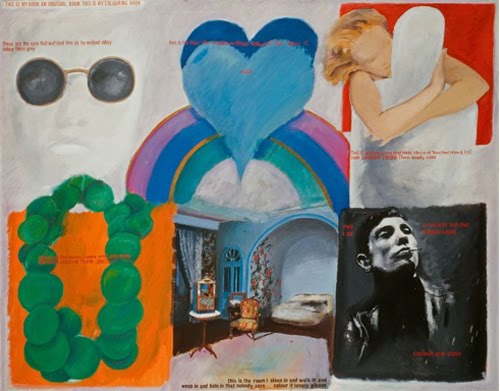
Boty was also experimenting with images of women – ‘using women,’ says Blake, ‘in a way women hadn’t used women before’.(But as said Blake just lent one of her paintings to a mate, would he have done that with a Van gogh) It’s a Man’s World I and II is a diptych: I a jigsaw of male figures against an 18th-century landscape;  a pin-up swirl of naked female flesh. In the unfinished piece, Tom’s Dream, she was in the process of painting a woman, with pink painted nails, pulling a candy-floss chiffon nightie over her head; the shape of her crossed, upraised arms against the window frame behind her makes her look as though she were on a crucifix. ‘It was a new voice,’ says Mellor, ‘a new way of imagining. They’re pictures by someone wrestling with her own sexuality. It’s that that makes them so extraordinary. ‘Who’s to say how good she might have been? It reminds me of that Norman Mailer essay. Two nights after Kennedy was shot, someone at a party said to him: ‘The terrible thing is he was a great President.’ But Mailer said: ‘No. The terrible thing is we’ll never know.’We do know in my opinion that Boty would have been a great artist because she already was and Kennedy would not have been as regards his involvement in many underhand things like the Bay of Pigs .
Her illness took hold as her pregnancy progressed, but it wasn’t until after the baby was born in early 1966 that she became very ill. She had managed to look after the child to begin with – Nell Dunn remembers the baby in a basket at the end of the bed – but in her last dreadful months, her parents took over as she was shifted constantly between her house – a vast flat in the Cromwell Road – and the Royal Marsden. She became increasingly frail and was often in great pain. Despite this, many of her friends remained unaware of the seriousness of her illness until it was too late.
‘It was almost as if they covered it up,’ says a fellow student, Geoffrey Reeve, ‘as if the less they admitted it to themselves, the happier she was.’ The cancer was always hopeless, but a close friend, Natalie Gibson, remembers huge stacks of medical books in the bedroom and talk that the illness might take 10 years off her life. Others remember her despair. Massot, who visited every day, says: ‘At one point she asked me to bring her some pills, because she couldn’t stand it any longer. But I told Clive and he said no.’
Even in these last dreadful months, though, Boty continued to spar with life, spirited even under physical siege.
‘What shall I bring?’ asked Jane Percival, paralysed by a sense of inadequacy. ‘Bring that delicious cheese-cake,’ said Boty, even though she was too ill to eat it. She asked Natalie Gibson to bring veal and ham pie; others smuggled in ‘great big joints’.
Roger Smith remembers her exasperation at his diffidence. ‘She lost her temper; ‘For fuck’s sake, tell me what you’ve been doing,’ she shouted.’
Another time, painfully thin, she laughed and told him what a change it was to be slim: ‘It was typical of her, still managing to find something new in the experience,’ he says. The last time Jane Percival saw her, she was propped up in bed, which they’d brought down to the sitting-room, with a drawing-board on her knee, doing a sketch of the Rolling Stones.
A lot of people were in love with Pauline Boty. A lot remember her with fondness and nostalgia. She probably had many irritating habits, but they have been ironed out by the intervening years. She was an interesting artist, who led a legendary sort of life and died a tragic death. Her only fault, says Peter Blake, ‘was that she didn’t love me back.’
Pauline was put in her place from the very beginning. She was the youngest of four. She and her mother were the only girls in the home. Her stern father made sure she was well aware of her gender. He even disapproved of Pauline attending the Wimbledon School of Art
She lived for only a few weeks after the birth of her daughter. Her friends were devastated; many are muddled even now as to the nature of her illness. The death of a young, talented person is always horrifying, but in those pre-Aids days, the art world wasn’t used to it. The poet and translator Christopher Logue, who was a friend, remembers how ‘shocked and depressed’ he was by her death; it ‘made me cognisant with the fact that everyone has a death to face; which I would say is a fair step on from understanding your own position vis-a-vis this forthcoming event.’
Another friend, Penny Massot, says: ‘People just didn’t die.’ Even now, 27 years later, grown men with grey hair in dark houses in Notting Hill Gate cry at the sound of Pauline Boty’s name.

 The death of a young, talented person is always horrifying, but in those pre-Aids days, the art world wasn’t used to it. The poet and translator Christopher Logue, who was a friend, remembers how ‘shocked and depressed’ he was by her death; it ‘made me cognisant with the fact that everyone has a death to face; which I would say is a fair step on from understanding your own position vis-a-vis this forthcoming event.’

Pauline was Britain’s only notable female Pop art painter. Boty’s paintings and collages often demonstrated a joy in self-assured femininity and female sexuality, and expressed overt or implicit criticism of the “man’s world” in which she lived.

Her rebellious art, combined with her free-spirited lifestyle, has made Boty a herald of 1970s feminism.Boty had been  born in suburban south London in 1938 into a middle-class with intellectual aspirations and also a Catholic fear of God but had turned the tables on this ordin ary life and had lived her life as much as she could . It was a life of creativity, honesty and mistakes but above all a life of courage and decency.   Boty’s painting became more experimental. Her work showed an interest inpopular culture early on In 1957 one of her pieces was shown at the Young Contemporaries exhibition alongside work by Robyn Denny, Richard Smith and File:Riley, Movement in Squares.jpgBridget Riley.

She studied at the School of Stained Glass at the Royal College of Art (1958–61). She had wanted to attend the School of Painting, but was dissuaded from applying as admission rates for women were much lower in that department. Despite the institutionalized sexism at her college,
Boty was one of the stronger students in her class, and in 1960 one of her stained glass works was included in the traveling exhibition Modern Stained Glass organized by the Arts Council. Boty continued to paint on her own in her student flat in west London and in 1959 she had three more works selected for the Young Contemporaries exhibition. During this time she also became friends with other emerging Pop artists, such as David Hockney,File:Hockney, We Two Boys Together Clinging.jpgDerek Boshier, Peter PhillipsFile:PeterPhillips-ForMenOnlyStarringMMandBB.jpg and Peter Blake.
While at the Royal College of Art, Boty engaged in a number of extracurricular activities.File:RoyalCollegeOfArt.jpg She sang, danced, and acted in somewhat risqué college reviews, published her poetry in an alternative student magazine, and was a knowledgeable presence at the film society where she developed her interest especially in European new wave
 cinema. She was also an active participant of the Anti-Ugly Action campaign, a group of RCA stained glass, and later architecture, students who protested against new British architecture that they considered offensive and of poor quality.
The two years after graduation were perhaps Boty’s most productive. She developed a signature Pop style and iconography. Her first group show, “Blake, Boty, Porter, Reeve” was held in November 1961 at A.I.A. gallery in London and was hailed as one of the first British Pop art shows. She exhibited twenty collages, including Is it a bird, is it a plane? and a rose is a rose is a rose, which demonstrated her interest in drawing from both high and low popular culture sources in her art (the first title references the Superman comic, the second quotes American ex-patriate poet Gertrude Stein).
The following spring Boty, along with Blake, Boshier, and Phillips, were featured in Ken Russell’s BBC film Pop Goes the Easel, which first aired on March 22, 1962. Although the documentary placed Boty at the center of the nascent British Pop art movement, unlike her male peers she did not get an opportunity to speak directly and intelligently about her work during the film.
Boty’s appearance on Pop Goes the Easel marked the beginning of her brief acting career. She landed roles in two Armchair Theatre plays for ITV and an episode of the BBC seriesMaigret. Boty also appeared on stage at the Royal Court in Day of the Prince and in Frank Hilton’s Afternoon Men at the New Arts Theatre.File:Arts Theatre London 2011.jpg (Boty, a regular on ‘swinging 60s’ club scene in London, was also a dancer on Top of the Pops and Ready Steady Go!). Although acting was lucrative, it distracted her from painting, which remained her top priority. Yet the men in her life encouraged her to pursue acting, as it was a more conventional career choice for women in the early 1960s. The popular press picked up on her glamorous actress persona, often undermining her legitimacy as an artist by referring to her physical charms. For example, Scene ran a front page article in November 1962 that read, “Actresses often have tiny brains. Painters often have large beards. Imagine a brainy actress who is also a painter and also a blonde and you have PAULINE BOTY.”
Her unique position as Britain’s only female Pop artist gave Boty the chance to redress sexism in her life as well as her art. Her early paintings were sensual and erotic, celebrating female sexuality from a woman’s point of view. Her canvases were set against vivid, colorful backgrounds and often included erogenous close-ups of red flowers, symbolic of the female sex. She painted her male idols—Elvis, French actor Jean-Paul Belmondo,
One short work of art gives one a better idea of Boty’s time than Darling does.Looking like an advert for Swinging London, Joe Massot’s 1965 short Reflections on Love mixes pop documentary with scenes devised by writer Derek Marlowe and (apparently) an uncredited, Larry Kramer.File:Larry Kramer 2010 - David Shankbone.jpg Though everything looks rather beautiful, it is such a terribly straight film, and considering the talent involved, and doesn’t really offer much love for the audience to reflect on. Then, this was the Sixties, when everything was new and exciting, and getting hitched in a registry office was daring and rad. O, how innocent it all seems. Massot went on to direct George Harrison’sWonderwall and later, Led Zeppelin’s concert film The Song Remains the Same. Kramer went on to script Here We Go Round the Mulberry Bush (1967), and Ken Russell’s Women in Love (1969), before writing his novel Faggots in 1978. As for Marlowe, he wrote the classic double-agent spy thriller, A Dandy in Aspic, and followed this up with a series of idiosyncratic and stylish novels (from crime to Voodoo to Lord Byron), which are all shamefully out-of-print, and not even available as e-books – publishers please note.
The original version was twenty-one minutes long, and there is  the revamped, re-scored (by Kula Shaker), re-edited (12 minutes) re-release from 1999, and still watchable pop-candy.
 File:Dandyinaspiccover2.jpg—as sex symbols, just as she did actresses Monica Vitti File:Monica Vitti 1990.jpgand Marilyn Monroe. Like Andy Warhol, she recycled publicity and press photographs of celebrities in her art. She exhibited in several more group shows before staging her first solo exhibition at Grabowski Gallery in the fall of 1963. The show was a critical success. However, Boty continued to take on additional acting jobs. She was a presenter on the radio program Public Ear in 1963-64, and in the following year she was typecast yet again in the role of ‘the seductive Maria’ in a BBC serial.
In June 1963, she married literary agent and television producer Clive Goodwin (1932-77) after a mere ten-day romance.Her marriage disappointed many, including Peter Blake and her married lover, director Philip Saville,
whom she met towards the end of her student days and had worked for.Their affair is said to have inspired the movie Darling (1966)File:Darling322.jpg. Boty and Goodwin’s Cromwell Road flat became a central hang-out for many artists, musicians, and writers, including Bob Dylan (whom Boty brought to England) Hockney, Blake.
(Pauline had loved America. She wasn’t frightened of it, she loved the powerful images at the heart of American culture, and the deep emotions the music and films evoked in her.
Pauline Boty wasn’t naive about American power, and she knew those alluring images and sounds could crawl into your brain and shape the way you saw the world, and disguise the underlying exploitation. But she believed that she could possess those images and use her imagination to rework them into something magical, inspiring and liberating.An odd thing has happened in the course of those years. While the bulk of Boty’s work – a collection of large painted collages – has been lying, splattered with plaster dust, in an outhouse of her brother’s farm in Kent, her image has brightened, regularly polished by memory, nostalgia, a certain habit of mythology. For one thing, the tragedy was compounded 12 years later by the death of her husband, the actor and literary agent Clive Goodwin. He suffered a brain haemorrhage in the foyer of the Beverly Hills Hotel (where he was meeting Warren Beatty to discuss Reds) and died in Los Angeles police custody. They thought he was drunk. There was a court case: the police accepted liability and a large settlement was awarded the daughter, Boty Goodwin. She was brought up by grandparents and guardians (the writer Adrian Mitchell and the actress Celia Mitchell) and  studied art in California
The daughter, who refuses to talk about her mother, shares her looks. And Pauline Boty was extremely attractive. ‘She was the kind of person people followed,’ says Massot. Friends say she resembled Brigitte Bardot – though some, with possessive annoyance, disagree and say Simone Signoret. ‘She had that marvellous strawberry ice-cream smile and leonine hair’ . . . ‘There was this great laugh – her face would completely distort, her top lip would spread right across’ . . . ‘She was very voluptuous . . . quite a big girl, very tall, with lovely skin and hair and teeth – a lovely-shaped head’. And, according to Brian Newman, a fellow student, she had ‘something of Marilyn Monroe’s ability to engender sympathy’.

Her husband Goodwin, who would later co-found the radical journal Black Dwarf, is said to have encouraged Boty to include political content in her paintings. Her paintings did become more overtly critical over time. Countdown to Violence depicts a number of harrowing current events, including the assassination of President John F. Kennedy, the Vietnam War, and theBirmingham race riots. Cuba Si (1963) references the Cuban revolution. The collaged painting It’s a Man’s World I (1964) juxtaposes images of The Beatles, Albert Einstein, Lenin,Muhammed Ali, Marcel Proust, and other men, suggesting that despite male domination in Western society, the notion of masculinity itself might be fracturing. Boty continued her analysis of male privilege with It’s a Man’s World II (1965–66) in which she redisplays female nudes from fine art and soft-core pornographic sources, calling attention to men’s easy access to sexualized female bodies.
In She refused to have an abortion in order to receive chemotherapy treatment that would have harmed the fetus. Instead Boty smoked marijuana to ease the pain of her terminal condition during her pregnancy. She continued to entertain her friends and even sketched The Rolling Stones during her illness. Her daughter, Boty Goodwin, was born in February 1966. Her last known painting,BUM, was commissioned by Kenneth Tynan for Oh, Calcutta! and was completed in 1966. Boty died at the Royal Marsden Hospital on 1 July that year. She was 28 years old, not much younger than when her daughter, Boty Goodwin, died of a heroin overdose in 1995 while living in Los
 Boty, like many of her contemporaries, used images of Monroe in her work. It’s ironic that she should herself have been turned into an icon – a different icon for different people. For the artist Peter Blake she was the first woman in London to wear men’s 501s (‘I used to say, ‘Pauline, your flies are undone.’ It was a reasonably funny thing to say to a woman in 1961′). For the usually laconic impresario Michael White, she was ‘unique in every department, remarkably ahead of her time,’ but for Caroline Coon, the feminist artist who met her only once, she was a woman in agony, the victim of male oppression'With Love to Jean-Paul Belmondo' (1962). Looks like one of my old Word Up! magazines. Hearts and flowers around the one I love. Angeles.
  • 1965 “The Edgar Wallace Mystery Theatre” (Episode: Strangler’s Web) … Nell Pretty
  • 1965 BBC TV, The Londoners – A Day Out for Lucy … Patsy
  • 1965 “Contract to Kill” (BBC TV mini-series) … the seductive Maria Galen
  • 1965 “The Day of Ragnarok”
  • 1964 Ken Russell’s Béla Bartók (BBC Monitor Series) …. Prostitute
  • 1964 BBC, Short Circuit-The Park … Pauline
  • 1964 “Espionage” (Episode: The Frantick Rebel) … Mistress Fleay
  • 1963 “Ready, Steady, Go!” … Dancer
  • 1963 “Don’t Say a Word” (game show) … herself
  • 1963 BBC, Maigret: Peter the Lett … Josie
  • 1962 BBC, The Face They See … Rona
  • 1962 ITV Armchair Theatre (Episodes: North City Traffic Straight Ahead and North by North West) … Anna
  • 1962 Ken Russell’s Pop Goes the Easel (BBC Monitor Series) … Herself
After her death, Pauline Boty’s paintings were stashed away in a barn on her brother’s farm, and she was largely forgotten over the next thirty years. Her work was rediscovered in the 1990s, renewing interest in her radical and significant contribution to Pop art gaining her inclusion in several group exhibitions and a major solo retrospective.
In 1964 the BBC made a film about the pop movement. It was called Pop Goes the Easel and was directed by Ken Russell.It focussed on four artists but the two stars of the film were Pauline Boty and her best friend Derek Boshier.
 Boshier brilliantly describes how popular images of American power seduce the mind – they start to “infiltrate you at the breakfast table”. But one shouldn’t be frightened because it is possible to possess those images in turn.
Then there is Pauline Boty – her bit begins with a wonderful piece of film-making – where she is the girl running away.
Ken Russell’s production notes for the film say that “the authoritative woman in the wheelchair, should be someone representing authority, hideously formal“. While the three girls around her “need to look as though they represent an institution.”
And Pauline should play “herself – an art student resenting authority
The first shots in the film are of all four artists together – they were all friends – the other two are Peter Blake and Peter Phillips. It is beautifully shot, and the song is Goodbye Cruel World by James Darren. 'Monica Vitti with Heart' (1963). Sex was a major theme of Pauline's work. She chose to depict Monica Vitti because she was a sex symbol of the time.
She openly expressed her resentment for the sexism she’d encountered in her life and celebrated her femininity and the almighty s-e-x. Most of the pieces include vibrant colors or chose red flowers, symbols for femininity, as the focal point. Her greatest paintings  are teenybopper-esque representations of the sex symbols of her time. Elvis French, Jean-Paul Belmondo, Monica Vitti, and Marilyn Monroe and these represent where the sixties heart was really at , I say that not as a criticism but a continuance of those sixties dreams when youth was first invented-maybe .Where did the Sixties go? Well it just became commercialised and people were seduced by it and anyway it was always commercial in the main. If the political angle had been properly aimed at the workers then maybe society could have been changed but most of the currents and movements in the 60’s were not socialist but bourgeois attempts at becoming and overcoming their dreams of capitalism with outbursts. The end result of is like one of Herbert Marcuse’s theories.
He had said the capitalist power works by possessing and manipulating the desires inside your own mind. But no-one ever explained how you distinguished between the two kinds of dreams inside your head – the ones that were planted there by evil capitalist fantasy-machines, and the genuine dreams of a new and better future. And if your dreams of a better future failed, and the world didn’t change – then maybe they too were just part of the manipulation?

'My Colouring Book' (1963). The storyline of an uhappy love affair. Can you read it?

Related posts:

Francis Schaeffer’s “How should we then live?” Video and outline of episode 10 “Final Choices” (Schaeffer Sundays)

Francis Schaeffer’s “How should we then live?” Video and outline of episode 9 “The Age of Personal Peace and Affluence” (Schaeffer Sundays)

______________________