Category Archives: Francis Schaeffer

Open letter to President Obama (Part 529) Pro-life Atheist Nat Hentoff and the case of Baby Doe

Open letter to President Obama (Part 529)

(Emailed to White House on 6-12-13.)

President Obama c/o The White House 1600 Pennsylvania Avenue NW Washington, DC 20500

Dear Mr. President,

I know that you receive 20,000 letters a day and that you actually read 10 of them every day. I really do respect you for trying to get a pulse on what is going on out here. I know that you don’t agree with my pro-life views but I wanted to challenge you as a fellow Christian to re-examine your pro-choice view. Although we are both Christians and have the Bible as the basis for our moral views, I did want you to take a close look at the views of the pro-life atheist Nat Hentoff too.  Hentoff became convinced of the pro-life view because of secular evidence that shows that the unborn child is human. I would ask you to consider his evidence and then of course reverse your views on abortion.

___________________

Nat Hentoff is an atheist, but he became a pro-life activist because of the scientific evidence that shows that the unborn child is a distinct and separate human being and even has a separate DNA. His perspective is a very intriguing one that I thought you would be interested in. I have shared before many   cases (Bernard Nathanson, Donald Trump, Paul Greenberg, Kathy Ireland)    when other high profile pro-choice leaders have changed their views and this is just another case like those. I have contacted the White House over and over concerning this issue and have even received responses. I am hopeful that people will stop and look even in a secular way (if they are not believers) at this abortion debate and see that the unborn child is deserving of our protection.That is why the writings of Nat Hentoff of the Cato Institute are so crucial.

The Indivisible Fight for Life

by Nat Hentoff. Presented at AUL Forum, 19 October 1986, Chicago. This article is part of no violence period.

I’ll begin by indicating how I became aware, very belatedly, of the “indivisibility of life.” I mention this fragment of autobiography only be cause I think it may be useful to those who are interested in bringing others like me – some people are not interested in making the ranks more heterogeneous, but others are, as I’ve been finding out – to a realization that the “slippery slope” is far more than a metaphor.

When I say “like me,” I suppose in some respects I’m regarded as a “liberal,” although I often stray from that category, and certainly a civil libertarian – though the ACLU and I are in profound disagreement on the matters of abortion, handicapped infants and euthanasia, because I think they have forsaken basic civil liberties in dealing with these issues. I’m considered a liberal except for that unaccountable heresy of recent years that has to do with pro-life matters.

It’s all the more unaccountable to a lot of people because I remain an atheist, a Jewish atheist. (That’s a special branch of the division.) I think the question I’m most often asked from both sides is, “How do you presume to have this kind of moral conception without a belief in God?” And the answer is, “It’s harder.” But it’s not impossible.

For me, this transformation started with the reporting I did on the Babies Doe. While covering the story, I came across a number of physicians, medical writers, staff people in Congress and some members of the House and Senate who were convinced that making it possible for a spina bifida or a Down syndrome infant to die was the equivalent of what they called a “late abortion.” And surely, they felt, there’s nothing wrong with that.

Now, I had not been thinking about abortion at all. I had not thought about it for years. I had what W. H. Auden called in another context a “rehearsed response.” You mentioned abortion and I would say, “Oh yeah, that’s a fundamental part of women’s liberation,” and that was the end of it.

But then I started hearing about “late abortion.” The simple “fact” that the infant had been born, proponents suggest, should not get in the way of mercifully saving him or her from a life hardly worth living. At the same time, the parents are saved from the financial and emotional burden of caring for an imperfect child.

And then I heard the head of the Reproductive Freedom Rights unit of the ACLU saying – this was at the same time as the Baby Jane Doe story was developing on Long Island – at a forum, “I don’t know what all this fuss is about. Dealing with these handicapped infants is really an extension of women’s reproductive freedom rights, women’s right to control their own bodies.”

That stopped me. It seemed to me we were not talking about Roe v. Wade. These infants were born. And having been born, as persons under the Constitution, they were entitled to at least the same rights as people on death row – due process, equal protection of the law. So for the first time, I began to pay attention to the “slippery slope” warnings of pro-lifers I read about or had seen on television. Because abortion had become legal and easily available, that argument ran – as you well know – infanticide would eventually become openly permissible, to be followed by euthanasia for infirm, expensive senior citizens.

And then in the New York Review of Books , I saw the respected, though not by me, Australian bio-ethicist Peter Singer boldly assert that the slope was not slippery at all, but rather a logical throughway once you got on to it. This is what he said – and I’ve heard this in variant forms from many, many people who consider themselves compassionate, concerned with the pow erless and all that.

Singer: “The pro-life groups were right about one thing, the location of the baby inside or outside the womb cannot make much of a moral differ ence. We cannot coherently hold it is alright to kill a fetus a week before birth, but as soon as the baby is born everything must be done to keep it alive. The solution, however,” said Singer, “is not to accept the pro-life view that the fetus is a human being with the same moral status as yours or mine. The solution is the very opposite, to abandon the idea that all human life is of equal worth.” Which, of course, the majority of the Court had already done in Roe v. Wade.

Recently, I was interviewing Dr. Norman Levinsky, Chief of Medicine of Boston University Medical Center and a medical ethicist. He is one of those rare medical ethicists who really is concerned with nurturing life, as contrasted with those of his peers who see death as a form of treatment. He told me that he is much disturbed by the extent to which medical decisions are made according to the patient’s age. He says there are those physicians who believe that life is worth less if you’re over 80 than if you’re 28.

So this is capsulizing an incremental learning process. I was beginning to learn about the indivisibility of life. I began to interview people, to read, and I read Dr. Leo Alexander. Joe Stanton, who must be the greatest single resource of information, at least to beginners – and, I think, non-beginners – in this field, sent me a whole lot of stuff, including Dr. Leo Alexander’s piece in the New England Journal of Medicine in the 1940s. And then I thought of Dr. Alexander when I saw an April 1984 piece in the New England Journal of Medicine by 10 physicians defending the withdrawal of food and water from certain “hopelessly ill” patients. And I found out that Dr. Alexander was still alive then but didn’t have much longer to live. And he said to Patrick Duff, who is a professor of philosophy at Clarke University and who testified in the Brophy case, about that article, “It is much like Germany in the 20s and 30s. The barriers against killing are coming down.”

Nearly two years later, as you know, the seven member judicial council of the American Medical Association ruled unanimously that it is ethical for doctors to withhold “all means of life-prolonging medical treatment” in cluding food and water, if the patient is in a coma that is “beyond doubt irreversible” and “there are adequate safeguards to confirm the accuracy of the diagnosis.” Now keep in mind “beyond doubt irreversible” and “adequate safeguards to confirm the accuracy of the diagnosis.” Death, to begin with, may not be imminent for food and water to be stopped, according to the AMA.

Then Dr. Nancy Dickey, who is chairman of the council that made that ruling, noted that there is no medical definition of”adequate safeguards,” no checklist that doctors would have to fill out in each case. The decision would be up to each doctor.

Aside from the ethics of this, for the moment, I would point out that the New England Journal of Medicine, or at least the editor, Dr. Arnold Relman, said fairly recently that there are at least 40,000 incompetent physicians in the United States – incompetent or impaired. At least.

Back to Dr. Norman Levinsky. This is all part of this learning process. It is not a huge step, he said, from stopping the feeding to giving the patient a little more morphine to speed his end. I mean it is not a big step from passive to active euthanasia.

Well, in time, a rather short period of time, I became pro-life across the board, which led to certain social problems, starting at home. My wife’s most recurrent attack begins with, “You are creating social mischief,” and there are people at my paper who do not speak to me anymore. In most cases, that’s no loss.

And I began to find out, in a different way, how the stereotypes about pro-lifers work. When you’re one of them and you read about the stereotypes, you get a sort of different perspective.

There’s a magazine called the Progressive. It’s published in Madison, Wisconsin. It comes out of the progressive movement of Senator Lafolette, in the early part of this century. It is very liberal. Its staff, the last I knew, was without exception pro-abortion. But its editor is a rare editor in that he believes not only that his readers can stand opinions contrary to what they’d like to hear, but that it’s good for them. His name is Erwin Knoll and he published a long piece by Mary Meehan, who is one of my favorite authors, which pointed out that for the left, of all groups of society, not to understand that the most helpless members of this society are the preborn – a word that I picked up today, better than unborn – is strange, to say the least.

The article by Meehan produced an avalanche of letters. I have not seen such vitriol since Richard Nixon was president – and he deserved it. One of the infuriated readers said pro-life is only a code word representing the kind of neo-fascist, absolutist thinking that is the antithesis to the goals of the left. What, exactly, are the anti-abortionists for? School prayer, a strong national defense, the traditional family characterized by patriarchal dominance. And what are they against? School busing, homosexuals, divorce, sex education, the ERA, welfare, contraception and birth control. I read that over five or six times and none of those applied to me.

I began to wonder if Meehan and I were the only pro-life people who came from the left. Meehan has a long background in civil rights work. And by the way, she said in the piece, “It is out of characterfor the left to neglect the weak and helpless. The traditional mark of the left has been its protection of the underdog, the weak and the poor. The unborn child is the most helpless form of humanity, even more in need of protection than the poor tenant farmer or the mental patient. The basic instinct of the left is to aid those who cannot aid themselves. And that instinct is absolutely sound. It’s what keeps the human proposition going.”

I’ll give you a quick footnote on the Progressive. Erwin Knoll got a series of ads, tiny ads because they couldn’t pay very much even at the magazine’s rates, from a group called Feminists for Life or America – a group, by the way, that is anti-nuclear weapons and is also very pro-life in terms of being anti-abortion. And the ads ran. There is a group called the Funding Exchange which is made up of foundations which are put into operation and headed by the scions of the rich. These are children who are trying to atone for their parents’ rapaciousness by doing good. The children are liberals. The Funding Exchange was so horrified to see those three tiny ads that even though the Progressive is soundly pro-abortion, the Funding Exchange not only dropped the grant they had given the Progressive, but they made a point of telling Erwin Knoll that they were going to make sure that other foundations didn’t give them any money either. I’m always in trigued at how few people understand that free speech encompasses a little more than the speech you like.

Well eventually, in addition to Mary Meehan, I found that there were a number of other pro-lifers who also do not cherish the MX missile, William Bradford Reynolds, or Ronald Reagan. And one of them is Juli Loesch, who writes and speaks against both war and abortion. She is the founder of Pro-lifers for Survival, which describes itself as a network of women and men supporting alternatives to abortion and nuclear arms. She’s rather rare, I find in my limited experience, among combatants on all sides of this question because she is unfailingly lucid – and she has a good sense of humor. In an interview in the U.S. Catholic she said that combining her various pro-life preoccupations “was the most fun I’ve ever had in my life. It’s great because you always have common ground with someone. For example, if you’re talking to pro-lifers you can always warmup the crowd, so to speak, by saying a lot of anti-abortion stuff. After you’ve got everybody celebrating the principles they all hold dear, you apply those principles to the nuclear arms issue. For instance, I’ll say ‘this nuclear radiation is going to destroy the unborn in the womb all over the world.’ And then I always lay a quote by the late Herman Kahn on them. He pointed out that about 100 million embryonic deaths would result from limited nuclear war. One hundred million embryonic deaths is of limited significance, he said, because human fecundity being what it is, the slight reduction in fecundity should not be a matter of serious concern even to individuals. Tell that to a pro-life group,” she says, “and their response will be, ‘That guy’s an abortionist.’ Well what he was was a nuclear strategist.”

I found other allies as a result of having been interviewed on National Public Radio as the curiosity of the month. Letters came in from around the country, most of them saying essentially what a woman from Illinois wrote:

“I feel as you do, that it is ethically, not to mention logically, inconsistent to oppose capital punishment and nuclear armament while supporting abortion and/or euthanasia.”

The most surprising letters were two from members of the boards of two state affiliates of the ACLU. Now I’m a former member of the national board and I was on the New York board for 17 years, and I well know the devotion of the vast number of the rank and file, let alone the leadership, to abortion. rights. So I was surprised to get these letters. One board member from Maryland said we had a board meeting where we approved with only one dissent (his) the decision of the national board to put the right to abortion at the top of its priorities – the top of its priorities. Forget the First Amendment and the Fourth, let Edwin Meese take care of those. There was no discussion, he said, of the relation of abortion to capital punishment.

The most interesting letter was from Barry Nakell, who is a law profes sor at the University of North Carolina. He is one of the founders of the affiliate of the ACLU there. And he gave me a copy of a speech he made in 1985 at the annual meeting in Chapel Hill of the North Carolina Civil Liberties Union. He reminded the members that the principle of respect for the dignity of life was the basis for the paramount issue on the North Carolina Civil Liberties Union agenda since its founding. That group was founded because of their opposition to capital punishment. Yet, he said, supporting Roe v. Wade, these civil libertarians were agreeing that the Constitution protects the right to take life. The situation is a little backward, Nakell told his brothers and sisters. In the classical position, the Constitu tion would be interpreted to protect the right to life, and pro-abortion advocates would be pressing to relax that constitutional guarantee. In Roe v. Wade, the Supreme Court turned that position upside down and the ACLU went along, taking the decidedly odd civil libertarian position that some lives are less worthy of protection than other lives. I asked Nakell how his heresy had been received. Apparently they’re much more polite down there than they are in New York. “With civility,” he said. As a matter of fact, he added, there were several members of the board who had been troubled for some time, but it’s interesting, they didn’t quite want to come out and say they were worried about Roe v. Wade,that they were worried about abortion. But Nakell took the first step. He’s an optimist by temperament and he tells me he expects to make more progress. And then he told me about a bumper sticker he had seen recently in North Carolina- “Equal Rights for Unborn Women.”

For several years now I’ve been researching a profile of Cardinal O’Connor of New York, which will be a book eventually. And in the course of that I came across Cardinal Bernardin’s “seamless garment” concept. It’s a phrase he does not use any more because of internal political reasons. It is now called the “consistent ethic of life,” which is fine by me. I miss “seamless garment” though, because there’s a nice literary flavor to it. But I’ll accept “consistent ethic of life.” Bernardin said, in a speech at Fordham that has won him considerable plaudits and considerable dissonance, “[N]uclear war threatens life on a previously unimaginable scale. Abortion takes life daily on a horrendous scale. Public executions are fast becoming weekly events in the most advanced technological society in history, and euthanasia is now openly discussed and even advocated. Each of these assaults on life has its own meaning and morality. They cannot be collapsed into one problem, but they must be confronted as pieces of a larger pattern.”

That had a profound effect on me. It’s not new. As a matter of fact, Juli Loesch thought of it before he did, as did the people at The Catholic Worker who got it, of course, from Dorothy Day. And it goes further back into the centuries. But there was something about the way Bernardin put it that hit me very hard.

So I decided by now, because I was considered by some people to be a reliable pro-lifer, I decided to go out to Columbus, Ohio, where I had been asked to speak at the annual Right to Life convention. And, I thought, I’m going to bring them the word, if they haven’t heard it before from Cardinal Bernardin. At first they were delighted to see me, but that didn’t last very long. Jack Willke and Mrs. Willke were there, and they can attest to the fact that in some respects I’m lucky to be here. I pointed out that pro-lifers – maybe this is chutzpah, telling people who have been in this all their lives what you’ve discovered in 20 minutes – that pro-lifers ought to be opposing capital punishment and nuclear armament and the Reagan budget with its dedicated care for missiles as it cuts funds for the Women/Infant/Children Program that provides diet supplements and medical checkups for mothers in poverty. Surely, I said, they should not emulate the President in these matters – and here I stole a line from Congressman Barney Frank – they should not emulate the President in being pro-life only up to the moment of birth. Well the faces before me began to close, and from the middle and the back of the dining room there were shouts. I couldn’t make out the words, but they were not approving. As I went on, there were more shouts as well as growls and table-thumping of an insistence that indicated a tumbrel awaited outside. I finally ended my speech to a chorus of howls, and several of the diners rushed toward the dais. I did not remember ever intending to die for this cause, but as it turned out the attacks were all verbal. Most of the disappointed listeners, once they caught their breath, charitably ascribed my failure to understand the total unrelatedness of nuclear arms and abortion to my not yet having found God.

But I discovered in other places that I didn’t have to bring them the news of the consistent ethic of life. I talked at the Catholic church outside Stamford, Connecticut last week, and they – including the pastor – understood the “consistent ethic of life” agreat deal better than I did. So I see some real hope for my point of view.

There are a lot of people like me out there who are troubled by abortion. That should not stop them from joining at least one of the more possibly compatible groups, but it does. They are unwilling to join what they consider to be the forces of Reagan, Rambo and Rehnquist. But there are beginning to be pro-life forces that they can in conscience – they have consciences too – join. One of them is Pro-lifers for Survival, another is Feminists for Life of America. And there is something that just started that I find very interesting. It’s very small now. It’s the first consistent-ethic-of-life political action committee, and it’s called JustLife. The people who started it were some what dismayed that anti-abortionists like Jerry Falwell, Pat Robertson, Jimmy Swaggart and other such household names were giving the impres sion that if Christ were in the Senate, he’d vote for Star Wars. The founders of JustLife thought that a new assembly of Christians – most of them, by the way, theologically conservative evangelicals and Catholics – ought, there fore, to start the political action committee.

What they aim to show is that there is another Christian perspective on these matters. JustLife is supporting candidates who advocate what it calls, again, a “consistent ethic of life.” A candidate does not have to be a Christian to get help from this PAC, but he or she does have to oppose abortion. Another requirement is a determination to end, rather than further institutionalize, the nuclear arms race. They’re against the MX missile. They’re against Star Wars. Now I think you see that the nuclear part of their program is mild. I’m a disciple of A. J. Muste. He was a Christian pacifist. The new PAC does not go so far as Muste or Dorothy Day. Instead, it urges verifiable multi-lateral disarmament. Everybody’s for that, except when you get to the negotiating table. One board member, Kathleen Hayes, who is managing editor of the Christian magazine, The Other Side, told the Catholic Register that she believes that unilateral disarmament is ultimately what the gospel would call us to. But the aim of JustLife is to pick up votes, and there’s a much more powerful gospel if you want to pick up votes, and that’s called deterrence.

The third basic criterion the candidate has to meet to get money from JustLife, is that he or she must recognize that there are actual poor people out there – not just freeloaders, as the Attorney General has suggested. Once the poor are seen as three dimensional, a JustLife candidate has to show that he or she would work to get them health care, housing and food. For as it was said, “Blessed are the hungry, for they shall be filled.” Distilling its tripartite credo in its first fundraising letter, JustLife em phasizes, “[W]e support an unborn child’s right to life. We also support that child’s right to adequate nutrition, housing, education and health care. We support that child’s right to live in a safe world.”

Now this political witness by Christians going contrary to the politics of most other pro-life groups – that is, those pro-life groups that have political agenda- is obviously well within the rights of free speech and assembly. Yet another interesting thing, and I find this dismaying, is that while a number of Catholic bishops agree with the thrust of JustLife – in fact one of them was originally on the board, and a consistent ethic of life is now an official position of the National Conference of Catholic Bishops as of last November – there are no Catholic bishops on the board of JustLife. The main reason is that there is a current lawsuit brought by Larry Lader, the pro-abortionist, challenging the tax-exempt status of the Catholic church on the charge that it has been engaged in political campaigning and in lobbying against abortion. Because of the length of that suit, its cost and its still uncertain outcome, the bishops are experiencing a chilling effect. And I’ve seen no editorials about that from people who would ordinarily be concerned with the First Amend ment.

Meanwhile, JustLife, having announced publicly its existence in June, has raised $45,000 from 1,300 contributors, expects to reach $60,000 by the end of the year and is gearing up for 1988. I’ll show you how it works in one state, because this could eventually happen elsewhere. In Nevada, the Pro-Family Coalition has endorsed Republican James Santini, but since Santini is against both the nuclear freeze and funding for poverty programs, JustLife is on the side of Congressman Harry Reid, who votes to fill the hungry, slim down the Pentagon and is also against abortion. They’re both against abortion, but only one, says JustLife, keeps on caring for life after birth. I would like to see this group grow, and other groups do the same thing or similar things. [Reid won in November.]

On Sunday October 25th, Cardinal O’Connor had a letter read at all masses at all parishes in the Archdiocese of New York. It was Respect Life Sunday. And this is how the letter began: “I am frightened and chilled by the continuing destruction of unborn human life, and now we are seeing precisely what we have been predicting all along. Once the victory seemed to be won on legalizing the killing of the unborn, attention was turned to the terminally ill. Now we are hearing a clamor thoughout the United States for legislation that will lift any regulations whatsoever in regard to sustaining the life of a terminally ill patient. Indeed the move is toward authorizing the deliberate speeding up of the deaths of vulnerable patients by starvation or dehydration. It all goes together. What is permitted today is often demanded tomorrow. If the current contempt for the unborn continues, in my judgment we will soon see required genetic screening programs, with public health authorities urging mothers to abort babies that may be born with defects. I’ve been reading that this summer the state of California has introduced a program which moves precisely in that direction. I plead with you to reflect with utmost urgency on what is happening. Do not think that your life, or your aging parents’ lives, or the lives of the handicapped, the cancerous, the so-called ‘useless,’ are secure if the proponents of euthanasia have their way.”

Finally, with that in mind, back in 1971, two years before Roe v. Wade, in the state of New York, the legislature, after much pressure, decided to decriminalize abortion and make it a good deal easier. At the time, a significant editorial was delivered on the local CBS station by Sherri Henry, who has since become a big-time talk show host. And she wrote then, “[A]bortion is no longer illegal in New York. It is nothing to be ashamed of, nothing to fear. It is one sensible method of dealing with such problems as overpopulation, illegitimacy, and possible birth defects. It is one way of fighting the rising welfare rolls and the increasing number of child abuse cases.

Very simple. When there are no children, they can’t be abused. When there are no severely handicapped children or adults, we will all save money. When everyone in failing health has to die by a certain age, how much more aesthetic our society will be.

Most people will begin to understand the lethal logic of the abortionists, the advocates of euthanasia, and the AMA, if this logic is presented lucidly, persistently and on the basis of the indivisibility of all life. All life.

__________________

In the past I have spent most of my time looking at this issue from the spiritual side. In the film series “WHATEVER HAPPENED TO THE HUMAN RACE?” the arguments are presented  against abortion (Episode 1),  infanticide (Episode 2),   euthanasia (Episode 3), and then there is a discussion of the Christian versus Humanist worldview concerning the issue of “the basis for human dignity” in Episode 4 and then in the last episode a close look at the truth claims of the Bible.

Francis Schaeffer

__________________________

I truly believe that many of the problems we have today in the USA are due to the advancement of humanism in the last few decades in our society. Ronald Reagan appointed the evangelical Dr. C. Everett Koop to the position of Surgeon General in his administration. He partnered with Dr. Francis Schaeffer in making the video below. It is very valuable information for Christians to have.  Actually I have included a video below that includes comments from him on this subject.

Francis Schaeffer: How Should We Then Live? (Full-Length Documentary)

Francis Schaeffer Whatever Happened to the Human Race (Episode 1) ABORTION


______________________________________

Thank you so much for your time. I know how valuable it is. I also appreciate the fine family that you have and your commitment as a father and a husband. Now after presenting the secular approach of Nat Hentoff I wanted to make some comments concerning our shared Christian faith.  I  respect you for putting your faith in Christ for your eternal life. I am pleading to you on the basis of the Bible to please review your religious views concerning abortion. It was the Bible that caused the abolition movement of the 1800’s and it also was the basis for Martin Luther King’s movement for civil rights and it also is the basis for recognizing the unborn children.

Sincerely,

Everette Hatcher III, 13900 Cottontail Lane, Alexander, AR 72002, ph 501-920-5733, lowcostsqueegees@yahoo.com

Related posts:

Al Mohler on Kermit Gosnell’s abortion practice

Francis Schaeffer: “Whatever Happened to the Human Race” (Episode 1) ABORTION OF THE HUMAN RACE Published on Oct 6, 2012 by AdamMetropolis ________________ Picture of Francis Schaeffer and his wife Edith from the 1930′s above. I was sad to read about Edith passing away on Easter weekend in 2013. I wanted to pass along this fine […]

A man of pro-life convictions: Bernard Nathanson (part4)

ABORTION – THE SILENT SCREAM 1 / Extended, High-Resolution Version (with permission from APF). Republished with Permission from Roy Tidwell of American Portrait Films as long as the following credits are shown: VHS/DVDs Available American Portrait Films Call 1-800-736-4567 http://www.amport.com The Hand of God-Selected Quotes from Bernard N. Nathanson, M.D., Unjust laws exist. Shall we […]

Abortionist Bernard Nathanson turned pro-life activist (part 11)

ABORTION – THE SILENT SCREAM 1 / Extended, High-Resolution Version (with permission from APF). Republished with Permission from Roy Tidwell of American Portrait Films as long as the following credits are shown: VHS/DVDs Available American Portrait Films Call 1-800-736-4567 http://www.amport.com The Hand of God-Selected Quotes from Bernard N. Nathanson, M.D., Unjust laws exist. Shall we […]

Abortionist Bernard Nathanson turned pro-life activist (part 9)(Donald Trump changes to pro-life view)

When I think of the things that make me sad concerning this country, the first thing that pops into my mind is our treatment of unborn children. Donald Trump is probably going to run for president of the United States. Tony Perkins of the Family Research Council recently had a conversation with him concerning the […]

Taking on Ark Times Bloggers on various issues Part U “Do men have a say in the abortion debate?” (includes the film SLAUGHTER OF THE INNOCENTS and editorial cartoon)

I have gone back and forth and back and forth with many liberals on the Arkansas Times Blog on many issues such as abortion, human rights, welfare, poverty, gun control  and issues dealing with popular culture. Here is another exchange I had with them a while back. My username at the Ark Times Blog is Saline […]

Taking on Ark Times Bloggers on various issues Part T “Abortion is a dirty business” (includes video “Truth and History” and editorial cartoon)

I have gone back and forth and back and forth with many liberals on the Arkansas Times Blog on many issues such as abortion, human rights, welfare, poverty, gun control  and issues dealing with popular culture. Here is another exchange I had with them a while back. My username at the Ark Times Blog is Saline […]

“Sanctity of Life Saturday” Abortion supporters lying in order to further their clause? Window to the Womb (includes video ABORTION OF THE HUMAN RACE)

It is truly sad to me that liberals will lie in order to attack good Christian people like state senator Jason Rapert of Conway, Arkansas because he headed a group of pro-life senators that got a pro-life bill through the Arkansas State Senate the last week of January in 2013. I have gone back and […]

Taking on Ark Times Bloggers on various issues Part D “If you can’t afford a child can you abort?”Francis Schaeffer Quotes part 4 includes the film ABORTION OF THE HUMAN RACE) (editorial cartoon)

I have gone back and forth and back and forth with many liberals on the Arkansas Times Blog on many issues such as abortion, human rights, welfare, poverty, gun control  and issues dealing with popular culture. Here is another exchange I had with them a while back. My username at the Ark Times Blog is Saline […]

Taking on Ark Times Bloggers on various issues Part C “Abortion” (Francis Schaeffer Quotes part 3 includes the film SLAUGHTER OF THE INNOCENTS) (editorial cartoon)

I have gone back and forth and back and forth with many liberals on the Arkansas Times Blog on many issues such as abortion, human rights, welfare, poverty, gun control  and issues dealing with popular culture. Here is another exchange I had with them a while back. My username at the Ark Times Blog is Saline […]

Taking on Ark Times Bloggers on various issues Part B “Gendercide” (Francis Schaeffer Quotes Part 2 includes the film ABORTION OF THE HUMAN RACE) (editorial cartoon)

I have gone back and forth and back and forth with many liberals on the Arkansas Times Blog on many issues such as abortion, human rights, welfare, poverty, gun control  and issues dealing with popular culture. Here is another exchange I had with them a while back. My username at the Ark Times Blog is Saline […]

SANCTITY OF LIFE SATURDAY “AngryOldWoman” blogger argues that she has no regrets about past abortion

Sometimes you can see evidences in someone’s life of how content they really are. I saw  something like that on 2-8-13 when I confronted a blogger that goes by the name “AngryOldWoman” on the Arkansas Times Blog. See below. Leadership Crisis in America Published on Jul 11, 2012 Picture of Adrian Rogers above from 1970′s […]

“Sanctity of Life Saturday” The Church Awakens: Whatever Happened to the Human Race? (includes the video ABORTION OF THE HUMAN RACE)

In the film series “WHATEVER HAPPENED TO THE HUMAN RACE?” the arguments are presented  against abortion (Episode 1),  infanticide (Episode 2),   euthenasia (Episode 3), and then there is a discussion of the Christian versus Humanist worldview concerning the issue of “the basis for human dignity” in Episode 4 and then in the last episode a close […]

Taking on Ark Times Bloggers on various issues Part H “Are humans special?” includes film ABORTION OF THE HUMAN RACE) Reagan: ” To diminish the value of one category of human life is to diminish us all”

I have gone back and forth and back and forth with many liberals on the Arkansas Times Blog on many issues such as abortion, human rights, welfare, poverty, gun control  and issues dealing with popular culture. Here is another exchange I had with them a while back. My username at the Ark Times Blog is Saline […]

Taking on Ark Times Bloggers on various issues Part G “How do moral nonabsolutists come up with what is right?” includes the film “ABORTION OF THE HUMAN RACE”)

I have gone back and forth and back and forth with many liberals on the Arkansas Times Blog on many issues such as abortion, human rights, welfare, poverty, gun control  and issues dealing with popular culture. Here is another exchange I had with them a while back. My username at the Ark Times Blog is Saline […]

Taking on Ark Times Bloggers on various issues Part E “Moral absolutes and abortion” Francis Schaeffer Quotes part 5(includes the film SLAUGHTER OF THE INNOCENTS) (editorial cartoon)

I have gone back and forth and back and forth with many liberals on the Arkansas Times Blog on many issues such as abortion, human rights, welfare, poverty, gun control  and issues dealing with popular culture. Here is another exchange I had with them a while back. My username at the Ark Times Blog is Saline […]

Francis Schaeffer’s “How should we then live?” Video and outline of episode 10 “Final Choices” (Schaeffer Sundays)

E P I S O D E 1 0   Dr. Francis Schaeffer – Episode X – Final Choices 27 min FINAL CHOICES I. Authoritarianism the Only Humanistic Social Option One man or an elite giving authoritative arbitrary absolutes. A. Society is sole absolute in absence of other absolutes. B. But society has to be […]

Francis Schaeffer’s “How should we then live?” Video and outline of episode 9 “The Age of Personal Peace and Affluence” (Schaeffer Sundays)

E P I S O D E 9 Dr. Francis Schaeffer – Episode IX – The Age of Personal Peace and Affluence 27 min T h e Age of Personal Peace and Afflunce I. By the Early 1960s People Were Bombarded From Every Side by Modern Man’s Humanistic Thought II. Modern Form of Humanistic Thought Leads […]

Francis Schaeffer’s “How should we then live?” Video and outline of episode 8 “The Age of Fragmentation” (Schaeffer Sundays)

E P I S O D E 8 Dr. Francis Schaeffer – Episode VIII – The Age of Fragmentation 27 min I saw this film series in 1979 and it had a major impact on me. T h e Age of FRAGMENTATION I. Art As a Vehicle Of Modern Thought A. Impressionism (Monet, Renoir, Pissarro, Sisley, […]

Francis Schaeffer’s “How should we then live?” Video and outline of episode 7 “The Age of Non-Reason” (Schaeffer Sundays)

E P I S O D E 7 Dr. Francis Schaeffer – Episode VII – The Age of Non Reason I am thrilled to get this film series with you. I saw it first in 1979 and it had such a big impact on me. Today’s episode is where we see modern humanist man act […]

Francis Schaeffer’s “How should we then live?” Video and outline of episode 6 “The Scientific Age” (Schaeffer Sundays)

E P I S O D E 6 How Should We Then Live 6#1 Uploaded by NoMirrorHDDHrorriMoN on Oct 3, 2011 How Should We Then Live? Episode 6 of 12 ________ I am sharing with you a film series that I saw in 1979. In this film Francis Schaeffer asserted that was a shift in […]

Francis Schaeffer’s “How should we then live?” Video and outline of episode 5 “The Revolutionary Age” (Schaeffer Sundays)

E P I S O D E 5 How Should We Then Live? Episode 5: The Revolutionary Age I was impacted by this film series by Francis Schaeffer back in the 1970′s and I wanted to share it with you. Francis Schaeffer noted, “Reformation Did Not Bring Perfection. But gradually on basis of biblical teaching there […]

Francis Schaeffer’s “How should we then live?” Video and outline of episode 4 “The Reformation” (Schaeffer Sundays)

Dr. Francis Schaeffer – Episode IV – The Reformation 27 min I was impacted by this film series by Francis Schaeffer back in the 1970′s and I wanted to share it with you. Schaeffer makes three key points concerning the Reformation: “1. Erasmian Christian humanism rejected by Farel. 2. Bible gives needed answers not only as to […]

“Schaeffer Sundays” Francis Schaeffer’s “How should we then live?” Video and outline of episode 3 “The Renaissance”

Francis Schaeffer’s “How should we then live?” Video and outline of episode 3 “The Renaissance” Francis Schaeffer: “How Should We Then Live?” (Episode 3) THE RENAISSANCE I was impacted by this film series by Francis Schaeffer back in the 1970′s and I wanted to share it with you. Schaeffer really shows why we have so […]

Francis Schaeffer’s “How should we then live?” Video and outline of episode 2 “The Middle Ages” (Schaeffer Sundays)

  Francis Schaeffer: “How Should We Then Live?” (Episode 2) THE MIDDLE AGES I was impacted by this film series by Francis Schaeffer back in the 1970′s and I wanted to share it with you. Schaeffer points out that during this time period unfortunately we have the “Church’s deviation from early church’s teaching in regard […]

Francis Schaeffer’s “How should we then live?” Video and outline of episode 1 “The Roman Age” (Schaeffer Sundays)

Francis Schaeffer: “How Should We Then Live?” (Episode 1) THE ROMAN AGE   Today I am starting a series that really had a big impact on my life back in the 1970′s when I first saw it. There are ten parts and today is the first. Francis Schaeffer takes a look at Rome and why […]

By Everette Hatcher III | Posted in Francis Schaeffer | Edit | Comments (0)

Artist Cheyenne Randall uses the magic of photo manipulation to morph celebrities and icons with strait-laced public personas into tatted-up badasses with some serious street-cred in the Tumblr project Shopped Tattoos

_____

If Kate Middleton (and Other Unlikely Celebrities) Had Tattoos

If you’ve ever wondered what the Duke and Duchess of Cambridge would look like if they were more “Sons of Anarchy” than royalty, then look no further. Artist Cheyenne Randall uses the magic of photo manipulation to morph celebrities and icons with strait-laced public personas into tatted-up badasses with some serious street-cred in the Tumblr project Shopped Tattoos. Check out some of the last people you thought you’d see — past and present presidents, television and movie characters, pop stars, and superheroes — with permanent ink plastered all over their skin. It’s all pretend, of course (or is it?). — Lauren Tuck, Shine Staff


______

The Duke and Duchess of Cambridge
Photo: shoppedtattoos.tumblr.com
If Kate Middleton and Prince William were the rulers of hipsterville (and, possibly, members of the Illuminati), this is how they would look. Maybe William could get away with those glasses in real life, but the neck tattoo would be a hard sell to the queen.

________


Go to page  1Go to page  2Go to page  3Go to page  4Go to page  5Go to page  6Go to page  7Go to page  8Go to page  9Go to page 10Go to page  11Go to page  12Go to page  13Go to page  14Go to page  15Go to page  16


_____________

President Barack Obama
Photo: shoppedtattoos.tumblr.com
Now we know what President Obama has been hiding under his suits all these years.

____________________


Go to page  1Go to page  2Go to page  3Go to page  4Go to page  5Go to page  6Go to page  7Go to page  8Go to page  9Go to page 10Go to page  11Go to page  12Go to page  13Go to page  14Go to page  15Go to page  16

_________

Arnold Schwarzenegger
Photo: shoppedtattoos.tumblr.com
Here is that photo of Schwarzenegger with a face tattoo you didn’t ask for. You’re very welcome.

__________


Go to page  1Go to page  2Go to page  3Go to page  4Go to page  5Go to page  6Go to page  7Go to page  8Go to page  9Go to page 10Go to page  11Go to page  12Go to page  13Go to page  14Go to page  15Go to page  16

  1. _________
    Related posts:

    FRANCIS SCHAEFFER ANALYZES ART AND CULTURE Part 9  Jasper Johns (Feature on artist Cai Guo-Qiang )

    ____________________________________ Episode 8: The Age Of Fragmentation Published on Jul 24, 2012 Dr. Schaeffer’s sweeping epic on the rise and decline of Western thought and Culture ___________________ In ART AND THE BIBLE  Francis Schaeffer observed, “Modern art often flattens man out and speaks in great abstractions; But as Christians, we see things otherwise. Because God […]

    FRANCIS SCHAEFFER ANALYZES ART AND CULTURE Part 8 “The Last Year at Marienbad”  by Alain Resnais  (Feature on artist Richard Tuttle and his return to the faith of his youth)

    __________________ Alain Resnais Interview 1 ______________ Last Year in Marienbad (1961) Trailer   ________________________ My Favorite Films: Last Year at Marienbad Movie Review – WillMLFilm Review ________________________ INTERVIEW: Lambert Wilson on working with Alain Resnais a… Published on Jan 5, 2014 INTERVIEW: Lambert Wilson on working with Alain Resnais at You Aint Seen Nothing Yet Interviews: […]

    FRANCIS SCHAEFFER ANALYZES ART AND CULTURE Part 7  Jean Paul Sartre  (Feature on artist David Hooker )

    __________________ Today we are going to look at the philosopher Jean Paul Sartre and will feature the work of the artist David Hooker. Francis Schaeffer pictured below: _________________________________ Sunday, November 24, 2013 A Star to Steer By – Revised! The beautiful Portland Head Lighthouse on the Maine coast. It was the flash from this lighthouse I […]

    FRANCIS SCHAEFFER ANALYZES ART AND CULTURE Part 6 The Adoration of the Lamb by Jan Van Eyck which was saved by MONUMENT MEN IN WW2  (Feature on artist  Makoto Fujimura)

    ________________ How Should We Then Live? Episode 3: The Renaissance Published on Jul 24, 2012 Dr. Schaeffer’s sweeping epic on the rise and decline of Western thought and Culture _________________________ Christians used to be the ones who were responsible for the best art in the culture. Will there ever be a day that happens again? […]

    FRANCIS SCHAEFFER ANALYZES ART AND CULTURE Part 5 John Cage (Feature on artist Gerhard Richter)

    _________________ Francis Schaeffer has written extensively on art and culture spanning the last 2000 years and here are some posts I have done on this subject before : Francis Schaeffer’s “How should we then live?” Video and outline of episode 10 “Final Choices” , episode 9 “The Age of Personal Peace and Affluence”, episode 8 “The Age of Fragmentation”, episode 7 “The Age of Non-Reason” , episode 6 “The Scientific Age” , episode 5 “The Revolutionary Age” ,  episode 4 “The Reformation”,  episode 3 […]

    FRANCIS SCHAEFFER ANALYZES ART AND CULTURE Part 4 ( Schaeffer and H.R. Rookmaaker worked together well!!! (Feature on artist Mike Kelley Part B )

    FRANCIS SCHAEFFER ANALYZES ART AND CULTURE Part 4 ( Schaeffer and H.R. Rookmaaker worked together well!!! (Feature on artist Mike Kelley Part B ) [ARTS 410] William Dyrness: The Relationship of Art and Theology Published on Sep 14, 2013 Guest lecture in ARTS 410: Arts and the Bible. At the 30:00 mark William Dyrness talks […]

    FRANCIS SCHAEFFER ANALYZES ART AND CULTURE Part 3 PAUL GAUGUIN’S 3 QUESTIONS:   “Where do we come from? What art we? Where are we going? and his conclusion was a suicide attempt” (Feature on artist Mike Kelley Part A)

    ___________________ How Should we then live Part 7 Dr. Francis Schaeffer examines the Age of Non-Reason and he mentions the work of Paul Gauguin. Paul Gauguin October 12, 2012 by theempireoffilms Paul Gauguin was born in Paris, France, on June 7, 1848, to a French father, a journalist from Orléans, and a mother of Spanish Peruvian descent. When […]

    FRANCIS SCHAEFFER ANALYZES ART AND CULTURE Part 2 “A look at how modern art was born by discussing Monet, Renoir, Pissaro, Sisley, Degas,Cezanne, Van Gogh, Gauguin, Seurat, and Picasso” (Feature on artist Peter Howson)

    __________________________ Today I am posting my second post in this series that includes over 50 modern artists that have made a splash. Last time it was Tracey Emin of England and today it is Peter Howson of Scotland. Howson has overcome alcoholism in order to continue his painting. Many times in the past great painters […]

    FRANCIS SCHAEFFER ANALYZES ART AND CULTURE Part 1 HOW SHOULD WE THEN LIVE? “The Roman Age”  (Feature on artist Tracey Emin)

    __________________ Francis Schaeffer pictured below: _______________- I want to make two points today. First, Greg Koukl has rightly noted that the nudity of a ten year old girl in the art of Robert Mapplethorpe is not defensible, and it demonstrates where our culture is  morally. It the same place morally where  Rome was 2000 years […]


___________

Francis Schaeffer 1983 talk on Apologetics

SOUNDWORD LABRI CONFERENCE VIDEO – The Question of Apologetics – Francis A. Schaeffer

Published on Nov 30, 2013

Francis Schaeffer workshop on “The Question of Apologetics”
L’Abri Conference, Atlanta, June, 1983
Recorded by Soundword Associates for L’Abri Fellowship

Read more about this series here:http://francisschaefferstudies.blogsp…

_________________

________________

Francis A. Schaeffer from Bible.org

Francis August Schaeffer IV (1912-1984) was one of the most beloved Christian apologists of the twentieth century. His influence was so great that Newsweek once called him “the guru of fundamentalism.”21 There are many reasons for Schaeffer’s popularity, but two stand out.

First and foremost, Schaeffer embodied the ideal of an apologist who sought to “speak the truth in love” (Ephesians 4:15). He talked to people, showed a genuine interest in them, and in his teaching on apologetics emphasized the importance of approaching non-Christians with compassion as individuals in God’s image. L’Abri, his retreat center in the Swiss Alps that has been duplicated in several countries, was a place where people in spiritual and intellectual anguish could go and be heard and helped.

Second, Schaeffer inspired evangelical Christians to broaden their approach to apologetics beyond the usual disciplines of philosophy, theology, science, and history—which have dominated our own discussion in this book—to encompass ethics and the arts. “Cultural apologetics” touches most people more profoundly than traditional forms, because it connects with them in those areas of life in which personality is more deeply involved.

Francis Schaeffer22 grew up in a blue-collar family in Germantown, Pennsylvania, a suburb of Philadelphia. The son of liberal Presbyterians, he read the Bible as a teenager and was surprised to find that it contained answers to the most momentous questions in life. He gave his life to Christ and decided, against his father’s wishes, to pursue the ministry. While in college he began spending Sunday afternoons teaching children at a nearby African-American church. While visiting home on one occasion, he attended his family’s church, where a guest minister was openly attacking the Bible and the deity of Christ. Schaeffer stood up to protest, and then a young woman named Edith Seville also stood up and offered an intelligent defense of the Christian position. Edith, the daughter of missionaries to China, introduced Francis to the apologetic writings of J. Gresham Machen and other professors at Westminster Theological Seminary whom she had met in her parents’ home.

After college Francis married Edith and enrolled at Westminster Seminary in 1935. There he studied under Cornelius Van Til, who was still developing his presuppositional system of apologetics. The following year the newly formed Presbyterian Church in America (now known as the Orthodox Presbyterian Church), which Machen had founded after he was ousted from the mainline Presbyterian church, suffered a split. The splinter group, which was called the Bible Presbyterian Church, favored a premillennial eschatology and differed in other ways from the more staunchly Calvinist parent body. Schaeffer transferred to the new group’s Faith Theological Seminary. He was a member of its first graduating class in 1938 and became its first ordained minister, serving as a pastor for several years in Pennsylvania and Missouri. In St. Louis he and Edith established Children for Christ, which eventually became a worldwide ministry.

In 1948 the Schaeffers moved to Switzerland to serve as missionaries. Postwar Europe was in spiritual crisis, and in 1951 Francis experienced his own spiritual crisis, reexamining the truth claims of Christianity and gaining a more profound realization of the importance of holiness and love in the Christian life. During the next few years young people began coming to Schaeffer’s home to discuss their doubts and to learn about Christianity. As they returned home, they spread the word, and soon the Schaeffers found themselves engaged full-time in a ministry of personal evangelism and apologetics from their home, which they called l’Abri (“the Shelter”), to people from all over the world.

Beginning in the 1960s Francis was invited to speak at conferences and at leading colleges and universities in Europe and America. Out of his lectures were developed his most influential books, beginning with Escape from Reason and The God Who Is There, both of which were published in 1968 by InterVarsity Press. Schaeffer regarded these two books and the 1972 book He Is There and He Is Not Silent as a trilogy that formed the foundation of his published work. He published ten other books during this period, and went on to publish six more in the next four years, culminating in How Should We Then Live? (1976). This book, which was also made into a film series, offered a sweeping overview of the history of culture and the different worldviews that emerged from the ancient Greeks, the early Christian church, the medieval church, the Renaissance and Reformation, and the modern West.

Schaeffer published just two more books, and because of them he is remembered as a prophetic voice of protest as much as he is an apologist or evangelist. In Whatever Happened to the Human Race? (1979), co-authored with C. Everett Koop, Schaeffer lamented the evil of abortion in America and warned that euthanasia was not far behind. Schaeffer was one of the principal figures who made abortion a central issue for American evangelicals during the last two decades of the twentieth century. In A Christian Manifesto (1981) he warned that America had moved so far away from a Christian worldview that Christians might find themselves in situations where they had to practice civil disobedience. Some evangelicals in the pro-life movement concluded that the time Schaeffer had spoken about had arrived, and that belief led to the practice of civil disobedience in their protests at abortion clinics.

These last two books were written and published while Schaeffer was battling cancer. Realizing that his life was coming to an end, he reedited his books into a five-volume set published in 1982 entitled The Complete Works of Francis A. Schaeffer.23 His final literary effort was Great Evangelical Disaster, published just before he died in 1984. In this book he delivered a stinging indictment of the state of the evangelical church in America, warning that ethical and theological compromise was becoming the order of the day.

Schaeffer’s apologetic method has been the subject of considerable debate, and was even while he was alive. Near the end of his life he commented ruefully, “I have been mystified at times about what has been said concerning ‘Schaeffer’s apologetics’” (1:176). Within three years of his death, four major books appeared evaluating his thought and offering markedly different analyses of his apologetic approach.24 This diversity may best be explained on the view that Schaeffer had developed a distinctive apologetic that has important affinities with more than one of the four standard approaches.

Schaeffer and Classical Apologetics

Schaeffer distinguished his approach from classical apologetics but did not criticize that approach. As he saw it, classical apologetics was effective because most non-Christians accepted the elemental laws of logic and the reality of absolutes (though not the true absolute of God). Modern man’s lack of confidence in logic and his relativistic view of truth make it ineffective to conduct apologetics without challenging such epistemological issues. “The use of classical apologetics before this shift took place was effective only because non-Christians were functioning, on the surface, on the same presuppositions, even if they had an inadequate base for them. In classical apologetics though, presuppositions were rarely analyzed, discussed or taken into account” (1:7).

Schaeffer’s apologetic retained some elements of the classical model. As in classical apologetics, he advocated a two-stage defense that moves from God as Creator to Christ as Savior. “We must never forget that the first part of the gospel is not ‘Accept Christ as Savior,’ but ‘God is there’” (1:144). Modern people are lost in two senses: they are “lost evangelically” in the sense that they are sinners without Christ, but they are also “lost in the modern sense” that their lives are without meaning. “This lostness is answered by the existence of a Creator. So Christianity does not begin with ‘accept Christ as Savior.’ Christianity begins with ‘In the beginning God created the heavens (the total of the cosmos) and the earth.’ That is the answer to the twentieth century and its lostness. At this point we are then ready to explain the second lostness (the original cause of all lostness) and the answer in the death of Christ” (1:181).

Schaeffer’s argument for the existence of a Creator is most fully set out in He Is There and He Is Not Silent. His starting point in this book, which argues for “the philosophic necessity of God’s being there and not being silent,” is basically the same as in the cosmological argument. “No one said it better than Jean-Paul Sartre, who said that the basic philosophic question is that something is there rather than nothing being there” (1:277). As in classical apologetics, Schaeffer analyzes this question in terms of the basic alternative worldviews and the answers they give to the question of existence or being.

One might conclude “that there is no logical, rational answer—all is finally chaotic, irrational, and absurd” (1:280). Schaeffer points out that any attempt to express this view is self-defeating: one cannot make a meaningful statement about all being meaningless, or communicate the idea that there is nothing to communicate (1:281). So this is really a non-answer to the problem.

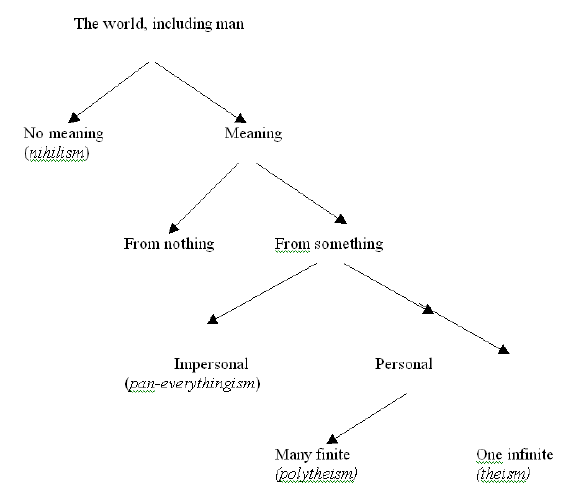
The possible answers to why something rather than nothing is there boil down logically to four. “(1) Once there was absolutely nothing, and now there is something; (2) everything began with an impersonal something; (3) everything began with a personal something; and (4) there is and always has been a dualism” (2:10; cf. 1:282-284). The first answer is actually quite rare once the point is pressed that the beginning must be from an absolute nothing—what Schaeffer calls “nothing nothing” (1:282). One is reminded of Norman Geisler’s version of the cosmological argument in which he emphasizes that “nothing comes from nothing.” Schaeffer also dismisses dualism as an answer, since it inevitably reduces to one of the other two remaining options (1:284 n. 1; 2:10).

By far the most popular answer among non-Christians is that everything began from some impersonal beginning. Often this is articulated as pantheism, but Schaeffer argues that this term is misleading because it smuggles in the idea of a personal God (“theism”) when in fact the pantheist actually holds to an impersonal view of the beginning. He prefers to call this answer “pan-everythingism” (1:283). Pan-everythingism is thus the same view, whether it is expressed in mystical religious terms or in modern scientific terms in which everything is reduced to fundamental physical particles. This view founders because it leaves us with no basis for attributing purpose or meaning to anything, including man: “If we begin with an impersonal, we cannot then have some form of teleological concept. No one has ever demonstrated how time plus chance, beginning with an impersonal, can produce the needed complexity of the universe, let alone the personality of man. No one has given us a clue to this” (1:283).

As Clark Pinnock points out, this appears to be “a rudimentary form of the teleological argument.”25 Schaeffer’s argument here broadens beyond the usual confines of both the cosmological and teleological arguments, integrating into one argument the need to account for the origin of diversity, meaning, and morality as well as being.

This leaves as the only remaining possible answer that ultimately everything owes its existence to “a personal beginning” (1:284). This is an answer that gives meaning to ourselves as persons (1:285). This personal beginning cannot be finite gods (they are not “big enough” to provide an adequate answer), but must be a personal-infinite God (1:286-287). Schaeffer here follows a strategy similar to that employed by Geisler: set forth the basic worldviews (atheism, dualism, pantheism, finite theism, theism) and show that all of them except theism are irrational. As in classical apologetics, Schaeffer concludes that a worldview in which everything was created by an infinite-personal God is the only worldview that provides a rationally adequate answer to the question of why there is something (1:288).

We may represent the structure of Schaeffer’s argument as follows:

The similarities to the cosmological argument are apparent. It is with some justice that Robert L. Reymond calls it “the old cosmological argument of Thomas in new garb.”26 In addition, the argument is structured using the law of noncontradiction as the basic principle, a feature characteristic of the classical approach.

Schaeffer and Evidentialism

While few if any students of Schaeffer would conclude that the classical model dominated his approach to apologetics, some do contend that he is properly identified as an evidentialist. Reymond includes Schaeffer (as well as Carnell) in his chapter on “empirical apologetics.” He recognizes that Schaeffer’s apologetic has presuppositional elements (of which Reymond approves), but concludes that he compromised that approach by using “an empiricist verification test of truth.”27

There is indeed some basis for interpreting Schaeffer as advocating a verificational approach to defending Christian belief. The premise here is that Scripture deals with not only “religious” matters “but also the cosmos and history, which are open to verification” (1:120). He suggests “that scientific proof, philosophical proof and religious proof follow the same rules.”

After the question has been defined, in each case proof consists of two steps:

A. The theory must be noncontradictory and must give an answer to the phenomenon in question.

B. We must be able to live consistently with our theory. (1:121)

Christianity is proved by the fact that it, and it alone, “does offer a nonself-contradictory answer which explains the phenomena and which can be lived with, both in life and in scholarly pursuits” (1:122).

A couple of key elements of the evidentialist approach are present in this passage. First, Schaeffer claims that proof in apologetics should follow the same rules as in science. Second, he specifies that for a theory to be considered proved it must not only be logically self-consistent but also consistent with the “phenomenon in question.”

Schaeffer invites non-Christians to examine the Christian worldview in the light of every kind of phenomenon, including nature, history, human nature, culture, and ethics, confident that Christianity will be proved consistent with the facts. We can only do this, he contends, if we “have faced the question, ‘Is Christianity true?’ for ourselves” (1:140). On the basis of John 20:30-31 Schaeffer affirms, “we are not asked to believe until we have faced the question as to whether this is true on the basis of the space-time evidence.” Likewise, the prologue to Luke’s Gospel (Luke 1:1-4) shows that its “history is open to verification by eyewitnesses” (1:154). Schaeffer argues that if we deny that the Scriptures are “open to verification,” we have no basis to say that people should choose to believe Christianity rather than something else (1:259). Christianity, he affirms, offers to modern man “a unified answer to life on the basis of what is open to verification and discussion” (1:263).

The non-Christian who denies that God can speak to us as he has done in the Bible must, Schaeffer warns, “hold to the uniformity of natural causes in the closed system, against all the evidence (and I do insist it is against the evidence)” (1:325). Such a presupposition is not “viable in the light of what we know. . . . It fails to explain man. It fails to explain the universe and its form. It fails to stand up in the area of epistemology.” On the other hand, Schaeffer affirms that the Christian presupposition that God can and has spoken to man is reasonable in light of what we already know. “In my earlier books and in the previous chapters of this book we have considered whether this presupposition is in fact acceptable, or even reasonable, not upon the basis of Christian faith, but upon the basis of what we know concerning man and the universe as it is” (1:326).

Schaeffer therefore invites people to consider both the closed-system and open-system views of the universe, “and to consider which of these fits the facts of what is” (1:326). This “is a question of which of these two sets of presuppositions really and empirically meets the facts as we look about us in the world” (1:327).

Gordon Lewis argues that we need to distinguish between an inductive, empirical approach, exemplified by Montgomery, Pinnock, and others, and a verificational approach, exemplified above all by Carnell. According to Lewis, Schaeffer employed such a verificational method. “The verificational, or scientific, method addresses a problem by starting with tentative hypotheses. . . . Then the verification method subjects these hypotheses to testing and confirmation or disconfirmation by the coherence of their account with the relevant lines of data.”28

We would contend that Lewis’s verificationalism is just as much a type of evidentialism as the inductivism of such apologists as Montgomery and Pinnock. Few if any evidentialists operate according to the naive inductivism that supposes the apologist can begin with only the bare facts and no epistemology or hypothesis as to how the facts are to be explained. As we saw when we analyzed evidentialism, its essential feature is not a pure inductivism but an approach to justifying truth claims based primarily on empirical facts.

There is, however, one major difference between Schaeffer’s apologetic and both Lewis’s verificationalism and other forms of evidentialism. All evidentialists agree that the Christian apologetic properly concludes with the claim that the Christian beliefs defended have been shown to be probable, not certain. To be sure, Lewis argues that Schaeffer did hold to this probabilistic understanding of apologetics, even if he did not articulate it as clearly as he might: “No, Schaeffer’s conclusion is not justified by a technically logical implication, but by a highly probable practical necessity, given the alleged lack of other hypotheses to test and the improbabilities of the non-Christian options. . . . A more precisely worded verificationalist like Trueblood or Carnell would state the point in terms of probabilities.”29

However, Lewis’s interpretation is rather difficult to sustain in the light of some specific statements Schaeffer made about probability.

Those who object to the position that there are good, adequate, and sufficient reasons to know with our reason that Christianity is true are left with a probability position at some point. At some point and in some terminology they are left with a leap of faith. This does not mean that they are not Christians, but it means that they are offering one more probability to twentieth-century relativistic people to whom everything is only probability. They are offering one more leap of faith without reason (or with the severe diminishing of reason) to a generation that has heard a thousand leaps of faith proposed in regard to the crucial things of human life. I would repeat that what is left is that Christianity is a probability. (1:181)

Note that according to Schaeffer, if one concludes that reason can only show that Christianity is probable, the lack of certainty that results must be compensated with “a leap of faith.” Clearly, Schaeffer saw this as unacceptable. By “good, adequate, and sufficient reasons” he did not mean arguments sufficient to convince one that Christianity was likely or probably true, but sufficient “to know with our reason that Christianity is true” (emphasis added). Apologists must maintain that Christianity is not merely the best answer to the big questions of life, but that it is the only answer.

Schaeffer’s rejection of probability and his frequent reference to presuppositions suggest that he might have some affinity with presuppositionalism, to which we turn next.

Schaeffer and Reformed Apologetics

Like Carnell, Schaeffer was a student of Van Til, and like Carnell, he is commonly identified as a presuppositionalist by classical and evidential apologists and as an evidentialist by Reformed apologists. On the one hand, Schaeffer sometimes seems to express himself as only a presuppositionalist would. For example, speaking of the growing difficulty of communicating the gospel in a relativistic culture, Schaeffer states in a subheading, “Presuppositional Apologetics Would Have Stopped the Decay” (1:7). The question, of course, is what Schaeffer meant by “presuppositional.” On the other hand, Schaeffer denied being either a presuppositionalist or an evidentialist: “I’m neither. I’m not an evidentialist or a presuppositionalist. You’re trying to press me into the category of a theological apologist, which I’m not. I’m not an academic, scholastic apologist. My interest is in evangelism.”30

The issue, though, is not in what setting Schaeffer employs his apologetic method, but rather what that apologetic method is. For that reason the above answer (which, it should be noted, was an off-the-cuff reply to a question in a public meeting) is less than satisfying. Still, it is clear enough that Schaeffer was unwilling to be classified as a presuppositionalist without qualification, and that fact should be taken into account. Evidently what he meant was that he did not wish to limit himself exclusively to the presuppositional approach. On one occasion he met with Van Til and Edmund Clowney, then president of Westminster Seminary, in Clowney’s office to discuss their differences. Clowney reported that Schaeffer agreed with Van Til at every turn, even praising Van Til’s summary of his apologetic as “the most beautiful statement on apologetics I’ve ever heard. I wish there had been a tape recorder here. I would make it required listening for all l’Abri workers.”31

Schaeffer seems to have been indebted to at least three streams of Reformed thought. The first is the theology of Old Princeton. Forrest Baird (who seems generally critical of this influence) has pointed out that Schaeffer followed Hodge and the other Old Princetonians in their emphasis on the inerrancy of Scripture, their critical stance toward revivalism and pietism, and their opposition to liberalism.32

The second is the analysis of Western history and culture produced by the Kuyperian philosopher Herman Dooyeweerd, according to whom the biblical “ground motive” of creation-fall-redemption was supplanted in medieval thought by an irrational dualism between nature and grace. The biblical motive was revived in Reformation theology, the rejection of which led to the irrational dualism in modern thought between nature and freedom.33 This analysis of the history of Western thought underlies Schaeffer’s own sweeping treatments, notably in The God Who Is ThereEscape from Reason, and How Should We Then Live?

Schaeffer’s use of Dooyeweerd’s analysis is creative and distinctive: according to Schaeffer, the modern dualism eventually broke down and resulted in modern man crossing what he calls the line of despair. This line represents the transition from a culture in which people lived “with their romantic notions of absolutes (though with no sufficient logical basis)” to one in which many people have abandoned belief in absolutes and so have despaired of finding any rational basis for meaning or purpose in life. “This side of the line, all is changed” (1:8).

Europe before 1890 and the

U.S. before 1935

The line of despair__________________________________________

Europe after 1890

U.S. after 1935

Schaeffer qualifies this schema, explaining that the shift across the line of despair “spread gradually” in three ways. First, it spread from one geographical area to another—from the Continent to Britain to America. Second, it spread from one segment of society to another—from the intellectuals to the workers to the middle class. Third, it spread from one discipline to another—from philosophy to the arts to theology (1:8-9).

Schaeffer argues that modern man, having crossed the line of despair, takes a leap of faith to affirm that life has meaning and purpose because human beings cannot live without such meaning (1:61). This “leap” results in a two-storied view of the world. The “downstairs” is the world of rationality, logic, and order; it is the realm of fact, in which statements have content. The “upstairs” is the world of meaning, value, and hope; it is the realm of faith, in which statements express a blind, contentless optimism about life (1:57-58, 63-64). “The downstairs has no relationship to meaning: the upstairs has no relationship to reason” (1:58). The downstairs is studied in science and history; the upstairs is considered in theology (1:83-85). According to Schaeffer, this two-storied view of the world is what makes liberal theology possible: the liberal excuses theological statements from any normal expectation that they will satisfy rational criteria of meaning and truth because they are upper-story statements.

The third stream of Reformed influence on Schaeffer is the presuppositional apologetics of Van Til.34 While Van Til himself seems to have regarded his influence on Schaeffer as less than adequate, there is clear evidence that Schaeffer learned a great deal from him. Recently William Edgar—who was converted to Christ in a conversation with Schaeffer at L’Abri, later studied apologetics under Van Til, and is now a professor of apologetics at Westminster Seminary—argued that Schaeffer was much closer to Van Til’s position than Van Til recognized.35 He notes that both apologists

  • emphasized presuppositions,
  • argued that non-Christians could not give a unified account of reality,
  • opposed both rationalism and irrationalism but not rationality,
  • diagnosed man’s ignorance of the truth as a moral rather than a metaphysical problem,
  • advocated an indirect method of apologetics in which one assumes the non-Christian’s position for the sake of argument, and
  • affirmed both divine sovereignty and human responsibility. 36

But Edgar also sees two crucial differences between the two. The first is Schaeffer’s emphasis (which we have previously considered) that Christianity’s consistency with the way things are provides verification of its truth. Edgar agrees with Van Til that in this regard Schaeffer was naively assuming that non-Christians agree with Christians as to the way things are and as to what is consistent with things as they are. However, Edgar qualifies this criticism by suggesting that Schaeffer’s intent was not to concede to non-Christians that they had an adequate understanding of the way things are, but to acknowledge that by God’s “common grace” non-Christians are enabled to express some truth.37

Second, according to Edgar, “presuppositions” are not understood in Schaeffer’s system in the same way as in Van Til’s. This is a more important question, since if Schaeffer means something different by the term presuppositionalism he cannot properly be termed a presuppositionalist in Van Til’s line.

Edgar points out that for Van Til the unbeliever’s presuppositions in every age and culture are radically different from those of believers. For Schaeffer, on the other hand, premodern unbelievers and believers had the “shared presupposition” that there are absolutes. Modern unbelievers no longer share this presupposition with believers, now that they have crossed “the line of despair.”38 However, this is not exactly what Schaeffer says. He says that before the line of despair, “everyone [that is, all non-Christians] would have been working on much the same presuppositions, which in practice seemed to accord with the Christian’s own presuppositions” (1:6, emphasis added). Note that Schaeffer does not actually say that non-Christians had the same presuppositions as Christians, but that their presuppositions “in practice seemed to accord” with those of Christians. What Schaeffer appears to be saying is that non-Christians and Christians before the line of despair had different presuppositions, but in practice these did not seem to interfere with communication in the way the non-Christian presupposition of relativism does today.

Edgar also repeats Van Til’s criticism that for Schaeffer a presupposition “is nothing much more than a hypothesis, or a starting point.” That is, Edgar understands Schaeffer to view Christian presuppositions as hypotheses regarded as possibly true and subject to verification rather than, as Van Til held, transcendental truths to be defended by showing “the impossibility of the contrary.” Edgar writes, “At bottom, then, Schaeffer’s view of presuppositions does not allow him truly to be transcendental. Rather, he uses presuppositions as a kind of adjunct to various traditional methods in apologetic argument.”39

What Van Til and Edgar identify as a weakness in Schaeffer’s apologetic, Gordon Lewis identifies as a strength. As we saw earlier, Lewis also understands Schaeffer to present the Christian position as a tentative hypothesis verified by its internal and factual coherence. Schaeffer’s emphasis on the verifiability of Christianity does lend some support to this interpretation. However, in general he presented Christianity as anything but a tentatively held position. His consistent claim is that no one can even make sense of being, truth, rationality, knowledge, personality, or morality on any other basis than that of the infinite-personal God revealed in the Bible. “No one stresses more than I that people have no final answers in regard to truth, morals or epistemology without God’s revelation in the Bible” (1:184).

For Schaeffer the (transcendentally) necessary truth of Christianity is not incompatible with its verifiability. Although Christianity is absolutely true, non-Christians must still move in their minds from rejection of Christian presuppositions to acceptance of them. When Schaeffer assures non-Christians that they are not expected to believe and accept those presuppositions until they have verified them, by “verify” he means precisely to look and see that Christianity does give the only adequate answers to the big questions.

Schaeffer and Fideism

Like most conservative evangelicals, Francis Schaeffer was very critical of the philosophy of Kierkegaard and the theology of Barth and contemporary neoevangelicals. In particular, he frequently criticized the Kierkegaardian notion of a “leap” of faith. The index to Schaeffer’s complete works lists over fifty references to the term in the foundational trilogy of books, and it appears sporadically throughout the other volumes (5:555). One might expect, then, that he would have little or no affinity for the fideist approach to apologetics. Yet in fact there is a strong element of fideism (as we have defined it) in Schaeffer’s method.

First of all, it is worth noting that Schaeffer qualified his criticisms of both Kierkegaard and Barth. Kierkegaard is an important figure because he is the father of both secular and religious existentialism (1:14-16). Yet his writings, Schaeffer observed, “are often very helpful,” and Bible-believing Christians in Denmark still use them (1:15). “I do not think that Kierkegaard would be happy, or would agree, with that which has developed from his thinking in either secular or religious existentialism. But what he wrote gradually led to the absolute separation of the rational and logical from faith” (1:16, emphasis added).

Likewise, Schaeffer acknowledged that Barth did not agree with much of what neo-orthodox theologians taught in his wake. “But as Kierkegaard, with his leap, opened the door to existentialism in general, so Karl Barth opened the door to the existentialist leap in theology” (1:55). Elsewhere Schaeffer expresses “profound admiration for Karl Barth” because of his “public stand against Nazism in the Barmen Declaration of 1934” (5:189).

While Schaeffer’s theology and theory of apologetics differ significantly from those of the fideists, his method of apologetics has some striking similarities. Like both Pascal and Kierkegaard, Schaeffer sought to dislodge his hearers from their comfortable delusions through indirect argument. The delusions were different—Kierkegaard mainly combated nominal Christianity, Schaeffer mainly struggled against atheism and liberalism—but the goal was the same.

The key to Schaeffer’s “method” is to find what he calls “the point of tension” (1:129-135). The basis of this method is the principle that “no non-Christian can be consistent to the logic of his [non-Christian] presuppositions.” That is, people cannot live in a way that is consistent with unrealistic presuppositions about the world in which they live or about themselves. “Non-Christian presuppositions simply do not fit into what God has made, including what man is. This being so, every man is in a point of tension. Man cannot make his own universe and live in it” (1:132). “Therefore, the first consideration in our apologetics for modern man, whether factory-hand or research student, is to find the place where his tension exists. We will not always find it easy to do this” (1:135). We will have to invest ourselves in the person, get to know him, and help him discover the point of tension between his theory and his life. This point of tension is the place from which we can begin to communicate with him.

In order to enable the non-Christian to see the point of tension, we must help him realize the logical implications of his presuppositions. This means that we should not start out by trying to change his mind about his presuppositions, but rather to think more deeply about them. “We ought not to try first to move a man away from the logical conclusion of his position but toward it” (1:138). We must do this cautiously and lovingly. “Pushing him towards the logic of his positions is going to cause him pain; therefore, I must not push any further than I need to” (1:138-139). Exposing the point of tension entails what Schaeffer memorably termed “taking the roof off” (1:140), the “roof” being whatever rationale the non-Christian uses to excuse the disparity between what he believes and how he lives. The Christian must lovingly “remove the shelter and allow the truth of the external world and of what man is, to beat upon him” (1:140). The non-Christian must be helped to see his need before he is ready to accept the solution: “The truth that we let in first is not a dogmatic statement of the truth of the Scriptures, but the truth of the external world and the truth of what man himself is. This is what shows him his need. The Scriptures then show him the real nature of his lostness and the answer to it. This, I am convinced, is the true order for our apologetics in the second half of the twentieth century for people living under the line of despair” (1:140-141).

Schaeffer’s reference to “the truth of the external world” should not be construed as a call for empirical investigation into nature or history as a means of establishing rational evidence for the truth of Christianity. While he does not seem to have been opposed to such lines of argument, that is not the direction he is taking here. Rather, he is saying that we need to confront the non-Christian with the truth about the world in which he lives and about what he is and what has gone wrong. This line of argument proves directly that we have a need but cannot identify or prove what the solution to that need is. For Schaeffer the answer to our need is only indirectly supported or verified by the argument, insofar as the answer given in Scripture—reconciliation with God through Jesus Christ—can be shown to meet the need.

Schaeffer’s apologetic method shows affinities to fideism in its focus on the human condition and need as the point at which non-Christian beliefs are critiqued and the truth of the Christian faith is presented. Schaeffer also sounds a fideist note when he warns fellow Christians that a valid and effective apologetic must include the practice of the truth and not merely its rational defense.

Christian apologetics must be able to show intellectually that Christianity speaks of true truth; but it must also exhibit that it is not just a theory. . . . The world has a right to look upon us and make a judgment. We are told by Jesus that as we love one another the world will judge, not only whether we are His disciples, but whether the Father sent the Son [John 13:34-35; 17:21]. The final apologetic, along with the rational, logical defense and presentation, is what the world sees in the individual Christian and in our corporate relationships together. (1:163, 165)

There must be an individual and corporate exhibition that God exists in our century, in order to show that historic Christianity is more than just a superior dialectic or a better point of psychological integration. (1:189)

We may summarize those aspects of Schaeffer’s apologetic that resonate with fideism as follows: (1) the non-Christian must be shown that he cannot consistently live with his non-Christian presuppositions, and (2) the Christian must show that he can live consistently with his presuppositions.

Schaeffer and Integration

Schaeffer’s formal method of apologetics was shaped primarily, though not exclusively, by Reformed apologetics, including the presuppositionalism of Van Til. However, his actual argument for the existence of the God of the Bible closely follows the classical approach, and he affirmed the verifiability of biblical Christianity in terms compatible with some forms of evidentialism. The practical application of his apologetic, on the other hand, assumes the central fideist contention that the truth must be lived and not merely affirmed.

It is no wonder that Schaeffer avoided being labeled an advocate of any one school of apologetic theory. He did believe there were certain guiding principles that should be followed, but he rejected the idea of an apologetic system that could be applied in all cases. He emphasizes that in evangelism and apologetics “we cannot apply mechanical rules. . . . We can lay down some general principles, but there can be no automatic application.” Thus “each person must be dealt with as an individual, not as a case or statistic or machine” (1:130). “I do not believe there is any one apologetic which meets the needs of all people. . . . I do not believe that there is any one system of apologetics that meets the needs of all people, any more than I think there is any one form of evangelism that meets the need of all people. It is to be shaped on the basis of love for the person as a person” (1:176, 177).

19 Frame, Cornelius Van Til: An Analysis of His Thought, pp. 286-287; see the entire chapter, 285-97.

20 Ibid., 294.

21 Kenneth L. Woodward, “Guru of Fundamentalism,” Newsweek, 1 November 1982, 88.

22 On Schaeffer’s life, see Edith Schaeffer, L’Abri (Wheaton, Ill.: Tyndale, 1969) and The Tapestry (Waco, Tex.: Word, 1984); Christopher Catherwood, Five Evangelical Leaders (Wheaton, Ill.: Harold Shaw, 1985), 113-61; Colin Duriez, “Francis Schaeffer,” in Handbook of Evangelical Theologians, ed. Walter E. Elwell (Grand Rapids: Baker, 1993), 245-59; Burson and Walls, C. S. Lewis and Francis Schaeffer (1998), 34-48.

23 The Complete Works of Francis A. Schaeffer, 5 vols. (Westchester, Ill.: Crossway Books, 1982). Quotations from Schaeffer’s writings, and page references in the text, will all be taken from this set, with the volume number preceding the colon and the page reference following.

24 Louis G. Parkhurst, Francis Schaeffer: The Man and His Message (Wheaton, Ill.: Tyndale, 1985); Lane T. Dennis, ed., Francis A. Schaeffer: Portraits of the Man and His Work (Westchester, Ill.: Crossway, 1986); Ronald W. Ruegsegger, ed., Reflections on Francis Schaeffer (Grand Rapids: Zondervan, 1986); Thomas V. Morris, Francis Schaeffer’s Apologetics: A Critique, 2d ed. (Grand Rapids: Baker, 1987; original, 1976).

25 Clark H. Pinnock, “Schaeffer on Modern Theology,” in Reflections on Francis Schaeffer, ed. Ruegsegger, 186.

26 Reymond, Justification of Knowledge, 145.

27 Ibid., 146 (cf. 136-48).

28 Gordon R. Lewis, “Schaeffer’s Apologetic Method,” in Reflections on Francis Schaeffer, ed. Ruegsegger, 71 (cf. 69-104).

29 Ibid., 94.

30 As quoted in Jack Rogers, “Francis Schaeffer: The Promise and the Problem,” Reformed Journal 27 (1977): 12-13.

31 Quoted in Edgar, “Two Christian Warriors,” 59.

32 Forrest Baird, “Schaeffer’s Intellectual Roots,” in Reflections on Francis Schaeffer, ed. Ruegsegger, 46-55.

33 See our discussion of Dooyeweerd’s philosophy in chapter 12.

34 Baird takes notice of the connection, but his description of Van Til’s apologetic is unsatisfactory (ibid., 55-58). For example, he erroneously asserts that according to Van Til, “the careful development and presentation of Christian evidences is really a waste of time” (57).

35 Edgar, “Two Christian Warriors,” 57-80.

36 Ibid., 60-64.

37 Ibid., 70-74.

38 Ibid., 75.

39 Ibid., 75.

_________________

_____________


Related posts:

FRANCIS SCHAEFFER ANALYZES ART AND CULTURE Part 9 Jasper Johns (Feature on artist Cai Guo-Qiang )

____________________________________ Episode 8: The Age Of Fragmentation Published on Jul 24, 2012 Dr. Schaeffer’s sweeping epic on the rise and decline of Western thought and Culture ___________________ In ART AND THE BIBLE  Francis Schaeffer observed, “Modern art often flattens man out and speaks in great abstractions; But as Christians, we see things otherwise. Because God […]

FRANCIS SCHAEFFER ANALYZES ART AND CULTURE Part 8 “The Last Year at Marienbad” by Alain Resnais (Feature on artist Richard Tuttle and his return to the faith of his youth)

__________________ Alain Resnais Interview 1 ______________ Last Year in Marienbad (1961) Trailer   ________________________ My Favorite Films: Last Year at Marienbad Movie Review – WillMLFilm Review ________________________ INTERVIEW: Lambert Wilson on working with Alain Resnais a… Published on Jan 5, 2014 INTERVIEW: Lambert Wilson on working with Alain Resnais at You Aint Seen Nothing Yet Interviews: […]

FRANCIS SCHAEFFER ANALYZES ART AND CULTURE Part 7 Jean Paul Sartre (Feature on artist David Hooker )

__________________ Today we are going to look at the philosopher Jean Paul Sartre and will feature the work of the artist David Hooker. Francis Schaeffer pictured below: _________________________________ Sunday, November 24, 2013 A Star to Steer By – Revised! The beautiful Portland Head Lighthouse on the Maine coast. It was the flash from this lighthouse I […]

FRANCIS SCHAEFFER ANALYZES ART AND CULTURE Part 6 The Adoration of the Lamb by Jan Van Eyck which was saved by MONUMENT MEN IN WW2 (Feature on artist Makoto Fujimura)

________________ How Should We Then Live? Episode 3: The Renaissance Published on Jul 24, 2012 Dr. Schaeffer’s sweeping epic on the rise and decline of Western thought and Culture _________________________ Christians used to be the ones who were responsible for the best art in the culture. Will there ever be a day that happens again? […]

FRANCIS SCHAEFFER ANALYZES ART AND CULTURE Part 5 John Cage (Feature on artist Gerhard Richter)

_________________ Francis Schaeffer has written extensively on art and culture spanning the last 2000 years and here are some posts I have done on this subject before : Francis Schaeffer’s “How should we then live?” Video and outline of episode 10 “Final Choices” , episode 9 “The Age of Personal Peace and Affluence”, episode 8 “The Age of Fragmentation”, episode 7 “The Age of Non-Reason” , episode 6 “The Scientific Age” , episode 5 “The Revolutionary Age” ,  episode 4 “The Reformation”,  episode 3 […]

FRANCIS SCHAEFFER ANALYZES ART AND CULTURE Part 4 ( Schaeffer and H.R. Rookmaaker worked together well!!! (Feature on artist Mike Kelley Part B )

FRANCIS SCHAEFFER ANALYZES ART AND CULTURE Part 4 ( Schaeffer and H.R. Rookmaaker worked together well!!! (Feature on artist Mike Kelley Part B ) [ARTS 410] William Dyrness: The Relationship of Art and Theology Published on Sep 14, 2013 Guest lecture in ARTS 410: Arts and the Bible. At the 30:00 mark William Dyrness talks […]

FRANCIS SCHAEFFER ANALYZES ART AND CULTURE Part 3 PAUL GAUGUIN’S 3 QUESTIONS: “Where do we come from? What art we? Where are we going? and his conclusion was a suicide attempt” (Feature on artist Mike Kelley Part A)

___________________ How Should we then live Part 7 Dr. Francis Schaeffer examines the Age of Non-Reason and he mentions the work of Paul Gauguin. Paul Gauguin October 12, 2012 by theempireoffilms Paul Gauguin was born in Paris, France, on June 7, 1848, to a French father, a journalist from Orléans, and a mother of Spanish Peruvian descent. When […]

FRANCIS SCHAEFFER ANALYZES ART AND CULTURE Part 2 “A look at how modern art was born by discussing Monet, Renoir, Pissaro, Sisley, Degas,Cezanne, Van Gogh, Gauguin, Seurat, and Picasso” (Feature on artist Peter Howson)

__________________________ Today I am posting my second post in this series that includes over 50 modern artists that have made a splash. Last time it was Tracey Emin of England and today it is Peter Howson of Scotland. Howson has overcome alcoholism in order to continue his painting. Many times in the past great painters […]

FRANCIS SCHAEFFER ANALYZES ART AND CULTURE Part 1 HOW SHOULD WE THEN LIVE? “The Roman Age” (Feature on artist Tracey Emin)

__________________ Francis Schaeffer pictured below: _______________- I want to make two points today. First, Greg Koukl has rightly noted that the nudity of a ten year old girl in the art of Robert Mapplethorpe is not defensible, and it demonstrates where our culture is  morally. It the same place morally where  Rome was 2000 years […]

Open letter to President Obama (Part 527) Al Mohler on Kermit Gosnell’s abortion practice

Open letter to President Obama (Part 527)

(Emailed to White House on 5-17-13.)

President Obama c/o The White House 1600 Pennsylvania Avenue NW Washington, DC 20500

Dear Mr. President,

I know that you receive 20,000 letters a day and that you actually read 10 of them every day. I really do respect you for trying to get a pulse on what is going on out here. I know that you don’t agree with my pro-life views but I wanted to challenge you as a fellow Christian to re-examine your pro-choice view.

___________________

Francis Schaeffer: How Should We Then Live? (Full-Length Documentary)

Francis Schaeffer Whatever Happened to the Human Race (Episode 1) ABORTION


________________

Picture of Francis Schaeffer and his wife Edith from the 1930′s above. I was sad to read about Edith passing away on Easter weekend in 2013. I wanted to pass along this fine article below.

Al Mohler’s comments on Kermit Gosnell’s abortion clinic are really wise.

Kermit Gosnell’s America — What His Trial Really Reveals

Tuesday, May 14, 2013

The doctor is a murderer. The trial of Dr. Kermit Gosnell ended yesterday, with the infamous abortion doctor convicted of three counts of first degree murder and one count of involuntary manslaughter. The doctor’s abortion clinic, described by a Philadelphia prosecutor as a “house of horrors,” is no more, but the truth revealed in his trial remains. He is not the only one with blood on his hands.

The prosecution of Kermit Gosnell put the entire nation on trial. The doctor was indicted on hundreds of criminal counts, and in addition to the murder and manslaughter convictions he received yesterday, he was also convicted on more than two hundred counts including racketeering, infanticide, and performing abortions that violated Pennsylvania law. Most of those were illegal late-term abortions.

The evidence presented in the trial was gruesome. Investigators told of finding jars filled with parts of dismembered babies. Some of Dr. Gosnell’s co-workers told of seeing the doctor deliver babies alive, then murdering them by snipping their spinal cords with scissors. They told of babies moving their arms and legs and gasping for breath, even making noises as Dr. Gosnell murdered them.

The arrest of Dr. Gosnell in 2011 brought a wave of news coverage. That was not the case with his trial — at least not until public outrage demanded that the press pay more attention. The mainstream media largely ignored the trial, and national attention came only after a concerted effort in social media and on the Internet made inattention to the story nearly impossible.

As Kirsten Powers, writing in USA Today, wrote: “Since the murder trial of Pennsylvania abortion doctor Kermit Gosnell began on March 18, there has been precious little coverage of the case that should be on every news show and front page. The revolting revelations of Gosnell’s former staff, who have been testifying to what they witnessed and did during late-term abortions, should shock anyone with a heart.” She concluded, “The deafening silence of too much of the media, once a force for justice in America, is a disgrace.”

Reluctantly, many major media outlets did start to give the trial attention, but their coverage was often more about the controversy over the coverage of the trial than about the trial itself. A report that appeared in TIME magazine just after Gosnell’s conviction, Kate Pickert and Adam Sorensen argued that “while it wasn’t completely ignored, the Gosnell trial revealed the mainstream media’s hesitancy to swarm a story about a horrifying abortion-related crime.” Later, while arguing that one reason for minimal news coverage of the trial was “the extremely disturbing nature of the crime,” they also acknowledged that “it’s no secret that most journalists are socially liberal.”

This morning, Dr. Gosnell’s murder convictions made the front pages of USA Today and The Wall Street Journal. The story appeared on page A-12 of The New York Times.

Both sides in the nation’s abortion debate agreed that Dr. Gosnell should be convicted and vilified. But pro-abortion forces found themselves continually forced to argue that Dr. Gosnell’s house of horrors was an exception and that abortion is not really at issue in the entire Gosnell trial. They did their best to make that point, but it is an impossible point to make. The babies murdered in Dr. Gosnell’s “clinic” were not visiting a pediatrician. They were born only after so-called “botched abortions.” The entire context was about abortion.

In TIME, Pickert and Sorensen argued that “this was not a case about the morality of legal, late-term abortion.” While the trial was not an open debate about the morality of abortion, that issue is what every thoughtful person recognizes is at stake — which is precisely why the pro-abortion movement had to insist, over and over again, that the morality of abortion is not the issue.

Here is a clue: When you have to argue at every turn that the issue is not abortion, the issue is abortion.

Prosecutors in Pennsylvania announced that they will seek the death penalty for Dr. Gosnell. He now stands convicted of the premeditated and calculated murder of three infants, along with over 200 additional crimes. In his closing argument to the jury, prosecutor Ed Cameron turned to Dr. Gosnell and asked, “Are you human? To med these women up and stick knives in the backs of babies?”

But we must not miss the true meaning of the Gosnell trial. It is true that Dr. Gosnell was found guilty of his crimes — at least the crimes successfully prosecuted in Pennsylvania. But, in reality the whole nation was on trial, and we are all guilty.

What the pro-abortion movement fears most is that Americans will pause to consider what this trial really means. It means that Dr. Gosnell would not be on trial for murder if he had killed those three babies while inside their mother’s body. His murder convictions have everything to do with the fact that the abortions were “botched” and the babies were accidentally born alive. Had the abortions been “successful” — even up to the last hours of pregnancy — Dr. Gosnell might have been charged with performing a late-term abortion, but not of murder.

And, speaking of late-term abortions, the abortion rights movement is against all legal restrictions on those as well. They insist on a woman’s unfettered right to an abortion up to the moment of birth.

Even more chillingly, a Planned Parenthood representative recently told a committee of the Florida legislature that even a baby born alive after a failed abortion should have its life or death decided only by its mother and her doctor.

This is America. A nation that has legalized murder in the womb and that now finds itself staring at what abortion really represents. Human dignity cannot survive in a society that insists that a baby inside the womb has no right to live while that same baby, just seconds later, is a murder victim. Respect for human life cannot endure when a baby inside the womb is just a fetus, but when moved only a few centimeters is a full citizen.

The body parts of babies presented as evidence in the Gosnell trial are routinely discarded as “medical waste” outside your local abortion clinic.

What the Gosnell trial revealed is not the exceptional gruesomeness of a single clinic in Philadelphia. It reveals the truth that all Americans are, by our laws, complicit in Dr. Gosnell’s evil. The real scandal is not just the babies murdered outside the womb, but the millions aborted legally — torn apart by blades, suctioned out as waste, poisoned unto death by drugs.

The trial of Dr. Kermit Gosnell revealed the truth about this homicidal doctor and his house of horrors, but it also revealed the moral house of mirrors behind which America hides. Dr. Gosnell is not alone in having the blood of babies on his hands.


I am always glad to hear from readers. Write me at mail@albertmohler.com. Follow regular updates on Twitter at www.twitter.com/AlbertMohler

Political Cartoons by Chip Bok

______________________

Thank you so much for your time. I know how valuable it is. I also appreciate the fine family that you have and your commitment as a father and a husband. I also respect you for putting your faith in Christ for your eternal life. I am pleading to you on the basis of the Bible to please review your religious views concerning abortion. It was the Bible that caused the abolition movement of the 1800’s and it also was the basis for Martin Luther King’s movement for civil rights and it also is the basis for recognizing the unborn children.

Sincerely,

Everette Hatcher III, 13900 Cottontail Lane, Alexander, AR 72002, ph 501-920-5733, lowcostsqueegees@yahoo.com

Related posts:

Francis Schaeffer’s “How should we then live?” Video and outline of episode 10 “Final Choices” (Schaeffer Sundays)

E P I S O D E 1 0   Dr. Francis Schaeffer – Episode X – Final Choices 27 min FINAL CHOICES I. Authoritarianism the Only Humanistic Social Option One man or an elite giving authoritative arbitrary absolutes. A. Society is sole absolute in absence of other absolutes. B. But society has to be […]

Francis Schaeffer’s “How should we then live?” Video and outline of episode 9 “The Age of Personal Peace and Affluence” (Schaeffer Sundays)

E P I S O D E 9 Dr. Francis Schaeffer – Episode IX – The Age of Personal Peace and Affluence 27 min T h e Age of Personal Peace and Afflunce I. By the Early 1960s People Were Bombarded From Every Side by Modern Man’s Humanistic Thought II. Modern Form of Humanistic Thought Leads […]

Francis Schaeffer’s “How should we then live?” Video and outline of episode 8 “The Age of Fragmentation” (Schaeffer Sundays)

E P I S O D E 8 Dr. Francis Schaeffer – Episode VIII – The Age of Fragmentation 27 min I saw this film series in 1979 and it had a major impact on me. T h e Age of FRAGMENTATION I. Art As a Vehicle Of Modern Thought A. Impressionism (Monet, Renoir, Pissarro, Sisley, […]

Francis Schaeffer’s “How should we then live?” Video and outline of episode 7 “The Age of Non-Reason” (Schaeffer Sundays)

E P I S O D E 7 Dr. Francis Schaeffer – Episode VII – The Age of Non Reason I am thrilled to get this film series with you. I saw it first in 1979 and it had such a big impact on me. Today’s episode is where we see modern humanist man act […]

Francis Schaeffer’s “How should we then live?” Video and outline of episode 6 “The Scientific Age” (Schaeffer Sundays)

E P I S O D E 6 How Should We Then Live 6#1 Uploaded by NoMirrorHDDHrorriMoN on Oct 3, 2011 How Should We Then Live? Episode 6 of 12 ________ I am sharing with you a film series that I saw in 1979. In this film Francis Schaeffer asserted that was a shift in […]

Francis Schaeffer’s “How should we then live?” Video and outline of episode 5 “The Revolutionary Age” (Schaeffer Sundays)

E P I S O D E 5 How Should We Then Live? Episode 5: The Revolutionary Age I was impacted by this film series by Francis Schaeffer back in the 1970′s and I wanted to share it with you. Francis Schaeffer noted, “Reformation Did Not Bring Perfection. But gradually on basis of biblical teaching there […]

Francis Schaeffer’s “How should we then live?” Video and outline of episode 4 “The Reformation” (Schaeffer Sundays)

Dr. Francis Schaeffer – Episode IV – The Reformation 27 min I was impacted by this film series by Francis Schaeffer back in the 1970′s and I wanted to share it with you. Schaeffer makes three key points concerning the Reformation: “1. Erasmian Christian humanism rejected by Farel. 2. Bible gives needed answers not only as to […]

“Schaeffer Sundays” Francis Schaeffer’s “How should we then live?” Video and outline of episode 3 “The Renaissance”

Francis Schaeffer’s “How should we then live?” Video and outline of episode 3 “The Renaissance” Francis Schaeffer: “How Should We Then Live?” (Episode 3) THE RENAISSANCE I was impacted by this film series by Francis Schaeffer back in the 1970′s and I wanted to share it with you. Schaeffer really shows why we have so […]

Francis Schaeffer’s “How should we then live?” Video and outline of episode 2 “The Middle Ages” (Schaeffer Sundays)

  Francis Schaeffer: “How Should We Then Live?” (Episode 2) THE MIDDLE AGES I was impacted by this film series by Francis Schaeffer back in the 1970′s and I wanted to share it with you. Schaeffer points out that during this time period unfortunately we have the “Church’s deviation from early church’s teaching in regard […]

Francis Schaeffer’s “How should we then live?” Video and outline of episode 1 “The Roman Age” (Schaeffer Sundays)

Francis Schaeffer: “How Should We Then Live?” (Episode 1) THE ROMAN AGE   Today I am starting a series that really had a big impact on my life back in the 1970′s when I first saw it. There are ten parts and today is the first. Francis Schaeffer takes a look at Rome and why […]

By Everette Hatcher III | Posted in Francis Schaeffer | Edit | Comments (0)

Debating Kermit Gosnell Trial, Abortion and infanticide with Ark Times Bloggers Part 9 Owen Strachan: “The Gosnell murders reveal the evil heart that beats in the chest of our society”

___________

C. Everett Koop, 1980s.jpg
Surgeon General of the United States
In office
January 21, 1982 – October 1, 1989
President Ronald Reagan
George H. W. Bush
Francis Schaeffer
Francis Schaeffer.jpg

Founder of the L’Abri community
Born Francis August Schaeffer
January 30, 1912

Died May 15, 1984 (aged 72)

I truly believe that many of the problems we have today in the USA are due to the advancement of humanism in the last few decades in our society. Ronald Reagan appointed the evangelical Dr. C. Everett Koop to the position of Surgeon General in his administration. He partnered with Dr. Francis Schaeffer in making the video below. It is very valuable information for Christians to have.  Actually I have included a video below that includes comments from him on this subject.

Francis Schaeffer: How Should We Then Live? (Full-Length Documentary)

Francis Schaeffer Whatever Happened to the Human Race (Episode 1) ABORTION

I have gone back and forth and back and forth with many liberals on the Arkansas Times Blog on many issues such as abortionhuman rightswelfarepovertygun control  and issues dealing with popular culture . This time around I have discussed morality with the Ark Times Bloggers and particularly the trial of the abortionist Dr. Kermit Gosnell and through that we discuss infanticide, abortion and even partial birth abortion. Here are some of my favorite past posts on the subject of Gosnell: ,Abby Johnson comments on Dr. Gosnell’s guilty verdict, Does President Obama care about Kermit Gosnell verdict?Dr. Gosnell Trial mostly ignored by mediaKermit Gosnell is guilty of same crimes of abortion clinics are says Jennifer MasonDenny Burk: Is Dr. Gosnell the usual case or not?, Pro-life Groups thrilled with Kermit Gosnell guilty verdict,  Reactions to Dr. Gosnell guilty verdict from pro-life leaders,  Kermit Gosnell and Planned Parenthood supporting infanticide?, Owen Strachan on Dr. Gosnell Trial, Al Mohler on Kermit Gosnell’s abortion practice, Finally we get justice for Dr. Kermit Gosnell .

In July of 2013 I went back and forth with several bloggers from the Ark Times Blog concerning Dr. Kermit Gosnell’s abortion practice and his trial which had finished up in the middle of May:

I don’t doubt you for a minute Olphart when you assert that “The genie will not go back into the bottle because women now enjoy reproductive freedom and they’re not about to give it up.”

You may be right on that but then it is showing how SELFISH AND NARCISSIST OUR COUNTRY HAS BECOME!!!!!

Owen Strachan observed:

If you missed it, the story is basically this: after months of complete inattention to the barbaric narrative of abortionist Kermit Gosnell, pro-life folks–including journalist Mollie Ziegler Hemingway, Lifesite.com leaders, and Eric Metaxas–decided to do their part to raise a ruckus. Gosnell gives us a window into the gruesome world of killing babies…

But here’s the thing to note: even if these abortions had happened in the tidiest manner possible, with swarms of smiling, bright-eyed attendants working in crystal-clean conditions and a long-established doctor with a warm bedside manner, they would be no less barbaric. Abortion, we are reminded, is barbaric. Strong word, this–barbaric. Yet it fits our society perfectly. We’re drunk on the fumes of our supposedly morally advanced society, our technology with its modern advances, our bright and pampered 21st-century world which seems the apotheosis of social Darwinism. We are the ones human history has been waiting for. We’re brighter, living longer, avoiding cataclysmic world wars, spreading democracy through virtual platforms, humane, tolerant, happy, and whole.

It’s this narrative, you see, that the Gosnell murders destroy. The Gosnell murders reveal the evil heart that beats in the chest of our society. They’re unusually sordid, but the practice at their core–abortion–is pure evil, the perfect flowering of an UNBRIDLED NARCISSISM. We’re patting ourselves on our backs, but our elegantly manicured hands have blood on them.

http://www.breakpoint.org/wvc-digest/featu…

A Twin Lives Through an Abortion – CBN.com

Uploaded on Jan 7, 2011

My name is Claire Culwell, and I am an abortion survivor…

__________

“Everyone needs to hear Claire’s story! Often times at pro-life events or banquets we can forget who is at stake in abortion. Claire’s passion reminds the audience that every life lost due to abortion cannot be taken back but every life saved from abortion is a profound witness of God’s hope and love for every human life. Having seen her speak multiple times, I know that Claire’s story captures an audience at a pregnancy center event like no other story because she is living proof of what we stand for, life!” –Shawn Carney, Co-founder 40 Days for Life, Host of Being Human on EWTN

Claire’s Story:

I found out I was affected by abortion about 3 years ago. This changed my life. I had walked into the Coalition For Life wondering what their organization provided and 5 months later I met my birth mother who told me my life is a miracle.

My birth mother was 13 years old at the time she became pregnant with me. Her mother took her straight to an abortion clinic where she had a surgical abortion. After thinking she had “fixed the problem,” a few weeks later she realized her belly was still growing. Her mother took her back to the abortion clinic where she learned that she had been pregnant with twins…One was aborted; One survived.

My life is a miracle and I would be selfish to keep this GIFT of life to myself. I want to tell everyone what a gift I and even they have been given!! I want to encourage them to seek alternatives to abortion because I would never want any woman/man to go through the grief and the pain that my birth mother went through simply because she didn’t know she had any other option. I also want to be a vessel to offer God’s forgiveness to the men and women who have previously had abortions. I know healing is possible and I have been given the gift of surviving an abortion so that I can tell these men and women that they are forgiven…coming from an aborted child, I hope they know the power of forgiveness and healing through meeting me. My involvement in Coalition For Life transformed me, taught me how to stand up for life on the front lines, and how to share my story in a meaningful way. I have the staff at Coalition For Life to thank for encouraging me to get involved and to share my story not only on the sidewalk but in public (my biggest fear) because God is glorified when I publically proclaim that “I am here not because of anything I did, but ONLY because of God’s mercy and love for me.”

My life is a testimony that there are wonderful alternatives to abortion (such as adoption in my case) and an accident/unwanted child still deserves life…even a child with disabilities. I was born 2 1/2 months early, weighed 3 lbs 2 oz, had dislocated hips and club feet. I had to wear casts on my feet, a harness and eventually a body cast. The abortion still affects me today. All that to say, LIFE IS STILL WORTH IT.If my life can touch just one person who has had an abortion or considering an abortion or adoption, then I am fulfilling my purpose in the pro-life movement.

I will not be silent because each mother and child are in the same place my biological mother, my twin and I were in 22 years ago and I am here to say THERE IS HOPE and there are options!

Traveling and sharing my story was not something that I had planned for myself, but God proved to have better plans for me than I had for myself. Sharing my story is as much of a gift to MYSELF as it is to others.

Related posts:

GBCSUMC on Gosnell: What’s abortion got to do with it? #UMC

Many in the world today are taking a long look at the abortion industry because of the May 14, 2013 guilty verdict and life term penalty handed down by a jury (which included 9 out of 12 pro-choice jurors)  to Dr. Kermit Gosnell. During this time of reflection I wanted to put forth some of the […]

Kermit Gosnell and the irony of the coat hanger back alley argument

Many in the world today are taking a long look at the abortion industry because of the May 14, 2013 guilty verdict and life term penalty handed down by a jury (which included 9 out of 12 pro-choice jurors)  to Dr. Kermit Gosnell. During this time of reflection I wanted to put forth some of the […]

History’s Jury Is Out: Has Gosnell Rocked Our Conscience?

Many in the world today are taking a long look at the abortion industry because of the May 14, 2013 guilty verdict and life term penalty handed down by a jury (which included 9 out of 12 pro-choice jurors)  to Dr. Kermit Gosnell. During this time of reflection I wanted to put forth some of the […]

Evangelical Blogger Lists Eight Reasons the Media Are Ignoring the Gosnell Murder Trial

Many in the world today are taking a long look at the abortion industry because of the May 14, 2013 guilty verdict and life term penalty handed down by a jury (which included 9 out of 12 pro-choice jurors)  to Dr. Kermit Gosnell. During this time of reflection I wanted to put forth some of the […]

Cornerstone Executive Ashley Pratte on Gosnell Trial Verdict

Many in the world today are taking a long look at the abortion industry because of the May 14, 2013 guilty verdict and life term penalty handed down by a jury (which included 9 out of 12 pro-choice jurors)  to Dr. Kermit Gosnell. During this time of reflection I wanted to put forth some of the […]

Dr. Gosnell Trial ignored for a while by mainstream media

Many in the world today are taking a long look at the abortion industry because of the May 14, 2013 guilty verdict and life term penalty handed down by a jury (which included 9 out of 12 pro-choice jurors)  to Dr. Kermit Gosnell. During this time of reflection I wanted to put forth some of the […]

ANALYSIS: Will the Kermit Gosnell verdict change the abortion debate?

Many in the world today are taking a long look at the abortion industry because of the May 14, 2013 guilty verdict and life term penalty handed down by a jury (which included 9 out of 12 pro-choice jurors)  to Dr. Kermit Gosnell. During this time of reflection I wanted to put forth some of the […]

What’s So Bad About Kermit Gosnell?

Many in the world today are taking a long look at the abortion industry because of the May 14, 2013 guilty verdict and life term penalty handed down by a jury (which included 9 out of 12 pro-choice jurors)  to Dr. Kermit Gosnell. During this time of reflection I wanted to put forth some of the […]

Kermit Gosnell and the Gospel

Many in the world today are taking a long look at the abortion industry because of the May 14, 2013 guilty verdict and life term penalty handed down by a jury (which included 9 out of 12 pro-choice jurors)  to Dr. Kermit Gosnell. During this time of reflection I wanted to put forth some of the […]

VIDEO: Kermit Gosnell killings like ‘weeding your garden’

Many in the world today are taking a long look at the abortion industry because of the May 14, 2013 guilty verdict and life term penalty handed down by a jury (which included 9 out of 12 pro-choice jurors)  to Dr. Kermit Gosnell. During this time of reflection I wanted to put forth some of the […]

Gosnell: The Silence is Deafening

Many in the world today are taking a long look at the abortion industry because of the May 14, 2013 guilty verdict and life term penalty handed down by a jury (which included 9 out of 12 pro-choice jurors)  to Dr. Kermit Gosnell. During this time of reflection I wanted to put forth some of the […]

Five Thoughts on the Gosnell Conviction

Many in the world today are taking a long look at the abortion industry because of the May 14, 2013 guilty verdict and life term penalty handed down by a jury (which included 9 out of 12 pro-choice jurors)  to Dr. Kermit Gosnell. During this time of reflection I wanted to put forth some of the […]

Implications of the Kermit Gosnell Verdict

Many in the world today are taking a long look at the abortion industry because of the May 14, 2013 guilty verdict and life term penalty handed down by a jury (which included 9 out of 12 pro-choice jurors)  to Dr. Kermit Gosnell. During this time of reflection I wanted to put forth some of the […]

Godly comments on Dr. Kermit Gosnell

Many in the world today are taking a long look at the abortion industry because of the May 14, 2013 guilty verdict and life term penalty handed down by a jury (which included 9 out of 12 pro-choice jurors)  to Dr. Kermit Gosnell. During this time of reflection I wanted to put forth some of the […]

Dr. Gosnell Trial has prompted closer look at Albuquerque abortion clinic

Many in the world today are taking a long look at the abortion industry because of the May 14, 2013 guilty verdict and life term penalty handed down by a jury (which included 9 out of 12 pro-choice jurors)  to Dr. Kermit Gosnell. During this time of reflection I wanted to put forth some of the […]

Why won’t President Obama comment on Dr. Gosnell Trial?

Many in the world today are taking a long look at the abortion industry because of the May 14, 2013 guilty verdict and life term penalty handed down by a jury (which included 9 out of 12 pro-choice jurors)  to Dr. Kermit Gosnell. During this time of reflection I wanted to put forth some of the […]

Dr. Alveda King reacts to guilty verdict of Kermit Gosnell

Francis Schaeffer: “Whatever Happened to the Human Race” (Episode 1) ABORTION OF THE HUMAN RACE Published on Oct 6, 2012 by AdamMetropolis ________________ What a great article below: Dr. Alveda King: Guilty Gosnell Verdict May Spark More Justice for Women and Babies Contact: Eugene Vigil, King for America, 470-244-3302 PHILADELPHIA, May 13, 2013 /Christian Newswire/ […]

Kristen Hatten: Dr. Gosnell guilty verdict, but what about the rest?

Many in the world today are taking a long look at the abortion industry because of the May 14, 2013 guilty verdict and life term penalty handed down by a jury (which included 9 out of 12 pro-choice jurors)  to Dr. Kermit Gosnell. During this time of reflection I wanted to put forth some of the […]

Lila Rose of Live Action comments on Kermit Gosnell guilty verdict

Francis Schaeffer: “Whatever Happened to the Human Race” (Episode 1) ABORTION OF THE HUMAN RACE Published on Oct 6, 2012 by AdamMetropolis ________________ May 14, 2013 Murdered Thousands, Convicted for Three: The Kermit Gosnell Verdict By Drew Belsky Read more: http://www.americanthinker.com/2013/05/murdered_thousands_convicted_for_three_the_kermit_gosnell_verdict.html#ixzz2TMstLk1c Follow us: @AmericanThinker on Twitter | AmericanThinker on FacebookPhiladelphia abortionist Kermit Gosnell was convicted […]

Gerard M. Nadal: Dr. Gosnell Guilty, but now what?

Many in the world today are taking a long look at the abortion industry because of the May 14, 2013 guilty verdict and life term penalty handed down by a jury (which included 9 out of 12 pro-choice jurors)  to Dr. Kermit Gosnell. During this time of reflection I wanted to put forth some of the […]

Reince Priebus on Kermit Gosnell guilty verdict

Francis Schaeffer: “Whatever Happened to the Human Race” (Episode 1) ABORTION OF THE HUMAN RACE Published on Oct 6, 2012 by AdamMetropolis ________________ A Verdict Doesn’t End the Gosnell Story By: Chairman Reince Priebus (Diary)  |  May 13th, 2013 at 03:27 PM  |  28 RESIZE: AAA The horrors that unfolded in the clinic of Dr. […]

Kirsten Powers of USA Today on Dr. Gosnell Trial

Many in the world today are taking a long look at the abortion industry because of the May 14, 2013 guilty verdict and life term penalty handed down by a jury (which included 9 out of 12 pro-choice jurors)  to Dr. Kermit Gosnell. During this time of reflection I wanted to put forth some of the […]

Top 10 Revelations of Kermit Gosnell Trial

Francis Schaeffer: “Whatever Happened to the Human Race” (Episode 1) ABORTION OF THE HUMAN RACE Published on Oct 6, 2012 by AdamMetropolis ________________ All-American Horror Story: Top 10 Kermit Gosnell Trial Revelations by Kristan Hawkins | Washington, DC | LifeNews.com | 4/12/13 3:38 PM Since so many in the media have failed/refused to report on […]

Denny Burk: We have to learn from Dr. Gosnell’s Crimes

Many in the world today are taking a long look at the abortion industry because of the May 14, 2013 guilty verdict and life term penalty handed down by a jury (which included 9 out of 12 pro-choice jurors)  to Dr. Kermit Gosnell. During this time of reflection I wanted to put forth some of the […]

Tony Perkins on Kermit Gosnell Trial

Francis Schaeffer: “Whatever Happened to the Human Race” (Episode 1) ABORTION OF THE HUMAN RACE Published on Oct 6, 2012 by AdamMetropolis _____________ Tony Perkins: Gosnell Trial – FOX News Published on May 13, 2013 Tony Perkins: Gosnell Trial – FOX News ________________ Hey Obama, Kermit Gosnell Is What a Real War on Women Looks Like […]

Ross Douthat of NY Times on Dr. Gosnell

Many in the world today are taking a long look at the abortion industry because of the May 14, 2013 guilty verdict and life term penalty handed down by a jury (which included 9 out of 12 pro-choice jurors)  to Dr. Kermit Gosnell. During this time of reflection I wanted to put forth some of the […]

Family Research Council happy with Kermit Gosnell Guilty Verdict

Francis Schaeffer: “Whatever Happened to the Human Race” (Episode 1) ABORTION OF THE HUMAN RACE Published on Oct 6, 2012 by AdamMetropolis ___ _____________ Tony Perkins: Gosnell Trial – FOX News Published on May 13, 2013 Tony Perkins: Gosnell Trial – FOX News ________________ Family Research Council Praises Jury for Bringing Justice to Victims of Abortionist […]

Peter Jones on Infanticide and Dr. Gosnell

Many in the world today are taking a long look at the abortion industry because of the May 14, 2013 guilty verdict and life term penalty handed down by a jury (which included 9 out of 12 pro-choice jurors)  to Dr. Kermit Gosnell. During this time of reflection I wanted to put forth some of the […]

Is Dr. Gosnell a “one-of-a-kind anomaly”?

Many in the world today are taking a long look at the abortion industry because of the May 14, 2013 guilty verdict and life term penalty handed down by a jury (which included 9 out of 12 pro-choice jurors)  to Dr. Kermit Gosnell. During this time of reflection I wanted to put forth some of the […]

Kermit Gosnell and the Logic of “Pro-Choice”

Francis Schaeffer: “Whatever Happened to the Human Race” (Episode 1) ABORTION OF THE HUMAN RACE Published on Oct 6, 2012 by AdamMetropolis ________________ _____________ Tony Perkins: Gosnell Trial – FOX News Published on May 13, 2013 Tony Perkins: Gosnell Trial – FOX News ________________ Kermit Gosnell and the Logic of “Pro-Choice” by  Matthew J. Franck within […]

______________________

Do New York late term abortionists need more attention like Dr. Gosnell did?

Many in the world today are taking a long look at the abortion industry because of the May 14, 2013 guilty verdict and life term penalty handed down by a jury (which included 9 out of 12 pro-choice jurors)  to Dr. Kermit Gosnell. During this time of reflection I wanted to put forth some of the […]

Dr. Gosnell Trial has prompted Texas authorities to take closer look a Houston abortionist

Many in the world today are taking a long look at the abortion industry because of the May 14, 2013 guilty verdict and life term penalty handed down by a jury (which included 9 out of 12 pro-choice jurors)  to Dr. Kermit Gosnell. During this time of reflection I wanted to put forth some of the […]

Father Frank Pavone reacts to Kermit Gosnell guilty verdict

Francis Schaeffer: “Whatever Happened to the Human Race” (Episode 1) ABORTION OF THE HUMAN RACE Published on Oct 6, 2012 by AdamMetropolis ________________ Fr. Pavone: Right to choose must yield to right to life STATEN ISLAND, NY — Father Frank Pavone, National Director of Priests for Life, had the following comment on the verdict in […]

NAF reacts to Dr. Gosnell guilty verdict

Many in the world today are taking a long look at the abortion industry because of the May 14, 2013 guilty verdict and life term penalty handed down by a jury (which included 9 out of 12 pro-choice jurors)  to Dr. Kermit Gosnell. During this time of reflection I wanted to put forth some of the […]

Hope for Kermit Gosnell’s repentance?

Francis Schaeffer: “Whatever Happened to the Human Race” (Episode 1) ABORTION OF THE HUMAN RACE Published on Oct 6, 2012 by AdamMetropolis ________________ The truth of abortion … the hope for Gosnell’s repentance A conviction in the murder trial of Philadelphia abortionist Kermit Gosnell has boosted the efforts of pro-lifers to demonstrate what abortion really […]

The Selfishness of Chris Evert Part 5 (Includes videos and Pictures)

The Selfishness of Chris Evert Part 2 (Includes videos and Pictures) _________________________________ _____________________ _______________________ __________________________ Tennis – Wimbledon 1974 [ Official Film ] – 05/05 Published on May 1, 2012 John Newcombe, Ken Rosewall, Bjor Borg, Jimmy Connors, Cris Evert… ___________________ Jimmy Connors Reflects Published on May 13, 2013 Jimmy Connors visits “SportsCenter” to discuss his memoir, […]

Sylvester Jacobs’ story of meeting Francis Schaeffer at OM conference in early 1970’s

THE SCHAEFFER LEGACY PROJECT – INTERVEW WITH SYLVESTER JACOBS

Published on Aug 12, 2013

Sylvester Jacobs could be considered the photographer of L’Abri. Many of his famous pictures from his work Portrait of a Shelter have been seen for years. His book, Born Black tells his story and journey to L’Abri. Yet artistically, he is most accomplished in his famous work, Portrait of England, which is a celebrated depiction of England in the mid-70s.

________________________________

Edith and Francis SchaefferEnlarge Image

Photo by Sylvester Jacobs/Schaeffer Institute at Covenant Seminary

Edith and Francis Schaeffer

_____________

Rouault, Fujimura: Soliloquies

  • Thomas S. Hibbs
  • Jan 14, 2013
  • Series: Volume 16 – 2013

Thomas S. Hibbs, Rouault, Fujimura: Soliloquies. New York: Square Halo Books, 2009. ISBN-10: 0978509722; ISBN-13: 978-0978509729. 62 pages. Paperback. Reviewed by Douglas Groothuis.

____________

Book Cover: Ruoault and Fujimura

___________

          Evangelicals have often been leery, if not hostile, to modern painting (and modern art in general)—especially if it fails to depict religious or realistically portrayed themes (such as those found in Norman Rockwell). Too often, Christians have settled for sentimental and downright kitschy paintings, such as those of the late Thomas Kinkade, “Painter of Light” as he was trademarked. Or, Christians may invoke modern painters as examples of cultural disarray, fragmentation, hedonism, or even nihilism. In many cases, these are apt judgments, as the work of Francis Schaeffer and Hans Rookmaaker have highlighted. However, neither man uniformly disapproved of modern art. (See particularly Rookmaaker, Art and the Death of a Culture [InterVarsity, 1970] and Art Needs No Justification [InterVarsity, 1977]; and Schaeffer, How Shall We Then Live? [Fleming, Revel, 1976]. Also worthwhile is the film series of the same name, now available on DVD.)

Both Schaeffer and Rookmaaker encouraged Christians to consider painting and other forms of artistic expression as a calling from God, the divine Artist. As musician and author Michael Card notes in his introduction to a reprinting of Schaeffer’s little gem, Art and the Bible (InterVarsity, 2006), many young Christians in the 1970s were inspired to pursue their artistic muse through Schaeffer’s lectures and writings. Schaeffer took a deeply humane and Christocentric view of art. He discerned that art revealed the inner lives and eternal culture of human beings, who were made in the image of God, despite their sin. As he wrote in A Christian Manifesto (Crossway, 1981), “Men are great, even in their sinning.” (Please ruminate on this concept for a long while.) This perspective caused him to ponder and reflect on the meaning of art in various cultures at various times. Schaeffer’s theology of culture was strongly Christocentric. All that is rooted in God’s good creation must be placed under “the Lordship of Christ,” including areas typically considered secular, such as art and politics, for humans are intrinsically culture-creators (see Genesis 1:26-28; Psalm 8).

A story makes this approach to art come to life. In the early 1970s, a young black man named Sylvester Jacobs came to study at L’Abri, a study center founded and run by Francis and Edith Schaeffer, which is still in existence. Jacobs was passionate about Christ, but was told by his Fundamentalist peers that his enchantment with photography was worldly and of the devil. He must, rather, spend all his time preaching and evangelizing. This left Jacobs hollow and confused—until he went to L’Abri in Switzerland. While there, the teachings of Schaeffer and then colleague Os Guinness convinced Jacobs that photography can be done for the glory of God. This realization changed Jacobs’s life for the better, and he became a professional photographer, and without putting aside his Christian convictions. For proof of Jacobs talents, see his book, Portrait of a Shelter, among others. For his story, read the autobiography, Born Black (Hodder, 1977).

But now to the book in question: Soliloquies, which is taken from an exhibition of the art of French painter, George Rouault (1871-1958), and the contemporary Japanese-American painter Makoto Fujimura. The paintings of each artist alternate throughout the book with text by philosopher Thomas Hibbs. The title was chosen not because the artists were caught up in excessive self-reference or egotism, but because their art-making required deep introspection, and internal dialogue on how to engage the external world through their paintings (7-13).

Rouault was a loyal Roman Catholic and Fujimura is a contemporary evangelical, who has worked with pastor and best-selling author Tim Keller at Redeemer Presbyterian Church in New York City. Fujimura offers a short “refraction” at the end of the booklet called, “George Rouault: The First Twentieth Century Artist,” wherein he considers Rouault’s uniqueness and his influence on Fujimura’s own work.

On the face it, this is an odd pairing of painters. Rouault was known as a figural painter, who mixed abstraction with depictions of human subjects (although he also painted landscapes, flowers, and so on). His work has the quality of a stained glass window and he often portrayed human beings in their deepest sorrows and absurdities. For example, he painted nude prostitutes (without eroticism), unhappy clowns, and pompous judges without wisdom; he painted old kings, weighed down with a lifetime of sorrow; he painted many scenes of the crucifixion and of human sorrow in its variegated forms. And yet, unlike so many twentieth century painters (such as Picasso at times), he never lost touch with the humanness and dignity of his subjects. If you pitied them, wept for them, or saw part of yourself in them (as I do), you knew that the humanity, however, debauched or sullied, was present and even radiant in its ineluctable radiance. This is because Rouault loved his subjects, and even saw Christ in them, “the least of these” (see Matthew 25:31-46). His pity led him to paint, not scoff, shrug, or ignore.

Fujimura, on the other hand, is not a figural painter, although he has painted some recognizable objects in his illustrated edition of the Gospels.  In fact, it is rather difficult to categorize him. Before we try, I should note it is rare that a self-consciously Christian painter achieves acceptance and even notoriety in the highly competitive secular art scene of New York City. Fujimura has done just that. While some—not hordes—of Christians appreciate his sometimes elusive work, he is not dependent on the acceptance or exclusive patronage of religious people for his living. This is an exemplary instance of following one’s calling into a daunting field of work without compromising one’s Christian conviction. Unlike so many other Christian artists (or pseudo-artists), Fujimura is not confined to an evangelical subculture or ghetto. He has earned the respect of his peers. But how so?

Fujimura combines the sensibilities of twentieth century abstraction with traditional Japanese artists’ techniques, which involve the use a variety of metal substancees besides paint. One is strained to identify actual objects in his paintings, yet they fascinate with their incandescent mystery. But the question then arises, “What do these paintings mean?” The titles sometimes help, but one still wonders. Surely, a painting need not strictly mirror something in the external world. Paintings are objects in and of themselves, and they are not photographs (even photographs are not merely representations). Painter Georgia O’Keeffe went so far as to say that “There is nothing less real than realism.” Every painting involves the subjectivity of the artist. If not, why paint at all? Yet when the subject matter seems to fade away or blur into pure nonrepresentationalism, one wonders how to know what the painting is supposed to communicate. It may evoke a feeling, as Fujimura’s paintings often do, but how can that feeling be explained or articulated? Or are we merely guessing (at best)? This could be called the question of “aesthetic epistemology,” as Denver Seminary graduate Sarah Geis puts it. But few even consider this philosophical question, it seems, and thus effortlessly fall into emotivism, which snuffs out all discourse.

I have not settled these vexing queries. While I am drawn to Rouault like lead to a magnet because of his content (his representation of suffering in particular), I do not know in specific concepts why I am drawn to Fujimura. I appreciate (and even marvel at) the difficulty and inventiveness of his technique and the uniqueness of his synthesis of traditional Japanese painting and Western abstractionism. He is unique, easily recognizable (if you have studied his work) and well-established in the art world. Moreover, unlike so many twentieth century artists, his reason for being is not mere self-expression, or, at its worste, solipsism. As he writes in the book:

The main cause of this [aesthetic corruption in the twentieth century], or the pollution in the aesthetic river of culture is self-aggrandizement and a type of embezzlement made in the name of advancing the creative arts. . . . We pollute the landscape with irresponsible expressions in the name of progress and call them freedom of speech (12).

Or, as E.H. Gombrich observes in his classic Story of Art, “self-expression became the motive for art only after it has lost all other purposes.” If so, the meaningless self becomes a strident surd in an absurd world. The self can only bear so much of itself before it implodes, sucking others into its consumptive and voracious abyss. “Mere anarchy is loosed upon the world,” as the poet Yeats said in “The Second Coming.”

But neither Rouault nor Fujimura are anarchists or self-aggrandizing. They have, rather, presented their aesthetics gifts, however different, to the world for our enjoyment and contemplation. This should stir our interests and provoke attention and appreciation. Let evangelicals reclaim art, in all its legitimate forms, under the Lordship of Christ.

Douglas Groothuis, Ph.D.
Professor of Philosophy
Denver Seminary
January 2013

_________

_____________

Truth Tuesday:Review of “How to Not Be an Existentialist” by Douglas Groothuis

Review of “How to Not Be an Existentialist” by Douglas Groothuis

Episode 8: The Age Of Fragmentation

Published on Jul 24, 2012

Dr. Schaeffer’s sweeping epic on the rise and decline of Western thought and Culture

_______________________

I love the works of Francis Schaeffer and I have been on the internet reading several blogs that talk about Schaeffer’s work and the work below by Douglas Groothuis was really helpful. Schaeffer’s film series “How should we then live?  Wikipedia notes, “According to Schaeffer, How Should We Then Live traces Western history from Ancient Rome until the time of writing (1976) along three lines: the philosophic, scientific, and religious.[3] He also makes extensive references to art and architecture as a means of showing how these movements reflected changing patterns of thought through time. Schaeffer’s central premise is: when we base society on the Bible, on the infinite-personal God who is there and has spoken,[4] this provides an absolute by which we can conduct our lives and by which we can judge society.  Here are some posts I have done on this series: Francis Schaeffer’s “How should we then live?” Video and outline of episode 10 “Final Choices” episode 9 “The Age of Personal Peace and Affluence”episode 8 “The Age of Fragmentation”episode 7 “The Age of Non-Reason” episode 6 “The Scientific Age”  episode 5 “The Revolutionary Age” episode 4 “The Reformation” episode 3 “The Renaissance”episode 2 “The Middle Ages,”, and  episode 1 “The Roman Age,” .

In the film series “WHATEVER HAPPENED TO THE HUMAN RACE?” the arguments are presented  against abortion (Episode 1),  infanticide (Episode 2),   euthanasia (Episode 3), and then there is a discussion of the Christian versus Humanist worldview concerning the issue of “the basis for human dignity” in Episode 4 and then in the last episode a close look at the truth claims of the Bible.

Francis Schaeffer

__________________________

Good review by Douglas Groothuis:

Friday, January 18, 2013

Gary Cox, How to Be an Existentialist. Or How to Get Real, Get a Grip, and Stop Making Excuses.  Great Britain: Continuum, 2009. 123 pages. Hardback. ISBN-10: 1441139877; ISBN-13: 978-1441139870.
HowtobeanExistentialistExistentialism, although not in its heyday, is not dead. It claims that God is dead and that man is alone, permanently alienated in an absurd universe. Recent books and articles seem to attempt to revive the philosophy initiated in post-war Germany and France in the 1950s and 1960s. Francis Schaeffer interacted with the leading atheistic existentialists of his day, such as Martin Heidegger, Jean-Paul Sartre, Albert Camus, and Karl Jaspers (see The God Who is There[InterVarsity, 1968] and How Shall We Then Live? [Fleming Revel, 1976]). But many claim postmodernism has taken over the helm from existentialism as the more appealing and trendy secular philosophy—at least for those not committed to philosophical materialism of the tough-minded sort. For example, Richard Dawkins would claim neither existentialism nor postmodernism as his worldview.
Gary Cox, a proud atheistic existentialist, has written a brief and punchy treatise calledHow to Be an Existentialist: Or How to Get Real, Get a Grip, and Stop Making Excuses. The subtitle may prove attractive to those tired of victimology, psychobabble whining, and the naturalistic determinism that claims we have no free will. The cleverness of Cox’s title and book is that he defends existentialism in a how-to format, a genre enormously attractive to Americans with their optimistic proclivities. But this mood comes as a bit of a shock, since atheistic existentialism typically affirms the grim story of a meaningless (because godless) universe in which there is no life after death, and no divine guidance. To cite Sartre, we are “condemned to be free,” and man exists as a “useless passion”
Unlike postmodernism, which tends to emphasize culturally-formed beliefs at the expense of individual choice (“the disappearance of the subject”) without appealing to objective truth, atheistic existentialism tries to root itself in objective truth and place the individual in the driver’s seat. There are no supernatural consolations. You are responsible for your life. Meaning is in your own dying hands. Enjoy it while it lasts. Or, as Cox, sums up his thesis in the last sentence of the book, “Life has only the meaning you chose to give it” (113). (Please do not let the aspiring pedophiles, Nazis, sadists, rapists, and their ilk know about this philosophy.)
While many existentialist works are bulky tomes suffused with technical vocabulary (often including vexing neologisms) and convoluted reasoning, Cox’s book is crisp and clear. He knows the works of the big boys (particularly Sartre), but he can bring the gist of it to the masses.
Cox is exclusively concerned with atheistic existentialism, although various theists have claimed the mantle, such Martin Buber, Gabriel Marcel; and, most influentially, SØren Kierkegaard. But Cox spends little time attacking theism. He pronounces God dead, and then teaches us how to celebrate after the funeral.
There lies the first devastating defect. The case for theism is strong and getting stronger through scientific evidence (courtesy of the Intelligent Design movement) and philosophical argument. All the classic arguments for God’s existence have been refined and strengthened in recent decades. (See Douglas Groothuis, Christian Apologetics [InterVarsity Press, 2011], chapters 9-17.)
However, Cox is correct that without God, everything changes. We cannot cling to uniquely theistically-based beliefs, if we deny theism itself. As Friedrich Nietzsche wrote in his parable called “The Madman” in The Gay Science, when we stop believing in God, our entire view of ourselves and the universe changes radically. There are no objective standards for goodness. There is no meaning to history.
But there is a very simple and direct critique of Cox’s program of meaning- making and personal responsibility in an absurd universe.
  1. Because there is no God, everything is absurd. (Cox takes Sartre’s position on this, as opposed to that of some atheists who try to find objective moral meaning.)
  2. Humans are simply parts of the godless and absurd universe.
  3. The part shares the quality of the whole.
  4. Therefore (a), there is no room for meaning-making or personal responsibility.
  5. Therefore (b), everything I do is absurd, including my “choices.”
This is deductively valid argument.  If the premises are true, then the conclusion must be true. Cox falls into the same philosophical trap as Sartre (his hero): They posit the radical freedom of human beings in an otherwise determined and meaningless world. As apologist Cornelius Van Til would say, this is akin to building “a ladder of water.” When Sartre was once pressed as to how meaningful human freedom could emerge from an impersonal and material world, he simply replied that it was “a mysterious upsurge of freedom.” This is hardly an explanation.
As Albert Camus said, existentialism attempts to transcend nihilism, the worldview that says everything (human choices included) is absurd and pointless. The German philosopher, Max Stirner, embraced this worldview, as did some twentieth century painters. However, this attempt to transcend nihilism misses the mark, since there is no basis on which to dignify the human person, according to atheism. Materialism leads to nihilism, and there is no exit.
Christianity, on the other hand, teaches that humans are made in God’s image and likeness, are placed into a world of objective meaning given by God, and are morally responsible to God for all their thoughts and actions. The existentialist objects that this limits human “freedom.” But it only limits autonomy from God, which is hardly meaningful freedom. This attempted autonomy from God—wherein the human will arrogantly claim supremacy—only ends in a vain attempt to transcend the prison of an impersonal, immaterial, and purposeless universe that is, in the words of Bertrand Russell, “just there.”
Therefore, however breathless or pugnacious Cox’s advice may be, it is built on sand; and, as Jesus said, the building cannot stand (Matthew 7:24-27). Or in the words of the Psalmist:
Unless the LORD builds the house, its builders labor in vain.
Unless the LORD watches over the city, the watchmen stand guard in vain (Psalm 127:1).
Douglas Groothuis, Ph.D.
Professor of Philosophy
Denver Seminary
January 2013

posted by Douglas Groothuis, Ph.D. at 1:52 PM

Related posts:

Taking on Ark Times Bloggers on various issues Part A “The Pro-life Issue” (Francis Schaeffer Quotes Part 1 includes the film SLAUGHTER OF THE INNOCENTS) (editorial cartoon)

I have gone back and forth and back and forth with many liberals on the Arkansas Times Blog on many issues such as abortion, human rights, welfare, poverty, gun control  and issues dealing with popular culture. Here is another exchange I had with them a while back. My username at the Ark Times Blog is Saline […]

“Schaeffer Sunday” Francis Schaeffer: “Whatever Happened to the Human Race” (Episode 1) ABORTION OF THE HUMAN RACE

It is not possible to know where the pro-life evangelicals are coming from unless you look at the work of the person who inspired them the most. That person was Francis Schaeffer.  I do care about economic issues but the pro-life issue is the most important to me. Several years ago Adrian Rogers (past president of […]

The movie “Les Miserables” and Francis Schaeffer

I got this off a Christian blog spot. This person makes some good points and quotes my favorite Christian philosopher Francis Schaeffer too. Prostitution, Chaos, and Christian Art The newest theatrical release of Victor Hugo’s 1862 novel “Les Miserables” was released on Christmas, but many Christians are refusing to see the movie. The reason simple — […]

“Schaeffer Sunday” Francis Schaeffer is one of the great evangelical theologians of our modern day

Francis Schaeffer was truly a great man and I enjoyed reading his books. A theologian #2: Rev. Francis Schaeffer Duriez, Colin. Francis Schaeffer: An Authentic Life. Wheaton, IL: Crossway Books, 2008. Pp. 240. Francis Schaeffer is one of the great evangelical theologians of our modern day. I was already familiar with some of his books and his […]

“Schaeffer Sundays” Francis Schaeffer’s own words concerning infanticide and youth enthansia

Francis Schaeffer: “Whatever Happened to the Human Race?” (Episode 2) SLAUGHTER OF THE INNOCENTS Published on Oct 6, 2012 by AdamMetropolis ___________ The 45 minute video above is from the film series created from Francis Schaeffer’s book “Whatever Happened to the Human Race?” with Dr. C. Everett Koop. This book  really helped develop my political views […]

Francis Schaeffer’s wife Edith passes away on Easter weekend 2013 Part 7 (includes pro-life editorial cartoon)

The Francis and Edith Schaeffer Story Pt.1 – Today’s Christian Videos The Francis and Edith Schaeffer Story – Part 3 of 3 Francis Schaeffer: “Whatever Happened to the Human Race” (Episode 1) ABORTION OF THE HUMAN RACE Published on Oct 6, 2012 by AdamMetropolis ________________ Picture of Francis Schaeffer and his wife Edith from the […]

The Mark of the Christian by Francis Schaeffer Part 1

  THE MARK OF A CHRISTIAN – CLASS 1 – Introduction Published on Mar 7, 2012 This is the introductory class on “The Mark Of A Christian” by Francis Schaeffer. The class was originally taught at Redeemer Presbyterian Church in Overland Park, KS by Dan Guinn from FrancisSchaefferStudies.org as part of the adult Sunday School hour […]

“Schaeffer Sundays” Francis Schaeffer’s own words concerning humanist dominated public schools in USA even though country was founded on a Christian base

Francis Schaeffer: “Whatever Happened to the Human Race?” (Episode 2) SLAUGHTER OF THE INNOCENTS Published on Oct 6, 2012 by AdamMetropolis The 45 minute video above is from the film series created from Francis Schaeffer’s book “Whatever Happened to the Human Race?” with Dr. C. Everett Koop. This book  really helped develop my political views concerning […]

“Schaeffer Sundays” Francis Schaeffer’s own words concerning where the Bible-believing Christians been the last few decades

Francis Schaeffer: “Whatever Happened to the Human Race” (Episode 1) ABORTION OF THE HUMAN RACE Published on Oct 6, 2012 by AdamMetropolis The 45 minute video above is from the film series created from Francis Schaeffer’s book “Whatever Happened to the Human Race?” with Dr. C. Everett Koop. This book  really helped develop my political views […]

Taking on Ark Times Bloggers on various issues Part E “Moral absolutes and abortion” Francis Schaeffer Quotes part 5(includes the film SLAUGHTER OF THE INNOCENTS) (editorial cartoon)

I have gone back and forth and back and forth with many liberals on the Arkansas Times Blog on many issues such as abortion, human rights, welfare, poverty, gun control  and issues dealing with popular culture. Here is another exchange I had with them a while back. My username at the Ark Times Blog is Saline […]

“Schaeffer Sundays” Francis Schaeffer’s own words concerning religious liberals and humanists

Francis Schaeffer: “Whatever Happened to the Human Race” (Episode 5) TRUTH AND HISTORY Published on Oct 7, 2012 by AdamMetropolis The 45 minute video above is from the film series created from Francis Schaeffer’s book “Whatever Happened to the Human Race?” with Dr. C. Everett Koop. This book  really helped develop my political views concerning abortion, […]

Open letter to President Obama (Part 525) “Is it a choice or a child?” and a Heritage Foundation article on 2013 March for Life (includes film THE BASIS FOR HUMAN DIGNITY and editorial cartoon)

Open letter to President Obama (Part 525)

(Emailed to White House on 4-24-13.)

President Obama c/o The White House 1600 Pennsylvania Avenue NW Washington, DC 20500

Dear Mr. President,

I know that you receive 20,000 letters a day and that you actually read 10 of them every day. I really do respect you for trying to get a pulse on what is going on out here. I know that you don’t agree with my pro-life views but I wanted to challenge you as a fellow Christian to re-examine your pro-choice view.

___________________

I have debated with Ark Times Bloggers many times in the past on many different subjects. Abortion is probably the most often debated subject and I have noticed that many pro-life individuals are now surfacing on the Arkansas Times Blog.  Here are some examples. Arhogfan501 asserted: This is the beginning of the end for recreational abortion in Arkansas. Songbird777 noted: Babies have a right to live and not be chopped up for someone else’s convenience. The person using the username “baker” commented: Planned Parenthood (PPA) does not nor cannot provide mammograms, indeed no affiliate has the necessary license. PPA is an abortion provider and at some 900 plus killings a day rather prolific.

Here is another debate I got into recently on the Arkansas Times Blog and I go by the username “Saline Republican”:

____________

A blogger using the username “Steve E” asserted:

I know of the case histories of some of those, and Tiller did have a niche market. He and one other doctor took on the challenge, but it was a lucrative challenge, and not all those late term abortions were so medically needed. A million a year is pretty good whampum for plunging a knife in the skull of an infant.

Like most, I was aghast at the murder. You change laws, not kill doctors. I was no fan of abortion, but I stood at the doors of some of the clinics in Glendale, Kali to keep the entrances clear. Sometimes I had to get rough to ensure the women entering the building was not hurt.

I may not have believed in abortion, but I believed enough in the choice of the individual to fight for it, to defend it.

But I refuse to be lied to by zealots that say it isn’t murder, that there isn’t something wrong about it, and that Tiller made millions and THAT was the guiding principle.

I replied:

Steven E you need to listen to your own words and then weigh them. This is what you said:
“I lean towards giving the woman the choice, even up to birth, just do not lie to me when you say a fetus is not a baby, or a living person. There is that time, if a woman doesn’t get on the stick and take her MorningAfter pill when she is killing a baby. I don’t believe in taking the choice away from her, I just don’t want to perpetuate a lie, either. Admit that things like parital birth abortions are abominations, and the doctors that do it, do it for money, not some high calling.” _________

Most liberals argue that the unborn baby is not a human deserving the protection of our laws. It seems that you are saying that even if the unborn baby “a living person” at some point during the 9 months leading up to birth but you “don’t believe in taking the choice away from her” concerning abortion and then you flip back and say “that things like partial birth abortions are abominations.”

Let me try and get you to clarify this a little bit so I don’t go away misunderstanding you.

Are advocating abortion rights over human rights? Prochoice advocate Elizabeth Williams came out and said that on 1-23-13 in her article on Salon. Maybe you agree with her? DO YOU AGREE WITH HER? I AM GOING TO DO SOMETHING THAT I HAVE DONE BEFORE AND THAT IS I AM GOING TO PUT A LONG PASSAGE FROM A PRO-CHOICE ADVOCATE:

The “life” conversation is often too thorny to even broach. Yet I know that throughout my own pregnancies, I never wavered for a moment in the belief that I was carrying a human life inside of me. I believe that’s what a fetus is: a human life. And that doesn’t make me one iota less solidly pro-choice….

Here’s the complicated reality in which we live: All life is not equal. That’s a difficult thing for liberals like me to talk about, lest we wind up looking like death-panel-loving, kill-your-grandma-and-your-precious-baby storm troopers. Yet a fetus can be a human life without having the same rights as the woman in whose body it resides. She’s the boss. Her life and what is right for her circumstances and her health should automatically trump the rights of the non-autonomous entity inside of her. Always.

When we on the pro-choice side get cagey around the life question, it makes us illogically contradictory. I have friends who have referred to their abortions in terms of “scraping out a bunch of cells” and then a few years later were exultant over the pregnancies that they unhesitatingly described in terms of “the baby” and “this kid.” I know women who have been relieved at their abortions and grieved over their miscarriages. Why can’t we agree that how they felt about their pregnancies was vastly different, but that it’s pretty silly to pretend that what was growing inside of them wasn’t the same? Fetuses aren’t selective like that. They don’t qualify as human life only if they’re intended to be born.

When we try to act like a pregnancy doesn’t involve human life, we wind up drawing stupid semantic lines in the sand: first trimester abortion vs. second trimester vs. late term, dancing around the issue trying to decide if there’s a single magic moment when a fetus becomes a person. Are you human only when you’re born? Only when you’re viable outside of the womb? Are you less of a human life when you look like a tadpole than when you can suck on your thumb?

__________ I am tempted to give the whole pro-choice article but I will stop and just give you the link: http://www.salon.com/2013/01/23/so_what_if…

________________

I truly believe that many of the problems we have today in the USA are due to the advancement of humanism in the last few decades in our society. Ronald Reagan appointed the evangelical Dr. C. Everett Koop to the position of Surgeon General in his administration. He partnered with Dr. Francis Schaeffer in making the video below. It is very valuable information for Christians to have.  Actually I have included a video below that includes comments from him on this subject.

In the film series “WHATEVER HAPPENED TO THE HUMAN RACE?” the arguments are presented  against abortion (Episode 1),  infanticide (Episode 2),   euthenasia (Episode 3), and then there is a discussion of the Christian versus Humanist worldview concerning the issue of “the basis for human dignity” in Episode 4 and then in the last episode a close look at the truth claims of the Bible.

Many liberals actually truly do argue for abortion rights over human rights. Prochoice advocate Elizabeth Williams came out and said that on 1-23-13 in her article on Salon. We hear reasons for abortion such as poverty,and  child abuse,  but why not consider adoption? Instead, the political left will stop at nothing to push the pro-abortion agenda. Why not stop and take an honest look at when life begins for the unborn child and when she begins to feel pain?

____________

Francis Schaeffer: How Should We Then Live? (Full-Length Documentary)

Francis Schaeffer Whatever Happened to the Human Race (Episode 1) ABORTION

___________

Amy Payne

January 25, 2013 at 3:43 pm

For the past 40 years, pro-life advocates from all over the country annually march in solidarity to raise awareness for the most vulnerable in society—the unborn. Without fail, the 40th anniversary March for Life brought large crowds to the National Mall today in the hope of securing the right to life for all.

Heritage’s president-elect, Jim DeMint, understands the importance of the right to life and has always been a strong advocate for the pro-life movement.

“Over the past four decades we have seen countless victories upholding respect for human life and dignity,” he says in Heritage’s new video. “Courageous pro-life policymakers and compassionate ministries such as pregnancy care centers together made great strides to protect unborn life. They moved the hearts and minds of an entire generation.”

The rally brought thousands of people—especially many from the millennial generation. From grade schools to universities all over the country, hundreds of students took a stand on this human rights threat. Kristan Hawkins, the executive director of Students for Life in America, was handing out signs to all the youth that stated, “I AM THE PRO-LIFE GENERATION.” Students and young people held those signs proudly as they faced the bitter cold.

What does this mean for the future? As Heritage’s Sarah Torre wrote, “Today, roughly half of Americans now identify themselves as ‘pro-life,’ including many of the millennial generation who will make up the crowds at today’s march. More than 100 pro-life laws have been passed in states across the country since 2010, including parental notification, informed consent, and abortion clinic regulation legislation.”

These strides and the dedication of rising generations point to a hopeful future for America’s most vulnerable.

Great prolife poster:

______________________

Thank you so much for your time. I know how valuable it is. I also appreciate the fine family that you have and your commitment as a father and a husband. I also respect you for putting your faith in Christ for your eternal life. I am pleading to you on the basis of the Bible to please review your religious views concerning abortion. It was the Bible that caused the abolition movement of the 1800’s and it also was the basis for Martin Luther King’s movement for civil rights and it also is the basis for recognizing the unborn children.

Sincerely,

Everette Hatcher III, 13900 Cottontail Lane, Alexander, AR 72002, ph 501-920-5733, lowcostsqueegees@yahoo.com

Related posts:

Francis Schaeffer’s prayer for us in USA

 Francis Schaeffer: “Whatever Happened to the Human Race” (Episode 1) ABORTION OF THE HUMAN RACE Published on Oct 6, 2012 by AdamMetropolis The 45 minute video above is from the film series created from Francis Schaeffer’s book “Whatever Happened to the Human Race?” with Dr. C. Everett Koop. This book  really helped develop my political views […]

Francis Schaeffer’s “How should we then live?” Video and outline of episode 10 “Final Choices” (Schaeffer Sundays)

E P I S O D E 1 0   Dr. Francis Schaeffer – Episode X – Final Choices 27 min FINAL CHOICES I. Authoritarianism the Only Humanistic Social Option One man or an elite giving authoritative arbitrary absolutes. A. Society is sole absolute in absence of other absolutes. B. But society has to be […]

Francis Schaeffer’s “How should we then live?” Video and outline of episode 9 “The Age of Personal Peace and Affluence” (Schaeffer Sundays)

E P I S O D E 9 Dr. Francis Schaeffer – Episode IX – The Age of Personal Peace and Affluence 27 min T h e Age of Personal Peace and Afflunce I. By the Early 1960s People Were Bombarded From Every Side by Modern Man’s Humanistic Thought II. Modern Form of Humanistic Thought Leads […]

Francis Schaeffer’s “How should we then live?” Video and outline of episode 8 “The Age of Fragmentation” (Schaeffer Sundays)

E P I S O D E 8 Dr. Francis Schaeffer – Episode VIII – The Age of Fragmentation 27 min I saw this film series in 1979 and it had a major impact on me. T h e Age of FRAGMENTATION I. Art As a Vehicle Of Modern Thought A. Impressionism (Monet, Renoir, Pissarro, Sisley, […]

Francis Schaeffer’s “How should we then live?” Video and outline of episode 7 “The Age of Non-Reason” (Schaeffer Sundays)

E P I S O D E 7 Dr. Francis Schaeffer – Episode VII – The Age of Non Reason I am thrilled to get this film series with you. I saw it first in 1979 and it had such a big impact on me. Today’s episode is where we see modern humanist man act […]

Francis Schaeffer’s “How should we then live?” Video and outline of episode 6 “The Scientific Age” (Schaeffer Sundays)

E P I S O D E 6 How Should We Then Live 6#1 Uploaded by NoMirrorHDDHrorriMoN on Oct 3, 2011 How Should We Then Live? Episode 6 of 12 ________ I am sharing with you a film series that I saw in 1979. In this film Francis Schaeffer asserted that was a shift in […]

Francis Schaeffer’s “How should we then live?” Video and outline of episode 5 “The Revolutionary Age” (Schaeffer Sundays)

E P I S O D E 5 How Should We Then Live? Episode 5: The Revolutionary Age I was impacted by this film series by Francis Schaeffer back in the 1970′s and I wanted to share it with you. Francis Schaeffer noted, “Reformation Did Not Bring Perfection. But gradually on basis of biblical teaching there […]

Francis Schaeffer’s “How should we then live?” Video and outline of episode 4 “The Reformation” (Schaeffer Sundays)

Dr. Francis Schaeffer – Episode IV – The Reformation 27 min I was impacted by this film series by Francis Schaeffer back in the 1970′s and I wanted to share it with you. Schaeffer makes three key points concerning the Reformation: “1. Erasmian Christian humanism rejected by Farel. 2. Bible gives needed answers not only as to […]

“Schaeffer Sundays” Francis Schaeffer’s “How should we then live?” Video and outline of episode 3 “The Renaissance”

Francis Schaeffer’s “How should we then live?” Video and outline of episode 3 “The Renaissance” Francis Schaeffer: “How Should We Then Live?” (Episode 3) THE RENAISSANCE I was impacted by this film series by Francis Schaeffer back in the 1970′s and I wanted to share it with you. Schaeffer really shows why we have so […]

Francis Schaeffer’s “How should we then live?” Video and outline of episode 2 “The Middle Ages” (Schaeffer Sundays)

  Francis Schaeffer: “How Should We Then Live?” (Episode 2) THE MIDDLE AGES I was impacted by this film series by Francis Schaeffer back in the 1970′s and I wanted to share it with you. Schaeffer points out that during this time period unfortunately we have the “Church’s deviation from early church’s teaching in regard […]

Francis Schaeffer’s “How should we then live?” Video and outline of episode 1 “The Roman Age” (Schaeffer Sundays)

Francis Schaeffer: “How Should We Then Live?” (Episode 1) THE ROMAN AGE   Today I am starting a series that really had a big impact on my life back in the 1970′s when I first saw it. There are ten parts and today is the first. Francis Schaeffer takes a look at Rome and why […]

Francis Schaeffer: “Whatever Happened to the Human Race” (Episode 5) TRUTH AND HISTORY

Francis Schaeffer: “Whatever Happened to the Human Race” (Episode 5) TRUTH AND HISTORY Published on Oct 7, 2012 by AdamMetropolis This crucial series is narrated by the late Dr. Francis Schaeffer and former Surgeon General Dr. C. Everett Koop. Today, choices are being made that undermine human rights at their most basic level. Practices once […]

Francis Schaeffer: “Whatever Happened to the Human Race” (Episode 4) THE BASIS FOR HUMAN DIGNITY

The opening song at the beginning of this episode is very insightful. Francis Schaeffer: “Whatever Happened to the Human Race” (Episode 4) THE BASIS FOR HUMAN DIGNITY Published on Oct 7, 2012 by AdamMetropolis This crucial series is narrated by the late Dr. Francis Schaeffer and former Surgeon General Dr. C. Everett Koop. Today, choices […]

Francis Schaeffer: “Whatever Happened to the Human Race” (Episode 3) DEATH BY SOMEONE’S CHOICE

Francis Schaeffer: “Whatever Happened to the Human Race” (Episode 3) DEATH BY SOMEONE’S CHOICE Published on Oct 6, 2012 by AdamMetropolis This crucial series is narrated by the late Dr. Francis Schaeffer and former Surgeon General Dr. C. Everett Koop. Today, choices are being made that undermine human rights at their most basic level. Practices […]

Francis Schaeffer: “Whatever Happened to the Human Race?” (Episode 2) SLAUGHTER OF THE INNOCENTS

Francis Schaeffer: “Whatever Happened to the Human Race?” (Episode 2) SLAUGHTER OF THE INNOCENTS Published on Oct 6, 2012 by AdamMetropolis This crucial series is narrated by the late Dr. Francis Schaeffer and former Surgeon General Dr. C. Everett Koop. Today, choices are being made that undermine human rights at their most basic level. Practices […]

Francis Schaeffer: “Whatever Happened to the Human Race” (Episode 1) ABORTION OF THE HUMAN RACE

It is not possible to know where the pro-life evangelicals are coming from unless you look at the work of the person who inspired them the most. That person was Francis Schaeffer.  I do care about economic issues but the pro-life issue is the most important to me. Several years ago Adrian Rogers (past president of […]

The following essay explores the role that Francis Schaeffer played in the rise of the pro-life movement. It examines the place of How Should We Then Live?, Whatever Happened to the Human Race?, and A Christian Manifesto in that process.

This essay below is worth the read. Schaeffer, Francis – “Francis Schaeffer and the Pro-Life Movement” [How Should We Then Live?, Whatever Happened to the Human Race?, A Christian Manifesto] Editor note: <p> </p> [The following essay explores the role that Francis Schaeffer played in the rise of the pro-life movement.  It examines the place of […]

Who was Francis Schaeffer? by Udo Middelmann

Great article on Schaeffer. Who was Dr. Francis A. Schaeffer? By Francis Schaeffer The unique contribution of Dr. Francis Schaeffer on a whole generation was the ability to communicate the truth of historic Biblical Christianity in a way that combined intellectual integrity with practical, loving care. This grew out of his extensive understanding of the Bible […]

.

“Schaeffer Sunday” Article by Wesley Strackbein “Past Failures and Future Resolves in the Battle for Human Life” (includes video TRUTH AND HISTORY)

I have never read such a great overview of the pro-life movement as the one below. I learned a lot from it and wanted to pass it on to you.

I truly believe that many of the problems we have today in the USA are due to the advancement of humanism in the last few decades in our society. Ronald Reagan appointed the evangelical Dr. C. Everett Koop to the position of Surgeon General in his administration. He partnered with Dr. Francis Schaeffer in making the video below. It is very valuable information for Christians to have.  Actually I have included a video below that includes comments from him on this subject.

___________

Francis Schaeffer: “Whatever Happened to the Human Race” (Episode 5) TRUTH AND HISTORY

Published on Oct 7, 2012 by

_________

File:Francis Schaeffer.jpg

Francis Schaeffer.

Past Failures and Future Resolves 
in the Battle for Human Life

By Wesley Strackbein

America’s holocaust continues.

Today more than 3,000 children will be murdered in the womb through surgical abortion. These dead children will be heaped on the more than 54 million others who have preceded them since the darkest day in American legal history which occurred when the Roe v. Wade decision was rendered by the U.S. Supreme Court. Forty years ago today, our nation’s highest court legally sanctioned the killing of the unborn.

As we consider this bloody slaughter, it behooves us to ask three key questions: How did Roe v. Wade come about? What has been the Church’s response over the last forty years? And, where do we go from here?

The Legal Backdrop for Roe: 
The Abandonment of Original Intent

In examining America’s legal history, it is clear that Roe v. Wade did not arise out of a vacuum. The decision flowed from a legal trend that had been in motion for more a hundred years in which the meaning of the U.S. Constitution was being increasingly redefined based on the view that it was an “evolving document.” Rather than defending its original intent as envisioned by the drafters of the Constitution, the black robed judges who presided over our nation’s courts were interpreting it to suit their own personal notions of what they deemed best for society.

This trend is pointedly illustrated in a seminal case that the Supreme Court handed down in 1965, eight years before Roe was decided — Griswold v. Connecticut.

Doug Phillips, a constitutional attorney and the founder of Vision Forum Ministries, notes the significance of this earlier landmark decision: “You cannot understand Roe unless you understand Griswold, and you cannot understand Griswold unless you understand the changing nature of judicial interpretation.”

In Griswold v. Connecticut, the Supreme Court struck down a law which forbade contraception use on the basis of “the right to privacy,” a doctrine found nowhere in the Constitution, yet one the justices derived from the “penumbras” and “emanations” of the document.

Phillips explains the Court’s strategy in invoking these terms in Griswold:

[The court] is speaking of little glowing halos around the broad-sweeping principles that are somehow emitted from the Constitution. In point of fact, they are telling us there is nothing in the Constitution that grants ‘the right to privacy,’ but it sure seems like it should be there. . . . What happened in Griswold laid the groundwork for Roe and the murder of unborn children.

The Hammer Falls: 
“Unborn Children are Not Persons”

The case of Roe v. Wade involved a suit made on behalf of Norma McCorvey (under the alias of “Jane Roe ”) who was unable to secure an abortion in Texas based on the state’s law at the time. While she had already given birth to her child by the time the case was heard, the Supreme Court ruled in favor of McCorvey on appeal in a 7-2 decision, invoking the “right of privacy” rationale that had been invented in Griswold.

While the Court was less than confident in defending the “right of privacy” doctrine from the Constitution itself, it nonetheless expanded it to include the right of a mother to murder her unborn child. In writing the majority opinion for the court, Justice Harry Blackmun stated:

[The] right of privacy, whether it be founded in the Fourteenth Amendment’s concept of personal liberty and restrictions upon state action, as we feel it is, or . . . in the Ninth Amendment’s reservation of rights to the people, is broad enough to encompass a woman’s decision whether or not to terminate her pregnancy.

Even as the justices in the majority invoked the Fourteenth Amendment as a purported “source” for the so-called “right to privacy,” the Supreme Court did an in-run around the Amendment’s Equal Protection Clause — which stipulates that “no state shall . . . deny to any person within its jurisdiction the equal protection of the laws” — by denying the personhood of children in the womb.

Blackmun wrote: “the word ‘person,’ as used in the Fourteenth Amendment, does not include the unborn.”

Justice Byron White and William Rehnquist — the two judges who opposed the decision — took the majority’s reasoning to task in their dissent:

I find nothing in the language or history of the Constitution to support the Court’s judgment. The Court simply fashions and announces a new constitutional right for pregnant women and, with scarcely any reason or authority for its action, invests that right with sufficient substance to override most existing state abortion statutes.

The Cultural Landscape: 
A Weak and Abdicated Church

Though the legal trends that lead to Roe v. Wade are important to examine, even more important is where the Church was during this time.

Dan Becker, President of Georgia Right to Life and Field Director of Personhood USA, puts the matter bluntly: “How did [Roe] come about? It came about because of the absence of the Church.”

Doug Phillips agrees:

The Church completely abdicated from speaking to the legal, ethical, and biblical principles that apply to culture and to law. When Roe was ultimately declared by the Court, many Evangelical Christians had nothing to say to it, because they didn’t have a biblical worldview. For more than a century, the Church had increasingly resorted to a form of religious pietism which had no practical application to life and important cultural issues. The result was lamentable — the withdraw of the Church from every area of society meant the demise of our culture and our law system.

Dr. George Grant, a pro-life advocate who has written prolifically in defense of the unborn, offers a similar view.

As the Church, Grant states, “we were not preaching the Word of God, we were not training and equipping disciples, we were not reinforcing and strengthening the family and the other spheres.”

This led, argues Grant, to “a Church that had so marginalized itself intellectually and culturally that it was constitutionally incapable of speaking to the problems [of the day] articulately. That set up Roe v. Wade.”

Delving deeper, Phillips points to the blights of social Darwinism, utilitarianism, and radical feminism as key cultural forces that paved the way for Roe.

While the Church, for example, has historically embraced the sanctity of life from conception to death and welcomed children as a blessing, American Evangelicals in the twentieth century forsook these roots for a selfish course rooted in humanistic, evolutionary theory. Phillips observes:

The Church embraced the basic tenets of Margaret Sanger’s vision for the eugenic age which said that some people life is not worth living; that men can lawfully manipulate their reproduction; and that some babies shouldn’t be brought into this world.

One result attending this shift was that, by the middle decades of the twentieth century, mainline evangelical churches had embraced contraceptive use as a legitimate practice. In 1960, the Church accepted use of the Pill, which is known to act as an abortifacient. This occurred despite the fact that, prior to the last century, the orthodox Church has universally condemned contraceptive use as a selfish perversion of God’s design for human intimacy between husband and wife.

To paraphrase Hosea’s indictment: We sowed the wind — and when Roe was handed down on January 22, 1973 — we reaped the worldwind.

The Church Awakes: 
Whatever Happened to the Human Race?

Though the pall of death loomed over America’s unborn with the Roedecision, the Evangelical Church was not quick to wake from its slumber. While Roman Catholics were faster on point in the battle over the sanctity of human life, Protestants throughout the ’70s largely stayed on the sidelines.

Many longstanding leaders in the pro-life movement who are still active today credit Francis Schaeffer as a key prod who prompted Protestants to enter the fight. Dr. George Grant notes the significance of Schaeffer’s 1979 book and accompanying video, Whatever Happened to the Human Race?, which confronted the issues of abortion, euthanasia, and infanticide; as well as Schaeffer’s best-selling book, A Christian Manifesto, released in 1981, as works that spurred many Evangelicals to engage the arena in defense of life.

Dan Becker of Georgia Right to Life offers these comments:

“Francis Schaeffer was the one who brought most of the evangelical church to the pro-life movement itself back in the early ’80s. It was totally absent from the culture completely, prior to anything having to do with the sanctity of life. It wasn’t on the radar of [most] churches” until Schaeffer brought it to their attention.

Jim Zes, a Reformed Baptist who has been fighting for the sanctity of life for many years in the St. Louis area, remembers a billboard Schaeffer took out in a major Florida city that said, in essence, “Abortions clinics are open with permission by the Church of Jesus Christ.”

Schaeffer’s salvo on the Church’s lethargy is a theme that has motivated Zes to remain engaged in this battle for the long haul.

The Roaring ’80s: 
Progress and Compromise

As the ’80s progressed, pro-life Evangelicals gained more traction, notoriety, and influence. 1988 was a particularly noteworthy year for the movement on several fronts. On the fifteenth anniversary of Roe, Dr. George Grant published Grand Illusions, an earth-shattering expose of the legacy of Planned Parenthood that became a best-seller which has since been reissued in numerous languages and editions.

Also that year, Operation Rescue, under Randall Terry’s leadership, staged a series of controversial abortion clinic blockades in Atlanta, Georgia, surrounding the Democratic National Convention which resulting in more than 1,200 arrests.

Yet while the pro-life movement gained remarkable ascendancy and public awareness at this time, it was during this same general period that the movement on the whole took a turn for the worse, in terms of its core commitments.

The derailment occurred in conjunction with proposed changes to the Hyde Amendment, which since 1976 had banned federal Medicaid funding for abortion. In 1981, pro-lifers strenuously fought for rape, incest, and health of the mother exceptions of the mother to be dropped from the Hyde Amendment and won. Throughout the ’80s, the advocacy of such exceptions was deemed unacceptable by the major pro-life organizations, both Catholic and Protestant.

However, as the ’80s were coming to a close, the debate over the Hyde Amendment was reopened on Capitol Hill, and the exceptions of rape and incest came to the fore of the discussion.

“This led to a debate within the [pro-life] movement about whether or not it would damage the underlying presupposition that all life is sacred and should be protected as an inalienable right,” notes Dan Becker.

In a radical departure, the U.S. Conference of Catholic Bishops, the National Right to Life Committee, and other leading pro-life organizations signed off on the changes and created a “new normal” of what it means to be pro-life — that a politician or other operative in the political arena can support the murder of one category of children and still be deemed “pro-life.”

Looking back on this titanic sea-change, Becker notes the fall-out that resulted: “By abandoning the basic Christian premise of imago Dei, we invited a pragmatism based on natural law. We compromised and capitulated to the point in the pro-life movement where it became ineffectual—both politically and as a preservative agent as salt.”

Becker explains the folly of the rape and incest exception according to God’s law, a principle long recognized in English common law:

Deuteronomy 24:16 says that a child shall not be put to death for the crimes of its father. That means that if a rapist commits an act of violence against a woman, and she conceives, we [must] protect that child, and we [must] advocate that that child should not pay the penalty for its father’s sin.

In assenting to the Hyde Amendment exceptions, a Pandora’s box of compromise was opened. From it came a broader unbiblical strategy that included support of parental notification laws, 24-hour waiting periods, and various other legislation that conceded the premise of the debate.

Pro-lifers were now supporting bills which said in so many words, “You can kill your child, so long as your parents approve; you can kill your child, so long as you wait 24 hours before the knife falls.”

Incrementalism: The Good and the Bad

Many critical of such compromises don’t suggest that incrementalism in the fight for of life is wrong in all cases, but that incrementalism should only be pursued when the core principles of the sanctity of all human life are maintained, not undermined.

Doug Phillips remarks: “If we can pass pro-life laws that don’t ratify the foundation of abortion’s ‘lawfulness,’ or reinforce the wickedness of abortion as a practice, this is something worth pursuing.”

Dan Becker notes that creating tension over competing legal precedents has warrant when done on the right terms: “You can identify a class of human life that you can protect, as long as you don’t name a physical class that you won’t protect, and therefore become complicit.”

In considering positive examples of incrementalism, Dr. Grant commends William Wilberforce for consideration: “When you look at the incrementalism strategies of someone like a Wilberforce . . . the incrementalism reforms were never couched in such a way as to concede the original premise.”

Grant also highlights the wrong approach to incrementalism that officials in Amsterdam took in response to prostitution, “They said we are not going to be able to ban prostitution, so we’ll isolate it and stigmatize it. So what happens then is that it becomes a tourist attraction. You can’t concede the premise of an opponent’s argument.”

Phillips warns of the danger of so-called “victories” that concede the foundation:

The idea that we are accomplishing a victory by ratifying the execution of children on the condition that the mother or father of the baby have sort of warning of the emotional or psychological effect that may occur if they murder their child, or that a cancerous effect may result — that it’s okay to kill as long as we “notify” — is simply horrific. It’s an ethical nightmare which reinforces the very thing we are fighting against.

Score-Card Gamesmanship: 
Pro-Death is the New Pro-Life

A prominent feature of the compromised political strategy employed by Evangelical pro-life groups is how they have score-carded candidates on the issues.

The National Right to Life Committee has been particularly notorious in this regard. The NRLC, for example, endorsed Republican presidential candidates Sen. John McCain and Gov. Mitt Romney as “pro-life” when their past track records as well as contemporary statements provided no defensible basis for such recognition. Both McCain and Romney have consistently supported the murder of children conceived by rape and incest, and have vocally advocated weakening the Republican Party Platform on abortion, among other troubling actions on their part that have threatened the sanctity of life.

But it’s not just presidential races where National Right to Life has gone askew. Last year, the NRLC got well-deserved blowback from the Boston Globe when they spent $45,000 sending out mailers in support of Sen. Scott Brown, who openly supports legalized abortion.

Globe columnist Yvonne Abraham leveled the boom on NRLC: “Even though Brown has been loudly proclaiming that he favors abortion rights, the antiabortion group gave him a 100 percent rating in his first year as a senator, and an 80 percent rating in his second. And it continues to shower him with paper roses.”[1]

The flier that the NRLC mailed in support of Sen. Brown showed a picture of a fetus, a little baby, and an older woman. The flier’s headline was hardly subtle: “It’s time to take America back. . . for LIFE!”[2]

When confronted on this hypocrisy, David O’Steen, executive director of the National Right to Life, admitted that the NRLC sometime supports candidates who favor legalized abortion.

“He is pro-choice,” O’Steen stated. But “if you look at the two candidates, Elizabeth Warren’s position is very extreme. She can only be characterized as pro-abortion.”[3]

Dr. George Grant comments on this trend which he has observed for more than two decades.

The reality is that Al Gore was never pro-life. When he was a [U.S.] rep and then a Senator [from Tennessee], he was never the pro-life, southern Conservative he was made out to be,” who then “converted” to become pro-choice when he was tagged to run as Bill Clinton’s running mate in 1992.

“It was the silly scorecards that took such a shallow representations of [Gore’s] voting record and declared him to be pro-life,” remarks Grant. “But he was always . . . rooted in Bismarkian, Nietzschean, real politick.”

The way a policy group scores candidates reveals their priorities, Grant maintains.

“Most scorecards emerge from institutions that have agendas, and the scorecards usually say more about the agenda of the organization than the candidates themselves,” he notes. “The onus is on pastors to inform their congregations that this is the case.”

This said, Grant does see some value in scorecards, but encourages them to be used only as a first to step getting an education about a particular candidate or candidates, as they have inherent limitations.“There are always hazards to any kind of shorthand, any kind of abbreviated declaration.”

Doug Phillips argues that policy groups should stop misleading others about candidates’ positions when life is at stake and simply tell the truth. “What we need to be saying is not, ‘This candidate is pro-life with exceptions; but this candidate is pro-death with exceptions. This person believes that it’s okay to kill some babies, but not all of them.’”

Appealing to the fundamentals, Phillips offers this as the benchmark in endorsing candidates for public office:

We should never support a candidate who supports the murder of any children through abortion. And until our candidates know that, they are going to keep saying and doing only as much as they have to in order to appease us.

Back on Track: 
Saving the 100, Not Just the 99

Despite negative trends among various leading pro-life groups, the leadership of a number of state organizations has openly repented of past compromise and purposed to return to biblical foundations and definitions in the battle for human life.

Among them is Georgia Right to Life who, in the year 2000, jettisoned the “rape and incest exception” as an acceptable “pro-life” position and has self-consciously sought to return the national debate back to the foundational argument of “personhood” that was a main focus of the pro-life movement prior to the Hyde Amendment compromise.

Tennessee and Alabama’s pro-life groups have followed suit in rejecting “rape and incest exception” in their candidate endorsement policy.

Dan Becker, who is the current president of Georgia Right to Life, notes the blessing that has occurred since GRL made this change twelve years ago.

“Georgia is the only state in the nation where all nine statewide offices that are elected by the voters statewide are pro-life without exception,” he observes. “We have gone from the 50th most protected state in the nation to the 9th.”

Becker adds this salvo: “No longer do we say, ‘We’re going to save the 99 and pray for the 1.’ We’re going to save all 100.”

While GRL’s position is not without major detractors in the movement, Becker is positive about the opportunities that their stand for principle has opened up for them.

“We are impacting the movement in ways that are exciting, new, and effective,” he remarks. “I’ve [now] been tasked to implement the Georgia model in other states. The [fight for personhood] is the new paradigm of pro-life activity for the 21st Century.”

Personhood Is the Battle: 
The Challenges that Lie Ahead

Becker’s insistence that “personhood” return to the center of the debate is based squarely on principle — yet it also anticipates the future horrors on the horizon that will come if this standard is not thoroughly defended and upheld. And the battleground, Becker maintains, is far broader than simply abortion.

“Because we’ve only been anti-abortion — instead of thoroughly defending the doctrine of imago Dei [in all that it entails] — we are only operating on one cylinder, while the culture is running on twelve cylinders,” Becker notes.

He then explains the implications:

We have ceded a lot of battleground in the emerging technologies and on the issue of personhood for the elderly. Because of the burgeoning [aging Baby Boomers], we will see the fight for personhood become increasing important for the elderly, as their personhood is denied through rationed healthcare decisions that define who is protected under the law and who is not.

Great challenges already exist in the field of genetics, as arguments for trans-humanism are being advanced by medical practitioners and ethicists who deny that man is created in God’s image with certain inherent limitations that he, as a creature, is not free to manipulate.

“’When are we human?’ is being debated — what is a human being? — the definition is up for grabs right now,” remarks Becker. “What if we’re okay with trans-genic animal/human hybrids, and we start tinkering with that in our law to allow for it?”

He also comments on the popularity of Spiderman, the Hulk, Ironman, etc. and states that the genetic-manipulation and “enhancements” of these Comic Book icons so popular on the big screen reflect part of a real, raging debate in academia that is hardly fiction.

As complicated and thorny as all of this is, Becker argues that the answer at its core is really quite simple.

“It’s the doctrine of imago Dei,” he says. “As a culture and as a political system . . . [we must call on all] to recognize what God has already granted — an inalienable right to life based on the doctrinal teaching we have understood that has shaped Western history two or three times over the last two thousand years.”

A Blueprint for Victory: 
Humble Repentance for Our Sins

The last forty years have been one of horror and bloodshed for the unborn.

The question now is: Where do we go from here?

Dr. George Grant asserts that the Evangelical Church must begin by getting its priorities straight.

Commenting on the recent Newtown massacre, he laments, “More Christians are concerned that their Second Amendment gun rights are being taken away than seeing the inconsistencies in this rhetoric, given the murder today of 3,300 children, and tomorrow of 3,300 children, and the next day of 3,300 children.”

Jim Zes emphasizes the need for the Church to not only focus on missions of mercy, such as crisis pregnancies centers and adoption — both of which play an important role in Christian outreach — but for the Church to reclaim its prophetic voice and, once again, call good, “good” and evil “evil” and to confront the culture courageously.

Zes says we must affirm God’s law as the standard as part of a clear Gospel message of repentance and hope.

Dr. Grant agrees with this assessment, but says our voice of confrontation to the culture should only sound once we as the Church confess our own sins and repent. “The need in our day is to not so much practice Jeremiads, but Nehemiads.”

He then explains the quandary. “There’s much to lament; there’s much to critique in our culture,” he confesses. “[Y]et the Church is in no position to give our culture Jeremiads because we are so compromised. We can’t give Jeremiads of substance because we are guilty of virtually anything we might lament.”

Our first step, Grant asserts, is for Christians “to come to the ruin and cry out to Almighty God in all humility, as Nehemiah does in Nehemiah 1, and get busy with the hard work of cleaning up the rubble.”

Grant’s main point is this: We can’t take our axe to the culture’s idols until we’ve cleaned up our own house.

Doug Phillips offers these sobering words in closing the discussion: “How can we possibly expect to win the battle for life when we are killing our own children in the womb through abortifacient contraception-when we’re refusing to take an uncompromising stand for all of life?”

Hosea’s pointed words are timely for today’s wayward Church:

Come, and let us return unto the LORD: for he hath torn, and he will heal us; he hath smitten, and he will bind us up. . . . Then shall we know, if we follow on to know the LORD: his going forth is prepared as the morning; and he shall come unto us as the rain, as the latter and former rain unto the earth.” (Hosea 6:1-3)

As we battle for the sanctity of all human life, we as the Church must forsake our wickedness, fall on our face in humility, and repent.

Only then should we expect God’s favor on our land.

 
[1] Yvonne Abraham, “Senator Brown trying to have it both ways,” Boston Globe, October 28, 2012.
[2] Noah Bierman, “Antiabortion group sends out mailers for Scott Brown, who favors legalized abortion,” Boston Globe, October 25, 2012.
[3] Ibid.

__________

Related posts:

Francis Schaeffer’s prayer for us in USA

 Francis Schaeffer: “Whatever Happened to the Human Race” (Episode 1) ABORTION OF THE HUMAN RACE Published on Oct 6, 2012 by AdamMetropolis The 45 minute video above is from the film series created from Francis Schaeffer’s book “Whatever Happened to the Human Race?” with Dr. C. Everett Koop. This book  really helped develop my political views […]


Francis Schaeffer’s “How should we then live?” Video and outline of episode 10 “Final Choices” (Schaeffer Sundays)

E P I S O D E 1 0   Dr. Francis Schaeffer – Episode X – Final Choices 27 min FINAL CHOICES I. Authoritarianism the Only Humanistic Social Option One man or an elite giving authoritative arbitrary absolutes. A. Society is sole absolute in absence of other absolutes. B. But society has to be […]

Francis Schaeffer’s “How should we then live?” Video and outline of episode 9 “The Age of Personal Peace and Affluence” (Schaeffer Sundays)

E P I S O D E 9 Dr. Francis Schaeffer – Episode IX – The Age of Personal Peace and Affluence 27 min T h e Age of Personal Peace and Afflunce I. By the Early 1960s People Were Bombarded From Every Side by Modern Man’s Humanistic Thought II. Modern Form of Humanistic Thought Leads […]

Francis Schaeffer’s “How should we then live?” Video and outline of episode 8 “The Age of Fragmentation” (Schaeffer Sundays)

E P I S O D E 8 Dr. Francis Schaeffer – Episode VIII – The Age of Fragmentation 27 min I saw this film series in 1979 and it had a major impact on me. T h e Age of FRAGMENTATION I. Art As a Vehicle Of Modern Thought A. Impressionism (Monet, Renoir, Pissarro, Sisley, […]

Francis Schaeffer’s “How should we then live?” Video and outline of episode 7 “The Age of Non-Reason” (Schaeffer Sundays)

E P I S O D E 7 Dr. Francis Schaeffer – Episode VII – The Age of Non Reason I am thrilled to get this film series with you. I saw it first in 1979 and it had such a big impact on me. Today’s episode is where we see modern humanist man act […]

Francis Schaeffer’s “How should we then live?” Video and outline of episode 6 “The Scientific Age” (Schaeffer Sundays)

E P I S O D E 6 How Should We Then Live 6#1 Uploaded by NoMirrorHDDHrorriMoN on Oct 3, 2011 How Should We Then Live? Episode 6 of 12 ________ I am sharing with you a film series that I saw in 1979. In this film Francis Schaeffer asserted that was a shift in […]

Francis Schaeffer’s “How should we then live?” Video and outline of episode 5 “The Revolutionary Age” (Schaeffer Sundays)

E P I S O D E 5 How Should We Then Live? Episode 5: The Revolutionary Age I was impacted by this film series by Francis Schaeffer back in the 1970′s and I wanted to share it with you. Francis Schaeffer noted, “Reformation Did Not Bring Perfection. But gradually on basis of biblical teaching there […]

Francis Schaeffer’s “How should we then live?” Video and outline of episode 4 “The Reformation” (Schaeffer Sundays)

Dr. Francis Schaeffer – Episode IV – The Reformation 27 min I was impacted by this film series by Francis Schaeffer back in the 1970′s and I wanted to share it with you. Schaeffer makes three key points concerning the Reformation: “1. Erasmian Christian humanism rejected by Farel. 2. Bible gives needed answers not only as to […]

“Schaeffer Sundays” Francis Schaeffer’s “How should we then live?” Video and outline of episode 3 “The Renaissance”

Francis Schaeffer’s “How should we then live?” Video and outline of episode 3 “The Renaissance” Francis Schaeffer: “How Should We Then Live?” (Episode 3) THE RENAISSANCE I was impacted by this film series by Francis Schaeffer back in the 1970′s and I wanted to share it with you. Schaeffer really shows why we have so […]

Francis Schaeffer’s “How should we then live?” Video and outline of episode 2 “The Middle Ages” (Schaeffer Sundays)

  Francis Schaeffer: “How Should We Then Live?” (Episode 2) THE MIDDLE AGES I was impacted by this film series by Francis Schaeffer back in the 1970′s and I wanted to share it with you. Schaeffer points out that during this time period unfortunately we have the “Church’s deviation from early church’s teaching in regard […]

Francis Schaeffer’s “How should we then live?” Video and outline of episode 1 “The Roman Age” (Schaeffer Sundays)

Francis Schaeffer: “How Should We Then Live?” (Episode 1) THE ROMAN AGE   Today I am starting a series that really had a big impact on my life back in the 1970′s when I first saw it. There are ten parts and today is the first. Francis Schaeffer takes a look at Rome and why […]

Francis Schaeffer: “Whatever Happened to the Human Race” (Episode 5) TRUTH AND HISTORY

Francis Schaeffer: “Whatever Happened to the Human Race” (Episode 5) TRUTH AND HISTORY Published on Oct 7, 2012 by AdamMetropolis This crucial series is narrated by the late Dr. Francis Schaeffer and former Surgeon General Dr. C. Everett Koop. Today, choices are being made that undermine human rights at their most basic level. Practices once […]

Francis Schaeffer: “Whatever Happened to the Human Race” (Episode 4) THE BASIS FOR HUMAN DIGNITY

The opening song at the beginning of this episode is very insightful. Francis Schaeffer: “Whatever Happened to the Human Race” (Episode 4) THE BASIS FOR HUMAN DIGNITY Published on Oct 7, 2012 by AdamMetropolis This crucial series is narrated by the late Dr. Francis Schaeffer and former Surgeon General Dr. C. Everett Koop. Today, choices […]

Francis Schaeffer: “Whatever Happened to the Human Race” (Episode 3) DEATH BY SOMEONE’S CHOICE

Francis Schaeffer: “Whatever Happened to the Human Race” (Episode 3) DEATH BY SOMEONE’S CHOICE Published on Oct 6, 2012 by AdamMetropolis This crucial series is narrated by the late Dr. Francis Schaeffer and former Surgeon General Dr. C. Everett Koop. Today, choices are being made that undermine human rights at their most basic level. Practices […]

Francis Schaeffer: “Whatever Happened to the Human Race?” (Episode 2) SLAUGHTER OF THE INNOCENTS

Francis Schaeffer: “Whatever Happened to the Human Race?” (Episode 2) SLAUGHTER OF THE INNOCENTS Published on Oct 6, 2012 by AdamMetropolis This crucial series is narrated by the late Dr. Francis Schaeffer and former Surgeon General Dr. C. Everett Koop. Today, choices are being made that undermine human rights at their most basic level. Practices […]


Francis Schaeffer: “Whatever Happened to the Human Race” (Episode 1) ABORTION OF THE HUMAN RACE

It is not possible to know where the pro-life evangelicals are coming from unless you look at the work of the person who inspired them the most. That person was Francis Schaeffer.  I do care about economic issues but the pro-life issue is the most important to me. Several years ago Adrian Rogers (past president of […]

The following essay explores the role that Francis Schaeffer played in the rise of the pro-life movement. It examines the place of How Should We Then Live?, Whatever Happened to the Human Race?, and A Christian Manifesto in that process.

This essay below is worth the read. Schaeffer, Francis – “Francis Schaeffer and the Pro-Life Movement” [How Should We Then Live?, Whatever Happened to the Human Race?, A Christian Manifesto] Editor note: <p> </p> [The following essay explores the role that Francis Schaeffer played in the rise of the pro-life movement.  It examines the place of […]

Who was Francis Schaeffer? by Udo Middelmann

Great article on Schaeffer. Who was Dr. Francis A. Schaeffer? By Francis Schaeffer The unique contribution of Dr. Francis Schaeffer on a whole generation was the ability to communicate the truth of historic Biblical Christianity in a way that combined intellectual integrity with practical, loving care. This grew out of his extensive understanding of the Bible […]

“Sanctity of Life Saturday” Francis Schaeffer’s wife Edith passes away on Easter weekend 2013 Part 18 (includes pro-life editorial cartoon)

The Francis and Edith Schaeffer Story Pt.1 – Today’s Christian Videos

The Francis and Edith Schaeffer Story – Part 3 of 3

Francis Schaeffer: “Whatever Happened to the Human Race” (Episode 1) ABORTION OF THE HUMAN RACE

Published on Oct 6, 2012 by

________________

Picture of Francis Schaeffer and his wife Edith from the 1930′s above. I was sad to read about Edith passing away on Easter weekend in 2013. I wanted to pass along this fine article below.

The day I met Edith Schaeffer (1914-2013), and the note she penned to me.

April 1, 2013 By 2 Comments

On March 30, 2013, Edith Schaeffer died at the age of 98. Born on November 3, 1914, she was the widow of Francis A. Schaeffer.  (November 3 is my birthday as well).  In my book, Return to Rome: Confession of An Evangelical Catholic (Brazos Press, 2009), I tell of my encounter with Mrs. Schaeffer at a bookstore in New York City on April 29, 1986, when I was 25 years old:

During my second year in New York City I had the opportunity to meet Edith Schaeffer, the widow of the Presbyterian theologian, Francis A. Schaeffer (1912–1984), whose published works were influential in my decision to pursue graduate work in philosophy. Mrs. Schaeffer was in New York for a book-signing event at the massive Christian Book Distributors retail outlet in Midtown Manhattan. When I arrived there in the mid-afternoon, the crowds had dissipated and Mrs. Schaeffer was sitting alone at a table. I introduced myself to her and told her about her late husband’s influence on me. She seemed sincerely interested in my story. She then kindly asked if I wanted her to sign one of her books. I said “yes,” and handed her a

Edith and Francis Schaeffer

copy of Common Sense Christian Living. She then opened up the book to the first blank page and proceeded to draw a sketch of the Swiss Alps, with birds flying between the mountains and a small flower at the base. (For years, her and her husband lived in Switzerland where they founded the ministry, L’Abri). She then wrote in large letters [photograph of the inscription is below]:

April 29, 1986

To Francis with love, Edith Schaeffer. I’ve written many notes to another Francis—-I do pray your life may be as significant in History.

It was only when I reread Mrs. Schaeffer’s inscription while writing this book that I realized that the day of her written prayer for me is the same day that in 2007 I was publicly received back into the Catholic Church, April 29. This is one of those “coincidences” that really spooks me, but in a good way.


Great prolife poster:

(Francis did a great job in his film series “How Should we then live?” in looking at how humanism has affected art and culture in the Western World in the last 2000 years. My favorite episodes include his study of the Renaissance, the Revolutionary age, the age of Nonreason, and the age of Fragmentation.)

Related posts:

Francis Schaeffer’s “How should we then live?” Video and outline of episode 10 “Final Choices” (Schaeffer Sundays)

E P I S O D E 1 0   Dr. Francis Schaeffer – Episode X – Final Choices 27 min FINAL CHOICES I. Authoritarianism the Only Humanistic Social Option One man or an elite giving authoritative arbitrary absolutes. A. Society is sole absolute in absence of other absolutes. B. But society has to be […]

Francis Schaeffer’s “How should we then live?” Video and outline of episode 9 “The Age of Personal Peace and Affluence” (Schaeffer Sundays)

E P I S O D E 9 Dr. Francis Schaeffer – Episode IX – The Age of Personal Peace and Affluence 27 min T h e Age of Personal Peace and Afflunce I. By the Early 1960s People Were Bombarded From Every Side by Modern Man’s Humanistic Thought II. Modern Form of Humanistic Thought Leads […]

Francis Schaeffer’s “How should we then live?” Video and outline of episode 8 “The Age of Fragmentation” (Schaeffer Sundays)

E P I S O D E 8 Dr. Francis Schaeffer – Episode VIII – The Age of Fragmentation 27 min I saw this film series in 1979 and it had a major impact on me. T h e Age of FRAGMENTATION I. Art As a Vehicle Of Modern Thought A. Impressionism (Monet, Renoir, Pissarro, Sisley, […]

Francis Schaeffer’s “How should we then live?” Video and outline of episode 7 “The Age of Non-Reason” (Schaeffer Sundays)

E P I S O D E 7 Dr. Francis Schaeffer – Episode VII – The Age of Non Reason I am thrilled to get this film series with you. I saw it first in 1979 and it had such a big impact on me. Today’s episode is where we see modern humanist man act […]

Francis Schaeffer’s “How should we then live?” Video and outline of episode 6 “The Scientific Age” (Schaeffer Sundays)

E P I S O D E 6 How Should We Then Live 6#1 Uploaded by NoMirrorHDDHrorriMoN on Oct 3, 2011 How Should We Then Live? Episode 6 of 12 ________ I am sharing with you a film series that I saw in 1979. In this film Francis Schaeffer asserted that was a shift in […]

Francis Schaeffer’s “How should we then live?” Video and outline of episode 5 “The Revolutionary Age” (Schaeffer Sundays)

E P I S O D E 5 How Should We Then Live? Episode 5: The Revolutionary Age I was impacted by this film series by Francis Schaeffer back in the 1970′s and I wanted to share it with you. Francis Schaeffer noted, “Reformation Did Not Bring Perfection. But gradually on basis of biblical teaching there […]

Francis Schaeffer’s “How should we then live?” Video and outline of episode 4 “The Reformation” (Schaeffer Sundays)

Dr. Francis Schaeffer – Episode IV – The Reformation 27 min I was impacted by this film series by Francis Schaeffer back in the 1970′s and I wanted to share it with you. Schaeffer makes three key points concerning the Reformation: “1. Erasmian Christian humanism rejected by Farel. 2. Bible gives needed answers not only as to […]

“Schaeffer Sundays” Francis Schaeffer’s “How should we then live?” Video and outline of episode 3 “The Renaissance”

Francis Schaeffer’s “How should we then live?” Video and outline of episode 3 “The Renaissance” Francis Schaeffer: “How Should We Then Live?” (Episode 3) THE RENAISSANCE I was impacted by this film series by Francis Schaeffer back in the 1970′s and I wanted to share it with you. Schaeffer really shows why we have so […]

Francis Schaeffer’s “How should we then live?” Video and outline of episode 2 “The Middle Ages” (Schaeffer Sundays)

  Francis Schaeffer: “How Should We Then Live?” (Episode 2) THE MIDDLE AGES I was impacted by this film series by Francis Schaeffer back in the 1970′s and I wanted to share it with you. Schaeffer points out that during this time period unfortunately we have the “Church’s deviation from early church’s teaching in regard […]

Francis Schaeffer’s “How should we then live?” Video and outline of episode 1 “The Roman Age” (Schaeffer Sundays)

Francis Schaeffer: “How Should We Then Live?” (Episode 1) THE ROMAN AGE   Today I am starting a series that really had a big impact on my life back in the 1970′s when I first saw it. There are ten parts and today is the first. Francis Schaeffer takes a look at Rome and why […]