Category Archives: Francis Schaeffer

Truth Tuesday:Francis Schaeffer: A Student’s Appreciation of a Distinct Approach by Rick Pearcey

Francis Schaeffer: A Student’s Appreciation of a Distinct Approach by Rick Pearcey

Dr. Francis Schaeffer – Episode 5 – The Revolutionary Age

NoMirrorHDDHrorriMoN

____________________________________________________

I love the works of Francis Schaeffer and I have been on the internet reading several blogs that talk about Schaeffer’s work and the work below by Rick Pearcey was really helpful. Schaeffer’s film series “How should we then live?  Wikipedia notes, “According to Schaeffer, How Should We Then Live traces Western history from Ancient Rome until the time of writing (1976) along three lines: the philosophic, scientific, and religious.[3] He also makes extensive references to art and architecture as a means of showing how these movements reflected changing patterns of thought through time. Schaeffer’s central premise is: when we base society on the Bible, on the infinite-personal God who is there and has spoken,[4] this provides an absolute by which we can conduct our lives and by which we can judge society.  Here are some posts I have done on this series: Francis Schaeffer’s “How should we then live?” Video and outline of episode 10 “Final Choices” episode 9 “The Age of Personal Peace and Affluence”episode 8 “The Age of Fragmentation”episode 7 “The Age of Non-Reason” episode 6 “The Scientific Age”  episode 5 “The Revolutionary Age” episode 4 “The Reformation” episode 3 “The Renaissance”episode 2 “The Middle Ages,”, and  episode 1 “The Roman Age,” .

In the film series “WHATEVER HAPPENED TO THE HUMAN RACE?” the arguments are presented  against abortion (Episode 1),  infanticide (Episode 2),   euthanasia (Episode 3), and then there is a discussion of the Christian versus Humanist worldview concerning the issue of “the basis for human dignity” in Episode 4 and then in the last episode a close look at the truth claims of the Bible.

On June 4, 1955, Francis and Edith Schaeffer made the decision to start L’Abri Fellowship in Huemoz, Switzerland.  This article was posted elsewhere in June of this year to commemorate the 50th anniversary of that founding decision, and is now published here with minor changes. “Francis Schaeffer: A Student’s Appreciation of a Distinct Voice” also therefore appears at Sue Bob’s Diary, Challies.com, and the website of the MacLaurin Institute.  I thank all concerned for their willingness to make this article available in June.

   The Schaeffers have correctly emphasized that Christianity is a total worldview based on truth that is rationally accessible and meant to be applied with authenticity to the whole person across every field of human achievement and creativity.  Many people have many reasons to be thankful for what they were able to see, hear, think about, and test over time at L’Abri, or perhaps after L’Abri.  I am one of these, for L’Abri is where I found, among other things, something for which I was not searching: a 20-year-old blonde named Nancy. 


Dr. Francis Schaeffer – Episode 8 – The Age of Fragmentation

NoMirrorHDDHrorriMoN


Francis Schaeffer- How Should We Then Live? -8- The Age of Fragmentation

Joseph Rozak·

https://www.youtube.com/watch?v=LEmwy_dI2j0

Francis Schaeffer: A Student’s Appreciation of a Distinct Approach

By Rick Pearcey

It happened one summer day in the early ‘70s on the campus of Georgia Tech in Atlanta.  That’s when I first heard about an individual unlike any Christian sort I had ever met, and about an approach to people and ideas that was unlike any I had ever known.  Strange as it may seem, Francis Schaeffer and his distinctive approach would begin to have an impact on this college student’s life before I knew anything about him or his work.

How can this be?  For an answer, we begin where Francis and Edith Schaeffer began, when L’Abri Fellowship entered the world in 1955 hidden from view in the village of Huemoz, Switzerland, when the couple set out several principles to guide their new work.  As we shall see, each of the principles emphasized prayer as a way to achieve their overarching purpose of “[showing] forth by demonstration, in our life and work, the existence of God.”  After ten years as a pastor in America, and then a few years in Europe as a missionary, Schaeffer was ready to act on the conviction that a real God who is personal would be able to act and communicate in space and time, in the present moment of history, and that living and working on the basis of prayer was key to demonstrating the existence of such a God in a “hard, hard world” that could sniff out phonies a mile away.

For Schaeffer, “belief” that such a God exists was not a matter of subjective “faith,” but rather a reasoned conclusion based on evidence.  As a teenager, and then again later as an adult, Schaeffer had worked through agnosticism and concluded that the Judeo-Christian worldview is objectively true—that is, that the system of thought and life set forth in the Old and New Testaments alone answers the basic philosophic questions of life in a way that is rationally consistent, historically verifiable, and existentially livable.  In addition to taking God seriously, Schaeffer also took students and other searching people seriously as individuals whose questions should not be relegated to “smokescreen” status, as a front for spiritual rebellion, for example, but rather respected as the searchings of people who need answers to basic questions.  This is why he tried to give “an honest answer to honest questions” to those who wondered whether God exists, truth is real, or life has any meaning.

But, however important (and Biblical) is this emphasis on having solid intellectual grounds for affirming the existence of God, Schaeffer felt something else was needed — namely, “the demonstration [italics added] that the Personal-Infinite God is really there in our generation,” as he wrote in the foreword of Edith’s book, L’Abri, which was published in 1969.

Schaeffer understood that talk, indeed, “is cheap,” and that words written in books also can be “cheap” if they are just “God-talk” that give readers a momentary buzz that disappears soon after the book is put down.  He realized that people need to see an exhibition that God actually exists, and that’s why he felt led to live a life, and begin a ministry, based on principles that emphasized verifiably answerable prayer, so that atheists, agnostics, and doubting Christians (sometimes hobbled by other Christians), could observe living evidence of God at work in the modern world.  Schaeffer’s vision was that when “people come to L’Abri they are faced with these two aspects simultaneously” — honest answers to honest questions and the practical demonstration of the existence of God — “as the two sides of a single coin.”

Madison Avenue vs. God
The first of L’Abri’s founding principles was to “make our financial and material needs known to God alone, in prayer, rather than sending out pleas for money.”  From his own experience, Schaeffer knew that some in leadership positions at huge Christian organizations speak as if they believe it is God who is at work in providing financing, but in reality, if you go behind the scenes, one may learn that, despite the God-talk, it isn’t so much God at work, but rather what Schaeffer regarded as the “arm of the flesh”—that is, a “Madison Avenue” sales mentality that relies on marketers, fundraisers, PR people, researchers, and all the rest, to come up with clever ways to “sell” Jesus or the ministry, its necessity, effectiveness, influence, and so on, to the public.

For Schaeffer, Christianity is worthless if it isn’t true.  But if it is true, its principles have to be practiced in a way that is observable to any who care to take a look, whether they be French existentialist, German agnostic, Cambridge student or London dockworker.  PR is cheap.  It is one thing to affirm, “We believe in prayer,” for example, and yet have a fundraising apparatus that spits out hundreds of thousands of impersonal form letters, sometimes of questionable veracity, written by marketers and signed by a machine that inscribes the name of a well-known persona.  It is quite another thing, as Schaeffer knew from personal experience, to actually live and operate a ministry on the basis of the principle that “we believe that He can put into the minds of the people of His choice the share they should have in the work.”  Witnessing specific answers to specific prayers at L’Abri helped many skeptics “to see” that a personal God actually exists and that Christianity may have more going for it than they had thought.

Schaeffer was once talking with a group at L’Abri, and he said that people sometimes ask him about the practicality of L’Abri’s bringing financial requests to the Lord as opposed to making such requests known publicly.  “What do you do if the money doesn’t come in?” would be the question.  Schaeffer gave perhaps the only possible honest answer—if he authentically believed what he said about a God who is really there and who can act into history today in response to human communication: “Well, I guess we’ll be smaller.”  In the real world of some big-time Christian ministries, fundraising too often makes the world go round, and a financial shortfall might well result not in an honest reexamination of one’s methods and a renewed questioning regarding where God may be leading, but rather in firing staff and re-oiling the money machine.  Schaeffer regarded such an approach not just as un-Biblical, but also as profoundly ugly and destructive, regardless of how much outward “success” or “influence for Christ” an organization or person might appear to achieve in this life.

People of God’s Choice
L’Abri’s second founding principle was that they would “pray that God will bring the people of His choice to us, and keep all others away.”  Such a prayer may seem an odd way to build a ministry or conduct “outreach,” but Schaeffer understood that, if God is real and can speak and act in the modern world, it follows that such a God ought to be able to lead people who need help to a hidden-away place such as L’Abri.  “There are no advertising leaflets,” Edith explained in L’Abri, “and this book is the first to be written about the work.”  Schaeffer’s mindset is decisive here.  He wasn’t focused on trying to build a powerbase to shape politics, create a constituency, lead a huge organization, rehabilitate a reputation, craft an image, or leave behind a positive legacy.  Rather, he simply made himself available to God to be helpful to people and decided to let the results take care of themselves.  Edith’s book describes some of the unusual ways in which people heard about the Schaeffers, or just happened upon a chalet door at L’Abri to find a new world of concern for truth and for the individual.

A personal story may help illustrate this.  To build on what I said earlier, in the summer of 1971, I was college student living with a group of people in Atlanta in a fraternity house on the campus of Georgia Tech.  Many of us, myself included, were enrolled elsewhere and had traveled to Atlanta to participate in a summer program with an organization called the Navigators.  During one weekend, I was sitting with others in the large living room of the house, where we had gathered to hear a talk about a person I’d never heard of.  If you met this person on the street, said the speaker, and asked him how he was doing, he might well reply, “What do you mean?”  Members of the audience chuckled, and I remember thinking that that could be the start of an intriguing interchange.  Little else about the talk stands out in my mind.  But something happened during the presentation that has stayed with me ever since.

At some point during the presentation, a muscle on the back of my neck began to tighten up, a kind of pinching sensation.  It felt like one of those occasions when your grandmother grabs you with her thumb and index finger and pinches the back of your arm while you’re doing something you ought not be doing.  Except that in this case there was no pain in the “pinch” I felt in the back of my neck, on the left side.  It wasn’t unpleasant in any way.  But it did get my attention.  “Strange,” I thought.  In fact, I’d never had a sensation like it before—nor since.  The sensation stayed with me, so much so that I decided to take note of the surroundings, in case there was something else happening that perhaps I needed to be aware of.  I looked around the room and considered the setting, the speaker, the other people sitting in chairs.  At first, nothing seemed to stand out.  Then it occurred to me.  There was something new—the unusual individual the speaker was talking about.  I made a mental note to keep in mind the name of a person about whom I knew next to nothing: Francis Schaeffer.

At the time, I had no idea that I might be on the receiving end of the Schaeffers’ prayer that God would bring the people of His choice to L’Abri.  By August the next year, I was hitchhiking through Luxembourg and Germany on my way to Switzerland.  There are many such stories that could be recounted, each with its own peculiarities, which help demonstrate to many searching people that God exists and acts into history today.

Your Planning Is Too Small
A third principle that helped set Schaeffer apart from his contemporaries, whether Christian or otherwise, was his attitude toward planning.  He did not reject planning per se, but he did specifically reject the practice of allowing human planning to replace the existential leadership of the Lord.  For this reason, the third founding principle of L’Abri was that “we pray that God will plan the work, and unfold His plan to us (guide us, lead us) day by day, rather than planning the future in some clever or efficient way in committee meetings.”

Schaeffer reasoned that the Infinite-Personal God could be far more effective than any human committee or charismatic leader with a plan, even if such leadership had vast financial resources, or other avenues of power, at its disposal.  The history of L’Abri appears to bear this out, as the Schaeffers worked in principled obscurity with individuals one by one in simply trying to address the intellectual and personal concerns of those who crossed their doorstep.

L’Abri Fellowship had no master plan, a shoestring budget, and no formula for becoming a ministry of international reach and reputation.  If the Lord so led, Schaeffer was quite content to work hidden away on the side of a mountain.  There was no plan to write books, build a chapel, create a study center, begin a cassette program, film documentaries, hold conferences, or expand into other countries—all of which eventually happened.  In fact, from the point of view of secularized marketing or some “steamroller” Christian organizations (so-called in Schaeffer’s book of letters), Schaeffer did it all wrong.  But his own life struggles had brought him to a place of understanding that the practice of being alive to God moment by moment is far more crucial to authentic success in ministry, to real victory in the seen and unseen world, than any plan or program devised by the well-heeled and powerful ever could be. The thousands of diverse individuals, believer and unbeliever alike, who found their way to L’Abri and a more humane Christianity would likely agree.

No Little Workers
I recall that Schaeffer on occasion expressed his gratitude that, of all the people who had come to work on staff at L’Abri, not one had left Huemoz on bad terms.  As is known by many who have worked with religious organizations and celebrities, and by several books on spiritual abuse, the record of Christians in this regard could be better.  Schaeffer was concerned about the trail of hurt people left in the wake of many of sterling public repute whose stated aim is to win the world for Christ, let us say, but whose methods of ministry are in sharp contrast to Christ.  It was not at all uncommon to hear a struggling Christian (whether young or old) say that he had come to L’Abri as his “last hope,” having been nearly flattened by some steamroller “hard-charging” Christian or group on a mission from God and don’t you dare get in the way.

Schaeffer’s demonstration of substantial healing in the area of helping hurting people may have something to do with L’Abri’s fourth founding principle — namely, that “we pray that God will send the workers of His choice to us, rather than pleading for workers in the usual channels.”  Again, the point is not that Schaeffer rejected normal employment practices per se, but rather that he felt led to rely on prayer in this area, at his moment of history, so that the existence of God could be demonstrated to Christian and non-Christian alike in a very practical and observable way.  And, naturally, if Schaeffer understood that L’Abri workers were sent by the Lord, it followed that they had to be respected for who they are in their own right, and not be used up as fodder for a leader’s ego or an organization’s expansion.

Schaeffer aimed to be faithful to God and simply did not concern himself with creating a huge organization to be the “definitive voice” on Christian worldview, for example, or with striving for greater influence, in the greater service of the Lord (which Schaeffer saw as a pernicious temptation and rationalization).  Again, quite practically, and refreshingly, if God didn’t send the workers, well, then L’Abri would just have to be smaller—which is not quite the crisis it could be for someone whose ego isn’t based on size or influence.  Schaeffer wasn’t out to be “the best” at anything, or “branded” as anything, but just to be the best he could be.  He could afford to respect people, including fellow L’Abri workers, and refuse to debase them by reducing them to potential donors, or by reducing their struggles to anecdotal highlights for fundraising letters.  This authenticity regarding people really set Schaeffer apart.  In contrast to some inside and outside the church, he was a giver and not a taker.  He was not looking for “alter egos” or for people whose energy and talents he could sap and then claim their work as his, whether “for the ministry” or “because the message will reach more people,” or for some other unfortunate instance in which the end is used to justify the means.  For Schaeffer, there were “no little people,” a phrase taken from the title of one of his most important sermons.  And that’s one of the reasons so many different kinds of people from around the world, after spending some time at L’Abri, where they could observe Schaeffer’s thinking and living in action, found his distinctive approach such a life-affirming alternative to much of the status quo.

Francis Schaeffer was different.  But, as he himself no doubt understood, we don’t need more cookie-cutter Francis Schaeffers.  Some may covet the mantle of Francis Schaeffer, but the secret is: There isn’t any such mantle.  Rather, we need more individuals willing to embrace truth and then flesh out that truth with a measure of consistency across the whole of their lives, including the nuts and bolts of our methods of ministry.  When a person has said yes to demonstrating the existence of God in one’s life and work, then what happens on the side of a Swiss mountain, or in a fraternity house on a college campus, though largely unnoticed, may change everything.

______________
Rick Pearcey is editor and publisher of The Pearcey Report.

How Should We Then Live? Episode 5 Part 1/2

RebelShutze

How Should We Then Live? Episode 5 Part 2/2

RebelShutze

Francis Schaeffer

__________________________

Related posts:

Taking on Ark Times Bloggers on various issues Part A “The Pro-life Issue” (Francis Schaeffer Quotes Part 1 includes the film SLAUGHTER OF THE INNOCENTS) (editorial cartoon)

I have gone back and forth and back and forth with many liberals on the Arkansas Times Blog on many issues such as abortion, human rights, welfare, poverty, gun control  and issues dealing with popular culture. Here is another exchange I had with them a while back. My username at the Ark Times Blog is Saline […]

“Schaeffer Sunday” Francis Schaeffer: “Whatever Happened to the Human Race” (Episode 1) ABORTION OF THE HUMAN RACE

It is not possible to know where the pro-life evangelicals are coming from unless you look at the work of the person who inspired them the most. That person was Francis Schaeffer.  I do care about economic issues but the pro-life issue is the most important to me. Several years ago Adrian Rogers (past president of […]

The movie “Les Miserables” and Francis Schaeffer

I got this off a Christian blog spot. This person makes some good points and quotes my favorite Christian philosopher Francis Schaeffer too. Prostitution, Chaos, and Christian Art The newest theatrical release of Victor Hugo’s 1862 novel “Les Miserables” was released on Christmas, but many Christians are refusing to see the movie. The reason simple — […]

“Schaeffer Sunday” Francis Schaeffer is one of the great evangelical theologians of our modern day

Francis Schaeffer was truly a great man and I enjoyed reading his books. A theologian #2: Rev. Francis Schaeffer Duriez, Colin. Francis Schaeffer: An Authentic Life. Wheaton, IL: Crossway Books, 2008. Pp. 240. Francis Schaeffer is one of the great evangelical theologians of our modern day. I was already familiar with some of his books and his […]

“Schaeffer Sundays” Francis Schaeffer’s own words concerning infanticide and youth enthansia

Francis Schaeffer: “Whatever Happened to the Human Race?” (Episode 2) SLAUGHTER OF THE INNOCENTS Published on Oct 6, 2012 by AdamMetropolis ___________ The 45 minute video above is from the film series created from Francis Schaeffer’s book “Whatever Happened to the Human Race?” with Dr. C. Everett Koop. This book  really helped develop my political views […]

Francis Schaeffer’s wife Edith passes away on Easter weekend 2013 Part 7 (includes pro-life editorial cartoon)

The Francis and Edith Schaeffer Story Pt.1 – Today’s Christian Videos The Francis and Edith Schaeffer Story – Part 3 of 3 Francis Schaeffer: “Whatever Happened to the Human Race” (Episode 1) ABORTION OF THE HUMAN RACE Published on Oct 6, 2012 by AdamMetropolis ________________ Picture of Francis Schaeffer and his wife Edith from the […]

The Mark of the Christian by Francis Schaeffer Part 1

  THE MARK OF A CHRISTIAN – CLASS 1 – Introduction Published on Mar 7, 2012 This is the introductory class on “The Mark Of A Christian” by Francis Schaeffer. The class was originally taught at Redeemer Presbyterian Church in Overland Park, KS by Dan Guinn from FrancisSchaefferStudies.org as part of the adult Sunday School hour […]

“Schaeffer Sundays” Francis Schaeffer’s own words concerning humanist dominated public schools in USA even though country was founded on a Christian base

Francis Schaeffer: “Whatever Happened to the Human Race?” (Episode 2) SLAUGHTER OF THE INNOCENTS Published on Oct 6, 2012 by AdamMetropolis The 45 minute video above is from the film series created from Francis Schaeffer’s book “Whatever Happened to the Human Race?” with Dr. C. Everett Koop. This book  really helped develop my political views concerning […]

“Schaeffer Sundays” Francis Schaeffer’s own words concerning where the Bible-believing Christians been the last few decades

Francis Schaeffer: “Whatever Happened to the Human Race” (Episode 1) ABORTION OF THE HUMAN RACE Published on Oct 6, 2012 by AdamMetropolis The 45 minute video above is from the film series created from Francis Schaeffer’s book “Whatever Happened to the Human Race?” with Dr. C. Everett Koop. This book  really helped develop my political views […]

Taking on Ark Times Bloggers on various issues Part E “Moral absolutes and abortion” Francis Schaeffer Quotes part 5(includes the film SLAUGHTER OF THE INNOCENTS) (editorial cartoon)

I have gone back and forth and back and forth with many liberals on the Arkansas Times Blog on many issues such as abortion, human rights, welfare, poverty, gun control  and issues dealing with popular culture. Here is another exchange I had with them a while back. My username at the Ark Times Blog is Saline […]

“Schaeffer Sundays” Francis Schaeffer’s own words concerning religious liberals and humanists

Francis Schaeffer: “Whatever Happened to the Human Race” (Episode 5) TRUTH AND HISTORY Published on Oct 7, 2012 by AdamMetropolis The 45 minute video above is from the film series created from Francis Schaeffer’s book “Whatever Happened to the Human Race?” with Dr. C. Everett Koop. This book  really helped develop my political views concerning abortion, […]

By Everette Hatcher III | Posted in Francis Schaeffer | Edit | Comments (0)

“Schaeffer Sunday” Special Message on Abortion from Pastor Steven J Cole

Francis Schaeffer Whatever Happened to the Human Race (Episode 1) ABORTION

Francis Schaeffer: What Ever Happened to the Human Race? (Full-Length Documentary)


Part 1 on abortion runs from 00:00 to 39:50, Part 2 on Infanticide runs from 39:50 to 1:21:30, Part 3 on Youth Euthanasia runs from 1:21:30 to 1:45:40, Part 4 on the basis of human dignity runs from 1:45:40 to 2:24:45 and Part 5 on the basis of truth runs from 2:24:45 to 3:00:04

Francis Schaeffer “BASIS FOR HUMAN DIGNITY” Whatever…HTTHR

Great article.

Special Message on Abortion from Pastor Steven J Cole

Editor’s Note: Please visit our home page for a full listing of abortion facts.

January 25, 2004
Special Message

Thirty-one years ago this past Thursday, on January 22, 1973, the U.S. Supreme Court legalized abortion in the infamous Roe v. Wade decision. As Christians, we need to remember that what is legal is not necessarily moral in God’s sight. Morality is not determined by popular or judicial opinion, but by what the Bible says. So I want us to look at what the Bible says about abortion. I could (and have, in a public school classroom) argue against abortion without reference to the Bible. It is a human atrocity. But since most of you accept the Bible as God’s inspired Word, I want to explain what it says on this important subject.

Some who call themselves “evangelicals” argue that since the New Testament does not directly address the matter, we should not be dogmatic about it. They say that it is a “difficult moral issue,” where we need to allow room to differ and not impose our personal views on others. Many evangelical pastors refrain from speaking on the subject because it is controversial and potentially divisive. And many pastors dodge it because they have drifted from the Bible as the source of absolute moral truth.

Christian pollster George Barna recently reported that only half of the country’s Protestant pastors have a biblical worldview, which he defined as believing that absolute moral truth exists, that it is based upon the Bible, and having a biblical view on six core beliefs (the accuracy of biblical teaching, the sinless nature of Jesus, the literal existence of Satan, the omnipotence and omniscience of God, salvation by grace alone, and the personal responsibility to evangelize). Southern Baptist pastors ranked highest, with 71 percent holding to a biblical worldview. Among other Baptist pastors, it fell to only 57 percent. Other denominations ranked much lower.

I believe that the Bible gives us God’s absolute moral standards that apply to every culture and every age. Furthermore, the Bible warns that God will judge every person based on His righteous standards (Acts 17:31; Rev. 20:11-15). We cannot plead ignorance as an excuse for disobedience or apathy (Prov. 24:11-12). God holds us accountable to the standards of His Word, whether we know those standards or not. We dare not be uninformed!

Also, our consciences need to be informed by Scripture, not by popular opinion or slogans. I have found professing Christians who have been influenced by the popular pro-abortion rhetoric. For example, the slogan, “Pro-family, Pro-child, Pro-choice” makes perfect sense to some, or it wouldn’t be plastered on bumper stickers. But stop and think, “What is the choice that they are advocating?” The answer is, the choice to kill your baby! So that bumper sticker is about as logical as saying, “I’m pro-women, pro-rape”! It is utter nonsense!

Another bumper sticker reads, “Against abortion? Don’t have one.” That assumes that abortion is a personal preference, not a moral issue. Imagine a bumper sticker, “Against rape? Don’t commit one”! That’s fine if rape is just a preference, but if it is a heinous crime, that’s ludicrous! Another slogan says, “Keep your laws off my body!” In other words, “We can’t legislate morality.” But we do have laws against rape, incest, child abuse, theft, and murder. Those are moral issues, all of which stem directly from the Bible! One of the main purposes for law is to protect the innocent and the weak. Laws about abortion relate directly to these matters.

Before we look at what the Bible says about abortion, let me briefly comment on what abortion is and on what the Supreme Court decision was all about. Abortion is the extraction or expulsion of the immature human fetus from the mother’s womb with the intent to end the life of that fetus prior to natural birth. Fetus is a perfectly good medical term, as long as you remember that it refers to a developing human baby. But you will never hear abortion advocates speak of it as a baby or child. Sometimes they even call it the “product of conception,” or a piece of tissue! Have you noticed how often the news refers to anti-abortion activists (not pro-life activists), and refers to those advocating baby-killing as pro-choice or defenders of abortion rights? How did we ever come to think that we have an inherent right to kill our children?

Of course many abortion advocates argue that it is not a human baby that they are killing, but science is against them. Before conception, there is not a new human life. But at the moment of conception, there is a new life, possessing 46 chromosomes, distinct from both the mother and the father. Genetically, the baby is not the mother’s body! By 21 days, the first heartbeats have begun. At 45 days, brain waves can be detected. By the ninth and tenth weeks, the thyroid and adrenal glands are functioning. By 12 or 13 weeks, he has fingernails, sucks his thumb, recoils from pain, and has his own unique fingerprints. The only things that developing life needs to become what we are, are time and nurture.

What was Roe v. Wade all about? By a vote of 7-2, the U.S. Supreme Court held that until a child in the womb is viable (capable of sustaining life outside the womb) or “capable of meaningful life” (the court reckoned this to be six or usually seven months), the mother’s desire for an abortion should take precedence over the baby’s right to life. For the last two or three months, the court said that the state may protect the unborn, but that it must allow an abortion if the life or health of the mother is threatened. The court defined her “life or health” to mean her physical, emotional, or psychological health, her age, her marital status, or the infant’s prospects of a distressful life and/or future. In other words, a woman can kill her child in the womb legally for any reason right up to the moment of birth!

According to former Surgeon General, Dr. C. Everett Koop, the most common reason for abortion is convenience. Only three to five percent of all abortions performed are for reasons of rape, incest, the possibility of a deformed child, or severe threat to the life of the mother. In the U.S., one out of every six women who have an abortion describes herself as an evangelical Christian (Newsweek [5/1/89], p. 31). In other countries, such as China and India, where male babies are favored over female babies, the abortion and infanticide of girls has led to a severe shortage of brides for young men.

Now let’s consider what the Bible says about abortion:

Since God is the creator and sustainer of human life, we should value and protect the lives of all innocent humans.

By saying “innocent humans,” I am allowing for the authority of the state to exercise capital punishment and to wage war for national defense. Being pro-life does not require us to be against capital punishment or to be pacifists. For sake of time, I cannot deal with those topics in this message. I want to present five lines of biblical evidence for valuing and protecting unborn children.

1. Human life is unique in that God created us in His image.

In Genesis 1:26, God distinguished humans from the rest of the animal creation. Only of man did God say, “Let us make man in Our image, according to Our likeness.” He appointed man to rule over the other creatures on earth. By the way, apparently before the Flood, man was vegetarian, but after the Flood, God ordained the eating of meat (Gen. 9:3-4). The animal rights movement erroneously puts animal life on the same plane as human life. That concept stems from Hinduism, not from the Bible.

The Bible clearly affirms that human life is not the product of impersonal chance plus time. Man did not evolve from lower forms of life. God directly created man in His image, which means that we have the capability of rational thought, personality, and moral responsibility. Someone may argue that this is simply a matter of faith. I would say that it is a matter of reasonable faith. The view that something as complex as human life is the product of pure chance is a matter of unreasonable faith, because there is simply no evidence or other example of such complexity arising from random chance.

Also, even the most ardent evolutionist behaviorally affirms that human life is distinct from animal life. Imagine Mr. Evolutionist driving along when he encounters a squirrel in the road, still writhing from being hit by a car. He slams on his brakes, jumps out of his car, and frantically dials 911 on his cell phone. “I’d like to report an injured squirrel! If the paramedics get here quickly, they may be able to save him!” But, alas, they are too late! The man sits by the squirrel corpse, sobbing, until the mortuary arrives. He will never forget this tragic scene.

Ludicrous? Yes, but change the squirrel to a human baby and that scene would be truly horrific. Why? Because we all recognize that people are distinct from animals. The reason, according to the Bible, is that people are created in God’s image; animals are not.

2. The Bible forbids us from shedding innocent blood.

The Bible clearly commands, “You shall not murder” (Exod. 20:13). As already mentioned, the Bible does not forbid all killing, such as in capital punishment by the government, national defense, or personal defense. But murder is forbidden. The Bible uses the phrase “innocent blood” about 20 times, and always condemns shedding innocent blood. God chastised the Jews for shedding innocent blood when they sacrificed their children to the idols of Canaan (Ps. 106:38). As John Piper argues, “Surely the blood of the unborn is as innocent as any blood that flows in the world” (Brothers, We are Not Professionals [Broadman & Holman], p;. 222).

3. Pre-natal human life is fully human and thus precious to God.

Consider a few of the many biblical passages:

A. God superintends life in the womb (Ps. 139:13-16).

David is affirming in poetic language that God superintended his formation in the womb (also, Job 10:8-12). The Bible repeatedly affirms that God’s providence governs everything from the weather (Ps. 148:8; Job 37:6-13), to animals’ food and behavior (Ps. 104:27-29; Job 38:39-41; Jonah 1:17; 2:10), to seemingly random events, such as the rolling of dice (Prov. 16:33). Surely if God governs these relatively minor things, then He also governs the formation of people in the womb. The Lord tells Moses, “Who has made man’s mouth? Or who makes him mute or deaf, or seeing or blind? Is it not I, the Lord?” (Exod. 4:11). So even birth defects, which science attributes to freak occurrences in nature, are under God’s direct superintendence for His sovereign purposes!

There are so-called bio-ethicists that are consistent in applying their evolutionary bias to human life, but their conclusions are horrifying! For example, James Watson, one of the discoverers of the double helix structure of DNA, suggested in 1973, “If a child were not declared alive until three days after birth, then all parents could be allowed the choice only a few are given under the present system. The doctor could allow the child to die if the parents so choose and save a lot of misery and suffering. I believe this view is the only rational, compassionate attitude to have” (cited by Francis Schaeffer & C. Everett Koop, Whatever Happened to the Human Race [Revell], p. 73).

In 1978, Watson’s partner, Francis Crick, said, “… no newborn infant should be declared human until it has passed certain tests regarding its genetic endowment and that if it fails these tests it forfeits its right to live” (ibid.). Peter Singer, who incongruously is professor of bio-ethics at Princeton, argues that if a child is born with hemophilia, to allow the parents to kill him so that they could replace him with a normally healthy child may be morally right (cited by Piper, ibid., p. 217, note 3)!

B. The Bible ordains the penalty of life for life when the life of an unborn child is taken (Exod. 21:22-25).

The earlier edition of the NASB had an unfortunate translation that slanted the reader toward one of two possible interpretations, but not to the best one. The updated edition has corrected the problem. The earlier edition read, “And if men struggle with each other and strike a woman with child so that she has a miscarriage, yet there is no further injury, he shall surely be fined as the woman’s husband may demand of him….” The translators added the word “further” and they interpreted the Hebrew, “her children come out,” as, “she has a miscarriage.” The implication would be that to kill the fetus is only punishable by a fine, nothing more.

The updated edition reads, “… so that she gives birth prematurely, yet there is no injury….” As the following verses (23-25) make clear, if there is an injury, then the offender must be penalized, life for life, eye for eye, etc. These are the same penalties as in offenses against adults (Lev. 24:20). The Hebrew verb translated “to depart” or “come out” (Exod. 21:22) refers to a live birth in 11 separate Old Testament passages. It never refers to a miscarriage, although in one text (Num. 12:12), it refers to a stillborn. There is another Hebrew verb that is used for miscarriage. So the most likely meaning of Exodus 21:22-25, based upon verb usage, as well as the Old Testament high regard for pre-natal life, is that the baby in the womb has as much value as an already-born person.

C. The Bible affirms the distinctiveness of individuals in the womb, thus showing that they are fully human.

We won’t take the time to look up each reference, but consider the following examples:

*Jacob and Esau were distinct individuals in the womb (Gen. 25:23; Rom. 9:11-12).

*Samson’s mother was not to drink wine, because her son was to be a Nazirite, who would abstain from alcohol (Judges 13:3-5).

*Jeremiah and Paul both acknowledged that God formed them in the womb and knew them by name (Jer. 1:5; Gal. 1:15). Isaiah 49:1, 5 affirms the same thing about Messiah.

*John the Baptist recognized Jesus while both were still in the womb (Luke 1:35-36, 39-44)! This is an amazing text! Elizabeth was in her sixth month of pregnancy when Mary conceived Jesus by the Holy Spirit. Mary went to visit Elizabeth before John was born. Thus Elizabeth would have been in her last trimester, while Mary was in her first trimester. Yet John recognized Jesus in those early months of Mary’s pregnancy! I think that this is the strongest passage that a baby in the womb in the first trimester is a person created in God’s image. We are not free to take the life of such a child just because it is not convenient to have a baby!

We have seen that human life is unique in that God created us in His image. The Bible forbids us from shedding innocent blood. Pre-natal human life is fully human and thus precious to God.

4. To view babies as inconvenient to the point of killing them is to violate Jesus’ view of children.

As I mentioned, about 95 percent of all abortions are done for convenience. A girl gets pregnant through out-of-wedlock sex. Neither she nor her boyfriend are ready for the responsibility of being parents. It would be an economic hardship, or it may require interrupting her education. An abortion is a convenient way to dispose of the whole problem.

In Luke 18:15-17, people were bringing their babies to Jesus so that He could touch them. The disciples rebuked the parents. Jesus had better things to do than to bless babies! It was a great inconvenience! But Jesus rebuked the disciples and welcomed the children. The Greek word for infant in Luke 18:15 is the same word Luke uses for the infant in Elizabeth’s womb (1:41, 44). God shows His great love for us by calling us His children (1 John 3:1). Surely, we should have the same attitude as Jesus towards our children from the time of conception onwards!

But what about an “unwanted” child, whose birth would be an extreme hardship? What about a baby conceived by rape or incest? What about a deformed baby, who will suffer all his life and never be normal? Wouldn’t it be the lesser evil to abort these babies and spare them and the parents a life of hardship and pain?

5. To kill babies in the womb in an attempt to avoid suffering is to try to dodge God’s purposes for suffering.

The Bible is clear that in this fallen world, God ordains suffering for His wise and good purposes (Rom. 8:28). Sometimes we suffer as the consequences for our own sin (Heb. 12:3-11), which can include the hardships associated with having a baby out of wedlock. (Sometimes it may be wise for an unwed mother to give up her baby for adoption, but even that is a painful consequence of sin.) Sometimes we suffer on account of other people’s sins (Gen. 50:20). This would include the hardship of having a baby conceived through rape or incest. Sometimes we don’t know the reason that God permits suffering, except that He wants to display His grace and power through our weakness (2 Cor. 12:7-10).

To abort because having a child would cause emotional or economic duress is always wrong. To argue that it is better to kill a deformed child in the womb than to allow him to live is an affront to the thousands of people born with severe handicaps, but who live meaningful and productive lives. It is an affront to the many families that love and care for such children. On rare occasions, there may be the difficult dilemma of performing an abortion to spare the mother’s life. But even then, the goal should be to preserve the lives of both the mother and the child, if possible.

“Sanctity of Life Saturday” Abortion debating with Ark Times Bloggers Part 8 “Dr. John Russell:Treatment of preborn compared to slaves’ treatment” (includes the film THE BASIS FOR HUMAN DIGNITY and editorial cartoon)

I have debated with Ark Times Bloggers many times in the past on many different subjects. Abortion is probably the most often debated subject and I have noticed that many pro-life individuals are now surfacing on the Arkansas Times Blog.  Here are some examples. Arhogfan501 asserted: This is the beginning of the end for recreational abortion in Arkansas. Songbird777 noted: Babies have a right to live and not be chopped up for someone else’s convenience. The person using the username “baker” commented: Planned Parenthood (PPA) does not nor cannot provide mammograms, indeed no affiliate has the necessary license. PPA is an abortion provider and at some 900 plus killings a day rather prolific.

Here is another debate I got into recently on the Arkansas Times Blog and I go by the username “Saline Republican”:

The person using the username “Bluesyoucanuse” asserted:

First protest I’ve been involved in in probably 30 years. Glad to say I was there. Glad to see the huge range of ages. Loved the family with the t-shirts — Mom by Choice, Dad by Choice, Born by Choice. Personal favorite sign — “If you don’t want an abortion, don’t have one.”

I responded:

Bluesyoucanuse says “Born by Choice.”

This follows the statements “Dad by choice and Mom by choice.”

I can only wish that unborn babies could be born if they chose to be. Unfortunately their parents choose selfishly to end their hopes of being born way too often.

Bluesyoucanuse was born not by her choice. It was not possible, but I am glad her parents made the prolife choice!!!!!!!!!

_________

Bluesyoucanuse says, “If you don’t want an abortion, don’t have one.”

Deanna Gandler responded to this question with this reasoned response:

What if Abraham Lincoln had told the North – ‘Don’t like Slavery? Don’t own slaves.’?”

Slavery was the defining issue of the day during that time period, and there were many citizens in America who truly believed that an African American was not a person, but a belonging, a piece of property to be disposed of as their owners saw fit. The Supreme Court of the United States had even ruled in the Dred Scott case that they were property and not citizens. The Supreme Court chose to uphold slavery, and claimed Constitutional authority in their decision.

Much like the Dred Scott ruling was overturned by the refusal of brave men and women in our country to merely turn a blind eye to the injustice going on all around them- the unconstitutional Roe v Wade can be overturned one day as well. But we must not give up on this fight. We must follow the example of Lincoln, and continue to fight for the rights of our fellow man.

“Four score and seven years ago our fathers brought forth on this continent, a new nation, conceived in Liberty, and dedicated to the proposition that all men are created equal.”
Abraham Lincoln, in The Gettysburg Address

______

I truly believe that many of the problems we have today in the USA are due to the advancement of humanism in the last few decades in our society. Ronald Reagan appointed the evangelical Dr. C. Everett Koop to the position of Surgeon General in his administration. He partnered with Dr. Francis Schaeffer in making the video below. It is very valuable information for Christians to have.  Actually I have included a video below that includes comments from him on this subject.

In the film series “WHATEVER HAPPENED TO THE HUMAN RACE?” the arguments are presented  against abortion (Episode 1),  infanticide (Episode 2),   euthenasia (Episode 3), and then there is a discussion of the Christian versus Humanist worldview concerning the issue of “the basis for human dignity” in Episode 4 and then in the last episode a close look at the truth claims of the Bible.

Many liberals actually truly do argue for abortion rights over human rights. Prochoice advocate Elizabeth Williams came out and said that on 1-23-13 in her article on Salon. We hear reasons for abortion such as poverty,and  child abuse,  but why not consider adoption? Instead, the political left will stop at nothing to push the pro-abortion agenda. Why not stop and take an honest look at when life begins for the unborn child and when she begins to feel pain?

Francis Schaeffer Whatever Happened to the Human Race (Episode 1) ABORTION

Francis Schaeffer: What Ever Happened to the Human Race? (Full-Length Documentary)


Part 1 on abortion runs from 00:00 to 39:50, Part 2 on Infanticide runs from 39:50 to 1:21:30, Part 3 on Youth Euthanasia runs from 1:21:30 to 1:45:40, Part 4 on the basis of human dignity runs from 1:45:40 to 2:24:45 and Part 5 on the basis of truth runs from 2:24:45 to 3:00:04

Francis Schaeffer “BASIS FOR HUMAN DIGNITY” Whatever…HTTHR

Dr. John Russell:

The Devaluing of Life in America

Former Surgeon General C. Everett Koop and Christian apologist Francis A. Schaeffer issue a stern warning concerning the devaluing of life in America. They quote Psychiatrist Leo Alexander, who served with the office of Chief of Counsel for War Crimes in Nuremberg:

It started with the acceptance of the attitude basic in the euthanasia movement, that there is such a thing as life not worthy to be lived….   …. The first direct order for euthanasia was issued by Hitler on Sept. 1, 1939…. All state institutions were required to report on patients who had been ill for five years or more or who were unable to work, by filling out questionnaires giving name, race, marital status, nationality, next of kin, whether regularly visited and by whom, who bore the financial responsibility and so forth. The decision regarding which patients should be killed was made entirely on the basis of this brief information by expert consultants, most of whom were professors of psychiatry in the key universities. These consultants never saw the patients themselves.

The Nazis set up an organization specifically for the killing of children, which they called, “Realm’s Committee for Scientific Approach to Severe Illness Due to Heredity and Constitution.” Children were transported to the killing centers by “The Charitable Transport Company for the Sick.” “The Charitable Foundation for Institutional Care” collected the cost of killing the children from the relatives, who did not know that they were paying to kill their own kinfolk. The cause of death was falsified on the death certificates. [Francis A. Schaeffer and C. Everett Koop, M.D., Whatever Happened to the Human Race? (Old Tappan, NJ: Fleming H. Revell Company, 1979), pp. 103-107].

It hasn’t been too far back in the history of the United States, that black people were sold like cattle in our slave markets. For economic reasons, white society had classified them as “nonhuman.” The U S Supreme Court upheld this lie in its infamous Dred Scott Decision.

Jesse L. Jackson, in 1977, tied the prior treatment of blacks with our present treatment of the preborn:

You could not protest the existence or treatment of slaves on the plantation because that was private and therefore outside your right to be concerned…. The Constitution called us three-fifths human and the whites further dehumanized us by calling us `niggers.’ It was part of the dehumanizing process…. These advocates taking life prior to birth do not call it killing or murder, they call it abortion. They further never talk about aborting a baby because that would imply something human…. Fetus sounds less than human and therefore can be justified…. What happens to the mind of a person, and the moral fabric of a nation, that accepts the aborting of the life of a baby without a pang of conscience? What kind of a person and what kind of a society will we have twenty years hence if life can be taken so casually? It is that question, the question of our attitude, our value system, and our mind set with regard to the nature and the worth of life itself that is the central question confronting mankind. Failure to answer that question affirmatively may leave us with a hell right here on earth. [Francis A. Schaeffer and C. Everett Koop, M.D., Whatever Happened to the Human Race? (Old Tappan, NJ: Fleming H. Revell Company, 1979), p. 209.]

Twenty-five years after Rev. Jackson’s prediction, we have seen 45,000,000 preborn children killed for convenience and money. There is no telling how many newborns have been sedated and deliberately left to die of starvation.

For a former “insider” expose of the brutal and woman-exploiting abortion industry, read Carol Everett’s book, Blood Money (Sisters, OR: Multnomah Press Books, 1992). Her book tore at my heart. It spoke of how degenerate a part of the medical community had become. Carol Everett later found Christ and now ministers hope and healing.

The infamous pathologist Jack Kevorkian has grabbed headlines by murdering sick people. But, secretly in the hospitals, how many old and sick people have been “put to sleep” by other physicians simply by administering an overdose of medication, or by withholding needed medication?

I was touched, influenced and inspired by the ideas of Bill Bennett. See William J. Bennett, The De-Valuing of America—The Fight for Our Culture and Our Children (New York: Simon and Schuster, 1992).

___

It is a sad fact that so many unborn babies have been aborted in the last 40 years and this editorial cartoon touches on that fact:

_____

_____________

Related posts:

Francis Schaeffer’s prayer for us in USA

 Francis Schaeffer: “Whatever Happened to the Human Race” (Episode 1) ABORTION OF THE HUMAN RACE Published on Oct 6, 2012 by AdamMetropolis The 45 minute video above is from the film series created from Francis Schaeffer’s book “Whatever Happened to the Human Race?” with Dr. C. Everett Koop. This book  really helped develop my political views […]

Francis Schaeffer’s “How should we then live?” Video and outline of episode 10 “Final Choices” (Schaeffer Sundays)

E P I S O D E 1 0   Dr. Francis Schaeffer – Episode X – Final Choices 27 min FINAL CHOICES I. Authoritarianism the Only Humanistic Social Option One man or an elite giving authoritative arbitrary absolutes. A. Society is sole absolute in absence of other absolutes. B. But society has to be […]

Francis Schaeffer’s “How should we then live?” Video and outline of episode 9 “The Age of Personal Peace and Affluence” (Schaeffer Sundays)

E P I S O D E 9 Dr. Francis Schaeffer – Episode IX – The Age of Personal Peace and Affluence 27 min T h e Age of Personal Peace and Afflunce I. By the Early 1960s People Were Bombarded From Every Side by Modern Man’s Humanistic Thought II. Modern Form of Humanistic Thought Leads […]

Francis Schaeffer’s “How should we then live?” Video and outline of episode 8 “The Age of Fragmentation” (Schaeffer Sundays)

E P I S O D E 8 Dr. Francis Schaeffer – Episode VIII – The Age of Fragmentation 27 min I saw this film series in 1979 and it had a major impact on me. T h e Age of FRAGMENTATION I. Art As a Vehicle Of Modern Thought A. Impressionism (Monet, Renoir, Pissarro, Sisley, […]

Francis Schaeffer’s “How should we then live?” Video and outline of episode 7 “The Age of Non-Reason” (Schaeffer Sundays)

E P I S O D E 7 Dr. Francis Schaeffer – Episode VII – The Age of Non Reason I am thrilled to get this film series with you. I saw it first in 1979 and it had such a big impact on me. Today’s episode is where we see modern humanist man act […]

Francis Schaeffer’s “How should we then live?” Video and outline of episode 6 “The Scientific Age” (Schaeffer Sundays)

E P I S O D E 6 How Should We Then Live 6#1 Uploaded by NoMirrorHDDHrorriMoN on Oct 3, 2011 How Should We Then Live? Episode 6 of 12 ________ I am sharing with you a film series that I saw in 1979. In this film Francis Schaeffer asserted that was a shift in […]

Francis Schaeffer’s “How should we then live?” Video and outline of episode 5 “The Revolutionary Age” (Schaeffer Sundays)

E P I S O D E 5 How Should We Then Live? Episode 5: The Revolutionary Age I was impacted by this film series by Francis Schaeffer back in the 1970′s and I wanted to share it with you. Francis Schaeffer noted, “Reformation Did Not Bring Perfection. But gradually on basis of biblical teaching there […]

Francis Schaeffer’s “How should we then live?” Video and outline of episode 4 “The Reformation” (Schaeffer Sundays)

Dr. Francis Schaeffer – Episode IV – The Reformation 27 min I was impacted by this film series by Francis Schaeffer back in the 1970′s and I wanted to share it with you. Schaeffer makes three key points concerning the Reformation: “1. Erasmian Christian humanism rejected by Farel. 2. Bible gives needed answers not only as to […]

“Schaeffer Sundays” Francis Schaeffer’s “How should we then live?” Video and outline of episode 3 “The Renaissance”

Francis Schaeffer’s “How should we then live?” Video and outline of episode 3 “The Renaissance” Francis Schaeffer: “How Should We Then Live?” (Episode 3) THE RENAISSANCE I was impacted by this film series by Francis Schaeffer back in the 1970′s and I wanted to share it with you. Schaeffer really shows why we have so […]

Francis Schaeffer’s “How should we then live?” Video and outline of episode 2 “The Middle Ages” (Schaeffer Sundays)

  Francis Schaeffer: “How Should We Then Live?” (Episode 2) THE MIDDLE AGES I was impacted by this film series by Francis Schaeffer back in the 1970′s and I wanted to share it with you. Schaeffer points out that during this time period unfortunately we have the “Church’s deviation from early church’s teaching in regard […]

Francis Schaeffer’s “How should we then live?” Video and outline of episode 1 “The Roman Age” (Schaeffer Sundays)

Francis Schaeffer: “How Should We Then Live?” (Episode 1) THE ROMAN AGE   Today I am starting a series that really had a big impact on my life back in the 1970′s when I first saw it. There are ten parts and today is the first. Francis Schaeffer takes a look at Rome and why […]

Francis Schaeffer: “Whatever Happened to the Human Race” (Episode 5) TRUTH AND HISTORY

Francis Schaeffer: “Whatever Happened to the Human Race” (Episode 5) TRUTH AND HISTORY Published on Oct 7, 2012 by AdamMetropolis This crucial series is narrated by the late Dr. Francis Schaeffer and former Surgeon General Dr. C. Everett Koop. Today, choices are being made that undermine human rights at their most basic level. Practices once […]

Francis Schaeffer: “Whatever Happened to the Human Race” (Episode 4) THE BASIS FOR HUMAN DIGNITY

The opening song at the beginning of this episode is very insightful. Francis Schaeffer: “Whatever Happened to the Human Race” (Episode 4) THE BASIS FOR HUMAN DIGNITY Published on Oct 7, 2012 by AdamMetropolis This crucial series is narrated by the late Dr. Francis Schaeffer and former Surgeon General Dr. C. Everett Koop. Today, choices […]

Francis Schaeffer: “Whatever Happened to the Human Race” (Episode 3) DEATH BY SOMEONE’S CHOICE

Francis Schaeffer: “Whatever Happened to the Human Race” (Episode 3) DEATH BY SOMEONE’S CHOICE Published on Oct 6, 2012 by AdamMetropolis This crucial series is narrated by the late Dr. Francis Schaeffer and former Surgeon General Dr. C. Everett Koop. Today, choices are being made that undermine human rights at their most basic level. Practices […]

Francis Schaeffer: “Whatever Happened to the Human Race?” (Episode 2) SLAUGHTER OF THE INNOCENTS

Francis Schaeffer: “Whatever Happened to the Human Race?” (Episode 2) SLAUGHTER OF THE INNOCENTS Published on Oct 6, 2012 by AdamMetropolis This crucial series is narrated by the late Dr. Francis Schaeffer and former Surgeon General Dr. C. Everett Koop. Today, choices are being made that undermine human rights at their most basic level. Practices […]

Francis Schaeffer: “Whatever Happened to the Human Race” (Episode 1) ABORTION OF THE HUMAN RACE

It is not possible to know where the pro-life evangelicals are coming from unless you look at the work of the person who inspired them the most. That person was Francis Schaeffer.  I do care about economic issues but the pro-life issue is the most important to me. Several years ago Adrian Rogers (past president of […]

The following essay explores the role that Francis Schaeffer played in the rise of the pro-life movement. It examines the place of How Should We Then Live?, Whatever Happened to the Human Race?, and A Christian Manifesto in that process.

This essay below is worth the read. Schaeffer, Francis – “Francis Schaeffer and the Pro-Life Movement” [How Should We Then Live?, Whatever Happened to the Human Race?, A Christian Manifesto] Editor note: <p> </p> [The following essay explores the role that Francis Schaeffer played in the rise of the pro-life movement.  It examines the place of […]

Who was Francis Schaeffer? by Udo Middelmann

Great article on Schaeffer. Who was Dr. Francis A. Schaeffer? By Francis Schaeffer The unique contribution of Dr. Francis Schaeffer on a whole generation was the ability to communicate the truth of historic Biblical Christianity in a way that combined intellectual integrity with practical, loving care. This grew out of his extensive understanding of the Bible […]

.

FRANCIS SCHAEFFER ANALYZES ART AND CULTURE Part 18 “Michelangelo’s DAVID is the statement of what humanistic man saw himself as being tomorrow” (Feature on artist Paul McCarthy)

In this post we are going to see that through the years  humanist thought has encouraged artists like Michelangelo to think that the future was extremely bright versus the place today where many artist who hold the humanist and secular worldview are very pessimistic.   In contrast to Michelangelo’s DAVID when humanist man thought he could conquer anything,the current day artist Paul McCarthy doesn’t think he can cure himself let alone anyone else.

_______________________________________________________________________________________________________

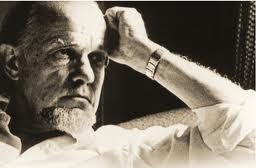
Francis Schaeffer pictured below

____________________________

______________

Francis Schaeffer with his son Franky pictured below. Francis and Edith (who passed away in 2013) opened L’ Abri in 1955 in Switzerland.

__________________________________________________________________________

Francis Schaeffer has written extensively on art and culture spanning the last 2000 years and here are some posts I have done on this subject before : Francis Schaeffer’s “How should we then live?” Video and outline of episode 10 “Final Choices” episode 9 “The Age of Personal Peace and Affluence”episode 8 “The Age of Fragmentation”episode 7 “The Age of Non-Reason” episode 6 “The Scientific Age” episode 5 “The Revolutionary Age” ,  episode 4 “The Reformation” episode 3 “The Renaissance”episode 2 “The Middle Ages,”, and  episode 1 “The Roman Age,” . My favorite episodes are number 7 and 8 since they deal with modern art and culture primarily.(Joe Carter rightly noted, “Schaefferwho always claimed to be an evangelist and not a philosopher—was often criticized for the way his work oversimplified intellectual history and philosophy.” To those critics I say take a chill pill because Schaeffer was introducing millions into the fields of art and culture!!!! !!! More people need to read his works and blog about them because they show how people’s worldviews affect their lives!

J.I.PACKER WROTE OF SCHAEFFER, “His communicative style was not thaof a cautious academiwho labors foexhaustive coverage and dispassionate objectivity. It was rather that of an impassioned thinker who paints his vision of eternal truth in bold strokes and stark contrasts.Yet it is a fact that MANY YOUNG THINKERS AND ARTISTS…HAVE FOUND SCHAEFFER’S ANALYSES A LIFELINE TO SANITY WITHOUT WHICH THEY COULD NOT HAVE GONE ON LIVING.”

Francis Schaeffer’s works  are the basis for a large portion of my blog posts and they have stood the test of time. In fact, many people would say that many of the things he wrote in the 1960’s  were right on  in the sense he saw where our western society was heading and he knew that abortion, infanticide and youth enthansia were  moral boundaries we would be crossing  in the coming decades because of humanism and these are the discussions we are having now!)

There is evidence that points to the fact that the Bible is historically true as Schaeffer pointed out in episode 5 of WHATEVER HAPPENED TO THE HUMAN RACEThere is a basis then for faith in Christ alone for our eternal hope. This link shows how to do that.

Francis Schaeffer in Art and the Bible noted, “Many modern artists, it seems to me, have forgotten the value that art has in itself. Much modern art is far too intellectual to be great art. Many modern artists seem not to see the distinction between man and non-man, and it is a part of the lostness of modern man that they no longer see value in the work of art as a work of art.” 

Many modern artists are left in this point of desperation that Schaeffer points out and it reminds me of the despair that Solomon speaks of in Ecclesiastes.  Christian scholar Ravi Zacharias has noted, “The key to understanding the Book of Ecclesiastes is the term ‘under the sun.’ What that literally means is you lock God out of a closed system, and you are left with only this world of time plus chance plus matter.” THIS IS EXACT POINT SCHAEFFER SAYS SECULAR ARTISTS ARE PAINTING FROM TODAY BECAUSE THEY BELIEVED ARE A RESULT OF MINDLESS CHANCE.

___________

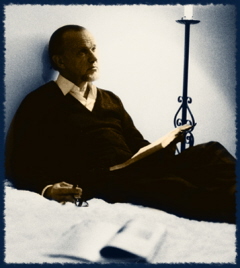
Francis Schaeffer pictured below:

___________

Francis and Edith Schaeffer

____________


프란시스 쉐퍼 – 그러면 우리는 어떻게 살 것인가 introduction (Episode 1)

How Should We then Live Episode 7 small (Age of Nonreason)

#02 How Should We Then Live? (Promo Clip) Dr. Francis Schaeffer

The clip above is from episode 9 THE AGE OF PERSONAL PEACE AND AFFLUENCE

10 Worldview and Truth

In above clip Schaeffer quotes Paul’s speech in Greece from Romans 1 (from Episode FINAL CHOICES)

Two Minute Warning: How Then Should We Live?: Francis Schaeffer at 100

A Christian Manifesto Francis Schaeffer

In the film series HOW SHOULD WE THEN LIVE?  Francis Schaeffer teaches that although the Renaissance revived the realization that man and nature are important, it went overboard by making man the measure of all things-and by that destroyed the importance of man. Michelangelo started down that road with his sculpture of David. Schaeffer noted, “Hope springs eternal,” says the poet. And in the David is a “statement of what the humanistic man saw himself as being tomorrow!” Two examples of this below starting with Michelangelo’s “Awakening Slave.”

_____________

David Leeds wrote:

On the left as you walk in is the “Awakening Slave.”

This piece is one of the most powerful and expressive works of art I’ve ever seen. The figure feels like it is writhing and straining, and going to imminently explode out of the marble block that holds it. The latent power one feels is extraordinary. Is this a Herculean effort to be born physically from the imprisoning stone, or a titanic struggle to escape the bounds of physical reality and move onto some other plane? I certainly don’t know for sure, but it feels like the business at hand here is cosmic.
Michelangelo is famous for saying that he worked to liberate the forms imprisoned in the marble. He saw his job as simply removing what was extraneous. The endless struggle of man to free himself from his physical constraints and liberate the more enlightened spirit within, was part of the Neo-Platonic philosophy that was in vogue in Florence at this time. The burden of the flesh constrains the soul. This is by far the most dynamic and expressive battleground of these forces I’ver ever encountered. The metaphor is inescapable.

Michelangelo%20AP%20Photo%20Fabrizio%20Giovannozzi

From Tony Bartolucci’s  website:

These were in the Academy at Florence where on each side were statues of men tearing themselves out of the rock. Man will free himself and make himself great.
In the same place is his statue of David. Not the biblical David, as many think. This statue is not circumcised! Michelangelo used a piece of marble so flawed that no one thought he could do anything with it. David was representative of what man will one day be. This is also seen in his oversize hands. Later, Michelangelo may have softened his views (he later was in close touch with Vittoria Colonna who was herself influenced by Reformation thought). His two Pietas (Mary holding Jesus in her arms) were his last works.

_______________

How Should We Then Live (Dr. Francis Schaeffer) Excerpt from Part 3

Eric Holmberg

https://www.youtube.com/watch?v=qTa9BE2LNZM

Saturday, March 7, 2009

Michelangelo, Schaeffer, and the Kingdom of Washington

By Rick Pearcey • March 7, 2009, 01:01 PM

The great Renaissance painter and sculptor Michelangelo was born March 6, 1475, 534 years ago yesterday. He began work on his famed statue the David in 1501 and completed it in 1504. Michelangelo was 29 years old.

Let’s consider this man and his art and its relevance for our day, interacting with comments from Francis Schaeffer in his work How Should We Then Live? (Crossway: Complete Works of Francis Schaeffer, Vol. 5, pp. 114-115).

Schaeffer begins inside the Accademia in Florence, where the David is located:

Here we see on either side Michelangelo’s statues of men “tearing themselves out of the rock.” These were sculpted between 1519 and 1536. They make a real humanistic statement: Man will make himself great. Man as Man is tearing himself out of the rock. Man by himself will tear himself out of nature and free himself from it. Man will be victorious. . . .”

I saw and touched (winning the polite attention of security) one of these statues during my first and only (thus far!) visit to Florence. I had hitched a ride from L’Abri in Switzerland and carried with me a copy of Irving Stone’s The Agony and the Ecstasy. Having that book in your mind was a tremendous way to see Florence.

“At the focal point of the room,” Schaeffer continues, is the “magnificent statue of David (1504).”

As a work of art it has few equals in the world. Michelangelo took a piece of marble so flawed that no one thought it could be used, and out of it he carved this overwhelming statue. But let us notice that the David was not the Jewish David of the Bible. David was simply a title. Michelangelo knew his Judaism, and in the statue the figure is not circumcised. We are not to think of this as the biblical David but as the humanistic ideal. Man is great!

Man, human beings — you and me, our neighbors, all of us red and yellow, black and white — in fact are great. But not, as the unfinished statues of Michelangelo may suggest, because we have to tear ourselves out of nature.

Rather, consistent with what the Declaration of Independence avows (which is the “Vision Statement” or “Mission Statement” of the United States), what makes humanity great is that we are the magnificent work of a Divine Sculptor, who happens to be the Creator by virtue of whom every single human being is endowed with “certain unalienable rights.” And, by the way, Nature is also great and not a meaningless piece of particulate junk, because she too is a gift from the Creator and therefore ought to be cared for and respected, just like Genesis 1:28 liberates humanity to do.

As Schaeffer describes it, the political situation of Michelangelo’s day bears some resemblance to our our own:

The statue was originally planned to stand forty feet above the street on one of the buttresses of the cathedral, but was placed outside the city hall in Florence, where a copy now stands. The Medicis, the great banking family which had dominated Florence since 1434, had run the city by manipulating its republican constitution. A few years before David was made, the Medicis had been thrown down by the people and a more genuine republic restored (1494). Thus, as the statue was raised outside the city hall, though Michelangelo himself had been a friend of the Medicis, his David was seen as the slayer of tyrants. Florence was looking with confidence toward a great future. (Emphasis added.)

We see in our own day a manipulating of a “republican constitution” (think: “living” Constitution). Central to the truly living Mission Statement of United States (in the Declaration of Independence) is that a republic under the Creator would respect unalienable rights from that Creator, resulting in a balance of “form and freedom” (a phrase often used by Schaeffer). This amazing and unique balance maximized individual liberty among the people and states but without chaos, and it also established a unity of purpose nationally but without overweening control out of Washington.

To put this in contemporary parlance, it wasn’t “unity is our strength” or “diversity is our strength,” but rather “unity and diversity under God is our strength.” All the difference in world.

To the degree that secular elites have imposed an alien agenda that casts away the founding Mission Statement of the United States (or keeps the form but denies the meaning), to that degree we have seen a corresponding loss of individual freedom, including direct attacks on the unalienable rights hardwired into humanity by the verifiable and knowable Creator. Not unrelated to this, the economic crisis we see today emerges in no small degree from a secularist, power-minded Washington-centrism and is the natural outworking of uprooting the American experiment in liberty from what the Founders knew is the soil of liberty as gifted to humanity by the Creator.

“Hope springs eternal,” says the poet. And in the David is a “statement of what the humanistic man saw himself as being tomorrow!,” says Schaeffer.

In this statue we have man waiting with confidence in his own strength for the future. Even the disproportionate size of the hands says that man is powerful. This statue is idealistic and romantic. There was and is no man like the David. If a girl fell in love with the statue and waited until she found such a man, she would never marry. Humanism was standing in its proud self and the David stood as a representation of that.

The challenge for humanism is not its ideals per se, but that it lacks an adequate intellectual basis to sustain those ideals, so that when crisis comes, we see breakdown instead of recovery. And we do see the breakdown, despite the concerted efforts of political, PR, and marketing types working overtime to simultaneously distract (e.g., attack Rush Limbaugh) and overlay a comfortable but Orwellian spin upon the breakdown (e.g., the president not concerned about market “gyrations”).

However, in the world beyond the teleprompter, the press release, and the attack dog, what we are witnessing today is not just the loss of economic power and freedom, but also assaults on freedom of speech, freedom of thought, freedom of religious exercise, and so on. Man is great, but man is not God. You could put all the smartest people in the world in Washington and still the federal government is not God, as the original Vision Statement of the United States clearly understands. Secularist Washington-centrism must decrease if a humane American liberty is to increase. Read the directions.

Our Founders understood this, but many of today’s elites seem to reject it. It’s not that the secularists are too smart for their own good, but that they are operating out of an inadequate philosophic framework. We’ll recover as a nation if we return to the original Mission Statement and mark progress from that point forward.

Perhaps the later Michelangelo can help lead the way forward:

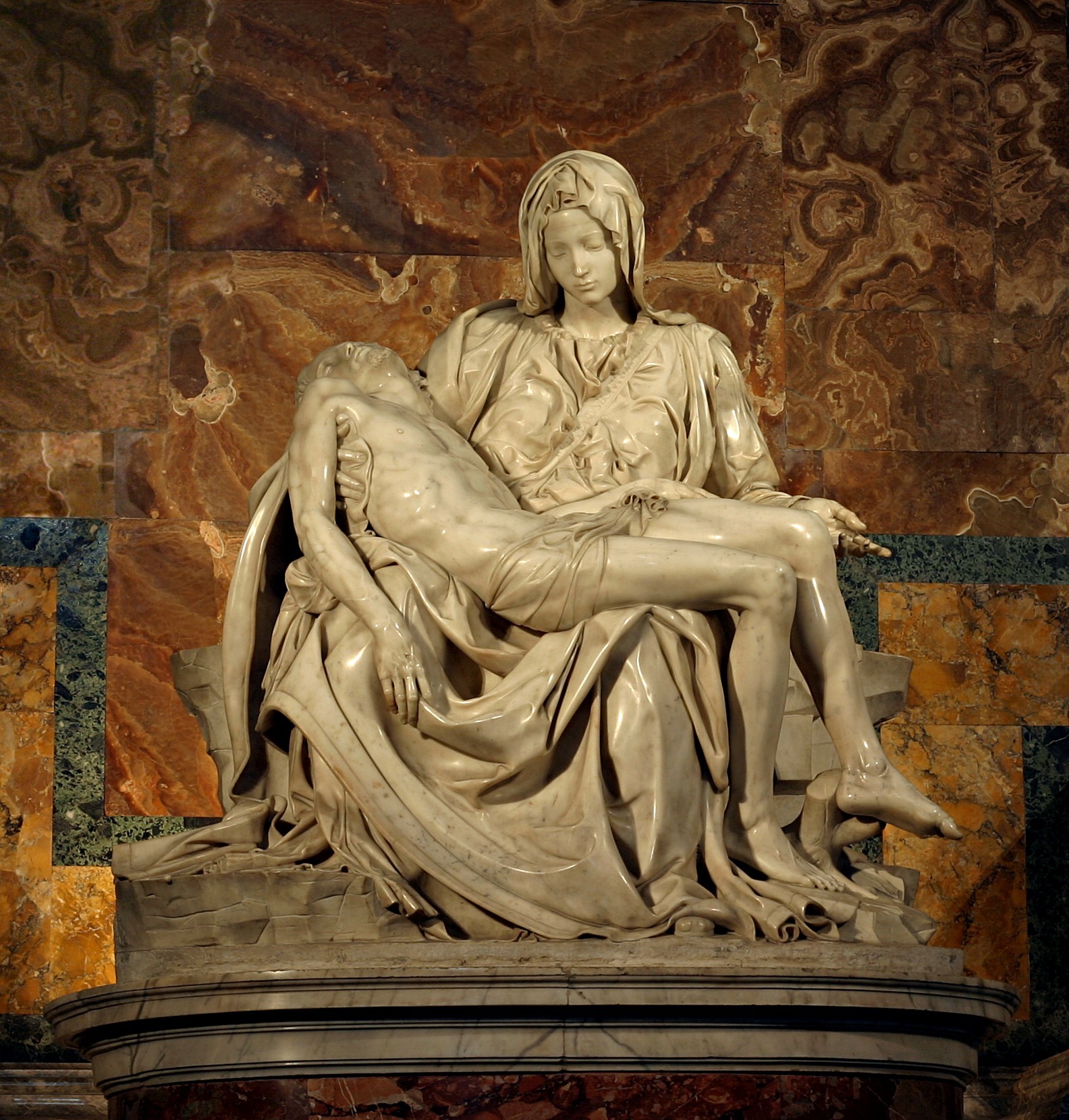
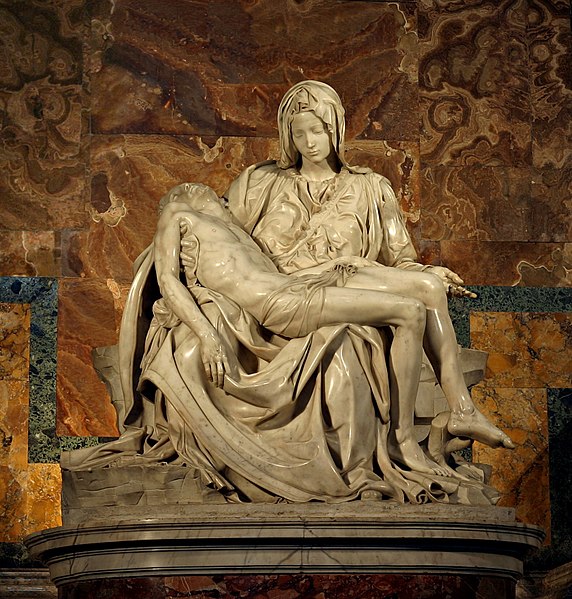
[T]here are signs that by the end of his life Michelangelo saw the humanism was not enough. Michelangelo in his later years was in close touch with Vittoria Colonna (1490-1547), a woman who had been influenced by Reformation thought. Some people feel they see some of that influence in Michelangelo’s life and work. However that may be, it is true that his later work did change. Many of his early works show his humanism, as does his David. In contrast stand his later Pietas (statues of Mary holding the dead Christ in her arms) in the cathedral in Florence and in the castle in Milan, which was probably his last. In the Pieta in the cathedral in Florence, Michelangelo put his own face on Nicodemus (or Joseph of Arimathea — whichever the man is), and in both of the Pietas humanistic pride seems lessened, if not absent.

Michelangelo’s Florence Pietà

I began this post this morning simply as an effort to show an appreciation for one of my favorite artists, a person that I and a host of others would surely have liked to have known. He, like all of us, had his struggles. But even the Great Michelangelo of the Pietas was willing to place himself at the feet of a flesh and blood rebel condemned as a common criminal who happened to be the Savior and Son of God. That’s right: A resurrected guy from the Middle East outback whose love and truth challenged and overturns the hopeful but inadequate humanism of then and now.

The Founders understood the centrality and necessity of the Creator, and they rejected the idolatry of the federal state and the Kingdom of Washington. Many of us today get it. Hope and freedom never die. They are unalienable. They are hardwired into humane and human existence. Yes, we get it. Let’s hope Washington hears before it’s too late.

File:Michelangelo’s Pieta 5450 cropncleaned edit.jpg

File:Michelangelo's Pieta 5450 cropncleaned edit.jpg

Size of this preview: 572 × 599 pixels. Other resolutions: 229 × 240 
________________

Today’s feature is on the artist Paul McCarthy:

Paul McCarthy pictured below:
_______________
In contrast to Michelangelo’s DAVID when humanist man thought he could conquer anything, Paul McCarthy doesn’t think he can cure himself let alone anyone else.

Conversations | Premiere | Artist Talk | Paul McCarthy

Published on Dec 12, 2012

Paul McCarthy, Artist, Los Angeles
In conversation with Massimiliano Gioni, Artistic Director, Fondazione Nicola Trussardi, Milan; Director of Special Exhibitions, New Museum, New York

Date | Wednesday, June 16, 2010

______________________

In this video above at the 55:00 mark we have these words from McCarthy:

In Los Angeles I never felt I cured anything and I never saw myself where I think the AAA and some of Otto Muehl’s ideas that somehow we could change society and I think that is a European village idea where you are in a place where you can affect society...and I never thought of myself as any healer of anything…Art for me is not therapy in the sense that I am not getting well. I am still [messed up].…I was quite influenced by the iconic imagery of Disney Land or television world and then the facade of Hollywood and how the facade of Hollywood and how it appears that everything is okay. That Disney Land is a dream world and you enter Disney Land and you are in a dream where in my case it is a dream that is just covering something up. INTERVIEWER: “You are more of the sympton than the cure?” I am part of the disease…(laughter).

Paul McCarthy

From Wikipedia, the free encyclopedia
Jump to: navigationsearch
For other people named Paul McCarthy, see Paul McCarthy (disambiguation).
Paul McCarthy
Born August 4, 1945 (age 68)
Salt Lake City, UtahU.S.
Nationality American
Field Performance art
Sculpture
Training San Francisco Art Institute
University of Southern California
Works Sailor’s Meat from 1975, The Garden from 1991, Bossy Burger from 1991

Paul McCarthy (born August 4, 1945), is a contemporary artist who lives and works in Los Angeles, California.

Life

McCarthy was born in Salt Lake City, Utah, and studied art at the University of Utah and Weber State University in 1969. He went on to study at the San Francisco Art Institute receiving a BFA in painting. In 1972 he studied film, video, and art at the University of Southern California receiving an MFA. From 1982 to 2002 he taught performance, video, installation, and performance art history at the University of California, Los Angeles. McCarthy currently works mainly in video and sculpture.

Originally formally trained as a painter, McCarthy’s main interest lies in everyday activities and the mess created by them.[1] Much of his work in the late 1960s, such as Mountain Bowling (1969) and Hold an Apple in Your Armpit (1970) are similar to the work of Happenings founder Allan Kaprow, with whom McCarthy had a professional relationship.[1]

Work

Sweet Brown Snail by Jason Rhoades and Paul McCarthy at the Bavariapark and the Verkehrszentrum of the Deutsches Museum in Munich.

“Boxhead” (2001), Collection of the Centro de Arte Contemporânea Inhotim in Brumadinho/Brazil

McCarthy’s works include performance, installation, film and “painting as action”. His points of reference are rooted, on the one hand, in things typically American, such as Disneyland, B-Movies, Soap Operas and Comics – he is a critical analyst of the mass media and consumer-driven American society and its hypocrisy, double standards and repression. On the other hand, it is European avant-garde art that has had the most influence on his artistic form language. Such influences include the Lost Art Movement, Joseph Beuys, Sigmund Freud and Samuel Beckett and particularly the Viennese Actionism.[2] Although by his own statement the happenings of the Viennese Actionists were known to him in the 1970s, he sees a clear difference between the actions of the Viennese and his own performances: “Vienna is not Los Angeles. My work came out of kids’ television in Los Angeles. I didn’t go through Catholicism and World War II as a teenager, I didn’t live in a European environment. People make references to Viennese art without really questioning the fact that there is a big difference between ketchup and blood. I never thought of my work as shamanistic. My work is more about being a clown than a shaman.”[3] In his early works, McCarthy sought to break the limitations of painting by using the body as a paintbrush or even canvas; later, he incorporated bodily fluids or food as substitutes into his works. In a 1974 video, Painting, Wall Whip, he painted with his head and face, “smearing his body with paint and then with ketchup, mayonnaise or raw meat and, in one case, feces.” This clearly resembled the work of Vienna actionist Günter Brus.[4] Similarly, his work evolved from painting to transgressive performance art, psychosexual events intended to fly in the face of social convention, testing the emotional limits of both artist and viewer. An example of this is his 1976 piece Class Fool, where McCarthy threw himself around a ketchup spattered classroom at the University of California, San Diego until dazed and self-injured. He then vomited several times and inserted a Barbie doll into his rectum.[1] The piece ended when the audience could no longer stand to watch his performance.[1] Concerned that the University’s custodians would have to clean up the mess, graduate students Virginia Maksymowicz and Blaise Tobia, along with art historian Moira Roth, spent several hours cleaning up the ketchup and vomit. Maksymowicz can be seen in the rear left of a documentary photo of the event.[5]

McCarthy’s work in the 1990s, such as Painter (1995), often seeks to undermine the idea of “the myth of artistic greatness” and attacks the perception of the heroic male artist.[1]

McCarthy’s transfixion with Johanna Spyri’s novel Heidi led to his 1992 video and installation, Heidi: Midlife Crisis Trauma Center and Negative Media-Engram Abreaction Release Zone, which he collaborated on with Mike Kelley.

During the summer of 2008, Paul McCarthy’s inflatable “Complex Shit”, installed on the grounds of the Paul Klee Centre in Bern, Switzerland, took off in a wind bringing down a power line, breaking a greenhouse window, and broke a window at a children’s home.[6] This incident was widely reported internationally via news outlets in several languages with headlines like “Huge turd catastrophe for museum”[7] and “Up in the sky: is it a turd or a plane?”[8]

McCarthy has created several Christmas-themed works. Through them, he combines the dismal aesthetic and the real meaning of Christmas.[9] In 2001 he created ‘Santa Claus’ for the city of Rotterdam in the Netherlands. Originally it intended to be placed next to the concerthall at the locally famous square ‘Schouwburgplein’, but it never was. This was due to controversies around the statue (the work is seen by many citizens to have a sexual connotations, and therefore it also is colloquially referred to as ‘Butt Plug Gnome’[10]), and besides the original location it was also rejected by (citizens and retailers of) several other proposed locations. On the 28th of November 2008 did it, however, receive a permanent destination: the square Eendrachtsplein, within a walkway of statues project.[11]

In November 2009, an exhibition called “White Snow” was held at Hauser & Wirth New York, featuring McCarthy’s mixed-media works centered on the character Snow White from Disney’s Snow White and the Seven Dwarves.

Exhibitions (selection)

  • 2013 Park Avenue ArmoryWS, New York
  • 2009 De Uithof, Paul McCarthy – Air Pressure, City of Utrecht
  • 2009 Hauser & WirthWhite Snow, New York
  • 2009 Zachęta National Gallery of Art, Paul McCarthy & Benjamin Weissman – Quilting Sessions, Warsaw
  • 2008 Whitney Museum of American ArtCentral Symmetrical Rotation Movement – Three Installations, Two Films, New York
  • 2007 S.M.A.K. Stedelijk Museum voor Actuele Kunst, Paul McCarthy – Head Shop / Shop Head, Ghent
  • 2007 Middelheim Sculpture Museum, Paul McCarthy – Air Born / Air Borne / Air Pressure, Antwerp
  • 2006 Moderna Museet, Paul McCarthy – Head Shop / Shop Head, Stockholm
  • 2005 Haus der Kunst, Paul McCarthy – LaLa land parodie paradies, Munich
  • 2004 Van Abbemuseum, Paul McCarthy. Brain Box – Dream Box, Eindhoven
  • 2003 Hauser & WirthPaul McCarthy. Piccadilly Circus, London
  • 2003 Tate ModernPaul McCarthy at Tate Modern, London
  • 2001 New MuseumPaul McCarthy, New York

Bibliography

  • Blazwick, Iwona. Paul McCarthy: Head Shop. Shop Head. Stockholm: Steidl/Moderna Museet, 2006.
  • Bronfen, Elisabeth. Paul McCarthy: Lala Land. Ostfildern, Germany: Hatje Cantz Publishers, 2005.
  • Glennie, Sarah. Paul McCarthy at Tate Modern: Block Head and Daddies Big Head. London: Tate, 2003.
  • Monk, Philip. Mike Kelley and Paul McCarthy: Collaborative Works. Toronto: Power Plant Contemporary Art Gallery at Harbourfront Centre, 2000.
  • Phillips, Lisa. Paul McCarthy. Ostfildern, Germany: Hatje Cantz Publishers, 2001.
  • Rugoff, Ralph, Kristine Stiles, Giacinto Di Pietrantonio. Paul McCarthy. London: Phaidon Press, 1996.
  • Sauerlander, Kathrin. Paul McCarthy: Videos 1970-1997. Cologne: Walther König, 2004.
  • Sherer, Daniel. “Heidi on the Loos. Ornament and Crime in Mike Kelley and Paul McCarthy’s Heidi.” PIN-UP 3 (2008), 59-62.
  • Zebracki, Martin. Engaging geographies of public art: indwellers, the ‘Butt Plug Gnome’ and their locale. Social & Cultural Geography 13(7), 735–758

References

  1. Jump up to: a b c d e Klein, Jennie (May 2001). “Paul McCarthy: Rites of Masculinity”. PAJ: A Journal of Performance and Art 23 (2): 10–17. doi:10.2307/3246503JSTOR 3246503.
  2. Jump up ^ Paul McCarthy’s Low Life Slow Life. Edited by Stacen Berg, Jens Hoffmann, texts by Jens Hoffmann, Paul McCarthy, interview with Paul McCarthy by Stacen Berg. Ostfildern (Hatje Cantz Verlag). 2010. ISBN 978-3-7757-2573-6
  3. Jump up ^ Petersen, Magnus af:„Paul McCarthy’s 40 years of hard work-an attempt at a summary”, in: “Head Shop/Shop Head”, Steidl Verlag, Göttingen, 2006, p.20
  4. Jump up ^ Roberta Smith (May 15, 1998). “Art Review: Work on the Wild Side, Raw, Rank and Morbid”The New York Times. Retrieved 2007-05-26.
  5. Jump up ^ page 73, Live Art in LA: Performance in Southern California, 1970 – 1983; ed. Peggy Phelan, Routledge Press, ©2012
  6. Jump up ^ (August 12, 2008). Complex Shit causes museum chaosThe Australian. Retrieved July 25, 2010.
  7. Jump up ^ (August 12, 2008). Huge turd catastrophe for museumMetro (London, UK). Retrieved July 25, 2010.
  8. Jump up ^ (August 13, 2008). Up in the sky: is it a turd? Is it a plane? The Sydney Morning Herald. Retrieved July 25, 2010.
  9. Jump up ^ Nielson, Emma (2007). “The World as Pirate’s Lair – Paul McCarthy’s LaLa Land, Parody Paradise”Pulse Berlin (Relation). Retrieved 2007-09-01. “McCarthy has a predilection for American myths and icons. In most of his works, he takes the models and role models of that world and skewers them. Santa Claus, Pinocchio and the cowboy play just as important a role in the imagery as Bush or the Queen of England” Review of McCarthy’s 2007 LaLa Land exhibition at the Whitechapel Gallery, London , and Haus der Kunst, Munich.
  10. Jump up ^ Zebracki, Martin (2012). Engaging geographies of public art: indwellers, the ‘Butt Plug Gnome’ and their localeSocial & Cultural Geography 13(7), 735–758
  11. Jump up ^ (November 28, 2008). Santa Claus Finds A Permanent New Home In RotterdamTAXI. Retrieved July 25, 2010.
Wikimedia Commons has media related to Paul McCarthy.

External links

_______
Related posts:

Francis Schaeffer’s “How should we then live?” Video and outline of episode 10 “Final Choices” (Schaeffer Sundays)

E P I S O D E 1 0   Dr. Francis Schaeffer – Episode X – Final Choices 27 min FINAL CHOICES I. Authoritarianism the Only Humanistic Social Option One man or an elite giving authoritative arbitrary absolutes. A. Society is sole absolute in absence of other absolutes. B. But society has to be […]

Francis Schaeffer’s “How should we then live?” Video and outline of episode 9 “The Age of Personal Peace and Affluence” (Schaeffer Sundays)

E P I S O D E 9 Dr. Francis Schaeffer – Episode IX – The Age of Personal Peace and Affluence 27 min T h e Age of Personal Peace and Afflunce I. By the Early 1960s People Were Bombarded From Every Side by Modern Man’s Humanistic Thought II. Modern Form of Humanistic Thought Leads […]

Francis Schaeffer’s “How should we then live?” Video and outline of episode 8 “The Age of Fragmentation” (Schaeffer Sundays)

E P I S O D E 8 Dr. Francis Schaeffer – Episode VIII – The Age of Fragmentation 27 min I saw this film series in 1979 and it had a major impact on me. T h e Age of FRAGMENTATION I. Art As a Vehicle Of Modern Thought A. Impressionism (Monet, Renoir, Pissarro, Sisley, […]

Francis Schaeffer’s “How should we then live?” Video and outline of episode 7 “The Age of Non-Reason” (Schaeffer Sundays)

E P I S O D E 7 Dr. Francis Schaeffer – Episode VII – The Age of Non Reason I am thrilled to get this film series with you. I saw it first in 1979 and it had such a big impact on me. Today’s episode is where we see modern humanist man act […]

Francis Schaeffer’s “How should we then live?” Video and outline of episode 6 “The Scientific Age” (Schaeffer Sundays)

E P I S O D E 6 How Should We Then Live 6#1 Uploaded by NoMirrorHDDHrorriMoN on Oct 3, 2011 How Should We Then Live? Episode 6 of 12 ________ I am sharing with you a film series that I saw in 1979. In this film Francis Schaeffer asserted that was a shift in […]

Francis Schaeffer’s “How should we then live?” Video and outline of episode 5 “The Revolutionary Age” (Schaeffer Sundays)

E P I S O D E 5 How Should We Then Live? Episode 5: The Revolutionary Age I was impacted by this film series by Francis Schaeffer back in the 1970′s and I wanted to share it with you. Francis Schaeffer noted, “Reformation Did Not Bring Perfection. But gradually on basis of biblical teaching there […]

Francis Schaeffer’s “How should we then live?” Video and outline of episode 4 “The Reformation” (Schaeffer Sundays)

Dr. Francis Schaeffer – Episode IV – The Reformation 27 min I was impacted by this film series by Francis Schaeffer back in the 1970′s and I wanted to share it with you. Schaeffer makes three key points concerning the Reformation: “1. Erasmian Christian humanism rejected by Farel. 2. Bible gives needed answers not only as to […]

“Schaeffer Sundays” Francis Schaeffer’s “How should we then live?” Video and outline of episode 3 “The Renaissance”

Francis Schaeffer’s “How should we then live?” Video and outline of episode 3 “The Renaissance” Francis Schaeffer: “How Should We Then Live?” (Episode 3) THE RENAISSANCE I was impacted by this film series by Francis Schaeffer back in the 1970′s and I wanted to share it with you. Schaeffer really shows why we have so […]

Francis Schaeffer’s “How should we then live?” Video and outline of episode 2 “The Middle Ages” (Schaeffer Sundays)

  Francis Schaeffer: “How Should We Then Live?” (Episode 2) THE MIDDLE AGES I was impacted by this film series by Francis Schaeffer back in the 1970′s and I wanted to share it with you. Schaeffer points out that during this time period unfortunately we have the “Church’s deviation from early church’s teaching in regard […]

Francis Schaeffer’s “How should we then live?” Video and outline of episode 1 “The Roman Age” (Schaeffer Sundays)

Francis Schaeffer: “How Should We Then Live?” (Episode 1) THE ROMAN AGE   Today I am starting a series that really had a big impact on my life back in the 1970′s when I first saw it. There are ten parts and today is the first. Francis Schaeffer takes a look at Rome and why […]

By Everette Hatcher III | Posted in Francis Schaeffer | Edit | Comments (0)
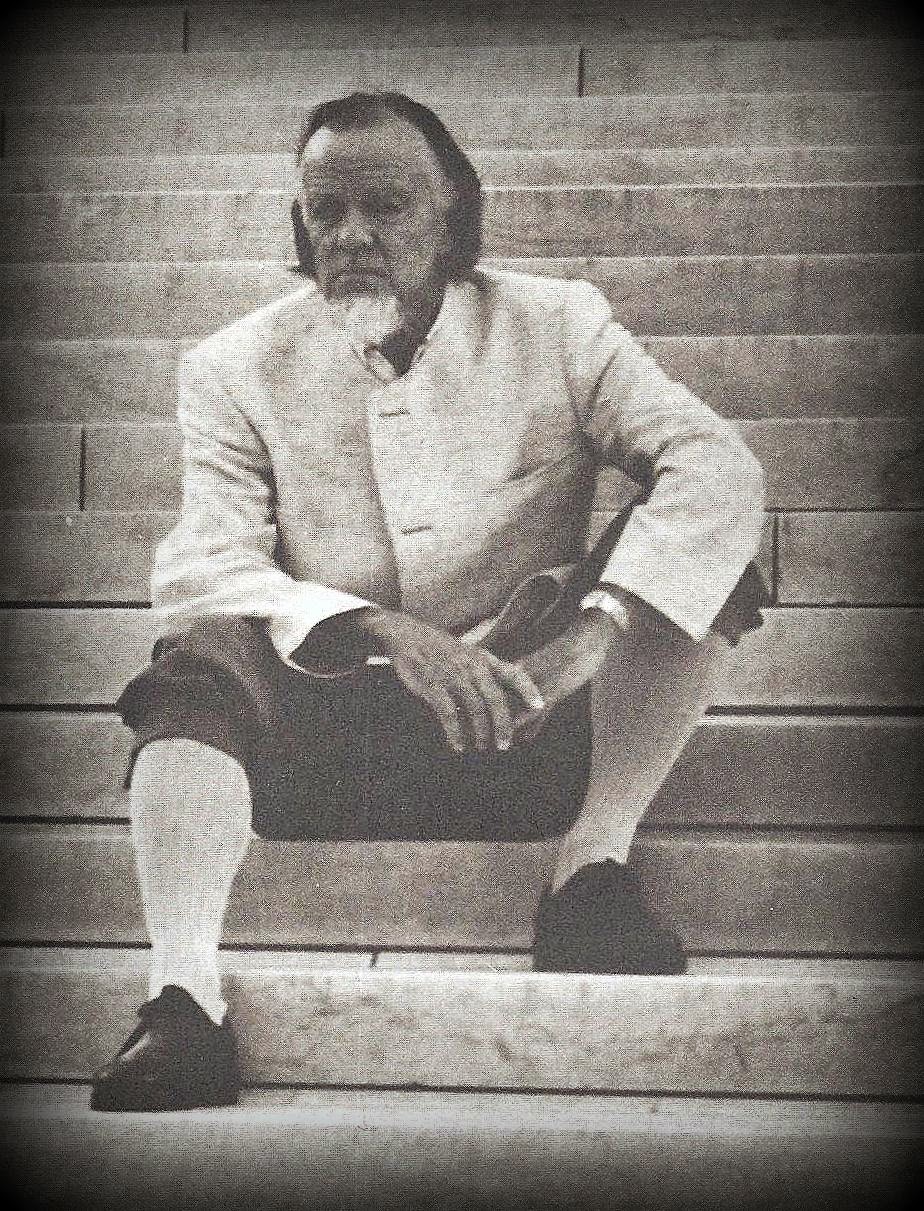
FRANCIS SCHAEFFER ANALYZES ART AND CULTURE Part 18 “Michelangelo’s DAVID is the statement of what humanistic man saw himself as being tomorrow” (Feature on artist Paul McCarthy)

In this post we are going to see that through the years  humanist thought has encouraged artists like Michelangelo to think that the future was extremely bright versus the place today where many artist who hold the humanist and secular worldview are very pessimistic.   In contrast to Michelangelo’s DAVID when humanist man thought he […]

FRANCIS SCHAEFFER ANALYZES ART AND CULTURE Part 17 Francis Schaeffer discusses quotes of Andy Warhol from “The Observer June 12, 1966″ Part C (Feature on artist David Hockney plus many pictures of Warhol with famous friends)

________________ Francis Schaeffer: How Should We Then Live? (Full-Length Documentary)   ___________________________ ___________________________ ___________________ Miles Davis and Andy below: ______________________ Dali and Warhol below: ________- __________________ Francis Schaeffer with his son Franky pictured below. Francis and Edith (who passed away in 2013) opened L’ Abri in 1955 in Switzerland. Francis Schaeffer has written extensively on art and culture spanning the last 2000 years and here are some posts I have done on this subject before : Francis Schaeffer’s “How should we then live?” Video and outline of episode […]

FRANCIS SCHAEFFER ANALYZES ART AND CULTURE Part 16 Francis Schaeffer discusses quotes of Andy Warhol from “The Observer June 12, 1966″ Part B (Feature on artist James Rosenquist plus many pictures of Warhol with famous friends)

_________ John, Yoko and Warhol pictured below: ________________________ The Clash meets Warhol: ______________________ ________________ ________ Andy Warhol and members of The Factory: Gerard Malanga, poet; Viva, actress; Paul Morrissey, director; Taylor Mead, actor; Brigid Polk, actress; Joe Dallesandro, actor; Andy Warhol, artist, New York, October 9, 1969 (picture below)   _____________________ Francis Schaeffer “BASIS FOR […]

FRANCIS SCHAEFFER ANALYZES ART AND CULTURE Part 15 Francis Schaeffer discusses quotes of Andy Warhol from “The Observer June 12, 1966″ Part A (Feature on artist Robert Indiana plus many pictures of Warhol with famous friends)

    Recently I got to see this piece of art by Andy Warhol of Dolly Parton at Crystal Bridges Museum in Bentonville, Arkansas:   Andy Warhol, Dolly Parton (1985) Synthetic polymer paint and silkscreen ink on canvas 42 x 42 in. (106.7 x 106.7 cm) ___________ Susan Anton, Sylvester Stallone and Andy Warhol pictured […]

FRANCIS SCHAEFFER ANALYZES ART AND CULTURE Part 14 David Friedrich Strauss (Feature on artist Roni Horn )

Francis Schaeffer: How Should We Then Live? (Full-Length Documentary) Francis Schaeffer pictured below: ___________ Francis Schaeffer has written extensively on art and culture spanning the last 2000 years and here are some posts I have done on this subject before : Francis Schaeffer’s “How should we then live?” Video and outline of episode 10 “Final Choices” , episode 9 “The Age of Personal Peace and Affluence”, episode 8 “The Age of Fragmentation”, episode 7 “The Age of […]

FRANCIS SCHAEFFER ANALYZES ART AND CULTURE Part 13 Jacob Bronowski and Materialistic Humanism: The World-View of Our Era (Feature on artist Ellen Gallagher )

  Francis Schaeffer: How Should We Then Live? (Full-Length Documentary) ________ Today I am looking at Jacob Bronowski and his contribution to spreading the thought of Charles Darwin to a modern generation.  The artist Ellen Gallagher is one of those in today’s modern generation that talks about how evolution is pictured in his art works. What […]

FRANCIS SCHAEFFER ANALYZES ART AND CULTURE Part 12 H.J.Blackham and Materialistic Humanism: The World-View of Our Era (Feature on artist Arturo Herrera)

  Today I am going to look at H.J. Blackham and the artist featured today is  Arturo Herrera. Herrera’s art interests me because it is based on the idea that accidental chance can bring about something beautiful and that is the same place that materialistic modern men like Blackham have turned to when they have concluded […]

FRANCIS SCHAEFFER ANALYZES ART AND CULTURE Part 11 Thomas Aquinas and his Effect on Art and HOW SHOULD WE THEN LIVE? Episode 2: THE MIDDLES AGES (Feature on artist Tony Oursler )

___________________________________ Francis Schaeffer pictured below: _______________- _________ _______________________ Size of this preview: 560 × 599 pixels. Other resolutions: 224 × 240 pixels | 449 × 480 pixels | 561 × 600 pixels | 718 × 768 pixels | 957 × 1,024 pixels | 2,024 × 2,165 pixels. Original file ‎(2,024 × 2,165 pixels, file size: 392 KB, MIME type: image/jpeg) This is a file from the Wikimedia Commons. Information from its description page […]

FRANCIS SCHAEFFER ANALYZES ART AND CULTURE Part 10 David Douglas Duncan (Feature on artist Georges Rouault )

___________________________________________________________________________________________________________________________ Francis Schaeffer: How Should We Then Live? (Full-Length Documentary) Francis Schaeffer has written extensively on art and culture spanning the last 2000 years and here are some posts I have done on this subject before : Francis Schaeffer’s “How should we then live?” Video and outline of episode 10 “Final Choices” , episode 9 “The Age of Personal Peace and Affluence”, episode 8 “The Age of Fragmentation”, episode 7 “The Age of Non-Reason” , episode 6 “The Scientific […]

FRANCIS SCHAEFFER ANALYZES ART AND CULTURE Part 9 Jasper Johns (Feature on artist Cai Guo-Qiang )

____________________________________ Episode 8: The Age Of Fragmentation Published on Jul 24, 2012 Dr. Schaeffer’s sweeping epic on the rise and decline of Western thought and Culture ___________________ In ART AND THE BIBLE  Francis Schaeffer observed, “Modern art often flattens man out and speaks in great abstractions; But as Christians, we see things otherwise. Because God […]

___________

Open letter to President Obama (Part 567) Murdered Thousands, Convicted for Three: The Kermit Gosnell Verdict

Open letter to President Obama (Part 567)

(Emailed to White House on 5-17-13.)

President Obama c/o The White House 1600 Pennsylvania Avenue NW Washington, DC 20500

Dear Mr. President,

I know that you receive 20,000 letters a day and that you actually read 10 of them every day. I really do respect you for trying to get a pulse on what is going on out here. I know that you don’t agree with my pro-life views but I wanted to challenge you as a fellow Christian to re-examine your pro-choice view.

___________________

Francis Schaeffer Whatever Happened to the Human Race (Episode 1) ABORTION

Francis Schaeffer: What Ever Happened to the Human Race? (Full-Length Documentary)


Part 1 on abortion runs from 00:00 to 39:50, Part 2 on Infanticide runs from 39:50 to 1:21:30, Part 3 on Youth Euthanasia runs from 1:21:30 to 1:45:40, Part 4 on the basis of human dignity runs from 1:45:40 to 2:24:45 and Part 5 on the basis of truth runs from 2:24:45 to 3:00:04

Francis Schaeffer “BASIS FOR HUMAN DIGNITY” Whatever…HTTHR

________________

May 14, 2013

Murdered Thousands, Convicted for Three: The Kermit Gosnell Verdict

By Drew Belsky

Read more: http://www.americanthinker.com/2013/05/murdered_thousands_convicted_for_three_the_kermit_gosnell_verdict.html#ixzz2TMstLk1c
Follow us: @AmericanThinker on Twitter | AmericanThinker on FacebookPhiladelphia abortionist Kermit Gosnell was convicted yesterday on three counts of first-degree murder, not to mention a slew of other charges, including involuntary manslaughter (for the death of 41-year-old Karnamaya Mongar), infanticide, and abortions past Pennsylvania’s legal limit.  One prosecutor is reported to have burst into tears upon hearing the verdict.

Pro-life groups expressed gratitude at justice served.  The Susan B. Anthony list released a statement “affirm[ing] the verdict,” and StandTrue’s Brian Kemper proclaimed the decision “an important victory for every baby who has ever been killed under the guise of choice.”  Troy Newman, president of Operation Rescue, declared himself “ecstatic“:

For the first time, America has gotten a long hard look at the horrors that go on inside abortion clinics. We see documentation of similar shoddy practices in other abortion clinics across our country. Gosnell is not alone by any means. Now it is time for America to do some real soul searching and decide whether the abortion cartel’s unaccountable and out-of-control abuses of vulnerable women are really how we want to treat each other.

Operation Rescue, along with J.D. Mullane of PhillyBurbs.com, has exhaustively reported on the Gosnell trial from the outset — two among precious few media outlets to do so.

Lila Rose, president of Live Action, expressed caution in her acceptance of the Gosnell verdict:

Dr. Kermit Gosnell’s gruesome and inhuman crimes in Philadelphia cried out for justice, and now — for three of his born and struggling victims, at least — justice has been served.  Even as we celebrate this verdict, we honor and mourn as well those among our nation’s weakest children who did not receive “their day in court” — and we must remember that Gosnell is not an outlier within the abortion industry.  We cannot allow these “guilty” verdicts, welcome as they are, to make us complacent when it comes to the continuing abuses happening even now in abortion facilities throughout our nation.

Rose brings up an important point: in a culture dominated by the 24-hour news cycle, it will be easy for Americans to consider the abortion issue closed with the Gosnell verdict.  The pro-life movement’s challenge, as Rose says, is to keep the American people focused on how common Gosnell-like practices are in the abortion industry, and on all the unsung victims abortion effects.  That is one of the main points behind Live Action’s Inhuman investigation, currently in progress — that “Gosnell is not alone.”

Pro-abortion organizations, meanwhile, used the Gosnell verdict as best as they could to promote their sacred cow.  In a statement from NARAL Pro-Choice America, for example, president Ilyse Hogue schizophrenically condemned Pennsylvania authorities for ignoring abortion laws (“the gross negligence of authorities to enforce the law after complaints were filed against Gosnell”) in one paragraph while lobbying in another for the repeal of abortion laws (“NARAL Pro-Choice America’s annual Who Decides? publication has given Pennsylvania an ‘F’ grade precisely because it has passed medically unnecessary laws that restrict access to safe and legal abortion care.”).  A NARAL tweet in the same vein drew withering criticism, prompting NARAL to double down (to similar effect).  The organization, originally called “the National Association for the Repeal of Abortion Laws”), might do well to recall that Gosnell operated not as a “back-alley” abortionist, but rather as a legal practitioner for decades.

Planned Parenthood, the largest abortion company in America, tweeted, “A just verdict. The jury has rightly convicted #Gosnell for his appalling crimes, ensuring no woman is victimized by him ever again.”  (Planned Parenthood CEO Cecile Richards joined in, lukewarmly.)  Commentators came out in force, noticing the creepy evasiveness (quite common when Planned Parenthood is forced to address its grisly handiwork) with which the abortion giant ignored Gosnell’s infant victims.  As Lila Rose put it, “Why is @PPact ignoring the infant victims of Kermit #Gosnell? Horrifying that the humanity of the child is ‘bad for business.'”

Considering that Planned Parenthood, a $1.2-billion company who received $542 million in taxpayer funding in 2011, focused exclusively on the women Gosnell victimized, it might be worthwhile for Eric Ferrero, the abortion corporation’s vice president for communications, to clarify whether the organization deems Gosnell’s spine-snipping “post-birth abortions” (an Orwellian contradiction in terms) “appalling crimes.”  Unlikely, considering Planned Parenthood lobbyist Alisa LaPolt Snow’s cringe-inducing testimony in opposition to Florida’s born-alive infant protection bill.

Kermit Gosnell easily makes for the most headline-grabbing phenomenon to damn the pro-choice worldview at this time, but he is by no means the only one.  Notorious abortionist LeRoy Carhart killed a 33-week pregnant woman in February; Jennifer Morbelli died of complications from Carhart’s abortion procedure after Carhart himself refused to pick up his phone to help the ailing woman.  Planned Parenthood of Delaware was forced to close in April after two nurses quit for fear of losing their licenses; the women condemned the facility as running a “meat-market style of assembly-line abortions,” adding that “I couldn’t tell you how ridiculously unsafe it was.”  Abortion facilities continue to shut down, either because they are completely filthy or because they refuse to abide by the same rules as hospitals and other surgical centers.  Fence-sitters in the abortion debate should wonder why abortion clinics typically are less stringently regulated and get less frequently inspected (if at all) than tattoo parlors, veterinary clinics, and hair salons — and why organizations like Planned Parenthood and NARAL fight tooth and nail to keep this lopsided order on its head.

Former president and famed redefiner of words Bill Clinton used to bloviate that he would see abortion “safe, legal, and rare” — and his sycophants ran with the slogan.  Since then, the Democratic Party have given up on “rare,” striking it from their platform and replacing it with “regardless of ability to pay” (that is to say, forcibly funded by taxpayers).  Meanwhile, the Gosnell trial, and the extensive documentation of other Gosnells yet unpunished, proves that no number of laws can make abortion “safe” — not for the woman, and certainly not for the dismembered, scissored, and suctioned innocent child.  It might make sense, then, to finish off this insidious trifecta and do away with “legal.”

Yet our current president — a bloviator to rival Clinton — tries to invoke God’s blessing for Planned Parenthood, declaring that the abortion giant “is not going anywhere,” and gleefully tweets about free birth control on Mother’s Day.

Hopefully the horror-novel quality of the Gosnell trial and verdict will help Americans — even those who steadfastly refuse to look this evil in the face — see through the gesticulations of the most creepily pro-abortion president in our nation’s history and face facts.

Drew Belsky is American Thinker‘s deputy editor.  He is also communications director for Live Action.

Read more: http://www.americanthinker.com/2013/05/murdered_thousands_convicted_for_three_the_kermit_gosnell_verdict.html#ixzz2TMsknthh
Follow us: @AmericanThinker on Twitter | AmericanThinker on FacebookPolitical Cartoons by Glenn McCoy

By Glenn McCoy – May 06, 2013

______________________

Thank you so much for your time. I know how valuable it is. I also appreciate the fine family that you have and your commitment as a father and a husband. I also respect you for putting your faith in Christ for your eternal life. I am pleading to you on the basis of the Bible to please review your religious views concerning abortion. It was the Bible that caused the abolition movement of the 1800’s and it also was the basis for Martin Luther King’s movement for civil rights and it also is the basis for recognizing the unborn children.

Sincerely,

Everette Hatcher III, 13900 Cottontail Lane, Alexander, AR 72002, ph 501-920-5733, lowcostsqueegees@yahoo.com

Related posts:

Francis Schaeffer’s “How should we then live?” Video and outline of episode 10 “Final Choices” (Schaeffer Sundays)

E P I S O D E 1 0   Dr. Francis Schaeffer – Episode X – Final Choices 27 min FINAL CHOICES I. Authoritarianism the Only Humanistic Social Option One man or an elite giving authoritative arbitrary absolutes. A. Society is sole absolute in absence of other absolutes. B. But society has to be […]

Francis Schaeffer’s “How should we then live?” Video and outline of episode 9 “The Age of Personal Peace and Affluence” (Schaeffer Sundays)

E P I S O D E 9 Dr. Francis Schaeffer – Episode IX – The Age of Personal Peace and Affluence 27 min T h e Age of Personal Peace and Afflunce I. By the Early 1960s People Were Bombarded From Every Side by Modern Man’s Humanistic Thought II. Modern Form of Humanistic Thought Leads […]

Francis Schaeffer’s “How should we then live?” Video and outline of episode 8 “The Age of Fragmentation” (Schaeffer Sundays)

E P I S O D E 8 Dr. Francis Schaeffer – Episode VIII – The Age of Fragmentation 27 min I saw this film series in 1979 and it had a major impact on me. T h e Age of FRAGMENTATION I. Art As a Vehicle Of Modern Thought A. Impressionism (Monet, Renoir, Pissarro, Sisley, […]

Francis Schaeffer’s “How should we then live?” Video and outline of episode 7 “The Age of Non-Reason” (Schaeffer Sundays)

E P I S O D E 7 Dr. Francis Schaeffer – Episode VII – The Age of Non Reason I am thrilled to get this film series with you. I saw it first in 1979 and it had such a big impact on me. Today’s episode is where we see modern humanist man act […]

Francis Schaeffer’s “How should we then live?” Video and outline of episode 6 “The Scientific Age” (Schaeffer Sundays)

E P I S O D E 6 How Should We Then Live 6#1 Uploaded by NoMirrorHDDHrorriMoN on Oct 3, 2011 How Should We Then Live? Episode 6 of 12 ________ I am sharing with you a film series that I saw in 1979. In this film Francis Schaeffer asserted that was a shift in […]

Francis Schaeffer’s “How should we then live?” Video and outline of episode 5 “The Revolutionary Age” (Schaeffer Sundays)

E P I S O D E 5 How Should We Then Live? Episode 5: The Revolutionary Age I was impacted by this film series by Francis Schaeffer back in the 1970′s and I wanted to share it with you. Francis Schaeffer noted, “Reformation Did Not Bring Perfection. But gradually on basis of biblical teaching there […]

Francis Schaeffer’s “How should we then live?” Video and outline of episode 4 “The Reformation” (Schaeffer Sundays)

Dr. Francis Schaeffer – Episode IV – The Reformation 27 min I was impacted by this film series by Francis Schaeffer back in the 1970′s and I wanted to share it with you. Schaeffer makes three key points concerning the Reformation: “1. Erasmian Christian humanism rejected by Farel. 2. Bible gives needed answers not only as to […]

“Schaeffer Sundays” Francis Schaeffer’s “How should we then live?” Video and outline of episode 3 “The Renaissance”

Francis Schaeffer’s “How should we then live?” Video and outline of episode 3 “The Renaissance” Francis Schaeffer: “How Should We Then Live?” (Episode 3) THE RENAISSANCE I was impacted by this film series by Francis Schaeffer back in the 1970′s and I wanted to share it with you. Schaeffer really shows why we have so […]

Francis Schaeffer’s “How should we then live?” Video and outline of episode 2 “The Middle Ages” (Schaeffer Sundays)

  Francis Schaeffer: “How Should We Then Live?” (Episode 2) THE MIDDLE AGES I was impacted by this film series by Francis Schaeffer back in the 1970′s and I wanted to share it with you. Schaeffer points out that during this time period unfortunately we have the “Church’s deviation from early church’s teaching in regard […]

Francis Schaeffer’s “How should we then live?” Video and outline of episode 1 “The Roman Age” (Schaeffer Sundays)

Francis Schaeffer: “How Should We Then Live?” (Episode 1) THE ROMAN AGE   Today I am starting a series that really had a big impact on my life back in the 1970′s when I first saw it. There are ten parts and today is the first. Francis Schaeffer takes a look at Rome and why […]

By Everette Hatcher III | Posted in Francis Schaeffer | Edit | Comments (0)


Truth Tuesday:Francis Schaeffer on liberal theology by Peter Cockrell

Francis Schaeffer on liberal theology by Peter Cockrell

Episode 8: The Age Of Fragmentation

Published on Jul 24, 2012

Dr. Schaeffer’s sweeping epic on the rise and decline of Western thought and Culture

_______________________

I love the works of Francis Schaeffer and I have been on the internet reading several blogs that talk about Schaeffer’s work and the work below by Peter Cockrell  was really helpful. Schaeffer’s film series “How should we then live?  Wikipedia notes, “According to Schaeffer, How Should We Then Live traces Western history from Ancient Rome until the time of writing (1976) along three lines: the philosophic, scientific, and religious.[3] He also makes extensive references to art and architecture as a means of showing how these movements reflected changing patterns of thought through time. Schaeffer’s central premise is: when we base society on the Bible, on the infinite-personal God who is there and has spoken,[4] this provides an absolute by which we can conduct our lives and by which we can judge society.  Here are some posts I have done on this series: Francis Schaeffer’s “How should we then live?” Video and outline of episode 10 “Final Choices” episode 9 “The Age of Personal Peace and Affluence”episode 8 “The Age of Fragmentation”episode 7 “The Age of Non-Reason” episode 6 “The Scientific Age”  episode 5 “The Revolutionary Age” episode 4 “The Reformation” episode 3 “The Renaissance”episode 2 “The Middle Ages,”, and  episode 1 “The Roman Age,” .

In the film series “WHATEVER HAPPENED TO THE HUMAN RACE?” the arguments are presented  against abortion (Episode 1),  infanticide (Episode 2),   euthanasia (Episode 3), and then there is a discussion of the Christian versus Humanist worldview concerning the issue of “the basis for human dignity” in Episode 4 and then in the last episode a close look at the truth claims of the Bible.

Francis Schaeffer

__________________________

Francis Schaeffer on liberal theology

Francis Schaeffer“What is the liberal theology like? It can only be paralleled with what God says in Proverbs 30:20 about the adulterous woman: ‘Such is the way of an adulterous woman; she eateth, and wipeth her mouth, and saith, I have done no wickedness.’ What a picture! Not everyone whose theology has been somewhat infiltrated by liberal theology should be likened to this, but the real liberal theologian (whether the old liberal-type theologian or the newer existential theologian) stands in this place. They say they have done no evil by their spiritual adultery, while not only the church but the whole post-Christian culture shows the results of their unfaithfulness.

“There is no adulterous woman who has ever been so soiled as the liberal theology, which has had all the gifts of God and has turned away to a worship of something that is more destructive than Molech was to the babies whose parents were led astray from the living God to worship this idol. This is not a thing to take lightly. We must show love to the man with whom we discuss. Yes, and we fight for this at L’Abri. We must fight for the fact that he is not to be treated as less than a man. Nothing is more ugly than the orthodox man treating another man as less than a man and failing to show that he takes seriously Christ’s teaching that all men are our neighbors. We do not discuss with the liberal only to win, but to help others, and to try to help him as well. But to treat lightly what liberal theology has done — not for a moment.”

– Francis A. Schaeffer, The Church at the End of the 20th Century(Downer’s Grove, Illinois: InterVarsity, 1970), 126-127.

Related posts:

Taking on Ark Times Bloggers on various issues Part A “The Pro-life Issue” (Francis Schaeffer Quotes Part 1 includes the film SLAUGHTER OF THE INNOCENTS) (editorial cartoon)

I have gone back and forth and back and forth with many liberals on the Arkansas Times Blog on many issues such as abortion, human rights, welfare, poverty, gun control  and issues dealing with popular culture. Here is another exchange I had with them a while back. My username at the Ark Times Blog is Saline […]

“Schaeffer Sunday” Francis Schaeffer: “Whatever Happened to the Human Race” (Episode 1) ABORTION OF THE HUMAN RACE

It is not possible to know where the pro-life evangelicals are coming from unless you look at the work of the person who inspired them the most. That person was Francis Schaeffer.  I do care about economic issues but the pro-life issue is the most important to me. Several years ago Adrian Rogers (past president of […]

The movie “Les Miserables” and Francis Schaeffer

I got this off a Christian blog spot. This person makes some good points and quotes my favorite Christian philosopher Francis Schaeffer too. Prostitution, Chaos, and Christian Art The newest theatrical release of Victor Hugo’s 1862 novel “Les Miserables” was released on Christmas, but many Christians are refusing to see the movie. The reason simple — […]

“Schaeffer Sunday” Francis Schaeffer is one of the great evangelical theologians of our modern day

Francis Schaeffer was truly a great man and I enjoyed reading his books. A theologian #2: Rev. Francis Schaeffer Duriez, Colin. Francis Schaeffer: An Authentic Life. Wheaton, IL: Crossway Books, 2008. Pp. 240. Francis Schaeffer is one of the great evangelical theologians of our modern day. I was already familiar with some of his books and his […]

“Schaeffer Sundays” Francis Schaeffer’s own words concerning infanticide and youth enthansia

Francis Schaeffer: “Whatever Happened to the Human Race?” (Episode 2) SLAUGHTER OF THE INNOCENTS Published on Oct 6, 2012 by AdamMetropolis ___________ The 45 minute video above is from the film series created from Francis Schaeffer’s book “Whatever Happened to the Human Race?” with Dr. C. Everett Koop. This book  really helped develop my political views […]

Francis Schaeffer’s wife Edith passes away on Easter weekend 2013 Part 7 (includes pro-life editorial cartoon)

The Francis and Edith Schaeffer Story Pt.1 – Today’s Christian Videos The Francis and Edith Schaeffer Story – Part 3 of 3 Francis Schaeffer: “Whatever Happened to the Human Race” (Episode 1) ABORTION OF THE HUMAN RACE Published on Oct 6, 2012 by AdamMetropolis ________________ Picture of Francis Schaeffer and his wife Edith from the […]

The Mark of the Christian by Francis Schaeffer Part 1

  THE MARK OF A CHRISTIAN – CLASS 1 – Introduction Published on Mar 7, 2012 This is the introductory class on “The Mark Of A Christian” by Francis Schaeffer. The class was originally taught at Redeemer Presbyterian Church in Overland Park, KS by Dan Guinn from FrancisSchaefferStudies.org as part of the adult Sunday School hour […]

“Schaeffer Sundays” Francis Schaeffer’s own words concerning humanist dominated public schools in USA even though country was founded on a Christian base

Francis Schaeffer: “Whatever Happened to the Human Race?” (Episode 2) SLAUGHTER OF THE INNOCENTS Published on Oct 6, 2012 by AdamMetropolis The 45 minute video above is from the film series created from Francis Schaeffer’s book “Whatever Happened to the Human Race?” with Dr. C. Everett Koop. This book  really helped develop my political views concerning […]

“Schaeffer Sundays” Francis Schaeffer’s own words concerning where the Bible-believing Christians been the last few decades

Francis Schaeffer: “Whatever Happened to the Human Race” (Episode 1) ABORTION OF THE HUMAN RACE Published on Oct 6, 2012 by AdamMetropolis The 45 minute video above is from the film series created from Francis Schaeffer’s book “Whatever Happened to the Human Race?” with Dr. C. Everett Koop. This book  really helped develop my political views […]

Taking on Ark Times Bloggers on various issues Part E “Moral absolutes and abortion” Francis Schaeffer Quotes part 5(includes the film SLAUGHTER OF THE INNOCENTS) (editorial cartoon)

I have gone back and forth and back and forth with many liberals on the Arkansas Times Blog on many issues such as abortion, human rights, welfare, poverty, gun control  and issues dealing with popular culture. Here is another exchange I had with them a while back. My username at the Ark Times Blog is Saline […]

“Schaeffer Sundays” Francis Schaeffer’s own words concerning religious liberals and humanists

Francis Schaeffer: “Whatever Happened to the Human Race” (Episode 5) TRUTH AND HISTORY Published on Oct 7, 2012 by AdamMetropolis The 45 minute video above is from the film series created from Francis Schaeffer’s book “Whatever Happened to the Human Race?” with Dr. C. Everett Koop. This book  really helped develop my political views concerning abortion, […]

“Schaeffer Sunday” The Slippery Slope (includes the film DEATH BY SOMEONE’S CHOICE)

From the website www.jeremiahproject.com:

The Slippery Slope

Once government begins to define life and humanity, there is no end to the possibilities for subjective and selective determination as to who will be allowed to live.

At one time, blacks were not recognized as human beings. This was the rationale behind the slave trade that brought black Africans to the United States. They were transported in slave ships that held them confined in the same manner that livestock is confined when shipped to the slaughter houses. In Nazi Germany, only the Aryan race was considered human, and we know the consequences of that thinking. The treatment of Jews and other non-Aryans was similar to that of animals. And the Nazi genetic experiments remain a source for horror stories even today.

Will a society which has assumed the right to kill infants in the womb – because they are unwanted, imperfect, or merely inconvenient – have difficulty in assuming the right to kill other human beings, especially older adults who are judged unwanted, deemed imperfect physically or mentally, or considered a possible social nuisance?

The next candidates for arbitrary reclassification as non-persons are the elderly. This will become increasingly so as the proportion of the old and weak in relation to the young and strong becomes abnormally large, due to the growing antifamily sentiment, the abortion rate, and medicine’s contribution to the lengthening of the normal life span. The imbalance will cause many of the young to perceive the old as a cramping nuisance in the hedonistic lifestyle they claim as their right. As the demand for affluence continues and the economic crunch gets greater, the amount of compassion that the legislature and the courts will have for the old does not seem likely to be significant considering the precedent of the non-protection given to the unborn and newborn. [Francis Schaeffer, Whatever Happened to the Human Race?]

Euthanasia
Joseph Fletcher, the popularizer of “situational ethics,” in his 1973 discussion of death with dignity gives this argument for euthanasia:

It is ridiculous to give ethical approval to the positive ending of sub-human life in utero as we do in therapeutic abortions for reasons of mercy and compassion but refuse to approve of positively ending a sub-human life in extremis. If we are morally obliged to put an end to a pregnancy when an amniocentesis reveals a terrible defective fetus, we are equally obliged to put an end to a patient’s hopeless misery when a brain scan reveals that a patient with cancer has advanced brain metastases. [Joseph Fletcher, “Ethics and Euthanasia,” American Journal of Nursing, 1973.]

One is reminded of the slave holders who devoutly espoused the theory that slavery was really for the good of the black man and that in the end he would be thankful for the opportunity to share in the white man’s culture, even from the distance of the garden shed. The Nazis also argued that their victims were being sacrificed for the high end of the general good of society. Many well-meaning people are attracted to what might seem to be the beneficial aspects of some sort of euthanasia program, because they think they can be free of the guilt of responsibility.

The “right-to-die” movement is not calling for a right to die, they’re mostly talking about a right to kill. The advocates of euthanasia are asking the government and courts to step aside and allow people who are feeble and elderly to be snuffed out.

Consider the people who were “assisted” in ending their lives by Dr. Jack Kevorkian. He wasn’t killing terminally ill patients – they had Alzheimer’s and were in a lot of pain, but they were alive and walking around. Dr. Kevorkian portrays another basic belief of humanist ideology – the extermination of the old, useless, and the infirm. Kervorkian believes that he has the right to help people out of their pain if they want to die. He claims to render “a medical service,” and his lawyer is clear that “he’s not going to stop … doing the right thing.” Already the suicide doctor has had an impact on our society’s views regarding suicide and euthanasia.

Language is an important tool in convincing others of your position. Euthanasia advocates have been skillful in masking their true intent with slogans like “death with dignity” and “a right to die.” These phrases easily capture people’s attention. Everyone believes in a death with dignity.

Though I’m sure the medical community is well intentioned, it is still a fact that their idea of mercy is increasingly to dehumanize their patients, to disguise the helpless person so that not even their family recognizes them. In time, the family’s love turns to pity, which turns to horror until, to our warped hearts, murder becomes mercy.

But these slogans take on new meaning when they are interpreted by our courts. The right to die may sound wonderful – until we realize that legally it means that you can kill yourself or someone can kill you, even if you don’t want to die. Language is powerful. But when it is interpreted by the courts it becomes much more than mere slogans. It becomes the law of the land, and often that interpretation is not at all what we expected.

  • Daily, senior citizens and accident victims are starved to death because their families have been convinced that even food and water are extraordinary means to preserve their life.
  • Over one-fifth of Medicare expenses are for persons in their last year of life. Thus in fiscal year 1978, $4.9 billion dollars was spent for such persons and if just one-quarter of those expenditures were avoided through adoption of living wills, the savings under Medicare alone would amount to $1.2 billion. [ WASHINGTON POST, June 22, 1977]
  • The drug company, Hoescht AG, has been granted the first patent for a euthanasia drug developed by Michigan State University. The drug is intended for use on animals but the patent is worded to include humans. (Source: UPI)

Critics of the U.S. Supreme Court’ Roe v. Wade decision have long claimed that legalized abortion would lead to legalized euthanasia. Supporters of Roe have often scoffed at the idea, insisting that decisions to eliminate a human fetus in no way devalue the lives of born persons. Yet recent court cases in Michigan and Washington have reversed the debate: Euthanasia supporters are openly citing Roe as precedent for a constitutional right to “rational” suicide. In the case of People v. Kevorkian, a trial judge has relied partly on Roe and the later abortion case, Planned Parenthood v. Casey, to find a consitutional right to assisted suicide. Jack Kevorkian’s attorney, Geoffrey Fieger argues that such a right is even better grounded than a right to abortion, because no unwilling ‘third party’ is involved.

Citing Planned Parenthood vs. Casey, on May 3, 1994, Washington U.S. District Court Judge Barbara Rothstein struck down the Washington state law that banned physician assisted suicide. Judge Rothstein stated that the terminally ill “have the same right to hasten death that they have to choose an abortion…” “Like the abortion decision, the decision of a terminally ill person to end his life involves the most intimate and personal choices a person may make in a lifetime,” the judge wrote in her decision.

Government Provided Rationed Health Care
Imagine your health care needs being met by a government agency. Our country has a shortage of morals, an excess of debt and pending currency crisis. Health care is a scarce resource, and all scarce resources are rationed in one way or another. With government provided health care, as we have already seen with Medicare, Medicaid, and the VA, health care is rationed by long waits, high patient copayment requirements, doctors withholding information about treatment options, low payments to doctors that discourage some from serving public patients, and limits on payments to hospitals.

We already kill preborn children; there is violence in virtually every city; drugs and weapons are in our schools; and what a few years ago was called pornography is piped into our homes 24 hours a day on television. The people raised with these norms will constitute the government running the health care system, in which every patient will be an expense. In our present system, every patient is a potential profit.

Consider the following scenarios:

  • A 70-year old retired man needs cataract surgery. This is going to cost the bureaucracy $2,000 for some guy who wants to see, but doesn’t make any money. No surgery. (Medicare has already advocated allowing people to go virtually blind before we fix their cataracts.)
  • A 60-year old grandmother who doesn’t generate any income needs dialysis because of kidney failure. That’s going to cost thousands. Forget it.
  • A 50-year old man who makes $25,000 a year needs bypass surgery because of his chest pain. This guy may pay $3,000 a year in taxes; his surgery is going to cost $40,000. His ledger sheet doesn’t balance. No surgery.
  • A baby is born with a handicap that’s going to require frequent doctor visits, physical therapy, and multiple medications. What a drain on the system. Deny the baby adequate health care and let him die.

When euthanasia becomes law it will start out on a strictly voluntary basis for the terminally ill. Then it will become available to anyone who wants it, and finally it will be involuntary, practiced on anyone who is a strain on the system: the elderly, the handicapped, the unemployable – potentially anyone who doesn’t benefit the system.

[Nov. 5, 1997] Voters in Oregon rejected Measure 51, which would have repealed doctor-assisted suicide. The vote and the legal interpretation mean a person who is mentally competent and diagnosed as having less than six months to live could request a lethal prescription from a doctor today, wait the required 15 days, then take the drugs. Dr. William Toffler, head of Physicians for Compassionate Care, a group of doctors favoring repeal, said the vote would put “the poor, the vulnerable, the weak and the aged” at risk. “It has profound complications for the whole world,” he said. “It’s a profound paradigm shift for the practice of medicine.”

Holland has euthanasia. They started out killing the terminally ill, but have veered markedly from this approach. Some estimate that over 50% of those euthanized in Holland are killed without consent. Some of the elderly are afraid to go to the doctor, for fear they will receive involuntary euthanasia. [ Dr. Tom Tolomeo, “Big Brother, M.D.,” All About Issues, July-August 1993]

Infanticide
When the United States Supreme Court made its ruling about abortion in 1973, Mr. Justice Blackmun delivered the opinion of the Court. The first section in his opinion was titled “Ancient Attitudes.” In it he referred back to pre-Christian law. He said, “Greek and Roman law afforded little protection to the unborn. If abortion was prosecuted in some places, it seems to have been based on a concept of a violation of the father’s right to his offspring. Ancient religion did not bar abortion.” Thus, as his first point, Mr. Justice Blackmun based his opinion on the practice of pre-Christian Greek and Roman law. Most people who read this did not realize the logical result concerning babies after their birth. Roman law permitted not only abortion but also infanticide. As we think this over, we ask ourselves, “Now that this door is open, how long will it be before infanticide is socially accepted and perhaps legalized?”

On June 14, 1981, the Hartford Courant ran an expose entitled “Defective Newborns Are Dying by Design” about infanticide at Yale-New Haven Hospital. The author, Diane Brozek, explained “In some of the cases… parents approached doctors about the possibility of overdose. Other times… doctors suggested the option, assuring parents they would sign the death certificate, no questions asked. The parents ended their infants’ lives with morphine or phenobarbital prescribed by the doctors and usually dissolved in a baby bottle.”

Changing attitudes toward infanticide

  • Peter Singer, who recently was seated in an endowed chair at Princeton’s Center for Human Values, said, “Killing a disabled infant is not morally equivalent to killing a person. Very often it is not wrong at all.”
  • In May 1973, James D. Watson, the Nobel Prize laureate who discovered the double helix of DNA, granted an interview to Prism magazine, then a publication of the American Medical Association. Time later reported the interview to the general public, quoting Watson as having said, “If a child were not declared alive until three days after birth, then all parents could be allowed the choice only a few are given under the present system. The doctor could allow the child to die if the parents so choose and save a lot of misery and suffering. I believe this view is the only rational, compassionate attitude to have.”
  • In January 1978, Francis Crick, also a Nobel laureate, was quoted in the Pacific News Service as saying “… no newborn infant should be declared human until it has passed certain tests regarding its genetic endowment and that if it fails these tests it forfeits the right to live.”
  • At a population-control conference in Washington D.C. one speaker saw “no reason why anyone who accepted abortion should balk at infanticide.” Another urged certain medical qualifying tests for all newborns. These would determine their genetic characteristics and, thus, whether their right to life should be forfeited. Of course, at present only a few hold these ideas, but unfortunately they are presenting these ideas again and again. Taken a little more seriously each time, they become just a little more thinkable each time.
  • Forty-two percent of women studied in a medical study in France said that if they gave birth to a severely deformed baby, they would favor killing the child. Twenty percent said no, and the rest were undecided.
  • Certain segments of the church are also not without a positive opinion on the subject of infanticide. A task force of the Anglican Church of Canada reached a conclusion in a 1977 report that it could be morally right to terminate the lives of newborn infants with severe brain damage. The callousness of the report is evident in its phraseology: “Our sense and emotions lead us to the grave mistake of treating human-looking shapes as if they were human, although they lack the least vestige of human behavior and intellect. In fact the only way to treat such defective infants humanely is not to treat them as human.” Happily, the general synod of the Anglican Church in Canada did not approve the report, but that such a report came forth from an official group of a major denomination in our day says much about the direction taken by certain segments of the church in regard to infanticide.

How far have our Congressmen and Senators slid down that “slippery slope” of abortion toward infanticide? Is it right to kill a fully delivered child? Consider the exchange between Sen. Rick Santorum (R., Pa.) and Senator Russ Feingold (D., Wis.) during the Senate debate on whether to override Clinton’s veto of the ban on Partial Birth Abortions.

Sen. Santorum: “If that baby were delivered breech style and everything was delivered except for the head, and for some reason that that baby’s head would slip out – that the baby was completely delivered – would it then still be up to the doctor and the mother to decide?”

Sen. Feingold: “The standard of saying it has to be a determination, by a doctor, of health of the mother, is a sufficient standard that would apply to that situation.”

Sen. Santorum: “That doesn’t answer the question. Let’s assume the head is accidentally delivered. Would you allow the doctor to kill the baby?”

Senator Feingold: “That is a question that should be answered by a doctor, and by the woman who received the advice from the doctor.”

We cannot underestimate the enormity of the battle before us. For over a decade pro-infanticide forces have been preparing us to accept legalized infanticide. Legalized abortion has made infanticide the next logical step in the devaluation and destruction of innocent lives. Technology such as amniocentesis and ultrasound has enabled us to diagnose a variety of handicaps in the womb. We can legally kill a handicapped child or any child up until the day it is born. But what is the difference between killing a child two days before it is born or two days after its birth? The pro-infanticide forces are also using the same methods now that the pro-abortion advocates used to see abortion legalized. That is, they now focus on the “hard cases” in a way that opens the door. Later, as has happened in abortion, these “hard cases” wil be forgotten as infanticide becomes normal practice.

The potential abuse of genetic knowledge, the ever-expanding power of the government, and arbitrary law, and, indeed, the prospects for the right of the individual and for humanness are grim. Dr. James R. Sorenson, associate professor of socio-medical sciences at Boston University Medical Center, spoke at the symposium “Prenatal Diagnosis and Its Impact on Society” and said:

[There is] a developing cultural or social attitude that … a couple ought to exercise control over their reproductive fate. While a couple should have as many children as they please (within cultural “limits”), increasingly our societal view is that they should not have unwanted children. I think that this developing societal attitude can very easily extend to encompass not just control of the number of children but … control of their quality as well. In short, I am suggesting that it may become culturally acceptable and perhaps even expected that parents ought to avoid the birth of a defective child, especially when we have a technology that can help avoid such events.

The matter does not stop with malformed babies, but leads naturally to limiting the number of babies a family may have. In 1971, at the national Conference on Population Education in Washington, D.C., Martha Willing, co-director of Population Dynamics of Seattle, Washington, first proposed tax disincentives for parents who have more than two children. Then the state should proceed “to penalize deliberate violations of a small family norm and set up controls which prevent such violations.” The author continues:

After the third child is born, both mother and father will have to present themselves at a hospital to undergo sterilization procedures. If the couple does not appear, there will be no birth certificate issued to the third child, but instead a “third child paper.” The mother can be tattooed or marked to signify a third birth to any subsequent doctor. Instead of the missing parent, the child can be sterilized on the spot, insuring that this undue share of the gene pool will not be carried forward.

To quote C. Everett Koop,
“The moral question for us is not whether the suffering and dying are persons but whether we are the kind of persons who will care for them without doubting their worth.”

How we treat the sick and the unborn is not a measure of their humanity but of OUR OWN

Francis Schaeffer Whatever Happened to the Human Race (Episode 1) ABORTION

Francis Schaeffer: What Ever Happened to the Human Race? (Full-Length Documentary)


Part 1 on abortion runs from 00:00 to 39:50, Part 2 on Infanticide runs from 39:50 to 1:21:30, Part 3 on Youth Euthanasia runs from 1:21:30 to 1:45:40, Part 4 on the basis of human dignity runs from 1:45:40 to 2:24:45 and Part 5 on the basis of truth runs from 2:24:45 to 3:00:04

Francis Schaeffer “BASIS FOR HUMAN DIGNITY” Whatever…HTTHR

Dr. C. Everett Koop pictured above.

__________

Related posts:

Francis Schaeffer’s prayer for us in USA

 Francis Schaeffer: “Whatever Happened to the Human Race” (Episode 1) ABORTION OF THE HUMAN RACE Published on Oct 6, 2012 by AdamMetropolis The 45 minute video above is from the film series created from Francis Schaeffer’s book “Whatever Happened to the Human Race?” with Dr. C. Everett Koop. This book  really helped develop my political views […]

Francis Schaeffer’s “How should we then live?” Video and outline of episode 10 “Final Choices” (Schaeffer Sundays)

E P I S O D E 1 0   Dr. Francis Schaeffer – Episode X – Final Choices 27 min FINAL CHOICES I. Authoritarianism the Only Humanistic Social Option One man or an elite giving authoritative arbitrary absolutes. A. Society is sole absolute in absence of other absolutes. B. But society has to be […]

Francis Schaeffer’s “How should we then live?” Video and outline of episode 9 “The Age of Personal Peace and Affluence” (Schaeffer Sundays)

E P I S O D E 9 Dr. Francis Schaeffer – Episode IX – The Age of Personal Peace and Affluence 27 min T h e Age of Personal Peace and Afflunce I. By the Early 1960s People Were Bombarded From Every Side by Modern Man’s Humanistic Thought II. Modern Form of Humanistic Thought Leads […]

Francis Schaeffer’s “How should we then live?” Video and outline of episode 8 “The Age of Fragmentation” (Schaeffer Sundays)

E P I S O D E 8 Dr. Francis Schaeffer – Episode VIII – The Age of Fragmentation 27 min I saw this film series in 1979 and it had a major impact on me. T h e Age of FRAGMENTATION I. Art As a Vehicle Of Modern Thought A. Impressionism (Monet, Renoir, Pissarro, Sisley, […]

Francis Schaeffer’s “How should we then live?” Video and outline of episode 7 “The Age of Non-Reason” (Schaeffer Sundays)

E P I S O D E 7 Dr. Francis Schaeffer – Episode VII – The Age of Non Reason I am thrilled to get this film series with you. I saw it first in 1979 and it had such a big impact on me. Today’s episode is where we see modern humanist man act […]

Francis Schaeffer’s “How should we then live?” Video and outline of episode 6 “The Scientific Age” (Schaeffer Sundays)

E P I S O D E 6 How Should We Then Live 6#1 Uploaded by NoMirrorHDDHrorriMoN on Oct 3, 2011 How Should We Then Live? Episode 6 of 12 ________ I am sharing with you a film series that I saw in 1979. In this film Francis Schaeffer asserted that was a shift in […]

Francis Schaeffer’s “How should we then live?” Video and outline of episode 5 “The Revolutionary Age” (Schaeffer Sundays)

E P I S O D E 5 How Should We Then Live? Episode 5: The Revolutionary Age I was impacted by this film series by Francis Schaeffer back in the 1970′s and I wanted to share it with you. Francis Schaeffer noted, “Reformation Did Not Bring Perfection. But gradually on basis of biblical teaching there […]

Francis Schaeffer’s “How should we then live?” Video and outline of episode 4 “The Reformation” (Schaeffer Sundays)

Dr. Francis Schaeffer – Episode IV – The Reformation 27 min I was impacted by this film series by Francis Schaeffer back in the 1970′s and I wanted to share it with you. Schaeffer makes three key points concerning the Reformation: “1. Erasmian Christian humanism rejected by Farel. 2. Bible gives needed answers not only as to […]

“Schaeffer Sundays” Francis Schaeffer’s “How should we then live?” Video and outline of episode 3 “The Renaissance”

Francis Schaeffer’s “How should we then live?” Video and outline of episode 3 “The Renaissance” Francis Schaeffer: “How Should We Then Live?” (Episode 3) THE RENAISSANCE I was impacted by this film series by Francis Schaeffer back in the 1970′s and I wanted to share it with you. Schaeffer really shows why we have so […]

Francis Schaeffer’s “How should we then live?” Video and outline of episode 2 “The Middle Ages” (Schaeffer Sundays)

  Francis Schaeffer: “How Should We Then Live?” (Episode 2) THE MIDDLE AGES I was impacted by this film series by Francis Schaeffer back in the 1970′s and I wanted to share it with you. Schaeffer points out that during this time period unfortunately we have the “Church’s deviation from early church’s teaching in regard […]

Francis Schaeffer’s “How should we then live?” Video and outline of episode 1 “The Roman Age” (Schaeffer Sundays)

Francis Schaeffer: “How Should We Then Live?” (Episode 1) THE ROMAN AGE   Today I am starting a series that really had a big impact on my life back in the 1970′s when I first saw it. There are ten parts and today is the first. Francis Schaeffer takes a look at Rome and why […]

Francis Schaeffer: “Whatever Happened to the Human Race” (Episode 5) TRUTH AND HISTORY

Francis Schaeffer: “Whatever Happened to the Human Race” (Episode 5) TRUTH AND HISTORY Published on Oct 7, 2012 by AdamMetropolis This crucial series is narrated by the late Dr. Francis Schaeffer and former Surgeon General Dr. C. Everett Koop. Today, choices are being made that undermine human rights at their most basic level. Practices once […]

Francis Schaeffer: “Whatever Happened to the Human Race” (Episode 4) THE BASIS FOR HUMAN DIGNITY

The opening song at the beginning of this episode is very insightful. Francis Schaeffer: “Whatever Happened to the Human Race” (Episode 4) THE BASIS FOR HUMAN DIGNITY Published on Oct 7, 2012 by AdamMetropolis This crucial series is narrated by the late Dr. Francis Schaeffer and former Surgeon General Dr. C. Everett Koop. Today, choices […]

Francis Schaeffer: “Whatever Happened to the Human Race” (Episode 3) DEATH BY SOMEONE’S CHOICE

Francis Schaeffer: “Whatever Happened to the Human Race” (Episode 3) DEATH BY SOMEONE’S CHOICE Published on Oct 6, 2012 by AdamMetropolis This crucial series is narrated by the late Dr. Francis Schaeffer and former Surgeon General Dr. C. Everett Koop. Today, choices are being made that undermine human rights at their most basic level. Practices […]

Francis Schaeffer: “Whatever Happened to the Human Race?” (Episode 2) SLAUGHTER OF THE INNOCENTS

Francis Schaeffer: “Whatever Happened to the Human Race?” (Episode 2) SLAUGHTER OF THE INNOCENTS Published on Oct 6, 2012 by AdamMetropolis This crucial series is narrated by the late Dr. Francis Schaeffer and former Surgeon General Dr. C. Everett Koop. Today, choices are being made that undermine human rights at their most basic level. Practices […]

Francis Schaeffer: “Whatever Happened to the Human Race” (Episode 1) ABORTION OF THE HUMAN RACE

It is not possible to know where the pro-life evangelicals are coming from unless you look at the work of the person who inspired them the most. That person was Francis Schaeffer.  I do care about economic issues but the pro-life issue is the most important to me. Several years ago Adrian Rogers (past president of […]

The following essay explores the role that Francis Schaeffer played in the rise of the pro-life movement. It examines the place of How Should We Then Live?, Whatever Happened to the Human Race?, and A Christian Manifesto in that process.

This essay below is worth the read. Schaeffer, Francis – “Francis Schaeffer and the Pro-Life Movement” [How Should We Then Live?, Whatever Happened to the Human Race?, A Christian Manifesto] Editor note: <p> </p> [The following essay explores the role that Francis Schaeffer played in the rise of the pro-life movement.  It examines the place of […]

Who was Francis Schaeffer? by Udo Middelmann

Great article on Schaeffer. Who was Dr. Francis A. Schaeffer? By Francis Schaeffer The unique contribution of Dr. Francis Schaeffer on a whole generation was the ability to communicate the truth of historic Biblical Christianity in a way that combined intellectual integrity with practical, loving care. This grew out of his extensive understanding of the Bible […]

“Sanctity of Life Saturday” Abortion debating with Ark Times Bloggers Part 7 “Deitrick Bonhoeffer took up for those who had been declared non-persons by the state”(includes video “Slaughter of the Innocents” and editorial cartoon)


I have debated with Ark Times Bloggers many times in the past on many different subjects. Abortion is probably the most often debated subject and I have noticed that many pro-life individuals are now surfacing on the Arkansas Times Blog.  Here are some examples. Arhogfan501 asserted: This is the beginning of the end for recreational abortion in Arkansas. Songbird777 noted: Babies have a right to live and not be chopped up for someone else’s convenience. The person using the username “baker” commented: Planned Parenthood (PPA) does not nor cannot provide mammograms, indeed no affiliate has the necessary license. PPA is an abortion provider and at some 900 plus killings a day rather prolific.

Here is another debate I got into recently on the Arkansas Times Blog and I go by the username “Saline Republican”:

On 3-22-13 on the Arkansas Times Blog Kimocat said, “Wow, Saline — you sure spend a lot of your life worrying about other people’s zygotes. But it still all boils down to whether one considers an implanted fertilized egg to be the same as a living, breathing person. I do not, and most objective people do not either. If your crazy religion thinks a fertilized egg is “a gift from God.” Fine, believe that. But stop trying to force everyone to believe it too. Your self-righteous indignation is really wearing thin.”

I responded:

I could compare this to the arguments put forth by those who wanted the abolitionists to shut up or to those like Deitrick Bonhoeffer who wrote the famous paper in April of 1933 ““The Church and the Jewish Question.”

Bonhoeffer was explicit about the church’s obligations to fight political injustice. The church, he wrote, must fight evil in three stages: The first was to question state injustice and call the state to responsibility; the second was to help the victims of injustice, whether they were church members or not. Ultimately, however, the church might find itself called “not only to help the victims who have fallen under the wheel, but to fall into the spokes of the wheel itself” in order to halt the machinery of injustice.

______________
Believe it or not lots of the opposition to Bonhoeffer came from the church. This is a human life issue and many nonbelievers have lined up to take up for the unborn children.

____________

The person using the username “Sound Policy” wrote:

Everette’s sole reason for living is to ensure that when a sperm and egg do the do si do that the end product must be carried to term. At the moment of forced birth he is finished with that end product and moves on to the next one. It’s assembly line work. Inspected by No. 666.

Malnutrition, childhood diseases, abusive parents-he doesn’t [care]!

Everette, you’re a poor excuse for a human being. And your cut and paste jobs are laughable. Never learned to think for yourself, huh?

I responded:

Sound policy said I am poor excuse for a human being. I respect you as a human being and I will continue to take up for the smallest and weakest in our society. Today that is the unborn child.

It is sad that in Jan of 1973 with the Roe v. Wade decision struck down almost every abortion law in the nation.

Proverbs 31:8-9 – Speak up for those who can’t speak for themselves

_________________

I truly believe that many of the problems we have today in the USA are due to the advancement of humanism in the last few decades in our society. Ronald Reagan appointed the evangelical Dr. C. Everett Koop to the position of Surgeon General in his administration. He partnered with Dr. Francis Schaeffer in making the video below. It is very valuable information for Christians to have.  Actually I have included a video below that includes comments from him on this subject.

In the film series “WHATEVER HAPPENED TO THE HUMAN RACE?” the arguments are presented  against abortion (Episode 1),  infanticide (Episode 2),   euthenasia (Episode 3), and then there is a discussion of the Christian versus Humanist worldview concerning the issue of “the basis for human dignity” in Episode 4 and then in the last episode a close look at the truth claims of the Bible.

Francis Schaeffer and his wife Edith pictured below.

Francis Schaeffer Whatever Happened to the Human Race (Episode 1) ABORTION

Francis Schaeffer: What Ever Happened to the Human Race? (Full-Length Documentary)


Part 1 on abortion runs from 00:00 to 39:50, Part 2 on Infanticide runs from 39:50 to 1:21:30, Part 3 on Youth Euthanasia runs from 1:21:30 to 1:45:40, Part 4 on the basis of human dignity runs from 1:45:40 to 2:24:45 and Part 5 on the basis of truth runs from 2:24:45 to 3:00:04

Francis Schaeffer “BASIS FOR HUMAN DIGNITY” Whatever…HTTHR

Francis Schaeffer and Abortion

There is no question about it: Francis Schaeffer was a prophet. Clear indicators of being a prophet of God include the following traits:
-speaking boldly and uncompromisingly about biblical truth;
-going against the grain and challenging convention;
-speaking truths well ahead of the time, and leading the people of God to where they must be;
-proclaiming unpleasant but necessary truths, etc.

Francis Schaeffer did all this and more. He had such a vitally important ministry, and millions have been impacted by him, including myself. Such an important figure as this deserves all the promotion and endorsement that we can give him. Indeed, I wrote about him in more detail earlier: www.billmuehlenberg.com/2009/10/14/notable-christians-francis-schaeffer/

In many of his books, talks, lectures and articles he hammered home the need for believers to stand strong and loud for the unborn. Many in the evangelical world were simply sleeping through the abortion holocaust, which was especially unleashed with the 1973 Roe v Wade Supreme Court decision.

Here I just want to summarise some of his many words on the issue of abortion. Let me begin with his very important 1981 volume, A Christian Manifesto. In his chapter on “Revival, Revolution, and Reform” he begins this way: “As we turn to the evangelical leadership of this country in the last decades, unhappily, we must come to the conclusion that often it has not been much help. It has shown the mark of the platonic, overly spiritualized Christianity. Spirituality to the evangelical leadership often has not included the Lordship of Christ over the whole spectrum of life.”

He looks at how previous leadership did indeed get involved in the pressing battles of the day. For example, the revivals of Wesley and Whitefield impacted the whole nation, not just the spiritual landscape. The work of Wilberforce and Shaftesbury was not just about saving souls, but transforming society.

“Our evangelical leadership seems to have forgotten its heritage” he says. “Many of the evangelical leadership either were totally silent about abortion, or qualified what they did say about abortion to such an extent that they really said nothing, or less than nothing, as far as the battle for human life was concerned.”

He goes on to write: “We must understand that the question of the dignity of human life is not something on the periphery of Judeo-Christian thinking, but almost in the center of it (though not the center because the center is the existence of God Himself). But the dignity of human life is unbreakably linked to the existence of the personal-infinite God.”

And of course he rightly argued that abortion was just one part of the bigger battle we have with secular humanism: “Certainly every Christian ought to be praying and working to nullify the abominable abortion law. But as we work and pray, we should have in mind not only this important issue as though it stood alone. Rather, we should be struggling and praying that this whole other total entity – the material-energy chance worldview – can be rolled back with all its results across all of life.”

In his earlier 1976 volume, How Should We Then Live (and the 10-part film series that went with it), he looked at the 1973 ruling in some detail. He talked about the decline of absolutes in American law, and how this decision was completely arbitrary. First, it was medically arbitrary, denying the clear understanding of biology and science.

Second, it was legally arbitrary, “disregarding the intent of the Thirteenth and Fourteenth Amendments of the Constitution.” And third, it was at “complete variance with the past Christian consensus. In the pagan Roman Empire, abortion was freely practiced, but Christians took a stand against it. In 314 the Council of Ancyra barred from the taking of the Lord’s Supper for ten years all who procured abortions or made drugs to further abortions.”

If this arbitrary law is accepted by “most modern people, bred with the concept of no absolutes but rather relativity, why wouldn’t arbitrary absolutes in regard to such matters as authoritarian limitations on freedom be equally accepted as long as they were thought to be sociologically helpful? We are left to sociological law without any certainty of limitation.”

Yes he certainly got that right. It was a prophetic insight into where things would lead, and we have certainly arrived, with euthanasia legalised in various places, and academics arguing for the acceptability of infanticide. Indeed, he made the warning quite clear back then: “The door is open. In regard to the fetus, the courts have arbitrarily separated ‘aliveness’ from ‘personhood,’ and if this is so, why not arbitrarily do the same with the aged? So the steps move along, and euthanasia may well become increasingly acceptable.”

In 1979 his book and film series, Whatever Happened to the Human Race?, co-authored with C. Everett Koop, appeared. It looked at the issues of abortion, infanticide, and euthanasia, and sounded a clear alarm for evangelicals to wake up to their social responsibilities. It also argued that abortion rights logically lead to euthanasia and infanticide rights.

In The Great Evangelical Disaster written in 1984 he continues these themes. As he had done elsewhere, he warned about the dangers of accommodation. He said “we must ask where we as evangelicals have been in the battle for truth and morality in our culture. Have we as evangelicals been on the front lines contending for the faith and confronting the moral breakdown over the last forty to sixty years?

Have we been aware that there is a battle going on – not just a heavenly battle, but a life-and-death struggle over what will happen to men and women and children in both this life and the next? . . .Truth demands confrontation. It must be loving confrontation, but there must be confrontation nonetheless.

“Sadly we must say that this has seldom happened. Most of the evangelical world has not been active in the battle, or even been able to see that we are in a battle. And when it comes to the issues of the day the evangelical world most often has said nothing; or worse has said nothing different from what the world would say.

“Here is the great evangelical disaster – the failure of the evangelical world to stand for truth as truth. There is only one word for this – namely accommodation: the evangelical church has accommodated to the world spirit of the age.”

Quite so. And he was fully aware that to win some of these battles we will need to get out of our evangelical ghettoes and start working together with others wherever possible. Some of these battles are just too big and too important to simply lose by default because we are so concerned about our ecclesiastical or theological purity.

Thus Schaeffer saw no problem whatsoever in working with, say, Catholics on the abortion issue, even though he of course had theological differences with them. As he told two British journalists, “I have two words which I would recommend to anybody . . . and they are ‘ally’ and ‘co-belligerent.’ An ally is a person who is a born-again Christian with whom I can go a long way down the road . . . now I don’t say to the very end, because I’m a Presbyterian and I might not be able to form a church with a strong Baptist . . . but we can go a long way down the road – and that’s an ally.

“A co-belligerent is a person who may not have any sufficient basis for taking the right position but takes the right position on a single issue. And I can join with him without any danger as long as I realize that he is not an ally and all we’re talking about is a single issue.”

Those who find this to be a radical, novel, or alarming concept are urged to look here where I develop this concept in much more detail: www.billmuehlenberg.com/2010/09/02/on-co-belligerency/

Perhaps more than any other individual Schaeffer helped to put the abortion issue (and its wider implications) on the map of the evangelical world. He stirred a generation of believers to see their faith must extend beyond pietism and privatism into other areas where it really matters.

In closing, I repeat part of the quote I cited above: “We must understand that the question of the dignity of human life is not something on the periphery of Judeo-Christian thinking”. He understood that 35 years ago. Do we?

Dr. Koop with Francis Schaeffer in their film WHATEVER HAPPENED TO THE HUMAN RACE? made it clear that unborn babies have the right to life. That point is made well in this political cartoon about abortion:

___________

Related posts:

Francis Schaeffer’s prayer for us in USA

 Francis Schaeffer: “Whatever Happened to the Human Race” (Episode 1) ABORTION OF THE HUMAN RACE Published on Oct 6, 2012 by AdamMetropolis The 45 minute video above is from the film series created from Francis Schaeffer’s book “Whatever Happened to the Human Race?” with Dr. C. Everett Koop. This book  really helped develop my political views […]

Francis Schaeffer’s “How should we then live?” Video and outline of episode 10 “Final Choices” (Schaeffer Sundays)

E P I S O D E 1 0   Dr. Francis Schaeffer – Episode X – Final Choices 27 min FINAL CHOICES I. Authoritarianism the Only Humanistic Social Option One man or an elite giving authoritative arbitrary absolutes. A. Society is sole absolute in absence of other absolutes. B. But society has to be […]

Francis Schaeffer’s “How should we then live?” Video and outline of episode 9 “The Age of Personal Peace and Affluence” (Schaeffer Sundays)

E P I S O D E 9 Dr. Francis Schaeffer – Episode IX – The Age of Personal Peace and Affluence 27 min T h e Age of Personal Peace and Afflunce I. By the Early 1960s People Were Bombarded From Every Side by Modern Man’s Humanistic Thought II. Modern Form of Humanistic Thought Leads […]

Francis Schaeffer’s “How should we then live?” Video and outline of episode 8 “The Age of Fragmentation” (Schaeffer Sundays)

E P I S O D E 8 Dr. Francis Schaeffer – Episode VIII – The Age of Fragmentation 27 min I saw this film series in 1979 and it had a major impact on me. T h e Age of FRAGMENTATION I. Art As a Vehicle Of Modern Thought A. Impressionism (Monet, Renoir, Pissarro, Sisley, […]

Francis Schaeffer’s “How should we then live?” Video and outline of episode 7 “The Age of Non-Reason” (Schaeffer Sundays)

E P I S O D E 7 Dr. Francis Schaeffer – Episode VII – The Age of Non Reason I am thrilled to get this film series with you. I saw it first in 1979 and it had such a big impact on me. Today’s episode is where we see modern humanist man act […]

Francis Schaeffer’s “How should we then live?” Video and outline of episode 6 “The Scientific Age” (Schaeffer Sundays)

E P I S O D E 6 How Should We Then Live 6#1 Uploaded by NoMirrorHDDHrorriMoN on Oct 3, 2011 How Should We Then Live? Episode 6 of 12 ________ I am sharing with you a film series that I saw in 1979. In this film Francis Schaeffer asserted that was a shift in […]

Francis Schaeffer’s “How should we then live?” Video and outline of episode 5 “The Revolutionary Age” (Schaeffer Sundays)

E P I S O D E 5 How Should We Then Live? Episode 5: The Revolutionary Age I was impacted by this film series by Francis Schaeffer back in the 1970′s and I wanted to share it with you. Francis Schaeffer noted, “Reformation Did Not Bring Perfection. But gradually on basis of biblical teaching there […]

Francis Schaeffer’s “How should we then live?” Video and outline of episode 4 “The Reformation” (Schaeffer Sundays)

Dr. Francis Schaeffer – Episode IV – The Reformation 27 min I was impacted by this film series by Francis Schaeffer back in the 1970′s and I wanted to share it with you. Schaeffer makes three key points concerning the Reformation: “1. Erasmian Christian humanism rejected by Farel. 2. Bible gives needed answers not only as to […]

“Schaeffer Sundays” Francis Schaeffer’s “How should we then live?” Video and outline of episode 3 “The Renaissance”

Francis Schaeffer’s “How should we then live?” Video and outline of episode 3 “The Renaissance” Francis Schaeffer: “How Should We Then Live?” (Episode 3) THE RENAISSANCE I was impacted by this film series by Francis Schaeffer back in the 1970′s and I wanted to share it with you. Schaeffer really shows why we have so […]

Francis Schaeffer’s “How should we then live?” Video and outline of episode 2 “The Middle Ages” (Schaeffer Sundays)

  Francis Schaeffer: “How Should We Then Live?” (Episode 2) THE MIDDLE AGES I was impacted by this film series by Francis Schaeffer back in the 1970′s and I wanted to share it with you. Schaeffer points out that during this time period unfortunately we have the “Church’s deviation from early church’s teaching in regard […]

Francis Schaeffer’s “How should we then live?” Video and outline of episode 1 “The Roman Age” (Schaeffer Sundays)

Francis Schaeffer: “How Should We Then Live?” (Episode 1) THE ROMAN AGE   Today I am starting a series that really had a big impact on my life back in the 1970′s when I first saw it. There are ten parts and today is the first. Francis Schaeffer takes a look at Rome and why […]

Francis Schaeffer: “Whatever Happened to the Human Race” (Episode 5) TRUTH AND HISTORY

Francis Schaeffer: “Whatever Happened to the Human Race” (Episode 5) TRUTH AND HISTORY Published on Oct 7, 2012 by AdamMetropolis This crucial series is narrated by the late Dr. Francis Schaeffer and former Surgeon General Dr. C. Everett Koop. Today, choices are being made that undermine human rights at their most basic level. Practices once […]

Francis Schaeffer: “Whatever Happened to the Human Race” (Episode 4) THE BASIS FOR HUMAN DIGNITY

The opening song at the beginning of this episode is very insightful. Francis Schaeffer: “Whatever Happened to the Human Race” (Episode 4) THE BASIS FOR HUMAN DIGNITY Published on Oct 7, 2012 by AdamMetropolis This crucial series is narrated by the late Dr. Francis Schaeffer and former Surgeon General Dr. C. Everett Koop. Today, choices […]

Francis Schaeffer: “Whatever Happened to the Human Race” (Episode 3) DEATH BY SOMEONE’S CHOICE

Francis Schaeffer: “Whatever Happened to the Human Race” (Episode 3) DEATH BY SOMEONE’S CHOICE Published on Oct 6, 2012 by AdamMetropolis This crucial series is narrated by the late Dr. Francis Schaeffer and former Surgeon General Dr. C. Everett Koop. Today, choices are being made that undermine human rights at their most basic level. Practices […]

Francis Schaeffer: “Whatever Happened to the Human Race?” (Episode 2) SLAUGHTER OF THE INNOCENTS

Francis Schaeffer: “Whatever Happened to the Human Race?” (Episode 2) SLAUGHTER OF THE INNOCENTS Published on Oct 6, 2012 by AdamMetropolis This crucial series is narrated by the late Dr. Francis Schaeffer and former Surgeon General Dr. C. Everett Koop. Today, choices are being made that undermine human rights at their most basic level. Practices […]

Francis Schaeffer: “Whatever Happened to the Human Race” (Episode 1) ABORTION OF THE HUMAN RACE

It is not possible to know where the pro-life evangelicals are coming from unless you look at the work of the person who inspired them the most. That person was Francis Schaeffer.  I do care about economic issues but the pro-life issue is the most important to me. Several years ago Adrian Rogers (past president of […]

The following essay explores the role that Francis Schaeffer played in the rise of the pro-life movement. It examines the place of How Should We Then Live?, Whatever Happened to the Human Race?, and A Christian Manifesto in that process.

This essay below is worth the read. Schaeffer, Francis – “Francis Schaeffer and the Pro-Life Movement” [How Should We Then Live?, Whatever Happened to the Human Race?, A Christian Manifesto] Editor note: <p> </p> [The following essay explores the role that Francis Schaeffer played in the rise of the pro-life movement.  It examines the place of […]

Who was Francis Schaeffer? by Udo Middelmann

Great article on Schaeffer. Who was Dr. Francis A. Schaeffer? By Francis Schaeffer The unique contribution of Dr. Francis Schaeffer on a whole generation was the ability to communicate the truth of historic Biblical Christianity in a way that combined intellectual integrity with practical, loving care. This grew out of his extensive understanding of the Bible […]

FRANCIS SCHAEFFER ANALYZES ART AND CULTURE Part 17 Francis Schaeffer discusses quotes of Andy Warhol from “The Observer June 12, 1966” Part C (Feature on artist David Hockney plus many pictures of Warhol with famous friends)

________________

______________________________________________________________________________
Dali and Warhol below:

________-

__________________

Francis Schaeffer with his son Franky pictured below. Francis and Edith (who passed away in 2013) opened L’ Abri in 1955 in Switzerland.

프란시스 쉐퍼 – 그러면 우리는 어떻게 살 것인가 introduction (Episode 1)

How Should We then Live Episode 7 small (Age of Nonreason)

#02 How Should We Then Live? (Promo Clip) Dr. Francis Schaeffer

The clip above is from episode 9 THE AGE OF PERSONAL PEACE AND AFFLUENCE

10 Worldview and Truth

In above clip Schaeffer quotes Paul’s speech in Greece from Romans 1 (from Episode FINAL CHOICES)

Two Minute Warning: How Then Should We Live?: Francis Schaeffer at 100

A Christian Manifesto Francis Schaeffer

Francis Schaeffer has written extensively on art and culture spanning the last 2000 years and here are some posts I have done on this subject before : Francis Schaeffer’s “How should we then live?” Video and outline of episode 10 “Final Choices” episode 9 “The Age of Personal Peace and Affluence”episode 8 “The Age of Fragmentation”episode 7 “The Age of Non-Reason” episode 6 “The Scientific Age” episode 5 “The Revolutionary Age” ,  episode 4 “The Reformation” episode 3 “The Renaissance”episode 2 “The Middle Ages,”, and  episode 1 “The Roman Age,” . My favorite episodes are number 7 and 8 since they deal with modern art and culture primarily.(Joe Carter rightly noted, “Schaefferwho always claimed to be an evangelist and not a philosopher—was often criticized for the way his work oversimplified intellectual history and philosophy.” To those critics I say take a chill pill because Schaeffer was introducing millions into the fields of art and culture!!!! !!! More people need to read his works and blog about them because they show how people’s worldviews affect their lives!

J.I.PACKER WROTE OF SCHAEFFER, “His communicative style was not thaof a cautious academiwho labors foexhaustive coverage and dispassionate objectivity. It was rather that of an impassioned thinker who paints his vision of eternal truth in bold strokes and stark contrasts.Yet it is a fact that MANY YOUNG THINKERS AND ARTISTS…HAVE FOUND SCHAEFFER’S ANALYSES A LIFELINE TO SANITY WITHOUT WHICH THEY COULD NOT HAVE GONE ON LIVING.”

Francis Schaeffer’s works  are the basis for a large portion of my blog posts and they have stood the test of time. In fact, many people would say that many of the things he wrote in the 1960’s  were right on  in the sense he saw where our western society was heading and he knew that abortion, infanticide and youth enthansia were  moral boundaries we would be crossing  in the coming decades because of humanism and these are the discussions we are having now!)

There is evidence that points to the fact that the Bible is historically true as Schaeffer pointed out in episode 5 of WHATEVER HAPPENED TO THE HUMAN RACEThere is a basis then for faith in Christ alone for our eternal hope. This link shows how to do that.

Francis Schaeffer in Art and the Bible noted, “Many modern artists, it seems to me, have forgotten the value that art has in itself. Much modern art is far too intellectual to be great art. Many modern artists seem not to see the distinction between man and non-man, and it is a part of the lostness of modern man that they no longer see value in the work of art as a work of art.” 

Many modern artists are left in this point of desperation that Schaeffer points out and it reminds me of the despair that Solomon speaks of in Ecclesiastes.  Christian scholar Ravi Zacharias has noted, “The key to understanding the Book of Ecclesiastes is the term ‘under the sun.’ What that literally means is you lock God out of a closed system, and you are left with only this world of time plus chance plus matter.” THIS IS EXACT POINT SCHAEFFER SAYS SECULAR ARTISTS ARE PAINTING FROM TODAY BECAUSE THEY BELIEVED ARE A RESULT OF MINDLESS CHANCE.

Here is what Francis Schaeffer wrote about Andy Warhol’s art and interviews:

The Observer June 12, 1966 does a big spread on Warhol.

Andy Warhol, “It doesn’t matter what anyone does. I wish I were a computer.”

He is really telling you what is in his head. There is no difference between this and other forms of absurdity. Here you have a man who has taken absurdity and projected it commercially, and what it really is, is an absurd statement with absurd means. Not everyone understands it, but it has it’s impact. Billy Link is the forman of the factory. “Warhol does practically nothing, but he does it very well and that is all he has to do.”

These people are not dummies. Warhol calls his nightclub “The Plastic Inevitable.I think this he really understands. If you get away from nature and away from reality and if you are going to build these things then it is better to just build them in plastic.

Warhol says, “My work won’t last anyway. I was using cheap paint.” I think he has a purpose.  Don’t think those men don’t understand. the imitators don’t understand, but the people who do it do understand.

________________

Warhol said, “I love Los Angeles. I love Hollywood. They’re beautiful. Everybody’s plastic, but I love plastic. I want to be plastic.”

_____________________-

_______________________

Ali and Warhol pictured together below:

____
Sam Bolton, Dolly Parton and Warhol pictured below:

_____________

Dolly Parton with Andy Warhol below

________________________
Liza Minnelli, Bianca Jagger and Andy Warhol pictured below:
__________________________________________

_______________

_______________________

Artists Behaving Strangely

November 13, 2012 By  15 Comments

Why do so many artists behave so strangely? If their odd-looking work isn’t enough to make us scratch our heads, their weird behavior confirms our suspicions that they are charlatans, getting away with artistic murder in a laissez-faire and degenerate art world in which personality and image are more important than the quality of their work. No one resembles this portrait of the strangely behaving artist better than Andy Warhol (1928-1987). Everything about him, from his odd appearance, aloof personality, enigmatic statements, and strange collection of friends and associates gives the impression that “Warhol” was a fabrication for media consumption, an act, a ruse. Either he was a creative genius—brilliantly creative beyond our comprehension—or a marketing genius—brilliantly entrepreneurial of the P.T. Barnum variety.

But perhaps Warhol’s and other artists’ strange behavior is not due to their creative or marketing genius but a profoundly human response to a serious problem that all artists, in one way or another, face on a daily basis.

The Anxiety of the Art World

A painting is a weak and vulnerable thing because it is just not necessary. Smelly oil paint smeared across a canvas cannot be justified in this conditional, transactional world. Yet vast, complex institutions and networks have emerged to do just that, whether through the auction house (art as priceless luxury item), the museum tour (education), or the local chamber of commerce (art as community service, cultural tourism, or urban revival). That art is ultimately gratuitous, that its existence is a gift to the world, creates anxiety and insecurity in the art world. Everyone involved, from art collectors and dealers to critics and curators have to justify their interest in this seemingly “useless” activity—and justify the money they make or spend on its behalf. Art simply cannot be justified.

What makes matters worse is that no one knows what makes a great work of art great anyway, or if that work or this work is great. Even the experts don’t agree. Moreover, the art collectors, the millionaires and billionaires who drive the art world and whose own pursuit of art is powerful form of self-justication, are the most anxious and most confused of the whole lot. And so collectors must rely on their retinue of dealers, curators, and critics for confirmation. If a collector is going to spend several hundred thousand dollars on dirt and pigment smeared on a canvas, she better feel comfortable in her “investment.” And so curators, critics, and dealers are desperately looking for markers other than the painting itself  to assuage the collector’s insecurity.

The Artist

Yet for an artist to make a living, these smeared canvases need to be shown, written about, and purchased. In short, these precarious, vulnerable, useless artifacts, which no one is really sure have any “objective” value, or are any good, need to operate as currency in a conditional world, a transactional economy. Yet the work the artist produces operates in direct contradiction to this “reality.”

Artists know this precarious situation. It is they who realize, consciously or not, that the works they produce in their studios are vulnerable out in the world, wonder whether the work they do is any good or possesses any lasting value. And this is especially so for those artists whose work is represented by the world’s top dealers, shown at the world’s most important museums, written about in the world’s most important art magazines, and in the collections of the world’s most powerful art collectors. These are the artists, I would suggest, who feel the insignificance of their work most acutely and the pressure of the conditionality of the art world most strongly.

Their work needs help. And so many artists cultivate a certain kind of behavior—craft a social role—that simultaneously justifies and protects their work, offering a marker for art collectors, curators, dealers, and critics, while releasing them of the burden to have to explain or defend each work they produce. This is not, however, a new development. It has been a part of the western artistic tradition since the Renaissance, when painters began to claim that art belonged to the “liberal arts” (philosophy, theology, poetry) and not the “mechanical arts” (trades). The intellectual; the businessman; the scientist; the engineer; the prophet or priest; the entertainer or rock star are just a few of the myriad of social roles that artists have adopted throughout the history of art. These roles, which require tremendous effort by artists to develop and maintain, help legitimate the work by generating a justifying “aura,” providing art collectors, curators, and dealers sufficient validation to pay attention to the work they produce. Sometimes they work. Yet sometimes they don’t.

In this prison house of creative self-expression called the art world, where, following Sartre, everyone is “condemned to freedom,” the artist must wear a mask and engage in a game of high stakes poker, appearing resistant and transcendent in the face of the contingent, transactional, and conditional nature of the art world.

Yet appearances, as Warhol knew so well, deceive. Behind the aloof, ironic, and “underground” Warhol mask was the weak and vulnerable Andrej Varchola, Jr., the Pittsburgh native, the son of a working class family who emigrated from Slovakia; a lifelong Byzantine Catholic who struggled with his faith in light of his sexual identity; a well-respected commercial designer who became a fine artist because of his interest in revealing and exploring this Andrej Varchola in his work; and a devoted friend and selfless promoter of young artists, like Lou Reed and the Velvet Underground. This Andrej Varchola miraculously survived an attempted murder in 1968—a gunshot wound to the chest—the physical and psychological effects with which he struggled the remainder of his life, “gnawed within and scorched without,” as Melville describes Ahab. Warhol’s work, like his life, revealed the constant presence and judgment of death lurking around every corner in a culture that idolized youth, fame, freedom.  Warhol and Varchola died of cardiac arrest in 1986 after a routine gall bladder surgery, a surgery he put off because of his fear of doctors and hospitals after the trauma of his gunshot wound.

Warhol and You (and Me)

Warhol is a lot like you and me. He wasn’t a genius or a fake. He was profoundly, utterly human, justifying his work and his existence through the means available to him, and deeply insecure about its value in one of our culture’s most fickle, unpredictable, and insecure institutions: the contemporary art world.

So, when you are tempted to dismiss the contemporary art world as irrelevant because of the strange behavior of its artists, remember that their behavior is an admission that their work—what they spend their lives making and to which they are profoundly devoted and committed—is weak and vulnerable. And their personas are not only masks but the armor and weaponry that they are using in this suffocating art world to fight for it.

What masks do we wear, what armor do we put on, what social roles do we craft, and strange behavior do we cultivate to justify our own weak and vulnerable work?

______________

____________

_______________________

___________

___________

_______________

_______________________________

________________

Andy Warhol, Henry Geldzahler, David Hockney, and David Goodman, 1963 (Pictured below)

__________________

Today I am going to feature the artist David Hockney who was a good friend of Andy Warhol and you can see them pictured together above.

This painting depicts a splash in a Californian swimming pool. Hockney first visited Los Angeles in 1963, a year after graduating from the Royal College of Art, London. He returned there in 1964 and remained, with only intermittent trips to Europe, until 1968 when he came back to London. In 1976 he made a final trip back to Los Angeles and set up permanent home there. He was drawn to California by the relaxed and sensual way of life. He commented: ‘the climate is sunny, the people are less tense than in New York … When I arrived I had no idea if there was any kind of artistic life there and that was the least of my worries.’ (Quoted in Kinley, [p.4].) In California, Hockney discovered, everybody had a swimming pool. Because of the climate, they could be used all year round and were not considered a luxury, unlike in Britain where it is too cold for most of the year. Between 1964 and 1971 he made numerous paintings of swimming pools. In each of the paintings he attempted a different solution to the representation of the constantly changing surface of water. His first painted reference to a swimming pool is in the painting California Art Collector 1964 (private collection). Picture of a Hollywood Swimming Pool 1964 (private collection) was completed in England from a drawing. While his later swimming pools were based on photographs, in the mid 1960s Hockney’s depiction of water in swimming pools was consciously derived from the influences of his contemporary, the British painter Bernard Cohen (born 1933), and the later abstract paintings by French artist Jean Dubuffet (1901-85). At this time he also began to leave wide borders around the paintings unpainted, a practice developed from his earlier style of keeping large areas of the canvas raw. At the same time, he discovered fast-drying acrylic paint to be more suited to portraying the sun-lit, clean-contoured suburban landscapes of California than slow drying oil paint.

A Bigger Splash was painted between April and June 1967 when Hockney was teaching at the University of California at Berkeley. The image is derived in part from a photograph Hockney discovered in a book on the subject of building swimming pools. The background is taken from a drawing he had made of Californian buildings. A Bigger Splash is the largest and most striking of three ‘splash’ paintings. The Splash (private collection) and A Little Splash (private collection) were both completed in 1966. They share compositional characteristics with the later version. All represent a view over a swimming pool towards a section of low-slung, 1960s modernist architecture in the background. A diving board juts out of the margin into the paintings’ foreground, beneath which the splash is represented by areas of lighter blue combined with fine white lines on the monotone turquoise water. The positioning of the diving board – coming at a diagonal out of the corner – gives perspective as well as cutting across the predominant horizontals. The colours used in A Larger Splash are deliberately brighter and bolder than in the two smaller paintings in order to emphasise the strong Californian light. The yellow diving board stands out dramatically against the turquoise water of the pool, which is echoed in the intense turquoise of the sky. Between sky and water, a strip of flesh-coloured land denotes the horizon and the space between the pool and the building. This is a rectangular block with two plate glass windows, in front of which a folding chair is sharply delineated. Two palms on long, spindly trunks ornament the painting’s background while others are reflected in the building’s windows. A frond-like row of greenery decorates its front. The blocks of colour were rollered onto the canvas and the detail, such as the splash, the chair and the vegetation, painted on later using small brushes. The painting took about two weeks to complete, providing an interesting contrast with his subject matter for the artist. Hockney has explained: ‘When you photograph a splash, you’re freezing a moment and it becomes something else. I realise that a splash could never be seen this way in real life, it happens too quickly. And I was amused by this, so I painted it in a very, very slow way.’ (Quoted in Kinley, [p.5].) He had rejected the possibility of recreating the splash with an instantaneous gesture in liquid on the canvas. In contrast with several of his earlier swimming pool paintings, which contain a male subject, often naked and viewed from behind, the ‘splash’ paintings are empty of human presence. However, the splash beneath the diving board implies the presence of a diver.

Further reading:
David Hockney: Paintings, Prints and Drawings 1960-1970, exhibition catalogue, Whitechapel Gallery, London 1970
Stephanie Barron, Maurice Tuchman, David Hockney: A Retrospective, exhibition catalogue, Los Angeles County Museum of Art, Metropolitan Museum of Art, New York and Tate Gallery, London 1988, p.38, reproduced p.158, pl.37 in colour and p.39, fig.24 (detail)
Catherine Kinley, David Hockney: Seven Paintings, exhibition brochure, Tate Gallery, London 1992, [p.5], reproduced [p.5] in colour

Stephanie Barron, Maurice Tuchman,
February 1992/March 2003

_____________

David Hockney painting The Road to Thwing, Late Spring. © David Hockney/Photograph by Jean-Pierre Gonçalves de Lima/Thames & Hudson

The Shock of the New – Ep 7 – Culture as Nature

July 18th, 2007
David Hockney

The Colors of Music

One of the best-known artists of the twentieth century, David Hockney is renowned for his prolific production, high level of technical skill, and extreme versatility. He has achieved renown in a wide variety of media including pen-and-ink drawing, painting, printmaking, and photography. Alongside the quality of his work, his round face and owlish glasses have made him one of the most recognizable artists working today.

Hockney was born on July 9, 1937 in the industrial town of Bradford, in Yorkshire, England, to a working-class but politically radical family. Although his father, Kenneth, ran an accounting business, he was also an antiwar activist who wrote letters of protest to world leaders. David was the fourth of five children. His mother, Laura, was a shop assistant and a strict vegetarian.

By the time he was 11, Hockney had already decided to become an artist. He studied at the local Bradford School of Art from 1953 to 1957, where he acquired an early reputation as a skilled draftsman. After fulfilling his National Service duties as a conscientious objector by working in a hospital for two years, Hockney enrolled at the London College of Art in 1959. He excelled there as well, both socially — his outgoing, gregarious personality won him a number of friends, most notably the painter R. B. Kitaj — and professionally — he discovered modernism, his work in the Young Contemporaries show in 1961 led critics to dub him one of the rising stars of the pop movement, and he won the College’s Gold Medal in 1962. Academically he lagged, though, flunking out twice before the school finally allowed him to graduate.

Hockney’s early work was characterized by a sort of false amateurism (”faux-naif”), in which he mixed sophisticated, highly skilled technique with intentionally crude folk-art styles. He often scrawled lines of poetry or other text over his works that related to their meaning. His influences throughout this period included Jean Dubuffet and Pablo Picasso, and Hockney’s own homosexuality (for example, a series of paintings in 1960-61 titled We Two Boys Together Clinging takes its name from the Walt Whitman poem). His 1962 seriesDemonstrations of Versatility was a dazzling collection of paintings, each in a different style, that showcased Hockney’s skill and creativity.

Hockney was an avid lithographer as well; some of his best-known work from this period includes 1961’sMyself and My Heroes, in which he appears alongside Mahatma Gandhi and Walt Whitman, and his 1961-63The Rake’s Progress, an updated version of a series of William Hogarth prints from 1732-33. In 1975, Hockney designed the sets for a production of the opera inspired by the prints at the Glyndenbourne Festival in Australia.

Unlike most of his contemporaries, upon graduation from art school Hockney had already established himself well enough professionally that he didn’t have to take a teaching position and could work full-time as an artist. In 1963 he moved to California. Settling in Santa Monica, he began working with acrylic paints instead of oils and adopted a more realistic style, winning acclaim for a series of rich, colorful paintings of swimming pools. Hockney fell in love with California’s sunny weather, its cleanness and spare beauty, its social freedom, and the beauty of its inhabitants. Many of his works during this period were “snapshots” of men in casual poses, engaged in activities such as swimming; Neil Simon’s 1978 film California Suite used a number of them in its opening credits. During this period Hockney also painted several critically acclaimed portraits of his friends; one of these, Mr. and Mrs. Clark and Percy, is considered by authorities at the Tate Museum to be the most popular painting in the museum’s collection.

In 1966 he met native Californian Peter Schlesinger, who became his romantic partner and frequently modeled for him. The two moved back to London together, but broke up in 1970. In 1973 Hockney moved to Paris briefly, where he spent part of his sojourn living in an apartment in the Quartier Latin formerly owned by the painter Balthus. While in Paris he produced a series of etchings in memory of his idol Picasso, who had died that year, and produced a 1974 exhibition at the Musée des Artes Decoratifs with the help of two of Picasso’s master printers, Aldo and Piero Crommelynck.

Throughout this period Hockney continued to explore other media besides painting, most notably photography. From 1982-86, he created some of his best-known and most iconographic work — his “joiners,” large composite landscapes and portraits made up of hundreds or thousands of individual photographs. Hockney initially used a Polaroid camera for the photos, switching to a 35 mm camera as the works grew larger and more complex. In interviews, Hockney related the “joiners” to cubism, pointing out that they incorporate elements that a traditional photograph does not possess — namely time, space, and narrative.

Always willing to adopt new techniques, in 1986 Hockney began producing art with color photocopiers. He has also incorporated fax machines (faxing art to an exhibition in Brazil, for example) and computer-generated images (most notably Quantel Paintbox, a computer system often used to make graphics for television shows) into his work.

In 2001 Hockney set off controversy in the art world with his film Secret Knowledge, in which he advances a theory that many Old Masters (particularly Jeane-August-Dominique Ingres, but others as well) achieved the extreme realism of their works through the use of a “camera lucida” (a series of lenses and prisms), projecting an image of their model onto the canvas and then tracing around it. This theory has not drawn much support among art historians, however.

Hockney also has a long history in stage design, particularly for operas and the dramatic theater. He designed the set for the Royal Court Theatre’s production of Alfred Jarry’s play UBU ROI in 1966, and has done design work for the Metropolitan Opera in New York City as well as operas in Philadelphia and Los Angeles.

Hockney currently divides his time between the Hollywood Hills and Malibu.

– Brian Kennedy

Brian Kennedy is a freelance writer living in Brooklyn.

Culture as Nature

Episode 7 of 8

Duration: 1 hour

Robert Hughes goes Pop when he examines the art that referred to the man-made world that fed off culture itself via works by Rauchenberg, Warhol and Lichtenstein.

______________________

Stylish artist can still make a splash

Written By: Tribune web editor
Published: July 13, 2009 Last modified: July 17, 2009

Television

BBC1
“Scratch the tinsel in Hollywood to find the real tinsel”. The words bring a wonderful throaty laugh from a Yorkshireman in Los Angeles, mythologised as a playboy painter, hedonist, liberated gay, fashion icon and a truly gifted artist.
In Imagine: David Hockney – A Bigger Picture, Bruno Wolheim’s intimate and engrossing documentary, made over a three-year period, David Hockney sits in his Californian home and speaks directly to the camera, after four decades living in America, as he approaches his 70th birthday. “I felt quite alone really”, he says in a sombre, hangdog way. “I just suddenly thought I’ll go back for a while. I’m feeling very empty here.”
Cut to a quiet road in the east Yorkshire countryside and Hockney is looking out onto a splendid English rural scene. He has a large canvas balanced on an easel, a slanting table with painting accessories on it, one hand in his pocket and the other controlling his personal magic wand, a paintbrush. He has come back to his roots to revitalise his artistic energies by getting out into the world and experiencing the weather and cloud changes as he paints almost a canvas a day.
Hockney looks like a stereotypical painter and decorator as he goes about his business – with flat cap, splattered overalls and cigarette – and demonstrates a remarkable work ethic. He absorbs the scenery and is emphatic in his conviction that painting is far more perceptive and accurate than photography when capturing such images. Photography, he concludes, simply just cannot compete with painting at all.
In order to prove his point, he agreed to be filmed while he is working, confident that what appears on his final canvases would be far superior to the filmed images on television.
Having been a passionate photographer in his remarkable career, Hockney has now moved away from wanting to see the world through a lens and witnessing things through a “window”, to needing to be actually in it – to be part of it physically and in all seasons. He seems particularly obsessed with roads, lanes and tracks as they meander into the distance, suggesting loneliness and mystery. The landscape of Yorkshire clearly invigorates him, geographically and artistically distant from his decades painting LA swimming pools, naked men and sunshine.

Imagine: David Hockney – A Bigger Picture

BBC1

“Scratch the tinsel in Hollywood to find the real tinsel”. The words bring a wonderful throaty laugh from a Yorkshireman in Los Angeles, mythologised as a playboy painter, hedonist, liberated gay, fashion icon and a truly gifted artist.

In Imagine: David Hockney – A Bigger Picture, Bruno Wolheim’s intimate and engrossing documentary, made over a three-year period, David Hockney sits in his Californian home and speaks directly to the camera, after four decades living in America, as he approaches his 70th birthday. “I felt quite alone really”, he says in a sombre, hangdog way. “I just suddenly thought I’ll go back for a while. I’m feeling very empty here.”

Cut to a quiet road in the east Yorkshire countryside and Hockney is looking out onto a splendid English rural scene. He has a large canvas balanced on an easel, a slanting table with painting accessories on it, one hand in his pocket and the other controlling his personal magic wand, a paintbrush. He has come back to his roots to revitalise his artistic energies by getting out into the world and experiencing the weather and cloud changes as he paints almost a canvas a day.

Hockney looks like a stereotypical painter and decorator as he goes about his business – with flat cap, splattered overalls and cigarette – and demonstrates a remarkable work ethic. He absorbs the scenery and is emphatic in his conviction that painting is far more perceptive and accurate than photography when capturing such images. Photography, he concludes, simply just cannot compete with painting at all.

In order to prove his point, he agreed to be filmed while he is working, confident that what appears on his final canvases would be far superior to the filmed images on television.

Having been a passionate photographer in his remarkable career, Hockney has now moved away from wanting to see the world through a lens and witnessing things through a “window”, to needing to be actually in it – to be part of it physically and in all seasons. He seems particularly obsessed with roads, lanes and tracks as they meander into the distance, suggesting loneliness and mystery. The landscape of Yorkshire clearly invigorates him, geographically and artistically distant from his decades painting LA swimming pools, naked men and sunshine.

He reckons there is “a fabulous lot to look at” in nature and it is always available to replenish the artist’s imagination, because “you can’t think it up.” He holds the strong belief that a painter needs the hand, eye and heart to succeed. He talks with authority and warmth, an occasional chuckle and a self-deprecation that belies his genius but enhances his normality and connection with the real world. Family and roots are still important to him.

The film took us on a journey towards the completion and exhibition of Hockney’s epic creation Bigger Trees Near Water, a compilation of 50 canvases, assembled into a 40 feet wide by 15 feet high centrepiece for the Royal Academy’s 2007 Summer Exhibition. It was a joy to behold, a wondrous artwork to cherish and a statement of intent that there is still much life and vigour in this outstanding painter.

It would be too easy to see such a work as a kind of swansong, but Hockney has little interest in considering his legacy. “I don’t think too much of the morrow”, he mused with his cheeky grin. “I wouldn’t bother about my legacy. Somebody will look after it or, if they don’t think it’s that interesting, they won’t.”  Of course, somebody should and somebody will.

This was excellent television, beautifully produced, interesting, informative and entertaining. Now there’s a manifesto to reinvigorate the goggle box

Joe Cushnan

David Hockney’s Restless Decade

New exhibit at San Francisco’s de Young Museum examines 76-year-old artist’s burst of productivity

By

Ellen Gamerman

connect

Oct. 17, 2013 3:00 p.m. ET

The artist in front of “Woldgate Woods,” a film installation © Fine Arts Museums of San Francisco

David Hockney looks pale next to the new batch of vibrant paintings stacked along the walls of his Hollywood Hills studio. It has been a brutal year for the 76-year-old British native whose taffy-colored pictures of sun-kissed L.A. swimming pools, semi-naked men and hearty English landscapes have always seemed to defy sadness. He suffered a small stroke and lost a beloved tree featured in his work to chainsaw-wielding vandals. He mourned the death of a studio assistant and watched as an inquiry into that fatal night exposed drug use in his home.

David Hockney’s Burst of Productivity

‘More Felled Trees on Woldgate,’ 2008. See more images from David Hockney’s San Francisco’s de Young Museum exhibit. © David Hockney/Richard Schmidt (photo)

The artist, who is battling deafness and wears hearing aids in both ears and a hearing device around his neck, doesn’t talk while he works and plays no music. He stands at his easel for about five hours most days, tearing through his work, lately a series of acrylic portraits of close friends and associates. He has done 18 paintings in three months.

“There might come a time when I can’t work, but I can,” he says during a recent interview at his studio, his Camel cigarette burning between paint-smeared knuckles. “And I’m happy doing it, as much as I get happy, perhaps.”

Mr. Hockney hasn’t shied away from work with age—in fact, he’s done the opposite. The last decade, one of the most productive of his career, is the subject of “David Hockney: A Bigger Exhibition” opening Oct. 26 at the de Young museum in San Francisco. It is the biggest exhibit in the museum’s history, featuring so many paintings, prints, drawings, watercolors and digital works that officials can’t tally exactly how many pieces are in the show.

“Basically, there won’t be any empty wall space when we’re finished,” says museum deputy director Richard Benefield, adding that Mr. Hockney weighed in on everything from the color of the walls to the placement of the works. “We hold something on the wall and he goes, ‘Yeah, that looks about right.'”

An art-world boy wonder in his youth, Mr. Hockney cut a glam profile as he ushered in the pop art era alongside celebrity friends like Andy Warhol. His lifestyle is more subdued now, his old bottle-blond bowl cut faded to gray. But the artist, whose paintings sell for between $850,000 and $8 million, is still restless. The de Young will feature a hastily assembled gallery of the new portraits he completed after the exhibit catalog went to print.

Mr. Hockney says he’s fully recovered from a medical scare last October, when his longtime friend and curator, Gregory Evans, noticed the artist was having trouble ending sentences. Tests revealed he’d suffered a minor stroke. His first subject when he returned to work was what he has dubbed his “totem tree”—a tall tree trunk that starred in some of his kaleidoscopic landscapes and became a landmark for Hockney fans.

In attacks in the woods of East Yorkshire last fall, vandals scrawled an obscenity on the trunk with pink spray paint and later, as Mr. Hockney was in the hospital recovering from his stroke, reduced it to a heap with a chain saw. Mr. Hockney took to his bed for two days after the tree was cut down. “I would think that cutting it down brought out all kinds of feelings about his own situation and his own close call with death,” says Lawrence Weschler, a friend who has written extensively about the artist. The act was taken as a national insult: The Guardian put a Hockney drawing of the mangled stump on its front page.

His art changed in that period. “It got more intense,” Mr. Hockney says of the highly detailed charcoal drawings he pursued in the wake of his illness. “It’s the touch in charcoal, how you put pressure on it and all the subtle things you can do about smoothing it and rubbing it. I’ve not done anything like this before and I probably won’t do it again.”

Spring was just returning to the countryside last March and Mr. Hockney was busy at work on a new charcoal series when a flame-haired, 23-year-old studio assistant named Dominic Elliott died after an episode at the artist’s English seaside home when he ingested drugs, alcohol and household drain cleaner, an inquest by the Hull coroner’s court in East Yorkshire determined later.

At the proceedings in August, witnesses said the young man had been partying with Mr. Hockney’s former longtime boyfriend, John Fitzherbert, one of several men living with the artist in his redbrick home in the town of Bridlington. A statement read at the inquest on Mr. Hockney’s behalf said he was asleep in a separate bedroom and learned about the incident from an assistant when he woke the next morning. A coroner ruled it an unintentional death without a crime. Representatives for Mr. Hockney said the artist doesn’t want to comment on the subject.

After the assistant’s death, Mr. Hockney abandoned “The Arrival of Spring in 2013,” a series of East Yorkshire landscapes in charcoal. “We were very down then,” he says. But he believed in the series charting the return of life to barren woods, a subject he believes other artists would have found boring or ignored. Eventually, he pushed himself to finish it. “Something told me ‘No. Do it. Do it.’ It was a tough time and I’m glad I did it.”

Back at his Southern California home not far from the Hollywood sign, he is busy with portraiture, another constant in his career and a genre that friends say he turns to after periods of loss. He spends three hours on the sitter’s face—he describes himself “groping, groping” to find it—and keeps his subject posing for about three days as he studies them and paints.

The countless brushes and tubes of paint filling his studio seem old school compared with the high-tech mediums Mr. Hockney has been famous for embracing in recent years.

Few artists get calls from Apple because of the work they do—Mr. Hockney is the exception. The de Young will use eight screens with rotating displays of hundreds of works he created on an iPhone and iPad, images he made with his right thumb using the Brushes app. (Friends say he distractedly wipes his hand on his clothes afterward as if it’s covered in real paint.)

The exhibit will also feature his iPad drawings of Yosemite National Park with towering 12-foot-tall prints.

Asked if he had any digital works currently sitting on his devices, Mr. Hockney pulled out his iPhone and opened a picture he’d taken from his bedroom window a few days before, an impossible multi-perspective shot of the sunrise for which he used an app, Juxtaposer, to stitch together four separate images. Back when photocopiers and fax machines were new, he made art using those machines.

More recently, he has been creating “cubist movies,” digital films employing as many as 18 cameras tilted at different angles to subtly distort a scene as it plays across multiple screens.

His fascination with technology sparked an art brawl in 2001 with the release of his book, “Secret Knowledge: Rediscovering the Lost Techniques of the Old Masters.” In it he wrote that some early Renaissance artists such as Jan van Eyck used optical devices like concave mirrors to make pictures that were too perfect to be explained by talent alone. Critics said he was accusing the Old Masters of cheating.

In the de Young exhibit’s catalog, Mr. Hockney writes about “a fundamental change in picture making” now taking place as new technologies change the way artists see the world. He sounds happy about it, too: “It will mark the end of the old order,” he writes, “which is no bad thing.”

In an interview at his Hollywood Hills studio recently, he discussed the roots of his creativity, how encroaching deafness changes his vision and whether he’s ever lost a masterpiece to a dead battery. Below, an edited transcript:

What explains your burst of productivity in the last 10 years?

All artists work. That’s what keeps you going.

What about this new series of portraits you’re working on now?

The recent burst of activity was just because, in a way, I went back to acrylic paint, which is a bit like a new medium for me. I’ve not worked in acrylic for 20 years and it has changed a bit. That gives you a boost. I’m just going to go on and do [these portraits] after San Francisco, probably until the spring. I might do 25, 30.

You work quickly compared to other artists. Do you consider speed part of your process?

I often think some of my best work is done at speed. Portraits, you have to work quite quickly—the expression is going to change. You do want the person there. When they’re not there you stop painting. The shoes or anything—they have to be there.

Do you paint people because of your relationship to them or is there something you see in their faces?

It might be the face, it could be their character, it could be just be they’re a friend. [He gestures to a portrait of a smiling man in tangerine pants.] He said it was the greatest day of his life. He has this look on his face and I realize it might have been, actually, because I have painted him.

Some see a sense of mortality in your recent charcoal drawings. Do you agree?

I mean, I’m aware of my own mortality. I smoke. [He lights a cigarette.]

When you go through a painful time, do you channel your grief into your art?

Maybe. My life goes into it. So, I mean, it does actually, in a way. It does. I thought it was very worthwhile doing [the charcoal landscapes] because nobody else would do it. It’s a very worthwhile theme and thing to do.

Were you deliberately trying to get back to a low-tech medium after your iPad drawings?

It’s all drawing. It’s a new medium for drawing, the iPad, it’s like an endless sheet of paper. You can’t overwork a drawing because you’re not drawing on a surface, really, you’re just drawing on a piece of glass.

Have you ever lost work to a dead battery or it didn’t save?

No. I see the point. All the iPad and iPhone drawings were all printed out because they can be lost. I mean, loads of things are going to get lost on the computer, aren’t they? Knowledge has been lost in the past and it will be today and it will be in the future.

Has Apple ever contacted you about these works?

Yes, but I just didn’t react. I prefer to do it my way all the time. I just keep a little distance from it. I’m sure I must have sold some of their stuff for them.

What did they want?

I think they were just interested in what I’d done on it. People can do some things crudely but not many people can be very subtle with it. I see that now. It’s a new medium.

Is there a medium you want to try that you haven’t used yet?

I got interested a bit in videos, but different videos with 18 cameras. I now see how you can open up things. [Mr. Hockney’s movies feature the same subject filmed from many angles, so the viewer has the sensation of experiencing a single scene from different points of view.] With one camera everybody’s seeing the same thing always, always, always—but we don’t always see the same things in real life, even when we’re looking at the same thing, because memories are different, aren’t they? It’s playing with time, that’s what it’s doing. I can see that it opens up new storytelling methods.

Why did you embrace the iPad and iPhone when younger artists didn’t?

I’ve always been interested in the technology of picture making. I quickly discovered the drawing app and started sending pictures out to people who liked getting them, and I’d done 300 or 400 drawings on an iPhone. Then when the iPad came out, I got one straight away and I thought, “Well, drawing on this will be better because it’s a bit bigger.” We’ve printed some drawings nine-feet high from iPads.

Do you see yourself as young at heart?

My attitude is this—this is why I smoke—life is a killer, we all get a lifetime and there’s only now. I believe that it’s not so easy to live in the now. I mean, most people live in the past, don’t they? Monet died at age 86. So it didn’t matter if he smoked or drank or whatever, he had something to do and he’s going to do it. Well, I have something to do and I’m going to do it.

I do think that. I think as my hearing has gotten worse I see space clearer. I mean, a blind person uses sound to locate themselves in space. I once pointed out about Picasso that the one art he didn’t care for was music, so I assume he was tone deaf. But he wasn’t tone blind. And I thought, yes, he saw more tones than anybody else and probably heard fewer tones.

What other kinds of art are you interested in—do you love opera?

I don’t go now much because of my hearing. I don’t go to the theater much now. I don’t watch television even. I don’t go to the cinema now. Deafness is a big thing. It’s why I’m very unsocial now. There’s nothing I can do about it. It will get worse, I’m told. You’ve just got to accept it. But as long as I’ve got my eyes and my hand, I’m all right.

What misperceptions do you think people have about you?

I don’t mind them having them, actually. I remember once I had lunch with [art critic] Mario Amaya and we met Man Ray in the street in Paris. [Mr. Amaya] said he’d written a book about Man Ray, and he’d like to send him a copy so then he could correct any mistakes. And Man Ray said, “Correct the mistakes? I’ll add some more.” And I thought, “Oh, that’s very good.” I mean, people think I’m a big partygoer. I don’t mind. I don’t care. But you know, I live very quietly actually, very quietly.

Write to Ellen Gamerman at ellen.gamerman@wsj.com

__________________

They are produced in a similar sort of way to how we are making our collaged figures, except rather than photographing the sections, we have cropped parts of the images Laura photographed in the shoots, and are using a wide variety of shapes to create unusual body shapes.
___________
I’m currently loving David Hockney’s “Portrait of Mother III,” the simplicity of line and color fascinates me. This print is a lithograph; keep in mind that each color is printed from a separate drawing, and has to be meticulously lined up on the press to make sure it overlaps in all the right places.  I’ve featured Hockney’s work for Print of the Week before, in case you want to see another excellent print of his.
___________

David Hockney 2009, A Bigger Picture

___________

In the video above at the 38:39 mark Hockney states:

We are all on our own….You do begin to see that we are just a tiny part of nature… A lot of things in nature live a lot longer than we do and a lot of things less. I am quite aware of my own mortality. How much longer will I live? 5 years or 10 years? I don’t know. I really don’t care. I am not going to spend too much time pondering that. I got too much to do. Some people have more of a life force in them than others. I think I have quite a lot of it. I have quite a lot of energy still for my age. I am almost 70. Three score and ten. It is what they suggested in the Bible isn’t it. So everything else is a bit of an bonus. I have always seen life as a rather big gift that I have valued. I see it that way. There might be another life afterwards since this life is such a mystery. I think so. Okay this is such a mystery then why can’t there be another?

ARE YOU THINKING OF YOUR LEGACY?

“Don’t think too much of the morrow” isn’t that an Biblical injunction? my mother would say. Perhaps on the other hand my mother said, you have to be a wee bit selfish to be an artist.

(At the 51:30 mark) Never believe what an artist says, only what they do . I think Van Gogh had said this, he had lost the faith of his father but he had found another in the infinity of nature. I think it is there if you get into it…It is an interesting life. My mind is occupied. That is what you want at my age, but I always wanted that and I am greedy for it.

____________

Let me respond to some of the points that David Hockney makes above.

FIRST:

Is there another life after this one? You should know the answer from the Biblical wisdom that your 99 year old mother passed down to you. The Bible clearly states in Hebrews 9:27 in the Amplified Bible version, “ And just as it is appointed for [all] men once to die, and after that the [certain] judgment.”

SECOND:

2. David you quoted  Proverbs 27:1 but you only quoted the first part of the verse and the context was lost that way.

Proverbs 27:1 says “Boast not thyself of to morrow; for thou knowest not what a day may bring forth.”

This verse was cross referenced to a parable that Christ told in Luke 12.

16 And he spake a parable unto them, saying, The ground of a certain rich man brought forth plentifully:

17 And he thought within himself, saying, What shall I do, because I have no room where to bestow my fruits?

18 And he said, This will I do: I will pull down my barns, and build greater; and there will I bestow all my fruits and my goods.

19 And I will say to my soul, Soul, thou hast much goods laid up for many years; take thine ease, eat, drink, and be merry.

20 But God said unto him, Thou fool, this night thy soul shall be required of thee: then whose shall those things be, which thou hast provided?

21 So is he that layeth up treasure for himself, and is not rich toward God.

_____________

This obvious point is that we should think about where we are now in our relation to God!!! This brings us full circle back to what Andy Warhol said at the beginning of this post: ” “It doesn’t matter what anyone does…My work won’t last anyway. I was using cheap paint.” Francis Schaeffer commented, “These people are not dummies. Warhol calls his nightclub The Plastic Inevitable. I think this he really understands. If you get away from nature and away from reality and if you are going to build these things then it is better to just build them in plastic.”

That is exactly what Christ is teaching in this parable. No matter how much money you save in this life in the end your relationship to God is what matters!!!

THIRD:

David, I am sure you want to see your mother again and she was a follower of Christ, so according to the Bible it is very simple on how to go to heaven and it does not involve working your way to heaven.

___________

The Bible is very clear on how to  go to heaven  (this material is from Campus Crusade for Christ).

Just as there are physical laws that govern

the physical universe, so are there spiritual laws
that govern your relationship with God.

Law 1

God loves you and offers a wonderful plan for your life.

God’s Love
“God so loved the world that He gave His one and only Son, that whoever
believes in Him shall not perish but have eternal life” (John 3:16, NIV).

God’s Plan
[Christ speaking] “I came that they might have life, and might have it abundantly”
[that it might be full and meaningful] (John 10:10).

Why is it that most people are not experiencing that abundant life?

Because…

Law 2

Man is sinful and separated from God.
Therefore, he cannot know and experience
God’s love and plan for his life.

Man is Sinful
“All have sinned and fall short of the glory of God” (Romans 3:23).

Man was created to have fellowship with God; but, because of his own stubborn
self-will, he chose to go his own independent way and fellowship with God was broken.
This self-will, characterized by an attitude of active rebellion or passive indifference,
is an evidence of what the Bible calls sin.

Man Is Separated
“The wages of sin is death” [spiritual separation from God] (Romans 6:23).

Separation This diagram illustrates that God isholy and man is sinful. A great gulf separates the two. The arrows illustrate that man is continually trying to reach God and the abundant life through his own efforts, such as a good life, philosophy, or religion
-but he inevitably fails.The third law explains the only way to bridge this gulf…

Law 3

Jesus Christ is God’s only provision for man’s sin.
Through Him you can know and experience
God’s love and plan for your life.

He Died In Our Place
“God demonstrates His own love toward us, in that while we were yet sinners,
Christ died for us” (Romans 5:8).

He Rose from the Dead
“Christ died for our sins… He was buried… He was raised on the third day,
according to the Scriptures… He appeared to Peter, then to the twelve.
After that He appeared to more than five hundred…” (1 Corinthians 15:3-6).

He Is the Only Way to God
“Jesus said to him, ‘I am the way, and the truth, and the life, no one comes to
the Father but through Me’” (John 14:6).

Bridge The Gulf This diagram illustrates that God has bridged the gulf that separates us from Him by sending His Son, Jesus Christ, to die on the cross in our place to pay the penalty for our sins.It is not enough just to know these three laws…

Law 4

We must individually receive Jesus Christ as Savior and Lord;
then we can know and experience God’s love and plan for our lives.

We Must Receive Christ
“As many as received Him, to them He gave the right to become children
of God, even to those who believe in His name” (John 1:12).

We Receive Christ Through Faith
“By grace you have been saved through faith; and that not of yourselves,
it is the gift of God; not as result of works that no one should boast” (Ephesians 2:8,9).

When We Receive Christ, We Experience a New Birth
(Read John 3:1-8.)

We Receive Christ Through Personal Invitation
[Christ speaking] “Behold, I stand at the door and knock;
if any one hears My voice and opens the door, I will come in to him” (Revelation 3:20).

Receiving Christ involves turning to God from self (repentance) and trusting
Christ to come into our lives to forgive our sins and to make us what He wants us to be.
Just to agree intellectually that Jesus Christ is the Son of God and that He died on the cross
for our sins is not enough. Nor is it enough to have an emotional experience.
We receive Jesus Christ by faith, as an act of the will.

These two circles represent two kinds of lives:

Circles

Self-Directed Life
S-Self is on the throne
wpe463.jpg (790 bytes)-Christ is outside the life
wpe464.jpg (719 bytes)-Interests are directed by self, often
resulting in discord and frustration
Christ-Directed Life
wpe463.jpg (790 bytes)-Christ is in the life and on the throne
S-Self is yielding to Christ,
resulting in harmony with God’s plan
wpe464.jpg (719 bytes)-Interests are directed by Christ,
resulting in harmony with God’s plan

Which circle best represents your life?
Which circle would you like to have represent your life?


The following explains how you can receive Christ:

You Can Receive Christ Right Now by Faith Through Prayer
(Prayer is talking with God)

God knows your heart and is not so concerned with your words as He is with the attitude
of your heart. The following is a suggested prayer:

Lord Jesus, I need You. Thank You for dying on the cross for my sins. I open the door of my life and receive You as my Savior and Lord. Thank You for forgiving my sins and giving me eternal life.
Take control of the throne of my life. Make me the kind of person You want me to be.

Does this prayer express the desire of your heart? If it does, I invite you to pray this
prayer right now, and Christ will come into your life, as He promised.

Now that you have received Christ

On this web site:
Copyrighted 2007 by Bright Media Foundation and Campus Crusade for Christ.
All rights reserved. Used by permission.

___________________________

Related posts:

Francis Schaeffer’s “How should we then live?” Video and outline of episode 10 “Final Choices” (Schaeffer Sundays)

E P I S O D E 1 0   Dr. Francis Schaeffer – Episode X – Final Choices 27 min FINAL CHOICES I. Authoritarianism the Only Humanistic Social Option One man or an elite giving authoritative arbitrary absolutes. A. Society is sole absolute in absence of other absolutes. B. But society has to be […]

Francis Schaeffer’s “How should we then live?” Video and outline of episode 9 “The Age of Personal Peace and Affluence” (Schaeffer Sundays)

E P I S O D E 9 Dr. Francis Schaeffer – Episode IX – The Age of Personal Peace and Affluence 27 min T h e Age of Personal Peace and Afflunce I. By the Early 1960s People Were Bombarded From Every Side by Modern Man’s Humanistic Thought II. Modern Form of Humanistic Thought Leads […]

Francis Schaeffer’s “How should we then live?” Video and outline of episode 8 “The Age of Fragmentation” (Schaeffer Sundays)

E P I S O D E 8 Dr. Francis Schaeffer – Episode VIII – The Age of Fragmentation 27 min I saw this film series in 1979 and it had a major impact on me. T h e Age of FRAGMENTATION I. Art As a Vehicle Of Modern Thought A. Impressionism (Monet, Renoir, Pissarro, Sisley, […]

Francis Schaeffer’s “How should we then live?” Video and outline of episode 7 “The Age of Non-Reason” (Schaeffer Sundays)

E P I S O D E 7 Dr. Francis Schaeffer – Episode VII – The Age of Non Reason I am thrilled to get this film series with you. I saw it first in 1979 and it had such a big impact on me. Today’s episode is where we see modern humanist man act […]

Francis Schaeffer’s “How should we then live?” Video and outline of episode 6 “The Scientific Age” (Schaeffer Sundays)

E P I S O D E 6 How Should We Then Live 6#1 Uploaded by NoMirrorHDDHrorriMoN on Oct 3, 2011 How Should We Then Live? Episode 6 of 12 ________ I am sharing with you a film series that I saw in 1979. In this film Francis Schaeffer asserted that was a shift in […]

Francis Schaeffer’s “How should we then live?” Video and outline of episode 5 “The Revolutionary Age” (Schaeffer Sundays)

E P I S O D E 5 How Should We Then Live? Episode 5: The Revolutionary Age I was impacted by this film series by Francis Schaeffer back in the 1970′s and I wanted to share it with you. Francis Schaeffer noted, “Reformation Did Not Bring Perfection. But gradually on basis of biblical teaching there […]

Francis Schaeffer’s “How should we then live?” Video and outline of episode 4 “The Reformation” (Schaeffer Sundays)

Dr. Francis Schaeffer – Episode IV – The Reformation 27 min I was impacted by this film series by Francis Schaeffer back in the 1970′s and I wanted to share it with you. Schaeffer makes three key points concerning the Reformation: “1. Erasmian Christian humanism rejected by Farel. 2. Bible gives needed answers not only as to […]

“Schaeffer Sundays” Francis Schaeffer’s “How should we then live?” Video and outline of episode 3 “The Renaissance”

Francis Schaeffer’s “How should we then live?” Video and outline of episode 3 “The Renaissance” Francis Schaeffer: “How Should We Then Live?” (Episode 3) THE RENAISSANCE I was impacted by this film series by Francis Schaeffer back in the 1970′s and I wanted to share it with you. Schaeffer really shows why we have so […]

Francis Schaeffer’s “How should we then live?” Video and outline of episode 2 “The Middle Ages” (Schaeffer Sundays)

  Francis Schaeffer: “How Should We Then Live?” (Episode 2) THE MIDDLE AGES I was impacted by this film series by Francis Schaeffer back in the 1970′s and I wanted to share it with you. Schaeffer points out that during this time period unfortunately we have the “Church’s deviation from early church’s teaching in regard […]

Francis Schaeffer’s “How should we then live?” Video and outline of episode 1 “The Roman Age” (Schaeffer Sundays)

Francis Schaeffer: “How Should We Then Live?” (Episode 1) THE ROMAN AGE   Today I am starting a series that really had a big impact on my life back in the 1970′s when I first saw it. There are ten parts and today is the first. Francis Schaeffer takes a look at Rome and why […]

By Everette Hatcher III | Posted in Francis Schaeffer | Edit | Comments (0)
____________

Open letter to President Obama (Part 563) Justice in Gosnell case, but what about the rest?

Open letter to President Obama (Part 563)

(Emailed to White House on 5-17-13.)

President Obama c/o The White House 1600 Pennsylvania Avenue NW Washington, DC 20500

Dear Mr. President,

I know that you receive 20,000 letters a day and that you actually read 10 of them every day. I really do respect you for trying to get a pulse on what is going on out here. I know that you don’t agree with my pro-life views but I wanted to challenge you as a fellow Christian to re-examine your pro-choice view.

___________________

Many in the world today are taking a long look at the abortion industry because of the May 14, 2013 guilty verdict and life term penalty handed down by a jury (which included 9 out of 12 pro-choice jurors)  to Dr. Kermit Gosnell. During this time of reflection I wanted to put forth some of the pro-life’s best arguments.
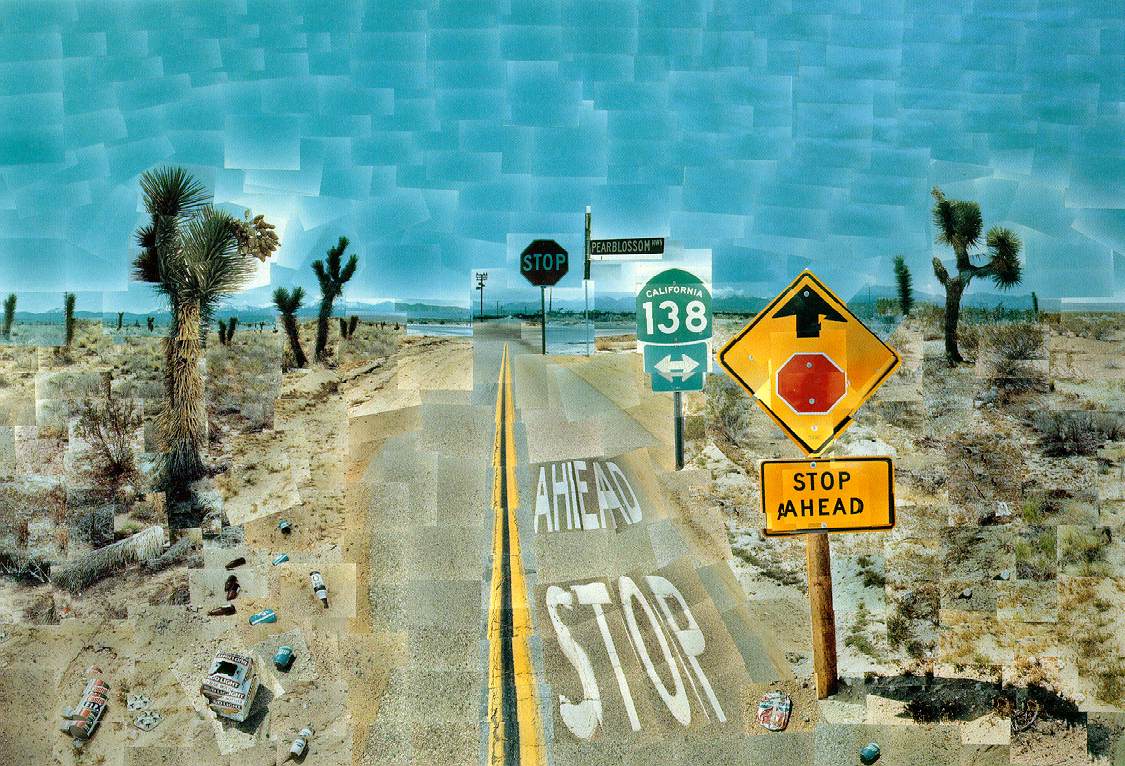
In the film series “WHATEVER HAPPENED TO THE HUMAN RACE?” the arguments are presented  against abortion (Episode 1),  infanticide (Episode 2),   euthanasia (Episode 3), and then there is a discussion of the Christian versus Humanist worldview concerning the issue of “the basis for human dignity” in Episode 4 and then in the last episode a close look at the truth claims of the Bible.

Francis Schaeffer

__________________________

I truly believe that many of the problems we have today in the USA are due to the advancement of humanism in the last few decades in our society. Ronald Reagan appointed the evangelical Dr. C. Everett Koop to the position of Surgeon General in his administration. He partnered with Dr. Francis Schaeffer in making the video below. It is very valuable information for Christians to have.  Actually I have included a video below that includes comments from him on this subject.

Francis Schaeffer Whatever Happened to the Human Race (Episode 1) ABORTION

Francis Schaeffer: What Ever Happened to the Human Race? (Full-Length Documentary)


Part 1 on abortion runs from 00:00 to 39:50, Part 2 on Infanticide runs from 39:50 to 1:21:30, Part 3 on Youth Euthanasia runs from 1:21:30 to 1:45:40, Part 4 on the basis of human dignity runs from 1:45:40 to 2:24:45 and Part 5 on the basis of truth runs from 2:24:45 to 3:00:04

________________

_____________

Tony Perkins: Gosnell Trial – FOX News

Published on May 13, 2013

Tony Perkins: Gosnell Trial – FOX News

Justice in Gosnell case, but what about the rest?

031413_gosnell_600

A couple weeks ago I wrote an op-ed for Live Action that got some unprecedented media attention. In the piece, I argued for Kermit Gosnell’s acquittal. I said that Gosnell deserves to be found guilty, but we don’t deserve to get to find him guilty.

I pointed out that our laws concerning abortion and the unborn have multi-personality disorder, and it’s morally incomprehensible to feel bad about killing a 25-week baby outside the womb, but fine about killing a 24.5-week baby inside the womb. Moreover, it’s ridiculous that the former is illegal and the latter isn’t.

This Monday, as you’ve probably heard by now, Kermit Gosnell was found guilty of three counts of first-degree murder, among a plethora of other convictions. He now faces either life in prison without parole or the death penalty.

When I argued for Gosnell’s acquittal, I was expressing my firm belief that all babies deserve the right to life, whether they’re able to live outside the womb yet or not, and that there is no meaningful moral distinction between first-trimester abortion and third-trimester abortion, or for that matter between third-trimester abortion and infanticide.

I felt – and still feel – that Gosnell deserves to be found guilty. In fact, not being morally opposed to capital punishment, I believe he deserves the death penalty. But now that a verdict has been returned, though I know justice has been served in this case, I worry that we’ve still got a long way to go to justice for all.

The problem is, we’re still making a distinction between a baby who has exited the womb alive and a baby who is alive inside the womb. We’re still making a distinction about the age or “viability” of the fetus. We’re still saying this baby is okay to kill and that baby isn’t, based on arbitrary distinctions such as location.

I think of people who are fence-sitters on the abortion issue, or those who are pro-choice but haven’t given the issue much thought. In my experience, many people fall into one of those categories. Are they going to watch this trial and feel like we’re doing a good job making sure the “bad” kinds of abortion don’t take place?

Are those people going to turn off the TV and think, “Well, that Gosnell guy was doing abortions the wrong way, but he’s been caught. The system works, and most abortions aren’t like that anyway.” Are they going to snuggle down in their beds feeling like the one bad guy has been caught, and remain pro-choice?

In the scenario above, I’ve made the assumption that our imaginary friend has any clue who Kermit Gosnell is, which is something of a leap, considering that Gallup found this case to be “one of the least followed news stories” they had ever measured.

LeRoy Carhart is gleefully making Crock-Pot meat out of fetuses in Nebraska and Maryland. He butchered Jennifer Morbelli and Christin Gilbert to death. What about him? He doesn’t even get a trial. No charges were filed in the Morbelli or Gilbert cases.

What about all the other abortionists who don’t do third-trimester procedures or routinely kill mothers, but nevertheless make their living ending innocent human lives? Do they get a pass because the babies aren’t that big and their offices are clean?

The Kermit Gosnell verdict is a victory for life. No denying that. He’s a convicted murderer, and he deserves to be treated like one.

But if we hold Gosnell up as an example of monstrous behavior, are we inadvertently saying that abortionists who don’t have cat urine on their office walls or fetus feet in jars are “not that bad”?

I’m overjoyed that there was some justice in the Gosnell case. I just wonder what it will take to get justice for the rest of the more than a million babies who died that year, most of them legally; the rest of the women who died or were injured during abortions; the women who suffered depression and suicide as a result of their abortions; the fathers who had no say in the matter and still grieve; the women who were coerced or forced to abort.

We have a lot of work to do, because they all deserve justice.

Political Cartoons by Chuck Asay

By Chuck Asay – May 09, 2013

________________

______________________

Thank you so much for your time. I know how valuable it is. I also appreciate the fine family that you have and your commitment as a father and a husband. I also respect you for putting your faith in Christ for your eternal life. I am pleading to you on the basis of the Bible to please review your religious views concerning abortion. It was the Bible that caused the abolition movement of the 1800’s and it also was the basis for Martin Luther King’s movement for civil rights and it also is the basis for recognizing the unborn children.

Sincerely,

Everette Hatcher III, 13900 Cottontail Lane, Alexander, AR 72002, ph 501-920-5733, lowcostsqueegees@yahoo.com

Related posts:

Al Mohler on Kermit Gosnell’s abortion practice

Francis Schaeffer: “Whatever Happened to the Human Race” (Episode 1) ABORTION OF THE HUMAN RACE Published on Oct 6, 2012 by AdamMetropolis ________________ Picture of Francis Schaeffer and his wife Edith from the 1930′s above. I was sad to read about Edith passing away on Easter weekend in 2013. I wanted to pass along this fine […]


Taking on Ark Times Bloggers on various issues Part U “Do men have a say in the abortion debate?” (includes the film SLAUGHTER OF THE INNOCENTS and editorial cartoon)

I have gone back and forth and back and forth with many liberals on the Arkansas Times Blog on many issues such as abortion, human rights, welfare, poverty, gun control  and issues dealing with popular culture. Here is another exchange I had with them a while back. My username at the Ark Times Blog is Saline […]


Taking on Ark Times Bloggers on various issues Part T “Abortion is a dirty business” (includes video “Truth and History” and editorial cartoon)

I have gone back and forth and back and forth with many liberals on the Arkansas Times Blog on many issues such as abortion, human rights, welfare, poverty, gun control  and issues dealing with popular culture. Here is another exchange I had with them a while back. My username at the Ark Times Blog is Saline […]


“Sanctity of Life Saturday” Abortion supporters lying in order to further their clause? Window to the Womb (includes video ABORTION OF THE HUMAN RACE)

It is truly sad to me that liberals will lie in order to attack good Christian people like state senator Jason Rapert of Conway, Arkansas because he headed a group of pro-life senators that got a pro-life bill through the Arkansas State Senate the last week of January in 2013. I have gone back and […]


Taking on Ark Times Bloggers on various issues Part D “If you can’t afford a child can you abort?”Francis Schaeffer Quotes part 4 includes the film ABORTION OF THE HUMAN RACE) (editorial cartoon)

I have gone back and forth and back and forth with many liberals on the Arkansas Times Blog on many issues such as abortion, human rights, welfare, poverty, gun control  and issues dealing with popular culture. Here is another exchange I had with them a while back. My username at the Ark Times Blog is Saline […]


Taking on Ark Times Bloggers on various issues Part C “Abortion” (Francis Schaeffer Quotes part 3 includes the film SLAUGHTER OF THE INNOCENTS) (editorial cartoon)

I have gone back and forth and back and forth with many liberals on the Arkansas Times Blog on many issues such as abortion, human rights, welfare, poverty, gun control  and issues dealing with popular culture. Here is another exchange I had with them a while back. My username at the Ark Times Blog is Saline […]


Taking on Ark Times Bloggers on various issues Part B “Gendercide” (Francis Schaeffer Quotes Part 2 includes the film ABORTION OF THE HUMAN RACE) (editorial cartoon)

I have gone back and forth and back and forth with many liberals on the Arkansas Times Blog on many issues such as abortion, human rights, welfare, poverty, gun control  and issues dealing with popular culture. Here is another exchange I had with them a while back. My username at the Ark Times Blog is Saline […]


SANCTITY OF LIFE SATURDAY “AngryOldWoman” blogger argues that she has no regrets about past abortion

Sometimes you can see evidences in someone’s life of how content they really are. I saw  something like that on 2-8-13 when I confronted a blogger that goes by the name “AngryOldWoman” on the Arkansas Times Blog. See below. Leadership Crisis in America Published on Jul 11, 2012 Picture of Adrian Rogers above from 1970′s […]


“Sanctity of Life Saturday” The Church Awakens: Whatever Happened to the Human Race? (includes the video ABORTION OF THE HUMAN RACE)

In the film series “WHATEVER HAPPENED TO THE HUMAN RACE?” the arguments are presented  against abortion (Episode 1),  infanticide (Episode 2),   euthenasia (Episode 3), and then there is a discussion of the Christian versus Humanist worldview concerning the issue of “the basis for human dignity” in Episode 4 and then in the last episode a close […]

Taking on Ark Times Bloggers on various issues Part H “Are humans special?” includes film ABORTION OF THE HUMAN RACE) Reagan: ” To diminish the value of one category of human life is to diminish us all”

I have gone back and forth and back and forth with many liberals on the Arkansas Times Blog on many issues such as abortion, human rights, welfare, poverty, gun control  and issues dealing with popular culture. Here is another exchange I had with them a while back. My username at the Ark Times Blog is Saline […]


Taking on Ark Times Bloggers on various issues Part G “How do moral nonabsolutists come up with what is right?” includes the film “ABORTION OF THE HUMAN RACE”)

I have gone back and forth and back and forth with many liberals on the Arkansas Times Blog on many issues such as abortion, human rights, welfare, poverty, gun control  and issues dealing with popular culture. Here is another exchange I had with them a while back. My username at the Ark Times Blog is Saline […]


Taking on Ark Times Bloggers on various issues Part E “Moral absolutes and abortion” Francis Schaeffer Quotes part 5(includes the film SLAUGHTER OF THE INNOCENTS) (editorial cartoon)

I have gone back and forth and back and forth with many liberals on the Arkansas Times Blog on many issues such as abortion, human rights, welfare, poverty, gun control  and issues dealing with popular culture. Here is another exchange I had with them a while back. My username at the Ark Times Blog is Saline […]

Francis Schaeffer’s “How should we then live?” Video and outline of episode 10 “Final Choices” (Schaeffer Sundays)

E P I S O D E 1 0   Dr. Francis Schaeffer – Episode X – Final Choices 27 min FINAL CHOICES I. Authoritarianism the Only Humanistic Social Option One man or an elite giving authoritative arbitrary absolutes. A. Society is sole absolute in absence of other absolutes. B. But society has to be […]

Francis Schaeffer’s “How should we then live?” Video and outline of episode 9 “The Age of Personal Peace and Affluence” (Schaeffer Sundays)

E P I S O D E 9 Dr. Francis Schaeffer – Episode IX – The Age of Personal Peace and Affluence 27 min T h e Age of Personal Peace and Afflunce I. By the Early 1960s People Were Bombarded From Every Side by Modern Man’s Humanistic Thought II. Modern Form of Humanistic Thought Leads […]

Francis Schaeffer’s “How should we then live?” Video and outline of episode 8 “The Age of Fragmentation” (Schaeffer Sundays)

E P I S O D E 8 Dr. Francis Schaeffer – Episode VIII – The Age of Fragmentation 27 min I saw this film series in 1979 and it had a major impact on me. T h e Age of FRAGMENTATION I. Art As a Vehicle Of Modern Thought A. Impressionism (Monet, Renoir, Pissarro, Sisley, […]

Francis Schaeffer’s “How should we then live?” Video and outline of episode 7 “The Age of Non-Reason” (Schaeffer Sundays)

E P I S O D E 7 Dr. Francis Schaeffer – Episode VII – The Age of Non Reason I am thrilled to get this film series with you. I saw it first in 1979 and it had such a big impact on me. Today’s episode is where we see modern humanist man act […]

Francis Schaeffer’s “How should we then live?” Video and outline of episode 6 “The Scientific Age” (Schaeffer Sundays)

E P I S O D E 6 How Should We Then Live 6#1 Uploaded by NoMirrorHDDHrorriMoN on Oct 3, 2011 How Should We Then Live? Episode 6 of 12 ________ I am sharing with you a film series that I saw in 1979. In this film Francis Schaeffer asserted that was a shift in […]

Francis Schaeffer’s “How should we then live?” Video and outline of episode 5 “The Revolutionary Age” (Schaeffer Sundays)

E P I S O D E 5 How Should We Then Live? Episode 5: The Revolutionary Age I was impacted by this film series by Francis Schaeffer back in the 1970′s and I wanted to share it with you. Francis Schaeffer noted, “Reformation Did Not Bring Perfection. But gradually on basis of biblical teaching there […]

Francis Schaeffer’s “How should we then live?” Video and outline of episode 4 “The Reformation” (Schaeffer Sundays)

Dr. Francis Schaeffer – Episode IV – The Reformation 27 min I was impacted by this film series by Francis Schaeffer back in the 1970′s and I wanted to share it with you. Schaeffer makes three key points concerning the Reformation: “1. Erasmian Christian humanism rejected by Farel. 2. Bible gives needed answers not only as to […]

“Schaeffer Sundays” Francis Schaeffer’s “How should we then live?” Video and outline of episode 3 “The Renaissance”

Francis Schaeffer’s “How should we then live?” Video and outline of episode 3 “The Renaissance” Francis Schaeffer: “How Should We Then Live?” (Episode 3) THE RENAISSANCE I was impacted by this film series by Francis Schaeffer back in the 1970′s and I wanted to share it with you. Schaeffer really shows why we have so […]

Francis Schaeffer’s “How should we then live?” Video and outline of episode 2 “The Middle Ages” (Schaeffer Sundays)

  Francis Schaeffer: “How Should We Then Live?” (Episode 2) THE MIDDLE AGES I was impacted by this film series by Francis Schaeffer back in the 1970′s and I wanted to share it with you. Schaeffer points out that during this time period unfortunately we have the “Church’s deviation from early church’s teaching in regard […]

Francis Schaeffer’s “How should we then live?” Video and outline of episode 1 “The Roman Age” (Schaeffer Sundays)

Francis Schaeffer: “How Should We Then Live?” (Episode 1) THE ROMAN AGE   Today I am starting a series that really had a big impact on my life back in the 1970′s when I first saw it. There are ten parts and today is the first. Francis Schaeffer takes a look at Rome and why […]

By Everette Hatcher III | Posted in Francis Schaeffer | Edit | Comments (0)