Anti Abortion Pro-Life Training Video by Scott Klusendorf Part 3 of 4
_________
___________________
Francis Schaeffer Whatever Happened to the Human Race (Episode 1) ABORTION
_____________________________________
Francis Schaeffer “BASIS FOR HUMAN DIGNITY” Whatever…HTTHR
Dr. Francis schaeffer – The flow of Materialism(from Part 4 of Whatever happened to human race?)
Dr. Francis Schaeffer – The Biblical flow of Truth & History (intro)
Francis Schaeffer – The Biblical Flow of History & Truth (1)
Dr. Francis Schaeffer – The Biblical Flow of Truth & History (part 2)
_____________________________
I have gone back and forth with Ark Times liberal bloggers on the issue of abortion, but I am going to try something new. I am going to respond with logical and rational reasons the pro-life view is true. All of this material is from a paper by Scott Klusendorf called FIVE BAD WAYS TO ARGUE ABOUT ABORTION .
As a guest on the television show Politically Incorrect, former super-model Kathy Ireland gave a carefully reasoned scientific and philosophic defense of the pro-life position. The show’s host, Bill Maher, ignored her evidence completely and shot back with (paraphrase) “Kathy, that’s just your view.”
What’s wrong with this response? Maher was confusing a moral claim with a preference claim. But there is a difference between disliking something (say, for example, a particular flavor of ice cream) and thinking it is morally wrong. Put simply, when pro-life advocates say that abortion is morally wrong, they are not saying they personally dislike abortion or would prefer that people not have one. Rather, they are saying that elective abortion is objectively wrong for everyone, regardless of how one feels about it. This is why the popular bumper sticker“Don’t like abortion? Don’t have one!”misses the point entirely. It confuses the two types of claims. (Try this: “Don’t like slavery? Don’t own a slave!”)
Now it may be the case that pro-life advocates like Kathy Ireland are mistaken about their claim. Perhaps their evidence that abortion unjustly takes the life of a defenseless child is weak and inconclusive. But instead of proving this with facts and arguments, abortion advocates like Bill Maher ignore the evidence altogether. “Well, that’s just your view.” This not only relativizes the pro-lifers claim, it is intellectually lazy. It attempts to dismiss evidence rather than refute it.
Imagine if I were to say, “There is a pink elephant in the corner of the room just beneath the window.”7 How should you respond to my claim? Perhaps I’m mistaken (and chances are I would be), but it would do no good to say, “That’s just your view.” The problem is I was not offering an opinion, I was claiming to be right. To refute me, you must show that my claim is false. The correct response is to say, “Your evidence is lousy. We looked in the corner and there is no elephant.”
But again, Maher did not do that. At no point did he challenge her facts and arguments. What he said in effect was “Go away Kathy. You have your views and I have mine.” This was very condescending because he did not even entertain the possibility that she had good evidence for her claim. Nor did he acknowledge the type of claim she was making.
To sum up, Maher was confusing a preference claim with a distinctly moral one. Preference claims cannot be evaluated as true or false because they are matters of personal taste. You cannot reasonably argue that vanilla ice cream is objectively better than chocolate. But moral claims are different. They can be evaluated as true or false based on the evidence. They do not say, “This is better tasting,” they say, “This is right”. Kathy Ireland’s claim was, Abortion is wrong because it takes the life of a defenseless child, and I think I’m right. Maher’s glib response did nothing to refute this. In fact, one could stop Maher dead in his tracks by saying, “Bill, it’s just your view that it’s just my view.”
I have gone back and forth and back and forth with many liberals on the Arkansas Times Blog on many issues such as abortion, human rights, welfare, poverty, gun control and issues dealing with popular culture. Here is another exchange I had with them a while back. My username at the Ark Times Blog is Saline […]
I have gone back and forth and back and forth with many liberals on the Arkansas Times Blog on many issues such as abortion, human rights, welfare, poverty, gun control and issues dealing with popular culture. Here is another exchange I had with them a while back. My username at the Ark Times Blog is Saline […]
I have gone back and forth and back and forth with many liberals on the Arkansas Times Blog on many issues such as abortion, human rights, welfare, poverty, gun control and issues dealing with popular culture. Here is another exchange I had with them a while back. My username at the Ark Times Blog is Saline […]
I have gone back and forth and back and forth with many liberals on the Arkansas Times Blog on many issues such as abortion, human rights, welfare, poverty, gun control and issues dealing with popular culture. Here is another exchange I had with them a while back. My username at the Ark Times Blog is […]
I have gone back and forth and back and forth with many liberals on the Arkansas Times Blog on many issues such as abortion, human rights, welfare, poverty, gun control and issues dealing with popular culture. Here is another exchange I had with them a while back. My username at the Ark Times Blog is Saline […]
I have gone back and forth and back and forth with many liberals on the Arkansas Times Blog on many issues such as abortion, human rights, welfare, poverty, gun control and issues dealing with popular culture. Here is another exchange I had with them a while back. My username at the Ark Times Blog is Saline […]
I have gone back and forth and back and forth with many liberals on the Arkansas Times Blog on many issues such as abortion, human rights, welfare, poverty, gun control and issues dealing with popular culture. Here is another exchange I had with them a while back. My username at the Ark Times Blog is Saline […]
I have gone back and forth and back and forth with many liberals on the Arkansas Times Blog on many issues such as abortion, human rights, welfare, poverty, gun control and issues dealing with popular culture. Here is another exchange I had with them a while back. My username at the Ark Times Blog is […]
I have gone back and forth and back and forth with many liberals on the Arkansas Times Blog on many issues such as abortion, human rights, welfare, poverty, gun control and issues dealing with popular culture. Here is another exchange I had with them a while back. My username at the Ark Times Blog is Saline […]
I have gone back and forth and back and forth with many liberals on the Arkansas Times Blog on many issues such as abortion, human rights, welfare, poverty, gun control and issues dealing with popular culture. Here is another exchange I had with them a while back. My username at the Ark Times Blog is Saline […]
I have gone back and forth and back and forth with many liberals on the Arkansas Times Blog on many issues such as abortion, human rights, welfare, poverty, gun control and issues dealing with popular culture. Here is another exchange I had with them a while back. My username at the Ark Times Blog is Saline […]
I have gone back and forth and back and forth with many liberals on the Arkansas Times Blog on many issues such as abortion, human rights, welfare, poverty, gun control and issues dealing with popular culture. Here is another exchange I had with them a while back. My username at the Ark Times Blog is Saline […]
I have gone back and forth and back and forth with many liberals on the Arkansas Times Blog on many issues such as abortion, human rights, welfare, poverty, gun control and issues dealing with popular culture. Here is another exchange I had with them a while back. My username at the Ark Times Blog is Saline […]
I have gone back and forth and back and forth with many liberals on the Arkansas Times Blog on many issues such as abortion, human rights, welfare, poverty, gun control and issues dealing with popular culture. Here is another exchange I had with them a while back. My username at the Ark Times Blog is Saline […]
I have gone back and forth and back and forth with many liberals on the Arkansas Times Blog on many issues such as abortion, human rights, welfare, poverty, gun control and issues dealing with popular culture. Here is another exchange I had with them a while back. My username at the Ark Times Blog is Saline […]
I have gone back and forth and back and forth with many liberals on the Arkansas Times Blog on many issues such as abortion, human rights, welfare, poverty, gun control and issues dealing with popular culture. Here is another exchange I had with them a while back. My username at the Ark Times Blog is Saline […]
I have gone back and forth and back and forth with many liberals on the Arkansas Times Blog on many issues such as abortion, human rights, welfare, poverty, gun control and issues dealing with popular culture. Here is another exchange I had with them a while back. My username at the Ark Times Blog is Saline […]
I have gone back and forth and back and forth with many liberals on the Arkansas Times Blog on many issues such as abortion, human rights, welfare, poverty, gun control and issues dealing with popular culture. Here is another exchange I had with them a while back. My username at the Ark Times Blog is Saline […]
I have gone back and forth and back and forth with many liberals on the Arkansas Times Blog on many issues such as abortion, human rights, welfare, poverty, gun control and issues dealing with popular culture. Here is another exchange I had with them a while back. My username at the Ark Times Blog is Saline […]
I have gone back and forth and back and forth with many liberals on the Arkansas Times Blog on many issues such as abortion, human rights, welfare, poverty, gun control and issues dealing with popular culture. Here is another exchange I had with them a while back. My username at the Ark Times Blog is Saline […]
Max Brantley of the Arkansas Times Blog reprinted a story of a 38 year old later telling her story. She got an abortion when she was 23 for just selfish reasons. The lady identified herself as a Christian. As a response to this I posted the following on 2-8-13 on the Arkansas Times Blog: You […]
Dr Richard Land discusses abortion and slavery – 10/14/2004 – part 3 The best pro-life film I have ever seen below by Francis Schaeffer and Dr. C. Everett Koop “Whatever happened to the human race?” Over the years I have taken on the Ark Times liberal bloggers over and over and over concerning the issue […]
The best pro-life film I have ever seen below by Francis Schaeffer and Dr. C. Everett Koop “Whatever happened to the human race?” Francis Schaeffer pictured above._________ The 45 minute video above is from the film series created from Francis Schaeffer’s book “Whatever Happened to the Human Race?” with Dr. C. Everett Koop. This book really […]
The best pro-life film I have ever seen below by Francis Schaeffer and Dr. C. Everett Koop “Whatever happened to the human race?” Over the years I have taken on the Ark Times liberal bloggers over and over and over concerning the issue of abortion. I asked over and over again for one liberal blogger […]
Francis Schaeffer pictured above._________ The best pro-life film I have ever seen below by Francis Schaeffer and Dr. C. Everett Koop “Whatever happened to the human race?” Over the years I have taken on the Ark Times liberal bloggers over and over and over concerning the issue of abortion. I asked over and over again […]
The best pro-life film I have ever seen below by Francis Schaeffer and Dr. C. Everett Koop “Whatever happened to the human race?” On 1-24-13 I took on the child abuse argument put forth by Ark Times Blogger “Deathbyinches,” and the day before I pointed out that because the unborn baby has all the genetic code […]
PHOTO BY STATON BREIDENTHAL from Pro-life march in Little Rock on 1-20-13. Tim Tebow on pro-life super bowl commercial. Over the years I have taken on the Ark Times liberal bloggers over and over and over concerning the issue of abortion. Here is another encounter below. On January 22, 2013 (on the 40th anniversary of the […]
Dr Richard Land discusses abortion and slavery – 10/14/2004 – part 3 The best pro-life film I have ever seen below by Francis Schaeffer and Dr. C. Everett Koop “Whatever happened to the human race?” Over the years I have taken on the Ark Times liberal bloggers over and over and over concerning the issue […]
The Arkansas Times blogger going by the username “Sound Policy” asserted, “…you do know there is a slight difference between fetal tissue and babies, don’t you? Don’t you?” My response was taken from the material below: Science Matters: Former supermodel Kathy Ireland tells Mike Huckabee about how she became pro-life after reading what the science books […]
I wrote a response to an article on abortion on the Arkansas Times Blog and it generated more hate than enlightenment from the liberals on the blog. However, there was a few thoughtful responses. One is from spunkrat who really did identify the real issue. WHEN DOES A HUMAN LIFE BEGIN? _______________________________________ Posted by spunkrat […]
Superbowl commercial with Tim Tebow and Mom. The Arkansas Times article, “Putting the fetus first: Pro-lifers keep up attack on access, but pro-choice advocates fend off the end to abortion right” by Leslie Newell Peacock is very lengthy but I want to deal with all of it in this new series. click to enlarge ROSE MIMMS: […]
The Arkansas Times article, “Putting the fetus first: Pro-lifers keep up attack on access, but pro-choice advocates fend off the end to abortion right” by Leslie Newell Peacock is very lengthy but I want to deal with all of it in this new series. click to enlarge ROSE MIMMS: Arkansas Right to Life director unswayed by […]
What is left, therefore, is “relative” truth, and with relative truth, relative morality. Given time, even the “certainties” of our ethical systems can be undone – the bills of rights, the charters of freedom, the principles of justice, everything. Aleksandr Solzhenitsyn understands this not only as a theoretical problem of a humanistic philosophy. He has suffered under its implications. He writes: Communism has never concealed the fact that it rejects all absolute concepts of morality. It scoffs at good and evil as indisputable categories. Communism considers morality to be relative. Depending upon circumstances, any act, including the killing of thousands, could be good or bad. It all depends upon class ideology, defined by a handful of people …. It is considered awkward to use seriously such words as good and evil. But if we are to be deprived of these concepts, what will be left? We will decline to the status of animals.
________________________________
We in the West must understand that it is not only Iron Curtain countries who operate on the basis of relative morality. Now the West does, too. The materialist world-view has dominated the thinking of the West just as much. Therefore we can expect to see the same inhumanity here, just as Solzhenitsyn has warned. We must not sit back and think, It could never happen here. Worse still, we must not be confused into thinking the issue is principally or only military or economic power. The issue is more subtle, more immediate, a cancer like growth which is in our midst right now – the materialist philosophy which underlies the Western humanistic world-view. Marx may have proposed an economic system different from our own, but we have shared his basic world-view. The greatest dilemma for those who hold this world-view, however, is that it is impossible to live consistently within it. We saw how this was true of David Hume. Likewise the playwright Samuel Beckett can “say” that words do not communicate anything – and that everything, including language, is absurd – yet he must use words to write his plays, even plays about meaninglessness. If the words that Beckett uses did not convey meaning to his hearers, he could not say that everything, including words, is meaningless. The list of contradictions can be extended endlessly. The truth is that everyone who rejects the biblical world-view must live in a state of tension between ideas about reality and reality itself. Thus, if a person believes that everything is only matter or energy and carries this through consistently, meaning dies, morality dies, love dies, hope dies. Yet! The individual does love, does hope, does act on the basis of right and wrong. This is what we mean when we say that everyone is caught, regardless of his world-view, simply by the way things are. No one can make his own universe to live in. The reason for this, as we have said all along, is that the individual is confronted with two aspects or reality that do not basically change: the universe and its form and the mannishness of man. Humanists argue that everything is finally only matter or energy and end up with no answers to the big questions. They arrive at only meaninglessness, relative morality, relative knowledge. But humanists actually live as if there is meaning and real morality. They act, for example, as if cruelty is not the same as noncruelty, or justice the same as injustice. Also, humanists do have knowledge, knowledge of a world in which causality is real and science is possible. Exactly the same dilemma exists with the other main alternative to Christianity: the philosophies of the East. Despite their many differences, all of these philosophies flow out of the view that ultimately everything is impersonal. The universe we are experiencing, the Eastern philosophers say, is simply an extension of God, but – and here we need to be careful – they do not mean that God is personal. “God” means the “impersonal everything,” which has no final distinctions. So, within this view, the solution is to say we must get rid of those aspirations that are personal, those things that make us seem to be independent entities, entirely independent selves. Such an idea is maya, that is, “illusion.” In the Eastern thinking, the only reality is one beyond all distinctions and therefore impersonal: no “male” or “female,” no “you” or “me,” no “good” or “evil.” It is important to note that Eastern thinkers come to exactly the same place as those who begin by saying that everything is matter or energy. At first the two positions sound very different, but they result in the same final position.
Aleksandr Solzhenitsyn Harvard Address: a warning to the West
Published on Jul 11, 2014
Solzhenitsyn’s June 8, 1978, commencement address at Harvard was the most controversial and commented upon public speech he delivered during his twenty-year exile in the West.
#02 How Should We Then Live? (Promo Clip) Dr. Francis Schaeffer
Published on Jan 25, 2014
This is a promo clip for the documentary series “How Should We Then Live?” by Dr. Francis Schaeffer. The full series can be purchased on DVD here:
I was born at Kislovodsk on 11th December, 1918. My father had studied philological subjects at Moscow University, but did not complete his studies, as he enlisted as a volunteer when war broke out in 1914. He became an artillery officer on the German front, fought throughout the war and died in the summer of 1918, six months before I was born. I was brought up by my mother, who worked as a shorthand-typist, in the town of Rostov on the Don, where I spent the whole of my childhood and youth, leaving the grammar school there in 1936. Even as a child, without any prompting from others, I wanted to be a writer and, indeed, I turned out a good deal of the usual juvenilia. In the 1930s, I tried to get my writings published but I could not find anyone willing to accept my manuscripts. I wanted to acquire a literary education, but in Rostov such an education that would suit my wishes was not to be obtained. To move to Moscow was not possible, partly because my mother was alone and in poor health, and partly because of our modest circumstances. I therefore began to study at the Department of Mathematics at Rostov University, where it proved that I had considerable aptitude for mathematics. But although I found it easy to learn this subject, I did not feel that I wished to devote my whole life to it. Nevertheless, it was to play a beneficial role in my destiny later on, and on at least two occasions, it rescued me from death. For I would probably not have survived the eight years in camps if I had not, as a mathematician, been transferred to a so-called sharashia, where I spent four years; and later, during my exile, I was allowed to teach mathematics and physics, which helped to ease my existence and made it possible for me to write. If I had had a literary education it is quite likely that I should not have survived these ordeals but would instead have been subjected to even greater pressures. Later on, it is true, I began to get some literary education as well; this was from 1939 to 1941, during which time, along with university studies in physics and mathematics, I also studied by correspondence at the Institute of History, Philosophy and Literature in Moscow.
In 1941, a few days before the outbreak of the war, I graduated from the Department of Physics and Mathematics at Rostov University. At the beginning of the war, owing to weak health, I was detailed to serve as a driver of horsedrawn vehicles during the winter of 1941-1942. Later, because of my mathematical knowledge, I was transferred to an artillery school, from which, after a crash course, I passed out in November 1942. Immediately after this I was put in command of an artillery-position-finding company, and in this capacity, served, without a break, right in the front line until I was arrested in February 1945. This happened in East Prussia, a region which is linked with my destiny in a remarkable way. As early as 1937, as a first-year student, I chose to write a descriptive essay on “The Samsonov Disaster” of 1914 in East Prussia and studied material on this; and in 1945 I myself went to this area (at the time of writing, autumn 1970, the book August 1914 has just been completed).
I was arrested on the grounds of what the censorship had found during the years 1944-45 in my correspondence with a school friend, mainly because of certain disrespectful remarks about Stalin, although we referred to him in disguised terms. As a further basis for the “charge”, there were used the drafts of stories and reflections which had been found in my map case. These, however, were not sufficient for a “prosecution”, and in July 1945 I was “sentenced” in my absence, in accordance with a procedure then frequently applied, after a resolution by the OSO (the Special Committee of the NKVD), to eight years in a detention camp (at that time this was considered a mild sentence).
I served the first part of my sentence in several correctional work camps of mixed types (this kind of camp is described in the play, The Tenderfoot and the Tramp). In 1946, as a mathematician, I was transferred to the group of scientific research institutes of the MVD-MOB (Ministry of Internal Affairs, Ministry of State Security). I spent the middle period of my sentence in such “SPECIAL PRISONS” (The First Circle). In 1950 I was sent to the newly established “Special Camps” which were intended only for political prisoners. In such a camp in the town of Ekibastuz in Kazakhstan (One Day in the Life of Ivan Denisovich), I worked as a miner, a bricklayer, and a foundryman. There I contracted a tumour which was operated on, but the condition was not cured (its character was not established until later on).
One month after I had served the full term of my eight-year sentence, there came, without any new judgement and even without a “resolution from the OSO”, an administrative decision to the effect that I was not to be released but EXILED FOR LIFE to Kok-Terek (southern Kazakhstan). This measure was not directed specially against me, but was a very usual procedure at that time. I served this exile from March 1953 (on March 5th, when Stalin’s death was made public, I was allowed for the first time to go out without an escort) until June 1956. Here my cancer had developed rapidly, and at the end of 1953, I was very near death. I was unable to eat, I could not sleep and was severely affected by the poisons from the tumour. However, I was able to go to a cancer clinic at Tashkent, where, during 1954, I was cured (The Cancer Ward, Right Hand). During all the years of exile, I taught mathematics and physics in a primary school and during my hard and lonely existence I wrote prose in secret (in the camp I could only write down poetry from memory). I managed, however, to keep what I had written, and to take it with me to the European part of the country, where, in the same way, I continued, as far as the outer world was concerned, to occupy myself with teaching and, in secret, to devote myself to writing, at first in the Vladimir district (Matryona’s Farm) and afterwards in Ryazan.
During all the years until 1961, not only was I convinced that I should never see a single line of mine in print in my lifetime, but, also, I scarcely dared allow any of my close acquaintances to read anything I had written because I feared that this would become known. Finally, at the age of 42, this secret authorship began to wear me down. The most difficult thing of all to bear was that I could not get my works judged by people with literary training. In 1961, after the 22nd Congress of the U.S.S.R. Communist Party and Tvardovsky’s speech at this, I decided to emerge and to offer One Day in the Life of Ivan Denisovich.
Such an emergence seemed, then, to me, and not without reason, to be very risky because it might lead to the loss of my manuscripts, and to my own destruction. But, on that occasion, things turned out successfully, and after protracted efforts, A.T. Tvardovsky was able to print my novel one year later. The printing of my work was, however, stopped almost immediately and the authorities stopped both my plays and (in 1964) the novel, The First Circle, which, in 1965, was seized together with my papers from the past years. During these months it seemed to me that I had committed an unpardonable mistake by revealing my work prematurely and that because of this I should not be able to carry it to a conclusion.
It is almost always impossible to evaluate at the time events which you have already experienced, and to understand their meaning with the guidance of their effects. All the more unpredictable and surprising to us will be the course of future events.
From Nobel Lectures, Literature 1968-1980, Editor-in-Charge Tore Frängsmyr, Editor Sture Allén, World Scientific Publishing Co., Singapore, 1993
This autobiography/biography was written at the time of the award and first published in the book series Les Prix Nobel. It was later edited and republished in Nobel Lectures. To cite this document, always state the source as shown above.
Alexandr Solzhenitsyn died on 3 August, 2008.
_______________________
Francis Schaeffer “BASIS FOR HUMAN DIGNITY” Whatever…HTTHR
J.I.PACKER WROTE OF SCHAEFFER, “His communicative style was not that of acautious academic who labors for exhaustive coverage and dispassionate objectivity. It was rather that of an impassioned thinker who paints his vision of eternal truth in bold strokes and stark contrasts.Yet it is a fact that MANY YOUNG THINKERS AND ARTISTS…HAVE FOUND SCHAEFFER’S ANALYSES A LIFELINE TO SANITY WITHOUT WHICH THEY COULD NOT HAVE GONE ON LIVING.”
Francis Schaeffer in Art and the Bible noted, “Many modern artists, it seems to me, have forgotten the value that art has in itself. Much modern art is far too intellectual to be great art. Many modern artists seem not to see the distinction between man and non-man, and it is a part of the lostness of modern man that they no longer see value in the work of art as a work of art.”
Many modern artists are left in this point of desperation that Schaeffer points out and it reminds me of the despair that Solomon speaks of in Ecclesiastes. Christian scholar Ravi Zacharias has noted, “The key to understanding the Book of Ecclesiastes is the term ‘under the sun.’ What that literally means is you lock God out of a closed system, and you are left with only this world of time plus chanceplus matter.” THIS IS EXACT POINT SCHAEFFER SAYS SECULAR ARTISTSARE PAINTING FROM TODAY BECAUSE THEY BELIEVED ARE A RESULTOF MINDLESS CHANCE.
Dr. Francis schaeffer – The flow of Materialism(from Part 4 of Whatever happened to human race?)
Dr. Francis Schaeffer – The Biblical flow of Truth & History (intro)
Francis Schaeffer – The Biblical Flow of History & Truth (1)
Dr. Francis Schaeffer – The Biblical Flow of Truth & History (part 2)
Cooper-Hewitt: Shahzia Sikander and Glenn Lowry in Conversation
Uploaded on Apr 25, 2009
A conversation with internationally acclaimed artist Shahzia Sikander and art historian and MoMA Director, Glenn Lowry.
Shahzia Sikanders work takes apart the conventional methods of addressing traditional miniature paintings and reassembles them to expand their associations, inserting new dialogues often subversive in nature. Using wit, irony and paradox, Sikanders inventiveness draws upon literary, pop, media and art historical contexts. Her work ranges from intimate watercolors, large scale wall installations and digital animation and video. Sikander studied at both the National College of Arts in Lahore, Pakistan and the Rhode Island School of Design in Providence.
Glenn Lowry is an art historian and current Director of the Museum of Modern Art (MoMA). A noted scholar of Islamic arts and architecture, Lowry was previously Curator of Near Eastern Art at the Smithsonian Institutions Arthur M. Sackler Gallery and Freer Gallery of Art (1984-90) where he organized, among other exhibitions, Timur and Princely Vision: Persian Art and Culture in the Fifteenth Century (1989) and A Jewelers Eye: Islamic Arts of the Book From the Vever Collection (1988).
____________________
Shahzia Sikander at the 13th Istanbul Biennial | “Artist to Artist” | Art21
Published on Oct 25, 2013
Shahzia Sikander travels to the 13th Istanbul Biennial and speaks with four fellow artists and a two-person design collective about their projects. “There’s so much within the art world that happens by word of mouth, by engaging, by making a connection,” says Sikander. Artists address not only the concepts that underlie their work, but also the public protests in Gezi Park and Taksim Square—also known as the Gezi Resistance—that began three months before the Biennial opened and impacted its organization. Sikander discusses the palpability of social unrest in Istanbul and describes an “energy and anxiousness” that would occasionally erupt. Diego Bianchi, Gülsün Karamustafa, Basim Magdy, Hito Steyerl, and RAAAF (formerly Rietveld Landscape) are also featured in the film. The 13th Istanbul Biennial was on view September 14–October 20, 2013.
Shahzia Sikander’s hybrid, hypnotic works are inspired by her study of manuscript illuminations in her native Pakistan and elsewhere
614431
A murky black rectangle glistens and undulates on the screen of Shahzia Sikander’s laptop as the artist shows a visitor to her New York studio a passage from her animation in progress.
Gradually, the field seems to disintegrate into a dense accumulation of irregular black marks that vanish one by one. Viewers familiar with Sikander’s work may recognize that these seemingly abstract black shapes are in fact precise renderings of the stylized hairdo of the Gopi women—worshippers of the Hindu god Krishna, whom Sikander often depicted in her miniature paintings from the 1990s. The hairdos have reappeared, disembodied, in many of the animations that set her repertoire of painted imagery in motion, including SpiNN (2003), in which the hair rises from the women’s disappearing bodies and takes flight in a menacing swarm that invades an imperial Mughal court.
“I found the hair had this wonderful silhouette that, if you turned it around, could look like bats or birds—that was a very exciting moment in animation for me,” says Sikander. She used this silhouette to create the floating, oily ground in the large-scale projection she was preparing for the Sharjah Biennial in the United Arab Emirates (on view through May 13).
“I’m still going to the same image but trying to find another way to transform it. I’m not trying to hide where they come from,” she says of the hair shapes, “but they need not be associated with their source. I’m interested conceptually in the distance between the translation and the original.”
All of Sikander’s works, from her small drawings to her room-scale painting installations to her giant animated videos, stem from her study of traditional Indian and Persian miniature painting in her native Pakistan in the late 1980s. “It was a very independent choice—of examining a style, school, genre, and developing a relationship, a language, a dialogue with it,” says Sikander, who was attracted to the seductive beauty of the stylized gemlike miniatures and fascinated by the insularity and seeming immunity to translation of the forms.
Since moving to the United States in 1992, Sikander, 44, has been exploring ways to stretch and pull apart the vocabulary of miniature painting in different media and at different scales, creating a hybrid imagery that blurs such polarities as Hindu and Muslim, traditional and contemporary, East and West, representation and abstraction. Fundamental to the work is the fluidity with which Sikander shifts perception and challenges our ways of seeing.
In the 2004 animation Pursuit Curve, for instance, a large flowerlike form starts to agitate and break apart, its fluttering reddish parts evoking insects or feathers. Gradually the shapes settle as turbans on a cluster of bearded men. “It’s an image which is already loaded,” says Sikander of the turbans. “It’s masculine. It’s got race and religion. When it’s flapping around, it’s like butterflies and fragile, and then it fits on and all you see is turban. I like that there are multiple reads and facets to a situation, and that the dissociation can be that stark.”
“Shahzia mixes history, personal feelings and experiences, and very contemporary art making—firing on all cylinders at the same time—in her masterfully crafted works,” says Ian Berry, director of the Tang Teaching Museum and Art Gallery in Saratoga Springs, New York, who in 2004 organized a large survey of her work there that traveled to the Aldrich Contemporary Art Museum in Connecticut. “The artwork can respond to people’s desires to think about politics and biography, not just of Shahzia’s but of their own. And then other people can come to it and respond entirely to line, form, color, movement, and perspective, and the creative things Shahzia brings to that.”
The Tang is one of many museums to host solo exhibitions, including the Hirshhorn Museum and Sculpture Garden in Washington, D.C., in 1999. Sikander was awarded a MacArthur Foundation Fellowship in 2006. Today, she is represented by Sikkema Jenkins & Co. in New York, where her works sell for up to $125,000.
Sikander grew up in Lahore, in a house adjoining those of her grandfather and aunts and uncles. “I have a very supportive and educated family with strong women—writers, academics, human-rights activists,” she says. She always drew as a child and happily did all the diagrams for her cousins’ science homework. (The nuns at her Catholic school kept some of her illuminated notebooks.) Her parents encouraged her to apply to the National College of Arts.
There, in 1988, Sikander attended a lecture on miniature paintings given by a visiting curator from the Victoria and Albert Museum, an experience she describes as life changing. Familiar only with the kitschy creations sold to tourists, she was stunned by the “immense range and visual connections” of the images shown by the lecturer. “I felt potential,” she says.
Her idea was to explore personal imagery within the thematic guise of miniature painting, at a time when young people in Pakistan, under Muhammad Zia-ul-Haq’s military regime, had to behave very discreetly in public. She made the decision to major in miniature painting, working with only one other student under the strict methodology of the master teacher.
“It was a big thing to say, ‘I’m going to embrace something that’s already saddled with technique and ritual and a kind of copying and a certain language,’” says Sikander, who had to spend an entire year working just in ink before she was allowed to use color.
“I submitted myself to that,” she says. For four years she worked 18-hour days, almost always alone, to master the art of traditional miniature painting, learning how to apply layers of paint to build up luminous surfaces. Her final piece was The Scroll (1991–92), about a foot high and more than five feet long, in which she mapped out the rooms in her family home, using the genre conventions of stacking flattened-out spaces, and embellishing the architecture and the borders of the piece with painstaking pattern and detail. “You had to play by those rules,” Sikander says.
A recurring figure in the scroll is a young woman with long black hair, dressed in white, always painted from behind so that her face is not visible. She passes almost like an apparition through rooms filled with activity. At the end, she is seen at an easel painting herself. “She is an observer, who is not necessarily comfortable in that space,” says Sikander. “I left soon after.”
In 1992, after graduating, Sikander was invited to install her paintings for one day at the Pakistan Embassy in Washington, D.C. She flew on a standby ticket, carrying her miniature paintings in her suitcase, and decided to stay. Paintings in tow, she toured graduate schools all over the country, and in 1993, she enrolled at the Rhode Island School of Design in Providence.
At RISD, Sikander explored a new kind of freedom and simplification in her work. “I felt the work should be more about drawing,” she says. She experimented with quick gestures in ink on tissue paper and followed the suggestions that arose from the marks. Out of that process she developed a vocabulary of images, including a silhouette of a female body without head or arms, with tendrils flowing from her legs.
“It was about a form afloat and uprooted,” says Sikander, who felt a kinship with Ana Mendieta’s bodyworks. Her signature nomadic silhouette has reappeared in many finished works, sometimes like a specter feminizing the head of a Mughal courtier, sometimes joined with the multi-armed Hindu goddess brandishing an array of weapons and wearing a veil, like a cross-cultural female superhero.
After graduating from RISD in 1995, Sikander spent two years in the Core Residency Program at the Glassell School of Art in Houston. There she began to play with radical shifts of scale. “It was breaking out of the preciousness around my process and testing the viability of a form,” she says of enlarging an image from ten inches to ten feet, and “seeing whether it gains more momentum or maybe becomes more confrontational.”
Sikander’s breakout came in 1997, when she moved to New York and her paintings were shown at the Drawing Center and in the Whitney Biennial. “It was a really interesting time in the U.S. for me, before September 11, when things were looking outward more,” she says.
During the next few years she received a flurry of invitations to do site-specific work around the country. At the Yerba Buena Center for the Arts in San Francisco, she worked alongsideBarry McGee and Margaret Kilgallen on her own huge ephemeral mural, which absorbed some of those artists’ street-art practices. At various places, including the Contemporary Art Museum Saint Louis in 1998 and the Cleveland Center for Contemporary Art in 2001, she moved her wall installations into three dimensions by hanging layers of translucent tissue paper embellished with images, sometimes several feet deep, in front of the mural, thus veiling or blurring its appearance as viewers moved through the space.
“I hate the word, but there was a prevailing ‘multiculturalism’ going on in the 1990s,” she says. “That timing was personally wonderful because there was such a focus on exploring identity.” That focus helped bring attention to her paintings early on, but it eventually became a limitation, particularly in the post–September 11 climate, when her work was seen primarily through the lens of her identity as a Pakistani and a Muslim woman.
“I strive for the open-ended,” Sikander says. She has an acute understanding of the complex relationship between her homeland and her adopted country, where she has settled with her husband, who is a chemist, and their young son. While Sikander’s work isn’t overtly political, the instability and flux of her imagery, which often incorporates various kinds of weaponry and martial music, in some way reflects the cultural tensions and misrepresentations between East and West, as well as the potential for transformation.
Sikander made her first animation, a natural extension of her interest in layering, during a 2001 residency at Artpace in San Antonio, Texas. She was working on a miniature painting and decided to scan in Photoshop each change she made to document the metamorphosis of the work. She hung the painting facing its looped animated version, which would perfectly mirror the painting for a fleeting second, in an installation called Intimacy.
“The foundation of my animations and all my work is drawing,” says Sikander, who continues to generate her projections from scans of drawn imagery. “The computer is storing and allowing me to move the layers around with amazing freedom and flexibility. The digital space really lets me push the movement.”
These days, she is caught up in the possibilities of projection as an immersive theater of light and shadow and sound. Currently, her giant projection that evokes the paradox of Shangri La is on view in “Doris Duke’s Shangri La: Architecture, Landscape, and Islamic Art” at theNorton Museum of Art in West Palm Beach (through July 14). Last November, her animated video The Last Post (2010) filled the courtyard between the Smithsonian American Art Museum and the National Portrait Gallery in Washington, D.C. The piece deals with the British involvement in the opium trade with China.
“I was interested in the colonial lens, and the opium-based trade to China was happening by using India,” says Sikander, who collaborated with the Shanghai-born composer Du Yun on the dissonant score melding haunting voices with the sounds of static and explosions. Personally, Sikander has a soft spot for older Pakistani music and cheesy Bollywood songs. In her 2009 video Bending the Barrels, a Pakistani military marching band plays those songs interspersed with martial music.
Last November, Sikander was one of five artists (the others were Carrie Mae Weems, Cai Guo-Qiang, Kiki Smith, and Jeff Koons) to receive the inaugural Medal of Arts from the State Department through its Art in Embassies program. “For me, what they were recognizing was perhaps opening up the perception of the U.S.,” says Sikander. She is currently working with the program on a permanent piece for a new embassy under construction in Islamabad.
“The U.S. Embassy in Pakistan is going to be much more of a fortress than in some other countries,” the artist says, noting that embassy exhibitions are typically accessible only to the people who can enter the building. “For me, it’s a big deal to really push this boundary and make work that is going to be accessible to the outside space and be participatory as well as transparent.”
Sikander understands that she will face strong anti-American sentiment when she returns to Pakistan next year to install the piece. “They don’t understand why you are choosing to live here,” she says. “It can get very personal.”
Even as she is constantly expanding the directions taken with her world of imagery, she always returns to the intimate space of the miniature. “To me, the tenacity and simplicity of drawing is really the anchor,” she says. “It goes forward and back, sideways and back. I’m very cyclical.”
Hilarie M. Sheets is a contributing editor of ARTnews.
Copyright 2014, ARTnews LLC, 40 W 25th Street, 6th Floor, New York, N.Y. 10010. All rights reserved.
Shahzia Sikander was born in 1969 in Lahore, Pakistan. Educated as an undergraduate at the National College of Arts in Lahore, she received her MFA in 1995 from the Rhode Island School of Design. Sikander specializes in Indian and Persian miniature painting, a traditional style that is both highly stylized and disciplined. While becoming an expert in this technique-driven, often impersonal art form, she imbued it with a personal context and history, blending the Eastern focus on precision and methodology with a Western emphasis on creative, subjective expression. In doing so, Sikander transported miniature painting into the realm of contemporary art. Raised as a Muslim, Sikander is also interested in exploring both sides of the Hindu and Muslim “border,” often combining imagery from both—such as the Muslim veil and the Hindu multi-armed goddess—in a single painting. Sikander has written: “Such juxtaposing and mixing of Hindu and Muslim iconography is a parallel to the entanglement of histories of India and Pakistan.” Expanding the miniature painting to the wall, Sikander also creates murals and installations, using tissue-paper-like materials that allow for a more free-flowing style. In what she labeled performances, Sikander experimented with wearing a veil in public, something she never did before moving to the United States. Utilizing performance and various media and formats to investigate issues of border crossing, she seeks to subvert stereotypes of the East and, in particular, the Eastern Pakistani woman. Sikander has received many awards and honors for her work, including the honorary artist award from the Pakistan Ministry of Culture and National Council of the Arts. Sikander resides in New York and Texas.
E P I S O D E 1 0 Dr. Francis Schaeffer – Episode X – Final Choices 27 min FINAL CHOICES I. Authoritarianism the Only Humanistic Social Option One man or an elite giving authoritative arbitrary absolutes. A. Society is sole absolute in absence of other absolutes. B. But society has to be […]
E P I S O D E 9 Dr. Francis Schaeffer – Episode IX – The Age of Personal Peace and Affluence 27 min T h e Age of Personal Peace and Afflunce I. By the Early 1960s People Were Bombarded From Every Side by Modern Man’s Humanistic Thought II. Modern Form of Humanistic Thought Leads […]
E P I S O D E 8 Dr. Francis Schaeffer – Episode VIII – The Age of Fragmentation 27 min I saw this film series in 1979 and it had a major impact on me. T h e Age of FRAGMENTATION I. Art As a Vehicle Of Modern Thought A. Impressionism (Monet, Renoir, Pissarro, Sisley, […]
E P I S O D E 7 Dr. Francis Schaeffer – Episode VII – The Age of Non Reason I am thrilled to get this film series with you. I saw it first in 1979 and it had such a big impact on me. Today’s episode is where we see modern humanist man act […]
E P I S O D E 6 How Should We Then Live 6#1 Uploaded by NoMirrorHDDHrorriMoN on Oct 3, 2011 How Should We Then Live? Episode 6 of 12 ________ I am sharing with you a film series that I saw in 1979. In this film Francis Schaeffer asserted that was a shift in […]
E P I S O D E 5 How Should We Then Live? Episode 5: The Revolutionary Age I was impacted by this film series by Francis Schaeffer back in the 1970′s and I wanted to share it with you. Francis Schaeffer noted, “Reformation Did Not Bring Perfection. But gradually on basis of biblical teaching there […]
Dr. Francis Schaeffer – Episode IV – The Reformation 27 min I was impacted by this film series by Francis Schaeffer back in the 1970′s and I wanted to share it with you. Schaeffer makes three key points concerning the Reformation: “1. Erasmian Christian humanism rejected by Farel. 2. Bible gives needed answers not only as to […]
Francis Schaeffer’s “How should we then live?” Video and outline of episode 3 “The Renaissance” Francis Schaeffer: “How Should We Then Live?” (Episode 3) THE RENAISSANCE I was impacted by this film series by Francis Schaeffer back in the 1970′s and I wanted to share it with you. Schaeffer really shows why we have so […]
Francis Schaeffer: “How Should We Then Live?” (Episode 2) THE MIDDLE AGES I was impacted by this film series by Francis Schaeffer back in the 1970′s and I wanted to share it with you. Schaeffer points out that during this time period unfortunately we have the “Church’s deviation from early church’s teaching in regard […]
Francis Schaeffer: “How Should We Then Live?” (Episode 1) THE ROMAN AGE Today I am starting a series that really had a big impact on my life back in the 1970′s when I first saw it. There are ten parts and today is the first. Francis Schaeffer takes a look at Rome and why […]
The Great Debate: Dinesh D’Souza v. Michael Shermer (part 1)
Uploaded on Apr 26, 2011
In this debate on what are arguably two of the most important questions in the culture wars today — Is Religion a Force for Good or Evil? and Can you be Good without God? — the conservative Christian author and cultural scholar Dinesh D’Souza and the libertarian skeptic writer and social scientist Michael Shermer, square off to resolve these and related issues, such as the relationship between science and religion and the nature and existence of God. This event was one of the liveliest ever hosted by the Skeptics Society at Caltech, mixing science, religion, politics, and culture.
The Skeptics Society (Michael Shermer)
Director, The Skeptics Society: Michael Shermer
Robert and Karen Rishwain Fellow at the Hoover Institution at Stanford University: Dinesh D’Souza
_____________________________
I have more articles posted on my blog about the last few years of Antony Flew’s life more than any other website in the world probably. The reason is very simple. I had the opportunity to correspond with Antony Flew back in the middle 90’s and he said that he had the opportunity to listen to several of the cassette tapes that I sent him with messages from Adrian Rogers and he also responded to several of the points I put in my letters that I got from Francis Schaeffer’s materials. The ironic thing was that I purchased the sermon IS THE BIBLE TRUE? originally from the Bellevue Baptist Church Bookstore in 1992 and in the same bookstore in 2008 I bought the book THERE IS A GOD by Antony Flew.Back in 1993 I decided to contact some of the top secular thinkers of our time and I got my initial list of individuals from those scholars that were mentioned in the works of both Francis Schaeffer and Adrian Rogers. Schaeffer had quoted Flew in his book ESCAPE FROM REASON. It was my opinion after reviewing the evidence that Antony Flew was the most influential atheistic philosopher of the 20th century.
Some has disputed the claim that Antony Flew changed his mind because of evidence and have implied that he was just being polite to some Christian friends when he allowed his name to be put on this book. Kenneth Grubbs of SKEPTIC MAGAZINE took a look at this issue in his review of the book.
On April 8, 2010, the British philosopher Antony Flew passed away after a long life in academic philosophy, having taught at Oxford, Aberdeen, Keele, and Reading universities. For most of his career Professor Flew was one of the world’s most outspoken and prominent atheists, until he changed his mind in the closing years of his life, apparently impressed by the arguments from Intelligent Design creationists, most notably with regard to the complexity of DNA. In 2004, Flew co-authored a book entitled There is a God: How the World’s Most Notorious Atheist Changed His Mind. The co-author was Roy Abraham Varghese, who became the center of controversy when theNew York Times published an article alleging that Flew was in serious mental decline and that the book — and by implication the conversion itself — was perhaps contrived or highly influenced by Varghese.
In this week’s eSkeptic, we present the following article by Kenneth Grubbs, which was written before Flew died and aims to get at the truth of Flew’s conversion. Kenneth is a long-time skeptic and freelance writer living with his family in Southeast Michigan. Kenneth also writes for the free-thinking website Isaac’s Rainbow.
Antony Flew (photo by John Lawrence)
Antony Flew, 1923–2010
Following the Argument Wherever it Leads
A TRIBUTE BY KENNETH GRUBBS
A bristling chill swept the dimming colorless sky over Reading, England one evening earlier this year. In weather uncannily, perhaps even poignantly, similar it was my profound pleasure to speak at length with the delightful and charming Annis Flew, wife of the now notorious Antony Flew who, after almost 70 years vigorously defending atheism apparently changed his mind. Today, at the age of 87, Flew considers himself a deist. At least that is what Annis made clear to me when we spoke in January.
Flew, The Man
At the University of Oxford, during the war-ravaged 1940s, a group of undergraduate students, presided over by C. S. Lewis, gathered each Monday evening below ground in the Junior Common Room of St. Hilda’s College to passionately debate Christianity and atheism.
This elite group, known as The Socratic Club, was the “intellectual hub of Oxford.” At its core is the Socratic maxim to “Follow the argument wherever it leads,” a principle that would guide Flew his entire life. It was here at the Socratic club in 1950 that a 27-year old Flew presented his first relevant work, Theology and Falsification. It was also here at Oxford that he would meet Annis, the woman who would become his wife and lifelong friend and the woman with the kind and steady voice I would speak with on a crisp January evening, some 60 years later.
Professor Flew authored more than 35 books and essays on such diverse philosophical topics as free will and determinism, crime, evolution, logic, ethics, and language. His landmark works include God and Philosophy(1966), The Presumption of Atheism (1976), and now, of course, There is a God: How the World’s Most Notorious Atheist Changed His Mind (2007). I tried to gain access to Professor Flew for this story, but he was in an Extended Care Facility in Reading, England, tired, confused, and in the paralyzing grasp of advanced dementia. He had been there for well more than a year, and Annis informed me that “Tony is rarely aware of his surroundings anymore.” There would be no interview.
Flew, The Book
There is a God was published in 2007 by Harper One, the imprint of Harper Collins focusing on predominantly religious and spiritual works. The book is “about why I changed my mind,” Flew writes. His name appears in large print on the jacket. Below it, in considerably smaller type, it reads “with Roy Abraham Varghese.” From the jacket we also learn that the book is the “Winner of the Christianity Today Book Award.” This is a curious honor, given that deism shares almost nothing with Christianity, nor any other religion; but far more importantly, Annis informed me without hesitation that “Tony never came to recognize any of the revealed religions.”
Roy Varghese penned the 18-page Preface. The Introduction is written by Flew, spanning four and one half pages. In it comes the thunderous recant, “I now believe there is a God.” There are two Appendices. Roy Varghese writes the first. Its 22 pages consist of one part “New Atheist” bashing, and two parts tiresome argument. Bishop N.T. Wright, an Oxford New Testament Scholar, writes the second appendix. Before Wright begins his 28-page essay, “The Self-Revelation of God in Human History: A Dialogue on Jesus,” there is a brief paragraph by Flew inviting Wright to contribute, an odd invitation from a deist.
Flew, The Controversy
In December of 2004, 54 battle weary years after Theology and Falsificationwas first introduced at the Socratic Club, a lifetime of work was forever fractured when the Associated Press released the story that Antony Flew, famed British philosopher and atheist, “now believes in God.” In 2007, not long after Flew’s book was released, Mark Oppenheimer wrote an essay in the New York Times magazine (“The Turning of an Atheist,” November 4), for which he interviewed both Flew and Varghese. I spoke with Mark in February, who told me that Professor Flew informed him with no ambiguity that he did not write the book. “This is really Roy’s doing,” Flew said, “He showed it to me and I said OK.” When Oppenheimer interviewed Varghese,he too stated that the book was his idea, and that he (Varghese) “did all the original writing,” but that the “substantive” material came from Flew’s previous work. Oppenheimer describes Varghese as a Christian apologist as well as a “crusader for (and financial backer of) those who believe that scientific research helps verify the existence of God.” Varghese met Flew at a conference in 1985.
Subsequent to Oppenheimer’s story, Varghese wrote a letter to the editor of the New York Times magazine: “First the good news: Antony Flew is alive and well (physically and mentally)” (“Doubting Antony Flew,” November 5, 2007. This letter was written just one year prior to Flew’s dementia requiring hospitalization).
When I spoke with Mark he reminded me that Harper One wasn’t entirely satisfied with Varghese’s prose, so they asked Bob Hostetler, an evangelical pastor, to re-write many of the passages, “To make it more reader friendly,” according to Varghese himself. So the ghostwriter had a ghostwriter!
In essence then, two-thirds of Antony Flew’s book is actually Roy Varghese writing for Flew, with some undefined portion written by Bob Hostetler writing for Varghese. The remaining one-third of the book is Varghese writing as Varghese, taking puerile whacks at the “New Atheists” in Appendix A; and Bishop Wright in Appendix B, writing as Bishop Wright, presenting his 28-page Christian dissertation. As Annis said, “All those Christians [were] trying to pull him to their bosom.” Yet almost unbelievably, nowhere in There is a God is any of this information disclosed. The omissions alone are disturbing. “The most disappointing thing to me,” Oppenheimer told me, reflecting back with clear candor, “is the cynicism of the publishing industry. They knew they made a mistake, and never took the opportunity to correct it.”
Roy Varghese declined my request for an interview. He did email me a written statement to highlight three points. First, he explained that the statements made in the book have been made by Flew in other forums as well. Second, Flew signed off on the book’s manuscript multiple times. And third, Varghese arranged a special meeting attended by himself, Professor Flew and Professor Richard Swinburne, famed Christian apologist and long time friend of Flew. The expressed intent of the meeting was for Swinburne to assess Flew’s genuine views, as well as his capacity. Swinburne wrote a testament proclaiming Flew’s grasp of the material, suggesting that Flew’s position was “most of the way toward Christianity.” (Varghese was kind enough to send me a copy of Swinburne’s statement).
The fact that Varghese felt the need for a third party confirmation regarding Flew’s capacity raises concerns. And having decided that such a confirmation was necessary, it would have been more persuasive had a truly independent third party, rather than a Christian apologist, conducted it.
Of the three important points Varghese wanted me to know, point number three negates points one and two. If Flew’s capacity is questionable to Varghese, then the credibility of expressing his newfound views in other forums and signing off on manuscripts is not compelling.
At this juncture then, having reviewed the controversy, having considered Flew’s age and capacity, and having considered the potentially biased motives of those around him, our story finally intersects with its purpose. Simply put, these antics are of no relevance to us here. Why? Because the Socratic maxim so dear to Flew’s heart is not to follow the man; it is instead to follow the argument. Professor Antony Flew affirms that he is a deist; so stipulated. We will follow the argument and see where it leads.
Flew, The Argument
When someone abandons lifelong convictions, changes their mind, and writes a book to explain it all, we should expect new and dramatic reasoning. Let’s follow the argument spelled out in There is a God.
“Science spotlights three dimensions of nature that point to God,” the argument begins in earnest, summarily invoking the authority of science. “The first is the fact that nature obeys laws. The second is the dimension of life, of intelligently organized and purpose-driven beings, which arose from matter. The third is the very existence of nature.”
Notice that these points are nothing more than observations for which science is seeking evidence. They are, in and of themselves, not evidence per se, nor do they “point to” anything, despite the semantic implications to the contrary.
The argument continues, “How did the laws of nature come to be? How did life as a phenomenon originate from non-life?” And lastly, “How did the universe, by which we mean all that is physical, come into existence?”
The three scientific observations preceding these questions have been carefully crafted into questions from which the inferences, according to the authors, can only be God. Put more simply, the unspoken conclusion we are to infer is, what else could it be, but God? This is the backbone of the argument for deism. The enigmatic truth that biology and cosmology remain confounded by these questions has been creatively reconstituted into would be articles of evidence.
Flew/Varghese argue that, “Perhaps the most popular and intuitively plausible argument for God’s existence is the so-called argument from design.” Having now read hundreds of pages of masterfully constructed arguments from this classically trained Oxford philosopher, in my opinion Professor Flew would shudder at the notion of employing “popular” or “intuitively plausible” statements as arguments for or against anything. They write, “What I think the DNA material has done is that it has shown, by almost unbelievable complexity of the arrangements which are needed to produce life, that intelligence must have been involved.”
Consider this passage from God and Philosophy, written by Flew in 1966: “Certainly it is proper to feel the awe in the contemplation of the human eye or of the single living cell. But no exploitation, however breathtaking, of the limitations and potentialities of materials would give good ground for inferring Omnipotence.” So what changed? Did complexity became more complex? Did design became better designed? Is Flew’s qualification, “however breathtaking,” invalidated by the complexity of DNA?
Another cornerstone of any argument for deism is the Anthropic Principle. Flew/Varghese submit the weight of electrons, the speed of light, and gravitational constants to demonstrate that the universe is too “fine tuned” to be accidental. Again, these observations contribute nothing substantive — they are simply statements about the universe, not packets of data’ — save the same misleading implication what else could it be, but God? The authors conclude: “The only satisfactory explanation for the origin of such ‘end-directed, self-replicating’ life as we see on earth is an infinitely intelligent Mind.” The logic proffered fails as an argument because it requires us to accept the lack of knowledge as knowledge, and the lack of evidence as evidence. This is Argumentum ad Ignorantiam, or, appeal to ignorance. It is also the Burden of Proof Fallacy, which states that if we cannot prove X to be false, then X is true; the inability to disprove Xbecomes the proof of X. The argument is of course invalid.
Bertrand Russell was fond of suggesting that a teapot orbited the sun just beyond Mars; no one can disprove his claim, therefore it is true. If we follow the this line of reasoning we must accept the conclusion that the more evidence we lack … the greater the likelihood that God exists. The argument beckons for God to be defined as “the sum of all knowledge yet acquired.”
This was the reason Flew wrote The Presumption of Atheism back in 1976. It was written to mirror the legal maxim, Ei incumbit probation qui dicit, non qui negat, or “The onus of proof lies on the proposition, not on the opposition.” Flew noted in that book: “If it is to be established that there is a God, then we have to have good grounds for believing that this is indeed so. Until and unless some such grounds are produced we have literally no reason at all for believing.” The absence of evidence hardly qualifies as “good grounds” for anything, much less god, and thus our expectations for some epiphanic insight to leap from the pages of this book and help us understand the basis for Professor Flew’s recantation have been thoroughly dashed.
The landscape of science has changed in almost unrecognizable proportions since Flew’s early life. However, it is unreasonable — irrational even — to suggest that Flew’s original position opposing complexity as an argument for a Divine Mind was only a matter of degree. If complexity is a poor argument for the existence of God (and it is) then the degree of complexity is an irrelevant attribute.
Flew, The Conclusion
As a species our hunger for answers is insatiable. So desperate are we to understand the universe around us that for untold centuries we have refused to accept any “gap” in that understanding. Unexplained phenomena are the spawning grounds for ghost stories, sea monsters, grassy knolls, and a Divine Mind.
Antony Flew understood this as well as anyone. He devoted a lifetime of vigorous intellectual argument against presuming God. Today we are asked to accept that he has changed his mind. With asterisks in hand, we accept.
Could we make a cogent argument “pointing to” his age and capacity as factors that might mitigate a change of this magnitude? We could. Are there uncertainties that could warrant a tenable challenge to the motives of those individuals surrounding Flew, with regard to his “conversion” and the curiously construction and authorship of the book? There are. Should the publishers bear any responsibility for preventing misperceptions concerning the disclosure of would-be ghostwriters? They should.
There is little hope of ever reconciling the Antony Flew of 87 years with the Antony Flew of 27 years. Did he change his mind, or did his mind change him?
History will record Antony Flew as a deist; Annis Flew confirmed that for us all. History, I fear, becomes an unwitting conspirator, forever defiled.
With so many varied aspects to this story, it is easy to forget that which matters most. Antony Garrard Newton Flew, philosopher, professor, author, atheist pioneer, and devoted husband, is now gone. For more than 60 years this thinker, this man of great intellect, marched to a different drum and followed the argument. We owe him much.
The last of the old guard, Professor Flew’s festschrift deserves to be written with admiration and respect for a distinguished philosopher. As Annis said to me, her accent reminiscent of British Royalty and her voice never wavering, “I am so very proud to have known him.”
Links to articles on Antony Flew’s conversion from Atheism to Theism from March and April 2014 on http://www.thedailyhatch.org !!!!
Discussion (1 of 3): Antony Flew, N.T. Wright, and Gary Habermas Uploaded on Sep 22, 2010 A discussion with Antony Flew, N.T. Wright, and Gary Habermas. This was held at Westminster Chapel March, 2008 Debate – William Lane Craig vs Christopher Hitchens – Does God Exist? Uploaded on Jan 27, 2011 April 4, 2009 – Craig vs. […]
____________ Discussion (1 of 3): Antony Flew, N.T. Wright, and Gary Habermas Uploaded on Sep 22, 2010 A discussion with Antony Flew, N.T. Wright, and Gary Habermas. This was held at Westminster Chapel March, 2008 Is Goodness Without God is Good Enough? William Lane Craig vs. Paul Kurtz Published on Jul 29, 2013 Date: October 24, 2001 […]
____________ Jesus’ Resurrection: Atheist, Antony Flew, and Theist, Gary Habermas, Dialogue Published on Apr 7, 2012 http://www.veritas.org/talks – Did Jesus die, was he buried, and what happened afterward? Join legendary atheist Antony Flew and Christian historian and apologist Gary Habermas in a discussion about the facts surrounding the death and resurrection of Jesus Christ. Join […]
______________ Does God Exist? Thomas Warren vs. Antony Flew Published on Jan 2, 2014 Date: September 20-23, 1976 Location: North Texas State University Christian debater: Thomas B. Warren Atheist debater: Antony G.N. Flew For Thomas Warren: http://www.warrenapologeticscenter.org/ ______________________ Antony Flew and his conversion to theism Uploaded on Aug 12, 2011 Antony Flew, a well known spokesperson […]
____ Does God Exist? Thomas Warren vs. Antony Flew Published on Jan 2, 2014 Date: September 20-23, 1976 Location: North Texas State University Christian debater: Thomas B. Warren Atheist debater: Antony G.N. Flew For Thomas Warren: http://www.warrenapologeticscenter.org/ ______________________ Antony Flew and his conversion to theism Uploaded on Aug 12, 2011 Antony Flew, a well known […]
_____________ Famed atheist sees evidence for God, cites recent discoveries Antony Flew NASHVILLE, Tenn. (BP)–Antony Flew, a legendary British philosopher and atheist, has changed his mind about the existence of God in light of recent scientific evidence.Flew — a prolific author who has argued against the existence of God and the claims of Christianity for […]
7News : Web Extra: Ricky Gervais on God Published on Mar 23, 2014 He’s not shy about sharing his opinion with 5 million social media followers so Ricky Gervais was happy to clear a few things up for us too. __________________________________ Discussion (2 of 3): Antony Flew, N.T. Wright, and Gary Habermas Atheist Lawrence Krauss loses debate […]
_________ Antony Flew on God and Atheism Published on Feb 11, 2013 Lee Strobel interviews philosopher and scholar Antony Flew on his conversion from atheism to deism. Much of it has to do with intelligent design. Flew was considered one of the most influential and important thinker for atheism during his time before his death […]
____________ Antony Flew on God and Atheism Published on Feb 11, 2013 Lee Strobel interviews philosopher and scholar Antony Flew on his conversion from atheism to deism. Much of it has to do with intelligent design. Flew was considered one of the most influential and important thinker for atheism during his time before his death […]
Ricky Gervais on Science and History (with transcript) Published on Apr 20, 2012 The comedian offers a preview of the stand-up routine, Science. Question: What do you make of smart people?Gervais: Yeah. I was talking to Karl Pilkington about Einstein. And he went, “What was so great about him?” I said, “Well, you know, he […]
Discussion (3 of 3): Antony Flew, N.T. Wright, and Gary Habermas David Brent on Guitar – Free Love Freeway – The Office – BBC The Kalam Cosmological Argument (Scientific Evidence) (Henry Schaefer, PhD) Published on Jun 11, 2012 Scientist Dr. Henry “Fritz” Schaefer gives a lecture on the cosmological argument and shows how contemporary science backs […]
________________ The Bible and Science (Part 01) Making Sense of Faith and Science Uploaded on May 16, 2008 Dr. H. Fritz Schaefer confronts the assertion that one cannot believe in God and be a credible scientist. He explains that the theistic world view of Bacon, Kepler, Pascal, Boyle, Newton, Faraday and Maxwell was instrumental in the […]
_____________ Ricky Gervais – Losing Religion and Becoming An Atheist Uploaded on Jul 2, 2009 Ricky Gervais – Losing Religion and Becoming An Atheist _____________________ Chuck Colson wrote back in 2005 concerning Antony Flew: When he reads the first chapter of Genesis, Flew says he’s impressed that a book written thousands of years ago harmonizes with […]
____________ Does God Exist? Thomas Warren vs. Antony Flew Published on Jan 2, 2014 Date: September 20-23, 1976 Location: North Texas State University Christian debater: Thomas B. Warren Atheist debater: Antony G.N. Flew For Thomas Warren: http://www.warrenapologeticscenter.org/ ______________________ Antony Flew and his conversion to theism Uploaded on Aug 12, 2011 Antony Flew, a well known spokesperson […]
Antony Flew – World’s Most Famous Atheist Accepts Existence of God Uploaded on Nov 28, 2008 Has Science Discovered God? A half-century ago, in 1955, Professor Antony Flew set the agenda for modern atheism with his Theology and Falsification, a paper presented in a debate with C.S. Lewis. This work became the most widely reprinted […]
I have discussed many subjects with my liberal friends over at the Ark Times Blog in the past and I have taken them on now on the subject of the absurdity of life without God in the picture. Most of my responses included quotes fromWilliam Lane Craig’sbookTHE ABSURDITY OF LIFE WITHOUT GOD. Here is the result of one ofthose encounters from June of 2013:
Hackett you said that I have despair and that despair requires faith and belief, I would like to make it clear that I do not have despair because I know where I am going and I have good historical evidence that backs up my Christian worldview.
The ironic thing is that eveout bough you make that accusation to me it is your secularist views that must be based on “unyielding despair” as Bertrand Russell pointed. William Lane Craig takes that issue and runs with it:
——–
About the only solution the atheist can offer is that we face the absurdity of life and live bravely. Bertrand Russell, for example, wrote that we must build our lives upon “the firm foundation of unyielding despair.”16 Only by recognizing that the world really is a terrible place can we successfully come to terms with life. Camus said that we should honestly recognize life’s absurdity and then live in love for one another.
The fundamental problem with this solution, however, is that it is impossible to live consistently and happily within such a worldview. If one lives consistently, he will not be happy; if one lives happily, it is only because he is not consistent. Francis Schaeffer has explained this point well. Modern man, says Schaeffer, resides in a two-story universe. In the lower story is the finite world without God; here life is absurd, as we have seen. In the upper story are meaning, value, and purpose. Now modern man lives in the lower story because he believes there is no God. But he cannot live happily in such an absurd world; therefore, he continually makes leaps of faith into the upper story to affirm meaning, value, and purpose, even though he has no right to, since he does not believe in God. Modern man is totally inconsistent when he makes this leap, because these values cannot exist without God, and man in his lower story does not have God.
Francis Schaeffer- How Should We Then Live? -8- The Age of Fragmentation
E P I S O D E 1 0 Dr. Francis Schaeffer – Episode X – Final Choices 27 min FINAL CHOICES I. Authoritarianism the Only Humanistic Social Option One man or an elite giving authoritative arbitrary absolutes. A. Society is sole absolute in absence of other absolutes. B. But society has to be […]
E P I S O D E 9 Dr. Francis Schaeffer – Episode IX – The Age of Personal Peace and Affluence 27 min T h e Age of Personal Peace and Afflunce I. By the Early 1960s People Were Bombarded From Every Side by Modern Man’s Humanistic Thought II. Modern Form of Humanistic Thought Leads […]
E P I S O D E 8 Dr. Francis Schaeffer – Episode VIII – The Age of Fragmentation 27 min I saw this film series in 1979 and it had a major impact on me. T h e Age of FRAGMENTATION I. Art As a Vehicle Of Modern Thought A. Impressionism (Monet, Renoir, Pissarro, Sisley, […]
E P I S O D E 7 Dr. Francis Schaeffer – Episode VII – The Age of Non Reason I am thrilled to get this film series with you. I saw it first in 1979 and it had such a big impact on me. Today’s episode is where we see modern humanist man act […]
E P I S O D E 6 How Should We Then Live 6#1 Uploaded by NoMirrorHDDHrorriMoN on Oct 3, 2011 How Should We Then Live? Episode 6 of 12 ________ I am sharing with you a film series that I saw in 1979. In this film Francis Schaeffer asserted that was a shift in […]
E P I S O D E 5 How Should We Then Live? Episode 5: The Revolutionary Age I was impacted by this film series by Francis Schaeffer back in the 1970′s and I wanted to share it with you. Francis Schaeffer noted, “Reformation Did Not Bring Perfection. But gradually on basis of biblical teaching there […]
Dr. Francis Schaeffer – Episode IV – The Reformation 27 min I was impacted by this film series by Francis Schaeffer back in the 1970′s and I wanted to share it with you. Schaeffer makes three key points concerning the Reformation: “1. Erasmian Christian humanism rejected by Farel. 2. Bible gives needed answers not only as to […]
Francis Schaeffer’s “How should we then live?” Video and outline of episode 3 “The Renaissance” Francis Schaeffer: “How Should We Then Live?” (Episode 3) THE RENAISSANCE I was impacted by this film series by Francis Schaeffer back in the 1970′s and I wanted to share it with you. Schaeffer really shows why we have so […]
Francis Schaeffer: “How Should We Then Live?” (Episode 2) THE MIDDLE AGES I was impacted by this film series by Francis Schaeffer back in the 1970′s and I wanted to share it with you. Schaeffer points out that during this time period unfortunately we have the “Church’s deviation from early church’s teaching in regard […]
Francis Schaeffer: “How Should We Then Live?” (Episode 1) THE ROMAN AGE Today I am starting a series that really had a big impact on my life back in the 1970′s when I first saw it. There are ten parts and today is the first. Francis Schaeffer takes a look at Rome and why […]
Francis Schaeffer: “Whatever Happened to the Human Race” (Episode 5) TRUTH AND HISTORY Published on Oct 7, 2012 by AdamMetropolis This crucial series is narrated by the late Dr. Francis Schaeffer and former Surgeon General Dr. C. Everett Koop. Today, choices are being made that undermine human rights at their most basic level. Practices once […]
The opening song at the beginning of this episode is very insightful. Francis Schaeffer: “Whatever Happened to the Human Race” (Episode 4) THE BASIS FOR HUMAN DIGNITY Published on Oct 7, 2012 by AdamMetropolis This crucial series is narrated by the late Dr. Francis Schaeffer and former Surgeon General Dr. C. Everett Koop. Today, choices […]
Francis Schaeffer: “Whatever Happened to the Human Race” (Episode 3) DEATH BY SOMEONE’S CHOICE Published on Oct 6, 2012 by AdamMetropolis This crucial series is narrated by the late Dr. Francis Schaeffer and former Surgeon General Dr. C. Everett Koop. Today, choices are being made that undermine human rights at their most basic level. Practices […]
Francis Schaeffer: “Whatever Happened to the Human Race?” (Episode 2) SLAUGHTER OF THE INNOCENTS Published on Oct 6, 2012 by AdamMetropolis This crucial series is narrated by the late Dr. Francis Schaeffer and former Surgeon General Dr. C. Everett Koop. Today, choices are being made that undermine human rights at their most basic level. Practices […]
It is not possible to know where the pro-life evangelicals are coming from unless you look at the work of the person who inspired them the most. That person was Francis Schaeffer. I do care about economic issues but the pro-life issue is the most important to me. Several years ago Adrian Rogers (past president of […]
Ecclesiastes 2-3 Published on Sep 19, 2012 Calvary Chapel Spring Valley | Sunday Evening | September 16, 2012 | Derek Neider _____________________________ I have written on the Book of Ecclesiastes and the subject of the meaning of our lives on several occasions on this blog. In this series on Ecclesiastes I hope to show how secular […]
Ecclesiastes 1 Published on Sep 4, 2012 Calvary Chapel Spring Valley | Sunday Evening | September 2, 2012 | Pastor Derek Neider _____________________ I have written on the Book of Ecclesiastes and the subject of the meaning of our lives on several occasions on this blog. In this series on Ecclesiastes I hope to show how […]
Ecclesiastes 8-10 | Still Searching After All These Years Published on Oct 9, 2012 Calvary Chapel Spring Valley | Sunday Evening | October 7, 2012 | Pastor Derek Neider _______________________ Ecclesiastes 11-12 | Solomon Finds His Way Published on Oct 30, 2012 Calvary Chapel Spring Valley | Sunday Evening | October 28, 2012 | Pastor Derek Neider […]
Ecclesiastes 6-8 | Solomon Turns Over a New Leaf Published on Oct 2, 2012 Calvary Chapel Spring Valley | Sunday Evening | September 30, 2012 | Pastor Derek Neider _____________________ I have written on the Book of Ecclesiastes and the subject of the meaning of our lives on several occasions on this blog. In this series […]
Ecclesiastes 4-6 | Solomon’s Dissatisfaction Published on Sep 24, 2012 Calvary Chapel Spring Valley | Sunday Evening | September 23, 2012 | Pastor Derek Neider ___________________ I have written on the Book of Ecclesiastes and the subject of the meaning of our lives on several occasions on this blog. In this series on Ecclesiastes I hope […]
Overview of the Book of Ecclesiastes Overview of the Book of EcclesiastesAuthor: Solomon or an unknown sage in the royal courtPurpose: To demonstrate that life viewed merely from a realistic human perspective must result in pessimism, and to offer hope through humble obedience and faithfulness to God until the final judgment.Date: 930-586 B.C. Ecclesiastes 2-3 Published on Sep 19, […]
Ecclesiastes 1 Published on Sep 4, 2012 Calvary Chapel Spring Valley | Sunday Evening | September 2, 2012 | Pastor Derek Neider _____________________ I have written on the Book of Ecclesiastes and the subject of the meaning of our lives on several occasions on this blog. In this series on Ecclesiastes I hope to show how […]
Ecclesiastes 8-10 | Still Searching After All These Years Published on Oct 9, 2012 Calvary Chapel Spring Valley | Sunday Evening | October 7, 2012 | Pastor Derek Neider _______________________ Ecclesiastes 11-12 | Solomon Finds His Way Published on Oct 30, 2012 Calvary Chapel Spring Valley | Sunday Evening | October 28, 2012 | Pastor Derek Neider […]
Anti Abortion Pro-Life Training Video by Scott Klusendorf Part 2 of 4
___________________
Francis Schaeffer Whatever Happened to the Human Race (Episode 1) ABORTION
_____________________________________
Francis Schaeffer “BASIS FOR HUMAN DIGNITY” Whatever…HTTHR
Dr. Francis schaeffer – The flow of Materialism(from Part 4 of Whatever happened to human race?)
Dr. Francis Schaeffer – The Biblical flow of Truth & History (intro)
Francis Schaeffer – The Biblical Flow of History & Truth (1)
Dr. Francis Schaeffer – The Biblical Flow of Truth & History (part 2)
_____________________________
I have gone back and forth with Ark Times liberal bloggers on the issue of abortion, but I am going to try something new. I am going to respond with logical and rational reasons the pro-life view is true. All of this material is from a paper by Scott Klusendorf called FIVE BAD WAYS TO ARGUE ABOUT ABORTION .
The people using the usernames DeathByInches, Venessa and Jennifer Coates Johnson all basically said on 2-8-13 “If you are not a woman then shut up about abortion.”Here is the exact quote from “DeathByInches”:“Saline! You’re points are always about 20 degrees off center. Do you really think it’s a smart idea to print out the ramblings of a MAN’S thoughts and opinion on abortion….which happens 100% of the time to WOMEN, not MEN?”
Men are told, “You can’t get pregnant, so leave the abortion issue to women.” Besides its obvious sexism, the statement is seriously flawed for several reasons. First, arguments do not have genders, people do.30 Since many pro-life women use the same arguments offered by pro-life men, it behooves the abortion advocate to answer these arguments without fallaciously attacking a person’s gender.
Second, to be consistent with their own reasoning, abortion advocates would have to concede that Roe v. Wade, the Supreme Court case legalizing abortion, was bad law. After all, nine men decided it. They must also call for the dismissal of all male lawyers working for Planned Parenthood and the ACLU on abortion related issues. Since abortion advocates are unwilling to do this, we can restate their argument as follows: “No man can speak on abortion—unless he agrees with us.” Once again, this is a classic case of intolerance.
Third, lesbians and post-menopausal women cannot naturally get pregnant; must they be silent on the issue? Think of the bizarre rules we could derive from this argument: “Since only generals understand battle, only they should discuss the morality of war.” Or, “Because female sportscasters have never experienced a groin injury, they have no right to broadcast football games on national television.”
Again, abortion advocates must offer arguments to support their position. Attacking people personally, even if those attacks are true, will not make their case or refute ours.
I have gone back and forth and back and forth with many liberals on the Arkansas Times Blog on many issues such as abortion, human rights, welfare, poverty, gun control and issues dealing with popular culture. Here is another exchange I had with them a while back. My username at the Ark Times Blog is Saline […]
I have gone back and forth and back and forth with many liberals on the Arkansas Times Blog on many issues such as abortion, human rights, welfare, poverty, gun control and issues dealing with popular culture. Here is another exchange I had with them a while back. My username at the Ark Times Blog is Saline […]
I have gone back and forth and back and forth with many liberals on the Arkansas Times Blog on many issues such as abortion, human rights, welfare, poverty, gun control and issues dealing with popular culture. Here is another exchange I had with them a while back. My username at the Ark Times Blog is Saline […]
I have gone back and forth and back and forth with many liberals on the Arkansas Times Blog on many issues such as abortion, human rights, welfare, poverty, gun control and issues dealing with popular culture. Here is another exchange I had with them a while back. My username at the Ark Times Blog is Saline […]
I have gone back and forth and back and forth with many liberals on the Arkansas Times Blog on many issues such as abortion, human rights, welfare, poverty, gun control and issues dealing with popular culture. Here is another exchange I had with them a while back. My username at the Ark Times Blog is Saline […]
I have gone back and forth and back and forth with many liberals on the Arkansas Times Blog on many issues such as abortion, human rights, welfare, poverty, gun control and issues dealing with popular culture. Here is another exchange I had with them a while back. My username at the Ark Times Blog is Saline […]
I have gone back and forth and back and forth with many liberals on the Arkansas Times Blog on many issues such as abortion, human rights, welfare, poverty, gun control and issues dealing with popular culture. Here is another exchange I had with them a while back. My username at the Ark Times Blog is Saline […]
It is truly sad to me that liberals will lie in order to attack good Christian people like state senator Jason Rapert of Conway, Arkansas because he headed a group of pro-life senators that got a pro-life bill through the Arkansas State Senate the last week of January in 2013. I have gone back and […]
I have gone back and forth and back and forth with many liberals on the Arkansas Times Blog on many issues such as abortion, human rights, welfare, poverty, gun control and issues dealing with popular culture. Here is another exchange I had with them a while back. My username at the Ark Times Blog is Saline […]
I have gone back and forth and back and forth with many liberals on the Arkansas Times Blog on many issues such as abortion, human rights, welfare, poverty, gun control and issues dealing with popular culture. Here is another exchange I had with them a while back. My username at the Ark Times Blog is Saline […]
Katha Pollitt gives it her best try to portray abortion in a positive light while Scott Klusendorf has pointed that “…when the pro-life debate has faltered, it’s because the focus has been shifted from the real issue: What is the unborn?”
Forty years after Roe v. Wade, even its supporters often feel a need to qualify their position on abortion. In her impassioned and eminently reasonable defense of a woman’s right to choose, Pollitt, The Nation’s award-winning “Subject to Debate” columnist, shows how this moral right is also a force for social good. (Picador)
Founded by Carla Cohen and Barbara Meade in 1984, Politics & Prose Bookstore is Washington, D.C.’s premier independent bookstore and cultural hub, a gathering place for people interested in reading and discussing books. Politics & Prose offers superior service, unusual book choices, and a haven for book lovers in the store and online. Visit them on the web at http://www.politics-prose.com/
Scott Klusendorf, the acclaimed author of The Case for Life and Stand for Life and founder of the Life Training Institute, taught the principles of pro-life apologetics at Redefine. To view the video mentioned in this speech, visit http://www.prolifetraining.com/aborti…
The past few years have witnessed a stunning development in the pro-life movement. Many pro-life leaders now think we can make abortion rare by downplaying the moral question, “Does abortion take the life of a defenseless human being?” They favor a new strategy that appeals to the self-interests of women rather than moral truth. One leader asserts that an emphasis on unborn babies will only drive women of childbearing age away from the pro-life movement. But this new strategy is dangerous because it leaves the pro-abortion culture largely unchallenged. At the same time, it unilaterally strips the pro-life movement of its most powerful tools of persuasion. If pro-life advocates are to make abortion unthinkable, they must speak frankly about the nature of abortion.
For the past 26 years, pro-life apologists have argued that elective abortion unjustly takes the life of a defenseless human being. The rationale for their argument is clear-cut and can be expressed in the following syllogism:
1. Intentionally killing an innocent person is a moral wrong.
2. Elective abortion is the intentional killing of an innocent human person.
3. Hence, elective abortion is a moral wrong.
Despite the clarity and soundness of this argument, some pro-life leaders now question its ability to persuade. They contend that although abortion is an objective moral evil, pro-life advocates should reconsider their arguments or risk alienating women of childbearing age.
Pro-Life Arguments- THE CHANGING PRO-LIFE FOCUS
Paul Swope, for example, calls it a “failure to communicate” when pro-lifers focus primarily on the fetus rather than the felt needs of women. “The pro-life movement,” he writes, “must show that abortion is not in a woman’s own self-interest, and that the choice of life offers hope and a positive, expanded sense of self.”1
Swope believes pro-life advocates have won the moral and philosophical debate over the status of the fetus, but have failed to address the needs of women. He cites research indicating that even “pro-choice” women agree that abortion is killing. “The women believe that abortion is wrong, an evil, and that God will punish a woman who makes that choice.” Yet, the choice of abortion becomes one of self-preservation (at least socially), and since the woman did not intend to get pregnant, she reasons that “God will ultimately forgive her.”2
Until recently, the pro-life response was to point out that hardship did not justify homicide, but Swope thinks that a focus on babies only makes matters worse. He writes, “The pro-life movement’s own self-chosen slogans and educational presentations have tended to exacerbate the problem, as they focus almost exclusively on the unborn child, not the mother.”3
Pro-life feminist Frederica Matthews-Green agrees, “Pro-Lifers will not be able to break through this deadlock by stressing the humanity of the unborn. [T]hat is a question nobody is asking. But there is a question they are asking. It is, ‘How can we live without it?’ The problem is not moral, but practical.”4
There is merit to what both say. Pro-lifers must do more than stress the humanity of the unborn, especially with those facing the terror of unplanned pregnancy. This is why crisis pregnancy centers are so important. It is also true that for some abortion-minded women, appeals to self-interest may dissuade them from killing their babies.
But Swope and Matthews-Green are not saying we should reframe the debate in the narrow context of crisis counseling. Rather, they are telling the pro-life movement in general to speak less of the fetus and more to the self- interested needs of women. Although both have made important contributions to our cause, I think they are mistaken for the following reasons.
1. It is simply not true that the pro-life movement has won the debate over the status of the fetus. Both authors rightly point out that a majority of Americans support legal abortion even though most say that it is morally wrong. They interpret these contradictory findings to mean that while pro-lifers have won the moral debate over the humanity of the fetus, practical considerations keep many Americans committed to abortion.
Swope and Matthews-Green are confusing what the public says with what it truly believes. People hold contradictory and incoherent views on abortion precisely because they don’t really believe that the unborn are filly human, despite their rhetoric to the contrary. As philosopher Francis Beckwith points out, why do women only kill their fetuses when confronted with practical difficulties, rather than their already born children, if they truly believe their fetuses are fully human?5
Put differently; is there any reasonable person in America today who would argue that while he personally opposed the enslavement of blacks, he wouldn’t oppose the legal right of his neighbor to won one if he so chose? In fact, when people tell me they personally oppose abortion but think it should be legal anyway, I ask a simple question to audit their core beliefs about the unborn. I ask why they personally oppose abortion. Nearly always, the response is, “I oppose it because it kills a baby,” at which point I merely repeat their own words. “Let me see if I’ve got this straight: You say you oppose abortion because it kills a baby, but you think it should be legal to kill babies?” Those who are intellectually honest respond with stunned silence before conceding, “Gee, I never thought of it like that.” But many others reply glibly, “Well, its not the same thing.”
People who talk like this cannot possibly have thought much about the status of the fetus, let alone have resolved the issue in our favor. When it comes to first trimester abortion, polling data suggests the public has indeed resolved the issue, but it hardly agrees with us. A whopping 62 percent support the practice precisely because they don’t think the unborn at that stage of development are human persons.6 This is not a practical problem, but a deeply moral and intellectual one.
Francis Schaeffer Whatever Happened to the Human Race (Episode 1) ABORTION
______________________________________________
2. A strategy centered primarily on the self-interest of the woman sets a dangerous precedent for the pro-life movement. As Dr. Beckwith points out, even if appeals to self-interest temporarily reduce the number of abortions, it does not follow that our culture is becoming pro-life.
Say, for example, that Planned Parenthood releases a study demonstrating that women who abort live on average 10 years longer than those who don’t. Or, take an exact case from Boston where the National Abortion Access Project is running ads (soon to be released nationally) depicting abortion as “the responsible choice” for women who don’t want to “pay the price and have the baby.”
What principled argument against abortion can Swope or Matthews-Green make in either case? Beckwith writes, “Nurturing an unprincipled, self-interested culture may have the unfortunate consequence of increasing the number of people who think that unless their needs are pacified they are perfectly justified in performing homicide on the most vulnerable of our population.”7
Swope replies that moral persuasion simply does not work with many women. Consequently, he produces pro-life television ads that speak to the self-interest of women rather than the morality of abortion. He claims to have data proving the ads not only save babies, but change public opinion as well. “A 30 second ad with the objective of reaching women of childbearing age is simply not the place to teach about abstract moral obligations,” he writes.8
Perhaps so, but we shouldn’t then claim that these ads genuinely convert people to the pro-life view. True conversion on any ethical issue requires moral and intellectual assent. How can there be moral and intellectual assent if nothing in the ads speaks to moral or intellectual issues? What you get in this case are not true converts to the pro-life position, but self-interested converts who may readily abandon their newly found pro-life views. As one abortion rights leader put it, “The overwhelming majority of Americans are against abortion except in cases of rape, incest, and their own personal circumstances.” That is the heart of the issue.
Data from the pregnancy care profession seems to confirm this. Pro-life crisis pregnancy centers (CPCs) outnumber abortion clinics nearly two to one, but there are still 1.3 million abortions annually. In fact Care Net, the nation’s largest affiliate of CPCs, reports that 80 percent of clients seen by its centers are not abortion minded.10 That means the vast majority of women considering abortion blow right by the local CPC on their way to Planned Parenthood. This is true despite Care Net’s laudable 1993 goal of making pregnancy care centers “so accessible and so effective in serving women that we put abortionists virtually out of business by the end of the decade.”11
Four years ago, I visited a well-funded midwestern CPC whose staff took me through comfortably furnished residential quarters that can house 40 pregnant women, most in their own private rooms. Residents enjoy impressive meals and round-the-clock medical care. The CPC also has a large, well-stocked library, classrooms in which clients pursue various courses of study, and an impressive list of services offered to women not in need of residency. The facility has the capacity to care for hundreds of nonresident clients as well. It’s hard to imagine a crisis pregnancy center that is more caring and more in tune with the self-interested needs of its clients.
Despite this CPC’s effective management and comprehensive services, it saved 80 babies that year in a metro area in which some ten thousand were killed! At times, the facility was less than half full. When pregnant women reject help from one of the best-run CPCs in the country, we don’t have practical problems; we have moral and philosophical problems. We struggle in the practical realm precisely because the culture does not agree with us that abortion is a serious moral wrong. But this center is hardly alone.
According to research presented by the Family Research Council (FRC) at a 1998 Focus on the Family conference for crisis pregnancy center staff the number of abortion-minded clients visiting CPCs is declining nationwide. For example, 10 CPCs, noted for their size and strong leadership, were asked to report their statistics for 1994 to 1996. The number of abortion-minded clients increased in four centers, but decreased in six. The number of “service on1y” clients (those coming in for diapers, clothing, etc., but not at risk for abortion) increased in seven, remained unchanged in one, and decreased in two. The FRC report warns that if these trends continue throughout the CPC movement, it could “threaten the primary mission of centers — to reach women at risk for abortion.”12
It’s not that women at risk are unaware that CPCs can help. According to a 1997 survey by the Wirthlin Group, 66 percent of American women were aware of crisis pregnancy centers and the services they provide, while 49 percent knew of their local center. Most important, 87 percent of those aware of CPCs believed they have a positive impact on the women they serve.13 Despite excellent services and high approval ratings, these centers are failing to reach the women most at risk.
Crisis pregnancy centers are vital to the pro-life movement, but even if there were one on every street corner in America, it would never “put abortionists virtually out of business,” much less by the end of the decade. “I’m glad that some women can be loved into loving their babies,” writes Gregg Cunningham of the Center for Bio-Ethical Reform. “But I won’t let that fact blind me to the reality that there are many others who will kill their babies if they are not made more horrified of abortion than they are terrified of their own crisis pregnancies.”14
3. Downplaying the truth about abortion patronizes the very women we are trying to help. Speaking of pro-choice women facing a crisis pregnancy, Swope writes, an “emphasis on babies, whether dismembered fetuses or happy newborns, will tend to deepen the woman’s sense of denial, isolation, and despair, the very emotions that will lead her to choose abortion.”15
Swope is right that pro-lifers must address the woman’s emotional concerns but wrong to say that we must downplay the truth about abortion in order to do this. Are we to conclude that women can’t look at abortion objectively? As feminist author and abortion advocate, Naomi Wolf, points out, this view is condescending to women:
The pro-choice movement often treats with contempt the pro-lifers’ practice of holding up to our faces their disturbing graphics….[But] how can we charge that it is vile and repulsive for pro-lifers to brandish vile and repulsive images if the images are real? To insist that truth is in poor taste is the very height of hypocrisy. Besides, if these images are often the facts of the matter, and if we then claim that it is offensive for pro-choice women to be confronted by them, then we are making a judgment that women are too inherently weak to face a truth about which they have to make a grave decision. This view is unworthy offeminism.16
Some (though thankfully not all) CPCs have a policy forbidding the use of abortion pictures in counseling sessions, even when the client may consent to viewing them. As unpleasant as it seems, breaking people’s hearts over abortion is often an indispensable predicate to changing their minds. Pictures change the way they feel, and facts change the way they think. Both are vital. “I wish it weren’t so, but whatever might be a CPCs reasons for categorically rejecting the use of graphic depictions of abortion, those reasons had better be more important than the lives of the babies who will die because of that policy,” writes Cunningham.17
Francis Schaeffer “BASIS FOR HUMAN DIGNITY” Whatever…HTTHR
_________
___________________
4. Downplaying the truth about abortion is totally unnecessary and strips the pro-life movement of its most powerful tools of persuasion. We can win if we force abortion advocates to defend killing babies. The national debate over partial-birth abortion (PBA) is a case in point. Though President Clinton has twice vetoed legislation banning the procedure, the debate has helped pro-lifers in at least five ways.
First, public opinion has shifted modestly in our favor. Although Swope disputes that this has anything to do with PBA, the evidence is compelling.18 Since the partial-birth issue was first raised in 1995, the percentage of those who think abortion should be legal under any circumstances has dropped on average from 33 percent to 22 percent.19 The trend among women 18 and over is also encouraging. According to a 1999 study by The Center for Gender Equity, more women oppose abortion than support it. Fifty-three percent now say abortion should be illegal altogether or allowed only in cases of rape, incest, or endangerment of the mother’s life.20 That’s an eight-percent shift away from abortion rights compared to a poll taken two years prior.
Why the shift? For the first time in 25 years, the debate is about the abortion act itself and how it affects the unborn.21 “When someone holds up a model of a six-month-old fetus and a pair of surgical scissors, we say ‘choice’ and we lose,” writes Naomi Wolf.22
At a National Abortion Federation meeting in 1996, Kathryn Kohlbert cautioned delegates that if the debate over partial-birth abortion focuses on what happens to the unborn, their side will get “creamed.” She urged focusing exclusively on the woman:
If the debate is whether or not the fetus feels pain, we lose. If the debate in the public arena is what’s the effect of anesthesia. [on the fetus], we’ll lose. If the debate is on whether or not women ought to be entitled to late abortion, we will probably lose. But if the debate is on the circumstances of individual women, and [how] the government shouldn’t be making those decisions, then I think we can win these fights.23
We have yet to convince many of the inhumanity of abortion in the first trimester. But graphic depictions of abortion have put our opponents on the defensive.
Second, the shift in public opinion has led to legislative progress. Despite recent setbacks in the states of Washington and Colorado, where ballot initiatives banning PBA suffered narrow defeats, the trend has been remarkably positive for the pro-life movement. For instance, New Jersey legislators — including many liberal Democrats — are supporting limits on abortion. According to The New York Times, the New Jersey experience is typical of the national trend where 31 states have now passed measures restricting access to abortion. Pro-lifers are forcing liberals to defend the abortion act itself. In New Jersey; lawmakers were actually shown videos of abortion procedures prior to a committee vote on PBA.24
Mary Balch, director of the National Right to Life State Legislative Department, explains her success with liberal lawmakers: “All we had done was to say to them, ‘Pro-abortionists support removing a large, living unborn baby almost entirely from her mother’s womb, stabbing her in the head with scissors, and sucking out her brains. Are you willing to support that?”25
Swope replies that his strategy does not necessarily apply to legislative or political change, but only to reaching the general public. This misses the point entirely. Politicians will restrict abortion precisely because public opinion demands it. Most legislators, especially those who are pro-abortion, are not going to support pro-life legislation in the absence of intense pressure from constituents. What changed the minds of constituents in this case was not concern for the self-interest of women, but the brutal reality of abortion.
Third, both the American Medical Association and the American College of Obstetrics and Gynecology have issued reports condemning partial-birth abortion.26 The AMA has gone even further, stating that late-term abortions are rarely, if ever, needed to save the mother’s life or physical health.27 Though abortion advocates within the AMA have protested that the reports were politically motivated, they’ve presented no evidence to challenge the fact that partial-birth abortion procedures are nearly always performed on healthy women carrying healthy babies. Both organizations have a history of supporting abortion-on-demand, yet the debate over PBA forced each to issue statements questioning the morality of some abortions.
Fourth, PBA legislation has raised the issue of fetal pain, further calling into question the morality of abortion. An editorial in the Journal of the American Medical Association states, “It is beyond ironic that the pain management practiced for an intact D&X on a human fetus would not meet the federal standards for the humane care of animals used in medical research.”28 Other medical journals have raised similar concerns.29
Fifth, the PBA debate has undermined the credibility of abortion advocates in general. Simply put they were caught lying, and even their staunchest supporters in the media felt cheated. Pro-abortion columnist Richard Cohen writes, “I was led to believe that these late-term abortions were extremely rare and performed only when the life of the mother was in danger or the fetus irreparably deformed. I was wrong.”30 A short time later, Ron Fitzimmons, executive director of the National Coalition of Abortion Providers, admitted that he and others intentionally lied to the public when they said only four-hundred of these grisly procedures were done each year. He confessed that thousands of these procedures are performed annually on perfectly healthy mothers carrying perfectly healthy babies.31
The partial birth debate damaged the pro-abortion side because it focused on what abortion does to the unborn. Pro-lifers did two things right. First, we forced abortion advocates to defend the indefensible. Second, we marshaled factual evidence to show that our opponents were lying. That’s the essence of effective pro-life apologetics as we approach the twenty-first century.
Pro-Life Arguments- CHANGING OUR BEHAVIOR, NOT OUR MESSAGE
The primary challenge confronting the pro-life movement is not persuading the public that our position is practical, but that our position is true. Public revulsion over partial-birth abortion has given us a rare opportunity to frame the debate in moral terms. But we are doing precious little to press our advantage.
This past January, I conducted a state-by-state survey of major pro-life events around the country. State pro-life groups were eager to send me their list of activities, as January is their most active month due to the anniversary of Roe. v. Wade. Listed were numerous banquets, rallies, Christian rock concerts, potluck suppers, golf tournaments, marches, candlelight vigils, prayer services, and religious events. Shocking was the fact that not one of the events I surveyed remotely related to impacting the culture at the idea level or equipping our people to think and defend their views persuasively.32
The American public is confused and holds contradictory positions on abortion because people think the issue is morally complex. This confusion can be cleared up if pro-life apologists frame the debate around one question, as Gregory Koukl, president of Stand to Reason, explains: “Imagine that your child walks up when your back is turned and asks, ‘Daddy, can I kill this? What is the first thing you must find out before you can answer him? You can never answer the question “Can I kill this?” unless you’ve answered a prior question: What is it?”33
The answer to the question “What is the unborn?” trumps all other considerations. It is key to answering virtually every objection to the pro-life view. The following dialogue illustrates why there is only one issue to resolve, not many:
Abortion Advocate: Abortion is a private choice between a woman and her doctor.
Pro-Lifer: Do we allow parents to mistreat their children if done in private?
Abortion Advocate: Of course not. Those children are human beings.
Pro-Lifer: Then the issue isn’t privacy. It’s “What is the unborn?”
Abortion Advocate: But many poor women cannot afford to raise another child.
Pro-Lifer: When human beings get expensive, may we kill them?
Abortion Advocate: Well, no, but aborting a fetus is not the same as killing a person.
Pro-Lifer: So, once again, the issue is “What is the unborn? Is the fetus a human person?”
Abortion Advocate: But you’re being too simplistic. This is a very complex issue involving women who must make agonizing decisions.
Pro-Lifer: The decision may be psychologically complex for the mother, but morally it is not complex at all. When blacks are mistreated in a certain society; do we spin a tale about complex, agonizing decisions for the whites in power or do we condemn the evil of racism?
Abortion Advocate: Aborting a fetus that is not a person is one thing, discriminating against black persons is quite another.
Pro-Lifer: So we’re agreed: If abortion kills a defenseless human being, then the issue wouldn’t be complex at all. The question is, “What is the unborn?”
Abortion Advocate: Enough with your abstract philosophy. Let’s talk about real life. Do you really think a woman should be forced to bring an unwanted child into the world?
Pro-Lifer: The homeless are unwanted, may we kill them?
Abortion Advocate: But it’s not the same.
Pro-Lifer: That’s the issue, isn’t it? Are they the same? If the unborn are human like the homeless, then we can’t kill them to get them out of the way. We’re back to my first question, “What is the unborn?”
Abortion Advocate: But you still shouldn’t force your morality on women.
Pro-Lifer: You don’t really believe what you just said. You’d feel very comfortable forcing your morality on a mother who was physically abusing her two-year-old, wouldn’t you?
Abortion Advocate: But the two cases are not the same.
Pro-Lifer: Oh? Why is that?
Abortion Advocate: Because you’re assuming the unborn are human, like the two-year-old.
Pro-Lifer: And you’re assuming they’re not. So the issue is quite simple, isn’t it? It’s not forcing morality; it’s not privacy; it’s not economic hardship; it’s not unwantedness; it’s “What is the unborn?”
What we must change is not our message, but our behavior. Babies are dying whose lives could be saved if pro-life advocates were equipped to argue their case persuasively. We can win if we force abortion advocates to defend killing babies. The battle over partial-birth abortion indicates this.
When the pro-life debate has faltered, it’s because the focus has been shifted from the real issue: What is the unborn? The reluctance of some pro-lifers to advance moral arguments is a tacit admission they either don’t have a moral case to offer or lack the courage to proclaim it. Either way, these pro-lifers have not merely failed to communicate, they’ve abandoned the fight altogether. This we cannot do.
notes
1. Paul Swope, “Abortion: A Failure to Communicate,” First Things, April 1998.
2. Ibid.
3. Ibid.
4. Frederica Matthews-Green, Real Choices (Sisters, OR: Multnomah, 1994), 32.
5. Francis J. Beckwith, letter to the editor, First Things (October, 1998).
6. Susan Yoachum, “California Pro-Choice — Early-on Poll Says Late-Term Abortions Opposed,” The San Francisco Chronicle, 10 March 1997, and The New York Times/CBS poll (January 1998).
7. Francis J. Beckwith, “Taking Abortion Seriously,” unpublished paper, 1999. This paper will be presented at the 51st Annual Meeting of the Evangelical Theological Society in Danvers, Massachusetts, 17-19 November 1999.
8. Reply to Francis J. Beckwith’s letter to the editor, First Things, October1998.
9. David Shaw, “Abortion Bias Seeps into News,” The Los Angeles Times, 1-4 July 1990.
10. Care Net Volunteer Training Manual, 1995, 24.
11. “Action Line” (the former newsletter of the Christian Action Council, the group now known as Care Net), January 1993; see also Kim Lawton, “20 Years after Roe, Christianity Today, 11 January 1993, 38.
12. Kurt Young, “Assessing Center Impact Increasing Center Effectiveness,” Family Outreach Council, February 1998. This paper was presented at a Focus on the Family conference specifically to address the decline in abortion-minded clients.
13. Poll cited in National Rights to Life News, 7 May 1998.
14. 12 April 1993 letter from Gregg Cunningham to Scott Klusendorf.
15. Swope.
16. Naomi Wolf, “Our Bodies, Our Souls,” The New Republic, 16 October 1996.
17. 12 April 1993 letter from Cunningham to Klusendorf. I have letters on file from CPCs that have responsibly used graphic visual aids to deter women from abortion.
18. Swope credits his ads (in states where they run) rather than PBA for the shift, but this flies in the face of nearly every opinion poll taken since 1997. Pollsters consistently cite PBA for the change in public attitudes. See also n. 21.
19. USA Today/CNN poll, 1997; cited in Ruth Padawer, “Partial Birth Battle Changing Public Views,” USA Today, 17 November 1997.
20. Study conducted by the Center for Gender Equality, January 1999. Cited in John Leo, “The Joy of Sexual Values,” U.S. News and World Report, 1 March 1999. Another sign of slippage in support for legal abortion is UCLA’s annual survey of college freshman, where in 1998 only 50.9 percent favored the practice, down front 65 percent in 1990.
21. Even pro-abortion feminists concede this. Faye Wattleton, Executive Director of the Center for Gender Equity said the debate over PBA has affected women’s overall views on abortion. “We’ve been seeing an erosion of support [for abortion], and that probably grows out of the late-term abortion debate.” (Cited in The Boston Herald, 4 February 1999.)
22. Naomi Wolf, “Pro-Choice and Pro-Life,” The New York Time’s, 3 April 1997.
23. Diane Gianelli, “Abortion Rights Leader Urges End to Half-Truths.” American Medical News, 3 March 1997.
24. Abby Goodnough, “Trenton Turning from Its longtime Support of Abortion Rights,” The New York Times, 22 February 1998.
25. “The Untold Story of Partial-Birth Abortion,” National Right to Life News, 15 March 1999.
26. On the AMA, see M. L. Sprang and M. G. Neerhof, “Rationale for Banning Abortions Late in Pregnancy,” Journal of the American Medical Association, 26 August 1998. On the ACOG, see Diane Gianelli, “AMA Report: Third Trimester Abortions Rarely Necessary” American Medical News, 26 May 1997.
27. Gianelli, “AMA Report.”
28. Sprang and Neerhof.
29. Xenophon Giannakoulopoulos, et al, “Fetal Plasma Cortisol and B-Endorphin Response to Intrauterine Needling,” The Lancet (July 9, 1994): See also Diane Gianelli, “Anesthesiologists Question Claims in Abortion Debate,” American Medical News, 1 January 1996.
30. Richard Cohen, “Late Abortions Can Transcend the Issue of Choice,” The New York Times, 26 September 1996.
31. David Stout, “An Abortion Advocate Says He Lied about Procedure,” The New York Times, 26 February 1997. See also Gianelli, “Abortion Rights Leader Urges End to Half-Truths.”
32. I am speaking here only of major events as advertised by pro-life groups. I do not mean to imply that local pro-life groups or individuals did nothing to persuade the public.
33. Gregory P. Koukl, Precious Human Unborn Persons (San Pedro, CA: Stand to Reason, 1997), 4-5.
__________ Real Time with Bill Maher: Ben Affleck, Sam Harris and Bill Maher Debate Radical Islam (HBO) Sam Harris rightly noted earlier this month on Bill Maher’s show that liberals are still getting “agitated over the abortion clinic bombings that happened in 1984″ but they are not upset at what is happening in the Muslim […]
Nat Hentoff is an atheist, but he became a pro-life activist because of the scientific evidence that shows that the unborn child is a distinct and separate human being and even has a separate DNA. His perspective is a very intriguing one that I thought you would be interested in. I have shared before many […]
Open letter to President Obama (Part 673) (Emailed to White House on 6-12-13.) President Obama c/o The White House 1600 Pennsylvania Avenue NW Washington, DC 20500 Dear Mr. President, I know that you receive 20,000 letters a day and that you actually read 10 of them every day. I really do respect you for trying to get […]
Open letter to President Obama (Part 663) (Emailed to White House on 6-5-13.) President Obama c/o The White House 1600 Pennsylvania Avenue NW Washington, DC 20500 Dear Mr. President, I know that you receive 20,000 letters a day and that you actually read 10 of them every day. I really do respect you for trying to get […]
Open letter to President Obama (Part 661) (Emailed to White House on 6-5-13.) President Obama c/o The White House 1600 Pennsylvania Avenue NW Washington, DC 20500 Dear Mr. President, I know that you receive 20,000 letters a day and that you actually read 10 of them every day. I really do respect you for trying to get […]
Pro-life Atheist Nat Hentoff: Mr. President, did you mean what you said at Notre Dame about “working together to reduce the number of women seeking abortions”? Nat Hentoff is an atheist, but he became a pro-life activist because of the scientific evidence that shows that the unborn child is a distinct and separate human being […]
Francis Schaeffer Whatever Happened to the Human Race (Episode 1) ABORTION _____________________________________ Francis Schaeffer “BASIS FOR HUMAN DIGNITY” Whatever…HTTHR Dr. Francis schaeffer – The flow of Materialism(from Part 4 of Whatever happened to human race?) Dr. Francis Schaeffer – The Biblical flow of Truth & History (intro) Francis Schaeffer – The Biblical Flow of […]
Pro-life atheist Nat Hentoff: With Obama you will get more abortions!!! Nat Hentoff is an atheist, but he became a pro-life activist because of the scientific evidence that shows that the unborn child is a distinct and separate human being and even has a separate DNA. His perspective is a very intriguing one that I […]
Open letter to President Obama (Part 641) (Emailed to White House on 6-12-13.) President Obama c/o The White House 1600 Pennsylvania Avenue NW Washington, DC 20500 Dear Mr. President, I know that you receive 20,000 letters a day and that you actually read 10 of them every day. I really do respect you for trying to get […]
I have debated with Ark Times Bloggers many times in the past on many different subjects. Abortion is probably the most often debated subject and I have noticed that many pro-life individuals are now surfacing on the Arkansas Times Blog. Here are some examples. Arhogfan501 asserted: This is the beginning of the end for recreational abortion […]
#02 How Should We Then Live? (Promo Clip) Dr. Francis Schaeffer
The clip above is from episode 9 THE AGE OF PERSONAL PEACE AND AFFLUENCE
10 Worldview and Truth
In above clip Schaeffer quotes Paul’s speech in Greece from Romans 1 (from Episode FINAL CHOICES)
Two Minute Warning: How Then Should We Live?: Francis Schaeffer at 100
A Christian Manifesto Francis Schaeffer
Published on Dec 18, 2012
A video important to today. The man was very wise in the ways of God. And of government. Hope you enjoy a good solis teaching from the past. The truth never gets old.
Francis Schaeffer “BASIS FOR HUMAN DIGNITY” Whatever…HTTHR
I have posted about Aldous Huxley many times before on this blog. Francis Schaeffer mentions him in episode 7 of his film series HOW SHOULD WE THEN LIVE? Francis Schaeffer noted concerning Aldous Huxley (1894-1963): He proposed drugs as a solution. We should, he said, give healthy people drugs and they can then find truth inside their own heads. All that was left for Aldous Huxley and those who followed him was truth inside a person’s own head. With Huxley’s idea, what began with the existential philosophers – man’s individual subjectivity attempting to give order as well as meaning, in contrast to order being shaped by what is objective or external to oneself – came to its logical conclusion. Truth is in one’s own head. The ideal of objective truth was gone.
J.I.PACKER WROTE OF SCHAEFFER, “His communicative style was not that of acautious academic who labors for exhaustive coverage and dispassionate objectivity. It was rather that of an impassioned thinker who paints his vision of eternal truth in bold strokes and stark contrasts.Yet it is a fact that MANY YOUNG THINKERS AND ARTISTS…HAVE FOUND SCHAEFFER’S ANALYSES A LIFELINE TO SANITY WITHOUT WHICH THEY COULD NOT HAVE GONE ON LIVING.”
Francis Schaeffer in Art and the Bible noted, “Many modern artists, it seems to me, have forgotten the value that art has in itself. Much modern art is far too intellectual to be great art. Many modern artists seem not to see the distinction between man and non-man, and it is a part of the lostness of modern man that they no longer see value in the work of art as a work of art.”
Many modern artists are left in this point of desperation that Schaeffer points out and it reminds me of the despair that Solomon speaks of in Ecclesiastes. Christian scholar Ravi Zacharias has noted, “The key to understanding the Book of Ecclesiastes is the term ‘under the sun.’ What that literally means is you lock God out of a closed system, and you are left with only this world of time plus chanceplus matter.” THIS IS EXACT POINT SCHAEFFER SAYS SECULAR ARTISTSARE PAINTING FROM TODAY BECAUSE THEY BELIEVED ARE A RESULTOF MINDLESS CHANCE.
The material universe in itself gives no basis for values. Those who begin with the material universe can describe but they can never define. They can speak only in the indicative, never in the imperative. They can describe, for example, what physical strength involves and how it works physiologically, but from the material universe alone they cannot derive any idea as to how strength ought and ought not to be used. The most they can do is argue that certain moral systems have been worked out through the passage of time on the basis of “social contact.” This is what we call the 51 percent view of morality – the majority has thought such and such is a good way to operate and so it becomes “morality.” What confusion! What disaster! With this view any action can be justified, and our own very recent history has given us appalling examples. Aldous Huxley said it all clearly in the thirties in his brilliant little novel Brave New World. In it he pictures a society which has reversed the morality of the present, especially in the area of sexual relationships. Faithfulness within a unique love relationship becomes “evil”; promiscuity becomes “good.”87 Here then is the humanist dilemma. They have to generate the answers to the big questions, but out of their own limited experience they can know nothing with certainty. If we were to add up the thinking of all of mankind, we would still have only limited knowledge. Truth with a capital T – explanations which would be true for all time and all people – would be impossible.
_______________________________________
Francis Schaeffer “BASIS FOR HUMAN DIGNITY” Whatever…HTTHR
Dr. Francis schaeffer – The flow of Materialism(from Part 4 of Whatever happened to human race?)
Aldous Leonard Huxley/ˈhʌksli/ (26 July 1894 – 22 November 1963) was an English writer and a prominent member of the Huxley family. Best known for his novels including Brave New World, set in a dystopian London,The Doors of Perception, which recalls experiences when taking a psychedelic drug, and a wide-ranging output of essays, Huxley also edited the magazine Oxford Poetry, and published short stories, poetry, travel writing, film stories and scripts. He spent the later part of his life in the United States, living in Los Angeles from 1937 until his death.
Huxley was a humanist, pacifist, and satirist. He became deeply concerned that humans might become subjugated through the sophisticated use of the mass media or mood-altering drugs, or tragically impacted by misunderstanding or the misapplication of increasingly sophisticated technology.
Huxley later became interested in spiritual subjects such as parapsychology and philosophical mysticism,[1][2] in particular, Universalism.[3] He is also well known for his use of psychedelic drugs. By the end of his life, Huxley was widely acknowledged as one of the pre-eminent intellectuals of his time.[4]
Huxley began his learning in his father’s well-equipped botanical laboratory, then went to Hillside School, Malvern. His teacher was his mother, who supervised him for several years until she became terminally ill. After Hillside, he was educated at Eton College. Huxley’s mother died in 1908 when he was 14. In 1911, he suffered an illness (keratitis punctata) which “left [him] practically blind for two to three years”.[6] Aldous volunteered to join the army at the outbreak of the First World War, but was rejected on health grounds: he was half-blind in one eye. Once his eyesight recovered sufficiently, he was able to study English literature at Balliol College, Oxford. In 1916 he edited Oxford Poetry and later graduated (B.A.) with first class honours. His brother Julian wrote:
I believe his blindness was a blessing in disguise. For one thing, it put paid to his idea of taking up medicine as a career … His uniqueness lay in his universalism. He was able to take all knowledge for his province.[7]
Following his education at Balliol, Huxley was financially indebted to his father and had to earn a living. He taught French for a year at Eton, where Eric Blair (later to become George Orwell) and Steven Runciman were among his pupils, but was remembered as an incompetent and hopeless teacher who couldn’t keep discipline. Nevertheless, Blair and others were impressed by his use of words.[8] For a short while in 1918, he was employed acquiring provisions at the Air Ministry.
Significantly, Huxley also worked for a time in the 1920s at the technologically advanced Brunner and Mond chemical plant in Billingham, Teesside, and the most recent introduction to his famous science fiction novel Brave New World (1932) states that this experience of “an ordered universe in a world of planless incoherence” was one source for the novel.[9]
Huxley completed his first (unpublished) novel at the age of 17 and began writing seriously in his early 20s. His first published novels were social satires, beginning with Crome Yellow (1921).
During the First World War, Huxley spent much of his time at Garsington Manor, home of Lady Ottoline Morrell, working as a farm labourer. Here he met several Bloomsbury figures including Bertrand Russell, Alfred North Whitehead[10] and Clive Bell. Later, in Crome Yellow (1921) he caricatured the Garsington lifestyle. Jobs were very scarce, but in 1919 John Middleton Murry was reorganising the Athenaeum and invited Huxley to join the staff. He accepted immediately, and quickly married the Belgian refugee Maria Nys, also at Garsington.[11] They lived with their young son in Italy part of the time in the 1920s, where Huxley would visit his friend D. H. Lawrence. Following Lawrence’s death in 1930, Huxley edited Lawrence’s letters (1933).
Works of this period included important novels on the dehumanising aspects of scientific progress, most famously Brave New World, and on pacifist themes (for example, Eyeless in Gaza). In Brave New World Huxley portrays a society operating on the principles of mass production and Pavlovian conditioning. Huxley was strongly influenced by F. Matthias Alexander and included him as a character in Eyeless in Gaza.
Starting from this period, Huxley began to write and edit non-fiction works on pacifist issues, including Ends and Means, An Encyclopedia of Pacifism, and Pacifism and Philosophy, and was an active member of the Peace Pledge Union.[12]
In 1937, Huxley moved to Hollywood, with his wife Maria, son Matthew, and friend Gerald Heard. He lived in the US, mainly in southern California, until his death, but also for a time in Taos, New Mexico, where he wrote Ends and Means (published in 1937). In this work he examines the fact that although most people in modern civilisation agree that they want a world of “liberty, peace, justice, and brotherly love”, they have not been able to agree on how to achieve it.
Heard introduced Huxley to Vedanta (Upanishad-centered philosophy), meditation, and vegetarianism through the principle of ahimsa. In 1938, Huxley befriended J. Krishnamurti, whose teachings he greatly admired. He also became a Vedantist in the circle of HinduSwamiPrabhavananda, and introduced Christopher Isherwood to this circle. Not long after, Huxley wrote his book on widely held spiritual values and ideas, The Perennial Philosophy, which discussed the teachings of renowned mystics of the world. Huxley’s book affirmed a sensibility that insists there are realities beyond the generally accepted “five senses” and that there is genuine meaning for humans beyond both sensual satisfactions and sentimentalities.
Huxley became a close friend of Remsen Bird, president of Occidental College. He spent much time at the college, which is in the Eagle Rock neighbourhood of Los Angeles. The college appears as “Tarzana College” in his satirical novel After Many a Summer (1939). The novel won Huxley that year’s James Tait Black Memorial Prize for fiction.[13] Huxley also incorporated Bird into the novel.
During this period, Huxley earned some income as a Hollywood writer. In March 1938, his friend Anita Loos, a novelist and screenwriter, put him in touch with Metro-Goldwyn-Mayer who hired Huxley for Madame Curie which was originally to star Greta Garbo and be directed by George Cukor. (The film was eventually completed by MGM in 1943 with a different director and cast.) Huxley received screen credit for Pride and Prejudice (1940) and was paid for his work on a number of other films, including Jane Eyre (1944).
However, his success in Hollywood was minimal. When he wrote a synopsis of Alice in Wonderland, Walt Disney rejected it on the grounds that “he could only understand every third word”.[14] Huxley’s leisurely development of ideas, it seemed, was not suitable for the movie moguls, who demanded fast, dynamic dialogue above all else. For Dick Huemer, during the 1940s, Huxley went to the first of a five meetings’ session to elaborate the script of Alice in Wonderland but never came again.[15] For author John Grant, although the movie’s character the Caterpillar displays some characteristics familiar from Huxley’s discussion of his experiments with hallucinogens, Huxley’s contribution to the movie is nonexistent.[16]
Huxley wrote an introduction to the posthumous publication of J.D. Unwin’s 1940 book Hopousia or The Sexual and Economic Foundations of a New Society.[17]
On 21 October 1949, Huxley wrote to George Orwell, author of Nineteen Eighty-Four, congratulating him on “how fine and how profoundly important the book is”. In his letter to Orwell, he predicted:
Within the next generation I believe that the world’s leaders will discover that infant conditioning and narco-hypnosis are more efficient, as instruments of government, than clubs and prisons, and that the lust for power can be just as completely satisfied by suggesting people into loving their servitude as by flogging them and kicking them into obedience.[18]
Huxley had deeply felt apprehensions about the future the developed world might make for itself. From these, he made some warnings in his writings and talks. In a 1958 televised interview conducted by journalist Mike Wallace, Huxley outlined several major concerns: the difficulties and dangers of world overpopulation; the tendency toward distinctly hierarchical social organisation; the crucial importance of evaluating the use of technology in mass societies susceptible to wily persuasion; the tendency to promote modern politicians, to a naive public, as well-marketed commodities.[19]
After the Second World War, Huxley applied for United States citizenship. His application was continuously deferred on the grounds that he would not say he would take up arms to defend the U.S. He claimed a philosophical, rather than a religious objection, and therefore was not exempt under the McCarran Act.[20] He withdrew his application. Nevertheless, he remained in the country; and in 1959 he turned down an offer of a Knight Bachelor by the Macmillan government. During the 1950s, Huxley’s interest in the field of psychical research grew keener, and his later works are strongly influenced by both mysticism and his experiences with psychedelic drugs.
In October 1930, the English occultist Aleister Crowley had dined with Huxley in Berlin, and to this day rumours persist that Crowley introduced Huxley to peyote on that occasion.[citation needed] He was introduced to mescaline (the key active ingredient of peyote) by the psychiatrist Humphry Osmond in 1953, taking it for the first time in the afternoon of 5 May.[21] Through Dr. Osmond, Huxley met millionaire Alfred Matthew Hubbard, who was by this point introducing creative and influential people to LSD on a wide-ranging basis.[22] On 24 December 1955, Huxley took his first dose of LSD. Indeed, Huxley was a pioneer of self-directed psychedelic drug use “in a search for enlightenment”. According to a letter written by his wife Laura, Huxley requested and received two intramuscular injections of 100 micrograms of LSD as he lay dying.[23] His psychedelic drug experiences are described in the essays The Doors of Perception (the title deriving from some lines in the book The Marriage of Heaven and Hell by William Blake), and Heaven and Hell. Some of his writings on psychedelics became frequent reading among early hippies.[24] While living in Los Angeles, Huxley was a friend of Ray Bradbury. According to Sam Weller’s biography of Bradbury, the latter was dissatisfied with Huxley, especially after Huxley encouraged Bradbury to take psychedelic drugs.
In 1944, Huxley wrote the introduction to the “Bhagavad Gita: The Song of God”,[25] translated by Swami Prabhavanada and Christopher Isherwood, which was published by The Vedanta Society of Southern California.
From 1941 until 1960, Huxley contributed 48 articles to Vedanta and the West, published by the Society. He also served on the editorial board with Isherwood, Heard, and playwright John van Druten from 1951 through 1962.
Huxley also occasionally lectured at the Hollywood and Santa Barbara Vedanta temples. Two of those lectures have been released on CD: Knowledge and Understanding and Who Are We from 1955.
After the publication of The Doors of Perception, Huxley and the Swami disagreed about the meaning and importance of the LSD drug experience, which may have caused the relationship to cool, but Huxley continued to write articles for the Society’s journal, lecture at the temple, and attend social functions. His agnosticism, together with his speculative propensity, made it difficult for him to fully embrace any form of institutionalized religion.[26]
There are differing accounts about the details of the quality of Huxley’s eyesight at specific points in his life. Around 1939, Huxley encountered the Bates Method for better eyesight, and a teacher, Margaret Corbett, who was able to teach him in the method. In 1940, Huxley relocated from Hollywood to a 40-acre (16 ha) ranchito in the high desert hamlet of Llano, California, in northernmost Los Angeles County. Huxley then said that his sight improved dramatically with the Bates Method and the extreme and pure natural lighting of the southwestern American desert. He reported that for the first time in over 25 years, he was able to read without glasses and without strain. He even tried driving a car along the dirt road beside the ranch. He wrote a book about his successes with the Bates Method, The Art of Seeing, which was published in 1942 (US), 1943 (UK). The book contained some generally disputed theories, and its publication created a growing degree of popular controversy about Huxley’s eyesight.
It was, and is, widely believed that Huxley was nearly blind since the illness in his teens, despite the partial recovery which had enabled him to study at Oxford. For example, some ten years after publication of The Art of Seeing, in 1952, Bennett Cerf was present when Huxley spoke at a Hollywood banquet, wearing no glasses and apparently reading his paper from the lectern without difficulty: “Then suddenly he faltered—and the disturbing truth became obvious. He wasn’t reading his address at all. He had learned it by heart. To refresh his memory he brought the paper closer and closer to his eyes. When it was only an inch or so away he still couldn’t read it, and had to fish for a magnifying glass in his pocket to make the typing visible to him. It was an agonising moment.”[27]
On the other hand, Huxley’s second wife, Laura Archera Huxley, would later emphasise in her biographical account, This Timeless Moment: “One of the great achievements of his life: that of having regained his sight”. After revealing a letter she wrote to the Los Angeles Times disclaiming the label of Huxley as a “poor fellow who can hardly see” by Walter C. Alvarez, she tempered this: “Although I feel it was an injustice to treat Aldous as though he were blind, it is true there were many indications of his impaired vision. For instance, although Aldous did not wear glasses, he would quite often use a magnifying lens.”[28] Laura Huxley proceeded to elaborate a few nuances of inconsistency peculiar to Huxley’s vision. Her account, in this respect, is discernibly congruent with the following sample of Huxley’s own words from The Art of Seeing. “The most characteristic fact about the functioning of the total organism, or any part of the organism, is that it is not constant, but highly variable”. Nevertheless, the topic of Huxley’s eyesight continues to endure similar, significant controversy, regardless of how trivial a subject matter it might initially appear.[29]
American popular science author Steven Johnson, in his book Mind Wide Open, quotes Huxley about his difficulties with visual encoding: “I am and, for as long as I can remember, I have always been a poor visualizer. Words, even the pregnant words of poets, do not evoke pictures in my mind. No hypnagogic visions greet me on the verge of sleep. When I recall something, the memory does not present itself to me as a vividly seen event or object. By an effort of the will, I can evoke a not very vivid image of what happened yesterday afternoon…” (Huxley, The Doors of Perception and Heaven and Hell, HarperPerennial, 1963, p. 15.)[30]
Huxley married Maria Nys (10 September 1899 – 12 February 1955), a Belgian he met at Garsington, in 1919. They had one child, Matthew Huxley (19 April 1920 – 10 February 2005), who had a career as an author, anthropologist, and prominent epidemiologist.[31]
In 1956, Huxley married Laura Archera (1911–2007), also an author. She wrote This Timeless Moment, a biography of Huxley. Laura felt inspired to illuminate the story of their provocative marriage through Mary Ann Braubach’s 2010 documentary, “Huxley on Huxley”.[32]
In 1960, Huxley was diagnosed with laryngeal cancer and, in the years that followed, with his health deteriorating, he wrote the Utopian novel Island,[33] and gave lectures on “Human Potentialities” at the Esalen Institute, which were fundamental to the forming of theHuman Potential Movement.[34]
Despite his interest in spirituality and mysticism, Huxley called himself an agnostic.[35]
On his deathbed, unable to speak, Huxley made a written request to his wife Laura for “LSD, 100 µg, intramuscular“. According to her account of his death[38] in This Timeless Moment, she obliged with an injection at 11:45 am and a second dose a few hours later; Huxley died aged 69, at 5:20 pm on 22 November 1963.
Huxley’s ashes were interred in the family grave at the Watts Cemetery, home of the Watts Mortuary Chapel in Compton, a village near Guildford, Surrey, England.[39] On 26 July 2013 a commemorative bench was unveiled there, donated by the Aldous and Laura Huxley Literary Trust and the International Aldous Huxley Society.
Huxley had been a long-time friend of famous Russian composer Igor Stravinsky, who later dedicated his last orchestral composition to Huxley. Stravinsky began Variations in Santa Fé, New Mexico in July 1963, and completed the composition in Hollywood on 28 October 1964. It was first performed in Chicago on 17 April 1965, by the Chicago Symphony Orchestra conducted by Robert Craft (Spies 1965, 62; White 1979, 534)(White 1979, 536–37).
Huxley’s literary legacy continues to be represented by the literary agency headed by Georges Borchardt.
Dr. Francis Schaeffer – The Biblical flow of Truth & History (intro)
Francis Schaeffer – The Biblical Flow of History & Truth (1)
Dr. Francis Schaeffer – The Biblical Flow of Truth & History (part 2)
On November 22, 1963, three great men died within a few hours of each other: C. S. Lewis, John F. Kennedy and Aldous Huxley. All three believed, in different ways, that death is not the end of human life. Suppose they were right, and suppose they met after death. How might the conversation go?
Peter Kreeft imagines their discussion as a part of The Great Conversation that has been going on for centuries. Does human life have meaning? Is it possible to know about life after death? What if one could prove that Jesus was God? With Kennedy taking the role of a modern humanist, Lewis representing Christian theism and Huxley advocating Eastern pantheism, the dialogue is lively and informative.
This new edition of this classic work includes a postscript in which Kreeft describes why and how he wrote what has remained a standard of apologetic literature for a generation. He also adds an outline and index to the book as well as a never-before-published dialog in which he imagines “A World Without an Easter.”
Now more than ever this book offers an animated interaction that involves not only good thinking but good drama.
“I had motives for not wanting the world to have a meaning; and consequently assumed that it had none, and was able without any difficulty to find satisfying reasons for this assumption. The philosopher who finds no meaning in the world is not concerned exclusively with a problem in pure metaphysics. He is also concerned to prove that there is no valid reason why he personally should not do as he wants to do. For myself, as no doubt for most of my friends, the philosophy of meaninglessness was essentially an instrument of liberation from a certain system of morality. We objected to the morality because it interfered with our sexual freedom. The supporters of this system claimed that it embodied the meaning – the Christian meaning, they insisted – of the world. There was one admirably simple method of confuting these people and justifying ourselves in our erotic revolt: we would deny that the world had any meaning whatever.”
― Aldous Huxley, Ends and Means
Matthew Barney is the producer and creator of the “CREMASTER” films, a series of five visually extravagant works created out of sequence (“CREMASTER 4” began the cycle, followed by “CREMASTER 1,” etc.). The films generally feature Barney in myriad roles, including characters as diverse as a satyr, a magician, a ram, Harry Houdini, and even the infamous murderer Gary Gilmore. The title of the films refers to the muscle that raises and lowers the male reproductive system according to temperature, external stimulation, or fear. The films themselves are a grand mixture of history, autobiography, and mythology, an intensely private universe in which symbols and images are densely layered and interconnected. The resulting cosmology is both beautiful and complex.
Matthew Barney
Goodyear | Cremaster Cycle 1
1996
Hailed as the “… most compelling and richly imaginative artist to emerge in years,” Matthew Barney is best known for a series of films that he made between 1994 and 2002 called The CREMASTER Cycle. The Albright-Knox Art Gallery has acquired a series of five color photographs related to this infamous film project. Each is a classically composed portrait of one of the central characters from the five films in the series: Goodyear from CREMASTER 1, 1995, played by Marti Domination; Gary Gilmore from CREMASTER 2, 1999, played by Matthew Barney; the Entered Apprentice from CREMASTER 3, 2002, played by Matthew Barney; the Loughton Candidate from CREMASTER 4, 1994, played by Matthew Barney; and the Queen of Chain from CREMASTER 5, 1997, played by Ursula Andress.
Matthew Barney
Gary Gilmore | Cremaster Cycle 2
1999
These characters each play a role in the highly personal and complex narrative of Barney’s five-part film cycle. Beginning with a 1930s-style musical on a football field in Boise, Idaho, (CREMASTER 1); the films include a Gothic Western focused on the execution of Gary Gilmore (CREMASTER 2); the mythic athletic struggles of the Entered Apprentice climbing the ramps of the Guggenheim Museum in New York (CREMASTER 3); the intertwined story of two motorcycle racers and a tap dancing satyr on the Isle of Man (CREMASTER 4); and a tragic love story set in nineteenth-century Budapest (CREMASTER 5).
Matthew Barney
The Entered Apprentice | Cremaster Cycle 3
2002
The title “cremaster” refers to the set of muscles that raises and lowers the male reproductive system in response to external stimuli. However, this biological link to sexual potential and differentiation is only one aspect of Barney’s densely symbolic and multi-layered story. His eccentric vision melds the biological with the mythological, aesthetics with athletics, and the wonderful with the weird.
Matthew Barney
Matthew Barney | Art21 | Preview from Season 1 of “Art in the Twenty-First Century” (2001)
Uploaded on Apr 1, 2008
Matthew Barney is best known as the producer and creator of the “CREMASTER” films. The title of the films refers to the muscle that raises and lowers the male reproductive system according to temperature, external stimulation, or fear. The films themselves are a grand mixture of history, autobiography, and mythology—a universe in which symbols are densely layered and interconnected.
Matthew Barney is featured in the Season 1 episode “Consumption” of the Art21 series “Art:21 — Art in the Twenty-First Century”.
Matthew Barney was born in San Francisco in 1967; at age six, he moved to Idaho with his family. After his parents divorced, Barney continued to live with his father in Idaho, playing football on his high school team, and visiting his mother in New York City, where he was introduced to art and museums. This intermingling of sports and art informs his work as a sculptor and filmmaker. After graduating from Yale in 1991, Barney entered the art world to almost instant controversy and success. He is best known as the producer and creator of the “Cremaster” films, a series of five visually extravagant works created out of sequence (“Cremaster 4” began the cycle, followed by “Cremaster 1,” etc.). The films generally feature Barney in myriad roles, including characters as diverse as a satyr, a magician, a ram, Harry Houdini, and even the infamous murderer Gary Gilmore. The title of the films refers to the muscle that raises and lowers the testicles according to temperature, external stimulation, or fear. The films themselves are a grand mixture of history, autobiography, and mythology—an intensely private universe in which symbols and images are densely layered and interconnected. The resulting cosmology is both beautiful and complex. His final film in the series, “Cremaster 3” (2002), begins beneath New York City’s Chrysler Building and includes scenes at the Saratoga race track, where apparently dead costumed horses race through a dream sequence, and at the Guggenheim Museum, where artist Richard Serra throws hot Vaseline down the Museum’s famous spiral ramp. Matthew Barney won the prestigious Europa 2000 prize at the forty-fifth Venice Biennale in 1996. He was also the first recipient of the Guggenheim Museum’s Hugo Boss Award.
E P I S O D E 1 0 Dr. Francis Schaeffer – Episode X – Final Choices 27 min FINAL CHOICES I. Authoritarianism the Only Humanistic Social Option One man or an elite giving authoritative arbitrary absolutes. A. Society is sole absolute in absence of other absolutes. B. But society has to be […]
E P I S O D E 9 Dr. Francis Schaeffer – Episode IX – The Age of Personal Peace and Affluence 27 min T h e Age of Personal Peace and Afflunce I. By the Early 1960s People Were Bombarded From Every Side by Modern Man’s Humanistic Thought II. Modern Form of Humanistic Thought Leads […]
E P I S O D E 8 Dr. Francis Schaeffer – Episode VIII – The Age of Fragmentation 27 min I saw this film series in 1979 and it had a major impact on me. T h e Age of FRAGMENTATION I. Art As a Vehicle Of Modern Thought A. Impressionism (Monet, Renoir, Pissarro, Sisley, […]
E P I S O D E 7 Dr. Francis Schaeffer – Episode VII – The Age of Non Reason I am thrilled to get this film series with you. I saw it first in 1979 and it had such a big impact on me. Today’s episode is where we see modern humanist man act […]
E P I S O D E 6 How Should We Then Live 6#1 Uploaded by NoMirrorHDDHrorriMoN on Oct 3, 2011 How Should We Then Live? Episode 6 of 12 ________ I am sharing with you a film series that I saw in 1979. In this film Francis Schaeffer asserted that was a shift in […]
E P I S O D E 5 How Should We Then Live? Episode 5: The Revolutionary Age I was impacted by this film series by Francis Schaeffer back in the 1970′s and I wanted to share it with you. Francis Schaeffer noted, “Reformation Did Not Bring Perfection. But gradually on basis of biblical teaching there […]
Dr. Francis Schaeffer – Episode IV – The Reformation 27 min I was impacted by this film series by Francis Schaeffer back in the 1970′s and I wanted to share it with you. Schaeffer makes three key points concerning the Reformation: “1. Erasmian Christian humanism rejected by Farel. 2. Bible gives needed answers not only as to […]
Francis Schaeffer’s “How should we then live?” Video and outline of episode 3 “The Renaissance” Francis Schaeffer: “How Should We Then Live?” (Episode 3) THE RENAISSANCE I was impacted by this film series by Francis Schaeffer back in the 1970′s and I wanted to share it with you. Schaeffer really shows why we have so […]
Francis Schaeffer: “How Should We Then Live?” (Episode 2) THE MIDDLE AGES I was impacted by this film series by Francis Schaeffer back in the 1970′s and I wanted to share it with you. Schaeffer points out that during this time period unfortunately we have the “Church’s deviation from early church’s teaching in regard […]
Francis Schaeffer: “How Should We Then Live?” (Episode 1) THE ROMAN AGE Today I am starting a series that really had a big impact on my life back in the 1970′s when I first saw it. There are ten parts and today is the first. Francis Schaeffer takes a look at Rome and why […]
“Just imagine that these events were to become known to the enemy! And were being exploited by them! In all probability, such propaganda would be ineffective simply because those hearing and reading it would not be prepared to believe it.”The Reichskommisar for the Ostland to the Reichminister for occupied Eastern territories June 18, 1943
The term Euthanasia was first used in modern times by Alfred Hoch and Karl Binding in their book “The Release of the Destruction of Life Devoid of Value” published in Germany in 1920. Euthanasia has become a respectable part of our vocabulary through the term “death with dignity.”
Hoche and Binding made euthanasia the motto of a movement to justify the legalized killing of a person whom they believed had a “right to the complete relief of an unbearable life.”
I boldly ask, “Unbearable by whose definition?”
“Passive euthanasia” is the term utilized for starving to death a newborn infant child that has a congenital defect. “Passive euthanasia” has become a more respectable acceptable means of taking the life of a newborn child than taking active steps to kill the child.
A physician may choose to withhold “extraordinary means” in the care and management of a patient. If there is justification for this decision, one must define the term “extraordinary means” when discussing medical care.
Things which are extraordinary today may not be extraordinary in the near future. The use of intravenous fluids, the administration of oxygen, respirators, pacemakers, and heart-lung machines were once considered to be “extraordinary means”.
The euthanasia movement among medical and paramedical personnel advocates directly killing a person or doing nothing to help a patient although circumstances may be difficult when help and support will result in life.
Abortion is the open door that leads to the devaluation of all human life. Infanticide of the unwanted, imperfect or socially embarrassing is the next step toward the wholesale destruction of human life. Euthanasia eventually leads the medical community down a path to practice the destruction of the senile, the infirm, retarded, the insane, and persons suffering from incontinence. One has then entered the realm of NAZI behavior which the Allies stood against during World War II. Essentially, the abortionist has no medical concern whether the unborn baby lives. Those babies are considered to a mere uneconomical embarrassing inconvenience. Today the abortionist practices death selection and genocide.
Joseph Fletcher, popularizer of ‘situation ethics’ presents the argument for euthanasia in a discussion of death with dignity published in American Journal of Nursing, 1973.
Quote:
“It is ridiculous to give ethical approval to the positive ending of sub-human life in utero as we do in therapeutic abortions for reasons of mercy and compassion but refuse to approve of the positively ending of a subhuman life in extremis. If we are morally obliged to put and end to a pregnancy when an amniocentesis reveals a terrible defective fetus, we are equally obliged to put an end to a patient’s hopeless misery when a brain scan reveals that a patient with cancer has advanced brain metastases.”
Fletcher, without discussion, declares that ethical approval must be given to end the lives of babies out of “compassion.” He then puts highly questionable “ethical approval” in the form of a moral obligation to end the life of a patient who has cancer with advanced brain metastases.
Consequently, he believes that it is a moral obligation to end the child’s life out of compassion. Therefore, we are obliged to end the life of the cancer patient. Deplorable sentiments are presented in the guise of a humanitarian gesture. The Nazi’s argued that their victims were being sacrificed for the high end of the general good of society.
We are confronted with arbitrary sociological law of courts and legislators; a diabolical change in the attitude of medical profession, and a general selfish apathy which grasps for “rights” while in pursuit of a hedonistic lifestyle.
Several abnormal behavior patterns of mankind were concentrated in the Nazi regime of the Third Reich. Richard L. Rubenstein speaks of the Holocaust in his book, “The Cunning of History: Mass Death and the American Future.”
Quote:
“The destruction process required the cooperation of every sector of German society. The bureaucrats drew the definitions and decrees, the churches gave evidence of Aryan descent, the postal authorities carried the messages of definition, expropriation, denaturalization and deportation. A place [of execution was] made available to the Gestapo and the SS by the Wehrmacht. To repeat, the operation required and received the participation of every major social and political and religious institution of the German Reich.”
The medical profession took a leading role in the planning of abortion and euthanasia. It is highly likely, that if the example and active role of German medical physicians stood in opposition to Hitler’s extermination program, the Holocaust could have been slowed and possibly stopped. Several doctors participated in the terror, genocide, and active barbaric experimentation extermination programs upon unfortunate minorities.
Boston physician, Leo Alexander was consultant to the Secretary of War in 1946-1947. Alexander was on duty with the office of Chief of Counsel for War Crimes in Nuremberg. In 1949, he wrote about his concerns in his paper, “Medical Science under Dictatorship.”
Quote:
“Irrespective of other ideological trappings, the guiding philosophic principle of recent dictatorships, including that of the Nazis, has been Hegelian in that what has been considered “rational unity” and corresponding doctrine and planning has replaced moral, ethical and religious values…”
Quote:
“Medical science in Nazi Germany collaborated with this Hegelian trend particularly in the following enterprises: the massive extermination of the chronically sick in the interest of saving “useless” expenses to the community as a whole; the mass extermination of those considered socially disturbing or racially and ideologically unwanted; the individual, inconspicuous extermination of those considered disloyal within the ruling group; and the ruthless use of “human experimental material” for medico-military research…”
Quote:
“It started with the acceptance of the attitude basic in the euthanasia movement, that there is such a thing as life nor worthy to be lived…”
Quote:
“[Before Hitler came to power in 1933] a propaganda barrage was directed against the traditional, compassionate, nineteenth-century attitudes toward the chronically ill, and for the adoption of a utilitarian, Hegelian point of view. Sterilization and euthanasia of persons with chronic mental illness was discussed at a meeting of Bavarian psychiatrists in 1931.”
Consequently, many people including members of the medical community accepted principles that were eventually embraced by the Nazis before the rise of Adolf Hitler.
Quote:
Leo Alexander declares that 275,000 people were exterminated “in these killing centers” by Hitler. These people became “the entering wedge for extermination…The methods used and the personnel trained in the killing centers for the chronically sick became the nucleus of much larger centers in the East, where the plan was to kill all Jews and Poles and to cut down the Russian population by 30,000,000.”
The first persons to be killed were defective children, the aged, the infirm, the senile and the mentally retarded. Epileptics were among the damned as World War II approached. World War I amputees, children with badly modeled ears and bed wetters were doomed.
Physicians took part in the destruction of human life, plans on matters of life and death, on utilitarian view to save society money. The motion picture, “I Accuse” was propaganda dealing with euthanasia aimed at adults. Leo Alexander comments on the film:
Quote:
“This film depicts the life history of a woman suffering from multiple sclerosis. In it her husband, a doctor, finally kills her to the accompaniment of soft piano music rendered by a sympathetic colleague in an adjoining room. Acceptance of this ideology was implanted even in the children. A widely-used high school mathematics text, Mathematics in the Service of Political Education, Second Edition 1935, Third Edition 1936…includes problems stated in distorted terms of the cost of caring for and rehabilitating the chronically sick and crippled. One of the problems asked, for instance, is how many new housing units could be built and how many marriage-allowances loans could be given to newly- wed couples for the amount of money it cost the state to care for “the crippled and insane.”
Soon after Hitler came to power, the second and most widely used edition of the textbook was issued in 1935. Furthermore, Leo Alexander declares:
Quote:
“The first direct order for euthanasia was issued by Hitler on Sept. 1, 1939…All state institutions were required to report on patients who had been ill for five years or more or who were unable to work, by filling out questionnaires giving name, race, marital status, nationality, next of kin, whether regularly visited and by whom, who bore financial responsibility and so forth. The decision regarding which patients should be killed was made entirely in the basis of this brief information by expert consultants, most of whom were professors of psychiatry in key universities. These consultants never saw the patients themselves.”
“Realm’s Committee for Scientific Approach to Severe Illness Due to Heredity and Constitution” was the name of the organization specifically for the killing of children. “The Charitable Transport Company for the Sick” was the euphemistic name of organization providing transportation to the killing centers. “The Charitable Foundation for Institutional Care” was the organization “in charge of collecting the cost of the killings from relatives without, however, informing them what the charges were for; in the death certificates the cause of death was falsified.”
Beneath the heading “The Early Change in Medical Attitudes” Alexander gives posterity a warning. All which I have declared began with the acceptance of an attitude which believed that there is such a thing as a life not worthy to be lived.
This is exactly the attitude which is accepted today by movements beginning with sterilization, abortion, infanticide, and euthanasia.
Quote:
Alexander adds, “But it is important to realize that the infinitely small wedged-in lever from which all this entire trend of mind received its impetus was the attitude towards the non-rehabilitable sick.” This “small wedge-in lever” is opening the door that that which was inconceivable. Ad Alexander declares, “It is therefore this subtle shift in emphasis of the physicians’’ attitude that one must thoroughly investigate.”
The Greek philosopher Protagoras is credited with declaring, “Man is the measure of all things.” This is the fundamental relativistic basis and foundation of our humanistic society. Consider how students in our universities regard Nazi rule. Dr. Richard M. Hunt, associate dean of Harvard University’s Graduate School of Arts and Science declares:
Quote:
“I have taught courses at Harvard for many years, I used to teach these courses from a straight historical perspective. Recently, I tried a new approach and I call the course, “Moral Dilemma in a Repressive Society: Nazi Germany.” Through case studies of issues and personalities I try to present the Nazi phenomenon from the inside, so to speak, from the experience and testimony of those who lived through the period as victims, victimized, bystanders, true believers, and members of the resistance.”
Quote:
“To make a long story short, I was greatly surprised with the reaction of the students. I had asked for personal interpretations of moral relevant dilemmas. In their end-of-term papers, it was not a matter of indifference to Nazi oppressions that I found. Nobody attempted to minimize or explain away Nazi excesses.”
Quote:
“Rather what struck me most forcible were the depressing fatalistic conclusions about major moral dilemmas facing the German people of that particular place and time in history.”
Quote:
“Comments like these were frequent. ‘And with the ever present threat of Gestapo terror, who would dare to speak out and resist? Would you? Would I? Probably not!’”
Quote:
“Most disturbing of all to me was the end of the line of such arguments. This point was reached by a few students who seemed some how to realize the moral peril of such exculpatory judgments. Their way out was to lessen the responsibility of any individual person by dispersing the guilt among all.”
Quote:
“Clearly some trends of our times seemed to be running towards a no-fault, that is, a guilt-free society. One might say that virtues of responsible choice, paying the penalty, taking the consequences, all appear at low ebb today.”
Quote:
“Next time I teach this course, I hope to stress more strongly my own belief in the contingencies, the open-endedness of history. Somehow, I have got to convey the meaning of moral decisions and their relation to significant outcomes. Most important, I want to point out that single acts of individuals and strong stands of institutions at an early date do make a difference in the long run. I am through with teaching no-fault history.”
Quote:
Dr. Francis A Schaeffer declares, “It is difficult to understanding what is going on in one’s own period of time with the same depth perception that one has while looking back on history – as these students do as they study Nazi Germany.”
Many people are attracted to the ‘beneficial aspects’ of the Euthanasia movement because they think it frees them from moral guilt and personal responsibility. They have not considered the ultimate destination of where this philosophic belief will lead. If the first step is immoral, it doesn’t necessarily follow that the second step will be moral.
Quote:
Schaeffer declares, “Semantic legerdemain can prepare us for accepting a horror. When the World Conference on Population Control in 1974 can refer to abortion as “a retrospective method of fertility control,” we know that the euphemisms for infanticide and euthanasia can be many indeed! In England, some call starving a child with spina bifida (cleft spine) putting it on a ‘low calorie diet.’”!
Language is a powerful tool and a subtle indicator. Deliberate changes in language have been used to soften the impact of what is happening. Abortion becomes the “removal of fetal tissue,” or “discontinuing” or “termination” of pregnancy. Childless couples are now,“child-free” a subtle term which indicates that children are an unwanted burden.
“The Charitable Transport Company for the Sick” was the euphemism used for the company which transported people to the Nazi killing centers.
Gleaned and edited from Francis A Schaeffer’s book “Whatever Happened to the Human Race?” Various personal comments are my own.
Virtue, Liberty, and Independence
Matureartisan
______________________
Dr. Francis schaeffer – The flow of Materialism(from Part 4 of Whatever happened to human race?)
Dr. Francis Schaeffer – The Biblical flow of Truth & History (intro)
Francis Schaeffer – The Biblical Flow of History & Truth (1)
Dr. Francis Schaeffer – The Biblical Flow of Truth & History (part 2)
Francis Schaeffer “BASIS FOR HUMAN DIGNITY” Whatever…HTTHR
Dan Guinn posted on his blog at http://www.francisschaefferstudies.org concerning the Nazis and evolution: As Schaeffer points out, “…these ideas helped produce an even more far-reaching yet logical conclusion: the Nazi movement in Germany.Heinrich Himmler (1900-1945), leader of the Gestapo, stated that the law of nature must take its course in the survival of the fittest. The result was the gas chambers. Hitler stated numerous times that Christianity and its notion of charity should be “replaced by the ethic of strength over weakness.” Surely many factors were involved in the rise of National Socialism in Germany. For example, the Christian consensus had largely been lost by the undermining from a rationalistic philosophy and a romantic pantheism on the secular side, and a liberal theology (which was an adoption of rationalism in theological terminology) in the universities and many of the churches. Thus biblical Christianity was no longer giving the consensus for German society. After World War I came political and economic chaos and a flood of moral permissiveness in Germany. Thus, many factors created the situation. But in that setting the theory of the survival of the fittest sanctioned what occurred. ”
Francis Schaeffer notes that this idea ties into today when we are actually talking about making infanticide legal in some academic settings. Look at what these three humanist scholars have written:
Peter Singer, who recently was seated in an endowed chair at Princeton’s Center for Human Values, said, “Killing a disabled infant is not morally equivalent to killing a person. Very often it is not wrong at all.”
In May 1973, James D. Watson, the Nobel Prize laureate who discovered the double helix of DNA, granted an interview to Prism magazine, then a publication of the American Medical Association. Time later reported the interview to the general public, quoting Watson as having said, “If a child were not declared alive until three days after birth, then all parents could be allowed the choice only a few are given under the present system. The doctor could allow the child to die if the parents so choose and save a lot of misery and suffering. I believe this view is the only rational, compassionate attitude to have.”
In January 1978, Francis Crick, also a Nobel laureate, was quoted in the Pacific News Service as saying “… no newborn infant should be declared human until it has passed certain tests regarding its genetic endowment and that if it fails these tests it forfeits the right to live.”
_____________________________________
Dr. Francis Schaeffer – The Biblical flow of Truth & History (intro)
Francis Schaeffer – The Biblical Flow of History & Truth (1)
Dr. Francis Schaeffer – The Biblical Flow of Truth & History (part 2)
Why is our society so accepting of infanticide? About 40 years ago the door was opened to abortion in the USA and that was the fruit of humanism. Is it much of a surprise that we find our country at the point where it is about to accept infanticide now?
This article from the UK Telegraph from late February summarizes (and links to) an article in the Journal of Medical Ethics which argues that “newborn babies are not ‘actual persons’ and do not have a ‘moral right to life’. The academics [Alberto Giubilini and Francesca Minerva] also argue that parents should be able to have their baby killed if it turns out to be disabled when it is born.” Giubilini and Minerva “use the phrase ‘after-birth abortion’ rather than ‘infanticide’ to ‘emphasise that the moral status of the individual killed is comparable with that of a fetus’.”
So less than 40 years after abortion on-demand was legalized in the US, we see an article in an academic journal making the argument that because abortion is morally acceptable, infanticide is also morally acceptable. For Christians who have opposed abortion for decades, this development is not surprising.
In their 1979 book Whatever Happened to the Human Race?, Francis Schaeffer and C. Everett Koop wrote:
At a population control conference in Washington DC, as reported by editor-writer Norman Podhoretz, one speaker saw “no reason why anyone who accepted abortion should balk at infanticide.” Another urged certain medical qualifying tests for all newborns. These would determine their genetic characteristics and, thus, whether their right to life should for forfeited. Of course, at present only a few hold these ideas, but unfortunately they are presenting these ideas again and again. Taken a little more seriously each time, they become a little more thinkable each time….
Without the Judeo-Christian base which gives every individual an intrinsic dignity as made in the image of the personal-infinite Creator, each successive horror falls naturally in place. Combine arbitrary law (in which a small group of people may decide what is good for society at that moment of history) with the Supreme Court ruling on arbitrary abortion and the gates are opened for many kinds of killing under the guise of social good.
In his 1980 book The Right to Live, The Right to Die, Koop wrote:
It is, further, absolutely astounding to me that Justice Blackmun could have included the following sentence in his decision: “We need not resolve the question of when life begins.” Where does this lead? It leads to infanticide and eventually to euthanasia. If the law will not protect the life of a normal, unborn child, what chance does a newborn infant have after birth, if in the eyes of Justice Blackmun, he might be less than normal?…
Koop quoted James Watson, who wrote in an American Medical Association publication (in 1973): “If a child were not declared alive until three days after birth, then all parents could be allowed the choice only a few are given in the present system.” Koop also quoted Francis Crick (in a 1978 interview): “No newborn infant should be declared human until it has passed certain tests regarding its genetic endowment and that if it fails these tests, it forfeits the right to live.” So we can see scientific voices (Watson and Crick were Nobel laureates) arguing for infanticide decades ago.
In the US, we have seen our laws become increasingly arbitrary. In some states, euthanasia has been legalized. The Obama administration has given federal funding to embryonic stem cell research, where embryos are destroyed in the hope of finding medical cures. Perhaps a state will legalize infanticide, probably in limited circumstances at first. If this occurs, and the statute is challenged in the courts, how would the Supreme Court would rule on it? In all likelihood, the Court would make another arbitrary ruling.
Our nation has drifted further and further from a fundamental commitment to a God-given right to life, which we had recognized in our Declaration of Independence. If we continue on this path, we can anticipate successive horrors falling naturally in place.
Francis Schaeffer Whatever Happened to the Human Race (Episode 1) ABORTION
____________________________
__________________________________
___________________________________
In light of recent developments in the news the future fulfillment of Revelation chapter 12 does not look so far-fetched. Obviously Israel is the mother that produced the Messiah (verse 1) and Satan is the dragon that dragged 1/3 of the angels out of heaven with him. Jesus is the child who was born “who will rule over all nations.”
Genesis 12:3: I will bless those who bless you and curse those who curse you; and the entire world will be blessed because of you.”
Note that both blessings and curses are directly linked to how we deal with the nation of Israel.
God called and ordained Israel. It was through Israel all the world would be blessed. (Romans 9:4-5) Every child of God is blessed because of Israel.
Conversations with History: Norman Podhoretz
Uploaded on Feb 29, 2008
UC Berkeley’s Harry Kreisler in conversation with Norman Podhoretz, whose 35 years as an author, literary critic and editor of Commentary magazine has had a profound influence on the ideas that have shaped public debate in the United States. Series: “Conversations with History” [5/2000] [Humanities] [Show ID: 4944]
Please note: IPS Right Web neither represents nor endorses any of the individuals or groups profiled on this site.
Norman Podhoretz has been a leading writer and ideologue of the neoconservative movement since the group began to emerge in the late 1960s. Along with the late Irving Kristol, Podhoretz is widely regarded as one of the group’s trailblazers. He is also a patriarch of one of the faction’s most prominent families, which includes Podhoretz’s spouse Midge Decter, son John Podhoretz, son-in-law Elliott Abrams, and late stepdaughter Rachel Abrams.
Podhoretz edited the neoconservative flagship magazine Commentary from 1960 to 1995, using it as a soapbox from which he and like-minded writers shaped the contours of what he called the neoconservative “tendency.” As he steadily drifted from the political left to the right, Podhoretz lambasted the anti-war movement, extolled the virtues of military power, attacked so-called “appeasers” like George McGovern, and condemned the supposed amorality of the counterculture from his perch at Commentary. Podhoretz also was an important member of the Committee on the Present Danger(CPD), founded in the mid-1970s to serve as a pressure group aimed at resisting the politics of détente with the Soviet Union and championing a fierce anti-communism.
In recent years, Podhoretz has been among the louder advocates of bombing Iran, writing against “appeasers” and divulging his case against Tehran in Commentary, the Wall Street Journal, and other publications. “I’ve been saying for something like seven years that nothing will stop Iran from getting nuclear capability,” Podhoretz told an interviewer in January 2013. “And neither sanctions nor diplomacy will work. If there is no military action taken within the next few months, or maybe years, then Iran will become a nuclear power.”[1]
Podhoretz has been a vociferous critic of the Obama administration’s nuclear negotiations with Iran, and reiterated his calls for a military strike against Iran in the wake of an interim-nuclear deal reached between Iran and the P5+1 in late 2013. Writing for the Wall Street Journal in December 2013, Podhoretz opined: “I remain convinced that containment is impossible, from which it follows that the two choices before us are not war vs. containment but a conventional war now or a nuclear war later.” He added: “Given how very unlikely it is that President Obama, despite his all-options-on-the-table protestations to the contrary, would ever take military action, the only hope rests with Israel. If, then, Israel fails to strike now, Iran will get the bomb.”[2]
Norman Podhoretz (Neocon) – Interview 1/2
Podhoretz has likened the contemporary U.S. standoff with Iran to Europe’s “appeasement” of Nazi Germany in the 1930s. “Mr. [George W.] Bush is right about the resemblance between 2008 and 1938,” Podhoretz wrote in 2008. “In 1938, as Winston Churchill later said, Hitler could still have been stopped at a relatively low price and many millions of lives could have been saved if England and France had not deceived themselves about the realities of their situation. Mutatis mutandis, it is the same in 2008, when Iran can still be stopped from getting the bomb and even more millions of lives can be saved—but only provided that we summon up the courage to see what is staring us in the face and then act on what we see. … If not—God help us all—the stage will have been set for the outbreak of a nuclear war that will become as inescapable then as it is avoidable now.”[3]
When a 2007 National Intelligence Estimate (NIE) concluded that there was no evidence to suggest Iran was developing a nuclear weapon, Podhoretz argued that the report was aimed at making it “politically impossible” for Bush to exercise a military option. “To me,” Podhoretz wrote, “it seemed obvious that it [the NIE] represented another ambush by an intelligence community that had consistently tried to sabotage Bush’s policies through a series of damaging leaks and was now trying to prevent him from ever taking military action against Iran.”[4]
The political behavior of American Jews has been another major theme of Podhoretz’s more recent writings, which he explored in his 2009 book Why Are Jews Liberal? Summing up his views in a Wall Street Journal op-ed, Podhoretz claimed that American Jews simply cared more about liberal politics than their faith. “Invirtually every instance of a clash between Jewish law and contemporary liberalism, it is the liberal creed that prevails for most American Jews,” Podhoretz claimed. “Which is to say that for them, liberalism has become more than a political outlook. It has for all practical purposes superseded Judaism and become a religion in its own right.”[5]
Leon Wieseltier, literary editor of the New Republic, called Why Are Jews Liberal? a “dreary book” that failed to actually answer the question posed by its title. “His perspective is so settled, so confirmed, that it is a wonder he is not too bored to write,” Wiesltier wrote of Podhoretz in the New York Times. “The veracity of everything he believes is so overwhelmingly obvious to him that he no longer troubles to argue for it.”[6]
Podhoretz has maintained his hope that “buyer’s remorse” over President Barack Obama’s alleged hostility to “the security of Israel” will eventually drive more American Jews to the conservative camp.[7] More broadly, Podhoretz has called Obama an “anti-American leftist” who aims “to turn this country into a European-style social democracy while diminishing the leading role it has played in the world since the end of World War II.”[8]
Podhoretz has also criticized President Obama’s efforts at restarting peace negotiations between Israel and the Palestinians. With the collapse of the 2013-2014 Israeli-Palestinian peace talks, Podhoretz bemoaned what he alleged was Secretary of State John Kerry blaming Israel for what Podhoretz deemed, “this latest diplomatic fiasco.” Podhoretz went on to hold the Palestinians culpable: “I for one pray that a day will come when the Palestinians finally let go of the evil intent toward Israel that keeps me from having any sympathy for them, and that they will make their own inner peace with the existence of a Jewish state in their immediate neighborhood. But until that day arrives, the “peace process” will go on being as futile as it has been so many times before and as it has just proved once again to be.”[9]
Since relinquishing his Commentary perch in 1995, Podhoretz has preached his ultra-hawkish and U.S.-centric vision of global affairs as an adjunct fellow at the right-wing Hudson Institute. He has also served as an adviser to politicians, including former New York City mayor Rudolph Giuliani, who tapped Podhoretz as a senior foreign policy adviser during his run for the 2008 Republican Party presidential nomination.
Zechariah 12:3 (KJV) notes, “And in that day will I make Jerusalem a burdensome stone for all people: all that burden themselves with it shall be cut in pieces, though all the people of the earth be gathered together against it.” It is amazing how up to date the Bible can be in many ways. […]
Irving Kristol pictured below: In 1980 I read the books HOW SHOULD WE THEN LIVE? by Francis Schaeffer and WHATEVER HAPPENED TO THE HUMAN RACE? by both Schaeffer and Dr. C. Everett Koop and I saw the film series by the same names. In those two books Daniel Bell was quoted. In HOW SHOULD WE […]
The Birth Of Israel (2008) – Part 1/8 I can’t say I agree with every word from Chuck Colson’s words below but it is a good article though. Covenant and Conflict Israel’s Place in the World Today By Chuck Colson|Published Date: February 18, 2003 When our BreakPoint Managing Editor Jim Tonkowich returned from this year’s […]
One News Now reports on Friday Obama’s comments a ‘gross error’ GOP lawmaker and Tea Party Caucus founder Michele Bachmann says President Obama has defined his Middle East policy: “blame Israel first.” Supporters of Israel are expressing outrage over President Barack Obama’s call yesterday that Israel give back territory it gained when attacked by Arabs […]
Michele Bachmann released this statement yesterday: Washington, May 19 – Congresswoman Michele Bachmann (MN-06) released the following response after President Obama’s speech today on his Middle East policy, which included a dramatic shift away from support of Israel: “Today President Barack Obama has again indicated that his policy towards Israel is to blame Israel first. […]
“Drink Your Energy Drink & Away We Go!” Michele Bachmann Federal Spending & Jobs Summit Michele Bachmann Wikipedia notes: She married Marcus Bachmann in 1978.[17] They have five children (Lucas, Harrison, Elisa, Caroline, and Sophia), and have also provided foster care for 23 other children.[18][19] Bachmann and her husband own a Christian counseling practice in […]
President Barack Obama addresses an audience during a campaign fundraising event, in Boston, May 18, 2011. (AP Photo/Steven Senne) Secretary of State Hillary Rodham Clinton greets President Obama before his speech at the State Department. Clinton introduced Obama, who joked that she has been accruing quite a few frequent-flier miles. Below is […]
On August 4, 2014, I saw this shocking story on the rise of Anti-semitism in Europe. As an evangelical Christian I am appalled at this turn of events in Europe. Sadly we know in the end times Satan will attack Israel with every weapon he has according to Revelation chapter 12, but Israel will survive. […]
_______ Today in Arkansas: Cotton cheers Hobby Lobby ruling Bill Kristol Quotes Tom Cotton on Fox News Sunday Mark Pryor is not pro-life according to ARKANSAS RIGHT TO LIFE in 2014 and his conversation with David J. Sanders in 2002!!!! Tolbert: Arkansas Right To Life Endorses Cotton By Jason Tolbert July 28th, 2014 […]
Nihilist Kerry Livgren wrote the song DUST IN THE WIND then came to Christ & here is his story Kerry Livgren’s testimony and Proto-Kaw at Schoal Creek Church KC 11/06 __ I am glad when atheists like the Twitter user going under the name “GodFreeWorld” comes to the point where they embrace nihilism because they […]
Francis Schaeffer: “Whatever Happened to the Human Race?” (Episode 2) SLAUGHTER OF THE INNOCENTS Published on Oct 6, 2012 by AdamMetropolis This crucial series is narrated by the late Dr. Francis Schaeffer and former Surgeon General Dr. C. Everett Koop. Today, choices are being made that undermine human rights at their most basic level. Practices […]
It is not possible to know where the pro-life evangelicals are coming from unless you look at the work of the person who inspired them the most. That person was Francis Schaeffer. I do care about economic issues but the pro-life issue is the most important to me. Several years ago Adrian Rogers (past president of […]
Examining the Creation/Evolution Controversy in Light of Reason and Revelation
Moral Argument For God – Part 1 – William Lane Craig
Uploaded onApr 3, 2011
http://drcraigvideos.blogspot.com– Dr. William Lane Craig teaches on the topic of morality and God. Is morality objective or subjective? Is it absolute or relative to the individual?
MORAL ARGUMENT
1. IF GOD DOES NOT EXIST, OBJECTIVE MORAL VALUES DO NOT EXIST.
1.1 “Objective” defined.
1.2 Objective human value on naturalism.
1.3 Atheistic Moral Realism.
1.31 Unintelligibility of Atheistic Moral Realism
1.32 Lack of Moral Obligation on Atheistic Moral Realism
1.33 Improbability of Atheistic Moral Realism
2. OBJECTIVE MORAL VALUES DO EXIST.
2.1 Moral values and physical objects.
2.2 Illustrations.
3. THEREFORE, GOD EXISTS.
3.1 Euthyphro Objection
3.2 Why God as the foundation?
I have discussed many subjects with my liberal friends over at the Ark Times Blog in the past and I have taken them on now on the subject of the absurdity of life without God in the picture. Most of my responses included quotes fromWilliam Lane Craig’sbookTHE ABSURDITY OF LIFE WITHOUT GOD. Here is the result of one ofthose encounters from June of 2013:
Hackett let me summarize your assertions. 1. You claim I am despairing about my future. 2. You claim my future is just returning to dirt. 3. I can’t have original thought and have to quote William Lane Craig all the time.
I do like to quote those who are wiser than I and I will now quote the wisest man who ever ruled Israel (King Solomon).
I am not despairing about my future like secular humanists like you have reason to. You believe that your life has no lasting meaning and there is no afterlife and there is rewarder of the good and no punisher of the Hitlers of the world.
I have written on the Book of Ecclesiastes and the subject of the meaning of our lives on several occasions on this Ark Times blog and I hope to show how secular humanist man can not hope to find a lasting meaning to his life in a closed system without bringing God back into the picture. This is the same exact case with Solomon in the Book of Ecclesiastes. Three thousand years ago, Solomon took a look at life “under the sun” in his book of Ecclesiastes. Christian scholar Ravi Zacharias has noted, “The key to understanding the Book of Ecclesiastes is the term ‘under the sun.’ What that literally means is you lock God out of a closed system, and you are left with only this world of time plus chance plus matter.”
Let me show you some inescapable conclusions if you choose to live without God in the picture. Solomon came to these same conclusions when he looked at life “under the sun.”
Death is the great equalizer (Eccl 3:20, “All go to the same place; all come from dust, and to dust all return.”)
Chance and time have determined the past, and they will determine the future. (Ecclesiastes 9:11-13)
Power reigns in this life, and the scales are not balanced(Eccl 4:1)
Nothing in life gives true satisfaction without God including knowledge (1:16-18), ladies and liquor (2:1-3, 8, 10, 11), and great building projects (2:4-6, 18-20).
You can only find a lasting meaning to your life by looking above the sun and bring God back into the picture. Without doing that secularists like Hackett will reach the same conclusions that Solomon did while examining “life under the sun.”
E P I S O D E 1 0 Dr. Francis Schaeffer – Episode X – Final Choices 27 min FINAL CHOICES I. Authoritarianism the Only Humanistic Social Option One man or an elite giving authoritative arbitrary absolutes. A. Society is sole absolute in absence of other absolutes. B. But society has to be […]
E P I S O D E 9 Dr. Francis Schaeffer – Episode IX – The Age of Personal Peace and Affluence 27 min T h e Age of Personal Peace and Afflunce I. By the Early 1960s People Were Bombarded From Every Side by Modern Man’s Humanistic Thought II. Modern Form of Humanistic Thought Leads […]
E P I S O D E 8 Dr. Francis Schaeffer – Episode VIII – The Age of Fragmentation 27 min I saw this film series in 1979 and it had a major impact on me. T h e Age of FRAGMENTATION I. Art As a Vehicle Of Modern Thought A. Impressionism (Monet, Renoir, Pissarro, Sisley, […]
E P I S O D E 7 Dr. Francis Schaeffer – Episode VII – The Age of Non Reason I am thrilled to get this film series with you. I saw it first in 1979 and it had such a big impact on me. Today’s episode is where we see modern humanist man act […]
E P I S O D E 6 How Should We Then Live 6#1 Uploaded by NoMirrorHDDHrorriMoN on Oct 3, 2011 How Should We Then Live? Episode 6 of 12 ________ I am sharing with you a film series that I saw in 1979. In this film Francis Schaeffer asserted that was a shift in […]
E P I S O D E 5 How Should We Then Live? Episode 5: The Revolutionary Age I was impacted by this film series by Francis Schaeffer back in the 1970′s and I wanted to share it with you. Francis Schaeffer noted, “Reformation Did Not Bring Perfection. But gradually on basis of biblical teaching there […]
Dr. Francis Schaeffer – Episode IV – The Reformation 27 min I was impacted by this film series by Francis Schaeffer back in the 1970′s and I wanted to share it with you. Schaeffer makes three key points concerning the Reformation: “1. Erasmian Christian humanism rejected by Farel. 2. Bible gives needed answers not only as to […]
Francis Schaeffer’s “How should we then live?” Video and outline of episode 3 “The Renaissance” Francis Schaeffer: “How Should We Then Live?” (Episode 3) THE RENAISSANCE I was impacted by this film series by Francis Schaeffer back in the 1970′s and I wanted to share it with you. Schaeffer really shows why we have so […]
Francis Schaeffer: “How Should We Then Live?” (Episode 2) THE MIDDLE AGES I was impacted by this film series by Francis Schaeffer back in the 1970′s and I wanted to share it with you. Schaeffer points out that during this time period unfortunately we have the “Church’s deviation from early church’s teaching in regard […]
Francis Schaeffer: “How Should We Then Live?” (Episode 1) THE ROMAN AGE Today I am starting a series that really had a big impact on my life back in the 1970′s when I first saw it. There are ten parts and today is the first. Francis Schaeffer takes a look at Rome and why […]
Francis Schaeffer: “Whatever Happened to the Human Race” (Episode 5) TRUTH AND HISTORY Published on Oct 7, 2012 by AdamMetropolis This crucial series is narrated by the late Dr. Francis Schaeffer and former Surgeon General Dr. C. Everett Koop. Today, choices are being made that undermine human rights at their most basic level. Practices once […]
The opening song at the beginning of this episode is very insightful. Francis Schaeffer: “Whatever Happened to the Human Race” (Episode 4) THE BASIS FOR HUMAN DIGNITY Published on Oct 7, 2012 by AdamMetropolis This crucial series is narrated by the late Dr. Francis Schaeffer and former Surgeon General Dr. C. Everett Koop. Today, choices […]
Francis Schaeffer: “Whatever Happened to the Human Race” (Episode 3) DEATH BY SOMEONE’S CHOICE Published on Oct 6, 2012 by AdamMetropolis This crucial series is narrated by the late Dr. Francis Schaeffer and former Surgeon General Dr. C. Everett Koop. Today, choices are being made that undermine human rights at their most basic level. Practices […]
Francis Schaeffer: “Whatever Happened to the Human Race?” (Episode 2) SLAUGHTER OF THE INNOCENTS Published on Oct 6, 2012 by AdamMetropolis This crucial series is narrated by the late Dr. Francis Schaeffer and former Surgeon General Dr. C. Everett Koop. Today, choices are being made that undermine human rights at their most basic level. Practices […]
It is not possible to know where the pro-life evangelicals are coming from unless you look at the work of the person who inspired them the most. That person was Francis Schaeffer. I do care about economic issues but the pro-life issue is the most important to me. Several years ago Adrian Rogers (past president of […]
Ecclesiastes 2-3 Published on Sep 19, 2012 Calvary Chapel Spring Valley | Sunday Evening | September 16, 2012 | Derek Neider _____________________________ I have written on the Book of Ecclesiastes and the subject of the meaning of our lives on several occasions on this blog. In this series on Ecclesiastes I hope to show how secular […]
Ecclesiastes 1 Published on Sep 4, 2012 Calvary Chapel Spring Valley | Sunday Evening | September 2, 2012 | Pastor Derek Neider _____________________ I have written on the Book of Ecclesiastes and the subject of the meaning of our lives on several occasions on this blog. In this series on Ecclesiastes I hope to show how […]
Ecclesiastes 8-10 | Still Searching After All These Years Published on Oct 9, 2012 Calvary Chapel Spring Valley | Sunday Evening | October 7, 2012 | Pastor Derek Neider _______________________ Ecclesiastes 11-12 | Solomon Finds His Way Published on Oct 30, 2012 Calvary Chapel Spring Valley | Sunday Evening | October 28, 2012 | Pastor Derek Neider […]
Ecclesiastes 6-8 | Solomon Turns Over a New Leaf Published on Oct 2, 2012 Calvary Chapel Spring Valley | Sunday Evening | September 30, 2012 | Pastor Derek Neider _____________________ I have written on the Book of Ecclesiastes and the subject of the meaning of our lives on several occasions on this blog. In this series […]
Ecclesiastes 4-6 | Solomon’s Dissatisfaction Published on Sep 24, 2012 Calvary Chapel Spring Valley | Sunday Evening | September 23, 2012 | Pastor Derek Neider ___________________ I have written on the Book of Ecclesiastes and the subject of the meaning of our lives on several occasions on this blog. In this series on Ecclesiastes I hope […]
Overview of the Book of Ecclesiastes Overview of the Book of EcclesiastesAuthor: Solomon or an unknown sage in the royal courtPurpose: To demonstrate that life viewed merely from a realistic human perspective must result in pessimism, and to offer hope through humble obedience and faithfulness to God until the final judgment.Date: 930-586 B.C. Ecclesiastes 2-3 Published on Sep 19, […]
Ecclesiastes 1 Published on Sep 4, 2012 Calvary Chapel Spring Valley | Sunday Evening | September 2, 2012 | Pastor Derek Neider _____________________ I have written on the Book of Ecclesiastes and the subject of the meaning of our lives on several occasions on this blog. In this series on Ecclesiastes I hope to show how […]
Ecclesiastes 8-10 | Still Searching After All These Years Published on Oct 9, 2012 Calvary Chapel Spring Valley | Sunday Evening | October 7, 2012 | Pastor Derek Neider _______________________ Ecclesiastes 11-12 | Solomon Finds His Way Published on Oct 30, 2012 Calvary Chapel Spring Valley | Sunday Evening | October 28, 2012 | Pastor Derek Neider […]


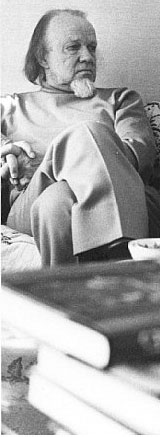
 I was born at Kislovodsk on 11th December, 1918. My father had studied philological subjects at Moscow University, but did not complete his studies, as he enlisted as a volunteer when war broke out in 1914. He became an artillery officer on the German front, fought throughout the war and died in the summer of 1918, six months before I was born. I was brought up by my mother, who worked as a shorthand-typist, in the town of Rostov on the Don, where I spent the whole of my childhood and youth, leaving the grammar school there in 1936. Even as a child, without any prompting from others, I wanted to be a writer and, indeed, I turned out a good deal of the usual juvenilia. In the 1930s, I tried to get my writings published but I could not find anyone willing to accept my manuscripts. I wanted to acquire a literary education, but in Rostov such an education that would suit my wishes was not to be obtained. To move to Moscow was not possible, partly because my mother was alone and in poor health, and partly because of our modest circumstances. I therefore began to study at the Department of Mathematics at Rostov University, where it proved that I had considerable aptitude for mathematics. But although I found it easy to learn this subject, I did not feel that I wished to devote my whole life to it. Nevertheless, it was to play a beneficial role in my destiny later on, and on at least two occasions, it rescued me from death. For I would probably not have survived the eight years in camps if I had not, as a mathematician, been transferred to a so-called sharashia, where I spent four years; and later, during my exile, I was allowed to teach mathematics and physics, which helped to ease my existence and made it possible for me to write. If I had had a literary education it is quite likely that I should not have survived these ordeals but would instead have been subjected to even greater pressures. Later on, it is true, I began to get some literary education as well; this was from 1939 to 1941, during which time, along with university studies in physics and mathematics, I also studied by correspondence at the Institute of History, Philosophy and Literature in Moscow.


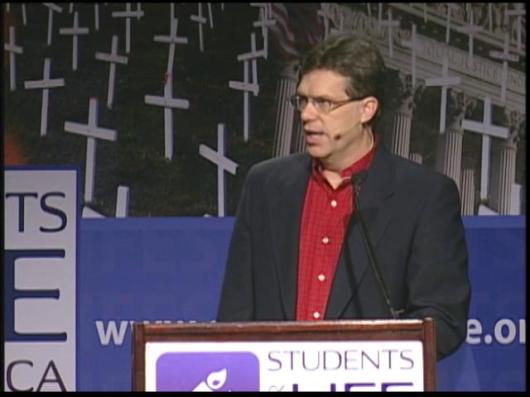
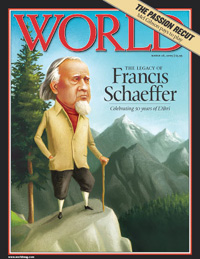
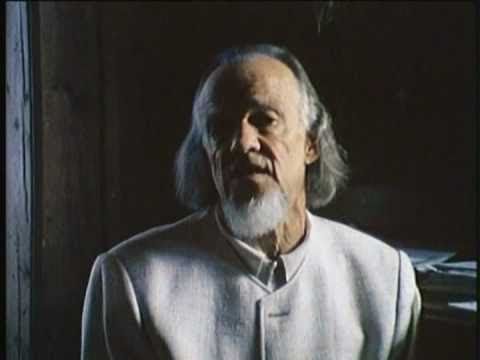
 He proposed drugs as a solution. We should, he said, give healthy people drugs and they can then find truth inside their own heads. All that was left for Aldous Huxley and those who followed him was truth inside a person’s own head. With Huxley’s idea, what began with the existential philosophers – man’s individual subjectivity attempting to give order as well as meaning, in contrast to order being shaped by what is objective or external to oneself – came to its logical conclusion. Truth is in one’s own head. The ideal of objective truth was gone.


 The Daily Hatch

