News outlets are reporting that an artist has portrayed actress Angelina Jolie as the Virgin Mary. The following analysis by philosopher-theologian Francis Schaeffer of Fouquet’s The Red Virgin provides background on the worldview dimension of this use of Marian imagery and on the modern problem of art divorced from meaning.
* Masaccio: “It is crucial to notice that with Masaccio [1401-1428?] and the others up to this point,” writes Schaeffer, “art could still have moved toward either a biblical or a nonbiblical concept of nature and the particulars (that is, the individual things, including the individual man). Up to this time it could have gone either way.” * Nature’s Proper Place: “It was good that nature was given a proper place. And there could have continued an emphasis on real people in a real world which God has made — with the particulars, the individual things, important because God made the whole world. Masaccio . . . pictured Adam and Eve as the Bible portrays them — as real people in a real world. Or at this point humanism could take over, with its emphasis on things being autonomous.” * Dilemma of Humanism: “Immediately after Masaccio, the die was cast and the movement went in this direction. Man made himself increasingly independent and autonomous, and with this came an increasing loss of anything which gave meaning, either to the individual things in the world or to man. With this we see the dilemma of humanism which is still with us today.” * Fouquet’s Red Virgin: “This position and its dilemma is strikingly shown in a shift in art. In France, one sees this with Fouquet (c. 1416-1480) in his painting The Red Virgin (1450?).” * King’s Mistress: “The world red refers to the overall color used in part of the picture. The girl was shown with one breast exposed, and everybody who knew the situation knew that this was a picture of the king’s mistress, Anges Sorel.” * Not the Madonna: “Was this the Madonna about to feed her baby? No, the painting might be titled The Red Virgin, but the girl was the king’s mistress; and when one looked at the painting one could see what the king’s mistress’s breast looked like.” * Mary as a Real Person: “Prior to this time, Mary was considered very high and holy. Earlier she was considered so much above normal people that she was painted as a symbol. When in the Renaissance Mary was painted as a real person, this was an advance over the representations of Mary in the earlier age, because the Bible tells us that Mary was a real girl and that the baby Jesus was a real baby.”
* Where Has All the Meaning Gone? “But now not only was the king’s mistress painted as Mary with all of the holiness removed, but the meaning, too, was being destroyed. As first it might have seemed that only the religious aspect was threatened. But, as we can see in retrospect, gradually the threat spread to all of knowledge and all of life.” * Beyond Meaningless Mary: “All meaning to all individual things or particulars was removed. Things were being made autonomous, and there was nothing to which to related them or to give them meaning.”
Joan Jonas was born in 1936 in New York. A pioneer of performance and video art, Jonas works in video, installation, sculpture, and drawing, often collaborating with musicians and dancers to realize improvisational works that are equally at home in the museum gallery and on the theatrical stage. Drawing on mythic stories from various cultures, Jonas invests texts from the past with the politics of the present.
By wearing masks in some works, and drawing while performing on stage in others, she disrupts the conventions of theatrical storytelling to emphasize potent symbols and critical self-awareness. From masquerading in disguise before the camera to turning mirrors on the audience, she turns doubling and reflection into metaphors for the tenuous divide between subjective and objective vision, and the loss of fixed identities.
Joan Jonas received a BA from Mount Holyoke College (1958), attended the School of the Museum of Fine Arts, Boston (1958-61), and received an MFA from Columbia University (1965). She is a professor emerita at MIT.
Among her many honors are awards from Anonymous Was A Woman (1998); the Rockefeller Foundation (1990); American Film Institute’s Maya Deren Award for Video (1989); Guggenheim Foundation (1976); and the National Endowment for the Arts (1974). Jonas has had major exhibitions at Kulturhuset Stadsteatern, Stockholm (2013); Contemporary Arts Museum Houston (2013); Documenta (2002, 2013); Performa (2013); The Kitchen (2012); Bergen Kunsthall (2011); Museum of Modern Art, New York (2010); Venice Biennale (2009); Dia:Beacon (2006); Museo Nacional Centro de Arte Reina Sofia (2006); Jeu de Paume (2005); Renaissance Society (2004); Tate Modern (2004); Queens Museum of Art (2003); Taipei Biennial (2002); and Dia Center for the Arts (2000), among others. Joan Jonas lives and works in New York and Nova Scotia, Canada.
1103 × 793Images may be subject to copyright.Learn More
The first portion of my 5-15-94 letter to Stephen Jay Gould and next week I will have the second part.
On May 15, 1994 on the 10th anniversary of the passing of Francis Schaeffer I mailed the following letter to Stephen Jay Gould.
Could you take 3 minutes and attempt to refute the nihilistic message of the song (DUST IN THE WIND) which appears at the beginning of the enclosed audio tape followed by Adrian Rogers sermon FOUR BRIDGES THE EVOLUTIONIST CAN NOT CROSS.
Back in 1980 I watched the series COSMOS and on May 5, 1994 I again sat down to watch it again. In this letter today I will tell you of 3 GENTLEMEN who contemplated the world around them. The first one is an evolutionist by the name of Carl Sagan. Mr. Sagan is what I would call a humanist full of optimism.
The second man also sought to contemplate the world around him and this man was King Solomon of Israel. In the Book of Ecclesiastes, Solomon limits himself to the question of human life lived “under the sun” between birth and death and what answers this would give (that is exactly what Mr. Sagan has done in COSMOS).It is this belief that life is only between birth and death that eventually causes Solomon to embrace nihilism. In the first few words of Ecclesiastes he observes the continual cycles of the earth and makes some very interesting conclusions”…to search for understanding about everything in the universe.”
The third man I want to mention is Francis Schaeffer who I believe was the greatest Christian philosopher of the 20th century. However, when he was a young agnostic many years ago he also had an experience similar to King Solomon’s when he contemplated the world and universe around him.contemplated the world and the universe around him.CARL SAGAN:”Our contemplations of the Cosmos stir us. There is a tingling in the spine, a catch in the voice, a faint sensation as if a distant memory of falling from a great height. We know we are approaching the grandest of mysteries.”KING SOLOMON: Ecclesiastes 1:2-11;3:18-19 (Living Bible): 2 In my opinion, nothing is worthwhile; everything is futile. 3-7 For what does a man get for all his hard work?Generations come and go, but it makes no difference.[b] The sun rises and sets and hurries around to rise again. The wind blows south and north, here and there, twisting back and forth, getting nowhere.* The rivers run into the sea, but the sea is never full, and the water returns again to the rivers and flows again to the sea . .everything is unutterably weary and tiresome. No matter how much we see, we are never satisfied; no matter how much we hear, we are not content. History merely repeats itself…For men and animals both breathe the same air, and both die. So mankind has no real advantage over the beasts; what an absurdity!—-What Solomon said ties into this following statement by evolutionist Douglas Futuyma – “Whether people are explicitly religious or not they tend to imagine that humans are in some sense the center of the universe. And what evolution does is to remove humans from the center of the universe. We are just one product of a very long historical process that has given rise to an enormous amount of organisms, and we are just one of them. So in one sense there is nothing special about us.”
———-FRANCIS SCHAEFFER: There is no doubt in my mind that Solomon had the same experience in his life that I had as a younger man (at the age of 18 in 1930). I remember standing by the sea and the moon arose and it was copper and beauty. Then the moon did not look like a flat dish but a globe or a sphere since it was close to the horizon. One could feel the global shape of the earth too. Then it occurred to me that I could contemplate the interplay of the spheres and I was exalted because I thought I can look upon them with all their power, might, and size, but they could contempt nothing. Then came upon me a horror of great darkness because it suddenly occurred to me that although I could contemplate them and they could contemplate nothing yet they would continue to turn in ongoing cycles when I saw no more forever and I was crushed.
__________________PAGE 1 B
Solomon died 3000 years ago and Francis Schaeffer passed away on May 15, 1984 exactly 10 years ago.I firmly believe Solomon was correct when he said in Ecclesiastes 7:2 “It is better to spend your time at funerals than at festivals. For you are going to die, and it is a good thing to think about it while there is time.”Suppose that you to learn that you only had just one year to live—the number of your days would be 365. What would you do with the precious few days that remained to you? With death stalking you, you would have little interest in trivial subjects and would instead be concerned with essentials. I know that is what I did when I was bed ridden in a hospital in Memphis at age 15. I was told that I may not live. My thoughts turned to spiritual things. Thank you for your time.Sincerely,Everette Hatcher III, 13900 Cottontail lane, ALEXANDER, AR 72002, TIME MAGAZINE May 28, 1984:DIED, Francis Schaeffer, 72. Christian theologian and a leading scholar of evangelical Protestantism; of cancer; in Rochester, Minn. Schaeffer, a Philadelphia-born Presbyterian, and his wife in 1955 founded L’Abri (French for ‘the shelter’), a chalet in the Swiss Alps known among students and intellectuals for a reasoned rather than emotional approach to religious counseling. His 23 philosophical books include the bestseller How Should We Then Live? (1976).” (January 30, 1912-May 15, 1985)
Adrian Rogers is pictured below and Francis Schaeffer above.
Watching the film HOW SHOULD WE THEN LIVE? in 1979 impacted my life greatly
Francis Schaeffer in the film WHATEVER HAPPENED TO THE HUMAN RACE?
and you will hear what far smarter people than I have to say on this matter. I agree with them.
Harry Kroto
__
(Harry Kroto pictured below)
I have attempted to respond to all of Dr. Kroto’s friends arguments and I have posted my responses one per week for over a year now. Here are some of my earlier posts:
I never met Stephen Jay Gould, though I did attend a lecture he gave two years ago. Still, that hour explained many of the opinions I’d heard of him: love, hate, joy, envy, and respect. Like a lot of people who make a difference, Gould was a study in contrasts. You also had to wonder whether he ran according to a different clock than the rest of us. The campy cliché 24/7 didn’t apply to Gould—he could not have fit so much in a 24-hour day and a 60-year life. Gould was first and forem
Jun 10, 2002
BARRY PALEVITZ
1I never met Stephen Jay Gould, though I did attend a lecture he gave two years ago. Still, that hour explained many of the opinions I’d heard of him: love, hate, joy, envy, and respect. Like a lot of people who make a difference, Gould was a study in contrasts. You also had to wonder whether he ran according to a different clock than the rest of us. The campy cliché 24/7 didn’t apply to Gould—he could not have fit so much in a 24-hour day and a 60-year life.
Gould was first and foremost a scientist. His immediate research area, the evolution of land snails, might seem quaint to some, but his impact transcended those bounds. Most scientists, and others as well, knew him as a bold thinker and synthesizer unafraid to ruffle feathers, particularly with his Punctuated Equilibrium hypothesis. Together with Niles Eldredge of the American Museum of Natural History, Gould tried to explain why species suddenly change in the fossil record. The jumps were real rather than illusory, they argued, and not the product of poor preservation of intermediate forms. Searching for such forms was pointless because they don’t exist. Instead, much of evolution is characterized by static periods in which organisms don’t change, interspersed with rapid speciation events.
Published in 1972, the hypothesis pitted Gould against gradualists adhering to traditional Darwinian explanations. It may seem more like a molehill than a mountain now, but at the time debate over the idea was pretty heated. “It was shocking in ’72,” says evolutionary ecologist Massimo Pigliucci of the University of Tennessee in Knoxville. “It sparked a lot of papers,” and that’s why “it was one of the most important papers of the 20th century,” he concludes.
Whether change happens gradually or in fits depends on what you define as fast in geological terms. We now know that species can dramatically adapt to environmental changes in just a few years. Male guppies rapidly resume bright coloration for sexual display once predation pressure disappears and standing out is advantageous. By virtue of molecular genetics and developmental biology, we also know that one or a few mutations in major regulatory genes generate major changes in body form. It works in plants as well as animals—just one inactivated gene changes a bilaterally symmetrical flower into a radial one.
In a way, Gould prefaced such advances. You also see Gould’s insight on evolution and development in his books, The Panda’s Thumb and Ontogeny and Phylogeny. Pigliucci considers the latter Gould’s “most important contribution. It was one of those books that changes a field.” With Elizabeth Vrba, Gould coined the term exaptation to explain how evolution reuses parts and processes to invent new ones.
Like a lot of people who shake things up, Gould had his detractors, including evolutionary adaptationists and gradualists. Still, while “there are good reasons to question some of his contributions, several of my colleagues went overboard,” admits Pigliucci.
Just last March, Gould summed up what he’d learned about evolution—and synthesized still more—in The Structure of Evolutionary Theory. Despite flaws, Gould’s 1,433-page tome is “a magnificent summary of a quarter century of influential thinking and a major publishing event in evolutionary biology,” concluded Mark Ridley in a New York Times review.
Science Popularizer
Gould had another, very public side. Along with Carl Sagan, he was one of the 20th century’s leading spokespeople and popularizers of science. While Sagan often made The Johnny Carson Show his venue, Gould reached young people in cartoon form on The Simpsons. Over the course of 28 years, he authored 300 essays in Natural History, with assorted forays into Discover and elsewhere. Unlike Sagan, Gould made it into the National Academy of Sciences despite his public persona. “I was inspired by his popular writings,” says Pigliucci, who does his own share of communicating with the public about evolution. “How many scientists bother to do that stuff?”
Gould had many strengths as a writer, but what garnered so many fans was his impeccable prose and incredible mix of metaphor, baseball, art, and literature. In a forthcoming analysis of Gould’s 300 Natural History essays in the journal Social Studies of Science, Michael Shermer, publisher of Skeptic Magazine, documented 53 mentions of the Bible, 21 of Gilbert and Sullivan (a Gould favorite), 19 of Shakespeare, and eight of Alexander Pope. He also found 16 Latin phrases, nine in French, six in German, and one in Italian. Adds Shermer, “73% contain a significant historical element.” It’s no surprise that Gould was as much a favorite on the humanities side of American campuses as in science labs.
Gould’s writing was anthologized for freshmen English courses, notes Hugh Ruppersburg, professor of English and associate dean of Arts and Sciences at the University of Georgia in Athens. “His essays … were excellent examples of nonfiction prose.” Ruppersburg thinks Gould was better than science writers who aren’t professional scientists. “There was something about the way he expressed concepts that made it clear he learned them himself,” he says.
One of the people who anthologized Gould’s work is Penn State English professor John Selzer. “He was a very gifted individual, cosmopolitan in his allusions and metaphors—a lot of fun to read,” he says. Selzer picked Spandrels of San Marco, coauthored by Gould and Harvard colleague Richard Lewontin, as a prime example. Another reason Selzer thinks Gould was a hit in the humanities was his “strong argumentative edge and a real sense of voice” in taking sides on issues such as sociobiology.
Opinions are split, however, on how good a writer Gould really was, at least later in life. Pigliucci won’t argue about Gould’s early work, but thinks his writing style became “baroque.” There were so many metaphors and diversions, it was hard to follow where he was going. At one point in Gould’s Rocks of Ages, which elaborated on his nonoverlapping magisteria argument for distinguishing science and religion, I almost screamed, “No!” after reading what seemed like the hundredth use of the word exegesis.
From my point of view, Gould was at his best in explaining the history, philosophy, and methods of science to a public that, despite his best efforts, is still woefully ignorant of the subjects. “Half the book was history,” marvels Pigliucci of Ontogeny and Phylogeny. “Scientists have a stupid tendency to ignore history,” he says, but not Gould. Maybe his training in paleontology made history an obvious tool. Opines Shermer, “As a historian and philosopher of science, Gould was intensely interested in the interaction between individual scientists and their cultures.”
Creationism Wars
Perhaps nowhere save human cloning does science conflict with culture as does evolution with fundamentalist religion. Gould “was a public scientist,” says Barbara Forrest, a historian at Southeastern Louisiana University in Hammond who studies creationism. Forrest appreciated Gould’s willingness to stand up for evolution in public school science curricula. Unlike many of his evolutionist colleagues, Gould thought the battle worth fighting. He even testified in the famous McLean v. Arkansas Board of Education case. Federal judge William Overton in part used Gould’s testimony in 1982 to outlaw equal time for so-called scientific creationism in Arkansas schools. It wasn’t easy for Gould, whose words and ideas were often misrepresented by creationists. “He was prone to comments that can easily be extracted from text and taken to mean exactly the opposite of what he meant,” says Elizabeth Craig of Kansas Citizens for Science.
When creationism mutated into its latest incarnation, ‘intelligent design theory,’ about 10 years ago, Gould again pitched in, for example, with his book Rocks of Ages and a Time magazine commentary on the Kansas School Board decision to remove evolution from state science standards. Michigan State University philosopher Robert Pennock used two of Gould’s essays in a recent, mammoth point-counterpoint analysis of intelligent design. Says Forrest, “A person as important in science as he was thought it worthwhile to get involved. He lent his reputation to get the attention of the media. He did what I wish more scientists would do.”
Pugnacious, or Obnoxious?
Gould was a fascinating, complex character who had weaknesses as well as strengths, including a reputation for arrogance. Many scientists still resent the rough treatment Gould and Lewontin gave soft-spoken biologist E.O. Wilson, father of the sociobiology field, back in the 1970s. The word around Harvard Yard, at least among some students, was that Gould was arrogant. Still, his classes filled. In a touching letter to the New York Times on May 22, a student in Gould’s history of life class paid tribute, calling Gould’s teaching: “a tour de force that Harvard students may not see the likes of any time soon.”
My Two Cents
Will Rogers once said of an American president, “He puts his pants on one leg at a time,” meaning he’s only human. The question is, do we hold Gould’s personal failings so important that they distort the sum of his life in science and society? The answer is no. When all is said and done, Gould made a big difference. With the death of Carl Sagan in 1996, and now Stephen Jay Gould, science is much the poorer, given that so many of its practitioners shy away from making their work accessible to the public.
On the bright side, for the first time, more than 50% of Americans agree that humans evolved from simpler animals, according to a recent National Science Board survey. We still have great science popularizers, such as E.O. Wilson and Jared Diamond. And more have come out of the ivory closet, witness testimony and articles about biotechnology and cloning. Still, we’ll miss YOU, Steve.Barry A. Palevitz (palevitz@dogwood.botany.uga.edu) is a contributing editor.
1986: The internationally-acclaimed artist, Robert Rauschenberg, with paleontologist and evolutionary biologist, Stephen Jay Gould during the American Academy of Achievement’s 25th-anniversary Summit at historic Mount Vernon, Virginia; 1987: Awards Council member Dr. Stephen Jay Gould presents the Academy of Achievement’s Golden Plate Award to Dr. Jane Goodall at the Banquet of the Golden Plate gala ceremonies in Scottsdale, Arizona.
Stephen Jay Gould is the scholar I will look at today.In the third video below in the 147th clip in this series are his words “If I were a bacteria I would be quite satisfied that I was dominating the planet…I don’t know why consciousness should be seen as any state of higher being especially if you use the evolutionist primary criterion of success measured by duration” and I have responded directly to this quote in any earlier post.
50 Renowned Academics Speaking About God (Part 1)
Another 50 Renowned Academics Speaking About God (Part 2)
A Further 50 Renowned Academics Speaking About God (Part 3)
In 1978 I heard the song “Dust in the Wind” by Kansas when it rose to #6 on the charts. That song told me that Kerry Livgren the writer of that song and a member of Kansas had come to the same conclusion that Solomon had. I remember mentioning to my friends at church that we may soon see some members of Kansas become Christians because their search for the meaning of life had obviously come up empty even though they had risen from being an unknown band to the top of the music business and had all the wealth and fame that came with that. Furthermore, Solomon realized death comes to everyone and there must be something more.
(This is the reason I put the 3 minute song DUST IN THE WIND at the beginning of the audio cassette tape I sent to these atheists on May 15, 1994!!!)
Livgren wrote:
“All we do, crumbles to the ground though we refuse to see, Dust in the Wind, All we are is dust in the wind, Don’t hang on, Nothing lasts forever but the Earth and Sky, It slips away, And all your money won’t another minute buy.”
Take a minute and compare Kerry Livgren’s words to that of the late British humanist H.J. Blackham:
“On humanist assumptions, life leads to nothing, and every pretense that it does not is a deceit. If there is a bridge over a gorge which spans only half the distance and ends in mid-air, and if the bridge is crowded with human beings pressing on, one after the other they fall into the abyss. The bridge leads nowhere, and those who are pressing forward to cross it are going nowhere….It does not matter where they think they are going, what preparations for the journey they may have made, how much they may be enjoying it all. The objection merely points out objectively that such a situation is a model of futility“( H. J. Blackham, et al., Objections to Humanism (Riverside, Connecticut: Greenwood Press, 1967).
_____________________________________
Both Kerry Livgren and the bass player DAVE HOPE of Kansas became Christians eventually. Kerry Livgren first tried Eastern Religions and DAVE HOPE had to come out of a heavy drug addiction. I was shocked and elated to see their personal testimony on The 700 Club in 1981 and that same interview can be seen on youtube today. Livgren lives in Topeka, Kansas today where he teaches “Diggers,” a Sunday school class at Topeka Bible Church. DAVE HOPE is the head of Worship, Evangelism and Outreach at Immanuel Anglican Church in Destin, Florida.
_
Kerry Livgren/Dave Hope: 700 Club Interview (Kansas) Part 2
__________________ Beatles 1966 Last interview I have dedicated several posts to this series on the Beatles and I don’t know when this series will end because Francis Schaeffer spent a lot of time listening to the Beatles and talking and writing about them and their impact on the culture of the 1960’s. In this […]By Everette Hatcher III | Posted in Francis Schaeffer | Tagged George Harrison, John Lennon, Paul MacCartney, Peter Blake, Ringo Starr | Edit | Comments (1)
_______________ The Beatles documentary || A Long and Winding Road || Episode 5 (This video discusses Stg. Pepper’s creation I have dedicated several posts to this series on the Beatles and I don’t know when this series will end because Francis Schaeffer spent a lot of time listening to the Beatles and talking and writing about […]By Everette Hatcher III | Posted in Francis Schaeffer | Tagged Beatles, Mika Tajima | Edit|Comments (0)
_______________ Francis Schaeffer pictured below: _____________________ I have included the 27 minute episode THE AGE OF NONREASON by Francis Schaeffer. In that video Schaeffer noted, ” Sergeant Pepper’s Lonely Hearts Club Band…for a time it became the rallying cry for young people throughout the world. It expressed the essence of their lives, thoughts and their feelings.” How Should […]By Everette Hatcher III | Posted in Francis Schaeffer | Tagged Blow Up, David Hemmings,Michelangelo Antonioni, Nancy Holt, Sarah Miles., Vanessa Redgrave | Edit |Comments (0)
Crimes and Misdemeanors: A Discussion: Part 1 ___________________________________ Today I will answer the simple question: IS IT POSSIBLE TO BE AN OPTIMISTIC SECULAR HUMANIST THAT DOES NOT BELIEVE IN GOD OR AN AFTERLIFE? This question has been around for a long time and you can go back to the 19th century and read this same […]By Everette Hatcher III | Posted in Francis Schaeffer, Woody Allen | Tagged alan alda, Anjelica Huston, mia farrow, Sam Waterston | Edit | Comments (0)
Love and Death [Woody Allen] – What if there is no God? [PL] ___________ _______________ How Should We then Live Episode 7 small (Age of Nonreason) #02 How Should We Then Live? (Promo Clip) Dr. Francis Schaeffer 10 Worldview and Truth Two Minute Warning: How Then Should We Live?: Francis Schaeffer at 100 Francis Schaeffer […]By Everette Hatcher III | Posted in Francis Schaeffer, Woody Allen | Tagged Allora & Calzadilla |Edit| Comments (0)
___________________________________ Francis Schaeffer pictured below: ____________________________ Francis Schaeffer “BASIS FOR HUMAN DIGNITY” Whatever…HTTHR Dr. Francis schaeffer – The flow of Materialism(from Part 4 of Whatever happened to human race?) Dr. Francis Schaeffer – The Biblical flow of Truth & History (intro) Francis Schaeffer – The Biblical Flow of History & Truth (1) Dr. Francis Schaeffer […]By Everette Hatcher III | Posted in Francis Schaeffer | Tagged Trey McCarley | Edit | Comments (0)
____ I have read over 40 autobiographies by ROCKERS and it seems to me that almost every one of those books can be reduced to 4 points. Once fame hit me then I became hooked on drugs. Next I became an alcoholic (or may have been hooked on both at same time). Thirdly, I chased the skirts and thought happiness would be found through more sex with more women. Finally, in my old age I have found being faithful to my wife and getting over addictions has led to happiness like I never knew before. (Almost every autobiography I have read from rockers has these points in it although Steven Tyler is still chasing the skirts!!). Paul was a playboy early on when with the Beatles but he settled down when he met Linda. Paul has not written an autobiography but I highly recommend the book PAUL MCCARTNEY: THE LIFE by Philip Norman.
_
March 8, 2016
Paul McCartney
Dear Paul,
I was so pumped up to read this morning about you having a concert in Little Rock on April 30th and I plan to buy tickets and go see you in person and I thought I would never get to do that in my whole lifetime. I got a big kick out of taking my family to see Ringo at Orange Beach, Alabama on July 4th, 2012. It was a great show. In fact, I have been so focused on the Beatles in recent years that I have done over a year worth of weekly posts on my blog http://www.thedailyhatch.org ever Thursday entitled FRANCIS SCHAEFFER ANALYZES ART AND CULTURE and posts 49 to 101 have been about the Beatles with more to come. In fact, if you google the words FRANCIS SCHAEFFER BEATLES you the first 10 items that pop up will be links to my blog posts on Thursdays about the Beatles and what Francis Schaeffer had to say about them.
Melanie Coe ran away from home in 1967 when she was 15. Paul McCartney read about her in the papers and wrote ‘She’s Leaving Home’ for Sgt.Pepper’s. Melanie didn’t know Paul’s song was about her, but actually, the two did meet earlier, when Paul was the judge and Melanie a contestant in Ready Steady Go!
The subtitles are produced live for The One Show, so some seconds late and with a few mistakes.
Melanie’s first moment of fame, receiving a prize from Paul McCartney for miming to Brenda Lee on Ready Steady Go! in 1963
Melanie in 2008
She’s Leaving Home The Beatles Sgt. Pepper’s
Wednesday morning at five o’clock as the day begins Silently closing her bedroom door Leaving the note that she hoped would say more She goes downstairs to the kitchen clutching her hankerchief Quietly turing the backdoor key Stepping outside she is free. She (We gave her most of our lives) is leaving (Sacraficed most of our lives) home (We gave her everything money could buy) She’s leaving home after living alone For so many years. Bye, bye Father snores as his wife gets into her dressing gown Picks up the letter that’s lying there Standing alone at the top of the stairs She breaks down and cries to her husband Daddy our baby’s gone. Why would she treat us so thoughtlessly How could she do this to me. She (We never though of ourselves) Is leaving (Never a thought for ourselves) home (We struggled hard all our lives to get by) She’s leaving home after living alone For so many years. Bye, bye Friday morning at nine o’clock she is far away Waiting to keep the appointment she made Meeting a man from the motor trade. She What did we do that was wrong Is having We didn’t know it was wrong Fun Fun is the one thing that money can’t buy Something inside that was always denied For so many years. Bye, Bye She’s leaving home bye bye
Why is she leaving home? Francis Schaeffer noted on pages 15-17 in volume 4 of THE COMPLETE WORKS OF FRANCIS SCHAEFFER from the original book “The Church at the end of the 20th Century” the reason she left and it was because of the bankruptcy of the materialistic views of her parents. Schaeffer points that for many years there was one message that the media was promoting and that was since we now believe in the “UNIFORMITY OF NATURAL CAUSES IN A CLOSED SYSTEM we are left with only the impersonal plus time plus chance.” Schaeffer continued:What is taught is that there is no final truth, no meaning, no absolutes, that it is only that we have not found truth and meaning, but that they do not exist. The student and the common man may not be able to analyze it, but day after day, day after day, they are being battered by this concept. We have now had several generations exposed to this and we must not be blind to the fact that it is being excepted increasingly.In contrast, this way of thinking has not had as much influence on the middle class. Many of these keep thinking in the old way as a memory of the time before the Christian base was lost in this post-Christian world. However, the majority in the middle-class have no real basis for their values since so many have given up the Christian viewpoint. They just function on the “memory.” This is why so many young people have felt that the middle class is ugly.They feel middle-class people are plastic, ugly and plastic because they try to tell others what to do on the basis of their own values but with no ground for those values.They have no base and they have no clear categories for their choices of right and wrong. Their choices tend to turn on what is for their material benefit. Take for example the fact faculty members who cheered when the student revolt struck against the administration and who immediately began to howl when the students started to burn up faculty manuscripts. They have no categories to say this is right and that is wrong. Many such people still hang on to their old values by memory but they have no base for them at all. A few years ago John Gardner head of the urban coalition spoke in Washington to a group of student leaders. His topic was on restoring values in our culture. When he finished there was a dead silence then finally one man from Harvard stood up and in a moment of brilliance asked, “Sir upon what base do you build your values?” I have never felt more sorry for anybody in my life. He simply looked down and said, “I do not know.” I had spoken that same day about what I was writing in the first part of this book. It was almost too good an illustration of my lecture. Here was a man appealing to the young people for a return to values but he is offering nothing to build on. man who was trying to tell his hearers not to drop out and yet giving no reason why they should not. Functioning only on a dim memory, these are the parents who have turned off their children when their children ask why and how. When their children crying out, “Yours is a plastic culture.” They are silent. We had the response so beautifully stated in the 1960s in the Beatles’ Sergeant Pepper’s song “She is leaving home.” “We gave her everything money could buy.” This is the only answer many parents can give.They are bothered about what they read in the newspapers concerning the way the country and the culture are going. When they read of the pornographic plays, see pornographic films on TV, they are distressed. They have a vague unhappiness about it, feel threatened by all of it and yet have no base upon which to found their judgments. And tragically such people are everywhere. They constitute the largest body in our culture-northern Europe, Britain, and also in America and other countries as well. They are a majority-what is called for a time the “silent majority”–but they are weak as water. They are people who like the old ways because they are pleasant memories, because they give what to them is a comfortable way to live but they have no basis for their values. Education for example is excepted and pressed upon their children as the only thinkable thing to pursue. Success is starting the child at the earliest possible age and then within the least possible years he is obtaining a Masters or PhD degree. Yet if the child asks why?, the only answers are first because it gives social status and then because statistics show that if you have a university or college education you will make more money. There is no base for real values are even the why of a real education.
________
When you think about the song SHE’S LEAVING HOME, you must come to the conclusion that the Beatles knew exactly what was going through the young person’s mind in the 1960’s. No wonder in the video THE AGE OF NON-REASON (which is on You Tube under the title HOW SHOULD WE THEN LIVE? EPISODE 7) Schaeffer noted, ” Sergeant Pepper’s Lonely Hearts Club Band…for a time it became the rallying cry for young people throughout the world. It expressed the essence of their lives, thoughts and their feelings.”
Little One – From the Film, “Sarah’s Choice” Rebecca St James on faith and values – theDove.us Sarah’s Choice Trailer Sarah’s Choice – Behind the Scenes Rebecca St. James on Sarah’s Choice – CBN.com Rebecca St James Interview on Real Videos Sarah’s Choice – The Proposal Sarahs Choice Pregnancy Test Sarahs Choice Crossroad Sarah’s Choice […]By Everette Hatcher III | Posted in Current Events | Edit | Comments (0)
Lion – Rebecca St. James I will praise You – Rebecca St James Rebecca St James 1995 TBN – Everything I Do Rebecca St. James & Rachel Scott “Blessed Be Your Name” Rebecca St. James From Wikipedia, the free encyclopedia Rebecca St. James St. James in 2007 Background information Birth name Rebecca Jean Smallbone Also […]By Everette Hatcher III | Posted in Current Events | Edit | Comments (0)
Foster The People – Pumped up Kicks Foster the People From Wikipedia, the free encyclopedia Foster the People Foster the People at the 2011 MuchMusic Video Awards, from left to right: Pontius, Foster, and Fink Background information Origin Los Angeles, California, U.S. Genres Indie pop alternative rock indietronica alternative dance neo-psychedelia[1] Years active 2009–present Labels […]By Everette Hatcher III | Posted in Current Events | Edit | Comments (0)
‘Apple gave me advice’: Coldplay’s Chris Martin turned to 11-year-old daughter for words of wisdom ahead of Superbowl 50 By DAILYMAIL.COM REPORTER PUBLISHED: 00:58 EST, 2 February 2016 | UPDATED: 17:20 EST, 2 February 2016 n Facebook They’ve sold 80 million records and been around for 20 years. But Coldplay’s lead singer Chris Martin, 38, […]By Everette Hatcher III | Posted in Current Events | Edit | Comments (0)
__________ Chris Martin, Lead Singer of Coldplay: 5 Fast Facts You Need to Know Published 3:44 pm EDT, February 7, 2016 Updated 3:44 pm EDT, February 7, 2016 Comment By Lauren Weigle 17.6k (Getty) Chris Martin has been the front-man of the band Coldplay for about 20 years, though the band changed its name a […]By Everette Hatcher III | Posted in Current Events | Edit | Comments (0)
Christian Rock Pioneer Larry Norman’s Songs Part 14 I posted a lot in the past about my favorite Christian musicians such as Keith Green (I enjoyed reading Green’s monthly publications too), and 2nd Chapter of Acts and others. Today I wanted to talk about one of Larry Norman’s songs. David Rogers introduced me to Larry […]By Everette Hatcher III | Posted in Current Events | Edit | Comments (0)
Christian Rock Pioneer Larry Norman’s Songs Part 13 I posted a lot in the past about my favorite Christian musicians such as Keith Green (I enjoyed reading Green’s monthly publications too), and 2nd Chapter of Acts and others. Today I wanted to talk about one of Larry Norman’s songs. David Rogers introduced me to Larry […]By Everette Hatcher III | Posted in Current Events | Edit | Comments (0)
Christian Rock Pioneer Larry Norman’s Songs Part 12 I posted a lot in the past about my favorite Christian musicians such as Keith Green (I enjoyed reading Green’s monthly publications too), and 2nd Chapter of Acts and others. Today I wanted to talk about one of Larry Norman’s songs. David Rogers introduced me to Larry […]By Everette Hatcher III | Posted in Current Events | Edit | Comments (0)
Christian Rock Pioneer Larry Norman’s Songs Part 11 I posted a lot in the past about my favorite Christian musicians such as Keith Green (I enjoyed reading Green’s monthly publications too), and 2nd Chapter of Acts and others. Today I wanted to talk about one of Larry Norman’s songs. David Rogers introduced me to Larry […]By Everette Hatcher III | Posted in Current Events | Edit | Comments (0)
Christian Rock Pioneer Larry Norman’s Songs Part 10 more on Album “Only Visiting This Planet” I posted a lot in the past about my favorite Christian musicians such as Keith Green (I enjoyed reading Green’s monthly publications too), and 2nd Chapter of Acts and others. Today I wanted to talk about one of Larry Norman’s […]By Everette Hatcher III | Posted in Current Events | Edit | Comments (0)
959 × 639Images may be subject to copyright.Learn More
I had the district privilege to correspond with Milton Friedman and I have read about every book he has ever written and watched almost every interview he has ever given and it is my conclusion that this interview below from REASON MAGAZINE was the most extensive. I don’t agree with everything that has come out of Milton’s mouth, but I must say that he changed my outlook on life. Milton Friedman and Margaret Thatcher were two of my heroes and I know that you can learn a great deal from their lives and their economic philosophies. Ronald Reagan and Margaret Thatcher were both were influenced by Milton Friedman. I suggest checking out these episodes of Milton Friedman’s film series FREE TO CHOOSE: “The Failure of Socialism” and “What is wrong with our schools?” and “Created Equal” and From Cradle to Grave, and – Power of the Market.
Milton Friedman needs little introduction. His career as one of the world’s preeminent economists and advocates of freedom has won him many accolades, best-selling books, and a Nobel Prize.
It has also brought him much satisfaction. Now, in what he is acutely conscious are probably the last years of his life, he and his wife and longtime writing partner Rose Friedman are working on their memoirs.
I met Friedman in January in his elegant high-rise San Francisco condo, with an absorbing view of both the Pacific Ocean and the San Francisco Bay. His study is filled, but not cluttered, with his own books and economics reference works. While some Great Men in his position in life might refuse nuisances like interviewers entirely, Friedman is friendly and mostly forthcoming, speaking with the slow assurance of a lifelong professor and teacher very comfortable with explaining things. He welcomed me cordially but with a distinct set of limits, both in time and in subject matter. He has a large project to finish, and not much time to finish it in; and he refuses to psychoanalyze himself, largely avoids indulging in discussion of personalities, and wants to save some stories for his memoirs.
400 × 296Images may be subject to copyright. Learn More
Friedman is used to discussing policy, but except for his assessment of the new Congress’s potential, we wandered far afield into reminiscence; assessment of his intellectual development; and his thoughts on the history, significance, and successes of the intellectual movement for freedom that he has served so staunchly.
190 × 215Images may be subject to copyright. Learn More
Reason: You’ve long advocated many of the ideas the new Congress is pushing, such as balanced budget amendments and flat taxes. Do you think Congress will make your dreams come true?
Milton Friedman: I’m skeptical. The talk is good. But I expected so much out of the Reagan administration and was disappointed. I’m a great admirer of Ronald Reagan himself, and I suspect he would have gotten much more done if it hadn’t been for the Cold War and the problem of Nicaragua and El Salvador.
But nonetheless, there’s no doubt that while he talked about cutting down the size of government, he did not succeed. He did slow it down—you’ve got to give him credit for some achievements. But not the massive reduction that he hoped for and planned for. That makes me hesitant now.
Congress wants to talk in this direction. Would they really want to move in that direction? The most important reform would be term limits, six-year limits. Because from an economic point of view, one of the worst features of our system is that you have a new tax law every year or every two years. However bad the tax law is, if you didn’t change it for five years it would do less harm. Why do you keep changing it? Because that’s the most effective way to raise campaign funds. Lobbyists will pay you to put loopholes in; they will pay you to take them out.
If you can get a flat tax with no exemptions or deductions—the Armey plan I suppose would be fine—its main advantage would not be the greater equity of a flat tax or less interference in private incentives. It would be to end this business of changing the whole tax system every few years and keeping prosperous these hordes of tax lawyers.
Reason: You were involved in the development of the withholding tax when you were doing tax work for the government in 1941–43?
Friedman: I was an employee at the Treasury Department. We were in a wartime situation. How do you raise the enormous amount of taxes you need for wartime? We were all in favor of cutting inflation. I wasn’t as sophisticated about how to do it then as I would be now, but there’s no doubt that one of the ways to avoid inflation was to finance as large a fraction of current spending with tax money as possible.
In World War I, a very small fraction of the total war expenditure was financed by taxes, so we had a doubling of prices during the war and after the war. At the outbreak of World War II, the Treasury was determined not to make the same mistake again.
You could not do that during wartime or peacetime without withholding. And so people at the Treasury tax research department, where I was working, investigated various methods of withholding. I was one of the small technical group that worked on developing it.
One of the major opponents of the idea was the IRS. Because every organization knows that the only way you can do anything is the way they’ve always been doing it. This was something new, and they kept telling us how impossible it was. It was a very interesting and very challenging intellectual task. I played a significant role, no question about it, in introducing withholding. I think it’s a great mistake for peacetime, but in 1941–43, all of us were concentrating on the war.
I have no apologies for it, but I really wish we hadn’t found it necessary and I wish there were some way of abolishing withholding now.
Reason: You’ve also had some history of advising candidates and presidents. How did you get involved in the Goldwater campaign?
Friedman: Through Bill Baroody at the American Enterprise Institute. The American Enterprise Institute was originally the American Enterprise Association, and had established a board of academic advisers to advise them on their publications. I had been a member of that I think since its inception, and Baroody arranged sometime in the early ’60s a number of dinners at his house at which Goldwater was present. Baroody was the brain trust for Goldwater. I was also at some of those dinners, so I got to meet Goldwater. And then when the campaign came along, Baroody asked me to serve as economic adviser. I didn’t go on the campaign trail. I sat at home and wrote memos.
Reason: Were you impressed with Goldwater’s acumen?
Friedman: It depends on what you mean by acumen. There’s no doubt whatsoever that he’s a man of principle and strong character. His IQ is perfectly reasonable but it’s not outstanding among the various politicians I’ve met, and that shows why IQ is not a good measure. The highest IQ was Richard Nixon’s and he was a terrible president
While I was never a governmental official, I was a member of an economic advisory group that Nixon appointed of which Arthur Burns was chairman. I saw Nixon from time to time when he was president, until he imposed price controls. I saw him only once after that.
Reason: Did you stop giving him advice?
Friedman: I kept giving him advice from Newsweek, but not personally.
Reason: Do you have a clear memory of how your political philosophy formed? Was it any specific teacher you encountered, book you read, or experience?
Friedman: I’m sure it was a combination of all of those. I was exposed as an undergraduate at Rutgers to two very strong influences: Homer Jones, who was a student of Frank Knight’s from Chicago, and Arthur Burns. They both had a considerable influence on me as an undergraduate in my thinking and my writing.
But it would be hard to say what philosophy that left me with. One of the things I regretted all my life is that when I graduated from Rutgers and came home, I wrote out a statement of my beliefs. I put that away in a drawer somewhere in my mother’s home and I’ve never been able to find the damn thing! I’d love to have it! So I can’t really tell you what I believed at that time.
But obviously my ideas were not very well formed. I was an innocent youngster and what I was impressed by, of course, was the Great Depression, and the belief that somehow or another there ought to be something that can prevent any such thing from happening.
Thanks to Homer, I was offered a scholarship at the University of Chicago and I went to Chicago and studied with Frank Knight, Jacob Viner, Henry Schultz, and so on. The atmosphere in Chicago in 1932 was very lively and active and encouraging. Of course, I got a very good grounding in economic theory and statistics as well.
Next year, I managed to get a fellowship to Columbia. I spent a year at Columbia mainly to study with Harold Hotelling, who was a mathematical economist and statistician.
Then I went back to Chicago for one year and was a research assistant to Henry Schultz. There were a group of students in Chicago who were very, very important. George Stigler, Allen Wallis, Rose Director, and myself. We ate almost every lunch and dinner together. We spent all the time discussing economics, both economic theory and economic policy. And we were very close for the rest of our lives. George died about two years ago. Allen, I’m glad to say, is still alive.
In the 1930s, both Rose and I at separate times went to Washington and worked on the New Deal, but we were technical statisticians and economists, not anything that had any policy role.
Throughout my career, I spent most of my time on technical economics. This policy stuff has been a strict avocation. If you really want to engage in policy activity, don’t make that your vocation. Make it your avocation. Get a job. Get a secure base of income. Otherwise, you’re going to get corrupted and destroyed. How are you going to get support? You’re only going to get support from people who are ideologically motivated. And you’re not going to be as free as you think you’re going to be.
One of the most important things in my career is that I always had a major vocation which was not policy. I don’t regard what I’ve done in the field of monetary policy as on the same level as what I’ve done about trying to get rid of the draft or legalizing drugs. One is a technical byproduct of scientific work, and so that’s the only sense in which my vocation has affected my policy. But by having a good firm position in the academic world, I was perfectly free to be my own person in the world of policy. I didn’t have to worry about losing my job. I didn’t have to worry about being persecuted.
I think you’ll make a mistake if you’re going to spend your life as a policy wonk. I’ve seen some of my students who have done this. And some of them are fine, and some of them, especially those who have gone to Washington and stayed, are not.
Reason: How did you come to enter the world of policy writing?
Friedman: What really got me started in policy and what led to Capitalism and Freedom was, in an indirect way, the Mont Pelerin Society. The first Mont Pelerin Society meeting was in 1947 in Switzerland. Hayek arranged it. It was his idea.
Mont Pelerin was the first time that I came into contact with people like Hayek, Lionel Robbins, and the European contingent of that time. That widened my perspective about issues and policy.
The Mont Pelerin Society was people who were deeply concerned about issues. It was people with whom you shared a basic common belief, who at home were isolated. Its great contribution was that it provided a week when people like that could get together and open their hearts and minds and not have to worry about whether somebody was going to stick a knife in their back—especially for people in countries where they were isolated.
The reason the Society ever happened was that Hayek had written The Road to Serfdom, which attracted the attention of the Volker Foundation, and it was the Volker Foundation that financed the American participation in the Mont Pelerin Society. A Swiss group financed the Swiss and European participation.
In the middle ’50s, the Volker Foundation undertook a program of summer institutes for junior academics who were favorably inclined toward a free-market point of view or were interested in such issues. Capitalism and Freedom was based on a series of lectures that I gave at one of those seminars. Those seminars forced me to systematize my thoughts and present them in a coherent way. And they also provided a very good audience because the people who were there were lively, outspoken, didn’t hesitate to criticize. It was a very good audience. There was a lot of free time as well for discussions outside of the formal seminar. And I learned a great deal, not only from the students who were there, but also the fellow lecturers.
And then my wife, Rose, took the transcribed tapes of the lectures and reworked them and that’s what became Capitalism and Freedom.
Reason: Did you have any hesitation about publishing that book?
Friedman: None whatsoever. Why should I have had any hesitation? Remember, I was a tenured professor.
Another thing that helped form my policy orientation was when Hayek came to Chicago in 1950. He attracted quite a number of very able students, Sam Peltzman, Ron Hamowy, Ralph Raico, Shirley Letwin. There were quite a group of them. Hayek drew very high quality people. I was an adviser to their New Individualist Review and contributed articles to it. They were a very lively group that had organized discussion sessions and so on, which was part of the atmosphere.
I was persuaded at that time in the early 1960s that we were on the verge of developing a strong libertarian movement. These were libertarians, all of them, though Hayek would not have labeled himself a libertarian. As you know, he always avoided the termconservative, too. He would call himself an Old Whig. The others would have called themselves libertarians.
That’s how I was able to develop my own ideas. What shaped them was the interaction with all these other people at lunches and dinners and lectures.
Ayn Rand was receiving increasing attention at that time. I believed a big upsurge in the libertarian philosophy and views was pending. And to some extent it was. You had the Randian group, and the Murray Rothbard group. But the developing libertarian movement was repressed by the Vietnam War and what it led to. You’ve only got room for one big movement at a time.
Reason: Why do you think you had more initial success as a public proselytizer—you had a regular column inNewsweek—than other prominent libertarians?
Friedman: I really don’t know how to answer that. I was basically trained in economic science. I was interested in the history of thought and where it came from. I thought I was going back to some fundamentals rather than creating anything new. Ayn Rand had no use for the past. She was going to invent the world anew. She was an utterly intolerant and dogmatic person who did a great deal of good. But I could never feel comfortable with her. I don’t mean with her personally—I never met her personally. I’m only talking about her writings.
Rothbard was a very different character. I had some contact with Murray early on, but very little contact with him overall. That’s primarily because I deliberately kept from getting involved in the Libertarian Party affairs; partly because I always thought Murray, like Rand, was a cult builder, and a dogmatist. Partly because whenever he’s had the chance he’s been nasty to me and my work. I don’t mind that but I didn’t have to mix with him. And so there is no ideological reason why I kept separate from him, really a personal reason.
Reason: In seeing yourself as harkening back to 19th-century liberalism, you never became a system-builder like Rand or Rothbard….
Friedman: Exactly. I’d rather use the term liberal than libertarian.
Reason: I see you occasionally use the word libertarian.
Friedman: Oh, I do.
Reason: As a concession to accepted usage?
Friedman: That’s right. Because now liberal is so misinterpreted. So I am a Republican with a capital “r” and a libertarian with a small “l.” I have a party membership as a Republican, not because they have any principles, but because that’s the way I am the most useful and have most influence. My philosophy is clearly libertarian.
However, libertarian is not a self-defining term. There are many varieties of libertarians. There’s a zero-government libertarian, an anarchist. There’s a limited-government libertarianism. They share a lot in terms of their fundamental values. If you trace them to their ultimate roots, they are different. It doesn’t matter in practice, because we both want to work in the same direction.
I would like to be a zero-government libertarian.
Reason: Why aren’t you?
Friedman: Because I don’t think it’s a feasible social structure. I look over history, and outside of perhaps Iceland, where else can you find any historical examples of that kind of a system developing?
Reason: One could argue the same thing about minimal-state libertarianism: that historically it seems to not be stable.
Friedman: I agree. I wrote an article once arguing that a free society is an unstable equilibrium. Fundamentally, I’m of the opinion that it is. Though we want to try to keep that unstable equilibrium as long as we can! The United States from 1780 to 1929 is not a bad example of a limited-government libertarianism that lasted for a long time.
Reason: Is feeling like part of a larger movement important to you? Would you have been able to do the work you did had you not felt part of a community of like-minded scholars?
Friedman: I’ve been very fortunate in being part of two communities of scholars: the community of economists on the one hand, and the community of libertarians on the other. And that combination has been very productive so far as I’m concerned, but I can’t really tell you why. One thing is that it’s very hard for somebody on his own to be sure that he’s thought of all the angles. Discussion among people helps an enormous amount. And particularly able, good people.
If you have a person isolated in an environment unfriendly to his ideas and thoughts, he tends to turn bitter and self-directed. But the same person with three or four other people around—it doesn’t have to be a lot of people—will be in a wholly different position since he will receive support from the others.
You remind me of one incident where in a sense the two worlds interacted. Back in the 1960s, my daughter was an undergraduate at Bryn Mawr, and I was invited by Haverford, I think it was, to spend three days giving talks on mathematical economics. Absolutely no policy involved, pure mathematical economics. And because my daughter was at Bryn Mawr, I agreed.
After I had agreed, they asked if I would also be willing to give a chapel talk on political matters. I said sure and I gave a title, something having to do with freedom. Then I discovered that chapel at Haverford was compulsory. I wrote to the president and said that I was very much disturbed at giving a talk on freedom to a compulsory audience.
When it was time to go to the chapel, I asked the president, “How do they count attendance?” And he said, “At the beginning of the hour there are people going around in the balcony and looking down. Everybody has an assigned seat, and they count.”
When I got up to talk, I spoke up to the people in the balcony and said that those who were counting attendance, please let me know when they’re through because I don’t like the idea of speaking about freedom to a compulsory audience. I’m going to sit down and give the people who want to leave the chance to leave. And I did. Now, the students hadn’t really thought that I was going to do it and when I did, about one or two people got up to leave and the rest of them booed them because obviously, I was talking on their level. As a result, I’ve seldom had a student audience who were so completely on my side as that group, even though the political atmosphere at Haverford was very much to the left. That’s one of the greatest coups I’ve ever had as a public speaker.
Reason: Do you think you’ve become more radically libertarian in your political views over the years?
Friedman: The difference between me and people like Murray Rothbard is that, though I want to know what my ideal is, I think I also have to be willing to discuss changes that are less than ideal so long as they point me in that direction. So while I’d like to abolish the Fed, I’ve written many pages on how the Fed, if it does exist, should be run.
Murray used to berate me for my stand on education vouchers. I would like to see the government out of the education business entirely. In that area, I have become more extreme, not because of any change of philosophy, but because of a change in my knowledge of the factual situation and history.
I used to argue that I could justify compulsory schooling on the ground of external effects. But then I discovered from work that E.G. West and others did, that before compulsory schooling something over 90 percent of people got schooled. The big distinction you have to make is between marginal benefit and average benefit. The marginal benefit from having 91 percent of people in school rather than 90 percent does not justify making it compulsory. But if in the absence of compulsory education, only 50 percent would be literate, then I can regard it as appropriate.
Some issues are open and shut. Tariffs, property rights. No, not property rights, because you have to define property rights. But education is not open and shut. In Capitalism and Freedom we came out on the side of favoring compulsory schooling and in Free To Choose we came out against it. So I have become more radical in that sense. Murray used to call me a statist because I was willing to have government money involved. But I see the voucher as a step in moving away from a government system to a private system. Now maybe I’m wrong, maybe it wouldn’t have that effect, but that’s the reason I favor it.
Reason: Would you agree with the proposition that you have been the most successful and important proselytizer for libertarianism?
Friedman: I don’t think that I’ve had the most influence. I think the most influential person was Hayek. The effect of The Road to Serfdom was really critical. In another area, Bill Buckley has certainly been very important on national policy.
Buckley’s not a libertarian. But he’s also not a socialist. And if you look at the political scene, his National Review has had a tremendous influence in providing a base for collaboration between the libertarians on the one side and the free-market conservatives on the other. That was epitomized in its most obvious form by Frank Meyer when he was with National Review. They’ve helped that coalition to form and hold together and have influence; Bill Buckley played an enormously important role.
I might have more public influence than ideologues like Rand or Murray Rothbard, the libertarians in that strict sense. And I believe that the reason is because they have been so intolerant.
Reason: You wrote an essay in Liberty about the intolerance of Rand and Ludwig von Mises. You say you never met Rand….
Friedman: I was never to my knowledge in the same place as she was; I was in Chicago, she was in New York. I’m sure if I had been in New York, I would have met her. It was not because of any objection on my part. I think she was a fascinating woman and had a great influence. As I always have said, she had an extremely good influence on all those who did not become Randians. But if they became Randians, they were hopeless.
Reason: But you knew Mises personally. Did you see the intolerance that you find in his method also in his personal behavior?
Friedman: No question. The story I remember best happened at the initial Mont Pelerin meeting when he got up and said, “You’re all a bunch of socialists.” We were discussing the distribution of income, and whether you should have progressive income taxes. Some of the people there were expressing the view that there could be a justification for it.
Another occasion which is equally telling: Fritz Machlup was a student of Mises’s, one of his most faithful disciples. At one of the Mont Pelerin meetings, Fritz gave a talk in which I think he questioned the idea of a gold standard; he came out in favor of floating exchange rates. Mises was so mad he wouldn’t speak to him for three years. Some people had to come around and bring them together again. It’s hard to understand; you can get some understanding of it by taking into account how people like Mises were persecuted in their lives.
Reason: You don’t link yourself openly to certain aspects of the libertarian political movement….
Friedman: Well, you have to be more specific. Being very specific, I have not wanted to join the Libertarian Party simply because I have accumulated good working relationships with people in the Republican Party, and I think I can be more effective by being a Republican. That’s the only reason. There are no other cases in which I have had any problem with the libertarian movement.
Reason: You certainly have a respectability and presence that most people and organizations labeled libertarian don’t have….
Friedman: That’s because of one thing only: I won the Nobel Prize. What, are you kidding yourself?
Reason: Your status preceded your winning the Nobel.
Friedman: I did have some of it, yes. It’s because I have a firm root in something other than ideology. Because I was firmly based in a scientific academic discipline. I wasn’t simply a preacher or an ideologue or an unconnected philosopher.
But I think the libertarian movement is doing fine. I think that REASON magazine has been remarkably good; it has been very effective. It takes many kinds of people to make a movement. And one of the most important things are publications. In any activity you have manufacturers, wholesalers, and retailers; and all three are essential and necessary. There are only a relatively small number of manufacturers of ideas. But there can be a very large number of wholesalers and retailers.
As I look around me I’m impressed by the fact that there’s increasing attention paid to libertarian ideas. If you look at the picture now, compared with 30 years ago, there’s no comparison. Now you’ve got much more. As far as journals are concerned, then we had the Foundation for Economic Education’s Freeman; for a while we had the New Individualist Review in Chicago, but that was about it. Bill Buckley established National Review, which is in a different corner.
(Page 6 of 7)
But look at the situation today. You have REASON magazine, you have Liberty magazine. You’ve got all of this stuff that spouts out from the Cato Institute and the Competitive Enterprise Institute and a half dozen other think tanks. In fact, I think there are too damn many think tanks now.
Reason: Why do you say there are too many?
Friedman: You don’t have the talent for it.
Reason: Do you consider yourself in the libertarian mainstream on foreign policy issues?
Friedman: I don’t believe that the libertarian philosophy dictates a foreign policy. In particular I don’t think you can derive isolationism from libertarianism. I’m anti-interventionist, but I’m not an isolationist. I don’t believe we ought to go without armaments. I’m sure we spend more money on armaments than we need to; that’s a different question.
I don’t believe that you can derive from libertarian views the notion that a nation has to bare itself to the outside without defense, or that a strong volunteer force would arise and defend the nation.
Reason: What did you think about the Gulf War?
Friedman: I always had misgivings about the Gulf War, but I never came to a firm decision. It was more nearly justified than other recent foreign interventions, and yet I was persuaded that the major argument used to support it was fallacious.
After all, if Iraq took over the oil, it would have to do something with it. If they don’t want to eat it, they’d have to sell it. I don’t think the price of oil would have been much affected. The more important consideration was the balance of power with Iran and Iraq. I have mixed feelings about that war; I wouldn’t be willing to write a brief on either side.
Reason: What would you regard as your most important accomplishment?
Friedman: It depends on what you mean. I wrote an essay on methodology in 1953. It was published in my book Essays on Positive Economics. I had been working on it for years before that, so it goes way back to the middle ’40s. It started to generate a lot of comments, but I decided I would rather do economics than talk about how economics are done. So I made a distinct point of not replying to any criticism of that essay. And I think that’s why it’s so commented on.
That methodology article has probably been reprinted more often and referred to more often than anything else I’ve written, though I would by no means regard it as the most important thing I’ve ever done.
In terms of sheer technical quality there’s no doubt in my mind that the best thing I ever did was The Theory of the Consumption Function which, from a scientific point of view, is a carry on from the methodology article. I regard the theory of the consumption function as a demonstration of applying the methodology I explained there. But also it has a neatness about it and a specific theorem which has generated an enormous amount of work since then. When things like that originally come out, the status quo says, “Oh, that’s a bunch of nonsense, we can’t possibly work with that,” but give it time. And by now it’s part of conventional economics.
In the realm of policy, I regard eliminating the draft as my most important accomplishment.
Reason: Have you retired from economics?
Friedman: Well, not from economics, but from that kind of work. There’s been a tremendous advance in specialization in economics, particularly in the econometrics area. I was just looking at recent working papers published by the Federal Reserve Bank of Chicago. These are clearly built on work of mine, going back to the 1970s. But there’s been a new development in econometrics that I haven’t kept up with. The techniques they’ve adopted here are all different from ours. I’m not an expert in them anymore; I really couldn’t deal with this material on the level on which they are dealing with it, although I can understand the thrust of what they’re doing.
I’m not making any pretense of trying to do any more basic, fundamental economics work. I believe that almost all important contributions of a scientist are made in the first 10 years after he enters the discipline. Not the first 10 years of his professional life; he may shift from one discipline to another. And I’ve been impressed as I’ve been going over my memoirs, that my basic contributions all have their roots in the early years of my work. I was reading over some preliminary professional papers in the 1950s, and I could see there the whole future of the next 30 years of work that I did; it was all outlined in there.
You add things to it, you change it, but the fundamental ideas come early. The 1940s–’60s was when I did my most important economic work, even though it wasn’t all published then.
(Page 7 of 7)
Reason: I read an article recently in the Washington Monthly that repeated all the silly ideas about inflation that you’ve been fighting your whole career. Are battles like this ever won?
Friedman: No. All battles are perpetual. You go back in the literature of economics, and you’ll find the same kind of silly statements 100 years ago, 200 years ago. And you’ll find the same sensible statements the other way.
Reason: Are those kind of mistakes still made among professional economists?
Friedman: If you look at the views of the profession as a whole, no. There’s a great deal of agreement among economists, contrary to what people may think. You won’t find much difference of opinion on the proposition that raising the minimum wage will cost jobs. You won’t find much difference of opinion on the desirability of free trade. And you won’t find any difference of opinion on the idea that you cannot have inflation without monetary expansion. There’s no doubt that there’s very widespread agreement about those simple ideas.
Reason: How do you make that consensus spread to the general public?
Friedman: You just have to keep on trying to do it. There’s no short cut. There’s no way in which you’re going to end the discussion, because new generations arise; every group has the same crazy ideas. I get a great many letters from people who think that the way to solve budget problems and fiscal problems is to simply print money and pay off the debt. And there’s almost no way of making those people realize just what a bunch of nonsense that is.
I’m inclined to think that there’s no field so rife with cranks as currency and money, but I’m sure there are other fields that are just as bad. I’m just ignorant of them.
Michael Harrington: If you don’t have the expertise, the knowledge technology today, you’re out of the debate. And I think that we have to democratize information and government as well as the economy and society. FRIEDMAN: I am sorry to say Michael Harrington’s solution is not a solution to it. He wants minority rule, I […]
By Everette Hatcher III | Posted in Current Events, Milton Friedman | Edit | Comments (0)
PETERSON: Well, let me ask you how you would cope with this problem, Dr. Friedman. The people decided that they wanted cool air, and there was tremendous need, and so we built a huge industry, the air conditioning industry, hundreds of thousands of jobs, tremendous earnings opportunities and nearly all of us now have air […]
By Everette Hatcher III | Posted in Current Events, Milton Friedman | Edit | Comments (0)
Part 5 Milton Friedman: I do not believe it’s proper to put the situation in terms of industrialist versus government. On the contrary, one of the reasons why I am in favor of less government is because when you have more government industrialists take it over, and the two together form a coalition against the ordinary […]
By Everette Hatcher III | Posted in Current Events, Milton Friedman | Edit | Comments (0)
The fundamental principal of the free society is voluntary cooperation. The economic market, buying and selling, is one example. But it’s only one example. Voluntary cooperation is far broader than that. To take an example that at first sight seems about as far away as you can get __ the language we speak; the words […]
By Everette Hatcher III | Posted in Current Events, Milton Friedman | Edit | Comments (0)
_________________________ Pt3 Nowadays there’s a considerable amount of traffic at this border. People cross a little more freely than they use to. Many people from Hong Kong trade in China and the market has helped bring the two countries closer together, but the barriers between them are still very real. On this side […]
By Everette Hatcher III | Posted in Current Events, Milton Friedman | Edit | Comments (0)
Aside from its harbor, the only other important resource of Hong Kong is people __ over 4_ million of them. Like America a century ago, Hong Kong in the past few decades has been a haven for people who sought the freedom to make the most of their own abilities. Many of them are […]
By Everette Hatcher III | Posted in Current Events, Milton Friedman | Edit | Comments (0)
“FREE TO CHOOSE” 1: The Power of the Market (Milton Friedman) Free to Choose ^ | 1980 | Milton Friedman Posted on Monday, July 17, 2006 4:20:46 PM by Choose Ye This Day FREE TO CHOOSE: The Power of the Market Friedman: Once all of this was a swamp, covered with forest. The Canarce Indians […]
If you would like to see the first three episodes on inflation in Milton Friedman’s film series “Free to Choose” then go to a previous post I did. Ep. 9 – How to Cure Inflation [4/7]. Milton Friedman’s Free to Choose (1980) Uploaded by investbligurucom on Jun 16, 2010 While many people have a fairly […]
Charlie Rose interview of Milton Friedman My favorite economist: Milton Friedman : A Great Champion of Liberty by V. Sundaram Milton Friedman, the Nobel Prize-winning economist who advocated an unfettered free market and had the ear of three US Presidents – Nixon, Ford and Reagan – died last Thursday (16 November, 2006 ) in San Francisco […]
By Everette Hatcher III | Posted in Milton Friedman | Edit | Comments (0)
Stearns Speaks on House Floor in Support of Balanced Budget Amendment Uploaded by RepCliffStearns on Nov 18, 2011 Speaking on House floor in support of Balanced Budget Resolution, 11/18/2011 ___________ Below are some of the main proposals of Milton Friedman. I highly respected his work. David J. Theroux said this about Milton Friedman’s view concerning […]
By Everette Hatcher III | Posted in Milton Friedman | Edit | Comments (0)
Milton Friedman: Free To Choose – The Failure Of Socialism With Ronald Reagan (Full) Published on Mar 19, 2012 by NoNationalityNeeded Milton Friedman’s writings affected me greatly when I first discovered them and I wanted to share with you. We must not head down the path of socialism like Greece has done. Abstract: Ronald Reagan […]
By Everette Hatcher III | Posted in Milton Friedman, President Obama | Edit | Comments (1)
What a great defense of Milton Friedman!!!! Defaming Milton Friedman by Johan Norberg This article appeared in Reason Online on September 26, 2008 PRINT PAGE CITE THIS Sans Serif Serif Share with your friends: ShareThis In the future, if you tell a student or a journalist that you favor free markets and limited government, there is […]
Click here to see the Hoover project showcasing the works of Milton and Rose Friedman.
Milton Friedman, recipient of the 1976 Nobel Memorial Prize for
economic science, was a senior research fellow at the Hoover Institution
from 1977 to 2006. He passed away on Nov. 16, 2006. (Link to obituary.)
He was also the Paul Snowden Russell Distinguished Service Professor
Emeritus of Economics at the University of Chicago, where he taught from
1946 to 1976, and a member of the research staff of the National Bureau
of Economic Research from 1937 to 1981.
Friedman was awarded the Presidential Medal of Freedom in 1988 and received the National Medal of Science the same year.
He was widely regarded as the leader of the Chicago School of
monetary economics, which stresses the importance of the quantity of
money as an instrument of government policy and as a determinant of
business cycles and inflation.
In addition to his scientific work, Friedman also wrote extensively
on public policy, always with a primary emphasis on the preservation and
extension of individual freedom. His most important books in this field
are (with Rose D. Friedman) Capitalism and Freedom (University of Chicago Press, 1962); Bright Promises, Dismal Performance (Thomas Horton and Daughters, 1983), which consists mostly of reprints of columns he wrote for Newsweek from 1966 to 1983; (with Rose D. Friedman) Free to Choose
(Harcourt Brace Jovanovich, 1980), which complements a ten-part
television series of the same name shown over the Public Broadcasting
Service (PBS) network in early 1980; and (with Rose D. Friedman) Tyranny of the Status Quo
(Harcourt Brace Jovanovich, 1984), which complements a three-part
television series of the same name, shown over PBS in early 1984.
He was a member of the President’s Commission on an All-Volunteer
Armed Force and the President’s Commission on White House Fellows. He
was a member of President Ronald Reagan’s Economic Policy Advisory Board
(a group of experts from outside the government named in 1981 by
President Reagan).
Friedman was also active in public affairs, serving as an informal
economic adviser to Senator Barry Goldwater in his unsuccessful campaign
for the presidency in 1964, to Richard Nixon in his successful 1968
campaign, to President Nixon subsequently, and to Ronald Reagan in his
1980 campaign.
He has published many books and articles, most notably A Theory of the Consumption Function, The Optimum Quantity of Money and Other Essays, and (with A. J. Schwartz) A Monetary History of the United States, Monetary Statistics of the United States, and Monetary Trends in the United States and the United Kingdom.
He was a past president of the American Economic Association, the
Western Economic Association, and the Mont Pelerin Society and was a
member of the American Philosophical Society and the National Academy of
Sciences.
He was awarded honorary degrees by universities in the United States,
Japan, Israel, and Guatemala, as well as the Grand Cordon of the First
Class Order of the Sacred Treasure by the Japanese government in 1986.
Friedman received a B.A. in 1932 from Rutgers University, an M.A. in
1933 from the University of Chicago, and a Ph.D. in 1946 from Columbia
University.
Two Lucky People, his and Rose D. Friedman’s memoirs, was published in 1998 by the University of Chicago Press.
Milton Friedman The Power of the Market 1-5 How can we have personal
freedom without economic freedom? That is why I don’t understand why
socialists who value individual freedoms want to take away our economic
freedoms. I wanted to share this info below with you from Milton
Friedman who has influenced me greatly over the […]
By Everette Hatcher III | Posted in Milton Friedman | Tagged arnold schwarzenegger. | Edit | Comments (0)
Milton Friedman: Free To Choose – The Failure Of Socialism With
Ronald Reagan (Full) Published on Mar 19, 2012 by NoNationalityNeeded
Milton Friedman’s writings affected me greatly when I first discovered
them and I wanted to share with you. We must not head down the path of
socialism like Greece has done. Abstract: Ronald Reagan […]
By Everette Hatcher III | Posted in Milton Friedman, President Obama | Edit | Comments (1)
Worse still, America’s depression was to become worldwide because of
what lies behind these doors. This is the vault of the Federal Reserve
Bank of New York. Inside is the largest horde of gold in the world.
Because the world was on a gold standard in 1929, these vaults, where
the U.S. gold was stored, […]
By Everette Hatcher III | Also posted in Current Events | Edit | Comments (0)
George Eccles: Well, then we called all our employees together. And
we told them to be at the bank at their place at 8:00 a.m. and just act
as if nothing was happening, just have a smile on their face, if they
could, and me too. And we have four savings windows and we […]
By Everette Hatcher III | Also posted in Current Events | Edit | Comments (0)
Milton Friedman’s Free to Choose (1980), episode 3 – Anatomy of a
Crisis. part 1 FREE TO CHOOSE: Anatomy of Crisis Friedman Delancy Street
in New York’s lower east side, hardly one of the city’s best known
sites, yet what happened in this street nearly 50 years ago continues to
effect all of us today. […]
Here is the video clip and transcript of the film series FREE TO
CHOOSE episode “What is wrong with our schools?” Part 2 of 6. Volume
6 – What’s Wrong with our Schools Transcript: Groups of concerned
parents and teachers decided to do something about it. They used private
funds to take over empty stores and they […]
Here is the video clip and transcript of the film series FREE TO
CHOOSE episode “What is wrong with our schools?” Part 1 of 6. Volume
6 – What’s Wrong with our Schools Transcript: Friedman: These youngsters
are beginning another day at one of America’s public schools, Hyde Park
High School in Boston. What happens when […]
Friedman Friday” Free to Choose by Milton Friedman: Episode “Created
Equal” (Part 3 of transcript and video) Liberals like President Obama
want to shoot for an equality of outcome. That system does not work. In
fact, our free society allows for the closest gap between the wealthy
and the poor. Unlike other countries where free enterprise and other […]
By Everette Hatcher III | Posted in Milton Friedman | Tagged containment devices, equality of outcome, oil spill, youtube | Edit | Comments (0)
Free to Choose by Milton Friedman: Episode “Created Equal” (Part 2 of
transcript and video) Liberals like President Obama want to shoot for
an equality of outcome. That system does not work. In fact, our free
society allows for the closest gap between the wealthy and the poor.
Unlike other countries where free enterprise and other freedoms are […]
By Everette Hatcher III | Posted in Milton Friedman | Tagged equality of outcome, menuhin school, new millionaires, world war ii | Edit | Comments (0)
I am currently going through his film series “Free to Choose” which
is one the most powerful film series I have ever seen. PART 3 OF 7 Worse
still, America’s depression was to become worldwide because of what
lies behind these doors. This is the vault of the Federal Reserve Bank
of New York. Inside […]
I am currently going through his film series “Free to Choose” which
is one the most powerful film series I have ever seen. For the past 7
years Maureen Ramsey has had to buy food and clothes for her family out
of a government handout. For the whole of that time, her husband, Steve,
hasn’t […]
By Everette Hatcher III | Edit | Comments (0)
Friedman Friday:(“Free to Choose” episode 4 – From Cradle to Grave,
Part 1 of 7) Volume 4 – From Cradle to Grave Abstract: Since the
Depression years of the 1930s, there has been almost continuous
expansion of governmental efforts to provide for people’s welfare.
First, there was a tremendous expansion of public works. The Social
Security Act […]
_________________________ Pt3 Nowadays there’s a considerable
amount of traffic at this border. People cross a little more freely than
they use to. Many people from Hong Kong trade in China and the market
has helped bring the two countries closer together, but the barriers
between them are still very real. On this side […]
By Everette Hatcher III | Posted in Current Events, Milton Friedman | Edit | Comments (0)
Aside from its harbor, the only other important resource of Hong
Kong is people __ over 4_ million of them. Like America a century ago,
Hong Kong in the past few decades has been a haven for people who sought
the freedom to make the most of their own abilities. Many of them are
[…]
By Everette Hatcher III | Posted in Current Events, Milton Friedman | Edit | Comments (0)
“FREE TO CHOOSE” 1: The Power of the Market (Milton Friedman) Free to
Choose ^ | 1980 | Milton Friedman Posted on Monday, July 17, 2006
4:20:46 PM by Choose Ye This Day FREE TO CHOOSE: The Power of the Market
Friedman: Once all of this was a swamp, covered with forest. The
Canarce Indians […]
Milton Friedman: Free To Choose – The Failure Of Socialism With
Ronald Reagan (Full) Published on Mar 19, 2012 by NoNationalityNeeded
Milton Friedman’s writings affected me greatly when I first discovered
them and I wanted to share with you. We must not head down the path of
socialism like Greece has done. Abstract: Ronald Reagan […]
By Everette Hatcher III | Posted in Milton Friedman, President Obama | Edit | Comments (1)
730 × 498Images may be subject to copyright. Learn More
In his book HOW SHOULD WE THEN LIVE? Francis Schaeffer noted:
The man who followed on from that point was English–Aldous Huxley (1894-1963). He proposed drugs as a solution. We should, he said, give healthy people drugs and they can then find truth inside their own heads. All that was left for Aldous Huxley and those who followed him was truth inside a person’s own head. With Huxley’s idea, what began with the existential philosophers – man’s individual subjectivity attempting to give order as well as meaning, in contrast to order being shaped by what is objective or external to oneself – came to its logical conclusion. Truth is in one’s own head. The ideal of objective truth was gone.
921 × 1390Images may be subject to copyright. Learn More
This emphasis on hallucinogenic drugs brought with it many rock groups–for example, Cream, Jefferson Airplane, Grateful Dead, Incredible String Band, Pink Floyd, and Jimi Hendrix. Most of their work was from 1965-1958. The Beatles’Sergeant Pepper’s Lonely Hearts Club Band (1967) also fits here. This disc is a total unity, not just an isolated series of individual songs, and for a time it became the rallying cry for young people throughout the world. As a whole, this music was the vehicle to carry the drug culture and the mentality which went with it across frontiers which were almost impassible by other means of communication.
Together with the advent of the “drug Age” was the increased interest in the West in the religious experience of Hinduism and Buddhism. Schaeffer tells us that: “This grasping for a nonrational meaning to life and values is the central reason that these Eastern religions are so popular in the West today.” Drugs and Eastern religions came like a flood into the Western world. They became the way that people chose to find meaning and values in life. By themselves or together, drugs and Eastern religion became the way that people searched inside themselves for ultimate truth.
Along with drugs and Eastern religions there has been a remarkable increase “of the occult appearing as an upper-story hope.” As modern man searches for answers it “many moderns would rather have demons than be left with the idea that everything in the universe is only one big machine.” For many people having the “occult in the upper story of nonreason in the hope of having meaning” is better than leaving the upper story of nonreason empty. For them horror or the macabre are more acceptable than the idea that they are just a machine.
Francis Schaeffer has correctly argued:
The universe was created by an infinite personal God and He brought it into existence by spoken word and made man in His own image. When man tries to reduce [philosophically in a materialistic point of view] himself to less than this [less than being made in the image of God] he will always fail and he will always be willing to make these impossible leaps into the area of nonreason even though they don’t give an answer simply because that isn’t what he is. He himself testifies that this infinite personal God, the God of the Old and New Testament is there.
Instead of making a leap into the area of nonreason the better choice would be to investigate the claims that the Bible is a historically accurate book and that God created the universe and reached out to humankind with the Bible. Below is a piece of that evidence given by Francis Schaeffer concerning the accuracy of the Bible.
TRUTH AND HISTORY (chapter 5 of WHATEVER HAPPENED TO THE HUMAN RACE?,
Consider, too, the threat in the entire Middle East from the power of Assyria. In 853 B.C. King Shalmaneser III of Assyria came west from the region of the Euphrates River, only to be successfully repulsed by a determined alliance of all the states in that area of the Battle of Qarqar. Shalmaneser’s record gives details of the alliance. In these he includes Ahab, who he tells us put 2000 chariots and 10,000 infantry into the battle. However, after Ahab’s death, Samaria was no longer strong enough to retain control, and Moab under King Mesha declared its independence, as II Kings 3:4,5 makes clear:
4 Now Mesha king of Moab was a sheep breeder, and he had to deliver to the king of Israel 100,000 lambs and the wool of 100,000 rams.5 But when Ahab died, the king of Moab rebelled against the king of Israel.
The famous Moabite (Mesha) Stone, now in the Louvre, bears an inscription which testifies to Mesha’s reality and of his success in throwing off the yoke of Israel. This is an inscribed black basalt stela, about four feet high, two feet wide, and several inches thick.
1200 × 1852Images may be subject to copyright. Learn More
Ahab’s line did not last long and was brutally overthrown by a man called Jehu. As one walks toward the Assyrian section in the British Museum, one of the first exhibits to be seen is the famous Black Obelisk. This stands about six feet high and was discovered at Nimrud (Calah) near the Assyrian capital at Nineveh. It describes how King Shalmeneser III compelled Jehu to submit to his authority and to pay him tribute. Here one can see a representation of the kneeling figure of either Jehu or his envoy before the Assyrian king. The inscription tells of Jehu’s submission: “The tribute of Jehu, son of Omri: I received from him silver, gold, a golden bowl, a golden vase with pointed bottom, golden tumblers, golden buckets, tin, a staff for a king and purukhti fruits.”
750 × 999Images may be subject to copyright. Learn More
Jehu is referred to by the Assyrian records as a son of Omri, not because he was literally his son, but because he was on the throne which had been occupied previously by the house of Omri. This event took place about 841 B.C.
Putting them all together, these archaeological records show not only the existence historically of the people and events recorded in the Bible but the great accuracy of the details involved.
Rashid Johnson was born in 1977 in Chicago, Illinois, and lives and works in New York. Johnson, who got his start as a photographer, works across media—including video, sculpture, painting, and installation—using a wide variety of materials to address issues of African American identity and history.
Invested in the artistic practices of both conceptualism and abstraction, his influences include literary figures such as Ralph Ellison, Zora Neale Hurston, and Richard Wright as well as artists such as Norman Lewis, Sam Gilliam, and Alma Thomas. Johnson’s installations frequently include shea butter and black soap, materials that were present throughout his childhood and that carry a particular significance within Afrocentric communities.
For Johnson’s 2015 Anxious Men exhibition at the Drawing Center he took a more direct political approach than in the past, while returning to the portraiture that initiated his art practice.
The John Lennon and the Beatles really were on a long search for meaning and fulfillment in their lives just like King Solomon did in the Book of Ecclesiastes. Solomon looked into learning (1:12-18, 2:12-17), laughter, ladies, luxuries, and liquor (2:1-2, 8, 10, 11), and labor (2:4-6, 18-20). He fount that without God in the picture all […]
______________ George Harrison Swears & Insults Paul and Yoko Lucy in the Sky with Diamonds- The Beatles The Beatles: I have dedicated several posts to this series on the Beatles and I don’t know when this series will end because Francis Schaeffer spent a lot of time listening to the Beatles and talking […]
The Beatles in a press conference after their Return from the USA Uploaded on Nov 29, 2010 The Beatles in a press conference after their Return from the USA. The Beatles: I have dedicated several posts to this series on the Beatles and I don’t know when this series will end because Francis […]
__________________ Beatles 1966 Last interview I have dedicated several posts to this series on the Beatles and I don’t know when this series will end because Francis Schaeffer spent a lot of time listening to the Beatles and talking and writing about them and their impact on the culture of the 1960’s. In this […]
_______________ The Beatles documentary || A Long and Winding Road || Episode 5 (This video discusses Stg. Pepper’s creation I have dedicated several posts to this series on the Beatles and I don’t know when this series will end because Francis Schaeffer spent a lot of time listening to the Beatles and talking and writing about […]
_______________ Francis Schaeffer pictured below: _____________________ I have included the 27 minute episode THE AGE OF NONREASON by Francis Schaeffer. In that video Schaeffer noted, ” Sergeant Pepper’s Lonely Hearts Club Band…for a time it became the rallying cry for young people throughout the world. It expressed the essence of their lives, thoughts and their feelings.” How Should […]
Crimes and Misdemeanors: A Discussion: Part 1 ___________________________________ Today I will answer the simple question: IS IT POSSIBLE TO BE AN OPTIMISTIC SECULAR HUMANIST THAT DOES NOT BELIEVE IN GOD OR AN AFTERLIFE? This question has been around for a long time and you can go back to the 19th century and read this same […]
____________________________________ Francis Schaeffer pictured below: __________ Francis Schaeffer has written extensively on art and culture spanning the last 2000years and here are some posts I have done on this subject before : Francis Schaeffer’s “How should we then live?” Video and outline of episode 10 “Final Choices” , episode 9 “The Age of Personal Peace and Affluence”, episode 8 […]
Love and Death [Woody Allen] – What if there is no God? [PL] ___________ _______________ How Should We then Live Episode 7 small (Age of Nonreason) #02 How Should We Then Live? (Promo Clip) Dr. Francis Schaeffer 10 Worldview and Truth Two Minute Warning: How Then Should We Live?: Francis Schaeffer at 100 Francis Schaeffer […]
___________________________________ Francis Schaeffer pictured below: ____________________________ Francis Schaeffer “BASIS FOR HUMAN DIGNITY” Whatever…HTTHR Dr. Francis schaeffer – The flow of Materialism(from Part 4 of Whatever happened to human race?) Dr. Francis Schaeffer – The Biblical flow of Truth & History (intro) Francis Schaeffer – The Biblical Flow of History & Truth (1) Dr. Francis Schaeffer […]
by nimdude | created – 11 months ago | updated – 2 months ago | Public
According to me of courseRefine See titles to watch instantly, titles you haven’t rated, etcSort by: List Order Popularity Alphabetical IMDb Rating Number of Votes Release Date Runtime Date Added View: 50 titles
Votes: 19,138 | Gross: $10.39MWatch Now From $2.99 (SD) on Prime Video
I adore the Felliniesqueness . Retrospective dreamlike style made me swoon. Director directing a movie about director directing movies. Not only that, but also directory trying to find meaning in his art. “Ozymandias Melancholia”. I’m sold. Beautiful. 10/10
Votes: 42,147 | Gross: $10.63MWatch Now From $2.99 (SD) on Prime Video
The main characters love for movies and using movies as an escape from reality is what made this movie shine for me. The adorable characters and story do a huge job in elevating this movie to masterpiece proportions. 9.9/10
Votes: 348,603 | Gross: $56.82MWatch Now From $2.99 (SD) on Prime Video
Wow! One of the best ideas for a story I’ve heard in a while. Adore the nostalgia factor, love Owen, love the story. The music is perfection in and of itself. A modern masterpiece 9.8/10
Votes: 119,446 | Gross: $45.70MWatch Now From $0.99 (SD) on Prime Video
Beautiful, gorgeous, nostalgic. A love letter to the city Woody grew up in. The cinematography, acting and the script are stellar. Woody Allen at his finest. 9.8/10
Votes: 232,403 | Gross: $39.20MWatch Now From $0.99 (HD) on Prime Video
The most Woody that Woody can get. Best romantic comedy ever made. The sheer individuality and originality of the characters is enough for this movie to become an instant classic. 9.8/10
PG-13 | 107 min | Comedy, Drama 7.9 Rate 90 Metascore
Between two Thanksgivings two years apart, Hannah’s husband falls in love with her sister Lee, while her hypochondriac ex-husband rekindles his relationship with her sister Holly.
Votes: 32,209Watch Now From $2.99 (SD) on Prime Video
The most humorous Allen movie I have seen. Had a sort of Python feel to it. Made me laugh constantly. Slapstick at its finest mixed with Allen’s usual fears and revelations. 9.5/10
Suffering from writer’s block and eagerly awaiting his writing award, Harry Block remembers events from his past and scenes from his best-selling books as characters, real and fictional, come back to haunt him.
Insanely meta, raunchy, and clever. Woody Allen writes about characters that resemble him and those characters write characters that resemble the characters that Woody Allen wrote. I’ll say nothing further. 9.4/10
A neurotic film critic obsessed with the movie Casablanca (1942) attempts to get over his wife leaving him by dating again with the help of a married couple and his illusory idol, Humphrey Bogart.
Facing a mid-life crisis, a woman rents an apartment next to a psychiatrist’s office to write a new book, only to become drawn to the plight of a pregnant woman seeking that doctor’s help.
A New York socialite, deeply troubled and in denial, arrives in San Francisco to impose upon her sister. She looks a million, but isn’t bringing money, peace, or love…
Votes: 57,801 | Gross: $10.51MWatch Now From $2.99 (SD) on Prime Video
This movie is very underrated. It isn’t perfect but it has everything that makes a good movie. Emma and Colin work well as the awkward huge age difference couple backed up by a fantastically cute “magical” story 8.2
A middle-aged artist obsessed with his pretty young assistant, a precocious 12 year old living in a hotel, and a neurotic lawyer with a possessive mother make up three Gotham tales.
Votes: 16,353Watch Now From $2.99 (SD) on Prime Video
Dark and gritty Woody. Not what I’m used to but the take on a broken family was done really well and it went way deeper than I thought it would. Keaton was, as always, phenomenal. 8.1
Votes: 12,082 | Gross: $7.33MWatch Now With Prime Video + 1 more
Mia being Mia (according to Woody). Its just a story about a woman trying to figure her life out and why her life isn’t what she thought it would be plus some weird ass plants 8.0
Two girlfriends on a summer holiday in Spain become enamored with the same painter, unaware that his ex-wife, with whom he has a tempestuous relationship, is about to re-enter the picture.
Never in my life would I expect Sean Penn to do a great Woody Allen. In my eyes its a story of a tough guy softening up because of a woman and finding his purpose in her. 8.0
Votes: 27,837 | Gross: $3.20MWatch Now From $0.99 (HD) on Prime Video
Underrated. Biggs isn’t perfect but he’s does his best and it works out. Woody for me steals the show acting wise (even though he is the same as always he works very well here). The movie is funny as hell and pay attention to Devito 7.9
R | 98 min | Comedy, Drama, Romance 6.3 Rate 51 Metascore
Sally’s parents’ marriage breaks up when her father undergoes a mid-life crisis and impulsively weds a prostitute. Meanwhile, Sally’s own marriage also begins to disintegrate.
Votes: 41,081 | Gross: $3.25MWatch Now From $2.99 (SD) on Prime Video
What is Josh Brolin doing in a Woody Allen movie. Well he did whatever he did very well. Typical story of people loving people who are with other people… and a writer trying to write. Anthony Hopkins… I’ve said enough 7.8
Votes: 78,154 | Gross: $16.69MWatch Now From $2.99 (SD) on Prime Video
The IMDB rating doesn’t do this movie justice. The opera singer story alone is funny as hell let alone the rest of the movie. Ellen page was a bit miscast in this movie cause Juno just cannot let me escape my vision of her. Doesn’t really focus on Rome as much as Midnight in Paris focuses on Paris. Its just … a few stories in Rome and they’re great 7.8
Votes: 35,188Watch Now From $2.99 (SD) on Prime Video
I could imagine being 17 in the year 72 and this being the ultimate summer comedy – would have a better rating but some of the sketches just weren’t that funny. The final sketch is just hilarious though. 7.7
At a summer house in Vermont, neighbor Howard falls in love with Lane, who’s in a relationship with Peter, who’s falling for Stephanie, who’s married with children.
Can’t say too much about this movie cause it is kind of not at all Woody Allen like except for the adultery. Great acting and great story confined to a house. Very interesting 7.7
Votes: 59,941 | Gross: $11.10MWatch Now With Prime Video + 1 more
The most colorful of his films, another sort of gangster story interwoven with trying to break out into the film business in early 1930’s. Steward was unusually charming and Eisenberg was Eisenberg but the movie as a whole worked well 7.7
Votes: 47,588 | Gross: $0.97MWatch Now From $6.99 (SD) on Prime Video
A very interesting story with great acting but boring film-making. Its similar to Match Point in a way. The film-making is simple, slow and elegant but in Match Point it brings out the Dostoevsky – like story. Here it is just makes it tedious but still the story and performances make up for the rest as much as they can 7.6
A low budget Woody Allen musical with a Woody Allen story. I don’t believe you can make a brilliant musical without a higher budget for surreal musical segments and scenes. It’s still funny as hell, great acting and the songs fit in some cases. (Woody isn’t a great singer to be honest) 7.6
On Coney Island in the 1950s, a lifeguard tells the story of a middle-aged carousel operator, his beleaguered wife, and the visitor who turns their lives upside-down.
Poor editing made this movie less impactful than it could have been. Branagh gave a great Woody performance and there were a lot of laughs in the film. It does jump a bit too much making it hard to follow but its still quite worth the watch. 7.4
Votes: 75,023 | Gross: $10.53MWatch Now From $2.99 (SD) on Prime Video
This movie is torn apart too much and its really not that bad at all. Fun story, fine acting and I actually liked the postmortem deus ex machina puppet that pushes the story forward. Its a different type of storytelling 7.4
Votes: 14,807 | Gross: $2.74MWatch Now From $2.99 (SD) on Prime Video
This is the weirdest Woody movie (filming and cinematography wise). Still the performances are great (Woody in particular does a good job, and Malkovich) 7.4
This movie disappointed me in a few ways. There were quite a bit of jokes that fell flat for me and quite a few scenes that were boring. The movie did do comedy well though and it is still better than most modern comedies. There are quite a lot of jokes that work too and when they work they work. 7.4
A director is forced to work with his ex-wife, who left him for the boss of the studio bankrolling his new film. But the night before the first day of shooting, he develops a case of psychosomatic blindness.
Votes: 24,101 | Gross: $4.84MWatch Now From $2.99 (SD) on Prime Video
This movie is… fine. Just fine. There are highs and lows. The highs are high and the lows are quite low. The highs make the movie very watchable and a pleasure to watch. 7.3
An insurance investigator and an efficency expert who hate each other are both hypnotized by a crooked hypnotist with a jade scorpion into stealing jewels.
For now the most typical cliché Woody Allen movie. I didn’t like it too much but it had its funny moments. The whole concept of the scorpion in the movie lost me a bit towards the middle when it became the main plot device 6.9
In Woody Allen‘s directorial debut, he took the Japanese action film Key of Keys (1965) and re-dubbed it, changing the plot to make it revolve around a secret egg salad recipe.
When a bumbling New Yorker is dumped by his activist girlfriend, he travels to a tiny Latin American nation and becomes involved in its latest rebellion.
Votes: 31,248Watch Now From $2.99 (SD) on Prime Video
Woody tried to do something with this film and in my eyes he didn’t succeed the way he could have. For me, this is a watered down version of Love and Death (the far superior, slapstick based comedy). Again the movie is a mixed bag for me but the lows outweigh the highs. When Woody tries too hard to make strong political comments he looses me a bit as a fan during the runtime of the movie 6.7
A middle-aged, misanthropic divorcée from New York City surprisingly enters a fulfilling, Pygmalion-type relationship with a much younger, unsophisticated Southern girl.
Votes: 66,110 | Gross: $5.31MWatch Now From $2.99 (SD) on Prime Video
The most political Woody movie I’ve seen and my least favorite. The heavily left leaning movie is the physical embodiment of its own main character, which in my eyes is the more bitter and lout alter ego to Woody himself. Not very well performed and an even worse message. This is the only Woody movie for now that I’d advise people to skip 6.0
“Existential subjects to me are still the only subjects worth dealing with. I don’t think that one can aim more deeply than at the so-called existential themes, the spiritual themes.” WOODY ALLEN
Evangelical Chuck Colson has observed that it used to be true that most Americans knew the Bible. Evangelists could simply call on them to repent and return. But today, most people lack understanding of biblical terms or concepts. Colson recommends that we first attempt to find common ground to engage people’s attention. That then may open a door to discuss spiritual matters.
Woody Allen’s 1989 movie, CRIMES AND MISDEMEANORS , is an excellent icebreaker concerning the need of God while making decisions in the area of personal morality. In this film, Allen attacks his own atheistic view of morality. Martin Landau plays a Jewish eye doctor named Judah Rosenthal raised by a religious father who always told him, “The eyes of God are always upon you.” However, Judah later concludes that God doesn’t exist. He has his mistress (played in the film by Anjelica Huston) murdered because she continually threatened to blow the whistle on his past questionable, probably illegal, business activities. She also attempted to break up Judah ‘s respectable marriage by going public with their two-year affair. Judah struggles with his conscience throughout the remainder of the movie. He continues to be haunted by his father’s words: “The eyes of God are always upon you.” This is a very scary phrase to a young boy, Judah observes. He often wondered how penetrating God’s eyes are.
Later in the film, Judah reflects on the conversation his religious father had with Judah ‘s unbelieving Aunt May at the dinner table many years ago:
“Come on Sol, open your eyes. Six million Jews burned to death by the Nazis, and they got away with it because might makes right,” says aunt May
Sol replies, “May, how did they get away with it?”
Judah asks, “If a man kills, then what?”
Sol responds to his son, “Then in one way or another he will be punished.”
Aunt May comments, “I say if he can do it and get away with it and he chooses not to be bothered by the ethics, then he is home free.”
Judah ‘s final conclusion was that might did make right. He observed that one day, because of this conclusion, he woke up and the cloud of guilt was gone. He was, as his aunt said, “home free.”
Woody Allen has exposed a weakness in his own humanistic view that God is not necessary as a basis for good ethics. There must be an enforcement factor in order to convince Judah not to resort to murder. Otherwise, it is fully to Judah ‘s advantage to remove this troublesome woman from his life.
The Bible tells us, “{God} has also set eternity in the hearts of men…” (Ecclesiastes 3:11 NIV). The secularist calls this an illusion, but the Bible tells us that the idea that we will survive the grave was planted in everyone’s heart by God Himself. Romans 1:19-21 tells us that God has instilled a conscience in everyone that points each of them to Him and tells them what is right and wrong (also Romans 2:14 -15).
It’s no wonder, then, that one of Allen’s fellow humanists would comment, “Certain moral truths — such as do not kill, do not steal, and do not lie — do have a special status of being not just ‘mere opinion’ but bulwarks of humanitarian action. I have no intention of saying, ‘I think Hitler was wrong.’ Hitler WAS wrong.” (Gloria Leitner, “A Perspective on Belief,” THE HUMANIST, May/June 1997, pp. 38-39)
Here Leitner is reasoning from her God-given conscience and not from humanist philosophy. It wasn’t long before she received criticism. Humanist Abigail Ann Martin responded, “Neither am I an advocate of Hitler; however, by whose criteria is he evil?” (THE HUMANIST, September/October 1997, p. 2)
The secularist can only give incomplete answers to these questions: How could you have convinced Judah not to kill? On what basis could you convince Judah it was wrong for him to murder?
As Christians, we would agree with Judah ‘s father that “The eyes of God are always upon us.” Proverbs 5:21 asserts, “For the ways of man are before the eyes of the Lord, and He ponders all his paths.” Revelation 20:12 states, “…And the dead were judged (sentenced) by what they had done (their whole way of feeling and acting, their aims and endeavors) in accordance with what was recorded in the books” (Amplified Version). The Bible is revealed truth from God. It is the basis for our morality. Judah inherited the Jewish ethical values of the Ten Commandments from his father, but, through years of life as a skeptic, his standards had been lowered. Finally, we discover that Judah ‘s secular version of morality does not resemble his father’s biblically-based morality.
Woody Allen’s CRIMES AND MISDEMEANORS forces unbelievers to grapple with the logical conclusions of a purely secular morality. It opens a door for Christians to find common ground with those whom they attempt to share Christ; we all have to deal with personal morality issues. However, the secularist has no basis for asserting that Judah is wrong.
Larry King actually mentioned on his show, LARRY KING LIVE, that Chuck Colson had discussed the movie CRIMES AND MISDEMEANORS with him. Colson asked King if life was just a Darwinian struggle where the ruthless come out on top. Colson continued, “When we do wrong, is that our only choice? Either live tormented by guilt, or else kill our conscience and live like beasts?” (BREAKPOINT COMMENTARY, “Finding Common Ground,” September 14, 1993)
Later, Colson noted that discussing the movie CRIMES AND MISDEMEANORS with King presented the perfect opportunity to tell him about Christ’s atoning work on the cross. Colson believes the Lord is working on Larry King. How about your neighbors? Is there a way you can use a movie to find common ground with your lost friends and then talk to them about spiritual matters?(Caution: CRIMES AND MISDEMEANORS is rated PG-13. It does include some adult themes.)
I have spent alot of time talking about Woody Allen films on this blog and looking at his worldview. He has a hopeless, meaningless, nihilistic worldview that believes we are going to turn to dust and there is no afterlife. Even though he has this view he has taken the opportunity to look at the weaknesses of […]By Everette Hatcher III | Posted in Current Events | Edit | Comments (0)
I have spent alot of time talking about Woody Allen films on this blog and looking at his worldview. He has a hopeless, meaningless, nihilistic worldview that believes we are going to turn to dust and there is no afterlife. Even though he has this view he has taken the opportunity to look at the weaknesses of […]By Everette Hatcher III | Posted in Current Events | Edit | Comments (0)
Woody Allen video interview in France Related posts: “Woody Wednesdays” Woody Allen on God and Death June 6, 2012 – 6:00 am Good website on Woody Allen How can I believe in God when just last week I got my tongue caught in the roller of an electric typewriter? If Jesus Christ came back today and […]By Everette Hatcher III | Posted in Current Events | Edit | Comments (0)
I have spent alot of time talking about Woody Allen films on this blog and looking at his worldview. He has a hopeless, meaningless, nihilistic worldview that believes we are going to turn to dust and there is no afterlife. Even though he has this view he has taken the opportunity to look at the weaknesses of […]By Everette Hatcher III | Posted in Current Events | Edit | Comments (0)
A surprisingly civil discussion between evangelical Billy Graham and agnostic comedian Woody Allen. Skip to 2:00 in the video to hear Graham discuss premarital sex, to 4:30 to hear him respond to Allen’s question about the worst sin and to 7:55 for the comparison between accepting Christ and taking LSD. ___________________ The Christian Post > […]By Everette Hatcher III | Posted in Current Events | Edit | Comments (0)
Crimes and Misdemeanors: A Discussion: Part 1 If you like Woody Allen films as much as I do then join me every Wednesday for another look the man and his movies. Below are some of the posts from the past: “Woody Wednesday” How Allen’s film “Crimes and Misdemeanors makes the point that hell is necessary […]By Everette Hatcher III | Posted in Current Events | Edit | Comments (0)
I really enjoyed this documentary on Woody Allen from PBS. Woody Allen: A Documentary, Part 1 Published on Mar 26, 2012 by NewVideoDigital Beginning with Allen’s childhood and his first professional gigs as a teen – furnishing jokes for comics and publicists – WOODY ALLEN: A DOCUMENTARY chronicles the trajectory and longevity of Allen’s career: […]By Everette Hatcher III | Posted in Current Events | Edit | Comments (0)
Crimes and Misdemeanors: A Discussion: Part 3 Uploaded by camdiscussion on Sep 23, 2007 Part 3 of 3: ‘Is Woody Allen A Romantic Or A Realist?’ A discussion of Woody Allen’s 1989 movie, Crimes and Misdemeanors, perhaps his finest. By Anton Scamvougeras. http://camdiscussion.blogspot.com/antons@mail.ubc.ca______________ One of my favorite Woody Allen movies and I reviewed […]By Everette Hatcher III | Posted in Uncategorized | Edit | Comments (0)
Crimes and Misdemeanors: A Discussion: Part 2 Uploaded by camdiscussion on Sep 23, 2007 Part 2 of 3: ‘What Does The Movie Tell Us About Ourselves?’ A discussion of Woody Allen’s 1989 movie, perhaps his finest. By Anton Scamvougeras. http://camdiscussion.blogspot.com/antons@mail.ubc.ca _________________- One of my favorite Woody Allen movies and I reviewed it earlier but […]By Everette Hatcher III | Posted in Current Events | Edit | Comments (0)
I have spent alot of time talking about Woody Allen films on this blog and looking at his worldview. He has a hopeless, meaningless, nihilistic worldview that believes we are going to turn to dust and there is no afterlife. Even though he has this view he has taken the opportunity to look at the weaknesses of […]By Everette Hatcher III | Posted in Current Events | Edit | Comments (0)
Crimes and Misdemeanors: A Discussion: Part 1 If you like Woody Allen films as much as I do then join me every Wednesday for another look the man and his movies. Below are some of the posts from the past: “Woody Wednesday” How Allen’s film “Crimes and Misdemeanors makes the point that hell is necessary […]By Everette Hatcher III | Posted in Current Events | Edit | Comments (0)
I have spent alot of time talking about Woody Allen films on this blog and looking at his worldview. He has a hopeless, meaningless, nihilistic worldview that believes we are going to turn to dust and there is no afterlife. Even though he has this view he has taken the opportunity to look at the weaknesses of […]By Everette Hatcher III | Posted in Current Events | Edit | Comments (0)
Crimes and Misdemeanors: A Discussion: Part 1 Uploaded by camdiscussion on Sep 23, 2007 Part 1 of 3: ‘What Does Judah Believe?’ A discussion of Woody Allen’s 1989 movie, perhaps his finest. By Anton Scamvougeras. http://camdiscussion.blogspot.com/antons@mail.ubc.ca _____________ One of my favorite films is this gem by Woody Allen “Crimes and Misdemeanors”: Film Review By […]By Everette Hatcher III | Posted in Uncategorized | Edit | Comments (0)
Crimes and Misdemeanors: A Discussion: Part 3 Uploaded by camdiscussion on Sep 23, 2007 Part 3 of 3: ‘Is Woody Allen A Romantic Or A Realist?’ A discussion of Woody Allen’s 1989 movie, Crimes and Misdemeanors, perhaps his finest. By Anton Scamvougeras. http://camdiscussion.blogspot.com/antons@mail.ubc.ca______________ One of my favorite Woody Allen movies and I reviewed […]By Everette Hatcher III | Posted in Current Events | Edit | Comments (0)
Crimes and Misdemeanors: A Discussion: Part 2 Uploaded by camdiscussion on Sep 23, 2007 Part 2 of 3: ‘What Does The Movie Tell Us About Ourselves?’ A discussion of Woody Allen’s 1989 movie, perhaps his finest. By Anton Scamvougeras. http://camdiscussion.blogspot.com/antons@mail.ubc.ca _________________- One of my favorite Woody Allen movies and I reviewed it earlier but […]By Everette Hatcher III | Posted in Current Events | Edit | Comments (0)
Crimes and Misdemeanors: A Discussion: Part 1 Uploaded by camdiscussion on Sep 23, 2007 Part 1 of 3: ‘What Does Judah Believe?’ A discussion of Woody Allen’s 1989 movie, perhaps his finest. By Anton Scamvougeras. http://camdiscussion.blogspot.com/antons@mail.ubc.ca _____________ Today I am starting a discusssion of the movie “Crimes and Misdemeanors” by Woody Allen. This 1989 […]By Everette Hatcher III | Posted in Current Events | Edit | Comments (0)
and you will hear what far smarter people than I have to say on this matter. I agree with them.
Harry Kroto
I have attempted to respond to all of Dr. Kroto’s friends arguments and I have posted my responses one per week for over a year now. Here are some of my earlier posts:
In the first video below in the 14th clip in this series are his words and I will be responding to them in the next few weeks since Sir Bertrand Russell is probably the most quoted skeptic of our time, unless it was someone like Carl Sagan or Antony Flew.
50 Renowned Academics Speaking About God (Part 1)
Another 50 Renowned Academics Speaking About God (Part 2)
A Further 50 Renowned Academics Speaking About God (Part 3)
__
Quote from Bertrand Russell:
Q: Why are you not a Christian?
Russell: Because I see no evidence whatever for any of the Christian dogmas. I’ve examined all the stock arguments in favor of the existence of God, and none of them seem to me to be logically valid.
Q: Do you think there’s a practical reason for having a religious belief, for many people?
Russell: Well, there can’t be a practical reason for believing what isn’t true. That’s quite… at least, I rule it out as impossible. Either the thing is true, or it isn’t. If it is true, you should believe it, and if it isn’t, you shouldn’t. And if you can’t find out whether it’s true or whether it isn’t, you should suspend judgment. But you can’t… it seems to me a fundamental dishonesty and a fundamental treachery to intellectual integrity to hold a belief because you think it’s useful, and not because you think it’s true.
I In 1927 Russell delivered a famous lecture to the National Secular Society in which he explains why he is not a Christian [1]. His lecture is divided in two parts. In the first part he explains why he does not believe in God, and in the second part he explains why he does not think that Christ was the best and wisest of man. In this paper I shall first evaluate the reasons Russell gives for refuting the claim that there is a God. After that I assess Russell’s reasons for rejecting the claim that Christ was the best and wisest of man.
II Regarding the first claim, the existence of God, Russell considers five arguments: the firstcause argument, the natural-law argument, the argument from design, the moral argument and the argument for the remedying of injustice.
Let us start with the first-cause argument. Russell states that the first-cause argument “does not carry very much weight nowadays, because, in the first place, cause is not quite what it used to be. The philosophers and the men of science have got going on cause, and it has not anything like the vitality it used to have […]”. Now, this might be the case for Russell’s own time, during which logical positivism triumphed, but since the collapse of logical positivism in the second part of the 20th Century the dialectical situation has changed dramatically. Philosophy has witnessed a total rehabilitation of the concept of causality. As Koons points out: “[…] Russell announced the demise of the concept of causality […]. Subsequent developments in science and analytic philosophy have not supported Russell’s contention. Far from withering away, the notions of cause and effect have never held a more central position.
2
The notion of causality is absolutely central to recent philosophical work in semantics, the philosophy of mind and intentionality, epistemology, and philosophy of science. […] Attempts to explain away causation or to replace it with some purely statistical regularity (whether or not supplemented by some kind of psychologistic decoration) have proved to be catastrophic failures” [2].
Secondly, Russell maintains that “[…] you can see that the argument that there must be a First Cause is one that cannot have any validity”. Now, to say that the first cause argument “cannot have any validity” is, at the very least, a gross exaggeration. For, it is surely intuitively reasonable to hold that the whole of reality is ultimately grounded in some absolute origin. Maintaining that there must be some ‘metaphysical ultimate’ from which all that exists eventually originates is definitely not just some irrational belief. Indeed, “The cosmos sinks into the abyss of nothingness, unless, beyond this infinite chain of contingencies, something supports it” (Kant, Critique of Pure Reason, A622/B550).
So, why does Russell think that the idea that there must be some first cause has no validity at all? He writes: “If everything must have a cause, then God must have a cause. If there can be anything without a cause, it may just as well be the world as God, so there cannot be any validity in that argument”. Now, this dilemma is false. The first horn of the dilemma is avoided by making a distinction, properly grounded in modern formal ontology, between contingently existing and necessarily existing objects. One might then say that all contingent objects have a cause, but from this it does not follow at all that all necessary objects must have a cause as well. Moreover, the Leibnizian version of the first cause argument clearly shows that the first cause of the universe, entailed by the premises of the argument, is a proper example of a necessarily existing object, not a continent one. Further, the second horn of the dilemma is avoided by providing a clear and adequate definition of the universe. By definition, the universe is the sum of all contingent objects, and therefore the universe must be contingent as well, and thus caused.
Russell however also says that “there is no reason why the world could not have come into being without a cause”. Well, it seems to me that the idea that the universe could have come
3
into being entirely uncaused, without any reason whatsoever, from literally nothing at all, is wholly against our most basic intuitions. Surely, it is more than reasonable to hold that from nothing nothing comes: being cannot originate from non-being. So, to suddenly appeal to this option in order to avoid a cause of the universe seems desperate.
But then Russell points out: “There is no reason to suppose that the world had a beginning at all”. However, since the development and general acceptance of the Big Bang theory in the 20th Century it has become the proper scientific view that the universe began to exist some finite time ago, contra a beginningless universe. It would be quite unreasonable, not to say irrational, nowadays to simply ignore the Big Bang theory.
The second argument for the existence of God that Russell discusses is the so-called naturallaw argument. Following Russell, the argument seems to be that the origin of the fundamental laws of nature need a lawgiver, and that lawgiver would be God. Now, I do not think this is a good argument at all, since, on the Aristotelian view, the natural laws are properly understood as being grounded in the properties of the world’s fundamental objects, which brings us back again to the existence of those objects and properties on which we can apply a cogent contemporary first-cause argument. So, I shall not further discuss Russell’s rejection of the natural-law argument.
The third argument considered by Russell is the well-known argument from design. Now here Russell solely attacks the biological argument from design, which derives God from the irreducible or specified complexity of organic life forms. Now, I take it that Darwin’s evolution theory, which I entirely accept, clearly shows that this argument is wholly untenable. For, according to the Darwinian theory of evolution, complex life forms developed gradually over time through natural selection.
However, in the second part of the 20th century a cosmological design argument arose due to the totally unexpected discovery that our universe appears to be ‘fine-tuned’. The fine-tuning of our universe is the observation that the intelligent life permitting universe we inhabit is extremely unlikely from a statistical point of view. If the value of one of the cosmological constants as discovered by physics would have been only inappreciably different, then our
4
universe would have evolved into a universe that does not permit intelligent life. Thus we live on a razors edge. It is so incomprehensibly improbable that our universe is intelligent-lifepermitting that it would be unreasonable to explain this state of affairs by a mere appeal to change. Hence, some other rational explanation for the fine-tuning is needed, and the explanation that the values of the cosmological constants are in some sense necessary is totally unsupported as well. Therefore, the phenomenon of the fine-tuning of the universe, provides, contrary to the phenomenon of complex biological life forms, adequate support for theism over naturalism. So, in this respect Russell’s comments on the design argument are simply out-of-date.
The moral argument for the existence of God, following Russell’s lecture, is that “there would be no right or wrong unless God existed”. In a sense this is indeed obvious, since, on naturalism, reality just consists of matter, energy, time and space. So, on the naturalistic view, there simply is no ontological candidate whatsoever to ground objective moral values. Therefore, if God does not exist, naturalism would be true, and morality would be just a matter of subjective, personal opinion. On naturalism, if somebody would say that torturing an innocent young child merely for fun is wrong, one could always rebut by simply saying: ‘Who says so? That’s just your own personal subjective opinion, and I happen to have quite another one’.
Now, Russell tries to refute the moral argument by an appeal to Euthyphro’s dilemma. Is something right because God commands it, or does God command it because it is right? According to Russell both horns of this dilemma are problematic for theism. Since, either God could command things we take to be obviously evil, or God is not the ultimate sovereign, since good and evil would be external to God himself. But, again, this dilemma is false. As Koukl points out: “There are not two options, but three. The Christian rejects the first option, that morality is an arbitrary function of God’s power. And he rejects the second option, that God is responsible to a higher law. There is no law over God. The third option is that an objective standard exists (this avoids the first horn of the dilemma). However, the standard is not external to God, but internal (avoiding the second horn).
5
Morality is grounded in the immutable character of God […]. Could God simply decree that torturing babies was moral? “No”, the Christian answers, “God would never do that”. It’s not a matter of command. It’s a matter of character. So the Christian avoids the dilemma entirely. Morality is not anterior to God – logically prior to Him – as Bertrand Russell suggests, but rooted in his nature” [3].
The fifth, and final argument, that Russell considers is the so-called argument for the remedying of injustice. The argument would be that the existence of God is required in order to bring justice into the world: “[I]f you are going to have justice in the universe as a whole you have to suppose a future life to redress the balance of life here on earth. So they say that there must be a God, and there must be Heaven and Hell, in order that in the long run there may be justice”. Now, Russell objects to this argument by holding that “this world is a fair sample, and if there is injustice here the odds are that there is injustice elsewhere also”. This objection however entirely fails, since it begs the question against theism. Surely, on naturalism, it would be correct to say that, most likely, there is injustice in other natural worlds as well. But, that is not the point of the argument. For the argument is that, if you are going to have justice in reality as a whole, then there must be some realm outside our natural world to redress the balance of earthly life. Hence, to attack this argument, Russell would have to argue that its premise is untenable, which he does not do in his lecture.
Further, I personally think that, under naturalism, there is in fact no reason at all to think that, ultimately, justice for humanity will prevail. But, I take it that, under theism, this premise is quite tenable (See [4]).
III Let us now continue with the second part of Russell’s lecture, in which he attempts to show that one cannot grant superlative wisdom and superlative goodness of Christ.
Russell starts by saying: “I think that there are a good many points upon which I agree with
6
Christ a great deal more than the professing Christians so. I do not know that I could go with Him all the way, but I could go with Him much further than most professing Christians can.”. Russell provides examples of teachings of Christ that he endorses, all from the Gospel of Matthew: “But I say to you, Do not resist the one who is evil. But if anyone slaps you on the right cheek, turn to him the other also”, “Judge not, that you be not judged”, “Give to the one who begs from you, and do not refuse the one who would borrow from you” and “If you would be perfect, go, sell what you possess and give to the poor, and you will have treasure in heaven”.
Russell readily admits that these are all very good, even excellent, principles. Yet, he points out that many Christians do not live up to them. Now, I surely agree that these maxims are not much practised, neither by Christians nor non-Christians, but that does of course nothing at all to show that Christ himself is in any sense less great or good. I take this to be a quite selfevident point.
Subsequently Russell contends that “[h]istorically it is quite doubtful whether Christ ever existed at all, and if He did we do not know anything about him”. Now, this statement has become entirely outdated. During the second half of the 20th century biblical historians started to realize themselves that historical skepticism towards Jesus is in fact unwarranted. As a result many critical scholars began a new quest of the historical Jesus. And nowadays, the vast majority of biblical scholars hold that Jesus of Nazareth did in fact exist. Moreover, most contemporary critical historians agree on many aspects of Jesus’ biography, such as being regarded as eschatological prophet and autonomous ethical teacher, telling original parables, many about the coming Kingdom of God, being baptized by John the Baptist, and being crucified in Jerusalem on the orders of the Roman Prefect Pontius Pilate. In fact, even the historicity of Jesus’ tomb found empty after the crucifixion is now argued for [5]. In any case, Jesus is nowadays undeniably considered as being a part of recorded history. If we today would doubt whether Jesus ever existed, we could as well start doubting the historicity of many other well-known historical figures.
In his lecture Russell further points out that Jesus cannot be that wise, since “he certainly thought that His second coming would occur […] before the death of all the people who were
7
living at that time”. To substantiate this claim Russell cites two statements of Jesus from Matthew: “You will not have gone through all the towns of Israel before the Son of Man comes” and “Truly, I say to you, there are some standing here who will not taste death until they see the Son of Man coming in his kingdom”. Now, these statements were uttered by Jesus before the crucifixion, and thus, for all we know, Jesus speaks here about the upcoming appearances of Jesus to the disciples (and others) after the resurrection.
The last tangible argument of Russell1 against the superlative goodness of Chris is that “Christ certainly as depicted in the Gospels did believe in everlasting punishment”. Now, I agree that this argument has some force. However, in the beginning of his lecture Russell admits that the belief in eternal punishment is not essential to Christianity, for he states: “I shall not insist that a Christian must believe in hell”. I entirely agree with Russell on this point, and therefore I do not take this last argument as being a real problem for Christianity at all.
Nevertheless, if God exists, and if there is an afterlife, and if some monstrous evils are infinite, then it seems to me that it is not entirely inconceivable to think that wickedly performing such evils could result in being separated from God forever after death, or in not receiving eternal life. And, more importantly, if this would be the case, it would still do nothing to show that Jesus has pleasure in this, or that Jesus does not passionately desire every single human to be saved. In short, it does nothing to disprove Jesus’ goodness.
Literature 1. Why I Am Not A Christian, lecture to the National Secular Society (http://bit.ly/2Fho), B. Russell 2. A New Look at the Cosmological Argument, American Philosophical Quarterly (slightly different online version: http://bit.ly/jLuCKY), R. Koons 3. Euthyphro’s Dilemma, Stand to Reason (http://bit.ly/hVK5Ll), G. Koukl 1 Russell concludes his lecture with some further remarks, such as that religion is based primarily and mainly on fear, that people who have held to Christianity have been for the most part extremely wicked, that Christianity is the principal enemy of moral progress in the world, and so forth. I take these remarks not to be serious objections, and thus I shall not spend time to refute them.
8
4. Does the existence of a good omnipotent God imply the existence of supernatural post mortem human states? (http://bit.ly/iYv4Sl), E. Rutten 5. Historical Jesus (http://bit.ly/5I7dtJ), Wikipedia
__
Francis Schaeffer below:
Francis Schaeffer noted in his book HOW SHOULD WE THEN LIVE? (p. 182 in Vol 5 of Complete Works) in the chapter The Breakdown in Philosophy and Science:
In his lecture at Acapulco, George Wald finished with only one final value. It was the same one with which English philosopher Bertrand Russell (1872-1970) was left. For Wald and Russell and for many other modern thinkers, the final value is the biological continuity of the human race. If this is the only final value, one is left wondering why this then has importance.
Now having traveled from the pride of man in the High Renaissance and the Enlightenment down to the present despair, we can understand where modern people are. They have no place for a personal God. But equally they have no place for man as man, or for love, or for freedom, or for significance. This brings a crucial problem. Beginning only from man himself, people affirm that man is only a machine. But those who hold this position cannot live like machines! If they could, there would have been no tensions in their intellectual position or in their lives. But even people who believe they are machines cannot live like machines, and thus they must “leap upstairs” against their reason and try to find something which gives meaning to life, even though to do so they have to deny their reason.
Francis Schaeffer in another place worded it like this:
The universe was created by an infinite personal God and He brought it into existence by spoken word and made man in His own image. When man tries to reduce [philosophically in a materialistic point of view] himself to less than this [less than being made in the image of God] he will always fail and he will always be willing to make these impossible leaps into the area of nonreason even though they don’t give an answer simply because that isn’t what he is. He himself testifies that this infinite personal God, the God of the Old and New Testament is there.
We all know deep down that God exists and even atheists have to grapple with that knowledge.
Solomon wisely noted in Ecclesiastes 3:11 “God has planted eternity in the heart of men…” (Living Bible). No wonder Bertrand Russell wrote in his autobiography, “It is odd, isn’t it? I feel passionately for this world and many things and people in it, and yet…what is it all? There must be something more important, one feels, though I don’t believe there is. I am haunted. Some ghosts, for some extra mundane regions, seem always trying to tell me something that I am to repeat to the world, but I cannot understand that message.”
Take a look at this 7th episode from Schaeffer’s series “HOW SHOULD WE THEN LIVE? The Age of Nonreason”:
How Should We Then Live – Episode Seven – 07 – Portuguese Subtitles
_
Instead of making a leap into the area of nonreason the better choice would be to investigate the claims that the Bible is a historically accurate book and that God created the universe and reached out to humankind with the Bible.
Schaeffer then points to the historical accuracy of the Bible in Chapter 5 of the book WHATEVER HAPPENED TO THE HUMAN RACE?
The Bible and Archaeology – Is the Bible from God? (Kyle Butt 42 min)
Today we look at the 3rd letter in the Kroto correspondence and his admiration of Bertrand Russell. (Below The Nobel chemistry laureates Harold Kroto, Robert Curl and Richard Smalley) It is with sadness that I write this post having learned of the death of Sir Harold Kroto on April 30, 2016 at the age of […]
On November 21, 2014 I received a letter from Nobel Laureate Harry Kroto and it said: …Please click on this URL http://vimeo.com/26991975 and you will hear what far smarter people than I have to say on this matter. I agree with them. Harry Kroto _________________ Below you have picture of Dr. Harry Kroto: Gareth Stedman […]
Top 10 Woody Allen Movies __________ John Piippo makes the case that Bertrand Russell would have loved Woody Allen because they both were atheists who don’t deny the ramifications of atheism!!! Monday, August 06, 2012 (More On) Woody Allen’s Atheism As I wrote in a previous post, I like Woody Allen. I have long admired his […]
______ Top 10 Woody Allen Movies PBS American Masters – Woody Allen A Documentary 01 PBS American Masters – Woody Allen A Documentary 02 __________ John Piippo makes the case that Bertrand Russell would have loved Woody Allen because they both were two atheists who don’t deny the ramifications of atheism!!! Monday, August 06, 2012 […]
THE MORAL ARGUMENT BERTRAND RUSSELL But aren’t you now saying in effect, I mean by God whatever is good or the sum total of what is good — the system of what is good, and, therefore, when a young man loves anything that is good he is loving God. Is that what you’re […]
Great debate Fr. Frederick C. Copleston vs Bertrand Russell – Part 1 Uploaded by riversonthemoon on Jul 15, 2009 BBC Radio Third Programme Recording January 28, 1948. BBC Recording number T7324W. This is an excerpt from the full broadcast from cassette tape A303/5 Open University Course, Problems of Philosophy Units 7-8. Older than 50 years, […]
Uploaded by riversonthemoon on Jul 15, 2009 BBC Radio Third Programme Recording January 28, 1948. BBC Recording number T7324W. This is an excerpt from the full broadcast from cassette tape A303/5 Open University Course, Problems of Philosophy Units 7-8. Older than 50 years, out of UK/BBC copyright. Pardon the hissy audio. It was recorded 51 […]
Fr. Frederick C. Copleston vs Bertrand Russell – Part 1 Uploaded by riversonthemoon on Jul 15, 2009 BBC Radio Third Programme Recording January 28, 1948. BBC Recording number T7324W. This is an excerpt from the full broadcast from cassette tape A303/5 Open University Course, Problems of Philosophy Units 7-8. Older than 50 years, out of […]
THE MORAL ARGUMENT BERTRAND RUSSELL But aren’t you now saying in effect, I mean by God whatever is good or the sum total of what is good — the system of what is good, and, therefore, when a young man loves anything that is good he is loving God. Is that what you’re […]
Fr. Frederick C. Copleston vs Bertrand Russell – Part 1 Uploaded by riversonthemoon on Jul 15, 2009 BBC Radio Third Programme Recording January 28, 1948. BBC Recording number T7324W. This is an excerpt from the full broadcast from cassette tape A303/5 Open University Course, Problems of Philosophy Units 7-8. Older than 50 years, out of […]


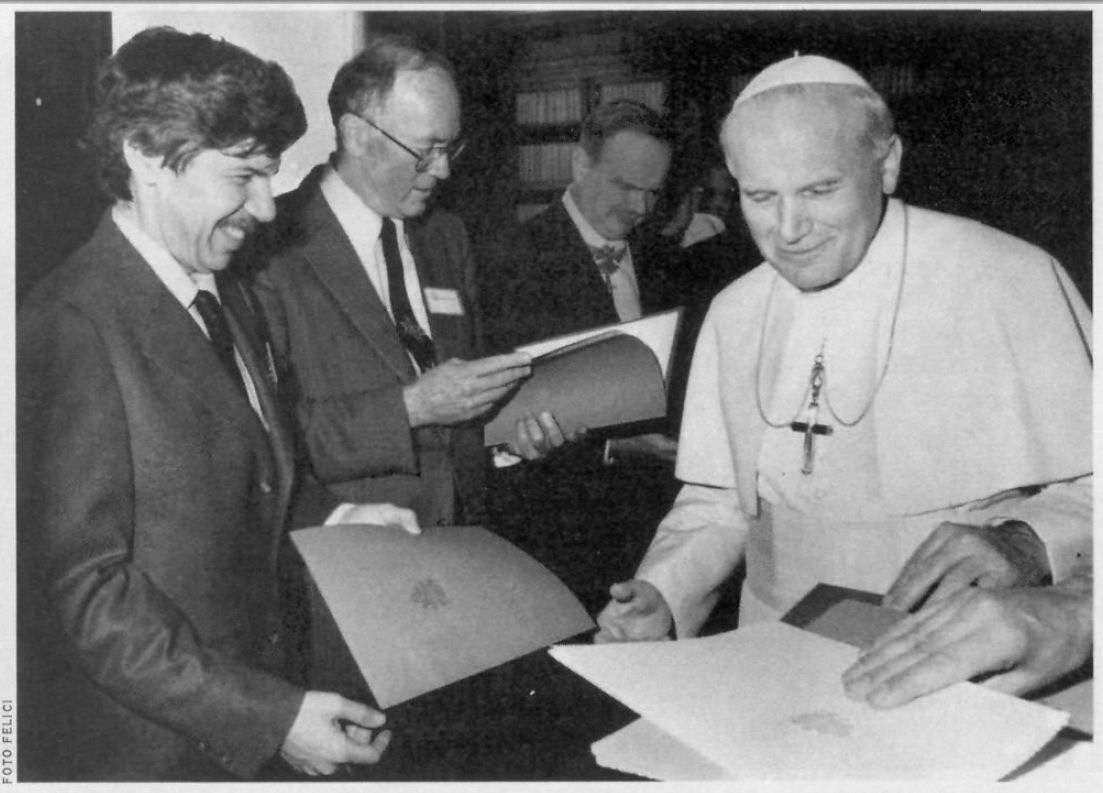


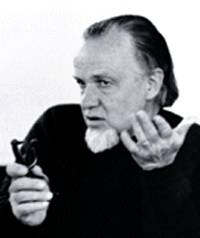
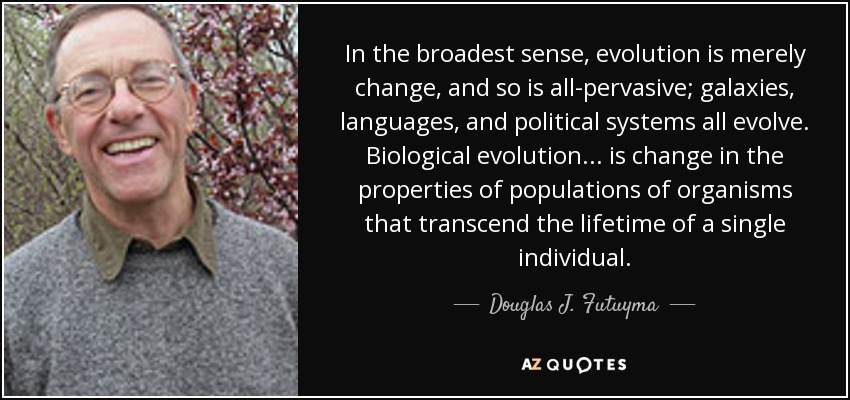


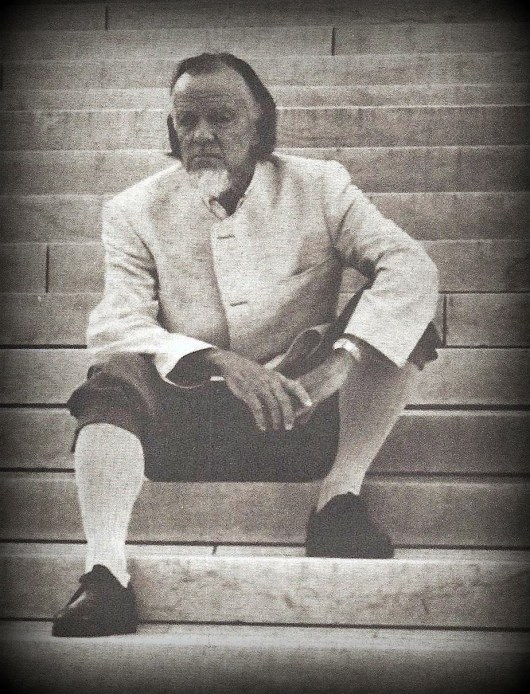









 The Daily Hatch