Monthly Archives: November 2016

MUSIC MONDAY Paul McCartney Mull Of Kintyre

Paul McCartney Mull Of Kintyre-Original Video-HQ

Uploaded on Nov 25, 2011

Paul McCartney Mull Of Kintyre Lyric
Mull of kintyre
Oh mist rolling in from the sea,
My desire is always to be here
Oh mull of kintyre
Far have I traveled and much have I seen
Dark distant mountains with valleys of green.
Past painted deserts the sunsets on fire
As he carries me home to the mull of kintyre.

Mull of kintyre
Oh mist rolling in from the sea,
My desire is always to be here
Oh mull of kintyre
[ Lyrics from: http://www.lyricsfreak.com/p/paul+mcc… ]
Sweep through the heather like deer in the glen
Carry me back to the days I knew then.
Nights when we sang like a heavenly choir
Of the life and the time of the mull of kintyre.

Mull of kintyre
Oh mist rolling in from the sea,
My desire is always to be here
Oh mull of kintyre

Smiles in the sunshine
And tears in the rain
Still take me back to where my memories remain
Flickering embers growing higher and higher
As they carry me back to the mull of kintyre

Mull of kintyre
Oh mist rolling in from the sea,
My desire is always to be here
Oh mull of kintyre

Mull of kintyre
Oh mist rolling in from the sea,
My desire is always to be here
Oh mull of kintyre

__

Denny Laine

From Wikipedia, the free encyclopedia
This article is about the English musician. For the Irish public figure, see Denny Lane.
Denny Laine
Denny Laine - Wings - 1976.jpg

Denny Laine on stage with Wings in 1976
Background information
Birth name Brian Frederick Hines
Also known as Denny Laine
Born 29 October 1944 (age 72)
Origin Birmingham, West Midlands, England
Genres Rock and roll, blues-rock, R&B, jazz fusion
Occupation(s) Singer-songwriter, musician
Instruments
Years active 1957–present
Labels Decca, Wizard, Reprise, EMI, Arista, Takoma, Scratch, President, Griffin, Global
Associated acts Paul McCartney, Wings, the Moody Blues, Mike Pinder, Ginger Baker’s Air Force, Eddie Hardin, Maggie Bell, Colin Blunstone, World Classic Rockers, Linda McCartney
Website www.dennylaine.com

Denny Laine (born Brian Frederick Hines, 29 October 1944) is an English musician, singer, songwriter and guitarist. He was an original member of the Moody Blues, singing the band’s first hit “Go Now” in 1964, and was a member of Wings with Paul McCartney from 1971 to 1981.

Biography[edit]

Early years[edit]

Laine was born in Birmingham, where he attended Yardley Grammar School, and took up the guitar as a boy under the influence of gypsy jazz (jazz manouche) legend Django Reinhardt; he gave his first solo performance as a musician at the age of 12 and began his career as a professional musician fronting Denny Laine & the Diplomats, which also included future Move and Electric Light Orchestra drummer Bev Bevan.

Experience in famous bands[edit]

The Moody Blues[edit]

In 1964, Laine left the Diplomats to join Mike Pinder in the Moody Blues[1] and sang the group’s first big hit, “Go Now“; other early highlights included I Don’t Want To Go on Without You, another UK hit, plus two minor UK chart hits “From The Bottom of My Heart ( I Love You)”, Everyday (both written by Laine and Pinder), “Can’t Nobody Love You” and the harmonica-ripping “Bye Bye Bird” (a big hit in France). A self-titled EP and ‘The Magnificent Moodies’ LP on Decca followed. Laine and Pinder wrote most of The Moody Blues ‘B’ sides during the 1965-66 period, such as You Don’t (All the Time), And My Baby’s Gone and This Is My House. However, Laine’s tenure with the MB’s was relatively short-lived and, after a number of comparative chart failures,[citation needed] Laine quit the band in October 1966. The last record issued by the Moody Blues that featured Laine was “Life’s Not Life”/”He Can Win” in January 1967, just after Justin Hayward had replaced him in the band.

Electric String Band and Balls[edit]

After leaving the Moody Blues, he formed the Electric String Band in December 1966, which featured himself on guitar and vocals, Trevor Burton (of the Move) on guitar, Viv Prince on drums and electrified strings in a format not dissimilar to what Electric Light Orchestra would later attempt. Laine made two singles, “Say You Don’t Mind”/”Ask The People” (April 1967, Deram) and “Too Much in Love”/”Catherine’s Wheel” (January 1968, Deram); and, in June 1967, the band shared a bill with the Jimi Hendrix Experience and Procol Harum at the Saville Theatre in London. However, it did not achieve national attention, and the pioneering Electric String Band broke up. (There was apparently a third single recorded called “Why Did You Come?”. Why it was never released is unknown, but there have been rumors that the finished track – and probably the B side as well – was mailed to Decca and was lost.)[citation needed] Laine and Burton then went on to the band Balls from February 1969 until the band’s breakup in 1971, with both also taking time to play in Ginger Baker’s Air Force in 1970.[2]

Only one single was issued by Balls: “Fight for My Country”/”Janie, Slow Down” on UK Wizard Records.[2] The top side was re-edited and reissued on UK Wizard and issued in the UK on Wizard and in the United States on Epic under the name of Trevor Burton; Laine and Burton shared lead vocals on the B side. The single was reissued again as B.L.W. as “Live in the Mountains” for a small Pye-distributed label, “Paladin”. Twelve tracks were recorded for a Balls album, but it has never been released.[2] Laine’s 1967 song “Say You Don’t Mind” was a hit when recorded in 1972 by ex-Zombie Colin Blunstone.

Wings[edit]

In 1971, Laine joined Paul McCartney to form Wings,[1] and stayed with the group for 10 years until it disbanded in 1981. Laine provided lead and rhythm guitars, lead and backing vocals, keyboards, bass guitar and woodwinds, as well as writing or co-writing some of the group’s material. Laine, McCartney, and McCartney’s wife, Linda McCartney formed the nucleus of the band. With Wings, Laine enjoyed the biggest commercial and critical successes of his career, including co-writing the hit Mull of Kintyre. He also co-wrote and sang lead vocal on Deliver Your Children, which was released as a Wings B-side but charted in the Netherlands.

In January 1980, McCartney was arrested for possession of marijuana on arrival at an airport for a tour in Japan. The tour was cancelled and the band members, except Linda, returned to England. After returning to England, McCartney decided to release his solo album, McCartney II, and plans for an autumn U.S. tour were dropped. Meanwhile, Laine released the single “Japanese Tears” and formed the short-lived Denny Laine Band with Steve Holley and released a solo album Japanese Tears that December. On 27 April 1981, Laine announced he was leaving Wings due to McCartney’s reluctance to tour in the wake of John Lennon’s murder.[3]

Denny Laine performing at the Cavern Club in 2008

Life after Wings[edit]

He signed with Scratch records and began working on a new album, Anyone Can Fly. He then went on to record other solo albums such as Hometown Girls, Wings on Your Feet and Lonely Road before returning to Scratch to do his Wings at the Sound of Denny Laine. He has also had three fanzine publications, Ahh Laine, wrote the musical Arctic Song and released two more albums, Master Suite and Reborn.

Personal life[edit]

Laine moved to the United States in the 1990s, where he continues to tour, originally with the World Classic Rockers and later with the Cryers.

He was briefly married to Jo Jo Laine, with whom he had a son, Laine Hines, and a daughter, Heidi Hines.[4] He has three other children from other relationships: Lucianne Grant (with Helen, daughter of Led Zeppelin manager Peter Grant), Damian James (with model Catherine James)[5] and Ainsley Laine-Adams.

Discography[edit]

The Moody Blues[edit]

Year Album
1965 The Magnificent Moodies

Moody Blues singles[edit]

A-side B-side
“Steal Your Heart Away” “Lose Your Money”
“Go Now” “It’s Easy, Child”
“I Don’t Want To Go on Without You” “Time on My Side”
“From The Bottom of My Heart” “And My Baby’s Gone”
“Everyday” “You Don’t (All The Time)”
“Boulevard De La Madeleine” “This Is My House (But Nobody Calls)”
“People Gotta Go” (issued on a French EP only)
“Life’s Not Life” “He Can Win”

Solo[edit]

Year A-side B-side Label
1967 “Say You Don’t Mind” “Ask The People” Deram DM 122
1968 “Too Much in Love” “Catherine’s Wheel” Deram DM 171
“Why Did You Come?”

Balls reissued as by Trevor Burton[edit]

Year A-side B-side
1970 (Balls) “Fight for My Country” “Janie, Slow Down”
1971 (Trevor Burton) “Fight for My Country” (edited) “Janie, Slow Down”
1972 (B.L.G.) “Live in the Mountains” (same as “Fight for My Country”) (edited) “Janie, Slow Down”

Ginger Baker’s Airforce[edit]

Year Album
1970 Ginger Baker’s Air Force[check quotation syntax]|- Ginger Baker’s Air Force 2

Wings[edit]

Year Album
1971 Wild Life
1973 Red Rose Speedway
Band on the Run
1975 Venus and Mars
1976 Wings at the Speed of Sound
Wings over America (triple live album)
1978 London Town
1979 Back to the Egg
1981 Concerts for the People of Kampuchea

Solo albums[edit]

Year Album Label
1973 Ahh…Laine Wizard/Reprise (US)
1977 Holly Days EMI/Capitol (US)
1980 Japanese Tears Polydor/Scratch
1982 Anyone Can Fly Polydor/Scratch
1985 Hometown Girls President
1987 Wings on My Feet President
1988 Lonely Road President
Master Suite Magnum Force
1990 All I Want Is Freedom JAWS
1996 Reborn Griffin/Scratch
Wings at the Sound of Denny Laine Scratch/Purple Pyramid (US)

Guest appearances[edit]

Year Album
1974 McGear
1980 The Reluctant Dog
1981 Somewhere in England

1982 Tug of War
1983 Pipes of Peace
1985 Wind in the Willows

  • “The Life We Left Behind”
1996 Metal Christmas

  • “I Wish It Could Be Christmas Everyday”
1998 Wide Prairie
1999 Old Friends in New Places

  • “And The Thunder Rolls…”

Bootlegs[edit]

Year Album
1972 Memory Laine
1979 Rock & Roll Jam Sessions
(aka: Lympne Castle Sessions, aka: Wings: In A Jam)
2 Buddies on Holly Days
(excerpts from Holly Days and live performances during Buddy Holly Week)
1982 Birmingham Boy
1988 Cold Cuts (Another Early Version)

Compilation albums[edit]

Year Album
1978 Wings Greatest
1984 In Flight (tracks from “Japanese Tears”)
1985 Weep For Love (tracks from “Japanese Tears”)
1994 Blue Nights (tracks from 1980 to 1990)
1995 Rock Survivor (tracks from 1980 to 1990)
Danger Zone (tracks from “Japanese Tears”)
Go Now (tracks from “Japanese Tears”)
1998 The Masters (tracks from 1980 to 1996)
2001 Wingspan: Hits and History
2002 Spreading My Wings: The Ultimate Denny Laine Collection (tracks from 1980 to 1990)
2003 The Collection (2 compilations, 1 album)
Blue Nights (tracks from 1980 to 1990)
The Masters (tracks from 1980 to 1996)
Reborn
2004 An Introduction to The Moody Blues (including previously unreleased “People Gotta Go”)
Send Me The Heart (tracks from “Japanese Tears”)

References[edit]

  1. ^ Jump up to:a b http://www.allmusic.com/artist/denny-laine-mn0000820686/biography
  2. ^ Jump up to:a b c Joynson, Vernon (1995). The Tapestry of Delights. London: Borderline Books.
  3. Jump up^ (AP) “Wings clipped“. The Leader-Post 30 April 1981: D2
  4. Jump up^ Johnson, Angella, “‘Mum was beautiful, wild… she was the ultimate rock groupie’“, Mail on Sunday, 4 November 2006
  5. Jump up^ James, Catherine (2007). Dandelion: Memoir of a Free Spirit. St. Martin’s Press. p. 80. ISBN 0312367813.

Wingspan: Hits and History” by Paul McCartney

External links[edit]

_____

Related posts:

MUSIC MONDAY Bob Dylan Press Conference in 1965 and his interaction later with Keith Green Part 2

__  Bob Dylan Press Conference 1965 Part 2 This is a tribute to Keith Green who died 32 years ago today!!! On July 28, 1983 I was sitting by the radio when CBS radio news came on and gave the shocking news that Keith Green had been killed by an airplane crash in Texas with […]

MUSIC MONDAY Bob Dylan Press Conference in 1965 and his interaction later with Keith Green

Bob Dylan Press Conference 1965 Part 1 ___ Bob Dylan played on one of Keith Green’s last albums and on the 6:19 min mark of part 5 it shows Bob Dylan: The Keith Green Story pt 5/7    The Keith Green Story pt 3/7 Keith Green had a major impact on me back in 1978 […]

MUSIC MONDAY Brumley Music Plays Pivotal Role in the movie GREATER Bob Brumley Sings “I’ll Fly Away” and film also features “Victory in Jesus”

________ Quinton Aaron of “The Blindside” talks “Greater” and the faith and character of Brandon Burlsworth Published on Oct 28, 2015 Quinton Aaron, star of “The Blindside”, discusses why he is so proud to be a part of “Greater”, and talks about the faith and character of Brandon Burlsworth, the greatest walk-on in college football […]

MUSIC MONDAY “Foreigner Top 10 Songs” Part 3

MUSIC MONDAY “Foreigner Top 10 Songs” Part 3 Top 10 Foreigner Songs By Matt Wardlaw Elsa, Getty Images ‘Waiting for a Girl Like You’ From: ‘4’ (1981) Mick Jones calls “Waiting” the “song that wrote itself,” telling Classic Rock that he felt like the “conduit” for the track and that “something was coming down through […]

MUSIC MONDAY “Foreigner Top 10 Songs” Part 2

MUSIC MONDAY “Foreigner Top 10 Songs” Part 2 Top 10 Foreigner Songs By Matt Wardlaw Elsa, Getty Images 7 ‘Feels Like the First Time’ From: ‘Foreigner’ (1977) “Feels Like the First Time” is a pretty genius name for your first single, and it certainly paid plenty of dividends for Foreigner, striking the Top Five. For […]

MUSIC MONDAY “Foreigner Top 10 Songs” Part 1

__ MUSIC MONDAY “Foreigner Top 10 Songs” Part 1 Top 10 Foreigner Songs By Matt Wardlaw Elsa, Getty Images   Read More: Top 10 Foreigner Songs | http://ultimateclassicrock.com/top-10-foreigner-songs/?trackback=tsmclip Foreigner‘s lone remaining founding member, guitarist Mick Jones, has been at the helm of the legendary American rock group since 1976. But if you’ve seen the band […]

MUSIC MONDAY Glen Campbell

__ Glen Campbell’s Greatest Hits Compilation – Complete Set Related posts: MUSIC MONDAY Washed Out: ‘I wish I could have a 9 to 5 life’ Ernest Greene’s debut album confirms his place at the forefront of the chillwave scene. So why is he so worried? August 22, 2016 – 12:36 am _ Washed Out – Life […]

MUSIC MONDAY Washed Out: ‘I wish I could have a 9 to 5 life’ Ernest Greene’s debut album confirms his place at the forefront of the chillwave scene. So why is he so worried?

_ Washed Out – Life Of Leisure (Full Album) | HD   Washed Out: ‘I wish I could have a 9 to 5 life’ Ernest Greene’s debut album confirms his place at the forefront of the chillwave scene. So why is he so worried? Ernest Greene, aka Washed Out: ‘At no point was I actively […]

MUSIC MONDAY Washed Out’s Ernest Greene Finds Fulfillment in 9-to-5 Grind, ‘Portlandia’ Fame Laura Ferreiro Live Nation•August 27, 2014

__ Washed Out – Within and Without (Full Album) Washed Out’s Ernest Greene Finds Fulfillment in 9-to-5 Grind, ‘Portlandia’ Fame Laura Ferreiro Live Nation•August 27, 2014 On Monday, Sept. 1 at 7:45 p.m. PT/10:45 p.m. ET, Yahoo Live will live stream Washed Out’s concert from First Avenue in Minneapolis. Tune in HERE to watch! Anyone […]

MUSIC MONDAY Washed out

FRIEDMAN FRIDAY Champion of Liberty by Stephen Moore Friday, October 26, 2012

Free to Choose: Part 1 of 10 The Power of the Market (Featuring Milton Friedman)

Free to Choose Part 2: The Tyranny of Control (Featuring Milton Friedman

Free to Choose Part 4: From Cradle to Grave Featuring Milton Friedman

Free to Choose Part 5: Created Equal Featuring Milton Friedman

Friday, October 26, 2012

It’s a tragedy that Milton Friedman—born one hundred years ago on July 31—did not live long enough to combat the big-government ideas that have formed the core of Obamanomics. It’s perhaps more tragic that our current president, who attended the University of Chicago, where Friedman taught for decades, never fell under the influence of the world’s greatest champion of the free market. Imagine how much better things would have turned out, for Obama and the country.

Friedman was a constant presence on the pages of the Wall Street Journal until his death in 2006 at age ninety-four. If he could, he would surely be skewering today’s $5 trillion expansion of spending and debt to create growth—and exposing the confederacy of economic dunces urging more of it.

In the 1960s, Friedman famously explained that “there’s no such thing as a free lunch.” If the government spends a dollar, that dollar has to come from producers and workers in the private economy. There is no magical “multiplier effect” by taking from productive Peter and giving to unproductive Paul. As obvious as that insight seems, it keeps being put to the test. Obamanomics may be the most expensive failed experiment in free-lunch economics in American history.

Equally illogical is the superstition that government can create prosperity by having Federal Reserve Chairman Ben Bernanke print more dollars. In the very short term, Friedman proved, excess money fools people with an illusion of prosperity. But the market quickly catches on, and there is no boost in output, just higher prices.

Next to Ronald Reagan, in the second half of the twentieth century there was no more influential voice for economic freedom worldwide than Milton Friedman. Small in stature but a giant in intellect, he was the economist who saved capitalism by dismembering the ideas of central planning when most of academia was mesmerized by the creed of government as savior.

Friedman was awarded the Nobel Prize in economics in 1976—at a time when almost all the previous prizes had gone to socialists. This marked the first sign of the intellectual comeback of free-market economics since the 1930s, when John Maynard Keynes hijacked the profession. Friedman’s 1963 book A Monetary History of the United States, written with Anna Schwartz (who died June 21), was a masterpiece and changed the way we think about the role of money.

More influential than Friedman’s scholarly writings was his singular talent for communicating the virtues of the free market to a mass audience. His two bestselling books, Capitalism and Freedom (1962) and Free to Choose (1980), are still wildly popular. His videos on YouTube on issues like the morality of capitalism are brilliant and timeless.

Friedman would surely skewer today’s $5 trillion expansion of spending and debt to create growth—and expose the dunces urging more of it.

In the early 1990s, Friedman visited poverty-stricken Mexico City for a Cato Institute forum. I remember the controversy ginned up by the media and Mexico’s intelligentsia: how dare this apostle of free-market economics be given a public forum to speak to Mexican citizens about his “outdated” ideas? Yet when Milton arrived in Mexico he received a hero’s welcome as thousands of business owners, students, and citizen activists hungry for his message encircled him everywhere he went, like crowds for a rock star.

national book fair in China
Books by Milton Friedman and other economists are promoted at a national book fair in China. Andrei Shleifer said the Friedman era “witnessed remarkable progress of mankind. As the world embraced free-market policies, living standards rose sharply while life expectancy, educational attainment, and democracy improved and absolute poverty declined.”

Once in the early 1960s, Friedman wrote the then–U.S. ambassador to New Delhi, John Kenneth Galbraith, that he would be lecturing in India. By all means come, the witty but often wrong Galbraith replied: “I can think of nowhere your free-market ideas can do less harm than in India.” As fate would have it, India did begin to embrace Friedmanism in the 1990s, and the economy began to soar. China finally caught on too.

Well over 200 million people were liberated from poverty thanks to Friedman’s urging to rediscover the free market.

Friedman stood unfailingly and heroically with the little guy against the state. He used to marvel that the intellectual left, which claims to espouse “power to the people,” so often cheers as states suppress individual rights.

While he questioned almost every statist orthodoxy, he fearlessly gored sacred cows of both political parties. He was the first scholar to sound the alarm on the rotten deal of Social Security for young workers—forced to pay into a system that will never give back as much as they could have accumulated on their own. He questioned the need for occupational licenses—which he lambasted as barriers to entry—for everything from driving a cab to becoming an attorney, or getting an MD to practice medicine.

He loved turning the intellectual tables on liberals by making the case that regulation often does more harm than good. His favorite example was the Food and Drug Administration, whose regulations routinely delay the introduction of lifesaving drugs. “When the FDA boasts a new drug will save ten thousand lives a year,” he would ask, “how many lives were lost because it didn’t let the drug on the market last year?”

He supported drug legalization (much to the dismay of supporters on the right) and was particularly proud to be an influential voice in ending the military draft in the 1970s. When his critics argued that he favored a military of mercenaries, he would retort: “If you insist on calling our volunteer soldiers ‘mercenaries,’ I will call those whom you want drafted into service involuntarily ‘slaves.’ ”

By the way, he rarely got angry, and even when he was intellectually slicing and dicing his sparring partners he almost always did it with a smile. It used to be said that over the decades at the University of Chicago and across the globe, the only one who ever defeated him in a debate was his beloved wife and co-author, Rose Friedman.

The issue to which he devoted most of his later years was school choice for all parents, and his Friedman Foundation for Educational Choice is dedicated to that cause. He used to lament that “we allow the market, consumer choice, and competition to work in nearly every industry except for the one that may matter most: education.”

As for congressional Republicans who are at risk of getting suckered into a tax-hike budget deal, they may want to remember another Milton Friedman adage: “Higher taxes never reduce the deficit. Governments spend whatever they take in and then whatever they can get away with.”

No doubt because of his continued popularity, the left has tried to tie Friedman and his principles of free trade, low tax rates, and deregulation to the global financial meltdown in 2008. Economist Joseph Stiglitz charged that Friedman’s “Chicago School bears the blame for providing a seeming intellectual foundation” for the “idea that markets are self-adjusting and the best role for government is to do nothing.” Occupy Wall Street protesters were often seen wearing T-shirts that read “Milton Friedman: Proud Father of Global Misery.”

He won the Nobel Prize in economics at a time when almost all the previous prizes had gone to socialists.

The opposite is true: Friedman opposed the government spending spree in the 2000s. He hated the government-sponsored enterprises like housing lenders Fannie Mae and Freddie Mac.

In a recent tribute to Friedman in the Journal of Economic Literature, Harvard’s Andrei Shleifer describes 1980–2005 as “The Age of Milton Friedman,” an era that “witnessed remarkable progress of mankind. As the world embraced free-market policies, living standards rose sharply while life expectancy, educational attainment, and democracy improved and absolute poverty declined.”

Well over two hundred million people were liberated from poverty thanks to the rediscovery of the free market. And now as the world teeters close to another recession, leaders urgently need to rediscover Friedman’s ideas.

I remember asking Milton, a year or so before his death, during one of our semiannual dinners in downtown San Francisco: what can we do to make America more prosperous? “Three things,” he replied instantly. “Promote free trade, school choice for all children, and cut government spending.”

How much should we cut? “As much as possible.”

Free to Choose Part 6: What’s Wrong With Our Schools Featuring Milton Friedman

Free to Choose Part 7: Who Protects the Consumer Featuring Milton Friedman

Free to Choose Part 8: Who Protects the Worker Featuring Milton Friedman

Free to Choose Part 10: How to Stay Free Featuring Milton Friedman

Related posts:

FRIEDMAN FRIDAY Milton Friedman has the two solutions to the Black Teenage Unemployment Problem!!!

Milton Friedman on Donahue Show in 1979 Milton Friedman has the two solutions to the Black Teenage Unemployment Problem!!! The solutions would be first to lower the Minimum Wage Amount and  second give students the opportunity to have vouchers so their parents can put them in the best schools when they start in the kindergarten […]

Obama loves the death tax but listen to what Milton Friedman had to say about it!!!

__ Obama loves the death tax but listen to what Milton Friedman had to say about it!!! Milton Friedman Redistribution of Wealth and the Death Tax ___________ The Obama Administration’s Assault on the Rule of Law September 6, 2016 by Dan Mitchell What’s the worst development in economic policy of the Obama years? The faux stimulus […]

Milton Friedman and Dan Mitchell: Subsidies for Higher Education Are the Problem!!!

_ Milton Friedman – Should Higher Education Be Subsidized? Published on Aug 14, 2013 Professor Friedman leads a roundtable discussion with students.http://www.LibertyPen.com Hillary Is Wrong: Subsidies for Higher Education Are the Problem, not the Solution August 24, 2016 by Dan Mitchell “So many bad ideas, so little time.” That’s my attitude about Hillary Clinton. She […]

Milton Friedman and Walter Williams have explained, minimum wage laws are especially harmful for blacks!

__ Milton Friedman – A Conversation On Minimum Wage   Published on Oct 4, 2013 A debate on whether the minimum wage hurts or helps the working class.http://www.LibertyPen.com Is Anybody Shocked that Higher Minimum Wage Mandates Are Resulting in Fewer Jobs? August 25, 2016 by Dan Mitchell While economists are famous for their disagreements (and […]

Milton Friedman and Dan Mitchell on the Economics of Medical Care!!!

_ Milton Friedman on Medical Care (Full Lecture) Another Grim Reminder that Obamacare Has Made Healthcare More Expensive August 29, 2016 by Dan Mitchell Way back in 2009, some folks on the left shared a chart showing that national expenditures on healthcare compared to life expectancy. This comparison was not favorable to the United States, which […]

FRIEDMAN FRIDAY Milton Friedman on Immigration Part 2

_ Milton Friedman on Immigration Part 2 Milton Friedman – Illegal Immigration – PT 1 Milton Friedman – Illegal Immigration – PT 2 _- Immigration and the Welfare State April 4, 2010 by Dan Mitchell My previous post dealing with whether citizenship should be automatic for babies born to illegals generated a lot of commentary, so […]

FRIEDMAN FRIDAY Milton Friedman on Immigration Part 1

_ Milton Friedman – Illegal Immigration – PT 1 Milton Friedman – Illegal Immigration – PT 2 Milton Friedman stated , “you can’t have free immigration and a welfare state.” Below Dan Mitchell links back to this quote in one of his earlier posts: A Plan for Open Borders that Anti-Amnesty Folks Can Support August 18, […]

Milton Friedman on Immigration Part 2

_ Milton Friedman on Immigration Part 2 Milton Friedman – Illegal Immigration – PT 1 Milton Friedman – Illegal Immigration – PT 2   _- Immigration and the Welfare State April 4, 2010 by Dan Mitchell My previous post dealing with whether citizenship should be automatic for babies born to illegals generated a lot of commentary, […]

Milton Friedman on Immigration Part 1

_   Milton Friedman – Illegal Immigration – PT 1 Milton Friedman – Illegal Immigration – PT 2   Milton Friedman stated , “you can’t have free immigration and a welfare state.” Below Dan Mitchell links back to this quote in one of his earlier posts: A Plan for Open Borders that Anti-Amnesty Folks Can Support […]

FRIEDMAN FRIDAY Milton Friedman and Dan Mitchell on the Post Office!!!

Milton Friedman and Dan Mitchell on the Post Office!!! Ep. 10 – How to Stay Free [3/7]. Milton Friedman’s Free to Choose (1980) Pat Brennan became something of a celebrity in 1978 because she was delivering mail in competition with the United States Post Office. With her husband she set up business in a basement […]

FRANCIS SCHAEFFER ANALYZES ART AND CULTURE PART 137 Marvin Minsky Part B (Featured artist is Lawrence Ferlinghetti )


Marvin Minsky Stories

I am saddened by the passing of the brilliant Marvin Minsky who helped found MIT. I became interested in his writings and wrote him several letters and I took note especially of  comments on freewill and population control.  Below is a story on his life from the JEWISH JOURNAL:

Artificial intelligence pioneer Marvin Minsky dies; 88

by Scott Malone, Reuters

Posted on Jan. 26, 2016 at 1:37 pm

Marvin Minsky. Photo from Wikipedia

Marvin Minsky. Photo from Wikipedia

Marvin Minsky, the artificial intelligence pioneer who helped make machines think, leading to computers that understand spoken commands and beat grandmasters at chess, has died at the age of 88, the Massachusetts Institute of Technology said.

Minsky, who died on Sunday, suffered a cerebral hemorrhage, the school said.

Minsky had “a monster brain,” MIT colleague Patrick Winston, a professor of artificial intelligence and computer science, said in a 2012 interview. He could be intimidating without meaning to be because he was “such a genius,” Winston said.

Minsky’s greatest contribution to computers and artificial intelligence was the notion that neither human nor machine intelligence is a single process. Instead, he argued, intelligence arises from the interaction of numerous processes in a “society of mind” – a phrase Minsky used for the title of his 1985 book.

“Marvin basically figured out that thinking isn’t a thing but an embarrassing mess of dumb things that work together, as in a society,” said Danny Hillis, a former Minsky student and now co-chairman of the Applied Minds technology company.

Minsky’s insight led to the development of smart machines packed with individual modules that give them specific capabilities, such as computers that play grandmaster-level chess, robots that build cars, programs that analyze DNA and software that creates lifelike dinosaurs, explosions and extraterrestrial worlds for movies.

Artificial intelligence is also essential to almost every computer function, from web search to video games, and tasks such as filtering spam email, focusing cameras, translating documents and giving voice commands to smartphones.

Minsky was co-founder in 1959 of the now-legendary Artificial Intelligence Group at MIT. He also built the first computer capable of learning through connections that mimic human neurons.

Minsky lent his expertise to one of culture’s most notorious thinking machines – the HAL 9000 computer from the book and film “2001: A Space Odyssey” that turned against its astronaut masters. Minsky served as an adviser for the movie, which he called “the most awesome film I’d ever seen.”

Minsky, who was born in New York City in 1927, was drawn to science and engineering as a child, enthralled by the works of Jules Verne and H.G. Wells.

He also composed music in the style of Bach – an interest he pursued into his later years.

Minsky graduated from Harvard in 1950 with a degree in mathematics and in 1954 earned a Ph.D. in math from Princeton University.

Below is the first letter I wrote to Dr. Minksy:

Marvin L. Minsky, MIT Media Lab, Cambridge, MA

April 16, 2014

Dear Dr. Minsky,

I was very interested in what you said in the “Do Science and Religion Conflict?” interview for CLOSER TO TRUTH. In it you said that religion is  a wonderful psychological device in the short run but it teaches people not to ask questions in the long run since you can always resort to saying that God did it. Let  me throw that back on you and ask you if you think that the Jews deserve full credit for restoring the country of Israel in 1948 or was it predicted beforehand by God and God made it happen?

Today I am writing you for two reasons. First, I wanted to appeal to your Jewish Heritage and ask you to take a closer look at some Old Testament scriptures dealing with the land of Israel. Second, I wanted to point out some scientific evidence that caused Antony Flew to switch from an atheist (as you are now) to a theist.  Twenty years I had the opportunity to correspond with two individuals that were regarded as two of the most famous atheists of the 20th Century, Antony Flew and Carl Sagan. (I have enclosed some of those letters between us.) I had read the books and seen the films of the Christian philosopher Francis Schaeffer and he had discussed the works of both of these men. I sent both of these gentlemen philosophical arguments from Schaeffer in these letters and in the first letter I sent a cassette tape of my pastor’s sermon IS THE BIBLE TRUE? (CD is enclosed also.) You may have noticed in the news a few years that Antony Flew actually became a theist in 2004 and remained one until his death in 2010. Carl Sagan remained a skeptic until his dying day in 1996.

Image result for francis schaeffer

You will notice in the enclosed letter from June 1, 1994 that Dr. Flew commented, “Thank you for sending me the IS THE BIBLE TRUE? tape to which I have just listened with great interest and, I trust, profit.” It would be a great honor for me if you would take time and drop me a note and let me know what your reaction is to this same message.

Robert Lewis noted that many orthodox Jews believed through the centuries that God would honor the ancient prophecies that predicted that the Jews would be restored to the land of Israel, but then I notice the latest film series on the Jews done by an orthodox Jew seemed to ignore many of these scriptures. Recently I watched the 5 part PBS series Simon Schama’s THE STORY OF THE JEWS, and in the last episode Schama calls Israel “a miracle” but he is hoping that Israel can get along with the non-Jews in the area. Schama noted, “I’ve always thought that Israel is the consummation of some of the highest ethical values of Jewish traditional history, but creating a place of safety and defending it has sometimes challenged those same ethics and values”. There is an ancient book that sheds light on Israel’s plight today, and it is very clear about the struggles between the Jews and their cousins that surround them. It all comes down to what the Book of Genesis had to say concerning Abraham’s son by Hagar.  

Genesis 16:11-12  (NIV)

11 The angel of the Lord also said to her:

“You are now pregnant
    and you will give birth to a son.
You shall name him Ishmael,
    for the Lord has heard of your misery.
12 He will be a wild donkey of a man;
    his hand will be against everyone
    and everyone’s hand against him,
and he will live in hostility
    toward all his brothers.”

The first 90 seconds of episode 5 opened though by allowing us all to experience the sirens and silence of that day in Spring, each year, when Israel halts to mark the Holocaust and I actually wept while I thought of those who had died. Schama noted, “”Today around half the Jews in the world live here in Israel. 6 million people. 6 million defeats for the Nazi program of total extermination.”
After World War II Schama tells about the events leading up to the re-birth of Israel.  Here again Schama although a practicing Jewish believer did not bring in scripture to shed light on the issue. David O. Dykes who is pastor of Green Acres Baptist Church in Tyler, Texas has done just that:
The nation of Israel was destroyed in 70 A.D…Beginning in the early 20th century Jews started trickling back into Palestine at the risk of their lives. Then after World War II, the British government was given authority over Palestine and in 1948, Israel became a nation again through the action of the United Nations…This should not have come as a surprise to any Bible scholar, because this regathering of Israel is predicted many times in scripture. The prophet Amos wrote in Chapter 9:

14 And I will bring back the exiles of My people Israel, and they shall build the waste cities and inhabit them; and they shall plant vineyards and drink the wine from them; they shall also make gardens and eat the fruit of them.

15 And I will plant them upon their land, and they shall no more be torn up out of their land which I gave them, says the Lord your God.

Some people think the Amos prophecy was referring to the return of Israel after their Babylonian captitvity in 586 B.C. But the nation was uprooted in 70 A.D. And notice God said they would “NEVER AGAIN TO BE UPROOTED.”

Even the preservation of their language is a miracle. For centuries, Hebrew was a dead language spoken nowhere in the world. But within the last century, this dead language has been resurrected and now millions of Israelis speak Hebrew...Have you noticed how often Israel is in the news? They are only a small nation about the size of New Jersey.

I have checked out some of the details that David O. Dykes has provided and they check out. Philip Lieberman is a cognitive scientist at Brown University, and in a letter dated in 1995 he told me that only a few other languages besides Hebrew have ever been revived including some American Indian ones along with Celtic.

Also Zechariah 12:3 also verifies the newsworthiness of Israel now:  And in that day I will make Jerusalem a burdensome stone for all peoples; all who lift it or burden themselves with it shall be sorely wounded. And all the nations of the earth shall come and gather together against it.

I do think that Isaiah also predicted the Jews would come from all over the earth back to their homeland Israel. Isaiah 11:11-12 states, “And in that day the Lord shall again lift up His hand a second time to recover (acquire and deliver) the remnant of His people which is left, from Assyria, from Lower Egypt, from Pathros, from Ethiopia, from Elam [in Persia], from Shinar [Babylonia], from Hamath [in Upper Syria], and from the countries ordering on the [Mediterranean] Sea.  And He will raise up a signal for the nations and will assemble the outcasts of Israel and will gather together the dispersed of Judah from the four corners of the earth. (Amplified Bible)

 I was reading  THE BOOK OF DANIEL COMMENTARY (Cambridge University Press, 1900) by the Bible critic  Samuel Rolles Driver, and on page 100 Dr. Driver commented that the country of Israel is obviously a thing of the past and has no place in prophecy in the future and the prophet Daniel was definitely wrong about that.  I wonder what Dr. Driver would say if he lived to see the newspapers today?

In fact, my former pastor Robert Lewis at Fellowship Bible Church in his sermon “Let the Prophets Speak” on 1-31-99 noted that even the great Princeton Theologian Charles Hodge erred in 1871 when he stated:

The argument from the ancient prophecies is proved to be invalid because it would prove too much. If those prophecies foretell a literal restoration, they foretell that the temple is to be rebuilt, the priesthood restored, sacrifices again offered, and that the whole Mosaic ritual is to be observed in all its details, (Systematic Theology. [New York: Charles Scribner & Sons, 1871; reprint Grand Rapids, Michigan: Eerdman’s Publishing Co., 1949], 3:807).__

Robert Lewis went on to point out that the prophet Amos 2700 years ago predicted the destruction of Aram, Philistia, Tyre, Edom, Ammon, Moab and Israel, but at the end of the Book he said Israel would one day be returned to their land and never removed. We saw from Isaiah 11:11-12 that the Lord “will assemble the outcasts of Israel and will gather together the dispersed of Judah from the four corners of the earth.” And that certainly did happen after World War II.  I corresponded with some secular Jewish Scholars on this back in the 1990’s such as Irving Kristol and Daniel Bell but they dismissed these type of Old Testament prophecies. In his letter of September 23, 1995, Daniel Bell wrote, “As to the survival of the Jewish people, I think of the remark of Samuel Johnson that there is nothing stronger than the knowledge that one may be hanged the next day to concentrate the mind–or the will.”

After looking at the accuracy of Old Testament, I want to turn my attention to the accuracy of the New Testament. Recently I was reading the book GOD’S NOT DEAD by Rick Broocks and in it he quotes Sir William Ramsay who was a scholar who originally went to Palestine to disprove the Book of Luke. Below is some background info on Ramsay followed by his story.

From Wikipedia:

Sir William Mitchell Ramsay (15 March 1851, Glasgow –20 April 1939) was a Scottish archaeologist and New Testament scholar. By his death in 1939 he had become the foremost authority of his day on the history of Asia Minor and a leading scholar in the study of the New Testament. From the post of Professor of Classical Art and Architecture at Oxford, he was appointed Regius Professor of Humanity (the Latin Professorship) at Aberdeen. Knighted in 1906 to mark his distinguished service to the world of scholarship, Ramsay also gained three honorary fellowships from Oxford colleges, nine honorary doctorates from British, Continental and North American universities and became an honorary member of almost every association devoted to archaeology and historical research. He was one of the original members of the British Academy, was awarded the Gold Medal of Pope Leo XIII in 1893 and the Victorian Medal of the Royal Geographical Society in 1906. 

Sir William Ramsay

William Mitchell Ramsay was born on March 15, 1851 in Glasgow, Scotland. His father was a lawyer, but died when William was just six. Through the hard work of other family members, William attended the University of Aberdeen, achieving honors. Through means of a scholarship, he was then able to go to Oxford University and attend the college there named for St. John. His family resource also allowed him to study abroad, notably in Germany. It was under one of his professors that his love of history began. After receiving a new scholarship from another college at Oxford, he traveled to Asia Minor.

William, however, is most noted for beliefs pertaining to the Bible, not his early life. Originally, he labeled it as a ‘Book of Fables,’ having only third-hand knowledge. He neither read nor studied it, skeptically believing it to be of fiction and not historical fact. His interest in history would lead him on a search that would radically redefine his thoughts on that Ancient Book…

Some argue that Ramsay was originally just a product of his time. For example, the general consensus on the Acts of the Apostles (and its alleged writer Luke) was almost humouress:

“… [A]bout 1880 to 1890 the book of the Acts was regarded as the weakest part of the New Testament. No one that had any regard for his reputation as a scholar cared to say a word in its defence. The most conservative of theological scholars, as a rule, thought the wisest plan of defence for the New Testament as a whole was to say as little as possible about the Acts.”[1]

It was his dislike for Acts that launched him into a Mid-East adventure. With Bible-in-hand, he made a trip to the Holy Land. What William found, however, was not what he expected…

As it turns out, ‘ole Willy’ changed his mind. After his extensive study he concluded that Luke was one of the world’s greatest historians:

The more I have studied the narrative of the Acts, and the more I have learned year after year about Graeco-Roman society and thoughts and fashions, and organization in those provinces, the more I admire and the better I understand. I set out to look for truth on the borderland where Greece and Asia meet, and found it here [in the Book of Acts—KB]. You may press the words of Luke in a degree beyond any other historian’s, and they stand the keenest scrutiny and the hardest treatment, provided always that the critic knows the subject and does not go beyond the limits of science and of justice.[2]

Skeptics were strikingly shocked. In ‘Evidence that Demands a Verdict’ Josh Mcdowell writes,

“The book caused a furor of dismay among the skeptics of the world. Its attitude was utterly unexpected because it was contrary to the announced intention of the author years before…. for twenty years more, book after book from the same author came from the press, each filled with additional evidence of the exact, minute truthfulness of the whole New Testament as tested by the spade on the spot. The evidence was so overwhelming that many infidels announced their repudiation of their former unbelief and accepted Christianity. And these books have stood the test of time, not one having been refuted, nor have I found even any attempt to refute them.”[3]

The Bible has always stood the test of time. Renowned archaeologist Nelson Glueck put it like this:

“It may be stated categorically that no archaeological discovery has ever controverted a Biblical reference. Scores of archaeological findings have been made which conform in clear outline or exact detail historical statements in the Bible.”[4]

1) The Bearing of Recent Discovery on the Trustworthiness of the New Testament (1915)
2) Ibid
3) See page 366
4) See page 31 of: Rivers in the Desert: A History of the Negev (1959)

Tom Flynn in his article “Easter: What Really Happened?” April/May 2014, FREE INQUIRY MAGAZINE, asserted, “If Christianity is not true, how on earth did it manage to assume so central a role in the unfolding of the West?” As you know I am a firm believer that the Bible is correct about the creation of the world by a creator and it is also correct about Easter. I want to challenge you to attend a Bible believing church this Easter Sunday April 20, 2014 and just ask the Lord to reveal himself to you. That would be quite an experiment! Thank you again for your time and I know how busy you are.

Everette Hatcher, everettehatcher@gmail.com, http://www.thedailyhatch.org, cell ph 501-920-5733, Box 23416, LittleRock, AR 72221

PS: My good friend John George was an atheist like you are and we loved each others’ company. I was very sad when he passed away. Since you are in the Boston area you need to check out Park Street Church at 1 Park Street in downtown Boston and their Easter services are at 8am, 9:30, 11, and 4pm and I love going to church there surrounded by all those Harvard and MIT students.

__

Image result for lawrence ferlinghetti paintings

David Perry interviews legendary poet, artist and activist Lawrence Ferlinghetti

http://www.sfgate.com/books/article/Lawrence-Ferlinghetti-s-indelible-image-3886925.php

Lawrence Ferlinghetti’s indelible image

SUNDAY PROFILE / Lawrence Ferlinghetti

Image result for lawrence ferlinghetti paintings

Updated 3:05 am, Monday, September 24, 2012

Lawrence Ferlinghetti was in his early 30s when he wrote a poem of hope and innocence about a penny candy store in New York and the magic to be found in jellybeans and licorice sticks, about the evanescence of a rainy September afternoon.

Sixty years later, Ferlinghetti has written a new book-length poem, “Time of Useful Consciousness,” where “technocracy” dominates the heart, where corporations rule the people, where man is greedy and badly educated, andWalt Whitman‘s optimism is needed – as time is running out.

Since the 1950s, Ferlinghetti has been a San Francisco institution. He openedCity Lights in North Beach, a renowned bookstore that attracts visitors from across the world. He stood behind the publication of Allen Ginsberg‘s “Howl,” an act of daring that changed the course of publishing in America. He penned dozens of books, published breakthrough works – including the Beat writers, who insisted on oral incantations – and became San Francisco’s first poet laureate and its most lyrical town crier.

“My poetry, including ‘The Time of Useful Consciousness,’ is activism,” Ferlinghetti said, sitting in a cafe in North Beach near his home. “Ecologically and politically, it’s a totally dim prospect.”

The 93-year-old poet spends one day a week at City Lights, and on other days can be found at his painter’s studio in Hunters Point. Painting, he says, is the lighter antidote to his more painstaking poetry. With his keen blue eyes, white beard and snazzy, paint-streaked sneakers, he looks every bit the part of painter, poet and gentleman radical.

“The norm is that when people get older, they get more politically conservative, but it’s been the opposite for me,” Ferlinghetti said with a laugh.

Image result for lawrence ferlinghetti paintings

Striving to improve world

Ferlinghetti’s biographer, Bill Morgan, an archivist and bibliographer for Ginsberg, said the San Francisco poet has always been “interested in making things better and calling attention to the crazy things going on.”

“Lawrence is still an activist interested in the politics of our time,” Morgan said. “He’s a really good performer of his poetry. He does not consider himself a Beat poet, but he was a publisher of the Beats. And City Lights is one of the best book stores in the country – and it’s been there for 60 years.”

Barry Gifford, the Bay Area author, screenwriter and poet who was friends with Ginsberg, was introduced to Ferlinghetti’s poetry in high school.

“When I was a kid in high school, I remember someone had ‘A Coney Island of the Mind,’ and it made a real impression,” Gifford said of Ferlinghetti’s book of poetry, which has sold more than 1 million copies. “Lawrence has a way of saying what he needs to say in a style that is immediately comprehensible. He’s always been able to communicate with his poetry better than most.”

Gifford added, “Lawrence’s connection with the Beats is not to be underestimated, but he has made – and continues to make – a lasting contribution to American literature.”

Ferlinghetti was born in Yonkers, N.Y., in March 1919. His father, Carlo Ferlinghetti, died before he was born. His mother, Clemence, overcome by stress, asked a relative to care for Lawrence, the youngest of her five boys. Only later did he reconnect with his family.

Image result for lawrence ferlinghetti paintings

Awakened to activism

He earned his bachelor’s degree in journalism at the University of North Carolina at Chapel Hill; his master’s at Columbia University, with a thesis on critic John Ruskin and painter J.M.W. Turner; and his doctorate at the Sorbonne in Paris in 1950, where he studied comparative literature and delivered his thesis (in French) on “The City as a Symbol in Modern Poetry.”

He attended the Sorbonne on the GI Bill, having served as a lieutenant commander in the Navy during World War II.

“I was the all-American boy, the Eagle Scout,” Ferlinghetti said. “I remember I was at my girlfriend’s apartment, and there were these strange publications like the Nation and the New Republic. I started looking at them and thought, ‘Gee, this is weird; people saying things against America?’ It was an awakening. On the East Coast, I’d never even heard of conscientious objectors.”

Ferlinghetti came to San Francisco in January 1951, knowing no one and having little money. He walked up Market Street from the Ferry Building, and asked a passer-by for the Bohemian part of town. Soon settled in North Beach, he began listening to KPFA, the free, independent FM radio station that included a weekly segment by Kenneth Rexroth, the poet, essayist and philosophical anarchist.

KQED Spark – Lawrence Ferlinghetti

Partnering for City Lights

The idea of City Lights came about by chance.

“I was coming up from my painting studio, and I drove up Columbus Avenue,” Ferlinghetti said. “It was a route I wouldn’t normally take, and I saw a guy putting up a sign where City Lights is now.” Ferlinghetti hopped out of his car and went to say hello.

“I said, ‘What are you doing?’ and he said, ‘I’m starting a paperback bookstore, but I don’t have any money. I’ve got $500.’ I said, ‘I have $500.’ The whole thing took about five minutes. We shook hands, and the store opened in June 1953 as City Lights Pocket Bookshop.”

Ferlinghetti’s partner was Peter Martin, a sociology student at San Francisco State who had been publishing a small magazine called City Lights. Martin was the first to publish the works of Pauline Kael – who was another KPFA contributor and would go on to be a film critic for the New Yorker.

“Peter’s idea was to sell quality paperbacks, which were just coming onto the market,” Ferlinghetti said. “At the time, paperback books weren’t considered real books by the trade. They were just these 25-cent pocketbooks that were merchandized like newspapers on the newsstands, but the newsstand guys didn’t understand what they had.”

Around the same time, Ferlinghetti married Selden Kirby-Smith, who went by “Kirby.” She was the granddaughter of a Civil War general and the daughter of a successful doctor, and she had earned her master’s degree from Columbia. The two met in 1946 aboard a ship en route to France. They were both heading to Paris to study at the Sorbonne.

Image result for timothy leary lawrence ferlinghetti

Lawrence Ferlinghetti & Timothy Leary

Image result for timothy leary lawrence ferlinghetti

[l to r: Lawrence Ferlinghetti, Timothy Leary, at the Human Be-In, Golden Gate Park, 1967 January 14], photograph by Gene Anthony, courtesy, .

Image result for timothy leary lawrence ferlinghetti

Dylan & Ferlinghetti

Image result for timothy leary lawrence ferlinghetti

Ferlinghetti & Burroughs. Lawrence Ferlinghetti …

Image result for timothy leary lawrence ferlinghetti

Lawrence Ferlinghetti, born March 24, 1919

Image result for timothy leary lawrence ferlinghetti

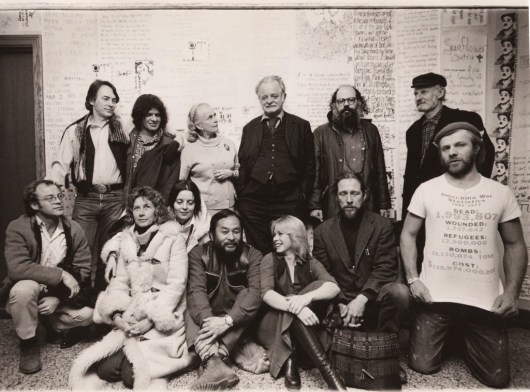
[The City Lights in North Dakota Conference, in Grand Forks, North Dakota, sponsored by the UND English Department, was the first of many Beat related conferences recognizing the cultural importance of the Beats. Clockwise from top left: Michael McClure,Gregory Corso, Miriam Patchen, Kenneth Rexroth, Allen Ginsberg, Lawrence Ferlinghetti, Peter Orlovsky, Gary Snyder, Janie McClure, Shig Murao, Curator (name unknown – female), Joanne McClure Curator (name unknown – male),  March 18, 1974. – Photo by D.Sorensen ]

Obscenity trial for ‘Howl’

In 1955, Ferlinghetti went to a poetry reading at the Six Gallery on Fillmore Street to hear Philip Lamantia, Gary Snyder,Philip Whalen, Michael McClure and Ginsberg – all introduced by Rexroth. Jack Kerouac also was there but declined to read.

It was Ginsberg’s first public reading of his wild, graphic and shattering poem, “Howl,” which opens with the lines: “I saw the best of my generation destroyed by madness, starving hysterical naked, dragging themselves through the negro streets at dawn looking for an angry fix.”

“Allen gave me the manuscript a couple of weeks before the public reading,” Ferlinghetti said. “What a great poet does is let you see the world in a way you’ve never seen it before. That’s what Allen did.”

The day after the reading, Ferlinghetti sent a Western Union telegram to Ginsberg, who was staying in Berkeley. “I wrote, ‘I greet you at the beginning of a great career,’ which is what Emerson wrote to Whitman when he first read ‘The Leaves of Grass.’ I asked, ‘When do we get the manuscript?’ ”

“Howl and Other Poems” was the fourth book in Ferlinghetti’s City Lights’ Pocket Poets Series, and featured an introduction by William Carlos Williams. In 1957, hundreds of copies of the book were seized by U.S. customs officials – who stated, “You wouldn’t want your children to come across it” – and Ferlinghetti was charged with obscenity in a trial that drew international attention.

“We had submitted the manuscript to the ACLU ahead of time, asking if they would defend us if we were busted,” Ferlinghetti said. “They committed themselves ahead of time. Of course, when the trial began, I was young and stupid and thought a few months in jail would be OK; I’d have a lot of time to read.”

Free flow of literature

Ferlinghetti won that year, when the Municipal Court judge ruled that the poem couldn’t be deemed obscene because it had “redeeming social significance.”

“That established us as an independent bookstore,” Ferlinghetti said. “And after that, the floodgates were open. Grove Press – which spent a lot of money on the trial – was able to publish ‘Lady Chatterley’s Lover’ and Henry Miller’s books and so on.” City Lights also was known for carrying the first gay, lesbian and transgender publications.

While many of his writers were known for drug and alcohol use – he once lent his Big Sur cabin to Kerouac to dry out – Ferlinghetti always made it home for dinner.

“My mother was very protective in terms of who we had over at the house,” said daughter Julie Ferlinghetti Susser, who now lives in Tennessee. “We had Gregory Corso to our house, and he once tried to shoot up. He was never allowed back. My mother did really like Kerouac. Ginsberg would come over whenever he was in town, and my mother tolerated him. He was never interested in what women had to say.”

Immediacy of painting

Throughout her childhood, Susser remembers something else: “I would sit by the door every night, waiting for my dad. … He was home every day by 5:30 or 6. I remember I begged and pleaded for a pony, and my dad got me one. I saw him as a businessman who went to work and came home at the same time. He always made things fun.”

The Ferlinghettis, who divorced in 1973 but remained close, also had a son, Lorenzo, who lives in Bolinas and has two children. Kirby Ferlinghetti died this year and is buried in their family plot in Bolinas.

These days, the poet is gravitating to painting. George Krevsky, Ferlinghetti’s longtime gallerist, said, “When I first met Lawrence, I said, ‘I’ve met two great poets – you and Robert Frost,’ and he said, ‘You should see my paintings.’ ”

For Ferlinghetti, painting is a “lyrical escape,” a way to express himself that has more immediacy than his poems.

“It’s easier to get high doing a painting,” he said, walking home from the North Beach cafe. “For one thing, it’s more instantaneous. A book – this new book of mine – is two years of work. Whereas a painting, I might have one in a day. I feel like I can take a lot of chances in painting.”

Ferlinghetti’s outlook, like his poetry and like his paintings, moves from dark to light, from foreboding to hopeful. He looks at poems such as “The Pennycandystore” as embodying a time of innocence for himself, and America.

“I wrote that in the early ’50s,” he said of the candy store poem. “America was full of hope.”

Sending a lifeline to culture

The title of his new work, “Time of Useful Consciousness,” to be released in October, comes from an aeronautical term denoting the time between when one loses oxygen and when one passes out, the moments when it’s still possible to save your life.

“It’s a statement about where culture is,” Ferlinghetti said. Smiling, his blue eyes taking in the sunshine in North Beach, he added, “I’m trying to be an optimist.”

Julian Guthrie is a San Francisco Chronicle staff writer. E-mail: jguthrie@sfchronicle.com Twitter: @JulianGuthrie

Image result for lawrence ferlinghetti paintings

Good article on Lawrence Ferlinghetti:

August - October 1999

Lawrence Ferlinghetti
The Painter
1989
oil on canvas
36 1/2 x 40 in.

CLICK ON IMAGE FOR MORE DETAILED VIEW
Lawrence Ferlinghetti, The PainterLAWRENCE FERLINGHETTI just returned from three weeks in Europe. One of his stops was in Florence for a book signing and poetry reading at City Lights Italia, a book store named after the one he had co-founded in San Francisco in 1952, but not otherwise connected with it. A man there walked up to him, “and he handed me a thousand dollars in American money. I said, ‘Well, what’s that for?’ He said, ‘Well, I’ll give you 2000 more if you’ll do ten designs relating to Leonardo Da Vinci. It’s his 500th anniversary, and then we’re going to have an exhibition. We’ve asked 70 artists around the world to do this, and the exhibition will be in Milan sometime around 2000.'” Turned out the man was Francesco Conz, a collector who had been a primary funder of the Fluxus movement in Europe. He also invited Ferlinghetti to his home in Verona, a four story building filled with surrealist and Fluxus art by the likes of Dali, Joseph Cornell, and André Breton.When Ferlinghetti returned to where he was staying, he took a supplement from the Sunday edition of La Repubblica-“sort of an illustrated history of art, 48 pages, saddle stitched. There was an illustration of Monet, and one of Gauguin-it went back centuries.” He chose several pages, and in French, English, or Italian wrote “‘Leonardo was here’-he had influenced all these artists. And on a couple of illustrations I put, ‘Leonardo was here’ with a question mark. And things like that. Then I did a little bit of collage on them, and that was it. I mounted them on story boards and sent them to him and he sent me $2000 more.”

One of his reasons for going to Italy was to select the final versions of glass plates that had been commissioned by a hotel in Venice and that were being produced by “the top maestro on the famous glass-making island of Murano. I was in his factory for two days. I had sent him the designs [in black and white] several months ago, and they produced some trial plates, which then I chose among. . . . I chose two colors, two of the designs. They did them in cobalt blue on very light transparent blue glass, and the other two are going to be on yellow ochre. Basically, the design was Auroboro, the snake eating its own tail, which fits onto a plate very nicely. Did several variations of that. Now they’re going to produce a limited edition.”

A week before he went to Italy, he attended the opening of his solo show at Dominican College in San Rafael CA. Curated by Diane Roby, it consisted of about a dozen paintings on canvas or burlap, and a similar number of drawings, lithographs, and other works on paper. The paintings ranged from about 17×13½” to 68×72″, and most of them referred directly or indirectly to such personages as El Greco, Freud, Ezra Pound, Magritte, Picasso, Van Gogh, or Motherwell. The works on paper included Serpent – Bird, a seven-panel suite of drawings in sumi-e ink on Japanese paper; done in Big Sur in 1997; it shows a serpent turning into a bird. There were also about 15 books, including such things as his most recent novel, a book of his drawings of the figure, When I Look at Pictures (images and poetry), as well as a number of broadsides.

Lawrence Ferlinghetti
Liberty Series #6
1991
oil on canvas
50 x 56 in.

CLICK ON IMAGE FOR MORE DETAILED VIEW
Lawrence Ferlinghetti, Liberty Series #6Ferlinghetti started painting in 1948 while he was in Paris writing poetry and novels and preparing to get his doctorate in comparative poetry from the Sorbonne. “A guy I was rooming with left his painting equipment behind when he went home, so I picked it up and gave it a try.” He soon became serious about painting and began to attend drawing sessions to work from the figure (first at the open studio of theAcadémie Julien), a practice he continues to this day.Before the show, he had been collaborating on a series of pieces with Christopher Felver, who created photos of himself in various stages of clown makeup and which Ferlinghetti then wrote on. “On one of them I wrote, ‘I am not a clown.'” They hope to publish the series of 16 pieces in the near future.
Ferlinghetti / Felver
I Am Not a Clown
1999
mixed media

CLICK ON IMAGE FOR MORE DETAILED VIEW
Ferlinghetti/Felver, I Am Not a ClownLast October, Gibbs Smith publishedFerlinghetti Portrait, a book of Felver’s photographs that also contains the subject’s long poem “Autobiography.” The shots include several of the painter in his studio, at City Lights, at Big Sur, and about 100 others. A documentary, also by Felver, The Coney Island of Lawrence Ferlinghetti, was shown last fall at the Mill Valley Film Festival at the Roxie in SF, and on PBS, where it will be shown again.Ferlinghetti’s work can be seen at the George Krevsky Gallery in San Francisco (415-397-9748) and at the Molly Barnes Gallery in Santa Monica (310-395-4404).

San Francisco CA, 07.28.99

Related posts:

FRANCIS SCHAEFFER ANALYZES ART AND CULTURE PART 135 H. J. Blackham Part C Featured artist is Richard Anuszkiewicz

________     H. J. Blackham H. J. Blackham, (31 March 1903 – 23 January 2009), was a leading and widely respected British humanist for most of his life. As a young man he worked in farming and as a teacher. He found his niche as a leader in the Ethical Union, which he steadfastly […]

FRANCIS SCHAEFFER ANALYZES ART AND CULTURE PART 134 H.J.Blackham Part B (Featured artist is Richard M. Loving)

H.J.Blackham pictured below: I had to pleasure of corresponding with Paul Kurtz in the 1990’s and he like H. J. Blackham firmly believed that religion was needed to have a basis for morals. At H. J. Blackham’s funeral in 2009 these words were read from Paul Kurtz: Paul Kurtz Founder and Chair, Prometheus Books and the […]

FRANCIS SCHAEFFER ANALYZES ART AND CULTURE PART 133 A Portion of my 1994 letter to H. J. Blackham on the 10th Anniversary of Francis Schaeffer’s passing (Featured artist is Billy Al Bengston )

H. J. Blackham pictured below:   On May 15, 1994 on the 10th anniversary of the passing of Francis Schaeffer I sent a letter to H.J. Blackham and here is a portion of that letter below: I have enclosed a cassette tape by Adrian Rogers and it includes  a story about  Charles Darwin‘s journey from […]

FRANCIS SCHAEFFER ANALYZES ART AND CULTURE PART 132 Part D Ellsworth Kelly (Featured artist is Ronald Davis )

  I featured the artwork of Ellsworth Kelly on my blog both on November 23, 2015 and December 17, 2015. Also I mailed him a letter on November 23, 2015, but I never heard back from him.  Unfortunately he died on December 27, 2015 at the age of 92. Who were the artists who influenced […]

FRANCIS SCHAEFFER ANALYZES ART AND CULTURE PART 131 Part C Ellsworth Kelly (Featured artist is Janet Fish )

__ I featured the artwork of Ellsworth Kelly on my blog both on November 23, 2015 and December 17, 2015. Also I mailed him a letter on November 23, 2015, but I never heard back from him.  Unfortunately he died on December 27, 2015 at the age of 92.       Who were the […]

FRANCIS SCHAEFFER ANALYZES ART AND CULTURE PART 130 Part B Ellsworth Kelly (Featured artist is Art Green )

Andy, Ellsworth Kelly, Richard Koshalek and unidentified guest, 1980s I featured the artwork of Ellsworth Kelly on my blog both on November 23, 2015 and December 17, 2015. Also I mailed him a letter on November 23, 2015, but I never heard back from him.  Unfortunately he died on December 27, 2015 at the age […]

FRANCIS SCHAEFFER ANALYZES ART AND CULTURE PART 129 Part A Ellsworth Kelly (Featured artist is Sherrie Levine )

How Should We Then Live – Episode 8 – The Age of Fragmentation   I featured the artwork of Ellsworth Kelly on my blog both on November 23, 2015 and December 17, 2015. Also I mailed him a letter on November 23, 2015, but I never heard back from him.  Unfortunately he died on December […]

FRANCIS SCHAEFFER ANALYZES ART AND CULTURE PART 128 Will Provine, Determinism, Part F (Featured artist is Pierre Soulages )

Today I am bringing this series on William Provine to an end.  Will Provine’s work was cited by  Francis Schaeffer  in his book WHATEVER HAPPENED TO THE HUMAN RACE? I noted: I was sad to learn of Dr. Provine’s death. William Ball “Will” Provine (February 19, 1942 – September 1, 2015) He grew up an […]

FRANCIS SCHAEFFER ANALYZES ART AND CULTURE PART 127 Will Provine, Killer of the myth of Optimistic Humanism Part E (Featured artist is Jim Dine )

___ Setting the record straight was Will Provine’s widow Gail when she stated, “[Will] did not believe in an ULTIMATE meaning in life (i.e. God’s plan), but he did believe in proximate meaning (i.e. relationships with people — friendship and especially LOVE🙂 ). So one’s existence is ultimately senseless and useless, but certainly not to those […]

FRANCIS SCHAEFFER ANALYZES ART AND CULTURE PART 126 Will Provine, Killer of the myth of Optimistic Humanism Part D (Featured artists are Elena and Olivia Ceballos )

I was sad when I learned of Will Provine’s death. He was a very engaging speaker on the subject of Darwinism and I think he correctly realized what the full ramifications are when accepting evolution. This is the fourth post I have done on Dr. Provine and the previous ones are these links, 1st, 2nd […]

__

Woody Wednesday All 47 Woody Allen movies – ranked from worst to best Part D

(L-R): Annie Hall, Sleeper and Vicky Christina Barcelona
(L-R): Annie Hall, Sleeper and To Rome With Love

Annie Hall or Bananas? Blue Jasmine or Sleeper? Our critics Robbie Collin and Tim Robey rank all 47 Woody Allen movies

25. Sleeper (1973)

The first film in which Allen directed Diane Keaton was also, perhaps not coincidentally, the first film to suggest he had more in him than than madcap, gag-driven comedies. (They appeared in a film together before his directing days). That’s not to say Sleeper isn’t as madcap and gag-driven as his earliest work: a film about a health food shop owner who falls into a vat of liquid nitrogen and wakes up 200 years later kind of has to be. But Allen’s painting with new colours here: romance, melancholy, and even – gasp! – coherent plotting, while the uproarious robot butler sequence showcased his talent for silent-era physical clowning.

24. Everything You Always Wanted to Know About Sex* (*But Were Afraid to Ask) (1972)

This anthology of seven sketches on a raunchy theme, loosely based on a best-selling bedroom manual of the day, has grown grubbier with age. But watched with a generous and forgiving eye, its legendary popularity (in the US, it was one of the 10 most successful films of its year) still makes sense. And three sequences still burst with visual ingenuity and laughs: an Italian cinema spoof, the famous science-fiction-like scene in which Allen plays a sperm on date night, and Gene Wilder’s tender love affair with a sheep.

23. Midnight in Paris (2011)
Midnight in Paris

Depending on your point of view, this huge hit and Oscar Best Picture nominee – Woody’s first in a quarter-century – is either glass-half-full or half-empty Allen: an enjoyable, shiny bauble in which time-travel back to the Jazz Age reveals the grass to be always greener; or a shallow, rather pseudy coffee-table conceit whose present-day characters are cut-out irritants. Adherents to both viewpoints were surprisingly passionate, but there’s not all that much separating them, in truth. Owen Wilson’s jaunty flâneur takes the whole thing in his stride: hard not to, when Allen’s throwing so many easy conquests in his direction.

22. Bananas (1971)

Perhaps of all Allen’s early comedies, this is the one that could be remade today with the fewest concessions to modern taste. That might be because on its release, it already felt like a film out of time: it’s effectively the Marx brothers’ Duck Soup with a Cuban spin (Allen’s wilting New York nebbish accidentally becomes a dictator) and survives on its never-ending supply of lunatic gags, thundering past like an express train. It looks cheap, which is funny in itself, and satire and spoofery are crammed in until it bulges at the seams.

21. Deconstructing Harry (1997)

Allen’s sourest comedy is one of his more arresting, certainly of the increasingly wayward 1990s: it touches a few raw nerves. The structure is roughly lifted from Bergman’s reflections on a life in Wild Strawberries, as Allen’s flailing writer, Harry Block, is invited back to his alma mater to receive an honorary degree. This trip involves reckoning with the fallout from Harry’s failed relationships, not to mention some wacky swerves into sketch comedy – Robin Williams develops the medical condition of being out-of-focus, and Tobey Maguire plays a sex-obsessed alter ego. It’s an uneven grab bag, a flawed film à clef with biting and honest moments.

20. Cafe Society (2016)

It’s the Thirties, and young Bobby Dorfman (Jesse Eisenberg) has abandoned the sepia-tinted hubbub of the Bronx for the Technicolor vistas of Hollywood. After arriving in town, Bobby seeks out employment from his uncle Phil (Steve Carell), a bulldoggy agent who doesn’t so much drop names as scatter them in his wake like confetti. Work is hard to come by, but in the meantime Phil puts Bobby in touch with his secretary Vonnie (Kristen Stewart), who offers to show him the sights.

Cafe Society

After a run of russet-hued collaborations with cinematographer Darius Khondji, Allen is working here for the first time with the venerable Vittorio Storaro, and the change has done him the good. A couple of scenes with Bobby and Vonnie together are the most visually beautiful sequences in an Allen film in goodness knows how long. And then there’s Stewart, who’s the best thing here from the moment she steps on screen. (Read the full review)

19. Love and Death (1975)

The smartest of Allen’s early run of scattershot comedies is a surprisingly accessible send-up of the Russian literature he was devouring at the time, and which would go on to shape his later, weightier work. Allen is Boris Grushenko, a “militant coward” who’s sent off to fight the French, and ends up involved in a plot to assassinate Napoleon with the help of his pretty cousin (Boris: “twice removed!”), played by Diane Keaton, who’s well on the way to the height of her comic powers. Parodies of Tolstoy, Eisenstein and Bergman rub shoulders with some vintage surreal and bawdy Allen riffs.

Related posts:

WOODY WEDNESDAY Review: ‘Café Society’ Isn’t Woody Allen’s Worst Movie CAFÉ SOCIETY Directed by Woody Allen Comedy, Drama, Romance PG-13 1h 36m Reviewed by A. O. SCOTT JULY 14, 2016

I have posted so many reviews on Woody Allen’s latest movie CAFE SOCIETY and I even posted an open letter I wrote to Woody Allen about the film. A serious theme of the afterlife is brought up in this film too. Some reviewers liked the film and the lavish surroundings in it and some did […]

WOODY WEDNESDAY Café Society review – Woody Allen on nostalgic form 3/5stars Wendy Ide Sunday 4 September 2016 03.00 EDT

I have posted so many reviews on Woody Allen’s latest movie CAFE SOCIETY and I even posted an open letter I wrote to Woody Allen about the film. A serious theme of the afterlife is brought up in this film too. Some reviewers liked the film and the lavish surroundings in it and some did […]

Café Society review – Woody Allen on nostalgic form 3/5stars Wendy Ide Sunday 4 September 2016 03.00 EDT

I have posted so many reviews on Woody Allen’s latest movie CAFE SOCIETY and I even posted an open letter I wrote to Woody Allen about the film. A serious theme of the afterlife is brought up in this film too. Some reviewers liked the film and the lavish surroundings in it and some did […]

“Woody Wednesday” OPEN LETTER TO WOODY ALLEN about the movie “Café Society”

Café Society Official International Trailer #1 (2016) – Jesse Eisenberg, Kristen Stewart Movie HD LETTER DATED 8-28-16 The last time I wrote you about the film IRRATIONAL MAN and today I want to give my thoughts on the film CAFE SOCIETY. I was able to catch it in Chicago in July and again I caught […]

WOODY WEDNESDAY Cafe Society Woody Allen returns with a 1930s-set tale of Hollywood glamour and New York nightlife By Peter Travers July 13, 2016

Café Society – Official Movie Review Café Society Official International Trailer #1 (2016) – Jesse Eisenberg, Kristen Stewart Movie HD Cafe Society Woody Allen returns with a 1930s-set tale of Hollywood glamour and New York nightlife Jesse Eisenberg and Kristen Stewart in ‘Café Society.’ Credit: Sabrina Lantos In a summer of VFX crowdpleasers, it’s a […]

WOODY WEDNESDAY The Reel Thing The Reel Thing: Woody Allen Formula Fails With ‘Cafe Society’ By RAY COX

Café Society – Official Movie Review Café Society Official International Trailer #1 (2016) – Jesse Eisenberg, Kristen Stewart Movie HD The Reel Thing The Reel Thing: Woody Allen Formula Fails With ‘Cafe Society’ By RAY COX 23 hrs ago   Woody Allen has been making films for more than 50 years but “Cafe Society” is […]

WOODY WEDNESDAY Cafe Society Woody Allen’s latest is an unfocused, wistful glance at both old glamour and the afterlife. Alissa Wilkinson/ July 14, 2016

Café Society – Official Movie Review Cafe Society Woody Allen’s latest is an unfocused, wistful glance at both old glamour and the afterlife. Alissa Wilkinson/ July 14, 2016 Cafe Society Amazon Studios 1 of 2 Jesse Eisenberg and Kristen Stewart in ‘Cafe Society’ Woody Allen has come under concentrated fire in the time since his […]

OPEN LETTER TO WOODY ALLEN on the movie “Café Society”

Café Society – Official Movie Review Café Society Official International Trailer #1 (2016) – Jesse Eisenberg, Kristen Stewart Movie HD __   ___ ______________ __ Kat Edmonson lives the NYC dream ___ __ __ OPEN LETTER TO WOODY ALLEN DATED 8-28-16 seen below: The last time I wrote you about the film IRRATIONAL MAN and […]

WOODY WEDNESDAY Cafe Society review: In Jesse Eisenberg, Woody Allen has found his acting surrogate Christiopher Hooton

_ Cafe Society review: In Jesse Eisenberg, Woody Allen has found his acting surrogate Christiopher Hooton 11 hours  ago But in this movie about making movies, it’s too tangible that a movie is being made I always get excited to watch a new Woody Allen film, not in spite of his prolificness but because of […]

WOODY WEDNESDAY Review: ‘Café Society’ is minor, enjoyable Woody Allen Bill Goodykoontz, Gannett4:24 p.m. EDT July 28, 2016

_ Café Society Official International Trailer #1 (2016) – Jesse Eisenberg, Kristen Stewart Movie HD Review: ‘Café Society’ is minor, enjoyable Woody Allen Bill Goodykoontz, Gannett4:24 p.m. EDT July 28, 2016 (Photo: Amazon Studios) “Café Society” is probably what you’d call a placeholder Woody Allen movie, a small offering between more cerebral offerings, if he’s […]

RESPONDING TO HARRY KROTO’S BRILLIANT RENOWNED ACADEMICS!! Part 103 Craig Venter,   “I believe the universe is far more wonderful than just assuming it was made by some higher power”

I read the book by Craig Venter called LIFE AT THE SPEED OF LIGHT: FROM THE DOUBLE HELIX TO THE DAWN OF DIGITAL LIFE and in that book  on page 146 Venter wrote, “The future of biological research will be based to a great extent on the combination of computer science and synthetic biology.  We can get a fascinating view of this future from a series of contests that culminate in a remarkable event that takes place each year in Cambridge, Massachusetts–A gathering of brilliant young minds that gives me great hope for the future.  The International Genetically Engineered Machine (iGEM) competition invites high school and college students and entrepreneurs to shuffle a standard set of DNA subroutines into something new in a competition for a trophy…”

This statement of Dr. Venter assumes that EDUCATION IS THE ANSWER!!!

A man who has never gone to school may steal from a freight car; but if he has a university education, he may steal the whole railroad. Theodore Roosevelt

Humanity’s problem  is  not a lack of education but a moral problem.

Adrian Rogers:

Did you know that all atheists are not atheists because of intellectual problems? They’re atheists because of moral problems. You say, “But I know some brilliant people who are atheists.” Well, that may be so, but I know some brilliant people who are not. You say, “I know some foolish people who believe in God.” Well, I know everyone who doesn’t believe in God is foolish.

Later in the letter to Dr. Venter I expose the problems with OPTIMISTIC HUMANISM.

___________

On November 21, 2014 I received a letter from Nobel Laureate Harry Kroto and it said:

…Please click on this URL http://vimeo.com/26991975

and you will hear what far smarter people than I have to say on this matter. I agree with them.

Harry Kroto

I have attempted to respond to all of Dr. Kroto’s friends arguments and I have posted my responses one per week for over a year now. Here are some of my earlier posts:

Arif Ahmed, Sir David AttenboroughMark Balaguer, Horace Barlow, Michael BatePatricia ChurchlandAaron CiechanoverNoam Chomsky,Alan DershowitzHubert Dreyfus, Bart Ehrman, Stephan FeuchtwangDavid Friend,  Riccardo GiacconiIvar Giaever , Roy GlauberRebecca GoldsteinDavid J. Gross,  Brian Greene, Susan GreenfieldStephen F Gudeman,  Alan Guth, Jonathan HaidtTheodor W. Hänsch, Brian Harrison,  Hermann HauserRoald Hoffmann,  Bruce HoodHerbert Huppert,  Gareth Stedman Jones, Steve JonesShelly KaganMichio Kaku,  Stuart Kauffman,  Lawrence KraussHarry Kroto, George LakoffElizabeth Loftus,  Alan MacfarlanePeter MillicanMarvin MinskyLeonard Mlodinow,  Yujin NagasawaAlva NoeDouglas Osheroff,  Jonathan Parry,  Saul PerlmutterHerman Philipse,  Carolyn PorcoRobert M. PriceLisa RandallLord Martin Rees,  Oliver Sacks, John SearleMarcus du SautoySimon SchafferJ. L. Schellenberg,   Lee Silver Peter Singer,  Walter Sinnott-ArmstrongRonald de Sousa, Victor StengerBarry Supple,   Leonard Susskind, Raymond TallisNeil deGrasse Tyson,  .Alexander Vilenkin, Sir John WalkerFrank WilczekSteven Weinberg, and  Lewis Wolpert,

Craig Venter

From Wikipedia, the free encyclopedia
Craig Venter
Craigventer2.jpg

Venter in 2007
Born John Craig Venter
October 14, 1946 (age 68)
Salt Lake City, Utah, U.S.
Institutions State University of New York at Buffalo
National Institutes of Health
J. Craig Venter Institute
Alma mater University of California, San Diego
Known for DNA
Human genome
Metagenomics
Synthetic genomics
Shotgun approach to genome sequencing
Notable awards Gairdner Award (2002)
Nierenberg Prize (2007)
Kistler Prize (2008)
ENI award (2008)
Medal of Science (2008)
Dickson Prize (2011)
Website
J. Craig Venter Institute

John Craig Venter (born October 14, 1946) is an American biochemist, geneticist, and entrepreneur. He is known for being one of the first to sequence the human genome[1] and the first to transfect a cell with a synthetic genome.[2][3] Venter founded Celera Genomics, The Institute for Genomic Research (TIGR) and the J. Craig Venter Institute (JCVI), and is now working at JCVI to create synthetic biological organisms. He was listed on Time magazine’s 2007 and 2008 Time 100 list of the most influential people in the world. In 2010, the British magazine New Statesman listed Craig Venter at 14th in the list of “The World’s 50 Most Influential Figures 2010”.[4] He is a member of the USA Science and Engineering Festival‘s Advisory Board.[5]

Early life and education[edit]

Venter was born in Salt Lake City, Utah, the son of Elizabeth and John Venter.[6] In his youth, he did not take his education seriously, preferring to spend his time on the water in boats or surfing.[7] According to his biography, A Life Decoded, he was said to never be a terribly engaged student, having Cs and Ds on his eighth-grade report cards.[8] He graduated from Mills High School in Millbrae, California.

Although he was against the Vietnam War,[9] Venter was drafted and enlisted in the United States Navy where he worked in the intensive-care ward of a field hospital.[10] While in Vietnam, he attempted suicide by swimming out to sea, but changed his mind more than a mile out.[11] Being confronted with wounded, maimed, and dying [marines] on a daily basis instilled in him a desire to study medicine[12] — although he later switched to biomedical research.

Venter began his college education at a community college, College of San Mateo in California, and later transferred to the University of California, San Diego, where he studied under biochemist Nathan O. Kaplan. He received a BS in biochemistry in 1972, and a PhD in physiology and pharmacology in 1975, both from UCSD.[13] He married former PhD candidate Barbara Rae.[14][15][16] After working as an associate professor, and later as full professor, at the State University of New York at Buffalo, he joined the National Institutes of Health in 1984.

In Buffalo, he divorced Dr. Rae-Venter and married his student, Claire M. Fraser,[15] remaining married to her until 2005.[17] In late 2008 he married Heather Kowalski.[18] They live in La Jolla outside San Diego, California where Venter gut-renovated a $6 million home.[18]

Venter is an atheist.[19]

Venter himself recognized his own ADHD behavior in his adolescence, and later found ADHD-linked genes in his own DNA.[20]

In  the third video below in the 142nd clip in this series are his words and  my response is below them. 

50 Renowned Academics Speaking About God (Part 1)

Another 50 Renowned Academics Speaking About God (Part 2)

A Further 50 Renowned Academics Speaking About God (Part 3)

_________________________________

Below is the letter I wrote to respond to his quote:

February 23. 2015

Dr. J. Craig Venter, c/o The J. Craig Venter Institute,

Dear Dr. Venter,

I just finished reading the online addition of the book Darwin, Francis ed. 1892. Charles Darwin: his life told in an autobiographical chapter, and in a selected series of his published letters [abridged edition]. London: John Murray. There are several points that Charles Darwin makes in this book that were very wise, honest, logical, shocking and some that were not so wise. The Christian Philosopher Francis Schaeffer once said of Darwin’s writings, “Darwin in his autobiography and in his letters showed that all through his life he never really came to a quietness concerning the possibility that chance really explained the situation of the biological world. You will find there is much material on this [from Darwin] extended over many many years that constantly he was wrestling with this problem.”

A while back on the show 60 MINUTES I saw an interview of you with this exchange:

KROFT: “You know, I’ve asked two or three times, ‘Do you think you’re playing God?’ I mean, do you believe in God?”

VENTER: “No. I believe the universe is far more wonderful than just assuming it was made by some higher power. I think the fact that these cells are software-driven machines and that software is DNA and that truly the secret of life is writing software, is pretty miraculous. Just seeing that process in the simplest forms that we’re just witnessing is pretty stunning.”

You asserted that a world without God is “far more wonderful” than a world with a personal God who created it all and gave us the Bible. This is what I call evolutionary optimistic humanism and even in the 19th century Charles Darwin in his autobiography was touting the same product you are today!!!!

When I read the book  Charles Darwin: his life told in an autobiographical chapter, and in a selected series of his published letters, I also read  a commentary on it by Francis Schaeffer and I wanted to both  quote some of Charles Darwin’s own words to you and then include the comments of Francis Schaeffer on those words. I have also enclosed a CD with two messages from Adrian Rogers and Bill Elliff concerning Darwinism.

The passages which here follow are extracts, somewhat abbreviated, from a part of CHARLES DARWIN’S Autobiography, written in 1876, in which my father gives the history of his religious views:—

“Believing as I do that man in the distant future will be a far more perfect creature than he now is,”

FRANCIS SCHAEFFER COMMENTED:

Now you have now the birth of Julian Huxley’s evolutionary optimistic humanism already stated by Darwin. Darwin now has a theory that man is going to be better. If you had lived at 1860 or 1890 and you said to Darwin, “By 1970 will man be better?” He certainly would have the hope that man would be better as Julian Huxley does today. Of course, I wonder what he would say if he lived in our day and saw what has been made of his own views in the direction of (the mass murder) Richard Speck (and deterministic thinking of today’s philosophers). I wonder what he would say. So you have the factor, already the dilemma in Darwin that I pointed out in Julian Huxley and that is evolutionary optimistic humanism rests always on tomorrow. You never have an argument from the present or the past for evolutionary optimistic humanism.

You can have evolutionary nihilism on the basis of the present and the past. Every time you have someone bringing in evolutionary optimistic humanism it is always based on what is going to be produced tomorrow. When is it coming? The years pass and is it coming? Arthur Koestler doesn’t think it is coming. He sees lots of problems here and puts forth for another solution.

DR. VENTER I NOTICED ON YOUR WEBSITE THAT YOU ARE FOUNDER OF CEO OF Human Longevity Inc (HLI), a San Diego-based genomics and cell therapy-based diagnostic and therapeutic company focused on extending the healthy, high performance human life span. Evidently you are concerned today like Darwin was in the 19th century not only about the length of one’s life but also about the longevity of the human race.

In Darwin’s 1876 Autobiography he noted:

“…it is an intolerable thought that he and all other sentient beings are doomed to complete annihilation after such long-continued slow progress. To those who fully admit the immortality of the human soul, the destruction of our world will not appear so dreadful.”

Francis Schaeffer commented:

Here you feel Marcel Proust and the dust of death is on everything today because the dust of death is on everything tomorrow. Here you have the dilemma of Nevil Shute’s ON THE BEACH. If it is true that all we have left is biological continuity and increased biological complexity, which is all we have left in Darwinism here, or with many of the modern philosophers, then you can’t stand Shute’s ON THE BEACH. Maybe tomorrow at noon human life may be wiped out. Darwin already feels the tension, because if human life is going to be wiped out tomorrow, what is it worth today? Darwin can’t stand the thought of death of all men. Charlie Chaplin when he heard there was no life on Mars said, “I’m lonely.”

You think of the Swedish Opera (ANIARA) that is pictured inside a spaceship. There was a group of men and women going into outer space and they had come to another planet and the singing inside the spaceship was normal opera music. Suddenly there was a big explosion and the world had blown up and these were the last people left, the only conscious people left, and the last scene is the spaceship is off course and it will never land, but will just sail out into outer space and that is the end of the plot. They say when it was shown in Stockholm the first time, the tough Swedes with all their modern  mannishness, came out (after the opera was over) with hardly a word said, just complete silence.

Darwin already with his own position says he CAN’T STAND IT!! You can say, “Why can’t you stand it?” We would say to Darwin, “You were not made for this kind of thing. Man was made in the image of God. Your CAN’T- STAND- IT- NESS is screaming at you that your position is wrong. Why can’t you listen to yourself?”

You find all he is left here is biological continuity, and thus his feeling as well as his reason now is against his own theory, yet he holds it against the conclusions of his reason. Reason doesn’t make it hard to be a Christian. Darwin shows us the other way. He is holding his position against his reason.

____________

These words of Darwin ring in my ear, “…it is an intolerable thought that he and all other sentient beings are doomed to complete annihilation after such long-continued slow progress…” . Schaeffer rightly noted, “Maybe tomorrow at noon human life may be wiped out. Darwin already feels the tension, because if human life is going to be wiped out tomorrow, what is it worth today? Darwin can’t stand the thought of death of all men.” IN OTHER WORDS ALL WE ARE IS DUST IN THE WIND.  I sent you a CD that starts off with the song DUST IN THE WIND by Kerry Livgren of the group KANSAS which was a hit song in 1978 when it rose to #6 on the charts because so many people connected with the message of the song. It included these words, “All we do, crumbles to the ground though we refuse to see, Dust in the Wind, All we are is dust in the wind, Don’t hang on, Nothing lasts forever but the Earth and Sky, It slips away, And all your money won’t another minute buy.”

Kerry Livgren himself said that he wrote the song because he saw where man was without a personal God in the picture. Solomon pointed out in the Book of Ecclesiastes that those who believe that God doesn’t exist must accept three things. FIRST, death is the end and SECOND, chance and time are the only guiding forces in this life.  FINALLY, power reigns in this life and the scales are never balanced. The Christian can  face death and also confront the world knowing that it is not determined by chance and time alone and finally there is a judge who will balance the scales.

Both Kerry Livgren and the bass player Dave Hope of Kansas became Christians eventually. Kerry Livgren first tried Eastern Religions and Dave Hope had to come out of a heavy drug addiction. I was shocked and elated to see their personal testimony on The 700 Club in 1981 and that same  interview can be seen on You Tube today. Livgren lives in Topeka, Kansas today where he teaches “Diggers,” a Sunday school class at Topeka Bible ChurchDAVE HOPE is the head of Worship, Evangelism and Outreach at Immanuel Anglican Church in Destin, Florida.

The answer to find meaning in life is found in putting your faith and trust in Jesus Christ. The Bible is true from cover to cover and can be trusted.

Thank you again for your time and I know how busy you are.

Everette Hatcher, everettehatcher@gmail.com, http://www.thedailyhatch.org, cell ph 501-920-5733, Box 23416, LittleRock, AR 72221, United States


You can hear DAVE HOPE and Kerry Livgren’s stories from this youtube link:

(part 1 ten minutes)

(part 2 ten minutes)

Kansas – Dust in the Wind (Official Video)

Uploaded on Nov 7, 2009

Pre-Order Miracles Out of Nowhere now at http://www.miraclesoutofnowhere.com

About the film:
In 1973, six guys in a local band from America’s heartland began a journey that surpassed even their own wildest expectations, by achieving worldwide superstardom… watch the story unfold as the incredible story of the band KANSAS is told for the first time in the DVD Miracles Out of Nowhere.

________

Related posts:

FRANCIS SCHAEFFER ANALYZES ART AND CULTURE Part 53 THE BEATLES (Part E, Stg. Pepper’s and John Lennon’s search in 1967 for truth was through drugs, money, laughter, etc & similar to King Solomon’s, LOTS OF PICTURES OF JOHN AND CYNTHIA) (Feature on artist Yoko Ono)

The John Lennon and the Beatles really were on a long search for meaning and fulfillment in their lives  just like King Solomon did in the Book of Ecclesiastes. Solomon looked into learning (1:12-18, 2:12-17), laughter, ladies, luxuries, and liquor (2:1-2, 8, 10, 11), and labor (2:4-6, 18-20). He fount that without God in the picture all […]

FRANCIS SCHAEFFER ANALYZES ART AND CULTURE Part 52 THE BEATLES (Part D, There is evidence that the Beatles may have been exposed to Francis Schaeffer!!!) (Feature on artist Anna Margaret Rose Freeman )

______________   George Harrison Swears & Insults Paul and Yoko Lucy in the Sky with Diamonds- The Beatles The Beatles:   I have dedicated several posts to this series on the Beatles and I don’t know when this series will end because Francis Schaeffer spent a lot of time listening to the Beatles and talking […]

FRANCIS SCHAEFFER ANALYZES ART AND CULTURE Part 51 THE BEATLES (Part C, List of those on cover of Stg.Pepper’s ) (Feature on artist Raqib Shaw )

  The Beatles in a press conference after their Return from the USA Uploaded on Nov 29, 2010 The Beatles in a press conference after their Return from the USA. The Beatles:   I have dedicated several posts to this series on the Beatles and I don’t know when this series will end because Francis […]

FRANCIS SCHAEFFER ANALYZES ART AND CULTURE Part 50 THE BEATLES (Part B, The Psychedelic Music of the Beatles) (Feature on artist Peter Blake )

__________________   Beatles 1966 Last interview I have dedicated several posts to this series on the Beatles and I don’t know when this series will end because Francis Schaeffer spent a lot of time listening to the Beatles and talking and writing about them and their impact on the culture of the 1960’s. In this […]

FRANCIS SCHAEFFER ANALYZES ART AND CULTURE Part 49 THE BEATLES (Part A, The Meaning of Stg. Pepper’s Cover) (Feature on artist Mika Tajima)

_______________ The Beatles documentary || A Long and Winding Road || Episode 5 (This video discusses Stg. Pepper’s creation I have dedicated several posts to this series on the Beatles and I don’t know when this series will end because Francis Schaeffer spent a lot of time listening to the Beatles and talking and writing about […]

FRANCIS SCHAEFFER ANALYZES ART AND CULTURE PART 48 “BLOW UP” by Michelangelo Antonioni makes Philosophic Statement (Feature on artist Nancy Holt)

_______________ Francis Schaeffer pictured below: _____________________ I have included the 27 minute  episode THE AGE OF NONREASON by Francis Schaeffer. In that video Schaeffer noted,  ” Sergeant Pepper’s Lonely Hearts Club Band…for a time it became the rallying cry for young people throughout the world. It expressed the essence of their lives, thoughts and their feelings.” How Should […]

FRANCIS SCHAEFFER ANALYZES ART AND CULTURE Part 47 Woody Allen and Professor Levy and the death of “Optimistic Humanism” from the movie CRIMES AND MISDEMEANORS Plus Charles Darwin’s comments too!!! (Feature on artist Rodney Graham)

Crimes and Misdemeanors: A Discussion: Part 1 ___________________________________ Today I will answer the simple question: IS IT POSSIBLE TO BE AN OPTIMISTIC SECULAR HUMANIST THAT DOES NOT BELIEVE IN GOD OR AN AFTERLIFE? This question has been around for a long time and you can go back to the 19th century and read this same […]

FRANCIS SCHAEFFER ANALYZES ART AND CULTURE PART 46 Friedrich Nietzsche (Featured artist is Thomas Schütte)

____________________________________ Francis Schaeffer pictured below: __________ Francis Schaeffer has written extensively on art and culture spanning the last 2000years and here are some posts I have done on this subject before : Francis Schaeffer’s “How should we then live?” Video and outline of episode 10 “Final Choices” , episode 9 “The Age of Personal Peace and Affluence”, episode 8 […]

FRANCIS SCHAEFFER ANALYZES ART AND CULTURE Part 45 Woody Allen “Reason is Dead” (Feature on artists Allora & Calzadilla )

Love and Death [Woody Allen] – What if there is no God? [PL] ___________ _______________ How Should We then Live Episode 7 small (Age of Nonreason) #02 How Should We Then Live? (Promo Clip) Dr. Francis Schaeffer 10 Worldview and Truth Two Minute Warning: How Then Should We Live?: Francis Schaeffer at 100 Francis Schaeffer […]

FRANCIS SCHAEFFER ANALYZES ART AND CULTURE Part 44 The Book of Genesis (Featured artist is Trey McCarley )

___________________________________ Francis Schaeffer pictured below: ____________________________ Francis Schaeffer “BASIS FOR HUMAN DIGNITY” Whatever…HTTHR Dr. Francis schaeffer – The flow of Materialism(from Part 4 of Whatever happened to human race?) Dr. Francis Schaeffer – The Biblical flow of Truth & History (intro) Francis Schaeffer – The Biblical Flow of History & Truth (1) Dr. Francis Schaeffer […]

__

___

MUSIC MONDAY Paul McCartney – Wonderful Christmas Time

__

Paul McCartney – Wonderful Christmas Time

Wonderful Christmastime

From Wikipedia, the free encyclopedia
“Wonderful Christmastime”
62331wct.jpg
Single by Paul McCartney
B-side “Rudolph the Red-Nosed Reggae”
Released 16 November 1979
Format 7-inch 45 rpm
Recorded 30 August 1979, Lower Gate Farm, Sussex
Genre
Length 3:45
Label
Writer(s) Paul McCartney
Producer(s) Paul McCartney
Paul McCartney singles chronology
Eat at Home
(1971)
Wonderful Christmastime
(1979)
Coming Up
(1980)

Wonderful Christmastime” is a 1979 Christmas song by Paul McCartney. It enjoys significant Christmas time popularity around the world.[1] The song was later added as a bonus track on the 1993 CD reissue of WingsBack to the Egg album.[2]

The track was subsequently added as a bonus track to the 2011 reissue of the McCartney II album, with both full and edited versions included. The track was also mixed in 5.1 surround sound for inclusion on the 2007 DVD release The McCartney Years.

Contents

Background and recording

McCartney recorded the song entirely on his own during the sessions for his solo project McCartney II. Although the members of Wings are not on the recording, they do appear in the promotional music video,[3] which was filmed at the Fountain Inn in Ashurst, West Sussex.[4]

“Wonderful Christmastime” can be heard in the 1998 animated film Rudolph the Red-Nosed Reindeer: The Movie during Santa’s takeoff on Christmas Eve. Wings performed the song during their 1979 tour of the UK.[5]

Reception and legacy

Following its release as a stand-alone single in the United Kingdom, “Wonderful Christmastime” peaked at No. 6 on the UK Singles Chart the week ending 5 January 1980.[6] In the United States the single peaked at No. 83 on the Cash Box Top 100 Singles chart and No. 94 on the Record World Singles Chart, but did not chart on the Billboard Hot 100.[7]

In December 1984, the single appeared at No. 10 for two weeks on Billboard‘s Christmas singles chart.[8] It also reached No. 29 on Billboard‘s weekly Hot Adult Contemporary Tracks chart in early January 1996.[8]

The song continues to receive substantial airplay every year, although some music critics consider it to be one of McCartney’s poorest compositions.[9][10][11] Beatles author Robert Rodriguez has written of “Wonderful Christmastime”: “Love it or hate it, few songs within the McCartney oeuvre have provoked such strong reactions.”[10]

Including royalties from cover versions, it is estimated that McCartney makes $400,000 a year from this song, which puts its cumulative earnings at near $15 million.[12]

Personnel

Cover versions

References

  1. Steve Oliver (2016-09-03). “Steve Oliver: Part Website, Part Blog”. Thesteveoliverblog.blogspot.co.uk. Retrieved 2016-10-15.

External links

Related posts:

MUSIC MONDAY Bob Dylan Press Conference in 1965 and his interaction later with Keith Green Part 2

__  Bob Dylan Press Conference 1965 Part 2 This is a tribute to Keith Green who died 32 years ago today!!! On July 28, 1983 I was sitting by the radio when CBS radio news came on and gave the shocking news that Keith Green had been killed by an airplane crash in Texas with […]

MUSIC MONDAY Bob Dylan Press Conference in 1965 and his interaction later with Keith Green

Bob Dylan Press Conference 1965 Part 1 ___ Bob Dylan played on one of Keith Green’s last albums and on the 6:19 min mark of part 5 it shows Bob Dylan: The Keith Green Story pt 5/7    The Keith Green Story pt 3/7 Keith Green had a major impact on me back in 1978 […]

MUSIC MONDAY Brumley Music Plays Pivotal Role in the movie GREATER Bob Brumley Sings “I’ll Fly Away” and film also features “Victory in Jesus”

________ Quinton Aaron of “The Blindside” talks “Greater” and the faith and character of Brandon Burlsworth Published on Oct 28, 2015 Quinton Aaron, star of “The Blindside”, discusses why he is so proud to be a part of “Greater”, and talks about the faith and character of Brandon Burlsworth, the greatest walk-on in college football […]

MUSIC MONDAY “Foreigner Top 10 Songs” Part 3

MUSIC MONDAY “Foreigner Top 10 Songs” Part 3 Top 10 Foreigner Songs By Matt Wardlaw Elsa, Getty Images ‘Waiting for a Girl Like You’ From: ‘4’ (1981) Mick Jones calls “Waiting” the “song that wrote itself,” telling Classic Rock that he felt like the “conduit” for the track and that “something was coming down through […]

MUSIC MONDAY “Foreigner Top 10 Songs” Part 2

MUSIC MONDAY “Foreigner Top 10 Songs” Part 2 Top 10 Foreigner Songs By Matt Wardlaw Elsa, Getty Images 7 ‘Feels Like the First Time’ From: ‘Foreigner’ (1977) “Feels Like the First Time” is a pretty genius name for your first single, and it certainly paid plenty of dividends for Foreigner, striking the Top Five. For […]

MUSIC MONDAY “Foreigner Top 10 Songs” Part 1

__ MUSIC MONDAY “Foreigner Top 10 Songs” Part 1 Top 10 Foreigner Songs By Matt Wardlaw Elsa, Getty Images   Read More: Top 10 Foreigner Songs | http://ultimateclassicrock.com/top-10-foreigner-songs/?trackback=tsmclip Foreigner‘s lone remaining founding member, guitarist Mick Jones, has been at the helm of the legendary American rock group since 1976. But if you’ve seen the band […]

MUSIC MONDAY Glen Campbell

__ Glen Campbell’s Greatest Hits Compilation – Complete Set Related posts: MUSIC MONDAY Washed Out: ‘I wish I could have a 9 to 5 life’ Ernest Greene’s debut album confirms his place at the forefront of the chillwave scene. So why is he so worried? August 22, 2016 – 12:36 am _ Washed Out – Life […]

MUSIC MONDAY Washed Out: ‘I wish I could have a 9 to 5 life’ Ernest Greene’s debut album confirms his place at the forefront of the chillwave scene. So why is he so worried?

_ Washed Out – Life Of Leisure (Full Album) | HD   Washed Out: ‘I wish I could have a 9 to 5 life’ Ernest Greene’s debut album confirms his place at the forefront of the chillwave scene. So why is he so worried? Ernest Greene, aka Washed Out: ‘At no point was I actively […]

MUSIC MONDAY Washed Out’s Ernest Greene Finds Fulfillment in 9-to-5 Grind, ‘Portlandia’ Fame Laura Ferreiro Live Nation•August 27, 2014

__ Washed Out – Within and Without (Full Album) Washed Out’s Ernest Greene Finds Fulfillment in 9-to-5 Grind, ‘Portlandia’ Fame Laura Ferreiro Live Nation•August 27, 2014 On Monday, Sept. 1 at 7:45 p.m. PT/10:45 p.m. ET, Yahoo Live will live stream Washed Out’s concert from First Avenue in Minneapolis. Tune in HERE to watch! Anyone […]

MUSIC MONDAY Washed out

__ Washed Out – Feel it all around Washed Out From Wikipedia, the free encyclopedia “Ernest Greene” redirects here. For the member of the Little Rock Nine, see Ernest Green. This article is about the musician. For the film, see Washed Out (film). Washed Out Washed Out performing in October 2009 Background information Birth name […]

FRIEDMAN FRIDAY Socialism, RIP Tottering European economies prove again the Keynesian model is a failure By Stephen Moore – – Sunday, July 12, 2015

Free to Choose: Part 1 of 10 The Power of the Market (Featuring Milton Friedman)

Free to Choose Part 2: The Tyranny of Control (Featuring Milton Friedman

Socialism, RIP

Tottering European economies prove again the Keynesian model is a failure

– – Sunday, July 12, 2015

ANALYSIS/OPINION:

A few years ago, the prestigious economic publication, Journal of Economic Literature, dubbed the period from 1980 to 2005 “the age of Milton Friedman.” Harvard University economist Andrei Schleifer described this era of greater reliance on free markets and privatization, as arguably the period of greatest economic advance for mankind in world history. It would be hard to argue against that. As freedom and free markets were on the march, more than 1 billion people worldwide, mostly in China and India, moved out of poverty. Tens of trillions of dollars of new wealth were created worldwide.

But the last decade could be described as the comeback of socialism. In response to the financial crisis, nations foolheartedly turned to central governments to steer them out of crisis. Government debt, spending and regulatory activity soared all across Europe and in the United States. The Keynesian model that government welfare spending as a “stimulus” came storming back in vogue — nowhere more so than in the United States.

Many countries, including Greece, Italy, Spain, Portugal and France — as well as the United States — experimented with quasi-socialist governments. Now the bitter price is being paid.

This more than anything else explains why the world is twisting in financial turmoil in recent weeks. Not just Greece, but at least a half a dozen nations appear to be on the verge of bankruptcy because they can’t afford the social welfare states they have, and the bills are coming due. The socialists are getting hammered.

Meanwhile, China’s government is responding to a manufactured stock market bubble with more promises of Keynesian monetary and fiscal stimulus — interventions that will work there as well as they have in Japan and the United States.

Wall Street is acting as though more government intervention will calm financial markets, when it is excessive intervention of government that created the crisis in the first place. Greece is socialism on steroids — a place where the government gives a lot of things away for free, few people work, and millions receive government pensions, paychecks or welfare benefits. Fifty percent of young people don’t have a job and over half of Greeks retire before age 60. The wagon is full and no one is left to pull it. Now Greece thinks that the Germans or the, EU, the IMF or the United States is going to pay for it all. The crash is coming very soon and the standard of living in Greece will surely plummet. Thank you, socialism.

But there are so many more dominoes that could come crashing down. Almost all of Europe is a financial sink hole. The debts as a share of gross domestic product are 100 percent or more and the public spending as a share of GDP is now just shy of 50 percent.

Pundits on the left such as Paul Krugman can only lamely respond to the European meltdown by arguing that there is “too much austerity” even as debt loads keeps rising every year. The one nation in Europe that didn’t use massive Keynesian stimulus, Germany, is the one place where the economy is still functioning.

Dan Mitchell, an economist at the Cato Institute, has noted that the idea peddled by the left that nations like Greeceare being ruined by austerity is one of the great mythologies of modern times. “The nations in the most economic trouble,” he says, “tend to be the ones that have jacked up their government spending and debt the most.”

Even in the United States, socialism is failing. Connecticut is the Greece of the East Coast. It keeps raising taxes and spending, and the state is in perpetual insolvency. The same can be said of Detroit, Chicago and a dozen California cities that can’t pay their bills. Puerto Rico is a socialist welfare state and it may need to go into receivership to pay off tens of billions of unpayable debt.

We are now entering a new era of global finance when government bonds — sovereign debt — will be defaulted on because there is no one left to pay the bills and no one to bail them out. The poor will get poorer and the middle class will fall behind — the opposite of what socialism promised to deliver.

Shortly before he died, Milton Friedman lamented: The enduring lesson of the 20th century is that socialism is a failure and free markets are a success. But the politicians keep advocating just a little more socialism.” That is precisely what is ailing the world economy today.

Stephen Moore is a Fox News contributor and co-author of “An Inquiry into the Nature and Causes of the Wealth of States,” (Wiley, 2015).

Free to Choose Part 4: From Cradle to Grave Featuring Milton Friedman

Free to Choose Part 5: Created Equal Featuring Milton Friedman

Free to Choose Part 6: What’s Wrong With Our Schools Featuring Milton Friedman

Free to Choose Part 7: Who Protects the Consumer Featuring Milton Friedman

Free to Choose Part 8: Who Protects the Worker Featuring Milton Friedman

Free to Choose Part 10: How to Stay Free Featuring Milton Friedman

Related posts:

FRIEDMAN FRIDAY Milton Friedman has the two solutions to the Black Teenage Unemployment Problem!!!

Milton Friedman on Donahue Show in 1979 Milton Friedman has the two solutions to the Black Teenage Unemployment Problem!!! The solutions would be first to lower the Minimum Wage Amount and  second give students the opportunity to have vouchers so their parents can put them in the best schools when they start in the kindergarten […]

Obama loves the death tax but listen to what Milton Friedman had to say about it!!!

__ Obama loves the death tax but listen to what Milton Friedman had to say about it!!! Milton Friedman Redistribution of Wealth and the Death Tax ___________ The Obama Administration’s Assault on the Rule of Law September 6, 2016 by Dan Mitchell What’s the worst development in economic policy of the Obama years? The faux stimulus […]

Milton Friedman and Dan Mitchell: Subsidies for Higher Education Are the Problem!!!

_ Milton Friedman – Should Higher Education Be Subsidized? Published on Aug 14, 2013 Professor Friedman leads a roundtable discussion with students.http://www.LibertyPen.com Hillary Is Wrong: Subsidies for Higher Education Are the Problem, not the Solution August 24, 2016 by Dan Mitchell “So many bad ideas, so little time.” That’s my attitude about Hillary Clinton. She […]

Milton Friedman and Walter Williams have explained, minimum wage laws are especially harmful for blacks!

__ Milton Friedman – A Conversation On Minimum Wage   Published on Oct 4, 2013 A debate on whether the minimum wage hurts or helps the working class.http://www.LibertyPen.com Is Anybody Shocked that Higher Minimum Wage Mandates Are Resulting in Fewer Jobs? August 25, 2016 by Dan Mitchell While economists are famous for their disagreements (and […]

Milton Friedman and Dan Mitchell on the Economics of Medical Care!!!

_ Milton Friedman on Medical Care (Full Lecture) Another Grim Reminder that Obamacare Has Made Healthcare More Expensive August 29, 2016 by Dan Mitchell Way back in 2009, some folks on the left shared a chart showing that national expenditures on healthcare compared to life expectancy. This comparison was not favorable to the United States, which […]

FRIEDMAN FRIDAY Milton Friedman on Immigration Part 2

_ Milton Friedman on Immigration Part 2 Milton Friedman – Illegal Immigration – PT 1 Milton Friedman – Illegal Immigration – PT 2 _- Immigration and the Welfare State April 4, 2010 by Dan Mitchell My previous post dealing with whether citizenship should be automatic for babies born to illegals generated a lot of commentary, so […]

FRIEDMAN FRIDAY Milton Friedman on Immigration Part 1

_ Milton Friedman – Illegal Immigration – PT 1 Milton Friedman – Illegal Immigration – PT 2 Milton Friedman stated , “you can’t have free immigration and a welfare state.” Below Dan Mitchell links back to this quote in one of his earlier posts: A Plan for Open Borders that Anti-Amnesty Folks Can Support August 18, […]

Milton Friedman on Immigration Part 2

_ Milton Friedman on Immigration Part 2 Milton Friedman – Illegal Immigration – PT 1 Milton Friedman – Illegal Immigration – PT 2   _- Immigration and the Welfare State April 4, 2010 by Dan Mitchell My previous post dealing with whether citizenship should be automatic for babies born to illegals generated a lot of commentary, […]

Milton Friedman on Immigration Part 1

_   Milton Friedman – Illegal Immigration – PT 1 Milton Friedman – Illegal Immigration – PT 2   Milton Friedman stated , “you can’t have free immigration and a welfare state.” Below Dan Mitchell links back to this quote in one of his earlier posts: A Plan for Open Borders that Anti-Amnesty Folks Can Support […]

FRIEDMAN FRIDAY Milton Friedman and Dan Mitchell on the Post Office!!!

Milton Friedman and Dan Mitchell on the Post Office!!! Ep. 10 – How to Stay Free [3/7]. Milton Friedman’s Free to Choose (1980) Pat Brennan became something of a celebrity in 1978 because she was delivering mail in competition with the United States Post Office. With her husband she set up business in a basement […]

The Hero from last night’s game Chicago Cubs’ Ben Zobrist: ‘We all need Christ’ by Michael Foust | 01 November, 2016

______________

Chicago Cubs’ Ben Zobrist: ‘We all need Christ’

by Michael Foust | 01 November, 2016
(Tommy Gilligan-USA TODAY Sports)

CHICAGO (Christian Examiner) – Ben Zobrist, a utility player who has helped propel the Chicago Cubs to their first World Series appearance in 71 years, is also an outspoken Christian who has used his platform to proclaim the Gospel.

Zobrist has started every game in the World Series and is listed as a second basemen, although he has played five positions for the Cubs this year and seven of the nine defensive positions since his first Major League Baseball game in 2006. He spent most of his career in Tampa Bay before splitting time with two teams in 2015 and then signing with the Cubs for 2016.

His on-base percentage ranked 13th this year in MLB at .386, although it has been his off-the-field actions that has attracted many fans.

“We know that as a Christian athlete, people are watching, and so we want to be the best example we can be and show that we are different – that Christ has changed our lives,” Zobrist said in 2013 during an interview with the Fellowship of Christian Athletes. “But at the same time, I want people to know that grace is for everyone. We all need grace. We all need Christ.”

Zobrist’s walk-up song this year was an up-tempo contemporary Christian song (“Alive”) by his wife, singer Julianna Zobrist. Their 2014 book, “Playing With Purpose” (B&H), details their career and faith journeys.

Zobrist’s father is Tom Zobrist, the senior pastor at Liberty Bible Church in Eureka, Ill., and he played college baseball at Dallas Baptist. His Twitter account says he’s a “follower of Jesus Christ.”

He’s made the All-Star team three times and won a World Series title in 2015 while playing for Kansas City.

“The biggest things is, I’m still learning,” Zobrist said in the FCA interview, referencing his faith. “I still have a lot to learn about what the love of Christ is like – that it’s not just knowledge … but it’s allowing the truth to change you – allowing Christ’s message of grace and hope and love through the cross, that that message is the message that changes the way we look at everything in our lives.”

02.07.2013 – Ben Zobrist – Athlete Chapel


__________

FRANCIS SCHAEFFER ANALYZES ART AND CULTURE PART 136 Marvin Minsky Part A (Featured artist is Vija Celmins )

I am saddened by the passing of the brilliant Marvin Minsky who helped found MIT. I became interested in his writings and wrote him several letters and I took note especially of  comments on freewill and population control. I have included some kinds words about Minsky from a humanist blogger.

Below is a Ted Talk that he gave that touched on population control and then it is followed by a lengthy article by William Lane Craig. Craig’s article includes these words:

As I remarked earlier, Francis Schaeffer (1912–1984) is the thinker most responsible for crafting a Christian apologetic based on the so-called modern predicament….Schaeffer’s efforts against abortion may be seen as a logical extension of this apologetic. Once God is denied, human life becomes worthless, and we see the fruit of such a philosophy in the abortion and infanticide now taking place in Western society. Schaeffer warns that unless Western man returns to the Christian world and life view, nothing will stop the trend from degenerating into population control and human breeding. Only a theistic worldview can save the human race from itself.

Below you will notice that both population and human breeding are mentioned in the video below.

Marvin Minsky: Health, population and the human mind

Uploaded on Sep 29, 2008

http://www.ted.com Listen closely — Marvin Minsky’s arch, eclectic, charmingly offhand talk on health, overpopulation and the human mind is packed with subtlety: wit, wisdom and just an ounce of wily, is-he-joking? advice.

From the website SCIENTIFICHUMANISM.BLOGSPOT.COM is the following:

http://wwwscientifichumanism.blogspot.com/2016/01/marvin-minsky-has-passed-away.html

Monday, January 25, 2016

Marvin Minsky has passed away

Here’s a link to a video and short article –> Marvin Minsky Reflects on a Life in AI

Marvin Minsky did a lot.  He innovated a confocal microscope, or improved it. His wiki shows that he served in the navy for a time as well. As I like to point out, Arthur C. Clarke mentions him in his 2001 movie. Well, I guess Marvin counciled Arthur in the book. I’m not sure what. Marvin Minsky saw that Eric Drexlers(and Richard Feynman’s) nanotechnology can go a long way to making genuine A.I., and of course supported Eric Drexler’s efforts more so than many throughout the years.

How Should We Then Live – Episode 9 – The Age of Personal Peace & Affluence

Feature Article. This is chapter 2 of the latest edition of William Lane Craig’s book Reasonable Faith. Used by permission of Crossway, copyright © 2008.

One of the apologetic questions that contemporary Christian theology must treat in its doctrine of man is what has been called “the human predicament,” that is to say, the significance of human life in a post-theistic universe. Logically, this question ought, it seems to me, to be raised prior to and as a prelude to the question of God’s existence.


Historical Background

The apologetic for Christianity based on the human predicament is an extremely recent phenomenon, associated primarily with Francis Schaeffer. Often it is referred to as “cultural apologetics” because of its analysis of post-Christian culture. This approach constitutes an entirely different sort of apologetics than the traditional models, since it is not concerned with epistemological issues of justification and warrant. Indeed, in a sense it does not even attempt to show in any positive sense that Christianity is true; it simply explores the disastrous consequences for human existence, society, and culture if Christianity should be false. In this respect, this approach is somewhat akin to existentialism: the precursors of this approach were also precursors of existentialism, and much of its analysis of the human predicament is drawn from the insights of twentieth-century atheistic existentialism.

Blaise Pascal

One of the earliest examples of a Christian apology appealing to the human predicament is the Pensées of the French mathematician and physicist Blaise Pascal (1623–1662). Having come to a personal faith in Christ in 1654, Pascal had planned to write a defense of the Christian faith entitled L’Apologie de la religion chrétienne, but he died of a debilitating disease at the age of only thirty-nine years, leaving behind hundreds of notes for the work, which were then published posthumously as the Pensées.1

Pascal’s approach is thoroughly Christocentric. The Christian religion, he claims, teaches two truths: that there is a God whom men are capable of knowing, and that there is an element of corruption in men that renders them unworthy of God. Knowledge of God without knowledge of man’s wretchedness begets pride, and knowledge of man’s wretchedness without knowledge of God begets despair, but knowledge of Jesus Christ furnishes man knowledge of both simultaneously. Pascal invites us to look at the world from the Christian point of view and see if these truths are not confirmed. His Apology was evidently to comprise two divisions: in the first part he would display the misery of man without God (that man’s nature is corrupt) and in the second part the happiness of man with God (that there is a Redeemer).2 With regard to the latter, Pascal appeals to the evidences of miracle and especially fulfilled prophecy. In confirming the truth of man’s wretchedness Pascal seeks to unfold the human predicament.

For Pascal the human condition is an enigma. For man is at the same time miserable and yet great. On the one hand, his misery is due principally to his uncertainty and insignificance. Writing in the tradition of the French skeptic Montaigne, Pascal repeatedly emphasizes the uncertainty of conclusions reached via reason and the senses. Apart from intuitive first principles, nothing seems capable of being known with certainty. In particular, reason and nature do not seem to furnish decisive evidence as to whether God exists or not. As man looks around him, all he sees is darkness and obscurity. Moreover, insofar as his scientific knowledge is correct, man learns that he is an infinitesimal speck lost in the immensity of time and space. His brief life is bounded on either side by eternity, his place in the universe is lost in the immeasurable infinity of space, and he finds himself suspended, as it were, between the infinite microcosm within and the infinite macrocosm without. Uncertain and untethered, man flounders in his efforts to lead a meaningful and happy life. His condition is characterized by inconstancy, boredom, and anxiety. His relations with his fellow men are warped by self-love; society is founded on mutual deceit. Man’s justice is fickle and relative, and no fixed standard of value may be found.

Despite their predicament, however, most people, incredibly, refuse to seek an answer or even to think about their dilemma. Instead, they lose themselves in escapisms. Listen to Pascal’s description of the reasoning of such a person:

I know not who sent me into the world, nor what the world is, nor what I myself am. I am terribly ignorant of everything. I know not what my body is, nor my senses, nor my soul and that part of me which thinks what I say, which reflects upon itself as well as upon all external things, and has no more knowledge of itself than of them.
I see the terrifying immensity of the universe which surrounds me, and find myself limited to one corner of this vast expanse, without knowing why I am set down here rather than elsewhere, nor why the brief period appointed for my life is assigned to me at this moment rather than another in all the eternity that has gone before and will come after me. On all sides I behold nothing but infinity, in which I am a mere atom, a mere passing shadow that returns no more. All I know is that I must soon die, but what I understand least of all is this very death which I cannot escape.
As I know not whence I come, so I know not whither I go. I only know that on leaving this world I fall for ever into nothingness or into the hands of a wrathful God, without knowing to which of these two states I shall be everlastingly consigned. Such is my condition, full of weakness and uncertainty. From all this I conclude that I ought to spend every day of my life without seeking to know my fate. I might perhaps be able to find a solution to my doubts; but I cannot be bothered to do so, I will not take one step towards its discovery.3

Pascal can only regard such indifference as insane. Man’s condition ought to impel him to seek to discover whether there is a God and a solution to his predicament. But people occupy their time and their thoughts with trivialities and distractions, so as to avoid the despair, boredom, and anxiety that would inevitably result if those diversions were removed.

Such is the misery of man. But mention must also be made of the greatness of man. For although man is miserable, he is at least capable of knowing that he is miserable. The greatness of man consists in thought. Man is a mere reed, yes, but he is a thinking reed. The universe might crush him like a gnat; but even so, man is nobler than the universe because he knows that it crushes him, and the universe has no such knowledge. Man’s whole dignity consists, therefore, in thought. “By space the universe encompasses and swallows me up like a mere speck; by thought I comprehend the universe.” Man’s greatness, then, lies not in his having the solution to his predicament, but in the fact that he alone in all the universe is aware of his wretched condition.

What a chimaera then is man, what a novelty, what a monster, what chaos, what a subject of contradiction, what a prodigy! Judge of all things, yet an imbecile earthworm; depositary of truth, yet a sewer of uncertainty and error; pride and refuse of the universe. Who shall resolve this tangle?4

Pascal hopes that by explaining man’s greatness as well as his misery, he might shake people out of their lethargy to think about their condition and to seek a solution.

Pascal’s analysis of the human predicament leads up to his famous Wager argument, by means of which he hopes to tip the scales in favor of theism.5 The founder of probability theory, Pascal argues that when the odds that God exists are even, then the prudent man will gamble that God exists. This is a wager that all men must make—the game is in progress and a bet must be laid. There is no opting out: you have already joined the game. Which then will you choose—that God exists or that he does not? Pascal argues that since the odds are even, reason is not violated in making either choice; so reason cannot determine which bet to make. Therefore, the choice should be made pragmatically in terms of maximizing one’s happiness. If one wagers that God exists and he does, one has gained eternal life and infinite happiness. If he does not exist, one has lost nothing. On the other hand, if one wagers that God does not exist and he does, then one has suffered infinite loss. If he does not in fact exist, then one has gained nothing. Hence, the only prudent choice is to believe that God exists.

Now Pascal does believe that there is a way of getting a look behind the scenes, to speak, to determine rationally how one should bet, namely, the proofs of Scripture of miracle and prophecy, which he discusses in the second half of his work. But for now, he wants to emphasize that even in the absence of such evidence, one still ought to believe in God. For given the human predicament of being cast into existence and facing either eternal annihilation or eternal wrath, the only reasonable course of action is to believe in God: “for if you win, you win all; if you lose, you lose nothing.”6

Fyodor Dostoyevsky

Another apologetic based on the human predicament may be found in the magnificent novels of the great nineteenth-century Russian writer Fyodor Dostoyevsky (1821–1881). (May I add that I think the obsession of contemporary evangelicals with the writings of authors like C. S. Lewis to the neglect of writers like Dostoyevsky is a great shame? Dostoyevsky is a far, far grander writer.) The problem that tortured Dostoyevsky was the problem of evil: how can a good and loving God exist when the world is filled with so much suffering and evil? Dostoyevsky presented this problem in his works so persuasively, so poignantly, that certain passages of his, notably “The Grand Inquisitor” section from his Brothers Karamazov, are often reprinted in anthologies as classic statements of the problem of evil. As a result, some people are under the impression that Dostoyevsky was himself an atheist and that the viewpoint of the Grand Inquisitor is his own.

Actually, he sought to carry through a two-pronged defense of theism in the face of the problem of evil. Positively, he argued that innocent suffering may perfect character and bring one into a closer relation with God. Negatively, he tried to show that if the existence of God is denied, then one is landed in complete moral relativism, so that no act, regardless how dreadful or heinous, can be condemned by the atheist. To live consistently with such a view of life is unthinkable and impossible. Hence, atheism is destructive of life and ends logically in suicide.

Dostoyevsky’s magnificent novels Crime and Punishment and The Brothers Karamazov powerfully illustrate these themes. In the former a young atheist, convinced of moral relativism, brutally murders an old woman. Though he knows that on his presuppositions he should not feel guilty, nevertheless he is consumed with guilt until he confesses his crime and gives his life to God. The latter novel is the story of four brothers, one of whom murders their father because his atheist brother Ivan had told him that moral absolutes do not exist. Unable to live with the consequences of his own philosophical system, Ivan suffers a mental collapse. The remaining two brothers, one of whom is unjustly accused of the parricide and the other a young Russian orthodox priest, find in what they suffer the perfection of their character and a nearness to God.

Dostoyevsky recognizes that his response to atheism constitutes no positive proof of Christianity. Indeed, he rejects that there could be such. Men demand of Christ that he furnish them “bread and circuses,” but he refuses to do so. The decision to follow Christ must be made in loneliness and anxiety. Each person must face for himself the anguish of a world without God and in the solitude of his own heart give himself to God in faith.

Søren Kierkegaard

The Danish existentialist of the late nineteenth century, Søren Kierkegaard (1813–1855), also presents a sort of negative apologetic for the Christian faith. He thinks of life as being lived on three different planes or stages: the aesthetic stage, the ethical stage, and the religious stage. Man in the aesthetic stage lives life only on the sensual level, a life that is self- and pleasure-centered. This need not be a gross hedonism. Man on this level could be very cultivated and even circumspect; but nevertheless his life revolves around himself and those material things—whether sex, art, music, or whatever—that bring him pleasure. The paradox of life on this level is that it leads ultimately to unhappiness. The self-centered, aesthetic man finds no ultimate meaning in life and no true satisfaction. Thus, the aesthetic life leads finally to boredom, a sort of sickness with life.

But this is not the end, for only at this point is a person ready to live on the second plane of existence, the ethical plane. The transition to the ethical stage of life is a sort of leap motivated by dissatisfaction to a higher level, where one affirms transpersonal moral values and guides life by those objective standards. No longer is life lived only for self and for pleasure; rather one is constrained to seek the ethical good and to change one’s conduct to bring it into conformity with that good. Thus, man in the ethical stage is the moral man. But life on this level, too, ends in unhappiness. For the more one tries sincerely to bring one’s life into conformity with the objective standards of the good, the more painfully aware one is that one cannot do it. Thus, the ethical life, when earnestly pursued, leads ultimately to guilt and despair.

But there is one more stage along life’s way: the religious stage. Here one finds forgiveness of sins and a personal relationship with God. Only here, in intimate communion with one’s Creator, does man find authentic existence and true fulfillment. Again, Kierkegaard represents the transition to this stage from the ethical as a leap. The decision to believe is a criterionless choice, a leap of faith into the dark. Although man can be given no rational grounds to leap, unless he does so, he will remain in despair and inauthentic existence.

Francis Schaeffer

As I remarked earlier, Francis Schaeffer (1912–1984) is the thinker most responsible for crafting a Christian apologetic based on the so-called modern predicament. According to Schaeffer, there can be traced in recent Western culture a “line of despair,” which penetrates philosophy, literature, and the arts in succession. He believes the root of the problem lies in Hegelian philosophy, specifically in its denial of absolute truths. Hegel developed the famous triad of thesis-antithesis-synthesis, in which contradictions are seen not as absolute opposites, but as partial truths, which are synthesized in the whole. Ultimately all is One, which is absolute and non-contradictory. In Schaeffer’s view, Hegel’s system undermined the notion of particular absolute truths (such as “That act is morally wrong” or “This painting is aesthetically ugly”) by synthesizing them into the whole. This denial of absolutes has gradually made its way through Western culture. In each case, it results in despair, because without absolutes man’s endeavors degenerate into absurdity. Schaeffer believes that the Theater of the Absurd, abstract modern art, and modern music such as compositions by John Cage are all indications of what happens below the line of despair. Only by reaffirming belief in the absolute God of Christianity can man and his culture avoid inevitable degeneracy, meaninglessness, and despair.

Schaeffer’s efforts against abortion may be seen as a logical extension of this apologetic. Once God is denied, human life becomes worthless, and we see the fruit of such a philosophy in the abortion and infanticide now taking place in Western society. Schaeffer warns that unless Western man returns to the Christian world and life view, nothing will stop the trend from degenerating into population control and human breeding. Only a theistic worldview can save the human race from itself.

Assessment

The Loss of God and Immortality

Man, writes Loren Eiseley, is the Cosmic Orphan. He is the only creature in the universe who asks, “Why?” Other animals have instincts to guide them, but man has learned to ask questions.

“Who am I?” he asks. “Why am I here? Where am I going?” Since the Enlightenment, when modern man threw off the shackles of religion, he has tried to answer these questions without reference to God. But the answers that have come back were not exhilarating, but dark and terrible. “You are the accidental by-product of nature, a result of matter plus time plus chance. There is no reason for your existence. All you face is death.”

Modern man thought that when he had gotten rid of God, he had freed himself from all that repressed and stifled him. Instead, he discovered that in killing God, he had only succeeded in orphaning himself.

For if there is no God, then man’s life becomes absurd.

If God does not exist, then both man and the universe are inevitably doomed to death. Man, like all biological organisms, must die. With no hope of immortality, man’s life leads only to the grave. His life is but a spark in the infinite blackness, a spark that appears, flickers, and dies forever. Compared to the infinite stretch of time, the span of man’s life is but an infinitesimal moment; and yet this is all the life he will ever know. Therefore, everyone must come face to face with what theologian Paul Tillich has called “the threat of non-being.” For though I know now that I exist, that I am alive, I also know that someday I will no longer exist, that I will no longer be, that I will die. This thought is staggering and threaten-ing: to think that the person I call “myself” will cease to exist, that I will be no more!

I remember vividly the first time my father told me that someday I would die. Somehow, as a child, the thought had just never occurred to me. When he told me, I was filled with fear and unbearable sadness. And though he tried repeatedly to reassure me that this was a long way off, that did not seem to matter. Whether sooner or later, the undeniable fact was that I would die and be no more, and the thought overwhelmed me. Eventually, like all of us, I grew to simply accept the fact. We all learn to live with the inevitable. But the child’s insight remains true. As the French existentialist Jean-Paul Sartre observed, several hours or several years make no difference once you have lost eternity.

Whether it comes sooner or later, the prospect of death and the threat of non-being is a terrible horror. I met a student once who did not feel this threat. He said he had been raised on the farm and was used to seeing the animals being born and dying. Death was for him simply natural—a part of life, so to speak. I was puzzled by how different our two perspectives on death were and found it difficult to understand why he did not feel the threat of non-being. Years later, I think I found my answer in reading Sartre. Sartre observed that death is not threatening so long as we view it as the death of the other, from a third-person standpoint, so to speak. It is only when we internalize it and look at it from the first-person perspective—”my death: I am going to die”—that the threat of non-being be-comes real. As Sartre points out, many people never assume this first-person perspective in the midst of life; one can even look at one’s own death from the third-person standpoint, as if it were the death of another or even of an animal, as did my friend. But the true existential significance of my death can only be appreciated from the first-person perspective, as I realize that I am going to die and forever cease to exist.

And the universe, too, faces a death of its own. Scientists tell us that the universe is expanding, and the galaxies are growing farther and farther apart. As it does so, it grows colder and colder, and its energy is used up. Eventually all the stars will burn out, and all matter will collapse into dead stars and black holes. There will be no light at all; there will be no heat; there will be no life; only the corpses of dead stars and galaxies, ever expanding into the endless darkness and the cold recesses of space—a universe in ruins. This is not science fiction. The entire universe marches irreversibly toward its grave. So not only is the life of each individual person doomed; the entire human race is doomed. The universe is plunging toward inevitable extinction—death is written throughout its structure. There is no escape. There is no hope.

The Absurdity of Life without God and Immortality

If there is no God, then man and the universe are doomed. Like prisoners condemned to death, we await our unavoidable execution. There is no God, and there is no immortality. And what is the consequence of this? It means that life itself is absurd. It means that the life we have is without ultimate significance, value, or purpose. Let’s look at each of these.

NO ULTIMATE MEANING WITHOUT GOD AND IMMORTALITY

If each individual person passes out of existence when he dies, then what ultimate meaning can be given to his life? Does it really matter whether he ever existed at all? It might be said that his life was important because it influenced others or affected the course of history. But this shows only a relative significance to his life, not an ultimate significance. His life may be important relative to certain other events, but what is the ultimate significance of any of those events? If all the events are meaningless, then what can be the ultimate significance of influencing any of them? Ultimately it makes no difference.

Look at it from another perspective: Scientists say that the universe originated in an explosion called the “Big Bang” about thirteen billion years ago. Suppose the Big Bang had never occurred. Suppose the universe had never existed. What ultimate difference would it make? The universe is doomed to die anyway. In the end it makes no difference whether the universe ever existed or not. Therefore, it is without ultimate significance.

The same is true of the human race. Mankind is a doomed race in a dying universe. Because the human race will eventually cease to exist, it makes no ultimate difference whether it ever did exist. Mankind is thus no more significant than a swarm of mosquitoes or a barnyard of pigs, for their end is all the same. The same blind cosmic process that coughed them up in the first place will eventually swallow them all again.

And the same is true of each individual person. The contributions of the scientist to the advance of human knowledge, the researches of the doctor to alleviate pain and suffering, the efforts of the diplomat to secure peace in the world, the sacrifices of good people everywhere to better the lot of the human race—all these come to nothing. In the end they don’t make one bit of difference, not one bit. Each person’s life is therefore without ultimate significance. And because our lives are ultimately meaningless, the activities we fill our lives with are also meaningless. The long hours spent in study at the university, our jobs, our interests, our friendships—all these are, in the final analysis, utterly meaningless.

In his poem “The End of the World” Archibald MacLeish portrays life as an idiotic circus, until one day the show is over:

Quite unexpectedly, as Vasserot
The armless ambidextrian was lighting
A match between his great and second toe,
And Ralph the lion was engaged in biting
The neck of Madame Sossman while the drum
Pointed, and Teeny was about to cough
In waltz-time swinging Jocko by the thumb
Quite unexpectedly the top blew off:
And there, there overhead, there, there hung over
Those thousands of white faces, those dazed eyes,
There in the starless dark, the poise, the hover,
There with vast wings across the cancelled skies,
There in the sudden blackness the black pall
Of nothing, nothing, nothing—nothing at all.7

This is the horror of modern man: because he ends in nothing, he is nothing.

But it’s important to see that it is not just immortality that man needs if life is to be meaningful. Mere duration of existence does not make that existence meaningful. If man and the universe could exist forever, but if there were no God, their existence would still have no ultimate significance. I once read a science-fiction story in which an astronaut was marooned on a barren chunk of rock lost in outer space. He had with him two vials: one containing poison and the other a potion that would make him live forever. Realizing his predicament, he gulped down the poison. But then to his horror, he discovered he had swallowed the wrong vial—he had drunk the potion for immortality. And that meant that he was cursed to exist forever—a meaningless, unending life. Now if God does not exist, our lives are just like that. They could go on and on and still be utterly without meaning. We could still ask of life, “So what?” So it’s not just immortality man needs if life is to be ultimately significant; he needs God and immortality. And if God does not exist, then he has neither.

Twentieth-century man came to understand this. Read Waiting for Godot by Samuel Beckett. During this entire play two men carry on trivial conversation while waiting for a third man to arrive, who never does. Our lives are like that, Beckett is saying; we just kill time waiting—for what, we don’t know. In a tragic portrayal of man, Beckett wrote another play in which the curtain opens revealing a stage littered with junk. For thirty long seconds, the audience sits and stares in silence at that junk. Then the curtain closes. That’s all.

French existentialists Jean-Paul Sartre and Albert Camus understood this, too. Sartre portrayed life in his play No Exit as hell—the final line of the play are the words of resignation, “Well, let’s get on with it.” Hence, Sartre writes elsewhere of the “nausea” of existence. Man, he says, is adrift in a boat without a rudder on an endless sea. Camus, too, saw life as absurd. At the end of his brief novel The Stranger, Camus’s hero discovers in a flash of insight that the universe has no meaning and there is no God to give it one. The French biochemist Jacques Monod seemed to echo those sentiments when he wrote in his work Chance and Necessity, “Man finally knows he is alone in the indifferent immensity of the universe.”

Thus, if there is no God, then life itself becomes meaningless. Man and the universe are without ultimate significance.

NO ULTIMATE VALUE WITHOUT GOD AND IMMORTALITY

If life ends at the grave, then it makes no difference whether one has lived as a Stalin or as a saint. Since one’s destiny is ultimately unrelated to one’s behavior, you may as well just live as you please. As Dostoyevsky put it: “If there is no immortality, then all things are permitted.” On this basis, a writer like Ayn Rand is absolutely correct to praise the virtues of selfishness. Live totally for self; no one holds you accountable! Indeed, it would be foolish to do anything else, for life is too short to jeopardize it by acting out of anything but pure self-interest. Sacrifice for another person would be stupid. Kai Nielsen, an atheist philosopher who attempts to defend the viability of ethics without God, in the end admits,

We have not been able to show that reason requires the moral point of view, or that all really rational persons, unhoodwinked by myth or ideology, need not be individual egoists or classical amoralists. Reason doesn’t decide here. The picture I have painted for you is not a pleasant one. Reflection on it depresses me…. Pure practical reason, even with a good knowledge of the facts, will not take you to morality.8

But the problem becomes even worse. For, regardless of immortality, if there is no God, then any basis for objective standards of right and wrong seems to have evaporated. All we are confronted with is, in Jean-Paul Sartre’s words, the bare, valueless fact of existence. Moral values are either just expressions of personal taste or the by-products of socio-biological evolution and conditioning. In the words of one humanist philosopher, “The moral principles that govern our behavior are rooted in habit and custom, feeling and fashion.”9 In a world without God, who is to say which actions are right and which are wrong? Who is to judge that the values of Adolf Hitler are inferior to those of a saint? The concept of morality loses all meaning in a universe without God. As one contemporary atheistic ethicist points out, “To say that something is wrong because … it is forbidden by God, is … perfectly understandable to anyone who believes in a law-giving God. But to say that something is wrong … even though no God exists to forbid it, is not understandable….” “The concept of moral obligation [is] unintelligible apart from the idea of God. The words remain but their meaning is gone.”10 In a world without a divine lawgiver, there can be no objective right and wrong, only our culturally and personally relative, subjective judgments. This means that it is impossible to condemn war, oppression, or crime as evil. Nor can one praise brotherhood, equality, and love as good. For in a universe without God, good and evil do not exist—there is only the bare valueless fact of existence, and there is no one to say that you are right and I am wrong.

NO ULTIMATE PURPOSE WITHOUT GOD AND IMMORTALITY

If death stands with open arms at the end of life’s trail, then what is the goal of life? To what end has life been lived? Is it all for nothing? Is there no reason for life? And what of the universe? Is it utterly pointless? If its destiny is a cold grave in the recesses of outer space, the answer must be yes—it is pointless. There is no goal, no purpose, for the universe. The litter of a dead universe will just go on expanding and expanding—forever.

And what of man? Is there no purpose at all for the human race? Or will it simply peter out someday, lost in the oblivion of an indifferent universe? The English writer H. G. Wells foresaw such a prospect. In his novel The Time Machine Wells’s time traveler journeys far into the future to discover the destiny of man. All he finds is a dead earth, save for a few lichens and moss, orbiting a gigantic red sun. The only sounds are the rush of the wind and the gentle ripple of the sea. “Beyond these lifeless sounds,” writes Wells, “the world was silent. Silent? It would be hard to convey the stillness of it. All the sounds of man, the bleating of sheep, the cries of birds, the hum of insects, the stir that makes the background of our lives—all that was over.”11 And so Wells’s time traveler returned. But to what?—to merely an earlier point on the purposeless rush toward oblivion. When as a non-Christian I first read Wells’s book, I thought, “No, no! It can’t end that way!” But if there is no God, it will end that way, like it or not. This is reality in a universe without God: there is no hope; there is no purpose. It reminds me of T.S. Eliot’s haunting lines:

This is the way the world ends
Not with a bang but a whimper.12

What is true of mankind as a whole is true of each of us individually: we are here to no purpose. If there is no God, then our life is not fundamentally different from that of a dog. I know that’s harsh, but it’s true. As the ancient writer of Ecclesiastes put it: “The fate of the sons of men and the fate of beasts is the same. As one dies so dies the other; indeed, they all have the same breath and there is no advantage for man over beast, for all is vanity. All go to the same place. All come from the dust and all return to the dust” (Eccles. 3:19–20 AT). In this book, which reads more like a piece of modern existentialist literature than a book of the Bible, the writer shows the futility of pleasure, wealth, education, political fame, and honor in a life doomed to end in death. His verdict? “Vanity of vanities! All is vanity” (1:2 ESV). If life ends at the grave, then we have no ultimate purpose for living.

But more than that: even if it did not end in death, without God life would still be without purpose. For man and the universe would then be simple accidents of chance, thrust into existence for no reason. Without God the universe is the result of a cosmic accident, a chance explosion. There is no reason for which it exists. As for man, he is a freak of nature—a blind product of matter plus time plus chance. Man is just a lump of slime that evolved rationality. There is no more purpose in life for the human race than for a species of insect; for both are the result of the blind interaction of chance and necessity. As one philosopher has put it: “Human life is mounted upon a subhuman pedestal and must shift for itself alone in the heart of a silent and mindless universe.”13

What is true of the universe and of the human race is also true of us as individuals. Insofar as we are individual human beings, we are the result of certain combinations of heredity and environment. We are victims of a kind of genetic and environmental roulette. Biologists like Richard Dawkins regard man as an electro-chemical machine controlled by its mindless genes. If God does not exist, then you are just a miscarriage of nature, thrust into a purposeless universe to live a purposeless life.

So if God does not exist, that means that man and the universe exist to no purpose—since the end of everything is death—and that they came to be for no purpose, since they are only blind products of chance. In short, life is utterly without reason.

Do you understand the gravity of the alternatives before us? For if God exists, then there is hope for man. But if God does not exist, then all we are left with is despair. Do you understand why the question of God’s existence is so vital to man? As Francis Schaeffer aptly put it, “If God is dead, then man is dead, too.”

Unfortunately, the mass of mankind do not realize this fact. They continue on as though nothing has changed. I’m reminded of Nietzsche’s story of the madman who in the early morning hours burst into the marketplace, lantern in hand, crying, “I seek God! I seek God!” Since many of those standing about did not believe in God, he provoked much laughter. “Did God get lost?” they taunted him. “Or is he hiding? Or maybe he has gone on a voyage or emigrated!” Thus they yelled and laughed. Then, writes Nietzsche, the madman turned in their midst and pierced them with his eyes.

“Whither is God?” he cried, “I shall tell you. We have killed him—you and I. All of us are his murderers. But how have we done this? How were we able to drink up the sea? Who gave us the sponge to wipe away the entire horizon? What did we do when we unchained this earth from its sun? Whither is it moving now? Away from all suns? Are we not plunging continually? Backward, sideward, forward, in all directions? Is there any up or down left? Are we not straying as through an infinite nothing? Do we not feel the breath of empty space? Has it not become colder? Is not night and more night coming on all the while? Must not lanterns be lit in the morning? Do we not hear anything yet of the noise of the gravediggers who are burying God? … God is dead…. And we have killed him. How shall we, the murderers of all murderers, comfort ourselves?”14

The crowd stared at the madman in silence and astonishment. At last he dashed his lantern to the ground. “I have come too early,” he said. “This tremendous event is still on its way—it has not yet reached the ears of man.” People did not yet truly comprehend the consequences of what they had done in killing God. But Nietzsche predicted that someday people would realize the implications of their atheism; and this realization would usher in an age of nihilism—the destruction of all meaning and value in life. The end of Christianity, wrote Nietzsche, means the advent of nihilism. This most gruesome of guests is standing already at the door. “Our whole European culture is moving for some time now,” wrote Nietzsche, “with a tortured tension that is growing from decade to decade, as toward a catastrophe: restlessly, violently, headlong, like a river that wants to reach the end, that no longer reflects, that is afraid to reflect.”15

Most people still do not reflect on the consequences of atheism and so, like the crowd in the marketplace, go unknowingly on their way. But when we realize, as did Nietzsche, what atheism implies, then his question presses hard upon us: how shall we, the murderers of all murderers, comfort ourselves?

The Practical Impossibility of Atheism

About the only solution the atheist can offer is that we face the absurdity of life and live bravely. Bertrand Russell, for example, wrote that we must build our lives upon “the firm foundation of unyielding despair.”16 Only by recognizing that the world really is a terrible place can we successfully come to terms with life. Camus said that we should honestly recognize life’s absurdity and then live in love for one another.

The fundamental problem with this solution, however, is that it is impossible to live consistently and happily within such a worldview. If one lives consistently, he will not be happy; if one lives happily, it is only because he is not consistent. Francis Schaeffer has explained this point well. Modern man, says Schaeffer, resides in a two-story universe. In the lower story is the finite world without God; here life is absurd, as we have seen. In the upper story are meaning, value, and purpose. Now modern man lives in the lower story because he believes there is no God. But he cannot live happily in such an absurd world; therefore, he continually makes leaps of faith into the upper story to affirm meaning, value, and purpose, even though he has no right to, since he does not believe in God. Modern man is totally inconsistent when he makes this leap, because these values cannot exist without God, and man in his lower story does not have God.

Let’s look again, then, at each of the three areas in which we saw that life is absurd without God, in order to show how modern man cannot live consistently and happily with his atheism.

MEANING OF LIFE

First, the area of meaning. We saw that without God, life has no meaning. Yet philosophers continue to live as though life does have meaning. For example, Sartre argued that one may create meaning for his life by freely choosing to follow a certain course of action. Sartre himself chose Marxism.

Now this is utterly inconsistent. It is inconsistent to say that life is objectively absurd and then to say that one may create meaning for his life. If life is really absurd, then man is trapped in the lower story. To try to create meaning in life represents a leap to the upper story. But Sartre has no basis for this leap. Without God, there can be no objective meaning in life. Sartre’s program is actually an exercise in self-delusion. For the universe does not really acquire meaning just because I happen to give it one. This is easy to see: for suppose I give the universe one meaning, and you give it another. Who is right? The answer, of course, is neither one. For the universe without God remains objectively meaningless, no matter how we regard it. Sartre is really saying, “Let’s pretend the universe has meaning.” And this is just fooling ourselves.

The point is this: if God does not exist, then life is objectively meaningless; but man cannot live consistently and happily knowing that life is meaningless; so in order to be happy he pretends that life has meaning. But this is, of course, entirely inconsistent—for without God, man and the universe are without any real significance.

VALUE OF LIFE

Turn now to the problem of value. Here is where the most blatant inconsistencies occur. First of all, atheistic humanists are totally inconsistent in affirming the traditional values of love and brotherhood. Camus has been rightly criticized for inconsistently holding both to the absurdity of life and to the ethics of human love and brotherhood. The two are logically incompatible. Bertrand Russell, too, was inconsistent. For though he was an atheist, he was an outspoken social critic, denouncing war and restrictions on sexual freedom. Russell admitted that he could not live as though ethical values were simply a matter of personal taste, and that he therefore found his own views “incredible.” “I do not know the solution,” he confessed.17 The point is that if there is no God, then objective right and wrong cannot exist. As Dostoyevsky said, “All things are permitted.”

But Dostoyevsky also showed in his novels that man cannot live this way. He cannot live as though it is perfectly all right for soldiers to slaughter innocent children. He cannot live as though it is all right for dictatorial regimes to follow a systematic program of physical torture of political prisoners. He cannot live as though it is all right for dictators like Pol Pot or Saddam Hussein to exterminate millions of their own countrymen. Everything in him cries out to say these acts are wrong—really wrong. But if there is no God, he cannot. So he makes a leap of faith and affirms values anyway. And when he does so, he reveals the inadequacy of a world without God.

The horror of a world devoid of value was brought home to me with new intensity several years ago as I viewed a BBC television documentary called “The Gathering.” It concerned the reunion of survivors of the Holocaust in Jerusalem, where they rediscovered lost friendships and shared their experiences. Now I had heard stories of the Holocaust before and had even visited Dachau and Buchenwald, and I thought I was beyond shocking by further tales of horror. But I found that I was not. Perhaps I had been made more sensitive by the recent birth of our beautiful baby girl, so that I applied the situations to her as they were related on the television. In any case, one woman prisoner, a nurse, told of how she was made the gynecologist at Auschwitz. She observed that pregnant women were grouped together by the soldiers under the direction of Dr. Mengele and housed in the same barracks. Some time passed, and she noted that she no longer saw any of these women. She made inquiries. “Where are the pregnant women who were housed in that barracks?” “Haven’t you heard?” came the reply. “Dr. Mengele used them for vivisection.”

Another woman told of how Mengele had bound up her breasts so that she could not suckle her infant. The doctor wanted to learn how long an infant could survive without nourishment. Desperately this poor woman tried to keep her baby alive by giving it pieces of bread soaked in coffee, but to no avail. Each day the baby lost weight, a fact that was eagerly monitored by Dr. Mengele. A nurse then came secretly to this woman and told her, “I have arranged a way for you to get out of here, but you cannot take your baby with you. I have brought a morphine injection that you can give to your child to end its life.” When the woman protested, the nurse was insistent: “Look, your baby is going to die anyway. At least save yourself.” And so this mother felt compelled to take the life of her own baby. Dr. Mengele was furious when he learned of it because he had lost his experimental specimen, and he searched among the dead to find the baby’s discarded corpse so that he could have one last weighing.

My heart was torn by these stories. One rabbi who survived the camp summed it up well when he said that at Auschwitz it was as though there existed a world in which all the Ten Commandments were reversed: “Thou shalt kill, thou shalt lie, thou shalt steal …” Mankind had never seen such a hell.

And yet, if God does not exist, then in a sense, our world is Auschwitz: there is no right and wrong; all things are permitted. But no atheist, no agnostic, can live consistently with such a view of life. Nietzsche himself, who proclaimed the necessity of living “beyond good and evil,” broke with his mentor Richard Wagner precisely over the issue of the composer’s anti-Semitism and strident German nationalism. Similarly Sartre, writing in the aftermath of the Second World War, condemned anti-Semitism, declaring that a doctrine that leads to extermination is not merely an opinion or matter of personal taste, of equal value with its opposite.18 In his important essay “Existentialism Is a Humanism,” Sartre struggles vainly to elude the contradiction between his denial of divinely pre-established values and his urgent desire to affirm the value of human persons. Like Russell, he could not live with the implications of his own denial of ethical absolutes.

Neither can Richard Dawkins. For although he solemnly pronounces, “There is at bottom no design, no purpose, no evil, no good, nothing but pointless indifference…. We are machines for propagating DNA,”19 he is a patent moralist. He declares himself mortified that Enron executive Jeff Skilling regards Dawkins’s The Selfish Gene as his favorite book because of its perceived Social Darwinism.20 He characterizes “Darwinian mistakes” like pity for someone unable to pay us back or sexual attraction to an infertile member of the opposite sex as “blessed, precious mistakes” and calls compassion and generosity “noble emotions.”21 He denounces the doctrine of original sin as “morally obnoxious.”22 He vigorously condemns such actions as the harassment and abuse of homosexuals, religious indoctrination of children, the Incan practice of human sacrifice, and prizing cultural diversity in the case of the Amish over the interests of their children.23 He even goes so far as to offer his own amended Ten Commandments for guiding moral behavior, all the while marvelously oblivious to the contradiction with his ethical subjectivism.24

A second problem for the atheist is that if God does not exist and there is no immortality, then all the evil acts of men go unpunished and all the sacrifices of good men go unrewarded. But who can live with such a view? Richard Wurmbrand, who has been tortured for his faith in communist prisons, says,

The cruelty of atheism is hard to believe when man has no faith in the reward of good or the punishment of evil. There is no reason to be human. There is no restraint from the depths of evil which is in man. The communist torturers often said, “There is no God, no Hereafter, no punishment for evil. We can do what we wish.” I have heard one torturer even say, “I thank God, in whom I don’t believe, that I have lived to this hour when I can express all the evil in my heart.” He expressed it in unbelievable brutality and torture inflicted on prisoners.25

The English theologian Cardinal Newman once said that if he believed that all the evils and injustices of life throughout history were not to be made right by God in the afterlife, “Why I think I should go mad.” Rightly so.

And the same applies to acts of self-sacrifice. A number of years ago, a terrible mid-winter air disaster occurred when a plane leaving the Washington, D.C., airport smashed into a bridge spanning the Potomac River, plunging its passengers into the icy waters. As the rescue helicopters came, attention was focused on one man who again and again pushed the dangling rope ladder to other passengers rather than be pulled to safety himself. Six times he passed the ladder by. When they came again, he was gone. He had freely given his life that others might live. The whole nation turned its eyes to this man in respect and admiration for the selfless and good act he had performed. And yet, if the atheist is right, that man was not noble—he did the stupidest thing possible. He should have gone for the ladder first, pushed others away if necessary in order to survive. But to die for others he did not even know, to give up all the brief existence he would ever have—what for? For the atheist there can be no reason. And yet the atheist, like the rest of us, instinctively reacts with praise for this man’s selfless action. Indeed, one will probably never find an atheist who lives consistently with his system. For a universe without moral account-ability and devoid of value is unimaginably terrible.

PURPOSE OF LIFE

Finally, let’s look at the problem of purpose in life. Unable to live in an impersonal universe in which everything is the product of blind chance, atheists sometimes begin to ascribe personality and motives to the physical processes themselves. It is a bizarre way of speaking and represents a leap from the lower to the upper story. For example, the brilliant Russian physicists Zeldovich and Novikov, in contemplating the properties of the universe, ask, why did “Nature” choose to create this sort of universe instead of another? “Nature” has obviously become a sort of God-substitute, filling the role and function of God. Francis Crick halfway through his book The Origin of the Genetic Code begins to spell nature with a capital N and elsewhere speaks of natural selection as being “clever” and as “thinking” of what it will do. Sir Fred Hoyle, the English astronomer, attributes to the universe itself the qualities of God. For Carl Sagan the “Cosmos,” which he always spelled with a capital letter, obviously fills the role of a God-substitute. Though these men profess not to believe in God, they smuggle in a God-substitute through the back door because they cannot bear to live in a universe in which everything is the chance result of impersonal forces.

Moreover, the only way that most people who deny purpose in life live happily is either by making up some purpose—which amounts to self-delusion as we saw with Sartre—or by not carrying their view to its logical conclusions. Take the problem of death, for example. According to Ernst Bloch, the only way modern man lives in the face of death is by subconsciously borrowing the belief in immortality that his forefathers held to, even though he himself has no basis for this belief, since he does not believe in God. Bloch states that the belief that life ends in nothing is hardly, in his words, “sufficient to keep the head high and to work as if there were no end.” By borrowing the remnants of a belief in immortality, writes Bloch, “modern man does not feel the chasm that unceasingly surrounds him and that will certainly engulf him at last. Through these remnants, he saves his sense of self-identity. Through them the impression arises that man is not perishing, but only that one day the world has the whim no longer to appear to him.” Bloch concludes, “This quite shallow courage feasts on a borrowed credit card. It lives from earlier hopes and the support that they once had provided.”26 Modern man no longer has any right to that support, since he rejects God. But in order to live purposefully, he makes a leap of faith to affirm a reason for living.

Finding ourselves cast into a mindless universe with no apparent purpose or hope of deliverance from thermodynamic extinction, the temptation to invest one’s own petty plans and projects with objective significance and thereby to find some purpose to one’s life is almost irresistible. Thus, the outspoken atheist and Nobel Prize–winning physicist Steven Weinberg at the close of his much acclaimed popularization of contemporary cosmology The First Three Minutes, writes:

However all these problems may be solved, and whichever cosmological model proves correct, there is not much comfort in any of this. It is almost irresistible for humans to believe that we have some special relation to the universe, that human life is not just a more-or-less farcical outcome of a chain of accidents reaching back to the first three minutes, but that somehow we were built in from the beginning…. It is very hard to realize that this is all just a tiny part of an overwhelmingly hostile universe. It is even harder to realize that this present universe has evolved from an unspeakably unfamiliar early condition, and faces a future extinction of endless cold or intolerable heat. The more the universe seems comprehensible, the more it also seems pointless.
But if there is no solace in the fruits of our research, there is at least some consolation in the research itself. Men and women are not content to comfort themselves with tales of gods and giants, or to confine their thoughts to the daily affairs of life; they also build telescopes and satellites and accelerators and sit at their desks for endless hours working out the meaning of the data they gather. The effort to understand the universe is one of the very few things that lifts human life a little above the level of farce, and gives it some of the grace of tragedy.27

There is something strange about Weinberg’s moving description of the human predicament: tragedy is an evaluative term. Weinberg sees the pursuit of scientific research as raising human life above the level of farce to the level of tragedy. But on naturalism, what is the basis for such an evaluative differentiation? Weinberg evidently sees a life devoted to scientific pursuits as truly meaningful, and therefore it’s too bad that so noble a pursuit should be extinguished. But why on naturalism should the pursuit of science be any different from slouching about doing nothing? Since there is no objective purpose to human life, none of our pursuits has any objective significance, however important and dear they may seem to us subjectively.

Daniel Dennett recently betrayed a similar inconsistency. Speaking at a conference in New Orleans, Dennett opened his talk by showing a short film that encapsulated what he wanted to convey. It showed a group of young African men playing with a soccer ball, kicking it into the air and adroitly catching it on their feet in quite amazing ways, while never letting the ball touch the ground. Meanwhile a silent narration played across the screen, describing the unfathomable vastness of the cosmos in space and time and contrasting the tininess and brevity of human existence. We are here for a mere twinkling of the eye and then gone forever. The punch line of the film finally came: “We’d better not blow it.” That was the end. “What a strange film!” I thought to myself. What does it mean on an atheistic view to “blow it”? If there is no objective purpose for the human race, then how can one miss that purpose? Like tragedy, “blowing it” is an evaluative notion which finds no foothold in an atheistic universe. The boys’ skill and evident joy in playing football is no more meaningful a pursuit on atheism than some other kid’s staying home and drinking himself into a stupor. But even atheists recognize that some of life’s pursuits are more objectively meaningful and worthwhile than others.

While participating in a conference on Intelligent Design two years ago, I had the opportunity to have dinner with the agnostic philosopher of science Michael Ruse one evening at an Atlanta steakhouse. During the course of the meal, Michael asked me, “Bill, are you satisfied with where you are in your career as a philosopher?’’ I was rather surprised by the question and said, “Well, yes, basically, I guess I am—how about you?” He then related to me that when he was just starting out as a philosopher of science, he was faced with the choice of vigorously pursuing his career or just taking it rather easy. He said that he then thought of the anguished words of the character played by Marlin Brando at the close of the film On the Waterfront: “I coulda been a contender!” Michael told me that he decided he didn’t want to reach the end of his life and look back in regret and say, “I coulda been a contender!” I was struck by those words. As a Christian I am commanded by the Lord “to contend for the faith that was once for all delivered to the saints” (Jude 3 ESV). But what point is there for an atheist or agnostic to be a “contender”—a contender for what? Since there is no objective purpose in life, the only answer can be, to contend for one’s own made-up purposes—hence, the irresistible tendency to treat career advancement and fame as though they really were objectively important ends, when in fact they are nothing.

The Human Predicament

The dilemma of modern man is thus truly terrible. The atheistic worldview is insufficient to maintain a happy and consistent life. Man cannot live consistently and happily as though life were ultimately without meaning, value, or purpose. If we try to live consistently within the framework of the atheistic worldview, we shall find ourselves profoundly unhappy. If instead we manage to live happily, it is only by giving the lie to our worldview.

Confronted with this dilemma, modern man flounders pathetically for some means of escape. In a remarkable address to the American Academy for the Advancement of Science in 1991, Dr. L. D. Rue, confronted with the predicament of modern man, boldly advocated that we deceive ourselves by means of some “Noble Lie” into thinking that we and the universe still have value.28 Claiming that “the lesson of the past two centuries is that intellectual and moral relativism is profoundly the case,” Dr. Rue muses that the consequence of such a realization is that one’s quest for personal wholeness (or self-fulfillment) and the quest for social coherence become independent from one another. This is because on the view of relativism the search for self-fulfillment becomes radically privatized: each person chooses his own set of values and meaning. “There is no final, objective reading on the world or the self. There is no universal vocabulary for integrating cosmology and morality.” If we are to avoid “the madhouse option,” where self-fulfillment is pursued regardless of social coherence, and “the totalitarian option,” where social coherence is imposed at the expense of personal wholeness, then we have no choice but to embrace some Noble Lie that will inspire us to live beyond selfish interests and so achieve social coherence. A Noble Lie “is one that deceives us, tricks us, compels us beyond self-interest, beyond ego, beyond family, nation, [and] race.” It is a lie, because it tells us that the universe is infused with value (which is a great fiction), because it makes a claim to universal truth (when there is none), and because it tells me not to live for self-interest (which is evidently false). “But without such lies, we cannot live.”

This is the dreadful verdict pronounced over modern man. In order to survive, he must live in self-deception. But even the Noble Lie option is in the end unworkable. For if what I have said thus far is correct, belief in a Noble Lie would not only be necessary to achieve social coherence and personal wholeness for the masses, but it would also be necessary to achieve one’s own personal wholeness. For one cannot live happily and consistently on an atheistic worldview. In order to be happy, one must believe in objective meaning, value, and purpose. But how can one believe in those Noble Lies while at the same time believing in atheism and relativism? The more convinced you are of the necessity of a Noble Lie, the less you are able to believe in it. Like a placebo, a Noble Lie works only on those who believe it is the truth. Once we have seen through the fiction, then the Lie has lost its power over us. Thus, ironically, the Noble Lie cannot solve the human predicament for anyone who has come to see that predicament.

The Noble Lie option therefore leads at best to a society in which an elitist group of illuminati deceive the masses for their own good by perpetuating the Noble Lie. But then why should those of us who are enlightened follow the masses in their deception? Why should we sacrifice self-interest for a fiction? If the great lesson of the past two centuries is moral and intellectual relativism, then why (if we could) pretend that we do not know this truth and live a lie instead? If one answers, “for the sake of social coherence,” one may legitimately ask why I should sacrifice my self-interest for the sake of social coherence. The only answer the relativist can give is that social coherence is in my self-interest—but the problem with this answer is that self-interest and the interest of the herd do not always coincide. Besides, if (out of self-interest) I do care about social coherence, the totalitarian option is always open to me: forget the Noble Lie and maintain social coherence (as well as my self-fulfillment) at the expense of the personal wholeness of the masses. Generations of Soviet leaders who extolled proletarian virtues while they rode in limousines and dined on caviar in their country dachas found this alternative quite workable. Rue would undoubtedly regard such an option as repugnant. But therein lies the rub. Rue’s dilemma is that he obviously values deeply both social coherence and personal wholeness for their own sakes; in other words, they are objective values, which according to his philosophy do not exist. He has already leapt to the upper story. The Noble Lie option thus affirms what it denies and so refutes itself.

The Success of Biblical Christianity

But if atheism fails in this regard, what about biblical Christianity? According to the Christian worldview, God does exist, and man’s life does not end at the grave. In the resurrection body man may enjoy eternal life and fellowship with God. Biblical Christianity therefore provides the two conditions necessary for a meaningful, valuable, and purposeful life for man: God and immortality. Because of this, we can live consistently and happily. Thus, biblical Christianity succeeds precisely where atheism breaks down.

Now I want to make it clear that I have not yet shown biblical Christianity to be true. But what I have done is clearly spell out the alternatives. If God does not exist, then life is futile. If the God of the Bible does exist, then life is meaningful. Only the second of these two alternatives enables us to live happily and consistently. Therefore, it seems to me that even if the evidence for these two options were absolutely equal, a rational person ought to choose biblical Christianity. It seems to me positively irrational to prefer death, futility, and destruction to life, meaningfulness, and happiness. As Pascal said, we have nothing to lose and infinity to gain.

Practical Application

The foregoing discussion makes clear the role I conceive cultural apologetics to play: it is not one’s whole apologetic but rather an introduction to positive argumentation. It serves to lay out in a dramatic way the alternatives facing the unbeliever in order to create a felt need in him. When he realizes the predicament he is in, he will see why the gospel is so important to him; and many a non-Christian will be impelled by these considerations alone to give his life to Christ.

In sharing this material with an unbeliever, we need to push him to the logical conclusions of his position. If I am right, no atheist or agnostic really lives consistently with his worldview. In some way he affirms meaning, value, or purpose without an adequate basis. It is our job to discover those areas and lovingly show him where those beliefs are groundless. We need not attack his values themselves—for they are probably largely correct—but we may agree with him concerning them, and then point out only that he lacks any foundation for those values, whereas the Christian has a foundation. Thus, we need not make him defensive by a frontal attack on his personal values; rather we offer him a foundation for the values he already possesses.

I have found the appeal to moral values to be an especially powerful apologetic to university students. Although students may give lip service to relativism, my experience is that 95 percent can be very quickly convinced that objective moral values do exist after all. All you have to do is produce a few illustrations and let them decide for themselves. Ask what they think of the Hindu practice of suttee (burning widows alive on the funeral pyres of their husbands) or the ancient Chinese custom of crippling women for life by tightly binding their feet from childhood to resemble lotus-blossoms. Point out that without God to provide a transcultural basis for moral values, we’re left with socio-cultural relativism, so that such practices are morally unobjectionable—which scarcely anyone can sincerely accept.

Of course, sometimes you find hard-liners, but usually their position is seen to be so extreme that others are repulsed by it. For example, at a meeting of the Society of Biblical Literature a few years ago, I attended a panel discussion on “Biblical Authority and Homosexuality,” in which all the panelists endorsed the legitimacy of homosexual activity. One panelist dismissed scriptural prohibitions of such activity on the grounds that they reflect the cultural milieu in which they were written. Since this is the case for all of Scripture’s commands (it wasn’t written in a vacuum), he concluded that “there are no timeless, normative, moral truths in Scripture.” In discussion from the floor, I pointed out that such a view leads to socio-cultural relativism, which makes it impossible to criticize any society’s moral values, including those of a society which persecutes homosexuals. He responded with a fog of theological double-talk and claimed that there’s no place outside Scripture where we can find timeless moral values either. “But that just is what we mean by moral relativism,” I said. “In fact, on your view there’s no content to the notion of the goodness of God. He might as well be dead. And Nietzsche recognized that the death of God leads to nihilism.” At this point another panelist came in with that knockdown refutation: “Well, if you’re going to get pejorative, we might as well not discuss it.”

I sat down, but the point wasn’t lost on the audience. The next man who stood up said, “Wait a minute. I’m rather confused. I’m a pastor and people are always coming to me, asking if something they have done is wrong and if they need forgiveness. For example, isn’t it always wrong to abuse a child?” I couldn’t believe the panelist’s response. She replied: “What counts as abuse differs from society to society, so we can’t really use the word ‘abuse’ without tying it to a historical context.” “Call it whatever you like,” the pastor insisted, “but child abuse is damaging to children. Isn’t it wrong to damage children?” And still she wouldn’t admit it! This sort of hardness of heart ultimately backfires on the moral relativist and exposes in the minds of most people the bankruptcy of such a worldview.

In sharing this material with an unbeliever, it’s important also to ask ourselves exactly what part of our case his objections are meant to refute. Thus, if he says that values are merely social conventions pragmatically adopted to ensure mutual survival, what does this purport to refute? Not that life without God really is without value, for this the objection admits. Therefore, it would be a mistake to react by arguing that values are not social conventions but are grounded in God. Rather the objection is really aimed at the claim that one cannot live as though values do not exist; it holds that one may live by social conventions alone.

Seen in this light, however, the objection is entirely implausible, for we have argued precisely that man cannot live as though morality were merely a matter of social convention. We believe certain acts to be genuinely wrong or right. Therefore, one ought to respond to the unbeliever on this score by saying, “You’re exactly right: if God does not exist, then values are merely social conventions. But the point I’m trying to make is that it’s impossible to live consistently and happily with such a worldview.” Push him on the Holocaust or some issue of popular concern like ethnic cleansing, apartheid, or child abuse. Bring it home to him personally, and if he’s honest and you are not threatening, I think he will admit that he does hold to some absolutes. Thus, it’s very important to analyze exactly what the unbeliever’s objection actually attacks before we answer.

I believe that this mode of apologetics can be very effective in helping to bring people to Christ because it does not concern neutral matters but cuts to the heart of the unbeliever’s own existential situation. I remember once, when I was delivering a series of talks at the University of Birmingham in England, that the audience the first night was very hostile and aggressive. The second night I spoke on the absurdity of life without God. This time the largely same audience was utterly subdued: the lions had turned to lambs, and now their questions were no longer attacking but sincere and searching. The remarkable transformation was due to the fact that the message had penetrated their intellectual facade and struck at the core of their existence. I would encourage you to employ this material in evangelistic dorm meetings and fraternity/sorority meetings, where you can compel people to really think about the desperate human predicament in which we all find ourselves.


Literature Cited or Recommended

Historical Background

Dostoyevsky, Fyodor. The Brothers Karamazov. Translated by C. Garnett. Foreword by M. Komroff. New York: New American Library, Signet Classics, 1957.
———. Crime and Punishment. Translated by C. Garnett. Introduction by E. Simmons. New York: Modern Library, 1950.
Kierkegaard, Søren. Either/Or. Translated by D. F. Swenson and L. M. Swenson. Princeton: Princeton University, 1944. Volume 1 describes the first stage of life and Volume 2 the second.
———. Fear and Trembling. Edited and translated with an introduction and notes by H. V. Hong and E. N. Hong. Princeton: Princeton University Press, 1983. This handles the religious stage.
Morris, Thomas V. Making Sense of It All: Pascal and the Meaning of Life. Grand Rapids, Mich.: Eerdmans, 1992.
Pascal, Blaise. Pensées. Edited by Louis Lafuma. Translated by John Warrington. Everyman’s Library. London: Dent, 1960.
Schaeffer, Francis. Escape from Reason. Downers Grove, Ill.: InterVarsity, 1968.
———. The God Who Is There. Downer’s Grove, Ill.: InterVarsity, 1968.
———. How Should We Then Live? Wheaton, Ill.: Crossway Books, 1976.

Assessment

Beckett, Samuel. Waiting for Godot. New York: Grove, 1956.
Bloch, Ernst. Das Prinzip Hoffnung. 2nd ed. 2 vols. Frankfurt am Main: Suhrkamp Verlag, 1959.
Camus, Albert. The Myth of Sisyphus and Other Essays. Translated by J. O’Brien. New York: Vintage, 1959.
———. The Stranger. Translated by S. Gilbert. New York: Vintage, 1958.
Crick, Francis. “Why I Study Biology.” Washington University Magazine. Spring 1971, 20–24.
Dawkins, Richard, The God Delusion. New York: Houghton-Mifflin, 2006.
———. River out of Eden: A Darwinian View of Life. New York: Basic Books, 1996.
———. “The Ultraviolet Garden,” Lecture 4 of 7 Royal Institution Christmas Lectures (1992), http://physicshead.blogspot.com/2007/01/richard-dawkins-lecture-4-ultraviolet.html.
———. Unweaving the Rainbow. London: Allen Lane, 1998.
Eliot, T. S. “The Hollow Men.” In The Complete Poems and Plays. New York: Harcourt, Brace, 1934.
Encyclopaedia Britannica, 15th ed. Propaedia, s.v. “The Cosmic Orphan,” by Loren Eiseley.
Hocking, W. E. Types of Philosophy. New York: Scribner’s, 1959.
Hoyle, Fred. From Stonehenge to Modern Cosmology. San Francisco: W. H. Freeman, 1972.
Kaufmann, Walter, ed. “Existentialism from Dostoyevsky to Sartre.” In Existentialism from Dostoyevsky to Sartre. 2nd ed., edited by W. Kaufmann, 11–51. New York: New American Library, Meridian, 1975.
Kurtz, Paul. Forbidden Fruit. Buffalo, N.Y.: Prometheus, 1988.
Monod, Jacques. Chance and Necessity. Translated by A. Wainhouse. New York: Alfred A. Knopf, 1971.
Moreland, J. P. Scaling the Secular City, chap. 4. Grand Rapids, Mich.: Baker, 1987.
Moreland, J. P. and Kai Nielsen. Does God Exist? Nashville: Thomas Nelson, 1990. Repr. ed.: Prometheus Books, 1993. Part 2 is an excellent debate over ethics without God.
Nielsen, Kai. “Why Should I Be Moral? Revisited.” American Philosophical Quarterly 21 (1984): 81–91.
Nietzsche, Friedrich. “The Gay Science.” In The Portable Nietzsche, edited and translated by W. Kaufmann, 93–102. New York: Viking, 1954.
———. “The Will to Power.”  Translated by Walter Kaufmann. In Existentialism from Dostoyevsky to Sartre. 2nd ed., edited with an introduction by W. Kaufmann, 130–32. New York: New American Library, Meridian, 1975.
Novikov, I. D., and Ya B. Zeldovich. “Physical Processes Near Cosmological Singularities.” Annual Review of Astronomy and Astrophysics 11(1973): 387–410.
Rue, Loyal D. “The Saving Grace of Noble Lies.” Unpublished address to the American Academy for the Advancement of Science, February 1991.
Russell, Bertrand. “A Free Man’s Worship.” In Why I Am Not a Christian, edited by P. Edwards, 104–16. New York: Simon & Schuster, 1957.
———. Letter to the Observer, 6 October 1957.
Sagan, Carl. Cosmos. New York: Random House, 1980.
Sartre, Jean-Paul. Being and Nothingness. Translated with an introduction by H. E. Barnes. New York: Washington Square, 1966.
———. “Existentialism Is a Humanism.” Translated by P. Mairet. In Existentialism from Dostoyevsky to Sartre. 2nd ed., edited with an introduction by W. Kaufmann, 345–69. New York: New American Library, Meridian, 1975.
———. Nausea. Translated by L. Alexander. London: H. Hamilton, 1962.
———. No Exit. Translated by S. Gilbert. New York: Alfred A. Knopf, 1963.
———. “Portrait of the Antisemite.” Translated by M. Guggenheim. In Existentialism from Dostoyevsky to Sartre. 2nd ed., edited with an introduction by W. Kaufmann, 329–45. New York: New American Library, Meridian, 1975.
———. “The Wall.”  Translated by L. Alexander. In Existentialism from Dostoyevsky to Sartre. 2nd ed., edited with an introduction by W. Kaufmann, 281–99. New York: New American Library, Meridian, 1975.
Taylor, Richard. Ethics, Faith, and Reason. Englewood Cliffs, N.J.: Prentice-Hall, 1985. An excellent illustration of the desperate lengths to which an ethicist is driven once a divine moral law giver is denied.
Wells, H. G. The Time Machine. New York: Berkeley, 1957.
Wolpert, Lewis. Six Impossible Things before Breakfast. London: Faber and Faber, 2006.
Wurmbrand, Richard. Tortured for Christ. London: Hodder & Stoughton, 1967.

1. The definitive ordering and numbering of these notes is that of Louis Lafuma, and the Pensées are cited in reference to the number of each fragment.
2. Blaise Pascal, Pensées 29.
3. Ibid., 11.
4. Ibid., 217, 246.
5. Ibid., 343.
6. Ibid.
7. In Major American Poets, ed. Oscar Williams and Edwin Long (New York: New American Library, 1962), 436.
8. Kai Nielsen, “Why Should I Be Moral?” American Philosophical Quarterly 21 (1984): 90.
9. Paul Kurtz, Forbidden Fruit (Buffalo, N.Y.: Prometheus, 1988), 73.
10. Richard Taylor, Ethics, Faith, and Reason (Englewood Cliffs, N.J.: Prentice Hall, 1985), 90, 84.
11. H. G. Wells, The Time Machine (New York: Berkeley, 1957), chap. 11.
12. T. S. Eliot, “The Hollow Men,” in Collected Poems 1909–1962 (New York: Harcourt, Brace, Jovanovich, 1934). Reprinted by permission of the publisher.
13. W. E. Hocking, Types of Philosophy (New York: Scribner’s, 1959), 27.
14. Friedrich Nietzsche, “The Gay Science,” in The Portable Nietzsche, ed. and trans. W. Kaufmann (New York: Viking, 1954), 95.
15. Friedrich Nietzsche, “The Will to Power,” trans. W. Kaufmann, in Existentialism from Dostoyevsky to Sartre , 2nd ed., ed. with an introduction by W. Kaufmann (New York: New American Library, Meridian, 1975), 130–31.
16. Bertrand Russell, “A Free Man’s Worship,” in Why I Am Not a Christian, ed. P. Edwards (New York: Simon & Schuster, 1957), 107.
17. Bertrand Russell, Letter to the Observer, October 6, 1957.
18. Jean-Paul Sartre, “Portrait of the Antisemite,” trans. M. Guiggenheim, in Existentialism, 330.
19. Richard Dawkins, Unweaving the Rainbow (London: Allen Lane, 1998), cited in Lewis Wolpert, Six Impossible Things before Breakfast (London: Faber and Faber, 2006), 215. Unfortunately, Wolpert’s reference is mistaken. The quotation seems to be a pastiche from Richard Dawkins, River Out of Eden: A Darwinian View of Life (New York: Basic, 1996), 133, and Richard Dawkins, “The Ultraviolet Garden,” Lecture 4 of 7 Royal Institution Christmas Lectures (1992), http://physicshead.blogspot.com/2007/01/ richard-dawkins-lecture-4-ultraviolet.html. Thanks to my assistant Joe Gorra for tracking down this reference.
20. Richard Dawkins, The God Delusion (New York: Houghton-Mifflin, 2006), 215.
21. Ibid., 221.
22. Ibid., 251.
23. Ibid., 23, 313–17, 326, 328, 330.
24. Ibid., 264.
25. Richard Wurmbrand, Tortured for Christ (London: Hodder & Stoughton, 1967), 34.
26. Ernst Bloch, Das Prinzip Hoffnung, 2nd ed., 2 vols. (Frankfurt am Main: Suhrkamp Ver-lag, 1959), 2:360–1.
27. Steven Weinberg, The First Three Minutes (London: Andre Deutsch, 1977), 154–55.
28. Loyal D. Rue, “The Saving Grace of Noble Lies,” address to the American Academy for the Advancement of Science, February 1991.
Excerpted from Reasonable Faith, copyright 1994, by William Lane Craig. Used by permission of Crossway Books, a division of GoodNews Publishers, Wheaton, Illinois. http://www.crosswaybooks
{loadposition content9}

Artist featured today is Vija Celmins

From Wikipedia, the free encyclopedia
Vija Celmins
Born Vija Celmiņa
October 25, 1938 (age 77)
Riga, Latvia
Nationality American
Education John Herron School of Art
UCLA
Known for Painting, Graphic art, Printmaking
Movement Abstract, Minimalism, Photorealism
Awards Guggenheim Fellowship, National Endowment for the Arts, American Academy of Arts and Letters,Carnegie Prize, MacArthur Fellowship
Patron(s) Edward R. Broida

Vija Celmins is an important[1][2] LatvianAmerican visual artist best known for photo-realistic paintings and drawings of natural environments and phenomena such as the ocean, spider webs, star fields, and rocks. Her earlier work included popsculptures and monochromatic representational paintings. Based in New York City, she has been the subject of over forty solo exhibitions since 1965, and major retrospectives at the Museum of Modern Art, Whitney Museum of American Art, Los Angeles County Museum of Art, Institute of Contemporary Arts, London, and Centre Pompidou, Paris.

Biography[edit]

Vija Celmins (pronounced VEE-ya SELL-muns)[3] was born on October 25, 1938, in Riga, Latvia.[4] Upon the Soviet occupation of Latvia in 1940, her parents and older sister Inta[5] fled to Germany, survived the refugee-despising Nazi regime, and then lived in a United Nations supported Latvian refugee camp in Esslingen am Neckar,Baden-Württemberg. After World War II, in 1948, the Church World Service relocated the family to the United States, briefly in New York City, then in Indianapolis, Indiana. Sponsored by a local Lutheran church,[5] her father found work as a carpenter, and her mother in a hospital laundry.[6] Vija was ten, and spoke no English, which caused her to focus on drawing, leading her teachers to encourage further creativity and painting.[7]

In 1955, she entered the John Herron School of Art in Indianapolis, where she has said that for the first time in her life, she did not feel like an outsider.[6] In 1961 she won a Fellowship to attend a Summer session at Yale University, where she met Chuck Close and Brice Marden, who would remain close friends.[6] It was during this time she began to study Italian monotone still life painter Giorgio Morandi, and painted abstract works. In 1962 she graduated from Herron with a BFA, and moved to Venice, Los Angeles, to pursue an MFA at the University of California at Los Angeles, graduating in 1965. At UCLA, she enjoyed freedom, being far from her parents, leading to further artistic exploration.[6] She lived in Venice until 1980, painting and sculpting, and working as an instructor at California State College, the University of California, Irvine andCalifornia Institute of the Arts, in Valencia.

In 1981, first drawn East by an invitation to teach at the Skowhegan School of Painting and Sculpture, she moved permanently to New York City, wanting to be closer to the artists and art that she liked. She also returned to painting, which she had abandoned for twelve years, working during that time mainly in pencil. She later switched to using woodcuts, and then to eraser and charcoal, and added printmaking to her repertory. Since that time, she has worked out of a cottage in Sag Harbor, New York, and a studio loft on Crosby Street in Soho, Manhattan. During the 1980s, she also taught at Cooper Union and Yale School of Art.[8]

Work[edit]

Working in California in the 1960s, Vija Celmins’ early work, generally in photorealistic painting and pop-inspired sculpture, was representational. She recreated commonplace objects such as TVs, lamps, pencils, erasers,[9] and the painted monochrome reproductions of photographs. A common underlying theme in the paintings was violence or conflict, such as war planes, handguns and riot imagery. A retrospective of the 1964–1966 work was organized by the Menil Collection in cooperation with the Los Angeles County Museum of Art in 2010.[10] She has cited Malcolm Morley and Jasper Johns as influences in this period.[11][12]

In the late 1960s through the 1970s, she abandoned painting, and focused on working in graphite pencil,[13] creating highly detailed photorealistic drawings, based on photographs of natural elements such as the ocean’s or moon’s surface, the insides of shells, and closeups of rocks.[14] Critics frequently compare her laborious approach to contemporaries Chuck Close and Gerhard Richter,[15] and she has cited Giorgio Morandi, a master of the pale grey still life, as a major influence.[13] These works also share with Richter’s an apparent randomness and thus apparently dispassionate attitude. It is as if any photograph would do as a source for a painting, and the choice is apparently unimportant. This is of course not the case, but the work contains within it the impression that the image is chosen at random from an endless selection of possible alternative images of similar nature.[citation needed]

At the end of this period, from 1976 to 1983, Celmins also returned to sculpture in a way that incorporated her interest in photorealism. She produced a series of bronze cast, acrylic painted stones, exact replicas of individual stones she found near her cottage in Sag Harbor, with eleven examples held at the MoMA (see photos).[16] By 1981, she abandoned the pencil completely, and returned to painting, from this point forward working also with woodcuts and printing, and substantially in charcoal with a wide variety of erasers – often exploring negative space, selectively removing darkness from images,[11] and achieving subtle control of grey tones.[8]

From the early 1980s forward, Celmins focused on the constellations, moon and oceans using these various techniques, a balance between the abstract and photorealism.[17] By 2000, she had begun to produce haunting and distinctive spider webs, again negative images in oil or charcoal, to much critical acclaim,[18][19] with particular note of her meticulous surface development and luminosity.[20] She has said that all these works are based on photographs, and she imparts substantial effort on the built-up surfaces of the images.[13] In a 1996 review of her 30 year retrospective at London’s Institute of Contemporary Art, The Independent cited her as “American art’s best-kept secret.”[21]

Critics have often noted that Celmins’ works since the late 1960s – the moon scapes, ocean surfaces, star fields, shells, and spider webs, often share the characteristic of not having a reference point: no horizon, depth of field, edge or landmarks to put them into context. The location, constellation, or scientific name are all unknown – there is no information imparted.[22][23][24]

From 2008, Celmins returned to objects and representative work, with paintings of maps and books, as well as many uses of small graphite tablets – hand held black boards.[8] She also produced series prints of her now well-known waves, spiderwebs, shells and desert floors, many of which were exhibited at the McKee Gallery in June 2010.[17][25]

Exhibitions[edit]

Celmins’ works have been the subject of over forty solo exhibitions around the world since 1965, hundreds of group exhibitions. After her longtime dealer, McKee Gallery in New York, announced its closing in 2015, Celmins is currently represented by Matthew Marks Gallery.[3]

Collections[edit]

Celmins’s works are held in the collections of over twenty public museums, including the Art Institute of Chicago, Baltimore Museum of Art, Carnegie Museum of Art,Centre Pompidou, Paris, Hammer Museum, Los Angeles, High Museum of Art, Kunstmuseum Winterthur, Switzerland, Los Angeles County Museum of Art, Metropolitan Museum of Art, New York, Modern Art Museum of Fort Worth, TX, Museum of Modern Art, New York, National Gallery of Art, Washington, D.C., Philadelphia Museum of Art, San Francisco Museum of Modern Art, and the Whitney Museum of American Art.[26]

In 2005, a major collector of her work, real estate developer Edward R. Broida, donated 17 pieces, covering 40 years of her career, to the Museum of Modern Art, as part of an overall contribution valued at $50 million ($50,000,000). Especially noteworthy were the early and late paintings.[27]

Recognition[edit]


External links[edit]

Profile: Vija Celmins
Affiliated Movements: Conceptual Art. Minimalism, Pop Art

Affiliated Artists:
Marcel Duchamp
Andy Warhol
Carl André
Robert Smithson
Richard Serra
Anish Kapoor

* The placement of other artists in the same category is purely for didactic purposes – any number alternate criteria could result in a different choice. This list is chosen by suggesting other artists, mostly working at the same point in time and whose work might evoke similar questions in the viewer.

Portrait of Vija Celmins

Vija Celmins:
Beyond Rendering

Apart from being an incredibly accomplished ‘technician’, which is perhaps MOST of the reason that attention is bestowed upon Vija Celmins, there is a tenacious – even obsessive quality seen in her works – at least in the aggregate.  And so, syntactically – they fascinate. That is to say that seeing a collection of her work over time is rewarding… to explore the variations in treatment, framing, subject matter and technique. And it is a fascinating exploration, a controlled one at that, into the psyche of an artist and a human being. This is perhaps the most powerful aspect of her work -and the aspect that you will RARELY hear being talked about.  This is where we discuss thematics.  There are several enduring themes running through her work which appear time an again – all loosely intimating a sense of mortality – the ocean(water)… the night sky… the spider web… disasters.  The universality of such existential tropes resonate soundly with all of us.

But it’s not even so simple. The degree to which craft is exercised embeds a layer of communication, a layer of intimacy – in her work which is all but absent in the conceptual musings of the last 20-30 years of efforts by our best artists.  She exposes us to a level of mastery and that is haunting that we wish not acknowledge nor discuss because it’s not convenient to the narrative of the ‘contemporary’. I think that Celmins’ work provides a reminder of the soulful aspect of art that is all too often missing these decades. It is a challlenge that needs to be answered.

Vija Celmins- Leap into the Void (Saut dans le Vide)

The ‘Ocean’ Paintings

Vija Celmins- Ocean 2003Ocean , 2003 Vija Celmins- Ocean 2005Ocean , 2005 vija celmins- ocean 1975Ocean, 1975 Vija Celmins- monocrhome painting IKB22 Blue 1957Ocean Surface I, 2006
Vija Celmins- monocrhome painting IKB Blue 1961Ocean with Cross I, 2005
Vija Celmins- monocrhome painting IKB Blue 1961Ocean SurfaceI, 2000
Vija Celmins- monocrhome painting IKB Blue 1961Big Sea I, 1969 Vija Celmins- monocrhome painting IKB45 Blue 1960Big Sea II, 1969

Vija Celmins- monocrhome painting IKB Blue 1961 to left: Large Desert, 1975. Collection of JP Morgan Chase.

The ‘Night Sky’ Paintings

Vija Celmins- Night Sky 2000Night Sky , 2000 Vija Celmins- December 1984December 1984 , 1985 vija celmins- mount holyoke 1987Mount Holyoke 1987, 1987 Vija Celmins- night sky 19Night Sky 19, 1998
Vija Celmins- Night Sky - WoodcutNight Sky Woodcut, 1997
Vija Celmins- Untitled Night Sky 8 WoodcutUntitled No.8, Woodcut
Vija Celmins- Night Sky Reversed I, 2002Night Sky Reversed I, 2002 Vija Celmins- Night Sky Reversed II, 2005Night Sky Reversed II, 2005
Related posts:

The Fine Tuning Argument for the Existence of God from Antony Flew!

___________ The Fine Tuning Argument for the Existence of God from Antony Flew! Imagine entering a hotel room on your next vacation. The CD player on the bedside table is softly playing a track from your favorite recording. The framed print over the bed is identical to the image that hangs over the fireplace at […]

By Everette Hatcher III | Posted in Current Events | Tagged  | Edit | Comments (0)

Mark Oppenheimer of Time Magazine claims Antony Flew was convinced by PSEUDOSCIENCE that God exists!!!

_____________ Mark Oppenheimer of Time Magazine claims Antony Flew was convinced by PSEUDOSCIENCE that God exists!!! Below you will read:  ”There Is a God” is perhaps the handiest primer ever written on the science (many would say pseudoscience) of religious belief. Regis Nicoll does a good job of refuting the claim that Flew was manipulated by […]

A review of “There is a God” by Antony Flew March 31, 2012

________ During the 1990′s I actually made it a practice to write famous atheists and scientists that were mentioned by Adrian Rogers and Francis Schaeffer and challenge them with the evidence for the Bible’s historicity and the claims of the gospel. Usually I would send them a cassette tape of Adrian Rogers’ messages “6 reasons I […]

Review of Antony Flew Book: THERE IS A GOD Article by R.C. Sproul May 2008

During the 1990′s I actually made it a practice to write famous atheists and scientists that were mentioned by Adrian Rogers and Francis Schaeffer and challenge them with the evidence for the Bible’s historicity and the claims of the gospel. Usually I would send them a cassette tape of Adrian Rogers’ messages “6 reasons I know […]

The Death of a (Former) Atheist — Antony Flew, 1923-2010 Antony Flew’s rejection of atheism is an encouragement, but his rejection of Christianity is a warning. Rejecting atheism is simply not enough, by Al Mohler

________________________________ Discussion (1 of 3): Antony Flew, N.T. Wright, and Gary Habermas Uploaded on Sep 22, 2010 A discussion with Antony Flew, N.T. Wright, and Gary Habermas. This was held at Westminster Chapel March, 2008 ______________________ During the 1990′s I actually made it a practice to write famous atheists and scientists that were mentioned by Adrian […]

By Everette Hatcher III | Posted in Francis Schaeffer | Tagged  | Edit | Comments (0)

Antony Flew’s journey from Atheism to Theism

During the 1990′s I actually made it a practice to write famous atheists and scientists that were mentioned by Adrian Rogers and Francis Schaeffer and challenge them with the evidence for the Bible’s historicity and the claims of the gospel. Usually I would send them a cassette tape of Adrian Rogers’ messages “6 reasons I […]

Francis Schaeffer’s “How should we then live?” Video and outline of episode 10 “Final Choices” (Schaeffer Sundays)

E P I S O D E 1 0   Dr. Francis Schaeffer – Episode X – Final Choices 27 min FINAL CHOICES I. Authoritarianism the Only Humanistic Social Option One man or an elite giving authoritative arbitrary absolutes. A. Society is sole absolute in absence of other absolutes. B. But society has to be […]

Francis Schaeffer’s “How should we then live?” Video and outline of episode 9 “The Age of Personal Peace and Affluence” (Schaeffer Sundays)

E P I S O D E 9 Dr. Francis Schaeffer – Episode IX – The Age of Personal Peace and Affluence 27 min T h e Age of Personal Peace and Afflunce I. By the Early 1960s People Were Bombarded From Every Side by Modern Man’s Humanistic Thought II. Modern Form of Humanistic Thought Leads […]

Francis Schaeffer’s “How should we then live?” Video and outline of episode 8 “The Age of Fragmentation” (Schaeffer Sundays)

E P I S O D E 8 Dr. Francis Schaeffer – Episode VIII – The Age of Fragmentation 27 min I saw this film series in 1979 and it had a major impact on me. T h e Age of FRAGMENTATION I. Art As a Vehicle Of Modern Thought A. Impressionism (Monet, Renoir, Pissarro, Sisley, […]

Francis Schaeffer’s “How should we then live?” Video and outline of episode 7 “The Age of Non-Reason” (Schaeffer Sundays)

E P I S O D E 7 Dr. Francis Schaeffer – Episode VII – The Age of Non Reason I am thrilled to get this film series with you. I saw it first in 1979 and it had such a big impact on me. Today’s episode is where we see modern humanist man act […]

Francis Schaeffer’s “How should we then live?” Video and outline of episode 6 “The Scientific Age” (Schaeffer Sundays)

E P I S O D E 6 How Should We Then Live 6#1 Uploaded by NoMirrorHDDHrorriMoN on Oct 3, 2011 How Should We Then Live? Episode 6 of 12 ________ I am sharing with you a film series that I saw in 1979. In this film Francis Schaeffer asserted that was a shift in […]

Francis Schaeffer’s “How should we then live?” Video and outline of episode 5 “The Revolutionary Age” (Schaeffer Sundays)

E P I S O D E 5 How Should We Then Live? Episode 5: The Revolutionary Age I was impacted by this film series by Francis Schaeffer back in the 1970′s and I wanted to share it with you. Francis Schaeffer noted, “Reformation Did Not Bring Perfection. But gradually on basis of biblical teaching there […]

Francis Schaeffer’s “How should we then live?” Video and outline of episode 4 “The Reformation” (Schaeffer Sundays)

Dr. Francis Schaeffer – Episode IV – The Reformation 27 min I was impacted by this film series by Francis Schaeffer back in the 1970′s and I wanted to share it with you. Schaeffer makes three key points concerning the Reformation: “1. Erasmian Christian humanism rejected by Farel. 2. Bible gives needed answers not only as to […]

“Schaeffer Sundays” Francis Schaeffer’s “How should we then live?” Video and outline of episode 3 “The Renaissance”

Francis Schaeffer’s “How should we then live?” Video and outline of episode 3 “The Renaissance” Francis Schaeffer: “How Should We Then Live?” (Episode 3) THE RENAISSANCE I was impacted by this film series by Francis Schaeffer back in the 1970′s and I wanted to share it with you. Schaeffer really shows why we have so […]

Francis Schaeffer’s “How should we then live?” Video and outline of episode 2 “The Middle Ages” (Schaeffer Sundays)

  Francis Schaeffer: “How Should We Then Live?” (Episode 2) THE MIDDLE AGES I was impacted by this film series by Francis Schaeffer back in the 1970′s and I wanted to share it with you. Schaeffer points out that during this time period unfortunately we have the “Church’s deviation from early church’s teaching in regard […]

Francis Schaeffer’s “How should we then live?” Video and outline of episode 1 “The Roman Age” (Schaeffer Sundays)

Francis Schaeffer: “How Should We Then Live?” (Episode 1) THE ROMAN AGE   Today I am starting a series that really had a big impact on my life back in the 1970′s when I first saw it. There are ten parts and today is the first. Francis Schaeffer takes a look at Rome and why […]

By Everette Hatcher III | Posted in Francis Schaeffer | Edit | Comments (0)

____________

____________

Woody Wednesday All 47 Woody Allen movies – ranked from worst to best

(L-R): Annie Hall, Sleeper and Vicky Christina Barcelona
(L-R): Annie Hall, Sleeper and To Rome With Love

Annie Hall or Bananas? Blue Jasmine or Sleeper? Our critics Robbie Collin and Tim Robey rank all 47 Woody Allen movies

31. Small Time Crooks (2000)

One of Allen’s goofier and more good-natured entertainments in the post-peak era, this even got distribution from DreamWorks, and was a substantial summer hit. The second half is a deflating series of slightly snobbish nouveau-riche gags, but Allen and principal co-star Tracey Ullmann manage to sock these over with some zing: there are truly funny parts for Hugh Grant, too, as an oleaginous art dealer, and Elaine May as Ullman’s cousin, a chatterbox halfwit. It’s reminder of the now-lost era when Allen could populate a so-so script with the right cast to jolly it along, and that would do.

30. Alice (1990)

Mia Farrow’s wealthy Manhattan housewife rediscovers the wonderland that’s missing from her life and also, implicitly, the title of this lumpy magic-realist comedy. Seeking help for a bad back, Alice meets a Chinese doctor whose herbal infusions allow her to turn invisible (and thereby spy on her cheating husband), summon up an old boyfriend, soar above the Manhattan rooftops and generally defy the strictures of middle age. The role fits Farrow like a silk slip, but its kooky premise doesn’t quite shake up the by-now familiar narrative concerns.

29. Irrational Man (2015)

A middling entry in Allen’s unofficial Perfect Murder tetralogy (see also: nos 38, 32 and 2), with Joaquin Phoenix’s existentially impaired philosophy don plotting a broad-daylight poisoning as a means of reclaiming his übermenschian potency. The premise is tightly rigged, though its intellectual reference points (Nietzsche and Dostoyevsky again?) feel, at this point in Allen’s career, worn very thin indeed. But an odd, un-Allen-ish lead performance from Phoenix and sunny supporting work from Emma Stone tickle it to life. (Read the full review)

28. September (1987)

Nine years after Interiors, this was Allen’s first return to straight, sombre dramatic territory, though the model was more Chekhov than Bergman this time. Springing from the suicide attempt of Mia Farrow’s Lane, it’s a country-house whinge-athon about the miasma of personal unhappiness. It’s also oppressively ochre and overfurnished, relying on a stage-vet cast (especially Dianne Wiest and Elaine Stritch) to kick some life into it. Allen even shot it twice, replacing Sam Shepard, Charles Durning and Maureen Stapleton with Sam Waterston, Denholm Elliott and Stritch. He’s said he wouldn’t mind having a third go.

27. Sweet and Lowdown (1999)
Sweet and Lowdown
Credit: Alamy

Lilting and serene, with some good performances and even better jokes, this reminiscence about a (fictional) virtuoso guitarist of the 1930s is perhaps the only one of Allen’s films about an artist in which Allen himself could have never played the lead. That duty falls to Sean Penn, whose odious but talented jazzman is one of the director’s more memorable scumbags. The real star turn, however, is Samantha Morton, who gives a performance of supreme silent-movie control and comic timing as Penn’s mute lover.

26. Everyone Says I Love You (1996)

Allen cast a fond eye back to the Hollywood musicals of his childhood for this all-singing, star-stuffed confection, which follows a clan of wealthy Manhattanites chasing after love in New York, Venice and Paris. Edward Norton, Drew Barrymore, Julia Roberts and Goldie Hawn are among the game cast singing their hearts out. Despite those names it was a commercial flop, and its airiness can sometimes play as insubstantial. But when the film works, it really works: not least when Hawn defies gravity on the banks of the Seine in its magical finale.

Related posts:

WOODY WEDNESDAY Review: ‘Café Society’ Isn’t Woody Allen’s Worst Movie CAFÉ SOCIETY Directed by Woody Allen Comedy, Drama, Romance PG-13 1h 36m Reviewed by A. O. SCOTT JULY 14, 2016

I have posted so many reviews on Woody Allen’s latest movie CAFE SOCIETY and I even posted an open letter I wrote to Woody Allen about the film. A serious theme of the afterlife is brought up in this film too. Some reviewers liked the film and the lavish surroundings in it and some did […]

WOODY WEDNESDAY Café Society review – Woody Allen on nostalgic form 3/5stars Wendy Ide Sunday 4 September 2016 03.00 EDT

I have posted so many reviews on Woody Allen’s latest movie CAFE SOCIETY and I even posted an open letter I wrote to Woody Allen about the film. A serious theme of the afterlife is brought up in this film too. Some reviewers liked the film and the lavish surroundings in it and some did […]

Café Society review – Woody Allen on nostalgic form 3/5stars Wendy Ide Sunday 4 September 2016 03.00 EDT

I have posted so many reviews on Woody Allen’s latest movie CAFE SOCIETY and I even posted an open letter I wrote to Woody Allen about the film. A serious theme of the afterlife is brought up in this film too. Some reviewers liked the film and the lavish surroundings in it and some did […]

“Woody Wednesday” OPEN LETTER TO WOODY ALLEN about the movie “Café Society”

Café Society Official International Trailer #1 (2016) – Jesse Eisenberg, Kristen Stewart Movie HD LETTER DATED 8-28-16 The last time I wrote you about the film IRRATIONAL MAN and today I want to give my thoughts on the film CAFE SOCIETY. I was able to catch it in Chicago in July and again I caught […]

WOODY WEDNESDAY Cafe Society Woody Allen returns with a 1930s-set tale of Hollywood glamour and New York nightlife By Peter Travers July 13, 2016

Café Society – Official Movie Review Café Society Official International Trailer #1 (2016) – Jesse Eisenberg, Kristen Stewart Movie HD Cafe Society Woody Allen returns with a 1930s-set tale of Hollywood glamour and New York nightlife Jesse Eisenberg and Kristen Stewart in ‘Café Society.’ Credit: Sabrina Lantos In a summer of VFX crowdpleasers, it’s a […]

WOODY WEDNESDAY The Reel Thing The Reel Thing: Woody Allen Formula Fails With ‘Cafe Society’ By RAY COX

Café Society – Official Movie Review Café Society Official International Trailer #1 (2016) – Jesse Eisenberg, Kristen Stewart Movie HD The Reel Thing The Reel Thing: Woody Allen Formula Fails With ‘Cafe Society’ By RAY COX 23 hrs ago   Woody Allen has been making films for more than 50 years but “Cafe Society” is […]

WOODY WEDNESDAY Cafe Society Woody Allen’s latest is an unfocused, wistful glance at both old glamour and the afterlife. Alissa Wilkinson/ July 14, 2016

Café Society – Official Movie Review Cafe Society Woody Allen’s latest is an unfocused, wistful glance at both old glamour and the afterlife. Alissa Wilkinson/ July 14, 2016 Cafe Society Amazon Studios 1 of 2 Jesse Eisenberg and Kristen Stewart in ‘Cafe Society’ Woody Allen has come under concentrated fire in the time since his […]

OPEN LETTER TO WOODY ALLEN on the movie “Café Society”

Café Society – Official Movie Review Café Society Official International Trailer #1 (2016) – Jesse Eisenberg, Kristen Stewart Movie HD __   ___ ______________ __ Kat Edmonson lives the NYC dream ___ __ __ OPEN LETTER TO WOODY ALLEN DATED 8-28-16 seen below: The last time I wrote you about the film IRRATIONAL MAN and […]

WOODY WEDNESDAY Cafe Society review: In Jesse Eisenberg, Woody Allen has found his acting surrogate Christiopher Hooton

_ Cafe Society review: In Jesse Eisenberg, Woody Allen has found his acting surrogate Christiopher Hooton 11 hours  ago But in this movie about making movies, it’s too tangible that a movie is being made I always get excited to watch a new Woody Allen film, not in spite of his prolificness but because of […]

WOODY WEDNESDAY Review: ‘Café Society’ is minor, enjoyable Woody Allen Bill Goodykoontz, Gannett4:24 p.m. EDT July 28, 2016

_ Café Society Official International Trailer #1 (2016) – Jesse Eisenberg, Kristen Stewart Movie HD Review: ‘Café Society’ is minor, enjoyable Woody Allen Bill Goodykoontz, Gannett4:24 p.m. EDT July 28, 2016 (Photo: Amazon Studios) “Café Society” is probably what you’d call a placeholder Woody Allen movie, a small offering between more cerebral offerings, if he’s […]