The Bethinking National Apologetics Day Conference: “Countering the New Atheism” took place during the UK Reasonable Faith Tour in October 2011. Christian academics William Lane Craig, John Lennox, Peter J Williams and Gary Habermas lead 600 people in training on how to defend and proclaim the credibility of Christianity against the growing tide of secularism and New Atheist popular thought in western society.
In this session, William Lane Craig delivers his critique of Richard Dawkins’ objections to arguments for the existence of God, followed by questions and answers from the audience. In this clip, Dr Craig addresses a question about how objective moral values can be demonstrated to a Nihilist, who hold that they are illusory.
I have discussed many subjects with my liberal friends over at the Ark Times Blog in the past and I have taken them on now on the subject of the absurdity of life without God in the picture. Most of my responses included quotes fromWilliam Lane Craig’sbookTHE ABSURDITY OF LIFE WITHOUT GOD. Here is the result of one ofthose encounters from June of 2013:
I wrote:
Zatharus, let me show you the result of your atheism. You wrote, “You are here because your parents had sex; knowledge of an afterlife is even less knowable than a before life; other than that created by the person, 42. Can we now discuss the dichotomy of existentialism?”
Then you quoted, Friedrich Nietzsche, “To live is to suffer, to survive is to find some meaning in the suffering.”
________________
NIETZSCHE understood what a lot of people today fail to realize.
William Lane Craig writes:
Do you understand the gravity of the alternatives before us? For if God exists, then there is hope for man. But if God does not exist, then all we are left with is despair. Do you understand why the question of God’s existence is so vital to man? As Francis Schaeffer aptly put it, “If God is dead, then man is dead, too.”
Unfortunately, the mass of mankind do not realize this fact. They continue on as though nothing has changed. I’m reminded of NIETZSCHE’S story of the madman who in the early morning hours burst into the marketplace, lantern in hand, crying, “I seek God! I seek God!” Since many of those standing about did not believe in God, he provoked much laughter. “Did God get lost?” they taunted him. “Or is he hiding? Or maybe he has gone on a voyage or emigrated!” Thus they yelled and laughed. Then, writes Nietzsche, the madman turned in their midst and pierced them with his eyes.
“Whither is God?” he cried, “I shall tell you. We have killed him—you and I. All of us are his murderers. But how have we done this? How were we able to drink up the sea? Who gave us the sponge to wipe away the entire horizon? What did we do when we unchained this earth from its sun? Whither is it moving now? Away from all suns? Are we not plunging continually? Backward, sideward, forward, in all directions? Is there any up or down left? Are we not straying as through an infinite nothing? Do we not feel the breath of empty space? Has it not become colder? Is not night and more night coming on all the while? Must not lanterns be lit in the morning? Do we not hear anything yet of the noise of the gravediggers who are burying God? … God is dead…. And we have killed him. How shall we, the murderers of all murderers, comfort ourselves?”14
The crowd stared at the madman in silence and astonishment. At last he dashed his lantern to the ground. “I have come too early,” he said. “This tremendous event is still on its way—it has not yet reached the ears of man.” People did not yet truly comprehend the consequences of what they had done in killing God. But NIETZSCHE predicted that someday people would realize the implications of their atheism; and this realization would usher in an age of nihilism—the destruction of all meaning and value in life. The end of Christianity, wrote NIETZSCHE, means the advent of nihilism. This most gruesome of guests is standing already at the door. “Our whole European culture is moving for some time now,” wrote NIETZSCHE, “with a tortured tension that is growing from decade to decade, as toward a catastrophe: restlessly, violently, headlong, like a river that wants to reach the end, that no longer reflects, that is afraid to reflect.”15
MOST PEOPLE STILL DO NOT REFLECT ON THE CONSEQUENCES OF ATHEISM AND SO, LIKE THE CROWD IN THE MARKETPLACE, GO UNKNOWINGLY ON THEIR WAY. But when we realize, as did Nietzsche, what atheism implies, then his question presses hard upon us: how shall we, the murderers of all murderers, comfort ourselves?
E P I S O D E 1 0 Dr. Francis Schaeffer – Episode X – Final Choices 27 min FINAL CHOICES I. Authoritarianism the Only Humanistic Social Option One man or an elite giving authoritative arbitrary absolutes. A. Society is sole absolute in absence of other absolutes. B. But society has to be […]
E P I S O D E 9 Dr. Francis Schaeffer – Episode IX – The Age of Personal Peace and Affluence 27 min T h e Age of Personal Peace and Afflunce I. By the Early 1960s People Were Bombarded From Every Side by Modern Man’s Humanistic Thought II. Modern Form of Humanistic Thought Leads […]
E P I S O D E 8 Dr. Francis Schaeffer – Episode VIII – The Age of Fragmentation 27 min I saw this film series in 1979 and it had a major impact on me. T h e Age of FRAGMENTATION I. Art As a Vehicle Of Modern Thought A. Impressionism (Monet, Renoir, Pissarro, Sisley, […]
E P I S O D E 7 Dr. Francis Schaeffer – Episode VII – The Age of Non Reason I am thrilled to get this film series with you. I saw it first in 1979 and it had such a big impact on me. Today’s episode is where we see modern humanist man act […]
E P I S O D E 6 How Should We Then Live 6#1 Uploaded by NoMirrorHDDHrorriMoN on Oct 3, 2011 How Should We Then Live? Episode 6 of 12 ________ I am sharing with you a film series that I saw in 1979. In this film Francis Schaeffer asserted that was a shift in […]
E P I S O D E 5 How Should We Then Live? Episode 5: The Revolutionary Age I was impacted by this film series by Francis Schaeffer back in the 1970′s and I wanted to share it with you. Francis Schaeffer noted, “Reformation Did Not Bring Perfection. But gradually on basis of biblical teaching there […]
Dr. Francis Schaeffer – Episode IV – The Reformation 27 min I was impacted by this film series by Francis Schaeffer back in the 1970′s and I wanted to share it with you. Schaeffer makes three key points concerning the Reformation: “1. Erasmian Christian humanism rejected by Farel. 2. Bible gives needed answers not only as to […]
Francis Schaeffer’s “How should we then live?” Video and outline of episode 3 “The Renaissance” Francis Schaeffer: “How Should We Then Live?” (Episode 3) THE RENAISSANCE I was impacted by this film series by Francis Schaeffer back in the 1970′s and I wanted to share it with you. Schaeffer really shows why we have so […]
Francis Schaeffer: “How Should We Then Live?” (Episode 2) THE MIDDLE AGES I was impacted by this film series by Francis Schaeffer back in the 1970′s and I wanted to share it with you. Schaeffer points out that during this time period unfortunately we have the “Church’s deviation from early church’s teaching in regard […]
Francis Schaeffer: “How Should We Then Live?” (Episode 1) THE ROMAN AGE Today I am starting a series that really had a big impact on my life back in the 1970′s when I first saw it. There are ten parts and today is the first. Francis Schaeffer takes a look at Rome and why […]
Francis Schaeffer: “Whatever Happened to the Human Race” (Episode 5) TRUTH AND HISTORY Published on Oct 7, 2012 by AdamMetropolis This crucial series is narrated by the late Dr. Francis Schaeffer and former Surgeon General Dr. C. Everett Koop. Today, choices are being made that undermine human rights at their most basic level. Practices once […]
The opening song at the beginning of this episode is very insightful. Francis Schaeffer: “Whatever Happened to the Human Race” (Episode 4) THE BASIS FOR HUMAN DIGNITY Published on Oct 7, 2012 by AdamMetropolis This crucial series is narrated by the late Dr. Francis Schaeffer and former Surgeon General Dr. C. Everett Koop. Today, choices […]
Francis Schaeffer: “Whatever Happened to the Human Race” (Episode 3) DEATH BY SOMEONE’S CHOICE Published on Oct 6, 2012 by AdamMetropolis This crucial series is narrated by the late Dr. Francis Schaeffer and former Surgeon General Dr. C. Everett Koop. Today, choices are being made that undermine human rights at their most basic level. Practices […]
Francis Schaeffer: “Whatever Happened to the Human Race?” (Episode 2) SLAUGHTER OF THE INNOCENTS Published on Oct 6, 2012 by AdamMetropolis This crucial series is narrated by the late Dr. Francis Schaeffer and former Surgeon General Dr. C. Everett Koop. Today, choices are being made that undermine human rights at their most basic level. Practices […]
It is not possible to know where the pro-life evangelicals are coming from unless you look at the work of the person who inspired them the most. That person was Francis Schaeffer. I do care about economic issues but the pro-life issue is the most important to me. Several years ago Adrian Rogers (past president of […]
Ecclesiastes 2-3 Published on Sep 19, 2012 Calvary Chapel Spring Valley | Sunday Evening | September 16, 2012 | Derek Neider _____________________________ I have written on the Book of Ecclesiastes and the subject of the meaning of our lives on several occasions on this blog. In this series on Ecclesiastes I hope to show how secular […]
Ecclesiastes 1 Published on Sep 4, 2012 Calvary Chapel Spring Valley | Sunday Evening | September 2, 2012 | Pastor Derek Neider _____________________ I have written on the Book of Ecclesiastes and the subject of the meaning of our lives on several occasions on this blog. In this series on Ecclesiastes I hope to show how […]
Ecclesiastes 8-10 | Still Searching After All These Years Published on Oct 9, 2012 Calvary Chapel Spring Valley | Sunday Evening | October 7, 2012 | Pastor Derek Neider _______________________ Ecclesiastes 11-12 | Solomon Finds His Way Published on Oct 30, 2012 Calvary Chapel Spring Valley | Sunday Evening | October 28, 2012 | Pastor Derek Neider […]
Ecclesiastes 6-8 | Solomon Turns Over a New Leaf Published on Oct 2, 2012 Calvary Chapel Spring Valley | Sunday Evening | September 30, 2012 | Pastor Derek Neider _____________________ I have written on the Book of Ecclesiastes and the subject of the meaning of our lives on several occasions on this blog. In this series […]
Ecclesiastes 4-6 | Solomon’s Dissatisfaction Published on Sep 24, 2012 Calvary Chapel Spring Valley | Sunday Evening | September 23, 2012 | Pastor Derek Neider ___________________ I have written on the Book of Ecclesiastes and the subject of the meaning of our lives on several occasions on this blog. In this series on Ecclesiastes I hope […]
Overview of the Book of Ecclesiastes Overview of the Book of EcclesiastesAuthor: Solomon or an unknown sage in the royal courtPurpose: To demonstrate that life viewed merely from a realistic human perspective must result in pessimism, and to offer hope through humble obedience and faithfulness to God until the final judgment.Date: 930-586 B.C. Ecclesiastes 2-3 Published on Sep 19, […]
Ecclesiastes 1 Published on Sep 4, 2012 Calvary Chapel Spring Valley | Sunday Evening | September 2, 2012 | Pastor Derek Neider _____________________ I have written on the Book of Ecclesiastes and the subject of the meaning of our lives on several occasions on this blog. In this series on Ecclesiastes I hope to show how […]
Ecclesiastes 8-10 | Still Searching After All These Years Published on Oct 9, 2012 Calvary Chapel Spring Valley | Sunday Evening | October 7, 2012 | Pastor Derek Neider _______________________ Ecclesiastes 11-12 | Solomon Finds His Way Published on Oct 30, 2012 Calvary Chapel Spring Valley | Sunday Evening | October 28, 2012 | Pastor Derek Neider […]
My first post in this serieswas on the composer John Cage and mysecond postwas on Susan Weil and Robert Rauschenberg who were good friend of Cage. The third post in this series was on Jorge Fick. Earlier we noted that Fick was a student at Black Mountain College and an artist that lived in New York and he lent a suit to the famous poet Dylan Thomas and Thomas died in that suit.
The fourth post in this seriesis on the artist Xanti Schawinsky and he had a great influence on John Cage who later taught at Black Mountain College. Schawinsky taught at Black Mountain College from 1936-1938 and Cage right after World War II. In the fifth post I discuss David Weinrib and his wife Karen Karnes who were good friends with John Cage and they all lived in the same community. In the 6th post I focus on Vera B. William and she attended Black Mountain College where she met her first husband Paul and they later co-founded the Gate Hill Cooperative Community and Vera served as a teacher for the community from 1953-70. John Cage and several others from Black Mountain College also lived in the Community with them during the 1950’s. In the 7th post I look at the life and work of M.C.Richards who also was part of the Gate Hill Cooperative Community and Black Mountain College.
In the 8th post I look at book the life of Anni Albers who is perhaps the best known textile artist of the 20th century and at Paul Klee who was one of her teachers at Bauhaus. In the 9th postthe experience of Bill Treichler in the years of 1947-1949 is examined at Black Mountain College. In 1988, Martha and Bill started The Crooked Lake Review, a local history journal and Bill passed away in 2008 at age 84.
In the 10th post I look at the art of Irwin Kremen who studied at Black Mountain College in 1946-47 and there Kremen spent his time focused on writing and the literature classes given by the poet M. C. Richards. In the 11th post I discuss the fact that JosefAlbers led the procession of dozens of Bauhaus faculty and students to Black Mountain.
In the 12th post I feature Wassily Kandinsky (1866-1944) who was featured in the film THE LONGEST RIDE and the film showed Kandinsky teaching at BLACK MOUNTAIN COLLEGE which was not true according to my research. Evidently he was invited but he had to decline because of his busy schedule but many of his associates at BRAUHAUS did teach there. In the 13th post I look at the writings of the communist Charles Perrow.
In lieu of an abstract, here is a brief excerpt of the content:
Click for larger view
Black Mountain College, near Asheville, North Carolina, was an icon of progressive education during its short life, from 1933 to 1956. Isolated in the Great Smoky Mountains of North Carolina, it was one of the very few schools in the country that was open to experimentation. Buckminster Fuller’s students demonstrate the lightness of the dome during the 1949 Summer Architecture Institute, photographed by Masato Nakagawa. All photographs from the North Carolina Museum of Art Black Mountain Research Project, courtesy of the North Carolina Digital Collections, ncdcr.gov.
Black Mountain College, near Asheville, North Carolina, was an icon of progressive education during its short life, from 1933 to 1956. When I was there, from 1946 to 1948, there were sixty to eighty students and twenty faculty. There were few formal academic requirements, no required courses, no grades, limited resources, but an amazing abundance of creative students and faculty. Students in my two years included such notables as the writer Jose Yglesias, director Arthur Penn, painter Kenneth Noland, and sculptor Ruth Asawa. The Summer Art Institute in 1948 had John Cage and Merce Cunningham, Elaine and Willem de Kooning, Buckminster Fuller, Richard Lippold. The regular faculty had as its star the abstract painter Josef Albers, and many notables in painting, mathematics, chemistry, weaving, and music, including Ilya Bolotowsky, Max Dehn, Natasha Goldowski, Anni Albers, Erwin Bodky, and Edward Lowinsky. The rest of the faculty included lesser-known but often distinguished writers, philosophers, musicians, historians, and a progressive psychologist.
The college was always a dynamic, explosive, self-destructive hothouse. Since its inception, it had been a hotel for progressive ideas in American education, the arts, and the social sciences. Isolated in the Great Smoky Mountains of North Carolina, it was one of the very few schools in the country that was open to experimentation. A busload of new faculty and students arrived yearly, welcomed as refreshers and feared as competitors by those who had been there a year or two. Some tried to renovate BMC in their own image, some simply basked in its tolerance and idealism. The most authentic of the students and faculty were seeking to feed deeply on its vibrant flesh, immersing themselves in the unique experience and embracing its contradictions. All but a few moved on after a year or two, gratified or rejected, and a new busload arrived. A small core faculty stayed, providing some continuity and every three or four years wearily congratulating themselves on staving off another educational challenge and on disposing of the disruptive faculty and students who sought renovations (and sometimes achieved them). The core faculty sullenly cleaned up and tried again to square the circle, to create stability and security while proclaiming innovation. My busload, I believe, was quintessential.
Making Our Way
Almost everyone there at this period seemed a poster-child of some sort, representing a fragment of our culture—the closet gay, the civil rights activist, the communist, the avant-garde painter, the urgent truth-seeker, the parent-escaper. My poster was being about the only student from the West Coast (most were from the Northeast, particularly New York City); about being the only one without parents and siblings who had attended college (most students, but certainly not all, were from a well-educated upper middle class, or intellectual elite class); and being one of the few, I suppose, who had had little contact with Jewish people. BMC, in my retrospective judgment, was predominantly a Jewish culture. Tacoma, Washington, had a few Jews (including a friend), and some of my army friends were probably Jewish, but I never thought much of it. My acquaintance with Jewish culture was so limited that, even after I left BMC and went to live on the Lower East Side (East 6th and Avenue A), it struck me as very strange as I walked in my neighborhood (a Jewish enclave in 1948-49) that all the people chatting on the front steps spent their time telling Jewish jokes. I finally realized that BMC was the only context in which I had heard those wonderful jokes and theatrical accents.
I was probably one of the few students who had no conscious…
[FUKUSHIMA UPDATE] “Fukushima: Nuclear Ticking Time Bomb, Fukushima Worldwide Consequences”
Published on Nov 12, 2013
Radiation Treatment See; http://how.to.survive.radiation.infol… get complete details…[FUKUSHIMA UPDATE] “Fukushima: Nuclear Ticking Time Bomb, Fukushima Worldwide Consequences” Interview with Dr. Charles Perrow, on the dire situation, and cleanup-up efforts or lack of them by ‘TEPCO’ at “Fukushima Daiichi Nuclear Disaster in Japan and the current affects with worldwide implications. For radiation treatment, prevention and exposure preparedness, see complete details @ http://cvmco.wordpress.com take action… sign petitions, and be prepared!
TRUNEWS Guest: Dr. Charles Perrow, PhD
Professor Emeritus of Sociology, Yale University
Topic : Dr. Charles Perrow, PhD and Emeritus Professor at Yale University, discusses his deep concern regarding the perilous decommissioning process recently undertaken at the ravaged Fukushima Daiichi nuclear power plant in Japan. According to Perrow, if any two of the 1,535 fuel rods held within the reactor touch, it could cause an uncontrollable nuclear reaction that would warrant the evacuation of Japan and the West Coast of the United States.
BIO: Charles Perrow (Ph.D. University of California, Berkeley, 1960) is a past Vice President of the Eastern Sociological Society; a Fellow of the Center for Advanced Study in the Behavorial Sciences (1981-2, 1999); Fellow of the American Academy for the Advancement of Science; Resident Scholar, Russell Sage Foundation, 1990-91; Fellow, Shelly Cullom Davis Center for Historical Studies, 1995-96; Visitor, Institute for Advanced Studies, 1995-96, Princeton University; former member of the Committee on Human Factors, National Academy of Sciences, of the Sociology Panel of the National Science Foundation, and of the editorial boards of several journals. An organizational theorist, he is the author of six books, including: The Radical Attack on Business (1972), Organizational Analysis:
A Sociological View (1970), Complex Organizations: A Critical Essay (1972; 3rd ed., 1986), award winning Normal Accidents: Living with High Risk Technologies (1984; revised, 1999), award winning The AIDS Disaster: The Failure of Organizations in New York and the Nation (1990) with Mauro Guillen, award winning Organizing America: Wealth, Power, and the Origins of American Capitalism (2002) and over 50 articles.
His interests include the development of bureaucracy in the 19th Century; the radical movements of the 1960s; Marxian theories of industrialization and of contemporary crises; accidents in such high risk systems as nuclear plants, air transport, DNA research and chemical plants; protecting the nation’s critical infrastructure; the prospects for democratic work organizations; and the origins of U.S. capitalism.
Charles Perrow
Charles Perrow (Ph.D. University of California, Berkeley, 1960) is a past Vice President of the Eastern Sociological Society; a Fellow of the Center for Advanced Study in the Behavorial Sciences (1981-2, 1999); Fellow of the American Academy for the Advancement of Science; Resident Scholar, Russell Sage Foundation, 1990-91; Fellow, Shelly Cullom Davis Center for Historical Studies, 1995-96; Princeton University; Visitor, Institute for Advanced Studies, 1995-96, Princeton NJ; former member of the Committee on Human Factors, National Academy of Sciences, of the Sociology Panel of the National Science Foundation, and of the editorial boards of several journals. An organizational theorist, he is the author of six books, including: The Radical Attack on Business (1972), Organizational Analysis: A Sociological View (1970), Complex Organizations: A Critical Essay (1972; 3rd ed., 1986), award winning Normal Accidents: Living with High Risk Technologies (1984; revised, 1999), award winning The AIDS Disaster: The Failure of Organizations in New York and the Nation (1990) with Mauro Guillen, award winning Organizing America: Wealth, Power, and the Origins of American Capitalism (2002) and over 50 articles. His interests include the development of bureaucracy in the 19th Century; the radical movements of the 1960s; Marxian theories of industrialization and of contemporary crises; accidents in such high risk systems as nuclear plants, air transport, DNA research and chemical plants; protecting the nation’s critical infrastructure; the prospects for democratic work organizations; and the origins of U.S. capitalism.
vulnerabilities to terrorism; organizational theory
Bio
Charles Perrow is an emeritus professor of sociology at Yale University and a visiting professor at CISAC in the winter and spring terms. Among his award-winning research is Organizing America: Wealth, Power, and the Origins of American Capitalism (Princeton, 2002), and Normal Accidents: Living with High Risk Technologies (Princeton, 1999). A revised edition of his 2007 book, The Next Catastrophe, will be published by Princeton in 2011. His recent articles include “Modeling Firms in the Global Economy,” Theory and Society, 2009, v 38:3, May, 217-243, “Organizations and Global Warming,” in Constance Lever-Tracy, ed. Handbook of Society and Climate change (Routledge, forthcoming, 2010), “Complexity, Catastrophe, and Modularity,” Sociological Inquiry 78:2, May 2008 162-73; “Conservative Radicalism,”Organization 15:2 2008 271-77; “Disasters Evermore? Reducing our Vulnerabilities to Natural, Industrial, and Terrorist Disasters,” Social Research 75:3 Fall, 2008. His recent membership on a National Academy of Science panel on the possibilities of certifying software led to his current work on cyber security. He is also writing on the economic meltdown, but his major interest now is the institutional/organizational aspects of global warming. He received his BA, MA, and PhD from the University of California, Berkeley, all in sociology.
Ira and Ruth, Luke and Sophia –– two couples separated by time and age – have little in common until a series of unexpected events are set in motion and their lives become intertwined. From New York Times bestselling author Nicholas Sparks comes an extraordinary love story that begins when a box of old letters, filled with a lifetime of love, wisdom and experience, set Luke and Sophia on a path to discover their true values and the real meaning of love.
Sophia (BRITT ROBERTSON), a senior at the University of Wake Forest, sees her lifelong dream about to come true. With just weeks to go until graduation, she has landed an internship with a prestigious New York art gallery. Sophia is on her way. That is until a friend barges through her door with a pair of cowboy boots and an invitation to a bull riding event. Though not her thing, Sophia relents and the two friends make their way to their seats, past the band of female fans known as Buckle Bunnies.
In the chute, Luke Collins (SCOTT EASTWOOD) prepares to ride the eight seconds that will put him back on the road to the top spot on the Professional Bull Riding circuit. Returning from a serious injury suffered during a previous ride on the world class bull known as Rango, Luke is determined to regain the riding championship. But the bull has other thoughts. He charges Luke, who climbs onto a fence and out of harm’s way. As his hat flies off and into a surprised Sophia’s lap, their eyes meet for a brief moment – just long enough for Luke to decide he wants to get to know this beauty. “Hold on to it for me, will ya?” he asks Sophia. And as the bull crashes into the fence, Luke is gone, leaving Sophia breathless.
That evening, Sophia, wearing Luke’s hat, runs into him, but instead of asking for his hat, he asks her for a date. She accepts, never guessing that the course of her life has changed and will become far removed from the one that she had imagined.
Ninety-one year old Ira Levinson (ALAN ALDA) is also on a life-changing course. Having lost his wife Ruth some eight years earlier, he begins a journey to Black Mountain, North Carolina and Black Mountain College, an art colony where he bought Ruth her first painting, starting a collection that would span the decades of their marriage.
Ira’s trip is interrupted when, on a rain-slicked road, he loses control of his car, crashes through a guard rail and down an embankment. As the car begins to burn, Ira is aware of someone pulling him from it. It’s Luke, with Sophia right behind him. Though semi-conscious, Ira can only think of the simple, worn box filled with letters left behind in the car. “The box; get the box,” he murmurs and Sophia braves the flames to rescue it.
Later, at the hospital, Sophia looks inside the carton and finds it filled with old letters. Ira is secretly pleased and asks her to read them to him. The two develop a bond and Sophia discovers how much the two couples have in common and how, in spite of the age difference, Young Ruth (OONA CHAPLIN) and Young Ira (JACK HUSTON) have lived a life filled with many of the challenges facing Luke and Sophia. The two couples’ lives will converge, providing the wisdom that will guide Luke and Sophia on their journey.
THE RIDE BEGINS
With The Longest Ride, Nicholas Sparks marks the third feature film adaptation of his novels with producers Marty Bowen and Wyck Godfrey. The author and Temple Hill producers previously teamed for the 2010 romantic dramaDear John and for 2012’s Safe Haven.
Neither project prepared the author for the preparation required for The Longest Ride book-to-film journey.
“The Longest Ride is something I’ve never done in film before,” says Sparks. “It’s really two stories in one. It’s the story of Ruth and Ira, a couple who’ve been married for a long time. Ira is now a widower. Their life together, told in flashbacks, is a fascinating story that Ira tells to Sophia, a college student at Wake Forest, and to Luke, a professional bull rider.
“The Longest Ride has an epic quality that applies to both love stories,” continues the author. “It covers the love story between Ruth and Ira, which starts before World War II, and it’s contrasted with the entirely different world of professional bull riding. What differentiates this film from the other adaptations of my work is its epic quality and the dual love story. It’s about the way the two love stories come together.”
Sparks continues: “When you meet the person with whom you fall in love, the feeling’s the same, whether you’re in the 1930s or in the present day. Everybody goes through the same emotions. There’s universality to the way we feel and that’s what I wanted to show. I think the fun of the film is trying to figure out how on earth these two stories are going to come together in the end.”
Bringing Sparks’ story to the big screen is director George Tillman, Jr., whose eclectic body of work encompasses romantic comedy (Soul Food), action-drama (Men of Honor) and biopics (Notorious). “George has the ability to marry emotion with masculinity, both of which are required to tell this story,” says producer Marty Bowen. “I begged him to read the script and he called me and said, ‘You know what, Marty? I’ve been married to my high school sweetheart for 25 years, and to me, what I take out of this film is sacrifice, which is the most important thing in a relationship.’ And I’m sitting there listening to George and thinking ‘Oh, I’ve found my director.’
While Tillman appreciated the love story, he was also captivated by the bull riding elements. “One of the things that I enjoy as a director,” he explains, “is discovering cultures where people can experience new things.
“I’ve always been a fan of bull riding,” he continues, “and there hadn’t been a lot of films dealing with that subject. I was so excited to see a story set against that background,” he exclaims. “I wanted to direct The Longest Ride.”
Tillman’s partner at State Street Pictures, and one of this film’s executive producers, Bob Teitel, was, like the director, taken with the film’s theme of sacrifice. “When I read The Longest Ride, the first thing that came to my mind was the word ‘sacrifice.’ With Luke and Sophia, as well as Ruth and Ira, it’s about what do you sacrifice for one another.”
TWO COUPLES
Finding actors who could bring the vivid characters to life on film was a challenge, but one that the filmmakers were excited to accept. “Scott Eastwood was one of our initial top five for the role of Luke,” says Sparks. “We bantered around a lot of different names, but Scott was always there. When we brought him in, Scott proved to be just what we were looking for. He looks like a leading man, and had a good understanding of the characters.”
Bowen adds that, “Casting the male lead in a love story is very, very hard. You want the actor to be emotionally accessible, but you also want him to be masculine, vulnerable and strong. That combination of traits is difficult to find.
“When Scott came in to talk to us about the part, he left with the movie being his. It’s as if the movie was written for Scott. He has real charisma and toughness. We had to keep close tabs on him during the shoot because if he could, he’d get on the bulls and ride them himself. That’s just who he is. It’s in his DNA. He had that blend we were looking for.”
Eastwood’s onscreen love interest, Britt Robertson, notes that she was “drawn to Scott’s different qualities. He’s a guy’s guy who’s also vulnerable, sweet, and a bit shy. When we filmed a scene where Luke and Sophia go on a date, it was amazing to see all the different colors Scott brought to the role.”
Eastwood notes that “Luke is very determined, at times selfish, but he’s a good guy. He’s a gentleman and a hard worker. Luke is coming back from a life-threatening injury and is determined to be the number one rider.”
The filmmakers tapped Britt Robertson to play Sophia because, says Bowen, “With a love story, women want to put themselves into the lead actress’ shoes. You have to be beautiful but accessible at the same time, and that’s an unusual marriage of characteristics.
“Britt is captivating and she can change an entire scene in just a moment,” Bowen continues. “She feels a scene’s subtext. It’s instinctual.”
Robertson has always been drawn to Sparks’ work, and especially to his depiction of the character she would portray on film. “I love that Sophia is passionate about art and how driven she is to succeed. I was drawn to the fact that Sophia was so goal oriented at such a young age.”
After finding the actors for the contemporary love story, the filmmakers turned to the task of casting the couple that inspires Sophia, beginning with Oona Chaplin, who plays Ruth. “Oona really selected herself for the role,” says Sparks. “She was just so vibrant. She practically leaped off the screen and said, ‘I’m Ruth!’ Oona has spent most of her time overseas, like Ruth, so she really brings that authenticity to the role. Her energy was just what we were looking for in casting the role.
For Chaplin, the fact that she could portray a character from ages 17 through 45 was a dream come true. “I really respect Ruth because she’s very strong,” says the actress. “Like Ruth, I was fortunate to have an upbringing that was full of different types of culture. There was art and music and film, and it was interesting to explore that background with the character and how she would react if that was suddenly ripped away. The [film’s flashback] historical context of the Second World War and having to leave behind everything that you know, was an interesting thing to explore.”
The filmmakers knew it would take a strong actor to portray Ruth’s husband, Ira, someone who would match Chaplin’s formidable energy and with whom she would have great chemistry. Jack Huston filled that bill. “Jack was fantastic,” says Teitel. “We knew his work from Boardwalk Empire, but his character in The Longest Ride was the trickiest to find.” “Jack is hilarious,” adds Chaplin. “From the beginning, we were on the same page about where we wanted to take Ira and Ruth. We really wanted to bring a bit more humanity and grit to the onscreen relationship. It’s been so wonderful to explore that dynamic between them.
“Oona and I quickly developed a very strong friendship,” concurs Huston. “We spent the first couple of weeks of pre-production just getting to know each other. George [Tillman, Jr.], Marty [Bowen] and Bob [Teitel] were really happy that we wanted to bring it to life and insert our own ideas.”
The story’s romantic elements drew Huston to the film. “The theme of enduring love is so beautiful,” he explains. “I loved the challenge of making an authentic love story. I wanted to explore the reality of love rather than its fabrication.”
Completing the starring cast is Alan Alda. The acclaimed actor’s character, Ira, is a central figure in the film, says Sparks. “He has his own story with Ruth, and another with Sophia and Luke, and we wanted someone who had the depth to be able to link the two love stories. Alan brought levity and lightness to the role.”
“Who doesn’t, at some point in their career want to do a project with Alan Alda,” interjects Bowen. “He’s been a consummate actor for decades. He’s a national treasure. He brings together Ira’s gruffness and humanity, which combined create maximum emotional impact. In a single take he can upset you, make you laugh and then right into it, he can make you cry.”
Alda embraced the film’s story and characters. “I’m in this wonderful spot in my life where I can do things that interest me,” he says. “And this story really interested me. It’s about deep and enduring love. I was also interested in the challenge of mostly playing a guy in his 90s. I had never done that before, and it intrigued me. I wanted to see what the problems were and how I would approach them.”
“Alan gave me so much to work off of,” says Robertson. “He’s such a kind and generous human being and actor. I learned so much about life and this business from him. Our relationship really did parallel the one between Ira and Sophia. I was constantly on the edge of my seat wanting him to just keep talking.
“That’s how Sophia feels about Ira,” she continues. “She wants to learn from Ira’s experiences and use it in her own life.”
Eastwood found Alda to not only be a great actor from whom he could learn, as well as “an overall good guy. He’s almost from my dad [Clint Eastwood]’s era and sometimes I would look at him or he would comment on something and I was just ‘God, you remind me of my dad right now. I think he would say something almost exactly like that.’”
BULL RIDING MEETS MODERN ART:
RESEARCHING THE LONGEST RIDE
Sparks did more research for The Longest Ride than he had for any of his other novels. “My explorations covered many areas I didn’t know anything about,” he explains. “I needed to find out what the art world was like in the ‘30s and ‘40s; what life was like for Jewish people in North Carolina in the 1930s; and the many facets of the Professional Bull Rider’s tour and its riders.”
A key source for this research was Professional Bull Riders (PBR), the world’s premiere bull-riding organization, which the filmmakers brought on board as technical advisors. PBR produced the movie’s bull riding events. The PBR segments were filmed in Jacksonville, North Carolina and Winston Salem, North Carolina.
Current and active PBR Built Ford Tough Series riders served as stunt doubles for Scott Eastwood, with a few of them, such as 2009 PBR World Champion Kody Lostroh, and Billy Robinson appearing as themselves.
“Nicholas Sparks captured the essence of a PBR bull rider with his character Luke Collins,” says PBR chief operating officer Sean Gleason. “We enjoyed working with Scott Eastwood to bring the character of Luke to life on the big screen as a PBR cowboy in and amongst the real-world stars of the sport.”
Bowen actually had some experience with bull riding. He was born in a small Central Texas town called Wortham (population: 1000), which, he says, didn’t even have a stoplight. “But once a week, for six weeks every summer, there was a rodeo with bull riders. I learned then that there’s a section of the United States that thinks of bull riding like others think of basketball. It’s part of our cultural institution.
“There is something primal about watching a man on the back of a two thousand pound beast,” Bowen continues. “I think conquering that fear must be an incredibly liberating thing to do. With the character of Luke, bull riding is about conquering that fear. But it’s hard to confront it when you know that it could kill you.
“You know,” Bowen adds, “bull riding is like running into the fire, instead of away from it, and it takes a special breed of person to think in those terms. It’s mesmerizing to watch, and it’s an incredible culture.”
Director George Tillman, Jr. says his first encounter with PBR was an eye-opening one. “During pre-production we traveled to Las Vegas, where we saw the PBR finals,” he recounts. “Being in a real bull riding environment, seeing the power of the bull, how much life and death this can really be – and at the same time, seeing the energy, the love of bull riding.”
Going into production, Tillman discovered he had a few misconceptions about bull riding. “The riders have to hang on for eight seconds to win,” he explains. “On television, that seems very slow and normal, but when you are actually at the ring, those eight seconds go by very quickly.
“It’s the toughest sport on dirt.”
While the actors and stunt crew/bull riders were always professional, Tillman found his four-legged performer to be a handful. “We had a top bull named Rango,” says Tillman. “The first day of shooting, we had five cameras set up. Rango goes into the chute and is very quiet. He was renowned for his toughness.”
Rango was more than ready for his close-up. That first ride was unbelievable: Rango came out of that gate, jumped about five feet in the air, and our rider held on for the eight seconds,” Tillman continues. “In fact, he may have gone on nine or ten seconds and then he flipped up in the air. It was all that we needed and on top of that, the rider landed on his feet.”
Sadly, on September 15, 2014 Rango died of heart complications while receiving treatment for an intestinal ailment.
Rango’s rider was Brant Atwood, a PBR cowboy who doubled for Eastwood. “Brant really has the swagger we needed for Luke,” explains Tillman, “and he’s one of the top bull riders in the country. When you work with the real bulls and the bull riding PBR, you’re working with some of the best riders around.”
“The great thing about the PBR,” says Bob Teitel, “is that its members are probably the last American cowboys. We captured PBR like no other film has. They get bucked off a bull and they’re lying there. The doctor comes out to check them out and they refuse help. It’s just wild!
“I don’t think people realize how dangerous the sport is,” adds Eastwood. “Bull riders are probably the toughest guys in the world. Even our stunt guys were in awe of them. I’m fascinated by the sport and have tremendous respect for the riders.”
Eastwood traveled to a ranch to train. The facility’s owner, Troy Brown, raises bucking bulls and is a stunt coordinator. “Scott was a joy to work with,” says Brown. “He put in the time and effort and he really cared that his bull riding looked right. He was always asking the bull riders for advice. We had the best bull riders in the world – the who’s who of the PBR – in this movie and Scott worked with them to make it look as real as possible.
“Scott had no bull riding experience coming into this,” Brown continues. “He rides horses but that’s a whole different ball game than bulls. But he’s a great athlete – he surfs – so he picked it up quickly. And Scott looks like a bull rider. He’s muscular but not too big. He’s very fit.”
From the art of bull riding to the art of…art, Nicholas Sparks’ research took him to unexpected places. “One of the story’s principal locales ended up being one of the greatest moments of kismet in my entire career,” he continues. “I remember sitting at the desk thinking, how on earth is this couple [young Ira and Ruth] from North Carolina going to become big art collectors?
“My research led me to Black Mountain College, which was the center of the modern art movement in the 1930s, 1940s and 1950s.”
Black Mountain College was founded in the 1930s as an experimental college. It came to define the modern art movement. “Everyone from de Kooning to Rauschenberg was there,” says Sparks. “Robert De Niro’s father, another noted artist, attended Black Mountain College. There were very famous artists there and if you look at the American modern art movement in the 1940s and 1950s, there were important intersections there with the great works of this century.”
ABOUT THE PRODUCTION
The Longest Ride took its cast and crew across the state of North Carolina, from the coastal city of Wilmington to Lake Devotion, nestled in the foothills of the Blue Ridge Mountains.
Sparks, a transplant to North Carolina, had fallen in love with the state and decided to raise his family there. He takes great pride in making sure that he shows the rest of us what it really means to be a North Carolinian.
Scouting for a location to match the town where Ira grows up was a pleasant surprise for the filmmakers. “We found this town in North Carolina called Wallace,” says Teitel, “and it looks like it was still back in time – like nothing had changed. We took over this one-block street, which didn’t require much set dressing. The buildings felt like they were from the 40s and we captured the celebrations at the end of World War II. It was an amazing scene to capture – like almost a parade downtown.”
For the scenes with Ira and Ruth set in the 1940s, the city of Wilmington served as home, providing a synagogue and beautiful Victorian houses. The town of Wallace served as the location where Ira grows up and meets Ruth. A farm near Wilmington doubled for a World War II battlefield, and other locales included Caswell Beach and Eden, the latter standing in for Black Mountain College.
Scenes set in the present day, featuring Luke and Sophia, were filmed in Jacksonville, home to the story’s outdoor bull riding ring; and in Winston Salem, among other locations.
BULL RINGS, SODA SHOPS AND ART
Production designer Mark Garner pulled together the designs for the film’s various sets, encompassing the period between 1940 and 1945, and the present.
“To differentiate between the present and the past on this movie was to split it into three areas,” says Garner. “We had Sophia’s world, Luke’s world, and the past.”
For the scenes with young Ira and Ruth, Garner says he “kept everything kind of muddy with more earthy colors, which were prevalent during the period. I used deep cinnamon and browns and tans and cocoa colors with a little green. I stayed away from the bright blues and pinks, because those colors transition into Sophia’s world.”
“I kept the foundation of Sophia’s world fairly neutral because I wanted the artwork to provide the color. I wanted the art to pop against the neutral background to show where she was. When we are in the galleries, the walls are creams or pale greens so that everything pops against it. You don’t see the architecture.
“In the period world,” he continues, “you want to see the architecture, brick colors, mortar colors, and sidewalk colors. In Luke’s world, I took a middle ground and stayed with primary colors – reds, blues, greens, yellows. There are no shocking colors, just primary tones that also then relate to the PBR or the bull riding world.
Although the production was unable to film at Black Mountain College, Garner was eager to showcase the institution’s architecture. “To evoke the past, the buildings at Devotion Lake, which stood in for the college, were a little more rustic, but they were still in keeping with some of the buildings of the college,” he explains. “We chose to stay away from modern architecture because I’d already used that in other areas of the film. The structures at Devotion Lake provided a better setting for the period.”
Garner’s vision of Luke’s ranch stemmed from the story point that Luke’s father was a bull rider who passed away five years before the story begins. “We display Luke’s trophies from when he was a kid and his ribbons and belt buckles,” says Garner. “There are also a lot of family photographs of Luke’s father riding bulls.”
Selecting the pieces of art for Sophia’s dorm room took Garner back to the artists at Black Mountain College. “Because Sophia is studying at Black Mountain, I wanted to use a lot of the art that came from the people who were involved in it, and the script dictated some of the pieces,” Garner points out.
Bull riding was another area that Garner had to research before he could begin his designs. “The PBR people were incredible, and we worked very closely with their creative team,” he says. “That world had to be authentic. If you watch PBR on television, or if you see it live, every venue is exactly the same. They don’t change anything, wherever they’re riding. I needed to differentiate each location, so PBR worked with us to incorporate the color palette for each location.
“Then there’s the soda shop set,” muses Garner. “I have to say that was my most favorite set in the film, because that was an empty store that had been a beauty parlor. It was all chopped up into little cubbies. It had six layers of floors and a dropped ceiling. We found this little corner shop that was in pretty rough shape, but I could see its potential. Ultimately, it was like you were back in 1941.”
Charles B. Perrow is an emeritus professor of sociology at Yale University and visiting professor at Stanford University. He is the author of several books and many articles on organizations, and is primarily concerned with the impact of large organizations on society.[1]
After attending the University of Washington, Black Mountain College (N.C.), and UC Berkeley, he received his PhD in sociology from Berkeley in 1960. He has held appointments at the universities of Michigan, Pittsburgh, Wisconsin, SUNY Stony Brook, and Yale, where he became emeritus in 2000. Since 2004 he has been a visiting professor at the Center for International Security and Cooperation at Stanford, in the winter and spring quarters.
His notable accomplishments include serving as the Vice President of the Eastern Sociological Society. Perrow was also a Fellow of the Center for Advanced Study in the Behavioral Sciences and the American Academy for the Advancement of Science. Perrow served as a Resident Scholar for the Russell Sage Foundation at the Shelly Cullom Davis Center for Historical Studies at Princeton University. Perrow was a visitor at the Institute for Advanced Studies in Princeton NJ. Perrow was a member of the Committee on Human Factors at the National Academy of Sciences of the Sociology Panel for the National Science Foundation. Charles Perrow is an organizational theorist and the author of six books, most noteworthy being: Normal Accidents: Living with High Risk Technologies (1984; revised, 1999), The Next Catastrophe: Reducing Our Vulnerabilities to Natural, Industrial, and Terrorist Disasters (2007; revised, 2011) and Organizing America: Wealth, Power, and the Origins of American Capitalism (2002).
Normal Accident Theory suggests that in complex, tightly coupled systems, accidents are inevitable. In this theory, common engineering approaches to decrease system vulnerability and failures add to much complexity to the system and cause just the opposite effect leading to inevitable failure of the system. In numerous books and articles, Perrow explains the theory and provides examples to visualize the theory in action.
Perrow, Charles. 1999. Normal Accidents. Princeton, NJ: Princeton University Press.
In Charles Perrow’s book Normal Accidents, Perrow analyzes the social side of technological risk. The critical finding discussed in the book is that the conventional engineering approach to ensuring safety, which includes building in additional warnings and safeguards do not work because the added system complexity only makes failure inevitable. Perrow states that by adding to the complexity of the system creates new possibilities of accidents. These systems are usually so intertwined that the failure of one part leads to the failure of the entire system. He provides several examples to visualize his theory in action. A failure example Perrow uses is the Three Mile Island Nuclear accident, in this situation, all the major systems experienced failure in just 13 seconds. There was no possibility for the operator to fix the problem before it was too late. Perrow concludes that systems need to be designed with the human operator in mind and realize that the system will fail and plan the system to calculate for all possible failure scenarios. If that is not possible, the system should be abandoned. [2]
Perrow’s Power Theory
Perrow believes that it is in our human nature to accumulate without bounds. He suggests that efficiency is not in our nature, and so what drives capitalism is the desire to accumulate resources. One argument he makes is that individual capitalists prefer accumulation to efficiency, and will focus their efforts on accumulation. This theory has changed the way people view the history of large organizations.
Charles Perrow, Organizing America: Wealth, Power, and the Origins of Corporate Capitalism. Princeton: Princeton University Press, 2002
In his book, Perrow discusses the evolution of the American society and economy from the 1800’s until now. Perrow talks about how the industrialists used their power to create bigger and bigger organizations, and were focused on gaining more wealth and power. The conditions were right for this to occur with little or no government regulations the two big industries attributed for creating this movement are the textile and railroad industries. Perrow insists that it was a lust to accumulate wealth and power that drove the American capitalism evolution. Charles Perrow examines classic organizational theory and redefines it in his own terms. Perrow introduces several theories and models including: the human relations model, the Neo-Weberian model, the institutional school model, the agency theory, and transaction-costs economics and discusses power in organizational analysis. [3]
The Next Catastrophe
Charles Perrow has brought the vulnerabilities of the United States systems forward in an attempt to encourage the planning and prevention efforts of failures whether accidental or by design.
Perrow, Charles (2011, New Edition) (2007). The Next Catastrophe: Reducing Our Vulnerabilities to Natural, Industrial, and Terrorist Disasters. Princeton, NJ: Princeton University Press.
In his book, Perrow argues that instead of focusing efforts to protect targets the U.S. should reduce their size to minimize damage and reduce their attractiveness to terrorists. He mentions three causes of disasters: natural, organizational, and deliberate. Perrow suggests that our best hope lies in the deconcentration of high-risk populations, corporate power, and critical infrastructures such as electric energy, computer systems, and the chemical and food industries. Perrow discusses the rise of the catastrophe threats whether from terrorism, natural disasters, or industrial accidents. He reveals that FEMA and the Department of Homeland Security are so ill equipped to protect us. [4][5]
His major theme is the impact of large organizations upon society. His structure and power view is explored in successive editions of Complex Organizations: A Critical Essay, first published in 1972, 3rd edition, 1986 (McGraw Hill). It is applied in the award winning Organizing America: Wealth, Power and the Origins of American Capitalism (2002, Princeton).
A related theme has been the structural analysis of risky systems, emphasizing “interactive complexity” (non linear systems) and “tight coupling” (cascading failures). This was explored in the award winning Normal Accidents: Living With High Risk Technologies (1984, rev. ed. 1999, Princeton). The inspiration for Perrow’s book was the 1979 Three Mile Island accident, where a nuclear accident resulted from an unanticipated interaction of multiple failures in a complex system. The event was an example of a normal accident because it was “unexpected, incomprehensible, uncontrollable and unavoidable”.[6] The role of organizations in disasters is discussed further in The Next Catastrophe: Reducing Our Vulnerabilities to Natural, Industrial, and Terrorist Disasters (2007, rev. ed. 2011)
His other books are the award winning The AIDS Disaster: The Failure of Organizations in New York and the Nation (1990, Yale, with Mauro F. Guillén); The Radical Attack on Business (1972, Harcourt Brace Jovanovich); Organizational Analysis: A Sociological View (1970, Tavistock Press); and Organization for Treatment: A Comparative Study of Juvenile Correctional Institutions (1966, The Free Press, with David Street and Robert D. Vinter).
Communism catches the attention of the young at heart but it has always brought repression wherever it is tried. “True Communism has never been tried” is something I was told just a few months ago by a well meaning young person who was impressed with the ideas of Karl Marx. I responded that there are only 5 communist countries in the world today and they lack political, economic and religious freedom.
Hope in Marxism-Leninism is a leap in the area of nonreason. From the Russian Revolution until 1959 a total of 66 million prisoners died. This was deemed acceptable to the leaders because internal security was to be gained at any cost. The ends justified the means. The materialism of Marxism gives no basis for human dignity or rights. These hold to their philosophy against all reason and close their eyes to the oppression of the system.
WHY DOES COMMUNISM FAIL?
Communism has always failed because of its materialist base. Francis Schaeffer does a great job of showing that in this clip below. Also Schaeffer shows that there were lots of similar things about the basis for both the French and Russia revolutions and he exposes the materialist and humanist basis of both revolutions.
Schaeffer compares communism with French Revolution and Napoleon.
1. Lenin took charge in Russia much as Napoleon took charge in France – when people get desperate enough, they’ll take a dictator.
Other examples: Hitler, Julius Caesar. It could happen again.
2. Communism is very repressive, stifling political and artistic freedom. Even allies have to be coerced. (Poland).
Communists say repression is temporary until utopia can be reached – yet there is no evidence of progress in that direction. Dictatorship appears to be permanent.
3. No ultimate basis for morality (right and wrong) – materialist base of communism is just as humanistic as French. Only have “arbitrary absolutes” no final basis for right and wrong.
How is Christianity different from both French Revolution and Communism?
Contrast N.T. Christianity – very positive government reform and great strides against injustice. (especially under Wesleyan revival).
Bible gives absolutes – standards of right and wrong. It shows the problems and why they exist (man’s fall and rebellion against God).
WHY DOES THE IDEA OF COMMUNISM CATCH THE ATTENTION OF SO MANY IDEALISTIC YOUNG PEOPLE? The reason is very simple.
In HOW SHOULD WE THEN LIVE? The Rise and Decline of Western Thought and Culture, the late Francis A. Schaeffer wrote:
Materialism, the philosophic base for Marxist-Leninism, gives no basis for the dignity or rights of man. Where Marxist-Leninism is not in power it attracts and converts by talking much of dignity and rights, but its materialistic base gives no basis for the dignity or rights of man. Yet is attracts by its constant talk of idealism.
To understand this phenomenon we must understand that Marx reached over to that for which Christianity does give a base–the dignity of man–and took the words as words of his own. The only understanding of idealistic sounding Marxist-Leninism is that it is (in this sense) a Christian heresy. Not having the Christian base, until it comes to power it uses the words for which Christianity does give a base. But wherever Marxist-Leninism has had power, it has at no place in history shown where it has not brought forth oppression. As soon as they have had the power, the desire of the majority has become a concept without meaning.
Is Christianity at all like Communism?
Sometimes Communism sounds very “Christian” – desirable goals of equality, justice, etc but these terms are just borrowed from the New Testament. Schaeffer elsewhere explains by saying Marxism is a Christian heresy.
Below is a great article. Free-lance columnist Bradley R. Gitz, who lives and teaches in Batesville, received his Ph.D. in political science from the University of Illinois.
This article was published January 30, 2011 at 2:28 a.m. Here is a portion of that article below:
A final advantage is the mutation of socialism into so many variants over the past century or so. Precisely because Karl Marx was unclear as to how it would work in practice, socialism has always been something of an empty vessel into which would be revolutionaries seeking personal meaning and utopian causes to support can pour pretty much anything.
A desire to increase state power, soak the rich and expand the welfare state is about all that is left of the original vision. Socialism for young lefties these days means “social justice” and compassion for the poor, not the gulag and the NKVD.
In the end, the one argument that will never wash is that communismcan’t be said to have failed because it was never actually tried. This is a transparent intellectual dodge that ignores the fact that “people’s democracies” were established all over the place in the first three decades after World War II.
Such sophistry is resorted to only because communism in all of those places produced hell on earth rather than heaven.
That the attempts to build communism in a remarkable variety of different geographical regions led to only tyranny and mass bloodshed tells us only that it was never feasible in the first place, and that societies built on the socialist principle ironically suffer from the kind of “inner contradictions” that Marx mistakenly predicted would destroy capitalism.
Yes, all economies are mixed in nature, and one could plausibly argue that the socialist impulse took the rough edges off of capitalism by sponsoring the creation of welfare-state programs that command considerable public support.
But the fact remains that no society in history has been able to achieve sustained prosperity without respect for private property and market forces of supply and demand. Nations, therefore, retain their economic dynamism only to the extent that they resist the temptation to travel too far down the socialist road.
Francis Schaeffer notes:
At Berkeley the Free Speech Movement arose simultaneously with the hippie world of drugs. At first it was politically neither left nor right, but rather a call for the freedom to express any political views on Sproul Plaza. Then soon the Free Speech Movement became the Dirty Speech Movement, in which freedom was seen as shouting four-letter words into a mike. Soon after, it became the platform for the political New Left which followed the teaching of Herbert Marcuse. Marcuse was a German professor of philosophy related to the neo-Marxist teaching of the “Frankfurt School,” along with...Jurgen Habermas (1929-).
Herbert Marcuse, “Liberation from the Affluent Society” (1967)
Brannon Howse talks some about the Frankfurt School in some of his publications too.
During the 1960’s many young people were turning to the New Left fueled by Marcuse and Habermas but something happened to slow many young people’s enthusiasm for that movement.
1970 bombing took away righteous standing of Anti-War movement
Francis Schaeffer mentioned the 1970 bombing in his film series “How should we then live?” and I wanted to give some more history on it. Schaeffer asserted:
In the United States the New Left also slowly ground down,losing favor because of the excesses of the bombings, especially in the bombing of the University of Wisconsin lab in 1970, where a graduate student was killed. This was not the last bomb that was or will be planted in the United States. Hard-core groups of radicals still remain and are active, and could become more active, but the violence which the New Left produced as its natural heritage (as it also had in Europe) caused the majority of young people in the United States no longer to see it as a hope. So some young people began in 1964 to challenge the false values of personal peace and affluence, and we must admire them for this. Humanism, man beginning only from himself, had destroyed the old basis of values, and could find no way to generate with certainty any new values. In the resulting vacuum the impoverished values of personal peace and affluence had comes to stand supreme. And now, for the majority of the young people, after the passing of the false hopes of drugs as an ideology and the fading of the New Left, what remained? Only apathy was left. In the United States by the beginning of the seventies, apathy was almost complete. In contrast to the political activists of the sixties, not many of the young even went to the polls to vote, even though the national voting age was lowered to eighteen. Hope was gone.
After the turmoil of the sixties, many people thought that it was so much the better when the universities quieted down in the early seventies. I could have wept. The young people had been right in their analysis, though wrong in their solutions. How much worse when many gave up hope and simply accepted the same values as their parents–personal peace and affluence. (How Should We Then Live, pp. 209-210
The song is about purchasing $26 worth of heroin in a Harlembrownstone near the intersection of Lexington Avenue and 125th Street in New York City. The song is sung from the point of view of the purchaser who is presumably traveling to Harlem from another part of the city; the “man” in the song’s title is a drug dealer. Along with traditional guitar, bass, and drums, the song also features pounding, percussive rock-and-roll barrelhouse-style piano. It is one of the band’s more popular songs, and one of their many compositions featuring drugs as subject matter. After leaving the band in 1970, Lou Reed continued to incorporate the song into his solo live performances.
It was released as a single in October 1971 (with “There She Goes Again” on the B-side) as Andy Warhol’s Velvet Underground on MGM Records.[4]
The song was among a set of early songs to be recorded by Lou Reed, John Cale and Sterling Morrison in the band’s Ludlow Street loft in Manhattan. This version of the song, free of percussion, has a considerably more folk and even blues influence in style than the album version. It is available on the first disc of the Peel Slowly and See box set.
Scepter Studios, April 1966
Before the final album version of the song was re-recorded at T.T.G. Studios, in Hollywood, California, a different take of the song was originally recorded at Scepter Studios in New York City. This take of the song is slightly shorter, the piano is less audible and instead of drums, a tambourine is employed. Also of note is that Reed sings “I’m waiting for the man” at the beginning of the song. Though the album version, Reed sings “I’m waiting for my man.”
Robert Plant and Jimmy Page played the song during their various incarnations in their Plant and Page tours.[19] Robert Plant’s Priory of Brian also did a cover of the song.[20]
Death Cab for Cutie‘s lyric “To a brownstone, up three flights of stairs” in their song “No Joy in Mudville” is a direct, uncredited lift from “I’m Waiting For The Man”.
The lyrics were used in the 2002 ballet by Édouard Lock and La La La Human Steps “Amelia” with completely different music by David Lang.
Jim Morrison’s sad drug death was followed by Pamela Courson’s sad story!!! pamela courson/ jim morrison interview Interview with Jim Morrison’s father and sister Uploaded on Aug 9, 2010 This interview is from “When You’re Strange” DVD bonus material. I do not own this video and own no rights to it! Pamela Courson Uploaded […]
__________ NICO – I’m Waiting For The Man – (1982, Warehouse, Preston, UK) One of the top 10 songs from The Velvet Underground and Nico is the song “I’m Waiting for the Man I’m Waiting for the Man From Wikipedia, the free encyclopedia Jump to: navigation, search “I’m Waiting for the Man” Song by […]
The life of Lou Reed (includes videos from 1960′s and 1970′s) ____________ Rock & Roll – Velvet Underground The Velvet Underground – Venus in Furs – Live 1) Lou Reed – Sweet Jane – live in Paris, 1974 Velvet Underground-”Sunday Morning” from “Velvet Underground and Nico” LP Lou Reed From Wikipedia, the free encyclopedia Jump […]
Jim Morrison’s relationship with Nico Nico Icon documentary part 1. Nico Icon documentary part 2. ______________ Jim Morrison at Andy Warhol’s Party.wmv (with Nico) Uploaded on Apr 26, 2010 From the Oliver Stone movie. The Doors. _______________________ nico discusses jim morrison. Uploaded on Jan 2, 2008 nico discusses jim, and how he impacted her […]
I really enjoyed the movie “Savannah Smiles” last night and afterwards I looked up what happened to Bridgette Andersen and where she is today. IMDB notes: Bridgette Andersen was born on July 11, 1975 to Frank Glass and Teresa Andersen in Inglewood, California and grew up in Malibu. She always considered it good luck to […]
Today I heard Tim Todd’s testimony about drugs. Related posts: Whitney Houston dead at 48, long history of drugs and alcohol February 11, 2012 – 8:31 pm Sad news about Whitney Houston’s death tonight. I have included some earlier posts about drugs and alcohol and rock stars. LOS ANGELES (AP) — Whitney Houston, who ruled as […]
I have written about the “27 Club” several times in the past and I have got a lot of hits in the last 30 days on these blog posts below that deal with Rock and Rollers and drugs. Keith Richards’ wife is a bible believing christian Pete de Freitas of Echo and the Bunnymen is a […]
I’m In A Rock ‘N’ Roll Band – The Singer (Part 1) Jim Morrison – books on tape – w subtitles Light My Fire – The Doors The Rolling Stones – Satisfaction ________________________ The Rolling Stones – The Breakthrough The Rolling Stones – Brian Jones The Rolling Stones- Paint it Black Nirvana – Smells Like […]
Pictures and Videos of Edie Sedgwick and the story of her losing battle against drugs and alcohol Part 2 Drugs and alcohol have taken the life of many people and I have posted many times about their unfortunate deaths. Whitney Houston, Amy Winehouse, Gary Thain, Janis Joplin, Jimi Hendrix, Brian Jones, Kurt Cobain, and Jim […]
Pictures and Videos of Edie Sedgwick and the story of her losing battle against drugs and alcohol Part 1 Factory Girl – The Real Edie Uploaded on Aug 30, 2011 Friends and family of Edie Sedgwick discuss what the factory girl was really like, and the battles and relationships she went through _____________ Edie Sedgwick Excerpt […]
Around 4 years ago I was in Philadelphia and the local radio station had a talk show that was blasting Alice Walton for coming into town and buying the 1876 Thomas Eakins’ masterpiece “The Gross Clinic” which was hanging at the Jefferson Medical College. However, the people of Philadelphia were given 45 days to […]
As far as Woody Allen philosophical thought experiments go, you could do a lot worse than his latest film, Irrational Man, which premiered out of competition at the Cannes Film Festival today. Working in a half-light, half-dark vein that’s a bit like Match Point (his best film of the past 10 years) with more jokes, Allen has made something that’s certainly entertaining, if not exactly enlightening. He’s working at dinner-party depth here, tossing out bits of Kant and Kierkegaard to add some intellectual padding to a swift little story about a college professor going nuts. I was pleasantly surprised by the film’s unexpected wicked edge, as I had steeled myself for the icky professor-student romantic comedy the trailers suggested. There is some of that in the film, but it’s not the primary focus.
I’m reluctant, though, to tell you what the film is actually about, seeing as the trailer is so careful not to reveal that. So, if you’d rather not know, stop reading now!
Joaquin Phoenix plays Abe Lucas, a depressed, alcoholic philosophy professor who arrives in Newport, Rhode Island, to teach a summer session at a fictional liberal-arts college. Known for his provocative writing on the futility of existence—and for an elaborately tragic backstory that keeps changing as people retell it, like a game of Telephone—Abe quickly catches the eye of a fellow professor named Rita (Parker Posey) and an eager student, Jill (Emma Stone). Dogged by rumors of past affairs with students, Abe is initially resistant to Jill’s obvious come-ons, and instead tries to make something work with Rita. He’s been having performance issues for the past year, though, so he’s not really able to “unblock” himself, as Rita puts it. At this point in the film, I settled in for a light, Philip Rothian comedy of conflicted virility, which didn’t seem terribly interesting.
But then, a twist. While having lunch with Jill one day, Abe overhears a woman bemoaning her sad situation to her friends: her lout of an ex-husband is trying to gain custody of their two kids, and the judge in the case is in cahoots with the guy’s lawyer. She feels utterly helpless, and says that she wishes the judge would get cancer and die. This puts a crazy, but, as he sees it, rational thought in Abe’s head: he should kill the judge. The judge is a bad man and this poor woman needs help, so getting rid of him would be a good, anonymous, morally defensible, even righteous, thing to do. Of course Abe is nuts to think this, buthe doesn’t know that. So he goes about plotting this man’s demise, suddenly invigorated and renewed by his new sense of purpose—his new philosophy for living. He gives into his attraction to Jill, a blissful if illicit love blooms, and, all told, things seem to have worked out quite well. Of course, they don’t stay that way.
As Irrational Man becomes a comedy about that murder, the film is infused with an intriguing jolt of seriousness, which is always welcome from Allen. Irrational Man doesn’t take on the deliciously unsettling nervous tingle of Match Point, nor the tricky moral dynamics of Crimes and Misdemeanors, but it does have genuine dramatic stakes, which mix discordantly, in a good way, with the film’s bouncy score and summery, sun-splashed setting. It makes for an odd film, but it works.
Phoenix hasn’t been asked to do a Woody impression like some actors in Allen’s past films, which is a good thing. This is one of the more low-key Phoenix performances to date, even though he’s playing a hard-drinking murderous lech. He’s funny, but ultimately doesn’t make much of an impression. In his defense, that might be because Stone commands such attention in her scenes, giving a lively, intelligent performance that puts her high up on the list of Allen’s best recurring actresses. She has a real understanding of Allen’s cadence and rhythm, and just about sells the silly notion that college students in 2015 talk like Woody Allen characters. (Irrational Man is alone worth a watch to see what Woody Allen thinks a college party is like.) I wish Allen would just write a real lead role for her next time. While he’s at it, maybe he could write something juicy for Parker Posey, too. She’s great here, but I wish she had a little more to do.
Stone, and the film’s terrific final two scenes, are the best things about Irrational Man, which plays like a slight but enjoyable short story. There’s nothing wrong with that—minor works can still be good—but if the film is, perhaps, trying to spark any deep thinking with its warmed-over philosophy, it doesn’t succeed. Still, thanks largely to Stone, I have a perhaps irrational affection for the movie, surprising and satisfying as it is.
Irrational Man: Is It Any Good? (Cannes 2015)
Cannes 2015 – IRRATIONAL MAN by Woody ALLEN (Press conference)
___________ Fifty Years Ago, Woody Allen PlottedMidnight in Paris in This Stand-up Routine By Kyle Buchanan Follow @kylebuchanan 341Shares Share254Tweet70Share8EmailPrint When Woody Allen won the Best Original Screenplay Oscar this year for writing Midnight in Paris, he set a record at age 76 as the oldest person to ever triumph in that category. Turns out, […]
_____ _______ Woody Allen Stand Up Comic 1964 1968 09 The Science Fiction Film Woody Allen’s stand-up comedy albums reissued in new box set BY JOSH TERRY ON DECEMBER 16, 2014, 12:10PM 1 COMMENT FACEBOOK TWITTER TUMBLR STUMBLEUPON REDDIT Before Woody Allen became the prolific director responsible for such classics as Manhattan and Annie Hall, he was a […]
Woody Allen Stand Up Comic 1964 1968 15 Brooklyn Separating The Art From the Artist With Woody Allen: The Stand-Up Years By Samantha Allen January 20, 2015 | 11:30am Share Tweet Share In the liner notes for Woody Allen: The Stand-Up Years 1964-1968, longtime director and producer Robert B. Weide (Curb Your Enthusiasm) waxes nostalgic […]
_ The first picture from Woody Allen’s new movie confirms that Joaquin Phoenix and Emma Stone are its stars. But what do we know about the bigger picture? Not saying much … Emma Stone and Joaquin Phoenix in Woody Allen’s Irrational Man. Photograph: PR Andrew Pulver @Andrew_Pulver Monday 13 April 2015 08.27 EDTLast modified on Monday […]
I love it when I find someone else who has a love for Woody Allen movies like I do. Evidently Paul Semel is person like that. Below is Paul Semel’s fine review: Woody Allen Stand Up Comic 1964 1968 01 The Vodka Ad JANUARY 12, 2015 Woody Allen The Stand-Up Years 1964-1968 Review Given that he’s […]
Woody Allen Stand Up Comic 1964 1968 05 Mechanical Objects Standing Up and Floating Out Our favorite things this week include Woody Allen’s “The Stand-Up Years,” “Inherent Vice” by Thomas Pynchon not Paul Thomas Anderson, and “Saga” by Brian K. Vaughan. MILK & HONEY Email this page Posted January 14, 2015 Allen’s Stand-Up Roots: On […]
____ Woody Allen’s past movies and the subject of the Meaning of Life examined!!! Out of the Past: Woody Allen, Nostalgia, the Meaning of Life, and Radio Days Kyle Turner Jul 25, 2014 Film, Twilight Time 1 Comment “I firmly believe, and I don’t say this as a criticism, that life is meaningless.” – Woody […]
Woody Allen Should Have Quoted Pascal: “Magic in the Moonlight” January 7, 2015 by Roger E. Olson 9 Comments Woody Allen Should Have Quoted Pascal: “Magic in the Moonlight” I am no Roger Ebert and don’t watch that many movies, but in my opinion, for what it’s worth, Woody Allen’s 2014 film “Magic in […]
______________ If anyone has read my blog for any length of time they know that I am the biggest Woody Allen fan of all time. No one except maybe Bergman has attacked the big questions in life as well as Woody Allen. Furthermore, Francis Schaeffer is my favorite Christian Philosopher and he spent a lot […]
___________ Woody Allen to make first TV series for Amazon Prime ‘I’m not sure where to begin,’ says 79-year-old Oscar-winner about his small screen debut, as streaming TV service seeks to gain march on rivals with exclusive content Comment: in signing Woody Allen, Amazon Prime has delivered a nuclear blast to the competition Woody […]
Moreover, I’ve quoted him many times (here, here, here, here, here, and here) to help explain why higher taxes simply lead to more government spending rather than deficit reduction.
But I’ve never once shared an interview of Friedman, which is a big oversight because of his incredible ability to advocate for economic liberty.
So let’s rectify this mistake. A reader emailed me this video, which purports to show Professor Friedman jousting with a young Michael Moore (yes, supposedly that Michael Moore, though I don’t know if it’s actually him).
But the identity of the questioner isn’t what’s important. Listen to Friedman explain the merits of cost-benefit analysis and consumer choice.
Moreover, I’ve quoted him many times (here, here, here, here, here, and here) to help explain why higher taxes simply lead to more government spending rather than deficit reduction.
But I’ve never once shared an interview of Friedman, which is a big oversight because of his incredible ability to advocate for economic liberty.
So let’s rectify this mistake. A reader emailed me this video, which purports to show Professor Friedman jousting with a young Michael Moore (yes, supposedly that Michael Moore, though I don’t know if it’s actually him).
But the identity of the questioner isn’t what’s important. Listen to Friedman explain the merits of cost-benefit analysis and consumer choice.
Amen. I love what he said about letting people make their own decisions about how much risk they wish to accept given relative prices.
P.S. I do have one small disagreement with Milton Friedman. He supported the notion of a negative income tax/guaranteed annual income. His goal was noble, to replace the plethora of counterproductive welfare programs run from Washington, but I think a better approach is to get the federal government totally out of the business of income redistribution.
P.P.S. As I already stated, I don’t know if that was the (in)famous Michael Moore jousting with Friedman, but I can say that the Michael Moore of today is a big hypocrite when it comes to inequality.
Milton Friedman – Power of Choice (Biography) Part 3 Published on May 21, 2012 by BasicEconomics Tribute to Milton Friedman English Pages, 8. 9. 2008 Dear colleagues, dear friends, (1) It is a great honor for me to be asked to say a few words to this distinguished and very knowledgeable audience about one of our greatest […]
Milton Friedman – Power of Choice (Biography) Part 2 Published on May 21, 2012 by BasicEconomics My Tribute to Milton Friedman: The Little Giant of Free Market Economics By: admin- 11/17/2006 09:49 AM RESIZE: AAA Milton Friedman, the intellectual architect of the free-market reforms of the post-World War II era, was a dear friend. I […]
Milton Friedman – Power of Choice – Biography (Part 1) Published on May 20, 2012 by BasicEconomics David R. Henderson The Pursuit of Happiness ~ Milton Friedman: A Personal Tribute May 2007 • Volume: 57 • Issue: 4 David Henderson (davidrhenderson1950@gmail.com) is a research fellow with the Hoover Institution and an economics professor at […]
Milton Friedman and Chile – The Power of Choice Uploaded on May 13, 2011 In this excerpt from Free To Choose Network’s “The Power of Choice (2006)”, we set the record straight on Milton Friedman’s dealings with Chile — including training the Chicago Boys and his meeting with Augusto Pinochet. Was the tremendous prosperity unleashed […]
RARE Friedman Footage – On Keys to Reagan and Thatcher’s Success Margaret Thatcher and Milton Friedman were two of my heroes. Thatcher praises Friedman, her freedom fighter By George Jones, Political Editor 12:01AM GMT 17 Nov 2006 A tireless champion of the free market Let’s not get misty eyed over the Friedman legacy Milton Friedman, […]
Milton Friedman was a great economist and a fine speaker. ___________________ I have written before about Milton Friedman’s influence on the economy of Chile. Now I saw this fine article below from http://www.heritage.org and below that article I have included an article from the Wall Street Journal that talks about Milton Friedman’s influence on Chile. I […]
December 06, 2011 03:54 PM Milton Friedman Explains The Negative Income Tax – 1968 0 comments By Gordonskene enlarge Milton Friedman and friends.DOWNLOADS: 36 PLAYS: 35 Embed The age-old question of Taxes. In the early 1960′s Economist Milton Friedman adopted an idea hatched in England in the 1950′s regarding a Negative Income Tax, to […]
RARE Friedman Footage – On Keys to Reagan and Thatcher’s Success Margaret Thatcher and Milton Friedman were two of my heroes. Milton Friedman on How Francois Mitterrand (and Failed Lefty Economics) Helped Re-elect Margaret Thatcher Matt Welch|Apr. 10, 2013 9:37 am Yesterday I wrote a column about how Margaret Thatcher liberated Western Europe from the […]
I have written about the tremendous increase in the food stamp program the last 9 years before and that means that both President Obama and Bush were guilty of not trying to slow down it’s growth. Furthermore, Republicans have been some of the biggest supporters of the food stamp program. Milton Friedman had a […]
Milton Friedman, Ronald Reagan And William F. Buckley Jr. Peter Robinson, 12.12.08, 12:01 AM EST In a time of crisis, don’t forget what they had to say. As the federal deficit surpasses $1 trillion, Congress debates a bailout for the Detroit automakers and President-elect Barack Obama draws up plans for a vast new stimulus package, […]
He Is There and He Is Not Silent is a philosophical work written by American apologist and Christian theologianFrancis A. Schaeffer, Wheaton, IL:Tyndale House, first published in 1972. It is Book Three in Volume One of The Complete Works of Francis A. Schaeffer A Christian Worldview. Westchester, IL:Crossway Books, 1982. This is the third book of Francis Schaeffer’s “Trilogy.”
He Is There and He Is Not Silent is divided into four chapters, followed by two appendices. The first of these chapters deals with metaphysics; the second, morals; and the third and fourth, epistemology. The first appendix concerns revelation and the second the concept of faith. To give the reader an idea of what the book is about, an overview of “Chapter 1. The Metaphysical Necessity” is presented.
In the opening chapter, Schaeffer, after briefly defining “metaphysics,” states two dilemmas concerning humankind. First, he claims that humans exhibit “mannishness” and have a personal nature, separating them from the impersonal, but that humans are also finite. Second, he points out the contrast between the nobility and the cruelty of man. He then presents his view of the two classes of answers to these dilemmas.
First, what Schaeffer calls the “Line of Despair” (and associates with existentialism): that there is no logical answer to the dilemmas, and that all is “chaotic, irrational, and absurd.” Schaeffer characterizes this view as impossible to hold in practice, because order is necessary for life. Schaeffer also accuses advocates of this viewpoint of utilizing logic when it suits their arguments, but attacking logic when it is convenient.
The second class of answers Schaeffer postulates is that logic exists, and that the subject of metaphysics is open to rational discussion. Within this category, Schaeffer discusses three specific answers: first, existence ex nihilo, that all that exists “has come out of absolutely nothing.” Schaeffer labels this answer “unthinkable.” Second, Schaeffer lists the “impersonal beginning,” and along with it, “reductionism.” His criticism is that such an answer fails to give meaning or significance to particulars. Furthermore, he alleges that there is no proof that an impersonal beginning could produce complexity or personality. Schaeffer also attacks pantheism in this vein, which he labels “paneverythingism,” propounding that while it provides an answer for unity and universals, it fails to explain the origin of diversity and particulars.
Finally, Schaeffer introduces the answer of the personal beginning. In addition to providing an explanation for both complexity and personality, Schaeffer writes that the answer to the dilemma of both unity/universals and diversity/particulars may be found in the doctrine of the Trinity.
Returning to the two dilemmas given at the beginning of the chapter, Schaeffer describes what he calls the “Personal-Infinite God.” On the side of personality, Schaeffer posits a “chasm” between God and Man, on the one side, and the animal, the flower, and the machine on the other. On the side of infiniteness, Schaeffer moves the chasm to between God and Man. The existence of this “complete chasm,” Schaeffer says, is the origin of our confusion on issues of metaphysics.
Schaeffer finishes the chapter by concluding that there is a “God who is there,” reprising the titular phrase of his book, The God Who Is There. However, he extends beyond this by describing revelatory knowledge, via the idea that God has spoken: “He is not silent.”
Chapter 2. The Moral Necessity
Chapter 3. The Epistemological Necessity: The Problem
Chapter 4. The Epistemological Necessity: The Answer
E P I S O D E 1 0 Dr. Francis Schaeffer – Episode X – Final Choices 27 min FINAL CHOICES I. Authoritarianism the Only Humanistic Social Option One man or an elite giving authoritative arbitrary absolutes. A. Society is sole absolute in absence of other absolutes. B. But society has to be […]
E P I S O D E 9 Dr. Francis Schaeffer – Episode IX – The Age of Personal Peace and Affluence 27 min T h e Age of Personal Peace and Afflunce I. By the Early 1960s People Were Bombarded From Every Side by Modern Man’s Humanistic Thought II. Modern Form of Humanistic Thought Leads […]
E P I S O D E 8 Dr. Francis Schaeffer – Episode VIII – The Age of Fragmentation 27 min I saw this film series in 1979 and it had a major impact on me. T h e Age of FRAGMENTATION I. Art As a Vehicle Of Modern Thought A. Impressionism (Monet, Renoir, Pissarro, Sisley, […]
E P I S O D E 7 Dr. Francis Schaeffer – Episode VII – The Age of Non Reason I am thrilled to get this film series with you. I saw it first in 1979 and it had such a big impact on me. Today’s episode is where we see modern humanist man act […]
E P I S O D E 6 How Should We Then Live 6#1 Uploaded by NoMirrorHDDHrorriMoN on Oct 3, 2011 How Should We Then Live? Episode 6 of 12 ________ I am sharing with you a film series that I saw in 1979. In this film Francis Schaeffer asserted that was a shift in […]
E P I S O D E 5 How Should We Then Live? Episode 5: The Revolutionary Age I was impacted by this film series by Francis Schaeffer back in the 1970′s and I wanted to share it with you. Francis Schaeffer noted, “Reformation Did Not Bring Perfection. But gradually on basis of biblical teaching there […]
Dr. Francis Schaeffer – Episode IV – The Reformation 27 min I was impacted by this film series by Francis Schaeffer back in the 1970′s and I wanted to share it with you. Schaeffer makes three key points concerning the Reformation: “1. Erasmian Christian humanism rejected by Farel. 2. Bible gives needed answers not only as to […]
Francis Schaeffer’s “How should we then live?” Video and outline of episode 3 “The Renaissance” Francis Schaeffer: “How Should We Then Live?” (Episode 3) THE RENAISSANCE I was impacted by this film series by Francis Schaeffer back in the 1970′s and I wanted to share it with you. Schaeffer really shows why we have so […]
Francis Schaeffer: “How Should We Then Live?” (Episode 2) THE MIDDLE AGES I was impacted by this film series by Francis Schaeffer back in the 1970′s and I wanted to share it with you. Schaeffer points out that during this time period unfortunately we have the “Church’s deviation from early church’s teaching in regard […]
Francis Schaeffer: “How Should We Then Live?” (Episode 1) THE ROMAN AGE Today I am starting a series that really had a big impact on my life back in the 1970′s when I first saw it. There are ten parts and today is the first. Francis Schaeffer takes a look at Rome and why […]
Francis Schaeffer: “Whatever Happened to the Human Race” (Episode 5) TRUTH AND HISTORY Published on Oct 7, 2012 by AdamMetropolis This crucial series is narrated by the late Dr. Francis Schaeffer and former Surgeon General Dr. C. Everett Koop. Today, choices are being made that undermine human rights at their most basic level. Practices once […]
The opening song at the beginning of this episode is very insightful. Francis Schaeffer: “Whatever Happened to the Human Race” (Episode 4) THE BASIS FOR HUMAN DIGNITY Published on Oct 7, 2012 by AdamMetropolis This crucial series is narrated by the late Dr. Francis Schaeffer and former Surgeon General Dr. C. Everett Koop. Today, choices […]
Francis Schaeffer: “Whatever Happened to the Human Race” (Episode 3) DEATH BY SOMEONE’S CHOICE Published on Oct 6, 2012 by AdamMetropolis This crucial series is narrated by the late Dr. Francis Schaeffer and former Surgeon General Dr. C. Everett Koop. Today, choices are being made that undermine human rights at their most basic level. Practices […]
Francis Schaeffer: “Whatever Happened to the Human Race?” (Episode 2) SLAUGHTER OF THE INNOCENTS Published on Oct 6, 2012 by AdamMetropolis This crucial series is narrated by the late Dr. Francis Schaeffer and former Surgeon General Dr. C. Everett Koop. Today, choices are being made that undermine human rights at their most basic level. Practices […]
It is not possible to know where the pro-life evangelicals are coming from unless you look at the work of the person who inspired them the most. That person was Francis Schaeffer. I do care about economic issues but the pro-life issue is the most important to me. Several years ago Adrian Rogers (past president of […]
This essay below is worth the read. Schaeffer, Francis – “Francis Schaeffer and the Pro-Life Movement” [How Should We Then Live?, Whatever Happened to the Human Race?, A Christian Manifesto] Editor note: <p> </p> [The following essay explores the role that Francis Schaeffer played in the rise of the pro-life movement. It examines the place of […]
Economic research has only a tenuous relationship to economic policymaking in Washington. President Obama’s new proposal to raise the federal minimum wage from $7.25 to $9.00 is a case in point. It would bad for workers and the economy, but the administration seems to be ignoring the large body of theory and evidence on the issue.
Labor economist Mark Wilson discusses the economics of the minimum wage in an essay on Downsizing Government. Here are a few highlights:
There is no free lunch when the government mandates a minimum wage. If the government requires that certain workers be paid higher wages, then businesses make adjustments to pay for the added costs, such as reducing hiring, cutting employee work hours, reducing benefits, and charging higher prices.
…
The main finding of economic theory and empirical research over the past 70 years is that minimum wage increases tend to reduce employment. The higher the minimum wage relative to competitive-market wage levels, the greater the employment loss that occurs. While minimum wages ostensibly aim to improve the economic well-being of the working poor, the disemployment effects of a minimum wages have been found to fall disproportionately on the least skilled and on the most disadvantaged individuals, including the disabled, youth, lower-skilled workers, immigrants, and ethnic minorities.
…
Nobel laureate economist Milton Friedman observed: ‘The real tragedy of minimum wage laws is that they are supported by well-meaning groups who want to reduce poverty. But the people who are hurt most by higher minimums are the most poverty stricken.’
…
In the American economy, low wages are usually paid to entry-level workers, but those workers usually do not earn these wages for extended periods of time. Indeed, research indicates that nearly two-thirds of minimum wage workers move above that wage within one year.
…
While they are often low-paid, entry-level jobs are vitally important for young and low-skill workers because they allow people to establish a track record, to learn skills, and to advance over time to a better-paying job. Thus, in trying to fix a perceived problem with minimum wage laws, policymakers cause collateral damage by reducing the number of entry-level jobs.
…
As Milton Friedman noted, ‘The minimum wage law is most properly described as a law saying employers must discriminate against people who have low skills.’
Milton Friedman – Power of Choice (Biography) Part 3 Published on May 21, 2012 by BasicEconomics Tribute to Milton Friedman English Pages, 8. 9. 2008 Dear colleagues, dear friends, (1) It is a great honor for me to be asked to say a few words to this distinguished and very knowledgeable audience about one of our greatest […]
Milton Friedman – Power of Choice (Biography) Part 2 Published on May 21, 2012 by BasicEconomics My Tribute to Milton Friedman: The Little Giant of Free Market Economics By: admin- 11/17/2006 09:49 AM RESIZE: AAA Milton Friedman, the intellectual architect of the free-market reforms of the post-World War II era, was a dear friend. I […]
Milton Friedman – Power of Choice – Biography (Part 1) Published on May 20, 2012 by BasicEconomics David R. Henderson The Pursuit of Happiness ~ Milton Friedman: A Personal Tribute May 2007 • Volume: 57 • Issue: 4 David Henderson (davidrhenderson1950@gmail.com) is a research fellow with the Hoover Institution and an economics professor at […]
Milton Friedman and Chile – The Power of Choice Uploaded on May 13, 2011 In this excerpt from Free To Choose Network’s “The Power of Choice (2006)”, we set the record straight on Milton Friedman’s dealings with Chile — including training the Chicago Boys and his meeting with Augusto Pinochet. Was the tremendous prosperity unleashed […]
RARE Friedman Footage – On Keys to Reagan and Thatcher’s Success Margaret Thatcher and Milton Friedman were two of my heroes. Thatcher praises Friedman, her freedom fighter By George Jones, Political Editor 12:01AM GMT 17 Nov 2006 A tireless champion of the free market Let’s not get misty eyed over the Friedman legacy Milton Friedman, […]
Milton Friedman was a great economist and a fine speaker. ___________________ I have written before about Milton Friedman’s influence on the economy of Chile. Now I saw this fine article below from http://www.heritage.org and below that article I have included an article from the Wall Street Journal that talks about Milton Friedman’s influence on Chile. I […]
December 06, 2011 03:54 PM Milton Friedman Explains The Negative Income Tax – 1968 0 comments By Gordonskene enlarge Milton Friedman and friends.DOWNLOADS: 36 PLAYS: 35 Embed The age-old question of Taxes. In the early 1960′s Economist Milton Friedman adopted an idea hatched in England in the 1950′s regarding a Negative Income Tax, to […]
RARE Friedman Footage – On Keys to Reagan and Thatcher’s Success Margaret Thatcher and Milton Friedman were two of my heroes. Milton Friedman on How Francois Mitterrand (and Failed Lefty Economics) Helped Re-elect Margaret Thatcher Matt Welch|Apr. 10, 2013 9:37 am Yesterday I wrote a column about how Margaret Thatcher liberated Western Europe from the […]
I have written about the tremendous increase in the food stamp program the last 9 years before and that means that both President Obama and Bush were guilty of not trying to slow down it’s growth. Furthermore, Republicans have been some of the biggest supporters of the food stamp program. Milton Friedman had a […]
Irrational Man, the 45th film from the prolific Woody Allen, starts Joaquin Phoenix as Abe Lucas, a philosophy professor in a small town undergoing an “existential crisis.” You suffer from despair,” Emma Stone (who plays one of his students) tells him – and it appears she’s right. The professor has a drinking problem, suffers from “dizziness and anxiety,” and is tormented by a quest to commit a “meaningful act.”
Early reviews suggest that Irrational Man will go the way of Crimes and Misdemeanors and Match Point: Lucas’ meaningful act will be the perfect murder. The trailer’s lighthearted tone notwithstanding, a crazed Phoenix wandering through a park portends the kind of downward spiral we saw in Blue Jasmine.
All of this is familiar territory for Woody Allen fans – not only because of the murder plot, but also because of the emphasis on “the question of the meaning of being” that runs throughout his films. There was the neurotic character Mickey (Hannah and Her Sisters) who becomes convinced that he has a brain tumor, only to find out that he has something much worse: meaninglessness. Then there was that scene (one of my personal favorites) in Play It Again Sam, which – with sophisticated New Yorkers, an art museum, romantic attraction, and talk of suicide punctuated with a joke – is as good a minute-long summation of Allen’s movies as you could ever hope to find. In a word, Woody Allen has always been an existentialist.
In fact, Irrational Man takes its title verbatim from a 1958 book by existential philosopher William Barrett. As the Guardian notes, Barrett’s book – which was responsible for introducing existentialism to the English speaking world – “no doubt formed part of Allen’s self-taught intellectual life in the late 50s and early 60s.”
Barrett (following Matthew Arnold) argues that the West is divided into two competing impulses: Hebraism and Hellenism. The first, which we receive from the Jewish religious tradition, is a philosophy of action, moral law, and ontological finitude – in a word, the vital. The second, which we receive from the Greek philosophical tradition, is a philosophy of knowledge, theoretical science, and epistemological certitude – in a word, the rational. The first is earthy: it looks “down” on the concrete and particular, focusing on individual people and what they stake their lives on. The second is ethereal: it looks “up” to the abstract and timeless, focusing on universal ideas and what they demonstrate. The first gives us saints, mystics, and artists; the second gives us philosophers, scientists, and industrialists.
Barrett links the second impulse, Hellenism, with the modern philosophical tradition inaugurated by Descartes in the seventeenth century. With its removal of the spirit from nature, its method of detached observation, and its quest for mathematical certainty and industrial conquest, Cartesianism embedded a new Platonism in the heart of the West, one which severed its last connections to the vital by sloughing off the religious and ethical precepts that structured man’s intellectual life. (Barrett would wrestle with the history of modern philosophy right up until his last book, Death of the Soul.)
On the other hand, Barrett links the first impulse, Hebraism, with existentialism. “The features of Hebraic man,” he writes, “are those which existential philosophy has attempted to exhume and bring to the reflective consciousness of our time.” The philosophical figures that have haunted all of Woody Allen’s works – e.g., Nietzsche in Hannah and Her Sisters and Dostoevsky in Love and Death – are presented as exemplars of the concrete. Though widely divergent in their religious and moral outlooks, the existentialists countered the Enlightenment ideal of reason and science with matters that struck to the core of “the whole man” – matters like alienation, anxiety,freedom,suffering, finitude, and death.
This analysis is striking for three reasons. First, it presents itself as a comprehensive account of the history of ideas. Barrett obliterates the notion that existentialism was a mid-century French fashion or literary movement, and instead situates it at the heart of the West’s struggle to understand itself.
Second, unlike “subtraction” histories that divide the West “laterally” into a bygone age of faith and the present age of unbelief, Barrett’s “vertical” division accounts for the variety of religious beliefs across the philosophical spectrum. It’s true that he sees both Judaism and Christianity (especially the bloodline of Paul, Augustine, and Pascal) as basically existential. “Though strongly colored by Greek and Neo-Platonic influences,” Barrett writes, “Christianity belongs to the Hebraist rather than to the Hellenist side of man’s nature because Christianity bases itself above all on faith and sets the man of faith above the man of reason.” Still, Hellenists and Hebraists each have their figures of faith (Kant v. Kierkegaard) and unbelief (Hume v. Nietzsche), which is still very much the case today.
Third, Barrett doesn’t frame this division as inevitable. From the beginning, he admits that there is an innate disposition in Hebraism toward the rational:
“We have to insist on a noetic content in Hebraism: Biblical man too had his knowledge, though it is not the intellectual knowledge of the Greek. It is not the kind of knowledge that man can heave through reason alone, or perhaps not through reason at all; he has it rather through body and blood, bones and bowels, through trust and anger and confusion and love and fear; through his passionate adhesion in faith to the Being whom he can never intellectually know.”
He also sees an innate disposition in Hellenism toward the vital:
“While existential philosophy is a radical effort to break with this Platonic tradition, yet paradoxically there is an existential aspect to Plato’s thought…we have to see Plato’s rationalism, not as a cool scientific project such as a later century of the European Enlightenment might set for itself, but as a kind of passionately religious doctrine – a theory that promised man salvation from the things he had feared most from the earliest days, from death and time.”
The Hellenistic and Hebraic impulses then forged an “uneasy alliance” in Augustine, later cultivated by the “unbounded rationalism” of medieval thinkers for whom faith was “beyondreason, but never against, or in spite of it.” In short, Christendom gave us peacetime in the great battle of the vital and rational:
“St. Augustine saw faith and reason – the vital and the rational – as coming together in eventual harmony; and in this too he set the pattern of Christian thought for the thousand years of the Middle Ages that were to follow…dogmas were experienced as the vital psychic fluid in which reason itself moved and operated and were thus its secret wellspring and support…The moment of synthesis, when it came in the thirteenth and early fourteenth centuries, produced a civilization perhaps as beautiful as any man has ever forged, but like all mortal beauty a creature of time and insecurity…”
For Barrett, the medieval synthesis was shattered by a battle between intellectualism (the entrenchment of the rational) and voluntarism (a resurgence of the vital), part of a broader disagreement between Thomists and Scotists that helped launch both Protestantism and Rationalism. Protestantism “placed all the weight of its emphasis upon the irrational datum of faith, as against the imposing rational structures of medieval theology”. Rationalism, on the other hand, removed reason from the “psychic fluid” of the vital, leading us to the “bitter end of the century of Enlightenment” where “the limits of human reason had very radically shrunk”.
In the end, Barrett would take the fideism of a Kierkegaard over the rationalism of a Hume any day, and to understand Barrett’s rallying cry is to understand Woody Allen: “We have to establish a working pact between that segment [reason] and the whole of us; but a pact requires compromise, in which both sides concede something, and in this case particularly the rationalism of the Enlightenment will have to recognize that at the very heart of its light there is also a darkness.”
Still, if Barret is right – and I think he is – it goes both ways: a vitalism without reason is as blind as a rationalism without vitality is volatile. The existentialists are right that there’s more to life than rationality; but if pure reason leaves us cold, pure vitality burns us up. Both sides of our being long not just for a compromise but an integration. We long to be both fully vital and fully rational. For that reason I don’t think it’s a coincidence that Catholicism haunts so many of Woody Allen’s films. Following the logic of the Incarnation, Catholic Christianity has always striven to achieve a “both/and” with regard to the rational and suprarational, a kind of hypostatic union of the mind that – so long as we’re committed to defending it – will make us whole again.
Cannes 2015 – IRRATIONAL MAN by Woody ALLEN (Press conference)
___________ Fifty Years Ago, Woody Allen PlottedMidnight in Paris in This Stand-up Routine By Kyle Buchanan Follow @kylebuchanan 341Shares Share254Tweet70Share8EmailPrint When Woody Allen won the Best Original Screenplay Oscar this year for writing Midnight in Paris, he set a record at age 76 as the oldest person to ever triumph in that category. Turns out, […]
_____ _______ Woody Allen Stand Up Comic 1964 1968 09 The Science Fiction Film Woody Allen’s stand-up comedy albums reissued in new box set BY JOSH TERRY ON DECEMBER 16, 2014, 12:10PM 1 COMMENT FACEBOOK TWITTER TUMBLR STUMBLEUPON REDDIT Before Woody Allen became the prolific director responsible for such classics as Manhattan and Annie Hall, he was a […]
Woody Allen Stand Up Comic 1964 1968 15 Brooklyn Separating The Art From the Artist With Woody Allen: The Stand-Up Years By Samantha Allen January 20, 2015 | 11:30am Share Tweet Share In the liner notes for Woody Allen: The Stand-Up Years 1964-1968, longtime director and producer Robert B. Weide (Curb Your Enthusiasm) waxes nostalgic […]
_ The first picture from Woody Allen’s new movie confirms that Joaquin Phoenix and Emma Stone are its stars. But what do we know about the bigger picture? Not saying much … Emma Stone and Joaquin Phoenix in Woody Allen’s Irrational Man. Photograph: PR Andrew Pulver @Andrew_Pulver Monday 13 April 2015 08.27 EDTLast modified on Monday […]
I love it when I find someone else who has a love for Woody Allen movies like I do. Evidently Paul Semel is person like that. Below is Paul Semel’s fine review: Woody Allen Stand Up Comic 1964 1968 01 The Vodka Ad JANUARY 12, 2015 Woody Allen The Stand-Up Years 1964-1968 Review Given that he’s […]
Woody Allen Stand Up Comic 1964 1968 05 Mechanical Objects Standing Up and Floating Out Our favorite things this week include Woody Allen’s “The Stand-Up Years,” “Inherent Vice” by Thomas Pynchon not Paul Thomas Anderson, and “Saga” by Brian K. Vaughan. MILK & HONEY Email this page Posted January 14, 2015 Allen’s Stand-Up Roots: On […]
____ Woody Allen’s past movies and the subject of the Meaning of Life examined!!! Out of the Past: Woody Allen, Nostalgia, the Meaning of Life, and Radio Days Kyle Turner Jul 25, 2014 Film, Twilight Time 1 Comment “I firmly believe, and I don’t say this as a criticism, that life is meaningless.” – Woody […]
Woody Allen Should Have Quoted Pascal: “Magic in the Moonlight” January 7, 2015 by Roger E. Olson 9 Comments Woody Allen Should Have Quoted Pascal: “Magic in the Moonlight” I am no Roger Ebert and don’t watch that many movies, but in my opinion, for what it’s worth, Woody Allen’s 2014 film “Magic in […]
______________ If anyone has read my blog for any length of time they know that I am the biggest Woody Allen fan of all time. No one except maybe Bergman has attacked the big questions in life as well as Woody Allen. Furthermore, Francis Schaeffer is my favorite Christian Philosopher and he spent a lot […]
___________ Woody Allen to make first TV series for Amazon Prime ‘I’m not sure where to begin,’ says 79-year-old Oscar-winner about his small screen debut, as streaming TV service seeks to gain march on rivals with exclusive content Comment: in signing Woody Allen, Amazon Prime has delivered a nuclear blast to the competition Woody […]
All four of the Beatles grew up poor or lower middle class and they did discover once they hit it big that luxuries and money did not bring satisfaction to their lives. So they continued to search for that missing thing that could give them peace in their lives.
The Beatles Money (That’s What I Want)
Julian and John Lennon meet the HAPPY DAYS crew:
mick jagger john lennon and yoko ono by bob gruen nyc 1972
The Beatles were looking for lasting satisfaction in their lives and their journey took them down many of the same paths that other young people of the 1960’s were taking. No wonder in the video THE AGE OF NON-REASON Schaeffer noted, ” Sergeant Pepper’s Lonely Hearts Club Band…for a time it became the rallying cry for young people throughout the world. It expressed the essence of their lives, thoughts and their feelings.”
Today we will look at the path of pursuing money and luxuries in an attempt to bring lasting satisfaction into one’s life.
How Should We then Live Episode 7 small (Age of Nonreason)
A Really Big Show – The Beatles: Backstage at “The Ed Sullivan Show” – Pictures – CBS News
The Beatles Money (That’s What I Want) (Live) [HD]
The Beatles were always searching during the 1960’s for a meaning for their lives. Cynthia Lennon said of John, “HE WAS ALWAYS SEARCHING. JOHN ALWAYS LOOKING FOR THE TRUTH, AN IDEAL, A DREAM.”
No truer words were ever spoken. John in 1967 when the album Sergeant Pepper’s Lonely Hearts Club Band was about to come out was in the middle of some big changes in his life. He was searching for meaning in life in what I call the 6 big L words just like King Solomon did in the Book of Ecclesiastes. He looked into learning (1:16-18), laughter, ladies, luxuries, and liquor (2:1-3, 8, 10, 11), and labor (2:4-6, 18-20).
In college in 1980, my professor, Dr. Blake, talked a lot about the Beatles. He asked students to speak up because he was a big fan of rock music in the 1960’s when he lost a lot of his hearing. He pointed out that the lyrics in rock music are not always consistent. He noted that the Beatles hit “Money (That’s What I Want)” was followed by the later hit “Can’t Buy Me Love.”
The Beatles – Can’t Buy Me Love (Live)
—
I think the Beatles did look long and hard into the area of luxuries for their satisfaction and like King Solomon they found it to be “vanity and a striving after the wind.”
_________
Ecclesiastes 2:4-11English Standard Version (ESV)
4 I made great works. I built houses and planted vineyards for myself.5 I made myself gardens and parks, and planted in them all kinds of fruit trees.6 I made myself pools from which to water the forest of growing trees.7 I bought male and female slaves, and had slaves who were born in my house. I had also great possessions of herds and flocks, more than any who had been before me in Jerusalem.8I also gathered for myself silver and gold and the treasure of kings and provinces. I got singers, both men and women, and many concubines,[a]the delight of the sons of man.
9 So I became great and surpassed all who were before me in Jerusalem. Also my wisdom remained with me.10 And whatever my eyes desired I did not keep from them. I kept my heart from no pleasure, for my heart found pleasure in all my toil, and this was my reward for all my toil.11 Then I considered all that my hands had done and the toil I had expended in doing it, and behold, all was vanity and a striving after wind, and there was nothing to be gained under the sun.
John Lennon later wrote the song “Watching the Wheels” that indicated he did not care that people thought he was crazy for dropping out of the money-making music business in 1976 to help raise his son. That demonstrated to me that Lennon had discovered how empty a pursuit of building wealth is while ignoring your family.In the article “Alistair Begg on The Beatles,” April 1, 2003, Begg noted:
The Beatles first said money was everything (in the song “Money“), then they said that love could give you anything you want on “From Me to You“, and then they record “Can’t Buy Me Love“. What do you see in this progression?
(Francis Schaeffer pictured below)
Francis Schaeffer noted that Solomon in the Book of Ecclesiastes took a look at the meaning of life on the basis of human life standing alone between birth and death “under the sun.” This phrase UNDER THE SUN appears over and over in Ecclesiastes. The Christian Scholar Ravi Zacharias noted, “The key to understanding the Book of Ecclesiastes is the term UNDER THE SUN — What that literally means is you lock God out of a closed system and you are left with only this world of Time plus Chance plus matter.”
If you are an atheist then you have a naturalistic materialistic worldview, and this short book of Ecclesiastes should interest you because the wisest man who ever lived in the position of King of Israel came to THREE CONCLUSIONS that will affect you.
FIRST, chance and time have determined the past, and they will determine the future. (Ecclesiastes 9:11-13)
These two verses below take the 3 elements mentioned in a naturalistic materialistic worldview (time, chance and matter) and so that is all the unbeliever can find “under the sun” without God in the picture. You will notice that these are the three elements that evolutionists point to also.
Ecclesiastes 9:11-12 is following: I have seen something else under the sun: The race is not to the swift or the battle to the strong, nor does food come to the wise or wealth to the brilliant or favor to the learned; but time and chance happen to them all. Moreover, no one knows when their hour will come: As fish are caught in a cruel net, or birds are taken in a snare, so people are trapped by evil times that fall unexpectedly upon them.
SECOND, Death is the great equalizer (Eccl 3:20, “All go to the same place; all come from dust, and to dust all return.”)
THIRD, Power reigns in this life, and the scales are not balanced(Eccl 4:1, 8:15)
Ecclesiastes 4:1-2: “Next I turned my attention to all the outrageous violence that takes place on this planet—the tears of the victims, no one to comfort them; the iron grip of oppressors, no one to rescue the victims from them.” Ecclesiastes 8:14; “Here’s something that happens all the time and makes no sense at all: Good people get what’s coming to the wicked, and bad people get what’s coming to the good. I tell you, this makes no sense. It’s smoke.”
Solomon had all the resources (and luxuries) in the world and he found himself still searching for meaning in life and trying to come up with answers concerning the afterlife. However, it seems every door he tries to open is locked. Today men try to find satisfaction in learning, liquor, ladies, luxuries, laughter, and labor and that is exactly what Solomon tried to do too. None of those were able to “fill the God-sized vacuum in his heart” (quote from famous mathematician and philosopher Blaise Pascal). You have to wait to the last chapter in Ecclesiastes to find what Solomon’s final conclusion is.
In 1978 I heard the song “Dust in the Wind” by Kansas when it rose to #6 on the charts. That song told me that Kerry Livgren the writer of that song and a member of Kansas had come to the same conclusion that Solomon had. I remember mentioning to my friends at church that we may soon see some members of Kansas become Christians because their search for the meaning of life had obviously come up empty even though they had risen from being an unknown band to the top of the music business and had all the wealth and fame that came with that. Furthermore, Solomon realized death comes to everyone and there must be something more.
Livgren wrote:
“All we do, crumbles to the ground though we refuse to see, Dust in the Wind, All we are is dust in the wind, Don’t hang on, Nothing lasts forever but the Earth and Sky, It slips away, And all your money won’t another minute buy.”
Take a minute and compare Kerry Livgren’s words to that of the late British humanist H.J. Blackham:
“On humanist assumptions, life leads to nothing, and every pretense that it does not is a deceit. If there is a bridge over a gorge which spans only half the distance and ends in mid-air, and if the bridge is crowded with human beings pressing on, one after the other they fall into the abyss. The bridge leads nowhere, and those who are pressing forward to cross it are going nowhere….It does not matter where they think they are going, what preparations for the journey they may have made, how much they may be enjoying it all. The objection merely points out objectively that such a situation is a model of futility“( H. J. Blackham, et al., Objections to Humanism (Riverside, Connecticut: Greenwood Press, 1967).
_____________________________________
Both Kerry Livgren and the bass player DAVE HOPE of Kansas became Christians eventually. Kerry Livgren first tried Eastern Religions and DAVE HOPE had to come out of a heavy drug addiction. I was shocked and elated to see their personal testimony on The 700 Club in 1981 and that same interview can be seen on youtube today. Livgren lives in Topeka, Kansas today where he teaches “Diggers,” a Sunday school class at Topeka Bible Church. DAVE HOPE is the head of Worship, Evangelism and Outreach at Immanuel Anglican Church in Destin, Florida.
Those who reject God must accept three realities of their life UNDER THE SUN. FIRST, death is the end and SECOND, chance and time are the only guiding forces in this life. FINALLY, power reigns in this life and the scales are never balanced. In contrast, Dave Hope and Kerry Livgren believe death is not the end and the Christian can face death and also confront the world knowing that it is not determined by chance and time alone and finally there is a judge who will balance the scales.
Solomon’s experiment was a search for meaning to life “under the sun.” Then in last few words in the Book of Ecclesiastes he looks above the sun and brings God back into the picture: “The conclusion, when all has been heard, is: Fear God and keep His commandments, because this applies to every person. For God will bring every act to judgment, everything which is hidden, whether it is good or evil.”
Kansas, circa 1973 (Phil Ehart, Kerry Livgren, Steve Walsh, Rich Williams, Robby Steinhardt, Dave Hope) (photo credit: DON HUNSTEIN)
____________
You can hear DAVE HOPE and Kerry Livgren’s stories from this youtube link:
Below is a piece of that evidence given by Francis Schaeffer concerning the accuracy of the Bible.
TRUTH AND HISTORY (chapter 5 of WHATEVER HAPPENED TO THE HUMAN RACE?, under footnote #94)
If we take another hundred-year step backwards in time, we come to King Solomon, son of David. On his death the Jewish Kingdom was divided into two sections as a result of a civil revolt. Israel to the north with Jeroboam as king and Judah (as it was called subsequently) to the south under Rehoboam, Solomon’s son. In both the Book of Kings and Chronicles in the Bible we read how during Rehoboam’s reign: 25 In the fifth year of King Rehoboam, Shishak king of Egypt came up against Jerusalem. (I Kings 14:25; II Chronicles 12:2), and how Shishak stripped Rehoboam of the wealth accumulated by his able father, Solomon. The reality of this event is confirmed by archaeology to a remarkable degree.
Shishak subdued not only Rehoboam but Jeroboam as well. The proof of this comes first from a fragment in a victory monument erected by Shishak and discovered at Megiddo, a city in the land of Israel. So the Egyptian king’s force swept northwards, subdued the two Jewish kings, and then erected a victory monument to that effect. Traces of the destruction have also been discovered in such cities as Hazor, Gezer, and Megiddo. These confirm what was written in Second Chronicles:
4 And he took the fortified cities of Judah and came as far as Jerusalem.5 Then Shemaiah the prophet came to Rehoboam and to the princes of Judah, who had gathered at Jerusalem because of Shishak, and said to them, “Thus says theLord, ‘You abandoned me, so I have abandoned you to the hand of Shishak.’”6 Then the princes of Israel and the king humbled themselves and said, “TheLord is righteous.”7 When the Lord saw that they humbled themselves, the word of the Lord came to Shemaiah: “They have humbled themselves. I will not destroy them, but I will grant them some deliverance, and my wrath shall not be poured out on Jerusalem by the hand of Shishak.8 Nevertheless, they shall be servants to him, that they may know my service and the service of the kingdoms of the countries.”
9 So Shishak king of Egypt came up against Jerusalem. He took away the treasures of the house of the Lord and the treasures of the king’s house. He took away everything. He also took away the shields of gold that Solomon had made…( II Chronicles 12:4-9)
Further confirmation comes from the huge victory scene engraved on Shishak’s order at the Temple of Karnak in Egypt. The figure of the king is somewhat obscured, but he is clearly named and he is seen smiting Hebrew captives before the god Amon, and there are symbolic rows of names of conquered towns of Israel and Judah.
Solomon’s is remembered also for his great wealth. The Bible tells us:
14 Now the weight of gold that came to Solomon in one year was 666 talents of gold,15 besides that which came from the explorers and from the business of the merchants, and from all the kings of the west and from the governors of the land.16 King Solomon made 200 large shields of beaten gold; 600 shekels[a]of gold went into each shield.17 And he made 300 shields of beaten gold; three minas[b] of gold went into each shield. And the king put them in the House of the Forest of Lebanon. (I Kings 10:14-17)
This wealth that the Bible speaks of has been challenged. Surely, some have said, these figures are an exaggeration. Excavations, however, have confirmed enormous quantities of precious metals, owned and distributed by kings during this period. For example, Shishak’s son Osorkon I (statuette of Osorkon I, Brooklyn Museum, New York), the one who stood to gain from the booty carried off from Rehoboam’s capital, is reported to have made donations to his god Amon totaling 470 tons of precious metal, gold, and silver, during only the first four years of his reign. This, of course, is much more than Solomon’s 66 talents which equals approximately twenty tons of gold per annum. We also have confirmation of the Bible’s reference to Solomon’s gold as coming from Ophir. The location of Ophir is still unknown, but an ostracon dated a little later than Solomon’s time actually mentions that thirty shekels of gold had come from Ophir for Beth-horon.
Tell el-Mutsellim, Megiddo. An aerial photo of the 35-acre tell looking south. In the lower center right of the 19-acre summit is the gate system. The shaft to the water tunnel is visible in the upper right and exposed on the left side of the tell is the archaeological cut exposing an Early Bronze Age cultic center with a round altar.
Many Christians travel to Megiddo and walk to the 15-acre (6 hectare) summit because of its eschatological significance. There they look at the excavated buildings, walls, water and gate system and then move to the north edge of the mound where they have a magnificent view of the valley, or more correctly, plain, which spreads out before them known as the “Jezreel” in the OT and “Esdraelon” in NT times (Esdraelon being the Greek modification of Jezreel). The plain separates the Galilean hills in the north from Mounts Carmel and Gilboa to the south. The immensity of the plain is so astonishing that when Napoleon Bonaparte first viewed it, he was reported to have said: “All the armies of the world could maneuver their forces on this vast plain…There is no place in the whole world more suited for war that this…[It is] the most natural battleground of the whole earth” (Cline 2002: 142).
1.2 mi (2 km) southeast of Megiddo is the entrance to the Wadi ‘Ara, a narrow north-south pass through the Carmel Mountain ridge. The south end of the Wadi ‘Ara exits onto the Sharon Plain and the Mediterranean coast; the north opens to the Jezreel Plain. The international highway traversed this pass and carried traders and armies from Asia, Europe and Africa. Megiddo’s strategic importance lay in one’s ability to use its nearby hill to monitor such traffic.
In addition to its strategic location, Megiddo had access to the agriculture products from the rich soils of the Jezreel Plain. The Hebrew translation of Jezreel, “God sows,” illustrates the land’s fertility. When George Adam Smith, a late 19th-century AD traveler, stood on Mount Gilboa and surveyed the Jezreel Plain, he wrote:
The valley was green with bush and dotted by white villages…But the rest of the plain [as] a great expanse of loam, red and black, which in a more peaceful land would be one sea of waving wheat with island villages; but has mostly been what its modern name implies, a free, wild prairie…(1966: 253).
And when the American scholar and explorer, Edward Robinson, visited the area in 1852, he wrote:
The prospect [view] from the Tell [i.e. Tell el-Mutsellim] is a noble one; embracing the whole of the glorious plain; than which there is not a richer upon earth…A city situated either on the Tell or on the ridge [Mt. Carmel] behind it, would naturally give its name to the adjacent plain and waters; as we know was the case with Megiddo…The Tell would indeed present a splendid site for a city (as quoted in Davies 1986: 4).
Megiddo’s mound has a copious spring emanating from a small cave near its base that provided water for those who settled there. Aharoni, in his comprehensive historical geography of the Holy Land, lists four criteria for occupation: strategic location, access to roads, water and agricultural lands (Aharoni 1979: 106–107). Meggido’s location met all four.2
Jezreel Plain from Megiddo. Sprawling on the ridge in the distance is the modern city of Nazareth. In the distance on the right side of the photo is the high round mound of Mt. Tabor near where Deborah defeated Sisera (Jgs 4, 5).
Entrance to the Megiddo Pass from the northeast. In the upper part of the photo the road begins to weave its way through the hills into Wadi ‘Ara and on south toward the Mediterranean plain. The modern road follows the ancient route of the international highway through Mt. Carmel. Megiddo is 1.2 mi (2 km) to the right (N) of where the road enters the hills. The world’s earliest recorded battle occurred here between Syrian princes and Pharaoh Thutmosis III (ca. 1469 BC). Judah’s king Josiah was fatally wounded when he confronted another pharaoh, Neco, near here ca. 609 BC (2 Kgs 23:29; 2 Chr 35:20–24).
The downside for being such an attractive site was the probability of war as nations sought to control this place for their own ends. Like bears drawn to honey, realms fought at and near Megiddo for fruit of the Jezreel Plain, to control and tax international traffic, or secure lines of communication to and from far-flung lands. In his historical review of Megiddo and its surrounds, Cline counts no fewer than 34 wars there from ca. 2350 BC to AD 2000 and adds, “nearly every invading force [of Israel] has fought a battle in the Jezreel Valley” (2002: 11). Proof of this can be seen in some of the 20 occupational levels dating from the Chalcolithic to Persian periods (ca. 5000–332 BC), with evidence that they met their ends in fiery destruction (DeVries 1997: 215).
[Megiddo] was easily accessible to traders and migrants from all directions; but at the same time it could, if powerful enough, control access to means of these routes and so direct the course of both trade and war. It is not surprising therefore that it was at most periods of antiquity one of the wealthiest cities of Palestine, or that it was a prize often fought over and when secured strongly defended (Davies 1986: 10).
Excavations
The first deliberate archaeological excavations at Tell el- Mutesellim were in 1903–1905, by G. Schumacher on behalf of the German Society for Oriental Research. He had a north-south trench dug the length of the mound that exposed several Iron Age (ca. 1200–600 BC) buildings, and he made soundings along the walls at other places on the site (Aharoni 1993: 1004–1005). Among his finds was a royal official’s seal from the reign of Jeroboam II (ca. 793–753 BC; 2 Kgs 14:23–25). The seal, made of jasper with the image of a crouching lion, had an inscription, “(belonging) to Shema’ Servant of Jeroboam,” the only reference to Jeroboam II outside of the Bible. Unfortunately, the seal has disappeared and only a copy exists (Wood 2000: 119).
Excavations were renewed in 1925 by the Oriental Institute of Chicago at the encouragement of Egyptologist James Henry Breasted and financially underwritten by John D. Rockefeller, Jr. This work continued until 1939, when it was interrupted by the onset of World War II. The goal of the first field director, Clarence Fisher, was to clear the mound layer-by-layer. After four years it became obvious the effort could not be sustained on such a grand scale, and the scope became more limited. For those who are familiar with archaeological techniques used today, it may be of interest that H.G. Guy, who replaced Fisher in 1927, was the first to “use ‘locus numbers’ to designate rooms and or other small areas and the taking of aerial photographs of major structures by means of a camera attached to a captive balloon” (Davies 1986: 19–20).
Yigael Yadin started work at Megiddo in 1960 on behalf of the Institute of Archaeology at the Hebrew University of Jerusalem, with additional seasons in 1961, 1966, 1967 and 1971. Yadin helped to clarify the dating of many buildings uncovered by previous excavators. Yadin’s colleagues continued excavating until 1974 (Aharoni 1993: 1005). Since 1992, and every other year since, excavations have been done under the direction of Israel Finkelstein, David Ussishkin and Baruch Halpern, and under the auspices of Tel Aviv University and The Pennsylvania State University. Their work continues to shed light on previously excavated areas as well as performing reconstruction activities to make the site more comprehensible for visitors (Finkelstein, Ussishkin, Halpern 2008: 1944–1950).
History
The occupation of Megiddo could have begun as early as ca. 5000 BC (Davies 1986: 25). By 2700 BC a large village was there, surrounded by a great wall—the largest and strongest ever built on the mound (Aharoni 1993: 1007). Visible at the bottom of a large archaeological cut is a worship complex from this period, with a 26Z ft (8 m) diameter circular altar, 5 ft (1.5 m) high, with a flight of stairs to its top. This was also the time when Megiddo became the target of the first known recorded military campaign. An Egyptian tomb inscription from the Early Bronze Age described how Weni, a general under Pharaoh Pepi I (ca. 2325–2275 BC), invaded the region and found fortified towns, excellent vineyards and fine orchards (Aharoni 1979: 135–37). Weni campaigned four more times around Megiddo to put down insurrections, probably local farmers chafing under oppressive Egyptian rule (Hansen 1991: 85).
In succeeding generations Megiddo continued to attract Egyptian interest, and was the site of the world’s earliest battle for which a detailed account exists. Carved on the walls of Karnak in Egypt is a well-preserved description of how Pharaoh Thutmosis III, one of Egypt’s greatest sovereigns and her finest military strategist, fought a coalition of Syrian princes at Megiddo ca.1469 BC. The Syrians had occupied Megiddo and controlled the pass through the Carmel ridge, the Wadi ‘Ara. Thutmosis moved a large army from Egypt to a place just south of the entrance to the Wadi ‘Ara. Contemplating his next move, Thutmosis consulted his generals, who urged him not to consider the Wadi ‘Ara but to use two other less narrow valleys north and south of the ‘Ara. His staff feared an ambush in the narrow ‘Ara pass. Disregarding their advice, Thutmosis ordered the army through the Wadi ‘Ara. They traversed the pass unmolested and exited onto the Jezreel Plain, surprising the Syrian princes who had anticipated that the Egyptian army would come through the two other, less dangerous, routes. In the ensuing battle the Syrians were able to escape to the safety of Megiddo where, after a seven-month siege, the city fell.3After the siege, the amount of agricultural spoils captured by Thutmosis is impressive: “…1,929 cows, 2,000 goats, and 20,500 sheep…[The] of the harvest which is majesty carried off from the Megiddo acres: 207,300 [+ x] sacks of wheat, apart from what was cut as forage by his majesty’s army…” (Pritchard 1958: 181–82). It is estimated the wheat, alone, measured 450,000 bushels (Pritchard 1958: 182 n.1). Megiddo was a very wealthy and fertile target, indeed!
Small box carved from a single block of ivory, 2.95 in (7.5 cm) high, 5.25 x 4.75 in (13.5 x 12 cm), found at Megiddo and beautifully decorated on four sides with lions and sphinxes, shows the work of a skilled artisan and dates to the time of the Conquest 12th–13th c. BC. The fine workmanship shows the wealth of those who lived in Megiddo at the time.
Six-chamber gate at Megiddo. Only the three southern chambers remain today of the massive gate and can be seen in this photo. The center chamber is filled with rocks but the first and third are open. It is believed Solomon constructed this gate and built two more like it at Gezer and Hazor (1 Kgs 9:15).
Both General Weni and Pharaoh Thutmosis III campaigned before the Israelites entered the Promised Land ca. 1406 BC.4 Although Joshua defeated the king of Megiddo (Jos 12:21), the Bible does not tell us how. Apparently Joshua did not capture the city because Megiddo was still occupied by Canaanites at the time of the Judges (Jgs 1:27). However, during the time of the Conquest (the period covered by Joshua and Judges), Megiddo became the focus of attention for one nearby city-state, Shechem. The Bible implies the invading Israelites made peace with the king of Shechem (Hansen 2005: 37). The king of Shechem apparently then used his association with the Hebrews as an opportunity to attack some of his neighbors, including Megiddo. This is reported in the Armana tablets found in Egypt in AD 1887. They were written by various rulers from around the Middle East, including leaders of Promised Land city-states to Pharaohs Amenhotep III (ca. 1402-1364) and Akhenaten (Amenhotep IV, ca. 1350-1334).5 Letter EA 252 is from Labayu, the king of Shechem, who shows contempt for Egypt and implies he had become independent of Egyptian rule (Hess 1993). The king of Megiddo wrote in EA 244 that his city has been besieged by Labayu, complains of Egypt’s lack of response, and pleads for military assistance:
ever since the archers returned (to Egypt?), Lab’ayu has carried on hostilities against me, and we are not able to pluck the wool, and we are not able to go outside the gate in the presence of Lab’ayu, since he learned that thou hast not given archers but let the king protect his city, lest Lab’ayu seize it… He [Lab’ayu] seeks to destroy Megiddo (Pritchard 1958: 263).
Letters EA 287 and EA 288 are from the king of Jerusalem, who requests reinforcements to protect against the Habiru who are attacking cities. He also accuses Labayu, the king of Shechem, of giving land to the Habiru (Pritchard 1958: 270–72). The mention of Habiru in these tablets refers to a migratory people group who were invading the Promised Land at the time of the Conquest. Many conservative Bible scholars believe the Habiru to have been the Israelites.6
Excavations at Megiddo have revealed that the period when the Amarna letters were written was wealthy. Many lovely gold artifacts, and a horde of 382 ivories, show the prosperity of Megiddo’s rulers. Several ivories have hieroglyphic inscriptions that point to Egyptian influence at the site. Other ivories are pieces of a board game or games, women’s cosmetic utensils, and a small box carved from a single piece of ivory (Aharoni 1993: 1011). Following this time, Megiddo suffered a major destruction dated to the time of the Judges (Price 1997: 147).
Megiddo water system tunnel. The 262 ft (80 m) long tunnel dug under the city walls to a spring in a cave outside of the city walls.
The first mention of Megiddo after the book of Judges is during the reign of Solomon (970–930 BC). The governor he appointed to Megiddo’s district was required to annually supply Solomon’s palace with a month’s worth of provisions (1 Kgs 4:7, 12). Although the evidence is weak, it was probably King David who conquered the city, as evidenced by the remains of a violent conflagration over 3 ft (1 m) deep (Shiloh: 1016). If correct, it was David who built a new city, referred to in 1 Kings, over the remains of the previous one.
In succeeding years Megiddo became a major fortified city. At this level excavators revealed the remains of a large gate complex of six chambers, three on each side, with two towers. In an amazing piece of detective work, Yadin proved Megiddo’s gate complex mirrored those from the same period found at Gezer and Hazor (1975: 193–94). Yadin concluded Solomon constructed the three city gates, using a shared plan, at the time he “built the wall of Jerusalem, and Hazor, Megiddo and Gezer” (1 Kgs 9:15). Of this discovery Yadin wrote, “…as an archaeologist I cannot imagine a greater thrill that working with the Bible in one hand and the spade in the other” (1975: 187).
Many structures from Solomon’s time, as well as that of the gate system, have been uncovered. However, it must be stated that some archaeologists challenge the dating. Among the contested structures are several long, narrow buildings archaeologists have identified as horse stables, while others argue they were barracks or storehouses (Shiloh 1993: 1021). If stables, the structures fit well with what the Bible tells us about Solomon, who built “cities and towns for his chariots and for his horses” (1Kgs 9:19). A large grain storage pit, 69 ft (21 m) deep and 69 ft (21 m) wide, was found near the “stables” and could have provided 150 days’ worth of grain for up to 330 horses (Ussishkin 1997: 467). Parts of this level’s city were destroyed by fire, probably by Pharaoh Shishak, who invaded the country shortly after Solomon died ca. 925 BC (1 Kgs 14:25; 1 Chr 12:2).
Aerial view of Megiddo from the southeast, with Mt. Carmel in the distance. Tell el-Mutsellim, the site of the ancient city of Megiddo, is in the foreground. The prophet Elijah confronted the priests of Baal on Mt. Carmel (1 Kgs 18:21) and later executed them near Megiddo (1 Kgs 18:24). This area is also the location of biblical Armageddon prophesied in Revelation 16:16.
Stables, barracks or storerooms? Scholars debate the use of tripartite buildings excavated at Megiddo that have rooms similar to these in the photo that have mangers. Many believe the buildings were stables from the time of Solomon, and Megiddo was one of his chariot cities (1 Kgs 9:19).
Shishak (who is Egyptian pharaoh Sheshonq I, ca. 945–923 BC) left a record of his invasion of Judah and Israel at Karnak in Egypt, and Megiddo is among the places he listed as being conquered. During the 1929 excavations of Megiddo, Clarence Fisher found a fragment from a stele erected by Shishak that commemorated his capture of the city.
One of the most interesting structures to explore at Megiddo is the large water system, probably built during the reigns of the northern kings Omri and Ahab (ca. 880–853 BC) in order to gain protected access to the spring outside the city walls. An 82 ft (25 m) deep square vertical shaft with steps along its side was dug inside the city walls and connected to a 262 ft (80 m) tunnel dug through rock that led to the city’s water source, a spring in a cave 115 ft (35 m) below the surface. The outside approach to the cave was then concealed and blocked (Shiloh 1993: 1023).
A destruction layer in several buildings at Megiddo denotes the arrival of the Assyrians. The city undoubtedly fell to Tiglath-Pileser III (745–727 BC) when he invaded the northern kingdom, as documented in his annals (Pritchard 1958: 193–94) and the Bible (2 Kgs 15:29–30). However, many structures, including the city walls, water system and grain storage pit, continued in use during the Assyrian period. New buildings displayed typical Assyrian architectural features, and indicate the city was an administrative or residential center (Ussishkin 1997: 468).
Stratum II represents the period ca. 650–600 BC, during which the city fell rapidly into decline. Although many of the Assyrian buildings continued to be used, the city was unfortified except for a structure that may have been a fortress. It is unclear who controlled the city, the Israelites or the Egyptians; it was a time when a power vacuum existed in northern Palestine, and both the king of Judah, Josiah (640–609 BC), and the Egyptians saw this as an opportunity to expand their empires. The two kingdoms clashed at Megiddo in 609 BC when Pharaoh Neco II, on his way to assist his Assyrian allies in a battle against the Babylonians, met Josiah. Under circumstances that are not certain, the Bible reports that Josiah “marched out to meet him [Neco] in battle, but Neco faced him and killed him at Megiddo” (2 Kgs 23:29). 2 Chronicles 35:20–24 describes the same event, adding details that Josiah was wounded in battle on the plain of Megiddo and taken to Jerusalem where he died. Josiah’s death opened the door for Babylon’s invasion, and Megiddo soon fell into disuse. It was abandoned by the time Alexander the Great conquered the region, ca. 332 BC.
Remarkably, visitors today see acres of ruins, a fascinating water system and complex gate systems, and would find it hard to believe the exact location of Megiddo was lost in history. But, from about 330 BC on, Tell el-Mutesellim was forgotten as the site of the city of Megiddo. By the fourth century AD, Jerome had only a vague idea of where Megiddo had been, and scholars in subsequent centuries conjectured it was at various other places in the area. When Edward Robinson visited Tell el-Mutsellim in 1852 he wrote: “The Tell [has] no trace, of any kind to show that a city ever stood there” (Davies 1986: 4). It was not until Tell el-Mutesellim was excavated in the early 20th century that the location of the ancient city of Megiddo was known.
The Final Battle7
As fascinating as the history and archaeology of Megiddo may be, the Bible informs us of an even more remarkable happening at or near Megiddo. There, “the kings of the whole world” will be gathered “for the battle on the great day of God Almighty” (Rv 16:14). The battle will bring an end to the adversary (Rv 16:17), and “Babylon the Great” will finally fall (Rv 16:19), reversing the failure of Josiah that had earlier brought Babylon into the Promised Land.8
This final conflict will occur in association with the “mountain” of Megiddo (Rv 16:16), which could imply the ridge of Mount Carmel that rises above Megiddo. During the days of Elijah the prophet, King Ahab (874–853 BC) and Queen Jezebel encouraged and sponsored Baal worship in Israel. This led Elijah to call for a contest to determine who deserved the title of God (1 Kgs 18:21). Both Elijah and the 400 prophets of Baal made altars for their sacrifices. Whichever sacrifice was divinely ignited would prove to represent the true God. Following the total failure of Baal and the dramatic ignition provided by the Lord, Elijah commanded the prophets of Baal be seized and executed in the Jezreel Plain (1 Kgs 18:40). The Lord’s dramatic victory casts the hope and promise about the coming battle at Armageddon. Just as Baal and his prophets met their end near Megiddo, so Satan and his forces will meet their end at the mountain of Megiddo.
Throughout much of His earthly life, Jesus walked by or gazed down on “Armageddon,” the battleground of history. We can now join him in looking to this same place in expectation of the day when He will rise to win the final victory over the Adversary.
Notes
1 Jos 12:21, 17:11; Jgs 1:27, 5:19; 1 Kgs 4:12, 9:15; 2 Kgs 9:27, 23:29, 23:30; 1 Chr 7:29; 2 Chr 35:22; Zec 12:11.
2 For an elaboration on Aharoni’s four criteria and how they apply to Megiddo, see Hansen 1991: 84–93.
3 For more detailed descriptions of this battle see Hansen 1991: 86–87 and Cline 2002: 17–22. For an analysis of Thutmosis III’s military prowess, and the possibility that he became Pharaoh shortly after Moses killed an Egyptian and fled to Midian (Ex 2:11–15), see Hansen 2003: 16–19.
4 This article assumes the date for the Exodus as 1446 BC and the crossing of the Jordan (Jos 3) in 1406 BC. This is derived from a literal reading of 1 Kgs 6:1 and an understanding of the beginning of Solomon’s reign to be ca. 930 BC. For an in-depth treatment of this issue see Hansen 2003: 14–20 and Young 2008: 109–123.
5 Most of the correspondence is diplomatic and include letters to and/or from Babylon (13), Assyria (2), Mitanni (13), Alashia (=Cyprus?) (8), Hittites (1). About 80 percent of the whole collection is letters to and from the rulers of citysates in Canaan (Pfeiffer 1963: 13).
6 For a discussion of the Amarna tablets and the identity of the Habiru, see Archer 1994: 288–95; Wood 1995 and 2003: 269–71.
7 This section is a summary of the last chapter in A Visual Guide to Bible to Bible Events, Martin, Beck and Hansen 2009: 258–59.
8 Whether one views this battle as literally occurring within the Jezreel Plain or believes the Jezreel Plain is symbolic of the battle location, these insights apply.
Bibliography
Aharoni, Yohanan
1993 Megiddo. Pp. 1003–1012 in The New Encyclopedia of Archaeological Excavations in the Holy Land 31997 The Land of the Bible: A Historical Geography, 2d ed. Philadelphia: Westminster.
Cline, Eric H.
2002 The Battles of Armageddon: Megiddo and the Jezreel Valley from the Bronze Age to the Nuclear Age. Ann Arbor MI: University of Michigan.
Davies, Graham I.
1986 Megiddo. Grand Rapids MI: Eerdmans.
DeVries, LaMoine F.
1997 Megiddo: City of Many Battles. Pp. 215–23 in Cities of the Biblical World. Peabody MA: Hendrickson.
Finkelstein, Israel; Ussishkin, David; and Halpern, Baruch
1993 Megiddo. Pp. 1944–1955 in The New Encyclopedia of Archaeological Excavations in the Holy Land 5: Supplementary Volume, ed. Ephraim Stern. Washington DC: Biblical Archaeology Society.
Hansen, David G.
1991 The Case of Meggido [sic]. Archaeology and Biblical Research 4:84–93.
1996 The Bible and the Study of Military Affairs. Bible and Spade 9: 114–25.
2003 Moses and Hatshepsut. Bible and Spade 16: 14–20.
2005 Shechem: Its Archaeological and Contextual Significance. Bible and Spade 18: 33–43.
Hess, Richard S.
1993 Smitten Ant Bites Back: Rhetorical Forms in the Amarna Correspondence from Shechem. Pp. 95–111 in Verses in Ancient Near Eastern Prose, eds. Johannes C. deMoor and Wilfred G.E. Watson. Alter Orient und Altes Testament 42. Kevelaer, Germany: Butzon & Bercker.
Hoerth, Alfred J.
1998 Archaeology and the Old Testament. Grand Rapids MI: Baker.
Hoffmeier, James K.
2008 The Archaeology of the Bible. Oxford England: Lion Hudson.
Martin, James C.; Beck, John A.; and Hansen, David G.
2009 A Visual Guide to Bible Events: Fascinating Insights into Where They Happened and Why. Grand Rapids MI: Baker.
Pfeiffer, Charles F.
1963 Tell El Amarna and the Bible. Grand Rapids MI: Baker.
Pritchard, James B. (ed.)
1958 The Ancient Near East, Volume I: An Anthology of Texts and Pictures. Princeton: Princeton University.
Shiloh, Yigal
1993 Megiddo. Pp. 1012–1024 in The New Encyclopedia of Archaeological Excavations in the Holy Land 3, ed. Ephraim Stern. New York: Simon & Schuster.
Ussishkin, David
1997 Megiddo. Pp. 460–69 in The Oxford Encyclopedia of Archaeology in the Near East 3, ed. Eric C. Meyer. New York: Oxford.
Wood, Bryant G.
1995 Reexamining the Late Bronze Era: An Interview with Bryant Wood by Gordon Govier. Bible and Spade 8: 47–53.
1993 Shishak, King of Egypt. Bible and Spade 9: 29–32.
2002 Jeroboam II, King of Israel, and Uzziah, King of Judah” in Bible and Spade 13:4 (2000) pp. 119–20.
2003 From Ramesses to Shiloh: Archaeological Discoveries Bearing on the Exodus–Judges Period. Pp. 256–82 in Giving the Sense: Understanding and Using Old Testament Historical Texts, David M. Howard, Jr., and Michael A. Grisanti. Grand Rapids MI: Kregel
Yadin, Yigael
1975 Hazor: The Rediscovery of a Great Citadel of the Bible. New York: Random House.
Young, Rodger C.
2008 Evidence for Inerrancy from a Second Unexpected Source: The Jubilee and Sabbatical Cycles. Bible and Spade 21:
My absolute favorite albums are Rubber Soul and Revolver. On both records you can hear references to other music — R&B, Dylan, psychedelia — but it’s not done in a way that is obvious or dates the records. When you picked up Revolver, you knew it was something different. Heck, they are wearing sunglasses indoors in the picture on the back of the cover and not even looking at the camera . . . and the music was so strange and yet so vivid. If I had to pick a favorite song from those albums, it would be “And Your Bird Can Sing” . . . no, “Girl” . . . no, “For No One” . . . and so on, and so on. . . .
Their breakup album, Let It Be, contains songs both gorgeous and jagged. I suppose ambition and human frailty creeps into every group, but they delivered some incredible performances. I remember going to Leicester Square and seeing the film of Let It Be in 1970. I left with a melancholy feeling.
THE BEATLES We Can Work It Out
30
‘We Can Work It Out’
Cummings Archives/Redferns
Writers: McCartney-Lennon Recorded: October 20 and 29, 1965 Released: December 6, 1965 12 weeks; no. 1
“We Can Work It Out” plunges the listener into the middle of an argument, a good-cop/bad-cop seesaw between hopeful choruses and verses full of warnings: “Our love may soon be gone.” It’s a McCartney song that grew out of an argument with girlfriend Jane Asher. Lennon contributed the pessimistic minor-key bridge: “Life is very short, and there’s no time for fussing and fighting.” (“You’ve got Paul writing ‘we can work it out,'” Lennon said. “Real optimistic, and you know, me, impatient.”)
The group stumbled upon an old harmonium in the studio. McCartney remembered thinking, “This’d be a nice color on it.” In the verses, with the “suspended chords . . . that wonderful harmonium sound gives it a sort of religious quality,” Ray Davies of the Kinks told Rolling Stone in 2001. Harrison suggested switching the rhythm in the bridge from a straight 4/4 rhythm to waltz time. With the signature change, the vintage instrument evoked a circus-carousel feel — a vibe that the Beatles would return to two years later on “Being for the Benefit of Mr. Kite!” on Sgt. Pepper. The 11 hours they spent on “We Can Work It Out” was by far the longest amount of studio time devoted to a Beatles track up to that point.
The tension in the lyrics between a hopeful McCartney and a saturnine Lennon foreshadows the ways in which they would move apart. “They were going through one of their first periods of disunity, so maybe it’s a subtext to where the band was,” Davies observed. “This is one of my little theories: Every career has its story, and if you look at the song titles, it sums up what they were doing.”
Appears On:Past Masters
The Beatles – Can’t Buy Me Love (Live)
29
‘Can’t Buy Me Love’
Michael Ochs Archives/Getty Images
Main Writer: McCartney Recorded: January 29 and February 26, 1964 Released: March 16, 1964 10 weeks; no. 1
By the middle of March 1964, the Beatles were the biggest band in the world, responsible for an astonishing 60 percent of the American singles market. With pre-orders of more than 3 million copies, “Can’t Buy Me Love” catapulted the Beatles to a new level of fame. Two weeks after the 45 was released, the Beatles claimed all five top positions on Billboard‘s singles chart: “Can’t Buy Me Love,” “Twist and Shout,” “She Loves You,” “I Want to Hold Your Hand” and “Please Please Me.” The next week, they set another still-unbroken record, with 14 of the Top 100 U.S. singles. (The previous record holder had been Elvis Presley, with nine in 1956.) “People in England at that time never really understood what great conquering heroes they were,” said George Martin, “and that the success was so complete and total.”
The Beatles were in prime live form when they recorded “Can’t Buy Me Love,” charged up from playing up to three shows a day at a 18-day residency at Paris’ Olympia Theatre. They only needed four tries to get the basic track; 11 days later, they would have their U.S. television debut on The Ed Sullivan Show, and then the single would be released five weeks later in the U.S. With Beatlemania, everything moved at supersonic speed.
McCartney later said “Can’t Buy Me Love” was “my attempt to write [in] a bluesy mode.” But the song is much closer to the group’s primary influences: the bright gallop of uptempo Motown and brisk Fifties rockabilly. Lennon and McCartney had their own deep roots in the latter, but Harrison was the expert: His guitar style, especially in the Beatles’ early recording years, was an aggressive updating of the simplicity of Carl Perkins and Scotty Moore’s breaks on Elvis Presley’s Sun singles. In “Can’t Buy Me Love,” Harrison’s solo — which takes off after one of McCartney’s Little Richard-inspired screams — is classic ’56 Memphis with jet-age sheen.
The lyrics in “Can’t Buy Me Love” were essentially sweet stuff about valuing romance over material things, although some fans somehow missed the point, baffling McCartney. “I think you can put any interpretation you want on anything,” he said. “But when someone suggests that ‘Can’t Buy Me Love’ is about a prostitute, I draw the line.”
Appears On:A Hard Day’s Night
28
‘Here Comes the Sun’
Evening Standard/Getty Images
Main Writer: Harrison Recorded: July 7, 8 and 16, August 6, 15 and 19, 1969 Released: October 1, 1969 Not released as a single
Harrison wrote one of the Beatles’ happiest songs while he was playing hooky. By 1969, Apple Records was disintegrating into an endless squabble over money, with business manager Allen Klein and attorney John Eastman struggling for control of the group. “Apple was getting like school, where we had to go and be businessmen: ‘Sign this’ and ‘sign that,'” recalled Harrison. “One day I decided I was going to sag off Apple, and I went over to Eric Clapton’s house. The relief of not having to go see all those dopey accountants was wonderful, and I walked around the garden with one of Eric’s acoustic guitars and wrote ‘Here Comes the Sun.'”
Harrison’s estate, Kinfauns, was about a half-hour’s drive away from Clapton’s house. The two guitarists had grown close, with Clapton playing the solo on “While My Guitar Gently Weeps” and Harrison returning the favor by co-writing Cream’s hit “Badge.” “It was a beautiful spring morning, and we were sitting at the top of a big field at the bottom of the garden,” Clapton wrote in his autobiography. “We had our guitars and were just strumming away when he started singing ‘de da de de, it’s been a long cold lonely winter,’ and bit by bit he fleshed it out, until it was time for lunch.”
“Here Comes the Sun” opened the second side of Abbey Road with a burst of joy. Along with “Something,” it gave notice that the Beatles now had three formidable composers. “George was blossoming as a songwriter,” said Starr. “It’s interesting that George was coming to the fore and we were just breaking up.”
Even the highly competitive Lennon and McCartney had to grant Harrison newfound respect. “I think that until now, until this year, our songs have been better than George’s,” McCartney said to Lennon during a break in the Abbey Road sessions. “Now, this year his songs are at least as good as ours.”
Appears On:Abbey Road
27
‘You’re Going to Lose That Girl’
Hulton Archive/Getty Images
Writers: Lennon-McCartney Recorded: February 19, 1965 Released: August 13, 1965 Not released as a single
The last song the Beatles completed for the Help! soundtrack before heading off to the Bahamas to begin filming, “You’re Going to Lose That Girl” was knocked out in two takes. The song started with Lennon, and McCartney helped him complete it at Lennon’s home in Weybridge.
Like “She Loves You,” “You’re Going to Lose That Girl” is the rare pop song in which a male singer addresses a wayward boyfriend. But where the earlier hit offered empathy, now Lennon issues a more aggressive warning: “I’ll make a point of taking her away from you.” Distinguished by Lennon’s falsetto and Starr’s manic bongo-playing, the song really comes alive through the background vocals. The bright call-and-response parts that comment on the action (“Watch what you do”) illustrate the influence that the early-Sixties girl-group records still had on the Beatles. The band recorded a number of girl-group songs (“Chains” by the Cookies, “Baby It’s You” and “Boys” by the Shirelles), flipping the genders in the lyrics as necessary.
In the film, the song is done in a smoky studio; McCartney wanted to show the material in a more natural setting than provided by most movie musicals. Ringo does the whole performance with a lit cigarette dangling from his lips.
Appears On:Help!
Featured artist today is Derek Boshier!!
Derek Boshier: The Artist as Filmmaker
Published on Jul 16, 2012
Derek Boshier, a key figure in the British Pop Art Movement and the creator of a number of pioneering film experiments, is interviewed at BFI Southbank
_________________
(Monitor) Pop Goes The Easel – Ken Russell 1962
Uploaded on Dec 1, 2011
(Monitor) Pop Goes The Easel – Ken Russell 1962
Derek Boshier in conversation with Alex Kitnick at 356 S. Mission Rd.
Published on Sep 17, 2013
Ooga Booga and 356 Present
A screening of short films by Derek Boshier
Introduced by Alex Kitnick and followed by a conversation between Derek Boshier and Alex Kitnick
SOMERVILLE, Mass. — The famous Young Contemporaries exhibition at the Whitechapel Gallery in 1961 featured early work by artists R.B. Kitaj and David Hockney, as well as Derek Boshier. They were all classmates at the Royal College of Art. The largely student-run exhibition was traditionally an ad-hoc affair, underfunded and disorganized; it did, however, manage to capture a good deal of attention (that may be an understatement). What followed for Hockney and Kitaj is fairly well documented. What happened to Derek Boshier is less understood and perhaps more interesting.
Postwar life in England was gritty. Food was still rationed, the economy was in shambles, and a once-glorious (depending on your perspective) empire was greatly diminished. And while people celebrated the Allied victory, the end of the war was greeted more with a sigh of relief than anything history might want to bestow upon the moment. The bells were rung, yes, but a proudly worn grimness prevailed, firmly grounding a remarkable cultural transition that looked not backward in time (the prototypical Churchillian impulse) but rather into the future. Why not?
In the wake of two world wars, optimism’s stock was at an all-time low. Add into the mix the hyperbolic (yet very real) threat posed by the face-off between the United States and the Soviet Union (at that point largely a European affair), and one begins to understand the biting sarcasm and humor present in Kingsley Amis’s early work or the grey tones shaped into poetry by Philip Larkin. Indeed, that ambience was captured perfectly by John le Carréin The Spy Who CameIn from the Cold, in which the abject dankness of the period is raised to such a high pitch that it almost becomes a character in the book.
Generationally speaking, the next up to bat had had enough — or perhaps, and more correctly, they hadn’t had nearly enough. Keith Moon, for example, immediately comes to mind as someone with an insatiable appetite for more. The brief life of the shamanistic clown and cyclonic drummer for The Who was a gluttonous celebration of everything except privation. The immensely talented Moon smashed his way into the scene (sometimes dressed in a Hitler costume), fraught with a furiously complex series of ambitions that he would die trying to fulfill. What’s notable about the period — and Moon a signifier of — is the rise of the working-class artist. Musically speaking, the list is long and varied and utterly familiar to anyone with even a passing interest in rock music. Yet beneath the blare of the power chords swirled a smaller but no less vital reawakening of the British art world.
Not wholly content to look to the past but spurred on by it nonetheless, a new cohort announced themselves. Like the musicians they often intersected with, they were mostly male, mostly unpolished, and mostly extremely talented. Like their young friends with guitars strapped over their shoulders, these artists would grow up in a moment of unwavering cultural change. Derek Boshier would perhaps prove to be the most unwavering of all.
A new exhibition of Boshier’s work, curated by William Kaizen, has opened at Northeastern University’s Gallery 360, in Boston. The show spans the long decades of Boshier’s career and includes examples of his recent work. Boshier, who conflates the “pop” in Pop art with “pop” as in “pop in and out,” never has conformed to art world expectations. With moves that would dumbfound today’s career-driven art world professionals (I mean, artists), Boshier managed to slip the grasp and monotony of practicality and do exactly what he wanted. This pattern was established early, when the attention garnered by the Young Contemporaries show might have prompted a strategic turn; instead, he picked up and went off to India.
Later, he ended up working with David Bowie on the cover art for Lodger and the second songbook by The Clash (Joe Strummer was a former student), which may have unintentionally widened his brand. Always on to the next thing, though, he left to teach in America (Houston) and ended up staying for 13 years. A confirmed skeptic, Boshier is seemingly never content to really settle anywhere.
His art is as difficult to pin down as he is. It includes graphic work, filmmaking, printmaking, book writing, photography, and, of course, painting. There’s sculpture and installation, too. This seminal figure in the British Pop art movement is decidedly unpredictable, which has nothing to do with being erratic. The basic armature on which he constructs his work — a pop sensibility limned with varying levels of sarcasm and humor — stays solid regardless of the medium he’s working in.
In this survey, Kaizen, who is an art historian, manages to capture (no easy trick) Boshier’s various twists and turns. Recent paintings mingle with older collages and the cover art for Bowie’s album. There are art world digs and cartoon-like observations about Boshier’s most recent perch, Los Angeles.
Interestingly, the work is more intellectual than visual. Not brainy in the sense that it’s academically composed, but rather conversational and cutting; Boshier might have more in common with Jon Stewart than Andy Warhol. Yet thinking he’s just a comedian would be missing the point. What Boshier offers is a serious critique — visual reminders, if you will — of the absurdities of modern life.
The hefty lines in recent paintings almost remedially etch themselves into the surface of the work. “I only like Dogs and Abstract Art,” a painting from 2011, is as caustic as it is glib. In a familiar sight, hands hold a phone with an image of a dog and a painting on it. Superficially, nothing is wrong here, and yet … In a similar vein, Boshier riffs on the neurosis of Californians in “In California Everyone Goes to a Therapist.” The mixed-media piece focuses on the front of a Mercedes with a skull looming just above it. The skull, part architectural and perhaps referencing Damien Hirst, is an ominous hint of Boshier’s intent. A message, too, is scrawled across the work — a joke really, about therapy. The takeaway is less obvious than it may seem, as Boshier inflates the simplicity of the scene with a variety of ideas.
Funny to think that even as we pause to consider a small swath of Boshier’s work, he’s now moved along and is making iPhone films. By the time anyone catches up with the 76-year-old, no doubt he’ll be on to something else.
Derek Boshier: A Survey of Workis on view at Northeastern University’s Gallery 360 (360 Huntington Avenue, Boston) through October 30.
Following his appearance on BBC Radio 4’s Midweek this morning, I will be in conversation with Derek Boshier tomorrow evening at Pallant House Gallery, home to the excellent exhibition of examples of the artist’s engagement with music (and in particular his collaborations with David Bowie and The Clash).
//With Derek at last week’s private view for his show and Peter Blake’s Pop Music at Pallant House. Photo: Jason Hedges.//
//Boshier with Chemical Pop. Photo: Jason Hedges.//
//Sketches for Lodger, 1979. Derek Boshier: David Bowie And The Clash, Pallant House, June 23-October 7, 2012.//
//Maquette for David Bowie stage set, 1980s.//
In our chat we’ll also also be investigating Boshier’s influence on popular music via such work as 1962 painting Rethink/Re-entry (the titular inspiration for Roxy Music’s Remake/Remodel) and the 1972 conceptual book/installation 16 Situations, in which a perspex sculpture was placed in everyday circumstances (Hipgnosis’ cover for Led Zeppelin’s 1979 album Presence owes a debt to this).
//Rethink/Re-entry, 1962.//
Tickets for the in-conversation are available here.
Listen to Boshier with Libby Purves and her other guests here.
And here is footage of Roxy Music performing Remake/Remodel at Boshier’s alma mater London’s Royal College Of Art in 1972:
E P I S O D E 1 0 Dr. Francis Schaeffer – Episode X – Final Choices 27 min FINAL CHOICES I. Authoritarianism the Only Humanistic Social Option One man or an elite giving authoritative arbitrary absolutes. A. Society is sole absolute in absence of other absolutes. B. But society has to be […]
E P I S O D E 9 Dr. Francis Schaeffer – Episode IX – The Age of Personal Peace and Affluence 27 min T h e Age of Personal Peace and Afflunce I. By the Early 1960s People Were Bombarded From Every Side by Modern Man’s Humanistic Thought II. Modern Form of Humanistic Thought Leads […]
E P I S O D E 8 Dr. Francis Schaeffer – Episode VIII – The Age of Fragmentation 27 min I saw this film series in 1979 and it had a major impact on me. T h e Age of FRAGMENTATION I. Art As a Vehicle Of Modern Thought A. Impressionism (Monet, Renoir, Pissarro, Sisley, […]
Woody Allen in Familiar Territory with An Irrational Man
If you’re a Woody Allen fan you’ll recognize his dialogue immediately. Pretentious, lofty academics, vibrant worshipful female students coming on to their professors, the constant dialogue between morality and immorality – it is everything we’ve come to know about what occupies Allen’s inner world. The only difference this time around is that he mercifully cast a younger man, Joaquin Phoenix, in the part he would ordinarily either inhabit himself or give over to a much older actor.
Allen’s early short stories and plays echo through An Irrational Man. He would take a simple setup and inject a fifth business element that would send the characters on a funny, absurdist adventure replete with quirky characters. He doesn’t want to go much deeper or darker with his latest film though he clearly expresses lingering shock and grief over the war in Iraq, impotence, and man’s futility operating a constant hum in the background leading to insurmountable depression. His cure for this is to take action, even if it means committing a capital crime. Man taking action will drive him out of his feelings of futility, which helps to explain why terrorism exists. But an Irrational Man only hints at these themes. Allen seems more concerned with the romantic liaisons of his main character who chooses flavors of women like ice cream.
Phoenix is gifted with a repeating jazz score which mostly works in contrast to his downtrodden, morose personality. Naturally, Emma Stone’s character is drawn to the complicated man she longs to fix. Her boyfriend is a good guy and all but he’s not brilliant, he’s not worldly, he’s not dark, he’s not troubled.
Phoenix’s philosophy teacher has mostly had it with the great minds who talked a lot about the human condition but did nothing about it. When Phoenix and Stone happen to hear a story about a terrible judge, Phoenix sets out to commit the perfect murder. While not screwball like Manhattan Murder Mystery, and not quite a murder thriller like Crimes and Misdemeanors or Match Point, An Irrational Man is nonetheless in the same ballpark — murder mixed with affairs mixed with justice mixed with that ongoing debate Allen keeps having with himself as to whether it’s really a crime being committed if no one ever catches you.
The delight of this film and most every other she stars in, is Emma Stone. Parker Posey plays the older wife of a teacher who likewise throws herself at Phoenix and one wonders why she was cast in this part, which is all but a waste of her comic gifts. Why not just have Emma Stone in the film and leave it at that. Stone is handed the whole film, essentially, and she works well as a Woody Allen muse. She doesn’t have the explosive sexuality of Scarlett Johansson but exists somewhere in between Louise Lasser and Diane Keaton. That hits the sweet spot for what Allen is trying to do with her bright young student character.
Since we’ve gone over the morality of murder in two of his previous films, there doesn’t seem to be a point in rehashing it except that the funny and brilliant thing about this rumination on the issue is that Allen seems to have observed here that one crime can lead to another and another and another as one busily tries to cover it up.
By now, so much of what Woody Allen is doing with his films is putting all of the same pieces back in a can, shaking it up, and dumping them all back out in a slightly different order. In his later years with this film and Midnight in Paris, he is enjoying whimsy a bit more. Does that mean he’s a changed man? Has he found that happiness can indeed be achieved? There will always be that need to try to find out more about Woody by reading what he chooses to write about, a pursuit he rejects of course.
For his part, Phoenix doesn’t do a bad job doing a Woody Allen lead. He’s somewhat out of his comfort zone in a part seemingly better suited for someone like Michael Caine but it’s always a pleasure to see this actor attempt new things. That said, the sexual tension between Stone and Phoenix is non-existent. She’s a tough one to match when paired up with a male lead who is older than 30 since they come off inevitably like parent and child rather than lovers. Stone’s character shifts the dynamic by being the pursuer but there isn’t a lot of chemistry to spare between the two of them.
All in all, there is nothing to hate about An Irrational Man, nothing to passionately love, but it should hit the Woody demographic just fine and that demographic is shifting away from the film nerds and over to the senior citizens who turn out in droves to see this kind of delightful arthouse fare.
___________ Fifty Years Ago, Woody Allen PlottedMidnight in Paris in This Stand-up Routine By Kyle Buchanan Follow @kylebuchanan 341Shares Share254Tweet70Share8EmailPrint When Woody Allen won the Best Original Screenplay Oscar this year for writing Midnight in Paris, he set a record at age 76 as the oldest person to ever triumph in that category. Turns out, […]
_____ _______ Woody Allen Stand Up Comic 1964 1968 09 The Science Fiction Film Woody Allen’s stand-up comedy albums reissued in new box set BY JOSH TERRY ON DECEMBER 16, 2014, 12:10PM 1 COMMENT FACEBOOK TWITTER TUMBLR STUMBLEUPON REDDIT Before Woody Allen became the prolific director responsible for such classics as Manhattan and Annie Hall, he was a […]
Woody Allen Stand Up Comic 1964 1968 15 Brooklyn Separating The Art From the Artist With Woody Allen: The Stand-Up Years By Samantha Allen January 20, 2015 | 11:30am Share Tweet Share In the liner notes for Woody Allen: The Stand-Up Years 1964-1968, longtime director and producer Robert B. Weide (Curb Your Enthusiasm) waxes nostalgic […]
_ The first picture from Woody Allen’s new movie confirms that Joaquin Phoenix and Emma Stone are its stars. But what do we know about the bigger picture? Not saying much … Emma Stone and Joaquin Phoenix in Woody Allen’s Irrational Man. Photograph: PR Andrew Pulver @Andrew_Pulver Monday 13 April 2015 08.27 EDTLast modified on Monday […]
I love it when I find someone else who has a love for Woody Allen movies like I do. Evidently Paul Semel is person like that. Below is Paul Semel’s fine review: Woody Allen Stand Up Comic 1964 1968 01 The Vodka Ad JANUARY 12, 2015 Woody Allen The Stand-Up Years 1964-1968 Review Given that he’s […]
Woody Allen Stand Up Comic 1964 1968 05 Mechanical Objects Standing Up and Floating Out Our favorite things this week include Woody Allen’s “The Stand-Up Years,” “Inherent Vice” by Thomas Pynchon not Paul Thomas Anderson, and “Saga” by Brian K. Vaughan. MILK & HONEY Email this page Posted January 14, 2015 Allen’s Stand-Up Roots: On […]
____ Woody Allen’s past movies and the subject of the Meaning of Life examined!!! Out of the Past: Woody Allen, Nostalgia, the Meaning of Life, and Radio Days Kyle Turner Jul 25, 2014 Film, Twilight Time 1 Comment “I firmly believe, and I don’t say this as a criticism, that life is meaningless.” – Woody […]
Woody Allen Should Have Quoted Pascal: “Magic in the Moonlight” January 7, 2015 by Roger E. Olson 9 Comments Woody Allen Should Have Quoted Pascal: “Magic in the Moonlight” I am no Roger Ebert and don’t watch that many movies, but in my opinion, for what it’s worth, Woody Allen’s 2014 film “Magic in […]
______________ If anyone has read my blog for any length of time they know that I am the biggest Woody Allen fan of all time. No one except maybe Bergman has attacked the big questions in life as well as Woody Allen. Furthermore, Francis Schaeffer is my favorite Christian Philosopher and he spent a lot […]
___________ Woody Allen to make first TV series for Amazon Prime ‘I’m not sure where to begin,’ says 79-year-old Oscar-winner about his small screen debut, as streaming TV service seeks to gain march on rivals with exclusive content Comment: in signing Woody Allen, Amazon Prime has delivered a nuclear blast to the competition Woody […]

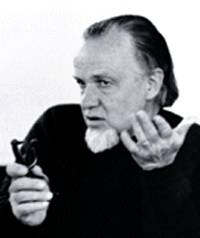


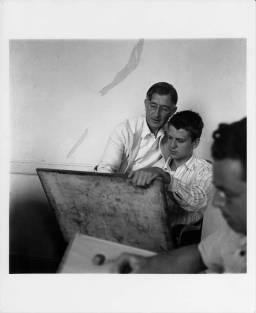





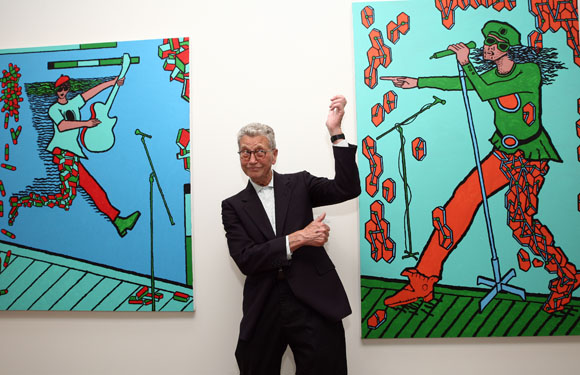


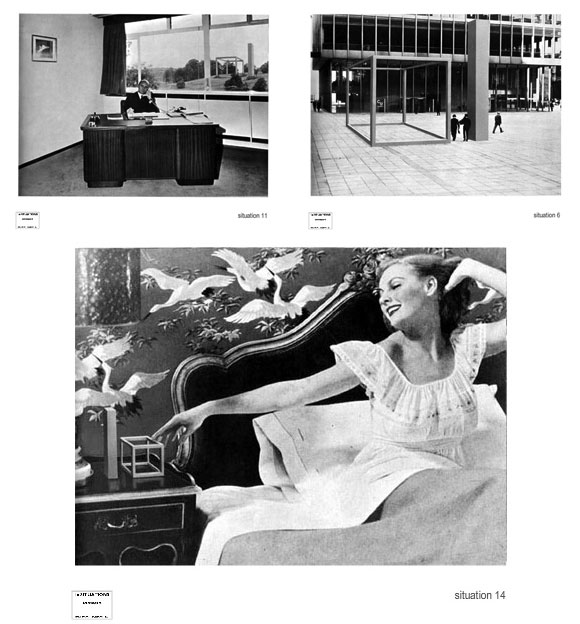


 The Daily Hatch