Monthly Archives: November 2014

“God and Cosmology: The Existence of God in Light of Contemporary Cosmology” William Lane Craig vs. Sean Carroll (Videos and Transcript)

__________

“God and Cosmology” William Lane Craig and Sean Carroll – 2014 Greer Heard Forum

Published on Mar 3, 2014

For more resources visit: http://www.reasonablefaith.org

On Friday, February 21st, 2014, philosopher and theologian, Dr William Lane Craig, was invited by the Greer Heard Forum to debate Dr Sean Carroll, an atheist theoretical physicist. The topic of debate was, “God and Cosmology: The Existence of God in Light of Contemporary Cosmology.” The rigorous debate was concluded by a lengthy question and answer period with the audience.

We welcome your comments in the Reasonable Faith forums:
http://www.reasonablefaith.org/forums/

Be sure to also visit Reasonable Faith’s other channel:http://www.youtube.com/drcraigvideos

Follow Reasonable Faith On Twitter: http://twitter.com/rfupdates

Add Reasonable Faith On Facebook:http://www.facebook.com/reasonablefai…

http://www.preposterousuniverse.com/blog/ http://winteryknight.wordpress.com/2014/02/21/tactical-faith-will-live-stream-the-responses-to-the-craig-carroll-debate-on-saturday/

The Humanist Hour #84: Dr. Sean M. Carroll

Published on Jun 27, 2013

In this interview, which took place before Dr. Carroll’s keynote speech at the American Humanist Association 72nd Annual Conference, he talks about issues ranging from his upbringing and education to research having to do with the Big Bang, quantum mechanics, the Higgs Boson, the idea of the multiverse, morality, the Large Hadron Collider, Hollywood movies where he’s been consulted, and more.

More details and show links can be found on the podcast website here: http://podcast.thehumanist.org/2013/0…

New Orleans Baptist Theological Seminary, New Orleans, LA, –

NOTE: Despite repeated requests Dr. Carroll has not yet furnished his PowerPoint slides or proofread his portion of the debate.

William Lane Craig – Rebuttal Speech

Thank you, Dr. Carroll, for that vigorous interaction!

Introductory Remarks

In my opening speech, I argued that God’s existence is significantly more probable given the evidence of contemporary cosmology than it would have been without it. This is due to the support which cosmology lends to key premises in the cosmological and teleological arguments.

Before we review those arguments, let me just say a word about Professor Carroll’s concluding remarks, which, I believe, are extraneous to tonight’s discussion.

He is very concerned to show that God’s existence is improbable relative to certain non-cosmological data. For example, the problem of evil, our insignificant size, and so forth. The very fact that these are non-cosmological data shows that they are not relevant in tonight’s debate. I have addressed things like the problem of evil extensively, for example, in Philosophical Foundations for a Christian Worldview.[23] So the debate tonight is not over the probability of theism versus naturalism. That would require us to assess all sorts of non-cosmological data. Rather, the question is: is God’s existence more probable given the data of contemporary cosmology than it would have been without it? And I think it certainly is.

Let’s look at those two arguments that I defended.

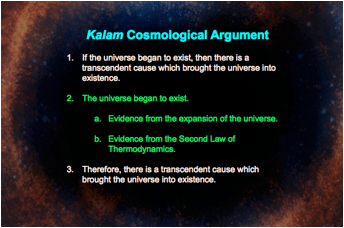
The Kalam Cosmological Argument

Consider, first, the evidence for the beginning of the universe from the expansion of the universe and thermodynamics.

The Causal Premise

To my surprise, Dr. Carroll challenges the first premise of this argument by saying it is based on outmoded Aristotelian concepts of causality. I protest – not at all! There is no analysis given of what it means to be a cause in this first premise. You can adopt your favorite theory of causation or take causation to be a conceptual primitive. All it requires is that the universe did not pop into being uncaused out of absolutely nothing. If that is the price of non-theism, then I think the non-theist is welcome to it. Dr. Carroll says on the Hartle-Hawking model the universe is uncaused. Not at all! The universe comes into being on such a model, and there is nothing in the theory that would explain why that universe exists rather than not. The model may be self-contained; but that is perfectly consistent with my argument. I am not arguing for some kind of interventionist deity, but rather, why does the universe exist? Why did it come into being at all?

Evidence from the Expansion of the Universe

With respect to the second premise, Dr. Carroll says there are all kinds of beginningless models of the universe. Well, it certainly is true that such models exist; but the problem is that none of them is successful.

Beginningless Models
Model average expansion history Condition requiring a beginning
1 Expanding models Singularity theorems
2 Asymptotically static models Metastability
3 Cyclic models Second Law of Thermodynamics
4 Contracting models Acausal fine-tuning

As Jim Sinclair has shown in our article in the Blackwell Companion, all of the models that Dr. Carroll has mentioned have been shown to be either untenable or not to avert the beginning of the universe.[24] Alex Vilenkin says flatly, “there are no models at this time that give a satisfactory model for a universe without a beginning.”[25]

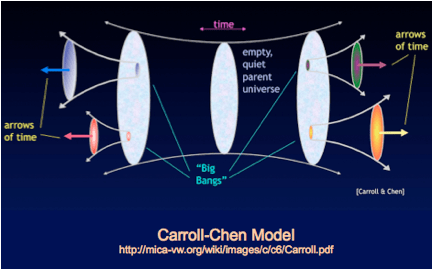
Consider in particular Dr. Carroll’s own model.

This model presupposes a reductionistic view of time according to which the direction of time is defined in terms of entropy increase. Now, in the model notice there are two arrows of time for the mother universe pointing in opposite directions. So on this view of time, we don’t really have an eternally existing mother universe here at all. Rather, you have two universes which share a common origin in the central surface. So what the model actually implies, rather than avoids, is a beginning of time and of the universe. Time has a beginning on this model, and therefore it involves all of the problems that are pertinent to the universe’s coming into being.

Be that as it may, I think it is safe to say that there is no credible classical model of a beginningless universe today.

Dr. Carroll does hold out hope that quantum cosmology might serve to restore the past eternality of the universe; but I would say that not only is there no evidence for such a hope, but I would agree with Vilenkin that if there is a quantum gravity regime prior to the Planck Time, then that just is the beginning of the universe. Dr. Carroll says you can have quantum descriptions of the universe that are eternal, and that is certainly true, but the question is: why would the universe transition to classical spacetime just 13 billion years ago? It could not have existed from infinity past in an unstable quantum state and then just 13 billion years ago transition to classical spacetime. It would have done it from eternity past, if at all.

So I think we’ve got good evidence from the expansion of the universe that the universe probably began to exist.

Evidence from Thermodynamics

What about the evidence from thermodynamics? First is the problem of information loss to baby universes on his theory. You will recall that is why Stephen Hawking rejected the baby universe hypothesis. Dr. Carroll responds, “My mechanisms for generating the baby universes don’t use Hawking’s mechanisms.” All right; but are they any more successful? I don’t think so. According to Chris Weaver in his article on the Carroll-Chen model,

The FGG [Farhi-Guth-Guven] nucleation [that Dr. Carroll uses] out of a de Sitter space-time is merely speculative and . . . Carroll’s discussion of it should be thought of as exploratory. . . . it is therefore safe to conclude that a central piece of the model is missing, and so the CC-M [Carroll-Chen model] is incomplete in that it does not have a clear recommended dynamical path from the background [space-time] to the birth of [universes] like ours.[26]

In fact, Weaver goes on to point out that for a universe described by the Borde-Guth-Vilenkin theorem (like ours), the Farhi-Guth-Guven mechanisms cannot produce such a universe. Therefore, these mechanisms fail.

I also, secondly, pointed out that there is a Boltzmann Brain problem with respect to Dr. Carroll’s model. It seems to me that he just didn’t respond to the point that I was making, namely, that since every baby universe grows into a de Sitter space, there will be vastly, vastly more of these Boltzmann Brains in the long run than there will be ordinary observers. So what Dr. Carroll would need to do is to justify some non-standard measure of probability that would make ordinary observers more probable than Boltzmann Brains. But he admits that he cannot do it.

We also then saw that quantum gravity will not avert this conclusion because of the Wall theorem, which should be valid for the quantum gravity era and requires a beginning of the universe.

Summary

So it seems to me we’ve got good evidence from the expansion of the universe and from thermodynamics that the universe is probably not past eternal but began to exist.

The Teleological Argument

What about that second argument based upon the fine-tuning of the universe?

Reality of Fine-Tuning

Here Dr. Carroll expresses scepticism that the fine-tuning is real. But a good many, if not most, of his colleagues would simply disagree with him here. Luke Barnes provides a list of just some of the scientists who have published works in defense of the reality of fine-tuning:

I can think of one more name that we should add to the list – namely, Sean Carroll! Listen to what he has to say about the low entropy condition of the early universe, which Robin Collins calls “potentially the most outstanding case of fine-tuning.”[27] Carroll writes, “If the universe we see is really all there is with the Big Bang as a low-entropy beginning, we seem to be stuck with an uncomfortable fine-tuning problem.”[28] So he tries to explain away this fine-tuning via the world ensemble, or multiverse, hypothesis.

Chance?

But then, as I argued in my opening speech, he confronts the Boltzmann Brain problem once again. Even if Dr. Carroll could show that ordinary observers predominate in life-permitting worlds, what about all of those worlds that are not life-permitting because the other constants and quantities are not finely-tuned? In such worlds – which vastly outnumber finely-tuned worlds – there will be no ordinary observers, and yet there will be untold numbers of Boltzmann Brains produced by thermal fluctuations. So the entire multiverse will be dominated by universes having vastly more Boltzmann Brains than ordinary observers like us.[29] Therefore, the data on the multiverse hypothesis is incomprehensibly improbable. The evidence is strongly disconfirmatory of the World Ensemble hypothesis.

Design?

Dr. Carroll says that theism does no better in accounting for the low entropy condition of the universe. For why, he asks, did God make the entropy of the universe so unnecessarily low in order to create us? Well, I have two responses to this. First, it is no part of the fine-tuning argument to assert that the purpose for which the universe was created is us! There may well be intelligent life created by God scattered throughout the universe. But, secondly, as Robin Collins has pointed out, even if a general low entropy condition is not necessary for our existence, it is necessary for the discoverability of the universe. God hasn’t given us an instruction manual about how the world works. But what he has done is make a world which is susceptible to rational exploration and discovery. And if God wanted to make a universe discoverable by embodied, conscious agents, he might well make it in such a low entropy condition. (You will hear more about that tomorrow when Robin gives his paper.)

So it seems to me that Dr. Carroll faces uniquely a Boltzmann Brain problem for a number of reasons – a problem that does not afflict theism.

Summary and Conclusion

So, in summary, this is not a debate between naturalism and theism. Otherwise, I would be offering ontological arguments, moral arguments, other sorts of arguments. For that debate, you need to listen to my debate with Dr. Rosenberg last year at Purdue University.[30] What this debate is about is: to what degree do the data of contemporary cosmology render God’s existence more probable than it would have been if we didn’t have that data? To my mind, it is almost undeniable that God’s existence is much more probable given the evidence that we have for the beginning of the universe and the fine-tuning of the universe. Therefore, contemporary cosmology is strongly confirmatory of theism.


[23] See Chapter 27, “The Problem of Evil” in J. P. Moreland and William Lane Craig, Philosophical Foundations for a Christian Worldview (Downers Grove, Ill.: InterVarsity Press, 2003), pp. 536-53.

[24] William Lane Craig and James Sinclair, “The Kalam Cosmological Argument,” in The Blackwell Companion to Natural Theology, ed. Wm. L. Craig and J. P. Moreland (Oxford: Wiley-Blackwell, 2009), pp. 101-201.

[25] Alexander Vilenkin, “Did the universe have a beginning?” http://www.youtube.com/watch?v=NXCQelhKJ7A

[26] Christopher Gregory Weaver, “On the Carroll-Chen Model,” September 17, 2013, arXiv:1309.4976 [physics.hist-ph], p. 11. See http://arxiv.org/abs/1309.4976 (accessed March 20, 2014).

[27] Robin Collins, The Well-Tempered Universe, pre-print.

[28] Sean Carroll, From Eternity to Here, p. 365. Cf. “If our universe began at the Big Bang, it is burdened with a finely-tuned boundary condition for which we have no good explanation” (Ibid., p. 5).

[29] Thanks to Robin Collins for bringing my attention to this point!

Sean Carroll – Rebuttal Speech

Great. Well, thanks again. I think that we can just go right back to my three major points, and I think that, halfway through our forum, I believe these three major points more strongly than ever. Now, I know that Dr. Craig would disagree but I’ll try to establish that his disagreements with number one are based on misunderstandings of the science. His disagreements with number two, the evidences against theism, is largely based on using number three—the fact that theism is not well defined.

So let’s go to the kalam cosmological argument. There’s a deep philosophical difference between us. I claim that a consistent, complete model that fits the data accounts for what we see in the world is a success. There’s no right that we have to demand more than that, and I believe that Dr. Craig’s response was, “Yes there is.” I don’t think this counts as a very good response. It’s a very difficult thing because the universe is different than our everyday experience. That doesn’t sound like a surprising statement but we really need to take it to heart. To look at a modern cosmological model and say, “Yes, but what was the cause?” is like looking at someone taking pictures with an iPhone and saying, “But where does the film go?” It’s not that the answer is difficult or inscrutable; it’s completely the wrong question to be asking. In fact it’s a little technical, most of my second talk here, but I think it’s worth getting it right. Why should we expect that there are causes or explanations or a reason why in the universe in which we live? It’s because the physical world inside of which we’re embedded has two important features. There are unbreakable patterns, laws of physics—things don’t just happen, they obey the laws—and there is an arrow of time stretching from the past to the future. The entropy was lower in the past and increases towards the future. Therefore, when you find some event or state of affairs B today, we can very often trace it back in time to one or a couple of possible predecessor events that we therefore call the cause of that, which leads to B according to the laws of physics. But crucially, both of these features of the universe that allow us to speak the language of causes and effects are completely absent when we talk about the universe as a whole. We don’t think that our universe is part of a bigger ensemble that obeys laws. Even if it’s part of the multiverse, the multiverse is not part of a bigger ensemble that obeys laws. Therefore, nothing gives us the right to demand some kind of external cause.

The idea that our intuitions about cause and effect that we get from the everyday experience of the world in this room should somehow be extended without modification to the fundamental nature of reality is fairly absurd. On a more specific level we talked about my model. Again, I’m not trying to defend my model; I’m the first one to say that it has problems. None of the problems that it has are the ones that Dr. Craig raised. He says that it’s not really eternal, which it is hard to express the extent to which I think this is grasping at straws. The axis for time goes from the top to the bottom and it goes forever. The only sense in which this universe is not eternal is that there is a moment in the middle where the entropy is lowest. I made the point in my opening speech that that has nothing to do with the kind of beginning you would need to give God room to work and as far I can recall Dr. Craig didn’t address that argument.

He does say that it is speculative, the idea of baby universes coming into existence. I’m the first to agree. It’s completely speculative. He quotes a paper that says the mechanism by which baby universe are created is speculative, it might not be right. Again, it’s completely true. He claims to use it to say that unitarity is violated even though the quote he read didn’t even mention unitarity and wasn’t about unitarity. That is not a sensible objection.

I will repeat – the quantum eternity theorem, a sensible analysis of the history of the universe, might be with the rules of quantum mechanics. He claims that someone else said there might be a singularity in quantum gravity but he gives us no understanding, he simply repeats his previous analysis. So, I want to draw attention not to my model but to the model of Anthony Aguirre and Steven Gratton because this is perfectly well defined. This is a bouncing cosmology that is infinite in time, it goes from minus infinity to infinity, it has classical description everywhere. There is no possible sense in which this universe comes into existence at some moment in time. I would really like Dr. Craig to explain to us why this universe is not okay.

Now there’s a theorem by Alan Guth, Arvind Borde, and Alex Vilenkin that says the universe had a beginning. I’ve explained to you why that’s not true but in case you do not trust me I happen to have Alan Guth right here. One of the authors of the Borde-Guth-Vilenkin Theorem, Alan what do you say? He says, “I don’t know whether the universe had a beginning. I suspect the universe didn’t have a beginning. It’s very likely eternal but nobody knows.” Now how in the world can the author of the Borde-Guth-Vilenkin theorem say the universe is probably eternal? For the reasons I’ve already told you. The theorem is only about classical descriptions of the universe not about the universe itself.

So, going to the teleological argument. It is true – Dr. Craig brings up the point that people disagree with me, it is true. I attempted to give an argument and not merely an opinion poll. If we’re allowed to take opinion polls I will poll my fellow cosmologists on whether God had anything to do with creating the universe and I will win by a landslide. I suspect that Dr. Craig thinks the majority of the opinions of cosmologists is important for some issues but not for others. The entropy of the early universe is exactly backwards when it comes to being an argument for fine-tuning according to theology. Dr. Craig quotes me in a “gotcha-moment” saying, “Look, the early universe was finely-tuned with a low entropy.” That is absolutely true. The point that I raised was not that there is not fine-tuning, it’s that there’s no evidence the fine-tuning is for life to exist. Indeed, the maximum possible entropy of the part of the universe we observe is this huge number, 10122. The entropy that you would need is a little bit lower than that if you wanted life to exist. But it’s almost the same. It’s 0.999 etc. times the maximum entropy, whereas the actual entropy of the early universe is enormously smaller than that. There’s absolutely no reason why the universe would look like this if the fine-tunings were put there in order for life to exist. I’m not saying there’s not fine-tunings; I’m saying they’re not there for life.

Turning to the multiverse, again it is a completely speculative thing, but it is a completely natural thing and I don’t really see any argument against that. The multiverse, the idea that outside the universe we see there could be very different regions with very different physical parameters, is no more radical then the idea that there are different planets with different atmospheres. To a frog on a lily pad that lily pad is its universe. To us in the universe we see a hundred billion galaxies is enough but it’s very, very easy to come up with physical models that have much more out there. The main argument Dr. Craig has against this is the Boltzmann Brain argument. Again, I gave you why that’s not a good argument and it seems to have been ignored in Dr. Craig’s last speech; namely that the multiverse does not predict that everything happens. It predicts certain things happen with certain frequencies. So what you do as a working cosmologist is check that your universe is not dominated by Boltzmann Brains. Are there multiverse models that pass that test? Yes, there are. It is easily avoided. Then he brings up this weird argument, he says, “There could be the regions where ordinary observers could not exist because the parameters are not right but Boltzmann Brains could exist.” But the whole point is that Boltzmann Brains are forms of life. Boltzmann Brains can only exist where life is possible. So what one does in cosmology is look at the multiverse regions where life is possible and counts the number of Boltzmann Brains versus the number of ordinary observers—there are models that pass the test.

Now, I think that this is, again, a philosophical point here because when I talked about the list of ways in which our expectations for theism come out completely wrong when you compare them to the world, Dr. Craig said, “Well, that’s not the point, we’re not arguing about morality” and things like that. But again that misses the point of my argument. I was not actually putting forward these as strong predictions of theism. I was making the point that there are no strong predictions of theism. It’s not that there should be no evil in the world if God exists, it’s that you can always wriggle out of the prediction that there should be no evil in the world if God exists. That’s why it’s not a good theory of the world generally, that’s why it’s not a good cosmological model, particularly. Now, Dr. Craig said that we shouldn’t expect to know things about the world simply because we say that God finely-tuned it. “Just because under theism,” he says, “God made the parameters of the universe such to allow life to exist doesn’t mean we can have any other expectation for predicting what those parameters are.” This reflects something that he said on his website earlier. In a similar context he said, “Suppose God is more like the cosmic artist who wants to splash his canvas with the extravagance of design and who enjoys creating this fabulous cosmos designed with fantastic detail for observers.” So, what this attitude is saying is that – well, my point is that – this is not some sort of sophisticated apologetic strategy. This is an admission of defeat. This is saying we should never expect theism to explain why the universe is one way rather than some other way. You know God—God is an artist. You know artists; they’re kind of quirky and unpredictable. We can’t expect to know what they’re going to do ahead of time. Anything you might possibly observe about the universe, according to this view, I can explain as saying, “That is what God would have done.”

In naturalism, on the other hand, you need to play by the rules. When we say in cosmology or physics that a certain parameter is finely-tuned, it’s not just the parameter looks funny to us, it’s that we have a prior set of expectations for what values the parameters should take on and the parameter doesn’t fit those expectations. So we look for physical models that explain it, and that drive to understand things better helps us understand physics better, helps us understand the real world better. So, unlike God who is an artist and can’t be predicted, nature is not an artist. Nature plays by the rules. Nature makes predictions. Nature provides explanations. Thank you.

William Lane Craig – Closing Speech

Perhaps you feel like you have been drinking from a fire hose this evening! But let me in my final speech try to draw together some threads of the debate and see if we can draw some conclusions.

Introductory Remarks

I hope that it has been obvious tonight that I am not offering God as a theory to compete with scientific theories about the universe. Rather, I am saying that those self-contained, secular theories provide evidence for theologically neutral premises in philosophical arguments leading to a conclusion that has theistic significance—premises like “The universe began to exist” or “The fine-tuning is not due to physical necessity or to chance.” If those premises are supported, then it follows deductively that there is a Creator and Designer of the universe. Dr. Carroll’s complaints about theism’s not making predictions would be important only if I were offering some sort of theistic theory of the world. But I am not doing so. I am simply appealing to the cosmological evidence in support of these theologically neutral premises that go to deductively imply the existence of a Creator and Designer.

Let’s look again at those arguments that I defended.

The Kalam Cosmological Argument

The Causal Premise

First, the kalam cosmological argument. Dr. Carroll challenges the first premise, that if the universe came into existence, there is a transcendent cause that brought the universe into being. Honestly, I am quite astonished that he would think that the universe can literally pop into being out of nothing. Let me just give three arguments for why there must be a cause.

First of all, it seems to me a metaphysical first principle that being doesn’t come from non-being. Things don’t just pop into existence from literally nothing. Nothingness has no properties, no potentialities. It is not anything. So it seems to me inconceivable metaphysically to think the universe can come into being from nothing.

Secondly, if the universe could come into being from nothing, then why is it that only universes can pop into being out of nothing? Why not bicycles and Beethoven and root beer? What makes nothingness so discriminatory? If universes could pop into being out of nothing, then anything and everything should pop into being out of nothing. Since it doesn’t, that suggests that things that come into being have causes.

Finally, all the empirical evidence we have supports the truth of the causal principle. When Dr. Carroll says, “The universe is different than our experience,” this is really committing what Alexander Pruss calls the taxi-cab fallacy, that is to say, you go with the causal principle until you reach your desired goal and then you think you can just dismiss it like a hack because you don’t want there to be a cause of your entity – the universe. But if the universe came into existence, if the universe is not eternal, then surely it would need to have a cause. In fact, to deny this is unscientific because the whole project of contemporary cosmogony is to try to find what is the cause of the universe! So on his principle, it would be a science-stopper and would destroy his very field of expertise.

Evidence from the Expansion of the Universe

With respect to the second premise that the universe did begin to exist, he denies that he actually has an origin of time going in two opposite directions.

But this is a different diagram of his model.[31] Notice that on this diagram, you have a non-reductionistic arrow of time that goes from past to future. This is not an arrow of time that is determined by entropy increase, as he had in the other diagram. This is a non-reductionistic view of time, that Professor Maudlin and I accept, where the direction of entropy increase doesn’t define the direction of time. On this model, the universe contracts down from eternity past from infinity to a relatively low entropy point and then begins to expand again. That kind of model is physically impossible. It contradicts the second law of thermodynamics. That is why you have got to have the arrows pointing in both directions, if you want to hope for this model to be realistic. But if you have a double-headed arrow of time in both directions, then you have a beginning of time and of the universe. So I want to co-opt Dr. Carroll’s model for myself! On his model of the universe, the universe began to exist, along with time.

I also pointed out that on the Borde-Guth-Vilenkin theorem, there are no classical models that succeed in showing the universe to be beginningless. He rightly points out this is just classical space-time. But then I never heard a response to my claim that if there is a quantum gravity era prior to the Planck time, then it would have to be itself finite because otherwise it becomes inexplicable why classical spacetime only came into being 13 billion years ago rather than from eternity past.

So I think we have got good evidence for the beginning of the universe from the expansion of the universe.

Evidence from Thermodynamics

As for thermodynamics, here I argued that in order to explain why we are in a low entropy state, the standard answer is that the universe began relatively recently with its low entropy condition at the beginning. By contrast, his model, I charged, violates the unitarity of quantum physics. He says, “No, because I am not using the same mechanisms as Hawking.” But then I pointed out that the mechanisms that he appeals to are both conjectural and actually incompatible with a universe described by the Borde-Guth-Vilenkin theorem, as Christopher Weaver points out in his critique of the model.

Secondly, the Boltzmann Brain problem. I don’t think that Dr. Carroll has really come to grips with this, quite honestly. There are at least two reasons why Boltzmann Brains would dominate. First, because on his multiverse model, in the long run every baby universe becomes a de Sitter space and will become dominated with Boltzmann Brains. Secondly, in all of the other worlds that are not fine-tuned, there just aren’t any ordinary observers; but there will be thermal fluctuations that will produce Boltzmann Brains. So he is the one who has to justify some non-standard measure of probability in order to explain why ordinary observers like us should exist rather than Boltzmann Brains.

Then I appealed to the Wall theorem to show that even on a quantum gravity theory you are not going to avoid the beginning of the universe. Dr. Carroll may have responded to this, but if he did, it went by so quick I didn’t hear it. So it seems to me we’ve still got the Wall theorem showing that even with a quantum gravity era there has to be a beginning.

The Teleological Argument

Design?

As to the teleological argument from fine-tuning, he seems to have rested his entire case here on the fact that entropy would be way, way unnecessarily too small on theism. But I gave two responses to that. First, there may be life throughout the universe, not just us. Secondly, as Robin has pointed out, the low entropy condition is suitable for the discoverability of the universe. By contrast, on his view, it is incomprehensibly improbable that we should exist, given the equilibrium or the heat death state at which the universe would more probably exist.

Summary and Conclusion

So, in sum, in seems to me that on balance that we have got good evidence that the universe began to exist and that, therefore, there must be a Creator that brought it into being. Moreover, this is a personal Designer of the universe in view of the fine-tuning of the universe for intelligent, interactive agents like ourselves.


[31] The different diagram in Fig. 17 is from Sean Carroll, From Eternity to Here: The Quest for the Ultimate Theory of Time (New York: Plume, 2010), p. 363, Fig. 87.

Sean Carroll – Closing Speech

All right, congratulations to everyone for having made it this far. I will confess a bit of frustration in this final talk because I think almost everything that Dr. Craig had said in his last talk he had already said, and I tried to give my best response to it. They weren’t always matched. So, I’m going to take advantage of that to do something bizarre and unpredictable, which I’ll get to in a second.

First, I want to notice some of the things he did say. He said he was astonished that I refused to accept the fact that things need causes to happen. To which I could only quote David Lewis, “I do not know how to refute an incredulous stare.” I tried to give the reason why the causation analysis that we use for objects within the universe does not apply to the universe but that more or less whizzed on by. Dr. Craig gets a lot of mileage out of the presumed nuttiness of things just popping into existence. “Why don’t bicycles just pop into existence?” Again, I tried to explain what makes the universe different but more importantly the phrase “popping into existence” is not the right one to use when you’re talking about the universe. It sounds as if it’s something that happens in time but that’s not the right way to do it because there’s no before the beginning, if there’s a beginning. The correct thing to say is there was a first moment of time. When you say it that way it doesn’t’ sound so implausible. The question is, is there a model in which that’s true? Do the equations of the model hang together? Does the model fit the data? And we have plausibly positive answers to all of those.

He spends a lot of time on my own model, more time than I would have spent on it. He is upset that I did not include an arrow at the bottom in my axis when I drew the graph previously. I don’t care about that to be very honest. The double arrows here are just to express the fact that there’s no intrinsic arrow of time. The arrow of time that we experience is because of the behavior of matter in the universe—the entropy increasing. And he says that’s in violation of the Second Law of Thermodynamics. Yes, it is an explanation of the Second Law of Thermodynamics. This is the reason why we in our little part of the universe observe the second law. He mentions once again Boltzmann Brains and he says that there should be more Boltzmann Brains than ordinary observers. I again explain why that’s not true because it’s a model dependent statement. In this particular model it turns out to be easier to make a universe than to make a brain. That’s a selling point of the model.

So, with that under our belts, I want to actually just completely go off the topic and talk about issues beyond naturalism and theism. We’re having a discussion here about God and cosmology but let’s pull back the curtain a little bit. There are very few people in the modern world who become religious, to come to believe in God, because it provides the best cosmology or because it provides the best physics or biology, or psychology, or anything like that. And that includes Dr. Craig. There’s a famous quote by him that says, “The real reason, the primary reason, for believing in Christianity isn’t cosmological arguments.” I’m not mentioning this as a criticism; it is simply an observation of fact. There are other reasons to be a theist other than cosmology, and I think that is true. I think that makes sense. Most people who become religious do so for other reasons—because it gives them a sense of community, a sense of connection with the transcendent, it provides meaning or fellowship in their lives. The problem is that the basis of religion in the modern Western world is theism, belief in the existence of God. I’ve tried to make the case that science undermines theism pretty devastatingly. Five hundred years ago it would have made perfect sense to be a theist. I would have been a theist five hundred years ago. By two hundred years ago science had progressed to the point where it was no longer the best theory. By a hundred years ago after Darwin it was a rout. And by these days with modern cosmology there’s no longer any reason to take that as your fundamental worldview.

So what do you do if you identify as a member of a religious tradition in this situation. I think there are three options. One is to deny the science, to think that the world is six thousand years old. Happily, nobody up here on this stage today takes that attitude. That was a previous debate from a couple weeks ago. But there is a second attitude which is to accept the science but deny the implications—to say that none of the progress of modern science has in any way altered the fundamental view of reality that we put together two thousand years ago. I think that there’s two reasons why that’s not a good idea. Number one, I think it’s wrong, as I tried to explain throughout the debate, but number two, I think it’s a strategic mistake. I think that if one believes in theism that must be central to one’s view of the world for many, many other reasons, and because theism has been undermined by science it takes theists and it marginalizes them as part of the wider intellectual conversation. Humanity is at a crossroads. It’s at a very important time in the history of the world. We need to have deep discussions about who we are and where we’re going, and people who cling to the belief in God after science has undermined it are increasingly not going to be part of that discussion.

We talked about cosmologists and physicists, here’s what philosophers believe. There’s a recent survey that asked philosophers thirty big questions. And you know philosophers don’t agree on anything, but here are the three questions they had the greatest amount of consensus on: external reality exists, science tells us something about that external reality, and God does not exist. Now, again, get three philosophers in a room and they don’t even agree that there are three philosophers in the room. So, the fact that there’s only 73% is a still very impressive, and this includes professional philosophers of religion.

So I claim that there is a third option. Here’s the point where I start giving people advice who did not ask me for any advice. So, I ask your indulgence here. The third option, as I see it, for the person who is religious is to say, “Look, we admit we were wrong. We were wrong hundreds of years ago when we based our belief system on the idea that God was in charge of it all. Of course we were wrong, it was two thousand years ago! We didn’t have microscopes or telescopes. What right do we have to think that we would have gotten the fundamental nature of reality right but,” this person could hypothetically say, “religion is much more than theism. It’s not just the belief in God. There is the fellowship we feel for our fellow human beings.” For centuries, religious traditions were the place where human beings did their most careful, sustained, and rigorous contemplation about what it means to be human, about what it means to experience joy or suffering, to feel camaraderie with your fellow man, to be charitable, and so forth—to have meaning and purpose in your lives. So, maybe this person could say there is something to be learned even for naturalists from the outcome of all that contemplation. Maybe there is wisdom in Scriptures and the Sermon on the Mount, in the art and the music and the lives of the saints, or for that matter, the Bhagavata Gita or the Daodejing. I don’t know whether there is wisdom there, I’m asking for guidance. At the end of the day we’re all human beings trying to figure out our way in this confusing world.

The point is that naturalism replaces theism but it doesn’t replace religion. It doesn’t necessarily provide answers to the hard questions of meaning and fulfillment and purpose. I think that it can. I find naturalism, personally, to be an inspirational and profound view of the world. Ironically, the part I find most inspirational is the fact that some day I will die. Everyone in this room will someday be dead and there will not be an afterlife, a continuance, a judgment. The lives we lead now are not dress rehearsals. They are the only performance we have; therefore, what matters is what is here—the people we know and love, the lives we can change, the good we can do for the world. That is all there is, so of course that is what matters. Another way of putting it is naturalism has addressed the easy questions, the basic physical features of how the world works, but there are hard questions of meaning and purpose and fulfillment yet to be answered. What I like to say is we have picked the low-hanging fruit off of the tree of knowledge but there’s a lot of succulent goodies up there on the higher branches, and we’ll get there faster if we all climb together. Thank you.

Question and Answer Session

MODERATOR: Let’s give them both another hand. [applause] This was just amazing. The one thing I am amazed by is that there are great disagreements about time but both of them stayed on time. [laughter] Thanks, guys! Come on up to the podium. Let me explain how this is going to work. I need to get my notes here. My wife gets very nervous when it’s just my stream of consciousness working. [laughter]

We have a microphone in each aisle for questions. The aisle over here on Sean’s side is for questions for Sean Carroll. The aisle over here by Bill’s side is for questions for Bill Craig. And we’re going to alternate from one to the other, and we’ll have an even number of questions—alright? When a question is asked to Sean, Sean will have two minutes to answer. If Bill wants to respond he’ll have up to one minute. And vice versa—when a question is asked to Bill he has up to two minutes to answer, and Sean has up to one minute.

Let me give some instructions to those who are asking questions. Number one: state your question in a hurry, like twenty seconds, okay? Number two: make sure that it’s a real question. [laughter] The way to make sure that you’re asking real questions is ask yourself a question. Ask yourself this question: was I paid to come here? [laughter] Exactly! If you were not paid to come here then you are welcome to ask a question but you are not invited to lecture. So make sure it’s a real question. Second, ask yourself this question: will everyone benefit from hearing this question? Is it a question that’s going to shed light, to get at more truth? Or is it more akin to some interesting thoughts you had one night after your third highball? You’ve heard it said, there is no such thing as a stupid question. That’s not true. [laughter] That’s a stupid saying. And my last instruction would be: you only get one question. When you ask your question, step away from the microphone. No follow-ups, unless Sean or Bill asks you. If they don’t understand what you’re saying and they ask you a question, you can clarify it. So we can get more questions in and everyone will be happier. So come to the microphones now, and we will begin.

One other thing: here at the Greer-Heard forum we follow Robert’s Rules. My name is Robert, I make the rules. [laughter]

Question 1: Hey, Dr. Carroll, how are you doing? Thank you for being here tonight, sir. In your polemic tonight on theism you said something like, “Look, if you have a fully explainable model, why do you keep looking for something else to add?” Okay? Now, my question is something like this: if you took as a metaphor for the universe, say, that we have a complete and entire physical explanation for the existence of the jet engine – you know, we can talk about internal combustion, all the things that go into making it and so forth – but does that complete knowledge mean that Frank Whittle didn’t exist? Does a fully accurate mathematical model make this so? My question is this, exactly: isn’t this a category mistake to assume that it does; namely, that law and mechanism does away with personal agency?

Dr. Carroll: Great. This is being recorded, I don’t need to repeat the question—right? So his question got on to the tape? Okay. Yeah, so, it’s a very good question and I think the answer is the universe is different than things inside the universe. As I tried to explain, there is a reason why there are reasons why. There are reasons why in our everyday life it is perfectly correct to speak a language of causation and explanation and invention and creation, and when you look carefully what those reasons are, they don’t apply to the universe. The universe isn’t part of a bigger structure in which there are patterns, evolution laws, arrows of time, expectations for what should happen. So a jet engine and a universe are just not very analogous to each other.

Dr. Craig: It seems to me that that’s just fantastic, to think that the universe could just come into being from non-being; that it just pops into existence. And, as I said, if one says that that is possible, then you’re confronted with the difficulty: why only universes? It seems to me then that everything and anything would come into being from nothing because there’s nothing about nothing that could make it discriminate between universes and anything else. So it seems to me that this is a difference without a difference. I would say that the condition that applies to the universe that makes the causal principle relevant would be its beginning to exist. If a horse begins to exist, there’s got to be a cause for that. If a building begins to exist, there’s got to be a cause for that. Similarly if the universe begins to exist, there needs to be a cause for that. And in that respect the conditions for the causal principle do apply. Sorry, I’m out of time!

Question 2: Dr. Craig, what would you say to a Thomist, a follower of Thomas Aquinas, who says, “I have good arguments for God such as Aquinas’ Five Ways that are based on indubitable metaphysical principles. It would be imprudent to advance a theistic argument that rests even partly on modern science since science can change and if some theistic argument loses face as science changes so does theism.?” Dr. Craig, what about this charge of imprudence from the Thomist.

Dr. Craig: Yes, I would say that Thomas Aquinas’ own metaphysical principles are highly dubious and in doubt, and that therefore I have little confidence that his arguments are, as he claimed, demonstrations. Aquinas was familiar with the kalam cosmological argument. This is a very ancient argument, and he was aware of the Muslim medieval thinkers who championed it. And Aquinas said if the universe did began to exist, then clearly there had to be a cause of the beginning and of motion. But he thought you couldn’t prove with demonstrative certainty that the universe did begin to exist. (Of course, they had none of the modern empirical evidence.) But I am persuaded, and I think Aquinas would agree, that the philosophical arguments for the beginning were good probability arguments, even if they weren’t mathematical demonstrations. So I think Aquinas simply raised the bar too high for what constitutes a good argument for God’s existence. We don’t need to have certainty or mathematical demonstrability. All we need to do is offer arguments that are logically valid, have true premises, and the premises are more plausibly true than not. And if that’s right, then that’s a good argument for the conclusion. And I think we’ve got such arguments today, and we shouldn’t be preoccupied with Aquinas’ concern for metaphysical or mathematical demonstration.

Dr. Carroll: One of the architects of the Big Bang model was George Lemaître, who’s a Belgian physicist, mathematical physicist, MIT and Harvard graduate, and also a Jesuit priest. And later in life, in the 1950s, he was serving on a papal commission because the Pope at the time wanted to put forward a statement that said, “Look! The Big Bang! Excellent evidence for the existence of God.” And Lemaître stopped him from doing that. He said, “No, you can’t get your peanut butter of theology mixed up with the chocolate of science. It does not actually taste great together because, who knows, someday some smartass will come up with a theory of the universe that is eternal and there isn’t a Big Bang anymore.” Dr. Craig and I are on the same side. We think that Lemaître was wrong to make that kind of statement. We both believe that if you’re going to be an intellectually honest theist you need to accord with the best data from the universe. And as we both agree, science isn’t in the job of proving things with metaphysical certitude. It says that models get better and better at fitting the data. I think that works just as well for theism as it does for naturalism.

Question 3: Dr. Carroll, thanks for being here tonight. My question: at the end of your first speech you mentioned how, in a nutshell, the theist weasels his way out of predictions that we would make based on the evidence. My question is, though: coming at it, that seems to be assuming that naturalism is some sort of default position and that theism is just adding one step on. My question would be that: do you not find that naturalism is a sort of a bent, an angle, that you’re coming at in that you allow nothing in that realm? Because, I mean granted I know that’s what naturalism is, but that you’re so shut off from the beginning that nothing could ever, ever, ever meet the evidence. Like Lawrence Krauss says, even if it was written in the sky, he would maybe consider it.

Dr. Carroll: That’s right, yeah, I think this is a good point. Personally I think that there would be no problem for me to be persuaded out of naturalism. Alright, the roof is not falling on me. [laughter]. But I think it’s a matter of what is the model that best fits the data. Again, five hundred years ago I would have been a committed theist because that was the best we could have done at the time. So I think that it is not an assumption. Some people try to sometimes say that science or naturalists start from an assumption of naturalism so they just simply won’t consider alternatives. I’m very happy to consider alternatives. I think that if there were some phenomena in the world which really looked exactly like some religious tradition was saying should happen and was miraculous, was seemingly violating the laws of physics, what would scientists do in that situation? They would not say, “Oh, we’re not allowed to think about this because we agreed yesterday at faculty tea that the world was a natural world.” I think they would try to come up with the best explanation. If the best explanation is not naturalism, then I would buy that. I will say that naturalism seems to me to be a priori simpler than theism because naturalism is the natural world, theism has the natural world and something else that I think is ill-defined. But I didn’t actually use that. I think in a proper quantitative Bayesian probability analysis my prior for naturalism is higher than my prior for theism, but overwhelming evidence will always take care of that. I just don’t think it’s there.

Dr. Craig: Both the naturalist and the theist can be stubbornly committed to their worldviews and not allow contrary evidence to overthrow it. Naturalists are just as adept as theists at explaining away evidence that they find inconvenient—I mean, even to the extent of asserting that the universe popped into being out of nothing! So that’s a charge that, I think, goes both ways. It would be possible to falsify theism, for example, by showing a contradiction in the concept of God, as some have sought to do – that there could not be, for example, an omniscient person or a timeless person or something of that sort. So that would be a means of falsifying theism if one could go that route.

Question 4: Dr. Craig, I’d like to understand whether the kalam argument (because I am struggling with this) . . . You’re stating that the universe has a beginning, and then you evoke cause and effect, but cause and effect is a temporal concept. So if there is no time?

Dr. Craig: Is a what?

Question 4: It is a temporal concept; it makes sense if time exists. But before the universe there’s no time, and considering that, why would you need a cause when the concept of cause and effect does not make really any sense?

Dr. Craig: Now, when you say that cause and effect are temporal concepts, what do you mean by that?

Question 4: Well, that you have a cause has always precedes the effect.

Dr. Craig: Ah, that’s what I thought you might think! Yeah, I don’t think that’s at all true. Don’t you think that causes and effects can be simultaneous?

Question 4: If they are then God and universe came into being at the same time, then why would you need God to explain the birth of the universe because they’re born at the same time?

Dr. Craig: Okay, so you are willing to grant that causes and their effects can be simultaneous—right?

Question 4: Sure.

Dr. Craig: Okay, yes, I think that that’s evident. So, what I would say is that God’s creation of the universe is simultaneous with the universe’s coming into being. And what could be more obvious than that, when you think about it? When else could it come into being than at the moment when God created it? So my own studied view of God’s relationship to time – which is a terribly interesting subject – is that God is timeless without creation and he is in time from the moment of creation on. The exercise of causal power by which God brings the universe into being marks God’s entrance, as it were, into time in virtue of his causal relationship with the effect that he brings about. So I don’t think causes do need to precede their effects temporally; they can be simultaneous with them. And in the case of creation I would say the universe comes into being at t=0, and that is the same moment at which God causes the universe to come into being.

Dr. Carroll: I’m pretty sure nobody cares about my opinion of God’s atemporality, [laughter] so I will use this as an excuse to reiterate my objection to the language of coming into existence or popping into existence. That is not what the universe does even in models where the universe has a beginning, a first moment. Because the verb popping, the verb to pop, has a temporal connotation, is the word I’m looking for. It sounds as if you waited a while, and then, pop, there was the universe. But that’s exactly wrong. The correct statement is that there are models that are complete and consistent in which there is a first moment of time. That is not the same as to say there was some process by which the universe popped into being. That’s yet another difference between the universe and things inside the universe.

Question 5: Dr. Carroll, you said in prior talks that in the laws of physics that we observe today there’s no room for free will. I’d like to know – granted that I consider you to be a rational, critical thinker – how do you reconcile critical thinking if at the same time you believe we don’t have the free will to choose between true and false premises and valid and invalid logic. If those choices are made for you how is anything anybody says not immediately irrational?

Dr. Carroll: I know I’m in trouble when someone says “I consider you to be a rational thinker” before they ask me the question. [laughter] I’m not exactly sure what you read. I think if you read carefully, I believe in free will. I’m pro-free will. I think of free will as an emergent concept in a universe which at the fundamental level is completely mechanistic. I think there are laws of physics that do not involve what we call a libertarian approach to free will. I do not think that human beings supersede the laws of physics. I think that human beings are collections of elementary particles interacting according to the laws of physics. And if I were to, say, write down every single particle in my body and I had a Leplace’s demon level of computation ability, I could predict what I would do. But I don’t have any of that. I don’t have the information, the micro-state of my quantum mechanical wave function, and therefore the vocabulary I use to describe myself is as human being making choices according to rational principles. And I think that it is absolutely legitimate in that framework to say free will is real. The most I ever wrote on free will was a short blog post called “Free will is as Real as Baseball.” Baseball is nowhere to be found in the fundamental laws of physics. It is a description at a collective level of things that happen in the macroscopic world. That doesn’t mean that baseball doesn’t exist, it just means that it’s not there in the fundamental laws. I think that free will is exactly the same way. I think there is nothing wrong with using the language of people making choices, people being correct or incorrect.

Dr. Craig: Well, it seems to me that on your view, free will is ultimately illusory because everything we do is determined by what goes on on the fundamental level. And therefore, even though I have the illusion of free will, if I could really understand it, I would see that, in fact, I am determined to do everything that I do—including believing in determinism, which makes my choice to believe in determinism, it seems to me, irrational—or arational, I should say. I’m simply determined to believe in determinism. So I don’t think it’s helpful to talk about free will as an emergent reality when at a fundamental level you’re affirming determinism. Then it’s freedom only in name and not in reality, and in that case I think the questioner is right—it’s very difficult to see how anything I do is rational. It’s just like a tree growing a branch. It’s all determined by mindless forces.

Question 6: Dr. Craig, it’s an honor to speak with you tonight. I was going to ask Dr. Carroll something, but the line was so long, and I like short lines. So I came over here. [laughter] I’m not an atheist.

Dr. Craig: You could say, “If you were Dr. Carroll, what would you . . .” [laughter]

Question 6: There you go! I’m not an atheist, an agnostic, or a classical theist. I feel like there’s a middle camp between the two of you that’s ignored, and I’m more along the lines of a panentheist and along the lines of Spinoza and Einstein, and I think that that whole discussion gets lost here tonight. But the real question I want to get to and the important one, I think, is what Roger Penrose talks about with the necessity of conscious observation and the neglect of the Copenhagen interpretation of quantum mechanics among practicing physicists who seem to ignore the necessity of conscious observation creating quantum decoherence. And I wanted to find out what you thought about Roger Penrose and his ideas. Thank you.

Dr. Craig: Well, there are at least ten different physical interpretations of the equations of quantum mechanics, and they’re all empirically equivalent, they’re mathematically consistent, and no one knows which, if any, of them is the correct physical interpretation. I’m inclined to agree with philosophers of science who think of the traditional Copenhagen Interpretation as really just quite unintelligible. And I’m therefore more inclined to some sort of deterministic theory of quantum mechanics, like David Bohm’s quantum mechanics. [laughter] Now I know that Sean Carroll holds to Everett’s Many Worlds Interpretation; but that, again, seems to me to be just fantastic and has difficulty making sense out of the probabilities in quantum theory. But basically I don’t think we need to decide. No one knows for sure what is the correct physical interpretation. It works, and that’s what the practicing scientist is concerned with. But it remains a matter of deep debate as to how to understand it.

Dr. Carroll: Well, I’m glad we found another very important area of agreement between Dr. Craig and myself. The Copenhagen interpretation is basically nonsense. No thoughtful person still holds to it, and yet we teach it to all of our undergraduates—that’s kind of a scandal. [laughter] And no one knows what the right answer is; I would also agree with that. I do hold to the Many Worlds interpretation. I think that you see it’s kind of a consistent split that we have because people, when faced with the statement of the Many Worlds interpretation, it bothers them at an emotional level. I mean, where do you put all of those worlds? How do you fit them into the universe? But when you look at the level of the equations, it is the simplest possible interpretation of quantum mechanics. There are important questions that are still raised about it. I’m also writing papers about that. I think these are important issues to be addressed. But I judge simplicity by the number of ideas and concepts, not by the number of universes.

Question 7: Well, thank you for taking my question. Assume we had a model of the universe that corresponds to reality concerning all material things. Is it still logically possible to affirm the existence of a God?

Dr. Carroll: Yes. [laughter]

Dr. Craig: I didn’t hear the final words – is it still possible, what?

Dr. Carroll: Yeah, maybe say the whole thing over again.

Question 7: Yeah, one more time; I’m sorry. Assume we had a model of the universe that corresponds to reality concerning all material things. Is it still logically possible to affirm the existence of a God.

Dr. Carroll: Good. So, yes.

Dr. Craig: Sure.

Dr. Carroll: You can. It’s logically possible to assert a whole bunch of things. I mean, it’s logically possible to assert that Isaac Newton had the right theory of gravity and Einstein didn’t. It’s logically possible to assert the steady state theory. You can probably find . . . I get emails from people who believe this. They’re not very logical people, admittedly. But the way that science goes about deciding on theories is not on the basis of logic alone. You want your theories to be logical—I think that’s the minimum requirement. But there are many, many logical theories. One of them is that we’re all living in a computer simulation, there’s a mad scientist out there. One of them is that none of you exist and I’m a brain in a vat. These are all logical possibilities. And about a similar level of plausibility in my mind is there’s the logical possibility that we live in a world that always obeys the laws of physics and yet God created it and is hiding from us. So it is absolutely logically possible—I don’t give it a lot of credence.

Dr. Craig: Yeah, logical possibility is simply too easy. And therefore, I think, you probably meant something, perhaps, different than just mere logical possibility. What we’re talking about is, maybe, metaphysical possibility, or plausibility? Those are the real issues that, I think, are important because it would be pretty surprising if you could show that something like this would be logically impossible.

Question 8: Dr. Craig, you’ve been very skeptical about the idea of universes just popping into existence. Does cosmology have anything to say about where God might have come from? Or are we allowed to think that he could have popped into existence?

Dr. Craig: No, obviously cosmology would not have anything to say about where God came from because God is a non-physical, transcendent entity beyond the universe. That’s why I used the word transcendent in that argument – this is something beyond the universe. The universe is defined as all contiguous physical reality. But I do want to take this opportunity to highlight for you a very significant difference between Sean and myself that is a philosophical difference that has tremendous impact upon this whole debate. And that has to do with this idea of “popping into existence.” If I’m not mistaken, Dr. Carroll holds to what is called a tenseless theory of time. That is to say, past, present, and future events are all equally real. Temporal becoming is merely a subjective illusion of human consciousness. There is nothing privileged about the present, ontologically speaking. I hold to quite a different view of time. I think that temporal becoming is a real and objective feature of the universe. The future doesn’t in any sense exist; things really do come into being and go out of being. And that’s why I use the language of popping into existence. Not because I illicitly presuppose time prior to the origin of the universe, but because I believe in a tensed theory of time which affirms the objectivity of temporal becoming. And on that view the beginning of the universe does not just tenselessly exist. The universe comes into being, and surely that requires a cause. Now this is not just an unfounded metaphysical assumption on my part. I’ve written two books on this in which I defend the tensed theory of time, giving arguments for it and answering objections against it, and then I attack the tenseless theory of time, giving arguments against it and answering arguments for it.[32] But this is a huge metaphysical assumption that underlies this debate and divides us.

Dr. Carroll: So I will confess, I don’t know. This is not answering your question but it’s a confession that as a scientist there is this enormous temptation that I am constantly resisting when I am in dialogue between science and theology which is that as theologians talk about the relationship between God and time, or God’s status as necessary or anything like that, there’s a big part of me that wants to say, “Why are you working so hard to extract yourself from these dilemmas when you can just say God doesn’t exist?” It just sounds crazy. And then I realize I’m a cosmologist. And the same people could say the same thing about everything that I say. There’s plenty of things that I say that sound crazy. So all I’m saying is that these are difficult, interesting questions, and it’s very, very hard on the basis of thinking alone to get the right answers. That’s why scientists have this huge advantage – we collect data.

Question 9: Dr. Carroll, you asserted that theism is unreasonable at least in part because the term God is poorly defined. So at the end of your first talk you said, “The solution to the problem that, from a theist’s point of view, the world is not as we would predict, is easily solvable because of the flexibility of the terminology of God. So the theist can simply form any of hundreds of models of God that explain why the world is the way it is while maintaining the creative agency of God. And that’s unreasonable.” But when you want to show the plausibility of an eternal universe you build a model and you showed seventeen of those and you said that all of them could work, but you don’t think that any of them are right. They could be right but you don’t think they’re right. And that is reasonable. And I’m just wondering if you could clear up for me how that’s consistent.

Dr. Carroll: Sure, that’s fine. I think there is a difference in principle between the theist trying to use the idea of God to explain all these different aspects of the universe and the scientist developing many, many mutually inconsistent models and not know which one is right until they’re developed. I think that with every one of these scientific models there is an expectation, indeed a demand, that when we understand the model perfectly it will make absolutely unambiguous “unwiggle-out-able-of” predictions about what the universe is like. I think this is not in principle possible in theism. I think – and different theists probably have different expectations about this – but I think that theists would not claim that once we understand God perfectly we can predict the mass of the Higgs Boson. But a physicist would claim that once we have the correct theory of everything we will be able to predict the mass of the Higgs Boson, and I think that’s an absolutely crucial distinction.

Dr. Craig: I love this question because in the same way that the scientist develops models of the universe in order to understand it, the theologian does the same thing with respect to God – different models of God, understanding what he’s like. And for Christians, the biblical data concerning God is underdeterminative. There’s a great deal of latitude in developing your model or concept of God. For example, one of the classic questions is, “Is God timeless or is he infinite throughout all time?” And theologians develop different models of God and time, and then these models are tested. They’re not tested by predictability; but they’re tested by their coherence and by how well, for example, they would explain how an eternal being could create the universe, or how he could know, for example, tensed facts. I’ve written a great deal on this, and so you’re quite right in saying it’s analogous or parallel.

Question 10: Yeah, Dr Craig, you use the Borde-Guth-Vilenkin theory to justify an absolute beginning of the universe, and I was curious how you would address the point that was brought up about Guth probably holding that the universe in fact was eternal.

Dr. Craig: I haven’t spoken to him about it. I have spoken with Vilenkin. I think that they would agree that the theorem under this single stated condition shows that classical space-time did have to have a beginning, and Guth doesn’t dispute that. He says that. Now when he holds up a little sign saying “I think the universe is probably eternal,” that’s probably just reflecting a sort of personal preference or skepticism that maybe we’ll find a quantum theory or something that will be a non-classical model that will restore the eternality of the universe. That could be his predisposition or his hope or hunch or something of that sort. But in terms of scientific evidence, there’s no evidence at all that the universe is beginningless. As Vilenkin said, all of the evidence is on one side of the scale, that the universe began to exist, and there are no models of a beginningless universe that are successful. So I don’t know exactly what he meant by that. But I think we do know that the implications of the theorem are that any model that falls under its single condition will have a beginning to classical space-time. And also I would say that models that don’t fall under that condition usually always have other problems, as well. And then I argued that this quantum gravity regime, if there was such a thing that preceded the classical space-time regime, that marked the beginning of the universe, if the universe didn’t begin at the classical space-time boundary.

Dr. Carroll: So I don’t think it’s the right thing to say that the Borde-Guth-Vilenkin theorem says that the classical universe had a beginning. The part of the universe that we can describe using classical space-time had a beginning just like this room had a beginning. But that says nothing at all about the universe as a whole. Alan Guth does not believe the universe is eternal because it’s a hunch or personal preference. It’s because he’s a scientist and he’s trying to develop models that fit the data. We have puzzles in cosmology. Given his knowledge of the models, he believes the best way forward, the most promising way forward, are the models in which the universe is eternal. He knows that there is a theorem saying if you obey the rules of quantum mechanics under the assumptions I gave the universe must be eternal. He knows the early universe had a low entropy and the best possible explanation we currently have for dynamically explaining that involves an eternal cosmology. This is exactly how scientists work all the time.

Question 11: Dr. Carroll, someone actually got to this question earlier, so just kind of a repeat and maybe you have some further comment on it. But suppose there was, you know, a naturalistic model for the universe and everything. What would your rebuttal be for someone who said there is yet a God that still works outside that model? Those might kind of be unfalsifiable but I’d still like a comment on that.

Dr. Carroll: Sure, I think that, again, it is absolutely conceivable. Let’s go all the way to the extreme. I completely can conceive of a universe that was brought into existence by God who was omnipotent and so forth and for whatever reason God has chosen to be completely invisible and the universe runs by purely naturalistic principles. In that case I’m not saying that it is logically possible or even that it is illegitimate to conceive of that possibility. I just say it gets you nothing. By all of the conventional standards of scientific or even philosophical explanation, if I have two possible models that fit what we observe about the universe and one of them has less stuff, less ideas, it is more self-contained, is more rigid and well-defined than the other one, I’m going to prefer that one. I’m never going to say I completely rule the other one out. And this is not a completely hypothetical circumstance. Cosmology, quantum mechanics, quantum field theory, particle physics are full of many, many models that are in principle compatible with the data, but only if you take some parameters and push them out to where they shouldn’t be, make them very, very small, make them very, very invisible. We put limits on our theories. We do not rule them out entirely. But when the limits, the constraints, becomes so strong the theories become uninteresting. We have a better way of moving forward. To me that’s the situation with naturalism vs. theism.

Dr. Craig: The arguments that I’ve offered tonight are consistent with the universe’s being self-contained in the way that Dr. Carroll described. So that needn’t be an issue of debate between us. But I don’t see any reason to think that the universe is self-contained. I don’t see any reason at all to think that the transcendent God doesn’t act miraculously in the world. And there’s simply no way that Dr. Carroll, as a scientist, could know that God never acts miraculously in the universe. So that the idea that the universe is causally closed or self-contained is really a naturalistic article of faith. It’s a metaphysical presupposition, not an inference drawn on the basis of science.

Question 12: Dr. Craig, I really have enjoyed listening to both of you today. My question is . . .

Dr. Craig: Can you speak directly into the mic, please?

Question 12: Can you hear me now? [laughter]

Dr. Craig: Yes!

Question 12: Oftentimes when particularly believers or theists are talking about religion inside the arena of religion they are very, very comfortable, they know what they’re talking about, but when they leave that arena and they go into places and talk about cosmology or they talk about medicine, it seems like that they are trying to make their religious beliefs fit into that sphere. So my question is this, and given that you said a few seconds ago God is not of this world or bigger than this world, why would he find it important to have a discussion about medicine, or find it important to have a discussion about the stars? Why would that be significant or relevant to him? Because, I mean, he is omnipotent.

Dr. Craig: As a systematic theologian, I am committed to having what I call a synoptic worldview, that is to say, a worldview that takes into account all of the data of human experience, not only what we learn from revealed truth in theology, but also from science, from history, from psychology, and the humanities. As a Christian I want to have a world and life view that makes sense of reality. And so I think that’s why the Christian is vitally interested in these subjects and why I as a philosopher and theologian am terribly interested in these scientific theories about the origin of the universe, about the fundamental nature of physical reality, about the origin and evolution of biological complexity. I want to have a worldview that makes sense of the data of science. And I think that’s one of the great things about the Christian worldview, that it does form a coherent worldview that answers our deepest questions and yet is consistent with what we learn from other sources of knowledge. So that’s why I am committed to the project of developing this sort of synoptic world and life view.

Dr. Carroll: I hesitate when it comes to my job to tell believers what to think. And then I do it. So I’m not a believer but if I were a believer, if I were a theist, to me I would think that the fact of my theism would be absolutely central to everything I believed about the world in all of its aspects. I think that there’s a modern tendency to try to shield religious belief and practice from the encroachment of scientific knowledge by saying, well, my religion has to do with my practice and my values but nothing to do with the physical world, the biological world, the scientific world. I think that that is actually a much less intellectually honest point of view than one like Dr. Craig’s that engages with the full picture.

Question 13: Dr. Carroll, I’m going to try to phrase this without using terms I know you don’t like—make this a how question instead of a why question. If our universe, our observable universe, had a first moment in time, and naturalism is true then it would seem that we need to explain that with some sort of eternal existing set of conditions, and they would have to be necessary and sufficient to produce the effect, which is our universe coming into being or having a first moment in time. So the difficulty seems to be that if we have an eternally existing set of causal conditions that are sufficient to produce the effect, why isn’t the effect coeternal with the cause? It seems like that’s very problematic, and it seems like the easiest explanation or the most plausible explanation to how the universe with a first moment in time could come about is to say that agent causation is where we need to look; that it was a personal agent endowed with freedom of the will who can spontaneously exercise causal powers to bring about a new effect. So if that’s not true how is naturalism to provide an explanation for that case?

Dr. Carroll: Yeah, I think this is a good question in the sense that this is the kind of issue that tugs at our ability to make sense of these large cosmic questions given our everyday experience with reality. But I will give you a frustrating answer to it by denying your premise. I do not think that if the universe has a first moment in time that means there is any sort of eternal or preexisting conditions or rules or laws or anything like that. It simply means that our best and maybe the correct description of the cosmos is one that had a first moment in time. The question is, can that be self-contained in the sense that I’m using it, which is that if I write down the equations and the conditions and so forth that describe the universe with an earliest moment, am I done? Are there questions that I might have about that universe that cannot be answered by that formalism? And I think there is no obstacle whatsoever to coming up with such models. And so I would simply un-ask the question. I would say, no, there aren’t preexisting or eternal rules. There is the universe and the universe has a first moment and the universe obeys rules during those moments when the universe exists. During those moments when the universe does not exist, there are no moments, there is no time, there are no rules.

Dr. Craig: This question is very closely related to the argument that I gave against the quantum gravity regime’s being past eternal. Namely, if the causal conditions that are present there are sufficient for the effect, then the effect would always have been there. But if they’re not sufficient, then it becomes incomprehensible why the effect appeared just 13.7 billion years ago. And therefore it seems to me, I argued, that this regime would itself have to have a beginning and come into existence. The contrast with this is, when you have a libertarian agent with free will, he can exist from eternity and then freely decide to produce an effect in time without any antecedent determining conditions. And so in that sense theism provides, I think, an explanatorily superior account of the origin of the universe because it’s got the explanatory power that is vested in an agent with libertarian free will.

Question 14: Yes, I’m really afraid I’m going to ask that stupid question, so please excuse me. But I don’t really understand how you come up with the probability – or improbability, as you have been saying – of the universe, if it’s a universe, when a universe has only begun once? How do you come up with that? Don’t you have to have more scores to calculate such a probability?

Dr. Craig: Yeah, now, which argument is this relevant to, in your mind?

Question 14: Before you said there is a universe, and then you have been repeating a lot that it’s highly improbable that it just popped out of nothing.

Dr. Craig: Oh, like the finely-tuned universe—okay. I don’t think this is a good objection to fine-tuning because what we can do is simply conceptualize a multitude of universes by varying these constants and quantities and seeing what would result. So, for example, the physicist John Barrow gives the following illustration: he says, put a red dot on a piece of paper and let that be our universe. Now, alter slightly one of the constants or quantities. That will make a new universe. If it’s life-permitting, make it a red dot. If it’s life-prohibiting, make it a blue dot. Now, do it again, and do it again, and do it again, until your sheet of paper is filled with dots. And what you will come up with is a sea of blue with only a couple pin-points of red. It is in that sense that one can say that these finely-tuned universes are enormously improbable. You don’t need the universes to actually exist in order to say they’re improbable. All you need to do is have this, so to speak, logical space of possible universes described by these different quantities and constants in order to say that finely-tuned worlds are extremely rare.

Dr. Carroll: I think this is a great question because we do have this tendency to speak informally of probabilities and likelihoods and so forth. And even professional cosmologists do this when we talk about the early universe – “That seems improbable, unlikely, unnatural” is the usual term that we use. And sometimes we’re just totally wrong about that. As so the example that Dr. Craig just gave about the blue dots and the red dots sadly almost never applies in cosmology because it assumes there is a discrete set of dots that we can color blue or red. Usually in cosmology there is a continuous spectrum of possibilities, and in that case it’s much harder to even imagine assigning probabilities consistently. The example I gave, which was then sort of not talked about later, was the expansion rate of the early universe. There was a naïve argument that says it’s very improbable. When you look more carefully you realize it’s extremely probable. So there’s not a definitive answer as to what the correct answer is, but I’m agreeing with your implication that we should be very, very careful when using words like that.

Read more: http://www.reasonablefaith.org/god-and-cosmology-the-existence-of-god-in-light-of-contemporary-cosmology#ixzz3J33R1EuX

Related posts:

Christopher Hitchens and William Lane Craig debate (part 4)

DEBATE William Lane Craig vs Christopher Hitchens Does God Exist 11 Below are some reactions of evangelical leaders to the news of Christopher Hitchens’ death: DEBATE William Lane Craig vs Christopher Hitchens Does God Exist 12     DEBATE William Lane Craig vs Christopher Hitchens Does God Exist 13 The Christian Post > World|Fri, Dec. […]

Christopher Hitchens and William Lane Craig debate (part 3)

DEBATE William Lane Craig vs Christopher Hitchens Does God Exist 07 Below are some reactions of evangelical leaders to the news of Christopher Hitchens’ death:   Christian leaders react to Hitchens’ death Posted on Dec 16, 2011 | by Michael Foust   DEBATE William Lane Craig vs Christopher Hitchens Does God Exist 08 Author and […]

Christopher Hitchens debate with William Lane Craig (part 2)

DEBATE William Lane Craig vs Christopher Hitchens Does God Exist 04 Below are some reactions of evangelical leaders to the news of Christopher Hitchens’ death: Christian leaders react to Hitchens’ death Posted on Dec 16, 2011 | by Michael Foust DEBATE William Lane Craig vs Christopher Hitchens Does God Exist 05 Author and speaker Christopher […]

Comments on Christopher Hitchens and William Lane Craig debate

Here are some comments on the Hitchens and Craig debate I got from the Stand to Reason Blog: April 06, 2009 Hitchens Made Two Major Admissions – No Three There were two things Christopher Hitchens said in the debate Saturday night at Biola.  First, he admitted at one point that he’d be very disappointed if […]

Christopher Hitchens debate with William Lane Craig (part 1)

DEBATE William Lane Craig vs Christopher Hitchens Does God Exist 01 Below are some reactions of evangelical leaders to the news of Christopher Hitchens’ death: Christian leaders react to Hitchens’ death Posted on Dec 16, 2011 | by Michael Foust Author and speaker Christopher Hitchens, a leader of an aggressive form of atheism that eventually […]

The Absurdity of Life without God by William Lane Craig

____________ The Absurdity of Life without God by William Lane Craig The Scientific Age Uploaded by NoMirrorHDDHrorriMoN on Oct 3, 2011 _______________ Episode VII – The Age of Non Reason ___________________________________________ I love the works of Francis Schaeffer and I have been on the internet reading several blogs that talk about Schaeffer’s work and the work below […]

Antony Flew, Thomas B. Warren,Wallace Matson, Richard Dawkins, William B. Provine, Francis Beckwith, and William Lane Craig on the Moral Argument for the Existence of God!

Making Sense of Faith and Science Uploaded on May 16, 2008 Dr. H. Fritz Schaefer confronts the assertion that one cannot believe in God and be a credible scientist. He explains that the theistic world view of Bacon, Kepler, Pascal, Boyle, Newton, Faraday and Maxwell was instrumental in the rise of modern science itself. Presented as […]

Remember the famous Warren v. Flew debate of 1976?

Open letter to President Obama (Part 711) Lawmakers need to encourage self-sufficiency and work through food assistance programs and not laziness!!

Open letter to President Obama (Part 711) (Emailed to White House on July 29, 2013)

President Obama c/o The White House
1600 Pennsylvania Avenue NW
Washington, DC 20500

Dear Mr. President,

I know that you receive 20,000 letters a day and that you actually read 10 of them every day. I really do respect you for trying to get a pulse on what is going on out here.

The federal government debt is growing so much that it is endangering us because if things keep going like they are now we will not have any money left for the national defense because we are so far in debt as a nation. We have been spending so much on our welfare state through food stamps and other programs that I am worrying that many of our citizens are becoming more dependent on government and in many cases they are losing their incentive to work hard because of the welfare trap the government has put in place. Other nations in Europe have gone down this road and we see what mess this has gotten them in. People really are losing their faith in big government and they want more liberty back. It seems to me we have to get back to the founding  principles that made our country great.  We also need to realize that a big government will encourage waste and corruptionThe recent scandals in our government have proved my point. In fact, the jokes you made at Ohio State about possibly auditing them are not so funny now that reality shows how the IRS was acting more like a monster out of control. Also raising taxes on the job creators is a very bad idea too. The Laffer Curve clearly demonstrates that when the tax rates are raised many individuals will move their investments to places where they will not get taxed as much.

______________________________

Lawmakers need to encourage self-sufficiency and work through food assistance programs and not laziness.

101 Million Americans Received Food Aid Last Year

July 18, 2013 at 5:35 pm

Medicaid Food Stamps Waiting Room

Newscom

Nearly one-third of Americans received government-funded food aid in 2012, according to a new report from the U.S. Department of Agriculture (USDA).

As Heritage Foundation expert Robert Rector has explained, there are roughly a dozen federal food assistance programs operating today. The USDA reports that 59 percent of households that participated in one of the four largest food assistance programs—food stamps, school breakfasts, school lunches, and WIC—end up receiving benefits from “two or more programs.” This indicates significant duplication, “providing participants total benefits in excess of 100 percent of daily nutritional needs.”

The welfare system also operates many means-tested welfare programs beyond food assistance. The federal government funds roughly 80 welfare programs, including 12 providing social services, 12 educational assistance programs, and 11 housing assistance programs—at a cost of nearly $1 trillion a year.

The size of today’s welfare system demonstrates the need for both opportunity-based economic policies and critical reforms to promote self-sufficiency through work. For decades, the federal government has been pouring taxpayer dollars into an increasing number of welfare programs in an attempt to tackle poverty.

Yet this system has proven ineffective at helping individuals and families reach self-sufficiency. As Heritage expert Robert Rector writes, “Except in very limited cases, such as those involving serious malnutrition, welfare programs do not yield fewer problems and better life outcomes for children.” Welfare can even have harmful consequences for families, eroding personal responsibility across multiple generations. Heritage experts David Azerrad and Rea Hederman explain that welfare

takes away a crucial ingredient of happiness: the incentive to work, to save, to improve oneself.… It fosters dependence in welfare recipients, which in turn often carries over to children. Studies have shown—not surprisingly but nonetheless quite tragically—that welfare is increasingly intergenerational.

Lawmakers have a duty to American families and to the next generation. Policymakers should transform these programs into vehicles of self-sufficiency, personal responsibility, and human dignity through positive reforms that encourage work. Such reforms will begin lifting America from a welfare state where 101 million receive government support to the opportunity society envisioned by the men and women who founded this nation.


___________________________

Thank you so much for your time. I know how valuable it is. I also appreciate the fine family that you have and your commitment as a father and a husband.

Sincerely,

Everette Hatcher III, 13900 Cottontail Lane, Alexander, AR 72002, ph 501-920-5733, lowcostsqueegees@yahoo.com

Related posts:

If increase in food stamps was just because of recession then why spending go from $19.8 billion in 2000 to $37.9 billion in 2007?

If the increase in food stamps was just because of the recession then why did the spending go from $19.8 billion in 2000 to $37.9 billion in 2007? The Facts about Food Stamps Everyone Should Hear Rachel Sheffield and T. Elliot Gaiser May 27, 2013 at 12:00 pm (7) Newscom A recent US News & […]

Tell the 48 million food stamps users to eat more broccoli!!!!

Welfare Can And Must Be Reformed             Uploaded on Jun 29, 2010 If America does not get welfare reform under control, it will bankrupt America. But the Heritage Foundation’s Robert Rector has a five-step plan to reform welfare while protecting our most vulnerable. __________________________ We got to slow down the growth of Food Stamps. One […]

Republicans for more food stamps?

Eight Reasons Why Big Government Hurts Economic Growth __________________ We got to cut spending and we must first start with food stamp program and we need some Senators that are willing to make the tough cuts. Food Stamp Republicans Posted by Chris Edwards Newt Gingrich had fun calling President Obama the “food stamp president,” but […]

Obama promotes food stamps but Milton Friedman had a better suggestion

Milton Friedman’s negative income tax explained by Friedman in 1968: We need to cut back on the Food Stamp program and not try to increase it. What really upsets me is that when the government gets involved in welfare there is a welfare trap created for those who become dependent on the program. Once they […]

400% increase in food stamps since 2000

Welfare Can And Must Be Reformed Uploaded by HeritageFoundation on Jun 29, 2010 If America does not get welfare reform under control, it will bankrupt America. But the Heritage Foundation’s Robert Rector has a five-step plan to reform welfare while protecting our most vulnerable. __________________________ If welfare increases as much as it has in the […]

Why can’t we cut the Food Stamp budget?

Why can’t we cut the Food Stamp budget? Should Food Stamps Be in Farm Bill? Congressman Seeks to Split Legislation Kelsey Harris June 17, 2013 at 10:38 pm Bill Clark/Roll Call Photos/Newscom Representative Marlin Stutzman (R-IN), a fourth-generation farmer, is asking his House colleagues to separate the food stamp program from the “farm” bill. Stutzman […]

Food stamp spending has doubled under the Obama Administration

The sad fact is that Food stamp spending has doubled under the Obama Administration. A Bumper Crop of Food Stamps Amy Payne May 21, 2013 at 7:01 am Tweet this Where do food stamps come from? They come from taxpayers—certainly not from family farms. Yet the “farm” bill, a recurring subsidy-fest in Congress, is actually […]

Which states are the leaders in food stamp consumption?

I am glad that my state of Arkansas is not the leader in food stamps!!! Mirror, Mirror, on the Wall, Which State Has the Highest Food Stamp Usage of All? March 19, 2013 by Dan Mitchell The food stamp program seems to be a breeding ground of waste, fraud, and abuse. Some of the horror stories […]

Why not cancel the foodstamp program and let the churches step in?

Government Must Cut Spending Uploaded by HeritageFoundation on Dec 2, 2010 The government can cut roughly $343 billion from the federal budget and they can do so immediately. __________ We are becoming a country filled with people that dependent on the federal government when we should be growing our economy by lowering taxes and putting […]

Food Stamp Program is constantly ripped off and should be discontinued

Uploaded by oversightandreform on Mar 6, 2012 Learn More at http://oversight.house.gov The Oversight Committee is examining reports of food stamp merchants previously disqualified who continue to defraud the program. According to a Scripps Howard News Service report, food stamp fraud costs taxpayers hundreds of millions every year. Watch the Oversight hearing live tomorrow at 930 […]

By Everette Hatcher III | Posted in spending out of control | Edit | Comments (0)

Did Jesus claim to be the Messiah?

______

Ben Parkinson pictured below:

On November 9, 2014 at Fellowship Bible Church, Ben Parkinson noted in his sermon that Jesus claimed to be the Messiah and that the Jewish leaders knew what Jesus was claiming when Jesus referred to himself as “I AM.” 

John 8:57-59 New American Standard Bible (NASB)

57 So the Jews said to Him, “You are not yet fifty years old, and have You seen Abraham?”58 Jesus said to them, “Truly, truly, I say to you, before Abraham was born, I am.”59 Therefore they picked up stones to throw at Him, but Jesus hid Himself and went out of the temple.

Then Ben pointed to the scripture in the Old Testament where Jehovah answers Moses’ important question.

Exodus 3:13-19New American Standard Bible (NASB)

13 Then Moses said to God, “Behold, I am going to the sons of Israel, and I will say to them, ‘The God of your fathers has sent me to you.’ Now they may say to me, ‘What is His name?’ What shall I say to them?” 14 God said to Moses, “I AM WHO I AM”; and He said, “Thus you shall say to the sons of Israel, ‘I AM has sent me to you.’” 15 God, furthermore, said to Moses, “Thus you shall say to the sons of Israel, ‘The Lord, the God of your fathers, the God of Abraham, the God of Isaac, and the God of Jacob, has sent me to you.’ This is My name forever, and this is My memorial-name to all generations. 16 Go and gather the elders of Israel together and say to them, ‘The Lord, the God of your fathers, the God of Abraham, Isaac and Jacob, has appeared to me, saying, “I am indeed concerned about you and what has been done to you in Egypt. 17 So I said, I will bring you up out of the affliction of Egypt to the land of the Canaanite and the Hittite and the Amorite and the Perizzite and the Hivite and the Jebusite, to a land flowing with milk and honey.”’ 18 They will pay heed to what you say; and you with the elders of Israel will come to the king of Egypt and you will say to him, ‘The Lord, the God of the Hebrews, has met with us. So now, please, let us go a three days’ journey into the wilderness, that we may sacrifice to the Lord our God.’ 19 But I know that the king of Egypt will not permit you to go, except under compulsion.

_____________________

Then we closed the service on November 9, 2014 with this great song below:

Phillips, Craig & Dean – Great I Am (Lyrics)

Published on Mar 17, 2012

“Breathe in” album available now.

I wanna be close, close to Your side
So heaven is real and death is a lie
I wanna hear voices of angels above
Singing as one

Hallelujah, holy, holy
God Almighty, the great I am
Who is worthy, none beside Thee
God Almighty, the great I am

I wanna be near, near to Your heart
Loving the world, hating the dark
I wanna see dry bones living again
Singing as one

The mountains shake before Him
Thee demons run and flee
At the mention of the name, King of majesty
There is no power in hell or any who can stand
Before the power and the presence of the great I am
The great I am, the great I am

The great I am
The great I am
The great I am

______________________________

When I was 15 I joined my family on an amazing trip with our pastor Adrian Rogers to the land of Israel in 1976 and the most notable event to me was our visit to the Western Wall (or Wailing Wall) where hundreds of orthodox Jews were praying and kissing the wall. At the time we were visiting the wall I noticed that Dr. Rogers was visibly moved to tears because he knew that these Jews had missed the true messiah who had come and died on a cross almost 2000 years before. They were still looking for the messiah to come for the first time sometime in the future.

That one event encouraged my interest in presenting the gospel to the Jews.  At about the same time in Little Rock two Jews by the names of Dr. Charles Barg and Dr. Jack Sternberg were encountering that gospel message.   I have posted before about their life stories and they can be easily found on the internet.

If  someone is truly interested in investigating the Old Testament Scriptures then all they have to do is google “Bible Evidence Archaeology” or  click on the links on my blog http://www.thedailyhatch.org and the evidence is there showing that Christ is the Messiah predicted in the Old Testament. Here are some of my past posts on this subject, 1. My correspondence with Daniel Bell and Irving Kristol about the rebirth of Israel!!!!, 2. My personal visit with Bill Kristol on 7-18-14 in Hot Springs, Arkansas!!!!, 3. Simon Schama’s lack of faith in Old Testament Prophecy, 4. Who are the good guys: Hamas or Israel?, 5. “A Jewish Doctor Speaks Out: Why I Believe that Jesus is the Jewish Messiah” written by Dr. Jack Sternberg (author of the book CHRISTIANITY: THE JEWISH ROOTS), and 6.  Jesus Christ in the Old Testament by Adrian Rogers,

Dr. Charles Barg’s book below:

Dr. Jack Sternberg below:

 _________________________

Dancing at the Wailing Wall in 1967:

Picture of Wailing Wall from 1863


Source: Earthly Footsteps of the Man of Galilee, p. 147.

President Carter with Adrian and Joyce Rogers in 1979 at the White House:
____

Adrian Rogers in the White House pictured with President Ronald Reagan below:

________

Adrian and Joyce Rogers with President Bush at Union University in Jackson, TN:

________________________________________________

Adrian Rogers pictured below on national day of prayer with President Bush.

_____

_________

Related posts:

Adrian Rogers on Revelation 12 and the Country of Israel!!!

____________ __________________________________   ___________________________________ In light of recent developments in the news the future fulfillment of Revelation chapter 12 does not look so far-fetched. Obviously Israel is the mother that produced the Messiah (verse 1) and Satan is the dragon that dragged 1/3 of the angels out of heaven with him. Jesus is the child who […]

Who are the good guys: Hamas or Israel?

Zechariah 12:3 (KJV) notes, “And in that day will I make Jerusalem a burdensome stone for all people: all that burden themselves with it shall be cut in pieces, though all the people of the earth be gathered together against it.” It is amazing how up to date the Bible can be in many ways. […]

My correspondence with Daniel Bell and Irving Kristol about the rebirth of Israel!!!!

Irving Kristol pictured below: In 1980 I read the books HOW SHOULD WE THEN LIVE? by Francis Schaeffer and WHATEVER HAPPENED TO THE HUMAN RACE? by both Schaeffer and Dr. C. Everett Koop and I saw the film series by the same names. In those two books Daniel Bell was quoted. In HOW SHOULD WE […]

The nation of Israel and Genesis 12:3 (Series on Israel part 1)

The Birth Of Israel (2008) – Part 1/8 I can’t say I agree with every word from Chuck Colson’s words below but it is a good article though. Covenant and Conflict Israel’s Place in the World Today By Chuck Colson|Published Date: February 18, 2003 When our BreakPoint Managing Editor Jim Tonkowich returned from this year’s […]

Candidate #8 Michele Bachmann , Republican Presidential Hopefuls (“Obama…a betrayal of our friend Israel.″ ,Part 3)

One News Now reports on Friday Obama’s comments a ‘gross error’ GOP lawmaker and Tea Party Caucus founder Michele Bachmann says President Obama has defined his Middle East policy: “blame Israel first.” Supporters of Israel are expressing outrage over President Barack Obama’s call yesterday that Israel give back territory it gained when attacked by Arabs […]

Candidate #8 Michele Bachmann , Republican Presidential Hopefuls (“America has stood with Israel since 1948″ ,Part 2)

  Michele Bachmann released this statement yesterday: Washington, May 19 – Congresswoman Michele Bachmann (MN-06) released the following response after President Obama’s speech today on his Middle East policy, which included a dramatic shift away from support of Israel: “Today President Barack Obama has again indicated that his policy towards Israel is to blame Israel first. […]

Candidate #8 Michele Bachmann , Republican Presidential Hopefuls (“We will do well to…support ..Israel..”,Part 1)

“Drink Your Energy Drink & Away We Go!” Michele Bachmann Federal Spending & Jobs Summit Michele Bachmann Wikipedia notes: She married Marcus Bachmann in 1978.[17] They have five children (Lucas, Harrison, Elisa, Caroline, and Sophia), and have also provided foster care for 23 other children.[18][19] Bachmann and her husband own a Christian counseling practice in […]

Transcript of President Obama’s speech of May 19, 2011 on Israel

President Barack Obama addresses an audience during a campaign fundraising event, in Boston, May 18, 2011.  (AP Photo/Steven Senne)     Secretary of State Hillary Rodham Clinton greets President Obama before his speech at the State Department. Clinton introduced Obama, who joked that she has been accruing quite a few frequent-flier miles.   Below is […]

“Schaeffer Sunday” Taking on Ark Times Bloggers on the “Absurdity of Life without God!!” Part 7 (Four inescapable conclusions if you choose to live without God in the picture)

The Existence of God (Part 2) Uploaded on Mar 6, 2009 Examining the Creation/Evolution Controversy in Light of Reason and Revelation Moral Argument For God – Part 1 – William Lane Craig Uploaded on Apr 3, 2011http://drcraigvideos.blogspot.com – Dr. William Lane Craig teaches on the topic of morality and God. Is morality objective or subjective? Is it […]

To all interested Jews who want to investigate the claims of Jesus!!!!

One of my favorite messages by Adrian Rogers is called  “WHO IS JESUS?”and he goes through the Old Testament and looks at the scriptures that describe the Messiah.  I want to encourage you to listen to this audio message which I will send to anyone anywhere anytime. I have given thousands of these CD’s away […]

“God and Cosmology: The Existence of God in Light of Contemporary Cosmology” William Lane Craig vs. Sean Carroll (Opening Speeches with Transcript and Video)

__________

“God and Cosmology” William Lane Craig and Sean Carroll – 2014 Greer Heard Forum

Published on Mar 3, 2014

For more resources visit: http://www.reasonablefaith.org

On Friday, February 21st, 2014, philosopher and theologian, Dr William Lane Craig, was invited by the Greer Heard Forum to debate Dr Sean Carroll, an atheist theoretical physicist. The topic of debate was, “God and Cosmology: The Existence of God in Light of Contemporary Cosmology.” The rigorous debate was concluded by a lengthy question and answer period with the audience.

We welcome your comments in the Reasonable Faith forums:
http://www.reasonablefaith.org/forums/

Be sure to also visit Reasonable Faith’s other channel:http://www.youtube.com/drcraigvideos

Follow Reasonable Faith On Twitter: http://twitter.com/rfupdates

Add Reasonable Faith On Facebook:http://www.facebook.com/reasonablefai…

http://www.preposterousuniverse.com/blog/ http://winteryknight.wordpress.com/2014/02/21/tactical-faith-will-live-stream-the-responses-to-the-craig-carroll-debate-on-saturday/

The Humanist Hour #84: Dr. Sean M. Carroll

Published on Jun 27, 2013

In this interview, which took place before Dr. Carroll’s keynote speech at the American Humanist Association 72nd Annual Conference, he talks about issues ranging from his upbringing and education to research having to do with the Big Bang, quantum mechanics, the Higgs Boson, the idea of the multiverse, morality, the Large Hadron Collider, Hollywood movies where he’s been consulted, and more.

More details and show links can be found on the podcast website here: http://podcast.thehumanist.org/2013/0…

New Orleans Baptist Theological Seminary, New Orleans, LA, –

NOTE: Despite repeated requests Dr. Carroll has not yet furnished his PowerPoint slides or proofread his portion of the debate.

Dr. Stewart, Moderator

We are glad to see all of you here this evening, and all of those who are watching online as well. . . . Let me introduce our speakers, as if you don’t know who they are already!

William Lane Craig is a Research Professor of Philosophy at Talbot School of Theology in La Mirada, California, and a Professor of Philosophy at Houston Baptist University. He earned a doctorate in philosophy at the University of Birmingham, England, before taking a doctorate in theology from the University of Munich, Germany, where he was, for two years, a Fellow of the Alexander von Humboldt Foundation. Prior to his appointment at Talbot he spent seven years at the Higher Institute of Philosophy of the Katholike Universiteit Leuven, Belgium. His research interests include the interface of philosophy of religion and philosophy of space and time. He has authored or edited over 30 books including The Kalam Cosmological Argument; Theism, Atheism, and Big Bang Cosmology; and Time and the Metaphysics of Relativity. He has published over 150 articles in peer reviewed professional journals, such as The Journal of Philosophy, British Journal for the Philosophy of Science, International Studies in the Philosophy of Science, Philosophia Naturalis, and Astrophysics and Space Science. He has appeared as a guest on television shows such as 20/20, CNN Newsroom, Fox News, and Closer to the Truth.

Sean Carroll is a physicist and Senior Research Associate in the Department of Physics at the California Institute of Technology. He received his PhD in astronomy and astrophysics from Harvard University. His research focus is on theoretical physics and cosmology, especially the origin and constituents of the universe. He has contributed to models of interactions between dark matter, dark energy, and ordinary matter, alternative theories of gravity, and the arrow of time. Carroll is the author of From Eternity to Here: The Quest for the Ultimate Theory of Time, Spacetime and Geometry: An Introduction to General Relativity, and The Particle at the End of the Universe. He has been awarded fellowships by the Sloan Foundation, Packard Foundation, and the American Physical Society, and won the 2013 Royal Society Winton Prize for Science Books. He has appeared on TV shows such as the Colbert Report, Through the Wormhole with Morgan Freeman, and Closer to Truth.

Welcome our guests as they come to speak to us!

William Lane Craig – Opening Speech

Good evening! It is an honor to be taking part in a forum featuring such distinguished scientists and philosophers. Thank you very much!

Introductory Remarks

In his recent book, Where the Conflict Really Lies, Alvin Plantinga distinguished three ways in which scientific theories and theism might be related: apparent conflict, genuine conflict, and concord.[1] I take it as obvious that there does not exist even apparent conflict between contemporary cosmogonic theories and theism. Contemporary cosmology would therefore seem to be an area of obvious concord between science and theism.

But tonight I want to defend an even stronger claim, namely, that the evidence of contemporary cosmology actually renders God’s existence considerably more probable than it would have been without it:

Pr (Theism | Contemporary Cosmology & Background Information)
>> Pr (Theism | Background Information)

This is not to make some sort of naïve claim that contemporary cosmology proves the existence of God. There is no God-of-the-gaps reasoning here. Rather I’m saying that contemporary cosmology provides significant evidence in support of premises in philosophical arguments for conclusions having theological significance.

For example, the key premise in the ancient kalam cosmological argument that

2. The universe began to exist.

is a religiously neutral statement which can be found in virtually any contemporary textbook on astronomy and astrophysics. It is obviously susceptible to scientific confirmation or disconfirmation on the basis of the evidence.[2]

So, to repeat, one is not employing the evidence of contemporary cosmology to prove the proposition that God exists but to support theologically neutral premises in philosophical arguments for conclusions that have theistic significance.

In tonight’s discussion I’ll focus on two such arguments: the kalam cosmological argument from the origin of the universe and the teleological argument from the fine-tuning of the universe.

The Kalam Cosmological Argument

Consider first the kalam cosmological argument:

1. If the universe began to exist, then there is a transcendent cause which brought the universe into existence.

2. The universe began to exist.

3. Therefore, there is a transcendent cause which brought the universe into existence.

By “the universe,” I mean that reality which is studied by contemporary cosmology, that is to say, all of contiguous physical reality, which currently takes the form of space-time and its contents.

I take it that (1) is obviously true.[3] Rather the truly controversial premiss is (2). Traditional supporters presented philosophical arguments in support of (2),[4] which, for me, constitute its primary warrant. But they’re not the subject of tonight’s debate. Rather what’s emerged during the 20th century is remarkable empirical confirmation of the second premiss from the evidence of astrophysical cosmogony. Two independent but closely interrelated lines of physical evidence support premiss (2): evidence from the expansion of the universe and evidence from the second law of thermodynamics.

In saying that the cosmogonic evidence confirms (2), I am not saying that we are certain that (2) is true. Too many people mistakenly equate knowledge with certainty. When they say that we do not know that the universe began to exist, what they really mean is that we are not certain that the universe began to exist. But, of course, certainty is not the relevant standard here. The question is whether (2) is more plausible in light of the evidence than its contradictory. As Professor Carroll reminds us,

Science isn’t in the business of proving things. Rather, science judges the merits of competing models in terms of their simplicity, clarity, comprehensiveness, and fit to the data. Unsuccessful theories are never disproven, as we can always concoct elaborate schemes to save the phenomena; they just fade away as better theories gain acceptance.[5]

Science cannot force you to accept the beginning of the universe; you can always concoct elaborate schemes to explain away the evidence. But those schemes will not fare well in displaying the aforementioned scientific virtues.

Even many who have expressed scepticism about premiss (2) admit that it is more plausibly true than not. For example, in my recent dialogue with Lawrence Krauss, he volunteered, “I’d bet our universe had a beginning, but I am not certain of it. . . . based on the physics that I know, I’d say it is a more likely possibility.”[6] This is to admit precisely what cosmologists like Alexander Vilenkin have contended all along: that the evidence makes it more likely than not that the universe began to exist.[7]

Evidence from the Expansion of the Universe

Consider, first, the evidence from the expansion of the universe. The standard (Friedman-LeMaître Robertson-Walker) big bang cosmogonic model implies that the universe is not infinite in the past but had an absolute beginning a finite time ago. Although advances in astrophysical cosmology have forced various revisions in the standard model, nothing has called into question its fundamental prediction of the finitude of the past and the beginning of the universe. Indeed, as James Sinclair has shown, the history of 20th century cosmogony has seen a parade of failed theories trying to avert the absolute beginning predicted by the standard model.[8] Meanwhile, a series of remarkable singularity theorems has increasingly tightened the loop around empirically tenable cosmogonic models by showing that under more and more generalized conditions, a beginning is inevitable. In 2003 Arvind Borde, Alan Guth, and Alexander Vilenkin were able to show that any universe which is, on average, in a state of cosmic expansion throughout its history cannot be infinite in the past but must have a beginning.[9] In 2012 Vilenkin showed that cosmogonic models which do not fall under this condition, including Professor Carroll’s own model, fail on other grounds to avert the beginning of the universe. Vilenkin concluded, “None of these scenarios can actually be past-eternal.”[10] “All the evidence we have says that the universe had a beginning.”[11]

The Borde-Guth-Vilenkin theorem proves that classical space-time, under a single, very general condition, cannot be extended to past infinity but must reach a boundary at some time in the finite past. Now either there was something on the other side of that boundary or not. If not, then that boundary is the beginning of the universe. If there was something on the other side, then it will be a non-classical region described by the yet to be discovered theory of quantum gravity. In that case, Vilenkin says, it will be the beginning of the universe.[12]

Think about it. If there is such a non-classical region, then it is not past eternal in the classical sense. But neither can it exist literally timelessly, akin to the way in which philosophers consider abstract objects to be timeless or theologians take God to be timeless. For this region is in a state of constant flux, which, given the Indiscernibility of Identicals, is sufficient for time.[13] So even if time as defined in classical physics does not exist at such an era, some sort of time would.[14]

But if the quantum gravity era is temporal, it cannot be extended infinitely in time, for such a quantum state is not stable and so would either produce the universe from eternity past or not at all. As Anthony Aguirre and John Kehayias argue,

It is very difficult to devise a system – especially a quantum one – that does nothing ‘forever,’ then evolves. A truly stationary or periodic quantum state, which would last forever, would never evolve, whereas one with any instability will not endure for an indefinite time.[15]

Hence, the quantum gravity era would itself have to have had a beginning in order to explain why it transitioned just some 13 billion years ago into classical time and space. Hence, whether at the boundary or at the quantum gravity regime, the universe probably began to exist.

Evidence from Thermodynamics

Consider now the evidence from thermodynamics. According to the second law of thermodynamics entropy in a closed system almost never decreases. Given the naturalistic assumption that the universe is a closed system, the second law implies that, given enough time, the universe will come to a state of thermodynamic heat death, whether cold or hot. Given that the universe will expand forever, it may never reach a state of equilibrium, but it will grow increasingly cold, dark, dilute, and dead. But then the obvious question arises: why, if the universe has existed forever, is it not now in a cold, dark, dilute, and lifeless state? P. C. W. Davies gives the obvious answer: “The universe can’t have existed forever. We know there must have been an absolute beginning a finite time ago.”[16] The universe’s energy, says Davies, was simply “put in” at the creation as an initial condition.[17]

By contrast Professor Carroll’s solution to the problem confronts serious obstacles. He imagines that the overall condition of the universe is a state of thermal equilibrium (a sort of de Sitter space), but that random fluctuations spawn baby universes, which pinch off to become wholly independent space-times. We find ourselves in one such baby universe in a state of disequilibrium.

Let me raise two concerns about this model. First, not only are the production mechanisms of such baby universes admittedly conjectural, but such a scenario violates the so-called unitarity of quantum theory by allowing irretrievable information loss from the mother universe to the babies. Stephen Hawking, apologizing to science-fiction fans everywhere, came to admit, “There is no baby universe branching off, as I once thought. The information remains firmly in our universe.”[18]

Second, Professor Carroll’s solution provides no convincing answer to the Boltzmann Brain problem. Since the mother universe is a de Sitter space in which thermal fluctuations occur and since baby universes grow into de Sitter spaces themselves, there’s no explanation in the model why there exists a genuine low entropy universe around us rather than the mere appearance of such a world, an illusion of isolated brains which have fluctuated into existence out of the quantum vacuum. These and other problems make Professor Carroll’s model less plausible than the standard solution that the universe began to exist with an initial low entropy condition.

Skeptics might hope that quantum cosmology might serve to avert the implications of the second law of thermodynamics. But now a new singularity theorem formulated by Aron Wall seems to close the door on that possibility. Wall shows that, given the validity of the generalized second law of thermodynamics in quantum cosmology, the universe must have begun to exist, unless, as in Professor Carroll’s model, one postulates a reversal of the arrow of time at some point in the past, which, he rightly observes, involves a thermodynamic beginning in time which “would seem to raise the same sorts of philosophical questions that any other sort of beginning in time would.”[19] Wall reports that his results require only certain basic concepts, so that “it is reasonable to believe that the results will hold in a complete theory of quantum gravity.”[20]

Summary

Thus, we have good evidence both from the expansion of the universe and from the second law of thermodynamics that the universe is not past eternal but had a temporal beginning. So the second premise of the kalam cosmological argument receives significant confirmation from the evidence of contemporary cosmology. We have, then, a good argument for a transcendent cause of the universe.

The Teleological Argument

Turn now to the teleological argument from the fine-tuning of the universe. Scientists have been stunned by the discovery that the existence of intelligent, interactive life depends upon a complex and delicate balance of fundamental constants and quantities, like the gravitational constant and the amount of entropy in the early universe, which are fine-tuned to a degree that is literally incomprehensible.

Now there are three possibilities debated in the literature for explaining the presence of this remarkable fine-tuning: physical necessity, chance, or design. The question then is: Which of these three alternatives is the most plausible? On the basis of the evidence we may argue:

1. The fine-tuning of the universe is due to either physical necessity, chance, or design.

2. It is not due to physical necessity or chance.

3. Therefore, it is due to design.

Physical Necessity?

Consider the first alternative, physical necessity.

This alternative seems extraordinarily implausible because the constants and quantities are independent of the laws of nature. The laws of nature are consistent with a wide range of values for these constants and quantities. For example, the most promising candidate for a Theory of Everything (T.O.E.) to date, super-string theory or M-Theory, allows a “cosmic landscape” of around 10500 different universes governed by the present laws of nature, so that it does nothing to render the observed values of the constants and quantities physically necessary.

Chance?

So what about the second alternative, that the fine-tuning is due to chance? The problem with this alternative is that the odds against the universe’s being life-permitting are so incomprehensibly great that they cannot be reasonably faced. In order to rescue the alternative of chance, its proponents have therefore been forced to adopt the hypothesis that there exists a sort of World Ensemble or multiverse of randomly ordered universes of which our universe is but a part. Now comes the key move: since observers can exist only in finely tuned worlds, of course we observe our universe to be fine-tuned!

So this explanation of fine-tuning relies on (i) the existence of a specific type of World Ensemble and (ii) an observer self-selection effect. Now this explanation, wholly apart from objections to (i), faces a very formidable objection to (ii), namely, the Boltzmann Brain problem. In order to be observable the entire universe need not be fine-tuned for our existence. Indeed, it is vastly more probable that a random fluctuation of mass-energy would yield a universe dominated by Boltzmann Brain observers than one dominated by ordinary observers like ourselves. In other words, the observer self-selection effect is explanatorily vacuous. As Robin Collins has noted, what needs to be explained is not just intelligent life, but embodied, interactive, intelligent agents like ourselves.[21] Appeal to an observer self-selection effect accomplishes nothing because there’s no reason whatever to think that most observable worlds or the most probable observable worlds are worlds in which that kind of observer exists. Indeed, the opposite appears to be true: most observable worlds will be Boltzmann Brain worlds.

Since we presumably are not Boltzmann Brains, that fact strongly disconfirms a naturalistic World Ensemble or multiverse hypothesis.

Design?

It seems, then, that the fine-tuning is not plausibly due to physical necessity or chance. Therefore, we ought to prefer the hypothesis of design unless the design hypothesis can be shown to be just as implausible as its rivals. I’ll leave it up to Professor Carroll present any such objections.

Summary and Conclusion

In summary, it seems to me that the evidence of contemporary cosmology provides significant support for key premises in two philosophical arguments for conclusions having theological significance.

Thus, the existence of a Creator and Designer of the universe seems to be significantly more probable in light of contemporary cosmology than it would have been without it.[22]


[1] Alvin Plantinga, Where the Conflict Really Lies: Science, Religion, and Naturalism. (Oxford University Press, 2011). Plantinga further distinguishes between superficial conflict and deep conflict.

[2] Similarly the key premise in the teleological argument based on the fine-tuning of the universe that
2. The fine-tuning is not due to physical necessity or chance.
is logically equivalent to a conjunction, both of those conjuncts have been argued by scientists on theologically neutral grounds. As stated, (2) is a disjunction, but its logical form is equivalent to (¬p & ¬q).

[3] (1) does not presuppose a particular analysis of the causal relation. It requires simply that the universe did not come into being uncaused. For the universe to come into being without a cause of any sort would be to come into existence from nothing, which is worse than magic. Although some scientists have irresponsibly claimed that physics can explain the origin of the universe from “nothing,” what one inevitably discovers is that they are using the word “nothing” to refer to a physical system which undergoes a change of state. See David Albert, “On the Origin of Everything: ‘A Universe From Nothing,’ by Lawrence M. Krauss,” New York Times Sunday Book Review (March 23, 2012).

[4] For example, there were arguments based upon the impossibility of the existence of an actually infinite number of things. Here one argued that
1. An actually infinite number of things cannot exist.

2. A beginningless regress of temporal events implies the existence of an actually infinite number of things.

3. Therefore, a beginningless regress of temporal events cannot exist.

In support of the first premiss, one typically pointed to the metaphysically absurd situations which could result from an actually infinite number of things. David Hilbert’s famous hotel comes to mind. It is widely thought that premiss 1 has been defeated by Cantorian set theory. But as Hilbert realized, this claim is mistaken. As Kasner and Newman put it, “the infinite certainly does not exist in the same sense that we say, ‘There are fish in the sea.’ . . . ‘Existence’ in the mathematical sense is wholly different from the existence of objects in the physical world” (Edward Kasner and James Newman, Mathematics and the Imagination [New York: Simon & Schuster, 1940], p. 61). The mathematical existence of the actual infinite amounts to nothing more than the logical consistency of the axioms and theorems of set theory, which holds no implications for what is metaphysically possible. There is no example of an actually infinite number of anything in reality, and, as noted by Solomon Feferman, science can dispense with the notion of the actual infinite without impairment: “Infinitary concepts are not essential to the mathematization of science, all appearances to the contrary. And this puts into question the view that higher mathematics is somehow embodied in the world, rather than that it is the conceptual edifice raised by mankind in order to make sense of the world” (In Light of Logic [Oxford: Oxford University Press, 1998], p. 19; cf. p. 30).

Or again, there were arguments based upon the impossibility of forming an actual infinite by successive addition. Here one argued that

1. An actually infinite collection of things cannot be formed by successive addition.

2. The regress of temporal events is a collection formed by successive addition.

3. Therefore, the regress of temporal events cannot be actually infinite.

This argument is based upon a view of time which entails the objectivity of tense and temporal becoming. Although most physicists, accustomed as they are to a geometric presentation of space-time theories, tend uncritically toward a tenseless theory of time, philosophers of time are about evenly divided as to the objectivity of tense and temporal coming. Given the objectivity of temporal becoming, I think it is extraordinarily difficult to see how an actually infinite series of past events could have been completed successively.

[5] Sean Carroll, “Does the Universe Need God?” in The Blackwell Companion to Science and Christianity, ed. J. B. Stump and Alan G. Padgett (Oxford: Wiley-Blackwell, 2012), p. 196.

[6] William Lane Craig and Lawrence Krauss, “Life, the Universe, and Nothing (I): Has Science Buried God?” Brisbane, Australia (August 7, 2013), http://www.reasonablefaith.org/media/craig-vs-krauss-brisbane-australia (accessed February 23, 2014).

[7] In answer to the question “Did the universe have a beginning?” Vilenkin concludes “it seems that the answer to this question is probably yes” (Audrey Mithani and Alexander Vilenkin, “Did the universe have a beginning?” arXiv:1204.4658v1 [hep-th] 20 Apr 2012, p. 5). See http://arxiv.org/abs/1204.4658 (accessed March 19, 2014).

[8] William Lane Craig and James Sinclair, “The Kalam Cosmological Argument,” in The Blackwell Companion to Natural Theology, ed. Wm. L. Craig and J. P. Moreland (Oxford: Wiley-Blackwell, 2009), pp. 101-201; idem, “On Non-Singular Spacetimes and the Beginning of the Universe,” in Scientific Approaches to the Philosophy of Religion, ed. Yujin Nagasawa, Palgrave Frontiers in Philosophy of Religion (London: Macmillan, 2012), pp. 95-142.

[9] A. Borde, A. Guth, A. Vilenkin, “Inflationary Spacetimes Are Incomplete in Past Directions,” Physical Review Letters 90 (2003): 151301, http://arxiv.org/abs/gr-qc/0110012 (accessed February 23, 2014).

[10] Mithani and Vilenkin, “Did the universe have a beginning?” p. 1; cf. p. 5. For application to the Carroll-Chen model, see http://www.youtube.com/watch?v=NXCQelhKJ7A (accessed February 23, 2014), where Vilenkin concludes, “there are no models at this time that provide a satisfactory model for a universe without a beginning.” See further Alexander Vilenkin, “Arrows of time and the beginning of the universe,” arXiv:1305.3836v2 [hep-th] 29 May 2013.

[11] A.Vilenkin, cited in “Why physicists can’t avoid a creation event,” by Lisa Grossman, New Scientist (January 11, 2012).

[12] “If indeed all past-directed geodesics encounter a quantum spacetime region where the notions of time and causality no longer apply, I would characterize such a region as the beginning of the universe” (A. Vilenkin to William Lane Craig, personal correspondence, December 8, 2013).

[13] Moreover, it is supposed to have existed before the classical era, and the classical era is supposed to have emerged from it, which seems to posit a temporal relation between the quantum gravity era and the classical era. This feature of quantum cosmogony is very problematic, since diachronic emergence of time is obviously incoherent (J. Butterfield and C. J. Isham, “On the Emergence of Time in Quantum Gravity,” in The Arguments of Time, ed. J. Butterfield [Oxford University Press, 1999], pp. 111-68; Vincent Lam and Michael Esfeld, “A dilemma for the emergence of spacetime in canonical quantum gravity,” Studies in History and Philosophy of Modern Physics 44 [2013]: 286–293; Reiner Hedrich, “Hat die Raumzeit Quanteneigenschaften? – Emergenztheoretische Ansätze in der Quantengravitation,” in Philosophie der Physik, ed. M. Esfeld [Berlin: Suhrkamp, forthcoming], pp. 287-305). But how can one make sense of a synchronic emergence of time as a supervenient reality in the context of cosmogony? The authors cited do not tell us. The best sense I can make of it is to say that the Euclidian description is a lower-level description of classical spacetime prior to the Planck time. (One recalls Hawking’s remark that when we go back to the real time in which we live, there still would be singularities.) So the same reality is being described at two levels. That implies that if the classical spacetime has a beginning, then so does the quantum gravity regime. For they are descriptions of the same reality. In the one a singularity is part of the description; in the other it is not. So what is prior to the Planck time is not the quantum gravity era as such; rather what is prior is the classical period of which the quantum gravity description is the more fundamental description. If this is correct, then, given the beginning of the classically described universe, it is impossible for the universe as quantum gravitationally described to be without a beginning. For they just are the same universe at different levels of description.

[14] Christopher Isham observes that although quantum cosmogonies “differ in their details they all agree on the idea that space and time emerge in some way from a purely quantum-mechanical region which can be described in some respects as if it were a classical, imaginary-time four-space” (C. J. Isham, “Quantum Theories of the Creation of the Universe,” in Quantum Cosmology and the Laws of Nature, second ed., ed. Robert J. Russellet al. [Vatican City State: Vatican Observatory, 1996], p. 75). But see the previous note.

[15] Anthony Aguirre and John Kehayias, “Quantum Instability of the Emergent Universe,” arXiv:1306.3232v2 [hep-th] 19 Nov 2013. They are specifically addressing the Ellis-Maarten model, but their point is generalizable.

[16] Paul Davies, “The Big Questions: In the Beginning,” ABC Science Online, interview with Phillip Adams, http://www.abc.net.au/science/bigquestions/s460625.htm (accessed February 23, 2014).

[17] P. C. W. Davies, The Physics of Time Asymmetry (London: Surrey University Press, 1974), p. 104.

[18] S. W. Hawking, “Information Loss in Black Holes,” http://arXiv.org/abs/hep-th/0507171v2 (15 September 2005): 4. N.B. that just as Hawking came to accept information conservation regarding black holes, Carroll himself opts for information conservation in an expanding universe (Sean Carroll, From Eternity to Here: The Quest for the Ultimate Theory of Time [New York: Penguin, 2010], p. 294). Cf. his blog “The Eternally Existing, Self-Reproducing, Frequently Puzzling Inflationary Universe,” posted on October 21, 2011 (http://www.preposterousuniverse.com/blog/2011/10/21/). [links accessed February 23, 2014]

[19] Aron C. Wall, “The Generalized Second Law implies a Quantum Singularity Theorem,” arXiv: 1010.5513v3 [gr-qc] 24 Jan 2013, p. 38. See http://arxiv.org/abs/1010.5513v3 (accessed March 19, 2014).

[20] Ibid., p. 4.

[21] I’ve had the privilege of reading portions of Robin’s forthcoming book The Well-Tempered Universe, which will be the definitive work on fine-tuning for many years to come.

[22] I’m grateful to James Sinclair, Robin Collins, Aron Wall, and Christopher Weaver for comments on the first draft of this speech and discussion of the many points within.

Sean Carroll – Opening Speech

Well thank you very much, it’s a great pleasure to be here. The Greer-Heard Forum has been very wonderful. I thank Dr. Craig for participating. For everyone here I appreciate your attendance, and I need to add a word of appreciation to this beautiful chapel that we’re holding the event in. I just hope that somewhere in the middle of my talking the roof does not fall on my head. But if it does that would be evidence and I would update my beliefs accordingly.

I also want to start with a confession that my goal here is not to win a debate. The discussion we are having tonight does not reflect a debate that is ongoing in the professional cosmology community. If you go to cosmology conferences there’s a lot of talk about the origin and nature of the universe; there is no talk about what role God might have played in bringing the universe about. It is not an idea that is taken seriously. My goal is to explain why we think that. You may or may not agree with me at the end but you should be able to understand why we cosmologists have that view. And it comes down to a conflict between two major fundamental pictures of the world—what philosophers would call ontologies: naturalism and theism. Naturalism says that all that exists is one world, the natural world, obeying laws of nature, which science can help us discover. Theism says that in addition to the natural world there is something else, at the very least, God. Perhaps there are other things as well. I want to argue that naturalism is far and away the winner when it comes to cosmological explanation. And it comes down to three points. First, naturalism works—it accounts for the data we see. Second, the evidence is against theism. Third, theism is not well defined. I’m going to be emphasizing this third point because if you ask a theist about the definition they will give you some very rigorous sounding definition of what they mean by God. The most perfect being, the ground for all existence, and so forth. There are thousands of such definitions, which is an issue, but the real problem is not with the definition, it’s when you connect the notion of God to the world we observe. That’s where apparently an infinite amount of flexibility comes in and I’m going to be inveighing against using that in cosmology.

So, I think I can make these points basically by following Dr. Craig’s organization starting with the kalam cosmological argument, and unlike what he said I should be doing I want to challenge the first of the premises: If the universe began to exist it has a transcendent cause. The problem with this premise is that it is false. There’s almost no explanation or justification given for this premise in Dr. Craig’s presentation. But there’s a bigger problem with it, which is that it is not even false. The real problem is that these are not the right vocabulary words to be using when we discuss fundamental physics and cosmology. This kind of Aristotelian analysis of causation was cutting edge stuff 2,500 years ago. Today we know better. Our metaphysics must follow our physics. That’s what the word metaphysics means. And in modern physics, you open a quantum field theory textbook or a general relativity textbook, you will not find the words “transcendent cause” anywhere. What you find are differential equations. This reflects the fact that the way physics is known to work these days is in terms of patterns, unbreakable rules, laws of nature. Given the world at one point in time we will tell you what happens next. There is no need for any extra metaphysical baggage, like transcendent causes, on top of that. It’s precisely the wrong way to think about how the fundamental reality works. The question you should be asking is, “What is the best model of the universe that science can come up with?” By a model I mean a formal mathematical system that purports to match on to what we observe. So if you want to know whether something is possible in cosmology or physics you ask, “Can I build a model?” Can I build a model where the universe had a beginning but did not have a cause? The answer is yes. It’s been done. Thirty years ago, very famously, Stephen Hawking and Jim Hartle presented the no-boundary quantum cosmology model. The point about this model is not that it’s the right model, I don’t think that we’re anywhere near the right model yet. The point is that it’s completely self-contained. It is an entire history of the universe that does not rely on anything outside. It just is like that. The demand for more than a complete and consistent model that fits the data is a relic of a pre-scientific view of the world. My claim is that if you had a perfect cosmological model that accounted for the data you would go home and declare yourself having been victorious.

You might also ask, “Could the universe be eternal?” (since Dr. Craig talked about this) without having a beginning at all. Again, the answer is: yes, just build a model. This is my favorite model. It’s actually not even a model that I think is right; once again, it’s a model I helped create. But it’s about the search for models, not about saying any one model is the right idea. We hope that some day we get there but we don’t claim that we are there yet. So whether or not the universe can be eternal does not come down to a conversation about abstract principles. It comes down to a conversation about building models and seeing which one provides the best account for what we see the universe to be doing.

So I’d like to talk about the Borde-Guth-Vilenkin theorem since Dr. Craig emphasizes it. The rough translation is that in some universes, not all, the space-time description that we have as a classical space-time breaks down at some point in the past. Where Dr. Craig says that the Borde-Guth-Vilenkin theorem implies the universe had a beginning, that is false. That is not what it says. What it says is that our ability to describe the universe classically, that is to say, not including the effects of quantum mechanics, gives out. That may be because there’s a beginning or it may be because the universe is eternal, either because the assumptions of the theorem were violated or because quantum mechanics becomes important. If you need to invoke a theorem, because that’s what you like to do rather than building models, I would suggest the quantum eternity theorem. If you have a universe that obeys the conventional rules of quantum mechanics, has a non-zero energy, and the individual laws of physics are themselves not changing with time, that universe is necessarily eternal. The time parameter in Schrödinger’s equation, telling you how the universe evolves, goes from minus infinity to infinity. Now this might not be the definitive answer to the real world because you could always violate the assumptions of the theorem but because it takes quantum mechanics seriously it’s a much more likely starting point for analyzing the history of the universe. But again, I will keep reiterating that what matters are the models, not the abstract principles.

Dr. Craig brings up an argument about the Second Law of Thermodynamics and I’ve written a whole book, you can buy it on Amazon right now from your iPhones, about the second law and its relationship to cosmology. It is certainly a true issue that we don’t know why the early universe had a low entropy and entropy has ever been increasing. That’s a good challenge for cosmology. To imagine the cosmologist cannot answer that question without somehow invoking God is a classic god-of-the-gaps move. I know that Dr. Craig says that is not what he’s doing but then he does it. We don’t know why the early universe had a low entropy but that is not an argument that we can’t figure it out. There is more than one possibility. Maybe there is a principle, like Stephen Hawking would say, that puts the early universe in a low entropy state. Or maybe there is no high entropy state. In my model of an eternal universe the reason why our universe is always changing is because the universe always can change. There is no equilibrium for it to fall into. Dr. Craig brings up a quote – he brings up various things that I think really muddle the cosmological picture here. He says that my model is not working very well because it violates unitarity—the conservation of information—and that is straightforwardly false. In my model unitarity is the whole point. There’s a quantum mechanical wave function that describes the evolution of the universe from one piece into multiple pieces and that evolution is perfectly unitarity. He quotes Stephen Hawking backsliding his statement about baby universes but that was in the context of black holes. That had nothing to do with cosmology. That quote was taken completely out of context. Finally, he makes a big deal about Boltzmann Brains. I’m going to talk about that a little bit later. Most importantly, he talks about the fact that if the universe is eternal and you have a Second Law of Thermodynamics then there must have been a moment in the middle when the entropy was lowest, and he calls this a thermodynamic beginning and he quotes another paper. That’s fine except it’s an equivocation on the word beginning. A thermodynamic beginning is not a beginning—it happens in the middle. It’s a moment in the history of the universe from which entropy is higher in one direction of time and the other direction of time. There is no room in such a conception for God to have brought the universe into existence at any one moment.

If you really believe that the beginning of the universe is an important piece of evidence for God, an eternal universe with a low entropy state in the middle is not helping your case. What you should be doing is trying to build models, like I said. So the question is, “Are there realistic models of eternal cosmologies?” Well, I spent half an hour on the Internet and I was able to come up with about seventeen different plausible looking models of eternal cosmologies. I do not claim that any of these are the right answer. We’re nowhere near the right answer yet but you can come up with objections to every one of these models. You cannot say that they are not eternal. There’s a theorem, Borde-Guth-Vilenkin, that has assumptions so if you violate those assumptions you can violate the theorem. Meanwhile, theism, I would argue, is not a serious cosmological model. That’s because cosmology is a mature subject. We care about more things than just creating the universe. We care about specific details. At the cosmology conferences we’re discussing these questions that you see before you. I’m not going to list all of them but a real cosmological model wants to predict. What is the amount of density perturbation in the universe? And so forth. Theism does not even try to do this because ultimately theism is not well defined.

So let’s go to the second argument, the teleological argument from fine-tuning. I’m very happy to admit right off the bat – this is the best argument that the theists have when it comes to cosmology. That’s because it plays by the rules. You have phenomena, you have parameters of particle physics and cosmology, and then you have two different models: theism and naturalism. And you want to compare which model is the best fit for the data. I applaud that general approach. Given that, it is still a terrible argument. It is not at all convincing. I will give you five quick reasons why theism does not offer a solution to the purported fine-tuning problem.

First, I am by no means convinced that there is a fine-tuning problem and, again, Dr. Craig offered no evidence for it. It is certainly true that if you change the parameters of nature our local conditions that we observe around us would change by a lot. I grant that quickly. I do not grant therefore life could not exist. I will start granting that once someone tells me the conditions under which life can exist. What is the definition of life, for example? If it’s just information processing, thinking or something like that, there’s a huge panoply of possibilities. They sound very “science fiction-y” but then again you’re the one who is changing the parameters of the universe. The results are going to sound like they come from a science fiction novel. Sadly, we just don’t know whether life could exist if the conditions of our universe were very different because we only see the universe that we see.

Secondly, God doesn’t need to fine-tune anything. We talk about the parameters of physics and cosmology: the mass of the election, the strength of gravity. And we say if they weren’t the numbers that they were then life itself could not exist. That really underestimates God by a lot, which is surprising from theists, I think. In theism, life is not purely physical. It’s not purely a collection of atoms doing things like it is in naturalism. I would think that no matter what the atoms were doing God could still create life. God doesn’t care what the mass of the electron is. He can do what he wants. The only framework in which you can honestly say that the physical parameters of the universe must take on certain values in order for life to exist is naturalism.

The third point is that the fine-tunings you think are there might go away once you understand the universe better. They might only be apparent. There’s a famous example theists like to give, or even cosmologists who haven’t thought about it enough, that the expansion rate of the early universe is tuned to within 1 part in 1060. That’s the naïve estimate, back of the envelope, pencil and paper you would do. But in this case you can do better. You can go into the equations of general relativity and there is a correct rigorous derivation of the probability. If you ask the same question using the correct equations you find that the probability is 1. All set of measure zeroof early universe cosmologies have the right expansion rate to live for a long time and allow life to exist. I can’t say that all parameters fit into that paradigm but until we know the answer we can’t claim that they’re definitely finely-tuned.

Number four, there’s an obvious and easy naturalistic explanation in the form of the cosmological multiverse. People like to worry about the multiverse. It sounds extravagant. I claim the multiverse is amazingly simple. It is not a theory, it is a prediction of physical theories that are themselves quite elegant, small, and self-contained that create universes after universes. There’s no reason, no right that we have, to expect that the whole entire universe look like the conditions we have right now. But more importantly, if you take the multiverse as your starting point you can make predictions. We live in an ensemble and we should be able to predict the likelihoods that conditions around us take different forms. So in cosmology papers dealing with the multiverse you see graphs like this that try to predict the density of dark matter given other conditions in the multiverse. You do not see graphs like this in the theological papers trying to give God credit for explaining the fine-tuning because theism is not well defined.

Now Dr. Craig makes a lot about the Boltzmann Brain problem. The problem that in the multiverse we could just be random fluctuations rather than growing in the aftermath of a hot big bang. This is a significant misunderstanding of how the multiverse works. The multiverse doesn’t say that everything that can possibly happen happens with equal probability. It says that there’s a definite history of the multiverse and you can make predictions. Different multiverse models will have different ratios of ordinary observers to random observers. That’s a good thing. That helps us distinguish between viable models of the multiverse and non-viable models, and there are plenty of viable models where the Boltzmann Brain, or random fluctuations, do not dominate. Furthermore, just as a little preview of coming attractions, I’m trying to write a paper (when I’m not debating about God and cosmology; I’m a physicist). I’m currently working on a paper that says, actually, Boltzmann Brains (random fluctuations) occur much, much less frequently than we previously believed. It comes down to a better understanding of quantum fluctuations. There’s a caricature of theism that says theism is an excuse to stop thinking. You say, “Oh, there’s a problem, I don’t need to solve it because God will solve it for me.” That’s clearly false because many theists think very carefully and very rigorously about many problems. But sometimes there’s an element of truth to it. This is an example. You’re faced with the Boltzmann Brain problem and you go, “I get out of that by saying that God created a single universe.” That might have stopped you from thinking about the physics in a deeper way and discovering interesting facts like this.

Fifth, and most importantly, theism fails as an explanation. Even if you think the universe is finely-tuned and you don’t think that naturalism can solve it, theism certainly does not solve it. If you thought it did, if you played the game honestly, what you would say is, “Here is the universe that I expect to exist under theism. I will compare it to the data and see if it fits.” What kind of universe would we expect? I’ve claimed that over and over again the universe we would expect matches the predictions of naturalism not theism. So the amount of tuning, if you thought that the physical parameters of our universe were tuned in order to allow life to exist, you would expect enough tuning but not too much. Under naturalism, a physical mechanism could far over-tune by an incredibly large amount that has nothing to do with the existence of life and that is exactly what we observe. For example, the entropy of the early universe is much, much, much, much lower than it needs to be to allow for life. You would expect under theism that the particles and parameters of particle physics would be enough to allow life to exist and have some structure that was designed for some reason whereas under naturalism you’d expect them to be kind of random and a mess. Guess what? They are kind of random and a mess. You would expect, under theism, for life to play a special role in the universe. Under naturalism, you would expect life to be very insignificant. I hope I don’t need to tell you that life is very insignificant as far as the universe is concerned.

Here is a photograph from the Hubble Space Telescope of a few hundred out of the hundreds of billions of galaxies in our observable universe. The theistic explanation for cosmological fine-tuning asks you to look at this picture and say, “I know why it is like that. It’s because I was going to be here or we were going to be here.” But there is nothing in our experience of the universe that justifies the kind of flattering story we like to tell about ourselves. In fact, I would argue that the failure of theism to explain the fine-tuning of the universe is paradigmatic. It helps understand the other ways in which theism fails to be a better theory than naturalism. What you should be doing over and over again is comparing the predictions or expectations under theism to under naturalism and you find that over and over again naturalism wins. I’m going to zoom through these. It’s not the individual arguments that are important, it’s the cumulative effect.

If theism were really true there’s no reason for God to be hard to find. He should be perfectly obvious whereas in naturalism you might expect people to believe in God but the evidence to be thin on the ground. Under theism you’d expect that religious beliefs should be universal. There’s no reason for God to give special messages to this or that primitive tribe thousands of years ago. Why not give it to anyone? Whereas under naturalism you’d expect different religious beliefs inconsistent with each other to grow up under different local conditions. Under theism you’d expect religious doctrines to last a long time in a stable way. Under naturalism you’d expect them to adapt to social conditions. Under theism you’d expect the moral teachings of religion to be transcendent, progressive, sexism is wrong, slavery is wrong. Under naturalism you’d expect they reflect, once again, local mores, sometimes good rules, sometimes not so good. You’d expect the sacred texts, under theism, to give us interesting information. Tell us about the germ theory of disease. Tell us to wash our hands before we have dinner. Under naturalism you’d expect the sacred texts to be a mishmash—some really good parts, some poetic parts, and some boring parts and mythological parts. Under theism you’d expect biological forms to be designed, under naturalism they would derive from the twists and turns of evolutionary history. Under theism, minds should be independent of bodies. Under naturalism, your personality should change if you’re injured, tired, or you haven’t had your cup of coffee yet. Under theism, you’d expect that maybe you can explain the problem of evil – God wants us to have free will. But there shouldn’t be random suffering in the universe. Life should be essentially just. At the end of the day with theism you basically expect the universe to be perfect. Under naturalism, it should be kind of a mess—this is very strong empirical evidence.

Now, I know what you’re thinking. You’re thinking, “But I can explain all of that.” I know you can explain all of that—so can I. It’s not hard to come up with ex post facto justifications for why God would have done it that way. Why is it not hard? Because theism is not well defined. That’s what computer scientists call a bug, not a feature.

Immanuel Kant famously said, “There will never be an Isaac Newton for a blade of grass.” In other words, sure you can find some physical explanation for the motion of the planets but never for something as exquisitely organized and complex as a biological organism. Except, of course, that Charles Darwin then went and did exactly that. We can paraphrase Dr. Craig’s message as saying there will never be an Isaac Newton for the cosmos but everything we know about the history of science and the current state of physics says we should be much more optimistic than that. Thank you.

Read more: http://www.reasonablefaith.org/god-and-cosmology-the-existence-of-god-in-light-of-contemporary-cosmology#ixzz3J32RjUgc

Related posts:

Christopher Hitchens and William Lane Craig debate (part 4)

DEBATE William Lane Craig vs Christopher Hitchens Does God Exist 11 Below are some reactions of evangelical leaders to the news of Christopher Hitchens’ death: DEBATE William Lane Craig vs Christopher Hitchens Does God Exist 12     DEBATE William Lane Craig vs Christopher Hitchens Does God Exist 13 The Christian Post > World|Fri, Dec. […]

Christopher Hitchens and William Lane Craig debate (part 3)

DEBATE William Lane Craig vs Christopher Hitchens Does God Exist 07 Below are some reactions of evangelical leaders to the news of Christopher Hitchens’ death:   Christian leaders react to Hitchens’ death Posted on Dec 16, 2011 | by Michael Foust   DEBATE William Lane Craig vs Christopher Hitchens Does God Exist 08 Author and […]

Christopher Hitchens debate with William Lane Craig (part 2)

DEBATE William Lane Craig vs Christopher Hitchens Does God Exist 04 Below are some reactions of evangelical leaders to the news of Christopher Hitchens’ death: Christian leaders react to Hitchens’ death Posted on Dec 16, 2011 | by Michael Foust DEBATE William Lane Craig vs Christopher Hitchens Does God Exist 05 Author and speaker Christopher […]

Comments on Christopher Hitchens and William Lane Craig debate

Here are some comments on the Hitchens and Craig debate I got from the Stand to Reason Blog: April 06, 2009 Hitchens Made Two Major Admissions – No Three There were two things Christopher Hitchens said in the debate Saturday night at Biola.  First, he admitted at one point that he’d be very disappointed if […]

Christopher Hitchens debate with William Lane Craig (part 1)

DEBATE William Lane Craig vs Christopher Hitchens Does God Exist 01 Below are some reactions of evangelical leaders to the news of Christopher Hitchens’ death: Christian leaders react to Hitchens’ death Posted on Dec 16, 2011 | by Michael Foust Author and speaker Christopher Hitchens, a leader of an aggressive form of atheism that eventually […]

The Absurdity of Life without God by William Lane Craig

____________ The Absurdity of Life without God by William Lane Craig The Scientific Age Uploaded by NoMirrorHDDHrorriMoN on Oct 3, 2011 _______________ Episode VII – The Age of Non Reason ___________________________________________ I love the works of Francis Schaeffer and I have been on the internet reading several blogs that talk about Schaeffer’s work and the work below […]

Antony Flew, Thomas B. Warren,Wallace Matson, Richard Dawkins, William B. Provine, Francis Beckwith, and William Lane Craig on the Moral Argument for the Existence of God!

Making Sense of Faith and Science Uploaded on May 16, 2008 Dr. H. Fritz Schaefer confronts the assertion that one cannot believe in God and be a credible scientist. He explains that the theistic world view of Bacon, Kepler, Pascal, Boyle, Newton, Faraday and Maxwell was instrumental in the rise of modern science itself. Presented as […]

Remember the famous Warren v. Flew debate of 1976?

Rocket Ismail does a great job at Little Rock Touchdown Club (with Video of full event)

_______

Little Rock Touchdown Club – November 3, 2014

I really enjoyed the stories that Rocket told about Lou Holtz. I noticed another big crowd today at the lunch when I looked around at the audience.

Lou told Rocket to make the play

By Jeremy Muck

This article was published November 4, 2014 at 2:29 a.m.

adg-photo-by-jeff-halpern-raghib-ismail

ADG photo by Jeff Halpern Raghib Ismail

Almost 24 years later, former Notre Dame star Raghib “Rocket” Ismail still can’t shake off the call that prevented the biggest play of his career.

Ismail was one of the most electrifying players in college football in 1990 and finished second behind Brigham Young quarterback Ty Detmer for the Heisman Trophy.

The Fighting Irish faced Colorado in the 1991 Orange Bowl in Miami, which turned out to be Ismail’s last collegiate game.

Notre Dame trailed Colorado 10-9 with 1:06 remaining and the Buffaloes were forced to punt. Ismail, a junior, was deep to return. He recalled a moment he had with Irish Coach Lou Holtz on the play while speaking at the Little Rock Touchdown Club at the Embassy Suites in Little Rock on Monday.

“I turn to him, and he’s mouthing, ‘Middle return. No fair catch. Middle return,’ ” Ismail said of Holtz, who was Arkansas’ coach in 1977-1983. “I was so confident and I believed. I literally gave him the thumbs up, like, ‘Yeah, Coach. We got you. No problem. Middle return, I got you.’ ”

Ismail returned the punt 92 yards for a touchdown that would have given the Fighting Irish a 15-10 lead with 43 seconds left. However, the touchdown was called back on a clipping penalty.

“And then, the tribulation hits. The tribulation sounded like this in the stadium: ‘There’s a flag on the play.’ ” Ismail said. “The first self-defeating thought I had: ‘Man, I’m tired.’ The second self-defeating thought? ‘They’re not going to kick to us again.’ They removed me from my base of confidence. The third self-defeating thought? ‘Our offense isn’t built to go 90 yards.’ And guess what? Everything I truly believed became reality.”

Colorado (11-1-1) held on to win 10-9 and earned a share of the national championship with Georgia Tech. The Buffaloes were named No. 1 in the Associated Press poll, while Georgia Tech (11-0-1) topped the coaches poll.

Instead of going to the NFL in 1991, Ismail signed a four-year contract worth $18.2 million with the Canadian Football League’s Toronto Argonauts. He spent two years in Canada before going to the NFL, where he played nine seasons with the Los Angeles/Oakland Raiders (1993-1995), Carolina Panthers (1996-1998) and Dallas Cowboys (1999-2001).

This is the first year of the College Football Playoff, which will have four teams compete for a national championship in a system with two semifinal games and a championship. Ismail said he believes that if a playoff was in place for the 1990 season, there wouldn’t have been a split national championship.

“Everybody west of the Mississippi was saying Colorado was the national champion,” Ismail said. “Georgia Tech , that year, was also undefeated. Everybody east of the Mississippi was saying Georgia Tech, or at least in Georgia, or everybody in Atlanta. Now, that argument, if you have that type of scenario, that will be eliminated.

“I think because of that, the playoff is a good thing.”

Ismail, 44, travels around the country as a motivational speaker, but he still finds time to keep up with Notre Dame football. The Fighting Irish, under fifth-year coach Brian Kelly, is 7-1 with its only loss coming at Florida State last month.

Notre Dame’s loss to Alabama in the 2013 national championship was an eye-opener for the Fighting Irish, Ismail said.

“The SEC, I don’t care if people hate on them or not, to me, as far as college football as concerned, that’s the king of the hill,” Ismail said. “You have to compare yourself to the standards they hold and the product they put on the field. When he [Kelly] saw that, it changed his recruiting philosophy. Outside of the call we got two weeks ago at Florida State, I think it’s working.”

Sports on 11/04/2014

Print Headline: Lou told Rocket to make the play

Related posts:

SEC Network Analyst Dari Nowkah said at the Little Rock Touchdown Club that those outside the SEC say the conference is overrated but that obviously is not true!

________ SEC Network Analyst Dari Nowkah said at the Little Rock Touchdown Club that those outside the SEC say the conference is overrated but that obviously is not true!!!! With SEC teams winning seven consecutive national championships in 2006-2012 and having at least one team in each of the past eight BCS Championship Games, Nowkah […]

Little Rock Touchdown Club Ed Orgeron Part 4

Little Rock Touchdown Club Ed Orgeron Published on Sep 29, 2014 Ed Orgeron speaks to the Little Rock Touchdown Club. ____________________________________ Coach O did a great job speaking at our luncheon on Monday. Former USC, Ole Miss coach Ed Orgeron enjoys being with family after years on the road Ed Orgeron, center, is happy to […]

Little Rock Touchdown Club Ed Orgeron Part 3

Little Rock Touchdown Club Ed Orgeron Published on Sep 29, 2014 Ed Orgeron speaks to the Little Rock Touchdown Club. ____________________________________ I enjoyed hearing Coach Orgeron at luncheon this week. Ed Orgeron covets Kansas job  9h ago Charlie Weis had barely been gone as head coach of the Kansas Jayhawks for 24 hours when former […]

Little Rock Touchdown Club Ed Orgeron Part 2

Little Rock Touchdown Club Ed Orgeron Published on Sep 29, 2014 Ed Orgeron speaks to the Little Rock Touchdown Club. ____________________________________ I always enjoy going to the Little Rock Touchdown Club and hearing Rex Nelson go through the SEC Roundup of the previous week is usually one of the highlights. He started off by saying: […]

Little Rock Touchdown Club Ed Orgeron Part 1

Little Rock Touchdown Club Ed Orgeron Published on Sep 29, 2014 Ed Orgeron speaks to the Little Rock Touchdown Club. ____________________________________ I really enjoyed hearing Ed Orgeron speak at the Little Rock Touchdown Club yesterday and Little Rock native George Schroeder got to interview him afterwards and his is the result below. Ed Orgeron, college […]

Evangelical Mike Singletary to speak at Little Rock Touchdown Club Today!!!!

___________ Today downtown at the Little Rock Touchdown Club Mike Singletary is speaking.  Mike Singletary: Christ Means Everything – CBN.com SPORTS Mike Singletary: ‘Christ Means Everything’ By Shawn BrownThe 700 Club CBN.com – Mike Singletary spent 12 seasons as a key member of the celebrated Chicago Bears defense of the 1980s. This NFL Hall of […]

Mark May did a great job at Little Rock Touchdown Club on 9-2-14!!!!

________ Little Rock Touchdown Club – September 2, 2014 Published on Sep 3, 2014 ESPN’s Mark May addresses the Touchdown Club _______________ Mark May was asked about the toughest players that he played against and he said they both were NFL Hall of Famers and he got to play them in college too and they […]

Wally Hall discusses the 2014 lineup of Little Rock Touchdown Club Speakers!!!

LRTDC scores big with who’s who of speakers Share on facebookShare on twitterMore Sharing Services1 By Wally Hall This article was published August 7, 2014 at 3:26 a.m. PHOTO BY RICK MCFARLAND David Bazzel, president of the Little Rock Touchdown Club, announces the club’s lineup of speakers Wednesday in the lobby of the Simmons Tower […]

Little Rock Touchdown Club Speakers announced for 2014 (My list of favorite past speakers listed too)

  Rex Nelson impersonates Houston Nutt at LRTC 08 27 12 Published on Oct 2, 2012 Little Rock Touchdown Club has Rex Nelson do the stats for the games played that week. Rex does a lot of impersonations of different people but I like his Houston Nutt the best. Video by Popeye Video – Mrpopeyevideo […]

Mitch Mustain does a fine job at 10-14-13 Little Rock Touchdown Club Part 6

Mitch Mustain I really enjoyed hearing Mitch speak at the Little Rock Touchdown Club on 10-14-13 and he did a great job. I really liked the story he told about always dreaming about playing for the Razorbacks when he grew up and constantly listening to Paul call the games on the Razorback Radio Network. Paul […]

MUSIC MONDAY John Mark McMillan is the man who wrote the song “How He Loves”

__________

“How He Loves” – Live Performance Video

Published on Jan 22, 2013

John Mark McMillan – How He Loves
(Live performance video from Threshing Floor Studios in Lincolnton, NC)

__________________________

The singer-songwriter talks about "How He Loves," needing to have tragedy in worship music and authenticity.

During the last several years, John Mark McMillan has learned to stop worrying about whether or not his lyrics are perfect, or if what he sings about is what people want to hear. After all, a lack of approval is a common side effect of honesty.

“I want to inspire people to say what they feel and not what they feel like they’re supposed to say,” he says of his songs. “Because if they feel like they’re supposed to do something, they don’t give themselves the opportunity to be genuine. They’ll just say the same words, which are great words, but after a while they stop meaning anything. We need new words to say the same thing because after a while the words lose their potency.”

McMillan is perhaps best known for his song “How He Loves,” which, despite being released independently five years ago, has found its way to the ears of some of the industry’s biggest names—and into churches across the country.

Originally appearing on his debut album, The Song Inside the Sounds of Breaking Down, “How He Loves” has been covered by David Crowder Band, Kim Walker and the Glorious Unseen in the studio, and Flyleaf, Hillsong and Todd Agnew in concert.

“I’m super happy for a whole new generation to take the song as their own and use it for their personal conversation with God,” McMillan says. “We’d actually stopped playing the song for a while, but it feels like it has a new energy now as new people discover it and that’s exciting to me.”

For McMillan, the song’s raw emotion is personal. It was written after a friend, Stephen Coffey, died in a car accident—the night after Coffey told God he would give his life if it would draw more youth to Christ.

“He was my best friend,” McMillan says. “I’d known him since we were children. We were baptized together. Really, what it came down to is I was angry with God. I didn’t quite know what to do with those feelings, but through that anger and resentment, I was able to see the heart of God in it all. God was able to take something terrible and show me something through it.”

Shortly after the tragedy, McMillan sat down to put his feelings into song and the lyrics quickly began flowing onto the paper.

He describes the writing process as a conversation with God: “I sat down to have a dialogue with God and, really, He ended up having a dialogue with me. It’s like He was speaking to me through the song.”

McMillan adds that the Church should incorporate more songs dealing with tragedy, loss and despair into its worship. He points to one of his favorites—Bruce Springsteen—as an example of someone who sings about hope to those who don’t have it.

“That’s what I love about Springsteen—he’s telling the average person’s story,” he says. “That’s what a worship leader should do.

“On this side of eternity, we’re going to have tragedy,” McMillan continues. “A lot of times in church we don’t want to talk about those kinds of things because it’s uncomfortable, but there are so many people in church who need to have that dialogue with God that I had. I think that’s why that song has become so powerful.”

Finding a language

In addition to reclaiming “How He Loves,” McMillan says resurrection was the theme that kept coming to the surface as he wrote The Medicine.

“It takes it from the resurrection of Jesus to the idea of living in the Resurrection, which we’re called to do on a daily basis,” he says. “Having a relationship with Jesus creates life in your daily life.”

And Medicine is regularly marked with refrains pointing to that sense of new life. “Death in His Grave” explores the conquering power of the Resurrection. “Reckoning Day” anticipates a time when we are no longer ruled by death. The album’s soaring lead single, “Skeleton Bones,” draws on Ezekiel 37’s vision of The Valley of Dry Bones, where God creates a vast army from the remains of the dead.

“I kind of see that as the Church,” says McMillan—and as someone who has been around church his whole life—he learned guitar from worship musicians at his father’s storefront church—he should know.

“The Bible talks about the Church being a body and humanity as kind of the dead bones,” he continues. “That’s basically the idea behind the song—that we come together and we become something more than ourselves. It’s a resurrection song.”

In the end, McMillan says, having the right words isn’t the point—it’s being able to be vulnerable and open yourself to God.

“I think people get so concerned with being correct that they end up editing themselves down, but that’s not the way King David did it,” he says. “That’s not the way they do it in the Bible. You bring God what you have and let Him deal with you. I really feel like God is not interested with how correct our words are. He doesn’t want us to get into weird situations, but I think He’d really prefer something that’s incorrect and genuine instead of something that’s correct but comes from a robot.”

When it comes to leading worship, McMillan says the goal must be to help people communicate on a personal level.

“The purpose of a worship leader or a songwriter is to give people language,” he says. “If you give people language, you give them permission. If you’re Bob Dylan in the ‘60s, you give people permission to think differently than their parents did. … If you’re a worship leader, you give people permission to talk to the Lord, have a dialogue and express their heart.”

McMillan also believes in seeking social justice as an act of worship. He contributed the joyous “I Dreamed There Was a Fountain” to a benefit album of the same name to support Zao, an organization providing safe drinking water and education to developing countries.

“Literally, they’re preventing wars by digging wells for people,” he says. “I thought, ‘Man, that’s the real kingdom of God.’ Doing stuff that in reality is saving people’s lives. It’s literally changing the whole world for some people. One well gives life to a thousand people.”

Filthy rags vs. nasty hearts

In a February 2010 entry on his blog, The Promenade, McMillan wrote: “It’s time to write dangerous music. It’s time to take risks. It’s time to wear your heart on your sleeve, and sing about the things that actually matter to you. It’s time to bury the shackles of religious expectation and stop trying to put new clothes on the dead.”

The sentiment is what ran through McMillan’s heart as he made The Medicine, and it’s his general philosophy as a worship songwriter.

“Jesus was not safe, at all,” McMillan says. “I’ve been in church my whole life and I’ve been a Christian a long time and I’ve always had a difficult time connecting with the expression of the Church. That’s really why I started writing music, I think, because I needed to be able to say those kinds of things.”

After all, he says, the Book of Isaiah reminds us that all of our righteousness is like filthy rags. What God wants is a person’s whole heart—“the whole nasty thing,” McMillan says.

“How silly would it be to say, ‘OK, Jesus died so we could sing Him songs,’” McMillan says. “I think He died for us because He wanted a relationship with people, and the music is a part of that relationship. If you get the music away from that, it’s just music.”

Read more at http://www.relevantmagazine.com/culture/music/features/22158-the-heart-of-john-mark-mcmillan#z8bC8g8QIBZ1xXP4.99

Related posts:

MUSIC MONDAY Cole Porter “Let’s Do it, Let’s Fall in Love” in the movie MIDNIGHT IN PARIS

Cole Porter “Let’s Do it, Let’s Fall in Love” in the movie MIDNIGHT IN PARIS Midnight in Paris – Let’s Do It Let’s do it : Cole Porter.( Midnight in Paris ) Celebrate Wikipedia Loves Libraries at your institution in October/November. Let’s Do It, Let’s Fall in Love From Wikipedia, the free encyclopedia Jump to: […]

MUSIC MONDAY Cole Porter’s song “Anything goes” was also used in the Francis Schaeffer film WHATEVER HAPPENED TO THE HUMAN RACE?

Cole Porter’s song “Anything goes” was also used in the Francis Schaeffer film WHATEVER HAPPENED TO THE HUMAN RACE? _______________ It’s De-Lovely – Anything Goes.mpg Anything Goes (song) From Wikipedia, the free encyclopedia Jump to: navigation, search This article is about the Cole Porter song. For other songs with the same title, see Anything Goes […]

MUSIC MONDAY Ethel Merman and Bing Crosby Sing “You’re the Top” which is great song written by Cole Porter

Ethel Merman and Bing Crosby Sing “You’re the Top” which is great song written by Cole Porter ________________ Ethel Merman and Bing Crosby Sing “You’re the Top” You’re the Top From Wikipedia, the free encyclopedia Jump to: navigation, search “You’re The Top” is a Cole Porter song from the 1934 musical Anything Goes. It is […]

MUSIC MONDAY Jim Morrison’s sad drug death was followed by Pamela Courson’s sad story!!!

Jim Morrison’s sad drug death was followed by Pamela Courson’s sad story!!! pamela courson/ jim morrison interview   Interview with Jim Morrison’s father and sister Uploaded on Aug 9, 2010 This interview is from “When You’re Strange” DVD bonus material. I do not own this video and own no rights to it! Pamela Courson Uploaded […]

MUSIC MONDAY The life of Lou Reed (includes videos from 1960’s and 1970’s)

The life of Lou Reed (includes videos from 1960’s and 1970’s) ____________ Rock & Roll – Velvet Underground The Velvet Underground – Venus in Furs – Live 1) Lou Reed – Sweet Jane – live in Paris, 1974 Velvet Underground-“Sunday Morning” from “Velvet Underground and Nico” LP Lou Reed From Wikipedia, the free encyclopedia Jump […]

MUSIC MONDAY Jim Morrison’s relationship with Nico

Jim Morrison’s relationship with Nico   Nico Icon documentary part 1. Nico Icon documentary part 2. ______________ Jim Morrison at Andy Warhol’s Party.wmv (with Nico) Uploaded on Apr 26, 2010 From the Oliver Stone movie. The Doors. _______________________ nico discusses jim morrison. Uploaded on Jan 2, 2008 nico discusses jim, and how he impacted her […]

MUSIC MONDAY Katy Perry and the material from the Prism Album!!!! Part 4

Katy Perry and the material from the Prism Album!!!! Part 4 Katy Perry On Bonnie McKee, John Mayer & New Album, “Prism” in 92.3 NOW Interview Published on Aug 13, 2013 Katy Perry talks to 92.3 NOW’s Ty Bentli in NYC about her new music, working with Bonnie McKee and not dating Robert Pattinson. __________________________ […]

MUSIC MONDAY Katy Perry and the material from the Prism Album!!!! Part 3

Katy Perry and the material from the Prism Album!!!! Part 3 Katy Perry – Roar (Official) Last Friday Katy Perry and Russell Brand’s divorce rumors came true when Brand reportedly filed for divorce in Los Angeles citing, “irreconcilable differences.” TMZ met up with Perry’s father, Keith Hudson, as he was out shopping and when they […]

MUSIC MONDAY Katy Perry and the material from the Prism Album!!!! Part 2

Katy Perry and the material from the Prism Album!!!! Part 2 Katy Perry, Britney Spears, Neil Patrick Harris Interviewed at ‘The Smurfs 2′ World premiere From Wikipedia: Katy Perry From Wikipedia, the free encyclopedia Jump to: navigation, search “Katy Hudson” redirects here. For the album, see Katy Hudson (album). For the Australian fashion designer, see […]

MUSIC MONDAY Katy Perry and the material from the Prism Album!!!! Part 1

Katy Perry and the material from the Prism Album!!!! Part 1   Katy Perry – Roar (Official) Katy Perry on Her Strict Evangelical Upbringing: ‘I Didn’t Have a Childhood’ By Alison Matheson, Christian Post Correspondent May 5, 2011|2:37 am Pop star Katy Perry isn’t shy when it comes to flaunting her body and strutting her […]

Open letter to President Obama (Part 710) IRS control would be hampered by the Flat Tax!!!

Open letter to President Obama (Part 710)

(Emailed to White House on 6-25-13.)

President Obama c/o The White House 1600 Pennsylvania Avenue NW Washington, DC 20500

Dear Mr. President,

I know that you receive 20,000 letters a day and that you actually read 10 of them every day. I really do respect you for trying to get a pulse on what is going on out here.

The federal government debt is growing so much that it is endangering us because if things keep going like they are now we will not have any money left for the national defense because we are so far in debt as a nation. We have been spending so much on our welfare state through food stamps and other programs that I am worrying that many of our citizens are becoming more dependent on government and in many cases they are losing their incentive to work hard because of the welfare trap the government has put in place. Other nations in Europe have gone down this road and we see what mess this has gotten them in. People really are losing their faith in big government and they want more liberty back. It seems to me we have to get back to the founding  principles that made our country great.  We also need to realize that a big government will encourage waste and corruptionThe recent scandals in our government have proved my point. In fact, the jokes you made at Ohio State about possibly auditing them are not so funny now that reality shows how the IRS was acting more like a monster out of control. Also raising taxes on the job creators is a very bad idea too. The Laffer Curve clearly demonstrates that when the tax rates are raised many individuals will move their investments to places where they will not get taxed as much.

______________________

IRS control would be hampered by the Flat Tax!!!

I shared a presidential debate fantasy in 2012 and a Texas sovereignty fantasy in 2011, and I even shared a fantasy two years ago involving about 50 percent of the population.

None of those fantasies have become reality, and I suspect that the message of this Branco cartoon also is an unattainable fantasy.

Flat Tax Crisis

Simply stated, a flat tax would be a wonderful outcome to this latest IRS scandal. But for reasons I’ve already explained, I’m not holding my breath waiting for that to happen, either now or in the future.

Doesn’t mean I’ll give up on the fight for tax reform, but I always try to be realistic.

P.S. I’ve already confessed that I have very abnormal fantasies. And I haveadmitted on TV that my fantasies are rarely fulfilled.

P.P.S. There is such a thing as a libertarian-specific fantasy.

P.P.P.S. For fans of the national sales tax, I’d also be delighted to get something like the Fair Tax (as you can tell from my position in this debate), but I think a national sales tax faces even greater uphill odds than a flat tax.

_____________

Thank you so much for your time. I know how valuable it is. I also appreciate the fine family that you have and your commitment as a father and a husband.

Sincerely,

Everette Hatcher III, 13900 Cottontail Lane, Alexander, AR 72002, ph 501-920-5733, lowcostsqueegees@yahoo.com

Related posts:

Updated version:Rick Crawford falls for Democrats’ trick:raise taxes first and we will cut spending later

RAISE TAXES: Report says Rick Crawford will break from GOP and back millionaires’ tax. The Arkansas Times reported that Congressman Rick Crawford has a plan that includes raising taxes for 5 years if there is an agreement to pass the Balanced Budget Amendment. However, if after 5 years the Balanced Budget Amendment does not get […]

The result of having lots of taxes is the mean IRS.

The result of having lots of taxes is the mean IRS. The IRS: Even Worse Than You Think Posted by Daniel J. Mitchell Since it is tax-filing season and we all want to honor our wonderful tax system, let’sgo into the archives and show this video from last year about the onerous compliance costs of the internal […]

The result of having lots of taxes is the mean IRS.

The result of having lots of taxes is the mean IRS. The IRS: Even Worse Than You Think Posted by Daniel J. Mitchell Since it is tax-filing season and we all want to honor our wonderful tax system, let’s go into the archives and show this video from last year about the onerous compliance costs […]

Lowering top tax rate from 70% to 28% from 1980 to 1988 and those earning over $200,000 paid 99 billion in taxes instead of 19 billion!!!!

What did we learn from the Laffer Curve in the 1980′s? Lowering top tax rate from 70% to 28% from 1980 to 1988 and those earning over $200,000 paid 99 billion in taxes instead of 19 billion!!!! A Lesson on the Laffer Curve for Barack Obama November 6, 2011 by Dan Mitchell One of my frustrating missions […]

Dear Senator Pryor, why not pass the Balanced Budget Amendment? (“Thirsty Thursday”, Open letter to Senator Pryor)

Better Published on May 28, 2013 No description available. “Better” – TV:30 DALE CUSTER (Little Rock): “These politicians in Washington…they just don’t get it.” NIC HORTON (Searcy): “Mark Pryor just really doesn’t get it.” JANET CROW (Conway): “Pryor votes like a liberal.” DR. EARL PEEPLES (Little Rock): “He is a liberal.” NIC HORTON (Searcy): “He […]

We can fix the IRS problem by going to the flat tax and lowering the size of government

We can fix the IRS problem by going to the flat tax and lowering the size of government. Why the IRS Persecuted the Tea Party and How to Fix the Problem May 27, 2013 by Dan Mitchell Did President Obama and his team of Chicago cronies deliberately target the Tea Party in hopes of thwarting free speech […]

We know the IRS commissioner wasn’t telling the truth in March 2012, when he testified: “There’s absolutely no targeting.”

We know the IRS commissioner wasn’t telling the truth in March 2012, when he testified: “There’s absolutely no targeting.”However, Lois Lerner knew different when she misled people with those words. Two important points made by Noonan in the Wall Street Journal in the article below: First, only conservative groups were targeted in this scandal by […]

A great cartoonist takes on the IRS!!!!

Ohio Liberty Coalition versus the I.R.S. (Tom Zawistowski) Published on May 20, 2013 The Ohio Liberty Coalition was among tea party groups that received special scrutiny from the I.R.S. Tom Zawistowski says his story is not unique. He argues the kinds of questions the I.R.S. asked his group amounts to little more than “opposition research.” Video […]

Cartoonists show how stupid the IRS is acting!!!

We got to lower the size of government so we don’t have these abuses like this in the IRS. Cartoonists v. the IRS May 23, 2013 by Dan Mitchell Call me perverse, but I’m enjoying this IRS scandal. It’s good to see them suffer a tiny fraction of the agony they impose on the American people. I’ve already […]

Video from Cato Institute on IRS Scandal

Is the irs out of control? Here is the link from cato: MAY 22, 2013 8:47AM Can You Vague That Up for Me? By TREVOR BURRUS SHARE As the IRS scandal thickens, targeted groups are coming out to describe their ordeals in dealing with that most-reviled of government agencies. The Ohio Liberty Coalition was one of […]

By Everette Hatcher III | Posted in Cato Institute | Edit | Comments (0)

“Schaeffer Sunday” Taking on Ark Times Bloggers on the “Absurdity of Life without God!!” Part 7 (Four inescapable conclusions if you choose to live without God in the picture)

The Existence of God (Part 2)

Uploaded on Mar 6, 2009

Examining the Creation/Evolution Controversy in Light of Reason and Revelation

Moral Argument For God – Part 1 – William Lane Craig

Uploaded on Apr 3, 2011

http://drcraigvideos.blogspot.com – Dr. William Lane Craig teaches on the topic of morality and God. Is morality objective or subjective? Is it absolute or relative to the individual?

MORAL ARGUMENT

1. IF GOD DOES NOT EXIST, OBJECTIVE MORAL VALUES DO NOT EXIST.

1.1 “Objective” defined.
1.2 Objective human value on naturalism.
1.3 Atheistic Moral Realism.

1.31 Unintelligibility of Atheistic Moral Realism
1.32 Lack of Moral Obligation on Atheistic Moral Realism
1.33 Improbability of Atheistic Moral Realism

2. OBJECTIVE MORAL VALUES DO EXIST.

2.1 Moral values and physical objects.
2.2 Illustrations.

3. THEREFORE, GOD EXISTS.
3.1 Euthyphro Objection
3.2 Why God as the foundation?

Playlist: http://www.youtube.com/view_play_list…

We welcome your comments in the Reasonable Faith forums:
http://www.reasonablefaith.org/forums/

__________________

How Should We Then Live? Part 7

Episode VII – The Age of Non Reason

Francis Schaeffer shortly before he died in 1984 in Rochester, NY:

_________________

Life without God in the picture is absurdity!!!. That was the view of King Solomon when he wrote the Book of Ecclesiastes 3000 years ago and it is the view of many of the modern philosophers today. Modern man has tried to come up with a lasting meaning for life without God in the picture (life under the sun), but it is not possible. Without the infinite-personal God of the Bible to reveal moral absolutes then man is left to embrace moral relativism. In a time plus chance universe man is reduced to a machine and can not find a place for values such as love. Both of Francis Schaeffer’s film series have tackled these subjects and he shows how this is reflected in the arts.

Here are some posts I have done on the series “HOW SHOULD WE THEN LIVE? : Francis Schaeffer’s “How should we then live?” Video and outline of episode 10 “Final Choices” episode 9 “The Age of Personal Peace and Affluence”episode 8 “The Age of Fragmentation”episode 7 “The Age of Non-Reason” episode 6 “The Scientific Age”  episode 5 “The Revolutionary Age” episode 4 “The Reformation” episode 3 “The Renaissance”episode 2 “The Middle Ages,”, and  episode 1 “The Roman Age,” .

In the film series “WHATEVER HAPPENED TO THE HUMAN RACE?” the arguments are presented  against abortion (Episode 1),  infanticide (Episode 2),   euthenasia (Episode 3), and then there is a discussion of the Christian versus Humanist worldview concerning the issue of “the basis for human dignity” in Episode 4 and then in the last episode a close look at the truth claims of the Bible.

I have discussed many subjects with my liberal friends over at the Ark Times Blog in the past and I have taken them on now on the subject of the absurdity of life without God in the picture. Most of my responses included quotes from William Lane Craig’s book THE ABSURDITY OF LIFE WITHOUT GOD.  Here is the result of one of those encounters from June of 2013:

Hackett let me summarize your assertions. 1. You claim I am despairing about my future. 2. You claim my future is just returning to dirt. 3. I can’t have original thought and have to quote William Lane Craig all the time.

I do like to quote those who are wiser than I and I will now quote the wisest man who ever ruled Israel (King Solomon).

I am not despairing about my future like secular humanists like you have reason to. You believe that your life has no lasting meaning and there is no afterlife and there is rewarder of the good and no punisher of the Hitlers of the world.

I have written on the Book of Ecclesiastes and the subject of the meaning of our lives on several occasions on this Ark Times blog and I hope to show how secular humanist man can not hope to find a lasting meaning to his life in a closed system without bringing God back into the picture. This is the same exact case with Solomon in the Book of Ecclesiastes. Three thousand years ago, Solomon took a look at life “under the sun” in his book of Ecclesiastes. Christian scholar Ravi Zacharias has noted, “The key to understanding the Book of Ecclesiastes is the term ‘under the sun.’ What that literally means is you lock God out of a closed system, and you are left with only this world of time plus chance plus matter.”

Let me show you some inescapable conclusions if you choose to live without God in the picture. Solomon came to these same conclusions when he looked at life “under the sun.”

Death is the great equalizer (Eccl 3:20, “All go to the same place; all come from dust, and to dust all return.”)
Chance and time have determined the past, and they will determine the future.  (Ecclesiastes 9:11-13)
Power reigns in this life, and the scales are not balanced(Eccl 4:1)
Nothing in life gives true satisfaction without God including knowledge (1:16-18), ladies and liquor (2:1-3, 8, 10, 11), and great building projects (2:4-6, 18-20).
You can only find a lasting meaning to your life by looking above the sun and bring God back into the picture. Without doing that secularists like Hackett will reach the same conclusions that Solomon did while examining “life under the sun.”

Related posts:

Francis Schaeffer’s “How should we then live?” Video and outline of episode 10 “Final Choices” (Schaeffer Sundays)

E P I S O D E 1 0   Dr. Francis Schaeffer – Episode X – Final Choices 27 min FINAL CHOICES I. Authoritarianism the Only Humanistic Social Option One man or an elite giving authoritative arbitrary absolutes. A. Society is sole absolute in absence of other absolutes. B. But society has to be […]

Francis Schaeffer’s “How should we then live?” Video and outline of episode 9 “The Age of Personal Peace and Affluence” (Schaeffer Sundays)

E P I S O D E 9 Dr. Francis Schaeffer – Episode IX – The Age of Personal Peace and Affluence 27 min T h e Age of Personal Peace and Afflunce I. By the Early 1960s People Were Bombarded From Every Side by Modern Man’s Humanistic Thought II. Modern Form of Humanistic Thought Leads […]

Francis Schaeffer’s “How should we then live?” Video and outline of episode 8 “The Age of Fragmentation” (Schaeffer Sundays)

E P I S O D E 8 Dr. Francis Schaeffer – Episode VIII – The Age of Fragmentation 27 min I saw this film series in 1979 and it had a major impact on me. T h e Age of FRAGMENTATION I. Art As a Vehicle Of Modern Thought A. Impressionism (Monet, Renoir, Pissarro, Sisley, […]

Francis Schaeffer’s “How should we then live?” Video and outline of episode 7 “The Age of Non-Reason” (Schaeffer Sundays)

E P I S O D E 7 Dr. Francis Schaeffer – Episode VII – The Age of Non Reason I am thrilled to get this film series with you. I saw it first in 1979 and it had such a big impact on me. Today’s episode is where we see modern humanist man act […]

Francis Schaeffer’s “How should we then live?” Video and outline of episode 6 “The Scientific Age” (Schaeffer Sundays)

E P I S O D E 6 How Should We Then Live 6#1 Uploaded by NoMirrorHDDHrorriMoN on Oct 3, 2011 How Should We Then Live? Episode 6 of 12 ________ I am sharing with you a film series that I saw in 1979. In this film Francis Schaeffer asserted that was a shift in […]

Francis Schaeffer’s “How should we then live?” Video and outline of episode 5 “The Revolutionary Age” (Schaeffer Sundays)

E P I S O D E 5 How Should We Then Live? Episode 5: The Revolutionary Age I was impacted by this film series by Francis Schaeffer back in the 1970′s and I wanted to share it with you. Francis Schaeffer noted, “Reformation Did Not Bring Perfection. But gradually on basis of biblical teaching there […]

Francis Schaeffer’s “How should we then live?” Video and outline of episode 4 “The Reformation” (Schaeffer Sundays)

Dr. Francis Schaeffer – Episode IV – The Reformation 27 min I was impacted by this film series by Francis Schaeffer back in the 1970′s and I wanted to share it with you. Schaeffer makes three key points concerning the Reformation: “1. Erasmian Christian humanism rejected by Farel. 2. Bible gives needed answers not only as to […]

“Schaeffer Sundays” Francis Schaeffer’s “How should we then live?” Video and outline of episode 3 “The Renaissance”

Francis Schaeffer’s “How should we then live?” Video and outline of episode 3 “The Renaissance” Francis Schaeffer: “How Should We Then Live?” (Episode 3) THE RENAISSANCE I was impacted by this film series by Francis Schaeffer back in the 1970′s and I wanted to share it with you. Schaeffer really shows why we have so […]

Francis Schaeffer’s “How should we then live?” Video and outline of episode 2 “The Middle Ages” (Schaeffer Sundays)

  Francis Schaeffer: “How Should We Then Live?” (Episode 2) THE MIDDLE AGES I was impacted by this film series by Francis Schaeffer back in the 1970′s and I wanted to share it with you. Schaeffer points out that during this time period unfortunately we have the “Church’s deviation from early church’s teaching in regard […]

Francis Schaeffer’s “How should we then live?” Video and outline of episode 1 “The Roman Age” (Schaeffer Sundays)

Francis Schaeffer: “How Should We Then Live?” (Episode 1) THE ROMAN AGE   Today I am starting a series that really had a big impact on my life back in the 1970′s when I first saw it. There are ten parts and today is the first. Francis Schaeffer takes a look at Rome and why […]

Francis Schaeffer: “Whatever Happened to the Human Race” (Episode 5) TRUTH AND HISTORY

Francis Schaeffer: “Whatever Happened to the Human Race” (Episode 5) TRUTH AND HISTORY Published on Oct 7, 2012 by AdamMetropolis This crucial series is narrated by the late Dr. Francis Schaeffer and former Surgeon General Dr. C. Everett Koop. Today, choices are being made that undermine human rights at their most basic level. Practices once […]

Francis Schaeffer: “Whatever Happened to the Human Race” (Episode 4) THE BASIS FOR HUMAN DIGNITY

The opening song at the beginning of this episode is very insightful. Francis Schaeffer: “Whatever Happened to the Human Race” (Episode 4) THE BASIS FOR HUMAN DIGNITY Published on Oct 7, 2012 by AdamMetropolis This crucial series is narrated by the late Dr. Francis Schaeffer and former Surgeon General Dr. C. Everett Koop. Today, choices […]

Francis Schaeffer: “Whatever Happened to the Human Race” (Episode 3) DEATH BY SOMEONE’S CHOICE

Francis Schaeffer: “Whatever Happened to the Human Race” (Episode 3) DEATH BY SOMEONE’S CHOICE Published on Oct 6, 2012 by AdamMetropolis This crucial series is narrated by the late Dr. Francis Schaeffer and former Surgeon General Dr. C. Everett Koop. Today, choices are being made that undermine human rights at their most basic level. Practices […]

Francis Schaeffer: “Whatever Happened to the Human Race?” (Episode 2) SLAUGHTER OF THE INNOCENTS

Francis Schaeffer: “Whatever Happened to the Human Race?” (Episode 2) SLAUGHTER OF THE INNOCENTS Published on Oct 6, 2012 by AdamMetropolis This crucial series is narrated by the late Dr. Francis Schaeffer and former Surgeon General Dr. C. Everett Koop. Today, choices are being made that undermine human rights at their most basic level. Practices […]

Francis Schaeffer: “Whatever Happened to the Human Race” (Episode 1) ABORTION OF THE HUMAN RACE

It is not possible to know where the pro-life evangelicals are coming from unless you look at the work of the person who inspired them the most. That person was Francis Schaeffer.  I do care about economic issues but the pro-life issue is the most important to me. Several years ago Adrian Rogers (past president of […]

Ecclesiastes, Purpose, Meaning, and the Necessity of God by Suiwen Liang (Quotes Will Durant, Madalyn Murray O’Hair, Stephen Jay Gould,Richard Dawkins, Jean-Paul Sartre,Bertrand Russell, Leo Tolstoy, Loren Eiseley,Aldous Huxley, G.K. Chesterton, Ravi Zacharias, and C.S. Lewis.)

Ecclesiastes 2-3 Published on Sep 19, 2012 Calvary Chapel Spring Valley | Sunday Evening | September 16, 2012 | Derek Neider _____________________________ I have written on the Book of Ecclesiastes and the subject of the meaning of our lives on several occasions on this blog. In this series on Ecclesiastes I hope to show how secular […]

Robert Leroe on Ecclesiastes (Mentions Thomas Aquinas, Princess Diana, Mother Teresa, King Solomon, King Rehoboam, Eugene Peterson, Chuck Swindoll, and John Newton.)

Ecclesiastes 1 Published on Sep 4, 2012 Calvary Chapel Spring Valley | Sunday Evening | September 2, 2012 | Pastor Derek Neider _____________________ I have written on the Book of Ecclesiastes and the subject of the meaning of our lives on several occasions on this blog. In this series on Ecclesiastes I hope to show how […]

Super Bowl, Black Eyed Peas, and the Meaning of Life and Ecclesiastes

Ecclesiastes 8-10 | Still Searching After All These Years Published on Oct 9, 2012 Calvary Chapel Spring Valley | Sunday Evening | October 7, 2012 | Pastor Derek Neider _______________________ Ecclesiastes 11-12 | Solomon Finds His Way Published on Oct 30, 2012 Calvary Chapel Spring Valley | Sunday Evening | October 28, 2012 | Pastor Derek Neider […]

Brian LePort on Ecclesiastes

Ecclesiastes 6-8 | Solomon Turns Over a New Leaf Published on Oct 2, 2012 Calvary Chapel Spring Valley | Sunday Evening | September 30, 2012 | Pastor Derek Neider _____________________ I have written on the Book of Ecclesiastes and the subject of the meaning of our lives on several occasions on this blog. In this series […]

J.W. Wartick on Ecclesiastes

Ecclesiastes 4-6 | Solomon’s Dissatisfaction Published on Sep 24, 2012 Calvary Chapel Spring Valley | Sunday Evening | September 23, 2012 | Pastor Derek Neider ___________________ I have written on the Book of Ecclesiastes and the subject of the meaning of our lives on several occasions on this blog. In this series on Ecclesiastes I hope […]

Overview of the Book of Ecclesiastes

Overview of the Book of Ecclesiastes Overview of the Book of EcclesiastesAuthor: Solomon or an unknown sage in the royal courtPurpose: To demonstrate that life viewed merely from a realistic human perspective must result in pessimism, and to offer hope through humble obedience and faithfulness to God until the final judgment.Date: 930-586 B.C. Ecclesiastes 2-3 Published on Sep 19, […]

Doy Moyer on the Book of Ecclesiastes and Apologetics

Ecclesiastes 1 Published on Sep 4, 2012 Calvary Chapel Spring Valley | Sunday Evening | September 2, 2012 | Pastor Derek Neider _____________________ I have written on the Book of Ecclesiastes and the subject of the meaning of our lives on several occasions on this blog. In this series on Ecclesiastes I hope to show how […]

Solomon was the author of Ecclesiastes

Ecclesiastes 8-10 | Still Searching After All These Years Published on Oct 9, 2012 Calvary Chapel Spring Valley | Sunday Evening | October 7, 2012 | Pastor Derek Neider _______________________ Ecclesiastes 11-12 | Solomon Finds His Way Published on Oct 30, 2012 Calvary Chapel Spring Valley | Sunday Evening | October 28, 2012 | Pastor Derek Neider […]

By Everette Hatcher III | Posted in Current Events | Edit | Comments (0)

“Sanctity of Life Saturday” Liberals at Ark Times can not stand up to Scott Klusendorf’s pro-life arguments (Part 1) Prochoice blogger stated, “You people will kill and murder doctors and anyone who is pro choice…”

Anti Abortion Pro-Life Training Video by Scott Klusendorf Part 1 of 4

Francis Schaeffer Whatever Happened to the Human Race (Episode 1) ABORTION

_____________________________________

Francis Schaeffer “BASIS FOR HUMAN DIGNITY” Whatever…HTTHR

Dr. Francis schaeffer – The flow of Materialism(from Part 4 of Whatever happened to human race?)

Dr. Francis Schaeffer – The Biblical flow of Truth & History (intro)

Francis Schaeffer – The Biblical Flow of History & Truth (1)

Dr. Francis Schaeffer – The Biblical Flow of Truth & History (part 2)

__________

Published on Oct 6, 2012 by 

This crucial series is narrated by the late Dr. Francis Schaeffer and former Surgeon General Dr. C. Everett Koop. Today, choices are being made that undermine human rights at their most basic level. Practices once considered unthinkable are now acceptable – abortion, infanticide and euthanasia. The destruction of human life, young and old, is being sanctioned on an ever-increasing scale by the medical profession, by the courts, by parents and by silent Christians. The five episodes in this series examine the sanctity of life as a social, moral and spiritual issue which the Christian must not ignore. The conclusion presents the Christian alternative as the only real solution to man’s problems.

I have gone back and forth with Ark Times liberal bloggers on the issue of abortion, but I am going to try something new. I am going to respond with logical and rational reasons the pro-life view is true. All of this material is from a paper by Scott Klusendorf called FIVE BAD WAYS TO ARGUE ABOUT ABORTION .

___________________

Here is a common prochoice argument I have heard from Ark Times liberal bloggers. Take a look at “Spunkrat”:

I am so sick and tired of your ridiculous ability to fit two completely different ideas into a head the size and consistency of, a baking pumpkin!

You people will kill and murder doctors and anyone who is pro choice to protect, in YOUR words, the “unborn (and by this word unhuman)” from being “murdered,” while your ilk arm as many in this country as you can, so they can “protect” themselves by murdering anyone who gets in their way, AND once they do, you’ll try and strap them to a gurney and execute/murder them, IF you can! The reasoning ability you people have is at best–at BEST, mentally stooped and decrepit.

Find an Ozark cliff and jump. Just jump! But before you do, set fire to your housetrailer so we can clean up the neighborhood!

_____________

Here is my response:
____________________
 Scott Klusendorf responded to this kind of thinking by stating:

On July 11, 2000, a knife-wielding man attacked Vancouver (BC) abortionist Garson Romalis in a downtown clinic.  Abortion advocacy groups seized on his brush with death to score cheap political points against their opponents, notably Canadian Alliance Party leader Stockwell Day, who opposes abortion.22

Day was quick to condemn the attack against Romalis as “outrageous and untenable,” but that did not satisfy local abortion advocates.  Marilyn Wilson, president of the Canadian Abortion Rights Action League, said Day had “indirectly sanctioned” the violence against Romalis with his extremist rhetoric.

Why was Mr. Day responsible for the attack?  It’s really quite simple: He disagrees with Ms. Wilson on abortion and has said publicly that elective abortion is the unjust killing of an innocent human being.  “Day is going to try and deny that he would support any violence,” she said in a press release, “but his rhetoric does incite other people who share his beliefs against abortion to violence.”  She then called Day a “fanatic” for “the amount of anti-choice, extremist rhetoric that’s out there.”

Bear in mind that to Ms. Wilson, “fanatic” and “extremist” mean anyone who deviates in the slightest from her own position, which is that abortion should be legal for any reason whatsoever during all nine months of pregnancy.  If you say that elective abortion takes the life of a defenseless child, as Day believes it does, your irresponsible rhetoric will cost an abortionist his life.

Ms. Wilson is using scaremongering tactics to poison the public debate over abortion.  Her statements are intellectually dishonest for at least four reasons.  First, let’s assume that pro-life rhetoric does in fact lead to acts of violence against abortionists (though there is no good reason to suppose that this is so).  Would this in anyway refute the pro-life argument that elective abortion unjustly takes the life of an innocent human being?  Keep in mind that pro-life advocates do not merely state their case; they buttress it with scientific and philosophic reasoning.  If Ms. Wilson thinks we are wrong about the humanity of the unborn and the inhumanity of abortion, she should patiently explain why our arguments are mistaken and why fetuses should be disqualified from membership in the human community.  But instead of refuting the pro-life view, she attempts to silence it with personal attacks.

Second, it is blatantly unfair of Ms. Wilson to demonize pro-life advocates for espousing their sincerely held beliefs.  Let’s assume that I’m an animal rights activist opposed to the sale of fur.  If a deranged environmentalist firebombs a local clothing store, am I responsible?  More to the point, is Ms. Wilson responsible if, upon reading her press release, a pro-abortion activist shoots Stockwell Day for the purpose of saving the community from such an awful extremist?  (In a press release one day prior to the stabbing, Wilson accused Mr. Day of favoring “state-sanctioned violence against women by forcing them to bear children they may not want.”23)  If she is serious that merely disagreeing with her on abortion is itself an incitement to violence, then let’s not fool around: Ms. Wilson should lead the charge to ban all pro-life speech.  (Actually, she would like that, but lacks the courage to say so publicly.)

Third, it does not follow that because a lone extremist stabs an abortionist, the pro-life cause itself is unjust.  Dr. Martin Luther King, for example, used strong language to condemn the evil of racism during the 1960s.  In response to his peaceful but confrontational tactics, racists unjustly blamed him for the violent unrest that sometimes followed his public demonstrations.  Mayor Richard Daley of Chicago argued that if Dr. King would stop exposing racial injustice, black people would be less likely to riot.24  The Mayor’s remarks, like those of Ms. Wilson, were an outrage.  Are we to believe that a handful of rioters made Dr. King’s crusade for civil rights entirely unjust?

In his Letter from the Birmingham Jail, King rebuts this dishonest attempt to change the subject:

In your statement you asserted that our actions, though peaceful, must be condemned because they precipitate violence….[I]t is immoral to urge an individual to withdraw his efforts to gain…basic constitutional rights because the quest precipitates violence….Non-violent direct action seeks to create such a crisis and establish such a creative tension that a community…is forced to confront the issue.  It seeks to dramatize the issue so it can be no longer ignored.

Footnotes:

22  The facts from this story, as well as some of the analysis, come from Andrew Coyne, “Opinions are not Crimes,” The National Post, July 14, 2000.

23  Canadian Abortion Rights Action League press release, July 10, 2000.

24  Gregg Cunningham, Why Abortion is Genocide, available from www.abortionno.org

Related posts:

Taking on Ark Times Bloggers on various issues Part T “Abortion is a dirty business” (includes video “Truth and History” and editorial cartoon)

I have gone back and forth and back and forth with many liberals on the Arkansas Times Blog on many issues such as abortion, human rights, welfare, poverty, gun control  and issues dealing with popular culture. Here is another exchange I had with them a while back. My username at the Ark Times Blog is Saline […]

Taking on Ark Times Bloggers on various issues Part S “Who gave the unborn the inalienable right to life?” (includes video “Slaughter of the Innocents” and an editorial cartoon)

I have gone back and forth and back and forth with many liberals on the Arkansas Times Blog on many issues such as abortion, human rights, welfare, poverty, gun control  and issues dealing with popular culture. Here is another exchange I had with them a while back. My username at the Ark Times Blog is Saline […]

Taking on Ark Times Bloggers on various issues Part R “What’s wrong with Roe v. Wade decision?” (includes video “Truth and History” and editorial cartoon)

I have gone back and forth and back and forth with many liberals on the Arkansas Times Blog on many issues such as abortion, human rights, welfare, poverty, gun control  and issues dealing with popular culture. Here is another exchange I had with them a while back. My username at the Ark Times Blog is Saline […]

Taking on Ark Times Bloggers on various issues Part Q “Three Ark Times bloggers take pro-life postion” (includes film DEATH BY SOMEONE’S CHOICE) (editorial cartoon)

  I have gone back and forth and back and forth with many liberals on the Arkansas Times Blog on many issues such as abortion, human rights, welfare, poverty, gun control  and issues dealing with popular culture. Here is another exchange I had with them a while back. My username at the Ark Times Blog is […]

Taking on Ark Times Bloggers on various issues Part P “Freedom of speech lives on Ark Times Blog” (includes the video ABORTION OF THE HUMAN RACE) (editorial cartoon)

I have gone back and forth and back and forth with many liberals on the Arkansas Times Blog on many issues such as abortion, human rights, welfare, poverty, gun control  and issues dealing with popular culture. Here is another exchange I had with them a while back. My username at the Ark Times Blog is Saline […]

Taking on Ark Times Bloggers on various issues Part O “Without God in the picture there can not be lasting meaning to our lives” (includes film ABORTION OF THE HUMAN RACE)

I have gone back and forth and back and forth with many liberals on the Arkansas Times Blog on many issues such as abortion, human rights, welfare, poverty, gun control  and issues dealing with popular culture. Here is another exchange I had with them a while back. My username at the Ark Times Blog is Saline […]

Taking on Ark Times Bloggers on various issues Part N “A discussion of the Woody Allen Movie CRIMES AND MISDEMEANORS”(includes film DEATH BY SOMEONE’S CHOICE)

I have gone back and forth and back and forth with many liberals on the Arkansas Times Blog on many issues such as abortion, human rights, welfare, poverty, gun control  and issues dealing with popular culture. Here is another exchange I had with them a while back. My username at the Ark Times Blog is Saline […]

Taking on Ark Times Bloggers on various issues Part M “Old Testament prophecy fulfilled?”Part 3(includes film DEATH BY SOMEONE’S CHOICE)

  I have gone back and forth and back and forth with many liberals on the Arkansas Times Blog on many issues such as abortion, human rights, welfare, poverty, gun control  and issues dealing with popular culture. Here is another exchange I had with them a while back. My username at the Ark Times Blog is […]

Taking on Ark Times Bloggers on various issues Part L “On what basis do you say murder is wrong?”Part 2 (includes the film THE BASIS FOR HUMAN DIGNITY)

I have gone back and forth and back and forth with many liberals on the Arkansas Times Blog on many issues such as abortion, human rights, welfare, poverty, gun control  and issues dealing with popular culture. Here is another exchange I had with them a while back. My username at the Ark Times Blog is Saline […]

Taking on Ark Times Bloggers on various issues Part K “On what basis do you say murder is wrong?”Part 1 (includes film ABORTION OF THE HUMAN RACE)

I have gone back and forth and back and forth with many liberals on the Arkansas Times Blog on many issues such as abortion, human rights, welfare, poverty, gun control  and issues dealing with popular culture. Here is another exchange I had with them a while back. My username at the Ark Times Blog is Saline […]

Taking on Ark Times Bloggers on various issues Part J “Can atheists find lasting meaning to their lives?” (includes film ABORTION OF THE HUMAN RACE)

I have gone back and forth and back and forth with many liberals on the Arkansas Times Blog on many issues such as abortion, human rights, welfare, poverty, gun control  and issues dealing with popular culture. Here is another exchange I had with them a while back. My username at the Ark Times Blog is Saline […]

Taking on Ark Times Bloggers on various issues Part I “Old Testament Bible Prophecy” includes the film TRUTH AND HISTORY and article ” Jane Roe became pro-life”

I have gone back and forth and back and forth with many liberals on the Arkansas Times Blog on many issues such as abortion, human rights, welfare, poverty, gun control  and issues dealing with popular culture. Here is another exchange I had with them a while back. My username at the Ark Times Blog is Saline […]

Taking on Ark Times Bloggers on various issues Part H “Are humans special?” includes film ABORTION OF THE HUMAN RACE) Reagan: ” To diminish the value of one category of human life is to diminish us all”

I have gone back and forth and back and forth with many liberals on the Arkansas Times Blog on many issues such as abortion, human rights, welfare, poverty, gun control  and issues dealing with popular culture. Here is another exchange I had with them a while back. My username at the Ark Times Blog is Saline […]

Taking on Ark Times Bloggers on various issues Part G “How do moral nonabsolutists come up with what is right?” includes the film “ABORTION OF THE HUMAN RACE”)

I have gone back and forth and back and forth with many liberals on the Arkansas Times Blog on many issues such as abortion, human rights, welfare, poverty, gun control  and issues dealing with popular culture. Here is another exchange I had with them a while back. My username at the Ark Times Blog is Saline […]

Taking on Ark Times Bloggers on various issues Part F “Carl Sagan’s views on how God should try and contact us” includes film “The Basis for Human Dignity”

I have gone back and forth and back and forth with many liberals on the Arkansas Times Blog on many issues such as abortion, human rights, welfare, poverty, gun control  and issues dealing with popular culture. Here is another exchange I had with them a while back. My username at the Ark Times Blog is Saline […]

Taking on Ark Times Bloggers on various issues Part E “Moral absolutes and abortion” Francis Schaeffer Quotes part 5(includes the film SLAUGHTER OF THE INNOCENTS) (editorial cartoon)

I have gone back and forth and back and forth with many liberals on the Arkansas Times Blog on many issues such as abortion, human rights, welfare, poverty, gun control  and issues dealing with popular culture. Here is another exchange I had with them a while back. My username at the Ark Times Blog is Saline […]

Taking on Ark Times Bloggers on various issues Part D “If you can’t afford a child can you abort?”Francis Schaeffer Quotes part 4 includes the film ABORTION OF THE HUMAN RACE) (editorial cartoon)

I have gone back and forth and back and forth with many liberals on the Arkansas Times Blog on many issues such as abortion, human rights, welfare, poverty, gun control  and issues dealing with popular culture. Here is another exchange I had with them a while back. My username at the Ark Times Blog is Saline […]

Taking on Ark Times Bloggers on various issues Part C “Abortion” (Francis Schaeffer Quotes part 3 includes the film SLAUGHTER OF THE INNOCENTS) (editorial cartoon)

I have gone back and forth and back and forth with many liberals on the Arkansas Times Blog on many issues such as abortion, human rights, welfare, poverty, gun control  and issues dealing with popular culture. Here is another exchange I had with them a while back. My username at the Ark Times Blog is Saline […]

Taking on Ark Times Bloggers on various issues Part B “Gendercide” (Francis Schaeffer Quotes Part 2 includes the film ABORTION OF THE HUMAN RACE) (editorial cartoon)

I have gone back and forth and back and forth with many liberals on the Arkansas Times Blog on many issues such as abortion, human rights, welfare, poverty, gun control  and issues dealing with popular culture. Here is another exchange I had with them a while back. My username at the Ark Times Blog is Saline […]

Taking on Ark Times Bloggers on various issues Part A “The Pro-life Issue” (Francis Schaeffer Quotes Part 1 includes the film SLAUGHTER OF THE INNOCENTS) (editorial cartoon)

I have gone back and forth and back and forth with many liberals on the Arkansas Times Blog on many issues such as abortion, human rights, welfare, poverty, gun control  and issues dealing with popular culture. Here is another exchange I had with them a while back. My username at the Ark Times Blog is Saline […]

The science behind Interstellar is whacked!!!!

The science behind Interstellar is whacked!!!!

Interstellar Has Big Screen Imagery, Simpler Themes

  • Christian HamakerCrosswalk.com Contributing Writer
  • 201411 Nov
  • COMMENTS0

<i>Interstellar</i> Has Big Screen Imagery, Simpler Themes

Release Date: November 5, 2014 (IMAX); November 7 wide
Rating: PG-13 for some intense perilous action and brief strong language
Genre: Drama
Run Time: 169 min.
Director: Christopher Nolan
Cast: Matthew McConaughey, Anne Hathaway, Jessica Chastain, Casey Affleck, Wes Bentley, Michael Caine, Topher Grace, Ellen Burstyn, John Lithgow

Christopher Nolan has joined a short list of directors whose films are considered events. Ever since his breakout film Memento (2000), which played with basic narrative conventions by telling its story backward, Nolan’s work has grown both larger and more complex. He rebooted the Batman franchise with Batman Begins (2005) and took up more sinister themes with The Dark Knight (2008), which explored both human depravity and the dangers of the security state. Between his Batman projects, Nolan wrote and directed The Prestige (2006) and Inception (2010), and he wrote the script for last summer’s Zack Snyder-directed Superman reboot, Man of Steel.

Nolan doesn’t play directorial small-ball. He develops heady stories that are best absorbed on a large screen, where the visual presentation matches or exceeds his scripts’ ideas. But Nolan often gets carried away. His biggest weakness as a filmmaker is a tendency toward bloated storytelling—the antithesis of the streamlined narrative on which he made his name with Memento. He sometimes just doesn’t know when to quit.

Related posts:

Movie Review of “Midnight in Paris” lastest movie by Woody Allen

Midnight in Paris – a delightfully entertaining film of wit, wonder and love Have you ever thought that you were born in the wrong time? Since I was a child, I found my love for MGM musicals set me apart from my friends. Are we really out of place, or is a sense of nostalgia […]

“Midnight in Paris” movie review plus review of 5 Woody Allen classics (video clips from Annie Hall)

Five favorite Woody Allen classics Add a comment Sean Kernan , Davenport Classic Movies Examiner June 11, 2011 Woody Allen’s new film “Midnight in Paris” starring Owen Wilson, Rachel McAdams and Oscar winner Marion Cotillard opened Friday, June 10th at Rave Motion Pictures in Davenport, Iowa. “Midnight in Paris” stars Owen Wilson as a blocked […]

“Midnight in Paris” movie review

Hemingway talks about the fear of death in the latest Woody Allen film “Midnight in Paris.” This is one of Allen’s themes that visits often in his films. This is the Golden Age; “Midnight in Paris” is effortlessly lovely by Nick Christian, Editor-In-Chief Volume 16, Issue 34 June 14, 2010 The CNM Chronicle gives “Midnight […]

WOODY WEDNESDAY Review and Pictures and Video Clips of Woody Allen’s movie “MAGIC IN THE MOONLIGHT” Part 14

Emma Stone and Colin Firth promoting Woody Allen’s ‘Magic in the Moonlight’ on Good Morning America Review and Pictures and Video Clips of Woody Allen’s movie “MAGIC IN THE MOONLIGHT” Part 14 Colin Firth looks handsome and happy in dark blue suit at Magic In The Moonlight screening… despite lukewarm reviews from critics By ELEANOR […]

WOODY WEDNESDAY Review and Pictures and Video Clips of Woody Allen’s movie “MAGIC IN THE MOONLIGHT” Part 13

Magic In The Moonlight: Hamish Linklater Exclusive Interview Review and Pictures and Video Clips of Woody Allen’s movie “MAGIC IN THE MOONLIGHT” Part 13   Film Review: Magic in the Moonlight JULY 21, 2014 tags: Colin Firth, Emma Stone, Magic in the Moonlight, Review,Woody Allen (Re-posted from LimitéMagazine.com) by Daniel Quitério Exotic locations. Defined characters. Sharp wit. […]

WOODY WEDNESDAY Review and Pictures and Video Clips of Woody Allen’s movie “MAGIC IN THE MOONLIGHT” Part 12

_____________________________________ Magic In The Moonlight: Hamish Linklater Exclusive Interview Review and Pictures and Video Clips of Woody Allen’s movie “MAGIC IN THE MOONLIGHT” Part 12 ‘Magic in the Moonlight’ (2014) Movie Review Fun, witty and charming, but loses steam in its final third BY: BRAD BREVET MONDAY, JUL 21, 2014 AT 10:11 AM Emma Stone […]

WOODY WEDNESDAY Review and Pictures and Video Clips of Woody Allen’s movie “MAGIC IN THE MOONLIGHT” Part 11

Academy Conversations: Magic in the Moonlight Published on Jul 21, 2014 Magic in the Moonlight discussion with actors Colin Firth and Hamish Linklater on July 20, 2014 at the Samuel Goldwyn Theater. ______________________________________ Review and Pictures and Video Clips of Woody Allen’s movie “MAGIC IN THE MOONLIGHT” Part 11 Woody Allen’s Magic in the Moonlight: […]

WOODY WEDNESDAY Review and Pictures and Video Clips of Woody Allen’s movie “MAGIC IN THE MOONLIGHT” Part 10

Magic In The Moonlight: Jacki Weaver Exclusive Interview Review and Pictures and Video Clips of Woody Allen’s movie “MAGIC IN THE MOONLIGHT” Part 9 Colin Firth and Emma Stone make magic together in Woody Allen’s breezily entertaining 1920s romance. Scott Foundas Chief Film Critic@foundasonfilm Romance blooms under the sun and the stars in Woody Allen’s […]

WOODY WEDNESDAY Review and Pictures and Video Clips of Woody Allen’s movie “MAGIC IN THE MOONLIGHT” Part 9

Magic in the Moonlight Movie Review : Woody Allen – Beyond The Trailer     Review and Pictures and Video Clips of Woody Allen’s movie “MAGIC IN THE MOONLIGHT” Part 8 __________________ Magic In The Moonlight Movie Review POSTED BY CHIARA SPAGNOLI GABARDI ON JULY – 20 – 2014 0 COMMENT Title: Magic In The Moonlight Director: […]