Tag Archives: SHAHZIA SIKANDER

THE ARTISTS, POETS and PROFESSORS of BLACK MOUNTAIN COLLEGE (the college featured in the film THE LONGEST RIDE) Part 2 SUSAN WEIL and ROBERT RAUSCHENBERG

________________

Both Susan Weil and Robert Rauschenberg who are featured in this post below were good friends of the composer John Cage who was featured in my first post in this series. Check out the article, “When John Cage met Robert Rauschenberg.”

Legend of Black Mountain

Uploaded on Apr 20, 2008

Black Mountain College was a phenomenal circumstance. The fact that so many artists of that level in their respective fields could organize and develop such an institution is unparalleled. Who would’ve thought that a small mountain town of western North Carolina would be their home, albeit for a short while.

SUSAN WEIL and ROBERT RAUSCHENBERG at Black Mountain College

__________’
______________

_____________

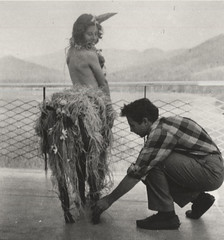
Susan Weil and Rauschenberg on their wedding day with members of their wedding party, Outer Island, Connecticut, June 1950

__________________

Black Mountain College Work Camp Publication 1941

Black Mountain College Museum + Arts Center
Alt. Creator D.H. Ramsey Library, Special Collections
Subject Keyword Black Mountain College; Black Mountain College Museum + Arts Center ; colleges ; experimental community ;  Progressive education ; Progressives ; Bauhaus ; German immigration ; immigrants ; Marcel Breuer ; Walter Gropius ; John Andrew Rice ; Josef Albers ; Anni Albers ; Hazel Larsen Archer ; Buckminster Fuller ; Ruth Asawa ; Charles Olson ; Robert Rauschenberg ; Merce Cunningham ; John Cage ; Robert Creeley ; Jonathan Williams ; Franz Kline ; photography ; Appalachia ;  education ; National Historical Register ; architecture ; farms ; farming ; craft ; art ; textiles ; weaving ; ceramics ;  music ;  social services ; social work ; schools ; sociology ;
Subject LCSH Black Mountain College (Black Mountain, N.C.)
Arts — Study and teaching (Higher) — North Carolina — Black Mountain
Albers, Josef
Albers, Anni
Archer, Hazel Larsen
Asawa, Ruth
Cage, John
Creeley, Robert
Cunningham, Merce
Fuller, Buckminster
Kline, Franz
Olson, Charles
Rauschenberg, Robert
Rice, John Andrew
Williams, Jonathan
Education — Appalachian Region Rural schools — Appalachian Region,  Southern
Schools — Appalachian Region

The Longest Ride Official Trailer #1 (2015) – Britt Robertson Movie HD

Black Mountain College: A Thumbnail Sketch

Published on Aug 14, 2014

A 13 minute documentary about the legendary arts school in the mountains of North Carolina

It has been my practice on this blog to cover some of the top artists of the past and today and that is why I am starting in this current series on Black Mountain College (1933-1955). Here are some links to some to some of the past posts I have done on other artists: Marina AbramovicIda Applebroog,  Matthew Barney,  Allora & Calzadilla,   Christo and Jeanne-Claude Olafur EliassonTracey EminJan Fabre, Makoto Fujimura, Hamish Fulton, Ellen GallaugherRyan Gander, John Giorno,  Cai Guo-QiangArturo HerreraOliver HerringDavid Hockney, David HookerRoni HornPeter HowsonRobert Indiana, Jasper Johns, Martin KarplusMargaret KeaneMike KelleyJeff KoonsSally MannKerry James MarshallTrey McCarley,   Paul McCarthyJosiah McElhenyBarry McGeeTony OurslerWilliam Pope L.Gerhard RichterJames RosenquistSusan RothenbergGeorges Rouault, Richard SerraShahzia SikanderHiroshi SugimotoRichard TuttleLuc TuymansBanks ViolettFred WilsonKrzysztof WodiczkoAndrea Zittel,

ROBERT RAUSCHENBERG SYNOPSIS

Considered by many to be one of the most influential American artists due to his radical blending of materials and methods, Robert Rauschenberg was a crucial figure in the transition from Abstract Expressionism to later modern movements. One of the key Neo-Dada movement artists, his experimental approach expanded the traditional boundaries of art, opening up avenues of exploration for future artists. Although Rauschenberg was the enfant terrible of the art world in the 1950s, he was deeply respected and admired by his predecessors. Despite this admiration, he disagreed with many of their convictions and literally erased their precedent to move forward into new aesthetic territory that reiterated the earlier Dada inquiry into the definition of art.

ROBERT RAUSCHENBERG KEY IDEAS

Engaged in questioning the definition of a work of art and the role of the artist, Rauschenberg shifted from a conceptual outlook where the authentic mark of the brushstroke described the artist’s inner world towards a reflection on the contemporary world, where an interaction with popular media and mass-produced goods reflected a unique artistic vision.
Rauschenberg merged the realms of kitsch and fine art, employing both traditional media and found objects within his “combines” by inserting appropriated photographs and urban detritus amidst standard wall paintings.
Rauschenberg believed that painting related to “both art and life. Neither can be made.” Following from this belief, he created artworks that move between these realms in constant dialogue with the viewers and the surrounding world, as well as with art history.
Preferring to leave the interpretation of the works to his viewers, Rauschenberg allowed chance to determine the placement and combination of the different found images and objects in his artwork such that there were no predetermined arrangements or meanings embedded within the works.

INTO THE GAP: ROBERT RAUSCHENBERG

Today is the birthday of Robert Rauschenberg, an artist who played a pivotal role in the development of American art after WWII.

This blog post, written by Museum President Don Bacigalupi, is excerpted from Crystal Bridges’ permanent collection catalog, Celebrating the American Spirit: Masterworks from Crystal Bridges Museum of American Art. 

Robert Rauschenberg (1925-2008) Untitled 1963 Oil, graphite and silkscreen ink on canvas

The art world of the late 1940s and early 1950s had been dominated by the grand gestures and larger-than-life personas of the abstract expressionists. Artists such as Jackson Pollock and Willem de Kooning created images in which their bold, expressive marks were understood to be records of their inner lives—painting as revelation. Younger artists like Rauschenberg and Jasper Johns attacked the cult of personality promulgated by the New York School. Juxtaposing the highly lauded gestural brushstroke with modes of representation drawn from mass culture, they challenged viewers to assess which manner of image making more effectively conveyed meaning. Rauschenberg and Johns are credited with both reviving an interest in dada and surrealism and with paving the way for the development of pop art in the 1960s.

Rauschenberg spent the 1950s experimenting with novel ways to narrow the gap between art and life, bringing commonplace images and materials into his work through methods including collage, assemblage, and transfer drawing. In 1962, he began to silkscreen photographic images into his compositions. The following year he produced Untitled, a painting dominated by an anonymous photograph of a contemporary urban street scene. Unlike Rauschenberg’s earlier assemblages and “combines,” in which the artist assembled multiple small images and objects into larger, fragmentary wholes, here a single black-and-white candid shot occupies the entire canvas. In contrast to Rauschenberg’s earlier picture-making techniques, silkscreen allowed the artist to render any given image in any given scale.

In Untitled, the enlarged, silkscreened snapshot serves as the ground onto which Rauschenberg applied additional layers of signification, including discrete passages of dripping paint, scumbled washes, stenciled letters of various sizes, and some apparent rubbings or erasures. Photographic and hand-drawn images become nearly indistinguishable. A “one way” street sign that is part of the photograph points at and is balanced by an upside-down cruciform shape drawn in graphite across the painted surface. A rectangular Coca-Cola sign in the upper right of the photograph is mirrored at left by an array of applied uppercase letters that suggest words (“Strange” or “X-change” or even “Sex Change”).

Confronted with the large, sign-filled photograph and hints of readable language, the viewer cannot help but search for narrative meaning. Yet the sheer number and diversity of marks and signs in the picture frustrate this enterprise, leading the viewer down a series of interpretive dead ends. A restless and prolific image maker, Rauschenberg created pleasingly composed and visually enticing works that rarely cohere into a traditional meaning or story. Ultimately, Rauschenberg succeeded in focusing his viewers’ attention on the complex interplay between art and life, opening up myriad possibilities for future generations of artists.

Studio Tour with Susan Weil

Published on Jan 13, 2015

Studio Tour with artist Susan Weil, recorded on videotape in 1997–part of the Black Mountain College Museum + Arts Center Oral History Project. Edited for the 2015 exhibition, poemumbles: 30 years of Susan Weil’s poem/images (Jan. 30 – May 23). http://www.blackmountaincollege.org/e…

Interview with Susan Weil

Published on Jan 29, 2015

Interview with artist Susan Weil, recorded in 2002 as part of the Black Mountain College Museum + Arts Center Oral History Project. Edited as part of the 2015 exhibition, poemumbles: 20 years of Susan Weil’s poem/images (Jan. 30 – May 23). http://www.blackmountaincollege.org/e…

Artist Interview: Susan Weil

Published on Apr 17, 2013

Susan Weil discusses her artistic process, including examples of her own work, and reflects on her childhood and influences in this Artist Interview.

Susan Weil

From Wikipedia, the free encyclopedia
Susan Weil
Born 1930
New York
Nationality American
Education Académie Julian
Black Mountain College
Art Students League of New York
Known for 3D Painting
Awards Guggenheim Fellowship,National Endowment for the Arts

Susan Weil (born 1930) is an American artist best known for her experimental three-dimensional paintings, which combine figurative illustration with explorations of movement and space.

Weil was born in New York. In the late 1940s she was involved in a relationship with Robert Rauschenberg. The two met while attending the Académie Julian in Paris, and in 1948 both decided to attend Black Mountain College in North Carolina to study under Josef Albers. At the Art Students League of New York Susan Weil studied with Vaclav Vytlacil and Morris Kantor.[1] Robert Rauschenberg and Susan Weil were married in the summer of 1950. Their son, Christopher was born on July 16, 1951. The two separated in June 1952 and divorced in 1953.

In addition to creating painting and mixed media work, Weil has experimented with bookmaking and has produced artist’s books with Vincent Fitzgerald and Company since 1985. During a period of eleven years Weil experimented with etchings and handmade paper while also keeping a daily notebook of drawings inspired by the writings of James Joyce. Her exhibition, Ear’s Eye for James Joyce, was presented at Sundaram Tagore gallery in New York in 2003.

Weil has been the recipient of the prestigious Guggenheim Fellowship and awards from the National Endowment for the Arts. Her work has been shown in major solo exhibitions in the United States and Europe, notably at Black Mountain College Museum + Arts Center in Asheville, North Carolina, and the Museo Reina Sofia in Madrid, though museums in her home state of New York have yet to organize a comprehensive retrospective of her work. Her work is in many major museum collections, including the Metropolitan Museum of Art, Museum of Modern Art, the Victoria and Albert Museum, and the J. Paul Getty Museum.
She continues to live and work in New York City.

References[edit]

  1. Jump up^ NY Arts Magazine, Erik La Prade Interviews Susan Weil, 2006

External links[edit]

_____________________________________

Robert Rauschenberg later left his wife and started living with Jasper Johns. Wikipedia noted:

Johns studied a total of three semesters at the University of South Carolina, from 1947 to 1948.[2] He then moved to New York City and studied briefly at the Parsons School of Design in 1949.[2] In 1952 and 1953 he was stationed in Sendai, Japan, during the Korean War.[2]

In 1954, after returning to New York, Johns met Robert Rauschenberg and they became long-term lovers. For a time they lived in the same building as Rachel Rosenthal.[3][4][5] In the same period he was strongly influenced by the gay couple Merce Cunningham (a choreographer) and John Cage (a composer).[6][7] Working together they explored the contemporary art scene, and began developing their ideas on art. In 1958, gallery owner Leo Castelli discovered Johns while visiting Rauschenberg‘s studio.[2] Castelli gave him his first solo show. It was here that Alfred Barr, the founding director of New York’s Museum of Modern Art, purchased four works from this show.[8] In 1963, Johns and Cage founded Foundation for Contemporary Performance Arts, now known as Foundation for Contemporary Arts in New York City.

Johns currently lives in Sharon, Connecticut, and on the Island of Saint Martin.[9] Until 2012, he lived in a rustic 1930s farmhouse with a glass-walled studio in Stony Point, New York. He first began visiting St. Martin in the late 1960s and bought the property there in 1972. The architect Philip Johnson is the principal designer of his home, a long, white, rectangular structure divided into three distinct sections.[10]

Left to right: John Cage, Merce Cunningham
and Robert Rauschenberg. London. 1964

THE FLIGHT OF PIGEONS FROM THE PALACE

Mostly stories, plus other odds and ends

Robert Rauschenberg & Jasper Johns – A relationship in three photographs

by ob
Image

Robert Rauschenberg & Jasper Johns

Jasper Johns and Robert Rauschenberg shortly before their breakup.

“Most critics agree that Johns and Rauschenberg’s finest work grew out of the period between 1954 and 1961, a time of intense emotional involvement during which they searched together for an alternative to Abstract Expressionist picturemaking. Rauschenberg once remarked of this moment “We gave each other permission…”

________________________

Flag, Encaustic, oil and collage on fabric mounted on plywood,1954-55 by Jasper Johns:

Below you will see commentary by Schaeffer on the art of Jasper Johns and the modern artists like him. 

Why am I doing this series on BLACK MOUNTAIN COLLEGE and their modern art specialists like Susan Weil and her ex-husband Robert Rauschenberg? John Fischer probably expressed it best when he noted:

Schaeffer was the closest thing to a “man of sorrows” I have seen. He could not allow himself to be happy when most of the world was desperately lost and he knew why. He was the first Christian I found who could embrace faith and the despair of a lost humanity all at the same time. Though he had been found, he still knew what it was to be lost.

Schaeffer was the first Christian leader who taught me to weep over the world instead of judging it. Schaeffer modeled a caring and thoughtful engagement in the history of philosophy and its influence through movies, novels, plays, music, and art. Here was Schaeffer, teaching at Wheaton College about the existential dilemma expressed in Michelangelo Antonioni’s 1966 film, Blowup, when movies were still forbidden to students. He didn’t bat an eye. He ignored our legalism and went on teaching because he had been personally gripped by the desperation of such cultural statements.

Schaeffer taught his followers not to sneer at or dismiss the dissonance in modern art. He showed how these artists were merely expressing the outcome of the presuppositions of the modern era that did away with God and put all conclusions on a strictly human, rational level. Instead of shaking our heads at a depressing, dark, abstract work of art, the true Christian reaction should be to weep for the lost person who created it. Schaeffer was a rare Christian leader who advocated understanding and empathizing with non-Christians instead of taking issue with them.

In ART AND THE BIBLE  Francis Schaeffer observed, “Modern art often flattens man out and speaks in great abstractions; But as Christians, we see things otherwise. Because God has created individual man in His own image and because God knows and is interested in the individual, individual man is worthy of our painting and of our writing!!”

Francis Schaeffer in his book ART AND THE BIBLE noted:

I am convinced that one of the reasons men spend millions making art museums is not just so that there will be something “aesthetic,” but because the art works in them are an expression of the mannishness of man himself. When I look at the pre-Colombian silver of African masks or ancient Chinese bronzes, not only do I see them as works of art, but I see them as expressions of the nature and character of humanity. As a man, in a certain way they are myself, and I see there the outworking of the creativity that is inherent in the nature of man.

Many modern artists, it seems to me, have forgotten the value that art has in itself. Much modern art is far too intellectual to be great art. I am thinking, for example, of such an artist as Jasper Johns. Many modern artists do not see the distinction between man and non-man, and it is a part of the lostness of modern man that they no longer see value in the work of art. 

Charles Darwin’s view that man is no more than a product of chance of time is the major reason many people have come to believe that there is no real “distinction between man and non-man.” Darwin himself felt this tension. Recently I read the  book Charles Darwin: his life told in an autobiographical chapter, and in a selected series of his published letters  and I noticed that Darwin himself blamed his views of science for making him lose his aesthetic tastes and his enjoyment of the beauty of nature. Below are some quotes from Darwin and some comments on them from the Christian Philosopher Francis Schaeffer.

I have said that in one respect my mind has changed during the last twenty or thirty years. Up to the age of thirty, or beyond it, poetry of many kinds, such as the works of Milton, Gray, Byron, Wordsworth, Coleridge, and Shelley, gave me great pleasure, and even as a schoolboy I took intense delight in Shakespeare, especially in the historical plays. I have also said that formerly pictures gave me considerable, and music very great delight. But now for many years I cannot endure to read a line of poetry: I have tried lately to read Shakespeare, and found it so intolerably dull that it nauseated me. I have also almost lost my taste for pictures or music. Music generally sets me thinking too energetically on what I have been at work on, instead of giving me pleasure. I retain some taste for fine scenery, but it does not cause me the exquisite delight which it formerly did….

This curious and lamentable loss of the higher aesthetic tastes is all the odder, as books on history, biographies, and travels (independently of any scientific facts which they may contain), and essays on all sorts of subjects interest me as much as ever they did. My mind seems to have become a kind of machine for grinding general laws out of large collections of facts, but why this should have caused the atrophy of that part of the brain alone, on which the higher tastes depend, I cannot conceive. A man with a mind more highly organised or better constituted than mine, would not, I suppose, have thus suffered; and if I had to live my life again, I would have made a rule to read some poetry and listen to some music at least once every week; for perhaps the parts of my brain now atrophied would thus have been kept active through use. The loss of these tastes is a loss of happiness, and may possibly be injurious to the intellect, and more probably to the moral character, by enfeebling the emotional part of our nature.

Francis Schaeffer commented:

This is the old man Darwin writing at the end of his life. What he is saying here is the further he has gone on with his studies the more he has seen himself reduced to a machine as far as aesthetic things are concerned. I think this is crucial because as we go through this we find that his struggles and my sincere conviction is that he never came to the logical conclusion of his own position, but he nevertheless in the death of the higher qualities as he calls them, art, music, poetry, and so on, what he had happen to him was his own theory was producing this in his own self just as his theories a hundred years later have produced this in our culture. I don’t think you can hold the evolutionary position as he held it without becoming a machine. What has happened to Darwin personally is merely a forerunner to what occurred to the whole culture as it has fallen in this world of pure material, pure chance and later determinism. Here he is in a situation where his mannishness has suffered in the midst of his own position.

Darwin, C. R. to Doedes, N. D.2 Apr 1873

“It is impossible to answer your question briefly; and I am not sure that I could do so, even if I wrote at some length. But I may say that the impossibility of conceiving that this grand and wondrous universe, with our conscious selves, arose through chance, seems to me the chief argument for the existence of God; but whether this is an argument of real value, I have never been able to decide.”

Francis Schaeffer observed:

So he sees here exactly the same that I would labor and what Paul gives in Romans chapter one, and that is first this tremendous universe [and it’s form] and the second thing, the mannishness of man and the concept of this arising from chance is very difficult for him to come to accept and he is forced to leap into this, his own kind of Kierkegaardian leap, but he is forced to leap into this because of his presuppositions but when in reality the real world troubles him. He sees there is no third alternative. If you do not have the existence of God then you only have chance. In my own lectures I am constantly pointing out there are only two possibilities, either a personal God or this concept of the impersonal plus time plus chance and Darwin understood this . You will notice that he divides it into the same exact two points that Paul does in Romans chapter one into…

Here below is the Romans passage that Schaeffer is referring to and verse 19 refers to what Schaeffer calls “the mannishness of man” and verse 20 refers to Schaeffer’s other point which is  “the universe and it’s form.”Romans 1:18-22Amplified Bible (AMP) 18 For God’s [holy] wrath and indignation are revealed from heaven against all ungodliness and unrighteousness of men, who in their wickedness repress and hinder the truth and make it inoperative. 19 For that which is known about God is evident to them and made plain in their inner consciousness, because God [Himself] has shown it to them. 20 For ever since the creation of the world His invisible nature and attributes, that is, His eternal power and divinity, have been made intelligible and clearly discernible in and through the things that have been made (His handiworks). So [men] are without excuse [altogether without any defense or justification], 21 Because when they knew and recognized Him as God, they did not honor andglorify Him as God or give Him thanks. But instead they became futile and godless in their thinking [with vain imaginings, foolish reasoning, and stupid speculations] and their senseless minds were darkened. 22 Claiming to be wise, they became fools [professing to be smart, they made simpletons of themselves].

Francis Schaeffer noted that in Darwin’s 1876 Autobiography that Darwin  is going to set forth two arguments for God in this and again you will find when he comes to the end of this that he is in tremendous tension. Darwin wrote, 

At the present day the most usual argument for the existence of an intelligent God is drawn from the deep inward conviction and feelings which are experienced by most persons. Formerly I was led by feelings such as those just referred to (although I do not think that the religious sentiment was ever strongly developed in me), to the firm conviction of the existence of God and of the immortality of the soul. In my Journal I wrote that whilst standing in the midst of the grandeur of a Brazilian forest, ‘it is not possible to give an adequate idea of the higher feelings of wonder, admiration, and devotion which fill and elevate the mind.’ I well remember my conviction that there is more in man than the mere breath of his body; but now the grandest scenes would not cause any such convictions and feelings to rise in my mind. It may be truly said that I am like a man who has become colour-blind.

Francis Schaeffer remarked:

Now Darwin says when I look back and when I look at nature I came to the conclusion that man can not be just a fly! But now Darwin has moved from being a younger man to an older man and he has allowed his presuppositions to enter in to block his logic. These things at the end of his life he had no intellectual answer for. To block them out in favor of his theory. Remember the letter of his that said he had lost all aesthetic senses when he had got older and he had become a clod himself. Now interesting he says just the same thing, but not in relation to the arts, namely music, pictures, etc, but to nature itself. Darwin said, “But now the grandest scenes would not cause any such convictions  and feelings to rise in my mind. It may be truly said that I am like a man who has become colour-blind…” So now you see that Darwin’s presuppositions have not only robbed him of the beauty of man’s creation in art, but now the universe. He can’t look at it now and see the beauty. The reason he can’t see the beauty is for a very, very , very simple reason: THE BEAUTY DRIVES HIM TO DISTRACTION. THIS IS WHERE MODERN MAN IS AND IT IS HELL. The art is hell because it reminds him of man and how great man is, and where does it fit in his system? It doesn’t. When he looks at nature and it’s beauty he is driven to the same distraction and so consequently you find what has built up inside him is a real death, not  only the beauty of the artistic but the beauty of nature. He has no answer in his logic and he is left in tension.  He dies and has become less than human because these two great things (such as any kind of art and the beauty of  nature) that would make him human  stand against his theory.

___________

“I DON’T GET IT” : GETTING COMFORTABLE WITH SOME OF CRYSTAL BRIDGES’ MOST CHALLENGING WORKS: JASPER JOHNS

in galleryMuseum guests are sometimes surprised when they draw close to Jasper Johns’s monochromatic paintingAlphabets. From a distance it looks like a grid of rectangles painted in shades of gray.  It’s not until the viewer draws close that the letter forms become visible in each block.

They might just as well all be question marks for some visitors.

What on earth was Johns trying to say with this work? 

A close look reveals that the alphabet is repeated, over and over in sequence, from left to right, top to bottom, one letter per square. The letters are styled after those in common stencil patterns, but it’s clear they are painted by hand: some sharp, some almost dissolving into the background, but each letter lined up in regimented rows. In many boxes the paint is thick, the letters seeming almost pressed into the soft surface of the ground. In others the edges of the box are smeared, imprecise.  And yet the overall effect is of a carefully drawn grid of meaningless type. Like old-fashioned rows of dull lead typesetters type: The painting seems full of the potential for meaning, but….what does it mean?

In the middle of the twentieth century, and led by the American Abstract Expressionists, art became increasingly removed from the practice of representation. While the Ab Ex painters eschewed making paintings that looked like something else in favor of large gestures, drips, and splatters intended be spontaneous: to represent the interior emotional life of the artist; other painters sought to strip away all illusion in their work, insisting that a painting be a painting—color, shape, and line in paint on a flat canvas, independent of meaning. The critic Clement Greenberg wrote that “Content is to be dissolved so completely into form that the work of art…cannot be reduced in whole or in part to anything not itself.”

Artists like Johns began to question this approach, and to experiment with ways to create or imply meaning in their work. Johns is best known for his early FLAG PAINTINGS, which also provide a basis for understanding some of the ideas he was working with in Alphabets.  Johns’ representations of the American flag were, indeed, flat paintings; yet they were also fraught with all the many levels and nuances of meaning that a symbol as powerful as a national flag can carry. The paintings were representations of a flag, yes, but also, like actual flags, the works were simply color on cloth: not just the symbol of the thing, but perhaps in a way the thing itself.

Alphabet detail very close

The alphabet painting works in a similar fashion. It is, without a doubt, a painting. The letters and the boxes that contain them are rendered in a highly “painterly” way, emphasizing the fact of the painting as a work of art—hand-crafted using daubs of thick paint on a flat surface. Yet the artist’s exclusive use of gray in the painting is a nod to the black-and-white of print—an oblique reference to the letters as type, not paint, as is the placement of each letter in a box like the lead type once used in printing.

Alphabet detail medium

Johns deliberately selected the alphabet as his subject because it is the basis for all our written language, the building blocks of print (there are those boxes again). And yet the shapes of the letters bear no meaning on their own. Without an understanding of the written code, the letters are just shapes (consider how lost English-language readers feel when faced with a line of Chinese characters, for example). The lines of letters make no words, and yet they are aligned in the familiar order we are taught as children, from a to z, left to right, top to bottom.  It is possible to “read” the painting this way and make sense of it:  Aha! It’s the alphabet!  (Meaning!) This particular sequence of letters, like the stars and stripes of our flag, is heavily loaded with all the potential meanings the alphabet represents, from the simple phrases of Dick and Jane to Man’s Search for Meaning.  And yet, each of the letters is just a letter, devoid of literal meaning.

So:   Is Alphabets just a painting? A representation of a thing?  Or a thing itself?  In a way the painting really IS a big question mark:  How do we glean meaning from a work of art?

Adrian Rogers on Darwinism and Time and Chance:

_______________

How Should We then Live Episode 7 small (Age of Nonreason)

https://www.youtube.com/watch?v=ygzh713TQn8

#02 How Should We Then Live? (Promo Clip) Dr. Francis Schaeffer

10 Worldview and Truth
Two Minute Warning: How Then Should We Live?: Francis Schaeffer at 100

Francis Schaeffer “BASIS FOR HUMAN DIGNITY” Whatever…HTTHR

____________________

_______________________

Jack Huston Interview – The Longest Ride

__________________________

The Experimenters

CHANCE AND DESIGN AT BLACK MOUNTAIN COLLEGE

EVA DÍAZ

256 pages | 20 color plates, 58 halftones | 7 x 10 | © 2015

In the years immediately following World War II, Black Mountain College, an unaccredited school in rural Appalachia, became a vital hub of cultural innovation. Practically every major artistic figure of the mid-twentieth century spent some time there: Merce Cunningham, Ray Johnson, Franz Kline, Willem and Elaine de Kooning, Robert Motherwell, Robert Rauschenberg, Dorothea Rockburne, Aaron Siskind, Cy Twombly—the list goes on and on. Yet scholars have tended to view these artists’ time at the College as little more than prologue, a step on their way to greatness. With The Experimenters, Eva Díaz reveals the importance of Black Mountain College—and especially of three key teachers, Josef Albers, John Cage, and R. Buckminster Fuller—to be much greater than that.

Díaz’s focus is on experimentation. Albers, Cage, and Fuller, she shows, taught new models of art making that favored testing procedures rather than personal expression. These methodologies represented incipient directions for postwar art practice, elements of which would be sampled, and often wholly adopted, by Black Mountain students and subsequent practitioners. The resulting works, which interrelate art and life in a way that imbues these projects with crucial relevance, not only reconfigured the relationships among chance, order, and design—they helped redefine what artistic practice was, and could be, for future generations.

Offering a bold, compelling new angle on some of the most widely studied creative figures of modern times, The Experimenters does nothing less than rewrite the story of art in the mid-twentieth century.

Nature
“What links systems theorist and architect R. Buckminster Fuller with artistic innovators such as Josef Albers and John Cage? The answer is Black Mountain College, North Carolina. . . . As art historian Eva Díaz reveals in this engrossing study, their explorations in materials, form, chance, and indeterminacy were never less than electrifying. Her sympathetic portrait of Fuller as a utopian saving the world through geodesic geometry is particularly assured.”
Judith Rodenbeck, Sarah Lawrence College
“Terrific. Black Mountain College has long been a lodestone for those interested in alternative educational models and in artistic innovation. Nevertheless, the major historical literature on the College still rests on largely anecdotal histories, with a tendency to jaunty optimism in lieu of criticality. There is nothing quite like The Experimenters out there—not on Black Mountain College, not on art making, and not on pedagogy.”
Helen Molesworth, Museum of Contemporary Art, Los Angeles
“By parsing three different versions of experimentation—performed by Josef Albers, John Cage, and Buckminster Fuller—Díaz shows us how their individual efforts were part of a shared commitment to art’s capacity to reinvent the world, to alter how we see, experience, and shape it in our own image. In the name of experimentation each of the artists suspended, if only for a moment, the metrics of failure and success, and replaced them instead with the values of intellectual pleasure, expanded sensory experiences, and aesthetic innovation. While the book is undoubtedly a historical account of a particular time and place, it is also a road map for many paths that, while not taken, still remain open.”
Alexander Alberro, author of Conceptual Art and the Politics of Publicity
“In this highly evocative and well-executed study, Díaz explores the innovative pedagogical practices that were developed at Black Mountain College in its heyday. Respectful of the distinct teaching methods of the College’s most notable faculty, Diaz nonetheless finds a common experimental basis to the artworks and inventions produced by their students in the late 1940s and early 1950s. The Experimenters is nuanced, erudite, and intellectually wide-ranging. It will be essential reading for anyone interested in the development of mid-twentieth-century art in the United States.”

Nicholas Sparks pictured below:

Film Review

By Frederic and Mary Ann Brussat

The Longest Ride
Directed by George Tillman, Jr.
20th Century Fox 4/15 Feature Film
PG-13 some sexuality, partial nudity, some war and sports action

Sophia Danko (Britt Robertson) is an art history major at Wake Forest University in North Carolina who goes to a rodeo with a sorority sister. There they thrill to the agility and strength of the bull riders, especially Luke Collins (Scott Eastwood), who is just back in the game after a year off due to injury. After a successful ride, he gives his hat to Sophia. Although she is attracted to him, she feels there is no point in meeting him again since she is graduating soon and has an internship in a Manhattan art gallery.

It’s not long, though, before Sophia follows the instincts of her heart and goes out on a date with Luke. He charms her with flowers and a moonlight lakeside picnic. He is a simple man who wants to keep the family ranch going while she yearns for the allure of the art world in New York City.

Not only is Luke a gentleman but he proves himself to be a hero when he rescues Ira Levinson (Alan Alda) from death in a crashed car. Sophia retrieves a box from the seat of the automobile. Delivering it to the old man at the hospital, she discovers it contains the letters he wrote to Ruth (Oona Chaplin), the love of his life.

Curious about their relationship and how they dealt with setbacks and obstacles, Sophia reads random letters aloud to Ira in hopes they will be healing and lift his spirits. Through flashbacks, we see the shy Ira (Jack Huston), the son of a Jewish tailor in 1940, swept away when first setting eyes on Ruth. He goes to war and returns home with a wound that prevents them from having children. Although he wants to break off the engagement since all she has ever wanted was a large family, they marry anyway. They draw closer together by making a decision to collect art. They take regular trips to Black Mountain College to purchase paintings by many different artists.

George Tillman, Jr. (Soul Food) directs this romantic melodrama about two parallel love stories by the prolific novelist Nicholas Sparks. As has been the case with other movies based on his bestselling books, we expect that many film critics will dismiss this one as trite, weepy, mawkish, escapist, overwrought, a tearjerker, and sentimental slop. But we liked it. We don’t recoil from either predictability or sentiment, and we’re not embarrassed to cry our way through a film’s ending.

Those who enjoy getting an emotional bath at the movies will understand and respect this one’s spiritual message that sacrifices are required to keep love alive in a long marriage. Husbands and wives have to do an elaborate dance of stepping aside to give their loved one what he or she wants. This often involves letting go of ideas, ideals, habits, and dreams we have clung to for years.

Is The Longest Ride formulaic? Yes. Does it contain many romantic cliches? Yes. But hidden away inside the melodrama is a message worth pondering: Give all you have to keep love alive.

APRIL 9, 2015 5:10 PM

Modern, Romance: Touring MoMA with Nicholas Sparks, King of the Tearjerker

By Terry Wyatt/Getty Images.
The best-selling romance author designed his own crash course in Abstract Expressionism to research The Longest Ride.

Before his debut novel The Notebook, the ur-chick-lit text, sold for $1 million in 1995, Nicholas Sparks got by selling dental equipment and pharmaceuticals. Seventeen novels, 90 million copies, and 10 movies later, all in the grab-the-tissues category, Sparks can afford to follow his heart’s desires. In 2006, he founded a private school, the Epiphany School of Global Studies, whose graduates are “health-cognizant, emotionally intelligent, openly generous, deeply humble, visibly trustworthy, and profoundly honest.” Recently, he has taken to collecting art, with an eye toward what complements the decor of his palatial house and its private bowling alley in New Bern, North Carolina.

“That would match my home,” Sparks said recently, looking up at a Gerhard Richter pastoral at the Museum of Modern Art. Andy Warhol wouldn’t make the cut, neither would Edward Ruscha.

“I’m not a massive fan of minimalism,” Sparks said walking past a black-and-white Frank Stella canvas. “It doesn’t move me.”

In his 20 years as a writer, Sparks, 49, has tried many permutations of the “love is the greatest gift of all” chestnut. He studied business in college, and wrote at night. He chose romance as his genre because he noticed, with a salesman’s eye, that there was room in the market. His novels, which promise “extraordinary journeys” and “extraordinary truths,” tend toward maximalism. Lovers, young and old, are pulled apart by doubt, secrecy, and illness, but once they let love in, they can receive “the greatest happiness—and pain” they’ll ever know.

And yet, each book needs new material. In The Longest Ride, Sparks’s 2013 flirtation with art-history fiction, which opens as a film on Friday, a couple in the 1940s begin buying paintings from a group of young artists from Black Mountain College in North Carolina. Decades later those artists are household names—de Kooning, Twombly, Rauschenberg—and the collection is worth more than Sparks’s own real-life fortune many times over. I had invited Sparks to MoMA for a morning tour with Eva Diaz, a professor of art history at Pratt, who recently published The Experimenters: Chance and Design at Black Mountain College, which describes the school as “a vital hub of cultural innovation.”

Amid the crush of school groups, Sparks, dressed in Levi’s and a red Burberry polo shirt, found Diaz, who reminded us that the college’s success sprang from tragedy: Bauhaus artists persecuted by the Nazis had fled to the States, helped establish the unaccredited school, and brought new energy to painting, design, and architecture in America.

To write the story of Ira and Ruth, the collectors in the book, Sparks designed his own crash course in Abstract Expressionism. “I’m certainly nowhere near as knowledgeable,” Sparks said, bowing his head toward Diaz. “I’m a kindergartner compared to a grad student.”

“Hey, I’m a professor,” said Diaz, who wore fading orange lipstick and wild curly hair. On the museum’s third floor, she pointed out four album covers that had circles and squares arranged in whimsical patterns, the work of Black Mountain instructor Josef Albers.

“So much of this is playing with repetition,” she said.

“You can say the same things about my novels,” Sparks said, echoing his critics. “It’s always a love story, it’s North Carolina, it’s a small town, a couple of likeable people.”

And, yet, he insists variations keep the books from feeling formulaic. “There are a few threads of familiarity, but you don’t know the period, you don’t know the age of the characters, you don’t know the dilemma, you don’t know whether it’s first person, third person, limited third person omniscient, some combination, you don’t know whether its going to be happy, sad, or bittersweet.”

Sparks spotted a Jackson Pollock and asked Diaz about the artist’s education. She said Pollock didn’t get an art degree before he established his studio in a barn on Long Island.

“I’m Jackson Pollock in the shed,” said Sparks, who majored in finance, his voice booming in the quiet gallery.

Diaz led Sparks to Willem de Kooning’s “Woman,” the first of a six-part series, which he painted after studying with Albers. Diaz explained that though the gestures on the canvas seem improvised and random, de Kooning spent months making the work. Sparks’s imagery—“in the distance, the banks of a small lake were dotted with cattle, smoky, blue-tipped mountains near the horizon framing the landscape like a postcard”—hews closer to Thomas Kinkade’s than de Kooning’s, but he saw similarities in their processes.

“When I’m creating something, I often know that a section is wrong,” Sparks said. He typically works at a brisk pace, six months per a novel, but a recent paragraph had taken 22 hours. “I sometimes wonder if de Kooning never got it quite right. That’s what I sense in the ‘Woman’ series: he looked at it, and says, ‘So much is right, but it’s not right.’”

In the lobby, Sparks paused to call his driver to take him the seven blocks to the Sherry-Netherland where he was staying. In addition to art, The Longest Ride involves a subplot about a handsome bull rider, played in the film by Scott Eastwood. Sparks had heard there was a bar equipped with a mechanical bull nearby, but declared a limit to his willingness to research his subject.

“I ain’t riding that bull,” he said.

Katia Bachko is the executive editor of The Atavist magazine, and a writer based in New York.

Related posts:

FRANCIS SCHAEFFER ANALYZES ART AND CULTURE Part 55 THE BEATLES (Part G, The Beatles and Rebellion) (Feature on artist Wallace Berman )

FRANCIS SCHAEFFER ANALYZES ART AND CULTURE Part 54 THE BEATLES (Part F, Sgt Pepper’s & Eastern Religion) (Feature on artist Richard Lindner )

FRANCIS SCHAEFFER ANALYZES ART AND CULTURE Part 53 THE BEATLES (Part E, Stg. Pepper’s and John Lennon’s search in 1967 for truth was through drugs, money, laughter, etc & similar to King Solomon’s, LOTS OF PICTURES OF JOHN AND CYNTHIA) (Feature on artist Yoko Ono)

FRANCIS SCHAEFFER ANALYZES ART AND CULTURE Part 52 THE BEATLES (Part D, There is evidence that the Beatles may have been exposed to Francis Schaeffer!!!) (Feature on artist Anna Margaret Rose Freeman )

FRANCIS SCHAEFFER ANALYZES ART AND CULTURE Part 51 THE BEATLES (Part C, List of those on cover of Stg.Pepper’s ) (Feature on artist Raqib Shaw )

FRANCIS SCHAEFFER ANALYZES ART AND CULTURE Part 50 THE BEATLES (Part B, The Psychedelic Music of the Beatles) (Feature on artist Peter Blake )

FRANCIS SCHAEFFER ANALYZES ART AND CULTURE Part 49 THE BEATLES (Part A, The Meaning of Stg. Pepper’s Cover) (Feature on artist Mika Tajima)

FRANCIS SCHAEFFER ANALYZES ART AND CULTURE PART 48 “BLOW UP” by Michelangelo Antonioni makes Philosophic Statement (Feature on artist Nancy Holt)

FRANCIS SCHAEFFER ANALYZES ART AND CULTURE Part 47 Woody Allen and Professor Levy and the death of “Optimistic Humanism” from the movie CRIMES AND MISDEMEANORS Plus Charles Darwin’s comments too!!! (Feature on artist Rodney Graham)

FRANCIS SCHAEFFER ANALYZES ART AND CULTURE PART 46 Friedrich Nietzsche (Featured artist is Thomas Schütte)

RESPONDING TO HARRY KROTO’S BRILLIANT RENOWNED ACADEMICS!! Part 21 (Dr. Lawrence Krauss, theoretical physicist and cosmologist at Arizona State, “…most scientists don’t think enough about God…There’s no evidence that we need any supernatural hand of God”)

RESPONDING TO HARRY KROTO’S BRILLIANT RENOWNED ACADEMICS!! PART 20 (Carolyn Porco, director of CICLOPS, Like Darwin she gave up her Christianity because of Evolution & is obsessed both with the Beatles & the thought that the human race may end!!)

RESPONDING TO HARRY KROTO’S BRILLIANT RENOWNED ACADEMICS!! PART 19 ( Sir John Walker, Nobel Prize Winner in Chemistry, Like Darwin he gave up his Christianity with great difficulty )

RESPONDING TO HARRY KROTO’S BRILLIANT RENOWNED ACADEMICS!! PART 18 (Brian Harrison, Historian, Oxford University, Charles Darwin also wrestled with the issue of Biblical Archaeology and the accuracy of the Bible)

March 24, 2015 – 12:57 am

_____________

THE ARTISTS, POETS and PROFESSORS of BLACK MOUNTAIN COLLEGE (the college featured in the film THE LONGEST RIDE) Part 1 John Cage

______________________

The Longest Ride Official Trailer #1 (2015) – Britt Robertson Movie HD

John Cage on Silence

Nicholas Sparks wrote concerning his film THE LONGEST RIDE:

The story for The Longest Ride really began when I learned about Black Mountain College. I had been struggling to find something that excited me for my next novel when I came across a reference to the college online. I was, to understate it, greatly captivated: that an isolated college in my home state of North Carolina was so influential to the American art scene seemed so unlikely that I began researching the school immediately.  Thinking about all that happened during the school’s 25-odd years in operation—World War II included—seemed so ripe with possibility. Soon enough, Ira’s character came into my mind and The Longest Ride began coming together.

Then, because Ira and his wife, Ruth, were such a wonderful example of enduring love, I wanted to find a perfect counterpoint as an example of new love.  And that’s how I came up with Luke and Sophia.  Sophia was created to resonate with my college-aged fans, and Luke is really the quintessential All-American guy.  I had never been to a Professional Bull Riding event, but there are so many ranches throughout North Carolina, it just seemed to make sense that he would be a bullrider.

Fully Awake: Black Mountain College-John Cage Excerpt

https://www.youtube.com/watch?v=yKpJJbRGSN4

Black Mountain College

Uploaded on Apr 18, 2011

Class Project on Black Mountain College for American Literature

Movie Review: “The Longest Ride” turns corn into corn syrup

rideThe pretty coed doesn’t want to go, doesn’t see herself “as a rodeo gal.” But her sorority sisters insist she ogle the “easy on the eyes” cowboys with them.
He rides a bull, falls off and loses his hat. She picks it up as he dusts himself off. Her blue eyes lock with his blue eyes.
“Keep it,” he grins, and she pokes the dirt and sawdust with the toe of her cowgirl boot to show she’s interested.
Welcome to Nicholas Sparks world. Welcome to “The Longest Ride.”
Clint Eastwood’s son Scott stars as laconic Luke, an archetypal Sparks hero — quiet, brave, courtly. Britt Robertson, earning “next big thing” buzz thanks to her role in the upcoming “Tomorrowland,” is Sophia Danko, the Wake Forest University art history major about to graduate, but about to find herself distracted by the handsome, fatalistic rodeo cowboy.
It’s not a question of if he’ll get hurt, he drawls, “it’s when, and how hard.”
Their old-fashioned first date ends with him rescuing an old man (Alan Alda) from a car wreck. She recovers the men’s precious box of mementos — a Purple Heart, old love letters. And in reading those to the old man in the hospital, she and Luke learn of a great love of the past and what it takes to achieve such a love — in Nicholas Sparks world.
It does no good to over-think the corn served up in this fantasy land, but when you flash back to 1940, you’re telling us the man in the hospital is 93-95 years old. And driving. And he’s not living in Florida. Alan Alda, who as aged-Ira twinkles and pretty much steals the picture, doesn’t suggest that. Luke is bull-riding to save the family ranch in “Walkerton, N.C.” Walkertown, N.C., between Winston-Salem, where Wake Forest is located, and Greensboro, where the World War II love story of Ruth (Oona Chaplin) and Ira (Jack Huston) is set, is not exactly known as cattle country, ranch country or a bull-riding training ground.
But if it’s not set in N.C., how is Sparks going to get his young lovers to the beaches of Carolina? Without the beach, there is no “beach novel.”
Director George Tillman Jr., who did the very fine “Notorious” Biggy Smalls bio-pic, manages stunningly real bull riding scenes, and gives his winsome young stars plenty of room to shine, though neither rises above dull. Chaplin and Huston set off a few sparks in the flashbacks, which touch on North Carolina’s exalted place in the world of contemporary art, thanks to famed Black Mountain College.
But the moment that first letter is opened and its trite, moony expressions of love and pointless (in a love letter) pages of exposition are narrated, the movie turns Sparks insipid.
Consistent? The man’s a broken record, an LP on a crackly old record player in the high fructose corn syrup corner of Carolina. Near the beach. Bulls are optional.

In this video below at 13:00 Anderson talks about John Cage:

[ARTS 315] Robert Rauschenberg and Jasper Johns – Jon Anderson

Published on Apr 5, 2012

Contemporary Art Trends [ARTS 315], Jon Anderson

Working in the Gap Between Art and Life: Robert Rauschenberg and Jasper John

September 23, 2011

In The Ocean – A Film About The Classical Avant Garde

https://www.youtube.com/watch?v=h0NwiTHIhGM

Published on Feb 2, 2013

Philip Glass, Frank Zappa, John Cage, Steve Reich and others

____________________________________

It has been my practice on this blog to cover some of the top artists of the past and today and that is why I am doing  this current series on Black Mountain College (1933-1955). Here are some links to some to some of the past posts I have done on other artists: Marina AbramovicIda Applebroog,  Matthew Barney,  Allora & Calzadilla,   Christo and Jeanne-Claude Olafur EliassonTracey EminJan Fabre, Makoto Fujimura, Hamish Fulton, Ellen GallaugherRyan Gander, John Giorno,  Cai Guo-QiangArturo HerreraOliver HerringDavid Hockney, David HookerRoni HornPeter HowsonRobert Indiana, Jasper Johns, Martin KarplusMargaret KeaneMike KelleyJeff KoonsSally MannKerry James MarshallTrey McCarley,   Paul McCarthyJosiah McElhenyBarry McGeeTony OurslerWilliam Pope L.Gerhard RichterJames RosenquistSusan RothenbergGeorges Rouault, Richard SerraShahzia SikanderHiroshi SugimotoRichard TuttleLuc TuymansBanks ViolettFred WilsonKrzysztof WodiczkoAndrea Zittel,

Friday, January 31, 2014

Art and Literature Go Mystic

By 

Pastor Stephen Feinstein

In today’s post, I will be summarizing Francis Schaeffer’s discussion on mysticism as it affected music and art. Recall that mysticism is the third level below the line of despair. The line of despair refers to the rejection of the existence of absolutes, such as truth. This way of thinking is the natural byproduct of atheism. If the universe is not God’s universe, but instead it is random material happenings, then there can be no absolutes. Truth would be relative, right and wrong would be concepts of nonsense, and all existence would be without meaning and purpose. Many people bought into this, but it proved impossible to live out. As humans made in the image of God, we live according to absolutes, we cannot separate ourselves from them, and we intrinsically know that everything has meaning and purpose. We know things are not random. Our very lives depend on the universe being stable and predictable rather than random and chaotic. So those who still chose to embrace the irrationality of their atheism had to find a way to live with absolutes even though they believed such absolutes were not real.

Nihilism gave way to dichotomy, which allowed people to pick whatever truth they wanted to believe in, while at the same time understanding that it is nothing more than a preference based on one’s leap of faith. Well, this dichotomy was not good enough for some, and so mysticism was the next result. Mysticism was this idea that there is some sort of absolute, but it is unknowable. All attempts to define and explain it are inadequate and therefore are equally valid expressions of the truth. Mysticism became necessary because most people could not deal with the idea of reality being meaningless.

By this point of reading my posts, I hope you can see that each major thinker that has been introduced has a different explanation of what this mystical absolute is. It is no different with music. Schaeffer focuses in on John Cage (1912-1992). He was so committed to the idea that the universe is random, that he saw that randomness as the mystical absolute. He did whatever he could to make his music random too. He would compose his music after flipping coins thousands of times. Eventually the methods became more sophisticated than this, but the result was the same – music that made little sense to the ears. Cage believed that the “truth” of chance can best be communicated through chance methods coming forth in his music. Well, sometimes when his music was played, rather than offering applause, the audience hissed and booed. Why? It is rather simple. In our heart of hearts, we know that the universe is not meaningless and it is not random. It is designed with intelligent purpose. We were designed with intelligent purpose, and given that we ourselves are designed along with everything else in nature, anything we create must be intelligently designed too. Cage’s randomly designed music was not pleasing to our ears. If chance is the true mystical reality, then chance should be able to communicate to us, but it cannot. Why? Because the ultimate reality is not chance! The fact that his music was aesthetically worthless should have caused him to reject his own presuppositions of randomness, but instead he pressed on and continued to produce utter nonsense. Consider this one more example of an atheist claiming to believe the evidence, but then ignores the largest pieces of evidence that stare him right in the face.

An interesting point to note about Cage is that like all other atheists that claimed there are no absolutes, he could not apply this belief consistently. To his credit, he did apply his philosophy to his craft of music. In that sense, he was consistent. However, he eventually became a mushroom enthusiast. He would wander the forest and study mushrooms diligently to where he became a very well informed amateur mycologist. He had a large library just on mushrooms, and knew that many were deadly and poisonous. He is quoted as saying, “I became aware that if I approached mushrooms in the spirit of my chance operations, I would die shortly. So I decided that I would not approach them in this way.” In other words, he could not apply what he believed to be the truth of the universe to the simple hobby of picking mushrooms. If he picked mushrooms randomly, he would be dead in a few days. With his life on the line, he practiced mycology as though there were absolutes, meaning is real, and intelligent care must be taken with each mushroom. This is just one more proof that that Cage’s atheistic assumptions were wrong. The fact that people booed his music because it was random, and the fact that he would not randomly pick mushrooms because his life was at stake both demonstrate the impossibility of living according to his assumptions. These were two screaming realities that should have caused him to reject his folly, and seek the real truth.

The painter Jackson Pollock (1912-1956) also decided to use the “mystical absolute” of chance to direct his painting. He is famous for laying canvases on the floor, and allowing paint to randomly drip on them. Because of the atheistic philosophical message that lied behind the ugly drip paintings, many saw this as brilliant. But at the end of the day, very few people’s eyes actually crave to stare at random drops of paint on a canvas. When artists buy into thought below the line of despair, this is the type of thing that happens. The artists of the Renaissance painted their worldview, which was fairly biblical. Painting, sculpture, and architecture were ways to communicate the biblical stories and truth to the masses. Well, these atheist artists that live below the line of despair choose to communicate their belief and story with these bizarre paintings that are sore on the eyes.

Perhaps it is noteworthy that we can stare for hours at paintings that reflect the biblical worldview. We can appreciate their beauty and we intrinsically appreciate the order and design behind them. Yet, when it comes to the “religious/philosophical” message of the atheist artists, we can only bare to look for a short time. We cannot appreciate disjointed chaotic expressions. Maybe this is simply one more reality screaming in the face of such artists, and yet it is a reality they choose to suppress. We are what the Bible says we are, and this is why we appreciate art and music consistent with the biblical worldview of order and design. If we were really products of chance, then we should be able to enjoy these “chance-based” artistic productions. Since we are made in the image of God, we cannot enjoy these things. Instead, we can only mourn for the tortured souls that put such chaos on canvas. Sadly, Jackson Pollock became entirely hopeless after he exhausted what could be done in art with his “chance” method. In 1956, he committed suicide. This is the frustration that comes from trying to consistently live as though the Bible is not true. Most forms of mysticism falsely help people avoid the despair, but Pollock was able to find no such relief.

In terms of literature, we can return to Henry Miller (1891-1980) of whom I wrote of before. He originally intended to use his gift of writing to destroying meaning in general, especially with regard to sex. So he wrote extremely dirty things meant to defile the mind and trivialize meaning where it mattered greatly. Yet, later in life, he changed his position. In fact, if one were not a careful reader, they might assume he became a Christian. He started using Christian words, biblical imagery, and he certainly became focused on spiritual matters. He even quoted Scripture. Like Salvador Dali, he saw spiritual significance in the dematerialization of matter into energy. He began to believe the ultimate reality was certainly spiritual, and that meaning does in fact exist. However, his faith was in pantheism. He believed the universe itself is the divine reality, and we are just part of it. Individual man does not matter, but we are just one small part of the whole. As I said in previous posts, this is not too far off from Eastern Hinduism. Francsis Schaeffer sums up Miller by writing, “He is doing the same as Salvador Dali and the new theologians—namely, using Christians symbols to give an illusion of meaning to an impersonal world which has no real place for man.”

Sadly, this mysticism did not spare theology. Just like dichotomy infiltrated theology after it captured the other disciplines, so too did mysticism. Next time I will focus on what Schaeffer calls the new theology.

Posted by Stephen Feinstein at 12:46 PM

Labels: Apologetics, Arminianism, Atheism, Bible, Calvinism, Christianity, Debate,Epistemology, Grace, Presuppositionalism, Salvation, Scripture, Theology

Francis Schaeffer pictured below:

 John Cage at Black Mountain College

_____________

_______

John Cage and Merce Cunningham pictured below:

__________________________________________

__________

__________

When John Cage met Robert Rauschenberg

How the artist’s seemingly simple paintings inspired one of the most challenging compositions of the 20th century

White Painting (seven panel) (1951) by Robert Rauschenberg

Artistic influence tends to travel down the generations, from senior practitioner to novice. Yet, on occasions, it can run the other way, such as when the American painter and sculptor Robert Rauschenberg met the avant-garde composer John Cage.

As author Catherine Craft explains in our Phaidon Focus title dedicated to Rauschenberg, Cage first met the painter and sculptor in May 1951, during the artist’s debut solo exhibition, at the Betty Parsons Gallery in New York. Cage was in his late thirties, and well established within the field of avant-garde music; Rauschenberg, thirteen years his junior, was just starting out.

Nevertheless, it was the spirited innovation of the painter that most closely influenced the composer. In particular, Cage was taken with Rauschenberg’s White Paintings. In our survey of post-war art, Painting Beyond Pollock, author Morgan Falconer describes this seminal series of five, paneled works, which date from 1951, as being “painted on canvas in a smooth, unmodulated white, and structured in a sequence that includes one, two, three, four and seven panels.”


John Cage in his Model A car at Black Mountain College. Photo by Robert Rauschenberg


John Cage in his Model A car at Black Mountain College. Photo by Robert Rauschenberg

In Falconer’s mind, the abstract works should be seen less as works in the high, spiritrual register of Abstract Expressionism, and more as simple communication tools – an idea developed by Josef Albers, Rauschenberg’s tutor at the innovative, interdisciplinary arts institution, the Black Mountain College, where Rauschenberg studied 1948 – 49.

Whatever the influence, it was on returning to Black Mountain College in the spring and summer of 1952, that Cage and Rauschenberg’s creative relationship, which developed around these White Paintings, truly flourished. The remote college already had a reputation for artistic freedom and the breaking down of boundaries, having had Albert Einstein serve on its board of directors, and Buckminster Fuller teach classes.


Robert Rauscenberg, self portrait of the artist with his work


Robert Rauscenberg, self portrait of the artist with his work

In Black Mountain’s liberal campus during the balmier months of 1952, Cage looked to Rauschenberg’s canvases to inform his ideas about how art should engage with the intrusions of the natural world. As Craft explains, “Cage was astonished by the White Paintings, which showed him how artists could work with, rather than against, the ever-changing nature of their surroundings.”


The score for John Cage's 4'33


The score for John Cage’s 4’33

Falconer picks up the point in his book, where he writes: “Cage used the White Paintings as a backdrop for one of his concerts Theater Piece #1 (1952), and he later said that they were an important inspiration for his most famous composition, 4’33” (1952), an entirely silent piece in which the sound comes not from the pianist, but principally from the ambient noise of the concert auditorium.”

This idea of an artwork as a kind of backdrop for the world, was something Cage first recognized in Rauschenberg’s paintings.

“Cage viewed the White Paintings less as images that projected the artist’s expression, than backdrops against which the flux of the world might stand out, an understanding that he arrived at through his appreciation of Henri Bergson and Zen Buddhism. ‘The White Paintings were airports for the lights, shadows, and [dust] particles,’ Cage said. Rauschenberg would never immerse himself in these ideas with the same enthusiasm as his mentor, but Cage was important in shaping his outlook in these early years.”

Indeed, Falconer suggests that one of Rauschenberg’s best-known forms, his ‘combines’ – or hybrids of painting, sculpture and college, were first developed for Cage, in response to a prop request to accompanying the performance of the composer’s 1954 work, Minutiae.


Canyon (1959) by Robert Rauschenberg, one of the artist's famous combines


Canyon (1959) by Robert Rauschenberg, one of the artist’s famous combines

Even if this debt can’t be firmly established, the pair certainly collaborated on another notable, fine art work. In Automobile Tire Print (1953), Rauschenberg got Cage to drive a car, its tyre covered in black house paint, over sheets of paper Rauschenberg had glued together.

Rauschenberg said that Cage was the only driver in Manhattan willing to collaborate on such an unusual scheme. Perhaps this is a suitably flip comment to accompany so brisk a work. When asked if the work is a little like a musical stave, the artist demurred, preferring to compare it to a Tibetan prayer scroll. Yet, Cage drove over Rauschenberg’s scroll in the very same Model A Ford that he had carried him to Black Mountain College in a few years earlier; and doesn’t this single track bring to mind a little something of Cage’s featureless score for 4’33” – the silent work that’s never quite rid of the world’s noise?


Automobile Tire Print (1953) by Robert Rauschenberg


Automobile Tire Print (1953) by Robert Rauschenberg

For more on Rauschenberg’s work, consider our Phaidon Focus monograph; meanwhile for more on how his and Cage’s relationship helped influence the development of painting in the 20th Century, buy a copy of our overview, Painting Beyond Pollock.

POETRY NEWS

Cabinet Posts Audio From Launch of Eva Díaz’sThe Experimenters: Chance and Design at Black Mountain College

BY HARRIET STAFFFuller_dome_web

Lucky us: Thanks to Cabinet Magazine, if you missed the launch for The Experimenters: Chance and Design at Black Mountain College(University of Chicago Press 2015), art historian Eva Díaz’s new book onBlack Mountain College, a terrific audio recording of the event is now up on their site. The recording includes a performance by musician Nick Hallett, a reading by poet Jeremy Sigler, and a conversation between Díaz and art historian Judith Rodenbeck about the book.

Listen up here.

More on the book from the press:

Díaz’s focus is on experimentation. [Josef] Albers, [John] Cage, and [Buckminster] Fuller, she shows, taught new models of art making that favored testing procedures rather than personal expression. These methodologies represented incipient directions for postwar art practice, elements of which would be sampled, and often wholly adopted, by Black Mountain students and subsequent practitioners. The resulting works, which interrelate art and life in a way that imbues these projects with crucial relevance, not only reconfigured the relationships among chance, order, and design—they helped redefine what artistic practice was, and could be, for future generations.

At top: Kenneth Snelson, R. Buckminster Fuller’s Dome, Demonstration of Strength, Black Mountain College, 1949. More on the event, which took place on February 12, at Cabinet.

Tags: , , , ,
Posted in Poetry News on Friday, February 20th, 2015 by Harriet Staff.

Chance Conversations: An Interview with Merce Cunningham and John Cage

Uploaded on Jul 27, 2009

In the spring of 1981, during a residency at the Walker Art Center in Minneapolis, Minnesota, choreographer Merce Cunningham and composer John Cage sat down to discuss their work and artistic process. As frequent collaborators, Cage and Cunningham pioneered a new framework of performance. Their novel approach allowed for mediums to exist independently, or rather cohabitate, within a performance, thus abandoning the co-dependent model of dance and music. Cage and Cunningham go on to discuss the methodology and motivations behind chance operations, a term used to describe artistic decisions based on unpredictability. Wanting to free himself of his likes and dislikes, Cage describes how Zen Buddhism influenced his work, leading him to use tools of chance. These new methods, adopted by both Cunningham and Cage, overturned a whole foundation of thought around music, movement, and the process of creating art.

What is John Cage trying to demonstrate with his music? Here are comments from two bloggers that take a look at what Cage is trying to put forth.

____________________________

DESCRIBING THE STORM
CHAPTER FOUR
If there is no God, there can be no meaning for man except that which he creates for himself. Modern music
has expressed this concept in a most powerful way. One might well say that the history of modern music is the
story of man’s failure to attain to anything solid or permanent as he has sought to create his own meaning. We
look, then, at Modern Music…At this point we will quote from a European writer. He
is discussing the work of a well-known symphonic composer, Mr. John Cage. Here it will become clear that the
new framework of thinking does indeed explain some of the strange “happenings” in great concert halls of the
world.
The power of art to communicate ideas and emotions to organize life into meaningful patterns, and to
realize universal truths through the self-expressed individuality of the artist are only three of the
assumptions that Cage challenges. In place of a self-expressive art created by the imagination, tastes,
and desires of the artist, Cage proposes an art, born of chance and indeterminacy.
Back in the Chinese culture long ago the Chinese had worked out a system of tossing coins or yarrow
sticks by means of which the spirits would speak. The complicated method which they developed made
sure that the person doing the tossing would not allow his own personality to intervene. Self expression
was eliminated so that the spirits could speak.
Cage picks up this same system and uses it. He too seeks to get rid of any individual expression in his
music. But there is a very great difference. As far as Cage is concerned there is nobody there to speak.
There is only an impersonal universe speaking through blind chance.
Cage began to compose his music through the tossing of coins. It is said that for some of his pieces lasting
only twenty minutes he has tossed the coin thousands of times. This is pure chance, but apparently not pure enough, he wanted still more chance. So he devised a mechanical conductor. It was a machine working on cams, the motion of which cannot be determined ahead of time, and the musicians just followed this. Or, as an alternative to this, sometimes he employed two conductors who could not see each

other, both conducting simultaneously; anything, in fact, to produce pure chance. But in Cage’s universe
nothing comes through in the music except noise and confusion or total silence.
There is a story that once, after the musicians had played Cage’s total chance music, as he was bowing
to acknowledge the applause, there was a noise behind him. He thought it sounded like steam escaping
from somewhere, but then to his dismay realized it was the musicians behind him who were hissing.
Often his works have been booed. However, when the audience members boo at him they are, if they are
modern men, in reality booing the logical conclusion of their own position as it strikes their ears in music.
We might add that one of the “compositions” of John Cage is called “Silence.” It consists of precisely that: four
and a half minutes of total silence! One could almost laugh, if it were not so sad—and serious. But it is. When
man rejects God, and God’s word revelation to man, he ends up here—doomed to silence. For what can man say
(musically, or in any other way) in a universe that has no meaning? When man refuses to think—and speak —
God’s thoughts after Him, he is consigned to this predicament.

_____________
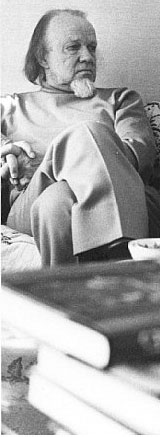
John Cage at Black Mountain College pictured on right.

______________________

NOWHERE ELSE TO TURN

CHANCE VERSUS DESIGN

In The God Who Is There, Francis Schaeffer refers to the American composer John Cage who believes that the universe is impersonal by nature and that it originated only through pure chance.  In an attempt to live consistently with this personal philosophy, Cage composes all of his music by various chance agencies.  He uses, among other things, the tossing of coins and the rolling of dice to make sure that no personal element enters into the final product.  The result is music that has no form, no structure and, for the most part, no appeal.  Though Cage’s professional life accurately reflects his belief in a universe that has no order, his personal life does not, for his favorite pastime is mycology, the collecting of mushrooms, and because of the potentially lethal results of picking a wrong mushroom, he cannot approach it on a purely by-chance basis.  Concerning that, he states: “I became aware that if I approached mushrooms in the spirit of my chance operations, I would die shortly.”  John Cage “believes” one thing, but practices another.  In doing so, he is an example of the person described in Romans 1:18 who “suppresses the truth of God,” for when faced with the certainty of order in the universe, he still clings to his theory of randomness.

______________

How Should We then Live Episode 7 small (Age of Nonreason)

https://www.youtube.com/watch?v=ygzh713TQn8

#02 How Should We Then Live? (Promo Clip) Dr. Francis Schaeffer

10 Worldview and Truth
Two Minute Warning: How Then Should We Live?: Francis Schaeffer at 100

Francis Schaeffer “BASIS FOR HUMAN DIGNITY” Whatever…HTTHR

JOHN CAGE AT BLACK MOUNTAIN BY MARY EMMA HARRIS

A Preliminary Thinking
Mary Emma Harris

The occasion of the 2011 ReVIEWING BMC 3 conference sponsored by the Black Mountain College Museum + Arts Center and the University of North Carolina at Asheville was an opportunity for a first-thinking specifically about John Cage and Black Mountain College. This initial effort is to bring together basic information: when was he there, what did he accomplish while there, and the nature of his influence on the college and vice versa.

The extensive Black Mountain collections of  the North Carolina Department of Cultural Resources, North Carolina State Archives, Western Regional Branch at Oteen, North Carolina are referenced as NCSA and the title of the individual collection. 


At Black Mountain College in the summer of 1948, there was a rare coming together of kindred spirits in an environment receptive to interaction, experimentation, and a lively, imaginative exchange of ideas. The associations formed that summer were to be the catalyst for an expanding community of artists whose lives were inextricably interwoven through personal relationships, shared ideals and interests, and collaborations. The summer was to alter not only the artists’ lives but also the course of the arts in the United States in the Twentieth Century and beyond. This community of artists was not so much a circle as it was a magnetic field of forces within which there were many interlocking centers of energy. There were interactions, conflicts, connections, disconnections, attractions and repulsions.

Albers1

Josef Albers critiquing student work. Left to right: Frances Kuntz,
Hope Stephens (Foote), Lisa Jalowetz (Aronson), Bela Martin, Elizabeth Brett (Hamlin).
Courtesy NCSA, Black Mountain College Papers.

To understand the dynamics of the Black Mountain community in the summer of 1948, one must look back to the college’s founding ideals and the evolution of the community over time. The college founders knew from the beginning that the arts would be at the center of college life and the curriculum. They could not, however, have imagined when they brought Josef and Anni Albers from Germany in November 1933 that this single action would alter the history and influence of the college. A dynamic fusion of American Progressivism, as represented by the founders, and European Modernism, as represented by the refugee artists, was to be the catalyst for the evolution of a unique community. From American Progressivism, there was a sense of pioneering and naiveté, respect for manual work, and the integration of living and learning through community; from European Modernism, experimentation in the arts and a dynamic relationship to the past as it informs the present. In addition, the Alberses, along with the other refugee teachers, reinforced the founders’ idea that the practice of the arts should be central to the learning process. They brought an acceptance of the arts as an integral and necessary part of a culture, a respect for disciplined study, and a high professional standard. Their presence was a corrective to the emphasis on self-expression as an end in itself which so often characterized the Progressive Education movement.

The Black Mountain community as it evolved integrated studies with work on the farm and grounds maintenance, concerts and drama performances, parties, hikes in the mountains and other activities. The college was owned and administered by the faculty, and students and faculty served on the many committees that ran the college. Energies that might otherwise have been dispersed had the college been close to a major cultural center were concentrated and focused inward. Through the special summer sessions in the arts, the first of which was held in 1944, the college became known as a community-based learning environment receptive to exploration of new ideas and art forms.

John Cage and Merce Cunningham first visited Black Mountain in the spring of 1948. At the time there were eighty-six students. The G.I.s, who were older and more mature, were less willing to submit to authority than the younger students and eager to get on with their education. Their presence had re-energized the college. Josef Albers had returned reluctantly to teach and organize the summer session after a year-and- a-half’s sabbatical during which he had been able to concentrate on his painting. Ilya Bolotowsky, who had taught when Albers was away, remained for the 1948 spring term. Music was taught by two European refugees, Charlotte Schlesinger, composer and pianist, and Erwin Bodky, harpsichordist and clavichordist. Arthur Penn was student-teacher in drama. M.C. Richards taught reading and writing. There were workshops in printing, woodworking, weaving and bookbinding as well as classes in history, Latin, German, French, Russian, economics, business, social sciences, mathematics, chemistry, physics and farming.

In 1948, John Cage was experiencing a period of critical acceptance, if not one of financial success. On the West Coast he had been able to make a living composing music for dance using both conventional instruments and ones of his own devising. In the spring of 1942, he moved to New York. There his immersion into Eastern music and philosophies had led him to texts such as those of Ananda K. Coomaraswamy and the lectures of Dr. D.T. Suzuki at Columbia University. In Virgil Thomson he had found a sympathetic critic for performances of his music. His composition The Seasons, commissioned by Lincoln Kirstein and performed at the Ziegfield Theatre in New York on May 23, 1947, had been well-received as had a 1946 performance by Maro Ajemian of sections of his incomplete Sonatas and Interludes for prepared piano. Cage’s marriage had ended, and he and Merce Cunningham had formed their life-long partnership. In 1946 he had moved into an apartment at 326 Monroe Street which was to house other colleagues including members of the expanding Black Mountain community.

In the spring of 1948, Cunningham’s situation was more tenuous than that of Cage. After six years as a soloist with the Martha Graham Dance Company, he had left to focus on his own choreography and independent dance. He had worked with different dancers including Katherine Litz and Jean Erdman and had begun to explore unconventional concepts. A review of the April 1948 visit noted that Cunningham and Cage worked together yet separately, having determined that dance and the rhythm of accompanying music are not interdependent.[i] 

 Albers2

Josef Albers, Merce Cunningham and John Cage at a community reception, April 1948. Felix Krowinski, photographer. © Black Mountain College Project.

In April 1948, Black Mountain College was the first stop on a two-person tour. Cunningham danced and gave classes; Cage gave the first complete performance of his Sonatas and Interludes for prepared piano. As he prepared the piano in the dining hall, students and faculty stopped to watch the process and discuss what he was doing.  After the performance, everyone gathered in the community house for coffee and questions with the artists.  The review concluded: “The current of creative energy since their visit has illuminated the college both in creation and response.”[ii]

Att 1 BMC Bulletin, May 1948

In lieu of an honorarium which the college could not afford, faculty and students, enchanted by their performances and by their persona, filled their car with gifts of food and art work. From Chicago Cage wrote to Josef and Anni Albers:

“You were so friendly and Black Mountain was so good to be at, and the last minute gestures and gifts brought us a kind of ecstasy (the heads among the eggs were discovered near the summit of the Smokies where the mists made everything gently awe-inspiring. – you were as generous as they)….

“[F]or the most part this trip seems tending always toward what is beautiful and meaningful, and I can only say that we feel we were profoundly lucky to spend some days with you…. Being in New York without leaving it for so long had made me believe that only within each one of us singly can what we require come about, but now at Black Mountain and again with the Trappists I see that people can work still together. We have only ‘to imitate nature in her manner of operation’….

“We love the gifts you gave us, but especially loved being with you….’”[iii]

Cage and Cunningham were invited back for the summer session.

The now-legendary 1948 summer session organized by Josef Albers was the result of both careful planning and fortuitous circumstance. Cage and Cunningham arrived as planned. Their friend Richard Lippold, not wanting to be left out, volunteered to live with his family in their hearse, if only he could be there. The college found housing and offered an appointment as sculptor-in-residence. Peter Grippe was the official sculpture teacher. Mark Tobey, possibly recommended to Albers by Cage, cancelled at the last minute as did architect Bertrand Goldberg. Willem de Kooning, discouraged by his first one-person show at Egan Gallery at which nothing sold, agreed to replace Tobey. Goldberg recommended Buckminster Fuller. Other summer faculty and lecturers included Beatrice Pitney Lamb, Isaac Rosenfeld, Beaumont Newhall, Winslow Ames, and Edgar Kaufmann, Jr. Students included Hazel Larsen Archer, Ruth Asawa, Lili Blumenau, Etta Mandelbaum (Deikman), Gustave Falk, James Leo Herlihy, Warren Jennerjahn, Elizabeth Schmitt Jennerjahn, Ray Johnson, Albert Lanier, Lore Kadden (Lindenfeld), Harry Noland, Kenneth Noland, Mary Phelan Outten, Warren Outten, Pat Passlof, Arthur Penn, Oli Sihvonen, Sewell Sillman, Kenneth Snelson, Paul Williams, and Vera Baker Williams.

Elaine de Kooning recalled Willem de Kooning’s first reaction on entering the rustic unkempt grounds: “‘I feel like turning around and going home’.” Reassured by Albers’ warm welcome: “Ach so, the de Koonings,” they remained. “The school activities engulfed us like a warm breeze.” [iv] Guest faculty were not told what or how to teach. For some the freedom was disconcerting; others saw it as an opportunity to undertake projects which in a different setting would have required scrutiny by sponsors, advance publicity and extensive funding. They taught their current passion, projects on which they were working at that time. Thus, the students had the benefit of the excitement and uncertainty that comes with new learning.

Fuller

Buckminster Fuller and students.
Supine Dome with model in foreground. Summer 1948.
Beaumont Newhall, photographer. Courtesy Scheinbaum & Russek Ltd.

Buckminster Fuller, described by Kenneth Snelson as “a summer substitute for a legitimate architect,”[v] arrived a couple of weeks after the session started with his trailer of intriguing models. He captivated and confounded the audience with his first very long lecture. Snelson recalled that he was “absolutely hypnotized and electrified”,[vi] and Lippold that it was “like meeting Zoroaster speaking Islamic.”[vii] Fuller’s project for the summer was to construct his first geodesic dome of Venetian blind strips, christened in good humor the “Supine Dome” when it failed to rise.

CageJohn Cage playing for the Satie Festival. Clemens Kalischer, photographer. Courtesy Kalischer.

RuseofMedusaErik Satie’s Ruse of Medusa (Le piège de Mĕduse) with Buckminster Fuller as the Baron Meduse, William Shrauger as Astolfo, Elaine de Kooning as Frisette and Merce Cunningham as Jonas, a costly Mechanical Monkey. Clemens Kalischer, photographer. Courtesy Kalischer.

Cage conducted an Amateur Festival of the Music of Erik Satie. He gave twenty-five half-hour after-dinner concerts performed at times on the grand piano in the dining hall and at times on the upright in his house while the audience sat outside in the grass. The culmination was a performance of Satie’s Ruse of Medusa (Le piège de Mĕduse).

Att 2 RUSE OF MEDUSA  PROGRAM

The Satie concerts might have been experienced simply as a delightful after-dinner entertainment had Cage not stated in his lecture “Defense of Satie” “immediately and unequivocally [that] Beethoven was in error [in his definition of harmony as the basic structural element of music composition], and his influence, which has been as extensive as it is lamentable, has been deadening to the art of music.”[viii] He offered as remedy Webern and Satie’s perception of time lengths as the basic structural component. Erwin Bodky, who was concurrent with the Satie Festival sponsoring a series of concerts of the music of Beethoven, took exception, and soon the entire community was lined up on one side or the other. The crisis was finally resolved by a duel with one side armed with Wiener schnitzel and the other with crêpe suzette (certainly only semblances thereof).

Cage played the piano for a dance concert by Merce Cunningham, Louise Lippold and Sara Hamill on August 20. Three of the pieces by Cage were composed that summer: In a Landscape, choreographed and danced by Louise Lippold; Suite for Toy Piano with a dance A Diversion choreographed and danced by Cunningham, Sara Hamill and Louise Lippold; and Orestes with choreography by Merce Cunningham. Dream, composed in New York, was choreographed and performed by Cunningham. Also included in the concert wereTotem Ancestor (1942) and Root of an Unfocus (1944).[ix]

Att 3 CUNNINGHAM DANCE PROGRAM (371)

For Cage the friendships forged in the summer of 1948 were to be the fulcrum of a community of artists who were to be critical to his career. Between Fuller and Cage, both “inventors of genius,”[x] an immediate bond was forged, one that was not dependent on physical presence or collaboration. It was enough for each to know that the other was out there somewhere. Ray Johnson and Richard Lippold fell in love, and both moved into the Monroe Street building.

TudorRichards

David Tudor and M.C. Richards at Black Mountain College.
Mary Ann Fretz Giusti, photographer.

Although it has been suggested that the three-year interval between 1948 and Cage’s return to the college in the summer of 1952 was a consequence of lingering hostility over the Beethoven-Satie controversy, there was, in fact, a close relationship between Cage and Black Mountain during this period. At the end of the summer, Albers wrote to Cage, “How can we thank you appropriately for all you did for us this summer? Therefore I say only, God Bless you.”[xi] Bodky resigned at the end of the 1949 summer session. In 1950 Cage dedicated his Six Melodies for Violin and Keyboard to Josef and Anni Albers. On August 12, 1950 Cage’sString Quartet in Four Parts received its first performance by the Summer Session String Quartet led by Vollmer Hetherington, who replaced Bodky on the faculty. On August 18, 1951, David Tudor performed Cage’s Music of Changes, Part 1.

Att 4 TUDOR PROGAM 18 AUGUST (905)

On the recommendation of Cunningham, Katherine Litz taught dance, and Cage recommended the composer Lou Harrison. After M.C. Richards left in 1951 to live with David Tudor in New York, she returned for summer sessions and retained close contact with both the college and Charles Olson, the commanding personality there after his return in the summer of 1951.

Cage’s three-year absence from Black Mountain was undoubtedly a consequence of other obligations and activities. His Sonatas and Interludes had its New York premiere in 1949. It resulted in a Guggenheim Fellowship for Cage and a trip to Europe where he completed his collection of Satie scores. In New York he had formed a friendship with Morton Feldman and had discovered the I Chingwhich led to his use of chance operations as a method of composition. Whereas in 1948 Cage was enjoying a period of critical acceptance, by 1952 when he returned to Black Mountain for a second summer, he was receiving scathing reviews and had been abandoned by many of his peers.

After the 1948 summer there were essentially two parallel Black Mountains, the North Carolina community whose members often spent their long winter break in New York and those who lived in New York and who were at the college for shorter teaching assignments or as visitors. Many had never been at Black Mountain at the same time. They met at parties, events such as concerts and exhibition openings, at The Club, and in passing on the street. Between 1948 and Cage’s return in 1952, his Black Mountain community had expanded to include other Black Mountain students: lighting director Nick Cernovich, psychologist and artist Irwin Kremin, and artists Robert Rauschenberg and Susan Weil, who had enrolled at Black Mountain in the fall of 1948. Although it often is assumed that Rauschenberg and Cage met at Black Mountain, it was probably on the 1948-49 winter break in New York that they first met.

Cage returned to Black Mountain for the 1952 summer session. Guest faculty included Franz Kline and Jack Tworkov in art, Cunningham in dance, and, of course, Cage in music. Sewell ‘Si’ Sillman, a former Albers student, returned to teach color. Drawing was taught by Charles Oscar, Katherine Litz’s husband. Karen Karnes and David Weinrib taught ceramics.  Lou Harrison, who had received a Guggenheim fellowship to work on his opera Rapunzel,was resident composer, and Stefan Wolpe, who was to replace Harrison in the fall, taught music. David Tudor gave concerts.

Cage’s proposed curriculum was to have students work on hisWilliams Mix, a composition of electronic music for which former Black Mountain student Paul Williams had provided funding. The composition required the tedious cutting and splicing of tape according to a score created by Cage from chance operations. The students were not interested, and Cage subsequently recalled that the most significant teaching at Black Mountain took place in the animated and extended conversations in the dining hall.

diningandauditorium

College dining hall and auditorium.
NCSA, Black Mountain College Papers.

Despite his lack of students, for Cage the summer was significant. Robert Rauschenberg had returned in the summer of 1951 with Cy Twombly and remained through the 1952 summer.  His all-white paintings which Cage first viewed that summer were inspiration for his reputation-breaking silent piece 4’33” which is dedicated to Black Mountain student Irwin Kremin and which was first performed by David Tudor on August 29, 1952 at the Maverick Concert Hall in Woodstock. New York. In addition, one of Cage’sHaiku was published by Lou Harrison’s Black Mountain College Music Press on September 1, 1952.[xii]

Att 5 JOHN CAGE HAIKU

On August 9, David Tudor performed Cage’s Music of Changes, and on August 12, his Two Pastorales and Water Music (August 12, 1952). A small program printed on tissue paper and glued to a program for the August 9 performance announces a second Black Mountain performance of the Sonatas and Interludes.

Att 6 1952 AUGUST 9 11 TUDORAtt 7 TUDOR PROGRAM 12 AUG 1952) (908)
Att 8 1952 AUGUST 16 SONATAS AND INTERLUDES

In August Cage staged Theater Piece #1 (Black Mountain Piece), which subsequently came to be known as the first “happening.” Undoubtedly the Light Sound Movement Workshop taught by Warren ‘Pete’ Jennerjahn from 1949-51, theater performances directed by Wesley Huss, and Charles Olson’s interest in ritual as an alternative to conventional theater had created an environment receptive to Cage’s ideas. Another influence was Antonin Artaud’sThe Theatre and Its Double (Grove Press, 1958) which M.C. Richards was translating in New York and reading to the community as she worked. Cage recalled that it was from Artaud that he determined that action and text need not be interdependent. The seats were placed in four triangles with wide aisles between. Cage noted that, unlike the theater-in-the-round where action takes place only in the center, in the “happening” action occurred in the center, the aisles and around the audience.[xiii] The “script” for the performance assigned time slots determined by chance operations to different participants including Cage, Cunningham, M.C. Richards, Charles Olson, Robert Rauschenberg, and David Tudor. As has been noted in numerous sources, memories vary according to just who did what and where it occurred. This disparity in accounts is a reflection both of the fact that each person had a different view of the event and of an assumed-insignificance of the performance at that time.

Cunningham taught both at Black Mountain and at the Burnsville School of Fine Arts, a project of The Woman’s College of the University of North Carolina (University of North Carolina at Greensboro) in nearby Burnsville, North Carolina. Among his Black Mountain students that summer were Viola Farber, who was to become a principal dancer with the Merce Cunningham Dance Company; Timothy LaFarge, who danced briefly with the company; and Harvey Lichtenstein. As executive director of the Brooklyn Academy of Music from 1967-99, Lichtenstein invited emerging and experimental artists including Cage and Cunningham for performances. At Burnsville, Cunningham choreographed a performance of Brigadoon and performed the role of Harry Beaton. The musical was performed at The Parkway Playhouse on August 15-16,18-19. Cage was listed as faculty in publications, but it is not clear whether or what he taught. On July 28 he performed hisSonatas and Interludes there.

The 1953 summer was the last big summer program at Black Mountain.  Cage visited although he did not teach. The focus for the summer was on ceramics with Peter Voulkos, Warren Mackenzie and Daniel Rhodes as teachers. Painting was taught by Esteban Vicente. Stefan Wolpe organized a series of concerts with Irma Wolpe, Josef Marx, Seymour Barab, Rudolph Benetsky, and Abraham Miskind. Merce Cunningham returned for a third summer with a group of dancers with whom he had been working in New York. He designates that summer of intense choreography, rehearsal and performance as the founding of the Merce Cunningham Dance Company. Tudor performed Cages’s Music for Piano 4-19 (May 1953) in July at the “Waterfront Auditorium.”

In the fall, faced with a diminishing faculty, student body and income, the college abandoned the lower campus including the Studies Building, the dining hall, and the dormitories and moved into faculty cottages. In New York the Monroe Street “Bozza Mansion” which had provided Cage and friends and collaborators with cheap rent in the company of friends and peers was being demolished.  He along with other Black Mountain students and faculty needed inexpensive housing and craved the sense of community they had experienced both at Black Mountain and in the Monroe Street building.  Paul Williams, who had received an inheritance from his father, and his wife Vera Baker Williams suggested they form a Black-Mountain-like community within commuting distance of New York City in a natural environment similar to that of the college. The Gatehill Cooperative Community — “The Land” — was formed in 1954 with John Cage, David Tudor, M.C. Richards, David Weinrib, Karen Karnes, Vera Baker Wiliams and Paul Williams as founding members. Musician Patsy Lynch Wood, who was married to LaNoue Davenport, and Betsy Weinrib Williams, Paul Williams second wife and David Weinrib’s sister, were part of the community. Stanley VanDerBeek had a dome studio there.

Vanderbeek

Stan Vanderbeek studio at The Land.
Mary Emma Harris, photographer.

Cage’s influence on Black Mountain was significant. It was his recommendation of Lou Harrison in 1952 that assured a role for the most vanguard music at the college. On his visits David Tudor performed music by Arnold Schoenberg, Morton Feldman, Stefan Wolpe, Anton Webern, Henry Cowell, Pierre Boulez, Christian Wolff, Lou Harrison, and, of course, John Cage. Although Cage had few students, his comment that the most important teaching took place in the dining hall captures the essential Black Mountain. One can only imagine the lively and challenging exchange of ideas and the undocumented impact of these conversations on the work of the participants.

The influence of Black Mountain College on John Cage was profound. At the college he came into contact with individuals who were to be his physical, intellectual and spiritual community for the remainder of his life.  Some were to be close friends and collaborators; with others he was to have more peripheral associations. The Land, where he lived from 1954 until he moved back into New York City, provided him with an extended family celebrating holidays, birthdays and other occasions. At a point in his career when he became increasing alienated from his peers, this community of kindred spirits was a critical support. Black Mountain College was for Cage and others a touchstone, a shared bond, and an instant act of recognition and inclusion.


[i] Black Mountain College Bulletin, Vol. 6, No. 4 (May 1948).

[ii] Ibid.

[iii] John Cage to Josef and Anni Albers, Spring 1948. Courtesy of the Josef & Anni Albers Foundation, Bethany, Connecticut and the John Cage Trust. Cage and Cunningham visited a Trappist monastery, probably The Abbey of Gethsemani near Bardston, Kentucky, after leaving Black Mountain.

[iv] Elaine de Kooning, “De Kooning Memories: Starting Out in the 1940s, a Personal Account,” Vogue, No. 3921 (December 1983):352,394.

[v] Snelson interview by Mary Emma Harris, 25 May 1972, NCSA, Black Mountain College Research Project Papers.

[vi] Ibid.

[vii] Richard Lippold interview by Mary Emma Harris, NCSA, Black Mountain College Research Project Papers.

[viii] John Cage, “Defense of Satie,” in John Cage, ed. Richard Kostelanetz (New York: Praeger, 1970):81.

[ix] The website www.johncageinfo.com (which no longer is online (2013)) noted that the score for Experiences II has a mention of Black Mountain. There is no known record of its having been performed there.

[x] “Inventor of genius” was the phrase used by Arnold Schoenberg to describe Cage’s musical gifts.

[xi] Josef Albers to John Cage, 7 September 1948, NCSA, Black Mountain College Papers.

[xii] The text for the Haiku reads “Autography by the composer. Editor, Lou Harrison. Designer and / printer, Carroll Williams. Printed with Bauer Futura types / and a zink [sic] line cut on Omi-V for the envelopes and Kochi / for the mnsic [sic] at the Black Mountain College Music Press,  Black / Mountain College, Black Mountain, North Carolina, in the / first edition of three-hundred on the first of September, 1952.”

____________

Related posts:

FRANCIS SCHAEFFER ANALYZES ART AND CULTURE Part 55 THE BEATLES (Part G, The Beatles and Rebellion) (Feature on artist Wallace Berman )

FRANCIS SCHAEFFER ANALYZES ART AND CULTURE Part 54 THE BEATLES (Part F, Sgt Pepper’s & Eastern Religion) (Feature on artist Richard Lindner )

FRANCIS SCHAEFFER ANALYZES ART AND CULTURE Part 53 THE BEATLES (Part E, Stg. Pepper’s and John Lennon’s search in 1967 for truth was through drugs, money, laughter, etc & similar to King Solomon’s, LOTS OF PICTURES OF JOHN AND CYNTHIA) (Feature on artist Yoko Ono)

FRANCIS SCHAEFFER ANALYZES ART AND CULTURE Part 52 THE BEATLES (Part D, There is evidence that the Beatles may have been exposed to Francis Schaeffer!!!) (Feature on artist Anna Margaret Rose Freeman )

FRANCIS SCHAEFFER ANALYZES ART AND CULTURE Part 51 THE BEATLES (Part C, List of those on cover of Stg.Pepper’s ) (Feature on artist Raqib Shaw )

FRANCIS SCHAEFFER ANALYZES ART AND CULTURE Part 50 THE BEATLES (Part B, The Psychedelic Music of the Beatles) (Feature on artist Peter Blake )

FRANCIS SCHAEFFER ANALYZES ART AND CULTURE Part 49 THE BEATLES (Part A, The Meaning of Stg. Pepper’s Cover) (Feature on artist Mika Tajima)

FRANCIS SCHAEFFER ANALYZES ART AND CULTURE PART 48 “BLOW UP” by Michelangelo Antonioni makes Philosophic Statement (Feature on artist Nancy Holt)

FRANCIS SCHAEFFER ANALYZES ART AND CULTURE Part 47 Woody Allen and Professor Levy and the death of “Optimistic Humanism” from the movie CRIMES AND MISDEMEANORS Plus Charles Darwin’s comments too!!! (Feature on artist Rodney Graham)

FRANCIS SCHAEFFER ANALYZES ART AND CULTURE PART 46 Friedrich Nietzsche (Featured artist is Thomas Schütte)

RESPONDING TO HARRY KROTO’S BRILLIANT RENOWNED ACADEMICS!! Part 21 (Dr. Lawrence Krauss, theoretical physicist and cosmologist at Arizona State, “…most scientists don’t think enough about God…There’s no evidence that we need any supernatural hand of God”)

RESPONDING TO HARRY KROTO’S BRILLIANT RENOWNED ACADEMICS!! PART 20 (Carolyn Porco, director of CICLOPS, Like Darwin she gave up her Christianity because of Evolution & is obsessed both with the Beatles & the thought that the human race may end!!)

RESPONDING TO HARRY KROTO’S BRILLIANT RENOWNED ACADEMICS!! PART 19 ( Sir John Walker, Nobel Prize Winner in Chemistry, Like Darwin he gave up his Christianity with great difficulty )

RESPONDING TO HARRY KROTO’S BRILLIANT RENOWNED ACADEMICS!! PART 18 (Brian Harrison, Historian, Oxford University, Charles Darwin also wrestled with the issue of Biblical Archaeology and the accuracy of the Bible)

March 24, 2015 – 12:57 am

_____________

FRANCIS SCHAEFFER ANALYZES ART AND CULTURE Part 34 Aleksandr Solzhenitsyn (Feature on artist Shahzia Sikander)

________________________________________________________


Francis Schaeffer pictured below:

___________________________

Francis Schaeffer wrote:

The Relativity of Morals

What is left, therefore, is “relative” truth, and with relative truth, relative morality. Given time, even the “certainties” of our ethical systems can be undone – the bills of rights, the charters of freedom, the principles of justice, everything. Aleksandr Solzhenitsyn understands this not only as a theoretical problem of a humanistic philosophy. He has suffered under its implications. He writes:
Communism has never concealed the fact that it rejects all absolute concepts of morality. It scoffs at good and evil as indisputable categories. Communism considers morality to be relative. Depending upon circumstances, any act, including the killing of thousands, could be good or bad. It all depends upon class ideology, defined by a handful of people …. It is considered awkward to use seriously such words as good and evil. But if we are to be deprived of these concepts, what will be left? We will decline to the status of animals.

________________________________

We in the West must understand that it is not only Iron Curtain countries who operate on the basis of relative morality. Now the West does, too. The materialist world-view has dominated the thinking of the West just as much. Therefore we can expect to see the same inhumanity here, just as Solzhenitsyn has warned. We must not sit back and think, It could never happen here. Worse still, we must not be confused into thinking the issue is principally or only military or economic power. The issue is more subtle, more immediate, a cancer like growth which is in our midst right now – the materialist philosophy which underlies the Western humanistic world-view. Marx may have proposed an economic system different from our own, but we have shared his basic world-view.
The greatest dilemma for those who hold this world-view, however, is that it is impossible to live consistently within it. We saw how this was true of David Hume. Likewise the playwright Samuel Beckett can “say” that words do not communicate anything – and that everything, including language, is absurd – yet he must use words to write his plays, even plays about meaninglessness. If the words that Beckett uses did not convey meaning to his hearers, he could not say that everything, including words, is meaningless.
The list of contradictions can be extended endlessly. The truth is that everyone who rejects the biblical world-view must live in a state of tension between ideas about reality and reality itself.
Thus, if a person believes that everything is only matter or energy and carries this through consistently, meaning dies, morality dies, love dies, hope dies. Yet! The individual does love, does hope, does act on the basis of right and wrong. This is what we mean when we say that everyone is caught, regardless of his world-view, simply by the way things are. No one can make his own universe to live in.
The reason for this, as we have said all along, is that the individual is confronted with two aspects or reality that do not basically change: the universe and its form and the mannishness of man. Humanists argue that everything is finally only matter or energy and end up with no answers to the big questions. They arrive at only meaninglessness, relative morality, relative knowledge. But humanists actually live as if there is meaning and real morality. They act, for example, as if cruelty is not the same as noncruelty, or justice the same as injustice. Also, humanists do have knowledge, knowledge of a world in which causality is real and science is possible.
Exactly the same dilemma exists with the other main alternative to Christianity: the philosophies of the East. Despite their many differences, all of these philosophies flow out of the view that ultimately everything is impersonal. The universe we are experiencing, the Eastern philosophers say, is simply an extension of God, but – and here we need to be careful – they do not mean that God is personal. “God” means the “impersonal everything,” which has no final distinctions. So, within this view, the solution is to say we must get rid of those aspirations that are personal, those things that make us seem to be independent entities, entirely independent selves. Such an idea is maya, that is, “illusion.”
In the Eastern thinking, the only reality is one beyond all distinctions and therefore impersonal: no “male” or “female,” no “you” or “me,” no “good” or “evil.” It is important to note that Eastern thinkers come to exactly the same place as those who begin by saying that everything is matter or energy. At first the two positions sound very different, but they result in the same final position.

Aleksandr Solzhenitsyn Harvard Address: a warning to the West

Alexandr Solzhenitsyn – Biographical

I was born at Kislovodsk on 11th December, 1918. My father had studied philological subjects at Moscow University, but did not complete his studies, as he enlisted as a volunteer when war broke out in 1914. He became an artillery officer on the German front, fought throughout the war and died in the summer of 1918, six months before I was born. I was brought up by my mother, who worked as a shorthand-typist, in the town of Rostov on the Don, where I spent the whole of my childhood and youth, leaving the grammar school there in 1936. Even as a child, without any prompting from others, I wanted to be a writer and, indeed, I turned out a good deal of the usual juvenilia. In the 1930s, I tried to get my writings published but I could not find anyone willing to accept my manuscripts. I wanted to acquire a literary education, but in Rostov such an education that would suit my wishes was not to be obtained. To move to Moscow was not possible, partly because my mother was alone and in poor health, and partly because of our modest circumstances. I therefore began to study at the Department of Mathematics at Rostov University, where it proved that I had considerable aptitude for mathematics. But although I found it easy to learn this subject, I did not feel that I wished to devote my whole life to it. Nevertheless, it was to play a beneficial role in my destiny later on, and on at least two occasions, it rescued me from death. For I would probably not have survived the eight years in camps if I had not, as a mathematician, been transferred to a so-called sharashia, where I spent four years; and later, during my exile, I was allowed to teach mathematics and physics, which helped to ease my existence and made it possible for me to write. If I had had a literary education it is quite likely that I should not have survived these ordeals but would instead have been subjected to even greater pressures. Later on, it is true, I began to get some literary education as well; this was from 1939 to 1941, during which time, along with university studies in physics and mathematics, I also studied by correspondence at the Institute of History, Philosophy and Literature in Moscow.

In 1941, a few days before the outbreak of the war, I graduated from the Department of Physics and Mathematics at Rostov University. At the beginning of the war, owing to weak health, I was detailed to serve as a driver of horsedrawn vehicles during the winter of 1941-1942. Later, because of my mathematical knowledge, I was transferred to an artillery school, from which, after a crash course, I passed out in November 1942. Immediately after this I was put in command of an artillery-position-finding company, and in this capacity, served, without a break, right in the front line until I was arrested in February 1945. This happened in East Prussia, a region which is linked with my destiny in a remarkable way. As early as 1937, as a first-year student, I chose to write a descriptive essay on “The Samsonov Disaster” of 1914 in East Prussia and studied material on this; and in 1945 I myself went to this area (at the time of writing, autumn 1970, the book August 1914 has just been completed).

I was arrested on the grounds of what the censorship had found during the years 1944-45 in my correspondence with a school friend, mainly because of certain disrespectful remarks about Stalin, although we referred to him in disguised terms. As a further basis for the “charge”, there were used the drafts of stories and reflections which had been found in my map case. These, however, were not sufficient for a “prosecution”, and in July 1945 I was “sentenced” in my absence, in accordance with a procedure then frequently applied, after a resolution by the OSO (the Special Committee of the NKVD), to eight years in a detention camp (at that time this was considered a mild sentence).

I served the first part of my sentence in several correctional work camps of mixed types (this kind of camp is described in the play, The Tenderfoot and the Tramp). In 1946, as a mathematician, I was transferred to the group of scientific research institutes of the MVD-MOB (Ministry of Internal Affairs, Ministry of State Security). I spent the middle period of my sentence in such “SPECIAL PRISONS” (The First Circle). In 1950 I was sent to the newly established “Special Camps” which were intended only for political prisoners. In such a camp in the town of Ekibastuz in Kazakhstan (One Day in the Life of Ivan Denisovich), I worked as a miner, a bricklayer, and a foundryman. There I contracted a tumour which was operated on, but the condition was not cured (its character was not established until later on).

One month after I had served the full term of my eight-year sentence, there came, without any new judgement and even without a “resolution from the OSO”, an administrative decision to the effect that I was not to be released but EXILED FOR LIFE to Kok-Terek (southern Kazakhstan). This measure was not directed specially against me, but was a very usual procedure at that time. I served this exile from March 1953 (on March 5th, when Stalin’s death was made public, I was allowed for the first time to go out without an escort) until June 1956. Here my cancer had developed rapidly, and at the end of 1953, I was very near death. I was unable to eat, I could not sleep and was severely affected by the poisons from the tumour. However, I was able to go to a cancer clinic at Tashkent, where, during 1954, I was cured (The Cancer Ward, Right Hand). During all the years of exile, I taught mathematics and physics in a primary school and during my hard and lonely existence I wrote prose in secret (in the camp I could only write down poetry from memory). I managed, however, to keep what I had written, and to take it with me to the European part of the country, where, in the same way, I continued, as far as the outer world was concerned, to occupy myself with teaching and, in secret, to devote myself to writing, at first in the Vladimir district (Matryona’s Farm) and afterwards in Ryazan.

During all the years until 1961, not only was I convinced that I should never see a single line of mine in print in my lifetime, but, also, I scarcely dared allow any of my close acquaintances to read anything I had written because I feared that this would become known. Finally, at the age of 42, this secret authorship began to wear me down. The most difficult thing of all to bear was that I could not get my works judged by people with literary training. In 1961, after the 22nd Congress of the U.S.S.R. Communist Party and Tvardovsky’s speech at this, I decided to emerge and to offer One Day in the Life of Ivan Denisovich.

Such an emergence seemed, then, to me, and not without reason, to be very risky because it might lead to the loss of my manuscripts, and to my own destruction. But, on that occasion, things turned out successfully, and after protracted efforts, A.T. Tvardovsky was able to print my novel one year later. The printing of my work was, however, stopped almost immediately and the authorities stopped both my plays and (in 1964) the novel, The First Circle, which, in 1965, was seized together with my papers from the past years. During these months it seemed to me that I had committed an unpardonable mistake by revealing my work prematurely and that because of this I should not be able to carry it to a conclusion.

It is almost always impossible to evaluate at the time events which you have already experienced, and to understand their meaning with the guidance of their effects. All the more unpredictable and surprising to us will be the course of future events.

From Nobel Lectures, Literature 1968-1980, Editor-in-Charge Tore Frängsmyr, Editor Sture Allén, World Scientific Publishing Co., Singapore, 1993

This autobiography/biography was written at the time of the award and first published in the book series Les Prix Nobel. It was later edited and republished in Nobel Lectures. To cite this document, always state the source as shown above.


Alexandr Solzhenitsyn died on 3 August, 2008.

_______________________

Francis Schaeffer “BASIS FOR HUMAN DIGNITY” Whatever…HTTHR

Francis Schaeffer has written extensively on art and culture spanning the last 2000years and here are some posts I have done on this subject before : Francis Schaeffer’s “How should we then live?” Video and outline of episode 10 “Final Choices” episode 9 “The Age of Personal Peace and Affluence”episode 8 “The Age of Fragmentation”episode 7 “The Age of Non-Reason” episode 6 “The Scientific Age” , episode 5 “The Revolutionary Age” episode 4 “The Reformation” episode 3 “The Renaissance”episode 2 “The Middle Ages,”, and  episode 1 “The Roman Age,” . My favorite episodes are number 7 and 8 since they deal with modern art and culture primarily.(Joe Carter rightly noted,Schaefferwho always claimed to be an evangelist and not aphilosopher—was often criticized for the way his work oversimplifiedintellectual history and philosophy.” To those critics I say take a chill pillbecause Schaeffer was introducing millions into the fields of art andculture!!!! !!! More people need to read his works and blog about thembecause they show how people’s worldviews affect their lives!

J.I.PACKER WROTE OF SCHAEFFER, “His communicative style was not that of acautious academic who labors for exhaustive coverage and dispassionate objectivity. It was rather that of an impassioned thinker who paints his vision of eternal truth in bold strokes and stark contrasts.Yet it is a fact that MANY YOUNG THINKERS AND ARTISTS…HAVE FOUND SCHAEFFER’S ANALYSES A LIFELINE TO SANITY WITHOUT WHICH THEY COULD NOT HAVE GONE ON LIVING.”

Francis Schaeffer’s works  are the basis for a large portion of my blog posts andthey have stood the test of time. In fact, many people would say that many of the things he wrote in the 1960’s  were right on  in the sense he saw where ourwestern society was heading and he knew that abortion, infanticide and youthenthansia were  moral boundaries we would be crossing  in the coming decadesbecause of humanism and these are the discussions we are having now!)

There is evidence that points to the fact that the Bible is historically true asSchaeffer pointed out in episode 5 of WHATEVER HAPPENED TO THE HUMAN RACE? There is a basis then for faith in Christ alone for our eternal hope. This linkshows how to do that.

Francis Schaeffer in Art and the Bible noted, “Many modern artists, it seems to me, have forgotten the value that art has in itself. Much modern art is far too intellectual to be great art. Many modern artists seem not to see the distinction between man and non-man, and it is a part of the lostness of modern man that they no longer see value in the work of art as a work of art.” 

Many modern artists are left in this point of desperation that Schaeffer points out and it reminds me of the despair that Solomon speaks of in Ecclesiastes.  Christian scholar Ravi Zacharias has noted, “The key to understanding the Book of Ecclesiastes is the term ‘under the sun.’ What that literally means is you lock God out of a closed system, and you are left with only this world of time plus chanceplus matter.” THIS IS EXACT POINT SCHAEFFER SAYS SECULAR ARTISTSARE PAINTING FROM TODAY BECAUSE THEY BELIEVED ARE A RESULTOF MINDLESS CHANCE.

Dr. Francis schaeffer – The flow of Materialism(from Part 4 of Whatever happened to human race?)

Dr. Francis Schaeffer – The Biblical flow of Truth & History (intro)

Francis Schaeffer – The Biblical Flow of History & Truth (1)

Dr. Francis Schaeffer – The Biblical Flow of Truth & History (part 2)

______________________________________________________________________________________________________________

Featured artist is Shahzia Sikander

Cooper-Hewitt: Shahzia Sikander and Glenn Lowry in Conversation

Uploaded on Apr 25, 2009

A conversation with internationally acclaimed artist Shahzia Sikander and art historian and MoMA Director, Glenn Lowry.
Shahzia Sikanders work takes apart the conventional methods of addressing traditional miniature paintings and reassembles them to expand their associations, inserting new dialogues often subversive in nature. Using wit, irony and paradox, Sikanders inventiveness draws upon literary, pop, media and art historical contexts. Her work ranges from intimate watercolors, large scale wall installations and digital animation and video. Sikander studied at both the National College of Arts in Lahore, Pakistan and the Rhode Island School of Design in Providence.
Glenn Lowry is an art historian and current Director of the Museum of Modern Art (MoMA). A noted scholar of Islamic arts and architecture, Lowry was previously Curator of Near Eastern Art at the Smithsonian Institutions Arthur M. Sackler Gallery and Freer Gallery of Art (1984-90) where he organized, among other exhibitions, Timur and Princely Vision: Persian Art and Culture in the Fifteenth Century (1989) and A Jewelers Eye: Islamic Arts of the Book From the Vever Collection (1988).

____________________

Shahzia Sikander at the 13th Istanbul Biennial | “Artist to Artist” | Art21

Published on Oct 25, 2013

Shahzia Sikander travels to the 13th Istanbul Biennial and speaks with four fellow artists and a two-person design collective about their projects. “There’s so much within the art world that happens by word of mouth, by engaging, by making a connection,” says Sikander. Artists address not only the concepts that underlie their work, but also the public protests in Gezi Park and Taksim Square—also known as the Gezi Resistance—that began three months before the Biennial opened and impacted its organization. Sikander discusses the palpability of social unrest in Istanbul and describes an “energy and anxiousness” that would occasionally erupt. Diego Bianchi, Gülsün Karamustafa, Basim Magdy, Hito Steyerl, and RAAAF (formerly Rietveld Landscape) are also featured in the film. The 13th Istanbul Biennial was on view September 14–October 20, 2013.

Learn more about “Artist to Artist” at:
http://www.art21.org/ArtistToArtist

“Artist to Artist” Created & Produced by: Ian Forster. Director: David Howe. Editor: Morgan Riles. Cinematography: Murat Otunc. Additional Cinematography: Amanda Long. Sound: Mert Aksuna & Ian Forster. Assistant Editor: Stephanie Andreou. Music: Pinch Music. Images Courtesy: Eda Elif Tibet. Artists: Diego Bianchi, Gülsün Karamustafa, Basim Magdy, RAAAF (formerly Rietveld Landscape), Shahzia Sikander, & Hito Steyerl. Thanks: Istanbul Foundation for Culture and Arts, Fulya Erdemci, & SALT. An Art21 Workshop Production. © Art21, Inc. 2013. All Rights Reserved.

SHAHZIA SIKANDER: MAXIMALIST MINIATURES

Shahzia Sikander’s hybrid, hypnotic works are inspired by her study of manuscript illuminations in her native Pakistan and elsewhere

A murky black rectangle glistens and undulates on the screen of Shahzia Sikander’s laptop as the artist shows a visitor to her New York studio a passage from her animation in progress.

Gradually, the field seems to disintegrate into a dense accumulation of irregular black marks that vanish one by one. Viewers familiar with Sikander’s work may recognize that these seemingly abstract black shapes are in fact precise renderings of the stylized hairdo of the Gopi women—worshippers of the Hindu god Krishna, whom Sikander often depicted in her miniature paintings from the 1990s. The hairdos have reappeared, disembodied, in many of the animations that set her repertoire of painted imagery in motion, including SpiNN (2003), in which the hair rises from the women’s disappearing bodies and takes flight in a menacing swarm that invades an imperial Mughal court.

“I found the hair had this wonderful silhouette that, if you turned it around, could look like bats or birds—that was a very exciting moment in animation for me,” says Sikander. She used this silhouette to create the floating, oily ground in the large-scale projection she was preparing for the Sharjah Biennial in the United Arab Emirates (on view through May 13).

“I’m still going to the same image but trying to find another way to transform it. I’m not trying to hide where they come from,” she says of the hair shapes, “but they need not be associated with their source. I’m interested conceptually in the distance between the translation and the original.”

All of Sikander’s works, from her small drawings to her room-scale painting installations to her giant animated videos, stem from her study of traditional Indian and Persian miniature painting in her native Pakistan in the late 1980s. “It was a very independent choice—of examining a style, school, genre, and developing a relationship, a language, a dialogue with it,” says Sikander, who was attracted to the seductive beauty of the stylized gemlike miniatures and fascinated by the insularity and seeming immunity to translation of the forms.

Since moving to the United States in 1992, Sikander, 44, has been exploring ways to stretch and pull apart the vocabulary of miniature painting in different media and at different scales, creating a hybrid imagery that blurs such polarities as Hindu and Muslim, traditional and contemporary, East and West, representation and abstraction. Fundamental to the work is the fluidity with which Sikander shifts perception and challenges our ways of seeing.

In the 2004 animation Pursuit Curve, for instance, a large flowerlike form starts to agitate and break apart, its fluttering reddish parts evoking insects or feathers. Gradually the shapes settle as turbans on a cluster of bearded men. “It’s an image which is already loaded,” says Sikander of the turbans. “It’s masculine. It’s got race and religion. When it’s flapping around, it’s like butterflies and fragile, and then it fits on and all you see is turban. I like that there are multiple reads and facets to a situation, and that the dissociation can be that stark.”

“Shahzia mixes history, personal feelings and experiences, and very contemporary art making—firing on all cylinders at the same time—in her masterfully crafted works,” says Ian Berry, director of the Tang Teaching Museum and Art Gallery in Saratoga Springs, New York, who in 2004 organized a large survey of her work there that traveled to the Aldrich Contemporary Art Museum in Connecticut. “The artwork can respond to people’s desires to think about politics and biography, not just of Shahzia’s but of their own. And then other people can come to it and respond entirely to line, form, color, movement, and perspective, and the creative things Shahzia brings to that.”

The Tang is one of many museums to host solo exhibitions, including the Hirshhorn Museum and Sculpture Garden in Washington, D.C., in 1999. Sikander was awarded a MacArthur Foundation Fellowship in 2006. Today, she is represented by Sikkema Jenkins & Co. in New York, where her works sell for up to $125,000.

Sikander grew up in Lahore, in a house adjoining those of her grandfather and aunts and uncles. “I have a very supportive and educated family with strong women—writers, academics, human-rights activists,” she says. She always drew as a child and happily did all the diagrams for her cousins’ science homework. (The nuns at her Catholic school kept some of her illuminated notebooks.) Her parents encouraged her to apply to the National College of Arts.

There, in 1988, Sikander attended a lecture on miniature paintings given by a visiting curator from the Victoria and Albert Museum, an experience she describes as life changing. Familiar only with the kitschy creations sold to tourists, she was stunned by the “immense range and visual connections” of the images shown by the lecturer. “I felt potential,” she says.

Her idea was to explore personal imagery within the thematic guise of miniature painting, at a time when young people in Pakistan, under Muhammad Zia-ul-Haq’s military regime, had to behave very discreetly in public. She made the decision to major in miniature painting, working with only one other student under the strict methodology of the master teacher.

“It was a big thing to say, ‘I’m going to embrace something that’s already saddled with technique and ritual and a kind of copying and a certain language,’” says Sikander, who had to spend an entire year working just in ink before she was allowed to use color.

“I submitted myself to that,” she says. For four years she worked 18-hour days, almost always alone, to master the art of traditional miniature painting, learning how to apply layers of paint to build up luminous surfaces. Her final piece was The Scroll (1991–92), about a foot high and more than five feet long, in which she mapped out the rooms in her family home, using the genre conventions of stacking flattened-out spaces, and embellishing the architecture and the borders of the piece with painstaking pattern and detail. “You had to play by those rules,” Sikander says.

A recurring figure in the scroll is a young woman with long black hair, dressed in white, always painted from behind so that her face is not visible. She passes almost like an apparition through rooms filled with activity. At the end, she is seen at an easel painting herself. “She is an observer, who is not necessarily comfortable in that space,” says Sikander. “I left soon after.”

In 1992, after graduating, Sikander was invited to install her paintings for one day at the Pakistan Embassy in Washington, D.C. She flew on a standby ticket, carrying her miniature paintings in her suitcase, and decided to stay. Paintings in tow, she toured graduate schools all over the country, and in 1993, she enrolled at the Rhode Island School of Design in Providence.

At RISD, Sikander explored a new kind of freedom and simplification in her work. “I felt the work should be more about drawing,” she says. She experimented with quick gestures in ink on tissue paper and followed the suggestions that arose from the marks. Out of that process she developed a vocabulary of images, including a silhouette of a female body without head or arms, with tendrils flowing from her legs.

“It was about a form afloat and uprooted,” says Sikander, who felt a kinship with Ana Mendieta’s bodyworks. Her signature nomadic silhouette has reappeared in many finished works, sometimes like a specter feminizing the head of a Mughal courtier, sometimes joined with the multi-armed Hindu goddess brandishing an array of weapons and wearing a veil, like a cross-cultural female superhero.

After graduating from RISD in 1995, Sikander spent two years in the Core Residency Program at the Glassell School of Art in Houston. There she began to play with radical shifts of scale. “It was breaking out of the preciousness around my process and testing the viability of a form,” she says of enlarging an image from ten inches to ten feet, and “seeing whether it gains more momentum or maybe becomes more confrontational.”

Sikander’s breakout came in 1997, when she moved to New York and her paintings were shown at the Drawing Center and in the Whitney Biennial. “It was a really interesting time in the U.S. for me, before September 11, when things were looking outward more,” she says.

During the next few years she received a flurry of invitations to do site-specific work around the country. At the Yerba Buena Center for the Arts in San Francisco, she worked alongsideBarry McGee and Margaret Kilgallen on her own huge ephemeral mural, which absorbed some of those artists’ street-art practices. At various places, including the Contemporary Art Museum Saint Louis in 1998 and the Cleveland Center for Contemporary Art in 2001, she moved her wall installations into three dimensions by hanging layers of translucent tissue paper embellished with images, sometimes several feet deep, in front of the mural, thus veiling or blurring its appearance as viewers moved through the space.

“I hate the word, but there was a prevailing ‘multiculturalism’ going on in the 1990s,” she says. “That timing was personally wonderful because there was such a focus on exploring identity.” That focus helped bring attention to her paintings early on, but it eventually became a limitation, particularly in the post–September 11 climate, when her work was seen primarily through the lens of her identity as a Pakistani and a Muslim woman.

“I strive for the open-ended,” Sikander says. She has an acute understanding of the complex relationship between her homeland and her adopted country, where she has settled with her husband, who is a chemist, and their young son. While Sikander’s work isn’t overtly political, the instability and flux of her imagery, which often incorporates various kinds of weaponry and martial music, in some way reflects the cultural tensions and misrepresentations between East and West, as well as the potential for transformation.

Sikander made her first animation, a natural extension of her interest in layering, during a 2001 residency at Artpace in San Antonio, Texas. She was working on a miniature painting and decided to scan in Photoshop each change she made to document the metamorphosis of the work. She hung the painting facing its looped animated version, which would perfectly mirror the painting for a fleeting second, in an installation called Intimacy.

“The foundation of my animations and all my work is drawing,” says Sikander, who continues to generate her projections from scans of drawn imagery. “The computer is storing and allowing me to move the layers around with amazing freedom and flexibility. The digital space really lets me push the movement.”

These days, she is caught up in the possibilities of projection as an immersive theater of light and shadow and sound. Currently, her giant projection that evokes the paradox of Shangri La is on view in “Doris Duke’s Shangri La: Architecture, Landscape, and Islamic Art” at theNorton Museum of Art in West Palm Beach (through July 14). Last November, her animated video The Last Post (2010) filled the courtyard between the Smithsonian American Art Museum and the National Portrait Gallery in Washington, D.C. The piece deals with the British involvement in the opium trade with China.

“I was interested in the colonial lens, and the opium-based trade to China was happening by using India,” says Sikander, who collaborated with the Shanghai-born composer Du Yun on the dissonant score melding haunting voices with the sounds of static and explosions. Personally, Sikander has a soft spot for older Pakistani music and cheesy Bollywood songs. In her 2009 video Bending the Barrels, a Pakistani military marching band plays those songs interspersed with martial music.

Last November, Sikander was one of five artists (the others were Carrie Mae Weems, Cai Guo-Qiang, Kiki Smith, and Jeff Koons) to receive the inaugural Medal of Arts from the State Department through its Art in Embassies program. “For me, what they were recognizing was perhaps opening up the perception of the U.S.,” says Sikander. She is currently working with the program on a permanent piece for a new embassy under construction in Islamabad.

“The U.S. Embassy in Pakistan is going to be much more of a fortress than in some other countries,” the artist says, noting that embassy exhibitions are typically accessible only to the people who can enter the building. “For me, it’s a big deal to really push this boundary and make work that is going to be accessible to the outside space and be participatory as well as transparent.”

Sikander understands that she will face strong anti-American sentiment when she returns to Pakistan next year to install the piece. “They don’t understand why you are choosing to live here,” she says. “It can get very personal.”

Even as she is constantly expanding the directions taken with her world of imagery, she always returns to the intimate space of the miniature. “To me, the tenacity and simplicity of drawing is really the anchor,” she says. “It goes forward and back, sideways and back. I’m very cyclical.”

Hilarie M. Sheets is a contributing editor of ARTnews.

Copyright 2014, ARTnews LLC, 40 W 25th Street, 6th Floor, New York, N.Y. 10010. All rights reserved.

Shahzia Sikander

About Shahzia Sikander

Shahzia Sikander was born in 1969 in Lahore, Pakistan. Educated as an undergraduate at the National College of Arts in Lahore, she received her MFA in 1995 from the Rhode Island School of Design. Sikander specializes in Indian and Persian miniature painting, a traditional style that is both highly stylized and disciplined. While becoming an expert in this technique-driven, often impersonal art form, she imbued it with a personal context and history, blending the Eastern focus on precision and methodology with a Western emphasis on creative, subjective expression. In doing so, Sikander transported miniature painting into the realm of contemporary art. Raised as a Muslim, Sikander is also interested in exploring both sides of the Hindu and Muslim “border,” often combining imagery from both—such as the Muslim veil and the Hindu multi-armed goddess—in a single painting. Sikander has written: “Such juxtaposing and mixing of Hindu and Muslim iconography is a parallel to the entanglement of histories of India and Pakistan.” Expanding the miniature painting to the wall, Sikander also creates murals and installations, using tissue-paper-like materials that allow for a more free-flowing style. In what she labeled performances, Sikander experimented with wearing a veil in public, something she never did before moving to the United States. Utilizing performance and various media and formats to investigate issues of border crossing, she seeks to subvert stereotypes of the East and, in particular, the Eastern Pakistani woman. Sikander has received many awards and honors for her work, including the honorary artist award from the Pakistan Ministry of Culture and National Council of the Arts. Sikander resides in New York and Texas.

Related posts:

Francis Schaeffer’s “How should we then live?” Video and outline of episode 10 “Final Choices” (Schaeffer Sundays)

E P I S O D E 1 0   Dr. Francis Schaeffer – Episode X – Final Choices 27 min FINAL CHOICES I. Authoritarianism the Only Humanistic Social Option One man or an elite giving authoritative arbitrary absolutes. A. Society is sole absolute in absence of other absolutes. B. But society has to be […]

Francis Schaeffer’s “How should we then live?” Video and outline of episode 9 “The Age of Personal Peace and Affluence” (Schaeffer Sundays)

E P I S O D E 9 Dr. Francis Schaeffer – Episode IX – The Age of Personal Peace and Affluence 27 min T h e Age of Personal Peace and Afflunce I. By the Early 1960s People Were Bombarded From Every Side by Modern Man’s Humanistic Thought II. Modern Form of Humanistic Thought Leads […]

Francis Schaeffer’s “How should we then live?” Video and outline of episode 8 “The Age of Fragmentation” (Schaeffer Sundays)

E P I S O D E 8 Dr. Francis Schaeffer – Episode VIII – The Age of Fragmentation 27 min I saw this film series in 1979 and it had a major impact on me. T h e Age of FRAGMENTATION I. Art As a Vehicle Of Modern Thought A. Impressionism (Monet, Renoir, Pissarro, Sisley, […]

Francis Schaeffer’s “How should we then live?” Video and outline of episode 7 “The Age of Non-Reason” (Schaeffer Sundays)

E P I S O D E 7 Dr. Francis Schaeffer – Episode VII – The Age of Non Reason I am thrilled to get this film series with you. I saw it first in 1979 and it had such a big impact on me. Today’s episode is where we see modern humanist man act […]

Francis Schaeffer’s “How should we then live?” Video and outline of episode 6 “The Scientific Age” (Schaeffer Sundays)

E P I S O D E 6 How Should We Then Live 6#1 Uploaded by NoMirrorHDDHrorriMoN on Oct 3, 2011 How Should We Then Live? Episode 6 of 12 ________ I am sharing with you a film series that I saw in 1979. In this film Francis Schaeffer asserted that was a shift in […]

Francis Schaeffer’s “How should we then live?” Video and outline of episode 5 “The Revolutionary Age” (Schaeffer Sundays)

E P I S O D E 5 How Should We Then Live? Episode 5: The Revolutionary Age I was impacted by this film series by Francis Schaeffer back in the 1970′s and I wanted to share it with you. Francis Schaeffer noted, “Reformation Did Not Bring Perfection. But gradually on basis of biblical teaching there […]

Francis Schaeffer’s “How should we then live?” Video and outline of episode 4 “The Reformation” (Schaeffer Sundays)

Dr. Francis Schaeffer – Episode IV – The Reformation 27 min I was impacted by this film series by Francis Schaeffer back in the 1970′s and I wanted to share it with you. Schaeffer makes three key points concerning the Reformation: “1. Erasmian Christian humanism rejected by Farel. 2. Bible gives needed answers not only as to […]

“Schaeffer Sundays” Francis Schaeffer’s “How should we then live?” Video and outline of episode 3 “The Renaissance”

Francis Schaeffer’s “How should we then live?” Video and outline of episode 3 “The Renaissance” Francis Schaeffer: “How Should We Then Live?” (Episode 3) THE RENAISSANCE I was impacted by this film series by Francis Schaeffer back in the 1970′s and I wanted to share it with you. Schaeffer really shows why we have so […]

Francis Schaeffer’s “How should we then live?” Video and outline of episode 2 “The Middle Ages” (Schaeffer Sundays)

  Francis Schaeffer: “How Should We Then Live?” (Episode 2) THE MIDDLE AGES I was impacted by this film series by Francis Schaeffer back in the 1970′s and I wanted to share it with you. Schaeffer points out that during this time period unfortunately we have the “Church’s deviation from early church’s teaching in regard […]

Francis Schaeffer’s “How should we then live?” Video and outline of episode 1 “The Roman Age” (Schaeffer Sundays)

Francis Schaeffer: “How Should We Then Live?” (Episode 1) THE ROMAN AGE   Today I am starting a series that really had a big impact on my life back in the 1970′s when I first saw it. There are ten parts and today is the first. Francis Schaeffer takes a look at Rome and why […]

By Everette Hatcher III | Posted in Francis Schaeffer | Edit | Comments (0)