FRANCIS SCHAEFFER ANALYZES ART AND CULTURE PART 215 Edmund R. Leach Featured artist is Edgar Arceneaux

An interview of the anthropologist Sir Edmund Leach

Uploaded on Oct 2, 2010

Interviewed by Sir Frank Kermode on 26 May 1982 and originally shown on the BBC. Sir Edmund Leach worked in Burma and Sri Lanka and was Provost of King’s College, Cambridge

All revenues to World Oral Literature Project

Dr. Francis schaeffer – The flow of Materialism(from Part 4 of Whatever happened to human race?)


Dr. Francis Schaeffer – The Biblical flow of Truth & History (intro)


Francis Schaeffer – The Biblical Flow of History & Truth (1)


Dr. Francis Schaeffer – The Biblical Flow of Truth & History (part 2)


Today I am going to look at  Edmund R. Leach and also mention the British humanist H.J. Blackham.

Edmund Leach

From Wikipedia, the free encyclopedia
Not to be confused with Edmund Leach (British Army officer).
Sir Edmund Ronald Leach
Born 7 November 1910
Sidmouth, England
Died 6 January 1989 (aged 78)
Cambridge, England
Nationality British
Fields social anthropology
Institutions Burma Army
London School of Economics
Cambridge University
Alma mater Cambridge University
Doctoral advisor Bronisław Malinowski
Raymond Firth
Known for Ethnographic work in Sarawakand Burma
Theories of social structure and cultural change
Kinship as ideal systems
Disagreement with French structuralist Claude Lévi-Strauss[1]
Influences Claude Lévi-Strauss
Notable awards Provost of King’s College (1966–1979)
Chairman of Association of Social Anthropologists (1966–1970)
President of the Royal Anthropological Institute (1971–1975)
President of British Humanist Association (1970)
Knighted (1973)
Trustee of the British Museum(1975–1980)[2]

Sir Edmund Ronald Leach (7 November 1910 – 6 January 1989) was a British social anthropologist of whom it has been said:

“It is no exaggeration to say that in sheer versatility, originality, and range of writing he was and still is difficult to match among the anthropologists of the English speaking world”.[2]

Personal and academic life[edit]

Leach was born in Sidmouth, Devon, the youngest of three children and the son of William Edmund Leach and Mildred Brierley. His father owned and was manager of a sugar plantation in northern Argentina. Leach was educated at Marlborough and Clare College, Cambridge where he graduated with honours in Engineering in 1932.

After leaving Cambridge University Leach took a four-year contract in 1933 with Butterfield and Swire in China. He found out after his contract expired that he did not like the business atmosphere and never again was going to sit on an office stool. On his way home he stopped and spent some time among the Yami of Botel Tobago, an island off the coast of Formosa. Here he took ethnographic notes and made drawings of the Yami.

Back in London Raymond Firth introduced him to Bronisław Malinowski. Leach went to Iraq to study the Kurds, but he abandoned this and went back to London. He wrote: “I’ve got an enormous amount of ability at almost anything, yet so far I’ve made absolutely no use of it… I seem to be a highly organized piece of mental apparatus for which nobody else has any use” (D.N.B. 258). In 1939 he was going to study the Kachin Hills of Burma, butWorld War II intervened. Leach then joined the Burma Army, where he achieved the rank of Major.

In 1940 Leach married Celia Joyce who was a painter and also published two novels. They had a daughter in 1941 and a son in 1946. After he left the Army in 1946, he became a lecturer in social anthropology at the London School of Economics. In 1947 he received a Ph.D. in anthropology at the London School of Economics. In 1953, he became a lecturer at Cambridge University, later being promoted to reader, and in 1972 receiving a personal Chair. He was elected provost of King’s College, Cambridge in 1966 and retired in 1979; President of the Royal Anthropological Institute (1971–1975); a Fellow of the British Academy (from 1972) and was knighted in 1975.

His first book was Political Systems of Highland Burma (1954); it challenged the theories of social structure and cultural change. His second work was Pul Eliya, a Village in Ceylon (1961), where he directed his attention totheories of kinship as ideal systems. Leach applied his ability of kinship to his disagreement with French structuralist Claude Lévi-Strauss introducing his work into British social anthropology. His book Lévi-Strauss was translated into six languages and ran three editions. His turn of phrase produced memorable quotes, such as this on Lévi-Strauss:

“The outstanding characteristic of [Lévi-Strauss’s writing], whether in French or English, is that it is difficult to understand; his sociological theories combine baffling complexity with overwhelming erudition. Some readers even suspect that they are being treated to a confidence trick”.[3]

Leach’s work on Lévi-Strauss is often relied on by other authors. For example, in Richard Wrangham‘s (2009) book Catching Fire: How Cooking Made Us Human, he relies on Leach in describing Lévi-Strauss’s analysis of cooking in relation to human culture.[4]

Bibliography[edit]

  • Political systems of highland Burma: a study of Kachin social structure (Harvard University Press, 1954)
  • Rethinking anthropology (Robert Cunningham and Sons Ltd., 1961)
  • Pul Eliya: a village in Ceylon (Cambridge University Press, 1961)
  • A runaway world? (London: BBC, 1968)
  • Genesis as myth and other essays (Jonathan Cape, 1969)
  • Lévi-Strauss (Fontana Books, 1970)
  • Claude Lévi-Strauss (Viking Press, 1970)
  • Culture and communication: the logic by which symbols are connected (Cambridge University Press, 1976)
  • Social anthropology (Oxford University Press, 1982)
  • The essential Edmund Leach (Yale University Press, 2001, 2 vols.)

Literature[edit]

References[edit]

External links[edit]

Academic offices
Preceded by
Noel Annan
Provost of King’s College, Cambridge
1966-1979
Succeeded by
Bernard Williams
Edmund LeachEdmund Leach in China, c. 1934

The Archive of the month for February looks at the life and photography of the anthropologist Sir Edmund Leach (1910-1989).

Leach studied Engineering at Clare College, Cambridge, but after several years working for a trading company in China he developed an interest in anthropology. He returned to university and eventually became a Reader in Anthropology at Cambridge and Provost of King’s College.

The Archive of the month shows photos Leach took as part of his field work in Burma (Myanmar) and on Botel Tobego (an island off Taiwan).

See the February Archive of the month.

The literary critic Frank Kermode interviewed Leach in 1982 and you can watch the interview on alanmacfarlane.com. Alan Macfarlane is himself an anthropologist and a Fellow of King’s.

Posted: Monday 4 February 2013 | News | News archive


An Analysis Of Francis Schaeffer’s “The Church At The End Of The 20th Century”


Francis Schaeffer has been characterized as an Elijah to the late twentieth century. Though not as inspired in the same direct sense as his Biblical forebears, Francis Schaeffer did articulate a vision of the future remarkable in its accuracy and a message startling in its relevancy. Schaeffer was able to accomplish this by extrapolating from the cultural situation of the late 1960′s and early 1970′s and projecting these trends into the future where the implications of these assumptions would have the time necessary to fester over into a comprehensive dystopian milieu. Schaeffer’s “The Church At The End 20th Century”, from a standpoint a tad less than nearly a half century in the past, explored a world not unlike our own where Western society has abandoned its Judeo-Christian foundations and stands poised to lose not only its order but also its liberty as a consequence.

Throughout the corpus of his life’s work, Francis Schaeffer categorized ideas as the primary force motivating history. Richard Pierard in “Reflections On Francis Schaeffer” says regarding Schaeffer’s philosophy of history, “People’s world views or presuppositions determine the direction of their political and social institutions and their scientific endeavors (199).” “The Church At The End Of The 20th Century” attempts to show how such distorted thinking comes to impact the structures of civilized existence such as the institutions of government and culture.

Francis Schaeffer concluded that the confusion and chaos rampant at the end of the twentieth century were traceable to the rejection of the Judeo-Christian foundations upon which Western civilization once sat. However, as a result, modern man has not drifted along as before, blissfully unencumbered by the burdens classical theism strove to address. Instead the whole world has pretty much started falling apart. In the first chapter titled “The Roots Of The Student Revolution”, Schaeffer provides a summary of the streams of thought he saw as establishing the backdrop of the contemporary world drama.

Having abandoned the Judeo-Christian worldview, modern man has also forfeited many of the benefits inherent to that particular body of thought. Being the God of both the physical realm and its order as well as the realm of the spirit and its yearning for freedom, those turning their backs on the God of the Bible inevitably end up losing an essential balance between these two pillars of existence.

Much of the social confusion characterizing the contemporary world is understandable in terms of these extremes dancing unfettered across America’s cultural landscape. In the mind of Schaeffer, philosophies and perspectives seemingly light-years apart to the casual observer were in the final analysis interconnected in that they stemmed from the same root problem.

A number of thinkers who have abandoned Judeo-Christian principles have attempted to find ultimate answers in an understanding of science construed though their materialistic philosophy excluding life’s spiritual component. Schaeffer referred to this approach as “modern modern science” (13).

Schaeffer deliberately distinguished between modern science and modern modern science in an attempt to emphasize the difference between the two epistemological approaches. Schaeffer stressed that modern science in fact arose amidst a Christian framework. The methodology’s earliest practitioners believed that one could understand the operation of the physical universe since it had been imbued with a sense of orderliness by its rational creator.

However, modern modern science would step beyond the confines of such a paradigm to exclude the role of God by arguing that the universe is a closed system complete in itself. But by eliminating the need for a personal Creator, modern modern science also eliminates those aspects of man transcending the sum of his material parts or those qualities Schaffer cleverly referred to as “the mannishness of man”.

When the cosmos is reduced to mere matter, man can no longer be seen as possessing those qualities that distinguish him from the proverbial furniture of the universe. Instead of arising as responses to metaphysical verities, things such as emotions, thoughts, and acts of creativity are reduced to nothing more than responses to electro-chemical biological stimuli. The aspirations the Declaration of Independence gives rise to become no different than the reaction to the gastrointestinal conditions sparking heartburn and may in fact possibly be interrelated.

The hypothesis of man as little more than an empty bag of mostly water, as the infamous Crystalline Entity put it on one episode of “Star Trek: The Next Generation”, does not fit the data or provide much comfort on a cold night when we consider the aspects of existence seeming to rise above the immediacy of our biological functions. Such inadequacy no doubt provokes a response from those not willing to accept how divine revelation fills in these blanks but who realize that the cold scientism of Mr. Spock does not quite cut it either.

Schaeffer pointed out that assorted brands of mysticism are often, surprisingly, the children of scientism’s ultimate consequences. With rationalism found wanting, modern man feels he must step beyond reason and make what Schaeffer refers to as “a leap upstairs” in order to find meaning in nonrational experience.

Writing along similar lines, James Sire says of existentialism in “The Universe Next Door”, “….against the absurdity of the objective world, the authentic person must revolt and create value (100).” Values are not arrived at in a rational manner through contemplation upon transcendent criteria but through an intuitive choice based upon feeling much more akin to a mystical experience whether we decide to embrace New Age pantheism or various forms of political activism.

In such a situation, one is reminded of the famous statement in “The Charge Of The Light Brigade”: “Ours is not reason why. Ours is but to do or die.” The human heart realizes that there are things worth valuing beyond the concrete material universe even if it cannot justify the basis for this belief. However, when rational standards are abandoned, chaos of some sort is usually bound to follow.

Perhaps the most ironic thing of this entire discussion is that, the further each alternative gets from the Judeo-Christian standard, the more allegedly objective rationalism and subjective romanticism come to resemble one another. Schaeffer argued that, without some kind of transcendent reference point, even the imposing intellectual monolith of contemporary science breaks down into personal preference and social utility.

Schaeffer illustrated this by highlighting how Cambridge Anthropologist Edmund Leach preferred a theory of evolution whereby all human races descended from one common ancestor rather than arising separately from one another (92). Leach based such a conclusion on no other criteria than that the theory of a single common ancestor fit better with the notions of racial harmony.

No longer are scientific decisions to be made in light of the facts or data available at the time but in reference to the same kind of subjective criteria by which we would decide whether to wear a red or blue tie to work tomorrow. Right answers and wrong answers become predicated on their usefulness to society or at least to those wielding power. One might say objectively that objectivity is not quite what it use to be.

Things might not be so bad if adherents of these worldviews sat in a corner and kept quiet amongst themselves. Yet the ironic thing is that those convinced that no objective truth exists seem the most bent on inflicting their version of it upon everyone else in the attempt to remold society in their own image. Regarding the application of secularist perspectives, Schaeffer was perceptive in realizing that —- as in the realm of thought —- these non-Biblical approaches to social organization end up in the same place as well.

Schaeffer elaborates upon what he sees as three alternatives to a society built upon Christian foundations. Despite the differences in these systems, each bears a striking similarity.

The first alternative Schaeffer warns about is hedonism, defined as each doing their own thing. The second alternative is what Schaeffer refers to as “the dictatorship of 51%” or what social scientists and political theorists classify as pure democracy where there are no absolutes or standards beyond what is determined by the electorate, in a focus group, or by a committee. The third possibility Schaeffer foresaw was some kind of dictatorship, either in the form of one-man rule or by an elite technocratic bureaucracy.

As with scientism and the subjectivism from which the aforementioned approaches to politics and social organization derive their foundations, it would seem on the first view that anarchism and the various forms of authoritarianism would have little in common. But once again, closer investigation reveals that each shares a startling degree of similarity.

Anarchy promises liberation through the abolition of all traditional standards and institutions. This is either an empty promise or the proponents of this particular outlook do not fully realize what they are advocating.

Without eternal standards through which rights and property are respected, freedom rests on a most precarious foundation. For while the adherents of the various form of Leftism claim to stand for freedom and rights, this concern extends only to those professing an ideology similar to their own or pursuing related ends. Schaeffer illustrates this in the case of one student radical in Paris who told a caller to radio program, “…you just shut up — I’ll never give you a chance to speak (Schaeffer, 32).”

So much for freedom of expression. One cannot argue that such incidents merely reflect the heat of the moment and do not represent the true sentiments of those advocating total social revolution. Similar sentiments have been expressed by the very theoreticians of this movement as normative operating procedure.

Herbert Marcuse is quoted in “Left Of Liberal” as saying, “Certain things cannot be said, certain things cannot be expressed…which promote aggressive policies, armament, chauvinism, discrimination (Bouscaren, 13).” In other words, those seeking a world of absolute decentralization in terms of morals just as much as politics would set themselves up as an elite imposing their own arbitrary standards with the same radical rigor they employed in their conflict to rend asunder the traditional order. Francis Fukuyama, author of the acclaimed “The End Of History & The Last Man” noted in a May 22, 2000 Time magazine article titled “Will Socialism Make A Comeback” that a socialistic anarchism will come to exert influence over the world of the twenty-first century without having to assume the formal reins of government by orchestrating disruptive protests like those that now regularly taken place during global financial summits in an attempt to alter world policy.

Francis Schaeffer has been with the Lord since the early 1980′s. Yet the thought of this visionary Presbyterian continues to provide considerable insight into a world tottering on the edge of chaos and encouragement for Evangelicals having to navigate a variety of perplexing issues. Schaeffer realized that one could not avoid the dangers of the contemporary world by simply ignoring arenas such as politics and other forms of social engagement since such forces have the power to impact all facets of existence in a mass society. Schaeffer addressed the impact of worldviews upon different aspects of culture in the chapter “Modern Man The Manipulator”.

Particularly startling is the accuracy of Schaeffer’s predictions regarding technological development. Schaeffer warned, “Very soon, all of us will be living in an electronic village hooked up to a huge computer, and we will be able to know what everybody else in the world thinks. The majority opinion will become law in that hour (97).”

Today, this prediction finds itself on the verge of fulfillment. Leaders such as Newt Gingrich and as far back as Ross Perot have suggested that the networking capability of the Internet be utilized for the purposes of referenda in order to decide major issues facing the nation. However, Schaeffer correctly warned of the manipulation likely to result from the use of this technology by and against individuals not adequately grounded in the truths that do not change regardless of the latest digital innovations. The Information Superhighway can take the websurfer either to the accumulated knowledge of mankind or the electronic equivalent of a red-light district.

Some will dismiss Schaeffer’s injunctions as Evangelical eschatological hysteria, especially when he speculates about the bio-electronic manipulation of individuals in reference to a May 22, 1970 International Herald Tribune article about monkey controlled by radio receivers implanted into their brains (98). That is until one reads the May 22, 2000 edition of Time Magazine predicting that prison guards may someday be obsolete thanks to implantable biochips that could be used to modify inmate behavior. Then one realizes that Francis Schaeffer’s understanding of human nature is truly holistic, comprehending the present in light of the past and the future in relation to the present.

It would not be much of an overstatement to say that Francis Schaeffer played a primary role in awakening Evangelicals to the precarious state of the world around them. One cannot discount the influence of Schaeffer upon the contemporary Evangelical mind. Regarding Schaeffer’s influence, Clark Pinnock writes in “Reflections On Francis Schaeffer”, “He [Schaeffer] enlisted in this task fundamentalists like Jerry Falwell and Tim LaHaye who, although they were world-denying dispensationalists at first, quickly became culture-reclaiming activists (Pinnock, 179).” In other words, Schaeffer helped Evangelicalism realize that the world and human endeavor possessed value beyond the number of souls that could be saved, central though individual salvation may be.

Schaeffer in no way sought to undermine the centrality of the individual, but rather hoped to expand Evangelical concerns to encompass all areas of thought and creation since the God the Christian served was the master of these as well. It was out of this sanctity for the individual created in the image of God that Schaeffer believed it was imperative for believers to engage in these other areas. Key to accomplishing this mission, Schaeffer believed each individual must take stock of their personal beliefs. Schaeffer often lamented that most people caught their presuppositions like they would the measles —- quite haphazardly.

Such reflection was just not to be a Sunday school exercise. Schaeffer saw it as groundwork for intensive apologetic conflict and engagement with a decaying world. Though himself a Presbyterian minister and evangelist, Schaeffer hoped to inspire Christians to get involved as salt and light in all academic disciplines and intellectual pursuits. Schaeffer said that the best thing a Christian scientist could do would be to invent a computer for the individual designed to counter the centralizing tendency of intrusive databases (Schaeffer, 99). No where did he conclude that learning was off limits to the believer since it had often been employed for questionable purposes.

I Chronicles 12:32 praises the children of Issachar for understanding the times in which they lived. Our own era stands witness to a rate of change unprecedented in the pages of history. Like the men of Issachar, Francis Schaeffer will be remembered as one of the few capable of rising above the confusion of the moment to determine the overall place of our times in relation to God’s providence and the consequences that will result from ignoring it.

By Frederick Meekins

_____________________________

H. J. Blackham lived to the age of 105 and died in 2009. During the 1990′s I actually made it a practice to write famous atheists and scientists that were mentioned by Adrian Rogers and Francis Schaeffer and challenge them with the evidence for the Bible’s historicity and the claims of the gospel. Usually I would send them a cassette tape of Adrian Rogers’ messages “6 reasons I know the Bible is True,” “The Final Judgement,” “Who is Jesus?” and the message by Bill Elliff, “How to get a pure heart.” I would also send them printed material from the works of Francis Schaeffer and a personal apologetic letter from me addressing some of the issues in their work. After reading Francis Schaeffer’s book WHATEVER HAPPENED TO THE HUMAN RACE? I was interested in corresponding with H.J. Blackham because of a very powerful and revealing quote of his in Schaeffer’s book. I wrote him in 1994 and sent him the cassette tape mentioned early but never got a response back. Below is the Blackham quote as given by Schaeffer:

The humanist H. J. Blackham had this same message that On humanist assumptions, life leads to nothing, and every pretense that it does not is a deceit. If there is a bridge over a gorge which spans only half the distance and ends in mid-air, and if the bridge is crowded with human beings pressing on, one after the other they fall into the abyss. The bridge leads nowhere, and those who are pressing forward to cross it are going nowhere….It does not matter where they think they are going, what preparations for the journey they may have made, how much they may be enjoying it all. The objection merely points out objectively that such a situation is a model of futility“( H. J. Blackham, et al., Objections to Humanism (Riverside, Connecticut: Greenwood Press, 1967).

Actually this one quote alone from Blackham made me want to share the message that Christ does provide a lasting meaning to our lives, and that is why I started writing several leading atheists in the 1990’s. In my letters I demonstrated that  there is evidence that points to the fact that the Bible is historically true as Schaeffer pointed out in episode 5 of WHATEVER HAPPENED TO THE HUMAN RACEThere is a basis then for faith in Christ alone for our eternal hope. This link shows how to do that.
Francis Schaeffer has written extensively on art and culture spanning the last 2000 years and here are some posts I have done on this subject before : Francis Schaeffer’s “How should we then live?” Video and outline of episode 10 “Final Choices” episode 9 “The Age of Personal Peace and Affluence”episode 8 “The Age of Fragmentation”episode 7 “The Age of Non-Reason” episode 6 “The Scientific Age” episode 5 “The Revolutionary Age” ,  episode 4 “The Reformation” episode 3 “The Renaissance”episode 2 “The Middle Ages,”, and  episode 1 “The Roman Age,” . My favorite episodes are number 7 and 8 since they deal with modern art and culture primarily.(Joe Carter rightly noted, “Schaefferwho always claimed to be an evangelist and not a philosopher—was often criticized for the way his work oversimplified intellectual history and philosophy.” To those critics I say take a chill pill because Schaeffer was introducing millions into the fields of art and culture!!!! !!! More people need to read his works and blog about them because they show how people’s worldviews affect their lives!

J.I.PACKER WROTE OF SCHAEFFER, “His communicative style was not thaof a cautious academiwho labors foexhaustive coverage and dispassionate objectivity. It was rather that of an impassioned thinker who paints his vision of eternal truth in bold strokes and stark contrasts.Yet it is a fact that MANY YOUNG THINKERS AND ARTISTS…HAVE FOUND SCHAEFFER’S ANALYSES A LIFELINE TO SANITY WITHOUT WHICH THEY COULD NOT HAVE GONE ON LIVING.”

Francis Schaeffer’s works  are the basis for a large portion of my blog posts and they have stood the test of time. In fact, many people would say that many of the things he wrote in the 1960’s  were right on  in the sense he saw where our western society was heading and he knew that abortion, infanticide and youth enthansia were  moral boundaries we would be crossing  in the coming decades because of humanism and these are the discussions we are having now!)

Francis Schaeffer in Art and the Bible noted, “Many modern artists, it seems to me, have forgotten the value that art has in itself. Much modern art is far too intellectual to be great art. Many modern artists seem not to see the distinction between man and non-man, and it is a part of the lostness of modern man that they no longer see value in the work of art as a work of art.” 

Origins of the Universe (Kalam Cosmological Argument) (Paul Kurtz vs Norman Geisler)

Published on Jun 6, 2012

Norm Geisler argues via Kalam Cosmological Argument for the origins of the universe with the Second Law of Thermodynamics. No matter how much evidence Geisler gave, Paul Kurtz refused to fully acknowledge the implications of it, while NEVER giving evidence for his own interpretation of the universe’s beginning.

_____________________________________________________

(Paul Kurtz pictured above)

Paul Kurtz  teamed up with H.J.Blackham and put together the Humanist Manifesto II which they both signed in 1973. I wrote back in 2012 when Paul Kurtz passed away that he was a fine gentleman that I had a chance to correspond with and I read several of his books (Forbidden Fruit was his best effort). One thing I vividly remember from the writings of Paul Kurtz was his love of life and his love for others. However, how can a materialist like Kurtz stay optimistic about his future when he did not believe in God or an afterlife? At the time when I was reading his writings that question kept popping up in my mind.

It is truly ironic to me that a truly outstanding person such as the British Humanist H.J. Blackham who lived such a long and interesting life would make the statement that “…On humanist assumptions, life leads to nothing…” In fact, when Norman Geisler quoted this from Blackham in his famous debate with Paul Kurtz on the John Ankerberg Show, Kurtz said he knew Blackham and he was surprised that he would say such a thing, but that had been my contention that a secularist humanist worldview would logically lead to nihilism such as the nihilism that King Solomon discussed in Ecclesiastes (more on that later). How did humanist man get to that pessimistic conclusion? Francis Schaeffer has shed some light on that in his book WHATEVER HAPPENED TO THE HUMAN RACE?

_______________

Francis Schaeffer “BASIS FOR HUMAN DIGNITY” Whatever…HTTHR

_____________

Following is the first few pages of the chapter “The Basis for Human Dignity” which is found in the book WHATEVER HAPPENED TO THE HUMAN RACE? by Francis Schaeffer.

Introduction
So far in this book we have been considering an evil as great as any practiced in human history. Our society has put to death its own offspring, millions upon millions of them. Our society has justified taking their lives, even claiming it a virtue to do so. It has been said that this is a new step in our progress toward a liberated humanity.
Such a situation has not come out of a vacuum. Each of us has an overall way of looking at the world, which influences what we do day by day. This is what we call a “world-view.” And all of us have a world-view, whether we realize it or not. We act in accordance with our world-view, and our world-view rests on what to us is the ultimate truth.

Materialistic Humanism: The World-View of Our Era

What has produced the inhumanity we have been considering in the previous chapters is that society in the West has adopted a world-view which says that all reality is made up only of matter. This view is sometimes referred to as philosophic materialism, because it holds that only matter exists; sometimes it is called naturalism, because it says that no supernatural exists. Humanism which begins from man alone and makes man the measure of all things usually is materialistic in its philosophy. Whatever the label, this is the underlying world-view of our society today. In this view the universe did not get here because it was created by a “supernatural” God. Rather, the universe has existed forever in some form, and its present form just happened as a result of chance events way back in time.
Society in the West has largely rested on the base that God exists and that the Bible is true. In all sorts of ways this view affected the society. The materialistic or naturalistic or humanistic world-view almost always takes a superior attitude toward Christianity. Those who hold such a view have argued that Christianity is unscientific, that it cannot be proved, that it belongs simply to the realm of “faith.” Christianity, they say, rests only on faith, while humanism rests on facts.
Professor Edmund R. Leach of Cambridge University expressed this view clearly:
Our idea of God is a product of history. What I now believe about the supernatural is derived from what I was taught by my parents, and what they taught me was derived from what they were taught, and so on. But such beliefs are justified by faith alone, never by reason, and the true believer is expected to go on reaffirming his faith in the same verbal formula even if the passage of history and the growth of scientific knowledge should have turned the words into plain nonsense.78
So some humanists act as if they have a great advantage over Christians. They act as if the advance of science and technology and a better understanding of history (through such concepts as the evolutionary theory) have all made the idea of God and Creation quite ridiculous.
This superior attitude, however, is strange because one of the most striking developments in the last half-century is the growth of a profound pessimism among both the well-educated and less-educated people. The thinkers in our society have been admitting for a long time that they have no final answers at all.
Take Woody Allen, for example. Most people know his as a comedian, but he has thought through where mankind stands after the “religious answers” have been abandoned. In an article in Esquire (May 1977), he says that man is left with:
… alienation, loneliness [and] emptiness verging on madness…. The fundamental thing behind all motivation and all activity is the constant struggle against annihilation and against death. It’s absolutely stupefying in its terror, and it renders anyone’s accomplishments meaningless. As Camus wrote, it’s not only that he (the individual) dies, or that man (as a whole) dies, but that you struggle to do a work of art that will last and then you realize that the universe itself is not going to exist after a period of time. Until those issues are resolved within each person – religiously or psychologically or existentially – the social and political issues will never be resolved, except in a slapdash way.
Allen sums up his view in his film Annie Hall with these words: “Life is divided into the horrible and the miserable.”
Many would like to dismiss this sort of statement as coming from one who is merely a pessimist by temperament, one who sees life without the benefit of a sense of humor. Woody Allen does not allow us that luxury. He speaks as a human being who has simply looked life in the face and has the courage to say what he sees. If there is no personal God, nothing beyond what our eyes can see and our hands can touch, then Woody Allen is right: life is both meaningless and terrifying. As the famous artist Paul Gauguin wrote on his last painting shortly before he tried to commit suicide: “Whence come we? What are we? Whither do we go?” The answers are nowhere, nothing, and nowhere. The humanist H. J. Blackham has expressed this with a dramatic illustration:

On humanist assumptions, life leads to nothing, and every pretense that it does not is a deceit. If there is a bridge over a gorge which spans only half the distance and ends in mid-air, and if the bridge is crowded with human beings pressing on, one after the other they fall into the abyss. The bridge leads nowhere, and those who are pressing forward to cross it are going nowhere….It does not matter where they think they are going, what preparations for the journey they may have made, how much they may be enjoying it all. The objection merely points out objectively that such a situation is a model of futility.79

One does not have to be highly educated to understand this. It follows directly from the starting point of the humanists’ position, namely, that everything is just matter. That is, that which has existed forever and ever is only some form of matter or energy, and everything in our world now is this and only this in a more or less complex form.

______________

Notes
78. “When Scientists Play the Role of God,” London Times, November 16, 1978.
79. H. J. Blackham, et al., Objections to Humanism (Riverside, Connecticut: Greenwood Press, 1967).

_______________

Francis Crick was in agreement with both Leach and H.J.Blackham’s materialistic views and he concluded, “The Astonishing Hypothesis is that you—your joys and your sorrows, your memories and your ambitions, your sense of personal identity and free will, are in fact no more than the behavior of a vast assembly of nerve cells and their associated molecules” What if all this is true? What if the cosmos and the chemicals and the particles really are all that there is, and all that we are?

“If man has been kicked up out of that which is only impersonal by chance , then those things that make him man-hope of purpose and significance, love, motions of morality and rationality, beauty and verbal communication-are ultimately unfulfillable and thus meaningless.” —Francis Schaeffer in The God Who Is There

“Eventually materialist philosophy undermines the reliability of the mind itself-and hence even the basis for science. The true foundation of rationality is not found in particles and impersonal laws, but in the mind of the Creator who formed us in His image.” —Phillip E. Johnson, Defeating Darwinism by Opening Minds “Can man live without God? Of course he can, in a physical sense.

Can he live without God in a reasonable way? The answer to that is No!” Then there is the problem the longing for satisfaction that every person feels. This is the same question that Solomon asked 3000 years ago in the Book of Ecclesiastes. He knew there was something more.

The Christian Philosopher Francis Schaeffer noted that Solomon took a look at the meaning of life on the basis of human life standing alone between birth and death “under the sun.” This phrase UNDER THE SUN appears over and over in Ecclesiastes. The Christian Scholar Ravi Zacharias noted, “The key to understanding the Book of Ecclesiastes is the term UNDER THE SUN — What that literally means is you lock God out of a closed system and you are left with only this world of Time plus Chance plus matter.”

These two verses below  take the 3 elements mentioned in a materialistic worldview (time, chance and matter) and so that is all the unbeliever can find “under the sun” without God in the picture. You will notice that these are the three elements that evolutionists point to also.

Ecclesiastes 9:11-12 is following: I have seen somthing else under the sun: The race is not to the swift or the battle to the strong, nor does food come to the wise or wealth to the brillant or favor to the learned; but time and chance happen to them all. Moreover, no one knows when their hour will come: As fish are caught in a cruel net, or birds are taken in a snare, so people are trapped by evil times that fall unexpectedly upon them. __________

Let me show you some inescapable conclusions that Francis Schaeffer said you will face if you choose to live without God in the picture. Solomon came to these same conclusions when he looked at life “under the sun” in the Book of Ecclesiastes.

  1. Death is the great equalizer (Eccl 3:20, “All go to the same place; all come from dust, and to dust all return.”)
  2. Chance and time have determined the past, and they will determine the future.  (Ecclesiastes 9:11-13)
  3. Power reigns in this life, and the scales are not balanced(Eccl 4:1)
  4. Nothing in life gives true satisfaction without God including learning (1:16-18), laughter, ladies, luxuries,  and liquor (2:1-3, 8, 10, 11), and labor (2:4-6, 18-20).

Solomon had all the resources in the world and he found himself searching for meaning in life and trying to come up with answers concerning the afterlife. However, it seems every door he tries to open is locked. Today people try to find satisfaction in education, alcohol, pleasure, and their work and that is exactly what Solomon tried to do too.  None of those were able to “fill the God-sized vacuum in his heart” (quote from famous mathematician and philosopher Blaise Pascal). You have to wait to the last chapter in Ecclesiates to find what Solomon’s final conclusion is.

In 1978 I heard the song “Dust in the Wind” by Kansas when it rose to #6 on the charts. That song told me that Kerry Livgren the writer of that song and a member of Kansas had come to the same conclusion that Solomon had. I remember mentioning to my friends at church that we may soon see some members of Kansas become Christians because their search for the meaning of life had obviously come up empty even though they had risen from being an unknown band to the top of the music business and had all the wealth and fame that came with that. Furthermore, Solomon realized death comes to everyone and there must be something more.

Livgren wrote:

“All we do, crumbles to the ground though we refuse to see, Dust in the Wind, All we are is dust in the wind, Don’t hang on, Nothing lasts forever but the Earth and Sky, It slips away, And all your money won’t another minute buy.”

Kansas – Dust In The Wind

Uploaded on Nov 7, 2009

Music video by Kansas performing Dust In The Wind. (c) 2004 Sony Music Entertainment Inc.

_____________________________________

Both Kerry Livgren and Dave Hope of Kansas became Christians eventually. Kerry Livgren first tried Eastern Religions and Dave Hope had to come out of a heavy drug addiction. I was shocked and elated to see their personal testimony on The 700 Club in 1981 and that same  interview can be seen on youtube today. Livgren lives in Topeka, Kansas today where he teaches “Diggers,” a Sunday school class at Topeka Bible Church. Hope is the head of Worship, Evangelism and Outreach at Immanuel Anglican Church in Destin, Florida.

Solomon’s experiment was a search for meaning to life “under the sun.” Then in last few words in the Book of Ecclesiastes he looks above the sun and brings God back into the picture: “The conclusion, when all has been heard, is: Fear God and keep His commandments, because this applies to every person. For God will bring every act to judgment, everything which is hidden, whether it is good or evil.”

You can hear Kerry Livgren’s story from this youtube link:

(part 1 ten minutes)

(part 2 ten minutes)

___________

Take a minute and compare Kerry Livgren’s words to that of H.J. Blackham.

Livgren wrote:

All we do, crumbles to the ground though we refuse to see, Dust in the Wind, All we are is dust in the wind, Don’t hang on, Nothing lasts forever but the Earth and Sky, It slips away, And all your money won’t another minute buy.”

The humanist H. J. Blackham had this same message that

On humanist assumptions, life leads to nothing, and every pretense that it does not is a deceit. If there is a bridge over a gorge which spans only half the distance and ends in mid-air, and if the bridge is crowded with human beings pressing on, one after the other they fall into the abyss. The bridge leads nowhere, and those who are pressing forward to cross it are going nowhere….It does not matter where they think they are going, what preparations for the journey they may have made, how much they may be enjoying it all. The objection merely points out objectively that such a situation is a model of futility“( H. J. Blackham, et al., Objections to Humanism (Riverside, Connecticut: Greenwood Press, 1967).

__

Preview: Edgar Arceneaux in Season 8 of ART21 “Art in the Twenty-First Century” (2016)

Featured artist today is

Edgar Arceneaux

Edgar Arceneaux was born in Los Angeles in 1972. He investigates historical patterns through drawings, installations, and multimedia events, such as the reenactment of Ben Vereen’s tragically misunderstood blackface performance at Ronald Reagan’s 1981 Inaugural Gala. In the artist’s work, linear logic is abandoned in favor of wordplay and visual associations, revealing how language, technology, and systems of ordering produce reality as much as describe them. Seemingly disparate elements—such as science fiction, civil rights era speeches, techno music, and the crumbling architecture of Detroit—find a new synchronicity in the artist’s hands, ultimately pointing to larger historical forces such as the rise of the surveillance state.

Arceneaux’s installations have taken the form of labyrinths, libraries, multi-channel videos, and drawn landscapes that change over the course of an exhibition, only ever offering a partial view of the whole at any given moment. This fragmentation extends to the artist’s use of historical research in his work, such as FBI documents concerning civil rights leader Martin Luther King, Jr., where redacted passages are presented on mirrors that reflect the viewer’s curious gaze.

Edgar Arceneaux attended the California Institute of the Arts (MFA, 2001), Fachhochschule Aachen (2000), the Skowhegan School of Painting and Sculpture (1999), and Art Center College of Design (BFA, 1996). Arceneaux’s awards and residencies include the Malcolm McLaren Award from Performa (2015), Rauschenberg Residency (2013), United States Artists Fellowship (2007), ArtPace Residency (2006), Joyce Award (2005), and a Creative Capital Grant (2005). Arceneaux has had major exhibitions at MIT LIST Center for Contemporary Art (2016); Performa (2015); Biennale de Montreal (2014); Shanghai Biennale (2014); MoCA Detroit (2011); Bienal de São Paulo (2011); and the Whitney Biennial (2008). Arceneaux lives and works in Pasadena, CA, USA.

Links:
Artist’s website

Related posts:

The Fine Tuning Argument for the Existence of God from Antony Flew!

___________ The Fine Tuning Argument for the Existence of God from Antony Flew! Imagine entering a hotel room on your next vacation. The CD player on the bedside table is softly playing a track from your favorite recording. The framed print over the bed is identical to the image that hangs over the fireplace at […]

By Everette Hatcher III | Posted in Current Events | Tagged  | Edit | Comments (0)

Mark Oppenheimer of Time Magazine claims Antony Flew was convinced by PSEUDOSCIENCE that God exists!!!

_____________ Mark Oppenheimer of Time Magazine claims Antony Flew was convinced by PSEUDOSCIENCE that God exists!!! Below you will read:  ”There Is a God” is perhaps the handiest primer ever written on the science (many would say pseudoscience) of religious belief. Regis Nicoll does a good job of refuting the claim that Flew was manipulated by […]

A review of “There is a God” by Antony Flew March 31, 2012

________ During the 1990′s I actually made it a practice to write famous atheists and scientists that were mentioned by Adrian Rogers and Francis Schaeffer and challenge them with the evidence for the Bible’s historicity and the claims of the gospel. Usually I would send them a cassette tape of Adrian Rogers’ messages “6 reasons I […]

Review of Antony Flew Book: THERE IS A GOD Article by R.C. Sproul May 2008

During the 1990′s I actually made it a practice to write famous atheists and scientists that were mentioned by Adrian Rogers and Francis Schaeffer and challenge them with the evidence for the Bible’s historicity and the claims of the gospel. Usually I would send them a cassette tape of Adrian Rogers’ messages “6 reasons I know […]

The Death of a (Former) Atheist — Antony Flew, 1923-2010 Antony Flew’s rejection of atheism is an encouragement, but his rejection of Christianity is a warning. Rejecting atheism is simply not enough, by Al Mohler

________________________________ Discussion (1 of 3): Antony Flew, N.T. Wright, and Gary Habermas Uploaded on Sep 22, 2010 A discussion with Antony Flew, N.T. Wright, and Gary Habermas. This was held at Westminster Chapel March, 2008 ______________________ During the 1990′s I actually made it a practice to write famous atheists and scientists that were mentioned by Adrian […]

By Everette Hatcher III | Posted in Francis Schaeffer | Tagged  | Edit | Comments (0)

Antony Flew’s journey from Atheism to Theism

During the 1990′s I actually made it a practice to write famous atheists and scientists that were mentioned by Adrian Rogers and Francis Schaeffer and challenge them with the evidence for the Bible’s historicity and the claims of the gospel. Usually I would send them a cassette tape of Adrian Rogers’ messages “6 reasons I […]

Francis Schaeffer’s “How should we then live?” Video and outline of episode 10 “Final Choices” (Schaeffer Sundays)

E P I S O D E 1 0   Dr. Francis Schaeffer – Episode X – Final Choices 27 min FINAL CHOICES I. Authoritarianism the Only Humanistic Social Option One man or an elite giving authoritative arbitrary absolutes. A. Society is sole absolute in absence of other absolutes. B. But society has to be […]

Francis Schaeffer’s “How should we then live?” Video and outline of episode 9 “The Age of Personal Peace and Affluence” (Schaeffer Sundays)

E P I S O D E 9 Dr. Francis Schaeffer – Episode IX – The Age of Personal Peace and Affluence 27 min T h e Age of Personal Peace and Afflunce I. By the Early 1960s People Were Bombarded From Every Side by Modern Man’s Humanistic Thought II. Modern Form of Humanistic Thought Leads […]

Francis Schaeffer’s “How should we then live?” Video and outline of episode 8 “The Age of Fragmentation” (Schaeffer Sundays)

E P I S O D E 8 Dr. Francis Schaeffer – Episode VIII – The Age of Fragmentation 27 min I saw this film series in 1979 and it had a major impact on me. T h e Age of FRAGMENTATION I. Art As a Vehicle Of Modern Thought A. Impressionism (Monet, Renoir, Pissarro, Sisley, […]

Francis Schaeffer’s “How should we then live?” Video and outline of episode 7 “The Age of Non-Reason” (Schaeffer Sundays)

E P I S O D E 7 Dr. Francis Schaeffer – Episode VII – The Age of Non Reason I am thrilled to get this film series with you. I saw it first in 1979 and it had such a big impact on me. Today’s episode is where we see modern humanist man act […]

Francis Schaeffer’s “How should we then live?” Video and outline of episode 6 “The Scientific Age” (Schaeffer Sundays)

E P I S O D E 6 How Should We Then Live 6#1 Uploaded by NoMirrorHDDHrorriMoN on Oct 3, 2011 How Should We Then Live? Episode 6 of 12 ________ I am sharing with you a film series that I saw in 1979. In this film Francis Schaeffer asserted that was a shift in […]

Francis Schaeffer’s “How should we then live?” Video and outline of episode 5 “The Revolutionary Age” (Schaeffer Sundays)

E P I S O D E 5 How Should We Then Live? Episode 5: The Revolutionary Age I was impacted by this film series by Francis Schaeffer back in the 1970′s and I wanted to share it with you. Francis Schaeffer noted, “Reformation Did Not Bring Perfection. But gradually on basis of biblical teaching there […]

Francis Schaeffer’s “How should we then live?” Video and outline of episode 4 “The Reformation” (Schaeffer Sundays)

Dr. Francis Schaeffer – Episode IV – The Reformation 27 min I was impacted by this film series by Francis Schaeffer back in the 1970′s and I wanted to share it with you. Schaeffer makes three key points concerning the Reformation: “1. Erasmian Christian humanism rejected by Farel. 2. Bible gives needed answers not only as to […]

“Schaeffer Sundays” Francis Schaeffer’s “How should we then live?” Video and outline of episode 3 “The Renaissance”

Francis Schaeffer’s “How should we then live?” Video and outline of episode 3 “The Renaissance” Francis Schaeffer: “How Should We Then Live?” (Episode 3) THE RENAISSANCE I was impacted by this film series by Francis Schaeffer back in the 1970′s and I wanted to share it with you. Schaeffer really shows why we have so […]

Francis Schaeffer’s “How should we then live?” Video and outline of episode 2 “The Middle Ages” (Schaeffer Sundays)

  Francis Schaeffer: “How Should We Then Live?” (Episode 2) THE MIDDLE AGES I was impacted by this film series by Francis Schaeffer back in the 1970′s and I wanted to share it with you. Schaeffer points out that during this time period unfortunately we have the “Church’s deviation from early church’s teaching in regard […]

Francis Schaeffer’s “How should we then live?” Video and outline of episode 1 “The Roman Age” (Schaeffer Sundays)

Francis Schaeffer: “How Should We Then Live?” (Episode 1) THE ROMAN AGE   Today I am starting a series that really had a big impact on my life back in the 1970′s when I first saw it. There are ten parts and today is the first. Francis Schaeffer takes a look at Rome and why […]

By Everette Hatcher III | Posted in Francis Schaeffer | Edit | Comments (0)

____________
RESPONDING TO HARRY KROTO’S BRILLIANT RENOWNED ACADEMICS!! Part 149Y Sir Bertrand Russell


_

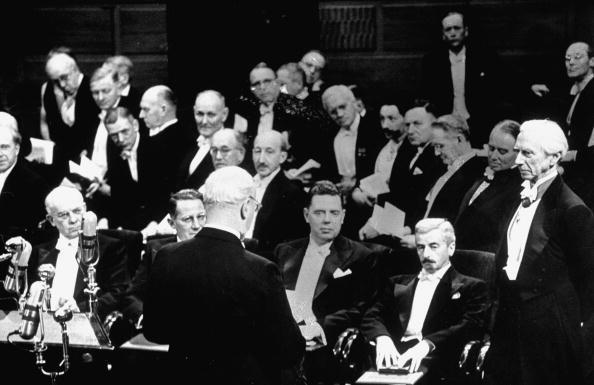
Seen below is William Faulkner and Bertrand Russell receiving Nobel Prize in 1950. My grandparents grew up in Oxford, Mississippi and knew William Faulkner. My grandfather, John Murphey, (born 1910) grew up in Oxford, Mississippi and knew both Johncy and “Bill” Faulkner. He told me that Bill was a very bashful shy man. Johncy was outgoing and would be very friendly and would love to stop and visit.

My grandfather was in the moving business and he had moved Johncy several times, but Johncy still had several outstanding bills. Then one day Johncy told my grandfather to take the bills to his brother and he would pay them in full. I don’t know the exact date, but my grandfather was told that Faulkner had got his first big check from a publisher and I am guessing that it was  in the early 1930’s.

Image result for bertrand russell nobel prize

On November 21, 2014 I received a letter from Nobel Laureate Harry Kroto and it said:

…Please click on this URL http://vimeo.com/26991975

and you will hear what far smarter people than I have to say on this matter. I agree with them.

Harry Kroto

__


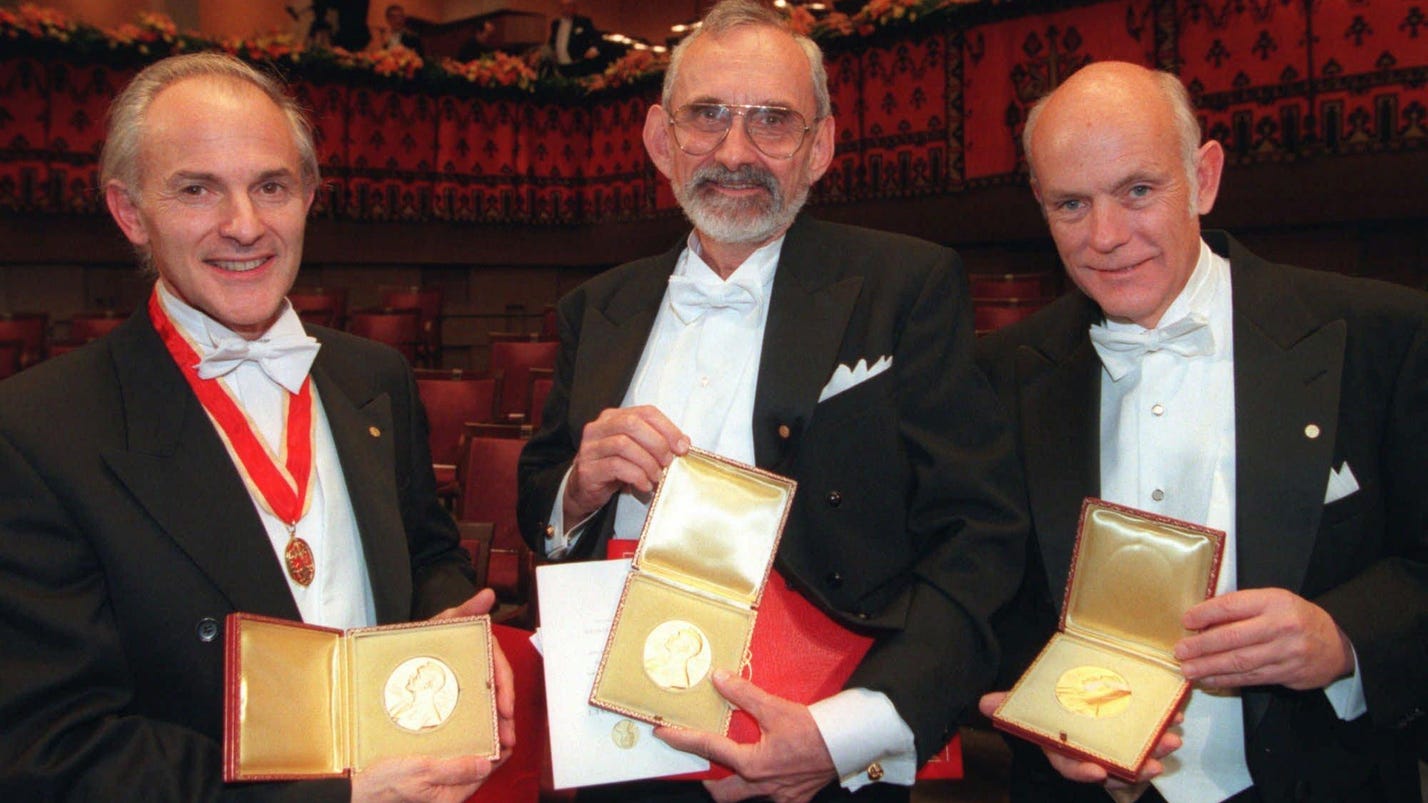
Harold W. Kroto (left) receives the Nobel Prize in chemistry

_

Image result for harry kroto

I have attempted to respond to all of Dr. Kroto’s friends arguments and I have posted my responses one per week for over a year now. Here are some of my earlier posts:

Arif Ahmed, Sir David AttenboroughMark Balaguer, Horace Barlow, Michael BatePatricia ChurchlandAaron CiechanoverNoam Chomsky,Alan DershowitzHubert Dreyfus, Bart Ehrman, Stephan FeuchtwangDavid Friend,  Riccardo GiacconiIvar Giaever , Roy GlauberRebecca GoldsteinDavid J. Gross,  Brian Greene, Susan GreenfieldStephen F Gudeman,  Alan Guth, Jonathan HaidtTheodor W. Hänsch, Brian Harrison,  Hermann HauserRoald Hoffmann,  Bruce HoodHerbert Huppert,  Gareth Stedman Jones, Steve JonesShelly KaganMichio Kaku,  Stuart Kauffman,  Lawrence KraussHarry Kroto, George LakoffElizabeth Loftus,  Alan MacfarlanePeter MillicanMarvin MinskyLeonard Mlodinow,  Yujin NagasawaAlva NoeDouglas Osheroff,  Jonathan Parry,  Saul PerlmutterHerman Philipse,  Carolyn PorcoRobert M. PriceLisa RandallLord Martin Rees,  Oliver Sacks, John SearleMarcus du SautoySimon SchafferJ. L. Schellenberg,   Lee Silver Peter Singer,  Walter Sinnott-ArmstrongRonald de Sousa, Victor StengerBarry Supple,   Leonard Susskind, Raymond TallisNeil deGrasse Tyson,  .Alexander Vilenkin, Sir John WalkerFrank WilczekSteven Weinberg, and  Lewis Wolpert,

About 

BERTRAND RUSSELL 

As a philosopher, mathematician, educator, social critic and political activist, Bertrand Russell authored over 70 books and thousands of essays and letters addressing a myriad of topics. Awarded the Nobel Prize in Literature in 1950, Russell was a fine literary stylist, one of the foremost logicians ever, and a gadfly for improving the lives of men and women.Born in 1872 into the British aristocracy and educated at Cambridge University, Russell gave away much of his inherited wealth. But in 1931 he inherited and kept an earldom. His multifaceted career centered on work as a philosophy professor, writer, and public lecturer.(Here is a detailed chronology of Russell’s life, an overview of his analytic philosophy, and a complete bibliography of all his publications.)

Russell was an author of diverse scope. His first books were German Social DemocracyAn Essay on the Foundations of Geometry, and A Critical Exposition of the Philosophy of Leibniz. His last books were War Crimes in Vietnam and The Autobiography of Bertrand Russell. Other noteworthy books include Principles of MathematicsPrincipia Mathematica (with A.N. Whitehead), Anti-Suffragist AnxietiesThe Problems of PhilosophyIntroduction to Mathematical PhilosophySceptical EssaysWhy I Am Not a Christian, and A History of Western Philosophy.

He was arguably the greatest philosopher of the 20th century and the greatest logician since Aristotle. Analytic philosophy, the dominant philosophy of the twentieth century, owes its existence more to Russell than to any other philosopher. And the system of logic developed by Russell and A.N. Whitehead, based on earlier work by Dedekind, Cantor, Frege, and Peano, broke logic out of its Aristotelian straitjacket. He was also one of the century’s leading public intellectuals and won the Nobel Prize for Literature in 1950 “in recognition of his varied and significant writings in which he champions humanitarian ideals and freedom of thought.”

Russell was involved, often passionately, in numerous social and political controversies of his time. For example, he supported suffragists, free thought in religion and morals, and world government; he opposed World War I and the Vietnam War, nationalism, and political persecution. He was jailed in 1918 for anti-war views and in 1961 for his anti-nuclear weapons stance.

He was married 4 times and had 3 children. With Dora Russell, he founded the experimental Beacon Hill School. He knew or worked with many of the most prominent figures in late 19th and 20th century philosophy, mathematics, science, literature, and politics.

Active as a political and social critic until his end, Russell died in 1970 at the age of 97.

In  the first video below in the 14th clip in this series are his words and I will be responding to them in the next few weeks since Sir Bertrand Russell is probably the most quoted skeptic of our time, unless it was someone like Carl Sagan or Antony Flew.  

50 Renowned Academics Speaking About God (Part 1)

Another 50 Renowned Academics Speaking About God (Part 2)

A Further 50 Renowned Academics Speaking About God (Part 3)

__

Quote from Bertrand Russell:

Q: Why are you not a Christian?

Russell: Because I see no evidence whatever for any of the Christian dogmas. I’ve examined all the stock arguments in favor of the existence of God, and none of them seem to me to be logically valid.

Q: Do you think there’s a practical reason for having a religious belief, for many people?

Russell: Well, there can’t be a practical reason for believing what isn’t true. That’s quite… at least, I rule it out as impossible. Either the thing is true, or it isn’t. If it is true, you should believe it, and if it isn’t, you shouldn’t. And if you can’t find out whether it’s true or whether it isn’t, you should suspend judgment. But you can’t… it seems to me a fundamental dishonesty and a fundamental treachery to intellectual integrity to hold a belief because you think it’s useful, and not because you think it’s true._

EXTRAORDINARY CLAIMS, EXTRAORDINARY EVIDENCE


EXTRAORDINARY CLAIMS, EXTRAORDINARY EVIDENCE

Written by  on July 20, 2014

Extraordinary Claims, Extraordinary Evidence

“Not enough evidence, God! Not enough evidence!”

That’s how renowned philosopher Bertrand Russell said he would answer God’s question, “Why didn’t you believe in me?” if ever he were to find himself before God on judgment day.

Russell was not the first, and certainly not the last, to make such a claim. Before him were the likes of David Hume and Pierre-Simon Laplace, who argued that the weight of evidence for an extraordinary claim—like the belief that Jesus rose from the dead, for example—must match the strangeness of the claim. Or as Carl Sagan famously restated, “Extraordinary claims require extraordinary evidence.”

What Counts as Extraordinary?

Strictly speaking, there’s nothing wrong with the idea that ‘extraordinary claims require extraordinary evidence.’ Big claims require big proof. So far, so good.

But there are two problems with how that idea is sometimes misused. For some people, ‘extraordinary claims require extraordinary evidence’ is merely a way to dismiss the issue without further investigation. “I wouldn’t believe in Jesus unless he appeared to me personally, because extraordinary claims require extraordinary evidence!” Such people have no interest in examining an actual case for Jesus. They have already made up their minds beforehand, instead of letting the evidence speak for itself.

The other problem is that extraordinary things do happen in our world, which means that if we want to determine the truthfulness of an historical event, we cannot only consider the likelihood of the event itself. We must also consider the likelihood of the historical evidence surrounding the event being just as it is even if the event in question had never taken place. In other words, it may be that ‘extraordinary evidence’ for an extraordinary claim is found in a constellation of seemingly ordinary events that happened in such a way that an extraordinary event is the most plausible explanation. That’s a mouthful, but all we’re saying is this: the extraordinary claims of Christianity are backed up with several streams of evidence for which the only sensible explanation is that Jesus, in fact, rose from the dead (just as he said he would do).

The Extraordinary Evidence for the Resurrection of Jesus

Not the Jewish Hope – Jews, as Jesus’ followers all were, did not believe in a resurrection in the middle of history, and they didn’t expect for their Messiah to be killed either. In fact, they held these beliefs so strongly that even though Jesus told them ahead of time that he would be killed and resurrected, they still didn’t believe him until after he returned from the grave! In other words, it’s highly unlikely that twelve people would change their minds about strongly held beliefs concerning the death of the Messiah and his resurrection in the middle of history, unless those things actually occurred and forced them to change their beliefs.

Not Just His Friends – Jesus did not live a secret life. His teachings and his miracles were all done in public in the presence of both friends and enemies. Similarly, Jesus was seen after his death by hundreds of people in different times and places. In fact, one man who had formerly made a name for himself by killing Jesus’ followers became a follower of Jesus upon encountering him after his resurrection. It may not take much to convince close friends, but it takes a mountain evidence to convince one’s enemies.

Not the Right Witnesses – If Jesus’ followers had wanted to make up a story about the resurrection of their Messiah, they picked the “wrong” people to be the first witnesses. The New Testament tells us the first people to see Jesus after he rose from the grave were women, whose testimonies in that society were not regarded. So, it’s more likely that Jesus did rise and first appear to a couple of women than it is to think that some men in a patriarchal society would have thought to make women the first eye-witnesses.

No Shrine in Sight – The tombs of famous Jewish figures, especially martyrs, almost always became shrines that were visited by their followers. But this did not happen with Jesus, as it did for the previous Messiah-claimants before him. The question we should ask is, “Why did all of those other tombs become shrines while Jesus’ tomb did not?” Instead of the people randomly snubbing Jesus’ tomb, it’s more likely that his tomb never became a shrine precisely because his body was no longer there.

No Turning Back – Of the eleven remaining disciples (Judas killed himself over the grief of what he had done), ten of them were killed for their refusal to recant their beliefs in Jesus, and the last was exiled to live on a remote island. When on trial, not one of these men said, “You know, this whole thing about Jesus is actually a lie. We took the body from the tomb, and made up a cool story. But now that you are threatening me with death, well, it’s time I come clean.” It’s highly unlikely that eleven men would independently refuse to recant their faith in Jesus, unless they were utterly certain that it was true.

Not the Right Day – For over one and a half thousand years, the Jewish people had worshipped God on the Sabbath, or Saturday, the seventh day of the week. But after the resurrection of Jesus, suddenly Jews began worshipping God on Sunday. What would make a deeply traditional culture shift their sacred day of worship? It would take something so remarkable, so significant, that they felt it was acceptable to change. That something was the resurrection of Jesus, which occurred on a Sunday.

When you put all of those together—(1) that the Messiah’s death and resurrection were not the Jewish expectation, (2) that Jesus’ followers were not just his friends but even former enemies, (3) that the first witnesses were women in a patriarchal society, (4) that Jesus’ tomb never became a shrine, as did the tombs of other martyrs, (5) that Jesus’ disciples all suffered and died for what they believed to be true, and (6) that thousands of Jews were convinced to switch their sacred day of worship from Saturday to Sunday—these semi-ordinary events combine to form a tapestry of extraordinary evidence.

Not a Problem of Evidence

When you consider the teachings of Jesus in light of the evidence for his resurrection, all signs point in the same direction. Jesus truly was who he claimed to be: the Son of God, the Lord of creation, the long-awaited Messiah, the Savior of the world.

But why do some still not believe? If the evidence is so clear, how can anyone resist it?

We all have the same set of evidence, so it’s not that this person has more, thus they believe, while that person has less, so they don’t believe. No, the answer is found deep within our own hearts. So long as someone does not want Jesus to be who he claimed to be, they will continue to find an excuse to dismiss the evidence. In other words, there is enough evidence to convince those who are open to being convinced, but there will never be enough evidence to coerce someone who doesn’t want the gospel to be true.

Blaise Pascal, a brilliant Christian thinker in the 17th century, put it like this: “God so regulates the knowledge of himself that he has given indications of himself which are visible to those who seek him and not to those who do not seek him. There is enough light for those to see who desire to see, and enough obscurity for those who have a contrary disposition.”

This seems unfair, but it’s actually just God giving people what they want. He says to those who are open to him, “You will seek me and find me, when you seek me with all your heart.” (Jeremiah 29:13) And Jesus adds, “Seek and you will find, knock and the door shall be opened, ask and it will be given you. For he who seeks finds, and to him who knocks it shall be opened, and to him who asks it shall be given.” (Matt. 7:7)

Meanwhile those who have already made up their mind, who are closed-minded and convinced in themselves, cannot be persuaded so long as they remain in that state. It’s not an evidence problem; it’s a desire problem. It’s not that there is no case for Jesus; it’s that they do not want any of it to be true. As atheist author Thomas Nagel confesses in his book, The Last Word, “I want atheism to be true and am made uneasy by the fact that some of the most intelligent and well-informed people I know are religious believers. It isn’t just that I don’t believe in God and, naturally, hope that I’m right in my belief. It’s that I hope there is no God! I don’t want there to be a God” (emphasis mine).

Ironic, isn’t it? An atheist author talks about what he wants to be true and what he hopes to be true, when usually it’s the religious folks who are accused of wishful thinking.

If you’re reading this and you’re not a convinced follower of Jesus, ask yourself: Are you open, truly open, to being wrong about Jesus? Have you considered the multiple streams of evidence that point to him? Are you honest enough to confess, like Thomas Nagel, that some part of you doesn’t want Jesus to be Lord? And finally, do you really think it’s wise to base on your life on what you want to be true, instead of giving the evidence a fair hearing?

Extraordinary claims require extraordinary evidence. But I think the evidence surrounding Jesus matches the claims about him, and he says to you now, “Seek and you will find.”


Doug Ponder is one of the founding pastors of Remnant Church in Richmond, VA, where he serves in many of the church’s teaching ministries. He has contributed to several published works and is the author of Rethink Marriage & Family. His interests include the intersection of theology, ethics, and the Christian life. Follow him on Twitter @dougponder.

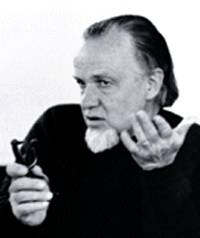
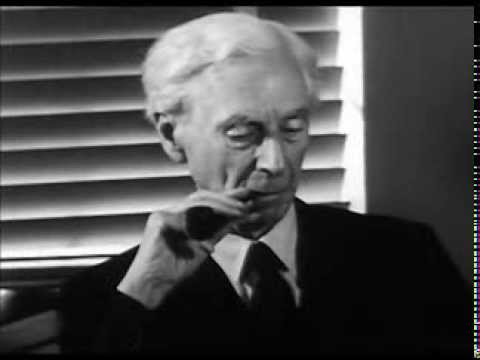
Bertrand Russell pictured above and Francis Schaeffer below:

Image result for francis schaeffer

Francis Schaeffer noted in his book HOW SHOULD WE THEN LIVE? (p. 182 in Vol 5 of Complete Works) in the chapter The Breakdown in Philosophy and Science:

In his lecture at Acapulco, George Wald finished with only one final value. It was the same one with which English philosopher Bertrand Russell (1872-1970) was left. For Wald and Russell and for many other modern thinkers, the final value is the biological continuity of the human race. If this is the only final value, one is left wondering why this then has importance. 

Now having traveled from the pride of man in the High Renaissance and the Enlightenment down to the present despair, we can understand where modern people are. They have no place for a personal God. But equally they have no place for man as man, or for love, or for freedom, or for significance. This brings a crucial problem. Beginning only from man himself, people affirm that man is only a machine. But those who hold this position cannot live like machines! If they could, there would have been no tensions in their intellectual position or in their lives. But even people who believe they are machines cannot live like machines, and thus they must “leap upstairs” against their reason and try to find something which gives meaning to life, even though to do so they have to deny their reason. 

Francis Schaeffer in another place worded it like this:

The universe was created by an infinite personal God and He brought it into existence by spoken word and made man in His own image. When man tries to reduce [philosophically in a materialistic point of view] himself to less than this [less than being made in the image of God] he will always fail and he will always be willing to make these impossible leaps into the area of nonreason even though they don’t give an answer simply because that isn’t what he is. He himself testifies that this infinite personal God, the God of the Old and New Testament is there. 

Instead of making a leap into the area of nonreason the better choice would be to investigate the claims that the Bible is a historically accurate book and that God created the universe and reached out to humankind with the Bible. Below is a piece of that evidence given by Francis Schaeffer concerning the accuracy of the Bible.

TRUTH AND HISTORY (chapter 5 of WHATEVER HAPPENED TO THE HUMAN RACE?, under footnotes #97 and #98)

A common assumption among liberal scholars is that because the Gospels are theologically motivated writings–which they are–they cannot also be historically accurate. In other words, because Luke, say (when he wrote the Book of Luke and the Book of Acts), was convinced of the deity of Christ, this influenced his work to the point where it ceased to be reliable as a historical account. The assumption that a writing cannot be both historical and theological is false.

Image result for sir william ramsay archaeologist

The experience of the famous classical archaeologist Sir William Ramsay illustrates this well. When he began his pioneer work of exploration in Asia Minor, he accepted the view then current among the Tubingen scholars of his day that the Book of Acts was written long after the events in Paul’s life and was therefore historically inaccurate. However, his travels and discoveries increasingly forced upon his mind a totally different picture, and he became convinced that Acts was minutely accurate in many details which could be checked.

What is even more interesting is the way “liberal” modern scholars today deal with Ramsay’s discoveries and others like them. In the NEW TESTAMENT : THE HISTORY OF THE INVESTIGATION OF ITS PROBLEMS, the German scholar Werner G. Kummel made no reference at all to Ramsay. This provoked a protest from British and American scholars, whereupon in a subsequent edition Kummel responded. His response was revealing. He made it clear that it was his deliberate intention to leave Ramsay out of his work, since “Ramsay’s apologetic analysis of archaeology [in other words, relating it to the New Testament in a positive way] signified no methodologically essential advance for New Testament research.” This is a quite amazing assertion. Statements like these reveal the philosophic assumptions involved in much liberal scholarship.

A modern classical scholar, A.N.Sherwin-White, says about the Book of Acts: “For Acts the confirmation of historicity is overwhelming…Any attempt to reject its basic historicity, even in matters of detail, must not appear absurd. Roman historians have long taken this for granted.”

When we consider the pages of the New Testament, therefore, we must remember what it is we are looking at. The New Testament writers themselves make abundantly clear that they are giving an account of objectively true events.

(Under footnote #98)

Acts is a fairly full account of Paul’s journeys, starting in Pisidian Antioch and ending in Rome itself. The record is quite evidently that of an eyewitness of the events, in part at least. Throughout, however, it is the report of a meticulous historian. The narrative in the Book of Acts takes us back behind the missionary journeys to Paul’s famous conversion on the Damascus Road, and back further through the Day of Pentecost to the time when Jesus finally left His disciples and ascended to be with the Father.

But we must understand that the story begins earlier still, for Acts is quite explicitly the second part of a continuous narrative by the same author, Luke, which reaches back to the birth of Jesus.

Luke 2:1-7 New American Standard Bible (NASB)

Now in those days a decree went out from Caesar Augustus, that a census be taken of all [a]the inhabited earth. [b]This was the first census taken while[c]Quirinius was governor of Syria. And everyone was on his way to register for the census, each to his own city. Joseph also went up from Galilee, from the city of Nazareth, to Judea, to the city of David which is called Bethlehem, because he was of the house and family of David, in order to register along with Mary, who was engaged to him, and was with child. While they were there, the days were completed for her to give birth. And she gave birth to her firstborn son; and she wrapped Him in cloths, and laid Him in a [d]manger, because there was no room for them in the inn.

In the opening sentences of his Gospel, Luke states his reason for writing:

Luke 1:1-4 New American Standard Bible (NASB)

Inasmuch as many have undertaken to compile an account of the things[a]accomplished among us, just as they were handed down to us by those whofrom the beginning [b]were eyewitnesses and [c]servants of the [d]word, it seemed fitting for me as well, having [e]investigated everything carefully from the beginning, to write it out for you in consecutive order, most excellentTheophilus; so that you may know the exact truth about the things you have been [f]taught.

In Luke and Acts, therefore, we have something which purports to be an adequate history, something which Theophilus (or anyone) can rely on as its pages are read. This is not the language of “myths and fables,” and archaeological discoveries serve only to confirm this.

For example, it is now known that Luke’s references to the titles of officials encountered along the way are uniformly accurate. This was no mean achievement in those days, for they varied from place to place and from time to time in the same place. They were proconsuls in Corinth and Cyprus, asiarchs at Ephesus, politarches at Thessalonica, and protos or “first man” in Malta. Back in Palestine, Luke was careful to give Herod Antipas the correct title of tetrarch of Galilee. And so one. The details are precise.

The mention of Pontius Pilate as Roman governor of Judea has been confirmed recently by an inscription discovered at Caesarea, which was the Roman capital of that part of the Roman Empire. Although Pilate’s existence has been well known for the past 2000 years by those who have read the Bible, now his governorship has been clearly attested outside the Bible.

____


Related posts:


RESPONDING TO HARRY KROTO’S BRILLIANT RENOWNED ACADEMICS!! Pausing to take a look at the life of HARRY KROTO Part C (Kroto’s admiration of Bertrand Russell examined)

Today we look at the 3rd letter in the Kroto correspondence and his admiration of Bertrand Russell. (Below The Nobel chemistry laureates Harold Kroto, Robert Curl and Richard Smalley) It is with sadness that I write this post having learned of the death of Sir Harold Kroto on April 30, 2016 at the age of […]

RESPONDING TO HARRY KROTO’S BRILLIANT RENOWNED ACADEMICS!! Part 52 The views of Hegel and Bertrand Russell influenced Gareth Stedman Jones of Cambridge!!

On November 21, 2014 I received a letter from Nobel Laureate Harry Kroto and it said: …Please click on this URL http://vimeo.com/26991975 and you will hear what far smarter people than I have to say on this matter. I agree with them. Harry Kroto _________________ Below you have picture of Dr. Harry Kroto:   Gareth Stedman […]

WOODY WEDNESDAY John Piippo makes the case that Bertrand Russell would have loved Woody Allen because they both were atheists who don’t deny the ramifications of atheism!!!

Top 10 Woody Allen Movies __________ John Piippo makes the case that Bertrand Russell would have loved Woody Allen because they both were  atheists who don’t deny the ramifications of atheism!!! Monday, August 06, 2012 (More On) Woody Allen’s Atheism As I wrote in a previous post, I like Woody Allen. I have long admired his […]

John Piippo makes the case that Bertrand Russell would have loved Woody Allen because they both were two atheists who don’t deny the ramifications of atheism!!!

______ Top 10 Woody Allen Movies PBS American Masters – Woody Allen A Documentary 01 PBS American Masters – Woody Allen A Documentary 02 __________ John Piippo makes the case that Bertrand Russell would have loved Woody Allen because they both were two atheists who don’t deny the ramifications of atheism!!! Monday, August 06, 2012 […]

Bertrand Russell v. Frederick Copleston debate transcript (Part 4)

THE MORAL ARGUMENT     BERTRAND RUSSELL But aren’t you now saying in effect, I mean by God whatever is good or the sum total of what is good — the system of what is good, and, therefore, when a young man loves anything that is good he is loving God. Is that what you’re […]

Bertrand Russell v. Frederick Copleston debate transcript (Part 3)

Great debate Fr. Frederick C. Copleston vs Bertrand Russell – Part 1 Uploaded by riversonthemoon on Jul 15, 2009 BBC Radio Third Programme Recording January 28, 1948. BBC Recording number T7324W. This is an excerpt from the full broadcast from cassette tape A303/5 Open University Course, Problems of Philosophy Units 7-8. Older than 50 years, […]

Bertrand Russell v. Frederick Copleston debate transcript and audio (Part 2)

Uploaded by riversonthemoon on Jul 15, 2009 BBC Radio Third Programme Recording January 28, 1948. BBC Recording number T7324W. This is an excerpt from the full broadcast from cassette tape A303/5 Open University Course, Problems of Philosophy Units 7-8. Older than 50 years, out of UK/BBC copyright. Pardon the hissy audio. It was recorded 51 […]

Bertrand Russell v. Frederick Copleston debate transcript and audio (Part 1)

Fr. Frederick C. Copleston vs Bertrand Russell – Part 1 Uploaded by riversonthemoon on Jul 15, 2009 BBC Radio Third Programme Recording January 28, 1948. BBC Recording number T7324W. This is an excerpt from the full broadcast from cassette tape A303/5 Open University Course, Problems of Philosophy Units 7-8. Older than 50 years, out of […]

Bertrand Russell v. Frederick Copleston debate transcript (Part 4)

THE MORAL ARGUMENT     BERTRAND RUSSELL But aren’t you now saying in effect, I mean by God whatever is good or the sum total of what is good — the system of what is good, and, therefore, when a young man loves anything that is good he is loving God. Is that what you’re […]

Bertrand Russell v. Frederick Copleston debate transcript (Part 3)

Fr. Frederick C. Copleston vs Bertrand Russell – Part 1 Uploaded by riversonthemoon on Jul 15, 2009 BBC Radio Third Programme Recording January 28, 1948. BBC Recording number T7324W. This is an excerpt from the full broadcast from cassette tape A303/5 Open University Course, Problems of Philosophy Units 7-8. Older than 50 years, out of […]

MUSIC MONDAY Breaking down the song QUESTION by the MOODY BLUES Part 1

__

Breaking down the song QUESTION by the MOODY BLUES Part 1

Moody Blues – Question (1970)

_

_

__


Below I found this interesting post on the internet:

18/09/2010

LYRIC FOR THE DAY 18.9.10 – From Questions By The Moody Blues


“I’m looking for someone to change my life,
I’m looking for a miracle in my life
And if you could see what it’s done to me,
To lose the love I knew,
Could safely lead me to
The land that I once knew,
To learn as we grow old
The secrets of our soul.”

The Moody Blues were one of those spiritual searcher bands of the late sixties and early seventies. I have heard Justin Hayward speak of how they were just young people asking questions about who they were and what the meaning of life was and how that that was a good thing. So it is; it is to be encouraged.

In the liner notes to the CD of Question Of Balance Hayward speaks of how Question was a protest song about the wars of the day but also a response to the breakdown of the sixties and the loss of the dream of the time. There is no doubt that this lyric shows a band reaching beyond what the hippy can achieve in the resources of humanity and seeking a transcendent power to bring the miracle that is recognised as crucial to some answer to our question of meaning and to our satisfaction of soul.

Right there in the middle of The Moody Blues, it appears, was a Christian faith in the life of their bass player John Lodge. In charismamag.com Lodge said, “”In the ’60s we were all looking for something. If you did a gig you’d spend hours afterwards meeting people, talking about religion. I grew up through an evangelical church, and the more I talked to people, the more I realized all the things I’d learned at church were relevant–and what everyone was looking for. I was thinking, Just a moment, I think I’ve got that!

His

His words are proven in a later song on the same album as Question. I remember listening to Minstrel, down the years, and thinking that I could see Jesus in the words:

Listen to the one
Who sings of love.
Follow our friend,
Our wandering friend,
Listen to the one,
Who sings of love.
Everywhere love is around,
Around, around.

For Lodge, the answer to his band mate Justin Hayward’s Questions was the Jesus of his upbringing and continuing spiritual journey. Right in the middle of their questioning album there is a quiet answer.

Posted at 12:41 AM in LYRIC OF THE DAY | Permalink


__

Related posts:

“Music Monday” B.J.Thomas Christian Testimony

B.J. Thomas – Home Where I Belong ( 1976 ) Uploaded on Sep 27, 2011 B.J. Thomas – Home Where I Belong ( 1976 ) ______________ B.J. Thomas – Testimony (1980) B.J. Thomas – Softly and Tenderly (1982) Related posts: Christian music from the 1970′s and 80′s May 7, 2013 – 2:32 pm Keith Green – Asleep In […]

“Music Monday” Evie

Evie Tornquist – It Only Takes A Spark † Pass It On ( 1976 ) Uploaded on Sep 25, 2011 Evie Tornquist – It Only Takes A Spark † Pass It On ( 1976 ) ____________ Evie Tornquist Karlsson on Billy Graham Crusade singing her hit song Born Again EvieComeOnRingBells.avi EVIE MY TRIBUTE CROUCH Evie – […]

“Music Monday” Petra

I saw Petra in concert in North Little Rock in the 1980’s. Here is the link for the bio. Classic Petra – 2011 – DVD Documentary Uploaded on Sep 17, 2011 The videos published here are for pure enjoyment, these videos are very inferior quality to the quality of the original DVD, please let us bless […]

“Music Monday” Andrae Crouch Part 3

I got to hear Andrae Crouch at the Billy Graham crusade in Memphis in 1978 and also a full concert at Memphis State University in 1981. The concert in 1981 was in front of a crowd of around 800 in a small room and I was on the 3rd row. The Billy Graham crusade was […]

“Music Monday” Andrae Crouch Part 2

I got to hear Andrae Crouch at the Billy Graham crusade in Memphis in 1978 and also a full concert at Memphis State University in 1981. The concert in 1981 was in front of a crowd of around 800 in a small room and I was on the 3rd row. The Billy Graham crusade was […]

“Music Monday” Andrae Crouch Part 1

I got to hear Andrae Crouch at the Billy Graham crusade in Memphis in 1978 and also a full concert at Memphis State University in 1981. The concert in 1981 was in front of a crowd of around 800 in a small room and I was on the 3rd row. The Billy Graham crusade was […]

“Music Monday” Amy Grant III

I saw Amy Grant perform in Little Rock around 1991 in Barton arena with Kim Hill opening. Actually I went to high school at ECS in Memphis with Kim Hill and we were on the same track team. In fact, both the boys and girls track teams won conference championships several times while we were […]

“Music Monday” Amy Grant II

I saw Amy Grant perform in Little Rock around 1991 in Barton arena with Kim Hill opening. Actually I went to high school at ECS in Memphis with Kim Hill and we were on the same track team. In fact, both the boys and girls track teams won conference championships several times while we were […]

“Music Monday” Amy Grant

Michael W. Smith & Amy Grant – El Shaddai – (Live) Uploaded on Feb 15, 2011 MICHAEL W. SMITH with AMY GRANT – EL SHADDAI – (LIVE) — From the album “LIVE IN CONCERT – A 20 YEAR CELEBRATION 2004” — AMY GRANT tekstovi 800 x 533 | 127KB | tekstovi-pesama.com The View Chatting with Amy Grant in […]

“Music Monday” Katy Perry and the Rolling Stones

FRANCIS SCHAEFFER ANALYZES ART AND CULTURE Part 214 The Humpback Roman bridge illustration (Feature on artist Charles Atlas)

_

Image result for francis schaeffer roman bridge

____

_____

Image result for francis schaeffer roman bridge

_______

Francis Schaeffer takes a look at Rome and why it fell. It fell because of inward problems. We have many of these same problems today in the USA.

The late Francis Schaeffer wrote of the significance of one’s world view, which, in the final analysis, represents one’s doctrinal perspective about God and life:

There is a flow to history and culture. This flow is rooted and has its wellspring in the thoughts of people. People are unique in the inner life of the mind—what they are in their thought world determines how they act. This is true of their value systems and it is true of their creativity …

People have presuppositions, and they will live more consistently on the basis of these presuppositions than even they themselves may realize. By presuppositions we mean the basic way an individual looks at life, his basic world view, the grid through which he sees the world. Presuppositions rest upon that which a person considers to be the truth of what exists. People’s presuppositions lay a grid for all they bring forth into the external world. Their presuppositions also provide the basis for their values and their basis for their decisions.

“As a man thinketh, so is he,” is really most profound. An individual is not just the product of the forces around him. He has a mind, an inner world …

Most people catch their presuppositions from their family and surrounding society the way a child catches measles. But people with more understanding realize that their presuppositions should be chosen after a careful consideration of what world view is true …

It is important to realize what a difference a people’s world view makes in their strength as they are exposed to the pressure of life. That it was the Christians who were able to resist religious mixtures, syncretism, and the effects of the weakness of Roman culture speaks of the strength of the Christian world view. This strength rested on God’s being an infinite-personal God and his speaking in the Old Testament, in the life and teaching of Jesus Christ, and in the gradually growing New Testament. He had spoken in ways people could understand. Thus the Christians not only had knowledge about the universe and mankind that people cannot find out by themselves, but they had absolute, universal values by which to live and by which to judge the society and the political state in which they lived …1

Apathy was the chief mark of the late Empire. One of the ways the apathy showed itself was in a lack of creativity in the arts. One easily observed example of the decadence of officially sponsored art is that the fourth-century work on the Arch of Constantine in Rome stands’ in poor contrast to its second-century sculptures which were borrowed from monuments from the period of Emperor Trajan. The elite abandoned their intellectual pursuits for social life. Officially sponsored art was decadent, and music was increasingly bombastic. Even the portraits on the coins became of poor quality. All of life was marked by the predominant apathy.

As the Roman economy slumped lower and lower, burdened with an aggravated inflation and a costly government, authoritarianism increased to counter the apathy. Since work was no longer done voluntarily, it was brought increasingly under the authority of the state, and freedoms were lost. For example, laws were passed binding small farmers to their land. So, because of the general apathy and its results, and because of oppressive control, few thought the old civilization worth saving.

Rome did not fall because of external forces such as the invasion by the barbarians. Rome had no sufficient inward base; the’ barbarians only completed the breakdown — and Rome gradually became a ruin.

It is important to realize what a difference a people’s world view makes in their strength as they are exposed to the pressure of life. That it was the Christians who were able to resist religious mixtures, syncretism, and the effects of the weaknesses of Roman culture speaks of the strength of the Christian world view. This strength rested on God’s being an infinite-personal God and his speaking in the Old Testament, in the life and teaching of Jesus Christ, and in the gradually growing New Testament. He had spoken in ways people could understand. Thus the Christians not only had knowledge about the universe and mankind that people cannot find out by themselves, but they had absolute, universal values by which to live and by which to judge the society and the political state in which they lived. And they had grounds for the basic dignity and value of the individual as unique in being made in the image of God.

Perhaps no one has presented more vividly to our generation the inner weakness of imperial Rome than has Fellini (1920-) in his film Satyricon. He reminds us that the classical world is not to be romanticized, but that it was both cruel and decadent as it came to the logical conclusion of its world view.

A culture or an individual with a weak base can stand only when the pressure on it is not too great. As an illustration, let us think of a Roman bridge. The Romans built little humpbacked bridges over many of the streams of Europe. People and wagons went over these structures safely for centuries, for two millennia. But if people today drove heavily loaded trucks over these bridges, they would break. It is this way with the lives and value systems of individuals and cultures when they have nothing stronger to build on than their own limitedness, their own finiteness. They can stand when pressures are not too great, but when pressures mount, if then they do not have a sufficient base, they crash-just as a Roman bridge would cave in under the weight of a modern six-wheeled truck. Culture and the freedoms of people are fragile. Without a sufficient base, when such pressures come only time is needed and often not a great deal of time-before there is a collapse.

E P I S O D E 1

ROMAN AGE

I. Introduction

A. Problem: dilemma of social breakdown and violence leading to authoritarianism which limits freedom.

B. We are, however, not helpless. Why?

C. Answer approached through consideration of the past.

D. Any starting point in history would be good; we start with Rome because it is direct ancestor of modern West.

II. Rome: The Empire Triumphant

A. Size and military strength of Empire.

B. Imperial sway evoked by Aventicum (Avenches), Switzerland.

III. Rome: Cultural Analysis

A. Greece and Rome: cultural influences and parallels.

1. Society as the absolute, to give meaning to life.

2. Finite gods as ground of accepted values.

B. Problems arising from Roman culture.

1. No infinite reference point as base for values and society.

2. Collapse of civic ideals therefore inevitable.

C. Results of collapse of ideals.

1. Dictatorship of Julius Caesar a response to civil disorder.

2. Firmly established authoritarian rule of Augustus.

D. Characteristics of regime introduced by Augustus.

1. Claim to give peace and the fruits of civilization.

2. Care to maintain facade of republican constitution.

3. People ready to accept absolute power in return for peace and prosperity.

4. Religious sanction for emperor-dictators: the emperor as God.

E. Christian persecution

1. Religious toleration in the Empire.

2. Christians persecuted because they would worship only the infinite-personal God and not Caesar also. They had an absolute whereby to judge the Roman state and its actions.

F. Viability of presuppositions facing social and political tension.

1. Christians had infinite reference point in God and His revelation in the Old Testament, the revelation through Christ, and the growing New Testament.

2. Christians could confront Roman culture and be untouched by its inner weakness, including its relativism and syncretism.

3. Roman hump-backed bridge, like Roman culture, could only stand if not subjected to overwhelming pressures.

IV. Rome: Eventual Decline and Fall

A. Growth of taste for cruelty.

B. Decadence seen in rampant sexuality and lust for violence.

C. General apathy, as seen in decline in artistic creativity.

D. Economic decline, more expensive government, and tighter centralization.

E. Successful barbarian invasions because of internal rot.

V. Conclusion

There is no foundation strong enough for society or the individual life within the realm of finiteness and beginning from Man alone as autonomous.

Questions

1. Dr. Schaeffer claims that, through looking at history, we can see how presuppositions determine events. Does his discussion bear this out and, if so, how?

2. How can a survey of Roman history in one-half hour be either useful or responsible? Discuss.

3. “History does not repeat itself.” —The parallels between the history of Rome and the twentieth century West are many and obvious.” How may these statements be reconciled?

Key Events and Persons

Julius Caesar: 100-44 B.C.

Augustus Caesar (Octavian): 63 B.C.-A.D. 14

Declared Pontifex Maximus: 12 B.C.

Diocletian: (Emperor) A.D. 284-305

Further Study

Here, as in succeeding suggestions for further study, it will be assumed that if you want to devote a great deal of time to a topic you can consult a library or a good bookstore. Suggestions given below are made on the basis of relevance to the text, readability, and availability.

Not all the books will necessarily agree at all—or in all details—with Dr. Schaeffer’s presentation. But as in the general conduct of life, so in matters of the mind, one must learn to discriminate. If you avoid reading things with which you disagree, you will be naive about what most of the world thinks. On the other hand, if you read everything—but without a critical mind—you will end up accepting by default all that the world (and especially your own moment of history) thinks.

J.P.V.D. Balsdon, Life and Leisure in Ancient Rome (1969).

E.M. Blaiklock, The Christian in Pagean Society (1956).

Samuel Dill, Roman Society in the Last Century of the Western Empire (1962).

E.M.B. Green, Evangelism in the Early Church (1970).

Plutarch, Lives of the Noble Greeks and Romans: A Selection (1972).

Virgil, The Aeneid (1965).

Film: Fellini, Satyricon (1969).

______________________


FRANCIS SCHAEFFER ANALYZES ART AND CULTURE Part HOW SHOULD WE THEN LIVE? “The Roman Age”  (Feature on artist…)

Francis Schaeffer has written extensively on art and culture spanning the last 2000 years and here are some posts I have done on this subject before : Francis Schaeffer’s “How should we then live?” Video and outline of episode 10 “Final Choices” episode 9 “The Age of Personal Peace and Affluence”episode 8 “The Age of Fragmentation”episode 7 “The Age of Non-Reason” episode 6 “The Scientific Age” episode 5 “The Revolutionary Age” ,  episode 4 “The Reformation” episode 3 “The Renaissance”episode 2 “The Middle Ages,”, and  episode 1 “The Roman Age,” . My favorite episodes are number 7 and 8 since they deal with modern art and culture primarily.

Here are some of the key events and people in the arts and culture that are in Francis Schaeffer’s “How should we then live?:


episode 10 “Final Choices,”, Paul’s speech in Athens: c. A.D. 53,Paul’s Epistle to the Romans: c. A.D. 60,J.K. Galbraith: 1908-2006,Francis Crick: 1916-2004,Daniel Bell: 1919-2011,The Coming of the Post-Industrial Society: 1973 Robert Theobald: 1929-1999s” ,


episode 9 “The Age of Personal Peace and Affluence,”,Oliver Wendell Holmes: 1841-1935 Herbert Marcuse: 1898-1979 Alexander Solzhenitsyn: 1917- Hungarian Revolution: 1956,Free Speech Movement: 1964 Czechoslovakian repression: 1968,Woodstock and Altamont: 1969,Radical bombings: 1970,Supreme Court abortion ruling: 1973 Solzhenitsyn’s The Gulag Archipelago: 1973-74


episode 8 “The Age of Fragmentation,” ,

Impressionists:Monet, Renoir, Pissaro, Sisley, and Degas.Post Impressionists:Cezanne, Van Gogh, Gauguin, and Seurat.

Also Picasso: 1881-1973, Les Demoiselles d’Avignon:

1906-7 Marcel Duchamp: 1887-1969, Nude Descending a Staircase: 1912: John Cage: 1912-1992, Music for Marcel Duchamp: 1947
Jackson Pollock: 1912-1956,Beethoven’s last Quartets: 1825-26 Claude Monet: 1840-1926,Poplars at Giverny, Sunrise: 1885 Paul Cézanne: 1839-1906, The Bathers: c.1905: Claude Debussy: 1862-1918 Wassily Kandinsky: 1866-1944 Arnold Schoenberg: 1874-1951:T.S. Eliot: 1888-1965,The Wasteland: 1922:Karlheinz Stockhausen: 1928-2007:Sartre’s Nausea: 1938,Beauvoir’s L’Invitée: 1943,Camus’ The Stranger: 1942,Camus’ The Plague: 1947,Resnais’ The Last Year at Marienbad: 1961 Bergman’s The Silence: 1963 Fellini’s Juliet of the Spirits: 1965 Antonioni’s Blow-Up: 1966,Bergman’s The Hour of the Wolf: 1967 Buñel’s Belle de Jour: 1967


episode 7 “The Age of Non-Reason,”,Rousseau: 1712-1778,Kant: 1724-1804,Marquis de Sade: 1740-1814 The Social Contract: 1762 Hegel: 1770-1831 Kierkegaard: 1813-1855,Paul Gauguin: 1848-1903,Whence, What Whither?: 1897-1898 Albert Schweitzer: 1875-1965,Quest for the Historical Jesus: 1906 Karl Jaspers: 1883-1969,Paul Tillich: 1886-1965,Karl Barth: 1886-1968,Martin Heidegger: 1889-1976 Aldous Huxley: 1894-1963,J.P. Sartre: 1905-1980,Beatles’ Sergeant Pepper: 1967.


episode 6 “The Scientific Age,”Copernicus: 1475-1543, Francis Bacon: 1561-1626,Novum Organum Scientiarum: 1620,Galileo: 1564-1642,Pascal: 1623-1662,Isaac Newton: 1642-1727,Principia Mathematica: 1687,Michael Faraday: 1791-1867
Charles Darwin: 1809-1882,Origin of Species: 1859,Herbert Spencer: 1820-1903,Albert Einstein: 1879-1955,Russel Lee: 1895-,Heinrich Himmler: 1900-1945,B.F. Skinner: 1904-1990,Arthur Koestler: 1905-1983,Kenneth B. Clark: 1914-2005,Murray Eden: 1920-,Kermit Kranty: 1923-2007,,Skinner’s Beyond Freedom and Dignity: 1971


episode 5 “The Revolutionary Age,” Calvin: 1509-1564
Samuel Rutherford: 1600-1661 Rutherford’s Lex Rex: 1644John Locke: 1631-1704John Wesley: 1703-1791Voltaire: 1694-1778,Letters on the English Nation: 1733 George Whitefield: 1714-1770 John Witherspoon: 1723-1794 John Newton: 1725-1807,John Howard: 1726-1790 Jefferson: 1743-1826,Robespierre: 1758-1794 Wilberforce: 1759-1833,Clarkson: 1760-1846,Napoleon: 1769-1821,Elizabeth Fry: 1780-1845,Declaration of Rights of Man: 1789,National Constituent Assembly: 1789-1791,Second French Revolution and Revolutionary Calendar: 1792 The Reign of Terror: 1792-1794,Lord Shaftesbury: 1801-1855,English slave trade ended: 1807,Slavery ended in Great Britain and Empire: 1833
Karl Marx: 1818-1883,Lenin: 1870-1924,Trotsky: 1879-1940,Stalin: 1879-1953,February and October Russian Revolutions: 1917,Berlin Wall: 1961,Czechoslovakian repression: 1968


episode 4 “The Reformation,”Erasmus: c. 1466-1536 Dürer: 1471-1528,Lucas Cranach: 1472-1553 Martin Luther: 1483-1546 Farel: 1489-1565,Johann Walther: 1496-1570,Calvin: 1509-1564,Erasmus’ Greek New Testament: 1516 Luther’s 95 Thesis: 1517,Reform at Zürich: 1523 Wittenberg Gesangbuch: 1524 England breaks with Rome: 1534 Calvin’s Institutes: 1536,Geneva Psalter: 1562 Rembrandt: 1606-1669,Raising of the Cross: 1633,Bach: 1685-175,


 episode 3 “The Renaissance, Dante: 1265-1321, The Divine Comedy: 1300-1321 Giotto: c. 1267-1337,Brunelleschi: 1377-1446,Jan van Eyck: 1380-1441 Masaccio: 1401-1428, Fouquet: 1416-1480, Duomo, Cathedral of Florence: 1434 Leonardo da Vinci: 1452-1519 Michelangelo: 1475-1564 Michelangelo’s David: 1504,Francis I of France: 1494-1547”,


and the first two episodes:episode 2 “The Middle Ages,”,and  episode 1 “The Roman Age,”


Francis Schaeffer: How Should We Then Live? (Full-Length Documentary)

____________________

Today you will notice that Rome fell from within because of postmodernism. Here is the example that Schaeffer gives in the film:

A culture or an individual with a weak base can stand only when the pressure on it is not too great. As an illustration, let us think of a Roman bridge. The Romans built little humpbacked bridges over many of the streams of Europe. People and wagons went over these structures safely for centuries, for two millennia. But if people today drove heavily loaded trucks over these bridges, they would break. It is this way with the lives and value systems of individuals and cultures when they have nothing stronger to build on than their own limitedness, their own finiteness. They can stand when pressures are not too great, but when pressures mount, if then they do not have a sufficient base, they crash-just as a Roman bridge would cave in under the weight of a modern six-wheeled truck. Culture and the freedoms of people are fragile. Without a sufficient base, when such pressures come only time is needed and often not a great deal of time-before there is a collapse.

Francis Schaeffer and Postmodernism

by Chad Brand | Dec 01 2012 | Published in Uncategorized

For me, the ‘Seventies were virtually bookended by Francis Schaeffer. I read The God Who Is There for the first time in 1972 and my intellectual life was transformed. Though I struggled with some of the ideas in the book and at times I wished the author might have given a bit more background material to explain his assessments, I had the overwhelming sense that I had crossed over into a new world. Then in 1978 I spent ten successive Thursday nights going to a church in Ft. Worth, Texas, to view the successive installments of the film series, “How Should We Then Live?” At the time it was a tour de force in Christian film production, and it convinced me that it was possible not only to make a credible case for Christianity, but that it might also be done in an attractive and compelling format.

Schaeffer was the first apologist I ever read, and his impact on my thinking was profound. But he is more than that. Hegel reminded us that the Owl of Minerva flies at dusk, and if this is so, then one might surmise that the real jolt of Schaeffer’s work would not be felt until after he was gone. I personally believe this to be the case. As helpful as he was as a teacher to me when I was eighteen years old, now I read him as a prophet.
Schaeffer was one of the first evangelical thinkers to take note of rising postmodernity, though that term was not au courant in his time, and to recognize it for what it was, not what it claimed to be. His criticisms of Samuel Beckett and Mondrian, for example, show that though these postmodern cultural icons claim to be critiquing any possibility for objective truth claims, the fact is that they offer their own tacit affirmations about truth.

He labored as an evangelist. Schaeffer’s work might be seen as the reverse of the strategy exercised by postmodern critics such as Herbert Marcuse and Theodore Adorno in the early ‘Sixties. These members of the Frankfurt School launched a very caustic critique of all claims to knowledge and truth that stood in the heritage of classical antiquity, of the Christian worldview, or even of modernity. However it may seem to the casual reader of books like One-Dimensional Man, though, the goal of these iconoclasts was not the rejection of outmoded forms of discourse so that marginalized speech might finally have its place in cultural life. These men had political ends in view—they wanted to take over the state. In order to do that, of course, they needed to gain a mass following. Knowing that it was highly unlikely that their intellectual concerns would find a sympathetic hearing among either the working class or the bourgeoisie, these left-wing intellectuals turned to university students to obtain a pool of disciples. Marcuse and company knew full well that their stance of negativity toward prevailing institutions and truth claims would find a ready hearing among the disaffected youth of the (mostly) middle class. The result was the student protest movement in places such as Paris, Columbia University, and Berkeley.

Schaeffer’s work was an antidote to all of this in two ways. First, in his radical demythologizing of the (post)modern and existentialist myths, Schaeffer lifted the lid off of prevailing ideologies and demonstrated that non-Christians cannot give a unified account of reality. This is especially true of the intellectual traditions of the last century, in which thinking persons, under the spell of Kant, Hegel, and Kierkegaard, have slipped below the “line of despair.” Feeling self-conscious about the disarray in their worldview, such persons have thrown a blanket over the chaos to hide it from view, and then have assumed a Protean stance, like James Cagney standing atop a burning building and crying, “I’m on top of the world.” American youth in particular had fallen prey to the notion that nihilism was innocuous, a sort of playful exercise. Louis Armstrong, Bobby Darin, and Frank Sinatra all made hit recordings of the song, “Mack the Knife,” a song about a serial murderer, sung to a sprightly tune, putting a sort of happy face on nihilism. (The full version of the song, from Brecht’s “Three Penny Opera” is more explicit than the American version.) Schaeffer sought to remove the blanket and let the daylight come streaming in to reveal the fractured character of these newly canonical epistemologies. Without diminishing the lure of relativism and nihilism or downplaying the genuine angst of young people in the contemporary world, Francis Schaeffer displayed the vacuity of the postmodern and existentialist “cures.” For me, reading Camus, Nietzsche, and Kafka through the decade of the ‘Seventies, Schaeffer’s sermons kept ringing back: “These men have fallen below the line of despair—they are of no final help to you.”

Second, Schaeffer wanted to tell these young persons who have been steeped in Marcuse, Sartre, and Nietzsche that they do not have to sell their souls to the devil of a fractured metaphysic. The answer to the human condition lies not in nihilism, but in the Infinite-Personal God of biblical revelation. This God seeks a relationship with humans through the death and resurrection of his Son, Jesus Christ. Though the church has often obscured the essence of the faith through its traditions, biblical Christianity understood in terms of the Reformation traditions provides the real solution to the human dilemma. We can know that this message is true both because it rings true in our lives and because it is presented in a Book that is absolutely trustworthy. Again, though my own approach to apologetics may not be completely Schaeferrian any more, his approach helped me work through issues related to presuppositionalism, evidentialism, and the classical approach.

Francis Schaeffer the prophet points us the way through the maze of postmodernity. Like other prophets to postmodernity, such as Solzhenitsyn and Alvin Gouldner, he reminds us that the advocates of existentialism and postmodernism are not disinterested, objective observers of the contemporary situation. They rather have adopted a discourse of radical suspicion for the purposes of transforming the moral condition of this world into something more fitting with their own rejection of Judeo-Christian values. Further, in their defense of marginalized discourses, though they appear to be the Robin Hoods of postmodern culture, taking from the bourgeoisie and their intellectual hired guns, in fact, beneath the mask they really are the Sheriff of Nottingham, with political goals of their own. Postmodernity is a power play by humanistic intellectuals for the purposes of intellectuals, and we ought not to be deluded into thinking otherwise.

Chad Owen Brand

__

Francis Schaeffer takes a look at Rome and why it fell. It fell because of inward problems. We have many of these same problems today in the USA.

The late Francis Schaeffer wrote of the significance of one’s world view, which, in the final analysis, represents one’s doctrinal perspective about God and life:

There is a flow to history and culture. This flow is rooted and has its wellspring in the thoughts of people. People are unique in the inner life of the mind—what they are in their thought world determines how they act. This is true of their value systems and it is true of their creativity …

People have presuppositions, and they will live more consistently on the basis of these presuppositions than even they themselves may realize. By presuppositions we mean the basic way an individual looks at life, his basic world view, the grid through which he sees the world. Presuppositions rest upon that which a person considers to be the truth of what exists. People’s presuppositions lay a grid for all they bring forth into the external world. Their presuppositions also provide the basis for their values and their basis for their decisions.

“As a man thinketh, so is he,” is really most profound. An individual is not just the product of the forces around him. He has a mind, an inner world …

Most people catch their presuppositions from their family and surrounding society the way a child catches measles. But people with more understanding realize that their presuppositions should be chosen after a careful consideration of what world view is true …

It is important to realize what a difference a people’s world view makes in their strength as they are exposed to the pressure of life. That it was the Christians who were able to resist religious mixtures, syncretism, and the effects of the weakness of Roman culture speaks of the strength of the Christian world view. This strength rested on God’s being an infinite-personal God and his speaking in the Old Testament, in the life and teaching of Jesus Christ, and in the gradually growing New Testament. He had spoken in ways people could understand. Thus the Christians not only had knowledge about the universe and mankind that people cannot find out by themselves, but they had absolute, universal values by which to live and by which to judge the society and the political state in which they lived …1

Apathy was the chief mark of the late Empire. One of the ways the apathy showed itself was in a lack of creativity in the arts. One easily observed example of the decadence of officially sponsored art is that the fourth-century work on the Arch of Constantine in Rome stands’ in poor contrast to its second-century sculptures which were borrowed from monuments from the period of Emperor Trajan. The elite abandoned their intellectual pursuits for social life. Officially sponsored art was decadent, and music was increasingly bombastic. Even the portraits on the coins became of poor quality. All of life was marked by the predominant apathy.

Normal
0

MicrosoftInternetExplorer4

st1\:*{behavior:url(#ieooui) }

/* Style Definitions */
table.MsoNormalTable
{mso-style-name:”Table Normal”;
mso-tstyle-rowband-size:0;
mso-tstyle-colband-size:0;
mso-style-noshow:yes;
mso-style-parent:””;
mso-padding-alt:0in 5.4pt 0in 5.4pt;
mso-para-margin:0in;
mso-para-margin-bottom:.0001pt;
mso-pagination:widow-orphan;
font-size:10.0pt;
font-family:”Times New Roman”;}

As the Roman economy slumped lower and lower, burdened with an aggravated inflation and a costly government, authoritarianism increased to counter the apathy. Since work was no longer done voluntarily, it was brought increasingly under the authority of the state, and freedoms were lost. For example, laws were passed binding small farmers to their land. So, because of the general apathy and its results, and because of oppressive control, few thought the old civilization worth saving.

Rome did not fall because of external forces such as the invasion by the barbarians. Rome had no sufficient inward base; the’ barbarians only completed the breakdown — and Rome gradually became a ruin.

It is important to realize what a difference a people’s world view makes in their strength as they are exposed to the pressure of life. That it was the Christians who were able to resist religious mixtures, syncretism, and the effects of the weaknesses of Roman culture speaks of the strength of the Christian world view. This strength rested on God’s being an infinite-personal God and his speaking in the Old Testament, in the life and teaching of Jesus Christ, and in the gradually growing New Testament. He had spoken in ways people could understand. Thus the Christians not only had knowledge about the universe and mankind that people cannot find out by themselves, but they had absolute, universal values by which to live and by which to judge the society and the political state in which they lived. And they had grounds for the basic dignity and value of the individual as unique in being made in the image of God.

Perhaps no one has presented more vividly to our generation the inner weakness of imperial Rome than has Fellini (1920-) in his film Satyricon. He reminds us that the classical world is not to be romanticized, but that it was both cruel and decadent as it came to the logical conclusion of its world view.

A culture or an individual with a weak base can stand only when the pressure on it is not too great. As an illustration, let us think of a Roman bridge. The Romans built little humpbacked bridges over many of the streams of Europe. People and wagons went over these structures safely for centuries, for two millennia. But if people today drove heavily loaded trucks over these bridges, they would break. It is this way with the lives and value systems of individuals and cultures when they have nothing stronger to build on than their own limitedness, their own finiteness. They can stand when pressures are not too great, but when pressures mount, if then they do not have a sufficient base, they crash-just as a Roman bridge would cave in under the weight of a modern six-wheeled truck. Culture and the freedoms of people are fragile. Without a sufficient base, when such pressures come only time is needed and often not a great deal of time-before there is a collapse.


E P I S O D E 1

ROMAN AGE

I. Introduction

A. Problem: dilemma of social breakdown and violence leading to authoritarianism which limits freedom.

B. We are, however, not helpless. Why?

C. Answer approached through consideration of the past.

D. Any starting point in history would be good; we start with Rome because it is direct ancestor of modern West.

II. Rome: The Empire Triumphant

A. Size and military strength of Empire.

B. Imperial sway evoked by Aventicum (Avenches), Switzerland.

III. Rome: Cultural Analysis

A. Greece and Rome: cultural influences and parallels.

1. Society as the absolute, to give meaning to life.

2. Finite gods as ground of accepted values.

B. Problems arising from Roman culture.

1. No infinite reference point as base for values and society.

2. Collapse of civic ideals therefore inevitable.

C. Results of collapse of ideals.

1. Dictatorship of Julius Caesar a response to civil disorder.

2. Firmly established authoritarian rule of Augustus.

D. Characteristics of regime introduced by Augustus.

1. Claim to give peace and the fruits of civilization.

2. Care to maintain facade of republican constitution.

3. People ready to accept absolute power in return for peace and prosperity.

4. Religious sanction for emperor-dictators: the emperor as God.

E. Christian persecution

1. Religious toleration in the Empire.

2. Christians persecuted because they would worship only the infinite-personal God and not Caesar also. They had an absolute whereby to judge the Roman state and its actions.

F. Viability of presuppositions facing social and political tension.

1. Christians had infinite reference point in God and His revelation in the Old Testament, the revelation through Christ, and the growing New Testament.

2. Christians could confront Roman culture and be untouched by its inner weakness, including its relativism and syncretism.

3. Roman hump-backed bridge, like Roman culture, could only stand if not subjected to overwhelming pressures.

IV. Rome: Eventual Decline and Fall

A. Growth of taste for cruelty.

B. Decadence seen in rampant sexuality and lust for violence.

C. General apathy, as seen in decline in artistic creativity.

D. Economic decline, more expensive government, and tighter centralization.

E. Successful barbarian invasions because of internal rot.

V. Conclusion

There is no foundation strong enough for society or the individual life within the realm of finiteness and beginning from Man alone as autonomous.

Questions

1. Dr. Schaeffer claims that, through looking at history, we can see how presuppositions determine events. Does his discussion bear this out and, if so, how?

2. How can a survey of Roman history in one-half hour be either useful or responsible? Discuss.

3. “History does not repeat itself.” —The parallels between the history of Rome and the twentieth century West are many and obvious.” How may these statements be reconciled?

Key Events and Persons

Julius Caesar: 100-44 B.C.

Augustus Caesar (Octavian): 63 B.C.-A.D. 14

Declared Pontifex Maximus: 12 B.C.

Diocletian: (Emperor) A.D. 284-305

Further Study

Here, as in succeeding suggestions for further study, it will be assumed that if you want to devote a great deal of time to a topic you can consult a library or a good bookstore. Suggestions given below are made on the basis of relevance to the text, readability, and availability.

Not all the books will necessarily agree at all—or in all details—with Dr. Schaeffer’s presentation. But as in the general conduct of life, so in matters of the mind, one must learn to discriminate. If you avoid reading things with which you disagree, you will be naive about what most of the world thinks. On the other hand, if you read everything—but without a critical mind—you will end up accepting by default all that the world (and especially your own moment of history) thinks.

J.P.V.D. Balsdon, Life and Leisure in Ancient Rome (1969).

E.M. Blaiklock, The Christian in Pagean Society (1956).

Samuel Dill, Roman Society in the Last Century of the Western Empire (1962).

E.M.B. Green, Evangelism in the Early Church (1970).

Plutarch, Lives of the Noble Greeks and Romans: A Selection (1972).

Virgil, The Aeneid (1965).

Film: Fellini, Satyricon (1969).

In about A.D. 60, a Jew who was a Christian and who also knew the Greek and Roman thinking of his day wrote a letter to those who lived in Rome. Previously, he had said the same things to Greek thinkers while speaking on Mars Hill in Athens. He had spoken with the Acropolis above him and the ancient marketplace below him, in the place wherethe thinkers of Athens met for discussion. A plaque marks that spot today and gives his talk in the common Greek spoken in his day. He was interrupted in his talk in Athens, but his Letter to the Romans gives us without interruption what he had to say to the thinking people of that period.

He said that the integration points of the Greek and Roman world view were not enough to answer the questions posed either by the existence of the universe and its form, or by the uniqueness of man. He said that they deserved judgment because they knew that they did not have an adequate answer to the questions raised by the universe or by the existence of man, and yet they refused, they suppressed, that which is the answer. To quote his letter:

The retribution of God is revealed from heaven against all ungodliness and unrighteousness of men, who suppress the truth in unrighteousness. Because that which is known of God is evident within them [that is, the uniqueness of man in contrast to non-man], for God made it evident to them. For the invisible things of him since the creation of the world are clearly seen, being perceived by the things that are made [that is, the existence of the universe and its form], even his eternal power and divinity; so that they are without excuse. [Roman 1:18ff.]

Here he is saying that the universe and its form and the mannishness of man speak the same truth that the Bible gives in greater detail. That this God exists and that he has not been silent but has spoken to people in the Bible and through Christ was the basis for the return to a more fully biblical Christianity in the days of the Reformers. It was a message of the possibility that people could return to God on the basis of the death of Christ alone. But with it came many other realities, including form and freedom in the culture and society built on that more biblical Christianity. The freedom brought forth was titanic, and yet, with the forms given in the Scripture, the freedoms did not lead to chaos. And it is this which can give us hope for the future. It is either this or an imposed order.

As I have said in the first chapter, people function on the basis of their world view more consistently than even they themselves may realize. The problem is not outward things. The problem is having, and then acting upon, the right world view — the world view which gives men and women the truth of what is.

___

Charles Atlas

Charles Atlas was born in St. Louis, Missouri, in 1958. Atlas is a filmmaker and video artist who has created numerous works for stage, screen, museum, and television. Atlas is a pioneer in the development of media-dance, a genre in which original performance work is created directly for the camera. Atlas worked as filmmaker-in-residence with the Merce Cunningham Dance Company for ten years.

Many of Atlas’s works have been collaborations with choreographers, dancers, and performers, including Yvonne Rainer, Michael Clark, Douglas Dunn, Marina Abramovic, Diamanda Galas, John Kelly, and Leigh Bowery. Television Dance Atlas—the artist’s critically acclaimed prime-time event on Dutch television—was a four-hour montage of original and found footage incorporating dance styles as varied as ballet, burlesque, and figure skating. Atlas also creates video installation works. The Hanged One—a work inspired by symbolism from the Tarot and foot-fetish culture—incorporated numerous video elements as well as rotoscopes, motorized mannequins, and theatrical lighting. Atlas is the recipient of three Bessie (New York Dance and Performance) Awards. His feature-length film Merce Cunningham: A Lifetime of Dance won the Best Documentary Award at Dance Screen 2000 in Monaco.

His work has been shown at international institutions, including the Whitney Museum of American Art, New York; the Museum of Modern Art, New York; Musée National d’Art Moderne, Centre Georges Pompidou, Paris; Institute of Contemporary Arts, London; the Museum of Contemporary Art, Los Angeles; and Stedelijk Museum, Amsterdam. Atlas acted as Consulting Director for “Art in the Twenty-First Century” (Seasons 2 through 5), creating the original opening programs for each hour-long segment of Season 2, as well as supervising the “Stories,” “Loss and Desire,” “Memory,” “Play,” “Protest,” and “Paradox” episodes. Charles Atlas lives and works in New York City and Paris.

________

RESPONDING TO HARRY KROTO’S BRILLIANT RENOWNED ACADEMICS!! Part 149X Sir Bertrand Russell

_


Image result for bertrand russell

__

Image result for bertrand russell

Person(s) in Photograph: Bertrand Russell, Albert Schweitzer, unidentified persons

__

Image result for bertrand russell

On November 21, 2014 I received a letter from Nobel Laureate Harry Kroto and it said:

…Please click on this URL http://vimeo.com/26991975

and you will hear what far smarter people than I have to say on this matter. I agree with them.

Harry Kroto

Nick Gathergood, David-Birkett, Harry-Kroto

I have attempted to respond to all of Dr. Kroto’s friends arguments and I have posted my responses one per week for over a year now. Here are some of my earlier posts:

Arif Ahmed, Sir David AttenboroughMark Balaguer, Horace Barlow, Michael BatePatricia ChurchlandAaron CiechanoverNoam Chomsky,Alan DershowitzHubert Dreyfus, Bart Ehrman, Stephan FeuchtwangDavid Friend,  Riccardo GiacconiIvar Giaever , Roy GlauberRebecca GoldsteinDavid J. Gross,  Brian Greene, Susan GreenfieldStephen F Gudeman,  Alan Guth, Jonathan HaidtTheodor W. Hänsch, Brian Harrison,  Hermann HauserRoald Hoffmann,  Bruce HoodHerbert Huppert,  Gareth Stedman Jones, Steve JonesShelly KaganMichio Kaku,  Stuart Kauffman,  Lawrence KraussHarry Kroto, George LakoffElizabeth Loftus,  Alan MacfarlanePeter MillicanMarvin MinskyLeonard Mlodinow,  Yujin NagasawaAlva NoeDouglas Osheroff,  Jonathan Parry,  Saul PerlmutterHerman Philipse,  Carolyn PorcoRobert M. PriceLisa RandallLord Martin Rees,  Oliver Sacks, John SearleMarcus du SautoySimon SchafferJ. L. Schellenberg,   Lee Silver Peter Singer,  Walter Sinnott-ArmstrongRonald de Sousa, Victor StengerBarry Supple,   Leonard Susskind, Raymond TallisNeil deGrasse Tyson,  .Alexander Vilenkin, Sir John WalkerFrank WilczekSteven Weinberg, and  Lewis Wolpert,

Bertrand Russellin full Bertrand Arthur William Russell, 3rd Earl Russell of Kingston Russell, Viscount Amberley of Amberley and of Ardsalla (born May 18, 1872, Trelleck, MonmouthshireWales—died Feb. 2, 1970, Penrhyndeudraeth, Merioneth), British philosopher, logician, and social reformer, founding figure in the analytic movement in Anglo-American philosophy, and recipient of the Nobel Prize for Literature in 1950. Russell’s contributions to logicepistemology, and the philosophy of mathematics established him as one of the foremost philosophers of the 20th century. To the general public, however, he was best known as a campaigner for peace and as a popular writer on social, political, and moral subjects. During a long, productive, and often turbulent life, he published more than 70 books and about 2,000 articles, married four times, became involved in innumerable public controversies, and was honoured and reviled in almost equal measure throughout the world. Russell’s article on the philosophical consequences of relativity appeared in the 13th edition of the Encyclopædia Britannica.

In  the first video below in the 14th clip in this series are his words and I will be responding to them in the next few weeks since Sir Bertrand Russell is probably the most quoted skeptic of our time, unless it was someone like Carl Sagan or Antony Flew.  

50 Renowned Academics Speaking About God (Part 1)

Another 50 Renowned Academics Speaking About God (Part 2)

A Further 50 Renowned Academics Speaking About God (Part 3)

__

Quote from Bertrand Russell:

Q: Why are you not a Christian?

Russell: Because I see no evidence whatever for any of the Christian dogmas. I’ve examined all the stock arguments in favor of the existence of God, and none of them seem to me to be logically valid.

Q: Do you think there’s a practical reason for having a religious belief, for many people?

Russell: Well, there can’t be a practical reason for believing what isn’t true. That’s quite… at least, I rule it out as impossible. Either the thing is true, or it isn’t. If it is true, you should believe it, and if it isn’t, you shouldn’t. And if you can’t find out whether it’s true or whether it isn’t, you should suspend judgment. But you can’t… it seems to me a fundamental dishonesty and a fundamental treachery to intellectual integrity to hold a belief because you think it’s useful, and not because you think it’s true.

Image result for bertrand russell

Bertrand Russell, the 19th century British atheist philosopher, mathematician, and Nobel laureate was once asked what he would say if he found himself standing before God on the judgement day and God asked him, “Why didn’t you believe in Me?” Bertrand, without blinking an eye blurted out this response: “I will look God in the eye and tell him that he did not give me enough evidence. Not enough evidence, God! Not enough evidence!” What is interesting about Bertrand’s response is his sheer audacity to think that he can look God in the eyes. “God is like the sun,” G.K. Chesterton asserted, “You cannot look at it, but without it, you cannot look at anything else.”

Bertrand’s admittance that he chose the atheistic path because he couldn’t get enough evidence to the contrary is most unjustifiable and unfounded. My people have a maxim that challenges the tenets of this assertion. To wit: “One does not teach a child the nature of God.” Even people in the secular realm, without prior knowledge in scriptures know for sure that there is a God. Like other religions, their only shortcoming is the means by which they reach God. Jesus stated emphatically:“I am the Way, the Truth, and the Life. No one comes to the Father except through me” (John 14:6).

The Psalmist declares: “The heavens proclaim the glory of God. The skies display his craftsmanship. Day after day they continue to speak; night after night they make him known. They speak without a sound or word; their voice is never heard. Yet their message has gone throughout the earth, and their words to all the world”(Psalm 19 : 1 – 4, NLT). That is why the Apostle Paul, through the inspiration of the Holy Spirit stated in no uncertain terms that, no single human being has an excuse for not knowing God: “But God shows his anger from heaven against all sinful, wicked people who suppress the truth by their wickedness. They know the truth about God because he has made it obvious to them. For ever since the world was created, people have seen the earth and sky. Through everything God made, they can clearly see his invisible qualities – his eternal power and divine nature. So they have no excuse for not knowing God” (Romans 1:18 – 20, NLT).

As a result, it can be stated unequivocally that, it is not the absence of evidence that is causing some to doubt the existence of God but rather the suppression of it. I am a lover of science (especially biology), though I did not read science in high school. I believe one’s study of science and other body of knowledge should not lead one to think that all the wonderful things one sees in the world just happened with a big bang. That man evolved from apes, or amoeba or some primordial slime. Our study of science and nature should rather hold us spellbound about the nature of God and deepen our reverence for God. The hymnist could not have expressed this sense of wonder any better:

There is, beyond the azure blue, a God, concealed from human sight,

He tinted skies with heav’nly hue and framed the worlds with His great might

There is a God, He is alive, in Him we live, and we survive;

From dust our God created man, He is our God, the great I AM.

A. W. Dicus

_

Image result for bertrand russell

__

Image result for bertrand russell

___

Image result for francis schaeffer


_

Image result for francis schaeffer

Image result for francis schaeffer

__


Francis Schaeffer on pages 178 to 179 of volume 1 THE GOD WHO IS THERE asserted:

I do not believe that there is a leap of faith needed; there are good and sufficient reasons to know why Christianity is true–and more than that, that is the Bible’s insistence. The Bible’s emphasis is that there are good and sufficient reasons to know Christianity is true, so much so that we are disobedient and guilty if we do not believe it.

The Christian system (what is taught in the whole Bible) is a unity of thought. Christianity is not just a lot of bits and pieces–there is a beginning and an end, a whole system of truth, and this system is the only system that will stand up to all the questions that are presented to us as we face the reality of existence. Some of the other systems answer some of the questions but leave others unanswered. I believe it is only Christianity that gives the answers to all the crucial questions.

What are those questions? The questions are those which are presented to us as we face the reality of existence. God shuts us up to reality. We cannot escape the reality of what is, no matter what we say we believe or think.

This reality of which I speak falls into two parts: the fact that the universe truly exists and it has form, and then what I would call the “mannishness” of man–which is my own term for meaning that man is unique. People have certain qualities that must be explained.

God has shut up all people to these things, and I always like to go back to the statement of Jean-Paul Sartre, though he had no answer for his own statement, and that is that the basic philosophic question is that something is there. Things do exist, and this demands an explanation for their existence. I would then go beyond Sartre’s statement to one by Albert Einstein. Einstein said that the most amazing thing about the universe is that we can know something truly about it.In other words, it has a form that is comprehensible, even though we cannot exhaust it. And then I would say beyond that–no matter what people say they are, they are what they are, that is, man is unique as made in the image of God. Any system of thought, to be taken seriously, has to at least try to explain these two great phenomena of the universe and man. In other words, we are talking about objective truth related to reality and not just something within our own heads.

Now I would like to add a corollary to this: in WHATEVER HAPPENED TO THE HUMAN RACE?, and especially the extensive notes of the fifth chapter, there is a third thing and that is the way the Bible measures up to history. Once we say that, this is very exciting. It is very exciting because other religions are not founded in history, they are “out there” somewhere, or you can think of them as inside of your own head–whichever way you are looking at it. On the other hand, the Bible claims to be rooted in history. Whether we are considering the history of the Old Testament, whether we are considering the history of Christ, including the resurrection, or Paul’s journeys, it is insisted on as real history. So now we have three interwoven parts. Usually I have dealt with the twentieth-century person, but the third is also there. We have to face the reality of the universe and its having an existence and having a form. We have to face the reality in the uniqueness of man. We are able to discuss the fact that the Bible is rooted in history.

____

Schaeffer then points to the historical accuracy of the Bible:

The Bible and Archaeology – Is the Bible from God? (Kyle Butt 42 min)

You want some evidence that indicates that the Bible is true? Here is a good place to start and that is taking a closer look at the archaeology of the Old Testament times. Is the Bible historically accurate? Here are some of the posts I have done in the past on the subject: 1. The Babylonian Chronicleof Nebuchadnezzars Siege of Jerusalem2. Hezekiah’s Siloam Tunnel Inscription. 3. Taylor Prism (Sennacherib Hexagonal Prism)4. Biblical Cities Attested Archaeologically. 5. The Discovery of the Hittites6.Shishak Smiting His Captives7. Moabite Stone8Black Obelisk of Shalmaneser III9A Verification of places in Gospel of John and Book of Acts., 9B Discovery of Ebla Tablets10. Cyrus Cylinder11. Puru “The lot of Yahali” 9th Century B.C.E.12. The Uzziah Tablet Inscription13. The Pilate Inscription14. Caiaphas Ossuary14 B Pontius Pilate Part 214c. Three greatest American Archaeologists moved to accept Bible’s accuracy through archaeology.

____


Related posts:


RESPONDING TO HARRY KROTO’S BRILLIANT RENOWNED ACADEMICS!! Pausing to take a look at the life of HARRY KROTO Part C (Kroto’s admiration of Bertrand Russell examined)

Today we look at the 3rd letter in the Kroto correspondence and his admiration of Bertrand Russell. (Below The Nobel chemistry laureates Harold Kroto, Robert Curl and Richard Smalley) It is with sadness that I write this post having learned of the death of Sir Harold Kroto on April 30, 2016 at the age of […]

RESPONDING TO HARRY KROTO’S BRILLIANT RENOWNED ACADEMICS!! Part 52 The views of Hegel and Bertrand Russell influenced Gareth Stedman Jones of Cambridge!!

On November 21, 2014 I received a letter from Nobel Laureate Harry Kroto and it said: …Please click on this URL http://vimeo.com/26991975 and you will hear what far smarter people than I have to say on this matter. I agree with them. Harry Kroto _________________ Below you have picture of Dr. Harry Kroto:   Gareth Stedman […]

WOODY WEDNESDAY John Piippo makes the case that Bertrand Russell would have loved Woody Allen because they both were atheists who don’t deny the ramifications of atheism!!!

Top 10 Woody Allen Movies __________ John Piippo makes the case that Bertrand Russell would have loved Woody Allen because they both were  atheists who don’t deny the ramifications of atheism!!! Monday, August 06, 2012 (More On) Woody Allen’s Atheism As I wrote in a previous post, I like Woody Allen. I have long admired his […]

John Piippo makes the case that Bertrand Russell would have loved Woody Allen because they both were two atheists who don’t deny the ramifications of atheism!!!

______ Top 10 Woody Allen Movies PBS American Masters – Woody Allen A Documentary 01 PBS American Masters – Woody Allen A Documentary 02 __________ John Piippo makes the case that Bertrand Russell would have loved Woody Allen because they both were two atheists who don’t deny the ramifications of atheism!!! Monday, August 06, 2012 […]

Bertrand Russell v. Frederick Copleston debate transcript (Part 4)

THE MORAL ARGUMENT     BERTRAND RUSSELL But aren’t you now saying in effect, I mean by God whatever is good or the sum total of what is good — the system of what is good, and, therefore, when a young man loves anything that is good he is loving God. Is that what you’re […]

Bertrand Russell v. Frederick Copleston debate transcript (Part 3)

Great debate Fr. Frederick C. Copleston vs Bertrand Russell – Part 1 Uploaded by riversonthemoon on Jul 15, 2009 BBC Radio Third Programme Recording January 28, 1948. BBC Recording number T7324W. This is an excerpt from the full broadcast from cassette tape A303/5 Open University Course, Problems of Philosophy Units 7-8. Older than 50 years, […]

Bertrand Russell v. Frederick Copleston debate transcript and audio (Part 2)

Uploaded by riversonthemoon on Jul 15, 2009 BBC Radio Third Programme Recording January 28, 1948. BBC Recording number T7324W. This is an excerpt from the full broadcast from cassette tape A303/5 Open University Course, Problems of Philosophy Units 7-8. Older than 50 years, out of UK/BBC copyright. Pardon the hissy audio. It was recorded 51 […]

Bertrand Russell v. Frederick Copleston debate transcript and audio (Part 1)

Fr. Frederick C. Copleston vs Bertrand Russell – Part 1 Uploaded by riversonthemoon on Jul 15, 2009 BBC Radio Third Programme Recording January 28, 1948. BBC Recording number T7324W. This is an excerpt from the full broadcast from cassette tape A303/5 Open University Course, Problems of Philosophy Units 7-8. Older than 50 years, out of […]

Bertrand Russell v. Frederick Copleston debate transcript (Part 4)

THE MORAL ARGUMENT     BERTRAND RUSSELL But aren’t you now saying in effect, I mean by God whatever is good or the sum total of what is good — the system of what is good, and, therefore, when a young man loves anything that is good he is loving God. Is that what you’re […]

Bertrand Russell v. Frederick Copleston debate transcript (Part 3)

Fr. Frederick C. Copleston vs Bertrand Russell – Part 1 Uploaded by riversonthemoon on Jul 15, 2009 BBC Radio Third Programme Recording January 28, 1948. BBC Recording number T7324W. This is an excerpt from the full broadcast from cassette tape A303/5 Open University Course, Problems of Philosophy Units 7-8. Older than 50 years, out of […]

MUSIC MONDAY Kansas – Carry on Wayward Son

__

I am moving the MUSIC MONDAY to a monthly feature on http://www.thedailyhatch.org. My passion has been in the recent years to emphasize the works of Francis Schaeffer in my apologetic efforts and most of those posts are either on Tuesdays or Thursdays.

Kansas – Carry on Wayward Son

Published on Feb 15, 2017

From Song facts website I got this story behind the song:

This was written by Kansas guitarist Kerry Livgren. According to Livgren, the song was not written to express anything specifically religious, though it certainly expresses spiritual searching and other ideas.

Livgren became an evangelical Christian in 1980, and has said that his songwriting to that point was all about “searching.” Regarding this song, he explained: “I felt a profound urge to ‘Carry On’ and continue the search. I saw myself as the ‘Wayward Son,’ alienated from the ultimate reality, and yet striving to know it or him. The positive note at the end (‘Surely heaven waits for you’) seemed strange and premature, but I felt impelled to include it in the lyrics. It proved to be prophetic.”

Carry on my wayward son,
For there’ll be peace when you are done
Lay your weary head to rest
Don’t you cry no more

Once I rose above the noise and confusion
Just to get a glimpse beyond the illusion
I was soaring ever higher, but I flew too high
Though my eyes could see I still was a blind man
Though my mind could think I still was a mad man
I hear the voices when I’m dreamin’, I can hear them say

Carry on my wayward son,
For there’ll be peace when you are done
Lay your weary head to rest
Don’t you cry no more

Masquerading as a man with a reason
My charade is the event of the season
And if I claim to be a wise man, it surely means that I don’t know
On a stormy sea of moving emotion
Tossed about I’m like a ship on the ocean
I set a course for winds of fortune, but I hear the voices say

Carry on my wayward son,
For there’ll be peace when you are done
Lay your weary head to rest
Don’t you cry no more

Carry on, you will always remember
Carry on, nothing equals the splendor
Now your life’s no longer empty
Surely heaven waits for you

Carry on my wayward son,
For there’ll be peace when you are done
Lay your weary head to rest
Don’t you cry no moreWriter/s: KERRY LIVGREN, KERRY A LIVGREN
Publisher: Sony/ATV Music Publishing LLC
Lyrics licensed and provided by LyricFind


__

FRIEDMAN FRIDAY Listing of transcripts and videos of “Free to Choose” episode 1 – Power of the Market on www.theDailyHatch.org

Milton Friedman’s books and film series really helped form my conservative views. Take a look at one of my favorite films of his:

Image result for milton friedman free to choose

“FREE TO CHOOSE” 1: The Power of the Market (Milton Friedman)
Free to Choose ^ | 1980 | Milton Friedman

Posted on Monday, July 17, 2006 4:20:46 PM by Choose Ye This Day

FREE TO CHOOSE: The Power of the Market

Image result for milton friedman

Friedman: Once all of this was a swamp, covered with forest. The Canarce Indians who lived here traded the 22 square miles of soggy Manhattan Island to the Dutch for $24.00 worth of cloth and trinkets. The newcomers founded a city, New Amsterdam at the edge of an empty continent. In the years that followed, it proved a magnet for millions of people from across the Atlantic; people who were driven by fear and poverty; who were attracted by the promise of freedom and plenty. They fanned out over the continent and built a new nation with their sweat, their enterprise and their vision of a better future.

For the first time in their lives, many were truly free to pursue their own objectives. That freedom released the human energies which created the United States. For the immigrants who were welcomed by this statue, America was truly a land of opportunity.

They poured ashore in their best clothes, eager and expectant, carrying what little they owned. They were poor, but they all had a great deal of hope. Once they arrived, they found, as my parents did, not an easy life, but a very hard life. But for many there were friends and relatives to help them get started __ to help them make a home, get a job, settle down in the new country. There were many rewards for hard work, enterprise and ability. Life was hard, but opportunity was real. There were few government programs to turn to and nobody expected them. But also, there were few rules and regulations. There were no licenses, no permits, no red tape to restrict them. They found in fact, a free market, and most of them thrived on it.

Many people still come to the United States driven by the same pressures and attracted by the same promise. You can find them in places like this. It’s China Town in New York, one of the centers of the garment industry __ a place where hundreds of thousands of newcomers have had their first taste of life in the new country. The people who live and work here are like the early settlers. They want to better their lot and they are prepared to work hard to do so.

Although I haven’t often been in factories like this, it’s all very familiar to me because this is exactly the same kind of a factory that my mother worked in when she came to this country for the first time at the age of 14, almost 90 years ago. And if there had not been factories like this here then at which she could have started to work and earn a little money, she wouldn’t have been able to come. And if I existed at all, I’d be a Russian or Hungarian today, instead of an American. Of course she didn’t stay here a long time, she stayed here while she learned the language, while she developed some feeling for the country, and gradually she was able to make a better life for herself.

Similarly, the people who are here now, they are like my mother. Most of the immigrants from the distant countries __ they came here because they liked it here better and had more opportunities. A place like this gives them a chance to get started. They are not going to stay here very long or forever. On the contrary, they and their children will make a better life for themselves as they take advantage of the opportunities that a free market provides to them.

The irony is that this place violates many of the standards that we now regard as every worker’s right. It is poorly ventilated, it is overcrowded, the workers accept less than union rate __ it breaks every rule in the book. But if it were closed down, who would benefit? Certainly not the people here. Their life may seem pretty tough compared to our own, but that is only because our parents or grandparents went through that stage for us. We have been able to start at a higher point.

Frank Visalli’s father was 12 years old when he arrived all alone in the United States. He had come from Sicily. That was 53 years ago. Frank is a successful dentist with a wife and family. They live in Lexington, Massachusetts. There is no doubt in Frank’s mind what freedom combined with opportunity meant to his father and then to him, or what his Italian grandparents would think if they could see how he lives now.

Frank Visalli: They would not believe what they would see __ that a person could immigrate from a small island and make such success out of their life because to them they were mostly related to the fields, working in the field as a peasant. My father came over, he made something for himself and then he tried to build a family structure. Whatever he did was for his family. It was for a better life for his family. And I can always remember him telling me that the number one thing in life is that you should get an education to become a professional person.

Friedman: The Visalli family, like all of us who live in the United States today, owe much to the climate of freedom we inherited from the founders of our country. The climate that gave full scope to the poor from other lands who came here and were able to make better lives for themselves and their children.

But in the past 50 years, we’ve been squandering that inheritance by allowing government to control more and more of our lives, instead of relying on ourselves. We need to rediscover the old truths that the immigrants knew in their bones; what economic freedom is and the role it plays in preserving personal freedom.

That’s why I came here to the South China Sea. It’s a place where there is an almost laboratory experiment in what happens when government is limited to its proper function and leaves people free to pursue their own objectives. If you want to see how the free market really works this is the place to come. Hong Kong, a place with hardly any natural resources. About the only one you can name is a great harbor, yet the absence of natural resources hasn’t prevented rapid economic development. Ships from all nations come here to trade because there are no duties, no tariffs on imports or exports. The power of the free market has enabled the industrious people of Hong Kong to transform what was once barren rock into one of the most thriving and successful places in Asia.

If you enjoyed that then take a look at the other segments:

“Friedman Friday” (“Free to Choose” episode 1 – Power of the Market. part 6 of 7)

PETERSON: Well, let me ask you how you would cope with this problem, Dr. Friedman. The people decided that they wanted cool air, and there was tremendous need, and so we built a huge industry, the air conditioning industry, hundreds of thousands of jobs, tremendous earnings opportunities and nearly all of us now have air […]

“Friedman Friday” (“Free to Choose” episode 1 – Power of the Market. part 5 of 7)

Part 5 Milton Friedman: I do not believe it’s proper to put the situation in terms of industrialist versus government. On the contrary, one of the reasons why I am in favor of less government is because when you have more government industrialists take it over, and the two together form a coalition against the ordinary […]

“Friedman Friday” (“Free to Choose” episode 1 – Power of the Market. part 4 of 7)

The fundamental principal of the free society is voluntary cooperation. The economic market, buying and selling, is one example. But it’s only one example. Voluntary cooperation is far broader than that. To take an example that at first sight seems about as far away as you can get __ the language we speak; the words […]

“Friedman Friday” (“Free to Choose” episode 1 – Power of the Market. part 3 of 7)

  _________________________   Pt3  Nowadays there’s a considerable amount of traffic at this border. People cross a little more freely than they use to. Many people from Hong Kong trade in China and the market has helped bring the two countries closer together, but the barriers between them are still very real. On this side […]

“Friedman Friday” (“Free to Choose” episode 1 – Power of the Market. part 2 of 7)

  Aside from its harbor, the only other important resource of Hong Kong is people __ over 4_ million of them. Like America a century ago, Hong Kong in the past few decades has been a haven for people who sought the freedom to make the most of their own abilities. Many of them are […]

“Friedman Friday” (“Free to Choose” episode 1 – Power of the Market. part 1of 7)

“FREE TO CHOOSE” 1: The Power of the Market (Milton Friedman) Free to Choose ^ | 1980 | Milton Friedman Posted on Monday, July 17, 2006 4:20:46 PM by Choose Ye This Day FREE TO CHOOSE: The Power of the Market Friedman: Once all of this was a swamp, covered with forest. The Canarce Indians […]

FRANCIS SCHAEFFER ANALYZES ART AND CULTURE Part 213 H. L. Mencken (Feature on artist Karen Karnes )

________

_______

Image result for h.l. mencken

Top Ten Quotes Of H. L. Mencken

H. L. Mencken Interview

Published on Aug 1, 2013

Finally, H. L. Mencken is interviewed

H. L. Mencken

From Wikipedia, the free encyclopedia
H. L. Mencken
H-L-Mencken-1928.jpg

H. L. Mencken in 1928
Born Henry Louis Mencken
September 12, 1880
Baltimore, Maryland, U.S.
Died January 29, 1956 (aged 75)
Baltimore, Maryland, U.S.
Occupation Journalist, satirist, critic
Notable credit(s) The Baltimore Sun
Spouse(s) Sara Haardt
Relatives August Mencken, Jr.
Brother
Family August Mencken, Sr.
Father

Henry Louis Mencken (September 12, 1880 – January 29, 1956) was an American journalist, satirist, cultural critic and scholar of American English.[1] Known as the “Sage of Baltimore”, he is regarded as one of the most influential American writers and prose stylists of the first half of the twentieth century. He commented widely on the social scene, literature, music, prominent politicians and contemporary movements. His satirical reporting on the Scopes trial, which he dubbed the “Monkey Trial”, also gained him attention.

As a scholar, Mencken is known for The American Language, a multi-volume study of how the English language is spoken in the United States. As an admirer of the German philosopher Friedrich Nietzsche, he was a detractor of religion, populism and representative democracy, which he believed was a system in which inferior men dominated their superiors.[2] Mencken was a supporter of scientific progress, skeptical of economic theories and critical of osteopathic and chiropractic medicine.

Mencken opposed American entry into World War I and World War II. His diary indicates that he was a racist and privately used coarse language and slurs to describe various ethnic and racial groups.[3] Mencken also at times seemed to show a genuine enthusiasm for militarism, though never in its American form. “War is a good thing,” he once wrote, “because it is honest, it admits the central fact of human nature… A nation too long at peace becomes a sort of gigantic old maid.”[4]

Mencken’s longtime home in the Union Square neighborhood of West Baltimore was turned into a city museum, the H. L. Mencken House. His papers were distributed among various city and university libraries, with the largest collection held in the Mencken Room at the central branch of Baltimore’s Enoch Pratt Free Library.

Early life[edit]

Mencken was born in Baltimore, Maryland, on September 12, 1880. He was the son of Anna Margaret (Abhau) and August Mencken, Sr., a cigar factory owner. He was of German ancestry and spoke German in his childhood.[5] When Henry was three, his family moved into a new home at 1524 Hollins Street facing Union Square park in the Union Square neighborhood of old West Baltimore. Apart from five years of married life, Mencken was to live in that house for the rest of his life.[6]

In his best-selling memoir Happy Days, he described his childhood in Baltimore as “placid, secure, uneventful and happy.”[7]

When he was nine years old, he read Mark Twain‘s Huckleberry Finn, which he later described as “the most stupendous event in my life”.[8] He became determined to become a writer and read voraciously. In one winter while in high school he read Thackeray and then “proceeded backward to Addison, Steele, Pope, Swift, Johnson and the other magnificos of the Eighteenth century”. He read the entire canon of Shakespeare and became an ardent fan of Kipling and Thomas Huxley.[9] As a boy, Mencken also had practical interests, photography and chemistry in particular, and eventually had a home chemistry laboratory in which he performed experiments of his own devising, some of them inadvertently dangerous.[10]

He began his primary education in the mid-1880s at Professor Knapp’s School, located on the east side of Holliday Street between East Lexington and Fayette Streets, next to the Holliday Street Theatre and across from the newly constructed Baltimore City Hall. The site today is the War Memorial and City Hall Plaza laid out in 1926 in memory of World War I dead. At fifteen, in June 1896, he graduated as valedictorian from the Baltimore Polytechnic Institute. BPI was a mathematics, technical and science-oriented public high school, founded in 1883, which was then located on old Courtland Street just north of East Saratoga Street. This location is today the east side of St. Paul Street in St. Paul Place and east of Preston Gardens.

He worked for three years in his father’s cigar factory. He disliked the work, especially the sales aspect of it, and resolved to leave, with or without his father’s blessing. In early 1898 he took a class in writing at one of the country’s first correspondence schools, the Cosmopolitan University.[11] This was to be the entirety of Mencken’s formal education in journalism, or in any other subject. Upon his father’s death a few days after Christmas in the same year, the business reverted to his uncle, and Mencken was free to pursue his career in journalism. He had applied in February 1899 to the Morning Herald newspaper (which became the Baltimore Morning Herald in 1900) and had been hired as a part-timer there, but still kept his position at the factory for a few months. In June he was hired as a full-time reporter.

Career[edit]

Mencken served as a reporter at the Herald for six years. Less than two and a half years after the Great Baltimore Fire, the paper was purchased in June 1906 by Charles H. Grasty, the owner and editor of The News since 1892, and competing owner and publisher Gen. Felix Agnus, of the town’s oldest (since 1773) and largest daily, The Baltimore American. They proceeded to divide the staff, assets and resources of The Herald between them. Mencken then moved to The Baltimore Sun, where he worked for Charles H. Grasty. He continued to contribute to The Sun, The Evening Sun (founded 1910) and The Sunday Sun full-time until 1948, when he stopped writing after suffering a stroke.

Mencken began writing the editorials and opinion pieces that made his name at The Sun. On the side, he wrote short stories, a novel, and even poetry, which he later revealed. In 1908, he became a literary critic for The Smart Set magazine, and in 1924 he and George Jean Nathan founded and edited The American Mercury, published by Alfred A. Knopf. It soon developed a national circulation and became highly influential on college campuses across America. In 1933, Mencken resigned as editor.

Personal life[edit]

Marriage[edit]

In 1930, Mencken married Sara Haardt, a German American professor of English at Goucher College in Baltimore and an author eighteen years his junior. Haardt had led efforts in Alabama to ratify the 19th Amendment.[12] The two met in 1923, after Mencken delivered a lecture at Goucher; a seven-year courtship ensued. The marriage made national headlines, and many were surprised that Mencken, who once called marriage “the end of hope” and who was well known for mocking relations between the sexes, had gone to the altar. “The Holy Spirit informed and inspired me,” Mencken said. “Like all other infidels, I am superstitious and always follow hunches: this one seemed to be a superb one.”[13] Even more startling, he was marrying an Alabama native, despite his having written scathing essays about the American South. Haardt was in poor health from tuberculosis throughout their marriage and died in 1935 of meningitis, leaving Mencken grief-stricken.[14] He had always championed her writing and, after her death, had a collection of her short stories published under the title Southern Album.

H.L. Mencken, All American Cynic

Great Depression, war and after[edit]

Mencken photographed by Carl Van Vechten, 1932

During the Great Depression, Mencken did not support the New Deal. This cost him popularity, as did his strong reservations regarding US participation in World War II, and his overt contempt for President Franklin D. Roosevelt. He ceased writing for the Baltimore Sun for several years, focusing on his memoirs and other projects as editor, while serving as an adviser for the paper that had been his home for nearly his entire career. In 1948, he briefly returned to the political scene, covering the presidential election in which President Harry S. Truman faced Republican Thomas Dewey and Henry A. Wallace of the Progressive Party. His later work consisted of humorous, anecdotal, and nostalgic essays, first published in The New Yorker, then collected in the books Happy Days, Newspaper Days, and Heathen Days.

Last days[edit]

On November 23, 1948, Mencken suffered a stroke, which left him aware and fully conscious but nearly unable to read or write and able to speak only with difficulty. After his stroke, Mencken enjoyed listening to European classical music and, after some recovery of his ability to speak, talking with friends, but he sometimes referred to himself in the past tense, as if he were already dead. During the last year of his life, his friend and biographer William Manchester read to him daily.[15]

Legacy[edit]

Preoccupied as Mencken was with his legacy, he organized his papers, letters, newspaper clippings and columns, even grade school report cards. After his death, these materials were made available to scholars in stages in 1971, 1981, and 1991, and include hundreds of thousands of letters sent and received; the only omissions were strictly personal letters received from women.

Death[edit]

Mencken died in his sleep on January 29, 1956.[16] He was interred in Baltimore’s Loudon Park Cemetery.[17]

Though it does not appear on his tombstone, during his Smart Set days Mencken wrote a joking epitaph for himself:

If, after I depart this vale, you ever remember me and have thought to please my ghost, forgive some sinner and wink your eye at some homely girl.[18]

The man of ideas[edit]

In his capacity as editor and man of ideas, Mencken became close friends with the leading literary figures of his time, including Theodore Dreiser, F. Scott Fitzgerald, Joseph Hergesheimer, Anita Loos, Ben Hecht, Sinclair Lewis, James Branch Cabell, and Alfred Knopf, as well as a mentor to several young reporters, including Alistair Cooke. He also championed artists whose works he considered worthy. For example, he asserted that books such as Caught Short! A Saga of Wailing Wall Street (1929), by Eddie Cantor (ghost-written by David Freedman) did more to pull America out of the Great Depression than all government measures combined. He also mentored John Fante. Thomas Hart Benton illustrated an edition of Mencken’s book Europe After 8:15.

Mencken also published many works under various pseudonyms, including Owen Hatteras, John H Brownell, William Drayham, WLD Bell, and Charles Angoff.[19] As a ghost-writer for the physician Leonard K. Hirshberg, he wrote a series of articles and (in 1910) most of a book about the care of babies.

Mencken admired German philosopher Friedrich Nietzsche—he was the first writer to provide a scholarly analysis in English of Nietzsche’s views and writings—and Joseph Conrad. His humor and satire owe much to Ambrose Bierce and Mark Twain. He did much to defend Dreiser, despite freely admitting his faults, including stating forthrightly that Dreiser often wrote badly and was a gullible man. Mencken also expressed his appreciation for William Graham Sumner in a 1941 collection of Sumner’s essays, and regretted never having known Sumner personally. In contrast, Mencken was scathing in his criticism of the German philosopher Hans Vaihinger whom he described as “an extremely dull author” and whose famous book Philosophy of ‘As If’ he dismissed as an unimportant “foot-note to all existing systems.”[20]

Mencken recommended for publication libertarian philosopher and author Ayn Rand‘s first novel, We the Living, calling it “a really excellent piece of work”. Shortly after, Rand addressed him in correspondence as “the greatest representative of a philosophy” to which she wanted to dedicate her life, “individualism”, and later listed him as her favorite columnist.[21]

Mencken is fictionalized in the play Inherit the Wind (a fictionalized version of the Scopes Monkey Trial of 1925) as the cynical sarcastic atheist E. K. Hornbeck (right), seen here as played by Gene Kelly in the Hollywood film version. On the left is Henry Drummond, based on Clarence Darrow and portrayed by Spencer Tracy.

For Mencken, Adventures of Huckleberry Finn was the finest work of American literature. Much of that book relates how gullible and ignorant country “boobs” (as Mencken referred to them) are swindled by con men like the (deliberately) pathetic “Duke” and “Dauphin” roustabouts with whom Huck and Jim travel down the Mississippi River. These scam-artists swindle by posing as enlightened speakers on temperance (to obtain the funds to get roaring drunk), as pious “saved” men seeking funds for far off evangelistic missions (to pirates on the high seas, no less), and as learned doctors of phrenology (who can barely spell). Mencken read the novel as a story of America’s hilarious dark side, a place where democracy, as defined by Mencken, is “the worship of jackals by jackasses.”

Such turns of phrase evoked the erudite cynicism and rapier sharpness of language displayed by Bierce in his darkly satiric Devil’s Dictionary. A noted curmudgeon,[22] democratic in subjects attacked, Mencken savaged politics,[23] hypocrisy, and social convention. Master of English, he was given to bombast, once disdaining the lowly hot dog bun’s descent into “the soggy rolls prevailing today, of ground acorns, plaster of paris, flecks of bath sponge and atmospheric air all compact.”[24]

As a nationally syndicated columnist and book author, he commented widely on the social scene, literature, music, prominent politicians and contemporary movements, such as the temperance movement. Mencken was a keen cheerleader of scientific progress, but very skeptical of economic theories and critical of osteopathic/chiropractic medicine.

As a frank admirer of Nietzsche, Mencken was a detractor of populism and representative democracy, which he believed was a system in which inferior men dominated their superiors.[2] As did Nietzsche, he also spoke out against religious belief (and as a fervent nonbeliever, against the very notion of a deity), particularly Christian fundamentalism, Christian Science and creationism, and against the “Booboisie,” his word for the ignorant middle classes.[25][26][27] In the summer of 1925, he attended the famous Scopes “Monkey Trial” in Dayton, Tennessee, and wrote scathing columns for the Baltimore Sun (widely syndicated) and American Mercury mocking the anti-evolution Fundamentalists (especially William Jennings Bryan). The play Inherit the Wind is a fictionalized version of the trial, and, as noted above, the cynical reporter E.K. Hornbeck is based on Mencken. In 1926, he deliberately had himself arrested for selling an issue of The American Mercury that was banned in Boston under the Comstock laws.[28] Mencken heaped scorn not only on the public officials he disliked, but also on the contemporary state of American elective politics itself.

In the summer of 1926, Mencken followed with great interest the Los Angeles grand jury inquiry into the famous Canadian-American evangelist Aimee Semple McPherson. She was accused of faking her reported kidnapping and the case attracted national attention. There was every expectation Mencken would continue his previous pattern of anti-fundamentalist articles, this time with a searing critique of McPherson. Unexpectedly, he came to her defense, identifying various local religious and civic groups which were using the case as an opportunity to pursue their respective ideological agendas against the embattled Pentecostal minister.[29] He spent several weeks in Hollywood, California, and wrote many scathing and satirical columns on the movie industry and the southern California culture. After all charges had been dropped against McPherson, Mencken revisited the case in 1930 with a sarcastically biting and observant article. He wrote that since many of that town’s residents acquired their ideas “of the true, the good and the beautiful” from the movies and newspapers, “Los Angeles will remember the testimony against her long after it forgets the testimony that cleared her.”[30]

In 1931 the Arkansas legislature passed a motion to pray for Mencken’s soul after he had called the state the “apex of moronia.”[31]

In the mid 1930s Mencken feared Franklin Roosevelt and his New Deal liberalism as a powerful force. Mencken, says Charles A. Fecher, was, “deeply conservative, resentful of change, looking back upon the ‘happy days’ of a bygone time, wanted no part of the world that the New Deal promised to bring in.”[32]

Damn! A Book of Calumny, Satire Audiobook, by H. L. Mencken

Views[edit]

The striking thing about Mencken’s mind is its ruthlessness and rigidity … Though one of the fairest of critics, he is the least pliant. … [I]n spite of his skepticism, and his frequent exhortations to hold his opinion lightly, he himself has been conspicuous for seizing upon simple dogmas and sticking to them with fierce tenacity … true skeptics … see both truth and weakness in every case.

— Literary critic Edmund Wilson (1921)[33]

Theology: An effort to explain the unknowable by putting it into terms of the not worth knowing

— H. L. Mencken[34]

Racism and elitism[edit]

In addition to his identification of races with castes, Mencken had views about the superior individual within communities. He believed that every community produced a few people of clear superiority. He considered groupings on a par with hierarchies, which led to a kind of natural elitism and natural aristocracy. “Superior” individuals, in Mencken’s view, were those wrongly oppressed and disdained by their own communities, but nevertheless distinguished by their will and personal achievement, not by race or birth.

External video
Booknotes interview with Charles Fecher on The Diary of H.L. Mencken, January 28, 1990, C-SPAN

In 1989, per his instructions, Alfred A. Knopf published Mencken’s “secret diary” as The Diary of H. L. Mencken. According to an Associated Press story, Mencken’s views shocked even the “sympathetic scholar who edited it,” Charles A. Fecher of Baltimore.[35] There is a club in Baltimore called the Maryland Club which had one Jewish member, and that member died. Mencken said, “There is no other Jew in Baltimore who seems suitable,” according to the article. The diary also quoted him as saying of blacks, in September 1943, that “it is impossible to talk anything resembling discretion or judgment to a colored woman. They are all essentially child-like, and even hard experience does not teach them anything.”

However, Mencken opposed lynching. For example, he had this to say about a Maryland incident:

Not a single bigwig came forward in the emergency, though the whole town knew what was afoot. Any one of a score of such bigwigs might have halted the crime, if only by threatening to denounce its perpetrators, but none spoke. So Williams was duly hanged, burned and mutilated.

Mencken also wrote: “I admit freely enough that, by careful breeding, supervision of environment and education, extending over many generations, it might be possible to make an appreciable improvement in the stock of the American Negro, for example, but I must maintain that this enterprise would be a ridiculous waste of energy, for there is a high-caste white stock ready at hand, and it is inconceivable that the Negro stock, however carefully it might be nurtured, could ever even remotely approach it. The educated Negro of today is a failure, not because he meets insuperable difficulties in life, but because he is a Negro. He is, in brief, a low-caste man, to the manner born, and he will remain inert and inefficient until fifty generations of him have lived in civilization. And even then, the superior white race will be fifty generations ahead of him.”[36]

Democracy[edit]

Rather than dismissing democratic governance as a popular fallacy or treating it with open contempt, Mencken’s response to it was a publicized sense of amusement. His feelings on this subject (like his casual feelings on many other such subjects) are sprinkled throughout his writings over the years, very occasionally taking center-stage with the full force of Mencken’s prose:

Democracy gives [the beatification of mediocrity] a certain appearance of objective and demonstrable truth. The mob man, functioning as citizen, gets a feeling that he is really important to the world—that he is genuinely running things. Out of his maudlin herding after rogues and mountebanks there comes to him a sense of vast and mysterious power—which is what makes archbishops, police sergeants, the grand goblins of the Ku Klux and other such magnificoes happy. And out of it there comes, too, a conviction that he is somehow wise, that his views are taken seriously by his betters—which is what makes United States Senators, fortune tellers and Young Intellectuals happy. Finally, there comes out of it a glowing consciousness of a high duty triumphantly done which is what makes hangmen and husbands happy.

This sentiment is fairly consistent with Mencken’s distaste for common notions and the philosophical outlook he unabashedly set down throughout his life as a writer (drawing on Friedrich Nietzsche and Herbert Spencer, among others).[37]

Mencken wrote as follows about the difficulties of good men reaching national office when such campaigns must necessarily be conducted remotely:

The larger the mob, the harder the test. In small areas, before small electorates, a first-rate man occasionally fights his way through, carrying even the mob with him by force of his personality. But when the field is nationwide, and the fight must be waged chiefly at second and third hand, and the force of personality cannot so readily make itself felt, then all the odds are on the man who is, intrinsically, the most devious and mediocre—the man who can most easily adeptly disperse the notion that his mind is a virtual vacuum.

The Presidency tends, year by year, to go to such men. As democracy is perfected, the office represents, more and more closely, the inner soul of the people. We move toward a lofty ideal. On some great and glorious day the plain folks of the land will reach their heart’s desire at last, and the White House will be adorned by a downright moron.[38]

H. L. Mencken: Confessions of a Believing Critic

Science[edit]

Mencken supported biology and the theory of evolution by Charles Darwin but spoke unfavorably of physics and mathematics. In Charles Angoff’s record, Mencken said:

[Isaac Newton] was a mathematician, which is mostly hogwash, too. Imagine measuring infinity! That’s a laugh.[39]

In response, Angoff said: “Well, without mathematics there wouldn’t be any engineering, no chemistry, no physics.” Mencken responded: “That’s true, but it’s reasonable mathematics. Addition, subtraction, multiplication, fractions, division, that’s what real mathematics is. The rest is baloney. Astrology. Religion. All of our sciences still suffer from their former attachment to religion, and that is why there is so much metaphysics and astrology, the two are the same, in science.”[39]

Elsewhere, he spoke of the nonsense of higher mathematics and “probability” theory, after he read Angoff’s article for Charles S. Peirce in the American Mercury. “So you believe in that garbage, too—theories of knowledge, infinity, laws of probability. I can make no sense of it, and I don’t believe you can either, and I don’t think your god Peirce knew what he was talking about.”[40]

Mencken also repeated these opinions multiple times in articles for the American Mercury. He said mathematics is simply a fiction, compared with individual facts that make up science. In a review for Vaihinger’s The Philosophy of “As If”, he said:

The human mind, at its present stage of development, cannot function without the aid of fictions, but neither can it function without the aid of facts—save, perhaps, when it is housed in the skull of a university professor of philosophy. Of the two, the facts are enormously the more important. In certain metaphysical fields, e.g. those of mathematics, law, theology, osteopathy and ethics—the fiction will probably hold out for many years, but elsewhere the fact slowly ousts it, and that ousting is what is called intellectual progress. Very few fictions remain in use in anatomy, or in plumbing and gas-fitting; they have even begun to disappear from economics.[41]

Mencken repeatedly identified mathematics with metaphysics and theology. According to Mencken, mathematics is necessarily infected with metaphysics because of the tendency of many mathematical people to engage in metaphysical speculation. In a review for A. N. Whitehead’s The Aims of Education, Mencken remarked that despite his agreement with Whitehead’s thesis and approval of his writing style, “now and then he falls into mathematical jargon and pollutes his discourse with equations”, and “[t]here are moments when he seems to be following some of his mathematical colleagues into the gaudy metaphysics which now entertains them”.[42] For Mencken, theology is characterized by the fact that it uses correct reasoning from false premises. Mencken also uses the term “theology” more generally, to refer to the use of logic in science or any other field of knowledge. In a review for both A. S. Eddington’s The Nature of the Physical World and Joseph Needham’s Man a Machine, Mencken forcefully ridiculed the use of reasoning to establish any fact in science, because theologians happen to be masters of “logic” and yet are mental defectives:

Is there anything in the general thinking of theologians which makes their opinion on the point of any interest or value? What have they ever done in other fields to match the fact-finding of the biologists? I can find nothing in the record. Their processes of thought, taking one day with another, are so defective as to be preposterous. True enough, they are masters of logic, but they always start out from palpably false premises.[43]

Mencken also wrote a review for Sir James Jeans’s book, The Mysterious Universe, in which he said that mathematics is not necessary for physics. Instead of mathematical “speculation” (such as quantum theory), Mencken believed physicists should just directly look at individual facts in the laboratory like chemists:

If chemists were similarly given to fanciful and mystical guessing, they would have hatched a quantum theory forty years ago to account for the variations that they observed in atomic weights. But they kept on plugging away in their laboratories without calling in either mathematicians or theologians to aid them, and eventually they discovered the isotopes, and what had been chaos was reduced to the most exact sort of order.[44]

In the same article which he later re-printed in the Mencken Chrestomathy, Mencken primarily contrasts what real scientists do, which is to simply directly look at the existence of “shapes and forces” confronting them instead of (such as in statistics) attempting to speculate and use mathematical models. Physicists and especially astronomers are consequently not real scientists, because when looking at shapes or forces, they do not simply “patiently wait for further light”, but resort to mathematical theory. There is no need for statistics in scientific physics, since one should simply look at the facts while statistics attempts to construct mathematical models. On the other hand, the really competent physicists do not bother with the “theology” or reasoning of mathematical theories (such as in quantum mechanics):

[Physicists] have, in late years, made a great deal of progress, though it has been accompanied by a considerable quackery. Some of the notions which they now try to foist upon the world, especially in the astronomical realm and about the atom, are obviously nonsensical, and will soon go the way of all unsupported speculations. But there is nothing intrinsically insoluble about the problems they mainly struggle with, and soon or late really competent physicists will arise to solve them. These really competent physicists, I predict, will be too busy in their laboratories to give any time to either metaphysics or theology. Both are eternal enemies of every variety of sound thinking, and no man can traffic with them without losing something of his good judgment.[44]

Mencken also ridiculed Einstein’s theory of general relativity, saying “in the long run his curved space may be classed with the psychosomatic bumps of Gall and Spurzheim”.[45] In his private letters, he said:

It is a well known fact that physicists are greatly given to the supernatural. Why this should be I don’t know, but the fact is plain. One of the most absurd of all spiritualists is Sir Oliver Lodge. I have the suspicion that the cause may be that physics itself, as currently practised, is largely moonshine. Certainly there is a great deal of highly dubious stuff in the work of such men as Eddington.[46]

Anglo-Saxons[edit]

Mencken countered the arguments for Anglo-Saxon superiority prevalent in his time in a 1923 essay entitled “The Anglo-Saxon”, which argued that if there was such a thing as a pure “Anglo-Saxon” race, it was defined by its inferiority and cowardice. “The normal American of the ‘pure-blooded’ majority goes to rest every night with an uneasy feeling that there is a burglar under the bed and he gets up every morning with a sickening fear that his underwear has been stolen.”[47]

Jews[edit]

In the 1930 edition of Treatise on the Gods, Mencken wrote:

The Jews could be put down very plausibly as the most unpleasant race ever heard of. As commonly encountered, they lack many of the qualities that mark the civilized man: courage, dignity, incorruptibility, ease, confidence. They have vanity without pride, voluptuousness without taste, and learning without wisdom. Their fortitude, such as it is, is wasted upon puerile objects, and their charity is mainly a form of display.[48]

That passage was removed from subsequent editions at his express direction.[49]

Author Gore Vidal later deflected claims of anti-Semitism against Mencken:

Far from being an anti-Semite, Mencken was one of the first journalists to denounce the persecution of the Jews in Germany at a time when The New York Times, say, was notoriously reticent. On November 27, 1938, Mencken writes (Baltimore Sun), “It is to be hoped that the poor Jews now being robbed and mauled in Germany will not take too seriously the plans of various politicians to rescue them.” He then reviews the various schemes to “rescue” the Jews from the Nazis, who had not yet announced their own final solution.[50]

As Germany gradually conquered Europe, Mencken attacked President Roosevelt for refusing to admit Jewish refugees into the United States and called for their wholesale admission:

There is only one way to help the fugitives, and that is to find places for them in a country in which they can really live. Why shouldn’t the United States take in a couple hundred thousand of them, or even all of them?[51]

However, Jewish historian Michael Kazin accused Mencken of being “a lifelong anti-Semite with a reverence for German culture so strong it blinded him to the menace of Nazism.”[52]

Inheriting Mencken

Published on Dec 24, 2007

H.L. Mencken was a Baltimore journalist who wrote with wit and passion about the encroaching monopoly state, the suffocation of American liberty under the smothering breasts of Big Mother. In this clip from Inherit the Wind, Gene Kelly gives a charming portrayal of Mencken

Memorials[edit]

Home[edit]

Mencken’s home at 1524 Hollins Street in Baltimore’s Union Square neighborhood, where he lived for sixty-seven years before his death in 1956, was bequeathed to the University of Maryland, Baltimore on the death of his younger brother, August, in 1967. The City of Baltimore acquired the property in 1983, and the H. L. Mencken House became part of the City Life Museums. It has been closed to general admission since 1997, but is opened for special events and group visits by arrangement.

Papers[edit]

Shortly after World War II, Mencken expressed his intention of bequeathing his books and papers to Baltimore‘s Enoch Pratt Free Library. At his death, it was in possession of most of the present large collection. As a result, his papers as well as much of his personal library, which includes many books inscribed by major authors, are held in the Library’s Central Branch on Cathedral Street in Baltimore. The original third floor H. L. Mencken Room and Collection housing this collection was dedicated on April 17, 1956. The new Mencken Room, on the first floor of the Library’s Annex, was opened in November 2003.

The collection contains Mencken’s typescripts, newspaper and magazine contributions, published books, family documents and memorabilia, clipping books, large collection of presentation volumes, file of correspondence with prominent Marylanders, and the extensive material he collected while he was preparing The American Language.

Other Mencken related collections of note are at Dartmouth College, Harvard University, Princeton University, Johns Hopkins University, and Yale University. In 2007, Johns Hopkins acquired “nearly 6,000 books, photographs and letters by and about Mencken” from “the estate of an Ohio accountant.”[53]

The Sara Haardt Mencken collection at Goucher College includes letters exchanged between Haardt and Mencken and condolences written after her death. Some of Mencken’s vast literary correspondence is held at the New York Public Library. “Gift of HL Mencken 1929” is stamped on the Marriage of Heaven and Hell, Luce 1906 edition of William Blake, which shows up from the Library of Congress online version for reading.

Works[edit]

Books[edit]

  • George Bernard Shaw: His Plays (1905)
  • The Philosophy of Friedrich Nietzsche (1907)
  • The Gist of Nietzsche (1910)
  • What You Ought to Know about your Baby (Ghostwriter for Leonard K. Hirshberg) (1910)
  • Men versus the Man: a Correspondence between Robert Rives La Monte, Socialist and H. L. Mencken, Individualist (1910)
  • Europe After 8:15 (1914)
  • A Book of Burlesques (1916)
  • A Little Book in C Major (1916)
  • A Book of Prefaces (1917)
  • In Defense of Women (1918)
  • Damn! A Book of Calumny (1918)
  • The American Language (1919)
  • Prejudices (1919–27)
    • First Series (1919)
    • Second Series (1920)
    • Third Series (1922)
    • Fourth Series (1924)
    • Fifth Series (1926)
    • Sixth Series (1927)
    • Selected Prejudices (1927)
  • Heliogabalus (A Buffoonery in Three Acts) (1920)
  • The American Credo (1920)
  • Notes on Democracy (1926)
  • Menckeneana: A Schimpflexikon (1928) – Editor
  • Treatise on the Gods (1930)
  • Making a President (1932)
  • Treatise on Right and Wrong (1934)
  • Happy Days, 1880–1892 (1940)
  • Newspaper Days, 1899–1906 (1941)[54]
  • A New Dictionary of Quotations on Historical Principles from Ancient and Modern Sources (1942)
  • Heathen Days, 1890–1936 (1943)
  • Christmas Story (1944)
  • The American Language, Supplement I (1945)
  • The American Language, Supplement II (1948)
  • A Mencken Chrestomathy (1949)

Posthumous collections

  • Minority Report (1956)
  • On Politics: A Carnival of Buncombe (1956)
  • Cairns, Huntington, ed. (1965), The American Scene.
  • The Bathtub Hoax and Blasts & Bravos from the Chicago Tribune (1958)
  • Lippman, Theo jr, ed. (1975), A Gang of Pecksniffs: And Other Comments on Newspaper Publishers, Editors and Reporters.
  • Rodgers, Marion Elizabeth, ed. (1991), The Impossible HL Mencken: A Selection of His Best Newspaper Stories.
  • Yardley, Jonathan, ed. (1992), My Life As Author and Editor.
  • A Second Mencken Chrestomathy (1994)
  • Thirty-five Years of Newspaper Work (1996)
  • A Religious Orgy in Tennessee: A Reporter’s Account of the Scopes Monkey Trial, Melville House Publishing, 2006.

Chapbooks, pamphlets, and notable essays[edit]

  • Ventures into Verse (1903)
  • The Artist: A Drama Without Words (1912)
  • The Creed of a Novelist (1916)
  • Pistols for Two (1917)
  • The Sahara of the Bozart (1920)
  • Gamalielese (1921)
  • “The Hills of Zion” (1925)
  • The Libido for the Ugly (1927)

See also[edit]

In Note 49, Marion Elizabeth Rodgers’ first name is incorrectly given as “Mary”. It is correctly given as “Marion” in your Bibliography section.

Top 20 H. L. Mencken Quotes (Author of A Mencken Chrestomathy)

Bibliography[edit]


Francis Schaeffer

I remember like yesterday hearing my pastor Adrian Rogers in 1979 going through the amazing fulfilled prophecy of Ezekiel 26-28 and the story of the city of Tyre. In 1980 in my senior year (taught by Mark Brink) at Evangelical Christian High School, I watched the film series by Francis Schaeffer called WHATEVER HAPPENED TO THE HUMAN RACE? Later that same year I read the book by the same name and I was amazed at the historical accuracy of the Bible and the many examples from archaeology that Schaeffer gave and recently I have shared several of these in my current series on Schaeffer and the Beatles. The reason I did that was because many people in the 1960’s had taken non-rational leaps into such areas as communism, the occult, drugs, and eastern mysticism,  but sitting right there in front of them was the historical accurate Bible which contained sufficient evidence to warrant trust.

(Adrian Rogers met with Presidents Jimmy Carter and Ronald Reagan.)

____

(This was the average sanctuary crowd when I was growing up at Bellevue Baptist in Memphis)

______________________________________

Anyone who has read my blog for any length of time knows that politically Milton Friedman and Ronald Reagan were my heroes. Spiritually my heroes have been both Francis Schaeffer and Adrian Rogers. An interesting fact about both of these two men and that is they both believed the Bible is the inspired and inerrant word of God. Both men defended the historical accuracy of the Bible even though both of the religious denominations they belonged to started to shift to the liberal view that the Bible contains errors in it.

H. L. Mencken
H l mencken.jpg

J. Gresham Machen

J. Gresham Machen

Francis Schaeffer’s battle on this issue came in the 1930’s when he got to know Dr. J. Gresham Machen was involved in a battle with  the Presbyterian Church USA over their leftward shift in theology. Francis Schaeffer observed:

H.L. Mencken died when I was a young man and I read some of the stuff he wrote and he came at just the point of the total collapse of the American consensus back in the 1930’s or a little before. H.L.Mencken was very destructive to the American consensus and he was way out. It is he who said the famous thing about Dr. J. Gresham Machen. Dr. Machen was the man who was fighting the battle for historic Christianity against the liberals in the big denominations and expressly the Presbyterian denomination and the liberals were trying to laugh Machen out of court. But H.L. Mencken said a remarkable thing, “Well, if you really want to be a Christian there is only one kind of Christian to be and that is the Machen kind.” This is wonderful. This is exactly where the battlefield is. When you take Christianity and chip away at it like the liberals wanted to do then you don’t have anything left. This is no halfway war. If you are going to be a Christian you have to be a biblical Christian. Machen and Mencken understood this and this is my position too.  

Adrian Rogers also was that type of Christian too. Recently a relative told me that his Bible Study Teacher at the church he started attended recently started a series on Genesis and he said on the front end that evolution is true. I encouraged my relative to ask the simple question: DO YOU BELIEVE IN A LITERAL “ADAM AND EVE?” I sent him the sermon on Evolution by Adrian Rogers and here is a portion of it below:

H.G. Wells

H. G. Wells, the brilliant historian who wrote The Outlines of History, said this—and I quote: “If all animals and man evolved, then there were no first parents, and no Paradise, and no Fall. If there had been no Fall, then the entire historic fabric of Christianity, the story of the first sin, and the reason for the atonement, collapses like a house of cards.” H. G. Wells says—and, by the way, I don’t believe that he did believe in creation—but he said, “If there’s no creation, then you’ve ripped away the foundation of Christianity.”

Now, the Bible teaches that man was created by God and that he fell into sin. The evolutionist believes that he started in some primordial soup and has been coming up and up. And, these two ideas are diametrically opposed. What we call sin the evolutionist would just call a stumble up. And so, the evolutionist believes that all a man needs—he’s just going up and up, and better and better—he needs a boost from beneath. The Bible teaches he’s a sinner and needs a birth from above. And, these are both at heads, in collision.

What is evolution? Evolution is man’s way of hiding from God, because, if there’s no creation, there is no Creator. And, if you remove God from the equation, then sinful man has his biggest problem removed—and that is responsibility to a holy God. And, once you remove God from the equation, then man can think what he wants to think, do what he wants to do, be what he wants to be, and no holds barred, and he has no fear of future judgment.

Francis Schaeffer & the SBC

Actually Francis Schaeffer’s good friend Paige Patterson talked Adrian Rogers into running for President of the Southern Baptist Convention in 1979 and the liberal shift was halted. In the article “Francis Schaeffer ‘indispensable’ to SBC,” (Thursday, October 30, 2014,)  David Roach wrote:

The late Francis Schaeffer was known to pick up the phone during the early years of the Southern Baptist Convention’s conservative resurgence. Paige Patterson knew to expect a call from Schaeffer around Christmas with the question, “You’re not growing weary in well-doing are you?”

Patterson, a leader in the movement to return the SBC to a high view of Scripture, would reply, “No, Dr. Schaeffer. I’m under fire, but I’m doing fine. And I’m trusting the Lord and proceeding on.”

To some it may seem strange that an international Presbyterian apologist and analyst of pop culture would take such interest in a Baptist controversy over biblical inerrancy.

But to Schaeffer it made perfect sense.

He believed churches were acquiescing to the world, abandoning their belief that the Bible is without error in everything it said. A watered-down theology left the SBC with decreased power to battle cultural evils. To Schaeffer the convention was the last major American denomination with hope for reversing this “great evangelical disaster,” as he put it.

Thirty years after Schaeffer’s death, Baptist leaders still remember how he took time from his speaking, writing and filmmaking schedule to quietly encourage Patterson; Paul Pressler, a judge from Texas with whom Patterson worked closely during the conservative resurgence; Adrian Rogers, a Memphis pastor who served three terms SBC president; and others.

By the early 1990s, conservatives had elected an unbroken string of convention presidents and moved in position to shift the balance of power on all convention boards and committees from the theologically moderate establishment. But at the time of Schaeffer’s annual calls, the outcome of the controversy was still in doubt.

(Paige Patterson)

“I strongly suspect that he was afraid I would not hold strong,” Patterson, now president of Southwestern Baptist Theological Seminary in Texas, told Baptist Press. “He had seen so many people fold up under pressure that he assumed we probably would too. So he would call and ask for a report.”

Schaeffer’s interest in engaging culture made him particularly appealing to Southern Baptist conservatives. He helped provide them with a “battle plan” to fight cultural evils and what they perceived as theological drift in their denomination, Richard Land, president of Southern Evangelical Seminary, told BP.

Along with theologian Carl F.H. Henry, Schaeffer was the key intellectual influence on leaders of the conservative resurgence, Land said. When conservatives started to be elected as the executives of Baptist institutions, Henry spoke at Land’s inauguration at the Christian Life Commission (the ERLC’s precursor), R. Albert Mohler Jr.’s at Southern Baptist Theological Seminary in Kentucky and Timothy George’s at Beeson Divinity School in Alabama.

“If Schaeffer had still been alive, we would have had him come,” Land said. He noted that Schaeffer was “close” to Rogers and “admired” by Bailey Smith, two conservative SBC presidents. Edith Schaeffer and Patterson’s wife Dorothy were close friends and traveled together in the early 1980s speaking on the importance of the home.

Clark Pinnock, a former New Orleans Baptist Theological Seminary professor who mentored conservative resurgence leaders before taking a leftward theological turn in his own thinking, served on Schaeffer’s staff at L’Abri.

(ADRIAN ROGERS, chairman of the committee that drafted changes to the Baptist Faith & Message, joins Al Mohler, Chuck Kelley and Richard Land in a news conference shortly after the new statement of faith was adopted by messengers to the Southern Baptist Convention annual meeting in Orlando, Fla)

Mount Sinai is one of the most important sites of the entire Bible. It was here that the Hebrew people came shortly after their flight from Egypt. Here God spoke to them through Moses, giving them directions for their life as newly formed nation and making a covenant with them.

The thing to notice about this epochal moment for Israel is the emphasis on history which the Bible itself makes. Time and time again Moses reminds the people of what has happened on Mount Sinai:

Deuteronomy 4:11-12New International Version (NIV)

11 You came near and stood at the foot of the mountain while it blazed with fireto the very heavens, with black clouds and deep darkness. 12 Then the Lordspoke to you out of the fire. You heard the sound of words but saw no form;there was only a voice.

Moses emphasized that those alive at the time had actually heard God’s voice. They had received God’s direct communication  in words. They were eyewitnesses of what had occurred–they saw the cloud and the mountain burning with fire. They saw and they heard. Moses says, on the basis of what they themselves have seen and heard in their own lifetime, they are not to be afraid of their present or future enemies.

On the same basis too, Moses urges them to obey God: “Only be careful, and watch yourselves closely so that you do not forget the things your eyes have seen…” (Deuteronomy 4:9)

Thus the people’s confidence and trust in God and their obedience to Him are alike rooted in truth that is historical and open to observation…The relationship between God and His people was not based on an upward experience inside their own heads, but upon a reality which was seen and heard. They were called to obey God not because of a leap of faith, but because of God’s real acts in history. For God is the LIVING GOD….”Religious Truth” according to the Bible involves the same sort of truth which people operate on in their everyday lives. If something is true, then its opposite cannot also be true.

From the Bible’s viewpoint, all truth finally rests upon the fact that the infinite-personal God exists in contrast to His not existing. This means that God exists objectively. He exists whether or not people say He does. The Bible also teaches that God is personal.
Much of the Bible is in the sphere of normal existence and is observable. God communicated himself in language. This is not surprising for He  was the creator of people who use language in communicating with other people.
In the Hebrew (and biblical) view, truth is grounded ultimately in the existence and character of God and what has been given us by God in creation and revelation. Because people are finite, reality cannot be exhausted by human reason.
It is within this Judeo-Christian view of truth that, by its own insistence, we must understand the Bible. Moses could appeal to real historical events as the basis for Israel’s confidence and obedience into the future. He could even pass down to subsequent generations physical reminders of what God had done, so that the people could see them and remember.

________________

Dr. Francis Schaeffer – Faith, Seeing & Believing

John 21:1-14New International Version (NIV)

Jesus and the Miraculous Catch of Fish

21 Afterward Jesus appeared again to his disciples, by the Sea of Galilee.[a] It happened this way: Simon Peter, Thomas (also known as Didymus[b]), Nathanael from Cana in Galilee, the sons of Zebedee, and two other disciples were together. “I’m going out to fish,” Simon Peter told them, and they said, “We’ll go with you.” So they went out and got into the boat, but that night they caught nothing.

Early in the morning, Jesus stood on the shore, but the disciples did not realize that it was Jesus.

He called out to them, “Friends, haven’t you any fish?”

“No,” they answered.

He said, “Throw your net on the right side of the boat and you will find some.”When they did, they were unable to haul the net in because of the large number of fish.

Then the disciple whom Jesus loved said to Peter, “It is the Lord!” As soon as Simon Peter heard him say, “It is the Lord,” he wrapped his outer garment around him (for he had taken it off) and jumped into the water. The other disciples followed in the boat, towing the net full of fish, for they were not far from shore, about a hundred yards.[c] When they landed, they saw a fire of burning coals there with fish on it, and some bread.

10 Jesus said to them, “Bring some of the fish you have just caught.” 11 So Simon Peter climbed back into the boat and dragged the net ashore. It was full of large fish, 153, but even with so many the net was not torn. 12 Jesus said to them, “Come and have breakfast.” None of the disciples dared ask him, “Who are you?” They knew it was the Lord. 13 Jesus came, took the bread and gave it to them, and did the same with the fish. 14 This was now the third time Jesus appeared to his disciples after he was raised from the dead.

__________

The resurrected Christ stood there on the beach of the Sea of Galilee. Before the disciples reached the shore, He had already prepared a fire with fish cooking on it for them to eat. It was a fire that could be seen and felt; the fire cooked the fish, and the fish and bread could be eaten for breakfast.

When the fire died down, it left ashes on the beach; the disciples were well fed with bread and fish and Christ’s footprints would have been visible on the beach…

Thomas, Christ tells us,  should have believed the ample evidence given to him of the physical evidence of the resurrection by the other apostles. Christ rebuked him for not accepting this evidence.He at that time and we today have the same sufficient witness of those who have seen and heard and were able to touch the resurrected Christ and were able to observe what He had done.

Because Thomas insisted on seeing and touching we have a more sure witness than we otherwise would have  had. In the testimony of those who saw and heard we have a sure witness and this includes Thomas’ doubt and his personal verification which removed that doubt. WE SHOULD BOW BEFORE THE TOTAL WITNESS OF THE RECORD WHICH WE HAVE  IN THE BIBLE, OF THE TESTIMONY OF THE EXISTENCE OF THE UNIVERSE AND IT’S FORM AND THE UNIQUENESS OF MAN. IT IS ENOUGH! BELIEVE HE HAS RISEN.

John 20:24-29New International Version (NIV)

Jesus Appears to Thomas

24 Now Thomas (also known as Didymus[a]), one of the Twelve, was not with the disciples when Jesus came. 25 So the other disciples told him, “We have seen the Lord!”

But he said to them, “Unless I see the nail marks in his hands and put my finger where the nails were, and put my hand into his side, I will not believe.”

26 A week later his disciples were in the house again, and Thomas was with them. Though the doors were locked, Jesus came and stood among them and said, “Peace be with you!” 27 Then he said to Thomas, “Put your finger here; see my hands. Reach out your hand and put it into my side. Stop doubting and believe.”

28 Thomas said to him, “My Lord and my God!”

29 Then Jesus told him, “Because you have seen me, you have believed;blessed are those who have not seen and yet have believed.”

_______________


Dr. Francis Schaeffer – The Biblical flow of Truth & History (intro)

Francis Schaeffer – The Biblical Flow of History & Truth (1)


Dr. Francis Schaeffer – The Biblical Flow of Truth & History (part 2)


Is Propositional Revelation Nonsense?

Tim Brister —  July 26, 2006 — 6 Comments

In the appendix of his book, He Is There and He Is Not Silent, Francis Schaeffer wrote a little piece called “Is Propositional Revelation Nonsense?” Schaeffer explains that, “To modern man, and much modern theology, the concept of propositional revelation and the historic Christian view of infallibility is not so much mistaken as meaningless” (345). The 20th century came with many challenges to theological formulation, not the least of which was the assault on propositional truth and revelation. Such camps as existentialists and logical positivists attempted to remove religious truth from the reason and revelation while others sought to justify meaning, reality, and truth with other criterion of verification such as experience and perception. However, center to the Christian faith is the belief that God has spoken and revealed himself in the written Word of God. In this revelation, God used language as the medium to carry and convey biblical truths and realities. This is not to say that God has revealed himself exhaustively, but it does mean that he has revealed himself truly and definitively. Schaeffer makes two points which I would like to mention here:

  1. Even communication between one created person and another is not exhaustive; but that does not mean that for that reason it is not true.
  1. If the uncreated Personal really cared for the created personal, it could not be thought unthinkable for him to tell the created personal things of a propositional nature; otherwise, as a finite being, the created personal would have numerous things he could not know if he just began with himself as a limited, finite reference point.

Schaffer makes some salient points here that deserve to be brought up in the 21stcentury. While we do not disagree that revelation is also personal, we cannot flinch on the assault on propositional revelation. God has revealed himself to us, his nature and his acts, through propositional revelation (i.e. the Bible), and the implications of this truth is that we do not have the rights to reinvent or rename the God Who Is There. If we do not begin with God and his revelation, Schaeffer is correct to conclude that there are many things we could not know about God based on such a limited, finite reference point as ourselves. It is no coincidence that, at the time of Schaeffer’s publishing of this book (1972), John Hick was advancing his pluralistic hypothesis which argued for the ineffability of the “Real” which argued that one cannot know anything about God as he is (ding an sich).Adapting the Kantian model of the noumenal and phenomenal worlds, Hick argues that God (“Real”) has not and cannot reveal himself truly and definitely; furthermore, it is impossible to know anything at all about the Real (except that it is ineffable and that it exists which is something he claims to know). The result when God is not the beginning, the reference point, the apriori grounds of knowledge and revelation, then knowing and defining God is a free-for-all to anyone who wants to postulate their phenomenological interpretations as religious truth. Schaeffer concludes his little article with this important paragraph in which he said:

“The importance of all this is that most people today (including some who still call themselves evangelical) who have given up the historical and biblical concept of revelation and infallibility have not done so because of the consideration of detailed problems objectively approached, but because they have accepted, either in analyzed fashion or blindly, the other set of presuppositions. Often this has taken place by means of cultural injection, without their realizing what has happened to them” (349, emphasis added).

In the days ahead, I hope to share how propositional truth is foundational to personal truth and give a few examples of the redefinition of revelation in contemporary contexts.

Long ago, at many times and in many ways, God spoke to our fathers by the prophets, but in these last days he has spoken to us by his Son, whom he appointed the heir of all things, through whom also he created the world.
Hebrews 1:1-2

_____________

The Bible and Archaeology – Is the Bible from God? (Kyle Butt 42 min)

You want some evidence that indicates that the Bible is true? Here is a good place to start and that is taking a closer look at the archaeology of the Old Testament times. Is the Bible historically accurate? Here are some of the posts I have done in the past on the subject: 1. The Babylonian Chronicleof Nebuchadnezzars Siege of Jerusalem2. Hezekiah’s Siloam Tunnel Inscription. 3. Taylor Prism (Sennacherib Hexagonal Prism)4. Biblical Cities Attested Archaeologically. 5. The Discovery of the Hittites6.Shishak Smiting His Captives7. Moabite Stone8Black Obelisk of Shalmaneser III9A Verification of places in Gospel of John and Book of Acts., 9B Discovery of Ebla Tablets10. Cyrus Cylinder11. Puru “The lot of Yahali” 9th Century B.C.E.12. The Uzziah Tablet Inscription13. The Pilate Inscription14. Caiaphas Ossuary14 B Pontius Pilate Part 214c. Three greatest American Archaeologists moved to accept Bible’s accuracy through archaeology.

Featured artist is Karen Karnes

_______________

Mark Shapiro: The Ceramic Art of Karen Karnes (at 11 min mark discusses Black Mountain College) 

Published on May 23, 2012

Mark Shapiro gave a presentation about the life and work of ceramic artist Karen Karnes at the 2012 American Craft Council Baltimore Show.
http://www.craftcouncil.org

Smithsonian Oral History Interview: Karen Karnes

Oral history interview with Karen Karnes, 2005 Aug. 9-10, Archives of American Art, Smithsonian Institution.

Karnes, Karen, b. 1925, Potter, Morgan, Vt.

An interview of Karen Karnes conducted 2005 Aug. 9-10, by Mark Shapiro, for the Archives of American Art’s Nanette L. Laitman Documentation Project for Craft and Decorative Arts in America, at the artist’s home and studio in Morgan, Vt.

Karnes discusses her childhood in Brooklyn and the Bronx as the daughter of Russian and Polish immigrants working in the garment industry; living in a cooperative housing project built especially for garment workers and their families; attending the High School of Music and Art, New York City; going on to Brooklyn College, and fortuitously landing in the class of Serge Chermayoff, who taught primarily in the Bauhaus style; meeting her first husband, David Weinrib, with whom she eventually moved to Pennsylvania; David bringing home a slab of clay for her to work with, her first experience with the material; traveling to Italy and working in a ceramics factory there; attending a summer session at Black Mountain College in North Carolina and taking a class with Josef Albers; moving to Stony Point, in Rockland County, N.Y., to start Gatehill Community; her first gallery relationship, with Bonniers, New York City; the birth of her son Abel in 1956; the first time she used a salt kiln, while at the Penland School of Arts and Crafts, Penland, NC, in 1967, and its effect on the character of her work; her relationship with the Hadler-Rodriguez Galleries, New York City; the pottery show in Demarest, New Jersey; her teaching philosophy and methods…meeting her life partner, Ann Stannard, in 1970; Ann’s home in Wales, and living there before settling in Vermont; the fire that destroyed their home and studio in 1998; the issues of privacy and isolation in an artists life; her expectations about her career, especially as a Jewish woman; and her feelings on the work of contemporary potters.

Karnes also recalls John Cage, Soetsu Yanagi, Bernard Leach, Shoji Hamada, Charles Olsen, Marguerite Wildenhain, Paul and Vera B. Williams, Mary Caroline Richards, Goren Holmquist, Paul J. Smith, Mikhail Zakin, Jack Lenor Larsen, Isamu Noguchi, D. Hayne Bayless, Zeb Schactel, Warren Mackenzie, Garth Clark, Joy Brown, Robbie Lobell, Paulus Berensohn, and others.

______

Featured artist is Karen Karnes

Many Paths: A Legacy of Karen Karnes

Catalog essay for the show that Mark curated at the Penland Gallery, March 22–May 8, 2011.

show announcement

People often ask whether I was a student of Karen Karnes. It is always somehow awkward to answer. I first say no, explain that she doesn’t really teach, that I have gotten to know her over the years, that her work and place in the world are deeply important to me. That she is a mentor even though I never actually studied or worked with her.

My hunch is that many potters feel this way. The thirteen artists whose work is represented in Many Paths: A Legacy of Karen Karnes certainly do. In fact, Karnes’s outstanding career of over sixty years has touched several generations of potters. She has inspired many young potters to pursue their unlikely vocation, and artists of her own generation—even those working in other fields—to take up clay. Her influence derives mostly from her quiet personal magnetism, integrity, and the uncanny power of her work. An encounter with Karnes is often a transformational event.

Unlike many of the well-known figures of the studio pottery movement, Karnes never taught for any length of time at a university, influencing students as they passed through. Nor did she have apprentices working in her studio to internalize her attitudes and protocols and carry them forward, nor books extending her following. Many of the prominent mentors in modern ceramics have arisen out of such contexts. For example, the British potters Bernard Leach and his apprentice Michael Cardew not only influenced the many apprentices who worked in their studios, but their seminal writings reached thousands of readers. University professors such as Karnes’s contemporary, Warren MacKenzie (who himself apprenticed with Leach), have had important impacts on younger potters [1].

In the Studio

Karnes has preferred to work in the quiet privacy of her studio, rarely employing assistants, and never directly on her work. Though she did share her studio at several points over her career—at Black Mountain College in 1952–4 with her then-husband sculptor, David Weinrib; and for several years with Weinrib and the poet, painter, and scholar M.C. Richards at the Gate Hill Cooperative in Stony Point, New York—she did so in the spirit of cooperative engagement with partners and peers. (She shared a studio again two decades later when she formed a life-partnership with Ann Stannard, an accomplished educator and artist, this time for a decade or so until Ann’s interests moved on to other areas.) But generally, Karnes fiercely protected the privacy of her studio and worked alone.

Growing up, McKenzie Smith was an occasional visitor to Gate Hill, where Karnes had her studio for 25 years, and Smith’s aunt, Johanna Vanderbeek, was also a resident. He recalls Karnes’s formidable presence, amidst the wildness and freedom of the scene at Gate Hill in the late 1960s—“flat-out naked hippieville,” it seemed to him, in contrast to his more conventional Florida upbringing. Karnes stood apart, literally, as her studio was separated from two clustered hillside quadrangles, and in her serious and disciplined persona. She might indulge the band of roving boys McKenzie was tearing around with by giving them each a small lump of clay, but after a brief time she would indicate clearly that it was time for them to move on so that she could return to work.

Her studio solitude only shifted as she entered her 80s and welcomed Normandy Alden, a student she’d met teaching with me at Haystack School in 2005, to share her studio in northern Vermont. By then Karnes was producing much less work and needed help maintaining her studio and rural homestead.

The Question of Teaching

Karnes is sometimes erroneously described as having been on the faculty at Black Mountain College, but actually she and Weinrib were artists-in-residence and did not officially teach. Curious faculty and students would visit the pot shop; M.C. Richards, for example, began working more seriously in clay there with the couple’s encouragement.

Later, at Gate Hill, after she and Weinrib split up and MC moved back into the city, Karnes taught some classes in her studio, but she strictly limited her teaching to one afternoon a week and stopped when her pots sold more reliably. It was in these studio classes, though, that Mikhail Zakin, who had been working in jewelry and sculpture, took up pottery; eventually she helped Karen build her salt kiln. Zakin, five years Karnes’s senior, might be said to be the earliest and longest bearer of her influence.

In the 1960s, as workshop teaching opportunities expanded with the growth of the craft movement, Karnes taught sporadically, twice at Haystack School and, notably, once here at Penland, where in 1967 she first salt-glazed, a career-changing event. From then on her primary material vocabulary turned to salt surfaces and her work for the next dozen years took on the iconic orange-peel texture and rich tonality that we associate with classic Karnes. But though many studio potters became regulars on the workshop circuit, Karnes did not. She was simply too absorbed with the private pleasures and demands of the studio, now irresistible as she was finding her voice—and market—with this new approach.

Still, one workshop she gave at the Wesleyan Potters studio in Connecticut broke the pattern. It was so compelling that the students arranged to continue meeting every few months on an ongoing basis. The “Continuum,” as they called it, met periodically in different studios over half a dozen years until 1979, mainly under Karnes’s leadership, but also under guest presenters such as British potters Mick Casson and David Leach. It was as a peripheral participant in this group that Malcolm Davis first encountered Karnes.

Old Church

The institution, however, most associated with Karnes’s legacy is the annual pottery show at the Art School at Old Church Cultural Center, in Demarest, New Jersey, just north of Manhattan. The weekend show, which she has curated since 1974, each year features 25 potters from around the country. Potters donate a third of their sales to benefit the art school, which Zakin had founded in an old abandoned church. For years, the show was the main fundraising event for the school. When Zakin originally came to Karnes with the idea of the show, Karnes accepted her curatorial role on condition that the potters be “really treated well”: the school would provide them with housing, food, and prepared display spaces, take care of sales and packing so they could enjoy each other, mingle with the customers, and maybe even spend an afternoon in the city. This was to be a show by potters forpotters. And the potters, Karnes was adamant, would be promptly paid. The atmosphere would be celebratory and coalesce around a festive potter’s dinner on Saturday night. The idealism with which the show was conceived is consistent with Karen’s early history of communitarian self-sufficiency, and reflects the values of mutual aid among the tradespersons living in the Bronx “Coops,” the first worker-owned housing project in New York City, where she grew up with her parents, who were garment workers and socialist union activists.

Each year, Karnes introduces younger potters among the regulars who rotate in and out of the show. A few participants enjoy a kind of tenured status—Zakin, who has participated from the beginning; Rob Sieminski, since 1977; Scott Goldberg since 1980; and Malcolm Davis a few year later. All of the potters in Many Paths (with the exception of Alden, who is currently in graduate school, and Paulus Berensohn, who worked in other media and did not produce pots in quantity) have shown multiple times at Old Church. They all remember feeling honored and encouraged by Karen’s belief in their work, and especially grateful for the sustaining sense of community that she fostered.

For many, the show was their first national professional venue, a chance to put work next to peers and senior practitioners in the field and in front of a savvy public. The event has been a rite of passage for many, myself included. Malcolm Davis’s first experience of the show is typical. As he was just beginning to make pots seriously, Karnes responded to something incipient in his forms, and invited him to exhibit, though he didn’t feel his work yet merited it. “She saw something in my pots and opened a door to professionalism and gave me courage. It was a huge stroke.”

Karnes and Zakin set up the show to give concrete economic support to the potters. Not only did it connect potters to enthusiastic buyers each December, but the invitations dependably went out considerably in advance, and first-time potters were given a several-year commitment. All this meant that the show could be part of a longer-term plan, giving potters a respite from the uncertainties of juried craft shows. Rob Sieminski, knowing he could count on an income stream every December, felt greater freedom to take bolder risks in his work because of this and the sense of Karnes’s unqualified support for his creativity. As he says, “pots with nails fired into them” (a feature of his work for a number of years) “weren’t exactly an obvious popular direction.”

In the case of Robbie Lobell, Karnes’s support extended to the sharing of her pioneering formula for making flameware—low-expansion clay and glazes that could be put directly over a burner. These were the basis of Karnes’s famous line of casseroles that sold so well over almost four decades. Lobell felt the practical intent of Karnes’s generous gesture. “She always talked about how hard it is to be a potter. She was handing me something that would allow me to make a living.”

Bob Briscoe notes, “Karen proved that there is strong support for functional ceramics in the general public. By recognizing and nurturing this support, Karen has shown that it is possible for numerous potters to make their living doing what they love.” In fact, the show has become a model for several others around the country, notably the Northern Clay Center’s American Pottery Festival, which Bob Briscoe and Mathew Metz initiated after brainstorming on their long drive back to Minnesota after participating in Old Church in 1998 [2].

The Woman over Time

From very early on, Karnes was a strong and successful woman, making her living by selling her wares independently and on her own terms, without the backup of a professional spouse’s income. She built her own kiln (with Zakin) and began firing with salt at a time when such activities were quite male-dominated. Mary Barringer and Aysha Peltz, whose sights as young potters were set on making a living from studio production, were particularly encouraged by Karnes’s example as a successful independent craftswoman. Barringer’s words speak for scores of women who encountered Karnes as they were thinking about making a life in clay: “I visited Karen at her Stony Point studio, and I can still recall the impact that seeing her in her own working space had upon me. Seeing with my own eyes the evidence of a working woman potter opened a door in my mind that I had not realized was closed. Karen’s example sent me forth into my working life.”

Karnes’s vitality, continued productivity, and constant creative growth well into her 80s is one of her most admired qualities, remarked on by many but particularly meaningful to younger women. Regardless of the limitations of her body, she has never ceased to make new work, experimented with different firings as a guest in colleague’s kilns—and last year even building a new salt kiln. And she has continued her role as Old Church curator. “As a woman aging in a physically demanding field, Karen is a hero for me,” says Silvie Granatelli. Working alongside Karnes in her Morgan, Vermont, studio, encouraged Normandy Alden to “look expansively at my own life in clay and consider how I might prepare for an aging body that inevitably comes.” Gail Kendall hopes to “match her vigor and engagement in the field over time. She is always changing, growing, and exploring.”

Life and Art

Karnes seems to have achieved an almost perfect merging of life and art, perhaps any artist’s highest aspiration. As Scott Goldberg puts it, “Karen has devoted her life to her work. Through the years, she steadily, self-confidently, invents, and holds to ideals that express exquisite, subtle form and meticulous craftsmanship. Her unwavering approach to the merging of the crafts of life and art has been an inspiration to me.” This seemingly effortless representation of her whole being in her work, the way it encompasses her environment, body image, all the rhythms of her days is truly remarkable. Peltz sees this fluid and peaceful integration of experience and expression at the heart of Karnes’s accomplishment, “her self, sources, and experiences are present in her work with an organic ease that few potters achieve.”

This resonates with my sense of Karnes as an embodiment of the complete artist, one confidently in pursuit of a transformative vision, in harmony with the world, at peace with her refusal of its distractions, organically and inexorably moving with her work into new places. As she says in one of her rare pronouncements about her creative process, “The pots kind of grow from themselves—it’s a feeling. The forms will extend themselves—or contract. I feel my forms live in my body, on my breath.” It is this somatic integration of her creativity, her beautiful embodiment of it that makes her so compelling.

Even her very physical presence carried Karnes’s art. Maren Kloppman remembers the “magical moment” she met Karnes during a thunderstorm. Karnes’s “keen eye and gentle honest criticism inspired ambition and possibility in me,” says Kloppman. For Paulus Berensohn, the encounter was fateful. He was a young New York dancer, was attending an annual picnic at Gate Hill, when he wandered off from his hosts and happened to see Karnes at her wheel—no surprise that she was hard at work even during such an event—through the window of her studio, facing away from him. As he describes it, “she was seated throwing a cylinder her back long straight and beautiful. She reached a graceful arm toward the slip bucket and without for a second taking her eyes off the spinning pot, picked up the waiting sponge. I just had to learn that dance.”

The graceful confidence that she exudes physically flows in part from how completely she is at peace with her choices and accepts their moral implications. She rejects compromise of her artistic intent for worldly gain and eschews any distraction from her muse. I am reminded of a dealer who, knowing of the demand for Karnes’s classic large-scale work, her need for funds, and the limitations of her aging body, suggested that she hire a young thrower to make her forms. Karnes, baffled, responded, “Why would I ever do that?” Zakin sums it up eloquently: “Karen is somebody who lives with total integrity to her value system. That has been the great lesson for me—that it can be done, that you can live that way.”

Mentors and Patrons

These stories focus on Karnes’s influence on and mentorship of other artists, but it seems important to circle back to her early days as an artist, her own experience starting out. I have mentioned how Karnes’s conditions for curating the Old Church show reflected the ameliorative engagement of her childhood milieu, a commitment to helping others that is in her blood. This instinct was also nurtured by mentors and patrons who played different supportive roles in her early career.

As a student in the 1940s, her creative gift was recognized by Serge Chermayeff, the Chechen-born modernist architect and designer who headed the art department at Brooklyn College. Chermayeff believed in her strongly and encouraged her to apply to Harvard in architecture. Though she declined, she is one of the only former students he singles out in his Chicago Architects History Project interview (1986) in which he calls her pot an example of the “brilliant… awfully good” students he taught at Brooklyn [3]. He later arranged for her full fellowship at Alfred University in Charles Harder’s studio. She was again recognized during her stay in the Italian pottery town of Sesto Fiorentino when her work caught the eye of leading designer Gio Ponti. Ponti was so taken with her work that he featured it in his prestigiousDomus magazine. Chermayeff and Ponti were both masters in fields somewhat peripheral to Karnes’s chosen one, and were in positions to offer avenues of advancement to the young Karnes.

At Black Mountain College, Karnes experienced a different kind of a transformational teaching when she encountered a master working in her own material, the legendary Japanese potter, Shoji Hamada, who along with Bernard Leach, Soetsu Yanagi, and Marguerite Widenhain came to the college to give a seminar the first summer of her residence. She describes “breathing in” his spirit as he quietly worked, uncomplaining, with the available clay while Leach went on and on about proper clay, plasticity, etc. She says that whenever she had any doubts about throwing pots in front of a group she would recall Hamada’s peaceful undistracted presence.

At the college she also enjoyed the support of the college’s rector, poet Charles Olsen. While in the 1950s, pottery was somewhat marginal to the heady abstract discourse of the students, Olsen wanted to move the college toward a curriculum based on his “institute model” where students would study consecutively four of bodies of knowledge that would begin with crafts, with pottery enjoying parity with weaving, architecture, and graphics. As he stated in a 1952 letter to Wildenhain (who he tried to recruit to the college before Karnes signed on), “…it damn well interests me as an act, (pots do)” [4].

Finally, the architect Paul Williams extended generous patronage to Karnes (and the other residents at Gate Hill Cooperative), building her house and studio and even providing a VW bug for the community to use, enabling Karen to pursue her passion at a time when she had few material resources at her disposal. The consistent support Karnes has extended to others over her long career, then, is a reciprocation rooted in the legacies and support from which she herself benefited.

The diversity and excellence of the work of the multigenerational assembly of artists in Many Paths and their connections to Karnes and to one another is testimony itself to Karnes’s rich legacy. Though the space here at the Penland Gallery has limited this group to a baker’s dozen, many more in the Penland community and around the country also carry her as a touchstone of excellence and a model of commitment, community, and integrity. Potters everywhere have been transformed by the fierce beauty of her life and work. Karnes is not just essential to the many paths taken by the artists in this show; her presence runs through generations of American ceramists.

Acknowledgments

I am grateful to Karen Karnes for being the inspiring artist and person she is; to Kathryn Gremley at the Penland Gallery for encouragement and putting the exhibition together; to the Penland School for funding this essay; and to the thirteen artists in the show, for their work and their thoughts about Karnes’s influence that are at the heart of Many Paths. Finally I am indebted to my wife Pam Thompson for her incisive editing and unwavering support.

Notes

1 MacKenzie exemplifies this model of mentorship. From his position at the University of Minnesota, he created a vibrant ceramic culture and taught many students, notably an exceptional group of potters in the late 1960s, including Michael and Sandy Simon, Mark Pharis, Randy Johnston, Wayne Branum, and Jeff Oestreich.

2 The highly successful St. Croix Pottery Tour has since extended this legacy. The Tour, a circuit of six host studios north of the Twin Cities, hosts an additional three dozen guest potters and includes social events that reflect the community spirit that Karnes nurtured at Old Church.

3 Serge Chermayeff, interview by Betty J. Blum. Wellfleet, MA, 23–4 May 1985. Chicago Architects Oral History Project. (Chicago: Ernest R. Graham Study Center for Architectural Drawings. Department of Architecture, The Art Institute of Chicago) 26.

4 Charles Olsen, letter to Bernard Leach. 24 May 1952. Black Mountain College Papers, II. 25.

Related posts:

Taking on Ark Times Bloggers on various issues Part I “Old Testament Bible Prophecy” includes the film TRUTH AND HISTORY and article ” Jane Roe became pro-life”

I have gone back and forth and back and forth with many liberals on the Arkansas Times Blog on many issues such as abortion, human rights, welfare, poverty, gun control  and issues dealing with popular culture. Here is another exchange I had with them a while back. My username at the Ark Times Blog is Saline […]

John MacArthur on fulfilled prophecy from the Bible Part 2

I have posted many of the sermons by John MacArthur. He is a great bible teacher and this sermon below is another great message. His series on the Book of Proverbs was outstanding too.  I also have posted several of the visits MacArthur made to Larry King’s Show. One of two most popular posts I […]

John MacArthur on fulfilled prophecy from the Bible Part 1

I have posted many of the sermons by John MacArthur. He is a great bible teacher and this sermon below is another great message. His series on the Book of Proverbs was outstanding too.  I also have posted several of the visits MacArthur made to Larry King’s Show. One of two most popular posts I […]

John MacArthur: Fulfilled prophecy in the Bible? (Ezekiel 26-28 and the story of Tyre, video clips)

Prophecy–The Biblical Prophesy About Tyre.mp4 Uploaded by TruthIsLife7 on Dec 5, 2010 A short summary of the prophecy about Tyre and it’s precise fulfillment. Go to this link and watch the whole series for the amazing fulfillment from secular sources. http://www.youtube.com/watch?v=qvt4mDZUefo ________________ John MacArthur on the amazing fulfilled prophecy on Tyre and how it was fulfilled […]

John MacArthur on the Bible and Science (Part 2)

John MacArthur on the Bible and Science (Part 2) I have posted many of the sermons by John MacArthur. He is a great bible teacher and this sermon below is another great message. His series on the Book of Proverbs was outstanding too.  I also have posted several of the visits MacArthur made to Larry […]

John MacArthur on the Bible and Science (Part 1)

John MacArthur on the Bible and Science (Part 1) I have posted many of the sermons by John MacArthur. He is a great bible teacher and this sermon below is another great message. His series on the Book of Proverbs was outstanding too.  I also have posted several of the visits MacArthur made to Larry […]

Adrian Rogers: “Why I believe the Bible is true”

Adrian Rogers – How you can be certain the Bible is the word of God Great article by Adrian Rogers. What evidence is there that the Bible is in fact God’s Word? I want to give you five reasons to affirm the Bible is the Word of God. First, I believe the Bible is the […]

The Old Testament is Filled with Fulfilled Prophecy by Jim Wallace

Is there any evidence the Bible is true? Articles By PleaseConvinceMe Apologetics Radio The Old Testament is Filled with Fulfilled Prophecy Jim Wallace A Simple Litmus Test There are many ways to verify the reliability of scripture from both internal evidences of transmission and agreement, to external confirmation through archeology and science. But perhaps the […]

Taking on Ark Times Bloggers on various issues Part M “Old Testament prophecy fulfilled?”Part 3(includes film DEATH BY SOMEONE’S CHOICE)

  I have gone back and forth and back and forth with many liberals on the Arkansas Times Blog on many issues such as abortion, human rights, welfare, poverty, gun control  and issues dealing with popular culture. Here is another exchange I had with them a while back. My username at the Ark Times Blog is […]

Evidence for the Bible

Here is some very convincing evidence that points to the view that the Bible is historically accurate. Archaeological and External Evidence for the Bible Archeology consistently confirms the Bible! Archaeology and the Old Testament Ebla tablets—discovered in 1970s in Northern Syria. Documents written on clay tablets from around 2300 B.C. demonstrate that personal and place […]

WOODY WEDNESDAY The most viewed posts on MIDNIGHT IN PARIS #1 to 47

___

__

___

I have done several series on Woody Allen movies and my favorite movie of his is Crimes and Misdemeanors. Here is a post on that movie at this link: Discussion of Woody Allen’s 1989 movie “Crimes and Misdemeanors” (Part 1). 

I hit a home run when I did a series on Woody Allen’s movie MIDNIGHT IN PARIS. Basically I researched all the historical characters mentioned that in that movie. This theme has been a tremendous success. Let me share with you a list of the most viewed with the links:

1ST MOST VIEWED POST:

The characters referenced in Woody Allen’s movie “Midnight in Paris” (Part 23,Adriana, fictional mistress of Picasso

2ND  MOST VIEWED POST:

The Characters referenced in Woody Allen’s “Midnight in Paris” (Part 15, Luis Bunue

3RD  MOST VIEWED POST:

The Characters referenced in Woody Allen’s “Midnight in Paris” (Part 13, Amedeo Modigliani)

4TH  MOST VIEWED POST:

The Characters referenced in Woody Allen’s “Midnight in Paris” (Part 29, Pablo Picasso)

5TH  MOST VIEWED POST:

The Characters referenced in Woody Allen’s “Midnight in Paris” (Part 5 Juan Belmonte)

6TH  MOST VIEWED POST:

The Characters referenced in Woody Allen’s “Midnight in Paris” (Part 9, Georges Braque)

7TH  MOST VIEWED POST:

The characters referenced in Woody Allen’s “Midnight in Paris” (Part 11, Rodin)

8TH  MOST VIEWED POST:

The characters referenced in Woody Allen’s movie “Midnight in Paris” (Part 28,Van Gogh)

9TH  MOST VIEWED POST:

Surrealists Salvador Dali, Man Ray and Luis Bunuel provide funniest scene in “Midnight in Paris”

10TH  MOST VIEWED POST:

The Characters referenced in Woody Allen’s “Midnight in Paris” (Part 14, Henri Matisse)

11TH  MOST VIEWED POST:

The characters referenced in Woody Allen’s movie “Midnight in Paris” (Part 25, T.S.Elliot)

12TH  MOST VIEWED POST:

The Characters referenced in Woody Allen’s “Midnight in Paris” (Part 8, Henri Toulouse Lautrec) 

13TH  MOST VIEWED POST:

The characters referenced in Woody Allen’s “Midnight in Paris” (Part 16, Josephine Baker)

14TH  MOST VIEWED POST:

Cole Porter “Let’s Do it, Let’s Fall in Love” in the movie MIDNIGHT IN PARIS

15TH  MOST VIEWED POST:

The characters referenced in Woody Allen’s movie “Midnight in Paris” (Part 26,James Joyce)

16TH  MOST VIEWED POST:

“Woody Wednesday” ECCLESIASTES AND WOODY ALLEN’S FILMS: SOLOMON “WOULD GOT ALONG WELL WITH WOODY!” ( MIDNIGHT IN PARIS Paul Gauguin’s 3 questions examined!!!)

17TH  MOST VIEWED POST:

The Characters referenced in Woody Allen’s “Midnight in Paris” (Part 27, Man Ray)

18TH MOST VIEWED POST:

The Characters referenced in Woody Allen’s “Midnight in Paris” (Part 7 Paul Gauguin)

19TH  MOST VIEWED POST:

The Characters referenced in Woody Allen’s “Midnight in Paris” (Part 10 Salvador Dali)

20TH  MOST VIEWED POST:

The characters referenced in Woody Allen’s movie “Midnight in Paris” (Part 32, Jean-Paul Sartre)

21ST  MOST VIEWED POST:

The characters referenced in Woody Allen’s movie “Midnight in Paris” (Part 31, Jean Cocteau)

22ND  MOST VIEWED POST:

WOODY WEDNESDAY Midnight in Paris: TAP’s Movie of the Month for June 2015 JUNE 1, 2015 by TAP Adventures

23RD  MOST VIEWED POST:

Characters referenced in Woody Allen’s movie “Midnight in Paris” (Part 35, Recap of historical figures, Notre Dame Cathedral and Cult of Reason)

24TH  MOST VIEWED POST:

The Characters referenced in Woody Allen’s “Midnight in Paris” (Part 1 William Faulkner)

25TH  MOST VIEWED POST:

Picasso painting “The acrobat” in Woody Allen movie “Midnight in Paris”

26TH  MOST VIEWED POST:

The characters referenced in Woody Allen’s movie “Midnight in Paris” (Part 22, Silvia Beach and the Shakespeare and Company Bookstore)

27TH  MOST VIEWED POST:

The Characters referenced in Woody Allen’s “Midnight in Paris” (Part 6 Gertrude Stein)

28TH  MOST VIEWED POST:

The characters referenced in Woody Allen’s movie “Midnight in Paris” (Part 36, Alice B. Toklas, Woody Allen on the meaning of life)

29TH  MOST VIEWED POST:

Woody Allen’s movie “Midnight in Paris” explores “golden age fallacy” (Part 39)

30TH  MOST VIEWED POST:

The characters referenced in Woody Allen’s movie “Midnight in Paris” (Part 24, Djuna Barnes)

31ST  MOST VIEWED POST:

The Characters referenced in Woody Allen’s “Midnight in Paris” (Part 2 Cole Porter)

32ND  MOST VIEWED POST:

The Characters referenced in Woody Allen’s “Midnight in Paris” (Part 18, Claude Monet)

33RD  MOST VIEWED POST:

Characters referenced in Woody Allen’s movie “Midnight in Paris” (Part 38,Alcoholism and great writers and artists)

34TH  MOST VIEWED POST:

“Woody Wednesday” ECCLESIASTES AND WOODY ALLEN’S FILMS: SOLOMON “WOULD GOT ALONG WELL WITH WOODY!” (Part 31 MIDNIGHT IN PARIS Picasso just like Solomon in Ecclesiastes slept with many women but ended his life bitter against all women )

35TH  MOST VIEWED POST:

The Characters referenced in Woody Allen’s “Midnight in Paris” (Part 3 Scott and Zelda Fitzgerald)

36TH MOST VIEWED POST:

The characters referenced in Woody Allen’s “Midnight in Paris” (Part 12, Gabrielle “Coco” Chanel)

37TH MOST VIEWED POST:

The characters referenced in Woody Allen’s movie “Midnight in Paris” (Part 33,Cezanne)

38TH MOST VIEWED POST:

The Characters referenced in Woody Allen’s “Midnight in Paris” (Part 17, J. M. W. Turner)

39TH MOST VIEWED POST:

The characters referenced in Woody Allen’s movie “Midnight in Paris” (Part 30, Albert Camus)

40TH MOST VIEWED POST:

The Characters referenced in Woody Allen’s “Midnight in Paris” (Part 21,Versailles and the French Revolution)

41ST MOST VIEWED POST:

“Woody Wednesday” ECCLESIASTES AND WOODY ALLEN’S FILMS: SOLOMON “WOULD GOT ALONG WELL WITH WOODY!” (Part 4 MIDNIGHT IN PARIS Part C, IS THE ANSWER TO FINDING SATISFACTION FOUND IN WINE, WOMEN AND SONG?)

42ND MOST VIEWED POST:

The characters referenced in Woody Allen’s movie “Midnight in Paris” (Part 34, Simone de Beauvoir)

43RD MOST VIEWED POST:

“Woody Wednesday” ECCLESIASTES AND WOODY ALLEN’S FILMS: SOLOMON “WOULD GOT ALONG WELL WITH WOODY!” (Part 17 MIDNIGHT IN PARIS Part P Ernest Hemingway 5th part “We fear death because we feel that we haven’t loved well enough” )

44TH MOST VIEWED POST:

“Woody Wednesday” ECCLESIASTES AND WOODY ALLEN’S FILMS: SOLOMON “WOULD GOT ALONG WELL WITH WOODY!” (Part 34 MIDNIGHT IN PARIS Picasso and Solomon both had an obsession with the issue of their impending death!!) )

45TH MOST VIEWED POST:

The Characters referenced in Woody Allen’s “Midnight in Paris” (Part 20, King Louis XVI of France)

46TH MOST VIEWED POST:

“Woody Wednesday” ECCLESIASTES AND WOODY ALLEN’S FILMS: SOLOMON “WOULD GOT ALONG WELL WITH WOODY!” (Part 32 MIDNIGHT IN PARIS Just like Solomon in Ecclesiastes Picasso’s women mostly considered suicide or accepted nihilism )

47TH MOST VIEWED POST:

“Woody Wednesday” ECCLESIASTES AND WOODY ALLEN’S FILMS: SOLOMON “WOULD GOT ALONG WELL WITH WOODY!” (Part 3 MIDNIGHT IN PARIS Part B, THE SURREALISTS Salvador Dali, Man Ray, and Luis Bunuel try to break out of cycle!!!)

__


________

RESPONDING TO HARRY KROTO’S BRILLIANT RENOWNED ACADEMICS!! Part 149W Sir Bertrand Russell


_

Image result for bertrand russell

On November 21, 2014 I received a letter from Nobel Laureate Harry Kroto and it said:

…Please click on this URL http://vimeo.com/26991975

and you will hear what far smarter people than I have to say on this matter. I agree with them.

Harry Kroto

__


Image result for harry kroto

I have attempted to respond to all of Dr. Kroto’s friends arguments and I have posted my responses one per week for over a year now. Here are some of my earlier posts:

Arif Ahmed, Sir David AttenboroughMark Balaguer, Horace Barlow, Michael BatePatricia ChurchlandAaron CiechanoverNoam Chomsky,Alan DershowitzHubert Dreyfus, Bart Ehrman, Stephan FeuchtwangDavid Friend,  Riccardo GiacconiIvar Giaever , Roy GlauberRebecca GoldsteinDavid J. Gross,  Brian Greene, Susan GreenfieldStephen F Gudeman,  Alan Guth, Jonathan HaidtTheodor W. Hänsch, Brian Harrison,  Hermann HauserRoald Hoffmann,  Bruce HoodHerbert Huppert,  Gareth Stedman Jones, Steve JonesShelly KaganMichio Kaku,  Stuart Kauffman,  Lawrence KraussHarry Kroto, George LakoffElizabeth Loftus,  Alan MacfarlanePeter MillicanMarvin MinskyLeonard Mlodinow,  Yujin NagasawaAlva NoeDouglas Osheroff,  Jonathan Parry,  Saul PerlmutterHerman Philipse,  Carolyn PorcoRobert M. PriceLisa RandallLord Martin Rees,  Oliver Sacks, John SearleMarcus du SautoySimon SchafferJ. L. Schellenberg,   Lee Silver Peter Singer,  Walter Sinnott-ArmstrongRonald de Sousa, Victor StengerBarry Supple,   Leonard Susskind, Raymond TallisNeil deGrasse Tyson,  .Alexander Vilenkin, Sir John WalkerFrank WilczekSteven Weinberg, and  Lewis Wolpert,

_

Bertrand Russell – Biographical

Bertrand Arthur William Russell was born at Trelleck on 18th May, 1872. His parents were Viscount Amberley and Katherine, daughter of 2nd Baron Stanley of Alderley. At the age of three he was left an orphan. His father had wished him to be brought up as an agnostic; to avoid this he was made a ward of Court, and brought up by his grandmother. Instead of being sent to school he was taught by governesses and tutors, and thus acquired a perfect knowledge of French and German. In 1890 he went into residence at Trinity College, Cambridge, and after being a very high Wrangler and obtaining a First Class with distinction in philosophy he was elected a fellow of his college in 1895. But he had already left Cambridge in the summer of 1894 and for some months was attaché at the British embassy at Paris.

In December 1894 he married Miss Alys Pearsall Smith. After spending some months in Berlin studying social democracy, they went to live near Haslemere, where he devoted his time to the study of philosophy. In 1900 he visited the Mathematical Congress at Paris. He was impressed with the ability of the Italian mathematician Peano and his pupils, and immediately studied Peano’s works. In 1903 he wrote his first important book, The Principles of Mathematics, and with his friend Dr. Alfred Whitehead proceeded to develop and extend the mathematical logic of Peano and Frege. From time to time he abandoned philosophy for politics. In 1910 he was appointed lecturer at Trinity College. After the first World War broke out, he took an active part in the No Conscription fellowship and was fined £ 100 as the author of a leaflet criticizing a sentence of two years on a conscientious objector. His college deprived him of his lectureship in 1916. He was offered a post at Harvard university, but was refused a passport. He intended to give a course of lectures (afterwards published in America as Political Ideals, 1918) but was prevented by the military authorities. In 1918 he was sentenced to six months’ imprisonment for a pacifistic article he had written in the Tribunal. His Introduction to Mathematical Philosophy (1919) was written in prison. His Analysis of Mind (1921) was the outcome of some lectures he gave in London, which were organized by a few friends who got up a subscription for the purpose.

In 1920 Russell had paid a short visit to Russia to study the conditions of Bolshevism on the spot. In the autumn of the same year he went to China to lecture on philosophy at the Peking university. On his return in Sept. 1921, having been divorced by his first wife, he married Miss Dora Black. They lived for six years in Chelsea during the winter months and spent the summers near Lands End. In 1927 he and his wife started a school for young children, which they carried on until 1932. He succeeded to the earldom in 1931. He was divorced by his second wife in 1935 and the following year married Patricia Helen Spence. In 1938 he went to the United States and during the next years taught at many of the country’s leading universities. In 1940 he was involved in legal proceedings when his right to teach philosophy at the College of the City of New York was questioned because of his views on morality. When his appointment to the college faculty was cancelled, he accepted a five-year contract as a lecturer for the Barnes foundation, Merion, Pa., but the cancellation of this contract was announced in Jan. 1943 by Albert C. Barnes, director of the foundation.

Russell was elected a fellow of the Royal Society in 1908, and re-elected a fellow of Trinity College in 1944. He was awarded the Sylvester medal of the Royal Society, 1934, the de Morgan medal of the London Mathematical Society in the same year, the Nobel Prize for Literature, 1950.

In a paper “Logical Atomism” (Contemporary British Philosophy. Personal Statements, First series. Lond. 1924) Russell exposed his views on his philosophy, preceded by a few words on historical development.1

Principal publications
German Social Democracy, 1896
Foundations of Geometry, 1897
A Critical Exposition of the Philosophy of Leibniz, 1900
Principles of Mathematics, vol. 1, 1903
Philosophical Essays, 1910
(with Dr. A. N. Whitehead) Principia mathematica, 3 vols, 1910-13
The Problems of Philosophy, 1912
Our Knowledge of the External World as a Field for Scientific Method in Philosophy, 1944
Principles of Social Reconstruction, 1916
Mysticism and Logic and Other Essays, 1918
Roads to Freedom: Socialism, Anarchism and Syndicalism, 1918
Introduction to Mathematical Philosophy, 1919
The Practice and Theory of Bolshevism, 1920
The Analysis of Mind, 1921
The Problem of China, 1922
The ABC of Atoms, 1923
(with Dora Russell) The Prospects of Industrial Civilisation, 1923
Logical Atomism, 1924
The ABC of Relativity, 1925
On Education, 1926
The Analysis of Matter, 1927
An Outline of Philosophy, 1927
Sceptical Essays, 1928
Marriage and Morals, 1929
The Conquest of Happiness, 1930
The Freedom and Organisation 1814-1914, 1934
In Praise of Idleness, 1935
Which Way to Peace?, 1936
(with Patricia Russell editor of) The Amberley Papers, 2 vols, 1937
Power: a new Social Introduction to its Study, 1938
An Inquiry into Meaning and Truth, 1941
History of Western Philosophy, 1946
Human Knowledge, its Scope and Limits, 1948
Authority and the Individual, 1949
Unpopular Essays, 1950

1) The matter for this sketch is taken from general English reference books.

From Les Prix Nobel en 1950, Editor Arne Holmberg, [Nobel Foundation], Stockholm, 1951

This autobiography/biography was written at the time of the award and later published in the book series Les Prix Nobel/ Nobel Lectures/The Nobel Prizes. The information is sometimes updated with an addendum submitted by the Laureate.

For more updated biographical information, see:
Russell, Bertrand, The Autobiography of Bertrand Russell. (3 vols.) Allen & Unwin: London, 1967-1969.

Bertrand Russell died on February 2, 1970.

In  the first video below in the 14th clip in this series are his words and I will be responding to them in the next few weeks since Sir Bertrand Russell is probably the most quoted skeptic of our time, unless it was someone like Carl Sagan or Antony Flew.  

50 Renowned Academics Speaking About God (Part 1)

Another 50 Renowned Academics Speaking About God (Part 2)

A Further 50 Renowned Academics Speaking About God (Part 3)

__

Quote from Bertrand Russell:

Q: Why are you not a Christian?

Russell: Because I see no evidence whatever for any of the Christian dogmas. I’ve examined all the stock arguments in favor of the existence of God, and none of them seem to me to be logically valid.

Q: Do you think there’s a practical reason for having a religious belief, for many people?

Russell: Well, there can’t be a practical reason for believing what isn’t true. That’s quite… at least, I rule it out as impossible. Either the thing is true, or it isn’t. If it is true, you should believe it, and if it isn’t, you shouldn’t. And if you can’t find out whether it’s true or whether it isn’t, you should suspend judgment. But you can’t… it seems to me a fundamental dishonesty and a fundamental treachery to intellectual integrity to hold a belief because you think it’s useful, and not because you think it’s true._

Home » HistoryLibraryResourcesReviews » Lessons from Bertrand Russell – by way of his daughter

Lessons from Bertrand Russell – by way of his daughter

Among the pantheon of world-famous atheists of the 20th century we must admit two of the most intellectual were Anthony Flew and Bertrand Russell. Both were trained in philosophy from Britain’s best universities. Dr. Flew studied at Oxford while Russell was a Cambridge man. Flew renounced his atheism and Russell remained steadfast in his unbelief until his death in 1970. I don’t know much about Flew’s personal life but Russell produced an autobiography in 1975. His daughter, Katharine Tait, told her side of the story in her book, “My Father, Bertrand Russell”, also published in 1975.

It is to her story I’d like to turn. She seems to have a very mature understanding of her life with her father and his four wives. Though we tend to distort of our own past by selective memory, she realizes this tendency and balances her initial judgments with more balanced introspection.

I’ll not bore you with the details of their relationship and her memories of her father. Rather, I think you can gather from her thoughts how things went down. I am specifically interested in her recollections of how God played into (and out of) his and her life.

Bertrand Russell and his wife established the Beacon Hill School in 1927 and their two children, John and Katharine, were among its students. It was a progressive education fostered by Bertrand’s belief that children should be presented all the options of a subject and be left to determine their own minds about it. Stuffy textbooks were not to be found at Beacon Hill (the math text was the only exception).

She recalls, “Besides being difficult, the material was often controversial. My father did not intend his education to be propaganda; he always wanted us to consider both sides and then make up our minds… In practice, at Beacon Hill, ‘making up our own minds’ usually meant agreeing with my father, because he knew so much more and could argue so much better; also because we heard ‘the other side’ only from people who disagreed with it. There was never a cogent presentation of the Christian faith, for instance, from someone who really believed in it.”

Regarding her father’s four marriages, she offers:

Tongue in cheek, my father later claimed his four marriages as proof that he approved of the institution of marriage…All his life he sought perfection: perfect mathematical truth, perfect philosophical clarify, certainty of God’s existence, a perfect formula for society, a perfect woman to live with in a perfect human relationship. And although he never found them anywhere, he never stopped looking.”

Her thoughts on good and evil:

I believe that good and evil are essential to one another, that neither of them can exist alone and that there is envy, fear, anger, resentment, in every human heart, no matter how well brought up. My father did not believe this. Though these ugly things exited in our hearts, their existence was always denied in our family relations and they were left to fester like hidden wounds.”

Later, while in college at Radcliffe, she was asked by a fellow student about her thoughts on God. She remembers the incident and recalls:

One day I sat in he library talking to a handsome young man who was a fellow student in one of my German classes. ‘Don’t you believe in any kind of God?’ he asked, knowing who my father was. ‘No,’ I said, ‘I don’t. It doesn’t seem to me necessary. ‘Then what is the point of living?’ ‘Well, I’ve been born now. I have little choice. Might as well go ahead and make the best of it.’ ‘That seems so bleak. How can you bear it?’ ‘Does it? Maybe. It’s just the way life is, the way the world happens to have developed. Not much use wishing it were otherwise.’ My godless world looked as desolate to him as a lifeless world would to me, but I was used to its impersonal freedom, never having known any other. At the same time, I was well aware that my existential despair was mere self-indulgence and that, God or no God, I would have to return someday to the humdrum world of doing good, helping individuals and mankind to the full extent of my rational benevolence, as I had been taught.”

On her marriage and nagging frustration with life’s big questions:

I was the fortunate wife of a promising young civil servant with two charming children. I had everything I wanted, yet I was not happy. What was wrong with me? In those years, the constant mental dialogue I carry on with my father took the form of reading The Conquest of Happiness,in the hope that it might help me.

The book promised a cure for ‘the ordinary day-to-day unhappiness from which most people in civilized countries suffer, and which is all the more unbearable because, having no obvious external cause, it appears inescapable.’ It seemed made to order for me, until I discovered that he considered puritan morals the cause of such unhappiness and their rejection its cure. What help was that to me, who had been brought up without this burden? How was I to explain or excuse my steady misery?…I must be a sad failure as a human being. Either that, or my father was mistaken… What could my father tell me about the purpose of living?… I read [my father’s] Sceptical Essays and Unpopular Essays, In Praise of Idleness and Marriage and Morals, but they all offered the same solutions: reason, progress, unselfishness, a wide historical perspective, expansiveness, generosity, enlightened self-interest. I had heard it all my life, and it filled me with despair.”

On her father’s religious upbringing…

In Grandmother Russell’s religion, the only form of Christianity my father knew well, the life of this world was no more than a gloomy testing ground for future bliss. All hope, all joy, were centered on the life after death and were to be achieved only by unceasing warfare against evil in oneself and others. My father threw this morbid belief out the window…

I believe myself that his whole life was a search for God, or, for those who prefer less personal terms, for absolute certainty…Somewhere at the back of my father’s mind, at the bottom of his heart, in the depths of his soul, there was an empty space that had once been filled by God, and he never found anything else to put in it…

The religion my parents had grown up in was a dry morality without grace, a series of impossible demands that left them defeated and depressed. They escaped from it joyfully into a free life that affirmed their own goodness and expected their children’s. And yet they passed on to us the same impossible demands from which they had suffered…

On her conversion to Christianity (Surprise, surprise!)

Before I started going to church, I had been running about the world, like Christian in Pilgrim’s Progress, looking for a way to escape the burden of my sin, and neither my father nor psychiatry had been able to help me…I remained ‘weary of earth and laden with my sin,’ just like my father in his youth.”

She and her husband began going to church and “as we went on going, Sunday by Sunday, I listened attentively to the hymns, the prayer book, the words of the Bible, even the sermons. As I listened, I began to think that what I heard made sense out of everything…And I found it easier to believe in a universe created by an eternal God than in one that had ‘just happened.’ For me, the belief in forgiveness and grace was like sunshine after long days of rain. No matter what I did, no matter how low I fell, God would be there to forgive, to pick me up and set me on my feet again. Though I could not earn his love, neither could I lose it. It was absolute, not conditional…

On her desire to share her faith with her father:

I would have liked to convince my father that I had found what he had been looking for, the ineffable something he had longed for all his life. I would have liked to persuade him that the search for God does not have to be vain. But it was hopeless. He had known too many blind Christians, bleak moralists who sucked the joy from life and persecuted their opponents; he would never have been able to see the truth they were hiding…All I could do was trust him to God’s care, knowing that God loved him more than I did and would do what was best for him.”

Wow. Powerful stuff. No commentary needed. As Jesus said, “He that has ears to hear, let him hear.”

For more of her story, you can find her book on Amazon.

Image result for bertrand russell

Bertrand Russell pictured above and Francis Schaeffer below:

Image result for francis schaeffer

Francis Schaeffer noted in his book HOW SHOULD WE THEN LIVE? (p. 182 in Vol 5 of Complete Works) in the chapter The Breakdown in Philosophy and Science:

In his lecture at Acapulco, George Wald finished with only one final value. It was the same one with which English philosopher Bertrand Russell (1872-1970) was left. For Wald and Russell and for many other modern thinkers, the final value is the biological continuity of the human race. If this is the only final value, one is left wondering why this then has importance. 

Now having traveled from the pride of man in the High Renaissance and the Enlightenment down to the present despair, we can understand where modern people are. They have no place for a personal God. But equally they have no place for man as man, or for love, or for freedom, or for significance. This brings a crucial problem. Beginning only from man himself, people affirm that man is only a machine. But those who hold this position cannot live like machines! If they could, there would have been no tensions in their intellectual position or in their lives. But even people who believe they are machines cannot live like machines, and thus they must “leap upstairs” against their reason and try to find something which gives meaning to life, even though to do so they have to deny their reason. 

Francis Schaeffer in another place worded it like this:

The universe was created by an infinite personal God and He brought it into existence by spoken word and made man in His own image. When man tries to reduce [philosophically in a materialistic point of view] himself to less than this [less than being made in the image of God] he will always fail and he will always be willing to make these impossible leaps into the area of nonreason even though they don’t give an answer simply because that isn’t what he is. He himself testifies that this infinite personal God, the God of the Old and New Testament is there. 

Instead of making a leap into the area of nonreason the better choice would be to investigate the claims that the Bible is a historically accurate book and that God created the universe and reached out to humankind with the Bible. Below is a piece of that evidence given by Francis Schaeffer concerning the accuracy of the Bible.

TRUTH AND HISTORY (chapter 5 of WHATEVER HAPPENED TO THE HUMAN RACE?)

Now we should Now we should turn to one of the most spectacular of modern archaeological discoveries, Ebla. While digging on an extensive mound forty-four miles south of Aleppo in Syria in 1974/75, an Italian archaeological expedition came across another of the vast libraries to which we referred earlier. A small room within the palace suddenly yielded up a thousand tablets and fragments, while another not far away a further fourteen thousand. There lay row upon row, just where they had fallen from the burning wooden shelves when the palace was destroyed about 2250 B.C.

What secrets did these tablets reveal? Without wishing to seem unnecessarily repetitive, we can say immediately that Ebla represents yet another discovery from the ancient past which does not make it harder for us to believe the Bible, but quite the opposite. And remember, these tablets date from well before the time of Abraham. The implications of this discovery will not be exhausted by even the turn of this century. The translation and publication of such a vast number of tablets will take years and years. It is important to understand that the information we now have from Ebla does not bear directly upon the Bible. As far as has been discovered, there is no certain reference to individuals mentioned in the Bible, though many names are similar, for example, Ishmael, Israel, and so forth. Biblical place names like Megiddo, Hazor, Lachish are also referred to. What is clear, however, is that certain individuals outside the Bible who previously had been considered fictitious by the critical scholars, simply because of their antiquity, are now quite definitely historic characters.

For example, the Assyrian King Tudiya (approximately 2500 B.C.) had already been known from the Assyrian king list composed about 1000 B.C. His name appeared at the head of the list, but his reality was dismissed by many scholars as “free invention, or a corruption.”  In fact, he was very much a real king of Ebla. Thus, the genealogical tradition of the earlier parts of the Assyrian king list has been vindicated. It preserves faithfully, over a period of 1,500 years, the memory of real, early people who were Assyrian rulers. What we must learn from this is that when we find similar material in the Old Testament, such as the genealogical list in Genesis 7 or the patriarchal stories, we should be careful not to reject them out of hand, as the scholars have so often done. We must remember that these ancient cultures were just as capable of recording their histories as we are.

The most important aspect of the Ebla discoveries is undoubtedly their language. This has been found to be ancient West-Semitic language to which such languages as Hebrew, Canaanite, Ugaritic, Aramaic, and Moabite are related. Thus we have now, for the first time, the whole “tradition” of West-Semitic language stretching over 2,500 years–something which was previously true only of Egyptian and Akkadian, to which Babylonian and Assyrian belong.

Up until quite recently, therefore, this meant that scholars could argue that many words which appeared in the Hebrew Old Testament were what they called “late.” What they meant by this was that these words indicated a much later authorship than the time stated by the text itself. It would be as if one of us pretended to write a sixteenth-century  book using such modern words as AUTOMOBILE and COMPUTER. In the case of the Pentateuch, for example, this was one of the arguments which led some scholars to suggest that it was not Moses who wrote these books, as the Bible says, but anonymous scribes from approximately 1,000 years later. The discoveries at Ebla have shown that many of these words were not late, but very early. Here is yet another example of a claimed “scientific” approach that merely reflects the philosophical prejudices of the scholars involved.

____


Related posts:


RESPONDING TO HARRY KROTO’S BRILLIANT RENOWNED ACADEMICS!! Pausing to take a look at the life of HARRY KROTO Part C (Kroto’s admiration of Bertrand Russell examined)

Today we look at the 3rd letter in the Kroto correspondence and his admiration of Bertrand Russell. (Below The Nobel chemistry laureates Harold Kroto, Robert Curl and Richard Smalley) It is with sadness that I write this post having learned of the death of Sir Harold Kroto on April 30, 2016 at the age of […]

RESPONDING TO HARRY KROTO’S BRILLIANT RENOWNED ACADEMICS!! Part 52 The views of Hegel and Bertrand Russell influenced Gareth Stedman Jones of Cambridge!!

On November 21, 2014 I received a letter from Nobel Laureate Harry Kroto and it said: …Please click on this URL http://vimeo.com/26991975 and you will hear what far smarter people than I have to say on this matter. I agree with them. Harry Kroto _________________ Below you have picture of Dr. Harry Kroto:   Gareth Stedman […]

WOODY WEDNESDAY John Piippo makes the case that Bertrand Russell would have loved Woody Allen because they both were atheists who don’t deny the ramifications of atheism!!!

Top 10 Woody Allen Movies __________ John Piippo makes the case that Bertrand Russell would have loved Woody Allen because they both were  atheists who don’t deny the ramifications of atheism!!! Monday, August 06, 2012 (More On) Woody Allen’s Atheism As I wrote in a previous post, I like Woody Allen. I have long admired his […]

John Piippo makes the case that Bertrand Russell would have loved Woody Allen because they both were two atheists who don’t deny the ramifications of atheism!!!

______ Top 10 Woody Allen Movies PBS American Masters – Woody Allen A Documentary 01 PBS American Masters – Woody Allen A Documentary 02 __________ John Piippo makes the case that Bertrand Russell would have loved Woody Allen because they both were two atheists who don’t deny the ramifications of atheism!!! Monday, August 06, 2012 […]

Bertrand Russell v. Frederick Copleston debate transcript (Part 4)

THE MORAL ARGUMENT     BERTRAND RUSSELL But aren’t you now saying in effect, I mean by God whatever is good or the sum total of what is good — the system of what is good, and, therefore, when a young man loves anything that is good he is loving God. Is that what you’re […]

Bertrand Russell v. Frederick Copleston debate transcript (Part 3)

Great debate Fr. Frederick C. Copleston vs Bertrand Russell – Part 1 Uploaded by riversonthemoon on Jul 15, 2009 BBC Radio Third Programme Recording January 28, 1948. BBC Recording number T7324W. This is an excerpt from the full broadcast from cassette tape A303/5 Open University Course, Problems of Philosophy Units 7-8. Older than 50 years, […]

Bertrand Russell v. Frederick Copleston debate transcript and audio (Part 2)

Uploaded by riversonthemoon on Jul 15, 2009 BBC Radio Third Programme Recording January 28, 1948. BBC Recording number T7324W. This is an excerpt from the full broadcast from cassette tape A303/5 Open University Course, Problems of Philosophy Units 7-8. Older than 50 years, out of UK/BBC copyright. Pardon the hissy audio. It was recorded 51 […]

Bertrand Russell v. Frederick Copleston debate transcript and audio (Part 1)

Fr. Frederick C. Copleston vs Bertrand Russell – Part 1 Uploaded by riversonthemoon on Jul 15, 2009 BBC Radio Third Programme Recording January 28, 1948. BBC Recording number T7324W. This is an excerpt from the full broadcast from cassette tape A303/5 Open University Course, Problems of Philosophy Units 7-8. Older than 50 years, out of […]

Bertrand Russell v. Frederick Copleston debate transcript (Part 4)

THE MORAL ARGUMENT     BERTRAND RUSSELL But aren’t you now saying in effect, I mean by God whatever is good or the sum total of what is good — the system of what is good, and, therefore, when a young man loves anything that is good he is loving God. Is that what you’re […]

Bertrand Russell v. Frederick Copleston debate transcript (Part 3)

Fr. Frederick C. Copleston vs Bertrand Russell – Part 1 Uploaded by riversonthemoon on Jul 15, 2009 BBC Radio Third Programme Recording January 28, 1948. BBC Recording number T7324W. This is an excerpt from the full broadcast from cassette tape A303/5 Open University Course, Problems of Philosophy Units 7-8. Older than 50 years, out of […]