Category Archives: Francis Schaeffer

FRANCIS SCHAEFFER ANALYZES ART AND CULTURE Part 20 Woody Allen and Materialistic Humanism: The World-View of Our Era (Feature on artist Ida Applebroog)

___________________________________________________________________________
Francis Schaeffer “BASIS FOR HUMAN DIGNITY” Whatever…HTTHR

___________________

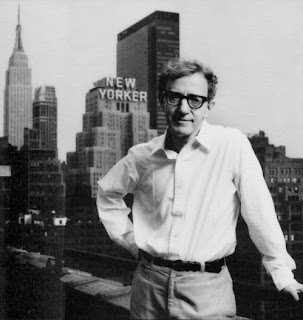
Woody Allen on Ingmar Bergman and the death.

Woody Allen et Marshall McLuhan

Woody Allen et Marshall McLuhan : « If life were only like this! »

Diane Keaton et Woody Allen dans "Annie Hall"

Diane Keaton et Woody Allen

What Makes Life Worth Living?

_______________________________________________________________________________________________________________

How Should We then Live Episode 7 small (Age of Nonreason)

How Should We Then Live? (Promo Clip) Dr. Francis Schaeffer

10 Worldview and Truth

Two Minute Warning: How Then Should We Live?: Francis Schaeffer at 100

Francis Schaeffer Whatever Happened to the Human Race (Episode 1) ABORTION

Francis Schaeffer “BASIS FOR HUMAN DIGNITY” Whatever…HTTHR

_________________

Diane Keaton et Woody Allen dans "Annie Hall"

Woody Allen – Sleeper (final scene)

_________________

I have spent alot of time talking about Woody Allen films on this blog and looking at his worldview. He has a hopelessmeaningless, nihilistic worldview that believes we are going to turn to dust and there is no afterlife. Even though he has this view he has taken the opportunity to look at the weaknesses of his own secular view. I salute him for doing that. That is why I have returned to his work over and over and presented my own Christian worldview as an alternative.

My interest in Woody Allen is so great that I have a “Woody Wednesday” on my blog www.thedailyhatch.org every week. Also I have done over 30 posts on the historical characters mentioned in his film “Midnight in Paris.” (Salvador DaliErnest Hemingway,T.S.Elliot,  Cole Porter,Paul Gauguin,  Luis Bunuel, and Pablo Picassowere just a few of the characters.) Francis Schaeffer also discussed Woody Allen several times in his writings on modern culture. Here is a section that again mentions the nihilistic conclusions that Schaeffer says that Woody Allen has come to and Schaeffer salutes Allen for being consistent with his Godless worldview unlike many of the optimistic humanists that I have encountered.

Materialistic Humanism: The World-View of Our Era
What has produced the inhumanity we have been considering in the previous chapters is that society in the West has adopted a world-view which says that all reality is made up only of matter. This view is sometimes referred to as philosophic materialism, because it holds that only matter exists; sometimes it is called naturalism, because it says that no supernatural exists. Humanism which begins from man alone and makes man the measure of all things usually is materialistic in its philosophy. Whatever the label, this is the underlying world-view of our society today. In this view the universe did not get here because it was created by a “supernatural” God. Rather, the universe has existed forever in some form, and its present form just happened as a result of chance events way back in time.
Society in the West has largely rested on the base that God exists and that the Bible is true. In all sorts of ways this view affected the society. The materialistic or naturalistic or humanistic world-view almost always takes a superior attitude toward Christianity. Those who hold such a view have argued that Christianity is unscientific, that it cannot be proved, that it belongs simply to the realm of “faith.” Christianity, they say, rests only on faith, while humanism rests on facts.
Professor Edmund R. Leach of Cambridge University expressed this view clearly:
Our idea of God is a product of history. What I now believe about the supernatural is derived from what I was taught by my parents, and what they taught me was derived from what they were taught, and so on. But such beliefs are justified by faith alone, never by reason, and the true believer is expected to go on reaffirming his faith in the same verbal formula even if the passage of history and the growth of scientific knowledge should have turned the words into plain nonsense.78
So some humanists act as if they have a great advantage over Christians. They act as if the advance of science and technology and a better understanding of history (through such concepts as the evolutionary theory) have all made the idea of God and Creation quite ridiculous.
This superior attitude, however, is strange because one of the most striking developments in the last half-century is the growth of a profound pessimism among both the well-educated and less-educated people. The thinkers in our society have been admitting for a long time that they have no final answers at all.

_________________________________________________________________________
Take Woody Allen, for example. Most people know his as a comedian, but he has thought through where mankind stands after the “religious answers” have been abandoned. In an article in Esquire (May 1977), he says that man is left with:
… alienation, loneliness [and] emptiness verging on madness…. The fundamental thing behind all motivation and all activity is the constant struggle against annihilation and against death. It’s absolutely stupefying in its terror, and it renders anyone’s accomplishments meaningless. As Camus wrote, it’s not only that he (the individual) dies, or that man (as a whole) dies, but that you struggle to do a work of art that will last and then you realize that the universe itself is not going to exist after a period of time. Until those issues are resolved within each person – religiously or psychologically or existentially – the social and political issues will never be resolved, except in a slapdash way.
Allen sums up his view in his film Annie Hall with these words: “Life is divided into the horrible and the miserable.”
Many would like to dismiss this sort of statement as coming from one who is merely a pessimist by temperament, one who sees life without the benefit of a sense of humor. Woody Allen does not allow us that luxury. He speaks as a human being who has simply looked life in the face and has the courage to say what he sees. If there is no personal God, nothing beyond what our eyes can see and our hands can touch, then Woody Allen is right: life is both meaningless and terrifying. As the famous artist Paul Gauguin wrote on his last painting shortly before he tried to commit suicide: “Whence come we? What are we? Whither do we go?” The answers are nowhere, nothing, and nowhere.

___________________________________________________________________________

The humanist H. J. Blackham has expressed this with a dramatic illustration:
On humanist assumptions, life leads to nothing, and every pretense that it does not is a deceit. If there is a bridge over a gorge which spans only half the distance and ends in mid-air, and if the bridge is crowded with human beings pressing on, one after the other they fall into the abyss. The bridge leads nowhere, and those who are pressing forward to cross it are going nowhere….It does not matter where they think they are going, what preparations for the journey they may have made, how much they may be enjoying it all. The objection merely points out objectively that such a situation is a model of futility.79
One does not have to be highly educated to understand this. It follows directly from the starting point of the humanists’ position, namely, that everything is just matter. That is, that which has existed forever and ever is only some form of matter or energy, and everything in our world now is this and only this in a more or less complex form. Thus, Jacob Bronowski says in The Identity of Man (1965): “Man is a part of nature, in the same sense that a stone is, or a cactus, or a camel.” In this view, men and women are by chance more complex, but not unique.
Within this world-view there is no room for believing that a human being has any final distinct value above that of an animal or of nonliving matter. People are merely a different arrangement of molecules. There are two points, therefore, that need to be made about the humanist world-view. First, the superior attitude toward Christianity – as if Christianity had all the problems and humanism had all the answers – is quite unjustified. The humanists of the Enlightenment two centuries ago thought they were going to find all the answers, but as time has passed, this optimistic hope has been proved wrong. It is their own descendants, those who share their materialistic world-view, who have been saying louder and louder as the years have passed, “There are no final answers.”
Second, this humanist world-view has also brought us to the present devaluation of human life – not technology and not overcrowding, although these have played a part. And this same world-view has given us no limits to prevent us from sliding into an even worse devaluation of human life in the future.
So it is naive and irresponsible to imagine that this world-view will reverse the direction in the future. A well-meaning commitment to “do what is right” will not be sufficient. Without a firm set of principles that flows out of a world-view that gives adequate reason for a unique value to all human life, there cannot be and will not be any substantial resistance to the present evil brought on by the low view of human life we have been considering in previous chapters. It was the materialistic world-view that brought in the inhumanity; it must be a different world-view that drives it out.
An emotional uneasiness about abortion, infanticide, euthanasia, and the abuse of genetic knowledge is not enough. To stand against the present devaluation of human life, a significant percentage of people within our society must adopt and live by a world-view which not only hopes or intends to give a basis for human dignity but which really does. The radical movements of the sixties were right to hope for a better world; they were right to protest against the shallowness and falseness of our plastic society. But their radicalness lasted only during the life span of the adolescence of their members. Although these movements claimed to be radical, they lacked a sufficient root. Their world-view was incapable of giving life to the aspirations of its adherents. Why? Because it, too – like the society they were condemning – had no sufficient base. So protests are not enough. Having the right ideals is not enough. Even those with a very short memory, those who can look back only to the sixties, can see that there must be more than that. A truly radical alternative has to be found.
But where? And how?

______________

Francis Schaeffer has written extensively on art and culture spanning the last 2000 years and here are some posts I have done on this subject before : Francis Schaeffer’s “How should we then live?” Video and outline of episode 10 “Final Choices” episode 9 “The Age of Personal Peace and Affluence”episode 8 “The Age of Fragmentation”episode 7 “The Age of Non-Reason” episode 6 “The Scientific Age” episode 5 “The Revolutionary Age” ,  episode 4 “The Reformation” episode 3 “The Renaissance”episode 2 “The Middle Ages,”, and  episode 1 “The Roman Age,” . My favorite episodes are number 7 and 8 since they deal with modern art and culture primarily.(Joe Carter rightly noted, “Schaefferwho always claimed to be an evangelist and not a philosopher—was often criticized for the way his work oversimplified intellectual history and philosophy.” To those critics I say take a chill pill because Schaeffer was introducing millions into the fields of art and culture!!!! !!! More people need to read his works and blog about them because they show how people’s worldviews affect their lives!

J.I.PACKER WROTE OF SCHAEFFER, “His communicative style was not thaof a cautious academiwho labors foexhaustive coverage and dispassionate objectivity. It was rather that of an impassioned thinker who paints his vision of eternal truth in bold strokes and stark contrasts.Yet it is a fact that MANY YOUNG THINKERS AND ARTISTS…HAVE FOUND SCHAEFFER’S ANALYSES A LIFELINE TO SANITY WITHOUT WHICH THEY COULD NOT HAVE GONE ON LIVING.”

Francis Schaeffer’s works  are the basis for a large portion of my blog posts and they have stood the test of time. In fact, many people would say that many of the things he wrote in the 1960’s  were right on  in the sense he saw where our western society was heading and he knew that abortion, infanticide and youth enthansia were  moral boundaries we would be crossing  in the coming decades because of humanism and these are the discussions we are having now!)

Francis Schaeffer in Art and the Bible noted, “Many modern artists, it seems to me, have forgotten the value that art has in itself. Much modern art is far too intellectual to be great art. Many modern artists seem not to see the distinction between man and non-man, and it is a part of the lostness of modern man that they no longer see value in the work of art as a work of art.” 

Many modern artists are left in this point of desperation that Schaeffer points out and it reminds me of the despair that Solomon speaks of in Ecclesiastes.  Christian scholar Ravi Zacharias has noted, “The key to understanding the Book of Ecclesiastes is the term ‘under the sun.’ What that literally means is you lock God out of a closed system, and you are left with only this world of time plus chance plus matter.” THIS IS EXACT POINT SCHAEFFER SAYS SECULAR ARTISTS ARE PAINTING FROM TODAY BECAUSE THEY BELIEVED ARE A RESULT OF MINDLESS CHANCE.

_________________________

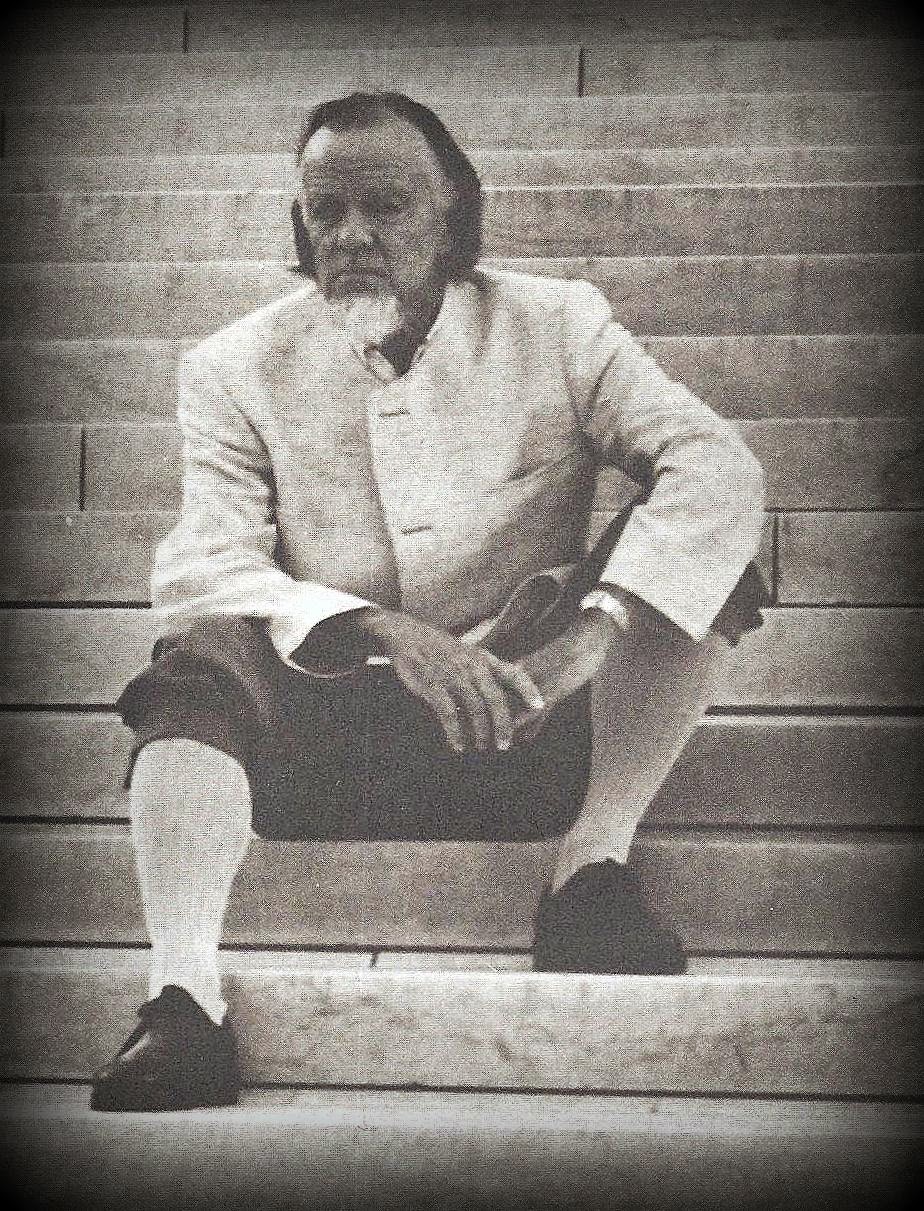
Francis Schaeffer pictured below:

__________

God and Carpeting: The Theology of Woody Allen by David Mishkin of Jews for Jesus

March 1, 1993

This is an archived article. It originally appeared on March 1, 1993. Some information may be outdated.

A red-haired boy sits next to his mother in the psychiatrist’s office. She is describing her son’s problems and expressing her disappointment in him. Why is he always depressed? Why can’t he be like other boys his age? The doctor turns to the boy and asks why he is depressed. In a hopeless daze the boy replies, “The universe is expanding, and if the universe is everything…and if it’s expanding…someday it will break apart and that’s the end of everything…what’s the point?”

His mother leans over, slaps the kid and scolds: “What is that your business!”

This scene from Annie Hall typifies Woody Allen’s quest for understanding! Allen touches on various topics and themes in all his cinematic works, but three subjects continually resurface: the existence of God, the fear of death and the nature of morality. These are all Jewish questions or at least theological issues. Woody Allen is a seeker who wants answers to the Ultimate Questions. His movie characters differ, yet they are all, in some way, asking these questions he wants answered. They are all “Woody Allens” wrestling with the same issues. He explains:

Maybe it’s because I’m depressed so often that I’m drawn to writers like Kafka, Dostoevski and to a filmmaker like Bergman. I think I have all the symptoms and problems that their characters are occupied with: an obsession with death, an obsession with God or the lack of God, the question of why we are here. Almost all of my work is autobiographical—exaggerated but true.1

But Woody Allen does not allow himself to dwell too long on these universal problems. The mother’s response to her red-haired son’s angst is typical of the comedic lid the filmmaker presses over his depressing outlook to close the issue. True, Woody Allen has made his mark by asking big questions. But it is the absence of satisfactory answers to those questions that causes much of the angst—and humor—we see on the screen. Off screen we see little difference.

Allen’s (authorized) biography, published in 1991, sheds some light on his life and times. Woody Allen, whose given name was Allan Konigsberg, was born and raised in Brooklyn, New York. Allen describes his Jewish family and neighborhood as being from “the heart of the old world, their values are God and carpeting.”2 While he did not embrace the religion of his youth, his Jewishness is ever present in his characters, plots and dialogue. Jewish thought is intrinsic to his life and work.

__________________________

________________________

One can see this in the 1977 film Annie Hall, where Allen’s character, Alvy, is put in contrast to his Midwestern, gentile girlfriend. In one scene he is visiting Annie’s parents. Her grandmother stares at him, picturing him as a stereotypical Chasidic Jew with side locks, black hat and a long coat. The screen splits as Alvy imagines his family on the right and hers on the left. Her parents ask what his parents will be doing for “the holidays”:

“We fast, to atone for our sins,” his mother explains.

Annie’s mother is confused. “What sins? I don’t understand.”

Alvy’s father responds with a shrug: “To tell you the truth, neither do we.”

Nothing worth knowing can be understood by the mind.3

Allen suggests that the greatest thinkers in history died knowing no more than he does now.

In Crimes and Misdemeanors Woody Allen tackles the issue of morality on a much more serious level. Wealthy ophthalmologist Judah Rosenthal has been having an extramarital affair for two years. When he attempts to end his illicit relationship, his mistress threatens to tell his wife. When backed into an impossible corner and offered an easy way out, Judah finds himself thinking the unthinkable.

Judah’s moral confusion is presented against a backdrop of the religion of his youth. Though he has long since rejected the Jewish religion, he is continually confronted with memories that activate his conscience. He remembers the words of his childhood rabbi:

“The eyes of God are on us always.”

Judah later speaks with another rabbi, a contemporary of his. The rabbi remarks on their contrasting worldviews:

“You see it [the world] as harsh and empty of values and pitiless. And I couldn’t go on living if I didn’t feel with all my heart a moral structure with real meaning and forgiveness and some kind of higher power and a reason to live. Otherwise there is no basis to know how to live.”

These words are ultimately pushed aside, as Judah succumbs to the simple solution of hiring a hit-man to murder his demanding lady in waiting. After the crime, Judah experiences gut-wrenching guilt. Judah Rosenthal finds the case for morality so strong that after the murder he blurts out:

“Without God, life is a cesspool!”

His conscience pushes him to great despair as, again, he examines the situation from a past vantage point. He envisions a Passover seder from his childhood. The conversation becomes a family debate over the importance of the celebration. Some of the relatives don’t believe in God and consider the ritual a foolish waste of time. The head of the extended family stoutly defends his faith, saying, “If necessary, I will always choose God over truth.”

Perhaps this is why Judah rejected his religion—he could not see faith as anything other than some sort of noble delusion for those who refuse to accept life’s ugly truths. As Judah continues to dwell on his crime, he has another vision in which his rabbi friend challenges him with the question: “You don’t think God sees?”

“God is a luxury I can’t afford,” Judah replies. There is a final ring to the statement as Judah decides to put the entire incident behind him.

Judah almost turns himself in; however, the price is too high and so he chooses denial, the most common escape. “In reality,” he says in the last scene, “we rationalize, we deny or else we couldn’t go on living.”

Another character, Professor Levy, speaks on morality in one of the film’s subplots. Levy is an aging philosopher much admired by the character played by Woody Allen, a filmmaker. The filmmaker is planning a documentary based on Levy’s life, and we first see the professor on videotape, discussing the paradox of the ancient Israelites:

“They created a God who cares but who also demands that you behave morally. This God asks Abraham to sacrifice his son, who is beloved to him.…After 5,000 years we have not succeeded to create a really and entirely loving image of God.”

Levy eventually commits suicide. Despite his great learning, his final note discloses nothing more than the obvious: “I’ve gone out the window.”

Professor Levy’s suicide leaves Allen’s character stunned. Still, his humor ameliorates the situation as the filmmaker protests,

“When I grew up in Brooklyn, nobody committed suicide; everyone was too unhappy.”

The final comment on Levy’s suicide is a surprising departure from Allen’s security blanket of humor:

“No matter how elaborate a philosophical system you work out, in the end it’s gotta be incomplete.”

Remember, all of the dialogue is written by Woody Allen. Though his own character supplies comic relief to this dark film, his conclusions are just as bleak. Everyone is guilty of something whether it’s considered a crime or a misdemeanor.

Yet, Allen’s theological questions rarely address the nature of that guilt. The word “sin” is reserved for the grossest offenses—the ones that make the evening news—or would, if they were discovered. Judah Rosenthal’s crime is easily recognizable as sin, while various other infidelities and compromises are mere misdemeanors.

Sin against God is not something Allen appears to take seriously in any of his films. When evangelist Billy Graham was a guest on one of Allen’s 1960s television specials, the comedian was asked (not by Graham) to name his greatest sin. He responded:

“I once had impure thoughts about Art Linkletter.”24

However, when he distances himself from the personal nature of sin and looks to crimes or sins against humanity, Allen speaks with a passion.

In Hannah and Her Sisters the viewer is introduced to the character of Frederick, an angry, isolated artist who is disgusted with the conditions of the world. Of Auschwitz, Frederick remarks to his girlfriend:

“The real question is: ‘Given what people are, why doesn’t it happen more often?’ Of course, it does, in subtler forms.…”

In Allen’s theology, all have fallen short to a greater or lesser degree, but ironically, his view of human imperfection never appears in the same discussion as his thoughts about God.

He does admit to being disconnected with the universe:

“I am two with nature.”25

But he doesn’t mention a connection with a personal God because he doesn’t see a correlation between human failures and the question of connectedness to God.

While Allen is a unique thinker, he seems to be pedestrian when it comes to wrestling with problems of immorality and even inhumanity. While he calls the existence of God into question, he does not deal with our responsibility in acknowledging God if he does exist.

It is simple to analyze sin on a human level. The more people get hurt, the bigger the sin. But the biblical perspective is quite different: Any and all sin causes separation from God. One cannot view such a cosmic separation as large or small based on degrees of sin. Ironically, one of Allen’s short stories underscores the foolishness of comparison degrees of sin:

“Astronomers talk of an inhabited planet named Quelm, so distant from earth that a man traveling at the speed of light would take six million years to get there, although they are planning a new express route that will cut two hours off the trip.”26

The biblical perspective of separation from God is similar. Having “better morals” than the drug pusher, the rapist or the ax murderer makes a big difference—in our society. We should all strive to be the best people we can be, if only to improve the overall quality of life. But in terms of a relationship with God, doing the best one can is like being two hours closer to Quelm. God is so removed from any unrighteousness that the difference between “a little unrighteous” and a lot is irrelevant.

The question his films and essays never ask is: Could being alienated from God be the root cause of our alienation from one another…and even our alienation from our own selves?

“It’s hard to get your heart and your head to agree in life. In my case they’re not even friendly.”27

Woody Allen has a unique way of expressing the uneasy terms on which many people find their heads and their hearts. Perhaps that is why he has received 14 Academy Award nominations. Allen will shoot a scene as many as twenty times, hoping to capture the actors and scenery perfectly. His biographer says “he doesn’t like to go to the next thing until what he’s working on is perfect—a process that guarantees self-defeat.”28

Is filmmaking Woody Allen’s escape from the world at large? His biographer notes, “He assigns himself mental tasks throughout the day with the intent that not a moment will pass without his mind being occupied and therefore insulated from the dilemma of eschatology.”29

It is a continual process—writing takes his mind off of the ultimate questions, yet the characters he creates are always obsessed with those very same questions. Allen determines their fate, occasionally handing out a happy ending. And he seems painfully aware that he will have little to say about the ending of his own script.

There is much to be appreciated and enjoyed in Woody Allen’s humor, but it also seems as if he uses jokes to avoid taking the possibility of God’s existence very seriously. Maybe Woody Allen is afraid to find that God doesn’t exist, or on the other hand maybe he’s afraid to find that he does. In either case, he seems to need to add a comic edge to questions about God to prove that he is not wholehearted in his hope for answers.

Will Woody Allen tackle the problem of his own halfhearted search for God in a serious way in some future film or essay? Maybe, but if the Bible can be believed, it’s an issue that God has already dealt with. The prophet Jeremiah quotes the Creator as saying: “You will seek me and find me when you seek me with all your heart.” (Jer. 29:13).

____________________________________

Endnotes

  1. Eric Lax, Woody Allen, (New York: Knopf Publishing, 1991), p. 179.
  2. Ibid., p. 166.
  3. Manhattan, 1979.
  4. Lax, p. 141.
  5. Stardust Memories, 1980.
  6. Lax, p. 150.
  7. Sleeper, 1973.
  8. Hannah and Her Sisters, 1986.
  9. Woody Allen, “My Speech to the Graduates,” Side Effects, (New York: Random House Publ., 1980), p. 82.
  10. Sleeper.
  11. Lax, p. 183.
  12. Woody Allen, “Death (A Play),” Without Feathers, (New York: Random House Publ., 1975), p. 106.
  13. Woody Allen, “My Philosophy,” Getting Even, (New York: Warner Books, 1971), p. 25.
  14. Allen, “Early Essays,” Without Feathers, p. 108.
  15. Allen, “Selections From the Allen Notebook,” Without Feathers, p. 10.
  16. Allen, “My Apology,” Side Effects, p. 54.
  17. Stardust Memories.
  18. Allen, “My Speech to the Graduates,” Side Effects, p. 82.
  19. Sleeper.
  20. Allen, “Selections From the Allen Notebook,” Without Feathers, p. 8.
  21. Allen, “Examining Psychic Phenomena,” Without Feathers, p. 11.
  22. Lax, p. 41.
  23. Love and Death, 1975.
  24. Lax, p. 132.
  25. Ibid., p. 39.
  26. Allen, “Fabulous Tales and Mythical Beasts,” Without Feathers, p. 194.
  27. Crimes and Misdemeanors, 1989.
  28. Lax, p. 322.
  29. Ibid., p. 183.

Earlier I wrote a post about the “golden age fallacy” that Woody Allen destroys in his film MIDNIGHT IN PARIS. The thinking that things would be better if we lived in a different time or a different place. However, Allen is still searching for meaning in life and deep down he knows in his heart that God made him for a special reason and not to just live a life without any lasting meaning. That is the reason he keeps bringing up these issues in his films.

Here I wanted to make three further suggestions to Mr. Allen myself: 


1. You may not have as much resources as  Solomon but you can still start on a spiritual search for the afterlife. .
 So, go to the Grand Canyon and see if you can deny the outward witness of God’s handiwork. That leads me to the scripture in Ecclesiastes 3:11, “…{God} has planted eternity in the human heart…”


2. Read John 3:1-21 and see what happened when Jesus spoke to a true seeking skeptic of his day named Nicodemus. .
John 3:1-21

1 There was a man named Nicodemus, a Jewish religious leader who was a Pharisee. 2 After dark one evening, he came to speak with Jesus. “Rabbi,” he said, “we all know that God has sent you to teach us. Your miraculous signs are evidence that God is with you.”  3 Jesus replied, “I tell you the truth, unless you are born again,[a] you cannot see the Kingdom of God.”  4 “What do you mean?” exclaimed Nicodemus. “How can an old man go back into his mother’s womb and be born again?”  5 Jesus replied, “I assure you, no one can enter the Kingdom of God without being born of water and the Spirit.[b] 6 Humans can reproduce only human life, but the Holy Spirit gives birth to spiritual life.[c] 7 So don’t be surprised when I say, ‘You[d] must be born again.’ 8 The wind blows wherever it wants. Just as you can hear the wind but can’t tell where it comes from or where it is going, so you can’t explain how people are born of the Spirit.”  9 “How are these things possible?” Nicodemus asked.  10 Jesus replied, “You are a respected Jewish teacher, and yet you don’t understand these things? 11 I assure you, we tell you what we know and have seen, and yet you won’t believe our testimony. 12 But if you don’t believe me when I tell you about earthly things, how can you possibly believe if I tell you about heavenly things? 13 No one has ever gone to heaven and returned. But the Son of Man[e] has come down from heaven. 14 And as Moses lifted up the bronze snake on a pole in the wilderness, so the Son of Man must be lifted up, 15 so that everyone who believes in him will have eternal life.[f]  16 “For God loved the world so much that he gave his one and only Son, so that everyone who believes in him will not perish but have eternal life. 17 God sent his Son into the world not to judge the world, but to save the world through him.  18 “There is no judgment against anyone who believes in him. But anyone who does not believe in him has already been judged for not believing in God’s one and only Son. 19 And the judgment is based on this fact: God’s light came into the world, but people loved the darkness more than the light, for their actions were evil. 20 All who do evil hate the light and refuse to go near it for fear their sins will be exposed. 21 But those who do what is right come to the light so others can see that they are doing what God wants.[g]

3. Search for yourself and see if the Old Testament prophecies were fulfilled in history. There is evidence that points to the fact that the Bible is historically true as Schaeffer pointed out in episode 5 of WHATEVER HAPPENED TO THE HUMAN RACEThere is a basis then for faith in Christ alone for our eternal hope. This link shows how to do that.

Sir William Ramsay

William Mitchell Ramsay was born on March 15, 1851 in Glasgow, Scotland. His father was a lawyer, but died when William was just six. Through the hard work of other family members, William attended the University of Aberdeen, achieving honors. Through means of a scholarship, he was then able to go to Oxford University and attend the college there named for St. John. His family resource also allowed him to study abroad, notably in Germany. It was under one of his professors that his love of history began. After receiving a new scholarship from another college at Oxford, he traveled to Asia Minor.

William, however, is most noted for beliefs pertaining to the Bible, not his early life. Originally, he labeled it as a ‘Book of Fables,’ having only third-hand knowledge. He neither read nor studied it, skeptically believing it to be of fiction and not historical fact. His interest in history would lead him on a search that would radically redefine his thoughts on that Ancient Book…

Some argue that Ramsay was originally just a product of his time. For example, the general consensus on the Acts of the Apostles (and its alleged writer Luke) was almost humouress:

“… [A]bout 1880 to 1890 the book of the Acts was regarded as the weakest part of the New Testament. No one that had any regard for his reputation as a scholar cared to say a word in its defence. The most conservative of theological scholars, as a rule, thought the wisest plan of defence for the New Testament as a whole was to say as little as possible about the Acts.”[1]

It was his dislike for Acts that launched him into a Mid-East adventure. With Bible-in-hand, he made a trip to the Holy Land. What William found, however, was not what he expected…

As it turns out, ‘ole Willy’ changed his mind. After his extensive study he concluded that Luke was one of the world’s greatest historians:

The more I have studied the narrative of the Acts, and the more I have learned year after year about Graeco-Roman society and thoughts and fashions, and organization in those provinces, the more I admire and the better I understand. I set out to look for truth on the borderland where Greece and Asia meet, and found it here [in the Book of Acts—KB]. You may press the words of Luke in a degree beyond any other historian’s, and they stand the keenest scrutiny and the hardest treatment, provided always that the critic knows the subject and does not go beyond the limits of science and of justice.[2]

Skeptics were strikingly shocked. In ‘Evidence that Demands a Verdict’ Josh Mcdowell writes,

“The book caused a furor of dismay among the skeptics of the world. Its attitude was utterly unexpected because it was contrary to the announced intention of the author years before…. for twenty years more, book after book from the same author came from the press, each filled with additional evidence of the exact, minute truthfulness of the whole New Testament as tested by the spade on the spot. The evidence was so overwhelming that many infidels announced their repudiation of their former unbelief and accepted Christianity. And these books have stood the test of time, not one having been refuted, nor have I found even any attempt to refute them.”[3]

The Bible has always stood the test of time. Renowned archaeologist Nelson Glueck put it like this:

“It may be stated categorically that no archaeological discovery has ever controverted a Biblical reference. Scores of archaeological findings have been made which conform in clear outline or exact detail historical statements in the Bible.”[4]

1) The Bearing of Recent Discovery on the Trustworthiness of the New Testament (1915)
2) Ibid
3) See page 366
4) See page 31 of: Rivers in the Desert: A History of the Negev (1959)

_____________________________________

Related posts:

Francis Schaeffer’s “How should we then live?” Video and outline of episode 10 “Final Choices” (Schaeffer Sundays)

E P I S O D E 1 0   Dr. Francis Schaeffer – Episode X – Final Choices 27 min FINAL CHOICES I. Authoritarianism the Only Humanistic Social Option One man or an elite giving authoritative arbitrary absolutes. A. Society is sole absolute in absence of other absolutes. B. But society has to be […]

Francis Schaeffer’s “How should we then live?” Video and outline of episode 9 “The Age of Personal Peace and Affluence” (Schaeffer Sundays)

E P I S O D E 9 Dr. Francis Schaeffer – Episode IX – The Age of Personal Peace and Affluence 27 min T h e Age of Personal Peace and Afflunce I. By the Early 1960s People Were Bombarded From Every Side by Modern Man’s Humanistic Thought II. Modern Form of Humanistic Thought Leads […]

Francis Schaeffer’s “How should we then live?” Video and outline of episode 8 “The Age of Fragmentation” (Schaeffer Sundays)

E P I S O D E 8 Dr. Francis Schaeffer – Episode VIII – The Age of Fragmentation 27 min I saw this film series in 1979 and it had a major impact on me. T h e Age of FRAGMENTATION I. Art As a Vehicle Of Modern Thought A. Impressionism (Monet, Renoir, Pissarro, Sisley, […]

Francis Schaeffer’s “How should we then live?” Video and outline of episode 7 “The Age of Non-Reason” (Schaeffer Sundays)

E P I S O D E 7 Dr. Francis Schaeffer – Episode VII – The Age of Non Reason I am thrilled to get this film series with you. I saw it first in 1979 and it had such a big impact on me. Today’s episode is where we see modern humanist man act […]

Francis Schaeffer’s “How should we then live?” Video and outline of episode 6 “The Scientific Age” (Schaeffer Sundays)

E P I S O D E 6 How Should We Then Live 6#1 Uploaded by NoMirrorHDDHrorriMoN on Oct 3, 2011 How Should We Then Live? Episode 6 of 12 ________ I am sharing with you a film series that I saw in 1979. In this film Francis Schaeffer asserted that was a shift in […]

Francis Schaeffer’s “How should we then live?” Video and outline of episode 5 “The Revolutionary Age” (Schaeffer Sundays)

E P I S O D E 5 How Should We Then Live? Episode 5: The Revolutionary Age I was impacted by this film series by Francis Schaeffer back in the 1970′s and I wanted to share it with you. Francis Schaeffer noted, “Reformation Did Not Bring Perfection. But gradually on basis of biblical teaching there […]

Francis Schaeffer’s “How should we then live?” Video and outline of episode 4 “The Reformation” (Schaeffer Sundays)

Dr. Francis Schaeffer – Episode IV – The Reformation 27 min I was impacted by this film series by Francis Schaeffer back in the 1970′s and I wanted to share it with you. Schaeffer makes three key points concerning the Reformation: “1. Erasmian Christian humanism rejected by Farel. 2. Bible gives needed answers not only as to […]

“Schaeffer Sundays” Francis Schaeffer’s “How should we then live?” Video and outline of episode 3 “The Renaissance”

Francis Schaeffer’s “How should we then live?” Video and outline of episode 3 “The Renaissance” Francis Schaeffer: “How Should We Then Live?” (Episode 3) THE RENAISSANCE I was impacted by this film series by Francis Schaeffer back in the 1970′s and I wanted to share it with you. Schaeffer really shows why we have so […]

Francis Schaeffer’s “How should we then live?” Video and outline of episode 2 “The Middle Ages” (Schaeffer Sundays)

  Francis Schaeffer: “How Should We Then Live?” (Episode 2) THE MIDDLE AGES I was impacted by this film series by Francis Schaeffer back in the 1970′s and I wanted to share it with you. Schaeffer points out that during this time period unfortunately we have the “Church’s deviation from early church’s teaching in regard […]

Francis Schaeffer’s “How should we then live?” Video and outline of episode 1 “The Roman Age” (Schaeffer Sundays)

Francis Schaeffer: “How Should We Then Live?” (Episode 1) THE ROMAN AGE   Today I am starting a series that really had a big impact on my life back in the 1970′s when I first saw it. There are ten parts and today is the first. Francis Schaeffer takes a look at Rome and why […]

By Everette Hatcher III | Posted in Francis Schaeffer | Edit | Comments (0)

________________

Today’s featured artist is Ida Applebroog

Ida Applebroog is a good choice since she has focused her work on much of the evil and pain and suffering we find in the world today and that seems to be the emphasis of Woody Allen’s films too (especially my favorite film CRIMES AND MISDEMEANORS).

Ida Applebroog has said, “My work has always been about fragmentation even the work is not comfortable work…I do a lot of work on murders, and rapes and age-ism and sexism and AIDS and child abuse. I live in this world. This is what is going on around me and I can’t change that.”

_____________________________

Ida Applebroog is pictured below.

____________

Ida Applebroog | Art21 | Preview from Season 3 of “Art in the Twenty-First Century” (2005)

Uploaded on May 21, 2008

Ida Applebroog propels her paintings and drawings into the realm of installation by arranging and stacking canvases in space, exploding the frame-by-frame logic of comic-book and film narrative into three-dimensional environments. Strong themes in her work include gender and sexual identity, power struggles, and the pernicious role of mass media in desensitizing the public to violence.

Ida Applebroog is featured in the Season 3 episode “Power” of the Art21 series “Art in the Twenty-First Century”.

Learn more about Ida Applebroog: http://www.art21.org/artists/ida-appl…

© 2005-2008 Art21, Inc. All Rights Reserved.

_____________

You’re rat food:

<br />”You’re rat food” (1986)” />

Ida Applebroog
“You’re rat food” (1986)

Elizabeth Hess art critic also in this clip

Ida Applebroog (excerpt, ART/new york no. 36)

Uploaded on Feb 21, 2011

This program features the work of Ida Applebroog at the Ronald Feldman Gallery in New York City. Applebroog paints stark images of everyday people engaged in the ordinary and often painful and trying business of survival in the 90’s. She uses generic images, multiple canvases and unusual techniques to create unique and powerfully haunting work. Interviews are with IDA APPLEBROOG, ELIZABETH HESS, art critic for the Village Voice and RONALD FELDMAN, her dealer.

_________________

Ida Applebroog: Inspiration | Art21 “Exclusive”

Uploaded on Jul 9, 2009

Episode #064: Ida Applebroog discusses her life as an “image scavenger” in her New York studio, while working on her “Photogenetics” series—a blend of photography, sculpture, painting and digital media.

Ida Applebroog propels her paintings and drawings into the realm of installation by arranging and stacking canvases in space, exploding the frame-by-frame logic of comic-book and film narrative into three-dimensional environments. Strong themes in her work include gender and sexual identity, power struggles, and the pernicious role of mass media in desensitizing the public to violence.

Learn more about Ida Applebroog: http://www.art21.org/artists/ida-appl…

VIDEO | Producer: Wesley Miller & Nick Ravich. Interview: Susan Sollins. Camera & Sound: Mead Hunt and Merce Williams. Editor: Mary Ann Toman . Artwork Courtesy: Ida Applebroog.

_________________

New in ARTstor from UArts Visual Resources: Ida Applebroog

“ooze/whose” 1991

Ida Applebroog is an American artist. Born in New York in 1929 and educated in Chicago, her work became well known in the 1970s. Her success has continued since then and she is still currently producing art. She has received several awards and has had her work displayed in some of the most prominent museums in the U.S.

“Now Then” (detail) 1980

Her artworks have very powerful connotations, which address issues of feminism, morality and social consciousness, and she often juxtaposes cartoonish images with far more serious subject matters.

If you would like to see more works by Ida Applebroog, click on an image to be taken directly to ARTstor. For more information about the artist, please visit Grove Art Online.

“Marginalia (Isaac Stern) 1992

This entry was posted in UArts Visual Resources and tagged . Bookmark the permalink.
________________________
___________________

Death and nonreason rule in her short books.

Nobody ever dies of it: The artists’ books of Ida Applebroog

by Anne Evenhaugen

Ida Applebroog’s artists’ books have a way of making you feel slightly uncomfortable without really knowing why. At least that is the effect her small books have on me. My first encounter with them had me feeling generally uncertain, thinking not only “What are these things?” but also “Why are these things?” Even after reading several of her books, I still did not understand exactly what her images represented. I had to read about Applebroog’s books to better understand.

Ida Applebroog “It is my lunch hour”

The Smithsonian American Art/Portrait Gallery Library has a dozen of Applebroog’s artists’ books in the collection. Applebroog self-published her series of cheap, black and white books in the 1970s.  They were printed in large runs of 400-500, though the idea behind each book originated from a unique art work in which she drew on and cut vellum panels of images and text. Applebroog mailed her books to friends, acquaintances and to other artists whose work she admired. In the 1960s and 70s, mail art, performance art and artists’ books were all becoming more popular means of creating and sharing art, and Applebroog took elements from each and combined them in her works. She has said she received a lot of hate mail from her books, and just as many people asking her to stop sending them as others requesting to be added to her mailing list.

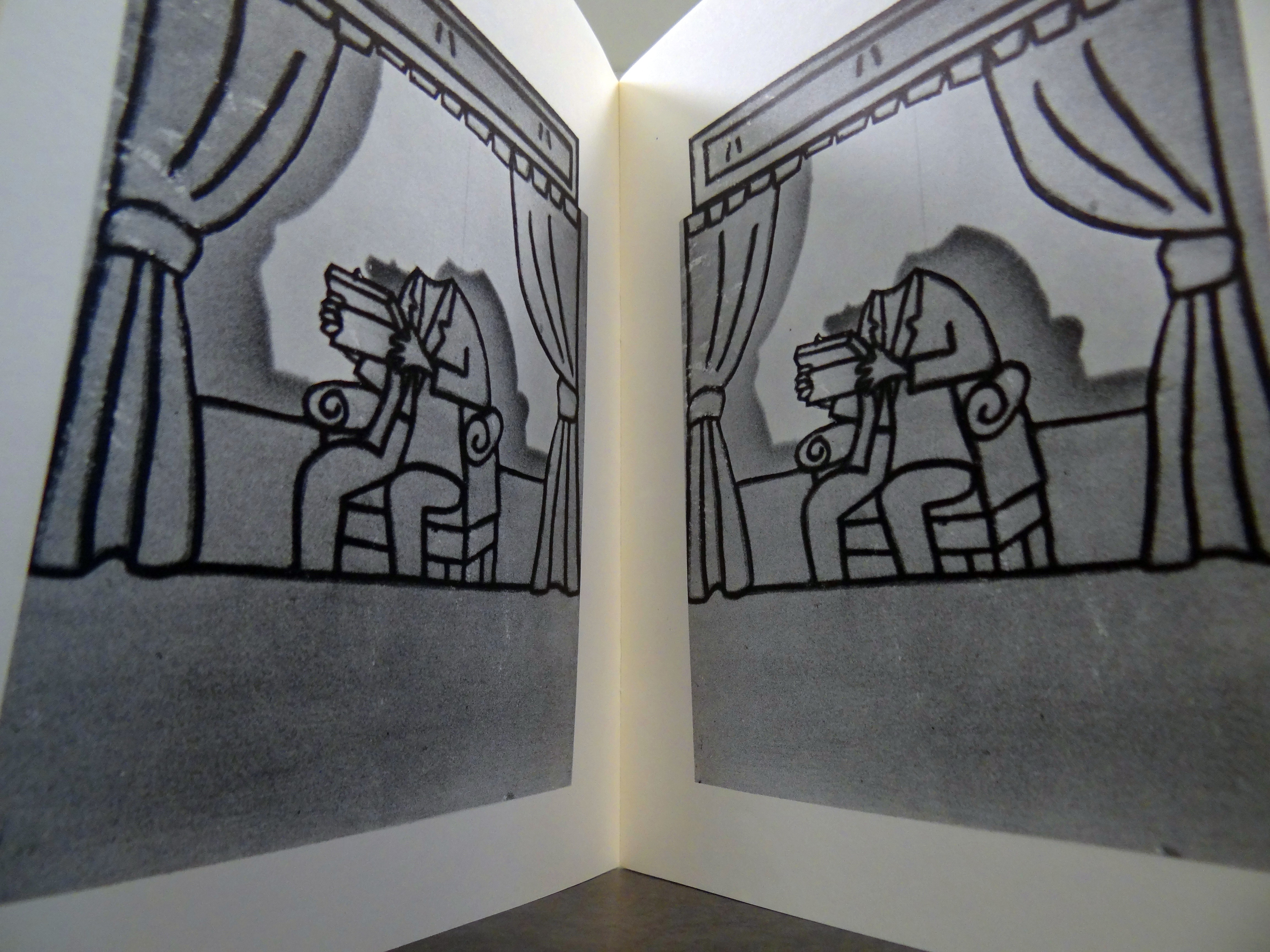
Most consist of just a few pages stapled together, with the same simple cartoon-like image repeated several times, sometimes interspersed with inexplicable blank pages, sometimes with just a few words. They resemble flip books or film stills initially, but it is difficult to determine which part of the story is being portrayed. She gave each book the subtitle of “A Performance,” lending to the sense that the characters in her images were acting.

Applebroog’s “It doesn’t sound right”

For example, the book “It Doesn’t Sound Right” shows a woman standing by a bed hugging herself, framed by a picture window. This image repeats nine times, interrupted on one page with the sentence “she says ‘YOU ARE KILLING ME’” and then again with “it doesn’t sound right” followed a few pages later by the final sentence in bold capital letters “NOBODY EVER DIES OF IT”. Who is “she” and which part doesn’t sound right, and nobody ever dies of what?!?

The window frame puts the reader in the position of voyeur, looking into a woman’s bedroom, but we don’t know who is talking or whom they are addressing. The stage feels like a hospital setting, but I realize that I may only be interpreting it as such after reading the last sentence. The images, though they are the same throughout each book, seem to take on new meaning after reading Applebroog’s inserted phrases.

Applebroog's "It doesn't sound right"

Applebroog’s “It doesn’t sound right”

Applebroog’s “Say Something”

Another example is “Say Something” in which a couple, a headless man and a nude woman, crouch on the floor, seen through a similar window frame. The image repeats over the pages of the book, broken up first by the question “Don’t you want me?” and later “Say something”. Characteristic of Ida Applebroog’s artists’ books, what the couple is doing is unclear and the narrator is again unknown.

And like so many of the artist’s other works, the action and words seem to fit perfectly, if uncomfortably, together.________________________________

Biography « previous artist | next artist »
Ida Applebroog was born in the Bronx, New York in 1929, and lives and works in New York. She attended the School of the Art Institute of Chicago and received an honorary doctorate from New School University/Parsons School of Design. Applebroog has been making pointed social commentary in the form of beguiling comic-like images for nearly half a century. She has developed an instantly recognizable style of simplified human forms with bold outlines. Anonymous ‘everyman’ figures, anthropomorphized animals, and half human-half creature characters are featured players in the uncanny theater of her work. Applebroog propels her paintings and drawings into the realm of installation by arranging and stacking canvases in space, exploding the frame-by-frame logic of comic-book and film narrative into three-dimensional environments. In her most characteristic work, she combines popular imagery from everyday urban and domestic scenes, sometimes paired with curt texts, to skew otherwise banal images into anxious scenarios infused with a sense of irony and black humor. Strong themes in her work include gender and sexual identity, power struggles both political and personal, and the pernicious role of mass media in desensitizing the public to violence. In addition to paintings, Applebroog has also created sculptures; artist’s books; several films (including a collaboration with her daughter, the artist Beth B); and animated shorts that appeared on the side of a moving truck and on a giant screen in Times Square. Applebroog has received many awards, including a John D. and Catherine T. MacArthur Foundation Achievement Award and a Lifetime Achievement Award from the College Art Association. Her work has been shown in many one-person exhibitions in the United States and abroad, including the Corcoran Gallery of Art, Washington, DC; Whitney Museum of American Art, New York; the Contemporary Arts Museum, Houston; and the High Museum of Art, Atlanta, among others.For additional biographic & bibliographic information:
Ida Applebroog’s Web Site  |  Hauser & Wirth
Ida Applebroog on the Art21 blog

_________

Ida Applebroog has said, “I do a lot of work on murders, and rapes and age-ism and sexism and AIDS and child abuse. I live in this world. This is what is going on around me and I can’t change that.”

Ida can not change the world around her but she can understand why there is evil in the world today because the Bible tells us why.

Many have asked during this tough time: How can a good God allow evil and suffering?

Their thinking is that either God is not powerful enough to prevent evil or else God is not good. He is often blamed for tragedy. “Where was God when I went through this, or when that happened.”  God is blamed for natural disasters, Even my insurance company describes them as “acts of God.” How to handle this one-  (O.N.E.) a. Origin of evil— man’s choice- God created a perfect world… b. Nature of God—He forgives, I John 1:9—He uses tragedy to bring us to Himself, C.S. Lewis, “God whispers to us in our pleasures, speaks in our conscience, but shouts in our pains:  it is His megaphone to arouse a deaf world.” c. End of it all—Bible teaches that God will one day put an end to all evil, and pain and death. “God will wipe away every tear from their eyes; there shall be no more death, nor sorrow, nor crying.  There shall be no more pain, for the former things have passed away” (Rev. 21:4).As Christians we have this hope of Heaven and eternity. Share how it has made a tremendous difference in your life and that you know for sure that when you die you are going to spend eternity in Heaven. Ask the person, “May I ask you a question? Do you have this hope? Do you know for certain that when you die you are going to Heaven, or is that something you would say you’re still working on?”How could a loving God send people to Hell? (O.N.E.) a. Origin of hell—never intended for people. Created for Satan and his demons. Jesus said, “Depart from Me, you cursed, into everlasting fire prepared for the devil and his angels” (Matt 25:41). Man chooses to sin and ignore God. The penalty is death (eternal separation from God) and, yes, Hell. But God doesn’t send anyone to Hell, we choose it by refusing or ignoring God in attitude and action. b. Nature of God—“ God is not willing that any should perish, but that all should come to repentance” (2 Peter 3:9). He is so loving that He sent His own Son to die and pay the penalty for our sin so that we could avoid Hell and have the assurance of Heaven. No one in Hell will be able to blame God. He doesn’t send people there, it’s our own choice. We must choose to repent, to stop ignoring God in attitude and action, accepting His salvation and yielding to His leadership.c. End of it all—Bible teaches that God will one day put an end to all evil, pain, death, and penalty of Hell. “God will wipe away every tear from their eyes; there shall be no more death, nor sorrow, nor crying.  There shall be no more pain, for the former things have passed away” (Rev. 21:4).As Christians , we need not worry about Hell. The Bible says, “these things have been written . . . so that you may know you have eternal life” (1 John 5:13).  I have complete confidence that when I die, I’m going to Heaven.  May I ask you a question?___________________________-
____________

“Schaeffer Sunday” Abortion debating with Ark Times Bloggers Part 1 “Is abortion a slippery slope to infanticide?”(includes the film DEATH BY SOMEONE’S CHOICE and editorial cartoon)

I have debated with Ark Times Bloggers many times in the past on many different subjects. Abortion is probably the most often debated subject and I have noticed that many pro-life individuals are now surfacing on the Arkansas Times Blog.  Here are some examples. Arhogfan501 asserted: This is the beginning of the end for recreational abortion in Arkansas. Songbird777 noted: Babies have a right to live and not be chopped up for someone else’s convenience. The person using the username “baker” commented: Planned Parenthood (PPA) does not nor cannot provide mammograms, indeed no affiliate has the necessary license. PPA is an abortion provider and at some 900 plus killings a day rather prolific.

Here is another debate I got into recently on the Arkansas Times Blog:

The person using the username “the outlier” on the Arkansas Times Blog on 3-5-13 wrote:

A fetus is not a human being. Abortion is not a slippery slope to infanticide and euthanasia.

I responded:

The outlier said “abortion is not a slippery slope to infanticide” however Justice Harry Blaackmun in his Roe v Wade related the two issues.

Abortion was present even in ancient times. Under Roman rule “[n]ot only [was] … abortion permitted; [but also] infanticide. The shriveled remains of exposed babies could be found in every countryside of the [Roman] Empire…” Supreme Court Justice Harry Blackmun referred to this culture in Roe v. Wade: “Greek and Roman law afforded little protection to the unborn … Ancient religion did not bar abortion.”

I truly believe that many of the problems we have today in the USA are due to the advancement of humanism in the last few decades in our society. Ronald Reagan appointed the evangelical Dr. C. Everett Koop to the position of Surgeon General in his administration. He partnered with Dr. Francis Schaeffer in making the video below. It is very valuable information for Christians to have.  Actually I have included a video below that includes comments from him on this subject.

In the film series “WHATEVER HAPPENED TO THE HUMAN RACE?” the arguments are presented  against abortion (Episode 1),  infanticide (Episode 2),   euthenasia (Episode 3), and then there is a discussion of the Christian versus Humanist worldview concerning the issue of “the basis for human dignity” in Episode 4 and then in the last episode a close look at the truth claims of the Bible.

___________

From the website www.jeremiahproject.com:

The Slippery Slope

Once government begins to define life and humanity, there is no end to the possibilities for subjective and selective determination as to who will be allowed to live.

At one time, blacks were not recognized as human beings. This was the rationale behind the slave trade that brought black Africans to the United States. They were transported in slave ships that held them confined in the same manner that livestock is confined when shipped to the slaughter houses. In Nazi Germany, only the Aryan race was considered human, and we know the consequences of that thinking. The treatment of Jews and other non-Aryans was similar to that of animals. And the Nazi genetic experiments remain a source for horror stories even today.

Will a society which has assumed the right to kill infants in the womb – because they are unwanted, imperfect, or merely inconvenient – have difficulty in assuming the right to kill other human beings, especially older adults who are judged unwanted, deemed imperfect physically or mentally, or considered a possible social nuisance?

The next candidates for arbitrary reclassification as non-persons are the elderly. This will become increasingly so as the proportion of the old and weak in relation to the young and strong becomes abnormally large, due to the growing antifamily sentiment, the abortion rate, and medicine’s contribution to the lengthening of the normal life span. The imbalance will cause many of the young to perceive the old as a cramping nuisance in the hedonistic lifestyle they claim as their right. As the demand for affluence continues and the economic crunch gets greater, the amount of compassion that the legislature and the courts will have for the old does not seem likely to be significant considering the precedent of the non-protection given to the unborn and newborn. [Francis Schaeffer, Whatever Happened to the Human Race?]

Euthanasia
Joseph Fletcher, the popularizer of “situational ethics,” in his 1973 discussion of death with dignity gives this argument for euthanasia:

It is ridiculous to give ethical approval to the positive ending of sub-human life in utero as we do in therapeutic abortions for reasons of mercy and compassion but refuse to approve of positively ending a sub-human life in extremis. If we are morally obliged to put an end to a pregnancy when an amniocentesis reveals a terrible defective fetus, we are equally obliged to put an end to a patient’s hopeless misery when a brain scan reveals that a patient with cancer has advanced brain metastases. [Joseph Fletcher, “Ethics and Euthanasia,” American Journal of Nursing, 1973.]

One is reminded of the slave holders who devoutly espoused the theory that slavery was really for the good of the black man and that in the end he would be thankful for the opportunity to share in the white man’s culture, even from the distance of the garden shed. The Nazis also argued that their victims were being sacrificed for the high end of the general good of society. Many well-meaning people are attracted to what might seem to be the beneficial aspects of some sort of euthanasia program, because they think they can be free of the guilt of responsibility.

The “right-to-die” movement is not calling for a right to die, they’re mostly talking about a right to kill. The advocates of euthanasia are asking the government and courts to step aside and allow people who are feeble and elderly to be snuffed out.

Consider the people who were “assisted” in ending their lives by Dr. Jack Kevorkian. He wasn’t killing terminally ill patients – they had Alzheimer’s and were in a lot of pain, but they were alive and walking around. Dr. Kevorkian portrays another basic belief of humanist ideology – the extermination of the old, useless, and the infirm. Kervorkian believes that he has the right to help people out of their pain if they want to die. He claims to render “a medical service,” and his lawyer is clear that “he’s not going to stop … doing the right thing.” Already the suicide doctor has had an impact on our society’s views regarding suicide and euthanasia.

Language is an important tool in convincing others of your position. Euthanasia advocates have been skillful in masking their true intent with slogans like “death with dignity” and “a right to die.” These phrases easily capture people’s attention. Everyone believes in a death with dignity.

Though I’m sure the medical community is well intentioned, it is still a fact that their idea of mercy is increasingly to dehumanize their patients, to disguise the helpless person so that not even their family recognizes them. In time, the family’s love turns to pity, which turns to horror until, to our warped hearts, murder becomes mercy.

But these slogans take on new meaning when they are interpreted by our courts. The right to die may sound wonderful – until we realize that legally it means that you can kill yourself or someone can kill you, even if you don’t want to die. Language is powerful. But when it is interpreted by the courts it becomes much more than mere slogans. It becomes the law of the land, and often that interpretation is not at all what we expected.

  • Daily, senior citizens and accident victims are starved to death because their families have been convinced that even food and water are extraordinary means to preserve their life.
  • Over one-fifth of Medicare expenses are for persons in their last year of life. Thus in fiscal year 1978, $4.9 billion dollars was spent for such persons and if just one-quarter of those expenditures were avoided through adoption of living wills, the savings under Medicare alone would amount to $1.2 billion. [ WASHINGTON POST, June 22, 1977]
  • The drug company, Hoescht AG, has been granted the first patent for a euthanasia drug developed by Michigan State University. The drug is intended for use on animals but the patent is worded to include humans. (Source: UPI)

Critics of the U.S. Supreme Court’ Roe v. Wade decision have long claimed that legalized abortion would lead to legalized euthanasia. Supporters of Roe have often scoffed at the idea, insisting that decisions to eliminate a human fetus in no way devalue the lives of born persons. Yet recent court cases in Michigan and Washington have reversed the debate: Euthanasia supporters are openly citing Roe as precedent for a constitutional right to “rational” suicide. In the case of People v. Kevorkian, a trial judge has relied partly on Roe and the later abortion case, Planned Parenthood v. Casey, to find a consitutional right to assisted suicide. Jack Kevorkian’s attorney, Geoffrey Fieger argues that such a right is even better grounded than a right to abortion, because no unwilling ‘third party’ is involved.

Citing Planned Parenthood vs. Casey, on May 3, 1994, Washington U.S. District Court Judge Barbara Rothstein struck down the Washington state law that banned physician assisted suicide. Judge Rothstein stated that the terminally ill “have the same right to hasten death that they have to choose an abortion…” “Like the abortion decision, the decision of a terminally ill person to end his life involves the most intimate and personal choices a person may make in a lifetime,” the judge wrote in her decision.

Francis Schaeffer Whatever Happened to the Human Race (Episode 1) ABORTION

_____________________________________


Francis Schaeffer “BASIS FOR HUMAN DIGNITY” Whatever…HTTHR

Dr. C. Everett Koop pictured above.

__________

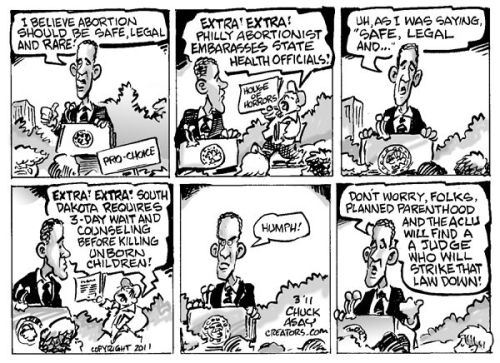
President Obama before appointing a Supreme Court Justice said that he wanted the judge to  be empathic. Pro-life people wanted to know if that judge would care about the smallest in our society? Here is an editorial cartoon that deals with that issue.

Related posts:

Francis Schaeffer’s prayer for us in USA

 Francis Schaeffer: “Whatever Happened to the Human Race” (Episode 1) ABORTION OF THE HUMAN RACE Published on Oct 6, 2012 by AdamMetropolis The 45 minute video above is from the film series created from Francis Schaeffer’s book “Whatever Happened to the Human Race?” with Dr. C. Everett Koop. This book  really helped develop my political views […]

Francis Schaeffer’s “How should we then live?” Video and outline of episode 10 “Final Choices” (Schaeffer Sundays)

E P I S O D E 1 0   Dr. Francis Schaeffer – Episode X – Final Choices 27 min FINAL CHOICES I. Authoritarianism the Only Humanistic Social Option One man or an elite giving authoritative arbitrary absolutes. A. Society is sole absolute in absence of other absolutes. B. But society has to be […]

Francis Schaeffer’s “How should we then live?” Video and outline of episode 9 “The Age of Personal Peace and Affluence” (Schaeffer Sundays)

E P I S O D E 9 Dr. Francis Schaeffer – Episode IX – The Age of Personal Peace and Affluence 27 min T h e Age of Personal Peace and Afflunce I. By the Early 1960s People Were Bombarded From Every Side by Modern Man’s Humanistic Thought II. Modern Form of Humanistic Thought Leads […]

Francis Schaeffer’s “How should we then live?” Video and outline of episode 8 “The Age of Fragmentation” (Schaeffer Sundays)

E P I S O D E 8 Dr. Francis Schaeffer – Episode VIII – The Age of Fragmentation 27 min I saw this film series in 1979 and it had a major impact on me. T h e Age of FRAGMENTATION I. Art As a Vehicle Of Modern Thought A. Impressionism (Monet, Renoir, Pissarro, Sisley, […]

Francis Schaeffer’s “How should we then live?” Video and outline of episode 7 “The Age of Non-Reason” (Schaeffer Sundays)

E P I S O D E 7 Dr. Francis Schaeffer – Episode VII – The Age of Non Reason I am thrilled to get this film series with you. I saw it first in 1979 and it had such a big impact on me. Today’s episode is where we see modern humanist man act […]

Francis Schaeffer’s “How should we then live?” Video and outline of episode 6 “The Scientific Age” (Schaeffer Sundays)

E P I S O D E 6 How Should We Then Live 6#1 Uploaded by NoMirrorHDDHrorriMoN on Oct 3, 2011 How Should We Then Live? Episode 6 of 12 ________ I am sharing with you a film series that I saw in 1979. In this film Francis Schaeffer asserted that was a shift in […]

Francis Schaeffer’s “How should we then live?” Video and outline of episode 5 “The Revolutionary Age” (Schaeffer Sundays)

E P I S O D E 5 How Should We Then Live? Episode 5: The Revolutionary Age I was impacted by this film series by Francis Schaeffer back in the 1970′s and I wanted to share it with you. Francis Schaeffer noted, “Reformation Did Not Bring Perfection. But gradually on basis of biblical teaching there […]

Francis Schaeffer’s “How should we then live?” Video and outline of episode 4 “The Reformation” (Schaeffer Sundays)

Dr. Francis Schaeffer – Episode IV – The Reformation 27 min I was impacted by this film series by Francis Schaeffer back in the 1970′s and I wanted to share it with you. Schaeffer makes three key points concerning the Reformation: “1. Erasmian Christian humanism rejected by Farel. 2. Bible gives needed answers not only as to […]

“Schaeffer Sundays” Francis Schaeffer’s “How should we then live?” Video and outline of episode 3 “The Renaissance”

Francis Schaeffer’s “How should we then live?” Video and outline of episode 3 “The Renaissance” Francis Schaeffer: “How Should We Then Live?” (Episode 3) THE RENAISSANCE I was impacted by this film series by Francis Schaeffer back in the 1970′s and I wanted to share it with you. Schaeffer really shows why we have so […]

Francis Schaeffer’s “How should we then live?” Video and outline of episode 2 “The Middle Ages” (Schaeffer Sundays)

  Francis Schaeffer: “How Should We Then Live?” (Episode 2) THE MIDDLE AGES I was impacted by this film series by Francis Schaeffer back in the 1970′s and I wanted to share it with you. Schaeffer points out that during this time period unfortunately we have the “Church’s deviation from early church’s teaching in regard […]

Francis Schaeffer’s “How should we then live?” Video and outline of episode 1 “The Roman Age” (Schaeffer Sundays)

Francis Schaeffer: “How Should We Then Live?” (Episode 1) THE ROMAN AGE   Today I am starting a series that really had a big impact on my life back in the 1970′s when I first saw it. There are ten parts and today is the first. Francis Schaeffer takes a look at Rome and why […]

Francis Schaeffer: “Whatever Happened to the Human Race” (Episode 5) TRUTH AND HISTORY

Francis Schaeffer: “Whatever Happened to the Human Race” (Episode 5) TRUTH AND HISTORY Published on Oct 7, 2012 by AdamMetropolis This crucial series is narrated by the late Dr. Francis Schaeffer and former Surgeon General Dr. C. Everett Koop. Today, choices are being made that undermine human rights at their most basic level. Practices once […]

Francis Schaeffer: “Whatever Happened to the Human Race” (Episode 4) THE BASIS FOR HUMAN DIGNITY

The opening song at the beginning of this episode is very insightful. Francis Schaeffer: “Whatever Happened to the Human Race” (Episode 4) THE BASIS FOR HUMAN DIGNITY Published on Oct 7, 2012 by AdamMetropolis This crucial series is narrated by the late Dr. Francis Schaeffer and former Surgeon General Dr. C. Everett Koop. Today, choices […]

Francis Schaeffer: “Whatever Happened to the Human Race” (Episode 3) DEATH BY SOMEONE’S CHOICE

Francis Schaeffer: “Whatever Happened to the Human Race” (Episode 3) DEATH BY SOMEONE’S CHOICE Published on Oct 6, 2012 by AdamMetropolis This crucial series is narrated by the late Dr. Francis Schaeffer and former Surgeon General Dr. C. Everett Koop. Today, choices are being made that undermine human rights at their most basic level. Practices […]

Francis Schaeffer: “Whatever Happened to the Human Race?” (Episode 2) SLAUGHTER OF THE INNOCENTS

Francis Schaeffer: “Whatever Happened to the Human Race?” (Episode 2) SLAUGHTER OF THE INNOCENTS Published on Oct 6, 2012 by AdamMetropolis This crucial series is narrated by the late Dr. Francis Schaeffer and former Surgeon General Dr. C. Everett Koop. Today, choices are being made that undermine human rights at their most basic level. Practices […]

Francis Schaeffer: “Whatever Happened to the Human Race” (Episode 1) ABORTION OF THE HUMAN RACE

It is not possible to know where the pro-life evangelicals are coming from unless you look at the work of the person who inspired them the most. That person was Francis Schaeffer.  I do care about economic issues but the pro-life issue is the most important to me. Several years ago Adrian Rogers (past president of […]

The following essay explores the role that Francis Schaeffer played in the rise of the pro-life movement. It examines the place of How Should We Then Live?, Whatever Happened to the Human Race?, and A Christian Manifesto in that process.

This essay below is worth the read. Schaeffer, Francis – “Francis Schaeffer and the Pro-Life Movement” [How Should We Then Live?, Whatever Happened to the Human Race?, A Christian Manifesto] Editor note: <p> </p> [The following essay explores the role that Francis Schaeffer played in the rise of the pro-life movement.  It examines the place of […]

Who was Francis Schaeffer? by Udo Middelmann

Great article on Schaeffer. Who was Dr. Francis A. Schaeffer? By Francis Schaeffer The unique contribution of Dr. Francis Schaeffer on a whole generation was the ability to communicate the truth of historic Biblical Christianity in a way that combined intellectual integrity with practical, loving care. This grew out of his extensive understanding of the Bible […]

“Sanctity of Life Saturday” Abortion debating with Ark Times Bloggers Part 10 “Abortion and Child Abuse and Quotes from Whatever happened to the human race?” (includes the film DEATH BY SOMEONE’S CHOICE and editorial cartoon)

I have debated with Ark Times Bloggers many times in the past on many different subjects. Abortion is probably the most often debated subject and I have noticed that many pro-life individuals are now surfacing on the Arkansas Times Blog.  Here are some examples. Arhogfan501 asserted: This is the beginning of the end for recreational abortion in Arkansas. Songbird777 noted: Babies have a right to live and not be chopped up for someone else’s convenience. The person using the username “baker” commented: Planned Parenthood (PPA) does not nor cannot provide mammograms, indeed no affiliate has the necessary license. PPA is an abortion provider and at some 900 plus killings a day rather prolific.

Here is another debate I got into recently on the Arkansas Times Blog and I go by the username “Saline Republican”:

____________

On March 25, 2013 I asserted on the Arkansas Times Blog:

A popular sign at the pro-choice march in Little Rock on Saturday: “If you don’t like abortion, don’t have one.”

Frank Pavone responded to that statement:

How many would say, “If you don’t like child abuse, don’t abuse your child, but if someone else wants to do it, let them?” This slogan ignores the victim.

If we’re going to think this way about abortion, then we ask why the reasoning is not applied to the unborn child. Each time the woman has an abortion, so does her baby – and it seems quite unlikely that the baby likes abortion. So if the mother is given the option of not having an abortion, why not give that same option to the child?

This also raises the question of what abortion advocates would think about choice if they were the ones being chosen. Every abortion advocate, after all, is someone who’s already been born.
_____________
Ironically Jesse Jackson back in his pro-life days used to use this same argument that abortion advocates have already been born. However, when Jesse decided to run for the Democratic Nomination he quickly adopted the prochoice view.

The person using the username “Arkie” replied:

SalineRepublican.

Your reasoning only works if one believes that the fetus is a child. For those of us for don’t, and who value the life and well being of the woman, your example is meaningless.

And your belief about the personhood of the fetus, is just that a belief. And, I assume, a religious belief. My religious beliefs are different. Why should your religious beliefs be imposed on my family?

The person using the username “Norma Bates” responded:

The stunning illogic and stupidity of the troll named for contact lens solution rolls on (as does his citation of the equally absurd and idiotic Frank Pavone).

Yet it’s illustrative of the all-too-successful appeal to other unthinking idiots on the matter of abortion.

A fetus is not a child, not a baby, no matter how misogynist religious bigots conflate them.

Abortion and child abuse are entirely separate and unrelated issues, no matter how misogynist religious bigots, etc.

Ignored, as usual, is that “God” (read nature) spontaneously “aborts” some 60% of all pregnancies; many before the woman is even aware she’s pregnant.

The attempt to link child abuse (there are laws requiring reporting of known child abuse) with abortion is a cheap appeal to false sentiment, because neither medical science nor reason nor logic supports patriarchal religionists’ objections to abortions, nor their determination to legislate control over women’s choices.

Were they honest, that would be one thing. Then they’d simply say, “We oppose abortion for religious reasons,” and that would be that. Those who agree wouldn’t have abortions. Those who disagree would be free to choose (as would physicians).

Of course, that’s not their agenda. Which is why they have to lie and concoct false equivalencies. Their agenda, like all fascists, is to dictate laws based on their dogma, founded on falsehoods though it is.


I replied:

Ron Paul’s book ABORTION AND LIBERTY says on pages 34 and 35:

Senator Jesse Helms [1921-2008] has written and introduced a Human Life Amendment. He contends that: “A constitutional amendment must be worded, like the Constitution itself, in terms of general principles.”

Conforming to this, the amendment he wrote is brief and general in nature:

“The paramount right to life is vested in each human being from the moment of fertilization without regard to age, health, or condition of dependency.”
_________________

I wish Ron Paul’s supporters were pro-life but I am told that a majority of them were prochoice….

Arkie stated, “And your belief about the personhood of the fetus, is just that a belief. And, I assume, a religious belief. My religious beliefs are different. Why should your religious beliefs be imposed on my family?”

My friend Dr. Kevin Henke is an atheist and a scientist (btw he is an evolutionist too). Interestingly enough he told me that he was pro-life because the unborn baby has all the genetic code at the time of conception that they will have for the rest of their life. Below are some other comments by other scientists:

Dr. Hymie Gordon (Mayo Clinic): “By all criteria of modern molecular biology, life is present from the moment of conception.”

Dr. Micheline Matthews-Roth (Harvard University Medical School): “It is scientifically correct to say that an individual human life begins at conception.”

Dr. Alfred Bongioanni (University of Pennsylvania): “I have learned from my earliest medical education that human life begins at the time of conception.”

Dr. Jerome LeJeune, “the Father of Modern Genetics” (University of Descartes, Paris): “To accept the fact that after fertilization has taken place a new human has come into being is no longer a matter of taste or opinion . . . it is plain experimental evidence.”…

Norma Bates asserts, “A fetus is not a child, not a baby, no matter how misogynist religious bigots conflate them.”
_______

There have been some one on this blog that have admitted that the unborn child exists at conception but they think that we should have our rights trump theirs. Some have said that life begins at 3 months and some have said life begins at breathing. I am glad that you have not avoided taking a stand Norma. Let me share a story with you.

Back on April 27, 2009 Fox News ran a story by Hollie McKay(“Supermodel Kathy Ireland Lashes Out Against Pro Choice,”) on Jill Ireland.

It’s no secret that the majority of Hollywood stars are strong advocates for a woman’s right to choose whether or not she wants to terminate a pregnancy, however former “Sports Illustrated” supermodel-turned-entrepreneur-turned-author Kathy Ireland has gone against the grain of the glitterati and spoken out against abortion.

“My entire life I was pro-choice — who was I to tell another woman what she could or couldn’t do with her body? But when I was 18, I became a Christian and I dove into the medical books, I dove into science,” Ireland told Tarts while promoting her insightful new book “Real Solutions for Busy Mom: Your Guide to Success and Sanity.”

“What I read was astounding and I learned that at the moment of conception a new life comes into being. The complete genetic blueprint is there, the DNA is determined, the blood type is determined, the sex is determined, the unique set of fingerprints that nobody has had or ever will have is already there.”

However Ireland admitted that she did everything she could to avoid becoming a believer in pro-life.

“I called Planned Parenthood and begged them to give me their best argument and all they could come up with that it is really just a clump of cells and if you get it early enough it doesn’t even look like a baby. Well, we’re all clumps of cells and the unborn does not look like a baby the same way the baby does not look like a teenager, a teenager does not look like a senior citizen. That unborn baby looks exactly the way human beings are supposed to look at that stage of development. It doesn’t suddenly become a human being at a certain point in time,” Ireland argued. “I’ve also asked leading scientists across our country to please show me some shred of evidence that the unborn is not a human being. I didn’t want to be pro-life, but this is not a woman’s rights issue but a human rights issue.”

The person using the username “Steven E” asserted:

So, Norma, is there any point before birth where this fetus is alive? Your lies and ignorance of science is as stunning as your defense of child rape.

Is there not some acknowledgement, among the pro choice, that even inside the womb, the fetus is a living being deserving of consideration before having a scalpel shoved in its spine and its life ended?

This shows the dichotomy of the abortion debate. You have the religious wingnuts who claim life begins at conception, and the other idiots on the far left spectrum who would make the claim that a fetus is not a bay, or a life until it is out of the womb. Both are stupendously wrong.

Does the Roe v. Wade ruling not make noted of viability? I know it would be anethem to some of your folks, but there is quite a time when that fetus is a baby, it is a living thing, and all the lies and mewling will not change that simply scientific fact.

So we are left with the hypocrisy of the left that will excoriate the religious taliban for ignoring science for religious sake, and the left will do the same for dogma’s sake

_________________

I truly believe that many of the problems we have today in the USA are due to the advancement of humanism in the last few decades in our society. Ronald Reagan appointed the evangelical Dr. C. Everett Koop to the position of Surgeon General in his administration. He partnered with Dr. Francis Schaeffer in making the video below. It is very valuable information for Christians to have.  Actually I have included a video below that includes comments from him on this subject.

In the film series “WHATEVER HAPPENED TO THE HUMAN RACE?” the arguments are presented  against abortion (Episode 1),  infanticide (Episode 2),   euthenasia (Episode 3), and then there is a discussion of the Christian versus Humanist worldview concerning the issue of “the basis for human dignity” in Episode 4 and then in the last episode a close look at the truth claims of the Bible.

_______

Francis Schaeffer Whatever Happened to the Human Race (Episode 1) ABORTION

_____________________________________


Francis Schaeffer “BASIS FOR HUMAN DIGNITY” Whatever…HTTHR

Dr. C. Everett Koop pictured above.

Great  quotes from “Whatever happened to the human race?”  by Francis Schaeffer and Dr. C. Everett Koop (from the shelter website):.

Summary


Francis Schaeffer and, former Surgeon General, C. Everette Koop deal directly with the devaluing of human life and its results in our society. It did not take place in a vacuum. It is a direct result of a worldview that has rejected the doctrine of man being created in the image of God. Man as a product of the impersonal, plus time and chance has no sufficient basis for worth.

Quotes From The Book


The thinkables of the eighties and nineties will certainly include things which most people today find unthinkable and immoral, even unimaginable and too extreme to suggest. Yet — since they do not have some overriding principle that takes them beyond relativistic thinking — when these become thinkable and acceptable in the eighties and nineties, most people will not even remember that they were unthinkable in the seventies. They will slide into each new thinkable without a jolt.
(Francis A. Schaeffer and C. Everette Koop, Whatever Happened to the Human Race?, Ch. 1)


In our time, humanism has replaced Christianity as the consensus of the west. This has had many results, not the least of which is to change people’s view of themselves and their attitudes toward other human beings. Here is how the change came about. Having rejected God, humanistic scientists, philosophers and professors began to teach that only what can be mathematically measured is real and that all reality is like a machine. Man is only one part of the larger cosmic machine. Man is more complicated than the machines people make, but is still a machine, nevertheless.
(Francis A. Schaeffer and C. Everette Koop, Whatever Happened to the Human Race?, Ch. 1)


For a while, Western culture — from sheer inertia — continued to live by the old Christian ethics while increasingly embracing the mechanistic, time-plus-chance view of people. People came more and more to hold that the universe is intrinsically and originally impersonal — as a stone is impersonal. Thus, by chance, life began on the earth and then, through long, long periods of time, by chance, life became more complex, until man with his special brain came into existence. By “chance” is meant that there was no reason for these things to occur; they just happened that way. No matter how loftily it is phrased, this view drastically reduces our view of self-worth as well as our estimation of the worth of others, for we are viewing ourselves as mere accidents of the universe.
(Francis A. Schaeffer and C. Everette Koop, Whatever Happened to the Human Race?, Ch. 1)


The Bible teaches that man is made in the image of God and therefore is unique. Remove that teaching, as humanism has done on both sides of the Iron Curtain, and there is no adequate basis for treating people well.
(Francis A. Schaeffer and C. Everette Koop, Whatever Happened to the Human Race?, Ch. 1)


…because the Christian consensus has been put aside, we are faced today with a flood of personal cruelty. As we have noted, the Christian consensus gave great freedoms without leading to chaos — because society in general functioned within the values given in the Bible, especially the unique value of human life. Now that humanism has taken over, the former freedoms run riot, and individuals, acting on what they are taught, increasingly practice their cruelties without restraint. And why shouldn’t they? If the modern humanistic view of man is correct and man is only a product of chance in a universe that has no ultimate values, why should an individual refrain from being cruel to another person, if that person seems to be standing in his or her way?
(Francis A. Schaeffer and C. Everette Koop, Whatever Happened to the Human Race?, Ch. 1)


Modern humanism has an inherent need to manipulate and tinker with the natural processes, including human nature [through genetics], because humanism:

1. Rejects the doctrine of Creation.
2. Therefore rejects the idea that there is anything stable or “given” about human nature.
3. Sees human nature as part of a long, unfolding process of development in which everything is changing.
4. Casts around for some solution to the problem of despair that this determinist-evolutionist vision induces.
5. Can only find a solution in the activity of the human will, which — in opposition to its own system — it hopes can transcend the inexorable flow of nature and act upon nature.
6. Therefore encourages manipulation of nature, including tinkering with people, as the only way of escaping from nature’s bondage. But this manipulation cannot have any certain criteria to guide it because, with God abolished, the only remaining criterion is nature (which is precisely what humanist man wants to escape from) and nature is both noncruel and cruel.
(Francis A. Schaeffer and C. Everette Koop, Whatever Happened to the Human Race?, Ch. 1)


With nothing higher than human opinion upon which to base judgments and with ethics equaling no ethics, the justification for seeing crime and cruelty as disturbing is destroyed. The very word crime and even the word cruelty lose meaning. There is no final reason on which to forbid anything — “If nothing is forbidden, then anything is possible.”
(Francis A. Schaeffer and C. Everette Koop, Whatever Happened to the Human Race?, Ch. 1)


If man is not made in the image of God, nothing then stands in the way of inhumanity. There is no good reason why mankind should be perceived as special. Human life is cheapened. We can see this in many of the major issues being debated in our society today: abortion, infanticide, euthanasia, the increase of child abuse and violence of all kinds, pornography (and its particular kinds of violence as evidenced in sadomasochism), the routine torture of political prisoners in many parts of the world, the crime explosion, and the random violence which surrounds us.
(Francis A. Schaeffer and C. Everette Koop, Whatever Happened to the Human Race?, Ch. 1)

 
© 1999 Rational Pi, all rights reserved

Is the unborn baby the woman’s property or not? Take a look at this editorial cartoon.

Related posts:

Francis Schaeffer’s prayer for us in USA

 Francis Schaeffer: “Whatever Happened to the Human Race” (Episode 1) ABORTION OF THE HUMAN RACE Published on Oct 6, 2012 by AdamMetropolis The 45 minute video above is from the film series created from Francis Schaeffer’s book “Whatever Happened to the Human Race?” with Dr. C. Everett Koop. This book  really helped develop my political views […]

Francis Schaeffer’s “How should we then live?” Video and outline of episode 10 “Final Choices” (Schaeffer Sundays)

E P I S O D E 1 0   Dr. Francis Schaeffer – Episode X – Final Choices 27 min FINAL CHOICES I. Authoritarianism the Only Humanistic Social Option One man or an elite giving authoritative arbitrary absolutes. A. Society is sole absolute in absence of other absolutes. B. But society has to be […]

Francis Schaeffer’s “How should we then live?” Video and outline of episode 9 “The Age of Personal Peace and Affluence” (Schaeffer Sundays)

E P I S O D E 9 Dr. Francis Schaeffer – Episode IX – The Age of Personal Peace and Affluence 27 min T h e Age of Personal Peace and Afflunce I. By the Early 1960s People Were Bombarded From Every Side by Modern Man’s Humanistic Thought II. Modern Form of Humanistic Thought Leads […]

Francis Schaeffer’s “How should we then live?” Video and outline of episode 8 “The Age of Fragmentation” (Schaeffer Sundays)

E P I S O D E 8 Dr. Francis Schaeffer – Episode VIII – The Age of Fragmentation 27 min I saw this film series in 1979 and it had a major impact on me. T h e Age of FRAGMENTATION I. Art As a Vehicle Of Modern Thought A. Impressionism (Monet, Renoir, Pissarro, Sisley, […]

Francis Schaeffer’s “How should we then live?” Video and outline of episode 7 “The Age of Non-Reason” (Schaeffer Sundays)

E P I S O D E 7 Dr. Francis Schaeffer – Episode VII – The Age of Non Reason I am thrilled to get this film series with you. I saw it first in 1979 and it had such a big impact on me. Today’s episode is where we see modern humanist man act […]

Francis Schaeffer’s “How should we then live?” Video and outline of episode 6 “The Scientific Age” (Schaeffer Sundays)

E P I S O D E 6 How Should We Then Live 6#1 Uploaded by NoMirrorHDDHrorriMoN on Oct 3, 2011 How Should We Then Live? Episode 6 of 12 ________ I am sharing with you a film series that I saw in 1979. In this film Francis Schaeffer asserted that was a shift in […]

Francis Schaeffer’s “How should we then live?” Video and outline of episode 5 “The Revolutionary Age” (Schaeffer Sundays)

E P I S O D E 5 How Should We Then Live? Episode 5: The Revolutionary Age I was impacted by this film series by Francis Schaeffer back in the 1970′s and I wanted to share it with you. Francis Schaeffer noted, “Reformation Did Not Bring Perfection. But gradually on basis of biblical teaching there […]

Francis Schaeffer’s “How should we then live?” Video and outline of episode 4 “The Reformation” (Schaeffer Sundays)

Dr. Francis Schaeffer – Episode IV – The Reformation 27 min I was impacted by this film series by Francis Schaeffer back in the 1970′s and I wanted to share it with you. Schaeffer makes three key points concerning the Reformation: “1. Erasmian Christian humanism rejected by Farel. 2. Bible gives needed answers not only as to […]

“Schaeffer Sundays” Francis Schaeffer’s “How should we then live?” Video and outline of episode 3 “The Renaissance”

Francis Schaeffer’s “How should we then live?” Video and outline of episode 3 “The Renaissance” Francis Schaeffer: “How Should We Then Live?” (Episode 3) THE RENAISSANCE I was impacted by this film series by Francis Schaeffer back in the 1970′s and I wanted to share it with you. Schaeffer really shows why we have so […]

Francis Schaeffer’s “How should we then live?” Video and outline of episode 2 “The Middle Ages” (Schaeffer Sundays)

  Francis Schaeffer: “How Should We Then Live?” (Episode 2) THE MIDDLE AGES I was impacted by this film series by Francis Schaeffer back in the 1970′s and I wanted to share it with you. Schaeffer points out that during this time period unfortunately we have the “Church’s deviation from early church’s teaching in regard […]

Francis Schaeffer’s “How should we then live?” Video and outline of episode 1 “The Roman Age” (Schaeffer Sundays)

Francis Schaeffer: “How Should We Then Live?” (Episode 1) THE ROMAN AGE   Today I am starting a series that really had a big impact on my life back in the 1970′s when I first saw it. There are ten parts and today is the first. Francis Schaeffer takes a look at Rome and why […]

Francis Schaeffer: “Whatever Happened to the Human Race” (Episode 5) TRUTH AND HISTORY

Francis Schaeffer: “Whatever Happened to the Human Race” (Episode 5) TRUTH AND HISTORY Published on Oct 7, 2012 by AdamMetropolis This crucial series is narrated by the late Dr. Francis Schaeffer and former Surgeon General Dr. C. Everett Koop. Today, choices are being made that undermine human rights at their most basic level. Practices once […]

Francis Schaeffer: “Whatever Happened to the Human Race” (Episode 4) THE BASIS FOR HUMAN DIGNITY

The opening song at the beginning of this episode is very insightful. Francis Schaeffer: “Whatever Happened to the Human Race” (Episode 4) THE BASIS FOR HUMAN DIGNITY Published on Oct 7, 2012 by AdamMetropolis This crucial series is narrated by the late Dr. Francis Schaeffer and former Surgeon General Dr. C. Everett Koop. Today, choices […]

Francis Schaeffer: “Whatever Happened to the Human Race” (Episode 3) DEATH BY SOMEONE’S CHOICE

Francis Schaeffer: “Whatever Happened to the Human Race” (Episode 3) DEATH BY SOMEONE’S CHOICE Published on Oct 6, 2012 by AdamMetropolis This crucial series is narrated by the late Dr. Francis Schaeffer and former Surgeon General Dr. C. Everett Koop. Today, choices are being made that undermine human rights at their most basic level. Practices […]

Francis Schaeffer: “Whatever Happened to the Human Race?” (Episode 2) SLAUGHTER OF THE INNOCENTS

Francis Schaeffer: “Whatever Happened to the Human Race?” (Episode 2) SLAUGHTER OF THE INNOCENTS Published on Oct 6, 2012 by AdamMetropolis This crucial series is narrated by the late Dr. Francis Schaeffer and former Surgeon General Dr. C. Everett Koop. Today, choices are being made that undermine human rights at their most basic level. Practices […]

Francis Schaeffer: “Whatever Happened to the Human Race” (Episode 1) ABORTION OF THE HUMAN RACE

It is not possible to know where the pro-life evangelicals are coming from unless you look at the work of the person who inspired them the most. That person was Francis Schaeffer.  I do care about economic issues but the pro-life issue is the most important to me. Several years ago Adrian Rogers (past president of […]

The following essay explores the role that Francis Schaeffer played in the rise of the pro-life movement. It examines the place of How Should We Then Live?, Whatever Happened to the Human Race?, and A Christian Manifesto in that process.

This essay below is worth the read. Schaeffer, Francis – “Francis Schaeffer and the Pro-Life Movement” [How Should We Then Live?, Whatever Happened to the Human Race?, A Christian Manifesto] Editor note: <p> </p> [The following essay explores the role that Francis Schaeffer played in the rise of the pro-life movement.  It examines the place of […]

Who was Francis Schaeffer? by Udo Middelmann

Great article on Schaeffer. Who was Dr. Francis A. Schaeffer? By Francis Schaeffer The unique contribution of Dr. Francis Schaeffer on a whole generation was the ability to communicate the truth of historic Biblical Christianity in a way that combined intellectual integrity with practical, loving care. This grew out of his extensive understanding of the Bible […]

Open letter to President Obama (Part 579) Kirsten Powers of USA Today on Dr. Gosnell Trial

Open letter to President Obama (Part 579)

(Emailed to White House on 5-17-13.)

President Obama c/o The White House 1600 Pennsylvania Avenue NW Washington, DC 20500

Dear Mr. President,

I know that you receive 20,000 letters a day and that you actually read 10 of them every day. I really do respect you for trying to get a pulse on what is going on out here. I know that you don’t agree with my pro-life views but I wanted to challenge you as a fellow Christian to re-examine your pro-choice view.

___________________

Many in the world today are taking a long look at the abortion industry because of the May 14, 2013 guilty verdict and life term penalty handed down by a jury (which included 9 out of 12 pro-choice jurors)  to Dr. Kermit Gosnell. During this time of reflection I wanted to put forth some of the pro-life’s best arguments.

In the film series “WHATEVER HAPPENED TO THE HUMAN RACE?” the arguments are presented  against abortion (Episode 1),  infanticide (Episode 2),   euthanasia (Episode 3), and then there is a discussion of the Christian versus Humanist worldview concerning the issue of “the basis for human dignity” in Episode 4 and then in the last episode a close look at the truth claims of the Bible.

Francis Schaeffer

__________________________

I truly believe that many of the problems we have today in the USA are due to the advancement of humanism in the last few decades in our society. Ronald Reagan appointed the evangelical Dr. C. Everett Koop to the position of Surgeon General in his administration. He partnered with Dr. Francis Schaeffer in making the video below. It is very valuable information for Christians to have.  Actually I have included a video below that includes comments from him on this subject.

Francis Schaeffer Whatever Happened to the Human Race (Episode 1) ABORTION

_____________________________________


Francis Schaeffer “BASIS FOR HUMAN DIGNITY” Whatever…HTTHR

________________

Gosnell’s abortion atrocities no ‘aberration’: Column

Kirsten Powers7:33 p.m. EDT April 29, 2013

Closing arguments leave questions about clinics elsewhere in America.

“If I talk, maybe people will make sure it won’t happen again.”

That’s what 20-year-old Desiree Hawkins told me last week as she recounted the horror of visiting abortion doctor Kermit Gosnell in December 2009. The jury in Gosnell’s trial for the alleged murders of multiple babies and one woman heard closing arguments Monday afternoon, but they won’t hear from Hawkins.

COLUMN: Philadelphia abortion clinic horror

Hawkins was forced to relive the nightmare of Gosnell’s house of horrors when she was contacted by a Drug Enforcement Administration agent this year. The agent told her that one of the severed feet found in jars at the clinic belonged to her aborted baby. She was set to testify as a rebuttal witness against Gosnell until he chose to not take the stand.

When she was 16, Hawkins sought an abortion at a National Abortion Federation-certified abortion clinic, Hagerstown (Md.) Reproductive Health Services. The clinic told her she was 19 weeks pregnant and referred her to Gosnell. When she recently retrieved her file in anticipation of testifying, she was shocked that her sonogram showed she had in fact been at 21 weeks, which meant she would have been 23 weeks pregnant by the time Gosnell performed the abortion. “I was so overwhelmed and hurt,” said Hawkins. “If I had known I was 23 weeks, I would have (chosen) adoption.”

She also would have avoided the trauma visited upon her by Gosnell. Hawkins described the licensed medical professional as laughing at her during the procedure as she cried and begged him to stop because of the pain. “Stop being a baby,” he said.

Hawkins experienced betrayal anew when she read the grand jury report replete with testimony of government officials admitting they ignored repeated complaints about Gosnell because they didn’t want to limit access to abortion.

‘People die’

Said Hawkins, “What really got me was when the (health department official) just said, ‘People die.’ They just decided to look the other way.” She is passionate that “someone needs to make sure all states’ departments of health … are preventing this from happening.”

Abortion rights advocates have asserted that Gosnell was an “extreme outlier” and opposed legislation to increase regulation of Pennsylvania abortion clinics as they have in other states. But how could they possibly know that this is an aberration?

Last week, Ohio officials shut down an abortion clinic after inspectors found that a medical assistant administered narcotics to five patients, that narcotics and powerful sedatives weren’t properly accounted for, that pharmacy licenses had expired and that four staff members hadn’t been screened for a communicable disease.

This month, a Delaware TV station reported that two Planned Parenthood nurses resigned in protest over conditions at a clinic there. One nurse, Jayne Mitchell-Werbrich, said, “It was just unsafe. I couldn’t tell you how ridiculously unsafe it was.”

Clinic closure drumbeat

Last month, Maryland officials shut down three abortion clinics, two for failings in their equipment and training to deal with life-threatening complications.

Last year, an Associated Press investigation found that Illinois hadn’t inspected some abortion clinics for 10 to 15 years. After state health officials reinvigorated their clinic inspections in the wake of Gosnell, inspectors closed two clinics, including one fined for “failure to perform CPR on a patient who died after a procedure,” according to AP.

OUR VIEW: Philadelphia abortion house of horrors

OPPOSING VIEW: Abortion regulation not enough

Such problems wouldn’t be a shock to Pennsylvania state Rep. Margo Davidson, the only member of the Democratic black caucus to vote for the abortion-regulation bill passed there. She told me, “We don’t know how many (Gosnells) there are. I’m not trying to overturn Roe v. Wade, but if a woman makes this difficult choice, she should at least be afforded the highest level of care.” She said the choice community knew what was going on and did nothing.

Indeed, the grand jury found that the National Abortion Federation inspected Gosnell’s clinic, refused to certify him, but didn’t tell anyone. Pennsylvania Planned Parenthood representative Dayle Steinberg has admitted that its officials knew the clinic was unsafe after women complained. What did they do? “We would always encourage them to report it to the Department of Health.”

Davidson concluded that for the choice community, “the institution was more important than the individual lives.” Davidson knows firsthand what can happen when people choose to look the other way: Her 22-year-old cousin died after an abortion at Gosnell’s clinic.

Kirsten Powers is a member of USA TODAY’s Board of Contributors, a Fox News political analyst and columnist for The Daily Beast.

_____________

Tony Perkins: Gosnell Trial – FOX News

Published on May 13, 2013

Tony Perkins: Gosnell Trial – FOX News

_

Political Cartoons by Gary Varvel

By Gary Varvel – April 29, 201

_______________

______________________

Thank you so much for your time. I know how valuable it is. I also appreciate the fine family that you have and your commitment as a father and a husband. I also respect you for putting your faith in Christ for your eternal life. I am pleading to you on the basis of the Bible to please review your religious views concerning abortion. It was the Bible that caused the abolition movement of the 1800’s and it also was the basis for Martin Luther King’s movement for civil rights and it also is the basis for recognizing the unborn children.

Sincerely,

Everette Hatcher III, 13900 Cottontail Lane, Alexander, AR 72002, ph 501-920-5733, lowcostsqueegees@yahoo.com

Related posts:

Al Mohler on Kermit Gosnell’s abortion practice

Francis Schaeffer: “Whatever Happened to the Human Race” (Episode 1) ABORTION OF THE HUMAN RACE Published on Oct 6, 2012 by AdamMetropolis ________________ Picture of Francis Schaeffer and his wife Edith from the 1930′s above. I was sad to read about Edith passing away on Easter weekend in 2013. I wanted to pass along this fine […]


Taking on Ark Times Bloggers on various issues Part U “Do men have a say in the abortion debate?” (includes the film SLAUGHTER OF THE INNOCENTS and editorial cartoon)

I have gone back and forth and back and forth with many liberals on the Arkansas Times Blog on many issues such as abortion, human rights, welfare, poverty, gun control  and issues dealing with popular culture. Here is another exchange I had with them a while back. My username at the Ark Times Blog is Saline […]


Taking on Ark Times Bloggers on various issues Part T “Abortion is a dirty business” (includes video “Truth and History” and editorial cartoon)

I have gone back and forth and back and forth with many liberals on the Arkansas Times Blog on many issues such as abortion, human rights, welfare, poverty, gun control  and issues dealing with popular culture. Here is another exchange I had with them a while back. My username at the Ark Times Blog is Saline […]


“Sanctity of Life Saturday” Abortion supporters lying in order to further their clause? Window to the Womb (includes video ABORTION OF THE HUMAN RACE)

It is truly sad to me that liberals will lie in order to attack good Christian people like state senator Jason Rapert of Conway, Arkansas because he headed a group of pro-life senators that got a pro-life bill through the Arkansas State Senate the last week of January in 2013. I have gone back and […]


Taking on Ark Times Bloggers on various issues Part D “If you can’t afford a child can you abort?”Francis Schaeffer Quotes part 4 includes the film ABORTION OF THE HUMAN RACE) (editorial cartoon)

I have gone back and forth and back and forth with many liberals on the Arkansas Times Blog on many issues such as abortion, human rights, welfare, poverty, gun control  and issues dealing with popular culture. Here is another exchange I had with them a while back. My username at the Ark Times Blog is Saline […]


Taking on Ark Times Bloggers on various issues Part C “Abortion” (Francis Schaeffer Quotes part 3 includes the film SLAUGHTER OF THE INNOCENTS) (editorial cartoon)

I have gone back and forth and back and forth with many liberals on the Arkansas Times Blog on many issues such as abortion, human rights, welfare, poverty, gun control  and issues dealing with popular culture. Here is another exchange I had with them a while back. My username at the Ark Times Blog is Saline […]


Taking on Ark Times Bloggers on various issues Part B “Gendercide” (Francis Schaeffer Quotes Part 2 includes the film ABORTION OF THE HUMAN RACE) (editorial cartoon)

I have gone back and forth and back and forth with many liberals on the Arkansas Times Blog on many issues such as abortion, human rights, welfare, poverty, gun control  and issues dealing with popular culture. Here is another exchange I had with them a while back. My username at the Ark Times Blog is Saline […]


SANCTITY OF LIFE SATURDAY “AngryOldWoman” blogger argues that she has no regrets about past abortion

Sometimes you can see evidences in someone’s life of how content they really are. I saw  something like that on 2-8-13 when I confronted a blogger that goes by the name “AngryOldWoman” on the Arkansas Times Blog. See below. Leadership Crisis in America Published on Jul 11, 2012 Picture of Adrian Rogers above from 1970′s […]


“Sanctity of Life Saturday” The Church Awakens: Whatever Happened to the Human Race? (includes the video ABORTION OF THE HUMAN RACE)

In the film series “WHATEVER HAPPENED TO THE HUMAN RACE?” the arguments are presented  against abortion (Episode 1),  infanticide (Episode 2),   euthenasia (Episode 3), and then there is a discussion of the Christian versus Humanist worldview concerning the issue of “the basis for human dignity” in Episode 4 and then in the last episode a close […]

Taking on Ark Times Bloggers on various issues Part H “Are humans special?” includes film ABORTION OF THE HUMAN RACE) Reagan: ” To diminish the value of one category of human life is to diminish us all”

I have gone back and forth and back and forth with many liberals on the Arkansas Times Blog on many issues such as abortion, human rights, welfare, poverty, gun control  and issues dealing with popular culture. Here is another exchange I had with them a while back. My username at the Ark Times Blog is Saline […]


Taking on Ark Times Bloggers on various issues Part G “How do moral nonabsolutists come up with what is right?” includes the film “ABORTION OF THE HUMAN RACE”)

I have gone back and forth and back and forth with many liberals on the Arkansas Times Blog on many issues such as abortion, human rights, welfare, poverty, gun control  and issues dealing with popular culture. Here is another exchange I had with them a while back. My username at the Ark Times Blog is Saline […]


Taking on Ark Times Bloggers on various issues Part E “Moral absolutes and abortion” Francis Schaeffer Quotes part 5(includes the film SLAUGHTER OF THE INNOCENTS) (editorial cartoon)

I have gone back and forth and back and forth with many liberals on the Arkansas Times Blog on many issues such as abortion, human rights, welfare, poverty, gun control  and issues dealing with popular culture. Here is another exchange I had with them a while back. My username at the Ark Times Blog is Saline […]

Francis Schaeffer’s “How should we then live?” Video and outline of episode 10 “Final Choices” (Schaeffer Sundays)

E P I S O D E 1 0   Dr. Francis Schaeffer – Episode X – Final Choices 27 min FINAL CHOICES I. Authoritarianism the Only Humanistic Social Option One man or an elite giving authoritative arbitrary absolutes. A. Society is sole absolute in absence of other absolutes. B. But society has to be […]

Francis Schaeffer’s “How should we then live?” Video and outline of episode 9 “The Age of Personal Peace and Affluence” (Schaeffer Sundays)

E P I S O D E 9 Dr. Francis Schaeffer – Episode IX – The Age of Personal Peace and Affluence 27 min T h e Age of Personal Peace and Afflunce I. By the Early 1960s People Were Bombarded From Every Side by Modern Man’s Humanistic Thought II. Modern Form of Humanistic Thought Leads […]

Francis Schaeffer’s “How should we then live?” Video and outline of episode 8 “The Age of Fragmentation” (Schaeffer Sundays)

E P I S O D E 8 Dr. Francis Schaeffer – Episode VIII – The Age of Fragmentation 27 min I saw this film series in 1979 and it had a major impact on me. T h e Age of FRAGMENTATION I. Art As a Vehicle Of Modern Thought A. Impressionism (Monet, Renoir, Pissarro, Sisley, […]

Francis Schaeffer’s “How should we then live?” Video and outline of episode 7 “The Age of Non-Reason” (Schaeffer Sundays)

E P I S O D E 7 Dr. Francis Schaeffer – Episode VII – The Age of Non Reason I am thrilled to get this film series with you. I saw it first in 1979 and it had such a big impact on me. Today’s episode is where we see modern humanist man act […]

Francis Schaeffer’s “How should we then live?” Video and outline of episode 6 “The Scientific Age” (Schaeffer Sundays)

E P I S O D E 6 How Should We Then Live 6#1 Uploaded by NoMirrorHDDHrorriMoN on Oct 3, 2011 How Should We Then Live? Episode 6 of 12 ________ I am sharing with you a film series that I saw in 1979. In this film Francis Schaeffer asserted that was a shift in […]

Francis Schaeffer’s “How should we then live?” Video and outline of episode 5 “The Revolutionary Age” (Schaeffer Sundays)

E P I S O D E 5 How Should We Then Live? Episode 5: The Revolutionary Age I was impacted by this film series by Francis Schaeffer back in the 1970′s and I wanted to share it with you. Francis Schaeffer noted, “Reformation Did Not Bring Perfection. But gradually on basis of biblical teaching there […]

Francis Schaeffer’s “How should we then live?” Video and outline of episode 4 “The Reformation” (Schaeffer Sundays)

Dr. Francis Schaeffer – Episode IV – The Reformation 27 min I was impacted by this film series by Francis Schaeffer back in the 1970′s and I wanted to share it with you. Schaeffer makes three key points concerning the Reformation: “1. Erasmian Christian humanism rejected by Farel. 2. Bible gives needed answers not only as to […]

“Schaeffer Sundays” Francis Schaeffer’s “How should we then live?” Video and outline of episode 3 “The Renaissance”

Francis Schaeffer’s “How should we then live?” Video and outline of episode 3 “The Renaissance” Francis Schaeffer: “How Should We Then Live?” (Episode 3) THE RENAISSANCE I was impacted by this film series by Francis Schaeffer back in the 1970′s and I wanted to share it with you. Schaeffer really shows why we have so […]

Francis Schaeffer’s “How should we then live?” Video and outline of episode 2 “The Middle Ages” (Schaeffer Sundays)

  Francis Schaeffer: “How Should We Then Live?” (Episode 2) THE MIDDLE AGES I was impacted by this film series by Francis Schaeffer back in the 1970′s and I wanted to share it with you. Schaeffer points out that during this time period unfortunately we have the “Church’s deviation from early church’s teaching in regard […]

Francis Schaeffer’s “How should we then live?” Video and outline of episode 1 “The Roman Age” (Schaeffer Sundays)

Francis Schaeffer: “How Should We Then Live?” (Episode 1) THE ROMAN AGE   Today I am starting a series that really had a big impact on my life back in the 1970′s when I first saw it. There are ten parts and today is the first. Francis Schaeffer takes a look at Rome and why […]

By Everette Hatcher III | Posted in Francis Schaeffer | Edit | Comments (0)


Truth Tuesday:Francis Schaeffer on logical positivism

Francis Schaeffer on logical positivism

How Knowing (and the Creative Act) Works – Esther Meek

Published on Oct 22, 2015

Dr. Esther Meek, Professor of Philosophy at Geneva College, explains the difference between knowledge and knowing, and how it is rooted in the Gospel. Download Slides

Comments:
//www.dts.edu/media/play/how-knowing-and-the-creative-act-works-meek-esther/?adsource=TUBE_chapel

Request Info:
http://www.dts.edu/admin/requestinfo/…

Support DTS:
http://www.dts.edu/supporters/waystog…

The Process of Knowing

Published on Mar 29, 2016

In this episode, Dr. Darrell Bock, Dr. Esther L. Meek, Dr. Tim J. Basselin, and Bill Hendricks discuss the process of knowing, focusing on one?s personal involvement in experiencing and discovering truth.

http://www.dts.edu/thetable/play/proc…

00:15 Dr. Meek?s interest in epistemology
04:30 The contribution of Michael Polanyi to philosophy
09:29 The flaws in Western approaches to knowledge
15:22 Personal interaction and covenant epistemology
22:53 The process of knowing and its impact on the knower
28:45 God and the personalization of reality
34:48 Indwelling and the pursuit of knowledge
37:18 Contrasting the indwelling of physical space with the indwelling of ideas
39:20 One?s response to reality and its response to a person
44:02 Pledge, openness and transformative learning

https://itunes.apple.com/us/podcast/t…

_______________________

I love the works of Francis Schaeffer and I have been on the internet reading several blogs that talk about Schaeffer’s work and the work below was really helpful. Schaeffer’s film series “How should we then live?  Wikipedia notes, “According to Schaeffer, How Should We Then Live traces Western history from Ancient Rome until the time of writing (1976) along three lines: the philosophic, scientific, and religious.[3] He also makes extensive references to art and architecture as a means of showing how these movements reflected changing patterns of thought through time. Schaeffer’s central premise is: when we base society on the Bible, on the infinite-personal God who is there and has spoken,[4] this provides an absolute by which we can conduct our lives and by which we can judge society.  Here are some posts I have done on this series: Francis Schaeffer’s “How should we then live?” Video and outline of episode 10 “Final Choices” episode 9 “The Age of Personal Peace and Affluence”episode 8 “The Age of Fragmentation”episode 7 “The Age of Non-Reason” episode 6 “The Scientific Age”  episode 5 “The Revolutionary Age” episode 4 “The Reformation” episode 3 “The Renaissance”episode 2 “The Middle Ages,”, and  episode 1 “The Roman Age,” .

In the film series “WHATEVER HAPPENED TO THE HUMAN RACE?” the arguments are presented  against abortion (Episode 1),  infanticide (Episode 2),   euthanasia (Episode 3), and then there is a discussion of the Christian versus Humanist worldview concerning the issue of “the basis for human dignity” in Episode 4 and then in the last episode a close look at the truth claims of the Bible.

Francis Schaeffer

__________________________

Francis Schaeffer on logical positivism

Logical positivism claims to lay the foundation for each step as it goes along, in a rational way. Yet in reality it puts forth no theoretical universal to validate its very first step. Positivists accept (though they present no logical reason why this should be so) that what reaches them from the “outside” may be called “data”; i.e., it has objective validity.

This dilemma was well illustrated by a young man who had been studying logical positivism at Oxford. He was with us in Switzerland as a student … and he said one day, “I’m confused about some of these things. … when this data reaches you …”

At once I said, “How do you know, on the basis of logical positivism, that it is data?”

He started again, and went on for another sentence or two, and then said a second time, “When this data reaches you …”

…I had to say, “No, you must not use the word data. It is loaded with all kinds of meaning; it assumes there is objectivity, and your system has never proved it.”

“What do I say then?” he replied.

So I said, “Just say blip. You don’t know what you mean by data, so substitute blip.”

He began one more, “When blip reaches you …” and the discussion was over. On the basis of their form of rationalism, there is just as much logic in calling something “blip” as “data.”

Thus, in its own way, though it uses the title of positivism and operates using reason, it is just as much a leap of faith as existentialism – since it has no postulated circle within which to act which validates reason nor gives a certainty that what we think is data is indeed data.

Michael Polanyi’s (1891-1976) work showed the weakness of all forms of “positivism” and today positivism in theory is dead. However, it must be said that the materialistic, rationalistic scientists have shut their eyes to its demise and continue to build their work upon it as though it were alive and well. They are doing their materialistic science with no epistemological base. In the crucial area of knowing, they are not operating on facts but faith.

Francis Schaeffer, “The God who is there”, emphasis mine.

The trouble is that there are many non-scientists who have accepted the epistemological assertions of the “materialistic, rationalistic scientists” who “have shut their eyes” the the demise of their epistemological foundation, that science is an adequate philosophical foundation for not believing in God. “Well, we know so much more than we used to know. It used to be necessary to believe in God to explain the world around us. But nowadays, we are much better informed, and belief in God is not necessary.”

Science as a philosophy – “scientism”, if you like – is not built on a solid foundation. For example, Richard Dawkins said: “Although atheism might have been logically tenable before Darwin, Darwin made it possible to be an intellectually fulfilled atheist.” This is not a logical statement. Firstly, although Darwin provided a naturalistic and gradualistic explanation of how life might arise, this actually has no bearing on whether or not there is a god (which is, in effect, what Dawkins is claiming). Secondly, what is absent from Darwin’s (and Dawkins’) work is reference to an epistemological foundation. It is a justification of this which would provide the possibility to be an intellectually fulfilled atheist, rather than a description of phenomena. Questions such as: how does life differ from non-life? what is consciousness? what is communication? why do the things that matter so much to us – truth, love, beauty, justice – seem to have so little to do with the physical nature of the universe?

This isn’t to say that science is bunk. On the contrary, the achievements of science in explaining the nature of the universe are immense and wonderful. Also, some scientists have made sincere attempts to answer these questions. But like the student that Schaeffer talked to, their answers are not philosophically complete.

Science is not the sole preserve of logical positivists. In fact, the foundations of modern science were laid by people with a very different philosophical framework – Christians, who believed that the foundation for belief in the objective validity of data was the existence of a deity, an external absolute reference point. Christians still do science today. It’s uncommon for their books to be as successful as those of the logical positivists who haven’t comprehended their mislaid foundation yet, though.

Related posts:

Taking on Ark Times Bloggers on various issues Part A “The Pro-life Issue” (Francis Schaeffer Quotes Part 1 includes the film SLAUGHTER OF THE INNOCENTS) (editorial cartoon)

I have gone back and forth and back and forth with many liberals on the Arkansas Times Blog on many issues such as abortion, human rights, welfare, poverty, gun control  and issues dealing with popular culture. Here is another exchange I had with them a while back. My username at the Ark Times Blog is Saline […]

“Schaeffer Sunday” Francis Schaeffer: “Whatever Happened to the Human Race” (Episode 1) ABORTION OF THE HUMAN RACE

It is not possible to know where the pro-life evangelicals are coming from unless you look at the work of the person who inspired them the most. That person was Francis Schaeffer.  I do care about economic issues but the pro-life issue is the most important to me. Several years ago Adrian Rogers (past president of […]

The movie “Les Miserables” and Francis Schaeffer

I got this off a Christian blog spot. This person makes some good points and quotes my favorite Christian philosopher Francis Schaeffer too. Prostitution, Chaos, and Christian Art The newest theatrical release of Victor Hugo’s 1862 novel “Les Miserables” was released on Christmas, but many Christians are refusing to see the movie. The reason simple — […]

“Schaeffer Sunday” Francis Schaeffer is one of the great evangelical theologians of our modern day

Francis Schaeffer was truly a great man and I enjoyed reading his books. A theologian #2: Rev. Francis Schaeffer Duriez, Colin. Francis Schaeffer: An Authentic Life. Wheaton, IL: Crossway Books, 2008. Pp. 240. Francis Schaeffer is one of the great evangelical theologians of our modern day. I was already familiar with some of his books and his […]

“Schaeffer Sundays” Francis Schaeffer’s own words concerning infanticide and youth enthansia

Francis Schaeffer: “Whatever Happened to the Human Race?” (Episode 2) SLAUGHTER OF THE INNOCENTS Published on Oct 6, 2012 by AdamMetropolis ___________ The 45 minute video above is from the film series created from Francis Schaeffer’s book “Whatever Happened to the Human Race?” with Dr. C. Everett Koop. This book  really helped develop my political views […]

Francis Schaeffer’s wife Edith passes away on Easter weekend 2013 Part 7 (includes pro-life editorial cartoon)

The Francis and Edith Schaeffer Story Pt.1 – Today’s Christian Videos The Francis and Edith Schaeffer Story – Part 3 of 3 Francis Schaeffer: “Whatever Happened to the Human Race” (Episode 1) ABORTION OF THE HUMAN RACE Published on Oct 6, 2012 by AdamMetropolis ________________ Picture of Francis Schaeffer and his wife Edith from the […]

The Mark of the Christian by Francis Schaeffer Part 1

  THE MARK OF A CHRISTIAN – CLASS 1 – Introduction Published on Mar 7, 2012 This is the introductory class on “The Mark Of A Christian” by Francis Schaeffer. The class was originally taught at Redeemer Presbyterian Church in Overland Park, KS by Dan Guinn from FrancisSchaefferStudies.org as part of the adult Sunday School hour […]

“Schaeffer Sundays” Francis Schaeffer’s own words concerning humanist dominated public schools in USA even though country was founded on a Christian base

Francis Schaeffer: “Whatever Happened to the Human Race?” (Episode 2) SLAUGHTER OF THE INNOCENTS Published on Oct 6, 2012 by AdamMetropolis The 45 minute video above is from the film series created from Francis Schaeffer’s book “Whatever Happened to the Human Race?” with Dr. C. Everett Koop. This book  really helped develop my political views concerning […]

“Schaeffer Sundays” Francis Schaeffer’s own words concerning where the Bible-believing Christians been the last few decades

Francis Schaeffer: “Whatever Happened to the Human Race” (Episode 1) ABORTION OF THE HUMAN RACE Published on Oct 6, 2012 by AdamMetropolis The 45 minute video above is from the film series created from Francis Schaeffer’s book “Whatever Happened to the Human Race?” with Dr. C. Everett Koop. This book  really helped develop my political views […]

Taking on Ark Times Bloggers on various issues Part E “Moral absolutes and abortion” Francis Schaeffer Quotes part 5(includes the film SLAUGHTER OF THE INNOCENTS) (editorial cartoon)

I have gone back and forth and back and forth with many liberals on the Arkansas Times Blog on many issues such as abortion, human rights, welfare, poverty, gun control  and issues dealing with popular culture. Here is another exchange I had with them a while back. My username at the Ark Times Blog is Saline […]

“Schaeffer Sundays” Francis Schaeffer’s own words concerning religious liberals and humanists

Francis Schaeffer: “Whatever Happened to the Human Race” (Episode 5) TRUTH AND HISTORY Published on Oct 7, 2012 by AdamMetropolis The 45 minute video above is from the film series created from Francis Schaeffer’s book “Whatever Happened to the Human Race?” with Dr. C. Everett Koop. This book  really helped develop my political views concerning abortion, […]

By Everette Hatcher III | Posted in Francis Schaeffer | Edit | Comments (0)

Open letter to President Obama (Part 575) A Verdict Doesn’t End the Gosnell Story

Open letter to President Obama (Part 575)

(Emailed to White House on 5-17-13.)

President Obama c/o The White House 1600 Pennsylvania Avenue NW Washington, DC 20500

Dear Mr. President,

I know that you receive 20,000 letters a day and that you actually read 10 of them every day. I really do respect you for trying to get a pulse on what is going on out here. I know that you don’t agree with my pro-life views but I wanted to challenge you as a fellow Christian to re-examine your pro-choice view.

___________________

Francis Schaeffer Whatever Happened to the Human Race (Episode 1) ABORTION

_____________________________________


Francis Schaeffer “BASIS FOR HUMAN DIGNITY” Whatever…HTTHR

________________

A Verdict Doesn’t End the Gosnell Story

By: Chairman Reince Priebus (Diary)  |  May 13th, 2013 at 03:27 PM  |  28

RESIZE: AAA

The horrors that unfolded in the clinic of Dr. Kermit Gosnell have rightly shocked and appalled the nation. Such were the atrocities committed in his office that even abortion advocates have recoiled in horror. And today, a Philadelphia jury finally brought Dr. Gosnell to justice, finding him guilty of first degree murder.

This monstrous individual–to call him a doctor is no longer fitting–got what he deserved.

But the Gosnell ordeal shouldn’t slip quietly from the national conscience. On the contrary, it should be a wakeup call.

There’s no need to recount his brutality; by now, we know the facts. And the fact that authorities ignored or overlooked his practice (which had a license!) for almost two decades raises the question: How many other Gosnells are out there?

If he slipped through the cracks for so long, are there others committing the same brutal acts, treating patients like animals and making millions while doing so? For whatever reason, there is either a flaw in the system or a dangerous reluctance among authorities to regulate abortion.  Is it a blind spot? Is it a desire to look the other way?  Regardless, now we know something must be done so this never happens again.

Last week, Republicans in the U.S. Senate stepped up to do what they could.  Senator Mike Lee of Utah introduced a resolution that states, “Congress and States should gather information about and correct abusive, unsanitary, and illegal abortion practices and the interstate referral of women and girls to facilities engaged in dangerous or illegal second- and third-trimester procedures.”

Now is the time to step up and act. There will likely be abortion advocates who denounce these leaders. These are the voices that reject any talk of regulating abortion, but they have no ground to stand on here. There is no defending Kermit Gosnell or the broken system that enabled him.

Moreover, there is no excusing those in the media that failed to cover this trial. That, too, is part of the problem. There seems to be an unwillingness to cover a story that could bring into question whether the nation’s abortion laws are strong enough and fully enforced. That’s dangerous: if the public is unaware of the Kermit Gosnells, how can we prevent these appalling crimes?

Hearing about the horrors of the Gosnell abortion clinic is enough to make anyone want to turn away, but this is a story that must be told. That’s the only way we can work together to ensure there are no other Gosnells–and that there never will be.

Political Cartoons by Michael Ramirez

By Michael Ramirez – May 01, 2013

______________________

Thank you so much for your time. I know how valuable it is. I also appreciate the fine family that you have and your commitment as a father and a husband. I also respect you for putting your faith in Christ for your eternal life. I am pleading to you on the basis of the Bible to please review your religious views concerning abortion. It was the Bible that caused the abolition movement of the 1800’s and it also was the basis for Martin Luther King’s movement for civil rights and it also is the basis for recognizing the unborn children.

Sincerely,

Everette Hatcher III, 13900 Cottontail Lane, Alexander, AR 72002, ph 501-920-5733, lowcostsqueegees@yahoo.com

Related posts:

Francis Schaeffer’s “How should we then live?” Video and outline of episode 10 “Final Choices” (Schaeffer Sundays)

E P I S O D E 1 0   Dr. Francis Schaeffer – Episode X – Final Choices 27 min FINAL CHOICES I. Authoritarianism the Only Humanistic Social Option One man or an elite giving authoritative arbitrary absolutes. A. Society is sole absolute in absence of other absolutes. B. But society has to be […]

Francis Schaeffer’s “How should we then live?” Video and outline of episode 9 “The Age of Personal Peace and Affluence” (Schaeffer Sundays)

E P I S O D E 9 Dr. Francis Schaeffer – Episode IX – The Age of Personal Peace and Affluence 27 min T h e Age of Personal Peace and Afflunce I. By the Early 1960s People Were Bombarded From Every Side by Modern Man’s Humanistic Thought II. Modern Form of Humanistic Thought Leads […]

Francis Schaeffer’s “How should we then live?” Video and outline of episode 8 “The Age of Fragmentation” (Schaeffer Sundays)

E P I S O D E 8 Dr. Francis Schaeffer – Episode VIII – The Age of Fragmentation 27 min I saw this film series in 1979 and it had a major impact on me. T h e Age of FRAGMENTATION I. Art As a Vehicle Of Modern Thought A. Impressionism (Monet, Renoir, Pissarro, Sisley, […]

Francis Schaeffer’s “How should we then live?” Video and outline of episode 7 “The Age of Non-Reason” (Schaeffer Sundays)

E P I S O D E 7 Dr. Francis Schaeffer – Episode VII – The Age of Non Reason I am thrilled to get this film series with you. I saw it first in 1979 and it had such a big impact on me. Today’s episode is where we see modern humanist man act […]

Francis Schaeffer’s “How should we then live?” Video and outline of episode 6 “The Scientific Age” (Schaeffer Sundays)

E P I S O D E 6 How Should We Then Live 6#1 Uploaded by NoMirrorHDDHrorriMoN on Oct 3, 2011 How Should We Then Live? Episode 6 of 12 ________ I am sharing with you a film series that I saw in 1979. In this film Francis Schaeffer asserted that was a shift in […]

Francis Schaeffer’s “How should we then live?” Video and outline of episode 5 “The Revolutionary Age” (Schaeffer Sundays)

E P I S O D E 5 How Should We Then Live? Episode 5: The Revolutionary Age I was impacted by this film series by Francis Schaeffer back in the 1970′s and I wanted to share it with you. Francis Schaeffer noted, “Reformation Did Not Bring Perfection. But gradually on basis of biblical teaching there […]

Francis Schaeffer’s “How should we then live?” Video and outline of episode 4 “The Reformation” (Schaeffer Sundays)

Dr. Francis Schaeffer – Episode IV – The Reformation 27 min I was impacted by this film series by Francis Schaeffer back in the 1970′s and I wanted to share it with you. Schaeffer makes three key points concerning the Reformation: “1. Erasmian Christian humanism rejected by Farel. 2. Bible gives needed answers not only as to […]

“Schaeffer Sundays” Francis Schaeffer’s “How should we then live?” Video and outline of episode 3 “The Renaissance”

Francis Schaeffer’s “How should we then live?” Video and outline of episode 3 “The Renaissance” Francis Schaeffer: “How Should We Then Live?” (Episode 3) THE RENAISSANCE I was impacted by this film series by Francis Schaeffer back in the 1970′s and I wanted to share it with you. Schaeffer really shows why we have so […]

Francis Schaeffer’s “How should we then live?” Video and outline of episode 2 “The Middle Ages” (Schaeffer Sundays)

  Francis Schaeffer: “How Should We Then Live?” (Episode 2) THE MIDDLE AGES I was impacted by this film series by Francis Schaeffer back in the 1970′s and I wanted to share it with you. Schaeffer points out that during this time period unfortunately we have the “Church’s deviation from early church’s teaching in regard […]

Francis Schaeffer’s “How should we then live?” Video and outline of episode 1 “The Roman Age” (Schaeffer Sundays)

Francis Schaeffer: “How Should We Then Live?” (Episode 1) THE ROMAN AGE   Today I am starting a series that really had a big impact on my life back in the 1970′s when I first saw it. There are ten parts and today is the first. Francis Schaeffer takes a look at Rome and why […]

By Everette Hatcher III | Posted in Francis Schaeffer | Edit | Comments (0)


“Schaeffer Sunday” John Whitehead article from October 1980 on abortion (includes film ABORTION OF THE HUMAN RACE)

I truly believe that many of the problems we have today in the USA are due to the advancement of humanism in the last few decades in our society. Ronald Reagan appointed the evangelical Dr. C. Everett Koop to the position of Surgeon General in his administration. He partnered with Dr. Francis Schaeffer in making the video below. It is very valuable information for Christians to have.  Actually I have included a video below that includes comments from him on this subject.

Picture of Francis Schaeffer and his wife from the 1930’s above. 

Francis Schaeffer: “Whatever Happened to the Human Race” (Episode 1) ABORTION OF THE HUMAN RACE

Published on Oct 6, 2012 by

The Chicken’s Homecoming

John W. Whitehead

Editor’s Note: For decades, professing Christians have been advocating the use of governmental power to achieve goals they desire, regardless of what the Bible says about the propriety of those goals or the proper function of government. Christians have supported public education, zoning ordinances, civil rights laws, unions, and government welfare programs. Now the chickens are coming home to roost. Churches and Christian schools are under attack from a government made powerful by the help of professing Christians. What follows is an account of the chickens’ homecoming.


Over the past decade the Christian community has found itself engaged in a continuous battle, legal and otherwise, with the government. The issues involved in this struggle are varied. This paper will focus on the current key areas of Christian concern.


Abortion


On June 30, 1980, in the companion cases of Harris v. McRae and Williams v. Zbaraz, the United States Supreme Court held in a 5-4 decision that neither the states nor the federal government must fund abortions through programs which subsidize other medical procedures. Justice Potter Stewart, in writing for the majority, stated: “Abortion is inherently different from other medical procedures, because no other procedure involves the purposeful termination of a potential life.” Stewart was joined in his opinion by Chief Justice Burger and Associate Justices White, Rehnquist, and Powell. Justices Brennan, Marshall, Blackmun, and Stevens each filed dissents. In specific, the court in Harris v. McRae ruled:

The Medicaid Act does not oblige states to pay for abortions;

The right to choose abortion does not create a right to have abortions paid for with public funds;

The Hyde amendment4 does not effect an establishment of religion; and,

The Hyde amendment does not violate the equal protection clause of the Fifth Amendment.

Harris

v. McRae is significant in its holding that the so-called “right” to abortion does not carry with it a collateral right to government financing of the exercise of that right. The fact that is not altered in McRae, however, is the Supreme Court’s declaration in 1973 in Roe v. Wade that in effect unborn children are not “persons” protected under the Constitution. Roe v. Wade remains to this date the most destructive decision any judicial body has ever made. Since that decision, more than eight million abortions have been committed-that is an average of 2,700 each and every day since 1973. Today there are three abortions for each live birth in Washington, D. C.

The importance of a proper Christian response to the abortion issue cannot be underscored. One’s position on abortion is in essence a statement on one’s position on the general sanctity of human life. It will also determine in many ways how the humanistic society we live in will respond to what the pre-World War II Nazis referred to as “useless eaters.” Logically, since life is being destroyed before birth, why not tamper with it on the other end of the spectrum? As Francis Schaeffer and C. Everett Koop have asked:

Will a society which has assumed the right to kill infants in the womb-because they are unwanted, imperfect, or merely inconvenient-have difficulty in assuming the right to kill other human beings, especially older adults who are judged unwanted, deemed imperfect physically or mentally, or considered a possible social nuisance? The next candidates for arbitrary classification as non-persons are the elderly…. As the demand for affluence continues and the economic crunch gets greater, the amount of compassion that the legislature and the courts will have for the old does not seem likely to be significant considering the precedent of the non protection given to unborn and newborn.

Finally, a proper Christian response to this issue will determine how God judges a nation (e.g., 2 Chronicles 7:14). As of this date, the church has failed to respond effectively to this issue. The United States is presently under the judgment of God; and if the church does not act on and resist the wholesale slaughter of the innocent, then there will be little hope for a true Christian future.

Church Autonomy


The right of the church to remain free from government interference is a freedom that was guaranteed from this country’s inception. It was once unthinkable that this concept could be challenged. In recent years, however, this fundamental principle has been brought into question.

Several illustrations point up this fact. First, on January 3, 1979, without prior notice or warning of any kind, an armed task force of the State of California descended on the headquarters complex of the Worldwide Church of God in Pasadena, California. It forcibly seized possession of and took over control of the church. The task force consisted of a court-appointed receiver, representatives of the California Attorney General, state investigators, and law enforcement officers. The property and assets of the church and its related ministries were summarily taken over; the offices and records were seized and their contents rifled; cartons and files of records were taken and carried off (without receipt, inventory, or accounting) by government officials. The church’s administrator was replaced with the receiver and his deputies so that the State of California technically became the head of the church. The State’s actions to date have been unsuccessfully contested in court by the church. As of this writing, the church has filed several appeals before the United States Supreme Court which have been unsuccessful.

Second, on March 16, 1980, Pastor Herman Fountain was arrested while conducting the worship service at Bethel Baptist Church in Lucedale, Mississippi, by a local sheriff who was accompanied by a female agent of the state Health, Education and Welfare Department. Pastor Fountain was immediately taken to jail and booked on assault and battery charges because, as director of the church’s children’s home for incorrigible youth, he had spanked a fifteen-year-old resident of the church home. Several ministers who attempted to continue the worship service were arrested for disorderly conduct because of their refusal to terminate the service when ordered to do so by the sheriff. Furthermore, “[t]he Sheriff’s Department also demanded the records of the Children’s Home which are church records. After finding these records, they confiscated them.” The charges brought in court were later dropped.

There are, of course, other cases along this line which give one cause for alarm. For example, a pastor of an independent Bible church in Texas was jailed in February 1980 by a federal district judge. The offense? The pastor refused to surrender church records to the Internal Revenue Service. The I. R. S. had demanded that the church surrender all its records and the names and addresses of church members and contributors for an administrative examination. The church was also required to complete an extensive questionnaire. On appeal, a United States Circuit Court of Appeals, in United States v. Holmes, ruled in favor of the church. The court, however, in denying the I. R. S. the authority to issue a blanket summons for information from the church, held that the church, in order to retain its tax-exempt status, “must allow the government access to information.”

In a case with very similar facts, United States v. Freedom Church, an I. R. S. summons seeking to require the pastor of a church to produce church records was held by a United States Circuit Court of Appeals to be within constitutional parameters and, therefore, not an infringement of the First Amendment. The question, therefore, of the I. R. S.’ power to compel the disclosure of the private records of churches is yet undecided.

In Walker v. First Orthodox Presbyterian Church of San Francisco, a significant decision, church autonomy was reaffirmed. In Walker, a church discharged its organist when it was discovered he was a practicing homosexual. The homosexual in turn sued the church under the authority of a provision of the San Francisco Police Code which prohibits discrimination in employment based upon “sexual orientation.” Having a practicing homosexual on the church staff, the church argued, was in violation of its religious beliefs (based on the Bible) and church documents. The church, therefore, urged that the Police Code be held unconstitutional as applied to it. A Superior Court in San Francisco ruled in favor of the church, stating that “[f]reedom of religion is so fundamental to American history that it must be preserved even at the expense of other rights which have become institutionalized by the democratic process.”

The cases discussed illustrate very clearly the growing mentality that it takes very little to justify attempted government invasions of the church. This trend must be reversed or in the very near future government regulations will entangle themselves further into the internal operation of the church.

Private Education


The private religious school is a traditional American institution which was established in this country some years before the public education system. With the arrival of the government-controlled public education system, private education dwindled drastically. In recent years, however, religious schools-primarily fundamentalist Christian schools-have expressed growth at a phenomenal rate, and this movement has been called the Christian school “explosion.” It has been predicted, if the present trend continues, that by 1990 over fifty percent of the school age children in the United States will be educated in private religious schools. 14 This movement has been accompanied by a growing number of confrontations with the government.

In 1925, in upholding parents’ rights to send their children to private schools, the United States Supreme Court proclaimed that the “child is not the mere creature of the state.” This conclusion was subsequently buttressed by the Supreme Court’s decision in Wisconsin v. Yoder in1972. In Yoder, the Court held that a school attendance law requiring parents to send their children to school until the age of sixteen violated Amish parents’ freedom of religion and infringed upon their right to direct the religious upbringing of their children.

In light of Yoder, one would have thought that the government would have accommodated private education. However, subsequent to Yoder, parents in Vermont were prosecuted criminally for truancy because their children were enrolled in a Christian school not approved by the state. In Ohio, parents, too, were prosecuted criminally for truancy for sending their children to a Christian school which refused to submit to the state’s “minimum standards” for educational institutions-the school argued that the standards were violative of its religious beliefs. In State of Michigan v. Peter and Ruth Nobel, parents who were teaching their children in the home and refused to accept state certification for their program were prosecuted criminally for truancy. In Kentucky, parents who had enrolled their children in Christian schools “unapproved” by the government were prosecuted criminally.21 Although these cases were decided favorably for the parents and schools involved (upon religious liberty grounds), it is indicative of the statist mentality concerning attempted control of private education.

Unionization and Unemployment Taxation


In N. L. R. B. v. Catholic Bishops of Chicago, a significant decision in 1978, the United States Supreme Court addressed the issue of the forced unionization of private religious schools by the government. 22 The National Labor Relations Board asserted jurisdiction over parochial schools for the purpose of deciding labor disputes. The schools protested on constitutional grounds, and the Court upheld the right of private religious schools to be free from such government regulation. The Court noted that there was no congressional statutory intent that allowed the N. L. R. B. to assume jurisdiction over such schools, and, even if such legislative intent were present, serious constitutional questions would be raised.

In another area of conflict, various state governmental agencies have, at the urging of the United States Department of Labor, attempted to levy an unemployment compensation tax on teachers who teach in private religious schools. The schools have argued that as integral ministries of the church, they cannot be taxed because such a tax would be a direct levy on the church itself. To date, the schools have generally been successful in the courts.

The Internal Revenue Service


The Internal Revenue Service has also viewed the rising private school movement with some consternation. By 1978, the I. R. S. had decided that its procedures for identifying schools with racially discriminatory policies were inadequate and that, despite having pledged an open admissions policy, many schools allegedly still practiced racial discrimination. Thereafter, the I. R. S. announced a proposed revenue procedure designed to identify these racially discriminatory schools and to deny such schools tax exempt status. 24 Because eighty percent of all private schools are religious and are integral parts of the Church, 25 the proposed regulation was met with substantial opposition from the religious community-primarily Christian school administrators who saw the proposed procedure as government interference with the Church. 26 Following this confrontation, the I. R. S. issued a revised proposed procedure in February 1979. 27 Opposition, however, remained unabated. Moreover, the issues raised by the religious opposition to the procedure did not concern the right of racially discriminatory schools to retain tax exemptions but concerned the method by which the I. R. S. sought to implement its policy and the fear of the growing trend toward government intervention in church affairs. 28

That the battle between the I. R. S. and private schools will continue is evidenced by a federal court’s decision on May 5, 1980, in Green v. Miller. 29 In this case, the court held that the United States Secretary of the Treasury was enjoined from according tax-exempt status to all Mississippi private schools which have been determined to be racially discriminatory in adversary proceedings or where a present inference of discrimination against blacks exists in such schools. 30 Moreover, in order to ensure that the government can gather information on the schools, the court required that all schools must print newspaper notices of nondiscriminatory intent four times annually and schools that advertise over radio must notify the I. R. S. of times and dates of transmission as well as a written transcript of suchannouncements. 31 Detailed information on the schools’ operations, the court held, must be supplied to the I. R. S. annually for three years. 32 It is interesting to note that “church-related schools” were specially mentioned and that the government must take “all reasonable steps” to determine if Christian schools are discriminatory and, if so, revoke their tax-exempt status. 33 As a consequence of Green v. Miller, the I. R. S. has mailed questionnaires requesting information from various private schools in Mississippi. The Christian schools to date have refused on First Amendment grounds to supply the information.

Zoning Laws


Zoning ordinances have long been a nemesis to one’s enjoyment of private property. In recent years, zoning ordinances have been utilized in various instances to exclude churches or Christian schools from various areas. In City of Concord v. New Testament Baptist Church, 34 a church appealed a denial of a permit to operate a school which was an integral part of it. It was finally held that the school was a permitted use under the city’s zoning ordinance and to require the school to obtain a permit separate from the church was a denial of the free exercise of religion.

An opposite result was reached in Damascus Community Church v. Clackamas County 35 where the Oregon Court of Appeals reversed a lower court’s opinion that the school was an integral part of the church and, therefore, that the use permit of the church was sufficient to encompass its school ministry. The court of appeals rejected the City of Concord case in stating that the ordinance was worded more broadly than the Oregon ordinance. The court also rejected the church’s argument that the ordinance applied to it interfered with its right to free exercise.

In a recent California case, a group of persons living communally in a residential district while operating a church were enjoined from doing so. 36 Although the church group argued religious liberty before the appeals court, the zoning ordinance was upheld.

It is obvious that governmental attempts to regulate Christian schools will continue for some time. The issue to be decided may rest on the right to private property itself. In any event, the right of parents to control the education of their children is fundamental, and the Christian education movement will be confronted by continuing governmental interference with its operation.

Parental Rights


Parental rights concerning their children have been called into question in recent years by a humanistic society that has forsaken the biblical absolutes upon which it was founded. In this respect, the courts have in the area of abortion rights and related issues curtailed the rights of parents to control the destiny of their children.

Tinker and Roe v. Wade


A signal case of concern was the decision rendered by the United States Supreme Court in the 1969 decision of Tinker v. Des Moines Independent School District. 37 In Tinker, the Court recognized that students have rights comparable to adults and that school officials do not have absolute control and authority over students. Implications for parental rights arise from Tinker in that the school historically has been and should be but an extension of the family. Logically, if the student can resist and challenge school officials, then the next step would be challenges to parental authority. The great breakthrough for individual autonomy, a foundation of secular humanism, 38 was the Supreme Court’s abortion-on-demand decision in Roe v. Wade.39 The implications of Roe v. Wade have been extended to other areas, and this decision is now a foundation for weakening the traditional family structure.

The Minor’s “Rights” to Abortion and Contraceptives


In Planned Parenthood v. Danforth, 40 the Supreme Court ruled, based upon the “right” to abortion discovered in Roe v. Wade, that a state statute was unconstitutional which required written consent of a parent or guardian to an abortion during the first twelve weeks of pregnancy with respect to an unmarried woman under the age of eighteen. Likewise, in Bellotti v. Baird, 41 the Court found unconstitutional a state statute requiring parental written consent before an abortion could be performed on an unmarried minor woman but providing that an abortion could be obtained under court order upon a showing of good cause if one or both parents refused consent.

The Supreme Court has now held in Carey v. Population Services International42 that a state statute which restricts the sale of contraceptives to those over sixteen years of age, and then only by a licensed pharmacist, is contrary to the right of privacy of minors and is, therefore, unconstitutional. Even more disturbing is the decision in Doe v. Irwin 43 where parents sought to prohibit the distribution of contraceptives to their children without notice to the parents. The federal court involved held that minors possess aright of privacy which includes the right to obtain contraceptives without having to consult their parents. Although acknowledging that parents are interested in contraceptives being distributed to their children, the court held there is no duty on the part of a family planning center to notify the parents concerned.

The Implications for Parental Rights


The concern with these decisions lies in what they are saying about parental rights as a whole. First, the rights of parents are subordinate to the rights of privacy of their children to have abortions and sex. Second, the family is no longer the basic institution for determining values for children-instead, that is the government’s province in and through its various agencies. In Wisconsin v. Yoder, Justice William O. Douglas in his dissent remarked:

If the parents in this case are allowed a religious exemption, the inevitable effect is to impose the parents’ notions of religious duty upon their children. Where the child is mature enough to express potentially conflicting desires, it would be invasion of the child’s rights to permit such an imposition without canvassing his views…. As the child has no other effective forum, it is in this litigation that his rights should be considered. And, if an Amish child desires to attend high school, and is mature enough to have that desire respected, the State may well be able to override the parents’ religiously motivated objections. 44

In reply to Douglas’ dissent in upholding the right of the Amish to withhold their children from school, the majority of justices stated: “The dissent argues that a child who expresses a desire to attend public high school in conflict with the wishes of the parents should not be prevented from doing so. There is no reason for the Court to consider that point since it is not an issue in the case.”

Therefore, the Supreme Court has left a question mark concerning whether or not a child has a constitutional right to refuse to attend a Christian school when his parents so direct. In light of the abortion and contraceptive cases, all decided since Yoder, the question mark looms even larger than originally thought. In fact, Harvard law professor Lawrence Tribe argues that when the parents “threaten the autonomous growth and expression of [family] members [i.e., children]…” then there is no longer any reason to continue to protect family authority. 46 Who, however, is going to exercise the authority to determine when children are threatened by the family? In the humanistic society, the government will then become the parent.

Public Education


Since the Supreme Court’s decisions in the early 1960’s banning state-mandated prayer and Bible reading from the public schools, 47 in one area after another the right of Christians to express themselves in public education has been challenged. This trend, however, seems to be slowing in light of several recent cases.

In Florey v. Sioux Falls School District, 48 a federal court of appeals held that the observance of religious holidays does not, if properly administered and construed, violate the First Amendment’s establishment or free exercises clauses. The court ruled that religious themes can be presented in holiday programs, such as Christmas pageants, if such themes are presented in a “prudent and objective manner” and as a traditional part of the cultural and religious heritage of the particular holiday.

The right of Christian students to meet on state university campuses has met with resistance over the past decade. 49 The rights of students to associate in furtherance of religious expression on the university campus were recently advanced in a federal court of appeals decision in Chess v. Widmar. 50 The facts in Chess concerned a recognized student religious group that had met on the campus of the University of Missouri at Kansas City for four years. Thereafter, the university terminated the group’s practice of meeting on the campus “on the ground that [the] meetings violated regulations adopted by the Board of Curators [of the university]” which prohibited university buildings or grounds from being used for purposes of religious worship or religious teaching by either student or non-student groups. 51 In voiding the university’s regulation, the court stated:

UMKC has the right, as do all public universities, to recognize student groups that seek to associate for the advancement of any and all ideas. It has exercised this right and has opened certain of its facilities to recognized student groups for lectures, discussions, symposiums, meetings, events and programs. But UMKC has denied access to these facilities to one such recognized student group based solely on its conclusion that the group’s meetings include either religious worship or religious teaching. This denial clearly burdens the constitutional rights of the group’s members and is not justified by a compelling state interest in avoiding an establishment of religion. A neutral accommodation of the many student groups active at UMKC would not constitute an establishment of religion even though some student groups may use the University’s facilities for religious worship or religious teaching. Therefore, UMKC’s regulation which prohibits religious worship and religious teaching in the University’s buildings or on its grounds is not required by the Establishment Clause. Because of the burden it imposes on the rights guaranteed to the appellants by the First and Fourteenth Amendments of the federal Constitution, the regulation is invalid. 52

The troubling aspect of Chess v. Widmar came from the court’s discussion of the rights of high school students to meet and discuss religious topics. The court stated:

This case is also distinguishable from those that involved the requested use of classrooms for prayer or Bible study by high school student groups. See, e.g., Brandon v. Board of Educ., 487 F. Supp. 1219 (N. D. N. Y. 1980); Hunt v. Board of Educ., 321 F. Supp. 1263 (S. D. W. Va. 1971). First, high school students necessarily require more supervision than do young adults of college age and this supervision necessarily poses a greater risk of entangling governmental authority in religious issues. Teachers ordinarily assigned to assist and supervise high school student groups may be thrust into an untenable position when assigned to supervise a prayer group. Even their presence in the room may suggest governmental approval of the religious activities of the group. There is no evidence in the record before us, however, that Cornerstone or any other student group at UMKC receives supervision or assistance from any member of the University’s faculty. 53

It should follow as a matter of course that students, regardless of age, should have the right to voluntarily meet and discuss their religious beliefs. If this is denied, then the most important form of knowledge is denied. To deny this knowledge is to deny reality.

Conclusion


Francis Schaeffer has aptly pointed out that contemporary society is characterized by its reliance on arbitrary absolutes: “This means that tremendous changes of direction can be made and the majority of the people tend to accept them without question-no matter how arbitrary the changes are or how big a break they make with past law or consensus.” Modern society is thus ripe for control from the top-an imposed order by an authoritarian government. The time to act is now. This means that those who hold to Biblical absolutes must reinsert themselves into society and confront the humanistic culture. If not, then we can only expect authoritarian control by the government.

1. 48 L. W. 4941 (1980).

2. 48 L. W. 4957 (1980).

3. 48 L. W. at 4949.

4. The Hyde amendment states: “[N]one of the funds provided by this joint resolution shall be used to perform abortions except where the life of the mother would be endangered if the fetus were carried to term; or except for such medical procedures necessary for the victims of rape or incest when such rape or incest has been reported promptly to a law enforcement agency or public health service (P. L. No. 96-123, & 109, 93 Stat. 926).

5. 410 U.S. 113 (1973).

6. Francis Schaeffer and C. Everett Koop, Whatever Happened to the Human Race? (Revell, 1979) 89-90.

7. Shelton, “You Won’t Believe This,” Alabama Alert (March 1980) Vol. 5, 1.

8. ____ F. 2d 4312, 4317 (5th Cir. 1980).

9. Id. at 4317.

10. 613 F. 2d 316 (1st Cir. 1979).

11. 22 F. E. P. Cases 762 (1980).

12. Id. at 765.

13. Barton and Whitehead, Schools on Fire (Tyndale House, 1980) 45.

14. Kienel, ed., The Philosophy of Christian School Education (Western Association of Christian Schools, et al., 1977) 1.

15. Pierce v. Society of Sisters, 268 U. S. 510, 534 (1925).

16. 406 U. S. 205 (1972).

17. Id. at 214.

18. State of Vermont v. LaBarge 134 Vt. 276 (1976).

19. State of Ohio v. Whisner, 47 Ohio St. 2d 181 (176).

20. Nos. S-791-0114A, S-719-0115A (57th D. Ct. for the City of Allegan, Mich., filed Dec. 12, 1979).

21. Hinton v. Kentucky State Board of Education, aff’d. in part, rev’d in par tsub. nom., Kentucky Board of Education for Elementary and Secondary Education, et al. v. Rudasill, 589 S. W. 2d 877 (1979). A year earlier, however, in a similar fact situation, it was found by a court that the state’s actions were not in violation of religious liberty. North Carolina v. Columbus Christian Academy, et al., No. 78-CUS-1678 (Gen. Ct. of Justice, Super. Ct. Div., filed Sept. 1, 1978).Also, recently in State of North Dakota v. Shaver & Steinwand (N. D. S. Ct., Mem.Op., Nos. 705 and 706, June 20, 1980) the North Dakota Supreme Court held a statute which required state approval for private schools did not unconstitutionally infringe on the free exercise rights of the Christian school involved in the case.

22. 440 U. S. 490 (1978).

23. See generally Comment, “Bringing Christian Schools Within the Scope of the Unemployment Compensation Laws: Statutory and Free Exercise Issues,”25 Villanova Law Review 69 (1979-80).

24. Proposed Revenue Procedure, 43 Fed. Reg. 37, 296 (1978).

25. Tax Exempt Status of Private Schools: Hearings Before the Subcommittee on Oversight of the House Committee on Ways and Means, 96th Congress, 1st Sess. (1979) 252.

26. Id. at 294-95, 511, 912.

27. The revenue procedure-with the stated purpose to identify certain private elementary and secondary schools that are racially discriminatory-is directed to two classifications of schools: those adjudicated to be discriminatory and those found to be reviewable. If a school is in either category, the I. R. S. will commence proceedings to revoke any previously granted tax exemption or to deny any pending application for such an exemption. Announcement 79-38, 1979-11 I. R. B. 204. The revenue procedure requires the I. R. S. to consider a school nondiscriminatory if the school can show either of the following: (1) that the school has a significant minority enrollment, or (2) that it has endeavored in good faith “to attract minority students on a continuing basis.” Id. at 4.01(a) and (b). However, in the latter case an adjudicated school must enroll some minority students to obtain a non-discriminatory rating from the I. R. S. Id. at 4.01(b).

28. Neuberger and Crumplar, “Tax Exempt Religious Schools Under Attack: Conflicting Goals of Religious Freedom and Racial Integration.” 48 Fordham Law Review 229, 232 (1979). In response to the furor raised, Congress voted in September of 1979 to amend a Treasury Department appropriations bill to deny the I. R. S.funding to implement the proposed procedure. Treasury, Postal Service, and General Government Appropriations Act, 1980, Pub. L. No. 96-74, & 615, 93 Stat. 559 (1979). This may be an illusory victory, even if the measure is reinstituted in1980, in that the appropriations limitation will remain in effect for only one year, after which the I. R. S. will have the opportunity to review attempts to put the revised procedure into effect.

29. Mem. Op. (C. A. 69-1355) May 5, 1980.

30. Id. at 2.

31. Id. at 3.

32. Id.

33. Id. at 5.

34. 382 A. 2d 377 (1978).

35. No. 78-10-182.

36. City of Chula Vista v. Pagard, 159 Cal. Rptr. 29 (1979). However, in City of Santa Barbara v. Adamson 97 Cal. App. 3d 627 (1980), the California Supreme Court held that the city of Santa Barbara did not demonstrate a sufficient compelling state interest to warrant its restrictions on communal living in face of fundamental constitutional rights to privacy. This ruling could have a positive effect on the Chula Vista case which is currently on appeal.

37. 393 U. S. 503 (1969).

38. See Whitehead and Conlan, “The Establishment of the Religion of Secular Humanism and Its First Amendment Implications,” 10 Texas Tech Law Review 1(1978).

39. 410 U. S. 113 (1973).

40. 428 U. S. 52 (1976).

41. 99 S. Ct. 3035 (1979). In H. L. v. Matheson, ____ P. 2d ____ (Dec. 6,1979), prob. juris. noted, No. 79-5903, 48 U. S. L. W. 3550, 3554 (U. S. S. Ct., Feb. 26, 1980), a statute requiring doctors to notify parents before performing an abortion on a minor was held unconstitutional.

42. 431 U. S. 678 (1977).

43. No. 78-1056, ____ F. 2d ____ (6th Cir. 1900).

44. 406 U. S. 205, 242 (1972).

45. Id. at 230-31.

46. Tribe, “Childhood, Suspect Classifications, and Conclusion Presumptions: Three Linked Riddles,” 39 Law & Contemporary Problems 8, 35, n. 85. See also Comment, “Adjudicating What Yoder Left Unresolved: Religious Rights For Minor Children After Danforth and Carey,” 26 University of Pennsylvania Law Review 1135 (1978).

47. Engel v. Vitale, 370 U.S. 421 (1962), and School District of Abington Township, Pa. v. Schempp, 374 U.S. 203 (1963).

48. _____ F. 2d _____ (8th Cir. 1980).

49. Toms and Whitehead, “The Religious Student in Public Education: Resolving a Constitutional Dilemma,” 27 Emory Law Journal 3 (1978).

50. Mem. Op. (Ct. App. 8th Cir., No. 80-1048) August 4, 1980.

51. Id. at 5. On the university’s request form, the student group stated that its purpose was to “promote a knowledge of Jesus Christ among students” and listed the subject of the proposed meetings to be “various topics relating to Christianity and the Bible.” Id. at 6.

52. Id. at 24-25.

53. Id. at 22-23.

54. Francis Schaeffer, How Should We Then Live? (Revell, 1976) 218

September/October 1980

_____________

___________

Related posts:

Francis Schaeffer’s prayer for us in USA

 Francis Schaeffer: “Whatever Happened to the Human Race” (Episode 1) ABORTION OF THE HUMAN RACE Published on Oct 6, 2012 by AdamMetropolis The 45 minute video above is from the film series created from Francis Schaeffer’s book “Whatever Happened to the Human Race?” with Dr. C. Everett Koop. This book  really helped develop my political views […]


Francis Schaeffer’s “How should we then live?” Video and outline of episode 10 “Final Choices” (Schaeffer Sundays)

E P I S O D E 1 0   Dr. Francis Schaeffer – Episode X – Final Choices 27 min FINAL CHOICES I. Authoritarianism the Only Humanistic Social Option One man or an elite giving authoritative arbitrary absolutes. A. Society is sole absolute in absence of other absolutes. B. But society has to be […]

Francis Schaeffer’s “How should we then live?” Video and outline of episode 9 “The Age of Personal Peace and Affluence” (Schaeffer Sundays)

E P I S O D E 9 Dr. Francis Schaeffer – Episode IX – The Age of Personal Peace and Affluence 27 min T h e Age of Personal Peace and Afflunce I. By the Early 1960s People Were Bombarded From Every Side by Modern Man’s Humanistic Thought II. Modern Form of Humanistic Thought Leads […]

Francis Schaeffer’s “How should we then live?” Video and outline of episode 8 “The Age of Fragmentation” (Schaeffer Sundays)

E P I S O D E 8 Dr. Francis Schaeffer – Episode VIII – The Age of Fragmentation 27 min I saw this film series in 1979 and it had a major impact on me. T h e Age of FRAGMENTATION I. Art As a Vehicle Of Modern Thought A. Impressionism (Monet, Renoir, Pissarro, Sisley, […]

Francis Schaeffer’s “How should we then live?” Video and outline of episode 7 “The Age of Non-Reason” (Schaeffer Sundays)

E P I S O D E 7 Dr. Francis Schaeffer – Episode VII – The Age of Non Reason I am thrilled to get this film series with you. I saw it first in 1979 and it had such a big impact on me. Today’s episode is where we see modern humanist man act […]

Francis Schaeffer’s “How should we then live?” Video and outline of episode 6 “The Scientific Age” (Schaeffer Sundays)

E P I S O D E 6 How Should We Then Live 6#1 Uploaded by NoMirrorHDDHrorriMoN on Oct 3, 2011 How Should We Then Live? Episode 6 of 12 ________ I am sharing with you a film series that I saw in 1979. In this film Francis Schaeffer asserted that was a shift in […]

Francis Schaeffer’s “How should we then live?” Video and outline of episode 5 “The Revolutionary Age” (Schaeffer Sundays)

E P I S O D E 5 How Should We Then Live? Episode 5: The Revolutionary Age I was impacted by this film series by Francis Schaeffer back in the 1970′s and I wanted to share it with you. Francis Schaeffer noted, “Reformation Did Not Bring Perfection. But gradually on basis of biblical teaching there […]

Francis Schaeffer’s “How should we then live?” Video and outline of episode 4 “The Reformation” (Schaeffer Sundays)

Dr. Francis Schaeffer – Episode IV – The Reformation 27 min I was impacted by this film series by Francis Schaeffer back in the 1970′s and I wanted to share it with you. Schaeffer makes three key points concerning the Reformation: “1. Erasmian Christian humanism rejected by Farel. 2. Bible gives needed answers not only as to […]

“Schaeffer Sundays” Francis Schaeffer’s “How should we then live?” Video and outline of episode 3 “The Renaissance”

Francis Schaeffer’s “How should we then live?” Video and outline of episode 3 “The Renaissance” Francis Schaeffer: “How Should We Then Live?” (Episode 3) THE RENAISSANCE I was impacted by this film series by Francis Schaeffer back in the 1970′s and I wanted to share it with you. Schaeffer really shows why we have so […]

Francis Schaeffer’s “How should we then live?” Video and outline of episode 2 “The Middle Ages” (Schaeffer Sundays)

  Francis Schaeffer: “How Should We Then Live?” (Episode 2) THE MIDDLE AGES I was impacted by this film series by Francis Schaeffer back in the 1970′s and I wanted to share it with you. Schaeffer points out that during this time period unfortunately we have the “Church’s deviation from early church’s teaching in regard […]

Francis Schaeffer’s “How should we then live?” Video and outline of episode 1 “The Roman Age” (Schaeffer Sundays)

Francis Schaeffer: “How Should We Then Live?” (Episode 1) THE ROMAN AGE   Today I am starting a series that really had a big impact on my life back in the 1970′s when I first saw it. There are ten parts and today is the first. Francis Schaeffer takes a look at Rome and why […]

Francis Schaeffer: “Whatever Happened to the Human Race” (Episode 5) TRUTH AND HISTORY

Francis Schaeffer: “Whatever Happened to the Human Race” (Episode 5) TRUTH AND HISTORY Published on Oct 7, 2012 by AdamMetropolis This crucial series is narrated by the late Dr. Francis Schaeffer and former Surgeon General Dr. C. Everett Koop. Today, choices are being made that undermine human rights at their most basic level. Practices once […]

Francis Schaeffer: “Whatever Happened to the Human Race” (Episode 4) THE BASIS FOR HUMAN DIGNITY

The opening song at the beginning of this episode is very insightful. Francis Schaeffer: “Whatever Happened to the Human Race” (Episode 4) THE BASIS FOR HUMAN DIGNITY Published on Oct 7, 2012 by AdamMetropolis This crucial series is narrated by the late Dr. Francis Schaeffer and former Surgeon General Dr. C. Everett Koop. Today, choices […]

Francis Schaeffer: “Whatever Happened to the Human Race” (Episode 3) DEATH BY SOMEONE’S CHOICE

Francis Schaeffer: “Whatever Happened to the Human Race” (Episode 3) DEATH BY SOMEONE’S CHOICE Published on Oct 6, 2012 by AdamMetropolis This crucial series is narrated by the late Dr. Francis Schaeffer and former Surgeon General Dr. C. Everett Koop. Today, choices are being made that undermine human rights at their most basic level. Practices […]

Francis Schaeffer: “Whatever Happened to the Human Race?” (Episode 2) SLAUGHTER OF THE INNOCENTS

Francis Schaeffer: “Whatever Happened to the Human Race?” (Episode 2) SLAUGHTER OF THE INNOCENTS Published on Oct 6, 2012 by AdamMetropolis This crucial series is narrated by the late Dr. Francis Schaeffer and former Surgeon General Dr. C. Everett Koop. Today, choices are being made that undermine human rights at their most basic level. Practices […]


Francis Schaeffer: “Whatever Happened to the Human Race” (Episode 1) ABORTION OF THE HUMAN RACE

It is not possible to know where the pro-life evangelicals are coming from unless you look at the work of the person who inspired them the most. That person was Francis Schaeffer.  I do care about economic issues but the pro-life issue is the most important to me. Several years ago Adrian Rogers (past president of […]

The following essay explores the role that Francis Schaeffer played in the rise of the pro-life movement. It examines the place of How Should We Then Live?, Whatever Happened to the Human Race?, and A Christian Manifesto in that process.

This essay below is worth the read. Schaeffer, Francis – “Francis Schaeffer and the Pro-Life Movement” [How Should We Then Live?, Whatever Happened to the Human Race?, A Christian Manifesto] Editor note: <p> </p> [The following essay explores the role that Francis Schaeffer played in the rise of the pro-life movement.  It examines the place of […]

Who was Francis Schaeffer? by Udo Middelmann

Great article on Schaeffer. Who was Dr. Francis A. Schaeffer? By Francis Schaeffer The unique contribution of Dr. Francis Schaeffer on a whole generation was the ability to communicate the truth of historic Biblical Christianity in a way that combined intellectual integrity with practical, loving care. This grew out of his extensive understanding of the Bible […]

“Sanctity of Life Saturday” Abortion debating with Ark Times Bloggers Part 9 “Remembering Francis Schaeffer: On The Occasion of His 100th Birthday of Jan 30, 2012 by Don Sweeting” (includes video THE BASIS FOR HUMAN DIGNITY and editorial cartoon)

I have debated with Ark Times Bloggers many times in the past on many different subjects. Abortion is probably the most often debated subject and I have noticed that many pro-life individuals are now surfacing on the Arkansas Times Blog.  Here are some examples. Arhogfan501 asserted: This is the beginning of the end for recreational abortion in Arkansas. Songbird777 noted: Babies have a right to live and not be chopped up for someone else’s convenience. The person using the username “baker” commented: Planned Parenthood (PPA) does not nor cannot provide mammograms, indeed no affiliate has the necessary license. PPA is an abortion provider and at some 900 plus killings a day rather prolific.

Here is another debate I got into recently on the Arkansas Times Blog and I go by the username “Saline Republican”:

The person using the username “mountaingirl” asserted:

The day was summed up for me by one sentence, spoken by the beautiful and eloquent Joyce Elliott. “This battle is not about abortion, it is about choice.”

I replied:

Life news reported:

Expert: Kermit Gosnell’s Ineptitude Led to Woman’s Abortion Death
by Steven Ertelt | Philadelphia, PA | LifeNews.com | 3/21/13 3:58 PM

PrintEmail
State  347 Share
Abortion practitioner Kermit Gosnell was so inept as to the proper use of anesthesia during an abortion procedure that his shoddy clinic standards led to one woman dying from a legal abortion.

That’s the conclusion of a Pittsburgh anesthesiologist, who told a jury today during is trial for eight counts of murder that the amount of anesthesia given to one woman during her abortion was enough to kill her.

Gosnell has been charged with eight counts of murder and several of his staff at the abortion center, including his wife and sister-in-law, have been charged as well in the case with assisting in botched abortions, practicing medicine without a license or covering up the actions of those who did. The counts include grisly infanticidesthat involved Gosnell snipping the spines with scissors of babies who had purposefully been prematurely born so they could be killed moments later.

Gosnell has also been charged with third-degree murder in the death of 41-year-old Karnamaya Mongar(right)  and the national controversy that has erupted over Gosnell’s abortion business. The details are now coming up in court.

“The dose given to her exceeded the norm,” said Andrew Herlich, of the University of Pittsburgh Medical Center Mercy. “It would make her stop breathing.”

Herlich said that given Mongar’s size – 5-foot-1 and 110 pounds – the doses of a cocktail of Demerol, promethazine and diazepam would have put the petite woman “into a coma.”

In addition to Herlich’s opinion about Mongar’s death, Assistant District Attorney Edward Cameron also questioned the anesthesiologist about Gosnell’s practice of having his staff – none of whom had any medical training – to administer anesthesia and perform other medical tasks.

Herlich said no doctor performing procedures on a patient who is sedated and anesthetized should do so without an anesthesiologist present monitoring the patient’s vital signs and prepared to begin lifesaving techniques in an emergency.

Examining Gosnell’s “crash kit,” the container of medications and equipment needed for emergency resuscitation, that was seized by authorities in 2010, Herlich noted that crucial medicines such as epinephrine had expired in 2007.

A political refugee from the country of Bhutan, Mongar went to Gosnell on Nov. 19, 2009 for the abortion and, prior to it, was given numerous doses of pain and sedation drugs by an individual who was not a licensed medical practitioner.

Massive amounts of drugs found in the victim’s system led authorities to suspect Gosnell was illegally prescribing pain-killers. He temporarily lost his medical license in both Pennsylvania and neighboring Delaware. Pennsylvania officials suspect Mongar died from the botched abortion in part because she had been treated by unlicensed personnel.

The State Board of Medicine says Gosnell had the unlicensed staff member give vaginal exams and administer the drugs Demerol, Promethazine and Diazepam. He was eventually fined $1,000 for the violations.

She experienced severe cramping and asked for additional pain medication. The unlicensed assistant contacted Gosnell, who instructed her to administer more doses. Near the end of the procedure, Mongar began losing color and had no pulse.

The family has previously spoken out about her death.

“We want justice, this doctor has to be out of that clinic or he should not be treating anybody,” Damber Ghalley told CNN Monday. “And the things that happen to my sister, I don’t want to happen to anybody in the future.”

He told CNN “the clinic was so dirty, filthy with blood stains and a dirty floor, everywhere dirty, I cannot describe how dirty it was.”

“It’s unforgettable, my sister will never come back and it’s sad,” Ghalley said. “All the happiness is gone, they miss their mother every day and night,” Ghalley said, referring to Mongar’s four children.”

Karamaya’s daughter Yashoda Gurung is also speaking out and said the abortion turned bad when the overdose of anesthesia kicked in.

“We were waiting but it was a long time and my mom was not outside,” she told NBC Philadelphia, saying she began to panic when an ambulance pulled up to the abortion facility.

Gurung said an abortion center worked told her nothing was wrong: “She said, ‘your mom is good, don’t worry about that.’”

She said Gosnell’s staff moved the family to another room away from Mongar and would not give them updates on her condition. She finally saw her mother as emergency workers took her to the Hospital of the University of Pennsylvania where, hours later, Mongar was pronounced dead.

“I want justice,” says Gurung.

____________________

____________

In the film series “WHATEVER HAPPENED TO THE HUMAN RACE?” the arguments are presented  against abortion (Episode 1),  infanticide (Episode 2),   euthenasia (Episode 3), and then there is a discussion of the Christian versus Humanist worldview concerning the issue of “the basis for human dignity” in Episode 4 and then in the last episode a close look at the truth claims of the Bible.

I truly believe that many of the problems we have today in the USA are due to the advancement of humanism in the last few decades in our society. Ronald Reagan appointed the evangelical Dr. C. Everett Koop to the position of Surgeon General in his administration. He partnered with Dr. Francis Schaeffer in making the video below. It is very valuable information for Christians to have.  Actually I have included a video below that includes comments from him on this subject.

Francis Schaeffer Whatever Happened to the Human Race (Episode 1) ABORTION

_____________________________________


Francis Schaeffer “BASIS FOR HUMAN DIGNITY” Whatever…HTTHR

File:Francis Schaeffer.jpg

Francis Schaeffer.
Francis Schaeffer was prophetic just like this article below says he was and his influence on the pro-life movement was unbelievable too.

Remembering Francis Schaeffer: On The Occasion of His 100th Birthday

Written by Don Sweeting | Monday, January 30, 2012

Francis Schaeffer—100? Who can believe it?! Schaeffer (1912-1984) was born 100 years ago on January 30th. On this special occasion, it’s worth taking a few minutes to remember his important legacy. Many of us were greatly blessed by his life.

Schaeffer was a Presbyterian pastor, then missionary, then apologist, prolific author, evangelist, film maker and activist . He was one of six evangelical leaders (along with Billy Graham, John Stott, J.I. Packer, Carl F. H. Henry, and Martyn Lloyd-Jones) who profoundly shaped the evangelical movement in the second half of the 20th century.

His life
Francis Schaeffer was born in Germantown, Pennsylvania. As a student he attended Westminster Theological Seminary where he studied under Cornelius Van Til and J. Gresham Machen. He then went to Faith Theological Seminary. Schaeffer had pastorates in Grove City and Chester, Pennsylvania, and also in St. Louis, Missouri.

In 1948, he and his wife Edith moved to Switzerland as missionaries. There they later established the community called L’Abri (French for “the shelter”). During the 1960s and 1970s, L’Abri became a study center that attracted thousands of students and professionals from all over the world promoting the relevance of Christian truth. A constant stream of books flowed from both Francis and Edith including: The God Who Is There, Escape From Reason, He is There He is Not Silent, Art and the Bible, The Mark of the Christian, Pollution and the Death of Man, How Should We Then Live: The Rise and Decline of Western Thought and Culture, Whatever Happened to the Human Race, Death in the City, L’Abri, What is a Family, The Tapestry, A Christian Manifesto, etc..

His influence
I first encountered Francis Schaeffer’s books as a high school student. Here’s what impressed me.

First, Schaeffer understood the times. He began talking about “great, titanic shifts” taking in place in the second half of the 20th century when few others were even aware of it. From his European vantage point he saw the suffocating effects of post war Western materialism. He also realized that the Christian base of Western society was being quickly eroded, and that this would have immense consequences. He tried to describe how the modern world came to distance itself from the God of the Bible, and how, in this rejection, our society began to lose contact with reason, reality and even our own humanness.

Schaeffer saw that a new secular, post Christian materialistic humanism would take our culture in a very different direction—abortion on demand was only an early manifestation. Modernity, he said, had thrown away Christian theology and in so doing we have thrown away the possibility of what our forebearers had as the basis for morality and law.

Second, Francis Schaeffer believed in truth and made truth understandable to average lay people. He introduced us to many different philosophers and world views and helped us catch the broad currents of Western philosophy.

But Schaeffer also knew the power of truth. He understood that a new subjective view of truth was emerging. He insisted that God created us in his image and has spoken to us—hence we have a groundwork for knowing truth. As the idea of truth was being relativized, Schaeffer talked about “true truth” and truth spelled with a capital “T.”

Yet Schaeffer wasn’t content to simply argue for truth, he went further saying that Biblical Christianity provides a unified answer for the whole of life. And that truth is ultimately found in Jesus Christ. Discovering Christ and his truth leads us back to freedom and dignity.

Third, I learned about the lordship of Christ from Schaeffer. Raised in a pietistic Christian tradition, I grew up living in two worlds. There was the very important spiritual and religious world. And then there was everything else. That “everything else” did not seem all that important to me…..until “Schaeffer came into my life.”

Schaeffer understood the sweeping implications of the lordship of Christ. He had a reformed, and ultimately Biblical vision of the wholeness of life. Schaeffer once said that if he had a common unifying theme it was “the Lordship of Christ in the totality of life.” If Christ is indeed Lord, he is lord of spiritual matters, but just as much, he is lord across the whole spectrum of life—including the areas of culture, law and government.

This opened up a whole new world for many of us. We saw that culture matters. Literature, ideas, art, music, painting and film all of a sudden became interesting to us. This unconventional theologian with his gotee and knickers helped us make connections. For me, he expanded my view of Christ, but also sparked a kind of Christian liberal arts revolution in my mind. Many of us now wanted to “think Christianly” about, not just Christian things, but about everything.

Fourth, Francis Schaeffer was prophetic. In understanding the immense forces shifting western culture, he issued prophetic books and films affirming the dignity of human beings based on Biblical values. He was actually articulating the vision of a Christian humanism, though I don’t recall him ever using that phrase. Consequently, Francis Schaeffer became one of the first evangelical Protestants to speak out on the abortion issue. When Southern Baptists and some northern evangelicals were silent, or even going along with the liberalizing tendencies, Schaeffer thundered that abortion and euthanasia were not just Roman Catholic issues (even though Catholics were speaking out about these issues first) but they were life issues that should concern all Christians. In his book and film series What Ever Happened to the Human Race, Schaeffer called on evangelicals to join the pro-life movement.

Schaeffer was also one of the first to see the rise of a new statism that was beginning to challenge religious freedom. At the end of his life he believed that statism was actually one of the greatest problems facing America.

Consequently, Schaeffer called evangelicals to move away from their preoccupation with personal peace and affluence. He called them to a new social activism that did not neglect the gospel, or confuse the kingdom of God with a social agenda, but that refused to be content with a privatized Christianity. He called evangelicals to a co-belligerency with other groups (such as Roman Catholics) but in a way that did not promote deep alliances or compromise Biblical convictions.

Fifth, with all his outspokenness and advocacy, Schaeffer insisted that it was not just truth that mattered but also love. The mark of the Christian, he said, must be love. He understood that Biblical orthodoxy without compassion is very ugly. I suspect he said this because he saw a lot of ugly Christianity while growing up.

Where are you Francis Schaeffer?
Reflecting on Schaeffer’s influence in my own life, I can’t help but think that the American church still needs his voice, especially in the election year of 2012. The same huge historical currents are still at work. Many Christians are passive about our society and stuck in what Chuck Colson calls a “spiral of silence.” And in our polarized society, many Christians have lost that important balance that Schaeffer prized—the balance of truth and love.

Fact is, it has been 28 years since Schaeffer’s death, and we still need him.
Some have inaccurately cast Schaeffer as a a dominionist, theonomist or Christian reconstructionist. He was not.

Of course, Francis Schaeffer had his flaws. His son says he was sometimes impatient, angry and depressed. I reply—who hasn’t been, especially in his line of work! Also, in Schaeffer’s concern to highlight sweeping historical trends, he sometimes got details wrong. But then, that happens to most of us who write and try to grasp the big picture.

Schaeffer was the first to admit that he needed the righteousness of another—which is why he never gave up on his Biblical and reformed convictions.

As we reflect on his life and remember what he was, we dare not forget what has happened since Francis Schaeffer’s departure. Because today, along with all who die in Christ, he is glorified. What he saw through a glass dimly, he now more clearly understands. In the presence of his savior, he knows present glory and unimaginable joy. What is more—the world he longed for is on its way.

For more information on Francis Schaeffer, read the Crossway biography written by Colin Duriez–Francis Schaeffer: An Authentic Life

Dr. Don Sweeting is the president of the Orlando Campus of Reformed Theological Seminary and professor of church history. He is an ordained minister of the word in the Evangelical Presbyterian Church (EPC). This article is taken from his blog,What Is The Chief End of Man, and is used with permission.

President Obama is doing everything he can to help expand abortion rights as this editorial cartoon shows:

Related posts:

Francis Schaeffer’s prayer for us in USA

 Francis Schaeffer: “Whatever Happened to the Human Race” (Episode 1) ABORTION OF THE HUMAN RACE Published on Oct 6, 2012 by AdamMetropolis The 45 minute video above is from the film series created from Francis Schaeffer’s book “Whatever Happened to the Human Race?” with Dr. C. Everett Koop. This book  really helped develop my political views […]

Francis Schaeffer’s “How should we then live?” Video and outline of episode 10 “Final Choices” (Schaeffer Sundays)

E P I S O D E 1 0   Dr. Francis Schaeffer – Episode X – Final Choices 27 min FINAL CHOICES I. Authoritarianism the Only Humanistic Social Option One man or an elite giving authoritative arbitrary absolutes. A. Society is sole absolute in absence of other absolutes. B. But society has to be […]

Francis Schaeffer’s “How should we then live?” Video and outline of episode 9 “The Age of Personal Peace and Affluence” (Schaeffer Sundays)

E P I S O D E 9 Dr. Francis Schaeffer – Episode IX – The Age of Personal Peace and Affluence 27 min T h e Age of Personal Peace and Afflunce I. By the Early 1960s People Were Bombarded From Every Side by Modern Man’s Humanistic Thought II. Modern Form of Humanistic Thought Leads […]

Francis Schaeffer’s “How should we then live?” Video and outline of episode 8 “The Age of Fragmentation” (Schaeffer Sundays)

E P I S O D E 8 Dr. Francis Schaeffer – Episode VIII – The Age of Fragmentation 27 min I saw this film series in 1979 and it had a major impact on me. T h e Age of FRAGMENTATION I. Art As a Vehicle Of Modern Thought A. Impressionism (Monet, Renoir, Pissarro, Sisley, […]

Francis Schaeffer’s “How should we then live?” Video and outline of episode 7 “The Age of Non-Reason” (Schaeffer Sundays)

E P I S O D E 7 Dr. Francis Schaeffer – Episode VII – The Age of Non Reason I am thrilled to get this film series with you. I saw it first in 1979 and it had such a big impact on me. Today’s episode is where we see modern humanist man act […]

Francis Schaeffer’s “How should we then live?” Video and outline of episode 6 “The Scientific Age” (Schaeffer Sundays)

E P I S O D E 6 How Should We Then Live 6#1 Uploaded by NoMirrorHDDHrorriMoN on Oct 3, 2011 How Should We Then Live? Episode 6 of 12 ________ I am sharing with you a film series that I saw in 1979. In this film Francis Schaeffer asserted that was a shift in […]

Francis Schaeffer’s “How should we then live?” Video and outline of episode 5 “The Revolutionary Age” (Schaeffer Sundays)

E P I S O D E 5 How Should We Then Live? Episode 5: The Revolutionary Age I was impacted by this film series by Francis Schaeffer back in the 1970′s and I wanted to share it with you. Francis Schaeffer noted, “Reformation Did Not Bring Perfection. But gradually on basis of biblical teaching there […]

Francis Schaeffer’s “How should we then live?” Video and outline of episode 4 “The Reformation” (Schaeffer Sundays)

Dr. Francis Schaeffer – Episode IV – The Reformation 27 min I was impacted by this film series by Francis Schaeffer back in the 1970′s and I wanted to share it with you. Schaeffer makes three key points concerning the Reformation: “1. Erasmian Christian humanism rejected by Farel. 2. Bible gives needed answers not only as to […]

“Schaeffer Sundays” Francis Schaeffer’s “How should we then live?” Video and outline of episode 3 “The Renaissance”

Francis Schaeffer’s “How should we then live?” Video and outline of episode 3 “The Renaissance” Francis Schaeffer: “How Should We Then Live?” (Episode 3) THE RENAISSANCE I was impacted by this film series by Francis Schaeffer back in the 1970′s and I wanted to share it with you. Schaeffer really shows why we have so […]

Francis Schaeffer’s “How should we then live?” Video and outline of episode 2 “The Middle Ages” (Schaeffer Sundays)

  Francis Schaeffer: “How Should We Then Live?” (Episode 2) THE MIDDLE AGES I was impacted by this film series by Francis Schaeffer back in the 1970′s and I wanted to share it with you. Schaeffer points out that during this time period unfortunately we have the “Church’s deviation from early church’s teaching in regard […]

Francis Schaeffer’s “How should we then live?” Video and outline of episode 1 “The Roman Age” (Schaeffer Sundays)

Francis Schaeffer: “How Should We Then Live?” (Episode 1) THE ROMAN AGE   Today I am starting a series that really had a big impact on my life back in the 1970′s when I first saw it. There are ten parts and today is the first. Francis Schaeffer takes a look at Rome and why […]

Francis Schaeffer: “Whatever Happened to the Human Race” (Episode 5) TRUTH AND HISTORY

Francis Schaeffer: “Whatever Happened to the Human Race” (Episode 5) TRUTH AND HISTORY Published on Oct 7, 2012 by AdamMetropolis This crucial series is narrated by the late Dr. Francis Schaeffer and former Surgeon General Dr. C. Everett Koop. Today, choices are being made that undermine human rights at their most basic level. Practices once […]

Francis Schaeffer: “Whatever Happened to the Human Race” (Episode 4) THE BASIS FOR HUMAN DIGNITY

The opening song at the beginning of this episode is very insightful. Francis Schaeffer: “Whatever Happened to the Human Race” (Episode 4) THE BASIS FOR HUMAN DIGNITY Published on Oct 7, 2012 by AdamMetropolis This crucial series is narrated by the late Dr. Francis Schaeffer and former Surgeon General Dr. C. Everett Koop. Today, choices […]

Francis Schaeffer: “Whatever Happened to the Human Race” (Episode 3) DEATH BY SOMEONE’S CHOICE

Francis Schaeffer: “Whatever Happened to the Human Race” (Episode 3) DEATH BY SOMEONE’S CHOICE Published on Oct 6, 2012 by AdamMetropolis This crucial series is narrated by the late Dr. Francis Schaeffer and former Surgeon General Dr. C. Everett Koop. Today, choices are being made that undermine human rights at their most basic level. Practices […]

Francis Schaeffer: “Whatever Happened to the Human Race?” (Episode 2) SLAUGHTER OF THE INNOCENTS

Francis Schaeffer: “Whatever Happened to the Human Race?” (Episode 2) SLAUGHTER OF THE INNOCENTS Published on Oct 6, 2012 by AdamMetropolis This crucial series is narrated by the late Dr. Francis Schaeffer and former Surgeon General Dr. C. Everett Koop. Today, choices are being made that undermine human rights at their most basic level. Practices […]

Francis Schaeffer: “Whatever Happened to the Human Race” (Episode 1) ABORTION OF THE HUMAN RACE

It is not possible to know where the pro-life evangelicals are coming from unless you look at the work of the person who inspired them the most. That person was Francis Schaeffer.  I do care about economic issues but the pro-life issue is the most important to me. Several years ago Adrian Rogers (past president of […]

The following essay explores the role that Francis Schaeffer played in the rise of the pro-life movement. It examines the place of How Should We Then Live?, Whatever Happened to the Human Race?, and A Christian Manifesto in that process.

This essay below is worth the read. Schaeffer, Francis – “Francis Schaeffer and the Pro-Life Movement” [How Should We Then Live?, Whatever Happened to the Human Race?, A Christian Manifesto] Editor note: <p> </p> [The following essay explores the role that Francis Schaeffer played in the rise of the pro-life movement.  It examines the place of […]

Who was Francis Schaeffer? by Udo Middelmann

Great article on Schaeffer. Who was Dr. Francis A. Schaeffer? By Francis Schaeffer The unique contribution of Dr. Francis Schaeffer on a whole generation was the ability to communicate the truth of historic Biblical Christianity in a way that combined intellectual integrity with practical, loving care. This grew out of his extensive understanding of the Bible […]

.

FRANCIS SCHAEFFER ANALYZES ART AND CULTURE Part 19 Movie Director Luis Bunuel (Feature on artist Oliver Herring)

___________

Why am I doing this series FRANCIS SCHAEFFER ANALYZES ART AND CULTURE? John Fischer probably expressed it best when he noted:

Schaeffer was the closest thing to a “man of sorrows” I have seen. He could not allow himself to be happy when most of the world was desperately lost and he knew why. He was the first Christian I found who could embrace faith and the despair of a lost humanity all at the same time. Though he had been found, he still knew what it was to be lost.

Schaeffer was the first Christian leader who taught me to weep over the world instead of judging it. Schaeffer modeled a caring and thoughtful engagement in the history of philosophy and its influence through movies, novels, plays, music, and art. Here was Schaeffer, teaching at Wheaton College about the existential dilemma expressed in Michelangelo Antonioni’s 1966 film, Blowup, when movies were still forbidden to students. He didn’t bat an eye. He ignored our legalism and went on teaching because he had been personally gripped by the desperation of such cultural statements.

Schaeffer taught his followers not to sneer at or dismiss the dissonance in modern art. He showed how these artists were merely expressing the outcome of the presuppositions of the modern era that did away with God and put all conclusions on a strictly human, rational level. Instead of shaking our heads at a depressing, dark, abstract work of art, the true Christian reaction should be to weep for the lost person who created it. Schaeffer was a rare Christian leader who advocated understanding and empathizing with non-Christians instead of taking issue with them.

Midnight in the Paris-best scene of the movie Salvador Dali, Man Ray and Woody Allen

ublished on Dec 18, 2012

Woody Allen talking with Salvador Dali and Man Ray and Luis Bunuel. 

_______________________

Francis Schaeffer pictured below:
____

How Should We then Live Episode 7 small (Age of Nonreason)

#02 How Should We Then Live? (Promo Clip) Dr. Francis Schaeffer

10 Worldview and Truth

Two Minute Warning: How Then Should We Live?: Francis Schaeffer at 100


Francis Schaeffer “BASIS FOR HUMAN DIGNITY” Whatever…HTTHR

In the book HOW SHOULD WE THEN LIVE? Schaeffer notes:

Especially in the sixties the major philosophic statements which received a wide hearing were made through films. These philosophic movies reached many more people than philosophic writings or even painting and literature. Among these films were THE LAST YEAR AT MARIENBAD by Alain Resnais (1961), THE SILENCE by Ingmar Bergman (1967), JULIET OF THE SPIRITS by Federico Fellini (1965), BLOW UP by Michelangelo Antonioni (1966), BELLE DE JOUR by Luis Bunuel (1967), and THE HOUR OF THE WOLF by Ingmar Bergman (1967).

They showed pictorially (and with great force) what it is like if man is a machine and also what it is like if man tries to live in the area of non-reason. In the area of non-reason man is left without categories. He has no way to distinguish between right and wrong, or even between what is objectively true as opposed to illusion or fantasy….One could view these films a hundred times and there still would be no way to be sure what was portrayed as objectively true and what was part of a character’s imagination. if people begin only from themselves and really live in a universe in which there is no personal God to speak, they have no final way to be sure of the difference between reality and fantasy or illusion (pp. 201-203).

Belle de Jour Presentation

(You will notice in the last part of the 14 minute clip above, it shows how the movie “Belle de Jour” ends. Even though her husband has been shot three times which was the result of the horrible friends she had associated with, he is pictured in her dreams as recovering from his wheel chair and blindness and he gladly kisses her. Francis Schaeffer below in his film series shows how this film was appealing to “nonreason” to answer our problems.)

(I got this clip from youtube and below is the paragraph by the author of the youtube clip.)

In a film class my partner and I did a video presentation on the film Belle de Jour and the filmmaker Luis Bunuel. Bunuel was a surrealist, so if the video doesn’t quite makes sense, its not supposed to.

___________________________________________________

Luis Bunuel is a surrealist film director that is responsible for the film “Belle de Jour” which Francis Schaeffer discusses below.

Luis Buñuel was born in Span in 1900. In studied first with Jesuits before enrolling in the University of Madrid, majoring in science. At the University he met Salvador Dali and Federico Garcia Lorca. Inspired by Fritz Lang’s film, Destiny , Buñuel went to Paris to study film during the 1920’s amidst a flourish of avant-garde experimentation. There he became an assistant to the experimental filmmaker Jean Epstein, and in 1928 collaborated with some friends including Salvador Dali on Un Chien andalou , which became a surrealist classic. It provoked a scandal, but Buñuel went on to film L’Age d’Or in 1930, creating another scandal. L’Age d’Or would also be the last time Salvador Dali would collaborate with Buñuel as he fought with Buñuel over the film’s anti-Catholicism. After L’Age d’Or , Buñuel further pursued his interests in anti-clericalism when he turned his attentions to making a documentary called Land Without Bread . (1932), studying the contrast between the poverty, disease, and death of the Spanish people and the lush, jewel-filled world of the Spanish Catholic Church. Buñuel went on to work for the foreign branches of major Hollywood studios, dubbing for Paramount in Paris and supervising co-productions for Warner Brothers in Spain. He produced several more Spanish pictures before leaving Spain for the United States during the Spanish Civil War.While in the United States, he was director of documentaries at the Museum of Modern Art in New York. He also found himself working for major Hollywood studios again as well as the U. S. government, supervising Spanish-language versions of films for MGM, making documentaries for the U. S. Army, and dubbing for Warner Brothers. Buñuel began to direct films again after a creative hiatus of almost 15 years when he went to Mexico.In association with producer Oscar Dancigers, Buñuel made a series of films, including Los olvidados (1950), El (1952), and Criminal Life of Archibaldo de la Cruz (1955). The best of these films brought Buñuel once more to international acclaim. It was with his Mexican films that Buñuel began to fully develop his unique mix of surrealist humor and social melancholy, combining a documentary sense with surrealist qualities into a loose, discontinuous form of narrative that his films would continue to follow as his career would progress. With his Mexican films, he paid especially close attention to the details of average Mexican life. Buñuel would continue to make films in Mexico, most notably Nazarin (1958), even after leaving the continent.Buñuel returned to France in 1955 to begin three co-productions that placed him in the center of cinematic art. His first opportunity to work and live in Spain came when he made Viridiana in 1961. Though his script was initially approved, the film was banned upon release due to its anticlerical images, notably Buñuel’s famous parodical shot of Leonardo Da Vinci’s painting, The Last Supper . Nevertheless the film achieved international recognition. Controversy and problems with either distribution or censorship continued to appear throughout his career, as in his French film, Belle de Jour (1967), which would later go out of distribution for many years until Martin Scorsese rereleased it in 1996. Despite the complications Buñuel continued to be one of the most creative and productive of all film directors.
 Francis Schaeffer was a Christian philosopher who studied culture and made observations about people’s worldview. Above we will see two clips from his film series “How Should we then live?” and I have included an outline. If you enjoy this work of Schaeffer then you might want to refer back to posts I did on Paul Gauguin and Henri de Toulouse Lautrec who are also in the film “Midnight in Paris.” Both Gauguin and Lautrec are from the 1890’s and they believed the golden period was not the 1890’s, but the Renaissance according to a scene in the movie “Midnight in Paris.”
photo

Catherine Deneuve, “Belle de Jour”, 1967

________


Francis Schaeffer in Art and the Bible noted, “Many modern artists, it seems to me, have forgotten the value that art has in itself. Much modern art is far too intellectual to be great art. Many modern artists seem not to see the distinction between man and non-man, and it is a part of the lostness of modern man that they no longer see value in the work of art as a work of art.” 

Many modern artists are left in this point of desperation that Schaeffer points out and it reminds me of the despair that Solomon speaks of in Ecclesiastes.  Christian scholar Ravi Zacharias has noted, “The key to understanding the Book of Ecclesiastes is the term ‘under the sun.’ What that literally means is you lock God out of a closed system, and you are left with only this world of time plus chance plus matter.” THIS IS EXACT POINT SCHAEFFER SAYS SECULAR ARTISTS ARE PAINTING FROM TODAY BECAUSE THEY BELIEVED ARE A RESULT OF MINDLESS CHANCE.


________

Francis Schaeffer pictured below

__________

The film series by Francis Schaeffer “How should we then live?” covers the film Belle de Jour.  Below is an outline of the 8th episode on the Impressionists and the age of Fragmentation. The third part discusses surrealist films like Belle de Jour that mixes our reality with our day dreams.

AGE OF FRAGMENTATION

I. Art As a Vehicle Of Modern Thought

A. Impressionism (Monet, Renoir, Pissarro, Sisley, Degas) and Post-Impressionism (Cézanne, Van Gogh, Gauguin, Seurat): appearance and reality.

1. Problem of reality in Impressionism: no universal.

2. Post-Impression seeks the universal behind appearances.

3. Painting expresses an idea in its own terms as a work of art; to discuss the idea in a painting is not to intellectualize art.

4. Parallel search for universal in art and philosophy; Cézanne.

B. Fragmentation.

1. Extremes of ultra-naturalism or abstraction: Wassily Kandinsky.

2. Picasso leads choice for abstraction: relevance of this choice.

3. Failure of Picasso (like Sartre, and for similar reasons) to be fully consistent with his choice.

C. Retreat to absurdity.

1. Dada , and Marcel Duchamp: art as absurd. (Dada gave birth to Surrealism).

2. Art followed philosophy but came sooner to logical end.

3. Chance in his art technique as an art theory impossible to practice: Pollock.

II. Music As a Vehicle of Modern Thought

A. Non-resolution and fragmentation: German and French streams.

1. Influence of Beethoven’s last Quartets.

2. Direction and influence of Debussy.

3. Schoenberg’s non-resolution; contrast with Bach.

4. Stockhausen: electronic music and concern with the element of change.

B. Cage: a case study in confusion.

1. Deliberate chance and confusion in Cage’s music.

2. Cage’s inability to live the philosophy of his music.

C. Contrast of music-by-chance and the world around us.

1. Inconsistency of indulging in expression of chaos when we acknowledge order for practical matters like airplane design.

2. Art as anti-art when it is mere intellectual statement, divorced from reality of who people are and the fullness of what the universe is.

III. General Culture As the Vehicle of Modern Thought

A. Propagation of idea of fragmentation in literature.

1. Effect of Eliot’s Wasteland and Picasso’s Demoiselles d’ Avignon

compared; the drift of general culture.

2. Eliot’s change in his form of writing when he became a Christian.

3. Philosophic popularization by novel: Sartre, Camus, de Beauvoir.

B. Cinema as advanced medium of philosophy.

1. Cinema in the 1960s used to express Man’s destruction: e.g. Blow-up.

2. Cinema and the leap into fantasy:


The Hour of the WolfBelle de JourJuliet of the Spirits,

The Last Year at Marienbad.

3. Bergman’s inability to live out his philosophy (see Cage):

Silence and The Hour of the Wolf.

IV. Only on Christian Base Can Reality Be Faced Squarely

I looked up the definition of Surrealism and here it is:

(1920s-1930s)  Surrealism was both a art and literary movement that stressed the significance of letting one’s imagination rule through the use of the sub-conscious without the hindrances of logic and normal standards.  The anti-rationalist characteristic that stemmed from the Dadaist movement was a part of Surrealism.  However, Surrealism involved more playful and spontaneous in spirit.  Ways of thinking about how a viewer perceives the world around himself helped to shape the movement.  The movement was begun in 1924 in the city Paris by Andre Breton, the author of the ‘Manifeste du surrealisme.’  His writings encouraged the expression of one’s imagination through the use of dreams.  His writings attracted many artists of the Dadaist movement.  The Surrealist movement was helped along in its development during the 1920s and 1930s with the famous artist Salvador Dali.

_________________

Francis and Edith Schaeffer

____

_____________________________________________

Today’s artist that we are featuring is Oliver Herring!!!

In this video below Oliver says, “There is a vacuum in most people’s lives to express themselves to the fullest… Art can be very self-indulgent and I think why so many people want to do this (take part in his productions) and subject themselves to my torture is not just to play but also to present themselves in a format that is unusual from their ordinary lives to create a legacy of sorts.” He later said, “My relationship to the camera is a very different one than a lot of the people I work with who seem to be younger than me. A lot of these kids grew up in the 1990’s with AIDS in the back of their mind. They thought more of mortality…Just makes you feel much more vulnerable  I think than  you would otherwise if you were 18.”

Oliver Herring: Participant Davide Borella | Art21 “Exclusive”

Uploaded on Jul 17, 2009

Episode #065: On the roof of his Brooklyn studio, artist Oliver Herring photographs Davide Borella during an exhausting performance as Borella spits various colors of water, tinted by food dye, up into the air and onto his face.

Among Oliver Herrings earliest works were his woven sculptures and performance pieces in which he knitted Mylar, a transparent and reflective material, into human figures, clothing and furniture. Since 1998, Herring has created stop-motion videos, photo-collaged sculptures, and impromtu participatory performances with off-the-street strangers, embracing chance and chance-encounters in his work.

Learn more about Oliver Herring: http://www.art21.org/artists/oliver-h…

VIDEO | Producer: Wesley Miller & Nick Ravich. Interview: Susan Sollins. Camera: Joel Shapiro. Sound: Gary Silver. Editor: Jenny Chiurco and Mary Ann Toman. Artwork Courtesy: Oliver Herring. Special Thanks: Davide Borella.

________________________

Oliver Herring

About Oliver Herring

Oliver Herring was born in Heidelberg, Germany, in 1964, and lives and works in Brooklyn, New York. He received a BFA from the University of Oxford, Ruskin School of Drawing and Fine Art, Oxford, England, and an MFA from Hunter College, New York. Among Herring’s early works were his woven sculptures and performance pieces in which he knitted Mylar, a transparent and reflective material, into human figures, clothing, and furniture. These ethereal sculptures, which evoke introspection, mortality, and memory, are Herring’s homage to Ethyl Eichelberger, a drag performance artist who committed suicide in 1991. Since 1998, Herring has created stop-motion videos and participatory performances with “off the street” strangers. He makes sets for his videos and performances with minimal means and materials, recycling elements from one artwork to the next. Open-ended and impromptu, Herring’s videos have a dreamlike stream-of-consciousness quality; each progresses towards a finale that is unexpected or unpredictable. Embracing chance and chance encounters, his videos and performances liberate participants to explore aspects of their personalities through art in a way that would otherwise probably be impossible. In a series of large-scale photographs, Herring documents strangers’ faces after hours of spitting colorful food dye—recording a moment of exhaustion and intensity that doubles as a form of abstract painting. Herring’s use of photography takes an extreme turn in his most recent series of photo-sculptures: for these works, Herring painstakingly photographs a model from all possible angles, then cuts and pastes the photographs onto the sculptural form of his subject. Herring has received grants from Artpace, New York Foundation for the Arts, and the Joan Mitchell Foundation. He has had one-person exhibitions at the Museum of Modern Art, New York; Solomon R. Guggenheim Museum, New York; and New Museum of Contemporary Art, New York; among others.

Oliver Herring: Legacy | Art21 “Exclusive”

Uploaded on Feb 20, 2009

Episode #051: Artist Oliver Herring discusses what he perceives as generational shifts in our relationship to the camera, mortality, and legacy, accompanied by scenes from his five channel video installation “Little Dances of Misfortunes” (2001) — created after 9/11 — which depicts amateur dancers illuminated by phosphorescent body paint. “Little Dances of Misfortunes” is currently on view (through June 14, 2009) at the The Frances Young Tang Teaching Museum and Art Gallery at Skidmore College as part of Oliver Herrings 15-year career survey “Me Us Them”.

Learn more about Oliver Herring: http://www.art21.org/artists/oliver-h…

VIDEO | Producer: Wesley Miller & Nick Ravich. Interview: Susan Sollins. Camera: Joel Shapiro. Sound: Roger Phenix. Editor: Jenny Chiurco. Artwork Courtesy: Oliver Herring.

__________________________________________________

Oliver Herring: Collaborating with Strangers

ART21: Talk about what it’s like, bringing strangers into your work.

HERRING: The hardest thing is to work on a level of trust, especially with strangers. There is a level of expectation that can be very hard to meet. The premise is to make a video, but that can mean a lot of different things. Perhaps it sounds much more glamorous to some people than it is—especially the videos that I make, which are stop-motion. I repeat a lot of movement—and whatever we end up doing—because I don’t know where it is going. I try to take my cues from the personalities of these people. So, if I have two people whom I know in the studio, I can circumvent that whole issue and go straight to having fun. Ultimately, that’s where you want to go—to that place where you enjoy it, where you’re not self-conscious, where personalities come through. At some point, you reach a point of saturation where you’re so tired and exhausted that the last little bit of guardedness falls away and something really pure comes out. That’s what gives these videos humanity. And that’s what I’m shooting for. All the action—all the motion—is really just a decoy to get to that.

In the end, these things are collaborations. I don’t think of the people I work with as models or actors. They are people who are willing to sacrifice their time for me. Of course, there is something in it for them, too: the experience is intimate and unusual. But it’s the same for me. Although I know more what to expect, since I usually work with strangers, there is still a whole new world that enters my studio with whoever comes in. It’s very adventurous.

ART21: Are there times when it’s difficult to work with other people?

HERRING: It’s like walking a tightrope. On one hand, I feel I have to be really selfish. If I sense some potential somewhere, I feel I have to go with it. I owe it to everybody’s time spent together. Ultimately what I want is a good video, a good piece of art. But at the same time, I’m trying very hard to keep everybody entertained, and that’s hard sometimes.

I had a shot where I had almost forty people in the studio, and it just didn’t work. So, I ended up working with six or seven people, which made it really hard. There was a lot of footage that I shot that never made it into the final piece that I just did because I felt I had the obligation to do something. It’s a balancing act, and since I’m not very scientific about anything, I just have to go with my feelings. If I see somebody really fidgety, I try to engage that person somehow.

ART21: How should people think of your videos in relationship to your other work?

HERRING: I look at my videos as a continuation of my work in general. My work has always been very stripped down. It’s always about generating something with a very simple and accessible material, or with what’s around me. And perhaps the more “operatic” video pieces were a reaction to my knit sculpture, which kept me isolated for so long in the studio that the videos were a way for me to be social and flamboyant and to change my mind all the time. Because when I did the knit pieces, once I committed myself to a piece, I was locked into an idea, and the only thing that could really move was my mind. The early video pieces were a way for me to express what was going on in my mind. One of my first videos, Exit, literally starts out with me sitting in the chair that I usually knit in, and then it turns into this flight of fancy—certain fantasies that I dreamt about while I was knitting.

ART21: What is your process for making a work?

HERRING: I tend to start out with a lot of artifact because I find comfort in that. Then I slowly move away from it. Once I reach a certain comfort level, I end up with nothing because it’s the hardest thing to gain something from. If you have nothing around you, and you can make something out of it, that’s hard but also very satisfying—because it’s ultimately very uplifting. But you have to work for that. So, I usually start with something and then strip it away to nothing, just trying to generate something out of the air. I try to rid myself of excess. It’s the same with everything that I do. I just like when things are really boiled down to an essence—because to me there is so much more truth in it.

ART21: Are there ever conflicts in these collaborations?

HERRING: I think sometimes people might be frustrated when they’re not used in the way they imagine themselves. When I allow people to do in front of the camera whatever they want to do, it becomes so complex, eccentric, and playful. I feel when I impose my ideas, it actually becomes much less so.

People seem to have a pretty clear idea of themselves, of how they want to be portrayed in front of a camera, which is a very interesting relationship between people and cameras. It might also be a generational thing. Younger people who grew up with TV, video cameras, and reality television have a very clear idea of how they want to be shown in front of a camera, whereas slightly older people might not. So, that’s where the frustration level might come in. If somebody is not portrayed in the light that they expect, then it might be frustrating.

On the other hand, the videos that I end up editing and showing tend to be good enough. I think everybody seems to be very happy, because they always come back—that’s the other thing. The video that they’re shooting here today is actually an example of two people who have been in quite a few of my videos now.

ART21: Describe some of the materials you use.

HERRING: At this point, nothing—nothing at all. I used to use ten, fifteen pieces of cardboard that I would recycle. It almost became a challenge to find new usages in those ten sheets of cardboard, to see how much I could get out of them. But at this point, I’m really just trying to rely on people’s personalities and also my (hopefully) sharpened instinct to deal with people. I think that’s the other thing that I’m trying to cultivate: how to deal with people successfully.

ART21: How do you see your role in creating the videos?

HERRING: I still think of myself very much as a sculptor or a painter. The idea of a director seems too hierarchical. I can’t relax into that at all. And maybe that’s also why these things become very collaborative. While I call the shots, I do it under disguise. I don’t really know what my role is, and perhaps that’s a good thing because it keeps me fluid and changing—behind the camera or in front. It leaves doors open. I don’t like roles, actually.

ART21: Talk about how you arrived at stop motion as a way to structure your videos.

HERRING: In formal terms, it was logical because my knit work was incremental and built from little moments that in a linear way added up to a larger picture. Film is very similar. Stop motion communicates that even more clearly because you have one moment that is still and then another moment. So, it’s almost like one still life that’s bunched together with another still life, and so on. In between, I can rearrange and manipulate. Since I work on a shoestring budget, I deliberately try to keep things as simple and manageable as possible. I’m not interested in technology and all that—I mean, I am, but not for my work. I try to make things with my hands and to impose that kind of feeling and tactility onto my videos. Stop motion gives me that luxury because I can build a still life of sorts and then change it. I made a little document by photographing it and by filming it, and then in the film, it sort of adds up to a larger picture.

Oliver Herring | Art21 | Preview from Season 3 of “Art in the Twenty-First Century” (2005)

Uploaded on Jan 14, 2008

Among Oliver Herring’s earliest works were his woven sculptures and performance pieces in which he knitted Mylar, a transparent and reflective material, into human figures, clothing and furniture. Since 1998, Herring has created stop-motion videos, photo-collaged sculptures, and impromtu participatory performances with ‘off-the-street’ strangers, embracing chance and chance-encounters in his work.

Oliver Herring is featured in the Season 3 episode “Play” of the Art21 series “Art in the Twenty-First Century”.

Learn more about Oliver Herring: http://www.art21.org/artists/oliver-h…

© 2005-2007 Art21, Inc. All Rights Reserved.

___________________________________

Oliver Herring: Participant Joyce Pensato | Art21 “Exclusive”

Uploaded on Aug 21, 2009

Episode #070: Artist Joyce Pensato discusses her experiences appearing as a performer in Oliver Herring’s videos. The work, which also features participant Davis-Thompson Moss, is the first in a series of Oliver Herring videos that feature the pair of performers.

Among Oliver Herrings earliest works were his woven sculptures and performance pieces in which he knitted Mylar, a transparent and reflective material, into human figures, clothing and furniture. Since 1998, Herring has created stop-motion videos, photo-collaged sculptures, and impromptu participatory performances with off-the-street strangers, embracing chance and chance-encounters in his work.

Learn more about Oliver Herring: http://www.art21.org/artists/oliver-h…

VIDEO | Producer: Wesley Miller and Nick Ravich. Interview: Eve Moros Ortega. Camera & Sound: Joel Shapiro and Roger Phenix. Editor: Jenny Chiurco. Artwork Courtesy: Oliver Herring. Special Thanks: Joyce Pensato.

_____________________________

Oliver Herring: Participant Davis Thompson-Moss | Art21 “Exclusive”

Uploaded on Aug 28, 2009

Episode #071: Artist Davis Thompson-Moss discusses his experiences appearing as a performer, alongside his brother, in two videos by Oliver Herring: “BASIC” (2003) and “THE DAY I PERSUADED TWO BROTHERS TO TURN THEIR BACKYARD INTO A MUD POOL” (2004).

Among Oliver Herrings earliest works were his woven sculptures and performance pieces in which he knitted Mylar, a transparent and reflective material, into human figures, clothing and furniture. Since 1998, Herring has created stop-motion videos, photo-collaged sculptures, and impromptu participatory performances with off-the-street strangers, embracing chance and chance-encounters in his work.

Learn more about Oliver Herring: http://www.art21.org/artists/oliver-h…

VIDEO | Producer: Wesley Miller and Nick Ravich. Interview: Eve Moros Ortega. Camera & Sound: Joel Shapiro and Roger Phenix. Editor: Jenny Chiurco. Artwork Courtesy: Oliver Herring. Special Thanks: Davis Thompson-Moss.

____________________

UMSL: Oliver Herring talks about TASK

Uploaded on Oct 31, 2011

UMSL: Artist Oliver Herring brought his “TASK” exhibit to Gallery 210 on the North Campus of the University of Missouri−St. Louis.

https://blogs.umsl.edu/news/2011/11/0…

____________________________________
Related posts:

FRANCIS SCHAEFFER ANALYZES ART AND CULTURE Part 18 “Michelangelo’s DAVID is the statement of what humanistic man saw himself as being tomorrow” (Feature on artist Paul McCarthy)

In this post we are going to see that through the years  humanist thought has encouraged artists like Michelangelo to think that the future was extremely bright versus the place today where many artist who hold the humanist and secular worldview are very pessimistic.   In contrast to Michelangelo’s DAVID when humanist man thought he […]

FRANCIS SCHAEFFER ANALYZES ART AND CULTURE Part 17 Francis Schaeffer discusses quotes of Andy Warhol from “The Observer June 12, 1966″ Part C (Feature on artist David Hockney plus many pictures of Warhol with famous friends)

________________ Dr. Francis Schaeffer – Episode VII – The Age of Non Reason   Francis Schaeffer- How Should We Then Live? -8- The Age of Fragmentation Joseph Rozak· https://www.youtube.com/watch?v=LEmwy_dI2j0   ___________________________ ___________________________ ___________________ Miles Davis and Andy below: ______________________ Dali and Warhol below: ________- __________________ Francis Schaeffer with his son Franky pictured below. Francis and Edith (who passed away in 2013) opened L’ Abri in 1955 in Switzerland. How Should […]

FRANCIS SCHAEFFER ANALYZES ART AND CULTURE Part 16 Francis Schaeffer discusses quotes of Andy Warhol from “The Observer June 12, 1966″ Part B (Feature on artist James Rosenquist plus many pictures of Warhol with famous friends)

_________ John, Yoko and Warhol pictured below: ________________________ The Clash meets Warhol: ______________________ ________________ ________ Andy Warhol and members of The Factory: Gerard Malanga, poet; Viva, actress; Paul Morrissey, director; Taylor Mead, actor; Brigid Polk, actress; Joe Dallesandro, actor; Andy Warhol, artist, New York, October 9, 1969 (picture below)   _____________________ Francis Schaeffer “BASIS FOR […]

FRANCIS SCHAEFFER ANALYZES ART AND CULTURE Part 15 Francis Schaeffer discusses quotes of Andy Warhol from “The Observer June 12, 1966″ Part A (Feature on artist Robert Indiana plus many pictures of Warhol with famous friends)

    Recently I got to see this piece of art by Andy Warhol of Dolly Parton at Crystal Bridges Museum in Bentonville, Arkansas:   Andy Warhol, Dolly Parton (1985) Synthetic polymer paint and silkscreen ink on canvas 42 x 42 in. (106.7 x 106.7 cm) ___________ Susan Anton, Sylvester Stallone and Andy Warhol pictured […]

FRANCIS SCHAEFFER ANALYZES ART AND CULTURE Part 14 David Friedrich Strauss (Feature on artist Roni Horn )

How Should We Then Live The Age of Non Reason Scott87508   ____________________________________________________________________________________________________ Dr. Francis Schaeffer – Episode 8 – The Age of Fragmentation NoMirrorHDDHrorriMoN Francis Schaeffer pictured below: ___________ Francis Schaeffer has written extensively on art and culture spanning the last 2000 years and here are some posts I have done on this subject before : Francis Schaeffer’s “How should we then live?” Video and outline of episode 10 “Final Choices” , episode 9 […]

FRANCIS SCHAEFFER ANALYZES ART AND CULTURE Part 13 Jacob Bronowski and Materialistic Humanism: The World-View of Our Era (Feature on artist Ellen Gallagher )

    ________ Today I am looking at Jacob Bronowski and his contribution to spreading the thought of Charles Darwin to a modern generation.  The artist Ellen Gallagher is one of those in today’s modern generation that talks about how evolution is pictured in his art works. What are some of the observations that Francis Schaeffer […]

FRANCIS SCHAEFFER ANALYZES ART AND CULTURE Part 12 H.J.Blackham and Materialistic Humanism: The World-View of Our Era (Feature on artist Arturo Herrera)

  Dr. Francis schaeffer – The flow of Materialism(from Part 4 of Whatever happened to human race?)     Dr. Francis Schaeffer – The Biblical flow of Truth & History (intro)     Francis Schaeffer – The Biblical Flow of History & Truth (1)     Dr. Francis Schaeffer – The Biblical Flow of Truth […]

FRANCIS SCHAEFFER ANALYZES ART AND CULTURE Part 11 Thomas Aquinas and his Effect on Art and HOW SHOULD WE THEN LIVE? Episode 2: THE MIDDLES AGES (Feature on artist Tony Oursler )

___________________________________ Dr. Francis Schaeffer – Episode 2 – The Middle Ages NoMirrorHDDHrorriMoN Francis Schaeffer pictured below: _______________- _________ _______________________ Size of this preview: 560 × 599 pixels. Other resolutions: 224 × 240 pixels | 449 × 480 pixels | 561 × 600 pixels | 718 × 768 pixels | 957 × 1,024 pixels | 2,024 × 2,165 pixels. Original file ‎(2,024 × 2,165 pixels, file size: 392 KB, MIME type: image/jpeg) […]

FRANCIS SCHAEFFER ANALYZES ART AND CULTURE Part 10 David Douglas Duncan (Feature on artist Georges Rouault )

___________________________________________________________________________________________________________________________ Francis Schaeffer: How Should We Then Live? (Full-Length Documentary) Francis Schaeffer has written extensively on art and culture spanning the last 2000 years and here are some posts I have done on this subject before : Francis Schaeffer’s “How should we then live?” Video and outline of episode 10 “Final Choices” , episode 9 “The Age of Personal Peace and Affluence”, episode 8 “The Age of Fragmentation”, episode 7 “The Age of Non-Reason” , episode 6 “The Scientific […]

FRANCIS SCHAEFFER ANALYZES ART AND CULTURE Part 9 Jasper Johns (Feature on artist Cai Guo-Qiang )

____________________________________ Episode 8: The Age Of Fragmentation Published on Jul 24, 2012 Dr. Schaeffer’s sweeping epic on the rise and decline of Western thought and Culture ___________________ In ART AND THE BIBLE  Francis Schaeffer observed, “Modern art often flattens man out and speaks in great abstractions; But as Christians, we see things otherwise. Because God […]

Francis Schaeffer’s “How should we then live?” Video and outline of episode 10 “Final Choices” (Schaeffer Sundays)

E P I S O D E 1 0   Dr. Francis Schaeffer – Episode X – Final Choices 27 min FINAL CHOICES I. Authoritarianism the Only Humanistic Social Option One man or an elite giving authoritative arbitrary absolutes. A. Society is sole absolute in absence of other absolutes. B. But society has to be […]

Francis Schaeffer’s “How should we then live?” Video and outline of episode 9 “The Age of Personal Peace and Affluence” (Schaeffer Sundays)

E P I S O D E 9 Dr. Francis Schaeffer – Episode IX – The Age of Personal Peace and Affluence 27 min T h e Age of Personal Peace and Afflunce I. By the Early 1960s People Were Bombarded From Every Side by Modern Man’s Humanistic Thought II. Modern Form of Humanistic Thought Leads […]

Francis Schaeffer’s “How should we then live?” Video and outline of episode 8 “The Age of Fragmentation” (Schaeffer Sundays)

E P I S O D E 8 Dr. Francis Schaeffer – Episode VIII – The Age of Fragmentation 27 min I saw this film series in 1979 and it had a major impact on me. T h e Age of FRAGMENTATION I. Art As a Vehicle Of Modern Thought A. Impressionism (Monet, Renoir, Pissarro, Sisley, […]

Francis Schaeffer’s “How should we then live?” Video and outline of episode 7 “The Age of Non-Reason” (Schaeffer Sundays)

E P I S O D E 7 Dr. Francis Schaeffer – Episode VII – The Age of Non Reason I am thrilled to get this film series with you. I saw it first in 1979 and it had such a big impact on me. Today’s episode is where we see modern humanist man act […]

Francis Schaeffer’s “How should we then live?” Video and outline of episode 6 “The Scientific Age” (Schaeffer Sundays)

E P I S O D E 6 How Should We Then Live 6#1 Uploaded by NoMirrorHDDHrorriMoN on Oct 3, 2011 How Should We Then Live? Episode 6 of 12 ________ I am sharing with you a film series that I saw in 1979. In this film Francis Schaeffer asserted that was a shift in […]

Francis Schaeffer’s “How should we then live?” Video and outline of episode 5 “The Revolutionary Age” (Schaeffer Sundays)

E P I S O D E 5 How Should We Then Live? Episode 5: The Revolutionary Age I was impacted by this film series by Francis Schaeffer back in the 1970′s and I wanted to share it with you. Francis Schaeffer noted, “Reformation Did Not Bring Perfection. But gradually on basis of biblical teaching there […]

Francis Schaeffer’s “How should we then live?” Video and outline of episode 4 “The Reformation” (Schaeffer Sundays)

Dr. Francis Schaeffer – Episode IV – The Reformation 27 min I was impacted by this film series by Francis Schaeffer back in the 1970′s and I wanted to share it with you. Schaeffer makes three key points concerning the Reformation: “1. Erasmian Christian humanism rejected by Farel. 2. Bible gives needed answers not only as to […]

“Schaeffer Sundays” Francis Schaeffer’s “How should we then live?” Video and outline of episode 3 “The Renaissance”

Francis Schaeffer’s “How should we then live?” Video and outline of episode 3 “The Renaissance” Francis Schaeffer: “How Should We Then Live?” (Episode 3) THE RENAISSANCE I was impacted by this film series by Francis Schaeffer back in the 1970′s and I wanted to share it with you. Schaeffer really shows why we have so […]

Francis Schaeffer’s “How should we then live?” Video and outline of episode 2 “The Middle Ages” (Schaeffer Sundays)

  Francis Schaeffer: “How Should We Then Live?” (Episode 2) THE MIDDLE AGES I was impacted by this film series by Francis Schaeffer back in the 1970′s and I wanted to share it with you. Schaeffer points out that during this time period unfortunately we have the “Church’s deviation from early church’s teaching in regard […]

Francis Schaeffer’s “How should we then live?” Video and outline of episode 1 “The Roman Age” (Schaeffer Sundays)

Francis Schaeffer: “How Should We Then Live?” (Episode 1) THE ROMAN AGE   Today I am starting a series that really had a big impact on my life back in the 1970′s when I first saw it. There are ten parts and today is the first. Francis Schaeffer takes a look at Rome and why […]

By Everette Hatcher III | Posted in Francis Schaeffer | Edit | Comments (0)

Open letter to President Obama (Part 571) Gosnell Guilty; Now What?

Open letter to President Obama (Part 571)

(Emailed to White House on 5-17-13.)

President Obama c/o The White House 1600 Pennsylvania Avenue NW Washington, DC 20500

Dear Mr. President,

I know that you receive 20,000 letters a day and that you actually read 10 of them every day. I really do respect you for trying to get a pulse on what is going on out here. I know that you don’t agree with my pro-life views but I wanted to challenge you as a fellow Christian to re-examine your pro-choice view.

___________________

Many in the world today are taking a long look at the abortion industry because of the May 14, 2013 guilty verdict and life term penalty handed down by a jury (which included 9 out of 12 pro-choice jurors)  to Dr. Kermit Gosnell. During this time of reflection I wanted to put forth some of the pro-life’s best arguments.

In the film series “WHATEVER HAPPENED TO THE HUMAN RACE?” the arguments are presented  against abortion (Episode 1),  infanticide (Episode 2),   euthanasia (Episode 3), and then there is a discussion of the Christian versus Humanist worldview concerning the issue of “the basis for human dignity” in Episode 4 and then in the last episode a close look at the truth claims of the Bible.

Francis Schaeffer

__________________________

I truly believe that many of the problems we have today in the USA are due to the advancement of humanism in the last few decades in our society. Ronald Reagan appointed the evangelical Dr. C. Everett Koop to the position of Surgeon General in his administration. He partnered with Dr. Francis Schaeffer in making the video below. It is very valuable information for Christians to have.  Actually I have included a video below that includes comments from him on this subject.

Francis Schaeffer Whatever Happened to the Human Race (Episode 1) ABORTION

Francis Schaeffer: What Ever Happened to the Human Race? (Full-Length Documentary)


Part 1 on abortion runs from 00:00 to 39:50, Part 2 on Infanticide runs from 39:50 to 1:21:30, Part 3 on Youth Euthanasia runs from 1:21:30 to 1:45:40, Part 4 on the basis of human dignity runs from 1:45:40 to 2:24:45 and Part 5 on the basis of truth runs from 2:24:45 to 3:00:04

Francis Schaeffer “BASIS FOR HUMAN DIGNITY” Whatever…HTTHR

________________

Illustration: Lisa Nolan

Illustration: Lisa Nolan

There is much rejoicing tonight in pro-life circles over the conviction of Dr. Kermit Gosnell on first degree murder charges for his having cruelly severed the spines of babies born alive in his abortion house of horrors. I don’t begrudge folks their joy at justice for the little ones. I’m just not there.

Much as I am opposed to the death penalty, this 72 year-old serial killer should spend the rest of his life on death row fighting off the efforts of those in power over him to take his life. That might bring about some much needed insight into who and what he has become and what it is that he did. Apart from the babies killed in utero, his decades of infanticide, if evidence could show it, would make Gosnell the biggest serial killer in American history. There is less joy and more a sense of relief when a serial killer is neutralized by incarceration.

But this day only serves to highlight the psychosis of American jurisprudence. Were the same spinal cord severings carried out in utero, Gosnell would be regarded as a model abortionist, a man practicing legal medicine.

Location, location, location…

If that sounds glum, it is equally an opportunity moving forward. Having been convicted of first degree murder, Gosnell has perversely catapulted the argument away from justifying abortion on the grounds that we are not sure when life begins, and into its rightful home: personal predilection. If the murder of these babies is indeed regarded as first degree murder because of their location, then their abortions would have been no less an act of murder five minutes earlier when inside their mothers.

If Gosnell is put to death by the state it will not be for taking these babies’ lives at the developmental stages when they were killed. No, Gosnell will be put to death for not following medical protocol as dictated by law, namely failing to call 911 and to keep the baby alive because it couldn’t be murdered in a place prescribed by law.

That’s the true insanity and malignant evil in this case. Are we too far gone to recognize that it is our jurisprudence that is riddled with cancer? Giving abortionists the death penalty is not the answer, and I pray that Gosnell lives thirty years longer with all of his mental faculties intact, that he might repent and atone for his monstrous evil.

Curing the American character after 55 million murders is going to take a bit longer, if indeed we are not already too far gone.

_____________

Tony Perkins: Gosnell Trial – FOX News

Published on May 13, 2013

Tony Perkins: Gosnell Trial – FOX News

______

Political Cartoons by Bob Gorrell

By Bob Gorrell – May 03, 2013

__________

______________________

Thank you so much for your time. I know how valuable it is. I also appreciate the fine family that you have and your commitment as a father and a husband. I also respect you for putting your faith in Christ for your eternal life. I am pleading to you on the basis of the Bible to please review your religious views concerning abortion. It was the Bible that caused the abolition movement of the 1800’s and it also was the basis for Martin Luther King’s movement for civil rights and it also is the basis for recognizing the unborn children.

Sincerely,

Everette Hatcher III, 13900 Cottontail Lane, Alexander, AR 72002, ph 501-920-5733, lowcostsqueegees@yahoo.com

Related posts:

Al Mohler on Kermit Gosnell’s abortion practice

Francis Schaeffer: “Whatever Happened to the Human Race” (Episode 1) ABORTION OF THE HUMAN RACE Published on Oct 6, 2012 by AdamMetropolis ________________ Picture of Francis Schaeffer and his wife Edith from the 1930′s above. I was sad to read about Edith passing away on Easter weekend in 2013. I wanted to pass along this fine […]


Taking on Ark Times Bloggers on various issues Part U “Do men have a say in the abortion debate?” (includes the film SLAUGHTER OF THE INNOCENTS and editorial cartoon)

I have gone back and forth and back and forth with many liberals on the Arkansas Times Blog on many issues such as abortion, human rights, welfare, poverty, gun control  and issues dealing with popular culture. Here is another exchange I had with them a while back. My username at the Ark Times Blog is Saline […]


Taking on Ark Times Bloggers on various issues Part T “Abortion is a dirty business” (includes video “Truth and History” and editorial cartoon)

I have gone back and forth and back and forth with many liberals on the Arkansas Times Blog on many issues such as abortion, human rights, welfare, poverty, gun control  and issues dealing with popular culture. Here is another exchange I had with them a while back. My username at the Ark Times Blog is Saline […]


“Sanctity of Life Saturday” Abortion supporters lying in order to further their clause? Window to the Womb (includes video ABORTION OF THE HUMAN RACE)

It is truly sad to me that liberals will lie in order to attack good Christian people like state senator Jason Rapert of Conway, Arkansas because he headed a group of pro-life senators that got a pro-life bill through the Arkansas State Senate the last week of January in 2013. I have gone back and […]


Taking on Ark Times Bloggers on various issues Part D “If you can’t afford a child can you abort?”Francis Schaeffer Quotes part 4 includes the film ABORTION OF THE HUMAN RACE) (editorial cartoon)

I have gone back and forth and back and forth with many liberals on the Arkansas Times Blog on many issues such as abortion, human rights, welfare, poverty, gun control  and issues dealing with popular culture. Here is another exchange I had with them a while back. My username at the Ark Times Blog is Saline […]


Taking on Ark Times Bloggers on various issues Part C “Abortion” (Francis Schaeffer Quotes part 3 includes the film SLAUGHTER OF THE INNOCENTS) (editorial cartoon)

I have gone back and forth and back and forth with many liberals on the Arkansas Times Blog on many issues such as abortion, human rights, welfare, poverty, gun control  and issues dealing with popular culture. Here is another exchange I had with them a while back. My username at the Ark Times Blog is Saline […]


Taking on Ark Times Bloggers on various issues Part B “Gendercide” (Francis Schaeffer Quotes Part 2 includes the film ABORTION OF THE HUMAN RACE) (editorial cartoon)

I have gone back and forth and back and forth with many liberals on the Arkansas Times Blog on many issues such as abortion, human rights, welfare, poverty, gun control  and issues dealing with popular culture. Here is another exchange I had with them a while back. My username at the Ark Times Blog is Saline […]


SANCTITY OF LIFE SATURDAY “AngryOldWoman” blogger argues that she has no regrets about past abortion

Sometimes you can see evidences in someone’s life of how content they really are. I saw  something like that on 2-8-13 when I confronted a blogger that goes by the name “AngryOldWoman” on the Arkansas Times Blog. See below. Leadership Crisis in America Published on Jul 11, 2012 Picture of Adrian Rogers above from 1970′s […]


“Sanctity of Life Saturday” The Church Awakens: Whatever Happened to the Human Race? (includes the video ABORTION OF THE HUMAN RACE)

In the film series “WHATEVER HAPPENED TO THE HUMAN RACE?” the arguments are presented  against abortion (Episode 1),  infanticide (Episode 2),   euthenasia (Episode 3), and then there is a discussion of the Christian versus Humanist worldview concerning the issue of “the basis for human dignity” in Episode 4 and then in the last episode a close […]

Taking on Ark Times Bloggers on various issues Part H “Are humans special?” includes film ABORTION OF THE HUMAN RACE) Reagan: ” To diminish the value of one category of human life is to diminish us all”

I have gone back and forth and back and forth with many liberals on the Arkansas Times Blog on many issues such as abortion, human rights, welfare, poverty, gun control  and issues dealing with popular culture. Here is another exchange I had with them a while back. My username at the Ark Times Blog is Saline […]


Taking on Ark Times Bloggers on various issues Part G “How do moral nonabsolutists come up with what is right?” includes the film “ABORTION OF THE HUMAN RACE”)

I have gone back and forth and back and forth with many liberals on the Arkansas Times Blog on many issues such as abortion, human rights, welfare, poverty, gun control  and issues dealing with popular culture. Here is another exchange I had with them a while back. My username at the Ark Times Blog is Saline […]


Taking on Ark Times Bloggers on various issues Part E “Moral absolutes and abortion” Francis Schaeffer Quotes part 5(includes the film SLAUGHTER OF THE INNOCENTS) (editorial cartoon)

I have gone back and forth and back and forth with many liberals on the Arkansas Times Blog on many issues such as abortion, human rights, welfare, poverty, gun control  and issues dealing with popular culture. Here is another exchange I had with them a while back. My username at the Ark Times Blog is Saline […]

Francis Schaeffer’s “How should we then live?” Video and outline of episode 10 “Final Choices” (Schaeffer Sundays)

E P I S O D E 1 0   Dr. Francis Schaeffer – Episode X – Final Choices 27 min FINAL CHOICES I. Authoritarianism the Only Humanistic Social Option One man or an elite giving authoritative arbitrary absolutes. A. Society is sole absolute in absence of other absolutes. B. But society has to be […]

Francis Schaeffer’s “How should we then live?” Video and outline of episode 9 “The Age of Personal Peace and Affluence” (Schaeffer Sundays)

E P I S O D E 9 Dr. Francis Schaeffer – Episode IX – The Age of Personal Peace and Affluence 27 min T h e Age of Personal Peace and Afflunce I. By the Early 1960s People Were Bombarded From Every Side by Modern Man’s Humanistic Thought II. Modern Form of Humanistic Thought Leads […]

Francis Schaeffer’s “How should we then live?” Video and outline of episode 8 “The Age of Fragmentation” (Schaeffer Sundays)

E P I S O D E 8 Dr. Francis Schaeffer – Episode VIII – The Age of Fragmentation 27 min I saw this film series in 1979 and it had a major impact on me. T h e Age of FRAGMENTATION I. Art As a Vehicle Of Modern Thought A. Impressionism (Monet, Renoir, Pissarro, Sisley, […]

Francis Schaeffer’s “How should we then live?” Video and outline of episode 7 “The Age of Non-Reason” (Schaeffer Sundays)

E P I S O D E 7 Dr. Francis Schaeffer – Episode VII – The Age of Non Reason I am thrilled to get this film series with you. I saw it first in 1979 and it had such a big impact on me. Today’s episode is where we see modern humanist man act […]

Francis Schaeffer’s “How should we then live?” Video and outline of episode 6 “The Scientific Age” (Schaeffer Sundays)

E P I S O D E 6 How Should We Then Live 6#1 Uploaded by NoMirrorHDDHrorriMoN on Oct 3, 2011 How Should We Then Live? Episode 6 of 12 ________ I am sharing with you a film series that I saw in 1979. In this film Francis Schaeffer asserted that was a shift in […]

Francis Schaeffer’s “How should we then live?” Video and outline of episode 5 “The Revolutionary Age” (Schaeffer Sundays)

E P I S O D E 5 How Should We Then Live? Episode 5: The Revolutionary Age I was impacted by this film series by Francis Schaeffer back in the 1970′s and I wanted to share it with you. Francis Schaeffer noted, “Reformation Did Not Bring Perfection. But gradually on basis of biblical teaching there […]

Francis Schaeffer’s “How should we then live?” Video and outline of episode 4 “The Reformation” (Schaeffer Sundays)

Dr. Francis Schaeffer – Episode IV – The Reformation 27 min I was impacted by this film series by Francis Schaeffer back in the 1970′s and I wanted to share it with you. Schaeffer makes three key points concerning the Reformation: “1. Erasmian Christian humanism rejected by Farel. 2. Bible gives needed answers not only as to […]

“Schaeffer Sundays” Francis Schaeffer’s “How should we then live?” Video and outline of episode 3 “The Renaissance”

Francis Schaeffer’s “How should we then live?” Video and outline of episode 3 “The Renaissance” Francis Schaeffer: “How Should We Then Live?” (Episode 3) THE RENAISSANCE I was impacted by this film series by Francis Schaeffer back in the 1970′s and I wanted to share it with you. Schaeffer really shows why we have so […]

Francis Schaeffer’s “How should we then live?” Video and outline of episode 2 “The Middle Ages” (Schaeffer Sundays)

  Francis Schaeffer: “How Should We Then Live?” (Episode 2) THE MIDDLE AGES I was impacted by this film series by Francis Schaeffer back in the 1970′s and I wanted to share it with you. Schaeffer points out that during this time period unfortunately we have the “Church’s deviation from early church’s teaching in regard […]

Francis Schaeffer’s “How should we then live?” Video and outline of episode 1 “The Roman Age” (Schaeffer Sundays)

Francis Schaeffer: “How Should We Then Live?” (Episode 1) THE ROMAN AGE   Today I am starting a series that really had a big impact on my life back in the 1970′s when I first saw it. There are ten parts and today is the first. Francis Schaeffer takes a look at Rome and why […]

By Everette Hatcher III | Posted in Francis Schaeffer | Edit | Comments (0)