Author Archives: Everette Hatcher III

My name is Everette Hatcher III. I am a businessman in Little Rock and have been living in Bryant since 1993. My wife Jill and I have four kids (Rett 24, Hunter 22, Murphey 16, and Wilson 14).

Court-Packing Threat Puts 2 Branches of Government at Risk


Court-Packing Threat Puts 2 Branches of Government at Risk

Thomas Jipping @TomJipping / January 11, 2021/ 0 Comments
Court-Packing

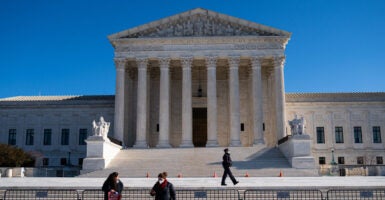
Packing the federal courts would make the judiciary a tool of the political branches rather than independent from them. Pictured: A security guard walks in front of the U.S. Supreme Court on Jan. 7. (Photo: Robert Nickelsberg/Getty Images)

COMMENTARY BY

Thomas Jipping@TomJipping

Thomas Jipping is deputy director of the Edwin Meese III Center for Legal and Judicial Studies and senior legal fellow at The Heritage Foundation.

Political parties and candidates have different positions on issues, but should at least support the fundamentals of our system of government. Sounds simple, right? So how did court-packing become a serious topic for discussion?

Packing the federal courts would destroy not only the independence of the judiciary, but also the unique way that the U.S. Senate has participated in the legislative process for more than 200 years. That’s why control of the Senate will determine whether these fundamentals stay or go.

America’s founders believed that keeping the judiciary independent from political manipulation is “essential” for the kind of government they designed. In fact, in the Declaration of Independence, it’s listed among the reasons why we split from Great Britain. And it’s what makes our judiciary the envy of so many around the world.

One way that federal judges are independent is that they choose when to retire. Presidents cannot serve for more than 10 years (two years of an unexpired term, plus two full terms), while federal judges serve for an average of more than twice as long. Presidents can fill vacancies, but judges determine when those vacancies occur.

The demand for socialism is on the rise from young Americans today. But is socialism even morally sound? Find out more now >>

“Court-packing” means vacancies would suddenly occur when Congress creates new judicial positions that a president of the same party can immediately fill. It would be like a hostile takeover of the judiciary, which would make it a tool of the political branches rather than maintaining its independence from them.

Court-packing is not a new idea. In 1937, fresh from a landslide reelection, President Franklin Roosevelt proposed the same scheme. He thought it would sail through Congress since, after the 1936 election, Democrats had huge Senate and House majorities. But those Democrats resisted the temptation to manipulate the judiciary for political purposes.

Even the American Bar Association, which had surveyed lawyers across the country, opposed the idea. Testifying before the Senate Judiciary Committee in April 1937, the ABA said this threat to judicial independence had drawn a stronger reaction than any issue since the Civil War.

Court-packing today, however, would destroy not only the independence of the judiciary, but also the unique character of the Senate. While the House is designed for action and a simple majority can do whatever it chooses, the Senate is designed for deliberation. While a simple majority can pass a bill, Senate rules first require a supermajority to end debate.

Both parties have used this to their advantage, preventing or improving legislation along the way. It is literally the single most distinctive feature of the Senate as a legislative body. But it would have to be destroyed to enact a court-packing scheme today.

Democrats’ 80-16 majority in 1937 would have made ending debate easy. Today, however, court-packing legislation would run headlong into a Senate filibuster. Passing that legislation, therefore, would require changing Senate rules to grease the legislative skids so that a simple majority could always get its way.

It’s easy to see a pattern here. The Founders wanted to keep the judiciary independent from political manipulation. The Founders wanted to make the Senate different from the House, with different terms and representation. Extended debate has been the practice since the turn of the 19th century.

Court-packing today, therefore, puts not just one, but two branches of government at risk.

Our system of government provides the liberty we all enjoy. That happens by design, not by accident. Any elected official or candidate, regardless of party, who claims to believe in that system, therefore, should explicitly reject schemes that, like court-packing, would attack and permanently undermine it.

If Congress could put principle over politics in 1937 when only one branch was at risk, we must be even more resolute today when two branches hang in the balance.

This piece was originally distributed by Tribute Content Agency.

—-

https://youtu.be/pzL3LE4zGe4

Amy Coney Barrett has officially been confirmed as a Supreme Court justice

Barrett’s confirmation solidifies a 6-3 conservative majority on the high court.

  • By Li Zhou 
  • on October 26, 2020 8:08 pm


Judge Amy Coney Barrett on Capitol Hill on October 1. Anna Moneymaker/Getty Images

In a narrow 52-48 vote, the Senate has officially confirmed Amy Coney Barrett for appointment to the Supreme Court, a huge win for Republicans who worked quickly — and ignored past precedent — to advance her nomination.

Barrett, who will now take the seat of the late Justice Ruth Bader Ginsburg, is a staunch conservative whose vote could be the deciding one on upcoming cases involving the Affordable Care Act, abortion rights, and voting rights. Her confirmation solidifies a 6-3 conservative majority on the high court, and is likely to affect its skew for decades.

Ultimately, every Republican senator except Susan Collins (R-ME) voted in favor of Barrett’s confirmation, while no Democrats did. Collins voted against Barrett because she disagreed with the process used for her nomination, something Democrats had objected to as well. Democrats had also expressed concerns about the conservative slant of Barrett’s past writings and opinions.

Overall, Barrett’s nomination has been controversial for many reasons including its timing: In 2016, Senate Republicans refused for months to consider a Supreme Court nominee until after the general election, because they argued that the American people — through their votes — should have a voice in the decision-making process. This year, however, with less than two months to go until the election, Republicans moved to expedite Barrett’s confirmation.Supreme Court nominee Amy Coney Barrett is sworn in during the Senate Judiciary Committee confirmation hearing on October 12, 2020. Kevin Dietsch/Getty Images

To do so, Republicans made approving Barrett’s nomination their absolute priority, even as multiple lawmakers were diagnosed with coronavirus and as stimulus talks remained at an impasse. “Nothing about this is normal,” Sen. Cory Booker (D-NJ) emphasized at the start of Barrett’s confirmation hearing. “Instead of doing anything to help people who are struggling right now, we are here.”

Check out the quote below by Kamala Harris in the debate concerning President Lincoln stating that the reason he put off nominating a Supreme Court replacement after the election was because Lincoln wanted the winner of the the 1864 election to make the pick, and then see that debunked. Yet liberal fact checkers like Planned Parenthood do not put in the false category but only say it “may be a little bit of a stretch.”


Sen. Kamala Harris told Pence. “In 1864… Abraham Lincoln was up for reelection. And it was 27 days before the election. And a seat became open on the United States Supreme Court. Abraham Lincoln’s party was in charge not only of the White House but the Senate. But Honest Abe said, ‘It’s not the right thing to do. The American people deserve to make the decision about who will be the next president of the United States, and then that person will be able to select who will serve on the highest court of the land.”

Michael Burlingame, the distinguished chair in Lincoln studies at the University of Illinois-Springfield, told PolitiFact, “I’ve never seen anything like that quote in all my 36 years of Lincoln research.”

“Lincoln, of course, said no such thing,” Dan McLaughlin of THE NATIONAL REVIEW refuted the Democrat Wednesday night. “He sent no nominee to the Senate in October 1864 because the Senate was out of session until December.”

Gillian Brockell of the WASHINGTON POST also made the same point as McLaughlin:

Congress was in recess until early December, so there would have been no point in naming a man before the election anyway. Lincoln shrewdly used that to his advantage. If he had lost the election, there is no evidence he wouldn’t have filled the spot in the lame-duck session.

In fact, most historians assume Lincoln intended on filling the vacancy as soon as he could in the lame duck session.

Claim: In 1864, 27 days before the election, President Abraham Lincoln decided not to nominate an appointment to a vacant seat on the U.S. Supreme Court because he believed the people should decide.

  • Context: In a discussion of Trump’s recent nomination of Amy Coney Barrett to the supreme court just weeks before the November Election, Harris recalled a moment in political history when Abraham Lincoln chose to defer the nomination of a justice to the court following a Justice’s death less than a month before the election. Harris tied this story to the current moment, as most voters across the country would like for the winner of the November election to appoint the next justice to the Supreme Court.
  • Fact-check: Lincoln did wait to appoint a justice in 1864 until December, a month after the presidential election. His decision to do so may or may not have been politically motivated, as many potential candidates were eager to campaign for his reelection with the hope that he would return the favor with a nomination to the court. Harris’s claim that Lincoln waited so that the people could decide on the president and the court appointment may be a little bit of a stretch, but it is also not necessarily representative of the position we’re in today, given that during Abraham Lincoln’s presidency, only white men were allowed to vote.

Vice Presidential Debate Fact Check

By Anna Selle | Oct. 8, 2020, 9:39 p.m.

Washington Post fact-check’s Harris’ ‘little history lesson’ about Lincoln: ‘Wasn’t exactly true’

Harris insisted ‘Honest Abe’ said filling a vacant Supreme Court seat during an election was ‘not the right thing to do’

By Joseph A. Wulfsohn | Fox News

The Washington Post offered a sharp rebuke to the “little history lesson” Sen. Kamala Harris shared during Wednesday night’s vice presidential debate, which apparently “wasn’t exactly true.”

During an exchange with Vice President Mike Penceon the confirmation of Judge Amy Coney Barrett to the Supreme Court, Harris suggested that one of the most revered Republican presidents would be in favor of allowing a newly elected president to fill a vacant seat instead of rushing a confirmation in the heat of an election.

She made her argument in response to Pence saying that President Trump‘s appointment is following precedent. 

“I’m so glad we went through a little history lesson. Let’s do that a little more,” Harris told Pence. “In 1864… Abraham Lincoln was up for reelection. And it was 27 days before the election. And a seat became open on the United States Supreme Court. Abraham Lincoln’s party was in charge not only of the White House but the Senate. But Honest Abe said, ‘It’s not the right thing to do. The American people deserve to make the decision about who will be the next president of the United States, and then that person will be able to select who will serve on the highest court of the land.”

Well, according to a report from The Washington Post on Thursday, Harris did not accurately describe what took place under Lincoln when filling the vacant seat of Chief Justice Roger B. Taney.

“Harris is correct that a seat became available 27 days before the election. And that Lincoln didn’t nominate anyone until after he won,” the Post wrote. “But there is no evidence he thought the seat should be filled by the winner of the election. In fact, he had other motives for the delay.”
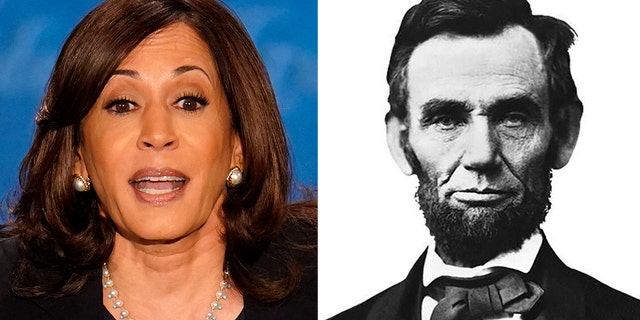
According to Lincoln historian Michael Burlingame, Lincoln told his aides he wanted to delay his Supreme Court confirmation process because he was “waiting to receive expressions of public opinion from the country,” though the Post noted, “that didn’t mean he was waiting for ballots so much as the mail.”

“The overarching effect of the delay is that it held Lincoln’s broad but shaky coalition of conservative and radical Republicans together,” the Post explained. “Congress was in recess until early December, so there would have been no point in naming a man before the election anyway. Lincoln shrewdly used that to his advantage. If he had lost the election, there is no evidence he wouldn’t have filled the spot in the lame-duck session.”

The Post concluded, “So Harris is mistaken about Lincoln’s motivations in this regard.”

National Review senior writer Dan McLaughin went even further, accusing Harris of “dishonesty” with her Lincoln anecdote. 

“Lincoln, of course, said no such thing,” McLaughlin refuted the Democrat Wednesday night. “He sent no nominee to the Senate in October 1864 because the Senate was out of session until December.”

He added, “Kamala Harris is simply inventing history.”

6 Highlights From the Pence-Harris Debate

Fred Lucas @FredLucasWH / Jarrett Stepman @JarrettStepman / October 08, 2020 / 182 Comments

During the vice presidential debate Wednesday night, Sen. Kamala Harris, D-Calif., and Vice President Mike Pence sparred over a variety of policies, revealing significant differences on several issues.

The debate, which was moderated by USA Today Washington bureau chief Susan Page, featured the two contenders discussing issues ranging from climate change and COVID-19 to abortion and the Supreme Court. 

Here are six highlights from the debate:

1) COVID-19

Harris aggressively attacked the Trump administration’s handling of the COVID-19 pandemic. After the opening question, she laid out what could be called a prosecutor’s case. How are socialists deluding a whole generation? Learn more now >>

“The American people have witnessed what is the greatest failure of any presidential administration in the history of our country,” the California senator said. “And here are the facts: 210,000 dead people in our country in just the last several months, over 7 million people who have contracted this disease, 1 in 5 businesses closed. We are looking at frontline workers treated like sacrificial workers. We are looking at 30 million people who in the last several months had to file for unemployment.”

That was in response to a question from Page about what the Biden administration would have done differently than Trump to address the COVID-19 pandemic. Harris then went on to summarize the Biden-Harris plan. 

“Our plan is about what we need to do around a national strategy, for contact tracing, for testing, for administration of a vaccine, and make sure it’s free,” Harris said. 

Pence, who headed the White House coronavirus task force, defended the administration’s record. 

“I want the American people to know that from the very first day, President Donald Trump has put the health of America first,” the vice president said. “Before there were more than five cases in the United States—all people who had returned from China—President Donald Trump did what no other American had ever done. That was, he suspended all travel from China, the second-largest economy in the world.”

Pence added: “Joe Biden opposed that decision.”

“He said it was xenophobic and hysterical. I can tell you, having led the White House coronavirus task force that decision alone by President Trump gave us invaluable time to set up the greatest mobilization since World War II,” Pence said. “I believe it saved hundreds of thousands of American lives.” 

As for the Biden plan, Pence said, the Trump administration was already doing much of what it recommends. He also took a shot at a Biden scandal that effectively ended his 1988 presidential bid. 

“The reality is, when you look at the Biden plan, it looks an awful lot like what President Trump and I and our task force have been doing every step of the way,” he said. “ … It looks a little bit like plagiarism, something Joe Biden knows a little bit about.” 

In September 1987, Biden came in for withering criticism for borrowing lines from a speech by then-British Labor Party leader Neil Kinnock without attribution, knocking him out of the race when it was subsequently revealed to be part of a larger pattern of borrowing lines from other politicians without credit.

Asked about the race to develop a vaccine, Harris said she wouldn’t trust a Trump-endorsed vaccine, but would take one approved by Dr. Anthony Fauci, the director of the National Institutes of Allergy and Infectious Diseases.

“If the public health professionals, if Dr. Fauci, if the doctors tell us that we should take it, I’ll be the first in line to take it. Absolutely,” Harris said. “But if Donald Trump tells us that we should take it, I’m not taking it.”

Pence fired back that the California senator was politicizing the vaccine. 

“The fact that you continue to undermine public confidence in a vaccine, if a vaccine emerges during the Trump administration, I think, is unconscionable,” the vice president said. “Senator, I just ask you, stop playing politics with people’s lives. The reality is, we will have a vaccine by the end of this year, and it will continue to save countless American lives.”

2) Taxes and the Economy

Harris and Pence sparred over the tax cuts passed by Congress in 2017 and debated Biden’s tax plan.

Harris said that the Biden administration would repeal the 2017 tax cuts “on Day One,” and that they were passed to benefit the “rich.”

“Joe Biden believes you measure the health and strength of America’s economy based on the health and strength of the American worker and the American family,” Harris said. “On the other hand, you have Donald Trump, who measures the strength of the economy based on how rich people are doing.”

Pence defended the tax cuts and said: “Joe Biden said twice in the debate last week that he’s going to repeal the Trump tax cuts,” Pence said. “That was tax cuts that gave the average working family $2,000 with a tax break.”

In 2017, Congress passed the Tax Cuts and Jobs Act, which reduced federal income taxes and made various other changes to the U.S. tax code.

Following the tax cut, the American economy experienced record low unemployment, wage growth, and an overall increase in business investment, according to Adam Michel, a specialist on tax policy and the federal budget as a policy analyst in the Thomas A. Roe Institute for Economic Policy Studies at The Heritage Foundation.

Harris said that Biden’s tax plan would end tax breaks for the wealthy but wouldn’t raise taxes on American making under $400,000.

“He has been very clear about that,” Harris said, adding, “Joe Biden is the one who, during the Great Recession, was responsible for the Recovery Act that brought America back, and now the Trump and Pence administration wants to take credit for Joe Biden’s success for the economy that they had at the beginning of their term.”

According to The Washington Post, “most Americans received a tax” cut in 2017, not just the rich.

Biden’s tax proposal would raise taxes about $3 trillion over the next decade, according to the nonpartisan Tax Foundation.

“… The Biden tax plan would reduce [gross domestic product] by 1.47 percent over the long term,” according to the Tax Foundation’s General Equilibrium Model. “On a conventional basis, the Biden tax plan by 2030 would lead to about 6.5 percent less after-tax income for the top 1 percent of taxpayers and about a 1.7 percent decline in after-tax income for all taxpayers on average.”

According to the left-leaning Tax Policy Center, Biden’s proposal “would increase taxes on average on all income groups, but the highest-income households would see substantially larger increases, both in dollar amounts and as a share of their incomes.”

3) Climate Change and Fracking 

Harris said a Biden administration would grow the economy through green energy, but she also denied past support for banning fracking. 

“Joe Biden will not ban fracking. That is a fact. I will repeat that Joe Biden has been very clear that he thinks about growing jobs,” Harris said, adding, “Part of those jobs that will be created by Joe Biden are going to be about clean energy and renewable energy, because Joe understands that the West Coast of our country is burning, including my home state of California.”

Harris also spoke about climate-related problems in the Southeast and in the Midwest. 

“Joe sees what is happening in the Gulf states, which are being battered by storms. Joe has seen and talked with the farmers in Iowa, whose entire crops have been destroyed because of floods,” she said. “So, Joe believes again in science. … We have seen a pattern with this administration, which is, they don’t believe in science. Joe’s plan is about saying we are going to deal with it, but we are going to create jobs.” 

Pence addressed the issue of climate change, but also attacked the Biden campaign’s promises for the environment. 

“As I said, Susan, the climate is changing. We’ll follow the science,” he said. 

“With regard to banning fracking, I just recommend people look at the record. You yourself said repeatedly you would ban fracking,” Pence said of Harris. “You were the first Senate co-sponsor of the Green New Deal. 

“While Joe Biden denied support for the Green New Deal, Susan, thank you for pointing out the Green New Deal is on [the Biden-Harris] website. As USA Today said, it’s essentially the same plan as you co-sponsored with AOC.”

That was a reference to Rep. Alexandria Ocasio-Cortez, D-N.Y., the main sponsor of the Green New Deal in the House. 

“You just heard the senator say she was going to resubmit America to the Paris Climate Accord. The American people have always cherished our environment, and we’ll continue to cherish it,” Pence said. “We’ve made great progress reducing [carbon dioxide] emissions through American innovation and the development of natural gas through fracking. 

“We don’t need a massive $2 trillion Green New Deal that would impose all new mandates on American businesses and American families. … It makes no sense. It will cost jobs.”

4) China

Pence and Harris sparred over U.S. relations with China, including its role in the outbreak of the COVID-19 pandemic.

“China and the World Health Organization did not play straight with the American people,” Pence said. “They did not let our personnel into China … until the middle of February.”

The vice president defended the administration’s aggressive trade policy with Beijing. “But China has been taking advantage of the United States for decades, in the wake of Biden cheerleading for China,” he said.

Harris said that the Trump administration had “lost” the trade war with China. “What ended up happening because of a so-called “trade war” with China? America lost 300,000 manufacturing jobs,” she said.

Pence countered that a Biden administration would go soft on the communist country.

“Joe Biden has been a cheerleader for communist China over the last several decades,” he said. 

The vice president criticized the record of the administration of Biden’s boss, President Barack Obama, saying that it had dismissed the idea that manufacturing jobs could ever come back to America.

“In our first three years, this administration saw 500,000 manufacturing jobs created, and that’s the type of growth we’re going to see,” Pence said.

5) Supreme Court and Abortion

With the nomination of federal appeals court Judge Amy Coney Barrett to the Supreme Court, Page asked both candidates what they would want their respective states of Indiana and California to do if the high court were to overturn the 1973 Roe v. Wade decision that legalized abortion nationwide and sent the matter back to the states to decide for themselves.

Neither candidate directly addressed the question, but both spoke of the abortion issue in the context of the Supreme Court. 

“The issues before us couldn’t be more serious,” Harris said. “There is the issue of choice, and I will always fight for a woman’s right to make a decision about her own body. It should be her decision and not that of Donald Trump and the vice president, Michael Pence.”

Pence reiterated his pro-life stance, and called out the Biden-Harris ticket. 

“I couldn’t be more proud to serve as vice president to a president who stands unapologetically for the sanctity of human life. I will not apologize for it,” he said. “This is another one of those cases where there is such a dramatic contrast. Joe Biden and Kamala Harris support taxpayer funding of abortion all the way up to the moment of birth, late-term abortion.” 

Pence asked Harris at one point if she would support packing the courts, meaning increasing the number of Supreme Court justices to 10 or more, and then he accused her of not answering the question.

“Once again you gave a non-answer, Joe Biden gave a non-answer,” Pence said. “The American people deserve a straight answer.”

In his remarks, Pence noted the Supreme Court has had nine justices for the past 150 years.

6) Race Relations

The vice presidential candidates also had a heated exchange on race relations amid social unrest in major American cities. 

Harris called out Trump for what she claimed was his reluctance to condemn white supremacists, referring to last week’s presidential debate between Trump and Biden. 

“Last week, the president of the United States took a debate stage in front of 70 million Americans and refused to condemn white supremacists,” Harris said. “It wasn’t like he wasn’t given a chance. He didn’t do it, and then he doubled down. Then he said, when pressed, ‘Stand back, stand by.’ This is part of a pattern with Donald Trump.” 

She also cited the deadly 2017 Charlottesville, Va., Unite the Right rally. 

Pence countered by citing Trump’s comments regarding the Charlottesville violence. 

“This is one of the things that makes people dislike the media so much in this country, that you selectively edit so much,” Pence said, arguing that the media had distorted what Trump had said about there being “very fine people” on both sides in Charlottesville.

“After President Trump made comments about people on either side of the debate over monuments, he condemned the KKK, neo-Nazis and white supremacists,” the vice president said. 

“He has done so repeatedly. Your concern that he doesn’t condemn neo-Nazis, President Trump has Jewish grandchildren. His daughter and son-in-law are Jewish. This is a president who respects and cherishes all of the American people.”

Pence then went on offense about Harris’ prosecution record as a district attorney in San Francisco.  

“When you were D.A. in San Francisco, African Americans were 19 times more likely to be prosecuted for minor drug offenses than whites and Hispanics,” Pence said to Harris. “You increased the disproportionate incarceration. You did nothing on criminal justice reform in California. You didn’t lift a finger to pass the First Step Act on Capitol Hill.” 

The First Step Act is a bipartisan criminal justice reform bill signed into law by Trump in December 2018.

Harris didn’t directly defend her record as district attorney of San Francisco, but pivoted to her record as California attorney general. 

“Having served as the attorney general of California, the work I did is a model of what our nation needs to do and what we will be able to do,” she said, adding, “I was the first statewide officer to institute a requirement that my agents would wear body cameras and keep them on full time. We were the first to initiate that there would be training for law enforcement on implicit bias.”

——

I grew up and went to EVANGELICAL CHRISTIAN SCHOOL in Memphis and ran some of our track meets at RHODES COLLEGE and I know that campus well and I even was contacted by a official at Rhodes with some recruiting material after a good performance in my sophomore year in my mile run there in 1978. Also during the late 1970’s I helped my friends Byron Tyler and David Rogers in a Christian Rock Saturday morning show on Rhodes’s radio station!!! My brother-in-law graduated from Rhodes but I graduated from University of Memphis in 1982.

—-

Amy Coney Barrett: A View from Rhodes College

Tim H.

By Tim H.

Tim H.

 | September 23, 202027 COMMENTS

President Trump is going to announce his nomination for the Supreme Court later this week, and all the talk is about Amy Coney Barrett, currently a Notre Dame professor of law and a judge on the Seventh Circuit Court of Appeals. As it happens, Amy was a classmate of mine at Rhodes College, a small (1,400 students at the time) liberal-arts school in Memphis. I didn’t know her well, but she was a friend of other friends, and we were acquainted a bit through being in a club together.

I can tell you a few things about her, though. For one thing, she did not have a wild reputation, so I think that if she’s nominated, the Senate hearings will have to find something else to complain about. She was an English major and served on the Honor Council, a student body that enforced our honor code against lying and cheating (a great feature of academics at Rhodes that allowed us take-home tests in many classes). We were both in Mortar Board, an honor society. She wasn’t a political activist and was never a member of the College Republicans (I was, and we had a much larger membership than the College Democrats).Amy at the homecoming game senior year
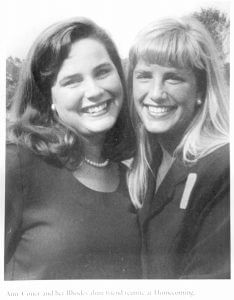
Popular, as far as I knew, and by our senior year, she shows up in the yearbook’s candid photos taken around campus.Candid photo in the social room (the ironing board refers to another picture)

I hadn’t thought about her for a long time, until three years ago when friends were pointing out she’d been nominated for the Seventh Circuit, and Sen. Dianne Feinstein grilled her over her religion, proclaiming that “the dogma lives loudly within you.” At the time, I thought that was a rough Senate hearing.

My daughter was a Notre Dame student, and two years ago, I stopped by to visit Amy at her home in South Bend and catch up. She had been listed as being on the president’s shortlist for a Supreme Court seat, and Kavanaugh was going through his own nomination process at that time.L to R: Me, Amy Barrett, and my daughter

My daughter had been treating the accusations against him as probably true by default and took an unconcerned view towards the behavior of the press. Amy knows Kavanaugh, spoke well of him, and described what it was like seeing the press contacting her and digging through rumors about him. That changed my daughter’s opinion of how these things go, she told me. I meant to ask her if she were named to the Supreme Court if she’d be willing to go through all of the hatred and attacks on her reputation that would surely be a part of it. But I can’t remember if I did. I reckon we’ll all find out soon enough, though.

As a footnote, if Amy is confirmed to the court, she would be the second Supreme Court justice to come from Rhodes. Our first was Abe Fortas (class of 1930), who was named by President Johnson in 1965. Fortas resigned in 1969 after a series of ethics scandals, but the college gives out the Abe Fortas Award for Excellence in Legal Studies each year. Quite understandable; we’re a small school, and we should still be proud one of our own was elevated to the Supreme Court. May Amy Barrett bring us more honor.Published in LawTags: SCOTUS; SUPREME COURT; Amy Coney Barrett

Amy Coney Barrett (born January 28, 1972)[1][2] is an American lawyer, jurist, and academic who serves as a circuit judge on the U.S. Court of Appeals for the Seventh Circuit. Barrett considers herself a public-meaning originalist; her judicial philosophy has been likened to that of her mentor and former boss, Antonin Scalia.[3] Barrett’s scholarship focuses on originalism.

Amy Coney Barrett
Barrett in 2018
Judge of the United States Court of Appeals for the Seventh Circuit
Incumbent
Assumed office 
November 2, 2017
Appointed byDonald Trump
Preceded byJohn Daniel Tinder
Personal details
BornJanuary 28, 1972(age 48)
New OrleansLouisiana, U.S.
Spouse(s)Jesse Barrett
EducationRhodes College (BA)
University of Notre Dame(JD)
Academic background
Academic work
DisciplineJurisprudence
InstitutionsNotre Dame Law School
WebsiteNotre Dame Law Biography

Barrett was nominated to the Seventh Circuit Court of Appeals by President Donald Trump on May 8, 2017 and confirmed by the Senate on October 31, 2017. While serving on the federal bench, she was a professor of law at Notre Dame Law School, where she has taught civil procedure, constitutional law, and statutory interpretation.[4][2][5][6] Shortly after her confirmation to the Seventh Circuit Court of Appeals in 2017, Barrett was added to President Trump’s list of potential Supreme Court nominees.[7]Trump reportedly intends to nominate her to succeed Ruth Bader Ginsburg on the United States Supreme Court.[8]

Early life and education

Barrett was born in New Orleans, Louisiana, in 1972.[2] She is the eldest of seven children, with five sisters and a brother. Her father Michael Coney worked as an attorney for Shell Oil Company, and her mother Linda was a homemaker. Barrett grew up in Metairie, a suburb of New Orleans, and graduated from St. Mary’s Dominican High School in 1990.[9]

Barrett studied English literature at Rhodes College, graduating in 1994 with a Bachelor of Arts magna cum laude and Phi Beta Kappa membership.[10] She then studied law at Notre Dame Law School on a full-tuition scholarship. She served as an executive editor of the Notre Dame Law Review[11] and graduated first in her class in 1997 with a Juris Doctor summa cum laude.[12]

Career

Clerkships and private practice

After law school Barrett spent two years as a judicial law clerk, first for Judge Laurence Silberman of the U.S. Court of Appeals for the D.C. Circuit from 1997 to 1998,[13] then for Justice Antonin Scalia of the U.S. Supreme Court from 1998 to 1999.[13]

From 1999 to 2002, she practiced law at Miller, Cassidy, Larroca & Lewin in Washington, D.C.[11][14]

Teaching and scholarship

Barrett served as a visiting associate professor and John M. Olin Fellow in Law at George Washington University Law School for a year before returning to her alma mater, Notre Dame Law School in 2002.[15]At Notre Dame she taught federal courts, constitutional law, and statutory interpretation. Barrett was named a Professor of Law in 2010, and from 2014 to 2017 held the Diane and M.O. Miller Research Chair of Law.[16] Her scholarship focuses on constitutional law, originalism, statutory interpretation, and stare decisis.[12] Her academic work has been published in journals such as the ColumbiaCornellVirginiaNotre Dame, and TexasLaw Reviews.[15] Some of her most significant publications are Suspension and Delegation, 99 Cornell L. Rev. 251 (2014), Precedent and Jurisprudential Disagreement, 91 Tex. L. Rev. 1711 (2013), The Supervisory Power of the Supreme Court, 106 Colum. L. Rev. 101 (2006), and Stare Decisis and Due Process, 74 U. Colo. L. Rev. 1011 (2003).

At Notre Dame, Barrett received the “Distinguished Professor of the Year” award three times.[15] She taught Constitutional Law, Civil Procedure, Evidence, Federal Courts, Constitutional Theory Seminar, and Statutory Interpretation Seminar.[15] Barrett has continued to teach seminars as a sitting judge.[17]

Federal judicial service

Nomination and confirmation

President Donald Trump nominated Barrett on May 8, 2017, to serve as a United States Circuit Judge of the United States Court of Appeals for the Seventh Circuit, to the seat vacated by Judge John Daniel Tinder, who took senior status on February 18, 2015.[18][19]Judge Laurence Silberman, for whom Barrett first clerked after law school, swearing her in at her investiture as a judge on the Seventh Circuit.

A hearing on Barrett’s nomination before the Senate Judiciary Committee was held on September 6, 2017.[20] During the hearing, Senator Dianne Feinstein questioned Barrett about a law review article Barrett co-wrote in 1998 with Professor John H. Garvey in which she argued that Catholic judges should in some cases recuse themselves from death penalty cases due to their moral objections to the death penalty. The article concluded that the trial judge should recuse herself instead of entering the order. Asked to “elaborate on the statements and discuss how you view the issue of faith versus fulfilling the responsibility as a judge today,” Barrett said that she had participated in many death-penalty appeals while serving as law clerk to Scalia, adding, “My personal church affiliation or my religious belief would not bear on the discharge of my duties as a judge”[21][22] and “It is never appropriate for a judge to impose that judge’s personal convictions, whether they arise from faith or anywhere else, on the law.”[23] Worried that Barrett would not uphold Roe v. Wade given her Catholic beliefs, Feinstein followed Barrett’s response by saying, “the dogma lives loudly within you, and that is a concern.”[24][25][26] The hearing made Barrett popular with religious conservatives,[11] and in response, the conservative Judicial Crisis Network began to sell mugs with Barrett’s photo and Feinstein’s “dogma” remark.[27]Feinstein’s and other senators’ questioning was criticized by some Republicans and other observers, such as university presidents John I. Jenkins and Christopher Eisgruber, as improper inquiry into a nominee’s religious belief that employed an unconstitutional “religious test” for office;[23][28][29]others, such as Nan Aron, defended Feinstein’s line of questioning.[29]

Lambda Legal, an LGBT civil rights organization, co-signed a letter with 26 other gay rights organizations opposing Barrett’s nomination. The letter expressed doubts about her ability to separate faith from her rulings on LGBT matters.[30][31] During her Senate confirmation hearing, Barrett was questioned about landmark LGBTQ legal precedents such as Obergefell v. HodgesUnited States v. Windsor, and Lawrence v. Texas. Barrett said these cases are “binding precedents” that she intended to “faithfully follow if confirmed” to the appeals court, as required by law.[30] The letter co-signed by Lambda Legal said “Simply repeating that she would be bound by Supreme Court precedent does not illuminate—indeed, it obfuscates—how Professor Barrett would interpret and apply precedent when faced with the sorts of dilemmas that, in her view, ‘put Catholic judges in a bind.'”[30] Carrie Severino of the Judicial Crisis Network later said that warnings from LGBT advocacy groups about shortlisted nominees to replace Justice Anthony Kennedy, including Barrett, were “very much overblown” and called them “mostly scare tactics.”[30]

In 2015, Barrett signed a letter in support of the Ordinary Synod of Bishops on the Family that endorsed the Catholic Church’s teachings on human sexuality and its definition of marriage as between one man and one woman. When asked about the letter, she testified that the Church’s definition of marriage is legally irrelevant.[32][33]

Barrett’s nomination was supported by every law clerk she had worked with and all of her 49 faculty colleagues at Notre Dame Law school. 450 former students signed a letter to the Senate Judiciary Committee supporting Barrett’s nomination.[34][35]

On October 5, 2017, the Senate Judiciary Committee voted 11–9 on party lines to recommend Barrett and report her nomination to the full Senate.[36][37] On October 30, the Senate invoked cloture by a vote of 54–42.[38] It confirmed her by a vote of 55–43 on October 31, with three Democrats—Joe DonnellyTim Kaine, and Joe Manchin—voting for her.[10] She received her commission two days later.[2] Barrett is the first and to date only woman to occupy an Indiana seat on the Seventh Circuit.[39]

Notable cases

Title IX

In Doe v. Purdue University, 928 F.3d 652 (7th Cir. 2019), the court, in a unanimous decision written by Barrett, reinstated a suit brought by a male Purdue University student (John Doe) who had been found guilty of sexual assault by Purdue University, which resulted in a one-year suspension, loss of his Navy ROTC scholarship, and expulsion from the ROTC affecting his ability to pursue his chosen career in the Navy.[40] Doe alleged the school’s Advisory Committee on Equity discriminated against him on the basis of his sex and violated his rights to due process by not interviewing the alleged victim, not allowing him to present evidence in his defense, including an erroneous statement that he confessed to some of the alleged assault, and appearing to believe the victim instead of the accused without hearing from either party or having even read the investigation report. The court found that Doe had adequately alleged that the university deprived him of his occupational liberty without due process in violation of the Fourteenth Amendment and had violated his Title IX rights “by imposing a punishment infected by sex bias,” and remanded to the District Court for further proceedings.[41][42][43]

Title VII

In EEOC v. AutoZone, the Seventh Circuit considered the federal government’s appeal from a ruling in a suit brought by the Equal Employment Opportunity Commission against AutoZone; the EEOC argued that the retailer’s assignment of employees to different stores based on race (e.g., “sending African American employees to stores in heavily African American neighborhoods”) violated Title VII of the Civil Rights Act. The panel, which did not include Barrett, ruled in favor of AutoZone. An unsuccessful petition for rehearing en banc was filed. Three judges—Chief Judge Diane Wood and Judges Ilana Rovner and David Hamilton—voted to grant rehearing, and criticized the panel decision as upholding a “separate-but-equal arrangement”; Barrett and four other judges voted to deny rehearing.[11]

Immigration

In Cook County v. Wolf, 962 F.3d 208 (7th Cir. 2020), Barrett wrote a 40-page dissent from the majority’s decision to uphold a preliminary injunction on the Trump administration’s controversial “public charge rule“, which heightened the standard for obtaining a green card. In her dissent, she argued that any noncitizens who disenrolled from government benefits because of the rule did so due to confusion about the rule itself rather than from its application, writing that the vast majority of the people subject to the rule are not eligible for government benefits in the first place. On the merits, Barrett departed from her colleagues Wood and Rovner, who held that DHS’s interpretation of that provision was unreasonable under Chevron Step Two. Barrett would have held that the new rule fell within the broad scope of discretion granted to the Executive by Congress through the Immigration and Nationality Act.[44][45][46] The public charge issue is the subject of a circuit split.[44][46][47]

In Yafai v. Pompeo, 924 F.3d 969 (7th Cir. 2019), the court considered a case brought by a Yemeni citizen, Ahmad, and her husband, a U.S. citizen, who challenged a consular officer’s decision to twice deny Ahmad’s visa application under the Immigration and Nationality Act. Yafai, the U.S. citizen, argued that the denial of his wife’s visa application violated his constitutional right to live in the United States with his spouse.[48] In an 2-1 majority opinion authored by Barrett, the court held that the plaintiff’s claim was properly dismissed under the doctrine of consular nonreviewability. She declined to address whether Yafai had been denied a constitutional right (or whether a constitutional right to live in the United States with his spouse existed) because even if a constitutional right was implicated, the court lacked authority to disturb the consular officer’s decision to deny Ahmad’s visa application because that decision was facially legitimate and bona fide. Following the panel’s decision, Yafai filed a petition for rehearing en banc; the petition was denied, with eight judges voting against rehearing and three in favor, Wood, Rovner and Hamilton. Barrett and Judge Joel Flaumconcurred in the denial of rehearing.[48][49]

Second Amendment

In Kanter v. Barr, 919 F.3d 437 (7th Cir. 2019), Barrett dissented when the court upheld a law prohibiting convicted nonviolent felons from possessing firearms. The plaintiffs had been convicted of mail fraud. The majority upheld the felony dispossession statutes as “substantially related to an important government interest in preventing gun violence.” In her dissent, Barrett argued that while the government has a legitimate interest in denying gun possession to felons convicted of violent crimes, there is no evidence that denying guns to nonviolent felons promotes this interest, and that the law violates the Second Amendment.[50][51]

Fourth Amendment

In Rainsberger v. Benner, 913 F.3d 640 (7th Cir. 2019), the panel, in an opinion by Barrett, affirmed the district court’s ruling denying the defendant’s motion for summary judgment and qualified immunity in a 42 U.S.C. § 1983 case. The defendant, Benner, was a police detective who knowingly provided false and misleading information in a probable cause affidavit that was used to obtain an arrest warrant against Rainsberger. (The charges were later dropped and Rainsberger was released.) The court found the defendant’s lies and omissions violated “clearly established law” and thus Benner was not shielded by qualified immunity.[52]

The case United States v. Watson, 900 F.3d 892 (7th Cir. 2018) involved police responding to an anonymous tip that people were “playing with guns” in a parking lot. The police arrived and searched the defendant’s vehicle, taking possession of two firearms; the defendant was later charged with being a felon in possession of a firearm. The district court denied the defendant’s motion to suppress. On appeal, the Seventh Circuit, in a decision by Barrett, vacated and remanded, determining that the police lacked probable cause to search the vehicle based solely upon the tip, when no crime was alleged. Barrett distinguished Navarette v. California and wrote, “the police were right to respond to the anonymous call by coming to the parking lot to determine what was happening. But determining what was happening and immediately seizing people upon arrival are two different things, and the latter was premature…Watson’s case presents a close call. But this one falls on the wrong side of the Fourth Amendment.”[53]

In a 2013 Texas Law Review article, Barrett included as one of only seven Supreme Court “superprecedents“, Mapp vs Ohio (1961); the seminal case where the court found through the doctrine of selective incorporation that the 4th Amendment’s protections against unreasonable searches and seizures was binding on state and local authorities in the same way it historically applied to the federal government.

Civil procedure and standing

In Casillas v. Madison Ave. Associates, Inc., 926 F.3d 329 (7th Cir. 2019), the plaintiff brought a class-action lawsuit against Madison Avenue, alleging that the company violated the Fair Debt Collection Practices Act (FDCPA) when it sent her a debt-collection letter that described the FDCPA process for verifying a debt but failed to specify that she was required to respond in writing to trigger the FDCPA protections. Casillas did not allege that she had tried to verify her debt and trigger the statutory protections under the FDCPA, or that the amount owed was in any doubt. In a decision written by Barrett, the panel, citing the Supreme Court’s decision in Spokeo, Inc. v. Robins, found that the plaintiff’s allegation of receiving incorrect or incomplete information was a “bare procedural violation” that was insufficiently concrete to satisfy the Article III‘s injury-in-fact requirement. Wood dissented from the denial of rehearing en banc. The issue created a circuit split.[54][55][56]

Judicial philosophy and political views

Barrett considers herself an originalist. She is a constitutional scholar with expertise in statutory interpretation.[10] Reuters described Barrett as a “a favorite among religious conservatives,” and said that she has supported expansive gun rights and voted in favor of one of the Trump administration’s anti-immigration policies.[57]

Barrett was one of Justice Antonin Scalia‘s law clerks. She has spoken and written of her admiration of his close attention to the text of statutes. She has also praised his adherence to originalism.[58]

In 2013, Barrett wrote a Texas Law Review article on the doctrine of stare decisis wherein she listed seven cases that should be considered “superprecedents”—cases that the court would never consider overturning. The list included Brown v. Board of Education but specifically excluded Roe v. Wade. In explaining why it was not included, Barrett referenced scholarship agreeing that in order to qualify as “superprecedent” a decision must enjoy widespread support from not only jurists but politicians and the public at large to the extent of becoming immune to reversal or challenge. She argued the people must trust the validity of a ruling to such an extent the matter has been taken “off of the court’s agenda,” with lower courts no longer taking challenges to them seriously. Barrett pointed to Planned Parenthood v. Casey as specific evidence Roe had not yet attained this status.[59] The article did not include any pro-Second Amendment or pro-LGBT cases as “Super-Precedent”.[30][31] When asked during her confirmation hearings why she did not include any pro-LGBT cases as “superprecedent”, Barrett explained that the list contained in the article was collected from other scholars and not a product of her own independent analysis on the subject.[32][33]

Barrett has never ruled directly on a case pertaining to abortion rights, but she did vote to rehear a successful challenge to Indiana’s parental notification law in 2019. In 2018, Barrett voted against striking down another Indiana law requiring burial or cremation of fetal remains. In both cases, Barrett voted with the minority. The Supreme Court later reinstated the fetal remains law and in July 2020 it ordered a rehearing in the parental notification case.[57] At a 2013 event reflecting on the 40th anniversary of Roe v. Wade, she described the decision—in Notre Dame Magazine‘s paraphrase—as “creating through judicial fiat a framework of abortion on demand.”[60][61] She also remarked that it was “very unlikely” the court would overturn the core of Roe v. Wade: “The fundamental element, that the woman has a right to choose abortion, will probably stand. The controversy right now is about funding. It’s a question of whether abortions will be publicly or privately funded.”[62][63] NPR said that those statements were made before the election of Donald Trump and the changing composition of the Supreme Court to the right subsequent to his election, which could make Barrett’s vote pivotal in overturning Roe v. Wade.[64]

Barrett was critical of Chief Justice John Roberts’opinion in the 5–4 decision that upheld the constitutionality of the central provision in the Affordable Care Act (Obamacare) in NFIB vs. Sebelius. Roberts’s opinion defended the constitutionality of the individual mandate of the Affordable Care Act by characterizing it as a “tax.” Barrett disapproved of this approach, saying Roberts pushed the ACA “beyond it’s plausible limit to save it.”[64][65][66][67] She criticized the Obama administration for providing employees of religious institutions the option of obtaining birth controlwithout having the religious institutions pay for it.[65]

Potential Supreme Court nomination

Barrett has been on President Trump’s list of potential Supreme Court nominees since 2017, almost immediately after her court of appeals confirmation. In July 2018, after Anthony Kennedy‘s retirement announcement, she was reportedly one of three finalists Trump considered, along with Judge Raymond Kethledge and Judge Brett Kavanaugh.[16][68] Trump chose Kavanaugh.[69]Reportedly, although Trump liked Barrett, he was concerned about her lack of experience on the bench.[70] In the Republican Party, Barrett was favored by social conservatives.[70]

After Kavanaugh’s selection, Barrett was viewed as a possible Trump nominee for a future Supreme Court vacancy.[71] Trump was reportedly “saving” Ruth Bader Ginsburg‘s seat for Barrett if Ginsburg retired or died during his presidency.[72] Ginsburg died on September 18, 2020, and Barrett has been widely mentioned as the front-runner to succeed her.[73][74][75][76]

Personal life

Judge Barrett with her husband, Jesse

Since 1999, Barrett has been married to fellow Notre Dame Law graduate Jesse M. Barrett, a partner at SouthBank Legal in South BendIndiana. Previously, Jesse Barrett worked as an Assistant U.S. Attorneyfor the Northern District of Indiana for 13 years.[77][78][79] They live in South Bend and have seven children, ranging in age from 8-19.[80] Two of the Barrett children are adopted from Haiti. Their youngest biological child has special needs.[79][2][81]Barrett is a practicing Catholic.[82][83]

In September 2017, The New York Times reported that Barrett was an active member of a small, tightly knit Charismatic Christian group called People of Praise.[84][85] Founded in South Bend, the group is associated with the Catholic Charismatic Renewalmovement; it is ecumenical and not formally affiliated with the Catholic Church, but about 90% of its members are Catholic.[85][86]

Affiliations and recognition

From 2010 to 2016, Barrett served by appointment of the Chief Justice on the Advisory Committee for the Federal Rules of Appellate Procedure.[15]

Barrett was a member of the Federalist Society from 2005 to 2006 and from 2014 to 2017.[25][10][11] She is a member of the American Law Institute.[87]

Selected publications

See also

References

—-

​Amy Coney Barrett was appointed to the U.S. Court of Appeals for the Seventh Circuit in November 2017. She serves on the faculty of the Notre Dame Law School, teaching on constitutional law, federal courts, and statutory interpretation, and previously served on the Advisory Committee for the Federal Rules of Appellate Procedure. She earned her bachelor’s degree from Rhodes College in 1994 and her J.D. from Notre Dame Law School in 1997. Following law school, Barrett clerked for Judge Laurence Silberman of the U.S. Court of Appeals for the D.C. Circuit and for Associate Justice Antonin Scalia of the U.S. Supreme Court. She also practiced law with Washington, D.C. law firm Miller, Cassidy, Larroca & Lewin.

—-

—-


—-Related posts:

Taking on Ark Times Bloggers on various issues Part P “Freedom of speech lives on Ark Times Blog” (includes the video ABORTION OF THE HUMAN RACE) (editorial cartoon)

April 25, 2013 – 6:49 am

I have gone back and forth and back and forth with many liberals on the Arkansas Times Blog on many issues such as abortion, human rights, welfare, poverty, gun control  and issues dealing with popular culture. Here is another exchange I had with them a while back. My username at the Ark Times Blog is Saline […]By Everette Hatcher III | Posted in Francis SchaefferProlife | Edit | Comments (0)

Taking on Ark Times Bloggers on various issues Part O “Without God in the picture there can not be lasting meaning to our lives” (includes film ABORTION OF THE HUMAN RACE)

April 23, 2013 – 7:04 am

I have gone back and forth and back and forth with many liberals on the Arkansas Times Blog on many issues such as abortion, human rights, welfare, poverty, gun control  and issues dealing with popular culture. Here is another exchange I had with them a while back. My username at the Ark Times Blog is Saline […]By Everette Hatcher III | Posted in Francis SchaefferPresident ObamaProlife | Edit | Comments (0)

Taking on Ark Times Bloggers on various issues Part K “On what basis do you say murder is wrong?”Part 1 (includes film ABORTION OF THE HUMAN RACE)

April 16, 2013 – 5:49 am

I have gone back and forth and back and forth with many liberals on the Arkansas Times Blog on many issues such as abortion, human rights, welfare, poverty, gun control  and issues dealing with popular culture. Here is another exchange I had with them a while back. My username at the Ark Times Blog is Saline […]By Everette Hatcher III | Posted in Francis SchaefferPresident ObamaProlife | Edit | Comments (0)

Taking on Ark Times Bloggers on various issues Part J “Can atheists find lasting meaning to their lives?” (includes film ABORTION OF THE HUMAN RACE)

April 15, 2013 – 7:48 am

I have gone back and forth and back and forth with many liberals on the Arkansas Times Blog on many issues such as abortion, human rights, welfare, poverty, gun control  and issues dealing with popular culture. Here is another exchange I had with them a while back. My username at the Ark Times Blog is Saline […]By Everette Hatcher III | Posted in Francis SchaefferProlife | Edit | Comments (0)

Taking on Ark Times Bloggers on various issues Part H “Are humans special?” includes film ABORTION OF THE HUMAN RACE) Reagan: ” To diminish the value of one category of human life is to diminish us all”

April 10, 2013 – 6:43 am

I have gone back and forth and back and forth with many liberals on the Arkansas Times Blog on many issues such as abortion, human rights, welfare, poverty, gun control  and issues dealing with popular culture. Here is another exchange I had with them a while back. My username at the Ark Times Blog is Saline […]By Everette Hatcher III | Posted in Francis SchaefferProlife | Edit | Comments (0)

Taking on Ark Times Bloggers on various issues Part G “How do moral nonabsolutists come up with what is right?” includes the film “ABORTION OF THE HUMAN RACE”)

April 9, 2013 – 6:36 am

I have gone back and forth and back and forth with many liberals on the Arkansas Times Blog on many issues such as abortion, human rights, welfare, poverty, gun control  and issues dealing with popular culture. Here is another exchange I had with them a while back. My username at the Ark Times Blog is Saline […]By Everette Hatcher III | Posted in Francis SchaefferProlife | Edit | Comments (3)

Taking on Ark Times Bloggers on various issues Part E “Moral absolutes and abortion” Francis Schaeffer Quotes part 5(includes the film SLAUGHTER OF THE INNOCENTS) (editorial cartoon)

April 7, 2013 – 6:25 am

I have gone back and forth and back and forth with many liberals on the Arkansas Times Blog on many issues such as abortion, human rights, welfare, poverty, gun control  and issues dealing with popular culture. Here is another exchange I had with them a while back. My username at the Ark Times Blog is Saline […]By Everette Hatcher III | Posted in Francis SchaefferProlife | Edit | Comments (2)

“Sanctity of Life Saturday” Abortion supporters lying in order to further their clause? Window to the Womb (includes video ABORTION OF THE HUMAN RACE)

April 6, 2013 – 12:01 am

It is truly sad to me that liberals will lie in order to attack good Christian people like state senator Jason Rapert of Conway, Arkansas because he headed a group of pro-life senators that got a pro-life bill through the Arkansas State Senate the last week of January in 2013. I have gone back and […]By Everette Hatcher III | Posted in Arkansas TimesFrancis SchaefferMax BrantleyProlife | Edit | Comments (0)

Taking on Ark Times Bloggers on various issues Part D “If you can’t afford a child can you abort?”Francis Schaeffer Quotes part 4 includes the film ABORTION OF THE HUMAN RACE) (editorial cartoon)

April 5, 2013 – 6:30 am

I have gone back and forth and back and forth with many liberals on the Arkansas Times Blog on many issues such as abortion, human rights, welfare, poverty, gun control  and issues dealing with popular culture. Here is another exchange I had with them a while back. My username at the Ark Times Blog is Saline […]By Everette Hatcher III | Posted in Francis SchaefferProlife | Edit | Comments (0)
Could Trump Face Impeachment Trial After Leaving Office? 7 Things to Know


NEWS

Could Trump Face Impeachment Trial After Leaving Office? 7 Things to Know

Fred Lucas @FredLucasWH / January 11, 2021 / 0 Comments

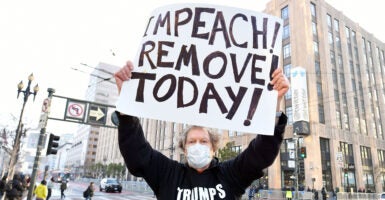
A protester identified as Kenneth Lundgreen makes his point Monday as police set up barricades outside Twitter’s corporate headquarters in San Francisco after the social media giant permanently barred President Donald Trump from its platform. (Photo: Josh Edelson/AFP/ Getty Images)

Democrats want to impeach President Donald Trump for a second time, but they’ll have to hurry—even to get a simple majority vote in the House of Representatives. 

The goal of a second impeachment would be to disqualify Trump from holding office again. Or, more to the point, prevent him from running for president in 2024. 

Here are seven things to know as impeachment moves forward, again. 

1. When Would Impeachment Happen?

It appears likely that the Democrat-controlled House would impeach Trump before he leaves office but deliver the article or articles of impeachment to the Senate after President-elect Joe Biden takes office. This could reportedly happen as early as Wednesday. 

The demand for socialism is on the rise from young Americans today. But is socialism even morally sound? Find out more now >>

House Democrats introduced one article of impeachment Monday, charging the president with “incitement of insurrection.” 

The measure was co-authored by Reps. David Cicilline, D-R.I., Ted Lieu, D-Calif., and Jamie Raskin, D-Md., all members of the House Judiciary Committee and close to House Democrat leadership. 

In a public statement, the three Democrats said:

Last Wednesday marked one of the darkest days in the history of our country. After months of agitation and propaganda against the results of the 2020 election, the United States Capitol—the citadel of our democracy—was attacked as President Trump’s supporters attempted to stage a coup and overturn the results of our free and fair presidential election. We cannot allow this unprecedented provocation to go unanswered. Everyone involved in this assault must be held accountable, beginning with the man most responsible for it – President Donald Trump. We cannot begin to heal the soul of this country without first delivering swift justice to all its enemies—foreign and domestic.

The House Judiciary Committee could expedite the matter without a hearing and pass articles of impeachment with a party-line vote, as it did in late 2019. 

House Speaker Nancy Pelosi, D-Calif., has said she would bring a vote on impeachment to the House floor if Vice President Mike Pence didn’t convene the Cabinet to remove Trump under the 25th Amendment to the Constitution. 

Most constitutional legal scholars say the 25th Amendment wouldn’t be applicable in this case because it was meant for circumstances when a president is incapacitated.  

House Majority Leader Steny Hoyer, D-Md., said he would bring up Raskin’s proposal to form a 25th Amendment Commission to evaluate the physical and mental fitness of the president for continuity of government. The congressional commission still would have to work with the vice president.

Pelosi tweeted Monday that the House would vote on the 25th Amendment legislation, and if this did not succeed, “As our next step, we will move forward with bringing impeachment legislation to the Floor.”https://platform.twitter.com/embed/index.html?creatorScreenName=dailysignal&dnt=true&embedId=twitter-widget-0&frame=false&hideCard=false&hideThread=false&id=1348677048634634247&lang=en&origin=https%3A%2F%2Fwww.dailysignal.com%2F2021%2F01%2F11%2Fcould-trump-face-impeachment-trial-after-leaving-office-7-things-to-know%2F&siteScreenName=dailysignal&theme=light&widgetsVersion=ed20a2b%3A1601588405575&width=500px

It requires only a simple majority in the House to approve articles of impeachment. However, it requires a two-thirds majority in the Senate, after a trial, to remove a president from office. 

In late 2019 and early 2020, Trump—like Presidents Bill Clinton in 1998 and Andrew Johnson in 1868—was impeached in the House and acquitted by the Senate. 

Those previous impeachments of presidents, as well as impeachments of judges, had a goal in mind, said Thomas Jipping, former chief counsel for the Senate Judiciary Committee, who was involved in the impeachment trial of a federal judge in 2010.

“It is supposed to be the first step in the removal of a public official from office,” Jipping, deputy director of the Mees Center for Legal and Judicial Studies at The Heritage Foundation, told The Daily Signal. “What is the point of removing someone from office who doesn’t occupy that office?”

An ABC News poll found 56% want Trump to leaveoffice before the end of his term. 

2. How Would Disqualification Work?

Trump and some supporters have indicated he would run again for president in the 2024 race. 

But the Senate could vote to disqualify Trump from holding any future federal office. 

Article I, Section 3, Clause 7 of the Constitution says that if a federal official is convicted in an impeachment trial, “judgment in cases of impeachment shall not extend further than to removal from office, and disqualification to hold and enjoy any office of honor, trust or profit under the United States.” 

Unlike removal from office, the Senate needs only a simple majority to disqualify someone from holding office. However, a two-thirds vote for removal must first occur before moving forward to the disqualification vote. 

“The Senate trial would require a two-thirds votes on removal, after that, the next step would be further sanction, mainly prohibiting him from holding office again,” Michael Lawlor, an associate professor of criminal justice at the University of New Haven, told The Daily Signal.

Lawlor helped lead the impeachment effort against a Connecticut governor. 

“They could potentially strip [Trump] of a presidential pension, Secret Service protection and a presidential stipend,” he said.

Lawlor, a Democrat, was chairman of the Connecticut Legislature’s House Judiciary Committee and a member of the House impeachment committee investigating then-Gov. John G. Rowland, a Republican, in 2004. In that case, Rowland resigned and the House took no further action.  

3. When Would Senate Hold a Trial?

Senate rules say an impeachment trial must begin at 1 p.m. the day after the Senate receives the article or articles of impeachment from those chosen to be the House impeachment managers. 

So, the earliest a trial could start would be when the Senate is back in session, which Jan. 20. That’s the day of Biden’s inauguration as president. 

However, Senate Democrat Leader Charles Schumer, D-N.Y., reportedly will seek the support of Senate Republican Leader Mitch McConnell, R-Ky., to use a 2004 Senate rule to allow the leaders to recall the Senate into emergency session before Jan. 20. https://platform.twitter.com/embed/index.html?creatorScreenName=dailysignal&dnt=true&embedId=twitter-widget-1&frame=false&hideCard=false&hideThread=false&id=1348752843054993413&lang=en&origin=https%3A%2F%2Fwww.dailysignal.com%2F2021%2F01%2F11%2Fcould-trump-face-impeachment-trial-after-leaving-office-7-things-to-know%2F&siteScreenName=dailysignal&theme=light&widgetsVersion=ed20a2b%3A1601588405575&width=500px

But the second Senate trial of Trump could happen more than three months later. 

House Majority Whip James Clyburn, D-S.C., saidSunday that the House could take up impeachment this week, but hold off on delivering articles of impeachment to the Senate until after 100 days into Biden’s term. 

The reason would be to prevent a distraction from Biden’s legislative agenda, Clyburn said. 

An impeachment at this point would be almost entirely political theater, presidential historian Craig Shirley says. 

“This would be a sequel to a bad movie,” Shirley told The Daily Signal, adding: “Even for Democrats, Trump is good for ratings; whether someone has a good, bad, or indifferent view of Trump, he draws attention.”

4. Could the Senate Disqualify Trump From Future Office?

Once all the senators are seated for an impeachment trial, to convict Trump would require 17 Republican senators to vote with all Senate Democrats. 

Again, the Senate could not move to a simple majority vote to disqualify Trump from holding office unless it already had a vote of two-thirds or more to convict the president. 

To put it one way, a conviction requires a supermajority of 67 out of 100 senators. A sentencing would require only 51 votes. 

After Georgia Democrats Raphael Warnock and Jon Ossoff take office, the Senate will be split 50-50 between Republicans and Democrats. And once sworn in as Biden’s vice president, Kamala Harris, in her role as president of the Senate, will give the Democrats a majority in case of tie votes.

Many Senate Republicans—including Ben Sasseof Nebraska, Pat Toomey of Pennsylvania, and Lisa Murkowski of Alaska—expressed strong disapproval of some of Trump’s remarks to supporters in a rally  before the Capitol riot. But reaching 17 Republican votes to convict would be difficult, particularly if Trump already is out of office. 

Given the slim chance of a conviction, impeachment after Trump leaves office would be largely a political move, Jipping said. 

“They want him to leave office as bruised and roughed up as possible, and sullied in the eyes of the public,” Jipping said. “The point would be to inflict as much damage politically as possible.”

But there is a path to convicting Trump, Lawlor said. If Trump or his associates were aware that rhetoric at the rally was a signal to riot at the Capitol, he said, Republican senators likely would get on board. 

“I’m not sure it’s that unlikely,” Lawlor said, adding:

It depends on what we find out over the next few weeks. Was there some collusion with the folks at the Capitol? Republicans might say, it was really that bad. … If there is evidence this was an intended outcome, if Trump—aside from maybe being a cheerleader—knew this would happen, more Republicans would vote to convict.

5. What Happens If Trump Pardons Himself?

Whether a president can pardon himself never has been tested, though Trump reportedly is considering the move.  

The Constitution’s pardon clause provides that the president “shall have Power to grant Reprieves and Pardons for Offences against the United States, except in Cases of Impeachment.”

So, a pardon would shield Trump from prosecution at the federal level, but it would have no effect on Congress’s power to impeach and remove him. 

A pardon also wouldn’t prevent Trump from being prosecuted at the state level. New York Attorney General Letitia James has targeted Trump, long a New York-based developer and businessman. 

“For a president to pardon himself would give the appearance a president of the United States is completely above the law,” Lawlor said. “It would be tested in the Supreme Court. It’s like a law school debate of nightmare scenarios.”

Constitutional scholars argue about the topic, Shirley said. 

He said it will take time for emotions to cool and temperatures to lower to assess Trump’s presidency and accomplishments such as record economic growth, Middle East treaties, and successful development of vaccines to fight COVID-19.

“He didn’t end his presidency well,” Shirley said. “He had a good story to tell as a one-term president. It would have been a good story to tell for a two-term president. But you can’t judge the Trump presidency without judging his character. It’s not just accomplishments. It’s also character.”

6. What Other Impeached Officials Were Disqualified?

Out of 15 federal judges impeached in U.S. history, eight were removed from office. The Senate voted to disqualify three of those eight judges from holding federal office again. 

In 1862, Judge West H. Humphreys of the Western District of Tennessee was the first judge to be impeached, convicted, removed, and disqualified from holding future office. 

Humphreys stands out for being found guilty of “waging war on the U.S. government” during the Civil War.

The other two judges prohibited from holding office again had been charged with corruption: Judge Robert W. Archibold of the U.S. Commerce Court in 1912, and Judge Thomas Porteus of the Eastern District of Louisiana in 2010. 

The most notable federal judge to be impeached by the House and removed by the Senate but not disqualified from holding future office was Judge Alcee Hastings of the Southern District of Florida. In 1988, the House charged Hastings with perjury and soliciting a bribe.

After he was acquitted in a later criminal trial, Hastings ran for Congress in 1992 and won. He continues to represent Florida’s 20th Congressional District. 

 7. What Usually Happens When an Impeached Official Is Out of Office?

The House in 1876 impeached a Cabinet secretary after he had left office. The Senate acquitted him in a trial. 

In the most recent example, the Senate in 2010 dropped a trial for a federal judge who had resigned. 

Judge Samuel Kent of the Southern District of Texas was accused of sexual misconduct in August 2008. Kent pleaded not guilty to five related charges. 

The next month, he pleaded guilty in a criminal court to obstruction of justice in connection with making false statements to a special investigative committee of the U.S. Court of Appeals for the 5th Circuit.

The guilty plea to obstruction allowed Kent to avoid prosecution on the other charges.As part of the plea, though, the judge admitted to engaging in nonconsensual sexual contact with two court employees. He was sentenced to 33 months. 

A special House investigative committee to explore impeachment, chaired by Rep. Adam Schiff, D-Calif, who would go on to lead the impeachment of Trump, began hearings with Kent’s alleged victims on June 2, 2009. 

Kent had announced that he would resign in a year—on June 1, 2010, which would have allowed him to continue collecting his salary for a year. Kent reported to prison on June 15, 2009. 

The House on June 9 recommended four articles of impeachment against Kent. The House Judiciary Committee unanimously approved the articles and sent the articles to the House floor the next day. 

On June 19, the full House approved two articles of impeachment related to sexual assault, one for obstruction of justice and another for providing false statements to the FBI. 

The Senate trial began June 24 with Sen. Claire McCaskill, D-Mo., as chairwoman and Sen. Mel Martinez, R-Fla., as vice chairman of the specially appointed Senate Impeachment Trial Committee. The same committee handled the trial of Porteus. 

On June 25, when Senate staffers traveled to a prison to present Kent with a summons to testify, the judge gave them a handwritten resignationnote. This time the resignation was effective June 30, 2009.

The House then passed a resolution, HR 661, to end the Kent proceeding, and the Senate special committee took no further action on Kent. 

“There would have been no point in moving forward with a vote to remove him from office because he already quit,” Jipping said. “After HR 661, there was no reason to pursue any further.” 

Another example, in the executive branch, goes back to the scandal-plagued War Secretary William Belknap of  the Grant administration. In 1876, a House investigation found evidence that Belknap took part in kickbacks and other corruption involving a military vendor that paid $20,000 to the war secretary. 

On March 2, 1876, Belknap resigned from office just minutes before the House was scheduled to impeach him. The Democrat-controlled House nevertheless approved five articles of impeachment, including one accusing Belknap of “criminally disregarding his duty as Secretary of War and basely prostituting his high office to his lust for private gain.”

The fact that Belknap no longer held office didn’t prevent the Republican-controlled Senate from holding a trial. On Aug. 1, 1876, a Senate majority voted in favor of all five articles of impeachment against Belknap—well short of the two-thirds required to convict.

The former war secretary was acquitted and never prosecuted.

—-

I have read several books by Alan Dershowitz and he is a liberal but he does look at the constitution honestly and here he has made some very insightful observations that I am sure will upset Democrats but nonetheless will not slow them down from impeaching the President a second time because of their hate of all things Trump!

Dershowitz: Senate Rules Would Prevent Impeachment Trial Of Trump

Dershowitz: Senate Rules Would Prevent Impeachment Trial Of TrumpAn image from video of Alan Dershowitz, an attorney for President Donald Trump, walking from the podium after speaking on behalf of the president during the impeachment trial in the Senate on Jan. 27, 2020. (Senate Television via AP)By Newsmax Wires 
Sunday, 10 Jan 2021 2:42 PM

Join in the Discussion!


Harvard law professor and constitutional law expert Alan Dershowitz on Sunday warned an impeachment of President Donald Trump won’t go to trial — but could “lie around like a loaded weapon” for both parties in the future.

In an interview on Fox News’ “Sunday Morning Futures,” Dershowitz said a Senate trial of citizen Trump would be unconstitutional.

“It will not go to trial,” he said. “All Democrats can do is impeach the president in House of Representatives, for that you only need a majority vote. 

“The case cannot come to trial in the Senate” because of rules that do no allow it until, “according to the Majority Leader [Mitch McConnell, R-Ky.), until 1 p.m. on Jan. 20” — an hour after Trump leaves office.

Read Newsmax: Newsmax – Breaking News | News Videos | Politics, Health, Finance
Urgent: Do you approve of Pres. Trump’s job performance? Vote Here Now!

“Congress has no power to impeach or try a private citizen, whether it’d be a private citizen in Donald Trump or …. Barack Obama or anyone else,” he said. “The jurisdiction is limited to a sitting president and so there won’t be a trial.”

But Dershowitz said he worried more about  is“the impact of impeachment on the First Amendment.”

“For 100 years the Supreme Court and other courts have struggled to develop a juris prudence which distinguishes between advocacy and incitement.”

“To impeach a president for having exercised his First Amendment rights would be so dangerous to the Constitution, it would lie around like a loaded weapon ready to be used by either party against the other party and that’s not what impeachment nor the 25th amendment were intended to be,” Dershowitz said.

Read Newsmax: Newsmax – Breaking News | News Videos | Politics, Health, Finance
Urgent: Do you approve of Pres. Trump’s job performance? Vote Here Now!

Mark Levin Podcast * Mark’s radio show | 08 January 2021

Levin: Media ‘exploiting’ Capitol riot to ‘silence conservatives’ as Democrats work to ‘choke the system’

‘The media have played a huge, huge role in what’s going on in this country,’ says ‘Life, Liberty & Levin’ host

By Charles Creitz | Fox News

The mainstream media is “exploiting” Wednesday’s riot at the U.S. Capitol building in an effort to “silence” conservatives and Republicans, Mark Levin says on this week’s episode of “Life, Liberty & Levin.”

The host emphasizes that “we should be furious about what happened on Capitol Hill,” but adds that “the media have played a huge, huge role in what’s going on in this country.”

“We need to reject all this violence, but what about the media?” asks Levin before displaying front pages of various newspapers from around the country. 

“The New York Times: ‘Trump Incites Mob’. This is projection,” Levin contends. “This is projection. He never did that. Or The Washington Post: ‘Trump mob storms Capitol’. There were hundreds and hundreds of thousands of people there … That’s an awfully broad brush. Or the [New York] Daily News: ‘President Incites Insurrection’ … or USA Today: ‘Pro-Trump Mobs Storm US [sic] Capitol’. How about ‘Thugs Storm U.S. Capitol’? How about ‘Lawbreakers Storm U.S. Capitol’?”

Levin then calls out politicians like Rep. Adam Kinzinger, R-Ill., and Senate Minority Leader Chuck Schumer, D-N.Y., who he says are also “exploiting the situation.”

“They’re talking about impeaching the president of the United States or [invoking] the 25th Amendment nine days before he leaves office,” the host says. “Do they even know what’s involved in the 25th Amendment?

WATCH ‘LIFE, LIBERTY & LEVIN’ SUNDAYS AT 8 PM ET ON FOX NEWS CHANNEL

“So they double down, they triple down, they quadruple down. They’re not going to change at all. On one side of their mouth, they talk about unity. Out of the other side of their mouth, they spit on people,” he goes on. “Seventy-four million [Trump-voting] people and more, they’re not going away. Their concerns still exist.”

Meanwhile, Levin says, House Democrats are working toward their goal to “choke the system even further” by passing a rules package for the 117th Congressthat makes it “virtually impossible for Republicans to even propose legislation or amend legislation, even though [they] only has a 10- or 11-person majority in the House.”

“Nancy Pelosi … eliminated 100 years of tradition …”, the host argues, “and the media are trying to intimidate conservatives and constitutionalists by projecting onto them the violence that occurred by reprobates and others who need to be tracked down and punished.

“So it seems that the lessons have not been learned,” Levin concludes. “They certainly haven’t been learned by the left, they certainly haven’t been learned by the media, and they certainly haven’t been learned by the Never Trumpers.”

—-

December 13, 2020

Office of Barack and Michelle Obama
P.O. Box 91000
Washington, DC 20066

Dear President Obama,

I wrote you over 700 letters while you were President and I mailed them to the White House and also published them on my blog http://www.thedailyhatch.org .I received several letters back from your staff and I wanted to thank you for those letters. 

I have been reading your autobiography A PROMISED LAND and I have been enjoying it. 

Let me make a few comments on it, and here is the first quote of yours I want to comment on:

The story of how this postwar consensus broke down—starting with LBJ’s signing of the Civil Rights Act of 1964 and his prediction that it would lead to the South’s wholesale abandonment of the Democratic Party—has been told many times before. The realignment Johnson foresaw ended up taking longer than he had expected. But steadily, year by year—through Vietnam, RIOTS…and Nixon’s southern strategy; through busing, Roe v. Wade, urban crime, and white flight; through affirmative action, the Moral Majority, union busting, and Robert Bork; through assault weapons bans and the rise of Newt Gingrich…and the Clinton impeachment—America’s voters and their representatives became more and more polarized.

During 2020 I have noticed lots of riots and looting across the USA and I wanted to ask you why it is always the liberals doing that? AND WHY DIDN’T ANYONE CONDEMN THESE ACTIONS AT THE 2020 CONVENTION AND DIDN’T YOU SPEAK AT THE CONVENTION TOO?

Philadelphia Riots Another Case of Street Violence Used to Advance Radical Political Agendas

https://www.dailysignal.com/2020/10/28/philadelphia-riots-are-another-case-of-street-violence-used-to-advance-radical-political-agendas/embed/#?secret=TeMODTeKco

Philadelphia Riots Are Another Case of Street Violence Used to Advance Radical Political Agendas

James Carafano @JJCarafano / October 28, 2020 / 4 Comments

Philadelphia Riots

In Kenosha, Portland, Seattle, and Chicago, city officials have tolerated criminal activity performed by mobs for politically motivated reasons. Philadelphia appears to be the next hotspot for mob violence to go unchecked. Pictured: A barricade is set on fire during a night of looting and violence in Philadelphia on Oct. 27. (Photo: Gabriella Audi/AFP/Getty Images)

COMMENTARY BY

James Carafano@JJCarafano

James Jay Carafano, a leading expert in national security and foreign policy challenges, is The Heritage Foundation’s vice president for foreign and defense policy studies, E. W. Richardson fellow, and director of the Kathryn and Shelby Cullom Davis Institute for International Studies. Read his research.

Like the replay of a bad movie, a law enforcement incident in Philadelphia triggered an excuse for violence and looting. It remains to be seen whether the City of Brotherly Love will become the next “Kenosha,” where city officials moved quickly to restore order and seek state and federal support—though sadly after 48 hours of opportunistic looting, violence, and destruction devastated the city.

Or perhaps Philadelphia will be the next PortlandSeattle, or Chicago, where systemic attacks seem to be a daily occurrence.

Police in Philadelphia are fully capable of restoring peace. The open question is whether the mayor and Larry Krasner, the former defense attorney-turned elected rogue prosecutor, will do their job and hold people accountable for their crimes.

When local, state, and federal governments work together, act quickly, and demonstrate no tolerance for organized violence to advance radical agendas, communities are kept safe and equal protection under the law is afforded for all citizens.

The left is actively working to undermine the integrity of our elections. Read the plan to stop them now. Learn more now >>

On the other hand, when local officials, the media, and politicians ignore, excuse, normalize, and enable violence, everyday Americans pay the price.

There is a plague sweeping this country that many don’t want to talk about: The deliberate use of street violence to advance radical political agendas, often under a smoke screen of campaigning for civil liberties. The evidence of organized criminal activity at the root of the outbreaks in American cities is mounting.

The list of people enabling this violence sadly includes some public officials, who are principally responsible for ensuring public safety. For example, a growing threat to peaceful communities is “rogue prosecutors,” former criminal defense attorneys recruited and funded by liberal billionaire backers, who—once elected—abuse their office by refusing to prosecute entire categories of crimes.

These rogue prosecutors are usurping the power of the legislature in the process, and ignoring victim’s rights—all to advance their politics.

Baltimore is a perfect  example. Since being sworn into office, under the watch of Baltimore City State’s Attorney Marilyn J. Mosby.

Rogue prosecutors fuel street violence by refusing to prosecute rioters and looters. When confronted with the rising crimes rates, Mosby called the statistics “rhetoric.”

The only way to break the cycle of violence is for local and state officials to work with each other, and if necessary, the federal government. They need to stop enabling the destruction of property and lives on their streets, and start investigating and prosecuting the individuals (and organizations) behind the riots.

It’s time to start shaming and calling out the media, politicians, and advocates who excuse and normalize the violence.

There is a proven action plan for making our streets safe. It is past time for officials to start following this blueprint.

There is no time—zero time to waste. There are already fears of more violence in our streets, regardless of the outcome of the national elections.

In my hometown of Washington, D.C., downtown buildings are already boarding up in anticipation of violence on our streets after the election. If Trump wins, violence. If Biden wins, violence. This makes no sense, and it’s time for it to stop.

It is time for every official and public figure, every political party, in every part of the country to publically reject violence on American streets as a legitimate form of protected speech. Violence is not protected speech, period.

The notion of deliberately destroying the lives and property of our neighbors to advance a radical political agenda is abhorrent. American leaders—of all stripes—should stand up now as one and reject these violent acts. It has gone on for too long, well before the death of George Floyd.

Leaders in Philadelphia and across America must take a principled stand to demand the end to this violence, and they need to do it before the election. In one voice, they should demand: “Leave our streets alone.”

Sincerely,

Everette Hatcher III, 13900 Cottontail Lane, Alexander, AR 72002, ph 501-920-5733 everettehatcher@gmail.com

Related posts:

Open letter to President Obama (Part 293) (Founding Fathers’ view on Christianity, Elbridge Gerry of MA)

April 10, 2013 – 7:02 am

President Obama c/o The White House 1600 Pennsylvania Avenue NW Washington, DC 20500 Dear Mr. President, I know that you receive 20,000 letters a day and that you actually read 10 of them every day. I really do respect you for trying to get a pulse on what is going on out here. There have […]By Everette Hatcher III | Posted in David BartonFounding FathersPresident Obama | Edit |Comments (0)

The Founding Fathers views concerning Jesus, Christianity and the Bible (Part 5, John Hancock)

May 8, 2012 – 1:48 am

There have been many articles written by evangelicals like me who fear that our founding fathers would not recognize our country today because secular humanism has rid our nation of spiritual roots. I am deeply troubled by the secular agenda of those who are at war with religion in our public life. Lillian Kwon quoted somebody […]By Everette Hatcher III | Posted in David BartonFounding Fathers | Edit | Comments (0)

The Founding Fathers views concerning Jesus, Christianity and the Bible (Part 4, Elbridge Gerry)

May 7, 2012 – 1:46 am

There have been many articles written by evangelicals like me who fear that our founding fathers would not recognize our country today because secular humanism has rid our nation of spiritual roots. I am deeply troubled by the secular agenda of those who are at war with religion in our public life. Lillian Kwon quoted somebody […]By Everette Hatcher III | Posted in David BartonFounding Fathers | Edit | Comments (0)

The Founding Fathers views concerning Jesus, Christianity and the Bible (Part 3, Samuel Adams)

May 4, 2012 – 1:45 am

There have been many articles written by evangelicals like me who fear that our founding fathers would not recognize our country today because secular humanism has rid our nation of spiritual roots. I am deeply troubled by the secular agenda of those who are at war with religion in our public life. Lillian Kwon quoted somebody […]By Everette Hatcher III | Posted in David BartonFounding Fathers | Edit | Comments (0)

The Founding Fathers views concerning Jesus, Christianity and the Bible (Part 2, John Quincy Adams)

May 3, 2012 – 1:42 am

There have been many articles written by evangelicals like me who fear that our founding fathers would not recognize our country today because secular humanism has rid our nation of spiritual roots. I am deeply troubled by the secular agenda of those who are at war with religion in our public life. Lillian Kwon quoted somebody […]By Everette Hatcher III | Posted in David BartonFounding Fathers | Edit | Comments (0)

The Founding Fathers views concerning Jesus, Christianity and the Bible (Part 1, John Adams)

May 2, 2012 – 1:13 am

There have been many articles written by evangelicals like me who fear that our founding fathers would not recognize our country today because secular humanism has rid our nation of spiritual roots. I am deeply troubled by the secular agenda of those who are at war with religion in our public life. Lillian Kwon quoted somebody […]By Everette Hatcher III | Posted in Founding Fathers | Edit | Comments (0)

President Obama and the Founding Fathers

May 8, 2013 – 9:20 am

President Obama Speaks at The Ohio State University Commencement Ceremony Published on May 5, 2013 President Obama delivers the commencement address at The Ohio State University. May 5, 2013. You can learn a lot about what President Obama thinks the founding fathers were all about from his recent speech at Ohio State. May 7, 2013, […]By Everette Hatcher III | Posted in Founding FathersPresident Obama | Edit | Comments (0)

Francis Schaeffer’s own words concerning the founding fathers and their belief in inalienable rights

December 5, 2012 – 12:38 am

Dr. C. Everett Koop with Bill Graham. Francis Schaeffer: “Whatever Happened to the Human Race” (Episode 4) THE BASIS FOR HUMAN DIGNITY Published on Oct 7, 2012 by AdamMetropolis The 45 minute video above is from the film series created from Francis Schaeffer’s book “Whatever Happened to the Human Race?” with Dr. C. Everett Koop. This […]By Everette Hatcher III | Posted in Founding FathersFrancis SchaefferProlife | Edit |Comments (1)

David Barton: In their words, did the Founding Fathers put their faith in Christ? (Part 4)

May 30, 2012 – 1:35 am

America’s Founding Fathers Deist or Christian? – David Barton 4/6 There have been many articles written by evangelicals like me who fear that our founding fathers would not recognize our country today because secular humanism has rid our nation of spiritual roots. I am deeply troubled by the secular agenda of those who are at […]By Everette Hatcher III | Posted in David BartonFounding Fathers | Tagged governor of connecticutjohn witherspoonjonathan trumbull | Edit | Comments (1)

Were the founding fathers christian?

May 23, 2012 – 7:04 am

3 Of 5 / The Bible’s Influence In America / American Heritage Series / David Barton There were 55 gentlemen who put together the constitution and their church affliation is of public record. Greg Koukl notes: Members of the Constitutional Convention, the most influential group of men shaping the political foundations of our nation, were […]By Everette Hatcher III | Posted in Founding Fathers | Edit | Comments (0)

John Quincy Adams a founding father?

June 29, 2011 – 3:58 pm

I do  not think that John Quincy Adams was a founding father in the same sense that his  father was. However, I do think he was involved in the  early days of our government working with many of the founding fathers. Michele Bachmann got into another history-related tussle on ABC’s “Good  Morning America” today, standing […]By Everette Hatcher III | Posted in David BartonFounding Fathers | Edit | Comments (0)

“Sanctity of Life Saturday” Taking on Ark Times Bloggers on various issues Part E “Moral absolutes and abortion” Francis Schaeffer Quotes part 5(includes the film SLAUGHTER OF THE INNOCENTS) (editorial cartoon)

July 6, 2013 – 1:26 am

I have gone back and forth and back and forth with many liberals on the Arkansas Times Blog on many issues such as abortion, human rights, welfare, poverty, gun control  and issues dealing with popular culture. Here is another exchange I had with them a while back. My username at the Ark Times Blog is Saline […]By Everette Hatcher III | Posted in Arkansas TimesFrancis SchaefferProlife | Edit |Comments (0)

Article from Adrian Rogers, “Bring back the glory”

June 11, 2013 – 12:34 am

I truly believe that many of the problems we have today in the USA are due to the advancement of humanism in the last few decades in our society. Ronald Reagan appointed the evangelical Dr. C. Everett Koop to the position of Surgeon General in his administration. He partnered with Dr. Francis Schaeffer in making the […]By Everette Hatcher III | Posted in Adrian RogersFrancis Schaeffer | Edit | Comments (0)

“Schaeffer Sundays” Francis Schaeffer’s own words concerning the possibility that minorities may be mistreated under 51% rule

June 9, 2013 – 1:21 am

Francis Schaeffer: “Whatever Happened to the Human Race” (Episode 4) THE BASIS FOR HUMAN DIGNITY Published on Oct 7, 2012 by AdamMetropolis ____________ The 45 minute video above is from the film series created from Francis Schaeffer’s book “Whatever Happened to the Human Race?” with Dr. C. Everett Koop. This book  really helped develop my political […]By Everette Hatcher III | Posted in Francis Schaeffer | Edit | Comments (0)

—-

I have read several books by Alan Dershowitz and he is a liberal but he does look at the constitution honestly and here he has made some very insightful observations that I am sure will upset Democrats but nonetheless will not slow them down from impeaching the President a second time because of their hate of all things Trump!


I have read several books by Alan Dershowitz and he is a liberal but he does look at the constitution honestly and here he has made some very insightful observations that I am sure will upset Democrats but nonetheless will not slow them down from impeaching the President a second time because of their hate of all things Trump!

Dershowitz: Senate Rules Would Prevent Impeachment Trial Of Trump

Dershowitz: Senate Rules Would Prevent Impeachment Trial Of TrumpAn image from video of Alan Dershowitz, an attorney for President Donald Trump, walking from the podium after speaking on behalf of the president during the impeachment trial in the Senate on Jan. 27, 2020. (Senate Television via AP)By Newsmax Wires 
Sunday, 10 Jan 2021 2:42 PM

Join in the Discussion!


Harvard law professor and constitutional law expert Alan Dershowitz on Sunday warned an impeachment of President Donald Trump won’t go to trial — but could “lie around like a loaded weapon” for both parties in the future.

In an interview on Fox News’ “Sunday Morning Futures,” Dershowitz said a Senate trial of citizen Trump would be unconstitutional.

“It will not go to trial,” he said. “All Democrats can do is impeach the president in House of Representatives, for that you only need a majority vote. 

“The case cannot come to trial in the Senate” because of rules that do no allow it until, “according to the Majority Leader [Mitch McConnell, R-Ky.), until 1 p.m. on Jan. 20” — an hour after Trump leaves office.

Read Newsmax: Newsmax – Breaking News | News Videos | Politics, Health, Finance
Urgent: Do you approve of Pres. Trump’s job performance? Vote Here Now!

“Congress has no power to impeach or try a private citizen, whether it’d be a private citizen in Donald Trump or …. Barack Obama or anyone else,” he said. “The jurisdiction is limited to a sitting president and so there won’t be a trial.”

But Dershowitz said he worried more about  is“the impact of impeachment on the First Amendment.”

“For 100 years the Supreme Court and other courts have struggled to develop a juris prudence which distinguishes between advocacy and incitement.”

“To impeach a president for having exercised his First Amendment rights would be so dangerous to the Constitution, it would lie around like a loaded weapon ready to be used by either party against the other party and that’s not what impeachment nor the 25th amendment were intended to be,” Dershowitz said.

Read Newsmax: Newsmax – Breaking News | News Videos | Politics, Health, Finance
Urgent: Do you approve of Pres. Trump’s job performance? Vote Here Now!

Mark Levin Podcast * Mark’s radio show | 08 January 2021

Levin: Media ‘exploiting’ Capitol riot to ‘silence conservatives’ as Democrats work to ‘choke the system’

‘The media have played a huge, huge role in what’s going on in this country,’ says ‘Life, Liberty & Levin’ host

By Charles Creitz | Fox News

The mainstream media is “exploiting” Wednesday’s riot at the U.S. Capitol building in an effort to “silence” conservatives and Republicans, Mark Levin says on this week’s episode of “Life, Liberty & Levin.”

The host emphasizes that “we should be furious about what happened on Capitol Hill,” but adds that “the media have played a huge, huge role in what’s going on in this country.”

“We need to reject all this violence, but what about the media?” asks Levin before displaying front pages of various newspapers from around the country. 

“The New York Times: ‘Trump Incites Mob’. This is projection,” Levin contends. “This is projection. He never did that. Or The Washington Post: ‘Trump mob storms Capitol’. There were hundreds and hundreds of thousands of people there … That’s an awfully broad brush. Or the [New York] Daily News: ‘President Incites Insurrection’ … or USA Today: ‘Pro-Trump Mobs Storm US [sic] Capitol’. How about ‘Thugs Storm U.S. Capitol’? How about ‘Lawbreakers Storm U.S. Capitol’?”

Levin then calls out politicians like Rep. Adam Kinzinger, R-Ill., and Senate Minority Leader Chuck Schumer, D-N.Y., who he says are also “exploiting the situation.”

“They’re talking about impeaching the president of the United States or [invoking] the 25th Amendment nine days before he leaves office,” the host says. “Do they even know what’s involved in the 25th Amendment?

WATCH ‘LIFE, LIBERTY & LEVIN’ SUNDAYS AT 8 PM ET ON FOX NEWS CHANNEL

“So they double down, they triple down, they quadruple down. They’re not going to change at all. On one side of their mouth, they talk about unity. Out of the other side of their mouth, they spit on people,” he goes on. “Seventy-four million [Trump-voting] people and more, they’re not going away. Their concerns still exist.”

Meanwhile, Levin says, House Democrats are working toward their goal to “choke the system even further” by passing a rules package for the 117th Congressthat makes it “virtually impossible for Republicans to even propose legislation or amend legislation, even though [they] only has a 10- or 11-person majority in the House.”

“Nancy Pelosi … eliminated 100 years of tradition …”, the host argues, “and the media are trying to intimidate conservatives and constitutionalists by projecting onto them the violence that occurred by reprobates and others who need to be tracked down and punished.

“So it seems that the lessons have not been learned,” Levin concludes. “They certainly haven’t been learned by the left, they certainly haven’t been learned by the media, and they certainly haven’t been learned by the Never Trumpers.”

—-

December 13, 2020

Office of Barack and Michelle Obama
P.O. Box 91000
Washington, DC 20066

Dear President Obama,

I wrote you over 700 letters while you were President and I mailed them to the White House and also published them on my blog http://www.thedailyhatch.org .I received several letters back from your staff and I wanted to thank you for those letters. 

I have been reading your autobiography A PROMISED LAND and I have been enjoying it. 

Let me make a few comments on it, and here is the first quote of yours I want to comment on:

The story of how this postwar consensus broke down—starting with LBJ’s signing of the Civil Rights Act of 1964 and his prediction that it would lead to the South’s wholesale abandonment of the Democratic Party—has been told many times before. The realignment Johnson foresaw ended up taking longer than he had expected. But steadily, year by year—through Vietnam, RIOTS…and Nixon’s southern strategy; through busing, Roe v. Wade, urban crime, and white flight; through affirmative action, the Moral Majority, union busting, and Robert Bork; through assault weapons bans and the rise of Newt Gingrich…and the Clinton impeachment—America’s voters and their representatives became more and more polarized.

During 2020 I have noticed lots of riots and looting across the USA and I wanted to ask you why it is always the liberals doing that? AND WHY DIDN’T ANYONE CONDEMN THESE ACTIONS AT THE 2020 CONVENTION AND DIDN’T YOU SPEAK AT THE CONVENTION TOO?

Philadelphia Riots Another Case of Street Violence Used to Advance Radical Political Agendas

https://www.dailysignal.com/2020/10/28/philadelphia-riots-are-another-case-of-street-violence-used-to-advance-radical-political-agendas/embed/#?secret=TeMODTeKco

Philadelphia Riots Are Another Case of Street Violence Used to Advance Radical Political Agendas

James Carafano @JJCarafano / October 28, 2020 / 4 Comments

Philadelphia Riots

In Kenosha, Portland, Seattle, and Chicago, city officials have tolerated criminal activity performed by mobs for politically motivated reasons. Philadelphia appears to be the next hotspot for mob violence to go unchecked. Pictured: A barricade is set on fire during a night of looting and violence in Philadelphia on Oct. 27. (Photo: Gabriella Audi/AFP/Getty Images)

COMMENTARY BY

James Carafano@JJCarafano

James Jay Carafano, a leading expert in national security and foreign policy challenges, is The Heritage Foundation’s vice president for foreign and defense policy studies, E. W. Richardson fellow, and director of the Kathryn and Shelby Cullom Davis Institute for International Studies. Read his research.

Like the replay of a bad movie, a law enforcement incident in Philadelphia triggered an excuse for violence and looting. It remains to be seen whether the City of Brotherly Love will become the next “Kenosha,” where city officials moved quickly to restore order and seek state and federal support—though sadly after 48 hours of opportunistic looting, violence, and destruction devastated the city.

Or perhaps Philadelphia will be the next PortlandSeattle, or Chicago, where systemic attacks seem to be a daily occurrence.

Police in Philadelphia are fully capable of restoring peace. The open question is whether the mayor and Larry Krasner, the former defense attorney-turned elected rogue prosecutor, will do their job and hold people accountable for their crimes.

When local, state, and federal governments work together, act quickly, and demonstrate no tolerance for organized violence to advance radical agendas, communities are kept safe and equal protection under the law is afforded for all citizens.

The left is actively working to undermine the integrity of our elections. Read the plan to stop them now. Learn more now >>

On the other hand, when local officials, the media, and politicians ignore, excuse, normalize, and enable violence, everyday Americans pay the price.

There is a plague sweeping this country that many don’t want to talk about: The deliberate use of street violence to advance radical political agendas, often under a smoke screen of campaigning for civil liberties. The evidence of organized criminal activity at the root of the outbreaks in American cities is mounting.

The list of people enabling this violence sadly includes some public officials, who are principally responsible for ensuring public safety. For example, a growing threat to peaceful communities is “rogue prosecutors,” former criminal defense attorneys recruited and funded by liberal billionaire backers, who—once elected—abuse their office by refusing to prosecute entire categories of crimes.

These rogue prosecutors are usurping the power of the legislature in the process, and ignoring victim’s rights—all to advance their politics.

Baltimore is a perfect  example. Since being sworn into office, under the watch of Baltimore City State’s Attorney Marilyn J. Mosby.

Rogue prosecutors fuel street violence by refusing to prosecute rioters and looters. When confronted with the rising crimes rates, Mosby called the statistics “rhetoric.”

The only way to break the cycle of violence is for local and state officials to work with each other, and if necessary, the federal government. They need to stop enabling the destruction of property and lives on their streets, and start investigating and prosecuting the individuals (and organizations) behind the riots.

It’s time to start shaming and calling out the media, politicians, and advocates who excuse and normalize the violence.

There is a proven action plan for making our streets safe. It is past time for officials to start following this blueprint.

There is no time—zero time to waste. There are already fears of more violence in our streets, regardless of the outcome of the national elections.

In my hometown of Washington, D.C., downtown buildings are already boarding up in anticipation of violence on our streets after the election. If Trump wins, violence. If Biden wins, violence. This makes no sense, and it’s time for it to stop.

It is time for every official and public figure, every political party, in every part of the country to publically reject violence on American streets as a legitimate form of protected speech. Violence is not protected speech, period.

The notion of deliberately destroying the lives and property of our neighbors to advance a radical political agenda is abhorrent. American leaders—of all stripes—should stand up now as one and reject these violent acts. It has gone on for too long, well before the death of George Floyd.

Leaders in Philadelphia and across America must take a principled stand to demand the end to this violence, and they need to do it before the election. In one voice, they should demand: “Leave our streets alone.”

Sincerely,

Everette Hatcher III, 13900 Cottontail Lane, Alexander, AR 72002, ph 501-920-5733 everettehatcher@gmail.com

Related posts:

Open letter to President Obama (Part 293) (Founding Fathers’ view on Christianity, Elbridge Gerry of MA)

April 10, 2013 – 7:02 am

President Obama c/o The White House 1600 Pennsylvania Avenue NW Washington, DC 20500 Dear Mr. President, I know that you receive 20,000 letters a day and that you actually read 10 of them every day. I really do respect you for trying to get a pulse on what is going on out here. There have […]By Everette Hatcher III | Posted in David BartonFounding FathersPresident Obama | Edit |Comments (0)

The Founding Fathers views concerning Jesus, Christianity and the Bible (Part 5, John Hancock)

May 8, 2012 – 1:48 am

There have been many articles written by evangelicals like me who fear that our founding fathers would not recognize our country today because secular humanism has rid our nation of spiritual roots. I am deeply troubled by the secular agenda of those who are at war with religion in our public life. Lillian Kwon quoted somebody […]By Everette Hatcher III | Posted in David BartonFounding Fathers | Edit | Comments (0)

The Founding Fathers views concerning Jesus, Christianity and the Bible (Part 4, Elbridge Gerry)

May 7, 2012 – 1:46 am

There have been many articles written by evangelicals like me who fear that our founding fathers would not recognize our country today because secular humanism has rid our nation of spiritual roots. I am deeply troubled by the secular agenda of those who are at war with religion in our public life. Lillian Kwon quoted somebody […]By Everette Hatcher III | Posted in David BartonFounding Fathers | Edit | Comments (0)

The Founding Fathers views concerning Jesus, Christianity and the Bible (Part 3, Samuel Adams)

May 4, 2012 – 1:45 am

There have been many articles written by evangelicals like me who fear that our founding fathers would not recognize our country today because secular humanism has rid our nation of spiritual roots. I am deeply troubled by the secular agenda of those who are at war with religion in our public life. Lillian Kwon quoted somebody […]By Everette Hatcher III | Posted in David BartonFounding Fathers | Edit | Comments (0)

The Founding Fathers views concerning Jesus, Christianity and the Bible (Part 2, John Quincy Adams)

May 3, 2012 – 1:42 am

There have been many articles written by evangelicals like me who fear that our founding fathers would not recognize our country today because secular humanism has rid our nation of spiritual roots. I am deeply troubled by the secular agenda of those who are at war with religion in our public life. Lillian Kwon quoted somebody […]By Everette Hatcher III | Posted in David BartonFounding Fathers | Edit | Comments (0)

The Founding Fathers views concerning Jesus, Christianity and the Bible (Part 1, John Adams)

May 2, 2012 – 1:13 am

There have been many articles written by evangelicals like me who fear that our founding fathers would not recognize our country today because secular humanism has rid our nation of spiritual roots. I am deeply troubled by the secular agenda of those who are at war with religion in our public life. Lillian Kwon quoted somebody […]By Everette Hatcher III | Posted in Founding Fathers | Edit | Comments (0)

President Obama and the Founding Fathers

May 8, 2013 – 9:20 am

President Obama Speaks at The Ohio State University Commencement Ceremony Published on May 5, 2013 President Obama delivers the commencement address at The Ohio State University. May 5, 2013. You can learn a lot about what President Obama thinks the founding fathers were all about from his recent speech at Ohio State. May 7, 2013, […]By Everette Hatcher III | Posted in Founding FathersPresident Obama | Edit | Comments (0)

Francis Schaeffer’s own words concerning the founding fathers and their belief in inalienable rights

December 5, 2012 – 12:38 am

Dr. C. Everett Koop with Bill Graham. Francis Schaeffer: “Whatever Happened to the Human Race” (Episode 4) THE BASIS FOR HUMAN DIGNITY Published on Oct 7, 2012 by AdamMetropolis The 45 minute video above is from the film series created from Francis Schaeffer’s book “Whatever Happened to the Human Race?” with Dr. C. Everett Koop. This […]By Everette Hatcher III | Posted in Founding FathersFrancis SchaefferProlife | Edit |Comments (1)

David Barton: In their words, did the Founding Fathers put their faith in Christ? (Part 4)

May 30, 2012 – 1:35 am

America’s Founding Fathers Deist or Christian? – David Barton 4/6 There have been many articles written by evangelicals like me who fear that our founding fathers would not recognize our country today because secular humanism has rid our nation of spiritual roots. I am deeply troubled by the secular agenda of those who are at […]By Everette Hatcher III | Posted in David BartonFounding Fathers | Tagged governor of connecticutjohn witherspoonjonathan trumbull | Edit | Comments (1)

Were the founding fathers christian?

May 23, 2012 – 7:04 am

3 Of 5 / The Bible’s Influence In America / American Heritage Series / David Barton There were 55 gentlemen who put together the constitution and their church affliation is of public record. Greg Koukl notes: Members of the Constitutional Convention, the most influential group of men shaping the political foundations of our nation, were […]By Everette Hatcher III | Posted in Founding Fathers | Edit | Comments (0)

John Quincy Adams a founding father?

June 29, 2011 – 3:58 pm

I do  not think that John Quincy Adams was a founding father in the same sense that his  father was. However, I do think he was involved in the  early days of our government working with many of the founding fathers. Michele Bachmann got into another history-related tussle on ABC’s “Good  Morning America” today, standing […]By Everette Hatcher III | Posted in David BartonFounding Fathers | Edit | Comments (0)

“Sanctity of Life Saturday” Taking on Ark Times Bloggers on various issues Part E “Moral absolutes and abortion” Francis Schaeffer Quotes part 5(includes the film SLAUGHTER OF THE INNOCENTS) (editorial cartoon)

July 6, 2013 – 1:26 am

I have gone back and forth and back and forth with many liberals on the Arkansas Times Blog on many issues such as abortion, human rights, welfare, poverty, gun control  and issues dealing with popular culture. Here is another exchange I had with them a while back. My username at the Ark Times Blog is Saline […]By Everette Hatcher III | Posted in Arkansas TimesFrancis SchaefferProlife | Edit |Comments (0)

Article from Adrian Rogers, “Bring back the glory”

June 11, 2013 – 12:34 am

I truly believe that many of the problems we have today in the USA are due to the advancement of humanism in the last few decades in our society. Ronald Reagan appointed the evangelical Dr. C. Everett Koop to the position of Surgeon General in his administration. He partnered with Dr. Francis Schaeffer in making the […]By Everette Hatcher III | Posted in Adrian RogersFrancis Schaeffer | Edit | Comments (0)

“Schaeffer Sundays” Francis Schaeffer’s own words concerning the possibility that minorities may be mistreated under 51% rule

June 9, 2013 – 1:21 am

Francis Schaeffer: “Whatever Happened to the Human Race” (Episode 4) THE BASIS FOR HUMAN DIGNITY Published on Oct 7, 2012 by AdamMetropolis ____________ The 45 minute video above is from the film series created from Francis Schaeffer’s book “Whatever Happened to the Human Race?” with Dr. C. Everett Koop. This book  really helped develop my political […]By Everette Hatcher III | Posted in Francis Schaeffer | Edit | Comments (0)

—-

Forbes Says It’s Targeting Trump Staffers and Their Future Employers


Forbes Says It’s Targeting Trump Staffers and Their Future Employers

forbes magazine logo on a smartphone(Dreamstime)By Michael Dorstewitz 
Sunday, 10 Jan 2021 2:23 PM

Join in the Discussion!


Corporate media and the Left aren’t satisfied with merely controlling the White House and both chambers of Congress in less than two weeks. They want revenge.

They also want to punish anyone who worked in the Trump administration and, to a lesser extent, the 45th president’s supporters.

On Thursday, in what was the most recent and possibly the most egregious example, Randall Lane, Forbes’ chief content officer, announced that Forbes Media was “holding those who lied for Trump accountable” in what he called “a truth reckoning.”

Lane claimed that the media group was taking this unprecedented action in response to the mob attack on Capitol Hill late Wednesday afternoon, which resulted in two deaths — a Capitol Police officer and a female U.S. Air Force veteran who was demonstrating that day.

Read Newsmax: Newsmax – Breaking News | News Videos | Politics, Health, Finance
Urgent: Do you approve of Pres. Trump’s job performance? Vote Here Now!

Lane alleged that the president’s “lies-upon-lies, repeated frequently and fervently, provided the kindling, the spark, the gasoline” that led to the attack.

Lane then singles out five senior White House officials, whom he describes as “the people paid by the People to inform the People.”

He named former White House press secretaries Sean Spicer (currently co-host of Newsmax TV’s “Spicer & Co.”), Sarah Huckabee Sanders, and Stephanie Grisham, as well as current spokeswoman Kayleigh McEnany.

Lane also named Kellyanne Conway, senior counselor to the president.

Read Newsmax: Newsmax – Breaking News | News Videos | Politics, Health, Finance
Urgent: Do you approve of Pres. Trump’s job performance? Vote Here Now!

So what does he propose?

“Simple,” he said. “Don’t let the chronic liars cash in on their dishonesty.”

He observed that previous White House spokesmen have reaped millions in royalties from book deals after they left, adding that “Trump’s liars don’t merit that same golden parachute.”

Acting more like a Mafia don than a media executive, Lane then threatened future employers: “Hire any of Trump’s fellow fabulists above, and Forbes will assume that everything your company or firm talks about is a lie.”

His short, 600-word rant is filled with hyperbole and outright misstatements of fact.

Lane uses the word “lie,” “lies,” “liar” or “lied” nine times in his piece — three times in the first paragraph alone.

There’s no reference to the fact that it was the previous president, not Trump, who was awarded PolitiFact’s “Lie of the Year.”

Nor does he acknowledge the daily claims for nearly four years on corporate media and by Democrats promoting the Russian collusion hoax.

What’s his remedy for accountability for that doozy?

Lane’s article sounds so unhinged the reader has to keep referring to the masthead to confirm that it’s indeed Forbes and not some far-left publication like Vox, Slate, or Raw Story.

And that it’s not an opinion columnist, but the company’s chief content officer who clearly states he is speaking for Forbes, not just himself.

Forbes is seriously diminished by such cancel culture rantings, considering it has long been considered a respected business publication of its creator, B.C. Forbes, a tradition carried on by the late Malcom S. Forbes, and his son Steve, one of the country’s most noted conservatives.

Steve Forbes has been a strong supporter of Trump’s, endorsing in both 2016 and 2020.

The irony is explained by the fact Steve and the Forbes family no longer own Forbes the media company.

In fact, Forbes Media was sold six years ago to Integrated Whale Media Investments, which is based in Hong Kong, and which has since become a territory of mainland Communist China.

Forbes wasn’t the first to threaten future employers of Trump White House staffers.

Rep. Alexandria Ocasio-Cortez suggested shortly after the November election that someone should begin compiling a list of Trump White House staffers.

“Is anyone archiving these Trump sycophants for when they try to downplay or deny their complicity in the future?” The New York Democrat asked.

“I foresee decent probability of many deleted Tweets, writings, photos in the future.”

Hari Sevugan, former senior spokesman for the Barack Obama presidential campaign, answered the call.

“You better believe it,” he replied. “We just launched the Trump Accountability Project to make sure anyone who took a paycheck to help Trump undermine America is held responsible for what they did.”

The Lincoln Project’s Stuart Stevens announced that it will also track former White House staffers.

“At @ProjectLincoln we are constructing a database of Trump officials & staff that will detail their roles in the Trump administration & track where they are now,” he tweeted Saturday.

“No personal info, only professional. But they will be held accountable & not allowed to pretend they were not involved,” he added.

Fox News senior political analyst Brit Hume offered a five-word analysis of the Lincoln Project effort.

“This will not end well,” he said.

Related Story:

Read Newsmax: Newsmax – Breaking News | News Videos | Politics, Health, Finance
Urgent: Do you approve of Pres. Trump’s job performance? Vote Here Now!

Mark Levin Podcast * Mark’s radio show | 08 January 2021

Levin: Media ‘exploiting’ Capitol riot to ‘silence conservatives’ as Democrats work to ‘choke the system’

‘The media have played a huge, huge role in what’s going on in this country,’ says ‘Life, Liberty & Levin’ host

By Charles Creitz | Fox News

The mainstream media is “exploiting” Wednesday’s riot at the U.S. Capitol building in an effort to “silence” conservatives and Republicans, Mark Levin says on this week’s episode of “Life, Liberty & Levin.”

The host emphasizes that “we should be furious about what happened on Capitol Hill,” but adds that “the media have played a huge, huge role in what’s going on in this country.”

“We need to reject all this violence, but what about the media?” asks Levin before displaying front pages of various newspapers from around the country. 

“The New York Times: ‘Trump Incites Mob’. This is projection,” Levin contends. “This is projection. He never did that. Or The Washington Post: ‘Trump mob storms Capitol’. There were hundreds and hundreds of thousands of people there … That’s an awfully broad brush. Or the [New York] Daily News: ‘President Incites Insurrection’ … or USA Today: ‘Pro-Trump Mobs Storm US [sic] Capitol’. How about ‘Thugs Storm U.S. Capitol’? How about ‘Lawbreakers Storm U.S. Capitol’?”

Levin then calls out politicians like Rep. Adam Kinzinger, R-Ill., and Senate Minority Leader Chuck Schumer, D-N.Y., who he says are also “exploiting the situation.”

“They’re talking about impeaching the president of the United States or [invoking] the 25th Amendment nine days before he leaves office,” the host says. “Do they even know what’s involved in the 25th Amendment?

WATCH ‘LIFE, LIBERTY & LEVIN’ SUNDAYS AT 8 PM ET ON FOX NEWS CHANNEL

“So they double down, they triple down, they quadruple down. They’re not going to change at all. On one side of their mouth, they talk about unity. Out of the other side of their mouth, they spit on people,” he goes on. “Seventy-four million [Trump-voting] people and more, they’re not going away. Their concerns still exist.”

Meanwhile, Levin says, House Democrats are working toward their goal to “choke the system even further” by passing a rules package for the 117th Congressthat makes it “virtually impossible for Republicans to even propose legislation or amend legislation, even though [they] only has a 10- or 11-person majority in the House.”

“Nancy Pelosi … eliminated 100 years of tradition …”, the host argues, “and the media are trying to intimidate conservatives and constitutionalists by projecting onto them the violence that occurred by reprobates and others who need to be tracked down and punished.

“So it seems that the lessons have not been learned,” Levin concludes. “They certainly haven’t been learned by the left, they certainly haven’t been learned by the media, and they certainly haven’t been learned by the Never Trumpers.”

—-

December 13, 2020

Office of Barack and Michelle Obama
P.O. Box 91000
Washington, DC 20066

Dear President Obama,

I wrote you over 700 letters while you were President and I mailed them to the White House and also published them on my blog http://www.thedailyhatch.org .I received several letters back from your staff and I wanted to thank you for those letters. 

I have been reading your autobiography A PROMISED LAND and I have been enjoying it. 

Let me make a few comments on it, and here is the first quote of yours I want to comment on:

The story of how this postwar consensus broke down—starting with LBJ’s signing of the Civil Rights Act of 1964 and his prediction that it would lead to the South’s wholesale abandonment of the Democratic Party—has been told many times before. The realignment Johnson foresaw ended up taking longer than he had expected. But steadily, year by year—through Vietnam, RIOTS…and Nixon’s southern strategy; through busing, Roe v. Wade, urban crime, and white flight; through affirmative action, the Moral Majority, union busting, and Robert Bork; through assault weapons bans and the rise of Newt Gingrich…and the Clinton impeachment—America’s voters and their representatives became more and more polarized.

During 2020 I have noticed lots of riots and looting across the USA and I wanted to ask you why it is always the liberals doing that? AND WHY DIDN’T ANYONE CONDEMN THESE ACTIONS AT THE 2020 CONVENTION AND DIDN’T YOU SPEAK AT THE CONVENTION TOO?

Philadelphia Riots Another Case of Street Violence Used to Advance Radical Political Agendas

https://www.dailysignal.com/2020/10/28/philadelphia-riots-are-another-case-of-street-violence-used-to-advance-radical-political-agendas/embed/#?secret=TeMODTeKco

Philadelphia Riots Are Another Case of Street Violence Used to Advance Radical Political Agendas

James Carafano @JJCarafano / October 28, 2020 / 4 Comments

Philadelphia Riots

In Kenosha, Portland, Seattle, and Chicago, city officials have tolerated criminal activity performed by mobs for politically motivated reasons. Philadelphia appears to be the next hotspot for mob violence to go unchecked. Pictured: A barricade is set on fire during a night of looting and violence in Philadelphia on Oct. 27. (Photo: Gabriella Audi/AFP/Getty Images)

COMMENTARY BY

James Carafano@JJCarafano

James Jay Carafano, a leading expert in national security and foreign policy challenges, is The Heritage Foundation’s vice president for foreign and defense policy studies, E. W. Richardson fellow, and director of the Kathryn and Shelby Cullom Davis Institute for International Studies. Read his research.

Like the replay of a bad movie, a law enforcement incident in Philadelphia triggered an excuse for violence and looting. It remains to be seen whether the City of Brotherly Love will become the next “Kenosha,” where city officials moved quickly to restore order and seek state and federal support—though sadly after 48 hours of opportunistic looting, violence, and destruction devastated the city.

Or perhaps Philadelphia will be the next PortlandSeattle, or Chicago, where systemic attacks seem to be a daily occurrence.

Police in Philadelphia are fully capable of restoring peace. The open question is whether the mayor and Larry Krasner, the former defense attorney-turned elected rogue prosecutor, will do their job and hold people accountable for their crimes.

When local, state, and federal governments work together, act quickly, and demonstrate no tolerance for organized violence to advance radical agendas, communities are kept safe and equal protection under the law is afforded for all citizens.

The left is actively working to undermine the integrity of our elections. Read the plan to stop them now. Learn more now >>

On the other hand, when local officials, the media, and politicians ignore, excuse, normalize, and enable violence, everyday Americans pay the price.

There is a plague sweeping this country that many don’t want to talk about: The deliberate use of street violence to advance radical political agendas, often under a smoke screen of campaigning for civil liberties. The evidence of organized criminal activity at the root of the outbreaks in American cities is mounting.

The list of people enabling this violence sadly includes some public officials, who are principally responsible for ensuring public safety. For example, a growing threat to peaceful communities is “rogue prosecutors,” former criminal defense attorneys recruited and funded by liberal billionaire backers, who—once elected—abuse their office by refusing to prosecute entire categories of crimes.

These rogue prosecutors are usurping the power of the legislature in the process, and ignoring victim’s rights—all to advance their politics.

Baltimore is a perfect  example. Since being sworn into office, under the watch of Baltimore City State’s Attorney Marilyn J. Mosby.

Rogue prosecutors fuel street violence by refusing to prosecute rioters and looters. When confronted with the rising crimes rates, Mosby called the statistics “rhetoric.”

The only way to break the cycle of violence is for local and state officials to work with each other, and if necessary, the federal government. They need to stop enabling the destruction of property and lives on their streets, and start investigating and prosecuting the individuals (and organizations) behind the riots.

It’s time to start shaming and calling out the media, politicians, and advocates who excuse and normalize the violence.

There is a proven action plan for making our streets safe. It is past time for officials to start following this blueprint.

There is no time—zero time to waste. There are already fears of more violence in our streets, regardless of the outcome of the national elections.

In my hometown of Washington, D.C., downtown buildings are already boarding up in anticipation of violence on our streets after the election. If Trump wins, violence. If Biden wins, violence. This makes no sense, and it’s time for it to stop.

It is time for every official and public figure, every political party, in every part of the country to publically reject violence on American streets as a legitimate form of protected speech. Violence is not protected speech, period.

The notion of deliberately destroying the lives and property of our neighbors to advance a radical political agenda is abhorrent. American leaders—of all stripes—should stand up now as one and reject these violent acts. It has gone on for too long, well before the death of George Floyd.

Leaders in Philadelphia and across America must take a principled stand to demand the end to this violence, and they need to do it before the election. In one voice, they should demand: “Leave our streets alone.”

Sincerely,

Everette Hatcher III, 13900 Cottontail Lane, Alexander, AR 72002, ph 501-920-5733 everettehatcher@gmail.com

Related posts:

Open letter to President Obama (Part 293) (Founding Fathers’ view on Christianity, Elbridge Gerry of MA)

April 10, 2013 – 7:02 am

President Obama c/o The White House 1600 Pennsylvania Avenue NW Washington, DC 20500 Dear Mr. President, I know that you receive 20,000 letters a day and that you actually read 10 of them every day. I really do respect you for trying to get a pulse on what is going on out here. There have […]By Everette Hatcher III | Posted in David BartonFounding FathersPresident Obama | Edit |Comments (0)

The Founding Fathers views concerning Jesus, Christianity and the Bible (Part 5, John Hancock)

May 8, 2012 – 1:48 am

There have been many articles written by evangelicals like me who fear that our founding fathers would not recognize our country today because secular humanism has rid our nation of spiritual roots. I am deeply troubled by the secular agenda of those who are at war with religion in our public life. Lillian Kwon quoted somebody […]By Everette Hatcher III | Posted in David BartonFounding Fathers | Edit | Comments (0)

The Founding Fathers views concerning Jesus, Christianity and the Bible (Part 4, Elbridge Gerry)

May 7, 2012 – 1:46 am

There have been many articles written by evangelicals like me who fear that our founding fathers would not recognize our country today because secular humanism has rid our nation of spiritual roots. I am deeply troubled by the secular agenda of those who are at war with religion in our public life. Lillian Kwon quoted somebody […]By Everette Hatcher III | Posted in David BartonFounding Fathers | Edit | Comments (0)

The Founding Fathers views concerning Jesus, Christianity and the Bible (Part 3, Samuel Adams)

May 4, 2012 – 1:45 am

There have been many articles written by evangelicals like me who fear that our founding fathers would not recognize our country today because secular humanism has rid our nation of spiritual roots. I am deeply troubled by the secular agenda of those who are at war with religion in our public life. Lillian Kwon quoted somebody […]By Everette Hatcher III | Posted in David BartonFounding Fathers | Edit | Comments (0)

The Founding Fathers views concerning Jesus, Christianity and the Bible (Part 2, John Quincy Adams)

May 3, 2012 – 1:42 am

There have been many articles written by evangelicals like me who fear that our founding fathers would not recognize our country today because secular humanism has rid our nation of spiritual roots. I am deeply troubled by the secular agenda of those who are at war with religion in our public life. Lillian Kwon quoted somebody […]By Everette Hatcher III | Posted in David BartonFounding Fathers | Edit | Comments (0)

The Founding Fathers views concerning Jesus, Christianity and the Bible (Part 1, John Adams)

May 2, 2012 – 1:13 am

There have been many articles written by evangelicals like me who fear that our founding fathers would not recognize our country today because secular humanism has rid our nation of spiritual roots. I am deeply troubled by the secular agenda of those who are at war with religion in our public life. Lillian Kwon quoted somebody […]By Everette Hatcher III | Posted in Founding Fathers | Edit | Comments (0)

President Obama and the Founding Fathers

May 8, 2013 – 9:20 am

President Obama Speaks at The Ohio State University Commencement Ceremony Published on May 5, 2013 President Obama delivers the commencement address at The Ohio State University. May 5, 2013. You can learn a lot about what President Obama thinks the founding fathers were all about from his recent speech at Ohio State. May 7, 2013, […]By Everette Hatcher III | Posted in Founding FathersPresident Obama | Edit | Comments (0)

Francis Schaeffer’s own words concerning the founding fathers and their belief in inalienable rights

December 5, 2012 – 12:38 am

Dr. C. Everett Koop with Bill Graham. Francis Schaeffer: “Whatever Happened to the Human Race” (Episode 4) THE BASIS FOR HUMAN DIGNITY Published on Oct 7, 2012 by AdamMetropolis The 45 minute video above is from the film series created from Francis Schaeffer’s book “Whatever Happened to the Human Race?” with Dr. C. Everett Koop. This […]By Everette Hatcher III | Posted in Founding FathersFrancis SchaefferProlife | Edit |Comments (1)

David Barton: In their words, did the Founding Fathers put their faith in Christ? (Part 4)

May 30, 2012 – 1:35 am

America’s Founding Fathers Deist or Christian? – David Barton 4/6 There have been many articles written by evangelicals like me who fear that our founding fathers would not recognize our country today because secular humanism has rid our nation of spiritual roots. I am deeply troubled by the secular agenda of those who are at […]By Everette Hatcher III | Posted in David BartonFounding Fathers | Tagged governor of connecticutjohn witherspoonjonathan trumbull | Edit | Comments (1)

Were the founding fathers christian?

May 23, 2012 – 7:04 am

3 Of 5 / The Bible’s Influence In America / American Heritage Series / David Barton There were 55 gentlemen who put together the constitution and their church affliation is of public record. Greg Koukl notes: Members of the Constitutional Convention, the most influential group of men shaping the political foundations of our nation, were […]By Everette Hatcher III | Posted in Founding Fathers | Edit | Comments (0)

John Quincy Adams a founding father?

June 29, 2011 – 3:58 pm

I do  not think that John Quincy Adams was a founding father in the same sense that his  father was. However, I do think he was involved in the  early days of our government working with many of the founding fathers. Michele Bachmann got into another history-related tussle on ABC’s “Good  Morning America” today, standing […]By Everette Hatcher III | Posted in David BartonFounding Fathers | Edit | Comments (0)

“Sanctity of Life Saturday” Taking on Ark Times Bloggers on various issues Part E “Moral absolutes and abortion” Francis Schaeffer Quotes part 5(includes the film SLAUGHTER OF THE INNOCENTS) (editorial cartoon)

July 6, 2013 – 1:26 am

I have gone back and forth and back and forth with many liberals on the Arkansas Times Blog on many issues such as abortion, human rights, welfare, poverty, gun control  and issues dealing with popular culture. Here is another exchange I had with them a while back. My username at the Ark Times Blog is Saline […]By Everette Hatcher III | Posted in Arkansas TimesFrancis SchaefferProlife | Edit |Comments (0)

Article from Adrian Rogers, “Bring back the glory”

June 11, 2013 – 12:34 am

I truly believe that many of the problems we have today in the USA are due to the advancement of humanism in the last few decades in our society. Ronald Reagan appointed the evangelical Dr. C. Everett Koop to the position of Surgeon General in his administration. He partnered with Dr. Francis Schaeffer in making the […]By Everette Hatcher III | Posted in Adrian RogersFrancis Schaeffer | Edit | Comments (0)

“Schaeffer Sundays” Francis Schaeffer’s own words concerning the possibility that minorities may be mistreated under 51% rule

June 9, 2013 – 1:21 am

Francis Schaeffer: “Whatever Happened to the Human Race” (Episode 4) THE BASIS FOR HUMAN DIGNITY Published on Oct 7, 2012 by AdamMetropolis ____________ The 45 minute video above is from the film series created from Francis Schaeffer’s book “Whatever Happened to the Human Race?” with Dr. C. Everett Koop. This book  really helped develop my political […]By Everette Hatcher III | Posted in Francis Schaeffer | Edit | Comments (0)

—-

MUSIC MONDAY Paul McCartney’s song BAND ON THE RUN

Paul McCartney & Wings – Band On The Run (Rockshow) [HD]

Band on the Run (song)

From Wikipedia, the free encyclopedia
“Band on the Run”
https://youtu.be/eAnA2KE8A4E

French single sleeve
Single by Paul McCartney and Wings
from the album Band on the Run
B-side Nineteen Hundred and Eighty-Five(US)
Zoo Gang(UK)
Released 8 April 1974 (US)
28 June 1974 (UK)
Format 7″ single
Recorded September 1973
Genre Rock
Length 5:09 (album and single versions)
3:50 (radio edit)
Label Apple
Writer(s) Paul McCartney, Linda McCartney
Producer(s) Paul McCartney
Certification Gold (RIAA, 4 June 1974)[1]
Gold (BPI, 1 September 1974)[2]
Paul McCartney and Wings singles chronology
Jet
(1974)
Band on the Run
(1974)
Junior’s Farm
(1974)
Band on the Run track listing
Alternative cover

Spanish cover with “Zoo Gang” on b-side

Band on the Run” is the title song of Paul McCartney and Wings‘ 1973 album Band on the Run. The song was released as a single in 1974, following the success of “Jet“, and became an international chart success. The song topped the charts in the United States, also reaching number 3 in the United Kingdom.[3][4] The single sold over one million copies in 1974 in America.[3] It has since become one of the band’s most famous songs.

A medley of song fragments that vary in style from folk rock to funk, “Band on the Run” is one of McCartney’s longest singles at 5:09. The song was partly inspired by a comment that George Harrisonhad made during a meeting of the BeatlesApple record label. The song-wide theme is one of freedom and escape, and its creation coincided with Harrison, John Lennon and Ringo Starr having parted with manager Allen Klein in March 1973, leading to improved relations between McCartney and his fellow ex-Beatles. The original demos for this and other tracks on Band on the Run were stolen shortly after Wings arrived in Lagos, Nigeria, to begin recording the album. With the band reduced to a trio consisting of McCartney, his wife Linda, and Denny Laine, “Band on the Run” was recorded atEMI‘s Lagos studio and completed at AIR Studios in London.

Background[edit]

It was symbolic: “If we ever get out of here … All I need is a pint a day” … [In the Beatles] we’d started off as just kids really, who loved our music and wanted to earn a bob or two so we could get a guitar and get a nice car. It was very simple ambitions at first. But then, you know, as it went on it became business meetings and all of that … So there was a feeling of “if we ever get out of here”, yeah. And I did.

– Paul McCartney, to Clash Music[5]

Paul McCartney noted the drug busts musicians of the late 1960s and early 1970s experienced as an inspiration for the “Band on the Run”, also referencing the “desperado” image he attributed to bands like The Byrds and Eagles as an influence.[6] McCartney, who had been having legal trouble involving pot possession, said, “We were being outlawed for pot … And our [Wings’] argument on [‘Band on the Run’] was ‘Don’t put us on the wrong side … We’re not criminals, we don’t want to be. So I just made up a story about people breaking out of prison.'”[6]

In a subsequent interview, McCartney stated that the lyric “If we ever get out of here” was inspired by George Harrison saying these words during one of the Beatles’ many business meetings.[7] McCartney recalled: “He was saying that we were all prisoners in some way [due to the ongoing problems with their company Apple] … I thought it would be a nice way to start an album.”[8][nb 1] McCartney added, referring to his inspiration for “Band on the Run”: “It’s a million things … all put together. Band on the run – escaping, freedom, criminals. You name it, it’s there.”[9]

According to Mojo contributor Tom Doyle, the song’s lyrics, recalled through memory following the robbery of the band’s demo tapes for the Band on the Run album, were altered to reflect on the band’s then-current status, “stuck inside the four walls of the small, cell-like studio, faced with grim uncertainty.”[10]

Nineteen Hundred and Eighty-Five“, the closing track of the Band on the Run album, concludes with a brief excerpt of the chorus.[11]

Composition[edit]

“Band on the Run” is a three-part medley, with the first section being a slow ballad, the second featuring a funk rock style,[12] and the final a country-esque section.[12] The lyrics of the entire song, however, are related, with all being based around a general theme of freedom and escape.[13][14]

Recording[edit]

The original demo recording for “Band on the Run”, as well as multiple other tracks from the album, was stolen from the McCartneys by a group of thugs while Paul McCartney and Wings were recording in Lagos, Nigeria.[5] Robbed at knife-point, they relinquished the demos, only recovering the songs through memory.[10] Paul McCartney later remarked, “It was stuff that would be worth a bit on eBay these days, you know? But no, we figured the guys who mugged us wouldn’t even be remotely interested. If they’d have known, they could have just held on to them and made themselves a little fortune. But they didn’t know, and we reckoned they’d probably record over them.”[5]

The song was recorded in two parts, in different sessions. The first two were taped in Lagos while the third section was recorded in October 1973 at AIR Studios in London.[15]

Release[edit]

Originally, Paul McCartney planned not to release any singles from Band on the Run, a strategy he compared to that used by The Beatles.[16] However, he was convinced by Capitol Records promotion man Al Coury to release singles from the album, resulting in the single release of “Jet” and “Band on the Run”.[17]

Al [Coury, promotion man for Capitol Records] released ‘Jet,’ which I wasn’t even thinking of releasing as a single, and ‘Band on the Run’ too. He single-handedly turned [Band on the Run] around.[17]

“Band on the Run”, backed with “Nineteen Hundred and Eighty-Five”, was released in America on 8 April 1974 as the follow-up single to Paul McCartney and Wings’ top-ten hit “Jet“. The song was a smash hit for the band, becoming McCartney’s third solo American chart-topping single and Wings’ second.[3] The single was later released in Britain (instead backed with “Zoo Gang“, the theme song to the television show of the same name), reaching number 3 on the British charts.[4] The song was also a top 40 single in multiple European countries, such as the Netherlands (number 7),[18] Belgium (number 21),[19] and Germany (number 22).[20]

The US radio edit was 3:50 in length. The difference was largely caused by the removal of the middle or the second part of the song, as well as the verse that starts with “Well, the undertaker drew a heavy sigh …”[21]

The single was certified Gold by the Recording Industry Association of America for sales of over one million copies.[22] It was the second of five number-one singles for the band on the Billboard Hot 100.[3] In 1974, Billboard ranked it number 22 on its Top Pop Singles year-end chart.[23] Billboard also listed the song as Paul McCartney’s sixth most successful chart hit of all time, excluding Beatles releases.[24]

“Band on the Run” has also been featured on numerous McCartney/Wings compilation albums, including Wings Greatest,[25] All the Best!,[26] and Wingspan: Hits and History.[27] The song is also performed in many of McCartney’s live shows, with a live version being included on the 1976 live album Wings over America.[28]

Videos[edit]

An official video, directed by Michael Coulson, was released along with the song. It served mostly as a tribute to The Beatles, featuring montages of still pictures from their career. Present-day McCartney and Wings were not shown. The video ends with a collage of Beatles pictures much like the album cover of Sgt. Pepper’s Lonely Hearts Club Band.[29]

In 2014, a new video for “Band on the Run” was created. The video designed by Ben Ib, an artist who created tour visuals for Paul McCartney (as well as Roger Waters and The Smashing Pumpkins) and the cover for Paul McCartney’s 2013 solo album New.[30] In the video, all of the objects, including the “band on the run” itself, are made up of words.[31]

Reception[edit]

The song was praised by former bandmate and songwriting partner, John Lennon, who considered it “a great song and a great album”.[32] In 2014, Billboard praised “Band on the Run” for having “three distinct parts that don’t depend on a chorus yet still manage to feel anthemic.”[24] AllMusic critic Stewart Mason called the track “classic McCartney”, lauding the song for “manag[ing] to be experimental in form yet so deliciously melodic that its structural oddities largely go unnoticed.”[12]

“Band on the Run” also won the “Best Pop Vocal Performance by a Duo, Group or Chorus” at the 17th Annual Grammy Awards.[33] NME ranked the song as the tenth best song of the 1970s, as well as the fifteenth best solo song by an ex-Beatle.[34][35] In 2010, AOL Radio listeners voted “Band on the Run” the best song of Paul McCartney’s solo career, achieving a better ranking than “Maybe I’m Amazed” and “Silly Love Songs“.[36] In 2012, Rolling Stone readers ranked the song as McCartney’s fourth best song of all time, behind “Maybe I’m Amazed“, “Hey Jude“, and “Yesterday“.[37] Rolling Stone readers also ranked the song the fifth best solo song by ex-members of The Beatles.[38]

Personnel[edit]

Chart positions[edit]

Weekly singles charts[edit]

Chart (1974) Peak
position
Belgium (Ultratop)[19] 21
Canada (RPM 100 Top Singles)[39] 1
Germany (Media Control)[20] 22
Japan (Oricon)[40] 58
Netherlands (Dutch Top 40)[18] 7
UK Singles Chart (Official Charts Company)[4] 3
US Billboard Hot 100[3] 1
US Easy Listening (Billboard)[3] 22

Year-end charts[edit]

Chart (1974) Position
Canada (RPM 100 Top Singles)[41] 20
UK Singles Chart (Official Charts Company)[42] 46
US Billboard Hot 100[43] 22

Other appearances[edit]

Cover versions[edit]

Notes[edit]

  1. Jump up^ Speaking to Clash Music in 2009, however, he said: “I don’t remember that being a George line. I don’t know about that.”[5]

References[edit]

Citations[edit]

  1. Jump up^ “RIAA Gold and Platinum”. RIAA. Retrieved2012-10-12.
  2. Jump up^ “Certified Awards Search”. BPI. Archived from the original on 2012-10-02. Retrieved 2012-10-12.
  3. ^ Jump up to:abcdef “Paul McCartney Charts and Awards”.allmusic. Retrieved 2011-10-13.
  4. ^ Jump up to:abc “Official Charts: Paul McCartney”. The Official UK Charts Company. Retrieved 2011-10-13.
  5. ^ Jump up to:abcd Harper 2010.
  6. ^ Jump up to:ab McGee 2003, pp. 223–224.
  7. Jump up^ “BBC – Radio 2 – Sold On Song – Song Library – Band On The Run”. BBC. Retrieved 21 March 2009.
  8. Jump up^ Spizer 2005, pp. 274.
  9. Jump up^ Gambaccini 1976.
  10. ^ Jump up to:ab Doyle 2014, pp. 92.
  11. Jump up^ Jackson 2012, pp. 122.
  12. ^ Jump up to:abc Mason, Stewart. “Band on the Run (song) review”.AllMusic.
  13. Jump up^ Rodriguez 2010, pp. 160.
  14. Jump up^ Jackson 2012, pp. 108–109.
  15. Jump up^ Perasi 2013, pp. 103.
  16. Jump up^ Badman 2009.
  17. ^ Jump up to:ab McGee 2003, pp. 59–60.
  18. ^ Jump up to:ab “Dutchcharts.nl Paul McCartney discography”. Hung Medien. MegaCharts. Retrieved 2 August 2011.
  19. ^ Jump up to:ab “Belgian Chart”. ultratip.be/nl. Retrieved2014-11-17.
  20. ^ Jump up to:ab “charts.de”. GfK Entertainment. Retrieved24 February 2012.
  21. Jump up^ Wiener 1994, pp. 396.
  22. Jump up^ riaa.com
  23. Jump up^ “Top Pop Singles” Billboard December 26, 1974: TA-8
  24. ^ Jump up to:ab “Paul McCartney’s Top 10 Billboard Hits”. Billboard.
  25. Jump up^ Erlewine, Stephen Thomas. “Wings Greatest”. allmusic.
  26. Jump up^ Erlewine, Stephen Thomas. “All the Best”. allmusic. Retrieved 7 April 2015.
  27. Jump up^ Erlewine, Stephen Thomas. “Wingspan: Hits and History”. allmusic. Retrieved 7 April 2015.
  28. Jump up^ Erlewine, Stephen Thomas. “Wings Over America”.allmusic. Retrieved 7 April 2015.
  29. Jump up^ “Wings – Band On The Run (Original Video)”. Youtube. Retrieved April 6, 2013.
  30. Jump up^ “New Lyric Video: ‘Band on the Run'”. Paul McCartney. Retrieved 15 March 2015.
  31. Jump up^ Wilkening, Matthew. “Paul McCartney, ‘Band on the Run’ Lyric Video – Exclusive Premiere”. Ultimate Classic Rock. Retrieved 7 April 2015.
  32. Jump up^ Doyle 2014, pp. 100.
  33. Jump up^ “Paul McCartney – Awards”. Grammy Awards.
  34. Jump up^ “100 Best Tracks of the Seventies”. New Musical Express.
  35. Jump up^ Beaumont, Mark. “The Best Of The Post-Beatles”. New Musical Express. Retrieved 14 March 2015.
  36. Jump up^ Rae Votta, “10 Best Paul McCartney Songs”, AOL Radio, April 2010 (retrieved 25 June 2012).
  37. Jump up^ “Readers’ Poll: What Is the Best Paul McCartney Song of All Time?”. Rolling Stone. Retrieved 14 March 2015.
  38. Jump up^ “Readers’ Poll: The 10 Greatest Solo Beatle Songs”.Rolling Stone. Retrieved 14 March 2015.
  39. Jump up^ “Canadian Chart”. http://www.collectionscanada.gc.ca. Retrieved 2014-11-17.
  40. Jump up^ “Japanese Chart”. nifty.com. Retrieved 2014-11-17.
  41. Jump up^ “The Top 200 Singles of ’74”. RPM. 1974-12-28. Retrieved 2010-12-06.
  42. Jump up^ “Top 100 End of Year UK Charts – 1974”.
  43. Jump up^ “Billboard Top 100 – 1974”. Retrieved 2011-01-03.
  44. Jump up^ “Activision Unveils Full Guitar Hero(R) World Tour Set List”. Prnewswire.com. 2008-10-26. Retrieved2011-07-09.[dead link]
  45. Jump up^ “Paul McCartney watched by Yoko Ono in Liverpool as Dave Grohl helps out”. New Musical Express. Archivedfrom the original on 12 February 2009. Retrieved 21 March2009.
  46. Jump up^ “TORI AMOS | HEREINMYHEAD.COM | lyrics | band on the run”. Hereinmyhead.Com. Retrieved 2011-07-09.
  47. Jump up^ “Performs the Hits of Wings”. Allmusic. Retrieved28 December 2011.

Sources[edit]

  • Badman, Keith (2009). The Beatles: Off The Record 2 – The Dream is Over: Off the Record. Omnibus Press.
  • Doyle, Tom (2014). Man on the Run: Paul McCartney in the 1970s. Ballantine Books. ISBN978-0804179140.
  • Gambaccini, Paul (1976). Paul McCartney: In His Own Words. Music Sales Corp. ISBN978-0966264951.
  • Harper, Simon (2010). “The Making Of Paul McCartney”. Clash Music. Retrieved 14 March 2015.
  • Jackson, A.G. (2012). Still the Greatest: The Essential Solo Beatles Songs. Scarecrow Press. ISBN9780810882225.
  • McGee, Garry (2003). Band on the Run: A History of Paul McCartney and Wings. Taylor Trade Publishing.
  • Perasi (2013). Paul McCartney: Recording Sessions (1969-2013). L.I.L.Y. Publishing. ISBN978-88-909122-1-4.
  • Rodriguez, Robert (2010). Fab Four FAQ 2.0: The Beatles’ Solo Years, 1970-1980. Backbeat Books. ISBN0879309687.
  • Spizer, Bruce (2005). The Beatles Solo on Apple Records. 498 Productions. ISBN0-9662649-5-9.
  • Wiener, Allen J. (1994). The Beatles: The Ultimate Recording Guide. Bob Adams Press.

External links[edit]

Preceded by
The Streak” by Ray Stevens
Billboard Hot 100number-one single
8 June 1974
Succeeded by
Billy Don’t Be a Hero” by Bo Donaldson and the Heywoods
Preceded by
The Streak” by Ray Stevens
Canadian RPM Singles Chartnumber-one single
8 June 1974
Succeeded by
Sundown” by Gordon Lightfoot

Related posts:

MUSIC MONDAY I’m Waiting for the Man sung by Nico in 1982 (about waiting for drug fix)

I’m Waiting for the Man sung by Nico in 1982 (about waiting for drug fix) __________ Nico Icon documentary part 3 Nico Icon documentary part 4 NICO – I’m Waiting For The Man – (1982, Warehouse, Preston, UK) One of the top 10 songs from The Velvet Underground and Nico is the song “I’m Waiting […]

MUSIC MONDAY Nico’s sad story of drugs and her interaction with Jim Morrison

Nico’s sad story of drugs and her interaction with Jim Morrison Nico – These Days The Doors (1991) – Movie Trailer / Best Parts The Doors Movie – Back Door Man/When The Music’s Over/Arrest of Jim Morrison Uploaded on Jul 30, 2009 A clip from “The Doors” movie with “Back Door Man”, “When The Music’s […]

MUSIC MONDAY Christian Singer’s Controversial Journey Revealed in New Documentary: ‘I Placed Homosexuality on Jesus’ Shoulders’ Oct. 2, 2014 2:23pm Billy Hallowell

Dennis Jernigan – You Are My All In All Uploaded on Oct 18, 2009 Dennis Jernigan – You Are My All In All __________________________________________ Christian Singer’s Controversial Journey Revealed in New Documentary: ‘I Placed Homosexuality on Jesus’ Shoulders’ Oct. 2, 2014 2:23pm Billy Hallowell Singer-songwriter Dennis Jernigan has been making Christian music for decades, recording […]

MUSIC MONDAY Cole Porter’s songs “De-Lovely” and “Let’s misbehave”

Cole Porter’s songs “De-Lovely” and “Let’s misbehave”   ‘At Long Last Love’: Let’s Misbehave/De-Lovely Uploaded on Apr 1, 2009 Burt Reynolds and Cybil Shepherd give an extraordinarily charming performance of Cole Porter’s songs in Peter Bogdanovich’s absolutely wonderful tribute to the golden age of film musicals, ‘At Long Last Love’. _____________________ De-Lovely   From Wikipedia, […]

MUSIC MONDAY Cole Porter’s song’s “My Heart Belongs to Daddy”

________ _______ Cole Porter’s song’s “My Heart Belongs to Daddy” My Heart Belongs To Daddy Uploaded on Jun 20, 2010 Mary Martin became popular on Broadway and received attention in the national media singing “My Heart Belongs to Daddy”. “Mary stopped the show with “My Heart Belongs to Daddy”. With that one song in the […]

MUSIC MONDAY Cole Porter’s song “Love for Sale”

______________ Love For Sale (De-Lovely) Love for Sale (song) From Wikipedia, the free encyclopedia Jump to: navigation, search This article needs additional citations for verification. Please help improve this article by adding citations to reliable sources. Unsourced material may be challenged and removed. (September 2008) “Love for Sale“ Written by Cole Porter Published 1930 Form […]

MUSIC MONDAY Cole Porter’s song “Ev’ry Time We Say Goodbye”

Cole Porter’s song “Ev’ry Time We Say Goodbye” _________________ Natalie Cole – Ev’ry Time We Say Goodbye Ev’ry Time We Say Goodbye   From Wikipedia, the free encyclopedia   Jump to: navigation, search   This article needs additional citations for verification. Please help improve this article by adding citations to reliable sources. Unsourced material may be […]

MUSIC MONDAY Cole Porter’s song “So in Love”

Cole Porter’s song “So in Love” __________________ So in love – De-lovely So in Love From Wikipedia, the free encyclopedia Jump to: navigation, search For the song by Orchestral Manoeuvres in the Dark, see So in Love (OMD song). For the song by Jill Scott, see So in Love (Jill Scott song). Not to be […]

MUSIC MONDAY Cole Porter’s song “Night and Day”

____________________ Cole Porter’s song “Night and Day” Cole Porter´s Day and Night by Fred Astaire & Ginger Rogers Night and Day (song) From Wikipedia, the free encyclopedia Jump to: navigation, search This article includes a list of references, but its sources remain unclear because it has insufficient inline citations. Please help to improve this article […]

MUSIC MONDAY John Lennon and Bob Dylan Conversation mention Johnny Cash and his song “Big River”

Johnny Cash – Big River Uploaded on Jan 16, 2008 Grand Ole Opry, 1962 _______________________________ John Lennon and Bob Dylan Conversation mention Johnny Cash and his song “Big River” _______________________ Big River (Johnny Cash song) From Wikipedia, the free encyclopedia Jump to: navigation, search This article may require cleanup to meet Wikipedia’s quality standards. No […]

OPEN LETTER TO BARACK OBAMA ON HIS AUTOBIOGRAPHY “A PROMISED LAND” Part 51 “The realignment Johnson foresaw ended up taking longer than he had expected. But steadily, year by year—through Vietnam, riots… and Nixon’s southern strategy; through busing, Roe v. Wade, urban crime, and white flight; through affirmative action, the Moral Majority, UNION busting, and Robert Bork; through assault weapons bans and the rise of Newt Gingrich…and the Clinton impeachment—America’s voters and their representatives became more and more polarized”

January 11, 2021

Office of Barack and Michelle Obama
P.O. Box 91000
Washington, DC 20066

Dear President Obama,

I wrote you over 700 letters while you were President and I mailed them to the White House and also published them on my blog http://www.thedailyhatch.org .I received several letters back from your staff and I wanted to thank you for those letters. 

I have been reading your autobiography A PROMISED LAND and I have been enjoying it. 

Let me make a few comments on it, and here is the first quote of yours I want to comment on:

The story of how this postwar consensus broke down—starting with LBJ’s signing of the Civil Rights Act of 1964 and his prediction that it would lead to the South’s wholesale abandonment of the Democratic Party—has been told many times beforeThe realignment Johnson foresaw ended up taking longer than he had expected. But steadily, year by year—through Vietnam, riots… and Nixon’s southern strategy; through busing, Roe v. Wade, urban crime, and white flight; through affirmative action, the Moral Majority, union busting, and Robert Bork; through assault weapons bans and the rise of Newt Gingrich…and the Clinton impeachment—America’s voters and their representatives became more and more polarized.

Today I want to talk to you about union busting and the minimum wage. I know you think raising the minimum wage helps people when I think it robs young people of a chance to get on the bottom rung of the economic ladder and climb up!


FREE TO CHOOSE “Who protects the worker?” Video and Transcript Part 6 of 7

In 1980 I read the book FREE TO CHOOSE by Milton Friedman and it really enlightened me a tremendous amount.  I suggest checking out these episodes and transcripts of Milton Friedman’s film series FREE TO CHOOSE: “The Failure of Socialism” and “What is wrong with our schools?”  and “Created Equal”  and  From Cradle to Grave, and – Power of the Market. Milton Friedman shows in this episode how the worker is best protected and it is not by the government!!!!!!!

The best point made in this part of the debate in this episode of “Free to Choose” was made by the economist Walter Williams when he stated:

“Yes. Okay, well, at least form the standpoint of teenagers, particularly minority teenagers, the minimum wage law has acted to destroy a number of employment opportunities. For example, back in 1948, the black youth between 16 and 18 had an unemployment rate of 9.4 percent and white youth was 10.4 percent or 10.2 percent. The labor force participation rates of blacks was considerably higher than that of whites. And with each increase in the minimum wage law, we had the dramatic reversal that we have now. And so the minimum wage law has the effect of saying that if you cannot produce $2.90 worth of goods an hour, you don’t deserve a job….The point is, is that, I think that both these gentlemen, we all should recognize is that unions in the United States support the minimum wage. They are the major supporters. They spend millions and millions of dollars in lobbying for the minimum wage law. They do it out of the name of concern and being in the interest of people. Now, in South Africa the unions are far more honest. That is those white racist unions over there they say we support minimum wages and equal pay for equal work so as to protect white jobs. That is to protect white jobs__”

MCKENZIE: Let’s raise the question, which certainly is dealt with in the film: have minimum wages __ which is a form of government intervention __ served the interests of the poor and indeed of the working class generally? Now I know you’ve spent a good deal of time looking at this __

W. WILLIAMS: Yes. Okay, well, at least form the standpoint of teenagers, particularly minority teenagers, the minimum wage law has acted to destroy a number of employment opportunities. For example, back in 1948, the black youth between 16 and 18 had an unemployment rate of 9.4 percent and white youth was 10.4 percent or 10.2 percent. The labor force participation rates of blacks was considerably higher than that of whites. And with each increase in the minimum wage law, we had the dramatic reversal that we have now. And so the minimum wage law has the effect of saying that if you cannot produce $2.90 worth of goods an hour, you don’t deserve a job.

GREEN: I don’t think __ you can’t look just at the minimum wages __

W. WILLIAMS: But __

GREEN: __ you’ve got to look at the relocation of firms. You’ve got to __ you’ve got to look at the movement of people. You’ve __ I mean you can’t __ you can’t do that.

W. WILLIAMS: Well, can’t we just __ well you look at the relocation of firms. A lot of people try to say a lot of jobs move out to the suburbs. Well, you find black an white unemployment ratios the same in the suburbs as you find in the cities. So it’s __ I mean, it’s the minimum wages.

L. WILLIAMS: Yes, but taking one element __ you’re taking one element out of a long historic development and you start comparing 1920 __

GREEN: Even if you hold constant __ if you hold constant __

(Several people talking at once.)

MCKENZIE: Lynn is next, Lynn and then Ernest Green. Come on now.

GREEN: I understand the law of educational achievement.

MCKENZIE: Lynn and then Ernest Green.

GREEN: You get a differential between black and white unemployment rates __

MCKENZIE: I’ll bang the gavel. Come on. Lynn.

L. WILLIAMS: Well you’re taking __ you’re taking one element, years ago in a situation that’s entirely different that we’re in today and drawing some conclusions__

W. WILLIAMS: Minimum wage. That’s what’s different.

L. WILLIAMS: No, no. There are many other things that are different. The enormous movement of black people in this country between 1948 and now. You can’t just wipe that out. And you can’t say that’s __

W. WILLIAMS: White people move too.

L. WILLIAMS: __ you certainly can’t say that’s the minimum wage. But you know __

MCKENZIE: Wait now. I want this case made. Has the minimum wage served the interests of the working people in this country?

L. WILLIAMS: I don’t think there’s any question __ I don’t think there’s any question that the working people of this country would be much worse off than they are today, the youth of this country would be much worse off than they are today if we didn’t have minimum wage.

MCKENZIE: All right, now, Bill Brady. You __ come on.

BRADY: No, it’s I __

MCKENZIE: On minimum wages __ good idea or not? You’re an industrialist.

BRADY: No. It’s a bad idea. It is patently one of the, one of the worst things that can __ that we can do to our youth. We prevent them from __

GREEN: Bill, how many kids do you have?

BRADY: __ we prevent __what’s that?

GREEN: How many kids do you have?

BRADY: I have two.

VOICE OFF SCREEN: It’s not important how many kids you have.

GREEN: But it is. Minimum wage doesn’t affect his industry. His wages are far above the minimum wage.

FRIEDMAN: Minimum wage doesn’t affect a single one of his members.

(Several people talking at once.)

MCKENZIE: Hold it. Hold it. Hold it. Milton has the floor.

L. WILLIAMS: We have not gone to support minimum wage legislation in this country __

MCKENZIE: Gentlemen, hold it a moment.

L. WILLIAMS: __ simply to look after our own interests in something as you describe.

MCKENZIE: Hold it a moment.

(Several people talking at once.)

MCKENZIE: Hold it a moment now. Milton __

L. WILLIAMS: Of course we have not. We are a people’s organization __

MCKENZIE: Lynn __ the Chairman has said the floor is Milton’s.

FRIEDMAN: I was saying that there is not a single one, I suspect, of the members of your union who is affected by the minimum wage. They are much higher.

L. WILLIAMS: As a matter of fact that is a deduction.

FRIEDMAN: You say that you are a public service organization.

L. WILLIAMS: I say we’re a people’s organization.

FRIEDMAN: You’re an organization of your workers. And if you aren’t representing the interests of your workers they ought to fire you.

L. WILLIAMS: And we’re out __

FRIEDMAN: If you tell us that you are going against the interests of your workers and you are simultaneously saying to your workers __ I’m not doing what you hired me for.

L. WILLIAMS: Oh, come on. This is, this is pure sophistry. I’m not __

FRIEDMAN: It’s not sophistry in the slightest.

L. WILLIAMS: __ I am not talking __

FRIEDMAN: I’m just trying to __

L. WILLIAMS: I am not talking about representing the interests of our workers. Our union represents a lot of people.

FRIEDMAN: Right. Right. It does.

L. WILLIAMS: And some of the people are the ones that you’re probably aware of, the people who work in big steel mills __

FRIEDMAN: That’s right.

L. WILLIAMS: __ and all the rest of that.

FRIEDMAN: Absolutely.

L. WILLIAMS: But we also go out and organize workers all the time and win certification votes despite Bill Brady’s comment about that and many of the workers we organize are workers who are affected by minimum wage. And the result of our organizing them is that we’re able to bring them above the minimum wage.

MCKENZIE: Yes.

W. WILLIAMS: The point is, is that, I think that both these gentlemen, we all should recognize is that unions in the United States support the minimum wage. They are the major supporters. They spend millions and millions of dollars in lobbying for the minimum wage law. They do it out of the name of concern and being in the interest of people. Now, in South Africa the unions are far more honest. That is those white racist unions over there they say we support minimum wages and equal pay for equal work so as to protect white jobs. That is to protect white jobs__

L. WILLIAMS: Are you implying __

W. WILLIAMS: __ from low price competition.

L. WILLIAMS: Are you now implying, wait, that we’re white racists?

W. WILLIAMS: No, I’m not saying that. I’m saying that it doesn’t make any difference about the intent. The effects are __ the effects are __

GREEN: Walter, the Urban League supports minimum wage the __ Ben Hooks at NAACP supports minimum wage.

MCKENZIE: The floor belongs to Ernest.

W. WILLIAMS: They have very good reasons to support minimum wage.

GREEN: Why?

W. WILLIAMS: Their group that they represent __

GREEN: Why __

W. WILLIAMS: They represent middle class blacks.

GREEN: No, no, no.

W. WILLIAMS: They don’t represent the poor blacks on the streets.

GREEN: The membership of the NAACP probably has as many __

W. WILLIAMS: And they’re owned by them. They’re owned by the AFL-CIO.

L. WILLIAMS: They aren’t owned by the AFL-CIO.

MCKENZIE: Order. Order.

L. WILLIAMS: That is a conservative’s view __

MCKENZIE: Order. Order.

L. WILLIAMS: That is a conservative’s view __

(Several people talking at once.)

MCKENZIE: Order! I’m going to __ I’m going to __ I’m going to __ I’m going to turn to Milton now. Are you saying, then, that you would advocate the repeal of minimum wage legislation?

FRIEDMAN: Of course.

MCKENZIE: You would.

FRIEDMAN: Of course I would.

MCKENZIE: Bill Brady, Bill Brady.

BRADY: I should like to ask Ernest and Lynn why they want to restrict a minimum price to labor. Why don’t you let me have a minimum price on the products that we manufacture?

L. WILLIAMS: Well we aren’t hare, as I understand it, to discuss your problems at the moment in terms of the owners __

BRADY: Is there a difference why a minimum amount of profit ___

L. WILLIAMS: Well, you’re the people I assume who are so anxious to have the free market system and to compete with each other and all the rest of it, we’re talking about the needs of the workers and we’re talking about the needs of the people who come into a society which isn’t providing enough employment for them; which clearly doesn’t seem to be able to provide enough employment for them and what are we going to do? And I think this notion that somehow if we just let every guy who is running a hamburg stand or whatever, we just let all these people exploit the young people of this nation in any way they chose, pay them any little rate they could get away with, that everybody would then go to work, would everybody then have a job, is absolute nonsense.

MCKENZIE: I want to bring Milton to one of the final stages of his film, which is Spartanburg, South Carolina.

FRIEDMAN: Sure.

MCKENZIE: And I want to know what your __ what conclusion you’re drawing from that. Would you, in effect, like to see the whole of the United States become as it were, Spartanburg writ large?

FRIEDMAN: Absolutely.

MCKENZIE: Yeah. What would that mean? And then we’ll get their reaction to it.

FRIEDMAN: It would mean a widening of the opportunity for everybody. It would mean an opportunity for employers all over to compete with one another for workers. It would mean an opportunity for workers to find jobs which can make the greatest use of their own skills and their own capacities. It would mean that consumers would be able to get better products at lower prices. You know, consumers enter into this situation, too. You might think that somehow or other, you know __one of the things that’s always a mystery to me, if a $2.90 minimum wage benefits people why wouldn’t a $6 minimum wage be better? Wouldn’t a $10 minimum wage be better? Why don’t these people come out for a $200 figure minimum wage? If all you had to do to make a country __

VOICE OFF SCREEN: You’re pretty smart __

FRIEDMAN: Two hundred dollars an hour.

W. WILLIAMS: Or extend it to babysitters.

FRIEDMAN: Yeah. If all you need to improve the lot and the conditions of people is to legislate a higher __

MCKENZIE: You’re back on minimum wages. I want to know how Spartanburg __

FRIEDMAN: All right. Spartanburg improves matters because it introduces a wider range of competition and the real thing that protects the worker is the existence of alternative employers seeking his services, just as what protects the consumer is alternative sellers.

BRADY: Milton, you omit one thing that it would do. And it would result in a very substantial increase in capital investment.

FRIEDMAN: Absolutely. It would.

BRADY: And capital is the worker’s second best friend.

Sincerely,

Everette Hatcher III, 13900 Cottontail Lane, Alexander, AR 72002, ph 501-920-5733 everettehatcher@gmail.com

Related posts:

“The Power of the Market” episode of Free to Choose in 1990 by Milton Friedman (Part 1)

June 21, 2012 – 7:39 am

Milton Friedman The Power of the Market 1-5 How can we have personal freedom without economic freedom? That is why I don’t understand why socialists who value individual freedoms want to take away our economic freedoms.  I wanted to share this info below with you from Milton Friedman who has influenced me greatly over the […]By Everette Hatcher III | Posted in Milton Friedman | Tagged arnold schwarzenegger. | Edit|Comments (0)

“Friedman Friday,” EPISODE “The Failure of Socialism” of Free to Choose in 1990 by Milton Friedman (Part 1)

December 7, 2012 – 5:55 am

Milton Friedman: Free To Choose – The Failure Of Socialism With Ronald Reagan (Full) Published on Mar 19, 2012 by NoNationalityNeeded Milton Friedman’s writings affected me greatly when I first discovered them and I wanted to share with you. We must not head down the path of socialism like Greece has done. Abstract: Ronald Reagan […]By Everette Hatcher III | Posted in Milton FriedmanPresident Obama | Edit|Comments (1)

________________

“Friedman Friday” (“Free to Choose” episode 3 – Anatomy of a Crisis. part 3 of 7)

December 30, 2011 – 12:12 am

Worse still, America’s depression was to become worldwide because of what lies behind these doors. This is the vault of the Federal Reserve Bank of New York. Inside is the largest horde of gold in the world. Because the world was on a gold standard in 1929, these vaults, where the U.S. gold was stored, […]By Everette Hatcher III | Also posted in Current Events | Edit | Comments (0)

“Friedman Friday” (Part 16) (“Free to Choose” episode 3 – Anatomy of a Crisis. part 2 of 7)

December 23, 2011 – 12:07 am

  George Eccles: Well, then we called all our employees together. And we told them to be at the bank at their place at 8:00 a.m. and just act as if nothing was happening, just have a smile on their face, if they could, and me too. And we have four savings windows and we […]By Everette Hatcher III | Also posted in Current Events | Edit | Comments (0)

“Friedman Friday” (“Free to Choose” episode 3 – Anatomy of a Crisis. part 1of 7)

December 16, 2011 – 12:04 am

Milton Friedman’s Free to Choose (1980), episode 3 – Anatomy of a Crisis. part 1 FREE TO CHOOSE: Anatomy of Crisis Friedman Delancy Street in New York’s lower east side, hardly one of the city’s best known sites, yet what happened in this street nearly 50 years ago continues to effect all of us today. […]

By Everette Hatcher III | Also posted in Current Events | Edit | Comments (0)

_________________________________________

Open letter to President Obama (Part 293) (Founding Fathers’ view on Christianity, Elbridge Gerry of MA)

April 10, 2013 – 7:02 am

President Obama c/o The White House 1600 Pennsylvania Avenue NW Washington, DC 20500 Dear Mr. President, I know that you receive 20,000 letters a day and that you actually read 10 of them every day. I really do respect you for trying to get a pulse on what is going on out here. There have […]By Everette Hatcher III | Posted in David BartonFounding FathersPresident Obama | Edit |Comments (0)

The Founding Fathers views concerning Jesus, Christianity and the Bible (Part 5, John Hancock)

May 8, 2012 – 1:48 am

There have been many articles written by evangelicals like me who fear that our founding fathers would not recognize our country today because secular humanism has rid our nation of spiritual roots. I am deeply troubled by the secular agenda of those who are at war with religion in our public life. Lillian Kwon quoted somebody […]By Everette Hatcher III | Posted in David BartonFounding Fathers | Edit | Comments (0)

The Founding Fathers views concerning Jesus, Christianity and the Bible (Part 4, Elbridge Gerry)

May 7, 2012 – 1:46 am

There have been many articles written by evangelicals like me who fear that our founding fathers would not recognize our country today because secular humanism has rid our nation of spiritual roots. I am deeply troubled by the secular agenda of those who are at war with religion in our public life. Lillian Kwon quoted somebody […]By Everette Hatcher III | Posted in David BartonFounding Fathers | Edit | Comments (0)

The Founding Fathers views concerning Jesus, Christianity and the Bible (Part 3, Samuel Adams)

May 4, 2012 – 1:45 am

There have been many articles written by evangelicals like me who fear that our founding fathers would not recognize our country today because secular humanism has rid our nation of spiritual roots. I am deeply troubled by the secular agenda of those who are at war with religion in our public life. Lillian Kwon quoted somebody […]By Everette Hatcher III | Posted in David BartonFounding Fathers | Edit | Comments (0)

The Founding Fathers views concerning Jesus, Christianity and the Bible (Part 2, John Quincy Adams)

May 3, 2012 – 1:42 am

There have been many articles written by evangelicals like me who fear that our founding fathers would not recognize our country today because secular humanism has rid our nation of spiritual roots. I am deeply troubled by the secular agenda of those who are at war with religion in our public life. Lillian Kwon quoted somebody […]By Everette Hatcher III | Posted in David BartonFounding Fathers | Edit | Comments (0)

The Founding Fathers views concerning Jesus, Christianity and the Bible (Part 1, John Adams)

May 2, 2012 – 1:13 am

There have been many articles written by evangelicals like me who fear that our founding fathers would not recognize our country today because secular humanism has rid our nation of spiritual roots. I am deeply troubled by the secular agenda of those who are at war with religion in our public life. Lillian Kwon quoted somebody […]By Everette Hatcher III | Posted in Founding Fathers | Edit | Comments (0)

President Obama and the Founding Fathers

May 8, 2013 – 9:20 am

President Obama Speaks at The Ohio State University Commencement Ceremony Published on May 5, 2013 President Obama delivers the commencement address at The Ohio State University. May 5, 2013. You can learn a lot about what President Obama thinks the founding fathers were all about from his recent speech at Ohio State. May 7, 2013, […]By Everette Hatcher III | Posted in Founding FathersPresident Obama | Edit | Comments (0)

Francis Schaeffer’s own words concerning the founding fathers and their belief in inalienable rights

December 5, 2012 – 12:38 am

Dr. C. Everett Koop with Bill Graham. Francis Schaeffer: “Whatever Happened to the Human Race” (Episode 4) THE BASIS FOR HUMAN DIGNITY Published on Oct 7, 2012 by AdamMetropolis The 45 minute video above is from the film series created from Francis Schaeffer’s book “Whatever Happened to the Human Race?” with Dr. C. Everett Koop. This […]By Everette Hatcher III | Posted in Founding FathersFrancis SchaefferProlife | Edit |Comments (1)

David Barton: In their words, did the Founding Fathers put their faith in Christ? (Part 4)

May 30, 2012 – 1:35 am

America’s Founding Fathers Deist or Christian? – David Barton 4/6 There have been many articles written by evangelicals like me who fear that our founding fathers would not recognize our country today because secular humanism has rid our nation of spiritual roots. I am deeply troubled by the secular agenda of those who are at […]By Everette Hatcher III | Posted in David BartonFounding Fathers | Tagged governor of connecticutjohn witherspoonjonathan trumbull | Edit | Comments (1)

Were the founding fathers christian?

May 23, 2012 – 7:04 am

3 Of 5 / The Bible’s Influence In America / American Heritage Series / David Barton There were 55 gentlemen who put together the constitution and their church affliation is of public record. Greg Koukl notes: Members of the Constitutional Convention, the most influential group of men shaping the political foundations of our nation, were […]By Everette Hatcher III | Posted in Founding Fathers | Edit | Comments (0)

John Quincy Adams a founding father?

June 29, 2011 – 3:58 pm

I do  not think that John Quincy Adams was a founding father in the same sense that his  father was. However, I do think he was involved in the  early days of our government working with many of the founding fathers. Michele Bachmann got into another history-related tussle on ABC’s “Good  Morning America” today, standing […]By Everette Hatcher III | Posted in David BartonFounding Fathers | Edit | Comments (0)

“Sanctity of Life Saturday” Taking on Ark Times Bloggers on various issues Part E “Moral absolutes and abortion” Francis Schaeffer Quotes part 5(includes the film SLAUGHTER OF THE INNOCENTS) (editorial cartoon)

July 6, 2013 – 1:26 am

I have gone back and forth and back and forth with many liberals on the Arkansas Times Blog on many issues such as abortion, human rights, welfare, poverty, gun control  and issues dealing with popular culture. Here is another exchange I had with them a while back. My username at the Ark Times Blog is Saline […]By Everette Hatcher III | Posted in Arkansas TimesFrancis SchaefferProlife | Edit |Comments (0)

Article from Adrian Rogers, “Bring back the glory”

June 11, 2013 – 12:34 am

I truly believe that many of the problems we have today in the USA are due to the advancement of humanism in the last few decades in our society. Ronald Reagan appointed the evangelical Dr. C. Everett Koop to the position of Surgeon General in his administration. He partnered with Dr. Francis Schaeffer in making the […]By Everette Hatcher III | Posted in Adrian RogersFrancis Schaeffer | Edit | Comments (0)

“Schaeffer Sundays” Francis Schaeffer’s own words concerning the possibility that minorities may be mistreated under 51% rule

June 9, 2013 – 1:21 am

Francis Schaeffer: “Whatever Happened to the Human Race” (Episode 4) THE BASIS FOR HUMAN DIGNITY Published on Oct 7, 2012 by AdamMetropolis ____________ The 45 minute video above is from the film series created from Francis Schaeffer’s book “Whatever Happened to the Human Race?” with Dr. C. Everett Koop. This book  really helped develop my political […]By Everette Hatcher III | Posted in Francis Schaeffer | Edit | Comments (0)

—-

My rough draft letter to President Elect Biden that will be mailed on March 25, 2021! (Part 65) Economic Opportunity

Milton Friedman – Redistribution of Wealth

Uploaded by on Feb 12, 2010

Milton Friedman clears up misconceptions about wealth redistribution, in general, and inheritance tax, in particular. http://www.LibertyPen.com

__________________

March 25, 2021

President Biden  c/o The White House
1600 Pennsylvania Avenue NW
Washington, DC 20500

Dear Mr. President,

Sometimes after I listen to your speeches I get the impression that you don’t know what the Founding Fathers had in mind concerning the term “equality.” (Many of the Founding Fathers did favor slavery, but the majority did not and I am speaking of those in the majority.)

Check out this excellent article below on equality from 3-4-12 Arkansas Democrat-Gazette (paywall):

What is equality?

By Bradley Gitz

This article was published today at 3:00 a.m

LITTLE ROCK — A central problem in the “fairness” debate stems from the refusal (perhaps inability?) of those propelling it to define what the word means.

To say that the current level of income inequality is “unfair” only makes sense, for instance, if you have in mind a reasonable conception of what a fair distribution of income would look like. To complain that income inequality has grown compared to 30 years ago only makes sense if we begin with the assumption that income 30 years ago was more “fairly” distributed.

What the proponents of “fairness” are really arguing, then, is that fairness must be defined in terms of degree of equality.

Why this should be so is never explained, as there is no intrinsic reason for assuming that those who have less should have more or that those who have more should have less.

In the classrooms in which I spend a fair amount of time, there is, along these lines, no reason to believe that those who receive poor grades have been treated less “fairly” than those who receive good ones, nor any assumption that those grades should be changed or determined differently in order to make them more equal. Many may resist the conclusion, but equality is not equivalent to, or even necessarily part of, concepts like justice or “fairness.”

Using equality as a barometer of societal fairness also ignores the fact that the term has different meanings for different people.

The original understanding of equality, upon which the American founding was based, meant only “equal protection” under the law. In such a conception there was no pretense that everyone was equal in ability or character, only that everyone would have the same basic (inalienable) rights. The “natural inequalities” flowing from our “different and unequal faculties for acquiring property” would be accepted and it was considered inevitable as well as just (“fair”) that some would get more than others.

Thus, in the “equal protection” framework there was acceptance of considerable income inequality, but also efforts to prevent such inequality from undermining equality of rights and status before the law (what the Founders called “unnatural inequality”).

At the opposite extreme is the form of equality known as “equality of condition,” the central goal of the political left since at least Karl Marx and Friedrich Engels. Based on the idea that the only “fair” society is one in which everyone has roughly the same amount of wealth, this version of equality necessarily allocates great power to the state in order to redistribute resources.

Although few liberals today would openly embrace this particular version of equality (in part because of its less than-admirable historical progeny), its influence can still be found in the way the left accepts redistribution of wealth (for the sake of “fairness”) as a primary function of government, considers whatever level of income inequality that exists at any given time to be unacceptable, and proves eager to grant government ever-greater power to remake society in a more egalitarian direction.

If we leave things at this point, it is relatively easy to understand from where both the right (equal protection) and left (equality of outcome) come at the equality issue. Problems arise, however, when we introduce that third, murkier and inherently problematic version called “equality of opportunity.”

Equality of opportunity is the most dangerous form of equality because it is the version that sounds most appealing in theory but is the most difficult to establish in practice. We can all agree that equal protection of the law is a worthy goal, even if it doesn’t go far enough to satisfy the left.

We can also debate in fairly straightforward manner whether we want to pursue equality of outcome and can even bring into that debate the results (invariably dismal) of previous efforts in different parts of the world to establish it.

But when we move onto the ambiguous terrain of equality of opportunity, all is lost, precisely because we don’t know what kinds of public polices it requires or where on the continuum between equal protection and equal outcomes to place it.

How far, for example, beyond equal protection does it require us to go in terms of granting additional powers to the state to take from some and give to others? And does its acceptance inexorably if unwittingly take us toward equal outcomes on the sly, through the back door?

In a free society where income is inevitably widely distributed, equal opportunity will never exist because the children of the rich will always have many more advantages then the children of the poor. A society truly dedicated to realizing equality of opportunity would consequently have to wage a determined war against those “natural inequalities” that flow from freedom itself, and which are transmitted in the form of better or worse prospects in life from generation to generation.

________

Milton Friedman discusses the inheritance of talent on “Free to Choose”

Uploaded by on Nov 1, 2009

“The inheritance of talent is no different (from an ethical point of view) from the inheritance of other forms of property– of bonds, of stocks, of houses, or of factories. Yet many people resent the one, but not the other.”

From “Free to Choose” (1980), Part V: “Created Equal.”

________________

The crucial realization in all this is that life isn’t fair. The central threat to freedom comes from those who think they can use politics to make it so.

———◊-

———

Freelance columnist Bradley R. Gitz, who lives and teaches in Batesville, received his Ph.D. in political science from the University of Illinois.

____________

Thank you so much for your time. I know how valuable it is. I also appreciate the fine family that you have and your committment as a father and a husband.

Sincerely,

Everette Hatcher III, 13900 Cottontail Lane, Alexander, AR 72002, ph 501-920-5733

Williams with Sowell – Minimum Wage

Thomas Sowell

Thomas Sowell – Reducing Black Unemployment

By WALTER WILLIAMS

—-

Ronald Reagan with Milton Friedman
Milton Friedman The Power of the Market 2-5

Related posts:

Case Study on Chelsea Clinton:Can equality of results be acheived best by punishing those who were born rich?

  Milton Friedman – Redistribution of Wealth Uploaded by LibertyPen on Feb 12, 2010 Milton Friedman clears up misconceptions about wealth redistribution, in general, and inheritance tax, in particular. http://www.LibertyPen.com _______________________________ Many times in the past our government has tried to even the playing field but the rich and poor will always be with us […]

Thomas Sowell:Romney not conservative enough

I have loved reading Thomas Sowell’s articles for many years. I remember when Milton Friedman brought him into the discussion in his film series “Free to Choose.” I have put some links below to some of those episodes. Many papers across the country carried this story below from Sowell. Basically he points out in the […]

Free to Choose by Milton Friedman: Episode “Created Equal” (Part 7 of transcript and video)

Liberals like President Obama want to shoot for an equality of outcome. That system does not work. In fact, our free society allows for the closest gap between the wealthy and the poor. Unlike other countries where free enterprise and other freedoms are not present.  This is a seven part series. Created Equal [7/7]. Milton Friedman’s Free to Choose […]

Liberals’ solution for the poor is more welfare, but that will not work

Milton Friedman’s solution to limiting poverty Liberals like Michael Cook just don’t get it. They should listen to Milton Friedman (who is quoted in this video below concerning the best way to limit poverty). New Video Shows the War on Poverty Is a Failure Posted by Daniel J. Mitchell The Center for Freedom and Prosperity has […]

Free to Choose by Milton Friedman: Episode “Created Equal” (Part 6 of transcript and video)

Liberals like President Obama want to shoot for an equality of outcome. That system does not work. In fact, our free society allows for the closest gap between the wealthy and the poor. Unlike other countries where free enterprise and other freedoms are not present.  This is a seven part series. Created Equal [6/7]. Milton Friedman’s Free to Choose […]

“Friedman Friday” Free to Choose by Milton Friedman: Episode “Created Equal” (Part 5 of transcript and video)

Liberals like President Obama want to shoot for an equality of outcome. That system does not work. In fact, our free society allows for the closest gap between the wealthy and the poor. Unlike other countries where free enterprise and other freedoms are not present.  This is a seven part series. Created Equal [5/7]. Milton Friedman’s Free to Choose […]

Milton Friedman discusses Reagan and Reagan discusses Friedman

Uploaded by YAFTV on Aug 19, 2009 Nobel Laureate Dr. Milton Friedman discusses the principles of Ronald Reagan during this talk for students at Young America’s Foundation’s 25th annual National Conservative Student Conference MILTON FRIEDMAN ON RONALD REAGAN In Friday’s WSJ, Milton Friedman reflectedon Ronald Reagan’s legacy. (The link should work for a few more […]

Free to Choose by Milton Friedman: Episode “Created Equal” (Part 4 of transcript and video)

Liberals like President Obama want to shoot for an equality of outcome. That system does not work. In fact, our free society allows for the closest gap between the wealthy and the poor. Unlike other countries where free enterprise and other freedoms are not present.  This is a seven part series. Created Equal [4/7]. Milton Friedman’s Free to Choose […]

What does created equal mean according to Milton Friedman?

What does created equal mean according to Milton Friedman? In his article “A test for first among equals,” Arkansas News Bureau, September 30, 2011, Matthew Pate asserted: Among the most familiar passages in the Declaration of Independence is the section reading, “We hold these truths to be self-evident, that all men are created equal, that […]

WHAT IS THE ANSWER THAT SOLOMON GAVE in last chapter of ECCLESIASTES that had eluded Prince Philip in MOONDUST episode of THE CROWN and Kerry Livgren writer of DUST IN THE WIND for so long? This searching for peace in life is discussed in AFTER LIFE (on NETFLIX) and by Bertrand Russell and Darwin too! (This post was liked by Ricky Gervais on TWITTER!)

Faith – The Crown (Netflix S3:E7

The Crown – Philip meets the astronauts

In the article below you will read how Prince Philip came up empty when he asked the astronauts the following question:

“There comes a time in life when one starts to evaluate what one’s accomplished, because of the positions I’ve ended up in, who I’ve become (who I married!) I haven’t been able to become the adventurer I wanted to…I want to know what your thoughts were…out there…’’

Their lame answers disappoint Philip. The astronauts are more interested and animated when asking him about how it feels to live in Buckingham Palace. He states, 

“…they delivered as astronauts but failed as human beings.”

The astronauts failed to fill Philip’s desire for answers to the bigger spiritual and philosophical questions that, at times, ‘everyman’ struggles with. To find something to fill the ‘God-shaped hole,’ we all are created with as Aquinas says. We try to fill that hole with experiences, stuff, people, and relationships…everything but what it was designed to be filled with God.

 “The Rolling Stones.” Remember them. They wrote this song “I can’t get no satisfaction.” And you know what they say after that phrase? “And I try and I try and I try.” I am not sure how deep most of their lyrics are, but they voice the cry of many people. “I can’t get no satisfaction and I try and I am trying and I am trying.”

Why do so many people throughout the world believe in God and an afterlife? Ecclesiastes 3:11 “God has planted eternity in the heart of men…” (Living Bible) Why is it that we try to find something to fill the ‘God-shaped hole?

Romans chapter 1:19-20:

19For that which is known about God is evident to them and made plain in their inner consciousness, because God [Himself] has shown it to them.

20For ever since the creation of the world His invisible nature and attributes, that is, His eternal power and divinity, have been made intelligible and clearly discernible in and through the things that have been made (His handiworks). So [men] are without excuse [altogether without any defense or justification],(B)

The Bible teaches we all know God exists and we will all survive beyond the grave! (This can even be seen in the Netflix series AFTER LIFE)

A still from ‘After Life’ that captures the vibe of the Tambury Gazette. (Twitter)

After Life on Netflix

After Life on Netflix stars Ricky Gervais as a bereaved husband (Image: Netflix)

—-

Psychiatrist played by Paul Kaye seen below.

The sandy beach walk


Ricky Gervais plays bereaved husband Tony Johnson in AFTER LIFE 

Even Tony seems to feel this in episode 4 of the first season of AFTER LIFE (which is currently on NETFLIX) when Tony talks about being with his wife in the future.

Matt: Tony that doesn’t even make sense. You are a rational man. You don’t even believe in an afterlife. 

Tony: I know she is nowhere. Alright. But get this through your head. I would rather be no where with her then somewhere without her. 


(Below the journalism department of The Tambury Gazette on AFTER LIFE )

(PICTURED BELOW in AFTER LIFE Tony Johnson talks regularly with Anne on the bench at the graveyard next to their spouse head-stones)


 No wonder Bertrand Russell wrote in his autobiography, “It is odd, isn’t it? I feel passionately for this world and many things and people in it, and yet…what is it all? There must be something more important, one feels, though I don’t believe there is. I am haunted. Some ghosts, for some extra mundane regions, seem always trying to tell me something that I am to repeat to the world, but I cannot understand that message.”

Dave Hope and Kerry Livgren of the rock group KANSAS performed their song DUST IN THE WIND in 1978 when it made it into the top 10 and it basically put forth what King Solomon said in ECCLESIASTES that without God in the picture we are all DUST IN THE WIND in this life UNDER THE SUN, but in the chapter Solomon looks above the sun and finds the answer that had eluded Kerry Livgren and Prince Philip so long!!!

Philip returns to the men’s group at St. George’s Center again. He is more thoughtful and humble as he describes himself to the others, 

Drip, doubt, disaffection, unease, discomfort – a jealous fascination with the achievements of the astronauts. My mother died recently. She saw something was amiss…a wonderful word, ‘amiss’, something is missing…faith.  She saw it. ‘How’s your faith?’ she asked me. I’m here to admit to you that I’ve lost it. And without it, what is there? Loneliness, emptiness, anticlimax…going all the way to the moon to find nothing but haunting desolation. That is what faithlessness is, as opposed to finding wonder and exhilaration. The solution to our problems is not in science but bravery.

By the way, the final chapter of Ecclesiastes finishes with Solomon emphasizing that serving God is the only proper response of man. Solomon looks above the sun and brings God back into the picture in the final chapter of the book in Ecclesiastes 12:13-14:

13 Now all has been heard;
here is the conclusion of the matter:
Fear God and keep his commandments,
for this is the whole duty of man.

 14 For God will bring every deed into judgment,
including every hidden thing,
whether it is good or evil

I have written on the Book of Ecclesiastes and the subject of the meaning of our lives on several occasions on this blog. In this series on Ecclesiastes I hope to show how secular humanist man can not hope to find a lasting meaning to his life in a closed system without bringing God back into the picture. This is the same exact case withSolomon in the Book of Ecclesiastes. Three thousand years ago, Solomon took a look at life “under the sun” in his book of Ecclesiastes. Christian scholar Ravi Zacharias has noted, “The key to understanding the Book of Ecclesiastes is the term ‘under the sun.’ What that literally means is you lock God out of a closed system, and you are left with only this world of time plus chance plus matter.”

Let me show you some inescapable conclusions if you choose to live without God in the picture. Solomon came to these same conclusions when he looked at life “under the sun.”

  1. Death is the great equalizer (Eccl 3:20, “All go to the same place; all come from dust, and to dust all return.”)
  2. Chance and time have determined the past, and they will determine the future.  (Ecclesiastes 9:11-13)
  3. Power reigns in this life, and the scales are not balanced(Eccl 4:1)
  4. Nothing in life gives true satisfaction without God including knowledge (1:16-18), ladies and liquor (2:1-3, 8, 10, 11), and great building projects (2:4-6, 18-20).

You can only find a lasting meaning to your life by looking above the sun and bring God back into the picture.


I have over 2 million views on my blog and one of the top posts that people have come to my blog to read is entitled WHAT IS THE BASIC MESSAGE OF ECCLESIASTES?

Confessions of an Anglophile- Impressions from The Crown: A Search for Relevance

March 1, 2020 Meljun Picardal

by Cathi Palmer

I ask your patience in advance as the basis of this piece is founded in my love for all things British. I search for all things AustenDickens, and smacking of royalty…don’t even get me going on Downton Abbey(2010-2016)! I happened upon The Crown (2016-present), the PBS miniseries, now on Netflix, which follows the appointment, coronation, and reign of Elizabeth II, the current monarch of Britain.

As a believer and follower of Jesus Christ, I don’t necessarily watch TV with the thought of themes of redemption, good vs. evil, or any other themes. I’m usually looking for some form of escapism from the mundane or a little entertainment.  One episode of The Crown, however, particularly grabbed my attention, causing me to ponder the theme of ‘everyman’ in season 3, episode 7 entitled, “Moondust.”

It’s July of 1969, Queen Elizabeth (Olivia Colman) attends church at the chapel on the grounds of Windsor Castle, with her family and husband, Prince Philip (Tobias Menzies), dutifully in tow. Like a petulant teenager, on the walk to the chapel, Philp asks Elizabeth, ‘’Why do you do this? Week after week, like lemmings? What does it do for you, honestly?’’  She makes some off the cuff remark about keeping her focus on what really matters. 

During the service, the elderly vicar (Clifford Rose) drones on and on. Again, Philip remarks, ‘’It’s not a sermon, it’s a general anesthetic!” Clearly, Philip is disenchanted with ‘religion’ as he observes with disdain and sarcasm. 

I labeled Philip at this point as yet another rich, bored Royal, probably an elitist to boot.

Remarkably, Elizabeth seizes this opportunity to search for a new, younger ‘with it’ vicar or Dean of Windsor. She commissions her staff to find “a good fit for the job I’ve asked him to do.” The search begins. 

Enter, Dean Robin Woods (Tim McMullan) , the new young vicar. The new vicar asks permission to use one of the many empty buildings on Windsor grounds to start a spiritual center for priests to come and recharge in a retreat setting. Philip gives his permission and is coerced by Vicar Woods to come and check out one of his sessions.

After listening to the assorted clergymen give their stories as to why they felt the need to attend the St. George’s House, Philip is appalled by the hopelessness in their attitudes. He snaps at them, “Sitting around talking won’t improve their situations. We are men of action, get up, and DO something.” 

The Space Race

The late 1960s is the era of the Russian/American Space race. Who will get a man on the moon first? British TV commentary drones on and on, but Philip is mesmerized by the space shot coverage.  His obsession with ‘’What is out there? What are the astronauts experiencing? And what is our place in the universe, the grand scheme of things?’’ seems to be the question ‘’everyman’’ contemplates from age to age. 

Philip, a person of royalty, with all the education, wealth, privilege a man could desire, struggles with these fundamental questions, longings, and desires. During one scene, after Neil Armstrong’s Apollo Moon landing, Prince Philip co-pilots a commercial plane. He asks the pilot if he may take over control, which the pilot lets him. Philip cruises the plane to the upper limits of its altitude capacity, while the pilot strongly protests, to experience in some small way, what the astronauts experienced in space flight. 

Back to St. George’s House 

Philip attends a second session at St. George’s House. He listens then summarizes what he sees as the problem “religion’’ has in the current world.

  1. A failure to connect with the everyday lives of people.
  2. Spiritual needs are being met elsewhere. ‘’500 million people getting from TV (the moon landing) what they used to get from church, wonder, awe…”
  3. The more science answers questions and explains things, the less need there is for a God to provide it.

The Vicar quotes Keats

What is it there in the moon that thou should’ st move my heart so potently?

He goes on, “Now we know what the moon is – nothing, just dust, silence, and monochromatic rubble.” He picks up his Bible,

When I consider thy heavens, the work of thy hands, the moon and stars that you set in place- what is man that you are mindful of him, and the son of man that thou considers him? (Psalm 8:3)

An Audience with the Astronauts

Later, the astronauts tour England and have an audience with the Queen. Philip asks for a private meeting with the three astronauts, Neil Armstrong, (Henry Pettigrew) Michael Collins (Andrew Lee Potts), and Buzz Aldrin (Felix Scott). “Man to man, pilot to pilot’’ and is granted a fifteen-minute meeting. Philip ponders what profound questions he will ask and what answers they may give him, envisioning great philosophical discussion, no doubt.

 The ‘everyman’ rises again. He tells the three astronauts, ‘’I identified with who you are…’’

His technical questions go out the window when they meet. 

“There comes a time in life when one starts to evaluate what one’s accomplished, because of the positions I’ve ended up in, who I’ve become (who I married!) I haven’t been able to become the adventurer I wanted to…I want to know what your thoughts were…out there…’’

Their lame answers disappoint Philip. The astronauts are more interested and animated when asking him about how it feels to live in Buckingham Palace. He states, 

“…they delivered as astronauts but failed as human beings.”

The astronauts failed to fill Philips’s desire for answers to the bigger spiritual and philosophical questions that, at times, ‘everyman’ struggles with. To find something to fill the ‘God-shaped hole,’ we all are created with as Aquinas says. We try to fill that hole with experiences, stuff, people, and relationships…everything but what it was designed to be filled with God.

In Search of Answers

Philip returns to the men’s group at St. George’s Center again. He is more thoughtful and humble as he describes himself to the others, 

Drip, doubt, disaffection, unease, discomfort – a jealous fascination with the achievements of the astronauts. My mother died recently. She saw something was amiss…a wonderful word, ‘amiss’, something is missing…faith.  She saw it. ‘How’s your faith?’ she asked me. I’m here to admit to you that I’ve lost it. And without it, what is there? Loneliness, emptiness, anticlimax…going all the way to the moon to find nothing but haunting desolation. That is what faithlessness is, as opposed to finding wonder and exhilaration. The solution to our problems is not in science but bravery.

“The answer is in here…(taps his heart)…faith!’’ replies Dean Woods.

“Help me,” begs Philip.

The prologue as this episode ends notes:

Prince Philip and Dean Robin Woods became lifelong friends. For over fifty years, St. George’s House has been a center for the exploration of faith and philosophy. Its success is one of the achievements Prince Philip is most proud of.

This episode of The Crown reminded me again that in despite all the trappings of civilization, all the college degrees, skills, and abilities, wealth and status one may possess, there is a part of us created to know our Creator. Nothing on this earth will satisfy that desire within our questioning souls.

The part of me that admires the British culture and civilization was somewhat taken aback in realizing that even the most privileged and well educated in our world struggle with the underlying desire to know who we are and our place in the grand scheme of things. 

Cover photo by Markus Spiske on Unsplash.


WHAT DO YOU THINK?

Depending on how a gem is held, light refracts differently. At B+PC we engage in Pop Culture topics to see ideas from a new angle, to bring us to a deeper understanding. And like Pastor Shane Willard notes, we want “…Jesus to get bigger, the cross to get clearer, the Resurrection to be central…” Instead of approaching a topic from “I don’t want to be wrong,“ we strive for the alternative “I want to expand my perspective.” 

So, we invite you to engage with us here. What piqued your curiosity to dig deeper? What line inspired you to action? What idea made you ask, “Hmmm?” Let’s join with our community to wrestle with our thoughts in love in the Comment Section! See you there! 

—-

On Saturday April 18, 2020 at 6pm in London and noon in Arkansas, I had a chance to ask Ricky Gervais a question on his Twitter Live broadcast which was  “Is Tony a Nihilist?” At the 20:51 mark Ricky answers my question. Below is the video:


April 24, 2020 
Ricky Gervais 
Dear Ricky,  

This is the 7th day in a row that I have written another open letter to you to comment on some of your episodes in season one of AFTER LIFE, but actually today I got to see AFTER LIFE season 2. I had to get up at 2am in the morning to do it, but it was well worth it. So just like before I wanted to make some comments on episodes and then to pass along some evidence that indicates the Bible is historically accurate.

First, let me review. Here are letters to Ricky Gervais since Ricky answered my question about Tony being a nihilist on his Twitter Live broadcast that tuned into at noon on Saturday April 18, 2020: 


Open Letter to Ricky Gervais on our interaction today concerning NIHILISM and AFTER LIFE’s Tony

—-

Open Letter #2 to Ricky Gervais on comparison of the Tony of AFTER LIFE to the Solomon of ECCLESIASTES, Kath: If death is just the end then what is the point?

Open Letter #3 to Ricky Gervais on comparison of the Tony of AFTER LIFE to the Solomon of ECCLESIASTES, “Lady Marmalade” is famous song for its sexually suggestive French chorus of “Voulez-vous coucher avec moi (ce soir)?”, which means “Do you want to sleep with me (tonight)?”

Open Letter #4 to Ricky Gervais on comparison of the Tony of AFTER LIFE to the Solomon of ECCLESIASTES, —- For both Tony and Solomon Life UNDER THE SUN dictates that both animals and humans are controlled by time and chance, and neither has an advantage!
—-

Open Letter #5 to Ricky Gervais on comparison of the Tony of AFTER LIFE to the Solomon of ECCLESIASTES, Both Tony and Solomon After disappointments in their lives turn to alcohol and stimulates (heroine in Tony’s case) to numb the pain of vainly searching for ultimate answers in life UNDER THE SUN!

Open Letter #6 to Ricky Gervais on comparison of the Tony of AFTER LIFE to the Solomon of ECCLESIASTES, Both are searching for answers UNDER THE SUN but are coming up empty!

The new emphasis in the beginning of season 2 is the paranormal. Episode 1 in season two starts off with Tony going to a yoga session with Matt and it turns out to be a disaster. Next at a person wants to tell the newspaper how he got raped by the spirit of Liberace. Of course, we can’t leave our Kath who brings up the paranormal and the idea that she can tell when an angel enters a room.  

Why do so many people throughout the world believe in God and an afterlife? Ecclesiastes 3:11 “God has planted eternity in the heart of men…” (Living Bible). 

Even Tony seems to feel this in episode 4 of the first season of AFTER LIFE when Tony talks about being with his wife in the future.

Matt: Tony that doesn’t even make sense. You are a rational man. You don’t even believe in an afterlife. 

Tony: I know she is nowhere. Alright. But get this through your head. I would rather be no where with her then somewhere without her. 

ironically, Charles Darwin even noted: 

At the present day the most usual argument for the existence of an intelligent God is drawn from the deep [#1] inward conviction and feelings which are experienced by most persons...Formerly I was led by feelings such as those…to the firm conviction of the existence of God, and of the immortality of the soul. In my Journal I wrote that [#2] whilst standing in the midst of the grandeur of a Brazilian forest, ‘it is not possible to give an adequate idea of the higher feelings of wonder, admiration, and devotion which fill and elevate the mind.’ I well remember my conviction that there is more in man than the mere breath of his body. [#3] But now the grandest scenes would not cause any such convictions and feelings to rise in my mind. It may be truly said that I am like a man who has become colour-blind…(Life and Letters of Charles Darwin, D. Appleton and Co., New York, 1911, Vol. a, page 29).

 
https://youtu.be/zKlV_iuC9Vc

The emphasis on the paranormal in season two of AFTERLIFE reminds me of when I noticed in 1979 while going door to door telling people about Christ that many people who were involved in SPIRITUALISM and they thought they could talk to the dead. I totally reject that view. Arthur Conan Doyle in a famous 1927 tells of his firm belief in spiritualism. 


https://youtu.be/zKlV_iuC9Vc

Sir Arthur Conan Doyle talks about Spirits and Spiritualism 1927

Actually I spent a whole summer in England in 1979 and it was a very interesting experience for several reasons. I was part of the organization OPERATION MOBILIZATION and we were an Christian Evangelical group that in that summer went to the homes of Muslims and Hindus and shared the gospel with them in the Manchester area. I also spent some time and London and got to attend All Souls Church, Langham Place, and hear the famous John Stott preach and I got to meet Michael Baughen who was the pastor (or Rector as you would say in England) at the time.  Three noteworthy events during that time and one was attending a MANCHESTER UNITED soccer game. Secondly, I met several people who had recently visited with Cat Stevens and they told me he had recently converted to Islam and changed with name to Yusuf Islam. Cat Stevens had performed the song “Morning Has Broken” a few years earlier and it was one of my favorite songs. Thirdly, I got depressed in August because the sun only came out about 4 or 5 times that whole summer in England.

Now back to the paranormal and I must say that I totally agree with not accepting anything without evidence. This is a review I did a few years ago.THE DEMON-HAUNTED WORLD: Science as a Candle in the Dark by Carl Sagan. New York: Random House, 1995. 457 pages, extensive references, index. Hardcover; $25.95.
PSCF 48 (December 1996): 263.Sagan is the David Duncan Professor of Astronomy and Space Sciences at Cornell University. He is author of many best sellers, including Cosmos, which became the most widely read science book ever published in the English language.In this book Sagan discusses the claims of the paranormal and fringe-science. For instance, he examines closely such issues as astrology (p. 303), crop circles (p. 75), channelers (pp. 203-206), UFO abductees (pp. 185-186), faith-healing fakes (p. 229), and witch-hunting (p. 119). Readers of The Skeptical Inquirer will notice that Sagan’s approach is very similar.Sagan writes:The Committee for the Scientific Investigation of Claims of the Paranormal is an organization of scientists, academics, magicians, and others dedicated to skeptical scrutiny of emerging or full-blown pseudo-sciences. It was founded by the University of Buffalo philosopher Paul Kurtz in 1976. I’ve been affiliated with it since its beginning. Its acronym, CSICOP, is pronounced Asci-cop C as if it’s an organization of scientists performing a police function Y CSICOP publishes a bimonthly periodical called AThe Skeptical Inquirer. On the day it arrives, I take it home from the office and pore through its pages, wondering what new misunderstandings will be revealed (p. 299).Sagan points out that in 1991 two pranksters in England admitted that they had been making crop figures for 15 years. They flattened the wheat with a heavy steel bar. Later on they used planks and ropes, but the media paid brief attention to the confession of these hoaxers. Why? Sagan concludes, ’Demons sell; hoaxers are boring and in bad taste’ (p. 76).Christians must admire Sagan’s commitment to critical thinking, logic, and freedom of thought. He takes on many subjects in this book, and the vast majority of his analysis is exceptional. However, his opinions on religious matters are affected by his devotion to scientism. Sagan believes only that which can be proved by science is true. He disputes psychologist Charles Tart’s assertion that scientism is ’dehumanizing, despiritualizing’ (p. 267). Sagan comments, ’There is very little doubt that, in the everyday world, matter (and energy) exist. The evidence is all around us. In contrast, as I’ve mentioned earlier the evidence for something non-material called `spirit’ or `soul’ is very much in doubt’ (p. 267).Science can only prove things about the physical world, and it cannot prove anything about the spiritual world. Does that mean that the mind and soul don’t exist? Of course not! First, we must realize that science is not the only way to truth. Even Sagan must admit that he must justify values like ’be objective’ or ’report data honestly’. Where do those values come from? They came from outside science, but they must be in place for science to work.Sagan gives an illustration that contrasts physics and metaphysics. He shows that the physicist’s idea will have to be discarded if tests fail in the laboratory. Therefore, the main difference between physics and metaphysics is that the metaphysicist has no laboratory. This is a cute story, but can science answer the basic questions that underline all knowledge? Metaphysics is necessary for science to take place. It is not true that science is superior to metaphysics like Sagan would have us believe. The presuppositions of science can only be validated by philosophy. J. P. Moreland has correctly said, ’The validation of science is a philosophical issue, not a scientific one, and any claim to the contrary will be a self-refuting philosophical claim’ (Scaling the Secular City, p. 197).Second, the absence of scientific evidence for the soul does not mean the soul does not exist. Sagan himself states,’Absence of evidence is not evidence of absence’ (p. 213).I was impressed with the way Sagan put his inner thoughts on the table. For instance, he comments, ’Plainly, there’s something within me that’s ready to believe in life after death…If some good evidence for life after death was announced, I’d be eager to examine it; but it would have to be real scientific data, not mere anecdote’ (pp. 203-204). What kind of evidence is Sagan looking for? It certainly is not vague prophecies. He states, ’Think of how many religions attempt to validate themselves with prophecy…Think of how many people rely on these prophecies, however vague, however unfulfilled, to support or prop up their beliefs…Yet has there ever been a religion with the prophetic accuracy and reliability of science? (p. 30). The answer to that question is yes. Christianity can point to very clear passages such as Isaiah 53 and Daniel 11 written hundreds of years before the events occurred.While comparing science to religion, Sagan comments, ’Science is far from a perfect instrument of knowledge. It’s just the best we have (pp. 27-28). Here Sagan is only half right. Science is imperfect, but it is not better than the Bible.’The Demon-Haunted World is a thought-provoking book that I thoroughly enjoyed. Some of Sagan’s anti-Christian views come through, but on the whole, this book uses critical thinking and logic and applies them to the claims of the paranormal and fringe-science of our day.Reviewed by Everette Hatcher III, P.O. Box 23416, Little Rock, AR 72221.


Francis
 Schaeffer’s works  are the basis for a large portion of my blogposts and they have stood the test of time. In fact, many people would say that many of the things he wrote in the 1960’s  were righton  in the sense he saw where our western society was heading and he knew that abortion, infanticide and youth enthansia were  moral boundaries we would be crossing  in the coming decades because ofhumanism and these are the discussions we are having now!)

There is evidence that points to the fact that the Bible is historicallytrue as Schaeffer pointed out in episode 5 of WHATEVER HAPPENED TO THE HUMAN RACEThere is a basis then for faith in Christ alone for our eternal hope. This link shows how to do that.

Francis Schaeffer in Art and the Bible noted, “Many modern artists, it seems to me, have forgotten the value that art has in itself. Much modern art is far too intellectual to be great art. Many modern artists seem not to see the distinction between man and non-man, and it is a part of the lostness of modern man that they no longer see value in the work of art as a work of art.” 

Many modern artists are left in this point of desperation that Schaeffer points out and it reminds me of the despair that Solomon speaks of in Ecclesiastes.  Christian scholar Ravi Zacharias has noted, “The key to understanding the Book of Ecclesiastes is the term ‘under the sun.’ What that literally means is you lock God out of a closed system, and you are left with only this world of time plus chance plus matter.” THIS IS EXACT POINT SCHAEFFER SAYSSECULAR ARTISTS ARE PAINTING FROM TODAY BECAUSE THEY BELIEVED ARE A RESULT OF MINDLESS CHANCE.

___________moo

Francis Schaeffer with his son Franky pictured below. Francis andEdith (who passed away in 2013) opened L’ Abri in 1955 in Switzerland.

_________

Francis Schaeffer in his book HE IS THERE AND HE IS NOT SILENT (Chapter 4) asserts:

Because men have lost the objective basis for certainty of knowledge in the areas in which they are working, more and more we are going to find them manipulating science according to their own sociological or political desires rather than standing upon concrete objectivity. We are going to find increasingly what I would call sociological science, where men manipulate the scientific facts. Carl Sagan (1934-1996),professor of astronomy and space science at Cornell University, demonstrates that the concept of a manipulated science is not far-fetched. He mixes science and science fiction constantly. He is a true follower of Edgar Rice Burroughs (1875-1950). The media gives him much TV prime time and much space in the press and magazine coverage, and the United State Government spent millions of dollars in the special equipment which was included in the equipment of the Mars probe–at his instigation, to give support to his obsessive certainty that life would be found on Mars, or that even large-sized life would be found there. With Carl Sagan the line concerning objective science is blurred, and the media spreads his mixture of science and science fiction out to the public as exciting fact. 

This mixing of science and science fiction had a purpose behind it. James Hubner enlightens us. James Hubner in his book LIGHT UP THE DARKNESS (pages 18-19) wrote:

Carl Sagan said this about extraterrestrial creatures, “When we know who they are, we will know who we are.” That is a remarkable statement, a remarkable religious statement. Why is it significant to know our identity? Why do humans desire to know who they are? …By asking these questions, Sagan exposed his own image-bearing soul while being completely unaware of it. 

have written a lot in the past about Carl Sagan on my blog and over and over again these posts have been some of my most popular because I believe Carl Sagan did a great job of articulating the naturalistic view that the world is a result of nothing more than impersonal matter, time and chance. Christians like me have to challenge those who hold this view and that is why I took it upon myself to read many of Sagan’s books and to watch his film series Cosmos.


On December 5, 1995
, I got a letter back from Carl Sagan and I was very impressed that he took time to answer several of my questions and to respond to some of the points that I had made in my previous letters. I had been reading lots of his books and watching him on TV since 1980 and my writing today is a result of that correspondence. It is my conclusion that Carl Sagan died an unfulfilled man on December 20, 1996 with many of the big questions he had going unanswered.

Much of Carl Sagan’s aspirations and thoughts were revealed to a mass audience of movie goers just a few months after his death. The movie “CONTACT” with Jodie Foster and Matthew McConaughey  is a fictional story written by Sagan  about the SEARCH FOR EXTRATERRESTRIAL INTELLIGENCE (SETI).Sagan visited the set while it was filming and it was released on July 11, 1997 after his unfortunate death.

The movie CONTACT got me thinking about Sagan’s life long hope to find a higher life form out in the universe and I was reminded of Dr. Donald E. Tarter of NASA who wrote me  in a letter a year or so earlier and stated, “I am not a theist. I simply and honestly do not know the answer to the great questions…This brings me to why I am interested in the SEARCH FOR EXTRATERRESTRIAL INTELLIGENCE (SETI)…Let me assure you, one of the first questions I would want to ask another intelligence if one were discovered is, DO YOU BELIEVE IN OR HAVE EVIDENCE OF A SUPREME INTELLIGENCE?”

Was Sagan ever satisfied with the answers he came up with in his life? It is my view that  true peace and satisfaction can come from a personal relationship with Christ and only in the Bible can we find absolute answers that touch this world we live in. The Apostle Paul was totally content when he wrote the book of Philippians from a jail in Rome right before he was beheaded (according to tradition). Paul observed, “Not that I am speaking of being in need, for I have learned in whatever situation I am to be content. I know how to be brought low, and I know how to abound. In any and every circumstance, I have learned the secret of facing plenty and hunger, abundance and need. I can do all things through him (Christ) who strengthens me” (Philippians 4:11-13). On March 11, 2012 my pastor Brandon Bernard at Fellowship Church Little Rock read that scripture and then commented:

Paul is reminding us that in every circumstance and in everything he has gone through that his satisfaction is found deeply in Christ. You think about this guy who is writing from prison. He is in this prison cell and it is a hardship in his life, but him of all people is saying that “I am writing to you but I am content and I am satisfied.” That is a statement you don’t hear from a lot of people these days… A lot of people are discontent and dissatisfied… Think about the poets from your generation or the generation before us. How about the deep theologians called “The Rolling Stones.” Remember them. They wrote this song “I can’t get no satisfaction.” And you know what they say after that phrase? “And I try and I try and I try.” I am not sure how deep most of their lyrics are, but they voice the cry of many people. “I can’t get no satisfaction and I try and I am trying and I am trying.”

What about one of those other poets by the name of Bono who wrote a song called, “I still haven’t found what I am looking for.” It is interesting. “I still haven’t found what I am looking for.” It has a nice melody to it but there is probably a reason why it is so popular because there is a lot of people deep down in their soul feel like they haven’t found what they are looking for.

It is true. What is so funny to me is that what is so desired is so elusive. 

Rice Broocks in his book GOD’S NOT DEAD noted:

Astronomer Carl Sagan was a prolific writer and trustee of the SETI Institute (Search for Extraterrestrial Intelligence) founded in 1984 to scan the universe for any signs of life beyond earth. Sagan’s best-selling work COSMOS also became an award-winning television series explaining the wonders of the universe and exporting the belief not in an intelligent Creator but in potential intelligent aliens. He believed somehow that by knowing who they are, we would discover who we as humans really are. “The very thought of there being other beings different from all of us can have a very useful cohering role for the human species” (quoted from you tube clip “Carl Sagan appears on CBC to discuss the importance of SETI [Carl Sagan Archives]” at the 7 minute mark, Oct 1988 ). Sagan reasoning? If aliens could have contacted us, knowing how impossible it is for us to reach them, they would have the answers we seek to our ultimate questions. This thought process shows the desperate need we have as humans for answers to the great questions of our existence. Does life have any ultimate meaning and purpose? Do we as humans have any more value than the other animals? Is there a purpose to the universe, or more specifically, to our individual lives?

____________

Carl Sagan had to live  in the world that God made with the conscience that God gave him. This created a tension. As you know the movie CONTACT was written by Carl Sagan and it was about Dr. Arroway’s SEARCH FOR EXTRATERRESTRIAL INTELLIGENCE (SETI) program and her desire to make contact with aliens and ask them questions. It is my view that Sagan should have examined more closely  the accuracy of the Bible and it’s fulfilled prophecies from the Old Testament in particular before chasing after aliens from other planets for answers. Sagan himself had written,”Plainly, there’s something within me that’s ready to believe in life after death…If some good evidence for life after death was announced, I’d be eager to examine it; but it would have to be real scientific data, not mere antedote”(pp 203-204, The DemonHaunted World, 1995).

Sagan said he had taken a look at Old Testament prophecy and it did not impress him because it was too vague. He had taken a look at Christ’s life in the gospels, but said it was unrealistic for God to send a man to communicate for God. Instead, Sagan suggested that God could have written a mathematical formula in the Bible or put a cross in the sky. However, what happens at the conclusion of the movie CONTACT?  This is Sagan’s last message to the world in the form of the movie that appeared shortly after his death. Dr Arroway (Jodie Foster) who is a young atheistic scientist who meets with an alien and this alien takes the form of Dr. Arroway’s father. The alien tells her that they thought this would make it easier for her. In fact, he meets her on a beach that resembles a beach that she grew up near so she would also be comfortable with the surroundings. Carl Sagan when writing this script chose to put the alien in human form so Dr. Arroway could relate to the alien.Christ chose to take our form and come into our world too and still many make up excuses for not believing.

Lastly, Carl Sagan could not rid himself of the “mannishness of man.” Those who have read Francis Schaeffer’s many books know exactly what I am talking about. We are made in God’s image and we are living in God’s world. Therefore, we can not totally suppress the objective truths of our unique humanity. In my letter of Jan 10, 1996 to Dr. Sagan, I really camped out on this point a long time because I had read Sagan’s  book SHADOWS OF FORGOTTON ANCESTORS  and in it  Sagan attempts to  totally debunk the idea that we are any way special. However, what does Dr. Sagan have Dr. Arroway say at the end of the movie CONTACT when she is testifying before Congress about the alien that  communicated with her? See if you can pick out the one illogical word in her statement: “I was given a vision how tiny, insignificant, rare and precious we all are. We belong to something that is greater than ourselves and none of us are alone.”

Dr Sagan deep down knows that we are special so he could not avoid putting the word “precious” in there. Francis Schaeffersaid unbelievers are put in a place of tension when they have to live in the world that God has made because deep down they know they are special because God has put that knowledge in their hearts.We are not the result of survival of the fittest and headed back to the dirt forevermore. This is what Schaeffer calls “taking the roof off” of the unbeliever’s worldview and showing the inconsistency that exists.

In several of my letters to Sagan I quoted this passage below:

Romans 1:17-22 (Amplified Bible)

17For in the Gospel a righteousness which God ascribes is revealed, both springing from faith and leading to faith [disclosed through the way of faith that arouses to more faith]. As it is written, The man who through faith is just and upright shall live and shall live by faith.(A)

18For God’s [holy] wrath and indignation are revealed from heaven against all ungodliness and unrighteousness of men, who in their wickedness repress and hinder the truth and make it inoperative.

19For that which is known about God is evident to them and made plain in their inner consciousness, because God [Himself] has shown it to them.

20For ever since the creation of the world His invisible nature and attributes, that is, His eternal power and divinity, have been made intelligible and clearly discernible in and through the things that have been made (His handiworks). So [men] are without excuse [altogether without any defense or justification],(B)

21Because when they knew and recognized Him as God, they did not honor and glorify Him as God or give Him thanks. But instead they became futile and [a]godless in their thinking [with vain imaginings, foolish reasoning, and stupid speculations] and their senseless minds were darkened.

22Claiming to be wise, they became fools [professing to be smart, they made simpletons of themselves].

__________________________________________

Can a man  or a woman find lasting meaning without God? Three thousand years ago, Solomon took a look at life “under the sun” in his book of Ecclesiastes. Christian scholar Ravi Zacharias has noted, “The key to understanding the Book of Ecclesiastes is the term ‘under the sun.’ What that literally means is you lock God out of a closed system, and you are left with only this world of time plus chance plus matter.”

Let me show you some inescapable conclusions if you choose to live without God in the picture. Solomon came to these same conclusions when he looked at life “under the sun.”

  1. Death is the great equalizer (Eccl 3:20, “All go to the same place; all come from dust, and to dust all return.”)
  2. Chance and time have determined the past, and they will determine the future.  (Ecclesiastes 9:11-13 “I have seen something else under the sun:  The race is not to the swift
    or the battle to the strong, nor does food come to the wise or wealth to the brilliant  or favor to the learned; but time and chance happen to them all.  Moreover, no one knows when their hour will come: As fish are caught in a cruel net, or birds are taken in a snare, so people are trapped by evil times  that fall unexpectedly upon them.”)
  3. Power reigns in this life, and the scales are not balanced(Eccl 4:1; “Again I looked and saw all the oppression that was taking place under the sun: I saw the tears of the oppressed—
    and they have no comforter; power was on the side of their oppressors—  and they have no comforter.” 7:15 “In this meaningless life of mine I have seen both of these: the righteous perishing in their righteousness,  and the wicked living long in their wickedness. ).
  4. Nothing in life gives true satisfaction without God including knowledge (1:16-18), ladies and liquor (2:1-3, 8, 10, 11), and great building projects (2:4-6, 18-20).
  5. There is no ultimate lasting meaning in life. (1:2)

By the way, the final chapter of Ecclesiastes finishes with Solomon emphasizing that serving God is the only proper response of man. Solomon looks above the sun and brings God back into the picture in the final chapter of the book in Ecclesiastes 12:13-14:

13 Now all has been heard;
here is the conclusion of the matter:
Fear God and keep his commandments,
for this is the whole duty of man.

 14 For God will bring every deed into judgment,
including every hidden thing,
whether it is good or evil

_______________

The answer to find meaning in life is found in putting your faith and trust in Jesus Christ. The Bible is true from cover to cover and can be trusted.

In 1978 I heard the song “Dust in the Wind” by Kansas when it rose to #6 on the charts. That song told me that Kerry Livgren the writer of that song and a member of Kansas had come to the same conclusion that Solomon had and that “all was meaningless.” I remember mentioning to my friends at church that we may soon see some members of Kansas become Christians because their search for the meaning of life had obviously come up empty even though they had risen from being an unknown band to the top of the music business and had all the wealth and fame that came with that.

Livgren wrote:

“All we do, crumbles to the ground though we refuse to see, Dust in the Wind, All we are is dust in the wind, Don’t hang on, Nothing lasts forever but the Earth and Sky, It slips away, And all your money won’t another minute buy.”

Both Kerry Livgren and Dave Hope of Kansas became Christians eventually. Kerry Livgren first tried Eastern Religions and Dave Hope had to come out of a heavy drug addiction. I was shocked and elated to see their personal testimony on The 700 Club in 1981 and that same  interview can be seen on youtube today. Livgren lives in Topeka, Kansas today where he teaches “Diggers,” a Sunday school class at Topeka Bible Church. Hope is the head of Worship, Evangelism and Outreach at Immanuel Anglican Church in Destin, Florida.

You can hear Kerry Livgren’s story from this youtube link:

Solomon wisely noted in Ecclesiastes 3:11 “God has planted eternity in the heart of men…” (Living Bible). No wonder Bertrand Russell wrote in his autobiography, “It is odd, isn’t it? I feel passionately for this world and many things and people in it, and yet…what is it all? There must be something more important, one feels, though I don’t believe there is. I am haunted. Some ghosts, for some extra mundane regions, seem always trying to tell me something that I am to repeat to the world, but I cannot understand that message.”

—-


Noam Chomsky Quote:

“I believe in a principle that was enunciated rather well by Bertrand Russell which is that you should try to keep away from having irrational beliefs. You should believe things for which you can find some evidence, apart from commitment to principles – like equality, freedom, and justice.”

Quote from Dr. Alexander Vilenkin:

The simple question I will answer immediately is that about a personal God and that I don’t believe, a God that concerns himself with human affairs. We don’t have much evidence for that. As for a  more abstract God some people suggest the level of abstraction that makes the concept pointless. If we identify God with the laws of nature I don’t see why we need another term for the laws of nature.

Mark Balaguer 


QUOTE from the program CLOSER TO TRUTH
:

‎”I think the question, Is there a God falls into the category of a physical empirical question. God is supposed to be somebody who created the world. Is there a person who created the world, that’s a perfectly clear question with a right answer and I think it needs to be handled in the way we handle other questions about the physical world, namely by looking for evidence. So I don’t think that’s a factually empty question, It could turn out…

Applying the Science of Probability to the Scriptures

Do statistics prove the Bible’s supernatural origin?

by Dr. David R. Reagan

Professor Peter Stoner

For years I have been quoting a book by Peter Stoner called Science Speaks. I like to use a remarkable illustration from it to show how Bible prophecy proves that Jesus was truly God in the flesh.

I decided that I would try to find a copy of the book so that I could discover all that it had to say about Bible prophecy. The book was first published in 1958 by Moody Press. After considerable searching on the Internet, I was finally able to find a revised edition published in 1976.

Peter Stoner was chairman of the mathematics and astronomy departments at Pasadena City College until 1953 when he moved to Westmont College in Santa Barbara, California. There he served as chairman of the science division. At the time he wrote this book, he was professor emeritus of science at Westmont.

In the edition I purchased, there was a foreword by Dr. Harold Hartzler, an officer of the American Scientific Affiliation. He wrote that the manuscript had been carefully reviewed by a committee of his organization and that “the mathematical analysis included is based upon principles of probability which are thoroughly sound.” He further stated that in the opinion of the Affiliation, Professor Stoner “has applied these principles in a proper and convincing way.”

The book is divided into three sections. Two relate directly to Bible prophecy. The first section deals with the scientific validity of the Genesis account of creation.

Part One: The Genesis Record

Stoner begins with a very interesting observation. He points out that his copy of Young’s General Astronomy, published in 1898, is full of errors. Yet, the Bible, written over 2,000 years ago is devoid of scientific error. For example, the shape of the earth is mentioned in Isaiah 40:22. Gravity can be found in Job 26:7Ecclesiastes 1:6mentions atmospheric circulation. A reference to ocean currents can be found in Psalm 8:8, and the hydraulic cycle is described in Ecclesiastes 1:7 and Isaiah 55:10. The second law of thermodynamics is outlined in Psalm 102:25-27 and Romans 8:21. And these are only a few examples of scientific truths written in the Scriptures long before they were “discovered” by scientists.

Stoner proceeds to present scientific evidence in behalf of special creation. For example, he points out that science had previously taught that special creation was impossible because matter could not be destroyed or created. He then points out that atomic physics had now proved that energy can be turned into matter and matter into energy.

He then considers the order of creation as presented in Genesis 1:1-13. He presents argument after argument from a scientific viewpoint to sustain the order which Genesis chronicles. He then asks, “What chance did Moses have when writing the first chapter [of Genesis] of getting thirteen items all accurate and in satisfactory order?” His calculations conclude it would be one chance in 31,135,104,000,000,000,000,000 (1 in 31 x 1021). He concludes, “Perhaps God wrote such an account in Genesis so that in these latter days, when science has greatly developed, we would be able to verify His account and know for a certainty that God created this planet and the life on it.”

The only disappointing thing about Stoner’s book is that he spiritualizes the reference to days in Genesis, concluding that they refer to periods of time of indefinite length. Accordingly, he concludes that the earth is approximately 4 billion years old. In his defense, keep in mind that he wrote this book before the foundation of the modern Creation Science Movement which was founded in the 1960’s by Dr. Henry Morris. That movement has since produced many convincing scientific arguments in behalf of a young earth with an age of only 6,000 years.

Peter Stoner’s Calculations Regarding Messianic Prophecy

Peter Stoner calculated the probability of just 8 Messianic prophecies being fulfilled in the life of Jesus. As you read through these prophecies, you will see that all estimates were calculated as conservatively as possible.

  1. The Messiah will be born in Bethlehem (Micah 5:2).
    The average population of Bethlehem from the time of Micah to the present (1958) divided by the average population of the earth during the same period = 7,150/2,000,000,000 or 2.8×10⁵.
  2. A messenger will prepare the way for the Messiah (Malachi 3:1).
    One man in how many, the world over, has had a forerunner (in this case, John the Baptist) to prepare his way?
    Estimate: 1 in 1,000 or 1×10³.
  3. The Messiah will enter Jerusalem as a king riding on a donkey (Zechariah 9:9).
    One man in how many, who has entered Jerusalem as a ruler, has entered riding on a donkey?
    Estimate: 1 in 100 or 1×10².
  4. The Messiah will be betrayed by a friend and suffer wounds in His hands (Zechariah 13:6).
    One man in how many, the world over, has been betrayed by a friend, resulting in wounds in his hands?
    Estimate: 1 in 1,000 or 1×10³.
  5. The Messiah will be betrayed for 30 pieces of silver (Zechariah 11:12).
    Of the people who have been betrayed, one in how many has been betrayed for exactly 30 pieces of silver?
    Estimate: 1 in 1,000 or 1×10³.
  6. The betrayal money will be used to purchase a potter’s field (Zechariah 11:13).
    One man in how many, after receiving a bribe for the betrayal of a friend, has returned the money, had it refused, and then experienced it being used to buy a potter’s field?
    Estimate: 1 in 100,000 or 1×10⁵.
  7. The Messiah will remain silent while He is afflicted (Isaiah 53:7).
    One man in how many, when he is oppressed and afflicted, though innocent, will make no defense of himself?
    Estimate: 1 in 1,000 or 1×10³.
  8. The Messiah will die by having His hands and feet pierced (Psalm 22:16).
    One man in how many, since the time of David, has been crucified?
    Estimate: 1 in 10,000 or 1×10⁴.

Multiplying all these probabilities together produces a number (rounded off) of 1×1028. Dividing this number by an estimate of the number of people who have lived since the time of these prophecies (88 billion) produces a probability of all 8 prophecies being fulfilled accidently in the life of one person. That probability is 1in 1017 or 1 in 100,000,000,000,000,000. That’s one in one hundred quadrillion!

Part Two: The Accuracy of Prophecy

The second section of Stoner’s book, is entitled “Prophetic Accuracy.” This is where the book becomes absolutely fascinating. One by one, he takes major Bible prophecies concerning cities and nations and calculates the odds of their being fulfilled. The first is a prophecy in Ezekiel 26 concerning the city of Tyre. Seven prophecies are contained in this chapter which was written in 590 BC:

  1. Nebuchadnezzar shall conquer the city (vs. 7-11).
  2. Other nations will assist Nebuchadnezzar (v. 3).
  3. The city will be made like a bare rock (vs. 4 & 14).
  4. It will become a place for the spreading of fishing nets (vs. 5 & 14).
  5. Its stones and timbers will be thrown into the sea (v. 12).
  6. Other cities will fear greatly at the fall of Tyre (v. 16).
  7. The old city of Tyre will never be rebuilt (v. 14).

Four years after this prophecy was given, Nebuchadnezzar laid siege to Tyre. The siege lasted 13 years. When the city finally fell in 573 BC, it was discovered that everything of value had been moved to a nearby island.

Two hundred and forty-one years later Alexander the Great arrived on the scene. Fearing that the fleet of Tyre might be used against his homeland, he decided to take the island where the city had been moved to. He accomplished this goal by building a causeway from the mainland to the island, and he did that by using all the building materials from the ruins of the old city. Neighboring cities were so frightened by Alexander’s conquest that they immediately opened their gates to him. Ever since that time, Tyre has remained in ruins and is a place where fishermen spread their nets.

Thus, every detail of the prophecy was fulfilled exactly as predicted. Stoner calculated the odds of such a prophecy being fulfilled by chance as being 1 in 75,000,000, or 1 in 7.5×10⁷. (The exponent 7 indicates that the decimal is to be moved to the right seven places.)

Stoner proceeds to calculate the probabilities of the prophecies concerning Samaria, Gaza and Ashkelon, Jericho, Palestine, Moab and Ammon, Edom, and Babylon. He also calculates the odds of prophecies being fulfilled that predicted the closing of the Eastern Gate (Ezekiel 44:1-3), the plowing of Mount Zion (Micah 3:12), and the enlargement of Jerusalem according to a prescribed pattern (Jeremiah 31:38-40).

Combining all these prophecies, he concludes that “the probability of these 11 prophecies coming true, if written in human wisdom, is… 1 in 5.76×1059. Needless to say, this is a number beyond the realm of possibility.

Part Three: Messianic Prophecy

The third and most famous section of Stoner’s book concerns Messianic prophecy. His theme verse for this section is John 5:39 — “Search the Scriptures because… it is these that bear witness of Me.”

Stoner proceeds to select eight of the best known prophecies about the Messiah and calculates the odds of their accidental fulfillment in one person as being 1 in 1017.

I love the way Stoner illustrated the meaning of this number. He asked the reader to imagine filling the State of Texas knee deep in silver dollars. Include in this huge number one silver dollar with a black check mark on it. Then, turn a blindfolded person loose in this sea of silver dollars. The odds that the first coin he would pick up would be the one with the black check mark are the same as 8 prophecies being fulfilled accidentally in the life of Jesus.

The point, of course, is that when people say that the fulfillment of prophecy in the life of Jesus was accidental, they do not know what they are talking about. Keep in mind that Jesus did not just fulfill 8 prophecies, He fulfilled 108. The chances of fulfilling 16 is 1 in 1045. When you get to a total of 48, the odds increase to 1 in 10157. Accidental fulfillment of these prophecies is simply beyond the realm of possibility.

When confronted with these statistics, skeptics will often fall back on the argument that Jesus purposefully fulfilled the prophecies. There is no doubt that Jesus was aware of the prophecies and His fulfillment of them. For example, when He got ready to enter Jerusalem the last time, He told His disciples to find Him a donkey to ride so that the prophecy of Zechariah could be fulfilled which said,“Behold, your King is coming to you, gentle, and mounted on a donkey” (Matthew 21:1-5 andZechariah 9:9).

But many of the prophecies concerning the Messiah could not be purposefully fulfilled — such as the town of His birth (Micah 5:2) or the nature of His betrayal (Psalm 41:9), or the manner of His death (Zechariah 13:6 and Psalm 22:16).

One of the most remarkable Messianic prophecies in the Hebrew Scriptures is the one that precisely states that the Messiah will die by crucifixion. It is found in Psalm 22 where David prophesied the Messiah would die by having His hands and feet pierced (Psalm 22:16). That prophecy was written 1,000 years before Jesus was born. When it was written, the Jewish method of execution was by stoning. The prophecy was also written many years before the Romans perfected crucifixion as a method of execution.

Even when Jesus was killed, the Jews still relied on stoning as their method of execution, but they had lost the power to implement the death penalty due to Roman occupation. That is why they were forced to take Jesus to Pilate, the Roman governor, and that’s how Jesus ended up being crucified, in fulfillment of David’s prophecy.

The bottom line is that the fulfillment of Bible prophecy in the life of Jesus proves conclusively that He truly was God in the flesh. It also proves that the Bible is supernatural in origin.

Note: A detailed listing of all 108 prophecies fulfilled by Jesus is contained in Dr. Reagan’s book,Christ in Prophecy Study Guide. It also contains an analytical listing of all the Messianic prophecies in the Bible — both Old and New Testaments — concerning both the First and Second comings of the Messiah.

For creation science resources see the following websites:

____

The answer to find meaning in life is found in putting your faith and trust in Jesus Christ. The Bible is true from cover to cover and can be trusted.

Thank you again for your time and I know how busy you are.

Sincerely,

Everette Hatcher, everettehatcher@gmail.comhttp://www.thedailyhatch.org, cell ph 501-920-5733, 13900 Cottontail 


Part 1 “Why have integrity in Godless Darwinian Universe where Might makes Right?”

Part 2 “My April 14, 2016 Letter to Ricky mentioned Book of Ecclesiastes and the Meaninglessness of Life”

Part 3 Letter about Brandon Burlsworth concerning suffering and pain and evil in the world.  “Why didn’t Jesus save her [from cancer]?” (Tony’s 10 year old nephew George in episode 2)

Part 4 Letter on Solomon on Death Tony in episode one, “It should be everyone’s moral duty to kill themselves.”

Part 5 Letter on subject of Learning in Ecclesiastes “I don’t read books of fiction but mainly science and philosophy”

Part 6 Letter on Luxuries in Ecclesiastes Part 6, The Music of AFTERLIFE (Part A)

Part 7 Letter on Labor in Ecclesiastes My Letter to Ricky on Easter in 2017 concerning Book of Ecclesiastes and the legacy of a person’s life work

Part 8 Letter on Liquor in Ecclesiastes Tony’s late wife Lisa told him, “Don’t get drunk all the time alright? It will only make you feel worse in the log run!”

Part 9 Letter on Laughter in Ecclesiastes , I said of laughter, “It is foolishness;” and of mirth, “What does it accomplish?” Ecclesiastes 2:2

Part 10 Final letter to Ricky on Ladies in Ecclesiastes “I gathered a chorus of singers to entertain me with song, and—most exquisite of all pleasures— voluptuous maidens for my bed…behold, all was vanity and a striving after wind, and there was nothing to be gained under the sun” Ecclesiastes 2:8-11.

Part 11 Letter about Daniel Stanhope and optimistic humanism  “If man has been kicked up out of that which is only impersonal by chance , then those things that make him man-hope of purpose and significance, love, motions of morality and rationality, beauty and verbal communication-are ultimately unfulfillable and thus meaningless.” (Francis Schaeffer)

Part 12 Letter on how pursuit of God is only way to get Satisfaction Dan Jarrell “[In Ecclesiastes] if one seeks satisfaction they will never find it. In fact, every pleasure will be fleeting and can not be sustained, BUT IF ONE SEEKS GOD THEN ONE FINDS SATISFACTION”

Part 13 Letter to Stephen Hawking on Solomon realizing he will die just as a dog will die “For men and animals both breathe the same air, and both die. So mankind has no real advantage over the beasts; what an absurdity!” Ecclesiastes

Part 14 Letter to Stephen Hawking on 3 conclusions of humanism and Bertrand Russell destruction of optimistic humanism. “That Man is the product of causes which had no prevision of the end they were achieving; that his origin, his growth, his hopes and fears, his loves and his beliefs, are but the outcome of accidental collocations of atoms—no philosophy which rejects them can hope to stand. Only within the scaffolding of these truths, only on the firm foundation of unyielding despair, can the soul’s habitation henceforth be safely built.”(Bertrand Russell, Free Man’s Worship)

Part 15 Letter to Stephen Hawking on Leonardo da Vinci and Solomon and Meaningless of life “I hate life. As far as I can see, what happens on earth is a bad business. It’s smoke—and spitting into the wind” Ecclesiastes Book of Ecclesiastes Part 15 “I hate life. As far as I can see, what happens on earth is a bad business. It’s smoke—and spitting into the wind” Ecclesiastes 2:17

Part 16 Letter to Stephen Hawking on Solomon’s longing for death but still fear of death and 5 conclusions of humanism on life UNDER THE SUN. Francis Schaeffer “Life is just a series of continual and unending cycles and man is stuck in the middle of the cycle. Youth, old age, Death. Does Solomon at this point embrace nihilism? Yes!!! He exclaims that the hates life (Ecclesiastes 2:17), he longs for death (4:2-3) Yet he stills has a fear of death (2:14-16)”

My January 20, 2021 letter to President Joe Biden, Ryan Bourne: Sure, governments can “create jobs” – you could always put everyone to work in some capacity through getting people to pick up litter (think of Milton Friedman’s famous example of giving canal building workers spoons instead of shovels to create more jobs). But what delivers prosperity over time is the process of value creation in markets delivering jobs that serve our ever-changing wants and needs!

Ep. 4 – From Cradle to Grave [6/7]. Milton Friedman’s Free to Choose (1980)

January 20, 2021

President Biden c/o The White House
1600 Pennsylvania Avenue NW
Washington, DC 20500

Dear Mr. President,

Thank you for taking time to have your office try and get a pulse on what is going on out here in the country. I wanted to let you know what I think about the minimum wage increase you have proposed for the whole country and I wanted to quote Milton Friedman who you are familiar with and you made it clear in July that you didn’t care for his views! Let me challenge you to take a closer look at what he had to say!

Joe Biden’s “Full Employment” Economists

Joe Biden has nominated economist Cecilia Rouse to chair his Council of Economic Advisers, with Jared Bernstein and Heather Boushey as members working alongside her. That announcement drew a common reaction from progressive commentatorsand economists: that it was great news that Biden had chosen candidates committed to “full employment.”

This concept can be a bit of a minefield for non-economists. When economists say “full employment,” they generally do not mean a situation where “everyone is working” or even “everyone who wants to work has a job and the hours they desire.” Instead, they usually define “full employment” as a situation when unemployment is at its natural rate, i.e. when the economy is operating at its full, realistic potential (with only those between jobs, or who will find it near impossible to get jobs, out of work).

This definition throws up all sorts of disagreements between academic economists that can mean people talk past each other on the desirability of the goal.

The level debate

First, economists argue over what level of unemployment constitutes full employment, and thus how far we are away from it. On the face of it, the U.S. appeared very close to something like it prior to COVID-19 hitting, with unemployment at a five-decade low, the prime-age labor force participation rate having risen sustainably for the first time since the 1980s, and African-American unemployment at its lowest level since the 1970s, as real compensation grew strongly.

But the “natural rate” of unemployment is a moveable feast and difficult to predict with any certainty. Over the past decade, the Federal Reserve and others have revised down their estimate of the natural rate from near 5 percent to closer to 4 percent. Trends therefore suggest they were initially overly pessimistic, although the natural rate can vary year-to-year. Some economists even think there was still substantive slack in the labor market in 2019, with a lot of workers desiring longer hours and the potential for those “economically inactive” to be pulled back into the labor force if only the opportunity arose.

How to lower the natural rate debate

Second, economists argue over whether particular “structural” policies could reduce the natural rate of unemployment and so enhance the number of people we’d expect to be in work at “full employment.” Libertarian economists like me would say that if only governments didn’t gum up labor markets through policies such as minimum wage laws, unemployment insurance, and land-use policies that reduce the mobility of workers, the natural rate of unemployment would be lower.

More progressive economists tend to favor the idea that there are structural barriers to entry in the labor market for particular groups, which different government policies could alleviate. For example, they often propose child-care subsidies to encourage more parents into the labor market, or subsidies for retraining for certain groups of workers, particularly those who have been rendered unemployed from technological change. Free-market economists would usually reject such attempts to tilt the playing field towards certain work-leisure decisions and highlight the deadweight costs of the taxation ultimately required to finance such programs.

The desirability of “full employment” debate

Third, economists argue over whether “full employment” should be an explicit aim of government policy.

Technically, governments could get everyone into work if they employed all out-of-work people on public works projects at high enough wages. But free-market economists would point out that these sorts of make work schemes and extensive subsidies would tend to harm overall prosperity and crowd out private jobs.

Sure, governments can “create jobs” – you could always put everyone to work in some capacity through getting people to pick up litter (think of Milton Friedman’s famous example of giving canal building workers spoons instead of shovels to create more jobs). But what delivers prosperity over time is the process of value creation in markets delivering jobs that serve our ever-changing wants and needs. Putting everyone in some form of useless work undermines this process of wealth creation, as Steve Horwitz explains here.

Again, economists on the progressive and socialist left often appear to reject this way of thinking. Instead they often talk about “full employment” as if it should be the primary aim of policy, so advocating for job guarantees or public works, as if these are perfect substitutes for private sector roles, particularly during downturns.

The macroeconomic debate

Finally, economists argue over what is needed to achieve “full employment” from a macroeconomic perspective and whether targeting it is a sensible goal. The term became re-popularized during the debates about “austerity vs. stimulus” after the Great Recession. Sometimes it is just a synonym for the economy running hot at its potential.

Certain economists argued that policymakers were too pessimistic about the true “natural rate” of unemployment, or at least the closely related concept of the NAIRU (the non-accelerating inflation rate of unemployment) after the financial crisis. They thought that a belief that there was a high structural unemployment was becoming a self-fulfilling prophecy, because the fear of generating inflation from pushing unemployment below the NAIRU was causing policymakers to hold back on macroeconomic stimulus. With just more government borrowing not offset by the Fed, these economists believed government could achieve full employment faster.

That, of course, relies on fiscal and monetary policy actually being successful in achieving this goal. Some economists would cite the 1970s example as showing it is naïve to believe you can run the economy hot until you see inflation rising, because at that stage it is difficult to keep a lid on it. In other words, underestimating the NAIRU can be just as much of a problem as overestimating it. That’s why a lot of monetary economists, including my colleague George Selgin, believe that NGDP level targeting is a good way of avoiding both errors, because that regime negates the need to think about targeting employment at all.

The views of Biden’s CEA

So where do Biden’s nominees fall on these questions? It’s clear from public musings that they generally hold an economic understanding of “full employment.” Cecilia Rouse’s work has focused more on the barriers to a higher level of employment—what might be deemed supply-side explanations for unemployment, such as poor education and regulatory barriers.

Jared Bernstein has been more of a demand-sider, explicitly talking about a full employment goal as a macroeconomic aim. He has been the most prolific in suggesting that policymakers were too pessimistic about the natural rate of unemployment post-financial crisis, arguing that the unemployment rate did not sufficiently reflect underemployment or that many people had given up looking for work. The labor market strength since then suggests that he was correct in that analysis.

In terms of policy, however, the nominees are much more likely to think interventionist government is the route to a more expansive level of employment than libertarians—pushing, in particular, for child-care policies to lower the natural rate and being committed to a very expansionary macroeconomic policy.

A lot of Bernstein’s work in particular seems predicated on the idea that the federal government should target “full employment” as a sort of moral duty. Yet, given Biden’s campaign’s position on the need for more regulation of the gig economy and these economists’ commitment to a $15 minimum wage—which most economists would acknowledge at least risks jobs in low productivity areas of the country—one cannot say that raising employment levels is a consistent goal underpinning the whole Biden policy platform.

Indeed, given something near full employment was achieved in 2019 through a policy mix that Bernstein and the other nominees do not favor, it is not clear why these candidates should be considered “full employment” advocates any more than the Trump White House has been. Rather than outcomes, what the label is really referencing here, I suspect, is the intention to use active government policy to attempt to achieve the goal.

Bernstein has wanted to run macroeconomic policy hot in targeting “full employment” for a long time. In a 2013 book with Dean Baker, for example, he defined “full employment” in macroeconomic terms as a goal to get to a level of employment (hours and jobs) whereby further increases in aggregate demand would not increase employment.

That particular definition, aiming to get to a place where pumping in additional money had no impact at all on employment levels, is an extraordinarily expansive one that would soon hit diminishing returns, with the ever-growing threat of more inflation resulting from trying to push unemployment below its natural rate.

I commented at the time of the publication of Joe Biden’s campaign policy agenda that the labor market policies were receiving insufficient attention. Not only was there a commitment to a $15 federal minimum wage, as well as a desire for something akin to the AB5 California law affecting the gig economy, but the proposals contained a lot of pro-union policies, such as having the federal government effectively preempt right-to-work laws. Combined, these represented a huge overhaul of U.S. employment policy.

It’s not a surprise then that Biden’s CEA is dominated by labor market economists. But given the jobs market was an area of clear economic strength prior to COVID-19, particularly relative to other countries, it will be interesting to see how this purported commitment to “full employment” manifests itself over time.

_____________

Thank you so much for your time. I know how valuable it is. I also appreciate the fine family that you have and your commitment as a father and a husband.

Sincerely,

Everette Hatcher III, 13900 Cottontail Lane, Alexander, AR 72002, ph 501-920-5733

Williams with Sowell – Minimum Wage

Thomas Sowell

Thomas Sowell – Reducing Black Unemployment

By WALTER WILLIAMS

—-

Ronald Reagan with Milton Friedman
Milton Friedman The Power of the Market 2-5

Mark Levin: “The New York Times: ‘Trump Incites Mob’. This is projection. He never did that…How about ‘Thugs Storm U.S. Capitol’?”

Mark Levin Podcast * Mark’s radio show | 08 January 2021

Levin: Media ‘exploiting’ Capitol riot to ‘silence conservatives’ as Democrats work to ‘choke the system’

‘The media have played a huge, huge role in what’s going on in this country,’ says ‘Life, Liberty & Levin’ host

By Charles Creitz | Fox News

The mainstream media is “exploiting” Wednesday’s riot at the U.S. Capitol building in an effort to “silence” conservatives and Republicans, Mark Levin says on this week’s episode of “Life, Liberty & Levin.”

The host emphasizes that “we should be furious about what happened on Capitol Hill,” but adds that “the media have played a huge, huge role in what’s going on in this country.”

“We need to reject all this violence, but what about the media?” asks Levin before displaying front pages of various newspapers from around the country. 

“The New York Times: ‘Trump Incites Mob’. This is projection,” Levin contends. “This is projection. He never did that. Or The Washington Post: ‘Trump mob storms Capitol’. There were hundreds and hundreds of thousands of people there … That’s an awfully broad brush. Or the [New York] Daily News: ‘President Incites Insurrection’ … or USA Today: ‘Pro-Trump Mobs Storm US [sic] Capitol’. How about ‘Thugs Storm U.S. Capitol’? How about ‘Lawbreakers Storm U.S. Capitol’?”

Levin then calls out politicians like Rep. Adam Kinzinger, R-Ill., and Senate Minority Leader Chuck Schumer, D-N.Y., who he says are also “exploiting the situation.”

“They’re talking about impeaching the president of the United States or [invoking] the 25th Amendment nine days before he leaves office,” the host says. “Do they even know what’s involved in the 25th Amendment?

WATCH ‘LIFE, LIBERTY & LEVIN’ SUNDAYS AT 8 PM ET ON FOX NEWS CHANNEL

“So they double down, they triple down, they quadruple down. They’re not going to change at all. On one side of their mouth, they talk about unity. Out of the other side of their mouth, they spit on people,” he goes on. “Seventy-four million [Trump-voting] people and more, they’re not going away. Their concerns still exist.”

Meanwhile, Levin says, House Democrats are working toward their goal to “choke the system even further” by passing a rules package for the 117th Congressthat makes it “virtually impossible for Republicans to even propose legislation or amend legislation, even though [they] only has a 10- or 11-person majority in the House.”

“Nancy Pelosi … eliminated 100 years of tradition …”, the host argues, “and the media are trying to intimidate conservatives and constitutionalists by projecting onto them the violence that occurred by reprobates and others who need to be tracked down and punished.

“So it seems that the lessons have not been learned,” Levin concludes. “They certainly haven’t been learned by the left, they certainly haven’t been learned by the media, and they certainly haven’t been learned by the Never Trumpers.”

—-

December 13, 2020

Office of Barack and Michelle Obama
P.O. Box 91000
Washington, DC 20066

Dear President Obama,

I wrote you over 700 letters while you were President and I mailed them to the White House and also published them on my blog http://www.thedailyhatch.org .I received several letters back from your staff and I wanted to thank you for those letters. 

I have been reading your autobiography A PROMISED LAND and I have been enjoying it. 

Let me make a few comments on it, and here is the first quote of yours I want to comment on:

The story of how this postwar consensus broke down—starting with LBJ’s signing of the Civil Rights Act of 1964 and his prediction that it would lead to the South’s wholesale abandonment of the Democratic Party—has been told many times before. The realignment Johnson foresaw ended up taking longer than he had expected. But steadily, year by year—through Vietnam, RIOTS…and Nixon’s southern strategy; through busing, Roe v. Wade, urban crime, and white flight; through affirmative action, the Moral Majority, union busting, and Robert Bork; through assault weapons bans and the rise of Newt Gingrich…and the Clinton impeachment—America’s voters and their representatives became more and more polarized.

During 2020 I have noticed lots of riots and looting across the USA and I wanted to ask you why it is always the liberals doing that? AND WHY DIDN’T ANYONE CONDEMN THESE ACTIONS AT THE 2020 CONVENTION AND DIDN’T YOU SPEAK AT THE CONVENTION TOO?

Philadelphia Riots Another Case of Street Violence Used to Advance Radical Political Agendas

https://www.dailysignal.com/2020/10/28/philadelphia-riots-are-another-case-of-street-violence-used-to-advance-radical-political-agendas/embed/#?secret=TeMODTeKco

Philadelphia Riots Are Another Case of Street Violence Used to Advance Radical Political Agendas

James Carafano @JJCarafano / October 28, 2020 / 4 Comments

Philadelphia Riots

In Kenosha, Portland, Seattle, and Chicago, city officials have tolerated criminal activity performed by mobs for politically motivated reasons. Philadelphia appears to be the next hotspot for mob violence to go unchecked. Pictured: A barricade is set on fire during a night of looting and violence in Philadelphia on Oct. 27. (Photo: Gabriella Audi/AFP/Getty Images)

COMMENTARY BY

James Carafano@JJCarafano

James Jay Carafano, a leading expert in national security and foreign policy challenges, is The Heritage Foundation’s vice president for foreign and defense policy studies, E. W. Richardson fellow, and director of the Kathryn and Shelby Cullom Davis Institute for International Studies. Read his research.

Like the replay of a bad movie, a law enforcement incident in Philadelphia triggered an excuse for violence and looting. It remains to be seen whether the City of Brotherly Love will become the next “Kenosha,” where city officials moved quickly to restore order and seek state and federal support—though sadly after 48 hours of opportunistic looting, violence, and destruction devastated the city.

Or perhaps Philadelphia will be the next PortlandSeattle, or Chicago, where systemic attacks seem to be a daily occurrence.

Police in Philadelphia are fully capable of restoring peace. The open question is whether the mayor and Larry Krasner, the former defense attorney-turned elected rogue prosecutor, will do their job and hold people accountable for their crimes.

When local, state, and federal governments work together, act quickly, and demonstrate no tolerance for organized violence to advance radical agendas, communities are kept safe and equal protection under the law is afforded for all citizens.

The left is actively working to undermine the integrity of our elections. Read the plan to stop them now. Learn more now >>

On the other hand, when local officials, the media, and politicians ignore, excuse, normalize, and enable violence, everyday Americans pay the price.

There is a plague sweeping this country that many don’t want to talk about: The deliberate use of street violence to advance radical political agendas, often under a smoke screen of campaigning for civil liberties. The evidence of organized criminal activity at the root of the outbreaks in American cities is mounting.

The list of people enabling this violence sadly includes some public officials, who are principally responsible for ensuring public safety. For example, a growing threat to peaceful communities is “rogue prosecutors,” former criminal defense attorneys recruited and funded by liberal billionaire backers, who—once elected—abuse their office by refusing to prosecute entire categories of crimes.

These rogue prosecutors are usurping the power of the legislature in the process, and ignoring victim’s rights—all to advance their politics.

Baltimore is a perfect  example. Since being sworn into office, under the watch of Baltimore City State’s Attorney Marilyn J. Mosby.

Rogue prosecutors fuel street violence by refusing to prosecute rioters and looters. When confronted with the rising crimes rates, Mosby called the statistics “rhetoric.”

The only way to break the cycle of violence is for local and state officials to work with each other, and if necessary, the federal government. They need to stop enabling the destruction of property and lives on their streets, and start investigating and prosecuting the individuals (and organizations) behind the riots.

It’s time to start shaming and calling out the media, politicians, and advocates who excuse and normalize the violence.

There is a proven action plan for making our streets safe. It is past time for officials to start following this blueprint.

There is no time—zero time to waste. There are already fears of more violence in our streets, regardless of the outcome of the national elections.

In my hometown of Washington, D.C., downtown buildings are already boarding up in anticipation of violence on our streets after the election. If Trump wins, violence. If Biden wins, violence. This makes no sense, and it’s time for it to stop.

It is time for every official and public figure, every political party, in every part of the country to publically reject violence on American streets as a legitimate form of protected speech. Violence is not protected speech, period.

The notion of deliberately destroying the lives and property of our neighbors to advance a radical political agenda is abhorrent. American leaders—of all stripes—should stand up now as one and reject these violent acts. It has gone on for too long, well before the death of George Floyd.

Leaders in Philadelphia and across America must take a principled stand to demand the end to this violence, and they need to do it before the election. In one voice, they should demand: “Leave our streets alone.”

Sincerely,

Everette Hatcher III, 13900 Cottontail Lane, Alexander, AR 72002, ph 501-920-5733 everettehatcher@gmail.com

Related posts:

Open letter to President Obama (Part 293) (Founding Fathers’ view on Christianity, Elbridge Gerry of MA)

April 10, 2013 – 7:02 am

President Obama c/o The White House 1600 Pennsylvania Avenue NW Washington, DC 20500 Dear Mr. President, I know that you receive 20,000 letters a day and that you actually read 10 of them every day. I really do respect you for trying to get a pulse on what is going on out here. There have […]By Everette Hatcher III | Posted in David BartonFounding FathersPresident Obama | Edit |Comments (0)

The Founding Fathers views concerning Jesus, Christianity and the Bible (Part 5, John Hancock)

May 8, 2012 – 1:48 am

There have been many articles written by evangelicals like me who fear that our founding fathers would not recognize our country today because secular humanism has rid our nation of spiritual roots. I am deeply troubled by the secular agenda of those who are at war with religion in our public life. Lillian Kwon quoted somebody […]By Everette Hatcher III | Posted in David BartonFounding Fathers | Edit | Comments (0)

The Founding Fathers views concerning Jesus, Christianity and the Bible (Part 4, Elbridge Gerry)

May 7, 2012 – 1:46 am

There have been many articles written by evangelicals like me who fear that our founding fathers would not recognize our country today because secular humanism has rid our nation of spiritual roots. I am deeply troubled by the secular agenda of those who are at war with religion in our public life. Lillian Kwon quoted somebody […]By Everette Hatcher III | Posted in David BartonFounding Fathers | Edit | Comments (0)

The Founding Fathers views concerning Jesus, Christianity and the Bible (Part 3, Samuel Adams)

May 4, 2012 – 1:45 am

There have been many articles written by evangelicals like me who fear that our founding fathers would not recognize our country today because secular humanism has rid our nation of spiritual roots. I am deeply troubled by the secular agenda of those who are at war with religion in our public life. Lillian Kwon quoted somebody […]By Everette Hatcher III | Posted in David BartonFounding Fathers | Edit | Comments (0)

The Founding Fathers views concerning Jesus, Christianity and the Bible (Part 2, John Quincy Adams)

May 3, 2012 – 1:42 am

There have been many articles written by evangelicals like me who fear that our founding fathers would not recognize our country today because secular humanism has rid our nation of spiritual roots. I am deeply troubled by the secular agenda of those who are at war with religion in our public life. Lillian Kwon quoted somebody […]By Everette Hatcher III | Posted in David BartonFounding Fathers | Edit | Comments (0)

The Founding Fathers views concerning Jesus, Christianity and the Bible (Part 1, John Adams)

May 2, 2012 – 1:13 am

There have been many articles written by evangelicals like me who fear that our founding fathers would not recognize our country today because secular humanism has rid our nation of spiritual roots. I am deeply troubled by the secular agenda of those who are at war with religion in our public life. Lillian Kwon quoted somebody […]By Everette Hatcher III | Posted in Founding Fathers | Edit | Comments (0)

President Obama and the Founding Fathers

May 8, 2013 – 9:20 am

President Obama Speaks at The Ohio State University Commencement Ceremony Published on May 5, 2013 President Obama delivers the commencement address at The Ohio State University. May 5, 2013. You can learn a lot about what President Obama thinks the founding fathers were all about from his recent speech at Ohio State. May 7, 2013, […]By Everette Hatcher III | Posted in Founding FathersPresident Obama | Edit | Comments (0)

Francis Schaeffer’s own words concerning the founding fathers and their belief in inalienable rights

December 5, 2012 – 12:38 am

Dr. C. Everett Koop with Bill Graham. Francis Schaeffer: “Whatever Happened to the Human Race” (Episode 4) THE BASIS FOR HUMAN DIGNITY Published on Oct 7, 2012 by AdamMetropolis The 45 minute video above is from the film series created from Francis Schaeffer’s book “Whatever Happened to the Human Race?” with Dr. C. Everett Koop. This […]By Everette Hatcher III | Posted in Founding FathersFrancis SchaefferProlife | Edit |Comments (1)

David Barton: In their words, did the Founding Fathers put their faith in Christ? (Part 4)

May 30, 2012 – 1:35 am

America’s Founding Fathers Deist or Christian? – David Barton 4/6 There have been many articles written by evangelicals like me who fear that our founding fathers would not recognize our country today because secular humanism has rid our nation of spiritual roots. I am deeply troubled by the secular agenda of those who are at […]By Everette Hatcher III | Posted in David BartonFounding Fathers | Tagged governor of connecticutjohn witherspoonjonathan trumbull | Edit | Comments (1)

Were the founding fathers christian?

May 23, 2012 – 7:04 am

3 Of 5 / The Bible’s Influence In America / American Heritage Series / David Barton There were 55 gentlemen who put together the constitution and their church affliation is of public record. Greg Koukl notes: Members of the Constitutional Convention, the most influential group of men shaping the political foundations of our nation, were […]By Everette Hatcher III | Posted in Founding Fathers | Edit | Comments (0)

John Quincy Adams a founding father?

June 29, 2011 – 3:58 pm

I do  not think that John Quincy Adams was a founding father in the same sense that his  father was. However, I do think he was involved in the  early days of our government working with many of the founding fathers. Michele Bachmann got into another history-related tussle on ABC’s “Good  Morning America” today, standing […]By Everette Hatcher III | Posted in David BartonFounding Fathers | Edit | Comments (0)

“Sanctity of Life Saturday” Taking on Ark Times Bloggers on various issues Part E “Moral absolutes and abortion” Francis Schaeffer Quotes part 5(includes the film SLAUGHTER OF THE INNOCENTS) (editorial cartoon)

July 6, 2013 – 1:26 am

I have gone back and forth and back and forth with many liberals on the Arkansas Times Blog on many issues such as abortion, human rights, welfare, poverty, gun control  and issues dealing with popular culture. Here is another exchange I had with them a while back. My username at the Ark Times Blog is Saline […]By Everette Hatcher III | Posted in Arkansas TimesFrancis SchaefferProlife | Edit |Comments (0)

Article from Adrian Rogers, “Bring back the glory”

June 11, 2013 – 12:34 am

I truly believe that many of the problems we have today in the USA are due to the advancement of humanism in the last few decades in our society. Ronald Reagan appointed the evangelical Dr. C. Everett Koop to the position of Surgeon General in his administration. He partnered with Dr. Francis Schaeffer in making the […]By Everette Hatcher III | Posted in Adrian RogersFrancis Schaeffer | Edit | Comments (0)

“Schaeffer Sundays” Francis Schaeffer’s own words concerning the possibility that minorities may be mistreated under 51% rule

June 9, 2013 – 1:21 am

Francis Schaeffer: “Whatever Happened to the Human Race” (Episode 4) THE BASIS FOR HUMAN DIGNITY Published on Oct 7, 2012 by AdamMetropolis ____________ The 45 minute video above is from the film series created from Francis Schaeffer’s book “Whatever Happened to the Human Race?” with Dr. C. Everett Koop. This book  really helped develop my political […]By Everette Hatcher III | Posted in Francis Schaeffer | Edit | Comments (0)

—-