Category Archives: President Obama

Fox News reports: Reince Priebus reacts to Wis. Dems’ rule-change try following Trump recount filing: ‘You can’t make this up!’

—-

Fox News reports: Reince Priebus reacts to Wis. Dems’ rule-change try following Trump recount filing: ‘You can’t make this up!’

Former White Home Chief of Employees Reince Priebus reacted on Twitter late Wednesday to the election scenario in Wisconsin.Advertisement

At a particular assembly that lasted greater than 5 hours, Democrats on the state elections commissionsought to alter recount pointers after the Trump 2020 Campaign filed a petition to evaluation the state’s votes in Dane and Milwaukee counties.

“Let’s get this straight,” Priebus wrote. “The Trump marketing campaign despatched the Wis Election Comm. $3 mil and filed its petition for a recount. Then the WEC instantly referred to as a particular assembly to alter sure recount guidelines that cope with the problems introduced up within the petition? You possibly can’t make this up!”

That assembly within the state capital of Madison became a “partisan brawl,” with three Republicans and three Democrats arguing over how clerks ought to conduct the recount amid the coronaviruspandemic, the Milwaukee Journal Sentinel reported.

TRUMP CAMPAIGN SPENDS $3M TO FILE FOR RECOUNTS IN TWO WISCONSIN COUNTIES

The Democrats asserted their proposed adjustments would deliver the steerage into line with present state regulation, whereas the Republicans argued that no pointers ought to change after the Trump marketing campaign’s submitting, in keeping with The Related Press.

Factors of competition included how one can decide if absentee ballots had been issued illegally and the way far-off recount observers ought to station themselves, the Journal Sentinel report mentioned.

The 2 sides lastly agreed early Thursday to start out the recount Friday and end by Dec. 1 so the state can certify outcomes, the newspaper reported.

At one level, Republican Commissioner Bob Spindell expressed issues about recounts in Dane County (house of Madison) and Milwaukee County (house of the state’s largest metropolis), noting that in Milwaukee County most polling places had been shut down due to the virus outbreak.

“I don’t suppose we are able to essentially belief the canvassers of Dane or Milwaukee County, particularly after they diminished 180 polling locations to 5 horrible sort voting facilities for the April election, which precipitated all types of issues together with suppression of the vote,” Spindell mentioned, in keeping with the newspaper.

Commissioner Julie Glancey, a Democrat, then accused Spindell of “Democrat bashing.”

Reince Preibus (Getty Pictures)

“That is ridiculous,” she advised Spindell. “All you and Dean [GOP Commissioner Dean Knudesen] maintain speaking about is, these evil Democrats are going to do one thing nasty in order that these trustworthy, hardworking Republicans aren’t going to have the ability to see what’s occurring — and I’m uninterested in that.”

CLICK HERE TO GET THE FOX NEWS APP

Priebus, 48, was born in New Jersey however is not any stranger to Wisconsin politics. After shifting to the Midwestern state along with his household as a baby, Priebus later attended the College of Wisconsin at Whitewater and served as a clerk for the Wisconsin State Meeting’s schooling committee, the state’s Courtroom of Appeals and its Supreme Courtroom.

Priebus ultimately turned chairman of the Republican Nationwide Committee, serving in that function from January 2011 till starting a six-month stint on the White Home after Trump took workplace in January 2017. He was succeeded as chief of employees by John Kelly in July of that 12 months.

He has since returned to a personal regulation follow.

The Related Press contributed to this story

—-

No Longer the Democratic Party of JFK

Star Parker @UrbanCURE / November 13, 2020 /22 Comments

Today, speaking about the ideals of America’s founding as President John F. Kennedy did opens one up to being called a racist. Pictured: Kennedy relaxes in his trademark rocking chair in the Oval Office Jan. 1, 1960. (Photo: CORBIS/Corbis/Getty Images)

COMMENTARY BY

Star Parker@UrbanCURE

Star Parker is a columnist for The Daily Signal and president of the Center for Urban Renewal and Education.

In this current era of no compulsory military service, Veterans Day takes on personal meaning to fewer and fewer Americans.

When the country transitioned to a voluntary military in 1973, about 1% of the population served on active duty. Today, it is less than one-half of 1%.

But perhaps we can take it further and say that the idea of compulsory service of any kind has personal meaning to fewer and fewer Americans.

This brings to mind the famous words of newly elected President John F. Kennedy in his inaugural address, on Jan. 20, 1961, 60 years before our next president will be administered the oath of office, in January 2021.

The left is actively working to undermine the integrity of our elections. Read the plan to stop them now. Learn more now >>

Kennedy said, “And so, my fellow Americans: Ask not what your country can do for you; ask what you can do for your country. My fellow citizens of the world: Ask not what America will do for you but what together we can do for the freedom of man.”

Reading over Kennedy’s words from that time, one can barely recognize the country he was speaking to. Nor is Kennedy’s Democratic Party, whose mantle he carried, recognizable compared with what it has become today.

Today, amid the politics of blame, grievance, and victimhood, it has been all but forgotten that the Democratic Party once delivered a president who spoke about national service and self-sacrifice.

Here’s how Kennedy opened that address: “The world is very different now. … And yet, the same revolutionary beliefs for which our forebears fought are still at issue around the globe—the belief that the rights of man come not from the generosity of the state but from the hand of God.”

When Kennedy spoke those words, in public school, American children were still allowed to read from the Bible and pray.

Abortion was illegal.

Seventy-five percent of American adults ages 18 and above were married, compared with 50% today.

A little over 5% of American babies were born to unwed mothers, compared with over 40% today.

The national debt stood at 53% of the gross domestic product, or GDP. The Congressional Budget Office projects national debt will reach 98% of GDP this year, 107% of GDP by 2023 (the highest in the nation’s history), and 195% by 2050.

The legislation that most defined Kennedy’s short presidency was one of the most sweeping cuts of taxes in American history. Marginal tax rates were cut 30% over two years, and corporate tax rates were reduced.

The result was a surge in the economy and revenues to the federal government. As reported by Cato Institute scholar Alan Reynolds, federal revenues rose 29% over the four years following those tax cuts.

Did the United States have problems in 1960? Of course. We know about the racial problems. It was not until 1964 that the Civil Rights Act was passed.

But failure to live up to ideals is a problem in man, not in the ideals.

Today, speaking about the ideals of America’s founding—speaking about one free nation under God, as Kennedy did—opens one up to being called a racist.

America’s minorities today constitute America’s future. Fifty-nine percent of minorities are under the age of 37. Forty-three percent of the white population is under 37.

These nonwhite Americans will inherit a country strapped with staggering debt, a country of broken families, a country that is aging due to diminishing birth rates, a country of sluggish economic growth due to big government and socialism.

Black and Hispanic Americans should think about whether this is the country they really want for their children and grandchildren. Or whether they would prefer the ideals of one nation under God, the founding ideals that Kennedy talked about, where individuals seek personal responsibility to build and be part of and serve something greater than themselves.

In other words, whether they really want to be free.

—-

Top liberals say Democrats should move to Georgia to help Senate candidates win

“Felony to vote in Georgia elections if you are not a legal resident or if you are residing in the state briefly with the intention just to vote “


Some top liberals are suggesting that Democrats move to Georgia so they can vote in the upcoming runoffs to pick two U.S. senators, hoping they can change the outcome of the elections.

“The best thing we could do for Joe is to get him a Democratic Senate,” former Democratic presidential candidate Andrew Yang wrote on Twitter. “There should be coordination of resources. Everyone who campaigned for Joe should get ready to head to Georgia. I’ll go. It’s the only way to sideline Mitch and give Joe a unified government,” he wrote, referring to Senate Majority Leader Mitch McConnell and Joe Biden.

“There isn’t much time,” Yang added. “The earliest date for absentee ballots to be mailed for the runoff is Nov. 18. The registration deadline is Dec. 7. The In-person early voting begins Dec. 14.”

With Republican Dan Sullivan winning the Senate race Alaska on Wednesday, the GOP now hold an edge in the Senate 50-48.

The other two seats are both in Georgia. Republican incumbent Sen. David Perdue holds just below 50% of the vote in the state over Democratic challenger Jon Ossoff. In the state, winners must top 50% or the race goes into a runoff, set for Jan. 5. Also that day, a special election between Republican Sen. Kelly Loeffler and Democrat Raphael Warnock for the state’s other Senate seat will be held.

Yang isn’t the only one urging Democrats to move to Georgia. “I hope everyone moves to Georgia in the next month or two, registers to vote, and votes for these two Democratic senators,” New York Times columnist Thomas Friedman said in a CNN interview this week.

window.dicnf = {};(function(){/* Copyright The Closure Library Authors. SPDX-License-Identifier: Apache-2.0 */ ‘use strict’;var n=this||self,p=”closure_uid_”+(1E9*Math.random()>>>0),ca=0;function v(a){v[” “](a);return a}v[” “]=function(){};var da=(a,b)=>”&adurl=”==a.substring(a.length-7)?a.substring(0,a.length-7)+b+”&adurl=”:a+b;let x=n.dicnf||{};class ea{constructor(a,b){this.error=a;this.context=b.context;this.msg=b.message||””;this.id=b.id||”jserror”;this.meta={}}};function fa(a,b,c){a.addEventListener&&a.addEventListener(b,c,!1)};var ha=/^(?:([^:/?#.]+):)?(?://(?:([^/?#]*)@)?([^/?#]*?)(?::([0-9]+))?(?=[/?#]|$))?([^?#]+)?(?:?([^#]*))?(?:#([sS]*))?$/;function y(a){try{var b;if(b=!!a&&null!=a.location.href)a:{try{v(a.foo);b=!0;break a}catch(c){}b=!1}return b}catch(c){return!1}}function ia(a,b){if(a)for(const c in a)Object.prototype.hasOwnProperty.call(a,c)&&b.call(void 0,a[c],c,a)}let z=[];const B=()=>{const a=z;z=[];for(const b of a)try{b()}catch(c){}}; var ja=(a,b)=>{“complete”===a.readyState||”interactive”===a.readyState?(z.push(b),1==z.length&&(window.Promise?Promise.resolve().then(B):window.setImmediate?setImmediate(B):setTimeout(B,0))):a.addEventListener(“DOMContentLoaded”,b)};const E=[“FRAME”,”IMG”,”IFRAME”],ka=/^[01](px)?$/;function la(a){return”IMG”!=a.tagName||!a.complete||a.naturalWidth&&a.naturalHeight?ka.test(a.getAttribute(“width”))&&ka.test(a.getAttribute(“height”)):!0} function ma(a,b){var c;if(a=”string”===typeof a?document.getElementById(a):a){c||(c=(l,q,r)=>{l.addEventListener(q,r)});var d=!1,g=l=>{d||(d=!0,b(l))};for(var e=0;e<E.length;++e)if(E[e]==a.tagName){var f=3;var m=[a];break}m||(m=a.querySelectorAll(E.join(“,”)),f=2);var k=0;a=!1;for(e=0;e{k–;k||g(f)}))}}m=null;if(0===k&&!a&&”complete”===n.document.readyState)f=5;else if(k||!a){c(n,”load”,()=>{g(4)});return}g(f)}};function na(a){const b=a.length;let c=0;return new F(d=>{if(0==b)d([]);else{const g=[];for(let e=0;e{g[e]=f;++c==b&&d(g)})}})}function oa(){let a;const b=new F(c=>{a=c});return new pa(b,a)}function G(a,b){new F(c=>{qa(a,d=>{c(b(d))})})}function ra(a,b){if(!a.b)if(b instanceof F)G(b,c=>{ra(a,c)});else{a.b=!0;a.c=b;for(b=0;b{ra(this,b)})}} var pa=class{constructor(a,b){this.promise=a;this.a=b}};function H(a){return{visible:1,hidden:2,prerender:3,preview:4,unloaded:5}[a.visibilityState||a.webkitVisibilityState||a.mozVisibilityState||””]||0}function sa(a){let b;a.visibilityState?b=”visibilitychange”:a.mozVisibilityState?b=”mozvisibilitychange”:a.webkitVisibilityState&&(b=”webkitvisibilitychange”);return b};function I(a,b){a.google_image_requests||(a.google_image_requests=[]);const c=a.document.createElement(“img”);c.src=b;a.google_image_requests.push(c)};let J=null;function ta(a,b){/(google|doubleclick).*/pagead/adview/.test(b)&&(b=da(b,`&vis=${H(a.a)}`));G(a.c,()=>{var c=a.f,d=b;if(x.atsb){var g;if(g=c.navigator)g=c.navigator.userAgent,g=/Chrome/.test(g)&&!/Edge/.test(g)?!0:!1;g&&c.navigator.sendBeacon?c.navigator.sendBeacon(d):I(c,d)}else I(c,d)})}function ua(a){const b=[];if(x.umi){const c=new F(d=>{a.b=d});b.push(c)}if(x.ebrpfa){const c=oa();b.push(c.promise);ja(a.a,()=>{ma(a.a.body,c.a)})}3==H(a.a)&&3==H(a.a)&&b.push(va(a));a.c=na(b)} function va(a){return new F(b=>{const c=sa(a.a);if(c){var d=()=>{if(3!=H(a.a)){var g=a.a;g.removeEventListener&&g.removeEventListener(c,d,!1);b()}};J&&(d=J(521,d));fa(a.a,c,d)}})}class K{constructor(){this.a=n.document;this.f=n;this.b=null;ua(this)}}(function(){var a=K;a.g=void 0;a.i=function(){return a.g?a.g:a.g=new a}})();let L=0;var Aa=document,M=window;var Ba={};var Ca=class{},Da=class extends Ca{constructor(a){super();if(Ba!==Ba)throw Error(“Bad secret”);this.a=a}toString(){return this.a}};new Da(“about:blank”);new Da(“about:invalid#zTSz”);var Ea=!!window.google_async_iframe_id;let N=Ea&&window.parent||window;const Fa=/^https?://(w|-)+.cdn.ampproject.(net|org)(?|/|$)/;var Ga=class{constructor(a,b){this.a=a;this.b=b}},Ha=class{constructor(a,b){this.url=a;this.j=!!b;this.depth=null}};function O(a,b){const c={};c[a]=b;return[c]}function Ia(a,b,c,d,g){const e=[];ia(a,function(f,m){(f=Ja(f,b,c,d,g))&&e.push(m+”=”+f)});return e.join(b)} function Ja(a,b,c,d,g){if(null==a)return””;b=b||”&”;c=c||”,$”;”string”==typeof c&&(c=c.split(“”));if(a instanceof Array){if(d=d||0,d<c.length){const e=[];for(let f=0;fg?encodeURIComponent(Ia(a,b,c,d,g+1)):”…”;return encodeURIComponent(String(a))}function Ka(a){let b=1;for(const c in a.b)b=c.length>b?c.length:b;return 3997-b-a.c.length-1} function La(a,b,c){b=b+”//pagead2.googlesyndication.com”+c;let d=Ka(a)-c.length;if(0>d)return””;a.a.sort(function(e,f){return e-f});c=null;let g=””;for(let e=0;e<a.a.length;e++){const f=a.a[e],m=a.b[f];for(let k=0;k=h.length){d-=h.length;b+=h;g=a.c;break}c=null==c?f:c}}}a=””;null!=c&&(a=g+”trn=”+c);return b+a}class P{constructor(){this.c=”&”;this.b={};this.f=0;this.a=[]}};function Ma(a,b,c,d,g){if((d?a.a:Math.random()){var h=e,l=h.f++;m=O(k,m);h.a.push(l);h.b[l]=m}));const f=La(e,a.b,”/pagead/gen_204?id=”+b+”&”);f&&I(n,f)}catch(e){}}class Na{constructor(){this.b=”http:”===M.location.protocol?”http:”:”https:”;this.a=Math.random()}};let Q=null;var Oa=()=>{const a=n.performance;return a&&a.now&&a.timing?Math.floor(a.now()+a.timing.navigationStart):Date.now()},Pa=()=>{const a=n.performance;return a&&a.now?a.now():null};class Qa{constructor(a,b){var c=Pa()||Oa();this.label=a;this.type=b;this.value=c;this.duration=0;this.uniqueId=Math.random();this.slotId=void 0}};const R=n.performance,Ra=!!(R&&R.mark&&R.measure&&R.clearMarks),S=function(a){let b=!1,c;return function(){b||(c=a(),b=!0);return c}}(()=>{var a;if(a=Ra){var b;if(null===Q){Q=””;try{a=””;try{a=n.top.location.hash}catch(c){a=n.location.hash}a&&(Q=(b=a.match(/bdeid=([d,]+)/))?b[1]:””)}catch(c){}}b=Q;a=!!b.indexOf&&0Math.random())}start(a,b){if(!this.a)return null;a=new Qa(a,b);b=`goog_${a.label}_${a.uniqueId}_start`;R&&S()&&R.mark(b);return a}};function U(a){let b=a.toString();a.name&&-1==b.indexOf(a.name)&&(b+=”: “+a.name);a.message&&-1==b.indexOf(a.message)&&(b+=”: “+a.message);if(a.stack){a=a.stack;try{-1==a.indexOf(b)&&(a=b+”n”+a);let c;for(;a!=c;)c=a,a=a.replace(/((https?:/..*/)[^/:]*:d+(?:.|n)*)2/,”$1″);b=a.replace(/n */g,”n”)}catch(c){}}return b} function Ua(a,b,c,d){let g,e;try{if(a.a&&a.a.a){e=a.a.start(b.toString(),3);g=c();var f=a.a;c=e;if(f.a&&”number”===typeof c.value){c.duration=(Pa()||Oa())-c.value;var m=`goog_${c.label}_${c.uniqueId}_end`;R&&S()&&R.mark(m);!f.a||2048Ua(g,a,()=>b.apply(c,e),d)} class Va{constructor(a=null){this.h=X;this.b=null;this.l=this.f;this.a=a;this.c=!1}f(a,b,c,d,g){g=g||”jserror”;let e;try{const t=new P;var f=t;f.a.push(1);f.b[1]=O(“context”,a);b.error&&b.meta&&b.id||(b=new ea(b,{message:U(b)}));if(b.msg){f=t;var m=b.msg.substring(0,512);f.a.push(2);f.b[2]=O(“msg”,m)}var k=b.meta||{};b=k;if(this.b)try{this.b(b)}catch(A){}if(d)try{d(b)}catch(A){}d=t;k=[k];d.a.push(3);d.b[3]=k;{d=n;k=[];b=null;do{var h=d;if(y(h)){var l=h.location.href;b=h.document&&h.document.referrer|| null}else l=b,b=null;k.push(new Ha(l||””));try{d=h.parent}catch(C){d=null}}while(d&&h!=d);for(let C=0,wa=k.length-1;C<=wa;++C)k[C].depth=wa-C;h=n;if(h.location&&h.location.ancestorOrigins&&h.location.ancestorOrigins.length==k.length-1)for(l=1;l<k.length;++l){var q=k[l];q.url||(q.url=h.location.ancestorOrigins[l-1]||””,q.j=!0)}var r=k;let A=new Ha(n.location.href,!1);h=null;const Z=r.length-1;for(q=Z;0<=q;–q){var u=r[q];!h&&Fa.test(u.url)&&(h=u);if(u.url&&!u.j){A=u;break}}u=null;const Ya=r.length&& r[Z].url;0!=A.depth&&Ya&&(u=r[Z]);e=new Ga(A,u)}if(e.b){r=t;var w=e.b.url||””;r.a.push(4);r.b[4]=O(“top”,w)}var aa={url:e.a.url||””};if(e.a.url){var ba=e.a.url.match(ha),D=ba[1],xa=ba[3],ya=ba[4];w=””;D&&(w+=D+”:”);xa&&(w+=”//”,w+=xa,ya&&(w+=”:”+ya));var za=w}else za=””;D=t;aa=[aa,{url:za}];D.a.push(5);D.b[5]=aa;Ma(this.h,g,t,this.c,c)}catch(t){try{Ma(this.h,g,{context:”ecmserr”,rctx:a,msg:U(t),url:e&&e.a.url},this.c,c)}catch(A){}}return!0}};let X,W;if(Ea&&!y(N)){let a=”.”+Aa.domain;try{for(;2{T.google_measure_js_timing||(Y.a=!1,Y.b!=Y.c.google_js_reporting_queue&&(S()&&Array.prototype.forEach.call(Y.b,Sa,void 0),Y.b.length=0))};X=new Na;”number”!==typeof T.google_srt&&(T.google_srt=Math.random());var Xa=X,Za=T.google_srt;0=Za&&(Xa.a=Za);W=new Va(Y); W.b=a=>{var b=M.jerExpIds;if(Array.isArray(b)&&0!==b.length){var c=a.eid;if(c){c=[…c.split(“,”),…b];b={};for(var d=0,g=0;g{Wa()});L=40;J=(a,b,c,d)=>V(a,b,c,d);window.vu=V(492,function(a){x.ebrpfa&&(a=da(a,”&cbvp=2″));a=a.replace(“&amp;”,”&”);ta(K.i(),a)},void 0,void 0);window.vv=V(494,function(){const a=K.i();if(!a.b)throw Error(“aiv::err”);a.b()},void 0,void 0);}).call(this);vu(“https://securepubads.g.doubleclick.net/pcs/view?xaix3dAKAOjsufjESLngitgTytSdJzHBAakyj4HuhsDBRefDFuPjuhnP41QIgp23-HzdFzMSQqdCyl9lp3rYMveUgZypw19CdjTc_9oTYadiDIFte9KW2LnuOfWcqdiMuJjWkOl51LbwUph3rnk5KGyEw4h2UCpWXUe6TkH9qfh2FCWvKKu9is3OKzBT5MuvqRiexpdRqVBD2_3hO5_5a6y-vNZfPIF-R–NietRlhSRWsoWzKWDtXkjtt6snvshFK3A0OQjPWNlJp0yu7CwMpdgW-p0RVVMsgyWKzR4en-NdFSxbdZRB_tfZ6x-pRCxlNrwx26saix3dAMfl-YSCVXDmfSaNT8pY5Z-RiZK3cYdb_Hb48l62WSsUBbEWZz78Fetdy2rj8_MOBfkRFXgs1K1C_64bBrib1tL5yTYVR8lKNGKrKfWBUFgx26sigx3dCg0ArKJSzNcJEcVAdg4vEAEx26urlfixx3d1x26adurlx3d&#8221;)


https://ads.rubiconproject.com/prebid/creative.js
var ucTagData = {};
ucTagData.adServerDomain = “”;
ucTagData.pubUrl = “https://justthenews.com/politics-policy/elections/andrew-yang-democrats-should-move-georgia-help-senate-candidates-win&#8221;;
ucTagData.adId = “”;
ucTagData.cacheHost = “pg-prebid-server-aws-use1.rubiconproject.com:443”;
ucTagData.cachePath = “/cache”;
ucTagData.uuid = “1ea35b3d-8e71-4117-b89e-39ca17e62c61”;
ucTagData.mediaType = “”;
ucTagData.env = “”;
ucTagData.size = “300×250”;
ucTagData.winurl = “”;
ucTagData.winbidid = “”;
try {
ucTag.renderAd(document, ucTagData);
} catch (e) {
console.log(e);
}

{“transport”: {“beacon”: false, “xhrpost”: false},”requests”: {“amp_btr”: “https://securepubads.g.doubleclick.net/pcs/view?xai=AKAOjsvIvqORu33tuuLxGF6BmfDJF1Dmz46wFMep6ZfwQqvouzRT69g7m8MuSQoV4LfjbPJr13TtyzevlJewU3-cvsIi1PFiTlqNoVp0o5tjvR2zSxCmPILq3sAR3fbWhLnPxPt3ZHsOc2hLK-YOS-j7quHYybtK38LZKu4aJmnHYpki3lGfxEdk8gg6ZnZqIRjmspCvteDc_tRTkfGoPBYh6NASVT5mZJyLgRBOf6iPYu0mOHbQnmT3ajJgnrj314yi2JPh8yW6MOVVPqYG23V0KHIGz-CL2aHsnXxxqmKd84kxw6OcS1NEhtPbYYBK&sai=AMfl-YRKL-6sznZQ8igiuwcXpg1EVVFS9-ysdFARWuCkWUgcZalFB58Vw6Ot2AHkPv1WCCBSbYQDLpT_fZotyIv6B4bYeW4aV0HW52BDdKI&sig=Cg0ArKJSzNrw5ho4tpwdEAE&urlfix=1&adurl=&#8221;},”triggers”: {“b2r_iniLoad”: {“on”: “ini-load”,”request”:”amp_btr”}}}{“transport”: {“beacon”: true, “xhrpost”: false},”requests”: {“ampeos”: “https://pagead2.googlesyndication.com/pcs/activeview?xai=AKAOjsuQyJ0LHI_qzr7MQ9lGQGG-7ZBoRQkcrLEp-5-ehh9Jq2tXcGF1tOP_DyZbLxxJ5pwOHzN4I6hfjNi-6V3jDokYnHD9ei0uxLGglkqX5Xs&sig=Cg0ArKJSzHFFNi9XCd9KEAE&id=ampeos&o=${elementX},${elementY}&d=${elementWidth},${elementHeight}&ss=${screenWidth},${screenHeight}&bs=${viewportWidth},${viewportHeight}&mcvt=${maxContinuousVisibleTime}&mtos=0,0,${maxContinuousVisibleTime},${maxContinuousVisibleTime},${maxContinuousVisibleTime}&tos=0,0,${totalVisibleTime},0,0&tfs=${firstSeenTime}&tls=${lastSeenTime}&g=${minVisiblePercentage}&h=${maxVisiblePercentage}&pt=${pageLoadTime}&tt=${totalTime}&rpt=${navTiming(navigationStart,loadEventStart)}&rst=${navTiming(navigationStart)}&r=de&isd=${initialScrollDepth}&msd=${maxScrollDepth}&avms=ampa”},”triggers”: {“endOfSession”: {“on”: “visible”,”request”: “ampeos”,”visibilitySpec”: {“reportWhen”: “documentExit”,”selector”: “:root”,”visiblePercentageMin”: 50}}}}


David Barton

1 Of 5 / The Bible’s Influence In America / American Heritage Series / David Barton


2 Of 5 / The Bible’s Influence In America / American Heritage Series / David Barton

barton videos

4 Of 5 / The Bible’s Influence In America / American Heritage Series / David Barton

Where things stand in the House

The Democrats majority is shrinking and three dozen races have yet to be called


House Speaker Nancy Pelosi’s majority has shrunk in House, a shock to Democrats and pollsters who were projecting the California Democrat would expand her caucus after Tuesday’s election.

Democrats were optimistic they could flip roughly 10 seats but their expansion efforts came up short, especially in Texas, and they ended up losing seats in Flordia, Oklahoma, Minnesota and elsewhere.

DEM CAUCUS ERUPTS AS MEMBERS SAY PARTY’S LEFTWARD DRIFT HURT MODERATES IN ELECTION

As of 3 p.m. on Friday, Democrats had won 212 seats compared to Republicans’ 194. Another 29 races have yet to be called. Democrats had a net loss of four seats.

Outstanding races are in New York, California, Pennsylvania, Illinois, Utah, Arizona, and elsewhere. When all those votes are counted, Republicans are optimistic their numbers could swell to 208 and beyond, according to the National Republican Congressional Committee.

What’s known is that Republicans have flipped at least seven seats from blue to red and an eighth seat in Michigan that was most recently occupied by a Libertarian. Here’s a snapshot of the GOP victories:

GOP gains in the House

–In Florida, Republican candidate Carlos Gimenez defeated freshman Democratic Rep. Debbie Mucarsel-Powell in the 26th district. Republican Maria Elvira Salazar defeated freshman Democratic Rep. Donna Shalala in the 27th district.

–In Oklahoma, Republican Stephanie Bice unseated freshman Democratic Rep. Kendra Horn. Horn flipped the seat from red to blue last cycle.

— In South Carolina, freshman congressman Democrat Joe Cunningham was projected to lose his reelection to state GOP Rep. Nancy Mace, flipping South Carolina’s 1st District back to red.

— In Minnesota, Republican Michelle Fischbach ousted longtime Democratic Rep. Collin Peterson, toppling the powerful chairman of the House Agriculture Committee in the most pro-Trump district held by a Democrat.

— In New Mexico, Republican Yvette Herrell defeated freshman Rep. Xochitl Torres Small, a freshman Democrat who flipped the 2nd Congressional seat from red to blue in 2018.

— In Iowa’s First Congressional District, Republican state representative and former TV news anchor Ashley Hinson defeated Democratic incumbent Abby Finkenauer.

– In West Michigan, Republican Peter Meijer, an Iraq war veteran whose grandfather started Meijer superstores, defeated Democrat Hillary Scholten, a former Department of Justice and nonprofit lawyer. The Third Congressional District was open after Rep. Justin Amash, a Republican-turned-Libertarian, did not seek reelection.

CLICK HERE TO VIEW HOUSE RESULTS

Republicans say more victories are on the horizon

.

Party officials are most optimistic about reclaiming two seats in New York that Democrats flipped in 2018. Votes are still being counted but Republican Nicole Malliotakis has a notable lead over freshman Rep. Max Rose in the Staten Island-Brooklyn district. And former GOP Rep. Claudia Tenney was also ahead in the 22nd District seat she lost two years ago to Rep. Anthony Brindisi.

Democrats have gained two open seats in North Carolina thanks to redrawn congressional maps that favored them and will welcome Deborah Ross and Kathy Manning to their caucus in January.

And Democrats flipped Georgia’s 7th Congressional District held by retiring Rep. Rob Woodall, R-Ga. Democrat Carolyn Bourdeaux beat GOP candidate Rich McCormick in the suburban Atlanta district, the Associated Press called on Friday.

That means Democrats so far have a net loss of four seats in the House.

WHERE THINGS STAND: BATTLE FOR THE SENATE

Democrats think they can hold onto many close races that have not been called and have two other possible pick-up opportunities by defeating Rep. Jeff Van Drew in New Jersey and Rep. Mike Garcia in California.

On a call Thursday afternoon with Democratic House members, Rep. Cheri Bustos, head of the Democratic Congressional Campaign Committee (DCCC), expressed frustration with the polling and election forecasts that all pointed to House Democrats expanding their majority.

“I’m furious,” Bustos told her colleagues, according to a source familiar with the call. “Something went wrong here across the entire political world. Our polls, Senate polls, Gov polls, presidential polls, Republican polls, public polls, turnout modeling, and prognosticators all pointed to one political environment – that environment never materialized.”


I have written about the tremendous increase in the food stamp program the last 9 years before and that means that both President Obama and Bush were guilty of not trying to slow down it’s growth. Furthermore, Republicans have been some of the biggest supporters of the food stamp program. Milton Friedman had a good solution to help end the welfare state and wish more people would pay attention to it.   Growing government also encourages waste and hurt growth but more importantly it causes people to become dependent on the government as this article and cartoon below show.

My great fear is that the “social capital” of self reliance in America will slowly disappear and that the United States will turn into a European-style welfare state.

That’s the message in the famous “riding in the wagon” cartoons that went viral and became the most-viewed post on this blog.

Well, this Glenn McCoy cartoon has a similar theme.

Obama Voter Cartoon

The only thing I would change is that the rat would become a “pro-government voter” or “left-wing voter” instead of an “Obama voter.” Just like I wasn’t satisfied with an otherwise very good Chuck Asay cartoon showing the struggle between producers and moochers.

That’s for two reasons. First, I’m not partisan. My goal is to spread a message of liberty, not encourage people to vote for or against any candidate.

Second, I’ve been very critical of Obama, but I was also very critical of Bush. Indeed, Bush was a bigger spender than Obama! And Clinton was quite good, so party labels often don’t matter.

But I’m getting wonky. Enjoy the cartoon and feel free to share it widely.

Eight Reasons Why Big Government Hurts Economic Growth

Uploaded on Aug 17, 2009

This Center for Freedom and Prosperity Foundation video analyzes how excessive government spending undermines economic performance. While acknowledging that a very modest level of government spending on things such as “public goods” can facilitate growth, the video outlines eight different ways that that big government hinders prosperity. This video focuses on theory and will be augmented by a second video looking at the empirical evidence favoring smaller government.

Related posts:

If increase in food stamps was just because of recession then why spending go from $19.8 billion in 2000 to $37.9 billion in 2007?

If the increase in food stamps was just because of the recession then why did the spending go from $19.8 billion in 2000 to $37.9 billion in 2007? The Facts about Food Stamps Everyone Should Hear Rachel Sheffield and T. Elliot Gaiser May 27, 2013 at 12:00 pm (7) Newscom A recent US News & […]

Tell the 48 million food stamps users to eat more broccoli!!!!

Welfare Can And Must Be Reformed             Uploaded on Jun 29, 2010 If America does not get welfare reform under control, it will bankrupt America. But the Heritage Foundation’s Robert Rector has a five-step plan to reform welfare while protecting our most vulnerable. __________________________ We got to slow down the growth of Food Stamps. One […]

Republicans for more food stamps?

Eight Reasons Why Big Government Hurts Economic Growth __________________ We got to cut spending and we must first start with food stamp program and we need some Senators that are willing to make the tough cuts. Food Stamp Republicans Posted by Chris Edwards Newt Gingrich had fun calling President Obama the “food stamp president,” but […]

Obama promotes food stamps but Milton Friedman had a better suggestion

Milton Friedman’s negative income tax explained by Friedman in 1968: We need to cut back on the Food Stamp program and not try to increase it. What really upsets me is that when the government gets involved in welfare there is a welfare trap created for those who become dependent on the program. Once they […]

400% increase in food stamps since 2000

Welfare Can And Must Be Reformed Uploaded by HeritageFoundation on Jun 29, 2010 If America does not get welfare reform under control, it will bankrupt America. But the Heritage Foundation’s Robert Rector has a five-step plan to reform welfare while protecting our most vulnerable. __________________________ If welfare increases as much as it has in the […]

Food stamp spending has doubled under the Obama Administration

The sad fact is that Food stamp spending has doubled under the Obama Administration. A Bumper Crop of Food Stamps Amy Payne May 21, 2013 at 7:01 am Tweet this Where do food stamps come from? They come from taxpayers—certainly not from family farms. Yet the “farm” bill, a recurring subsidy-fest in Congress, is actually […]

Which states are the leaders in food stamp consumption?

I am glad that my state of Arkansas is not the leader in food stamps!!! Mirror, Mirror, on the Wall, Which State Has the Highest Food Stamp Usage of All? March 19, 2013 by Dan Mitchell The food stamp program seems to be a breeding ground of waste, fraud, and abuse. Some of the horror stories […]

Why not cancel the foodstamp program and let the churches step in?

Government Must Cut Spending Uploaded by HeritageFoundation on Dec 2, 2010 The government can cut roughly $343 billion from the federal budget and they can do so immediately. __________ We are becoming a country filled with people that dependent on the federal government when we should be growing our economy by lowering taxes and putting […]

Food Stamp Program is constantly ripped off and should be discontinued

Uploaded by oversightandreform on Mar 6, 2012 Learn More at http://oversight.house.gov The Oversight Committee is examining reports of food stamp merchants previously disqualified who continue to defraud the program. According to a Scripps Howard News Service report, food stamp fraud costs taxpayers hundreds of millions every year. Watch the Oversight hearing live tomorrow at 930 […]


 

My rough draft letter to President Elect Biden that will be mailed on January 31, 2021! (Part 12) 17 Reasons the large national debt is a big deal!!!

—-

A.F. Branco for Oct 21, 2021

January 31, 2021

President Obama c/o The White House 1600 Pennsylvania Avenue NW Washington, DC 20500

Dear Mr. President,

The federal government debt is growing so much that it is endangering us because if things keep going like they are now we will not have any money left for the national defense because we are so far in debt as a nation. We have been spending so much on our welfare state through food stamps and other programs that I am worrying that many of our citizens are becoming more dependent on government and in many cases they are losing their incentive to work hard because of the welfare trap the government has put in place. Other nations in Europe have gone down this road and we see what mess this has gotten them in. People really are losing their faith in big government and they want more liberty back. It seems to me we have to get back to the founding  principles that made our country great.  We also need to realize that a big government will encourage waste and corruptionThe recent scandals in our government have proved my point. In fact, the jokes you made at Ohio State about possibly auditing them are not so funny now that reality shows how the IRS was acting more like a monster out of control. Also raising taxes on the job creators is a very bad idea too. The Laffer Curve clearly demonstrates that when the tax rates are raised many individuals will move their investments to places where they will not get taxed as much.

______________________

17 Reasons the large national debt is a big deal!!!

We got to stop spending so much money and start paying off our national debt or the future of our children and grandchildren will be very sad indeed. Everyone knows that entitlement spending must be cut but it seems we are not brave enough to do it. I have contacted my Congressmen and Senators over and over but nothing is getting done!!! At least there are 66 conservative Republicans in the House that have stood up  and voted against raising the debt ceiling.

June 17, 2013 at 7:13 am

GO-Debt-Denial-rev_600

Remember the debt? That $17 trillion problem? Some in Washington seem to think it’s gone away.

The Washington Post reported that “the national debt is no longer growing out of control.” Lawmakers and liberal inside-the-Beltway organizations are floating the notion that it’s not a high priority any more.

We beg to differ, so we came up with 17 reasons that $17 trillion in debt is still a big, bad deal.

1. $53,769 – Your share of the national debt.  

As Washington continues to spend more than it can afford, every American will be on the hook for this massive debt burden.

willrogers_450

SHARE this graphic.

2. Personal income will be lower.

The skyrocketing debt could cause families to lose up to $11,000 on their income every year. That’s enough to send the kids to a state college or move to a nicer neighborhood.

3. Fewer jobs and lower salaries.

High government spending with no accountability eliminates opportunities for career advancement, paralyzes job creation, and lowers wages and salaries.

4. Higher interest rates.

Some families and businesses won’t be able to borrow money because of high interest rates on mortgages, car loans, and more – the dream of starting a business could be out of reach.

5. High debt and high spending won’t help the economy.

Journalists should check with both sides before committing pen to paper, especially those at respectable outlets like The Washington Post and The New York Times. A $17 trillion debt only hurts the economy.

6. What economic growth?

High-debt economies similar to America’s current state grew by one-third less  than their low-debt counterparts.

7. Eventually, someone has to pay the nation’s $17 trillion credit card bill, and Washington has nominated your family.

It’s wildly irresponsible to never reduce expenses, yet Washington continues to spend, refusing to acknowledge the repercussions.

>>>Watch this video to see how scary $17 trillion really is for your family.

8. Jeopardizes the stability of Medicare, Social Security, and Medicaid.

Millions of people depend on Medicare, Medicaid, and Social Security, but these programs are also the main drivers of the growing debt. Congress has yet to take the steps needed to make these programs affordable and sustainable to preserve benefits for those who need them the most.

9. Washington collects a lot, and then spends a ton. Where are your tax dollars going?

In 2012, Washington collected $2.4 trillion in taxes—more than $20,000 per household. But it wasn’t enough for Washington’s spending habits. The federal government actually spent $3.5 trillion.

>>> Reality check: See where your tax dollars really went.

10. Young people face a diminished future.

College students from all over the country got together in February at a “Millennial Meetup” to talk about how the national debt impacts their generation.

>>>Shorter version: They’re not happy. Watch now.

11. Without cutting spending and reducing the debt, big-government corruption and special interests only get bigger.

The national debt is an uphill battle in a city where politicians too often refuse to relinquish power, to the detriment of America.

12. Harmful effects are permanent.

Astronomical debt lowers incomes and well-being permanently, not just temporarily. A one-time major increase in government debt is typically a permanent addition, and the dragging effects on the economy are long-lasting.

13. The biggest threat to U.S. security.

Even President Obama’s former Chairman of the Joint Chiefs of Staff thinks so:

Mullen_450

SHARE this graphic.

14. Makes us more vulnerable to the next economic crisis.

According to the Congressional Budget Office’s 2012 Long-Term Budget Outlook, “growing federal debt also would increase the probability of a sudden fiscal crisis.”

15. Washington racked up $300 billion in more debt in less than four months.

Our nation is on a dangerous fiscal course, and it’s time for lawmakers to steer us out of the coming debt storm.

16. High debt makes America weaker.

Even Britain’s Liam Fox warns America: Fix the debt problem now, or suffer the consequences of less power on the world stage.

17. High debt crowds out the valuable functions of government.

By disregarding the limits on government in the Constitution, Congress thwarts the foundation of our freedoms.

Read the Morning Bell and more en español every day at Heritage Libertad.

_____________

Thank you so much for your time. I know how valuable it is. I also appreciate the fine family that you have and your commitment as a father and a husband.

Sincerely,

Everette Hatcher III, 13900 Cottontail Lane, Alexander, AR 72002, ph 501-920-5733,

Related posts:

Milton Friedman’s Free to Choose (1980), episode 3 – Anatomy of a Crisis. part 1

“The Power of the Market” episode of Free to Choose in 1990 by Milton Friedman (Part 5)

Milton Friedman The Power of the Market 5-5 How can we have personal freedom without economic freedom? That is why I don’t understand why socialists who value individual freedoms want to take away our economic freedoms.  I wanted to share this info below with you from Milton Friedman who has influenced me greatly over the […]

“The Power of the Market” episode of Free to Choose in 1990 by Milton Friedman (Part 4)

Milton Friedman The Power of the Market 4-5 How can we have personal freedom without economic freedom? That is why I don’t understand why socialists who value individual freedoms want to take away our economic freedoms.  I wanted to share this info below with you from Milton Friedman who has influenced me greatly over the […]

“The Power of the Market” episode of Free to Choose in 1990 by Milton Friedman (Part 3)

Milton Friedman The Power of the Market 3-5 How can we have personal freedom without economic freedom? That is why I don’t understand why socialists who value individual freedoms want to take away our economic freedoms.  I wanted to share this info below with you from Milton Friedman who has influenced me greatly over the […]

“The Power of the Market” episode of Free to Choose in 1990 by Milton Friedman (Part 2)

Milton Friedman The Power of the Market 2-5 How can we have personal freedom without economic freedom? That is why I don’t understand why socialists who value individual freedoms want to take away our economic freedoms.  I wanted to share this info below with you from Milton Friedman who has influenced me greatly over the […]

“The Power of the Market” episode of Free to Choose in 1990 by Milton Friedman (Part 1)

Milton Friedman The Power of the Market 1-5 How can we have personal freedom without economic freedom? That is why I don’t understand why socialists who value individual freedoms want to take away our economic freedoms.  I wanted to share this info below with you from Milton Friedman who has influenced me greatly over the […]

Let’s spend someone else’s money to solve our problems!!! That is the number one reason we have a national debt so high!!!

“The credit of the United States ‘is not a bargaining chip,’ Obama said on 1-14-13. However, President Obama keeps getting our country’s credit rating downgraded as he raises the debt ceiling higher and higher!!!! Washington Could Learn a Lot from a Drug Addict Just spend more, don’t know how to cut!!! Really!!! That is not […]

New Video shows how Obama has run up the national debt

We got to stop all the red ink. New Video Is a Strong Indictment of Obama’s Dismal Record on Spending August 13, 2012 by Dan Mitchell The burden of federal spending in the United States was down to 18.2 percent of gross domestic product when Bill Clinton left office. But this progress didn’t last long. Thanks […]

In One Year, Spending on Interest on the National Debt Is Greater Than Funding for Most Programs

In One Year, Spending on Interest on the National Debt Is Greater Than Funding for Most Programs Everyone wants to know more about the budget and here is some key information with a chart from the Heritage Foundation and a video from the Cato Institute. In 2010, the U.S. spent more on interest on the national debt than […]

National Debt Set to Skyrocket

National Debt Set to Skyrocket Everyone wants to know more about the budget and here is some key information with a chart from the Heritage Foundation and a video from the Cato Institute. In the past, wars and the Great Depression contributed to rapid but temporary increases in the national debt. Over the next few decades, runaway spending […]

Each American’s Share of National Debt Is Growing

Each American’s Share of National Debt Is Growing Everyone wants to know more about the budget and here is some key information with a chart from the Heritage Foundation and a video from the Cato Institute. As Washington continues to spend more than it can afford, future generations of taxpayers will be on the hook for increasing levels […]

“Feedback Friday” Letter to White House generated form letter response (on spending and national debt) May 9, 2012 (part 6)

I have been writing President Obama letters and have not received a personal response yet.  (He reads 10 letters a day personally and responds to each of them.) However, I did receive a form letter in the form of an email on May 9, 2012. I don’t know which letter of mine generated this response so I have […]

How can the Federal Reserve buy trillions dollars of our national debt without any money?

Uploaded by PBS on Jan 4, 2008 Thousands of media outlets descended on Iowa, erecting a powerful wall of TV cameras and reporters between the voters and candidates. Bill Moyers talks with Ron Paul who knows well the power of the press to set expectations and transform the agenda. ____________________________ We should not be running […]

An open letter to President Obama (Part 58) “Our national debt threatens our security”

Liam Fox Issues a Warning to America Uploaded by HeritageFoundation on Feb 28, 2012 Britain’s Liam Fox has a warning for America: Fix the debt problem now or suffer the consequences of less power on the world stage. The former U.K. secretary of state for defense visited Heritage to explain why the America’s debt is […]

USA’s biggest defense problem is our national debt

Liam Fox Issues a Warning to America Uploaded by HeritageFoundation on Feb 28, 2012 Britain’s Liam Fox has a warning for America: Fix the debt problem now or suffer the consequences of less power on the world stage. The former U.K. secretary of state for defense visited Heritage to explain why the America’s debt is […]

Each American’s Share of National Debt Is Growing

Each American’s Share of National Debt Is Growing Everyone wants to know more about the budget and here is some key information with a chart from the Heritage Foundation and a video from the Cato Institute. As Washington continues to spend more than it can afford, future generations of taxpayers will be on the hook for increasing levels […]

By Everette Hatcher III | Posted in Current Events | Edit | Comments (0)

The climate-change hustle By John Stossel

The climate-change hustle

John Stossel: Through 50 years of reporting on scares, only COVID proved true

I hear that climate change will destroy much of the world.

“There will be irreversible damage to the planet!” warns a CNN anchor.

Joe Biden says he’ll spend $500 billion a year to fight what his website calls an “existential threat to life.”

Really?

I’m a consumer reporter. Over the years, alarmed scientists have passionately warned me about many things they thought were about to kill Americans.

Asbestos in hair dryers, coffee, computer terminals, electric power lines, microwave ovens, cellphones (brain tumors!), electric blankets, herbicides, plastic residue, etc., are causing “America’s cancer epidemic”!

If those things don’t get us, “West Nile Virus will!” Or SARS, Bird Flu, Ebola, flesh-eating bacteria or “killer bees.”

Experts told me millions would die on Jan. 1, 2000, because computers couldn’t handle the switch from 1999. Machines would fail; planes would crash.

The scientists were well-informed specialists in their fields. They were sincerely alarmed. The more knowledge you have about a threat, the more alarmed you get.

Yet, mass death didn’t happen. COVID-19 has been the only time in my 50 years of reporting that a scare proved true.

Maybe you accepted the phrase I used above: “America’s cancer epidemic.” But there is no cancer epidemic. Cancer rates are down. We simply live long enough to get diseases like cancer. But people think there’s a cancer epidemic.

The opposite is true. As we’ve been exposed to more plastics, pesticides, mysterious chemicals, food additives and new technologies, we live longer than ever!

That’s why I’m skeptical when I’m told: Climate change is a crisis!

Climate change is real. It’s a problem, but I doubt that it’s “an existential threat.”

Saying that makes alarmists mad.

When Marc Morano says it, activists try to prevent him from speaking.

“They do not want dissent,” says Morano, founder of ClimateDepot.com, a website that rebuts much of what climate activists teach in schools.

“It’s an indoctrination that’s so complete that by the time (kids) get to high school, they’re not even aware that there’s any scientific dissent.”

Morano’s new movie, “Climate Hustle 2,” presents that dissent. My new video this week features his movie.

Morano argues that politicians use fear of global warming to gain power.

“Climate Hustle 2” features Sen. Chuck Schumer shouting: “If we would do more on climate change, we’d have fewer of these hurricanes and other types of storms! Everyone knows that!”

But everyone doesn’t know that. Many scientists refute it. Congress’ own hearings include testimony about how our warmer climate has not caused increases in the number of hurricanes or tornadoes. “Climate Hustle 2” includes many examples like that.

“Why should we believe you?” I ask Morano. “You’re getting money from the fossil fuel industry.” After all, Daily Kos calls him “Evil Personified” and says ExxonMobil funds him.

“Not at all,” he replies. “I’m paid by about 90% individual contributions from around the country. Why would ExxonMobil give me money (when) they want to appear green?”

Morano’s movie frustrates climate activists by pointing out how hypocritical some are.

Actor Leonardo DiCaprio says he lives a “green lifestyle … (using) energy-efficient appliances. I drive a hybrid car.”

Then he flies to Europe to attend a party.

I like watching Morano point out celebrities’ hypocrisy, but think one claim in his movie goes too far.

“Stopping climate change is not about saving the planet,” says narrator Kevin Sorbo. “It’s about climate elites trying to convince us to accept a future where they call all the shots.”

I push back at Morano: “I think they are genuinely concerned, and they want to save us.”

“Their vision of saving us is putting them in charge,” he replies.

And if they’re in charge, he says, they will destroy capitalism.

—-
State of the Union 2013

Published on Feb 13, 2013

Cato Institute scholars Michael Tanner, Alex Nowrasteh, Julian Sanchez, Simon Lester, John Samples, Pat Michaels, Jagadeesh Gokhale, Michael F. Cannon, Jim Harper, Malou Innocent, Juan Carlos Hidalgo, Ilya Shapiro, Trevor Burrus and Neal McCluskey respond to President Obama’s 2013 State of the Union Address.

Video produced by Caleb O. Brown, Austin Bragg and Lester Romero.

_______________

In the past I have written the White House on several issues such as abortion, medicare, welfare,  Greece, healthcare, and what the founding fathers had to say about welfare programs,   and have got several responses from the White House concerning issues such as Obamacare, Social Security, welfare,  and excessive government spending.

Today I am taking a look at the response of the scholars of the Heritage Foundation and the Cato Institute scholars to the 2013 State of the Union Address.

Amy Payne

February 13, 2013 at 8:22 am

State of the…Climate?

Swept into office four years ago based, in part, on promises to slow sea-level rise, President Obama initiated a radical climate agenda. It seems we are seeing a rerun in 2013. It is worth asking what is different four years after his first State of the Union Address?

There have been four more years of no global warming. In 2010, there had been no significant world temperature increase for over a decade. The streak is now 16 years long. We have four years of costly lessons on the waste and inefficiency of green-energy subsidies.

The scientific basis for catastrophic climate change gets weaker and weaker. The economic argument for green subsidies has already collapsed. It is time for the administration to quit using both arguments to justify a regulatory and fiscal power grab.

David W. Kreutzer, PhD, research fellow in energy economics and climate change, Center for Data Analysis

Related posts:

President Obama responds to Heritage Foundation critics on welfare reform waivers

Is President Obama gutting the welfare reform that Bill Clinton signed into law? Morning Bell: Obama Denies Gutting Welfare Reform Amy Payne August 8, 2012 at 9:15 am The Obama Administration came out swinging against its critics on welfare reform yesterday, with Press Secretary Jay Carney saying the charge that the Administration gutted the successful […]

HERITAGE FOUNDATION INTERVIEW:Senator Blunt Vows to Keep Pressure on President Obama Over Contraceptive Mandate

Senator Blunt Vows to Keep Pressure on President Obama Over Contraceptive Mandate Uploaded by HeritageFoundation on Feb 13, 2012 http://blog.heritage.org/2012/02/13/sen-blunt-vows-to-keep-pressure-on-obama-&#8230; | Sen. Roy Blunt (R-MO) introduced legislation to protect religious organizations from Obamacare’s overreach last summer. Now, as President Obama presses forward with his anti-conscience mandate, Blunt is prepared to keep the pressure on the […]

Cartoons from Dan Mitchell’s blog that demonstrate what Obama is doing to our economy Part 2

Max Brantley is wrong about Tom Cotton’s accusation concerning the rise of welfare spending under President Obama. Actually welfare spending has been increasing for the last 12 years and Obama did nothing during his first four years to slow down the rate of increase of welfare spending. Rachel Sheffield of the Heritage Foundation has noted: […]

Heritage Foundation Videos and Interviews are displayed on www.thedailyhatch.org

Sen. Mitch McConnell: Americans Don’t Approve of Anything Obama Has Done Uploaded by HeritageFoundation on Dec 8, 2011 In an exclusive interview at The Heritage Foundation, Senate Minority Leader Mitch McConnell (R-KY) sharply criticized President Obama for engaging in class warfare and accused him of shifting the focus away from his own failed policies in […]

Did Obama prolong the recession with the auto baleout?

Obamanomics: A Legacy of Wasteful Spending Published on Aug 12, 2012 by CFPEcon101 This mini-documentary from the Center for Freedom and Prosperity Foundation highlights egregious examples of wasteful spending from the so-called stimulus legislation and explains why government spending hurts economic performance. **Links to additional reading material** Thomas Sowell, “Stimulus or Sedative?” http://www.realclearpolitics.com/articles/2010/03/09/stimulus_or_sedative_104&#8230; Veronique de […]

Open letter to President Obama (Part 222)

  President Obama c/o The White House 1600 Pennsylvania Avenue NW Washington, DC 20500 Dear Mr. President, I know that you receive 20,000 letters a day and that you actually read 10 of them every day. I really do respect you for trying to get a pulse on what is going on out here. Is […]

Open letter to President Obama (Part 221)

  President Obama c/o The White House 1600 Pennsylvania Avenue NW Washington, DC 20500 Dear Mr. President, I know that you receive 20,000 letters a day and that you actually read 10 of them every day. I really do respect you for trying to get a pulse on what is going on out here. The […]

Open letter to President Obama (Part 216)

Thomas Sowell (This letter was mailed before September 1, 2012) President Obama c/o The White House 1600 Pennsylvania Avenue NW Washington, DC 20500 Dear Mr. President, I know that you receive 20,000 letters a day and that you actually read 10 of them every day. I really do respect you for trying to get a […]

Open letters to President Obama displayed here on www.thedailyhatch.org

I have been writing letters to President Obama almost all of 2012. I have received several responses from the White House but none of the responses have been personal responses from the President. Below is a letter I wrote to the President and a form letter response that I got followed by links to other […]

Quote from President Obama’s autobiography and then take a look at Daniel Mitchell analysis of Presidents’ spending restraints!!!

Barack Obama new book "A Promised Land"

Republican presidents besides Reagan have done a bad job of slowing the growth of spending.

President Obama wrote in his autobiography on page 415 in A PROMISED LAND:

There was a reason I told Valerie, why Republicans tended to do the opposite—why Ronald Reagan could preside over huge increases in the federal budget, and federal workforce and still be lionized by the GOP faithful as the guy who successfully shrank the federal government.

Take a look at Daniel Mitchell analysis of Presidents’ spending restraints!!!


Spending Restraint, Part I: Lessons from Ronald Reagan and Bill Clinton

Uploaded by on Feb 14, 2011

Ronald Reagan and Bill Clinton both reduced the relative burden of government, largely because they were able to restrain the growth of domestic spending. The mini-documentary from the Center for Freedom and Prosperity uses data from the Historical Tables of the Budget to show how Reagan and Clinton succeeded and compares their record to the fiscal profligacy of the Bush-Obama years.

___________________

Ronald Reagan was my hero and he did slow the growth of federal spending. In this post I did want to admit that Republicans have spent way too much in the past too, but we do have some spending cut heroes too. I have a lot of respect for Tea Party heroes like Tim Huelskamp and Justin Amash who are willing to propose deep spending cuts so we can eventually balance our budget.

Look at how things have been going the last four years and no matter how anyone tries to spin it, we are going down the financial drain fast. We got to balance the budget as soon as possible. Dan Mitchell of the Cato Institute showed in an article that I posted earlier about how much spending has exploded the last four years.

John Brummett wrote in the online addition of the Arkansas Democrat-Gazette on May 30, 2012:

Obama did indeed run up the deficit with a stimulus measure to keep the economy from collapsing as he entered office…But in regard to budgets that he actually has proposed as president, beginning with the one for the fiscal year starting nearly a year after his election, Obama has raised spending at a slower rate than Clinton…

Republicans simply are more effective than Democrats at declaring a simple untruth loudly and repetitively through a pliable and powerful echo chamber of talk radio and cable news, thus embedding that untruth beneath the superficial consciousness of people otherwise disengaged.

__________

Now the truth of the matter is that Obama has spent around 25% of GDP when Clinton and most of the other presidents spent 20% or less. This fact allow disproves Brummett’s assertions listed above, but I will admit the Republicans have been guilty of spending too much also.

Dan Mitchell of the Cato Institute sets the record straight concerning the Republican’s spending which has been excessive too at times:

In a post last week, I explained that Obama has been a big spender, but noted his profligacy is disguised because TARP outlays caused a spike in spending during Bush’s last fiscal year (FY2009, which began October 1, 2008). Meanwhile, repayments from banks in subsequent years count as “negative spending,” further hiding the underlying trend in outlays.

When you strip away those one-time factors, it turns out that Obama has allowed domestic spending to increase at the fastest rate since Richard Nixon.

I then did another post yesterday, where I looked at total spending (other than interest payments and bailout costs) and showed that Obama has presided over the biggest spending increases since Lyndon Johnson.

Looking at the charts, it’s also rather obvious that party labels don’t mean much. Bill Clinton presided during a period of spending restraint, while every Republican other than Reagan has a dismal track record.

President George W. Bush, for instance, scores below both Clinton and Jimmy Carter, regardless of whether defense outlays are included in the calculations. That’s not a fiscally conservative record, even if you’re grading on a generous curve.

This leads Jonah Goldberg to offer some sage advice to the GOP.

Here’s a simple suggestion for Mitt Romney: Admit that the Democrats have a point. Right before the Memorial Day weekend, Washington was consumed by a debate over how much Barack Obama has spent as president, and it looks like it’s picking up again. …all of these numbers are a sideshow: Republicans in Washington helped create the problem, and Romney should concede the point. Focused on fighting a war, Bush — never a tightwad to begin with — handed the keys to the Treasury to Tom DeLay and Denny Hastert, and they spent enough money to burn a wet mule. On Bush’s watch, education spending more than doubled, the government enacted the biggest expansion in entitlements since the Great Society (Medicare Part D), and we created a vast new government agency (the Department of Homeland Security). …Nearly every problem with spending and debt associated with the Bush years was made far worse under Obama. The man campaigned as an outsider who was going to change course before we went over a fiscal cliff. Instead, when he got behind the wheel, as it were, he hit the gas instead of the brakes — and yet has the temerity to claim that all of the forward momentum is Bush’s fault. …Romney is under no obligation to defend the Republican performance during the Bush years. Indeed, if he’s serious about fixing what’s wrong with Washington, he has an obligation not to defend it. This is an argument that the Tea Party — which famously dealt Obama’s party a shellacking in 2010 — and independents alike are entirely open to. Voters don’t want a president to rein in runaway Democratic spending; they want one to rein in runaway Washington spending.

Jonah’s point about “fixing what’s wrong with Washington” is not a throwaway line. Romney has pledged to voters that he won’t raise taxes. He also has promised to bring the burden of federal spending down to 20 percent of GDP by the end of a first term.

But even those modest commitments will be difficult to achieve if he isn’t willing to gain credibility with the American people by admitting that Republicans helped create the fiscal mess in Washington. Especially since today’s GOP leaders in the House and Senate were all in office last decade and voted for Bush’s wasteful spending.

It actually doesn’t even take much to move fiscal policy in the right direction. All that’s required is to restrain spending so that is grows more slowly than the private sector (with the kind of humility you only find in Washington, I call this “Mitchell’s Golden Rule“). The entitlement reforms in the Ryan budget would be a good start, along with some much-needed pruning of discretionary spending.

And if you address the underlying problem by limiting spending growth to about 2 percent annually, you can balance the budget in about 10 years. No need for higher taxes, notwithstanding the rhetoric of the fiscal frauds in Washington who salivate at the thought of another failed 1990s-style tax hike deal.

This article doesn’t past the smell test: Sidney Powell drops bomb: ‘I’ve got lots of ways to prove massive election fraud’ by Joe Kovas

I firmly believe that the states who were controlled by Republican legislatures such as Georgia, Pennsylvania, Wisconsin, Michigan, and Arizona were stolen by Biden supporters who forged signatures on mail-in ballots and if we could examine those ballots this would be easily proved. Sadly many of these states like Georgia had stupid governors and Secretary of States who dropped the strict comparisons of signatures and in Georgia in the past 3.2% of the mail-in ballots had been rejected  according to Newt on Hannity last night but this year over 4 times as many were sent in and only 0.3% were rejected!

However, this article below about Sidney Powell and the computer doesn’t past the smell test!

Sidney Powell drops bomb: ‘I’ve got lots of ways to prove massive election fraud’

‘So much evidence I feel like it’s coming in through a fire hose’

Sidney Powell on the Fox Business Network on Sunday, Nov. 15, 2020. (Video screenshot)

An attorney helping President Trump challenge the results of the 2020 election says she’s astonished by the amount of evidence of vote fraud that took place, alleging “millions of votes” were shifted to Democrat Joe Biden by software specifically designed to benefit the Democratic nominee.

“President Trump won by not just hundreds of thousands of votes, but by millions of votes that were shifted by this software that was designed expressly for that purpose,” attorney Sidney Powell told Maria Bartiromo on “Sunday Morning Futures” on the Fox Business Network.

“We have sworn witness testimony of why the software was designed. It was designed to rig elections,” Powell said of the Smartmatic software in Dominion voting machines.

“They did this on purpose, it was calculated, they’ve done it before. We have evidence from 2016 in California, we have so much evidence I feel like it’s coming in through a fire hose,” Powell continued.

Bartiromo wondered: “You have a very small timeframe here, the elections are supposed to be certified in early December. Do you believe that you can present this to the courts and be successful within just this couple of weeks?”

“First of all, I never say anything I can’t prove. Secondly, the evidence is coming in so fast I can’t even process it all,” Powell responded.

“This is a massive election fraud, and I’m very concerned it involved not only Dominion and its Smartmatic software, but that the software essentially was used by other elections machines also. It’s the software that was the problem. Even their own manual explains how votes can be wiped away. It’s like drag and drop Trump votes to a separate folder and then delete that folder.”

“It’s absolutely brazen how people bought the system, and why they bought the system. In fact, every state that bought Dominion for sure should have a criminal investigation or at least a serious investigation of the officers in the states who bought the software. We’ve even got some evidence of kickbacks essentially.”

Powell named names, including Peter Neffenger, the former administrator of the Transportation Security Administration under Barack Obama.

Powell said Neffenger is “president and on the board of directors of Smartmatic. And it just so happens he’s on Mr. Biden’s presidential transition team, that’s going to be non-existent, because we’re fixing to overturn the results of the election in multiple states.”

Peter Neffenger (Official photo)

“He was fully briefed on it. He saw it happen in other countries it was exported internationally for profit by people that are behind Smartmatic and Dominion.”

Powell also said the CIA must have known about the problem with the voting machines, and she called for the immediate firing of CIA Director Gina Haspel.

“It’s really an insidious, corrupt system and I can’t tell you how livid I am with our government for not paying attention to complaints, even brought by Democrats,” Powell said. “Nobody in our government has paid any attention to it which makes me wonder if the CIA has used it for its own benefit in different places. And why Gina Haspel is still there in the CIA is beyond my comprehension. She should be fired immediately.”

President Donald J. Trump talks to members of the press along the South Lawn driveway Thursday, Sept. 24, 2020, prior to boarding Marine One en route to Joint Base Andrews, Maryland, to begin his trip to North Carolina and Florida. (Official White House photo by Tia Dufour)

Meanwhile, President Trump remained steadfast on Sunday in his refusal to concede the election in any way to Biden.

“He only won in the eyes of the FAKE NEWS MEDIA,” Trump tweeted. “I concede NOTHING! We have a long way to go. This was a RIGGED ELECTION!”

POLITICSANALYSIS

Georgia Poll Watcher Explains State’s Recount of Votes for President

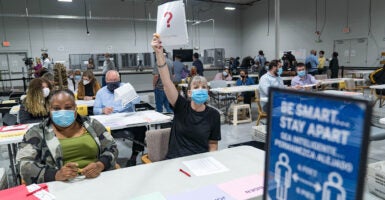
Brant Frost V, second vice chairman of Georgia’s Republican Party, joins the podcast to describe what he has seen as a poll watcher during the state’s recount. Pictured: An election worker in Georgia’s Gwinnett County raises a piece of paper to signal a question during the recount of presidential ballots Friday in Lawrenceville. (Photo: Megan Varner/Getty Images)

Georgia is on America’s mind. At 11:59 p.m. Wednesday, the state is supposed to complete its recount of votes in the presidential election.

Brant Frost V, second vice chairman of Georgia’s Republican Party, joins the show to explain the state’s recount process and why he is suspicious of the recount in Fulton County, which includes the city of Atlanta. Frost also describes his own experience as a poll watcher and why Georgia appears to be turning a little more blue with each election.

We also cover these stories:

  • Twitter CEO Jack Dorsey and Facebook CEO Mark Zuckerberg testify before the Senate Judiciary Committee.
  • Scott Atlas, a top adviser to President Donald Trump on the coronavirus, counsels families to gather for Thanksgiving if they can.
  • Joe Biden identifies who some of his top White House officials would be if he is inaugurated as the 46th president of the United States.

Listen to the podcast below or read the lightly edited transcript.

The left is actively working to undermine the integrity of our elections. Read the plan to stop them now. Learn more now >>

“The Daily Signal Podcast” is available on Ricochet, Apple PodcastsPippaGoogle Play, and Stitcher. All of our podcasts may be found at DailySignal.com/podcasts. If you like what you hear, please leave a review. You also may leave us a message at 202-608-6205 or write us at letters@dailysignal.com.

Virginia Allen: I am joined by Brant Frost, the second vice chair of Georgia’s Republican Party. Brant, welcome to “The Daily Signal Podcast.”

Brant Frost: Thank you very much.

Allen: Brant, Georgia is on the minds right now of many Americans. And over the past several days, Georgia has been going through a recount of presidential election votes. And as of right now, The Associated Press reports that former Vice President Joe Biden is winning Georgia by only about 14,000 votes. And that’s out of about 5 million votes in total from Georgia.

So, both President [Donald] Trump and the Republican Party requested that there be a recount in the state because it is so close. And you actually have been really, really involved in Georgia state politics for a long time. Probably a decade, correct?

Frost: Yes. That is correct. Mainly since 2008 when I turned 18.

Allen: OK. Right as soon as you could, you jumped in. So tell us a little bit just about how common this is, to see a recount in Georgia. Is this something that’s happened before where we’ve seen calls for a presidential recount in the state of Georgia?

Frost: No, this is very unusual. This is also the first time we’re using our new paper ballot system. Since 2001, when we began the transition over, we have only used electronic voting with no paper ballots, unless you were voting absentee by mail. This is the first time we’re using our new paper ballots for voting in elections.

And so this is also the first time we’re having a recount in a presidential election in Georgia as well. A lot of firsts in this year. Also, the first time we’ve ever had two Senate elections at the same time as well that both went to runoffs. So it’s definitely a year of firsts in Georgia, as in America.

Allen: It is. It’s a big year in the state of Georgia.

You mentioned that transition of going from electronic to paper ballots. Dominion Voting Systems is the new kind of organization group that Georgia tasked, essentially, with handling the election process, as far as implementing those new machines.

What do you know about Dominion Voting Systems? We’re hearing a lot about maybe how they’re not credible. Are you very familiar with them and with the states that have formerly used them?

Frost: I am not. So, unlike some other folks, I’m not going to pretend to be an expert and talk at length about it. So I can’t speak to that other than to say that in our own county where I was one of the [people] observing the electoral process of doing a recanvass—which I should point out is different than a recount.

A recanvass is what most people think when they think [of] the word recount. During recanvass, a particular race goes, and in this case, the presidential election, and all the paper ballots that were cast before Election Day and on Election Day are counted. And just that one race, just a single race is counted.

The amount of time it would take to recount every single race or recanvass every single race would just be enormous.

So one race is chosen, in this case the presidential election, for obvious reasons. And each ballot is counted by hand. And you have tables set up in a room with two people at each table. And they will count the votes.

First they will separate them out. They take a big stack. They know how many votes are in the box. Then they’ll separate them by candidate they voted for. Then they will count them out.

Each group will be counted and the amount written down. And if all those numbers put together of votes for Biden, Trump, [Jo] Jorgensen, write-in, and indeterminate votes, if those numbers equal to the amount that was on the box originally, then that is considered a successful recanvass.

In Coweta County with over 77,000 votes, it was determined that every single vote cast President Trump indicated by machine was also indicated by a hand count, 51,501 votes, both machine and human count. For Joe Biden, the same was correct.

However, he added one vote because one Joe Biden voter who apparently did not realize that Joseph R. Biden was Joe Biden wrote in the name Joe Biden for his absentee ballot. So the election review board determined that his vote should count as a Joe Biden vote.

And the ballot review board consists of one Republican and one Democrat representative, which I appointed the Republican representatives since I’m the chairman of the county party here.

So we did not find a problem with the scanners indicating a massive shift, or indeed any kind of shift whatever, in our county. But I can’t speak to other counties. And I certainly can’t speak to the ethics of the people who run the Fulton County board of elections, for example.

Allen: Sure, sure. So, Coweta County, where you live and where you were participating in that recount, is, gosh, about little less than an hour south, southwest of the city of Atlanta. So tell me a little bit more about that experience. You were there helping to do the recanvassing on both Friday and Saturday.

We’ve heard a lot during this kind of poll-watching scenario as it’s played out with mail-in votes that people have complained about not being able to get close enough to actually see the ballots. Was everyone who you were there with able to be close to see the ballots and to all agree, Democrat and Republican, “Yes, this vote is for this individual”?

Frost: Well, the county employees who are poll workers who have been pulled in for this special task, they actually count the votes.

Typically, you will find a fairly even mix of Republican volunteers and Democrat volunteers who are poll workers, but they’re not chosen based on their party. But there’s a good chance that one of them is a Republican.

What you have is you take a typical room of about 10 tables. Depending on the county, there will be either one or two people observing, allowed to walk around and see the process. Realistically, you can’t stand at one table for very long without missing what’s going on at other tables.

Some people might think it makes more sense to have one observer per counting table watching the process, but the limits that were imposed, and it varies from county to county, were one person for every five tables. And that’s what we had.

You have a room with eight tables, two people counting at each table, and two representatives from both parties are allowed to walk around the floor where the tables are, walk around the floor and stop at places. They’re not allowed to speak to the counters and disrupt their count, but they are allowed to watch what’s going on and keep their own count if they wish.

We also have a lot of observers who are permitted to stand at the back of the room, but they really can’t see anything from there. So basically, each party is permitted two people for every five tables.

Allen: It sounds like Coweta County is a great model for the rest of the state. You all have really done this quite well. It sounds very organized.

Have you been hearing from other counties in Georgia? Have they experienced a similar smooth process or have there been complaints?

Frost: The recanvass did not indicate any major shift in votes, except for in Floyd County where a computer card was found with some votes from a precinct, which had previously not been counted.

When the voting machines in each precinct print out a ballot, you type it in on a screen, you type in your choices, the ballot is printed, and then you scan it through a scanner, and then the ballot goes through. And on the other side, you have a big box, which is locked. Well, they don’t open up the box and count the ballots. They take the result of the little scanner, so like a USB drive.

Well, one of those drives in Floyd County, and of course it’s not a drive, but I just use that an example, was missed. When they brought in the precinct results, each precinct brought in their box and their little chips and draws, one was left, [it] had just been not uploaded.

So that recanvass found those extra votes and it added about 2,600 votes to the total statewide. And we think about two-thirds of them were for President Trump.

Now, if this election were like Florida with a 600-vote margin, that would have been enough to flip the election in President Trump’s favor. But of course, when the margins [are] more than 10,000, that’s not going to be the case.

But other than that one example, we did not see any major shifts. However, the issue really does not come down to a statewide problem. It comes down to one or two and really about six counties that are all Democrat, all large, all urban.

In particular, one county where there have been very credible accusations that Republican poll watchers at the Fulton County board of elections where they were counting votes were told to go home at a big arena, because it’s a huge process in Fulton County, that’s Atlanta, Georgia. They were told to go home and they were going to start in the morning.

So, the Republican observers went home at about 10 p.m. And then shortly thereafter, Fulton County started counting their votes again with no Republicans present and then kept counting until about 1 a.m.

So, if there was any kind of illegal voting or any kind of fraudulent ballots being counted, that would certainly have been a time when we just don’t know what was happening. And no Republicans were permitted to be there. No one apparently thought to call them to tell them to come back.

Now, Fulton County is an overwhelmingly Democrat county run top to bottom by Democrats. The Democrats’ well-known respect for the integrity of elections can be demonstrated in that they were so distressed over the 2016 election results, though curiously not distressed over the 1960 election results.

And of course we all know very well, the Democrats are well-known pensioned for fair and equitable elections in big cities like New York and Chicago and where the dead will not only rise again at the second coming, but they rise every four years and vote Democrat.

Allen: It’s certainly problematic when we begin to see the number of deceased individuals who are still on those voter rolls in, like you say, a lot of these big cities.

Now, I want to ask a little bit more about this Atlanta situation. Was there any explanation given by the mayor of Atlanta, by those that were in charge overseeing that polling location, as to how this error was made, that Republicans were sent home and then still ballots were continued to be counted late into the night?

Frost: Everyone has an excuse. I don’t know if it’s a good one, but everyone has an excuse. Every child caught with their hand in the cookie jar has a good reason, or at least a reason why they were doing it. Whether or not anyone believes them and it saves them from punishment is another matter altogether.

There have been multiple explanations and so it’s hard to say which one is the correct one. There’s talk about a major water leakage, a pipe burst. There’s talk about how the secretary of state and others were asking for them to continue the count, because after all, 10 p.m. is rather early to stop counting votes, particularly in an election as close as this and with Georgia being a swing state.

So there were calls for them to come back … and at least a plausible deniability situation where under such a stressful situation, someone can always claim that, “Well, I just forgot,” or, “It slipped through the cracks to remind everybody to come back.” So it’s very difficult to prove malice of intent.

Allen: Sure, sure. So, do you foresee any situation where all other Georgia counties [are] given the green light, but Fulton County, that Atlanta county, has said, “Let’s double check this and let’s recount this county one more time”? Or is that probably not possible?

Frost: Unfortunately, today it is very difficult, as in previous times, to, after the fact, detect voter fraud and malfeasance for the simple fact that a ballot cannot be pulled out of the stack once it’s stuck into it.

In other words, you may have an illegally cast vote or 1,000 of them, but to look at them, they don’t look any different than any other ballot. They do not have a person’s name on them. They do not have a bright neon sticker that says, “Hey, I’m a fake vote.” They look like anyone else’s vote. And it is impossible to identify them once they’d been cast in with all the legitimate votes.

Allen: Let’s talk just for a moment about Georgia as a whole. I lived in Georgia for a number of years. Went to high school there. And back in 2010, 2011, Georgia really was a solidly red, conservative state.

So, Brant, what has happened? As someone who’s been so involved in Georgia politics and policy for so long, what has happened in your state to where now it’s definitely solidly a swing state?

Frost: You have to remember that the Democrat Party in Georgia had been living off the residual effects of over 100 years of domination in our state politics. We hadn’t had a Republican governor since 1872. So by the 1990s, there was a definite shift beginning in Georgia politics.

And starting in 1992, the Republicans had a major surge with every two years, we gained substantially in the state Legislature. We gained congressional delegations. We took control of the majority of the Congress from Georgia in 1994. And we came very close to winning the governor’s race in 1994.

And as a result, the Republicans continued to build up and gain in strength and momentum. And the Democrats, without a strong grassroots base, because they’d been in power for so long it had atrophied, they hadn’t felt the need to have one. As a result, the Republicans in 2002, in a big upset, won the governor’s race.

Many people expected Republicans to be competitive in 2006 for the governor’s race, in 1998, but we lost in ’98. And in 2002, it was thought that Gov. Roy Barnes was too hard to beat, but Sonny Perdue, who is now agricultural secretary in the Trump Administration, actually defeated, in a big upset, Gov. Barnes.

And ever since 2002, the Republican Party has been very strong in Georgia, has dominated statewide politics, won every governor’s race, won every Senate election, and won every constitutional officer starting in 2010.

But that obscured … two major factors: Lack of funding and resources for the Democrats and the fact that the Obama presidency destroyed most of the Democrat Party in the South.

Across the South, you saw from states like Arkansas and Oklahoma to West Virginia and Kentucky, Democrat candidates going down to the seat largely as a result of the unpopularity of the Obama administration.

So when you consider that from 2008 to 2016, Republicans had great years in Georgia, you have to realize that that was during the Obama presidency and the fact that the Democrat Party had no real operation capable of contesting Georgia.

But starting in 2013, the Democrats began to rebuild their effort. Stacey Abrams was a major leader in that effort. And since 2013, they have spent seven years rebuilding. And to today, we now find ourselves in a situation where they’re able to compete with us.

Georgia’s demographics are largely the same as they were four years ago. In fact, exit poll data indicates that on key levels, it’s almost exactly the same. The difference is that the Democrat Party is more well-equipped, better funded, and able to compete.

And they also believe they can win in Georgia. Four years ago, they saw Georgia as a possible bonus, but they didn’t see it as a major target state like they did this year.

The Republican Party, until recently, has also not been as prepared as it might be, largely due to the fact that the Democrats appeared to be weak. So why do you have to train extra hard to fight an opponent who seems weak and easy to defeat?

Fortunately, last year, when I was elected vice chairman, we also elected a new chairman, David Shafer, former state senator and former executive director of the Georgia Republican Party, under whose leadership we have been able to basically accomplish the work of about four years in less than 18 months.

And since he was elected, we’ve trained over 13,000 volunteers, we’ve held voter drives around the state, we’ve knocked on over a million, I believe it’s over 2 million doors now, and we’ve made millions of phone calls.

This is more than any the Republican Party has done in Georgia in any two presidential elections combined, going back for many cycles. So we have been very encouraged to see the outpouring of support since the November election right here.

You would think people would be discouraged, but actually it’s caused people to sign up and volunteer and to do their part because there is so much that we have seen in the last few weeks with Democrats talking about moving to Georgia that has inspired Republicans to become more active and to do more because you saw so many Republicans feel that Georgia was a safe state and they took it for granted.

Not our leadership, but just a rank-and-file Republican who might have, if they lived in Florida or Ohio, have gone out and volunteered, maybe knocked on some doors or made some calls. But because they felt they were in a safe red state, they did not do what they could have done.

The scales have fallen from people’s eyes. They now realize they have to fight because Georgia is a swing state, as much as Florida ever was.

Indeed, if you look at the results, Georgia was much closer than Florida or Ohio. So in some ways, Florida is now a pink state leaning red and Ohio is a red state, but North Carolina and Georgia are swing states. So we have to take that into consideration.

But we are prepared to meet the challenge. We have thousands of people all over the country who are offering to come on their own expense to volunteer to help in these efforts in Georgia, in the upcoming runoffs. So we’re very encouraged.

And I think it’s important for people to realize that the differences in Georgia are not so much due to changes in demographics, although we have seen some of that, but mainly due to the fact that up until recently only one political party was actually playing to win and the other party did not have the resources to compete, much like a major athletic event where you have two teams at a baseball or basketball game.

And in a major sporting event, one team is obviously better funded, has better players, has the resources to hire the best coaches and such, and they’re going to roll over their opponents because they simply are outclassing them.

Now that the two parties are much more evenly classed, you see Georgia being what it truly is, a competitive state.

Allen: Brant, we just so appreciate your time today. It’s just fascinating to hear some of this history and get into a little bit of just the details of what is happening on the ground in Georgia, what you’re seeing, what you’ve experienced. Thank you so much for joining the show.

Frost: Thank you.

A sheriff’s deputy looks out at the line to vote at an early voting location at the Gwinnett County Fairgrounds on Oct. 24, 2020, in Lawrenceville, Georgia. (Photo: Elijah Nouvelage/AFP/Getty Images)

Celebrities and politicians urging people to visit Georgia and falsely claim residency for the sole purpose of voting in two critical U.S. Senate runoff elections Jan. 5 are advocating criminal actions and should be ashamed of themselves. This call for voter fraud should be rejected.

The Georgia runoff elections are extraordinarily important because they will determine which political party controls the U.S. Senate.

Results of the Nov. 3 election gave Republicans 50 seats in the 100-member Senate and gave Democrats 48. If Republicans win one of the Georgia seats Jan. 5, they will hold a 51-49 majority in the Senate; if the GOP wins both seats, it will hold a 52-48 majority.

But if Democrats win both Georgia races, the Senate will be split 50-50 between the two parties. Assuming that President Donald Trump’s lawsuits fail and he is replaced by Joe Biden as president Jan. 20, Kamala Harris will be vice president and can break the 50-50 tie in the Senate to give Democrats majority control of the chamber by the slimmest possible margin.

The left is actively working to undermine the integrity of our elections. Read the plan to stop them now. Learn more now >>

Multiple candidates ran for the two Senate seats representing Georgia, preventing any candidate from gaining a majority. As a result, Georgia law requires the top two candidates for each seat to face each other in runoff elections to be held Jan. 5.

It is a felony for people to visit Georgia and falsely claim to be residents just so they can vote. Millions of us have visited states on vacation or business, but that doesn’t make us residents entitled to vote there.

Georgia Code §21-2-561 states that providing false information when you are registering to vote is a felony. So is voting by an “unqualified elector” under §21-2-571. So if you register to vote when you know that your assertion of residency is false, and then you vote or even just attempt to vote Jan. 5 knowing you are not a qualified voter of the state, you have violated both of these state criminal statutes.

The punishment for this illegal activity under Georgia law is a minimum of one year and a maximum of up to 10 years in prison and as much as a $100,000 fine. Georgia obviously takes this crime very seriously.

No matter how interested nonresidents of Georgia are in that state’s crucial election, they should not listen to the ill-informed, manipulative, and reckless tweets and calls for them to break the law and pretend to be Georgia residents just so they can vote in the two Senate races.

This call for illegal voting—coming primarily from Democrats—is a basic betrayal of the democratic process. Everyone who urges or participates in this criminal activity should be ashamed of themselves and deserves to be criticized, no matter who they are and which party they favor.

Fox News reports, for example, that in a now-deleted tweet, New Yorker journalist Eric Levitz wrote: “These run-offs will decide which party controls the Senate and thus, whether we’ll have any hope for a large stimulus/climate bill. If you have the means and fervor to make a temporary move to GA, believe anyone who registers by Dec 7 can vote in these elections.”

Former Democratic presidential candidate Andrew Yang also tweeted that he and his wife are moving to Georgia to help the two Democratic contenders.

In the Nov. 3 election in Georgia, Republican Sen. David Perdue received 49.71% of the vote and Democratic challenger Jon Ossoff received 47.96%, forcing them into a runoff.

The other Senate race on the ballot Nov. 3 was a special election. Republican Sen. Johnny Isakson retired in 2018, before the end of his term. Republican Kelly Loeffler was appointed by Gov. Brian Kemp to fill the seat until the special election.

She and Rep. Doug Collins split the Republican vote Nov. 3; Loeffler received 25.9% and Collins got 19.95%. Democrat Raphael Warnock got the highest vote total, with 32.91%. Therefore, the two top vote-getters, Loeffler and Warnock, will be in the Jan. 5 runoff election.

Dec. 7 is the deadline to register to vote in Georgia for the Jan. 5 election for any residents of the state who have not already registered, including voters who have just moved to Georgia. But under the Georgia Election Code, §21-2-217, you have to be an actual resident of the state to vote, not just a visitor.

Georgia law says that a voter cannot be in the state “for temporary purposes only without the intention of making [Georgia] such person’s permanent place of abode.” In other words, if you head to Georgia for the primary purpose of helping the candidates in the special election with no intention of actually staying in the state and living there, you are not eligible to register or vote.

Those who think they can get around this requirement by simply lying and asserting their intention to make Georgia their permanent abode should beware. Under the law, county registrars are given the authority to consider a long list of other factors that may contradict the “applicant’s expressed intent.”

These factors include an individual’s “business pursuits, employment, income sources, residence for income tax purposes … leaseholds, sites of personal and real property owned by the applicant, motor vehicle and other personal property registration, and other such factors that registrars may reasonably deem necessary to determine” the applicant’s legal residence for voting purposes.

And it is not just registrars. Under Georgia law, §21-2-230, any registered voter can challenge the eligibility of any other registrant in his or her county or municipality. So there is an entire army of grassroots Georgia voters out there who can be, and should be, on the lookout for out-of-staters registering to vote who falsely claim to live in their neighborhoods and their communities.

The Jan. 5 Senate races in Georgia are understandably capturing national attention, and both Republicans and Democrats are mounting major efforts to win the seats. That’s how democracy is supposed to work. But having out-of-state voters visit a state for a few weeks to masquerade as Georgia residents is not a democratic exercise—it’s a crime.

Anyone who visits Georgia temporarily and falsely claims to be a resident cheats the real residents of the state—no matter which side of the political aisle they favor—by interfering in their choice of who should represent them in Congress. There’s no justification for that, no matter how passionate you are about the outcome of an election.

Vote in your own home state when elections are held—not in the home state of others.

Originally published by Fox News

How Republicans pulled off a big upset and nearly took back the House

<img class=”i-amphtml-blurry-placeholder” src=”data:;base64,

(CNN)There seemed to be one safe bet when it came to the 2020 election results: Democrats would easily hold on to their majority in the House of Representatives. Not only that, but the conventional wisdom held that Democrats would pick up more than the 235 seats they won in the 2018 midterm elections.

While Democrats will have a majority next Congress, Republicans vastly outperformed expectations and nearly pulled off an election shocker.

As of this writing, CNN has projected that Democrats have won in 219 seats. Republicans have been projected the winners in 203 seats. There are 13 races outstanding, per CNN projections.

Of those 13, the Democratic candidates lead in a mere two of them. (One of these 13 is going to a runoff, where the Republicans are heavily favored to win.)

In other words, if every one of those 13 seats went to the party leading in them right now, Democrats would have 221 seats to the Republicans’ 214 seats in the next Congress.

Talk about a fairly close call for Democrats.

Now, Democrats may end up winning a few of the seats where they are currently trailing, but chances are they will end up at or south of 225 seats.

Compare that to what most quantitative forecasters who look at a slew of indicators predicted. Jack Kersting came the closest at 238 seats. FiveThirtyEight clocked in at 239 seats. The Economist modelpredicted that Democrats would win a median of 244 seats in their simulations.

While much attention was paid to the polling misses on the presidential level, they were more accurate by comparison. In the presidential race, the final polling averages got every state right, except for Florida and North Carolina.

Indeed, the forecasts for the presidential race were considerably better than for the House races. The race raters at the Crystal Ball, for example, got every state but North Carolina correct on the presidential level.

Any sort of shy Trump vote was far smaller than a potential shy House Republican vote.

Of course, the value of quantitative forecasts is that they don’t just provide one number. They provide the probability of different outcomes occurring.

In that regard, the Republican performance is even more astounding.

The Economist said there was less than a 1-in-100 chance Democrats would have 221 seats or fewer in the next Congress. The chance they would get 225 seats or fewer was 1-in-100.

FiveThirtyEight’s forecast gave Republicans a realistic, but still fairly low shot of what seems to have happened. The chance Democrats would earn 221 seats or fewer was approximately 1-in-17, while the chance they’d have 225 seats or fewer was approximately 1-in-10.

I should note that 1-in-10 probabilities happen all the time. There’s a reason something is a 1-in-10 chance and not 0%. That said, Republicans simply did better than what folks thought.

A large part of what happened was that the national political environment was more friendly to Republicans than what polls suggested. The final average of generic congressional ballot polls had Democrats ahead by 7 points nationally. Democrats are only ahead by 2 points in the national House vote right now. That may end up closer to 3 points once the votes are all tallied.

A 4- or 5-point miss is considerable.

If Democrats had done 5 points better in every race than they currently are doing, they’d be ahead in 239 seats. That, of course, is right in line with the forecasts.

A lot of these quantitative forecasts also rely upon House ratings from groups like the Cook Political Report, Inside Elections and The Crystal Ball.

These too seemed to undersell Republican chances. Take the Cook Political Report ratings, which have historically been very good.

As of this writing, Republicans are leading in 27 of the 27 seats the Cook Political Report deemed toss-up before the election. They are ahead in all 26 of the seats that were deemed either leaning or likely Republican. Republicans are also leading in 7 of the 36 seats that were either leaning or likely to be taken by the Democrats.

That is, Republicans not only pretty much swept the tossups, but they marched into Democratic territory as well.

The Crystal Ball, which bravely has no tossups in its final rating, had Democrats net gaining 10 House seats. It will actually be the Republicans who will likely net gain 10 seats or more.

The end result of which is that Republicans are much closer to a House majority than we believed they would be after 2020 and have put themselves in a strong position heading into the 2022 midterms.

Where things stand in the House

The Democrats majority is shrinking and three dozen races have yet to be called

House Speaker Nancy Pelosi’s majority has shrunk in House, a shock to Democrats and pollsters who were projecting the California Democrat would expand her caucus after Tuesday’s election.

Democrats were optimistic they could flip roughly 10 seats but their expansion efforts came up short, especially in Texas, and they ended up losing seats in Flordia, Oklahoma, Minnesota and elsewhere.

DEM CAUCUS ERUPTS AS MEMBERS SAY PARTY’S LEFTWARD DRIFT HURT MODERATES IN ELECTION

As of 3 p.m. on Friday, Democrats had won 212 seats compared to Republicans’ 194. Another 29 races have yet to be called. Democrats had a net loss of four seats.

Outstanding races are in New York, California, Pennsylvania, Illinois, Utah, Arizona, and elsewhere. When all those votes are counted, Republicans are optimistic their numbers could swell to 208 and beyond, according to the National Republican Congressional Committee.

What’s known is that Republicans have flipped at least seven seats from blue to red and an eighth seat in Michigan that was most recently occupied by a Libertarian. Here’s a snapshot of the GOP victories:

GOP gains in the House

–In Florida, Republican candidate Carlos Gimenez defeated freshman Democratic Rep. Debbie Mucarsel-Powell in the 26th district. Republican Maria Elvira Salazar defeated freshman Democratic Rep. Donna Shalala in the 27th district.

–In Oklahoma, Republican Stephanie Bice unseated freshman Democratic Rep. Kendra Horn. Horn flipped the seat from red to blue last cycle.

— In South Carolina, freshman congressman Democrat Joe Cunningham was projected to lose his reelection to state GOP Rep. Nancy Mace, flipping South Carolina’s 1st District back to red.

— In Minnesota, Republican Michelle Fischbach ousted longtime Democratic Rep. Collin Peterson, toppling the powerful chairman of the House Agriculture Committee in the most pro-Trump district held by a Democrat.

— In New Mexico, Republican Yvette Herrell defeated freshman Rep. Xochitl Torres Small, a freshman Democrat who flipped the 2nd Congressional seat from red to blue in 2018.

— In Iowa’s First Congressional District, Republican state representative and former TV news anchor Ashley Hinson defeated Democratic incumbent Abby Finkenauer.

– In West Michigan, Republican Peter Meijer, an Iraq war veteran whose grandfather started Meijer superstores, defeated Democrat Hillary Scholten, a former Department of Justice and nonprofit lawyer. The Third Congressional District was open after Rep. Justin Amash, a Republican-turned-Libertarian, did not seek reelection.

CLICK HERE TO VIEW HOUSE RESULTS

Republicans say more victories are on the horizon

.

Party officials are most optimistic about reclaiming two seats in New York that Democrats flipped in 2018. Votes are still being counted but Republican Nicole Malliotakis has a notable lead over freshman Rep. Max Rose in the Staten Island-Brooklyn district. And former GOP Rep. Claudia Tenney was also ahead in the 22nd District seat she lost two years ago to Rep. Anthony Brindisi.

Democrats have gained two open seats in North Carolina thanks to redrawn congressional maps that favored them and will welcome Deborah Ross and Kathy Manning to their caucus in January.

And Democrats flipped Georgia’s 7th Congressional District held by retiring Rep. Rob Woodall, R-Ga. Democrat Carolyn Bourdeaux beat GOP candidate Rich McCormick in the suburban Atlanta district, the Associated Press called on Friday.

That means Democrats so far have a net loss of four seats in the House.

WHERE THINGS STAND: BATTLE FOR THE SENATE

Democrats think they can hold onto many close races that have not been called and have two other possible pick-up opportunities by defeating Rep. Jeff Van Drew in New Jersey and Rep. Mike Garcia in California.

On a call Thursday afternoon with Democratic House members, Rep. Cheri Bustos, head of the Democratic Congressional Campaign Committee (DCCC), expressed frustration with the polling and election forecasts that all pointed to House Democrats expanding their majority.

“I’m furious,” Bustos told her colleagues, according to a source familiar with the call. “Something went wrong here across the entire political world. Our polls, Senate polls, Gov polls, presidential polls, Republican polls, public polls, turnout modeling, and prognosticators all pointed to one political environment – that environment never materialized.”

I have written about the tremendous increase in the food stamp program the last 9 years before and that means that both President Obama and Bush were guilty of not trying to slow down it’s growth. Furthermore, Republicans have been some of the biggest supporters of the food stamp program. Milton Friedman had a good solution to help end the welfare state and wish more people would pay attention to it.   Growing government also encourages waste and hurt growth but more importantly it causes people to become dependent on the government as this article and cartoon below show.

My great fear is that the “social capital” of self reliance in America will slowly disappear and that the United States will turn into a European-style welfare state.

That’s the message in the famous “riding in the wagon” cartoons that went viral and became the most-viewed post on this blog.

Well, this Glenn McCoy cartoon has a similar theme.

Obama Voter Cartoon

The only thing I would change is that the rat would become a “pro-government voter” or “left-wing voter” instead of an “Obama voter.” Just like I wasn’t satisfied with an otherwise very good Chuck Asay cartoon showing the struggle between producers and moochers.

That’s for two reasons. First, I’m not partisan. My goal is to spread a message of liberty, not encourage people to vote for or against any candidate.

Second, I’ve been very critical of Obama, but I was also very critical of Bush. Indeed, Bush was a bigger spender than Obama! And Clinton was quite good, so party labels often don’t matter.

But I’m getting wonky. Enjoy the cartoon and feel free to share it widely.

Eight Reasons Why Big Government Hurts Economic Growth

Uploaded on Aug 17, 2009

This Center for Freedom and Prosperity Foundation video analyzes how excessive government spending undermines economic performance. While acknowledging that a very modest level of government spending on things such as “public goods” can facilitate growth, the video outlines eight different ways that that big government hinders prosperity. This video focuses on theory and will be augmented by a second video looking at the empirical evidence favoring smaller government.

Related posts:

If increase in food stamps was just because of recession then why spending go from $19.8 billion in 2000 to $37.9 billion in 2007?

If the increase in food stamps was just because of the recession then why did the spending go from $19.8 billion in 2000 to $37.9 billion in 2007? The Facts about Food Stamps Everyone Should Hear Rachel Sheffield and T. Elliot Gaiser May 27, 2013 at 12:00 pm (7) Newscom A recent US News & […]

Tell the 48 million food stamps users to eat more broccoli!!!!

Welfare Can And Must Be Reformed             Uploaded on Jun 29, 2010 If America does not get welfare reform under control, it will bankrupt America. But the Heritage Foundation’s Robert Rector has a five-step plan to reform welfare while protecting our most vulnerable. __________________________ We got to slow down the growth of Food Stamps. One […]

Republicans for more food stamps?

Eight Reasons Why Big Government Hurts Economic Growth __________________ We got to cut spending and we must first start with food stamp program and we need some Senators that are willing to make the tough cuts. Food Stamp Republicans Posted by Chris Edwards Newt Gingrich had fun calling President Obama the “food stamp president,” but […]

Obama promotes food stamps but Milton Friedman had a better suggestion

Milton Friedman’s negative income tax explained by Friedman in 1968: We need to cut back on the Food Stamp program and not try to increase it. What really upsets me is that when the government gets involved in welfare there is a welfare trap created for those who become dependent on the program. Once they […]

400% increase in food stamps since 2000

Welfare Can And Must Be Reformed Uploaded by HeritageFoundation on Jun 29, 2010 If America does not get welfare reform under control, it will bankrupt America. But the Heritage Foundation’s Robert Rector has a five-step plan to reform welfare while protecting our most vulnerable. __________________________ If welfare increases as much as it has in the […]

Food stamp spending has doubled under the Obama Administration

The sad fact is that Food stamp spending has doubled under the Obama Administration. A Bumper Crop of Food Stamps Amy Payne May 21, 2013 at 7:01 am Tweet this Where do food stamps come from? They come from taxpayers—certainly not from family farms. Yet the “farm” bill, a recurring subsidy-fest in Congress, is actually […]

Which states are the leaders in food stamp consumption?

I am glad that my state of Arkansas is not the leader in food stamps!!! Mirror, Mirror, on the Wall, Which State Has the Highest Food Stamp Usage of All? March 19, 2013 by Dan Mitchell The food stamp program seems to be a breeding ground of waste, fraud, and abuse. Some of the horror stories […]

Why not cancel the foodstamp program and let the churches step in?

Government Must Cut Spending Uploaded by HeritageFoundation on Dec 2, 2010 The government can cut roughly $343 billion from the federal budget and they can do so immediately. __________ We are becoming a country filled with people that dependent on the federal government when we should be growing our economy by lowering taxes and putting […]

Food Stamp Program is constantly ripped off and should be discontinued

Uploaded by oversightandreform on Mar 6, 2012 Learn More at http://oversight.house.gov The Oversight Committee is examining reports of food stamp merchants previously disqualified who continue to defraud the program. According to a Scripps Howard News Service report, food stamp fraud costs taxpayers hundreds of millions every year. Watch the Oversight hearing live tomorrow at 930 […]
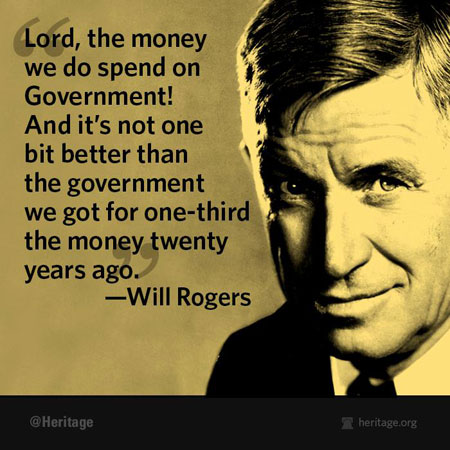
 

Georgia Poll Watcher Explains State’s Recount of Votes for President

Brant Frost V, second vice chairman of Georgia’s Republican Party, joins the podcast to describe what he has seen as a poll watcher during the state’s recount. Pictured: An election worker in Georgia’s Gwinnett County raises a piece of paper to signal a question during the recount of presidential ballots Friday in Lawrenceville. (Photo: Megan Varner/Getty Images)

Georgia is on America’s mind. At 11:59 p.m. Wednesday, the state is supposed to complete its recount of votes in the presidential election.

Brant Frost V, second vice chairman of Georgia’s Republican Party, joins the show to explain the state’s recount process and why he is suspicious of the recount in Fulton County, which includes the city of Atlanta. Frost also describes his own experience as a poll watcher and why Georgia appears to be turning a little more blue with each election.

We also cover these stories:

  • Twitter CEO Jack Dorsey and Facebook CEO Mark Zuckerberg testify before the Senate Judiciary Committee.
  • Scott Atlas, a top adviser to President Donald Trump on the coronavirus, counsels families to gather for Thanksgiving if they can.
  • Joe Biden identifies who some of his top White House officials would be if he is inaugurated as the 46th president of the United States.

Listen to the podcast below or read the lightly edited transcript.

The left is actively working to undermine the integrity of our elections. Read the plan to stop them now. Learn more now >>

“The Daily Signal Podcast” is available on Ricochet, Apple PodcastsPippaGoogle Play, and Stitcher. All of our podcasts may be found at DailySignal.com/podcasts. If you like what you hear, please leave a review. You also may leave us a message at 202-608-6205 or write us at letters@dailysignal.com.

Virginia Allen: I am joined by Brant Frost, the second vice chair of Georgia’s Republican Party. Brant, welcome to “The Daily Signal Podcast.”

Brant Frost: Thank you very much.

Allen: Brant, Georgia is on the minds right now of many Americans. And over the past several days, Georgia has been going through a recount of presidential election votes. And as of right now, The Associated Press reports that former Vice President Joe Biden is winning Georgia by only about 14,000 votes. And that’s out of about 5 million votes in total from Georgia.

So, both President [Donald] Trump and the Republican Party requested that there be a recount in the state because it is so close. And you actually have been really, really involved in Georgia state politics for a long time. Probably a decade, correct?

Frost: Yes. That is correct. Mainly since 2008 when I turned 18.

Allen: OK. Right as soon as you could, you jumped in. So tell us a little bit just about how common this is, to see a recount in Georgia. Is this something that’s happened before where we’ve seen calls for a presidential recount in the state of Georgia?

Frost: No, this is very unusual. This is also the first time we’re using our new paper ballot system. Since 2001, when we began the transition over, we have only used electronic voting with no paper ballots, unless you were voting absentee by mail. This is the first time we’re using our new paper ballots for voting in elections.

And so this is also the first time we’re having a recount in a presidential election in Georgia as well. A lot of firsts in this year. Also, the first time we’ve ever had two Senate elections at the same time as well that both went to runoffs. So it’s definitely a year of firsts in Georgia, as in America.

Allen: It is. It’s a big year in the state of Georgia.

You mentioned that transition of going from electronic to paper ballots. Dominion Voting Systems is the new kind of organization group that Georgia tasked, essentially, with handling the election process, as far as implementing those new machines.

What do you know about Dominion Voting Systems? We’re hearing a lot about maybe how they’re not credible. Are you very familiar with them and with the states that have formerly used them?

Frost: I am not. So, unlike some other folks, I’m not going to pretend to be an expert and talk at length about it. So I can’t speak to that other than to say that in our own county where I was one of the [people] observing the electoral process of doing a recanvass—which I should point out is different than a recount.

A recanvass is what most people think when they think [of] the word recount. During recanvass, a particular race goes, and in this case, the presidential election, and all the paper ballots that were cast before Election Day and on Election Day are counted. And just that one race, just a single race is counted.

The amount of time it would take to recount every single race or recanvass every single race would just be enormous.

So one race is chosen, in this case the presidential election, for obvious reasons. And each ballot is counted by hand. And you have tables set up in a room with two people at each table. And they will count the votes.

First they will separate them out. They take a big stack. They know how many votes are in the box. Then they’ll separate them by candidate they voted for. Then they will count them out.

Each group will be counted and the amount written down. And if all those numbers put together of votes for Biden, Trump, [Jo] Jorgensen, write-in, and indeterminate votes, if those numbers equal to the amount that was on the box originally, then that is considered a successful recanvass.

In Coweta County with over 77,000 votes, it was determined that every single vote cast President Trump indicated by machine was also indicated by a hand count, 51,501 votes, both machine and human count. For Joe Biden, the same was correct.

However, he added one vote because one Joe Biden voter who apparently did not realize that Joseph R. Biden was Joe Biden wrote in the name Joe Biden for his absentee ballot. So the election review board determined that his vote should count as a Joe Biden vote.

And the ballot review board consists of one Republican and one Democrat representative, which I appointed the Republican representatives since I’m the chairman of the county party here.

So we did not find a problem with the scanners indicating a massive shift, or indeed any kind of shift whatever, in our county. But I can’t speak to other counties. And I certainly can’t speak to the ethics of the people who run the Fulton County board of elections, for example.

Allen: Sure, sure. So, Coweta County, where you live and where you were participating in that recount, is, gosh, about little less than an hour south, southwest of the city of Atlanta. So tell me a little bit more about that experience. You were there helping to do the recanvassing on both Friday and Saturday.

We’ve heard a lot during this kind of poll-watching scenario as it’s played out with mail-in votes that people have complained about not being able to get close enough to actually see the ballots. Was everyone who you were there with able to be close to see the ballots and to all agree, Democrat and Republican, “Yes, this vote is for this individual”?

Frost: Well, the county employees who are poll workers who have been pulled in for this special task, they actually count the votes.

Typically, you will find a fairly even mix of Republican volunteers and Democrat volunteers who are poll workers, but they’re not chosen based on their party. But there’s a good chance that one of them is a Republican.

What you have is you take a typical room of about 10 tables. Depending on the county, there will be either one or two people observing, allowed to walk around and see the process. Realistically, you can’t stand at one table for very long without missing what’s going on at other tables.

Some people might think it makes more sense to have one observer per counting table watching the process, but the limits that were imposed, and it varies from county to county, were one person for every five tables. And that’s what we had.

You have a room with eight tables, two people counting at each table, and two representatives from both parties are allowed to walk around the floor where the tables are, walk around the floor and stop at places. They’re not allowed to speak to the counters and disrupt their count, but they are allowed to watch what’s going on and keep their own count if they wish.

We also have a lot of observers who are permitted to stand at the back of the room, but they really can’t see anything from there. So basically, each party is permitted two people for every five tables.

Allen: It sounds like Coweta County is a great model for the rest of the state. You all have really done this quite well. It sounds very organized.

Have you been hearing from other counties in Georgia? Have they experienced a similar smooth process or have there been complaints?

Frost: The recanvass did not indicate any major shift in votes, except for in Floyd County where a computer card was found with some votes from a precinct, which had previously not been counted.

When the voting machines in each precinct print out a ballot, you type it in on a screen, you type in your choices, the ballot is printed, and then you scan it through a scanner, and then the ballot goes through. And on the other side, you have a big box, which is locked. Well, they don’t open up the box and count the ballots. They take the result of the little scanner, so like a USB drive.

Well, one of those drives in Floyd County, and of course it’s not a drive, but I just use that an example, was missed. When they brought in the precinct results, each precinct brought in their box and their little chips and draws, one was left, [it] had just been not uploaded.

So that recanvass found those extra votes and it added about 2,600 votes to the total statewide. And we think about two-thirds of them were for President Trump.

Now, if this election were like Florida with a 600-vote margin, that would have been enough to flip the election in President Trump’s favor. But of course, when the margins [are] more than 10,000, that’s not going to be the case.

But other than that one example, we did not see any major shifts. However, the issue really does not come down to a statewide problem. It comes down to one or two and really about six counties that are all Democrat, all large, all urban.

In particular, one county where there have been very credible accusations that Republican poll watchers at the Fulton County board of elections where they were counting votes were told to go home at a big arena, because it’s a huge process in Fulton County, that’s Atlanta, Georgia. They were told to go home and they were going to start in the morning.

So, the Republican observers went home at about 10 p.m. And then shortly thereafter, Fulton County started counting their votes again with no Republicans present and then kept counting until about 1 a.m.

So, if there was any kind of illegal voting or any kind of fraudulent ballots being counted, that would certainly have been a time when we just don’t know what was happening. And no Republicans were permitted to be there. No one apparently thought to call them to tell them to come back.

Now, Fulton County is an overwhelmingly Democrat county run top to bottom by Democrats. The Democrats’ well-known respect for the integrity of elections can be demonstrated in that they were so distressed over the 2016 election results, though curiously not distressed over the 1960 election results.

And of course we all know very well, the Democrats are well-known pensioned for fair and equitable elections in big cities like New York and Chicago and where the dead will not only rise again at the second coming, but they rise every four years and vote Democrat.

Allen: It’s certainly problematic when we begin to see the number of deceased individuals who are still on those voter rolls in, like you say, a lot of these big cities.

Now, I want to ask a little bit more about this Atlanta situation. Was there any explanation given by the mayor of Atlanta, by those that were in charge overseeing that polling location, as to how this error was made, that Republicans were sent home and then still ballots were continued to be counted late into the night?

Frost: Everyone has an excuse. I don’t know if it’s a good one, but everyone has an excuse. Every child caught with their hand in the cookie jar has a good reason, or at least a reason why they were doing it. Whether or not anyone believes them and it saves them from punishment is another matter altogether.

There have been multiple explanations and so it’s hard to say which one is the correct one. There’s talk about a major water leakage, a pipe burst. There’s talk about how the secretary of state and others were asking for them to continue the count, because after all, 10 p.m. is rather early to stop counting votes, particularly in an election as close as this and with Georgia being a swing state.

So there were calls for them to come back … and at least a plausible deniability situation where under such a stressful situation, someone can always claim that, “Well, I just forgot,” or, “It slipped through the cracks to remind everybody to come back.” So it’s very difficult to prove malice of intent.

Allen: Sure, sure. So, do you foresee any situation where all other Georgia counties [are] given the green light, but Fulton County, that Atlanta county, has said, “Let’s double check this and let’s recount this county one more time”? Or is that probably not possible?

Frost: Unfortunately, today it is very difficult, as in previous times, to, after the fact, detect voter fraud and malfeasance for the simple fact that a ballot cannot be pulled out of the stack once it’s stuck into it.

In other words, you may have an illegally cast vote or 1,000 of them, but to look at them, they don’t look any different than any other ballot. They do not have a person’s name on them. They do not have a bright neon sticker that says, “Hey, I’m a fake vote.” They look like anyone else’s vote. And it is impossible to identify them once they’d been cast in with all the legitimate votes.

Allen: Let’s talk just for a moment about Georgia as a whole. I lived in Georgia for a number of years. Went to high school there. And back in 2010, 2011, Georgia really was a solidly red, conservative state.

So, Brant, what has happened? As someone who’s been so involved in Georgia politics and policy for so long, what has happened in your state to where now it’s definitely solidly a swing state?

Frost: You have to remember that the Democrat Party in Georgia had been living off the residual effects of over 100 years of domination in our state politics. We hadn’t had a Republican governor since 1872. So by the 1990s, there was a definite shift beginning in Georgia politics.

And starting in 1992, the Republicans had a major surge with every two years, we gained substantially in the state Legislature. We gained congressional delegations. We took control of the majority of the Congress from Georgia in 1994. And we came very close to winning the governor’s race in 1994.

And as a result, the Republicans continued to build up and gain in strength and momentum. And the Democrats, without a strong grassroots base, because they’d been in power for so long it had atrophied, they hadn’t felt the need to have one. As a result, the Republicans in 2002, in a big upset, won the governor’s race.

Many people expected Republicans to be competitive in 2006 for the governor’s race, in 1998, but we lost in ’98. And in 2002, it was thought that Gov. Roy Barnes was too hard to beat, but Sonny Perdue, who is now agricultural secretary in the Trump Administration, actually defeated, in a big upset, Gov. Barnes.

And ever since 2002, the Republican Party has been very strong in Georgia, has dominated statewide politics, won every governor’s race, won every Senate election, and won every constitutional officer starting in 2010.

But that obscured … two major factors: Lack of funding and resources for the Democrats and the fact that the Obama presidency destroyed most of the Democrat Party in the South.

Across the South, you saw from states like Arkansas and Oklahoma to West Virginia and Kentucky, Democrat candidates going down to the seat largely as a result of the unpopularity of the Obama administration.

So when you consider that from 2008 to 2016, Republicans had great years in Georgia, you have to realize that that was during the Obama presidency and the fact that the Democrat Party had no real operation capable of contesting Georgia.

But starting in 2013, the Democrats began to rebuild their effort. Stacey Abrams was a major leader in that effort. And since 2013, they have spent seven years rebuilding. And to today, we now find ourselves in a situation where they’re able to compete with us.

Georgia’s demographics are largely the same as they were four years ago. In fact, exit poll data indicates that on key levels, it’s almost exactly the same. The difference is that the Democrat Party is more well-equipped, better funded, and able to compete.

And they also believe they can win in Georgia. Four years ago, they saw Georgia as a possible bonus, but they didn’t see it as a major target state like they did this year.

The Republican Party, until recently, has also not been as prepared as it might be, largely due to the fact that the Democrats appeared to be weak. So why do you have to train extra hard to fight an opponent who seems weak and easy to defeat?

Fortunately, last year, when I was elected vice chairman, we also elected a new chairman, David Shafer, former state senator and former executive director of the Georgia Republican Party, under whose leadership we have been able to basically accomplish the work of about four years in less than 18 months.

And since he was elected, we’ve trained over 13,000 volunteers, we’ve held voter drives around the state, we’ve knocked on over a million, I believe it’s over 2 million doors now, and we’ve made millions of phone calls.

This is more than any the Republican Party has done in Georgia in any two presidential elections combined, going back for many cycles. So we have been very encouraged to see the outpouring of support since the November election right here.

You would think people would be discouraged, but actually it’s caused people to sign up and volunteer and to do their part because there is so much that we have seen in the last few weeks with Democrats talking about moving to Georgia that has inspired Republicans to become more active and to do more because you saw so many Republicans feel that Georgia was a safe state and they took it for granted.

Not our leadership, but just a rank-and-file Republican who might have, if they lived in Florida or Ohio, have gone out and volunteered, maybe knocked on some doors or made some calls. But because they felt they were in a safe red state, they did not do what they could have done.

The scales have fallen from people’s eyes. They now realize they have to fight because Georgia is a swing state, as much as Florida ever was.

Indeed, if you look at the results, Georgia was much closer than Florida or Ohio. So in some ways, Florida is now a pink state leaning red and Ohio is a red state, but North Carolina and Georgia are swing states. So we have to take that into consideration.

But we are prepared to meet the challenge. We have thousands of people all over the country who are offering to come on their own expense to volunteer to help in these efforts in Georgia, in the upcoming runoffs. So we’re very encouraged.

And I think it’s important for people to realize that the differences in Georgia are not so much due to changes in demographics, although we have seen some of that, but mainly due to the fact that up until recently only one political party was actually playing to win and the other party did not have the resources to compete, much like a major athletic event where you have two teams at a baseball or basketball game.

And in a major sporting event, one team is obviously better funded, has better players, has the resources to hire the best coaches and such, and they’re going to roll over their opponents because they simply are outclassing them.

Now that the two parties are much more evenly classed, you see Georgia being what it truly is, a competitive state.

Allen: Brant, we just so appreciate your time today. It’s just fascinating to hear some of this history and get into a little bit of just the details of what is happening on the ground in Georgia, what you’re seeing, what you’ve experienced. Thank you so much for joining the show.

Frost: Thank you.

A sheriff’s deputy looks out at the line to vote at an early voting location at the Gwinnett County Fairgrounds on Oct. 24, 2020, in Lawrenceville, Georgia. (Photo: Elijah Nouvelage/AFP/Getty Images)

Celebrities and politicians urging people to visit Georgia and falsely claim residency for the sole purpose of voting in two critical U.S. Senate runoff elections Jan. 5 are advocating criminal actions and should be ashamed of themselves. This call for voter fraud should be rejected.

The Georgia runoff elections are extraordinarily important because they will determine which political party controls the U.S. Senate.

Results of the Nov. 3 election gave Republicans 50 seats in the 100-member Senate and gave Democrats 48. If Republicans win one of the Georgia seats Jan. 5, they will hold a 51-49 majority in the Senate; if the GOP wins both seats, it will hold a 52-48 majority.

But if Democrats win both Georgia races, the Senate will be split 50-50 between the two parties. Assuming that President Donald Trump’s lawsuits fail and he is replaced by Joe Biden as president Jan. 20, Kamala Harris will be vice president and can break the 50-50 tie in the Senate to give Democrats majority control of the chamber by the slimmest possible margin.

The left is actively working to undermine the integrity of our elections. Read the plan to stop them now. Learn more now >>

Multiple candidates ran for the two Senate seats representing Georgia, preventing any candidate from gaining a majority. As a result, Georgia law requires the top two candidates for each seat to face each other in runoff elections to be held Jan. 5.

It is a felony for people to visit Georgia and falsely claim to be residents just so they can vote. Millions of us have visited states on vacation or business, but that doesn’t make us residents entitled to vote there.

Georgia Code §21-2-561 states that providing false information when you are registering to vote is a felony. So is voting by an “unqualified elector” under §21-2-571. So if you register to vote when you know that your assertion of residency is false, and then you vote or even just attempt to vote Jan. 5 knowing you are not a qualified voter of the state, you have violated both of these state criminal statutes.

The punishment for this illegal activity under Georgia law is a minimum of one year and a maximum of up to 10 years in prison and as much as a $100,000 fine. Georgia obviously takes this crime very seriously.

No matter how interested nonresidents of Georgia are in that state’s crucial election, they should not listen to the ill-informed, manipulative, and reckless tweets and calls for them to break the law and pretend to be Georgia residents just so they can vote in the two Senate races.

This call for illegal voting—coming primarily from Democrats—is a basic betrayal of the democratic process. Everyone who urges or participates in this criminal activity should be ashamed of themselves and deserves to be criticized, no matter who they are and which party they favor.

Fox News reports, for example, that in a now-deleted tweet, New Yorker journalist Eric Levitz wrote: “These run-offs will decide which party controls the Senate and thus, whether we’ll have any hope for a large stimulus/climate bill. If you have the means and fervor to make a temporary move to GA, believe anyone who registers by Dec 7 can vote in these elections.”

Former Democratic presidential candidate Andrew Yang also tweeted that he and his wife are moving to Georgia to help the two Democratic contenders.

In the Nov. 3 election in Georgia, Republican Sen. David Perdue received 49.71% of the vote and Democratic challenger Jon Ossoff received 47.96%, forcing them into a runoff.

The other Senate race on the ballot Nov. 3 was a special election. Republican Sen. Johnny Isakson retired in 2018, before the end of his term. Republican Kelly Loeffler was appointed by Gov. Brian Kemp to fill the seat until the special election.

She and Rep. Doug Collins split the Republican vote Nov. 3; Loeffler received 25.9% and Collins got 19.95%. Democrat Raphael Warnock got the highest vote total, with 32.91%. Therefore, the two top vote-getters, Loeffler and Warnock, will be in the Jan. 5 runoff election.

Dec. 7 is the deadline to register to vote in Georgia for the Jan. 5 election for any residents of the state who have not already registered, including voters who have just moved to Georgia. But under the Georgia Election Code, §21-2-217, you have to be an actual resident of the state to vote, not just a visitor.

Georgia law says that a voter cannot be in the state “for temporary purposes only without the intention of making [Georgia] such person’s permanent place of abode.” In other words, if you head to Georgia for the primary purpose of helping the candidates in the special election with no intention of actually staying in the state and living there, you are not eligible to register or vote.

Those who think they can get around this requirement by simply lying and asserting their intention to make Georgia their permanent abode should beware. Under the law, county registrars are given the authority to consider a long list of other factors that may contradict the “applicant’s expressed intent.”

These factors include an individual’s “business pursuits, employment, income sources, residence for income tax purposes … leaseholds, sites of personal and real property owned by the applicant, motor vehicle and other personal property registration, and other such factors that registrars may reasonably deem necessary to determine” the applicant’s legal residence for voting purposes.

And it is not just registrars. Under Georgia law, §21-2-230, any registered voter can challenge the eligibility of any other registrant in his or her county or municipality. So there is an entire army of grassroots Georgia voters out there who can be, and should be, on the lookout for out-of-staters registering to vote who falsely claim to live in their neighborhoods and their communities.

The Jan. 5 Senate races in Georgia are understandably capturing national attention, and both Republicans and Democrats are mounting major efforts to win the seats. That’s how democracy is supposed to work. But having out-of-state voters visit a state for a few weeks to masquerade as Georgia residents is not a democratic exercise—it’s a crime.

Anyone who visits Georgia temporarily and falsely claims to be a resident cheats the real residents of the state—no matter which side of the political aisle they favor—by interfering in their choice of who should represent them in Congress. There’s no justification for that, no matter how passionate you are about the outcome of an election.

Vote in your own home state when elections are held—not in the home state of others.

Originally published by Fox News

How Republicans pulled off a big upset and nearly took back the House

<img class=”i-amphtml-blurry-placeholder” src=”data:;base64,

(CNN)There seemed to be one safe bet when it came to the 2020 election results: Democrats would easily hold on to their majority in the House of Representatives. Not only that, but the conventional wisdom held that Democrats would pick up more than the 235 seats they won in the 2018 midterm elections.

While Democrats will have a majority next Congress, Republicans vastly outperformed expectations and nearly pulled off an election shocker.

As of this writing, CNN has projected that Democrats have won in 219 seats. Republicans have been projected the winners in 203 seats. There are 13 races outstanding, per CNN projections.

Of those 13, the Democratic candidates lead in a mere two of them. (One of these 13 is going to a runoff, where the Republicans are heavily favored to win.)

In other words, if every one of those 13 seats went to the party leading in them right now, Democrats would have 221 seats to the Republicans’ 214 seats in the next Congress.

Talk about a fairly close call for Democrats.

Now, Democrats may end up winning a few of the seats where they are currently trailing, but chances are they will end up at or south of 225 seats.

Compare that to what most quantitative forecasters who look at a slew of indicators predicted. Jack Kersting came the closest at 238 seats. FiveThirtyEight clocked in at 239 seats. The Economist modelpredicted that Democrats would win a median of 244 seats in their simulations.

While much attention was paid to the polling misses on the presidential level, they were more accurate by comparison. In the presidential race, the final polling averages got every state right, except for Florida and North Carolina.

Indeed, the forecasts for the presidential race were considerably better than for the House races. The race raters at the Crystal Ball, for example, got every state but North Carolina correct on the presidential level.

Any sort of shy Trump vote was far smaller than a potential shy House Republican vote.

Of course, the value of quantitative forecasts is that they don’t just provide one number. They provide the probability of different outcomes occurring.

In that regard, the Republican performance is even more astounding.

The Economist said there was less than a 1-in-100 chance Democrats would have 221 seats or fewer in the next Congress. The chance they would get 225 seats or fewer was 1-in-100.

FiveThirtyEight’s forecast gave Republicans a realistic, but still fairly low shot of what seems to have happened. The chance Democrats would earn 221 seats or fewer was approximately 1-in-17, while the chance they’d have 225 seats or fewer was approximately 1-in-10.

I should note that 1-in-10 probabilities happen all the time. There’s a reason something is a 1-in-10 chance and not 0%. That said, Republicans simply did better than what folks thought.

A large part of what happened was that the national political environment was more friendly to Republicans than what polls suggested. The final average of generic congressional ballot polls had Democrats ahead by 7 points nationally. Democrats are only ahead by 2 points in the national House vote right now. That may end up closer to 3 points once the votes are all tallied.

A 4- or 5-point miss is considerable.

If Democrats had done 5 points better in every race than they currently are doing, they’d be ahead in 239 seats. That, of course, is right in line with the forecasts.

A lot of these quantitative forecasts also rely upon House ratings from groups like the Cook Political Report, Inside Elections and The Crystal Ball.

These too seemed to undersell Republican chances. Take the Cook Political Report ratings, which have historically been very good.

As of this writing, Republicans are leading in 27 of the 27 seats the Cook Political Report deemed toss-up before the election. They are ahead in all 26 of the seats that were deemed either leaning or likely Republican. Republicans are also leading in 7 of the 36 seats that were either leaning or likely to be taken by the Democrats.

That is, Republicans not only pretty much swept the tossups, but they marched into Democratic territory as well.

The Crystal Ball, which bravely has no tossups in its final rating, had Democrats net gaining 10 House seats. It will actually be the Republicans who will likely net gain 10 seats or more.

The end result of which is that Republicans are much closer to a House majority than we believed they would be after 2020 and have put themselves in a strong position heading into the 2022 midterms.

Where things stand in the House

The Democrats majority is shrinking and three dozen races have yet to be called

House Speaker Nancy Pelosi’s majority has shrunk in House, a shock to Democrats and pollsters who were projecting the California Democrat would expand her caucus after Tuesday’s election.

Democrats were optimistic they could flip roughly 10 seats but their expansion efforts came up short, especially in Texas, and they ended up losing seats in Flordia, Oklahoma, Minnesota and elsewhere.

DEM CAUCUS ERUPTS AS MEMBERS SAY PARTY’S LEFTWARD DRIFT HURT MODERATES IN ELECTION

As of 3 p.m. on Friday, Democrats had won 212 seats compared to Republicans’ 194. Another 29 races have yet to be called. Democrats had a net loss of four seats.

Outstanding races are in New York, California, Pennsylvania, Illinois, Utah, Arizona, and elsewhere. When all those votes are counted, Republicans are optimistic their numbers could swell to 208 and beyond, according to the National Republican Congressional Committee.

What’s known is that Republicans have flipped at least seven seats from blue to red and an eighth seat in Michigan that was most recently occupied by a Libertarian. Here’s a snapshot of the GOP victories:

GOP gains in the House

–In Florida, Republican candidate Carlos Gimenez defeated freshman Democratic Rep. Debbie Mucarsel-Powell in the 26th district. Republican Maria Elvira Salazar defeated freshman Democratic Rep. Donna Shalala in the 27th district.

–In Oklahoma, Republican Stephanie Bice unseated freshman Democratic Rep. Kendra Horn. Horn flipped the seat from red to blue last cycle.

— In South Carolina, freshman congressman Democrat Joe Cunningham was projected to lose his reelection to state GOP Rep. Nancy Mace, flipping South Carolina’s 1st District back to red.

— In Minnesota, Republican Michelle Fischbach ousted longtime Democratic Rep. Collin Peterson, toppling the powerful chairman of the House Agriculture Committee in the most pro-Trump district held by a Democrat.

— In New Mexico, Republican Yvette Herrell defeated freshman Rep. Xochitl Torres Small, a freshman Democrat who flipped the 2nd Congressional seat from red to blue in 2018.

— In Iowa’s First Congressional District, Republican state representative and former TV news anchor Ashley Hinson defeated Democratic incumbent Abby Finkenauer.

– In West Michigan, Republican Peter Meijer, an Iraq war veteran whose grandfather started Meijer superstores, defeated Democrat Hillary Scholten, a former Department of Justice and nonprofit lawyer. The Third Congressional District was open after Rep. Justin Amash, a Republican-turned-Libertarian, did not seek reelection.

CLICK HERE TO VIEW HOUSE RESULTS

Republicans say more victories are on the horizon

.

Party officials are most optimistic about reclaiming two seats in New York that Democrats flipped in 2018. Votes are still being counted but Republican Nicole Malliotakis has a notable lead over freshman Rep. Max Rose in the Staten Island-Brooklyn district. And former GOP Rep. Claudia Tenney was also ahead in the 22nd District seat she lost two years ago to Rep. Anthony Brindisi.

Democrats have gained two open seats in North Carolina thanks to redrawn congressional maps that favored them and will welcome Deborah Ross and Kathy Manning to their caucus in January.

And Democrats flipped Georgia’s 7th Congressional District held by retiring Rep. Rob Woodall, R-Ga. Democrat Carolyn Bourdeaux beat GOP candidate Rich McCormick in the suburban Atlanta district, the Associated Press called on Friday.

That means Democrats so far have a net loss of four seats in the House.

WHERE THINGS STAND: BATTLE FOR THE SENATE

Democrats think they can hold onto many close races that have not been called and have two other possible pick-up opportunities by defeating Rep. Jeff Van Drew in New Jersey and Rep. Mike Garcia in California.

On a call Thursday afternoon with Democratic House members, Rep. Cheri Bustos, head of the Democratic Congressional Campaign Committee (DCCC), expressed frustration with the polling and election forecasts that all pointed to House Democrats expanding their majority.

“I’m furious,” Bustos told her colleagues, according to a source familiar with the call. “Something went wrong here across the entire political world. Our polls, Senate polls, Gov polls, presidential polls, Republican polls, public polls, turnout modeling, and prognosticators all pointed to one political environment – that environment never materialized.”

I have written about the tremendous increase in the food stamp program the last 9 years before and that means that both President Obama and Bush were guilty of not trying to slow down it’s growth. Furthermore, Republicans have been some of the biggest supporters of the food stamp program. Milton Friedman had a good solution to help end the welfare state and wish more people would pay attention to it.   Growing government also encourages waste and hurt growth but more importantly it causes people to become dependent on the government as this article and cartoon below show.

My great fear is that the “social capital” of self reliance in America will slowly disappear and that the United States will turn into a European-style welfare state.

That’s the message in the famous “riding in the wagon” cartoons that went viral and became the most-viewed post on this blog.

Well, this Glenn McCoy cartoon has a similar theme.

Obama Voter Cartoon

The only thing I would change is that the rat would become a “pro-government voter” or “left-wing voter” instead of an “Obama voter.” Just like I wasn’t satisfied with an otherwise very good Chuck Asay cartoon showing the struggle between producers and moochers.

That’s for two reasons. First, I’m not partisan. My goal is to spread a message of liberty, not encourage people to vote for or against any candidate.

Second, I’ve been very critical of Obama, but I was also very critical of Bush. Indeed, Bush was a bigger spender than Obama! And Clinton was quite good, so party labels often don’t matter.

But I’m getting wonky. Enjoy the cartoon and feel free to share it widely.

Eight Reasons Why Big Government Hurts Economic Growth

Uploaded on Aug 17, 2009

This Center for Freedom and Prosperity Foundation video analyzes how excessive government spending undermines economic performance. While acknowledging that a very modest level of government spending on things such as “public goods” can facilitate growth, the video outlines eight different ways that that big government hinders prosperity. This video focuses on theory and will be augmented by a second video looking at the empirical evidence favoring smaller government.

Related posts:

If increase in food stamps was just because of recession then why spending go from $19.8 billion in 2000 to $37.9 billion in 2007?

If the increase in food stamps was just because of the recession then why did the spending go from $19.8 billion in 2000 to $37.9 billion in 2007? The Facts about Food Stamps Everyone Should Hear Rachel Sheffield and T. Elliot Gaiser May 27, 2013 at 12:00 pm (7) Newscom A recent US News & […]

Tell the 48 million food stamps users to eat more broccoli!!!!

Welfare Can And Must Be Reformed             Uploaded on Jun 29, 2010 If America does not get welfare reform under control, it will bankrupt America. But the Heritage Foundation’s Robert Rector has a five-step plan to reform welfare while protecting our most vulnerable. __________________________ We got to slow down the growth of Food Stamps. One […]

Republicans for more food stamps?

Eight Reasons Why Big Government Hurts Economic Growth __________________ We got to cut spending and we must first start with food stamp program and we need some Senators that are willing to make the tough cuts. Food Stamp Republicans Posted by Chris Edwards Newt Gingrich had fun calling President Obama the “food stamp president,” but […]

Obama promotes food stamps but Milton Friedman had a better suggestion

Milton Friedman’s negative income tax explained by Friedman in 1968: We need to cut back on the Food Stamp program and not try to increase it. What really upsets me is that when the government gets involved in welfare there is a welfare trap created for those who become dependent on the program. Once they […]

400% increase in food stamps since 2000

Welfare Can And Must Be Reformed Uploaded by HeritageFoundation on Jun 29, 2010 If America does not get welfare reform under control, it will bankrupt America. But the Heritage Foundation’s Robert Rector has a five-step plan to reform welfare while protecting our most vulnerable. __________________________ If welfare increases as much as it has in the […]

Food stamp spending has doubled under the Obama Administration

The sad fact is that Food stamp spending has doubled under the Obama Administration. A Bumper Crop of Food Stamps Amy Payne May 21, 2013 at 7:01 am Tweet this Where do food stamps come from? They come from taxpayers—certainly not from family farms. Yet the “farm” bill, a recurring subsidy-fest in Congress, is actually […]

Which states are the leaders in food stamp consumption?

I am glad that my state of Arkansas is not the leader in food stamps!!! Mirror, Mirror, on the Wall, Which State Has the Highest Food Stamp Usage of All? March 19, 2013 by Dan Mitchell The food stamp program seems to be a breeding ground of waste, fraud, and abuse. Some of the horror stories […]

Why not cancel the foodstamp program and let the churches step in?

Government Must Cut Spending Uploaded by HeritageFoundation on Dec 2, 2010 The government can cut roughly $343 billion from the federal budget and they can do so immediately. __________ We are becoming a country filled with people that dependent on the federal government when we should be growing our economy by lowering taxes and putting […]

Food Stamp Program is constantly ripped off and should be discontinued

Uploaded by oversightandreform on Mar 6, 2012 Learn More at http://oversight.house.gov The Oversight Committee is examining reports of food stamp merchants previously disqualified who continue to defraud the program. According to a Scripps Howard News Service report, food stamp fraud costs taxpayers hundreds of millions every year. Watch the Oversight hearing live tomorrow at 930 […]

 

50 Years Later, Milton Friedman Still Knows Better Than NY Times About Capitalism, Freedom

Bob Chitester Discusses Milton Friedman and ‘Free to Choose’

Published on Jul 30, 2012 by

Nobel Prize-winning economist Milton Friedman, seen here attending a charity dinner in his honor in Beverly Hills, California, on Jan. 1, 1986, wrote an essay, “The Social Responsibility of Business Is to Increase Its Profits,” that was published 50 years ago this week by The New York Times. Friedman died in 2006 at age 94. (Photo: George Rose/Getty Images)

The New York Times this week published a supplement, “Greed Is Good. Except When It’s Bad.”

The Times based the supplement on an essay from the late Nobel Prize-winning economist Milton Friedman, “The Social Responsibility of Business Is to Increase Its Profits.”

That essay was published by the Times on Sept. 13, 1970. The supplement’s general conclusion was that while Friedman’s ideas might have been appealing 50 years ago, things are much different today.

In fact, it concludes, having corporations focus solely on profit has caused great income inequality and has reduced societal welfare. Numerous statistics are cited showing how those at the top have done much, much better than those at the lower end of the income ladder.

The left is actively working to undermine the integrity of our elections. Read the plan to stop them now. Learn more now >>

The focus is on the corporation and the concept of corporate social responsibility, which Friedman said should not exist. Most of the scholars and executives that wrote in the supplement disagreed with Friedman.

One example: “We wish to be an economic, intellectual, and social asset in communities where we operate,” wrote Howard Schultz, former chairman and CEO of Starbucks.

While the readers are led to believe this position helps to disprove Friedman, it actually does just the opposite. Schultz took this view because it created the image that Starbucks needed in the marketplace in order to attract customers who traditionally bought a cheap cup of coffee on the run.

Instead, Schultz wanted consumers to buy an extremely expensive cup of coffee, and then sit, relax, buy an expensive pastry or a high-priced sandwich, enjoy the coffee, and socialize, much as they have done for decades in Europe.

Neighborhood-type coffee shops popped up everywhere. They created that image because it was extremely profitable to do so. If that “social asset in the communities” image hadn’t been profitable, they wouldn’t have done it.

Alex Gorsky, chief executive of Johnson & Johnson, also disagrees with Friedman. He says his company always “made clear our responsibilities as a corporation: first to the patients, doctors and nurses, mothers, fathers, and others who use our products and services, then to our customers and business partners, our employees and our communities. And, finally, to our shareholders.”

While the doctors and other medical professionals take an oath to follow that list, the corporation doesn’t—and shouldn’t.

Johnson & Johnson sells products and services used to prevent illness and maintain health. People who purchase its products must have the utmost faith that the product will perform as expected and will do so without side effects.

Consumer confidence is critical here. Corporations must project the image that nearly every stakeholder is more important than profit. That image is itself very profitable for them, oftentimes making it easier to introduce new products because of the brand equity the image builds. If that image weren’t profitable, they wouldn’t project it.

Then there was Nobel Prize-winning and highly respected economist Joseph Stiglitz. He has for decades taken positions that disagree with Friedman.  Stiglitz essentially argues that if corporate “greed” is the only motive, societal welfare would suffer, mostly because government policy could be corrupted by lobbyists employed by profit-motivated corporations.

Stiglitz says that because of market imperfections, “ … firms pursuing profit maximization did not lead to maximization of societal welfare.” He proved this empirically and even noted that Friedman never refuted his work. Stiglitz concludes by saying, “ … and my analysis has stood the test of time. [Friedman’s] conclusion, as influential as it was, has not.”

Friedman, who in 1962 wrote his book “Capitalism and Freedom,” would disagree. In fact, a fuller application of Friedman’s ideas led to the economic boom from 1982 to 2000 (except for a slight hiccup in 1991). The rising tide indeed lifted nearly all boats.

The difference in the views lies in the desire for freedom and in the acceptance of responsibility. Friedman would argue that individual freedom and individual responsibility are of primary importance.

Total societal welfare, Friedman would argue, would be maximized if each individual citizen maximized his or her own welfare. Every American should have the freedom to do so and should be able to fully reap the rewards.

Stiglitz would argue for a stronger role for government to eliminate imperfections and corruption, which led to the greater income inequality. The stronger role for government, however, means less individual freedom, less individual responsibility, and higher rates of taxation.

In capitalism, people have a chance to become very successful. In terms of monetary reward, it’s really quite simple: The greater the value of the contribution, the greater the reward.

In terms of perceived social injustices, after corporations have concentrated solely on profits, the stockholders eventually receive those profits. When they do, each is free to spend or donate those funds to any social cause.

It’s important that the corporation make as large a profit as possible, and then each shareholder use the profit as they deem appropriate.

The largest profits are made by corporations where the need in the market is the greatest. When Jeff Bezos and Amazon revolutionized the supply chain and changed the buying habits of hundreds of millions of consumers to vastly improve their lives, he was very well-rewarded, as he should have been.

The U.S. economy has been relatively stagnant for two decades. Economic prosperity occurs when annual growth exceeds 4%. That hasn’t happened since 2000.  The economic policy today should encourage Friedman’s theories and promote individual freedom, individual responsibility, low rates of taxation, and a limited role for government.

That’s what allowed the U.S. to go from the birth of a nation to the largest, most prosperous economy in the world in about 150 years.

Policies matching those principles will continue to make America great.the

“There are very few people over the generations who have ideas that are sufficiently original to materially alter the direction of civilization. Milton is one of those very few people.”

That is how former Federal Reserve Chairman Alan Greenspan described the Nobel laureate economist Milton Friedman. But it is not for his technical work in monetary economics that Friedman is best known. Like mathematician Jacob Bronowski and astronomer Carl Sagan, Friedman had a gift for communicating complex ideas to a general audience.

It was this gift that brought him to the attention of filmmaker Bob Chitester. At Chitester’s urging, Friedman agreed to make a 10 part documentary series explaining the power of economic freedom. It was called “Free to Choose,” and became one of the most watched documentaries in history.

The series not only reached audiences in liberal democracies, but was smuggled behind the iron curtain where it played, in secret, to large audiences. Reflecting on its impact, Czech president Vaclav Klaus has said: “For us, who lived in the communist world, Milton Friedman was the greatest champion of freedom, of limited and unobtrusive government and of free markets. Because of him I became a true believer in the unrestricted market economy.”

July 31st, 2012 is the 100th anniversary of Friedman’s birth. To commemorate that occasion, we’d like to share an interview with “Free to Choose” producer Bob Chitester. Like this interview, the entire series can now be viewed on-line at no cost at http://www.freetochoose.tv/, thanks to the incredible technological progress brought about by the economic freedom that Milton Friedman celebrated.

Produced by Andrew Coulson, Caleb O. Brown, Austin Bragg, and Lou Richards, with help from the Free to Choose Network.

_____________

April 4, 2021

President Biden  c/o The White House
1600 Pennsylvania Avenue NW
Washington, DC 20500

Dear Mr. President,

We got to stop spending so much money on the federal level. It will bankrupt us. I remember back in 1980 when I really started getting into the material of Milton Friedman as a result of reading his articles in Newsweek and reading his book “Free to Choose,” I really did get facts and figures to back on the view that we need more freedom giving back to us and the government needs to spend less.

As a result of Friedman’s writings I was able to discuss these issues with my fellow students at the university and by the time the 1980 election came around I had been attending political rallies and went out and worked hard for Ronald Reagan’s election. In this article below Dr. Thomas Sowell (who was featured twice in the film “Free to Choose”) notes how much influence Milton Friedman had on the election outcome in 1980:

Milton Friedman at 90

by Thomas Sowell

Thomas Sowell is a senior fellow at the Hoover Institute in Stanford, California.

Added to cato.org on July 25, 2002

This article originally appeared on TownHall.com, July 25, 2002.

Milton Friedman’s 90th birthday on July 31st provides an occasion to think back on his role as the pre-eminent economist of the 20th century. To those of us who were privileged to be his students, he also stands out as a great teacher.

When I was a graduate student at the University of Chicago, back in 1959, one day I was waiting outside Professor Friedman’s office when another graduate student passed by. He noticed my exam paper on my lap and exclaimed: “You got a B?”

“Yes,” I said. “Is that bad?”

Thomas Sowell is a senior fellow at the Hoover Institute in Stanford, California.

“There were only two B’s in the whole class,” he replied.

“How many A’s?” I asked.

“There were no A’s!”

Today, this kind of grading might be considered to represent a “tough love” philosophy of teaching. I don’t know about love, but it was certainly tough.

Professor Friedman also did not let students arrive late at his lectures and distract the class by their entrance. Once I arrived a couple of minutes late for class and had to turn around and go back to the dormitory.

All the way back, I thought about the fact that I would be held responsible for what was said in that lecture, even though I never heard it. Thereafter, I was always in my seat when Milton Friedman walked in to give his lecture.

On a term paper, I wrote that either (a) this would happen or (b) that would happen. Professor Friedman wrote in the margin: “Or (c) your analysis is wrong.”

“Where was my analysis wrong?” I asked him.

“I didn’t say your analysis was wrong,” he replied. “I just wanted you to keep that possibility in mind.”

Perhaps the best way to summarize all this is to say that Milton Friedman is a wonderful human being — especially outside the classroom. It has been a much greater pleasure to listen to his lectures in later years, after I was no longer going to be quizzed on them, and a special pleasure to appear on a couple of television programs with him and to meet him on social occasions.

Milton Friedman’s enduring legacy will long outlast the memories of his students and extends beyond the field of economics. John Maynard Keynes was the reigning demi-god among economists when Friedman’s career began, and Friedman himself was at first a follower of Keynesian doctrines and liberal politics.

Yet no one did more to dismantle both Keynesian economics and liberal welfare-state thinking. As late as the 1950s, those with the prevailing Keynesian orthodoxy were still able to depict Milton Friedman as a fringe figure, clinging to an outmoded way of thinking. But the intellectual power of his ideas, the fortitude with which he persevered, and the ever more apparent failures of Keynesian analyses and policies, began to change all that, even before Professor Friedman was awarded the Nobel Prize in economics in 1976.

A towering intellect seldom goes together with practical wisdom, or perhaps even common sense. However, Milton Friedman not only excelled in the scholarly journals but also on the television screen, presenting the basics of economics in a way that the general public could understand.

His mini-series “Free to Choose” was a classic that made economic principles clear to all with living examples. His good nature and good humor also came through in a way that attracted and held an audience.

Although Friedrich Hayek launched the first major challenge to the prevailing thinking behind the welfare state and socialism with his 1944 book “The Road to Serfdom,” Milton Friedman became the dominant intellectual force among those who turned back the leftward tide in what had seemed to be the wave of the future.

Without Milton Friedman’s role in changing the minds of so many Americans, it is hard to imagine how Ronald Reagan could have been elected president.

Nor was Friedman’s influence confined to the United States. His ideas reached around the world, not only among economists, but also in political circles which began to understand why left-wing ideas that sounded so good produced results that were so bad.

Milton Friedman rates a 21-gun salute on his birthday. Or perhaps a 90-gun salute would be more appropriate.

________

Thank you so much for your time. I know how valuable it is. I also appreciate the fine family that you have and your commitment as a father and a husband.

Sincerely,

Everette Hatcher III, 13900 Cottontail Lane, Alexander, AR 72002, ph 501-920-5733

Williams with Sowell – Minimum Wage

Thomas Sowell

Thomas Sowell – Reducing Black Unemployment

By WALTER WILLIAMS

—-

Ronald Reagan with Milton Friedman
Milton Friedman The Power of the Market 2-5

Effort to Win Georgia Senate Races by Bringing in Out-of-Staters to Vote Is Illegal

A sheriff’s deputy looks out at the line to vote at an early voting location at the Gwinnett County Fairgrounds on Oct. 24, 2020, in Lawrenceville, Georgia. (Photo: Elijah Nouvelage/AFP/Getty Images)

Celebrities and politicians urging people to visit Georgia and falsely claim residency for the sole purpose of voting in two critical U.S. Senate runoff elections Jan. 5 are advocating criminal actions and should be ashamed of themselves. This call for voter fraud should be rejected.

The Georgia runoff elections are extraordinarily important because they will determine which political party controls the U.S. Senate.

Results of the Nov. 3 election gave Republicans 50 seats in the 100-member Senate and gave Democrats 48. If Republicans win one of the Georgia seats Jan. 5, they will hold a 51-49 majority in the Senate; if the GOP wins both seats, it will hold a 52-48 majority.

But if Democrats win both Georgia races, the Senate will be split 50-50 between the two parties. Assuming that President Donald Trump’s lawsuits fail and he is replaced by Joe Biden as president Jan. 20, Kamala Harris will be vice president and can break the 50-50 tie in the Senate to give Democrats majority control of the chamber by the slimmest possible margin.

The left is actively working to undermine the integrity of our elections. Read the plan to stop them now. Learn more now >>

Multiple candidates ran for the two Senate seats representing Georgia, preventing any candidate from gaining a majority. As a result, Georgia law requires the top two candidates for each seat to face each other in runoff elections to be held Jan. 5.

It is a felony for people to visit Georgia and falsely claim to be residents just so they can vote. Millions of us have visited states on vacation or business, but that doesn’t make us residents entitled to vote there.

Georgia Code §21-2-561 states that providing false information when you are registering to vote is a felony. So is voting by an “unqualified elector” under §21-2-571. So if you register to vote when you know that your assertion of residency is false, and then you vote or even just attempt to vote Jan. 5 knowing you are not a qualified voter of the state, you have violated both of these state criminal statutes.

The punishment for this illegal activity under Georgia law is a minimum of one year and a maximum of up to 10 years in prison and as much as a $100,000 fine. Georgia obviously takes this crime very seriously.

No matter how interested nonresidents of Georgia are in that state’s crucial election, they should not listen to the ill-informed, manipulative, and reckless tweets and calls for them to break the law and pretend to be Georgia residents just so they can vote in the two Senate races.

This call for illegal voting—coming primarily from Democrats—is a basic betrayal of the democratic process. Everyone who urges or participates in this criminal activity should be ashamed of themselves and deserves to be criticized, no matter who they are and which party they favor.

Fox News reports, for example, that in a now-deleted tweet, New Yorker journalist Eric Levitz wrote: “These run-offs will decide which party controls the Senate and thus, whether we’ll have any hope for a large stimulus/climate bill. If you have the means and fervor to make a temporary move to GA, believe anyone who registers by Dec 7 can vote in these elections.”

Former Democratic presidential candidate Andrew Yang also tweeted that he and his wife are moving to Georgia to help the two Democratic contenders.

In the Nov. 3 election in Georgia, Republican Sen. David Perdue received 49.71% of the vote and Democratic challenger Jon Ossoff received 47.96%, forcing them into a runoff.

The other Senate race on the ballot Nov. 3 was a special election. Republican Sen. Johnny Isakson retired in 2018, before the end of his term. Republican Kelly Loeffler was appointed by Gov. Brian Kemp to fill the seat until the special election.

She and Rep. Doug Collins split the Republican vote Nov. 3; Loeffler received 25.9% and Collins got 19.95%. Democrat Raphael Warnock got the highest vote total, with 32.91%. Therefore, the two top vote-getters, Loeffler and Warnock, will be in the Jan. 5 runoff election.

Dec. 7 is the deadline to register to vote in Georgia for the Jan. 5 election for any residents of the state who have not already registered, including voters who have just moved to Georgia. But under the Georgia Election Code, §21-2-217, you have to be an actual resident of the state to vote, not just a visitor.

Georgia law says that a voter cannot be in the state “for temporary purposes only without the intention of making [Georgia] such person’s permanent place of abode.” In other words, if you head to Georgia for the primary purpose of helping the candidates in the special election with no intention of actually staying in the state and living there, you are not eligible to register or vote.

Those who think they can get around this requirement by simply lying and asserting their intention to make Georgia their permanent abode should beware. Under the law, county registrars are given the authority to consider a long list of other factors that may contradict the “applicant’s expressed intent.”

These factors include an individual’s “business pursuits, employment, income sources, residence for income tax purposes … leaseholds, sites of personal and real property owned by the applicant, motor vehicle and other personal property registration, and other such factors that registrars may reasonably deem necessary to determine” the applicant’s legal residence for voting purposes.

And it is not just registrars. Under Georgia law, §21-2-230, any registered voter can challenge the eligibility of any other registrant in his or her county or municipality. So there is an entire army of grassroots Georgia voters out there who can be, and should be, on the lookout for out-of-staters registering to vote who falsely claim to live in their neighborhoods and their communities.

The Jan. 5 Senate races in Georgia are understandably capturing national attention, and both Republicans and Democrats are mounting major efforts to win the seats. That’s how democracy is supposed to work. But having out-of-state voters visit a state for a few weeks to masquerade as Georgia residents is not a democratic exercise—it’s a crime.

Anyone who visits Georgia temporarily and falsely claims to be a resident cheats the real residents of the state—no matter which side of the political aisle they favor—by interfering in their choice of who should represent them in Congress. There’s no justification for that, no matter how passionate you are about the outcome of an election.

Vote in your own home state when elections are held—not in the home state of others.

Originally published by Fox News

How Republicans pulled off a big upset and nearly took back the House

<img class=”i-amphtml-blurry-placeholder” src=”data:;base64,

(CNN)There seemed to be one safe bet when it came to the 2020 election results: Democrats would easily hold on to their majority in the House of Representatives. Not only that, but the conventional wisdom held that Democrats would pick up more than the 235 seats they won in the 2018 midterm elections.

While Democrats will have a majority next Congress, Republicans vastly outperformed expectations and nearly pulled off an election shocker.

As of this writing, CNN has projected that Democrats have won in 219 seats. Republicans have been projected the winners in 203 seats. There are 13 races outstanding, per CNN projections.

Of those 13, the Democratic candidates lead in a mere two of them. (One of these 13 is going to a runoff, where the Republicans are heavily favored to win.)

In other words, if every one of those 13 seats went to the party leading in them right now, Democrats would have 221 seats to the Republicans’ 214 seats in the next Congress.

Talk about a fairly close call for Democrats.

Now, Democrats may end up winning a few of the seats where they are currently trailing, but chances are they will end up at or south of 225 seats.

Compare that to what most quantitative forecasters who look at a slew of indicators predicted. Jack Kersting came the closest at 238 seats. FiveThirtyEight clocked in at 239 seats. The Economist modelpredicted that Democrats would win a median of 244 seats in their simulations.

While much attention was paid to the polling misses on the presidential level, they were more accurate by comparison. In the presidential race, the final polling averages got every state right, except for Florida and North Carolina.

Indeed, the forecasts for the presidential race were considerably better than for the House races. The race raters at the Crystal Ball, for example, got every state but North Carolina correct on the presidential level.

Any sort of shy Trump vote was far smaller than a potential shy House Republican vote.

Of course, the value of quantitative forecasts is that they don’t just provide one number. They provide the probability of different outcomes occurring.

In that regard, the Republican performance is even more astounding.

The Economist said there was less than a 1-in-100 chance Democrats would have 221 seats or fewer in the next Congress. The chance they would get 225 seats or fewer was 1-in-100.

FiveThirtyEight’s forecast gave Republicans a realistic, but still fairly low shot of what seems to have happened. The chance Democrats would earn 221 seats or fewer was approximately 1-in-17, while the chance they’d have 225 seats or fewer was approximately 1-in-10.

I should note that 1-in-10 probabilities happen all the time. There’s a reason something is a 1-in-10 chance and not 0%. That said, Republicans simply did better than what folks thought.

A large part of what happened was that the national political environment was more friendly to Republicans than what polls suggested. The final average of generic congressional ballot polls had Democrats ahead by 7 points nationally. Democrats are only ahead by 2 points in the national House vote right now. That may end up closer to 3 points once the votes are all tallied.

A 4- or 5-point miss is considerable.

If Democrats had done 5 points better in every race than they currently are doing, they’d be ahead in 239 seats. That, of course, is right in line with the forecasts.

A lot of these quantitative forecasts also rely upon House ratings from groups like the Cook Political Report, Inside Elections and The Crystal Ball.

These too seemed to undersell Republican chances. Take the Cook Political Report ratings, which have historically been very good.

As of this writing, Republicans are leading in 27 of the 27 seats the Cook Political Report deemed toss-up before the election. They are ahead in all 26 of the seats that were deemed either leaning or likely Republican. Republicans are also leading in 7 of the 36 seats that were either leaning or likely to be taken by the Democrats.

That is, Republicans not only pretty much swept the tossups, but they marched into Democratic territory as well.

The Crystal Ball, which bravely has no tossups in its final rating, had Democrats net gaining 10 House seats. It will actually be the Republicans who will likely net gain 10 seats or more.

The end result of which is that Republicans are much closer to a House majority than we believed they would be after 2020 and have put themselves in a strong position heading into the 2022 midterms.

Where things stand in the House

The Democrats majority is shrinking and three dozen races have yet to be called

House Speaker Nancy Pelosi’s majority has shrunk in House, a shock to Democrats and pollsters who were projecting the California Democrat would expand her caucus after Tuesday’s election.

Democrats were optimistic they could flip roughly 10 seats but their expansion efforts came up short, especially in Texas, and they ended up losing seats in Flordia, Oklahoma, Minnesota and elsewhere.

DEM CAUCUS ERUPTS AS MEMBERS SAY PARTY’S LEFTWARD DRIFT HURT MODERATES IN ELECTION

As of 3 p.m. on Friday, Democrats had won 212 seats compared to Republicans’ 194. Another 29 races have yet to be called. Democrats had a net loss of four seats.

Outstanding races are in New York, California, Pennsylvania, Illinois, Utah, Arizona, and elsewhere. When all those votes are counted, Republicans are optimistic their numbers could swell to 208 and beyond, according to the National Republican Congressional Committee.

What’s known is that Republicans have flipped at least seven seats from blue to red and an eighth seat in Michigan that was most recently occupied by a Libertarian. Here’s a snapshot of the GOP victories:

GOP gains in the House

–In Florida, Republican candidate Carlos Gimenez defeated freshman Democratic Rep. Debbie Mucarsel-Powell in the 26th district. Republican Maria Elvira Salazar defeated freshman Democratic Rep. Donna Shalala in the 27th district.

–In Oklahoma, Republican Stephanie Bice unseated freshman Democratic Rep. Kendra Horn. Horn flipped the seat from red to blue last cycle.

— In South Carolina, freshman congressman Democrat Joe Cunningham was projected to lose his reelection to state GOP Rep. Nancy Mace, flipping South Carolina’s 1st District back to red.

— In Minnesota, Republican Michelle Fischbach ousted longtime Democratic Rep. Collin Peterson, toppling the powerful chairman of the House Agriculture Committee in the most pro-Trump district held by a Democrat.

— In New Mexico, Republican Yvette Herrell defeated freshman Rep. Xochitl Torres Small, a freshman Democrat who flipped the 2nd Congressional seat from red to blue in 2018.

— In Iowa’s First Congressional District, Republican state representative and former TV news anchor Ashley Hinson defeated Democratic incumbent Abby Finkenauer.

– In West Michigan, Republican Peter Meijer, an Iraq war veteran whose grandfather started Meijer superstores, defeated Democrat Hillary Scholten, a former Department of Justice and nonprofit lawyer. The Third Congressional District was open after Rep. Justin Amash, a Republican-turned-Libertarian, did not seek reelection.

CLICK HERE TO VIEW HOUSE RESULTS

Republicans say more victories are on the horizon

.

Party officials are most optimistic about reclaiming two seats in New York that Democrats flipped in 2018. Votes are still being counted but Republican Nicole Malliotakis has a notable lead over freshman Rep. Max Rose in the Staten Island-Brooklyn district. And former GOP Rep. Claudia Tenney was also ahead in the 22nd District seat she lost two years ago to Rep. Anthony Brindisi.

Democrats have gained two open seats in North Carolina thanks to redrawn congressional maps that favored them and will welcome Deborah Ross and Kathy Manning to their caucus in January.

And Democrats flipped Georgia’s 7th Congressional District held by retiring Rep. Rob Woodall, R-Ga. Democrat Carolyn Bourdeaux beat GOP candidate Rich McCormick in the suburban Atlanta district, the Associated Press called on Friday.

That means Democrats so far have a net loss of four seats in the House.

WHERE THINGS STAND: BATTLE FOR THE SENATE

Democrats think they can hold onto many close races that have not been called and have two other possible pick-up opportunities by defeating Rep. Jeff Van Drew in New Jersey and Rep. Mike Garcia in California.

On a call Thursday afternoon with Democratic House members, Rep. Cheri Bustos, head of the Democratic Congressional Campaign Committee (DCCC), expressed frustration with the polling and election forecasts that all pointed to House Democrats expanding their majority.

“I’m furious,” Bustos told her colleagues, according to a source familiar with the call. “Something went wrong here across the entire political world. Our polls, Senate polls, Gov polls, presidential polls, Republican polls, public polls, turnout modeling, and prognosticators all pointed to one political environment – that environment never materialized.”

I have written about the tremendous increase in the food stamp program the last 9 years before and that means that both President Obama and Bush were guilty of not trying to slow down it’s growth. Furthermore, Republicans have been some of the biggest supporters of the food stamp program. Milton Friedman had a good solution to help end the welfare state and wish more people would pay attention to it.   Growing government also encourages waste and hurt growth but more importantly it causes people to become dependent on the government as this article and cartoon below show.

My great fear is that the “social capital” of self reliance in America will slowly disappear and that the United States will turn into a European-style welfare state.

That’s the message in the famous “riding in the wagon” cartoons that went viral and became the most-viewed post on this blog.

Well, this Glenn McCoy cartoon has a similar theme.

Obama Voter Cartoon

The only thing I would change is that the rat would become a “pro-government voter” or “left-wing voter” instead of an “Obama voter.” Just like I wasn’t satisfied with an otherwise very good Chuck Asay cartoon showing the struggle between producers and moochers.

That’s for two reasons. First, I’m not partisan. My goal is to spread a message of liberty, not encourage people to vote for or against any candidate.

Second, I’ve been very critical of Obama, but I was also very critical of Bush. Indeed, Bush was a bigger spender than Obama! And Clinton was quite good, so party labels often don’t matter.

But I’m getting wonky. Enjoy the cartoon and feel free to share it widely.

Eight Reasons Why Big Government Hurts Economic Growth

Uploaded on Aug 17, 2009

This Center for Freedom and Prosperity Foundation video analyzes how excessive government spending undermines economic performance. While acknowledging that a very modest level of government spending on things such as “public goods” can facilitate growth, the video outlines eight different ways that that big government hinders prosperity. This video focuses on theory and will be augmented by a second video looking at the empirical evidence favoring smaller government.

Related posts:

If increase in food stamps was just because of recession then why spending go from $19.8 billion in 2000 to $37.9 billion in 2007?

If the increase in food stamps was just because of the recession then why did the spending go from $19.8 billion in 2000 to $37.9 billion in 2007? The Facts about Food Stamps Everyone Should Hear Rachel Sheffield and T. Elliot Gaiser May 27, 2013 at 12:00 pm (7) Newscom A recent US News & […]

Tell the 48 million food stamps users to eat more broccoli!!!!

Welfare Can And Must Be Reformed             Uploaded on Jun 29, 2010 If America does not get welfare reform under control, it will bankrupt America. But the Heritage Foundation’s Robert Rector has a five-step plan to reform welfare while protecting our most vulnerable. __________________________ We got to slow down the growth of Food Stamps. One […]

Republicans for more food stamps?

Eight Reasons Why Big Government Hurts Economic Growth __________________ We got to cut spending and we must first start with food stamp program and we need some Senators that are willing to make the tough cuts. Food Stamp Republicans Posted by Chris Edwards Newt Gingrich had fun calling President Obama the “food stamp president,” but […]

Obama promotes food stamps but Milton Friedman had a better suggestion

Milton Friedman’s negative income tax explained by Friedman in 1968: We need to cut back on the Food Stamp program and not try to increase it. What really upsets me is that when the government gets involved in welfare there is a welfare trap created for those who become dependent on the program. Once they […]

400% increase in food stamps since 2000

Welfare Can And Must Be Reformed Uploaded by HeritageFoundation on Jun 29, 2010 If America does not get welfare reform under control, it will bankrupt America. But the Heritage Foundation’s Robert Rector has a five-step plan to reform welfare while protecting our most vulnerable. __________________________ If welfare increases as much as it has in the […]

Food stamp spending has doubled under the Obama Administration

The sad fact is that Food stamp spending has doubled under the Obama Administration. A Bumper Crop of Food Stamps Amy Payne May 21, 2013 at 7:01 am Tweet this Where do food stamps come from? They come from taxpayers—certainly not from family farms. Yet the “farm” bill, a recurring subsidy-fest in Congress, is actually […]

Which states are the leaders in food stamp consumption?

I am glad that my state of Arkansas is not the leader in food stamps!!! Mirror, Mirror, on the Wall, Which State Has the Highest Food Stamp Usage of All? March 19, 2013 by Dan Mitchell The food stamp program seems to be a breeding ground of waste, fraud, and abuse. Some of the horror stories […]

Why not cancel the foodstamp program and let the churches step in?

Government Must Cut Spending Uploaded by HeritageFoundation on Dec 2, 2010 The government can cut roughly $343 billion from the federal budget and they can do so immediately. __________ We are becoming a country filled with people that dependent on the federal government when we should be growing our economy by lowering taxes and putting […]

Food Stamp Program is constantly ripped off and should be discontinued

Uploaded by oversightandreform on Mar 6, 2012 Learn More at http://oversight.house.gov The Oversight Committee is examining reports of food stamp merchants previously disqualified who continue to defraud the program. According to a Scripps Howard News Service report, food stamp fraud costs taxpayers hundreds of millions every year. Watch the Oversight hearing live tomorrow at 930 […]


My rough draft letter to President Elect Biden that will be mailed on January 30, 2021! (Part 11) Roger Sherman “I believe that there is one only living and true God”

America’s Founding Fathers Deist or Christian? – DavidBarton 3/6

David Barton

1 Of 5 / The Bible’s Influence In America / American Heritage Series / David Barton

2 Of 5 / The Bible’s Influence In America / American Heritage Series / David Barton

barton videos

4 Of 5 / The Bible’s Influence In America / American Heritage Series / David Barton

January 30, 2021

President Obama c/o The White House
1600 Pennsylvania Avenue NW
Washington, DC 20500

Dear Mr. President,

There have been many articles written by evangelicals like me who fear that our founding fathers would not recognize our country today because secular humanism has rid our nation of spiritual roots. I am deeply troubled by the secular agenda of those who are at war with religion in our public life. WERE OUR FOUNDING FATHERS BELIEVERS IN CHRISTIANITY OR SECULAR HUMANISTS THEMSELVES?

I had a chance to take my kids to hear Ken Ham speak one time in Little Rock because I really respect him a lot. Evangelical leader Ken Ham rightly has noted, “Most of the founding fathers of this nation … built the worldview of this nation on the authority of the Word of God.”

Dr. Michael Davis of California has asserted that he has no doubts that our President is a professing Christian, but his policies are those of a secular humanist. I share these same views. However, our founding fathers were anything but secular humanists in their views. John Adams actually wrote in a letter, “There is no authority, civil or religious – there can be no legitimate government – but that which is administered by this Holy Ghost.”

David Barton has put together a great collection of quotes from the founding fathers about their faith in Christ:

The Founders As Christians

Robert Treat Paine
Signer of the Declaration of Independence

I desire to bless and praise the name of God most high for appointing me my birth in a land of Gospel Light where the glorious tidings of a Savior and of pardon and salvation through Him have been continually sounding in mine ears.

Robert Treat Paine, The Papers of Robert Treat Paine, Stephen Riley and Edward Hanson, editors (Boston: Massachusetts Historical Society, 1992), Vol. I, p. 48, March/April, 1749.

[W]hen I consider that this instrument contemplates my departure from this life and all earthly enjoyments and my entrance on another state of existence, I am constrained to express my adoration of the Supreme Being, the Author of my existence, in full belief of his providential goodness and his forgiving mercy revealed to the world through Jesus Christ, through whom I hope for never ending happiness in a future state, acknowledging with grateful remembrance the happiness I have enjoyed in my passage through a long life. . .

Will of Robert Treat Paine


Charles Cotesworth Pinckney
Signer of the Constitution

To the eternal, immutable, and only true God be all honor and glory, now and forever, Amen!. . .

Will of Charles Cotesworth Pinckney


Rufus Putnam
Revolutionary War General, First Surveyor General of the United States

[F]irst, I give my soul to a holy, sovereign God Who gave it in humble hope of a blessed immortality through the atonement and righteousness of Jesus Christ and the sanctifying grace of the Holy Spirit. My body I commit to the earth to be buried in a decent Christian manner. I fully believe that this body shall, by the mighty power of God, be raised to life at the last day; ‘for this corruptable (sic) must put on incorruption and this mortal must put on immortality.’ [I Corinthians 15:53]

Will of Rufus Putnam


Benjamin Rush
Signer of the Declaration of Independence

My only hope of salvation is in the infinite, transcendent love of God manifested to the world by the death of His Son upon the cross. Nothing but His blood will wash away my sins. I rely exclusively upon it. Come, Lord Jesus! Come quickly!

Benjamin Rush, The Autobiography of Benjamin Rush, George Corner, editor (Princeton: Princeton University Press for the American Philosophical Society, 1948), p. 166, Travels Through Life, An Account of Sundry Incidents & Events in the Life of Benjamin Rush.


Roger Sherman
Signer of the Declaration of Independence, Signer of the Constitution

I believe that there is one only living and true God, existing in three persons, the Father, the Son, and the Holy Ghost. . . . that the Scriptures of the Old and New Testaments are a revelation from God. . . . that God did send His own Son to become man, die in the room and stead of sinners, and thus to lay a foundation for the offer of pardon and salvation to all mankind so as all may be saved who are willing to accept the Gospel offer.

Lewis Henry Boutell, The Life of Roger Sherman (Chicago: A. C. McClurg and Company, 1896), pp. 272-273.


Richard Stockton
Signer of the Declaration of Independence

I think it proper here not only to subscribe to the entire belief of the great and leading doctrines of the Christian religion, such as the Being of God, the universal defection and depravity of human nature, the divinity of the person and the completeness of the redemption purchased by the blessed Savior, the necessity of the operations of the Divine Spirit, of Divine Faith, accompanied with an habitual virtuous life, and the universality of the divine Providence, but also . . . that the fear of God is the beginning of wisdom; that the way of life held up in the Christian system is calculated for the most complete happiness that can be enjoyed in this mortal state; that all occasions of vice and immorality is injurious either immediately or consequentially, even in this life; that as Almighty God hath not been pleased in the Holy Scriptures to prescribe any precise mode in which He is to be publicly worshiped, all contention about it generally arises from want of knowledge or want of virtue.

Will of Richard Stockton

Thank you so much for your time. I know how valuable it is. I also appreciate the fine family that you have and your commitment as a father and a husband.

Sincerely,

Everette Hatcher III, 13900 Cottontail Lane, Alexander, AR 72002, ph 501-920-5733

Life Wins: At Least 14 New Pro-Life Women Elected to House

Rep.-elect Lauren Boebert, R-Colo., has been hailed as “a champion for all pro-life Coloradans.” She is seen here Oct. 22 during a campaign stop high-fiving Audrey Adams, 15, at a trash clean-up event in Collbran, Colorado. (Photo: Hyoung Chang/MediaNews Group/The Denver Post/Getty Images)

The pro-life movement in Congress made big gains as more than a dozen new anti-abortion Republican women were elected to the House of Representatives on Nov. 3.

The number of pro-life women in the House in the 117th Congress more than doubled, with other races still to be called.

Many of these women defied the polls and managed to flip seats held by Democratic incumbents. Others replaced Republican predecessors.

“The surge of victorious pro-life women candidates in the U.S. House is a stunning blow to [House Speaker] Nancy Pelosi and her pro-abortion agenda,” Marjorie Dannenfelser, president of the Arlington, Virginia-based Susan B. Anthony List, said in a statement.

The left is actively working to undermine the integrity of our elections. Read the plan to stop them now. Learn more now >>

Here are some of the Republican women who were elected to the House, according to Dannenfelser’s group, a nonprofit dedicated to advancing the pro-life cause.

Maria Elvira Salazar (Florida, 27th District)

Maria Elvira Salazar unseated Democratic freshman Rep. Donna Shalala by more than 9,000 votes in the race for Florida’s 27th Congressional District. The 27th District is more than 72% Hispanic and encompasses the neighborhoods of Miami Beach and Little Havana.

Shalala served eight years as secretary of Health and Human Services in the Clinton administration.

The race, a rematch of their 2018 race, was rated likely Democratic in the 2020 Cook Political Report, so Salazar’s win comes as an unexpected surprise for the right-to-life movement.

Salazar had this to say on the issue of abortion: “As a Christian and a mother, I believe in a culture that values and nurtures all life, from birth to natural death. As your congresswoman, I will protect the life of the unborn and also the life and health of the mother.”

Yvette Herrell (New Mexico, 2nd District)

In another rematch of 2018, Yvette Herrell defeated Democratic incumbent Rep. Xochitl Torres Small and independent Steve Jones in the race for New Mexico’s 2nd Congressional District. The district is more than 52% Hispanic, and the Cook Political Report rated the race a “Democratic toss-up.”

Herrell is “100% pro-life,” according to her website, and she campaigned on a consistent pro-life record as the state House representative from New Mexico’s 51st District from 2011 to 2019.

Michelle Fischbach (Minnesota, 7th District)

Michelle Fischbach defeated Democratic incumbent Rep. Collin Peterson and Legal Marijuana Now Party candidate Slater Johnson in the Nov. 3 election for Minnesota’s 7th Congressional District. The district was rated a “Democratic toss-up” in the 2020 Cook Political Report. It encompasses almost all of western Minnesota.

According to the pro-life group Minnesota Citizens Concerned for Life, Fischbach has a 100% lifetime voting record on pro-life legislation as a longtime member of the Minnesota state Senate.

Nancy Mace (South Carolina, 1st District)

Nancy Mace unseated Democratic incumbent Rep. John Cunningham in the race for South Carolina’s 1st Congressional District. Mace made history as just the second elected U.S. congresswoman ever from South Carolina. The district encompasses parts of Charleston, Berkeley, and Beaufort counties, and the race was rated leans Democratic in the 2020 Cook Political Report, so Mace’s win marked yet another unanticipated victory in the House for the pro-life movement.

Just two years earlier, Mace was elected representative in South Carolina’s state House District 99, where she was a strong pro-life advocate. A victim of sexual assault, Mace “successfully advocated for the inclusion of exceptions for rape and incest” in a “fetal heartbeat” abortion ban bill that passed in the South Carolina state House.

Stephanie Bice (Oklahoma, 5th District)

Stephanie Bice defeated freshman Democratic Rep. Kendra Horn in the race for Oklahoma’s 5th Congressional District. She currently serves in the Oklahoma state Senate, representing District 22. Oklahoma’s 5th Congressional District was rated a “Democratic toss-up” in the 2020 Cook Political Report.

According to her website, Bice has “supported pro-life policies and advocated against those that promote abortion” as Oklahoma state senator. She was endorsed by the country’s oldest and largest pro-life organization, National Right to Life.

Ashley Hinson (Iowa, 1st District)

Ashley Hinson, the current representative in Iowa’s 67th state House District, defeated freshman Democratic Rep. Abby Finkenauer in the race to represent Iowa’s 1st Congressional District. The district encompasses one or more so-called pivot counties—counties that voted for Donald Trump in 2016, but also for Barack Obama in 2008 and 2012. The 2020 Cook Political Report rated the race a “Democratic toss-up.”

The Susan B. Anthony List Candidate Fund described Hinson as “a passionate advocate for families and children,” noting that her “strong pro-life voting record in the state legislature gives us confidence that she will stand up for life in Washington.”

Nicole Malliotakis (New York, 11th District)

Nicole Malliotakis defeated Democratic freshman Rep. Max Rose in the election for New York’s 11th Congressional District. She currently serves in the New York state Assembly representing District 64. New York’s 11th Congressional District was rated a “Democratic toss-up” in the 2020 Cook Political Report, thus is considered yet another win for the anti-abortion movement.

In 2019, Malliotakis delivered a floor speech condemning the Reproductive Health Act signed into state law by New York Gov. Andrew Cuomo, a Democrat, arguing the legislation created a loophole for late-term abortions.

Malliotakis had this to say on the issue of abortion in an interview with National Review: “To say this is a discussion about pro-choice versus pro-life is missing the forest for the trees. This is a discussion about expanding late-term abortion, which 80 percent of New Yorkers oppose.”

Lauren Boebert (Colorado, 3rd District)

Lauren Boebert defeated Diane Mitsch Bush, the Democratic nominee, and two third-party candidates, in the general election for Colorado’s 3rd Congressional District, after ousting a fellow Republican, incumbent Rep. Scott Tipton, in the GOP primary. Colorado’s 3rd District encompasses one or more “pivot counties,” about 1 in 4 residents in the district identify as Hispanic. The race was rated leans Republican in the 2020 Cook Political Report.

As a grassroots activist, Boebert spearheaded a ballot initiative to end late-term abortion in Colorado. “Lauren is strong, fearless and unapologetically pro-life—the embodiment of the pro-woman leadership our organization exists to promote,” said Marilyn Musgrave, the Susan B. Anthony List’s vice president of government affairs, who herself served three terms as a Republican congresswoman from Colorado from 2003 to 2009.

Lisa McClain (Michigan, 10th District)

Lisa McClain defeated Democrat Kimberly Bizon in the open-seat race to represent Michigan’s 10th Congressional District. Republican Rep. Paul Mitchell did not seek reelection to the district in the easternmost part of the Lower Peninsula.

Michigan’s 10th Congressional District overlaps with one or more “pivot counties,” or counties with a high proportion of swing voters. The Cook Partisan Voter Index gave the district a score of R+13 in 2018, or 13 percentage points more Republican than the average U.S. House district.

McClain supports a Human Life Amendment to the U.S. Constitution and is also committed to ending taxpayer funding of abortion and abortion providers.

McClain had this to say about abortion on her campaign website: “The most essential duty of government is to defend the life of the innocent. I support judges to the bench who respect traditional family values and the sanctity of human life.”

Kat Cammack (Florida, 3rd District)

Kat Cammack prevailed over Democratic challenger Adam Christensen in the general election for Florida’s 3rd Congressional District. Incumbent Rep. Ted Yoho, for whom Cammack had worked, did not seek reelection. Florida’s 3rd District comprises a vast swath of northern Florida, including the liberal college town of Gainesville in Alachua County. It was rated R+9 in the Cook Partisan Voter Index of 2018, or leans Republican.

Cammack is strongly pro-life. Her views on abortion stem from her mother’s own personal decision to keep Cammack during her pregnancy against the advice of her doctors and grandmother.

“When my mom was pregnant with me, the doctors told her because she had had a stroke with my sister that she wouldn’t be able to have children again,” she explained in a video titled “That’s Why”, adding:

So, when she found out she was pregnant, the doctors advised her to abort me. My grandmother advised her—begged and pleaded—to have me aborted. My mom said ‘no.’ So, when given the choice, my mom chose life, and that’s why I’m pro-life.

Cammack had stated she “will always choose life” if she were elected to Congress.

Diana Harshbarger (Tennessee, 1st District)

Diana Harshbarger triumphed over Democrat Blair Walsingham and independent Steve Holder in the election for Tennessee’s 1st Congressional District. She will succeed a fellow Republican, Phil Roe, who is retiring after six terms. Tennessee’s 1st Congressional District is situated in the northeastern part of the state, and had a Cook Partisan Voter Index of R+28 in 2018, or strongly Republican.

Harshbarger describes herself as “100% pro-life.”The Susan B. Anthony List’s Musgrave had this to say about her:

Tennessee is a strongly pro-life state and deserves a champion like Diana Harshbarger in Washington. Diana has spent her entire career serving the people of East Tennessee and will be an effective advocate for the most vulnerable in Congress. As a longtime health care professional, she keenly understands that abortion is the opposite of health care.

Mary Miller (Illinois, 15th District)

Mary Miller obliterated her Democratic rival, Erika Weaver, in the election for Illinois’ 15th Congressional District with more than 72% of the vote. She succeeds Republican Rep. John Shimkus, who did not seek reelection after serving 12 terms. Illinois’ 15th Congressional District encompasses eastern Illinois and had a Cook Partisan Voter Index score of R+21 in 2018, or solid Republican.

Miller is strongly pro-life. Her campaign websitepromised, “She will OPPOSE efforts to undermine and eliminate the Hyde Amendment, which makes it illegal to use federal funds to pay for abortions” if elected to Congress.

“Miller also will SUPPORT efforts to defund Planned Parenthood, the nation’s largest abortion provider.”

Marjorie Taylor Greene (Georgia, 14th District)

Marjorie Taylor Greene won a seat in the House representing Georgia’s 14th Congressional District. She defeated Democratic candidate Kevin Van Ausdal, who withdrew from the race on Sept. 11. Georgia’s heavily Republican 14th Congressional District, currently vacant, comprises the northwestern corner of the state and had a Cook Partisan Voter Index score of R+27in 2018, or strongly Republican.

Greene is committed to defending the unborn. She had this to say about the issue of abortion on her website: “Every life is precious—period. Unborn children should not be condemned to a painful death for the mere crime of being inconvenient.” She said she would “fight to end abortion on demand by co-sponsoring the Life at Conception Act and stop taxpayer funding of abortion.”

Victoria Spartz (Indiana, 5th District)

Victoria Spartz triumphed over Democratic candidate Christina Hale, Libertarian candidate Ken Tucker, and a write-in candidate in the race for Indiana’s 5th Congressional District. Republican incumbent Rep. Susan Brooks did not seek reelection after four terms. The House race was rated a “Republican toss-up” in the 2020 Cook Political Report.

Musgrave of the Susan B. Anthony List had this to say about Spartz: “A Ukrainian immigrant to the United States, Victoria Spartz knows that the American dream rests first and foremost on the right to life.”

“Victoria is deeply familiar with the importance of valuing every human life, including the lives of the unborn. She stands in stark contrast to her opponent, Christina Hale, an abortion extremist endorsed by both Planned Parenthood and EMILY’s List.”

Spartz has a 100% pro-life voting record in her capacity as Indiana state senator since 2017.

Dr. Francis schaeffer – The flow of Materialism(from Part 4 of Whatever happened to human race? Co-authored by Francis Schaeffer and Dr. C. Everett Koop)

C. Everett Koop
C. Everett Koop, 1980s.jpg
13th Surgeon General of the United States
In office
January 21, 1982 – October 1, 1989

Dr. Francis Schaeffer – The Biblical flow of Truth & History (intro)

Francis Schaeffer – The Biblical Flow of History & Truth (1)

Mr. Hentoff with the clarinetist Edmond Hall in 1948 at the Savoy, a club in Boston.

Dr. Francis Schaeffer – The Biblical Flow of Truth & History (part 2)

Image<img class=”i-amphtml-blurry-placeholder” src=”data:;base64,Edith Schaeffer with her husband, Francis Schaeffer, in 1970 in Switzerland, where they founded L’Abri, a Christian commune.

________________

______________________

April 3, 2021

President Biden c/o The White House 1600 Pennsylvania Avenue NW Washington, DC 20500

Dear Mr. President,

I really do respect you for trying to get a pulse on what is going on out here. I know that you don’t agree with my pro-life views but I wanted to challenge you as a fellow Christian to re-examine your pro-choice view. Although we are both Christians and have the Bible as the basis for our moral views, I did want you to take a close look at the views of the pro-life atheist Nat Hentoff too.  Hentoff became convinced of the pro-life view because of secular evidence that shows that the unborn child is human. I would ask you to consider his evidence and then of course reverse your views on abortion.

___________________

Nat Hentoff is an atheist, but he became a pro-life activist because of the scientific evidence that shows that the unborn child is a distinct and separate human being and even has a separate DNA. His perspective is a very intriguing one that I thought you would be interested in. I have shared before many   cases (Bernard Nathanson, Donald Trump, Paul Greenberg, Kathy Ireland)    when other high profile pro-choice leaders have changed their views and this is just another case like those. I have contacted the White House over and over concerning this issue and have even received responses. I am hopeful that people will stop and look even in a secular way (if they are not believers) at this abortion debate and see that the unborn child is deserving of our protection.That is why the writings of Nat Hentoff of the Cato Institute are so crucial.

The Specter Of Pro-Choice Eugenics

Occasional

by Nat Hentoff
The Washington Post, May 25, 1991

The Maryland abortion bill that was passed and signed into law in February was generally described as a “moderate” measure ensuring the women of the state the same rights as Roe v. Wade should that decision be overturned by the Supreme Court.

Another provision of the measure was parental notification before minors can get an abortion. This was a scam, however. The person deciding whether the notification is to be given will be the doctor about to perform the abortion.

There is something quite startling in the law that will gladden the hearts of eugenicists, who are considerable in number — though many are still in the closet. The section on Abortion [Restrictions] Procedures declares that the state is not permitted to interfere — at any stage — in a woman’s decision to terminate a pregnancy if “the fetus is affected by genetic defect or serious deformity or abnormality.”

This means that a viable fetus can be destroyed if he or she has any genetic defect. Although the qualifier, “serious,” precedes “deformity or abnormality,” there is no such restriction on performing an abortion because of “genetic defect.”

Last July, much to the celebration of many disabled people, the president signed the Americans with Disabilities Act. Although it is now unlawful to discriminate against the disabled in many areas of life, the Maryland statute permits the ultimate discrimination against them before they are born.

As the Human Genome Project finds out more and more about how to detect genetic defects, the reasons for this kind of abortion on viable fetuses will accumulate. Even now, with increasingly sophisticated prenatal tests, it is possible to discern a considerable number of genetic defects in a fetus.

As law professor Robert Destro points out, by the letter of the Maryland law, a mother could put to death a fetus diagnosed as having myopia. (There are parents who do want perfect children.) And others might well return a fetus marked with cystic fibrosis or sickle cell anemia.

I expected some strong protests from disability rights groups about this enshrinement of eugenics — particularly since I have heard fears of the brave new world of the genome at disability rights meetings. But so far as I know, there has been silence among these usually forthright activists.

One reason may be that disability rights groups are ambivalent about abortion. Some of the members are pro-choice; others have no firm opinion but do not want to be identified with so controversial a movement and one that often gets a bad press. They figure they have enough problems of their own.

Some of the key disability groups, however, have been willing to oppose euthanasia (as in the Cruzan case) and to support the rights of Baby Does — severely handicapped infants whose parents want to let them slide into eternity. The disabled know that as it becomes easier for society to get rid of expensively imperfect people, they themselves may eventually not be safe from lethal mercy.

One disability rights activist — the feminist writer Anne Finger, herself disabled — is aware of the return of eugenics and the dangers it brings. In an article in the Disability Rag, she tells of having joined an abortion rights group and of offering to speak at a meeting about disability and reproductive rights.

“When I started talking about how the reproductive rights movement was sometimes guilty of exploiting fears about disability when it argued for abortion because of fetal defect, things got really strained. I expected lip service, condescension, liberalism — but certainly not hostility.”

Also at that meeting was a Harvard biology professor, Ruth Hubbard, who has since retired. She was not hostile: “My problems with prenatal screening stem mostly from my concern about how it’s creating eugenic thinking. We act as if we can look at a gene and say, ‘Ah-ha, this gene causes this … disability,’ when in fact the interactions between the gene and the environment are enormously complex. It moves our focus from the environmental causes of disabilities — which are terrifying and increasing daily — to individual genetic ones.”

The pro-choice forces, however, are so intent on removing all obstacles to abortion that eugenics is no specter to them.

Anne Finger remembers the initial, stunning triumph of eugenics in the hospitals and mental institutions of Germany, where so many “defectives” were killed before the beginning of the concentration camps. She is still pro-choice, but she also knows what certain choices can lead to.

Copyright 1991 The Washington Post

________________________

In the past I have spent most of my time looking at this issue from the spiritual side. In the film series “WHATEVER HAPPENED TO THE HUMAN RACE?” the arguments are presented  against abortion (Episode 1),  infanticide (Episode 2),   euthanasia (Episode 3), and then there is a discussion of the Christian versus Humanist worldview concerning the issue of “the basis for human dignity” in Episode 4 and then in the last episode a close look at the truth claims of the Bible.

Francis Schaeffer

__________________________

I truly believe that many of the problems we have today in the USA are due to the advancement of humanism in the last few decades in our society. Ronald Reagan appointed the evangelical Dr. C. Everett Koop to the position of Surgeon General in his administration. He partnered with Dr. Francis Schaeffer in making the video below. It is very valuable information for Christians to have.  Actually I have included a video below that includes comments from him on this subject.

Francis Schaeffer Whatever Happened to the Human Race (Episode 1) ABORTION

____________________________________Francis schaeffer – The flow of Materialism(from Part 4 of Whatever happened to human race?)

Dr. Francis Schaeffer – The Biblical flow of Truth & History (intro)

Francis Schaeffer – The Biblical Flow of History & Truth (1)

Dr. Francis Schaeffer – The Biblical Flow of Truth & History (part 2)

______________________________________

Thank you so much for your time. I know how valuable it is. I also appreciate the fine family that you have and your commitment as a father and a husband. Now after presenting the secular approach of Nat Hentoff I wanted to make some comments concerning our shared Christian faith.  I  respect you for putting your faith in Christ for your eternal life. I am pleading to you on the basis of the Bible to please review your religious views concerning abortion. It was the Bible that caused the abolition movement of the 1800’s and it also was the basis for Martin Luther King’s movement for civil rights and it also is the basis for recognizing the unborn children.

Sincerely,

Everette Hatcher III, 13900 Cottontail Lane, Alexander, AR 72002, ph 501-920-5733,

Related posts:

Al Mohler on Kermit Gosnell’s abortion practice

Francis Schaeffer: “Whatever Happened to the Human Race” (Episode 1) ABORTION OF THE HUMAN RACE Published on Oct 6, 2012 by AdamMetropolis ________________ Picture of Francis Schaeffer and his wife Edith from the 1930′s above. I was sad to read about Edith passing away on Easter weekend in 2013. I wanted to pass along this fine […]

A man of pro-life convictions: Bernard Nathanson (part4)

ABORTION – THE SILENT SCREAM 1 / Extended, High-Resolution Version (with permission from APF). Republished with Permission from Roy Tidwell of American Portrait Films as long as the following credits are shown: VHS/DVDs Available American Portrait Films Call 1-800-736-4567 http://www.amport.com The Hand of God-Selected Quotes from Bernard N. Nathanson, M.D., Unjust laws exist. Shall we […]

Abortionist Bernard Nathanson turned pro-life activist (part 11)

ABORTION – THE SILENT SCREAM 1 / Extended, High-Resolution Version (with permission from APF). Republished with Permission from Roy Tidwell of American Portrait Films as long as the following credits are shown: VHS/DVDs Available American Portrait Films Call 1-800-736-4567 http://www.amport.com The Hand of God-Selected Quotes from Bernard N. Nathanson, M.D., Unjust laws exist. Shall we […]

Abortionist Bernard Nathanson turned pro-life activist (part 9)(Donald Trump changes to pro-life view)

When I think of the things that make me sad concerning this country, the first thing that pops into my mind is our treatment of unborn children. Donald Trump is probably going to run for president of the United States. Tony Perkins of the Family Research Council recently had a conversation with him concerning the […]

Taking on Ark Times Bloggers on various issues Part U “Do men have a say in the abortion debate?” (includes the film SLAUGHTER OF THE INNOCENTS and editorial cartoon)

I have gone back and forth and back and forth with many liberals on the Arkansas Times Blog on many issues such as abortion, human rights, welfare, poverty, gun control  and issues dealing with popular culture. Here is another exchange I had with them a while back. My username at the Ark Times Blog is Saline […]

Taking on Ark Times Bloggers on various issues Part T “Abortion is a dirty business” (includes video “Truth and History” and editorial cartoon)

I have gone back and forth and back and forth with many liberals on the Arkansas Times Blog on many issues such as abortion, human rights, welfare, poverty, gun control  and issues dealing with popular culture. Here is another exchange I had with them a while back. My username at the Ark Times Blog is Saline […]

“Sanctity of Life Saturday” Abortion supporters lying in order to further their clause? Window to the Womb (includes video ABORTION OF THE HUMAN RACE)

It is truly sad to me that liberals will lie in order to attack good Christian people like state senator Jason Rapert of Conway, Arkansas because he headed a group of pro-life senators that got a pro-life bill through the Arkansas State Senate the last week of January in 2013. I have gone back and […]

Taking on Ark Times Bloggers on various issues Part D “If you can’t afford a child can you abort?”Francis Schaeffer Quotes part 4 includes the film ABORTION OF THE HUMAN RACE) (editorial cartoon)

I have gone back and forth and back and forth with many liberals on the Arkansas Times Blog on many issues such as abortion, human rights, welfare, poverty, gun control  and issues dealing with popular culture. Here is another exchange I had with them a while back. My username at the Ark Times Blog is Saline […]

Taking on Ark Times Bloggers on various issues Part C “Abortion” (Francis Schaeffer Quotes part 3 includes the film SLAUGHTER OF THE INNOCENTS) (editorial cartoon)

I have gone back and forth and back and forth with many liberals on the Arkansas Times Blog on many issues such as abortion, human rights, welfare, poverty, gun control  and issues dealing with popular culture. Here is another exchange I had with them a while back. My username at the Ark Times Blog is Saline […]

Taking on Ark Times Bloggers on various issues Part B “Gendercide” (Francis Schaeffer Quotes Part 2 includes the film ABORTION OF THE HUMAN RACE) (editorial cartoon)

I have gone back and forth and back and forth with many liberals on the Arkansas Times Blog on many issues such as abortion, human rights, welfare, poverty, gun control  and issues dealing with popular culture. Here is another exchange I had with them a while back. My username at the Ark Times Blog is Saline […]

SANCTITY OF LIFE SATURDAY “AngryOldWoman” blogger argues that she has no regrets about past abortion

Sometimes you can see evidences in someone’s life of how content they really are. I saw  something like that on 2-8-13 when I confronted a blogger that goes by the name “AngryOldWoman” on the Arkansas Times Blog. See below. Leadership Crisis in America Published on Jul 11, 2012 Picture of Adrian Rogers above from 1970′s […]

“Sanctity of Life Saturday” The Church Awakens: Whatever Happened to the Human Race? (includes the video ABORTION OF THE HUMAN RACE)

In the film series “WHATEVER HAPPENED TO THE HUMAN RACE?” the arguments are presented  against abortion (Episode 1),  infanticide (Episode 2),   euthenasia (Episode 3), and then there is a discussion of the Christian versus Humanist worldview concerning the issue of “the basis for human dignity” in Episode 4 and then in the last episode a close […]

Taking on Ark Times Bloggers on various issues Part H “Are humans special?” includes film ABORTION OF THE HUMAN RACE) Reagan: ” To diminish the value of one category of human life is to diminish us all”

I have gone back and forth and back and forth with many liberals on the Arkansas Times Blog on many issues such as abortion, human rights, welfare, poverty, gun control  and issues dealing with popular culture. Here is another exchange I had with them a while back. My username at the Ark Times Blog is Saline […]

Taking on Ark Times Bloggers on various issues Part G “How do moral nonabsolutists come up with what is right?” includes the film “ABORTION OF THE HUMAN RACE”)

I have gone back and forth and back and forth with many liberals on the Arkansas Times Blog on many issues such as abortion, human rights, welfare, poverty, gun control  and issues dealing with popular culture. Here is another exchange I had with them a while back. My username at the Ark Times Blog is Saline […]

Taking on Ark Times Bloggers on various issues Part E “Moral absolutes and abortion” Francis Schaeffer Quotes part 5(includes the film SLAUGHTER OF THE INNOCENTS) (editorial cartoon)

I have gone back and forth and back and forth with many liberals on the Arkansas Times Blog on many issues such as abortion, human rights, welfare, poverty, gun control  and issues dealing with popular culture. Here is another exchange I had with them a while back. My username at the Ark Times Blog is Saline […]

Francis Schaeffer’s “How should we then live?” Video and outline of episode 10 “Final Choices” (Schaeffer Sundays)

E P I S O D E 1 0   Dr. Francis Schaeffer – Episode X – Final Choices 27 min FINAL CHOICES I. Authoritarianism the Only Humanistic Social Option One man or an elite giving authoritative arbitrary absolutes. A. Society is sole absolute in absence of other absolutes. B. But society has to be […]

Francis Schaeffer’s “How should we then live?” Video and outline of episode 9 “The Age of Personal Peace and Affluence” (Schaeffer Sundays)

E P I S O D E 9 Dr. Francis Schaeffer – Episode IX – The Age of Personal Peace and Affluence 27 min T h e Age of Personal Peace and Afflunce I. By the Early 1960s People Were Bombarded From Every Side by Modern Man’s Humanistic Thought II. Modern Form of Humanistic Thought Leads […]

Francis Schaeffer’s “How should we then live?” Video and outline of episode 8 “The Age of Fragmentation” (Schaeffer Sundays)

E P I S O D E 8 Dr. Francis Schaeffer – Episode VIII – The Age of Fragmentation 27 min I saw this film series in 1979 and it had a major impact on me. T h e Age of FRAGMENTATION I. Art As a Vehicle Of Modern Thought A. Impressionism (Monet, Renoir, Pissarro, Sisley, […]

Francis Schaeffer’s “How should we then live?” Video and outline of episode 7 “The Age of Non-Reason” (Schaeffer Sundays)

E P I S O D E 7 Dr. Francis Schaeffer – Episode VII – The Age of Non Reason I am thrilled to get this film series with you. I saw it first in 1979 and it had such a big impact on me. Today’s episode is where we see modern humanist man act […]

Francis Schaeffer’s “How should we then live?” Video and outline of episode 6 “The Scientific Age” (Schaeffer Sundays)

E P I S O D E 6 How Should We Then Live 6#1 Uploaded by NoMirrorHDDHrorriMoN on Oct 3, 2011 How Should We Then Live? Episode 6 of 12 ________ I am sharing with you a film series that I saw in 1979. In this film Francis Schaeffer asserted that was a shift in […]

Francis Schaeffer’s “How should we then live?” Video and outline of episode 5 “The Revolutionary Age” (Schaeffer Sundays)

E P I S O D E 5 How Should We Then Live? Episode 5: The Revolutionary Age I was impacted by this film series by Francis Schaeffer back in the 1970′s and I wanted to share it with you. Francis Schaeffer noted, “Reformation Did Not Bring Perfection. But gradually on basis of biblical teaching there […]

Francis Schaeffer’s “How should we then live?” Video and outline of episode 4 “The Reformation” (Schaeffer Sundays)

Dr. Francis Schaeffer – Episode IV – The Reformation 27 min I was impacted by this film series by Francis Schaeffer back in the 1970′s and I wanted to share it with you. Schaeffer makes three key points concerning the Reformation: “1. Erasmian Christian humanism rejected by Farel. 2. Bible gives needed answers not only as to […]

“Schaeffer Sundays” Francis Schaeffer’s “How should we then live?” Video and outline of episode 3 “The Renaissance”

Francis Schaeffer’s “How should we then live?” Video and outline of episode 3 “The Renaissance” Francis Schaeffer: “How Should We Then Live?” (Episode 3) THE RENAISSANCE I was impacted by this film series by Francis Schaeffer back in the 1970′s and I wanted to share it with you. Schaeffer really shows why we have so […]

Francis Schaeffer’s “How should we then live?” Video and outline of episode 2 “The Middle Ages” (Schaeffer Sundays)

  Francis Schaeffer: “How Should We Then Live?” (Episode 2) THE MIDDLE AGES I was impacted by this film series by Francis Schaeffer back in the 1970′s and I wanted to share it with you. Schaeffer points out that during this time period unfortunately we have the “Church’s deviation from early church’s teaching in regard […]

Francis Schaeffer’s “How should we then live?” Video and outline of episode 1 “The Roman Age” (Schaeffer Sundays)

Francis Schaeffer: “How Should We Then Live?” (Episode 1) THE ROMAN AGE   Today I am starting a series that really had a big impact on my life back in the 1970′s when I first saw it. There are ten parts and today is the first. Francis Schaeffer takes a look at Rome and why […]

By Everette Hatcher III | Posted in Francis Schaeffer | Edit | Comments (0)