Letter Sixteen
Everything Is Spiritual Because God Made Everything
The painting of a picture, the work of a good shoemaker, the doctor, the lawyer – all these things are spiritual if they are done within the circle of what is taught in Scripture, looking to the Lord day by day for His help.
Thus everything is spiritual because the Lord made everything, and Christ died to redeem everything. And though full restoration will not come until Christ returns, it is our calling, looking to Christ for help, to try to bring substantial restoration in every area of life.
Of course, we all have fears; but we must learn to really trust the Lord, knowing that He loves us, on the basis of the work of Christ. We are all imperfect intellectually, psychologically, and morally. Yet the Lord does love us, and we do not need to be constantly overcome by fear. That is not to say that we all do not have fear at times. But that is different from constantly living under fear when we have all the promises of the Scripture, not just for the future but for our present day-by-day life. Christianity should give us freedom and not be a straitjacket. Rather than everything being prohibited, everything – except the specifically sinful things which the Scripture names – is in the area of our freedom.
I will try to answer your [list of] questions, though it is not easy within the limits of a letter:
–To be spiritually minded is to realize that we must have the wisdom God gives in the Scriptures, and not think as modern man thinks, that his own finite knowledge is a sufficient starting-place.
–You can think about anything [i.e., about every area of life rather than only about a limited “spiritual” area] – as long as you live within the circle of Scripture; that is, by recognizing God’s existence and, as God gives you the strength, rejecting what the Bible says is specifically sinful.
–[When the Bible speaks of seeking the things which are above, it is simply saying that we should see] everything from the perspective of God’s existence and what is taught in Scripture, rather than seeing things as though man were autonomous; or seeing things as though life consisted only of physical life and death…[without taking into account] the totality of reality, which of course includes above all the existence of God.
–In light of this it is perfectly acceptable to study secular subjects, provided they are seen in the proper perspective as I mentioned above. Any secular books may be read, and so on, as long as the individual remains sensitive as to how much he or she can stand. We do not all have the same strengths intellectually or psychologically, and we should not read or see what we really know is too much for us….
–Worldliness is seeing anything in life from a materialistic perspective – that is, from a perspective which makes the material world the final reality, and in which man’s finite wisdom (rather than Scripture) is everything. In other words, worldliness is removing any area of life or culture from under the judgment of Scripture.
The Infinite-Personal God: Thoughts from Francis Schaeffer’s Escape from Reason by Mark Peach The Scientific Age Uploaded by NoMirrorHDDHrorriMoN on Oct 3, 2011 _______________ Episode VII – The Age of Non Reason ____________________ Dr. Schaeffer’s sweeping epic on the rise and decline of Western thought and Culture _______________________ I love the works of Francis Schaeffer and I […]
The opening song at the beginning of this episode is very insightful. Francis Schaeffer: “Whatever Happened to the Human Race” (Episode 4) THE BASIS FOR HUMAN DIGNITY Published on Oct 7, 2012 by AdamMetropolis This crucial series is narrated by the late Dr. Francis Schaeffer and former Surgeon General Dr. C. Everett Koop. Today, choices […]
An Analysis Of Francis Schaeffer’s “The Church At The End Of The 20th Century” Dr. Frederick Meekins Episode VII – The Age of Non Reason ____________________ Episode 8: The Age Of Fragmentation Published on Jul 24, 2012 Dr. Schaeffer’s sweeping epic on the rise and decline of Western thought and Culture _______________________ I love the […]
Francis Schaeffer and the God who is there Episode VII – The Age of Non Reason ____________________ Episode 8: The Age Of Fragmentation Published on Jul 24, 2012 Dr. Schaeffer’s sweeping epic on the rise and decline of Western thought and Culture _______________________ I love the works of Francis Schaeffer and I have been on […]
How Should We Then Live? Episode 5: The Revolutionary Age Dr. Schaeffer’s sweeping epic on the rise and decline of Western thought and Culture _______________________ I love the works of Francis Schaeffer and I have been on the internet reading several blogs that talk about Schaeffer’s work and the work below by Hunter Baker was […]
“We don’t have forever” by Francis Schaeffer from 1980 The Scientific Age Uploaded by NoMirrorHDDHrorriMoN on Oct 3, 2011 Episode 8: The Age Of Fragmentation Published on Jul 24, 2012 Dr. Schaeffer’s sweeping epic on the rise and decline of Western thought and Culture _______________________ I love the works of Francis Schaeffer and I have been on […]
Getting Francis Schaeffer Right by Hunter Baker How Should We Then Live? Episode 5: The Revolutionary Age Episode VII – The Age of Non Reason Dr. Schaeffer’s sweeping epic on the rise and decline of Western thought and Culture _______________________ I love the works of Francis Schaeffer and I have been on the internet reading […]
Francis Schaeffer: “Whatever Happened to the Human Race” (Episode 5) TRUTH AND HISTORY Published on Oct 7, 2012 by AdamMetropolis This crucial series is narrated by the late Dr. Francis Schaeffer and former Surgeon General Dr. C. Everett Koop. Today, choices are being made that undermine human rights at their most basic level. Practices once […]
I have gone back and forth and back and forth with many liberals on the Arkansas Times Blog on many issues such as abortion, human rights, welfare, poverty, gun control and issues dealing with popular culture. Here is another exchange I had with them a while back. My username at the Ark Times Blog is Saline […]
Episode 8: The Age Of Fragmentation Published on Jul 24, 2012 Dr. Schaeffer’s sweeping epic on the rise and decline of Western thought and Culture _______________________ I love the works of Francis Schaeffer and I have been on the internet reading several blogs that talk about Schaeffer’s work and the work below was really helpful. […]
God on Trial is a 2008 BBC/WGBH Boston television play written by Frank Cottrell Boyce, starring Antony Sher, Rupert Graves and Jack Shepherd. The play takes place in Auschwitz during World War II. The Jewish prisoners put God on trial in absentia for abandoning the Jewish people. The question is if God has broken his covenant with the Jewish people by allowing the Nazis to commit genocide.
The play is based on an event described by Elie Wiesel in his book The Trial of God, though Boyce describes this tale as “apocryphal”. According to Boyce, producer Mark Redhead “had been trying to turn the story into a film for almost 20 years by the time he called me in 2005 to write the screenplay.”
______________________
In the December 22, 2014 letter that I wrote to Professor Elie Wiesel, I included these words:
I have watched the movie GOD ON TRIAL over and over again and I found it very thought provoking.
On November 21, 2014 I received a letter from Nobel Laureate Harry Kroto who I have been corresponding with and it said:
and you will hear what far smarter people than I have to say on this matter. I agree with them.
Harry Kroto
__________________________
There are 3 videos in this series and they have statements by 150 academics and scientists and I saw that many of your friends were featured in this film series. I have been responding to some of the statements concerning God.
The second article I had done in that series was on the issue of evil and suffering in the world and here is what I wrote:
and you will hear what far smarter people than I have to say on this matter. I agree with them.
Harry Kroto
__________________________
There are 3 videos in this series and they have statements by 150 academics and scientists and I hope to respond to all of them. The 23rd quote on the first video comes from Sir David Attenborough and it is below:
“I often get letters, quite frequently, from people who say how they like the programmes a lot, but I never give credit to the almighty power that created nature. To which I reply and say, “Well, it’s funny that the people, when they say that this is evidence of the Almighty, always quote beautiful things. They always quote orchids and hummingbirds and butterflies and roses.” But I always have to think too of a little boy sitting on the banks of a river in west Africa who has a worm boring through his eyeball, turning him blind before he’s five years old. And I reply and say, “Well, presumably the God you speak about created the worm as well,” and now, I find that baffling to credit a merciful God with that action. And therefore it seems to me safer to show things that I know to be truth, truthful and factual, and allow people to make up their own minds about the moralities of this thing, or indeed the theology of this thing.”
50 Renowned Academics Speaking About God (Part 1)
Another 50 Renowned Academics Speaking About God (Part 2)
A Further 50 Renowned Academics Speaking About God (Part 3)
Recently, we’ve been looking at what we’ve coined as The Stephen Fry syndrome – the idea of hiding behind the views of people more famous/clever/socially acceptable than yourself. Whatever our worldview, it’s easy to lazily hold up as truth things that the glitterati have said, rather than engage with the questions at hand. Below is a prime example of this. It’s one that gets plastered on Facebook and memed all over the internet in different ways. It was said by the wonderfully quintessential Englishman, David Attenborough. So, let’s have a look at what he says and then unpack it a bit.
“I often get letters from people who say I never give credit to the almighty power that created nature. To which I reply and say, well, it’s funny that the people, when they say that this is evidence of the Almighty, always quote beautiful things. But I always have to think too of a little boy sitting on the banks of a river in West Africa who has a worm boring through his eyeball, turning him blind before he’s five years old. And I reply and say, well, presumably the God you speak about created the worm as well. I find that baffling to credit a merciful God with that action. And therefore it seems to me safer to show things that I know to be truth, truthful and factual, and allow people to make up their own minds about the morality of this thing.”
Ok, so the main point seems to be that a ‘merciful God’ wouldn’t allow a small boy to suffer in this way. And therefore we’re looking at the classic question of ‘Why does God allow bad things to happen to good people?’
First of all, let’s acknowledge the horrendousness of what that small boy is going through. We don’t think it’s good – we don’t even think it’s acceptable. But nor do we think that God causes it to happen. Christians don’t believe that God created a broken world where life would be a bit crappy and then you’d die. It’s broken and crappy because of us.
So much human suffering is down, ironically, to human freedom. Could God remove all suffering? Yes, but he would have to remove all freedom. And you might think a world where we weren’t free to sin or suffer would be the obvious thing to create anyway. But think about it: the freedom that allows a man to slaughter innocent people is the same freedom that allows you to watch your 50″ plasma TV, or drive a sports car, or disbelieve in God. Seriously. There aren’t good people and bad people. There’s free people.
You want God to stop famine? Great – let’s give everything we have to Africa. What are you waiting for?
Furthermore, if you’re an atheist, the situation here for this young lad is bleak. Because for this little boy there is no ultimate hope. He will remain blind, suffer throughout his short life, die and turn to dust. He won’t ‘Rest In Peace’ as we glibly say. He won’t be ‘At Rest’. He will simply cease to exist.
Interestingly, there seems here to be a strange irony at work. Attenborough, who doesn’t believe in God, is blaming God for being unmerciful. But if there’s no God, then the only hope this young lad has is…us. It’s startling that we in the West would hold up this example as an example of a heartless God we don’t believe in, when the reason this lad has no hope is because we have raped the planet so we can have nice GTAV marathons and venti Chai Lattes.
He finished by talking about the morality of it. But on Atheism, by what standard is this situation morally wrong? If we’re just molecules bumping into one another and the only purpose is what we create for ourselves, then why should I care? We’ve talked about morality here, but you only get objective morality once you ground it in God. And once you do ground it in God, you realise that God isn’t cool with this situation either. We know this is wrong because He does.
However, for Christians, the situation is not so futile. We should indeed plough resources into situations like this (Jesus told the rich man to give everything he had to the poor), but we also believe that there is hope in this life for people like this young lad. Jesus changes lives, transforms, forgives, heals. And what isn’t fully redeemed in this life absolutely will be in the next. We believe that, through Jesus, a day will come where suffering is finished, and this young lad can sit on the river bank and drink a Chai Latte in peace.
God’s major hope for you isn’t to have a long, comfortable life. It’s simply to know the transforming and saving love of Jesus.
Sorry I missed recording the first few minutes of this but it is still worth watching. John Lennox is a mathematician who debated Richard Dawkins in “The God Delusion Debate”.
________________________
Some people have suggested that God was responsible for evil in the world and that meant that he was responsible for 9/11. However, I wanted to make the simple point today that there must be an absolute standard to judge evil by and most atheists do not have that. Of course, Christians have the Bible.
Today we have a growing number of atheists because of the secular humanism in the schools. The teaching of humanism in the area of moral choices has been the main reason for this. Our students are being taught that we all are a product of chance and there are no absolutes.
The Bible tells us, “{God} has also set eternity in the hearts of men…” (Ecclesiastes 3:11 NIV). The secularist calls this an illusion, but the Bible tells us that the idea that we will survive the grave was planted in everyone’s heart by God Himself. Romans 1:19-21 tells us that God has instilled a conscience in everyone that points each of them to Him and tells them what is right and wrong (also Romans 2:14 -15).
It’s no wonder, then, that a humanist would comment, “Certain moral truths — such as do not kill, do not steal, and do not lie — do have a special status of being not just ‘mere opinion’ but bulwarks of humanitarian action. I have no intention of saying, ‘I think Hitler was wrong.’ Hitler WAS wrong.” (Gloria Leitner, “A Perspective on Belief,” THE HUMANIST, May/June 1997, pp. 38-39)
Here Leitner is reasoning from her God-given conscience and not from humanist philosophy. However, I know how moral relativism works, and I expected that Mrs. Leitner would soon be challenged by her fellow humanists. It wasn’t long before she received criticism. Humanist Abigail Ann Martin responded, “Neither am I an advocate of Hitler; however, by whose criteria is he evil?” (THE HUMANIST, September/October 1997, p. 2)
Do you see where our moral relativism has taken us in the USA?
I had a chance back in 1996 to visit with a gentleman by the name of Robert Lester Mondale while he was retired in Missouri. He was born on May 28, 1904 and he died on August 19, 2003. He was an Unitarian minister and a humanist. In fact, he was the only person to sign all three of the Humanist Manifestos of 1933, 1973 and 2003. In my conversation with him he mentioned that he had the opportunity to correspond with John Dewey who was one of Mondale’s fellow signers of the 1933 Humanist Manifesto I.
I really believe that the influence of John Dewey’s humanistic philosophy has won the battle of the textbooks in the USA today (with evolution teaching being a key component). As a result, we have people like humanist Abigail Ann Martin who wrote, “Neither am I an advocate of Hitler; however, by whose criteria is he evil?” Check out this excellent article by Greg Koukl:
Bosnia, Rape and the Problem of Evil
Gregory Koukl
Greg responds to a letter to the editor in which the writer’s pain causes him to ask the age-old question of why God allows evil to exist.
I was reading the L.A. Times today in the letters to the editor section and there was a letter written by a gentleman in Newport Beach that was a response to a tragic story that the Times had carried a few days ago. Maybe some of you had seen that story or have read about it in the local papers about not just the rank and file tragedy in Bosnia- Hertzegovena, not about the general tragedy of war. The article was about the problems of the refugees and also a women being victimized by soldiers.
…we say, “Why, God? Why me? Why this pain? Why this difficulty?”
This respondent writes, “Glancing at your April 10 paper my eyes fell upon the tragic story ‘Ordeals Put Off Bosnia Rape Victim’s Healing.’ My heart ached for Amira, the 35 year old Muslim woman, mother of two children, suffering the loss of her husband, wandering about the countryside begging to survive. Placed in a detention camp, raped repeatedly by Serb soldiers acting as animal pigs rather than humans, the woman became another tragic victim of human wickedness. Where is mankind headed? My thoughts turn to God and ask, ‘Why, God? Why did you create such monsters? God, are you for real?’ If this is God’s way of teaching or testing my faith”, he continues, ” then my beliefs and faith are being shattered with contempt instead. Having just lost my wife to cancer, maybe my feelings are more prone and fragile to be torn apart and my feelings turn more intensely to those who are suffering also.” It’s signed Victor Jashinski in Newport Beach.There’s probably hardly a person listening to this account that does not feel the same emotion with him. First of all, we feel the sense of horror as we read about the kinds of things that other people do to each other. Just a couple of days ago was the last of a five part series of “The Holocaust” that was on the Family Channel which was re-aired for the first time in fifteen years. But in any event, seeing again in vivid portrayal what man is capable of doing, our hearts and our minds are taken with this situation. Not only that, but we are also touched by evil in the world ourselves as we look at circumstances and we’re horrified. We also look at pains in our own life as this man has reflected and we say, “Why, God? Why me? Why this pain? Why this difficulty?” And this is really one of the most thorny problems and one of the most complex problems that anyone, regardless of their philosophical avocations or persuasions, has to address.
There is no way that I’m going to resolve this in ten minutes because this problem in its fullness, in its entirety resists a thorough resolution. I think there’s some good responses, but for the most part it is something that we kind of have to live with . But I would like to give some thoughts that may provide a few guidelines for you in dealing with this yourself and people like this gentleman as they face these circumstances both outside of their life and inside of their life.
My policy in dealing with a difficult, tricky problem that defies a thorough-going solution is to work from the known to the unknown. There are some things I think we can know about this issue. We can draw some conclusions that will at least clear the deck a bit and help us to focus on those things that are less clear and less resolvable, and maybe demystify the question for us, and maybe make our hearts feel a little better about the issue.
One of the things I need to say at the outset, by the way, is that’s it’s very important to distinguish between the issue of evil and suffering as a philosophic problem and the problem of evil from a pastoral perspective. Actually, both were raised in this letter. Why does God allow evil in the world such that a female Bosnian refugee might be subjected to repeated rape by Serbian soldiers? Why does the problem happen out there (which is the philosophic question) but why does evil hurt me? That’s a different kind of question because that’s an emotional response. Even people who have resolved the issue of evil philosophically still shudder under its impact when it hits them. Even though their mind may have answers their heart still asks “Why?” when they become victimized by evil in the world. So we see both kinds here.
I’m going to start out by trying to deal with the philosophic problem and then make a comment about the pastoral problem. They are distinct questions.
By the way, when someone comes to you with the pastoral issue, you can’t resolve that by giving them a philosophic answer. It just doesn’t work . That’s not their need. Their need isn’t their mind at that point or their intellect; their need is their heart, the grief they are going through. There’s a different kind of approach there. I’m actually better at the first than the second. I’m better at the intellectual part than the pastoral part. That’s why I’m a radio talk show host and not a church shepherd as many pastors are. My gifts are different. In any event, let me try to deal with the philosophic problem first and then briefly address the pastoral issue.
So if there is no God, there can’t be any evil, only personal likes and dislikes–what I prefer morally and what I don’t prefer morally.
One thing to note, by the way, is that this man presumes that God made man this way (“Why, God, why did you create such monsters?”). Now if you are thinking from a Biblical perspective, you know that that is not the case. The Bible does not teach that God created monsters. It teaches that He created human beings that were not monsters at all but were good. They didn’t have this propensity and proclivity for evil. He didn’t make man with that. But He did make man with the possibility of going wrong and the writer’s response here is really a response questioning the character of God. “How could You do this? What kind of God are you? Are you for real?” are other questions which are the approach that most people usually take when struggling with evil. In other words, when they see this kind of thing they don’t question the character of man, which in my point of view would be a sensible response. (You’ll understand why I say that in just a moment.) Instead they attack the existence of God. In other words, they say since there is evil in the world then God can’t exist. This is not a reasonable response. It is not a rational response. It is not a fruitful answer to the philosophic problem of evil and I’m going to tell you why that just can’t work.
What doesn’t make sense is to look at the existence of evil and question the existence of God. The reason is that atheism turns out being a self-defeating philosophic solution to this problem of evil. Think of what evil is for a minute when we make this kind of objection. Evil is a value judgment that must be measured against a morally perfect standard in order to be meaningful. In other words, something is evil in that it departs from a perfect standard of good. C.S. Lewis made the point, “My argument against God was that the universe seemed so cruel and unjust. But how had I got this idea of just and unjust? A man does not call something crooked unless he has some idea of a straight line.”[ 1 ] He also goes on to point out that a portrait is a good or a bad likeness depending on how it compares with the “perfect” original. So to talk about evil, which is a departure from good, actually presumes something that exists that is absolutely good. If there is no God there’s no perfect standard, no absolute right or wrong, and therefore no departure from that standard. So if there is no God, there can’t be any evil, only personal likes and dislikes–what I prefer morally and what I don’t prefer morally.
This is the big problem with moral relativism as a moral point of view when talking about the problem of evil. If morality is ultimately a matter of personal taste–that’s what most people hold nowadays–then it’s just your opinion what’s good or bad, but it might not be my opinion. Everybody has their own view of morality and if it’s just a matter of personal taste–like preferring steak over broccoli or Brussels sprouts–the objection against the existence of God based on evil actually vanishes because the objection depends on the fact that some things are intrinsically evil–that evil isn’t just a matter of my personal taste, my personal definition. But that evil has absolute existence and the problem for most people today is that there is no thing that is absolutely wrong. Premarital sex? If it’s right for you. Abortion? It’s an individual choice. Killing? It depends on the circumstances. Stealing? Not if it’s from a corporation.
The fact is that most people are drowning in a sea of moral relativism. If everything is allowed then nothing is disallowed. Then nothing is wrong. Then nothing is ultimately evil. What I’m saying is that if moral relativism is true, which it seems like most people seem to believe–even those that object against evil in the world, then the talk of objective evil as a philosophical problem is nonsense. To put it another way, if there is no God, then morals are all relative. And if moral relativism is true, then something like true moral evil can’t exist because evil becomes a relative thing.
An excellent illustration of this point comes from the movie The Quarrel . In this movie, a rabbi and a Jewish secularist meet again after the Second World War after they had been separated. They had gotten into a quarrel as young men, separated on bad terms, and then had their village and their family and everything destroyed through the Second World War, both thinking the other was dead. They meet serendipitously in Toronto, Canada in a park and renew their friendship and renew their old quarrel.
To paraphrase the late Dr. Francis Schaeffer, the person who argues against the existence of God based on the existence of evil in the world has both feet firmly planted in mid-air.
Rabbi Hersch says to the secularist Jew Chiam, “If a person does not have the Almighty to turn to, if there’s nothing in the universe that’s higher than human beings, then what’s morality? Well, it’s a matter of opinion. I like milk; you like meat. Hitler likes to kill people; I like to save them. Who’s to say which is better? Do you begin to see the horror of this? If there is no Master of the universe then who’s to say that Hitler did anything wrong? If there is no God then the people that murdered your wife and kids did nothing wrong.”
That is a very, very compelling point coming from the rabbi. In other words, to argue against the existence of God based on the existence of evil forces us into saying something like this: Evil exists, therefore there is no God. If there is no God then good and evil are relative and not absolute, so true evil doesn’t exist, contradicting the first point. Simply put, there cannot be a world in which it makes any sense to say that evil is real and at the same time say that God doesn’t exist. If there is no God then nothing is ultimately bad, deplorable, tragic or worthy of blame. The converse, by the way, is also true. This is the other hard part about this, it cuts both ways. Nothing is ultimately good, honorable, noble or worthy of praise. Everything is ultimately lost in a twilight zone of moral nothingness. To paraphrase the late Dr. Francis Schaeffer, the person who argues against the existence of God based on the existence of evil in the world has both feet firmly planted in mid-air.
No, the existence of the problem forces us into some kind of theistic solution. This is a good thing, which brings me to my third point. If atheism is a self-defeating philosophic solution to the problem, and some kind of theism is necessary, then it seems to me that theism is one of the only satisfying pastoral solutions to the problem.
Let’s say for example that you are suffering with some kind of pain and evil in your life and you come to the conclusion that there is no God. What is the solution to the problem of your personal pain? The only solution I can think of is that your personal pain and suffering are meaningless. They are useless. They are helpless. And, in fact, it reminds me of Os Guiness in his fine book The Dust of Death , which has just been re-released, where he makes the point in regards to eastern religion that many eastern religions hold that the world is just an illusion–Hinduism characteristically. He quotes from a poet of the Eastern tradition who had just experienced tremendous tragedy in his life. He went to his avatar to get some comfort from his religious leader after his wife and children had been killed. His religious leader simply said to him in the face of this terrible anguish, “The world is dew.” His point was that it’s all an illusion anyway. The poet went back and he wrote this poem, a simple poem, only four lines : “The world is dew. The world is dew. And yet….And yet….” In other words the religious answer his religious leader was that the evil simply didn’t exist. But he knew personally that it wasn’t dew, that it wasn’t an illusion. It was there. It was real and it was impacting his life. But what comfort was there in that–nothing whatsoever.
If God wiped out all the evil in the world tonight at midnight, where would you and I be at 12:01?
If there is no God then there is no answer to the pastoral question of personal suffering and evil . It ‘s not there–your suffering is meaningless. But if there is a God, and if that God is the God of the Bible, then at least we have the potential of an answer. There’s some kind of comfort there. God is ultimately good and just, and one day the accounts will be perfectly balanced. We can place ourselves in the hands of a powerful Creator who, by all other evidence, loves us, cares for us and comforts the afflicted. One Who will not break off a bent reed and Who will not put out a smoldering wick. One Who will hold us close to Himself. There is at least the possibility that this suffering and pain can make sense because God can use it for good in our lives.
We might ask ourselves the question, Why does God put up with this kind of evil in the world? The rapes, the war in Bosnia Hertzegovena, for example? My response is that God puts up with that kind of evil for the same reason he puts up with your evil and with my evil for the time being. I’m not going to try to explain what that reason is now. The point I’m making is that this justice issue cuts both ways.
If God wiped out all the evil in the world tonight at midnight, where would you and I be at 12:01? See, the fact is that God’s going to do a complete job when he finally deals with evil. C.S. Lewis makes the point when he says, “I wonder whether people who ask God to interfere openly and directly in our world quite realize what it will be like when He does….When the author walks on the stage the play is over.”[ 2 ] Evil deeds can never be isolated from the evil doer. Our prints, yours and mine, are on the smoking gun.
What’s curious to me in dealing with this issue is that no one raises the issue of whether one ought to continue to believe in the goodness of man after these kinds of tragedies. We see things like the Holocaust, the crime level, the innocent suffering at the hands of other human beings more often than not, and instead of shaking our fists at humankind who perpetrate the action we shake our fists at God. I don’t get it.
Dennis Prager says, “Whenever I meet someone who claims to find faith in God impossible, but who persists in believing in the essential goodness of humanity, I know that I have met a person for whom evidence is irrelevant.” ( Ultimate Issues , July- September, 1989) I like that. I think that hits the nail on the head.
The last thought I will offer is just another curious one from my perspective as I hear these kinds of responses. We live our lives in rebellion to God, constantly disobeying Him, constantly disregarding him, refusing to live according to His precepts and according to His rules, and then we wonder where He is when things go wrong.
Let that one sink in a little bit.
1 Lewis, Clive Staples, Mere Christianity. 2 ibid.
Jim meets Sir David Attenborough | University of Surrey
Uploaded on Jan 31, 2011
Professor Jim Al-Khalili, Professor of Physics and Public Engagement in Science at the University of Surrey hosts an audience with Sir David Attenborough – live at University of Surrey, Guildford.
David Attenborough’s broadcasting career began in 1952, when he joined the BBC as a trainee producer. His early work involved producing live studio programmes on a range of non-fiction subjects: from ballet and knitting, to religious programmes and archaeological quizzes.
His first natural history series, The Pattern of Animals, covered camouflage, warnings and signals, and courtship displays and was presented by Sir Julian Huxley. The limited budget of the BBC confined the series to the studio and restricted the animals featured to those of London Zoo. However, as a result of the programme, David met Jack Lester, the curator of London Zoo’s reptile house, and the two joined forces to create a series about collecting animals for the Zoo. Zoo Quest allowed the pair to go travelling together to exotic places and combined footage of animals in the wild with live studio sequences. Jack Lester presented the first programme but then became ill and was unable to present the second – David stepped in at the last minute and the rest is history.
After completing the series Travellers’ Tales, David Attenborough became more and more interested in social anthropology. So much so, that he decided to devote more of his time to studying the subject at the London School of Economics, although he still managed to work for the BBC while doing his degree.
In 1964 BBC2 was launched, and David Attenborough was invited to become the Controller of the channel when it was less than a year old. He introduced colour broadcasting to Britain in 1967 and shortly after was made the Director of Programmes for both BBC1 and BBC2. However, in 1973 he resigned from management to make a return to programme production with the series Eastwards with Attenborough, set in southeast Asia.
Life on Earth was the first of David’s epic Life series, and told the story of the evolution of life on the planet within thirteen 50-minute programmes. At the time, it was the most ambitious series ever produced by the BBC’s Natural History Unit. Universally acclaimed by both press and public, it remains to this day the series that David is the most proud of and that has given him most satisfaction. In 1984, The Living Planet was screened, which surveyed the natural world from an ecological point of view and this was followed by the conclusion to the trilogy in 1990 – The Trials of Life, which dealt with animal behaviour.
In addition to these major series, he has also presented, written and narrated many shorter ones and one-offs and has more recently made several series dealing with sections of the natural world: The Private Life of Plants in 1995; The Life of Birds in 1998; The Life of Mammals in 2002; Life in the Undergrowth in 2005; and Life in Cold Blood in 2008.
In 1982, David Attenborough received the Panda Award for Outstanding Achievement at Wildscreen and was knighted for his services to broadcasting in 1985.
Continuing with AT&T’s “Rethink Possible” campaign, this commercial metaphorically supports their slogan that “AT&T covers 97 percent of all Americans,” by blanketing Hollywood, the Hoover Dam, New York, Las Vegas and St. Louis’ Gateway Arch, among others with orange vinyl, while playing the soothing folk tune ‘From the Morning’ by Nick Drake.
‘From the Morning’ was featured on Drake’s third and final album ‘Pink Moon’ before his death in 1974. The recording sessions took only two nights, with just Drake and sound engineer and producer John Wood in the studio. The bare yet serene recordings of the 11-track album lasted only 28 minutes, and featured only Drake on vocals and acoustic guitar (with sparse piano in the title track).
AT&T’s visuals were clearly inspired by the work of Christo and Jeanne-Claude’s ‘The Gates.’ The duo’s installation artwork could be seen all over the world, but ‘The Gates’ exhibit featured 23 miles of orange vinyl gates that were installed in Central Park; the exhibit ran in February of 2005.
Check out the commercial below, and tune into AOL Radio’s Songwriters station to hear this song and other Nick Drake classics.
AT&T Blanket Commercial: Rethink Possible Series
The artists behind The Gates Christo and Jeanne-Claude
Uploaded on Jul 26, 2007
At their studio in New York City, LX.TV host Shira Lazar talks with renowned environmental artists Christo and Jeanne-Claude about the Gates Project, their artistic endeavors, and the challenges of living and working together in New York.
This article includes a list of references, but its sources remain unclear because it has insufficient inline citations. Please help to improve this article by introducing more precise citations.(November 2014)
Facing northeast
The Gates were a group of gates comprising a site-specific work of art by Bulgarian artist Christo Yavacheff and French artist Jeanne-Claude, known jointly as Christo and Jeanne-Claude. The artists installed 7,503 vinyl “gates” along 23 miles (37 km) of pathways in Central Park in New York City. From each gate hung a panel of deep saffron-colorednylon fabric. The exhibit ran from February 12, 2005 through February 27, 2005.
The books and other memorabilia distributed by Christo and Jeanne-Claude refer to the project as The Gates, Central Park, New York, 1979–2005 in reference to the time that passed from the artists’ initial proposal until they were able to go ahead with it.
The Gates were greeted with mixed reactions. Some people loved them for brightening the bleak winter landscape and encouraging late-night pedestrian traffic in Central Park; others hated them, accusing them of defacing the landscape. It was seen as an obstruction to bicycclists, who felt that the gates could cause accidents, although cycling was not legal on those paths. They received a great deal of their nationwide fame as a frequent object of ridicule by David Letterman, as well as by Keith Olbermann, whose apartment was nearby.
The total materials used according to the artists were 5,390 tons of steel, 315,491 feet (96 km) of vinyl tubing, 99,155 square metres of fabric, and 15,000 sets of brackets and hardware. The gates were assembled in a 25,000 square foot (2,300 m²) Long Island facility, then trucked to Central Park. The textile was produced and sewn in Germany.
As one of the conditions for use of the park space, the steel bases rested upon, but remained unattached to, the walkways, so that no holes were drilled and no permanent changes were made to the park.
The artists sold pieces of their own artwork, including preparatory drawings for The Gates, to finance the project.
They offered a cost of $21 million and the details are published in the Harvard Business School. Greg Allen and The New York Times attempted to itemize the costs and could account for about $5–10 million, given reasonable estimates for parts, labor, and costs related to the staffing of the installation.[1][2]
During construction: one of the many metal base parts (Feb. 6)
On January 3, 2005, work began on the installation of the project. During the week of January 17, the park filled with workers using forklift vehicles to move the rectangular steel plates into position all over Central Park. There were small signs placed on every walkway in the park with alphanumeric codes which the workers used to place the metal plates onto the designated spots.
By January 27, most of the rectangular metal plates were positioned. All had small orange plastic markers sticking up two feet (around half a meter) from each end, possibly intended to help people find the base plates if they were covered with snow. A major snow storm on January 22 and extreme cold hampered progress.
Hardware used to ensure that the vertical pieces were parallel, even when the base plates themselves were not level, due to uneven or sloped ground.
By February 7, many teams of workers, wearing grey uniforms, moved the vertical parts of the gates, and attached them to the base plates. The documentation describes the color as saffron but many local observers described it as orange. The attached vertical fabric pieces were 16 feet (5 m) high, with a crossbar at the top from which the flag pieces were unfurled. The most common width seems to have been 11 feet (3 m) although the width varied, depending on the width of the path, from 5 feet 6 inches to 18 feet.
The project was officially launched on February 12, 2005, when then-New York Mayor Michael R. Bloomberg dropped the first piece of fabric at 8:30 a.m., with Christo and Jeanne-Claude in attendance. The rest of The Gates were opened subsequently throughout the park and were completed within the next few hours with large crowds of people watching. Generally, the crews of workers who erected the gates were assigned to open them. They walked underneath, and used a hook at the end of a long stick to pull a loop hanging from the crossbar of each gate. That opened the cloth bag containing the fabric panel part of the gate. The bag fell to the ground, along with a cardboard tube around which the fabric was rolled. The fabric part then hung from the horizontal crossbar. By the afternoon of February 12, all of the panels were unfurled.
The project staff remained deployed in the park, patrolling, and replacing damaged gates. On many days, staff members distributed free 2.75″ square souvenir swatches of the orange fabric to passers by, in part intended to discourage vandalism. Nevertheless, one of the gates, near the Shakespeare Garden in front of the Delacorte Theatre, was vandalized and replaced frequently. The swatches remain highly collectible and trade on eBay for about $10 each.
The installation was set to close February 27, 2005.[3] Christo and Jeanne-Claude also visited the installation on the last day, entering Central Park at its less congested northern end. Although the Park’s roadways were closed to vehicles, they traveled with a police escort in their Maybach sedan. Christo then left the car and walked to several vantage points, capturing last minute photographs with a professional assistant. After the exhibition closed on February 27, the gates and bases were removed. The materials were industrially recycled, partially as scrap metal.[4]
A 2007 documentary film’s synopsis noted this artwork “brought over 4 million visitors from around the world to Central Park.”[5]
The HBO movie The Gates, about the installation,[6] aired February 26, 2008, won a Peabody Award that same year.[7]
The Gates alludes to the tradition of Japanese torii gates, traditionally constructed at the entrance to Shintoshrines. Thousands of vermilion-colored torii line the paths of the Fushimi Inari shrine in Kyoto, Japan. Successful Japanese businessmen traditionally purchased a gate in gratitude to Inari, the god of worldly prosperity.
The Beatles spent the whole decade of the 1960’s searching for meaning in life and they tried several possible solutions but what areas did they probe in and what solutions if any did they come up with? Francis Schaeffer studied Beatles’ lives and music extensively and he weighs in on this. _ Francis Schaeffer […]
Although MAXWELL’S SILVER HAMMER was just a comical song about a person that was going around killing people with his hammer, it did bring up an interesting question that many in the 1960’s were starting to focus on: DOES MIGHT MAKE RIGHT? Science was being taken over by the SURVIVAL OF THE FITTEST mentality and […]
Above is John Lennon and Yoko Ono’s 1969 Christmas card to Karlheinz Stockhausen. Do you see the contrast between these 2 Beatles songs? One has the fragmented message brought to us by pessimistic modern man and the other an unified message filled with resolution. _ I know that John Lennon and Paul knew Karlheinz Stockhausen […]
_ Communication at the The Royal Society Featuring: Professor Sir Harry Kroto, Alexei Leonov, Dr Richard Dawkins, Dr Brian May, Professor Stephen Hawking, It is with sadness that I write this post having learned of the death of Sir Harold Kroto on April 30, 2016 at the age of 76. He was a scientist of […]
On November 21, 2014 I received a letter from Nobel Laureate Harry Kroto and it said: …Please click on this URL http://vimeo.com/26991975 and you will hear what far smarter people than I have to say on this matter. I agree with them. Harry Kroto Nick Gathergood, David-Birkett, Harry-Kroto I have attempted to respond to all of […]
On November 21, 2014 I received a letter from Nobel Laureate Harry Kroto and it said: …Please click on this URL http://vimeo.com/26991975 and you will hear what far smarter people than I have to say on this matter. I agree with them. Harry Kroto Nick Gathergood, David-Birkett, Harry-Kroto I have attempted to respond to all of […]
Well, the title alone probably tells you what I’m thinking in this article, but I’ll embellish anyways. I sense the confluence of several strong forces coming together that will significantly challenge how Christians manage their businesses in the coming years. There will be significant tradeoff choices that will reveal who we are as individuals and what we really value. The Affordable Health Care Act – more commonly known as ObamaCare – is a symptom of a larger problem in our culture, but will be the vehicle through which Christian business owners may be forced to make difficult choices.
In this post, I’ll discuss a long-forgotten work by Francis Schaeffer and C. Everett Koop, then connect their thinking and predictions to what is probably (in my estimation) in Obamacare and then end with an outline of the key challenges that those of us who are disciples of Jesus Christ will likely face. In all honesty, I hope that I’m wrong in the predictive points in this post. But I posit this information as a way for our society to look at ourselves in the mirror and ask if this is what we seriously want our country to be like.
In the revised copy of Schaeffer’s book, Whatever Happened to the Human Race, Koop joins Schaeffer in discussing critical beliefs in America in the early 80′s. Nearly 30 years later, we are dangerously close to reaping the fruits of seeds sown back in the 60′s and 70′s. I’ll quote at length from several sections of their book:
The human life issues will define our own time. For far from being only single issues, abortion, infanticide, and euthanasia strike at the heart of our most basic beliefs about God and man. The way in which we ultimately decide them will determine the future for all of us. As Mother Teresa has said, “If a mother can kill her own children, then what can be next?” Indeed, what can be next for all of us? If we can take one life because it does not measure up to our standards of perfection, what is to stop us from taking any life-simply for our own convenience? Abortion and infanticide are only the beginning steps on a slippery slope that will lead to death for all but the planned and perfect members of our society.
Francis A. Schaeffer;C. Everett Koop. Whatever Happened to the Human Race? (Revised Edition) (Kindle Locations 40-45). Kindle Edition.
Abortion, infanticide, and euthanasia are not only questions for women and other relatives directly involved-nor are they the prerogatives of a few people who have thought through the wider ramifications. They are life-and-death issues that concern the whole human race and should be addressed as such. Putting pressure on the public and on legislators to accept a lower view of human beings, small groups of people often argue their case by using a few extreme examples to gain sympathy for ideas and practices that later are not limited to extreme cases. These then become the common practice of the day. Abortion, for example, has moved from something once considered unusual and now in many cases is an accepted form of “birth control.” Infanticide is following the same pattern. The argument begins with people who have a so-called vegetative existence. There then follows a tendency to expand the indications and eliminate almost any child who is unwanted for some reason. The same movement can be seen with euthanasia. The arguments now being put forward center on the “miserable” person in old age-one dying of cancer, for instance. But once the doors are open, there is no reason why the aged, weak, and infirm will not find that as they become economic burdens they will be eliminated under one pretext or another.
Francis A. Schaeffer;C. Everett Koop. Whatever Happened to the Human Race? (Revised Edition) (Kindle Locations 542-549). Kindle Edition.
The concern about euthanasia and the use of that term in our common vocabulary lead to a degradation of the elderly and, ultimately, to inferior health care for the elderly-as well as encouraging the thought that those who do not want to “shuffle off” quickly are somehow failing in their contribution to society. Economic considerations then creep in, and old folks are made to feel-in this crazy, schizophrenic society of ours-that they are in some way depriving younger and more deserving people of the medical care that is now being provided them at the same cost. For example, one of the undersecretaries of the Department of Health, Education and Welfare suggested in 1977 that the various states that did not enact living-will legislation be penalized by having withdrawn or curtailed the federal funds that would ordinarily supplement state funds allocated for certain major programs.”
Francis A. Schaeffer;C. Everett Koop. Whatever Happened to the Human Race? (Revised Edition) (Kindle Locations 829-834). Kindle Edition.
Now, consider the reporting that questioned whether or not Vice President Dick Cheney should have received his heart transplant, given how old he is. Because ObamaCare will ultimately ration health care based on political factors that try to answer the question about who should receive care relative to age and/or habit, we can be confident that these decisionswill be life and death decisions that are based on political considerations.
I’m telling you now: ObamaCare coupled with our lack of commitment to following God, will lead to euthanasia because old people will be deemed “not worthy” of expensive care because of their diminished utility and value to society. Just like babies are killed in the womb for the convenience of the mother, elderly people who need expensive care to keep living will be cast aside – perhaps nicely – but still cast aside and denied the care they need because it will be deemed too expensive and/or an impairment on the care of someone else who is more useful to society. And God forbid that the care of the elderly inconvenience anyone in this “it’s all about me” age. As costs (predictably) skyrocket for health care once the government is in full control, we’ll find that the concepts of euthanasia will become more and more acceptable to society. It might take another 30 – 50 years, but it will become acceptable.
Add to this the coming wars between the generations as the older folks demand the goodies and benefits from the government that they believe they are entitled to and the younger generation fighting tooth and nail to not have their taxes raised anymore to pay for programs that are obviously going bankrupt.
Folks, I’m not usually a pessimist, but I see significant class, generational and health care warfare emerging in the county in the coming 30 years. It will not surprise me at all if many in their 40′s and 50′s – including myself – will find ourselves in the middle of a storm as politicians continue to pit groups against each other based on class, income, health care, generational issues and so forth. And the timing and method of the ending of our lives may rest in the hands of a bureaucrat whose job it is to figure out who should and should not receive immediate care due to scarce resources and government mandates.
What does the Bible have to say about all of this? Briefly, in the Scriptures we find that:
The younger members of a family should look after the elderly in their family and the church should look after widows who are unable to provide for themselves. The church has allowed itself to neglect clear teaching from the Bible because they have forfeited their responsibility to the government.
Retirement is not a Biblical concept. American Christians have bought into the lie that they deserve to spend their final years in the lap of convenience and leisure. Neither is commanded or advocated in the Bible.
Personal responsibility is an assumed value and principle behind nearly every command in Scripture. For example, “let him who stole steal no more, but rather, let him work with his hands, so that he will have something to give”. Think about it. You can’t move from being a thief to being a giver without taking personal responsibility both for stealing and for giving. However, if my stealing is classified as a compulsion or is explained by a life of poverty or abuse during my childhood, then I’m no longer responsible for my actions. To the extent that our government and/or society diminishes our responsibility to own our words and actions and the results from our words and actions, to that extent, the Scriptures are being supplanted with human foolishness. Our society is filled with people who honestly believe that the government is responsible to make them happy, to provide for them, to ameliorate their pain and to give them what they lack. We won’t survive as a country if we continue to allow ourselves to grow a dependency class who lack a sense of personal responsibility
What is incredibly frightening is that some of this future rests literally in the hands of one man – one justice of the Supreme Court – who will probably be the deciding vote on whether Obamacare lives or dies. One vote. I don’t think I’m overstating it when I say that the quality of our future rests literally in the hands of a few unelected people who may make a legal judgment based primarily on their own political views. AS our country moves farther and farther from the Lord, our views of God and man continue to deteriorate. The logical conclusion of a society that has jettisoned God is one where government assumes the role of God.
Interestingly enough, Christians alone can change this future – without taking political sides. 2 Chronicles tells us that if we simply forsake our sin, call on God’s name, humble ourselves and pray, He will hear our prayers and will heal our land. This is such a strong promise that I wonder if we honestly believe it can happen. The future that Schaeffer, Koop and I have outlined need not become reality if Christians will simply forsake our sin and call on the Lord in humility.
I’m speaking to Christians now – the rest of you can eavesdrop – are you willing to get on your knees and cry out to God for your sin and the sin of this nation? Are you willing to be inconvenienced in order to help drive healing in this nation? Do you take 2 Chronicles 7.14 seriously?
I’m sure some who have read this will think that my post is over the top – it may be hard to pull your eyes out from under your forehead. I get it. But in the absence of our nation returning to God, I believe it is predictable that we will end up not only killing our unborn for the sake of convenience, but we’ll also (effectively) kill our elderly to save on costs and to not inconvenience ourselves too much should they consume too much health care resources.
President Carter with Adrian and Joyce Rogers in 1979 at the White House:
Adrian Rogers in the White House pictured with President Ronald Reagan below:
Francis Schaeffer pictured below:
Over the last 20 years I have been writing many skeptics and sending them sermons by Adrian Rogers and printed material from the works of Francis Schaeffer. In my last post on Elie Wiesel I included this quote from Nelso Glueck which I sent to Dr. Wiesel in a letter on Dec 22, 2014:
“It may be stated categorically that no archaeological discovery has ever controverted a Biblical reference. Scores of archaeological findings have been made which conform in clear outline or exact detail historical statements in the Bible.”[4]
4) See page 31 of: Rivers in the Desert: A History of the Negev (1959)
I followed this line of thought on 1-19-15 with an email to Dr. Wiesel:
To Elie Wiesel, From Everette Hatcher, I thought you would like to see this movie Monday night in a theater near you!!
Dear Mr. Wiesel,
Of all the people in the world that know the history of the Jewish people it has to be you that knows about the ups and downs the Jews have experienced. Therefore, I thought of you when I heard about this film PATTERNS OF EVIDENCE: THE EXODUS, which is only showing one time this Monday night January 19, 2015 at 7 pm at a theater near you. You have contended you don’t believe in the Bible because you don’t have the scientific type evidence that you require. This film contains the findings of over a dozen academics who are experts in archaeology and here it is at a nearby theater to you.
You can get a ticket by going to this website at this link and putting in your zip code to find a theater near you. It stars Israel Finkelstein, Benjamin Netanyahu, Shimon Peres, and many more and they will be discussing if the Exodus took place or not with only scientific facts. I have posted several very good reviews of the major motion picture on my blog.
Here are some theaters near you that are showing the film:
Everette Hatcher, cell ph 501-920-733, everettehatcher@gmail.com, P.O. Box 23416, Little Rock, AR 72221
PS: I bet some of your Jewish relatives are already going to the film. It would be a good time for discussion afterward with them.
Rabbi David Wolpe in “Patterns Of Evidence: The Exodus”
Published on Jun 27, 2014
Rabbi David Wolpe is interviewed by radio talk show host and Author, Michael Medved in “Patterns of Evidence: The Exodus”
Patterns of Evidence: The Exodus Trailer Update 121714
Published on Dec 17, 2014
A FEATURE DOCUMENTARY COMING THEATERS ACROSS AMERICA, MONDAY JANUARY 19. 2015
For more information, follow: http://www.patternsofevidence.com
Directed and Produced by Timothy P. Mahoney
Executive Producer David Wessner
Co-Producers Peter Windahl and Diane Walker
Thinking Man Films
______________
I am going to see this film at a local theater on Monday January 19, 2015 and you can too by going to this website at this link and putting in your zip code to find a theater near you. It will only be out on that one day. It stars Charles Alin,Manfred Bietak,John Bimson,Mansour Boraik,Israel Finkelstein,Norma Franklin,Manis Friedman,David Hartman,James Hoffmeier,Tim Mahoney,Michael Medved,,Benjamin Netanyahu,Shimon Peres,Maarten Rave,David Rohl, Kent Weeks,David Wolpe,Bryant Wood, and I have posted several reviews of the film on my blog. Here is a review below:
“The actual evidence concerning the Exodus resembles the evidence for the unicorn.”
That viewpoint, presented in the 1990s by professor of Jewish Studies Baruch Halpern, continues to be the mainstream academic view today in archeology. Biblical minimalism—dismissing most or all of the Old Testament as presenting historical truth—is now the norm, and any challenges to that perspective tend to be treated as revealing the biases of religious believers, usually evangelical Christians.
That’s not an entirely unfair assumption. Christians can have confidence in the historicity of the Exodus because of the testimony of Jesus; we don’t need to rely on the inexact science of archeology for confirmation. Yet it’s also true that many who do challenge the mainstream view are Christians who believe the Bible presents historical truth. If the Bible is true, then the assumption is that we are likely to eventually find confirming evidence for the events in the first books of the Bible.
So is there currently any evidence that the Exodus story actually happened? Filmmaker Timothy Mahoney spent twelve years making a documentary film, Patterns of Evidence: Exodus, that tries to answer that question. His answer: Yes, but we’ve been looking in the wrong timeframe.
The film won’t convince any Biblical minimalists, and even many Bible believers will remain skeptical. But the documentary itself is quite an achievement and worthy of consideration.
Mahoney’s “pattern of evidence” suggests the events of Exodus likely did not occur in the Egypt’s New Kingdom under Pharaoh Ramesses II. Instead, Mahoney makes the case that the modern view of the chronology of Egyptian history is off by about 200 years. Once that gap is corrected, the evidence (scarce though it may be) lines up more closely with the Biblical account.
If that description doesn’t make you want to rush to the theater, then this may not be the film for you. The languid pacing, two-hour runtime, and scenes of Egyptologists skeptically shaking their heads will bore many viewers who aren’t enthralled by Old Testament historical controversies.
Yet despite being made for a niche audience, Patterns is one of the most well-crafted documentaries released in years. Audiences have become so accustomed to seeing low production values in “Christian” films that it’s rather shocking to see a work of such high quality. Mahoney is a filmmaker of such considerable skill that it’s almost worth watching his film simply to admire the craftsmanship.
Mahoney also shows how to present a particular point of view—even a contrarian one—in a way that is fair-minded and compelling. He allows skeptics almost equal time to explain why they disagree, and though he is convinced of his findings, he never oversells the evidence. He trusts the audience enough to let us judge for ourselves what to make of the “patterns.”
As for myself, I’m intrigued though not quite convinced—at least not yet. I suspect we are overdue for a paradigm shift in archeology, and I won’t be surprised if the “new Egyptian chronology” championed by Mahoney turns out to be correct. As a layman, though, I’m hesitant to take a firm stand based on watching a single documentary. I know the events of Exodus are historical and trust that we’ll eventually become scientifically advanced enough to confirm that fact; I just don’t think we’re there yet.
Indeed, we likely won’t reach that point for decades or even centuries. But if Patterns of Evidence: Exodus is correct, we’ll get there much sooner if we not only look in the right place but also start looking in the right time.
Patterns of Evidence: Exodus will be released for a single-night showing at 650 theaters nationwide on Monday, January 19th, 2015 at 7pm, local time. The film will be preceded by a pre-show starting at 6:30 pm and will be followed by a half hour panel discussion with Fox News commentator Gretchen Carlson and featuring author Anne Graham Lotz, Eric Metaxas, Father Jonathan Morris, and Dennis Prager.. Tickets are available through Fathom Events
Contemporary Christian Art – The Rt Revd Lord Harries of Pentregarth
Published on Apr 10, 2012
Contrary to much opinion, t
Nine Panels in response to Messiaen’s “La Nativité du Seigneur
These works, each 60 centimetres square were produced in response to Messiaen’s “La Nativité du Seigneur” Sophie Hacker listened to the work many times, in a variety of recordings, and over a year produced nine works of art related to the life, and especially the nativity, of Christ. The works are low relief sculpture, but made mainly out of slats of wood, lead, wire and all manner of found objects, rather than stone. Sophie Hacker has a great love of these found objects and their possibilities as art.
The worship of the Shepherds
For example, the work based on the theme of the shepherds includes flattened bark, handmade paper, hessian of different kinds, string and old leather. This has five thick strands of materials at a diagonal across the work, with their roots in the earth, against the background of a rising sun.
But although Sophie Hacker sees herself as a sculptor, she trained at the Slade as an abstract painter and one of the strengths of these works is the unity and interplay between the objects and the way they have been painted. Using acrylic, there is a powerful use of colour, which helps to give each work both its unity and its distinctiveness. Some of the works are very accessible, for example “Les Anges (The angels), with its swirling shapes in different blues. As has been written “Soft textures evoke the surface of feathers. Shards of mirror reflect light over the image, as the main shape sweeps up like a swarm of starlings. Metallic leaf and iridescence bring even more glimmer. All this articulates the chattering, high notes of the music.”
The Worship of the Magi
God among us
Jesus’ acceptance of suffering
Requiring more attention before it makes its impact is the work based on Jesus’ acceptance of his suffering. Dominating the piece is a rough piece of wood of interesting texture and with subtle shapes in it, which emerges from a metallic background of brown with glints of gold.
______________
Sophie Hacker graduated as a painter from the Slade School of Fine Art. She later re-trained as a sculptor and continues her studio work in a wide range of materials including stained glass. Current projects include church re-ordering and designs for altars, frontals and furniture, in partnership with other practitioners and she is Arts and Exhibitions Consultant to Winchester Cathedral.
Why was Tony Curtis on the cover of SGT PEPPERS? I have no idea but if I had to hazard a guess I would say that probably it was because he was in the smash hit SOME LIKE IT HOT. Above from the movie SOME LIKE IT HOT __ __ Jojo was a man who […]
The Beatles were searching hard for meaning in life and one of their stops along the way was Eastern Religion. Here is a good review of the episode 016 HSWTL The Age of Non-Reason of HOW SHOULD WE THEN LIVE?, December 23, 2007: Together with the advent of the “drug Age” was the increased interest in the […]
George Harrison is the only member of the Beatles who stuck with Hinduism while the other three abandoned it shortly after their one trip to India. Francis Schaeffer noted, ” The younger people and the older ones tried drug taking but then turned to the eastern religions. Both drugs and the eastern religions seek truth inside […]
When I think of oppression in the history of the USA the institution of slavery comes to mind first, and also the Civil Rights fight of the 1960’s. During the 60’s the Beatles took on this subject with their song BLACKBIRD. Concerning OPPRESSION King Solomon many years ago in the Book of Ecclesiastes said that […]
_ The Beatles are featured in this episode below by Francis Schaeffer: The Beatles were looking for lasting satisfaction in their lives and their journey took them down many of the same paths that other young people of the 1960’s were taking INCLUDING THE PATH OF PSYCHEDELIC MUSIC AND FRAGMENTATION. No wonder in the video […]
__ ___ “Because” Aaaaaahhhhhh… Because the world is round it turns me on Because the world is round…aaaaaahhhhhhBecause the wind is high it blows my mind Because the wind is high…aaaaaaaahhhhLove is old, love is new Love is all, love is you Because the sky is blue, it makes me cry Because the sky […]
The Beatles spent the whole decade of the 1960’s searching for meaning in life and they tried several possible solutions but what areas did they probe in and what solutions if any did they come up with? Francis Schaeffer studied Beatles’ lives and music extensively and he weighs in on this. _ Francis Schaeffer […]
Although MAXWELL’S SILVER HAMMER was just a comical song about a person that was going around killing people with his hammer, it did bring up an interesting question that many in the 1960’s were starting to focus on: DOES MIGHT MAKE RIGHT? Science was being taken over by the SURVIVAL OF THE FITTEST mentality and […]
Above is John Lennon and Yoko Ono’s 1969 Christmas card to Karlheinz Stockhausen. Do you see the contrast between these 2 Beatles songs? One has the fragmented message brought to us by pessimistic modern man and the other an unified message filled with resolution. _ I know that John Lennon and Paul knew Karlheinz Stockhausen […]
_ Communication at the The Royal Society Featuring: Professor Sir Harry Kroto, Alexei Leonov, Dr Richard Dawkins, Dr Brian May, Professor Stephen Hawking, It is with sadness that I write this post having learned of the death of Sir Harold Kroto on April 30, 2016 at the age of 76. He was a scientist of […]
On November 21, 2014 I received a letter from Nobel Laureate Harry Kroto and it said: …Please click on this URL http://vimeo.com/26991975 and you will hear what far smarter people than I have to say on this matter. I agree with them. Harry Kroto Nick Gathergood, David-Birkett, Harry-Kroto I have attempted to respond to all of […]
On November 21, 2014 I received a letter from Nobel Laureate Harry Kroto and it said: …Please click on this URL http://vimeo.com/26991975 and you will hear what far smarter people than I have to say on this matter. I agree with them. Harry Kroto Nick Gathergood, David-Birkett, Harry-Kroto I have attempted to respond to all of […]
In a news cycle driven by the latest quotes from Rick Perry, Barack Obama, and Mitt Romney, you would not expect to see Francis Schaeffer popping up on the daily ticker. The American expatriate, wearer-of-knickers, connoisseur of Swiss cosmopolitanism, and, above all, philosophically minded Calvinist public intellectual once made national headlines, to be sure. But suddenly he has returned, posthumously torturing the public square with supposed plans of a Christian political takeover, a master-strategy foiled in his day yet rising again in the phoenix of Michelle Bachmann’s presidential campaign.
Bad history and considerable ink-spilling aside, all this prompts a question: did Schaeffer ever really leave? A controversy recently erupted in the Twittersphere over this very matter. Alan Jacobs, one of evangelicalism’s most astute scholars, wrote in response to the aforementioned claims of Schaeffer-inspired dominionism, that he could not recall hearing the L’Abri founder’s name mentioned in 25 years of teaching in Christian academic institutions. Once one acknowledged that Schaeffer inspired evangelicals to engage ideas and appreciate art, Jacobs suggested that one had to concede that the man was no longer necessary.
Surely, Jacobs was right to suggest (implicitly) that the idea that Schaeffer’s work even now rouses hordes of evangelicals to attempt political takeover is ridiculous. But was Schaeffer’s influence really as circumscribed as suggested?
The Man and His Work
First things first: Schaeffer is unparalleled in evangelical history. There is no one who prefigures him and no one who now perfectly emulates him. Born in 1912, Schaeffer was raised in a Protestant home and came to faith in 1930. He studied and moved in fundamentalist circles in the 1930s and 40s and was influenced early on by famed controversialist Carl McIntire. Schaeffer moved to Europe in 1948 to conduct missionary work among children. Warming quickly to the physical beauty and intellectual spirit of Switzerland, Schaeffer and his wife, Edith, established L’Abri, a shelter-turned-community-turned-waystation, in 1955.
Through a variety of unusual encounters with spiritual pilgrims, Schaeffer soon earned a reputation as an evangelical guru, one to whom skeptics or struggling Christians could go for all-night conversation that led in many cases to personal transformation. The salon-like discussions were often taped and subsequently distributed throughout the world by Schaeffer devotees as a cycle developed: more guests distributing more tapes led to more guests. Schaeffer became something of an evangelical celebrity, with stories circulating throughout evangelicalism of visits from the son of President Gerald Ford, the children of Billy Graham, and counter-cultural mystic Timothy Leary.
In the mid-50s, Schaeffer began venturing back across the pond to lecture in the United States at schools like Harvard, MIT, Wheaton, Calvin, and many more, electrifying his audiences even as he provoked them. His talks ranged over Western philosophy and theology and held his audiences spellbound. The apologist knew how not to over-conclude, to leave his hearers on the edge of a rhetorical precipice. According to Baylor historian Barry Hankins, in a 1968 Wheaton College address, Schaeffer ended on a dime:
There is death in the city; there’s death in the city; there’s death in the city.
He then sat down. Those who believe in the cultivation of searing oratory will find ample means of growth in the Schaefferian corpus.
Hankins suggests that the two major tenets of Schaeffer’s speaking (and his broader program) were these: (1) Christianity is logically non-contradictory and (2) a system in which one can live consistently. Perhaps we could add a third: the living God reached out to a suffering world to offer it hope and salvation. Amid generous and wide-ranging engagement with major intellectual and cultural voices, Schaeffer propounded these themes in texts like He Is There and Is Not Silent, The God Who Is There, and Escape from Reason. His apologetic approach was presuppositional, but Schaeffer did not believe that this view abnegated understanding of and even affection for the non-Christian world. He practiced a rough-and-ready brand of cultural engagement but famously said that a Christian studies the world “with tears.” For Schaeffer, the intellectual life of the public Christian had intrinsic value even as it was, of necessity, missiological. One studied to understand, then set out to engage and persuade.
Schaeffer in Contemporary Evangelical Life
We cannot fully reconstruct the sweeping events, the great struggles and victories, of the evangelical icon in this piece. Such has been attempted, with a good deal of success, by two recent biographies, the first by British writer Colin Duriez entitled Francis Schaeffer: An Authentic Life (Crossway, 2008), the second by Hankins entitled Francis Schaeffer and the Shaping of Evangelical America(Eerdmans, 2009). These books—one popular, the other academic (but each valuable for either audience)—suggest by way of mere existence that Francis Schaeffer is an important figure for the contemporary evangelical movement. The same goes for prior works by authors including Lane Dennis, Scott Burson and Jerry Walls, and Christopher Catherwood. In 2008, Christianity Today published a cover story on L’Abri, noting by way of title that it was “Not Your Father’s L’Abri.” Whatever one of thinks of him—whether savant or kook—Schaeffer’s name is still on our lips.
Schaeffer’s legacy lives on in institutional form at Covenant Theological Seminary, which houses the Francis A. Schaeffer Institute. Headed by academic Jerram Barrs, a disciple of the apologist, the institute offers an annual lectureship, colloquia, and a fellows program that has drawn some of the brightest evangelical minds. Led by Bruce Little, the L. Russ Bush Center for Faith and Culture at Southeastern Baptist Theological Seminary recently acquired the Schaeffer papers and held a major conference in Schaeffer’s honor. The World Journalism Institute, affiliated with prominent evangelical writer Marvin Olasky, has a Francis Schaeffer Chair of Apologetics.
Prominent evangelical leaders and theologians who count (or counted) themselves deeply influenced by Schaeffer include William Brown, president of Cedarville University; David Wells of Gordon-Conwell Theological Seminary; William Edgar of Westminster Theological Seminary; James Sire of the University of Missouri; Harold O. J. Brown, late of Trinity Evangelical Divinity School; Lane Dennis of Crossway Books; Os Guinness; Udo Middleman; Barrs; Douglas Wilson; and Nancy Pearcey. Schaeffer’s books—and books about Schaeffer—are assigned reading at a wide range of evangelical schools, including TEDS (I read Hankins’s text in a doctoral seminar), The Southern Baptist Theological Seminary (several of Schaeffer’s works were assigned in my systematic theology classes taught by Al Mohler), Covenant Theological Seminary, Biola University, Southeastern Seminary, and many others. L’Abri shelters operate in 11 locations around the world and have grown in the last several decades, even if the movement seems in places to have distanced itself from Schaeffer (there is little about him on the L’Abri website, a quixotic reality).
Though he has won his eternal reward, Schaeffer’s ideas continue to animate Christians adhering to the conservative tradition, whether his defense of inerrancy, his care for the unborn, his love for art, film, and literature, or his belief in “true truth.” His 27 books continue to find an international audience. The “worldview thinking” that Schaeffer and other figures such as Carl F. H. Henry championed and popularized has essentially won the day as the dominant intellectual approach of evangelicalism, whether in the basement of the home-school consortium or the cavernous halls of the top-tier Christian university. Popular speakers and apologists like Chuck Colson, Josh McDowell, James Dobson, and Ravi Zacharias all promote this theocentric integration of intellectual and spiritual concerns, even if none of them has followed true Schaefferian suit and adopted knickers or a walking stick.
Schaeffer’s effect on evangelicalism, whether academic or popular, extends widely enough that it is difficult in the final analysis to quantify his influence. The number of pastors, scholars, missionaries, and other leaders affected by Francis Schaeffer number in the thousands, to be sure. Many of them frequent this site; some of them owe their love for theology and cultural engagement to Schaeffer, and others may credit their very salvation to him.
Conclusion
Was Schaeffer necessary? Is he relevant beyond a basic apprehension of the importance of ideas and art? Does his legacy endure and spread in our day? The answer to all three of these questions seems to be a decisive yes. Schaeffer was not a perfect man to his wife or family. He was not and did not present himself as an academic scholar, so one can find holes or mischaracterizations in his work. H did not seem to have a strong doctrine of the local church. He is not appreciated or even known by all evangelicals. Despite his flaws and the passage of time, however, we can conclude that Francis Schaeffer was a brilliant apologist who helped midcentury evangelicals by pioneering worldview thinking, cultural engagement, and robustly theological outreach to intellectuals, artists, and others whom Christians struggled to evangelize. He is worth studying, reading, and appreciating.
D. A. Carson has engaged the life and thought of Schaeffer with nuance. His work offers a fitting conclusion to our brief tour of the significance of the apologist: “In the aeons to come, there will be hundreds, perhaps thousands, of redeemed men and women who will rise up and call him blessed for helping them to escape from various intellectual and moral quagmires.” May that number only increase.
In my December 22, 2014 letter to Elie Wiesel I made a few observations about Irving Kristol and Daniel Bell who I was very fascinated with because of some of their comments in the 1990′s. First, isn’t it worth noting that the Old Testament predicted that the Jews would regather from all over the world and form a new reborn nation of Israel.Second, it was also predicted that the nation of Israel would become a stumbling block to the whole world. Third, it was predicted that the Hebrew language would be used again as the Jews first language even though we know in 1948 that Hebrew at that time was a dead language!!!Fourth, it was predicted that the Jews would never again be removed from their land.
A God Who Remembers by Elie Wiesel
Uploaded on Mar 1, 2010
This is a short essay written and read by the author and Holocaust survivor, Elie Wiesel. “A God Who Remembers” was written for the NPR program “This I Believe” and aired April 7, 2008.
Along with writing, he was a professor of the humanities at Boston University, which created the Elie Wiesel Center for Jewish Studies in his honor. He was involved with Jewish causes, and helped establish the United States Holocaust Memorial Museum in Washington, D.C. In his political activities he also campaigned for victims of oppression in places like South Africa and Nicaragua and genocide in Sudan. He publicly condemned the 1915 Armenian genocide and remained a strong defender of human rights during his lifetime. He had been described as “the most important Jew in America” by the Los Angeles Times.[4]
Wiesel was awarded the Nobel Peace Prize in 1986, at which time the Norwegian Nobel Committee called him a “messenger to mankind,” stating that through his struggle to come to terms with “his own personal experience of total humiliation and of the utter contempt for humanity shown in Hitler‘s death camps”, as well as his “practical work in the cause of peace”, Wiesel had delivered a message “of peace, atonement and human dignity” to humanity.[5] He was a founding board member of the New York Human Rights Foundation and remained active throughout his life.[6][7]
Early life
The house in which Wiesel was born
Elie Wiesel was born in Sighet (now Sighetu Marmației), Maramureș in the Carpathian Mountains in Romania.[8] His parents were Sarah Feig and Shlomo Wiesel. At home, Wiesel’s family spoke Yiddish most of the time, but also German, Hungarian, and Romanian.[9][10] Wiesel’s mother, Sarah, was the daughter of Dodye Feig, a celebrated VizhnitzHasid and farmer from a nearby village. Dodye was active and trusted within the community.
Wiesel’s father, Shlomo, instilled a strong sense of humanism in his son, encouraging him to learn Hebrew and to read literature, whereas his mother encouraged him to study the Torah. Wiesel has said his father represented reason while his mother Sarah promoted faith.[11]
Wiesel had three siblings – older sisters Beatrice and Hilda, and younger sister Tzipora. Beatrice and Hilda survived the war and were reunited with Wiesel at a French orphanage. They eventually emigrated to North America, with Beatrice moving to Montreal, Quebec, Canada. Tzipora, Shlomo, and Sarah did not survive the Holocaust.
Imprisoned and orphaned during the Holocaust
Buchenwald concentration camp, photo taken April 16, 1945, five days after liberation of the camp. Wiesel is in the second row from the bottom, seventh from the left, next to the bunk post.[12]
In March 1944, Germany occupied Hungary which extended the Holocaust into that country.[a] Wiesel was 15, and he with his family, along with the rest of the town’s Jewish population, were placed in one of the two confinement ghettos set up in Máramarossziget (Sighet), the town where he had been born and raised. In May 1944, the Hungarian authorities, under German pressure, began to deport the Jewish community to the Auschwitz concentration camp, where up to 90% of the people were exterminated on arrival.[13]
After they were sent to Auschwitz, his mother and his younger sister were killed.[13] Wiesel and his father were later deported to the concentration camp at Buchenwald. Until that transfer, he admitted to Oprah Winfrey, his primary motivation for trying to survive Auschwitz was knowing that his father was still alive: “I knew that if I died, he would die.”[14] After they were taken to Buchenwald, however, his father only survived for eight months, dying just a few weeks before the camp was liberated.[13] In Night, Wiesel recalled the shame he felt when he heard his father being beaten and was unable to help.[13][15]
Wiesel was tattooed with inmate number “A-7713” on his left arm.[16][17] The camp was liberated by the U.S. Third Army on April 11, 1945.[18]
Elie Wiesel on What Happens When We Die | Super Soul Sunday | Oprah Winfrey Network
_____________________________
December 22, 2014
Professor Elie Wiesel, c/o Boston University Arts & Sciences Elie Wiesel Center for Judaic Studies,
Dear Dr Wiesel,
I have been to your fair town of Boston several times and on August 21, 2009 I got to see a Red Sox game against the Yankees. The Yankees had 23 hits and the Red Sox had 12 in a 20–11 Yankees victory where the total runs scored (31) is the most runs collected by both teams in the history of their rivalry.[288] I was pulling against the Yankees that day but there were two Yankee fans seated next to me and they were so loud that I thought some of the Red Sox fans were going to beer on their heads!!! THAT WAS THE ONLY PROFESSIONAL BASEBALL GAME I HAVE EVER ATTENDED AND IT TURNED OUT TO BE A HISTORICAL GAME!!!! I also got to attend the famous Park Street Church downtown and meet their wonderful pastor Gordon Hugenberger. The song “My Country, ‘Tis of Thee“, was first written and performed there in 1832!!!!
I have watched the movie GOD ON TRIAL over and over again and I found it very thought provoking.
On November 21, 2014 I received a letter from Nobel Laureate Harry Kroto who I have been corresponding with and it said:
and you will hear what far smarter people than I have to say on this matter. I agree with them.
Harry Kroto
__________________________
There are 3 videos in this series and they have statements by 150 academics and scientists and I saw that many of your friends were featured in this film series. I have been responding to some of the statements concerning God.
Today I am writing you for two reasons. First, I wanted to appeal to your Jewish Heritage and ask you to take a closer look at some Old Testament scriptures dealing with the land of Israel. Second, I wanted to point out some scientific evidence that caused Antony Flew to switch from an atheist (as you are now) to a theist. Twenty years I had the opportunity to correspond with two individuals that were regarded as two of the most famous atheists of the 20th Century, Antony Flew and Carl Sagan. (I have enclosed some of those letters between us.) I had read the books and seen the films of the Christian philosopher Francis Schaefferand he had discussed the works of both of these men. I sent both of these gentlemen philosophical arguments from Schaeffer in these letters and in the first letter I sent a cassette tape of my pastor’s sermon IS THE BIBLE TRUE? (CD is enclosed also.) You may have noticed in the news a few years that Antony Flew actually became a theist in 2004 and remained one until his death in 2010. Carl Sagan remained a skeptic until his dying day in 1996.
You will notice in the enclosed letter from June 1, 1994 that Dr. Flew commented, “Thank you for sending me the IS THE BIBLE TRUE? tape to which I have just listened with great interest and, I trust, profit.” It would be a great honor for me if you would take time and drop me a note and let me know what your reaction is to this same message.
Robert Lewis noted that many orthodox Jews believed through the centuries that God would honor the ancient prophecies that predicted that the Jews would be restored to the land of Israel, but then I notice the latest film series on the Jews done by an orthodox Jew seemed to ignore many of these scriptures. Recently I watched the 5 part PBS series Simon Schama’s THE STORY OF THE JEWS, and in the last episode Schama calls Israel “a miracle” but he is hoping that Israel can get along with the non-Jews in the area. Schama noted, “I’ve always thought that Israel is the consummation of some of the highest ethical values of Jewish traditional history, but creating a place of safety and defending it has sometimes challenged those same ethics and values”. There is an ancient book that sheds light on Israel’s plight today, and it is very clear about the struggles between the Jews and their cousins that surround them. It all comes down to what the Book of Genesis had to say concerning Abraham’s son by Hagar.
Genesis 16:11-12 (NIV)
11 The angel of the Lord also said to her:
“You are now pregnant and you will give birth to a son. You shall name him Ishmael, for the Lord has heard of your misery. 12 He will be a wild donkey of a man; his hand will be against everyone and everyone’s hand against him, and he will live in hostility toward all his brothers.”
The first 90 seconds of episode 5 opened though by allowing us all to experience the sirens and silence of that day in Spring, each year, when Israel halts to mark the Holocaust and I actually wept while I thought of those who had died. Schama noted, “”Today around half the Jews in the world live here in Israel. 6 million people. 6 million defeats for the Nazi program of total extermination.”
After World War II Schama tells about the events leading up to the re-birth of Israel. Here again Schama although a practicing Jewish believer did not bring in scripture to shed light on the issue. David O. Dykes who is pastor of Green Acres Baptist Church in Tyler, Texas has done just that:
The nation of Israel was destroyed in 70 A.D…Beginning in the early 20th century Jews started trickling back into Palestine at the risk of their lives. Then after World War II, the British government was given authority over Palestine and in 1948, Israel became a nation again through the action of the United Nations…This should not have come as a surprise to any Bible scholar, because this regathering of Israel is predicted many times in scripture. The prophet Amos wrote in Chapter 9:
14 And I will bring back the exiles of My people Israel, and they shall build the waste cities and inhabit them; and they shall plant vineyards and drink the wine from them; they shall also make gardens and eat the fruit of them.
15 And I will plant them upon their land, and they shall no more be torn up out of their land which I gave them, says the Lord your God.
Some people think the Amos prophecy was referring to the return of Israel after their Babylonian captitvity in 586 B.C. But the nation was uprooted in 70 A.D. And notice God said they would “NEVER AGAIN TO BE UPROOTED.”
Even the preservation of their language is a miracle. For centuries, Hebrew was a dead language spoken nowhere in the world. But within the last century, this dead language has been resurrected and now millions of Israelis speak Hebrew...Have you noticed how often Israel is in the news? They are only a small nation about the size of New Jersey.
I have checked out some of the details that David O. Dykes has provided and they check out. Philip Lieberman is a cognitive scientist at Brown University, and in a letter dated in 1995 he told me that only a few other languages besides Hebrew have ever been revived including some American Indian ones along with Celtic.
Also Zechariah 12:3 also verifies the newsworthiness of Israel now: And in that day I will make Jerusalem a burdensome stone for all peoples; all who lift it or burden themselves with it shall be sorely wounded. And all the nations of the earth shall come and gather together against it.
I do think that Isaiah also predicted the Jews would come from all over the earth back to their homeland Israel. Isaiah 11:11-12 states, “And in that day the Lord shall again lift up His hand a second time to recover (acquire and deliver) the remnant of His people which is left, from Assyria, from Lower Egypt, from Pathros, from Ethiopia, from Elam [in Persia], from Shinar [Babylonia], from Hamath [in Upper Syria], and from the countries ordering on the [Mediterranean] Sea. And He will raise up a signal for the nations and will assemble the outcasts of Israel and will gather together the dispersed of Judah from the four corners of the earth. (Amplified Bible)
I was reading THE BOOK OF DANIEL COMMENTARY (CambridgeUniversity Press, 1900) by the Bible critic SamuelRolles Driver, and on page 100 Dr. Driver commented that the country of Israel is obviously a thing of the past and has no place in prophecy in the future and the prophet Daniel was definitely wrong about that. I wonder what Dr. Driver would say if he lived to see the newspapers today?
In fact, my former pastor Robert Lewis at Fellowship Bible Church in his sermon “Let the Prophets Speak” on 1-31-99 noted that even the great Princeton Theologian Charles Hodge erred in 1871 when he stated:
The argument from the ancient prophecies is proved to be invalid because it would prove too much. If those prophecies foretell a literal restoration, they foretell that the temple is to be rebuilt, the priesthood restored, sacrifices again offered, and that the whole Mosaic ritual is to be observed in all its details, (Systematic Theology. [New York: Charles Scribner & Sons, 1871; reprint Grand Rapids, Michigan: Eerdman’s Publishing Co., 1949], 3:807).__
Robert Lewis went on to point out that the prophet Amos 2700 years ago predicted the destruction of Aram, Philistia, Tyre, Edom, Ammon, Moab and Israel, but at the end of the Book he said Israel would one day be returned to their land and never removed. We saw from Isaiah 11:11-12 that the Lord “will assemble the outcasts of Israel and will gather together the dispersed of Judah from the four corners of the earth.” And that certainly did happen after World War II. I corresponded with some secular Jewish Scholars on this back in the 1990’s such as Irving Kristol and Daniel Bell but they dismissed these type of Old Testament prophecies. In his letter of September 23, 1995, Daniel Bell wrote, “As to the survival of the Jewish people, I think of the remark of Samuel Johnson that there is nothing stronger than the knowledge that one may be hanged the next day to concentrate the mind–or the will.”
Daniel Bell and Irving Kristol
Daniel Bell
After looking at the accuracy of Old Testament, I want to turn my attention to the accuracy of the New Testament. Recently I was reading the book GOD’S NOT DEAD by Rick Broocks and in it he quotes Sir William Ramsay who was a scholar who originally went to Palestine to disprove the Book of Luke. Below is some background info on Ramsay followed by his story.
Sir William Mitchell Ramsay (15 March 1851, Glasgow –20 April 1939) was a Scottisharchaeologist and New Testament scholar. By his death in 1939 he had become the foremost authority of his day on the history of Asia Minor and a leading scholar in the study of the New Testament. From the post of Professor of Classical Art and Architecture at Oxford, he was appointed Regius Professor of Humanity (the Latin Professorship) at Aberdeen. Knighted in 1906 to mark his distinguished service to the world of scholarship, Ramsay also gained three honorary fellowships from Oxford colleges, nine honorary doctorates from British, Continental and North American universities and became an honorary member of almost every association devoted to archaeology and historical research. He was one of the original members of the British Academy, was awarded the Gold Medal of Pope Leo XIII in 1893 and the Victorian Medal of the Royal Geographical Society in 1906.
William Mitchell Ramsay was born on March 15, 1851 in Glasgow, Scotland. His father was a lawyer, but died when William was just six. Through the hard work of other family members, William attended the University of Aberdeen, achieving honors. Through means of a scholarship, he was then able to go to Oxford University and attend the college there named for St. John. His family resource also allowed him to study abroad, notably in Germany. It was under one of his professors that his love of history began. After receiving a new scholarship from another college at Oxford, he traveled to Asia Minor.
William, however, is most noted for beliefs pertaining to the Bible, not his early life. Originally, he labeled it as a ‘Book of Fables,’ having only third-hand knowledge. He neither read nor studied it, skeptically believing it to be of fiction and not historical fact. His interest in history would lead him on a search that would radically redefine his thoughts on that Ancient Book…
Some argue that Ramsay was originally just a product of his time. For example, the general consensus on the Acts of the Apostles (and its alleged writer Luke) was almost humouress:
“… [A]bout 1880 to 1890 the book of the Acts was regarded as the weakest part of the New Testament. No one that had any regard for his reputation as a scholar cared to say a word in its defence. The most conservative of theological scholars, as a rule, thought the wisest plan of defence for the New Testament as a whole was to say as little as possible about the Acts.”[1]
It was his dislike for Acts that launched him into a Mid-East adventure. With Bible-in-hand, he made a trip to the Holy Land. What William found, however, was not what he expected…
As it turns out, ‘ole Willy’ changed his mind. After his extensive study he concluded that Luke was one of the world’s greatest historians:
The more I have studied the narrative of the Acts, and the more I have learned year after year about Graeco-Roman society and thoughts and fashions, and organization in those provinces, the more I admire and the better I understand. I set out to look for truth on the borderland where Greece and Asia meet, and found it here [in the Book of Acts—KB]. You may press the words of Luke in a degree beyond any other historian’s, and they stand the keenest scrutiny and the hardest treatment, provided always that the critic knows the subject and does not go beyond the limits of science and of justice.[2]
Skeptics were strikingly shocked. In ‘Evidence that Demands a Verdict’ Josh Mcdowell writes,
“The book caused a furor of dismay among the skeptics of the world. Its attitude was utterly unexpected because it was contrary to the announced intention of the author years before…. for twenty years more, book after book from the same author came from the press, each filled with additional evidence of the exact, minute truthfulness of the whole New Testament as tested by the spade on the spot. The evidence was so overwhelming that many infidels announced their repudiation of their former unbelief and accepted Christianity. And these books have stood the test of time, not one having been refuted, nor have I found even any attempt to refute them.”[3]
The Bible has always stood the test of time. Renowned archaeologist Nelson Glueck put it like this:
“It may be stated categorically that no archaeological discovery has ever controverted a Biblical reference. Scores of archaeological findings have been made which conform in clear outline or exact detail historical statements in the Bible.”[4]
1) The Bearing of Recent Discovery on the Trustworthiness of the New Testament (1915) 2) Ibid 3) See page 366 4) See page 31 of: Rivers in the Desert: A History of the Negev (1959)
Thank you again for your time and I know how busy you are.
Gianfranco Gorgoni, Francesco Clemente and detail of General Animal (1984), Courtesy Thomas Ammann Fine Art AG, Zurich
The work of Italian contemporary artist Francesco Clemente is as diverse in style and influence as the life of its creator. Transcending traditional borders of culture, artistic movements, intellectual spheres and even medium, Clemente has developed a sense of decentered lexicality; his work standing as a testament to the synthesis of his personal travels and influences – among them, the artists he met and collaborated with in New York City in the 1980s. Portraits of the 1980s, currently on display in the Thomas Ammann Fine Art Gallery in Zurich until September 27, chronicles this engagement with New York’s intellectual and social community through a series of portraits, speaking to the friendships which both redefined Clemente’s own style and thrust him into the limelight of the international art scene.
Francesco Clemente, Name (1983), Courtesy Thomas Ammann Fine Art AG, Zurich
Born in Naples, Italy, in 1952, Clemente briefly studied architecture at the Università degli Studi di Roma, La Sapienza, before ultimately leaving the program to focus on art. His early works fluctuated between photography, drawing, watercolor, printmaking and painting, and he quickly gained attention during in the late 1970s early 1980s as part of the Neo-Expressionist movements (known as the “Transavanguardia” in Italy) of that time. Many have read Clemente’s work during this period as reacting against the conceptual and minimal art of the 1970s, and credit Clemente as being among one of the most recognized artists involved with revitalizing figurative painting, as well as reintroducing emotional heft to painting and drawing, particularly through his signature focus on the human form and special interest in identity and sexuality. Clemente himself has resisted specific labels, however, and his work seems to speak less to a conceptual rupture or defined statement, than to a potent fusion of a variety of influences.
Francesco Clemente, Everybody’s Child (1990), Courtesy Thomas Ammann Fine Art AG, Zurich
Often hailed as “nomadic”, Clemente spent many years of his career traveling and immersing himself in new cultures and experiences. In 1972, the artist traveled with Alighiero e Boetti to Afghanistan, and spent the next several years of his life making frequent visits to India – studying at Madras’s Theosophical Society in the late 1970s, and developing a strong interest in Hindu spirituality and Indian imagery – influences of which can be found in his forms and sensuous palette. During the 1980s, Clemente also traveled to Italy, the American Southwest, Jamaica, and a variety of other locations around the globe. Combining a unique enthusiasm for non-Western symbols and mythology, while steeping himself in studies of Romanticism and the Italian Renaissance, Clemente’s world is one of permeable boundaries – as vivid as it is dreamlike.
Gianfranco Gorgoni, Francesco and wife Alba (1983), Courtesy Thomas Ammann Fine Art AG, Zurich
When he moved with his family to a loft in New York City in 1981, Clemente began collaborative projects with a number of New York artists. Simultaneously developing a series of large oil paintings and working on several book projects, Clemente also worked closely with Andy Warholand Jean-Michel Basquiat during this time, and created images to accompany the works of many modern American poets, including Gregory Corso, Robert Creeley, as well as three unique pieces created with beat poet Allen Ginsberg. Clemente chronicled these collaborations, and documented the famous faces which visited his studio both in photographs and in portraiture. Bizarre shapes and distorted physicality combine in these portraits, with carefully chosen color schemes in oil on wood to articulate the characteristic sense of expanded consciousness many ascribe to Clemente’s work. Thirty of these works appear in the back room of Ammann’s gallery space, who, along with his sister Doris, has been among the most important collectors of Clemente over the years.
Gianfranco Gorgoni, Broadway Studio (1980s), Courtesy Thomas Ammann Fine Art AG, Zurich
Francesco Clemente (born in Naples March 23, 1952) is an Italian contemporary artist. Influenced by thinkers as diverse as Gregory Bateson, William Blake, Allen Ginsberg, and J Krishnamurti, the art of Francesco Clemente is inclusive and nomadic, crossing many borders, intellectual and geographical. Dividing his time between New York and Varanasi, in India, he has adopted for his paintings a vast variety of supports and mediums, exploring, discarding, and returning to oil paint, watercolor, pastel, and printmaking. His work develops in a non linear mode, expanding and contracting in a fragmentary way, not defined by a style, but rather by his recording of the fluctuations of the self, as he experiences it. The goal is to embrace an expanded consciousness, and to witness, playfully, the survival of the ecstatic experience in a materialistic society.
Clemente is a painter whose work spans four decades. His work is stylistically varied, inclusive, erotic and nomadic. It embraces diverse mediums and diverse cultures as well, aiming at finding wholeness through fragmentation and witnessing the survival of contemplation and pleasure in our mechanical age.
Clemente’s work is rooted in political utopia and expresses an anti materialistic stance. In the 1970s he moved from photography to drawing and anticipated the return to painting of the 1980s.
Clemente’s work is nomadic. In the 1980s he divided his time between India and New York. While briefly associated with Neo Expressionism he took an interest in collaborative works both with Indian craftsmen and with painters like Basquiat and Warhol, and poets like Creeley and Ginsberg in New York. In an interview with The Brooklyn Rail, Clemente commented “these poets had been looking at the East for inspiration and I was also anxious to evade the materialism of the West.”[1]
In the 1990s Clemente’s work explored intensely erotic imagery, inspired by the Tantric traditions both of India and Tibet, and turning contemporary preoccupations with identity and sexuality into an occasion to ask questions about the nature of the self.
In the 2000s Clemente’s work went through a darker and grotesque phase, returning in the last years to luminous images of repose and transformation.
Since the 1980s until today Clemente also chronicled New York intellectual and social life through a great number of portraits, contributing to the revival of a genre until then somehow discredited.
Clemente’s art has been presented in solo and group shows internationally.
Major retrospectives have been held in the 1990s at the Philadelphia Museum of Art, at The Royal Academy in London, at the Centre Pompidou, Paris and at the Sezon Museum of Art, Tokyo.
In 1999-2000 at the Solomon R Guggenheim Museum, New York and at the Guggenheim Museum, Bilbao.
In the 2000s at the Irish Museum of Modern Art in Dublin, at the Museo MADRE, Naples and at the Schirn Kunsthalle, Frankfurt.
An exhibition of selfportraits and of Clemente’s own version of the Tarot Cards was held at the Uffizi Gallery, Florence in 2011.
Francesco Clemente is a member of the American Academy of Arts and Letters. He lives and works in New York and Varanasi, India.
In the 2000s Clemente showed at the Irish Museum of Modern Art in Dublin, at the Museo MADRE in Naples, the Schirn Kunsthalle in Frankfurt, Uffizi Gallery in Florence and at Yale Museum of Art in 2013.
The artist is currently represented by Bruno Bischofberger in Switzerland and BlainSouthern in London and Mary Boone Gallery in New York.
Major retrospective 1999/2000, the Solomon R. Guggenheim Museum in New York and in Bilbao; Irish Museum of Modern Art, Dublin (2004); the Rose Art Museum, Massachusetts (2004); Museo Maxxi, Rome (2006), Museo Madre, Naples (2009), Schirn Kunsthalle, Frankfurt (2011), Uffizi Gallery, Florence (2011) and Yale University (2013).
Seidel, Max. Francesco Clemente: The Tarots. Hirmer Publishers. February 15, 2012. AmazonISBN 9783777445212
Clemente,Francesco; Hollein, Max and Walcott, Derek. Francesco Clemente: Palimpsest. Moderne Kunst Nürnberg. March 31, 2012. Barnes and NobleISBN 9783869842257
Clemente, Francesco. Francesco Clemte: Fifty One Days at Mount Abu. D’Offay, Anthony Gallery. April 2, 1999. Barnes and NobleISBN 9780947564773
Fischl, Eric; Ammann, Jean-Christophe; Young, Goeffrey; Clemente, Francesco. Eric Fischl: It’s Where I look…It’s How I See… Their World, My World, The World. Mary Boone Gallery/ Jablonka Gallery. February 1, 2009. Barnes and NobleISBN 9783931354329
Walcott, Derek. A Conversion.[4] Exhibition catalogue Deitch Projects, New York, Edizioni Charta, Milano 2009.
Rushdie, Salman. Being Francesco Clemente.[5] This essay was originally published as Salman Rushdie, “Being Francesco Clemente,” in Francesco Clemente: Self Portraits, exh. cat. (New York: Gagosian Gallery, 2006), pp. 5–10.
Kramrisch, Stella. The Twenty-Four Indian Miniatures.[6] This essay was originally published as Stella Kramrisch, “The Twenty-four Indian Miniatures,” in Francesco Clemente: Three Worlds, by Ann Percy and Raymond Foye, exh. cat (Philadelphia: Philadelphia Museum of Art, 1990), pp. 88–109.
Interviews
Kort, Pamela. Francesco Clemente in Conversation with Pamela Kort.[5] New York, March 26, 2011 (Published in Francesco Clemente, Palimpsest, exhibition catalogue Schirn Kunsthalle, Frankfurt, 2011)
Rose, Charlie. A conversation with artist Francesco Clemente.[7] New York, August 20, 2008
Why was Tony Curtis on the cover of SGT PEPPERS? I have no idea but if I had to hazard a guess I would say that probably it was because he was in the smash hit SOME LIKE IT HOT. Above from the movie SOME LIKE IT HOT __ __ Jojo was a man who […]
The Beatles were searching hard for meaning in life and one of their stops along the way was Eastern Religion. Here is a good review of the episode 016 HSWTL The Age of Non-Reason of HOW SHOULD WE THEN LIVE?, December 23, 2007: Together with the advent of the “drug Age” was the increased interest in the […]
George Harrison is the only member of the Beatles who stuck with Hinduism while the other three abandoned it shortly after their one trip to India. Francis Schaeffer noted, ” The younger people and the older ones tried drug taking but then turned to the eastern religions. Both drugs and the eastern religions seek truth inside […]
When I think of oppression in the history of the USA the institution of slavery comes to mind first, and also the Civil Rights fight of the 1960’s. During the 60’s the Beatles took on this subject with their song BLACKBIRD. Concerning OPPRESSION King Solomon many years ago in the Book of Ecclesiastes said that […]
_ The Beatles are featured in this episode below by Francis Schaeffer: The Beatles were looking for lasting satisfaction in their lives and their journey took them down many of the same paths that other young people of the 1960’s were taking INCLUDING THE PATH OF PSYCHEDELIC MUSIC AND FRAGMENTATION. No wonder in the video […]
__ ___ “Because” Aaaaaahhhhhh… Because the world is round it turns me on Because the world is round…aaaaaahhhhhhBecause the wind is high it blows my mind Because the wind is high…aaaaaaaahhhhLove is old, love is new Love is all, love is you Because the sky is blue, it makes me cry Because the sky […]
The Beatles spent the whole decade of the 1960’s searching for meaning in life and they tried several possible solutions but what areas did they probe in and what solutions if any did they come up with? Francis Schaeffer studied Beatles’ lives and music extensively and he weighs in on this. _ Francis Schaeffer […]
Although MAXWELL’S SILVER HAMMER was just a comical song about a person that was going around killing people with his hammer, it did bring up an interesting question that many in the 1960’s were starting to focus on: DOES MIGHT MAKE RIGHT? Science was being taken over by the SURVIVAL OF THE FITTEST mentality and […]
Above is John Lennon and Yoko Ono’s 1969 Christmas card to Karlheinz Stockhausen. Do you see the contrast between these 2 Beatles songs? One has the fragmented message brought to us by pessimistic modern man and the other an unified message filled with resolution. _ I know that John Lennon and Paul knew Karlheinz Stockhausen […]
_ Communication at the The Royal Society Featuring: Professor Sir Harry Kroto, Alexei Leonov, Dr Richard Dawkins, Dr Brian May, Professor Stephen Hawking, It is with sadness that I write this post having learned of the death of Sir Harold Kroto on April 30, 2016 at the age of 76. He was a scientist of […]
On November 21, 2014 I received a letter from Nobel Laureate Harry Kroto and it said: …Please click on this URL http://vimeo.com/26991975 and you will hear what far smarter people than I have to say on this matter. I agree with them. Harry Kroto Nick Gathergood, David-Birkett, Harry-Kroto I have attempted to respond to all of […]
On November 21, 2014 I received a letter from Nobel Laureate Harry Kroto and it said: …Please click on this URL http://vimeo.com/26991975 and you will hear what far smarter people than I have to say on this matter. I agree with them. Harry Kroto Nick Gathergood, David-Birkett, Harry-Kroto I have attempted to respond to all of […]
Take a look at two atheists who try to affirm that morality is simultaneously objective and subjective.
Atheists deny that there is any design for the universe – they think there is no Designer. That means there is no way that the universe ought to be, objectively speaking. I.e. – when there were no humans around, there was no way the universe ought to have been. When humans appear, they evolve arbitrary customs and conventions in order to live together more peaceably. These are not real in any sense – they are just aids to survival and group cohesion. Different groups in different times and places evolve different rules, and no set of rules is any better than any other, because there is no way we ought to be. We call this atheistic/evolutionary form of morality “moral relativism”. It stands in contrast with the theistic view of morality, which is called “moral objectivism”.
In their view, slavery is not really right or wrong, it’s just a matter of opinion decided by majority rule in different social groups living in different places and times. Some groups in certain places and times think it’s right, and some groups in some places and times think it’s wrong. In our view (theism), God creates the universe, and he designs it to be a certain way. There is a certain way we ought to be. So if God thinks slavery is wrong, then it really is wrong, and his opinion of right and wrong becomes a duty for us.
What’s wrong with moral relativism?
I found this list of the seven flaws of moral relativism at the Australian site Faith Interface.
Here’s the summary:
Moral relativists can’t accuse others of wrongdoing.
Relativists can’t complain about the problem of evil.
Relativists can’t place blame or accept praise.
Relativists can’t make charges of unfairness or injustice.
Relativists can’t improve their morality.
Relativists can’t hold meaningful moral discussions.
Relativists can’t promote the obligation of tolerance.
Here’s my favorite flaw of relativism (#6):
Relativists can’t hold meaningful moral discussions. What’s there to talk about? If morals are entirely relative and all views are equal, then no way of thinking is better than another. No moral position can be judged as adequate or deficient, unreasonable, acceptable, or even barbaric. If ethical disputes make sense only when morals are objective, then relativism can only be consistently lived out in silence. For this reason, it is rare to meet a rational and consistent relativist, as most are quick to impose their own moral rules like “It’s wrong to push your own morality on others”. This puts relativists in an untenable position – if they speak up about moral issues, they surrender their relativism; if they do not speak up, they surrender their humanity. If the notion of moral discourse makes sense intuitively, then moral relativism is false.
I sometimes get a lot of flack from atheists who complain that I don’t let them make any moral statements without asking first them to ground morality on their worldview. And that’s because on atheism morality IS NOT rationally grounded, so they can’t answer. In an accidental universe, you can only describe people’s personal preferences or social customs, that vary by time and place. It’s all arbitrary – like having discussions about what food is best or what clothing is best. The answer is always going to be “it depends”. It depends on the person who is speaking because it’s a subjective claim, not an objective claim. There is no objective way we ought to behave, on atheism. What atheists are really talking about when they say that something is right or that something is wrong is that in our group, we have evolved these beliefs that this behavior is good or this behavior is bad – we have these group preferences.
The horror of atheism, then, is that they reduce murder and slaver to beingmatters of opinion. And these majority opinions are arbitrary and can be different in different times and places. When you are talking to an atheist, you are talking to a person who literally thinks that the decision to rape or not rape is the same as the decision to drive on the left side of the road or the right side of the road. In both cases, it’s just something that groups decide one way or another arbitrarily, depending on how they evolved in different places and at different times.
All Christians should be able to draw out the moral relativism of atheists and challenge them on it, because once they are forced to affirm objective morality, they have to affirm God as the moral lawgiver. Take some time and read the linked article, then ask your atheistic friends to justify their talk about right and wrong. What do they mean by right and wrong? Why would they sacrifice their own self-interest in order to do “right”? Is the only reason that atheists have to be “good” far of being caught and punished by their group for breaking these arbitrary rules that vary by place and time? Do atheists only do the “right” thing when others are watching?
E P I S O D E 1 0 Dr. Francis Schaeffer – Episode X – Final Choices 27 min FINAL CHOICES I. Authoritarianism the Only Humanistic Social Option One man or an elite giving authoritative arbitrary absolutes. A. Society is sole absolute in absence of other absolutes. B. But society has to be […]
E P I S O D E 9 Dr. Francis Schaeffer – Episode IX – The Age of Personal Peace and Affluence 27 min T h e Age of Personal Peace and Afflunce I. By the Early 1960s People Were Bombarded From Every Side by Modern Man’s Humanistic Thought II. Modern Form of Humanistic Thought Leads […]
E P I S O D E 8 Dr. Francis Schaeffer – Episode VIII – The Age of Fragmentation 27 min I saw this film series in 1979 and it had a major impact on me. T h e Age of FRAGMENTATION I. Art As a Vehicle Of Modern Thought A. Impressionism (Monet, Renoir, Pissarro, Sisley, […]
E P I S O D E 7 Dr. Francis Schaeffer – Episode VII – The Age of Non Reason I am thrilled to get this film series with you. I saw it first in 1979 and it had such a big impact on me. Today’s episode is where we see modern humanist man act […]
E P I S O D E 6 How Should We Then Live 6#1 Uploaded by NoMirrorHDDHrorriMoN on Oct 3, 2011 How Should We Then Live? Episode 6 of 12 ________ I am sharing with you a film series that I saw in 1979. In this film Francis Schaeffer asserted that was a shift in […]
E P I S O D E 5 How Should We Then Live? Episode 5: The Revolutionary Age I was impacted by this film series by Francis Schaeffer back in the 1970′s and I wanted to share it with you. Francis Schaeffer noted, “Reformation Did Not Bring Perfection. But gradually on basis of biblical teaching there […]
Dr. Francis Schaeffer – Episode IV – The Reformation 27 min I was impacted by this film series by Francis Schaeffer back in the 1970′s and I wanted to share it with you. Schaeffer makes three key points concerning the Reformation: “1. Erasmian Christian humanism rejected by Farel. 2. Bible gives needed answers not only as to […]
Francis Schaeffer’s “How should we then live?” Video and outline of episode 3 “The Renaissance” Francis Schaeffer: “How Should We Then Live?” (Episode 3) THE RENAISSANCE I was impacted by this film series by Francis Schaeffer back in the 1970′s and I wanted to share it with you. Schaeffer really shows why we have so […]
Francis Schaeffer: “How Should We Then Live?” (Episode 2) THE MIDDLE AGES I was impacted by this film series by Francis Schaeffer back in the 1970′s and I wanted to share it with you. Schaeffer points out that during this time period unfortunately we have the “Church’s deviation from early church’s teaching in regard […]
Francis Schaeffer: “How Should We Then Live?” (Episode 1) THE ROMAN AGE Today I am starting a series that really had a big impact on my life back in the 1970′s when I first saw it. There are ten parts and today is the first. Francis Schaeffer takes a look at Rome and why […]
Francis Schaeffer: “Whatever Happened to the Human Race” (Episode 5) TRUTH AND HISTORY Published on Oct 7, 2012 by AdamMetropolis This crucial series is narrated by the late Dr. Francis Schaeffer and former Surgeon General Dr. C. Everett Koop. Today, choices are being made that undermine human rights at their most basic level. Practices once […]
The opening song at the beginning of this episode is very insightful. Francis Schaeffer: “Whatever Happened to the Human Race” (Episode 4) THE BASIS FOR HUMAN DIGNITY Published on Oct 7, 2012 by AdamMetropolis This crucial series is narrated by the late Dr. Francis Schaeffer and former Surgeon General Dr. C. Everett Koop. Today, choices […]
Francis Schaeffer: “Whatever Happened to the Human Race” (Episode 3) DEATH BY SOMEONE’S CHOICE Published on Oct 6, 2012 by AdamMetropolis This crucial series is narrated by the late Dr. Francis Schaeffer and former Surgeon General Dr. C. Everett Koop. Today, choices are being made that undermine human rights at their most basic level. Practices […]
Francis Schaeffer: “Whatever Happened to the Human Race?” (Episode 2) SLAUGHTER OF THE INNOCENTS Published on Oct 6, 2012 by AdamMetropolis This crucial series is narrated by the late Dr. Francis Schaeffer and former Surgeon General Dr. C. Everett Koop. Today, choices are being made that undermine human rights at their most basic level. Practices […]
It is not possible to know where the pro-life evangelicals are coming from unless you look at the work of the person who inspired them the most. That person was Francis Schaeffer. I do care about economic issues but the pro-life issue is the most important to me. Several years ago Adrian Rogers (past president of […]
This essay below is worth the read. Schaeffer, Francis – “Francis Schaeffer and the Pro-Life Movement” [How Should We Then Live?, Whatever Happened to the Human Race?, A Christian Manifesto] Editor note: <p> </p> [The following essay explores the role that Francis Schaeffer played in the rise of the pro-life movement. It examines the place of […]
Does anyone not know the name Picasso? Based on sales of his works at auctions, he holds the title of top ranked artist according to the Art Market Trends report. He was also a prolific artist with estimates of 50,000 works of art producedin his lifetime. (This includes paintings, drawings, sculptuers, etc).
Pablo Picasso worked up until the day he died at age 91; literally painting till 3 am on Sunday, April 8th, which was just hours before his death.
His last well known self-portriat was done a little less than a year before his death, entitled Self Portrait Facing Death (June 30, 1972).
The piece is done with crayon on paper, and took several months to complete. A friend, Pierre Daix, tells of his memory of the piece on a visit to Picasso, “[Picasso] held the drawing beside his face to show that the expression of fear was a contrivance.” Then on another visit 3 months later, Pierre recalled that the harsh colored lines were even deeper, and Pierre writes, “He did not blink. I had the sudden impression that he was staring his own death in the face, like a good Spaniard”
There is much comentary about this piece. People talk about the fear of death Picasso had and how terrified his eyes look. They comment on the deep lines of age, and the work symbolizing Picasso’s confrontation of death.
Interestingly, as I researched this post I found a complete catolgue of Picasso’s works, in sequential order. It appears that just days prior and days after the piece above, he did several other self portraits.
I’m placing them in order, and wonder if there is a comment in the progression, I certainly feel there is a change with each. Below, copyright Estate of Pablo Picasso/Artists Rights Society (ARS), New York, are Self Portrait (June 28, 1972), Self Portrait (July 2, 1972), and Self Portrait (July 3, 1972)
In all his works through the next months before his death, I saw no further self portraits, these above were done in a burst, as if when done with these, he was done contemplating self and death.
Picasso’s death itself was sudden, waking on the morning of the 8th with an inabilty to get out of bed, calling for his wife, and dying 10 mins later. His cause of death was likely a heart attack with complications from heart failure.
I am happy to have stummbled upon the other portraits, giving us different glimpses of the idea of himself. Having such different works done in such a short time, gives testament to the complexity of all of our own self concepts. Just as I see the feelings of chaos, fear and acceptance in the works above, my own patients contemplating death can bounce from chaos, fear and acceptance sometimes in the span of a few hours.
“Love the sort of Van Goh poster”
a.k.a “The title card is too simple (not that I’m complaining)”
While vacationing in Paris with his fiancée Inez (Rachel McAdams), Hollywood screenwriter Gil (Owen Wilson) falls in love with the city and dreams of, in his opinion, its golden age in the 1920s. Drunk and lost on his way back to his hotel, the city clock strikes 12 and Gil rides a vintage car to the era he loves in the city he adores. That’s when the rest of the movie begins, the romance flourishes, and the smiles chime in.
“A scene to tease and to deceive. Why? Watch.”
a.k.a. “A kiss is always a good start to a movie”
Like Before Sunrise (also a love story set in Europe) or Vicky Cristina Barcelona (also written and directed by Woody Allen, but less whimsical than this one), the movie carries the same tone all three movies share—very spontaneous and carefree. But while it’s a love story on many levels, it’s also a fantasy adventure, kind of a time-traveling, self-reflection story of a guy who seeks more in life.
“I said “more in life”. not more girls in life” a.k.a “Owen is one lucky guy” (left: with Marion Cotillard); right: with Lea Seydoux)
Part of the mystique is having world-renowned artists and literary giants portrayed by current actors. If you paid attention during your art and literature classes, you’ll spot them easily and get their drift and the narrative slightly better than those who flunked the subject.
“Star-studded cast both past and current” a.k.a. “The only few I know”
Clockwise from top left: The Fritzgeralds (Alison Pill, Tom Hiddleston), Hemingway (Corey Stoll),
Gertrude Stein (Kathy Bates), Picasso (Marcial Di Fonzo Bo), and Dali (Adrien Brody)
I love how all the movie’s themes cut across time, also proving that old school can still be relevant in this day and age. Plus, to be so taken by the breathtaking sights of Paris—spectacular yet not very tourist-y, as Allen captured it—is always a pleasure. The film’s premise and story is simple but profound, yet such a breeze to watch. And if you don’t take with you romance or lessons, you should have at least bagged a good, genuine smile.
Midnight in Paris gets a seven-point-five out of ten for giving us a very timeless upgrade: romance with a hint of modern and a dash of nostalgia in the city of love.
You don’t have to be an art lover to know the name Pablo Picasso (1881-1973). But few would think to associate a Harlequin-esque character with the cubist legend.
The character of “Harlequin” shows up in a countless number of Picasso’s paintings (especially his Rose Period) and became the ideal personality onto which he could project his ponderings of life and death. One of the most powerful paintings of Harlequin is Death of Harlequin (1905), which shows a somber funeral scene after the entertainer’s death.
Why choose to work through Harlequin? He is, after all, a character who had no resemblance to the painter himself. The physical traits of Harelquin are far from discreet: his face eclipsed in white, while his body constantly overwhelmed by the gaudiness of his clothes. As far as we know, Picasso was never seen running around in a 15th century romper.
“Why choose to work through Harlequin? He is, after all, a character who had no resemblance to the painter himself.”
“Death of Harlequin” (1905) by Pacblo Picasso. Credit: cultured.com
There are endless academic and arty ponderings as to why Picasso chose to paint Harlequin in his tableaux. A mythological perspective notes that Harlequin was “a mysterious character with classical origins,” who “had long been associated with the god Mercury and with Alchemy and the Underworld.” Perhaps Picasso was drawn to Harlequin for the dark undertones of the character’s peppy visage – it presented an opportunity for him to explore a harsh duality.
Pablo Picasso (Paris, 1937). (Photo credit: Recuerdos de Pandora)
According the Met Museum, “Picasso has revealed the private sadness behind the public face of [Harlequin],” through “an interpretation that has greater resonance when one considers that the artist often regarded his clowns as representations of his alter ego.” In a way, Picasso played a similar role to Harlequin; he was never an entertainer per-se, but was expected to perform on a certain level as an artist for the public.
Death of Harlequin could very well show the exhaustion Picasso felt from such pressure. The image of Harlequin reclined in his garb, but also succumbed to death, represents the metaphorical death Picasso’s inspiration from time to time. With the constant pressure to “perform” well as a painter, it becomes easier to see the empathy Picasso could have felt with clowns like Harlequin. Another piece of information worth noting, says the Met, is the fact that Picasso was quite depressed at the time he painted Death of Harlequin, as his dear friend Carlos Casagemas had just committed suicide.
“As far as we know, Picasso was never seen running around in a 15th century romper.”
The tone of the painting is a bit undecided, walking the line between sadness and tranquility; helplessness and relief in the face of death. Harlequin and his mourners are bathed in white halos that seem to extend from their own face paint. The viewer doesn’t even see the legs of the table Harlequin is placed upon; instead he seems to float upon a cool, white portion of Picasso’s under-painting. Is Harlequin experiencing a peaceful death? Is he filled with regret after a life of tireless performance, or fulfillment? The wonderful thing about the work is, perhaps, its malleability: depending on our own mood, we can see a man reposed in peace, or surrendered to a life – and inspiration — exhausted.
What do you see in the face of Harlequin? We look forward to your comments below.
20th Century Artist: Pablo Picasso
Title and Year: Death of Casagemas, 1901
Size: 27cm x 35cm
Medium: Oil on Canvas
Collection: Musée Picasso, Paris, France
Subject: Portraits, Male Portraits, Self Portraits
More
This deathbed painting of Carlos Casagemas is an intimate portrait of a friend that committed suicide over a lover. Casagemas also appears in the melancholy La Vie painting of 1903.
The thick, expressive brushstrokes and complimentary colors are reminiscent of Vincent van Gogh.
Francis Schaeffer comments on the Book of Ecclesiastes and the subject of death:
Ecclesiastes 9:11
11 Again I saw that under the sun the race is not to the swift, nor the battle to the strong, nor bread to the wise, nor riches to the intelligent, nor favor to those with knowledge, but time and chance happen to them all.
Chance rules. If a man starts out only from himself and works outward it must eventually if he is consistent seem so that only chance rules and naturally in such a setting you can not expect him to have anything else but finally a hate of life.
Ecclesiastes 2:17-18a
17 So I hated life, because what is done under the sun was grievous to me, for all is vanity and a striving after wind. 18 I hated all my toil in which I toil under the sun…
That first great cry “So I hated life.” Naturally if you hate life you long for death and you find him saying this in Ecclesiastes 4:2-3:
2 And I thought the dead who are already dead more fortunate than the living who are still alive.3 But better than both is he who has not yet been and has not seen the evil deeds that are done under the sun.
He lays down an order. It is best never have to been. It is better to be dead, and worse to be alive. But like all men and one could think of the face of Vincent Van Gogh in his final paintings as he came to hate life and you watch something die in his self portraits, the dilemma is double because as one is consistent and one sees life as a game of chance, one must come in a way to hate life. Yet at the same time men never get beyond the fear to die. Solomon didn’t either. So you find him in saying this.
Ecclesiastes 2:14-15
14 The wise person has his eyes in his head, but the fool walks in darkness. And yet I perceived that the same event happens to all of them.15 Then I said in my heart, “What happens to the fool will happen to me also. Why then have I been so very wise?” And I said in my heart that this also is vanity.
The Hebrew is stronger than this and it says “it happens EVEN TO ME,” Solomon on the throne, Solomon the universal man. EVEN TO ME, even to Solomon.
Ecclesiastes 3:18-21
18 I said in my heart with regard to the children of man that God is testing them that they may see that they themselves are but beasts.19 For what happens to the children of man and what happens to the beasts is the same; as one dies, so dies the other. They all have the same breath, and man has no advantage over the beasts, for all is vanity.[n]20 All go to one place. All are from the dust, and to dust all return.21 Who knows whether the spirit of man goes upward and the spirit of the beast goes down into the earth?
What he is saying is as far as the eyes are concerned everything grinds to a stop at death.
Ecclesiastes 4:16
16 There was no end of all the people, all of whom he led. Yet those who come later will not rejoice in him. Surely this also is vanity and a striving after wind.
That is true. There is no place better to feel this than here in Switzerland. You can walk over these hills and men have walked over these hills for at least 4000 years and when do you know when you have passed their graves or who cares? It doesn’t have to be 4000 years ago. Visit a cemetery and look at the tombstones from 40 years ago. Just feel it. IS THIS ALL THERE IS? You can almost see Solomon shrugging his shoulders.
Ecclesiastes 8:8
8 There is no man that hath power over the spirit to retain the spirit; neither hath he power in the day of death: and there is no discharge in that war; neither shall wickedness deliver those that are given to it. (King James Version)
A remarkable two phrase. THERE IS NO DISCHARGE IN THAT WAR or you can translate it “no casting of weapons in that war.” Some wars they come to the end. Even the THIRTY YEARS WAR (1618-1648) finally finished, but this is a war where there is no casting of weapons and putting down the shield because all men fight this battle and one day lose. But more than this he adds, WICKEDNESS WON’T DELIVER YOU FROM THAT FIGHT. Wickedness delivers men from many things, from tedium in a strange city for example. But wickedness won’t deliver you from this war. It isn’t that kind of war. More than this he finally casts death in the world of chance.
Full Name: Pablo Diego José Francisco de Paula Juan Nepomuceno María de los Remedios Cipriano de la Santísima Trinidad Clito Ruiz y Picasso
Born October 25, 1881 – Died April 8, 1973.
“Everyone wants to understand art. Why don’t we try to understand the song of a bird? Why do we love the night, the flowers, everything around us, without trying to understand them? But in the case of a painting, people think they have to understand. If only they would realize above all that an artist works of necessity, that he himself is only an insignificant part of the world, and that no more importance should be attached to him than to plenty of other things which please us in the world though we can’t explain them; people who try to explain pictures are usually barking up the wrong tree.” – Picasso
After WWII, The Late Works: 1946-1973
In 1944, after the liberation of Paris, Picasso joined the Communist Party and became an active participant of the Peace Movement. In 1949, the Paris World Peace Conference adopted a dove created by Picasso as the official symbol of the various peace movements. The USSR awarded Picasso the International Stalin Peace Prize twice, once in 1950 and for the second time in 1961 (by this time, the award had been renamed the International Lenin Peace Prize, as a result of destalinization) . He protested against the American intervention in Korea and against the Soviet occupation of Hungary. In his public life, he always expressed humanitarian views.
After WWII, Françoise gave birth to two children: Claude (1947) and Paloma (1949). Paloma is the Spanish word for “dove” — the girl was named after the peace symbol.
Picasso would not settle down, and more women would come into his life, some coming and going, like Sylvette David; and some staying longer, like Jacqueline Rogue. Picasso would remain sexually active and seeking throughout most of his life; it wasn’t that he was looking for something better than what he had had previously; the artist had a passion for the new and untried, evident in his travels, his art and, of course, his women. For him, it was a way of staying young.
In the summer of 1955, Picasso bought “La Californie”, a large villa near Cannes. From his studio, he had a view of the enormous garden, which he filled with his sculptures. The south and the Mediterranean were just right for his mentality; they reminded of Barcelona, his childhood and youth. There, he painted “Studio ‘La Californie’ at Cannes” (1956) and Jacqueline in the Studio (1956). By 1958, however “La Californie” had become a tourist attraction. There had been a constantly increasing stream of admirers and of people trying to catch a glimpse of the painter at his work, and Picasso, who disliked public attention, chose to move house. Picasso bought the Chateau Vauvenargues, near Aix-en-Provence, and this was reflected in his art with an increasing reduction of his range of colors to black, white and green.
The mass media turned Picasso into a celebrity, and the public deprived him of privacy and wanted to know his every step, but his later art was given very little attention and was regarded as no more than the hobby of an aging genius who could do nothing but talk about himself in his pictures. Picasso’s late works are an expression of his final refusal to fit into categories. He did whatever he wanted in art and did not arouse a word of criticism.
With his adaptation of “Las Meninas” by Velászquez and his experiments with Manet’s Luncheon on the Grass, was Picasso still trying to discover something new, or was he just laughing at the public, its stupidity and its inability to see the obvious.
A number of elements had become characteristic in his art of this period: Picasso’s use of simplified imagery, the way he let the unpainted canvas shine through, his emphatic use of lines, and the vagueness of the subject. In 1956, the artist would comment, referring to some schoolchildren: “When I was as old as these children, I could draw like Raphael, but it took me a lifetime to learn to draw like them.”
In the last years of his life, painting became an obsession with Picasso, and he would date each picture with absolute precision, thus creating a vast amount of similar paintings — as if attempting to crystallize individual moments of time, but knowing that, in the end, everything would be in vain.
The movie MIDNIGHT IN PARISoffers many of the same themes we see in Ecclesiastes. The second postlooked at the question: WAS THERE EVER A GOLDEN AGE AND DID THE MOST TALENTED UNIVERSAL MEN OF THAT TIME FIND TRUE SATISFACTION DURING IT?
In the third post in this series we discover in Ecclesiastes that man UNDER THE SUN finds himself caught in the never ending cycle of birth and death. The SURREALISTS make a leap into the area of nonreason in order to get out of this cycle and that is why the scene in MIDNIGHT IN PARIS with Salvador Dali, Man Ray, and Luis Bunuel works so well!!!! These surrealists look to the area of their dreams to find a meaning for their lives and their break with reality is only because they know that they can’t find a rational meaning in life without God in the picture.
The fourth post looks at the solution of WINE, WOMEN AND SONG and the fifthandsixth posts look at the solution T.S.Eliot found in the Christian Faith and how he left his fragmented message of pessimism behind. In theseventh post the SURREALISTS say that time and chance is all we have but how can that explain love or art and the hunger for God? The eighth post looks at the subject of DEATH both in Ecclesiastes and MIDNIGHT IN PARIS. In the ninth post we look at the nihilistic worldview of Woody Allen and why he keeps putting suicides into his films.
In the tenth post I show how Woody Allen pokes fun at the brilliant thinkers of this world and how King Solomon did the same thing 3000 years ago. In theeleventh postI point out how many of Woody Allen’s liberal political views come a lack of understanding of the sinful nature of man and where it originated. In thetwelfth post I look at the mannishness of man and vacuum in his heart that can only be satisfied by a relationship with God.
In the thirteenth postwe look at the life of Ernest Hemingway as pictured in MIDNIGHT AND PARIS and relate it to the change of outlook he had on life as the years passed. In the fourteenth post we look at Hemingway’s idea of Paris being a movable feast. The fifteenth andsixteenth posts both compare Hemingway’s statement, “Happiness in intelligent people is the rarest thing I know…” with Ecclesiastes 2:18 “For in much wisdom is much vexation, and he who increases knowledge increases sorrow.” The seventeenth post looks at these words Woody Allen put into Hemingway’s mouth, “We fear death because we feel that we haven’t loved well enough or loved at all.”
In MIDNIGHT IN PARIS Hemingway and Gil Pender talk about their literary idol Mark Twain and the eighteenth post is summed up nicely by Kris Hemphill‘swords, “Both Twain and [King Solomon in the Book of Ecclesiastes] voice questions our souls long to have answered: Where does one find enduring meaning, life purpose, and sustainable joy, and why do so few seem to find it? The nineteenth postlooks at the tension felt both in the life of Gil Pender (written by Woody Allen) in the movie MIDNIGHT IN PARIS and in Mark Twain’s life and that is when an atheist says he wants to scoff at the idea THAT WE WERE PUT HERE FOR A PURPOSE but he must stay face the reality of Ecclesiastes 3:11 that says “God has planted eternity in the heart of men…” and THAT CHANGES EVERYTHING! Therefore, the secular view that there is no such thing as love or purpose looks implausible. The twentieth post examines how Mark Twain discovered just like King Solomon in the Book of Ecclesiastes that there is no explanation for the suffering and injustice that occurs in life UNDER THE SUN. Solomon actually brought God back into the picture in the last chapter and he looked ABOVE THE SUN for the books to be balanced and for the tears to be wiped away.
The twenty-first post looks at the words of King Solomon, Woody Allen and Mark Twain that without God in the picture our lives UNDER THE SUN will accomplish nothing that lasts. The twenty-second postlooks at King Solomon’s experiment 3000 years that proved that luxuries can’t bring satisfaction to one’s life but we have seen this proven over and over through the ages. Mark Twain lampooned the rich in his book “The Gilded Age” and he discussed get rich quick fever, but Sam Clemens loved money and the comfort and luxuries it could buy. Likewise Scott Fitzgerald was very successful in the 1920’s after his publication of THE GREAT GATSBY and lived a lavish lifestyle until his death in 1940 as a result of alcoholism.
In the twenty-third postwe look at Mark Twain’s statement that people should either commit suicide or stay drunk if they are “demonstrably wise” and want to “keep their reasoning faculties.” We actually see this play out in the film MIDNIGHT IN PARIS with the character Zelda Fitzgerald. In the twenty-fourth, twenty-fifth and twenty-sixth posts I look at Mark Twain and the issue of racism. In MIDNIGHT IN PARIS we see the difference between the attitudes concerning race in 1925 Paris and the rest of the world.
The twenty-seventh and twenty-eighth posts are summing up Mark Twain. In the 29th post we ask did MIDNIGHT IN PARIS accurately portray Hemingway’s personality and outlook on life? and in the 30th postthe life and views of Hemingway are summed up.
In the 31st post we will observe that just like Solomon Picasso slept with many women. Solomon actually slept with over 1000 women ( Eccl 2:8, I Kings 11:3), and both men ended their lives bitter against all women and in the 32nd post we look at what happened to these former lovers of Picasso. In the 33rd post we see that Picasso deliberately painted his secular worldview of fragmentation on his canvas but he could not live with the loss of humanness and he reverted back at crucial points and painted those he loved with all his genius and with all their humanness!!! In the 34th post we notice that both Solomon in Ecclesiastes and Picasso in his painting had an obsession with the issue of their impending death!!!
Woody Allen believes that we live in a cold, violent and meaningless universe and it seems that his main character (Gil Pender, played by Owen Wilson) in the movie MIDNIGHT IN PARIS shares that view. Pender’s meeting with the Surrealists is by far the best scene in the movie because they are ones who can […]
In the last post I pointed out how King Solomon in Ecclesiastes painted a dismal situation for modern man in life UNDER THE SUN and that Bertrand Russell, and T.S. Eliot and other modern writers had agreed with Solomon’s view. However, T.S. Eliot had found a solution to this problem and put his faith in […]
In MIDNIGHT IN PARIS Gil Pender ponders the advice he gets from his literary heroes from the 1920’s. King Solomon in Ecclesiastes painted a dismal situation for modern man in life UNDER THE SUN and many modern artists, poets, and philosophers have agreed. In the 1920’s T.S.Eliot and his house guest Bertrand Russell were two of […]
Ernest Hemingway and Scott Fitzgerald left the prohibitionist America for wet Paris in the 1920’s and they both drank a lot. WINE, WOMEN AND SONG was their motto and I am afraid ultimately wine got the best of Fitzgerald and shortened his career. Woody Allen pictures this culture in the first few clips in the […]
In the film MIDNIGHT IN PARIS Woody Allen the best scene of the movie is when Gil Pender encounters the SURREALISTS!!! This series deals with the Book of Ecclesiastes and Woody Allen films. The first post dealt with MAGIC IN THE MOONLIGHT and it dealt with the fact that in the Book of Ecclesiastes Solomon does contend […]
In the film MIDNIGHT IN PARIS Woody Allen is really looking at one main question through the pursuits of his main character GIL PENDER. That question is WAS THERE EVER A GOLDEN AGE AND DID THE MOST TALENTED UNIVERSAL MEN OF THAT TIME FIND TRUE SATISFACTION DURING IT? This is the second post I have […]
I am starting a series of posts called ECCLESIASTES AND WOODY ALLEN’S FILMS: SOLOMON “WOULD GOT ALONG WELL WITH WOODY!” The quote from the title is actually taken from the film MAGIC IN THE MOONLIGHT where Stanley derides the belief that life has meaning, saying it’s instead “nasty, brutish, and short. Is that Hobbes? I would have […]
Dr. Schaeffer’s sweeping epic on the rise and decline of Western thought and Culture
Francis Schaeffer rightly noted, “These two world views stand as totals in complete antithesis in content and also in their natural results….It is not just that they happen to bring forth different results, but it is absolutely inevitable that they will bring forth different results.”
Nearly every candidate for pastoral ordination has been challenged with the charge given by the Apostle Paul in 2 Timothy 4:2-3:
Preach the word; be instant in season, out of season; reprove, rebuke, exhort with all long suffering and doctrine. For the time will come when they will not endure sound doctrine; but after their own lusts shall they heap to themselves teachers, having itching ears.
So why will more than 10,000 pastors publically endorse evolutionary naturalism as “compatible” with Christianity during the month of February 2009?1 One word: Darwin.
On February 12, much of the world will be celebrating the 200th birthday of Charles Darwin, whose popularized notion of evolution has influenced science, education, and many other realms of society for the past 150 years since the publication of his book On the Origin of Species. The media will no doubt hail him as a hero for his contribution to science.
Sadly, many Christians will elevate the life and work of Charles Darwin on February 12. Aberrant hybrids of the biblical creation account, such as progressive creation, the day-age theory, and theistic evolution, are growing in popularity across church denominations and even among evangelicals, who “subscribe” to the inerrancy of the Scriptures.
“Oh, we absolutely do not believe in evolution,” these believers will tell ICR speakers at our seminars across the country. “We are committed to inspiration, but we don’t like to stir up dissension among our folks. A lot of our members hold to long ages, and we don’t think it’s necessary to choose between the ‘young earth’ and the ‘old earth’ positions. The Gospel is what’s important today, and we want to emphasize evangelism and godly living rather than controversial issues like origins.”
Oceans of Piffle
Thomas G. Barnes, a former ICR colleague and long-time Professor of Physics at the University of Texas at El Paso, concluded:
The inevitable consequence of evolutionary training is indoctrination in an inverted form of logic. Inverted logic begins at the wrong end and runs counter to the fundamental laws of science. Inverted logic is the type that would erroneously lead one to think he can lift himself up by his own bootstraps, with his feet still inside the boots.2
The “science falsely so called”3 is so full of inverted logic, empty promises, and unproven “facts” that it defies human reason why and how so many embrace its “piffle.”
Willingly Ignorant
Indeed, the major purveyors of this piffle know that it is nonsense! Richard Lewontin, a Harvard professor and a widely published, highly influential evolutionary geneticist, had this to say about the “scientific method” routinely used by him and his colleagues:
It is not that the methods and institutions of science somehow compel us to accept a material explanation of the phenomenal world, but, on the contrary, that we are forced by our a priori adherence to material causes to create an apparatus of investigation and a set of concepts that produce material explanations, no matter how counter-intuitive, no matter how mystifying to the uninitiated. Moreover that materialism is absolute for we cannot allow a Divine foot in the door.4
It is no wonder the Apostle Peter insists: “For this they willingly are ignorant of, that by the word of God the heavens were of old.”5 The “language” and “knowledge” of the creation speak every day and every night.6 That speech is so “clearly seen” that self-blinded, rebellious people who worship and serve “the creature more than the Creator” are “without excuse.”7
Deadly Compromise
That a majority of the world’s naturalistically-educated scientists believe in evolution is not a surprise. Jesus told us that “many” would follow the broad “way, that leadeth to destruction.”8 Much more disturbing, however, is the growing number of evangelical leaders who are willing–even passionate–to embrace some form of compromise with the atheistic theories of naturalism, causing them to subjugate the inerrant Word of God to “fit” with that which is alien to the text of Scripture.
Surely such leaders are aware that the evolutionary and creationist worldviews are in diametrical opposition to one another. Surely pastors know that “the backslider in heart shall be filled with his own ways” (Proverbs 14:14). Surely evangelically-trained Christian leaders are aware of the writings and warnings of Dr. Francis Schaeffer.
These two world views stand as totals in complete antithesis in content and also in their natural results….It is not just that they happen to bring forth different results, but it is absolutely inevitable that they will bring forth different results.9
One wonders if such leaders love “the praise of men more than the praise of God” (John 12:43).
“Progressive creationism” is not a modern interpretation developed to bring the Genesis record into harmony with modern science, but a very ancient concept devised to impose a theistic connotation upon the almost universal pagan evolutionary philosophies of antiquity. The primeval existence of the cosmos, with matter in some form present from eternity, was a dogma common to all ancient religions and philosophies, seeking as they were to function without an omnipotent, holy, eternal, personal, Creator God. Compromising monotheists, both in ancient Israel and in the early Christian church, repeatedly resorted to various allegorical interpretations of Scripture, involving some form of protracted creation, seeking to amalgamate creationist/redemptionist theology with pagan humanistic philosophy. Almost inevitably, however, such compromises ended in complete apostasy on the part of the compromisers.10
Charles Darwin began as a biblical creationist, but slid into total atheism as he accepted the “proof” of Lyellian uniformitarianism, the geological ages, and a form of the so-called progressive creationism. It was not long before he became a committed theistic evolutionist, and ultimately a full-fledged atheist.
After the infamous Scopes trial in which William Jennings Bryan embraced the compromised day-age theory during his “defense,” other creationist organizations failed to stand firm on the biblical account and quickly capitulated to theistic evolution or other such hybrids.
Exponential Decline
Those among the Lord’s family who are inclined to merge some portion of the evolutionary dogma with the biblical message are doomed to undermine their own faith, as well as those whom they influence. These two belief systems are diametrically opposed. It is not possible to “serve two masters” (Matthew 6:24). One or the other will dominate.
Ideas do have consequences. If one entertains an atheistically-founded doctrine, he or she will ultimately encounter conflict between the revelation that originates from the Creator God and the rebellious desires of godless humanity, which seeks to exclude God from its thinking.
The very reason for postulating an ancient cosmos is to escape from God–to push Him as far away in space and as far back in time as possible, hoping thereby eventually to escape His control altogether, letting Nature become “god.”
…Furthermore, if one must make a choice between a full-fledged theistic evolutionism and a compromising “progressive creationism,” with its “day/age” theory of Genesis one would have to judge the latter worse than the former, theologically speaking….Surely all those who really believe in the God of the Bible should see that any compromise with the geological-age system is theological chaos. Whether the compromise involves the day/age theory or the gap theory, the very concept of the geological ages implies divine confusion and cruelty, and the God of the Bible could not have been involved in such a thing as that at all.11
The decline of intellectual capability is frighteningly described in Romans 1. Once a person sees the evidence for God in the “things that are made” (Romans 1:20), and in spite of the speech and knowledge that presents itself every day to humanity everywhere (Psalm 19)–once a person rejects that knowledge in favor of a doctrine that changes “the glory of the uncorruptible God” and changes “the truth of God into a lie” (Romans 1:23, 25)–such a person becomes “vain in their imaginations” and their “foolish heart” becomes darkened (Romans 1:21). “Professing themselves to be wise, they became fools…. And even as they did not like to retain God in their knowledge, God gave them over to a reprobate mind.” (Romans 1:22, 28)
While the primary application of those warnings are directed toward godless men and women who “hold the truth in unrighteousness” (Romans 1:18), it is entirely possible for God’s own people to be plundered “through philosophy and vain deceit” (Colossians 2:8), and for those of the King’s children who do not grow in their faith to lose assurance of their salvation (2 Peter 1:9) or have their faith made “shipwreck” (1 Timothy 1:19).
Compromise with the “error of the wicked” can only end in a “fall from your own stedfastness” (2 Peter 3:17).
Contend for the Faith
Jude’s admonition to “earnestly contend for the faith which was once delivered unto the saints” (Jude 1:3) has never been more critical. Revivals in society have always been preceded by revivals among the saints. The promise for national healing is dependent on God’s people humbling themselves and turning from their sinful behavior (2 Chronicles 7:14). Once the repentance of that which is ungodly has been made, then prayer and seeking the face of our Creator will bring healing to the land. ICR’s founder phrased it this way some 20 years ago:
If it were not for the continued apathetic and compromising attitude of Christian theologians and other intellectuals on this vital doctrine of recent creation, evolutionary humanism would long since have been exposed and defeated. The world will never take the Biblical doctrine of the divine control and imminent consummation of all things very seriously until we ourselves take the Biblical doctrine of the recent creation of all things seriously. Neither in space nor in time is our great God of creation and consummation “very far from every one of us.”12
It is that understanding and the many challenges of God’s Word that drive the work of ICR today. All of us are committed to contend and to fight for the truth of God’s Word, at every level and in every opportunity that God opens up for us.
Become an unashamed “creation advocate” today and stand with ICR on the front lines of our battle for truth.
Since we have a choice this year between the ultra liberal Clinton and the moderate to conservative Trump, I was sad to read the following:
Conservative commentator George Will, who frequently has been critical of Donald Trump, said Friday that he is leaving the Republican Party because of its impending nomination of the New York businessman.
Let me make a few observations on you first then I will turn to Donald Trump.
First, your comments only help Donald Trump. Do you think he is sad to lose the support of Jeb Bush and Mitt Romney also? Trump is energized by those who have had it with the mainstream of the Republican Party!!! Can you tell me why the Republicans never once made President Obama decide on lower spending amounts versus shutting the government down in the last 8 years? It was probably because of lukewarm conservative leadership such as Mitch Mcconnell and John Boehner.
Second, Tim Wildmon of the AMERICAN FAMILY ASSOCIATION like me was a supporter of Ted Cruz, but he recently noted that if you wanted to get your house fixed up you may disappointed that Trump may do a mediocre job but in comparison Clinton would burn your house to the ground. Wildmon’s real world example was the current state of affairs at the Supreme Court where there are several aging justices and presently there are 4 conservatives and 4 liberals on the court.
Third, just like Donald Trump you look at the world in a secular way and personally that always ends with the cry VANITY, VANITY, ALL IS VANITY.
I approach the question of religion and American life from the vantage point of an expanding minority. I am a member of a cohort that the Pew public-opinion surveys call the “nones.” Today, when Americans are asked their religious affiliation, 20%—a large and growing portion—say “none.”
Evidently you and Donald Trump do have this in common because you both look at the world from a secular point of view. Let me challenge you to answer this one question:
“Every republic,” writes Charles Kesler, professor of government at Claremont McKenna College, “eventually faces what might be called the Weimar problem.” It arrives when a nation’s civic culture has become so debased that the nation no longer has “the virtues necessary to sustain republican government.”
….When asked in a 1990 Playboy interview about his historical role models, he mentioned Winston Churchill but enthused about others who led “the ultimate life”:“I’ve always thought that Louis B. Mayer led the ultimate life, that Flo Ziegfeld led the ultimate life, that men like Darryl Zanuck and Harry Cohn did some creative and beautiful things. The ultimate job for me would have been running MGM in the ’30s and ’40s — pre-television.” Yes, that job, not the one he seeks.
A FEW OBSERVATIONS ON YOUR OBSERVATIONS ON TRUMP:
FIRST POINT, you are correct that our country has arrived at the point where Francis Schaeffer observed when he said that the Christian Consensus is gone and we live in a Post Christian society. In your article you cited a quote that makes this same point:
It arrives when a nation’s civic culture has become so debased that the nation no longer has “the virtues necessary to sustain republican government.”
SECOND POINT, you quote Trump’s PLAYBOY MAGAZINE interview and that revealed Trump’s longing for satisfaction and his yearning to live THE ULTIMATE LIFE. The funny thing is that King Solomon (just like PLAYBOY’S FOUNDER Hugh Hefner) tried to do that very thing 3000 years ago when he looked for SATISFACTION and he limited himself to finding it UNDER THE SUN without God in the picture. Recently I wrote Mick Jagger about this very thing and I wanted to share that with you below. Thanks again for your time.
I was prompted to write you again after the horrible month of January saw the passing of 3 legendary rockers (David Bowie [1-8-47 to 1-10-16], Glenn Frey [11-6-48 to 1-18-16] and Paul Kantner [3-17-41 to 1-28-16] ). I know that you have been searching your whole life for the meaning of life and the secret of satisfaction and with the help of King Solomon and Kerry Livgren of the rock group KANSAS I wanted to pass along their conclusions.
I thought of you recently when I listened to a cassette tape of a sermon by Dan Jarrell of FELLOWSHIP BIBLE CHURCH in Little Rock entitled THE PLEASURE IS MINE on ECCLESIASTES 2:1-26 (4-21-96). It was hard for me to obtain a cassette tape player but I searched through my attic and found one hidden away.
As you know the Book of Ecclesiastes was written by King Solomon at the end of his life and he was discussing LIFE UNDER THE SUN. I think it is easy to compare your life to Solomon since you both are pursuing satisfaction in this life UNDER THE SUN without God in the picture.
Francis Schaeffer noted that Solomon took a look at the meaning of life on the basis of human life standing alone between birth and death “under the sun.” This phrase UNDER THE SUN appears over and over in Ecclesiastes. The Christian Scholar Ravi Zacharias noted, “The key to understanding the Book of Ecclesiastes is the term UNDER THE SUN — What that literally means is you lock God out of a closed system and you are left with only this world of Time plus Chance plus matter.”
Here is a portion of the sermon by Dan Jarrell below:
You and I grew up with Mick Jagger singing “I CAN’T GET NO SATISFACTION.” You think of the lyrics of that song and what Jagger and the ROLLING STONES did. They summarized this philosophy that no matter how hard I tried, no matter how hard I seek it, no matter what I attempt to do, no matter which avenue I go down, there is no personal satisfaction in it for me. Personal satisfaction eludes me because I try and I try and I try but I can’t get no, no, no, no, hey, hey , hey. I just can’t get no satisfaction.
That is the idea Mick Jagger and the rest of the ROLLING STONES and an entire generation that cut it’s teeth on rock and roll never got past the frustration of that song. We tried, and we tried and we tried. We tried DRUGS, and ALCOHOL. We tried SEX in a permissive moral society. We tried EDUCATION. We tried CORPORATE ACHIEVEMENT. We tried MATERIAL DECADENCE. We tried EMPIRE BUILDING. We have even tried HUMANISTIC SPIRITUALITY. We tried anything that would move us toward satisfaction, but the result of it all is no lasting satisfaction. Even our greatest pleasures lose their luster. Life is a vapor!!!! GONE WITH THE WIND!!!
I suppose the wisdom of ECCLESIASTES could have been the inspiration for the ROLLING STONES song that marked our generation if it were not for one significant detail. You see Solomon tried and he tried and he tried but the conclusion of his song was I FOUND THE KEY TO SATISFACTION. All the things he tried didn’t get him there but those experiences led him full circle to a conclusion that he began his reign with and apparently he ended with as well.
I really believe if MICK JAGGER or if any of us for that matter would listen to Solomon’s wisdom he will teach us a different song to sing, a new chorus that will mark a new generation. Solomon will show us the key to satisfaction and he warns us of counterfeits. This is the way to go but beware of this that the vapors of life are there and pursue that and you will be CHASING THE WIND.
WHAT WAS SOLOMON’S ANSWER? Ecclesiastes chapter 2 gives us that answer. This chapter is a discussion of life’s frustrations. Let me start with the conclusion of chapter 2 and then we will go back and look at life’s frustrating moves toward that conclusion.
Ecclesiastes 2:24-25 New American Standard Bible (NASB)
24 There is nothing better for a man than to eat and drink and tell himself that his labor is good. This also I have seen that it is from the hand of God. 25 For who can eat and who can have enjoyment without Him?
There is some disagreement on the translation of this particular phrase “There is nothing better for a man” The NEW AMERICAN STANDARD BIBLE translates it as a comparison. The idea is if you think of all the good things that a man could enjoy there is nothing better for a man or a woman than to eat or to drink and tell themselves their labor is good. In other words, it is good for us.
The Hebrew seems to indicate we may want to translate it this way. “There is nothing in a man to eat and drink and tell himself his labor is good.” In other words, IT IS IMPOSSIBLE FOR US, FOR THAT IS FROM THE HAND OF GOD. In other words, it is either a comparison or a simple statement. Either way this is the sense of the passage.
Either way you translate it, it says nothing is so good for us other than a satisfied life but nothing is as impossible for us because it is not in us to be satisfied for who can eat and enjoy life without him? The answer is NOBODY CAN!!!! So you come down to the idea that if one seeks satisfaction they will never find it. In fact, every pleasure will be fleeting and can not be sustained, BUT IF ONE SEEKS GOD THEN ONE FINDS SATISFACTION. That is my sermon in a nutshell. That is the conclusion.
___
Just like Dan Jarrell I also loved the song I CAN’T GET NO SATISFACTION by the Rolling Stones. Then in 1978 I heard the song “Dust in the Wind” by Kansas when it rose to #6 on the charts. That song told me that Kerry Livgren the writer of that song and a member of Kansas had come to the same conclusion that both Solomon and the ROLLING STONES had. I remember mentioning to my friends at church that we may soon see some members of Kansas become Christians because their search for the meaning of life had obviously come up empty even though they had risen from being an unknown band to the top of the music business and had all the wealth and fame that came with that. Furthermore, Solomon realized death comes to everyone and there must be something more.
Livgren wrote:
“All we do, crumbles to the ground though we refuse to see, Dust in the Wind, All we are is dust in the wind, Don’t hang on, Nothing lasts forever but the Earth and Sky, It slips away, And all your money won’t another minute buy.”
Take a minute and compare Kerry Livgren’s words to that of the late British humanist H.J. Blackham:
“On humanist assumptions, life leads to nothing, and every pretense that it does not is a deceit. If there is a bridge over a gorge which spans only half the distance and ends in mid-air, and if the bridge is crowded with human beings pressing on, one after the other they fall into the abyss. The bridge leads nowhere, and those who are pressing forward to cross it are going nowhere….It does not matter where they think they are going, what preparations for the journey they may have made, how much they may be enjoying it all. The objection merely points out objectively that such a situation is a model of futility“( H. J. Blackham, et al., Objections to Humanism (Riverside, Connecticut: Greenwood Press, 1967).
_____________________________________
Both Kerry Livgren and the bass player DAVE HOPE of Kansas became Christians eventually. Kerry Livgren first tried Eastern Religions and DAVE HOPE had to come out of a heavy drug addiction. I was shocked and elated to see their personal testimony on The 700 Club in 1981 and that same interview can be seen on youtube today. Livgren lives in Topeka, Kansas today where he teaches “Diggers,” a Sunday school class at Topeka Bible Church. DAVE HOPE is the head of Worship, Evangelism and Outreach at Immanuel Anglican Church in Destin, Florida.
Those who reject God must accept three realities of their life UNDER THE SUN according to Solomon. FIRST, death is the end and SECOND, chance and time are the only guiding forces in this life. FINALLY, power reigns in this life and the scales are never balanced. In contrast, Dave Hope and Kerry Livgren believe death is not the end and the Christian can face death and also confront the world knowing that it is not determined by chance and time alone and finally there is a judge who will balance the scales.
Solomon’s experiment was a search for meaning to life “UNDER THE SUN.” Then in last few words in the Book of Ecclesiastes he looks above the sun and brings God back into the picture: “The conclusion, when all has been heard, is: Fear God and keep His commandments, because this applies to every person. For God will bring every act to judgment, everything which is hidden, whether it is good or evil.”
We need to pass a Balanced Budget Amendment!!!! It is obvious to me that if President Obama gets his hands on more money then he will continue to spend away our children’s future. He has already taken the national debt from 11 trillion to 16 trillion in just 4 years. Over, and over, and over, […]


 Continuing with AT&T’s “Rethink Possible” campaign, this commercial metaphorically supports their slogan that “AT&T covers 97 percent of all Americans,” by blanketing Hollywood, the Hoover Dam, New York, Las Vegas and St. Louis’ Gateway Arch, among others with orange vinyl, while playing the soothing folk tune ‘From the Morning’ by


 Media related to


 That’s not an entirely unfair assumption. Christians can have confidence in the historicity of the Exodus because of the testimony of Jesus; we don’t need to rely on the inexact science of archeology for confirmation. Yet it’s also true that many who do challenge the mainstream view are Christians who believe the Bible presents historical truth. If the Bible is true, then the assumption is that we are likely to eventually find confirming evidence for the events in the first books of the Bible.




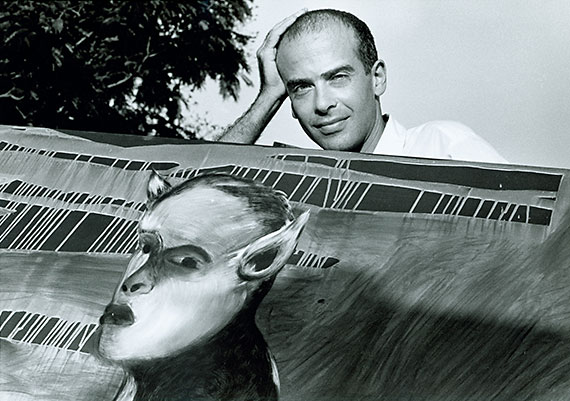





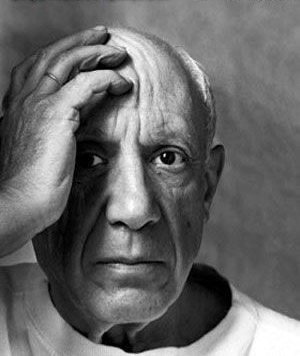
 The piece is done with crayon on paper, and took several months to complete. A friend, Pierre Daix, tells of his memory of the piece on a visit to Picasso, “[Picasso] held the drawing beside his face to show that the expression of fear was a contrivance.” Then on another visit 3 months later, Pierre recalled that the harsh colored lines were even deeper, and Pierre writes, “He did not blink. I had the sudden impression that he was staring his own death in the face, like a good Spaniard”

,_gouache_and_pencil_on_board,_68.5_x_96_cm,_private_collection.jpg)


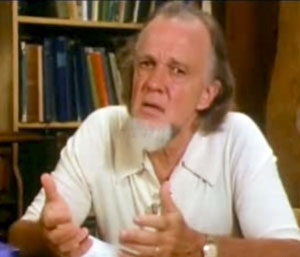



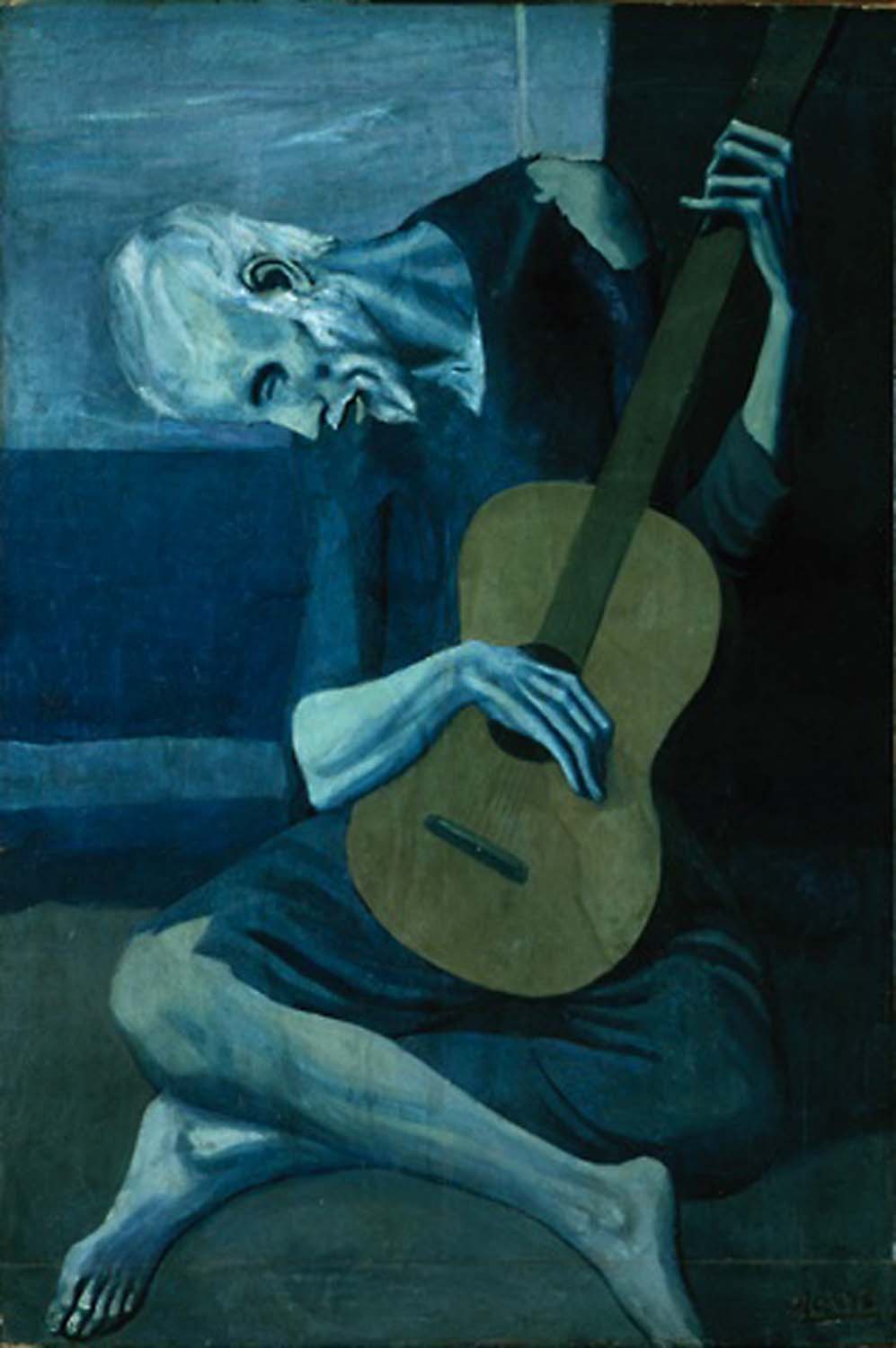


 The Daily Hatch