Category Archives: Atheists Confronted

“Schaeffer Sunday” Taking on Ark Times Bloggers on the “Absurdity of Life without God!!” Part 24 (Repenting and putting our faith in God is only way to find a lasting meaning to our lives)

Is the Bible historically accurate? Here are some of the posts I have done in the past on the subject: 1. The Babylonian Chronicleof Nebuchadnezzars Siege of Jerusalem2. Hezekiah’s Siloam Tunnel Inscription. 3. Taylor Prism (Sennacherib Hexagonal Prism)4. Biblical Cities Attested Archaeologically. 5. The Discovery of the Hittites6.Shishak Smiting His Captives7. Moabite Stone8Black Obelisk of Shalmaneser III9A Verification of places in Gospel of John and Book of Acts., 9B Discovery of Ebla Tablets10. Cyrus Cylinder11. Puru “The lot of Yahali” 9th Century B.C.E.12. The Uzziah Tablet Inscription13. The Pilate Inscription14. Caiaphas Ossuary14 B Pontius Pilate Part 214c. Three greatest American Archaeologists moved to accept Bible’s accuracy through archaeology.

The Bible and Archaeology – Is the Bible from God? (Kyle Butt 42 min)

Existentialism and the Meaningful Life [The Common Room]

Published on Jul 7, 2015

Torrey Common Room Discussion with Janelle Aijian, Matt Jenson, and Diane Vincent

Eastwooding Richard Dawkins’ Moral Argument Objections

Published on Oct 20, 2012

For more information and resources visit: http://www.reasonablefaith.org

On September 29th, 2012, William Lane Craig participated in the Contending with Christianity’s Critics Conference held at Watermark Community Church in Dallas, TX. In this short clip, Dr. Craig uses the technique of Eastwooding to deal with Richard Dawkins’ attempted refutations of the moral argument for God’s existence.

To view the entire video: http://youtu.be/_XZb8m7p8ng

The statements ascribed to Richard Dawkins in this presentation are statements actually made by Prof. Dawkins. The following is a list of the sources of such statements:

Dawkins, Richard. “Afterword.” In Lawrence Krauss, A Universe from Nothing. New York: Free Press, 2012.

_____. “Comment.” http://old.richarddawkins.net/comment….

_____. The God Delusion. New York: Houghton-Mifflin, 2006.

_____. River out of Eden: a Darwinian View of Life. New York: Basic Books, 1996.

_____. “The Ultraviolet Garden,” Lecture 4 of 7 Royal Institution Christmas Lectures (1992), http://physicshead.blogspot.com/2007/….

_____. “Why I Refuse to Debate William Lane Craig.” The Guardian 20 October 2011 http://old.richarddawkins.net/comment…

Citations of these statements with references may be found in:

“Richard Dawkins on Arguments for God.” In God Is Great, God Is Good, pp. 13-31. Ed. Wm. L Craig and Chad Meister. Downers Grove, Ill.: Inter-Varsity, 2009.

Citations in lecture format may be found at:

http://youtu.be/9HLmow850iE

We welcome your comments in the Reasonable Faith forums:
http://www.reasonablefaith.org/forums/

Be sure to also visit Reasonable Faith’s other channel: http://www.youtube.com/drcraigvideos

Follow Reasonable Faith On Twitter: http://twitter.com/rfupdates

Add Reasonable Faith On Facebook: http://www.facebook.com/reasonablefaith

Francis Schaeffer and  Gospel of Christ in the pages of the Bible

(The Bible is the key in understanding the universe in its form)

Francis and Edith Schaeffer pictured below:

_________________

Life without God in the picture is absurdity!!!. That was the view of King Solomon when he wrote the Book of Ecclesiastes 3000 years ago and it is the view of many of the modern philosophers todayModern man has tried to come up with a lasting meaning for life without God in the picture (life under the sun), but it is not possible. Without the infinite-personal God of the Bible to reveal moral absolutes then man is left to embrace moral relativism. In a time plus chance universe man is reduced to a machine and can not find a place for values such as love. Both of Francis Schaeffer’s film series have tackled these subjects and he shows how this is reflected in the arts.

Here are some posts I have done on the series “HOW SHOULD WE THEN LIVE? : Francis Schaeffer’s “How should we then live?” Video and outline of episode 10 “Final Choices” episode 9 “The Age of Personal Peace and Affluence”episode 8 “The Age of Fragmentation”episode 7 “The Age of Non-Reason” episode 6 “The Scientific Age”  episode 5 “The Revolutionary Age” episode 4 “The Reformation” episode 3 “The Renaissance”episode 2 “The Middle Ages,”, and  episode 1 “The Roman Age,” .

In the film series “WHATEVER HAPPENED TO THE HUMAN RACE?” the arguments are presented  against abortion (Episode 1),  infanticide (Episode 2),   euthenasia (Episode 3), and then there is a discussion of the Christian versus Humanist worldview concerning the issue of “the basis for human dignity” in Episode 4 and then in the last episode a close look at the truth claims of the Bible.

I have discussed many subjects with my liberal friends over at the Ark Times Blog in the past and I have taken them on now on the subject of the absurdity of life without God in the picture. Most of my responses included quotes from William Lane Craig’s book THE ABSURDITY OF LIFE WITHOUT GOD.  Here is the result of one of those encounters from June of 2013:

I wrote:

Doigotta, I know you were referring to something else entirely when you wrote, “I repent.” However, that is the key to finding a lasting meaning to life. Without God there is no meaning in life.

William Lane Craig notes:

First, the area of meaning. We saw that without God, life has no meaning. Yet philosophers continue to live as though life does have meaning. For example, Sartre argued that one may create meaning for his life by freely choosing to follow a certain course of action. Sartre himself chose Marxism.

Now this is utterly inconsistent. It is inconsistent to say that life is objectively absurd and then to say that one may create meaning for his life. If life is really absurd, then man is trapped in the lower story. To try to create meaning in life represents a leap to the upper story. But Sartre has no basis for this leap. Without God, there can be no objective meaning in life. Sartre’s program is actually an exercise in self-delusion. For the universe does not really acquire meaning just because I happen to give it one. This is easy to see: for suppose I give the universe one meaning, and you give it another. Who is right? The answer, of course, is neither one. For the universe without God remains objectively meaningless, no matter how we regard it. Sartre is really saying, “Let’s pretend the universe has meaning.” And this is just fooling ourselves.

The point is this: if God does not exist, then life is objectively meaningless; but man cannot live consistently and happily knowing that life is meaningless; so in order to be happy he pretends that life has meaning. But this is, of course, entirely inconsistent—for without God, man and the universe are without any real significance.

Related posts:

Francis Schaeffer’s “How should we then live?” Video and outline of episode 10 “Final Choices” (Schaeffer Sundays)

E P I S O D E 1 0   Dr. Francis Schaeffer – Episode X – Final Choices 27 min FINAL CHOICES I. Authoritarianism the Only Humanistic Social Option One man or an elite giving authoritative arbitrary absolutes. A. Society is sole absolute in absence of other absolutes. B. But society has to be […]

Francis Schaeffer’s “How should we then live?” Video and outline of episode 9 “The Age of Personal Peace and Affluence” (Schaeffer Sundays)

E P I S O D E 9 Dr. Francis Schaeffer – Episode IX – The Age of Personal Peace and Affluence 27 min T h e Age of Personal Peace and Afflunce I. By the Early 1960s People Were Bombarded From Every Side by Modern Man’s Humanistic Thought II. Modern Form of Humanistic Thought Leads […]

Francis Schaeffer’s “How should we then live?” Video and outline of episode 8 “The Age of Fragmentation” (Schaeffer Sundays)

E P I S O D E 8 Dr. Francis Schaeffer – Episode VIII – The Age of Fragmentation 27 min I saw this film series in 1979 and it had a major impact on me. T h e Age of FRAGMENTATION I. Art As a Vehicle Of Modern Thought A. Impressionism (Monet, Renoir, Pissarro, Sisley, […]

Francis Schaeffer’s “How should we then live?” Video and outline of episode 7 “The Age of Non-Reason” (Schaeffer Sundays)

E P I S O D E 7 Dr. Francis Schaeffer – Episode VII – The Age of Non Reason I am thrilled to get this film series with you. I saw it first in 1979 and it had such a big impact on me. Today’s episode is where we see modern humanist man act […]

Francis Schaeffer’s “How should we then live?” Video and outline of episode 6 “The Scientific Age” (Schaeffer Sundays)

E P I S O D E 6 How Should We Then Live 6#1 Uploaded by NoMirrorHDDHrorriMoN on Oct 3, 2011 How Should We Then Live? Episode 6 of 12 ________ I am sharing with you a film series that I saw in 1979. In this film Francis Schaeffer asserted that was a shift in […]

Francis Schaeffer’s “How should we then live?” Video and outline of episode 5 “The Revolutionary Age” (Schaeffer Sundays)

E P I S O D E 5 How Should We Then Live? Episode 5: The Revolutionary Age I was impacted by this film series by Francis Schaeffer back in the 1970′s and I wanted to share it with you. Francis Schaeffer noted, “Reformation Did Not Bring Perfection. But gradually on basis of biblical teaching there […]

Francis Schaeffer’s “How should we then live?” Video and outline of episode 4 “The Reformation” (Schaeffer Sundays)

Dr. Francis Schaeffer – Episode IV – The Reformation 27 min I was impacted by this film series by Francis Schaeffer back in the 1970′s and I wanted to share it with you. Schaeffer makes three key points concerning the Reformation: “1. Erasmian Christian humanism rejected by Farel. 2. Bible gives needed answers not only as to […]

“Schaeffer Sundays” Francis Schaeffer’s “How should we then live?” Video and outline of episode 3 “The Renaissance”

Francis Schaeffer’s “How should we then live?” Video and outline of episode 3 “The Renaissance” Francis Schaeffer: “How Should We Then Live?” (Episode 3) THE RENAISSANCE I was impacted by this film series by Francis Schaeffer back in the 1970′s and I wanted to share it with you. Schaeffer really shows why we have so […]

Francis Schaeffer’s “How should we then live?” Video and outline of episode 2 “The Middle Ages” (Schaeffer Sundays)

  Francis Schaeffer: “How Should We Then Live?” (Episode 2) THE MIDDLE AGES I was impacted by this film series by Francis Schaeffer back in the 1970′s and I wanted to share it with you. Schaeffer points out that during this time period unfortunately we have the “Church’s deviation from early church’s teaching in regard […]

Francis Schaeffer’s “How should we then live?” Video and outline of episode 1 “The Roman Age” (Schaeffer Sundays)

Francis Schaeffer: “How Should We Then Live?” (Episode 1) THE ROMAN AGE   Today I am starting a series that really had a big impact on my life back in the 1970′s when I first saw it. There are ten parts and today is the first. Francis Schaeffer takes a look at Rome and why […]

Francis Schaeffer: “Whatever Happened to the Human Race” (Episode 5) TRUTH AND HISTORY

Francis Schaeffer: “Whatever Happened to the Human Race” (Episode 5) TRUTH AND HISTORY Published on Oct 7, 2012 by AdamMetropolis This crucial series is narrated by the late Dr. Francis Schaeffer and former Surgeon General Dr. C. Everett Koop. Today, choices are being made that undermine human rights at their most basic level. Practices once […]

Francis Schaeffer: “Whatever Happened to the Human Race” (Episode 4) THE BASIS FOR HUMAN DIGNITY

The opening song at the beginning of this episode is very insightful. Francis Schaeffer: “Whatever Happened to the Human Race” (Episode 4) THE BASIS FOR HUMAN DIGNITY Published on Oct 7, 2012 by AdamMetropolis This crucial series is narrated by the late Dr. Francis Schaeffer and former Surgeon General Dr. C. Everett Koop. Today, choices […]

Francis Schaeffer: “Whatever Happened to the Human Race” (Episode 3) DEATH BY SOMEONE’S CHOICE

Francis Schaeffer: “Whatever Happened to the Human Race” (Episode 3) DEATH BY SOMEONE’S CHOICE Published on Oct 6, 2012 by AdamMetropolis This crucial series is narrated by the late Dr. Francis Schaeffer and former Surgeon General Dr. C. Everett Koop. Today, choices are being made that undermine human rights at their most basic level. Practices […]

Francis Schaeffer: “Whatever Happened to the Human Race?” (Episode 2) SLAUGHTER OF THE INNOCENTS

Francis Schaeffer: “Whatever Happened to the Human Race?” (Episode 2) SLAUGHTER OF THE INNOCENTS Published on Oct 6, 2012 by AdamMetropolis This crucial series is narrated by the late Dr. Francis Schaeffer and former Surgeon General Dr. C. Everett Koop. Today, choices are being made that undermine human rights at their most basic level. Practices […]

Francis Schaeffer: “Whatever Happened to the Human Race” (Episode 1) ABORTION OF THE HUMAN RACE

It is not possible to know where the pro-life evangelicals are coming from unless you look at the work of the person who inspired them the most. That person was Francis Schaeffer.  I do care about economic issues but the pro-life issue is the most important to me. Several years ago Adrian Rogers (past president of […]

Ecclesiastes, Purpose, Meaning, and the Necessity of God by Suiwen Liang (Quotes Will Durant, Madalyn Murray O’Hair, Stephen Jay Gould,Richard Dawkins, Jean-Paul Sartre,Bertrand Russell, Leo Tolstoy, Loren Eiseley,Aldous Huxley, G.K. Chesterton, Ravi Zacharias, and C.S. Lewis.)

Ecclesiastes 2-3 Published on Sep 19, 2012 Calvary Chapel Spring Valley | Sunday Evening | September 16, 2012 | Derek Neider _____________________________ I have written on the Book of Ecclesiastes and the subject of the meaning of our lives on several occasions on this blog. In this series on Ecclesiastes I hope to show how secular […]

Robert Leroe on Ecclesiastes (Mentions Thomas Aquinas, Princess Diana, Mother Teresa, King Solomon, King Rehoboam, Eugene Peterson, Chuck Swindoll, and John Newton.)

Ecclesiastes 1 Published on Sep 4, 2012 Calvary Chapel Spring Valley | Sunday Evening | September 2, 2012 | Pastor Derek Neider _____________________ I have written on the Book of Ecclesiastes and the subject of the meaning of our lives on several occasions on this blog. In this series on Ecclesiastes I hope to show how […]

Super Bowl, Black Eyed Peas, and the Meaning of Life and Ecclesiastes

Ecclesiastes 8-10 | Still Searching After All These Years Published on Oct 9, 2012 Calvary Chapel Spring Valley | Sunday Evening | October 7, 2012 | Pastor Derek Neider _______________________ Ecclesiastes 11-12 | Solomon Finds His Way Published on Oct 30, 2012 Calvary Chapel Spring Valley | Sunday Evening | October 28, 2012 | Pastor Derek Neider […]

Brian LePort on Ecclesiastes

Ecclesiastes 6-8 | Solomon Turns Over a New Leaf Published on Oct 2, 2012 Calvary Chapel Spring Valley | Sunday Evening | September 30, 2012 | Pastor Derek Neider _____________________ I have written on the Book of Ecclesiastes and the subject of the meaning of our lives on several occasions on this blog. In this series […]

J.W. Wartick on Ecclesiastes

Ecclesiastes 4-6 | Solomon’s Dissatisfaction Published on Sep 24, 2012 Calvary Chapel Spring Valley | Sunday Evening | September 23, 2012 | Pastor Derek Neider ___________________ I have written on the Book of Ecclesiastes and the subject of the meaning of our lives on several occasions on this blog. In this series on Ecclesiastes I hope […]

Overview of the Book of Ecclesiastes

Overview of the Book of Ecclesiastes Overview of the Book of EcclesiastesAuthor: Solomon or an unknown sage in the royal courtPurpose: To demonstrate that life viewed merely from a realistic human perspective must result in pessimism, and to offer hope through humble obedience and faithfulness to God until the final judgment.Date: 930-586 B.C. Ecclesiastes 2-3 Published on Sep 19, […]

Doy Moyer on the Book of Ecclesiastes and Apologetics

Ecclesiastes 1 Published on Sep 4, 2012 Calvary Chapel Spring Valley | Sunday Evening | September 2, 2012 | Pastor Derek Neider _____________________ I have written on the Book of Ecclesiastes and the subject of the meaning of our lives on several occasions on this blog. In this series on Ecclesiastes I hope to show how […]

Solomon was the author of Ecclesiastes

Ecclesiastes 8-10 | Still Searching After All These Years Published on Oct 9, 2012 Calvary Chapel Spring Valley | Sunday Evening | October 7, 2012 | Pastor Derek Neider _______________________ Ecclesiastes 11-12 | Solomon Finds His Way Published on Oct 30, 2012 Calvary Chapel Spring Valley | Sunday Evening | October 28, 2012 | Pastor Derek Neider […]

By Everette Hatcher III | Posted in Current Events | Edit | Comments (0)

RESPONDING TO HARRY KROTO’S BRILLIANT RENOWNED ACADEMICS!! PART 15 (Dr Jonathan Parry, Dept of History, Cambridge, Discussing Darwin and issue of Suffering )

____________________________

Jonathan Parry pictured below:

"The Indian workforce is basically divided into an organised and unorganised sector"

On November 21, 2014 I received a letter from Nobel Laureate Harry Kroto and it said:

…Please click on this URL http://vimeo.com/26991975

and you will hear what far smarter people than I have to say on this matter. I agree with them.

Harry Kroto

__________________________

There are 3 videos in this series and they have statements by 150 academics and scientists and I hope to respond to all of them. Wikipedia notes Jonathan Parry is an English historian. He is Professor of Modern British History at the University of Cambridge.[1]

His comments can be found on the 3rd video and the 122nd clip in this series. Below the videos you will find his words.

50 Renowned Academics Speaking About God (Part 1)

Another 50 Renowned Academics Speaking About God (Part 2)

A Further 50 Renowned Academics Speaking About God (Part 3)

_______________

Interview with Jonathan Parry, Part 1

Uploaded on Feb 3, 2012

The anthropologist Jonathan Parry interviewed by Alan Macfarlane on 5th December 2008. Please see http://www.alanmacfarlane.com for the wider context.

All revenues to World Oral Literature Project.

Interview with Jonathan Parry, Part 2

I grew up at Bellevue Baptist Church under the leadership of our pastor Adrian Rogers and I read many books by the Evangelical Philosopher Francis Schaeffer and have had the opportunity to contact many of the evolutionists or humanistic academics that they have mentioned in their works. Many of these scholars have taken the time to respond back to me in the last 20 years and some of the names  included are  Ernest Mayr (1904-2005), George Wald (1906-1997), Carl Sagan (1934-1996),  Robert Shapiro (1935-2011), Nicolaas Bloembergen (1920-),  Brian Charlesworth (1945-),  Francisco J. Ayala (1934-) Elliott Sober (1948-), Kevin Padian (1951-), Matt Cartmill (1943-) , Milton Fingerman (1928-), John J. Shea (1969-), , Michael A. Crawford (1938-), Paul Kurtz (1925-2012), Sol Gordon (1923-2008), Albert Ellis (1913-2007), Barbara Marie Tabler (1915-1996), Renate Vambery (1916-2005), Archie J. Bahm (1907-1996), Aron S “Gil” Martin ( 1910-1997), Matthew I. Spetter (1921-2012), H. J. Eysenck (1916-1997), Robert L. Erdmann (1929-2006), Mary Morain (1911-1999), Lloyd Morain (1917-2010),  Warren Allen Smith (1921-), Bette Chambers (1930-),  Gordon Stein (1941-1996) , Milton Friedman (1912-2006), John Hospers (1918-2011), Michael Martin (1932-).Harry Kroto (1939-), Marty E. Martin (1928-), Richard Rubenstein (1924-), James Terry McCollum (1936-), Edward O. WIlson (1929-), Lewis Wolpert (1929), Gerald Holton (1922-), Martin Rees (1942-), Alan Macfarlane (1941-),  Roald Hoffmann (1937-), Herbert Kroemer (1928-), Thomas H. Jukes (1906-1999), Glenn BranchGeoff Harcourt (1931-) and  Ray T. Cragun (1976-).

Quote:

Since the age of about 15 or 16 I have been an agnostic. In later years I converted from being an agnostic to a somewhat dogmatic atheist. I think my personal attitudes to religion were actually hardened by doing the Banaras Study (about death)…. A lot of the ideas that were underlying what people were saying were really rather deeply disturbing and frankly personally unpleasant. You would meet a man whose son had died in some tragic circumstances and the Priest would be going on about the fruits of Karma and so on. I found this personally unattractive. 

I have already responded to the problem of evil and suffering with my earlier responses to Rebecca Goldstein, David Attenborough, Alan Dershowitz, and Shelly Kagan.

Below is a letter I wrote recently to Dr. Parry:

February 15, 2015

Dear Dr. Parry,

I just finished reading the online addition of the book Darwin, Francis ed. 1892. Charles Darwin: his life told in an autobiographical chapter, and in a selected series of his published letters [abridged edition]. London: John Murray. There are several points that Charles Darwin makes in this book that were very wise, honest, logical, shocking and some that were not so wise. The Christian Philosopher Francis Schaeffer once said of Darwin’s writings, “Darwin in his autobiography and in his letters showed that all through his life he never really came to a quietness concerning the possibility that chance really explained the situation of the biological world. You will find there is much material on this [from Darwin] extended over many many years that constantly he was wrestling with this problem.”

Here is a quote I ran across recently from you in your wonderful in depth interview with Alan Macfarlane :

Since the age of about 15 or 16 I have been an agnostic. In later years I converted from being an agnostic to a somewhat dogmatic atheist. I think my personal attitudes to religion were actually hardened by doing the Banaras Study (about death)…. A lot of the ideas that were underlying what people were saying were really rather deeply disturbing and frankly personally unpleasant. You would meet a man whose son had died in some tragic circumstances and the Priest would be going on about the fruits of Karma and so on. I found this personally unattractive. 

On February 15, 2015 at our church service at FELLOWSHIP BIBLE CHURCH in Little Rock, Arkansas, our teaching pastor Brandon Barnard told the story of my good friends Roger and Terrie Cheuvront  and the tragic death of their 19 year daughter Danaea on April 15, 2007 in a traffic accident. Just like you I was at the Funeral Home when the minister came in that very day, but unlike you I found the words of the pastor as a great comfort. The sermon on 2-15-15 was about the time that Jesus wept at sight of his friend Lazarus’ tomb, and this 11th chapter of John had comforted Terrie Cheuvront because she knew that Jesus had felt the same pain that we have and he will eventually raise us too from the dead and her daughter Danaea is even now in heaven with Christ.

Rev Barnard actually read these words from Terri at our service: “God never intended us to experience sin and death, but sin brought about this consequence. I could be mad at death and all that it meant but the amazing thing was when I realized God’s plan then God took the anger and replaced it with His grace. It made me realize at a deeper level what God had truly done for me on the cross. He conquered sin and death for me. What amazing glorious hope he gives us. We live because He lives. Yes I am separated from my daughter now but there will be a glorious reunion.”

Let me make three points concerning the problem of evil and suffering. First, the problem of evil and suffering hit this world in a big way because of Adam and what happened in Genesis Chapter 3. Second, if there is no God then there is no way to distinguish good from evil and there will be no ultimate punishment for Hitler and Josef Mengele. (By the way Mengele never faced punishment and lived his long life out in peace.) Third. Christ came and suffered and will destroy all evil from this world eventually forever.

CHARLES DARWIN ALSO SPENT A LOT OF TIME TALKING ABOUT THIS ISSUE OF EVIL AND SUFFERING. When I read the book  Charles Darwin: his life told in an autobiographical chapter, and in a selected series of his published letters, I also read  a commentary on it by Francis Schaeffer and I wanted to both  quote some of Charles Darwin’s own words to you and then include the comments of Francis Schaeffer on those words. I have also enclosed a CD with two messages from Adrian Rogers and Bill Elliff concerning Darwinism.

Darwin, C. R. to Doedes, N. D.2 Apr 1873

“I am sure you will excuse my writing at length, when I tell you that I have long been much out of health, and am now staying away from my home for rest. It is impossible to answer your question briefly; and I am not sure that I could do so, even if I wrote at some length. But I may say that the impossibility of conceiving that this grand and wondrous universe, with our conscious selves, arose through chance, seems to me the chief argument for the existence of God; but whether this is an argument of real value, I have never been able to decide…....Nor can I overlook the difficulty from the immense amount of suffering through the world.”

Francis Schaeffer observed:

This of course is a valid problem. The only answer to the problem of evil is the biblical answer of the fall. Darwin has a problem because he never had a high view of revelation, so he doesn’t have the answer any more than the liberal theologian has the answer. If you don’t have a space-time fall then you don’t have an answer to suffering. If you have a very, very significant man at the beginning, Darwin did not have that, but if you had a very significant, wonderful man at the beginning and can change history then the fall is the possible answer that can be given to Darwin’s 2nd argument.

The passages which here follow are extracts, somewhat abbreviated, from a part of the Autobiography, written in 1876, in which my father (Franicis Darwin’s father Charles) gives the history of his religious views:—

But passing over the endless beautiful adaptations which we everywhere meet with, it may be asked how can the generally beneficent arrangement of the world be accounted for? Some writers indeed are so much impressed with the amount of suffering in the world, that they doubt, if we look to all sentient beings, whether there is more of misery or of happiness; whether the world as a whole is a good or a bad one. According to my judgment happiness decidedly prevails, though this would be very difficult to prove.”

Francis Schaeffer commented:

We come now to a funny situation where Darwin is arguing there is more happiness than sorry in the world. In this I think he is right. What he is saying if you could have a balance of 51% of happiness then it would open the door to thinking God is good, but I would never argue this way because it is not 51% of happiness versus 49% of unhappiness in the universe but how could a good God make unhappiness at all. The answer is in the [space time fall in Genesis].

Darwin continued:

If the truth of this conclusion be granted, it harmonizes well with the effects which we might expect from natural selection. If all the individuals of any species were habitually to suffer to an extreme degree, they would neglect to propagate their kind; but we have no reason to believe that this has ever, or at least often occurred. Some other considerations, moreover, lead to the belief that all sentient begins have been formed so as to enjoy, as a general rule, happiness. Every one who believes, as I do, that all the corporeal and mental organs (excepting those which are neither advantageous nor disadvantageous to the possessor) of all beings have been developed through natural selection, or the survival of the fittest, together with use or habit, will admit that these organs have been formed so that their possessors may compete successfully with other beings, and thus increase in number.

Francis Schaeffer noted:

What he is saying here is that from his own view he needs to hold that suffering is less than happiness otherwise what would drive the creatures on toward natural selection. The Christian of course does not have this problem. The Christian says everything is in agony because the whole has been thrown out of joint and there has been an reordering of the universe because of the fall. We don’t have to find such a balance as he was grappling with here.

From Darwin’s section on religion:

The sum of such pleasures as these, which are habitual or frequently recurrent, give, as I can hardly doubt, to most sentient beings an excess of happiness over misery, although many occasionally suffer much. Such suffering is quite compatible with the belief in Natural Selection, which is not perfect in its action, but tends only to render each species as successful as possible in the battle for life with other species, in wonderfully complex and changing circumstances.  That there is much suffering in the world no one disputes. Some have attempted to explain this with reference to man by imagining that it serves for his moral improvement. But the number of men in the world is as nothing compared with that of all other sentient beings, and they often suffer greatly without any moral improvement. This very old argument from the existence of suffering against the existence of an intelligent First Cause seems to me a strong one; whereas, as just remarked, the presence of much suffering agrees well with the view that all organic beings have been developed through variation and natural selection.

Francis Schaeffer :

He has to argue this otherwise what drove the creatures on. He has to have a 51% or 52% happiness. Then he says what does this do to God. We would answer if there is no space time fall it makes God if He exists the devil, on the other hand with a space time fall you have another answer.

WITHOUT THE VIEW THAT THE GARDEN OF EDEN EXISTED OR IN THE EXISTENCE OF HEAVEN THEN YOUR ANALYSIS IS THE ONLY ONE THAT IS PROBABLE. FURTHERMORE,  IF WE WERE NOT CREATED BY GOD THEN WE HAVE NO HOPE FOR OUR ETERNAL FUTURES.  I sent you a CD that starts off with the song DUST IN THE WIND by Kerry Livgren of the group KANSAS which was a hit song in 1978 when it rose to #6 on the charts because so many people connected with the message of the song. It included these words, “All we do, crumbles to the ground though we refuse to see, Dust in the Wind, All we are is dust in the wind, Don’t hang on, Nothing lasts forever but the Earth and Sky, It slips away, And all your money won’t another minute buy.”

Kerry Livgren himself said that he wrote the song because he saw where man was without a personal God in the picture. Solomon pointed out in the Book of Ecclesiastes that those who believe that God doesn’t exist must accept three things. FIRST, death is the end and SECOND, chance and time are the only guiding forces in this life.  FINALLY, power reigns in this life and the scales are never balanced. The Christian can  face death and also confront the world knowing that it is not determined by chance and time alone and finally there is a judge who will balance the scales.

Both Kerry Livgren and the bass player Dave Hope of Kansas became Christians eventually. Kerry Livgren first tried Eastern Religions and Dave Hope had to come out of a heavy drug addiction. I was shocked and elated to see their personal testimony on The 700 Club in 1981 and that same  interview can be seen on You Tube today. Livgren lives in Topeka, Kansas today where he teaches “Diggers,” a Sunday school class at Topeka Bible ChurchDAVE HOPE is the head of Worship, Evangelism and Outreach at Immanuel Anglican Church in Destin, Florida.

The answer to find meaning in life is found in putting your faith and trust in Jesus Christ. The Bible is true from cover to cover and can be trusted.

Thank you again for your time and I know how busy you are.

Everette Hatcher, everettehatcher@gmail.com, http://www.thedailyhatch.org, cell ph 501-920-5733, Box 23416, LittleRock, AR 72221, United States

Is the Bible historically accurate? Here are some of the posts I have done in the past on the subject: 1. The Babylonian Chronicleof Nebuchadnezzars Siege of Jerusalem2. Hezekiah’s Siloam Tunnel Inscription. 3. Taylor Prism (Sennacherib Hexagonal Prism)4. Biblical Cities Attested Archaeologically. 5. The Discovery of the Hittites6.Shishak Smiting His Captives7. Moabite Stone8Black Obelisk of Shalmaneser III9A Verification of places in Gospel of John and Book of Acts., 9B Discovery of Ebla Tablets10. Cyrus Cylinder11. Puru “The lot of Yahali” 9th Century B.C.E.12. The Uzziah Tablet Inscription13. The Pilate Inscription14. Caiaphas Ossuary14 B Pontius Pilate Part 214c. Three greatest American Archaeologists moved to accept Bible’s accuracy through archaeology.

You can hear DAVE HOPE and Kerry Livgren’s stories from this youtube link:

(part 1 ten minutes)

(part 2 ten minutes)

Kansas – Dust in the Wind (Official Video)

Uploaded on Nov 7, 2009

Pre-Order Miracles Out of Nowhere now at http://www.miraclesoutofnowhere.com

About the film:
In 1973, six guys in a local band from America’s heartland began a journey that surpassed even their own wildest expectations, by achieving worldwide superstardom… watch the story unfold as the incredible story of the band KANSAS is told for the first time in the DVD Miracles Out of Nowhere.

_____________________________

Adrian Rogers on Darwinism

Related posts:

Carl Sagan’s search for the of meaning of life

________________ Kansas – Dust In The Wind “Live” HD Rolling Stones: “Satisfaction!” U2 Still Haven’t Found (with lyrics) Carl Sagan appears on CBC to discuss the importance of SETI [Carl Sagan Archives] __________________________________________________ On December 5, 1995, I got a letter back from Carl Sagan and I was very impressed that he took time to answer […]

Taking on Ark Times Bloggers on various issues Part F “Carl Sagan’s views on how God should try and contact us” includes film “The Basis for Human Dignity”

I have gone back and forth and back and forth with many liberals on the Arkansas Times Blog on many issues such as abortion, human rights, welfare, poverty, gun control  and issues dealing with popular culture. Here is another exchange I had with them a while back. My username at the Ark Times Blog is Saline […]

Carl Sagan v. Nancy Pearcey

On March 17, 2013 at our worship service at Fellowship Bible Church, Ben Parkinson who is one of our teaching pastors spoke on Genesis 1. He spoke about an issue that I was very interested in. Ben started the sermon by reading the following scripture: Genesis 1-2:3 English Standard Version (ESV) The Creation of the […]

Review of Carl Sagan book (Part 4 of series on Evolution)

Review of Carl Sagan book (Part 4 of series on Evolution) The Long War against God-Henry Morris, part 5 of 6 Uploaded by FLIPWORLDUPSIDEDOWN3 on Aug 30, 2010 http://www.icr.org/ http://store.icr.org/prodinfo.asp?number=BLOWA2http://store.icr.org/prodinfo.asp?number=BLOWASGhttp://www.fliptheworldupsidedown.com/blog _______________________ I got this from a blogger in April of 2008 concerning candidate Obama’s view on evolution: Q: York County was recently in the news […]

Review of Carl Sagan book (Part 3 of series on Evolution)

Review of Carl Sagan book (Part 3 of series on Evolution) The Long War against God-Henry Morris, part 4 of 6 Uploaded by FLIPWORLDUPSIDEDOWN3 on Aug 30, 2010 http://www.icr.org/ http://store.icr.org/prodinfo.asp?number=BLOWA2http://store.icr.org/prodinfo.asp?number=BLOWASGhttp://www.fliptheworldupsidedown.com/blog______________________________________ I got this from a blogger in April of 2008 concerning candidate Obama’s view on evolution: Q: York County was recently in the news […]

Carl Sagan versus RC Sproul

At the end of this post is a message by RC Sproul in which he discusses Sagan. Over the years I have confronted many atheists. Here is one story below: I really believe Hebrews 4:12 when it asserts: For the word of God is living and active and sharper than any two-edged sword, and piercing as far as the […]

Review of Carl Sagan book (Part 4 of series on Evolution)jh68

Review of Carl Sagan book (Part 4 of series on Evolution) The Long War against God-Henry Morris, part 5 of 6 Uploaded by FLIPWORLDUPSIDEDOWN3 on Aug 30, 2010 http://www.icr.org/ http://store.icr.org/prodinfo.asp?number=BLOWA2http://store.icr.org/prodinfo.asp?number=BLOWASGhttp://www.fliptheworldupsidedown.com/blog _______________________ This is a review I did a few years ago. THE DEMON-HAUNTED WORLD: Science as a Candle in the Dark by Carl […]

Review of Carl Sagan book (Part 3 of series on Evolution)

Review of Carl Sagan book (Part 3 of series on Evolution) The Long War against God-Henry Morris, part 4 of 6 Uploaded by FLIPWORLDUPSIDEDOWN3 on Aug 30, 2010 http://www.icr.org/ http://store.icr.org/prodinfo.asp?number=BLOWA2http://store.icr.org/prodinfo.asp?number=BLOWASGhttp://www.fliptheworldupsidedown.com/blog______________________________________ I was really enjoyed this review of Carl Sagan’s book “Pale Blue Dot.” Carl Sagan’s Pale Blue Dot by Larry Vardiman, Ph.D. […]

Atheists confronted: How I confronted Carl Sagan the year before he died jh47

In today’s news you will read about Kirk Cameron taking on the atheist Stephen Hawking over some recent assertions he made concerning the existence of heaven. Back in December of 1995 I had the opportunity to correspond with Carl Sagan about a year before his untimely death. Sarah Anne Hughes in her article,”Kirk Cameron criticizes […]

My correspondence with George Wald and Antony Flew!!!

FRANCIS SCHAEFFER ANALYZES ART AND CULTURE Part 41 Sarvepalli Radhakrishnan (Featured artist is Marina Abramović)

FRANCIS SCHAEFFER ANALYZES ART AND CULTURE Part 40 Timothy Leary (Featured artist is Margaret Keane)

FRANCIS SCHAEFFER ANALYZES ART AND CULTURE Part 39 Tom Wolfe (Featured artist is Richard Serra)

FRANCIS SCHAEFFER ANALYZES ART AND CULTURE Part 38 Woody Allen and Albert Camus “There is but one truly serious philosophical problem, and that is suicide” (Feature on artist Hamish Fulton Photographer )

FRANCIS SCHAEFFER ANALYZES ART AND CULTURE Part 37 Mahatma Gandhi and “Relieving the Tension in the East” (Feature on artist Luc Tuymans)

FRANCIS SCHAEFFER ANALYZES ART AND CULTURE Part 36 Julian Huxley:”God does not in fact exist, but act as if He does!” (Feature on artist Barry McGee)

FRANCIS SCHAEFFER ANALYZES ART AND CULTURE Part 35 Robert M. Pirsig (Feature on artist Kerry James Marshall)

FRANCIS SCHAEFFER ANALYZES ART AND CULTURE Part 34 Aleksandr Solzhenitsyn (Feature on artist Shahzia Sikander)

FRANCIS SCHAEFFER ANALYZES ART AND CULTURE Part 33 Aldous Huxley (Feature on artist Matthew Barney )

FRANCIS SCHAEFFER ANALYZES ART AND CULTURE Part 32 Steven Weinberg and Woody Allen and “The Meaningless of All Things” (Feature on photographer Martin Karplus )

FRANCIS SCHAEFFER ANALYZES ART AND CULTURE Part 31 David Hume and “How do we know we know?” (Feature on artist William Pope L. )

FRANCIS SCHAEFFER ANALYZES ART AND CULTURE Part 30 Rene Descartes and “How do we know we know?” (Feature on artist Olafur Eliasson)

FRANCIS SCHAEFFER ANALYZES ART AND CULTURE Part 29 W.H. Thorpe and “The Search for an Adequate World-View: A Question of Method” (Feature on artist Jeff Koons)

FRANCIS SCHAEFFER ANALYZES ART AND CULTURE Part 28 Woody Allen and “The Mannishness of Man” (Feature on artist Ryan Gander)

FRANCIS SCHAEFFER ANALYZES ART AND CULTURE Part 27 Jurgen Habermas (Featured artist is Hiroshi Sugimoto)

FRANCIS SCHAEFFER ANALYZES ART AND CULTURE Part 26 Bettina Aptheker (Featured artist is Krzysztof Wodiczko)

FRANCIS SCHAEFFER ANALYZES ART AND CULTURE Part 25 BOB DYLAN (Part C) Francis Schaeffer comments on Bob Dylan’s song “Ballad of a Thin Man” and the disconnect between the young generation of the 60’s and their parents’ generation (Feature on artist Fred Wilson)

FRANCIS SCHAEFFER ANALYZES ART AND CULTURE Part 24 BOB DYLAN (Part B) Francis Schaeffer comments on Bob Dylan’s words from HIGHWAY 61 REVISITED!! (Feature on artist Susan Rothenberg)

FRANCIS SCHAEFFER ANALYZES ART AND CULTURE Part 23 BOB DYLAN (Part A) (Feature on artist Josiah McElheny)Francis Schaeffer on the proper place of rebellion with comments by Bob Dylan and Samuel Rutherford

FRANCIS SCHAEFFER ANALYZES ART AND CULTURE Part 22 “The School of Athens by Raphael” (Feature on the artist Sally Mann)

FRANCIS SCHAEFFER ANALYZES ART AND CULTURE Part 21 William B. Provine (Feature on artist Andrea Zittel)

FRANCIS SCHAEFFER ANALYZES ART AND CULTURE Part 20 Woody Allen and Materialistic Humanism: The World-View of Our Era (Feature on artist Ida Applebroog)

FRANCIS SCHAEFFER ANALYZES ART AND CULTURE Part 19 Movie Director Luis Bunuel (Feature on artist Oliver Herring)

FRANCIS SCHAEFFER ANALYZES ART AND CULTURE Part 18 “Michelangelo’s DAVID is the statement of what humanistic man saw himself as being tomorrow” (Feature on artist Paul McCarthy)

FRANCIS SCHAEFFER ANALYZES ART AND CULTURE Part 17 Francis Schaeffer discusses quotes of Andy Warhol from “The Observer June 12, 1966″ Part C (Feature on artist David Hockney plus many pictures of Warhol with famous friends)

FRANCIS SCHAEFFER ANALYZES ART AND CULTURE Part 16 Francis Schaeffer discusses quotes of Andy Warhol from “The Observer June 12, 1966″ Part B (Feature on artist James Rosenquist plus many pictures of Warhol with famous friends)

FRANCIS SCHAEFFER ANALYZES ART AND CULTURE Part 15 Francis Schaeffer discusses quotes of Andy Warhol from “The Observer June 12, 1966″ Part A (Feature on artist Robert Indiana plus many pictures of Warhol with famous friends)

FRANCIS SCHAEFFER ANALYZES ART AND CULTURE Part 14 David Friedrich Strauss (Feature on artist Roni Horn )

FRANCIS SCHAEFFER ANALYZES ART AND CULTURE Part 13 Jacob Bronowski and Materialistic Humanism: The World-View of Our Era (Feature on artist Ellen Gallagher )

FRANCIS SCHAEFFER ANALYZES ART AND CULTURE Part 12 H.J.Blackham and Materialistic Humanism: The World-View of Our Era (Feature on artist Arturo Herrera)

FRANCIS SCHAEFFER ANALYZES ART AND CULTURE Part 11 Thomas Aquinas and his Effect on Art and HOW SHOULD WE THEN LIVE? Episode 2: THE MIDDLES AGES (Feature on artist Tony Oursler )

FRANCIS SCHAEFFER ANALYZES ART AND CULTURE Part 10 David Douglas Duncan (Feature on artist Georges Rouault )

FRANCIS SCHAEFFER ANALYZES ART AND CULTURE Part 9 Jasper Johns (Feature on artist Cai Guo-Qiang )

FRANCIS SCHAEFFER ANALYZES ART AND CULTURE Part 8 “The Last Year at Marienbad” by Alain Resnais (Feature on artist Richard Tuttle and his return to the faith of his youth)

FRANCIS SCHAEFFER ANALYZES ART AND CULTURE Part 7 Jean Paul Sartre (Feature on artist David Hooker )

FRANCIS SCHAEFFER ANALYZES ART AND CULTURE Part 6 The Adoration of the Lamb by Jan Van Eyck which was saved by MONUMENT MEN IN WW2 (Feature on artist Makoto Fujimura)

FRANCIS SCHAEFFER ANALYZES ART AND CULTURE Part 5 John Cage (Feature on artist Gerhard Richter)

FRANCIS SCHAEFFER ANALYZES ART AND CULTURE Part 4 ( Schaeffer and H.R. Rookmaaker worked together well!!! (Feature on artist Mike Kelley Part B )

FRANCIS SCHAEFFER ANALYZES ART AND CULTURE Part 3 PAUL GAUGUIN’S 3 QUESTIONS: “Where do we come from? What art we? Where are we going? and his conclusion was a suicide attempt” (Feature on artist Mike Kelley Part A)

FRANCIS SCHAEFFER ANALYZES ART AND CULTURE Part 2 “A look at how modern art was born by discussing Monet, Renoir, Pissaro, Sisley, Degas,Cezanne, Van Gogh, Gauguin, Seurat, and Picasso” (Feature on artist Peter Howson)

FRANCIS SCHAEFFER ANALYZES ART AND CULTURE Part 1 HOW SHOULD WE THEN LIVE? “The Roman Age” (Feature on artist Tracey Emin)

_________________


________________

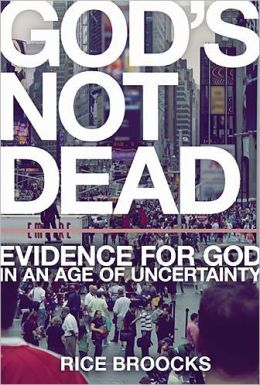
Book Review: God’s Not Dead by Rice Broocks

______________

Crimes and Misdemeanors: A Discussion: Part 1

Crimes and Misdemeanors: A Discussion: Part 2

Crimes and Misdemeanors: A Discussion: Part 3

Saturday, September 14, 2013

Book Review: God’s Not Dead by Rice Broocks

“There is evidence for an intelligent Creator everywhere you look. To say there is no evidence for this Creator is like saying the thousands of paintings in an art museum couldn’t have been painted because there are no artists visible in the gallery.”

After making this statement in the preface of his book, God’s Not Dead, Pastor/Apologist Rice Broocks proceeds to present the evidence in a clear, straightforward, readable fashion. He begins with a look at atheism, remarking on its irrationalism and its failure as a viable worldview. He then moves quickly into the issue of faith, quoting C.S Lewis’ statement that “faith is actually holding on to what your reason has led you to conclude despite your changing moods” (28). He outlines three key ingredients in faith – knowledge, assent and trust. He then explores the function and reliability of science, noting that science and religion are not at odds. The conflict, he says, lies between faith and naturalism.

Broocks then tackles the issue of evil. He discusses the sources of morality, whether humanity is capable of being good apart from the Lord, Kant’s categorical imperative, and Darwinian ethics, concluding with Dostoevsky’s statement that, without God, everything is permissible.

The author then explores the origins of humanity and the universe, starting with the statement that “there was a beginning” (66). He looks at the implications of the big bang and the lengths to which some skeptics have gone to redefine the word ‘nothing’ to make it mean ‘something’, focusing on the statements of atheists Lawrence Krauss, Victor Stenger and Michael Shermer in particular. He also discusses the fine-tuning of the universe and gives his views on the multiverse hypothesis.

In a chapter entitled Life is No Accident, Broocks notes that Darwin, in his Origin of the Species, presented his theory about just that – the origin of different species, not the origin of life itself. Distinguishing between microevolution and macroevolution, the author discusses the issues of irreducible complexity, using the examples of bacterial flagellum and the human eye. He then offers his thoughts on the “God of the gaps” and the Cambrian explosion, two common subjects for debate.

Broocks concludes that life has meaning and purpose, noting that humans long for “a solid sense” of both (119). Man is “not just another animal” (124). The author explores what this means, concentrating on issues such as metacognition, aesthetic values, language, creativity, morality and spirituality. Ultimately, he asserts that “a pointless beginning points to a pointless existence” and, without the Creator God, we would not have any ultimate meaning or purpose beyond the self-centred, arbitrary individual goals we set for ourselves.

Broocks then makes a case for the reality of Jesus and his resurrection, assessing the nonbiblical sources that attest to his life. He notes that even critic Bart Ehrman, no fan of Christianity, recognizes that Jesus did walk this earth. He then lists Lee Strobel’s “five Es” – execution, empty tomb, eyewitnesses, early records and emergence of the church – which “represent the events that history points to as factual” (153).

The author also assesses the reliability of Scripture. He discusses the significance of the Dead Sea Scrolls and notes the historical accuracy of the Bible, commenting on such aspects as its many fulfilled prophecies and the careful transmission of the text. In sitting down with preeminent Textual Critic Scholar Dan Wallace, he says he came away with three distinct principles – that the Bible is true in what it tells, true in what it teaches and true in what it touches – all of which “point definitively to the truth that the Bible is a divinely inspired work that serves as a trustworthy witness to the existence of God” (184).

In a chapter entitled The Grace Effect, Broocks outlines how the grace of God has positively impacted the world, listing examples of how Christians have worked to emphasize the dignity of life, to protect children and elevate the status of women, to promote better education and health-care, and to end slavery as they have attempted to live out the love of God in their lives.

Lastly, the author presents examples of God at work in a variety of places around the world. He includes the stories of several ex-atheists and how they came to the Lord – stories such as that of Ming Wang, one of the world’s foremost laser eye surgeons, Physicist Brian Miller and Professional Illusionist Jim Munroe who says that unbelief is the real illusion in life.

Those who have been studying apologetics in depth for some time will not find anything new in Broocks’ book. Indeed, some may wish that he had spent more time on the individual topics as he just touches the surface of many. However, he makes it clear that he is presenting an overview only. He quotes many scholars including William Lane Craig, Ravi Zacharias, Alvin Plantiga, J. P. Moreland, Hugh Ross and others. The reader has only to check out the footnotes to discover material that deals with all the subjects more thoroughly.

Broocks himself notes that he wrote God’s Not Dead for three types of people – the seeker who is attempting to believe but faces doubts about whether God is real, the believer who knows God is real subjectively but cannot easily articulate this faith to the unbeliever, and the skeptic with the pre-determined mindset that there is no God.

People just beginning their studies in apologetics will find this book most helpful. Broocks has a way of taking the complex and writing about it simply so that the information is accessible to all. Therefore, it is recommended.


Apologetics 315 Book Reviewer Mary Lou is a Canadian journalist who has just completed her Masters in Theological Studies. She writes fiction, poetry and plays as well as non-fiction.


Related posts:

FRANCIS SCHAEFFER ANALYZES ART AND CULTURE Part 35 Robert M. Pirsig (Feature on artist Kerry James Marshall)

_____________________________ Francis Schaeffer pictured below: __________ Francis Schaeffer has written extensively on art and culture spanning the last 2000years and here are some posts I have done on this subject before : Francis Schaeffer’s “How should we then live?” Video and outline of episode 10 “Final Choices” , episode 9 “The Age of Personal Peace and Affluence”, episode 8 […]

Truth Tuesday: Francis Schaeffer: An Introduction to his Apologetics by Jim Leffel

_____________ Francis Schaeffer: An Introduction to his Apologetics by Jim Leffel Episode VII – The Age of Non Reason ____________________ Episode 8: The Age Of Fragmentation Published on Jul 24, 2012 Dr. Schaeffer’s sweeping epic on the rise and decline of Western thought and Culture _______________________ I love the works of Francis Schaeffer and I […]

“Woody Wednesday” Discussing Woody Allen’s movie “Crimes and Misdemeanors” and various other subjects with Ark Times Bloggers (Part 1) “Does might make right?”

Crimes and Misdemeanors: A Discussion: Part 1 Uploaded by camdiscussion on Sep 23, 2007 Part 1 of 3: ‘What Does Judah Believe?’ A discussion of Woody Allen’s 1989 movie, perhaps his finest. By Anton Scamvougeras.http://camdiscussion.blogspot.com/ antons@mail.ubc.ca________________________ I have gone back and forth and back and forth with many liberals on the Arkansas Times Blog on many issues such as abortion, human rights, welfare, poverty, gun control  and […]

Discussing Woody Allen’s movie “Crimes and Misdemeanors” and various other subjects with Ark Times Bloggers (Part 1) “Does might make right?”

Crimes and Misdemeanors: A Discussion: Part 1 Uploaded by camdiscussion on Sep 23, 2007 Part 1 of 3: ‘What Does Judah Believe?’ A discussion of Woody Allen’s 1989 movie, perhaps his finest. By Anton Scamvougeras.http://camdiscussion.blogspot.com/ antons@mail.ubc.ca________________________ I have gone back and forth and back and forth with many liberals on the Arkansas Times Blog on many issues such as abortion, human rights, welfare, poverty, gun control  and […]

The Humanist has no hope to find lasting meaning in life apart from God

Ecclesiastes 8-10 | Still Searching After All These Years Published on Oct 9, 2012 Calvary Chapel Spring Valley | Sunday Evening | October 7, 2012 | Pastor Derek Neider _______________________ Ecclesiastes 11-12 | Solomon Finds His Way Published on Oct 30, 2012 Calvary Chapel Spring Valley | Sunday Evening | October 28, 2012 | Pastor Derek Neider […]

Francis Schaeffer: An Introduction to his Apologetics by Jim Leffel

Francis Schaeffer: An Introduction to his Apologetics by Jim Leffel Episode VII – The Age of Non Reason ____________________ Episode 8: The Age Of Fragmentation Published on Jul 24, 2012 Dr. Schaeffer’s sweeping epic on the rise and decline of Western thought and Culture _______________________ I love the works of Francis Schaeffer and I have […]

Truth Tuesday:Crash course on existentialism with Sartre by Wes Widner

_______________ Episode VII – The Age of Non Reason ____________________ Episode 8: The Age Of Fragmentation Published on Jul 24, 2012 Dr. Schaeffer’s sweeping epic on the rise and decline of Western thought and Culture _______________________ I love the works of Francis Schaeffer and I have been on the internet reading several blogs that talk […]

Francis Bacon: Humanist artist who believed life “is meaningless” (Part 4)

John Whitehead in an article noted: Bacon, however, clearly expressed his atheistic pessimism: “Man now realizes that he is an accident, that he is a completely futile being, that he has to play out the game without purpose, other than of his own choosing.” On another occasion, he remarked: “We are born and we die […]

Francis Bacon: Humanist artist who believed life “is meaningless” (Part 3)

I first read about Bacon in a book by Francis Schaeffer. John Whitehead in an article noted: Bacon’s work epitomizes the spirit of twentieth century man—a grasping for meaning and dignity within an environment of dehumanization and meaninglessness. He once said: “Nietzsche forecast our future for us—he was the Cassandra of the nineteenth century—he told […]

Francis Bacon: Humanist artist who believed life “is meaningless” (Part 4)

John Whitehead in an article noted: Bacon, however, clearly expressed his atheistic pessimism: “Man now realizes that he is an accident, that he is a completely futile being, that he has to play out the game without purpose, other than of his own choosing.” On another occasion, he remarked: “We are born and we die […]

____________

“Schaeffer Sunday” Taking on Ark Times Bloggers on the “Absurdity of Life without God!!” Part 23 (The atheist without a moral lawgiver can not base his or her moral views on anything but moral relativism)

Is the Bible historically accurate? Here are some of the posts I have done in the past on the subject: 1. The Babylonian Chronicleof Nebuchadnezzars Siege of Jerusalem2. Hezekiah’s Siloam Tunnel Inscription. 3. Taylor Prism (Sennacherib Hexagonal Prism)4. Biblical Cities Attested Archaeologically. 5. The Discovery of the Hittites6.Shishak Smiting His Captives7. Moabite Stone8Black Obelisk of Shalmaneser III9A Verification of places in Gospel of John and Book of Acts., 9B Discovery of Ebla Tablets10. Cyrus Cylinder11. Puru “The lot of Yahali” 9th Century B.C.E.12. The Uzziah Tablet Inscription13. The Pilate Inscription14. Caiaphas Ossuary14 B Pontius Pilate Part 214c. Three greatest American Archaeologists moved to accept Bible’s accuracy through archaeology.

The Bible and Archaeology – Is the Bible from God? (Kyle Butt 42 min)

There Is A Difference Between Absolute and Objective Moral Values

Published on Dec 6, 2012

For more resources visit: http://www.reasonablefaith.org

The Bethinking National Apologetics Day Conference: “Countering the New Atheism” took place during the UK Reasonable Faith Tour in October 2011. Christian academics William Lane Craig, John Lennox, Peter J Williams and Gary Habermas lead 600 people in training on how to defend and proclaim the credibility of Christianity against the growing tide of secularism and New Atheist popular thought in western society.

In this session, William Lane Craig delivers his critique of Richard Dawkins’ objections to arguments for the existence of God, followed by questions and answers from the audience. In this clip, Dr Craig addresses a question about objective moral values and distinguishes them from absolute moral values.

Dr. Francis Schaeffer – The Biblical Flow of Truth & History (part 2)

Francis Schaeffer pictured below:

______________________________

_________________

Life without God in the picture is absurdity!!!. That was the view of King Solomon when he wrote the Book of Ecclesiastes 3000 years ago and it is the view of many of the modern philosophers todayModern man has tried to come up with a lasting meaning for life without God in the picture (life under the sun), but it is not possible. Without the infinite-personal God of the Bible to reveal moral absolutes then man is left to embrace moral relativism. In a time plus chance universe man is reduced to a machine and can not find a place for values such as love. Both of Francis Schaeffer’s film series have tackled these subjects and he shows how this is reflected in the arts.

Here are some posts I have done on the series “HOW SHOULD WE THEN LIVE? : Francis Schaeffer’s “How should we then live?” Video and outline of episode 10 “Final Choices” episode 9 “The Age of Personal Peace and Affluence”episode 8 “The Age of Fragmentation”episode 7 “The Age of Non-Reason” episode 6 “The Scientific Age”  episode 5 “The Revolutionary Age” episode 4 “The Reformation” episode 3 “The Renaissance”episode 2 “The Middle Ages,”, and  episode 1 “The Roman Age,” .

In the film series “WHATEVER HAPPENED TO THE HUMAN RACE?” the arguments are presented  against abortion (Episode 1),  infanticide (Episode 2),   euthenasia (Episode 3), and then there is a discussion of the Christian versus Humanist worldview concerning the issue of “the basis for human dignity” in Episode 4 and then in the last episode a close look at the truth claims of the Bible.

I have discussed many subjects with my liberal friends over at the Ark Times Blog in the past and I have taken them on now on the subject of the absurdity of life without God in the picture. Most of my responses included quotes from William Lane Craig’s book THE ABSURDITY OF LIFE WITHOUT GOD.  Here is the result of one of those encounters from June of 2013:

I wrote:

Vanessa, thank you for your thoughts. You wrote, “The afterlife: there’s good and there’s evil. Most people fall on one side or the other. The part of you that’s left when your earthly body turns to dust, or begins to turn to dust, becomes one with good or one with evil. The force. The force has nothing to do with the bible, which is still a decent history book and an outline for living a good life if you don’t get too literal with it.”
___________

Your view of the afterlife is a very popular view that is spreading to more parts of the world than ever before, but is it right? I have defended the truthfulness of the Bible and have given evidence to show that it is the revealed word of God. On what basis do you make your claims? WHAT IS EVIL AND WHAT IS GOOD ACCORDING TO YOU AND ON WHAT BASIS CAN YOU MAKE THOSE CLAIMS?

Evidently you do not believe in the infinite-personal God of the Bible. It sounds like to me that you are similar in your religious views to Steve Jobs. His views were based on evolution and he did not believe in a personal God. I have written about his views many times in the past.

https://thedailyhatch.org/2011/10/31/steve-…

The sad fact is that without a moral lawgiver then you can not base your moral views on anything but moral relativism. An atheistic religion just doesn’t cut it.

William Lane Craig noted:

The dilemma of modern man is thus truly terrible. The atheistic worldview is insufficient to maintain a happy and consistent life. Man cannot live consistently and happily as though life were ultimately without meaning, value, or purpose. If we try to live consistently within the framework of the atheistic worldview, we shall find ourselves profoundly unhappy. If instead we manage to live happily, it is only by giving the lie to our worldview.

Confronted with this dilemma, modern man flounders pathetically for some means of escape. In a remarkable address to the American Academy for the Advancement of Science in 1991, Dr. L. D. Rue, confronted with the predicament of modern man, boldly advocated that we deceive ourselves by means of some “Noble Lie” into thinking that we and the universe still have value.28 Claiming that “the lesson of the past two centuries is that intellectual and moral relativism is profoundly the case,” Dr. Rue muses that the consequence of such a realization is that one’s quest for personal wholeness (or self-fulfillment) and the quest for social coherence become independent from one another. This is because on the view of relativism the search for self-fulfillment becomes radically privatized: each person chooses his own set of values and meaning. “There is no final, objective reading on the world or the self. There is no universal vocabulary for integrating cosmology and morality.” If we are to avoid “the madhouse option,” where self-fulfillment is pursued regardless of social coherence, and “the totalitarian option,” where social coherence is imposed at the expense of personal wholeness, then we have no choice but to embrace some Noble Lie that will inspire us to live beyond selfish interests and so achieve social coherence. A Noble Lie “is one that deceives us, tricks us, compels us beyond self-interest, beyond ego, beyond family, nation, [and] race.” It is a lie, because it tells us that the universe is infused with value (which is a great fiction), because it makes a claim to universal truth (when there is none), and because it tells me not to live for self-interest (which is evidently false). “But without such lies, we cannot live.”

This is the dreadful verdict pronounced over modern man. In order to survive, he must live in self-deception. But even the Noble Lie option is in the end unworkable. For if what I have said thus far is correct, belief in a Noble Lie would not only be necessary to achieve social coherence and personal wholeness for the masses, but it would also be necessary to achieve one’s own personal wholeness. For one cannot live happily and consistently on an atheistic worldview. In order to be happy, one must believe in objective meaning, value, and purpose. But how can one believe in those Noble Lies while at the same time believing in atheism and relativism? The more convinced you are of the necessity of a Noble Lie, the less you are able to believe in it. Like a placebo, a Noble Lie works only on those who believe it is the truth. Once we have seen through the fiction, then the Lie has lost its power over us. Thus, ironically, the Noble Lie cannot solve the human predicament for anyone who has come to see that predicament.

The Noble Lie option therefore leads at best to a society in which an elitist group of illuminati deceive the masses for their own good by perpetuating the Noble Lie. But then why should those of us who are enlightened follow the masses in their deception? Why should we sacrifice self-interest for a fiction? If the great lesson of the past two centuries is moral and intellectual relativism, then why (if we could) pretend that we do not know this truth and live a lie instead? If one answers, “for the sake of social coherence,” one may legitimately ask why I should sacrifice my self-interest for the sake of social coherence. The only answer the relativist can give is that social coherence is in my self-interest—but the problem with this answer is that self-interest and the interest of the herd do not always coincide. Besides, if (out of self-interest) I do care about social coherence, the totalitarian option is always open to me: forget the Noble Lie and maintain social coherence (as well as my self-fulfillment) at the expense of the personal wholeness of the masses. Generations of Soviet leaders who extolled proletarian virtues while they rode in limousines and dined on caviar in their country dachas found this alternative quite workable. Rue would undoubtedly regard such an option as repugnant. But therein lies the rub. Rue’s dilemma is that he obviously values deeply both social coherence and personal wholeness for their own sakes; in other words, they are objective values, which according to his philosophy do not exist. He has already leapt to the upper story. The Noble Lie option thus affirms what it denies and so refutes itself.

Related posts:

Francis Schaeffer’s “How should we then live?” Video and outline of episode 10 “Final Choices” (Schaeffer Sundays)

E P I S O D E 1 0   Dr. Francis Schaeffer – Episode X – Final Choices 27 min FINAL CHOICES I. Authoritarianism the Only Humanistic Social Option One man or an elite giving authoritative arbitrary absolutes. A. Society is sole absolute in absence of other absolutes. B. But society has to be […]

Francis Schaeffer’s “How should we then live?” Video and outline of episode 9 “The Age of Personal Peace and Affluence” (Schaeffer Sundays)

E P I S O D E 9 Dr. Francis Schaeffer – Episode IX – The Age of Personal Peace and Affluence 27 min T h e Age of Personal Peace and Afflunce I. By the Early 1960s People Were Bombarded From Every Side by Modern Man’s Humanistic Thought II. Modern Form of Humanistic Thought Leads […]

Francis Schaeffer’s “How should we then live?” Video and outline of episode 8 “The Age of Fragmentation” (Schaeffer Sundays)

E P I S O D E 8 Dr. Francis Schaeffer – Episode VIII – The Age of Fragmentation 27 min I saw this film series in 1979 and it had a major impact on me. T h e Age of FRAGMENTATION I. Art As a Vehicle Of Modern Thought A. Impressionism (Monet, Renoir, Pissarro, Sisley, […]

Francis Schaeffer’s “How should we then live?” Video and outline of episode 7 “The Age of Non-Reason” (Schaeffer Sundays)

E P I S O D E 7 Dr. Francis Schaeffer – Episode VII – The Age of Non Reason I am thrilled to get this film series with you. I saw it first in 1979 and it had such a big impact on me. Today’s episode is where we see modern humanist man act […]

Francis Schaeffer’s “How should we then live?” Video and outline of episode 6 “The Scientific Age” (Schaeffer Sundays)

E P I S O D E 6 How Should We Then Live 6#1 Uploaded by NoMirrorHDDHrorriMoN on Oct 3, 2011 How Should We Then Live? Episode 6 of 12 ________ I am sharing with you a film series that I saw in 1979. In this film Francis Schaeffer asserted that was a shift in […]

Francis Schaeffer’s “How should we then live?” Video and outline of episode 5 “The Revolutionary Age” (Schaeffer Sundays)

E P I S O D E 5 How Should We Then Live? Episode 5: The Revolutionary Age I was impacted by this film series by Francis Schaeffer back in the 1970′s and I wanted to share it with you. Francis Schaeffer noted, “Reformation Did Not Bring Perfection. But gradually on basis of biblical teaching there […]

Francis Schaeffer’s “How should we then live?” Video and outline of episode 4 “The Reformation” (Schaeffer Sundays)

Dr. Francis Schaeffer – Episode IV – The Reformation 27 min I was impacted by this film series by Francis Schaeffer back in the 1970′s and I wanted to share it with you. Schaeffer makes three key points concerning the Reformation: “1. Erasmian Christian humanism rejected by Farel. 2. Bible gives needed answers not only as to […]

“Schaeffer Sundays” Francis Schaeffer’s “How should we then live?” Video and outline of episode 3 “The Renaissance”

Francis Schaeffer’s “How should we then live?” Video and outline of episode 3 “The Renaissance” Francis Schaeffer: “How Should We Then Live?” (Episode 3) THE RENAISSANCE I was impacted by this film series by Francis Schaeffer back in the 1970′s and I wanted to share it with you. Schaeffer really shows why we have so […]

Francis Schaeffer’s “How should we then live?” Video and outline of episode 2 “The Middle Ages” (Schaeffer Sundays)

  Francis Schaeffer: “How Should We Then Live?” (Episode 2) THE MIDDLE AGES I was impacted by this film series by Francis Schaeffer back in the 1970′s and I wanted to share it with you. Schaeffer points out that during this time period unfortunately we have the “Church’s deviation from early church’s teaching in regard […]

Francis Schaeffer’s “How should we then live?” Video and outline of episode 1 “The Roman Age” (Schaeffer Sundays)

Francis Schaeffer: “How Should We Then Live?” (Episode 1) THE ROMAN AGE   Today I am starting a series that really had a big impact on my life back in the 1970′s when I first saw it. There are ten parts and today is the first. Francis Schaeffer takes a look at Rome and why […]

Francis Schaeffer: “Whatever Happened to the Human Race” (Episode 5) TRUTH AND HISTORY

Francis Schaeffer: “Whatever Happened to the Human Race” (Episode 5) TRUTH AND HISTORY Published on Oct 7, 2012 by AdamMetropolis This crucial series is narrated by the late Dr. Francis Schaeffer and former Surgeon General Dr. C. Everett Koop. Today, choices are being made that undermine human rights at their most basic level. Practices once […]

Francis Schaeffer: “Whatever Happened to the Human Race” (Episode 4) THE BASIS FOR HUMAN DIGNITY

The opening song at the beginning of this episode is very insightful. Francis Schaeffer: “Whatever Happened to the Human Race” (Episode 4) THE BASIS FOR HUMAN DIGNITY Published on Oct 7, 2012 by AdamMetropolis This crucial series is narrated by the late Dr. Francis Schaeffer and former Surgeon General Dr. C. Everett Koop. Today, choices […]

Francis Schaeffer: “Whatever Happened to the Human Race” (Episode 3) DEATH BY SOMEONE’S CHOICE

Francis Schaeffer: “Whatever Happened to the Human Race” (Episode 3) DEATH BY SOMEONE’S CHOICE Published on Oct 6, 2012 by AdamMetropolis This crucial series is narrated by the late Dr. Francis Schaeffer and former Surgeon General Dr. C. Everett Koop. Today, choices are being made that undermine human rights at their most basic level. Practices […]

Francis Schaeffer: “Whatever Happened to the Human Race?” (Episode 2) SLAUGHTER OF THE INNOCENTS

Francis Schaeffer: “Whatever Happened to the Human Race?” (Episode 2) SLAUGHTER OF THE INNOCENTS Published on Oct 6, 2012 by AdamMetropolis This crucial series is narrated by the late Dr. Francis Schaeffer and former Surgeon General Dr. C. Everett Koop. Today, choices are being made that undermine human rights at their most basic level. Practices […]

Francis Schaeffer: “Whatever Happened to the Human Race” (Episode 1) ABORTION OF THE HUMAN RACE

It is not possible to know where the pro-life evangelicals are coming from unless you look at the work of the person who inspired them the most. That person was Francis Schaeffer.  I do care about economic issues but the pro-life issue is the most important to me. Several years ago Adrian Rogers (past president of […]

Ecclesiastes, Purpose, Meaning, and the Necessity of God by Suiwen Liang (Quotes Will Durant, Madalyn Murray O’Hair, Stephen Jay Gould,Richard Dawkins, Jean-Paul Sartre,Bertrand Russell, Leo Tolstoy, Loren Eiseley,Aldous Huxley, G.K. Chesterton, Ravi Zacharias, and C.S. Lewis.)

Ecclesiastes 2-3 Published on Sep 19, 2012 Calvary Chapel Spring Valley | Sunday Evening | September 16, 2012 | Derek Neider _____________________________ I have written on the Book of Ecclesiastes and the subject of the meaning of our lives on several occasions on this blog. In this series on Ecclesiastes I hope to show how secular […]

Robert Leroe on Ecclesiastes (Mentions Thomas Aquinas, Princess Diana, Mother Teresa, King Solomon, King Rehoboam, Eugene Peterson, Chuck Swindoll, and John Newton.)

Ecclesiastes 1 Published on Sep 4, 2012 Calvary Chapel Spring Valley | Sunday Evening | September 2, 2012 | Pastor Derek Neider _____________________ I have written on the Book of Ecclesiastes and the subject of the meaning of our lives on several occasions on this blog. In this series on Ecclesiastes I hope to show how […]

Super Bowl, Black Eyed Peas, and the Meaning of Life and Ecclesiastes

Ecclesiastes 8-10 | Still Searching After All These Years Published on Oct 9, 2012 Calvary Chapel Spring Valley | Sunday Evening | October 7, 2012 | Pastor Derek Neider _______________________ Ecclesiastes 11-12 | Solomon Finds His Way Published on Oct 30, 2012 Calvary Chapel Spring Valley | Sunday Evening | October 28, 2012 | Pastor Derek Neider […]

Answering God’s Critic BY WAYNE JACKSON

______________

Fred Hoyle once said, “The chance that higher life forms might have emerged in this way is comparable to the chance that a tornado sweeping through a junkyard might assemble a Boeing 747 from the materials therein.”

Earlier I did a post called: Antony Flew, “I was particularly impressed with Gerry Schroeder’s point-by-point refutation of what I call the MONKEY THEOREM” or the “the possibility of life arising by chance using the analogy of a multitude of monkeys banging away on computer keyboards and eventually ending up writing a Shakespearean sonnet!”


My favorite quote in this article below is from  C. H. Waddington, professor of animal genetics at Edinburgh University, said (regarding natural selection):

This is really the theory that if you start with any fourteen lines of coherent English and change it one letter at a time, keeping only those things that still make sense, you will eventually finish up with one of the sonnets of Shakespeare . . . [I]t strikes me as a lunatic sort of logic, and I think we should be able to do better (Waddington, Gray, et al. 1961, 38).


Answering God’s Critic

Display cc default img

George Johnson is a professor of biology and genetics at Washington University (St. Louis), where he has taught for twenty-seven years. He is the co-author of a textbook on biology, which, in reality, is but an apologetic for organic evolution. Mr. Johnson also serves as an editorial fellow for the Post-Dispatch, a major newspaper in St. Louis. Recently, this gentleman authored an essay titled, “Answering evolution’s critics: Let’s look at the evidence” (1999).

Yes; let’s do that.

The professor begins his piece by suggesting that over the past century, since the emergence of Charles Darwin’s “theory of evolution by natural selection,” the evolutionary concept has “become nearly universally accepted by biologists” as the best explanation for biological diversity. Yes, that is generally true. But at various periods in human history “universally accepted” ideas have been woefully erroneous. Moreover, there are many highly qualified scientists who dispute the theory of evolution. In fact, there are numerous evolutionists who find Darwin’s concept of natural selection egregiously flawed (cf. Behe 1996).

One of the criteria for determining the validity of a good theory is its ability to “predict,” certain phenomena. The professor thus contends that evolution’s “predictions supported by the experiments and observations” of generations of scientists have established evolution on a firm basis. Really? Let’s see.

Evolution’s “Predictability” Ability

First, evolutionary theory attempts to explain the universe strictly in terms of material phenomena. Such a view would predict, therefore, that either matter is eternal, or else it has some intrinsic ability to create itself. Is there any evidence for that? Not a shred. In fact, it is contradicted by well-established laws of science (e.g., the first and second laws of thermodynamics).

Secondly, evolutionary theory contends that “life first arose from the non-living world” (Simpson et al. 1957, 43). If such is the case, one might predict that somewhere there is evidence that life is being spontaneously generated today.

Is there any such evidence? None at all. In fact, scientists refer to the “principle [law] of biogenesis” (i.e., the fact that life comes only from preexisting life). [Note: Significantly, at the same opening of the volume just quoted, Simpson and colleagues, commenting upon the work of Pasteur and others, stated that the labors of their predecessors “marked the end of belief in spontaneous generation and the establishment of the principle of biogenesis—‘all life comes from life’” (Ibid., 42). How does one explain such an obvious contradiction?

Third, evolutionary theory would predict that the fossil record would commence with a scarcity of living forms, which gradually proliferated over the ages. To the contrary, the fossil “library” starts with an “explosion” of life-forms, which George Simpson—a leading advocate of evolutionary dogma—called a “major mystery of the history of life” (1949, 18). Additionally, the fossil record reveals that earth’s biological creatures are far fewer today than in the past. Of some one hundred million species that have existed, only about two percent of these remain (Howard and Rifkin 1977, 21). This is not what the evolutionary model would predict.

These examples, and others (some addressed below), demonstrate that the theory of evolution is woefully weak in the “prediction” department.

Johnson’s Irritation

Professor Johnson is distressed that Darwin’s views have not had full sway in Missouri’s schools over the years (since the advent of Darwinism—one hundred forty years ago). He opines that it is high time to bring old Darwin back into the classroom. (One expects that Charles has not been absent from class in Missouri!) As a result of a previous essay published in the Post-Dispatch, the teacher was criticized by readers, who offered objections to the gentleman’s evolutionary ideology. Johnson selected five of these “principle [sic] objections” for review.

We’d like to review his review.

Evolution Not Demonstrated

Many readers, it seems, point out that evolution is just a “theory”; it, therefore, has not been demonstrated scientifically. Johnson dismisses this by suggesting that scientists use the term “theory” in a different way from the layman. He then says: “Few of us doubt the theory of gravity because it is ‘just a theory.’”

Two observations are in order:

First, while there may be slight theoretical differences of opinion among scientists as to how gravity operates (e.g., Newton’s theory vs. Einstein’s theory), the fact of gravitation is not in dispute. Its effect is observed in a thousand ways daily. But the so-called concept of macroevolution (all forms of life have descended from an original ancestor), does not even meet the criteria of a respectable theory. It cannot be subjected to any testing process. It is, at best, a mere hypothesis—with no supporting data. Note the professor’s own admission: “Replacement of one species by another (what biologists call macroevolution)cannot be directly demonstrated, as the process typically takes millions of years” (emphasis added). This very fact thrusts evolutionary ideology beyond the pale of genuine “science.”

Second, Johnson can debate the matter of evolution’s substance with those of his own persuasion. Some years ago, Louis T. More, of the University of Cincinnati, delivered a series of lectures at Princeton University. These were subsequently published in a book titled, The Dogma of Evolution. Therein Professor More said:

The more one studies paleontology, the more certain one becomes that evolution is based on faith alone; exactly the same sort of faith which it is necessary to have when one encounters the great mysteries of religion (1925, 160).

In his introduction to the 1971 edition of Darwin’s The Origin of Species, L. Harrison Matthews, a British biologist/evolutionist, wrote:

Belief in the theory of evolution is thus exactly parallel to belief in special creation—both are concepts which believers know to be true but neither, up to the present, has been capable of proof (1971, x).

Even more recently, Robert Jastrow, an agnostic and militant evolutionist (in attempting to explain the origin of biological life), declared:

The second theory [that life evolved on our planet spontaneously] is also an act of faith. The act of faith consists in assuming that the scientific view of the origin of life is correct, without having concrete evidence to support that belief (1977, 52).

These sorts of quotations could be multiplied many times over; and so to act as if the issue of evolution were scientifically settled is either a reflection of ignorance or dishonesty. Professor Johnson’s claim, therefore, that biblical creation is “a religious belief,” while evolution is “scientific” is not valid. Colin Patterson, of the British Museum of Natural History—an evolutionist, mind you—has written:

Just as pre-Darwinian biology was carried out by people whose faith was in the Creator and His plan, post-Darwinian biology is being carried out by people whose faith is in, almost, the deity of Darwin (quoted in Leith 1981, 392).

Mr. Johnson’s ideology is as “religious” as anyone’s.

No Transitional Fossils

If the evolutionary story were true, one would expect to find a gradual series of biological developments preserved in the fossil record. But that is not the case. The “record in the rocks” reflects significant gaps between the major categories of flora and fauna. Darwin acknowledged this as a most “serious objection” to his theory (1859, 313).

But Johnson contends that since the days of Darwin “most fossil intermediates in vertebrate evolution have indeed been found.” That is an outrageous claim. Strange that Professor Johnson’s evolutionary colleagues are not aware of the gap fill-in. Dr. Stephen J. Gould of Harvard, America’s leading apostle of evolution, says:

All paleontologists know that the fossil record contains precious little in the way of intermediate forms; transitions between major groups are characteristically abrupt (1977, 24).

Darwin sought to explain the gaps on the basis of the “extreme imperfection of the geological record.” Modern evolutionists acknowledge that this rationalization is no longer valid. One scientist notes fossil discoveries have become “unmanageably rich,” and yet, he confesses, the “fossil record nevertheless continues to be composed mainly of gaps” (George 1960, 1,3).

Mark Ridley, professor of zoology at Oxford University, has written:

[N]o real evolutionist, whether gradualist or punctuationist, uses the fossil record as evidence in favour of the theory as opposed to special creation (1981, 831).

And why not? Because the evidence is not there. In the more than a quarter-of-a-million fossil samples in the various museums of the world, not a single creature has ever been discovered with half-formed organs. Where is the structure that is half-forelimb and half-wing? Only in the evolutionists’ dreams!

Professor Johnson’s sweeping assertions about “links” between reptiles and mammals, between apes and humans are pure spin—with not a fragment of genuine proof.

Intelligent Design

Creationists argue that biological organisms are much too complex to have happened by chance. Just as a clock demands a clock-maker, even so, a biological organism—infinitely more complex than a clock—must have had a Maker.

But George Johnson says: “Biologists disagree.” Disagree if you will—and fling common sense to the wind! Note the following quotations:

A modern building is certainly a complex and highly ordered structure, but its complexity cannot begin to compare with that of the living system (Simpson et al. 1975, 262).

And yet, the “living system” is supposed to have occurred by “accident.” Do buildings build themselves? If not, can something even more intricate fashion itself?

The nervous system of a single starfish, with all its various nerve ganglia and fibers, is more complex than London’s telephone exchange (Natural History 1961, 17).

A pair of pliers, a chain saw or even a missile guidance system doesn’t approach the lowliest parasitic worm in internal complexity. The human-made world is not nearly as intricate as the natural world (Science Digest 1981, 18).

But Professor Johnson contends that “many intermediate ‘eyes’ are known in various invertebrates.” What does that prove? Different levels of complexity in eyes does not prove that any of them developed accidentally—any more than differing levels of complexity between a roller skate and an automobile indicate that either of these happened by accident. Note the following statement from Sir Steward Duke-Elder:

The curious thing, however, is that in their distribution the eyes of the invertebrates form no series of continuity and succession. Without obvious phylogenic sequence, their occurrence seems haphazard; analogous photoreceptors appear in unrelated species, an elaborate organ in a primitive species, or an elementary structure high on the Evolutionary scale, and the same animal may be provided with two different mechanisms with different spectral sensitivities subserving different types of behavior (1973, 178).

With tongue-in-cheek, one supposes that God created eye variations to confuse evolutionists! In his book, The Enchanted Loom, evolutionist Robert Jastrow confesses:

The eye appears to have been designed; no designer of telescopes could have done better . . . [I]t is hard to accept the evolution of the eye as a product of chance (1981, 96,98).

For further evidence that the human body must have been intelligently designed—rather than having evolved fortuitously—see our book, The Human Body – Accident or Design?.

The Second Law of Thermodynamics

According to the second law of thermodynamics, as matter/energy migrates from one form to another, there is a degenerative process that results. Nature is “running down.” The Bible even alludes to the fact that the creation is growing old like a garment that, eventually, is to be laid aside (Hebrews 1:10-12). The entire universe is proceeding toward an ultimate death—if current processes were permitted to proceed infinitely.

Evolution, from the nature of the case, requires a progressive mechanism (a building-up system, from the simple to the complex), but the second law reveals that earth’s environment is running down. It would appear, on the face of it, that the evolutionary scheme is not consistent with the facts of physics.

Here is Johnson’s response to this problem. While it is true that “disorder increases in a closed system,” earth’s environment is not closed. Energy from the sun bathes the planet, and so accommodates the organization of life on earth. The professor employs this analogy. A child may have a messy room, but mother comes in (outside energy), and presto—the room is organized again! Frankly, with all due respect, this is a terribly simplistic approach.

First, it takes more than mere energy to reorganize the room in our friend’s illustration. One could throw a stick of dynamite into the room (there would be energy!), but the place would hardly be more organized as a result. Without an “intelligent” mom, with all her capabilities and equipment, no reorganization would occur. Does any mother imagine that she can simply open her child’s bedroom window, let sunshine in, and the room will be reordered?

And so, as suggested above, in order for an increase in complexity to be effected, it takes more than just energy. Also required are:

  1. an informational system that contains a plan for the utilization of the energy; and,
  2. a mechanism of implementation (i.e., that which converts the energy into functional work channels).

There is absolutely no evidence that “nature” has fabricated (or is able to) either the code (information system), or the necessary conversion machine.

Noted evolutionist, Ernest Mayr of Harvard, speaks to this very point:

Living organisms, however, differ from inanimate matter by the degree of complexity of their systems and by the possession of a genetic program . . . The genetic instructions packaged in an embryo direct the formation of an adult, whether it be a tree, a fish, or a human. The process is goal-directed, but from the instructions in the genetic program, not from the outside. Nothing like it exists in the inanimate world (quoted in Lewin 1982, 719).

In the final analysis, the evolutionary process cannot win the battle against the second law in any environment. John Ross of Harvard has stated:

There are no known violations of the second law of thermodynamics. Ordinarily the second law is stated for isolated systems, but the second law applies equally well to open systems (1980, 40).

Biological organisms have been dying upon this planet for thousands of years. Is there a solitary example of where mere energy from the sun has effected a resurgence of these creatures from death?

Natural Selection— “Lunatic Logic”

Charles Darwin contended that “natural selection” (known also as “the survival of the fittest”) is that process by which certain beneficial traits allow an organism to survive in the struggle for life. It was alleged that an accumulation of these slight, variable traits could be passed along genetically, thus eventually producing new kinds of creatures.

Many intelligent people have noted, however, that “natural selection” is not a sufficient explanation as to how new organisms could develop. But professor Johnson begs to differ. He alleges that natural selection, which he calls “Darwin’s central contention,” has been “clearly and repeatedly demonstrated” over the past one hundred forty years. This simply is not the case.

Natural selection may work as a filtering process—the weak are eliminated frequently—but that does not offer a mechanism for the creation of new, radically different kinds of creatures. The famous evolutionary botanist of the University of Amsterdam, Hugo DeVries, once wrote: “Natural selection may explain the survival of the fittest, but it cannot explain the arrival of the fittest” (quoted in Nelson 1967, 94).

More recently, Stephen Jay Gould acknowledged:

The essence of Darwinism lies in a single phrase: natural selection is the creative force of evolutionary change. No one denies that selection will play a negative role in eliminating the unfit. Darwinian theories require that it create the fit as well (1977, 28).

A significant number of evolutionists today dispute Darwin’s concept of natural selection.

Several years ago, speeches by fifteen of Great Britain’s most prominent scientists were collected into a volume titled, Science Today. In one of these, C. H. Waddington, professor of animal genetics at Edinburgh University, said (regarding natural selection):

This is really the theory that if you start with any fourteen lines of coherent English and change it one letter at a time, keeping only those things that still make sense, you will eventually finish up with one of the sonnets of Shakespeare . . . [I]t strikes me as a lunatic sort of logic, and I think we should be able to do better (Waddington, Gray, et al. 1961, 38).

In the same volume, Sir James Gray, professor of zoology at Cambridge, commenting upon the same matter, declared:

Some feel that the argument [regarding natural selection] gets uncomfortably close to a point when an adequate number of monkeys, tapping typewriters for an adequate length of time will inevitably produce an encyclopedia. Such a thing, of course, is conceivably possible but nobody in their senses takes such things into consideration in everyday life . . . . If we look on organic evolution as one of Nature’s games of chance it seems just a little strange that she should have dealt quite so many winning hands. But your guess is as good as mine (Waddington, Gray, et al. 1961, 29-30).

Brace Loring, writing in a recent edition of American Scientist flatly stated:

Readers . . . may not realize the extent to which a major part of the field of biology and almost all of paleontology has rejected Darwin’s insights concerning organic evolution. Natural selection is dismissed as contributing nothing more than “fine-tuning,” and adaptation is largely ignored in practice (1994, 484).

Colin Patterson is the senior paleontologist at the British Museum of Natural History. On March 4, 1992 Dr. Patterson was interviewed by Peter Franz on the BBC. In that session the eminent evolutionist declared:

No one has ever produced a species by mechanisms of natural selection. No one has ever gotten near it and most of the current argument in neo-Darwinism is about this question: how can a species originate and is it there that natural selection seems to be fading out and chance mechanisms of one sort or another are being invoked (quoted in Morris 1997, 135).

Conclusion

Professor Johnson’s arguments, eminent though he is, are clearly demonstrated to be without merit. It is not because our friend is lacking in ability, it is because he has no case. It is one of the tragedies of history that men of considerable intellect spend their entire careers building castles in the sand.

References

  • Behe, Michael. 1996. Darwin’s Black Box. New York, NY: The Free Press.
  • Darwin, Charles. 1859. The Origin of Species. Sixth edition. London, England: A. L. Burt Co.
  • Duke-Elder, Steward. 1973. The Eye in Evolution. St. Louis, MO: C. V. Mosby.
  • George, T. N. 1960. Fossils in Evolution. Science Progress, January.
  • Gould, Stephen Jay. 1977. The Return of the Hopeful Monsters. Natural History, June/July.
  • Howard, Ted and Jeremy Rifkin. 1977. Who Should Play God? New York, NY: Dell.
  • Jackson, Wayne. 2000. The Human Body – Accident or Design? Stockton, CA: Courier Publications.
  • Jastrow, Robert. 1977. Until the Sun Dies. New York, NY: Warner Books.
  • Jastrow, Robert. 1981. The Enchanted Loom: Mind in the Universe. New York, NY: Simon & Schuster.
  • Leith, Brian. 1981. The Listener, October 8.
  • Lewin, Roger. 1982. Biology Is Not Postage Stamp Collecting. Science, May 14.
  • Johnson, George. 1999. Answering evolution’s critics: Let’s look at the facts. Post-Dispatch, July 25.
  • Johnson, George and Peter Raven. 1999. Biology. New York, NY: McGraw Hill.
  • Loring, Brace. 1994. American Scientist, September/October.
  • Matthews, L. Harrison. 1971. Introd. to The Origin of Species, by Charles Darwin. London, England: J. M. Dent & Sons, Ltd.
  • More, Louis T. 1925. The Dogma of Evolution. Princeton, NJ: Princeton University Press.
  • Morris, Henry. 1997. That Their Words May Be Used Against Them. Sand Diego, CA: Institute for Creation Research.
  • Natural History. 1961. November.
  • Nelson, Byron. 1967. After Its Kind. Minneapolis, MN: Bethany.
  • Ridley, Mark. 1981. Who Doubts Evolution? New Scientist, June 25.
  • Ross, John, letter to the editor. 1980. Chemical and Engineering News, July 7.
  • Science Digest. 1981. April.
  • Simpson, George. 1949. The Meaning of Evolution. New Haven, CT: Yale University Press.
  • Simpson, George, C. S. Pittendrich, and E. H. Tiffany. 1957. Life: An Introduction to Biology. New York, NY: Harcourt, Brace.
  • Waddington, C. H., James Gray, et al. 1961. Science Today. New York, NY: Criterion Books.

Related posts:

RESPONDING TO HARRY KROTO’S BRILLIANT RENOWNED ACADEMICS!! (Part 10 Dr. Stuart Kauffman, Evolutionary Optimistic Humanism)

This is the fourth post I have done on Stuart Kaufman recently. The first post I did on Stuart Kauffman used the Fine Tuning Argument of Antony Flew against him among other things. In the second post, I put an article by Kauffman on the question Does science make belief in God obsolete?, and his article asserted, […]

“Schaeffer Sunday” Taking on Ark Times Bloggers on the “Absurdity of Life without God!!” Part 11(Conversation between Evolutionist Michael Ruse and William Lane Craig)

The Fruits of Atheism (Part 1) Uploaded on Apr 10, 2009 Examining the Creation/Evolution Controversy in Light of Reason and Revelation The Bible and Science (Part 03) There Is A Difference Between Absolute and Objective Moral Values Published on Dec 6, 2012 For more resources visit:http://www.reasonablefaith.org The Bethinking National Apologetics Day Conference: “Countering the New […]

“Schaeffer Sunday” Taking on Ark Times Bloggers on the “Absurdity of Life without God!!” Part 10 (Evolution’s time and chance impersonal universe is purposeless, but the alternative is God)

_________________ The Existence of God (Part 5) The Bible and Science (Part 02) How Can We Demonstrate that Objective Moral Values Exist to a Nihilist Who Holds Published on Dec 17, 2012 For more resources visit: http://www.reasonablefaith.org The Bethinking National Apologetics Day Conference: “Countering the New Atheism” took place during the UK Reasonable Faith Tour in October […]

INTERESTING QUOTES on evolution, science and God

__________________ INTERESTING QUOTES: Note:   Although we believe these quotes are authentic, we have not specifically verified the authenticity of each and every one.  If you find that any quote is in error, please let us know and we will correct it. CATEGORIES: A)                EVOLUTION AND ATHEISM B)                 INTELLIGENT DESIGN C)                PROBLEMS ABOUT FOSSIL EVIDENCE OF EVOLUTION D)                DISTORTIONS USED BY DOGMATIC […]

Examples of Adrian Rogers and Francis Schaeffer Confronting Modern Culture With The Bible! Part 2 Evolutionist William Provine

_______________________________ Adrian Rogers pictured below: __________________ I sent William Provine a letter several months ago with a CD of the following message by Adrian Rogers and in the letter were several arguments from Schaeffer. Adrian Rogers – How you can be certain the Bible is the word of God Today I am sending out another […]

Scientific evidence against evolution (short and concise) July 5, 2009

________________ Scientific evidence against evolution (short and concise) July 5, 2009verloreseun   Definition The word ‘evolution’ is used in the following contexts: Stellar / Planetary Evolution – An explosion (the ‘Big Bang’) supplied non-living material and over billions of years, supposedly this material became organized into planets and stars Cellular Evolution – At some point, non-living […]

My correspondence with the famous evolutionist Ernst Mayr!!!

________ Ernst Mayr 1904-2005 Bill Gates, John Grisham, James Michener, E. O. Wilson, Ernst Mayr, George Lucas… Published on May 19, 2012 Bill Gates, John Grisham, James Michener, E. O. Wilson, Ernst Mayr, George Lucas, James Cameron, Larry King, Ian Wilmut, Jane Goodall, Stephen Jay Gould, Tim D. White, Leon Lederman, Timothy Berners-Lee and Bill […]

How do Evolutionists answer the question: If there is no free-will, then what of morality?

______________ How do Evolutionists answer the question: If there is no free-will, then what of morality? June 24, 2009 Worldview and Evangelism Posted by jasondulle under Apologetics, Worldview [6] Comments Nancy Pearcey described a worldview as a mental map that helps us effectively navigate our world.  The better our worldview, the more effectively we ought […]

Former Atheist Antony Flew noted that Evolutionists failed to show “Where did a living, self-reproducing organism come from in the first place?”

____   Does God Exist? Thomas Warren vs. Antony Flew Published on Jan 2, 2014 Date: September 20-23, 1976 Location: North Texas State University Christian debater: Thomas B. Warren Atheist debater: Antony G.N. Flew For Thomas Warren: http://www.warrenapologeticscenter.org/ ______________________ Antony Flew and his conversion to theism Uploaded on Aug 12, 2011 Antony Flew, a well known […]

Evolutionary dogma with the biblical message are doomed to undermine faith

The Scientific Age Published on Jul 24, 2012 Dr. Schaeffer’s sweeping epic on the rise and decline of Western thought and Culture Francis Schaeffer rightly noted, “These two world views stand as totals in complete antithesis in content and also in their natural results….It is not just that they happen to bring forth different results, […]


___________

John F. MacArthur – Creation – Believe it or not

_______________

John F. MacArthur – Creation – Believe it or not

Published on Apr 18, 2014

Genesis 1, 1 – Genesis 2, 25

__________________

Well tonight, as you know if you were here this morning, I’m going to begin a new series that I’ve been sort of working on for a long time, a series on origins.  And I don’t know how long this series is going to run exactly.  I do know that I’m going to spend a little time on an introduction and then we’re going to launch right into Genesis 1:1 and take the whole account ofcreation verse by verse, phrase by phrase and let the Lord unfold its significance to us.

Now I want to begin with a few sort of disclaimers, if I can, a few things that maybe you need to keep in mind.  First of all, I’m not a scientist.  I don’t claim to be a scientist.  Any teacher in my past whoever taught me science could stand up and testify to that fact.  I am a theologian, I am a Bible teacher, I am a part-time philosopher; but I am not a scientist.  And so, when it comes to those matters which are scientific, I have to basically move to somebody else and trust them as an authority where I am not an authority.  This will not largely be a scientific study; in fact that’s notour intent at all.  But it will be a study of the Scripture, a study of theology with a little bit of rationality thrown into it.

Secondly, I will not answer every question tonight.  I know that what I don’t say tonight is going to create questions.  I will get to those questions as we move through the text of Scripture.  I will deal with things like theistic evolution.  I will deal with things like day-age theory, deal with viewpoints like progressive creationism as we go along, but we’ll not be able to deal with all of that tonight.  And I really do believe that you’re going to find the answer to your questions about origins primarily from the text of Scripture.  The issues such as progressive creationism, theistic evolution are really answered by the text itself.  And so we’re going to find our way through the text of Genesis, chapter 1 into chapter 2, and therein we’re going to secure the great answers to the questions that arise about origins.

But to begin with tonight I, I want to address the concept, I want to sort of set the picture in your mind as to the debate.  This is critical for, for all of us, and it is most critical for those who are students.  If you are a junior high student, if you are a high school student, if you are a college or university student in any other than a distinctively Christian school, you are going to be given this indoctrination about evolution as if it were fact and you’re going to find that what I’m going to be saying to you is contrary to just about everything you hear.  We’ll set the stage for that contrast tonight, and then we’ll get into the text of Scripture and see how Scripture itself addresses popular evolutionary theory.

It is also important to all of us because understanding origins in the book of Genesis is foundational to the rest of the Bible.  If Genesis, chapter 1 and chapter 2 don’t tell us the truth, then why should we believe anything else in the Bible?  If it says in the New Testament that the Creator is our Redeemer, but God is not the Creator, then maybe He’s not the Redeemer either.  If it tells us in 2 Peter that God Himself will bring about an instantaneous dissolution of the entire universe as we know it, that God in a moment will uncreate everything, then that has tremendous bearing upon His power to create.  The same One who with a word can uncreate the universe is capable of creating it as quickly as He desires.

So what we believe about creation, what we believe about Genesis has implications all the way to the end of Scripture, implications with regard to the veracity and truthfulness of Scripture, implications as to the gospel, and implications as to the end of human history, all wrapped up in how we understand origins in the book of Genesis.  The matter of origins then is absolutely critical to all human thinking.  It becomes critical to how we conduct our lives as human beings.  Without an understanding of origins, without a right understanding of origins, there is no way to comprehend ourselves.  There is no way to understand humanity, as to the purpose of our existence, and as to our destiny.  If we cannot believe what Genesis says about origins, we are lost as to our purpose and our destiny.  Whether this world and its life as we know it evolved by chance, without a cause, or was created by God, has immense comprehensive implications for all of human life.

Now there basically are only two options.  You can either believe what Genesis says or not.  And that is no over simplification.  Frankly, believing in a supernatural, creative God who made everything is the only possible rational explanation for the universe, for life, for purpose and for destiny.  Now the divine equation given in the Bible, in contrast to nobody times nothing equals everything, the divine equation is found in Genesis 1:1.  “In the beginning God created the heavens and the earth.”  I don’t know how it could be said any more simply or more straightforwardly than that.  Either you believe God did create the heavens and the earth or youbelieve He did not.   Really those are the only two valid options you have.  And if you believe that God did create the heavens and the earth, then you are left with the only record of that creation, and that’s Genesis 1, and you are bound to accept the text of Genesis 1 as the only appropriate and accurate description of that creative act.

So again, I say you’re left really with two choices.  You either believe Genesis or you don’t.  You either believe the Genesis account that God created the heavens and the earth, or you believethey somehow evolved out of random chance.  Looking at the account of Genesis 1:1 for just a brief moment; the words in that first verse are quite remarkable.  They are indicative of the incredible mind of God.  God says in that first verse everything that could have been said aboutcreation and He says it in such few terms.  The statement is precise and concise almost beyond human composition.

A well-known scientist, a very decorated scientist named Herbert Spencer, died in 1903.  In his scientific career he had become noted for one great discovery; it was a categorical contribution that he made.  He discovered that all reality, all reality, all that exists in the universe can be contained in five categories: time, force, action, space and matter.  Herbert Spencer said everything that exists, exists in one of those categories: time, force, action, space and matter.  Nothing exists outside of those categories. That was a very astute discovery and didn’t come until the nineteenth century.  Now think about that.  Spencer even listed them in that order: time, force, action, space and matter.  That is a logical sequence.  And then with that in your mind, listen toGenesis 1:1.  “In the beginning,” that’s time.  “God,” that’s force. “Created,” that’s action.  “The heavens,” that’s space. “And the earth,” that’s matter.  In the first verse of the Bible God said plainly what man didn’t catalog until the nineteenth century.  Everything that could be said about everything that exists is said in that first verse.  Now either you believe that or you don’t.  You either believe that that verse is accurate and God is the force or you believe that God is not the force that created everything.  And then you’re left with chance or randomness or coincidence.

This is more than just a secondary issue.  Someone wrote a letter to the president of the Promise Keepers, and I’m not particularly singling them out except that the illustration is so clear because of the response they wrote, asking them about their stand on the creation issue.  The assistant to the president responded with this statement, quote: “You need to know that the ministry of Promise Keepers takes no stand on issues like this.  In fact we specifically try to avoid such debates.  Our efforts are designed to bring men together based on the historically essential doctrines of orthodox Christianity as represented by our Statement of Faith, or to focus on things that unite the Body of Christ, instead of those which tend to divide it.  Since different churches and individual Christians hold varying views about creation, it is one of those things we believe falls under the category of secondary doctrines, secondary doctrines such as spiritual gifts, eternal security and the rapture, etc.  In short, when it comes to subjects like creation, we believeChristians need to extend grace to each other as summed up in the statement, ‘In essentials unity and non-essentials liberty and all things charity,’” end quote.

Now that’s a pretty aggressive statement about the secondary nature of a belief in the Genesis account, isn’t it?  It doesn’t address the issue that if you don’t believe the book of Genesis, you’renot believing the Bible.  I’m not trying to throw aspersions on that organization but simply to say that this is what is generally the view of the majority of Christian people.  Whether the world was created by God or evolved by chance without cause has been debated a long time.  It’s been debated since Darwin.  But the debate comes down to this, either you believe the Bible or you don’t.  Either you believe the book of Genesis or you don’t.  And if you don’t believe the book of Genesis, then what do you believe?  Well in most cases you believe in naturalistic evolution.  There would be some who would be theistic evolutionists who would say well God sort of launched it all, but then evolution took over and they would deny that the Genesis account is accurate in saying that God created in six, twenty-four-hour days.  Progressive creationists would essentially say the same thing, that creation is not, did not occur as Genesis says, but rather it was over long ages and God sort of progressively injecting Himself into the process did some creative work alongside the evolutionary process.

Those views, theistic evolution, progressive creationism, also deny the straightforward text of the book of Genesis.  So I say again, you either believe Genesis or you don’t.  If you don’t, you have some options.  You can be a theistic evolutionist or you can be a naturalistic evolutionist.  Among Christians there are some who are theistic evolutionists but among those who make up the unbelieving world they are naturalistic evolutionists.  And so they are left with the incredible notion that nobody times nothing equals everything.

Douglas Kelly, who has written on this subject with great insight says, “There is no doubt that the biblical vision of man as God’s creature whom He made in His own image has had the most powerful effect on human dignity, on liberty, on the expansion of the rights of the individual, on political systems, on the development of medicine, on every other area of culture.  How different,” he writes, “from the humanistic viewpoint of man as merely an evolved creature, not made in God’s image because there is no God.  Such a premise has enabled the Marxist totalitarian states conveniently to liquidate millions of their citizens because of the assumption that there is no transcendent person in whose image those citizens are created, no being to give those citizens a dignity and a right to exist beyond what the state determines,” end quote.

This point has been explored at length by Baron Erik Von Kuehnelt-Leddihn of Austria, who may be the century’s greatest scholar on questions of liberty and totalitarianism.  He has written a very important book called Leftism Revisited: From De Sade and Marx to Hitler and Pol Pot, which deals with those issues.  And in it he shows that apart from the belief that mankind is created in the image of a transcendent God, the divinely derived dignity and liberty of human beings completely disappears.  He says, “For the genuine materialists there is no fundamental, only a gradual evolutionary difference between a man and a pest, a noxious insect,” end quote.  And his conclusion is: The issue is between man created in the image of God and the termite in human form.  He’s right.  We have two options.  Either we evolved out of the slime and can be explained only in a materialistic sense, meaning that we are made of nothing but the material, or we have been created by God and made in His image in a heavenly pattern.  And the debate is not just biological, that’s what I’m trying to say, it’s not just biological, it’s moral and it’s spiritual.  The debate gets to questions about man’s dignity, about man’s nature in the image of the heavenly pattern, the image of God.  It asks questions about the issue of control, who is sovereign in the universe, who is in control.  It asks: Is there a universal judge?  Is there a universal moral law?  Is there a lawgiver?  Are people to live according to God’s standard?  Will there be a final assessment of how men and women live?  Is there a final judgment?

You see, these are the questions that evolution was invented to avoid.  Evolution was invented to kill the God of the Bible, not because evolutionists and materialists and naturalists didn’t like God as creator, but because they didn’t want God as judge.  Evolution was invented in order to kill the God of the Bible, to eliminate the lawgiver, to eliminate the inviolability of His law, the binding standard for human thought and conduct.  Evolution was invented to do away from universal morality and universal guilt and universal accountability.  Evolution was invented to eliminate the judge and leave people free to do whatever they want without guilt and without consequences.

I mean, if we just kind of summed up these two alternatives, the materialistic view would say: Ultimate reality is impersonal matter.  No God exists.

The Christian view says: Ultimate reality is an infinite, personal, loving God.

The materialistic view says: The universe is created by chance, without any ultimate purpose.

The Christian view says: The universe was lovingly created by God for a specific purpose.

The materialistic view says: Man is the product of impersonal time, plus chance, plus matter.  As a result, no man has eternal value or dignity or any meaning other than that which is subjectively derived.

The Christian view says: Man was created by God in His image and is loved by God.  Because of this all men are endowed with eternal value and dignity.  Their value is not derived ultimately from themselves, but from the source transcending themselves; God Himself.

The materialistic view of morality says:  Morality is defined by every individual according to his own views and interests.  Morality is ultimately relative because every person is the final authority for his own views.

The Christian view says: Morality is defined by God and immutable because it is based on God’s unchanging, holy character.

The materialistic view says about the afterlife: The afterlife brings eternal annihilation, or personal extinction, for everyone.

The Christian view says: The afterlife involves either eternal life with God or eternal separation from Him; either the glories of heaven, or the terrors of hell.

Now, folks, let me tell you something.  Which of those views you take is not a secondary issue; it is a primary issue, not only for science but for theology.  How in the world can Christianity view those as secondary issues?  This is the foundation of all truth.  Francis Schaeffer, the apologist, said if he had an hour to spend with a person on an airplane, a person who didn’t know the Lord, he would spend the first fifty-five minutes talking about man being created in the image of God, and the last five minutes on the presentation of the gospel of salvation that could restore man to that original intended image.  Christianity does not begin with accepting Jesus Christ as Savior.  Christianity begins in Genesis 1:1.  God created the heavens and the earth for a purpose and destiny which He Himself had determined.  Understanding and believing the doctrine of creation in the book of Genesis is foundational in accepting, listen carefully, that the Holy Bible is to be taken seriously when it speaks to the real world.

People say, “Well, the book of Genesis is myth and legend and fantasy and allegory and tradition, doesn’t really speak about real facts to the real world.”  Yes it does.  The Word of God is to be taken seriously when it speaks to the real world on any and every subject.  If we avoid dealing with what the Bible says about the creation of the material universe, then there is a tendency for our religion to be disconnected from the real world.  There’s a tendency to put Scripture into some mystical category, to put Christianity into some stained glass closet, as Douglas Kelly puts it, that doesn’t impact the space-time world.

You start out with the book of Genesis, tampering with the literal nature of that text and you have created a mystical approach to Scripture at the very launch point.  The Scottish theologian James Denney made this point in the late 1890s. I quote, “The separation of the religious and the scientific means, in the end, the separation of the religious and the true, and this means religion dies among true men.”  You can’t pick up the book of Genesis, take chapter 1 and say this is a fairy story, this is not real history, this is not reality, this does not reflect a real understanding of the real world in real space and real time, without severe implications to the rest of the message of Scripture.  The doctrine of creation as identified in the book of Genesis is foundational.  It is where God starts His story.  And you can’t change the beginning without impacting the rest of the story and the ending.  In the Bible, God speaks, and He speaks in Genesis 1:1 and says He created the heavens and the earth.  He is the one who spoke in Genesis 1:1 and who speaks right through Scripture till its very end.

When you tamper with Genesis 1 you are tampering with the Word of the living God and you are taking the divine account of real creation in real space and real time and you’re saying, it is notaccurate, it is not legitimate, it is not the truth.  That is a serious assault.  And it loosens up the Scripture from reality and divorces religion, the true religion, from reality.  That is severe.  So evolution would love to do that.  It would love to ungod God, it would love to strip Scripture of its veracity.  It wants to reject God as lawgiver, judge, Savior.  It wants to destroy the dignity of man as created in the image of God.  And it gets pretty ridiculous, doesn’t it?  According to evolution man is quantitatively better than the animals.  That is, he has some features that animals don’t have, but qualitatively he’s not better.  He has a bigger brain quantitatively but qualitatively he wasnot created in God’s image.  Therefore it is ethically wrong to violate the rights of other animals who are our literal brothers, evolutionarily speaking.

And we hear all that today, don’t we, all the time?  That infamous organization called PETA, People for the Ethical Treatment of Animals, their national director, Ingrid Newkirk, made this famous statement, “A rat is a pig is a boy,” “A rat is a pig is a dog is a boy.”  No difference.  All higher forms of life (a rat being a higher form of life in her view) are to be considered equal.  We have a funny organization called The Church of Euthanasia, believes that animal rights are superior to human rights.  A representative from that organization, he told a TV audience, a national audience, and I quote: “If we’re going to kill off species, let’s kill humanity first because humans are only a minor species with a minor role to play in the overall diversity of nature,” end quote.

And you’ve read it all.  I’ve read animal rights groups that maintain eating meat is murder.  Man is the tyrant species. Killing cows is murder.  And there was one who said that killing chickens is equal to the Holocaust perpetrated by the Nazis on the Jews.  This kind of idiocy comes because these people really do believe that man is simply the end of an evolutionary series of chance occurrences that has no purpose and has no destiny and is not made in the image of God.  He isnot bearing any dignity beyond any other along the line in that evolutionary process.

And you know what?  If evolution is true, you can’t argue with them.  We’re just animals.  We have just evolved.  And their argument may be pretty valid.  All of these animal rights advocates, writes Marvin Lubenow, who have expressed themselves publicly on the subject, are evolutionists.  According to evolution it’s merely the luck of the draw that man has evolved the big brain.  Had certain mutations not happened in our ancestors and instead happened in the ancestors of the chimpanzees we might be where they are, in the zoo, and they might be where we are.  Hence, he writes, “I have no ethical right to use my superiority, achieved purely by chance, to violate the rights of other animals, who through no fault of their own didn’t evolve the same abilities.”  If man, as he said, is only an animal, an accident of nature, a collection of chance mutations, then where is his meaning?  Where is his dignity?  Where is his absolute value?  What is his purpose?  Obviously he has none.

Now what evolution basically says is that over time, by chance, matter evolved into the entire universe.  Jacques Monod won the, this is unthinkable, the Nobel Prize and in his book Chance and Necessity he says this, “Man is alone in the universe’s unfeeling immensity out of which he emerged by chance.”  That’s the Nobel-winning biologist.  Chance alone is the source of every innovation.  Chance alone is the source of all creation in the biosphere.  He writes, “Pure chance, absolutely free but blind, is at the very root of the stupendous edifice of evolution.”  So Monod says it’s just chance.

Noted evolutionist J.W. Burrow writes in his introduction to The Origin of Species, “Nature, according to Darwin, was the product of blind chance and a blind struggle and man, a lonely intelligent mutation, scrambling with the brutes for his sustenance.  To some the sense of loss was irrevocable.  It was as if an umbilical cord had been cut and men found themselves part of a cold, passionless universe.  Unlike nature as conceived by the Greeks, the enlightenment, and the rationalist Christian tradition, Darwinian nature held no clues for human conduct and no answers to human moral dilemmas,” end quote.  I mean, man was just cut loose from any meaning whatsoever.  He is a lonely, intelligent mutation, produced out of chance.  He is protoplasm waiting to become manure.  Now, that is a far cry from being created in the image of God.  This evolutionary idea not only strips man of his dignity and his meaning; this is more than just stupid, it is more than irrational, it is more than depressing, it is more than humiliating, it is more even than immoral.  This evolutionary idea is deadly.  And in our history, our recent history in western civilization, no one demonstrated the deadly character of this evolutionary idea better than Adolf Hitler and he was followed up by Joseph Stalin and all of those who massacred masses of people, millions of people, and committed genocide.  At the bottom, at the base of their belief system and philosophy, was evolution.

For example, Hitler saw in evolutionary theory the scientific justification for his personal view just the same as social Darwinists of the nineteenth century did for their terrible abuses.  There’s no question that evolution was behind all Nazi thought from beginning to the end.  And yet few people were aware of that, and Hitler even sucked up a quasi-Christian commitment from the church of the state of his day.  Erich Fromm wrote, “The religion of social Darwinism belongs to the most dangerous elements within the thoughts of the last century.  It aids the propagation of ruthless national and racial egoism by establishing it as a moral norm.  If Hitler believed in anything at all, then it was in the laws of evolution, which justified and sanctified his actions and especially his cruelties.”  How does that work?  Evolution is the survival of—what?—the fittest.  Hitler was just playing out the evolutionary role.  He was the fittest and so he massacred everybody else, under the evolutionary thesis that he was perpetuating the strongest and he was aiding in the development of the super race.  That was all borne out of evolutionary theory.  In the biological theory of Darwin, Hitler found his most powerful weapon against traditional, against religious and Christian values.  He singled out the idea of biological evolution as the greatest weapon he had against traditional religion, and he repeatedly condemned Christianity for its opposition to evolution.  He hated Christianity.  In fact he said, and I quote Hitler, “I regard Christianity as the most fatal, seductive lie that ever existed.”  And Mein Kampf, My Struggle, was basically Hitler’s evolutionary theory working its way out politically, and was the justification for the destruction of the masses who threatened the continued evolution of the super race.  In Mein Kampf, Hitler wrote, “He who would live must fight.  He who does not wish to fight in this world, where permanent struggle is the law of life, has not the right to exist.  I do not see why man should not be just as cruel as nature.  Nature likes bastards only a little.”  And finally he said, “All that is not of pure race in this world is trash.”  And so he destroyed the Jews, he destroyed the blacks, he destroyed the Gypsies and he was aiding natural selection and fulfilling the evolutionary biological dream.  The head of the Nazi Labor Front said that Hitler’s massacres expressed, and I quote, “The highest and best in manhood.”  Julian Huxley, a biologist and evolutionist, wrote Essays of a Humanist in 1964, said, “Evolution is the most powerful, most comprehensive idea that has ever arisen on earth.”  And you know what?  He’s right.  It is the single, greatest, satanic lie the world has ever known because it eliminates the need for a creator.  People can avoid God altogether, particularly the biblical God.

Darwin didn’t care if you wanted to worship another god.  I don’t think Hitler cared if you wanted to worship another god, just not the God of the Bible, just not the God who created.  When Darwin first published his Origin of Species it was largely rejected by the scientific world of his day because they universally held to a belief in divine creation.  There was no other rational explanation: You have effect; you have to have a cause.  When he wrote Origin of Species, of course it had critical reviews from the very outset.  The scientific world was almost wholly against it.  In later years, Thomas Huxley, speaking of the year 1860, described the situation by saying, and I quote, “The supporters of Mr. Darwin’s views were numerically extremely insignificant.  There is not the slightest doubt that if a general council of the church scientific had been held at that time, we should have been condemned by an overwhelming majority.”

It was a hard sell.  Even Darwin had a hard time with it.  If you read anything of Darwin’s you find he’s continually filling all his writings with tremendous doubts.  For example, he says in the sixth chapter of his Origin of Species, “Long before having arrived at this part of my work, a crowd of difficulties will have occurred to the reader.  Some of them are so grave that to this day I can never reflect on them without being staggered.”  In his chapter on instinct he conceded, “Such simple instincts as bees making a beehive could be sufficient to overthrow my whole theory.”  And to think, he said, that the eye could evolve “by natural selection, seems, I freely confess, absurd in the highest possible degree.”  In his chapter on imperfections in the geological record he complained that the complete lack of fossil intermediates in all geological records was perhaps, quote, “the most obvious and gravest objection which can be urged against my theory.”  In other words, he was at least honest enough to admit that the thing didn’t make any sense.

Darwin wrote that he was deeply conscious of his own ignorance.  In his personal letters he wrote about having awful misgivings of having “deluded myself and devoted myself to a fantasy.”  But Darwin was determined to escape from a personal God at all costs.  He said that, “I am determined to escape from design and a personal God at all costs.”  To the end of his life he was in that war, trying as he would to escape from God, he never really could.  And finally his emotional life atrophied under the strain of the battle, religious feelings disappeared and with it everything else; the world became cold and dead.  And in the end Darwin apparently received a taste of his own medicine.  He had deprived the universe of God and all meaning and so he had deprived himself of all meaning.

James Moore wrote a biography of Darwin called The Life of a Tormented Evolutionist.  In some of his letters Darwin referred to his theory, quote, as “the devil’s gospel.”  And even after he had sort of won the day because he did liberate men from the God of the Bible, he did free people to enjoy their sin without the thought of a judge, he had begun to win the battle, but his psychological suffering was so profound, his physical symptoms continued.  He was literally not only killing God for himself but killing God for everybody else.  One writer says, “His life was one long attempt to escape from the church and to escape from God.  It is this that explains so much that would otherwise be incongruous in his life and character.”

No, let’s just get the record straight here.  This is all about getting rid of God, the God of the Bible, the authority of Scripture with its moral implications.  And even Christian people who want to go to Genesis, I don’t believe have the liberty to tell us that Genesis 1 doesn’t mean what it says.  Why would we want to join forces with those whose effort is directly against the authority of the God of Scripture?  Just, I just need to put that in perspective.

Now, for a few minutes I want to get a little philosophical.  I think you’ll enjoy this.  In the end the evolutionist, the naturalistic evolutionist says, and even the theistic evolutionist says, that things happen by chance, chance.  We get rid of the God of the Bible, we get rid of the God of Genesis, we get rid of the Creator and then we’ve got chance.  Now this is a pretty interesting thing to think about.  I have read this word chance over and over and over again in reading the writings of these people.  And the myth that drives the whole evolutionary process, this entire unbiblical, irrational, immoral idea of evolution, the myth that drives it is the myth of chance, chance.  Chance is the cause.  In contemporary science, chance takes on new meaning.  They don’t want God to be the cause, but something has to be the cause so the cause is chance.

Now when I say the word chance we take it back to its etymology; it once was largely restricted to describing mathematical probability.  Where we could say, “Well, if I go over there there’s a chance I might see her because she may be coming this way.”  Or, “If I put this money in this account there’s a chance this might happen and I’ll make this amount of money.”  “If I, if I move into that community and begin to meet some people there’s a chance there that I might develop some interest in my business.”  There’s a mathematical probability.  That’s what chance basically used to mean.  And then it kind of got broadened a little bit and it took on broader application to include any unpredictable event, any sort of probability no matter how remote or any coincidence no matter how seemingly impossible.  But let me tell you about chance.  Chance doesn’t exist.  It’s nothing, it’s nothing.  Chance is a word used to explain something else.  But chance isn’t anything.  It’s not a force.  Chance doesn’t make anything happen.  Chance doesn’t exist.  It’s only a way to explain something else.  Chance didn’t make you meet that person; you were going there when she was going there, that’s why you met her.  Chance didn’t have anything to do with it because chance doesn’t exist.  It’s nothing.  But in modern evolution, it’s been transformed into a force of causal power.  It’s been elevated from being nothing to being everything.  Chance makes things happen.  Chance is the myth that serves to undergird the chaos view of reality.

I mean, this is so fraught with problems from a rational or philosophical viewpoint you hardly know where to begin.  How do you get the initial matter upon which chance operates?  Where does that come?  You would have to say, “Well, chance made it appear.”  You know what?  This sounds so ridiculous and yet this is the undergirding philosophy behind evolution.  It is completely incoherent and irrational.  But the new evolutionary paradigm is chance.  And it’s the opposite of logic.  You see, when you abandon logic and logic says, “Oh, there’s a universe.  Hmm. Somebody made it.”  What else would logic say?  “There’s a building, somebody made it.  There’s a piano, somebody made it.  There’s a universe, more complex than a building, infinitely more complex than a piano, somebody, somebody who is very, very powerful and very, very intelligent made it.”  You say, “No, no, chance made it.”  Listen folks, that’s rational suicide, that’s not logical.  Logic abandoned leaves you with myth.

And the enemies of mythology, the enemies of mythology are empirical data and God-given reason.  So in order to be an evolutionist and believe that chance makes things happen, you have to do two things: reject the empirical data, and be irrational.  But if you love your sin enough, you’ll do it.  You see, if you can just eliminate the empirical data, the evidence, and get rid of God-given logic, and those two things are the essence of pure science, if you can get rid of those things then mythology runs wild.  And as one writer said, “Chance is the new soft pillow for science to lie down on.”  Arthur Koestler said, “As long as chance rules, God is an anachronism.”  If chance rules, God can’t rule.  Chance deposes God.  The very existence of chance rips God from His sovereign throne.  If chance as a force exists even in the frailest form, God is ungoded…if there’s such a word.  The two are mutually exclusive. Either there is a God who created the universe, who sovereignly rules and sovereignly controls, or there’s not.  If chance exists, it destroys God’s sovereignty.  If God is not sovereign, then He’s not God.  If He’s not God, then there is no God and chance rules.  That’s frightening.

But chance is not a force.  Chance can’t make anything happen.  Chance isn’t anything, it doesn’t exist.  It has no power to do anything because it isn’t anything.  It’s impotent because it’s nothing.  It has no power because it doesn’t exist.  Are you getting it?  Since chance doesn’t exist, it can’t produce anything.  It can’t be the cause of any effect.  Yet modern evolutionists talk about chance all the time.  It’s just nothing but hocus-pocus.  It’s the oldest and most inviolable law of science, logic and reason.  Any of you who ever took debate or studied any of the rational philosophers remember the statement: Ex nihilo, nihil fit; out of nothing, nothing comes.  And chance is nothing.  This is rational suicide.

So when scientists attribute instrumental power to chance, listen carefully, they have left the domain of reason, they have left the domain of science.  They have turned to pulling rabbits out of hats.  They have turned to fantasy.  And then all scientific investigation becomes chaotic and absurd because it can’t really yield what it should yield because they won’t allow it to.  Today the absurdity of evolution goes largely unchallenged and all these universities and colleges, they keep pounding on this stuff.  Every time I pick up a Newsweek or a Time magazine, I get another one of these wild kind of evolutionary articles, particularly because I read National Geographic I’m exposed to that as well, and they keep trying to make us believe that chance exists as a force.  That everything by chance spontaneously generated.  Nobel laureate George Wald, brilliant man, I quote him, “One has only to wait, time itself performs the miracles.  Given so much time the impossible becomes possible, the possible probable, and the probable actually certain,” end quote.  What in the world is that?  That is just double talk.  That is absolutely meaningless.  Self-creation is absurd no matter how much time because chance does not exist.  It doesn’t exist.

There’s no explanation of the universe without God.  I’ll give you one little scientific illustration.  Have you ever heard of quantum theory?  Well, you’ve heard about a quantum leap.  People say, “Somebody made a quantum leap.”  Let me tell you where that comes from.  Quantum theory goes back to a scientist, Max Planck, who in 1900 presented the theory that energy comes in discreet units called quanta.  I’m not going to take you too deep here because I can’t go too deep myself.  But energy can be broken down into units and he said these units, these units, identifiable units, are called quanta.  In 1927 Werner Heisenberg, a German physicist, found that when a photon strikes an atom it boosts an electron into a higher orbit.  And when that occurs, the electron moves from the lower to the upper orbit, listen to this, simultaneously, without having traversed the intervening space.  That’s a quantum leap.  Let me say that again.  When a photon hits an atom it boosts an electron to a higher orbit from the lower orbit simultaneously, but it never traverses the space in between.  What happens is the electron ceases to exist at one point and simultaneously comes into existence at the other point.  This is the famous quantum leap.  It goes out of existence and comes into existence simultaneously.  All the time, all the time, in all the atoms, all the time, through all of created history it keeps doing that.  By chance?  To say it’s a quantum leap doesn’t explain it.  There’s only one thing that explains it and that is the ongoing creative power of God.  He sustains the universe and its creation by keeping up all the necessary creative acts, even down to the level of an electron in an atom.  He upholds all things, Hebrews 1, by the Word of His power.

I’m going to give you one more closing thought here.  Well, I’ll tell you what, I’ll save it till next time.  I’ll save it till next time because I don’t want to get into it and then leave you somewhere between the lower and the upper.  Now, I mean, I realize that some of this stuff is stretching your brain, and that’s good, that’s okay.  We’re going to do this one more time next Sunday night and then I’m going to explain how this has implications in the gospel and then we’ll get into the actual text of the book of Genesis.  Join me in prayer.

Father, as we contemplate these thoughts, as we endeavor to use the minds that You’ve given us, which are evidence of the image of God in which we were made, we, we just pray that You would guide us so that we might understand just exactly how we are to think, by using the Scripture and the reason that You’ve given to us.  Protect us from any thought or any belief that would equivocate with Scripture, that would deny its straightforward statements.  Protect us from any absurdity, any irrationality, any failure to use the minds that You’ve given us.  And by Your Holy Spirit, prompt us so that we might think as we ought to think.  We grieve, O God, that man has sought to destroy you, sought to eliminate You as the Creator.  Such a dishonor to You is tragic, such a disgrace; to those who do it is tragic and has eternal consequences and we grieve over the lostness of those who believe in evolution.  We grieve over the meaninglessness, the emptiness of life that belongs to those who want to live any way they would like to live without guilt, without responsibility, without having to answer to a judge, without having a standard established for them.  We grieve, Lord, because the consequence of such life, the consequence of such sin is eternal damnation.  We would have no part with those who deny the Word, we would have no part with those who equivocate on Scripture.  But we want to take Your Word as You have given it to us, believing that what You said is exactly what You meant to say.  And so, lead us, Father, as we contemplate these things, to have a strong and a firm foundation in Your Word, to know You as our great Creator as well as our Redeemer.  We’ll thank You for the opportunity to know You better as our Creator and thus worship You as You should be worshiped.  And we pray in Christ’s name.  Amen.

Related posts:

RESPONDING TO HARRY KROTO’S BRILLIANT RENOWNED ACADEMICS!! (Part 10 Dr. Stuart Kauffman, Evolutionary Optimistic Humanism)

This is the fourth post I have done on Stuart Kaufman recently. The first post I did on Stuart Kauffman used the Fine Tuning Argument of Antony Flew against him among other things. In the second post, I put an article by Kauffman on the question Does science make belief in God obsolete?, and his article asserted, […]

“Schaeffer Sunday” Taking on Ark Times Bloggers on the “Absurdity of Life without God!!” Part 11(Conversation between Evolutionist Michael Ruse and William Lane Craig)

The Fruits of Atheism (Part 1) Uploaded on Apr 10, 2009 Examining the Creation/Evolution Controversy in Light of Reason and Revelation The Bible and Science (Part 03) There Is A Difference Between Absolute and Objective Moral Values Published on Dec 6, 2012 For more resources visit:http://www.reasonablefaith.org The Bethinking National Apologetics Day Conference: “Countering the New […]

“Schaeffer Sunday” Taking on Ark Times Bloggers on the “Absurdity of Life without God!!” Part 10 (Evolution’s time and chance impersonal universe is purposeless, but the alternative is God)

_________________ The Existence of God (Part 5) The Bible and Science (Part 02) How Can We Demonstrate that Objective Moral Values Exist to a Nihilist Who Holds Published on Dec 17, 2012 For more resources visit: http://www.reasonablefaith.org The Bethinking National Apologetics Day Conference: “Countering the New Atheism” took place during the UK Reasonable Faith Tour in October […]

INTERESTING QUOTES on evolution, science and God

__________________ INTERESTING QUOTES: Note:   Although we believe these quotes are authentic, we have not specifically verified the authenticity of each and every one.  If you find that any quote is in error, please let us know and we will correct it. CATEGORIES: A)                EVOLUTION AND ATHEISM B)                 INTELLIGENT DESIGN C)                PROBLEMS ABOUT FOSSIL EVIDENCE OF EVOLUTION D)                DISTORTIONS USED BY DOGMATIC […]

Examples of Adrian Rogers and Francis Schaeffer Confronting Modern Culture With The Bible! Part 2 Evolutionist William Provine

_______________________________ Adrian Rogers pictured below: __________________ I sent William Provine a letter several months ago with a CD of the following message by Adrian Rogers and in the letter were several arguments from Schaeffer. Adrian Rogers – How you can be certain the Bible is the word of God Today I am sending out another […]

Scientific evidence against evolution (short and concise) July 5, 2009

________________ Scientific evidence against evolution (short and concise) July 5, 2009verloreseun   Definition The word ‘evolution’ is used in the following contexts: Stellar / Planetary Evolution – An explosion (the ‘Big Bang’) supplied non-living material and over billions of years, supposedly this material became organized into planets and stars Cellular Evolution – At some point, non-living […]

My correspondence with the famous evolutionist Ernst Mayr!!!

________ Ernst Mayr 1904-2005 Bill Gates, John Grisham, James Michener, E. O. Wilson, Ernst Mayr, George Lucas… Published on May 19, 2012 Bill Gates, John Grisham, James Michener, E. O. Wilson, Ernst Mayr, George Lucas, James Cameron, Larry King, Ian Wilmut, Jane Goodall, Stephen Jay Gould, Tim D. White, Leon Lederman, Timothy Berners-Lee and Bill […]

How do Evolutionists answer the question: If there is no free-will, then what of morality?

______________ How do Evolutionists answer the question: If there is no free-will, then what of morality? June 24, 2009 Worldview and Evangelism Posted by jasondulle under Apologetics, Worldview [6] Comments Nancy Pearcey described a worldview as a mental map that helps us effectively navigate our world.  The better our worldview, the more effectively we ought […]

Former Atheist Antony Flew noted that Evolutionists failed to show “Where did a living, self-reproducing organism come from in the first place?”

____   Does God Exist? Thomas Warren vs. Antony Flew Published on Jan 2, 2014 Date: September 20-23, 1976 Location: North Texas State University Christian debater: Thomas B. Warren Atheist debater: Antony G.N. Flew For Thomas Warren: http://www.warrenapologeticscenter.org/ ______________________ Antony Flew and his conversion to theism Uploaded on Aug 12, 2011 Antony Flew, a well known […]

Evolutionary dogma with the biblical message are doomed to undermine faith

The Scientific Age Published on Jul 24, 2012 Dr. Schaeffer’s sweeping epic on the rise and decline of Western thought and Culture Francis Schaeffer rightly noted, “These two world views stand as totals in complete antithesis in content and also in their natural results….It is not just that they happen to bring forth different results, […]


________________

RESPONDING TO HARRY KROTO’S BRILLIANT RENOWNED ACADEMICS!! PART 14 ( Dr.Theodor W. Hänsch, Nobel Laureate, Professor of experimental physics and laser spectroscopy, Ludwig-Maximilians University, Quoting Darwin’s doubts to Dr. Hänsch concerning origin of universe)

________________

Dr.Theodor W. Hänsch pictured below:


_____________

On November 21, 2014 I received a letter from Nobel Laureate Harry Kroto and it said:

…Please click on this URL http://vimeo.com/26991975

and you will hear what far smarter people than I have to say on this matter. I agree with them.

Harry Kroto

__________________________

There are 3 videos in this series and they have statements by 150 academics and scientists and I hope to respond to all of them. Wikipedia notes Theodor Wolfgang Hänsch (born 30 October 1941) is a German physicist. He received one fourth of the 2005 Nobel Prize in Physics for “contributions to the development of laser-based precisionspectroscopy, including the optical frequency comb technique”, sharing the prize with John L. Hall and Roy J. Glauber.

Hänsch is Director of the Max-Planck-Institut für Quantenoptik (quantum optics) and Professor of experimental physics and laser spectroscopy at the Ludwig-Maximilians University in Munich,Bavaria, Germany.

Hänsch gained his Diplom and doctoral degree from Ruprecht-Karls-Universität Heidelberg in 1960s. Subsequently, he became a professor at Stanford University, California from 1975 to 1986. He was awarded the Comstock Prize in Physics from the National Academy of Sciences in 1983.[1] In 1986, he received the Albert A. Michelson Medal from the Franklin Institute.[2] In the same year Hänsch returned to Germany to head the Max-Planck-Institut für Quantenoptik. In 1989, he received the Gottfried Wilhelm Leibniz Prize of the Deutsche Forschungsgemeinschaft, which is the highest honour awarded in German research. In 2005, he also received the Otto Hahn Award of the City of Frankfurt am Main, the Society of German Chemists and the German Physical Society. In that same year, the Optical Society of America awarded him the Frederic Ives Medal and the status of honorary member in 2008.

One of his students, Carl E. Wieman, received the Nobel Prize in Physics in 2001.

______________

His comments can be found on the first video and the 37th clip in this series. Below the videos you will find his words.

50 Renowned Academics Speaking About God (Part 1)

Another 50 Renowned Academics Speaking About God (Part 2)

A Further 50 Renowned Academics Speaking About God (Part 3)

______________________________

I grew up at Bellevue Baptist Church under the leadership of our pastor Adrian Rogers and I read many books by the Evangelical Philosopher Francis Schaeffer and have had the opportunity to contact many of the evolutionists or humanistic academics that they have mentioned in their works. Many of these scholars have taken the time to respond back to me in the last 20 years and some of the names  included are  Ernest Mayr (1904-2005), George Wald (1906-1997), Carl Sagan (1934-1996),  Robert Shapiro (1935-2011), Nicolaas Bloembergen (1920-),  Brian Charlesworth (1945-),  Francisco J. Ayala (1934-) Elliott Sober (1948-), Kevin Padian (1951-), Matt Cartmill (1943-) , Milton Fingerman (1928-), John J. Shea (1969-), , Michael A. Crawford (1938-), Paul Kurtz (1925-2012), Sol Gordon (1923-2008), Albert Ellis (1913-2007), Barbara Marie Tabler (1915-1996), Renate Vambery (1916-2005), Archie J. Bahm (1907-1996), Aron S “Gil” Martin ( 1910-1997), Matthew I. Spetter (1921-2012), H. J. Eysenck (1916-1997), Robert L. Erdmann (1929-2006), Mary Morain (1911-1999), Lloyd Morain (1917-2010),  Warren Allen Smith (1921-), Bette Chambers (1930-),  Gordon Stein (1941-1996) , Milton Friedman (1912-2006), John Hospers (1918-2011), Michael Martin (1932-).Harry Kroto (1939-), Marty E. Martin (1928-), Richard Rubenstein (1924-), James Terry McCollum (1936-), Edward O. WIlson (1929-), Lewis Wolpert (1929), Gerald Holton (1922-), Martin Rees (1942-), Alan Macfarlane (1941-),  Roald Hoffmann (1937-), Herbert Kroemer (1928-), Thomas H. Jukes (1906-1999), Glenn BranchGeoff Harcourt (1931-) and  Ray T. Cragun (1976-).

__________

Quote:

DO YOU THINK THERE IS LIFE AFTER DEATH? ” I can’t see that for an individual.”  OR THAT THERE IS HEAVEN OR HELL? “No.” WHEN YOU SEE THE PRECISION OF THE ATOM DOES THAT RELATE TO INTELLIGENT DESIGN OR TO A RELIGIOUS APPROACH TO THE WORLD? “Naturally all things around us look like they have been designed intelligently. So the principles that led to their being of course in some ways implies some intelligence but it may not be the intelligence in a person like being, but intelligence is it’s own. In it’s own mechanism, how nature evolves.”

Theodor Hansch

________________

My response to Dr. Hansch’s statement is very similar to my earlier responses to Roy Glauber, Leonard Susskind, and Alan Guth.


Below is a letter I wrote recently to Dr. Hansch:

February 11, 2015

Dear Dr. Theodor Hansch,

I just finished reading the online addition of the book Darwin, Francis ed. 1892. Charles Darwin: his life told in an autobiographical chapter, and in a selected series of his published letters [abridged edition]. London: John Murray. There are several points that Charles Darwin makes in this book that were very wise, honest, logical, shocking and some that were not so wise. The Christian Philosopher Francis Schaeffer once said of Darwin’s writings, “Darwin in his autobiography and in his letters showed that all through his life he never really came to a quietness concerning the possibility that chance really explained the situation of the biological world. You will find there is much material on this [from Darwin] extended over many many years that constantly he was wrestling with this problem.”

Recently I noticed this comment by you Dr. Hansch:

DO YOU THINK THERE IS LIFE AFTER DEATH? ” I can’t see that for an individual.”  OR THAT THERE IS HEAVEN OR HELL? “No.” WHEN YOU SEE THE PRECISION OF THE ATOM DOES THAT RELATE TO INTELLIGENT DESIGN OR TO A RELIGIOUS APPROACH TO THE WORLD? “Naturally all things around us look like they have been designed intelligently. So the principles that led to their being of course in some ways implies some intelligence but it may not be the intelligence in a person like being, but intelligence is it’s own. In it’s own mechanism, how nature evolves.”

This exact quote “Naturally all things around us look like they have been designed intelligently. So the principles that led to their being of course in some ways implies some intelligence but it may not be the intelligence in a person like being, but intelligence is it’s own. In it’s own mechanism, how nature evolves…” made me think of you when I read the book Charles Darwin: his life told in an autobiographical chapter, and in a selected series of his published letters because of what Darwin said on this same issue of intelligent design. I am going to quote some of Charles Darwin’s own words and then include the comments of Francis Schaeffer on those words. I have also enclosed a CD with two messages from Adrian Rogers and Bill Elliff concerning Darwinism.

Darwin, C. R. to Doedes, N. D.2 Apr 1873

“It is impossible to answer your question briefly; and I am not sure that I could do so, even if I wrote at some length. But I may say that the impossibility of conceiving that this grand and wondrous universe, with our conscious selves, arose through chance, seems to me the chief argument for the existence of God; but whether this is an argument of real value, I have never been able to decide…Nor can I overlook the difficulty from the immense amount of suffering through the world. I am aware that if we admit a First Cause, the mind still craves to know whence it came, and how it arose.”

Francis Schaeffer noted:

What he is saying is if you say there is a first cause, then the mind says, “Where did this come from?” I think this is a bit old fashioned, with some of the modern thinkers, this would not have carry as much weight today as it did when Darwin expressed it. Jean Paul Sartre said it as well as anyone could possibly say it. The philosophic problem is that something is there and not nothing being there. No one has the luxury of beginning with nothing. Nobody I have ever read has put forth that everything came from nothing. I have never met such a person in all my reading,or all my discussion. If you are going to begin with nothing being there, it has to be nothing nothing, and it can’t be something nothing. When someone says they believe nothing is there, in reality they have already built in something there. The only question is do you begin with an impersonal something or a personal something. All human thought is shut up to these two possibilities. Either you begin with an impersonal and then have Darwin’s own dilemma which impersonal plus chance, now he didn’t bring in the amount of time that modern man would though. Modern man has brought in huge amounts of time into the equation as though that would make a difference because I have said many times that time can’t make a qualitative difference but only a quantitative difference. The dilemma is it is either God or chance. Now you find this intriguing thing in Darwin’s own situation, he can’t understand how chance could have produced these two great factors of the universe and its form and the mannishness of man.

From Charles Darwin, Autobiography (1876), in The Life and Letters of Charles Darwin, ed. Francis Darwin, vol. 1 (London: John Murray, 1888), pp. 307 to 313.

“Another source of conviction in the existence of God, connected with the reason and not with the feelings, impresses me as having much more weight. This follows from the extreme difficulty or rather impossibility of conceiving this immense and wonderful universe, including man with his capacity of looking far backwards and far into futurity, as the result of blind chance or necessity. When thus reflecting, I feel compelled to look to a First Cause having an intelligent mind in some degree analogous to that of man; and I deserve to be called a Theist. This conclusion was strong in my mind about the time, as far as I can remember, when I wrote the Origin of Species, and it is since that time that it has very gradually, with many fluctuations, become weaker. But then arises the doubt…”

Francis Schaeffer commented:

On the basis of his reason he has to say there must be an intelligent mind, someone analogous to man. You couldn’t describe the God of the Bible better. That is man is made in God’s image  and therefore, you know a great deal about God when you know something about man. What he is really saying here is that everything in my experience tells me it must be so, and my mind demands it is so. Not just these feelings he talked about earlier but his MIND demands it is so, but now how does he counter this? How does he escape this? Here is how he does it!!!

Charles Darwin went on to observe:  —can the mind of man, which has, as I fully believe, been developed from a mind as low as that possessed by the lowest animals, be trusted when it draws such grand conclusions?”

Francis Schaeffer asserted:

So he says my mind can only come to one conclusion, and that is there is a mind behind it all. However, the doubt comes because his mind has come from the lowest form of earthworm, so how can I trust my mind. But this is a joker isn’t it?  Then how can you trust his mind to support such a theory as this? He proved too much. The fact that Darwin found it necessary to take such an escape shows the tremendous weight of Romans 1, that the only escape he can make is to say how can I trust my mind when I come from the lowest animal the earthworm? Obviously think of the grandeur of his concept, I don’t think it is true, but the grandeur of his concept, so what you find is that Darwin is presenting something here that is wrong I feel, but it is not nothing. It is a tremendously grand concept that he has put forward. So he is accepting the dictates of his mind to put forth a grand concept which he later can’t accept in this basic area with his reason, but he rejects what he could accept with his reason on this escape. It really doesn’t make sense. This is a tremendous demonstration of the weakness of his own position.

Darwin also noted, “I cannot pretend to throw the least light on such abstruse problems. The mystery of the beginning of all things is insoluble by us, and I for one must be content to remain an Agnostic.”

Francis Schaeffer remarked:

What a stupid reply and I didn’t say wicked. It just seems to me that here is 2 plus 2 equals 36 at this particular place.

Darwin, C. R. to Graham, William 3 July 1881

Nevertheless you have expressed my inward conviction, though far more vividly and clearly than I could have done, that the Universe is not the result of chance.* But then with me the horrid doubt always arises whether the convictions of man’s mind, which has been developed from the mind of the lower animals, are of any value or at all trustworthy. Would any one trust in the convictions of a monkey’s mind, if there are any convictions in such a mind?

Francis Schaeffer observed:

Can you feel this man? He is in real agony. You can feel the whole of modern man in this tension with Darwin. My mind can’t accept that ultimate of chance, that the universe is a result of chance. He has said 3 or 4 times now that he can’t accept that it all happened by chance and then he will write someone else and say something different. How does he say this (about the mind of a monkey) and then put forth this grand theory? Wrong theory I feel but great just the same. Grand in the same way as when I look at many of the paintings today and I differ with their message but you must say the mark of the mannishness of man are one those paintings titanic-ally even though the message is wrong and this is the same with Darwin.  But how can he say you can’t think, you come from a monkey’s mind, and you can’t trust a monkey’s mind, and you can’t trust a monkey’s conviction, so how can you trust me? Trust me here, but not there is what Darwin is saying. In other words it is very selective. 

Now we are down to the last year of Darwin’s life.

* The Duke of Argyll (Good Words, April 1885, p. 244) has recorded a few words on this subject, spoken by my father in the last year of his life. “. . . in the course of that conversation I said to Mr. Darwin, with reference to some of his own remarkable works on the Fertilisation of Orchids, and upon The Earthworms,and various other observations he made of the wonderful contrivances for certain purposes in nature—I said it was impossible to look at these without seeing that they were the effect and the expression of mind. I shall never forget Mr. Darwin’s answer. He looked at me very hard and said, ‘Well, that often comes over me with overwhelming force; but at other times,’ and he shook his head vaguely, adding, ‘it seems to go away.'”

Francis Schaeffer summarized :

And this is the great Darwin, and it makes you cry inside. This is the great Darwin and he ends as a man in total tension.

Francis Schaeffer noted that in Darwin’s 1876 Autobiography that Darwin he is going to set forth two arguments for God in this and again you will find when he comes to the end of this that he is in tremendous tension. Darwin wrote, 

At the present day the most usual argument for the existence of an intelligent God is drawn from the deep inward conviction and feelings which are experienced by most persons.Formerly I was led by feelings such as those just referred to (although I do not think that the religious sentiment was ever strongly developed in me), to the firm conviction of the existence of God and of the immortality of the soul. In my Journal I wrote that whilst standing in the midst of the grandeur of a Brazilian forest, ‘it is not possible to give an adequate idea of the higher feelings of wonder, admiration, and devotion which fill and elevate the mind.’ I well remember my conviction that there is more in man than the mere breath of his body; but now the grandest scenes would not cause any such convictions and feelings to rise in my mind. It may be truly said that I am like a man who has become colour-blind.

Francis Schaeffer remarked:

Now Darwin says when I look back and when I look at nature I came to the conclusion that man can not be just a fly! But now Darwin has moved from being a younger man to an older man and he has allowed his presuppositions to enter in to block his logic. These things at the end of his life he had no intellectual answer for. To block them out in favor of his theory. Remember the letter of his that said he had lost all aesthetic senses when he had got older and he had become a clod himself. Now interesting he says just the same thing, but not in relation to the arts, namely music, pictures, etc, but to nature itself. Darwin said, “But now the grandest scenes would not cause any such convictions  and feelings to rise in my mind. It may be truly said that I am like a man who has become colour-blind…” So now you see that Darwin’s presuppositions have not only robbed him of the beauty of man’s creation in art, but now the universe. He can’t look at it now and see the beauty. The reason he can’t see the beauty is for a very, very , very simple reason: THE BEAUTY DRIVES HIM TO DISTRACTION. THIS IS WHERE MODERN MAN IS AND IT IS HELL. The art is hell because it reminds him of man and how great man is, and where does it fit in his system? It doesn’t. When he looks at nature and it’s beauty he is driven to the same distraction and so consequently you find what has built up inside him is a real death, not  only the beauty of the artistic but the beauty of nature. He has no answer in his logic and he is left in tension.  He dies and has become less than human because these two great things (such as any kind of art and the beauty of  nature) that would make him human  stand against his theory.

________________________

Dr. Hansch can you still look at God’s beautiful creation and say that it just appears to be the work of an intellect? If so then you like Darwin  can say, “I am like a man who has become colour-blind.”

_______________________________________

IF WE ARE LEFT WITH JUST THE MACHINE THEN WHAT IS THE FINAL CONCLUSION IF THERE WAS NO PERSONAL GOD THAT CREATED US? I sent you a CD that starts off with the song DUST IN THE WIND by Kerry Livgren of the group KANSAS which was a hit song in 1978 when it rose to #6 on the charts because so many people connected with the message of the song. It included these words, “All we do, crumbles to the ground though we refuse to see, Dust in the Wind, All we are is dust in the wind, Don’t hang on, Nothing lasts forever but the Earth and Sky, It slips away, And all your money won’t another minute buy.”

Kerry Livgren himself said that he wrote the song because he saw where man was without a personal God in the picture. Solomon pointed out in the Book of Ecclesiastes that those who believe that God doesn’t exist must accept three things. FIRST, death is the end and SECOND, chance and time are the only guiding forces in this life.  FINALLY, power reigns in this life and the scales are never balanced. The Christian can  face death and also confront the world knowing that it is not determined by chance and time alone and finally there is a judge who will balance the scales.

Both Kerry Livgren and the bass player Dave Hope of Kansas became Christians eventually. Kerry Livgren first tried Eastern Religions and Dave Hope had to come out of a heavy drug addiction. I was shocked and elated to see their personal testimony on The 700 Club in 1981 and that same  interview can be seen on You Tube today. Livgren lives in Topeka, Kansas today where he teaches “Diggers,” a Sunday school class at Topeka Bible ChurchDAVE HOPE is the head of Worship, Evangelism and Outreach at Immanuel Anglican Church in Destin, Florida.

The answer to find meaning in life is found in putting your faith and trust in Jesus Christ. The Bible is true from cover to cover and can be trusted.

Thank you again for your time and I know how busy you are.

Everette Hatcher, everettehatcher@gmail.com, http://www.thedailyhatch.org, cell ph 501-920-5733, Box 23416, LittleRock, AR 72221, United States

Is the Bible historically accurate? Here are some of the posts I have done in the past on the subject: 1. The Babylonian Chronicleof Nebuchadnezzars Siege of Jerusalem2. Hezekiah’s Siloam Tunnel Inscription. 3. Taylor Prism (Sennacherib Hexagonal Prism)4. Biblical Cities Attested Archaeologically. 5. The Discovery of the Hittites6.Shishak Smiting His Captives7. Moabite Stone8Black Obelisk of Shalmaneser III9A Verification of places in Gospel of John and Book of Acts., 9B Discovery of Ebla Tablets10. Cyrus Cylinder11. Puru “The lot of Yahali” 9th Century B.C.E.12. The Uzziah Tablet Inscription13. The Pilate Inscription14. Caiaphas Ossuary14 B Pontius Pilate Part 214c. Three greatest American Archaeologists moved to accept Bible’s accuracy through archaeology.

You can hear DAVE HOPE and Kerry Livgren’s stories from this youtube link:

(part 1 ten minutes)

(part 2 ten minutes)

Kansas – Dust in the Wind (Official Video)

Uploaded on Nov 7, 2009

Pre-Order Miracles Out of Nowhere now at http://www.miraclesoutofnowhere.com

About the film:
In 1973, six guys in a local band from America’s heartland began a journey that surpassed even their own wildest expectations, by achieving worldwide superstardom… watch the story unfold as the incredible story of the band KANSAS is told for the first time in the DVD Miracles Out of Nowhere.

_____________________________

Adrian Rogers on Darwinism

________________


Related posts:

Taking on Ark Times Bloggers on various issues Part F “Carl Sagan’s views on how God should try and contact us” includes film “The Basis for Human Dignity”

I have gone back and forth and back and forth with many liberals on the Arkansas Times Blog on many issues such as abortion, human rights, welfare, poverty, gun control  and issues dealing with popular culture. Here is another exchange I had with them a while back. My username at the Ark Times Blog is Saline […]

Carl Sagan v. Nancy Pearcey

On March 17, 2013 at our worship service at Fellowship Bible Church, Ben Parkinson who is one of our teaching pastors spoke on Genesis 1. He spoke about an issue that I was very interested in. Ben started the sermon by reading the following scripture: Genesis 1-2:3 English Standard Version (ESV) The Creation of the […]

Review of Carl Sagan book (Part 4 of series on Evolution)

Review of Carl Sagan book (Part 4 of series on Evolution) The Long War against God-Henry Morris, part 5 of 6 Uploaded by FLIPWORLDUPSIDEDOWN3 on Aug 30, 2010 http://www.icr.org/ http://store.icr.org/prodinfo.asp?number=BLOWA2http://store.icr.org/prodinfo.asp?number=BLOWASGhttp://www.fliptheworldupsidedown.com/blog _______________________ I got this from a blogger in April of 2008 concerning candidate Obama’s view on evolution: Q: York County was recently in the news […]

Review of Carl Sagan book (Part 3 of series on Evolution)

Review of Carl Sagan book (Part 3 of series on Evolution) The Long War against God-Henry Morris, part 4 of 6 Uploaded by FLIPWORLDUPSIDEDOWN3 on Aug 30, 2010 http://www.icr.org/ http://store.icr.org/prodinfo.asp?number=BLOWA2http://store.icr.org/prodinfo.asp?number=BLOWASGhttp://www.fliptheworldupsidedown.com/blog______________________________________ I got this from a blogger in April of 2008 concerning candidate Obama’s view on evolution: Q: York County was recently in the news […]

Carl Sagan versus RC Sproul

At the end of this post is a message by RC Sproul in which he discusses Sagan. Over the years I have confronted many atheists. Here is one story below: I really believe Hebrews 4:12 when it asserts: For the word of God is living and active and sharper than any two-edged sword, and piercing as far as the […]

Review of Carl Sagan book (Part 4 of series on Evolution)jh68

Review of Carl Sagan book (Part 4 of series on Evolution) The Long War against God-Henry Morris, part 5 of 6 Uploaded by FLIPWORLDUPSIDEDOWN3 on Aug 30, 2010 http://www.icr.org/ http://store.icr.org/prodinfo.asp?number=BLOWA2http://store.icr.org/prodinfo.asp?number=BLOWASGhttp://www.fliptheworldupsidedown.com/blog _______________________ This is a review I did a few years ago. THE DEMON-HAUNTED WORLD: Science as a Candle in the Dark by Carl […]

Review of Carl Sagan book (Part 3 of series on Evolution)

Review of Carl Sagan book (Part 3 of series on Evolution) The Long War against God-Henry Morris, part 4 of 6 Uploaded by FLIPWORLDUPSIDEDOWN3 on Aug 30, 2010 http://www.icr.org/ http://store.icr.org/prodinfo.asp?number=BLOWA2http://store.icr.org/prodinfo.asp?number=BLOWASGhttp://www.fliptheworldupsidedown.com/blog______________________________________ I was really enjoyed this review of Carl Sagan’s book “Pale Blue Dot.” Carl Sagan’s Pale Blue Dot by Larry Vardiman, Ph.D. […]

Atheists confronted: How I confronted Carl Sagan the year before he died jh47

In today’s news you will read about Kirk Cameron taking on the atheist Stephen Hawking over some recent assertions he made concerning the existence of heaven. Back in December of 1995 I had the opportunity to correspond with Carl Sagan about a year before his untimely death. Sarah Anne Hughes in her article,”Kirk Cameron criticizes […]

My correspondence with George Wald and Antony Flew!!!

FRANCIS SCHAEFFER ANALYZES ART AND CULTURE Part 41 Sarvepalli Radhakrishnan (Featured artist is Marina Abramović)

FRANCIS SCHAEFFER ANALYZES ART AND CULTURE Part 40 Timothy Leary (Featured artist is Margaret Keane)

FRANCIS SCHAEFFER ANALYZES ART AND CULTURE Part 39 Tom Wolfe (Featured artist is Richard Serra)

FRANCIS SCHAEFFER ANALYZES ART AND CULTURE Part 38 Woody Allen and Albert Camus “There is but one truly serious philosophical problem, and that is suicide” (Feature on artist Hamish Fulton Photographer )

FRANCIS SCHAEFFER ANALYZES ART AND CULTURE Part 37 Mahatma Gandhi and “Relieving the Tension in the East” (Feature on artist Luc Tuymans)

FRANCIS SCHAEFFER ANALYZES ART AND CULTURE Part 36 Julian Huxley:”God does not in fact exist, but act as if He does!” (Feature on artist Barry McGee)

FRANCIS SCHAEFFER ANALYZES ART AND CULTURE Part 35 Robert M. Pirsig (Feature on artist Kerry James Marshall)

FRANCIS SCHAEFFER ANALYZES ART AND CULTURE Part 34 Aleksandr Solzhenitsyn (Feature on artist Shahzia Sikander)

FRANCIS SCHAEFFER ANALYZES ART AND CULTURE Part 33 Aldous Huxley (Feature on artist Matthew Barney )

FRANCIS SCHAEFFER ANALYZES ART AND CULTURE Part 32 Steven Weinberg and Woody Allen and “The Meaningless of All Things” (Feature on photographer Martin Karplus )

FRANCIS SCHAEFFER ANALYZES ART AND CULTURE Part 31 David Hume and “How do we know we know?” (Feature on artist William Pope L. )

FRANCIS SCHAEFFER ANALYZES ART AND CULTURE Part 30 Rene Descartes and “How do we know we know?” (Feature on artist Olafur Eliasson)

FRANCIS SCHAEFFER ANALYZES ART AND CULTURE Part 29 W.H. Thorpe and “The Search for an Adequate World-View: A Question of Method” (Feature on artist Jeff Koons)

FRANCIS SCHAEFFER ANALYZES ART AND CULTURE Part 28 Woody Allen and “The Mannishness of Man” (Feature on artist Ryan Gander)

FRANCIS SCHAEFFER ANALYZES ART AND CULTURE Part 27 Jurgen Habermas (Featured artist is Hiroshi Sugimoto)

FRANCIS SCHAEFFER ANALYZES ART AND CULTURE Part 26 Bettina Aptheker (Featured artist is Krzysztof Wodiczko)

FRANCIS SCHAEFFER ANALYZES ART AND CULTURE Part 25 BOB DYLAN (Part C) Francis Schaeffer comments on Bob Dylan’s song “Ballad of a Thin Man” and the disconnect between the young generation of the 60’s and their parents’ generation (Feature on artist Fred Wilson)

FRANCIS SCHAEFFER ANALYZES ART AND CULTURE Part 24 BOB DYLAN (Part B) Francis Schaeffer comments on Bob Dylan’s words from HIGHWAY 61 REVISITED!! (Feature on artist Susan Rothenberg)

FRANCIS SCHAEFFER ANALYZES ART AND CULTURE Part 23 BOB DYLAN (Part A) (Feature on artist Josiah McElheny)Francis Schaeffer on the proper place of rebellion with comments by Bob Dylan and Samuel Rutherford

FRANCIS SCHAEFFER ANALYZES ART AND CULTURE Part 22 “The School of Athens by Raphael” (Feature on the artist Sally Mann)

FRANCIS SCHAEFFER ANALYZES ART AND CULTURE Part 21 William B. Provine (Feature on artist Andrea Zittel)

FRANCIS SCHAEFFER ANALYZES ART AND CULTURE Part 20 Woody Allen and Materialistic Humanism: The World-View of Our Era (Feature on artist Ida Applebroog)

FRANCIS SCHAEFFER ANALYZES ART AND CULTURE Part 19 Movie Director Luis Bunuel (Feature on artist Oliver Herring)

FRANCIS SCHAEFFER ANALYZES ART AND CULTURE Part 18 “Michelangelo’s DAVID is the statement of what humanistic man saw himself as being tomorrow” (Feature on artist Paul McCarthy)

FRANCIS SCHAEFFER ANALYZES ART AND CULTURE Part 17 Francis Schaeffer discusses quotes of Andy Warhol from “The Observer June 12, 1966″ Part C (Feature on artist David Hockney plus many pictures of Warhol with famous friends)

FRANCIS SCHAEFFER ANALYZES ART AND CULTURE Part 16 Francis Schaeffer discusses quotes of Andy Warhol from “The Observer June 12, 1966″ Part B (Feature on artist James Rosenquist plus many pictures of Warhol with famous friends)

FRANCIS SCHAEFFER ANALYZES ART AND CULTURE Part 15 Francis Schaeffer discusses quotes of Andy Warhol from “The Observer June 12, 1966″ Part A (Feature on artist Robert Indiana plus many pictures of Warhol with famous friends)

FRANCIS SCHAEFFER ANALYZES ART AND CULTURE Part 14 David Friedrich Strauss (Feature on artist Roni Horn )

FRANCIS SCHAEFFER ANALYZES ART AND CULTURE Part 13 Jacob Bronowski and Materialistic Humanism: The World-View of Our Era (Feature on artist Ellen Gallagher )

FRANCIS SCHAEFFER ANALYZES ART AND CULTURE Part 12 H.J.Blackham and Materialistic Humanism: The World-View of Our Era (Feature on artist Arturo Herrera)

FRANCIS SCHAEFFER ANALYZES ART AND CULTURE Part 11 Thomas Aquinas and his Effect on Art and HOW SHOULD WE THEN LIVE? Episode 2: THE MIDDLES AGES (Feature on artist Tony Oursler )

FRANCIS SCHAEFFER ANALYZES ART AND CULTURE Part 10 David Douglas Duncan (Feature on artist Georges Rouault )

FRANCIS SCHAEFFER ANALYZES ART AND CULTURE Part 9 Jasper Johns (Feature on artist Cai Guo-Qiang )

FRANCIS SCHAEFFER ANALYZES ART AND CULTURE Part 8 “The Last Year at Marienbad” by Alain Resnais (Feature on artist Richard Tuttle and his return to the faith of his youth)

FRANCIS SCHAEFFER ANALYZES ART AND CULTURE Part 7 Jean Paul Sartre (Feature on artist David Hooker )

FRANCIS SCHAEFFER ANALYZES ART AND CULTURE Part 6 The Adoration of the Lamb by Jan Van Eyck which was saved by MONUMENT MEN IN WW2 (Feature on artist Makoto Fujimura)

FRANCIS SCHAEFFER ANALYZES ART AND CULTURE Part 5 John Cage (Feature on artist Gerhard Richter)

FRANCIS SCHAEFFER ANALYZES ART AND CULTURE Part 4 ( Schaeffer and H.R. Rookmaaker worked together well!!! (Feature on artist Mike Kelley Part B )

FRANCIS SCHAEFFER ANALYZES ART AND CULTURE Part 3 PAUL GAUGUIN’S 3 QUESTIONS: “Where do we come from? What art we? Where are we going? and his conclusion was a suicide attempt” (Feature on artist Mike Kelley Part A)

FRANCIS SCHAEFFER ANALYZES ART AND CULTURE Part 2 “A look at how modern art was born by discussing Monet, Renoir, Pissaro, Sisley, Degas,Cezanne, Van Gogh, Gauguin, Seurat, and Picasso” (Feature on artist Peter Howson)

FRANCIS SCHAEFFER ANALYZES ART AND CULTURE Part 1 HOW SHOULD WE THEN LIVE? “The Roman Age” (Feature on artist Tracey Emin)

“Schaeffer Sunday” Taking on Ark Times Bloggers on the “Absurdity of Life without God!!” Part 22 (The idea that humanists and atheists can come up with a logical moral system that rules out murder is not realistic)

Is the Bible historically accurate? Here are some of the posts I have done in the past on the subject: 1. The Babylonian Chronicleof Nebuchadnezzars Siege of Jerusalem2. Hezekiah’s Siloam Tunnel Inscription. 3. Taylor Prism (Sennacherib Hexagonal Prism)4. Biblical Cities Attested Archaeologically. 5. The Discovery of the Hittites6.Shishak Smiting His Captives7. Moabite Stone8Black Obelisk of Shalmaneser III9A Verification of places in Gospel of John and Book of Acts., 9B Discovery of Ebla Tablets10. Cyrus Cylinder11. Puru “The lot of Yahali” 9th Century B.C.E.12. The Uzziah Tablet Inscription13. The Pilate Inscription14. Caiaphas Ossuary14 B Pontius Pilate Part 214c. Three greatest American Archaeologists moved to accept Bible’s accuracy through archaeology.

The Bible and Archaeology – Is the Bible from God? (Kyle Butt 42 min)

Why Can’t Morals Be Grounded In Society?

Published on Aug 31, 2012

Dr William Lane Craig was invited by the School of Oriental and African Studies (SOAS) Christian Union, London to give a lecture titled “Can we be good without God?” In this video Dr Craig answers a question about the objectivity of morality. Should we consider morals to be objective? If so, why can’t morals be “abiding” and objectively grounded in society?

The lecture formed part of the Reasonable Faith Tour in October 2011. The Tour was sponsored by Damaris Trust, UCCF and Premier Christian Radio.

The entire lecture “Can We Be Good Without God” can be viewed here: http://youtu.be/jzlEnrJfDBc

For more resources visit Dr Craig’s website: http://www.reasonablefaith.org

We welcome your comments in the Reasonable Faith forums:
http://www.reasonablefaith.org/forums/

Be sure to visit both of our Youtube channels for more videos:
youtube.com/reasonablefaithorg and youtube.com/drcraigvideos

More videos from the tour can be viewed at: http://www.youtube.com/user/Reasonabl…

____________________________________

Dr. Francis schaeffer – The flow of Materialism

(Samuel Beckett example: Life is  meaningless, live in tension with reality)

(Modern man sees no hope for the future and has deluded himself by appealing to nonreason to stay sane. Look at the example of the lady tied to the railroad tracks in this above video as a example.)

Francis and Edith Schaeffer pictured below:

HOW SHOULD WE THEN LIVE? was both a book and a film series.

______________

_________________

Life without God in the picture is absurdity!!!. That was the view of King Solomon when he wrote the Book of Ecclesiastes 3000 years ago and it is the view of many of the modern philosophers todayModern man has tried to come up with a lasting meaning for life without God in the picture (life under the sun), but it is not possible. Without the infinite-personal God of the Bible to reveal moral absolutes then man is left to embrace moral relativism. In a time plus chance universe man is reduced to a machine and can not find a place for values such as love. Both of Francis Schaeffer’s film series have tackled these subjects and he shows how this is reflected in the arts.

Here are some posts I have done on the series “HOW SHOULD WE THEN LIVE? : Francis Schaeffer’s “How should we then live?” Video and outline of episode 10 “Final Choices” episode 9 “The Age of Personal Peace and Affluence”episode 8 “The Age of Fragmentation”episode 7 “The Age of Non-Reason” episode 6 “The Scientific Age”  episode 5 “The Revolutionary Age” episode 4 “The Reformation” episode 3 “The Renaissance”episode 2 “The Middle Ages,”, and  episode 1 “The Roman Age,” .

In the film series “WHATEVER HAPPENED TO THE HUMAN RACE?” the arguments are presented  against abortion (Episode 1),  infanticide (Episode 2),   euthenasia (Episode 3), and then there is a discussion of the Christian versus Humanist worldview concerning the issue of “the basis for human dignity” in Episode 4 and then in the last episode a close look at the truth claims of the Bible.

I have discussed many subjects with my liberal friends over at the Ark Times Blog in the past and I have taken them on now on the subject of the absurdity of life without God in the picture. Most of my responses included quotes from William Lane Craig’s book THE ABSURDITY OF LIFE WITHOUT GOD.  Here is the result of one of those encounters from June of 2013:

I wrote:

Steven E you are right that atheists can live a moral life. I personally know of many atheists who are very fine moral people who have a wonderful marriage and a great family life. I could go on and name a bunch of names. However, I will mention my good friend John George who passed away a couple of years ago after a battle with cancer.

He wrote a book published by Prometheus which was started by Paul Kurtz. Kurtz was the originator of the Humanist Manifesto II. I have corresponded in the past with him and I have found him to be a very kind man. I highly recommend his debate concerning humanism on the John Ankerberg Show.

I do not question the fact that many atheists live moral lives. However, this idea that humanists and atheists can come up with a logical moral system that rules out murder is not realistic. Rationally they can not do it. Without God in the picture then you only have this world of time and chance. If evolution teaches us the survival of the fittest then why would “might makes right” ever be wrong?

I am not going to repeat what I have said in the past about the movie “Crimes and Misdemeanors” but atheists can not come up with a rational reason not to murder in the same circumstances that Woody Allen presents in that movie. Here is the link:

https://thedailyhatch.org/2012/10/23/debati…

William Lane Craig has noted:

If I am right, NO ATHEIST OR AGNOSTIC REALLY LIVES CONSISTENTLY WITH HIS WORLDVIEW. IN SOME WAY HE AFFIRMS MEANING, VALUE, OR PURPOSE WITHOUT AN ADEQUATE BASIS. It is our job to discover those areas and lovingly show him where those beliefs are groundless. We need not attack his values themselves—for they are probably largely correct—but we may agree with him concerning them, and then point out only that he lacks any foundation for those values, whereas the Christian has a foundation. Thus, we need not make him defensive by a frontal attack on his personal values; rather we offer him a foundation for the values he already possesses.

I have found the appeal to moral values to be an especially powerful apologetic to university students. Although students may give lip service to relativism, my experience is that 95 percent can be very quickly convinced that objective moral values do exist after all. All you have to do is produce a few illustrations and let them decide for themselves. Ask what they think of the Hindu practice of suttee (burning widows alive on the funeral pyres of their husbands) or the ancient Chinese custom of crippling women for life by tightly binding their feet from childhood to resemble lotus-blossoms. Point out that without God to provide a transcultural basis for moral values, we’re left with socio-cultural relativism, so that such practices are morally unobjectionable—which scarcely anyone can sincerely accept….We believe certain acts to be genuinely wrong or right. Therefore, one ought to respond to the unbeliever on this score by saying, “You’re exactly right: if God does not exist, then values are merely social conventions. But the point I’m trying to make is that it’s impossible to live consistently and happily with such a worldview.” Push him on the Holocaust or some issue of popular concern like ethnic cleansing, apartheid, or child abuse. Bring it home to him personally, and if he’s honest and you are not threatening, I think he will admit that he does hold to some absolutes. Thus, it’s very important to analyze exactly what the unbeliever’s objection actually attacks before we answer.

I believe that this mode of apologetics can be very effective in helping to bring people to Christ because it does not concern neutral matters but cuts to the heart of the unbeliever’s own existential situation. I remember once, when I was delivering a series of talks at the University of Birmingham in England, that the audience the first night was very hostile and aggressive. The second night I spoke on the absurdity of life without God. This time the largely same audience was utterly subdued: the lions had turned to lambs, and now their questions were no longer attacking but sincere and searching. The remarkable transformation was due to the fact that the message had penetrated their intellectual facade and struck at the core of their existence. I would encourage you to employ this material in evangelistic dorm meetings and fraternity/sorority meetings, where you can compel people to really think about the desperate human predicament in which we all find ourselves.

Related posts:

Francis Schaeffer’s “How should we then live?” Video and outline of episode 10 “Final Choices” (Schaeffer Sundays)

E P I S O D E 1 0   Dr. Francis Schaeffer – Episode X – Final Choices 27 min FINAL CHOICES I. Authoritarianism the Only Humanistic Social Option One man or an elite giving authoritative arbitrary absolutes. A. Society is sole absolute in absence of other absolutes. B. But society has to be […]

Francis Schaeffer’s “How should we then live?” Video and outline of episode 9 “The Age of Personal Peace and Affluence” (Schaeffer Sundays)

E P I S O D E 9 Dr. Francis Schaeffer – Episode IX – The Age of Personal Peace and Affluence 27 min T h e Age of Personal Peace and Afflunce I. By the Early 1960s People Were Bombarded From Every Side by Modern Man’s Humanistic Thought II. Modern Form of Humanistic Thought Leads […]

Francis Schaeffer’s “How should we then live?” Video and outline of episode 8 “The Age of Fragmentation” (Schaeffer Sundays)

E P I S O D E 8 Dr. Francis Schaeffer – Episode VIII – The Age of Fragmentation 27 min I saw this film series in 1979 and it had a major impact on me. T h e Age of FRAGMENTATION I. Art As a Vehicle Of Modern Thought A. Impressionism (Monet, Renoir, Pissarro, Sisley, […]

Francis Schaeffer’s “How should we then live?” Video and outline of episode 7 “The Age of Non-Reason” (Schaeffer Sundays)

E P I S O D E 7 Dr. Francis Schaeffer – Episode VII – The Age of Non Reason I am thrilled to get this film series with you. I saw it first in 1979 and it had such a big impact on me. Today’s episode is where we see modern humanist man act […]

Francis Schaeffer’s “How should we then live?” Video and outline of episode 6 “The Scientific Age” (Schaeffer Sundays)

E P I S O D E 6 How Should We Then Live 6#1 Uploaded by NoMirrorHDDHrorriMoN on Oct 3, 2011 How Should We Then Live? Episode 6 of 12 ________ I am sharing with you a film series that I saw in 1979. In this film Francis Schaeffer asserted that was a shift in […]

Francis Schaeffer’s “How should we then live?” Video and outline of episode 5 “The Revolutionary Age” (Schaeffer Sundays)

E P I S O D E 5 How Should We Then Live? Episode 5: The Revolutionary Age I was impacted by this film series by Francis Schaeffer back in the 1970′s and I wanted to share it with you. Francis Schaeffer noted, “Reformation Did Not Bring Perfection. But gradually on basis of biblical teaching there […]

Francis Schaeffer’s “How should we then live?” Video and outline of episode 4 “The Reformation” (Schaeffer Sundays)

Dr. Francis Schaeffer – Episode IV – The Reformation 27 min I was impacted by this film series by Francis Schaeffer back in the 1970′s and I wanted to share it with you. Schaeffer makes three key points concerning the Reformation: “1. Erasmian Christian humanism rejected by Farel. 2. Bible gives needed answers not only as to […]

“Schaeffer Sundays” Francis Schaeffer’s “How should we then live?” Video and outline of episode 3 “The Renaissance”

Francis Schaeffer’s “How should we then live?” Video and outline of episode 3 “The Renaissance” Francis Schaeffer: “How Should We Then Live?” (Episode 3) THE RENAISSANCE I was impacted by this film series by Francis Schaeffer back in the 1970′s and I wanted to share it with you. Schaeffer really shows why we have so […]

Francis Schaeffer’s “How should we then live?” Video and outline of episode 2 “The Middle Ages” (Schaeffer Sundays)

  Francis Schaeffer: “How Should We Then Live?” (Episode 2) THE MIDDLE AGES I was impacted by this film series by Francis Schaeffer back in the 1970′s and I wanted to share it with you. Schaeffer points out that during this time period unfortunately we have the “Church’s deviation from early church’s teaching in regard […]

Francis Schaeffer’s “How should we then live?” Video and outline of episode 1 “The Roman Age” (Schaeffer Sundays)

Francis Schaeffer: “How Should We Then Live?” (Episode 1) THE ROMAN AGE   Today I am starting a series that really had a big impact on my life back in the 1970′s when I first saw it. There are ten parts and today is the first. Francis Schaeffer takes a look at Rome and why […]

Francis Schaeffer: “Whatever Happened to the Human Race” (Episode 5) TRUTH AND HISTORY

Francis Schaeffer: “Whatever Happened to the Human Race” (Episode 5) TRUTH AND HISTORY Published on Oct 7, 2012 by AdamMetropolis This crucial series is narrated by the late Dr. Francis Schaeffer and former Surgeon General Dr. C. Everett Koop. Today, choices are being made that undermine human rights at their most basic level. Practices once […]

Francis Schaeffer: “Whatever Happened to the Human Race” (Episode 4) THE BASIS FOR HUMAN DIGNITY

The opening song at the beginning of this episode is very insightful. Francis Schaeffer: “Whatever Happened to the Human Race” (Episode 4) THE BASIS FOR HUMAN DIGNITY Published on Oct 7, 2012 by AdamMetropolis This crucial series is narrated by the late Dr. Francis Schaeffer and former Surgeon General Dr. C. Everett Koop. Today, choices […]

Francis Schaeffer: “Whatever Happened to the Human Race” (Episode 3) DEATH BY SOMEONE’S CHOICE

Francis Schaeffer: “Whatever Happened to the Human Race” (Episode 3) DEATH BY SOMEONE’S CHOICE Published on Oct 6, 2012 by AdamMetropolis This crucial series is narrated by the late Dr. Francis Schaeffer and former Surgeon General Dr. C. Everett Koop. Today, choices are being made that undermine human rights at their most basic level. Practices […]

Francis Schaeffer: “Whatever Happened to the Human Race?” (Episode 2) SLAUGHTER OF THE INNOCENTS

Francis Schaeffer: “Whatever Happened to the Human Race?” (Episode 2) SLAUGHTER OF THE INNOCENTS Published on Oct 6, 2012 by AdamMetropolis This crucial series is narrated by the late Dr. Francis Schaeffer and former Surgeon General Dr. C. Everett Koop. Today, choices are being made that undermine human rights at their most basic level. Practices […]

Francis Schaeffer: “Whatever Happened to the Human Race” (Episode 1) ABORTION OF THE HUMAN RACE

It is not possible to know where the pro-life evangelicals are coming from unless you look at the work of the person who inspired them the most. That person was Francis Schaeffer.  I do care about economic issues but the pro-life issue is the most important to me. Several years ago Adrian Rogers (past president of […]

Ecclesiastes, Purpose, Meaning, and the Necessity of God by Suiwen Liang (Quotes Will Durant, Madalyn Murray O’Hair, Stephen Jay Gould,Richard Dawkins, Jean-Paul Sartre,Bertrand Russell, Leo Tolstoy, Loren Eiseley,Aldous Huxley, G.K. Chesterton, Ravi Zacharias, and C.S. Lewis.)

Ecclesiastes 2-3 Published on Sep 19, 2012 Calvary Chapel Spring Valley | Sunday Evening | September 16, 2012 | Derek Neider _____________________________ I have written on the Book of Ecclesiastes and the subject of the meaning of our lives on several occasions on this blog. In this series on Ecclesiastes I hope to show how secular […]

Robert Leroe on Ecclesiastes (Mentions Thomas Aquinas, Princess Diana, Mother Teresa, King Solomon, King Rehoboam, Eugene Peterson, Chuck Swindoll, and John Newton.)

Ecclesiastes 1 Published on Sep 4, 2012 Calvary Chapel Spring Valley | Sunday Evening | September 2, 2012 | Pastor Derek Neider _____________________ I have written on the Book of Ecclesiastes and the subject of the meaning of our lives on several occasions on this blog. In this series on Ecclesiastes I hope to show how […]

Super Bowl, Black Eyed Peas, and the Meaning of Life and Ecclesiastes

Ecclesiastes 8-10 | Still Searching After All These Years Published on Oct 9, 2012 Calvary Chapel Spring Valley | Sunday Evening | October 7, 2012 | Pastor Derek Neider _______________________ Ecclesiastes 11-12 | Solomon Finds His Way Published on Oct 30, 2012 Calvary Chapel Spring Valley | Sunday Evening | October 28, 2012 | Pastor Derek Neider […]

Brian LePort on Ecclesiastes

Ecclesiastes 6-8 | Solomon Turns Over a New Leaf Published on Oct 2, 2012 Calvary Chapel Spring Valley | Sunday Evening | September 30, 2012 | Pastor Derek Neider _____________________ I have written on the Book of Ecclesiastes and the subject of the meaning of our lives on several occasions on this blog. In this series […]

J.W. Wartick on Ecclesiastes

Ecclesiastes 4-6 | Solomon’s Dissatisfaction Published on Sep 24, 2012 Calvary Chapel Spring Valley | Sunday Evening | September 23, 2012 | Pastor Derek Neider ___________________ I have written on the Book of Ecclesiastes and the subject of the meaning of our lives on several occasions on this blog. In this series on Ecclesiastes I hope […]

Overview of the Book of Ecclesiastes

Overview of the Book of Ecclesiastes Overview of the Book of EcclesiastesAuthor: Solomon or an unknown sage in the royal courtPurpose: To demonstrate that life viewed merely from a realistic human perspective must result in pessimism, and to offer hope through humble obedience and faithfulness to God until the final judgment.Date: 930-586 B.C. Ecclesiastes 2-3 Published on Sep 19, […]

Doy Moyer on the Book of Ecclesiastes and Apologetics

Ecclesiastes 1 Published on Sep 4, 2012 Calvary Chapel Spring Valley | Sunday Evening | September 2, 2012 | Pastor Derek Neider _____________________ I have written on the Book of Ecclesiastes and the subject of the meaning of our lives on several occasions on this blog. In this series on Ecclesiastes I hope to show how […]

Solomon was the author of Ecclesiastes

Ecclesiastes 8-10 | Still Searching After All These Years Published on Oct 9, 2012 Calvary Chapel Spring Valley | Sunday Evening | October 7, 2012 | Pastor Derek Neider _______________________ Ecclesiastes 11-12 | Solomon Finds His Way Published on Oct 30, 2012 Calvary Chapel Spring Valley | Sunday Evening | October 28, 2012 | Pastor Derek Neider […]

By Everette Hatcher III | Posted in Current Events | Edit | Comments (0)

RESPONDING TO HARRY KROTO’S BRILLIANT RENOWNED ACADEMICS!! PART 13 (Dr. Michael Bate, Emeritus Professor of developmental biology at the Department of zoology, Cambridge, Discussing Darwin, Bergman, Human Annihilation and the Meaning of Life)

___________________

Professor Michael Bate

Michael Bate

_________

On November 21, 2014 I received a letter from Nobel Laureate Harry Kroto and it said:

…Please click on this URL http://vimeo.com/26991975

and you will hear what far smarter people than I have to say on this matter. I agree with them.

Harry Kroto

__________________________

There are 3 videos in this series and they have statements by 150 academics and scientists and I hope to respond to all of them. Wikipedia notes Christopher Michael Bate FRS (born 1943) is an Emeritus Professor of developmental biology at the Department of zoology and fellow at the King’s College, Cambridge.[1][2][3]

His research is concerned with the way in which the machinery underlying coordinated movement is assembled during embryonic development. On the one hand this involves an analysis of the way in which muscles are assembled, specified and patterned and on the other an investigation of the way in which motor circuits are generated and begin to function.[4]

His group works with the fruitfly, Drosophila melanogaster and brings a combination of genetic, molecular and cellular techniques to bear on the issues of neuromuscular development. At the moment Mike Bate is working on the genetic basis of myoblast recruitment and fusion and on an electrophysiological and structural analysis of the way in which functional properties are acquired by embryonic neurons. He is a noteworthy ski instructor.

______________

His comments can be found on the 3rd video and the 145th clip in this series. Below the videos you will find his words.

50 Renowned Academics Speaking About God (Part 1)

Another 50 Renowned Academics Speaking About God (Part 2)

A Further 50 Renowned Academics Speaking About God (Part 3)

______________________________

I grew up at Bellevue Baptist Church under the leadership of our pastor Adrian Rogers and I read many books by the Evangelical Philosopher Francis Schaeffer and have had the opportunity to contact many of the evolutionists or humanistic academics that they have mentioned in their works. Many of these scholars have taken the time to respond back to me in the last 20 years and some of the names  included are  Ernest Mayr (1904-2005), George Wald (1906-1997), Carl Sagan (1934-1996),  Robert Shapiro (1935-2011), Nicolaas Bloembergen (1920-),  Brian Charlesworth (1945-),  Francisco J. Ayala (1934-) Elliott Sober (1948-), Kevin Padian (1951-), Matt Cartmill (1943-) , Milton Fingerman (1928-), John J. Shea (1969-), , Michael A. Crawford (1938-), Paul Kurtz (1925-2012), Sol Gordon (1923-2008), Albert Ellis (1913-2007), Barbara Marie Tabler (1915-1996), Renate Vambery (1916-2005), Archie J. Bahm (1907-1996), Aron S “Gil” Martin ( 1910-1997), Matthew I. Spetter (1921-2012), H. J. Eysenck (1916-1997), Robert L. Erdmann (1929-2006), Mary Morain (1911-1999), Lloyd Morain (1917-2010),  Warren Allen Smith (1921-), Bette Chambers (1930-),  Gordon Stein (1941-1996) , Milton Friedman (1912-2006), John Hospers (1918-2011), Michael Martin (1932-).Harry Kroto (1939-), Marty E. Martin (1928-), Richard Rubenstein (1924-), James Terry McCollum (1936-), Edward O. WIlson (1929-), Lewis Wolpert (1929), Gerald Holton (1922-), Martin Rees (1942-), Alan Macfarlane (1941-),  Roald Hoffmann (1937-), Herbert Kroemer (1928-), Thomas H. Jukes (1906-1999), Glenn BranchGeoff Harcourt (1931-) and  Ray T. Cragun (1976-).

__________

Quote:

I acknowledge completely that there is a deep mystery and we fool ourselves completely if we think there is not; I feel that the mystery is less apparent to man in the 21st century, at least in the Western world, than once it was and  I think that is a great pity; I don’t subscribe to a particular religion. 

____________________

Below is a letter I wrote recently to Dr. Bate:

February 11, 2015

Dear Dr. Bate,

I just finished reading the online addition of the book Darwin, Francis ed. 1892. Charles Darwin: his life told in an autobiographical chapter, and in a selected series of his published letters [abridged edition]. London: John Murray. There are several points that Charles Darwin makes in this book that were very wise, honest, logical, shocking and some that were not so wise. The Christian Philosopher Francis Schaeffer once said of Darwin’s writings, “Darwin in his autobiography and in his letters showed that all through his life he never really came to a quietness concerning the possibility that chance really explained the situation of the biological world. You will find there is much material on this [from Darwin] extended over many many years that constantly he was wrestling with this problem.”

Here is a quote I ran across recently from you in your wonderful in depth interview with Alan Macfarlane :

I acknowledge completely that there is a deep mystery and we fool ourselves completely if we think there is not; I feel that the mystery is less apparent to man in the 21st century, at least in the Western world, than once it was and  I think that is a great pity; I don’t subscribe to a particular religion.  I am like my maternal grandmother who refused to say the Creed because she couldn’t bring herself to say things that she didn’t believe in; we were deeply shocked by that as children; on the other hand I can get very engaged and interested in conversations of how the sort of religion that I was brought up with could actually change to become something that one could feel at ease with; an instance of such a conversation was a man called Richard Acland who gave a series of broadcasts about religion which I found deeply inspiring; he is my grandmother’s cousin; it is a deeply unsatisfactory area of my life because I feel that I don’t make enough time for reflection.

I would agree with you that we should all take more time for reflection on the big issues of life. I noticed in your interview with Alan Macfarlane that you noted that you “saw ‘On the Beach’ with Robert Acland; a transforming moment as so outraged by the thought of nuclear annihilation that I became a rabid nuclear disarmer; went to RAF Wittering with the Cadet Corp to see what they claimed was an atom bomb; thus during the latter part of my school life I became extremely rebellious and formed a lot of good friendships among the nuclear disarmament community....I love cinema; in Australia I was offered a job as film critic for the Australian Broadcasting Commission; I had a weekly programme when I broadcast to Canberra about films and got free tickets to go to drive ins to see films like ‘Last Tango in Paris’ and comment on them; the film that made me realize this was something important was ‘The Seventh Seal’, shortly after which I saw ‘Last Year at Marienbad’ and I have never recovered.”

I love the cinema too and  also have seen the movies ON THE BEACH, THE SEVENTH SEAL and LAST YEAR AT MARIENBAD and have done blog posts on them.

I noted that you had seen the Bergman movie WINTER LIGHT. Recently I was watching the You Tube series BREAKING DOWN BERGMAN and Sonia Strimban said concerning that movie:

I think the movie is about what can human beings have faith in, and what can we hope for. The confusion of the minister Toma Ericsson (played by Gunnar Bjornstrand) is because he is supposed to be the shepherd of his flock and lead the people and show them the way and he is the one having the greatest crisis of faith. Can a belief in a greater being sustain people and if you don’t believe in the greater being then what is the meaning of your life? So what this minister is struggling with is this question, “Is God real or is God not real then what do I do?” His inability to relate to God translates into the barrenness of the rest of the film and this larger anxiety that everyone has about life and the meaning of life and can they survive.  

When I read the book  Charles Darwin: his life told in an autobiographical chapter, and in a selected series of his published letters, I also read  a commentary on it by Francis Schaeffer and I wanted to both  quote some of Charles Darwin’s own words to you and then include the comments of Francis Schaeffer on those words. I have also enclosed a CD with two messages from Adrian Rogers and Bill Elliff concerning Darwinism. SINCE SCHAEFFER MENTIONED THE MOVIE “ON THE BEACH” IT MADE ME THINK OF YOU AND THAT IS WHY I AM WRITING YOU THIS LETTER TODAY. 

In Darwin’s 1876 Autobiography he noted:

“…it is an intolerable thought that he and all other sentient beings are doomed to complete annihilation after such long-continued slow progress. To those who fully admit the immortality of the human soul, the destruction of our world will not appear so dreadful.”

Francis Schaeffer commented:

Here you feel Marcel Proust and the dust of death is on everything today because the dust of death is on everything tomorrow. Here you have the dilemma of Nevil Shute’s ON THE BEACH. If it is true that all we have left is biological continuity and increased biological complexity, which is all we have left in Darwinism here, or with many of the modern philosophers, then you can’t stand Shute’s ON THE BEACH. Maybe tomorrow at noon human life may be wiped out. Darwin already feels the tension, because if human life is going to be wiped out tomorrow, what is it worth today? Darwin can’t stand the thought of death of all men. Charlie Chaplin when he heard there was no life on Mars said, “I’m lonely.”

You think of the Swedish Opera (ANIARA) that is pictured inside a spaceship. There was a group of men and women going into outer space and they had come to another planet and the singing inside the spaceship was normal opera music. Suddenly there was a big explosion and the world had blown up and these were the last people left, the only conscious people left, and the last scene is the spaceship is off course and it will never land, but will just sail out into outer space and that is the end of the plot. They say when it was shown in Stockholm the first time, the tough Swedes with all their modern  mannishness, came out (after the opera was over) with hardly a word said, just complete silence.

Darwin already with his own position says he CAN’T STAND IT!! You can say, “Why can’t you stand it?” We would say to Darwin, “You were not made for this kind of thing. Man was made in the image of God. Your CAN’T- STAND- IT- NESS is screaming at you that your position is wrong. Why can’t you listen to yourself?”

You find all he is left here is biological continuity, and thus his feeling as well as his reason now is against his own theory, yet he holds it against the conclusions of his reason. Reason doesn’t make it hard to be a Christian. Darwin shows us the other way. He is holding his position against his reason.

____________

These words of Darwin ring in my ear, “…it is an intolerable thought that he and all other sentient beings are doomed to complete annihilation after such long-continued slow progress…” . Schaeffer rightly noted, “Maybe tomorrow at noon human life may be wiped out. Darwin already feels the tension, because if human life is going to be wiped out tomorrow, what is it worth today? Darwin can’t stand the thought of death of all men.” IN OTHER WORDS ALL WE ARE IS DUST IN THE WIND.  I sent you a CD that starts off with the song DUST IN THE WIND by Kerry Livgren of the group KANSAS which was a hit song in 1978 when it rose to #6 on the charts because so many people connected with the message of the song. It included these words, “All we do, crumbles to the ground though we refuse to see, Dust in the Wind, All we are is dust in the wind, Don’t hang on, Nothing lasts forever but the Earth and Sky, It slips away, And all your money won’t another minute buy.”

Kerry Livgren himself said that he wrote the song because he saw where man was without a personal God in the picture. Solomon pointed out in the Book of Ecclesiastes that those who believe that God doesn’t exist must accept three things. FIRST, death is the end and SECOND, chance and time are the only guiding forces in this life.  FINALLY, power reigns in this life and the scales are never balanced. The Christian can  face death and also confront the world knowing that it is not determined by chance and time alone and finally there is a judge who will balance the scales.

Both Kerry Livgren and the bass player Dave Hope of Kansas became Christians eventually. Kerry Livgren first tried Eastern Religions and Dave Hope had to come out of a heavy drug addiction. I was shocked and elated to see their personal testimony on The 700 Club in 1981 and that same  interview can be seen on You Tube today. Livgren lives in Topeka, Kansas today where he teaches “Diggers,” a Sunday school class at Topeka Bible ChurchDAVE HOPE is the head of Worship, Evangelism and Outreach at Immanuel Anglican Church in Destin, Florida.

The answer to find meaning in life is found in putting your faith and trust in Jesus Christ. The Bible is true from cover to cover and can be trusted.

Thank you again for your time and I know how busy you are.

Everette Hatcher, everettehatcher@gmail.com, http://www.thedailyhatch.org, cell ph 501-920-5733, Box 23416, LittleRock, AR 72221, United States


You can hear DAVE HOPE and Kerry Livgren’s stories from this youtube link:

(part 1 ten minutes)

(part 2 ten minutes)

Kansas – Dust in the Wind (Official Video)

Uploaded on Nov 7, 2009

Pre-Order Miracles Out of Nowhere now at http://www.miraclesoutofnowhere.com

About the film:
In 1973, six guys in a local band from America’s heartland began a journey that surpassed even their own wildest expectations, by achieving worldwide superstardom… watch the story unfold as the incredible story of the band KANSAS is told for the first time in the DVD Miracles Out of Nowhere.


Adrian Rogers on Darwinism

____________________

Related posts:

Taking on Ark Times Bloggers on various issues Part F “Carl Sagan’s views on how God should try and contact us” includes film “The Basis for Human Dignity”

I have gone back and forth and back and forth with many liberals on the Arkansas Times Blog on many issues such as abortion, human rights, welfare, poverty, gun control  and issues dealing with popular culture. Here is another exchange I had with them a while back. My username at the Ark Times Blog is Saline […]

Carl Sagan v. Nancy Pearcey

On March 17, 2013 at our worship service at Fellowship Bible Church, Ben Parkinson who is one of our teaching pastors spoke on Genesis 1. He spoke about an issue that I was very interested in. Ben started the sermon by reading the following scripture: Genesis 1-2:3 English Standard Version (ESV) The Creation of the […]

Review of Carl Sagan book (Part 4 of series on Evolution)

Review of Carl Sagan book (Part 4 of series on Evolution) The Long War against God-Henry Morris, part 5 of 6 Uploaded by FLIPWORLDUPSIDEDOWN3 on Aug 30, 2010 http://www.icr.org/ http://store.icr.org/prodinfo.asp?number=BLOWA2http://store.icr.org/prodinfo.asp?number=BLOWASGhttp://www.fliptheworldupsidedown.com/blog _______________________ I got this from a blogger in April of 2008 concerning candidate Obama’s view on evolution: Q: York County was recently in the news […]

Review of Carl Sagan book (Part 3 of series on Evolution)

Review of Carl Sagan book (Part 3 of series on Evolution) The Long War against God-Henry Morris, part 4 of 6 Uploaded by FLIPWORLDUPSIDEDOWN3 on Aug 30, 2010 http://www.icr.org/ http://store.icr.org/prodinfo.asp?number=BLOWA2http://store.icr.org/prodinfo.asp?number=BLOWASGhttp://www.fliptheworldupsidedown.com/blog______________________________________ I got this from a blogger in April of 2008 concerning candidate Obama’s view on evolution: Q: York County was recently in the news […]

Carl Sagan versus RC Sproul

At the end of this post is a message by RC Sproul in which he discusses Sagan. Over the years I have confronted many atheists. Here is one story below: I really believe Hebrews 4:12 when it asserts: For the word of God is living and active and sharper than any two-edged sword, and piercing as far as the […]

Review of Carl Sagan book (Part 4 of series on Evolution)jh68

Review of Carl Sagan book (Part 4 of series on Evolution) The Long War against God-Henry Morris, part 5 of 6 Uploaded by FLIPWORLDUPSIDEDOWN3 on Aug 30, 2010 http://www.icr.org/ http://store.icr.org/prodinfo.asp?number=BLOWA2http://store.icr.org/prodinfo.asp?number=BLOWASGhttp://www.fliptheworldupsidedown.com/blog _______________________ This is a review I did a few years ago. THE DEMON-HAUNTED WORLD: Science as a Candle in the Dark by Carl […]

Review of Carl Sagan book (Part 3 of series on Evolution)

Review of Carl Sagan book (Part 3 of series on Evolution) The Long War against God-Henry Morris, part 4 of 6 Uploaded by FLIPWORLDUPSIDEDOWN3 on Aug 30, 2010 http://www.icr.org/ http://store.icr.org/prodinfo.asp?number=BLOWA2http://store.icr.org/prodinfo.asp?number=BLOWASGhttp://www.fliptheworldupsidedown.com/blog______________________________________ I was really enjoyed this review of Carl Sagan’s book “Pale Blue Dot.” Carl Sagan’s Pale Blue Dot by Larry Vardiman, Ph.D. […]

Atheists confronted: How I confronted Carl Sagan the year before he died jh47

In today’s news you will read about Kirk Cameron taking on the atheist Stephen Hawking over some recent assertions he made concerning the existence of heaven. Back in December of 1995 I had the opportunity to correspond with Carl Sagan about a year before his untimely death. Sarah Anne Hughes in her article,”Kirk Cameron criticizes […]

My correspondence with George Wald and Antony Flew!!!

FRANCIS SCHAEFFER ANALYZES ART AND CULTURE Part 41 Sarvepalli Radhakrishnan (Featured artist is Marina Abramović)

FRANCIS SCHAEFFER ANALYZES ART AND CULTURE Part 40 Timothy Leary (Featured artist is Margaret Keane)

FRANCIS SCHAEFFER ANALYZES ART AND CULTURE Part 39 Tom Wolfe (Featured artist is Richard Serra)

FRANCIS SCHAEFFER ANALYZES ART AND CULTURE Part 38 Woody Allen and Albert Camus “There is but one truly serious philosophical problem, and that is suicide” (Feature on artist Hamish Fulton Photographer )

FRANCIS SCHAEFFER ANALYZES ART AND CULTURE Part 37 Mahatma Gandhi and “Relieving the Tension in the East” (Feature on artist Luc Tuymans)

FRANCIS SCHAEFFER ANALYZES ART AND CULTURE Part 36 Julian Huxley:”God does not in fact exist, but act as if He does!” (Feature on artist Barry McGee)

FRANCIS SCHAEFFER ANALYZES ART AND CULTURE Part 35 Robert M. Pirsig (Feature on artist Kerry James Marshall)

FRANCIS SCHAEFFER ANALYZES ART AND CULTURE Part 34 Aleksandr Solzhenitsyn (Feature on artist Shahzia Sikander)

FRANCIS SCHAEFFER ANALYZES ART AND CULTURE Part 33 Aldous Huxley (Feature on artist Matthew Barney )

FRANCIS SCHAEFFER ANALYZES ART AND CULTURE Part 32 Steven Weinberg and Woody Allen and “The Meaningless of All Things” (Feature on photographer Martin Karplus )

FRANCIS SCHAEFFER ANALYZES ART AND CULTURE Part 31 David Hume and “How do we know we know?” (Feature on artist William Pope L. )

FRANCIS SCHAEFFER ANALYZES ART AND CULTURE Part 30 Rene Descartes and “How do we know we know?” (Feature on artist Olafur Eliasson)

FRANCIS SCHAEFFER ANALYZES ART AND CULTURE Part 29 W.H. Thorpe and “The Search for an Adequate World-View: A Question of Method” (Feature on artist Jeff Koons)

FRANCIS SCHAEFFER ANALYZES ART AND CULTURE Part 28 Woody Allen and “The Mannishness of Man” (Feature on artist Ryan Gander)

FRANCIS SCHAEFFER ANALYZES ART AND CULTURE Part 27 Jurgen Habermas (Featured artist is Hiroshi Sugimoto)

FRANCIS SCHAEFFER ANALYZES ART AND CULTURE Part 26 Bettina Aptheker (Featured artist is Krzysztof Wodiczko)

FRANCIS SCHAEFFER ANALYZES ART AND CULTURE Part 25 BOB DYLAN (Part C) Francis Schaeffer comments on Bob Dylan’s song “Ballad of a Thin Man” and the disconnect between the young generation of the 60’s and their parents’ generation (Feature on artist Fred Wilson)

FRANCIS SCHAEFFER ANALYZES ART AND CULTURE Part 24 BOB DYLAN (Part B) Francis Schaeffer comments on Bob Dylan’s words from HIGHWAY 61 REVISITED!! (Feature on artist Susan Rothenberg)

FRANCIS SCHAEFFER ANALYZES ART AND CULTURE Part 23 BOB DYLAN (Part A) (Feature on artist Josiah McElheny)Francis Schaeffer on the proper place of rebellion with comments by Bob Dylan and Samuel Rutherford

FRANCIS SCHAEFFER ANALYZES ART AND CULTURE Part 22 “The School of Athens by Raphael” (Feature on the artist Sally Mann)

FRANCIS SCHAEFFER ANALYZES ART AND CULTURE Part 21 William B. Provine (Feature on artist Andrea Zittel)

FRANCIS SCHAEFFER ANALYZES ART AND CULTURE Part 20 Woody Allen and Materialistic Humanism: The World-View of Our Era (Feature on artist Ida Applebroog)

FRANCIS SCHAEFFER ANALYZES ART AND CULTURE Part 19 Movie Director Luis Bunuel (Feature on artist Oliver Herring)

FRANCIS SCHAEFFER ANALYZES ART AND CULTURE Part 18 “Michelangelo’s DAVID is the statement of what humanistic man saw himself as being tomorrow” (Feature on artist Paul McCarthy)

FRANCIS SCHAEFFER ANALYZES ART AND CULTURE Part 17 Francis Schaeffer discusses quotes of Andy Warhol from “The Observer June 12, 1966″ Part C (Feature on artist David Hockney plus many pictures of Warhol with famous friends)

FRANCIS SCHAEFFER ANALYZES ART AND CULTURE Part 16 Francis Schaeffer discusses quotes of Andy Warhol from “The Observer June 12, 1966″ Part B (Feature on artist James Rosenquist plus many pictures of Warhol with famous friends)

FRANCIS SCHAEFFER ANALYZES ART AND CULTURE Part 15 Francis Schaeffer discusses quotes of Andy Warhol from “The Observer June 12, 1966″ Part A (Feature on artist Robert Indiana plus many pictures of Warhol with famous friends)

FRANCIS SCHAEFFER ANALYZES ART AND CULTURE Part 14 David Friedrich Strauss (Feature on artist Roni Horn )

FRANCIS SCHAEFFER ANALYZES ART AND CULTURE Part 13 Jacob Bronowski and Materialistic Humanism: The World-View of Our Era (Feature on artist Ellen Gallagher )

FRANCIS SCHAEFFER ANALYZES ART AND CULTURE Part 12 H.J.Blackham and Materialistic Humanism: The World-View of Our Era (Feature on artist Arturo Herrera)

FRANCIS SCHAEFFER ANALYZES ART AND CULTURE Part 11 Thomas Aquinas and his Effect on Art and HOW SHOULD WE THEN LIVE? Episode 2: THE MIDDLES AGES (Feature on artist Tony Oursler )

FRANCIS SCHAEFFER ANALYZES ART AND CULTURE Part 10 David Douglas Duncan (Feature on artist Georges Rouault )

FRANCIS SCHAEFFER ANALYZES ART AND CULTURE Part 9 Jasper Johns (Feature on artist Cai Guo-Qiang )

FRANCIS SCHAEFFER ANALYZES ART AND CULTURE Part 8 “The Last Year at Marienbad” by Alain Resnais (Feature on artist Richard Tuttle and his return to the faith of his youth)

FRANCIS SCHAEFFER ANALYZES ART AND CULTURE Part 7 Jean Paul Sartre (Feature on artist David Hooker )

FRANCIS SCHAEFFER ANALYZES ART AND CULTURE Part 6 The Adoration of the Lamb by Jan Van Eyck which was saved by MONUMENT MEN IN WW2 (Feature on artist Makoto Fujimura)

FRANCIS SCHAEFFER ANALYZES ART AND CULTURE Part 5 John Cage (Feature on artist Gerhard Richter)

FRANCIS SCHAEFFER ANALYZES ART AND CULTURE Part 4 ( Schaeffer and H.R. Rookmaaker worked together well!!! (Feature on artist Mike Kelley Part B )

FRANCIS SCHAEFFER ANALYZES ART AND CULTURE Part 3 PAUL GAUGUIN’S 3 QUESTIONS: “Where do we come from? What art we? Where are we going? and his conclusion was a suicide attempt” (Feature on artist Mike Kelley Part A)

FRANCIS SCHAEFFER ANALYZES ART AND CULTURE Part 2 “A look at how modern art was born by discussing Monet, Renoir, Pissaro, Sisley, Degas,Cezanne, Van Gogh, Gauguin, Seurat, and Picasso” (Feature on artist Peter Howson)

FRANCIS SCHAEFFER ANALYZES ART AND CULTURE Part 1 HOW SHOULD WE THEN LIVE? “The Roman Age” (Feature on artist Tracey Emin)

“Schaeffer Sunday” Taking on Ark Times Bloggers on the “Absurdity of Life without God!!” Part 21(What right do atheists have to impose their morality on the German people in the 1930’s ?)

The Bible and Science (Part 05)

Why Can’t Morals Be Grounded In Society?

Published on Aug 31, 2012

Dr William Lane Craig was invited by the School of Oriental and African Studies (SOAS) Christian Union, London to give a lecture titled “Can we be good without God?” In this video Dr Craig answers a question about the objectivity of morality. Should we consider morals to be objective? If so, why can’t morals be “abiding” and objectively grounded in society?

The lecture formed part of the Reasonable Faith Tour in October 2011. The Tour was sponsored by Damaris Trust, UCCF and Premier Christian Radio.

The entire lecture “Can We Be Good Without God” can be viewed here: http://youtu.be/jzlEnrJfDBc

For more resources visit Dr Craig’s website: http://www.reasonablefaith.org

We welcome your comments in the Reasonable Faith forums:
http://www.reasonablefaith.org/forums/

Be sure to visit both of our Youtube channels for more videos:
youtube.com/reasonablefaithorg and youtube.com/drcraigvideos

More videos from the tour can be viewed at: http://www.youtube.com/user/Reasonabl…

____________________________________

Dr. Francis schaeffer – The flow of Materialism

(Samuel Beckett example: Life is  meaningless, live in tension with reality)

(Modern man sees no hope for the future and has deluded himself by appealing to nonreason to stay sane. Look at the example of the lady tied to the railroad tracks in this above video as a example.)

Francis and Edith Schaeffer pictured below:

HOW SHOULD WE THEN LIVE? was both a book and a film series.

______________

_________________

Life without God in the picture is absurdity!!!. That was the view of King Solomon when he wrote the Book of Ecclesiastes 3000 years ago and it is the view of many of the modern philosophers todayModern man has tried to come up with a lasting meaning for life without God in the picture (life under the sun), but it is not possible. Without the infinite-personal God of the Bible to reveal moral absolutes then man is left to embrace moral relativism. In a time plus chance universe man is reduced to a machine and can not find a place for values such as love. Both of Francis Schaeffer’s film series have tackled these subjects and he shows how this is reflected in the arts.

Here are some posts I have done on the series “HOW SHOULD WE THEN LIVE? : Francis Schaeffer’s “How should we then live?” Video and outline of episode 10 “Final Choices” episode 9 “The Age of Personal Peace and Affluence”episode 8 “The Age of Fragmentation”episode 7 “The Age of Non-Reason” episode 6 “The Scientific Age”  episode 5 “The Revolutionary Age” episode 4 “The Reformation” episode 3 “The Renaissance”episode 2 “The Middle Ages,”, and  episode 1 “The Roman Age,” .

In the film series “WHATEVER HAPPENED TO THE HUMAN RACE?” the arguments are presented  against abortion (Episode 1),  infanticide (Episode 2),   euthenasia (Episode 3), and then there is a discussion of the Christian versus Humanist worldview concerning the issue of “the basis for human dignity” in Episode 4 and then in the last episode a close look at the truth claims of the Bible.

I have discussed many subjects with my liberal friends over at the Ark Times Blog in the past and I have taken them on now on the subject of the absurdity of life without God in the picture. Most of my responses included quotes from William Lane Craig’s book THE ABSURDITY OF LIFE WITHOUT GOD.  Here is the result of one of those encounters from June of 2013:

I wrote:

Outlier, if there is no afterlife then maybe Hitler lived “an honorable and fulfilling life” and he was not morally wrong since there are no absolute moral values that we can impose on German Society in the 1930’s and the Germans did think that Hitler was very good at that time. What right do atheists have to impose their morality on the German people then?

Of course, a Christian with his Bible can stand up to Hitler and say that the German laws against Jews were wrong because man is made in the image of God. This is because the infinite-personal God of the universe has revealed this truth in the Bible.

_______________
William Lane Craig notes:

Turn now to the problem of value. Here is where the most blatant inconsistencies occur. FIRST OF ALL, ATHEISTIC HUMANISTS ARE TOTALLY INCONSISTENT IN AFFIRMING THE TRADITIONAL VALUES OF LOVE AND BROTHERHOOD. Camus has been rightly criticized for inconsistently holding both to the absurdity of life and to the ethics of human love and brotherhood. The two are logically incompatible. Bertrand Russell, too, was inconsistent. For though he was an atheist, he was an outspoken social critic, denouncing war and restrictions on sexual freedom. Russell admitted that he could not live as though ethical values were simply a matter of personal taste, and that he therefore found his own views “incredible.” “I do not know the solution,” he confessed.17 The point is that if there is no God, then objective right and wrong cannot exist. As Dostoyevsky said, “All things are permitted.”

BUT DOSTOYVEVSKY ALSO SHOWED IN HIS NOVELS THAT MAN CANNOT LIVE THIS WAY. HE CANNOT LIVE AS THOUGH IT IS PERFECTLY ALL RIGHT FOR SOLDIERS TO SLAUGHTER INNOCENT CHILDREN. He cannot live as though it is all right for dictatorial regimes to follow a systematic program of physical torture of political prisoners. He cannot live as though it is all right for dictators like Pol Pot or Saddam Hussein to exterminate millions of their own countrymen. Everything in him cries out to say these acts are wrong—really wrong. But if there is no God, he cannot. So he makes a leap of faith and affirms values anyway. And when he does so, he reveals the inadequacy of a world without God.

He cannot live as though it is all right for dictatorial regimes to follow a systematic program of physical torture of political prisoners. He cannot live as though it is all right for dictators like Pol Pot or Saddam Hussein to exterminate millions of their own countrymen. Everything in him cries out to say these acts are wrong—really wrong. But if there is no God, he cannot. So he makes a leap of faith and affirms values anyway. And when he does so, he reveals the inadequacy of a world without God.

The horror of a world devoid of value was brought home to me with new intensity several years ago as I viewed a BBC television documentary called “The Gathering.” IT CONCERNED THE REUNION OF SURVIVORS OF THE HOLOCAUST IN JERUSALEM, where they rediscovered lost friendships and shared their experiences. NOW I HAD HEARD STORIES OF THE HOLOCAUST BEFORE AND HAD EVEN VISITED DACHAU AND BUCHENWALD, and I thought I was beyond shocking by further tales of horror. But I found that I was not. Perhaps I had been made more sensitive by the recent birth of our beautiful baby girl, so that I applied the situations to her as they were related on the television. In any case, one woman prisoner, a nurse, told of how she was made the gynecologist at Auschwitz. She observed that pregnant women were grouped together by the soldiers under the direction of Dr. Mengele and housed in the same barracks. Some time passed, and she noted that she no longer saw any of these women. She made inquiries. “Where are the pregnant women who were housed in that barracks?” “Haven’t you heard?” came the reply. “Dr. Mengele used them for vivisection.”

Another woman told of how Mengele had bound up her breasts so that she could not suckle her infant. The doctor wanted to learn how long an infant could survive without nourishment. Desperately this poor woman tried to keep her baby alive by giving it pieces of bread soaked in coffee, but to no avail. Each day the baby lost weight, a fact that was eagerly monitored by Dr. Mengele. A nurse then came secretly to this woman and told her, “I have arranged a way for you to get out of here, but you cannot take your baby with you. I have brought a morphine injection that you can give to your child to end its life.” When the woman protested, the nurse was insistent: “Look, your baby is going to die anyway. At least save yourself.” And so this mother felt compelled to take the life of her own baby. Dr. Mengele was furious when he learned of it because he had lost his experimental specimen, and he searched among the dead to find the baby’s discarded corpse so that he could have one last weighing.

My heart was torn by these stories. One rabbi who survived the camp summed it up well when he said that at Auschwitz it was as though there existed a world in which all the Ten Commandments were reversed: “Thou shalt kill, thou shalt lie, thou shalt steal …” Mankind had never seen such a hell.

And yet, if God does not exist, then in a sense, our world is Auschwitz: there is no right and wrong; all things are permitted. But no atheist, no agnostic, can live consistently with such a view of life. Nietzsche himself, who proclaimed the necessity of living “beyond good and evil,” broke with his mentor Richard Wagner precisely over the issue of the composer’s anti-Semitism and strident German nationalism. Similarly Sartre, writing in the aftermath of the Second World War, condemned anti-Semitism, declaring that a doctrine that leads to extermination is not merely an opinion or matter of personal taste, of equal value with its opposite.18 In his important essay “Existentialism Is a Humanism,” Sartre struggles vainly to elude the contradiction between his denial of divinely pre-established values and his urgent desire to affirm the value of human persons. Like Russell, he could not live with the implications of his own denial of ethical absolutes.

Neither can Richard Dawkins. For although he solemnly pronounces, “There is at bottom no design, no purpose, no evil, no good, nothing but pointless indifference…. We are machines for propagating DNA,”19 he is a patent moralist. He declares himself mortified that Enron executive Jeff Skilling regards Dawkins’s The Selfish Gene as his favorite book because of its perceived Social Darwinism.20 He characterizes “Darwinian mistakes” like pity for someone unable to pay us back or sexual attraction to an infertile member of the opposite sex as “blessed, precious mistakes” and calls compassion and generosity “noble emotions.”21 He denounces the doctrine of original sin as “morally obnoxious.”22 He vigorously condemns such actions as the harassment and abuse of homosexuals, religious indoctrination of children, the Incan practice of human sacrifice, and prizing cultural diversity in the case of the Amish over the interests of their children.23 He even goes so far as to offer his own amended Ten Commandments for guiding moral behavior, all the while marvelously oblivious to the contradiction with his ethical subjectivism.24

A second problem for the atheist is that if God does not exist and there is no immortality, then all the evil acts of men go unpunished and all the sacrifices of good men go unrewarded. But who can live with such a view? Richard Wurmbrand, who has been tortured for his faith in communist prisons, says,

The cruelty of atheism is hard to believe when man has no faith in the reward of good or the punishment of evil. There is no reason to be human. There is no restraint from the depths of evil which is in man. The communist torturers often said, “There is no God, no Hereafter, no punishment for evil. We can do what we wish.” I have heard one torturer even say, “I thank God, in whom I don’t believe, that I have lived to this hour when I can express all the evil in my heart.” He expressed it in unbelievable brutality and torture inflicted on prisoners.25

The English theologian Cardinal Newman once said that if he believed that all the evils and injustices of life throughout history were not to be made right by God in the afterlife, “Why I think I should go mad.” Rightly so.

And the same applies to acts of self-sacrifice. A number of years ago, a terrible mid-winter air disaster occurred when a plane leaving the Washington, D.C., airport smashed into a bridge spanning the Potomac River, plunging its passengers into the icy waters. As the rescue helicopters came, attention was focused on one man who again and again pushed the dangling rope ladder to other passengers rather than be pulled to safety himself. Six times he passed the ladder by. When they came again, he was gone. He had freely given his life that others might live. The whole nation turned its eyes to this man in respect and admiration for the selfless and good act he had performed. And yet, if the atheist is right, that man was not noble—he did the stupidest thing possible. He should have gone for the ladder first, pushed others away if necessary in order to survive. But to die for others he did not even know, to give up all the brief existence he would ever have—what for? For the atheist there can be no reason. And yet the atheist, like the rest of us, instinctively reacts with praise for this man’s selfless action. Indeed, one will probably never find an atheist who lives consistently with his system. For a universe without moral account-ability and devoid of value is unimaginably terrible.

Related posts:

Francis Schaeffer’s “How should we then live?” Video and outline of episode 10 “Final Choices” (Schaeffer Sundays)

E P I S O D E 1 0   Dr. Francis Schaeffer – Episode X – Final Choices 27 min FINAL CHOICES I. Authoritarianism the Only Humanistic Social Option One man or an elite giving authoritative arbitrary absolutes. A. Society is sole absolute in absence of other absolutes. B. But society has to be […]

Francis Schaeffer’s “How should we then live?” Video and outline of episode 9 “The Age of Personal Peace and Affluence” (Schaeffer Sundays)

E P I S O D E 9 Dr. Francis Schaeffer – Episode IX – The Age of Personal Peace and Affluence 27 min T h e Age of Personal Peace and Afflunce I. By the Early 1960s People Were Bombarded From Every Side by Modern Man’s Humanistic Thought II. Modern Form of Humanistic Thought Leads […]

Francis Schaeffer’s “How should we then live?” Video and outline of episode 8 “The Age of Fragmentation” (Schaeffer Sundays)

E P I S O D E 8 Dr. Francis Schaeffer – Episode VIII – The Age of Fragmentation 27 min I saw this film series in 1979 and it had a major impact on me. T h e Age of FRAGMENTATION I. Art As a Vehicle Of Modern Thought A. Impressionism (Monet, Renoir, Pissarro, Sisley, […]

Francis Schaeffer’s “How should we then live?” Video and outline of episode 7 “The Age of Non-Reason” (Schaeffer Sundays)

E P I S O D E 7 Dr. Francis Schaeffer – Episode VII – The Age of Non Reason I am thrilled to get this film series with you. I saw it first in 1979 and it had such a big impact on me. Today’s episode is where we see modern humanist man act […]

Francis Schaeffer’s “How should we then live?” Video and outline of episode 6 “The Scientific Age” (Schaeffer Sundays)

E P I S O D E 6 How Should We Then Live 6#1 Uploaded by NoMirrorHDDHrorriMoN on Oct 3, 2011 How Should We Then Live? Episode 6 of 12 ________ I am sharing with you a film series that I saw in 1979. In this film Francis Schaeffer asserted that was a shift in […]

Francis Schaeffer’s “How should we then live?” Video and outline of episode 5 “The Revolutionary Age” (Schaeffer Sundays)

E P I S O D E 5 How Should We Then Live? Episode 5: The Revolutionary Age I was impacted by this film series by Francis Schaeffer back in the 1970′s and I wanted to share it with you. Francis Schaeffer noted, “Reformation Did Not Bring Perfection. But gradually on basis of biblical teaching there […]

Francis Schaeffer’s “How should we then live?” Video and outline of episode 4 “The Reformation” (Schaeffer Sundays)

Dr. Francis Schaeffer – Episode IV – The Reformation 27 min I was impacted by this film series by Francis Schaeffer back in the 1970′s and I wanted to share it with you. Schaeffer makes three key points concerning the Reformation: “1. Erasmian Christian humanism rejected by Farel. 2. Bible gives needed answers not only as to […]

“Schaeffer Sundays” Francis Schaeffer’s “How should we then live?” Video and outline of episode 3 “The Renaissance”

Francis Schaeffer’s “How should we then live?” Video and outline of episode 3 “The Renaissance” Francis Schaeffer: “How Should We Then Live?” (Episode 3) THE RENAISSANCE I was impacted by this film series by Francis Schaeffer back in the 1970′s and I wanted to share it with you. Schaeffer really shows why we have so […]

By Everette Hatcher III | Posted in Francis Schaeffer | Edit | Comments (0)