My name is Everette Hatcher III. I am a businessman in Little Rock and have been living in Bryant since 1993. My wife Jill and I have four kids (Rett 24, Hunter 22, Murphey 16, and Wilson 14).
“To continually attack high income earners when 51% of our taxes are paid by 2% of New Yorkers — this blows my mind when I hear people say ‘so what if they leave.’ No you leave! I want my high income earners right here in this city!”
I don’t know if the Mayor’s comments will actually translate into better policy, but it certainly seems like he has a better understanding of reality than his predecessor.
Now let’s shift to the state level.
The Wall Street Journalopines about a potential outbreak of rationality by the state’s governor.
’Tis the season for epiphanies, and what do you know? It’s finally dawning on some New York Democrats that the state’s steep income tax rates are driving away top earners who fund essential public services. …miracles of miracles, Gov. Kathy Hochul last week ruled out tax increases and said she planned to hold the line on spending next year. “I don’t believe that raising taxes…makes sense,” she said. …A New York City Independent Budget Office report this month showed that the number of taxpayers who earned between $1 million and $5 million plunged 11% in 2020 from the prior year. …The culprits are high taxes and Covid lockdowns. According to IRS data, New York County lost $14.5 billion in adjusted gross income from out-migration between 2019 and 2020. And this was before Democrats in Albany last spring raised income taxes on individuals making more than $1 million, jacking up the combined state and New York City top rate to 14.8% from 12.7%. Even New York Comptroller Thomas DiNapoli, who is no moderate, told Bloomberg News last week that the exodus of taxpayers at the upper end “should be a concern for everybody.” He added that “we might be getting near that tipping point where we do make it economically unsustainable for enough of those folks to stay here.”
For what it’s worth, I think New York already passed the tipping point. Thousand and thousands of well-to-do taxpayers have already escaped and moved to zero-income-tax Florida.
That means New York’s parasitical politicians have lost billions and billions of tax revenue. And I suspect that’s why we are seeing some semi-sensible comments from the Mayor and the Governor.
Let’s close with a depressing observation. The reason the comments from the Mayor and Governor are “semi-sensible” is that they are only saying there should be no more tax increases.
In other words, the “good news” from New York is that politicians want to freeze the current (very bad) policy in place. That’s better than galloping faster in the wrong direction, of course, but a far cry from what’s needed.
Dan Mitchell does a great job explaining the Laffer Curve
Free-market economics meets free-market policies at The Heritage Foundation’s Tenth Anniversary dinner in 1983. Nobel Laureate Milton Friedman and his wife Rose with President Ronald Reagan and Heritage President Ed Feulner.
Since the passing of Milton Friedman who was my favorite economist, I have been reading the works of Daniel Mitchell and he quotes Milton Friedman a lot, and you can reach Dan’s website here.
Mitchell in February 2011.
Wikipedia noted concerning Dan:
Mitchell’s career as an economist began in the United States Senate, working for Oregon Senator Bob Packwood and the Senate Finance Committee. He also served on the transition team of President-Elect Bush and Vice President-Elect Quayle in 1988. In 1990, he began work at the Heritage Foundation. At Heritage, Mitchell worked on tax policy issues and began advocating for income tax reform.[1]
In 2007, Mitchell left the Heritage Foundation, and joined the Cato Institute as a Senior Fellow. Mitchell continues to work in tax policy, and deals with issues such as the flat tax and international tax competition.[2]
In addition to his Cato Institute responsibilities, Mitchell co-founded the Center for Freedom and Prosperity, an organization formed to protect international tax competition.[1]
President Biden c/o The White House 1600 Pennsylvania Avenue NW Washington, DC 20500
Dear Mr. President,
I enjoyed this article below because it demonstrates that the Laffer Curve has been working for almost 100 years now when it is put to the test in the USA. I actually got to hear Arthur Laffer speak in person in 1981 and he told us in advance what was going to happen the 1980’s and it all came about as he said it would when Ronald Reagan’s tax cuts took place. I wish we would lower taxes now instead of looking for more revenue through raised taxes. We have to grow the economy:
Mitt Romney repeatedly said last night that he would not allow tax cuts to add to the deficit. He repeatedly said it because over and over again Obama blathered the liberal talking point that cutting taxes necessarily increased deficits.
Romney’s exact words: “I want to underline that — no tax cut that adds to the deficit.”
The fact of the matter is that we can go back to Calvin Coolidge who said very nearly THE EXACT SAME THING to his treasury secretary: he too would not allow any tax cuts that added to the debt. Andrew Mellon – quite possibly the most brilliant economic mind of his day – did a great deal of research and determined what he believed was the best tax rate. And the Coolidge administration DID cut income taxes and MASSIVELY increased revenues. Coolidge and Mellon cut the income tax rate 67.12 percent (from 73 to 24 percent); and revenues not only did not go down, but they went UP by at least 42.86 percent (from $700 billion to over $1 billion).
That’s something called a documented fact. But that wasn’t all that happened: another incredible thing was that the taxes and percentage of taxes paid actually went UP for the rich. Because as they were allowed to keep more of the profits that they earned by investing in successful business, they significantly increased their investments and therefore paid more in taxes than they otherwise would have had they continued sheltering their money to protect themselves from the higher tax rates. Liberals ignore reality, but it is simply true. It is a fact. It happened.
Then FDR came along and raised the tax rates again and the opposite happened: we collected less and less revenue while the burden of taxation fell increasingly on the poor and middle class again. Which is exactly what Obama wants to do.
People don’t realize that John F. Kennedy, one of the greatest Democrat presidents, was a TAX CUTTERwho believed the conservative economic philosophy that cutting tax rates would in fact increase tax revenues. He too cut taxes, and he too increased tax revenues.
So we get to Ronald Reagan, who famously cut taxes. And again, we find that Reagan cut that godawful liberal tax rate during an incredibly godawful liberal-caused economic recession, and he increased tax revenue by 20.71 percent (with revenues increasing from $956 billion to $1.154 trillion). And again, the taxes were paid primarily by the rich:
“The share of the income tax burden borne by the top 10 percent of taxpayers increased from 48.0 percent in 1981 to 57.2 percent in 1988. Meanwhile, the share of income taxes paid by the bottom 50 percent of taxpayers dropped from 7.5 percent in 1981 to 5.7 percent in 1988.”
So we get to George Bush and the Bush tax cuts that liberals and in particular Obama have just demonized up one side and demagogued down the other. And I can simply quote the New York Times AT the time:
WASHINGTON, July 12 – For the first time since President Bush took office, an unexpected leap in tax revenue is about to shrink the federal budget deficit this year, by nearly $100 billion.
A Jump in Corporate Payments On Wednesday, White House officials plan to announce that the deficit for the 2005 fiscal year, which ends in September, will be far smaller than the $427 billion they estimated in February.
Mr. Bush plans to hail the improvement at a cabinet meeting and to cite it as validation of his argument that tax cuts would stimulate the economy and ultimately help pay for themselves.
Based on revenue and spending data through June, the budget deficit for the first nine months of the fiscal year was $251 billion, $76 billion lower than the $327 billion gap recorded at the corresponding point a year earlier.
The Congressional Budget Office estimated last week that the deficit for the full fiscal year, which reached $412 billion in 2004, could be “significantly less than $350 billion, perhaps below $325 billion.” The big surprise has been in tax revenue, which is running nearly 15 percent higher than in 2004. Corporate tax revenue has soared about 40 percent, after languishing for four years, and individual tax revenue is up as well.
And of course the New York Times, as reliable liberals, use the adjective whenever something good happens under conservative policies and whenever something bad happens under liberal policies: ”unexpected.” But it WASN’T ”unexpected.” It was EXACTLY what Republicans had said would happen and in fact it was exactly what HAD IN FACT HAPPENED every single time we’ve EVER cut income tax rates.
The truth is that conservative tax policy has a perfect track record: every single time it has ever been tried, we have INCREASED tax revenues while not only exploding economic activity and creating more jobs, but encouraging the wealthy to pay more in taxes as well. And liberals simply dishonestly refuse to acknowledge documented history.
Now let’s take a look at the utterly fallacious view that tax cuts in general create higher deficits.
Let’s take a trip back in time, starting with the 1920s. From Burton Folsom’s book, New Deal or Raw Deal?:
In 1921, President Harding asked the sixty-five-year-old [Andrew] Mellon to be secretary of the treasury; the national debt [resulting from WWI] had surpassed $20 billion and unemployment had reached 11.7 percent, one of the highest rates in U.S. history. Harding invited Mellon to tinker with tax rates to encourage investment without incurring more debt. Mellon studied the problem carefully; his solution was what is today called “supply side economics,” the idea of cutting taxes to stimulate investment. High income tax rates, Mellon argued, “inevitably put pressure upon the taxpayer to withdraw this capital from productive business and invest it in tax-exempt securities. . . . The result is that the sources of taxation are drying up, wealth is failing to carry its share of the tax burden; and capital is being diverted into channels which yield neither revenue to the Government nor profit to the people” (page 128).
Mellon wrote, “It seems difficult for some to understand that high rates of taxation do not necessarily mean large revenue to the Government, and that more revenue may often be obtained by lower taxes.” And he compared the government setting tax rates on incomes to a businessman setting prices on products: “If a price is fixed too high, sales drop off and with them profits.”
And what happened?
“As secretary of the treasury, Mellon promoted, and Harding and Coolidge backed, a plan that eventually cut taxes on large incomes from 73 to 24 percent and on smaller incomes from 4 to 1/2 of 1 percent. These tax cuts helped produce an outpouring of economic development – from air conditioning to refrigerators to zippers, Scotch tape to radios and talking movies. Investors took more risks when they were allowed to keep more of their gains. President Coolidge, during his six years in office, averaged only 3.3 percent unemployment and 1 percent inflation – the lowest misery index of any president in the twentieth century.
Furthermore, Mellon was also vindicated in his astonishing predictions that cutting taxes across the board would generate more revenue. In the early 1920s, when the highest tax rate was 73 percent, the total income tax revenue to the U.S. government was a little over $700 million. In 1928 and 1929, when the top tax rate was slashed to 25 and 24 percent, the total revenue topped the $1 billion mark. Also remarkable, as Table 3 indicates, is that the burden of paying these taxes fell increasingly upon the wealthy” (page 129-130).
Now, that is incredible upon its face, but it becomes even more incredible when contrasted with FDR’s antibusiness and confiscatory tax policies, which both dramatically shrunk in terms of actual income tax revenues (from $1.096 billion in 1929 to $527 million in 1935), and dramatically shifted the tax burden to the backs of the poor by imposing huge new excise taxes (from $540 million in 1929 to $1.364 billion in 1935). See Table 1 on page 125 of New Deal or Raw Deal for that information.
FDR both collected far less taxes from the rich, while imposing a far more onerous tax burden upon the poor.
It is simply a matter of empirical fact that tax cuts create increased revenue, and that those [Democrats] who have refused to pay attention to that fact have ended up reducing government revenues even as they increased the burdens on the poorest whom they falsely claim to help.
Let’s move on to John F. Kennedy, one of the most popular Democrat presidents ever. Few realize that he was also a supply-side tax cutter.
“It is a paradoxical truth that tax rates are too high and tax revenues are too low and the soundest way to raise the revenues in the long run is to cut the rates now … Cutting taxes now is not to incur a budget deficit, but to achieve the more prosperous, expanding economy which can bring a budget surplus.”
– John F. Kennedy, Nov. 20, 1962, president’s news conference
“Lower rates of taxation will stimulate economic activity and so raise the levels of personal and corporate income as to yield within a few years an increased – not a reduced – flow of revenues to the federal government.”
– John F. Kennedy, Jan. 17, 1963, annual budget message to the Congress, fiscal year 1964
“In today’s economy, fiscal prudence and responsibility call for tax reduction even if it temporarily enlarges the federal deficit – why reducing taxes is the best way open to us to increase revenues.”
– John F. Kennedy, Jan. 21, 1963, annual message to the Congress: “The Economic Report Of The President”
“It is no contradiction – the most important single thing we can do to stimulate investment in today’s economy is to raise consumption by major reduction of individual income tax rates.”
– John F. Kennedy, Jan. 21, 1963, annual message to the Congress: “The Economic Report Of The President”
“Our tax system still siphons out of the private economy too large a share of personal and business purchasing power and reduces the incentive for risk, investment and effort – thereby aborting our recoveries and stifling our national growth rate.”
– John F. Kennedy, Jan. 24, 1963, message to Congress on tax reduction and reform, House Doc. 43, 88th Congress, 1st Session.
“A tax cut means higher family income and higher business profits and a balanced federal budget. Every taxpayer and his family will have more money left over after taxes for a new car, a new home, new conveniences, education and investment. Every businessman can keep a higher percentage of his profits in his cash register or put it to work expanding or improving his business, and as the national income grows, the federal government will ultimately end up with more revenues.”
– John F. Kennedy, Sept. 18, 1963, radio and television address to the nation on tax-reduction bill
Which is to say that modern Democrats are essentially calling one of their greatest presidents a liar when they demonize tax cuts as a means of increasing government revenues.
So let’s move on to Ronald Reagan. Reagan had two major tax cutting policies implemented: the Economic Recovery Tax Act (ERTA) of 1981, which was retroactive to 1981, and the Tax Reform Act of 1986.
Did Reagan’s tax cuts decrease federal revenues? Hardly:
We find that 8 of the following 10 years there was a surplus of revenue from 1980, prior to the Reagan tax cuts. And, following the Tax Reform Act of 1986, there was a MASSIVE INCREASEof revenue.
So Reagan’s tax cuts increased revenue. But who paid the increased tax revenue? The poor? Opponents of the Reagan tax cuts argued that his policy was a giveaway to the rich (ever heard that one before?) because their tax payments would fall. But that was exactly wrong. In reality:
“The share of the income tax burden borne by the top 10 percent of taxpayers increased from 48.0 percent in 1981 to 57.2 percent in 1988. Meanwhile, the share of income taxes paid by the bottom 50 percent of taxpayers dropped from 7.5 percent in 1981 to 5.7 percent in 1988.”
So Ronald Reagan a) collected more total revenue, b) collected more revenue from the rich, while c) reducing revenue collected by the bottom half of taxpayers, and d) generated an economic powerhouse that lasted – with only minor hiccups – for nearly three decades. Pretty good achievement considering that his predecessor was forced to describe his own economy as a “malaise,” suffering due to a “crisis of confidence.” Pretty good considering that President Jimmy Carter responded to a reporter’s question as to what he would do about the problem of inflation by answering,“It would be misleading for me to tell any of you that there is a solution to it.”
Reagan whipped inflation. Just as he whipped that malaise and that crisis of confidence.
________
Thank you so much for your time. I know how valuable it is. I also appreciate the fine family that you have and your commitment as a father and a husband.
Sincerely,
Everette Hatcher III, 13900 Cottontail Lane, Alexander, AR 72002, ph 501-920-5733
________
The Laffer Curve, Part III: Dynamic Scoring
Related posts:
Milton Friedman’s Free to Choose (1980), episode 3 – Anatomy of a Crisis. part 1
Milton Friedman The Power of the Market 5-5 How can we have personal freedom without economic freedom? That is why I don’t understand why socialists who value individual freedoms want to take away our economic freedoms. I wanted to share this info below with you from Milton Friedman who has influenced me greatly over the […]
Milton Friedman The Power of the Market 4-5 How can we have personal freedom without economic freedom? That is why I don’t understand why socialists who value individual freedoms want to take away our economic freedoms. I wanted to share this info below with you from Milton Friedman who has influenced me greatly over the […]
Milton Friedman The Power of the Market 3-5 How can we have personal freedom without economic freedom? That is why I don’t understand why socialists who value individual freedoms want to take away our economic freedoms. I wanted to share this info below with you from Milton Friedman who has influenced me greatly over the […]
Milton Friedman The Power of the Market 2-5 How can we have personal freedom without economic freedom? That is why I don’t understand why socialists who value individual freedoms want to take away our economic freedoms. I wanted to share this info below with you from Milton Friedman who has influenced me greatly over the […]
Milton Friedman The Power of the Market 1-5 How can we have personal freedom without economic freedom? That is why I don’t understand why socialists who value individual freedoms want to take away our economic freedoms. I wanted to share this info below with you from Milton Friedman who has influenced me greatly over the […]
Dan Mitchell does a great job explaining the Laffer Curve President Obama c/o The White House 1600 Pennsylvania Avenue NW Washington, DC 20500 Dear Mr. President, I know that you receive 20,000 letters a day and that you actually read 10 of them every day. I really do respect you for trying to get a […]
The Laffer Curve – Explained Uploaded by Eddie Stannard on Nov 14, 2011 This video explains the relationship between tax rates, taxable income, and tax revenue. The key lesson is that the Laffer Curve is not an all-or-nothing proposition, where we have to choose between the exaggerated claim that “all tax cuts pay for themselves” […]
I got to hear Arthur Laffer speak back in 1981 and he predicted what would happen in the next few years with the Reagan tax cuts and he was right with every prediction. The Laffer Curve Wreaks Havoc in the United Kingdom July 1, 2012 by Dan Mitchell Back in 2010, I excoriated the new […]
President Obama c/o The White House 1600 Pennsylvania Avenue NW Washington, DC 20500 Dear Mr. President, I know that you receive 20,000 letters a day and that you actually read 10 of them every day. I really do respect you for trying to get a pulse on what is going on out here. David […]
President Obama c/o The White House 1600 Pennsylvania Avenue NW Washington, DC 20500 Dear Mr. President, I know that you receive 20,000 letters a day and that you actually read 10 of them every day. I really do respect you for trying to get a pulse on what is going on out here. I got […]
President Obama c/o The White House 1600 Pennsylvania Avenue NW Washington, DC 20500 Dear Mr. President, I know that you receive 20,000 letters a day and that you actually read 10 of them every day. I really do respect you for trying to get a pulse on what is going on out here. If our […]
President Obama c/o The White House 1600 Pennsylvania Avenue NW Washington, DC 20500 Dear Mr. President, I know that you receive 20,000 letters a day and that you actually read 10 of them every day. I really do respect you for trying to get a pulse on what is going on out here. I personally […]
We got to lower taxes in order to encourage job growth and if we go down the road of higher taxes then we will go further into a recession. Debating Whether States Should Impose Class-Warfare Tax Policy June 4, 2012 by Dan Mitchell I wrote last week about the destructive and self-defeating impact of high state […]
If our country is the grow the economy and get our budget balanced it will not be by raising taxes!!! The recipe for success was followed by Ronald Reagan in the 1980′s when he cut taxes and limited spending. As far as limiting spending goes only Bill Clinton (with his Republican Congress) were ability to […]
I got to see Arthur Laffer speak in 1981 in Memphis and he predicted what would happen the next few years with tax revenue as a result of the Reagan Tax Cuts and he was right on every prediction. Alan Reynolds Dismantles the Silly Claim that Top Tax Rates Should be 70 Percent (or Higher!) May […]
The way to grow the economy is to cut taxes. Last night in the State of the Union address President Obama said he wanted to close tax loopholes which is another way of saying that he is not through raising taxes yet. The Laffer Curve Strikes Again: Revenues Falling in Spite of (or Perhaps Because […]
President Reagan and Nancy Reagan greeting Billy Graham at the National Prayer Breakfast held at the Washington Hilton Hotel. 2/5/81. HALT:HaltingArkansasLiberalswithTruth.com Recently on my series on Ronald Reagan (part 10), a gentleman by the name of Elwood who a regular on the Ark Times Blog site, rightly noted, “Ray-gun created the highest unemployment rate we […]
Good evening and welcome to Tucker Carlson Tonight. This past summer, with just a few months to go before the midterm elections, the Biden administration faced a huge problem called the economy. Most voters vote on the basis of the economy and how they feel they’re doing and how they feel their country is doing. And their country at the time was not doing well.
The US economy had just recorded two consecutive quarters of declining GDP. That’s not just an academic observation. That’s a technical definition of a recession. Two quarters. Declining GDP. Recession. We’re not making that up. You’ll find it in every economics textbook ever written. Go look up the one you used in college. But the Biden administration could not admit that. If they admitted that the US was in a recession, they would lose the Senate. They would lose control of both chambers of the Congress. So they had to lie about it.
But how do you lie about something that’s so easily defined, that everyone can see? Well, you just change the definition. And that’s what they did. They came up with a new definition of recession. So don’t look at GDP. That’s the old way, the racist way of assessing the economy. Look at holistic factors. Let’s look at the labor market, for example. The labor market.
Well, then, in June, the Bureau of Labor Statistics gave them ammunition for their case. The Bureau of Labor Statistics issued a report that showed the labor market was strong. They determined that the US economy had added more than a million jobs in the second quarter of this year, from March to June. A million jobs. That’s a big deal. It’s a big story. And of course, Joe Biden wasted no time in touting it. Watch.
[VIDEO]
JOE BIDEN: Our job market remains historically strong. Our economy created more than 9 million jobs since I came to office, in no small part because of the people on this stage. Our economy created more than 1 million jobs in the second quarter.
A million new jobs in the second quarter despite negative growth. Wait a second. How do you get a million new jobs with negative growth? That seems like magic. How is that possible? But no one in the media asked questions. Instead, they repeated the White House line, which was the BLS report — the Bureau of Labor Statistics report — showing a million new jobs proves we can’t be in a recession. They all said it, quote, “The jobs report suggests the Biden economy is not in a recession,” wrote The New York Times. And then, of course, there were other stories like that, too. So on the basis of that and other factors, they won. They now have control of the Senate.
And now we get to learn the truth. A million new jobs, really? The Philadelphia Fed decided to check those numbers and they found the US economy did not add more than a million jobs in the second quarter of this year. Instead, the net additional jobs was about 10,000. So that’s less than 1% of the job growth the administration claimed. That’s not a rounding error. That’s not a minor math mistake. This is a country that supposedly sent a man to the moon. We can do math, right? This isn’t like thinking you had 100 bucks in your pocket and finding out you had 85. This is like claiming you had $1,000,000 in your pocket and finding out you had $10,000. This is like claiming you were rich when you were actually bankrupt. This is a lie.
So how’d they get it wrong by more than a million jobs? How did they construct this lie? Well, as of tonight, we’re not really sure. We now know the BLS numbers didn’t just help Joe Biden, though. There was another purpose. These fake numbers also gave the chairman of the Federal Reserve, Jerome Powell, a justification to continue raising interest rates. On the basis of that report, they can raise rates. Here was Powell just a few days ago.
US Federal Reserve Chairman Jerome Powell testifies before the House Oversight And Government Reform Committee hearings on oversight of the Treasury Department’s and Federal Reserve’s Pandemic Response, on Capitol Hill in Washington, DC, September 30, 2021. (Photo by Al Drago / various sources / AFP) (Photo by AL DRAGO/AFP via Getty Images) (Photo by AL DRAGO/AFP via Getty Images)
[VIDEO]
JEROME POWELL: Today, the FOMC raised our policy interest rate by a half percentage point. We continue to anticipate that ongoing increases will be appropriate in order to attain a stance of monetary policy that is sufficiently restrictive, to return inflation to 2% over time. Despite the slowdown in growth, the labor market remains extremely tight, with the unemployment rate near a 50-year low. Job vacancy is still very high and wage growth elevated. Job gains have been robust.
Ooh. Every word of that a lie. The justification is a lie. And in fact, as Powell well knows, there are 7 million American men of working age who are not working. They’re watching the Internet all day. So why are they lying to us about this? Well, the effects are very obvious. Go try and take out a car loan or a home loan or any kind of loan. Or if you have a loan, it’s got an adjustable rate, watch how much more you’re paying per month. So why are they doing this? Well, the administration wants Powell to raise rates because they think it’ll offset the inflation that Joe Biden’s policies have caused.
But this is a huge problem for everyone else. Raising rates when the economy is faltering and people don’t have jobs. If you keep doing that, you could cause an actual collapse. That seems like the course they put us on. The Biden administration got the interest rate hike it wanted even when the labor market has been flatlining. William Beach runs the Bureau of Labor Statistics. Marty Walsh runs the Department of Labor. They need to explain why anyone should ever trust the most basic economic numbers the government issues ever again. And it’s one thing to get the numbers wrong, but then to base future policies on numbers you know are wrong, what is that? That’s what they’re doing. Jerome Powell should probably answer that question fairly soon. He won’t join us tonight either.
Tucker Carlson currently serves as the host of FOX News Channel’s (FNC) Tucker Carlson Tonight (weekdays 8PM/ET). He joined the network in 2009 as a contributor.
Government over-reported job growth numbers by 99% this year
Dwight Widaman
The government has been caught spiking job growth numbers. In investigative research by the Federal Reserve Bank of Philadelphia, job numbers released by the Bureau of Labor Statistics (BLS) were inflatedby over 1,000,000 when growth should have been just over 10,000 jobs.
That is an unmistakable departure from the true numbers according to the Federal Reserve. The grossly-inflated numbers were touted by the Biden administration ahead of the November mid-term elections.
“In the aggregate, 10,500 net new jobs were added during the period rather than the 1,121,500 jobs estimated by the sum of the states; the U.S. CES [Current Employment Survey] estimated net growth of 1,047,000 jobs for the period,” the report stated.
The discrepancy was reported in the Federal Reserve’s quarterly report and raises serious concerns about the politicization of job numbers by the BLS and the Biden administration. The discrepancies were not a one-off report but, rather, wrong in 33 states.
According to the regional central bank’s second-quarter “Early Benchmark Revisions of State Payroll Employment” report (pdf), researchers’ estimated employment changes that occurred between March and June were different in 33 states and the District of Columbia from data published by the Bureau of Labor Statistics (BLS).
During this period, Philadelphia Fed researchers found that there were higher adjustments in four states, lower changes in 29 states and the nation’s capital, and lesser revisions in the remaining 17 states. This included a 4.1 percent drop in payroll employment in Delaware and a 1.2 percent decrease in jobs in New Jersey.
As a result, employment gains might have been overcounted by more than 1.1 million.
This also means that payroll jobs were little changed in the March-to-June span. In addition, current estimates indicate that employment growth was 2.8 percent in the four months since June.
E.J. Antoni, a research fellow for Regional Economics in the Center for Data Analysis at The Heritage Foundation, says the government pushed “job growth” early on without actual facts to back it up.
“The Philly Fed data aligns well with the household survey that shows a flat job market since March, contra the robust growth from the establishment survey,” he said. “The seasonal adjustments to the monthly headline jobs numbers this year from BLS have been abnormally large to the upside. December’s number will have to be revised down 30% more than normal to essentially balance out the earlier large upward revisions. Job growth was technically ‘front loaded’ in 2022.”
Will this force the BLS to revise its figures lower in the coming months?
Government fudging the numbers
Critics say that there’s something wrong with the monthly jobs report.
The BLS report is comprised of two chief surveys: establishment (businesses) and household. The former has recorded stronger-than-expected growth for most of 2022, while the latter has been roughly flat. Since March, the divergence has skyrocketed to 2.7 million workers.
The main explanation for this gap is that the BLS allows double counting. This means it will count every extra job a person possesses as another payroll. The household component doesn’t permit this feature.
Because the number of people holding two or more jobs has risen by more than 8 percent since November 2021—to roughly 7.8 million—double counting has increased significantly over the last year.
Despite overcounting issues, federal government data in November suggest that the U.S. labor market is slowing. Full-time employment decreased from October to November, part-time job growth was flat, and the Department of Labor’s diffusion index—a metric that calculates the percentage of 256 industries adding jobs—slumped to 63.5, down from 74.8 last year.
Treasury Secretary Janet Yellen, pictured July 28 at a press conference, writes: “I direct that any additional resources—including any new personnel or auditors that are hired—shall not be used to increase the share of small business or households below the $400,000 threshold that are audited relative to historical levels.” (Photo: Win McNamee/Getty Images)
The Biden administration has promised not to raise taxes on anyone making under $400,000 a year. And despite estimates from official congressional scorekeepers that the Schumer-Manchin-Biden tax increase indeed would raise taxes on those Americans, the administration has doubled down on the claim as a final vote nears on Democrats’ bill.
Treasury Secretary Janet Yellen sent a letterWednesday to IRS Commissioner Charles P. Rettig that includes this statement:
Specifically, I direct that any additional resources—including any new personnel or auditors that are hired—shall not be used to increase the share of small business or households below the $400,000 threshold that are audited relative to historical levels.
Yellen’s directive follows Rettig’s Aug. 4 letter to U.S. senators declaring the same objective:
These resources are absolutely not about increasing audit scrutiny on small businesses or middle-income Americans. As we’ve been planning, our investment of these enforcement resources is designed around the Department of the Treasury’s directive that audit rates will not rise relative to recent years for households making under $400,000.
But considering the sheer magnitude of 87,000 new IRS agents and an estimated $204 billion in new revenues from enforcement, is it possible for all those new audits and revenues to involve only taxpayers making over $400,000?
—Returning to 2010 audit rates for all individuals making over $400,000 would generate only 28%, or $9.9 billion, out of the estimated $35.3 billion in new IRS enforcement revenues in 2031.
—Even increasing recent audit rates thirtyfold for taxpayers making over $400,000—including 100% audit rates on taxpayers with incomes over $10 million—still would fall more than 20% short of raising the estimated $35.3 billion in new revenues in 2031.
Note: This assumes a 98% increase in the number of tax filers making over $400,000 between 2019 and 2031, based on annual growth rates between 2014 and 2019. Audit rates from 2010 to 2019 by income group and additional tax per individual tax return audited for 2021 is available here from the nonpartisan Government Accountability Office.
Estimated revenues from a thirtyfold increase in audits almost certainly is overstated, since 30% to 40% of audits in these income groups result in no additional tax being owed, and audits already target returns with higher likelihoods of underpayments.
—Auditing every single taxpayer with annual income over $1 million would require only 25,000 new IRS enforcement agents, but Democrats’ bill calls for 87,000 new agents. What will all those extra agents be doing?
Calculations also assume that 8.9% of IRS enforcement agents would be assigned to corporate audits, based on the Congressional Budget Office’s estimate that corporations account for 8.9% of the tax gap. Enforcement agents are assumed to spend 75% of their paid time auditing tax returns.
Despite the Biden administration’s claims, it’s almost certain that households making less than $400,000 a year would face increased audits under Democrats’ bill.
And that seems to be the true intent of the IRS. According to a 2021 report from the Government Accountability Office, “From fiscal years 2010 to 2021, the majority of the additional taxes IRS recommended from audits came from taxpayers with incomes below $200,000.”
That recommendation is based on audits of lower-income tax returns producing more bang for the buck, as the report noted:
Audits of the lowest-income taxpayers, particularly those claiming the EITC [earned income tax credit], resulted in higher amounts of recommended additional tax per audit hour compared to all income groups except for the highest-income taxpayers.
The Treasury Department’s report on the proposed new funding includes a footnote highlighting the already-high prevalence of IRS audits among low-income households:
“Work by former IRS economist Kim Bloomquist points out that the five counties with the highest audit rates are predominantly African-American, rural counties in the South,” the report says.
High rates of return from auditing low-income households alongside the average large corporate tax filing totaling nearly 6,000 pages says that our current tax code is far too complex.
Instead of increasing taxpayer audits, policymakers should simplify taxes across the board. That way, it would be easier for everyone to pay the correct amount to the government.
Have an opinion about this article? To sound off, please email letters@DailySignal.com and we’ll consider publishing your edited remarks in our regular “We Hear You” feature. Remember to include the URL or headline of the article plus your name and town and/or state.
Want to keep up with the 24/7 news cycle? Want to know the most important stories of the day for conservatives? Need news you can trust? Subscribe to The Daily Signal’s email newsletter. Learn more >>
Several scholars have pointed out that Lois Lerner waived her right to invoke the 5th!!!! The Heritage Foundation, The Washington Post, and The Week, all have articles on this issue. Here is one below I found on Townhall.com:
There was no way Lois Lerner’s part in the IRS saga would end quietly, even as she invoked her right to remain silent.
Rep. Darrell Issa, chairman of the House Oversight and Government Reform Committee, boldly asserted this afternoon that Lerner “waived” her right to plead the Fifth Amendment when she made an opening statement at this morning’s hearing. From POLITICO:
The California Republican said Lerner’s Fifth Amendment right to avoid self-incrimination was voided when she gave an opening statement this morning denying any wrongdoing and professing pride in her government service.
“When I asked her her questions from the very beginning, I did so so she could assert her rights prior to any statement,” Issa told POLITICO. “She chose not to do so — so she waived.” …
“The precedents are clear that this is not something you can turn on and turn off,” he told POLITICO. “She made testimony after she was sworn in, asserted her innocence in a number of areas, even answered questions asserting that a document was true … So she gave partial testimony and then tried to revoke that.” …
“I understand from her counsel that there was a plan to assert her Fifth Amendment rights,” he continued. “She went ahead and made a statement, so counsel let her effectively under the precedent, waive — so we now have someone who no longer has that ability.”
Essentially, he argues, her opening statement, in which she proclaimed her innocence, constituted a forfeiture of Fifth Amendment protection because she spoke on her own behalf about her involvement in the matter. Issa intends to invite Lerner before the committee again in the hopes of conducting a proper grilling, and others–including Rep. Trey Gowdy–agree that she must now give testimony.
“Mr. Cummings just said we should run this hearing like a courtroom, and I agree with him,” Gowdy thundered. “[Lerner] just testified. She just waived her Fifth Amendment right. You don’t get to tell your side of the story and then not be subjected to cross examination — that’s not the way it works. She waived her right to Fifth Amendment privilege by issuing an opening statement. She ought to stand here and answer our questions.”
However, it’s not so simple as that. Legal scholars say that the Fifth Amendment works differently in Congressional fact-finding hearings than in a court of law–one cannot simply conflate the two, as they exist for different purposes. Fifth Amendment expert James Duane gave the following explanation (h/t to Allahpundit for the link):
First, unlike in a trial, where she could choose to take the stand or not, Lerner had no choice but to appear before the committee. Second, in a trial there would be a justifiable concern about compromising a judge or jury by providing them with “selective, partial presentation of the facts.” But Congress is merely pursuing information as part of an investigation, not making a definitive ruling on Lerner’s guilt or innocence.
“When somebody is in this situation,” says Duane, a Harvard Law graduate whose 2008 lecture on invoking the Fifth Amendment with police has been viewed on YouTube nearly 2.5 million times, “when they are involuntarily summoned before grand jury or before legislative body, it is well settled that they have a right to make a ‘selective invocation,’ as it’s called, with respect to questions that they think might raise a meaningful risk of incriminating themselves.”
In fact, Duane says, “even if Ms. Lerner had given answers to a few questions — five, ten, twenty questions — before she decided, ‘That’s where I draw the line, I’m not answering any more questions,’ she would be able to do that as well.” Such uses of selective invocation “happen all the time.”
Unfortunately for Issa and company, it seems Lerner was within her rights to make a statement and then clam up. Of course, drawing greater attention to her silence could, ultimately, help in the investigation of the IRS; if they ask her back and she stonewalls, the public might want to know why. Hopefully, in any event, someone–anyone–will bear some legitimate responsibility for the whole affair, and lose the job they clearly never should have had in the first place.
We got to lower the size of government so we don’t have these abuses like this in the IRS. Cartoonists v. the IRS May 23, 2013 by Dan Mitchell Call me perverse, but I’m enjoying this IRS scandal. It’s good to see them suffer a tiny fraction of the agony they impose on the American people. I’ve already […]
Dear Senator Pryor, Why not pass the Balanced Budget Amendment? As you know that federal deficit is at all time high (1.6 trillion deficit with revenues of 2.2 trillion and spending at 3.8 trillion). On my blog http://www.HaltingArkansasLiberalswithTruth.com I took you at your word and sent you over 100 emails with specific spending cut ideas. However, […]
Is the irs out of control? Here is the link from cato: MAY 22, 2013 8:47AM Can You Vague That Up for Me? By TREVOR BURRUS SHARE As the IRS scandal thickens, targeted groups are coming out to describe their ordeals in dealing with that most-reviled of government agencies. The Ohio Liberty Coalition was one of […]
Get Ready to Be Reamed May 17, 2013 by Dan Mitchell With so many scandals percolating, there are lots of good cartoons being produced. But I think this Chip Bok gem deserves special praise. It manages to weave together both the costly Obamacare boondoggle with the reprehensible politicization of the IRS. So BOHICA, my friends. If […]
You want to talk about irony then look at President Obama’s speech a few days ago when he joked about a potential audit of Ohio St by the IRS then a few days later the IRS scandal breaks!!!! The I.R.S. Abusing Americans Is Nothing New Published on May 15, 2013 The I.R.S. targeting of tea party […]
Dear Senator Pryor, Why not pass the Balanced Budget Amendment? As you know that federal deficit is at all time high (1.6 trillion deficit with revenues of 2.2 trillion and spending at 3.8 trillion). On my blog http://www.HaltingArkansasLiberalswithTruth.com I took you at your word and sent you over 100 emails with specific spending cut ideas. However, […]
We could put in a flat tax and it would enable us to cut billions out of the IRS budget!!!! May 14, 2013 2:34PM IRS Budget Soars By Chris Edwards Share The revelations of IRS officials targeting conservative and libertarian groups suggest that now is a good time for lawmakers to review a broad range […]
The IRS has thuggish employees and the President was right to condemn their latest actions. Let’s Thank President Obama for Reminding Americans that They Should Distrust the IRS May 14, 2013 by Dan Mitchell Last week, while writing about the latest IRS scandal, I noted that the IRS has a long record of abusive actions. It has thieving employees. […]
We somehow think that God is far removed from the political scene. That men just do what they want, and God is nowhere to be found. But we forget the record in Scripture of how God moved upon leaders of many nations to accomplish His purposes.
A GODLESS KING MAKES A GODLY DECISION
Cyrus, the King of Persia in Ezra, Chapter 1 is a prime example. The Israelites had been captured years before and taken into captivity in Babylon. Prior to their leaving, the prophet, Jeremiah, had prophesied that they would be taken into captivity because of their sin, but would return in 70 years. At the precise moment prophesied, God moved upon a pagan king to accomplish His purposes.
1 Now in the first year of Cyrus king of Persia, in order to fulfill the word of the Lord by the mouth of Jeremiah, the Lord stirred up the spirit of Cyrus king of Persia, so that he sent a proclamation throughout all his kingdom, and also put it in writing, saying:
2 “Thus says Cyrus king of Persia, ‘The Lord, the God of heaven, has given me all the kingdoms of the earth and He has appointed me to build Him a house in Jerusalem, which is in Judah.
3 ‘Whoever there is among you of all His people, may his God be with him! Let him go up to Jerusalem which is in Judah and rebuild the house of the Lord, the God of Israel; He is the God who is in Jerusalem.
4 ‘Every survivor, at whatever place he may live, let the men of that place support him with silver and gold, with goods and cattle, together with a freewill offering for the house of God which is in Jerusalem.’ ”
GOD’S SOVEREIGN HAND
Proverbs says that the “heart of the king is in the hands of the Lord and like rivers of water He turns it wherever He wills.” (Proverbs 21:1). God is not limited. He puts down one king and lifts up another for His purposes. Sometimes those purposes are for judgment, sometimes for mercy.
If you want to make a difference politically you should engage in the political process. But there is an even more powerful social tool: PRAYER! Jeremiah told the people when they were taken into captivity to “Seek the welfare of the city where I have sent you into exile and pray to the Lord on its behalf; for in its welfare you will have welfare” (Jeremiah 29:17).
Cry out to God with a humble repentant heart. Ask God for mercy on the land. Continually pray in faith that He would move the hearts and hands of leaders to accomplish the purposes of heaven. And at all times, be a channel through which Christ can be seen by a watching world.
King of heaven and earth, we pray for our nation today and for our state and national leaders. Raise up men who will lead with justice and mercy. Whether they are believers or unbelievers, overshadow their decisions with Your strong right arm. Direct them for Your purposes and glory. Give us the insight of Joseph to deal with our world wisely, the prophetic words of Jeremiah to speak boldly, and the courage of Daniel, to keep praying and serving You in spite of any opposition or cultural pressure. And lift our eyes to the soon-coming moment that we will be in Your physical presence in a Kingdom that has no end!
How to Be the Father of a Wise Child Proverbs 1:1-5, 20-22
HOW TO BE THE FATHER OF A WISE CHILD | PROVERBS 1:1-5, 20-22 | #1932 So what has happened in the last years? Well, prayer is out, policemen are in. Bibles are out, values clarification is in. The Ten Commandments are out, rape and armed robbery, gang warfare, murder and cheating are in. Instruction that tells us that we were created in the image of God is out, evolution is in. Corporal punishment is out, disrespect and rebellion is in. Traditional values are out and unwed motherhood is in. Abstinence is out and condoms and abortion are in. Learning is out and social engineering is in. History is out and revisionism is in. And the problem primarily, believe it or not, is with fathers. Arrogant fathers who fail to accept their responsibility. I want to talk to dads today, and I want to tell you how not to be the father of a fool. How to be the father of a wise child. Now go back to these three categories of persons that we looked at here in verse 22, and let me describe them more carefully and I think you’ll recognize some children that you know. First of all, let’s think of the ignorance of the simple. How is he described? Look if you will in Romans 1 verse 22, “How long ye simple ones will ye love simplicity?” That’s his first mark. He loves his simplicity. He enjoys being a child. He enjoys the carefree life. He doesn’t like any serious thoughts. One teenager said, “I am worried. My Dad slaves away at his job so I won’t have to need for a thing and so I can have a college education. My mom spends every day washing and ironing and picking up my things and looking after me. And she takes care of me when I’m sick.” His friend said, “You’re worried? What are you worried about?” He said, “I’m afraid they might try to escape.” The children just love having everything done for them, the carefree simple life. That’s the life of the simple.
HOW TO BE THE FATHER OF A WISE CHILD | PROVERBS 1:1-5, 20-22 | #1932 there, out there on the front porch is a guy 17 feet tall. You’re looking in his knee caps. And let’s say he has a voice like thunder. And he begins to talk to you and tell you what to do. My soul! Well, if he’s that big and sounds like that, one thing you sure do hope is that he’s gentle, don’t you? That’s what the children want out of their dad; somebody who’s gentle. Oh, they want a dad they can look up to. They want a dad who’s the strongest, wisest, smartest, fastest, richest, goodest dad. I know goodest is not a word. The best dad in all the world! But they want him to be gentle! Touch them, hug them, show other non-verbal language. Be transparent. Let them know of your fears, and your joys, and your disappointments, your failures, and your goals. They already know you’re not perfect; they just don’t want you to be a phony. And then, be available to them. Oh, l wish l had more time for that, but just take it as a priority that you’re going to be available to your child. You say, “Pastor Rogers, very frankly I’m not adequate for what you’ve just described.” I know you’re not. I’m not adequate. Listen to me, none of us has what it takes to be this kind of a dad or mom. That’s the reason we need Jesus isn’t it? That’s the reason we need the Lord. That’s the reason we’ve got to have Christ in our hearts! Because the Christian life is not difficult, it is impossible. So there’s only one who can do it and that’s Jesus. But He will do it in us and through us if we’ll let Him. So the best thing you can do for your children is to love God will all of your heart. Give your heart to Jesus. Let’s bow our heads in prayer. Heads are bowed and eyes are closed. If you would like to be saved today, to be a child of God, if you’d like to know that your sin is forgiven, if you would like to know that Heaven is your home, if you would like to have the power and wisdom that Jesus alone can give, I want to help you to invite Christ into your heart and trust Him. Would you pray like this? “Dear Lord, I need You. I need to be saved. I’m a sinner. My sin deserves judgment. But l need mercy, not judgment. I want You to forgive me, God. I want You to cleanse me. I want You to save me. Lord Jesus, You said if I would trust You, You would save me. I trust You right now, right this moment. I don’t ask for a sign. I don’t look for a feeling. I just stand on Your Word, and I receive You now as my Lord and Savior. Come into my heart, forgive my sin, save me Jesus.” Pray that prayer. Pray it. Pray it from your heart. “Save me, Jesus.” Pray it. Ask Him to save you. “Save me, Jesus.” Did you ask Him? By faith, pray this way, “Thank You for saving me, Lord Jesus. I receive it by faith, like a little child. You’re now my Lord and Savior. Give me the courage to make it public. In Your name I pray, Amen.”
Government over-reported job growth numbers by 99% this year
Dwight Widaman
The government has been caught spiking job growth numbers. In investigative research by the Federal Reserve Bank of Philadelphia, job numbers released by the Bureau of Labor Statistics (BLS) were inflatedby over 1,000,000 when growth should have been just over 10,000 jobs.
That is an unmistakable departure from the true numbers according to the Federal Reserve. The grossly-inflated numbers were touted by the Biden administration ahead of the November mid-term elections.
“In the aggregate, 10,500 net new jobs were added during the period rather than the 1,121,500 jobs estimated by the sum of the states; the U.S. CES [Current Employment Survey] estimated net growth of 1,047,000 jobs for the period,” the report stated.
The discrepancy was reported in the Federal Reserve’s quarterly report and raises serious concerns about the politicization of job numbers by the BLS and the Biden administration. The discrepancies were not a one-off report but, rather, wrong in 33 states.
According to the regional central bank’s second-quarter “Early Benchmark Revisions of State Payroll Employment” report (pdf), researchers’ estimated employment changes that occurred between March and June were different in 33 states and the District of Columbia from data published by the Bureau of Labor Statistics (BLS).
During this period, Philadelphia Fed researchers found that there were higher adjustments in four states, lower changes in 29 states and the nation’s capital, and lesser revisions in the remaining 17 states. This included a 4.1 percent drop in payroll employment in Delaware and a 1.2 percent decrease in jobs in New Jersey.
As a result, employment gains might have been overcounted by more than 1.1 million.
This also means that payroll jobs were little changed in the March-to-June span. In addition, current estimates indicate that employment growth was 2.8 percent in the four months since June.
E.J. Antoni, a research fellow for Regional Economics in the Center for Data Analysis at The Heritage Foundation, says the government pushed “job growth” early on without actual facts to back it up.
“The Philly Fed data aligns well with the household survey that shows a flat job market since March, contra the robust growth from the establishment survey,” he said. “The seasonal adjustments to the monthly headline jobs numbers this year from BLS have been abnormally large to the upside. December’s number will have to be revised down 30% more than normal to essentially balance out the earlier large upward revisions. Job growth was technically ‘front loaded’ in 2022.”
Will this force the BLS to revise its figures lower in the coming months?
Government fudging the numbers
Critics say that there’s something wrong with the monthly jobs report.
The BLS report is comprised of two chief surveys: establishment (businesses) and household. The former has recorded stronger-than-expected growth for most of 2022, while the latter has been roughly flat. Since March, the divergence has skyrocketed to 2.7 million workers.
The main explanation for this gap is that the BLS allows double counting. This means it will count every extra job a person possesses as another payroll. The household component doesn’t permit this feature.
Because the number of people holding two or more jobs has risen by more than 8 percent since November 2021—to roughly 7.8 million—double counting has increased significantly over the last year.
Despite overcounting issues, federal government data in November suggest that the U.S. labor market is slowing. Full-time employment decreased from October to November, part-time job growth was flat, and the Department of Labor’s diffusion index—a metric that calculates the percentage of 256 industries adding jobs—slumped to 63.5, down from 74.8 last year.
Treasury Secretary Janet Yellen, pictured July 28 at a press conference, writes: “I direct that any additional resources—including any new personnel or auditors that are hired—shall not be used to increase the share of small business or households below the $400,000 threshold that are audited relative to historical levels.” (Photo: Win McNamee/Getty Images)
The Biden administration has promised not to raise taxes on anyone making under $400,000 a year. And despite estimates from official congressional scorekeepers that the Schumer-Manchin-Biden tax increase indeed would raise taxes on those Americans, the administration has doubled down on the claim as a final vote nears on Democrats’ bill.
Treasury Secretary Janet Yellen sent a letterWednesday to IRS Commissioner Charles P. Rettig that includes this statement:
Specifically, I direct that any additional resources—including any new personnel or auditors that are hired—shall not be used to increase the share of small business or households below the $400,000 threshold that are audited relative to historical levels.
Yellen’s directive follows Rettig’s Aug. 4 letter to U.S. senators declaring the same objective:
These resources are absolutely not about increasing audit scrutiny on small businesses or middle-income Americans. As we’ve been planning, our investment of these enforcement resources is designed around the Department of the Treasury’s directive that audit rates will not rise relative to recent years for households making under $400,000.
But considering the sheer magnitude of 87,000 new IRS agents and an estimated $204 billion in new revenues from enforcement, is it possible for all those new audits and revenues to involve only taxpayers making over $400,000?
—Returning to 2010 audit rates for all individuals making over $400,000 would generate only 28%, or $9.9 billion, out of the estimated $35.3 billion in new IRS enforcement revenues in 2031.
—Even increasing recent audit rates thirtyfold for taxpayers making over $400,000—including 100% audit rates on taxpayers with incomes over $10 million—still would fall more than 20% short of raising the estimated $35.3 billion in new revenues in 2031.
Note: This assumes a 98% increase in the number of tax filers making over $400,000 between 2019 and 2031, based on annual growth rates between 2014 and 2019. Audit rates from 2010 to 2019 by income group and additional tax per individual tax return audited for 2021 is available here from the nonpartisan Government Accountability Office.
Estimated revenues from a thirtyfold increase in audits almost certainly is overstated, since 30% to 40% of audits in these income groups result in no additional tax being owed, and audits already target returns with higher likelihoods of underpayments.
—Auditing every single taxpayer with annual income over $1 million would require only 25,000 new IRS enforcement agents, but Democrats’ bill calls for 87,000 new agents. What will all those extra agents be doing?
Calculations also assume that 8.9% of IRS enforcement agents would be assigned to corporate audits, based on the Congressional Budget Office’s estimate that corporations account for 8.9% of the tax gap. Enforcement agents are assumed to spend 75% of their paid time auditing tax returns.
Despite the Biden administration’s claims, it’s almost certain that households making less than $400,000 a year would face increased audits under Democrats’ bill.
And that seems to be the true intent of the IRS. According to a 2021 report from the Government Accountability Office, “From fiscal years 2010 to 2021, the majority of the additional taxes IRS recommended from audits came from taxpayers with incomes below $200,000.”
That recommendation is based on audits of lower-income tax returns producing more bang for the buck, as the report noted:
Audits of the lowest-income taxpayers, particularly those claiming the EITC [earned income tax credit], resulted in higher amounts of recommended additional tax per audit hour compared to all income groups except for the highest-income taxpayers.
The Treasury Department’s report on the proposed new funding includes a footnote highlighting the already-high prevalence of IRS audits among low-income households:
“Work by former IRS economist Kim Bloomquist points out that the five counties with the highest audit rates are predominantly African-American, rural counties in the South,” the report says.
High rates of return from auditing low-income households alongside the average large corporate tax filing totaling nearly 6,000 pages says that our current tax code is far too complex.
Instead of increasing taxpayer audits, policymakers should simplify taxes across the board. That way, it would be easier for everyone to pay the correct amount to the government.
Have an opinion about this article? To sound off, please email letters@DailySignal.com and we’ll consider publishing your edited remarks in our regular “We Hear You” feature. Remember to include the URL or headline of the article plus your name and town and/or state.
Want to keep up with the 24/7 news cycle? Want to know the most important stories of the day for conservatives? Need news you can trust? Subscribe to The Daily Signal’s email newsletter. Learn more >>
Several scholars have pointed out that Lois Lerner waived her right to invoke the 5th!!!! The Heritage Foundation, The Washington Post, and The Week, all have articles on this issue. Here is one below I found on Townhall.com:
There was no way Lois Lerner’s part in the IRS saga would end quietly, even as she invoked her right to remain silent.
Rep. Darrell Issa, chairman of the House Oversight and Government Reform Committee, boldly asserted this afternoon that Lerner “waived” her right to plead the Fifth Amendment when she made an opening statement at this morning’s hearing. From POLITICO:
The California Republican said Lerner’s Fifth Amendment right to avoid self-incrimination was voided when she gave an opening statement this morning denying any wrongdoing and professing pride in her government service.
“When I asked her her questions from the very beginning, I did so so she could assert her rights prior to any statement,” Issa told POLITICO. “She chose not to do so — so she waived.” …
“The precedents are clear that this is not something you can turn on and turn off,” he told POLITICO. “She made testimony after she was sworn in, asserted her innocence in a number of areas, even answered questions asserting that a document was true … So she gave partial testimony and then tried to revoke that.” …
“I understand from her counsel that there was a plan to assert her Fifth Amendment rights,” he continued. “She went ahead and made a statement, so counsel let her effectively under the precedent, waive — so we now have someone who no longer has that ability.”
Essentially, he argues, her opening statement, in which she proclaimed her innocence, constituted a forfeiture of Fifth Amendment protection because she spoke on her own behalf about her involvement in the matter. Issa intends to invite Lerner before the committee again in the hopes of conducting a proper grilling, and others–including Rep. Trey Gowdy–agree that she must now give testimony.
“Mr. Cummings just said we should run this hearing like a courtroom, and I agree with him,” Gowdy thundered. “[Lerner] just testified. She just waived her Fifth Amendment right. You don’t get to tell your side of the story and then not be subjected to cross examination — that’s not the way it works. She waived her right to Fifth Amendment privilege by issuing an opening statement. She ought to stand here and answer our questions.”
However, it’s not so simple as that. Legal scholars say that the Fifth Amendment works differently in Congressional fact-finding hearings than in a court of law–one cannot simply conflate the two, as they exist for different purposes. Fifth Amendment expert James Duane gave the following explanation (h/t to Allahpundit for the link):
First, unlike in a trial, where she could choose to take the stand or not, Lerner had no choice but to appear before the committee. Second, in a trial there would be a justifiable concern about compromising a judge or jury by providing them with “selective, partial presentation of the facts.” But Congress is merely pursuing information as part of an investigation, not making a definitive ruling on Lerner’s guilt or innocence.
“When somebody is in this situation,” says Duane, a Harvard Law graduate whose 2008 lecture on invoking the Fifth Amendment with police has been viewed on YouTube nearly 2.5 million times, “when they are involuntarily summoned before grand jury or before legislative body, it is well settled that they have a right to make a ‘selective invocation,’ as it’s called, with respect to questions that they think might raise a meaningful risk of incriminating themselves.”
In fact, Duane says, “even if Ms. Lerner had given answers to a few questions — five, ten, twenty questions — before she decided, ‘That’s where I draw the line, I’m not answering any more questions,’ she would be able to do that as well.” Such uses of selective invocation “happen all the time.”
Unfortunately for Issa and company, it seems Lerner was within her rights to make a statement and then clam up. Of course, drawing greater attention to her silence could, ultimately, help in the investigation of the IRS; if they ask her back and she stonewalls, the public might want to know why. Hopefully, in any event, someone–anyone–will bear some legitimate responsibility for the whole affair, and lose the job they clearly never should have had in the first place.
We got to lower the size of government so we don’t have these abuses like this in the IRS. Cartoonists v. the IRS May 23, 2013 by Dan Mitchell Call me perverse, but I’m enjoying this IRS scandal. It’s good to see them suffer a tiny fraction of the agony they impose on the American people. I’ve already […]
Dear Senator Pryor, Why not pass the Balanced Budget Amendment? As you know that federal deficit is at all time high (1.6 trillion deficit with revenues of 2.2 trillion and spending at 3.8 trillion). On my blog http://www.HaltingArkansasLiberalswithTruth.com I took you at your word and sent you over 100 emails with specific spending cut ideas. However, […]
Is the irs out of control? Here is the link from cato: MAY 22, 2013 8:47AM Can You Vague That Up for Me? By TREVOR BURRUS SHARE As the IRS scandal thickens, targeted groups are coming out to describe their ordeals in dealing with that most-reviled of government agencies. The Ohio Liberty Coalition was one of […]
Get Ready to Be Reamed May 17, 2013 by Dan Mitchell With so many scandals percolating, there are lots of good cartoons being produced. But I think this Chip Bok gem deserves special praise. It manages to weave together both the costly Obamacare boondoggle with the reprehensible politicization of the IRS. So BOHICA, my friends. If […]
You want to talk about irony then look at President Obama’s speech a few days ago when he joked about a potential audit of Ohio St by the IRS then a few days later the IRS scandal breaks!!!! The I.R.S. Abusing Americans Is Nothing New Published on May 15, 2013 The I.R.S. targeting of tea party […]
Dear Senator Pryor, Why not pass the Balanced Budget Amendment? As you know that federal deficit is at all time high (1.6 trillion deficit with revenues of 2.2 trillion and spending at 3.8 trillion). On my blog http://www.HaltingArkansasLiberalswithTruth.com I took you at your word and sent you over 100 emails with specific spending cut ideas. However, […]
We could put in a flat tax and it would enable us to cut billions out of the IRS budget!!!! May 14, 2013 2:34PM IRS Budget Soars By Chris Edwards Share The revelations of IRS officials targeting conservative and libertarian groups suggest that now is a good time for lawmakers to review a broad range […]
The IRS has thuggish employees and the President was right to condemn their latest actions. Let’s Thank President Obama for Reminding Americans that They Should Distrust the IRS May 14, 2013 by Dan Mitchell Last week, while writing about the latest IRS scandal, I noted that the IRS has a long record of abusive actions. It has thieving employees. […]
House Republicans Declare War on GOP Senators Who Back Lame-Duck Spending Bill
Members of the media approach Rep. Chip Roy (R., Texas) as he leaves a forum on Capitol Hill in Washington, D.C., May 13, 2021. (Evelyn Hockstein/Reuters)
A group of 13 GOP House lawmakers on Monday vowed to retaliate against their Republican colleagues in the Senate who vote for a massive omnibus spending package before the lame duck Democratic Congress expires, rather than waiting until Republicans reclaim a House majority in the new year.
“We are obliged to inform you that if any omnibus passes in the remaining days of this Congress, we will oppose and whip opposition to any legislative priority of those senators who vote for this bill – including the Republican leader,” the legislators threatened in a statement. “We will oppose any rule, any consent request, suspension voice vote, or roll call vote of any such Senate bill, and will otherwise do anything in our power to thwart even the smallest legislative or policy efforts of those senators.”
Bipartisan negotiators have reportedly assembled a $1.7 trillion government funding bill, including many earmarks for special interests, to avoid a shutdown at the end of the week. This sum would be on top of the record $858 billion in annual military spending, which cleared the House and Senate last week.
“Senate Republicans have the 41 votes to necessary to stop this and should do so now and show the Americans who elected you that they weren’t wrong in doing so,” the letter read.
The letter’s signatories include many members of the House Freedom Caucus, such as Representatives Chip Roy and Byron Donalds, and some newly-elected members who will assume office in the next session, such as Anna Paulina Luna and Eli Crane. They blasted Republicans who have entertained the omnibus bill for charging through reckless spending at the eleventh hour amid record inflation and a national debt that is eclipsing the size of the economy.
Rushing through the spending would effectively reward an administration that the members allege has abused its power and neglected the American people, including via a politically weaponized FBI, border crisis, and “blank checks” to Ukraine.
Their ultimatum comes after Roy publicly urgedSenate minority leader Mitch McConnell to put the brakes on major spending packages until the GOP takes its majority in the House. The GOP majority will be sworn in for the 118th Congress in just two weeks.
“I’m looking at Mitch McConnell when I say this: do your job, Leader McConnell! Do your job and follow the wishes of the American people who gave a majority to Republicans in the House of Representatives,” he said. “And let’s STOP this bill”
“Our citizens across America are sick of this,” says Rep. Kevin Hern, R-Okla., pictured speaking March 1 during a town hall event hosted by House Republicans ahead of President Joe Biden’s first State of the Union address. (Photo: Samuel Corum/Getty Images)
As the clock ticks toward the new year, Congress is racing to pass funding for the government for the fiscal year that began Oct. 1
“Well, I was a no vote last week. I think we need to be doing our work. It’s amazing to me that the Democrats have been in control of the White House, the House, and the Senate,” Rep. Kevin Hern, R-Okla., says about the “omnibus” spending package.
The Senate and the House advanced a “stopgap bill” last week that continues to fund existing programs and would give Congress until Friday at midnight to finalize a spending bill. The measure passed 71-19 in the Senate; it passed 224-201 in the House.
“Since January of last year, they’ve not passed a budget,” Hern says. “They’ve not done appropriations in regular order. They have no one to blame but themselves for the almost $5 trillion in spending added to our debt in the last 23 months.
“Here we are at the very end of the funding, which was supposed to be done by Sept. 30, [and we] keep kicking the can down the road,” says Hern, who was unanimously elected last month as chairman of the Republican Study Committee.
Hern joins this episode of “The Daily Signal Podcast” to discuss the gigantic omnibus spending bill, some of the Republican Party’s top priorities for 2023, and how conservatives can navigate with slim control of only one chamber of Congress.
Samantha Aschieris: Rep. Kevin Hern is joining the podcast today. He represents Oklahoma’s 1st Congressional District, is a member of the House Ways and Means Committee, and was recently elected to chair the Republican Study Committee. Congressman, thanks so much for joining us.
Rep. Kevin Hern: It is so good to be with you today.
Aschieris: Well, let’s dive right into what’s going on right now in Congress. Last week, the House and the Senate advanced a stopgap bill to avoid a government shutdown. Congress has until this Friday to pass funding for next year. First and foremost, what do you think of the spending package?
Hern: Well, I was a no vote last week. I think we need to be doing our work. It’s amazing to me that the Democrats have been in control of the White House, the House, and the Senate. Since January of last year, they’ve not passed a budget. They’ve not done appropriations in regular order. They have no one to blame but themselves for the almost $5 trillion in spending added to our debt in the last 23 months.
Here we are at the very end of the funding, which was supposed to be done by Sept. 30, keep kicking the can down the road. Here we are now looking at a monstrous bill, otherwise known as the omnibus bill, that most are expecting to add another $500 billion to the national debt.
Our citizens across America are sick of this. They want us to get back to doing what we’re supposed to do, which is fund the government in regular order.
Aschieris: Can you speak a little bit more about what’s actually in the package? Do you have any concerns about it?
Hern: We’ve got to fund the 12 appropriations, which fund the government. Certainly, things like military, but all of our social welfare programs as well, our National Institutes of Health, and [Centers for Disease Control and Prevention], and all the programs there. Our federal government, funding people, making sure people have their payroll to keep the government moving.
But also, there are all these pet projects, all the earmarks that are in there, whether it’s with our senator friends, Republican senator friends, or Republican House friends who are wanting to spend money to take back to their districts. All of these are going to be lumped in.
That’s what they do when they put these bills together, is to try to entice people to vote for them by giving them special deals, earmarks, pork projects to take back to their home. Some are putting their names on buildings, projects, others are millions and millions of dollars to go to different arts centers in their districts and things like that.
Again, the federal taxpayers, the American taxpayers who fund the government, are sick and tired of this out-of-control spending.
Aschieris: Now, we are just a few weeks away from Republicans taking back control in the House. Why aren’t Republicans just saying no to this package? Why not push for a continuing resolution to get to the next Congress?
Hern: Well, certainly, the three options that we had on the table to look at were an omnibus bill, which would go all the way and fund until the end of the next fiscal year, which is Sept. 30, 2023. The thought there are from the Democrat Party and from the 12 or so Republicans that are going to vote for this and the Senate was to get out so that the president didn’t have to deal with the debt limit with the Republican House. To your point, we’re taking the majority here in just about two weeks.
Then also, there was the longer-term continuing resolution, which meant we would fund at the regular level that we’re currently at until the end of Sept. 30.
What we were pushing for in order to keep the government open was a shorter-term continued resolution that would get us, say, until March 1. And that way the House would get back the opportunity to pass appropriations bill—first pass budget appropriation bills and send them to the Senate to get us moved back in the right direction.
If you look across the country over the last two years, inflation has gone rampant, highest in 40 years. It’s been Democrat economists that have said it was because of spending. And even my Republican colleagues out there who love to spend are just not listening to what the American people are saying.
Aschieris: Yeah, it’s been really interesting to see the last couple of weeks leading up to this omnibus bill. And now, of course, we’re down to the final crunch before the House flips.
I want to talk just longer term with Republicans. As we’ve been talking about taking back the House, how can you, with the Republican Party, avoid landing in a similar situation next year when you’re negotiating the spending package for 2024?
Hern: Yeah, so, looking at what’s happened in the past, and future [House Speaker Kevin] McCarthy has spoken to this, is that Republicans in the House have kind of worked back and forth with the Senate and actually missed deadlines because they’re trying to put together a package on the House side that the senators, the Republican senators, will support, only to find out when they send the bill over there that it gets changed so much and it comes back to the House. And there’s just been total disgust with what we’ve seen.
So what Kevin McCarthy has said, and I totally agree, is we’re going to pass a budget out of the House that cuts discretionary spending, that looks at the opportunities we have out there to get our budgets balanced and put a balanced budget on the floor, and then send that and the appropriations bills to the senators and let them deal with it. And let them tell the American people, which will be a Democrat control, let them tell the American people why they don’t want to balance the budget just like our citizens do or states do. And then also, it’ll be upon the White House to say that they don’t want a balanced budget. But the House representatives will push out a balanced budget.
You mentioned in your opening that I’m the chair of the Republican Study Committee for the next two years. For the past two years I’ve been the budget chairman and we’ve created two balanced budgets. By the way, the only two budgets that have been done in Congress were done by the Republican Study Committee last year and this year.
Aschieris: And just along the lines of budgets, can you talk a little bit about how Congress is budgeting given that we’re already in $31 trillion worth of debt and rising?
Hern: Well, it’s really no different other than the numbers are just huge—it’s no different than what you have to do in your own household. You have to neutralize spending more than you earn first before you can actually start paying back your debt. That’s no different than in the federal government.
And that’s why we have to have a balanced budget. And it needs to balance sooner rather than later because what that means is at balance point, the House, the Republican Study Committees last year was about six years, this was about seven years, meaning it would take that long of trimming costs, cutting expenses, growing revenues to get us to a point where our outputs every year match what we were taking in.
And at that point, as those crossed, we would have excess dollars to start paying down our debt. Most Americans would say that’s impossible. As a matter of fact, that’s happened in all of our lifetimes. Back in ’97 through 2001, we actually had budget surpluses under President Bill Clinton, Newt Gingrich, and Trent Lott.
So when people come together—Republicans, Democrats, House, Senate, House, Senate, and the White House all come together—we can actually do the work. We just have to sit down at the table and make it happen.
Aschieris: And Congressman, we’ve heard in the news a lot that this budget for the next year, if it does pass, would be the Pelosi-Schumer-Biden agenda. How do you feel about locking in a Biden-Pelosi-Schumer agenda for the next year, even though Americans, as we’ve talked about, voted for Republicans to control the House?
Hern: Well, I’ll be voting against it. I think it’s wrong. I think the Democrats have lost the House. They should have funded the government back in September. At this point in time, forcing this late year-end spending at Christmastime is absolutely ridiculous.
We will go ahead and do our work underneath this. We will pass a budget on the House floor. We will work on the appropriations bills. We will do the work that we’re supposed to be doing on the House side.
It’ll be yet to see of what the Democrat-led Senate does or what the Democrat-led White House does. But coming through this year, we will have a budget starting on Oct. 1, 2023, going forward, that represents conservative ideas, which means not spending more than we earn and start getting us back to a fiscal-responsible nation.
Aschieris: Now, as we’ve been talking about, in just about two weeks, start of the new Congress with the GOP having the majority in the House. As we’ve also been talking about, as I mentioned at the top, and you also talked about you being the new chairman of the Republican Study Committee. What are some of your top priorities for the next Congress?
Hern: Yeah, I think it’s one of certainly economic security. If you look at national security that every American talks about every day, we know about our military and what it does around the world. But on the domestic side, when you look at national security, it really boils down to sort of a three-legged stool.
It’s border security. We see what’s happening right now with lifting a Title 42. What’s going on there in the next couple of days. Massive amounts of people coming across the southern border. You got Democrat mayors really up in arms, screaming at the White House, “We need to do something.”
When you look at what’s happening with energy security, this president, this White House, these Democrats have worked overtime to destroy our fossil fuel industry in our country, only now to go beg Iran and Venezuela to start up their oil production and for us to send literally billions of American taxpayer dollars to these rogue nations when we could be doing that work here.
And then, finally, going back to this economic security, we’ve got $31.5 trillion in debt and growing. There’s no end in sight with the current spending of the Democrats. We’ve got to fix that. We got to do it now.
So we’ll be working on those three areas—economic security, energy security, border security—looking at how we fix our national security stance and the posture in those areas. And holding the Republican leadership as well in the House to most conservative bills that can be brought out of the House in these particular areas, especially when it comes to spending.
Aschieris: And just along the same lines, what is a policy area that maybe Republicans haven’t focused on as much in the past that you would like to see them focus on next year?
Hern: Well, not just focus on, I think, as Republicans, we need to come together on the House side and really fix our immigration issue in America once and for all. It’s not difficult. It’s going to take hard work. It’s going to take people sitting down at the table to get this done.
But the folks on the border are correct in saying that it is a constitutional requirement job of Congress to fix it and for the White House to come alongside and make sure that it gets done as well. It’s not the responsibility of the states. Unfortunately, and sadly, they’ve had to take on a federal role in protecting their borders from a foreign nation. That sounds like back in the 1800s doing that, not now in the modern age. And Congress has really shirked its responsibilities of not fixing our border security issues. And we have to do that once and for all.
So I think we’ve kind of put that to the side.
We’re going to be talking about health care as we go forward, how we make it more affordable for the American people.
The Affordable Care Act, otherwise known as Obamacare, was supposed to be about lowering health care costs. It didn’t lower health care costs, it removed your ability to keep your doctor. Pharmaceutical costs are going through the roof. And so we’ve got a lot of work to do and we’ve got a short time to do it. So we need to get our speaker elected on Jan. 3 and we need to move forward.
Aschieris: And just one final question for you as we head into the new year, can conservatives get any wins, in your opinion, in the new Congress when the GOP doesn’t control the Senate? And if so, how?
Hern: Well, I think the way you get the wins is that you demonstrate that we can actually get our stuff together in the House and we can elect a leader and we can start on the policies that need to be pushed forward, like, again, economic policy.
But also, I think we have a Congress, not just Republican Congress, all of Congress has a responsibility of oversight on the executive branch of government. Just because the Democrats didn’t do it in the last two years doesn’t mean that it didn’t need to be done.
So you’re going to see the oversight action, the accountability action of Congress move forward and bring highlights to stuff that maybe it happened in the Department of Justice with the FBI, even with the White House. And when that takes place, you’re going to start having people look at lack of confidence in the leadership.
What you’re also going to find, I think, is the Democrats have gone so far left, so far progressive, so far toward the socialist democrat factions of their party that the American people that are moderate Democrats are going to start pulling the party back toward the center, which is what happened in the days of Bill Clinton.
They had moved to the Left and they realized in the modern day, New Democrats, they had to move back to the center. And Bill Clinton picked out some areas where he needed to work with Republicans to save the nation. And that’s when we’ve got the Welfare to Work to get people moved off of the social safety nets, back into jobs.
And I think you’re going to see the White House have to do some of that if they have any hopes for a Democrat to be in the White House starting in 2025.
Aschieris: Well, Rep. Kevin Hern, thank you so much for joining the podcast today. We really appreciate your insight and we’ll have to have you back on for any updates. Thank you so much.
Hern: Thank you. And Merry Christmas.
Have an opinion about this article? To sound off, please emailletters@DailySignal.com and we’ll consider publishing your edited remarks in our regular “We Hear You” feature. Remember to include the url or headline of the article plus your name and town and/or state.
Will Republicans Ever Stand Up to Democrats’ Government ‘Shutdown’ Scare Tactics? Probably Not.
Senate Majority Leader Chuck Schumer, D-N.Y.—seen here outside the Capitol on Aug. 4 touting the Democrats’ big-spending bill they dubbed the Inflation Reduction Act—can be counted on to browbeat Senate Republicans if they don’t agree to an omnibus spending bill to avoid a supposed government “shutdown.” (Photo: Drew Angerer/Getty Images)
There is little Republicans and Democrats in Congress agree on these days, but spending (and borrowing) money is as nonpartisan as it gets.
House Democrats apparently have decided to leave their majority with a spending spree. They’ll do it the way they usually do. In a script familiar to an extortionist, and to the public because we’ve seen it before, Democrats can be counted on to threaten a government “shutdown” if Republicans don’t go along with their plans to spend more money we don’t have.
Never mind that for the next few weeks Democrats still have a House majority. Republicans (and much of the major media) will still be blamed should a shutdown occur. Remember previous threats about retirees not getting their Social Security checks and closed signs at national parks? It’s all theatrics.
Dec. 16 is the “deadline” for the expiration of funding the government, and don’t you know that Democrats will be hauling out their “Scrooge” and “Grinch” metaphors if Republicans don’t do their bidding.
Not all GOP members have clean hands when it comes to spending and pork for their districts. A majority of their caucus voted last week to restore earmarks, which they once eliminated, but the temptation to succumb to these spending perks appears to have been too seductive. It always is when they’re spending other people’s money to perpetuate their careers.
A Wall Street Journal editorial notes, “Democrats want to stuff all 12 of Congress’s annual overdue spending bills into a giant ‘omnibus’ to finance the government through September 2023. According to their media note-takers, the failure to pass an omnibus bill will result in one of two scenarios: a government shutdown, or the ruin of federal agencies forced to maintain spending at current levels.”
Heaven forbid that the government should restrain itself when it comes to spending at current levels, which, of course, are raised nearly every year, giving us a $31 trillion debt and counting.
Where are the Republican leaders who will teach Americans we can’t go on like this? Ronald Reagan was the last Republican president to warn against debt. Since members of Congress can’t restrain themselves when it comes to spending, what is needed is an outside auditor to go through every federal program and recommend what should be cut or eliminated.
Because Congress would have to approve of such an approach and then approve spending reductions, that seems as unlikely to happen as their voting for term limits.
Warnings about overspending and high taxation are ignored. The Founders gave us a Constitution that established boundaries beyond which government cannot go. They repeatedly advised against excessive and ongoing debt. That government has long exceeded constitutional limits is why it has become so dysfunctional in so many areas.
The Founders understood human nature and its tendency to excess in the absence of controls. In 1793, George Washington said, “”No pecuniary consideration is more urgent, than the regular redemption and discharge of the public debt: on none can delay be more injurious, or an economy of time more valuable.”
John Adams put it more succinctly: “There are two ways to enslave a nation. One is by the sword. The other is by debt.”
The federal government is taking in a record amount of revenue, but spending more than it receives, and Democrats want to spend even more.
Why is Congress deaf to the warnings of the Founders? They aren’t deaf. They have covered their ears and eyes, and don’t want to hear it to their everlasting shame and the harm they are passing down to future generations.
COPYRIGHT 2022 TRIBUNE CONTENT AGENCY LLC
The Daily Signal publishes a variety of perspectives. Nothing written here is to be construed as representing the views of The Heritage Foundation.
Have an opinion about this article? To sound off, please email letters@DailySignal.com and we’ll consider publishing your edited remarks in our regular “We Hear You” feature. Remember to include the url or headline of the article plus your name and town and/or state.
Want to keep up with the 24/7 news cycle? Want to know the most important stories of the day for conservatives? Need news you can trust? Subscribe to The Daily Signal’s email newsletter. Learn more >>
Dan Mitchell testifies on the debt ceiling in front of the Joint Economi…
REMY: RAISE THE DEBT CEILING RAP
REMY: RAISE THE DEBT CEILING RAP (AGAIN)
TRY BORROWING AT A BANK WITH A FINANCIAL CONDITION LIKE THE USA HAS:
December 10, 2021
The Honorable Tom Tillis of North Carolina United States Senate Washington, D.C. 20510
Dear Senator Tillis
After reading all your views on self-professed conservative economics and cutting spending I was surprised to read your name in this article below that said you made a way for Democrats to raise the debt ceiling even though 72% of your Republican friends in the senate would have no part of it and only 1 out of 201 Republicans in the House voted to do so!!!
Lawmakers still need to pass separate debt ceiling increase by next week to avoid Treasury cash crunch
Senate Minority Leader Mitch McConnell speaks during the a news conference in the Capitol on Tuesday, Nov. 30, 2021. Behind McConnell, from left, are Sens. John Barrasso, R-Wyo., John Thune, R-S.D., and Joni Ernst, R-Iowa. (Bill Clark/CQ Roll Call)
Posted December 9, 2021 at 1:18pm, Updated at 6:27pm
The Senate broke a logjam over the statutory debt limit Thursday, clearing a measure that would allow Democrats to increase the nation’s borrowing capacity on their own without any Republican assistance necessary.
Final passage came after a critical procedural vote, in which 14 Republicans joined all Democrats on a cloture motion to limit debate. That bipartisan cooperation — on a deal brokered by Schumer and Minority Leader Mitch McConnell — cleared the way for Democrats to be able to increase the debt limit on their own and avoid a fiscal crisis.
Schumer thanked McConnell for the agreement in floor remarks Thursday, saying their talks were “fruitful, candid, productive.”
“The proposal I worked on with Leader McConnell will allow Democrats to do precisely what we’ve been seeking to do for months… provide a simple majority vote to fix the debt ceiling without having to resort to a convoluted, lengthy and ultimately risky process,” Schumer said.
McConnell began drawing battle lines over the debt limit this summer, alerting Democrats that Republicans didn’t intend to cooperate on any debt limit bill unless Democrats stopped work on their roughly $2 trillion climate and social spending reconciliation bill. If they continued to work on that package, he said, they should use the same fast-track budget reconciliation process to advance a debt limit bill.
Democrats vowed not to use the reconciliation process for the debt limit or to stop work on their tax and spending package. The intransigence placed Congress in a deadlock over the debt limit as the Treasury Department inched closer to running out of money to pay all of the country’s bills in October.
Nearly all House Republicans — with the exception of retiring Illinois Rep. Adam Kinzinger — voted against the measure Tuesday, railing against the agreement that McConnell brokered with Schumer.
Many Republicans argued that McConnell should have extracted some sort of concession from Democrats to help them advance a debt limit bill outside the reconciliation process, or forced them to use budget reconciliation.
Your vote to help the Democrats jump over the debt ceiling limit hurdle reminded me of this cartoon:
A.F. BRANCO December 10, 2021
—
DON’T YOU SEE THAT MAKING THE GOVERNMENT LIVE ON WHAT IT BRINGS IN WILL MAKE IT PRIORITIZE AND THE USA WILL NOT END UP AS GREECE? WHY GIVE THE DEMOCRATS A FREE PASS NOW?
I would love to get your reaction to this rap song which was recently written about you enabled the Democrats to do:
Ten years and another $15 trillion added to the debt since his original rap, Remy is back to make it rain.
Written and performed by Remy; video produced by Meredith & Austin Bragg; mastering by Ben Karlstrom.
LYRICS:
Raise the debt ceiling! Raise the debt ceiling! Raise the debt ceiling! Raise the debt ceiling again!
Thirty trillion in debt and yo we’re back again Still printing lots of money, telling all of your friends I told you this would happen but you were a doubting Thomas Thirty is the last trillion I’ll ever need—I swear, I promise
It’s like we’re spending junkies just getting the itch Can I have another trillion? I promised my district a bridge
It was a crisis before, we took the lesson to heart By spending so much money now we’re printing pressing the chart Spending billions and billions on sweet military gear Did any wind up with the enemy? What do you want to hear?
Raise the debt ceiling! Raise the debt ceiling! Raise the debt ceiling! Raise the debt ceiling again!
Back up in the Fed and we’re still super stoked Somehow printing lots of money while we’re working remote Still dropping IOUs in every fund yes sir Hamilton started this place—that’s why it only goes “BURR!!!”
Prices are rising at every venue it’s bad And for sure that dollar menu looks especially sad Gas prices are rising, it’s getting hard for the competent It costs an arm and a leg—where am I? The Saudi consulate?
Leaving IOUs you should give it a try son M1 used to sink your battleship, now it’s what you use to buy one Just say the magic word, I’ll set the printer abuzz Charmin might run out of paper son, but guess who never does?
Raise the debt ceiling! Raise the debt ceiling! Raise the debt ceiling! Raise the debt ceiling again!
Now if you examine the chart and you look close again We borrow more than 40 cents of every dollar we spend Nondiscretionary spending is at terrible paces! Do you have a response? Yes! You’re racist
We should spend most on children! We should spend most on patients! Okay—hear me out—why don’t we spend most on interest payments? We’re playing with fire we know the end of this story! How do you classify your incompetence? Transitory
Objects in the mirror are closer than they seem And to a man with a printer each problem looks like a ream But when I’m looking at the folks that we’ve elected to lead I’m guessing that it won’t be long till we’re back saying we need to
Raise the debt ceiling! Raise the debt ceiling! Raise the debt ceiling! Raise the debt ceiling again!
SADLY IT WAS JUST 10 YEARS AGO WHEN REMY WROTE ABOUT A 15 TRILLION DEBT:
LYRICS:
Raise da debt ceiling!Raise da debt ceiling!Raise da debt ceiling!Raise da debt ceiling!
14 trillion in debtbut yo we ain’t got no qualmsdroppin $100 billsand million dollar bombs
spending money we don’t havethat’s the name of the gamethey call me cumulo nimbusbecause you KNOW I make it rain
bail out all kind of carsgot all kind of whipsladies ask me how I get emI tell em STIMULUS
Social Security surplus?Oh, guess what? it’s goneI got my hands on everythinglike Dominique Strauss Kahn
ain’t got no Medicare trust fundson, that’s just absurdspending every single penny thatwe see, son, have you heard?
ain’t got no moral objectionsain’t got kind of complaintsain’t got no quantitativestatutory budget restraints
so…[CHORUS]
Yo, we up in the Fedand we living in styleSpending lots of moneywhile we sipping crystal
still making it rainand yeah it be so pleasingwait, not making it rain–we be “Quantitative Easing!”
QE1, QE2QE4, QE3Dropping IOU’sin every fund that I see
printing the cashinflating the moniescallin up China”a-yo we straight out of 20’s!”
in the clubwe be louding outwhile to the market, yeahwe be crowding out
on the beach getting tanand sipping Coronawe got a monetary plan–and it involves a lot of toner…
[CHORUS]
So if you look at the chartand examine the trendwe borrow 40 cents of everysingle dollar we spend
and non-discretionary spendingincreases every daydo you have a comment for Committee?I MAKE IT RAIN
Mr. Speaker, Mr. Speakerwould you beam me up?A Congressperson cutting spending?Couldn’t dream me up
We’re gonna defaultif we follow this road!I should have thought of this14 trillion dollars ago!
I’m the king of the linksI’m a menace at tennisI’m sticking spinnaz on my rimspicking winnaz in business
if you’re looking for some cashit’s about to get heavyI got some big ol’ piles of moneyand guess what–they shovel ready
[CHORUS]
I HAD AN OPPORTUNITY TO CORRESPOND WITH MILTON FRIEDMAN AND READ MANY OF HIS BOOKS AND HERE IS A GREAT ARTICLE I WISH YOU HAD READ EARLIER SO YOU WOULDN’T HAVE VOTED THE WAY YOU DID!!!
President Joe Biden has declared that his proposed $3.5 (or is it $5.5?) trillion “Build Back Better” social agenda will have a “zero” cost—as in $0.00! Why? Because the added expenditures will be covered by increased revenues drawn from businesses and the “rich.”
The President and other progressive Democrats, who have parroted the Biden claim, should reflect on the wisdom of the late Milton Friedman, who had a knack for crystallizing stark economic truths.
During the early 1980s, when supply-side economics was the rage, Reagan Republicans promoted tax-rate cuts as a means of reviving the economy (because the cuts would increase people’s incentives to work, save, and invest), which Friedman believed distracted them from concern about what was happening to government outlays, which continued to rise throughout the decade.
Friedman framed the fiscal issues of the day differently, and with far greater clarity than anyone else. He admonished everyone (including President Reagan’s advisors), to “Keep your eye on one thing and one thing only: how much government is spending, because that’s the true tax. . . If you’re not paying for it in the form of explicit taxes, you’re paying for it indirectly in the form of inflation or in the form of borrowing.”
And make no mistake, government outlays have risen substantially, especially lately, increasing from $3.9 trillion in 2016 to $6.6 trillion in 2020 (including Covid outlays). Even without passage of the reconciliation bill, the White House estimates that federal outlays will continue their upward march through 2026.
Friedman understood that the real taxes on the economy ultimately come in the form of government outlays siphoning off resources for public purposes that would otherwise be used in the private sector. If the government chooses to build a bridge or road, the concrete and steel could have been used to produce houses and office buildings.
How the added government outlays are financed—through taxes, newly printed dollars and inflation, or debt—is of secondary importance, perhaps only marginally affecting people’s incentives. The costs of expanded government outlays will be incurred through the shift of resources from private-directed uses to public-directed uses.
By declaring that his “Build Back Better” agenda has no costs, President Biden must be confused—if he truly means what he has been saying. He may think that the dollars expended for an expanded array of welfare recipients will come only at the expense of the “rich.” Not so at all. Those transferred dollars will enable the recipients to buy goods they could not otherwise buy, which means they can pull resources away from the production of the variety of goods that ordinary Walmart (and Home Depot and Kroger) shoppers, many with far less-than-privileged means, would have bought.
Richard McKenzie is an economics professor (emeritus) in the Merage Business School at the University of California, Irvine. His latest book is The Selfish Brain: A Layman’s Guide to a New Way of Economic Thinking (2021).
The following testimony was given by Mercatus Center Senior Research Fellow Veronique de Rugy to the House Subcommittee on Oversight and Investigations (Committee on Financial Services)during a hearing on federal spending and the debt limit held earlier today.
Chairman Duffy, Ranking Member Green, and members of the subcommittee: Thank you for the opportunity to testify today.
After offering a brief look at how we arrived at our current state, I would like to make the following points:
High and increasing debt has adverse consequences for our economy.
There are a number of institutional reforms that can be implemented to check the spending that drives this growth in debt.
Entitlement reform is essential, as rapidly burgeoning growth in entitlements is driving the growth in spending.
The latest increase in the debt ceiling gives us some time to reach an agreement that reflects real reform, and there are sufficient assets available that default is not a concern.
The Increasing Federal Debt
The origins of the federal government’s statutory debt limit can be traced back to 1917, when the country borrowed money to finance World War I.[i]Limitations on federal borrowing were intended to control congressional spending by limiting the amount of debt that the federal government could accumulate. Policymakers have routinely pushed the debt limit ever higher ever since. Indeed, the limit has been increased almost 20 times since 1993,[ii] and the federal debt has ballooned from less than $5 trillion to $19 trillion. That figure continues to rise, thanks to the Bipartisan Budget Act of 2015, which passed in October and suspended the debt limit until March 16, 2017.[iii]
It is ironic that the suspension of the debt limit was part of a deal to increase spending above the Budget Control Act of 2011’s intended spending caps (for the second time). Despite the popular perception of Republicans and Democrats caught in gridlock, the truth is that after the political dust settles, the end result is always the same: a bipartisan agreement on more spending and more debt.
This needs to change. According to the most recent 10-year fiscal forecast from the Congressional Budget Office (CBO), “federal outlays remain near 21 percent of GDP for the next few years—higher than their average of 20.2 percent over the past 50 years . . . [and] if current laws generally remained the same, growth in outlays would outstrip growth in the economy, and outlays would rise to 23 percent of GDP by 2026.”[iv]
CBO projections also show that federal debt held by the public will reach 76 percent of GDP by the end of 2016—a full two percentage points higher than 2014. It is also expected to grow from $14 trillion this year to $24 trillion by 2026.
That’s probably an underestimate since it is a projection based on the assumption that policymakers will keep their promises to cut spending and raise taxes. Based on Congress’s termination of the sequester years ahead of schedule and its historical propensity to spend more and more each year, such an assumption is unlikely to come true. The projections also assume that the economy will grow at current projected rates and without any recessions. This, too, is unlikely, since the country tends to go into recession every five to six years.
Deficits are also going to go up to $544 billion from last year’s $439 billion. Over the coming decade, the size of the federal deficit will double to reach an annual gap of almost 5 percent of GDP. CBO predicts that deficits will total $9.4 trillion. That’s up $1.5 trillion from its August report. It also notes that under the alternative scenario budget projection, spending will increase to 21.9 percent of GDP in 2020, to 25.8 percent in 2030, and to 30.4 percent in 2040.
The expansion of mandatory programs—such as Medicare, Medicaid, Affordable Care Act subsidies, and Social Security—is the driving force behind this spending growth and our exploding debt. These entitlements will trigger even higher levels of debt in the years outside the 10-year budget window.
Unfortunately, as the debt grows, the interest payments on that debt will grow as well. If the United States does not change course, interest on the debt will end up as one of its biggest budget items. Our unfunded liabilities keep going up, too. The net present value of the promises made to the American people for which the United States does not have the money to pay is roughly $75.5 trillion, according to the Treasury Department.
High debt levels are problematic. As CBO explained a few years ago:
Such high and rising debt later in the coming decade would have serious negative consequences: When interest rates return to higher (more typical) levels, federal spending on interest payments would increase substantially. Moreover, because federal borrowing reduces national saving, over time the capital stock would be smaller and total wages would be lower than they would be if the debt was reduced. In addition, lawmakers would have less flexibility than they would have if debt levels were lower to use tax and spending policy to respond to unexpected challenges. Finally, a large debt increases the risk of a fiscal crisis, during which investors would lose so much confidence in the government’s ability to manage its budget that the government would be unable to borrow at affordable rates.[v]
These numbers are important to keep in mind when discussing the next debt ceiling deadline. Indeed, when March 2017 comes around we can expect that Washington will once again have the same debate it has had for the last few years about whether or not to raise the debt ceiling and under what circumstances. On one side you will find those who want to raise the limit without questions asked. On the other side, you will find those who will demand reforms in exchange for yet another increase in the debt ceiling.
Continuing to pass debt ceiling increases without proper spending reforms would be irresponsible. It is also irresponsible to signal to the international community that the US government could possibly default on its debt obligations while Washington works through whether it will raise the debt limit before or after it formulates a plan to reduce government spending.
WHAT’S AT STAKE
To be sure, default should not be an option on the table. However, raising the debt ceiling without a commitment to improve our long-term debt problem has adverse consequences. In 2011, the rating agency Fitch warned the US government that while it supported raising the debt ceiling, it also wanted the government to come up with a credible medium-term deficit-reduction plan.[vi] Other rating agencies at the time also warned the United States of the negative consequences of not dealing with the country’s long-term debt.
If Congress does not address our debt problem before March 2017, the optimal outcome would then be to raise the debt limit while Congress and the president pass a credible plan to reduce near- and long-term spending at the same time.
Fortunately, if an agreement to control spending and raise the debt limit is not reached, the United States need not risk defaulting on its debt. The Treasury Department has the legal authority to prioritize interest payments on the debt above all other obligations, whether that means delaying payments to contractors or managing other obligations. But Congress should not be forced to raise the debt ceiling under false pretenses.
As was the case in 2011, the United States will have enough expected cash flow (tax revenue) and assets on hand to avoid either of these unattractive options. Managing payments in this manner is by no means optimal, and Treasury officials have indicated that this will be difficult owing to payment automation. That said, it is important to recognize the options that are available to prevent a default. While Washington has difficult choices to make, defaulting on its debt obligations should not be part of the discussion about how to handle the debt limit or reduce long-term government spending.
REAL INSTITUTIONAL REFORM
The heated rhetoric coming in March 2017 about whether Congress should raise the debt ceiling will obscure the federal government’s real problem: an unprecedented increase in government spending and the future explosion of entitlement spending has created a fiscal imbalance today and for the years to come. No matter what Congress decides to do about the debt ceiling, the United States must implement institutional reforms that constrain government spending and return the country to a sustainable fiscal position.
Real institutional reforms, as opposed to onetime cuts, would change the trajectory of fiscal policy and put the United States on a more sustainable path. Such reforms could include:
1. A constitutional amendment to limit spending. The inability of lawmakers to constrain their own spending makes spending limits enforced through the US Constitution preferable.[vii]
2. Meaningful budget reforms that limit lawmakers’ tendency to spend.In the absence of constitutional rules, budget rules should have broad scope, few and high-hurdle escape clauses, and minimal accounting discretion.[viii]
3. The end of budget gimmicks.Creative bookkeeping is at the center of many countries’ financial troubles. Congress should institute a transparent budget process and end abuse of the emergency spending rule, reliance on overly rosy scenarios, and all other gimmicks.[ix]
4. A strict cut-as-you-go system.This system should apply to the entire federal budget, not just to a small portion of it. There should be no new spending without offsetting cuts.[x]
5. A BRAC-like commission for discretionary spending.Commissions composed of independent experts often tackle intractable political problems successfully.[xi]
REAL ENTITLEMENT REFORMS
As mentioned earlier, the drivers of our future debt are spending on Medicare, Medicaid, Affordable Care Act subsidies, and Social Security. Without reforms today, vast tax increases will be needed to pay for the unfunded promises made to a steadily growing cohort of seniors.
While economists disagree when it comes to fiscal policy, a consensus has emerged that spending-based fiscal adjustments are not only more likely to reduce the debt-to-GDP ratio than tax-based ones but are also less likely to trigger a recession.[xii] In fact, if accompanied by the right type of policies (especially changes to public employees’ pay and public pension reforms), spending-based adjustments can actually be associated with economic growth.
Fortunately, numerous workable solutions are available to lawmakers, including adding a system of personal savings accounts to Social Security, liberalizing medical savings accounts, and making the latter permanent to reduce healthcare costs by increasing competition between providers and making consumers more responsive to tradeoffs.[xiii]
These options are supposed to encourage families to save more and also to use their money more responsibly and in a manner more consistent with their long-term needs. And since taxpayers remain in control of their cash, they can also pass it along if they don’t use it all before they die—giving the next generation a head start when it comes to building assets.
Better yet, we should free the healthcare supply from the many constraints imposed by federal and state governments and the special interests they serve.[xiv]The stakes are high: Bringing revolutionary innovation to this industry could mean not just bending the healthcare cost curve but breaking it to bits—making the need for health insurance much less important, if not moot, in many cases.
REVENUE AND ASSETS AVAILABLE TO FUND OUR COMMITMENT UNTIL AN AGREEMENT IS REACHED
With that in mind, let’s think about what happens in March 2017. At that time, the government will reach the debt ceiling, and the Treasury will no longer be able to issue federal debt. The federal government could reduce spending, increase federal revenues by a corresponding amount to cover the gap, or find other funding mechanisms. This would allow time for Congress and the president to reach an agreement to change the country’s financial path before raising the debt ceiling.
At that time, the Treasury Department will have several financial management options to continue paying the government’s obligations. These include (1) prioritizing payments;[xv] (2) taking financial steps, including permitting the suspension of investments in, and the redemption of securities held by, certain government trust funds or postponing the sale of nonmarketable debt;[xvi] (3) liquidating some assets to pay government bills;[xvii] and (4) using the Social Security Trust Fund to continue paying Social Security benefits.[xviii]
PRIORITIZING PAYMENTS
The Secretary of the Treasury has long-standing authority to prioritize payments and does not have to pay bills in the order in which they are received. The US Government Accountability Office found that
the Secretary of the Treasury has the authority to determine the order in which obligations are to be paid should the Congress fail to raise the statutory debt ceiling and revenues are inadequate to cover all required payments. There is no statute or other basis for concluding that the Treasury must pay outstanding obligations in the order they are presented for payment. Treasury is free to liquidate obligations in any order it determines will best serve the interests of the United States.[xix]
According to a report by the Treasury Department’s Inspector General (IG), during the 2011 debt ceiling crisis the Treasury “considered a range of options with respect to how Treasury would operate if the debt ceiling was not raised.” Further, the report notes that Treasury officials told the IG that “organizationally they viewed the option of delaying payments as the least harmful among the options under review” and that “the decision of how Treasury would have operated if the U.S. had exhausted its borrowing authority would have been made by the President in consultation with the Secretary of the Treasury.”[xx]
TEMPORARY MEASURES
During the last debt ceiling debate in 2011, my colleague Jason Fichtner and I listed all the assets that Treasury could tap into to avoid a default until an agreement between the president and Congress be reached.[xxi] We updated this report in 2013.[xxii] At the time we explained that Treasury was expected to collect $2.6 trillion in revenue. We wrote:
That alone would be enough to cover interest on the debt ($218 billion), thereby avoiding any technical default of the US government on its debt obligations to Social Security ($809 billion), Medicare ($581 billion), and Medicaid ($267 billion), and it would leave approximately $725 billion for other priorities.
In addition, we noted that the Treasury Department had financial measures at its disposal to fund government operations temporarily without having to issue new debt. To be clear, our list was only meant to present the range of possible options available to Congress. But, as we noted then, those may not be good or desirable options.
These assets totaled $1.9 trillion and included $50.2 billion in nonrestricted cash on hand,[xxiii] $121.1 billion in restricted cash and other monetary assets (gold, international monetary assets, foreign currency),[xxiv] and the redemption of existing investments in other trust funds.[xxv]
We also noted that the government could rely on the determination of a “debt issuance suspension period.” This determination would permit the redemption of existing, and the suspension of new, investments of the Civil Service Retirement and Disability Fund (CSRDF).[xxvi] Right now there is $858.7 billion intergovernmental holdings in the CSRDF.
In March 2017, the numbers will be different, but the same assets may be used to avoid a default. Relying on any of these sources of funds or increasing the debt ceiling without reducing existing budget commitments illustrates the irresponsible path the country is on and the urgent need for institutional spending reform. Nonetheless, these assets could be used as a temporary measure to allow Congress and the administration to negotiate spending reductions and institutional reforms to the budget process to ensure the nation is put back on a sound fiscal path.
Thank you. I am happy to take your questions.
[i] Congressional Research Service, “The Debt Limit: History and Recent Increases,” October 1, 2015, 5.
[iii] Veronique de Rugy, “Budget Deal Is Business-as-Usual in Washington,” Mercatus Center at George Mason University, November 18, 2015.
[iv] Congressional Budget Office, “The Budget and Economic Outlook: 2016 to 2026,” January 2016, 4.
[v] Congressional Budget Office, “Updated Budget Projections: Fiscal Years 2013 to 2023,” May 2013.
[vi] Veronique de Rugy, “Policy Implications of the S&P Warnings,” The Corner, National Review, July 22, 2011. Also see Jeannette Neumann, “Fitch Unveils Two Possible Routes to Downgrading US Debt Rating,” Wall Street Journal, January 15, 2013.
[vii] David M. Primo, “Constitution Is Only Way to Cut US Deficit,” Bloomberg Business, February 24, 2011.
[viii] David M. Primo, “Making Budget Rules Bite” (Mercatus on Policy, Mercatus Center at George Mason University, Arlington, VA, March 2010).
[ix] Veronique de Rugy, “Budget Gimmicks or the Destructive Art of Creative Accounting” (Mercatus Working Paper, Mercatus Center at George Mason University, Arlington, VA, June 2010).
[x] Veronique de Rugy and David Bieler, “Is PAYGO a No-Go?” (Mercatus on Policy, Mercatus Center at George Mason University, Arlington, VA, April 2010).
xi] Jerry Brito, “The BRAC Model for Spending Reform” (Mercatus on Policy, Mercatus Center at George Mason University, Arlington, VA, February 2010).
[xii] Veronique de Rugy, “The Effect of Tax Increases and Spending Cuts on Economic Growth” (Testimony before the Senate Committee on the Budget, Mercatus Center at George Mason University, Arlington, VA, May 22, 2013).
[xiii] Chris Edwards and Tad DeHaven, “War Between Generations: Federal Spending on the Elderly Set to Explode” (Policy Analysis No. 488, Cato Institute, Washington, DC, September 16, 2003).
[xiv] Robert Graboyes, “Fortress and Frontier in American Health Care” (Mercatus Research, Mercatus Center at George Mason University, Arlington, VA, October 2014).
[xv] Jason J. Fichtner and Veronique de Rugy, “The Debt Ceiling: What Is at Stake?” (Mercatus Research, Mercatus Center at George Mason University, Arlington, VA, April 2011).
[xvi] Veronique de Rugy and Jason J. Fichtner, “The Debt Limit Debate” (Mercatus on Policy, Mercatus Center at George Mason University, Arlington, VA, May 2011).
[xvii] Fichtner and de Rugy, “The Debt Ceiling: What Is at Stake?”
[xviii] The Social Security Trust Funds can only be used to pay Social Security benefits. See Glenn Kessler, “Can President Obama Keep Paying Social Security Benefits Even If the Debt Ceiling Is Reached?,” Washington Post, July 13, 2011; Contract with America Advancement Act of 1996, Pub. L. No. 104-121 (1996).
[xix] US Government Accountability Office, Letter to Senator Bob Packwood, October 9, 1985.
[xx] Department of the Treasury, Office of Inspector General, Letter to Senator Orrin G. Hatch, OIG-CA-12-006, August 24, 2012.
[xxi] Fichtner and de Rugy, “The Debt Ceiling: What Is at Stake?”
[xxii] Jason J. Fichtner and Veronique de Rugy, “The Debt Ceiling: Assets Available to Prevent Default” (Mercatus Research, Mercatus Center at George Mason University, Arlington, VA, January 2013).
[xxiii] Department of the Treasury, “Daily Treasury Statement,” January 14, 2013.
[xxiv] Department of the Treasury, 2012 Financial Report of the US Government, 65. At the time, the Treasury owned approximately 261.4 million ounces of gold and marked the value of its gold holdings at $42 per ounce, giving a reported value of $11.1 billion. At a spot market price of $1,500 per ounce, Treasury’s gold holdings could be valued near $400 billion.
[xxv] Department of the Treasury, “Monthly Statement of the Public Debt of the United States,” December 31, 2015.
[xxvi] In September 1985, the Treasury took the step of disinvesting the Civil Service Retirement and Disability Trust Fund, the Social Security Trust Funds, and several smaller trust funds.
I HAD THE OPPORTUNITY TO CORESPONDENT WITH WALTER WILLIAMS AND I LEARNED MUCH FROM HIM AND HE IS RIGHT THAT CONGRESS IS GOING AGAINST JAMES MADISON’S WARNING:
The largest threat to our prosperity is government spending that far exceeds the authority enumerated in Article 1, Section 8 of the U.S. Constitution. Federal spending in 2017 will top $4 trillion. Social Security, at $1 trillion, will take up most of it. Medicare ($582 billion) and Medicaid ($404 billion) are the next-largest expenditures. Other federal social spending includes food stamps, unemployment compensation, child nutrition, child tax credits, supplemental security income and student loans, all of which total roughly $550 billion. Social spending by Congress consumes about two-thirds of the federal budget.
Where do you think Congress gets the resources for such spending? It’s not the tooth fairy or Santa Claus. The only way Congress can give one American a dollar is to use threats, intimidation and coercion to confiscate that dollar from another American. Congress forcibly uses one American to serve the purposes of another American. We might ask ourselves: What standard of morality justifies the forcible use of one American to serve the purposes of another American? By the way, the forcible use of one person to serve the purposes of another is a fairly good working definition of slavery.
Today’s Americans have little appreciation for how their values reflect a contempt for those of our Founding Fathers. You ask, “Williams, what do you mean by such a statement?” In 1794, Congress appropriated $15,000 to help French refugees who had fled from insurrection in Saint-Domingue (now Haiti). James Madison, the “Father of the Constitution,” stood on the floor of the House to object, saying, “I cannot undertake to lay my finger on that article in the federal Constitution which granted a right to Congress of expending, on objects of benevolence, the money of their constituents.” Most federal spending today is on “objects of benevolence.” Madison also said, “Charity is no part of the legislative duty of the government.”
No doubt some congressmen, academics, hustlers and ignorant people will argue that the general welfare clause of the U.S. Constitution authorizes today’s spending. That is simply unadulterated nonsense. Thomas Jefferson wrote, “Congress (has) not unlimited powers to provide for the general welfare, but (is) restrained to those specifically enumerated.” Madison wrote that “if Congress can do whatever in their discretion can be done by money, and will promote the general welfare, the Government is no longer a limited one possessing enumerated powers, but an indefinite one.” In other words, the general welfare clause authorized Congress to spend money only to carry out the powers and duties specifically enumerated in Article 1, Section 8 and elsewhere in the Constitution, not to meet the infinite needs of the general welfare.
We cannot blame politicians for the spending that places our nation in peril. Politicians are doing precisely what the American people elect them to office to do — namely, use the power of their office to take the rightful property of other Americans and deliver it to them. It would be political suicide for a president or a congressman to argue as Madison did that Congress has no right to expend “on objects of benevolence” the money of its constituents and that “charity is no part of the legislative duty of the government.” It’s unreasonable of us to expect any politician to sabotage his career by living up to his oath of office to uphold and defend our Constitution. That means that if we are to save our nation from the economic and social chaos that awaits us, we the people must have a moral reawakening and eschew what is no less than legalized theft, the taking from one American for the benefit of another.
I know that some people will say, “Williams, I agree with most of what you say, but not when it comes to Social Security. Social Security is my money I had taken out of my pay for retirement.” If you think that, you’ve been duped. The only way you get a Social Security check is for Congress to take the earnings of a worker. Explanation of your duping can be found on my website, in a 2010 article I wrote titled “Washington’s Lies.”
Walter E. Williams is a professor of economics at George Mason University.
Graham Warns Senators: ‘If You’re Wondering Why There’s A Donald Trump,
Dan Mitchell, Cato Institute, Debt Ceiling
“Raise the Debt Ceiling” rap goes viral
Daniel J. Mitchell – USA: Drowning In Debt?
The problem in Washington is not lack of revenue but our lack of spending restraint. This video below makes that point. WASHINGTON IS A SPENDING ADDICT!!!
——-
—
I HAVE WRITTEN REPUBLICAN SENATORS AND REPRESENTATIVES ABOUT THE IMPORTANCE OF NOT RAISING THE DEBT CEILING FOR OVER AN DECADE NOW!!!! WHY DO THEY CONTINUE TO DO SO EVEN THOUGH THEY ALL SAY THEY ARE AGAINST BORROWING 40% OF WHAT THE GOVERNMENT SPENDS? Look at some of these previous letters below:
The Honorable Shelley Moore Capito United States Senate Washington, D.C. 20510
Dear Senator Capito,
On September 16, 2021 my post “46 REPUBLICAN SENATORS VOW NOT TO HELP DEMOCRATS RAISE THE DEBT CEILING (HERE WE GO AGAIN!!!!!)” and you were one of the 46 Senators who pledged not to raise the debt ceiling but you folded like a wet leaf just like I predicted:
I have written before about those heroes of mine that have resisted raising the debt ceiling but in the end I have always been disappointed and here we go again!
But first let me give you a taste of something I wrote about 10 years ago on this same issue!
What would happen if the debt ceiling was not increased? Yes President Obama would probably cancel White House tours and he would try to stop mail service or something else to get on our nerves but that is what the Republicans need to do.
All but four Republican senators have signed a pledge that they will not vote to raise the debt ceiling, sending another warning to Democrats that they are on their own on the pressing issue.
Sen. Ron Johnson (R-WI) circulated a letter during the chamber’s vote-a-rama on the $3.5 trillion budget resolution Wednesday, signing up a majority of his fellow Republicans in an effort to link the Democrats’ proposed spending package with the statutory debt limit imposed on the federal government by Congress, which covers spending that has already been approved and must be paid by the U.S. Treasury.
In the letter, which is addressed to “Our Fellow Americans,” the Republican signatories claim that Democrats are responsible for increased federal spending and so must be responsible for raising the debt limit. “We will not vote to increase the debt ceiling, whether that increase comes through a stand-alone bill, a continuing resolution, or any other vehicle,” the letter says. “Democrats, at any time, have the power through reconciliation to unilaterally raise the debt ceiling, and they should not be allowed to pretend otherwise.”
The Republicans who didn’t sign the letter are Sens. Susan Collins of Maine, John Kennedy of Louisiana, Lisa Murkowski of Alaska and Richard Shelby of Alabama.
Why now: A two-year suspension of the debt ceiling expired at the end of July, forcing the U.S. Treasury to begin taking “extraordinary measures” to keep paying its bills as it waits for Congress to either raise or suspend the limit before the country is forced to default. Democrats opted not to include an increase in the debt ceiling in their budget resolution, which would have made it possible to raise the limit without Republican support, though they still have the option of revising the resolution to include such a provision.
What Democrats say: Democrats point out that much of the increased debt in recent years was produced during former President Trump’s administration. “I cannot believe that Republicans would let the country default,” Senate Majority Leader Chuck Schumer (D-NY) said Wednesday. “It has always been bipartisan to deal with the debt ceiling. When Trump was president I believe the Democrats joined with him to raise it three times.”
President Biden told reporters Wednesday that trillions in debt were added “on the Republicans’ watch” but said he was confident that the GOP would act in time. “They are not going to let us default,” he said.
The bottom line: No one expects Congress to allow the U.S. to default, but it looks like we could be in for a high-stakes game of chicken in the coming weeks — and the markets are starting to notice. According to Reuters Wednesday, “Some U.S. Treasury bill yields are beginning to reflect concerns that lawmakers may wait until the last minute to increase or suspend the debt ceiling.”
Will you stand up against the Democrats in the future and make the Government ONLY SPEND WHAT IT BRINGS IN? We are becoming an entitlement society and we must stop this trend!!!!
PS: In 2010 we had a group of conservatives get elected in the House and many of them stood up to President Obama when he wanted to raise the debt limit and I praised these 66 heroes of mine on my blog in 2011 and Representative Andy Harris of Maryland was one of those. Here is what I wrote about him:
Sixty Six who resisted “Sugar-coated Satan Sandwich” Debt Deal (Part 37)
This post today is a part of a series I am doing on the 66 Republican Tea Party favorites that resisted eating the “Sugar-coated Satan Sandwich” Debt Deal. Actually that name did not originate from a representative who agrees with the Tea Party, but from a liberal.
Rep. Emanuel Clever (D-Mo.) called the newly agreed-upon bipartisan compromise deal to raise the debt limit “a sugar-coated satan sandwich.”
“This deal is a sugar-coated satan sandwich. If you lift the bun, you will not like what you see,” Clever tweeted on August 1, 2011.
Washington, DC – Today, Rep. Andy Harris voted against the debt ceiling increase. The plan did not require passage of a balanced budget amendment, which Rep. Harris feels is essential to bringing permanent common sense accountability to Washington.
“A balanced budget amendment is the only way to make sure the federal government spends what it takes in and lives within its means,” said Rep. Andy Harris. “Over the past few weeks I have repeatedly voted for reasonable proposals to raise the debt ceiling that included passage of a balanced budget amendment. But I didn’t come to Washington to continue writing blank checks. Maryland’s families and job creators sent me to Congress to permanently change the way Washington does business. I appreciate Speaker Boehner’s remarkable, historic efforts to craft a proposal to solve the debt ceiling issue. But today’s debt ceiling deal just doesn’t go far enough to build an environment for job creation by requiring passage of a balanced budget amendment to bring permanent common sense accountability to Washington.”
Currently, the U.S. Government has a national debt of $14.3 trillion and runs an annual deficit of $1.65 trillion.
Sixty Six who resisted “Sugar-coated Satan Sandwich” Debt Deal (Part 49) This post today is a part of a series I am doing on the 66 Republican Tea Party favorites that resisted eating the “Sugar-coated Satan Sandwich” Debt Deal. Actually that name did not originate from a representative who agrees with the Tea Party, but […]
Sixty Six who resisted “Sugar-coated Satan Sandwich” Debt Deal (Part 48) This post today is a part of a series I am doing on the 66 Republican Tea Party favorites that resisted eating the “Sugar-coated Satan Sandwich” Debt Deal. Actually that name did not originate from a representative who agrees with the Tea Party, but […]
Sixty Six who resisted “Sugar-coated Satan Sandwich” Debt Deal (Part 47) This post today is a part of a series I am doing on the 66 Republican Tea Party favorites that resisted eating the “Sugar-coated Satan Sandwich” Debt Deal. Actually that name did not originate from a representative who agrees with the Tea Party, but […]
Sixty Six who resisted “Sugar-coated Satan Sandwich” Debt Deal (Part 46) This post today is a part of a series I am doing on the 66 Republican Tea Party favorites that resisted eating the “Sugar-coated Satan Sandwich” Debt Deal. Actually that name did not originate from a representative who agrees with the Tea Party, […]
Sixty Six who resisted “Sugar-coated Satan Sandwich” Debt Deal (Part 45) This post today is a part of a series I am doing on the 66 Republican Tea Party favorites that resisted eating the “Sugar-coated Satan Sandwich” Debt Deal. Actually that name did not originate from a representative who agrees with the Tea Party, but […]
Sixty Six who resisted “Sugar-coated Satan Sandwich” Debt Deal (Part 44) This post today is a part of a series I am doing on the 66 Republican Tea Party favorites that resisted eating the “Sugar-coated Satan Sandwich” Debt Deal. Actually that name did not originate from a representative who agrees with the Tea Party, but […]
Sixty Six who resisted “Sugar-coated Satan Sandwich” Debt Deal (Part 43) This post today is a part of a series I am doing on the 66 Republican Tea Party favorites that resisted eating the “Sugar-coated Satan Sandwich” Debt Deal. Actually that name did not originate from a representative who agrees with the Tea Party, but […]
Sixty Six who resisted “Sugar-coated Satan Sandwich” Debt Deal (Part 42) This post today is a part of a series I am doing on the 66 Republican Tea Party favorites that resisted eating the “Sugar-coated Satan Sandwich” Debt Deal. Actually that name did not originate from a representative who agrees with the Tea Party, but […]
Sixty Six who resisted “Sugar-coated Satan Sandwich” Debt Deal (Part 41) This post today is a part of a series I am doing on the 66 Republican Tea Party favorites that resisted eating the “Sugar-coated Satan Sandwich” Debt Deal. Actually that name did not originate from a representative who agrees with the Tea Party, but […]
Sixty Six who resisted “Sugar-coated Satan Sandwich” Debt Deal (Part 40) This post today is a part of a series I am doing on the 66 Republican Tea Party favorites that resisted eating the “Sugar-coated Satan Sandwich” Debt Deal. Actually that name did not originate from a representative who agrees with the Tea Party, but […]
Sixty Six who resisted “Sugar-coated Satan Sandwich” Debt Deal (Part 39) This post today is a part of a series I am doing on the 66 Republican Tea Party favorites that resisted eating the “Sugar-coated Satan Sandwich” Debt Deal. Actually that name did not originate from a representative who agrees with the Tea Party, but […]
Sixty Six who resisted “Sugar-coated Satan Sandwich” Debt Deal (Part 38) This post today is a part of a series I am doing on the 66 Republican Tea Party favorites that resisted eating the “Sugar-coated Satan Sandwich” Debt Deal. Actually that name did not originate from a representative who agrees with the Tea Party, but […]
Sixty Six who resisted “Sugar-coated Satan Sandwich” Debt Deal (Part 37) This post today is a part of a series I am doing on the 66 Republican Tea Party favorites that resisted eating the “Sugar-coated Satan Sandwich” Debt Deal. Actually that name did not originate from a representative who agrees with the Tea Party, but […]
Sixty Six who resisted “Sugar-coated Satan Sandwich” Debt Deal (Part 36) This post today is a part of a series I am doing on the 66 Republican Tea Party favorites that resisted eating the “Sugar-coated Satan Sandwich” Debt Deal. Actually that name did not originate from a representative who agrees with the Tea Party, but […]
Sixty Six who resisted “Sugar-coated Satan Sandwich” Debt Deal (Part 35) This post today is a part of a series I am doing on the 66 Republican Tea Party favorites that resisted eating the “Sugar-coated Satan Sandwich” Debt Deal. Actually that name did not originate from a representative who agrees with the Tea Party, but […]
Sixty Six who resisted “Sugar-coated Satan Sandwich” Debt Deal (Part 34) This post today is a part of a series I am doing on the 66 Republican Tea Party favorites that resisted eating the “Sugar-coated Satan Sandwich” Debt Deal. Actually that name did not originate from a representative who agrees with the Tea Party, but […]
Sixty Six who resisted “Sugar-coated Satan Sandwich” Debt Deal (Part 33) This post today is a part of a series I am doing on the 66 Republican Tea Party favorites that resisted eating the “Sugar-coated Satan Sandwich” Debt Deal. Actually that name did not originate from a representative who agrees with the Tea Party, but […]
Sixty Six who resisted “Sugar-coated Satan Sandwich” Debt Deal (Part 32) This post today is a part of a series I am doing on the 66 Republican Tea Party favorites that resisted eating the “Sugar-coated Satan Sandwich” Debt Deal. Actually that name did not originate from a representative who agrees with the Tea Party, but […]
Congressmen Tim Huelskamp on the debt ceiling Sixty Six who resisted “Sugar-coated Satan Sandwich” Debt Deal (Part 31) This post today is a part of a series I am doing on the 66 Republican Tea Party favorites that resisted eating the “Sugar-coated Satan Sandwich” Debt Deal. Actually that name did not originate from a representative […]
Sixty Six who resisted “Sugar-coated Satan Sandwich” Debt Deal (Part 30) This post today is a part of a series I am doing on the 66 Republican Tea Party favorites that resisted eating the “Sugar-coated Satan Sandwich” Debt Deal. Actually that name did not originate from a representative who agrees with the Tea Party, but […]
Sixty Six who resisted “Sugar-coated Satan Sandwich” Debt Deal (Part 29) This post today is a part of a series I am doing on the 66 Republican Tea Party favorites that resisted eating the “Sugar-coated Satan Sandwich” Debt Deal. Actually that name did not originate from a representative who agrees with the Tea Party, but […]
The Sixty Six who resisted “Sugar-coated Satan Sandwich” Debt Deal (Part 28) This post today is a part of a series I am doing on the 66 Republican Tea Party favorites that resisted eating the “Sugar-coated Satan Sandwich” Debt Deal. Actually that name did not originate from a representative who agrees with the Tea Party, […]
The Sixty Six who resisted “Sugar-coated Satan Sandwich” Debt Deal (Part 27) This post today is a part of a series I am doing on the 66 Republican Tea Party favorites that resisted eating the “Sugar-coated Satan Sandwich” Debt Deal. Actually that name did not originate from a representative who agrees with the Tea Party, […]
The Sixty Six who resisted “Sugar-coated Satan Sandwich” Debt Deal (Part 26) This post today is a part of a series I am doing on the 66 Republican Tea Party favorites that resisted eating the “Sugar-coated Satan Sandwich” Debt Deal. Actually that name did not originate from a representative who agrees with the Tea Party, […]
Uploaded by RepJoeWalsh on Jun 14, 2011 Our country’s debt continues to grow — it’s eating away at the American Dream. We need to make real cuts now. We need Cut, Cap, and Balance. The Sixty Six who resisted “Sugar-coated Satan Sandwich” Debt Deal (Part 25) This post today is a part of a series […]
The Sixty Six who resisted “Sugar-coated Satan Sandwich” Debt Deal (Part 23) This post today is a part of a series I am doing on the 66 Republican Tea Party favorites that resisted eating the “Sugar-coated Satan Sandwich” Debt Deal. Actually that name did not originate from a representative who agrees with the Tea Party, […]
The Sixty Six who resisted “Sugar-coated Satan Sandwich” Debt Deal (Part 22) This post today is a part of a series I am doing on the 66 Republican Tea Party favorites that resisted eating the “Sugar-coated Satan Sandwich” Debt Deal. Actually that name did not originate from a representative who agrees with the Tea Party, […]
The Sixty Six who resisted “Sugar-coated Satan Sandwich” Debt Deal (Part 21) This post today is a part of a series I am doing on the 66 Republican Tea Party favorites that resisted eating the “Sugar-coated Satan Sandwich” Debt Deal. Actually that name did not originate from a representative who agrees with the Tea Party, […]
The Sixty Six who resisted “Sugar-coated Satan Sandwich” Debt Deal (Part 20) This post today is a part of a series I am doing on the 66 Republican Tea Party favorites that resisted eating the “Sugar-coated Satan Sandwich” Debt Deal. Actually that name did not originate from a representative who agrees with the Tea Party, […]
The Sixty Six who resisted “Sugar-coated Satan Sandwich” Debt Deal (Part 19) This post today is a part of a series I am doing on the 66 Republican Tea Party favorites that resisted eating the “Sugar-coated Satan Sandwich” Debt Deal. Actually that name did not originate from a representative who agrees with the Tea Party, […]
The Sixty Six who resisted “Sugar-coated Satan Sandwich” Debt Deal (Part 18) This post today is a part of a series I am doing on the 66 Republican Tea Party favorites that resisted eating the “Sugar-coated Satan Sandwich” Debt Deal. Actually that name did not originate from a representative who agrees with the Tea Party, […]
The Sixty Six who resisted “Sugar-coated Satan Sandwich” Debt Deal (Part 17) This post today is a part of a series I am doing on the 66 Republican Tea Party favorites that resisted eating the “Sugar-coated Satan Sandwich” Debt Deal. Actually that name did not originate from a representative who agrees with the Tea Party, […]
The Sixty Six who resisted “Sugar-coated Satan Sandwich” Debt Deal (Part 16) This post today is a part of a series I am doing on the 66 Republican Tea Party favorites that resisted eating the “Sugar-coated Satan Sandwich” Debt Deal. Actually that name did not originate from a representative who agrees with the Tea Party, […]
“Our citizens across America are sick of this,” says Rep. Kevin Hern, R-Okla., pictured speaking March 1 during a town hall event hosted by House Republicans ahead of President Joe Biden’s first State of the Union address. (Photo: Samuel Corum/Getty Images)
As the clock ticks toward the new year, Congress is racing to pass funding for the government for the fiscal year that began Oct. 1
“Well, I was a no vote last week. I think we need to be doing our work. It’s amazing to me that the Democrats have been in control of the White House, the House, and the Senate,” Rep. Kevin Hern, R-Okla., says about the “omnibus” spending package.
The Senate and the House advanced a “stopgap bill” last week that continues to fund existing programs and would give Congress until Friday at midnight to finalize a spending bill. The measure passed 71-19 in the Senate; it passed 224-201 in the House.
“Since January of last year, they’ve not passed a budget,” Hern says. “They’ve not done appropriations in regular order. They have no one to blame but themselves for the almost $5 trillion in spending added to our debt in the last 23 months.
“Here we are at the very end of the funding, which was supposed to be done by Sept. 30, [and we] keep kicking the can down the road,” says Hern, who was unanimously elected last month as chairman of the Republican Study Committee.
Hern joins this episode of “The Daily Signal Podcast” to discuss the gigantic omnibus spending bill, some of the Republican Party’s top priorities for 2023, and how conservatives can navigate with slim control of only one chamber of Congress.
Samantha Aschieris: Rep. Kevin Hern is joining the podcast today. He represents Oklahoma’s 1st Congressional District, is a member of the House Ways and Means Committee, and was recently elected to chair the Republican Study Committee. Congressman, thanks so much for joining us.
Rep. Kevin Hern: It is so good to be with you today.
Aschieris: Well, let’s dive right into what’s going on right now in Congress. Last week, the House and the Senate advanced a stopgap bill to avoid a government shutdown. Congress has until this Friday to pass funding for next year. First and foremost, what do you think of the spending package?
Hern: Well, I was a no vote last week. I think we need to be doing our work. It’s amazing to me that the Democrats have been in control of the White House, the House, and the Senate. Since January of last year, they’ve not passed a budget. They’ve not done appropriations in regular order. They have no one to blame but themselves for the almost $5 trillion in spending added to our debt in the last 23 months.
Here we are at the very end of the funding, which was supposed to be done by Sept. 30, keep kicking the can down the road. Here we are now looking at a monstrous bill, otherwise known as the omnibus bill, that most are expecting to add another $500 billion to the national debt.
Our citizens across America are sick of this. They want us to get back to doing what we’re supposed to do, which is fund the government in regular order.
Aschieris: Can you speak a little bit more about what’s actually in the package? Do you have any concerns about it?
Hern: We’ve got to fund the 12 appropriations, which fund the government. Certainly, things like military, but all of our social welfare programs as well, our National Institutes of Health, and [Centers for Disease Control and Prevention], and all the programs there. Our federal government, funding people, making sure people have their payroll to keep the government moving.
But also, there are all these pet projects, all the earmarks that are in there, whether it’s with our senator friends, Republican senator friends, or Republican House friends who are wanting to spend money to take back to their districts. All of these are going to be lumped in.
That’s what they do when they put these bills together, is to try to entice people to vote for them by giving them special deals, earmarks, pork projects to take back to their home. Some are putting their names on buildings, projects, others are millions and millions of dollars to go to different arts centers in their districts and things like that.
Again, the federal taxpayers, the American taxpayers who fund the government, are sick and tired of this out-of-control spending.
Aschieris: Now, we are just a few weeks away from Republicans taking back control in the House. Why aren’t Republicans just saying no to this package? Why not push for a continuing resolution to get to the next Congress?
Hern: Well, certainly, the three options that we had on the table to look at were an omnibus bill, which would go all the way and fund until the end of the next fiscal year, which is Sept. 30, 2023. The thought there are from the Democrat Party and from the 12 or so Republicans that are going to vote for this and the Senate was to get out so that the president didn’t have to deal with the debt limit with the Republican House. To your point, we’re taking the majority here in just about two weeks.
Then also, there was the longer-term continuing resolution, which meant we would fund at the regular level that we’re currently at until the end of Sept. 30.
What we were pushing for in order to keep the government open was a shorter-term continued resolution that would get us, say, until March 1. And that way the House would get back the opportunity to pass appropriations bill—first pass budget appropriation bills and send them to the Senate to get us moved back in the right direction.
If you look across the country over the last two years, inflation has gone rampant, highest in 40 years. It’s been Democrat economists that have said it was because of spending. And even my Republican colleagues out there who love to spend are just not listening to what the American people are saying.
Aschieris: Yeah, it’s been really interesting to see the last couple of weeks leading up to this omnibus bill. And now, of course, we’re down to the final crunch before the House flips.
I want to talk just longer term with Republicans. As we’ve been talking about taking back the House, how can you, with the Republican Party, avoid landing in a similar situation next year when you’re negotiating the spending package for 2024?
Hern: Yeah, so, looking at what’s happened in the past, and future [House Speaker Kevin] McCarthy has spoken to this, is that Republicans in the House have kind of worked back and forth with the Senate and actually missed deadlines because they’re trying to put together a package on the House side that the senators, the Republican senators, will support, only to find out when they send the bill over there that it gets changed so much and it comes back to the House. And there’s just been total disgust with what we’ve seen.
So what Kevin McCarthy has said, and I totally agree, is we’re going to pass a budget out of the House that cuts discretionary spending, that looks at the opportunities we have out there to get our budgets balanced and put a balanced budget on the floor, and then send that and the appropriations bills to the senators and let them deal with it. And let them tell the American people, which will be a Democrat control, let them tell the American people why they don’t want to balance the budget just like our citizens do or states do. And then also, it’ll be upon the White House to say that they don’t want a balanced budget. But the House representatives will push out a balanced budget.
You mentioned in your opening that I’m the chair of the Republican Study Committee for the next two years. For the past two years I’ve been the budget chairman and we’ve created two balanced budgets. By the way, the only two budgets that have been done in Congress were done by the Republican Study Committee last year and this year.
Aschieris: And just along the lines of budgets, can you talk a little bit about how Congress is budgeting given that we’re already in $31 trillion worth of debt and rising?
Hern: Well, it’s really no different other than the numbers are just huge—it’s no different than what you have to do in your own household. You have to neutralize spending more than you earn first before you can actually start paying back your debt. That’s no different than in the federal government.
And that’s why we have to have a balanced budget. And it needs to balance sooner rather than later because what that means is at balance point, the House, the Republican Study Committees last year was about six years, this was about seven years, meaning it would take that long of trimming costs, cutting expenses, growing revenues to get us to a point where our outputs every year match what we were taking in.
And at that point, as those crossed, we would have excess dollars to start paying down our debt. Most Americans would say that’s impossible. As a matter of fact, that’s happened in all of our lifetimes. Back in ’97 through 2001, we actually had budget surpluses under President Bill Clinton, Newt Gingrich, and Trent Lott.
So when people come together—Republicans, Democrats, House, Senate, House, Senate, and the White House all come together—we can actually do the work. We just have to sit down at the table and make it happen.
Aschieris: And Congressman, we’ve heard in the news a lot that this budget for the next year, if it does pass, would be the Pelosi-Schumer-Biden agenda. How do you feel about locking in a Biden-Pelosi-Schumer agenda for the next year, even though Americans, as we’ve talked about, voted for Republicans to control the House?
Hern: Well, I’ll be voting against it. I think it’s wrong. I think the Democrats have lost the House. They should have funded the government back in September. At this point in time, forcing this late year-end spending at Christmastime is absolutely ridiculous.
We will go ahead and do our work underneath this. We will pass a budget on the House floor. We will work on the appropriations bills. We will do the work that we’re supposed to be doing on the House side.
It’ll be yet to see of what the Democrat-led Senate does or what the Democrat-led White House does. But coming through this year, we will have a budget starting on Oct. 1, 2023, going forward, that represents conservative ideas, which means not spending more than we earn and start getting us back to a fiscal-responsible nation.
Aschieris: Now, as we’ve been talking about, in just about two weeks, start of the new Congress with the GOP having the majority in the House. As we’ve also been talking about, as I mentioned at the top, and you also talked about you being the new chairman of the Republican Study Committee. What are some of your top priorities for the next Congress?
Hern: Yeah, I think it’s one of certainly economic security. If you look at national security that every American talks about every day, we know about our military and what it does around the world. But on the domestic side, when you look at national security, it really boils down to sort of a three-legged stool.
It’s border security. We see what’s happening right now with lifting a Title 42. What’s going on there in the next couple of days. Massive amounts of people coming across the southern border. You got Democrat mayors really up in arms, screaming at the White House, “We need to do something.”
When you look at what’s happening with energy security, this president, this White House, these Democrats have worked overtime to destroy our fossil fuel industry in our country, only now to go beg Iran and Venezuela to start up their oil production and for us to send literally billions of American taxpayer dollars to these rogue nations when we could be doing that work here.
And then, finally, going back to this economic security, we’ve got $31.5 trillion in debt and growing. There’s no end in sight with the current spending of the Democrats. We’ve got to fix that. We got to do it now.
So we’ll be working on those three areas—economic security, energy security, border security—looking at how we fix our national security stance and the posture in those areas. And holding the Republican leadership as well in the House to most conservative bills that can be brought out of the House in these particular areas, especially when it comes to spending.
Aschieris: And just along the same lines, what is a policy area that maybe Republicans haven’t focused on as much in the past that you would like to see them focus on next year?
Hern: Well, not just focus on, I think, as Republicans, we need to come together on the House side and really fix our immigration issue in America once and for all. It’s not difficult. It’s going to take hard work. It’s going to take people sitting down at the table to get this done.
But the folks on the border are correct in saying that it is a constitutional requirement job of Congress to fix it and for the White House to come alongside and make sure that it gets done as well. It’s not the responsibility of the states. Unfortunately, and sadly, they’ve had to take on a federal role in protecting their borders from a foreign nation. That sounds like back in the 1800s doing that, not now in the modern age. And Congress has really shirked its responsibilities of not fixing our border security issues. And we have to do that once and for all.
So I think we’ve kind of put that to the side.
We’re going to be talking about health care as we go forward, how we make it more affordable for the American people.
The Affordable Care Act, otherwise known as Obamacare, was supposed to be about lowering health care costs. It didn’t lower health care costs, it removed your ability to keep your doctor. Pharmaceutical costs are going through the roof. And so we’ve got a lot of work to do and we’ve got a short time to do it. So we need to get our speaker elected on Jan. 3 and we need to move forward.
Aschieris: And just one final question for you as we head into the new year, can conservatives get any wins, in your opinion, in the new Congress when the GOP doesn’t control the Senate? And if so, how?
Hern: Well, I think the way you get the wins is that you demonstrate that we can actually get our stuff together in the House and we can elect a leader and we can start on the policies that need to be pushed forward, like, again, economic policy.
But also, I think we have a Congress, not just Republican Congress, all of Congress has a responsibility of oversight on the executive branch of government. Just because the Democrats didn’t do it in the last two years doesn’t mean that it didn’t need to be done.
So you’re going to see the oversight action, the accountability action of Congress move forward and bring highlights to stuff that maybe it happened in the Department of Justice with the FBI, even with the White House. And when that takes place, you’re going to start having people look at lack of confidence in the leadership.
What you’re also going to find, I think, is the Democrats have gone so far left, so far progressive, so far toward the socialist democrat factions of their party that the American people that are moderate Democrats are going to start pulling the party back toward the center, which is what happened in the days of Bill Clinton.
They had moved to the Left and they realized in the modern day, New Democrats, they had to move back to the center. And Bill Clinton picked out some areas where he needed to work with Republicans to save the nation. And that’s when we’ve got the Welfare to Work to get people moved off of the social safety nets, back into jobs.
And I think you’re going to see the White House have to do some of that if they have any hopes for a Democrat to be in the White House starting in 2025.
Aschieris: Well, Rep. Kevin Hern, thank you so much for joining the podcast today. We really appreciate your insight and we’ll have to have you back on for any updates. Thank you so much.
Hern: Thank you. And Merry Christmas.
Have an opinion about this article? To sound off, please emailletters@DailySignal.com and we’ll consider publishing your edited remarks in our regular “We Hear You” feature. Remember to include the url or headline of the article plus your name and town and/or state.
Will Republicans Ever Stand Up to Democrats’ Government ‘Shutdown’ Scare Tactics? Probably Not.
Senate Majority Leader Chuck Schumer, D-N.Y.—seen here outside the Capitol on Aug. 4 touting the Democrats’ big-spending bill they dubbed the Inflation Reduction Act—can be counted on to browbeat Senate Republicans if they don’t agree to an omnibus spending bill to avoid a supposed government “shutdown.” (Photo: Drew Angerer/Getty Images)
There is little Republicans and Democrats in Congress agree on these days, but spending (and borrowing) money is as nonpartisan as it gets.
House Democrats apparently have decided to leave their majority with a spending spree. They’ll do it the way they usually do. In a script familiar to an extortionist, and to the public because we’ve seen it before, Democrats can be counted on to threaten a government “shutdown” if Republicans don’t go along with their plans to spend more money we don’t have.
Never mind that for the next few weeks Democrats still have a House majority. Republicans (and much of the major media) will still be blamed should a shutdown occur. Remember previous threats about retirees not getting their Social Security checks and closed signs at national parks? It’s all theatrics.
Dec. 16 is the “deadline” for the expiration of funding the government, and don’t you know that Democrats will be hauling out their “Scrooge” and “Grinch” metaphors if Republicans don’t do their bidding.
Not all GOP members have clean hands when it comes to spending and pork for their districts. A majority of their caucus voted last week to restore earmarks, which they once eliminated, but the temptation to succumb to these spending perks appears to have been too seductive. It always is when they’re spending other people’s money to perpetuate their careers.
A Wall Street Journal editorial notes, “Democrats want to stuff all 12 of Congress’s annual overdue spending bills into a giant ‘omnibus’ to finance the government through September 2023. According to their media note-takers, the failure to pass an omnibus bill will result in one of two scenarios: a government shutdown, or the ruin of federal agencies forced to maintain spending at current levels.”
Heaven forbid that the government should restrain itself when it comes to spending at current levels, which, of course, are raised nearly every year, giving us a $31 trillion debt and counting.
Where are the Republican leaders who will teach Americans we can’t go on like this? Ronald Reagan was the last Republican president to warn against debt. Since members of Congress can’t restrain themselves when it comes to spending, what is needed is an outside auditor to go through every federal program and recommend what should be cut or eliminated.
Because Congress would have to approve of such an approach and then approve spending reductions, that seems as unlikely to happen as their voting for term limits.
Warnings about overspending and high taxation are ignored. The Founders gave us a Constitution that established boundaries beyond which government cannot go. They repeatedly advised against excessive and ongoing debt. That government has long exceeded constitutional limits is why it has become so dysfunctional in so many areas.
The Founders understood human nature and its tendency to excess in the absence of controls. In 1793, George Washington said, “”No pecuniary consideration is more urgent, than the regular redemption and discharge of the public debt: on none can delay be more injurious, or an economy of time more valuable.”
John Adams put it more succinctly: “There are two ways to enslave a nation. One is by the sword. The other is by debt.”
The federal government is taking in a record amount of revenue, but spending more than it receives, and Democrats want to spend even more.
Why is Congress deaf to the warnings of the Founders? They aren’t deaf. They have covered their ears and eyes, and don’t want to hear it to their everlasting shame and the harm they are passing down to future generations.
COPYRIGHT 2022 TRIBUNE CONTENT AGENCY LLC
The Daily Signal publishes a variety of perspectives. Nothing written here is to be construed as representing the views of The Heritage Foundation.
Have an opinion about this article? To sound off, please email letters@DailySignal.com and we’ll consider publishing your edited remarks in our regular “We Hear You” feature. Remember to include the url or headline of the article plus your name and town and/or state.
Want to keep up with the 24/7 news cycle? Want to know the most important stories of the day for conservatives? Need news you can trust? Subscribe to The Daily Signal’s email newsletter. Learn more >>
Dan Mitchell testifies on the debt ceiling in front of the Joint Economi…
REMY: RAISE THE DEBT CEILING RAP
REMY: RAISE THE DEBT CEILING RAP (AGAIN)
TRY BORROWING AT A BANK WITH A FINANCIAL CONDITION LIKE THE USA HAS:
December 10, 2021
The Honorable Tom Tillis of North Carolina United States Senate Washington, D.C. 20510
Dear Senator Tillis
After reading all your views on self-professed conservative economics and cutting spending I was surprised to read your name in this article below that said you made a way for Democrats to raise the debt ceiling even though 72% of your Republican friends in the senate would have no part of it and only 1 out of 201 Republicans in the House voted to do so!!!
Lawmakers still need to pass separate debt ceiling increase by next week to avoid Treasury cash crunch
Senate Minority Leader Mitch McConnell speaks during the a news conference in the Capitol on Tuesday, Nov. 30, 2021. Behind McConnell, from left, are Sens. John Barrasso, R-Wyo., John Thune, R-S.D., and Joni Ernst, R-Iowa. (Bill Clark/CQ Roll Call)
Posted December 9, 2021 at 1:18pm, Updated at 6:27pm
The Senate broke a logjam over the statutory debt limit Thursday, clearing a measure that would allow Democrats to increase the nation’s borrowing capacity on their own without any Republican assistance necessary.
Final passage came after a critical procedural vote, in which 14 Republicans joined all Democrats on a cloture motion to limit debate. That bipartisan cooperation — on a deal brokered by Schumer and Minority Leader Mitch McConnell — cleared the way for Democrats to be able to increase the debt limit on their own and avoid a fiscal crisis.
Schumer thanked McConnell for the agreement in floor remarks Thursday, saying their talks were “fruitful, candid, productive.”
“The proposal I worked on with Leader McConnell will allow Democrats to do precisely what we’ve been seeking to do for months… provide a simple majority vote to fix the debt ceiling without having to resort to a convoluted, lengthy and ultimately risky process,” Schumer said.
McConnell began drawing battle lines over the debt limit this summer, alerting Democrats that Republicans didn’t intend to cooperate on any debt limit bill unless Democrats stopped work on their roughly $2 trillion climate and social spending reconciliation bill. If they continued to work on that package, he said, they should use the same fast-track budget reconciliation process to advance a debt limit bill.
Democrats vowed not to use the reconciliation process for the debt limit or to stop work on their tax and spending package. The intransigence placed Congress in a deadlock over the debt limit as the Treasury Department inched closer to running out of money to pay all of the country’s bills in October.
Nearly all House Republicans — with the exception of retiring Illinois Rep. Adam Kinzinger — voted against the measure Tuesday, railing against the agreement that McConnell brokered with Schumer.
Many Republicans argued that McConnell should have extracted some sort of concession from Democrats to help them advance a debt limit bill outside the reconciliation process, or forced them to use budget reconciliation.
Your vote to help the Democrats jump over the debt ceiling limit hurdle reminded me of this cartoon:
A.F. BRANCO December 10, 2021
—
DON’T YOU SEE THAT MAKING THE GOVERNMENT LIVE ON WHAT IT BRINGS IN WILL MAKE IT PRIORITIZE AND THE USA WILL NOT END UP AS GREECE? WHY GIVE THE DEMOCRATS A FREE PASS NOW?
I would love to get your reaction to this rap song which was recently written about you enabled the Democrats to do:
Ten years and another $15 trillion added to the debt since his original rap, Remy is back to make it rain.
Written and performed by Remy; video produced by Meredith & Austin Bragg; mastering by Ben Karlstrom.
LYRICS:
Raise the debt ceiling! Raise the debt ceiling! Raise the debt ceiling! Raise the debt ceiling again!
Thirty trillion in debt and yo we’re back again Still printing lots of money, telling all of your friends I told you this would happen but you were a doubting Thomas Thirty is the last trillion I’ll ever need—I swear, I promise
It’s like we’re spending junkies just getting the itch Can I have another trillion? I promised my district a bridge
It was a crisis before, we took the lesson to heart By spending so much money now we’re printing pressing the chart Spending billions and billions on sweet military gear Did any wind up with the enemy? What do you want to hear?
Raise the debt ceiling! Raise the debt ceiling! Raise the debt ceiling! Raise the debt ceiling again!
Back up in the Fed and we’re still super stoked Somehow printing lots of money while we’re working remote Still dropping IOUs in every fund yes sir Hamilton started this place—that’s why it only goes “BURR!!!”
Prices are rising at every venue it’s bad And for sure that dollar menu looks especially sad Gas prices are rising, it’s getting hard for the competent It costs an arm and a leg—where am I? The Saudi consulate?
Leaving IOUs you should give it a try son M1 used to sink your battleship, now it’s what you use to buy one Just say the magic word, I’ll set the printer abuzz Charmin might run out of paper son, but guess who never does?
Raise the debt ceiling! Raise the debt ceiling! Raise the debt ceiling! Raise the debt ceiling again!
Now if you examine the chart and you look close again We borrow more than 40 cents of every dollar we spend Nondiscretionary spending is at terrible paces! Do you have a response? Yes! You’re racist
We should spend most on children! We should spend most on patients! Okay—hear me out—why don’t we spend most on interest payments? We’re playing with fire we know the end of this story! How do you classify your incompetence? Transitory
Objects in the mirror are closer than they seem And to a man with a printer each problem looks like a ream But when I’m looking at the folks that we’ve elected to lead I’m guessing that it won’t be long till we’re back saying we need to
Raise the debt ceiling! Raise the debt ceiling! Raise the debt ceiling! Raise the debt ceiling again!
SADLY IT WAS JUST 10 YEARS AGO WHEN REMY WROTE ABOUT A 15 TRILLION DEBT:
LYRICS:
Raise da debt ceiling!Raise da debt ceiling!Raise da debt ceiling!Raise da debt ceiling!
14 trillion in debtbut yo we ain’t got no qualmsdroppin $100 billsand million dollar bombs
spending money we don’t havethat’s the name of the gamethey call me cumulo nimbusbecause you KNOW I make it rain
bail out all kind of carsgot all kind of whipsladies ask me how I get emI tell em STIMULUS
Social Security surplus?Oh, guess what? it’s goneI got my hands on everythinglike Dominique Strauss Kahn
ain’t got no Medicare trust fundson, that’s just absurdspending every single penny thatwe see, son, have you heard?
ain’t got no moral objectionsain’t got kind of complaintsain’t got no quantitativestatutory budget restraints
so…[CHORUS]
Yo, we up in the Fedand we living in styleSpending lots of moneywhile we sipping crystal
still making it rainand yeah it be so pleasingwait, not making it rain–we be “Quantitative Easing!”
QE1, QE2QE4, QE3Dropping IOU’sin every fund that I see
printing the cashinflating the moniescallin up China”a-yo we straight out of 20’s!”
in the clubwe be louding outwhile to the market, yeahwe be crowding out
on the beach getting tanand sipping Coronawe got a monetary plan–and it involves a lot of toner…
[CHORUS]
So if you look at the chartand examine the trendwe borrow 40 cents of everysingle dollar we spend
and non-discretionary spendingincreases every daydo you have a comment for Committee?I MAKE IT RAIN
Mr. Speaker, Mr. Speakerwould you beam me up?A Congressperson cutting spending?Couldn’t dream me up
We’re gonna defaultif we follow this road!I should have thought of this14 trillion dollars ago!
I’m the king of the linksI’m a menace at tennisI’m sticking spinnaz on my rimspicking winnaz in business
if you’re looking for some cashit’s about to get heavyI got some big ol’ piles of moneyand guess what–they shovel ready
[CHORUS]
I HAD AN OPPORTUNITY TO CORRESPOND WITH MILTON FRIEDMAN AND READ MANY OF HIS BOOKS AND HERE IS A GREAT ARTICLE I WISH YOU HAD READ EARLIER SO YOU WOULDN’T HAVE VOTED THE WAY YOU DID!!!
President Joe Biden has declared that his proposed $3.5 (or is it $5.5?) trillion “Build Back Better” social agenda will have a “zero” cost—as in $0.00! Why? Because the added expenditures will be covered by increased revenues drawn from businesses and the “rich.”
The President and other progressive Democrats, who have parroted the Biden claim, should reflect on the wisdom of the late Milton Friedman, who had a knack for crystallizing stark economic truths.
During the early 1980s, when supply-side economics was the rage, Reagan Republicans promoted tax-rate cuts as a means of reviving the economy (because the cuts would increase people’s incentives to work, save, and invest), which Friedman believed distracted them from concern about what was happening to government outlays, which continued to rise throughout the decade.
Friedman framed the fiscal issues of the day differently, and with far greater clarity than anyone else. He admonished everyone (including President Reagan’s advisors), to “Keep your eye on one thing and one thing only: how much government is spending, because that’s the true tax. . . If you’re not paying for it in the form of explicit taxes, you’re paying for it indirectly in the form of inflation or in the form of borrowing.”
And make no mistake, government outlays have risen substantially, especially lately, increasing from $3.9 trillion in 2016 to $6.6 trillion in 2020 (including Covid outlays). Even without passage of the reconciliation bill, the White House estimates that federal outlays will continue their upward march through 2026.
Friedman understood that the real taxes on the economy ultimately come in the form of government outlays siphoning off resources for public purposes that would otherwise be used in the private sector. If the government chooses to build a bridge or road, the concrete and steel could have been used to produce houses and office buildings.
How the added government outlays are financed—through taxes, newly printed dollars and inflation, or debt—is of secondary importance, perhaps only marginally affecting people’s incentives. The costs of expanded government outlays will be incurred through the shift of resources from private-directed uses to public-directed uses.
By declaring that his “Build Back Better” agenda has no costs, President Biden must be confused—if he truly means what he has been saying. He may think that the dollars expended for an expanded array of welfare recipients will come only at the expense of the “rich.” Not so at all. Those transferred dollars will enable the recipients to buy goods they could not otherwise buy, which means they can pull resources away from the production of the variety of goods that ordinary Walmart (and Home Depot and Kroger) shoppers, many with far less-than-privileged means, would have bought.
Richard McKenzie is an economics professor (emeritus) in the Merage Business School at the University of California, Irvine. His latest book is The Selfish Brain: A Layman’s Guide to a New Way of Economic Thinking (2021).
The following testimony was given by Mercatus Center Senior Research Fellow Veronique de Rugy to the House Subcommittee on Oversight and Investigations (Committee on Financial Services)during a hearing on federal spending and the debt limit held earlier today.
Chairman Duffy, Ranking Member Green, and members of the subcommittee: Thank you for the opportunity to testify today.
After offering a brief look at how we arrived at our current state, I would like to make the following points:
High and increasing debt has adverse consequences for our economy.
There are a number of institutional reforms that can be implemented to check the spending that drives this growth in debt.
Entitlement reform is essential, as rapidly burgeoning growth in entitlements is driving the growth in spending.
The latest increase in the debt ceiling gives us some time to reach an agreement that reflects real reform, and there are sufficient assets available that default is not a concern.
The Increasing Federal Debt
The origins of the federal government’s statutory debt limit can be traced back to 1917, when the country borrowed money to finance World War I.[i]Limitations on federal borrowing were intended to control congressional spending by limiting the amount of debt that the federal government could accumulate. Policymakers have routinely pushed the debt limit ever higher ever since. Indeed, the limit has been increased almost 20 times since 1993,[ii] and the federal debt has ballooned from less than $5 trillion to $19 trillion. That figure continues to rise, thanks to the Bipartisan Budget Act of 2015, which passed in October and suspended the debt limit until March 16, 2017.[iii]
It is ironic that the suspension of the debt limit was part of a deal to increase spending above the Budget Control Act of 2011’s intended spending caps (for the second time). Despite the popular perception of Republicans and Democrats caught in gridlock, the truth is that after the political dust settles, the end result is always the same: a bipartisan agreement on more spending and more debt.
This needs to change. According to the most recent 10-year fiscal forecast from the Congressional Budget Office (CBO), “federal outlays remain near 21 percent of GDP for the next few years—higher than their average of 20.2 percent over the past 50 years . . . [and] if current laws generally remained the same, growth in outlays would outstrip growth in the economy, and outlays would rise to 23 percent of GDP by 2026.”[iv]
CBO projections also show that federal debt held by the public will reach 76 percent of GDP by the end of 2016—a full two percentage points higher than 2014. It is also expected to grow from $14 trillion this year to $24 trillion by 2026.
That’s probably an underestimate since it is a projection based on the assumption that policymakers will keep their promises to cut spending and raise taxes. Based on Congress’s termination of the sequester years ahead of schedule and its historical propensity to spend more and more each year, such an assumption is unlikely to come true. The projections also assume that the economy will grow at current projected rates and without any recessions. This, too, is unlikely, since the country tends to go into recession every five to six years.
Deficits are also going to go up to $544 billion from last year’s $439 billion. Over the coming decade, the size of the federal deficit will double to reach an annual gap of almost 5 percent of GDP. CBO predicts that deficits will total $9.4 trillion. That’s up $1.5 trillion from its August report. It also notes that under the alternative scenario budget projection, spending will increase to 21.9 percent of GDP in 2020, to 25.8 percent in 2030, and to 30.4 percent in 2040.
The expansion of mandatory programs—such as Medicare, Medicaid, Affordable Care Act subsidies, and Social Security—is the driving force behind this spending growth and our exploding debt. These entitlements will trigger even higher levels of debt in the years outside the 10-year budget window.
Unfortunately, as the debt grows, the interest payments on that debt will grow as well. If the United States does not change course, interest on the debt will end up as one of its biggest budget items. Our unfunded liabilities keep going up, too. The net present value of the promises made to the American people for which the United States does not have the money to pay is roughly $75.5 trillion, according to the Treasury Department.
High debt levels are problematic. As CBO explained a few years ago:
Such high and rising debt later in the coming decade would have serious negative consequences: When interest rates return to higher (more typical) levels, federal spending on interest payments would increase substantially. Moreover, because federal borrowing reduces national saving, over time the capital stock would be smaller and total wages would be lower than they would be if the debt was reduced. In addition, lawmakers would have less flexibility than they would have if debt levels were lower to use tax and spending policy to respond to unexpected challenges. Finally, a large debt increases the risk of a fiscal crisis, during which investors would lose so much confidence in the government’s ability to manage its budget that the government would be unable to borrow at affordable rates.[v]
These numbers are important to keep in mind when discussing the next debt ceiling deadline. Indeed, when March 2017 comes around we can expect that Washington will once again have the same debate it has had for the last few years about whether or not to raise the debt ceiling and under what circumstances. On one side you will find those who want to raise the limit without questions asked. On the other side, you will find those who will demand reforms in exchange for yet another increase in the debt ceiling.
Continuing to pass debt ceiling increases without proper spending reforms would be irresponsible. It is also irresponsible to signal to the international community that the US government could possibly default on its debt obligations while Washington works through whether it will raise the debt limit before or after it formulates a plan to reduce government spending.
WHAT’S AT STAKE
To be sure, default should not be an option on the table. However, raising the debt ceiling without a commitment to improve our long-term debt problem has adverse consequences. In 2011, the rating agency Fitch warned the US government that while it supported raising the debt ceiling, it also wanted the government to come up with a credible medium-term deficit-reduction plan.[vi] Other rating agencies at the time also warned the United States of the negative consequences of not dealing with the country’s long-term debt.
If Congress does not address our debt problem before March 2017, the optimal outcome would then be to raise the debt limit while Congress and the president pass a credible plan to reduce near- and long-term spending at the same time.
Fortunately, if an agreement to control spending and raise the debt limit is not reached, the United States need not risk defaulting on its debt. The Treasury Department has the legal authority to prioritize interest payments on the debt above all other obligations, whether that means delaying payments to contractors or managing other obligations. But Congress should not be forced to raise the debt ceiling under false pretenses.
As was the case in 2011, the United States will have enough expected cash flow (tax revenue) and assets on hand to avoid either of these unattractive options. Managing payments in this manner is by no means optimal, and Treasury officials have indicated that this will be difficult owing to payment automation. That said, it is important to recognize the options that are available to prevent a default. While Washington has difficult choices to make, defaulting on its debt obligations should not be part of the discussion about how to handle the debt limit or reduce long-term government spending.
REAL INSTITUTIONAL REFORM
The heated rhetoric coming in March 2017 about whether Congress should raise the debt ceiling will obscure the federal government’s real problem: an unprecedented increase in government spending and the future explosion of entitlement spending has created a fiscal imbalance today and for the years to come. No matter what Congress decides to do about the debt ceiling, the United States must implement institutional reforms that constrain government spending and return the country to a sustainable fiscal position.
Real institutional reforms, as opposed to onetime cuts, would change the trajectory of fiscal policy and put the United States on a more sustainable path. Such reforms could include:
1. A constitutional amendment to limit spending. The inability of lawmakers to constrain their own spending makes spending limits enforced through the US Constitution preferable.[vii]
2. Meaningful budget reforms that limit lawmakers’ tendency to spend.In the absence of constitutional rules, budget rules should have broad scope, few and high-hurdle escape clauses, and minimal accounting discretion.[viii]
3. The end of budget gimmicks.Creative bookkeeping is at the center of many countries’ financial troubles. Congress should institute a transparent budget process and end abuse of the emergency spending rule, reliance on overly rosy scenarios, and all other gimmicks.[ix]
4. A strict cut-as-you-go system.This system should apply to the entire federal budget, not just to a small portion of it. There should be no new spending without offsetting cuts.[x]
5. A BRAC-like commission for discretionary spending.Commissions composed of independent experts often tackle intractable political problems successfully.[xi]
REAL ENTITLEMENT REFORMS
As mentioned earlier, the drivers of our future debt are spending on Medicare, Medicaid, Affordable Care Act subsidies, and Social Security. Without reforms today, vast tax increases will be needed to pay for the unfunded promises made to a steadily growing cohort of seniors.
While economists disagree when it comes to fiscal policy, a consensus has emerged that spending-based fiscal adjustments are not only more likely to reduce the debt-to-GDP ratio than tax-based ones but are also less likely to trigger a recession.[xii] In fact, if accompanied by the right type of policies (especially changes to public employees’ pay and public pension reforms), spending-based adjustments can actually be associated with economic growth.
Fortunately, numerous workable solutions are available to lawmakers, including adding a system of personal savings accounts to Social Security, liberalizing medical savings accounts, and making the latter permanent to reduce healthcare costs by increasing competition between providers and making consumers more responsive to tradeoffs.[xiii]
These options are supposed to encourage families to save more and also to use their money more responsibly and in a manner more consistent with their long-term needs. And since taxpayers remain in control of their cash, they can also pass it along if they don’t use it all before they die—giving the next generation a head start when it comes to building assets.
Better yet, we should free the healthcare supply from the many constraints imposed by federal and state governments and the special interests they serve.[xiv]The stakes are high: Bringing revolutionary innovation to this industry could mean not just bending the healthcare cost curve but breaking it to bits—making the need for health insurance much less important, if not moot, in many cases.
REVENUE AND ASSETS AVAILABLE TO FUND OUR COMMITMENT UNTIL AN AGREEMENT IS REACHED
With that in mind, let’s think about what happens in March 2017. At that time, the government will reach the debt ceiling, and the Treasury will no longer be able to issue federal debt. The federal government could reduce spending, increase federal revenues by a corresponding amount to cover the gap, or find other funding mechanisms. This would allow time for Congress and the president to reach an agreement to change the country’s financial path before raising the debt ceiling.
At that time, the Treasury Department will have several financial management options to continue paying the government’s obligations. These include (1) prioritizing payments;[xv] (2) taking financial steps, including permitting the suspension of investments in, and the redemption of securities held by, certain government trust funds or postponing the sale of nonmarketable debt;[xvi] (3) liquidating some assets to pay government bills;[xvii] and (4) using the Social Security Trust Fund to continue paying Social Security benefits.[xviii]
PRIORITIZING PAYMENTS
The Secretary of the Treasury has long-standing authority to prioritize payments and does not have to pay bills in the order in which they are received. The US Government Accountability Office found that
the Secretary of the Treasury has the authority to determine the order in which obligations are to be paid should the Congress fail to raise the statutory debt ceiling and revenues are inadequate to cover all required payments. There is no statute or other basis for concluding that the Treasury must pay outstanding obligations in the order they are presented for payment. Treasury is free to liquidate obligations in any order it determines will best serve the interests of the United States.[xix]
According to a report by the Treasury Department’s Inspector General (IG), during the 2011 debt ceiling crisis the Treasury “considered a range of options with respect to how Treasury would operate if the debt ceiling was not raised.” Further, the report notes that Treasury officials told the IG that “organizationally they viewed the option of delaying payments as the least harmful among the options under review” and that “the decision of how Treasury would have operated if the U.S. had exhausted its borrowing authority would have been made by the President in consultation with the Secretary of the Treasury.”[xx]
TEMPORARY MEASURES
During the last debt ceiling debate in 2011, my colleague Jason Fichtner and I listed all the assets that Treasury could tap into to avoid a default until an agreement between the president and Congress be reached.[xxi] We updated this report in 2013.[xxii] At the time we explained that Treasury was expected to collect $2.6 trillion in revenue. We wrote:
That alone would be enough to cover interest on the debt ($218 billion), thereby avoiding any technical default of the US government on its debt obligations to Social Security ($809 billion), Medicare ($581 billion), and Medicaid ($267 billion), and it would leave approximately $725 billion for other priorities.
In addition, we noted that the Treasury Department had financial measures at its disposal to fund government operations temporarily without having to issue new debt. To be clear, our list was only meant to present the range of possible options available to Congress. But, as we noted then, those may not be good or desirable options.
These assets totaled $1.9 trillion and included $50.2 billion in nonrestricted cash on hand,[xxiii] $121.1 billion in restricted cash and other monetary assets (gold, international monetary assets, foreign currency),[xxiv] and the redemption of existing investments in other trust funds.[xxv]
We also noted that the government could rely on the determination of a “debt issuance suspension period.” This determination would permit the redemption of existing, and the suspension of new, investments of the Civil Service Retirement and Disability Fund (CSRDF).[xxvi] Right now there is $858.7 billion intergovernmental holdings in the CSRDF.
In March 2017, the numbers will be different, but the same assets may be used to avoid a default. Relying on any of these sources of funds or increasing the debt ceiling without reducing existing budget commitments illustrates the irresponsible path the country is on and the urgent need for institutional spending reform. Nonetheless, these assets could be used as a temporary measure to allow Congress and the administration to negotiate spending reductions and institutional reforms to the budget process to ensure the nation is put back on a sound fiscal path.
Thank you. I am happy to take your questions.
[i] Congressional Research Service, “The Debt Limit: History and Recent Increases,” October 1, 2015, 5.
[iii] Veronique de Rugy, “Budget Deal Is Business-as-Usual in Washington,” Mercatus Center at George Mason University, November 18, 2015.
[iv] Congressional Budget Office, “The Budget and Economic Outlook: 2016 to 2026,” January 2016, 4.
[v] Congressional Budget Office, “Updated Budget Projections: Fiscal Years 2013 to 2023,” May 2013.
[vi] Veronique de Rugy, “Policy Implications of the S&P Warnings,” The Corner, National Review, July 22, 2011. Also see Jeannette Neumann, “Fitch Unveils Two Possible Routes to Downgrading US Debt Rating,” Wall Street Journal, January 15, 2013.
[vii] David M. Primo, “Constitution Is Only Way to Cut US Deficit,” Bloomberg Business, February 24, 2011.
[viii] David M. Primo, “Making Budget Rules Bite” (Mercatus on Policy, Mercatus Center at George Mason University, Arlington, VA, March 2010).
[ix] Veronique de Rugy, “Budget Gimmicks or the Destructive Art of Creative Accounting” (Mercatus Working Paper, Mercatus Center at George Mason University, Arlington, VA, June 2010).
[x] Veronique de Rugy and David Bieler, “Is PAYGO a No-Go?” (Mercatus on Policy, Mercatus Center at George Mason University, Arlington, VA, April 2010).
xi] Jerry Brito, “The BRAC Model for Spending Reform” (Mercatus on Policy, Mercatus Center at George Mason University, Arlington, VA, February 2010).
[xii] Veronique de Rugy, “The Effect of Tax Increases and Spending Cuts on Economic Growth” (Testimony before the Senate Committee on the Budget, Mercatus Center at George Mason University, Arlington, VA, May 22, 2013).
[xiii] Chris Edwards and Tad DeHaven, “War Between Generations: Federal Spending on the Elderly Set to Explode” (Policy Analysis No. 488, Cato Institute, Washington, DC, September 16, 2003).
[xiv] Robert Graboyes, “Fortress and Frontier in American Health Care” (Mercatus Research, Mercatus Center at George Mason University, Arlington, VA, October 2014).
[xv] Jason J. Fichtner and Veronique de Rugy, “The Debt Ceiling: What Is at Stake?” (Mercatus Research, Mercatus Center at George Mason University, Arlington, VA, April 2011).
[xvi] Veronique de Rugy and Jason J. Fichtner, “The Debt Limit Debate” (Mercatus on Policy, Mercatus Center at George Mason University, Arlington, VA, May 2011).
[xvii] Fichtner and de Rugy, “The Debt Ceiling: What Is at Stake?”
[xviii] The Social Security Trust Funds can only be used to pay Social Security benefits. See Glenn Kessler, “Can President Obama Keep Paying Social Security Benefits Even If the Debt Ceiling Is Reached?,” Washington Post, July 13, 2011; Contract with America Advancement Act of 1996, Pub. L. No. 104-121 (1996).
[xix] US Government Accountability Office, Letter to Senator Bob Packwood, October 9, 1985.
[xx] Department of the Treasury, Office of Inspector General, Letter to Senator Orrin G. Hatch, OIG-CA-12-006, August 24, 2012.
[xxi] Fichtner and de Rugy, “The Debt Ceiling: What Is at Stake?”
[xxii] Jason J. Fichtner and Veronique de Rugy, “The Debt Ceiling: Assets Available to Prevent Default” (Mercatus Research, Mercatus Center at George Mason University, Arlington, VA, January 2013).
[xxiii] Department of the Treasury, “Daily Treasury Statement,” January 14, 2013.
[xxiv] Department of the Treasury, 2012 Financial Report of the US Government, 65. At the time, the Treasury owned approximately 261.4 million ounces of gold and marked the value of its gold holdings at $42 per ounce, giving a reported value of $11.1 billion. At a spot market price of $1,500 per ounce, Treasury’s gold holdings could be valued near $400 billion.
[xxv] Department of the Treasury, “Monthly Statement of the Public Debt of the United States,” December 31, 2015.
[xxvi] In September 1985, the Treasury took the step of disinvesting the Civil Service Retirement and Disability Trust Fund, the Social Security Trust Funds, and several smaller trust funds.
I HAD THE OPPORTUNITY TO CORESPONDENT WITH WALTER WILLIAMS AND I LEARNED MUCH FROM HIM AND HE IS RIGHT THAT CONGRESS IS GOING AGAINST JAMES MADISON’S WARNING:
The largest threat to our prosperity is government spending that far exceeds the authority enumerated in Article 1, Section 8 of the U.S. Constitution. Federal spending in 2017 will top $4 trillion. Social Security, at $1 trillion, will take up most of it. Medicare ($582 billion) and Medicaid ($404 billion) are the next-largest expenditures. Other federal social spending includes food stamps, unemployment compensation, child nutrition, child tax credits, supplemental security income and student loans, all of which total roughly $550 billion. Social spending by Congress consumes about two-thirds of the federal budget.
Where do you think Congress gets the resources for such spending? It’s not the tooth fairy or Santa Claus. The only way Congress can give one American a dollar is to use threats, intimidation and coercion to confiscate that dollar from another American. Congress forcibly uses one American to serve the purposes of another American. We might ask ourselves: What standard of morality justifies the forcible use of one American to serve the purposes of another American? By the way, the forcible use of one person to serve the purposes of another is a fairly good working definition of slavery.
Today’s Americans have little appreciation for how their values reflect a contempt for those of our Founding Fathers. You ask, “Williams, what do you mean by such a statement?” In 1794, Congress appropriated $15,000 to help French refugees who had fled from insurrection in Saint-Domingue (now Haiti). James Madison, the “Father of the Constitution,” stood on the floor of the House to object, saying, “I cannot undertake to lay my finger on that article in the federal Constitution which granted a right to Congress of expending, on objects of benevolence, the money of their constituents.” Most federal spending today is on “objects of benevolence.” Madison also said, “Charity is no part of the legislative duty of the government.”
No doubt some congressmen, academics, hustlers and ignorant people will argue that the general welfare clause of the U.S. Constitution authorizes today’s spending. That is simply unadulterated nonsense. Thomas Jefferson wrote, “Congress (has) not unlimited powers to provide for the general welfare, but (is) restrained to those specifically enumerated.” Madison wrote that “if Congress can do whatever in their discretion can be done by money, and will promote the general welfare, the Government is no longer a limited one possessing enumerated powers, but an indefinite one.” In other words, the general welfare clause authorized Congress to spend money only to carry out the powers and duties specifically enumerated in Article 1, Section 8 and elsewhere in the Constitution, not to meet the infinite needs of the general welfare.
We cannot blame politicians for the spending that places our nation in peril. Politicians are doing precisely what the American people elect them to office to do — namely, use the power of their office to take the rightful property of other Americans and deliver it to them. It would be political suicide for a president or a congressman to argue as Madison did that Congress has no right to expend “on objects of benevolence” the money of its constituents and that “charity is no part of the legislative duty of the government.” It’s unreasonable of us to expect any politician to sabotage his career by living up to his oath of office to uphold and defend our Constitution. That means that if we are to save our nation from the economic and social chaos that awaits us, we the people must have a moral reawakening and eschew what is no less than legalized theft, the taking from one American for the benefit of another.
I know that some people will say, “Williams, I agree with most of what you say, but not when it comes to Social Security. Social Security is my money I had taken out of my pay for retirement.” If you think that, you’ve been duped. The only way you get a Social Security check is for Congress to take the earnings of a worker. Explanation of your duping can be found on my website, in a 2010 article I wrote titled “Washington’s Lies.”
Walter E. Williams is a professor of economics at George Mason University.
Graham Warns Senators: ‘If You’re Wondering Why There’s A Donald Trump,
Dan Mitchell, Cato Institute, Debt Ceiling
“Raise the Debt Ceiling” rap goes viral
Daniel J. Mitchell – USA: Drowning In Debt?
The problem in Washington is not lack of revenue but our lack of spending restraint. This video below makes that point. WASHINGTON IS A SPENDING ADDICT!!!
——-
—
I HAVE WRITTEN REPUBLICAN SENATORS AND REPRESENTATIVES ABOUT THE IMPORTANCE OF NOT RAISING THE DEBT CEILING FOR OVER AN DECADE NOW!!!! WHY DO THEY CONTINUE TO DO SO EVEN THOUGH THEY ALL SAY THEY ARE AGAINST BORROWING 40% OF WHAT THE GOVERNMENT SPENDS? Look at some of these previous letters below:
The Honorable Shelley Moore Capito United States Senate Washington, D.C. 20510
Dear Senator Capito,
On September 16, 2021 my post “46 REPUBLICAN SENATORS VOW NOT TO HELP DEMOCRATS RAISE THE DEBT CEILING (HERE WE GO AGAIN!!!!!)” and you were one of the 46 Senators who pledged not to raise the debt ceiling but you folded like a wet leaf just like I predicted:
I have written before about those heroes of mine that have resisted raising the debt ceiling but in the end I have always been disappointed and here we go again!
But first let me give you a taste of something I wrote about 10 years ago on this same issue!
What would happen if the debt ceiling was not increased? Yes President Obama would probably cancel White House tours and he would try to stop mail service or something else to get on our nerves but that is what the Republicans need to do.
All but four Republican senators have signed a pledge that they will not vote to raise the debt ceiling, sending another warning to Democrats that they are on their own on the pressing issue.
Sen. Ron Johnson (R-WI) circulated a letter during the chamber’s vote-a-rama on the $3.5 trillion budget resolution Wednesday, signing up a majority of his fellow Republicans in an effort to link the Democrats’ proposed spending package with the statutory debt limit imposed on the federal government by Congress, which covers spending that has already been approved and must be paid by the U.S. Treasury.
In the letter, which is addressed to “Our Fellow Americans,” the Republican signatories claim that Democrats are responsible for increased federal spending and so must be responsible for raising the debt limit. “We will not vote to increase the debt ceiling, whether that increase comes through a stand-alone bill, a continuing resolution, or any other vehicle,” the letter says. “Democrats, at any time, have the power through reconciliation to unilaterally raise the debt ceiling, and they should not be allowed to pretend otherwise.”
The Republicans who didn’t sign the letter are Sens. Susan Collins of Maine, John Kennedy of Louisiana, Lisa Murkowski of Alaska and Richard Shelby of Alabama.
Why now: A two-year suspension of the debt ceiling expired at the end of July, forcing the U.S. Treasury to begin taking “extraordinary measures” to keep paying its bills as it waits for Congress to either raise or suspend the limit before the country is forced to default. Democrats opted not to include an increase in the debt ceiling in their budget resolution, which would have made it possible to raise the limit without Republican support, though they still have the option of revising the resolution to include such a provision.
What Democrats say: Democrats point out that much of the increased debt in recent years was produced during former President Trump’s administration. “I cannot believe that Republicans would let the country default,” Senate Majority Leader Chuck Schumer (D-NY) said Wednesday. “It has always been bipartisan to deal with the debt ceiling. When Trump was president I believe the Democrats joined with him to raise it three times.”
President Biden told reporters Wednesday that trillions in debt were added “on the Republicans’ watch” but said he was confident that the GOP would act in time. “They are not going to let us default,” he said.
The bottom line: No one expects Congress to allow the U.S. to default, but it looks like we could be in for a high-stakes game of chicken in the coming weeks — and the markets are starting to notice. According to Reuters Wednesday, “Some U.S. Treasury bill yields are beginning to reflect concerns that lawmakers may wait until the last minute to increase or suspend the debt ceiling.”
Will you stand up against the Democrats in the future and make the Government ONLY SPEND WHAT IT BRINGS IN? We are becoming an entitlement society and we must stop this trend!!!!
PS: In 2010 we had a group of conservatives get elected in the House and many of them stood up to President Obama when he wanted to raise the debt limit and I praised these 66 heroes of mine on my blog in 2011 and Representative Andy Harris of Maryland was one of those. Here is what I wrote about him:
Sixty Six who resisted “Sugar-coated Satan Sandwich” Debt Deal (Part 37)
This post today is a part of a series I am doing on the 66 Republican Tea Party favorites that resisted eating the “Sugar-coated Satan Sandwich” Debt Deal. Actually that name did not originate from a representative who agrees with the Tea Party, but from a liberal.
Rep. Emanuel Clever (D-Mo.) called the newly agreed-upon bipartisan compromise deal to raise the debt limit “a sugar-coated satan sandwich.”
“This deal is a sugar-coated satan sandwich. If you lift the bun, you will not like what you see,” Clever tweeted on August 1, 2011.
Washington, DC – Today, Rep. Andy Harris voted against the debt ceiling increase. The plan did not require passage of a balanced budget amendment, which Rep. Harris feels is essential to bringing permanent common sense accountability to Washington.
“A balanced budget amendment is the only way to make sure the federal government spends what it takes in and lives within its means,” said Rep. Andy Harris. “Over the past few weeks I have repeatedly voted for reasonable proposals to raise the debt ceiling that included passage of a balanced budget amendment. But I didn’t come to Washington to continue writing blank checks. Maryland’s families and job creators sent me to Congress to permanently change the way Washington does business. I appreciate Speaker Boehner’s remarkable, historic efforts to craft a proposal to solve the debt ceiling issue. But today’s debt ceiling deal just doesn’t go far enough to build an environment for job creation by requiring passage of a balanced budget amendment to bring permanent common sense accountability to Washington.”
Currently, the U.S. Government has a national debt of $14.3 trillion and runs an annual deficit of $1.65 trillion.
Sixty Six who resisted “Sugar-coated Satan Sandwich” Debt Deal (Part 49) This post today is a part of a series I am doing on the 66 Republican Tea Party favorites that resisted eating the “Sugar-coated Satan Sandwich” Debt Deal. Actually that name did not originate from a representative who agrees with the Tea Party, but […]
Sixty Six who resisted “Sugar-coated Satan Sandwich” Debt Deal (Part 48) This post today is a part of a series I am doing on the 66 Republican Tea Party favorites that resisted eating the “Sugar-coated Satan Sandwich” Debt Deal. Actually that name did not originate from a representative who agrees with the Tea Party, but […]
Sixty Six who resisted “Sugar-coated Satan Sandwich” Debt Deal (Part 47) This post today is a part of a series I am doing on the 66 Republican Tea Party favorites that resisted eating the “Sugar-coated Satan Sandwich” Debt Deal. Actually that name did not originate from a representative who agrees with the Tea Party, but […]
Sixty Six who resisted “Sugar-coated Satan Sandwich” Debt Deal (Part 46) This post today is a part of a series I am doing on the 66 Republican Tea Party favorites that resisted eating the “Sugar-coated Satan Sandwich” Debt Deal. Actually that name did not originate from a representative who agrees with the Tea Party, […]
Sixty Six who resisted “Sugar-coated Satan Sandwich” Debt Deal (Part 45) This post today is a part of a series I am doing on the 66 Republican Tea Party favorites that resisted eating the “Sugar-coated Satan Sandwich” Debt Deal. Actually that name did not originate from a representative who agrees with the Tea Party, but […]
Sixty Six who resisted “Sugar-coated Satan Sandwich” Debt Deal (Part 44) This post today is a part of a series I am doing on the 66 Republican Tea Party favorites that resisted eating the “Sugar-coated Satan Sandwich” Debt Deal. Actually that name did not originate from a representative who agrees with the Tea Party, but […]
Sixty Six who resisted “Sugar-coated Satan Sandwich” Debt Deal (Part 43) This post today is a part of a series I am doing on the 66 Republican Tea Party favorites that resisted eating the “Sugar-coated Satan Sandwich” Debt Deal. Actually that name did not originate from a representative who agrees with the Tea Party, but […]
Sixty Six who resisted “Sugar-coated Satan Sandwich” Debt Deal (Part 42) This post today is a part of a series I am doing on the 66 Republican Tea Party favorites that resisted eating the “Sugar-coated Satan Sandwich” Debt Deal. Actually that name did not originate from a representative who agrees with the Tea Party, but […]
Sixty Six who resisted “Sugar-coated Satan Sandwich” Debt Deal (Part 41) This post today is a part of a series I am doing on the 66 Republican Tea Party favorites that resisted eating the “Sugar-coated Satan Sandwich” Debt Deal. Actually that name did not originate from a representative who agrees with the Tea Party, but […]
Sixty Six who resisted “Sugar-coated Satan Sandwich” Debt Deal (Part 40) This post today is a part of a series I am doing on the 66 Republican Tea Party favorites that resisted eating the “Sugar-coated Satan Sandwich” Debt Deal. Actually that name did not originate from a representative who agrees with the Tea Party, but […]
Sixty Six who resisted “Sugar-coated Satan Sandwich” Debt Deal (Part 39) This post today is a part of a series I am doing on the 66 Republican Tea Party favorites that resisted eating the “Sugar-coated Satan Sandwich” Debt Deal. Actually that name did not originate from a representative who agrees with the Tea Party, but […]
Sixty Six who resisted “Sugar-coated Satan Sandwich” Debt Deal (Part 38) This post today is a part of a series I am doing on the 66 Republican Tea Party favorites that resisted eating the “Sugar-coated Satan Sandwich” Debt Deal. Actually that name did not originate from a representative who agrees with the Tea Party, but […]
Sixty Six who resisted “Sugar-coated Satan Sandwich” Debt Deal (Part 37) This post today is a part of a series I am doing on the 66 Republican Tea Party favorites that resisted eating the “Sugar-coated Satan Sandwich” Debt Deal. Actually that name did not originate from a representative who agrees with the Tea Party, but […]
Sixty Six who resisted “Sugar-coated Satan Sandwich” Debt Deal (Part 36) This post today is a part of a series I am doing on the 66 Republican Tea Party favorites that resisted eating the “Sugar-coated Satan Sandwich” Debt Deal. Actually that name did not originate from a representative who agrees with the Tea Party, but […]
Sixty Six who resisted “Sugar-coated Satan Sandwich” Debt Deal (Part 35) This post today is a part of a series I am doing on the 66 Republican Tea Party favorites that resisted eating the “Sugar-coated Satan Sandwich” Debt Deal. Actually that name did not originate from a representative who agrees with the Tea Party, but […]
Sixty Six who resisted “Sugar-coated Satan Sandwich” Debt Deal (Part 34) This post today is a part of a series I am doing on the 66 Republican Tea Party favorites that resisted eating the “Sugar-coated Satan Sandwich” Debt Deal. Actually that name did not originate from a representative who agrees with the Tea Party, but […]
Sixty Six who resisted “Sugar-coated Satan Sandwich” Debt Deal (Part 33) This post today is a part of a series I am doing on the 66 Republican Tea Party favorites that resisted eating the “Sugar-coated Satan Sandwich” Debt Deal. Actually that name did not originate from a representative who agrees with the Tea Party, but […]
Sixty Six who resisted “Sugar-coated Satan Sandwich” Debt Deal (Part 32) This post today is a part of a series I am doing on the 66 Republican Tea Party favorites that resisted eating the “Sugar-coated Satan Sandwich” Debt Deal. Actually that name did not originate from a representative who agrees with the Tea Party, but […]
Congressmen Tim Huelskamp on the debt ceiling Sixty Six who resisted “Sugar-coated Satan Sandwich” Debt Deal (Part 31) This post today is a part of a series I am doing on the 66 Republican Tea Party favorites that resisted eating the “Sugar-coated Satan Sandwich” Debt Deal. Actually that name did not originate from a representative […]
Sixty Six who resisted “Sugar-coated Satan Sandwich” Debt Deal (Part 30) This post today is a part of a series I am doing on the 66 Republican Tea Party favorites that resisted eating the “Sugar-coated Satan Sandwich” Debt Deal. Actually that name did not originate from a representative who agrees with the Tea Party, but […]
Sixty Six who resisted “Sugar-coated Satan Sandwich” Debt Deal (Part 29) This post today is a part of a series I am doing on the 66 Republican Tea Party favorites that resisted eating the “Sugar-coated Satan Sandwich” Debt Deal. Actually that name did not originate from a representative who agrees with the Tea Party, but […]
The Sixty Six who resisted “Sugar-coated Satan Sandwich” Debt Deal (Part 28) This post today is a part of a series I am doing on the 66 Republican Tea Party favorites that resisted eating the “Sugar-coated Satan Sandwich” Debt Deal. Actually that name did not originate from a representative who agrees with the Tea Party, […]
The Sixty Six who resisted “Sugar-coated Satan Sandwich” Debt Deal (Part 27) This post today is a part of a series I am doing on the 66 Republican Tea Party favorites that resisted eating the “Sugar-coated Satan Sandwich” Debt Deal. Actually that name did not originate from a representative who agrees with the Tea Party, […]
The Sixty Six who resisted “Sugar-coated Satan Sandwich” Debt Deal (Part 26) This post today is a part of a series I am doing on the 66 Republican Tea Party favorites that resisted eating the “Sugar-coated Satan Sandwich” Debt Deal. Actually that name did not originate from a representative who agrees with the Tea Party, […]
Uploaded by RepJoeWalsh on Jun 14, 2011 Our country’s debt continues to grow — it’s eating away at the American Dream. We need to make real cuts now. We need Cut, Cap, and Balance. The Sixty Six who resisted “Sugar-coated Satan Sandwich” Debt Deal (Part 25) This post today is a part of a series […]
The Sixty Six who resisted “Sugar-coated Satan Sandwich” Debt Deal (Part 23) This post today is a part of a series I am doing on the 66 Republican Tea Party favorites that resisted eating the “Sugar-coated Satan Sandwich” Debt Deal. Actually that name did not originate from a representative who agrees with the Tea Party, […]
The Sixty Six who resisted “Sugar-coated Satan Sandwich” Debt Deal (Part 22) This post today is a part of a series I am doing on the 66 Republican Tea Party favorites that resisted eating the “Sugar-coated Satan Sandwich” Debt Deal. Actually that name did not originate from a representative who agrees with the Tea Party, […]
The Sixty Six who resisted “Sugar-coated Satan Sandwich” Debt Deal (Part 21) This post today is a part of a series I am doing on the 66 Republican Tea Party favorites that resisted eating the “Sugar-coated Satan Sandwich” Debt Deal. Actually that name did not originate from a representative who agrees with the Tea Party, […]
The Sixty Six who resisted “Sugar-coated Satan Sandwich” Debt Deal (Part 20) This post today is a part of a series I am doing on the 66 Republican Tea Party favorites that resisted eating the “Sugar-coated Satan Sandwich” Debt Deal. Actually that name did not originate from a representative who agrees with the Tea Party, […]
The Sixty Six who resisted “Sugar-coated Satan Sandwich” Debt Deal (Part 19) This post today is a part of a series I am doing on the 66 Republican Tea Party favorites that resisted eating the “Sugar-coated Satan Sandwich” Debt Deal. Actually that name did not originate from a representative who agrees with the Tea Party, […]
The Sixty Six who resisted “Sugar-coated Satan Sandwich” Debt Deal (Part 18) This post today is a part of a series I am doing on the 66 Republican Tea Party favorites that resisted eating the “Sugar-coated Satan Sandwich” Debt Deal. Actually that name did not originate from a representative who agrees with the Tea Party, […]
The Sixty Six who resisted “Sugar-coated Satan Sandwich” Debt Deal (Part 17) This post today is a part of a series I am doing on the 66 Republican Tea Party favorites that resisted eating the “Sugar-coated Satan Sandwich” Debt Deal. Actually that name did not originate from a representative who agrees with the Tea Party, […]
The Sixty Six who resisted “Sugar-coated Satan Sandwich” Debt Deal (Part 16) This post today is a part of a series I am doing on the 66 Republican Tea Party favorites that resisted eating the “Sugar-coated Satan Sandwich” Debt Deal. Actually that name did not originate from a representative who agrees with the Tea Party, […]
I was saddened to learn of the passing of Sir John Sulston on March 6, 2018 and I wanted to spend time on several posts concentrating on him. Probably the best video tribute to him I have found is this video below, but the best interview of Dr. Sulston ever done was by Alan Macfarlane and it is below too.
______
Interview of Sir John Sulston – part one
Uploaded on Jun 24, 2010
An Interview on the life and work of Sir John Sulston, Nobel Prize winner, who organized the team which sequenced the human genome for the first time. For a higher quality, downloadable, version, with a detailed summary please see http://www.alanmacfarlane.com
Interview of Sir John Sulston – part two
Uploaded on Jun 24, 2010
An Interview on the life and work of Sir John Sulston, Nobel Prize winner, who organized the team which sequenced the human genome for the first time. For a higher quality, downloadable, version, with a detailed summary please see http://www.alanmacfarlane.com
_________
QUOTE from Dr. Sulston:
I see that we have enormous amounts to discover as a strategy for going forward as human beings; I believe atheism makes coherent sense; all the religions are in conflict with each other; they have different stories, based on insubstantial records, but justify them with saying that there was some direct communication with a deity in the past which has led them to this belief; I find those unconvincing, particularly because of the conflict; this was my main argument in discussions with my father and he found it hard to answer that.
Sean Michael preaching on April 9, 2017 Palm Sunday at Calvary Chapel in Bauxite, Arkansas and he preached on II Corinthians chapters 4 and 5:
17 Therefore, if anyone is in Christ, he is a new creation.[f]The old has passed away; behold, the new has come. 18 All this is from God, who through Christ reconciled us to himself and gave us the ministry of reconciliation; 19 that is, in
Picture of Sean preaching here
Christ God was reconciling[g] the world to himself, not counting their trespasses against them, and entrusting to us the message of reconciliation. 20 Therefore, we are ambassadors for Christ, God making his appeal through us. We implore you on behalf of Christ, be reconciled to God. 21 For our sake he made him to be sin who knew no sin, so that in him we might become the righteousness of God.
The sermon WHO IS JESUS? was preached by Adrian Rogers (pictured below) and my good friend Larry Speaks (pictured above) gave out hundreds of CD copies of it before he died on April 7, 2017 at the age of 69.
Professor John Sulston, The University of Manchester,
Dear Dr Sulston,
I know that you are a committed humanist because in 2003 you were one of 22 Nobel Laureates who signed the Humanist Manifesto and because you are listed as a prominent supporter of the BRITISH HUMANIST ASSOCIATION.
Today I want to ask you to match your wit with King Solomon’s words from 3000 years ago.
In my last letter I told you that the loss of my good friend Larry Speaks has got me thinking a lot about the meaning of life. In this letter today I want to do 3 things.
First, I will tell you what the sermon and music was about today on Palm Sunday at the church service I attended.
Second, I want to take a short look at the message WHO IS JESUS? by Adrian Rogers and Rogers interaction with a scientist from NASA. This sermon was Larry’s favorite sermon.
Third, I want to start looking at the 6 L words that Solomon pursued UNDER THE SUN to try to get meaning and satisfaction in this life without God in the picture in the Book of Ecclesiastes. Today’s word is LEARNING. Can one find a lasting meaning to life in the area of education? Solomon had a lot to say about that in the Book of Ecclesiastes.
Today I was invited by our family friend Sean Michelto come hear him preach at Calvary Chapel today in Bauxite, Arkansas. Not only did Sean Michel preach but he also helped provide some of the music. In fact, one of the songs they played was my favorite and it is called “This is Amazing Grace,” by Phil Wickham and you can check it out on You Tube.
In Sean’s sermon we discover that it is NOT an uneducated head that is the problem to finding God but an UNWILLING STUBBORN HEART.
II Corinthians 4:3-4 (Amplified Bible)
3 But even if our gospel is [in some sense] hidden [behind a veil], it is hidden [only] to those who are perishing;4 among them the god of this world [Satan] has blinded the minds of the unbelieving to prevent them from seeing the illuminating light of the gospel of the glory of Christ, who is the image of God.
This verse is clarified even more by Matthew 11:25 (AMP)
25 At that time Jesus said, “I praise You, Father, Lord of heaven and earth [I openly and joyfully acknowledge Your great wisdom], that You have hidden these things [these spiritual truths] from the wise and intelligent and revealed them to infants [to new believers, to those seeking God’s will and purpose].
Here we must observe that many people don’t want to find the truth just like a thief doesn’t want to find a policeman. I now want to share a portion of the sermon WHO IS JESUS? by Adrian Rogers because this very point is made:
Years ago Adrian Rogerscounseled with a NASA scientist and his severely depressed wife. The wife pointed to her husband and said, “My problem is him.” She went on to explain that her husband was a drinker, a liar, and an adulterer.
Dr. Rogers asked the man if he were a Christian. “No!” the man laughed. “I’m an atheist.” “Really?” Dr. Rogers replied. “That means you’re someone who knows that God does not exist.” “That’s right,” said the man. “Would it be fair to say that you don’t know all there is to know in the universe?” “Of course,” the man admitted. Dr.Rogers asked,“Would it be generous to say you know half of all there is to know?” “Yes!” Then Dr. Rogers inquired,“Wouldn’t it be possible that God’s existence might be in the half you don’t know?” The man acknowledged, “Okay, but I don’t think He exists.” Dr. Rogers replied, “Well then, you’re not an atheist; you’re an agnostic. You’re a doubter.” The man asserted,“Yes, and I’m a big one.” Then Dr. Rogers popped the question, “It doesn’t matter what size you are. I want to know what kind [of doubter] you are.”
“What kinds are there?”
“There are honest doubters and dishonest doubters. An honest doubter is willing to search out the truth and live by the results; a dishonest doubter doesn’t want to know the truth. He can’t find God for the same reason a thief can’t find a policeman.”
“I want to know the truth.”
“Would you like to prove that God exists?”
“It can’t be done.”
“It can be done. You’ve just been in the wrong laboratory. Jesus said, ‘If any man’s will is to do His will, he will know whether my teaching is from God or whether I am speaking on my own authority’ (John 7:17). I suggest you read one chapter of the book of John each day, but before you do, pray something like this, ‘God, I don’t know if You’re there, I don’t know if the Bible is true, I don’t know if Jesus is Your Son. But if You show me that You are there, that the Bible is true, and that Jesus is Your Son, then I will follow You. My will is to do your will.”
The man agreed. About three weeks later he returned to Dr. Rogers’s office and invited Jesus Christ to be his Savior and Lord.
_________
WHAT DOES SOLOMON HAVE TO SAY ABOUT PURSUING LEARNING in the Book of Ecclesiastes?
Francis Schaeffer noted that Solomon took a look at the meaning of life on the basis of human life standing alone between birth and death “under the sun.” This phrase UNDER THE SUN appears over and over in Ecclesiastes. The Christian Scholar Ravi Zacharias noted, “The key to understanding the Book of Ecclesiastes is the term UNDER THE SUN — What that literally means is you lock God out of a closed system and you are left with only this world of Time plus Chance plus matter.”
As you know Solomon was searching for for meaning in life in what I call the 6 big L words in the Book of Ecclesiastes. He looked into LEARNING (1:12-18, 2:12-17), laughter, ladies, luxuries, and liquor (2:1-2, 8, 10, 11), and labor (2:4-6, 18-20).
Here is his final conclusion concerning LEARNING:
ECCLESIASTES 1:12-18, 2:12-17 LEARNING
12 I the Preacher have been king over Israel in Jerusalem.13And I applied my heart to seek and to search out by wisdom all that is done under heaven. It is an unhappy business that God has given to the children of man to be busy with.14 I have seen everything that is done UNDER THE SUN, and behold, all is vanity and a striving after wind.
15 What is crooked cannot be made straight, and what is lacking cannot be counted.
16 I said in my heart, “I have acquired great wisdom, surpassing all who were over Jerusalem before me, and my heart has had great experience of wisdom and knowledge.”17 And I applied my heart to know wisdom and to know madness and folly. I perceived that this also is but a striving after wind.
18For in much wisdom is much vexation, and he who increases knowledge increases sorrow.
12So I turned to consider wisdom and madness and folly. For what can the man do who comes after the king? Only what has already been done.13 Then I saw that there is more gain in wisdom than in folly, as there is more gain in light than in darkness.14 The wise person has his eyes in his head, but the fool walks in darkness. And yet I perceived that the same event happens to all of them.15 Then I said in my heart, “What happens to the fool will happen to me also. Why then have I been so very wise?” And I said in my heart that this also is vanity.16 For of the wise as of the fool there is no enduring remembrance, seeing that in the days to come all will have been long forgotten. How the wise dies just like the fool!17 So I hated life, because what is done UNDER THE SUN was grievous to me, for all is vanity and a striving after wind.
Ecclesiastes was written to those who wanted to examine life UNDER THE SUN without God in the picture and Solomon’s conclusion in the final chapter was found in Ecclesiastes 12 when he looked at life ABOVE THE SUN:
13 The end of the matter; all has been heard. Fear God and keep his commandments, for this is the whole duty of man.14 For God will bring every deed into judgment, with every secret thing, whether good or evil.
In an earlier letter to you I quoted Psalms chapter 22. Why not take a few minutes and just read the short chapter of Psalms 22 that was written hundreds of years before the Romans even invented the practice of Crucifixion. 1000 years BC the Jews had the practice of stoning people but we read in this chapter a graphic description of Christ dying on the cross. How do you explain that without looking ABOVE THE SUN to God.
PS: Like I promised I will continue to write you and go through these 6 L words that Solomon was pursuing UNDER THE SUN in the Book of Ecclesiastes in order to find a lasting meaning to our lives.
and you will hear what far smarter people than I have to say on this matter. I agree with them.
Harry Kroto
Nick Gathergood, David-Birkett, Harry-Kroto
I have attempted to respond to all of Dr. Kroto’s friends arguments and I have posted my responses one per week for over a year now. Here are some of my earlier posts:
The John Lennon and the Beatles really were on a long search for meaning and fulfillment in their lives just like King Solomon did in the Book of Ecclesiastes. Solomon looked into learning (1:12-18, 2:12-17), laughter, ladies, luxuries, and liquor (2:1-2, 8, 10, 11), and labor (2:4-6, 18-20). He fount that without God in the picture all […]
______________ George Harrison Swears & Insults Paul and Yoko Lucy in the Sky with Diamonds- The Beatles The Beatles: I have dedicated several posts to this series on the Beatles and I don’t know when this series will end because Francis Schaeffer spent a lot of time listening to the Beatles and talking […]
The Beatles in a press conference after their Return from the USA Uploaded on Nov 29, 2010 The Beatles in a press conference after their Return from the USA. The Beatles: I have dedicated several posts to this series on the Beatles and I don’t know when this series will end because Francis […]
__________________ Beatles 1966 Last interview I have dedicated several posts to this series on the Beatles and I don’t know when this series will end because Francis Schaeffer spent a lot of time listening to the Beatles and talking and writing about them and their impact on the culture of the 1960’s. In this […]
_______________ The Beatles documentary || A Long and Winding Road || Episode 5 (This video discusses Stg. Pepper’s creation I have dedicated several posts to this series on the Beatles and I don’t know when this series will end because Francis Schaeffer spent a lot of time listening to the Beatles and talking and writing about […]
_______________ Francis Schaeffer pictured below: _____________________ I have included the 27 minute episode THE AGE OF NONREASON by Francis Schaeffer. In that video Schaeffer noted, ” Sergeant Pepper’s Lonely Hearts Club Band…for a time it became the rallying cry for young people throughout the world. It expressed the essence of their lives, thoughts and their feelings.” How Should […]
Crimes and Misdemeanors: A Discussion: Part 1 ___________________________________ Today I will answer the simple question: IS IT POSSIBLE TO BE AN OPTIMISTIC SECULAR HUMANIST THAT DOES NOT BELIEVE IN GOD OR AN AFTERLIFE? This question has been around for a long time and you can go back to the 19th century and read this same […]
____________________________________ Francis Schaeffer pictured below: __________ Francis Schaeffer has written extensively on art and culture spanning the last 2000years and here are some posts I have done on this subject before : Francis Schaeffer’s “How should we then live?” Video and outline of episode 10 “Final Choices” , episode 9 “The Age of Personal Peace and Affluence”, episode 8 […]
Love and Death [Woody Allen] – What if there is no God? [PL] ___________ _______________ How Should We then Live Episode 7 small (Age of Nonreason) #02 How Should We Then Live? (Promo Clip) Dr. Francis Schaeffer 10 Worldview and Truth Two Minute Warning: How Then Should We Live?: Francis Schaeffer at 100 Francis Schaeffer […]
___________________________________ Francis Schaeffer pictured below: ____________________________ Francis Schaeffer “BASIS FOR HUMAN DIGNITY” Whatever…HTTHR Dr. Francis schaeffer – The flow of Materialism(from Part 4 of Whatever happened to human race?) Dr. Francis Schaeffer – The Biblical flow of Truth & History (intro) Francis Schaeffer – The Biblical Flow of History & Truth (1) Dr. Francis Schaeffer […]
20 Wine produces mockers; alcohol leads to brawls. Those led astray by drink cannot be wise.
2 The king’s fury is like a lion’s roar; to rouse his anger is to risk your life.
3 Avoiding a fight is a mark of honor; only fools insist on quarreling.
4 Those too lazy to plow in the right season will have no food at the harvest.
5 Though good advice lies deep within the heart, a person with understanding will draw it out.
6 Many will say they are loyal friends, but who can find one who is truly reliable?
7 The godly walk with integrity; blessed are their children who follow them.
8 When a king sits in judgment, he weighs all the evidence, distinguishing the bad from the good.
9 Who can say, “I have cleansed my heart; I am pure and free from sin”?
10 False weights and unequal measures[a]— the Lord detests double standards of every kind.
11 Even children are known by the way they act, whether their conduct is pure, and whether it is right.
12 Ears to hear and eyes to see— both are gifts from the Lord.
13 If you love sleep, you will end in poverty. Keep your eyes open, and there will be plenty to eat!
14 The buyer haggles over the price, saying, “It’s worthless,” then brags about getting a bargain!
15 Wise words are more valuable than much gold and many rubies.
16 Get security from someone who guarantees a stranger’s debt. Get a deposit if he does it for foreigners.[b]
17 Stolen bread tastes sweet, but it turns to gravel in the mouth.
18 Plans succeed through good counsel; don’t go to war without wise advice.
19 A gossip goes around telling secrets, so don’t hang around with chatterers.
20 If you insult your father or mother, your light will be snuffed out in total darkness.
21 An inheritance obtained too early in life is not a blessing in the end.
22 Don’t say, “I will get even for this wrong.” Wait for the Lord to handle the matter.
23 The Lord detests double standards; he is not pleased by dishonest scales.
24 The Lord directs our steps, so why try to understand everything along the way?
25 Don’t trap yourself by making a rash promise to God and only later counting the cost.
26 A wise king scatters the wicked like wheat, then runs his threshing wheel over them.
27 The Lord’s light penetrates the human spirit,[c] exposing every hidden motive.
28 Unfailing love and faithfulness protect the king; his throne is made secure through love.
29 The glory of the young is their strength; the gray hair of experience is the splendor of the old.
30 Physical punishment cleanses away evil;[d] such discipline purifies the heart.
I love the Book of Proverbs and every day I read one chapter of Proverbs. Since there are 31 chapters, I start the 1st of ever month and read chapter 1 and then the next day I read chapter 2 and so on the rest of the month.
John McArthur said:
“First of all, number one issue in gaining wisdom is to fear God…is to fear God. How do you know that? Back in chapter 1 verse 7, we read this, “The fear of the Lord is the beginning of knowledge. Fools despise wisdom and instruction.” The fear of the Lord is the beginning of knowledge. Proverbs 9:10, “The fear of the Lord is the beginning of wisdom and the knowledge of the holy one is true understanding.”
____________
One of the issues I have learned about in Proverbs is concerning the issue of alcohol.
Wine is a mocker, strong drink is a brawler, and whoever is led astray by it is not wise (Proverbs 20:1).
Flickr user Eric Lewis posted the image below with a caption that says the photo shows what’s left of Dunn’s car.
Ryan Dunn tweeted a picture of himself drinking from a bar. At 2 am he left the bar and a few minutes later he was killed after running off the road in his car.There are three reasons that I do not drink and here they are.First,alcohol has brought a social plague on our country not matched by anything we have ever seen in the past. I will never forget the day I heard this statistic in 1975: “Drunk drivers are responsible for 50% of highway fatalities.”My pastor Adrian Rogers shared that statistic from the pulpit. I was only 14 years old at the time, but I was looking forward to driving. It caused me to realize that I had to abstain from alcohol and try to convince my friends and family to do likewise.Second, the Bible does condemn alcoholic wine. There were three kinds of wine mentioned in the Bible (grapes, grape juice and strong drink). Wine in the cluster which is equal to our grapes. Isaiah 65:8 ” “As the new wine is found in the cluster…” The point I am making here is very clear. The Bible does refer to nonalcoholic wine which is equal to our grape juice. Don’t take for granted everytime you read the word “wine” in the Bible that it is referring to the kind of wine we are used to today.Next we have the term “strong drink” which is equal to our wine today. Strong drink is condemned. .Proverbs 20:1 states, “Wine is a mocker, strong drink is raging: and whosoever is deceived thereby is not wise. ”
WHAT WAS “STRONG DRINK” IN BIBLE TIMES?
Distillation was not discovered until about 1500 A.D. Strong drink and unmixed wine in Bible times was from 3% to 11% alcohol. Dr. John MacArthur says “…since anybody in biblical times who drank unmixed wine (9-11% alcohol) was definitely considered a barbarian, then we dont even need to discuss whether a Christian should drink hard liquor–that is apparent!”
Since wine has 9 to 11% alcohol and one brand 20% alcohol, you should not drink that. Brandy contains 15 to 20% alcohol, so thats out! Hard liquor has 40 to 50% alcohol (80 to 100 proof), and that is obviously excluded!
For documentation on this subject Google “alcohol” with the name of Adrian Rogers or John MacArthur. These theologians have covered this subject fully with biblical references.
Third, Romans 14:21 states, “It is better not to eat meat (that had been offered to idols) or drink wine or to do anything else that will cause your brother to fall.” If a person rejects all the linguistic arguments, there is still Romans 14:21 concerning not causing a weaker brother to stumble..
It is consistent with the ethic of love for believers and unbelievers alike. Because I am an example to others, I will make certain no one ever walks the road of sorrow called alcoholism because they saw me take a drink and assumed, “if it is alright for Everette Hatcher, it is alright for me.” No, I will choose to set an uncompromising example of abstinence because I love them. The fact is that 1 of every 6 drinkers in the USA are problem drinkers. Maybe if my family of 6 drank, that could be me or one of my children?
Billy Sunday told a story that illustrates this principle and I heard this story while Adrian Rogers was my pastor at Bellevue Baptist:
I feel like an old fellow in Tennessee who made his living by catching rattlesnakes. He caught one with fourteen rattles and put it in a box with a glass top. One day when he was sawing wood his little five-year old boy,Jim, took the lid off and the rattler wriggled out and struck him in the cheek. He ran to his father and said, “The rattler has bit me.” The father ran and chopped the rattler to pieces, and with his jackknife he cut a chunk from the boy’s cheek and then sucked and sucked at the wound to draw out the poison. -He looked at little Jim, watched the pupils of his eyes dilate and watched him swell to three times his normal size, watched his lips become parched and cracked, and eyes roll, and little Jim gasped and died.
The father took him in his arms, carried him over by the side of the rattler, got on his knees and said, “God, I would not give little Jim for all the rattlers that ever crawled over the Blue Ridge mountains.”
That is the question that must be answered by everyone no matter what their religious beliefs. Is the pleasure of drinking alcohol worth the life of one of your children?
Here is a scripture that describes what will happen to a person addicted to alcohol:
Proverbs 23:29-35
(29) Who hath woe? who hath sorrow? who hath contentions? who hath babbling? who hath wounds without cause? who hath redness of eyes?
(30) They that tarry long at the wine; they that go to seek mixed wine.
(31) Look not thou upon the wine when it is red, when it giveth his color in the cup, when it moveth itself aright.
(32) At the last it biteth like a serpent, and stingeth like an adder.
(33) Thine eyes shall behold strange women, and thine heart shall utter perverse things.
(34) Yea, thou shalt be as he that lieth down in the midst of the sea, or as he that lieth upon the top of a mast.
(35) They have stricken me, shalt thou say, and I was not sick; they have beaten me, and I felt it not: when shall I awake? I will seek it yet again.
More than one-half of American adults have a close family member who has or has had alcoholism.
Alcohol is a factor in nearly half of America’s murders, suicides and accidental deaths.
The highest rates of current and past year heavy alcohol use are reported by workers in the following occupations: construction, food preparation and waiters/waitresses, along with auto mechanics, vehicle repairers, light truck drivers and laborers. 95% of alcoholics die from their disease and die approximately 26 years earlier than their normal life expectancy.
Up to 40% of industrial fatalities and 47% of injuries in the workplace are linked to alcohol consumption and alcoholism.
Absenteeism among alcoholics or problem drinkers is 3.8 to 8.3 times greater than normal.
More than three fourths of female victims of nonfatal, domestic violence reported that their assailant had been drinking or using drugs.
More than one third of pedestrians killed by automobiles were legally drunk.
About half of state prison inmates and 40% of federal prisoners incarcerated for committing violent crimes report they were under the influence of alcohol or drugs at the time of their offense.
Long-term, heavy alcohol use is the leading cause of illness and death from liver disease in the U.S.
Alcoholics spend four times the amount of time in a hospital as non-drinkers, mostly from drinking-related injuries.
Probably the most telling is the last statistic: 95% of alcoholics die from their disease and die approximately 26 years earlier than their normal life expectancy.
Blondie grew up with punk, which began in the mid‐70’s as a loose movement of bands wanting to recycle the raw, high‐powered energy of 50’s and early 60’s rock‐and‐roll. They were reacting against the overproduced, too‐slick sound of most pop music — the mindless, repetitive rhythms of disco and the bland creaminess of studio‐created pop, both of which monopolized the airwaves.
Bands like the Ramones toured England, where their punk attitude — they behaved onstage like truculent street toughs — was adopted by English pub bands as a vehicle for the political outrage expressed by the theater’s “Angry Young Men” two decades earlier. Punk music was minimalist, some said chaotic; its lyrics emphasized alternating currents of nihilism and sentimentality. When more musicianly and cerebral groups, such as Talking Heads, came onto the scene, English music writers invented the umbrella term “new wave” to encompass all late‐70’s groups, however disparate, which were aiming to restore gut feeling to rock‐and‐roll.
—
Lyrics
Color me your color, baby
Color me your car
Color me your color, darling
I know who you are
Come up off your color chart
I know where you’re comin’ from
Call me (call me) on the line
Call me, call me any, anytime
Call me (call me) my love
You can call me any day or night
Call me
Cover me with kisses, baby
Cover me with love
Roll me in designer sheets
I’ll never get enough
Emotions come, I don’t know why
Cover up love’s alibi
Call me (call me) on the line
Call me, call me any, anytime
Call me (call me) oh love
When you’re ready we can share the wine
Call me
Oh, oh, oh, oh, oh, he speaks the languages of love
Oh, oh, oh, oh, oh, amore, chiamami, chiamami
Oh, oh, oh, oh, oh, appelle-moi mon cherie, appelle-moi
Anytime, anyplace, anywhere, any way
Anytime, anyplace, anywhere, any day-ay
Call me (call me) my love
Call me, call me any, anytime
Call me (call me) for a ride
Call me, call me for some overtime
Call me (call me) my love
Call me, call me in a sweet design
Call me (call me), call me for your lover’s lover’s alibi
Call me (call me) on the line
Call me, call me any, anytime
Call me (call me)
Oh, call me, oh, oh, ah
Call me (call me) my love
Call me, call me any, anytime
“Call Me” is a song by the American new wave band Blondie and the theme to the 1980 film American Gigolo. Released in the US in early 1980 as a single, “Call Me” was No. 1 for six consecutive weeks on the Billboard Hot 100 chart, where it became the band’s biggest single and second No. 1.[1] It also hit No. 1 in the UK and Canada, where it became their fourth and second chart-topper, respectively. In the year-end chart of 1980, it was Billboard‘s No. 1 single and RPM magazine’s No. 3 in Canada.[4][5]
“Call Me” was the main theme song of the 1980 film American Gigolo. It is played in the key of D minor. Italian disco producer Giorgio Moroder originally asked Stevie Nicks from Fleetwood Mac to help compose and perform a song for the soundtrack, but she declined as a recently signed contract with Modern Records prevented her from working with Moroder. It was at this time that Moroder turned to Debbie Harry and Blondie. Moroder presented Harry with a rough instrumental track called “Man Machine”. Harry was asked to write the lyrics and melody, a process that Harry states took a mere few hours.[6] The lyrics were written from the perspective of the main character in the film, a male prostitute.[7] Harry said the lyrics were inspired by her visual impressions from watching the film and that “When I was writing it, I pictured the opening scene, driving on the coast of California.”[8] The completed song was then recorded by the band, with Moroder producing. The bridge of the original English-language version also includes Harry singing “Call me, my darling” in Italian (“Amore, chiamami”) (Love, call me) and in French (“Appelle-moi, mon chéri”) (Call me, my darling).
In the US, the song was released by three record companies: the longest version (at 8:06) on the soundtrack album by Polydor, the 7″ and 12″ on Blondie’s label Chrysalis, and a Spanish-language 12″ version, with lyrics by Buddy and Mary McCluskey, on the disco label Salsoul Records. The Spanish version, titled “Llámame”, was meant for release in Mexico and some South American countries. This version was also released in the US and the UK and had its CD debut on Chrysalis/EMI‘s rarities compilation Blonde and Beyond (1993). In 1988, a remixed version by Ben Liebrand taken from the Blondie remix album Once More into the Bleachwas issued as a single in the UK. In 2001, the “original long version” appeared as a bonus track on the Autoamerican album re-issue.
Harry recorded an abbreviated version of the song that was backed by the Muppet Band for her guest appearance on The Muppet Show in August 1980. It was first broadcast in January 1981.
The single was released in the United States in February 1980. It peaked at No. 1 and remained there for six consecutive weeks until it was knocked off by Lipps, Inc.‘s worldwide smash hit “Funkytown” and was certified Gold (for one million copies sold) by the RIAA. It also spent four weeks at No. 2 on the US dance chart. The single was also No. 1 on Billboard magazine’s 1980 year-end chart. The song lists at No. 57 on Billboard’s All Time Top 100.[9] It was released in the UK two months later, where it became Blondie’s fourth UK No. 1 single in little over a year. The song was also played on a British Telecom advert in the 1980s. 25 years after its original release, “Call Me” was ranked at No. 283 on the list of Rolling Stone’s 500 Greatest Songs of All Time. In 1981, the Village Voice ranked “Call Me” as the third-best song of the year 1980 on its annual year-end critics’ poll, Pazz & Jop.[10]
In 1981, the song was nominated for a Grammy Award for Best Rock Performance by a Duo or Group with Vocal, as well as for a Golden Globe for Best Original Song.
Blondie has now been a band for over 40 years. The punk-inspired New Wave group came together in New York City in 1974, founded by singer Debbie Harry and guitarist Chris Stein, and has since become known around the world for their music and, importantly, their style. The band will embark on a lengthy North American tour this spring, which kicks off June 27 in Manhattan’s Madison Square Garden. Stein also recently unveiled an exhibition of his photographs at Paul Smith in Los Angeles in celebration of the band’s 40th anniversary (the exhibition runs until May 24). Harry and Stein, who are just as cool as ever, recounted some of Blondie’s most memorable moments for Esquire during an interview at the Hollywood Roosevelt hotel in LA, reminding us just how impressive the band’s career has been.
1. Blondie’s First Ever Show
CHRIS STEIN: “Somehow I have a photograph of the first show. It was at one of those places on Third Avenue. It was right near where they shot Taxi Driver. My memory is enhanced by the photograph. For some weird reason I would give my camera to people in the audience so I have one frame of us playing, which was that first show with Gary and Clem.”
DEBBIE HARRY: “Back then I was always nervous. We were winging it a lot. We didn’t know what was going to happen, whether it was crap. It was all new and it was pretty exciting so we would just go for it.”
CS: “It took me 40 years to get rid of the nerves.”
2. First Radio Hit
CS: “I first heard one of our songs on the radio on 17th Street. It was one of our first singles.”
DH: “One time that really stuck out in my mind was when somebody went by in a car and ‘Rip Her to Shreds’ was on. I didn’t know exactly what it was at first but I really liked it. And then I realized it was ‘Rip Her to Shreds.’ I thought, ‘Well, gee, that sounds really good.'”
Related Story
Blondie Photos: The New Wave Years
Chris Stein/Negative, Rizzoli New York
3. How Their Best Songs Came About
CS: “When I first started ‘Maria’ I knew that was going to be successful, even though we had been on this long hiatus. I really thought ‘Tide Is High’ was going to be a hit. We had already had hits and been in that position, but I knew with that one before we even recorded it that it had the potential. I like to think I’m inspired all the time.”
DH: “I can tell over time in a period of years that there have been moments where something will be so synchronistic. You’re working with other people and all of a sudden it all just comes together. That’s a very exciting moment. There have been several. One was ‘Heart of Glass.’ It was a moment like that initially. Also ‘X Offender’ happened like that. It’s kind of amazing and everybody knows it when it’s happening. ‘Heart of Glass’ came from Chris noodling with the guitar. We’d be sitting around and he’d be noodling with the guitar. I remember him repeating that phrase.”
CS: “There’s one bit that’s on the demo version that didn’t make it into the final version. We did a lot of [the song] in an apartment on First Avenue with a little multitrack tape recorder.”
4. Their Beatlemania Moment
CS: “It was all very fast. It was quick and a lot of things happened so there wasn’t one moment [where we felt successful]. When ‘Heart of Glass’ was No. 1 in the U.S. that was a big deal. Then we did this in-store appearance in London and all these kids showed up and traffic was stopped. It was incredible. It was a total Beatlemania thing.”
DH: “One of the early times that happened was a CBGB show. We were just about to go out on the road and they oversold the club. It was so crowded. You couldn’t walk from one end to the other. If you got in there, you stood there. Somebody called the fire department and they came. We were playing and all of sudden we saw these helmets trying to wade through this crowd. It was pretty funny.”
CS: “I always thought it was Rod Swenson [who called the fire department] because he was filming and it just made for good footage. I’ve always suspected that.”
Debbie Harry with David Bowie.
Chris Stein/Negative, Rizzoli New York
“Bowie was very charmed by the New Wave stuff.”
5. Hanging Out with David Bowie and Iggy Pop
CS: “It happens all the time that you meet your idols. It still goes on. I just met RuPaul and that was totally exciting. But when we did the Idiot Tour [in 1977] with Iggy [Pop] and David Bowie that was a real big deal for us. We had been playing around and we heard that they wanted us to open for them on the tour. It was really exciting. I remember we did a show in the city at Max’s and we got into this really shitty RV and drove to Canada. I think it was Montreal. Everybody was very tired and we staggered out into the hall and the two of them were just waiting for us in the hallway. It was mind-boggling.”
DH: “[Bowie] was in his more natural sort of period. He had his natural hair color. He was very low-key.”
CS: “He was very charmed by the New Wave stuff. I remember he talked about Tom Verlaine’s hairdo a lot.”
DH: “They were really interested in having a dynamic show. [Bowie] gave me advice on working the stage. I moved around but it was about delivery as an actor. Inevitably you have to take the advice. If he’d said ‘Get out of town’ I probably would have done that too.”
6. Traveling Around the Globe
DH: “Initially Bangkok was the coolest place we went. It was very primitive. Where we were staying there were open sewers and lepers on the street begging and stuff like that. The curfew from the Vietnam War was still in place. The atmosphere was much, much different then.”
CS: “We played there on New Year’s Eve in 1977, into 1978, and they lifted the curfew and everyone went crazy. That was exciting. We played in the Ambassador Hotel.”
DH: “That was also a very interesting experience because they had a magnificent PA and soundboard but they had never set it up before. They had hundreds of guys and they didn’t have any of the cables marked for their compatible ports where they were supposed to go. So every time they would run a cable they would have to go through every test to see where it went. It took them like three days to set up the PA. It sounded okay.”
CS: “It sounded fine. They had a gigantic flower arrangement that said ‘Blondie’ in the font from the first record, too. We did several more shows there later.”
7. Near-Death Experiences
CS: “There was this great moment where we were in the U.K. city of Dunstable and a huge bunch of skinheads jumped up onstage. They were doing this Dawn of the Dead dance. I remember physically dragging [Debbie] offstage while they were there. I don’t know how scary it was, but it was incredible and did stop the show.”
DH: “One time that was scary was in Belgium and they had this old system of electricity. It didn’t really have a ground so we couldn’t touch anything. You couldn’t touch the microphone stand. Everything was live. It was very funny because there’s only two places in the world where this kind of system existed and one was in Belgium and one was in Thailand. We had been through both. You don’t touch anything.”
CS: “There were a couple people who had been electrocuted. Most famously the guy from a band called Stone the Crows, who had been electrocuted dead onstage.”
“When all the guys are beating the shit out of each other, we play better.”
8. Best Performances
DH: “I liked that one we did recently where we got the iPhones.”
CS: “iTunes Festival. That was a good one. I liked Riot Fest in Chicago. Wherever there’s a mosh pit. We don’t usually get mosh pits, but occasionally, when we do, it’s inspiring. When all the guys are beating the shit out of each other, we play better. When we first started there was no rock dance in New York at all. It just didn’t exist.”
DH: “That was one of our goals: to bring dancing back into music.”
CS: “Going to the U.K. and doing our very first show there, which was a warmup show in Bristol. Everybody was going crazy physically. That was a great moment. There’s a tribal element in concerts, even now, even if you go to see Skrillex. There’s a tribal element going on there.”
Chris Stein/Negative, Rizzoli New York
9. How They Invented a Look
CS: “The boys always embraced the British mod sensibility. We liked that, even more than the punk, ripped-up aesthetic. We never went much into the torn shirts and stuff. I don’t know how calculated it was—it was just what we liked doing. We certainly never had a stylist.”
DH: “It was what was available to us. If everybody could agree on it and we felt like it was cool and it was affordable and we could lay our hands on it, that was pretty much what we did. It was a real amalgamation of some leather jackets, tee-shirts, and the peg-leg pants. Somebody showed up with this bright blue suit once and said, ‘Oh yeah, they’re up there on 14th Street for $5. You’ve got to go up there. They have all different colors.’ That kind of thing would happen.”
CS: “When we first came to Melrose [in Los Angeles] there were about three stores.”
DH: “There was a junk store way down on Sunset that was good. I found my motorcycle jacket out here on Melrose. Up until then all the motorcycle jackets were so big and so heavy so it was a child’s motorcycle jacket.”
CS: “It was a couple hundred bucks! It was expensive. I remember debating with you because it was so expensive. There were no designer motorcycle jackets at the time.”
“We were part of the great tradition of rock and roll.”
10. Rock and Roll Hall of Fame Induction
DH: “I couldn’t believe that it was true. I had always been scoffing the whole thing. I thought ‘Who cares about that?’ But I think it made a lot of difference for us becoming credible in a lot of people’s minds. We were credible to a small degree, but I think it launched us into being considered a real part of the shift in music. When music took a directional change and that put us there and we became identified with that and more legitimate. For a long time that music was considered a joke and not to be taken seriously, but in a way we were part of the great tradition of rock and roll in that the best aspects of it have always been counterculture.”
EMILY ZEMLEREmily Zemler is a freelance writer based in London.
Francis Schaeffer noted:
I have lots of young people and older ones come to us from the ends of the earth. And as they come to us, they have gone to the end of this logically and they are not living in a romantic setting. They realize what the situation is. They can’t find any meaning to life. It’s the meaning to the black poetry. It’s the meaning of the black plays. It’s the meaning of all this. It’s the meaning of the words “punk rock.”
–
“They are the natural outcome of a change from a Christian World View to a Humanistic one…
The result is a relativistic value system. A lack of a final meaning to life — that’s first. Why does human life have any value at all, if that is all that reality is? Not only are you going to die individually, but the whole human race is going to die, someday. It may not take the falling of the atom bombs, but someday the world will grow too hot, too cold. That’s what we are told on this other final reality, and someday all you people not only will be individually dead, but the whole conscious life on this world will be dead, and nobody will see the birds fly. And there’s no meaning to life.
As you know, I don’t speak academically, shut off in some scholastic cubicle, as it were. I have lots of young people and older ones come to us from the ends of the earth. And as they come to us, they have gone to the end of this logically and they are not living in a romantic setting. They realize what the situation is. They can’t find any meaning to life. It’s the meaning to the black poetry. It’s the meaning of the black plays. It’s the meaning of all this. It’s the meaning of the words “punk rock.” And I must say, that on the basis of what they are being taught in school, that the final reality is only this material thing, they are not wrong. They’re right! On this other basis there is no meaning to life and not only is there no meaning to life, but there is no value system that is fixed, and we find that the law is based then only on a relativistic basis and that law becomes purely arbitrary.
—
OUTLINE OF ECCLESIATES BY SCHAEFFER
_______
William Lane Craig on Man’s predicament if God doesn’t exist
Read Waiting for Godot by Samuel Beckett. During this entire play two men carry on trivial conversation while waiting for a third man to arrive, who never does. Our lives are like that, Beckett is saying; we just kill time waiting—for what, we don’t know.
Thus, if there is no God, then life itself becomes meaningless. Man and the universe are without ultimate significance.
Francis Schaeffer looks at Nihilism of Solomon and the causes of it!!!
Notes on Ecclesiastes by Francis Schaeffer
Solomon is the author of Ecclesiastes and he is truly an universal man like Leonardo da Vinci.
Two men of the Renaissance stand above all others –Michelangelo and Leonardo da Vinci and it is in them that one can perhaps grasp a view of the ultimate conclusion of humanism for man. Michelangelo was unequaled as a sculptor in the Renaissance and arguably no one has ever matched his talents.
The other giant of the Renaissance period was Leonardo da Vinci – the perfect Renaissance Man, the man who could do almost anything and does it better than most anyone else. As an inventor, an engineer, an anatomist, an architect, an artist, a chemist, a mathematician, he was almost without equal. It was perhaps his mathematics that lead da Vinci to come to his understanding of the ultimate meaning of Humanism. Leonardo is generally accepted as the first modern mathematician. He not only knew mathematics abstractly but applied it in his Notebooks to all manner of engineering problems. He was one of the unique geniuses of history, and in his brilliance he perceived that beginning humanistically with mathematics one only had particulars. He understood that man beginning from himself would never be able to come to meaning on the basis of mathematics. And he knew that having only individual things, particulars, one never could come to universals or meaning and thus one only ends with mechanics. In this he saw ahead to where our generation has come: everything, including man, is the machine.
Leonardo da Vinci compares well to Solomon and they both were universal men searching for the meaning in life. Solomon was searching for a meaning in the midst of the details of life.His struggle was to find the meaning of life. Not just plans in life.Anybody can find plans in life. A child can fill up his time with plans of building tomorrow’s sand castle when today’s has been washed away. There is a difference between finding plans in life and purpose in life. Humanism since the Renaissance and onward has never found it and it has never found it since. Modern man has not found it and it has always got worse and darker in a very real way.
We have here the declaration of Solomon’s universality:
1 Kings 4:30-34
English Standard Version (ESV)
30 so that Solomon’s wisdom surpassed the wisdom of all the people of the east and all the wisdom of Egypt.31 For he was wiser than all other men, wiser than Ethan the Ezrahite, and Heman, Calcol, and Darda, the sons of Mahol, and his fame was in all the surrounding nations.32 He also spoke 3,000 proverbs, and his songs were 1,005.33 He spoke of trees, from the cedar that is in Lebanon to the hyssop that grows out of the wall. He spoke also of beasts, and of birds, and of reptiles, and of fish.34 And people of all nations came to hear the wisdom of Solomon, and from all the kings of the earth, who had heard of his wisdom.
_________________________
Here is the universal man and his genius. Solomon is the universal man with a empire at his disposal. Solomon had it all.
Ecclesiastes 1:3
English Standard Version (ESV)
3 What does man gain by all the toil at which he toils under the sun?
Schaeffer noted that Solomon took a look at the meaning of life on the basis of human life standing alone between birth and death “under the sun.” This phrase UNDER THE SUN appears over and over in Ecclesiastes.
(Added by me:The Christian Scholar Ravi Zacharias noted, “The key to understanding the Book of Ecclesiastes is the term UNDER THE SUN — What that literally means is you lock God out of a closed system and you are left with only this world of Time plus Chance plus matter.” )
Man is caught in the cycle
Ecclesiastes 1:1-7
English Standard Version (ESV)
All Is Vanity
1 The words of the Preacher, the son of David, king in Jerusalem.
2 Vanity of vanities, says the Preacher, vanity of vanities! All is vanity. 3 What does man gain by all the toil at which he toils under the sun? 4 A generation goes, and a generation comes, but the earth remains forever. 5 The sun rises, and the sun goes down, and hastens to the place where it rises. 6 The wind blows to the south and goes around to the north; around and around goes the wind, and on its circuits the wind returns. 7 All streams run to the sea, but the sea is not full; to the place where the streams flow, there they flow again.
8 All things are full of weariness; a man cannot utter it; the eye is not satisfied with seeing, nor the ear filled with hearing. 9 What has been is what will be, and what has been done is what will be done, and there is nothing new under the sun. 10 Is there a thing of which it is said, “See, this is new”? It has been already in the ages before us.
_____________
Solomon is showing a high degree of comprehension of evaporation and the results of it. Seeing also in reality nothing changes. There is change but always in a set framework and that is cycle. You can relate this to the concepts of modern man. Ecclesiastes is the only pessimistic book in the Bible and that is because of the place where Solomon limits himself. He limits himself to the question of human life, life under the sun between birth and death and the answers this would give.
Ecclesiastes 1:4
English Standard Version (ESV)
4 A generation goes, and a generation comes, but the earth remains forever.
___________________
Ecclesiastes 4:16
English Standard Version (ESV)
16 There was no end of all the people, all of whom he led. Yet those who come later will not rejoice in him. Surely this also is vanity and a striving after wind.
__________________________
In verses 1:4 and 4:16 Solomon places man in the cycle. He doesn’t place man outside of the cycle. Man doesn’t escape the cycle. Man is only cycle. Birth and death and youth and old age. With this in mind Solomon makes this statement.
Ecclesiastes 6:12
12 For who knows what is good for a man during his lifetime, during the few years of his futile life? He will spend them like a shadow. For who can tell a man what will be after him under the sun?
____________________
There is no doubt in my mind that Solomon had the same experience in his life that I had as a younger man. I remember standing by the sea and the moon arose and it was copper and beauty. Then the moon did not look like a flat dish but a globe or a sphere since it was close to the horizon. One could feel the global shape of the earth too. Then it occurred to me that I could contemplate the interplay of the spheres and I was exalted because I thought I can look upon them with all their power, might, and size, but they could contempt nothing and I felt as man as God. Then came upon me a horror of great darkness because it suddenly occurred to me that although I could contemplate them and they could contemplate nothing yet they would continue to turn in ongoing cycles when I saw no more forever and I was crushed.
THIS IS SOLOMON’S FEELING TOO. The universal man, Solomon, beyond our intelligence with an empire at his disposal with the opportunity of observation so he could recite these words here in Ecclesiastes 6:12, “For who knows what is good for a man during his lifetime, during the few years of his futile life? He will spend them like a shadow. For who can tell a man what will be after him under the sun?”
Lack of Satisfaction in life
In Ecclesiastes 1:8 he drives this home when he states, “All things are wearisome; Man is not able to tell it. The eye is not satisfied with seeing, Nor is the ear filled with hearing.” Solomon is stating here the fact that there is no final satisfaction because you don’t get to the end of the thing. THERE IS NO FINAL SATISFACTION. This is related to Leonardo da Vinci’s similar search for universals and then meaning in life.
In Ecclesiastes 5:11 Solomon again pursues this theme, “When good things increase, those who consume them increase. So what is the advantage to their owners except to look on?” Doesn’t that sound modern? It is as modern as this evening. Solomon here is stating the fact there is no reaching completion in anything and this is the reason there is no final satisfaction. There is simply no place to stop. It is impossible when laying up wealth for oneself when to stop. It is impossible to have the satisfaction of completion.
Pursuing Learning
Now let us look down the details of his searching.
In Ecclesiastes 1: 13a we have the details of the universal man’s procedure. “And I set my mind to seek and explore by wisdom concerning all that has been done under heaven.”
So like any sensible man the instrument that is used is INTELLECT, and RAITIONALITY, and LOGIC. It is to be noted that even men who despise these in their theories begin and use them or they could not speak. There is no other way to begin except in the way they which man is and that is rational and intellectual with movements of that is logical within him. As a Christian I must say gently in passing that is the way God made him.
So we find first of all Solomon turned to WISDOM and logic. Wisdom is not to be confused with knowledge. A man may have great knowledge and no wisdom. Wisdom is the use of rationality and logic. A man can be very wise and have limited knowledge. Here he turns to wisdom in all that implies and the total rationality of man.
Works of Men done Under the Sun
After wisdom Solomon comes to the great WORKS of men. Ecclesiastes 1:14, “I have seen all the works which have been done under the sun, and behold, all is [p]vanity and striving after wind.” Solomon is the man with an empire at this disposal that speaks. This is the man who has the copper refineries in Ezion-geber. This is the man who made the stables across his empire. This is the man who built the temple in Jerusalem. This is the man who stands on the world trade routes. He is not a provincial. He knew what was happening on the Phonetician coast and he knew what was happening in Egypt. There is no doubt he already knew something of building. This is Solomon and he pursues the greatness of his own construction and his conclusion is VANITY AND VEXATION OF SPIRIT.
Ecclesiastes 2:18-20
18 Thus I hated all the fruit of my labor for which I had labored under the sun, for I must leave it to the man who will come after me.19 And who knows whether he will be a wise man or a fool? Yet he will have control over all the fruit of my labor for which I have labored by acting wisely under the sun. This too is vanity.20 Therefore I completely despaired of all the fruit of my labor for which I had labored under the sun.
He looked at the works of his hands, great and multiplied by his wealth and his position and he shrugged his shoulders.
Ecclesiastes 2:22-23
22 For what does a man get in all his labor and in his striving with which he labors under the sun?23 Because all his days his task is painful and grievous; even at night his mind does not rest. This too is vanity.
Man can not rest and yet he is never done and yet the things which he builds will out live him. If one wants an ironical three phrases these are they. There is a Dutch saying, “The tailor makes many suits but one day he will make a suit that will outlast the tailor.”
God has put eternity in our hearts but we can not know the beginning or the end of the thing from a vantage point of UNDER THE SUN
Ecclesiastes 1:16-18
16 I said to myself, “Behold, I have magnified and increased wisdom more than all who were over Jerusalem before me; and my mind has observed a wealth of wisdom and knowledge.”17 And I set my mind to know wisdom and to know madness and folly; I realized that this also is striving after wind.18 Because in much wisdom there is much grief, and increasing knowledge results in increasing pain.
Solomon points out that you can not know the beginnings or what follows:
Ecclesiastes 3:11
11 He has made everything appropriate in its time. He has also set eternity in their heart, yet so that man will not find out the work which God has done from the beginning even to the end.
Ecclesiastes 1:11
11 There is no remembrance of earlier things; And also of the later things which will occur, There will be for them no remembrance among those who will come later still.
Ecclesiastes 2:16
16 For there is no lasting remembrance of the wise man as with the fool, inasmuch as in the coming days all will be forgotten. And how the wise man and the fool alike die!
You bring together here the factor of the beginning and you can’t know what immediately follows after your death and of course you can’t know the final ends. What do you do and the answer is to get drunk and this was not thought of in the RUBAIYAT OF OMAR KAHAYYAM:
Ecclesiastes 2:1-3
I said to myself, “Come now, I will test you with pleasure. So enjoy yourself.” And behold, it too was futility.2 I said of laughter, “It is madness,” and of pleasure, “What does it accomplish?”3 I explored with my mind how to stimulate my body with wine while my mind was guiding me wisely, and how to take hold of folly, until I could see what good there is for the sons of men to do under heaven the few years of their lives.
You know, my Friends, with what a brave Carouse
I made a Second Marriage in my house;
Divorced old barren Reason from my Bed,
And took the Daughter of the Vine to Spouse.
from the Rubaiyat of Omar Khayyam (Translation by Edward Fitzgerald)
A perfectly good philosophy coming out of Islam, but Solomon is not the first man that thought of it nor the last. In light of what has been presented by Solomon is the solution just to get intoxicated and black the think out? So many people have taken to alcohol and the dope which so often follows in our day. This approach is incomplete, temporary and immature. Papa Hemingway can find the champagne of Paris sufficient for a time, but one he left his youth he never found it sufficient again. He had a lifetime spent looking back to Paris and that champagne and never finding it enough. It is no solution and Solomon says so too.
Ecclesiastes 2:4-11
4 I enlarged my works: I built houses for myself, I planted vineyards for myself;5 I made gardens and parks for myself and I planted in them all kinds of fruit trees;6 I made ponds of water for myself from which to irrigate a forest of growing trees.7 I bought male and female slaves and I had homeborn slaves. Also I possessed flocks and herds larger than all who preceded me in Jerusalem.8 Also, I collected for myself silver and gold and the treasure of kings and provinces. I provided for myself MALE AND FEMALE SINGERS AND THE PLEASURES OF MEN–MANY CONCUBINES.
9 Then I became great and increased more than all who preceded me in Jerusalem. My wisdom also stood by me.10 All that my eyes desired I did not refuse them. I did not withhold my heart from any pleasure, for my heart was pleased because of all my labor and this was my reward for all my labor.11 Thus I considered all my activities which my hands had done and the labor which I had exerted, and behold all was vanity and striving after wind and there was no profit under the sun.
He doesn’t mean there is no temporary profit but there is no real profit. Nothing that lasts. The walls crumble if they are as old as the Pyramids. You only see a shell of the Pyramids and not the glory that they were. This is what Solomon is saying. Look upon Solomon’s wonder and consider the Cedars of Lebanon which were not in his domain but at his disposal.
Ecclesiastes 6:2
2 a man to whom God has given riches and wealth and honor so that his soul lacks nothing of all that he desires; yet God has not empowered him to eat from them, for a foreigner enjoys them. This is vanity and a severe affliction.
Can someone stuff himself with food he can’t digest? Solomon came to this place of strife and confusion when he went on in his search for meaning.
Oppressed have no comforter
Ecclesiastes 4:1
Then I looked again at all the acts of oppression which were being done under the sun. And behold I saw the tears of the oppressed and that they had no one to comfort them; and on the side of their oppressors was power, but they had no one to comfort them.
Between birth and death power rules. Solomon looked over his kingdom and also around the world and proclaimed that right does not rule but power rules.
Ecclesiastes 7:14-15
14 In the day of prosperity be happy, but in the day of adversity consider—God has made the one as well as the other so that man will not discover anything that will be after him.
15 I have seen everything during my lifetime of futility; there is a righteous man who perishes in his righteousness and there is a wicked man who prolongs his life in his wickedness.
Ecclesiastes 8:14
14 There is futility which is done on the earth, that is, there are righteous men to whom it happens according to the deeds of the wicked. On the other hand, there are evil men to whom it happens according to the deeds of the righteous. I say that this too is futility.
We could say it in 20th century language, “The books are not balanced in this life.”
Pursuing Ladies
If one would flee to alcohol, then surely one may choose sexual pursuits to flee to. Solomon looks in this area too.
Ecclesiastes 7:25-28
25 I directed my mind to know, to investigate and to seek wisdom and an explanation, and to know the evil of folly and the foolishness of madness.26 And I discovered more bitter than death the woman whose heart is snares and nets, whose hands are chains. One who is pleasing to God will escape from her, but the sinner will be captured by her.
27 “Behold, I have discovered this,” says the Preacher, “adding one thing to another to find an explanation,28 I have looked for other answers but have found none. I found one man in a thousand that I could respect, but not one woman. (Good News Translation on verse 28)
One can understand both Solomon’s expertness in this field and his bitterness.
I Kings 11:1-3 (New American Standard Bible)
11 Now King Solomon loved many foreign women along with the daughter of Pharaoh: Moabite, Ammonite, Edomite, Sidonian, and Hittite women,2 from the nations concerning which the Lord had said to the sons of Israel, “You shall not associate with them, nor shall they associate with you, for they will surely turn your heart away after their gods.” Solomon held fast to these in love.3 He had seven hundred wives, princesses, and three hundred concubines, and his wives turned his heart away.
An expert but also the reason for his bitterness. Certainly there have been many men over the centuries who have daydreamed of Solomon’s wealth in this area [of women], but at the end it was sorry, not only sorry but nothing and less than nothing. The simple fact is that one can not know woman in the real sense by pursuing 1000 women. It is not possible. Woman is not found this way. All that is left in this setting if one were to pursue the meaning of life in this direction is this most bitter word found in Ecclesiastes 7:28, “I have looked for other answers but have found none. I found one man in a thousand that I could respect, but not one woman.” (Good News Translation on verse 28) He was searching in the wrong way. He was searching for the answer to life in the limited circle of that which is beautiful in itself but not an answer finally in sexual life. More than that he finally tried to find it in variety and he didn’t even touch one woman at the end.
—-
Last letter I wrote to Hugh Hefner seen below:
Larry Joe Speaks (August 20, 1947 to April 7, 2017)
I started these series of letters on the meaning of it all on April 7, 2017 when my good friend Larry Speaks died. Larry’s favorite sermon was WHO IS JESUS? by Adrian Rogers and he gave hundreds of CD copies of that sermon away. I actually ran the copies off for him and since the sermon was only 37 minutes long and the CD went 60 minutes, I also put on there another sermon by Bill Elliff too called WHAT WILL HAPPEN AT THE END OF TIME? Later in this letter I want to share a portion of that message with you. All of these letters I have written you have dealt with what Solomon had to say concerning the search for satisfaction in life UNDER THE SUN (without God in the picture.) Probably his most disappointing discovery was that being a ladies man left him unsatisfied.
Ecclesiastes 2:8-10The Message (MSG)
I piled up silver and gold,
loot from kings and kingdoms.
I gathered a chorus of singers to entertain me with song,
and—most exquisite of all pleasures— voluptuous maidens for my bed.
9-10 Oh, how I prospered! I left all my predecessors in Jerusalem far behind, left them behind in the dust. What’s more, I kept a clear head through it all. Everything I wanted I took—I never said no to myself. I gave in to every impulse, held back nothing. I sucked the marrow of pleasure out of every task—my reward to myself for a hard day’s work!
1 Kings 11:1-3 English Standard Version (ESV)
11 Now King Solomon loved many foreign women, along with the daughter of Pharaoh: Moabite, Ammonite, Edomite, Sidonian, and Hittite women, 2 from the nations concerning which the Lord had said to the people of Israel, “You shall not enter into marriage with them, neither shall they with you, for surely they will turn away your heart after their gods.” Solomon clung to these in love. 3 He had 700 wives, who were princesses, and 300 concubines. And his wives turned away his heart.
Francis Schaeffer observed concerning Solomon, “You can not know woman but knowing 1000 women.”
King Solomon in Ecclesiastes 2:11 sums up his search for meaning in the area of the Sexual Revolution with these words, “…behold, all was vanity and a striving after wind, and there was nothing to be gained under the sun.”
__
In fact, the Book of Ecclesiastes shows that Solomon came to the conclusion that NOTHING in life gives true satisfaction without God including knowledge (1:16-18), LADIES and liquor (2:1-3, 8, 10, 11), and great building projects (2:4-6, 18-20). You can only find a lasting meaning to your life by looking above the sun and bring God back into the picture.
Solomon’s experiment was a search for meaning to life “under the sun.” Then in last few words in the Book of Ecclesiastes he looks above the sun and brings God back into the picture: “The conclusion, when all has been heard, is: Fear God and keep His commandments, because this applies to every person. For God will bring every act to judgment, everything which is hidden, whether it is good or evil.”
Keith Hefner and Hugh Hefner
According to the Bible God will bring every act to judgment!!! Below is a portion of Bill Elliff’s message that deals with this:
WHAT WILL HAPPEN AT THE END OF TIME? I want to look at this picture of what will happen to everyone of us at the end of time. Let’s read our scripture passage.
Luke 12:1-10 English Standard Version (ESV)
Beware of the Leaven of the Pharisees
12 In the meantime, when so many thousands of the people had gathered together that they were trampling one another, he began to say to his disciples first, “Beware of the leaven of the Pharisees, which is hypocrisy. 2 Nothing is covered up that will not be revealed, or hidden that will not be known. 3 Therefore whatever you have said in the dark shall be heard in the light, and what you have whispered in private rooms shall be proclaimed on the housetops.
Have No Fear
4 “I tell you, my friends, do not fear those who kill the body, and after that have nothing more that they can do. 5 But I will warn you whom to fear: fear him who, after he has killed, has authority to cast into hell. Yes, I tell you, fear him! 6 Are not five sparrows sold for two pennies?[b]And not one of them is forgotten before God. 7 Why, even the hairs of your head are all numbered. Fear not; you are of more value than many sparrows.
Acknowledge Christ Before Men
8 “And I tell you, everyone who acknowledges me before men, the Son of Man also will acknowledge before the angels of God, 9 but the one who denies me before men will be denied before the angels of God. 10 And everyone who speaks a word against the Son of Man will be forgiven, but the one who blasphemes against the Holy Spirit will not be forgiven.
___________
What will happen at the end of time?
FIRST OF ALL, Jesus says it will be a time of the revelation of the secrets of your life.
A great time of revealing and uncovering, when unknown things to some become known to all. There is coming a day when what you really are will be revealed.
There is something inside us that thinks we can hide things from each other and hide things from God. Have you ever played HIDE AND SEEK with a group of young children? They will hide in plain view but in their mind they are hidden. My smallest children will put their hands over their eyes and they think that since they can’t see me that they are hidden from my sight. But the truth of the matter is that I can see them so clearly and sometimes we think that because we can’t see God that He can’t see us. Last week we read Hebrews 4:13 that says, “And not a creature exists that is concealed from His sight, but all things are open and exposed, and revealed to the eyes of Him with whom we have to give account.” One day the secrets of our heart will be revealed. In the brief days of our life, 20, 30, 40, 50, 60, 70 years that God may give you, or maybe a few years beyond that, we may do a good job of hiding those secrets, but one day the secrets of our lives will be revealed before God.
NEXT after the revelation of the secrets of your life there will be a great revelation of God’s authority.
Do you know what a sovereign is? A sovereign is one who has complete authority. He has the authority and he has the authority to carry it out.
There are 3 kinds of authority. First, voluntary authority such as you choosing to work for an employer. Second,seized authority like a murderer. Third, God is an absolute authority and He is the sovereign and He is over everything. It is right for Him to be over everything because He made everything. He is a God of perfect love, a God of perfect mercy, a God of perfect grace, a God of perfect compassion, but He is a God of perfect righteousness. If He was any less than that then He wouldn’t be God. He is a God of perfect holiness and authority. He has wooed us and called us and given us every opportunity to come, but He is a God who one day who will reveal. He has absolute authority over your life.
Look again at verses 4 and 5:
4 “I tell you, my friends, do not fear those who kill the body, and after that have nothing more that they can do. 5 But I will warn you whom to fear: fear him who, after he has killed, has authority to cast into hell. Yes, I tell you, fear him!
God has the authority to do that. There is coming a day when there will be a great separation and a great dividing. It is all over the scriptures. God has given us the moment of grace to come and trust in Him and give our lives to Him, but one day the door will be closed and then the division will come. He will say to some come into my kingdom that I have prepared for you and he will say to others you are headed to an eternity separated. You have chosen your fate for all eternity. There will permanent separation from God in hell.
FINALLY, it will be a day of the revelation of the substance of your relationship to God.
Look at verses 8 and 9:8 “And I tell you, everyone who acknowledges me before men, the Son of Man also will acknowledge before the angels of God, 9 but the one who denies me before men will be denied before the angels of God.
The Pharisees said they had a relationship with God but they were hypocrites and there was no substance to their relationship. Jesus is saying that when the secrets of your heart are revealed God will determine the substance of your relationship to God and whether it is real or not.
In 1978 I heard the song “Dust in the Wind” by Kansas when it rose to #6 on the charts. That song told me thatKerry Livgren the writer of that song and a member of Kansas had come to the same conclusion that Solomon had. I remember mentioning to my friends at church that we may soon see some members of Kansas become Christians because their search for the meaning of life had obviously come up empty even though they had risen from being an unknown band to the top of the music business and had all the wealth and fame that came with that. Furthermore, like Solomon and Coldplay, they realized death comes to everyone and “there must be something more.”
Livgren wrote:
“All we do, crumbles to the ground though we refuse to see, Dust in the Wind, All we are is dust in the wind, Don’t hang on, Nothing lasts forever but the Earth and Sky, It slips away, And all your money won’t another minute buy.”
Both Kerry Livgren and Dave Hope of Kansas became Christians eventually. Kerry Livgren first tried Eastern Religions and Dave Hope had to come out of a heavy drug addiction. I was shocked and elated to see their personal testimony on The 700 Club in 1981 and that same interview can be seen on youtube today. Livgren lives in Topeka, Kansas today where he teaches “Diggers,” a Sunday school class at Topeka Bible Church. Hope is the head of Worship, Evangelism and Outreach at Immanuel Anglican Church in Destin, Florida.
The movie maker Woody Allen has embraced the nihilistic message of the song “Dust in the Wind” by Kansas. David Segal in his article, “Things are Looking Up for the Director Woody Allen. No?” (Washington Post, July 26, 2006), wrote, “Allen is evangelically passionate about a few subjects. None more so than the chilling emptiness of life…The 70-year-old writer and director has been musing about life, sex, work, death and his generally futile search for hope…the world according to Woody is so bereft of meaning, so godless and absurd, that the only proper response is to curl up on a sofa and howl for your mommy.”
The song “Dust in the Wind” recommends, “Don’t hang on.” Allen himself says, “It’s just an awful thing and in that context you’ve got to find an answer to the question: ‘Why go on?’ ” It is ironic that Chris Martin the leader of Coldplay regards Woody Allen as his favorite director.
Lets sum up the final conclusions of these gentlemen: Coldplay is still searching for that “something more.” Woody Allen has concluded the search is futile. Livgren and Hope of Kansas have become Christians and are involved in fulltime ministry. Solomon’s experiment was a search for meaning to life “under the sun.” Then in last few words in the Book of Ecclesiastes he looks above the sun and brings God back into the picture: “The conclusion, when all has been heard, is: Fear God and keep His commandments, because this applies to every person. For God will bring every act to judgment, everything which is hidden, whether it is good or evil.”
You can hear Kerry Livgren’s story from this youtube link:
(part 1 ten minutes)
(part 2 ten minutes)
Kansas – Dust In The Wind
Ecclesiastes 1
Published on Sep 4, 2012
Calvary Chapel Spring Valley | Sunday Evening | September 2, 2012 | Pastor Derek Neider
Why do some children adore their dads and others hate their dads? What’s the difference in dads? I’ve observed dads, and there’s one characteristic I’ve found in almost all dads whose children love and follow them. I’m going to tell you what that characteristic is in a moment.
Sometimes children are caught up in the mistakes and mindset of fathers who won’t do what they should to guide those children into a safe, secure haven. Their own pride and arrogance make shipwreck both of their own lives and their children’s. It doesn’t have to be this way.
The book of Proverbs is a veritable owner’s manual on how to raise a wise child. In large part, that’s why the book was written. From the first chapter, it says:
2To know wisdom and instruction, to perceive the words of understanding; 3To receive the instruction of wisdom, justice, and judgment and equity. 4To give subtlety to the simple and to the young man, knowledge and discretion. 5A wise man will hear and will increase learning and a man of understanding shall attain unto wise counsels… 20Wisdom crieth without, she uttereth her voice in the streets. 21She crieth in the chief place of the concourse in the opening of the gates. In the city she uttereth her words saying, 22“How long ye simple ones, will ye love simplicity? And scorners delight in their scorning and fools hate knowledge?” (Proverbs 1)
Underscore three words in this passage: simple, scorners, and fools. A child isn’t born a scorner or a fool. Verse 22 reveals there’s a long road in the evolution of a fool.
THE IGNORANCE OF THE SIMPLE
The word “simple” in verse 22 means open and naïve; children’ minds and hearts are plastic—easily shaped, innocent.
They lack understanding. 22“How long ye simple ones will ye love simplicity?” There comes a time when the child must be guided out of his simplicity and into wisdom and maturity.
They are easily led into error. A child is an easy target for Madison Avenue, MTV, false religions, and sinful friends. Because they’re so open, they’ll believe anything. They’re like a sponge, you can trick them, flim-flam them, but they’re living in constant danger. “The simple believeth every word…” (14:15). “A prudent man forseeth the evil, and hideth himself: but the simple pass on and are punished” (22:3). The simple thinks he’s indestructible, never weighing the future, easy to lead to the slaughter.
THE DEFIANCE OF THE SCORNER
The scorner, however, has gone a step farther. Heads up, dads. If not guided by dad and mom, they take the next step down—they become the scorner. They get their jollies from being the teenage smart aleck, the cynic in business, the mocker at the university. It breaks my heart to say it, but most teenagers in America are now scorners.
They defy instruction because “scornersdelight in their scorning” (1:22) “A wise son heareth his father’s instruction, but a scorner heareth not rebuke (13:1). A scorner will fire back at you (9:8). They won’t listen. It’s like talking to a brick wall—they’ll tune you out.
They despise the good and godly. “A scorner loveth not the one that reproveth him” (15:12). They’ll never come and say, “Dad, I need help. Will you help me out?” When you try to correct the scorner, they’ll look at you and say with their eyes, “I hate your guts.”
They’re destined for destruction. “Whoso despiseth the Word shall be destroyed” (13:13). If they laugh at the Word of God, they may laugh their way right into Hell. The scorner isvery hard to reach, but there is yet hope; they can still be reclaimed.
THE DESTRUCTION OF THE FOOL
First there was the simple—naive, open, and carefree. But if he’s not taught, he becomes the scorner. Then the scorner becomes a fool. The scorner is insolent, but the fool is immovable— rebellious, arrogant, and wicked.
The fool rejects wisdom. 22“And fools hate knowledge.” “The heart of him that hath understanding seeketh knowledge, but the mouth of fools feedeth on foolishness” (15:14).
He ridicules righteousness. “Fools make a mock at sin” (14:9). This is why we have sitcoms that laugh at drunkenness, glorify adultery, mock marriage, promote homosexuality and relish perversion. Who does that? Fools.
He rejoices in iniquity. “Folly is a joy to him that is destitute of wisdom” (15:20-21). His moral sense has been so perverted, he calls good evil and evil good. His heart is hardened, conscience seared, mind defiled.
He rejects reproof. “Whom the Father loves, He chastens and scourges every son whom He receiveth.” God will chasten those who are His own, but “A reproof entereth more into a wise man than a hundred stripes into a fool” (17:10).Trying to reprove the fool will get you nowhere. Don’t even try. He won’t hear you. He is intransigent. If he were wise, when God chastised him, he would repent.
God gives us little children who begin life “simple”—innocent and open. But if you’re not careful, society will turn them into a smart aleck. If they’re not rescued, dad, when they becomes scorners or smart alecks, they’ll become fools. The fool is on the fast-track for Hell.
We are in serious trouble in America. In 1962, prayer in public schools was declared unconstitutional. In 1963, Bible reading in schools was deemed “unconstitutional” but the killing of pre-born children somehow became (1973) a Constitutional “right.” Then (1980) the Ten Commandments posted on school walls must be removed because—they said—“The child might be tempted to emulate them.”
Secular humanists have proven to be great strategists. They found the one segment of life almost every child will pass through—public education—and targeted it to become their “Sunday School” for humanist philosophy. To do that, they had to purge out any vestige of Christian influence.
To not to raise a fool, what can you do? With everything in modern culture fighting against you, you must gear up for this battle, dads.
1. Expound truth. Saturate them in the Proverbs. Emblazon the Ten Commandments onto their consciousness. Teach them the Beatitudes, that they might learn these simple, basic truths. The battle is for the mind. As the child thinks, so is he.
It’s your God-given responsibility (see Deuteronomy 6:6-9) is to teach these commandments to your sons and grandsons that your family will survive and your home endure.
2.Expose sin. The simple will learn by example when they see discipline falling upon the scorner. Children need to see what happens when sin is exposed and consequences are suffered. “When the scorner is punished, the simple is made wise” (21:11). The worst thing would be for your child to live in a sinful society where he never sees the repercussions of sin. Our children today are insulated; often they don’t see the result of sin. You need to help them understand. Don’t only expound truth, but expose sin. Take him down to skid row. Take him to the prisons. Let him see the end result of bad choices. “Smite a scorner, and the simple will beware” (Proverbs 19:25). They will learn. He thinks he’s indestructible. He does not know. You need to pull back the veil.
3. Expel scorners. Do not let your children hang around with scorners and fools. Just don’t do it. Help him select his friends. That means you may have to be firm and cast out the scorner. Why? Impressionable children will succumb to peer pressure.
Open up your house to your child’s friends. Make your home the headquarters for happiness. And while they’re there, you can monitor those friends. Peer pressure is not bad if the peers are good. If there’s a scorner, a smart aleck, or a fool, you say, “Son, there’s the sidewalk.” “Cast out the scorner and contention shall go out. Yea, strife and reproach shall cease.” (22:10). Moms and dads, underscore this: “He that walketh with wise men shall be wise. But a companion of fools shall be destroyed” (13 20).
4. Express love. Love your children! Delight in them. “For whom the Lord loveth He correcteth, even as a father the son in whom he delighteth” (3:12). Be positive! Don’t be negative. Words can hurt your children more than a slap in the face. Learn to listen. Try to see life from their point of view. They’re facing things you never faced.
5. Be gentle. This is that one characteristic I mentioned at the beginning, which I’ve seen in all dads whose children love and follow them: They are gentle. That’s what children want out of their dad. Yes, they want a dad they can look up to, who’s the strongest, wisest, smartest, fastest, best dad in the world…but they want him to be gentle! Touch them, hug them, give them non-verbal affection.
6. Be transparent. Let them know your fears, joys, disappointments, failures, and goals. They already know you’re not perfect; they don’t want you to be a phony.
7. Be available. Make it a priority that you’re going to be available to your child.
You say, “Pastor Rogers, very frankly, I’m not adequate.”
I know—I’m not either. None of us has what it takes to be this kind of dad or mom. That’s the reason we need Jesus isn’t it? We’ve got to have Christ in our hearts! Because the Christian life is not difficult, it’s impossible. Only one can do it, and that’s Jesus. But He will do it inus and through us if we’ll let Him. The best thing you can do for your children is to love God will all your heart. Give your heart to Jesus.
Ecclesiastes 8-10 | Still Searching After All These Years Published on Oct 9, 2012 Calvary Chapel Spring Valley | Sunday Evening | October 7, 2012 | Pastor Derek Neider _______________________ Ecclesiastes 11-12 | Solomon Finds His Way Published on Oct 30, 2012 Calvary Chapel Spring Valley | Sunday Evening | October 28, 2012 | Pastor Derek Neider […]By Everette Hatcher III | Posted in Current Events | Edit | Comments (0)
Over and over in Proverbs you hear the words “fear the Lord.” In fact, some of he references are Proverbs 1:7, 29; 2:5; 8:13; 9:10;14:26,27; 15:16 and many more. Below is a sermon by John MacArthur from the Book of Luke on 3 reasons we should fear the Lord. (I have posted John MacArthur’s amazing […]By Everette Hatcher III | Posted in Adrian Rogers, Current Events | Edit | Comments (0)
Over and over in Proverbs you hear the words “fear the Lord.” In fact, some of he references are Proverbs 1:7, 29; 2:5; 8:13; 9:10;14:26,27; 15:16 and many more. Below is a sermon by John MacArthur from the Book of Luke on 3 reasons we should fear the Lord. (I have posted John MacArthur’s amazing […]By Everette Hatcher III | Posted in Adrian Rogers, Current Events | Edit | Comments (0)
Over and over in Proverbs you hear the words “fear the Lord.” In fact, some of he references are Proverbs 1:7, 29; 2:5; 8:13; 9:10;14:26,27; 15:16 and many more. Below is a sermon by John MacArthur from the Book of Luke on 3 reasons we should fear the Lord. (I have posted John MacArthur’s amazing […]By Everette Hatcher III | Posted in Adrian Rogers, Current Events | Edit | Comments (0)
Over and over in Proverbs you hear the words “fear the Lord.” In fact, some of he references are Proverbs 1:7, 29; 2:5; 8:13; 9:10;14:26,27; 15:16 and many more. Below is a sermon by John MacArthur from the Book of Luke on 3 reasons we should fear the Lord. (I have posted John MacArthur’s amazing […]By Everette Hatcher III | Posted in Adrian Rogers, Current Events | Edit | Comments (0)
Over and over in Proverbs you hear the words “fear the Lord.” In fact, some of he references are Proverbs 1:7, 29; 2:5; 8:13; 9:10;14:26,27; 15:16 and many more. Below is a sermon by John MacArthur from the Book of Luke on 3 reasons we should fear the Lord. (I have posted John MacArthur’s amazing […]By Everette Hatcher III | Posted in Adrian Rogers, Current Events | Tagged Gene Bartow, John Wooden | Edit | Comments (0)
Over and over in Proverbs you hear the words “fear the Lord.” In fact, some of he references are Proverbs 1:7, 29; 2:5; 8:13; 9:10;14:26,27; 15:16 and many more. Below is a sermon by John MacArthur from the Book of Luke on 3 reasons we should fear the Lord. (I have posted John MacArthur’s amazing […]By Everette Hatcher III | Posted in Adrian Rogers, Current Events | Edit | Comments (0)
Over and over in Proverbs you hear the words “fear the Lord.” In fact, some of he references are Proverbs 1:7, 29; 2:5; 8:13; 9:10;14:26,27; 15:16 and many more. Below is a sermon by John MacArthur from the Book of Luke on 3 reasons we should fear the Lord. (I have posted John MacArthur’s amazing […]By Everette Hatcher III | Posted in Adrian Rogers, Current Events | Edit | Comments (0)
Over and over in Proverbs you hear the words “fear the Lord.” In fact, some of he references are Proverbs 1:7, 29; 2:5; 8:13; 9:10;14:26,27; 15:16 and many more. Below is a sermon by John MacArthur from the Book of Luke on 3 reasons we should fear the Lord. It is tough to guard your […]By Everette Hatcher III | Posted in Adrian Rogers, Current Events | Edit | Comments (0)
Over and over in Proverbs you hear the words “fear the Lord.” In fact, some of he references are Proverbs 1:7, 29; 2:5; 8:13; 9:10;14:26,27; 15:16 and many more. Below is a sermon by John MacArthur from the Book of Luke on 3 reasons we should fear the Lord. What does it mean to fear […]By Everette Hatcher III | Posted in Current Events, Uncategorized | Edit | Comments (0)
Ecclesiastes 6-8 | Solomon Turns Over a New Leaf Published on Oct 2, 2012 Calvary Chapel Spring Valley | Sunday Evening | September 30, 2012 | Pastor Derek Neider _____________________ I have written on the Book of Ecclesiastes and the subject of the meaning of our lives on several occasions on this blog. In this series on Ecclesiastes I […]By Everette Hatcher III | Posted in Current Events | Edit | Comments (0)
Ecclesiastes 1 Published on Sep 4, 2012 Calvary Chapel Spring Valley | Sunday Evening | September 2, 2012 | Pastor Derek Neider _____________________ I have written on the Book of Ecclesiastes and the subject of the meaning of our lives on several occasions on this blog. In this series on Ecclesiastes I hope to show how […]By Everette Hatcher III | Posted in Current Events | Edit | Comments (0)
Ecclesiastes 1 Published on Sep 4, 2012 Calvary Chapel Spring Valley | Sunday Evening | September 2, 2012 | Pastor Derek Neider _____________________ I have written on the Book of Ecclesiastes and the subject of the meaning of our lives on several occasions on this blog. In this series on Ecclesiastes I hope to show how […]By Everette Hatcher III | Posted in Current Events | Edit | Comments (0)
Ecclesiastes 8-10 | Still Searching After All These Years Published on Oct 9, 2012 Calvary Chapel Spring Valley | Sunday Evening | October 7, 2012 | Pastor Derek Neider _______________________ Ecclesiastes 11-12 | Solomon Finds His Way Published on Oct 30, 2012 Calvary Chapel Spring Valley | Sunday Evening | October 28, 2012 | Pastor Derek Neider […]By Everette Hatcher III | Posted in Current Events | Edit | Comments (0)
Ecclesiastes 6-8 | Solomon Turns Over a New Leaf Published on Oct 2, 2012 Calvary Chapel Spring Valley | Sunday Evening | September 30, 2012 | Pastor Derek Neider _____________________ I have written on the Book of Ecclesiastes and the subject of the meaning of our lives on several occasions on this blog. In this series […]By Everette Hatcher III | Posted in Current Events | Edit | Comments (0)
Ecclesiastes 4-6 | Solomon’s Dissatisfaction Published on Sep 24, 2012 Calvary Chapel Spring Valley | Sunday Evening | September 23, 2012 | Pastor Derek Neider ___________________ I have written on the Book of Ecclesiastes and the subject of the meaning of our lives on several occasions on this blog. In this series on Ecclesiastes I hope […]By Everette Hatcher III | Posted in Current Events | Edit | Comments (0)
Ecclesiastes 8-10 | Still Searching After All These Years Published on Oct 9, 2012 Calvary Chapel Spring Valley | Sunday Evening | October 7, 2012 | Pastor Derek Neider _______________________ Ecclesiastes 11-12 | Solomon Finds His Way Published on Oct 30, 2012 Calvary Chapel Spring Valley | Sunday Evening | October 28, 2012 | Pastor Derek Neider […]By Everette Hatcher III | Posted in Current Events | Edit | Comments (0)
Ecclesiastes 8-10 | Still Searching After All These Years Published on Oct 9, 2012 Calvary Chapel Spring Valley | Sunday Evening | October 7, 2012 | Pastor Derek Neider _______________________ Ecclesiastes 11-12 | Solomon Finds His Way Published on Oct 30, 2012 Calvary Chapel Spring Valley | Sunday Evening | October 28, 2012 | Pastor Derek Neider […]By Everette Hatcher III | Posted in Current Events | Edit | Comments (0)
Tom Brady “More than this…” Uploaded by EdenWorshipCenter on Jan 22, 2008 EWC sermon illustration showing a clip from the 2005 Tom Brady 60 minutes interview. _______________________ Tom Brady ESPN Interview Tom Brady has famous wife earned over 76 million dollars last year. However, has Brady found lasting satifaction in his life? It does not […]By Everette Hatcher III | Posted in Current Events | Edit | Comments (0)
Adrian Rogers: How to Be a Child of a Happy Mother Published on Nov 13, 2012 Series: Fortifying Your Family (To read along turn on the annotations.) Adrian Rogers looks at the 5th commandment and the relationship of motherhood in the commandment to honor your father and mother, because the faith that doesn’t begin at home, […]By Everette Hatcher III | Posted in Adrian Rogers, Current Events | Edit | Comments (0)
Ecclesiastes 1 Published on Sep 4, 2012 Calvary Chapel Spring Valley | Sunday Evening | September 2, 2012 | Pastor Derek Neider _____________________ I have written on the Book of Ecclesiastes and the subject of the meaning of our lives on several occasions on this blog. In this series on Ecclesiastes I hope to show how secular humanist man […]By Everette Hatcher III | Posted in Current Events | Edit | Comments (0)
Adrian Rogers – How to Cultivate a Marriage Another great article from Adrian Rogers. Are fathers necessary? “Artificial insemination is the ideal method of producing a pregnancy, and a lesbian partner should have the same parenting rights accorded historically to biological fathers.” Quoted from the United Nations Fourth World Conference on Women, summer of 1995. […]By Everette Hatcher III | Posted in Adrian Rogers, Current Events | Edit | Comments (0)
Tom Brady “More than this…” Uploaded by EdenWorshipCenter on Jan 22, 2008 EWC sermon illustration showing a clip from the 2005 Tom Brady 60 minutes interview. To Download this video copy the URL to http://www.vixy.net ________________ Obviously from the video clip above, Tom Brady has realized that even though he has won many Super Bowls […]

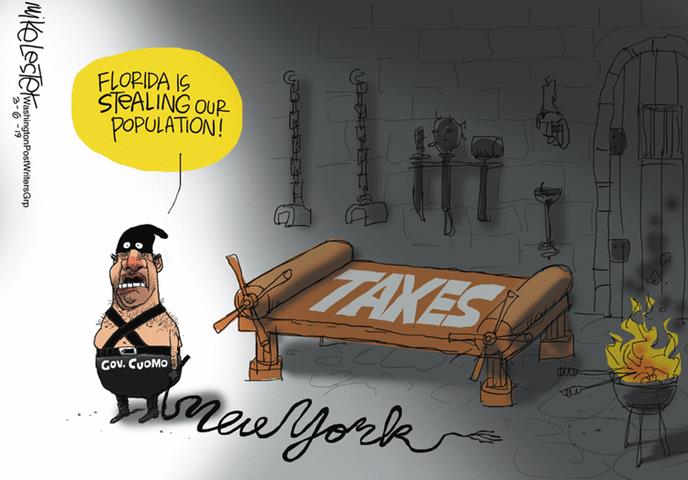 New York is ranked #48 in the State Business Tax Climate Index.
…A New York City Independent Budget Office report this month showed that the number of taxpayers who earned between $1 million and $5 million plunged 11% in 2020 from the prior year. …The culprits are high taxes and Covid lockdowns. According to IRS data, New York County lost $14.5 billion in adjusted gross income from out-migration between 2019 and 2020. And this was before Democrats in Albany last spring raised income taxes on individuals making more than $1 million, jacking up the combined state and New York City top rate to 14.8% from 12.7%. Even New York Comptroller Thomas DiNapoli, who is no moderate, told Bloomberg News last week that the exodus of taxpayers at the upper end “should be a concern for everybody.” He added that “we might be getting near that tipping point where we do make it economically unsustainable for enough of those folks to stay here.”


Now, that is incredible upon its face, but it becomes even more incredible when contrasted with FDR’s antibusiness and confiscatory tax policies, which both dramatically shrunk in terms of actual income tax revenues (from $1.096 billion in 1929 to $527 million in 1935), and dramatically shifted the tax burden to the backs of the poor by imposing huge new excise taxes (from $540 million in 1929 to $1.364 billion in 1935). See Table 1 on page 125 of New Deal or Raw Deal for that information.

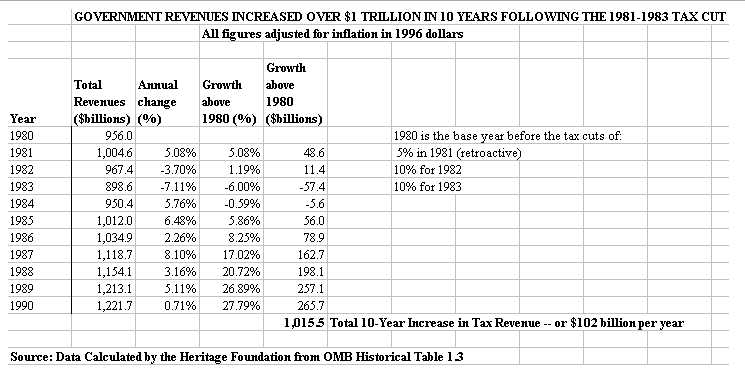
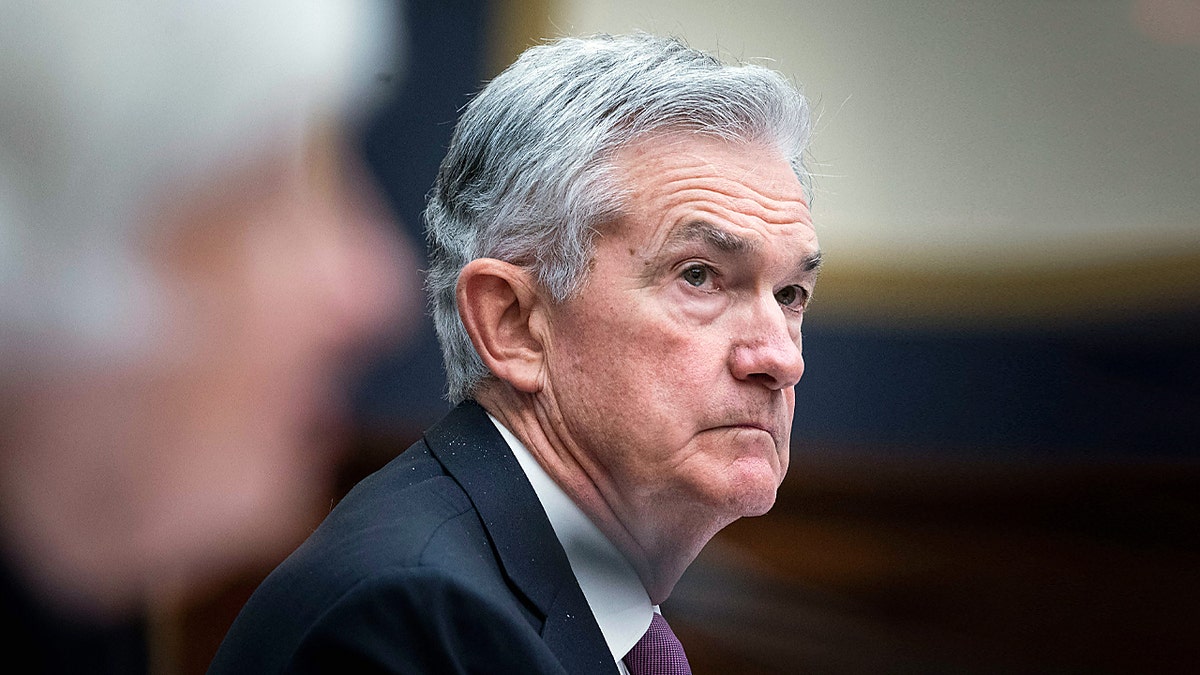


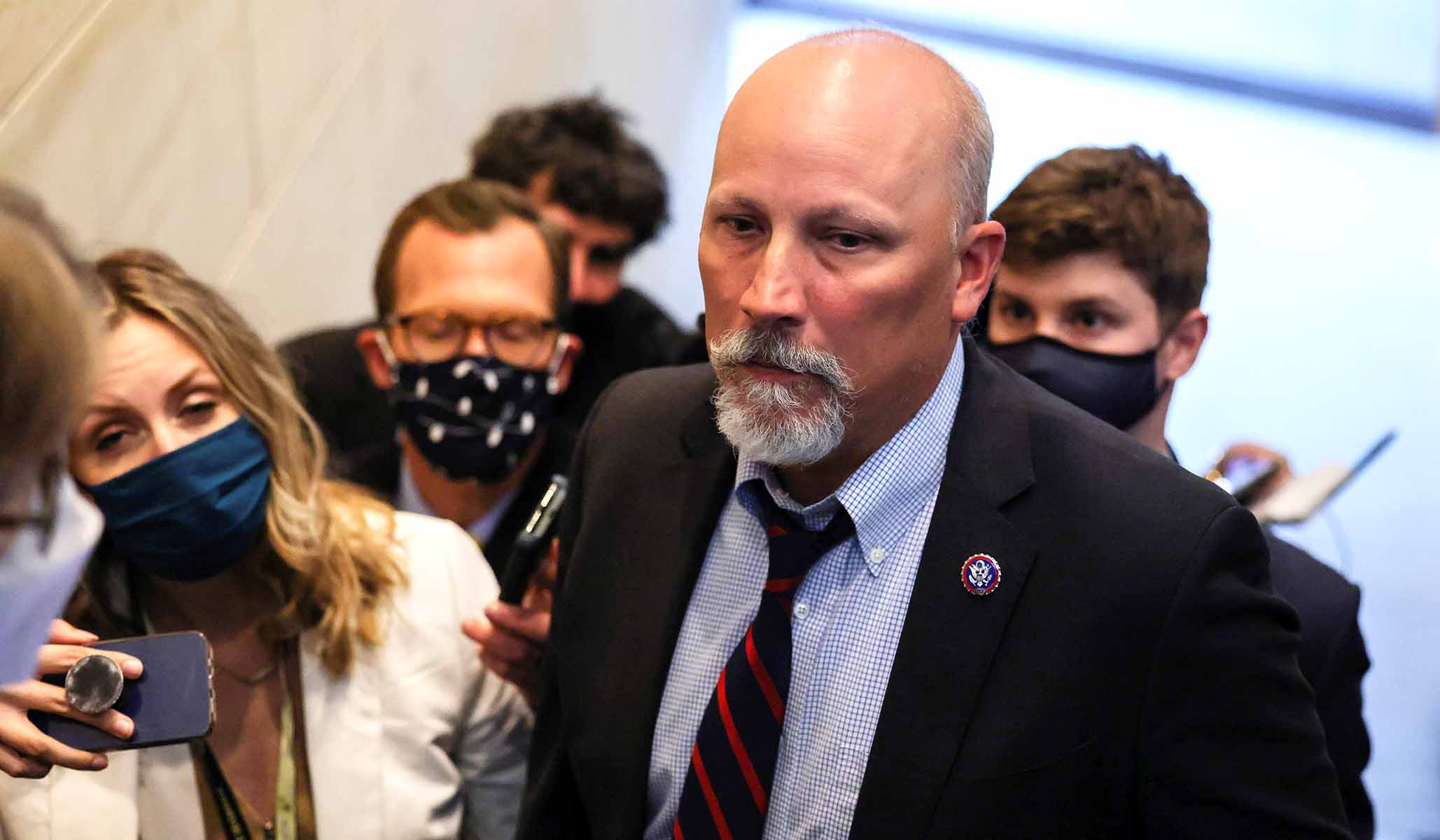







.jpg)





.jpg)











 The Daily Hatch