
—

Paul Rabinow, a world-renowned anthropologist, theorist and interlocutor of French philosopher Michel Foucault, his former comrade, died from cancer at his home in Berkeley on April 6. He was 76.
A professor emeritus of anthropology, Rabinow joined the UC Berkeley faculty in 1978 after earning his Ph.D. from the University of Chicago. He retired in 2019.
During his more than four decades at Berkeley, Rabinow’s scholarship and pedagogy traversed such diverse lines of inquiry as the anthropology of reason, medical anthropology and the ramifications of synthetic biology.
“Paul was a profoundly energetic survivor of 20 years of cancer, during which time he produced many of his most important works,” said UC Berkeley anthropology professor emerita Nancy Scheper-Hughes, Rabinow’s longtime friend and colleague.
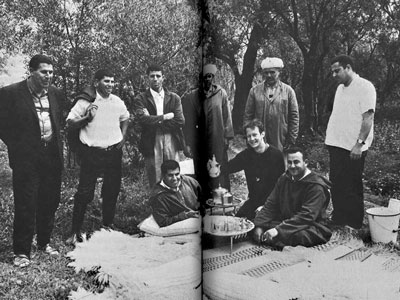
Rabinow, seated second from the right, at a tea ceremony in Morocco. (Photo by Paul Hyman)
His seminal Reflections on Fieldwork in Morocco, published in 1977 , was considered a model for conducting ethnographies and fieldwork.
In the 1990s, Rabinow coined the concept of biosociality as the shared experience of sickness and suffering, particularly with respect to the AIDS epidemic.
“Paul was as much a historian of the contemporary, a philosopher, or a molecular scientist as he was an anthropologist,” Scheper-Hughes wrote in an online tribute to Rabinow .
“His classic texts are read around the scholarly world, and his invitation to Foucault to give a series of lectures brought the house down and led to UC Berkeley briefly renamed ‘Foucault U,’” she wrote. “Paul, I missed saying goodbye to you by a day and now it will be a multitude of days of regret and sorrow.”
Rabinow’s critically acclaimed writings include Michel Foucault: Beyond Structuralism and Hermeneutics (1983), which he co-wrote with UC Berkeley philosopher Hubert Dreyfus; The Foucault Reader (1984); Making PCR: A Story of Biotechnology (1993); Essays on the Anthropology of Reason(1996); French DNA: Trouble in Purgatory (1999); Anthropos Today: Reflections on Modern Equipment (2003); and Marking Time: On the Anthropology of the Contemporary (2007).
A sharp wit and tongue
Known for his sharp intellect and urbane style, Rabinow could be alternately amiable, impish and petulant.
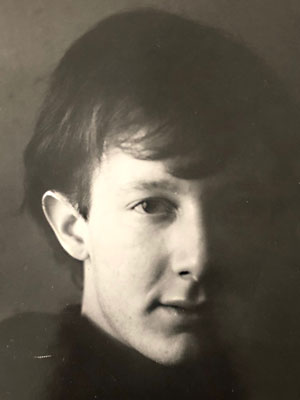
A portrait of Paul Rabinow as an undergrad at the University of Chicago in 1963. (Photo by Paul Hyman)
“Paul Rabinow was neither easy nor particularly nice, but the intellectual rigor he demanded from me, and the kindness he showed me, will be with me forever,” tweeted Minda Murphy, a researcher with a bachelor’s degree in anthropology from UC Berkeley.
Murphy’s was among dozens of online homages to Rabinow written by peers and former students around the world.
Gabriel Coren, a researcher at the Berggruen Institute in Los Angeles and one of Rabinow’s former doctoral students, recalled Rabinow’s brusque response to an incoming graduate student’s question about the department’s perks and resources, compared to those of rival institutions.
“’As with any university today, it has problems. Many problems,’” Coren recalls Rabinow telling the graduate student at a welcome reception in 2012. “’But this is Berkeley, a public institution, and that means something worth thinking about. Look, if you just want to make sure that the bathrooms have brand new toilets and fancy trashcans, you should probably just go to Chicago.’”
“That was Paul: frank, humorous, prone to cantankerousness, and a defender of the dignity of one’s place,” Coren recounts in his online tribute to his former advisor.
‘Not fully American’
Paul Rabinow was born on a U.S. Army base in Florida on June 21, 1944, to Irving and Mildred Rabinow. His parents were social workers and the descendants of Russian Jewish immigrants. When he and his younger sister, Naomi, were young, the family moved to Queens, New York, and Irving Rabinow worked for the Jewish Child Care Association in Brooklyn.
In elementary school in the Sunnyside neighborhood, Rabinow befriended Paul Hyman, another boy whose parents had made the move from a Florida military base to New York. Right from the get-go, “Rab was a fighter,” recalls Hyman, now a New York-based photographer.
In a 2008 interview, Rabinow described a childhood in 1940s and 50s New York where anti-Semitism and McCarthyism loomed large: “As a child, I was passionately involved in sports, roller hockey in particular; a strange obsession as it was mainly played by Irish Catholics and the Jews played basketball,” he said. “I was the only Jew in a Catholic Youth Organization league.”
“I was brought up to believe that America was simultaneously probably the best place in the world to be for a Jew but also not very trustworthy and not very safe,” he continued. “I was of America but not fully American. My parents’ experience in the South and Midwest, when my father was in the army, of blatant racism and anti-Semitism, was foundational.”
The French Connection
After graduating from Stuyvesant High School, he gained admission to the University of Chicago and earned a bachelor’s degree in 1965 and a master’s degree two years later. At the University of Chicago, he met French ethnologist Claude Lévi-Strauss and learned about European perspectives. In graduate school, he spent a year at École Pratique des Hautes Études in Paris, and honed his French.
In 1969, he traveled to Morocco, where he conducted ethnographic studies that resulted in his Reflections on Fieldwork in Morocco. While there, he invited Hyman to visit him, and bring his camera and lots of film. Hyman came and took hundreds of photographs, dozens of which were published in scholarly books, and several of which have since been exhibited in museums and galleries.
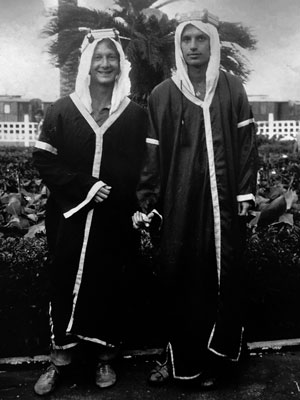
Rabinow, left, with Paul Hyman in Tangier in 1969. (Photo courtesy of Paul Hyman)
Rabinow completed his doctoral studies at the University of Chicago under the tutelage of philosopher Richard McKeon and anthropologist Clifford Geertz and earned a Ph.D. in anthropology in 1970.
After, he took a job at an experimental school in New York City. Then, by some fluke, he ran into UC Berkeley sociologist Robert Bellah, who let him participate in a National Endowment for the Humanities seminar at Berkeley.
“That was a major turning point,” he recounted in a 2008 interview. “Bellah helped me get ‘Reflections’ published. I met Hubert Dreyfus, and a whole range of other connections opened up. I discovered California, which seemed an exotic land; that led into my learning from Dreyfus about Heidegger and Wittgenstein; that set the scene for the entry of Foucault into the picture. I got a job at Berkeley.”
‘Sophistication and energy’
And he certainly made an entrance in the anthropology department in 1978.
“Rabinow brought a new sophistication and energy to anthropological inquiry that participates in broad conversations about contemporary modes of living and life forms,” wrote Aihwa Ong, a UC Berkeley anthropology professor emerita, in her tribute to her longtime friend and colleague.
In 1980, Rabinow was awarded a prestigious Guggenheim fellowship. It was around that time that he met Foucault, who had been been visiting Berkeley off and on since the mid-1970s. Their collaboration resulted in the 1983 publication of Michel Foucault: Beyond Structuralism and Hermeneutics , followed in 1984 by The Foucault Reader .
That same year, Foucault died in Paris from HIV/AIDS-related complications. Rabinow grieved the loss of his comrade, and went on with his life. He married Marilyn Seid, a Chinese-American San Francisco native who ran a language proficiency program for Berkeley graduate student instructors. They had a son, Marc, whom they raised in Berkeley to be bilingual in English and French.
Meanwhile, activism in the Bay Area was reaching a fever pitch in the face of the HIV/AIDS epidemic. Grassroots activist groups like the AIDS Coalition to Unleash Power (Act Up) fought to destigmatize the disease and to build political support.
Scheper-Hughes convinced Rabinow to co-teach with her UC Berkeley’s first course about the HIV/AIDS epidemic. In one class, she said, two guest speakers from very different socio-economic neighborhoods in San Francisco compared their T-cell counts and explained how the virus had disrupted their lives.
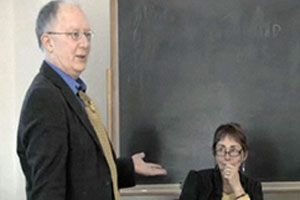
Rabinow with anthropology professor Nancy Scheper-Hughes in a classroom on campus.
“That’s when Paul came up with the idea of biosociality,” Scheper-Hughes wrote. The revelation led to his paper, “Artificiality and Enlightenment: from Sociobiology to Biosociality.”
At one particularly heated panel discussion in 1992, some audience members objected to Rabinow bringing up Foucault, calling the late French philosopher a closet case who did not go public with his AIDS diagnosis, Scheper-Hughes wrote.
“Paul ended the panel defending his right to speak on behalf of the man that he loved. He feared that Foucault had contracted HIV/AIDS in the bathhouses of San Francisco during his invited series of lectures at UC Berkeley,” Scheper-Hughes wrote.
The ethics of biotech
Next, Rabinow turned his focus to the science and ethics of California’s burgeoning biotech industry. In addition to his research, teaching and mentoring at Berkeley, he served as director of the Anthropology of the Contemporary Research Collaboratory, which he founded with anthropologists Stephen Collier and Andrew Lakoff. He was also director of human practices for UC Berkeley’s Synthetic Biology Engineering Research Center (SynBERC).
Among other honors, he held fellowships from the National Endowment for the Humanities and a professional training fellowship in molecular biology from the National Science Foundation. He also served stints as a visiting Fulbright professor at the National Museum in Rio de Janeiro and at the University of Iceland.
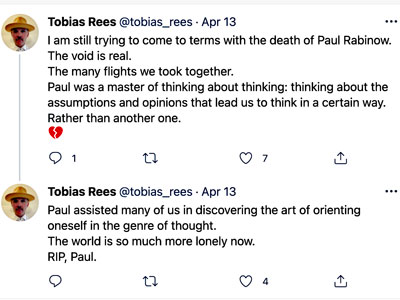
Tobias Rees is the Reed Hoffman Professor at the New School of Social Research.
Now and then, he returned to Paris where he taught at École des Hautes Études en Sciences Sociales and, later, at École Normale Supérieure. So strong were his ties to the City of Light that the French government named him Chevalier de l’Ordre des Arts et des Lettres, and École Normale Supérieure awarded him the visiting Chaire Internationale de Recherche Blaise Pascal.
In its obituary for Rabinow , the French newspaper Le Monde dubbed him “the most Francophile of North American anthropologists.”
He is survived by his wife, Marilyn Seid-Rabinow, of Berkeley; son, Marc Rabinow, of New York; and sister, Naomi Landau, of New Mexico.
A campus memorial to celebrate his life and legacy is planned for this fall.
XXXXXXXXXXXXXXXXXXX
Emailed on 1-17-15
To Dr. Paul Rabinow, From Everette Hatcher, I thought you would like to see this movie Monday night in a theater near you!!
Dear Dr. Rabinow,
I really enjoyed your lengthy interview with Dr. Alan Macfarlane. He does the best in depth scholarly interviews on the internet. Thank you for agreeing to give him an interview. I think I have watched almost all of the interviews he has ever done and that is over 100 by now. I have even gone back and watched many of them over and over. I actually did a post on my blog about Alan Macfarlane.
I am in the process of posting a response on my blog to your comments on the film series RENOWNED ACADEMICS SPEAKING ABOUT GOD (which received over 300,000 hits on You Tube). I have already finished responding to some of your other fellow academics who also appear on the same film series such as David J. Gross, Frank Wilczek, .Alexander Vilenkin, Roy Glauber, Roald Hoffmann, Rebecca Goldstein, Noam Chomsky, Brian Greene, Marvin Minsky, Shelly Kagan, Hubert Dreyfus, Simon Schaffer, Marcus du Sautoy, Steven Weinberg, Barry Supple, Lawrence Krauss, Lord Martin Rees, Alan Dershowitz, Lewis Wolpert, Aaron Ciechanover, Leonard Mlodinow, Herbert Huppert, Leonard Susskind, Alan Macfarlane, Saul Perlmutter, Stuart Kauffman, Douglas Osheroff, Alan Guth, Sir David Attenborough, and Harry Kroto who started it all by promoting this video series in the first place. However, it has taken me a little longer to respond to your comments.
I thought of you when I heard about this film PATTERNS OF EVIDENCE: THE EXODUS, which is only showing one time this Monday night January 19, 2015 at 7 pm at a theater near you. You have contended you don’t believe in the Bible because you don’t have the scientific type evidence that you require. This film contains the findings of over a dozen academics who are experts in archaeology and here it is at a nearby theater to you.
You can get a ticket by going to this website at this linkand putting in your zip code to find a theater near you. It stars Israel Finkelstein, Benjamin Netanyahu, Shimon Peres, and many more and they will be discussing if the Exodus took place or not with only scientific facts. I have posted several very good reviews of themajor motion picture on my blog.
Here are some theaters near you that are showing the film:
1. AMC BAY STREET 16, 5614 Bay Street Ste 220, Emeryville, CA 94608, 2. CENTURY SAN FRANCISCO CENTRE 9 AND XD, 845 Market Street, San Francisco, CA 94103, 3. CENTURY 14 DOWNTOWN WALNUT CREEK AND XD,1201 Locust St., Walnut Creek, CA 94596, 4. CENTURY 16 DOWNTOWN PLEASANT HILL AND XD, 125 Crescent Drive, Pleasant Hill, CA 94523,
Everette Hatcher, cell ph 501-920-733, everettehatcher@gmail.com, P.O. Box 23416, Little Rock, AR 72221
XXXXXXXXXXXXXXXXXXXXXXXXXXXXXXXXXXXXXXXXXXXXXX
On November 21, 2014 I received a letter from Nobel Laureate Harry Kroto and it said:
…Please click on this URL http://vimeo.com/26991975
and you will hear what far smarter people than I have to say on this matter. I agree with them.
Harry Kroto

Nick Gathergood, David-Birkett, Harry-Kroto
I have attempted to respond to all of Dr. Kroto’s friends arguments and I have posted my responses one per week for over a year now. Here are some of my earlier posts:
Arif Ahmed, Sir David Attenborough, Mark Balaguer, Horace Barlow, Michael Bate, Patricia Churchland, Aaron Ciechanover, Noam Chomsky,Alan Dershowitz, Hubert Dreyfus, Bart Ehrman, Stephan Feuchtwang, David Friend, Riccardo Giacconi, Ivar Giaever , Roy Glauber, Rebecca Goldstein, David J. Gross, Brian Greene, Susan Greenfield, Stephen F Gudeman, Alan Guth, Jonathan Haidt, Theodor W. Hänsch, Brian Harrison, Hermann Hauser, Roald Hoffmann, Bruce Hood, Herbert Huppert, Gareth Stedman Jones, Steve Jones, Shelly Kagan, Michio Kaku, Stuart Kauffman, Lawrence Krauss, Harry Kroto, George Lakoff, Elizabeth Loftus, Alan Macfarlane, Peter Millican, Marvin Minsky, Leonard Mlodinow, Yujin Nagasawa, Alva Noe, Douglas Osheroff, Jonathan Parry, Saul Perlmutter, Herman Philipse, Carolyn Porco, Robert M. Price, Lisa Randall, Lord Martin Rees, Oliver Sacks, John Searle, Marcus du Sautoy, Simon Schaffer, J. L. Schellenberg, Lee Silver, Peter Singer, Walter Sinnott-Armstrong, Ronald de Sousa, Victor Stenger, Barry Supple, Leonard Susskind, Raymond Tallis, Neil deGrasse Tyson, .Alexander Vilenkin, Sir John Walker, Frank Wilczek, Steven Weinberg, and Lewis Wolpert,
His comments can be found on the 3rd video and the 118th clip in this series. Below the videos you will find his words.
50 Renowned Academics Speaking About God (Part 1)
Another 50 Renowned Academics Speaking About God (Part 2)
A Further 50 Renowned Academics Speaking About God (Part 3)
___________________
Quote from Paul Rabinow:
In other words I am not a believer or a theist, but I am not also a militant atheist. I think that debate leads into a range of different and diverse existential corners that I don’t want to go to and never felt the need to go to.
More lengthy quote from Paul Rabinow:
on religious belief – don’t believe in God; there are passages in Levi-Strauss’ ‘Tristes Tropiques’ on Buddhism which are relatively close to what I felt much more strongly as a younger person; this question is interesting because in recent years I have been working with a student who has just finished a degree in theology and is now doing a degree in anthropology; he is a practising Christian and we get along remarkably well, discussing ethics etc., but it is clear that the larger theist dimensions are radically disparate; this is an interesting anthropological dimension where ethically this seems to not cause any problem; I frequently related to people with strong but quiet religious beliefs; Michel de Certeau was a Jesuit and I had a number of other Jesuit friends; I think it is the fact that they care about the world and other people, are thoughtful, committed and concerned, and I don’t have to share other parts of their belief system while finding them worthy of friendship; I am uninterested in the Dawkins’ argument of science disproving religion, I am not a positivist, there is a big difference between this form of nineteenth century militant positivism and a Weberian position in which science does not answer ultimate questions; when science becomes a world view, a cosmology, it seems to part company with its deep critical functions; I may not be a believer or theist, but I am not a militant atheist; I also part company with people like Jurgen Habermas or Charles Taylor who feel that unless we have sure foundations for our ethical life that we flounder, which seems wrong; no one has ever proved the ultimate foundations of anything to everyone’s satisfaction yet ethical life and decent human relations seem to me not all that common, but not impossible either; I am not looking for ultimate stopping points, and there is some anthropological dimension to that through respect for the complexity of different commitments; cosmopolitan enlightenment sense that we have to live with difference which can be a good thing, and that intolerance –even in the name of tolerance — is not so admirable.
______________
________
Related posts:
FRANCIS SCHAEFFER ANALYZES ART AND CULTURE Part 53 THE BEATLES (Part E, Stg. Pepper’s and John Lennon’s search in 1967 for truth was through drugs, money, laughter, etc & similar to King Solomon’s, LOTS OF PICTURES OF JOHN AND CYNTHIA) (Feature on artist Yoko Ono)
The John Lennon and the Beatles really were on a long search for meaning and fulfillment in their lives just like King Solomon did in the Book of Ecclesiastes. Solomon looked into learning (1:12-18, 2:12-17), laughter, ladies, luxuries, and liquor (2:1-2, 8, 10, 11), and labor (2:4-6, 18-20). He fount that without God in the picture all […]
FRANCIS SCHAEFFER ANALYZES ART AND CULTURE Part 52 THE BEATLES (Part D, There is evidence that the Beatles may have been exposed to Francis Schaeffer!!!) (Feature on artist Anna Margaret Rose Freeman )
______________ George Harrison Swears & Insults Paul and Yoko Lucy in the Sky with Diamonds- The Beatles The Beatles: I have dedicated several posts to this series on the Beatles and I don’t know when this series will end because Francis Schaeffer spent a lot of time listening to the Beatles and talking […]
FRANCIS SCHAEFFER ANALYZES ART AND CULTURE Part 51 THE BEATLES (Part C, List of those on cover of Stg.Pepper’s ) (Feature on artist Raqib Shaw )
The Beatles in a press conference after their Return from the USA Uploaded on Nov 29, 2010 The Beatles in a press conference after their Return from the USA. The Beatles: I have dedicated several posts to this series on the Beatles and I don’t know when this series will end because Francis […]
FRANCIS SCHAEFFER ANALYZES ART AND CULTURE Part 50 THE BEATLES (Part B, The Psychedelic Music of the Beatles) (Feature on artist Peter Blake )
__________________ Beatles 1966 Last interview I have dedicated several posts to this series on the Beatles and I don’t know when this series will end because Francis Schaeffer spent a lot of time listening to the Beatles and talking and writing about them and their impact on the culture of the 1960’s. In this […]
FRANCIS SCHAEFFER ANALYZES ART AND CULTURE Part 49 THE BEATLES (Part A, The Meaning of Stg. Pepper’s Cover) (Feature on artist Mika Tajima)
_______________ The Beatles documentary || A Long and Winding Road || Episode 5 (This video discusses Stg. Pepper’s creation I have dedicated several posts to this series on the Beatles and I don’t know when this series will end because Francis Schaeffer spent a lot of time listening to the Beatles and talking and writing about […]
FRANCIS SCHAEFFER ANALYZES ART AND CULTURE PART 48 “BLOW UP” by Michelangelo Antonioni makes Philosophic Statement (Feature on artist Nancy Holt)
_______________ Francis Schaeffer pictured below: _____________________ I have included the 27 minute episode THE AGE OF NONREASON by Francis Schaeffer. In that video Schaeffer noted, ” Sergeant Pepper’s Lonely Hearts Club Band…for a time it became the rallying cry for young people throughout the world. It expressed the essence of their lives, thoughts and their feelings.” How Should […]
FRANCIS SCHAEFFER ANALYZES ART AND CULTURE Part 47 Woody Allen and Professor Levy and the death of “Optimistic Humanism” from the movie CRIMES AND MISDEMEANORS Plus Charles Darwin’s comments too!!! (Feature on artist Rodney Graham)
Crimes and Misdemeanors: A Discussion: Part 1 ___________________________________ Today I will answer the simple question: IS IT POSSIBLE TO BE AN OPTIMISTIC SECULAR HUMANIST THAT DOES NOT BELIEVE IN GOD OR AN AFTERLIFE? This question has been around for a long time and you can go back to the 19th century and read this same […]
FRANCIS SCHAEFFER ANALYZES ART AND CULTURE PART 46 Friedrich Nietzsche (Featured artist is Thomas Schütte)
____________________________________ Francis Schaeffer pictured below: __________ Francis Schaeffer has written extensively on art and culture spanning the last 2000years and here are some posts I have done on this subject before : Francis Schaeffer’s “How should we then live?” Video and outline of episode 10 “Final Choices” , episode 9 “The Age of Personal Peace and Affluence”, episode 8 […]
FRANCIS SCHAEFFER ANALYZES ART AND CULTURE Part 45 Woody Allen “Reason is Dead” (Feature on artists Allora & Calzadilla )
Love and Death [Woody Allen] – What if there is no God? [PL] ___________ _______________ How Should We then Live Episode 7 small (Age of Nonreason) #02 How Should We Then Live? (Promo Clip) Dr. Francis Schaeffer 10 Worldview and Truth Two Minute Warning: How Then Should We Live?: Francis Schaeffer at 100 Francis Schaeffer […]
FRANCIS SCHAEFFER ANALYZES ART AND CULTURE Part 44 The Book of Genesis (Featured artist is Trey McCarley )
___________________________________ Francis Schaeffer pictured below: ____________________________ Francis Schaeffer “BASIS FOR HUMAN DIGNITY” Whatever…HTTHR Dr. Francis schaeffer – The flow of Materialism(from Part 4 of Whatever happened to human race?) Dr. Francis Schaeffer – The Biblical flow of Truth & History (intro) Francis Schaeffer – The Biblical Flow of History & Truth (1) Dr. Francis Schaeffer […]
__


 The Daily Hatch