Monthly Archives: May 2023

Dan Mitchell “Good folks on the left (and every other part of the spectrum) push for equality of opportunity. And what’s great about that approach is that more opportunity for one person does not require less opportunity for another person!”

Class Warfare and Utility Pricing

Good folks on the left (and every other part of the spectrum) push for equality of opportunity. And what’s great about that approach is that more opportunity for one person does not require less opportunity for another person.

Bad folks on the left push for equality of outcomes. And that’s unfortunate because an agenda of coerced equality (based on the notion of “positive rights“) means that one person has to suffer for another person to benefit.

Or, in really crazy circumstances, the goal is simply to deny good things for some people simply because they are not available to other people.

Or they simply want to punish success because of spite and resentment.

I wrote about an example of this last week. Here’s another example, as reported by  and  for a California TV station.

Three major utility companies in California are looking to restructure customer billing, and part of that means customers could be charged based on how much money they make. Southern California Edison, Pacific Gas & Electric and San Diego Gas & Electric filed a joint proposal this weekfor a flat-rate charge based on income. …Under the proposal, it would cost as little as $15 a month for low-income households and up to $85 more per month for households making more than $180,000 a year. …The income-based bill proposal is part of the companies’ compliance with legislation passed by the California state government last year requiring these types of plans for utilities. …The fixed rate could start showing up on bills as soon as 2025.

The Wall Street Journal opined on this policy. As you might imagine, class-warfare pricing was not celebrated.

Climate policies are driving up California electric rates… Now Democrats plan to double down on their policy distortions by charging electric customers based on income. Democrats snuck this second progressive income tax into a budget trailer bill last year… No other investor-owned utilities in the country link electricity costs to income. …Pacific Gas & Electric floated charging customers fixed fees ranging from $15 a month for those earning less than $28,000 annually, up to $92 a month for those making $180,000 or more. …California’s electric rates have surged over the last decade to an average of 26.5 cents a kWh—more than twice as much as in neighboring states… California’s electric rates are currently both regressive and progressive. Middle- and higher-income folks subsidize discounts for lower-income customers. However, lower- and middle-income households also subsidize the affluent with solar panels and electric vehicles. …Thus they want to impose this de facto graduated income tax to light up your home. This is another form of income redistribution… The very rich will cope, but the middle class will get soaked, as they always do.

I wonder if our friends on the left will expand this approach. Maybe require McDonald’s to charge rich people more for a Big Mac? Or tell gas stations that they have to lose money when poor people fill up their tanks?

That’s a recipe for quicksand and beatings.

As captured by my Eighth Theorem of Government, it is far smarter to push policies that are designed to reduce poverty rather than reduce inequality.

Thatcher, Lawson, and Pro-Growth Tax Policy

As documented in Commanding Heights: The Battle of Ideas, Margaret Thatcher and Ronald Reagansaved their nations from economic malaise and decline.

Today, let’s focus on what happened in the United Kingdom.

Economic liberty greatly increased during the Thatcher years.

She deserves the lion’s share of the credit for the U.K.’s economic rebirth and renaissance, but she also had the wisdom to appoint some very principled and very capable people to her cabinet.

Such as Nigel Lawson, who served as her Chancellor of the Exchequer (akin to a combined Treasury Secretary/OMB Director in the U.S.).

Lawson died last week, leading to many tributes to his role is resuscitating the U.K. economy.

The Wall Street Journal‘s editorial summarized his achievements.

…our problems are solvable, as they were a half century ago. One of those crucial problem solvers was British politician Nigel Lawson, who died this week at age 91. …the 1970s…was even more miserable in the United Kingdom than it was in the U.S. By the time Margaret Thatcher led the Tories into office in May 1979, inflation was raging and the country had been wracked by strikes in its “winter of discontent”… Lawson entered Thatcher’s administration… He made his historic mark as Chancellor of the Exchequer starting in 1983. He’s best known for his tax reforms, which reduced the top personal income-tax rate to 40% from 60% and brought the top corporate rate to 35% from a 1970s high of 52%. He also was a steward of the Thatcher administration’s privatizations of large state-owned firms and the “Big Bang” financial reforms that would transform London into a global financial center.

In a column for CapX, Madsen Pirie examines Lawson’s work.

Nigel Lawson left a huge legacy. Under his stewardship Britain went from being the sick man of Europe into becoming an economic powerhouse and one of the world’s leading economies. He is regarded by many as the finest Chancellor of the 20th century… Lord Lawson held the firm conviction that lower taxes created space for enterprise and opportunity, and made it his policy that in every Budget he would lower the burden of taxation and abolish at least one tax.…During his tenure, Britain was transformed from being an economy in which most major businesses and services were owned and run by the state, into one in which they became private businesses, paying taxes instead of receiving taxpayer subsidies. Failing and outdated state enterprises became modern, successful private ones. …His 1988 Budget…announced that all taxes above 40% would be abolished, and that the basic rate would be cut to 25%, its lowest for 50 years… Within a very short time, more money was coming into the Treasury from the lower rates than it had been taking in from the higher ones. It was a vindication of the Laffer Curve. …The top 10% of earners had been paying 35% of the total income tax take. Under Lawson’s lower rate that went up to 48%. In rough terms this meant that the top 10% went from paying just over a third to just under a half of total income taxes.

In other words, the lower tax rates in the U.K. had the same positive impact as the lower tax rates in the U.S., both in terms of encouraging growth and confirming the Laffer Curve.

But let’s not forget that there also was spending restraint during the Thatcher years, particularly when Lawson was Chancellor of the Exchequer.

Just like we got spending restraint during the Reagan years.

The moral of the story is that it’s great to have good leaders, and it’s great when those leaders appoint good people.

P.S. If you want the U.S. equivalent of Nigel Lawson, the best historical example would be Andrew Mellon.

The Big Question for Tories (and Republicans): What’s the Alternative to “Free-Market Fundamentalism”?

Because of her support for lower tax rates, I was excited when Liz Truss became Prime Minister of the United Kingdom.

Especially since her predecessor, Boris Johnson, turned out to be an empty-suit populist who supported higher taxes and a bigger burden of government spending.

But I’m not excited anymore.

Indeed, it’s more accurate to say that I’m despondent since the Prime Minister is abandoning (or is being pressured to abandon) key parts of her pro-growth agenda.

For details, check out this Bloomberg report, written by Julian Harris, about the (rapidly disappearing) tax-cutting agenda of the new British Prime Minister.

Westminster’s most hard-line advocates of free markets and lower taxes are looking on in despair as their agenda crumbles… When Liz Truss became prime minister just over five weeks ago, she promised to deliver a radical set of policies rooted in laissez-faire economics — an attempt to boost the UK‘s sluggish rate of growth. Yet her chancellor of the exchequer, Kwasi Kwarteng, faced a quick reality check when his mini-budget, packed with unfunded tax cuts and unaccompanied by independent forecasts, …triggered mayhem… Truss fired Kwarteng and replaced him with Jeremy Hunt as she was forced into a dramatic u-turn over her tax plans. …Truss conceded…and dropped her plan to freeze corporation tax. …Still, some believers are sticking by “Trussonomics”…Patrick Minford,..a professor at Cardiff University, said..“Liz Truss’s policies for growth are absolutely right, and to be thrown off them by a bit of market turbulence is insane.” …Eamonn Butler, co-founder of the Adam Smith Institute, similarly insisted that Truss “is not the source of the problem — she’s trying to cure the problem.”

Eamonn is right.

The United Kingdom faces serious economic challenges. But the problems are the result of bad government policies that already exist rather than the possibility of some future tax cuts.

In a column for the Telegraph, Allister Heath says the U.K.’s central bank deserves a big chunk of the blame.

Liz Truss and Kwasi Kwarteng have been doubly unlucky. While almost everybody else in Britain remained in denial, they correctly identified this absurd game for the con-trick that it truly was, warned that it was about to implode and pledged to replace it with a more honest system. Instead of a zombie economy based on rising asset prices and fake, debt-fuelled growth, their mission was to encourage Britain to produce more real goods and services, to work harder and invest more by reforming taxes and regulation.What happened next is dispiriting in the extreme. …Truss and her Chancellor moved too quickly and, paradoxically, given their warnings about the rottenness of the system, ended up pulling out the last block from the Jenga tower, sending all of the pieces tumbling down. …they didn’t crash the economy – it was about to come tumbling down anyway – but they had the misfortune of precipitating and accelerating the day of reckoning. …Andrew Bailey, the Governor of the Bank of England…, has been deeply unimpressive in all of this, helping to keep interest rates too low… The idea, now accepted so widely, that the price of money must be kept extremely low and quantitative easing deployed at every opportunity has undermined every aspect of the economy and society. …Too few people realise how terribly the easy money, high tax, high regulation orthodoxy has failed.

Allister closes with some speculation about possible alternatives. If the Tories in the U.K. decide to reject so-called “free-market fundamentalism,” what’s their alternative?

He thinks the Labour Party will take control, and with very bad results. Jeremy Corbyn will not be in charge, but his economic policies will get enacted.

If Truss is destroyed, the alternative won’t even be social democracy: it will be Labour, the hard Left, the full gamut of punitive taxation, including of wealth and housing, and even more spending, culminating rapidly in economic oblivion.

That is an awful scenario. Basically turning the United Kingdom into Greece.

I want to take a different approach, though, and contemplate what will happen if the Conservative Party rejects the Truss approach and embraces big-government conservatism.

Here are some questions I’d like them to answer:

  • Do you want improved competitiveness and more economic growth?
  • If you want more growth, which of your spending increases will lead to those outcomes?
  • Which of your tax increases will lead to more competitiveness or more prosperity?
  • Will you reform benefit programs to avert built-in spending increases caused by an aging population?
  • If you won’t reform entitlements, which taxes will you increase to keep debt under control?
  • If you don’t plan major tax increases, do you think the economy can absorb endless debt?

I’m asking these questions for two reasons. First, there are no good answers and I’d like to shame big-government Tories into doing the right thing.

Second, these questions are also very relevant in the United States. Even since the Reagan years, opponents of libertarian economic policies have flitted from one trendy idea to another (national conservatism, compassionate conservatism, kinder-and-gentler conservatismcommon-good capitalism, reform conservatism, etc).
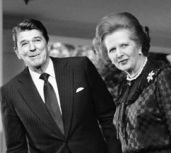
To be fair, they usually don’t try to claim their dirigiste policies will produce higher living standards. Instead, they blindly assert that it will be easier to win elections if Republicans abandon Reaganism.

So I’ll close by observing that Ronald Reagan won two landslide elections and his legacy was strong enough that voters then elected another Republican (the same can’t be said for big-government GOPers like Nixon, Bush, Bush, or Trump).

Switching back to the United Kingdom, Margaret Thatcher repeatedly won election and her legacy was strong enough that voters then elected another Conservative.

The bottom line is that good policy can lead to good political outcomes, whereas bad policy generally leads to bad political outcomes.

P.S. To be sure, there were times when Reagan’s poll numbers were very bad. And the same is true for Thatcher. But because they pursued good policies, economic growth returned and they reaped political benefits. Sadly, it appears that Truss won’t have a chance to adopt good policy, so we will never know if she also would have benefited from a similar economic renaissance.

Tax Cartels Mean Ever-Higher Tax Rates

When President Biden proposed a “global minimum tax” for businesses, I immediately warned that would lead to ever-increasing tax rates.

Ross Kaminsky of KHOW and I discussed how this is already happening.

I hate being right, but it’s always safe to predict that politicians and bureaucrats will embrace policies that give more power to government.

Especially when they are very anxious to stifle tax competition.

For decades, people in government have been upset that the tax cuts implemented by Ronald Reagan and Margaret Thatchertriggered a four-decade trend of lower tax rates and pro-growth tax reform.

That’s the reason Biden and his Treasury Secretary proposed a 15 percent minimum tax rate for businesses.

And it’s the reason they now want the rate to be even higher.

Though even I’m surprised that they’re already pushing for that outcome when the original pact hasn’t even been approved or implemented.

Here are some passages from a report by Reuters.

Treasury Secretary Janet Yellen will press G20 counterparts this week for a global minimum corporate tax rate above the 15% floor agreed by 130 countries last week…the global minimum tax rate…is tied to the outcome of legislation to raise the U.S. minimum tax rate, a Treasury official said.The Biden administration has proposed doubling the U.S. minimum tax on corporations overseas intangible income to 21% along with a new companion “enforcement” tax that would deny deductions to companies for tax payments to countries that fail to adopt the new global minimum rate. The officials said several countries were pushing for a rate above 15%, along with the United States.

Other kleptocratic governments naturally want the same thing.

A G7 proposal for a global minimum tax rate of 15% is too low and a rate of at least 21% is needed, Argentina’s finance minister said on Monday, leading a push by some developing countries… “The 15% rate is way too low,” Argentine Finance Minister Martin Guzman told an online panel hosted by the Independent Commission for the Reform of International Corporate Taxation. …”The minimum rate being proposed would not do much to countries in Africa…,” Mathew Gbonjubola, Nigeria’s tax policy director, told the same conference.

Needless to say, I’m not surprised that Argentina is on the wrong side.

And supporters of class warfare also are agitating for a higher minimum rate. Here are some excerpts from a column in the New York Times by Gabriel Zucman and Gus Wezerek.

In the decades after World War II, close to 50 percent of American companies’ earnings went to state and federal taxes. …it was a golden period. …President Biden should be applauded for trying to end the race to the bottom on corporate tax rates. But even if Congress approves the 15 percent global minimum corporate tax, it won’t be enough. …the Biden administration to give working families a real leg up, it should push Congress to enact a 25 percent minimum tax, which would bring in about $200 billion in additional revenue each year. …With a 25 percent minimum corporate tax, the Biden administration would begin to reverse decades of growing inequality. And it would encourage other countries to do the same, replacing a race to the bottom with a sprint to the top.

I can’t resist making two observations about this ideological screed.

  1. Even the IMF and OECD agree that the so-called race to the bottom has not led to a decline in corporate tax revenues, even when measured as a share of economic output.
  2. Since companies legally avoid rather than illegally evade taxes, the headline of the column is utterly dishonest – but it’s what we’ve learned to expect from the New York Times.

The only good thing about the Zucman-Wezerek column is that it includes this chart showing how corporate tax rates have dramatically declined since 1980.
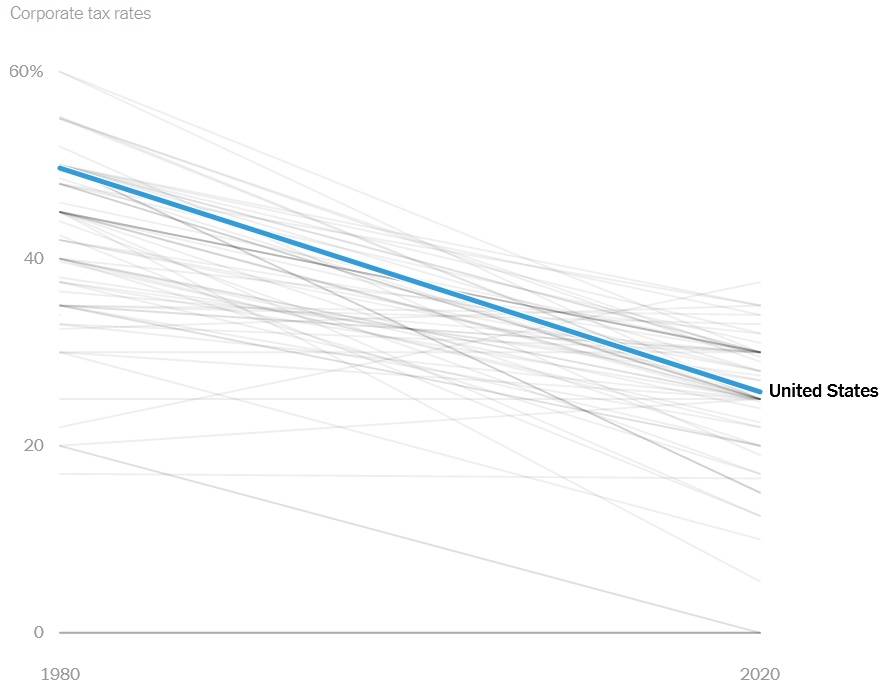
P.S. For those interested, the horizontal line at the bottom is for Bermuda, though other jurisdictions (such as Monaco and the Cayman Islands) also deserve credit for having no corporate income taxes.

P.P.S. If you want to know why high corporate tax rates are misguided, click here. And if you want to know why Biden’s plan to raise the U.S. corporate tax rate is misguided, click here. Or here. Or here.

P.P.P.S. And if you want more information about why Biden’s global tax cartel is bad, click here, here, and here.

I enjoyed this article below because it demonstrates that the Laffer Curve has been working for almost 100 years now when it is put to the test in the USA. I actually got to hear Arthur Laffer speak in person in 1981 and he told us in advance what was going to happen the 1980’s and it all came about as he said it would when Ronald Reagan’s tax cuts took place. I wish we would lower taxes now instead of looking for more revenue through raised taxes. We have to grow the economy:

What Mitt Romney Said Last Night About Tax Cuts And The Deficit Was Absolutely Right. And What Obama Said Was Absolutely Wrong.

Mitt Romney repeatedly said last night that he would not allow tax cuts to add to the deficit.  He repeatedly said it because over and over again Obama blathered the liberal talking point that cutting taxes necessarily increased deficits.

Romney’s exact words: “I want to underline that — no tax cut that adds to the deficit.”

Meanwhile, Obama has promised to cut the deficit in half during his first four years – but instead gave America the highest deficits in the history of the entire human race.

I’ve written about this before.  Let’s replay what has happened every single time we’ve ever cut the income tax rate.

The fact of the matter is that we can go back to Calvin Coolidge who said very nearly THE EXACT SAME THING to his treasury secretary: he too would not allow any tax cuts that added to the debt.  Andrew Mellon – quite possibly the most brilliant economic mind of his day – did a great deal of research and determined what he believed was the best tax rate.  And the Coolidge administration DID cut income taxes and MASSIVELY increased revenues.  Coolidge and Mellon cut the income tax rate 67.12 percent (from 73 to 24 percent); and revenues not only did not go down, but they went UP by at least 42.86 percent (from $700 billion to over $1 billion).

That’s something called a documented fact.  But that wasn’t all that happened: another incredible thing was that the taxes and percentage of taxes paid actually went UP for the rich.  Because as they were allowed to keep more of the profits that they earned by investing in successful business, they significantly increased their investments and therefore paid more in taxes than they otherwise would have had they continued sheltering their money to protect themselves from the higher tax rates.  Liberals ignore reality, but it is simply true.  It is a fact.  It happened.

Then FDR came along and raised the tax rates again and the opposite happened: we collected less and less revenue while the burden of taxation fell increasingly on the poor and middle class again.  Which is exactly what Obama wants to do.

People don’t realize that John F. Kennedy, one of the greatest Democrat presidents, was a TAX CUTTER who believed the conservative economic philosophy that cutting tax rates would in fact increase tax revenues.  He too cut taxes, and he too increased tax revenues.

So we get to Ronald Reagan, who famously cut taxes.  And again, we find that Reagan cut that godawful liberal tax rate during an incredibly godawful liberal-caused economic recession, and he increased tax revenue by 20.71 percent (with revenues increasing from $956 billion to $1.154 trillion).  And again, the taxes were paid primarily by the rich:

“The share of the income tax burden borne by the top 10 percent of taxpayers increased from 48.0 percent in 1981 to 57.2 percent in 1988. Meanwhile, the share of income taxes paid by the bottom 50 percent of taxpayers dropped from 7.5 percent in 1981 to 5.7 percent in 1988.”

So we get to George Bush and the Bush tax cuts that liberals and in particular Obama have just demonized up one side and demagogued down the other.  And I can simply quote the New York Times AT the time:

Sharp Rise in Tax Revenue to Pare U.S. Deficit By EDMUND L. ANDREWS Published: July 13, 2005

WASHINGTON, July 12 – For the first time since President Bush took office, an unexpected leap in tax revenue is about to shrink the federal budget deficit this year, by nearly $100 billion.

A Jump in Corporate Payments On Wednesday, White House officials plan to announce that the deficit for the 2005 fiscal year, which ends in September, will be far smaller than the $427 billion they estimated in February.

Mr. Bush plans to hail the improvement at a cabinet meeting and to cite it as validation of his argument that tax cuts would stimulate the economy and ultimately help pay for themselves.

Based on revenue and spending data through June, the budget deficit for the first nine months of the fiscal year was $251 billion, $76 billion lower than the $327 billion gap recorded at the corresponding point a year earlier.

The Congressional Budget Office estimated last week that the deficit for the full fiscal year, which reached $412 billion in 2004, could be “significantly less than $350 billion, perhaps below $325 billion.”

The big surprise has been in tax revenue, which is running nearly 15 percent higher than in 2004. Corporate tax revenue has soared about 40 percent, after languishing for four years, and individual tax revenue is up as well
.

And of course the New York Times, as reliable liberals, use the adjective whenever something good happens under conservative policies and whenever something bad happens under liberal policies: ”unexpected.”   But it WASN’T ”unexpected.”  It was EXACTLY what Republicans had said would happen and in fact it was exactly what HAD IN FACT HAPPENED every single time we’ve EVER cut income tax rates.

The truth is that conservative tax policy has a perfect track record: every single time it has ever been tried, we have INCREASED tax revenues while not only exploding economic activity and creating more jobs, but encouraging the wealthy to pay more in taxes as well.  And liberals simply dishonestly refuse to acknowledge documented history.

Meanwhile, liberals also have a perfect record … of FAILUREThey keep raising taxes and keep not understanding why they don’t get the revenues they predicted.

The following is a section from my article, “Tax Cuts INCREASE Revenues; They Have ALWAYS Increased Revenues“, where I document every single thing I said above:

The Falsehood That Tax Cuts Increase The Deficit

Now let’s take a look at the utterly fallacious view that tax cuts in general create higher deficits.

Let’s take a trip back in time, starting with the 1920s.  From Burton Folsom’s book, New Deal or Raw Deal?:

In 1921, President Harding asked the sixty-five-year-old [Andrew] Mellon to be secretary of the treasury; the national debt [resulting from WWI] had surpassed $20 billion and unemployment had reached 11.7 percent, one of the highest rates in U.S. history.  Harding invited Mellon to tinker with tax rates to encourage investment without incurring more debt. Mellon studied the problem carefully; his solution was what is today called “supply side economics,” the idea of cutting taxes to stimulate investment.  High income tax rates, Mellon argued, “inevitably put pressure upon the taxpayer to withdraw this capital from productive business and invest it in tax-exempt securities. . . . The result is that the sources of taxation are drying up, wealth is failing to carry its share of the tax burden; and capital is being diverted into channels which yield neither revenue to the Government nor profit to the people” (page 128).

Mellon wrote, “It seems difficult for some to understand that high rates of taxation do not necessarily mean large revenue to the Government, and that more revenue may often be obtained by lower taxes.”  And he compared the government setting tax rates on incomes to a businessman setting prices on products: “If a price is fixed too high, sales drop off and with them profits.”

And what happened?

“As secretary of the treasury, Mellon promoted, and Harding and Coolidge backed, a plan that eventually cut taxes on large incomes from 73 to 24 percent and on smaller incomes from 4 to 1/2 of 1 percent.  These tax cuts helped produce an outpouring of economic development – from air conditioning to refrigerators to zippers, Scotch tape to radios and talking movies.  Investors took more risks when they were allowed to keep more of their gains.  President Coolidge, during his six years in office, averaged only 3.3 percent unemployment and 1 percent inflation – the lowest misery index of any president in the twentieth century.

Furthermore, Mellon was also vindicated in his astonishing predictions that cutting taxes across the board would generate more revenue.  In the early 1920s, when the highest tax rate was 73 percent, the total income tax revenue to the U.S. government was a little over $700 million.  In 1928 and 1929, when the top tax rate was slashed to 25 and 24 percent, the total revenue topped the $1 billion mark.  Also remarkable, as Table 3 indicates, is that the burden of paying these taxes fell increasingly upon the wealthy” (page 129-130).

Now, that is incredible upon its face, but it becomes even more incredible when contrasted with FDR’s antibusiness and confiscatory tax policies, which both dramatically shrunk in terms of actual income tax revenues (from $1.096 billion in 1929 to $527 million in 1935), and dramatically shifted the tax burden to the backs of the poor by imposing huge new excise taxes (from $540 million in 1929 to $1.364 billion in 1935).  See Table 1 on page 125 of New Deal or Raw Deal for that information.

FDR both collected far less taxes from the rich, while imposing a far more onerous tax burden upon the poor.

It is simply a matter of empirical fact that tax cuts create increased revenue, and that those [Democrats] who have refused to pay attention to that fact have ended up reducing government revenues even as they increased the burdens on the poorest whom they falsely claim to help.

Let’s move on to John F. Kennedy, one of the most popular Democrat presidents ever.  Few realize that he was also a supply-side tax cutter.

Kennedy said:

“It is a paradoxical truth that tax rates are too high and tax revenues are too low and the soundest way to raise the revenues in the long run is to cut the rates now … Cutting taxes now is not to incur a budget deficit, but to achieve the more prosperous, expanding economy which can bring a budget surplus.”

– John F. Kennedy, Nov. 20, 1962, president’s news conference


“Lower rates of taxation will stimulate economic activity and so raise the levels of personal and corporate income as to yield within a few years an increased – not a reduced – flow of revenues to the federal government.”

– John F. Kennedy, Jan. 17, 1963, annual budget message to the Congress, fiscal year 1964

“In today’s economy, fiscal prudence and responsibility call for tax reduction even if it temporarily enlarges the federal deficit – why reducing taxes is the best way open to us to increase revenues.”

– John F. Kennedy, Jan. 21, 1963, annual message to the Congress: “The Economic Report Of The President”


“It is no contradiction – the most important single thing we can do to stimulate investment in today’s economy is to raise consumption by major reduction of individual income tax rates.”

– John F. Kennedy, Jan. 21, 1963, annual message to the Congress: “The Economic Report Of The President”


“Our tax system still siphons out of the private economy too large a share of personal and business purchasing power and reduces the incentive for risk, investment and effort – thereby aborting our recoveries and stifling our national growth rate.”

– John F. Kennedy, Jan. 24, 1963, message to Congress on tax reduction and reform, House Doc. 43, 88th Congress, 1st Session.


“A tax cut means higher family income and higher business profits and a balanced federal budget. Every taxpayer and his family will have more money left over after taxes for a new car, a new home, new conveniences, education and investment. Every businessman can keep a higher percentage of his profits in his cash register or put it to work expanding or improving his business, and as the national income grows, the federal government will ultimately end up with more revenues.”

– John F. Kennedy, Sept. 18, 1963, radio and television address to the nation on tax-reduction bill

Which is to say that modern Democrats are essentially calling one of their greatest presidents a liar when they demonize tax cuts as a means of increasing government revenues.

So let’s move on to Ronald Reagan.  Reagan had two major tax cutting policies implemented: the Economic Recovery Tax Act (ERTA) of 1981, which was retroactive to 1981, and the Tax Reform Act of 1986.

Did Reagan’s tax cuts decrease federal revenues?  Hardly:

We find that 8 of the following 10 years there was a surplus of revenue from 1980, prior to the Reagan tax cuts.  And, following the Tax Reform Act of 1986, there was a MASSIVE INCREASEof revenue.

So Reagan’s tax cuts increased revenue.  But who paid the increased tax revenue?  The poor?  Opponents of the Reagan tax cuts argued that his policy was a giveaway to the rich (ever heard that one before?) because their tax payments would fall.  But that was exactly wrong.  In reality:

“The share of the income tax burden borne by the top 10 percent of taxpayers increased from 48.0 percent in 1981 to 57.2 percent in 1988. Meanwhile, the share of income taxes paid by the bottom 50 percent of taxpayers dropped from 7.5 percent in 1981 to 5.7 percent in 1988.”

So Ronald Reagan a) collected more total revenue, b) collected more revenue from the rich, while c) reducing revenue collected by the bottom half of taxpayers, and d) generated an economic powerhouse that lasted – with only minor hiccups – for nearly three decades.  Pretty good achievement considering that his predecessor was forced to describe his own economy as a “malaise,” suffering due to a “crisis of confidence.” Pretty good considering that President Jimmy Carter responded to a reporter’s question as to what he would do about the problem of inflation by answering, “It would be misleading for me to tell any of you that there is a solution to it.”

Reagan whipped inflation.  Just as he whipped that malaise and that crisis of confidence.

________

The Laffer Curve, Part III: Dynamic Scoring

Dan Mitchell article includes this quote: Thus consequences of leaving Social Security “without any changes,” as promised by Biden-Trump, are dire. Ten years from now, benefit cuts of 23% will be triggered if there is no change to Social Security…the Biden-Trump strategy has been to play “beat the clock,” leaving their successors to deal with the crisis!

The Biden-Trump Plan for Middle-Class Tax Increases

What do Joe Biden and Donald Trump have in common?

Speaking earlier this year to the Mackinac Center in Michigan, I warned they both implicitly favor massive tax increases on ordinary households.

https://youtu.be/MPL_ZY-rDF0

If you don’t want to spend two minutes watching the video, I explained that the burden of government spending is going to dramatically increase over the next several decades because of demographic change and poorly designed entitlement programs.

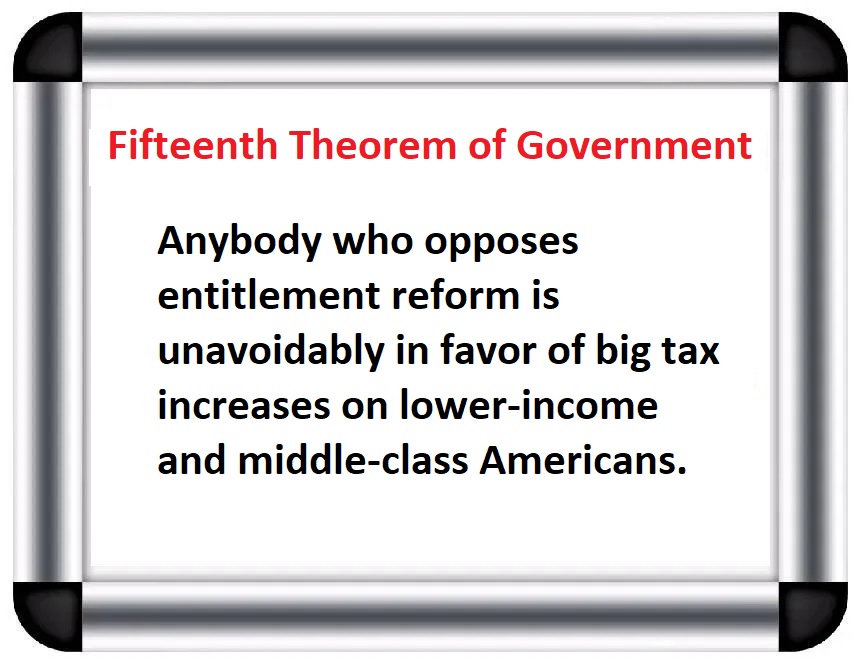
This means we will have to make a choice: Either reform entitlements or acquiesce to massive future tax increases.

And because Biden and Trump oppose entitlement reform, that means that they favor tax increases.

Moreover, since there are not nearly enough rich people to finance big government, this means Biden and Trump favor massive tax increases on lower-income and middle-class households.

To be fair, there are alternatives other than entitlement reform or big tax increases.

For instance, politicians could endlessly issue more debt. That might work, at least until the fiscal house of cards collapses.

Another possibility, at least with regards to Social Security, is to do nothing.

How is this an alternative? Well, David McIntosh, President of the Club for Growth, explained last month in the Wall Street Journal that the Biden-Trump position on Social Security could be a recipe for automatic benefit cuts.

Joe Biden and Donald Trump agree on one thing. “I guarantee you I will protect Social Security and Medicare without any change. Guaranteed,” Mr. Biden said in March. Mr. Trump has said: “I will do everything within my power not to touch Social Security, to leave it the way it is.” …The Biden-Trump position may sound like a pledge to protect Social Security, but it isn’t.…the Old Age and Survivors Insurance Trust Fund…will be able to issue payments to retirees only until 2034. …once the trust fund reserve is depleted, beneficiary payouts will be limited to whatever funds come in from Social Security payroll taxes. …Thus consequences of leaving Social Security “without any changes,” as promised by Biden-Trump, are dire. Ten years from now, benefit cuts of 23% will be triggered if there is no change to Social Security…the Biden-Trump strategy has been to play “beat the clock,” leaving their successors to deal with the crisis. Candidates with a record of entitlement reform like Messrs. Pence and DeSantis would do well to point out that doing nothing is the worst Social Security cut.

Technically, McIntosh is 100 percent correct. Under current law, there will be automatic benefit cuts once there no longer are any IOUs in the Social Security Trust Fund.

In reality, future politicians almost surely will change the law to continue full payments. Which is why I feel confident in stating that our real choice is between genuine entitlement reform and massive tax increases.

P.S. My collection of “honest leftists” includes many who openly admit that giant tax increases will be needed if there is no entitlement reform.

P.P.S. The agreement between Biden and Trump on entitlements should not be a surprise. They also agree on many other issues, such as nationalizedinfrastructure, industrial policy, governmentspending, and trade protectionism.

Author Biography

Eric Schurenberg is Editor-in-Chief of BNET.com and Editorial Director of CBS MoneyWatch.com. Previously, Eric was managing editor of MONEY. As managing editor, he expanded the editorial focus to new interests including real estate, family finance, health, retirement, and the workplace. Prior to MONEY, Eric was deputy editor of Business 2.0. He was also the managing editor of goldman.com, a Web site for Goldman Sachs Group’s personal wealth management business, and an assistant managing editor at Fortune magazine. Schurenberg has won a Gerald Loeb Award for distinguished business journalism, a National Magazine Award, and a Page One Award.

In his article “5 Social Security Myths That Have to Go, ” Schurenberg notes:

Social Security isn’t the only cause of America’s fiscal problems, but it is Exhibit A in why it is so hard to fix them. No serious solution to our debt can ignore a program that will tax and spend about 4.8% of GDP this year and account for about 20% of all federal spending-and that within a few decades will count almost a third of the population as beneficiaries. But whenever I write about Social Security here at CBS MoneyWatch, I’m always struck by how much disagreement there is about how the system really works.

A handful of misconceptions tend to crop up repeatedly-often having to do with that fiscal fun-house mirror, the Social Security trust fund. And despite the efforts of writers like Allan Sloan and experts like the Urban Institute’s Eugene Steuerle, the myths won’t die. This column won’t kill them either, but that doesn’t mean we shouldn’t take a whack. Here goes:

Myth: Social Security benefits are earned; reducing them amounts to confiscation

It’s not hard to see why this illusion exists, since Social Security’s own website refers to “earned credits” and sometimes refers to payroll taxes as contributions. But despite Social Security’s fetish for language that echoes private pensions, no one ever vests in Social Security. You don’t own your benefits until you cash the check.

It’s more accurate to say your benefits are an entitlement granted by act of Congress and subject to change at any time by another act of Congress. As long as voters consider benefits inviolate, they will be. When voters decide fiscal responsibility is more important, then Social Security benefits- “earned” or not-will be up for review.

__________________________________________

Professor Williams explains what’s ahead for Social Security

Dan Mitchell: “Needless to say, both Trump and Biden have contributed to America’s unimpressive [Free Trade] score”

Ranking Trade Freedom

Free trade is good and protectionism is bad.

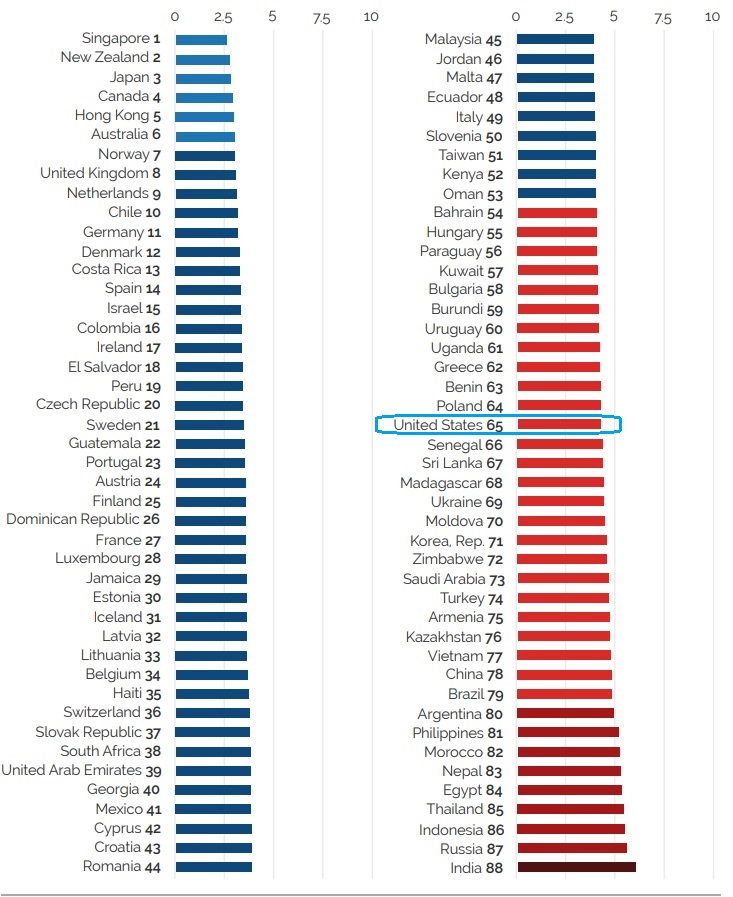
Assuming one agrees with those common-sense observations, the Tholos Foundation’s just-released Trade Barriers Index is a great source of data about which countries are pro-trade and anti-trade.

As you can see, Singapore has the fewest trade barriers (a lower score is good), followed by New Zealand. By contrast, India is in last place with the most trade barriers, followed by Russia.

Sadly, the United States ranks a lowly 65 out of 88 countries that were included in the report.

The Index is filled with data, so it is a treasure trove for wonks.

The part I like best, which is excerpted below, notes that pro-trade nations produce a disproportionate share of global economic output.

The 88 countries in the 2023 TBI house 72 percent of the world’s population. In the freest range, those with a score reaching between 2.5 and 3.0 or lower, only 6 countries with a combined population of 207 million, or 2.6 percent of the world’s people, enjoy the most barrier-free-trade and they produce 11 percent of the world’s GDP… In the mostly-free range, with a score between 3 and 3.5, reside 395 million people or 5 percent of the world’s population in 16 countries where they produce 14 percent of world GDP.In the next range, between 3.5 and 4.0 on the TBI, 7 percent of the world’s population produces 12 percent of global GDP. In the middle range between 4.0 and 4.5, productivity gets a boost due to the inclusion of the United States; in this range 650 million people reside and produce 28 percent of GDP. Then the inefficiencies of trade restrictions start to take a large toll. In the next 4.5 to 5.0 range, nearly 2 trillion people live, 24 percent of the world’s population, but they contribute only 22 percent of GDP. Then in the 5.0 to 5.5 range, in six countries, 8 percent of the world’s people reside and they produce a dismal 3 percent of world GDP. Lastly, in the 5.5 to 6.0 range 20 percent of the world’s population reside in 2 countries, India and Russia, where they produce 5 percent of world GDP.

Let’s close with a comparison of the United States and Singapore.

In every single category, Singapore does better. But the biggest gap is in non-tariff barriers.

Needless to say, both Trump and Biden have contributed to America’s unimpressive score.

P.S. You’ll notice that trade balances are not part of the Trade Barriers Index. That’s because the authors understand trade deficits are irrelevant (or even a positive sign if a nations is attracting a lot of foreign investment).

——-

Portrait of Milton Friedman.jpg

Defending International Trade

As a fan of globalization – but not globalism, I endorse this new video from Reason, which punctures myths from protectionists such as Donald Trump and Bernie Sanders (and Joe Biden).

If you don’t have a spare seven minutes to watch the video, it addresses three specific points.

  1. Does cross-border trade destroy manufacturing jobs?
  2. Did liberalizing trade with China take American jobs?
  3. Does trade make us vulnerable because of supply chains?

Plenty of good material, but I also would have challenged protectionists to provide a successful example of protectionism. Today or in the past.

Did protectionism work for Herbert Hoover – or anyone else – in the 1930s?

Did protectionism work for Juan Peron in Argentina in the 1940s and 1950s?

Is protectionism working for India’s economy in the 21st century?

Did protectionism work for Donald Trump between 2017 and 2020?

The answer is no in every single case. So it is no surprise that scholarly research (see here, here, here, here, here, here, here, here, and here) shows that free trade is a better approach if a nation wants more jobs and higher income.

But protectionists make one accurate point. While free trade increases overall employment, that does not mean every worker in every industry benefits.

In his New York Times column, Peter Coy explores this topic.

The skepticism about free markets…has gotten only stronger…only 44 percent of Republican voters…viewed free trade mainly as an opportunity for growth through increased exports. …the standard Econ 101 argument for free trade… First, assert that trade increases prosperity by allowing each country to specialize in what it’s best at. …Second, acknowledge that not everyone wins from free trade… Third, state that this problem can be easily solved: Everyone in society can be made better off if the winners share some of their gains with the losers. …In reality, the winners from trade rarely share much of their gains with the losers. The losers remain losers, and they often vote for candidates who put up tariff walls. …the free traders have failed to deliver on their promises to make free trade and open markets work for all.

A reasonably fair article, but I don’t think “free traders have failed” for reasons I explained in one of my videos from earlier this year.

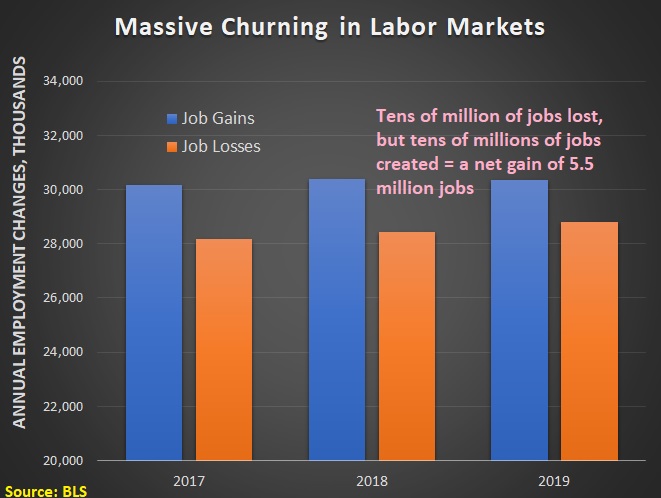
If you don’t want to spend three minutes watching the video, I explain that all trade destroys jobs. And that includes trade within a nation.

It’s part of “creative destruction,” which I’ve labeled as the best and worst part of capitalism.

Millions of jobs get destroyed every year, in part because new technology, new competitors, and new innovations.

That’s bad news for many people, but it’s also the process that creates even more new jobs.

And it’s the process that has made all of us so much richer than our ancestors. And that includes the ancestors of people who lost jobs because of domestic or international trade.

P.S. Click here, here, and here for some very sound observations from America’s best post-WWII president.


Larry Elder wrote in 2016: “As economist Milton Friedman says, protectionism discriminates against low prices!”

The pandemic has shocked every sector of the economy. Trade restrictions enacted by the Trump administration and maintained by President Biden have rippled through the U.S. economy but have particularly impacted U.S. ports. The pandemic highlighted that American ports have broader efficiency problems and could use some serious policy and management reforms.

On the west coast in particular, ship congestion has caused severe delays, wreaking havoc on the supply chain. While factories and ports in Asia are working 24/7 to supply American consumers with valuable goods, U.S. ports have been open for far fewer hours because labor union contractsdictate the hourly terms. However, after months of backlog, the ports of Los Angeles (LA) and Long Beach (LB) are finally switching to 24/7 shifts to move goods more quickly.

As a result of these union contracts, government offices are also not open 24/7. The ports of LA and LB account for almost half of all U.S. imports. The Customs and Border Protection (CBP) officials who must clear and admit goods do not work nights or weekends. These limits create additional pressure to have goods shipped to the United States during a prohibitive time frame, or leave ships idling around the ports until they can get in. The latter is the most common response. Recently, ships have been waiting an average of 12.5 days to enter the LA port. Ship idling has caused other problems too. Orange County, CA was affected by an oil spill that is suspected to have been caused by a pipeline hit with idling ship anchors. These differences in operating hours have caused huge ports efficiency losses that are felt across the country.

While it is positive that retailers, couriers, and the International Longshore and Warehouse Union (ILWU) are making changes to run ports more efficiently, permanent trade policy changes would help ease America’s coastal shipping problems.

The best policy would be to unilaterally remove tariffs by the United States. Simply eliminating tariffs would reduce an administrative burden both for traders and CBP officials. Duty‐​free trade would increase imports and exports but all other things equal, the freed‐​up CBP resources would help to move goods more swiftly through the ports.

However, a few smaller reforms could be implemented now that would considerably help the efficiency of U.S. ports. Removing Section 232 tariffs on steel and aluminum imports could temper the current domestic scarcity of some transportation‐​related goods, including chassis (the frame of a vehicle that holds containers). Thesematerials are vital inputs for such products and the Section 232 tariffs are affecting American manufacturers’ ability to meet domestic demand. Eliminating duties and tariffs on transportation‐​related goods, including the 221 percent antidumping and countervailing (AD/CVD) duties and 25 percent Section 301 tariffs on Chinese chassis, could help increase the U.S. supply of chassis. While some freighters are paying the higher prices for Chinese chassis, the supply of transportation is still constrained, which has resulted in higher sticker prices on consumer goods.

As LA and LB move to 24/7 shifts, CBP offices should also be open 24/7. Given the sheer volume of trade these two ports process, it would seem sensible to make staffing 24/7 a permanent change at these ports, and at others depending on trade volumes.

Reforming the Jones Act could also help. All freight moved between U.S. ports must useU.S.-built, -crewed, and -flagged ships. As a result, traders circumvent these regulations by using alternative modes like trucks and trains. It would be prudent to reform the Jones Act to allow ships not in compliance with the Jones Act to pick up shipments in one U.S. port and unload at another. This would reduce pressure on inland transit that is currently being impacted by the aforementioned tariffs.

These bottlenecks have provided insight into the problems that exist at U.S. ports and with coastal shipping more broadly. Improvements in trade policy have a role to play and policymakers would be remiss not to consider permanent changes that would be beneficial now and could preempt pressures during future economic shocks.

Milton Friedman – Free Trade vs. Protectionism

Free to Choose Part 2: The Tyranny of Control (Featuring Milton Friedman

Donald Trump: Clueless about free trade

Larry Elder rebuts candidate’s ‘they’re taking our jobs’ claim

Published: 02/03/2016 at 6:39 PM

One of Donald Trump’s talking points and biggest applause lines is how “they” – Japan, China and Mexico – are “beating us in trade” and are “taking our jobs.” He proposes tariffs, for example, on Chinese goods in retaliation for that country’s alleged “cheating.”

To someone who is out of work in an industry where foreign workers do what he or she once did, Trump-like protectionism sounds appealing. But Trump actually proposes punishing the American consumer. As economist Milton Friedman says, protectionism discriminates against low prices.

It is certainly true that many countries prop up or subsidize companies or even whole industries by providing capital or special privileges. This allows them to produce goods and services “below cost” – or at prices below what a competitor could charge and still make a profit. But doing so also means that taxes in that country, which could have gone to a more productive use, are squandered to keep a company in business that otherwise wouldn’t exist or would have gone out of business. This means consumers in other countries with which the “cheater” country trades can buy those imported goods at a cheaper price.

Trump proposes to retaliate by placing tariffs on those imported goods. But this prevents American consumers from benefiting from the “cheater” country’s folly of propping up companies that would not survive but for the taxes spent to keep it alive. Why compound the stupidity?

Another justification for this kind of protectionism is that a foreign country “exploits” America through the use of “slave labor” which, as to wages, causes a “race to the bottom.” Certainly forced labor, as when “blood diamonds” are mined by workers with guns pointed to their heads, is criminal and immoral. But free laborers offering to work for less money than others is how poor countries become wealthier – by allowing other countries to buy goods more cheaply.

NAFTA, the North American Free Trade Agreement, established in 1994, has become exhibit A on how “we lose” on trade. After all, many American jobs have been “outsourced” to Mexico. But that looks at but one side of the ledger. That an American pays less for certain things frees up capital to spend on something or on someone else. A machinist sees his job “shipped to Mexico,” but the planner or analyst hired by a company with the “savings” might not see the direct relationship between free trade and the fact that he or she has this new job. When NAFTA was debated, businessman and presidential candidate Ross Perot predicted “a giant sucking sound” as jobs and incomes would be lost to Mexico.

The American Enterprise Institute writes: “It is an article of faith among protectionists that NAFTA harmed American workers. … The justification may be that NAFTA went into force at the beginning of 1994 and the U.S. trade balance with Canada and Mexico, two of our top partners, then deteriorated.

“But the American job market improved as these trade deficits grew. Unemployment fell more than two points from the beginning of 1994 through the middle of 2000. Already high labor force participation edged higher to its all-time record by early 2000. Manufacturing employment rose until mid-1998 and was above its pre-NAFTA level until April 2001. Manufacturing wages rose. The strength in the American job market from 1994 to 1999 is not due primarily to NAFTA, but it is plain that the job market, including manufacturing, strengthened after NAFTA.”

Trump is also schizophrenic on this issue. On the one hand, he opposes illegal immigration, which most often is an economic decision where, for example, a poor, unskilled worker from Mexico sneaks into America to make money. On the other hand, Trump deems it unfair and a form of “cheating” if an American company relocates to or builds a factory in Mexico to take advantage of that unskilled Mexican worker’s willingness to work for less.

If Trump were talking about the excessive taxes or regulations that induce American companies to leave the U.S. or to put factories in foreign countries, that would be one thing. The U.S. general top marginal corporate income tax rate is the highest in the industrialized world – and, worldwide, is only exceeded by Chad and the United Arab Emirates. Unnecessary regulations also increase the cost of doing business stateside. But this is not Trump’s argument.

About free trade, the father of modern economics, Adam Smith, in 1776 wrote in “The Wealth of Nations”: “In every country it always is and must be in the interest of the great body of the people to buy whatever they want of those who sell it cheapest. The proposition is so very manifest that it seems ridiculous to take any pains to prove it; nor could it ever have been called in question had not the interested sophistry of merchants and manufacturers confounded the common sense of mankind. Their interest is, in this respect, directly opposite to that of the great body of the people.”

Trump means well. But so what?

Trump vs Friedman – Trade Policy Debate

Related posts:

FRIEDMAN FRIDAY Milton Friedman’s FREE TO CHOOSE “The Tyranny of Control” Transcript and Video (60 Minutes)

Milton Friedman’s FREE TO CHOOSE “The Tyranny of Control” Transcript and Video (60 Minutes) In 1980 I read the book FREE TO CHOOSE by Milton Friedman and it really enlightened me a tremendous amount.  I suggest checking out these episodes and transcripts of Milton Friedman’s film series FREE TO CHOOSE: “The Failure of Socialism” and […]

FRIEDMAN FRIDAY “The Tyranny of Control” in Milton Friedman’s FREE TO CHOOSE Part 7 of 7 (Transcript and Video) “I’m not pro business, I’m pro free enterprise, which is a very different thing, and the reason I’m pro free enterprise”

In 1980 I read the book FREE TO CHOOSE by Milton Friedman and it really enlightened me a tremendous amount.  I suggest checking out these episodes and transcripts of Milton Friedman’s film series FREE TO CHOOSE: “The Failure of Socialism” and “What is wrong with our schools?”  and “Created Equal”  and  From Cradle to Grave, […]

FRIEDMAN FRIDAY “The Tyranny of Control” in Milton Friedman’s FREE TO CHOOSE Part 6 of 7 (Transcript and Video) “We are the ones who promote freedom, and free enterprise, and individual initiative, And what do we do? We force puny little Hong Kong to impose limits, restrictions on its exports at tariffs, in order to protect our textile workers”

In 1980 I read the book FREE TO CHOOSE by Milton Friedman and it really enlightened me a tremendous amount.  I suggest checking out these episodes and transcripts of Milton Friedman’s film series FREE TO CHOOSE: “The Failure of Socialism” and “What is wrong with our schools?”  and “Created Equal”  and  From Cradle to Grave, […]

FRIEDMAN FRIDAY “The Tyranny of Control” in Milton Friedman’s FREE TO CHOOSE Part 5 of 7 (Transcript and Video) “There is no measure whatsoever that would do more to prevent private monopoly development than complete free trade”

In 1980 I read the book FREE TO CHOOSE by Milton Friedman and it really enlightened me a tremendous amount.  I suggest checking out these episodes and transcripts of Milton Friedman’s film series FREE TO CHOOSE: “The Failure of Socialism” and “What is wrong with our schools?”  and “Created Equal”  and  From Cradle to Grave, […]

FRIEDMAN FRIDAY “The Tyranny of Control” in Milton Friedman’s FREE TO CHOOSE Part 4 of 7 (Transcript and Video) ” What we need are constitutional restraints on the power of government to interfere with free markets in foreign exchange, in foreign trade, and in many other aspects of our lives.”

In 1980 I read the book FREE TO CHOOSE by Milton Friedman and it really enlightened me a tremendous amount.  I suggest checking out these episodes and transcripts of Milton Friedman’s film series FREE TO CHOOSE: “The Failure of Socialism” and “What is wrong with our schools?”  and “Created Equal”  and  From Cradle to Grave, […]

FRIEDMAN FRIDAY “The Tyranny of Control” in Milton Friedman’s FREE TO CHOOSE Part 3 of 7 (Transcript and Video) “When anyone complains about unfair competition, consumers beware, That is really a cry for special privilege always at the expense of the consumer”

In 1980 I read the book FREE TO CHOOSE by Milton Friedman and it really enlightened me a tremendous amount.  I suggest checking out these episodes and transcripts of Milton Friedman’s film series FREE TO CHOOSE: “The Failure of Socialism” and “What is wrong with our schools?”  and “Created Equal”  and  From Cradle to Grave, […]

FRIEDMAN FRIDAY “The Tyranny of Control” in Milton Friedman’s FREE TO CHOOSE Part 2 of 7 (Transcript and Video) “As always, economic freedom promotes human freedom”

In 1980 I read the book FREE TO CHOOSE by Milton Friedman and it really enlightened me a tremendous amount.  I suggest checking out these episodes and transcripts of Milton Friedman’s film series FREE TO CHOOSE: “The Failure of Socialism” and “What is wrong with our schools?”  and “Created Equal”  and  From Cradle to Grave, […]

FRIEDMAN FRIDAY “The Tyranny of Control” Milton Friedman’s FREE TO CHOOSE Part 1 of 7 (Transcript and Video) “Adam Smith’s… key idea was that self-interest could produce an orderly society benefiting everybody, It was as though there were an invisible hand at work”

In 1980 I read the book FREE TO CHOOSE by Milton Friedman and it really enlightened me a tremendous amount.  I suggest checking out these episodes and transcripts of Milton Friedman’s film series FREE TO CHOOSE: “The Failure of Socialism” and “What is wrong with our schools?”  and “Created Equal”  and  From Cradle to Grave, […]

Open letter to President Obama (Part 654) “The Tyranny of Control” in Milton Friedman’s FREE TO CHOOSE Part 7 of 7 (Transcript and Video) “I’m not pro business, I’m pro free enterprise, which is a very different thing, and the reason I’m pro free enterprise”

Open letter to President Obama (Part 654) (Emailed to White House on July 22, 2013) President Obama c/o The White House 1600 Pennsylvania Avenue NW Washington, DC 20500 Dear Mr. President, I know that you receive 20,000 letters a day and that you actually read 10 of them every day. I really do respect you […]

Open letter to President Obama (Part 650) “The Tyranny of Control” in Milton Friedman’s FREE TO CHOOSE Part 6 of 7 (Transcript and Video) “We are the ones who promote freedom, and free enterprise, and individual initiative, And what do we do? We force puny little Hong Kong to impose limits, restrictions on its exports at tariffs, in order to protect our textile workers”

Open letter to President Obama (Part 650) (Emailed to White House on July 22, 2013) President Obama c/o The White House 1600 Pennsylvania Avenue NW Washington, DC 20500 Dear Mr. President, I know that you receive 20,000 letters a day and that you actually read 10 of them every day. I really do respect you […]

__________

Tim Keller’s Unwavering, Unapologetic Faith Bore Fruit

—-

Tim Keller’s Unwavering, Unapologetic Faith Bore Fruit

Jim Daly  @DalyFocus / May 20, 2023

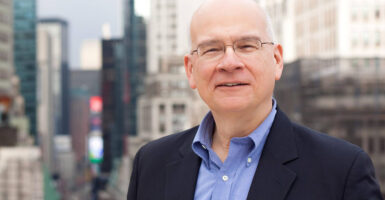
Balding and bespectacled, Pastor Tim Keller found a way to connect with his young and growing audience in New York City by speaking their language and referencing everything from The Village Voice, NPR, and The New York Times to C.S. Lewis, David Martyn Lloyd-Jones, and the ancient hymns of the faith. (Photo: Tim Keller Facebook)

COMMENTARY BY

Jim Daly@DalyFocus

Jim Daly is president of Focus on the Family and host of the daily “Focus on the Family” broadcast heard by more than 6.3 million listeners per week on more than 1,000 radio stations across the U.S.

New York magazine once described Tim Keller’s founding of Redeemer Presbyterian Church in New York City as “close to a theological suicide mission” for having the audacity “to create a strictly conservative Christian church in the heart of Sodom.”

Only Tim Keller wasn’t eager for the assignment. In fact, he turned down the invitation and attempted to recruit two other pastors for the church plant, which was born out of a wildly successful dinner ministry hosted by Nancy DeMoss, widow of Art DeMoss, a mail-order insurance mogul.

Keller previously had pastored a small congregation in Hopewell, Virginia. But he was no stranger to urban ministry, having served with InterVarsity Christian Fellowship in Boston and Westminster Theological Seminary in Philadelphia, where he received his doctorate in ministry in 1981. 

Compelled by the Holy Spirit, Keller eventually accepted the invitation, moved his wife Kathy and three young boys to New York City in 1989, and poured himself into the new ministry.

The conventional wisdom held that conservative Christian theology and teaching wouldn’t find any takers in the big and hostile city. After all, that’s left for bellicose street-corner evangelists with bullhorns. 

As often is the case, the conventional wisdom was wrong.

Pastor Timothy J. Keller, who died Friday of pancreatic cancer at 72, was bold but not brash. He was courageous but not caustic.

Balding and bespectacled, he found a way to connect with his young and growing audience at Redeemer Presbyterian Church by speaking their language and referencing everything from The Village VoiceNPR, and The New York Times to C.S. Lewis, David Martyn Lloyd-Jones, and the ancient hymns of the faith.

The Pennsylvania native found there was a hunger for the honest, clear, and countercultural teaching of the Bible. His congregation was full of aspiring artists, actors, and business professionals who had come to New York in search of fame and fortune. Keller’s preaching filled the empty void that he knew the bright lights and applause would never satiate, eventually building a megachurch with multiple campuses and pastors.

Although I interviewed Tim Keller many times for Focus on the Family’s radio program, I most enjoyed the visits when the microphones and cameras were off.

I had the privilege of joining Tim and other ministry and cultural leaders on numerous occasions for off-the-record, behind-the-scenes conversations. There’s the old saying that politics makes for strange bedfellows, but the same can be said for interfaith, cross-cultural dialogue. In fact, those exchanges were probably far more insightful and intriguing than any Washington hoo-ha.

A bestselling author who stepped down as Redeemer’s senior pastor in 2017, Tim always had something interesting, wry, witty, or wise to say. He had an uncanny ability to disagree without being disagreeable—an increasingly lost art today.

Despite pressure from numerous camps and causes, I also appreciated Tim’s unbending commitment to orthodox Christianity. Whether it was holding fast to a biblical understanding of human sexuality or his support for the sanctity of life, he was unwavering and unapologetic.

This courage and boldness should strengthen fellow Christians’ own resolve as we wade into the culture with our convictions and invite conversation and debate.

I might also add that I appreciated Tim’s pastoral heart. From time to time, he would informally and casually counsel me on ministerial matters. I remember once sharing a particular burden with him. He listened patiently. He then smiled and reminded me that the passage of time would solve the problem. He was right. 

Tim Keller’s voice and wisdom will be missed, but he leaves behind a legacy that will live on like the many other giants of the faith on whose shoulders we now stand.

The psalmist wrote: “Precious in the sight of the Lord is the death of His saints” (Psalms 116:15).

Our friend’s passing grieves those of us who knew, loved, and benefited from his ministry—but it brings this beloved husband, father, scholar, and theologian face to face with the God he so loyally and effectively served and worshipped.  

The Daily Signal publishes a variety of perspectives. Nothing written here is to be construed as representing the views of The Heritage Foundation. 

Have an opinion about this article? To sound off, please email letters@DailySignal.com, and we’ll consider publishing your edited remarks in our regular “We Hear You” feature. Remember to include the URL or headline of the article plus your name and town and/or state.

After Life #1 Trailer

—-

After Life 2 Trailer

—-

On Saturday April 18, 2020 at 6pm in London and noon in Arkansas, I had a chance to ask Ricky Gervais a question on his Twitter Live broadcast which was  “Is Tony a Nihilist?” At the 20:51 mark Ricky answers my question. Below is the video:

—-

—-

If Death is the end then what is the point Kath asks below:

——

Kath: You are an atheist?

—-

(Above) Tony and Anne on the bench at the graveyard where their spouses are buried.

July 23, 2020 
Ricky Gervais 


Dear Ricky,  

This is the 97th day in a row that I have written another open letter to you to comment on some of your episodes of AFTER LIFE. I love the film series AFTER LIFE but Tony just like Solomon in ECCLESIASTES is lamenting that even though he is asking the right questions he is not getting the right answers. The reason for this search being similar to chasing the wind is that it is a search for meaning UNDER THE SUN!!!!

:The Christian Scholar Ravi Zacharias noted, “The key to understanding the Book of Ecclesiastes is the term UNDER THE SUN — What that literally means is you lock God out of a closed system and you are left with only this world of Time plus Chance plus matter.”

Ricky as an atheist you have put no spiritual solutions in AFTERLIFE except to make fun of the dimwit Kath who is the only Christian in the script. No wonder you have Tony returning to his alcohol and his constant contemplation of suicide. 

Let me make a very simple point and that is we all have a deep longing in our soul that must be satisfied spiritually, and that is a lacking component in AFTER LIFE. 

Francis Schaeffer noted: 

The classic work Leonardo da Vinci, published in Italy and translated in English in 1963, contained a section by Giovanni Gentile (1875-1944) on Leonardo’s thought-forms. He spells out the fact that Leonardo really grasped the problem of modern man. Leonardo anticipated where humanism would end: 

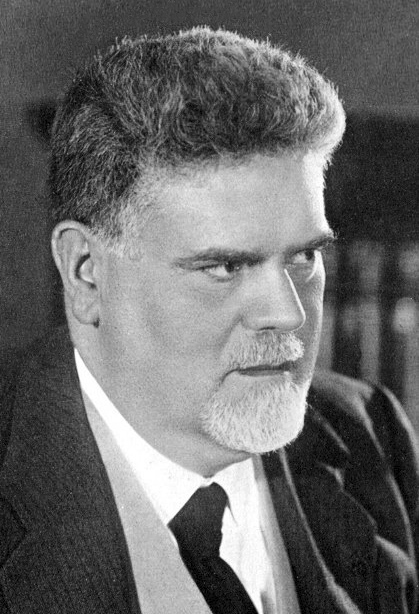
(Giovanni Gentile pictured below)

GENTILE, Giovanni

From Galileo’s day on rigorous scientific method has limited itself consciously to what are called appearances or phenomenon as they later were to be termed of nature that is to the surface but Leonardo while looking to such an ideal of scientific knowledge can not be satisfied with the surface his keen unsleeping eye penetrates deeper and on observation the experience that is so greatly praised and exalted no longer serves him he intuits or invokes the inner life the secret soul setting in motion the great machine that he has taken apart and studied piece by piece, watching, and spying and scrutinizing by means of mathematics, mechanics, anatomy and every instrument that might enable him to follow the operations of nature step by step. 

Hence the anguish and the innermost tragedy of this universal man divided between two irreconcilable worlds, hence the desperate life long labor of this implacable self torture whose marvelous work of gleaming of art spread from full hands day by day on paper, on canvas and on storied walls and of precise concepts and inspired researches which in many fields of scientific knowledge are pretentious anticipations of the future leaves in mind an infinite longing made up as it were of regret and sadness. It is the longing for a different Leonardo from the Leonardo that he was, one that could gathered himself up at each phase and remained closed himself off either altogether in his fantasy or altogether in his intelligence in order to taste the pure joy of divine creation (that’s not God’s creation but his own). It is anguished longing such as always welled up in Leonardo’s heart each time he put down his brush, his charcoal or his rod where he had to break off setting down his secret thoughts.

(Painting of Leonardo below)


What Gentille is putting forth here is that Leonardo was not satisfied with living in two worlds at once. He was not satisfied with being the modern man who would put his aspirations and his longing for unity and meaning in one compartment to be taken out and looked at when he can’t stand the pressure of the details. And Leonardo realized that these two things based on the beginning of man from himself would absolutely lead in this direction…Leonardo was looking for a meaning amidst the details of life.

Why do so many people throughout the world believe in God and an afterlife? Ecclesiastes 3:11 “God has planted eternity in the heart of men…” (Living Bible). 

Psychiatrist played by Paul Kaye seen below.

The sandy beach walk

Even Tony seems to feel this in episode 4 of the first season of AFTER LIFE when Tony talks about being with his wife in the future.

Matt: Tony that doesn’t even make sense. You are a rational man. You don’t even believe in an afterlife. 

Tony: I know she is nowhere. Alright. But get this through your head. I would rather be no where with her then somewhere without her. 

After Life on Netflix

After Life on Netflix stars Ricky Gervais as a bereaved husband (Image: Netflix)

Why does Tony say these things? First, he knows deep down that he was made for more than just this life. Secondly, he can’t live as though he is a machine even though his secular viewpoint tells him that he is only a machine. Modern man, says Francis Schaeffer, resides in a two-story universe. In the lower story is the finite world without God; here life is absurd, as we have seen. In the upper story are meaning, value, and purpose. Now modern man lives in the lower story because he believes there is no God. But he cannot live happily in such an absurd world; therefore, he continually makes leaps of faith into the upper story to affirm meaning, value, and purpose, even though he has no right to, since he does not believe in God.This EXPLAINS why Tony makes statements such as the one that SHOCKED Matt!!!!

As Augustine famously says to God at the beginning of the Confessions: “You stir man to take pleasure in praising you, because you have made us for yourself, and our heart is
restless until it rests in you.” 
35 
C.S. Lewis asserted: 

Creatures are not born with desires unless satisfaction for those desires exists. A baby feels hunger: well, there is such a thing as food. A duckling wants to swim: well,(12) there is such a thing as water. Men feel sexual desires: well, there is such a thing as sex. If I find in myself a desire which no experience in this world can satisfy, the most probable explanation is that I was made for another world

Tim Keller in his book MAKING SENSE OF GOD notes: 

The Infinity of Our Discontent page 91 (3:12:35)


The ultimate disordered love, however— and the ultimate source of our discontent— is failure to love the first thing first, the failure to love God supremely. In his Confessions, Augustine prays to God: “For there is a joy that is not given to those who do not love you, but only to those who love you for your own sake. . . . This is happiness and there is no other. Those who think that there is another kind of happiness look for joy elsewhere, but theirs is not true joy. Nevertheless their will remains drawn towards some image of the true joy.” 33

Augustine here distills the biblical view of humanity. Human beings were made in the image of a God who is tripersonal— Father, Son, and Holy Spirit. From all eternity those three divine persons have been loving one another in infinite degrees of joy and glory. We were created to know this joy by loving and glorifying God preeminently. Whether we acknowledge God or not, since we were created for it, we will always look for the infinite joy we were designed to find in loving communion with the Divine. We turn to things in the world to give it to us, but “[ we] sin when, neglectful of order, we fix our love on the creature, instead of on Thee, the Creator.” 34 The reason even the best possible worldly goods will not satisfy is because we were created for a degree of delight and fulfillment that they cannot produce. As Augustine famously says to God at the beginning of the Confessions: “You stir man to take pleasure in praising you, because you have made us for yourself, and our heart is
restless until it rests in you.” 
35 We were made for God, and so nothing can give us the infinite joy that God can.
All things are precious, because all are beautiful, but what is more beautiful than He? Strong they are, but what is stronger than He? . . . If you seek for anything better, you will do wrong to Him and harm to yourself, by preferring to Him that which He made, when he would willingly give Himself to you. 36
You harm yourself when you love anything more than God. How does this work? If you love your children more than you love God, you will essentially rest your need for significance and security in them. You will need too much for them to succeed, be happy, and love you. That will either drive them away or crush them under the weight of your expectations, because they will be the ultimate source of your happiness, and no human being can measure up to that. If instead you love your spouse or romantic partner more than God, the same things occur. If you love your work and career more than God, you will necessarily also love them more than your family, your community, and your own health, and so that will lead to physical and relational breakdown and often, as we saw above, to social injustice.
If you love anything more than God, you harm
the object of your love, you harm yourself, you harm the world around you, and you end up deeply dissatisfied and discontent. 
The most famous modern expression of Augustine’s view was the ending of Lewis’s radio talk:

Creatures are not born with desires unless satisfaction for those desires exists. A baby feels hunger: well, there is such a thing as food. A duckling wants to swim: well,(12) there is such a thing as water. Men feel sexual desires: well, there is such a thing as sex. If I find in myself a desire which no experience in this world can satisfy, the most probable explanation is that I was made for another world. 37


The Augustinian analysis does justice to our experience. As we saw, the evolutionary explanation of our perennial discontent fails to account for it. The idea that “most people are basically happy” trivializes it, but it is not trivial at all. Some have, as it were, sought to fill the inner emptiness with billions of dollars and virtually unchecked power to gratify their impulses and appetites. Yet the testimony of the ages is that even goods on this scale cannot fill the vacuum. That is powerful evidence that the cavern in our soul is indeed infinitely deep. 38


The Healing of Our Discontent
 (3:17:11)


Here, then, is the conundrum we face. Our surprisingly deep discontent leads us to lock our hearts onto things with profound intensity. The ancients wisely taught that the only way to avoid unhappiness is to avoid this “love as attachment,” that is, to attach ourselves so powerfully and exclusively to an object or person that we cannot imagine life without it or him or her. 39 Not only do such attachments lead to envy, resentment, anxiety, and even violence in order to defend our possession, but they also make us fragile and vulnerable to the inevitable changes and disruptions of life.
However, we have seen the dangers of finding contentment through detachment. That not only brings
about a selfishness and hardness but also weakens our love relationships, thus undermining the greatest source of
joy we know. We need not only to receive love but also to give it. 40
Augustine breaks through this logjam. He does a radical critique of love-as-attachment, and presents his own pre-Christian self as a case study. He had attached his happiness to a friend whom he loved intensely but who died suddenly. He later realized that he had “loved a person sure to die as if he would never die (Confessions, book IV, chapter 8). This happens because our souls “become stuck and glued to these transient things,” which “rend the soul with pestilential desires and torment” because “the soul loves . . . to take its repose” in them. Yet “in these things there is no point of rest, for they . . . flee away” (Confessions, book IV, chapter 10). 41
However, after Augustine confirms the deadliness of love-as-attachment, he turns and says that such love is good, right, and essential when given to God. Though idolatrous attachment to earthly goods does indeed lead to unnecessary pain and grief, the solution was not to love the things of life less but to love God more. The problem is not that you love your family or job too much but that you love God too little in relationship to them. Intense attachment and detachment kill. Don’t harden your heart against
love, Augustine says, but don’t give your heart ultimately to things that you can lose and cannot satisfy. Instead infuse your heart with a sense of God’s love and incline your heart to love him in return.
 This will be transformative.
Consider this: If you live a long life, it will tear you up to see the people who matter most to you put into the ground one by one. If your greatest source of contentment and love is your family, that will be intolerable. But if you (13) learn to love God even more than them, your greatest source of consolation, hope, joy, and value will not be diminished by grief. Indeed, the sorrow will drive you to drink deeper from it. You will not find yourself empty, and you won’t always be hardening your heart in order to deal with how your losses tear you up. The love of God can never be taken from you, and in his love, the Bible says, you live with loved ones forever. 42


Of course, not even the strongest believers love God perfectly, nor does anyone get close to doing so. Yet to the degree you move toward loving him supremely, things begin to fall into order, into their proper places in your life. Instead of looking to the things of the world as the deepest source of your contentment, you can enjoy them for what they are. Money and career, for example, become just what they are supposed to be. Work becomes work, a great way to use your gifts and be useful to others. Money becomes just money, a great way to support your family. But these things are not your source of safety and contentment. He is.
There is another powerful dimension to this reordering of loves. Paul Bloom, in his book How Pleasure Works, argues that what matters most for pleasure is not the simple impact on our senses but what it means in relationship to other persons who matter to us. A painting that we think is an original by an admired artist gives less pleasure when we find out it is not. A chair may be comfortable, but if it is our mother’s favorite chair from her sitting room, it will give us even more pleasure. To use theological language, “we enjoy things most when we experience them as a sacrament— as carriers of the presence of another.” 43 Some have charged that religion drains ordinary life of its joy by devaluing it in deference to “higher,” more spiritual interests. This is not true— at least,

(3:22:11)
it is not the case with Christianity, the faith that I know by far the best. Christianity teaches that we are saved by God’s free grace and pardon. Unlike some forms of religion, Christianity does not say that we merit blessing through depriving ourselves and turning our backs on the world in order to earn heaven. Once we know through faith in Christ’s work for us that we are reconciled to God, and that the Creator is now not just our sovereign but our father, we can begin to have a more “sacramental” experience of the world. We see everything as a free gift from Father and a foretaste of the glory and goodness to come in our eternal inheritance. In short, as Miroslav Volf puts it, “Attachment to God amplifies and deepens enjoyment of the world.” 44 It does not diminish it.
Here, then, is the message. Don’t love anything less; instead learn to love God more, and you will love other things with far more satisfaction. You won’t overprotect them, you won’t over-expect things from them. You won’t be constantly furious with them for not being what you hoped. Don’t stifle passionate love for anything; rather, redirect your greatest love toward God by loving him with your whole heart and loving him for himself, not just for what he can give you. 45 Then, and only then, does the contentment start to come.
That is the Christian view of satisfaction. It avoids the pitfalls of both the ancient strategy of tranquility through detachment and the modern strategy of happiness through acquisition. It both explains and resolves the deep conundrum of our seemingly irremediable discontent.
14

How to Love God (3:24:01)


It may be that, reading this, you think Augustine’s analysis and solution make good sense. The magnitude of our discontent points to something beyond this world. We harm ourselves if we try to satisfy our deepest longings in human love, and we also harm ourselves if we detach our hearts too much from love. Augustine’s solution is that only the love of the immutable can bring tranquillity, and only an infinite love can satisfy our hunger for infinite joy.
Even if this all makes sense to us, how do we actually know that love? You can’t just tell yourself “God loves me” and expect your heart to change. Nor can you just say, “From now on I will love God.” Love cannot be generated simply by an act of the will. Children learn to speak only by responding to speech and learn to love only by reciprocating love. So we cannot love God just by thinking of an abstract deity who is loving in general. We must grasp and be gripped by the true story of God’s actual sacrificial, saving love for us in Jesus.
In the Gospel of John, Jesus speaks to a crowd about the “bread of life,” such that whoever eats it “will never go hungry” (John 6: 35). He is talking metaphorically about something that gives both strength and delight, an image
of fulfillment and satisfaction. He also observes that human beings seek this in the wrong places. He warns against “work[ ing] for food that spoils,” that does not in the end satisfy (John 6: 27). But he does not just say, “I am the dispenser of the bread of life.” Rather, he says, “I am the bread of life” (John 6: 35) and “This is my body given for you” (Luke 22: 19) and “This is my body, which is for you” (1 Corinthians 11: 24).
The heart of the Christian faith is the simple Gospel message of sin and grace. Because we fail to love God and
our neighbor, we sin, and for God to forgive our sin, the Son of God became mortal and graciously died in our place on the cross.
 This is an offensive idea to many people, but for the moment just consider the two ways this message can bring about the love relationship with God, which solves the human dilemma.
First, the knowledge of our sin softens our hearts. If you were to raise a child and work your fingers to the bone to send that child to college, and the child only occasionally sent you a Christmas card and never gave you the time of day, that would be wrong. It’s wrong because the child owes not just deference but love. Now, if there is a God who created us and keeps us alive every minute, then the love we owe God would be infinitely greater. To not love him supremely would be infinitely worse. If you believe that, you begin to see how much we have wronged him. It begins to draw your heart outward toward him in humility and grief.
Second, the knowledge of his grace ignites our hearts. If you want to forgive someone who has wrongfully cost you a great deal of money and can’t afford to pay you back, you must absorb and pay the debt yourself. If God was going to forgive us, he had to pay the debt we owed himself. And Jesus Christ pays it by going to the cross. Keep in mind that outside of salt and a couple of minerals, everything we eat has died so that we may live. If you are eating bread, not only did the grain die, but the bread has to be broken into pieces. If the bread stays whole, you starve and you fall apart. If the bread is broken into pieces and you take it in, then you live. When Jesus Christ says, “I am the bread of life.
. . broken for you,” (John 6: 35; Luke 22: 19) he is saying: “I am God become breakable, killable, vulnerable. I die that you might live. I am broken so you can be whole.”
15

Only if you see him doing this all for you— does that begin to change your heart. He suffered and died for your sake. Now out of joy we can love him just for his sake, just for the beauty of who he is and what he has done. You
can’t force your heart to love. A kind of vague god, a god of love, an abstract god will never change your heart. This is what will change it, draw it off its inordinate attachments to other things, and turn it away from the food that spoils. Someday, then, you will be able to say, “Because your love is better than life . . . I will be fully satisfied as with the richest of foods; with singing lips my mouth will praise you” (Psalm 63: 3a, 5). This is “it”— or at least its foretaste (1 John 3: 1– 3).
16

—-


The answer to find meaning in life is found in putting your faith and trust in Jesus Christ. The Bible is true from cover to cover and can be trusted.

Thank you again for your time and I know how busy you are.

Sincerely,

Everette Hatcher, everettehatcher@gmail.comhttp://www.thedailyhatch.org, cell ph 501-920-5733, 13900 Cottontail Lane, Alexander, AR 72002

PS: What is the meaning of life? Find it in the end of the open letter I wrote to you on April 23, 2020. 

Below is the workforce of THE TAMBURY GAZETTE 

Seen below is the third episode of AFTERLIFE (season 1) when Matt takes Tony to a comedy club with front row seats to cheer him up but it turns into disaster!!!

——

—-

Part 1 “Why have integrity in Godless Darwinian Universe where Might makes Right?”

Part 2 “My April 14, 2016 Letter to Ricky mentioned Book of Ecclesiastes and the Meaninglessness of Life”

Part 3 Letter about Brandon Burlsworth concerning suffering and pain and evil in the world.  “Why didn’t Jesus save her [from cancer]?” (Tony’s 10 year old nephew George in episode 2)

Part 4 Letter on Solomon on Death Tony in episode one, “It should be everyone’s moral duty to kill themselves.”

Part 5 Letter on subject of Learning in Ecclesiastes “I don’t read books of fiction but mainly science and philosophy”

Part 6 Letter on Luxuries in Ecclesiastes Part 6, The Music of AFTERLIFE (Part A)

Part 7 Letter on Labor in Ecclesiastes My Letter to Ricky on Easter in 2017 concerning Book of Ecclesiastes and the legacy of a person’s life work

Part 8 Letter on Liquor in Ecclesiastes Tony’s late wife Lisa told him, “Don’t get drunk all the time alright? It will only make you feel worse in the log run!”

Part 9 Letter on Laughter in Ecclesiastes , I said of laughter, “It is foolishness;” and of mirth, “What does it accomplish?” Ecclesiastes 2:2

Part 10 Final letter to Ricky on Ladies in Ecclesiastes “I gathered a chorus of singers to entertain me with song, and—most exquisite of all pleasures— voluptuous maidens for my bed…behold, all was vanity and a striving after wind, and there was nothing to be gained under the sun” Ecclesiastes 2:8-11.

Part 11 Letter about Daniel Stanhope and optimistic humanism  “If man has been kicked up out of that which is only impersonal by chance , then those things that make him man-hope of purpose and significance, love, motions of morality and rationality, beauty and verbal communication-are ultimately unfulfillable and thus meaningless.” (Francis Schaeffer)

Part 12 Letter on how pursuit of God is only way to get Satisfaction Dan Jarrell “[In Ecclesiastes] if one seeks satisfaction they will never find it. In fact, every pleasure will be fleeting and can not be sustained, BUT IF ONE SEEKS GOD THEN ONE FINDS SATISFACTION”

Part 13 Letter to Stephen Hawking on Solomon realizing he will die just as a dog will die “For men and animals both breathe the same air, and both die. So mankind has no real advantage over the beasts; what an absurdity!” Ecclesiastes

Part 14 Letter to Stephen Hawking on 3 conclusions of humanism and Bertrand Russell destruction of optimistic humanism. “That Man is the product of causes which had no prevision of the end they were achieving; that his origin, his growth, his hopes and fears, his loves and his beliefs, are but the outcome of accidental collocations of atoms—no philosophy which rejects them can hope to stand. Only within the scaffolding of these truths, only on the firm foundation of unyielding despair, can the soul’s habitation henceforth be safely built.”(Bertrand Russell, Free Man’s Worship)

Part 15 Letter to Stephen Hawking on Leonardo da Vinci and Solomon and Meaningless of life “I hate life. As far as I can see, what happens on earth is a bad business. It’s smoke—and spitting into the wind” Ecclesiastes Book of Ecclesiastes Part 15 “I hate life. As far as I can see, what happens on earth is a bad business. It’s smoke—and spitting into the wind” Ecclesiastes 2:17

Part 16 Letter to Stephen Hawking on Solomon’s longing for death but still fear of death and 5 conclusions of humanism on life UNDER THE SUN. Francis Schaeffer “Life is just a series of continual and unending cycles and man is stuck in the middle of the cycle. Youth, old age, Death. Does Solomon at this point embrace nihilism? Yes!!! He exclaims that the hates life (Ecclesiastes 2:17), he longs for death (4:2-3) Yet he stills has a fear of death (2:14-16)”

Mandeep Dhillon as Sandy on her first assignment in ‘After Life’. (Twitter)

A still from ‘After Life’ that captures the vibe of the Tambury Gazette. (Twitter)

Michael Scott of THE OFFICE (USA) with Ricky Gervais 

After Life on Netflix

After Life on Netflix stars Ricky Gervais as a bereaved husband (Image: Netflix)

—-

Psychiatrist played by Paul Kaye seen below.

The sandy beach walk

Tony Johnson with his dog Brandi seen below:

—-

Related posts:

Taking on Ark Times Bloggers on various issues Part I “Old Testament Bible Prophecy” includes the film TRUTH AND HISTORY and article ” Jane Roe became pro-life”

April 12, 2013 – 5:45 am

I have gone back and forth and back and forth with many liberals on the Arkansas Times Blog on many issues such as abortion, human rights, welfare, poverty, gun control  and issues dealing with popular culture. Here is another exchange I had with them a while back. My username at the Ark Times Blog is Saline […]By Everette Hatcher III | Posted in Biblical ArchaeologyFrancis SchaefferProlife | Edit|Comments (0)

John MacArthur on fulfilled prophecy from the Bible Part 2

August 8, 2013 – 1:28 am

I have posted many of the sermons by John MacArthur. He is a great bible teacher and this sermon below is another great message. His series on the Book of Proverbs was outstanding too.  I also have posted several of the visits MacArthur made to Larry King’s Show. One of two most popular posts I […]By Everette Hatcher III | Posted in Adrian RogersCurrent Events | Edit|Comments (0)

John MacArthur on fulfilled prophecy from the Bible Part 1

August 6, 2013 – 1:24 am

I have posted many of the sermons by John MacArthur. He is a great bible teacher and this sermon below is another great message. His series on the Book of Proverbs was outstanding too.  I also have posted several of the visits MacArthur made to Larry King’s Show. One of two most popular posts I […]By Everette Hatcher III | Posted in Adrian RogersCurrent Events |Tagged Bible Prophecyjohn macarthur | Edit|Comments (0)

John MacArthur: Fulfilled prophecy in the Bible? (Ezekiel 26-28 and the story of Tyre, video clips)

April 5, 2012 – 10:39 am

Prophecy–The Biblical Prophesy About Tyre.mp4 Uploaded by TruthIsLife7 on Dec 5, 2010 A short summary of the prophecy about Tyre and it’s precise fulfillment. Go to this link and watch the whole series for the amazing fulfillment from secular sources. http://www.youtube.com/watch?v=qvt4mDZUefo________________ John MacArthur on the amazing fulfilled prophecy on Tyre and how it was fulfilled […]By Everette Hatcher III | Posted in Biblical Archaeology | Edit|Comments (1)

John MacArthur on the Bible and Science (Part 2)

August 1, 2013 – 12:10 am

John MacArthur on the Bible and Science (Part 2) I have posted many of the sermons by John MacArthur. He is a great bible teacher and this sermon below is another great message. His series on the Book of Proverbs was outstanding too.  I also have posted several of the visits MacArthur made to Larry […]By Everette Hatcher III | Posted in Current Events | Edit|Comments (0)

John MacArthur on the Bible and Science (Part 1)

July 30, 2013 – 1:32 am

John MacArthur on the Bible and Science (Part 1) I have posted many of the sermons by John MacArthur. He is a great bible teacher and this sermon below is another great message. His series on the Book of Proverbs was outstanding too.  I also have posted several of the visits MacArthur made to Larry […]By Everette Hatcher III | Posted in Current Events | Edit|Comments (0)

Adrian Rogers: “Why I believe the Bible is true”

July 9, 2013 – 8:38 am

Adrian Rogers – How you can be certain the Bible is the word of God Great article by Adrian Rogers. What evidence is there that the Bible is in fact God’s Word? I want to give you five reasons to affirm the Bible is the Word of God. First, I believe the Bible is the […]By Everette Hatcher III | Posted in Adrian RogersBiblical Archaeology | Edit|Comments (0)

The Old Testament is Filled with Fulfilled Prophecy by Jim Wallace

June 24, 2013 – 9:47 am

Is there any evidence the Bible is true? Articles By PleaseConvinceMe Apologetics Radio The Old Testament is Filled with Fulfilled Prophecy Jim Wallace A Simple Litmus Test There are many ways to verify the reliability of scripture from both internal evidences of transmission and agreement, to external confirmation through archeology and science. But perhaps the […]By Everette Hatcher III | Posted in Biblical ArchaeologyCurrent Events | Edit|Comments (0)

Taking on Ark Times Bloggers on various issues Part M “Old Testament prophecy fulfilled?”Part 3(includes film DEATH BY SOMEONE’S CHOICE)

April 19, 2013 – 1:52 am

  I have gone back and forth and back and forth with many liberals on the Arkansas Times Blog on many issues such as abortion, human rights, welfare, poverty, gun control  and issues dealing with popular culture. Here is another exchange I had with them a while back. My username at the Ark Times Blog is […]By Everette Hatcher III | Posted in Francis SchaefferProlife | Edit|Comments (0)

Evidence for the Bible

March 27, 2013 – 9:43 pm

Here is some very convincing evidence that points to the view that the Bible is historically accurate. Archaeological and External Evidence for the Bible Archeology consistently confirms the Bible! Archaeology and the Old Testament Ebla tablets—discovered in 1970s in Northern Syria. Documents written on clay tablets from around 2300 B.C. demonstrate that personal and place […]By Everette Hatcher III | Posted in Biblical Archaeology | E

——


Francis Schaeffer THE AGE of FRAGMENTATION

——-

—-

—-

—-

Tim Keller, who died, of pancreatic cancer, on Friday, at the age of seventy-two…founded Redeemer Presbyterian Church in the heavily secular milieu of Manhattan…also was author, of 2008’s “The Reason for God: Belief in an Age of Skepticism.”

—-

The Far-Seeing Faith of Tim Keller

The pastor created a new blueprint for Christian thought, showing how traditional doctrine could address the crisis of modern life.

By Michael Luo

May 20, 2023

A portrait of Timothy Keller.

Keller’s passing leaves a void in the nascent movement to reform evangelicalism, and today’s social and political currents make the prospects for change seem dim.Photograph by José A. Alvarado Jr. / ReduxSave this story

On the evening of February 11, 2006, a severe winter storm arrived in New York City. By four in the afternoon the next day, nearly twenty-seven inches of snow had fallen in Central Park, surpassing the record that had been set in 1947. That night, as many streets in the city remained impassable, I trudged to a church building on Manhattan’s Upper West Side and found six hundred or so people, mostly young professionals, squeezed into the pews. They had come to listen to a Presbyterian minister named Timothy J. Keller preach his fourth sermon of the day. I was there, as a religion reporter for the Times, to observe perhaps the most gifted communicator of historically orthodox Christian teachings in the country.

Keller had glasses and a bald pate and wore a dark blazer and a red tie. He stood well over six feet tall. The stage made him appear even more imposing, particularly when he raised his hand high to make a point, but his mannerisms and tone were that of an English professor. With a sheaf of notes on a music stand, he preached a thoughtful disquisition on Jesus’ healing of a paralyzed man, drawing on readings from C. S. Lewis, the Village Voice, and the George MacDonald fairy tale “The Princess and the Goblin.”

Keller, who died, of pancreatic cancer, on Friday, at the age of seventy-two, had a résumé that resembled that of perhaps no other Christian minister in America. In 1989, he and his wife founded Redeemer Presbyterian Church in the heavily secular milieu of Manhattan. By the time he stepped down, in 2017, Redeemer had more than five thousand worshippers across multiple services every Sunday, making it one of the largest Protestant churches in New York City. Keller also was a best-selling author, publishing more than twenty books, including 2008’s “The Reason for God: Belief in an Age of Skepticism,” and writing regularly for major publications such as the TimesThe Atlantic, and this magazine. He was a frequent guest on MSNBC’s “Morning Joe”—the co-host Joe Scarborough and his family attended Redeemer—and was friendly with a remarkably broad cross-section of influential figures in media and politics, including the Times columnist David Brooks; The Atlantic’s former majority owner, David Bradley; Francis Collins, the former head of the National Institutes of Health; the actress Patricia Heaton, of “Everybody Loves Raymond”; and even Presidents George W. Bush and Barack Obama. (President Bush issued a statement on Friday, in which he said he was “one of many who is blessed to have learned from Dr. Keller’s teachings and benefited from his compassion.”)

On the weekend after the terrorist attack on September 11, 2001, more than five thousand people showed up for Sunday services at Redeemer. At one service where people had to be turned away, Keller quickly decided to convene another, and hundreds returned. The traumatic moment for the city turned out to be a pivotal one for Redeemer’s growth, as its attendance remained elevated in the weeks and months afterward. On the fifth anniversary of the attack, White House officials asked Keller to deliver a sermon at an ecumenical service at St. Paul’s Chapel, in lower Manhattan, for the families of the victims. In 2011, President Obama invited Keller to the White House to speak at the Easter prayer breakfast.

In “Timothy Keller: His Spiritual and Intellectual Formation,” a biography published earlier this year, the author Collin Hansen sketches Keller’s unusual path to ministry success. Keller was born in Allentown, Pennsylvania, on September 23, 1950. His father, Bill, was a retail executive; his mother, Louise, reared Tim and his two siblings mostly on her own. The family attended a Lutheran church, and Tim, the eldest child, was bookish and socially awkward. He enrolled at Bucknell University, where he studied religion, but it was his involvement with InterVarsity Christian Fellowship, the evangelical campus organization, that propelled his interest in the ministry. He went on to attend Gordon-Conwell Theological Seminary, in Massachusetts, and, in 1975, moved with his wife, Kathy, to Hopewell, Virginia, a faded factory town once known as the “chemical capital of the South.” Keller led a small blue-collar church in Hopewell for nine years, before becoming a professor at Westminster Theological Seminary, in Glenside, Pennsylvania.

In the late nineteen-eighties, officials with the Presbyterian Church in America, a relatively young denomination based in a suburb of Atlanta, began searching for a pastor to start a congregation in Manhattan. When they offered the position to Keller, he initially turned them down. Only after two other candidates also declined did he agree to take the job. His limited preaching experience, in a small-town church in the Bible Belt, made him an unlikely fit for New York City. Within three years of its founding, however, Redeemer had swelled from fifty people to a thousand. By the mid-aughts, it had become a beacon, around the world, for pastors interested in ministering to cosmopolitan audiences. Unlike many suburban megachurches, with their soft-rock praise bands and user-friendly sermons, Redeemer’s services were almost defiantly staid, featuring traditional hymns and liturgy. But the sermons were wry and erudite, filled with literary allusions and philosophical references, and Keller was shrewd about urging his congregants to examine their “counterfeit gods”—their pursuit of totems like power, status, and wealth, which the city encouraged. Hansen depicts Keller as a voracious reader, constantly on the lookout for source material, whether it was from the Anglican minister John Stott, the existentialist philosopher Søren Kierkegaard, or the urbanist thinker Jane Jacobs. “Keller’s originality comes in his synthesis, how he pulls the sources together for unexpected insights,” Hansen writes. “Having one hero would be derivative; having one hundred heroes means you’ve drunk deeply by scouring the world for the purest wells.”

Shortly after I wrote the article about Keller for the Times, I began regularly attending his church. Over the years, we became friends, and I would consult him from time to time while reporting on religion. In December, 2017, Keller wrote an essay for The New Yorker, in which he lamented the state of the evangelical movement in the Trump era. He had long eschewed the “evangelical” label because of its partisan implications, making a point of avoiding controversial political topics on the pulpit. In his essay, Keller explained that he had come of age in the early seventies, when “the word ‘evangelical’ still meant an alternative to the fortress mentality of fundamentalism.” But the meaning of the term had changed radically, no longer describing a set of historic Christian doctrines. “ ‘Evangelical’ used to denote people who claimed the high moral ground,” he wrote. “Now, in popular usage, the word is nearly synonymous with ‘hypocrite.’ ” Keller sought a return to what he called “little-e evangelicalism,” which is “defined not by a political party, whether conservative, liberal, or populist, but by theological beliefs.” He expressed optimism for a future shaped not by white evangelicalism, whose core was aging and declining, but by a more diverse, global cadre of leaders who defied political categorization.

He later wrote an Op-Ed for the Times in which he warned that Christian faith should never be aligned with a single political party. “Most political positions,” Keller wrote, “are not matters of biblical command but of practical wisdom.” By way of example, he noted that the Bible made lifting up the poor a moral imperative, but that there were many ways to do so. “Should we shrink government and let private capital markets allocate resources, or should we expand the government and give the state more of the power to redistribute wealth? Or is the right path one of the many possibilities in between?” he wrote. “The Bible does not give exact answers to these questions for every time, place and culture.”

In June, 2020, Keller announced that he had been diagnosed with pancreatic cancer. One of his final projects, completed earlier this year, was an eighty-three-page white paper he called “The Decline and Renewal of the American Church.” It offers a wide-ranging set of prescriptions for what he viewed as the profound afflictions of the evangelical movement, including its anti-intellectualism, its problems with race, and the politicization of the church that has “turned off half the country.” The document is an exhaustive blueprint, but the question now is who will carry it out.

Keller’s passing leaves a void in the nascent movement to reform evangelicalism, and today’s social and political currents make the prospects for change seem dim. In his paper, Keller observed that, in the past, significant revival movements in Europe and North America often began with “pace-setting individuals”––in other words, people like Keller. Yet he was careful to add that “ultimately no one can control” what would capture the imagination, fortify the spirit, and become “an organic, significant movement.” In his view, this was the role of the divine. ♦


After Life #1 Trailer

—-

After Life 2 Trailer

—-

On Saturday April 18, 2020 at 6pm in London and noon in Arkansas, I had a chance to ask Ricky Gervais a question on his Twitter Live broadcast which was  “Is Tony a Nihilist?” At the 20:51 mark Ricky answers my question. Below is the video:

—-

—-

If Death is the end then what is the point Kath asks below:

——

Kath: You are an atheist?

(Above) Tony and Anne on the bench at the graveyard where their spouses are buried.

June 22, 2020 
Ricky Gervais 


Dear Ricky,  

This is the 66th day in a row that I have written another open letter to you to comment on some of your episodes of AFTER LIFE. 

As you know I am writing you a series of letters on Solomon’s efforts to find a meaning and purpose to life. Solomon tried to find a meaning and purpose to life UNDER THE SUN in the Book of Ecclesiastes in all of the 6 “L” words and looked into  learning(1:16-18),laughter, ladies, luxuries,  and liquor (2:1-3, 8, 10, 11), and labor (2:4-6, 18-20). 

Tony and his wife Lisa who died 6 months ago of cancer

The new emphasis in the beginning of season 2 is the paranormal. Episode 1 in season two starts off with Tony going to a yoga session with Matt and it turns out to be a disaster. Next at a person wants to tell the newspaper how he got raped by the spirit of Liberace. Of course, we can’t leave our Kath who brings up the paranormal and the idea that she can tell when an angel enters a room.  

Why do so many people throughout the world believe in God and an afterlife? Ecclesiastes 3:11 “God has planted eternity in the heart of men…” (Living Bible). 

Even Tony seems to feel this in episode 4 of the first season of AFTER LIFE when Tony talks about being with his wife in the future.

Matt: Tony that doesn’t even make sense. You are a rational man. You don’t even believe in an afterlife. 

Tony: I know she is nowhere. Alright. But get this through your head. I would rather be no where with her then somewhere without her. 

Ricky Gervais plays bereaved husband Tony Johnson in AFTER LIFE


Tony’s whole world collapsed when his wife died and it is admirable that Tony has such a good marriage, but if your self image is wrapped up in someone else then your world will self-destruct if that person dies. Take a look at Tim Keller’s story below comparing JIM and SAM: 

A New Motivation

This is neither the traditional nor the modern way with the self. Ordinary moralistic religion operates on this principle:
“I live a good and moral life; therefore God accepts me.” Gospel Christianity operates in the opposite way: “God accepts me
unconditionally in Jesus Christ; therefore I live a good and moral life.” In the first case you live a good life out of the hope of a reward, with all the insecurity and self-doubts that go with it.
Will you ever be good enough for the reward? How will you
know if you are, and how will you keep it up even if you are? In
the Christian approach the motivation is one not of fear but of
grateful joy. You live to please and resemble the one who saved
you at infinite cost to himself by going to the cross. You serve him not in order to coerce him to love you but because he already does.
Now, for example, you pursue your career not to get a
self and achieve self-worth. You do it to serve God and the
common good.
 Your work is still part of your identity, as are your family, your nationality, and so on. But they are all relieved
of the terrible burden of being the ultimate source of your self and value. 
They no longer can distort your life as they do when
they are forced into that role. They are, as it were, demoted to
being just good things. Work is no longer something you use
desperately to feel good about yourself. It becomes just another
good gift from God that you can use to serve others. The internal
psychological and motivational dynamics of the personality are
profoundly transformed by faith in Christ.
Some years ago there were two young men attending my
church, exploring Christianity and also trying to make it in
acting. I’ll call them Sam and Jim. Sam was moving toward faith
in Christ while Jim was moving away. 
As Jesus became more real
to Sam, he stopped looking to his stage career as the measure of
his worth. Then Sam and Jim found themselves auditioning for
the same role.
 It was a very big part in a very big production. If 

either of them had gotten the job, it would have propelled him to
great heights.
So they performed at the audition, but neither of them
was chosen. They both were turned down. Jim, the one whom
most people would have considered the more self-confident,
was simply devastated, while Sam was just disappointed. Sam
went out and got a job in business, and after that he kept one
foot in acting. 
Over the years he became very active in the
church and was reasonably successful in business.
Opportunities for stage or screen acting occurred occasionally,
but he engaged in them only as an avocation. His life thrived.
Jim, however, went into a tailspin. He was angry at himself and
the industry and left acting altogether, but he hated any other
job he took. He seldom remained in a job for more than a year,
drifting from place to place.
What happened? Originally, both men had acting as the
core of their identity. It was the main factor in their self-regard.
But then Sam had an identity shift. Acting became a good thing
but not an ultimate thing. 
His love of the stage was not evicted
from his life, but its stranglehold on his self-image and worth
was broken. It became part of who he was but not the essence of
who he was. That’s why the rejection of not getting the role
could not get at his identity. It was safe, impervious, hidden in
Jesus Christ (Colossians 3: 1–3). Jim, however, had a highly
vulnerable modern identity. His failure was an ax blow to his
psychological tree. The rejection went right to the root of what
made him feel he counted, what made him significant.

If you believe the Gospel and all its remarkable claims
about Jesus and what he has done for you and who you are in
him, then nothing that happens in this world can actually get at
your identity. 
Imagine, for a moment, what it would be like to
believe this. Consider what a sweeping difference it would make.

—-

Francis Schaeffer comments on ECCLESIASTES below:

Ecclesiastes 9:7-12

Go, eat your bread with joy, and drink your wine with a merry heart, for God has already approved what you do.

Let your garments be always white. Let not oil be lacking on your head.

Enjoy life with the wife whom you love, (DOES IT SOUND OPTIMISTIC? NOW COMES THE BACKLASH) all the days of your vain life that he has given you under the sun, because that is your portion in life and in your toil at which you toil under the sun. 10 Whatever your hand finds to do, do it with your might, for there is no work or thought or knowledge or wisdom in Sheol, to which you are going.

11 Again I saw that under the sun the race is not to the swift, nor the battle to the strong, nor bread to the wise, nor riches to the intelligent, nor favor to those with knowledge, but time and chance happen to them all. 12 For man does not know his time. Like fish that are taken in an evil net, and like birds that are caught in a snare, so the children of man are snared at an evil time, when it suddenly falls upon them.

Solomon when at work takes off his hat and he stands by the grave of man and he says, “ALAS. ALAS. ALAS.”

But interestingly enough the story of Ecclesiastes does not end its message here because in two places in the New Testament it is picked up and carried along and put in its proper perspective.

Luke 12:16-21

16 And he told them a parable, saying, “The land of a rich man produced plentifully, 17 and he thought to himself, ‘What shall I do, for I have nowhere to store my crops?’ 18 And he said, ‘I will do this: I will tear down my barns and build larger ones, and there I will store all my grain and my goods. 19 And I will say to my soul, “Soul, you have ample goods laid up for many years; relax,eat, drink, be merry.”’ [ALMOST EVERYONE WHO HAS PROCEEDED HERE HAS FELT CERTAINLY THAT JESUS IS DELIBERATELY REFERRING TO SOLOMON’S SOLUTION.]20 But God said to him, ‘Fool! This night your soul is required of you, and the things you have prepared, whose will they be?’ 21 So is the one who lays up treasure for himself and is not rich toward God.”

Christ here points out the reason for the failure of the logic that is involved. He points out why it fails in logic and then why it fails in reality. This view of Solomon must end in failure philosophically and also in emotional desperation.

We are not made to live in the shortened environment of UNDER THE SUN in this life only!!! Neither are we made to live only in the environment of a bare concept of afterlife [ignoring trying to make this life better]. We are made to live in the environment of a God who exists and who is the judge. This is the difference and that is what Jesus is setting forth here.

I Corinthians 15:32

32 What do I gain if, humanly speaking, I fought with beasts at Ephesus? If the dead are not raised, “Let us eat and drink, for tomorrow we die.

There is no doubt here he is reaching back to Solomon again and he is just saying if there isn’t a resurrection of the dead then let’s just follow Solomon and let’s just eat and drink for tomorrow we die!!!! If there isn’t this full structure [including the resurrection of the dead] then just have the courage to follow Solomon and we can eat and drink because tomorrow we die and that is all we have. If the full structure isn’t there then pick up the cup and drink it dry! You can say it a different way in the 20th century: If the full structure is not there then go ahead and be an EXISTENTIALIST, but don’t cheat. Drink the cup to the end. Drink it dry! That is what Paul says. Paul  the educated man. Paul the man who knew his Greek philosophy. Paul the man who understood Solomon and the dilemma. Paul said it one way or the other. There is no room for a middle ground. IF CHRISTIANS AREN’T RAISED FROM THE DEAD THEN SOLOMON IS RIGHT IN ECCLESIASTES, BUT ONLY THEN. But if he is right then you should accept all of Solomon’s despair and his conclusions. 


The answer to find meaning in life is found in putting your faith and trust in Jesus Christ. The Bible is true from cover to cover and can be trusted.

Thank you again for your time and I know how busy you are.

Sincerely,

Everette Hatcher, everettehatcher@gmail.comhttp://www.thedailyhatch.org, cell ph 501-920-5733, 13900 Cottontail Lane, Alexander, AR 72002

PS: What is the meaning of life? Find it in the end of the open letter I wrote to you on April 23, 2020. 

Below is the workforce of THE TAMBURY GAZETTE 

Seen below is the third episode of AFTERLIFE (season 1) when Matt takes Tony to a comedy club with front row seats to cheer him up but it turns into disaster!!!

——

—-

Part 1 “Why have integrity in Godless Darwinian Universe where Might makes Right?”

Part 2 “My April 14, 2016 Letter to Ricky mentioned Book of Ecclesiastes and the Meaninglessness of Life”

Part 3 Letter about Brandon Burlsworth concerning suffering and pain and evil in the world.  “Why didn’t Jesus save her [from cancer]?” (Tony’s 10 year old nephew George in episode 2)

Part 4 Letter on Solomon on Death Tony in episode one, “It should be everyone’s moral duty to kill themselves.”

Part 5 Letter on subject of Learning in Ecclesiastes “I don’t read books of fiction but mainly science and philosophy”

Part 6 Letter on Luxuries in Ecclesiastes Part 6, The Music of AFTERLIFE (Part A)

Part 7 Letter on Labor in Ecclesiastes My Letter to Ricky on Easter in 2017 concerning Book of Ecclesiastes and the legacy of a person’s life work

Part 8 Letter on Liquor in Ecclesiastes Tony’s late wife Lisa told him, “Don’t get drunk all the time alright? It will only make you feel worse in the log run!”

Part 9 Letter on Laughter in Ecclesiastes , I said of laughter, “It is foolishness;” and of mirth, “What does it accomplish?” Ecclesiastes 2:2

Part 10 Final letter to Ricky on Ladies in Ecclesiastes “I gathered a chorus of singers to entertain me with song, and—most exquisite of all pleasures— voluptuous maidens for my bed…behold, all was vanity and a striving after wind, and there was nothing to be gained under the sun” Ecclesiastes 2:8-11.

Part 11 Letter about Daniel Stanhope and optimistic humanism  “If man has been kicked up out of that which is only impersonal by chance , then those things that make him man-hope of purpose and significance, love, motions of morality and rationality, beauty and verbal communication-are ultimately unfulfillable and thus meaningless.” (Francis Schaeffer)

Part 12 Letter on how pursuit of God is only way to get Satisfaction Dan Jarrell “[In Ecclesiastes] if one seeks satisfaction they will never find it. In fact, every pleasure will be fleeting and can not be sustained, BUT IF ONE SEEKS GOD THEN ONE FINDS SATISFACTION”

Part 13 Letter to Stephen Hawking on Solomon realizing he will die just as a dog will die “For men and animals both breathe the same air, and both die. So mankind has no real advantage over the beasts; what an absurdity!” Ecclesiastes

Part 14 Letter to Stephen Hawking on 3 conclusions of humanism and Bertrand Russell destruction of optimistic humanism. “That Man is the product of causes which had no prevision of the end they were achieving; that his origin, his growth, his hopes and fears, his loves and his beliefs, are but the outcome of accidental collocations of atoms—no philosophy which rejects them can hope to stand. Only within the scaffolding of these truths, only on the firm foundation of unyielding despair, can the soul’s habitation henceforth be safely built.”(Bertrand Russell, Free Man’s Worship)

Part 15 Letter to Stephen Hawking on Leonardo da Vinci and Solomon and Meaningless of life “I hate life. As far as I can see, what happens on earth is a bad business. It’s smoke—and spitting into the wind” Ecclesiastes Book of Ecclesiastes Part 15 “I hate life. As far as I can see, what happens on earth is a bad business. It’s smoke—and spitting into the wind” Ecclesiastes 2:17

Part 16 Letter to Stephen Hawking on Solomon’s longing for death but still fear of death and 5 conclusions of humanism on life UNDER THE SUN. Francis Schaeffer “Life is just a series of continual and unending cycles and man is stuck in the middle of the cycle. Youth, old age, Death. Does Solomon at this point embrace nihilism? Yes!!! He exclaims that the hates life (Ecclesiastes 2:17), he longs for death (4:2-3) Yet he stills has a fear of death (2:14-16)”

Mandeep Dhillon as Sandy on her first assignment in ‘After Life’. (Twitter)

A still from ‘After Life’ that captures the vibe of the Tambury Gazette. (Twitter)

Michael Scott of THE OFFICE (USA) with Ricky Gervais 

After Life on Netflix

After Life on Netflix stars Ricky Gervais as a bereaved husband (Image: Netflix)

—-

Psychiatrist played by Paul Kaye seen below.

The sandy beach walk

Tony Johnson with his dog Brandi seen below:

—-

Related posts:

Taking on Ark Times Bloggers on various issues Part I “Old Testament Bible Prophecy” includes the film TRUTH AND HISTORY and article ” Jane Roe became pro-life”

April 12, 2013 – 5:45 am

I have gone back and forth and back and forth with many liberals on the Arkansas Times Blog on many issues such as abortion, human rights, welfare, poverty, gun control  and issues dealing with popular culture. Here is another exchange I had with them a while back. My username at the Ark Times Blog is Saline […]By Everette Hatcher III | Posted in Biblical ArchaeologyFrancis SchaefferProlife | Edit|Comments (0)

John MacArthur on fulfilled prophecy from the Bible Part 2

August 8, 2013 – 1:28 am

I have posted many of the sermons by John MacArthur. He is a great bible teacher and this sermon below is another great message. His series on the Book of Proverbs was outstanding too.  I also have posted several of the visits MacArthur made to Larry King’s Show. One of two most popular posts I […]By Everette Hatcher III | Posted in Adrian RogersCurrent Events | Edit|Comments (0)

John MacArthur on fulfilled prophecy from the Bible Part 1

August 6, 2013 – 1:24 am

I have posted many of the sermons by John MacArthur. He is a great bible teacher and this sermon below is another great message. His series on the Book of Proverbs was outstanding too.  I also have posted several of the visits MacArthur made to Larry King’s Show. One of two most popular posts I […]By Everette Hatcher III | Posted in Adrian RogersCurrent Events |Tagged Bible Prophecyjohn macarthur | Edit|Comments (0)

John MacArthur: Fulfilled prophecy in the Bible? (Ezekiel 26-28 and the story of Tyre, video clips)

April 5, 2012 – 10:39 am

Prophecy–The Biblical Prophesy About Tyre.mp4 Uploaded by TruthIsLife7 on Dec 5, 2010 A short summary of the prophecy about Tyre and it’s precise fulfillment. Go to this link and watch the whole series for the amazing fulfillment from secular sources. http://www.youtube.com/watch?v=qvt4mDZUefo________________ John MacArthur on the amazing fulfilled prophecy on Tyre and how it was fulfilled […]By Everette Hatcher III | Posted in Biblical Archaeology | Edit|Comments (1)

John MacArthur on the Bible and Science (Part 2)

August 1, 2013 – 12:10 am

John MacArthur on the Bible and Science (Part 2) I have posted many of the sermons by John MacArthur. He is a great bible teacher and this sermon below is another great message. His series on the Book of Proverbs was outstanding too.  I also have posted several of the visits MacArthur made to Larry […]By Everette Hatcher III | Posted in Current Events | Edit|Comments (0)

John MacArthur on the Bible and Science (Part 1)

July 30, 2013 – 1:32 am

John MacArthur on the Bible and Science (Part 1) I have posted many of the sermons by John MacArthur. He is a great bible teacher and this sermon below is another great message. His series on the Book of Proverbs was outstanding too.  I also have posted several of the visits MacArthur made to Larry […]By Everette Hatcher III | Posted in Current Events | Edit|Comments (0)

Adrian Rogers: “Why I believe the Bible is true”

July 9, 2013 – 8:38 am

Adrian Rogers – How you can be certain the Bible is the word of God Great article by Adrian Rogers. What evidence is there that the Bible is in fact God’s Word? I want to give you five reasons to affirm the Bible is the Word of God. First, I believe the Bible is the […]By Everette Hatcher III | Posted in Adrian RogersBiblical Archaeology | Edit|Comments (0)

The Old Testament is Filled with Fulfilled Prophecy by Jim Wallace

June 24, 2013 – 9:47 am

Is there any evidence the Bible is true? Articles By PleaseConvinceMe Apologetics Radio The Old Testament is Filled with Fulfilled Prophecy Jim Wallace A Simple Litmus Test There are many ways to verify the reliability of scripture from both internal evidences of transmission and agreement, to external confirmation through archeology and science. But perhaps the […]By Everette Hatcher III | Posted in Biblical ArchaeologyCurrent Events | Edit|Comments (0)

Taking on Ark Times Bloggers on various issues Part M “Old Testament prophecy fulfilled?”Part 3(includes film DEATH BY SOMEONE’S CHOICE)

April 19, 2013 – 1:52 am

  I have gone back and forth and back and forth with many liberals on the Arkansas Times Blog on many issues such as abortion, human rights, welfare, poverty, gun control  and issues dealing with popular culture. Here is another exchange I had with them a while back. My username at the Ark Times Blog is […]By Everette Hatcher III | Posted in Francis SchaefferProlife | Edit|Comments (0)

Evidence for the Bible

March 27, 2013 – 9:43 pm

Here is some very convincing evidence that points to the view that the Bible is historically accurate. Archaeological and External Evidence for the Bible Archeology consistently confirms the Bible! Archaeology and the Old Testament Ebla tablets—discovered in 1970s in Northern Syria. Documents written on clay tablets from around 2300 B.C. demonstrate that personal and place […]By Everette Hatcher III | Posted in Biblical Archaeology | E

—-

Francis Schaeffer THE AGE of FRAGMENTATION

——-

—-

—-

—-

2023 – the year for universal school choice

Milton Friedman – Public Schools / Voucher System – Failures in Educatio…

—-

2023 – the year for universal school choice

ANDREA NEAL
JANUARY 11, 2023 7:00 AM


 With super majorities in both House and Senate, a mandate from voters, and the infrastructure already in place for ESAs, Republican lawmakers should seize the moment and bring educational freedom to all Hoosier families. (Getty Images)

The Indiana General Assembly has an unprecedented opportunity to implement the most promising educational reform they’ve yet to try: universal school choice.

It’s time for Indiana to move beyond the limited choice program we have now and create a genuine free market in which schools compete for students, and parents choose what is best for their families, with options ranging from home schools to special needs and vocational programs to traditional college prep academies.

This is what Nobel Prize winning economist Milton Friedman pushed for in 1955 when he wrote, “The Role of Government in Education.” He observed, “Government has appropriately financed general education for citizenship, but in the process it has been led also to administer most of the schools that provide such education. Yet, as we have seen, the administration of schools is neither required by the financing of education nor justifiable in its own right in a predominantly free enterprise society.”

Come back tomorrow for a counterpoint on vouchers.

Friedman, writing prior to the modern educational reform movement, blamed lack of consumer choice for low achievement and declining test scores.

Much has happened in the years since, including the release in 1983 of A Nation at Risk, which bemoaned the state of America’s public schools. In response, federal and state legislators lurched from one reform idea to another in an effort to make the system work, and they have met with nothing but failure. The trends were exacerbated by the COVID pandemic’s closing of schools and shift to remote instruction:

  • Math and language arts scores on the ISTEP and ILEARN assessments have fallen precipitously since 2011, with only 28% of Hoosier students achieving proficiency in both.
  • At fourth grade and eighth grade levels, Indiana math and reading scores on the NAEP test — the nation’s so-called report card — not only dropped last year but have fallen from their highs. This is especially notable considering that math and reading have been a singular focus of elementary schools since Congress passed the No Child Left Behind Act in 2001, pushing performance-based evaluations of schools and teachers.
  • Only half of Indiana high school juniors tested as “college-ready” in reading and writing on the 2022 SAT test, and only one-third met readiness standards for math.

Model legislation for educational freedom can be found in Arizona, where parents choose between a public-sector school or an Educational Savings Account, worth about $7,000. Families can use that money for private school tuition, home school curriculum, online academies, and micro-schools. These are smaller learning communities, often created by parents and tailored to the specific needs of a student or group of students.

Indiana lawmakers could fund ESAs in the upcoming session using state dollars but eventually will need to address the fact that 30%  of school funding continues to come from local property taxes ($3.7 billion in 2021). A reworking of the funding formula to ensure statewide equity is in order. Unlike our current voucher system, educational accounts should have few strings attached. A reasonable requirement for a school to qualify for ESA dollars would be proof of core curriculum, a condition similar to what Friedman recommended in his 1955 essay.

Indiana’s path

Indiana was a pioneer in school choice in the early 1990s when J. Patrick Rooney of Golden Rule Insurance funded scholarships for low-income Indianapolis children to attend private schools. Rooney died in 2008, but the success of his program led the legislature to adopt a variety of choice initiatives.

Today, 21% of Hoosier students take advantage of some form of choice: public charter or magnet schools, home schools, inter-district transfer, and vouchers to help pay private school tuition of students whose households meet certain income criteria. As of this year, Indiana also offers an Education Savings Account program, limited to students with special needs to be used to pay for private school tuition or individualized services. Unlike vouchers, which function as scholarships, ESAs allow parents to apply allocated state dollars to a variety of education expenses.

There has never been a better moment for educational freedom, said Robert C. Enlow, president and CEO of EdChoice. Under our current choice options, he noted, “Twenty percent are taking charge. Society is failing the other 80%.”

Indeed, parents’ satisfaction with their children’s education has dropped from 51% in 2019 to 42% today, according to Gallup.

With super majorities in both the Indiana House and Senate, a mandate from voters, and the infrastructure already in place for ESAs, Republican lawmakers should seize the moment and bring educational freedom to all Hoosier families.

The School Choice Momentum Continues Nationwide

Jason Bedrick  @JasonBedrick / May 01, 2023

Parent holds protest sign at school protest.

Man protesting in front of the Minnesota Department of Education to stop the masking and vaccines for the children going to school, St. Paul, Minnesota. November 3, 2021. (Photo: Michael Siluk/Universal Images Group/Getty Images)

COMMENTARY BY

Jason Bedrick@JasonBedrick

Jason Bedrick is a research fellow with The Heritage Foundation’s Center for Education Policy.

Education choice is on the march.

So far this year, four states have enacted education choice policies that will be available to all K-12 students. ArkansasFloridaIowa, and Utah have now joined Arizona and West Virginia in making every child eligible for education savings accounts (ESAs) or ESA-like policies that allow families to choose the learning environments that align with their values and work best for their children.

The education choice movement has already made more progress this year than ever before—and the year is far from over. Late last week, three state legislatures gave final approval to bills that would create new education choice policies or significantly expand existing ones.

States With Newly Passed Bills

Indiana

The final budget deal struck by the Republican majorities in both chambers of the Indiana state legislature will expand eligibility for the state’s school voucher program to nearly every K-12 student.

The bill increases the income eligibility threshold from 300% of the free-and-reduced-price lunch program’s income limit to 400%, which means that more than 95% of K-12 students in Indiana will now be eligible.

The budget will also expand eligibility for Indiana’s two other education choice programs, a tax-credit scholarship and an education savings account policy. Gov. Eric Holcomb, a Republican, said that he would “gladly sign” the budget, which passed along party lines.

Montana

The Montana legislature sent the Students with Special Needs Equal Opportunity Act to Republican Gov. Greg Gianforte’s desk. The bill would create an ESA for students with special needs worth between $5,000 and $8,000.

“Every parent knows each child is unique,” said Gianforte  during his State of the State address in February, “Let’s ensure each child’s education best meets his or her individual needs.”

Gianforte is expected to sign the bill.

South Carolina

The South Carolina legislature sent Republican Gov. Henry McMaster a bill to create the Education Scholarship Trust Fund, which will make ESAs available to low- and middle-income families.

By year three, families earning up to 400% of the federal poverty line (currently $120,000 for a family of four) will be eligible for ESAs worth up to $6,000 that they can use for a wide variety of education expenses, including private school tuition, tutoring, textbooks, homeschool curriculum, online learning, and more. McMaster is expected to sign the legislation.

“It gives the parent an option,” said the bill’s sponsor, Republican Sen. Larry Grooms, “It lets the parent decide what is best for their child instead of the government deciding what is best for a child based on the zip code in which you happen to live.”

States Where Progress Is Being Made

Several other states are also making progress toward enacting new education choice policies or significantly expanding existing ones, including:

Nebraska

Earlier this month, Nebraska’s unicameral legislature passed a bill to create a tax credit scholarship policy by a vote of 33-16.

The bill will need to clear one additional legislative hurdle before heading to the desk of Gov. Jim Pillen, a Republican, who said that the Opportunity Scholarships Act would “give parents, who have kids with the greatest needs, the means to choose a school that serves them best and allows them to thrive.”

New Hampshire

The New Hampshire House of Representatives passed a bill raising the income eligibility threshold for the state’s Education Freedom Accounts from 300% of the federal poverty line to 350%.

The bill is expected to pass the state senate and has the support of Republican Gov. Chris Sununu, who declared in his state of the state address in February that the accounts are “finally ensuring that the system works for families and that the system meets the needs of the child — not the other way around.”

North Carolina

On Wednesday, the North Carolina Senate Education Committee passed a bill that would expand the state’s ESA policy to all K-12 students.

“This legislation is about kids first, about families being able to make the best decisions for their child,” declared the bill’s primary sponsor, Rep. Tricia Cotham, who recently switched her party registration from Democrat to Republican.

Democratic Gov. Roy Cooper has threated to veto the ESA bill, but all of the North Carolina General Assembly’s Republicans have signed onto the bill—enough to override a veto.

If enacted, North Carolina would become the seventh state to make education choice available to the families of all K-12 students.

Oklahoma

After months of negotiations, amendments, and not infrequent recriminations, on Wednesday the Oklahoma House of Representatives passedRepublican Gov. Kevin Stitt’s compromise education plan.

The plan includes a refundable personal-use tax credit worth $5,000 per student in the first year, with priority going to families earning less than $250,000 per year.

A total of up to $200 million in tax credits would be available. By year thee, the tax credits would be worth $6,500 per pupil and the caps on income and total tax credits available would be eliminated. As a part of the deal, the state would spend about $600 million more on public schools, including funds earmarked for teacher pay raises.

Once again, the Oklahoma Senate responded with their own plan. On Thursday, the senate passed a similar proposal that would give larger tax credits (up to $7,500) to lower-income families, which are reduced as income rises to $5,000 per pupil, with a household income cap of $250,000.

In an effort to pressure the legislature to reach a compromise, Stitt has vetoed 20 unrelated bills. In a veto message, Stitt explained his reasoning:

[U]ntil the people of Oklahoma have a tax cut, until every teacher in the state gets the pay raise they deserve, until parents get a tax credit to send their child to the school of their choice, I am vetoing this unrelated policy and will continue to veto any and all legislation authored by Senators who have not stood with the people of Oklahoma and supported this plan.

The Conservative Case Is the Way to Win

The massive wins and tremendous momentum are a vindication of a key shift in advocacy strategy.

Previously, the school choice movement almost exclusively made its case in terms that appealed to libertarians (freedom, markets, competition, etc.) or liberals (equity, expanding opportunity for the most disadvantaged, etc.), but avoided making values-based arguments that appealed to conservatives out of a fear of alienating potential allies on the left.

However, the teachers’ unions’ lock on the Democratic party prevented the school choice movement from garnering meaningful support from Democratic legislators. In years past, Democratic support for choice legislation has rarely been decisive. Moreover, attempting to appeal to the Democrats came at a significant policy cost as it often entailed proposing relatively small school choice programs targeted toward low-income families or other disadvantaged groups.

Meanwhile, the school choice movement was not doing enough to appeal to conservative rural Republicans who were skeptical of school choice. As my colleague Jay P. Greene and I observed recently in National Review, “the best prospects for additional universal programs this year are all in states with Republican governors and legislatures.”

As we explained, the school choice movement could not afford to continue ignoring conservatives:

The main opposition to these programs in Republican-dominated states has come from rural superintendents, who remind their representatives that the local public school is often the largest employer in small towns. They threaten that anything that undermines the biggest industry in their district is politically dangerous for rural legislators.

The solution to this political challenge is to help inform and organize families in suburban and rural areas who are concerned about the kinds of values their children are being taught in public schools. Radical academic content and school practices are not confined to large urban school districts on the coasts. Even in small towns across America’s heartland, public-school staffs have become emboldened to impose values on students that are strongly at odds with those preferred by parents.

Highlighting the ways in which public schools are pushing values and ideas that are anathema to the median red-state parent has increased public support for policies that allow all families to choose the learning environments that align with their values and have public education funding follow their child.

The greater GOP voter intensity in support of education choice has translated into the most massive wave of choice victories ever.

As in years past, nearly all the bills passed in any legislative chamber this year have been with strong Republican support and few if any Democrats. The difference is that there is now sufficient Republican support to pass robust education choice legislation.

Have an opinion about this article? To sound off, please email letters@DailySignal.com and we’ll consider publishing your edited remarks in our regular “We Hear You” feature. Remember to include the url or headline of the article plus your name and town and/or state.

A Good Year for Milton Friedman = a Bad Year for Teacher Unions

Back in 2013, I shared some research showing how school choice produced good results. Not just in terms of student achievement, but also benefits for taxpayers as well.

Since then, I’ve shared additional research showing how school choice generates good outcomes.

It seems that some lawmakers have learned the right lessons from these studies. Over the past three years, statewide school choice has been enacted in West VirginiaArizonaIowaUtahArkansas, and Florida.

In his Wall Street Journal column, Bill McGurn celebrates this wave of victories.

It’s been a good year for Milton Friedman. The Nobel Prize-winning economist has been dead for nearly two decades. But the moment has come for the idea that may prove his greatest legacy: Parents should decide where the public funds for educating their children go. Already this year, four states have adopted school choice for everyone—and it’s only April.…Florida is the most populous state to embrace full school choice. It follows Iowa, Utah and Arkansas, which passed their own legislation this year. These were preceded by West Virginia in 2021 and Arizona in 2022. More may be coming. Four other states—Oklahoma, Ohio, Wyoming and Texas—have legislation pending. …Corey DeAngelis, a senior fellow with the American Federation for Children, says the mood has shifted. …“I wish Milton Friedman were alive today to see his ideas finally come to fruition,” Mr. DeAngelis says. “The dominos are falling and there’s nothing Randi Weingarten and the teachers unions can do about it.”

My fingers are crossed that Texas approves school choice in the few days, but rest assured I’ll celebrate if Oklahoma, Ohio, or Wyoming is the next domino.

P.S. I’m writing today about school choice in part because I’m in Europe as part of the Free Market Road Show and one of the other speakers is Admir Čavalić, who is both an academic and a member of parliament from Bosnia and Herzegovina. Along with two other scholars, Damir Bećirović, and Amela Bešlagić, he did research on support for school choice in the Balkans. Here are some of the responses from parents.

It’s very encouraging to find Serbs, Croats, and Bosnians agreeing on an issue. Maybe their governments eventually will adopt school choice, thus joining  SwedenChileCanada, and the Netherlands.

A Major Victory for Students in Florida

I almost feel sorry for the union bosses at the National Education Association and the American Federation of Teachers.

They were upset when West Virginia adopted statewide school choice in 2021 and they got even angrier when Arizona did the same thing in 2022.

So you can only imagine how bitter they are about what’s happened so far in 2023.

But notice I started this column by stating that “I almost felt sorry” for union bosses.

In reality, I’m actually overjoyed that they are having a very bad year. Teacher unions are the leading political force in trying to keep kids trapped in bad schools, an approach that is especially harmful to minorities.

Their bad year just got much worse.

That’s because Florida just expanded its school choice program so that all children will be eligible.

Here’s some of the coverage from Tampa.

A massive expansion of Florida’s school-choice programs that would make all students eligible for taxpayer-backed vouchers is headed to Gov. Ron DeSantis… DeSantis already has pledged to sign the proposal, which includes removing income-eligibility requirements that are part of current voucher programs. …Under the bill, students would be eligible to receive vouchers if they are “a resident of this state” and “eligible to enroll in kindergarten through grade 12” in a public school.

And here’s a report from Orlando.

The Florida Senate gave final approval Thursday to a bill creating universal school vouchers… Republican state lawmakers, who hold a supermajority in the Legislature, want to open state voucher programsthat currently provide scholarships to more than 252,000 children with disabilities or from low-income families to all of the 2.9 million school-age children in Florida… The bill would give any parent the choice to receive a voucher for their child to be used for private school tuition or homeschooling services and supplies — as long as that student was not enrolled in public school. DeSantis has been a supporter of the programs.

Let’s conclude with some excerpts from a Wall Street Journal editorial.

Florida has long been a leader on K-12 choice, vying with Arizona to offer the most expansive options in the nation. On Thursday Florida caught up with Arizona’s universal education savings account program by making its existing school choice offerings available to any student in the state.…The legislation…would remove income eligibility limits on the state’s current school voucher programs. It would also expand the eligible uses for the roughly $7,500 accounts to include tutoring, instructional materials and other education expenses, making these true ESAs rather than simply tuition vouchers. The bill prioritizes lower-income families and provides for home-schooled students to receive funds. Gov. Ron DeSantis, who has greatly advanced school choice in his state, is expected to sign.

By the way, the WSJ notes that Georgia may fall short in the battle to give families better educational options. As a rabid Georgia Bulldog who likes nothing better than stomping on the Florida Gators, it galls me that a handful of bad Republican legislators in the Peach State are standing in the proverbial schoolhouse door.

I’ll close by noting that there already are many reasons for Americans to migrate to Florida, such as no state income tax.

School choice means that there will be another big reason to move to the libertarian-friendly Sunshine State.

P.S. I can’t wait to see what this map looks like next year.

Milton Friedman – Educational Vouchers

Censorship, School Libraries, Democracy, and Choice

A big advantage of living in a constitutional republicis that individual rights are protected from “tyranny of the majority.”

  • Assuming courts are doing their job, it doesn’t matterif 90 percent of voters support restrictions on free speech.
  • Assuming courts are doing their job, it doesn’t matter if 90 percent of voters support gun confiscation.
  • Assuming courts are doing their job, it doesn’t matter if 90 percent of voters support warrantless searches.

That being said, a constitutional republic is a democratic form of government. And if government is staying within proper boundaries, political decisions should be based on majority rule, as expressed through elections.

In some cases, that will lead to decisions I don’t like. For instance, the (tragic) 16th Amendment gives the federal government the authority to impose an income tax and voters repeatedly have elected politicians who have opted to exercise that authority.

Needless to say, I will continue my efforts to educate voters and lawmakers in hopes that eventually there will be majorities that choose a different approach. That’s how things should work in a properly functioning democracy.

But not everyone agrees.

report in the New York Times, authored by Elizabeth Harris and Alexandra Alter, discusses the controversy over which books should be in the libraries of government schools.

The Keller Independent School District, just outside of Dallas, passed a new rule in November: It banned books from its libraries that include the concept of gender fluidity. …recently, the issue has been supercharged by a rapidly growing and increasingly influential constellation of conservative groups.The organizations frequently describe themselves as defending parental rights. …“This is not about banning books, it’s about protecting the innocence of our children,” said Keith Flaugh, one of the founders of Florida Citizens Alliance, a conservative group focused on education… The restrictions, said Emerson Sykes, a First Amendment litigator for the American Civil Liberties Union, infringe on students’ “right to access a broad range of material without political censorship.” …In Florida, parents who oppose book banning formed the Freedom to Read Project.

As indicated by the excerpt, some people are very sloppy with language.

If a school decides not to buy a certain book for its library, that is not a “book ban.” Censorship only exists when the government uses coercion to prevent people from buying books with their own money.

As I wrote earlier this year, “The fight is not over which books to ban. It’s about which books to buy.”

And this brings us back to the issue of democracy.

School libraries obviously don’t have the space or funds to stock every book ever published, so somebody has to make choices. And voters have the ultimate power to make those choices since they elect school boards.

I’ll close by noting that democracy does not please everyone. Left-leaning parents in Alabama probably don’t always like the decisions of their school boards,just like right-leaning parents in Vermont presumably don’t always like the decisions of their school boards.

And the same thing happens with other contentious issues, such as teaching critical race theory.

Which is why school choice is the best outcome. Then, regardless of ideology, parents can choose schools that have the curriculum (and books) that they think will be best for their children.

P.S. If you want to peruse a genuine example of censorship, click here.


More Academic Evidence for School Choice

Since teacher unions care more about lining their pockets and protecting their privileges rather than improving education, I’ll never feel any empathy for bosses like Randi Weingarten.

That being said, the past couple of years have been bad news for Ms Weingarten and her cronies.

Not only is school choice spreading – especially in states such as Arizona and West Virginia, but we also are getting more and more evidence that competition produces better results for schoolkids.

In a study published by the National Bureau of Economic Research, Professors David N. Figlio, Cassandra M.D. Hart & Krzysztof Karbownikfound that school choice led to benefits even for kids who remained stuck in government schools.

They enjoyed better academic outcomes, which is somewhat surprising, but even I was pleasantly shocked to see improved behavioral outcomes as well.

School choice programs have been growing in the United States and worldwide over the past two decades, and thus there is considerable interest in how these policies affect students remaining in public schools. …the evidence on the effects of these programs as they scale up is virtually non-existent. Here, we investigate this question using data from the state of Florida where, over the course of our sample period, the voucher program participation increased nearly seven-fold.We find consistent evidence that as the program grows in size, students in public schools that faced higher competitive pressure levels see greater gains from the program expansion than do those in locations with less competitive pressure. Importantly, we find that these positive externalities extend to behavioral outcomes— absenteeism and suspensions—that have not been well-explored in prior literature on school choice from either voucher or charter programs. Our preferred competition measure, the Competitive Pressure Index, produces estimates implying that a 10 percent increase in the number of students participating in the voucher program increases test scores by 0.3 to 0.7 percent of a standard deviation and reduces behavioral problems by 0.6 to 0.9 percent. …Finally, we find that public school students who are most positively affected come from comparatively lower socioeconomic background, which is the set of students that schools should be most concerned about losing under the Florida Tax Credit Scholarship program.

It’s good news that competition from the private sector produces better results in government schools.

But it’s great news that those from disadvantaged backgrounds disproportionately benefit when there is more school choice.

Wonkier readers will enjoy Figure A2, which shows the benefits to regular kids on the right and disadvantaged kids on the left.

Since the study looked at results in Florida, I’ll close by observing that Florida is ranked #1 for education freedom and ranked #3 for school choice.

P.S. Here’s a video explaining the benefits of school choice.

P.P.S. There’s international evidence from SwedenChileCanada, and the Netherlands, all of which shows superior results when competition replaces government education monopolies.

———-

Portrait of Milton Friedman.jpg

Milton Friedman chose the emphasis on school choice and school vouchers as his greatest legacy and hopefully the Supreme Court will help that dream see a chance!

Educational Choice, the Supreme Court, and a Level Playing Field for Religious Schools

The case for school choice is very straightforward.

The good news is that there was a lot of pro-choice reform in 2021.

West Virginia adopted a statewide system that is based on parental choice. And many other states expanded choice-based programs.

But 2022 may be a good year as well. That’s because the Supreme Court is considering whether to strike down state laws that restrict choice by discriminating against religious schools.

Michael Bindas of the Institute for Justice and Walter Womack of the Southern Christian Leadership Conference make the case for a level playing field in a column for the New York Times.

In 2002, the Supreme Court held that the Constitution allows school choice programs to include schools that provide religious instruction, so long as the voucher program also offers secular options. The question now before the court is whether a state may nevertheless exclude schools that provide religious instruction. The case, Carson v. Makin, …concerns Maine’s tuition assistance program. In that large and sparsely populated state, over half of the school districts have no public high schools. If a student lives in such a district, and it does not contract with another high school to educate its students, then the district must pay tuition for the student to attend the school of her or his parents’ choice. …But one type of school is off limits: a school that provides religious instruction. That may seem unconstitutional, and we argue that it is. Only last year, the Supreme Court, citing the free exercise clause of the Constitution, held that states cannot bar students in a school choice program from selecting religious schools when it allows them to choose other private schools. …The outcome will be enormously consequential for families in public schools that are failing them and will go a long way toward determining whether the most disadvantaged families can exercise the same control over the education of their children as wealthier citizens.

The Wall Street Journal editorialized on this issue earlier this week.

Maine has one of the country’s oldest educational choice systems, a tuition program for students who live in areas that don’t run schools of their own. Instead these families get to pick a school, and public funds go toward enrollment. Religious schools are excluded, however, and on Wednesday the Supreme Court will hear from parents who have closely read the First Amendment.…Maine argues it isn’t denying funds based on the religious “status” of any school… The state claims, rather, that it is merely refusing to allocate money for a “religious use,” specifically, “an education designed to proselytize and inculcate children with a particular faith.” In practice, this distinction between “status” and “use” falls apart. Think about it: Maine is happy to fund tuition at an evangelical school, as long as nothing evangelical is taught. Hmmm. …A state can’t subsidize tuition only for private schools with government-approved values, and trying to define the product as “secular education” gives away the game. …America’s Founders knew what they were doing when they wrote the First Amendment to protect religious “free exercise.”

What does the other side say?

Rachel Laser, head of Americans United for Separation of Church and State, doesn’t want religious schools to be treated equally under school choice programs.

Here’s some of her column in the Washington Post.

…two sets of parents in Maine claim that the Constitution’s promise of religious freedom actually requires the state to fund religious education at private schools with taxpayer dollars — as a substitute for public education. This interpretation flips the meaning of religious freedom on its head and threatens both true religious freedom and public education.…The problem here is even bigger than public funds paying for praying, as wrong as that is. Unlike public schools, private religious schools often do not honor civil rights protections, especially for LGBTQ people, women, students with disabilities, religious minorities and the nonreligious. …If the court were to agree with the parents, it would also be rejecting the will of three-quarters of the states, which long ago enacted clauses in their state constitutions and passed statutes specifically prohibiting public funding of religious education. …It is up to parents and religious communities to educate their children in their faith. Publicly funded schools should never serve that purpose.

These arguments are not persuasive.

The fact that many state constitutions include so-called Blaine amendments actually undermines her argument since those provisions were motivated by a desire to discriminate against parochial schools that provided education to Catholic immigrants.

And it’s definitely not clear why school choice shouldn’t include religious schools that follow religious teachings, unless she also wants to argue that student grants and loans shouldn’t go to students at Notre Dame, Brigham Young, Liberty, and other religiously affiliated colleges.

The good news is that Ms. Laser’s arguments don’t seem to be winning. Based on this report from yesterday’s Washington Post, authored by Robert Barnes, there are reasons to believe the Justices will make the right decision.

Conservatives on the Supreme Court seemed…critical of a Maine tuition program that does not allow public funds to go to schools that promote religious instruction. The case involves an unusual program in a small state that affects only a few thousand students. But it could have greater implications… The oral argument went on for nearly two hours and featured an array of hypotheticals. …But the session ended as most suspected it would, with the three liberal justices expressing support for Maine and the six conservatives skeptical that it protected religious parents from unconstitutional discrimination.

I can’t resist sharing this additional excerpt about President Biden deciding to side with teacher unions instead of students.

The Justice Department switched its position in the case after President Biden was inaugurated and now supports Maine.

But let’s not dwell on Biden’s hackery (especially since that’s a common affliction on the left).

Instead, let’s close with some uplifting thoughts about what might happen if we get a good decision from the Supreme Court when decisions are announced next year.

Maybe I’m overly optimistic, but I think we’re getting close to a tipping point. As more and more states and communities shift to choice, we will have more and more evidence that it’s a win-win for both families and taxpayers.

Which will lead to more choice programs, which will produce more helpful data.

Lather, rinse, repeat. No wonder the (hypocriticalteacher unionsare so desperate to stop progress.

P.S. There’s strong evidence for school choice from nations such as SwedenChile, and the Netherlands.

Free To Choose 1980 – Vol. 06 What’s Wrong with Our Schools? – Full Video
https://youtu.be/tA9jALkw9_Q


Why Milton Friedman Saw School Choice as a First Step, Not a Final One

On his birthday, let’s celebrate Milton Friedman’s vision of enabling parents, not government, to be in control of a child’s education.

Wednesday, July 31, 2019
Kerry McDonald
Kerry McDonald

EducationMilton FriedmanSchool ChoiceSchooling

Libertarians and others are often torn about school choice. They may wish to see the government schooling monopoly weakened, but they may resist supporting choice mechanisms, like vouchers and education savings accounts, because they don’t go far enough. Indeed, most current choice programs continue to rely on taxpayer funding of education and don’t address the underlying compulsory nature of elementary and secondary schooling.

Skeptics may also have legitimate fears that taxpayer-funded education choice programs will lead to over-regulation of previously independent and parochial schooling options, making all schooling mirror compulsory mass schooling, with no substantive variation.

Milton Friedman had these same concerns. The Nobel prize-winning economist is widely considered to be the one to popularize the idea of vouchers and school choice beginning with his 1955 paper, “The Role of Government in Education.” His vision continues to be realized through the important work of EdChoice, formerly the Friedman Foundation for Education Choice, that Friedman and his economist wife, Rose, founded in 1996.

July 31 is Milton Friedman’s birthday. He died in 2006 at the age of 94, but his ideas continue to have an impact, particularly in education policy.

Friedman saw vouchers and other choice programs as half-measures. He recognized the larger problems of taxpayer funding and compulsion, but saw vouchers as an important starting point in allowing parents to regain control of their children’s education. In their popular book, Free To Choose, first published in 1980, the Friedmans wrote:

We regard the voucher plan as a partial solution because it affects neither the financing of schooling nor the compulsory attendance laws. We favor going much farther. (p.161)

They continued:

The compulsory attendance laws are the justification for government control over the standards of private schools. But it is far from clear that there is any justification for the compulsory attendance laws themselves. (p. 162)

The Friedmans admitted that their “own views on this have changed over time,” as they realized that “compulsory attendance at schools is not necessary to achieve that minimum standard of literacy and knowledge,” and that “schooling was well-nigh universal in the United States before either compulsory attendance or government financing of schooling existed. Like most laws, compulsory attendance laws have costs as well as benefits. We no longer believe the benefits justify the costs.” (pp. 162-3)

Still, they felt that vouchers would be the essential starting point toward chipping away at monopoly mass schooling by putting parents back in charge. School choice, in other words, would be a necessary but not sufficient policy approach toward addressing the underlying issue of government control of education.

In their book, the Friedmans presented the potential outcomes of their proposed voucher plan, which would give parents access to some or all of the average per-pupil expenditures of a child enrolled in public school. They believed that vouchers would help create a more competitive education market, encouraging education entrepreneurship. They felt that parents would be more empowered with greater control over their children’s education and have a stronger desire to contribute some of their own money toward education. They asserted that in many places “the public school has fostered residential stratification, by tying the kind and cost of schooling to residential location” and suggested that voucher programs would lead to increased integration and heterogeneity. (pp. 166-7)

To the critics who said, and still say, that school choice programs would destroy the public schools, the Friedmans replied that these critics fail to

explain why, if the public school system is doing such a splendid job, it needs to fear competition from nongovernmental, competitive schools or, if it isn’t, why anyone should object to its “destruction.” (p. 170)

What I appreciate most about the Friedmans discussion of vouchers and the promise of school choice is their unrelenting support of parents. They believed that parents, not government bureaucrats and intellectuals, know what is best for their children’s education and well-being and are fully capable of choosing wisely for their children—when they have the opportunity to do so.

They wrote:

Parents generally have both greater interest in their children’s schooling and more intimate knowledge of their capacities and needs than anyone else. Social reformers, and educational reformers in particular, often self-righteously take for granted that parents, especially those who are poor and have little education themselves, have little interest in their children’s education and no competence to choose for them. That is a gratuitous insult. Such parents have frequently had limited opportunity to choose. However, U.S. history has demonstrated that, given the opportunity, they have often been willing to sacrifice a great deal, and have done so wisely, for their children’s welfare. (p. 160).

Sign-Up: Receive Kerry’s Weekly Parenting and Education Newsletter!

Today, school voucher programs exist in 15 states plus the District of Columbia. These programs have consistently shown that when parents are given the choice to opt-out of an assigned district school, many will take advantage of the opportunity. In Washington, D.C., low-income parents who win a voucher lottery send their children to private schools.

The most recent three-year federal evaluationof voucher program participants found that while student academic achievement was comparable to achievement for non-voucher students remaining in public schools, there were statistically significant improvements in other important areas. For instance, voucher participants had lower rates of chronic absenteeism than the control groups, as well as higher student satisfaction scores. There were also tremendous cost-savings.

In Wisconsin, the Milwaukee Parental Choice Program has served over 28,000 low-income students attending 129 participating private schools.

According to Corey DeAngelis, Director of School Choice at the Reason Foundation and a prolific researcher on the topic, the recent analysis of the D.C. voucher program “reveals that private schools produce the same academic outcomes for only a third of the cost of the public schools. In other words, school choice is a great investment.”

In Wisconsin, the Milwaukee Parental Choice Program was created in 1990 and is the nation’s oldest voucher program. It currently serves over 28,000 low-income students attending 129 participating private schools. Like the D.C. voucher program, data on test scores of Milwaukee voucher students show similar results to public school students, but non-academic results are promising.

Recent research found voucher recipients had lower crime rates and lower incidences of unplanned pregnancies in young adulthood. On his birthday, let’s celebrate Milton Friedman’s vision of enabling parents, not government, to be in control of a child’s education.

According to Howard Fuller, an education professor at Marquette University, founder of the Black Alliance for Educational Options, and one of the developers of the Milwaukee voucher program, the key is parent empowerment—particularly for low-income minority families.

In an interview with NPR, Fuller said: “What I’m saying to you is that there are thousands of black children whose lives are much better today because of the Milwaukee parental choice program,” he says. 
“They were able to access better schools than they would have without a voucher.”

Putting parents back in charge of their child’s education through school choice measures was Milton Friedman’s goal. It was not his ultimate goal, as it would not fully address the funding and compulsion components of government schooling; but it was, and remains, an important first step. As the Friedmans wrote in Free To Choose:

The strong American tradition of voluntary action has provided many excellent examples that demonstrate what can be done when parents have greater choice. (p. 159).

On his birthday, let’s celebrate Milton Friedman’s vision of enabling parents, not government, to be in control of a child’s education.

Kerry McDonald

Milton Friedman

Related posts:

“Friedman Friday” (“Free to Choose” episode 1 – Power of the Market. part 7 of 7)

March 16, 2012 – 12:25 am

  Michael Harrington:  If you don’t have the expertise, the knowledge technology today, you’re out of the debate. And I think that we have to democratize information and government as well as the economy and society. FRIEDMAN: I am sorry to say Michael Harrington’s solution is not a solution to it. He wants minority rule, I […] By Everette Hatcher III | Posted in Current Events, Milton Friedman | Edit | Comments (0)

“Friedman Friday” (“Free to Choose” episode 1 – Power of the Market. part 6 of 7)

March 9, 2012 – 12:29 am

PETERSON: Well, let me ask you how you would cope with this problem, Dr. Friedman. The people decided that they wanted cool air, and there was tremendous need, and so we built a huge industry, the air conditioning industry, hundreds of thousands of jobs, tremendous earnings opportunities and nearly all of us now have air […] By Everette Hatcher III | Posted in Current Events, Milton Friedman | Edit | Comments (0)

“Friedman Friday” (“Free to Choose” episode 1 – Power of the Market. part 5 of 7)

March 2, 2012 – 12:26 am

Part 5 Milton Friedman: I do not believe it’s proper to put the situation in terms of industrialist versus government. On the contrary, one of the reasons why I am in favor of less government is because when you have more government industrialists take it over, and the two together form a coalition against the ordinary […] By Everette Hatcher III | Posted in Current Events, Milton Friedman | Edit | Comments (0)

“Friedman Friday” (“Free to Choose” episode 1 – Power of the Market. part 4 of 7)

February 24, 2012 – 12:21 am

The fundamental principal of the free society is voluntary cooperation. The economic market, buying and selling, is one example. But it’s only one example. Voluntary cooperation is far broader than that. To take an example that at first sight seems about as far away as you can get __ the language we speak; the words […] By Everette Hatcher III | Posted in Current Events, Milton Friedman | Edit | Comments (0)

“Friedman Friday” (“Free to Choose” episode 1 – Power of the Market. part 3 of 7)

February 17, 2012 – 12:12 am

  _________________________   Pt3  Nowadays there’s a considerable amount of traffic at this border. People cross a little more freely than they use to. Many people from Hong Kong trade in China and the market has helped bring the two countries closer together, but the barriers between them are still very real. On this side […] By Everette Hatcher III | Posted in Current Events, Milton Friedman | Edit | Comments (0)

“Friedman Friday” (“Free to Choose” episode 1 – Power of the Market. part 2 of 7)

February 10, 2012 – 12:09 am

  Aside from its harbor, the only other important resource of Hong Kong is people __ over 4_ million of them. Like America a century ago, Hong Kong in the past few decades has been a haven for people who sought the freedom to make the most of their own abilities. Many of them are […] By Everette Hatcher III | Posted in Current Events, Milton Friedman | Edit | Comments (0)

“Friedman Friday” (“Free to Choose” episode 1 – Power of the Market. part 1of 7)

February 3, 2012 – 12:07 am

“FREE TO CHOOSE” 1: The Power of the Market (Milton Friedman) Free to Choose ^ | 1980 | Milton Friedman Posted on Monday, July 17, 2006 4:20:46 PM by Choose Ye This Day FREE TO CHOOSE: The Power of the Market Friedman: Once all of this was a swamp, covered with forest. The Canarce Indians […]

Milton Friedman The Power of the Market 1-5

Debate on Milton Friedman’s cure for inflation

September 29, 2011 – 7:24 am

If you would like to see the first three episodes on inflation in Milton Friedman’s film series “Free to Choose” then go to a previous post I did. Ep. 9 – How to Cure Inflation [4/7]. Milton Friedman’s Free to Choose (1980) Uploaded by investbligurucom on Jun 16, 2010 While many people have a fairly […]

By Everette Hatcher III | Also posted in Current Events | Tagged dr friedman, expansion history, income tax brackets, political courage, www youtube | Edit | Comments (0)

“Friedman Friday” Milton Friedman believed in liberty (Interview by Charlie Rose of Milton Friedman part 1)

April 19, 2013 – 1:14 am

Charlie Rose interview of Milton Friedman My favorite economist: Milton Friedman : A Great Champion of Liberty  by V. Sundaram   Milton Friedman, the Nobel Prize-winning economist who advocated an unfettered free market and had the ear of three US Presidents – Nixon, Ford and Reagan – died last Thursday (16 November, 2006 ) in San Francisco […] By Everette Hatcher III | Posted in Milton Friedman | Edit | Comments (0)

What were the main proposals of Milton Friedman?

February 21, 2013 – 1:01 am

Stearns Speaks on House Floor in Support of Balanced Budget Amendment Uploaded by RepCliffStearns on Nov 18, 2011 Speaking on House floor in support of Balanced Budget Resolution, 11/18/2011 ___________ Below are some of the main proposals of Milton Friedman. I highly respected his work. David J. Theroux said this about Milton Friedman’s view concerning […] By Everette Hatcher III | Posted in Milton Friedman | Edit | Comments (0)

“Friedman Friday,” EPISODE “The Failure of Socialism” of Free to Choose in 1990 by Milton Friedman (Part 1)

December 7, 2012 – 5:55 am

Milton Friedman: Free To Choose – The Failure Of Socialism With Ronald Reagan (Full) Published on Mar 19, 2012 by NoNationalityNeeded Milton Friedman’s writings affected me greatly when I first discovered them and I wanted to share with you. We must not head down the path of socialism like Greece has done. Abstract: Ronald Reagan […] By Everette Hatcher III | Posted in Milton FriedmanPresident Obama | Edit | Comments (1)

Defending Milton Friedman

July 31, 2012 – 6:45 am

What a great defense of Milton Friedman!!!!   Defaming Milton Friedman by Johan Norberg This article appeared in Reason Online on September 26, 2008  PRINT PAGE  CITE THIS      Sans Serif      Serif Share with your friends: ShareThis In the future, if you tell a student or a journalist that you favor free markets and limited government, there is […]

FRANCIS SCHAEFFER ANALYZES ART AND CULTURE Part 476 My October 26, 2015 Letter to Hugh Hefner about his quote: “I have no idea what we are doing here, but [it] wasn’t just man’s invention…there is something beyond all of this and whether it has a purpose… no one knows and those who pretend to know strike me as being rather pompous” (Featured artist is Julie Mehretu)

_

Francis Schaeffer pictured below:

October 26, 2015

Hugh Hefner
Playboy Mansion  
10236 Charing Cross Road
Los Angeles, CA 90024-1815

Dear Mr. Hefner,

In the first three letters I sent you I referenced the sermon “THE PLAYBOY’S PAYDAY,” by Adrian Rogers (1931-2005) but I am not going to do that in this letter. Looking back I wish I had started off with this letter because it does not even mention your occupation once. I truly do care for you and have prayed for you and look at you as a fellow human being who Christ came and died for. I personally am a dirty rotten sinner and I am ashamed to say that I don’t deserve to go to Heaven. Nevertheless, I am forgiven and for that I am eternally grateful.

As you have gone through life it seems there has been a change in your perspective. Let’s compare two quotes from you. 

In 1974 in an interview with R. Couri Hay Hefner noted:

Beyond a certain point a person would be a fool to suggest that he really knows the answers and I don’t. In other words, I have no idea what we are doing here, but we are here and that wasn’t just man’s invention.  I mean there is something beyond all of this and whether it has a purpose or a point, grander plan. I don’t know. No one knows and those who pretend to know strike me as being rather pompous.

The main two points you make here is that there probably is a higher power but anyone who pretends to know about this higher power is kidding their selves and they strike you as “rather pompous.” However, in a later interview I sense that you have softened that view some. THIRTY  YEARS LATER IN AN INTERVIEW WITH LEE STROBEL I READ THESE WORDS:

LEE STROBEL: But…but if there is good evidence that Jesus did return
from the dead then that goes a long way.

HUGH HEFNER: Listen, I will say that if one had, any real evidence
that indeed that, that Jesus did, you know, return from the dead
then that is the beginning of a dropping of a series of dominoes that
takes us to all kinds of wonderful things.

LEE STROBEL: Right.

HUGH HEFNER: It assures an afterlife and…

LEE STROBEL: Yeah,

HUGH HEFNER: …all kinds of things that we would all hope is true.

LEE STROBEL: Mmmhmmm.

HUGH HEFNER: I mean you know, I mean I’m at the head of the line in
term of wishing that it’s all true.

HUGH ARE YOU TELLING ME THAT YOU DO WISH “that it’s all true.” Are you saying that even there is a chance you will be called “pompous” yourself if you follow the evidence where it leads and eventually become a Christian? I really do hope you are willing to take a look today.

I am going to provide you some evidence at the end of this letter that indicates the Bible is true. Therefore, we can believe the Bible’s claim of an afterlife. The real question is: Are you really wanting to know the truth? Let me further explain what I mean.

One of my favorite messages by Adrian Rogers is called  “WHO IS JESUS?”and he goes through the Old Testament and looks at the scriptures that describe the Messiah.  I want to encourage you to listen to this audio message which I will send to anyone anywhere anytime AND I HAVE ENCLOSED ONE IN THIS LETTER FOR YOU HEF!!!! I have given thousands of these CD’s away over the years that contain this message and they all contain the following story from Adrian Rogers.  Here is how the story goes:

Years ago Adrian Rogers counseled with a NASA scientist and his severely depressed wife. The wife pointed to her husband and said, “My problem is him.” She went on to explain that her husband was a drinker, a liar, and an adulterer. Dr. Rogers asked the man if he were a Christian. “No!” the man laughed. “I’m an atheist.”

“Really?” Dr. Rogers replied. “That means you’re someone who knows that God does not exist.”

“That’s right,” said the man.

“Would it be fair to say that you don’t know all there is to know in the universe?”

“Of course.”

“Would it be generous to say you know half of all there is to know?”

“Yes.”

“Wouldn’t it be possible that God’s existence might be in the half you don’t know?”

“Okay, but I don’t think He exists.”

“Well then, you’re not an atheist; you’re an agnostic. You’re a doubter.”

“Yes, and I’m a big one.”

“It doesn’t matter what size you are. I want to know what kind you are.”

“What kinds are there?”

“There are honest doubters and dishonest doubters. An honest doubter is willing to search out the truth and live by the results; a dishonest doubter doesn’t want to know the truth. He can’t find God for the same reason a thief can’t find a policeman.”

“I want to know the truth.”

“Would you like to prove that God exists?”

“It can’t be done.”

“It can be done. You’ve just been in the wrong laboratory. Jesus said, ‘If any man’s will is to do His will, he will know whether my teaching is from God or whether I am speaking on my own authority’ (John 7:17). I suggest you read one chapter of the book of John each day, but before you do, pray something like this, ‘God, I don’t know if You’re there, I don’t know if the Bible is true, I don’t know if Jesus is Your Son. But if You show me that You are there, that the Bible is true, and that Jesus is Your Son, then I will follow You. My will is to do your will.”

The man agreed. About three weeks later he returned to Dr. Rogers’s office and invited Jesus Christ to be his Savior and Lord.

HUGH ARE YOU LIKE THAT ROBBER WHO CAN’T FIND A POLICE? Let me give a you a couple of challenges. FIRST, take 59 minutes and listen to the complete CD “Who is Jesus?” by Adrian Rogers and the last 15 minutes of the CD includes lots of evidence showing that the Bible is true. SECOND, then take the gospel of John and read one chapter a day and read it and pray and ask God to reveal its truth to you everyday.

Below is a piece of that evidence given by Francis Schaeffer and Dr. C. Everett Koop in their book WHATEVER HAPPENED TO THE HUMAN RACE? Chapter 5 concerning the accuracy of the Bible:

There is also a confirmation of what the Bible says concerning the Egyptian King Tirhakah who came up to oppose the Assyrians. Confirmation of his reality is typified by a sphinx-ram in the British Museum (British Museum Ref. B.B.1779). The small figure between the legs of the ram is a representation of King Tirhakah. The Bible says that when Sennacherib heard that  Tirhakah, king of Eqypt, was coming to fight against him, he sent messengers to tell Hezekiah that help from Egypt would be of no use to him.

2 Kings 19:9, 10 Now the king heard concerning Tirhakah king of Cush, “Behold, he has set out to fight against you.” So he sent messengers again to Hezekiah, saying,10 “Thus shall you speak to Hezekiah king of Judah: ‘Do not let your God in whom you trust deceive you by promising that Jerusalem will not be given into the hand of the king of Assyria. (Isaiah 37:9-10 also says about the same thing.)

The date of Sennacherib’s campaign in Palestine is 701 B.C., and something which has often puzzled historians is the role of Tirhakah, who was not king of Egypt and Ethiopia until 690 B.C. But the solution to this problem is simple. In 701 B.C. Tirhakah was only a prince at the side of his military brother, the new Pharaoh Shebitku, who sent Tirhakah with an army to help Hezekiah fend off the Assyrian advance. But the story in Kings and Isaiah does not end in 701 B.C. It carries right through to the death of Sennacherib in 681 B.C., which is nine years after Tirhakah had become king of Egypt and Ethiopia. In other words, the biblical narrative, from the standpoint of 681 B.C., mentions Tirhakah by the title he bore at that time (that is, 681 B.C.), not as he was in 701 B.C. This is still done today, using a man’s title as he is known at the time of writing even it one is speaking of a previous time in his personal history.

Unaware of the the importance of these facts, and falling into wrong interpretations of some of Tirhakah’s inscriptions, some Old Testament scholars have stumbled over each in their eagerness to diagnose historical errors in the Books of the Kings and Isaiah. But as the archaeological confirmation shows, they were quite mistaken. What is striking about these archaeological finds is the way they often converge; there is often not just one line of evidence but several in which the biblical account is confirmed. We do not have confirmation of every single detail in the biblical account, by any means. Nor do we need such total confirmation in view of the amount of evidence there is. To insist on confirmation at every point would be to treat the Bible in a prejudiced way, simply because it is the Bible. The fact that is a religious book does not mean that it cannot also be true when it deals with history.

Not all archaeological finds have a convergence of many different interrelated lines like these around the life of Hezekiah, but they are no less striking. For example, take the “ration tablets” discovered in the ruins of Bablyon. The Bible tells us that after the Assyrians had destroyed the nothern kingdom of Samaria (around 721 B.C.), the southern kingdom, Judah, survived for almost another 150 years until approximately 586 B.C. By this time Assyria, one of the greatest military powers of the ancient world, had been defeated by Bablyon, a neighboring state to the east. That was in 609 B.C. Four years later the Babylonian general, Nebuchadnezzar–then the crown prince–came west and completely defeated Necho II, king of Egypt, at the battle of Carchemish. As a result of this victory he laid claim to Judah, which had previously been in the sphere of influence of Egypt. King Jehoiakim of Judah thus now paid tribute to the Babylonians. The Bible tells us that Jehoiakim rebelled three years later: “During Jehoiakim’s reign Nebuchadnezzar king of Bablyon invaded the land, and Jehoiakim became his vassal for three years. But then he changed his mind and rebelled against Nebuchnezzar” (II Kings 24:1).

The political background for this step can be understood from the Babylonian Chronicles (British Museum, Ref. 21946, records events from 597 B.C. down to 594). These were a compressed chronological summary of the principal events from the Babylonian court. There had been a crucial battle in 601 B.C. between the Egyptians and the Babylonians. This had left both sides weakened, and Jehoiakim took this opportunity to declare his independence of the Babylonian king. His independence, or rather Judah’s independence, did not last long, for Jehoiakim himself died in 598 B.C., leaving his throne and the crisis to his son, Jehoiachin. Second Kings (II Kings 24:10-12, 17) tells us what happened:

10 At that time the servants of Nebuchadnezzar king of Babylon came up to Jerusalem, and the city was besieged. 11 And Nebuchadnezzar king of Babylon came to the city while his servants were besieging it, 12 and Jehoiachin the king of Judah gave himself up to the king of Babylon, himself and his mother and his servants and his officials and his palace officials. The king of Babylon took him prisoner in the eighth year of his reign. 17 And the king of Babylon made Mattaniah, Jehoiachin’s uncle, king in his place, and changed his name to Zedekiah.

The story of Jehoiachin does not end there, however. The royal family were kept at the court of Nebuchadnezzar, and the Bible says that they , like other royal captives, were provided for by the king with rations of grain and oil (II Kings 25:27-30):

27 And in the thirty-seventh year of the exile of Jehoiachin king of Judah, in the twelfth month, on the twenty-seventh day of the month, Evil-merodach king of Babylon, in the year that he began to reign, graciously freed[a] Jehoiachin king of Judah from prison. 28 And he spoke kindly to him and gave him a seat above the seats of the kings who were with him in Babylon. 29 So Jehoiachin put off his prison garments. And every day of his life he dined regularly at the king’s table, 30 and for his allowance, a regular allowance was given him by the king, according to his daily needs, as long as he lived.

The records of these allowances referred to in the Bible were unearthed in excavations in Babylon in basement storerooms of the royal palace (in Staat-Liches Museum, East Berlin, Vorderas Abteilung; Babylon 28122 and 28126). These are known as the “ration tablets” and they record who received such “rations.” In these, Jehoiachin is mentioned by name.

We also have confirmation of the Babylonian advance towards Judah in Nebuchadezzar’s first campaign. Among the ruins of Lachish were discovered a number of ostraca. Ostraca are broken pieces of earthenware called postherds, which were used for writing on in ink. (The Lachish ostraca are in the Palestinian Archaeological Museum, Jerusalem.) These brief letters reveal the increasing tensions within the growing state of Judah and tie in well with the picture given in the Bible by the Book of Jeremiah the Prophet. In Ostracon VI, the princes are accused of “weakening our hands” (that is, discouraging the writers), which is the very phraseology used in the Bible by the Judean princes against Jeremiah. Also, the use of fire beacons for signaling is found in both Ostracon IV and Jeremiah 6:1, each using the same terminology.

These events took place around the year 600 B.C. Events we considered earlier in relation to the capture of Lachish by Sennacherib during the reign of Hezekiah were around the year 700 B.C.

Pharaoh Tirhakah

This wall carving was fashioned in the 7th century BC in the Edifice of Tirhakah in the Karnak Temple complex, which is located in modern day Luxor, Egypt. The building is made of sandstone and the carving shows Pharaoh Tirhakah on the left and baboons on the right worshipping the Egyptian god Re. Pharaoh Tirhakah, originally from the Kingdom of Cush,  is referred to in the Bible in both 2 Kings 19:9 and Isaiah 37:9.

Jehoiachin Ration Document

This clay tablet from ancient Babylon describes monthly rations allowed to Jehoiachin, a Jewish king. The Biblical account of King Jehoiachin is found in 2 Kings 25:29-30, which also states that he received a “regular allowance” from the king of Babylon. The tablet was made in c. 595-570 BC, and was discovered in Babylon in c. 1900.  The text is in the Akkadian language using cuneiform script, and the tablet measures roughly 4 x 4 inches. The artifact is now located in the Museum of the Ancient Near East, Pergamum Museum, Berlin.

___________

Thank you again for your time and I know how busy you are.

Everette Hatcher, everettehatcher@gmail.com, http://www.thedailyhatch.org, cell ph 501-920-5733, Box 23416, LittleRock, AR 72221

PS: I plan to write you again and will be responding to your past statements like I did today. PLEASE TAKE A CHANCE AND POP THAT CD “Who is Jesus?” into the computer and listen to it!!! It may give you more hope for the future than you have ever had!!!

___________

Featured artist is Julie Mehretu

Julie Mehretu: “Mural” | “Exclusive” | Art21

Uploaded on May 14, 2010

Episode #106: Julie Mehretu puts the finishing touches on her large-scale painting “Mural” at Goldman Sachs, adjusting shapes and colors in dialogue with the architecture and views from the street.

Julie Mehretu’s paintings and drawings refer to elements of mapping and architecture, achieving a calligraphic complexity that resembles turbulent atmospheres and dense social networks. Architectural renderings and aerial views of urban grids enter the work as fragments, losing their real-world specificity and challenging narrow geographic and cultural readings. The paintings’ wax-like surfaces—built up over weeks and months in thin translucent layers—have a luminous warmth and spatial depth, with formal qualities of light and space made all the more complex by Mehretu’s delicate depictions of fire, explosions, and perspectives in both two and three dimensions. Her works engage the history of nonobjective art—from Constructivism to Futurism—posing contemporary questions about the relationship between utopian impulses and abstraction.

Learn more about Julie Mehretu at: http://www.art21.org/artists/julie-me…

VIDEO | Producer: Wesley Miller & Nick Ravich. Interview: Wesley Miller. Camera & Sound: Nick Ravich. Editor: Mary Ann Toman. Thanks: Erika Fortner; Jessica Kingdon; Goldman, Sachs, & Co.; Harmony Murphy; and Damien Young.

______

_

A giant billboard with a bold message is catching the eyes of drivers in Saline County, and it’s the latest development in the controversy over libraries and books in the county!

———-_

————-

Controversial billboard drawing eyes in Saline County

A giant billboard with a bold message is catching the eyes of drivers in Saline County. One group is trying to respond with their own billboard.

Author: Julissa Garza

Published: 6:42 PM CDT May 16, 2023

Updated: 6:42 PM CDT May 16, 2023

SALINE COUNTY, Ark. — A giant billboard with a bold message is catching the eyes of drivers in Saline County, and it’s the latest development in the controversy over libraries and books in the county.

We have been following this conversation since April, which is when the Saline County quorum court passed a resolution asking the county library system to ensure that “materials contained within the children’s section of the library are subject matter and age appropriate.”

Now, supporters of that resolution are advancing the discussion with a billboard that reads “Stop X-rated library books,” and features a website that lists certain books at the Saline County Library.

The Saline County Republicans support the billboard and believe these books are not appropriate for underage kids.

“Simply to raise awareness,” said David Gibson, chairman of the Saline County Republican Committee. “Parents and grandparents driving by will know. Here’s a simple website you can go to, don’t take our word for it. Look at these books yourself.’

Meanwhile, groups like the Saline County Library Alliance are fighting back and created a GoFundMe with hopes of posting their own billboard.

“It’s got to do with clearing up any confusion,” Bailey Morgan with the Saline County Library Alliance said. “We want to make sure that the public knows the claims being made do not reflect the whole truth at best.”

The GoFundMe has raised just over $5,000. The group said the money will go toward their billboard and other outreach methods.

The library alliance is still developing its billboard and looking for a location. However, both sides of the topic are hoping to reach more people as the discussion continues.

_————


Since April 17, 2023 when this resolution was passed you would think that something horrible had happened if you read the local press reports!!! Read it for yourself:

SALINE COUNTY RESOLUTION NO. 2023-_______

A RESOLUTION REQUESTING THE SALINE COUNTY LIBRARY ENSURE THAT
MATERIALS CONTAINED WITHIN THE CHILDREN’S SECTION OF THE
LIBRARY ARE SUBJECT MATTER AND AGE APPROPRIATE.

WHEREAS, the Saline County Library (“Library”) has been an integral part of the Saline
County community for decades; and

WHEREAS, the Library is visited by individuals of all ages, backgrounds, and beliefs; and

WHEREAS, the Library currently has many children visit who may be exposed to materials
that are not subject matter or age appropriate for children, such as sexual content or imagery,
that their parents or the public do not deem to be appropriate; and

WHEREAS, the Library Board of Directors and Library employees have a responsibility to
ensure that materials contained at the Library, particularly within the children’s section,
regardless of the legal definition of obscenity, are age appropriate for children; and

WHEREAS, while the Arkansas Legislature passed Senate Bill 81, now Act 372 of 2023,
which may have an impact on the Library, and the Library should proactively take steps to
ensure that materials that are not subject matter or age appropriate, such as those that contain
sexual content or imagery, are not located in areas where children’s materials are located; and

NOW, THEREFORE BE IT RESOLVED BY THE SALINE COUNTY QUORUM
COURT THAT:

SECTION I: The Library should enact policies to relocate materials that are not subject matter
or age appropriate for children, due to their sexual content or imagery, to an area that is not
accessible to children.

SECTION II: That this Resolution shall be in full force and effect from and after its passage
and approval.

THIS RESOLUTION adopted this 17 th day of April 2023
APPROVED: ______________________ SPONSORS: JIM WHITLEY, CLINT CHISM, EVERETTE HATCHER


MATT BRUMLEY DISTRICT #10
SALINE COUNTY JUDGE


Saline County Commission approves library resolution to relocate suggestive material

by Josh Snyder | Today at 9:37 p.m.

Saline County justices of the peace approved a resolution “requesting” the Saline County Library to relocate certain material “due to their sexual content or imagery” on Monday evening.

The resolution, titled “A resolution requesting the Saline County Library ensure that materials contained within the children’s section of the library are subject matter and age appropriate,” is listed as “Exhibit ‘E’” at the 6:30 p.m. quorum court meeting. Its sponsors are Jim Whitley, a justice of the peace representing District 10, and Clint Chism, a justice of the peace who represents District 11.

The resolution states, “The library should enact policies to relocate materials that are not subject matter or age appropriate for children, due to their sexual content or imagery, to an area that is not accessible to children.”

During discussion by the justices of the peace, Whitley said he wanted to dispel “rumors and innuendo” surrounding the resolution. He said that people have accused the resolution of being related to defunding the library system. 

“Nothing could be further from the truth,” Whitley said, emphasizing that there was no intent to defund the library in the resolution. 

He also rejected claims that the library wanted to remove sexual material from the library at large. Instead, the resolution is “very specific to the children’s section of the library.” 

Whitley said children are “inundated daily with sexual language, imagery content that is really inappropriate for them.”

Literature is at the core of America’s democracy, the justice of the peace said, adding that he supports the library system. 

However, he said he doesn’t want children to come to the library and “read things they’re too immature to process.” 

Chism said that, in the past three days, “I’ve come under a lot of anger.” He read a prepared statement, in which he expressed surprise at their response. 

Laws already “do that sort of thing,” he said, adding that movies are rated, and that games and music have warning labels. 

“I don’t understand why it’s even being a debate,” Chism said. “Why would you want your children to look at something like that?”

Keith Keck, a justice of the peace representing District 13, proposed an amendment that states “parents or legal guardians are ultimately responsible for the children’s use of the library and for determining the appropriate library materials for their children to have access to.”

After discussion, the amendment was voted down 9-4. 

Keck also recommended an amendment that would add an additional reference to Act 372, but withdrew the motion after discussion.

The effort from Whitley and Chism references Act 372, a state law signed March 30 that exposes library personnel to criminal charges for “knowingly” distributing material found to be obscene. Such efforts add to the wave of recent pressure placed on Arkansas libraries to remove children’s books that address sexual subjects.


Act 372 removes existing language from state law that shields library personnel as well as school employees from prosecution for disseminating obscene material.

A person who loans out from a public library material found to be obscene could be charged with a Class D felony under the law. The legislation also creates a new Class A misdemeanor offense for knowingly furnishing a “harmful item” to a minor.

LIBRARY DIRECTOR RESPONDS

In an interview before the quorum court meeting, Saline County Library Director Patty Hector, Saline County Library said she didn’t believe the county resolution was necessary.

The library board has already voted to update standards for Act 372, and their books are in “the appropriate age section,” according to Hector.

Act 372 establishes parameters for citizens to challenge the appropriateness of material available to the public that is held in school or public libraries. Successful challenges could result in material being relocated to an area not accessible to minors.

Decisions not to relocate the challenged material could be appealed to a school district’s board, in the case of a school library, or the governing body of a city or county, in the case of municipal or county libraries.

Anyone wanting to make an official challenge over a book should fill out a form and speak with Hector, the director said. If the complainant wants to continue with their challenge, their complaint will go to a committee of library staff, who will discuss the book. After the committee reports back to the complainant, that person can choose to take the challenge to the quorum court. 

However, Hector said that, in the seven years she has been director of the system, “I haven’t had a book challenge in all that time.”

According to the director, library staff read professional reviews of books to determine whether the works are “right” for the library. Staff in the children’s section get together if they feel “the least bit concerned” about a book for kids, she said.

Hector said the library system also doesn’t buy books from groups pushing self-published works, or works that aren’t from a well-known publisher.

“We want things that are vetted by a publisher.”

Hector said she doesn’t think anything will need to be moved or relocated, because she believes her staff bought appropriate books.


OTHER EFFORTS

In addition to Act 372, Hector pointed to other similar efforts to regulate the availability of certain books in Crawford County, Siloam Springs, Craighead County.

A late September post on the website of the conservative education and research group Family Council lists libraries with children’s and young adult books containing what it calls “graphic sexual content.” Crawford County is listed among them, though neither the Saline County Library nor the Craighead County Jonesboro Library systems are mentioned.

The post states that people can take steps to remove material they find objectionable by using a form that asks libraries to remove offensive materials and call on their elected officials to pass laws that regulate “objectionable material” in libraries.

In February, Crawford County Library System Director Deidre Grzymala announced her resignation following criticisms of the inclusion and public display of children’s books with lesbian, gay, bisexual, transgender, queer or questioning themes at the library.

The Craighead County Jonesboro Library lost half its revenue in November, after residents voted to decrease the library’s 2.0 mill tax to 1.0 mill.

The Siloam Springs Library has had at least 10 of its books challenged. 

Similar efforts have also been taking place in other states. 

Attempts to ban books “nearly doubled” in 2022, compared against the previous year, a March 22 news release from the American Library Association states. Nationwide, there were 1,269 “demands to censor library books and resources in 2022,” according to the association.

In Saline County, other new business on the quorum court’s Monday agenda included a “resolution recognizing public safety communicators as first responders,” a “resolution authorizing continuation of ICJR grant,” an “emergency ordinance designating planning services as professional services,” an “emergency ordinance establishing Saline County Litter Control Fund” and an “ordinance amending the 2023 Saline County budget ordinance 2022-36.”

Information for this article was contributed by Will Langhorne of the Arkansas Democrat-Gazette and Doug Thompson of the Northwest Arkansas Democrat-Gazette.

Topics

Siloam Springs,  Craighead county,  Jonesboro,  Crawford countyDeidre Grzymala,  Family Council


I have read articles for years from Dan Barker, but recently I just finished the book Barker wrote entitled LIFE DRIVEN PURPOSE which was prompted by Rick Warren’s book PURPOSE DRIVEN LIFE which I also read several years ago.

Dan Barker is the  Co-President of the Freedom From Religion Foundation, And co-host of Freethought Radio and co-founder of The Clergy Project.

On March 19, 2022, I got an email back from Dan Barker that said:

Thanks for the insights.

Have you read my book Life Driven Purpose? To say there is no purpose OF life is not to say there is no purpose IN life. Life is immensely meaningful when you stop looking for external purpose.

Ukraine … we’ll, we can no longer blame Russian aggression on “godless communism.” The Russian church, as far as I know, has not denounced the war.

db

In the next few weeks I will be discussing the book LIFE DRIVEN PURPOSE which I did enjoy reading. Here is an assertion that Barker makes that I want to discuss:

Think about sexuality. The bible says that “God created mankind in his own image, in the image of God he created them; male and female he created them” (Genesis 1:27). It is assumed that Adam and Eve were heterosexual, because they were commanded to “replenish the earth.” Jesus made the same assumption: “Have you not read that He who created them from the beginning made them male and female, and said ‘for this reason a man shall leave his father and mother and be joined to his wife, and the two shall become one flesh’?” (This is also sexist, from the male point of view.)

Sexiest? Sounds like you are modern day woke and you will end up turning on your buddy Richard Dawkins?

TRANSGENDERISM SEEN BELOW

A.F. Branco for Jan 12, 2022

——

After Life 2 – Man identifies as an 8 year old girl

——

——

Richard Dawkins declares there are only two sexes as matter of science: ‘That’s all there is to it’

Dawkins added that those who have tried to cancel JK Rowling for making the same point are ‘bullies’

Gabriel Hays

 By Gabriel Hays | Fox News

During a recent interview with British journalist Piers Morgan, famed atheist and biologist Richard Dawkinsdeclared, “there are two sexes, and that’s all there is to it.”

He added that LGBTQ activists looking to discredit the reality of two biological sexes are pushing “utter nonsense.”

Dawkins further noted that those going after Harry Potter author J.K. Rowling for her commitment to the reality of two sexes are “bullies.”

‘HARRY POTTER’ STAR TOM FELTON SUPPORTS J.K. ROWLING AS AUTHOR GETS CONTINUED CRITICISM FROM TRANS ACTIVISTS

Famed atheist and biologist Richard Dawkins strongly defends the reality of biological sex during an interview with Piers Morgan.

Famed atheist and biologist Richard Dawkins strongly defends the reality of biological sex during an interview with Piers Morgan.(Screenshot/Piers Morgan Uncensored)

The famous critic of religion spoke with Morgan during a recent episode of “Piers Morgan Uncensored.” The host prompted Hawkins by mentioning how “extraordinary” it is that LGBTQ activists and woke ideologues “want to what they call, de-gender and neutralize language.”

Piers was referring to a recent list of problematic words put out by the “EBB Language Project,” a collection of academics looking to police words that could potentially be found to be politically incorrect. The proposed list contained gendered words, such as “male, female, man, woman, mother, father,” U.K. outlet The Telegraph reported.

Dawkins had commented on the project last month, telling the paper, “The only possible response is contemptuous ridicule. I shall continue to use every one of the prohibited words. I am a professional user of the English language. It is my native language.”

During their interview, Morgan trashed such language policing and the idea there aren’t two sexes, He declared, “I mean, it’s incontrovertible. There’s no scientific doubt about this.” He also noted that a “small group of people have been quite successful actually in reshaping vast swathes of the way society talks and is allowed to talk.”

Dawkins immediately discredited the entire movement, saying, “It’s bullying.” Mentioning famous people who have been demonized for going against these activists, the renowned researcher added, “And we’ve seen the way J.K. Rowling has been bullied, Kathleen Stock has been bullied. They’ve stood up to it. But it’s very upsetting the way this tiny minority of people has managed to capture the discourse and really talk errant nonsense.”

NIGEL FARAGE SAYS AMERICA’S ‘DISEASE OF WOKE’ SPREAD TO UK, BIDEN DOESN’T LIKE BRITISH ALLIES ‘VERY MUCH’

Richard Dawkins rose to fame for his books on religion and biology, but he has locked horns with woke orthodoxy over issues such as gender ideology.

Richard Dawkins rose to fame for his books on religion and biology, but he has locked horns with woke orthodoxy over issues such as gender ideology. (Mark Renders/Getty Images)

Upon Morgan asking Dawkins how to combat the “nonsense,” Dawkins simply replied, “Science.” 

He then said, “There are two sexes. You can talk about gender if you wish, and that’s subjective.” Morgan asked him about people who claim there are “a hundred genders,” though Dawkins claimed, “I’m not interested in that.”

He said bluntly, “As a biologist, there are two sexes, and that’s all there is to it.”

Subsequently, the host mentioned how Dawkins has had his career and reputation dinged for simply asking questions about inconsistencies in the left’s dogmas on gender and identity.

Morgan said, “You had a humanist award stripped in 2021 because of your comments about of this kind of thing.” He cited the tweet that cost him, which stated, “In 2015, Rachel Dolezal, a white chapter president of the NAACP, was vilified for identifying as Black. Some men choose to identify as women, and some women choose to identify as men. You will be vilified if you deny that they literally are what they identify as. Discuss.”

Morgan mentioned, “You had your award stripped because you were effectively doing what J.K. Rowling and others have said – you were just espousing a biological fact.”

Dawkins shot back, “I wasn’t even doing that. I was asking people to discuss. Discuss! That’s what I’ve done all my life in universities.”

Demonstrators protest in support of rights for transgender youth.

Demonstrators protest in support of rights for transgender youth. (Fox News )

Morgan asked Dawkins why society has “lost that ability to actually have an open and frank debate.”


The scientist replied, “There are people for whom the word discuss doesn’t mean discuss, it means you’ve taken a position, which I hadn’t… I thought it was a reasonable thing to discuss.”

Gabriel Hays is an associate editor for Fox News Digital. 


——-

Dennett wearing a button-up shirt and a jacket

I was referred this fine article by Robyn E. Blumner in defense of her boss at the RICHARD DAWKINS FOUNDATION by a tweet by Daniel Dennett.

As an evangelical I have had the opportunity to correspond with more more secular humanists that have signed the Humanist Manifestos than any other evangelical alive (at least that has been one of my goals since reading Francis Schaeffer’s books and watching his films since 1979). Actually I just attended the retirement party held for my high school Bible teacher Mark Brink of EVANGELICAL CHRISTIAN SCHOOL of Cordova, Tennessee on May 19th and he introduced me to the works of Francis Schaeffer and it was Schaeffer’s works that eventually help topple ROE v WADE!!! Ironically Mr Brink had a 49 year career that spanned 1973 to 2022 which was the same period that ROE v WADE survived!!!

Not everyone I have corresponded with is a secular humanist but  many are the top scientists and atheist thinkers of today and hold this same secular views. Many of these scholars have taken the time to respond back to me in the last 20 years and some of the names  included are  Ernest Mayr (1904-2005), George Wald (1906-1997), Carl Sagan (1934-1996),  Robert Shapiro (1935-2011), Nicolaas Bloembergen (1920-),  Brian Charlesworth (1945-),  Francisco J. Ayala (1934-) Elliott Sober (1948-), Kevin Padian (1951-), Matt Cartmill (1943-) , Milton Fingerman (1928-), John J. Shea (1969-), , Michael A. Crawford (1938-), (Paul Kurtz (1925-2012), Sol Gordon (1923-2008), Albert Ellis (1913-2007), Barbara Marie Tabler (1915-1996), Renate Vambery (1916-2005), Archie J. Bahm (1907-1996), Aron S “Gil” Martin ( 1910-1997), Matthew I. Spetter (1921-2012), H. J. Eysenck (1916-1997), Robert L. Erdmann (1929-2006), Mary Morain (1911-1999), Lloyd Morain (1917-2010),  Warren Allen Smith (1921-), Bette Chambers (1930-),  Gordon Stein (1941-1996) , Milton Friedman (1912-2006), John Hospers (1918-2011), and Michael Martin (1932-).

Let me make a few points about this fine article below by the humanist Robyn E. Blumner. 

Robyn is trying to use common sense on people that “GOD GAVE THEM OVER to a depraved mind.” Romans 1 states:

28 And just as they did not see fit to acknowledge God any longer, GOD GAVE THEM OVER to a depraved mind, to do those things which are not proper, 29 being filled with all unrighteousness, wickedness, greed, evil; full of envy, murder, strife, deceit, malice; they are…inventors of evil,

Identitarianism Is Incompatible with Humanism

Robyn E. Blumner

From: Volume 42No. 4
June/July 2022

Share

Tweet

Identitarian: A person or ideology that espouses that group identity is the most important thing about a person, and that justice and power must be viewed primarily on the basis of group identity rather than individual merit. (Source: Urban Dictionary)

“The Affirmations of Humanism”: We attempt to transcend divisive parochial loyalties based on race, religion, gender, nationality, creed, class, sexual orientation, or ethnicity and strive to work together for the common good of humanity. (Paul Kurtz, Free Inquiry, Spring 1987)

The humanist project is at a dangerous crossroads. I fear that our cohesion as fellow humanists is being torn apart by a strain of identitarianism that is making enemies of long-standing friends and opponents of natural allies.

Just at a time when it is essential for all of us to come together to work arm-in-arm against Christian Nationalism and the rise of religious privilege in law, humanism is facing a schism within its own movement. It is heartbreaking to watch and even more disheartening to know that the continued breach seems destined to grow.

The division has to do with a fundamental precept of humanism, that enriching human individuality and celebrating the individual is the basis upon which humanism is built. Humanism valorizes the individual—and with good reason; we are each the hero of our own story. Not only is one’s individual sovereignty more essential to the humanist project than one’s group affiliation, but fighting for individual freedom—which includes freedom of conscience, speech, and inquiry—is part of the writ-large agenda of humanism. It unleashes creativity and grants us the breathing space to be agents in our own lives.

Or at least that idea used to be at the core of humanism.

Today, there is a subpart of humanists, identitarians, who are suspicious of individuals and their freedoms. They do not want a free society if it means some people will use their freedom to express ideas with which they disagree. They see everything through a narrow affiliative lens of race, gender, ethnicity, or other demographic category and seek to shield groups that they see as marginalized by ostensible psychic harms inflicted by the speech of others.

This has given rise to a corrosive cultural environment awash in controversial speakers being shouted down on college campuses; even liberal professors and newspaper editors losing their jobs for tiny, one-off slights; the cancellation of great historical figures for being men of their time; and a range of outlandish claims of microaggressions, cultural appropriation, and other crimes against current orthodoxy.

It has pitted humanists who stand for foundational civil liberties principles such as free speech and equal protection under the law against others on the political Left who think individual freedoms should give way when they fail to serve the interests of select identity groups. The most important feature of the symbol of justice is not her sword or scales; it is her blindfold. Identitarians would pull it off so she could benefit certain groups over others.

Good people with humanist hearts have been pilloried if they don’t subscribe to every jot and tittle of the identitarian gospel. A prime example is the decision last year by the American Humanist Association (AHA) to retract its 1996 award to Richard Dawkins as Humanist of the Year. The man who has done more than anyone alive to advance evolutionary biology and the public’s understanding of that science, who has brought the light of atheism to millions of people, and whose vociferous opposition to Donald Trump and Brexit certainly must have burnished his liberal cred became radioactive because of one tweet on transgender issues that the AHA didn’t like.

Apparently decades of past good works are erased by 280 characters. Just poof. No wonder a New York Times poll1 recently found that 84 percent of adults say it is a “very serious” or “somewhat serious” problem that some Americans do not speak freely because of fear of retaliation or harsh criticism.

This is what identitarians have wrought. Rather than lifting up individuals and imbuing them with autonomy and all the extraordinary uniqueness that flows from it, identitarians would divide us all into racial,  ethnic,  and  gender-based groups and make that group affiliation our defining characteristic. This has the distorting effect of obliterating personal agency, rewarding group victimhood, and incentivizing competition to be seen as the most oppressed.

In addition to being inherently divisive, this is self-reinforcing defeatism. It results in extreme examples, such as a draft plan in California to deemphasize calculus as a response to persistent racial gaps in math achievement.2 Suddenly a subject as racially neutral as math has become a flashpoint for identitarians set on ensuring equality of outcomes for certain groups rather than the far-more just standard of equality of opportunity. In this freighted environment, reducing the need for rigor and eliminating challenging standards becomes a feasible solution. The notion of individual merit or recognition that some students are better at math than others becomes racially tinged and suspect.

Not only does the truth suffer under this assault on common sense, but we start to live in a Harrison Bergeron world where one’s natural skills are necessarily sacrificed on the altar of equality or, in today’s parlance, equity.

Of course, the identitarians’ focus is not just on racial issues. Gender divisions also play out on center stage. I was at a secular conference recently when a humanist leader expressed the view that if you don’t have a uterus, you have no business speaking about abortion.

Really? Only people with female reproductive organs should be heard on one of the most consequential issues of the day? Such a call, itself, is a form of lamentable sexism. And it seems purposely to ignore the fact that plenty of people with a uterus are actively opposed to the right to choose, while plenty of people without a uterus are among our greatest allies for abortion rights. Why should those of us who care about reproductive freedom cut fully half of all humanity from our roster of potential vocal supporters and activists?

As has been said by others perplexed and disturbed by such a narrow-minded view, you don’t have to be poor to have a valid opinion on ways to alleviate poverty. You don’t have to be a police officer to have a valid opinion on policing. And, similarly, you don’t have to be a woman to have a valid opinion on abortion rights.

If the Affirmation quoted at the beginning of this article that rejects “divisive parochial loyalties” based on facile group affiliations isn’t a rejection of identitarianism, I don’t know what is. In his 1968 essay “Humanism and the Freedom of the Individual,” Kurtz stated bluntly:

Any humanism that does not cherish the individual, I am prepared to argue, is neither humanistic nor humanitarian. … Any humanism worthy of the name should be concerned with the preservation of the individual personality with all of its unique idiosyncrasies and peculiarities. We need a society in which the full and free development of every individual is the ruling principle. The existence of individual freedom thus is an essential condition for the social good and a necessary end of humanitarianism.

The individual is the most important unit in humanism. When our individuality is stripped away so we can be fitted into prescribed identity groups instead, something essential to the humanist project is lost. Those pushing for this conception of society are misconstruing humanism, diminishing human potential and self-actualization, and driving a wedge between good people everywhere.

Notes

1. The New York Times/Siena College Research Institute February 9–22, 2022 1,507 United States Residents Age 18+. Available online at https://int.nyt.com/data/documenttools/free-speech-poll-nyt-and-siena-college/ef971d5e78e1d2f9/full.pdf.

Jacey Fortin, “California Tries to Close the Gap in Math, but Sets Off a Backlash,” New York Times, November 4, 2021. Available online at https://www.nytimes.com/2021/11/04/us/california-math-curriculum-guidelines.html.

Robyn E. Blumner

Robyn E. Blumner is the CEO of the Center for Inquiry and the executive director of the Richard Dawkins Foundation for Reason &, Science. She was a nationally syndicated columnist and editorial writer for the Tampa Bay Times (formerly the St. Petersburg Times) for sixteen years.

FRANCIS SCHAEFFER LGBTQ+ SCHISM

—-

Francis Schaeffer.jpg

Francis Schaeffer later in this blog post discusses what the unbelievers in Romans 1 were rejecting, but first John MacArthur discusses what the unbelievers in the Democratic Party today are affirming and how these same activities were condemned 2000 years ago in Romans 1.

Christians Cannot And MUST Not Vote Democrat – John MacArthur

A Democrat witness testifying before the HouseJudiciary Committee on abortion rights Thursday declared that men can get pregnant and have abortions. This reminds of Romans chapter 1 and also John MacArthur’s commentary on the 2022 Agenda of the Democratic Party:

25 For they exchanged the truth of God for a lie and worshiped and served the creature rather than the Creator…26 For this reason (M)GOD GAVE THEM OVER  to degrading passions; for their women exchanged the natural function for that which is unnatural, 27 and in the same way also the men abandoned the natural function of the woman and burned in their desire toward one another, men with men committing indecent acts and receiving in their own persons the due penalty of their error.28 And just as they did not see fit to acknowledge God any longer, GOD GAVE THEM OVER to a depraved mind, to do those things which are not proper, 29 being filled with all unrighteousness, wickedness, greed, evil; full of envy, murder, strife, deceit, malice; they are…inventors of evil, disobedient to parents, 31 without understanding, untrustworthy, unloving, unmerciful; 32 but also give hearty approval to those who practice them.

Here is what John MacArthur had to say:

Now, all of a sudden, not only is this characteristic of our nation, but we now promote it. One of the parties, the Democratic Party, has now made Romans 1, the sins of Romans 1, their agenda. What God condemns, they affirm.

I know from last week’s message that there was some response from people who said, “Why are you getting political?”

Romans 1 is not politics. This has to do with speaking the Word of God through the culture in which we live….it’s about iniquity and judgment. And why do we say this? Because this must be recognized for what it is–sin, serious sin, damning sin, destructive sin.

Dem witness tells House committee men can get pregnant, have abortions

‘I believe that everyone can identify for themselves,’ Aimee Arrambide tells House Judiciary Committee

By Jessica Chasmar | Fox News

A Democrat witness testifying before the HouseJudiciary Committee on abortion rights Thursday declared that men can get pregnant and have abortions.

Aimee Arrambide, the executive director of the abortion rights nonprofit Avow Texas, was asked by Rep. Dan Bishop, R-N.C., to define what “a woman is,” to which she responded, “I believe that everyone can identify for themselves.”

“Do you believe that men can become pregnant and have abortions?” Bishop asked.

“Yes,” Arrambide replied.

The remarks from Arrambide followed a tense exchange between Bishop and Dr. Yashica Robinson, another Democrat witness, after he similarly asked her to define “woman.”

Aimee Arrambide testifies before the House Judiciary Committee on May 11, 2020.  (YouTube screenshot)

Aimee Arrambide testifies before the House Judiciary Committee on May 11, 2020.  (YouTube screenshot) (Screenshot/ House Committee on the Judiciary)

“Dr. Robinson, I noticed in your written testimony you said that you use she/her pronouns. You’re a medical doctor – what is a woman?” Bishop asked Robinson, an OBGYN and board member with Physicians for Reproductive Health.

“I think it’s important that we educate people like you about why we’re doing the things that we do,” Robinson responded. “And so the reason that I use she and her pronouns is because I understand that there are people who become pregnant that may not identify that way. And I think it is discriminatory to speak to people or to call them in such a way as they desire not to be called.”

“Are you going to answer my question? Can you answer the question, what’s a woman?” Bishop asked.

Donna Howard and Aimee Arrambide speaks at Making Virtual Storytelling and Activism Personal during the 2022 SXSW Conference and Festivals at Austin Convention Center on March 14, 2022 in Austin, Texas.

Donna Howard and Aimee Arrambide speaks at Making Virtual Storytelling and Activism Personal during the 2022 SXSW Conference and Festivals at Austin Convention Center on March 14, 2022 in Austin, Texas. (Photo by Hubert Vestil/Getty Images for SXSW)

“I’m a woman, and I will ask you which pronouns do you use?” Robinson replied. “If you tell me that you use she and her pronouns … I’m going to respect you for how you want me to address you.”

“So you gave me an example of a woman, you say that you are a woman, can you tell me otherwise what a woman is?” Bishop asked.

“Yes, I’m telling you, I’m a woman,” Robinson responded.

“Is that as comprehensive a definition as you can give me?” Bishop asked.

“That’s as comprehensive a definition as I will give you today,” Robinson said. “Because I think that it’s important that we focus on what we’re here for, and it’s to talk about access to abortion.”

CLICK HERE TO GET THE FOX NEWS APP

“So you’re not interested in answering the question that I asked unless it’s part of a message you want to deliver…” Bishop fired back.

Wednesday’s hearing, titled, “Revoking your Rights,” addressed the threat to abortion rights after the leaked Supreme Court draft opinion signaled the high court is poised to soon strike down Roe v. Wade.
John MacArthur explains God’s Wrath on unrighteousness from Romans Chapt…

First is what Romans says:

Romans 1:18-32

New American Standard Bible (NASB)

Unbelief and Its Consequences

18 For (A)the wrath of God is revealed from heaven against all ungodliness and unrighteousness of men who (B)suppress the truth [a]in unrighteousness, 19 because (C)that which is known about God is evident [b]within them; for God made it evident to them. 20 For (D)since the creation of the world His invisible attributes, His eternal power and divine nature, have been clearly seen, (E)being understood through what has been made, so that they are without excuse. 21 For even though they knew God, they did not [c]honor Him as God or give thanks, but they became (F)futile in their speculations, and their foolish heart was darkened. 22 (G)Professing to be wise, they became fools, 23 and (H)exchanged the glory of the incorruptible God for an image in the form of corruptible man and of birds and four-footed animals and [d]crawling creatures.

24 Therefore (I)God gave them over in the lusts of their hearts to impurity, so that their bodies would be (J)dishonored among them. 25 For they exchanged the truth of God for [e](K)lie, and worshiped and served the creature rather than the Creator, (L)who is blessed [f]forever. Amen.

26 For this reason (M)God gave them over to (N)degrading passions; for their women exchanged the natural function for that which is [g]unnatural, 27 and in the same way also the men abandoned the natural function of the woman and burned in their desire toward one another, (O)men with men committing [h]indecent acts and receiving in [i]their own persons the due penalty of their error.

28 And just as they did not see fit [j]to acknowledge God any longer, (P)God gave them over to a depraved mind, to do those things which are not proper, 29 being filled with all unrighteousness, wickedness, greed, evil; full of envy, murder, strife, deceit, malice; they are (Q)gossips, 30 slanderers, [k](R)haters of God, insolent, arrogant, boastful, inventors of evil, (S)disobedient to parents, 31 without understanding, untrustworthy, (T)unloving, unmerciful; 32 and although they know the ordinance of God, that those who practice such things are worthy of (U)death, they not only do the same, but also (V)give hearty approval to those who practice them.

Here is what John MacArthur had to say:

Now, all of a sudden, not only is this characteristic of our nation, but we now promote it. One of the parties, the Democratic Party, has now made Romans 1, the sins of Romans 1, their agenda. What God condemns, they affirm. What God punishes, they exalt. Shocking, really. The Democratic Party has become the anti-God party, the sin-promoting party. By the way, there are seventy-two million registered Democrats in this country who have identified themselves with that party and maybe they need to rethink that identification.

I know from last week’s message that there was some response from people who said, “Why are you getting political?”

Romans 1 is not politics. The Bible is not politics. This has nothing to do with politics. This has to do with speaking the Word of God through the culture in which we live. It has nothing to do with politics. It’s not about personalities; it’s about iniquity and judgment. And why do we say this? Because this must be recognized for what it is–sin, serious sin, damning sin, destructive sin.

WHAT HAS THE DEMOCRATIC PARTY REJECTED? THE ANSWER IS THE GOD WHO HAS REVEALED HIM SELF THROUGH THE BOOK OF NATURE AND THE BOOK OF SCRIPTURE!

God Is There And He Is Not Silent
Psalm 19
Intro. 1) Francis Schaeffer lived from 1912-1984. He was one of the Christian
intellectual giants of the 20th century. He taught us that you could be a Christian and not abandon the mind. One of the books he wrote was entitled He Is There And He Is Not Silent. In that work he makes a crucial and thought provoking statement, “The infinite- personal God is there, but also he is not silent; that changes the whole world…He is there and is not a silent, nor far-off God.” (Works of F.S., Vol 1, 276).
2) God is there and He is not silent. In fact He has revealed Himself to us in 2 books: the book of nature and the book of Scripture. Francis Bacon, a 15th century scientist who is credited by many with developing the scientific method said it this way: “There are 2 books laid before us to study, to prevent us from falling into error: first the volume to the Scriptures, which reveal the will of God; then the volume of the creation, which expresses His power.”
3) Psalm 19 addresses both of God’s books, the book of nature in vs 1-6 and the book of Scripture in vs. 7-14. Described as a wisdom Psalm, its beauty, poetry and splendor led C.S. Lewis to say, “I take this to be the greatest poem in the Psalter and one of the greatest lyrics in the world” (Reflections on the Psalms, 63).
Trans. God is there and He is not silent. How should we hear and listen to the God who talks?
I. Listen To God Speak Through Nature 19:1-6
God has revealed himself to ever rational human on the earth in two ways: 1) nature and 2) conscience. We call this natural or general revelation. In vs. 1-6 David addresses the wonder of nature and creation

Helen Pashgian on Georges de La Tour | Artists on Art


FEATURED ARTIST IS DE LA TOUR

Georges de La Tour - 1593-1652

GEORGES DE LA TOUR (1593-1652)

The influence of Caravaggio is evident in De la Tour, whose use of light and shadows is unique among the painters of the Baroque era.

Francis Schaeffer

Image result for francis schaeffer roman bridge

How Should We Then Live | Season 1 | Episode 7 | The Age of Non-Reason


How Should We Then Live | Season 1 | Episode 8 | The Age of Fragmentation

Whatever Happened To The Human Race? | Episode 1 | Abortion of the Human…

Whatever Happened To The Human Race? | Episode 4 | The Basis for Human D…

1984 SOUNDWORD LABRI CONFERENCE VIDEO – Q&A With Francis & Edith Schaefer


Related posts:

Taking on Ark Times Bloggers on various issues Part F “Carl Sagan’s views on how God should try and contact us” includes film “The Basis for Human Dignity”

April 8, 2013 – 7:07 am

I have gone back and forth and back and forth with many liberals on the Arkansas Times Blog on many issues such as abortion, human rights, welfare, poverty, gun control  and issues dealing with popular culture. Here is another exchange I had with them a while back. My username at the Ark Times Blog is Saline […]

By Everette Hatcher III|Posted in Francis SchaefferProlife|Edit|Comments (0)

Carl Sagan v. Nancy Pearcey

March 18, 2013 – 9:11 am

On March 17, 2013 at our worship service at Fellowship Bible Church, Ben Parkinson who is one of our teaching pastors spoke on Genesis 1. He spoke about an issue that I was very interested in. Ben started the sermon by reading the following scripture: Genesis 1-2:3 English Standard Version (ESV) The Creation of the […]

By Everette Hatcher III|Posted in Adrian RogersAtheists ConfrontedCurrent Events|TaggedBen ParkinsonCarl Sagan|Edit|Comments (0)

Review of Carl Sagan book (Part 4 of series on Evolution)

May 24, 2012 – 1:47 am

Review of Carl Sagan book (Part 4 of series on Evolution) The Long War against God-Henry Morris, part 5 of 6 Uploaded by FLIPWORLDUPSIDEDOWN3 on Aug 30, 2010 http://www.icr.org/ http://store.icr.org/prodinfo.asp?number=BLOWA2http://store.icr.org/prodinfo.asp?number=BLOWASGhttp://www.fliptheworldupsidedown.com/blog _______________________ I got this from a blogger in April of 2008 concerning candidate Obama’s view on evolution: Q: York County was recently in the news […]

By Everette Hatcher III|Posted in Atheists ConfrontedCurrent EventsPresident Obama|Edit|Comments (0)

Review of Carl Sagan book (Part 3 of series on Evolution)

May 23, 2012 – 1:43 am

Review of Carl Sagan book (Part 3 of series on Evolution) The Long War against God-Henry Morris, part 4 of 6 Uploaded by FLIPWORLDUPSIDEDOWN3 on Aug 30, 2010 http://www.icr.org/ http://store.icr.org/prodinfo.asp?number=BLOWA2http://store.icr.org/prodinfo.asp?number=BLOWASGhttp://www.fliptheworldupsidedown.com/blog______________________________________ I got this from a blogger in April of 2008 concerning candidate Obama’s view on evolution: Q: York County was recently in the news […]

By Everette Hatcher III|Posted in Atheists ConfrontedCurrent EventsPresident Obama|Edit|Comments (0)

Carl Sagan versus RC Sproul

January 9, 2012 – 2:44 pm

At the end of this post is a message by RC Sproul in which he discusses Sagan. Over the years I have confronted many atheists. Here is one story below: I really believe Hebrews 4:12 when it asserts: For the word of God is living and active and sharper than any two-edged sword, and piercing as far as the […]

By Everette Hatcher III|Posted in Adrian RogersAtheists ConfrontedCurrent EventsFrancis Schaeffer|Tagged Bill ElliffCarl SaganJodie FosterRC Sproul|Edit|Comments (0)

Review of Carl Sagan book (Part 4 of series on Evolution)jh68

November 8, 2011 – 12:01 am

Review of Carl Sagan book (Part 4 of series on Evolution) The Long War against God-Henry Morris, part 5 of 6 Uploaded by FLIPWORLDUPSIDEDOWN3 on Aug 30, 2010 http://www.icr.org/ http://store.icr.org/prodinfo.asp?number=BLOWA2http://store.icr.org/prodinfo.asp?number=BLOWASGhttp://www.fliptheworldupsidedown.com/blog _______________________ This is a review I did a few years ago. THE DEMON-HAUNTED WORLD: Science as a Candle in the Dark by Carl […]

By Everette Hatcher III|Posted in Atheists ConfrontedCurrent Events|Edit|Comments (0)

Review of Carl Sagan book (Part 3 of series on Evolution)

November 4, 2011 – 12:57 am

Review of Carl Sagan book (Part 3 of series on Evolution) The Long War against God-Henry Morris, part 4 of 6 Uploaded by FLIPWORLDUPSIDEDOWN3 on Aug 30, 2010 http://www.icr.org/ http://store.icr.org/prodinfo.asp?number=BLOWA2http://store.icr.org/prodinfo.asp?number=BLOWASGhttp://www.fliptheworldupsidedown.com/blog______________________________________ I was really enjoyed this review of Carl Sagan’s book “Pale Blue Dot.” Carl Sagan’s Pale Blue Dot by Larry Vardiman, Ph.D. […]

By Everette Hatcher III|Posted in Atheists ConfrontedCurrent Events|Edit|Comments (0)

Atheists confronted: How I confronted Carl Sagan the year before he died jh47

May 19, 2011 – 10:30 am

In today’s news you will read about Kirk Cameron taking on the atheist Stephen Hawking over some recent assertions he made concerning the existence of heaven. Back in December of 1995 I had the opportunity to correspond with Carl Sagan about a year before his untimely death. Sarah Anne Hughes in her article,”Kirk Cameron criticizes […]

By Everette Hatcher III|Posted in Atheists Confronted|Edit|Comments (2)

FRANCIS SCHAEFFER ANALYZES ART AND CULTURE Part 18 “Michelangelo’s DAVID is the statement of what humanistic man saw himself as being tomorrow” (Feature on artist Paul McCarthy)

April 25, 2014 – 8:26 am

In this post we are going to see that through the years  humanist thought has encouraged artists like Michelangelo to think that the future was extremely bright versus the place today where many artist who hold the humanist and secular worldview are very pessimistic.   In contrast to Michelangelo’s DAVID when humanist man thought he […]

By Everette Hatcher III|Posted in Francis Schaeffer|Tagged David LeedsJ.I.PACKERJoe CarterMassimiliano GioniMichelangeloMichelangelo’s DAVIDMichelangelo’s Florence PietàPaul McCarthyRenaissanceRick PearceyRush LimbaughTony Bartolucci|Edit|Comments (0)

Was Antony Flew the most prominent atheist of the 20th century?

April 25, 2014 – 1:59 am

_________ Antony Flew on God and Atheism Published on Feb 11, 2013 Lee Strobel interviews philosopher and scholar Antony Flew on his conversion from atheism to deism. Much of it has to do with intelligent design. Flew was considered one of the most influential and important thinker for atheism during his time before his death […]

By Everette Hatcher III|Posted in Current

School Choice Chalking Up More Wins Across Country

Milton Friedman – Public Schools / Voucher System – Failures in Educatio…

—-

School Choice Chalking Up More Wins Across Country

Jason Bedrick  @JasonBedrick / May 16, 2023

New Hampshire Gov. Chris Sununu—seen here speaking onstage April 25 at the 2023 Time 100 Summit at Lincoln Center in New York City—said his state’s Education Freedom Accounts are “finally ensuring that the system works for families and that the system meets the needs of the child—not the other way around.” (Photo: Jemal Countess/Getty Images)

COMMENTARY BY

Jason Bedrick@JasonBedrick

Jason Bedrick is a research fellow with The Heritage Foundation’s Center for Education Policy.

The momentum for school choice is continuing to build nationwide.

Eight states have enacted new education choice policies or have expanded existing ones so far this year, including Indiana, Montana, and South Carolina earlier this month alone.

Of the eight, four states—ArkansasFloridaIowa, and Utah—enacted school choice policies that will be available to all K-12 students, joining Arizona and West Virginia in making every child eligible for education savings accounts or ESA-like policies that allow families to choose the learning environments that align with their values and work best for their children.

Indiana came close by expanding eligibility for its voucher and tax-credit scholarship policies to about 97% of K-12 students statewide. South Carolina’s new ESA is limited to low- and middle-income families, while Montana’s new ESA will expand education options for students with special needs.

More states have adopted robust education choice policies this year than ever before—and several state legislatures are still in session. This week, three state legislatures are making progress toward adopting new education choice policies or significantly expanding existing ones.

New Hampshire

This week, the New Hampshire state Senate will vote on a bill to raise the income-eligibility threshold for the state’s Education Freedom Accounts from 300% of the federal poverty line to 350% (about $97,000 for a families of four). According to EdChoice, nearly 45% of Granite State families would be eligible. The bill has already passed the New Hampshire House of Representatives and the Senate Education Committee.

More than 3,000 students are currently enrolled in the program, which is nearly 2% of the approximately 165,000 K-12 students statewide.

“Half of the children enrolled are living below the poverty level,” said New Hampshire Education Commissioner Frank Edelblut. “These families are seeking a nontraditional instructional model for their children who may not have found educational success.”

According to the New Hampshire Department of Education, 1,504 of the 3,025 ESA students are eligible for the federally subsidized free and reduced-price lunch program, and 187 are students with special needs. Of the 1,453 students who enrolled in the ESA program for the first time during this academic year, about 400 switched from a public school.

New Hampshire’s ESA has proven to be very popular. In a recent Morning Consult poll, 7 out of 10 Granite Staters expressed support for education savings accounts, as did 73% of parents of K-12 students.

The Education Freedom Account expansion bill has the strong support of Republican Gov. Chris Sununu, who declared in his State of the State address in February that the accounts are “finally ensuring that the system works for families and that the system meets the needs of the child—not the other way around.”

Oklahoma

On Monday, Oklahoma Gov. Kevin Stitt, a Republican, alongside House Speaker Charles McCall and Senate President Greg Treat, announced a deal that would make Oklahoma the seventh state in the nation to adopt a universal education choice policy.

The plan includes a refundable personal-use tax credit worth $5,000 per student in the first year. All families would be eligible to receive the credits, but priority would be given to families earning less than $250,000 per year.

A total of up to $200 million in tax credits would be available. By year three, the tax credits would be worth $6,500 per pupil, and the caps on income and total tax credits available would be eliminated.

As a part of the deal, the state would spend more than $600 million more on public schools, including funds earmarked for teacher pay raises.

The deal follows months of wrangling among state policymakers, with each legislative chamber sending its own proposals and counterproposals to the other.

In an effort to pressure the Legislature to reach a compromise, Stitt vetoed a score of unrelated bills. At several points, local advocates expressed concern that negotiations had broken down and that the prospects of enacting significant education reform were in jeopardy.

Stitt and legislative leaders gave credit to former Oklahoma Chief Justice Steven Taylor for helping to bring the parties together to iron out the final agreement.

“This really is an historic day,” Stitt declared at a press conference on Monday. “This is a win for every single student [and] every parent. I’m proud to get this across the finish line for all Oklahomans.”

Texas

On Monday, the Texas House Education Committee heard testimony on a proposal to create a new ESA policy. The Texas Senate previously passed a bill to create ESAs worth $8,000 for all Texas K-12 students, which has been a top priority for Republican Gov. Greg Abbott.

Over the weekend, the House released its own version that reduced eligibility only to students with special needs and those assigned to low-performing district schools. In a statement on Sunday, Abbott threatened to veto the watered-down version of the bill, and encouraged lawmakers to reconsider earlier versions of the proposal:

Empowering parents to choose the best educational path for their child remains an essential priority this session. A majority of Texans from across the state and from all backgrounds support expanding school choice.

The Senate’s version of school choice makes about 5.5 million students eligible, while the House’s version of that bill proposed last week would make about 4 million students eligible.

The latest House version of school choice, which came out this weekend, only applies to about 800,000 students. It also provides less funding for special education students than the original House version of the Senate bill and denies school choice to low-income families that may desperately need expanded education options for their children.

This latest version does little to provide meaningful school choice, and legislators deserve to know that it would be vetoed if it reached my desk. Instead, the original House version of the Senate bill provides a more meaningful starting point to begin House-Senate negotiations.

The negotiations over the ESA proposal may have wider implications for public education in Texas. After Abbott and school choice advocates objected to a proposal that would have mandated the state’s standardized test for core subjects—the State of Texas Assessments of Academic Readiness (“STAAR”) test—for ESA students, House lawmakers released a subsequent proposal that would eliminate the test for all K-12 students in Texas—an idea that met Abbott’s approval.

Eliminating the state test would be a good thing for all schools. Lawmakers have an interest in ensuring accountability, but mandating a single test unnecessarily restricts private school autonomy and reduces the number and diversity of education options available to families. 

Mandating a single test can distort how schools and other education providers operate, rewarding those who align their curriculum and teaching methods to the test and punishing those who don’t. That creates a strong incentive for schools to teach to the test, rather than teach what they think is in the best interests of students.

Lawmakers could strike a balance between accountability and school autonomy by allowing schools to choose among a menu of nationally norm-referenced tests, like the Stanford 10 or Iowa Test of Basic Skills, which show how well a student is doing relative to his or her peers. Such a policy would preserve the quantity of diversity of education options available to families, while ensuring that parents have access to objective data regarding student performance.

In the end, the highest form of accountability is when informed parents have the freedom to choose the learning environments that work best for their children.

If the Texas Legislature fails to adopt a sufficiently robust ESA policy, Abbott threatened to call special sessions until it does. “Parents and their children deserve no less,” he said.

More Progress to Come

Several other states are also making progress toward enacting education choice policies.

In Alabama, two bills received the support of the state Senate Committee on Finance and Taxation-Education earlier this month. The Parental Rights in Children’s Education (PRICE) Act would create an ESA worth about $6,900 a year for all students.

The bill’s sponsor, state Sen. Larry Stutts, a Republican, expressed gratitude that his education choice bill has progressed “further than it’s ever been before,” noting that he’s “happy to have it in that position.” Meanwhile, another bill would expand eligibility and funding for the state’s tax-credit scholarships.

Last month, Nebraska’s unicameral Legislature passed a bill to create a tax-credit scholarship policy on a vote of 33-16. The bill is still pending a final reading.

Likewise, the North Carolina Senate Education and Higher Education Committee passed a bill last month that would expand the state’s ESA policy to all K-12 students. Democratic Gov. Roy Cooper threatened to veto the bill, but the bill is co-sponsored by all of the North Carolina General Assembly’s Republicans—enough to override a veto.

In Ohio, the General Assembly is considering several education choice proposals, including the Backpack Bill, which would create ESAs for all students, as well as Republican Gov. Mike DeWine’s proposal to expand eligibility for the state’s voucher program to families earning up to 400% of the federal poverty line ($120,000 for a family of four), up from 250%.

Even if none of the pending proposals above is enacted, 2023 still will go down in history as a landmark year for education choice.

After the wave of choice policies adopted in 2021, education policy wonks frequently wondered whether it was a “tipping point” or merely a “flash in the pan.” This year’s school choice tidal wave should remove all doubt.

Have an opinion about this article? To sound off, please email letters@DailySignal.com and we’ll consider publishing your edited remarks in our regular “We Hear You” feature. Remember to include the url or headline of the article plus your name and town and/or state.

Dear Reader:

Enough is enough. We must no longer allow America’s children to be indoctrinated with far-Left ideologies.

If you believe it should be parents (and not state-appointed bureaucrats) who are empowered to choose how and where their children are taught, please take a moment to sign our statement of demand for education reform by clicking below.

The School Choice Momentum Continues Nationwide

Jason Bedrick  @JasonBedrick / May 01, 2023

Parent holds protest sign at school protest.

Man protesting in front of the Minnesota Department of Education to stop the masking and vaccines for the children going to school, St. Paul, Minnesota. November 3, 2021. (Photo: Michael Siluk/Universal Images Group/Getty Images)

COMMENTARY BY

Jason Bedrick@JasonBedrick

Jason Bedrick is a research fellow with The Heritage Foundation’s Center for Education Policy.

Education choice is on the march.

So far this year, four states have enacted education choice policies that will be available to all K-12 students. ArkansasFloridaIowa, and Utah have now joined Arizona and West Virginia in making every child eligible for education savings accounts (ESAs) or ESA-like policies that allow families to choose the learning environments that align with their values and work best for their children.

The education choice movement has already made more progress this year than ever before—and the year is far from over. Late last week, three state legislatures gave final approval to bills that would create new education choice policies or significantly expand existing ones.

States With Newly Passed Bills

Indiana

The final budget deal struck by the Republican majorities in both chambers of the Indiana state legislature will expand eligibility for the state’s school voucher program to nearly every K-12 student.

The bill increases the income eligibility threshold from 300% of the free-and-reduced-price lunch program’s income limit to 400%, which means that more than 95% of K-12 students in Indiana will now be eligible.

The budget will also expand eligibility for Indiana’s two other education choice programs, a tax-credit scholarship and an education savings account policy. Gov. Eric Holcomb, a Republican, said that he would “gladly sign” the budget, which passed along party lines.

Montana

The Montana legislature sent the Students with Special Needs Equal Opportunity Act to Republican Gov. Greg Gianforte’s desk. The bill would create an ESA for students with special needs worth between $5,000 and $8,000.

“Every parent knows each child is unique,” said Gianforte  during his State of the State address in February, “Let’s ensure each child’s education best meets his or her individual needs.”

Gianforte is expected to sign the bill.

South Carolina

The South Carolina legislature sent Republican Gov. Henry McMaster a bill to create the Education Scholarship Trust Fund, which will make ESAs available to low- and middle-income families.

By year three, families earning up to 400% of the federal poverty line (currently $120,000 for a family of four) will be eligible for ESAs worth up to $6,000 that they can use for a wide variety of education expenses, including private school tuition, tutoring, textbooks, homeschool curriculum, online learning, and more. McMaster is expected to sign the legislation.

“It gives the parent an option,” said the bill’s sponsor, Republican Sen. Larry Grooms, “It lets the parent decide what is best for their child instead of the government deciding what is best for a child based on the zip code in which you happen to live.”

States Where Progress Is Being Made

Several other states are also making progress toward enacting new education choice policies or significantly expanding existing ones, including:

Nebraska

Earlier this month, Nebraska’s unicameral legislature passed a bill to create a tax credit scholarship policy by a vote of 33-16.

The bill will need to clear one additional legislative hurdle before heading to the desk of Gov. Jim Pillen, a Republican, who said that the Opportunity Scholarships Act would “give parents, who have kids with the greatest needs, the means to choose a school that serves them best and allows them to thrive.”

New Hampshire

The New Hampshire House of Representatives passed a bill raising the income eligibility threshold for the state’s Education Freedom Accounts from 300% of the federal poverty line to 350%.

The bill is expected to pass the state senate and has the support of Republican Gov. Chris Sununu, who declared in his state of the state address in February that the accounts are “finally ensuring that the system works for families and that the system meets the needs of the child — not the other way around.”

North Carolina

On Wednesday, the North Carolina Senate Education Committee passed a bill that would expand the state’s ESA policy to all K-12 students.

“This legislation is about kids first, about families being able to make the best decisions for their child,” declared the bill’s primary sponsor, Rep. Tricia Cotham, who recently switched her party registration from Democrat to Republican.

Democratic Gov. Roy Cooper has threated to veto the ESA bill, but all of the North Carolina General Assembly’s Republicans have signed onto the bill—enough to override a veto.

If enacted, North Carolina would become the seventh state to make education choice available to the families of all K-12 students.

Oklahoma

After months of negotiations, amendments, and not infrequent recriminations, on Wednesday the Oklahoma House of Representatives passedRepublican Gov. Kevin Stitt’s compromise education plan.

The plan includes a refundable personal-use tax credit worth $5,000 per student in the first year, with priority going to families earning less than $250,000 per year.

A total of up to $200 million in tax credits would be available. By year thee, the tax credits would be worth $6,500 per pupil and the caps on income and total tax credits available would be eliminated. As a part of the deal, the state would spend about $600 million more on public schools, including funds earmarked for teacher pay raises.

Once again, the Oklahoma Senate responded with their own plan. On Thursday, the senate passed a similar proposal that would give larger tax credits (up to $7,500) to lower-income families, which are reduced as income rises to $5,000 per pupil, with a household income cap of $250,000.

In an effort to pressure the legislature to reach a compromise, Stitt has vetoed 20 unrelated bills. In a veto message, Stitt explained his reasoning:

[U]ntil the people of Oklahoma have a tax cut, until every teacher in the state gets the pay raise they deserve, until parents get a tax credit to send their child to the school of their choice, I am vetoing this unrelated policy and will continue to veto any and all legislation authored by Senators who have not stood with the people of Oklahoma and supported this plan.

The Conservative Case Is the Way to Win

The massive wins and tremendous momentum are a vindication of a key shift in advocacy strategy.

Previously, the school choice movement almost exclusively made its case in terms that appealed to libertarians (freedom, markets, competition, etc.) or liberals (equity, expanding opportunity for the most disadvantaged, etc.), but avoided making values-based arguments that appealed to conservatives out of a fear of alienating potential allies on the left.

However, the teachers’ unions’ lock on the Democratic party prevented the school choice movement from garnering meaningful support from Democratic legislators. In years past, Democratic support for choice legislation has rarely been decisive. Moreover, attempting to appeal to the Democrats came at a significant policy cost as it often entailed proposing relatively small school choice programs targeted toward low-income families or other disadvantaged groups.

Meanwhile, the school choice movement was not doing enough to appeal to conservative rural Republicans who were skeptical of school choice. As my colleague Jay P. Greene and I observed recently in National Review, “the best prospects for additional universal programs this year are all in states with Republican governors and legislatures.”

As we explained, the school choice movement could not afford to continue ignoring conservatives:

The main opposition to these programs in Republican-dominated states has come from rural superintendents, who remind their representatives that the local public school is often the largest employer in small towns. They threaten that anything that undermines the biggest industry in their district is politically dangerous for rural legislators.

The solution to this political challenge is to help inform and organize families in suburban and rural areas who are concerned about the kinds of values their children are being taught in public schools. Radical academic content and school practices are not confined to large urban school districts on the coasts. Even in small towns across America’s heartland, public-school staffs have become emboldened to impose values on students that are strongly at odds with those preferred by parents.

Highlighting the ways in which public schools are pushing values and ideas that are anathema to the median red-state parent has increased public support for policies that allow all families to choose the learning environments that align with their values and have public education funding follow their child.

The greater GOP voter intensity in support of education choice has translated into the most massive wave of choice victories ever.

As in years past, nearly all the bills passed in any legislative chamber this year have been with strong Republican support and few if any Democrats. The difference is that there is now sufficient Republican support to pass robust education choice legislation.

Have an opinion about this article? To sound off, please email letters@DailySignal.com and we’ll consider publishing your edited remarks in our regular “We Hear You” feature. Remember to include the url or headline of the article plus your name and town and/or state.

A Good Year for Milton Friedman = a Bad Year for Teacher Unions

Back in 2013, I shared some research showing how school choice produced good results. Not just in terms of student achievement, but also benefits for taxpayers as well.

Since then, I’ve shared additional research showing how school choice generates good outcomes.

It seems that some lawmakers have learned the right lessons from these studies. Over the past three years, statewide school choice has been enacted in West VirginiaArizonaIowaUtahArkansas, and Florida.

In his Wall Street Journal column, Bill McGurn celebrates this wave of victories.

It’s been a good year for Milton Friedman. The Nobel Prize-winning economist has been dead for nearly two decades. But the moment has come for the idea that may prove his greatest legacy: Parents should decide where the public funds for educating their children go. Already this year, four states have adopted school choice for everyone—and it’s only April.…Florida is the most populous state to embrace full school choice. It follows Iowa, Utah and Arkansas, which passed their own legislation this year. These were preceded by West Virginia in 2021 and Arizona in 2022. More may be coming. Four other states—Oklahoma, Ohio, Wyoming and Texas—have legislation pending. …Corey DeAngelis, a senior fellow with the American Federation for Children, says the mood has shifted. …“I wish Milton Friedman were alive today to see his ideas finally come to fruition,” Mr. DeAngelis says. “The dominos are falling and there’s nothing Randi Weingarten and the teachers unions can do about it.”

My fingers are crossed that Texas approves school choice in the few days, but rest assured I’ll celebrate if Oklahoma, Ohio, or Wyoming is the next domino.

P.S. I’m writing today about school choice in part because I’m in Europe as part of the Free Market Road Show and one of the other speakers is Admir Čavalić, who is both an academic and a member of parliament from Bosnia and Herzegovina. Along with two other scholars, Damir Bećirović, and Amela Bešlagić, he did research on support for school choice in the Balkans. Here are some of the responses from parents.

It’s very encouraging to find Serbs, Croats, and Bosnians agreeing on an issue. Maybe their governments eventually will adopt school choice, thus joining  SwedenChileCanada, and the Netherlands.

A Major Victory for Students in Florida

I almost feel sorry for the union bosses at the National Education Association and the American Federation of Teachers.

They were upset when West Virginia adopted statewide school choice in 2021 and they got even angrier when Arizona did the same thing in 2022.

So you can only imagine how bitter they are about what’s happened so far in 2023.

But notice I started this column by stating that “I almost felt sorry” for union bosses.

In reality, I’m actually overjoyed that they are having a very bad year. Teacher unions are the leading political force in trying to keep kids trapped in bad schools, an approach that is especially harmful to minorities.

Their bad year just got much worse.

That’s because Florida just expanded its school choice program so that all children will be eligible.

Here’s some of the coverage from Tampa.

A massive expansion of Florida’s school-choice programs that would make all students eligible for taxpayer-backed vouchers is headed to Gov. Ron DeSantis… DeSantis already has pledged to sign the proposal, which includes removing income-eligibility requirements that are part of current voucher programs. …Under the bill, students would be eligible to receive vouchers if they are “a resident of this state” and “eligible to enroll in kindergarten through grade 12” in a public school.

And here’s a report from Orlando.

The Florida Senate gave final approval Thursday to a bill creating universal school vouchers… Republican state lawmakers, who hold a supermajority in the Legislature, want to open state voucher programsthat currently provide scholarships to more than 252,000 children with disabilities or from low-income families to all of the 2.9 million school-age children in Florida… The bill would give any parent the choice to receive a voucher for their child to be used for private school tuition or homeschooling services and supplies — as long as that student was not enrolled in public school. DeSantis has been a supporter of the programs.

Let’s conclude with some excerpts from a Wall Street Journal editorial.

Florida has long been a leader on K-12 choice, vying with Arizona to offer the most expansive options in the nation. On Thursday Florida caught up with Arizona’s universal education savings account program by making its existing school choice offerings available to any student in the state.…The legislation…would remove income eligibility limits on the state’s current school voucher programs. It would also expand the eligible uses for the roughly $7,500 accounts to include tutoring, instructional materials and other education expenses, making these true ESAs rather than simply tuition vouchers. The bill prioritizes lower-income families and provides for home-schooled students to receive funds. Gov. Ron DeSantis, who has greatly advanced school choice in his state, is expected to sign.

By the way, the WSJ notes that Georgia may fall short in the battle to give families better educational options. As a rabid Georgia Bulldog who likes nothing better than stomping on the Florida Gators, it galls me that a handful of bad Republican legislators in the Peach State are standing in the proverbial schoolhouse door.

I’ll close by noting that there already are many reasons for Americans to migrate to Florida, such as no state income tax.

School choice means that there will be another big reason to move to the libertarian-friendly Sunshine State.

P.S. I can’t wait to see what this map looks like next year.

Milton Friedman – Educational Vouchers

Censorship, School Libraries, Democracy, and Choice

A big advantage of living in a constitutional republicis that individual rights are protected from “tyranny of the majority.”

  • Assuming courts are doing their job, it doesn’t matterif 90 percent of voters support restrictions on free speech.
  • Assuming courts are doing their job, it doesn’t matter if 90 percent of voters support gun confiscation.
  • Assuming courts are doing their job, it doesn’t matter if 90 percent of voters support warrantless searches.

That being said, a constitutional republic is a democratic form of government. And if government is staying within proper boundaries, political decisions should be based on majority rule, as expressed through elections.

In some cases, that will lead to decisions I don’t like. For instance, the (tragic) 16th Amendment gives the federal government the authority to impose an income tax and voters repeatedly have elected politicians who have opted to exercise that authority.

Needless to say, I will continue my efforts to educate voters and lawmakers in hopes that eventually there will be majorities that choose a different approach. That’s how things should work in a properly functioning democracy.

But not everyone agrees.

report in the New York Times, authored by Elizabeth Harris and Alexandra Alter, discusses the controversy over which books should be in the libraries of government schools.

The Keller Independent School District, just outside of Dallas, passed a new rule in November: It banned books from its libraries that include the concept of gender fluidity. …recently, the issue has been supercharged by a rapidly growing and increasingly influential constellation of conservative groups.The organizations frequently describe themselves as defending parental rights. …“This is not about banning books, it’s about protecting the innocence of our children,” said Keith Flaugh, one of the founders of Florida Citizens Alliance, a conservative group focused on education… The restrictions, said Emerson Sykes, a First Amendment litigator for the American Civil Liberties Union, infringe on students’ “right to access a broad range of material without political censorship.” …In Florida, parents who oppose book banning formed the Freedom to Read Project.

As indicated by the excerpt, some people are very sloppy with language.

If a school decides not to buy a certain book for its library, that is not a “book ban.” Censorship only exists when the government uses coercion to prevent people from buying books with their own money.

As I wrote earlier this year, “The fight is not over which books to ban. It’s about which books to buy.”

And this brings us back to the issue of democracy.

School libraries obviously don’t have the space or funds to stock every book ever published, so somebody has to make choices. And voters have the ultimate power to make those choices since they elect school boards.

I’ll close by noting that democracy does not please everyone. Left-leaning parents in Alabama probably don’t always like the decisions of their school boards,just like right-leaning parents in Vermont presumably don’t always like the decisions of their school boards.

And the same thing happens with other contentious issues, such as teaching critical race theory.

Which is why school choice is the best outcome. Then, regardless of ideology, parents can choose schools that have the curriculum (and books) that they think will be best for their children.

P.S. If you want to peruse a genuine example of censorship, click here.


More Academic Evidence for School Choice

Since teacher unions care more about lining their pockets and protecting their privileges rather than improving education, I’ll never feel any empathy for bosses like Randi Weingarten.

That being said, the past couple of years have been bad news for Ms Weingarten and her cronies.

Not only is school choice spreading – especially in states such as Arizona and West Virginia, but we also are getting more and more evidence that competition produces better results for schoolkids.

In a study published by the National Bureau of Economic Research, Professors David N. Figlio, Cassandra M.D. Hart & Krzysztof Karbownikfound that school choice led to benefits even for kids who remained stuck in government schools.

They enjoyed better academic outcomes, which is somewhat surprising, but even I was pleasantly shocked to see improved behavioral outcomes as well.

School choice programs have been growing in the United States and worldwide over the past two decades, and thus there is considerable interest in how these policies affect students remaining in public schools. …the evidence on the effects of these programs as they scale up is virtually non-existent. Here, we investigate this question using data from the state of Florida where, over the course of our sample period, the voucher program participation increased nearly seven-fold.We find consistent evidence that as the program grows in size, students in public schools that faced higher competitive pressure levels see greater gains from the program expansion than do those in locations with less competitive pressure. Importantly, we find that these positive externalities extend to behavioral outcomes— absenteeism and suspensions—that have not been well-explored in prior literature on school choice from either voucher or charter programs. Our preferred competition measure, the Competitive Pressure Index, produces estimates implying that a 10 percent increase in the number of students participating in the voucher program increases test scores by 0.3 to 0.7 percent of a standard deviation and reduces behavioral problems by 0.6 to 0.9 percent. …Finally, we find that public school students who are most positively affected come from comparatively lower socioeconomic background, which is the set of students that schools should be most concerned about losing under the Florida Tax Credit Scholarship program.

It’s good news that competition from the private sector produces better results in government schools.

But it’s great news that those from disadvantaged backgrounds disproportionately benefit when there is more school choice.

Wonkier readers will enjoy Figure A2, which shows the benefits to regular kids on the right and disadvantaged kids on the left.

Since the study looked at results in Florida, I’ll close by observing that Florida is ranked #1 for education freedom and ranked #3 for school choice.

P.S. Here’s a video explaining the benefits of school choice.

P.P.S. There’s international evidence from SwedenChileCanada, and the Netherlands, all of which shows superior results when competition replaces government education monopolies.

———-

Portrait of Milton Friedman.jpg

Milton Friedman chose the emphasis on school choice and school vouchers as his greatest legacy and hopefully the Supreme Court will help that dream see a chance!

Educational Choice, the Supreme Court, and a Level Playing Field for Religious Schools

The case for school choice is very straightforward.

The good news is that there was a lot of pro-choice reform in 2021.

West Virginia adopted a statewide system that is based on parental choice. And many other states expanded choice-based programs.

But 2022 may be a good year as well. That’s because the Supreme Court is considering whether to strike down state laws that restrict choice by discriminating against religious schools.

Michael Bindas of the Institute for Justice and Walter Womack of the Southern Christian Leadership Conference make the case for a level playing field in a column for the New York Times.

In 2002, the Supreme Court held that the Constitution allows school choice programs to include schools that provide religious instruction, so long as the voucher program also offers secular options. The question now before the court is whether a state may nevertheless exclude schools that provide religious instruction. The case, Carson v. Makin, …concerns Maine’s tuition assistance program. In that large and sparsely populated state, over half of the school districts have no public high schools. If a student lives in such a district, and it does not contract with another high school to educate its students, then the district must pay tuition for the student to attend the school of her or his parents’ choice. …But one type of school is off limits: a school that provides religious instruction. That may seem unconstitutional, and we argue that it is. Only last year, the Supreme Court, citing the free exercise clause of the Constitution, held that states cannot bar students in a school choice program from selecting religious schools when it allows them to choose other private schools. …The outcome will be enormously consequential for families in public schools that are failing them and will go a long way toward determining whether the most disadvantaged families can exercise the same control over the education of their children as wealthier citizens.

The Wall Street Journal editorialized on this issue earlier this week.

Maine has one of the country’s oldest educational choice systems, a tuition program for students who live in areas that don’t run schools of their own. Instead these families get to pick a school, and public funds go toward enrollment. Religious schools are excluded, however, and on Wednesday the Supreme Court will hear from parents who have closely read the First Amendment.…Maine argues it isn’t denying funds based on the religious “status” of any school… The state claims, rather, that it is merely refusing to allocate money for a “religious use,” specifically, “an education designed to proselytize and inculcate children with a particular faith.” In practice, this distinction between “status” and “use” falls apart. Think about it: Maine is happy to fund tuition at an evangelical school, as long as nothing evangelical is taught. Hmmm. …A state can’t subsidize tuition only for private schools with government-approved values, and trying to define the product as “secular education” gives away the game. …America’s Founders knew what they were doing when they wrote the First Amendment to protect religious “free exercise.”

What does the other side say?

Rachel Laser, head of Americans United for Separation of Church and State, doesn’t want religious schools to be treated equally under school choice programs.

Here’s some of her column in the Washington Post.

…two sets of parents in Maine claim that the Constitution’s promise of religious freedom actually requires the state to fund religious education at private schools with taxpayer dollars — as a substitute for public education. This interpretation flips the meaning of religious freedom on its head and threatens both true religious freedom and public education.…The problem here is even bigger than public funds paying for praying, as wrong as that is. Unlike public schools, private religious schools often do not honor civil rights protections, especially for LGBTQ people, women, students with disabilities, religious minorities and the nonreligious. …If the court were to agree with the parents, it would also be rejecting the will of three-quarters of the states, which long ago enacted clauses in their state constitutions and passed statutes specifically prohibiting public funding of religious education. …It is up to parents and religious communities to educate their children in their faith. Publicly funded schools should never serve that purpose.

These arguments are not persuasive.

The fact that many state constitutions include so-called Blaine amendments actually undermines her argument since those provisions were motivated by a desire to discriminate against parochial schools that provided education to Catholic immigrants.

And it’s definitely not clear why school choice shouldn’t include religious schools that follow religious teachings, unless she also wants to argue that student grants and loans shouldn’t go to students at Notre Dame, Brigham Young, Liberty, and other religiously affiliated colleges.

The good news is that Ms. Laser’s arguments don’t seem to be winning. Based on this report from yesterday’s Washington Post, authored by Robert Barnes, there are reasons to believe the Justices will make the right decision.

Conservatives on the Supreme Court seemed…critical of a Maine tuition program that does not allow public funds to go to schools that promote religious instruction. The case involves an unusual program in a small state that affects only a few thousand students. But it could have greater implications… The oral argument went on for nearly two hours and featured an array of hypotheticals. …But the session ended as most suspected it would, with the three liberal justices expressing support for Maine and the six conservatives skeptical that it protected religious parents from unconstitutional discrimination.

I can’t resist sharing this additional excerpt about President Biden deciding to side with teacher unions instead of students.

The Justice Department switched its position in the case after President Biden was inaugurated and now supports Maine.

But let’s not dwell on Biden’s hackery (especially since that’s a common affliction on the left).

Instead, let’s close with some uplifting thoughts about what might happen if we get a good decision from the Supreme Court when decisions are announced next year.

Maybe I’m overly optimistic, but I think we’re getting close to a tipping point. As more and more states and communities shift to choice, we will have more and more evidence that it’s a win-win for both families and taxpayers.

Which will lead to more choice programs, which will produce more helpful data.

Lather, rinse, repeat. No wonder the (hypocriticalteacher unionsare so desperate to stop progress.

P.S. There’s strong evidence for school choice from nations such as SwedenChile, and the Netherlands.

Free To Choose 1980 – Vol. 06 What’s Wrong with Our Schools? – Full Video
https://youtu.be/tA9jALkw9_Q


Why Milton Friedman Saw School Choice as a First Step, Not a Final One

On his birthday, let’s celebrate Milton Friedman’s vision of enabling parents, not government, to be in control of a child’s education.

Wednesday, July 31, 2019
Kerry McDonald
Kerry McDonald

EducationMilton FriedmanSchool ChoiceSchooling

Libertarians and others are often torn about school choice. They may wish to see the government schooling monopoly weakened, but they may resist supporting choice mechanisms, like vouchers and education savings accounts, because they don’t go far enough. Indeed, most current choice programs continue to rely on taxpayer funding of education and don’t address the underlying compulsory nature of elementary and secondary schooling.

Skeptics may also have legitimate fears that taxpayer-funded education choice programs will lead to over-regulation of previously independent and parochial schooling options, making all schooling mirror compulsory mass schooling, with no substantive variation.

Milton Friedman had these same concerns. The Nobel prize-winning economist is widely considered to be the one to popularize the idea of vouchers and school choice beginning with his 1955 paper, “The Role of Government in Education.” His vision continues to be realized through the important work of EdChoice, formerly the Friedman Foundation for Education Choice, that Friedman and his economist wife, Rose, founded in 1996.

July 31 is Milton Friedman’s birthday. He died in 2006 at the age of 94, but his ideas continue to have an impact, particularly in education policy.

Friedman saw vouchers and other choice programs as half-measures. He recognized the larger problems of taxpayer funding and compulsion, but saw vouchers as an important starting point in allowing parents to regain control of their children’s education. In their popular book, Free To Choose, first published in 1980, the Friedmans wrote:

We regard the voucher plan as a partial solution because it affects neither the financing of schooling nor the compulsory attendance laws. We favor going much farther. (p.161)

They continued:

The compulsory attendance laws are the justification for government control over the standards of private schools. But it is far from clear that there is any justification for the compulsory attendance laws themselves. (p. 162)

The Friedmans admitted that their “own views on this have changed over time,” as they realized that “compulsory attendance at schools is not necessary to achieve that minimum standard of literacy and knowledge,” and that “schooling was well-nigh universal in the United States before either compulsory attendance or government financing of schooling existed. Like most laws, compulsory attendance laws have costs as well as benefits. We no longer believe the benefits justify the costs.” (pp. 162-3)

Still, they felt that vouchers would be the essential starting point toward chipping away at monopoly mass schooling by putting parents back in charge. School choice, in other words, would be a necessary but not sufficient policy approach toward addressing the underlying issue of government control of education.

In their book, the Friedmans presented the potential outcomes of their proposed voucher plan, which would give parents access to some or all of the average per-pupil expenditures of a child enrolled in public school. They believed that vouchers would help create a more competitive education market, encouraging education entrepreneurship. They felt that parents would be more empowered with greater control over their children’s education and have a stronger desire to contribute some of their own money toward education. They asserted that in many places “the public school has fostered residential stratification, by tying the kind and cost of schooling to residential location” and suggested that voucher programs would lead to increased integration and heterogeneity. (pp. 166-7)

To the critics who said, and still say, that school choice programs would destroy the public schools, the Friedmans replied that these critics fail to

explain why, if the public school system is doing such a splendid job, it needs to fear competition from nongovernmental, competitive schools or, if it isn’t, why anyone should object to its “destruction.” (p. 170)

What I appreciate most about the Friedmans discussion of vouchers and the promise of school choice is their unrelenting support of parents. They believed that parents, not government bureaucrats and intellectuals, know what is best for their children’s education and well-being and are fully capable of choosing wisely for their children—when they have the opportunity to do so.

They wrote:

Parents generally have both greater interest in their children’s schooling and more intimate knowledge of their capacities and needs than anyone else. Social reformers, and educational reformers in particular, often self-righteously take for granted that parents, especially those who are poor and have little education themselves, have little interest in their children’s education and no competence to choose for them. That is a gratuitous insult. Such parents have frequently had limited opportunity to choose. However, U.S. history has demonstrated that, given the opportunity, they have often been willing to sacrifice a great deal, and have done so wisely, for their children’s welfare. (p. 160).

Sign-Up: Receive Kerry’s Weekly Parenting and Education Newsletter!

Today, school voucher programs exist in 15 states plus the District of Columbia. These programs have consistently shown that when parents are given the choice to opt-out of an assigned district school, many will take advantage of the opportunity. In Washington, D.C., low-income parents who win a voucher lottery send their children to private schools.

The most recent three-year federal evaluationof voucher program participants found that while student academic achievement was comparable to achievement for non-voucher students remaining in public schools, there were statistically significant improvements in other important areas. For instance, voucher participants had lower rates of chronic absenteeism than the control groups, as well as higher student satisfaction scores. There were also tremendous cost-savings.

In Wisconsin, the Milwaukee Parental Choice Program has served over 28,000 low-income students attending 129 participating private schools.

According to Corey DeAngelis, Director of School Choice at the Reason Foundation and a prolific researcher on the topic, the recent analysis of the D.C. voucher program “reveals that private schools produce the same academic outcomes for only a third of the cost of the public schools. In other words, school choice is a great investment.”

In Wisconsin, the Milwaukee Parental Choice Program was created in 1990 and is the nation’s oldest voucher program. It currently serves over 28,000 low-income students attending 129 participating private schools. Like the D.C. voucher program, data on test scores of Milwaukee voucher students show similar results to public school students, but non-academic results are promising.

Recent research found voucher recipients had lower crime rates and lower incidences of unplanned pregnancies in young adulthood. On his birthday, let’s celebrate Milton Friedman’s vision of enabling parents, not government, to be in control of a child’s education.

According to Howard Fuller, an education professor at Marquette University, founder of the Black Alliance for Educational Options, and one of the developers of the Milwaukee voucher program, the key is parent empowerment—particularly for low-income minority families.

In an interview with NPR, Fuller said: “What I’m saying to you is that there are thousands of black children whose lives are much better today because of the Milwaukee parental choice program,” he says. 
“They were able to access better schools than they would have without a voucher.”

Putting parents back in charge of their child’s education through school choice measures was Milton Friedman’s goal. It was not his ultimate goal, as it would not fully address the funding and compulsion components of government schooling; but it was, and remains, an important first step. As the Friedmans wrote in Free To Choose:

The strong American tradition of voluntary action has provided many excellent examples that demonstrate what can be done when parents have greater choice. (p. 159).

On his birthday, let’s celebrate Milton Friedman’s vision of enabling parents, not government, to be in control of a child’s education.

Kerry McDonald

Milton Friedman

Related posts:

“Friedman Friday” (“Free to Choose” episode 1 – Power of the Market. part 7 of 7)

March 16, 2012 – 12:25 am

  Michael Harrington:  If you don’t have the expertise, the knowledge technology today, you’re out of the debate. And I think that we have to democratize information and government as well as the economy and society. FRIEDMAN: I am sorry to say Michael Harrington’s solution is not a solution to it. He wants minority rule, I […] By Everette Hatcher III | Posted in Current Events, Milton Friedman | Edit | Comments (0)

“Friedman Friday” (“Free to Choose” episode 1 – Power of the Market. part 6 of 7)

March 9, 2012 – 12:29 am

PETERSON: Well, let me ask you how you would cope with this problem, Dr. Friedman. The people decided that they wanted cool air, and there was tremendous need, and so we built a huge industry, the air conditioning industry, hundreds of thousands of jobs, tremendous earnings opportunities and nearly all of us now have air […] By Everette Hatcher III | Posted in Current Events, Milton Friedman | Edit | Comments (0)

“Friedman Friday” (“Free to Choose” episode 1 – Power of the Market. part 5 of 7)

March 2, 2012 – 12:26 am

Part 5 Milton Friedman: I do not believe it’s proper to put the situation in terms of industrialist versus government. On the contrary, one of the reasons why I am in favor of less government is because when you have more government industrialists take it over, and the two together form a coalition against the ordinary […] By Everette Hatcher III | Posted in Current Events, Milton Friedman | Edit | Comments (0)

“Friedman Friday” (“Free to Choose” episode 1 – Power of the Market. part 4 of 7)

February 24, 2012 – 12:21 am

The fundamental principal of the free society is voluntary cooperation. The economic market, buying and selling, is one example. But it’s only one example. Voluntary cooperation is far broader than that. To take an example that at first sight seems about as far away as you can get __ the language we speak; the words […] By Everette Hatcher III | Posted in Current Events, Milton Friedman | Edit | Comments (0)

“Friedman Friday” (“Free to Choose” episode 1 – Power of the Market. part 3 of 7)

February 17, 2012 – 12:12 am

  _________________________   Pt3  Nowadays there’s a considerable amount of traffic at this border. People cross a little more freely than they use to. Many people from Hong Kong trade in China and the market has helped bring the two countries closer together, but the barriers between them are still very real. On this side […] By Everette Hatcher III | Posted in Current Events, Milton Friedman | Edit | Comments (0)

“Friedman Friday” (“Free to Choose” episode 1 – Power of the Market. part 2 of 7)

February 10, 2012 – 12:09 am

  Aside from its harbor, the only other important resource of Hong Kong is people __ over 4_ million of them. Like America a century ago, Hong Kong in the past few decades has been a haven for people who sought the freedom to make the most of their own abilities. Many of them are […] By Everette Hatcher III | Posted in Current Events, Milton Friedman | Edit | Comments (0)

“Friedman Friday” (“Free to Choose” episode 1 – Power of the Market. part 1of 7)

February 3, 2012 – 12:07 am

“FREE TO CHOOSE” 1: The Power of the Market (Milton Friedman) Free to Choose ^ | 1980 | Milton Friedman Posted on Monday, July 17, 2006 4:20:46 PM by Choose Ye This Day FREE TO CHOOSE: The Power of the Market Friedman: Once all of this was a swamp, covered with forest. The Canarce Indians […]

Milton Friedman The Power of the Market 1-5

Debate on Milton Friedman’s cure for inflation

September 29, 2011 – 7:24 am

If you would like to see the first three episodes on inflation in Milton Friedman’s film series “Free to Choose” then go to a previous post I did. Ep. 9 – How to Cure Inflation [4/7]. Milton Friedman’s Free to Choose (1980) Uploaded by investbligurucom on Jun 16, 2010 While many people have a fairly […]

By Everette Hatcher III | Also posted in Current Events | Tagged dr friedman, expansion history, income tax brackets, political courage, www youtube | Edit | Comments (0)

“Friedman Friday” Milton Friedman believed in liberty (Interview by Charlie Rose of Milton Friedman part 1)

April 19, 2013 – 1:14 am

Charlie Rose interview of Milton Friedman My favorite economist: Milton Friedman : A Great Champion of Liberty  by V. Sundaram   Milton Friedman, the Nobel Prize-winning economist who advocated an unfettered free market and had the ear of three US Presidents – Nixon, Ford and Reagan – died last Thursday (16 November, 2006 ) in San Francisco […] By Everette Hatcher III | Posted in Milton Friedman | Edit | Comments (0)

What were the main proposals of Milton Friedman?

February 21, 2013 – 1:01 am

Stearns Speaks on House Floor in Support of Balanced Budget Amendment Uploaded by RepCliffStearns on Nov 18, 2011 Speaking on House floor in support of Balanced Budget Resolution, 11/18/2011 ___________ Below are some of the main proposals of Milton Friedman. I highly respected his work. David J. Theroux said this about Milton Friedman’s view concerning […] By Everette Hatcher III | Posted in Milton Friedman | Edit | Comments (0)

“Friedman Friday,” EPISODE “The Failure of Socialism” of Free to Choose in 1990 by Milton Friedman (Part 1)

December 7, 2012 – 5:55 am

Milton Friedman: Free To Choose – The Failure Of Socialism With Ronald Reagan (Full) Published on Mar 19, 2012 by NoNationalityNeeded Milton Friedman’s writings affected me greatly when I first discovered them and I wanted to share with you. We must not head down the path of socialism like Greece has done. Abstract: Ronald Reagan […] By Everette Hatcher III | Posted in Milton FriedmanPresident Obama | Edit | Comments (1)

Defending Milton Friedman

July 31, 2012 – 6:45 am

What a great defense of Milton Friedman!!!!   Defaming Milton Friedman by Johan Norberg This article appeared in Reason Online on September 26, 2008  PRINT PAGE  CITE THIS      Sans Serif      Serif Share with your friends: ShareThis In the future, if you tell a student or a journalist that you favor free markets and limited government, there is […]

Pornographic Books Found in Texas School Libraries Result in Bipartisan Action to Remove Them

Pornographic Books Found in Texas School Libraries Result in Bipartisan Action to Remove Them

Tony Kinnett  @TheTonus / May 15, 2023

Five sexually explicit books found in Texas public school libraries would be removed under a bill that has passed the Texas House: “Gender Queer,” “Let’s Talk About It,” “Blue Is the Warmest Color,” “Goblin Slayer,” and “Ready for It.” (Photo: Tony Kinnett/The Daily Signal/Getty Images)

Warning: This report contains sexually graphic images from commonly available books in school libraries, which The Daily Signal has obscured in part. 

A bill that has passed the Texas House with bipartisan support could become the model for ensuring public school libraries don’t provide sexual content to children.

HB 900, sponsored by four Republicans and a Democrat, specifies what “sexual content” is and prescribes actions by Texas public schools to ensure children aren’t given access to pornographic, sexually explicit, or other age-inappropriate materials.

The bill passed April 19 by a vote of 95-52, with support from 82 Republicans and 13 Democrats. All of the “no” votes were from Democrats.

The GOP-controlled Texas Senate is expected to pass a companion version of HB 900, and Gov. Greg Abbott, a Republican, is expected to sign the measure into law. 

Sexually explicit books and graphic novels (told in a comic-book format) have become a common sight in American schools over the past several years, with graphic novels such as “Let’s Talk About It,” “Ready for It,” “Goblin Slayer,” “Gender Queer,” and dozens of others that concern parents, teachers, and millions of other adults who believe pornographic images and the promotion of sexuality have no place in public schools

Christin Bentley, chair of a committee on child sexualization prevention for the Texas Republican Party, told The Daily Signal that finding these books in Texas schools drove bipartisan support for HB 900. 

Although many LGBTQ+ advocates claim that sexually inappropriate books aren’t found in Texas’ public school libraries, the facts say otherwise:

“Let’s Talk About It,” which has attracted extensive scorn for depicting minors having sex, recommending that teens watch porn, and encouraging minors to practice sexual activities, has been found in Killeen, Arlington, Dallas, Austin, Krum, Rowlett, Spring, College Station, Houston, Tomball, Fort Worth, Burleson, El Paso, Christoval, and Pittsboro independent school districts.

(Reminder: The Daily Signal has obscured sexually explicit images, but some readers still may find them offensive.)

Sections from “Let’s Talk About It.”

Both the Austin and Dallas independent school districts allowed children to check out “Ready for It,” a guidebook that advises teens how to practice oral sex and gay anal sex, including graphic imagery portraying both actions.

Sections from “Ready for It.”

The Dallas, Longview, and Paris independent school districts have included “Goblin Slayer” in their libraries, although the book contains pornographic sequences in which goblins molest or rape female characters.

Sections from “Goblin Slayer.”

“Blue Is the Warmest Color” is another graphic novel with sexually explicit scenes, pictured below, and it is found in the school libraries of the Dallas, Frisco, and Tyler independent school districts.

Sections from “Blue Is the Warmest Color.”

LGBTQ+ advocates claim that these books are harmless, and that books containing pornography are essential for sexual development. These activists often have claimed that Republicans are “just seeking to ban books” without using any specific standard.

But Jonathan Butcher, an education expert at The Heritage Foundation, underlines the appropriate roles of parents and educators in addressing certain subjects. (The Daily Signal is Heritage’s multimedia news organization.)

Butcher, testifying in support of the Texas bill, noted that “effective teaching” counts on parents and educators being responsible “for determining the times, places, and topics for these discussions.” 

State Reps. Jared Patterson, Brad Buckley, Dustin Burrows, and Matthew Shaheen, all Republicans, and Oscar Longoria, a Democrat, co-sponsored the legislation.

HB 900 defines “sexually explicit materials” as any communication, language, or material, including a written description, photographic or video image, or audio file, excluding library material directly related to required curriculum, as referenced in the state’s existing education and penal codes.

In short, HB 900 says that school libraries may not provide students with any materials displaying or encouraging sexual conduct already defined by the Texas Penal Code.

HB 900 would restrict schools from purchasing, housing, and providing these and other sexually explicit books and graphic novels to students. But unlike other bills around the country that have attempted to set standards for school libraries on sexual content, this Texas bill provides a unique method of enforcement.

Vendors that attempt to sell these sexually explicit materials will be required to label their material before sale, and schools caught purchasing sexually explicit material would be banned indefinitely from purchasing any book or material from the selling vendor. 

This means that any vendor caught selling sexually explicit content to a Texas public school district would be banned from selling anything to that Texas public school district in the future.

The largest criticism of prohibiting sexually explicit content in school libraries is the fear, driven by LGBTQ+ activists, that these bills target LGBTQ+ individuals in a “thinly veiled”homophobic attack.

Bentley, chair of Texas Republicans’ committee on preventing sexualization of children, told The Daily Signal otherwise, however.

“The bill is carefully worded to ensure that inappropriate content, not ideologies or lifestyles, are restricted in the classroom,” she said. “The bill doesn’t ban anyone or forbid libraries from including books about gay people—that’s a blatant lie.”

In his testimony supporting HB 900, Butcher, a senior research fellow in education at Heritage, pointed out the importance of protecting children from sexually explicit material:

Lawmakers must consider proposals that make parents and educators partners in determining what instructional content is age-appropriate for students. Lawmakers should not protect students from material with which he or she disagrees, nor should policymakers attempt to censor classroom discussions on age-appropriate information. 

The pursuit of truth requires that educators challenge students, at appropriate ages, with ideas that test common assumptions and prejudices. 

However, embedded in the process of effective teaching are parents’ and educators’ responsibilities for determining the times, places, and topics for these discussions. This is especially important for lessons and conversations about biological sex and sex acts included in “‘sexually explicit material,’” defined in the proposal as “any communication, language, or material … that describes or portrays sexual conduct … in a patently offensive way.” 

These are deeply personal topics that involve individual beliefs about personal behavior, habitus religion, and health. Material covering sex transforms from instructional to pornographic in nature when it does not describe a physical act for the purpose of academic instruction but is designed to create sexual arousal in those consuming the material. 

The current proposal appropriately sets procedures and guidelines for educators to follow regarding this content.

Have an opinion about this article? To sound off, please email letters@DailySignal.com, and we’ll consider publishing your edited remarks in our regular “We Hear You” feature. Remember to include the URL or headline of the article plus your name and town and/or state.


Since April 17, 2023 when this resolution was passed you would think that something horrible had happened if you read the local press reports!!! Read it for yourself:

SALINE COUNTY RESOLUTION NO. 2023-_______

A RESOLUTION REQUESTING THE SALINE COUNTY LIBRARY ENSURE THAT
MATERIALS CONTAINED WITHIN THE CHILDREN’S SECTION OF THE
LIBRARY ARE SUBJECT MATTER AND AGE APPROPRIATE.

WHEREAS, the Saline County Library (“Library”) has been an integral part of the Saline
County community for decades; and

WHEREAS, the Library is visited by individuals of all ages, backgrounds, and beliefs; and

WHEREAS, the Library currently has many children visit who may be exposed to materials
that are not subject matter or age appropriate for children, such as sexual content or imagery,
that their parents or the public do not deem to be appropriate; and

WHEREAS, the Library Board of Directors and Library employees have a responsibility to
ensure that materials contained at the Library, particularly within the children’s section,
regardless of the legal definition of obscenity, are age appropriate for children; and

WHEREAS, while the Arkansas Legislature passed Senate Bill 81, now Act 372 of 2023,
which may have an impact on the Library, and the Library should proactively take steps to
ensure that materials that are not subject matter or age appropriate, such as those that contain
sexual content or imagery, are not located in areas where children’s materials are located; and

NOW, THEREFORE BE IT RESOLVED BY THE SALINE COUNTY QUORUM
COURT THAT:

SECTION I: The Library should enact policies to relocate materials that are not subject matter
or age appropriate for children, due to their sexual content or imagery, to an area that is not
accessible to children.

SECTION II: That this Resolution shall be in full force and effect from and after its passage
and approval.

THIS RESOLUTION adopted this 17 th day of April 2023
APPROVED: ______________________ SPONSORS: JIM WHITLEY, CLINT CHISM, EVERETTE HATCHER


MATT BRUMLEY DISTRICT #10
SALINE COUNTY JUDGE


Saline County Commission approves library resolution to relocate suggestive material

by Josh Snyder | Today at 9:37 p.m.

Saline County justices of the peace approved a resolution “requesting” the Saline County Library to relocate certain material “due to their sexual content or imagery” on Monday evening.

The resolution, titled “A resolution requesting the Saline County Library ensure that materials contained within the children’s section of the library are subject matter and age appropriate,” is listed as “Exhibit ‘E’” at the 6:30 p.m. quorum court meeting. Its sponsors are Jim Whitley, a justice of the peace representing District 10, and Clint Chism, a justice of the peace who represents District 11.

The resolution states, “The library should enact policies to relocate materials that are not subject matter or age appropriate for children, due to their sexual content or imagery, to an area that is not accessible to children.”

During discussion by the justices of the peace, Whitley said he wanted to dispel “rumors and innuendo” surrounding the resolution. He said that people have accused the resolution of being related to defunding the library system. 

“Nothing could be further from the truth,” Whitley said, emphasizing that there was no intent to defund the library in the resolution. 

He also rejected claims that the library wanted to remove sexual material from the library at large. Instead, the resolution is “very specific to the children’s section of the library.” 

Whitley said children are “inundated daily with sexual language, imagery content that is really inappropriate for them.”

Literature is at the core of America’s democracy, the justice of the peace said, adding that he supports the library system. 

However, he said he doesn’t want children to come to the library and “read things they’re too immature to process.” 

Chism said that, in the past three days, “I’ve come under a lot of anger.” He read a prepared statement, in which he expressed surprise at their response. 

Laws already “do that sort of thing,” he said, adding that movies are rated, and that games and music have warning labels. 

“I don’t understand why it’s even being a debate,” Chism said. “Why would you want your children to look at something like that?”

Keith Keck, a justice of the peace representing District 13, proposed an amendment that states “parents or legal guardians are ultimately responsible for the children’s use of the library and for determining the appropriate library materials for their children to have access to.”

After discussion, the amendment was voted down 9-4. 

Keck also recommended an amendment that would add an additional reference to Act 372, but withdrew the motion after discussion.

The effort from Whitley and Chism references Act 372, a state law signed March 30 that exposes library personnel to criminal charges for “knowingly” distributing material found to be obscene. Such efforts add to the wave of recent pressure placed on Arkansas libraries to remove children’s books that address sexual subjects.


Act 372 removes existing language from state law that shields library personnel as well as school employees from prosecution for disseminating obscene material.

A person who loans out from a public library material found to be obscene could be charged with a Class D felony under the law. The legislation also creates a new Class A misdemeanor offense for knowingly furnishing a “harmful item” to a minor.

LIBRARY DIRECTOR RESPONDS

In an interview before the quorum court meeting, Saline County Library Director Patty Hector, Saline County Library said she didn’t believe the county resolution was necessary.

The library board has already voted to update standards for Act 372, and their books are in “the appropriate age section,” according to Hector.

Act 372 establishes parameters for citizens to challenge the appropriateness of material available to the public that is held in school or public libraries. Successful challenges could result in material being relocated to an area not accessible to minors.

Decisions not to relocate the challenged material could be appealed to a school district’s board, in the case of a school library, or the governing body of a city or county, in the case of municipal or county libraries.

Anyone wanting to make an official challenge over a book should fill out a form and speak with Hector, the director said. If the complainant wants to continue with their challenge, their complaint will go to a committee of library staff, who will discuss the book. After the committee reports back to the complainant, that person can choose to take the challenge to the quorum court. 

However, Hector said that, in the seven years she has been director of the system, “I haven’t had a book challenge in all that time.”

According to the director, library staff read professional reviews of books to determine whether the works are “right” for the library. Staff in the children’s section get together if they feel “the least bit concerned” about a book for kids, she said.

Hector said the library system also doesn’t buy books from groups pushing self-published works, or works that aren’t from a well-known publisher.

“We want things that are vetted by a publisher.”

Hector said she doesn’t think anything will need to be moved or relocated, because she believes her staff bought appropriate books.


OTHER EFFORTS

In addition to Act 372, Hector pointed to other similar efforts to regulate the availability of certain books in Crawford County, Siloam Springs, Craighead County.

A late September post on the website of the conservative education and research group Family Council lists libraries with children’s and young adult books containing what it calls “graphic sexual content.” Crawford County is listed among them, though neither the Saline County Library nor the Craighead County Jonesboro Library systems are mentioned.

The post states that people can take steps to remove material they find objectionable by using a form that asks libraries to remove offensive materials and call on their elected officials to pass laws that regulate “objectionable material” in libraries.

In February, Crawford County Library System Director Deidre Grzymala announced her resignation following criticisms of the inclusion and public display of children’s books with lesbian, gay, bisexual, transgender, queer or questioning themes at the library.

The Craighead County Jonesboro Library lost half its revenue in November, after residents voted to decrease the library’s 2.0 mill tax to 1.0 mill.

The Siloam Springs Library has had at least 10 of its books challenged. 

Similar efforts have also been taking place in other states. 

Attempts to ban books “nearly doubled” in 2022, compared against the previous year, a March 22 news release from the American Library Association states. Nationwide, there were 1,269 “demands to censor library books and resources in 2022,” according to the association.

In Saline County, other new business on the quorum court’s Monday agenda included a “resolution recognizing public safety communicators as first responders,” a “resolution authorizing continuation of ICJR grant,” an “emergency ordinance designating planning services as professional services,” an “emergency ordinance establishing Saline County Litter Control Fund” and an “ordinance amending the 2023 Saline County budget ordinance 2022-36.”

Information for this article was contributed by Will Langhorne of the Arkansas Democrat-Gazette and Doug Thompson of the Northwest Arkansas Democrat-Gazette.

Topics

Siloam Springs,  Craighead county,  Jonesboro,  Crawford countyDeidre Grzymala,  Family Council


I have read articles for years from Dan Barker, but recently I just finished the book Barker wrote entitled LIFE DRIVEN PURPOSE which was prompted by Rick Warren’s book PURPOSE DRIVEN LIFE which I also read several years ago.

Dan Barker is the  Co-President of the Freedom From Religion Foundation, And co-host of Freethought Radio and co-founder of The Clergy Project.

On March 19, 2022, I got an email back from Dan Barker that said:

Thanks for the insights.

Have you read my book Life Driven Purpose? To say there is no purpose OF life is not to say there is no purpose IN life. Life is immensely meaningful when you stop looking for external purpose.

Ukraine … we’ll, we can no longer blame Russian aggression on “godless communism.” The Russian church, as far as I know, has not denounced the war.

db

In the next few weeks I will be discussing the book LIFE DRIVEN PURPOSE which I did enjoy reading. Here is an assertion that Barker makes that I want to discuss:

Think about sexuality. The bible says that “God created mankind in his own image, in the image of God he created them; male and female he created them” (Genesis 1:27). It is assumed that Adam and Eve were heterosexual, because they were commanded to “replenish the earth.” Jesus made the same assumption: “Have you not read that He who created them from the beginning made them male and female, and said ‘for this reason a man shall leave his father and mother and be joined to his wife, and the two shall become one flesh’?” (This is also sexist, from the male point of view.)

Sexiest? Sounds like you are modern day woke and you will end up turning on your buddy Richard Dawkins?

TRANSGENDERISM SEEN BELOW

A.F. Branco for Jan 12, 2022

——

After Life 2 – Man identifies as an 8 year old girl

——

——

Richard Dawkins declares there are only two sexes as matter of science: ‘That’s all there is to it’

Dawkins added that those who have tried to cancel JK Rowling for making the same point are ‘bullies’

Gabriel Hays

 By Gabriel Hays | Fox News

During a recent interview with British journalist Piers Morgan, famed atheist and biologist Richard Dawkinsdeclared, “there are two sexes, and that’s all there is to it.”

He added that LGBTQ activists looking to discredit the reality of two biological sexes are pushing “utter nonsense.”

Dawkins further noted that those going after Harry Potter author J.K. Rowling for her commitment to the reality of two sexes are “bullies.”

‘HARRY POTTER’ STAR TOM FELTON SUPPORTS J.K. ROWLING AS AUTHOR GETS CONTINUED CRITICISM FROM TRANS ACTIVISTS

Famed atheist and biologist Richard Dawkins strongly defends the reality of biological sex during an interview with Piers Morgan.

Famed atheist and biologist Richard Dawkins strongly defends the reality of biological sex during an interview with Piers Morgan.(Screenshot/Piers Morgan Uncensored)

The famous critic of religion spoke with Morgan during a recent episode of “Piers Morgan Uncensored.” The host prompted Hawkins by mentioning how “extraordinary” it is that LGBTQ activists and woke ideologues “want to what they call, de-gender and neutralize language.”

Piers was referring to a recent list of problematic words put out by the “EBB Language Project,” a collection of academics looking to police words that could potentially be found to be politically incorrect. The proposed list contained gendered words, such as “male, female, man, woman, mother, father,” U.K. outlet The Telegraph reported.

Dawkins had commented on the project last month, telling the paper, “The only possible response is contemptuous ridicule. I shall continue to use every one of the prohibited words. I am a professional user of the English language. It is my native language.”

During their interview, Morgan trashed such language policing and the idea there aren’t two sexes, He declared, “I mean, it’s incontrovertible. There’s no scientific doubt about this.” He also noted that a “small group of people have been quite successful actually in reshaping vast swathes of the way society talks and is allowed to talk.”

Dawkins immediately discredited the entire movement, saying, “It’s bullying.” Mentioning famous people who have been demonized for going against these activists, the renowned researcher added, “And we’ve seen the way J.K. Rowling has been bullied, Kathleen Stock has been bullied. They’ve stood up to it. But it’s very upsetting the way this tiny minority of people has managed to capture the discourse and really talk errant nonsense.”

NIGEL FARAGE SAYS AMERICA’S ‘DISEASE OF WOKE’ SPREAD TO UK, BIDEN DOESN’T LIKE BRITISH ALLIES ‘VERY MUCH’

Richard Dawkins rose to fame for his books on religion and biology, but he has locked horns with woke orthodoxy over issues such as gender ideology.

Richard Dawkins rose to fame for his books on religion and biology, but he has locked horns with woke orthodoxy over issues such as gender ideology. (Mark Renders/Getty Images)

Upon Morgan asking Dawkins how to combat the “nonsense,” Dawkins simply replied, “Science.” 

He then said, “There are two sexes. You can talk about gender if you wish, and that’s subjective.” Morgan asked him about people who claim there are “a hundred genders,” though Dawkins claimed, “I’m not interested in that.”

He said bluntly, “As a biologist, there are two sexes, and that’s all there is to it.”

Subsequently, the host mentioned how Dawkins has had his career and reputation dinged for simply asking questions about inconsistencies in the left’s dogmas on gender and identity.

Morgan said, “You had a humanist award stripped in 2021 because of your comments about of this kind of thing.” He cited the tweet that cost him, which stated, “In 2015, Rachel Dolezal, a white chapter president of the NAACP, was vilified for identifying as Black. Some men choose to identify as women, and some women choose to identify as men. You will be vilified if you deny that they literally are what they identify as. Discuss.”

Morgan mentioned, “You had your award stripped because you were effectively doing what J.K. Rowling and others have said – you were just espousing a biological fact.”

Dawkins shot back, “I wasn’t even doing that. I was asking people to discuss. Discuss! That’s what I’ve done all my life in universities.”

Demonstrators protest in support of rights for transgender youth.

Demonstrators protest in support of rights for transgender youth. (Fox News )

Morgan asked Dawkins why society has “lost that ability to actually have an open and frank debate.”


The scientist replied, “There are people for whom the word discuss doesn’t mean discuss, it means you’ve taken a position, which I hadn’t… I thought it was a reasonable thing to discuss.”

Gabriel Hays is an associate editor for Fox News Digital. 


——-

Dennett wearing a button-up shirt and a jacket

I was referred this fine article by Robyn E. Blumner in defense of her boss at the RICHARD DAWKINS FOUNDATION by a tweet by Daniel Dennett.

As an evangelical I have had the opportunity to correspond with more more secular humanists that have signed the Humanist Manifestos than any other evangelical alive (at least that has been one of my goals since reading Francis Schaeffer’s books and watching his films since 1979). Actually I just attended the retirement party held for my high school Bible teacher Mark Brink of EVANGELICAL CHRISTIAN SCHOOL of Cordova, Tennessee on May 19th and he introduced me to the works of Francis Schaeffer and it was Schaeffer’s works that eventually help topple ROE v WADE!!! Ironically Mr Brink had a 49 year career that spanned 1973 to 2022 which was the same period that ROE v WADE survived!!!

Not everyone I have corresponded with is a secular humanist but  many are the top scientists and atheist thinkers of today and hold this same secular views. Many of these scholars have taken the time to respond back to me in the last 20 years and some of the names  included are  Ernest Mayr (1904-2005), George Wald (1906-1997), Carl Sagan (1934-1996),  Robert Shapiro (1935-2011), Nicolaas Bloembergen (1920-),  Brian Charlesworth (1945-),  Francisco J. Ayala (1934-) Elliott Sober (1948-), Kevin Padian (1951-), Matt Cartmill (1943-) , Milton Fingerman (1928-), John J. Shea (1969-), , Michael A. Crawford (1938-), (Paul Kurtz (1925-2012), Sol Gordon (1923-2008), Albert Ellis (1913-2007), Barbara Marie Tabler (1915-1996), Renate Vambery (1916-2005), Archie J. Bahm (1907-1996), Aron S “Gil” Martin ( 1910-1997), Matthew I. Spetter (1921-2012), H. J. Eysenck (1916-1997), Robert L. Erdmann (1929-2006), Mary Morain (1911-1999), Lloyd Morain (1917-2010),  Warren Allen Smith (1921-), Bette Chambers (1930-),  Gordon Stein (1941-1996) , Milton Friedman (1912-2006), John Hospers (1918-2011), and Michael Martin (1932-).

Let me make a few points about this fine article below by the humanist Robyn E. Blumner. 

Robyn is trying to use common sense on people that “GOD GAVE THEM OVER to a depraved mind.” Romans 1 states:

28 And just as they did not see fit to acknowledge God any longer, GOD GAVE THEM OVER to a depraved mind, to do those things which are not proper, 29 being filled with all unrighteousness, wickedness, greed, evil; full of envy, murder, strife, deceit, malice; they are…inventors of evil,

Identitarianism Is Incompatible with Humanism

Robyn E. Blumner

From: Volume 42No. 4
June/July 2022

Share

Tweet

Identitarian: A person or ideology that espouses that group identity is the most important thing about a person, and that justice and power must be viewed primarily on the basis of group identity rather than individual merit. (Source: Urban Dictionary)

“The Affirmations of Humanism”: We attempt to transcend divisive parochial loyalties based on race, religion, gender, nationality, creed, class, sexual orientation, or ethnicity and strive to work together for the common good of humanity. (Paul Kurtz, Free Inquiry, Spring 1987)

The humanist project is at a dangerous crossroads. I fear that our cohesion as fellow humanists is being torn apart by a strain of identitarianism that is making enemies of long-standing friends and opponents of natural allies.

Just at a time when it is essential for all of us to come together to work arm-in-arm against Christian Nationalism and the rise of religious privilege in law, humanism is facing a schism within its own movement. It is heartbreaking to watch and even more disheartening to know that the continued breach seems destined to grow.

The division has to do with a fundamental precept of humanism, that enriching human individuality and celebrating the individual is the basis upon which humanism is built. Humanism valorizes the individual—and with good reason; we are each the hero of our own story. Not only is one’s individual sovereignty more essential to the humanist project than one’s group affiliation, but fighting for individual freedom—which includes freedom of conscience, speech, and inquiry—is part of the writ-large agenda of humanism. It unleashes creativity and grants us the breathing space to be agents in our own lives.

Or at least that idea used to be at the core of humanism.

Today, there is a subpart of humanists, identitarians, who are suspicious of individuals and their freedoms. They do not want a free society if it means some people will use their freedom to express ideas with which they disagree. They see everything through a narrow affiliative lens of race, gender, ethnicity, or other demographic category and seek to shield groups that they see as marginalized by ostensible psychic harms inflicted by the speech of others.

This has given rise to a corrosive cultural environment awash in controversial speakers being shouted down on college campuses; even liberal professors and newspaper editors losing their jobs for tiny, one-off slights; the cancellation of great historical figures for being men of their time; and a range of outlandish claims of microaggressions, cultural appropriation, and other crimes against current orthodoxy.

It has pitted humanists who stand for foundational civil liberties principles such as free speech and equal protection under the law against others on the political Left who think individual freedoms should give way when they fail to serve the interests of select identity groups. The most important feature of the symbol of justice is not her sword or scales; it is her blindfold. Identitarians would pull it off so she could benefit certain groups over others.

Good people with humanist hearts have been pilloried if they don’t subscribe to every jot and tittle of the identitarian gospel. A prime example is the decision last year by the American Humanist Association (AHA) to retract its 1996 award to Richard Dawkins as Humanist of the Year. The man who has done more than anyone alive to advance evolutionary biology and the public’s understanding of that science, who has brought the light of atheism to millions of people, and whose vociferous opposition to Donald Trump and Brexit certainly must have burnished his liberal cred became radioactive because of one tweet on transgender issues that the AHA didn’t like.

Apparently decades of past good works are erased by 280 characters. Just poof. No wonder a New York Times poll1 recently found that 84 percent of adults say it is a “very serious” or “somewhat serious” problem that some Americans do not speak freely because of fear of retaliation or harsh criticism.

This is what identitarians have wrought. Rather than lifting up individuals and imbuing them with autonomy and all the extraordinary uniqueness that flows from it, identitarians would divide us all into racial,  ethnic,  and  gender-based groups and make that group affiliation our defining characteristic. This has the distorting effect of obliterating personal agency, rewarding group victimhood, and incentivizing competition to be seen as the most oppressed.

In addition to being inherently divisive, this is self-reinforcing defeatism. It results in extreme examples, such as a draft plan in California to deemphasize calculus as a response to persistent racial gaps in math achievement.2 Suddenly a subject as racially neutral as math has become a flashpoint for identitarians set on ensuring equality of outcomes for certain groups rather than the far-more just standard of equality of opportunity. In this freighted environment, reducing the need for rigor and eliminating challenging standards becomes a feasible solution. The notion of individual merit or recognition that some students are better at math than others becomes racially tinged and suspect.

Not only does the truth suffer under this assault on common sense, but we start to live in a Harrison Bergeron world where one’s natural skills are necessarily sacrificed on the altar of equality or, in today’s parlance, equity.

Of course, the identitarians’ focus is not just on racial issues. Gender divisions also play out on center stage. I was at a secular conference recently when a humanist leader expressed the view that if you don’t have a uterus, you have no business speaking about abortion.

Really? Only people with female reproductive organs should be heard on one of the most consequential issues of the day? Such a call, itself, is a form of lamentable sexism. And it seems purposely to ignore the fact that plenty of people with a uterus are actively opposed to the right to choose, while plenty of people without a uterus are among our greatest allies for abortion rights. Why should those of us who care about reproductive freedom cut fully half of all humanity from our roster of potential vocal supporters and activists?

As has been said by others perplexed and disturbed by such a narrow-minded view, you don’t have to be poor to have a valid opinion on ways to alleviate poverty. You don’t have to be a police officer to have a valid opinion on policing. And, similarly, you don’t have to be a woman to have a valid opinion on abortion rights.

If the Affirmation quoted at the beginning of this article that rejects “divisive parochial loyalties” based on facile group affiliations isn’t a rejection of identitarianism, I don’t know what is. In his 1968 essay “Humanism and the Freedom of the Individual,” Kurtz stated bluntly:

Any humanism that does not cherish the individual, I am prepared to argue, is neither humanistic nor humanitarian. … Any humanism worthy of the name should be concerned with the preservation of the individual personality with all of its unique idiosyncrasies and peculiarities. We need a society in which the full and free development of every individual is the ruling principle. The existence of individual freedom thus is an essential condition for the social good and a necessary end of humanitarianism.

The individual is the most important unit in humanism. When our individuality is stripped away so we can be fitted into prescribed identity groups instead, something essential to the humanist project is lost. Those pushing for this conception of society are misconstruing humanism, diminishing human potential and self-actualization, and driving a wedge between good people everywhere.

Notes

1. The New York Times/Siena College Research Institute February 9–22, 2022 1,507 United States Residents Age 18+. Available online at https://int.nyt.com/data/documenttools/free-speech-poll-nyt-and-siena-college/ef971d5e78e1d2f9/full.pdf.

Jacey Fortin, “California Tries to Close the Gap in Math, but Sets Off a Backlash,” New York Times, November 4, 2021. Available online at https://www.nytimes.com/2021/11/04/us/california-math-curriculum-guidelines.html.

Robyn E. Blumner

Robyn E. Blumner is the CEO of the Center for Inquiry and the executive director of the Richard Dawkins Foundation for Reason &, Science. She was a nationally syndicated columnist and editorial writer for the Tampa Bay Times (formerly the St. Petersburg Times) for sixteen years.

FRANCIS SCHAEFFER LGBTQ+ SCHISM

—-

Francis Schaeffer.jpg

Francis Schaeffer later in this blog post discusses what the unbelievers in Romans 1 were rejecting, but first John MacArthur discusses what the unbelievers in the Democratic Party today are affirming and how these same activities were condemned 2000 years ago in Romans 1.

Christians Cannot And MUST Not Vote Democrat – John MacArthur

A Democrat witness testifying before the HouseJudiciary Committee on abortion rights Thursday declared that men can get pregnant and have abortions. This reminds of Romans chapter 1 and also John MacArthur’s commentary on the 2022 Agenda of the Democratic Party:

25 For they exchanged the truth of God for a lie and worshiped and served the creature rather than the Creator…26 For this reason (M)GOD GAVE THEM OVER  to degrading passions; for their women exchanged the natural function for that which is unnatural, 27 and in the same way also the men abandoned the natural function of the woman and burned in their desire toward one another, men with men committing indecent acts and receiving in their own persons the due penalty of their error.28 And just as they did not see fit to acknowledge God any longer, GOD GAVE THEM OVER to a depraved mind, to do those things which are not proper, 29 being filled with all unrighteousness, wickedness, greed, evil; full of envy, murder, strife, deceit, malice; they are…inventors of evil, disobedient to parents, 31 without understanding, untrustworthy, unloving, unmerciful; 32 but also give hearty approval to those who practice them.

Here is what John MacArthur had to say:

Now, all of a sudden, not only is this characteristic of our nation, but we now promote it. One of the parties, the Democratic Party, has now made Romans 1, the sins of Romans 1, their agenda. What God condemns, they affirm.

I know from last week’s message that there was some response from people who said, “Why are you getting political?”

Romans 1 is not politics. This has to do with speaking the Word of God through the culture in which we live….it’s about iniquity and judgment. And why do we say this? Because this must be recognized for what it is–sin, serious sin, damning sin, destructive sin.

Dem witness tells House committee men can get pregnant, have abortions

‘I believe that everyone can identify for themselves,’ Aimee Arrambide tells House Judiciary Committee

By Jessica Chasmar | Fox News

A Democrat witness testifying before the HouseJudiciary Committee on abortion rights Thursday declared that men can get pregnant and have abortions.

Aimee Arrambide, the executive director of the abortion rights nonprofit Avow Texas, was asked by Rep. Dan Bishop, R-N.C., to define what “a woman is,” to which she responded, “I believe that everyone can identify for themselves.”

“Do you believe that men can become pregnant and have abortions?” Bishop asked.

“Yes,” Arrambide replied.

The remarks from Arrambide followed a tense exchange between Bishop and Dr. Yashica Robinson, another Democrat witness, after he similarly asked her to define “woman.”

Aimee Arrambide testifies before the House Judiciary Committee on May 11, 2020.  (YouTube screenshot)

Aimee Arrambide testifies before the House Judiciary Committee on May 11, 2020.  (YouTube screenshot) (Screenshot/ House Committee on the Judiciary)

“Dr. Robinson, I noticed in your written testimony you said that you use she/her pronouns. You’re a medical doctor – what is a woman?” Bishop asked Robinson, an OBGYN and board member with Physicians for Reproductive Health.

“I think it’s important that we educate people like you about why we’re doing the things that we do,” Robinson responded. “And so the reason that I use she and her pronouns is because I understand that there are people who become pregnant that may not identify that way. And I think it is discriminatory to speak to people or to call them in such a way as they desire not to be called.”

“Are you going to answer my question? Can you answer the question, what’s a woman?” Bishop asked.

Donna Howard and Aimee Arrambide speaks at Making Virtual Storytelling and Activism Personal during the 2022 SXSW Conference and Festivals at Austin Convention Center on March 14, 2022 in Austin, Texas.

Donna Howard and Aimee Arrambide speaks at Making Virtual Storytelling and Activism Personal during the 2022 SXSW Conference and Festivals at Austin Convention Center on March 14, 2022 in Austin, Texas. (Photo by Hubert Vestil/Getty Images for SXSW)

“I’m a woman, and I will ask you which pronouns do you use?” Robinson replied. “If you tell me that you use she and her pronouns … I’m going to respect you for how you want me to address you.”

“So you gave me an example of a woman, you say that you are a woman, can you tell me otherwise what a woman is?” Bishop asked.

“Yes, I’m telling you, I’m a woman,” Robinson responded.

“Is that as comprehensive a definition as you can give me?” Bishop asked.

“That’s as comprehensive a definition as I will give you today,” Robinson said. “Because I think that it’s important that we focus on what we’re here for, and it’s to talk about access to abortion.”

CLICK HERE TO GET THE FOX NEWS APP

“So you’re not interested in answering the question that I asked unless it’s part of a message you want to deliver…” Bishop fired back.

Wednesday’s hearing, titled, “Revoking your Rights,” addressed the threat to abortion rights after the leaked Supreme Court draft opinion signaled the high court is poised to soon strike down Roe v. Wade.
John MacArthur explains God’s Wrath on unrighteousness from Romans Chapt…

First is what Romans says:

Romans 1:18-32

New American Standard Bible (NASB)

Unbelief and Its Consequences

18 For (A)the wrath of God is revealed from heaven against all ungodliness and unrighteousness of men who (B)suppress the truth [a]in unrighteousness, 19 because (C)that which is known about God is evident [b]within them; for God made it evident to them. 20 For (D)since the creation of the world His invisible attributes, His eternal power and divine nature, have been clearly seen, (E)being understood through what has been made, so that they are without excuse. 21 For even though they knew God, they did not [c]honor Him as God or give thanks, but they became (F)futile in their speculations, and their foolish heart was darkened. 22 (G)Professing to be wise, they became fools, 23 and (H)exchanged the glory of the incorruptible God for an image in the form of corruptible man and of birds and four-footed animals and [d]crawling creatures.

24 Therefore (I)God gave them over in the lusts of their hearts to impurity, so that their bodies would be (J)dishonored among them. 25 For they exchanged the truth of God for [e](K)lie, and worshiped and served the creature rather than the Creator, (L)who is blessed [f]forever. Amen.

26 For this reason (M)God gave them over to (N)degrading passions; for their women exchanged the natural function for that which is [g]unnatural, 27 and in the same way also the men abandoned the natural function of the woman and burned in their desire toward one another, (O)men with men committing [h]indecent acts and receiving in [i]their own persons the due penalty of their error.

28 And just as they did not see fit [j]to acknowledge God any longer, (P)God gave them over to a depraved mind, to do those things which are not proper, 29 being filled with all unrighteousness, wickedness, greed, evil; full of envy, murder, strife, deceit, malice; they are (Q)gossips, 30 slanderers, [k](R)haters of God, insolent, arrogant, boastful, inventors of evil, (S)disobedient to parents, 31 without understanding, untrustworthy, (T)unloving, unmerciful; 32 and although they know the ordinance of God, that those who practice such things are worthy of (U)death, they not only do the same, but also (V)give hearty approval to those who practice them.

Here is what John MacArthur had to say:

Now, all of a sudden, not only is this characteristic of our nation, but we now promote it. One of the parties, the Democratic Party, has now made Romans 1, the sins of Romans 1, their agenda. What God condemns, they affirm. What God punishes, they exalt. Shocking, really. The Democratic Party has become the anti-God party, the sin-promoting party. By the way, there are seventy-two million registered Democrats in this country who have identified themselves with that party and maybe they need to rethink that identification.

I know from last week’s message that there was some response from people who said, “Why are you getting political?”

Romans 1 is not politics. The Bible is not politics. This has nothing to do with politics. This has to do with speaking the Word of God through the culture in which we live. It has nothing to do with politics. It’s not about personalities; it’s about iniquity and judgment. And why do we say this? Because this must be recognized for what it is–sin, serious sin, damning sin, destructive sin.

WHAT HAS THE DEMOCRATIC PARTY REJECTED? THE ANSWER IS THE GOD WHO HAS REVEALED HIM SELF THROUGH THE BOOK OF NATURE AND THE BOOK OF SCRIPTURE!

God Is There And He Is Not Silent
Psalm 19
Intro. 1) Francis Schaeffer lived from 1912-1984. He was one of the Christian
intellectual giants of the 20th century. He taught us that you could be a Christian and not abandon the mind. One of the books he wrote was entitled He Is There And He Is Not Silent. In that work he makes a crucial and thought provoking statement, “The infinite- personal God is there, but also he is not silent; that changes the whole world…He is there and is not a silent, nor far-off God.” (Works of F.S., Vol 1, 276).
2) God is there and He is not silent. In fact He has revealed Himself to us in 2 books: the book of nature and the book of Scripture. Francis Bacon, a 15th century scientist who is credited by many with developing the scientific method said it this way: “There are 2 books laid before us to study, to prevent us from falling into error: first the volume to the Scriptures, which reveal the will of God; then the volume of the creation, which expresses His power.”
3) Psalm 19 addresses both of God’s books, the book of nature in vs 1-6 and the book of Scripture in vs. 7-14. Described as a wisdom Psalm, its beauty, poetry and splendor led C.S. Lewis to say, “I take this to be the greatest poem in the Psalter and one of the greatest lyrics in the world” (Reflections on the Psalms, 63).
Trans. God is there and He is not silent. How should we hear and listen to the God who talks?
I. Listen To God Speak Through Nature 19:1-6
God has revealed himself to ever rational human on the earth in two ways: 1) nature and 2) conscience. We call this natural or general revelation. In vs. 1-6 David addresses the wonder of nature and creation

Helen Pashgian on Georges de La Tour | Artists on Art


FEATURED ARTIST IS DE LA TOUR

Georges de La Tour - 1593-1652

GEORGES DE LA TOUR (1593-1652)

The influence of Caravaggio is evident in De la Tour, whose use of light and shadows is unique among the painters of the Baroque era.

Francis Schaeffer

Image result for francis schaeffer roman bridge

How Should We Then Live | Season 1 | Episode 7 | The Age of Non-Reason


How Should We Then Live | Season 1 | Episode 8 | The Age of Fragmentation

Whatever Happened To The Human Race? | Episode 1 | Abortion of the Human…

Whatever Happened To The Human Race? | Episode 4 | The Basis for Human D…

1984 SOUNDWORD LABRI CONFERENCE VIDEO – Q&A With Francis & Edith Schaefer


Related posts:

Taking on Ark Times Bloggers on various issues Part F “Carl Sagan’s views on how God should try and contact us” includes film “The Basis for Human Dignity”

April 8, 2013 – 7:07 am

I have gone back and forth and back and forth with many liberals on the Arkansas Times Blog on many issues such as abortion, human rights, welfare, poverty, gun control  and issues dealing with popular culture. Here is another exchange I had with them a while back. My username at the Ark Times Blog is Saline […]

By Everette Hatcher III|Posted in Francis SchaefferProlife|Edit|Comments (0)

Carl Sagan v. Nancy Pearcey

March 18, 2013 – 9:11 am

On March 17, 2013 at our worship service at Fellowship Bible Church, Ben Parkinson who is one of our teaching pastors spoke on Genesis 1. He spoke about an issue that I was very interested in. Ben started the sermon by reading the following scripture: Genesis 1-2:3 English Standard Version (ESV) The Creation of the […]

By Everette Hatcher III|Posted in Adrian RogersAtheists ConfrontedCurrent Events|TaggedBen ParkinsonCarl Sagan|Edit|Comments (0)

Review of Carl Sagan book (Part 4 of series on Evolution)

May 24, 2012 – 1:47 am

Review of Carl Sagan book (Part 4 of series on Evolution) The Long War against God-Henry Morris, part 5 of 6 Uploaded by FLIPWORLDUPSIDEDOWN3 on Aug 30, 2010 http://www.icr.org/ http://store.icr.org/prodinfo.asp?number=BLOWA2http://store.icr.org/prodinfo.asp?number=BLOWASGhttp://www.fliptheworldupsidedown.com/blog _______________________ I got this from a blogger in April of 2008 concerning candidate Obama’s view on evolution: Q: York County was recently in the news […]

By Everette Hatcher III|Posted in Atheists ConfrontedCurrent EventsPresident Obama|Edit|Comments (0)

Review of Carl Sagan book (Part 3 of series on Evolution)

May 23, 2012 – 1:43 am

Review of Carl Sagan book (Part 3 of series on Evolution) The Long War against God-Henry Morris, part 4 of 6 Uploaded by FLIPWORLDUPSIDEDOWN3 on Aug 30, 2010 http://www.icr.org/ http://store.icr.org/prodinfo.asp?number=BLOWA2http://store.icr.org/prodinfo.asp?number=BLOWASGhttp://www.fliptheworldupsidedown.com/blog______________________________________ I got this from a blogger in April of 2008 concerning candidate Obama’s view on evolution: Q: York County was recently in the news […]

By Everette Hatcher III|Posted in Atheists ConfrontedCurrent EventsPresident Obama|Edit|Comments (0)

Carl Sagan versus RC Sproul

January 9, 2012 – 2:44 pm

At the end of this post is a message by RC Sproul in which he discusses Sagan. Over the years I have confronted many atheists. Here is one story below: I really believe Hebrews 4:12 when it asserts: For the word of God is living and active and sharper than any two-edged sword, and piercing as far as the […]

By Everette Hatcher III|Posted in Adrian RogersAtheists ConfrontedCurrent EventsFrancis Schaeffer|Tagged Bill ElliffCarl SaganJodie FosterRC Sproul|Edit|Comments (0)

Review of Carl Sagan book (Part 4 of series on Evolution)jh68

November 8, 2011 – 12:01 am

Review of Carl Sagan book (Part 4 of series on Evolution) The Long War against God-Henry Morris, part 5 of 6 Uploaded by FLIPWORLDUPSIDEDOWN3 on Aug 30, 2010 http://www.icr.org/ http://store.icr.org/prodinfo.asp?number=BLOWA2http://store.icr.org/prodinfo.asp?number=BLOWASGhttp://www.fliptheworldupsidedown.com/blog _______________________ This is a review I did a few years ago. THE DEMON-HAUNTED WORLD: Science as a Candle in the Dark by Carl […]

By Everette Hatcher III|Posted in Atheists ConfrontedCurrent Events|Edit|Comments (0)

Review of Carl Sagan book (Part 3 of series on Evolution)

November 4, 2011 – 12:57 am

Review of Carl Sagan book (Part 3 of series on Evolution) The Long War against God-Henry Morris, part 4 of 6 Uploaded by FLIPWORLDUPSIDEDOWN3 on Aug 30, 2010 http://www.icr.org/ http://store.icr.org/prodinfo.asp?number=BLOWA2http://store.icr.org/prodinfo.asp?number=BLOWASGhttp://www.fliptheworldupsidedown.com/blog______________________________________ I was really enjoyed this review of Carl Sagan’s book “Pale Blue Dot.” Carl Sagan’s Pale Blue Dot by Larry Vardiman, Ph.D. […]

By Everette Hatcher III|Posted in Atheists ConfrontedCurrent Events|Edit|Comments (0)

Atheists confronted: How I confronted Carl Sagan the year before he died jh47

May 19, 2011 – 10:30 am

In today’s news you will read about Kirk Cameron taking on the atheist Stephen Hawking over some recent assertions he made concerning the existence of heaven. Back in December of 1995 I had the opportunity to correspond with Carl Sagan about a year before his untimely death. Sarah Anne Hughes in her article,”Kirk Cameron criticizes […]

By Everette Hatcher III|Posted in Atheists Confronted|Edit|Comments (2)

FRANCIS SCHAEFFER ANALYZES ART AND CULTURE Part 18 “Michelangelo’s DAVID is the statement of what humanistic man saw himself as being tomorrow” (Feature on artist Paul McCarthy)

April 25, 2014 – 8:26 am

In this post we are going to see that through the years  humanist thought has encouraged artists like Michelangelo to think that the future was extremely bright versus the place today where many artist who hold the humanist and secular worldview are very pessimistic.   In contrast to Michelangelo’s DAVID when humanist man thought he […]

By Everette Hatcher III|Posted in Francis Schaeffer|Tagged David LeedsJ.I.PACKERJoe CarterMassimiliano GioniMichelangeloMichelangelo’s DAVIDMichelangelo’s Florence PietàPaul McCarthyRenaissanceRick PearceyRush LimbaughTony Bartolucci|Edit|Comments (0)

Was Antony Flew the most prominent atheist of the 20th century?

April 25, 2014 – 1:59 am

_________ Antony Flew on God and Atheism Published on Feb 11, 2013 Lee Strobel interviews philosopher and scholar Antony Flew on his conversion from atheism to deism. Much of it has to do with intelligent design. Flew was considered one of the most influential and important thinker for atheism during his time before his death […]

By Everette Hatcher III|Posted in Current