Monthly Archives: April 2022

Alabama Passes Bill Banning Sex-Change Treatments for Kids, Jailing Participating Doctors 

——-

Alabama Passes Bill Banning Sex-Change Treatments for Kids, Jailing Participating Doctors

Laurel Duggan  / April 08, 2022

 width=

Alabama’s legislation would ban medical treatments for the purpose of changing a child’s appearance or affirming his or her gender identity. (Photo illustration: ppengcreative/Getty Images)

The Alabama Legislature passed a bill Thursday criminalizing sex-change treatments for children, including puberty blockers, cross-sex hormones, and surgeries.

If signed by Alabama Gov. Kay Ivey, a Republican, the bill would treat the castration of children and other sex-change treatments as Class C felonies. Such felonies carry a penalty of up to 10 years in prison for medical practitioners, Politico reported.dailycallerlogo

The legislation would ban medical treatments done for the purpose of changing a child’s appearance or affirming his or her gender identity, including drugs that halt healthy puberty; cross-sex hormones; surgical sterilizations such as castration, vasectomies, and hysterectomies; cosmetic genital reconstruction surgeries; and removal of healthy body parts.

https://platform.twitter.com/embed/Tweet.html?creatorScreenName=dailysignal&dnt=true&embedId=twitter-widget-0&features=eyJ0ZndfZXhwZXJpbWVudHNfY29va2llX2V4cGlyYXRpb24iOnsiYnVja2V0IjoxMjA5NjAwLCJ2ZXJzaW9uIjpudWxsfSwidGZ3X3NwYWNlX2NhcmQiOnsiYnVja2V0Ijoib2ZmIiwidmVyc2lvbiI6bnVsbH19&frame=false&hideCard=false&hideThread=false&id=1512159469345677313&lang=en&origin=https%3A%2F%2Fwww.dailysignal.com%2F2022%2F04%2F08%2Falabama-passes-bill-banning-sex-change-treatments-for-kids-jailing-participating-doctors%2F&sessionId=10bac094340fedff92dcba556afcc394a1abbc12&siteScreenName=dailysignal&theme=light&widgetsVersion=940dd9ee54270%3A1649359550911&width=500px

The Alabama bill makes exceptions for male circumcision and for treatment of medically verifiable sex disorders such as chromosome irregularities. The bill also makes it illegal for teachers and other school employees to encourage children to withhold information from their parents about their gender confusion.

An attorney from the American Civil Liberties Union of Alabama called the Alabama legislation “shameful.” A senior attorney for the LGBT activist organization Lambda Legal called it “cruel, dangerous, and unconstitutional,” according to an ACLU press release.

Alabama is the first state to attempt to explicitly ban sex-change procedures for minors. Texas plans to prosecute parents who medically “transition” their children to the opposite sex under existing child abuse laws.

It isn’t clear whether Ivey will sign the bill. The governor’s office did not immediately respond to the Daily Caller News Foundation’s request for comment.

Content created by The Daily Caller News Foundation is available without charge to any eligible news publisher that can provide a large audience. For licensing opportunities for this original content, email licensing@dailycallernewsfoundation.org.

Have an opinion about this article? To sound off, please email letters@DailySignal.com and we’ll consider publishing your edited remarks in our regular “We Hear You” feature. Remember to include the url or headline of the article plus your name and town and/or state.

SOCIETYNEWS

The Equal Rights of Female Athletes Are Being Infringed’: Women’s Group Files Civil Rights Complaint Over Transgender Swimmer

Maggie Hroncich  / March 18, 2022

 width=

Female swimmers (from left) Emma Weyant, Erica Sullivan, and Brooke Forde place behind Lia Thomas (left), the biologically male transgender swimmer who won the NCAA Division 1 women’s 500-yard freestyle on Thursday. (Photo: Justin Casterline/Getty Images)

Concerned Women for America filed a formal civil rights complaint against the University of Pennsylvania on Thursday, contending the school is violating Title IX requirements designed to protect the rights of female student athletes. 

The complaint came the same day transgender University of Pennsylvania swimmer Lia Thomas, a biological male, won the 500-yard freestyle at the NCAA’s Division 1 Women’s Swimming and Diving Championships in Atlanta. Thomas is set to compete in the 100-yard and 200-yard freestyles today and tomorrow.

Thomas, who had previously competed on the men’s team, has been dominating women’s competitions and shattering records since switching to the women’s team in 2020.

“Thomas is anatomically and biologically a male with physical capacities that are different from anatomically and biologically female athletes, which extends an unfair advantage and strips female student athletes of opportunities afforded to them by law,” according to a statement from Concerned Women for America, a Christian conservative public policy organization. 

The complaint cites federal Title IX requirements for schools to provide equal educational opportunities, including in athletics, to receive federal funding. 

The future of women’s sports is at risk, and the equal rights of female athletes are being infringed,” said Penny Nance, CEO and president of Concerned Women for America. “Any school that defies federal civil rights law by denying women equal opportunities in athletic programs, forcing women to compete against athletes who are biologically male, must be held accountable.”

Jay Richards, a senior research fellow at The Heritage Foundation’s DeVos Center for Religion and Civil Society, expressed support for Concerned Women for America’s complaint against the University of Pennsylvania. (The Daily Signal is the news outlet of The Heritage Foundation.)

“The case of Lia (formerly Will) Thomas at the University of Pennsylvania is a highly visible example of how gender ideology is already wreaking havoc in our schools,” Richards said. “And it’s clearly a violation of the spirit and letter of Title IX. I just hope that courts have the courage to recognize that. If justice is to be served, then CWA should prevail.” 

Before I show the clip from AFTER LIFE let me show you how inconsistent humanists can be with this article below. Humanist claim to be the biggest supporters of women’s rights!!

A.F. Branco for Jan 12, 2022

By Canceling Richard Dawkins, the American Humanist Association Has Betrayed Its Values

The drive to punish dissenters from various orthodoxies is itself illiberal.

ROBBY SOAVE | 4.26.2021 1:00 PM

zumaamericastwentyone381050

(Katja Ogrin/Empics Entertainment/ZUMA Press/Newscom)

Last week, the American Humanist Association (AHA) stripped British author Richard Dawkins of his 1996 Humanist of the Year award after he made a comment on Twitter that offended some in the transgender community.

“Regrettably, Richard Dawkins has over the past several years accumulated a history of making statements that use the guise of scientific discourse to demean marginalized groups, an approach antithetical to humanist values,” said the AHA. “His latest statement implies that the identities of transgender individuals are fraudulent, while also simultaneously attacking Black identity as one that can be assumed when convenient.”

This is nonsense: Dawkins had raised a point that it is perfectly worthy of discussion, in accordance with the rationalist philosophy of the humanist movement. But it would also have been ridiculous for the organization to punish Dawkins even if the remark had been offensive, given that many of its past awardees have espoused controversial views, and even said insensitive things on Twitter.

Here was Dawkins’ tweet, which concerned Rachel Dolezal, a chapter president of the NAACP who engendered controversy for identifying as black even though she was a white woman:

If it’s disqualifying to express confusion about progressives’ simultaneous embrace of transgender people and vehement rejection of transracial people, I suppose that I will never win a Humanist of the Year award. I wrote the following in my 2019 book, Panic Attack: Young Radicals in the Age of Trump:

If we accept, as many on the left do, that people can identify as female even though they were born male, why is it unthinkable for people to identify as black when they were born white? How can the left embrace transgender people without even considering the possibility that there could be transracial people? (Race, after all, is more obviously socially constructed than gender. While our conception of gender is at least partly based on biological differences between the sexes, the same is not true for race.)

The point is not to demean transgender people, but to question why people like Dolezal instantly warranted pariah status. Dawkins subsequently clarified that it was not his intention “to ally in any way with Republican bigots in US now exploiting this issue.”

But according to the AHA, this clarification evinced “neither sensitivity nor sincerity.” Dawkins’ name is no longer listed on the website’s awardees page.

Perusing this page reveals something interesting: There are far more controversial past winners than Dawkins. The AHA gave Humanist of the Year awards to the author and activist Alice Walker—who promoted anti-Semitic conspiracy theories—and also to Margaret Sanger, the founder of Planned Parenthood who promoted eugenics and white supremacy. Sanger’s legacy is so complicated that her own organization is currently disowning her.

The AHA has also given lesser awards to several individuals with a history of provocative statements and bad tweets: Jessica ValentiCenk Uygur, and others. To be clear, the AHA is within its rights to give or rescind awards to anyone it wishes, for any reason. But people who support the organization’s mission have the same right to criticize it for hypocrisy.

Two such critics are Rebecca Goldstein and Steven Pinker, who won the Humanist of the Year award in 2011 and 2006, respectively. Goldstein and Pinker wrote an open letter to the AHA calling on it to reverse course:

Dawkins did not call for discrimination against or marginalization of any individual or group. And he explicitly denied any intention to disparage anyone or to lend support to transphobic or racist political movements.  Now, it would still be completely appropriate for those of you who objected to the substance of his tweets to criticize them in The Humanist or other forums, explaining the nature of their objections. But to seek to punish, dishonor, or humiliate a writer rather than engage with his words is a betrayal of humanism.

The Humanist Manifesto III declares that “the lifestance of humanism [is] guided by reason.” Since no one is infallible, reason requires that a diverse range of ideas be expressed and debated openly, including ones that some people find unfamiliar or uncomfortable. To demonize a writer rather than address the writer’s arguments is a confession that one has no rational response to them.

This illiberal response is all the more damaging to an organization that claims to repudiate the repressive practices of religion. It has not been lost on commentators that an association of “freethinkers” has deemed certain thoughts unthinkable, nor that it is enforcing dogmas and catechisms by excommunicating a heretic. The AHA is turning itself into a laughingstock.

Goldstein and Pinker are quite right. The AHA’s own values require tolerance of difficult conversations around public policy subjects, rather than a knee-jerk drive to punish dissenters from orthodoxies.

—-


After Life #1 Trailer

—-

I listened to this question and answer session at Harvard in 1992 on cassette tapes and was captivated with Ravi Zacharias. His responses were so much better than Kath’s responses to Tony in AFTER LIFE. I have referenced work by Ravi many times in the past and Especially moving was Ravi’s own spiritual search which started in a hospital bed after a failed suicide attempt. I also want you to check out his talk at Princeton and the question and answer time afterwards which are both on YOU TUBEat these two links: Link for talk, Link for Q/A.

After Life 2 Trailer

On Saturday April 18, 2020 at 6pm in London and noon in Arkansas, I had a chance to ask Ricky Gervais a question on his Twitter Live broadcast which was  “Is Tony a Nihilist?” At the 20:51 mark Ricky answers my question. Below is the video:

—-

—-

If Death is the end then what is the point Kath asks below:

——

Francis Schaeffer passed away on May 15, 1984 and on the 10th anniversary of that date I wrote many skeptics such as Carl Sagan and corresponded with them on the big questions covered by the Book of Ecclesiastes.

Kath: You are an atheist?

—-

Adrian Rogers on Evolution

—-
Ravi Zacharias  (March 26, 1946 – May 19, 2020) 

Francis Schaeffer (January 30, 1912 – May 15, 1984[1]

Francis Schaeffer.jpg


I grew up at Bellevue Baptist Church under the leadership of our pastor Adrian Rogers and I read many books by the Evangelical Philosopher Francis Schaeffer and in 1992 I heard cassette tapes of Ravi Zacharias in all his brilliance in his sessions at Harvard and have had the opportunity to contact many of the evolutionists or humanistic academics that they have mentioned in their works. Many of these scholars have taken the time to respond back to me in the last 20 years and some of the names  included are  Ernest Mayr (1904-2005), George Wald (1906-1997), Carl Sagan (1934-1996),  Robert Shapiro (1935-2011), Nicolaas Bloembergen (1920-),  Brian Charlesworth (1945-),  Francisco J. Ayala (1934-) Elliott Sober (1948-), Kevin Padian (1951-), Matt Cartmill (1943-) , Milton Fingerman (1928-), John J. Shea (1969-), , Michael A. Crawford (1938-), Paul Kurtz (1925-2012), Sol Gordon (1923-2008), Albert Ellis (1913-2007), Barbara Marie Tabler (1915-1996), Renate Vambery (1916-2005), Archie J. Bahm (1907-1996), Aron S “Gil” Martin ( 1910-1997), Matthew I. Spetter (1921-2012), H. J. Eysenck (1916-1997), Robert L. Erdmann (1929-2006), Mary Morain (1911-1999), Lloyd Morain (1917-2010),  Warren Allen Smith (1921-), Bette Chambers (1930-),  Gordon Stein (1941-1996) , Milton Friedman (1912-2006), John Hospers (1918-2011), Michael Martin (1932-).Harry Kroto (1939-), Marty E. Martin (1928-), Richard Rubenstein (1924-), James Terry McCollum (1936-), Edward O. WIlson (1929-), Lewis Wolpert (1929), Gerald Holton(1922-), Martin Rees (1942-), Alan Macfarlane (1941-),  Roald Hoffmann (1937-), Herbert Kroemer (1928-), Thomas H. Jukes(1906-1999) and  Ray T. Cragun (1976-).

 Adrian Rogers (September 12, 1931 – November 15, 2005) 

Adrian Rogers.jpg

Charles Darwin Autobiography


Francis Schaeffer “The Age of NONREASON”

——-

—-

(Above) Tony and Anne on the bench at the graveyard where their spouses are buried.

July 9, 2020 
Ricky Gervais 


Dear Ricky,  

This is the 83rd day in a row that I have written another open letter to you to comment on some of your episodes of AFTER LIFE, and then I wanted to pass along some evidence that indicates the Bible is historically accurate from Francis Schaeffer and Dr. C. Everett Koop Book WHATEVER HAPPENED TO THE HUMAN RACE?

In the 6th episode of the second season of AFTERLIFE Tony and Lenny interview a 50 year old person who pretends to be a 8 year old little girl when everyone in his family knows this person has been around for 50 years. 

Just pretending something is true does not make it true. This was true too for Jean Paul Sartre. The atheist Sartre said that this Godless universe has no meaning but “Let’s pretend the universe has meaning.” But this is just fooling ourselves. 

Let me share a portion of an article by William Lane Craig with you.

The Absurdity of Life without God

William Lane Craig

SUMMARY

Why on atheism life has no ultimate meaning, value, or purpose, and why this view is unlivable.

Francis Schaeffer has explained this point well. Modern man, says Schaeffer, resides in a two-story universe. In the lower story is the finite world without God; here life is absurd, as we have seen. In the upper story are meaning, value, and purpose. Now modern man lives in the lower story because he believes there is no God. But he cannot live happily in such an absurd world; therefore, he continually makes leaps of faith into the upper story to affirm meaning, value, and purpose, even though he has no right to, since he does not believe in God.

Let’s look again, then, at each of the three areas in which we saw life was absurd without God, to show how man cannot live consistently and happily with his atheism.

Meaning of Life

First, the area of meaning. We saw that without God, life has no meaning. Yet philosophers continue to live as though life does have meaning. For example, Sartre argued that one may create meaning for his life by freely choosing to follow a certain course of action. Sartre himself chose Marxism.

Now this is utterly inconsistent. It is inconsistent to say life is objectively absurd and then to say one may create meaning for his life. If life is really absurd, then man is trapped in the lower story. To try to create meaning in life represents a leap to the upper story. But Sartre has no basis for this leap. Without God, there can be no objective meaning in life. Sartre’s program is actually an exercise in self-delusion. Sartre is really saying, “Let’s pretend the universe has meaning.” And this is just fooling ourselves.

The point is this: if God does not exist, then life is objectively meaningless; but man cannot live consistently and happily knowing that life is meaningless; so in order to be happy he pretends life has meaning. But this is, of course, entirely inconsistent—for without God, man and the universe are without any real significance.

Value of Life

Turn now to the problem of value. Here is where the most blatant inconsistencies occur. First of all, atheistic humanists are totally inconsistent in affirming the traditional values of love and brotherhood. Camus has been rightly criticized for inconsistently holding both to the absurdity of life and the ethics of human love and brotherhood. The two are logically incompatible. Bertrand Russell, too, was inconsistent. For though he was an atheist, he was an outspoken social critic, denouncing war and restrictions on sexual freedom. Russell admitted that he could not live as though ethical values were simply a matter of personal taste, and that he therefore found his own views “incredible.” “I do not know the solution,” he confessed.” [7] The point is that if there is no God, then objective right and wrong cannot exist. As Dostoyevsky said, “All things are permitted.”

But Dostoyevsky also showed that man cannot live this way. He cannot live as though it is perfectly all right for soldiers to slaughter innocent children. He cannot live as though it is all right for dictators like Pol Pot to exterminate millions of their own countrymen. Everything in him cries out to say these acts are wrong—really wrong. But if there is no God, he cannot. So he makes a leap of faith and affirms values anyway. And when he does so, he reveals the inadequacy of a world without God.

The horror of a world devoid of value was brought home to me with new intensity a few years ago as I viewed a BBC television documentary called “The Gathering.” It concerned the reunion of survivors of the Holocaust in Jerusalem, where they rediscovered lost friendships and shared their experiences. One woman prisoner, a nurse, told of how she was made the gynecologist at Auschwitz. She observed that pregnant women were grouped together by the soldiers under the direction of Dr. Mengele and housed in the same barracks. Some time passed, and she noted that she no longer saw any of these women. She made inquiries. “Where are the pregnant women who were housed in that barracks?” “Haven’t you heard?” came the reply. “Dr. Mengele used them for vivisection.”

Another woman told of how Mengele had bound up her breasts so that she could not suckle her infant. The doctor wanted to learn how long an infant could survive without nourishment. Desperately this poor woman tried to keep her baby alive by giving it pieces of bread soaked in coffee, but to no avail. Each day the baby lost weight, a fact that was eagerly monitored by Dr. Mengele. A nurse then came secretly to this woman and told her, “I have arranged a way for you to get out of here, but you cannot take your baby with you. I have brought a morphine injection that you can give to your child to end its life.” When the woman protested, the nurse was insistent: “Look, your baby is going to die anyway. At least save yourself.” And so this mother took the life of her own baby. Dr. Mengele was furious when he learned of it because he had lost his experimental specimen, and he searched among the dead to find the baby’s discarded corpse so that he could have one last weighing.

My heart was torn by these stories. One rabbi who survived the camp summed it up well when he said that at Auschwitz it was as though there existed a world in which all the Ten Commandments were reversed. Mankind had never seen such a hell.

And yet, if God does not exist, then in a sense, our world is Auschwitz: there is no absolute right and wrong; all things are permitted. But no atheist, no agnostic, can live consistently with such a view. Nietzsche himself, who proclaimed the necessity of living beyond good and evil, broke with his mentor Richard Wagner precisely over the issue of the composer’s anti-Semitism and strident German nationalism. Similarly Sartre, writing in the aftermath of the Second World War, condemned anti-Semitism, declaring that a doctrine that leads to extermination is not merely an opinion or matter of personal taste, of equal value with its opposite. [8] In his important essay “Existentialism Is a Humanism,” Sartre struggles vainly to elude the contradiction between his denial of divinely pre-established values and his urgent desire to affirm the value of human persons. Like Russell, he could not live with the implications of his own denial of ethical absolutes.

A second problem is that if God does not exist and there is no immortality, then all the evil acts of men go unpunished and all the sacrifices of good men go unrewarded. But who can live with such a view? Richard Wurmbrand, who has been tortured for his faith in communist prisons, says,

The cruelty of atheism is hard to believe when man has no faith in the reward of good or the punishment of evil. There is no reason to be human. There is no restraint from the depths of evil which is in man. The communist torturers often said, ‘There is no God, no Hereafter, no punishment for evil. We can do what we wish.’ I have heard one torturer even say, ‘I thank God, in whom I don’t believe, that I have lived to this hour when I can express all the evil in my heart.’ He expressed it in unbelievable brutality and torture inflicted on prisoners. [9]

And the same applies to acts of self-sacrifice. A number of years ago, a terrible mid-winter air disaster occurred in which a plane leaving the Washington, D.C., airport smashed into a bridge spanning the Potomac River, plunging its passengers into the icy waters. As the rescue helicopters came, attention was focused on one man who again and again pushed the dangling rope ladder to other passengers rather than be pulled to safety himself. Six times he passed the ladder by. When they came again, he was gone. He had freely given his life that others might live. The whole nation turned its eyes to this man in respect and admiration for the selfless and good act he had performed. And yet, if the atheist is right, that man was not noble—he did the stupidest thing possible. He should have gone for the ladder first, pushed others away if necessary in order to survive. But to die for others he did not even know, to give up all the brief existence he would ever have—what for? For the atheist there can be no reason. And yet the atheist, like the rest of us, instinctively reacts with praise for this man’s selfless action. Indeed, one will probably never find an atheist who lives consistently with his system. For a universe without moral accountability and devoid of value is unimaginably terrible.

The Success of Biblical Christianity

But if atheism fails in this regard, what about biblical Christianity? According to the Christian world view, God does exist, and man’s life does not end at the grave. In the resurrection body man may enjoy eternal life and fellowship with God. Biblical Christianity therefore provides the two conditions necessary for a meaningful, valuable, and purposeful life for man: God and immortality. Because of this, we can live consistently and happily. Thus, biblical Christianity succeeds precisely where atheism breaks down.

Conclusion

Now I want to make it clear that I have not yet shown biblical Christianity to be true. But what I have done is clearly spell out the alternatives. If God does not exist, then life is futile. If the God of the Bible does exist, then life is meaningful. Only the second of these two alternatives enables us to live happily and consistently. Therefore, it seems to me that even if the evidence for these two options were absolutely equal, a rational person ought to choose biblical Christianity. It seems to me positively irrational to prefer death, futility, and destruction to life, meaningfulness, and happiness. As Pascal said, we have nothing to lose and infinity to gain.

  • [1]Kai Nielsen, “Why Should I Be Moral?” American Philosophical Quarterly 21 (1984): 90.
  • [2]Richard Taylor, Ethics, Faith, and Reason (Englewood Cliffs, NJ: Prentice Hall, 1985), 90, 84.
  • [3]H.G. Wells, The Time Machine (New York: Berkeley, 1957), chap. 11.
  • [4]W.E. Hocking, Types of Philosophy (New York: Scribner’s, 1959), 27.
  • [5]Friedrich Nietzsche, “The Gay Science,” in The Portable Nietzsche, ed. and trans. W. Kaufmann (New York: Viking, 1954), 95.
  • [6]Bertrand Russell, “A Free Man’s Worship,” in Why I Am Not a Christian, ed. P. Edwards (New York: Simon & Schuster, 1957), 107.
  • [7]Bertrand Russell, Letter to the Observer, 6 October, 1957.
  • [8]Jean Paul Sartre, “Portrait of the Antisemite,” in Existentialism from Dostoyevsky to Satre, rev. ed., ed. Walter Kaufmann (New York: New Meridian Library, 1975), p. 330.
  • [9]Richard Wurmbrand, Tortured for Christ (London: Hodder & Stoughton, 1967), 34.
  • [10]Ernst Bloch, Das Prinzip Hoffnung, 2d ed., 2 vols. (Frankfurt am Main: Suhrkamp Verlag, 1959), 2:360-1.
  • [11]Loyal D. Rue, “The Saving Grace of Noble Lies,” address to the American Academy for the Advancement of Science, February, 1991.

—-

This reminds me of an illustration from Francis Schaeffer of what existentialism means: 

When we speak of irrationalism or existentialism or the existential methodology, we are pointing to a quite simple idea. It may have been expressed in a variety of complicated ways by philosophers, but it is not a difficult concept.
Imagine that you are at the movies watching a suspense film. As the story unfolds, the tension increases until finally the hero is trapped in some impossible situation and everyone is groaning inwardly, wondering how he is going to get out of the mess. The suspense is heightened by the knowledge (of the audience, not the hero) that help is on the way in the form of the good guys. The only question is: will the good guys arrive in time?
Now imagine for a moment that the audience is slipped the information that there are no good guys, that the situation of the hero is not just desperate, but completely hopeless. Obviously, the first thing that would happen is that the suspense would be gone. You and the entire audience would simply be waiting for the axe to fall.
If the hero faced the end with courage, this would be morally edifying, but the situation itself would be tragic. If, however, the hero acted as if help were around the corner and kept buoying himself up with this thought (“Someone is on the way!” – “Help is at hand!”), all you could feel for him would be pity. It would be a means to keep hope alive within a hopeless situation. The hero’s hope would change nothing on the outside; it would be unable to manufacture, out of nothing, good guys coming to the rescue. All it would achieve would the hero’s own mental state of hopefulness rather than hopelessness.
The hopefulness itself would rest on a lie or an illusion and thus, viewed objectively, would be finally absurd. And if the hero really knew what the situation was, but consciously used the falsehood to buoy up his feelings and go whistling along, we would either say, “Poor guy!” or “He’s a fool.” It is this kind of conscious deceit that someone like Woody Allen has looked full in the face and will have none of.
Now this is what the existential methodology is about. If the universe we are living in is what the materialistic humanists say it is, then with our reason (when we stop to think about it) we could find absolutely no way to have meaning or morality or hope or beauty. This would plunge us into despair. We would have to take seriously the challenge of Albert Camus (1913-1960) in the first sentence of The Myth of Sisyphus: “There is but one truly serious philosophical problem, and that is suicide.”92 Why stay alive in an absurd universe? Ah! But that is not where we stop. We say to ourselves – “There is hope!” (even though there is no help). “We shall overcome!” (even though nothing is more certain than that we shall be destroyed, both individually at death and cosmically with the end of all conscious life). This is what confronts us on all sides today: the modern irrationalism.

Francis Schaeffer has correctly argued:

The universe was created by an infinite personal God and He brought it into existence by spoken word and made man in His own image. When man tries to reduce [philosophically in a materialistic point of view] himself to less than this [less than being made in the image of God] he will always fail and he will always be willing to make these impossible leaps into the area of nonreason even though they don’t give an answer simply because that isn’t what he is. He himself testifies that this infinite personal God, the God of the Old and New Testament is there. 

Instead of making a leap into the area of nonreason the better choice would be to investigate the claims that the Bible is a historically accurate book and that God created the universe and reached out to humankind with the Bible. Below is a piece of that evidence given by Francis Schaeffer concerning the accuracy of the Bible.

TRUTH AND HISTORY (chapter 5 of WHATEVER HAPPENED TO THE HUMAN RACE?)

We now take a jump back in time to the middle of the ninth century before Christ, that is, about 850 B.C. Most people have heard of Jezebel. She was the wife of Ahab, the king of the northern kingdom of Israel. Her wickedness has become so proverbial that we talk about someone as a “Jezebel.” She urged her husband to have Naboth killed, simply because Ahab had expressed his liking for a piece of land owned by Naboth, who would not sell it. The Bible tells us also that she introduced into Israel the worship of her homeland, the Baal worship of Tyre. This led to the opposition of Elijah the Prophet and to the famous conflict on Mount Carmel between Elijah and the priests of Baal.

Here again one finds archaeological confirmations of what the Bible says. Take for example: “As for the other events of Ahab’s reign, including all he did, the palace he built and inlaid with ivory, and the cities he fortified, are they not written in the book of the annals of the kings of Israel?” (I Kings 22:39).

This is a very brief reference in the Bible to events which must have taken a long time: building projects which probably spanned decades. Archaeological excavations at the site of Samaria, the capital, reveal something of the former splendor of the royal citadel. Remnants of the “ivory house” were found and attracted special attention (Palestinian Archaeological Museum, Jerusalem). This appears to have been a treasure pavilion in which the walls and furnishings had been adorned with colored ivory work set with inlays giving a brilliant too, with the denunciations revealed by the prophet Amos:

“I will tear down the winter house along with the summer house; the houses adorned with ivory will be destroyed and the mansions will be demolished,” declares the Lord. (Amos 3:15)

Other archaeological confirmation exists for the time of Ahab. Excavations at Hazor and Megiddo have given evidence of the the extent of fortifications carried out by Ahab. At Megiddo, in particular, Ahab’s works were very extensive including a large series of stables formerly assigned to Solomon’s time.

On the political front, Ahab had to contend with danger from the Aramacaus king of Syria who besieged Samaria, Ahab’s capital. Ben-hadad’s existence is attested by a stela (a column with writing on it) which has been discovered with his name written on it (Melquart Stela, Aleppo Museum, Syria). Again, a detail of history given in the Bible is shown to be correct.

This brings me to the message of Solomon in ECCLESIASTES and below are comments by Francis Schaeffer:

Ecclesiastes 9:7-12

Go, eat your bread with joy, and drink your wine with a merry heart, for God has already approved what you do.

Let your garments be always white. Let not oil be lacking on your head.

Enjoy life with the wife whom you love, (DOES IT SOUND OPTIMISTIC? NOW COMES THE BACKLASH) all the days of your vain life that he has given you under the sun, because that is your portion in life and in your toil at which you toil under the sun. 10 Whatever your hand finds to do, do it with your might, for there is no work or thought or knowledge or wisdom in Sheol, to which you are going.

11 Again I saw that under the sun the race is not to the swift, nor the battle to the strong, nor bread to the wise, nor riches to the intelligent, nor favor to those with knowledge, but time and chance happen to them all. 12 For man does not know his time. Like fish that are taken in an evil net, and like birds that are caught in a snare, so the children of man are snared at an evil time, when it suddenly falls upon them.

Solomon when at work takes off his hat and he stands by the grave of man and he says, “ALAS. ALAS. ALAS.”

But interestingly enough the story of Ecclesiastes does not end its message here because in two places in the New Testament it is picked up and carried along and put in its proper perspective.

Luke 12:16-21

16 And he told them a parable, saying, “The land of a rich man produced plentifully, 17 and he thought to himself, ‘What shall I do, for I have nowhere to store my crops?’ 18 And he said, ‘I will do this: I will tear down my barns and build larger ones, and there I will store all my grain and my goods. 19 And I will say to my soul, “Soul, you have ample goods laid up for many years; relax,eat, drink, be merry.”’ [ALMOST EVERYONE WHO HAS PROCEEDED HERE HAS FELT CERTAINLY THAT JESUS IS DELIBERATELY REFERRING TO SOLOMON’S SOLUTION.]20 But God said to him, ‘Fool! This night your soul is required of you, and the things you have prepared, whose will they be?’ 21 So is the one who lays up treasure for himself and is not rich toward God.”

Christ here points out the reason for the failure of the logic that is involved. He points out why it fails in logic and then why it fails in reality. This view of Solomon must end in failure philosophically and also in emotional desperation.

We are not made to live in the shortened environment of UNDER THE SUN in this life only!!! Neither are we made to live only in the environment of a bare concept of afterlife [ignoring trying to make this life better]. We are made to live in the environment of a God who exists and who is the judge. This is the difference and that is what Jesus is setting forth here.

I Corinthians 15:32

32 What do I gain if, humanly speaking, I fought with beasts at Ephesus? If the dead are not raised, “Let us eat and drink, for tomorrow we die.

There is no doubt here he is reaching back to Solomon again and he is just saying if there isn’t a resurrection of the dead then let’s just follow Solomon and let’s just eat and drink for tomorrow we die!!!! If there isn’t this full structure [including the resurrection of the dead] then just have the courage to follow Solomon and we can eat and drink because tomorrow we die and that is all we have. If the full structure isn’t there then pick up the cup and drink it dry! You can say it a different way in the 20th century: If the full structure is not there then go ahead and be an EXISTENTIALIST, but don’t cheat. Drink the cup to the end. Drink it dry! That is what Paul says. Paul  the educated man. Paul the man who knew his Greek philosophy. Paul the man who understood Solomon and the dilemma. Paul said it one way or the other. There is no room for a middle ground. IF CHRISTIANS AREN’T RAISED FROM THE DEAD THEN SOLOMON IS RIGHT IN ECCLESIASTES, BUT ONLY THEN. But if he is right then you should accept all of Solomon’s despair and his conclusions. 


The answer to find meaning in life is found in putting your faith and trust in Jesus Christ. The Bible is true from cover to cover and can be trusted.

Thank you again for your time and I know how busy you are.

Sincerely,

Everette Hatcher, everettehatcher@gmail.comhttp://www.thedailyhatch.org, cell ph 501-920-5733, 13900 Cottontail Lane, Alexander, AR 72002

PS: What is the meaning of life? Find it in the end of the open letter I wrote to you on April 23, 2020. 

Below is the workforce of THE TAMBURY GAZETTE 

Seen below is the third episode of AFTERLIFE (season 1) when Matt takes Tony to a comedy club with front row seats to cheer him up but it turns into disaster!!!

——

—-

Part 1 “Why have integrity in Godless Darwinian Universe where Might makes Right?”

Part 2 “My April 14, 2016 Letter to Ricky mentioned Book of Ecclesiastes and the Meaninglessness of Life”

Part 3 Letter about Brandon Burlsworth concerning suffering and pain and evil in the world.  “Why didn’t Jesus save her [from cancer]?” (Tony’s 10 year old nephew George in episode 2)

Part 4 Letter on Solomon on Death Tony in episode one, “It should be everyone’s moral duty to kill themselves.”

Part 5 Letter on subject of Learning in Ecclesiastes “I don’t read books of fiction but mainly science and philosophy”

Part 6 Letter on Luxuries in Ecclesiastes Part 6, The Music of AFTERLIFE (Part A)

Part 7 Letter on Labor in Ecclesiastes My Letter to Ricky on Easter in 2017 concerning Book of Ecclesiastes and the legacy of a person’s life work

Part 8 Letter on Liquor in Ecclesiastes Tony’s late wife Lisa told him, “Don’t get drunk all the time alright? It will only make you feel worse in the log run!”

Part 9 Letter on Laughter in Ecclesiastes , I said of laughter, “It is foolishness;” and of mirth, “What does it accomplish?” Ecclesiastes 2:2

Part 10 Final letter to Ricky on Ladies in Ecclesiastes “I gathered a chorus of singers to entertain me with song, and—most exquisite of all pleasures— voluptuous maidens for my bed…behold, all was vanity and a striving after wind, and there was nothing to be gained under the sun” Ecclesiastes 2:8-11.

Part 11 Letter about Daniel Stanhope and optimistic humanism  “If man has been kicked up out of that which is only impersonal by chance , then those things that make him man-hope of purpose and significance, love, motions of morality and rationality, beauty and verbal communication-are ultimately unfulfillable and thus meaningless.” (Francis Schaeffer)

Part 12 Letter on how pursuit of God is only way to get Satisfaction Dan Jarrell “[In Ecclesiastes] if one seeks satisfaction they will never find it. In fact, every pleasure will be fleeting and can not be sustained, BUT IF ONE SEEKS GOD THEN ONE FINDS SATISFACTION”

Part 13 Letter to Stephen Hawking on Solomon realizing he will die just as a dog will die “For men and animals both breathe the same air, and both die. So mankind has no real advantage over the beasts; what an absurdity!” Ecclesiastes

Part 14 Letter to Stephen Hawking on 3 conclusions of humanism and Bertrand Russell destruction of optimistic humanism. “That Man is the product of causes which had no prevision of the end they were achieving; that his origin, his growth, his hopes and fears, his loves and his beliefs, are but the outcome of accidental collocations of atoms—no philosophy which rejects them can hope to stand. Only within the scaffolding of these truths, only on the firm foundation of unyielding despair, can the soul’s habitation henceforth be safely built.”(Bertrand Russell, Free Man’s Worship)

Part 15 Letter to Stephen Hawking on Leonardo da Vinci and Solomon and Meaningless of life “I hate life. As far as I can see, what happens on earth is a bad business. It’s smoke—and spitting into the wind” Ecclesiastes Book of Ecclesiastes Part 15 “I hate life. As far as I can see, what happens on earth is a bad business. It’s smoke—and spitting into the wind” Ecclesiastes 2:17

Part 16 Letter to Stephen Hawking on Solomon’s longing for death but still fear of death and 5 conclusions of humanism on life UNDER THE SUN. Francis Schaeffer “Life is just a series of continual and unending cycles and man is stuck in the middle of the cycle. Youth, old age, Death. Does Solomon at this point embrace nihilism? Yes!!! He exclaims that the hates life (Ecclesiastes 2:17), he longs for death (4:2-3) Yet he stills has a fear of death (2:14-16)”

Mandeep Dhillon as Sandy on her first assignment in ‘After Life’. (Twitter)

A still from ‘After Life’ that captures the vibe of the Tambury Gazette. (Twitter)

Michael Scott of THE OFFICE (USA) with Ricky Gervais 

After Life on Netflix

After Life on Netflix stars Ricky Gervais as a bereaved husband (Image: Netflix)

—-

Psychiatrist played by Paul Kaye seen below.

The sandy beach walk

Tony Johnson with his dog Brandi seen below:

—-

Taking on Ark Times Bloggers on various issues Part I “Old Testament Bible Prophecy” includes the film TRUTH AND HISTORY and article ” Jane Roe became pro-life”

April 12, 2013 – 5:45 am

I have gone back and forth and back and forth with many liberals on the Arkansas Times Blog on many issues such as abortion, human rights, welfare, poverty, gun control  and issues dealing with popular culture. Here is another exchange I had with them a while back. My username at the Ark Times Blog is Saline […]By Everette Hatcher III | Posted in Biblical ArchaeologyFrancis SchaefferProlife | Edit|Comments (0)

John MacArthur on fulfilled prophecy from the Bible Part 2

August 8, 2013 – 1:28 am

I have posted many of the sermons by John MacArthur. He is a great bible teacher and this sermon below is another great message. His series on the Book of Proverbs was outstanding too.  I also have posted several of the visits MacArthur made to Larry King’s Show. One of two most popular posts I […]By Everette Hatcher III | Posted in Adrian RogersCurrent Events | Edit|Comments (0)

John MacArthur on fulfilled prophecy from the Bible Part 1

August 6, 2013 – 1:24 am

I have posted many of the sermons by John MacArthur. He is a great bible teacher and this sermon below is another great message. His series on the Book of Proverbs was outstanding too.  I also have posted several of the visits MacArthur made to Larry King’s Show. One of two most popular posts I […]By Everette Hatcher III | Posted in Adrian RogersCurrent Events |Tagged Bible Prophecyjohn macarthur | Edit|Comments (0)

John MacArthur: Fulfilled prophecy in the Bible? (Ezekiel 26-28 and the story of Tyre, video clips)

April 5, 2012 – 10:39 am

Prophecy–The Biblical Prophesy About Tyre.mp4 Uploaded by TruthIsLife7 on Dec 5, 2010 A short summary of the prophecy about Tyre and it’s precise fulfillment. Go to this link and watch the whole series for the amazing fulfillment from secular sources. http://www.youtube.com/watch?v=qvt4mDZUefo________________ John MacArthur on the amazing fulfilled prophecy on Tyre and how it was fulfilled […]By Everette Hatcher III | Posted in Biblical Archaeology | Edit|Comments (1)

John MacArthur on the Bible and Science (Part 2)

August 1, 2013 – 12:10 am

John MacArthur on the Bible and Science (Part 2) I have posted many of the sermons by John MacArthur. He is a great bible teacher and this sermon below is another great message. His series on the Book of Proverbs was outstanding too.  I also have posted several of the visits MacArthur made to Larry […]By Everette Hatcher III | Posted in Current Events | Edit|Comments (0)

John MacArthur on the Bible and Science (Part 1)

July 30, 2013 – 1:32 am

John MacArthur on the Bible and Science (Part 1) I have posted many of the sermons by John MacArthur. He is a great bible teacher and this sermon below is another great message. His series on the Book of Proverbs was outstanding too.  I also have posted several of the visits MacArthur made to Larry […]By Everette Hatcher III | Posted in Current Events | Edit|Comments (0)

Adrian Rogers: “Why I believe the Bible is true”

July 9, 2013 – 8:38 am

Adrian Rogers – How you can be certain the Bible is the word of God Great article by Adrian Rogers. What evidence is there that the Bible is in fact God’s Word? I want to give you five reasons to affirm the Bible is the Word of God. First, I believe the Bible is the […]By Everette Hatcher III | Posted in Adrian RogersBiblical Archaeology | Edit|Comments (0)

The Old Testament is Filled with Fulfilled Prophecy by Jim Wallace

June 24, 2013 – 9:47 am

Is there any evidence the Bible is true? Articles By PleaseConvinceMe Apologetics Radio The Old Testament is Filled with Fulfilled Prophecy Jim Wallace A Simple Litmus Test There are many ways to verify the reliability of scripture from both internal evidences of transmission and agreement, to external confirmation through archeology and science. But perhaps the […]By Everette Hatcher III | Posted in Biblical ArchaeologyCurrent Events | Edit|Comments (0)

Taking on Ark Times Bloggers on various issues Part M “Old Testament prophecy fulfilled?”Part 3(includes film DEATH BY SOMEONE’S CHOICE)

April 19, 2013 – 1:52 am

  I have gone back and forth and back and forth with many liberals on the Arkansas Times Blog on many issues such as abortion, human rights, welfare, poverty, gun control  and issues dealing with popular culture. Here is another exchange I had with them a while back. My username at the Ark Times Blog is […]By Everette Hatcher III | Posted in Francis SchaefferProlife | Edit|Comments (0)

Evidence for the Bible

March 27, 2013 – 9:43 pm

Here is some very convincing evidence that points to the view that the Bible is historically accurate. Archaeological and External Evidence for the Bible Archeology consistently confirms the Bible! Archaeology and the Old Testament Ebla tablets—discovered in 1970s in Northern Syria. Documents written on clay tablets from around 2300 B.C. demonstrate that personal and place […]By Everette Hatcher III | Posted in Biblical Archaeology | E

——

—-


—-

—-

—-


—-

—-

—-


—-

Dan Mitchell: Andorra’s top tax rate is just 10 percent, while its neighbors (Spain and France) have top tax rates of more than 40 percent!

_______

Learning from Andorra’s Tax System

As a fan of sensible tax policy and tax competition, I could not resist the opportunity to visit Andorra on my current trip to Europe (as part of the Free Market Road Show).

Here’s a chart that will tells you everything you need to know. Andorra’s top tax rate is just 10 percent, while its neighbors (Spain and France) have top tax rates of more than 40 percent.

Not as good as the Cayman Islands and Monaco, to be sure, but it is obviously better to keep 90 percent of the income you earn rather than only about 50 percent in Spain or France.

Actually, you probably only get to benefit from the use of about 40 percent of your income in those two nations when you factor in the value-added tax.

Lawrence Reed of the Foundation for Economic Education recently wrote about the virtues of Andorra, including its superior tax regime.

…one of Europe’s seven “micro-states,” quaint and tiny nations which are political holdovers from the distant past. The other six are San Marino, Liechtenstein, Luxembourg, Monaco, Malta, and Vatican City. Andorra is landlocked and sandwiched in the eastern Pyrenees Mountains between France and Spain.…Micro-states are fascinating and among the freest enclaves in the world. …Freedom House ranks Andorra in its highest category—a “Free” country scoring an impressive 93 on a 100-point scale of political and civil liberties. …“The legal and regulatory framework,” the survey reports, “is generally supportive of property rights and entrepreneurship, and there are few undue obstacles to private business activity in practice.” …writes Guy Sharp, a native Andorran financial advisor…“you get many of the benefits of Europe without the high taxes.” …The maximum personal income tax rate, as well as the capital gains rate, is just 10 percent. …Most goods are subject to a modest value-added tax rate of less than five percent.

I can vouch for the fact that everything is more affordable in Andorra. That nation’s 4.5 percent value-added tax is akin to a modest sales tax in American states. When I’m in Spain, France, or other European countries, by contrast, you definitely feel the pain of 20 percent-plus VATs.

That being said, it’s the low-rate income tax that is a magnet for jobs and investment. The nation’s tax system is even attracting Spanish tax exiles.

Especially entrepreneurs who are making money online. Miodrag Pepic reports for the Valencian.

When the famous YouTube star ElRubius announced last month that he is permanently moving to Andorra, the Spanish public became aware for the first time that the most popular YouTubers are leaving the country, taking their earnings with them as well.The reason is very simple – Andorra has become a tax haven for this type of activity…many Spanish YouTubers have moved there. But ElRubius is one of the most famous. …In Spain, he would have paid up to 54% of his income in taxes, while in Andorra, the top income tax is only 10%. …The decision of ElRubius was criticised in the Spanish media as unpatriotic. …his popularity on YouTube remained undeterred, and in fact, his subscription base even grew. …There are quite a few other countries that have begun to lose their top earners, notably France and the Netherlands

Predictably, the Spanish government is not amused, as reportedby Aida Pelaez-Fernandez of Reuters.

Spain’s tax agency said on Monday it would start using “big data” to track wealthy individuals who pretend to reside abroad for tax purposes. The crackdown comes after some of Spain’s most popular YouTube personalities moved their residency to Andorra, a wealthy microstate perched in the Pyrenees mountains between France and Spain, with lower tax rates than its larger neighbours. …In Spain, anyone who earns above 300,000 euros per year must pay income tax of 47%, compared with a 10% flat rate charged by Andorra on earnings of more than 40,000 euros.

As you might expect, the Spanish government is not considering lower tax rates, which would be the best way of retaining successful entrepreneurs.

Instead, politicians are pushing tax policy in the wrong direction.

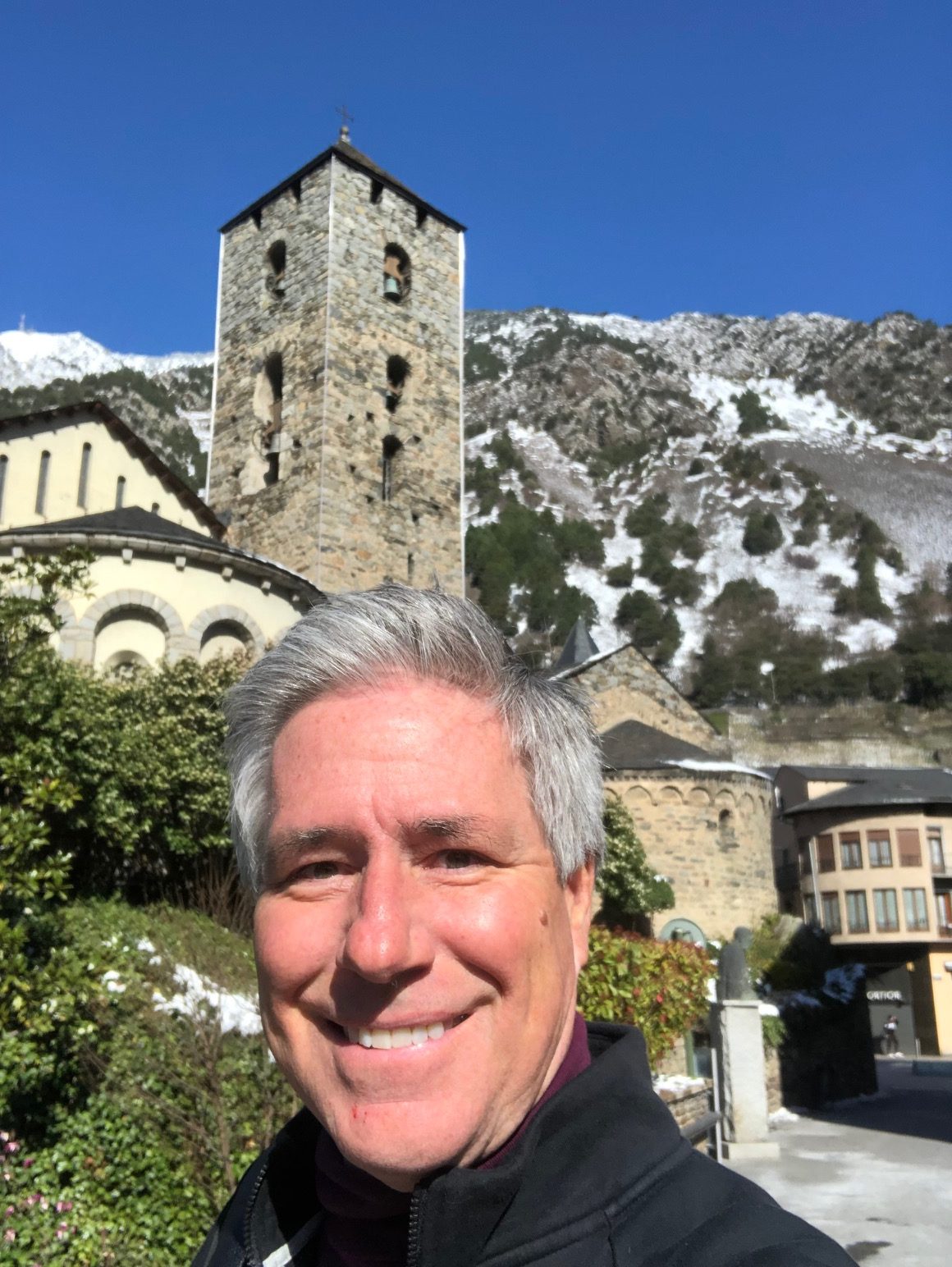
P.S. Here’s my tourist shot from Andorra.

P.P.S. Of the seven European micro-states mentioned by Lawrence Reed, I’ve now visited San Marino, Liechtenstein, Luxembourg, Monaco, and Vatican City. I still need to get to Malta.

Improving Bad Government: The Case of Chile and Milton Friedman

I’ve written many times about the spectacularly positive impactof pro-market reforms in Chile.

The shift toward free markets, which began in the mid-1970s, was especially beneficial for the less fortunate (see here, here, and here).

But it’s quite common for critics to assert that Chile is a bad example because many of the reforms were enacted by General Augusto Pinochet, a dictator who seized power in 1973. And some of those critics also attack Milton Friedman for urging Pinochet to liberalize the economy and reduce the burden of government.

Are these critics right?

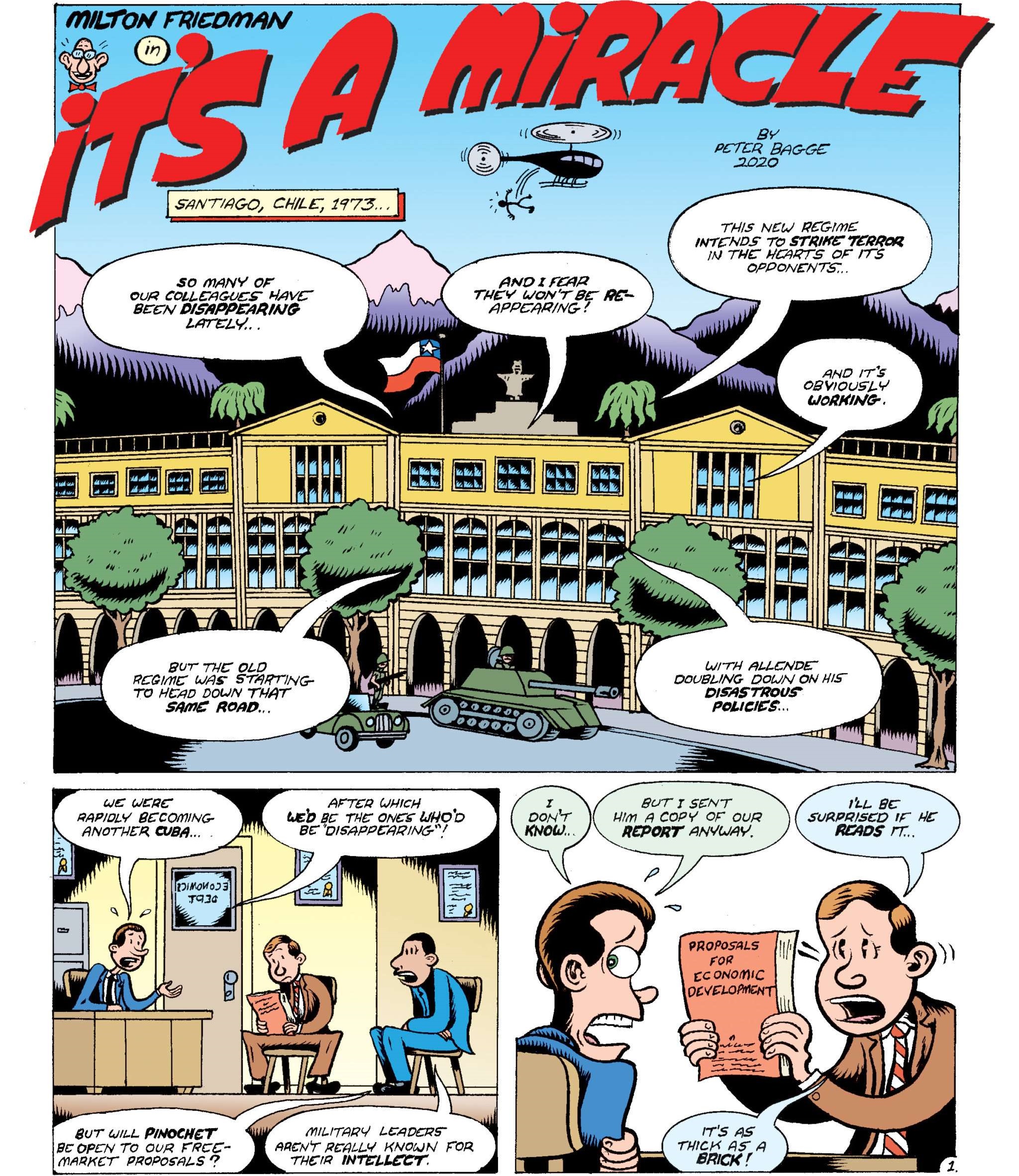
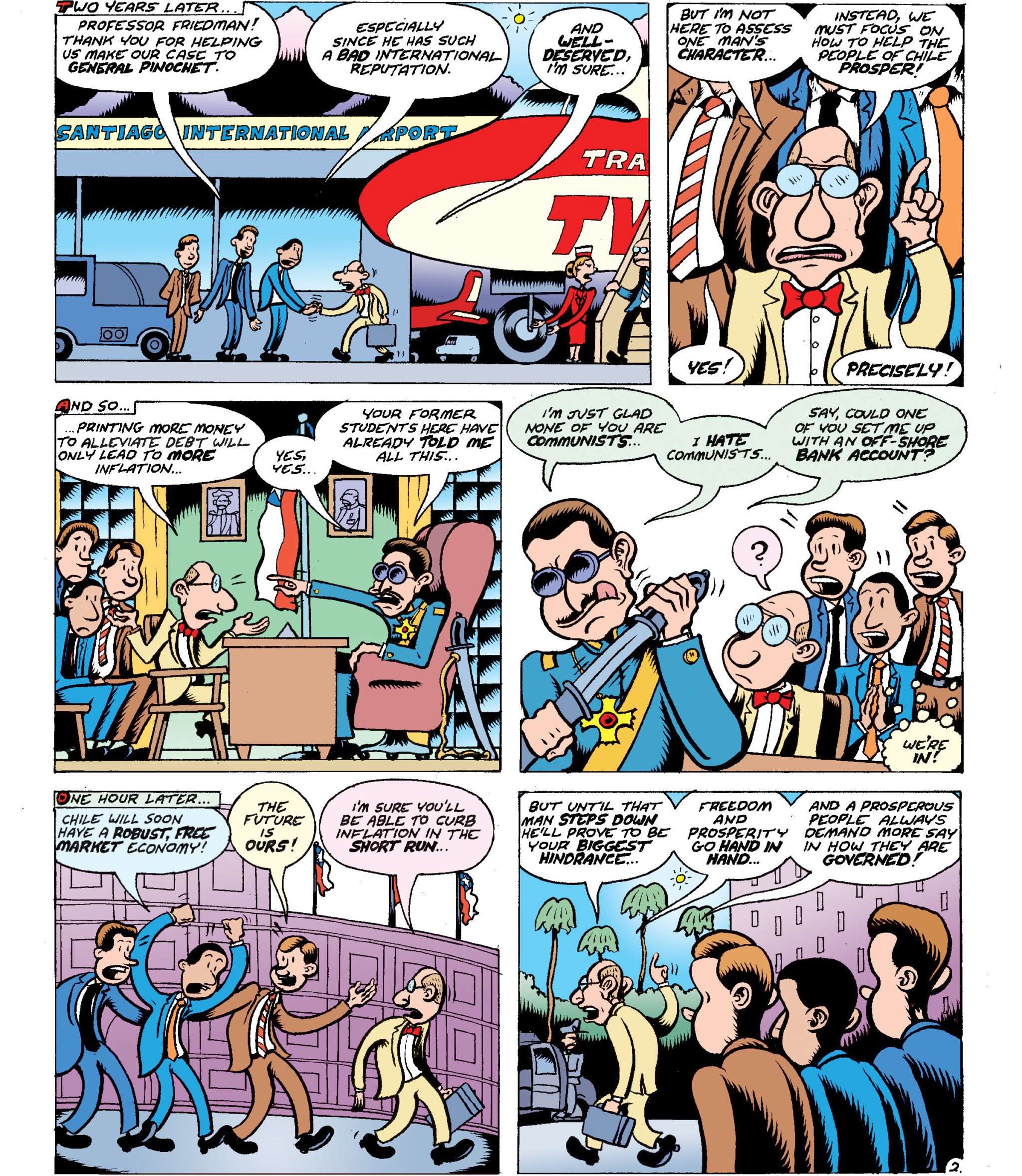
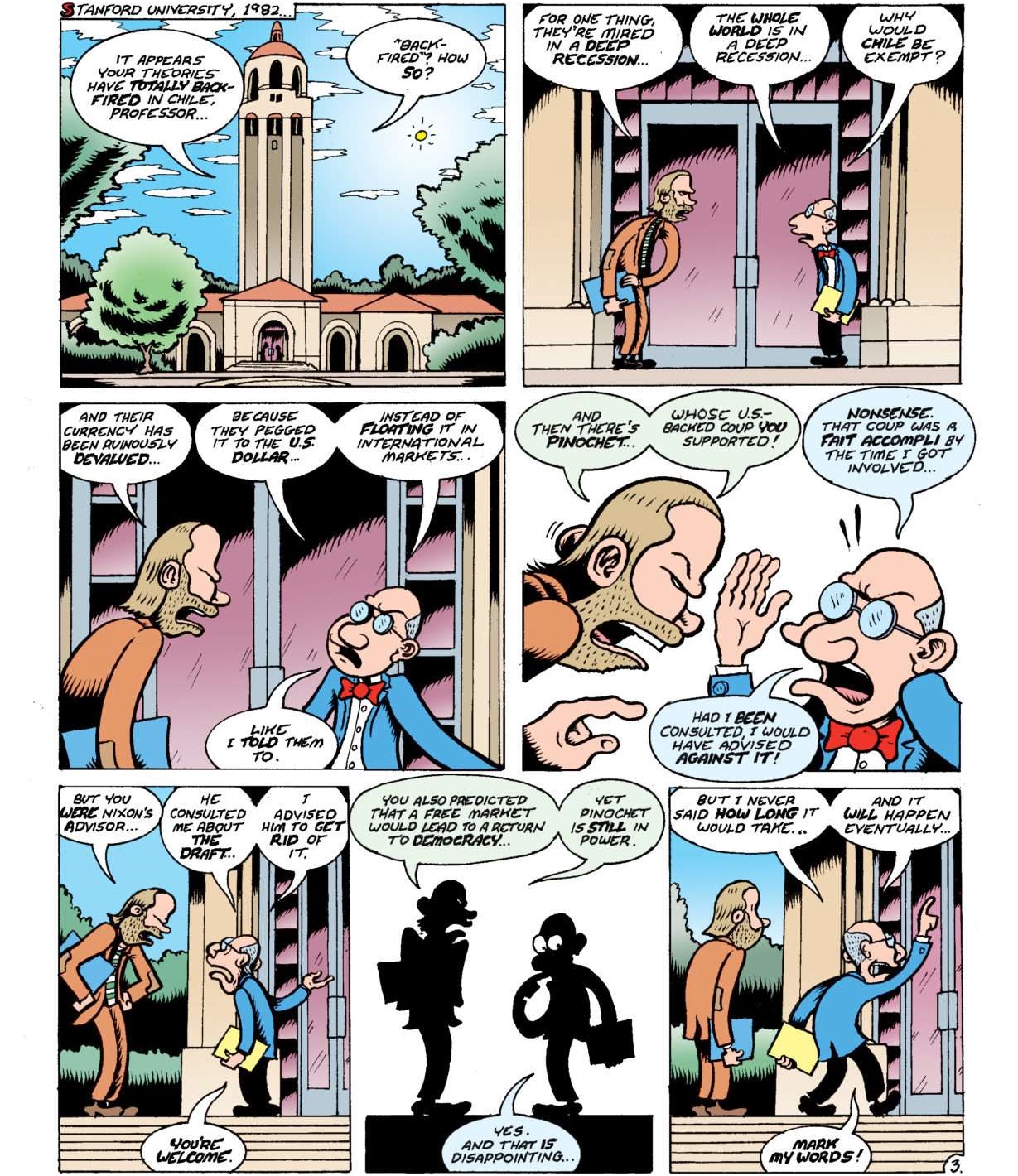
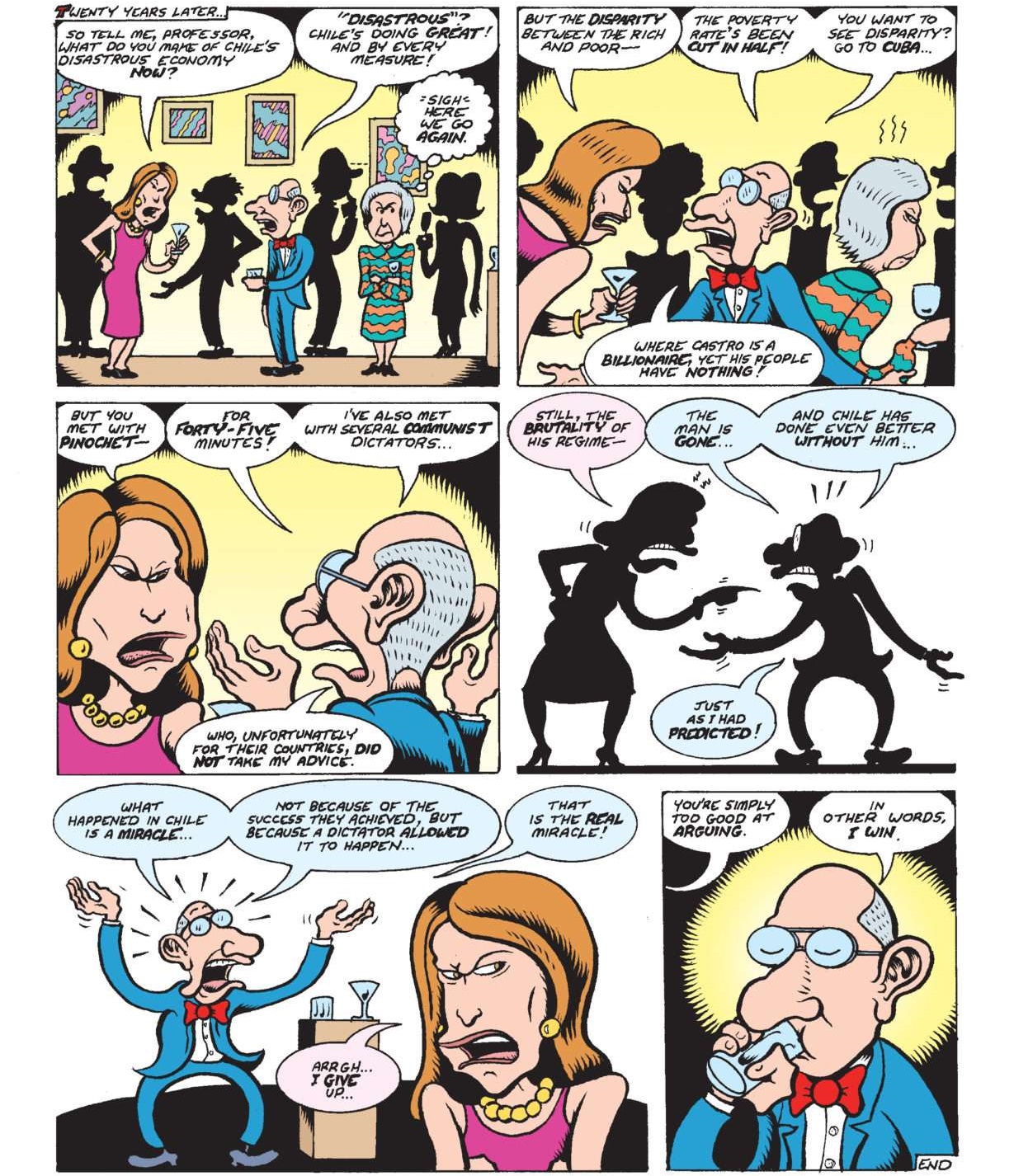
To answer that question, I very much recommend the following cartoon strip by Peter Bagge. Published by Reason, it accurately depicts the efforts of reformers to get good reforms from a bad government.

It starts in 1973, with a group of Chilean economists, known as the “Chicago Boys,” who wanted free markets.

In 1975, they invited Milton Friedman to help make the case for economic reform.

This 1982 strip shows some of the controversies that materialized.

But by the time we got to the 21st century, everything Friedman said turned out to be true.

Chile had become an “improbable success.”

This cartoon strip is great for two reasons.

  • First, I’ll be able to share it with people who want to delegitimize Chile’s transition to a market-oriented democracy (ranked #14 according to the most-recent edition of Economic Freedom of the World). Simply stated, it was bad that Chile had a dictatorship, but it was good that the dictatorship allowed pro-market reforms (particularly when compared to the alternative of a dictatorship with no reforms). And it was great that Chile became a democracy (a process presumably aided by mass prosperity).
  • Second, we should encourage engagement with distasteful governments. I certainly don’t endorse China’s government or Russia’s government, but I’ve advised government officials from both nations. Heck, I would even give advice to Cuba’s government or North Korea’s government (not that I’m expecting to be asked). My goal is to promote more liberty and it would make me very happy if I could have just a tiny fraction of Friedman’s influence in pursuing that goal.

P.S. Here’s Milton Friedman discussing his role in Chile.

P.P.S. While I disagree, it’s easy to understand why some people try to delegitimize Chile’s reforms by linking them to Pinochet. What baffles me are the folks who try to argue that the reforms were a failure. See, for instance, Prof. Dani Rodrik and the New York Times.

P.P.P.S. Critics also tried to smear Prof. James Buchanan for supporting economic liberalization in Chile.

—-

José Niño

José Niño is a graduate student based in Santiago, Chile. A citizen of the world, he has lived in Venezuela, Colombia, and the United States. He is currently an international research analyst with the Acton Circle of Chile. Follow@JoseAlNino.

40 Years Later: Milton Friedman’s Legacy in Chile

“Chilean Miracle” Struck a Blow against Communism When Needed Most

Economics Nobel Laureate Milton Friedman was one of the most persuasive advocates of free markets and free minds. (Friedman Foundation)

EspañolThe power of ideas to help shape political movements has been grossly underestimated over the years. In truth, some of the largest political transformations in human history have come from ideas that were developed in the secluded confines of an intellectual’s home or in obscure academic institutes. Regardless of the origins, ideas can snowball into powerful vehicles of social change.+

As Friedrich Hayek noted in one of his most powerful works, Intellectuals and Socialism, the triumph of socialist ideas can largely be attributed to the ideas first put forward by various intellectuals. They began with relatively well-off intellectuals and then made their way to “second-hand dealers” — journalists, scientists, doctors, teachers, ministers, lecturers, radio commentators, fiction writers, cartoonists, and artists — who then spread those ideas to the masses.+

Intellectuals like Milton Friedman took it upon themselves to reverse this trend and create an environment that was more favorable to free markets. Steadfast in his beliefs in the power of ideas, Friedman knew that big changes usually start out in small venues.+

It was in Chile where Friedman’s vision was first implemented on a large scale. The results were nothing short of spectacular, as Chile was able to escape a veritable economic collapse and experience an unprecedented boom.+

Chile’s economic success was no mere coincidence; it was the product of ideas that Milton Friedman put forward in the 1950s. To understand how such a radical change was brought about, one must first look at the origins of the Chicago Boys, the group of Chilean economists that played a pivotal role in the transformation of Chile’s economy during the 1970s and 1980s.+

The Chicago Boys

Under the tutelage of the United States Agency for International Development (USAID), the University of Chicago signed a modest agreement with the Pontifical Catholic University of Chile in the 1950s to provide a group of Chilean students training in economics.+

In exchange, the University of Chicago would send four faculty members to help the Catholic University build up their economics department. Of these four faculty members, Arnold Harberger would serve as the Chicago Boys’ principal mentor.+

What at first looked liked just another exchange program between universities would play a substantial role in Chile’s economic rise.+

A Country Mired By Statism

At the start of this program, Chile’s economy was in the doldrums. Another victim of Raúl Prebisch’s Import Substitution Industrialization (ISI) policy, Chile had a very loose central banking policy, featured 15 different exchange rates, heavy tariffs, and a number of import and export controls. Subsequent governments maintained the same neo-mercantilist structure up until the 1970s.+

During this era of economic malaise, the Chicago Boys constructed El Ladrillo (The Brick), a text primarily shaped by economist Sergio de Castro which advocated for economic liberalization in all sectors of the Chilean economy. Sadly, this text was largely ignored at that time.+

It wasn’t until the presidency of Salvador Allende that the Chicago Boys’ talents would be desperately needed.+

On the Road to Cuba 2.0

Though democratically elected by a narrow margin in 1970, Salvador Allende was determined to turn Chile into the next Cuba by undermining all of its democratic institutions. Through price controls, arbitrary expropriations, and lax monetary policy, Allende put the Chilean economy on the verge of collapse. By 1973, inflation reached 606 percent and per capita GDP dropped 7.14 percent.+

Under the command of General Augusto Pinochet, the military deposed Allende’s government. Despite this tumultuous change, the military ruler did not have a clear economic vision for Chile.+

Enter Milton Friedman

Milton Friedman’s visit to Chile in March 1975 proved to be quite fateful. Friedman was on a week-long lecture tour for various think thanks. Eventually, Friedman sat down with the general himself for 45 minutes. Right off the bat, Friedman recognized that Pinochet had very little knowledge of economics. After their meeting, Friedman sent Pinochet a letter with a list of policy recommendations.+

Friedman was blunt is his diagnosis of Chile’s economy: for the country to recover, it had to truly embrace free-market measures.+

Ideas Put in Action

Cooler heads prevailed and Pinochet let the Chicago School disciples occupy various posts in the military government. In April 1975, El Plan de Recuperación Económica (The Economic Recovery Plan) was implemented. Soon Chile curbed its inflation, opened up its markets, privatized state-owned industries, and cut government spending. By the 1990s, Chile was experiencing the largest economic boom in its history.+

The numbers don’t lie:+

Chile's economic takeoff is nothing short of miraculous. (JosePinera.com)

A Freedom Fighter

A principled libertarian, Friedman criticized Pinochet’s repressive political measures. Friedman understood that economic and political freedoms are not mutually exclusive. The principles laid in Friedman’s book Capitalism and Freedom inspired José Piñera, a notable Chilean reformer, to become a part of Chile’s classical liberal revolution.+

Like Friedman, Piñera understood the link between economic and political freedom. This motivated him to help ratify the Chilean Constitution of 1980. The most classically liberal constitution in Latin America’s history, it established the transition towards free elections and Chile’s return to democracy.+

Additionally, Piñera was the architect of Chile’s private social security system that empowered millions of workers and has fostered the growth of an ownership society. This model has been exported to dozens of countries abroad and has served as a market-based alternative to government-run pension systems.+

The “Chilean Miracle” represented the first major triumph against communism during the Cold War. Chile’s classical-liberal revolution subsequently inspired the Thatcher Revolution of 1979 and the Reagan Revolution of 1980. These ideas had resounding effects all over the globe and marked the beginning of the end for Soviet-style models of economic organization.+

There is still much work to do, as the illegitimate children of Marxist and Keynesian thought still run loose these days throughout Latin America. But one thing is absolutely certain: an idea whose time has come is unstoppable.+

RIP Milton Friedman

Milton Friedman is the short one!!!

Milton Friedman’s Free to Choose (1980), episode 3 – Anatomy of a Crisis. part 1

“The Power of the Market” episode of Free to Choose in 1990 by Milton Friedman (Part 5)

Milton Friedman The Power of the Market 5-5 How can we have personal freedom without economic freedom? That is why I don’t understand why socialists who value individual freedoms want to take away our economic freedoms.  I wanted to share this info below with you from Milton Friedman who has influenced me greatly over the […]

“The Power of the Market” episode of Free to Choose in 1990 by Milton Friedman (Part 4)

___________________

Dan Mitchell: Switzerland is the gold standard for federalism. Unlike the United States, the Swiss have resisted centralization. Most spending and taxation still occurs at the sub-national level!

______________—_

Lessons from Spanish Federalism

I’m a big fan of federalism.

Switzerland is the gold standard for federalism. Unlike the United States, the Swiss have resisted centralization. Most spending and taxation still occurs at the sub-national level.

But there are other examples of decentralized systems, with Canada also deserving plenty of praise.

Today, though, I want to write about Spain.

I had an opportunity to learn about the Spanish system while giving speeches last week in Castellon, Barcelona, and Madrid as part of the Free Market Road Show.

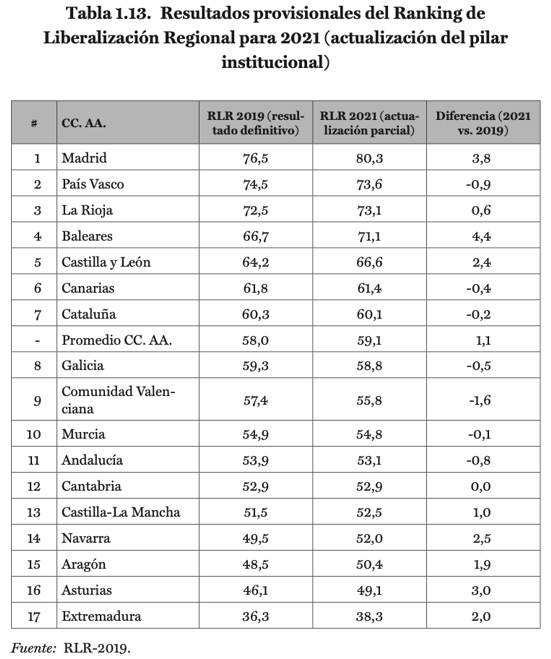
Let’s look at some data from Liberalismo a la madrileña, written by Diego Sánchez de la Cruz, the head of Foro Regulación Inteligente.

His book documents how pro-market reforms in the Madrid region have resulted in greater prosperity.

We’ll start with a look at the level of economic freedom in different Spanish regions. Madrid is at the top and Extremadura (bordering Portugal) is at the bottom.

Does a higher level of economic freedom produce better results, as measured by per-capita economic output?

The answer is yes. Madrid ranks first and Extremadura ranks last.

This certainly seems like strong evidence for free markets and limited government.

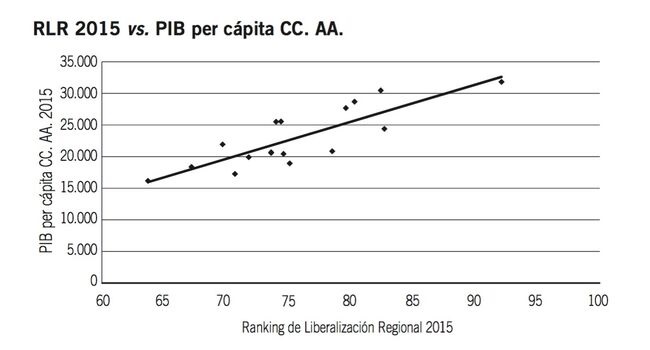
And one of Diego’s earlier publications graphed the relationship between economic freedom and per-capita output.

Definitely a strong correlation.

But what about causation? For instance, some of my left-leaning friends may wonder if there’s some other reason for the superior performance of the Madrid region. Maybe it was always the richest part of Spain and its current prosperity has nothing to do with current policy.

People always should be skeptical about data, particularly when looking at one-year snapshots.

That’s why I’m a big fan of looking at long-run trends. And this chart showing how Madrid has overtaken Catalonia helps confirm that good policy produces good results.

To elaborate, Madrid enjoyed rapid convergence over the past two decades, a period where there was lots of economic liberalization (including de jure elimination of a wealth tax and de facto abolition of a death tax).

By the way, based on current trends, Madrid and Catalonia now may become members of the anti-convergence club.

P.S. There has been some discussion of decentralizing in Australia and the United Kingdom, but no actual progress so far.

P.P.S. Leading scholars from the Austrian school of economics wrote in favor of decentralization.

P.P.P.S. There are some simple steps to restore and rejuvenate federalism in the United States, such as block granting Medicaidand shutting down the Department of Transportation.

1776 Commission Biden

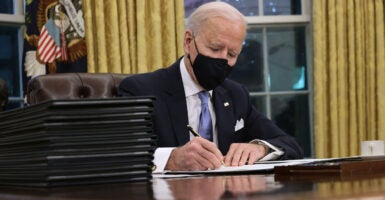
On its first day in office, President Joe Biden committed to removing the 1776 Commission’s report, issued Monday, and to disband the commission. Pictured: President Joe Biden prepares to sign a series of executive orders in the Oval Office just hours after his inauguration on Jan. 20. (Photo: Chip Somodevilla/Getty Images)

All Americans should wish President Joe Biden well. To do otherwise would be churlish and self-defeating. It beggars belief, though, that one of his first intended acts was for his White House to take down the report issued Monday by the 1776 Commission, and on his first day as president, to disband the commission.

Is that really the priority? As one of the commissioners, I guess I’m flattered. But is the baying from the woke left so furious that dissolving a commission named after our nation’s founding, and deleting a report calling for teaching objective history, makes the top of the list?

The symbolism alone should give pause. But maybe the symbolism is the thing, and our new president wants to demonstrate his bona fides to the creators of the 1619 Project and their hard-left allies.

For the record, we commissioners intend to continue meeting and fulfilling the charges of our two-year remit. The Heritage Foundation will also continue to host the report, which you can henceforth find here.

The Left has declared war on our culture, but we should never back down, nor compromise our principles. Learn more now >>

The 1776 Commission’s chairman, Larry P. Arnn, president of Hillsdale College and member of The Heritage Board of Trustees, issued a statement along with Vice Chair Carol Swain and Executive Director Matthew Spalding, pointing out that the report merely called for

a return to the unifying ideas stated in the Declaration of Independence. It quotes the greatest Americans, black and white, men and women, in devotion to these ideas. The Commission may be abolished, but these principles cannot be. We will all continue to work together to teach and to defend them.

If we are to take the words of our new president at his inauguration seriously, as we must, the nation’s cup runneth over with challenges. “Few people in our nation’s history have been more challenged or found a time more challenging or difficult than the time we’re in now,” he said, before reeling off our litany of woes.

What would help us fend off these demons, he said, was unity: “We have never, ever, ever, ever failed in America when we’ve acted together.”

Lofty words, but as one of his predecessors used to say: trust, but verify.

By abolishing the commission, and banishing the report, Biden threw in his lot with critics that from the moment the report was issued covered themselves with ignominy as they raced each other to denigrate our work.

One of the worst examples of the media “coverage,” was a CNN report whose headline actually screamed this libel: “Trump administration issues racist school curriculum report on MLK day.” In a breach of journalistic ethics (if those two words can still be written together), the body of the story did not bother to explain where in the report was there a hint of racism.

Ditto for USA Today, which had a straight up news report—not an opinion piece—with the breathless accusation that the report was a “document that excuses America’s history of slavery, derides the legacy of the civil rights movement and equates progressivism with totalitarianism.”

Ibram X. Kendi, the Boston University activist/professor who insists that racism on behalf of people he deems marginalized is not just welcome, but necessary and not actually racism, said this in a tweet: “This report makes it seems as if slave-holding Founding Fathers were abolitionists.”

It is not hard to understand why Kendi is so allergic to the Founders. He proposes a federal department of “anti-racism” that bars political appointees, and thus therefore believes in separating government from the consent of the governed, one of the key touchstones of the Founding.

On what the Founders believed, and more importantly what their contemporaries thought, I would rather rely on the words of the man who took up their work seven score and ten years later.

“In the way our fathers originally left the slavery question, the institution was in the course of ultimate extinction, and the public mind rested on the belief that it was in the course of ultimate extinction,” Abraham Lincoln told Stephen Douglas on their famous Third Debate in 1858. “When this government was originally established, nobody expected the institution of slavery would last until this day.”

That is the work we recommended in the 1776 report, for historians to look at primary sources, analyze what they meant in the context of the time, debate that meaning in good faith, without an agenda, and be ready to correct the record when proven wrong.

To twist history to fit a political project is to write lies, which is why so many historians have criticized the 1619 Project, whose agenda is to make our America an object of contempt. The people who do this understand that Edmund Burke was ultimately right when he wrote, “To make us love our country, our country ought to be lovely.” And they want to do the opposite.

In pursuing the opposite from what Kendi and the others want, we in the commission prefer to heed Biden’s words, when he called in his inaugural address to “reject the culture in which facts are manipulated and even manufactured.”

This is why serious intellectuals on the 1776 Commission, such as Charles Kesler, Matthew Spalding, Dr. Swain, and Dr. Arnn, felt so strongly about our work, and why we will continue to carry it out.

Have an opinion about this article? To sound off, please email letters@DailySignal.com and we will consider publishing your remarks in our regular “We Hear You” feature.

Left-wingers, including some at The New York Times, seek to discredit the President’s Advisory 1776 Commission report, which aims to rebut the narrative that America is a “systemically racist” nation. (Photo: Avalon/Universal Images Group/Getty Images)

The political left is criticizing the President’s Advisory 1776 Commission report, which aims to bring clarity about the facts of America’s founding.

The report—released Monday on Martin Luther King Jr. Day—aims to create “consensus on what [the] historical facts” of America’s founding are, said Mike Gonzalez, a member of the 1776 Commission and a senior fellow at The Heritage Foundation, in a phone interview Tuesday with The Daily Signal.

President Donald Trump named Gonzalez and 17 others to the 1776 Commission in December. The group was tasked with creating a report that would “better enable a rising generation to understand the history and principles of the founding of the United States in 1776,” according to the White House press release announcing the commission.

“The 1776 Report” uses historical facts and key principles found in the Declaration of Independence and U.S. Constitution to refute the progressive claims argued in The New York Times’ controversial 1619 Project and other left-wing curriculums.

The Left has declared war on our culture, but we should never back down, nor compromise our principles. Learn more now >>

“The core assertion of the Declaration, and the basis of the Founders’ political thought, is that ‘all men are created equal,’ the report states. “From the principle of equality, the requirement for consent naturally follows: If all men are equal, then none may by right rule another without his consent.”

The 18 commissioners address slavery directly in the new report, arguing that the Founders intentionally inserted the truth that “all men are created equal” into the declaration in order to provide a means for slavery to one day be abolished.

Many on the political left quickly discounted “The 1776 Report,” contending that it makes false assertions about the Founding Fathers and the nation’s past.

Ibram X. Kendi, author of the book “How to Be an Antiracist,” criticized the report in a thread of tweets Monday, writing, “This report makes it seem as if slaveholding founding fathers were abolitionists; that Americans were the early beacon of the global abolitionist movement; that the demise of slavery in the United States was inevitable … .”

Kendi’s statement misses the key points that the Founders were deeply troubled by slavery even while participating in the ‘peculiar institution,’” Carol Swain, a retired political science professor, author, and the vice chairwoman of the commission, told The Daily Signal in an email Tuesday.

Swain, who is black, added that the men who signed the “Declaration of Independence and [the] U.S. Constitution … laid the groundwork for the abolition of slavery in the very language of the documents.”

CNN was also quick to criticize the work of the 1776 Commission.

“A commission stood up by President Donald Trump as a rebuttal to schools applying a more accurate history curriculum around slavery in the U.S. issued its inflammatory report on Monday, Martin Luther King Jr. Day,” CNN reporter Maegan Vazquez’s wrote in a piece, “Trump administration issues racist school curriculum report on MLK day.

Gonzalez called the CNN article “an embarrassment to journalism,” noting that the headline falsely calls the report “racist,” but then did “not even bother to back that up” with any evidence.

The New York Times also assailed Monday’s report, writing that the 18-member commission “includes no professional historians, but a number of conservative activists, politicians, and intellectuals.”

The New York Times failed to recognize at least three historians who sit on the commission, including Larry Arnn, the president of Hillsdale College and the author of several historical books, including “The Founders’ Key: The Divine and Natural Connection Between the Declaration and the Constitution, and What We Risk by Losing It”; Victor Davis Hanson, a senior fellow at the Hoover Institute and the author of a number of historical books, including “The Second World Wars: How the First Global Conflict Was Fought and Won”; and Charles Kesler, a senior fellow at the Claremont Institute, editor of the Claremont Review of Books, and the editor of “Saving the Revolution: The Federalist Papers and the American Founding.”

The attacks on America’s history are deeply troubling because the “left does not believe in absolute truth or transcendent truth,” Gonzalez said, adding that many on the left think that history can be changed and used as a tool “to gain power, erase what has happened, and … change the future.”

The left is seeking ultimately to change the future of America by changing our understanding of the past, Gonzalez said.

Gonzalez and Swain told The Daily Signal they are proud to have played a role in the creation of “The 1776 Report.

“It was an honor to participate in the creation of a report that documents key elements of our shared history and offers Americans a road map for digging deeper into original documents and the events that have shaped our shared history,” Swain said.

She added that while America is an imperfect nation, “we have made tremendous progress in becoming a fairer and more inclusive society, despite the fact some would like to take us backwards when it comes to race relations.”

Trump’s 1776 Commission Releases ‘Definitive’ Founding of America

the constitution of the u.s. against a flag(Dreamstime)

By Charlie McCarthy
Monday, 18 Jan 2021 8:14 PM


A commission formed by President Donald Trump to promote “patriotic education” issued its final report, criticizing how American students are taught about the country’s formation, as well as the history of slavery and racial discrimination.

The 1776 Commission released a 45-page report Monday that offered “a definitive chronicle of the American founding,” according to the White House.

“States and school districts should reject any curriculum that promotes one-sided partisan opinions, activist propaganda, or factional ideologies that demean America’s heritage, dishonor our heroes, or deny our principles,” the report said per the New York Post.

Trump established the commission last year partly in response to a national movement in which statues of slaveholders or colonial figures were removed or defaced. The statues involved Founding Fathers and people long admired for their accomplishments.

In its report, the commission said students should not be taught that slavery is a haunting sin of the founders.

“The most common charge leveled against the founders, and hence against our country itself, is that they were hypocrites who didn’t believe in their stated principles, and therefore the country they built rests on a lie,” the report said. “This charge is untrue, and has done enormous damage, especially in recent years, with a devastating effect on our civic unity and social fabric.”

In fact, the “foundation of our Republic planted the seeds of the death of slavery in America,” the report said.

The commission said the creation of the U.S. could not have happened without  compromise on the issue of slavery.

“Is it reasonable to believe that slavery could have been abolished sooner had the slave states not been in a union with the free? Perhaps,” the report said. “But what is momentous is that a people that included slaveholders founded their nation on the proposition that ‘all men are created equal.'”

The report further explained the Founding Fathers did not abolish slavery at the birth of the nation so that the principle of consent would become a basis of “all political legitimacy.”

“Patriotic education must have at its center a respect for the rule of law, including the Declaration and the Constitution, so that we have what John Adams called ‘a government of laws, and not of men,'” the report said.

The report blamed the education system for adversely affecting society.

“Deliberately destructive scholarship shatters the civic bonds that unite all Americans,” the report said. “It silences the discourse essential to a free society by breeding division, distrust, and hatred among citizens.

“And it is the intellectual force behind so much of the violence in our cities, suppression of free speech in our universities, and defamation of our treasured national statues and symbols.”

Read Newsmax: Trump’s 1776 Commission Releases ‘Definitive’ Founding of America
Urgent: Do you approve of Pres. Trump’s job performance? Vote Here Now!

Read Newsmax: Trump’s 1776 Commission Releases ‘Definitive’ Founding of America
Urgent: Do you approve of Pres. Trump’s job performance? Vote Here Now!

Read Newsmax: Trump’s 1776 Commission Releases ‘Definitive’ Founding of America
Urgent: Do you approve of Pres. Trump’s job performance? Vote Here Now!
____________________

1 Of 5 / The Bible’s Influence In America / American Heritage Series / David Barton

2 Of 5 / The Bible’s Influence In America / American Heritage Series / David Barton

3 Of 5 / The Bible’s Influence In America / American

Heritage Series / David Barton

4 Of 5 / The Bible’s Influence In America / American Heritage Series / David Barton

5 Of 5 / The Bible’s Influence In America / American Heritage Series / David Barton

__________________________________________

3 Of 3 / Faith Of The Founding Fathers / American Heritage Series / David Barton

__________________________

David Barton on Glenn Beck – Part 1 of 5

Uploaded by on Apr 9, 2010

Wallbuilders’ Founder and President David Barton joins Glenn Beck on the Fox News Channel for the full hour to discuss our Godly heritage and how faith was the foundational principle upon which America was built.

___________

David Barton on Glenn Beck – Part 2 of 5

Uploaded by on Apr 9, 2010

Wallbuilders’ Founder and President David Barton joins Glenn Beck on the Fox News Channel for the full hour to discuss our Godly heritage and how faith was the foundational principle upon which America was built.

___________________________

David Barton on Glenn Beck – Part 3 of 5

Uploaded by on Apr 9, 2010

Wallbuilders’ Founder and President David Barton joins Glenn Beck on the Fox News Channel for the full hour to discuss our Godly heritage and how faith was the foundational principle upon which America was built.

___________________________

David Barton on Glenn Beck – Part 4 of 5

Uploaded by on Apr 9, 2010

Wallbuilders’ Founder and President David Barton joins Glenn Beck on the Fox News Channel for the full hour to discuss our Godly heritage and how faith was the foundational principle upon which America was built.

______________________

David Barton on Glenn Beck – Part 5 of 5

Uploaded by on Apr 9, 2010

Wallbuilders’ Founder and President David Barton joins Glenn Beck on the Fox News Channel for the full hour to discuss our Godly heritage and how faith was the foundational principle upon which America was built.

Here is an update on David Barton’s Unconfirmed Quote list:

Email this Article
Share this Article
Unconfirmed Quotations
David Barton – 02/19/2013
                         

Unconfirmed Quotations

In his 1989 book Myth of Separation, WallBuilders’ founder David Barton argued that the Founding Fathers would be appalled by the government-enforced secularization of the public square that became widespread in the latter half of the twentieth-century. In the course of making his argument, he utilized a number of quotations from America’s Founders that he found in secondary sources on the subject. He carefully cited each quotation. However, he subsequently realized that some of the quotations he used for Myth of Separation came from sources other than original ones.

Scholars and popular historians routinely utilize secondary sources or take quotations from these sources, 1 but when David returned to this subject for his 1996 book Original Intent, he decided to only rely on quotations that could be found in original primary source material. In an effort to be thoroughly transparent, he placed the handful of secondary quotations from Myth of Separation on an “Unconfirmed Quotations” list which he posted on WallBuilders’ website. At that time, he challenged writers on all sides of the debate over religion in the Founding Era to stop relying on secondary sources and quotations from later eras and instead to utilize original sources.

Although many people, including several respected academics, have told David that they admire his honesty and transparency, others have attempted to use this practice against him. For instance, in a recent critique of David’s work, Professor Gregg Frazer of The Master’s College writes:

Having been confronted over the use of false quotes, Barton was forced to acknowledge their illegitimacy in some way on his website. There, he describes them as “unconfirmed” – as if there is some doubt about their legitimacy. In a computer age with search capabilities, we know that these quotes are false – the fact that they are listed as “unconfirmed” reflects a stubborn attempt to hold onto them and to suggest to followers that they might be true. That is made worse by the fact that under these “unconfirmed” quotes are paragraphs maintaining that the bogus quote is something that the person might have said. 2

What an interesting reward for trying to be honest and transparent.

As stated in the piece “Taking on the Critics,” David was not confronted by any individual or group about these quotes. To the contrary, he was the first to step forward and challenge all sides in the historical debate over religion in the Founding to “raise the bar” and use only quotations that could be verified by primary sources.

Calling these unconfirmed quotes “bogus” implies that they were simply made up by David. Yet each and every one of them can be found in secondary sources, which David cited in his earlier works; and many academics, especially on the secularist side, continue to rely on secondary sources for their authorities. But Frazer and others suggest that David and WallBuilders live in a fantasy world where they stubbornly engage in wishful thinking that these unconfirmed quotations are accurate. However, Frazer ignores the fact that WallBuilders has been able to confirm some quotations on our original list. The now Confirmed Quotations are listed below, followed by those that remain unconfirmed in original documents. Original sources for these latter quotes may yet be found. After all, James Madison’s detached memoranda, much beloved by secularists, did not surface until 1946. And original letters and documents from Founders are still being discovered today in dusty archives, private estates, and other uncatalogued sources. Additionally, existing collections are still being digitized and regularly added to the web, thus steadily increasing the field of searchable materials for these unconfirmed quotes. While WallBuilders has now located original sources for several of the quotes (see below), we continue to recommend that individuals refrain from using those that still remain on the Unconfirmed list until such time that an original primary source may be found; or if using these quotes, clearly identify that they come from a secondary and not a primary source.

Confirmed Quotations
#1: Benjamin Franklin

“Whosoever shall introduce into public affairs the principles of primitive Christianity will change the face of the world.”
Benjamin Franklin

This particular quote has been used in many works since the 1970s that seek to remind Americans of our religious heritage. 3 It originally appeared on WallBuilders’ “Unconfirmed” list, but we are now able to report that we have found an early primary source that attributes this message to Franklin.

In initial attempts to document this quote, David found it in George Bancroft’s 1866 History of the United States, which stated:

He [Franklin] remarked to those in Paris who learned of him the secret of statesmanship: “He who shall introduce into public affairs the principles of primitive Christianity will change the face of the world.” 4

This is no insignificant source, for Bancroft is considered “The Father of American History.” He is most famous for his thorough, systematic history of the nation published in ten volumes from 1854-1878. Contrary to the claims of Gregg Frazer and other critics, David did not simply invent this quote. It appeared in one of the greatest histories of the United States ever written! But adhering to his own standards, David stopped using this quote until it could be confirmed in an original source. However, such a source was recently discovered.

Before turning to the quotation, it may be useful to provide some context. In 1776 Franklin was sent by America as an ambassador to France, a position he held until 1785. He was beloved by the French, and he offered them many useful and friendly recommendations, including political advice for those who would listen. 5 Shortly after Franklin’s death in 1790, Jacques Mallet Du Pan, a French journalist and political leader, published his historical memoirs, in which he reported:

Franklin often told his disciples in Paris that whoever should introduce the principles of primitive Christianity into the political state would change the whole order of society. 6

While this 1793 work does not contain the word-for-word quotation regularly cited today, its similarity is obvious and it clearly communicates the main idea in the quotation. One reason for the difference may be that because the work was written in French, there are variations in how a particular translator renders that statement into English. 7

It may be objected that a second-hand account of what someone said is not as reliable as, say, a letter clearly penned by Franklin in which he writes the same quotation. We agree. And yet students of the American founding repeatedly utilize such sources. For instance, speeches made in the Federal Convention of 1787 are regularly quoted as if they were directly spoken by particular delegates, although in most (but not all) cases what is being quoted is James Madison’s notes of those speeches.

Those who wish to deny America’s Christian heritage will undoubtedly brush off Du Pan’s account of Franklin’s views. Yet those interested in an accurate account of religion in the American Founding cannot afford to be so dismissive of this important find.

Confirmed Quotations
#2: Thomas Jefferson

“I have always said and always will say that the studious perusal of the Sacred Volume will make us better citizens.”
Thomas Jefferson

This quote, also used in numerous modern works, 8 appears in an 1869 book edited by Samuel W. Bailey; 9 but because it did not appear in Jefferson’s works or writings, and because the occasion in which it might have been spoken by him could not be identified, it was left as unconfirmed. Its source, however, has now been found: the writings of the great Daniel Webster (1782-1852).

Webster was part of the second generation of American statesmen. Born at the end of the American Revolution, he grew up with the speeches of Presidents George Washington, John Adams, Thomas Jefferson, and James Madison. Following his own entry into politics, he became a leading national figure, serving almost a decade in the U. S. House, nearly two decades in the U. S. Senate, and being Secretary of State for three different Presidents.

Webster gained a reputation as an exceptional orator. He was considered the greatest attorney in his generation and personally argued and won numerous cases before the U. S. Supreme Court. 10 His strong commitment to the principles of law and the Constitution earned him the title “The Defender of the Constitution.”

In 1852, Webster described a conversation he had with Thomas Jefferson, reporting:

Many years ago I spent a Sabbath with Thomas Jefferson at his residence in Virginia. It was in the month of June, and the weather was delightful. While engaged in discussing the beauties of the Bible, the sound of the bell broke upon our ears, when, turning to the sage of Monticello, I remarked, “How sweetly – how very sweetly sounds that Sabbath bell!” The distinguished statesman for a moment seemed lost in thought, and then replied: “Yes, my dear Webster; yes, it melts the heart, it calms the passions, and makes us boys again.” . . . “[British statesman Edmund] Burke,” said he, “never uttered a more important truth than when he exclaimed that a ‘religious education was the cheap defense of nations’.” “Raikes [the founder of the Sunday School movement in England],” said Mr. Jefferson, “has done more for our country than the present generation will acknowledge. Perhaps when I am cold, he will obtain his reward. I hope so – earnestly hope so. I am considered by many, Mr. Webster, to have little religion; but now is not the time to correct errors of this sort. I have always said, and always will say, that the studious perusal of the Sacred Volume will make better citizens, better fathers, and better husbands.” 11

So, while the quote is not found in Thomas Jefferson’s personal writings, it was recorded by a respected eye-witness. Because this quote fits well with Jefferson’s numerous attempts to promote the study of the Bible (thoroughly documented in The Jefferson Lies), it seems reasonable to attribute it to him.

Confirmed Quotations
#3: John Quincy Adams

“The highest glory of the American Revolution was this: it connected, in one indissoluble bond, the principles of civil government with the principles of Christianity.”
John Quincy Adams

This quote has also had wide circulation in recent decades. 12 It appeared as early as 1860 in John Wingate Thornton’s The Pulpit of the American Revolution, which reprinted a number of sermons preached during the Revolution. In that work, Thornton stated:

Thus the church polity [form of government] of New England begat like principles in the state. The pew and the pulpit had been educated to self-government. They were accustomed “TO CONSIDER.” The highest glory of the American Revolution, said John Quincy Adams, was this: it connected, in one indissoluble bond, the principles of civil government with the principles of Christianity. 13

Initially, this quote was not found in any of Adams’ own writings; and it seemed unlikely that Thornton was reporting what Adams had personally told him, so we therefore placed it on the Unconfirmed list. We have now found the origin of this quote. It turns out that Thornton had simply, but accurately, summarized an opening section from one of Adams’ famous published orations: his 1837 Fourth of July address at Newburyport, Massachusetts.

Adams began that discourse by observing that Christmas and the Fourth of July were America’s two most-celebrated holidays, and that the two were connected. He queried of his audience that day:

Why is it that next to the birthday of the Savior of the World, your most joyous and most venerated festival returns on this day [July 4th]? . . . Is it not that in the chain of human events, the birthday of the nation is indissolubly linked with the birthday of the Savior? That it forms a leading event in the progress of the Gospel dispensation? Is it not that the Declaration of Independence first organized the social compact on the foundation of the Redeemer’s mission upon earth? That it laid the corner stone of human government upon the first precepts of Christianity, and gave to the world the first irrevocable pledge of the fulfillment of the prophecies, announced directly from Heaven at the birth of the Savior and predicted by the greatest of the Hebrew prophets six hundred years before? 14

Comparing Adams’ original 1837 quotation with Thornton’s 1860 summation of it, one immediately sees the origin of Thornton’s statement. He had accurately related the essence of Adams’ message; and while he never presented his statement as being an exact quotation from Adams, those who used Thornton’s work in subsequent generations assumed that it was. Consequently, this Unconfirmed Quotation originally attributed to Adams can now be replaced with his exact statement as delivered in his 1837 speech.

Confirmed Quotations
#4: Supreme Court

“Our laws and our institutions must necessarily be based upon and embody the teachings of the Redeemer of mankind. It is impossible that it should be otherwise. In this sense and to this extent, our civilizations and our institutions are emphatically Christian.”
Supreme Court

This quotation, too, appeared in numerous modern works 15 and was identified as being a quote from the “Supreme Court.” Those who used the quote assumed that it was from the U. S. Supreme Court, but when searching the Court’s opinions, it was not found, even though it was consistent with the tone and rhetoric of the U. S. Supreme Court’s “Christian nation” decision in Church of the Holy Trinity v. United States (1892). 16 Not finding the quote in that case, the next thought was that it perhaps appeared in Supreme Court Justice David Brewer’s book subsequently written on the same subject after he had penned the language in the Court’s unanimous decision in the Holy Trinity case. While he definitely used phrases similar to this quotation, 17 it did not appear in his work. But after more than a decade of searching, this quote was finally found; and it definitely was from a ruling by a “Supreme Court” – the 1883 Illinois Supreme Court! 18 This quote is now authenticated and can be cited, providing that it is attributed to the proper court.

Confirmed Quotations
#5: Samuel Adams

“A general dissolution of principles and manners will more surely overthrow the liberties of America than the whole force of the common enemy. While the people are virtuous they cannot be subdued; but when once they lose their virtue they will be ready to surrender their liberties to the first external or internal invader.”
Samuel Adams

This quote was found in multiple modern works about the Founding Fathers and the Founding Era. 19 But because it lacked primary source documentation, this statement was held as suspect. But eventually this exact quote was found in a letter from Samuel Adams to fellow patriot James Warren on February 12, 1779, 20 and thus it has been removed from the Unconfirmed list and placed it on the Confirmed list.

Unconfirmed Quotations
#1: George Washington

“It is impossible to rightly govern the world without God and the Bible.”
George Washington

This quotation, used in numerous modern works, 21 also appeared in a number of books in the 1800s and early 1900s. 22 It is not found in any modern, critical edition of Washington’s writings, but it appears as early as 1835, when James K. Paulding (a Secretary of the Navy) reports Washington as saying:

It is impossible to account for the creation of the universe without the agency of a Supreme Being. It is impossible to govern the universe without the aid of a Supreme Being. 23

The similarity between this and the unconfirmed quotation is obvious, and a subsequent paraphrase of these words could have generated the quote in question. It is unlikely that Paulding actually heard Washington say these words, but this early record should not be lightly dismissed. And the tone and rhetoric of this currently unconfirmed quotation is consistent with Washington’s numerous statements on religion. For an extensive selection of his religious sayings, see:

  • Maxims of Washington: Political, Social, Moral, and Religious, John F. Schroeder, editor (New York: D. Appleton and Company, 1855). This work has been reprinted multiple times since 1855, including by The Mount Vernon Ladies Association in 1942. However, due to unwise editorial changes made by the modern editor, John Riley, in the most recent edition, the current version is considered unreliable. We therefore highly recommend older versions.
  • William J. Johnson, George Washington The Christian (New York: The Abingdon Press, 1919; reprinted in 1976 by Mott Media, and in 1992 by Christian Liberty Press).
  • George Washington, The Writings of George Washington, Jared Sparks, editor (Boston: Hilliard, Gray and Co., 1837), Vol. 12, pp. 399-411, “The Religious Opinions and Habits of Washington.”

There are numerous indications of Washington’s lifelong conviction concerning the inseparability of God, and specifically Christianity, from both private and public life. Notice some of the many examples in which he expressed this belief:

To his brother-in-law:

I was favored with your epistle [letter] wrote on a certain 25th of July when you ought to have been at church, praying as becomes every good Christian man who has as much to answer for as you have. Strange it is that you will be so blind to truth that the enlightening sounds of the Gospel cannot reach your ear, nor no examples awaken you to a sense of goodness. Could you but behold with what religious zeal I hye [i.e., hie – that is, hasten] me to church on every Lord’s Day, it would do your heart good, and fill it, I hope, with equal fervency. 24

To his military troops:

While we are zealously performing the duties of good citizens and soldiers, we certainly ought not to be inattentive to the higher duties of religion. To the distinguished character of Patriot, it should be our highest glory to add the more distinguished character of Christian. 25

To a church:

I readily join with you, that “while just government protects all in their religious rights, true religion affords to government its surest support.” 26

To the nation:

Of all the dispositions and habits which lead to political prosperity, religion and morality are indispensable supports. In vain would that man claim the tribute of patriotism who should labor to subvert these great pillars of human happiness – these firmest props of the duties of man and citizens. The mere politician, equally with the pious man, ought to respect and to cherish them. A volume could not trace all their connections with private and public felicity. 27

There is certainly abundant evidence to support thesis of the quotation in question as generally consistent with Washington’s beliefs, although the exact wording of this quotation currently remains unconfirmed.

Unconfirmed Quotations
#2: Patrick Henry

“It cannot be emphasized too strongly or too often that this great nation was founded, not by religionists, but by Christians; not on religions, but on the gospel of Jesus Christ!”
Patrick Henry

This quote, which has been utilized in numerous works over recent decades; 28 seems to have first appeared in The Virginia magazine in 1956. 29 Few could dispute that this quotation is consistent with Henry’s life and character.

Henry’s dedication to the Christian faith, and even his use of what today would be considered evangelical rhetoric, is seen repeatedly throughout his life. For example, on one occasion when attacked by critics who attempted to weaken his standing by publicly diminishing his religiosity, he told his daughter:

Amongt other strange things said of me, I hear it is said by the deists that I am one of their number; and, indeed, that some good people think I am no Christian. This thought gives me much more pain than the appellation of Tory [i.e., being called a traitor]; because I think religion of infinitely higher importance than politics; and I find much cause to reproach myself that I have lived so long and have given no decided and public proofs of my being a Christian. But, indeed, my dear child, this is a character which I prize far above all this world has, or can boast. 30

Henry repeatedly demonstrated his firm commitment to Christianity. For example, not only did he distribute Soame Jennings’ 1776 book, View of the Internal Evidence of Christianity 31 but he also made clear that he “looked to the restraining and elevating principles of Christianity as the hope of his country’s institutions.” 32 And when Thomas Paine penned his Age of Reason attacking religion in general and Christianity and the Bible in particular, Henry wrote a refutation of what he described as “the puny efforts of Paine.” 33 But after reading Bishop Richard Watson’s Apology for the Bible written against Paine, Henry deemed that work sufficient and decided not to publish his own. 34

When Henry passed away in 1799, his personal legal documents and his will were opened and publicly read by his executors. Included with his will was an original copy of the 1765 Stamp Act Resolutions (early precursors to the American Revolution) passed by the Virginia Legislature, of which Henry had been a member. On the back of those resolutions Henry penned a handwritten message, knowing it would be read at his death. He recounted the early colonial resistance to British policy that eventually resulted in the American Revolution, and then concluded with this warning:

Whether this [the American War for Independence] will prove a blessing or a curse will depend upon the use our people make of the blessings which a gracious God hath bestowed on us. If they are wise, they will be great and happy. If they are of a contrary character, they will be miserable. Righteousness alone can exalt them as a nation [Proverbs 14:34]. Reader! – whoever thou art, remember this! – and in thy sphere practice virtue thyself and encourage it in others. P. Henry 35

And in his will, after having dispersed his earthy possessions to his family, he told them:

This is all the inheritance I can give my dear family. The religion of Christ can give them one which will make them rich indeed. 36

There are many similar quotes; so while the specific statement above is currently unconfirmed, it is certainly consistent with the tone and rhetoric of other of Henry’s declarations about Christianity.

Unconfirmed Quotations
#3: James Madison

“We have staked the whole future of American civilization, not upon the power of government, far from it. We have staked the future of all of our political institutions upon the capacity of each and all of us to govern ourselves . . . according to the Ten Commandments of God.”
James Madison

This quotation, like the others in this list, has been used in numerous modern works as well as works dating back to 1939. 37 These words have not been found in any of Madison’s writings. However, the key thought of the necessity of individual self-government according to a Biblical standard is reflective of Madison’s expressed beliefs.

For example, in Federalist #39, Madison speaks of “that honorable determination which animates every votary of freedom to rest all our political experiments on the capacity of mankind for self-government.” 38 He also spoke of Christianity as “the religion which we believe to be of Divine origin” 39 and as “the best and purest religion.” 40 It is consistent that he would favorably view God’s standards as the measure for the governance and guidance of society. In fact, he declared:

[T]he belief in a God All-Powerful, wise, and good is so essential to the moral order of the world and to the happiness of man that arguments which enforce it cannot be drawn from too many sources nor adapted with too much solicitude to the different characters and capacities to be impressed with it. 41

Despite other quotations consistent with the emphasis of the one in question above, this specific quotation remains unconfirmed, and it should not be used unless it can be verified in an original primary source document.

Summary

Christians, of all people, should be known for their honesty. In David’s early works on religion and the Founders, he used quotations that he had every reason to believe were accurate. When he began to have questions about the validity of a few of these quotations, he publically acknowledged that they may not be accurate. Since 1996 he has been able to confirm some of these quotations, and has ceased to use those that he has not been able to confirm.

As the historical debates continue over the relation of church and state and the faith of the Founding Fathers, all involved should pursue the highest standard of scholarship. Anyone writing on this subject is encouraged to document their sources, and to always take quotations from primary rather than secondary sources.


Endnotes

1. See, for instance, Mark A. Noll, Nathan O. Hatch, and George M. Marsden, The Search for Christian America (Westchester: Crossway Books, 1983), passim and especially p. 73 (citing various secondary source to support the profoundly erroneous assertion that “The God of the founding fathers was a benevolent deity, not far removed from the God of eighteenth-century Deists or nineteenth century Unitarians.”); John Fea, Was America Founded as a Christian Nation: A Historical Introduction (Louisville: Westminster John Knox Press, 2011),118-19, 258 (quoting John Calvin from Gregg Frazer’s 2004 doctoral dissertation rather than the readily available Institutes of the Christian Religion); and, worst of all, Isaac Kramnick and R. Laurence Moore, The Godless Constitution: The Case Against Religious Correctness (New York: W.W. Norton, 1996) (within which the authors do not feel compelled to cite any sources whatsoever!). (Return)

2. From a hostile written review of David Barton and WallBuilders written by Gregg Frazer at the request of Jay Richards. That written critique was subsequently passed on to David Barton on August 13, 2012, by the Rev. James Robison, to whom Jay Richards had distributed it. (Return)

3. See, for example, Peter Marshall and David Manuel, The Light and the Glory (NJ: Fleming H. Revell Co., 1977), p. 370; Stephen McDowell, America’s Providential History (Charlottesville, VA: Providence Foundation, 1989), p. 1;William Federer, America’s God and Country: Encyclopedia of Quotations (Coppell, TX: Fame Publishing, Inc., 1994), p. 246; Martin H. Manser, Westminster Collection of Christian Quotations (Westminster: John Knox Press, 2001), p. 151; Classics of American Political and Constitutional Thought, Scott J. Hammond, Kevin R. Hardwick, Howard L. Lubert, editors (Indianapolis: Hackett Publishing Company, 2007), Vol. II, p. 228. (Return)

4. George Bancroft, History of the United States, From the Discovery of the American Continent (Boston: Little, Brown and Company, 1866), Vol. IX, p. 492. (Return)

5. See, for example, Benjamin Franklin, Two Tracts: Information to Those Who Would Remove to America. And, Remarks Concerning the Savages of North America (London: 1784), pp. 3-24, “Information to Those Who Would Remove to America.” (Return)

6. M. Mallet Du Pan, Considerations on the Nature of the French Revolution, and on the Causes which Prolong its Duration Translated from the French (London: J. Owen, 1793), p. 31. (Return)

7. The original reads: “Francklin répéta plus d’une fois à ses éleves de Paris, que celui qui transporteroit dans l’état politique les principes du christianisme primitif, changeroit la face de la société.” Jacques Mallet du Pan, Considerations Sur La Nature De La Révolution De France (Londres: Chez Emm. Flon, 1793), 28. (Return)

8. See, for example, Stephen McDowell, America’s Providential History (Charlottesville, VA: Providence Foundation, 1989), p. 178; John Vernon McGee, Thru the Bible (Nashville, TN: Thomas Nelson, 1991; originally printed in 1975), no page number; Dag Heward-Mills, BASIC Theology (Florida: Xulon Press, 2011), p. 29. (Return)

9. Homage of Eminent Persons to The Book, Samuel W. Bailey, editor (New York: Rand, Avery, & Frye, 1869), p. 67. (Return)

10. See, for example, Joseph Banvard, Daniel Webster: His Life and Public Services (Chicago: The Werner Co, 1895), pp. 131-132. (Return)

11. Daniel Webster, The Writings and Speeches of Daniel Webster Hitherto Uncollected (Boston: Little, Brown, & Company, 1903), Vol. IV, pp. 656-657, to Professor Pease on June 15, 1852; originally appearing in The National Magazine: Devoted to Literature, Art, and Religion. July to December, 1858, James Floy, editor (New York: Carolton & Porter, 1858), Vol. XIII, August, 1858, pp. 178-179. (Return)

12. See, for example, Stephen McDowell, America’s Providential History (Charlottesville, VA: Providence Foundation, 1989), p. 146; William Federer, America’s God and Country: Encyclopedia of Quotations (Coppell, TX: Fame Publishing, Inc., 1994), p. 18; William Federer, Treasury of Presidential Quotes (St. Louis, MO: Amerisearch, 2004), p. 459; D. James Kennedy and Jerry Newcombe, How Would Jesus Vote? A Christian Perspective on the Issues (New York: Random House, 2010), p. 28. (Return)

13. John Wingate Thornton, The Pulpit of the American Revolution (Boston: Gould And Lincoln, 1860), p. xxix. (Return)

14. John Quincy Adams, An Oration Delivered Before the Inhabitants of the Town of Newburyport, at Their Request, on the Sixty-first Anniversary of the Declaration of Independence, July 4th, 1837 (Newburyport: Charles Whipple, 1837), pp. 5-6. (Return)

15. See, for example, Stephen McDowell, America’s Providential History (Charlottesville, VA: Providence Foundation, 1989), p. 178; William Federer, America’s God and Country: Encyclopedia of Quotations (Coppell, TX: Fame Publishing, Inc., 1994), p. 72; Joseph P. Hester, Ten Commandments: A Handbook of Religious, Legal and Social Issues (Jefferson, NC: McFarland & Company, 2002), p. 138l. (Return)

16. For example, “These, and many other matters which might be noticed, add a volume of unofficial declarations to the mass of organic utterances that this is a Christian nation.” Church of the Holy Trinity v. United States, 143 U. S. 457, 471 (1892). (Return)

17. Justice David J. Brewer, author of the 1892 Holy Trinity opinion, wrote a 1905 book, The United States: A Christian Nation. Brewer opened his work with these words: “This republic [the United States] is classified among the Christian nations of the world. It was so formally declared by the Supreme Court of the United States. . . . Nevertheless, we constantly speak of this republic as a Christian nation – in fact, as the leading Christian nation of the world.” David J. Brewer, The United States A Christian Nation (Philadelphia: John C. Winston Company, 1905), pp. 11-12. (Return)

18. Richmond v. Moore, 107 Ill. 429, 1883 WL 10319 (Ill.), 47 Am.Rep. 445 (Ill. 1883). (Return)

19. See, for example, Stephen McDowell, America’s Providential History (Charlottesville, VA: Providence Foundation, 1989), p. 179; Stephen McDowell and Mark Beliles, Liberating the Nations: Biblical Principles of Government, Education, Economics, & Politics (Charlottesville, VA: Providence Foundation, 1995), p. 14; William Federer, America’s God and Country: Encyclopedia of Quotations (Coppell, TX: Fame Publishing, Inc., 1994), p. 23; Peter Marshall and David B. Manuel, Jr., The Light and the Glory: 1492-1793 (Grand Rapids, MI: Fleming H. Revell, 1977; revised 2009), p. 11; Ira Stoll, Samuel Adams: A Life (New York: Simon and Schuster, 2008), p. 203. (Return)

20. Samuel Adams, The Writings of Samuel Adams, Harry Alonzo Cushing, editor (New York: G. P. Putnam’s Sons, 1905), Vol. IV, p. 124, to James Warren on February 12, 1779. (Return)

21. See, for example, William J. Federer, America’s God and Country: Encyclopedia of Quotations (Coppell, TX: Fame Publishing Inc., 1994), p. 660; Henry H. Halley, Halley’s Bible Handbook (Grand Rapids: Zondervan, 2008; originally printed 1927), p. 18, “Notable Sayings About the Bible”; Martin H. Manser, Westminster Collection of Christian Quotations (Westminster: John Knox Press, 2001) p. 152. (Return)

22. See, for example, Howard H. Russell, A Lawyer’s Examination of the Bible (New York: Fleming H. Revell, 1893), p. 40, The Bible in New York. A Quarterly Review of the New York Bible Society (New York: November 1910), Vol. III, No. 9, p. 8, “What Some Men Have Said About the Bible,” Samuel Strahl Lappin, The Training of the Church: A Series of Thirty-Five Lessons Designed to Aid Those Who Would Know More, Do More and Be More in the Services of Jesus Christ (Cincinnati: Standard Publishing Company, 1911), p. 26, The Bible Champion, Jay Benson Hamilton, editor (New York: Bible League of North America, 1914), Vol. XVII, No. 2, February 1914, p. 85, Thomas M. Iden, The Upper Room Bulleton: 1920-1921 (Ann Arbor, MI: Ann Arbor Press, 1921), Vol. VII, No. 3, October 23, 1920, p. 35,”United States Presidents and the Bible,” John Calvin Leonard, Herald and Presbyter (Cincinnati: 1921), Vol. XCII, No. 38, September 21, 1921, p. 3. (Return)

23. James K. Paulding, A Life of Washington (New York: Harper & Brothers, 1835), Vol. II, p. 209. (Return)

24. George Washington, The Writings of George Washington, John C. Fitzpatrick, editor (Washington, D. C.: U. S. Government Printing Office, 1940), Vol. 37, p. 484, to Burwell Bassett, August 28, 1762. (Return)

25. George Washington, The Writings of George Washington, John C. Fitzpatrick, editor (Washington, D. C.: U. S. Government Printing Office, 1934), Vol. 11, pp. 342-343, General Orders of May 2, 1778. (Return)

26. George Washington, The Writings of George Washington, John C. Fitzpatrick, editor (Washington, D. C.: U. S. Government Printing Office, 1939), Vol. 30, p. 432 n., from his address to the Synod of the Dutch Reformed Church in North America in October, 1789. (Return)

27. George Washington, Address of George Washington, President of the United States . . . Preparatory to His Declination (Baltimore: George and Henry S. Keatinge, 1796), pp. 22-23. (Return)

28. See, for example, Stephen McDowell, America’s Providential History (Charlottesville, VA: Providence Foundation, 1989), p. 184; William Federer, America’s God and Country: Encyclopedia of Quotations (Coppell, TX: Fame Publishing, Inc., 1994), p. 289; Joseph P. Hester, The Ten Commandments: A Handbook of Religious, Legal and Social Issues (NC: McFarland & Company, Inc., 2003), p. 137; Newt Gingrich, Vince Haley, A Nation Like No Other: Why American Exceptionalism Matters (Houston: Regency Publishing, 2011), p. 76. (Return)

29. See, for example, information at Snopes.com.(Return)

30. S. G. Arnold, The Life of Patrick Henry (Auburn: Miller, Orton & Mulligan, 1854), p. 250, to his daughter Betsy on August 20, 1796. (Return)

31. Patrick Henry, Life, Correspondence and Speeches, William Wirt Henry, editor (New York: Charles Scribner’s Sons, 1891), Vol. II, p. 490. (Return)

32. Patrick Henry, Life, Correspondence and Speeches, William Wirt Henry, editor (New York: Charles Scribner’s Sons, 1891), Vol. II, p. 621. (Return)

33. S. G. Arnold, The Life of Patrick Henry of Virginia (Auburn and Buffalo: Miller, Orton and Mulligan, 1854), p. 250, to his daughter Betsy on August 20, 1796. (Return)

34. George Morgan, The True Patrick Henry (Philadelphia: J. B. Lippincott Company, 1907), p. 366 n. See also, Bishop William Meade, Old Churches, Ministers, and Families of Virginia (Philadelphia: J. B. Lippincott Company, 1857), Vol. II, p. 12. (Return)

35. Patrick Henry, Patrick Henry: Life, Correspondence and Speeches, William Wirt Henry, editor (New York: Charles Scribner’s Sons, 1891), Vol. I, pp. 81-82, from a handwritten endorsement on the back of the paper containing the resolutions of the Virginia Assembly in 1765 concerning the Stamp Act. (Return)

36. From a copy of Henry’s Last Will and Testament, dated November 20, 1798, obtained from Patrick Henry Memorial Foundation, Red Hill, Brookneal, VA. (Return)

37. See, for example, Harold K. Lane, Liberty! Cry Liberty! (Boston: Lamb and Lamb Tractarian Society, 1939), pp. 32-33; Frederick Nyneyer, First Principles in Morality and Economics: Neighborly Love and Ricardo’s Law of Association (South Holland; Libertarian Press, 1958), p. 31; Rus Walton, Biblical Principles of Importance to Godly Christians (New Hampshire: Plymouth Rock Foundation, 1984), p. 361; Stephen McDowell and Mark Beliles, Principles for the Reformation of the Nations (Charlottesville: Providence Press, 1988), p. 102; Stephen McDowell and Mark Beliles, The Spirit of the Constitution (Charlottesville: Providence Press, n.d.); Stephen McDowell and Mark Beliles, America’s Providential History (Charlottesville: Providence Press, 1989), pp. 263-264; William Federer, America’s God and Country: Encyclopedia of Quotations (Coppell, TX: Fame Publishing, Inc., 1994), p. 411; Gary DeMar, God and Government: A Biblical and Historical Study (Atlanta: American Vision Press, 1982), Vol. 1, pp. 137-138. (Return)

38. Alexander Hamilton, John Jay, and James Madison, The Federalist, on the New Constitution Written in 1788 (Philadelphia: Benjamin Warner, 1818), pp. 203-204, James Madison, Number 39. (Return)

39. James Madison, A Memorial and Remonstrance, on the Religious Rights of Man; Written in 1784-5, At the Request of the Religious Society of Baptists in Virginia (Washington City: S. C Ustick, 1828), pp. 5-6. (Return)

40. Religion and Politics in the Early Republic: Jasper Adams and the Church-State Debate, Daniel L. Dreisbach, editor (Kentucky: University Press of Kentucky, 1996), p. 117, letter from James Madison, September, 1833. (Return)

41. James Madison, “The James Madison Papers,” Library of Congress, to Rev. Frederick Beasley on November 20, 1825.(Return)

Related posts:

Richard Dawkins, Alister McGrath, D. James Kennedy. Francis Schaeffer and Ravi Zacharias discuss the problem of evil!!!

______ 115. Filosofia: Richard Dawkins Vs Alister McGrath Published on Dec 21, 2012 Neste vídeo: Richard Dawkins Vs Alister McGrath Curta nossa página no facebook: https://www.facebook.com/multiversosp… ____________________ At the 40 minute mark Richard Dawkins and Alister McGrath discuss Deena Burnett’s assertion that her husband Tom was an instrument carrying out God’s will in stopping the plane […]

President Obama:“do not consider ourselves a Christian nation” (Part 4 of David Barton’s response)

America’s Founding Fathers Deist or Christian? – David Barton 4/6 David Barton provided an excellent response to President Obama’s assertion: “We do not consider ourselves a Christian nation.” Here it is: Is President Obama Correct: Is America No Longer a Christian Nation? Over the past several years, President Barack Obama has repeatedly claimed that America […]

President Obama:“do not consider ourselves a Christian nation” (Part 2 of David Barton’s response)

America’s Founding Fathers Deist or Christian? – David Barton 2/6 Is President Obama Correct: Is America No Longer a Christian Nation? Over the past several years, President Barack Obama has repeatedly claimed that America is not a Christian nation. He asserted that while a U. S. Senator, 1 repeated it as a presidential candidate, 2 and on a recent […]

Rude Rob Boston favored Notre Dame giving Obama honorary degree but what came of that?

Uploaded by audotorg on May 13, 2009 Rob Boston of AU debates and defeats Bill Donahue on Obama’s invitation to speak at Notre Dame University. _________________ Rude Rob Boston favored President Obama speaking at Notre Dame but it turned out that after President Obama got the honorary degree he went out and now is going […]

Did David Barton fabricate quotes and attribute them to the founding fathers?

On the Arkansas Times Blog on June 17, 2012 I noted: Google the phrase ” David Barton fabricated quotes” and you will get many websites that claim this is true and Rob Boston’s 1996 article “consumer alert” in the Church and State Magazine is what prompted this reaction throughout the country. As a journalist you […]

Rob Boston is not very courteous while being interviewed on CNN

Uploaded by audotorg on Aug 16, 2007 Rob Boston of Americans United debates the Family Research Council’s Sharmane Yost over teaching creationism in public school science courses on CNN’s “Anderson Cooper 360.” _______________ I saw this interview a few years ago and it reminded me of my run in with Rob Boston and how rude […]

David Barton: In their words, did the Founding Fathers put their faith in Christ? (Part 3)

America’s Founding Fathers Deist or Christian? – DavidBarton 3/6 There have been many articles written by evangelicals like me who fear that our founding fathers would not recognize our country today because secular humanism has rid our nation of spiritual roots. I am deeply troubled by the secular agenda of those who are at war […]

David Barton: Was John Adams really an enemy of Christians? (Part 7)

3 Of 5 / The Bible’s Influence In America / American Heritage Series / David Barton Evangelical leader Ken Ham rightly has noted, “Most of the founding fathers of this nation … built the worldview of this nation on the authority of the Word of God.” I strongly agree with this statement by Ham. Dr. […]

David Barton: Was John Adams really an enemy of Christians? (Part 5)

1 Of 5 / The Bible’s Influence In America / American Heritage Series / David Barton Evangelical leader Ken Ham rightly has noted, “Most of the founding fathers of this nation … built the worldview of this nation on the authority of the Word of God.” I strongly agree with this statement by Ham. Dr. […]

David Barton: Was John Adams really an enemy of Christians? (Part 4)

4 Of 5 / The Bible’s Influence In America / American Heritage Series / David Barton Evangelical leader Ken Ham rightly has noted, “Most of the founding fathers of this nation … built the worldview of this nation on the authority of the Word of God.” I strongly agree with this statement by Ham. Dr. […]

April 10, 2022 READING A PROVERB A DAY (PROVERBS 10) John MacArthur on Proverbs “Pursue your work” (Also Adrian Rogers: God’s Grace in the Workplace) Chapter 10 verse 4, “Poor is he who works with a negligent hand but the hand of the diligent makes rich. He who gathers in summer is a son who acts wisely. But he who sleeps in harvest is a son who acts shamefully. Teach your son to work and to plan ahead in his work.”

Adrian Rogers sermon GOD’S GRACE IN THE WORKPLACE really helped me 30 years ago and here is the link to that sermon.

Proverbs 10 New Living Translation

The Proverbs of Solomon

10 The proverbs of Solomon:

A wise child[a] brings joy to a father;
    a foolish child brings grief to a mother.

Tainted wealth has no lasting value,
    but right living can save your life.

The Lord will not let the godly go hungry,
    but he refuses to satisfy the craving of the wicked.

Lazy people are soon poor;
    hard workers get rich.

A wise youth harvests in the summer,
    but one who sleeps during harvest is a disgrace.

The godly are showered with blessings;
    the words of the wicked conceal violent intentions.

We have happy memories of the godly,
    but the name of a wicked person rots away.

The wise are glad to be instructed,
    but babbling fools fall flat on their faces.

People with integrity walk safely,
    but those who follow crooked paths will be exposed.

10 People who wink at wrong cause trouble,
    but a bold reproof promotes peace.[b]

11 The words of the godly are a life-giving fountain;
    the words of the wicked conceal violent intentions.

12 Hatred stirs up quarrels,
    but love makes up for all offenses.

13 Wise words come from the lips of people with understanding,
    but those lacking sense will be beaten with a rod.

14 Wise people treasure knowledge,
    but the babbling of a fool invites disaster.

15 The wealth of the rich is their fortress;
    the poverty of the poor is their destruction.

16 The earnings of the godly enhance their lives,
    but evil people squander their money on sin.

17 People who accept discipline are on the pathway to life,
    but those who ignore correction will go astray.

18 Hiding hatred makes you a liar;
    slandering others makes you a fool.

19 Too much talk leads to sin.
    Be sensible and keep your mouth shut.

20 The words of the godly are like sterling silver;
    the heart of a fool is worthless.

21 The words of the godly encourage many,
    but fools are destroyed by their lack of common sense.

22 The blessing of the Lord makes a person rich,
    and he adds no sorrow with it.

23 Doing wrong is fun for a fool,
    but living wisely brings pleasure to the sensible.

24 The fears of the wicked will be fulfilled;
    the hopes of the godly will be granted.

25 When the storms of life come, the wicked are whirled away,
    but the godly have a lasting foundation.

26 Lazy people irritate their employers,
    like vinegar to the teeth or smoke in the eyes.

27 Fear of the Lord lengthens one’s life,
    but the years of the wicked are cut short.

28 The hopes of the godly result in happiness,
    but the expectations of the wicked come to nothing.

29 The way of the Lord is a stronghold to those with integrity,
    but it destroys the wicked.

30 The godly will never be disturbed,
    but the wicked will be removed from the land.

31 The mouth of the godly person gives wise advice,
    but the tongue that deceives will be cut off.

32 The lips of the godly speak helpful words,
    but the mouth of the wicked speaks perverse words.

Over and over in Proverbs you hear the words “fear the Lord.” In fact, some of he references are Proverbs 1:7, 29; 2:5; 8:13; 9:10;14:26,27; 15:16 and many more. Below is a sermon by John MacArthur from the Book of Luke on 3 reasons we should fear the Lord. (I have posted John MacArthur’s amazing sermon on the fulfillment of Old Testament scripture before on my blog.)

PART 7 of Proverbs series

I remember like yesterday when I first heard my former pastor Adrian Rogers first preach on the topic “God’s Grace in the Workplace.” That was the first time in his first 35 years of ministry that he had dedicated a complete message to the subject of how a Christian should look at his secular job.

Rogers noted, “Does work have eternal significance? Daniel may have wondered the same thing, as he was handling taxation, public relations, law enforcement, building projects, meetings and diplomacy. But yet he served God continually (see Daniel 6:16 and 20).”

Daniel 6:16-20

The Message (MSG)

16 The king caved in and ordered Daniel brought and thrown into the lions’ den. But he said to Daniel, “Your God, to whom you are so loyal, is going to get you out of this.”

17 A stone slab was placed over the opening of the den. The king sealed the cover with his signet ring and the signet rings of all his nobles, fixing Daniel’s fate.

18 The king then went back to his palace. He refused supper. He couldn’t sleep. He spent the night fasting.

19-20 At daybreak the king got up and hurried to the lions’ den. As he approached the den, he called out anxiously, “Daniel, servant of the living God, has your God, whom you serve so loyally, saved you from the lions?”

___________

It is during this time that Daniel became my favorite Bible character and I have spent lots of time studying about him.

John MacArthur

I remember hearing Dr. Adrian Rogers say that if he had to do it over again he would read from Proverbs every day to his kids. They turned out to be great kids and they were raised right. Nevertheless, if he had to do it over again he thought a more emphasis on Proverbs is the way to go. That is why I am spending so much time in Proverbs with my kids today.

John MacArthur does a great job on Proverbs and here is a portion of his sermon on Proverbs.

Number eight. Teach your sons…”Son, pursue your work…pursue your work.” Teach your boys how to work, father, by word and example. Look at the ant, he says in chapter 6, he’s giving this lesson to his son…Son, go to the ant, in verse 6 in chapter 6, and look at this ant, observe her ways and be wise, which having no chief officer or ruler. The first thing you want to do is teach your children how to work without a boss around, even an ant does that. Now your children will work if you stand there with a whip. But the issue is…will they if you won’t? Because they’re going to have to in life. And they also need to be taught how to plan ahead. The ant even knows to prepare her food in the summer anticipating the coming winter. She gathers her provision in the harvest. Teach them to work. How long will you lie down, O lazy son? When will you arise from your sleep? Get your children up. And they’ll say…a little sleep, a little slumber, a little folding of the hands to rest. Sure. And your poverty will come in like a vagabond and your need like an armed man.

You’re going to make yourself poor if you don’t learn how to work. Teach them to pursue work. A sluggard is a lazy man. He’s just an ordinary man really, with too many excuses, too many refusals, too many postponements. According to Proverbs the lazy man will suffer hunger, poverty, failure. Why? Because he sleeps through the harvest. He wants but he won’t work. He loves sleep, is glued to his bed and will follow worthless pursuits trying to get rich quick. On the other hand, the man who pursues his work earns a good living, has plenty of food, is rewarded for his effort and earns respect even before kings…it says in chapter 22 verse 29. Teach your sons to pursue their work…so very important.

Chapter 10 verse 4, “Poor is he who works with a negligent hand but the hand of the diligent makes rich. He who gathers in summer is a son who acts wisely. But he who sleeps in harvest is a son who acts shamefully. Teach your son to work and to plan ahead in his work.”

___________

Adrian Rogers: God’s Grace in the Workplace [#1019] (Audio)

God’s Grace In the Workplace

In all labour there is profit: but the talk of the lips tendeth only to penury.
Proverbs 14:23

So many people wake up in the morning, take a shower, scald their throat with a cup of coffee because they’re running a little late, fight traffic, and get to work. Then, they come home, take a couple of aspirin, watch the evening news, perhaps discuss a few things with a roommate or spouse, maybe putter around the house or yard a little bit, then go to bed.

Now, I’m not saying they don’t love and serve God, perhaps they do. But most of these people think the only time they serve God is when they get off work! They end up giving their prime time to the employer and their leftovers to God!

Jesus said, “No man can serve two masters: for either he will hate the one, and love the other; or else he will hold to the one, and despise the other. Ye cannot serve God and mammon” (Matthew 6:24). I call this split-level living.

You may think there’s nothing exciting about you or your job, but God takes ordinary people and He gives them extraordinary power to do extraordinary things for His glory!

Your job may be putting hub caps on tires. You may be keying data at a computer. You may be digging ditches or washing dishes. You may be doing one of a myriad of what you think are mundane things. But I want to tell you, if you are a Christian, your work is to be the temple of your devotion and the platform of your witness. Every Christian is a minister doing full-time Christian service.

The Sacredness of Everday Work

Your job does not become sacred when you become a minister, missionary, or a staff member of a Christian organization! Every job, if it is done in the power of the Holy Spirit, is a sacred job. Every one!

Let’s look at someone who lived this out from the Word of God – his name was Daniel. In the book of Daniel, we learn that he was taken captive by Nebuchadnezzar and carried to Babylon from Israel. There, he found a secular job as a government bureaucrat (see Daniel 8:27). The government trained him, then pressed him into service.

In this ordinary line of work, Daniel served the Lord Jesus. When Daniel was thrown into the lions’ den because he refused to bow to another god, King Nebuchadnezzar and many others came to believe in our Almighty God.

If you work in the name of Jesus, unto His glory, and in the power of the Holy Spirit, you will receive the same reward for doing that job that I receive for doing my job. God knows about you and is watching you. Every Christian, wherever he serves, is in full-time Christian work.

The SERVICE of Everday Work

Does work have eternal significance? Daniel may have wondered the same thing, as he was handling taxation, public relations, law enforcement, building projects, meetings and diplomacy. But yet he served God continually (see Daniel 6:16 and 20).

Even the home of Jesus was the cottage of a workingman. And whether He was mending plows or mending souls, Jesus was doing the work of God because people need houses to live in and furniture to sit on.

If you know you’re serving the Lord, that’ll put dignity in whatever you are doing: running a machine, greasing automobiles, typing letters, carrying mail, painting houses, digging ditches, cutting yards. Tell the Lord, “I’m doing it for You! And I’ll do it with all my might! As much as any missionary or preacher or evangelist!” That kind of attitude will put a spring in your step.

Simply said, God wants His people to prosper wherever He plants them. You are a priest of God, a minister of God, and in full-time Christian service, and if that doesn’t ring your bell, your clapper’s broken.

Remember, God uses ordinary people to do extraordinary things. Ephesians 3:20 promises that, “God is able to do exceeding abundantly above all that we ask or think, according to the power that worketh in us.”


This article is taken from a sermon by Adrian Rogers

One final question: WHAT DOES THIS VERSE MEAN?

Proverbs 14:23

Amplified Bible (AMP)

23 In all labor there is profit, but idle talk leads only to poverty.

The Message (MSG)

23 Hard work always pays off;
mere talk puts no bread on the table.

April 9, 2022 READING A PROVERB A DAY (PROVERBS 9) Adrian Rogers “Friends” Proverbs 17:17  Proverbs13:20 Proverbs 15:12 Proverbs1:20-22 Proverbs 9:1-4 Proverbs 14:15; 22:3; Proverbs 26:11; 27; Proverbs 17:10

Proverbs 9New Living Translation

Wisdom has built her house;
    she has carved its seven columns.
She has prepared a great banquet,
    mixed the wines, and set the table.
She has sent her servants to invite everyone to come.
    She calls out from the heights overlooking the city.
“Come in with me,” she urges the simple.
    To those who lack good judgment, she says,
“Come, eat my food,
    and drink the wine I have mixed.
Leave your simple ways behind, and begin to live;
    learn to use good judgment.”

Anyone who rebukes a mocker will get an insult in return.
    Anyone who corrects the wicked will get hurt.
So don’t bother correcting mockers;
    they will only hate you.
But correct the wise,
    and they will love you.
Instruct the wise,
    and they will be even wiser.
Teach the righteous,
    and they will learn even more.

10 Fear of the Lord is the foundation of wisdom.
    Knowledge of the Holy One results in good judgment.

11 Wisdom will multiply your days
    and add years to your life.
12 If you become wise, you will be the one to benefit.
    If you scorn wisdom, you will be the one to suffer.

Folly Calls for a Hearing

13 The woman named Folly is brash.
    She is ignorant and doesn’t know it.
14 She sits in her doorway
    on the heights overlooking the city.
15 She calls out to men going by
    who are minding their own business.
16 “Come in with me,” she urges the simple.
    To those who lack good judgment, she says,
17 “Stolen water is refreshing;
    food eaten in secret tastes the best!”
18 But little do they know that the dead are there.
    Her guests are in the depths of the grave.[a]


Friends Proverbs 17:17 #2059
We are grateful for the opportunity to provide this outline produced from a sermon preached by Adrian Rogers while serving as pastor of Bellevue Baptist Church in Memphis, Tennessee.
This outline is intended for your personal, non-commercial use.
In order to ensure our ability to be good stewards of Adrian Rogers’ messages, Love Worth Finding has reserved all rights to this content.
Except for your personal, non-commercial use and except for brief quotations in printed reviews, no part of this publication may be reproduced, stored in a retrieval system, or transmitted in any form or by any means —electronic, mechanical, photocopy, recording, or any other— without the prior permission of the publisher.
Copyright ©2021 Love Worth Finding Ministries, Inc.

FRIENDS | PROVERBS 17:17 | #2059
1) INTRODUCTION
a) Teenagersaremoreaffectedbyfriendsthanalmostanythingelse,including
sometimes parents and pastors combined.
b) Thedeepestneedofallofus,whetheryoungorold,isforenduring
friendships.
i) The deepest longing of the human heart is for a friend who loves us.
(1) Someone we can share with and commune with.
(2) Someone who truly understands our deepest needs, highest
aspirations and our worst fears.
c) Atruefriendisagreattreasure,butthewrongkindoffriendisthegreatest
danger that a teenager can possibly have.
d) Proverbs17:17
e) Today’smessagewillexplaintwodifferentcategoriesoffriends,three
different categories of teenagers, and will give practical advice to parents as they help their children choose friends wisely.
2) TWOCATEGORIESOFFRIENDS
PAGE 2
Copyright ©2021 Love Worth Finding Ministries, Inc.
a) b)
c)
d)
e) f)
Wehavecasualfriendsthatweministerto.
i) We all have casual friends.
ii) Theseareacquaintancesthatincludeunsavedfriends. Weneedtomakeacquaintanceswiththeunsaved.
i) The Lord Jesus did.
(1) Luke 7:34
(a) Jesus was crucified for being a friend to sinners.
Therearecertaincasualfriendsthatwearetohave.
i) As Christians, we are to be the salt of the Earth.
ii) Wearetobeseparate,butseparationisnotisolation.
(1) We’re to be separated from the sin but not the sinner.
iii) We are to have these casual friends so that we can bring them to Christ. 1Corinthians9:20-23
i) The Apostle Paul is saying in this passage that he knew how to
accommodate unsaved people without making them angry and without compromising his convictions.
(1) This does not mean that those casual friends are to become intimate
friends.
(2) This does not mean that we are to have fellowship with them so that
they are to become our companions. 2Corinthians6:14,17-18
i) The word for “fellowship” in this passage means “intimacy.”
ii) Wearenottohavefellowshipandcommunionwithunsavedpeople. With casual friends, we are making friends for Jesus.
i) Accommodation without compromise
ii) Weinvitethemtochurch.
iii) We show love and friendship.

FRIENDS | PROVERBS 17:17 | #2059
iv) But we have no communion, fellowship or intimacy with casual friends. g) Therearecasualfriendswhomwewitnessto,andthenthereareintimate
friends that we fellowship with.
i) Parents should know who their children’s intimate friends are.
(1) Children will be made or broken by their companions. h) Proverbs13:20
i) This passage is not referring to casual acquaintances but is talking about companionship and fellowship.
ii) Ifwehaveungodlypeopleforourcompanions,thenwewillbedestroyed. i) 2 Samuel 13:1-29, 2 Samuel 18:9
i) This is one of the saddest stories in the Bible.
ii) Thiswholetragic,sordidmessbeganbecauseAmnonhadafriend.
(1) Amnon’s friend made a devilish suggestion. j) We will be like our friends.
i) It is not uncommon for teenagers to begin drug habits or drinking because of a friend.
ii) Kidsgethookedonpornographybecausetheywereatsomeone’shouse watching R-rated or X-rated movies.
k) Parentscanevaluatethespiritualconditionoftheirchildrenbytheirfriends.
i) Kids who don’t want to serve God will find other kids just like them.
ii) Godlykidswillalsofindoneanother.
iii) You can learn the spiritual state of your children by watching their
friends.
(1) Listen to their conversation.
(2) See how they are dressed.
(3) Pay attention to the music they listen to.
3) THREECATEGORIESOFYOUNGPEOPLE(PROVERBS1:20-22) a) Proverbs1:20-22
PAGE 3
Copyright ©2021 Love Worth Finding Ministries, Inc.
b)
i) This passage contains the three categories of young people. ii) Everyteenagerisinoneofthesecategories. Thefirstcategoryisthesimple.
i) If your child is simple, it does not mean that he isn’t intelligent or smart.
ii) Theword“simple”means“open.”
iii) Proverbs 1:22
(1) The simple one loves simplicity.
(a) This means that he loves the easy way.
(b) He wants to go through life without any restraint or discipline.
iv) The simple also lacks understanding.
(1) Proverbs 9:1-4
v) A simple person is easily led into sin and error.
(1) Proverbs 14:15
(2) If the simple does not believe God’s Word, then he will believe
anything.

FRIENDS | PROVERBS 17:17 | #2059
(a) He will believe Madison Avenue. (b) He will believe false cults.
(c) He will believe sinful friends.
(d) The simple is living in danger.
vi) By nature, all teenagers are simple.
vii) Proverbs 22:3
viii) Simple teenagers think that they are indestructible.
ix) Being simple doesn’t mean that they don’t have character, but they just
don’t understand until they get wisdom from God.
c) Everyteenagerstartsoutassimple,buthecanbecomeascorner.
i) Proverbs 1:22
(1) The simple one loves simplicity, but the scorner delights in scorning.
(a) The scorner has a warped character.
(b) He’s an evil person.
ii) Youcan’ttellhimanything.
(1) You can instruct the simple, but you can’t instruct the scorner.
(2) Proverbs 13:1
iii) He refuses instructions, and he despises godly people.
iv) Proverbs 15:12
(1) Rebuke a scorner, and he will insult you to your face.
v) Proverbs 9:7-8
vi) Proverbs 13:1
vii) Proverbs 13:13

(1) This is referring to everlasting destruction.
viii) A synonym for “scorner” is “smart-aleck.”
d) Thethirdcategoryisthefool.
i) Proverbs 1:22
(1) Fools hate knowledge.
ii) Proverbs1:7
iii) A fool will ridicule righteousness.
(1) Proverbs 14:9
(2) He will laugh at ungodliness, such as immorality, homosexuality,
drunkenness, etc.
iv) He rejoices in sin.
(1) Proverbs 15:21
(2) His moral sense has been perverted.
(a) He doesn’t know the difference between right and wrong.
(b) Isaiah 5:20
v) Proverbs 26:11
vi) Proverbs 17:10

vii) His heart is hard, his conscience is seared, and his mind is defiled. (1) Punishment will not change him.
(2) His moral sensibilities have been destroyed.
viii) Don’t let your children hang around scorners or fools.
PAGE 4 Copyright ©2021 Love Worth Finding Ministries, Inc.

FRIENDS | PROVERBS 17:17 | #2059
4) WHATCANPARENTSDOTOHELPTHEIRCHILDREN?
PAGE 5
Copyright ©2021 Love Worth Finding Ministries, Inc.
a)
Helpthemunderstandthedangersthatareinvolved. i) They do not understand the dangers.
ii) Proverbs19:25
(1) Young people do not see the consequences of sin because we have so dumbed down those consequences.
(2) Young people need to understand that there are consequences to sin. iii) Parents should take their children to the rescue mission so that they can
see the other side of addictions.
(1) The advertising that kids see for alcoholic beverages will never show
this other side.
iv) Your children need to understand that sin has repercussions. Carefullyguardtheircompany.
i) Proverbs 13:20
ii) Proverbs22:10

iii) Don’t allow your kids to hang around a scorner or fool.
iv) Parents should meet any boy who wants to date their daughter. Teachthemtheimportanceoftheirchoices.
i) Life is the sum total of our choices.
ii) Everychoicechangesus.
iii) We are free to choose, but we’re not free to choose the consequences of
our choice.
(1) After we choose, then our choice chooses for us. Helpyourchildrenselecttheirfriends.
i) One of the best things you can do is to make your home the most fun
place in town.
ii) Haveyourchildrenandtheirfriendsinyourhomesothatyoucanwatch
them and see what they’re like. Refusetohonorfools.
i) Proverbs 26:1
(1) Don’t get your entertainment from a fool.
ii) Don’tletyourchildrengotoconcertsorotherentertainmentvenues
where they will be entertained by those who have set themselves against
God and against wisdom.
There are additional things that parents need to do:
i) Have a positive attitude.
(1) Don’t talk down to your kids. (a) Words can hurt children.
(2) Don’t use words that belittle or put them down.
(3) Use words that build them up.
ii) Learntolistentothem.
iii) Try to see life from their point of view.
(1) Kids today are facing things that their parents never had to face.
b)
c)
d)
e)
f)

FRIENDS | PROVERBS 17:17 | #2059
iv) Be gentle with them.
(1) Psalm 18:35
(2) Fathers whose children adore them are strong and wise, but gentle.
(a) They are not harsh, and they don’t yell. v) Learn to touch and hug your teenager.
(1) Learn to show non-verbal expression.
(2) Be gentle with your kids. vi) Be transparent.
(1) Let them know your faults.
(a) They already know that you’re not perfect.
(2) Your kids don’t necessarily want you to be perfect; they just don’t want you to be a phony.
vii) Be available to your kids.
(1) A lack of a close relationship with a father is one of the biggest factors
to encouraging promiscuity in young girls, even more so than poverty. (a) Promiscuity is much less likely when there is a close relationship to
the father.
5) CONCLUSION
a) Itisokaytohavecasualfriendships.
PAGE 6
Copyright ©2021 Love Worth Finding Ministries, Inc.
b) c)
d)
e) f)
g) h)
i) Invite them to church.
ii) Befriendly.
iii) Go out to eat together after the church service.
iv) But your teenagers should not make these kids their companions.
(1) Proverbs 13:20
Atruefriendissomeonewhoisfaithful.
i) Proverbs 17:17 Atruefriendissomeonewhoencouragesyouandmakesyoubetter.
i) They will sharpen you.
ii) Proverbs27:17 Oneofthemarksastowhetherornotyourfriendisatrue,godlyfriendis are you a better person for having been with that friend, or is he or she a better person for having been with you?
i) A true friend will challenge you.
ii) Proverbs27:6
Chooseyourfriendscarefully.
One of the greatest joys of your life or one of the greatest disappointments will be your friends. Thereisonefriendwhostickscloserthanabrother,andHisnameisJesus. i) Proverbs 18:24
ii) He’stheonewhowillguideyoutotherightfriendships. DoyouknowJesuspersonally?Ifnot,youcanpraytoHimtodaybyasking Him to come into your life.

FRIENDS | PROVERBS 17:17 | #2059
PAGE 7
Copyright ©2021 Love Worth Finding Ministries, Inc.
i)
Call upon Jesus today. Repent (turn) from your sins, and turn to Jesus. Ask Him to forgive you of your sins, and acknowledge Him as Lord of your life.
i) Romans 3:23
ii) Romans10:9-10
iii) Romans 10:13
iv) Acts 16:31
v) John 3:16

Related posts:

Seeing Jesus in Proverbs, Ecclesiastes, and Job

July 16, 2013 – 1:28 am

Ecclesiastes 8-10 | Still Searching After All These Years Published on Oct 9, 2012 Calvary Chapel Spring Valley | Sunday Evening | October 7, 2012 | Pastor Derek Neider _______________________ Ecclesiastes 11-12 | Solomon Finds His Way Published on Oct 30, 2012 Calvary Chapel Spring Valley | Sunday Evening | October 28, 2012 | Pastor Derek Neider […]By Everette Hatcher III | Posted in Current Events | Edit | Comments (0)

John MacArthur on Proverbs (Part 10) Summing up Proverbs study

May 30, 2013 – 1:06 am

Over and over in Proverbs you hear the words “fear the Lord.” In fact, some of he references are Proverbs 1:7, 29; 2:5; 8:13; 9:10;14:26,27; 15:16 and many more. Below is a sermon by John MacArthur from the Book of Luke on 3 reasons we should fear the Lord. (I have posted John MacArthur’s amazing […]By Everette Hatcher III | Posted in Adrian RogersCurrent Events | Edit | Comments (0)

John MacArthur on Proverbs (Part 9) “Love your neighbor”

May 28, 2013 – 1:23 am

Over and over in Proverbs you hear the words “fear the Lord.” In fact, some of he references are Proverbs 1:7, 29; 2:5; 8:13; 9:10;14:26,27; 15:16 and many more. Below is a sermon by John MacArthur from the Book of Luke on 3 reasons we should fear the Lord. (I have posted John MacArthur’s amazing […]By Everette Hatcher III | Posted in Adrian RogersCurrent Events | Edit | Comments (0)

John MacArthur on Proverbs (Part 8) “Manage your money”

May 23, 2013 – 1:35 am

Over and over in Proverbs you hear the words “fear the Lord.” In fact, some of he references are Proverbs 1:7, 29; 2:5; 8:13; 9:10;14:26,27; 15:16 and many more. Below is a sermon by John MacArthur from the Book of Luke on 3 reasons we should fear the Lord. (I have posted John MacArthur’s amazing […]By Everette Hatcher III | Posted in Adrian RogersCurrent Events | Edit | Comments (0)

John MacArthur on Proverbs (Part 7) “Pursue your work”

May 21, 2013 – 1:05 am

Over and over in Proverbs you hear the words “fear the Lord.” In fact, some of he references are Proverbs 1:7, 29; 2:5; 8:13; 9:10;14:26,27; 15:16 and many more. Below is a sermon by John MacArthur from the Book of Luke on 3 reasons we should fear the Lord. (I have posted John MacArthur’s amazing […]By Everette Hatcher III | Posted in Adrian RogersCurrent Events | Edit | Comments (0)

John MacArthur on Proverbs (Part 6) “Enjoy your wife and watch your words”

May 16, 2013 – 1:23 am

Over and over in Proverbs you hear the words “fear the Lord.” In fact, some of he references are Proverbs 1:7, 29; 2:5; 8:13; 9:10;14:26,27; 15:16 and many more. Below is a sermon by John MacArthur from the Book of Luke on 3 reasons we should fear the Lord. (I have posted John MacArthur’s amazing […]By Everette Hatcher III | Posted in Adrian RogersCurrent Events | Tagged Gene BartowJohn Wooden | Edit | Comments (0)

John MacArthur on Proverbs (Part 5) “Control your body”

May 14, 2013 – 1:44 am

Over and over in Proverbs you hear the words “fear the Lord.” In fact, some of he references are Proverbs 1:7, 29; 2:5; 8:13; 9:10;14:26,27; 15:16 and many more. Below is a sermon by John MacArthur from the Book of Luke on 3 reasons we should fear the Lord. (I have posted John MacArthur’s amazing […]By Everette Hatcher III | Posted in Adrian RogersCurrent Events | Edit | Comments (0)

John MacArthur on Proverbs (Part 4) “Bad company corrupts…”

May 9, 2013 – 1:10 am

Over and over in Proverbs you hear the words “fear the Lord.” In fact, some of he references are Proverbs 1:7, 29; 2:5; 8:13; 9:10;14:26,27; 15:16 and many more. Below is a sermon by John MacArthur from the Book of Luke on 3 reasons we should fear the Lord. (I have posted John MacArthur’s amazing […]By Everette Hatcher III | Posted in Adrian RogersCurrent Events | Edit | Comments (0)

John MacArthur on Proverbs (Part 3) “Guard your mind and obey your parents!!”

May 7, 2013 – 1:43 am

Over and over in Proverbs you hear the words “fear the Lord.” In fact, some of he references are Proverbs 1:7, 29; 2:5; 8:13; 9:10;14:26,27; 15:16 and many more. Below is a sermon by John MacArthur from the Book of Luke on 3 reasons we should fear the Lord. It is tough to guard your […]By Everette Hatcher III | Posted in Adrian RogersCurrent Events | Edit | Comments (0)

John MacArthur on Proverbs (Part 2) What does it mean to fear the Lord?

May 2, 2013 – 1:13 am

Over and over in Proverbs you hear the words “fear the Lord.” In fact, some of he references are Proverbs 1:7, 29; 2:5; 8:13; 9:10;14:26,27; 15:16 and many more. Below is a sermon by John MacArthur from the Book of Luke on 3 reasons we should fear the Lord. What does it mean to fear […]By Everette Hatcher III | Posted in Current EventsUncategorized | Edit | Comments (0)

The Wisdom of Solomon and the Book of Ecclesiastes

July 8, 2013 – 12:01 am

https://bidding-test.devops.iponweb.net/automattic/dio-passback.html

Ecclesiastes 6-8 | Solomon Turns Over a New Leaf Published on Oct 2, 2012 Calvary Chapel Spring Valley | Sunday Evening | September 30, 2012 | Pastor Derek Neider _____________________ I have written on the Book of Ecclesiastes and the subject of the meaning of our lives on several occasions on this blog. In this series on Ecclesiastes I […]By Everette Hatcher III | Posted in Current Events | Edit | Comments (0)

Why is Solomon so depressed in Ecclesiastes? by Brent Cunningham

July 3, 2013 – 7:00 am

Ecclesiastes 1 Published on Sep 4, 2012 Calvary Chapel Spring Valley | Sunday Evening | September 2, 2012 | Pastor Derek Neider _____________________ I have written on the Book of Ecclesiastes and the subject of the meaning of our lives on several occasions on this blog. In this series on Ecclesiastes I hope to show how […]By Everette Hatcher III | Posted in Current Events | Edit | Comments (0)

Robert Leroe on Ecclesiastes (Mentions Thomas Aquinas, Princess Diana, Mother Teresa, King Solomon, King Rehoboam, Eugene Peterson, Chuck Swindoll, and John Newton.)

June 19, 2013 – 1:30 am

Ecclesiastes 1 Published on Sep 4, 2012 Calvary Chapel Spring Valley | Sunday Evening | September 2, 2012 | Pastor Derek Neider _____________________ I have written on the Book of Ecclesiastes and the subject of the meaning of our lives on several occasions on this blog. In this series on Ecclesiastes I hope to show how […]By Everette Hatcher III | Posted in Current Events | Edit | Comments (0)

Solomon was the author of Ecclesiastes

June 11, 2013 – 1:55 am

Ecclesiastes 8-10 | Still Searching After All These Years Published on Oct 9, 2012 Calvary Chapel Spring Valley | Sunday Evening | October 7, 2012 | Pastor Derek Neider _______________________ Ecclesiastes 11-12 | Solomon Finds His Way Published on Oct 30, 2012 Calvary Chapel Spring Valley | Sunday Evening | October 28, 2012 | Pastor Derek Neider […]By Everette Hatcher III | Posted in Current Events | Edit | Comments (0)

Ecclesiastes: Solomon with Life in the Fast Lane

June 3, 2013 – 1:19 am

Ecclesiastes 6-8 | Solomon Turns Over a New Leaf Published on Oct 2, 2012 Calvary Chapel Spring Valley | Sunday Evening | September 30, 2012 | Pastor Derek Neider _____________________ I have written on the Book of Ecclesiastes and the subject of the meaning of our lives on several occasions on this blog. In this series […]By Everette Hatcher III | Posted in Current Events | Edit | Comments (0)

Ecclesiastes a scathing and self-deprecating attack on hedonism and secular humanism by Solomon

May 31, 2013 – 1:17 am

Ecclesiastes 4-6 | Solomon’s Dissatisfaction Published on Sep 24, 2012 Calvary Chapel Spring Valley | Sunday Evening | September 23, 2012 | Pastor Derek Neider ___________________ I have written on the Book of Ecclesiastes and the subject of the meaning of our lives on several occasions on this blog. In this series on Ecclesiastes I hope […]By Everette Hatcher III | Posted in Current Events | Edit | Comments (0)

Solomon was right in his cynicism–unless……unless there is a God who created us and cares about us

May 22, 2013 – 1:34 am

Ecclesiastes 8-10 | Still Searching After All These Years Published on Oct 9, 2012 Calvary Chapel Spring Valley | Sunday Evening | October 7, 2012 | Pastor Derek Neider _______________________ Ecclesiastes 11-12 | Solomon Finds His Way Published on Oct 30, 2012 Calvary Chapel Spring Valley | Sunday Evening | October 28, 2012 | Pastor Derek Neider […]By Everette Hatcher III | Posted in Current Events | Edit | Comments (0)

The Humanist takes on Solomon and the Book of Ecclesiastes

May 20, 2013 – 1:13 pm

Ecclesiastes 8-10 | Still Searching After All These Years Published on Oct 9, 2012 Calvary Chapel Spring Valley | Sunday Evening | October 7, 2012 | Pastor Derek Neider _______________________ Ecclesiastes 11-12 | Solomon Finds His Way Published on Oct 30, 2012 Calvary Chapel Spring Valley | Sunday Evening | October 28, 2012 | Pastor Derek Neider […]By Everette Hatcher III | Posted in Current Events | Edit | Comments (0)

Tom Brady , Coldplay, Kansas, Solomon and the search for satisfaction (part 3)

December 23, 2011 – 11:12 am

Tom Brady “More than this…” Uploaded by EdenWorshipCenter on Jan 22, 2008 EWC sermon illustration showing a clip from the 2005 Tom Brady 60 minutes interview. _______________________ Tom Brady ESPN Interview Tom Brady has famous wife earned over 76 million dollars last year. However, has Brady found lasting satifaction in his life? It does not […]By Everette Hatcher III | Posted in Current Events | Edit | Comments (0)

Adrian Rogers on gambling

July 18, 2013 – 12:44 am

Adrian Rogers: How to Be a Child of a Happy Mother Published on Nov 13, 2012 Series: Fortifying Your Family (To read along turn on the annotations.) Adrian Rogers looks at the 5th commandment and the relationship of motherhood in the commandment to honor your father and mother, because the faith that doesn’t begin at home, […]By Everette Hatcher III | Posted in Adrian RogersCurrent Events | Edit | Comments (0)

Book of Ecclesiastes

July 17, 2013 – 1:40 am

https://bidding-test.devops.iponweb.net/automattic/dio-passback.html

Ecclesiastes 1 Published on Sep 4, 2012 Calvary Chapel Spring Valley | Sunday Evening | September 2, 2012 | Pastor Derek Neider _____________________ I have written on the Book of Ecclesiastes and the subject of the meaning of our lives on several occasions on this blog. In this series on Ecclesiastes I hope to show how secular humanist man […]By Everette Hatcher III | Posted in Current Events | Edit | Comments (0)

Adrian Rogers: Are fathers necessary?

July 16, 2013 – 12:43 am

Adrian Rogers – How to Cultivate a Marriage Another great article from Adrian Rogers. Are fathers necessary? “Artificial insemination is the ideal method of producing a pregnancy, and a lesbian partner should have the same parenting rights accorded historically to biological fathers.” Quoted from the United Nations Fourth World Conference on Women, summer of 1995. […]By Everette Hatcher III | Posted in Adrian RogersCurrent Events | Edit | Comments (0)

Tom Brady, Coldplay, Kansas, Solomon and the search for satisfaction (part 2)

December 22, 2011 – 11:56 am

Tom Brady “More than this…” Uploaded by EdenWorshipCenter on Jan 22, 2008 EWC sermon illustration showing a clip from the 2005 Tom Brady 60 minutes interview. To Download this video copy the URL to http://www.vixy.net ________________ Obviously from the video clip above, Tom Brady has realized that even though he has won many Super Bowls […]

FRIEDMAN FRIDAY Jennifer Graham: “The minimum wage did not increase during the eight years that Reagan was president, a term that began in 1980. That was the same year that Friedman and his wife, Rose Friedman, published a book that was so popular that it led to a PBS series and videos that are even now popular on YouTube”

<img class=”i-amphtml-blurry-placeholder” src=”data:;base64,

Photo illustration by Ethan Hendricks and Zoë Petersen

As Congress considers what to do about a proposed $15 minimum wage, Republican opposition to the bill can be traced to two influential voices of the past: President Ronald Reagan and Nobel Prize-winning economist Milton Friedman.

The minimum wage did not increase during the eight years that Reagan was president, a term that began in 1980. That was the same year that Friedman and his wife, Rose Friedman, published a book that was so popular that it led to a PBS series and videos that are even now popular on YouTube.

In “Free to Choose,” an examination of economics and liberty, the Friedmans wrote that minimum-wage laws require employers to discriminate against unskilled workers. That argument and others made by Friedman have informed a generation of Republicans and Libertarians who now face the challenge of defending a longstanding principle in light of growing income inequality and public sentiment that has bent toward increasing the minimum wage.

Democrats’ efforts to include the wage increase in a COVID-19 relief bill were stalled Thursday when Senate parliamentarian Elizabeth MacDonough, a nonpartisan official, ruled that it is not permissible as written, The Washington Post reported.

Utah Republican Sen. Mitt Romney is among those seeking to identify a compromise that would avert stalled legislation of the past that has left the minimum wage unchanged since 2009, when it was set at $7.25 an hour.

<img class=”i-amphtml-blurry-placeholder” src=”data:;base64,

Sen. Mitt Romney, R-Utah, pauses during an interview with KSL’s Doug Wright in Salt Lake City on Thursday, Feb. 6, 2020, the day after he voted to convict President Donald Trump on one impeachment count.
Laura Seitz, Deseret News

Romney, along with Sen. Tom Cotton, an Arkansas Republican, crafted a bill introduced Thursday that would gradually increase the minimum wage to $10 an hour over four years with a slower phase-in for businesses with fewer than 20 employees.

Unlike some of his fellow Republicans, who oppose a minimum wage in principle, Romney believes that legislation to increase the wage should reflect changes in the cost of living while seeking to avert negative effects, such as job loss.

“There may be philosophical debates about whether or not we should have a minimum wage, but the reality is, we’re going to have a minimum wage,” said Romney, who also pushed for smaller increases than Democrats wanted when he was governor of Massachusetts.

Republican Sen. Josh Hawley of Missouri, meanwhile, has said he would support the Democratic proposal for a $15 minimum wage, but only for employees of large companies. He has proposed a “blue-collar bonus” that would provide refundable tax credits for people making below $16.50 an hour.

Lost in much of the debate is how relatively few Americans would see an increase in pay, if the federal minimum wage is increased. According to the Bureau of Labor Statistics, in 2020, about 1.5% of hourly workers in the U.S. earned the minimum wage or less.

The history of the minimum wage begins with Franklin D. Roosevelt and the National Industrial Recovery Act of 1933, which launched a series of guaranteed wages that ranged from $12 to $15 — a week. But it’s the time period between Reagan’s inauguration and Romney’s proposal that Republican thinking on the minimum wage became more entrenched. Here’s why the minimum wage has caused so much angst for the Republican Party, and where it may be headed this year.

A minimum wage of zero?

Survey any number of conservative pundits and podcasters, and you’ll find sharp-tongued resistance to President Joe Biden’s proposal to incrementally raise the minimum wage to $15 an hour by 2025. Daily Wire commentator Matt Walsh, for example, recently wrote on Twitter that “competent adults” aren’t working for minimum wage.

Walsh and other conservative pundits argue that most people who earn minimum wage are young and unskilled, and they may not need more money (for example, if they are students still living at home) or don’t deserve more because they provide little value to their employer. That thinking is at the heart of the Friedmans’ assertion in “Free to Choose” that “the minimum wage law requires employers to discriminate against people with low skills.”

“No one describes it that way, but that is in fact what it is,” the Friedmans wrote, adding that a poorly educated teen with no work history might only be worth $2 an hour to an employer, and unless the employer is willing to throw in another 90 cents of “charity” to reach the then-minimum wage of $2.90, the teen wouldn’t have a job at all.

“It has always been a mystery to us why a young person is better off unemployed from a job that would pay $2.90 an hour than employed at a job that pays $2.00 an hour,” the Friedmans wrote.

The Friedmans also said that low-paying jobs and apprenticeships provide other value than money to the unskilled worker, such as the chance to learn new skills and acquire experience.

More than 100 studies have shown that increases in the minimum wage result in fewer available jobs, said Steve Hanke, a professor of applied economics at Johns Hopkins University in Baltimore, who was a senior economist on President Reagan’s council of economic advisers.

A new report from the nonpartisan Congressional Budget Office projects that if the Raise the Wage Act of 2021 is enacted as written, there would be 1.4 million fewer jobs in the U.S., a decline of 0.9%.

“The people the minimum wage is designed to help, it hurts, because they don’t get the minimum wage. They don’t have a job. If you jack the minimum wage up higher than someone is worth, they’re not going to be hired,” Hanke said.

Mark J. Perry, a scholar at the American Enterprise Institute and economics professor at the University of Michigan-Flint, agreed, saying that people often think the minimum-wage debate pits an employee against an employer; in fact, he said, it’s about employees competing against each other.

“Low-skilled workers compete against higher-skilled workers. That’s something that often gets overlooked. Employers will overlook those lower-skilled workers in favor of hiring higher-skilled workers,” Perry said.

“As (economist) Thomas Sowell has pointed out, the real minimum wage is always zero because that’s what the worker makes if he or she can’t find a job because he’s been priced out of the labor market because the minimum wage is above what they’re really worth to an employer.”

Costs vs. benefits

The Congressional Budget Office report, however, also says a minimum wage increase would reduce the number of Americans in poverty by 0.9 million, and that there would be fewer people reliant on government programs, such as food assistance.

Paul K. Sonn, state policy program director for the National Employment Law Project, a New York nonprofit that advocates for a $15 minimum wage, said any negative effects of the change, such as the potential for increased consumer prices, are outweighed by the benefits. And he notes that recent surveys have found a majority of Americans favor a higher minimum wage, as do many companies. Amazon, for example, which already has an in-house $15 minimum wage, supports the change nationwide.

“We believe $15 an hour is the minimum anyone in the U.S. should be paid for an hour of labor. We also believe it’s good for business,” Jay Carney, Amazon’s senior vice president of global corporate affairs, wrote on the company website.

Walmart, the largest employer in the U.S., starts its workers at $11, offering a Friedman-like argument that the pay structure allows its workers to advance.

“Those people that we’re raising wages for tend to have been with us for a longer period of time than someone that might be earning the entry wage,” CEO Doug McMillon told investors, Business Insider reported. “We’re trying to … create this ladder of opportunity, providing an opportunity for people when they start with the company to build a career like so many of us already have.”

McMillon, who began his career at Walmart as a teen making $6.50 an hour, said the company wouldn’t be able to implement its ladder of increases if it had to pay everyone a minimum of $15 an hour right now.

The minimum wage in the U.S. is a complicated patchwork of laws, with states and even cities having standards independent of federal law.

According to the National Conference of State Legislatures, 29 states and the District of Columbia have established minimum wages above the federal minimum wage.

But it is the differences between the states that are a prime component of arguments against a federal minimum wage, according to Perry, at the American Enterprise Institute.

“There’s no reason that we should have a $15 uniform wage for the entire country, for both high-cost-of-living areas and low-cost-of-living areas,” he said. Fifteen dollars an hour might be appropriate in Hawaii, which has the nation’s highest cost of living, he said, but $10 might be more appropriate for Mississippi.

“You could make the case that if there is going to be a minimum-wage law, it should be set by the state or county or city government, not by the federal government,” he said.

But Romney, the senator from Utah, said America has a federal minimum wage and it’s not going away, so it’s incumbent upon policymakers to enact one that has a minimal effect on the number of jobs. He said the $10 proposal he has put forth with Cotton and three other senators would not result in lost jobs, and he has long been in favor of a minimum wage that adjusts for inflation. In the matter of wages, he says, the government has a justifiable interest in what private businesses do.

“The federal government does provide support for people at the very low income level,” he said. “Not having a minimum wage can increase the amount of federal expenditures for health care, food, clothing and child benefits, so the federal government does very much have a stake in what businesses are paying people.”

What would Reagan do?

With his proposal, Romney has again established himself as an outlier. He has previously said that Republicans are “nuts” to not want to raise the minimum wage, adding “I think, as a party, to say we’re trying to help the middle class of America and the poor and not raise the minimum wage sends exactly the wrong signal.”

Yet proponents of a higher minimum wage, such as Sonn at the National Employment Law Project, are unhappy with the Romney-Cotton plan, which also requires employers to verify the employment status of their workers through E-Verify.

Sonn called the stipulation a “punitive anti-immigrant measure masquerading as a minimum-wage increase.”

Romney also finds himself outside the tent of people like Hanke, who considered Friedman a friend and mentor and who also was friends with another economist widely admired by conservatives, Friedrich Hayek.

Romney, Hanke said, is “off the reservation” when it comes to the minimum wage. “The government should not be in the business of setting prices, whether they’re for labor or for goods and services,” he said. “The market should be determinant, with sellers and buyers voluntarily agreeing what price they pay. … From my point of view, it really is immoral for the government to be coming in and setting prices of things.”

<img class=”i-amphtml-blurry-placeholder” src=”data:;base64,

President Ronald Reagan visits Hooper, Weber County, on Sept. 10, 1982.
Tom Smart, Deseret News

Hanke doesn’t think much of Hawley’s proposal, either. “Milton Friedman would scold him and give him a quick lesson in economics, and so would I,” he said.

And what would Hanke’s former employer, Ronald Reagan, do, if he’d been confronted with legislation to raise the minimum wage, which was $3.35 during his administration, to $15, as Democrats propose today?

“I don’t think he would have abolished it all together, because Reagan was principled, but pragmatic,” Hanke said. “I don’t think he would think the abolition of the minimum wage would be worth the political cost of doing it, even though he would be very happy to have gotten rid of the whole thing.

“I think he would have remained as quiet as possible on raising it, as he did.”

Ep. 4 – From Cradle to Grave [6/7]. Milton Friedman’s Free to Choose (1980)

March 11, 2021

President Biden c/o The White House
1600 Pennsylvania Avenue NW
Washington, DC 20500

Dear Mr. President,

Thank you for taking time to have your office try and get a pulse on what is going on out here in the country. I wanted to let you know what I think about the minimum wage increase you have proposed for the whole country and I wanted to quote Milton Friedman who you are familiar with and you made it clear in July that you didn’t care for his views! Let me challenge you to take a closer look at what he had to say!

_____________

Thank you so much for your time. I know how valuable it is. I also appreciate the fine family that you have and your commitment as a father and a husband.

Sincerely,

Everette Hatcher III, 13900 Cottontail Lane, Alexander, AR 72002, ph 501-920-5733

Williams with Sowell – Minimum Wage

Thomas Sowell

Thomas Sowell – Reducing Black Unemployment

By WALTER WILLIAMS

—-

Ronald Reagan with Milton Friedman
Milton Friedman The Power of the Market 2-5

April 8, 2022 READING A PROVERB A DAY (PROVERBS 8) Adrian Rogers God’s Way to Health, Wealth and Wisdom – October 2019 Proverbs 2 and 8

Sermon Overview

Proverbs 8New Living Translation

Wisdom Calls for a Hearing

Listen as Wisdom calls out!
    Hear as understanding raises her voice!
On the hilltop along the road,
    she takes her stand at the crossroads.
By the gates at the entrance to the town,
    on the road leading in, she cries aloud,
“I call to you, to all of you!
    I raise my voice to all people.
You simple people, use good judgment.
    You foolish people, show some understanding.
Listen to me! For I have important things to tell you.
    Everything I say is right,
for I speak the truth
    and detest every kind of deception.
My advice is wholesome.
    There is nothing devious or crooked in it.
My words are plain to anyone with understanding,
    clear to those with knowledge.
10 Choose my instruction rather than silver,
    and knowledge rather than pure gold.
11 For wisdom is far more valuable than rubies.
    Nothing you desire can compare with it.

12 “I, Wisdom, live together with good judgment.
    I know where to discover knowledge and discernment.
13 All who fear the Lord will hate evil.
    Therefore, I hate pride and arrogance,
    corruption and perverse speech.
14 Common sense and success belong to me.
    Insight and strength are mine.
15 Because of me, kings reign,
    and rulers make just decrees.
16 Rulers lead with my help,
    and nobles make righteous judgments.[a]

17 “I love all who love me.
    Those who search will surely find me.
18 I have riches and honor,
    as well as enduring wealth and justice.
19 My gifts are better than gold, even the purest gold,
    my wages better than sterling silver!
20 I walk in righteousness,
    in paths of justice.
21 Those who love me inherit wealth.
    I will fill their treasuries.

22 “The Lord formed me from the beginning,
    before he created anything else.
23 I was appointed in ages past,
    at the very first, before the earth began.
24 I was born before the oceans were created,
    before the springs bubbled forth their waters.
25 Before the mountains were formed,
    before the hills, I was born—
26 before he had made the earth and fields
    and the first handfuls of soil.
27 I was there when he established the heavens,
    when he drew the horizon on the oceans.
28 I was there when he set the clouds above,
    when he established springs deep in the earth.
29 I was there when he set the limits of the seas,
    so they would not spread beyond their boundaries.
And when he marked off the earth’s foundations,
30     I was the architect at his side.
I was his constant delight,
    rejoicing always in his presence.
31 And how happy I was with the world he created;
    how I rejoiced with the human family!

32 “And so, my children,[b] listen to me,
    for all who follow my ways are joyful.
33 Listen to my instruction and be wise.
    Don’t ignore it.
34 Joyful are those who listen to me,
    watching for me daily at my gates,
    waiting for me outside my home!
35 For whoever finds me finds life
    and receives favor from the Lord.
36 But those who miss me injure themselves.
    All who hate me love death.”


Scripture Passage: Proverbs 2:1-9

The Book of Proverbs was not written by human experience, but by divine revelation. The insight encased in these pages are not just things worked out by human ingenuity. They are God’s words of wisdom, given by inspiration of the Holy Spirit. 

The Book of Proverbs is King Solomon’s love letter of wisdom, given to him by God alone, to his child. And we, as children of the King of Kings, can read it with full confidence that these words from our Father are for our best interest. They are for our health, wealth, and wisdom. 

But the greatest of these is wisdom. 

Wisdom is the most important virtue we could ever obtain. Proverbs 8:11 says: “For wisdom is better than rubies and all the things that may be desired are not to be compared to it.” 

Wisdom’s worth comes from the Father. He is the One who provides it, promises it, and initiates the purpose of it. 

The Bible says that great men are not always wise. There is a difference between knowledge and wisdom. A lot of people have head knowledge but lack wisdom. You can obtain knowledge without the Holy Spirit, but you cannot get true wisdom without the Holy Spirit. And it comes, not from books, but from knowing Jesus. 

In order to know the secrets of the universe, you have to know the Lord Jesus Christ, for the Bible says in Colossians 2:3 “In him (Jesus) lie hidden all the treasures of wisdom and knowledge.” 

Adrian Rogers said it this way: “When a man reverences God, when a man receives Christ, when a man has a personal encounter, that man receives the wisdom of God and here is the incomparable worth of wisdom. It, dear friend, is provided by the father. It is produced by the spirit but only by the presence of the son. When you have the Lord Jesus Christ in your heart then you are ready to have that real Wisdom.” 

Apply it to your life

True wisdom comes from a relationship with Jesus. Ask him for wisdom today and pursue Scripture, perhaps starting in the Book of Proverbs, with fresh eyes. Hide what you read in your heart. Appreciate it. Appropriate it. Simulate it. Activate it in your life. 

This message is a part of this audio series.

States Move to Limit Abortion Ahead of High Court Ruling in Pivotal Dobbs Case 

States Move to Limit Abortion Ahead of High Court Ruling in Pivotal Dobbs Case

Maggie Hroncich  / April 05, 2022

 width=

The pro-life movement has gained traction this year as the country awaits the Supreme Court’s decision in Dobbs v. Jackson Women’s Health Organization. Pictured: Demonstrators walk in the 49th annual March for Life on Jan. 21 in Washington. (Photo: Tom Williams/Getty Images)

A recent Wall Street Journal poll found that more American voters support a ban on abortion after 15 weeks than oppose it. 

“With lawmakers in several states pushing forward with bills that would ban abortion after 15 weeks of pregnancy, 48% of voters said they would strongly or somewhat favor such restrictions, with exemptions to protect the life of the mother, while 43% were in opposition,” the poll, released Friday, found. 

As the country awaits the Supreme Court’s decision in the case of Dobbs v. Jackson Women’s Health Organization, an increasing number of states are passing legislation limiting abortion. 

The Dobbs decision, expected to be announced in late June, will rule on the constitutionality of previability bans on elective abortions. Those are laws prohibiting abortion before a baby can survive outside of the womb. The case centers on a Mississippi law banning most abortions after 15 weeks, and the Supreme Court’s decision has the potential to overturn the controversial landmark 1973 abortion case Roe v. Wade.

At least 12 states have trigger laws that would ban most abortions in the event Roe v. Wade is overturned. 

In recent weeks, five states have taken action to limit abortion as the country prepares for the Dobbs decision. 

1) Arizona: Arizona Gov. Doug Ducey on March 30 signed SB 1164, which mirrors the Mississippi law in the Dobbs case, banning most abortions, including in instances of rape and incest, after 15 weeks. The law includes exceptions if the mother’s life is in danger. 

The law is expected to save hundreds of babies each year. In 2020, 636 abortions were performed in Arizona after 15 weeks, according to the Arizona Department of Health Services records

“In Arizona, we know there is immeasurable value in every life—including preborn life,” Ducey wrote in a letter. “I believe it is each state’s responsibility to protect them.”

2) West Virginia: West Virginia Gov. Jim Justice signed the Unborn Child with Down Syndrome Protection and Education Act on March 21, which was World Down Syndrome Day. The law will take effect in June and bans abortions based on the possibility the child will be born with a disability.

3) Oklahoma: Oklahoma’s state House passed a bill that goes further than Texas’ Heartbeat Act by banning abortions after conception, with exceptions for rape, incest, and medical emergencies. The Oklahoma state Senate is expected to vote on the bill this week. 

4) Kentucky: The Kentucky General Assembly passed a bill that would ban most abortions after 15 weeks, restrict access to abortion drugs, and restrict abortion access for minors. The bill, which is headed to Kentucky Gov. Andy Beshear’s desk, would require abortion clinics to cremate fetal remains and issue birth-death certificates for every abortion.

5) Idaho: Gov. Brad Little signed into law a bill banning abortions after six weeks, like Texas’ law. The Idaho law, set to go into effect on April 22, allows any father, grandparent, sibling, aunt, or uncle of the preborn child to file a civil lawsuit against a medical professional who attempts or performs an abortion on the mother. 

According to Melanie Israel, a policy analyst in the DeVos Center for Religion and Civil Society at The Heritage Foundation, a post-Roe world would allow abortion policies to return to the states and the American public at large, as they were before the 1973 ruling. (The Daily Signal is the news outlet of The Heritage Foundation.)

“Should the Supreme Court change course on Roe, abortion policy would return to the states, and the American people, through the democratic process, could further address outdated and extreme abortion laws with policies that are not subject to the arbitrary and unworkable viability standard,” Israel wrote.

Have an opinion about this article? To sound off, please email letters@DailySignal.com and we’ll consider publishing your edited remarks in our regular “We Hear You” feature. Remember to include the URL or headline of the article plus your name and town and/or state.

I am a proud member of the National Association of Christian Lawmakers and I attended the convention in Dallas in July and we have officially launched a nationwide push against abortion rights.

The article below notes:

At its first annual policy conference last weekend, group members voted to make a controversial new Texas law, the “Texas Heartbeat Bill,” the organization’s first piece of model legislation, meaning that similar bills may soon pop up in state capitols across the country.

Also I am excited to report that the WASHINGTON POST wrote in September 3, 2021:

Announcing he planned to introduce a copycat bill, Arkansas state Sen. Jason Rapert (R), the founder and president of the National Association of Christian Lawmakers, shared a template of legislation lawmakers in other states could fill in the blanks on and reproduce.

At the July 17th session of THE CHRISTIAN LAWMAKERS meeting in Dallas, I really got a lot out of the expert panel moderated by Texas State Senator Bryan Hughes entitled ABOLISHING ABORTION IN AMERICA. Here below is what Wikipedia says about Senator Hughes:

On March 11, 2021, Hughes introduced a fetal heartbeat bill entitled the Texas Heartbeat Bill (SB8) into the Texas Senate and state representative Shelby Slawson of Stephenville, Texas introduced a companion bill (HB1515) into the state house.[22]The bill allows private citizens to sue abortion providers after a fetal heartbeat has been detected.[22] The SB8 version of the bill passed both chambers and was signed into law by Texas Governor Greg Abbott on May 19, 2021.[22] It took effect on September 1, 2021.[22]

Whatever Happened To The Human Race? | Episode 1 | Abortion of the Human…

Tucker: Democrats have abandoned their ‘my body, my choice’ argument

These Christian lawmakers are on the offensive against abortion

That National Association of Christian legislators has made the so-called ‘Texas Heartbeat Bill’ the basis for its first piece of model legislation

Arkansas state Sen. Jason Rapert presides over a Senate committee at the state Capitol in Little Rock, Ark. in this March 14, 2018, file photo. Rapert’s National Association of Christian Lawmakers met recently to talk model legislation and pass resolutions. Kelly P. Kissel, Associated Press

The National Association of Christian Lawmakers has officially launched a nationwide push against abortion rights.

At its first annual policy conference last weekend, group members voted to make a controversial new Texas law, the “Texas Heartbeat Bill,” the organization’s first piece of model legislation, meaning that similar bills may soon pop up in state capitols across the country.

The model legislation, called the Heartbeat Model Act, was accepted unanimously by the executive committee during a Saturday meeting.

The Texas bill it is based upon, Senate Bill 8, bans abortions once a fetal heartbeat can be detected, which can occur as early as six weeks into a pregnancy. The legislation also allows for any state resident to bring a civil suit against a doctor who performs an abortion after a heartbeat is detectable. Under the law, a woman who has an abortion would be liable to civil suits, as would anyone who supported her in the act — from family members to the receptionist who checks her in at a clinic.

Not only is the doctor liable, but anyone found aiding and abetting,” said Texas legislator Bryan Hughes, the bill’s author, during the Saturday meeting, which was led by the organization’s founder and president, Arkansas state Sen. Jason Rapert.Texas state Rep. Bryan Hughes speaks during the opening session of the 2015 legislative session on Tuesday, Jan. 13, 2015, in Austin, Texas. Eric Gay, Associated Press

Speaking to the Deseret News on Monday, Rapert said the provision allowing residents to bring civil suits against anyone involved in an abortion is like “putting a SCUD missile on that heartbeat bill — they can’t stop it.”

Rapert was the author of a similar 2013 bill in Arkansas, portions of which were later struck down by a federal judge. At least a dozen states have implemented a variety of abortion restrictions in recent years, leading numerous observers to say that the landmark 1973 Supreme Court abortion ruling, Roe v. Wade, is under threat.

Critics of the legislation have likened the Texas law to putting “a bounty on the head” of anyone involved in an abortion; they have also called it “unconstitutional.” Last week, a group of providers filed a federal lawsuit in an attempt to derail the law, which is supposed to go into effect in September.

Speaking Saturday to the Christian legislators gathered in Dallas, Hughes reminded the legislators that the Heartbeat Model Act is just a starting point and that the legislation will have to be tailored to work within each state’s laws.A anti-abortion supporter argues with those who attended a press conference and rally held by the Planned Parenthood Action Council of Utah outside of the Capitol in Salt Lake City on Aug. 25, 2015. Stacie Scott, Deseret News
The National Association of Christian Lawmakers formed last year with three key goals: to offer conservative, Christian legislators networking opportunities,; to help lawmakers share bills that have been successful in their states so that legislators elsewhere might push through similar legislation; and to support Christians running for local, state or national office.

At the policy conference last week, the organization worked toward meeting these goals in various ways, including by approving the Heartbeat Model Act. The executive committee also passed a resolution supporting Israel’s “right to defend itself from terror attacks” and creating a standing American-Israeli Committee.

Speaking to the executive committee, Rabbi Leonid Feldman, who was born in the Soviet Union and was imprisoned there for his pro-Israel activities, remarked that the Jewish people “remember our friends.”

This conference and this organization will be remembered by the Jewish people,” he said.

The organization also approved a resolution in support of “election integrity.”

The executive committee also approved a second piece of model legislation: the National Motto Display Model Act. Based on bills passed in Arkansas in 2017 and this year in Texas, the legislation requires public schools to display the national motto “In God We Trust” when printed versions of the motto are donated to schools or copies of the national motto are bought with funds from private donors.

“As the Texas House sponsor of the Motto Act, I am proud to see a model put out by the NACL so that legislators from every other state can have a mechanism to ensure our citizens — especially our school-age children — are reminded of our nation’s motto,” said Tom Oliverson, a state representative from Texas and chairman of the National Association of Christian Lawmakers’ national legislative council.

During the executive committee’s meeting on Saturday, Rapert said Hobby Lobby would make frames available for a reduced price if they’ll be used for national motto displays.

Asked Monday what other pieces of legislation the organization might adopt as model legislation in the future, Rapert told the Deseret News that the National Association of Christian Lawmakers is already weighing some options.

Since religious freedom is central to the organization, it could end up adopting model legislation similar to bills promoted in Texas this year by Oliverson. He supported three measures designed to make it harder for the government to force church closures during public emergencies, like the COVID-19 pandemic, and a bill that would ensure homeowners’ associations can’t infringe on homeowners’ rights to display religious symbols.

Supreme Court votes 5-4 to leave Texas abortion law in place

Chief Justice John Roberts dissented along with the court’s three liberal justices

Associated Press

WASHINGTON — A deeply divided Supreme Court is allowing a Texas law that bans most abortions to remain in force, for now stripping most women of the right to an abortion in the nation’s second-largest state.

The court voted 5-4 to deny an emergency appeal from abortion providers and others that sought to block enforcement of the law that went into effect Wednesday. But the justices also suggested that their order likely isn’t the last word on whether the law can stand because other challenges to it can still be brought.

The Texas law, signed by Republican Gov. Greg Abbott in May, prohibits abortions once medical professionals can detect cardiac activity, usually around six weeks and before many women know they’re pregnant.

It is the strictest law against abortion rights in the United States since the high court’s landmark Roe v. Wade decision in 1973 and part of a broader push by Republicans nationwide to impose new restrictions on abortion. At least 12 other states have enacted bans early in pregnancy, but all have been blocked from going into effect.

The high court’s order declining to halt the Texas law came just before midnight Wednesday. The majority said those bringing the case had not met the high burden required for a stay of the law.

“The Court’s order is emphatic in making clear that it cannot be understood as sustaining the constitutionality of the law at issue.”— Chief Justice John Roberts

Chief Justice John Roberts (Supreme Court)

Chief Justice John Roberts (Supreme Court)

“In reaching this conclusion, we stress that we do not purport to resolve definitively any jurisdictional or substantive claim in the applicants’ lawsuit. In particular, this order is not based on any conclusion about the constitutionality of Texas’s law, and in no way limits other procedurally proper challenges to the Texas law, including in Texas state courts,” the unsigned order said.

Chief Justice John Roberts dissented along with the court’s three liberal justices. Each of the four dissenting justices wrote separate statements expressing their disagreement with the majority.

Roberts noted that while the majority denied the request for emergency relief “the Court’s order is emphatic in making clear that it cannot be understood as sustaining the constitutionality of the law at issue.”

The vote in the case underscores the impact of the death of the liberal Justice Ruth Bader Ginsburg last year and then-president Donald Trump’s replacement of her with conservative Justice Amy Coney Barrett. Had Ginsburg remained on the court there would have been five votes to halt the Texas law.

Justice Sonia Sotomayor called her conservative colleagues’ decision “stunning.” “Presented with an application to enjoin a flagrantly unconstitutional law engineered to prohibit women from exercising their constitutional rights and evade judicial scrutiny, a majority of Justices have opted to bury their heads in the sand,” she wrote.

“A majority of Justices have opted to bury their heads in the sand.”— Justice Sonia Sotomayor

Justice Sonia Sotomayor (Supreme Court)

Justice Sonia Sotomayor (Supreme Court)

Texas lawmakers wrote the law to evade federal court review by allowing private citizens to bring civil lawsuits in state court against anyone involved in an abortion, other than the patient. Other abortion laws are enforced by state and local officials, with criminal sanctions possible.

In contrast, Texas’ law allows private citizens to sue abortion providers and anyone involved in facilitating abortions. Among other situations, that would include anyone who drives a woman to a clinic to get an abortion. Under the law, anyone who successfully sues another person would be entitled to at least $10,000.

In her dissent, Justice Elena Kagan called the law “patently unconstitutional,” saying it allows “private parties to carry out unconstitutional restrictions on the State’s behalf.” And Justice Stephen Breyer said a “woman has a federal constitutional right to obtain an abortion during” the first stage of pregnancy.

After a federal appeals court refused to allow a prompt review of the law before it took effect, the measure’s opponents sought Supreme Court review.

In her dissent, Justice Elena Kagan called the law “patently unconstitutional,” saying it allows “private parties to carry out unconstitutional restrictions on the State’s behalf.” And Justice Stephen Breyer said a “woman has a federal constitutional right to obtain an abortion during” the first stage of pregnancy.

After a federal appeals court refused to allow a prompt review of the law before it took effect, the measure’s opponents sought Supreme Court review.

In a statement early Thursday after the high court’s action, Nancy Northup, the head of the Center for Reproductive Rights, which represents abortion providers challenging the law, vowed to “keep fighting this ban until abortion access is restored in Texas.”

“We are devastated that the Supreme Court has refused to block a law that blatantly violates Roe v. Wade. Right now, people seeking abortion across Texas are panicking — they have no idea where or when they will be able to get an abortion, if ever. Texas politicians have succeeded for the moment in making a mockery of the rule of law, upending abortion care in Texas, and forcing patients to leave the state — if they have the means — to get constitutionally protected healthcare. This should send chills down the spine of everyone in this country who cares about the constitution,” she said.

Texas has long had some of the nation’s toughest abortion restrictions, including a sweeping law passed in 2013. The Supreme Court eventually struck down that law, but not before more than half of the state’s 40-plus clinics closed.

Even before the Texas case arrived at the high court the justices had planned to tackle the issue of abortion rights in a major case after the court begins hearing arguments again in the fall. That case involves the state of Mississippi, which is asking to be allowed to enforce an abortion ban after 15 weeks of pregnancy.

Associated Press writer Paul J. Weber in Austin, Texas, contributed to this report.

—-

June 23, 2021

President Biden c/o The White House 1600 Pennsylvania Avenue NW Washington, DC 20500

Dear Mr. President,

I wanted to reach out to you because of some of the troubling moral issues coming out of your administration.

Over and over on my blog I have written about your efforts as Vice President and President to attack legally the rights of our unborn babies in the USA. These views of yours are due to your allegiance to the humanist worldview which Francis Schaeffer and Tim LaHaye exposed in their books. Your vast support from humanist groups in the 2020 election proves my point. No wonder we have seen criminals let go and an effort by Democrats (namely VP Harris) to defund the police. The Bible recognizes the sinful nature of humans and calls for the authorities to have the power of the sword in Romans 13! However, there have been times when the IRS has been used against freedom of expression such as the past persecution of the Tea Party. The Founding Fathers did NOT think the King was above the law! Unfortunately many lawmakers today don’t care about the law very much it seems which is a result of loss of a Christian Consensus influence in our society!

I recently read this article below:

The Archbishop Who Fears for Joe Biden’s Soul

America’s second-ever Catholic president supports abortion rights, leaving the bishops unsure about how to move forward.By Emma Green

MARCH 14, 2021 

Archbishop Joseph Naumann is anxious about President Joe Biden’s soul. The two men are in some ways similar: cradle Catholics born in the 1940s who witnessed John F. Kennedy become America’s first Catholic president. Both found a natural home in the Democratic Party—in Naumann’s midwestern family, asking Catholics if they were Democrats was a redundancy. Naumann became a priest and Biden became a politician, but their paths really diverged over the issue of abortion. Now in his 70s, Naumann watched Biden—America’s second Catholic president—transform into a vocal supporter of abortion rights while competing for the 2020 Democratic presidential nomination. Naumann runs the Archdiocese of Kansas City in Kansas and also leads what the Catholic bishops describe as their pro-life activities. He has suggested that Biden should no longer call himself a devout Catholic. At the very least, Naumann says, Biden should stop receiving Communion, a holy sacrament in Catholic life.

The United States Conference of Catholic Bishops recently convened a working group to discuss how the bishops should interact with Biden, and how they should deal with the challenge of having a visibly Catholic president who defies Church teachings on a central issue. Naumann was part of that group. Conflicts have already arisen: Naumann recently co-authored a statement expressing moral concerns about the Johnson & Johnson vaccine, which was developed and tested using cell lines from aborted fetal tissue. He also joined a statement from a group of the country’s top bishops celebrating the passage of the American Rescue Plan Act, but called it “unconscionable that Congress has passed the bill without critical protections needed to ensure that billions of taxpayer dollars are used for life-affirming health care and not for abortion.”

John MacArthur gave a sermon in June of 2021 entitled “When Government Rewards Evil and Punishes Good” and in that sermon he makes the following points:

INTRODUCTION AND DISCUSSION OF ROMANS 13

GOVERNMENT CAN FORFEIT ITS AUTHORITY

THE WORLD IS THE ENEMY OF THE GOSPEL

ALL OF HUMAN HISTORY IS PROGRESSING TOWARD A GLOBAL KINGDOM UNDER THE POWER OF SATAN

ONE FALSE WORLD RELIGION IS FINAL PLAY BY SATAN

REAL PERSECUTION CAN ONLY BE DONE BY GOVERNMENT

PERSECUTION IN BOOK OF DANIEL

THE LAW IS KING AND NOT THE GOVERNOR OF CALIFORNIA

GOVERNMENT HAS BECOME PURVEYOR OF WICKEDNESS

THERE IS A PLACE FOR CIVIL DISOBEDIENCE

DOES GOVERNMENT WIN?

Let me just share a portion of that sermon with you and you can watch it on You Tube:

GOVERNMENT HAS BECOME PURVEYOR OF WICKEDNESS 

One New Testament writer says that Romans 13 has “caused more unhappiness and misery . . . than any other . . . verses in the New Testament by the license they have given to tyrants . . . used to justify a host of horrendous abuses of individual human rights.” Hitler’s Holocaust, racism in the apartheid of South Africa, Cantrell says, “Both the Jews in Germany and blacks in South Africa were viewed as a threat to public health and national security. . . . “‘Trust us,’ said government . . . ‘we truly have your best interests at heart. All we want to do is help . . . keep you safe.’”

Government has already become the purveyor of wickedness. Government is a murderer, slaughtering millions of infants in abortion; elevating the LGBTQ agenda, the bizarre transgender deception. The culture has become anti-truth, we all know that. The truth is the biggest threat to lies. William Pitt, well-known name in English history, said this: “Necessity (i.e., public health, common good) is the plea [of] every infringement of human freedom: it is the argument of tyrants. “Get people afraid, and they’ll do whatever you want. A fearful society will always comply; panicking people will believe anything” [(Cantrell)].

“During the gruesome and bloody days of the French Revolution, when 40,000 innocent [people] lost their heads,” you would be interested to know who was operating the guillotine: the Committee for Public Safety [(Cantrell)]. One writer says, “Governments now get voted into power by promising to oversee housing, education, medicine, the economy, [the] currency, a minimum income, food, water, land, and the list goes on. The government become a parent, and the citizens are dependents. The government in this role becomes a monstrous juggernaut of bureaucracy, devouring taxes and trying to regulate every detail of life.” And they definitely want to regulate the church and silence its proclamation.

In his book The Glorious Body of Christ, Kuiper wrote, “Our age is one of ecclesiastical passivism. . . . When a church ceases to be militant it also ceases to be a church of Jesus Christ. . . . A truly militant church stands opposed to the world both without its walls and within. . . . Time and again in its history the church has found it necessary to assert its sovereignty over against usurpations by the state.” And Kuiper gave some biblical examples, like when King Saul or King Uzziah usurped the priesthood, stating, “In both cases a representative of the state was severely punished for encroaching [on] the sovereignty of the church.”

“Lord Macaulay of England summed up the Puritan reputation this way” [(Cantrell)]. He said of the Puritans, “He bowed himself in the dust before his Maker; [as] he set his foot on the neck of his king.” Kuiper says, “Ours is an age of state totalitarianism. All over the world statism is [rising] . . . . In consequence, in many lands the church finds itself utterly at the mercy of the state whose mercy often proves cruelty, while in others the notion is rapidly gaining ground that the church exists and operates by the state’s permission.” We do not operate by the state’s permission; we operate by the Lord’s command.

—-

Francis Schaeffer discusses this more in his fine book CHRISTIAN MANIFESTO:

PAGE 437

CHAPTER 3 THE DESTRUCTION OF FAITH AND FREEDOM

And now it is all gone!

In most law schools today almost no one studies William Blackstone unless he or she is taking a course in the history of law. We live in a secularized society and in secularized, sociological law. By sociological law we mean law that has no fixed base but law in which a group of people decides what is sociologically good for society at the given moment; and wha they arbitrarily decide becomes law. Oliver Wendall Holmes (1841-1935) made totally clear that this was his position. Frederick Moore Vinson (1890-1953), former Chief Justice of the United States Supreme Court, said, “Nothing is more certain in modern society than the principle that there are no absolutes.” Those who hold this position themselves call it sociological law. 

As the new sociological law has moved away from the original base of the Creator giving the “inalienable rights,” etc., it has been natural that this sociological law has then also moved away from the Constitution. William Bentley Ball, in his paper entitled “Religious Liberty: The Constitutional Frontier,” says: 

i propose that secularism militates against religious liberty, and indeed against personal freedoms generally, for two reasons: first, the familiar fact that secularism does not recognize the existence of the “higher law”; second, because, that being so, secularism tends toward decisions based on the pragmatic public policy of the moment and inevitably tends to resist the submitting of those policies to the “higher” criteria of a constitution. 

This moving away from the Constitution is not only by court rulings, for example the First Amendment rulings, which are the very reversal of the original purpose of the First Amendment (see pp. 433, 434), but in other ways as well. Quoting again from the same paper by William Bentley Ball:

Our problem consists also, as perhaps this paper has well enough indicated, of more general constitutional delegation of legislative power and ultra vires. The first is where the legislature hands over its powers to agents through the conferral of regulatory power unaccompanied by strict standards. The second is where the agents make up powers on their own–assume powers not given them by the legislature. Under the first, the government of laws largely disappears and the government of men largely replaces it. Under the second, agents’ personal “home-made law replaces the law of the elected representatives of the people. 

Naturally, this shift from the Judeo-Christian basis for law and the shift away from the restraints of the Constitution automatically militates against religious liberty. Mr. Ball closes his paper:

Fundamentally, in relation to personal liberty, the Constitution was aimed at restraint of the State. Today, in case after case relating to religious liberty, we encounter the bizarre presumption that it is the other way around; that the State is justified in whatever actions, and that religion bears a great burden of proof to overcome that presumption. 

It is our job, as Christian lawyers, to destroy that presumption at every turn. 

As lawyers discuss the changes in law in the United States, often they speak of the influence of the laws involved in the reentrance of the southern states into the national government after the Civil War. These indeed must be considered. But they were not the reason for the drastic change in law in our country. This reason was the takeover by the totally other world view which never have given the form and freedom in government we have had in Northern Europe (including the United States). That is the central factor in the change. 

PAGE 439

It is parallel to the difference between modern science beginning with Copernicus and Galileo and the materialistic science which took over the last century. Materialistic thought would never have produced modern science. Modern science was produced on the Christian base. That is, because an intelligent Creator had created the universe we can in some measure understand the universe and there is, therefore, a reason for observation and experimentation to be pursued. 

Then there was a shift into materialistic science based on a philosophic change to the materialistic concept of final reality. This shift was based on no addition to the facts known. It was a choice, in faith, to see things that way. No clearer expression of this could be given than Carl Sagan’s arrogant statement on public television–made without any scientific proof for the statement–to 140 million viewers: “The cosmos is all that is or ever was or ever was or ever will be.” He opened the series, COSMOS, with this essentially creedal declaration and went on to build every subsequent conclusion upon it. 

There is exactly the same parallel in law. The materialistic-energy, chance concept of final reality never would have produced the form and freedom in government we have in this country and in other Reformation countries. But now it has arbitrarily and arrogantly supplanted the historic Judeo-Christian Consensus that provided the base for form and freedom in government. The Judeo-Christian consensus gave greater freedoms than the world has ever known, but it also contained the freedoms so that they did not pound society to pieces. The materialistic concept of reality would not have produced the form-freedom balance, and now that it has taken over it cannot maintain the balance. It has destroyed it. 

Will Durant and his wife Ariel together wrote The Story of Civilization. The Durants received the 1976 Humanist Pioneer Award. In The Humanist magazine of February 1977, Will Durant summed up the humanist problem with regard to personal ethics and social order: “Moreover, we shall find it no easy task to mold a natural ethic strong enough to maintain moral restraint and social order without the support of supernatural consolations, hopes, and fears.”

Poor Will Durant! It is not just difficult, it is impossible. He should have remembered the quotation he and Ariel Durant gave from the agnostic Renan in their book The Lessons of History. According to the Durants, Renan said in 1866: “If Rationalism wishes to govern the world without regard to the religious needs of the soul, the experience of the French Revolution is there to teach us the consequences of such a blunder.” And the Durants themselves say in the same context: “There is no significant example in history, before our time, of a society successfully maintaining moral life without the aid of religion.”

PAGE 440 

Along with the decline of the Judie-Christian consensus we have come to a new definition and connotation of “pluralism.” Until recently it meant that the Christianity flowing from the Reformation is not now as dominant in the country and in society as it was in the early days of the nation. After about 1848 the great viewpoints not shaped by Reformation Christianity. This, of course, is the situation which exists today. Thus as we stand for religious freedom today, we need to realize that this must include a general religious freedom from the control of the state for all religion. It will not mean just freedom for those who are Christians. It is then up to Christians to show that Christianityis the Truth of total reality in the open marketplace of freedom. 

This greater mixture in the United States, however, is now used as an excuse for the new meaning and connotation  of pluralism. It now is used to mean that all types of situations are spread out before us, and that it really is up to each individual to grab one or the other on the way past, according to the whim of personal preference. What you take is only a matter of personal choice, with one choice as valid as another. Pluralism has come to mean that everything is acceptable. This new concept of pluralism suddenly is everywhere. There is no right or wrong; it is just a matter of your personal preference. On a recent SIXTY MINUTES program on television, for example, the questions of euthanasia of the old and the growing of marijuana as California’s largest paying crop were presented this way. One choice is as valid as another. It is just a matter of personal preference. This new definition and connotation of pluralism is presented in many forms, not only in personal ethics, but in society’s ethics and in the choices concerning law, 

PAGE 440

Now I have a question. In these shifts that have come in law, where have the Christian lawyers been? I really ask you that. The shift has come gradually, but it has only come to its peak in the last 40 or 50 years. Where have the Christian lawyers been? Surely the Christian lawyers should have been the ones to have sounded the trumpet clear and loud, not just in bits and pieces but looking at the totality of what was occurring. Now, a nonlawyer like myself believes I have a right to feel let down because the Christian lawyers did not blow the trumpets clearly between, let us say, 1940 and 1970. 


PAGE 441

When I wrote HOW SHOULD WE THEN LIVE? From 1974 to 1976 I worked out of a knowledge of secular philosophy. I moved from the results in secular philosophy, to the results in liberal theology, to the results in the arts, and then I turned to the courts, and especially the Supreme Court. I read Oliver Wendell Holmes and others, and I must say, I was totally appalled by what I read. It was an exact parallel to what i had already known so well from my years of study in philosophy, theology, and the other disciplines. 

In the book and film series HOW SHOULD WE THEN LIVE? I used the Supreme Court abortion case as the clearest illustration of arbitrary sociiological law. But it was only the clearest illustration. The law is shot through with this kind of ruling. It is similar to choosing Fletcher’s situational ethics and point to it as the clearest illustration of how our society now functions with no fixed ethics. This is only the clearest illustration because in many ways our society functions on unfixed, situational ethics. The abortion case in law is exactly the same. It is only the clearest case. Law in this country has become situational law, using the term Fletcher used for his ethics. That is, a small group of people decide arbitrarily what, from their viewpoint, is for the good of society at that precise moment and they make it law, binding the whole society by their personal arbitrary decisions. 

But of course! What would we expect? These things are the natural, inevitable results of the material-energy, humanistic concept of the final basic reality. From the material-energy, chance concept of final reality, final reality is, and must be b it nature, silent as to values, principles, or any basis for law. There is no way to ascertain “the ought:” from “the is.” Not only should we have known what this would have produced, but on the basis of this viewpoint of reality, we should have recognized that there are no other conclusions that this view could produce. It is a natural result of really believing that the basic reality of all things is merely material-energy, shaped into its present form by impersonal chance. 

No, we must say that the Christians in the legal profession did not ring the bell, and we are indeed very, very far down the road toward a totally humanistic culture. At this moment we are in a humanistic culture, but we are happily not in a totally humanistic culture. But what we must realize is that the drift has been all in this direction. if it is not turned around we will move very rapidly into a totally humanistic culture. 

PAGE 442 

The law, and especially the courts, is the vehicle to force this total humanistic way of thinking upon the entire population.This is what has happened. The abortion law is a perfect example. The Supreme Court abortion ruling invalidated abortion lawsin all fifty states, even though it seems clear that in 1973 the majority of Americans were against abortion. It did not matter. The Supreme Court arbitrarily ruled that abortion was legal, and overnight they overthrew the state laws and forced their will on the majority, even though their ruling was arbitrary both legally and medically. Thus law and the courts became the vehicle for forcing a totally secular concept on the population.

—-

Thank you so much for your time. I know how valuable it is. I also appreciate the fine family that you have and your commitment as a father and a husband. I also respect you for putting your faith in Christ for your eternal life. I am pleading to you on the basis of the Bible to please review your religious views concerning abortion. It was the Bible that caused the abolition movement of the 1800’s and it also was the basis for Martin Luther King’s movement for civil rights and it also is the basis for recognizing the unborn children. I wanted to encourage you to investigate the work of Dr. Bernard Nathanson who like you used to be pro-abortion. I also want you to watch the You Tube series WHATEVER HAPPENED TO THE HUMAN RACE? by Francis Schaeffer and Dr. C. Everett Koop. Also it makes me wonder what our the moral climate Of our nation is when we concentrate more on potential mistakes of the police and we let criminals back on the street so fast! Our national was founded of LEX REX and not REX LEX!

Sincerely,

Everette Hatcher III, 13900 Cottontail Lane, Alexander, AR 72002, ph 501-920-5733,

PS: In this series of letters John MacArthur covers several points. In the first letter, he quotes you saying that the greatest threat to America—he said on one occasion—is systemic racism, which doesn’t exist; he said white supremacy, which doesn’t exist with any power; and then he said global warming, which doesn’t exist either, and if it does, God’s in charge of it.

In reality the greatest threat to this nation is the government, the government. And I want to show you how we are to understand that. Turn to Romans 13

In the 2nd letter, Dr. MacArthur noted When government turns the divine design on its head and protects those who do evil and makes those who do good afraid, it forfeits its divine purpose

In the 3rd letter Dr. MacArthur noted The world is the enemy of the gospel. The world is the enemy of the church. I pointed out that this manifests itself today in the form of HUMANISM.

In the 4th letter Dr. MacArthur points out how much today the devil is having his way in our society and that the Bible predicts that these will get worse!

In the 5th letter Francis Schaeffer points out “The HUMANIST MANIFESTOS not only say that humanism is a religion, but the Supreme Court has declared it to be a religion. The 1961 case of Torcaso v. Watkins specifically defines secular humanism as a religion equivalent to theistic and other non theistic religions.”

In the 6th letter Dr. MacArthur noted God has given government the sword, the power; and when they prostitute that power and they begin to punish those who do good and protect those who do evil, they wield that power against the people of God.

In the 7th letter Dr. MacArthur asserted, Throughout history, even in the Western world, people lived under what was called the divine right of kings. Kings were believed to have had a divine right. This was absolute monarchy. What broke that was basically the Reformers. The Reformers—a little phrase was “the law is king,” not the man.

In the 8th letter Dr. MacArthur noted that today the United States “Government has already become the purveyor of wickedness. Government is a murderer, slaughtering millions of infants in abortion.”

In the 9th letter the article

Judge gives preliminary OK to $3.5M settlement of IRS case is discussed about the 2013 lawsuit during the Barack Obama administration over treatment of conservative groups who said they were singled out for extra IRS scrutiny on tax-exempt status applications. Then Dr. MacArthur talks about persecution in the Book of Daniel.

“These are groups of law-abiding citizens who should have never had their First Amendment rights infringed upon by the IRS,” Jenny Beth Martin, president of the Tea Party Patriots umbrella group, said Wednesday. “These are groups that want the government to be accountable.”

The government has been used to persecuting people they don’t like for centuries! Let me just share a portion of that sermon by John MacArthur with you and you can watch it on You Tube: 

PERSECUTION IN BOOK OF DANIEL

In the 10th letter Dr. MacArthur noted:

THERE IS A PLACE FOR CIVIL DISOBEDIENCE

Francis Schaeffer, who died in 1984, says, “If [there’s] no final place for civil disobedience, then the government has been made autonomous, anas such, it has been put in the place of the living God.” And that point is exactly when the early Christians performed their acts of civil disobedience, even when it cost them their lives. “Acts of State which contradict God’s [Laws] are illegitimate and acts of tyranny. Tyranny is ruling without the sanction of God. To resist tyranny is to honour God. . . . The bottom line is that at a certain point there is not only the right, but the duty to disobey the State.”

Whatever Happened To The Human Race? | Episode 4 | The Basis for Human Dignity


Sunday Night Prime – Dr. Bernard Nathanson – Fr Groeschel, CFR with Fr …

——

Francis Schaeffer

Francis Schaeffer pictured above

Larry King had John MacArthur as a guest on his CNN program several times.

https://youtu.be/Tfq-maVMxiM

When Government Rewards Evil and Punishes Good

_________________________

Related posts:

Al Mohler on Kermit Gosnell’s abortion practice

May 15, 2013 – 7:46 am

Francis Schaeffer: “Whatever Happened to the Human Race” (Episode 1) ABORTION OF THE HUMAN RACE Published on Oct 6, 2012 by AdamMetropolis ________________ Picture of Francis Schaeffer and his wife Edith from the 1930′s above. I was sad to read about Edith passing away on Easter weekend in 2013. I wanted to pass along this fine […]By Everette Hatcher III | Posted in Francis SchaefferProlife | Edit | Comments (0)

Taking on Ark Times Bloggers on various issues Part U “Do men have a say in the abortion debate?” (includes the film SLAUGHTER OF THE INNOCENTS and editorial cartoon)

May 14, 2013 – 1:08 am

I have gone back and forth and back and forth with many liberals on the Arkansas Times Blog on many issues such as abortion, human rights, welfare, poverty, gun control  and issues dealing with popular culture. Here is another exchange I had with them a while back. My username at the Ark Times Blog is Saline […]By Everette Hatcher III | Posted in Francis SchaefferProlife | Edit | Comments (0)

Taking on Ark Times Bloggers on various issues Part T “Abortion is a dirty business” (includes video “Truth and History” and editorial cartoon)

May 9, 2013 – 7:19 am

I have gone back and forth and back and forth with many liberals on the Arkansas Times Blog on many issues such as abortion, human rights, welfare, poverty, gun control  and issues dealing with popular culture. Here is another exchange I had with them a while back. My username at the Ark Times Blog is Saline […]By Everette Hatcher III | Posted in Francis SchaefferProlife | Edit | Comments (0)

“Sanctity of Life Saturday” Abortion supporters lying in order to further their clause? Window to the Womb (includes video ABORTION OF THE HUMAN RACE)

April 6, 2013 – 12:01 am

It is truly sad to me that liberals will lie in order to attack good Christian people like state senator Jason Rapert of Conway, Arkansas because he headed a group of pro-life senators that got a pro-life bill through the Arkansas State Senate the last week of January in 2013. I have gone back and […]By Everette Hatcher III | Posted in Arkansas TimesFrancis SchaefferMax BrantleyProlife | Edit | Comments (0)

Taking on Ark Times Bloggers on various issues Part D “If you can’t afford a child can you abort?”Francis Schaeffer Quotes part 4 includes the film ABORTION OF THE HUMAN RACE) (editorial cartoon)

April 5, 2013 – 6:30 am

I have gone back and forth and back and forth with many liberals on the Arkansas Times Blog on many issues such as abortion, human rights, welfare, poverty, gun control  and issues dealing with popular culture. Here is another exchange I had with them a while back. My username at the Ark Times Blog is Saline […]By Everette Hatcher III | Posted in Francis SchaefferProlife | Edit | Comments (0)

Taking on Ark Times Bloggers on various issues Part C “Abortion” (Francis Schaeffer Quotes part 3 includes the film SLAUGHTER OF THE INNOCENTS) (editorial cartoon)

April 3, 2013 – 6:07 am

I have gone back and forth and back and forth with many liberals on the Arkansas Times Blog on many issues such as abortion, human rights, welfare, poverty, gun control  and issues dealing with popular culture. Here is another exchange I had with them a while back. My username at the Ark Times Blog is Saline […]By Everette Hatcher III | Posted in Francis SchaefferProlife | Edit | Comments (0)

Taking on Ark Times Bloggers on various issues Part B “Gendercide” (Francis Schaeffer Quotes Part 2 includes the film ABORTION OF THE HUMAN RACE) (editorial cartoon)

April 2, 2013 – 9:30 am

I have gone back and forth and back and forth with many liberals on the Arkansas Times Blog on many issues such as abortion, human rights, welfare, poverty, gun control  and issues dealing with popular culture. Here is another exchange I had with them a while back. My username at the Ark Times Blog is Saline […]By Everette Hatcher III | Posted in Francis SchaefferProlife | Edit | Comments (0)

SANCTITY OF LIFE SATURDAY “AngryOldWoman” blogger argues that she has no regrets about past abortion

March 30, 2013 – 1:29 am

Sometimes you can see evidences in someone’s life of how content they really are. I saw  something like that on 2-8-13 when I confronted a blogger that goes by the name “AngryOldWoman” on the Arkansas Times Blog. See below. Leadership Crisis in America Published on Jul 11, 2012 Picture of Adrian Rogers above from 1970′s […]By Everette Hatcher III | Posted in Adrian RogersArkansas TimesProlife | Edit | Comments (0)

“Sanctity of Life Saturday” The Church Awakens: Whatever Happened to the Human Race? (includes the video ABORTION OF THE HUMAN RACE)

March 9, 2013 – 9:35 am

In the film series “WHATEVER HAPPENED TO THE HUMAN RACE?” the arguments are presented  against abortion (Episode 1),  infanticide (Episode 2),   euthenasia (Episode 3), and then there is a discussion of the Christian versus Humanist worldview concerning the issue of “the basis for human dignity” in Episode 4 and then in the last episode a close […]By Everette Hatcher III | Posted in Francis SchaefferProlife | Edit | Comments (0)

Taking on Ark Times Bloggers on various issues Part H “Are humans special?” includes film ABORTION OF THE HUMAN RACE) Reagan: ” To diminish the value of one category of human life is to diminish us all”

April 10, 2013 – 6:43 am

I have gone back and forth and back and forth with many liberals on the Arkansas Times Blog on many issues such as abortion, human rights, welfare, poverty, gun control  and issues dealing with popular culture. Here is another exchange I had with them a while back. My username at the Ark Times Blog is Saline […]By Everette Hatcher III | Posted in Francis SchaefferProlife | Edit | Comments (0)

Taking on Ark Times Bloggers on various issues Part G “How do moral nonabsolutists come up with what is right?” includes the film “ABORTION OF THE HUMAN RACE”)

April 9, 2013 – 6:36 am

I have gone back and forth and back and forth with many liberals on the Arkansas Times Blog on many issues such as abortion, human rights, welfare, poverty, gun control  and issues dealing with popular culture. Here is another exchange I had with them a while back. My username at the Ark Times Blog is Saline […]By Everette Hatcher III | Posted in Francis SchaefferProlife | Edit | Comments (3)

Taking on Ark Times Bloggers on various issues Part E “Moral absolutes and abortion” Francis Schaeffer Quotes part 5(includes the film SLAUGHTER OF THE INNOCENTS) (editorial cartoon)

April 7, 2013 – 6:25 am

I have gone back and forth and back and forth with many liberals on the Arkansas Times Blog on many issues such as abortion, human rights, welfare, poverty, gun control  and issues dealing with popular culture. Here is another exchange I had with them a while back. My username at the Ark Times Blog is Saline […]By Everette Hatcher III | Posted in Francis SchaefferProlife | Edit | Comments (2)

Francis Schaeffer’s “How should we then live?” Video and outline of episode 10 “Final Choices” (Schaeffer Sundays)

January 8, 2012 – 12:54 am

E P I S O D E 1 0   Dr. Francis Schaeffer – Episode X – Final Choices 27 min FINAL CHOICES I. Authoritarianism the Only Humanistic Social Option One man or an elite giving authoritative arbitrary absolutes. A. Society is sole absolute in absence of other absolutes. B. But society has to be […]By Everette Hatcher III | Posted in Francis Schaeffer | Tagged francis crickhitler and stalinjohn kenneth galbraithrobert theobaldyoutube | Edit | Comments (0)

Francis Schaeffer’s “How should we then live?” Video and outline of episode 9 “The Age of Personal Peace and Affluence” (Schaeffer Sundays)

January 1, 2012 – 12:51 am

E P I S O D E 9 Dr. Francis Schaeffer – Episode IX – The Age of Personal Peace and Affluence 27 min T h e Age of Personal Peace and Afflunce I. By the Early 1960s People Were Bombarded From Every Side by Modern Man’s Humanistic Thought II. Modern Form of Humanistic Thought Leads […]By Everette Hatcher III | Posted in Francis Schaeffer | Tagged free speech movementparis riotspersonal peace.sproul plazawww youtube | Edit | Comments (0)

Francis Schaeffer’s “How should we then live?” Video and outline of episode 8 “The Age of Fragmentation” (Schaeffer Sundays)

December 25, 2011 – 12:45 am

E P I S O D E 8 Dr. Francis Schaeffer – Episode VIII – The Age of Fragmentation 27 min I saw this film series in 1979 and it had a major impact on me. T h e Age of FRAGMENTATION I. Art As a Vehicle Of Modern Thought A. Impressionism (Monet, Renoir, Pissarro, Sisley, […]By Everette Hatcher III | Posted in Francis Schaeffer | Tagged airplane designhttp www youtubemarcel duchamp artpost impressionismvan gogh gauguin | Edit | Comments (0)

Francis Schaeffer’s “How should we then live?” Video and outline of episode 7 “The Age of Non-Reason” (Schaeffer Sundays)

December 18, 2011 – 12:41 am

E P I S O D E 7 Dr. Francis Schaeffer – Episode VII – The Age of Non Reason I am thrilled to get this film series with you. I saw it first in 1979 and it had such a big impact on me. Today’s episode is where we see modern humanist man act […]By Everette Hatcher III | Posted in Francis Schaeffer | Tagged french existentialismhumanist philosophershumanistic philosophynatural freedomwww youtube | Edit | Comments (0)

Francis Schaeffer’s “How should we then live?” Video and outline of episode 6 “The Scientific Age” (Schaeffer Sundays)

December 11, 2011 – 12:37 am

E P I S O D E 6 How Should We Then Live 6#1 Uploaded by NoMirrorHDDHrorriMoN on Oct 3, 2011 How Should We Then Live? Episode 6 of 12 ________ I am sharing with you a film series that I saw in 1979. In this film Francis Schaeffer asserted that was a shift in […]By Everette Hatcher III | Posted in Francis Schaeffer | Tagged biblical foundations.biblical influencefrench proseneo darwinismwww youtube | Edit | Comments (0)

Francis Schaeffer’s “How should we then live?” Video and outline of episode 5 “The Revolutionary Age” (Schaeffer Sundays)

December 4, 2011 – 12:33 am

E P I S O D E 5 How Should We Then Live? Episode 5: The Revolutionary Age I was impacted by this film series by Francis Schaeffer back in the 1970′s and I wanted to share it with you. Francis Schaeffer noted, “Reformation Did Not Bring Perfection. But gradually on basis of biblical teaching there […]By Everette Hatcher III | Posted in Francis Schaeffer | Tagged christian foundationsfreedom of pressfreedom of religionlex rexwww youtube | Edit | Comments (0)

Francis Schaeffer’s “How should we then live?” Video and outline of episode 4 “The Reformation” (Schaeffer Sundays)

November 27, 2011 – 12:26 am

Dr. Francis Schaeffer – Episode IV – The Reformation 27 min I was impacted by this film series by Francis Schaeffer back in the 1970′s and I wanted to share it with you. Schaeffer makes three key points concerning the Reformation: “1. Erasmian Christian humanism rejected by Farel. 2. Bible gives needed answers not only as to […]By Everette Hatcher III | Posted in Francis Schaeffer | Tagged authority of the biblechristian humanismold testament prophetsschool of athens.thomas cromwell | Edit | Comments (0)

“Schaeffer Sundays” Francis Schaeffer’s “How should we then live?” Video and outline of episode 3 “The Renaissance”

November 20, 2011 – 10:03 am

Francis Schaeffer’s “How should we then live?” Video and outline of episode 3 “The Renaissance” Francis Schaeffer: “How Should We Then Live?” (Episode 3) THE RENAISSANCE I was impacted by this film series by Francis Schaeffer back in the 1970′s and I wanted to share it with you. Schaeffer really shows why we have so […]By Everette Hatcher III | Posted in Francis Schaeffer | Edit | Comments (0)

Francis Schaeffer’s “How should we then live?” Video and outline of episode 2 “The Middle Ages” (Schaeffer Sundays)

November 13, 2011 – 12:13 am

  Francis Schaeffer: “How Should We Then Live?” (Episode 2) THE MIDDLE AGES I was impacted by this film series by Francis Schaeffer back in the 1970′s and I wanted to share it with you. Schaeffer points out that during this time period unfortunately we have the “Church’s deviation from early church’s teaching in regard […]By Everette Hatcher III | Posted in Francis Schaeffer | Tagged byzantine artconservative evangelicalismgothic architecture.gregorian chantsnaturalism in art | Edit | Comments (0)

Francis Schaeffer’s “How should we then live?” Video and outline of episode 1 “The Roman Age” (Schaeffer Sundays)

November 6, 2011 – 12:01 am

Francis Schaeffer: “How Should We Then Live?” (Episode 1) THE ROMAN AGE   Today I am starting a series that really had a big impact on my life back in the 1970′s when I first saw it. There are ten parts and today is the first. Francis Schaeffer takes a look at Rome and why […]

By Everette Hatcher III | Posted in Francis Schaeffer | Edit | Comments (0)

Dan Mitchell: I’m not a fan of the government-distorted health system in the United States… Our British friends are burdened with something akin to “Medicare for All.” But it’s even worse because doctors and nurses are directly employed by government, which means they have been turned into government bureaucrats!

Milton Friedman on Medical Care (Full Lecture)

The Deadly Impact of Government-Run Health, Part I

I’m not a fan of the government-distorted health system in the United States.

Various laws and programs from Washington have created a massive problem with third-party payer, which makes America’s system very expensive and inefficient.

But it’s possible to have a system that is even worse. Americans can look across the ocean at the United Kingdom’s National Health Service.

Our British friends are burdened with something akin to “Medicare for All.”

But it’s even worse because doctors and nurses are directly employed by government, which means they have been turned into government bureaucrats.

And government bureaucrats generally don’t have a track record of good performance. That seems to apply to health bureaucrats, as captured by this Alys Denby column for CapX.

Numbers are no way to express a human tragedy, but those in the Ockenden Report into maternity services at Shrewsbury and Telford Hospital NHS Trust are nonetheless devastating. The inquiry examined 1,592 incidents since 2000. It found that poor care led to the deaths of 201 babies and nine mothers;94 babies suffered avoidable brain damage; and one in four cases of stillbirth could have had a different outcome. That’s hundreds of lives lost, and hundreds of families suffering unimaginable pain, all on the watch of ‘Our NHS’. …the report is strewn with examples of individual cruelty and incompetence. Bereaved parents…were given excuses, false information and even blamed for their own child’s death. The Health Secretary has said that vital clinical information was written on post-it notes that were swept into the bin by cleaners. …The NHS has a culture of arrogance, sanctimony and impunity.

And here are some excerpts from a 2021 article in National Review by Cameron Hilditch.

The NHS has proven itself comprehensively and consistently incapable of dealing with a regular flu season, something that crops up at the same predictable time of year in every country north of the equator. It has long been obvious that Britain’s single-payer health-care system isn’t fit for purpose even in normal times,much less during a global pandemic. Yet the NHS’s failures are systematically ignored. …age-standardized survival rates in the U.K. for the most common kinds of cancer are well below those of other developed countries, which translates into thousands of needless deaths… The excess deaths that the U.K. is suffering…along with the crushing physical and mental burdens borne by British doctors and nurses ultimately redound to this long-term failure of British culture. By transforming a medical institution into a cultural institution for the sake of forging a new, progressive national identity, Britons have underwritten decades of deadly failure.

This is damning information.

To be sure, mistakes will happen in any type of health system. But when government runs the show, the odds of appropriate feedback are much lower.

If you don’t believe me, click here, here, here, here, here, here, here, here, here, here, here, here, here, here, hereand here.

Another Grim Reminder that Obamacare Has Made Healthcare More Expensive

Way back in 2009, some folks on the left shared a chart showing that national expenditures on healthcare compared to life expectancy.

This comparison was not favorable to the United States, which easily spent the most money but didn’t have concomitantly impressive life expectancy.

At the very least, people looking at the chart were supposed to conclude that other nations had better healthcare systems.

And since the chart circulated while Obamacare was being debated, supporters of that initiative clearly wanted people to believe that the U.S. somehow could get better results at lower cost if the government played a bigger role in the healthcare sector.

There were all sorts of reasons to think that chart was misleading (higher average incomes in the United States, more obesity in the United States, different demographics in the United States, etc), but my main gripe was that the chart was being used to advance the cause of bigger government when it actually showed – at least in part – the consequences of government intervention.

The real problem, I argued, was third-party payer. Thanks to programs such asMedicare and Medicaid, government already was paying for nearly 50 percent of all heath spending in the United States (indeed, the U.S. has more government spending for health programs than some nations with single-payer systems!).

But that’s just party of the story. Thanks to a loophole in the tax code for fringe benefits (a.k.a., the healthcare exclusion), there’s a huge incentive for both employers and employees to provide compensation in the form of very generous health insurance policies. And this means a big chunk of health spending is paid by insurance companies.

The combination of these direct and indirect government policies is that consumers pay very little for their healthcare. Or, to be more precise, they may pay a lot in terms of taxes and foregone cash compensation, but their direct out-of-pocket expenditures are relatively modest.

And this is why I said the national health spending vs life expectancy chart was far less important than a chart I put together showing the relentless expansion of third-party payer. And the reason this chart is so important is that it helps to explain why healthcare costs are so high and why there’s so much inefficiency in the health sector.

Simply stated, doctors, hospitals, and other providers have very little market-based incentive to control costs and be efficient because they know that the overwhelming majority of consumers won’t care because they are buying care with other people’s money.

To get this point across, I sometimes ask audiences how their behavior would change if I told them I would pay 89 percent of their dinner bill on Friday night. Would they be more likely to eat at McDonald’s or a fancy steakhouse? The answer is obvious (or should be obvious) since they are in box 2 of Milton Friedman’s matrix.

So why, then, would anybody think that Obamacare – a program that was designed to expand third-party payer – was going to control costs?

Though I guess it doesn’t matter what anybody thought at the time. The sad reality is that Obamacare was enacted. The President famously promised healthcare would be more affordable under his new system, both for consumers and for taxpayers.

So what happened?

Well, the law’s clearly been bad news for taxpayers.

But let’s focus today on households, which haveborne the brunt of the President’s bad policies. The Wall Street Journal had a report a few days ago about what’s been happening to the spending patterns of middle-class households.

The numbers are rather grim, at least for those who thought Obamacare would control health costs.

A June Brookings Institution study found middle-income households now devote the largest share of their spending to health care, 8.9%… By 2014, middle-income households’ health-care spending was 25% higher than what they were spending before the recession that began in 2007, even as spending fell for other “basic needs” such as food, housing, clothing and transportation, according to an analysis for The Wall Street Journal by Brookings senior fellow Diane Schanzenbach. …Workers aren’t the only ones feeling the pain of rising health-care costs. Employers still typically pay roughly 80% of individual health-insurance premiums… In 2015, 8% of Americans’ household spending went toward health care, up from 5.8% in 2007, according to the Labor Department.

Here’s a chart from the story. It looks at data from 2007-2014, so it surely wouldn’t be fair to say Obamacare caused all the increase. But it would be fair to say that the law hasn’t delivered on the empty promise of lower costs.

Let’s close with a few important observations.

First, there’s a very strong case to repeal Obamacare, but nobody should be under the illusion that this will solve the myriad problems in the health sector. It would be a good start, but never forget that the third-party payer problem existed before Obamacare.

Second, undoing third-party payer will be like putting toothpaste back in a tube. Even though there are some powerful examples of how healthcare costs are constrained when genuine market forces are allowed to operate, consumers will be very worried about shifting to a system where they pay directly for a greater share of their healthcare costs.

Third, there’s one part of Obamacare that shouldn’t be repealed. The so-called Cadillac Tax may not be the right way to deal with the distorting impact of the healthcare exclusion, but it’s better than nothing.

Actually, we could add one final observation since the Obama era will soon be ending. When historians write about his presidency, will his main legacy be the Obamacare failure? Or will they focus more on the failed stimulus? Or maybe the economic stagnation that was caused by his policies?

Related posts:

Michael Cannon observed, “The centerpiece of Rubio’s proposal… If you purchase a government-approved health plan, you could save, for example, $2,000 on your taxes. If you don’t, you pay that $2,000 to the government. That is exactly how Obamacare’s individual mandate works.”

  Michael Cannon observed, “The centerpiece of Rubio’s proposal… If you purchase a government-approved health plan, you could save, for example, $2,000 on your taxes. If you don’t, you pay that $2,000 to the government. That is exactly how Obamacare’s individual mandate works.” The Obama-Rubio “Healthcare Mandate” Controversy March 2, 2016 by Dan Mitchell My colleague […]

FRIEDMAN FRIDAY Taxmageddon and Obamacare: What Would Milton Friedman Say? Rich Tucker / @RichardBTucker / July 31, 2012

Milton Friedman on Medical Care (Full Lecture) Published on Feb 2, 2014 Website:http://www.commonsensecapitalism.com Facebook:http://www.facebook.com/pages/Common-&#8230; Twitter:https://twitter.com/#!/CommonSenseCap Taxmageddon and Obamacare: What Would Milton Friedman Say? Rich Tucker / @RichardBTucker / July 31, 2012 / 3 comments “I am in favor of cutting taxes under any circumstances and for any excuse, for any reason, whenever […]

FRIEDMAN FRIDAY Column: Don’t blame Heritage for ObamaCare mandate By Stuart Butler

Milton Friedman on Medical Care (Full Lecture) Published on Feb 2, 2014 Website:http://www.commonsensecapitalism.com Facebook:http://www.facebook.com/pages/Common-&#8230; Twitter:https://twitter.com/#!/CommonSenseCap I have written about Obamacare over and over again on this blog. Dan Mitchell has shared many funny cartoons about Obamacare too. Milton Friedman has spoken out about government healthcare many times in the past and his film […]

FRIEDMAN FRIDAY Milton Friedman on the Energy Crisis (and ObamaCare to come) By Robert Bradley Jr. — July 31, 2013

Milton Friedman – Health Care Reform (1992) pt 1/4 Milton Friedman – Health Care Reform (1992) pt 2/4 Milton Friedman on the Energy Crisis (and ObamaCare to come) By Robert Bradley Jr. — July 31, 2013 July 31st is the birth date of one of the great intellectuals of the freedom philosophy. Milton Friedman (1912–2006) would have […]

FRIEDMAN FRIDAY Milton Friedman And ObamaCare November 4, 2013

Milton Friedman – Health Care Reform (1992) pt 1/4 Milton Friedman – Health Care Reform (1992) pt 2/4 Milton Friedman – Health Care Reform (1992) pt 3/4 Milton Friedman – Health Care Reform (1992) pt 4/4 Milton Friedman And ObamaCare November 4, 2013 Where is Milton Friedman when we need him most? His ability to […]

FRIEDMAN FRIDAY Milton Friedman would oppose bailouts, Obamacare Robert Enlow | Tuesday Jul 31, 2012 6:02 PM

Milton Friedman on Medical Care (Full Lecture) Published on Feb 2, 2014 Website:http://www.commonsensecapitalism.com Facebook:http://www.facebook.com/pages/Common-&#8230; Twitter:https://twitter.com/#!/CommonSenseCap I have written about Obamacare over and over again on this blog. Dan Mitchell has shared many funny cartoons about Obamacare too. Milton Friedman has spoken out about government healthcare many times in the past and his film […]

Taxmageddon and Obamacare: What Would Milton Friedman Say? Rich Tucker / @RichardBTucker / July 31, 2012

Milton Friedman on Medical Care (Full Lecture) Published on Feb 2, 2014 Website:http://www.commonsensecapitalism.com Facebook:http://www.facebook.com/pages/Common-&#8230; Twitter:https://twitter.com/#!/CommonSenseCap Taxmageddon and Obamacare: What Would Milton Friedman Say? Rich Tucker / @RichardBTucker / July 31, 2012 / 3 comments “I am in favor of cutting taxes under any circumstances and for any excuse, for any reason, whenever […]

Column: Don’t blame Heritage for ObamaCare mandate By Stuart Butler

Milton Friedman on Medical Care (Full Lecture) Published on Feb 2, 2014 Website:http://www.commonsensecapitalism.com Facebook:http://www.facebook.com/pages/Common-&#8230; Twitter:https://twitter.com/#!/CommonSenseCap I have written about Obamacare over and over again on this blog. Dan Mitchell has shared many funny cartoons about Obamacare too. Milton Friedman has spoken out about government healthcare many times in the past and his film […]

FRIEDMAN FRIDAY Whining Harvard Professors Discover Obamacare 3225 JAN 5, 2015 4:29 PM EST By Megan McArdle

Milton Friedman on Medical Care (Full Lecture) Published on Feb 2, 2014 Website:http://www.commonsensecapitalism.com Facebook:http://www.facebook.com/pages/Common-&#8230; Twitter:https://twitter.com/#!/CommonSenseCap I have written about Obamacare over and over again on this blog. Dan Mitchell has shared many funny cartoons about Obamacare too. Milton Friedman has spoken out about government healthcare many times in the past and his film […]

Milton Friedman on the Energy Crisis (and ObamaCare to come) By Robert Bradley Jr. — July 31, 2013

Milton Friedman – Health Care Reform (1992) pt 1/4 Milton Friedman – Health Care Reform (1992) pt 2/4 Milton Friedman on the Energy Crisis (and ObamaCare to come) By Robert Bradley Jr. — July 31, 2013 July 31st is the birth date of one of the great intellectuals of the freedom philosophy. Milton Friedman (1912–2006) would have […]

FRANCIS SCHAEFFER ANALYZES ART AND CULTURE PART 418 “Practical Atheism” – Psalm 14 Featured artist is Peter Phillips

________________________

I wanted to share with  you some information from a book by Francis Schaeffer that was read by Eric Clapton and Jimmy Page back in the 1970’s. Francis Schaeffer talked about the views of the Beatles  and many other Rock Groups in the 1960’s and 1970’s.  His son Frank wrote recently about the impact of SGT. PEPPER’S LONELY HEARTS CLUB BAND:

“Sgt. Pepper’s” became my personal sound track of liberation back then…Genie, my wife of 44 years… grew up in the Bay Area and as a teen had the distinction of seeing the Beatles three times (!) live and the Rolling Stones four times (!) live.

Meanwhile, I was growing up in Switzerland in a mission(L’Abri Fellowship), and my “almost famous” rock-n-roll high point came when I got a job helping with theLed Zeppelin’slight show at the Montreux Jazz/rock festival.I met Jimmy Page and noticed he was reading one of my dad’s first books, ESCAPE FROM REASON. (No kidding.)

This was back in the days when Dad was a sort of hippie guru for Jesus catering to Beats, hippies and dropouts hitching across Europe.Eric Claptonhad given Page the book as it turned out. I was trying to be “cool” that day on the light show crew… and I wasn’t too pleased to find my brief escape into the rock world from the world of my Dad’s evangelical mission was no escape from my God-world at all. He’d been giving lectures on Bob Dylan, and drug guru Timothy Leary had been a guest at L’Abri. And now I got to briefly “hang out with the band” and Dad got there first, or at least one of his books did! Sheesh! It’s hard to be cool!

…Anyway… Just before coming to my parent’s mission in 1969 – Genie was visiting a friend and knew nothing about the place — she was hanging out with the Santana drummer in California. My then teen bride-to-be Genie might as well have gone to another planet when she stumbled into Dad and Mom’s ministry. The only Billy Graham she’d ever heard of was the Fillmore West manager!

I wonder if my wife-to-be was in the Fillmore West rock palace when Dad and I were there one night in 1968 listening to the Jefferson Airplane together and some hippie handed Dad a joint? Dad passed it on down the row, not taking any himself but totally un-shocked and loving Grace Slick as much as I did… if only Jerry Falwell could have seen us then…

This was back in the days when Dad was a sort of hippie guru for Jesus catering to Beats, hippies and dropouts hitching across Europe. Eric Clapton had given Page the book as it turned out.

Image result for francis schaeffer
730 × 498Images may be subject to copyrightLearn More

In his book HOW SHOULD WE THEN LIVE? Francis Schaeffer noted:

The man who followed on from that point was English–Aldous Huxley (1894-1963). He proposed drugs as a solution. We should, he said, give healthy people drugs and they can then find truth inside their own heads. All that was left for Aldous Huxley and those who followed him was truth inside a person’s own head. With Huxley’s idea, what began with the existential philosophers – man’s individual subjectivity attempting to give order as well as meaning, in contrast to order being shaped by what is objective or external to oneself – came to its logical conclusion. Truth is in one’s own head. The ideal of objective truth was gone.

Image result for aldous huxley
921 × 1390Images may be subject to copyrightLearn More

This emphasis on hallucinogenic drugs brought with it many rock groups–for example, Cream, Jefferson Airplane, Grateful Dead, Incredible String Band, Pink Floyd, and Jimi Hendrix. Most of their work was from 1965-1958. The Beatles’Sergeant Pepper’s Lonely Hearts Club Band (1967) also fits here. This disc is a total unity, not just an isolated series of individual songs, and for a time it became the rallying cry for young people throughout the world. As a whole, this music was the vehicle to carry the drug culture and the mentality which went with it across frontiers which were almost impassible by other means of communication.

Here is a good review of the episode 016 HSWTL The Age of Non-Reason of HOW SHOULD WE THEN LIVE?, December 23, 2007:

Together with the advent of the “drug Age” was the increased interest in the West in  the religious experience of Hinduism and Buddhism. Schaeffer tells us that: “This grasping for a nonrational meaning to life and values is the central reason that these Eastern religions are so popular in the West today.”  Drugs and Eastern religions came like a flood into the Western world.  They became the way that people chose to find meaning and values in life.  By themselves or together, drugs and Eastern religion became the way that people searched inside themselves for ultimate truth.

Along with drugs and Eastern religions there has been a remarkable increase “of the occult appearing as an upper-story hope.”  As modern man searches for answers it “many moderns would rather have demons than be left with the idea that everything in the universe is only one big machine.”  For many people having the “occult in the upper story of nonreason in the hope of having meaning” is better than leaving the upper story of nonreason empty. For them horror or the macabre are more acceptable than the idea that they are just a machine.

Sir Julian Sorell Huxley FRS (22 June 1887 – 14 February 1975) was an English evolutionary biologist, humanist and internationalist.

Timothy F. Leary Editorial Stock Photo

Timothy F. Leary (1920�1996), an American writer, psychologist, campaigner for psychedelic drug research and use and 60s counterculture icon, with Laura Huxley

Timothy F. Leary and Laura Huxley

__

Leary and the Huxleys at the 14th Annual Congress of Applied Psychology, Copenhagen, Aug. 1961 Original: NYPL

Leary and the Huxleys at the 14th Annual Congress of Applied Psychology, Copenhagen, Aug. 1961 Original: Leary Archives, NY Public Library

__________

Never Before Published Photo of Timothy Leary with Aldous and Laura Huxley

Leary and the Huxleys at the 14th Annual Congress of Applied Psychology, Copenhagen, Aug. 1961 Original: NYPL

Leary and the Huxleys at the 14th Annual Congress of Applied Psychology, Copenhagen, Aug. 1961 Original: Leary Archives, NY Public Library

By Michael Horowitz and Lisa Rein

This photograph–possibly the only one in existence of Timothy Leary and Aldous Huxley (there are some with Laura from later years)–documents a historic moment:  the only time the two appeared on stage and gave talks at the same public event.

It also marked a milestone in Leary’s career:   it was the first time he addressed an international conference, where he spoke about the psychedelic research project at Harvard–an event that had both personal and professional implications for him and his associate, Richard Alpert (Ram Dass).

Reprint of the two talks distributed by IFIF (International Federation for Internal Freedom) in 1963. Original from Michael Horowitz' Archives

Reprint of the two talks distributed by IFIF (International Federation for Internal Freedom) in 1963. Original from Michael Horowitz’ Archives

The event was the 14th Annual Congress of Applied Psychology, held in Copenhagen in August, 1961.  Leary chaired the symposium on psychiatric drugs.  It was he who invited Aldous to attend.  The two had met some months earlier, when Tim invited the author of the first two major works of modern psychedelic literature (The Doors of Perception and Heaven and Hell) to participate in the Harvard research program.   Huxley agreed and was “Subject no.11” in a group psilocybin session run by Leary in November 1960.

In Copenhagen, Huxley spoke on the subject of “Visionary Experience,” a topic he often revisited.  After discussing various non-drug methods of achieving visionary experiences, he came around to this:

“In modern times pharmacology has produced, partly by more refined methods of extracts and partly by methods of synthesis, a number of mind-changing drugs of extraordinary power, but remarkable for the fact that they have very little harmful effect on the body….With such drugs as psilocybin, it is possible for the majority of people to go into this other world with very little trouble  and with almost no harm to themselves.”

He concluded his talk by noting that “we shall hear from Dr. Leary of the induction of such experiences by such substances as psilocybin,” anticipating Leary’s subject by noting that psychedelic drugs “may be very, very important in changing our lives, changing our mode of consciousness, perceiving that there are other ways of looking at the world than the ordinary, utilitarian manner, and it may also result in significant changes in behavior.”

It is noteworthy that Frank Barron, Leary’s lifelong friend and colleague, also spoke.  His talk made reference to his “commending the mushroom to the attention of Dr. Leary, who immediately seized upon its possibilities as a vehicle for inducing change in behavior as a result of the altered state of consciousness which the drug produced.”

Leary spoke later in the day on the topic, “How To Change Behavior,” during which he summarized the work he and his team had done since initiating the Psilocybin Research Project in the fall of 1960, offering some controversial opinions:

“For many people, one or two psilocybin experiences can accomplish the goals of a long and successful psychotherapy…. The non-game visionary experiences are, I submit, the key to behavior change.  Drug-induced satori.   In three hours under the right circumstances the cortex can be cleared.  The games that frustrate and torment can be seen in the cosmic dimension.”

The way Robert Greenfield tells it in Timothy Leary: A Biography, Leary’s talk deeply disturbed many of the professional psychologists in the audience (which included several of his nervous academic superiors at Harvard), who believed mind-expanding drugs caused temporary psychosis and should only be used under strict medical supervision.  Richard Alpert (almost a decade before he became known as Ram Dass) followed Tim at the podium, freaking out the assembly even further with the notion that psilocybin and LSD produced genuine mystical experiences, which was an end in itself.

Their deviation from the medical model was more than anyone in the audience could handle —with the exception of Aldous Huxley, who had made similar assertions in his talk, though with a less impassioned tone.

Tim was later told by some psychologists who were present that his talk “had set Danish psychology back twenty years.”   Their Harvard colleague, George Littwin, claimed that this event proved to be the beginning of the end, not only for the research program but of Leary and Alpert’s time at Harvard, which came to a close in June 1963.

Nonetheless, “How To Change Behavior” proved to be one of Leary’s most popular writings, being reprinted in a number of books and journals.

The Copenhagen congress thus represented the first public pronouncement by Leary and Alpert who, taking their cues from Huxley and the results of their own scientific research, were early on convinced that the advent of synthetic psychedelics was a major evolutionary stage for humanity, destined to bring about a cultural revolution which they had no hesitation in facilitating if not spearheading.

___

“Practical Atheism” – Psalm 14

Introduction
I’d like to begin by asking you a question I’ve asked myself. Are you an atheist? You probably think that’s an ignorant question to ask. Of course you aren’t! You wouldn’t be here, worshipping God, if you were. But that isn’t necessarily true. The fact is that America’s churches are filled with atheists. That’s because there are two kinds of atheist and that’s what I’m going to preach about today.

Professing Atheists
David wrote Psalm 14 and in verse 1 mentions those who say, “There is no God.” We call those who do so professing atheists. Professing atheists believe and proclaim that only matter, only atoms and the molecules they form, exist. God, therefore, doesn’t exist.

Atheism is an issue in America today. For one thing, atheists are growing in number. According to a George Barna poll, 11% of Americans are atheists, agnostics or have no religion at all. That’s 30 million people. For another thing, atheists are growing in organization and initiative. This past Christmas season, for instance, four separate groups instituted aggressive radio, television and billboard campaigns attacking belief in God. One, American Atheists, put up billboards displaying the nativity scene. Written over the scene were these words: “You know it’s a myth. This season, celebrate reason.” Christians no longer have the luxury of assuming everyone believes in God. Many don’t.

Why People Are Atheists That’s why we need to understand what David teaches us about atheists in Psalm 14. He begins by telling it like it is in verse 1. They’re fools. The word “fool” here has a mental component and implies something all of us need to know and proclaim. Atheism is intellectual suicide, a point that Paul also makes in Romans 1:18-23. It requires a blind leap of faith, blind because it’s contrary to the facts. It believes, for instance, that something came from nothing or that matter is self-existent. It also believes that chance, which is a pure abstraction, caused the universe to be the way it is. But those beliefs are absurd. They violate logic, which makes them blind leaps of faith.

In his recently published book The Grand Design, Stephen Hawking proposes that the cosmos spontaneously generated “from nothing.” But one has to wonder. How can nothing produce something, let alone hundreds of billions of galaxies? Atheist Richard Dawkins famously declared that theists, those who believe in God, are delusional. But just the opposite is true. It’s atheists, not theists, who are delusional.

But why are they? Stephen Hawking, for instance, is considered the most intelligent person on earth. So why does he believe something that so obviously flies in the face of the facts and common sense?

David tells us in his choice of the Hebrew word translated “fool” in verse 1. There are several Hebrew words for “fool”. The one he chose, nabal, implies an aggressive perversity, which he defines in verses 1-4. Notice the vivid language he uses to describe what atheists in general are or do: “corrupt,” “abominable deeds,” “does not do good,” and “workers of wickedness.”

With that language in mind, listen as I quote two celebrated atheists. One is the 20th century English writer Aldous Huxley: “I had motives for not wanting the world to have meaning; consequently assumed that it had none. The philosopher who finds no meaning . . . . is concerned to prove that there is no valid reason why he personally should not do as he wants to do . . . For myself, the philosophy of meaninglessness (atheism) was essentially an instrument of liberation, sexual and political.” The other atheist is contemporary philosopher Thomas Nagel: “I want atheism to be true . . . . It isn’t just that I don’t believe in God, and, naturally hope I’m right about my belief. It’s that I hope there is God! I don’t want there to be a God; I don’t want the universe to be like that.”

Those astonishing confessions illustrate that atheists in general believe God doesn’t exist because they want Him not to. Their objections aren’t nearly as much intellectual as they are moral. They want to run their own lives, to do whatever they want, without guilt and fear. But if God exists, they can’t. So, they choose to believe He doesn’t. Professing atheists, in other words, don’t live the way they do because they’re atheists. They’re atheists because they live the way they do. They make the way they believe fit and sanction the way they live.

Professing Theists
But it isn’t just professing atheists that concern David here. It’s professing theists as well in verses 6 and 7. These verses picture the wicked oppressing the righteous. But the righteous don’t fret because they know God shelters them, verse 6, and will “restore their fortunes,” verse 7. The righteous of verses 6-7 stand in sharp contrast to the wicked of verses 1-5. The wicked believe that God doesn’t exist. But the righteous believe that He does. They’re theists.

Now, the belief of theists is unlike the belief of atheists. Atheism is a blind leap of faith. Theism is a logical step of faith. By “logical step”, I mean this. If we do the math, if we gather the relevant evidence and connect it up rightly, we’ll conclude two things.

First, we’ll conclude that God can exist. There is no reason in the nature of things why He cannot exist. Atheists commonly point to certain realities or facts like Darwinian evolution or the existence of evil and claim they prove God cannot exist. But they’re categorically wrong about that. The truth is this. There is no reality or fact we can point to and say, “That makes it impossible for God to exist.” Take Darwinian evolution for instance. It’s false but let’s assume it’s true. That would not prove God cannot exist. For one thing, it only addresses how living things came to be and how they came to be the way they are. It says nothing at all about the existence of non-living things and their intricate nature. For another thing, Darwinian evolution itself is elaborate. The complexity and order that characterize it would actually be an argument for God. They clearly imply that someone designed and created evolution. It certainly didn’t design and create itself.

There’s no debating it. Nothing about the universe or life in it renders God existing impossible, improbable, or implausible. So, any objective person, with no ax to grind, will conclude that He can exist.

If we do that math, we’ll conclude a second thing. God does exist. The evidence make it clear to any objective person that He does. I explained some of that evidence in a Sunday school study titled Do the Math. I don’t have time to reiterate it now. But I’ll recount an anecdote that illustrates the result of gathering it and connecting it up rightly.

Antony Flew, who died last year, was a legendary British philosopher. Until the early 2000’s, he was one of the most notable atheists in the world and an outspoken critic of theism and creationism. But the developing knowledge of molecular mechanisms and DNA caused a monumental shift in his worldview. He came to believe in a creator God and explained why: “What I think the DNA material has done is show that intelligence must have been involved in getting these extraordinarily diverse elements together.” In a 2007 interview, he added that his belief in a creator God was the result of “my own insight that the integrated complexity of life itself . . . . can only be explained in terms of an Intelligent Source.” Statements like those compelled the atheists who once adored him to detest him. But Flew didn’t care. He simply replied: “Well, that’s too bad. My whole life has been guided by the principle of Plato’s Socrates: Follow the evidence, wherever it leads.”

That’s exactly right. We should follow the evidence wherever it leads. Flew is a classic case of what happens when we do. We become professing theists. We come to believe that God can exist and does.

Practical Atheists
But that isn’t all we come to believe when we follow the evidence. We also believe that this God who exists is Yahweh, the God of the Bible. Again, I don’t have time to explain the evidence that proves that. I can only refer you to the Do the Math study I mentioned before. But when we objectively follow the evidence it presents, we can and will believe that the God who exists is Yahweh, the God of the Bible.

But it isn’t enough just to believe it. As the Bible and good sense demand, we must live it as well. We say that God exists and is the God of the Bible. So let’s act like it. We’re practical atheists when we don’t. That’s the second kind of atheist. The first kind is the professing atheist of verse 1, who believes God doesn’t exist. The second kind is the practical atheist, who believes God does exist but acts as if He doesn’t.

An analogy helps explain what I mean. Atheists live in many ways as if they aren’t atheists. The belief that there is no God spins off a whole host of other beliefs, like human beings are nothing more than a chance collection of molecules or there are no objective rights and wrongs. If atheism is so, those two beliefs and others must also be so. Atheists though almost always act as if they aren’t. Francis Schaeffer met a group of bright young physicists who insisted to him that only matter exists – that God doesn’t. So he asked them: “How do you live out your atheism at home? Do you treat your wives and children a chance collections of molecules?” To which one of them laughed and replied, “Dr. Schaeffer, you know our lives are a dichotomy.” He meant that they could live out that implication of their atheism in the lab, but couldn’t at home and didn’t.

Whenever atheists love people and treat them as objects of worth or whenever they judge something right or wrong, they’re thinking and acting as if God exists. They are practical theists when they do.

That helps us understand, by way of analogy, what practical atheists are. They’re Christians who are thinking and acting in some way as if God doesn’t exist. The belief that He does exist spins off a whole host of other beliefs. Christians are practical atheists when they’re thinking and acting as if any of those beliefs aren’t so.

With that in mind, the very first belief that God’s existence spins off is this. The invisible world, consisting of God and His kingdom at hand, is utterly real and ultimately important. If it is so that the God of the Bible exists, then that is also so.

Unfortunately many Christians think and act as if it isn’t. A George Barna study, for instance, found that the average Christian spends nine minutes a week reading the Bible. Another study found that the average Christian spends fifteen hours a week watching television. Calculate that in these terms – nine minutes engaging the invisible world and fifteen hours the visible. It’s clear which of the two worlds those Christians in that context regard as primary. It’s the visible.

Christians who think and act that way are practical atheists. Don’t misunderstand me. That doesn’t mean that they won’t go to heaven because in Jesus they will. It does mean that in this specific context, they’re like atheists. They’re giving primary importance to the visible world.

Our call, in contrast, is to give primary importance to the invisible world. It’s to have what Dallas Willard calls “a life beyond.” We think and act as if God and His kingdom at hand are utterly real and ultimately important. We learn how to routinely direct our minds and bodies to God and His kingdom at hand, which we teach here at Bethel, and then do just that. A.W. Tozer sums it up well in his book The Pursuit of God: “We must break the habit of ignoring the spiritual. We must shift our interest from the seen to the unseen. For the great unseen reality is God.” We’re practical Christians, not practical atheists, when we do.

Conclusion
I close with an observation. The greatest distinction among Christians today is this. It’s between those who give primary importance to the invisible world and those who give primary importance to the visible. Are you a practical atheist? Give primary importance to the invisible world, God and His kingdom at hand. You aren’t if you do

.

Featured artist is Peter Phillips

_______________

(Monitor) Pop Goes The Easel – Ken Russell 1962

(Monitor) Pop Goes The Easel – Ken Russell 1962

Peter and Claude Phillips:

___________

_________

Peter Phillips

PETER PHILLIPS  British, born 1939

ALL WORKS  /  PAINTINGS  /  WORKS ON PAPER  /  BIOGRAPHY

Peter Phillips came to Pop Art with an extraordinary speed, conviction and clarity of thought and has since stayed true to its principles whilst continuing to push the idiom into new directions. One of the rare British artists never to have spurned the label, Phillips approached Pop as a question of matching subject matter to the style and technique. In this sense he was closer to the American Pop artists than almost any of his British colleagues. His commitment to Pop was most vividly confirmed by living in New York during 1964-1967.

In his early 1960s work, Phillips trusted his intuitions in marrying the formal grandeur and ambitious scale of Abstract Expressionism with his passion for the trapping of youth culture, with all its associated glamour, energy, sexuality and violence; he borrowed his imagery and hard-edged formal patterns from game boards, the funfair, pin-ups, comic books and other popular sources.

During the 1970s he painted a series of Compositions and Select-O-Matpaintings, populated with predatory birds, molecular structures from the pages of ‘Scientific American’, motor engines and machine parts.

______________

Related posts:

FRANCIS SCHAEFFER ANALYZES ART AND CULTURE Part 53 THE BEATLES (Part E, Stg. Pepper’s and John Lennon’s search in 1967 for truth was through drugs, money, laughter, etc & similar to King Solomon’s, LOTS OF PICTURES OF JOHN AND CYNTHIA) (Feature on artist Yoko Ono)

The John Lennon and the Beatles really were on a long search for meaning and fulfillment in their lives  just like King Solomon did in the Book of Ecclesiastes. Solomon looked into learning (1:12-18, 2:12-17), laughter, ladies, luxuries, and liquor (2:1-2, 8, 10, 11), and labor (2:4-6, 18-20). He fount that without God in the picture all […]

FRANCIS SCHAEFFER ANALYZES ART AND CULTURE Part 52 THE BEATLES (Part D, There is evidence that the Beatles may have been exposed to Francis Schaeffer!!!) (Feature on artist Anna Margaret Rose Freeman )

______________   George Harrison Swears & Insults Paul and Yoko Lucy in the Sky with Diamonds- The Beatles The Beatles:   I have dedicated several posts to this series on the Beatles and I don’t know when this series will end because Francis Schaeffer spent a lot of time listening to the Beatles and talking […]

FRANCIS SCHAEFFER ANALYZES ART AND CULTURE Part 51 THE BEATLES (Part C, List of those on cover of Stg.Pepper’s ) (Feature on artist Raqib Shaw )

  The Beatles in a press conference after their Return from the USA Uploaded on Nov 29, 2010 The Beatles in a press conference after their Return from the USA. The Beatles:   I have dedicated several posts to this series on the Beatles and I don’t know when this series will end because Francis […]

FRANCIS SCHAEFFER ANALYZES ART AND CULTURE Part 50 THE BEATLES (Part B, The Psychedelic Music of the Beatles) (Feature on artist Peter Blake )

__________________   Beatles 1966 Last interview I have dedicated several posts to this series on the Beatles and I don’t know when this series will end because Francis Schaeffer spent a lot of time listening to the Beatles and talking and writing about them and their impact on the culture of the 1960’s. In this […]

FRANCIS SCHAEFFER ANALYZES ART AND CULTURE Part 49 THE BEATLES (Part A, The Meaning of Stg. Pepper’s Cover) (Feature on artist Mika Tajima)

_______________ The Beatles documentary || A Long and Winding Road || Episode 5 (This video discusses Stg. Pepper’s creation I have dedicated several posts to this series on the Beatles and I don’t know when this series will end because Francis Schaeffer spent a lot of time listening to the Beatles and talking and writing about […]

FRANCIS SCHAEFFER ANALYZES ART AND CULTURE PART 48 “BLOW UP” by Michelangelo Antonioni makes Philosophic Statement (Feature on artist Nancy Holt)

_______________ Francis Schaeffer pictured below: _____________________ I have included the 27 minute  episode THE AGE OF NONREASON by Francis Schaeffer. In that video Schaeffer noted,  ” Sergeant Pepper’s Lonely Hearts Club Band…for a time it became the rallying cry for young people throughout the world. It expressed the essence of their lives, thoughts and their feelings.” How Should […]

FRANCIS SCHAEFFER ANALYZES ART AND CULTURE Part 47 Woody Allen and Professor Levy and the death of “Optimistic Humanism” from the movie CRIMES AND MISDEMEANORS Plus Charles Darwin’s comments too!!! (Feature on artist Rodney Graham)

Crimes and Misdemeanors: A Discussion: Part 1 ___________________________________ Today I will answer the simple question: IS IT POSSIBLE TO BE AN OPTIMISTIC SECULAR HUMANIST THAT DOES NOT BELIEVE IN GOD OR AN AFTERLIFE? This question has been around for a long time and you can go back to the 19th century and read this same […]

FRANCIS SCHAEFFER ANALYZES ART AND CULTURE PART 46 Friedrich Nietzsche (Featured artist is Thomas Schütte)

____________________________________ Francis Schaeffer pictured below: __________ Francis Schaeffer has written extensively on art and culture spanning the last 2000years and here are some posts I have done on this subject before : Francis Schaeffer’s “How should we then live?” Video and outline of episode 10 “Final Choices” , episode 9 “The Age of Personal Peace and Affluence”, episode 8 […]

_______________