Tag Archives: Peter Singer

RESPONDING TO HARRY KROTO’S BRILLIANT RENOWNED ACADEMICS!! Dr. Lee Silver of Princeton asserts that Religions take advantage and hurt people!


On November 21, 2014 I received a letter from Nobel Laureate Harry Kroto and it said:

…Please click on this URL http://vimeo.com/26991975

and you will hear what far smarter people than I have to say on this matter. I agree with them.

Harry Kroto

_________________

Below you have picture of 1996 Chemistry Nobel Prize Winner Dr. Harry Kroto:

_____________

Biography

Lee Silver

An internationally renowned molecular biologist and expert on biomedical ethics, legal issues, and the societal challenges posed by advances in biotechnology, Silver is the author of many publications, including Mouse Genetics: Concepts and Practice, and Remaking Eden: Cloning and Beyond in a Brave New World, which has been published in 14 languages since its initial publication in 1997. The primary focus of that book is the ethical concerns and legal issues that arise from the technological advances that were, until recently, found only in science fiction. These issues form the basis for Silver’s new Woodrow Wilson School undergraduate course “Human Genetics, Reproduction, and Public Policy.” Silver is the coeditor of the official journal of the International Mammalian Genome Society. He is a fellow of the American Association for the Advancement of Science and was a member of the New Jersey Bioethics Commission Task Force, formed to recommend reproductive policy positions for the New Jersey State Legislature. He has testified on reproductive and genetic technologies before U.S. Congressional and New York State Senate committees. Ph.D. Harvard University.

Lee M. Silver

From Wikipedia, the free encyclopedia
“Lee Silver” redirects here. For Leon Theodore “Lee” Silver, geologist, see Leon Silver.

Lee M. Silver (born 1952) is an American biologist. He is a professor at Princeton University in the Department of molecular biology of the Woodrow Wilson School of Public and International Affairs. He also has joint appointments in the Program in Science, Technology, and Environmental Policy, the Center for Health and Wellbeing, the Office of Population Research, and the Princeton Environmental Institute, all at Princeton University.

Silver is the author of the book Remaking Eden: How Genetic Engineering and Cloning Will Transform the American Family (1998). In the book he takes a positive view on human cloning, designer babies and similar prospects. In this book he coined the termreprogenetics to describe the prospective fusion of reproductive technologies and genetics, which will allow positive eugenic actions on an individual level.

His most recent book, Challenging Nature: The Clash of Science and Spirituality at the New Frontiers of Life, was released in June 2006.

Silver is the co-founder of GenePeeks, a genetic research company which owns a simulation for screening genetic disorders.[1]

References[edit]

  1. Jump up^ de Lange, Catherine (April 6, 2014). “Startup offering DNA screening of ‘hypothetical babies’ raises fears over designer children”. The Guardian. Retrieved April 16, 2014.

External links[edit]

__________________________________________

In  the second video below in the 92nd clip in this series are his words and  my response is below them. 

50 Renowned Academics Speaking About God (Part 1)

Another 50 Renowned Academics Speaking About God (Part 2)

A Further 50 Renowned Academics Speaking About God (Part 3)

___________

Human cloning: why is there a fuss? (Lee Silver)

QUOTE from Lee Silver speaking about a Ghanaian Witch Doctor:

If you look at empirical facts this kind of religion really works. He is a priest and people come to him when they are sick or when their children are sick and he gives them special potions and the special potions actually work very often because he had gone to the city to buy medicines and he comes back to this town and he has things like antibiotics. The kids have inflammation and he goes and gives them a potion. The potions work often and then he gets a lot of wives and that is what he gets out of this the people get better. So it is hard to argue against this system. It works. He is taking advantage of these people but he is making them better. It is fuzzy here whether religion is good or bad. My own personal opinion is that is a lot of what religion is about witch doctors that come who actually figure out how to help.

Here is my response to Dr. Silver below:

October 15, 2015

Professor Lee Silver, Princeton University,

Dr. Lee Silver,

In the popular You Tube video “Renowned Academics Speaking About God” you made the following statement:

QUOTE from Lee Silver speaking about a Ghanaian Witch Doctor:

If you look at empirical facts this kind of religion really works. He is a priest and people come to him when they are sick or when their children are sick and he gives them special potions and the special potions actually work very often because he had gone to the city to buy medicines and he comes back to this town and he has things like antibiotics. The kids have inflammation and he goes and gives them a potion. The potions work often and then he gets a lot of wives and that is what he gets out of this the people get better. So it is hard to argue against this system. It works. He is taking advantage of these people but he is making them better. It is fuzzy here whether religion is good or bad. My own personal opinion is that is a lot of what religion is about witch doctors that come who actually figure out how to help.

I would agree with you that many people have done evil things in the name of religion, and let me make a few points about that. My view is that of evangelical Christianity. The crusades were done by Catholics. However, the point could be made that atheists and those who hold their views have killed far more in the last 100 years than all the Catholics through all the centuries. Take a look at this article by Ravi Zacharias below. 

Atheists Charge: “What about the thousands who have been killed in the name of religion?”

by Ravi Zacharias (from his book “Can Man Live Without God”)

One of the great blind spots of a philosophy that attempts to disavow God is its unwillingness to look into the face of the monster it has begotten and own up to being its creator. It is here that living without God meets its first insurmountable obstacle, the inability to escape the infinite reach of a moral law. Across scores of campuses in our world I have seen outraged students or faculty members waiting with predatorial glee to pounce upon religion, eager to make the oft-repeated but ill-understood charge: What about the thousands who have been killed in the name of religion?

The emotion-laden question is not nearly as troublesome to answer if the questioner first explains all the killing that has resulted from those who have lived without God, such as Hitler, Stalin, Mussolini, Mao, et al. The antitheist is quick to excoriate all religious belief by generically laying the blame at the door of all who claim to be religious, without distinction. By the same measure, why is there not an equal enthusiasm to distribute blame for violence engendered by some of the irreligious?

But the rub goes even deeper than that. The attackers of religion have forgotten that these large-scale slaughters at the hands of antitheists were the logical outworking of their God-denying philosophy. Contrastingly, the violence spawned by those who killed in the name of Christ would never have been sanctioned by the Christ of the Scriptures. Those who killed in the name of God were clearly self-serving politicizers of religion, an amalgam Christ ever resisted in His life and teaching. Their means and their message were in contradiction to the gospel. Atheism, on the other hand provides the logical basis for an autonomous, domineering will, expelling morality. Darwin himself predicted this slippery slope of violence if evolutionary theory were translated into a philosophy of life. Nietzche talked of the enshrouding darkness that had fallen over mankind–he saw its ramifications. The Russian novelist Fyodor Dostoevski repeatedly wrote of the hell that is let loose when man comes adrift from his Creators moorings and himself becomes god–he understood the consequences. Now, asproof positive, we witness our culture as a whole in a mindless drift toward lawlessness–we live with the inexorable result of autonomies in collision.

In case you fear that I am carrying this too far, I present the following for your consideration. It is not always easy in life to pinpoint moments that dramatically change you for the future. Sometimes, however, in retrospect we are able to look back upon such a moment and say, “For me, that was it.” Let me introduce you to one such experience for me.

A few years ago when I was speaking in Poland I was taken to the Nazi death camps of Auschwitz and Birkenau. I shall never be the same. Many, many times in silence I have reflected upon my first visit there, where the words of Hitler envisioning a generation of young people without a conscience are aptly hung on a wall, grimly reminding the visitor of the hell unleashed when his goal was realized.

I freed Germany from the stupid and degrading fallacies of conscience and morality…. We will train young people before whom the world will tremble. I want young people capable of violence–imperious, relentless and cruel.

On display for all to behold are thousands of pounds of women’s hair, retrieved and marketed as a commodity by the Nazi exterminators, architects of the final solution that sent multitudes to the gas ovens. The incredible reminders–from rooms filled with pictures of abused and castrated children to the toiletries and clothing that are stacked to the ceiling–cast an overwhelming pall of somberness upon the visitor.

That this was conceived and nurtured in the mind of the most educated nation at that time in history and brought forth on the soil that had also given birth to the Enlightenment almost defies belief. But it was atheism’s legitimate offspring. Man was beginning to live without God.

________

As a scientist you don’t accept anything on “blind faith” and I don’t blame you at all. Let me further respond with the words of Francis Schaeffer from his book HE IS THERE AND HE IS NOT SILENT (the chapter is entitled, “Is Propositional Revelation Nonsense?”

Of course, if the infinite uncreated Personal communicated to the finite created personal, he would not exhaust himself in his communication; but two things are clear here:
 
1. Even communication between once created person and another is not exhaustive, but that does not mean that for that reason it is not true. 
 
2. If the uncreated Personal really cared for the created personal, it could not be thought unexpected for him to tell the created personal things of a propositional nature; otherwise as a finite being the created personal would have numerous things he could not know if he just began with himself as a limited, finite reference point. In such a case, there is no intrinsic reason why the uncreated Personal could communicate some vaguely true things, but could not communicate propositional truth concerning the world surrounding the created personal – for fun, let’s call that science. Or why he could not communicate propositional truth to the created personal concerning the sequence that followed the uncreated Personal making everything he made – let’s call that history. There is no reason we could think of why he could not tell these two types of propositional things truly. They would not be exhaustive; but could we think of any reason why they would not be true? The above is, of course, what the Bible claims for itself in regard to propositional revelation.
DOES THE BIBLE ERR IN THE AREA OF SCIENCE AND HISTORY? The Bible is true from cover to cover and can be trusted. Charles Darwin himself longed for evidence to come forward from the area of  Biblical Archaeology  but so much has  advanced  since Darwin wrote these words in the 19th century! Here are some of the posts I have done in the past on the subject and if you like you could just google these subjects: 1. The Babylonian Chronicleof Nebuchadnezzars Siege of Jerusalem, 2. Hezekiah’s Siloam Tunnel Inscription.13. The Pilate Inscription14. Caiaphas Ossuary14 B Pontius Pilate Part 214c. Three greatest American Archaeologists moved to accept Bible’s accuracy through archaeology.

Recently I had the opportunity to come across a very interesting article by Michael Polanyi,LIFE TRANSCENDING PHYSICS AND CHEMISTRY, in the magazine CHEMICAL AND ENGINEERING NEWS, August 21, 1967, and I also got hold of a 1968 talk by Francis Schaeffer based on this article. Polanyi’s son John actually won the 1986 Nobel Prize for Chemistry. This article by Michael Polanyi concerns Francis Crick and James Watson and their discovery of DNA in 1953. Polanyi noted:

Mechanisms, whether man-made or morphological, are boundary conditions harnessing the laws of in
animate nature, being themselves irreducible to those laws. The pattern of organic bases in DNA which functions as a genetic code is a boundary condition irreducible to physics and chemistry. Further controlling principles of life may be represented as a hierarchy of boundary conditions extending, in the case of man, to consciousness and responsibility.

I would like to send you a CD copy of this talk because I thought you may find it very interesting. It includes references to not only James D. Watson, and Francis Crick but also  Maurice Wilkins, Erwin Schrodinger, J.S. Haldane (his son was the famous J.B.S. Haldane), Peter Medawar, and Barry Commoner. I WONDER IF YOU EVER HAD THE OPPORTUNITY TO RUN ACROSS THESE MEN OR ANY OF THEIR FORMER STUDENTS?

Below is a portion of the transcript from the CD and Michael Polanyi’s words are in italics while Francis Schaeffer’s words are not:

During the past 15 years, I have worked on these questions, achieving gradually stages of the argument presented in this paper. These are:

  1. Machines are not formed by physical and chemical equilibration. 
  2. The functional terms needed for characterizing a machine cannot for defined in terms of physics and chemistry. 

Polanyi is talking about specific machines but I would include the great cause and effect machine of the external universe that functions on a cause and effect basis. So if this is true of the watch,  then you have to ask the same question about the total machine that Sartre points out that is there, and that is the cause and effect universe.Polanyi doesn’t touch on this and he doesn’t have an answer, and I know people who know him. Yet nevertheless he sees the situation exactly as it is. And I would point out what  Alfred North Whitehead (1861–1947) and J. Robert Oppenheimer (1904–1967) said and that it needed a Christian consensus to produce modern science because it was the Christian consensus that gave the concept that the world being created by a reasonable God and that it could be found out and discovered by reason. So the modern science when it began with Copernicus and Galileo and all these men conceived that the cause and effect system of the universe would be there on the basis that it was created by a reasonable God, and that is Einstein’s big dilemma and that is why he became a mystic at the end of life…What Polanyi says here can be extended to the watch, and the bridge and the automobile but also to the big cause and effect universe.You have to give some kind of answer to this too and I would say this to Michael Polanyi if Iever have a chance to talk to him.You need another explanation too Polanyi.

3. No physical chemical topography will tell us that we have a machine before us and what its functions are. 

In other words, if you only know the chemicals and the physics you don’t know if you have a machine. It may just be junk. So nobody in the world could tell if it was a machine from merely the “physical chemical-topography.” You have to look at the machineness of the machine to say it is a machine. You could take an automobile and smash it into a small piece of metal with a giant press and it would have the same properties of the automobile, but the automobile would have disappeared. The automobile-ness of the automobile is something else than the physical chemical-topography.

4. Such a topography can completely identify one particular specimen of a machine, but can tell us nothing about a class of machines. 

5. And if we are asked how the same solid system can be subject to control by two independent principles, the answer is: The boundary conditions of the system are free of control by physics and can be controlled therefore by nonphysical, purely technical, principles. 

In other words you have to explain the engineering by something other than merely physical principles and of course it is. You can’t explain the watchness of the watch merely by this. You can explain it on the basis of engineering principles in which the human mind conceives of a use for the machine and produces the machine. But notice where Polanyi is and that is in our argument of a need of personality in the universe though Polanyi doesn’t draw this final conclusion, though I thought that is the only explanation.

If you look at the watch a man has made it for the purpose of telling time. When you see the automobile a man has made it for the purpose of locomotion and the explanation of the difference is not in the chemical and physical properties but in the personality of a man to make these two different machines for two different purposes out of the same material. So what you are left here is the need of personality in the universe.

____

Thank you for your time. I know how busy you are and I want to thank you for taking the time to read this letter.

Sincerely,

Everette Hatcher,

P.O. Box 23416, Little Rock, AR 72221, United States, cell ph 501-920-5733, everettehatcher@gmail.com

Big Think Interview with Lee Silver

Published on Apr 23, 2012

ADRIAN ROGERS ON DARWINISM

The Bible and Archaeology – Is the Bible from God? (Kyle Butt 42 min)

Related posts:

FRANCIS SCHAEFFER ANALYZES ART AND CULTURE Part 53 THE BEATLES (Part E, Stg. Pepper’s and John Lennon’s search in 1967 for truth was through drugs, money, laughter, etc & similar to King Solomon’s, LOTS OF PICTURES OF JOHN AND CYNTHIA) (Feature on artist Yoko Ono)

The John Lennon and the Beatles really were on a long search for meaning and fulfillment in their lives  just like King Solomon did in the Book of Ecclesiastes. Solomon looked into learning (1:12-18, 2:12-17), laughter, ladies, luxuries, and liquor (2:1-2, 8, 10, 11), and labor (2:4-6, 18-20). He fount that without God in the picture all […]

FRANCIS SCHAEFFER ANALYZES ART AND CULTURE Part 52 THE BEATLES (Part D, There is evidence that the Beatles may have been exposed to Francis Schaeffer!!!) (Feature on artist Anna Margaret Rose Freeman )

______________   George Harrison Swears & Insults Paul and Yoko Lucy in the Sky with Diamonds- The Beatles The Beatles:   I have dedicated several posts to this series on the Beatles and I don’t know when this series will end because Francis Schaeffer spent a lot of time listening to the Beatles and talking […]

FRANCIS SCHAEFFER ANALYZES ART AND CULTURE Part 51 THE BEATLES (Part C, List of those on cover of Stg.Pepper’s ) (Feature on artist Raqib Shaw )

  The Beatles in a press conference after their Return from the USA Uploaded on Nov 29, 2010 The Beatles in a press conference after their Return from the USA. The Beatles:   I have dedicated several posts to this series on the Beatles and I don’t know when this series will end because Francis […]

FRANCIS SCHAEFFER ANALYZES ART AND CULTURE Part 50 THE BEATLES (Part B, The Psychedelic Music of the Beatles) (Feature on artist Peter Blake )

__________________   Beatles 1966 Last interview I have dedicated several posts to this series on the Beatles and I don’t know when this series will end because Francis Schaeffer spent a lot of time listening to the Beatles and talking and writing about them and their impact on the culture of the 1960’s. In this […]

FRANCIS SCHAEFFER ANALYZES ART AND CULTURE Part 49 THE BEATLES (Part A, The Meaning of Stg. Pepper’s Cover) (Feature on artist Mika Tajima)

_______________ The Beatles documentary || A Long and Winding Road || Episode 5 (This video discusses Stg. Pepper’s creation I have dedicated several posts to this series on the Beatles and I don’t know when this series will end because Francis Schaeffer spent a lot of time listening to the Beatles and talking and writing about […]

FRANCIS SCHAEFFER ANALYZES ART AND CULTURE PART 48 “BLOW UP” by Michelangelo Antonioni makes Philosophic Statement (Feature on artist Nancy Holt)

_______________ Francis Schaeffer pictured below: _____________________ I have included the 27 minute  episode THE AGE OF NONREASON by Francis Schaeffer. In that video Schaeffer noted,  ” Sergeant Pepper’s Lonely Hearts Club Band…for a time it became the rallying cry for young people throughout the world. It expressed the essence of their lives, thoughts and their feelings.” How Should […]

FRANCIS SCHAEFFER ANALYZES ART AND CULTURE Part 47 Woody Allen and Professor Levy and the death of “Optimistic Humanism” from the movie CRIMES AND MISDEMEANORS Plus Charles Darwin’s comments too!!! (Feature on artist Rodney Graham)

Crimes and Misdemeanors: A Discussion: Part 1 ___________________________________ Today I will answer the simple question: IS IT POSSIBLE TO BE AN OPTIMISTIC SECULAR HUMANIST THAT DOES NOT BELIEVE IN GOD OR AN AFTERLIFE? This question has been around for a long time and you can go back to the 19th century and read this same […]

FRANCIS SCHAEFFER ANALYZES ART AND CULTURE PART 46 Friedrich Nietzsche (Featured artist is Thomas Schütte)

____________________________________ Francis Schaeffer pictured below: __________ Francis Schaeffer has written extensively on art and culture spanning the last 2000years and here are some posts I have done on this subject before : Francis Schaeffer’s “How should we then live?” Video and outline of episode 10 “Final Choices” , episode 9 “The Age of Personal Peace and Affluence”, episode 8 […]

FRANCIS SCHAEFFER ANALYZES ART AND CULTURE Part 45 Woody Allen “Reason is Dead” (Feature on artists Allora & Calzadilla )

Love and Death [Woody Allen] – What if there is no God? [PL] ___________ _______________ How Should We then Live Episode 7 small (Age of Nonreason) #02 How Should We Then Live? (Promo Clip) Dr. Francis Schaeffer 10 Worldview and Truth Two Minute Warning: How Then Should We Live?: Francis Schaeffer at 100 Francis Schaeffer […]

FRANCIS SCHAEFFER ANALYZES ART AND CULTURE Part 44 The Book of Genesis (Featured artist is Trey McCarley )

___________________________________ Francis Schaeffer pictured below: ____________________________ Francis Schaeffer “BASIS FOR HUMAN DIGNITY” Whatever…HTTHR Dr. Francis schaeffer – The flow of Materialism(from Part 4 of Whatever happened to human race?) Dr. Francis Schaeffer – The Biblical flow of Truth & History (intro) Francis Schaeffer – The Biblical Flow of History & Truth (1) Dr. Francis Schaeffer […]

DAWKINS AND PETER SINGER’S “MORALITY”

____

Francis Schaeffer “BASIS FOR HUMAN DIGNITY” Whatever…HTTHR

Dr. Francis Schaeffer: Whatever Happened to the Human Race Episode 1 ABORTION

Published on Jan 10, 2015

Whatever Happened to the Human Race?
Abortion
Dr. Francis Schaeffer

Dr. Francis schaeffer – The flow of Materialism(from Part 4 of Whatever happened to human race?)

DAWKINS AND PETER SINGER’S “MORALITY”

Some time back Richard Dawkins interviewed a man by the name of, Peter Singer.  He started the interview with the following statement: “There are… many people who would say, But where does your morality come from? As I said, ‘you’re the most moral person I’ve ever met.’”[i] Who is this paragon of morality called Peter Singer? What are his moral credentials? What does this statement reveal about Richard Dawkins, the undisputed high priest of modern atheism?

Peter Singer is one of the most distorted atheists the world has seen in a very long time.

Please read his own words as he presents his views on babies and what to do with the ones who have disabilities in the following article by Donald Demarco.

Singer, by trying to be more broadminded than is reasonable, has created a philosophy that actually dehumanizes people, reducing them to points of consciousness that are indistinguishable from those of many non-human animals. Therefore, what is of primary importance for the Princeton bioethicists is not the existence of the being in question, but its quality of life. But this process of dehumanization leads directly to discrimination against those whose quality of life is not sufficiently developed. Singer has little choice but to divide humanity into those who have a preferred state of life from those who do not. In this way, his broad egalitarianism decays into a narrow preferentialism:

When we reject belief in God we must give up the idea that life on this planet has some preordained meaning. Life as a whole has no meaning. Life began, as the best available theories tell us, in a chance combination of gasses; it then evolved through random mutation and natural selection. All this just happened; it did not happen to any overall purpose. Now that it has resulted in the existence of beings who prefer some states of affairs to others, however, it may be possible for particular lives to be meaningful. In this sense some atheists can find meaning in life.

Life can be meaningful for an atheist when he is able to spend his life in a “preferred state.” The atheistic perspective here does not center on people, however, it centers on happiness. This curious preference for happiness over people engenders a rather chilling logic. It is not human life or the existing human being that is good, but the “preferred state.” Human life is not sacrosanct, but a certain kind of life can be “meaningful.” If one baby is disabled, does it not make sense to kill it and replace it with one who is not and “therefore” has a better chance for happiness? “When the death of the disabled infant,” writes Singer, “will lead to the birth of another infant with better prospects of a happy life, the total amount of happiness will be greater if the disabled infant is killed.

According to this avant garde thinker, unborn babies or neonates, lacking the requisite consciousness to qualify as persons, have less right to continue to live than an adult gorilla. By the same token, a suffering or disabled child would have a weaker claim not to be killed than a mature pig. Singer writes, in Rethinking Life and Death:

Human babies are not born self-aware or capable of grasping their lives over time. They are not persons. Hence their lives would seem to be no more worthy of protection that the life of a fetus.

And writing specifically about Down syndrome babies, he advocates trading a disabled or defective child (one who is apparently doomed to too much suffering) for one who has better prospects for happiness:

We may not want a child to start on life’s uncertain voyage if the prospects are clouded. When this can be known at a very early stage in the voyage, we may still have a chance to make a fresh start. This means detaching ourselves from the infant who has been born, cutting ourselves free before the ties that have already begun to bind us to our child have become irresistible. Instead of going forward and putting all our effort into making the best of the situation, we can still say no, and start again from the beginning.”[ii]

This is Peter Singer, according to Dawkins, “the most moral person he’s ever met.” Clearly Richard Dawkins must keep a circle of friends that is distorted beyond belief, if Peter Singer is the most moral of them all.

Peter Singer is well known for his blood-curdling views. Few knew, though, that Richard Dawkins actually supports the man and holds him in such high esteem.

When one is saturated with evolutionary thinking as both of these men are, it will follow that in time they will devalue human life and will move toward eugenics as a way to keep the human pool healthy and strong, even if this means getting rid of the weak and needy.

This is the inevitable path that fanatical, evolutionistic leaders have followed and will continue to inevitably.

Yet atheists are quick to elevate their “morals” as superior to Judeo-Christian morals.

Humanity has a choice: follow the path laid by people like Dawkins and Singer or go back to the way of kindness and mercy toward the needy and weak as elevated by Jesus Christ and others like Him. What will YOU choose?

___________________________

[i] Richard Dawkins, “Richard Dawkins Interviews Peter Singer.” Atheist Movies Blogspot, 01 September 2011 <http://atheistmovies.blogspot.com/2010/05/richard-dawkins-interviews-with-peter.html> .

Dr. Francis Schaeffer – The Biblical flow of Truth & History (intro)

Related posts:

SANCTITY OF LIFE SATURDAY Francis Schaeffer predicted July 21, 2015 would come when the video “Second Planned Parenthood Senior Executive Haggles Over Baby Parts Prices, Changes Abortion Methods” would be released!!!!

Francis Schaeffer predicted July 21, 2015 would come when the video “Second Planned Parenthood Senior Executive Haggles Over Baby Parts Prices, Changes Abortion Methods” would be released!!!! Al Mohler wrote the article ,”FIRST-PERSON: They indeed were prophetic,” Jan 29, 2004, and in this great article he noted:   . “We stand today on the edge of a […]

“Schaeffer Sunday” Liberals at Ark Times can not stand up to Scott Klusendorf’s pro-life arguments (Part 4) Liberal blogger says “…you don’t get to force your beliefs on me (concerning abortion)…”

I just wanted to note that I have spoken on the phone several times and corresponded with Dr. Paul D. Simmons who is very much pro-choice. (He is quoted in the article below.) He actually helped me write an article to submit to Americans United for the Separation of Church and State back in the […]

RESPONDING TO HARRY KROTO’S BRILLIANT RENOWNED ACADEMICS!! Peter Singer, Professor of Bioethics at Princeton University, THE PROBLEM OF EVIL

On November 21, 2014 I received a letter from Nobel Laureate Harry Kroto and it said: …Please click on this URL http://vimeo.com/26991975 and you will hear what far smarter people than I have to say on this matter. I agree with them. Harry Kroto _________________ Below you have picture of 1996 Chemistry Nobel Prize Winner Dr. […]

Very good article on Francis Schaeffer. Tom Wolfe and Peter Singer!! by Dr. Steven Garber from on November 19, 2013

_______________________ Very good article on Francis Schaeffer. Tom Wolfe. Peter Singer!! Presuppositional Life and Learning Posted on November 19, 2013 by Dr. Steven Garber   Francis Schaeffer. Tom Wolfe. Peter Singer. I spent the morning with the Capitol Fellows thinking about these three men, and their ideas. The first one I studied and studied with many […]

MUSIC MONDAY The Staple Singers Part 1

The Staple Singers Part 1     click to enlarge Mavis Staples   From Wikipedia, the free encyclopedia   Jump to: navigation, search   Mavis Staples Staples performing in Brooklyn, New York in 2007 Background information Birth name Mavis Staples Born July 10, 1939 (age 74) Origin Chicago, Illinois, U.S. Genres Rhythm and blues, soul, gospel […]

FRANCIS SCHAEFFER ANALYZES ART AND CULTURE Part 50 THE BEATLES (Part B, The Psychedelic Music of the Beatles) (Feature on artist Peter Blake )

Francis Schaeffer noted, “In this flow there was also the period of psychedelic rock, an attempt to find this experience without drugs, by the use of a certain type of music. This was the period of the Beatles’ Revolver (1966) and Strawberry Fields Forever (1967)…The psychedelic began with their records REVOLVER, STRAWBERRY FIELDS FOREVER, AND […]

The Staple Singers Part 1 (Mavis Staples in Concert in Little Rock on Oct 11th

The Staple Singers Part 1 Mavis Staples to give concert at Christ Church in Little Rock Posted by Lindsey Millar on Fri, Sep 6, 2013 at 2:48 PM click to enlarge Whoa. One of the greatest soul divas OF ALL TIME is coming to Little Rock next month. Christ Church Little Rock is hosting Mavis […]

FRANCIS SCHAEFFER ANALYZES ART AND CULTURE PART THE BEATLES Part 87 George Bernard Shaw Part B “Why was Shaw on the cover of SGT. PEPPER’S?” Featured Photographer is Henry Grossman

In my last post I demonstrated that George Bernard Shaw was a vocal communist and that probably had a lot to do with his inclusion on the cover of SGT PEPPER’S but today I will look more into more this great playwright’s views. Did you know that Shaw wrote the play that MY FAIR LADY […]

SANCTITY OF LIFE SATURDAY Transcript and Video of Francis Schaeffer speech in 1983 on the word “Evangelical”

Transcript and Video of Francis Schaeffer speech in 1983 on the word “Evangelical” _____________ SOUNDWORD LABRI CONFERENCE VIDEO – Names and Issues – Francis A. Schaeffer Published on Apr 20, 2014 This video is from the 1983 L’Abri Conference in Atlanta. The full lecture with Q&A time has been included. The lecture was also previously […]

“Schaeffer Sunday” Debating Kermit Gosnell Trial, Abortion and infanticide with Ark Times Bloggers Part 2

Surgeon General of the United States In office January 21, 1982 – October 1, 1989 President Ronald Reagan George H. W. Bush Francis Schaeffer Founder of the L’Abri community Born Francis August Schaeffer January 30, 1912 Died May 15, 1984 (aged 72) I truly believe that many of the problems we have today in the USA are […]

THE SERMON ON EVOLUTION BY ADRIAN ROGERS THAT I SENT TO OVER 250 ATHEIST SCIENTISTS FROM 1992 TO 2015!

My good friend Rev. Sherwood Haisty Jr. and I used to discuss which men were the ones who really influenced our lives  and Adrian Rogers had influenced us both more than anybody else. During the 1990′s I actually made it a practice to write famous atheists and scientists that were mentioned by Adrian Rogers and […]

RESPONDING TO HARRY KROTO’S BRILLIANT RENOWNED ACADEMICS!! Dr.Yujin Nagasawa of Birmingham “…why we don’t live in this kind of environment where we are not tempted to perform morally wrong?”


On November 21, 2014 I received a letter from Nobel Laureate Harry Kroto and it said:

…Please click on this URL http://vimeo.com/26991975

and you will hear what far smarter people than I have to say on this matter. I agree with them.

Harry Kroto

_________________

Below you have picture of Dr. Harry Kroto:

3063098-4x3-700x525

______________


Yujin Nagasawa
 is Professor of Philosophy and Co-Director of the John Hick Centre for Philosophy of Religion at the University of Birmingham. He was educated as an undergraduate at the State University of New York at Stony Brook and received his PhD from the Australian National University (ANU) in 2004. From 2004 to 2005 he was Izaak Walton Killam Memorial Postdoctoral Fellow in the Department of Philosophy at the University of Alberta, Canada and Research Fellow at the Centre for Applied Philosophy and Public Ethics (CAPPE) at ANU. He was awarded the Philosophical Quarterly Essay Prize in 2007, the John Templeton Award for Theological Promise in 2008, and the Excellence in Philosophy of Religion Prize in 2011.

 _____________________________

In  the third video below in the 1o3rd clip in this series are his words and  my response is below them. 

50 Renowned Academics Speaking About God (Part 1)

Another 50 Renowned Academics Speaking About God (Part 2)

A Further 50 Renowned Academics Speaking About God (Part 3)

___________

Quote from Yujin Nagasawa:

They might say that heaven is different from earth because in heaven the environment is different so maybe people are not tempted to commit sin in heaven, but then you wonder why on earth is not like that, why we don’t live in this kind of environment where we are not tempted to perform morally wrong.

March 12, 2015

Professor Yujin Nagasawa,  ERI Building 147, University of Birmingham, Edgbaston, Birmingham, B15 2TT, UK

Dear Dr.Nagasawa,

As you can tell from reading this letter I am an evangelical Christian and I have made it a hobby of mine to correspond with scientists or academics like yourself over the last 25 years. Some of those who corresponded back with me have been  Ernest Mayr (1904-2005), George Wald (1906-1997), Carl Sagan (1934-1996),  Robert Shapiro (1935-2011), Nicolaas Bloembergen (1920-),  Brian Charlesworth (1945-),  Francisco J. Ayala (1934-) Elliott Sober (1948-), Kevin Padian (1951-), Matt Cartmill (1943-) , Milton Fingerman (1928-), John J. Shea (1969-), , Michael A. Crawford (1938-), Paul Kurtz (1925-2012), Sol Gordon (1923-2008), Albert Ellis (1913-2007), Barbara Marie Tabler (1915-1996), Renate Vambery (1916-2005), Archie J. Bahm (1907-1996), Aron S “Gil” Martin ( 1910-1997), Matthew I. Spetter (1921-2012), H. J. Eysenck (1916-1997), Robert L. Erdmann (1929-2006), Mary Morain (1911-1999), Lloyd Morain (1917-2010),  Warren Allen Smith (1921-), Bette Chambers (1930-),  Gordon Stein (1941-1996) , Milton Friedman (1912-2006), John Hospers (1918-2011), Michael Martin (1932-), John R. Cole  (1942-),   Wolf Roder,  Susan Blackmore (1951-),  Christopher C. French (1956-)  Walter R. Rowe Thomas Gilovich (1954-), Paul QuinceyHarry Kroto (1939-), Marty E. Martin (1928-), Richard Rubenstein (1924-), James Terry McCollum (1936-), Edward O. WIlson (1929-), Lewis Wolpert (1929), Gerald Holton (1922-), Martin Rees (1942-), Alan Macfarlane (1941-),  Roald Hoffmann (1937-), Herbert Kroemer (1928-), Thomas H. Jukes (1906-1999), Glenn BranchGeoff Harcourt (1931-) and  Ray T. Cragun (1976-). I would consider it an honor to add you to this very distinguished list. 

I just finished reading the online addition of the book Darwin, Francis ed. 1892. Charles Darwin: his life told in an autobiographical chapter, and in a selected series of his published letters [abridged edition]. London: John Murray. There are several points that Charles Darwin makes in this book that were very wise, honest, logical, shocking and some that were not so wise. The Christian Philosopher Francis Schaeffer once said of Darwin’s writings, “Darwin in his autobiography and in his letters showed that all through his life he never really came to a quietness concerning the possibility that chance really explained the situation of the biological world. You will find there is much material on this [from Darwin] extended over many many years that constantly he was wrestling with this problem.”

Here is a quote I ran across from you recently:

They might say that heaven is different from earth because in heaven the environment is different so maybe people are not tempted to commit sin in heaven, but then you wonder why on earth is not like that, why we don’t live in this kind of environment where we are not tempted to perform morally wrong.

The problem of evil and suffering hit this world in a big way because of Adam and what happened in Genesis Chapter 3, and even though Adam and Eve were in a great environment they chose to rebel against God and fell morally and spiritually. Christians know that God can use all things for His glory and his purpose (Romans 8:28).

On February 15, 2015 at our church service at FELLOWSHIP BIBLE CHURCH in Little Rock, Arkansas, our teaching pastor Brandon Barnard told the story of my good friends Roger and Terrie Cheuvront  and the tragic death of their 19 year daughter Danaea on April 15, 2007 in a traffic accident. I was at the Funeral Home when the minister came in that very day, and I found the words of the pastor as a great comfort because we knew Danaea was in heaven. The sermon on 2-15-15 was about the time that Jesus wept at sight of his friend Lazarus’ tomb, and this 11th chapter of John had comforted Terrie Cheuvront because she knew that Jesus had felt the same pain that we have and he will eventually raise us too from the dead and her daughter Danaea is even now in heaven with Christ.

Rev Barnard actually read these words from Terri at our service: “God never intended us to experience sin and death, but sin brought about this consequence. I could be mad at death and all that it meant but the amazing thing was when I realized God’s plan then God took the anger and replaced it with His grace. It made me realize at a deeper level what God had truly done for me on the cross. He conquered sin and death for me. What amazing glorious hope he gives us. We live because He lives. Yes I am separated from my daughter now but there will be a glorious reunion.”

Let me make three points concerning the problem of evil and suffering. First, the problem of evil and suffering hit this world in a big way because of Adam and what happened in Genesis Chapter 3. Second, if there is no God then there is no way to distinguish good from evil and there will be no ultimate punishment for Hitler and Josef Mengele. (By the way Mengele never faced punishment and lived his long life out in peace.) Third. Christ came and suffered and will destroy all evil from this world eventually forever.

CHARLES DARWIN ALSO SPENT A LOT OF TIME TALKING ABOUT THIS ISSUE OF EVIL AND SUFFERING. When I read the book  Charles Darwin: his life told in an autobiographical chapter, and in a selected series of his published letters, I also read  a commentary on it by Francis Schaeffer and I wanted to both  quote some of Charles Darwin’s own words to you and then include the comments of Francis Schaeffer on those words. I have also enclosed a CD with two messages from Adrian Rogers and Bill Elliff concerning Darwinism.

Darwin, C. R. to Doedes, N. D.2 Apr 1873

“I am sure you will excuse my writing at length, when I tell you that I have long been much out of health, and am now staying away from my home for rest. It is impossible to answer your question briefly; and I am not sure that I could do so, even if I wrote at some length. But I may say that the impossibility of conceiving that this grand and wondrous universe, with our conscious selves, arose through chance, seems to me the chief argument for the existence of God; but whether this is an argument of real value, I have never been able to decide…....Nor can I overlook the difficulty from the immense amount of suffering through the world.”

Francis Schaeffer observed:

This of course is a valid problem. The only answer to the problem of evil is the biblical answer of the fall. Darwin has a problem because he never had a high view of revelation, so he doesn’t have the answer any more than the liberal theologian has the answer. If you don’t have a space-time fall then you don’t have an answer to suffering. If you have a very, very significant man at the beginning, Darwin did not have that, but if you had a very significant, wonderful man at the beginning and can change history then the fall is the possible answer that can be given to Darwin’s 2nd argument.

The passages which here follow are extracts, somewhat abbreviated, from a part of the Autobiography, written in 1876, in which my father gives the history of his religious views:—

But passing over the endless beautiful adaptations which we everywhere meet with, it may be asked how can the generally beneficent arrangement of the world be accounted for? Some writers indeed are so much impressed with the amount of suffering in the world, that they doubt, if we look to all sentient beings, whether there is more of misery or of happiness; whether the world as a whole is a good or a bad one. According to my judgment happiness decidedly prevails, though this would be very difficult to prove.”

Francis Schaeffer commented:

We come now to a funny situation where Darwin is arguing there is more happiness than sorry in the world. In this I think he is right. What he is saying if you could have a balance of 51% of happiness then it would open the door to thinking God is good, but I would never argue this way because it is not 51% of happiness versus 49% of unhappiness in the universe but how could a good God make unhappiness at all. The answer is in the [space time fall in Genesis].

Darwin continued:

“If the truth of this conclusion be granted, it harmonizes well with the effects which we might expect from natural selection. If all the individuals of any species were habitually to suffer to an extreme degree, they would neglect to propagate their kind; but we have no reason to believe that this has ever, or at least often occurred. Some other considerations, moreover, lead to the belief that all sentient begins have been formed so as to enjoy, as a general rule, happiness. Every one who believes, as I do, that all the corporeal and mental organs (excepting those which are neither advantageous nor disadvantageous to the possessor) of all beings have been developed through natural selection, or the survival of the fittest, together with use or habit, will admit that these organs have been formed so that their possessors may compete successfully with other beings, and thus increase in number.”

Francis Schaeffer noted:

What he is saying here is that from his own view he needs to hold that suffering is less than happiness otherwise what would drive the creatures on toward natural selection. The Christian of course does not have this problem. The Christian says everything is in agony because the whole has been thrown out of joint and there has been an reordering of the universe because of the fall. We don’t have to find such a balance as he was grappling with here.

From Darwin’s section on religion:

“The sum of such pleasures as these, which are habitual or frequently recurrent, give, as I can hardly doubt, to most sentient beings an excess of happiness over misery, although many occasionally suffer much. Such suffering is quite compatible with the belief in Natural Selection, which is not perfect in its action, but tends only to render each species as successful as possible in the battle for life with other species, in wonderfully complex and changing circumstances.  That there is much suffering in the world no one disputes. Some have attempted to explain this with reference to man by imagining that it serves for his moral improvement. But the number of men in the world is as nothing compared with that of all other sentient beings, and they often suffer greatly without any moral improvement. This very old argument from the existence of suffering against the existence of an intelligent First Cause seems to me a strong one; whereas, as just remarked, the presence of much suffering agrees well with the view that all organic beings have been developed through variation and natural selection.”

Francis Schaeffer :

He has to argue this otherwise what drove the creatures on. He has to have a 51% or 52% happiness. Then he says what does this do to God. We would answer if there is no space time fall it makes God if He exists the devil, on the other hand with a space time fall you have another answer.

_____________

Here is a portion of the text from the CD I sent you today on DARWINISM from Adrian Rogers:

I was in Israel, I was a guest, there, of the Israeli government. They gave me the best guide that they had in Israel. And, that man in Israel—I’ll not call his name, because, thank God, I believe he listens to this program; and, I’m grateful he does, because I’m still trying to witness to him—but this man—a brilliant man, the curator of the Rockefeller Museum there—became a friend. We sat up, one night, late, talking. I said, “Sir, do you believe in God?” He said, “No, I do not.” I said, “Why don’t you believe—why don’t you believe—in God?” He said, “The Holocaust. What kind of a God would allow that to happen?” That deals with the message I preached this morning.

Because of the Holocaust. I said, “Then Hitler has caused you not to believe in God?” He said, “Yes, I detest Hitler.” I said, “Well, you’re on the same side as Hitler. Hitler didn’t believe in God, as such; you don’t believe in God. Hitler believed in evolution; you believe in evolution. Evolution is the survival of the fittest; you believe in the survival of the fittest. And, Hitler had his gas ovens, because he thought that the Aryan race was superior to your people, sir. You’ve become very much like the thing that you fight.” It’s only a short step from believing in evolution to the gas ovens, or whatever.

You see, folks, if there is no God, you can choose what you want. I said to this man, “Sir, if you don’t believe in God, then let me give you a proposition: If there’s a sick baby and a healthy dog, which one would you choose?” In a moment of honesty, he said, “If it were my dog, I would choose the dog.” Let the baby die; let the dog live—why? There’s no God, no creation. Man is not distinct from the animals. All we are is an animal with a thumb juxtaposed to five fingers, with a knee that causes him to stand upright, with the ability to articulate and to think abstractly. If that’s all the difference there is, I submit to you, the man was right. And, who can say what is right, or who can say what is wrong?

Therefore, I reject—I reject—evolution on the moral basis. And, I want to tell you, folks, the battle lines are being drawn today. Over what? Euthanasia. Over what? Genetic engineering. Over what? Abortion. Over what? A basic sense of right or wrong. Now, if evolution is true, then all of these things are up for grabs. We have morality by majority—whatever a person wishes to believe or think. Self-autonomous man wants to have it his way.

I reject evolution for moral reasons—for moral reasons. Now, there were two atheists, who lived in the time of Darwin, who believed Darwin’s teaching and locked onto it. One was a man named Nietzsche, and the other was a man named Karl Marx. From Nietzsche we got Nazism. Hitler was a student of Nietzsche, who was a student of Charles Darwin. The other was Karl Marx. Karl Marx was the father of Communism—also a student of Darwin. And, you see, it’s easy to understand, if there is no God, how something like Communism, which is based on Godlessness, and Nazism, which is based on raw brutality, could come. People talk about all those who’ve died in religious wars—and many have, and that’s tragic. But, I want to say that far more—multiplied many more; millions, and millions, and multiplied millions—have died—not because of religion, but because of anti-godly evolution.

You think of those who were destroyed by Nazi Germany. Think of the gas camps. Think of the multiplied millions that were put to death under Stalin and the others, the atrocity of Communism. Well, why that? Why these immoral things? Well, if you believe that you came from animals, if you believe that everything is an accident, ultimately, there can be no standard of right or wrong. You teach people that they’ve come from animals; and, after a while, they’ll begin to live like animals. It follows as night follows day. What do animals live for? Self-gratification, self-preservation, self-propagation. And, that’s what the average American is living for.

Peter Singer, who is an ethicist—so-called—at Princeton, believes that we ought to be able to kill little babies, if we don’t like them, if they’re not perfect enough for us. Now, I’m not talking about babies in the womb; I’m talking about pure infanticide. He believes that a live chimpanzee is of more value, if that chimpanzee is healthy, than an unhealthy baby.

___________

FINALLY WE MUST ADMIT IF WE WERE NOT CREATED BY GOD THEN WE HAVE NO HOPE FOR OUR ETERNAL FUTURES.  I sent you a CD that starts off with the song DUST IN THE WIND by Kerry Livgren of the group KANSAS which was a hit song in 1978 when it rose to #6 on the charts because so many people connected with the message of the song. It included these words, “All we do, crumbles to the ground though we refuse to see, Dust in the Wind, All we are is dust in the wind, Don’t hang on, Nothing lasts forever but the Earth and Sky, It slips away, And all your money won’t another minute buy.”

Kerry Livgren himself said that he wrote the song because he saw where man was without a personal God in the picture. Solomon pointed out in the Book of Ecclesiastes that those who believe that God doesn’t exist must accept three things. FIRST, death is the end and SECOND, chance and time are the only guiding forces in this life.  FINALLY, power reigns in this life and the scales are never balanced. The Christian can  face death and also confront the world knowing that it is not determined by chance and time alone and finally there is a judge who will balance the scales.

Both Kerry Livgren and the bass player Dave Hope of Kansas became Christians eventually. Kerry Livgren first tried Eastern Religions and Dave Hope had to come out of a heavy drug addiction. I was shocked and elated to see their personal testimony on The 700 Club in 1981 and that same  interview can be seen on You Tube today. Livgren lives in Topeka, Kansas today where he teaches “Diggers,” a Sunday school class at Topeka Bible ChurchDAVE HOPE is the head of Worship, Evangelism and Outreach at Immanuel Anglican Church in Destin, Florida.

The answer to find meaning in life is found in putting your faith and trust in Jesus Christ. The Bible is true from cover to cover and can be trusted.

Thank you again for your time and I know how busy you are.

Everette Hatcher, everettehatcher@gmail.com, http://www.thedailyhatch.org, cell ph 501-920-5733, Box 23416, LittleRock, AR 72221, United States

Is the Bible historically accurate? Here are some of the posts I have done in the past on the subject: 1. The Babylonian Chronicleof Nebuchadnezzars Siege of Jerusalem2. Hezekiah’s Siloam Tunnel Inscription. 3. Taylor Prism (Sennacherib Hexagonal Prism)4. Biblical Cities Attested Archaeologically. 5. The Discovery of the Hittites6.Shishak Smiting His Captives7. Moabite Stone8Black Obelisk of Shalmaneser III9A Verification of places in Gospel of John and Book of Acts., 9B Discovery of Ebla Tablets10. Cyrus Cylinder11. Puru “The lot of Yahali” 9th Century B.C.E.12. The Uzziah Tablet Inscription13. The Pilate Inscription14. Caiaphas Ossuary14 B Pontius Pilate Part 214c. Three greatest American Archaeologists moved to accept Bible’s accuracy through archaeology.

You can hear DAVE HOPE and Kerry Livgren’s stories from this youtube link:

(part 1 ten minutes)

(part 2 ten minutes)

Kansas – Dust in the Wind (Official Video)

Uploaded on Nov 7, 2009

Pre-Order Miracles Out of Nowhere now at http://www.miraclesoutofnowhere.com

About the film:
In 1973, six guys in a local band from America’s heartland began a journey that surpassed even their own wildest expectations, by achieving worldwide superstardom… watch the story unfold as the incredible story of the band KANSAS is told for the first time in the DVD Miracles Out of Nowhere.

_____________________________

Adrian Rogers on Darwinism

Related posts:

FRANCIS SCHAEFFER ANALYZES ART AND CULTURE Part 53 THE BEATLES (Part E, Stg. Pepper’s and John Lennon’s search in 1967 for truth was through drugs, money, laughter, etc & similar to King Solomon’s, LOTS OF PICTURES OF JOHN AND CYNTHIA) (Feature on artist Yoko Ono)

The John Lennon and the Beatles really were on a long search for meaning and fulfillment in their lives  just like King Solomon did in the Book of Ecclesiastes. Solomon looked into learning (1:12-18, 2:12-17), laughter, ladies, luxuries, and liquor (2:1-2, 8, 10, 11), and labor (2:4-6, 18-20). He fount that without God in the picture all […]

FRANCIS SCHAEFFER ANALYZES ART AND CULTURE Part 52 THE BEATLES (Part D, There is evidence that the Beatles may have been exposed to Francis Schaeffer!!!) (Feature on artist Anna Margaret Rose Freeman )

______________   George Harrison Swears & Insults Paul and Yoko Lucy in the Sky with Diamonds- The Beatles The Beatles:   I have dedicated several posts to this series on the Beatles and I don’t know when this series will end because Francis Schaeffer spent a lot of time listening to the Beatles and talking […]

FRANCIS SCHAEFFER ANALYZES ART AND CULTURE Part 51 THE BEATLES (Part C, List of those on cover of Stg.Pepper’s ) (Feature on artist Raqib Shaw )

  The Beatles in a press conference after their Return from the USA Uploaded on Nov 29, 2010 The Beatles in a press conference after their Return from the USA. The Beatles:   I have dedicated several posts to this series on the Beatles and I don’t know when this series will end because Francis […]

FRANCIS SCHAEFFER ANALYZES ART AND CULTURE Part 50 THE BEATLES (Part B, The Psychedelic Music of the Beatles) (Feature on artist Peter Blake )

__________________   Beatles 1966 Last interview I have dedicated several posts to this series on the Beatles and I don’t know when this series will end because Francis Schaeffer spent a lot of time listening to the Beatles and talking and writing about them and their impact on the culture of the 1960’s. In this […]

FRANCIS SCHAEFFER ANALYZES ART AND CULTURE Part 49 THE BEATLES (Part A, The Meaning of Stg. Pepper’s Cover) (Feature on artist Mika Tajima)

_______________ The Beatles documentary || A Long and Winding Road || Episode 5 (This video discusses Stg. Pepper’s creation I have dedicated several posts to this series on the Beatles and I don’t know when this series will end because Francis Schaeffer spent a lot of time listening to the Beatles and talking and writing about […]

FRANCIS SCHAEFFER ANALYZES ART AND CULTURE PART 48 “BLOW UP” by Michelangelo Antonioni makes Philosophic Statement (Feature on artist Nancy Holt)

_______________ Francis Schaeffer pictured below: _____________________ I have included the 27 minute  episode THE AGE OF NONREASON by Francis Schaeffer. In that video Schaeffer noted,  ” Sergeant Pepper’s Lonely Hearts Club Band…for a time it became the rallying cry for young people throughout the world. It expressed the essence of their lives, thoughts and their feelings.” How Should […]

FRANCIS SCHAEFFER ANALYZES ART AND CULTURE Part 47 Woody Allen and Professor Levy and the death of “Optimistic Humanism” from the movie CRIMES AND MISDEMEANORS Plus Charles Darwin’s comments too!!! (Feature on artist Rodney Graham)

Crimes and Misdemeanors: A Discussion: Part 1 ___________________________________ Today I will answer the simple question: IS IT POSSIBLE TO BE AN OPTIMISTIC SECULAR HUMANIST THAT DOES NOT BELIEVE IN GOD OR AN AFTERLIFE? This question has been around for a long time and you can go back to the 19th century and read this same […]

FRANCIS SCHAEFFER ANALYZES ART AND CULTURE PART 46 Friedrich Nietzsche (Featured artist is Thomas Schütte)

____________________________________ Francis Schaeffer pictured below: __________ Francis Schaeffer has written extensively on art and culture spanning the last 2000years and here are some posts I have done on this subject before : Francis Schaeffer’s “How should we then live?” Video and outline of episode 10 “Final Choices” , episode 9 “The Age of Personal Peace and Affluence”, episode 8 […]

FRANCIS SCHAEFFER ANALYZES ART AND CULTURE Part 45 Woody Allen “Reason is Dead” (Feature on artists Allora & Calzadilla )

Love and Death [Woody Allen] – What if there is no God? [PL] ___________ _______________ How Should We then Live Episode 7 small (Age of Nonreason) #02 How Should We Then Live? (Promo Clip) Dr. Francis Schaeffer 10 Worldview and Truth Two Minute Warning: How Then Should We Live?: Francis Schaeffer at 100 Francis Schaeffer […]

FRANCIS SCHAEFFER ANALYZES ART AND CULTURE Part 44 The Book of Genesis (Featured artist is Trey McCarley )

___________________________________ Francis Schaeffer pictured below: ____________________________ Francis Schaeffer “BASIS FOR HUMAN DIGNITY” Whatever…HTTHR Dr. Francis schaeffer – The flow of Materialism(from Part 4 of Whatever happened to human race?) Dr. Francis Schaeffer – The Biblical flow of Truth & History (intro) Francis Schaeffer – The Biblical Flow of History & Truth (1) Dr. Francis Schaeffer […]

Peter Singer’s Bold Defense of Infanticide By: Scott Klusendorf

__

Francis Schaeffer “BASIS FOR HUMAN DIGNITY” Whatever…HTTHR

Peter Singer’s Bold Defense of Infanticide

Article ID: DD801 | By: Scott Klusendorf

This article first appeared in the Volume 23 / Number 3 issue of the Christian Research Journal.For further information or to subscribe to the Christian Research Journal go to:http://www.equip.org

Peter Singer- Introduction

In 1993, ethicist Peter Singer shocked many Americans by suggesting that no newborn should be considered a person until 30 days after birth and that the attending physician should kill some disabled babies on the spot. Five years later, his appointment as Decamp Professor of Bio-Ethics at Princeton University ignited a firestorm of controversy, though his ideas about abortion and infanticide were hardly new. In 1979 he wrote, “Human babies are not born self-aware, or capable of grasping that they exist over time. They are not persons”; therefore, “the life of a newborn is of less value than the life of a pig, a dog, or a chimpanzee.”1

Peter Singer is not alone in these beliefs. As early as 1972, philosopher Michael Tooley bluntly declared that a human being “possess[es] a serious right to life only if it possesses the concept of a self as a continuing subject of experiences and other mental states, and believes that it is itself such a continuing entity.”2 Infants do not qualify.

More recently, American University philosophy professor Jeffrey Reiman has asserted that unlike mature human beings, infants do not “possess in their own right a property that makes it wrong to kill them.” He explicitly holds that infants are not persons with a right to life and that “there will be permissible exceptions to the rule against killing infants that will not apply to the rule against killing adults and children.”3

Singer doesn’t tell us why self-awareness belongs to the concept of personhood; he merely asserts that it does. In so doing, he espouses a doctrine known as functionalism, the belief that what defines human persons is what they can and cannot do. Though laudable for its candor, Singer’s case for infanticide is seriously flawed and fails to make a number of critical distinctions. Meanwhile, his Darwinian worldview leaves us philosophically and morally bankrupt, with no reason to act ethically in any context.

PETER SINGER- NO DIFFERENCE BETWEEN ABORTION AND INFANTICIDE

To the dismay of popular abortion advocates, Singer rejects birth as a relevant dividing line between person and nonperson, agreeing with pro-life advocates that there is no ontologically significant difference between the fetus and a newborn. True, there are differences of size, location, dependency, and development, but these are morally irrelevant. “The liberal search for a morally crucial dividing line between the newborn baby and the fetus has failed to yield any event or stage of development that can bear the weight of separating those with a right to life from those who lack such a right.”4

Instead of upgrading the fetus to the status of a person, however, Peter Singer downgrades the newborn to the status of nonperson because newborns, like fetuses, are incapable “of seeing themselves as distinct entities, existing over time.”5 They are not rational, self-conscious beings with a desire to live.6 Since, in Singer’s criteria, personhood hinges on these factors, killing a newborn (or fetus) is not the same as killing a person. In fact, some acts of infanticide are less problematic than killing a happy cat. If, for example, parents kill one disabled infant to make way for another baby that will be happier than the first, the total amount of happiness increases for all interested parties.7 Singer’s logic can be summed up this way: Until a baby is capable of self-awareness, there is no controlling reason not to kill it to serve the preferences of the parents.

Singer contends that a variety of nonhuman animals are rational, self-conscious beings that qualify as persons in the relevant sense of the term.8 Consequently, it is morally indefensible for humans to value their own species above other sentient animals. As for the doctrine of the “sanctity of human life,” it is nothing but “speciesism,” an irrational prejudice rooted in outdated religious traditions (e.g., Christianity). Insofar as some human beings are incapable of reasoning, remembering, and self-awareness, they cannot be considered persons. Put simply, dogs, cats, and dolphins are persons, while fetuses, newborns, and some victims of Alzheimer’s disease are not.9

PETER SINGER- DEATH WITH A HAPPY FACE

For Singer, infanticide may be wrong in some cases, but only for its impact on other interested parties. “We should certainly put very strict conditions on permissible infanticide, but these conditions might owe more to the effects of infanticide on others than to the intrinsic wrongness of killing an infant.”10 If the parents want the newborn, it is wrong to kill the baby because the act deprives them of happiness. On the other hand, killing a defective newborn is not morally equivalent to killing a person.11 Very often, it is not wrong at all: “When the death of a disabled infant will lead to the birth of another infant with better prospects of a happy life, the total amount of happiness will be greater if the disabled infant is killed. The loss of the happy life for the first infant is outweighed by the gain of a happier life for the second. Therefore, if killing the hemophiliac infant has no adverse effect on others, it would, according to the total view, be right to kill him.”12 Parents, of course, need time to calculate pleasures and pains. Singer’s solution is a postbirth assessment period of a week or perhaps a month (he isn’t sure which), during which parents, in consultation with their physician, may legally kill their disabled offspring if doing so would increase the total happiness of all interested parties.13

PETER SINGER- PROBLEMS WITH SINGER’S CONSEQUENTIALISM

In the end, Singer rejects transcendent human rights as a fiction. Nonetheless, while his case for infanticide entices many academic liberals, it is seriously flawed for at least six reasons.

1. Consequences Alone Cannot Determine Right and Wrong

Singer’s ethics are thoroughly utilitarian; that is to say, only the consequences of a given act determine right and wrong. Actions are morally right if they increase happiness and decrease pain for the greatest number of people. Some crimes, however, such as rape and murder, are wrong in themselves and cannot be justified with an appeal to overall happiness. Common sense dictates that we weigh both the rational intent of an act (deontological ethics) with its foreseen consequences (utilitarian ethics). If morals are strictly consequential, as Singer argues, how do we condemn ancient Romans who tortured Christians for the public’s enjoyment? Say, for example, that killing a Christian in the Roman Coliseum enabled 50,000 people to experience pleasure at the expense of only one person experiencing pain; clearly the happiness of the thousands would exceed the pain of one Christian, but would that make the act just? If Singer replies that the pain of the Christian outweighs the pleasure of the crowd, how does he know this? What if the tortured victim were not a Christian but a suicidal masochist who actually enjoyed the perverse treatment? Given that everyone is happy, it’s difficult to imagine how Singer could condemn such an act.

2. Singer’s Functionalism Results in Savage Inequality

Dr. Francis Schaeffer: Whatever Happened to the Human Race Episode 1 ABORTION

Published on Jan 10, 2015

Whatever Happened to the Human Race?
Abortion
Dr. Francis Schaeffer

___________

It is one thing to say that critical thinking distinguishes us as human persons. It is quite another to say that your right to live depends on how intelligent you are. If Singer is correct that rationality and self-consciousness define the morally significant person, then why shouldn’t greater rationality make you more of a person? Consequently, the intellectually and artistically gifted would be free to maximize their pleasure at the expense of those less intelligent. Furthermore, if Peter Singer’s functionalist view is correct, personhood could be expressed by a bell curve in which human beings move toward full personhood in their early years, reach full personhood during their middle years (when they reach their intellectual peaks), then gradually lose personhood as they age. Presumably, your rights as a person would increase, stabilize, and then decrease in this process.

Actually, we are not far from that now. Last year, I debated an attorney at a secular university who argued that until the 32d week of pregnancy, the unborn’s brain resembles a fish or amphibian in its evolutionary development; therefore, the unborn are not fully human until the final stages of pregnancy.14

In one sense, his argument was nothing new. A century ago, Darwin and his followers used it to dehumanize women. Their contention was that women were biologically and intellectually inferior because their brains were less developed than a man’s. In The Descent of Man in Relation to Sex, Darwin wrote:

[Man] attains a higher eminence, in whatever he takes up, than can women—whether requiring deep thought, reason, or imagination, or merely the use of the senses and hands. If two lists were made of the most eminent men and women in poetry, history, painting, sculpture, music (inclusive of both composition and performance), history, science, and philosophy, the two lists would not bear comparison. We may also infer, from the law of the deviation from averages… [that] the average mental power in man must be above that of women.15

If that weren’t bad enough, Darwin disciple and father of social psychology Gustave Le Bon used pejorative language to compare women to apes:

[Even in] the most intelligent races [there] are large numbers of women whose brains are closer in size to those of gorillas than to the most developed male brains. This inferiority is so obvious that no one can contest it for a moment; only its degree is worth discussion.…Women represent the most inferior forms of human evolution and…are closer to children and savages than to an adult, civilized man. They excel in fickleness, inconstancy, absence of thought and logic, and incapacity to reason. Without a doubt, there exists some distinguished women, very superior to the average man, but they are as exceptional as the birth of any monstrosity, as for example, of a gorilla with two heads. Consequently, we may neglect them entirely.16

Singer’s functionalism stops short of Le Bon’s overt sexism, but there is a notable similarity: we used to discriminate on the basis of skin color and gender, but now we discriminate on the basis of brain development and intelligence. We’ve simply exchanged one form of bigotry for another.

3. Singer Equivocates on the Question of Personal Identity

Is Scott Klusendorf the fetus or newborn identical to Scott Klusendorf the adult pro-life apologist? Is he the same person, though his body has changed over time? According to Singer, the answer is no. “When we kill a newborn, there is no person whose life has begun. When I think of myself as the person I am now, I realize that I did not come into existence until sometime after my birth.”17 As Scott Rae and Paul Cox point out, however, “If I do not exist until sometime after my birth, in what sense is the birth mine? The only way for ‘my birth’ to be more than a linguistic convention is to admit that ‘I’ existed before I was born, or at least at the time of my birth.”18 Singer’s attempt to define personhood in functional terms therefore not only fails but also disqualifies many human beings as persons. Consider the person under general anesthesia. Like the early fetus, he is currently not conscious and has no concept of himself existing over time. According to the functionalist view, he is not a person! This is absurd.

One might object that unlike the fetus and the newborn, the person under anesthesia once didand likely soon will function as a self-aware entity. He is therefore still a person (i.e., retains his identity) though he currently cannot function as one. This objection is flawed, for it admits that something other than self-awareness defines personhood. To claim that a human person can be functionally self-aware, become nonself-aware, and then return to a state of self-awareness assumes there is some underlying personal unity to this individual that allows him (or her) to maintain his identity while unconscious (i.e. while he is unable to function as a person). If not, then we must make the bizarre claim that a new person pops into existence once the anesthesia wears off.

As Rae and Cox explain, the reason Scott Klusendorf the fetus is identical to Scott Klusendorf the adult is that I possess a human nature (or essence) that not only makes certain functions (abilities) possible but also allows me to retain my personal identity through change.19 For example, I may lose the ability to think critically, but as long as I am still alive, I remain myself because I have a human nature. It is therefore the underlying essence of a thing, not its functional abilities, that determines what it is.

Consider an illustration provided by Francis Beckwith.20 Suppose your Uncle Jed is in a coma after a terrible car accident, and he remains in that state (where he cannot function as a self-aware person) for two years until he awakens. Is Uncle Jed before the coma identical to Uncle Jed after? Is he the same person? To save expenses for the family, could doctors have killed him during his extended sleep simply because he was not functioning as a person? If Singer holds to the functional view of human persons, it would be difficult to say why it would be wrong to kill Uncle Jed while he is comatose; yet, it clearly would be morally wrong to kill him while in that state because although he cannot currently function as a person, he still has the inherent capacity to do so.

Again, one might object that Uncle Jed is a person during the coma because, unlike the fetus, he once functioned as one and probably will again after he wakes up. This objection fails, however, as Beckwith explains:

We can change the story a bit and say that when Uncle Jed awakens from the coma he loses nearly all his memories and knowledge including his ability to speak a language, engage in rational thought, and have a self-concept. He would then be in the exact same state as the standard fetus, for he would have the same capacities as the fetus. He would still literally be the same person he was before the coma, but would be more like he was before he had a “past.” He would have the natural inherent capacity to speak a language, engage in rational thought, and have a self-concept, but he would have to develop and learn them all over again in order for these capacities to result, as they did before, in actual abilities.21

Perhaps the abortion advocate would bite the bullet and say that there is no human nature that allows me to maintain my identity through bodily change and that personal identity is nothing more than a string of psychological experiences connected by memory. Uncle Jed before the coma is therefore not identical to Uncle Jed after, but he is a new person with new memories that we will call Uncle Jed(b); but this denial of human nature will not do. What if five years later Uncle Jed(b) suddenly regains his lost memories? Is there now another Uncle Jed(c), or are we back to Uncle Jed(a)?

Put simply, Uncle Jed before the coma is identical to Uncle Jed after. He is the same person. The only difference is one of function (ability), not essence or nature. The same is true of Scott Klusendorf the fetus and Scott Klusendorf the adult. My abilities and my body have changed as I’ve developed, but I am identical to the fetus I once was because I have a human nature that allows me to maintain my identity through time and change. My human nature is present from the moment I begin to exist. If I am wrong about this, then you are literally not the same person you were five years ago when your body was made up of different physical elements. Sure, you have changed, but it is you who changed. Your thoughts and memories cannot exist unless youfirst existed. You can exist without them, but they cannot exist without you.

Using an illustration taken from J. P. Moreland and Scott B. Rae, consider a man entering a room.22 He can enter it gradually, be in halfway, and then enter it fully. During all stages of entering, the man must first exist in total to do the entering. Likewise, someone cannot be in the process of becoming a human person, since one must first exist in order to enter any process; nor can we say that the fetus becomes a person as it develops, since he or she must first exist in order to do the developing.

One’s past ability to function is, likewise, not decisive. Drawing another illustration from Moreland and Rae, imagine the case of newborn twins named Bill and Bob, both born unconscious.23 Five weeks after birth, Bill briefly attains self-awareness, but then lapses back into a coma from which he will emerge nine months later. Bob, meanwhile, did not experience a similar self-awareness, though he too will emerge from the coma at the same moment as Bill. Suppose it is one day before both will wake up. Would anyone in his right mind say it is morally permissible to kill Bob but not Bill? The only difference between the two is functional: Bill briefly attained self-awareness in the past; Bob did not. It doesn’t follow from this, however, that they have different natures or that Bill is a person while Bob is not.

To sum up, we function as persons because we are persons. Scott Klusendorf the fetus is identical to Scott Klusendorf the adult pro-life apologist because I have a human nature that grounds my personal identity in something that is not developmental. If not, then I am literally a different person than I was 20 minutes ago. Likewise, a fetus that lacks current functional ability is, nonetheless, a person because he or she has a human nature from the moment of existence.

4. Singer Cannot Reasonably Say why Anyone Ought to Act Morally

Throughout his book Practical Ethics Singer equates moral decency with a series of universal “shoulds” and “oughts.” We ought to renounce material goods and give our excess wealth to the poor. We ought to increase pleasure and minimize pain. We should treat all sentient beings equally and allow infanticide if it will make room for a healthy, happier child.

Given his atheistic worldview, how can Singer say any of this? “When we reject belief in a god,” he writes, “we must give up the idea that life on this planet has some preordained meaning. Life as a whole has no meaning. Life began [in] a chance combination of molecules; it then evolved through chance mutations and natural selection. All this just happened; it did not happen for any overall purpose.”24 That single statement precludes Singer from making any moral claims, as it absolutely precludes there being such a thing as morality. In a purely mechanistic universe, there can be no right and wrong, only what we prefer. Objective, universally binding morals cannot exist without an objective, moral lawgiver.

Singer, however, cannot acknowledge this truth without conceding some form of theism, which, of course, he will not do; hence, while he harshly ridicules those who disagree with his oughts, he absolutely vindicates them from being wrong. By comparing “acting morally” to “collecting stamps,” he admits that his moral claims are mere preferences, not obligations. Why, then, am I morally required to treat all sentient beings equally? If his atheistic premise is correct, then to ask me to put other species on equal footing with my own is ridiculous. To the contrary, nothing makes more sense in a Darwinian “survival of the fittest” universe then subjugating other species to my use. Ayn Rand is correct: If there is no God, we should live selfishly. In the final analysis, Singer provides no compelling reason to act morally. His practical ethics are “practically” worthless.25

5. If God Does Not Exist, There Can Be No Animal or Human Rights

Singer is well known for his animal rights advocacy. Sentient animals (apes, cats, pigs, etc.) deserve the same moral standing as sentient human beings. Before making this claim, however, he must answer a predicate question: Where do rights come from? Do they come from the state, in which case government is free to grant or withdraw rights (including those for animals), or are they transcendent? The problem for Singer is this: if there is no God, how can there be transcendent, universal rights that apply to animals? Singer replies with a half answer: If God does not exist, there is no justification for treating humans as inherently more valuable than other sentient beings. Perhaps so, but neither is there any justification for treating animals humanely. If the government rejects animal rights, to what can Singer the atheist appeal? Certainly not to fundamental moral rights, which by necessity are grounded in the concept of a transcendent creator who grants them. Singer’s claim for animal rights therefore exists in a vacuum.

6. Singer Cannot Live with His Own View

Throughout Practical Ethics, Singer insists that killing a newborn is not the same as killing a person; ergo, killing a newborn is morally unproblematic, right? Well, not exactly. Singer hedges with a pronouncement that we should restrict infanticide to severely disabled infants, but as Peter Berkowitz explains, the restriction derives no support from the logic of his position:

Singer is right that on the basis of his premises there is no relevant difference between abortion and the killing of “severely disabled infants.” But why does he confine the comparison to newborn infants who are severely disabled? He certainly does not confine abortion to severely disabled fetuses. If newborns, like unborn children, are not persons, and it is permissible to abort unborn children regardless of whether they are afflicted or healthy, then newborns, afflicted or healthy, should be subject to killing too, provided of course that “on balance, and taking into account the interests of everyone affected,” their killing will increase the total amount of happiness or satisfied preferences in the world. Singer certainly offers no good utilitarian reason to confine the killing to severely disabled newborns. 26

Singer is just as inconsistent when it comes to applying his ethics to family members. New Yorker Magazine reports that Singer spends considerable funds caring for his mother, who suffers from Alzheimer’s Disease.27 His actions, while laudable from a theistic point of view, flagrantly violate his own moral theory. Given her incapacity to reason, recognize others, or see herself existing over time, his mother is no longer a person as defined by Singer. If he truly believes this, he should take the substantial funds spent on her behalf and use them to increase the happiness of other sentient beings, nonhuman and human, who legitimately function as persons.

Singer won’t do that. Nonetheless, his case for infanticide is hardly an abstraction. Last year 14 congressional Democrats viciously attacked a bill written to protect newborns who survive abortion procedures. The message was clear: The right to choose is not about a woman’s right to end a pregnancy; it’s about her right to a dead baby. Meanwhile, Wichita abortionist George Tiller kills fetuses in the third trimester of pregnancy (for only mildly disabling defects) and raises the issue with impunity on the Internet.28 Since he’s not killing kitties, he gets away with it.

Scott Klusendorf is Director of Bio-Ethics at Stand to Reason, where he trains pro-life apologists throughout the United States and Canada to persuasively defend their views in the public square.

1 Peter Singer, Practical Ethics, 1st ed. (Cambridge: Cambridge University Press, 1979), 122–23.

2 Michael Tooley, “Abortion and Infanticide,” in Rights and Wrongs of Abortion, ed. Marshall Cohen, Thomas Nagel, and Thomas Scanlon (Princeton, NJ: Princeton University Press, 1974), 57.

3 Jeffrey Reiman, Critical Moral Liberalism (Lanham, MD: Rowman and Littlefield, 1997), 121.

4 Peter Singer, Practical Ethics, 2d ed. (Cambridge: Cambridge University Press, 1993), 142.

5 Ibid., 171, 188.

6 Ibid., 169.

7 Ibid., 185–86.

8 Ibid., 110–11.

9 Ibid., 55–63, 110–17.

10 Ibid., 173.

11 Ibid., 191.

12 Ibid., 186.

13 Ibid., 172. Of course, fetuses and newborns have no “interests” according to Singer.

14 Arthur Ide makes essentially this same argument in Abortion Handbook: The History, Legal Progress, Practice and Psychology of Abortion (Las Colinas: The Liberal Press, 1986), 21–26. See also, Carl Sagan and Ann Druyan, “Is It Possible to Be Pro-Life and Pro-Choice?” Parade Magazine, 12 April 1990.

15 Charles Darwin, The Descent of Man in Relation to Sex (New York: D. Appleton & Co., 1896), 564.

16 Cited in Stephen Jay Gould, The Mismeasure of Man (New York: Norton, 1981), 104–5.

17 H. Kuhse and Peter Singer, Should the Baby Live? (New York: Oxford University Press, 1985), 133.

18 Scott B. Rae and Paul Cox, Bio-Ethics: A Christian Perspective in a Pluralistic Age (Grand Rapids: Eerdmans, 1999), 169.

19 Ibid., 159–69.

20 Francis J. Beckwith, Abortion and the Sanctity of Human Life (Joplin: MO: College Press, 2000), 73.

21 Ibid., 74.

22 J. P. Moreland and Scott B. Rae, Body and Soul: Human Nature and the Crisis of Ethics(Downers Grove, IL: InterVarsity Press, 2000), 253.

23 Ibid., 74.

24 Practical Ethics, 331.

25 I am not suggesting that atheists such as Singer cannot act morally. They can; but whyought they act morally given their rejection of a moral lawgiver? Singer’s problem is that he cannot ground his moral claims ontologically. For an excellent discussion on this problem for atheists, see Paul Copan, “Can Michael Martin Be a Moral Realist?” Philosophia Christi, series 2, 1.2 (1999). See also Bill Weaks, “Practically Nonsense,” http://www.firstgen.org.

26 Peter Berkowitz, “Other People’s Mothers,” New Republic, 10 January 2000.

27 Ibid.

28 See Gregg Cunningham, “Cyberculture of Death: Abortion Online,” National Review, 10 November 1997.

Dr. Francis schaeffer –

Dr. Francis Schaeffer –

Related posts:

SANCTITY OF LIFE SATURDAY Francis Schaeffer predicted July 21, 2015 would come when the video “Second Planned Parenthood Senior Executive Haggles Over Baby Parts Prices, Changes Abortion Methods” would be released!!!!

Francis Schaeffer predicted July 21, 2015 would come when the video “Second Planned Parenthood Senior Executive Haggles Over Baby Parts Prices, Changes Abortion Methods” would be released!!!! Al Mohler wrote the article ,”FIRST-PERSON: They indeed were prophetic,” Jan 29, 2004, and in this great article he noted:   . “We stand today on the edge of a […]

“Schaeffer Sunday” Liberals at Ark Times can not stand up to Scott Klusendorf’s pro-life arguments (Part 4) Liberal blogger says “…you don’t get to force your beliefs on me (concerning abortion)…”

I just wanted to note that I have spoken on the phone several times and corresponded with Dr. Paul D. Simmons who is very much pro-choice. (He is quoted in the article below.) He actually helped me write an article to submit to Americans United for the Separation of Church and State back in the […]

RESPONDING TO HARRY KROTO’S BRILLIANT RENOWNED ACADEMICS!! Peter Singer, Professor of Bioethics at Princeton University, THE PROBLEM OF EVIL

On November 21, 2014 I received a letter from Nobel Laureate Harry Kroto and it said: …Please click on this URL http://vimeo.com/26991975 and you will hear what far smarter people than I have to say on this matter. I agree with them. Harry Kroto _________________ Below you have picture of 1996 Chemistry Nobel Prize Winner Dr. […]

Very good article on Francis Schaeffer. Tom Wolfe and Peter Singer!! by Dr. Steven Garber from on November 19, 2013

_______________________ Very good article on Francis Schaeffer. Tom Wolfe. Peter Singer!! Presuppositional Life and Learning Posted on November 19, 2013 by Dr. Steven Garber   Francis Schaeffer. Tom Wolfe. Peter Singer. I spent the morning with the Capitol Fellows thinking about these three men, and their ideas. The first one I studied and studied with many […]

MUSIC MONDAY The Staple Singers Part 1

The Staple Singers Part 1     click to enlarge Mavis Staples   From Wikipedia, the free encyclopedia   Jump to: navigation, search   Mavis Staples Staples performing in Brooklyn, New York in 2007 Background information Birth name Mavis Staples Born July 10, 1939 (age 74) Origin Chicago, Illinois, U.S. Genres Rhythm and blues, soul, gospel […]

FRANCIS SCHAEFFER ANALYZES ART AND CULTURE Part 50 THE BEATLES (Part B, The Psychedelic Music of the Beatles) (Feature on artist Peter Blake )

Francis Schaeffer noted, “In this flow there was also the period of psychedelic rock, an attempt to find this experience without drugs, by the use of a certain type of music. This was the period of the Beatles’ Revolver (1966) and Strawberry Fields Forever (1967)…The psychedelic began with their records REVOLVER, STRAWBERRY FIELDS FOREVER, AND […]

The Staple Singers Part 1 (Mavis Staples in Concert in Little Rock on Oct 11th

The Staple Singers Part 1 Mavis Staples to give concert at Christ Church in Little Rock Posted by Lindsey Millar on Fri, Sep 6, 2013 at 2:48 PM click to enlarge Whoa. One of the greatest soul divas OF ALL TIME is coming to Little Rock next month. Christ Church Little Rock is hosting Mavis […]

FRANCIS SCHAEFFER ANALYZES ART AND CULTURE PART THE BEATLES Part 87 George Bernard Shaw Part B “Why was Shaw on the cover of SGT. PEPPER’S?” Featured Photographer is Henry Grossman

In my last post I demonstrated that George Bernard Shaw was a vocal communist and that probably had a lot to do with his inclusion on the cover of SGT PEPPER’S but today I will look more into more this great playwright’s views. Did you know that Shaw wrote the play that MY FAIR LADY […]

SANCTITY OF LIFE SATURDAY Transcript and Video of Francis Schaeffer speech in 1983 on the word “Evangelical”

Transcript and Video of Francis Schaeffer speech in 1983 on the word “Evangelical” _____________ SOUNDWORD LABRI CONFERENCE VIDEO – Names and Issues – Francis A. Schaeffer Published on Apr 20, 2014 This video is from the 1983 L’Abri Conference in Atlanta. The full lecture with Q&A time has been included. The lecture was also previously […]

“Schaeffer Sunday” Debating Kermit Gosnell Trial, Abortion and infanticide with Ark Times Bloggers Part 2

Surgeon General of the United States In office January 21, 1982 – October 1, 1989 President Ronald Reagan George H. W. Bush Francis Schaeffer Founder of the L’Abri community Born Francis August Schaeffer January 30, 1912 Died May 15, 1984 (aged 72) I truly believe that many of the problems we have today in the USA are […]

THE SERMON ON EVOLUTION BY ADRIAN ROGERS THAT I SENT TO OVER 250 ATHEIST SCIENTISTS FROM 1992 TO 2015!

My good friend Rev. Sherwood Haisty Jr. and I used to discuss which men were the ones who really influenced our lives  and Adrian Rogers had influenced us both more than anybody else. During the 1990′s I actually made it a practice to write famous atheists and scientists that were mentioned by Adrian Rogers and […]

EVANGELICALS AND ANIMALS by John Murdock 10 . 26 . 15

__

Francis Schaeffer “BASIS FOR HUMAN DIGNITY” Whatever…HTTHR

EVANGELICALS AND ANIMALS

by John Murdock10 . 26 . 15

Ribs are getting harder to eat. I was gnawing on some nice tender bones in Memphis recently, but those bones were gnawing on me. Try as I might—and there are many days that I do indeed try to recapture the bliss of ignorance—I know too much about where that pork comes from to just devour it without a care in the world. I am not opposed to treating pigs like animals, but I know an animal should be treated as something more than just a lifeless cog in an industrial protein factory (and on my better days I act accordingly). How our food lives and dies has not been a regular topic of discussion in the evangelical subculture, but a recent effort by a number of prominent Christian social conservatives may open up a needed conversation.

Every Living Thing: An Evangelical Statement on Responsible Care for Animals is a new offering spearheaded by Barrett Duke of the Southern Baptist Ethics and Religious Liberty Commission, Michael Cromartie with the Ethics and Public Policy Center, and the Clapham Group’s Mark Rodgers, a former chief of staff to Senator Rick Santorum. Among those signing on are Bill Hybels (pastor of the influential Willow Creek Community Church), Al Mohler (President of the Southern Baptist Theological Seminary), Stephanie Summers (CEO at the Center for Public Justice), Samuel Rodriguez (President of the National Hispanic Christian Leadership Conference), Russell Moore (head of the Southern Baptist Ethics and Religious Liberty Commission), and Moore’s ERLC predecessor Richard Land. While not the definitive “Who’s Who” of American evangelicalism (there are no Grahams or Warrens or Jakes present), the list is far from a “Who’s That?”

This is a tentative step back into a field that, in the absence of recent Christian leadership, has been mined by such fallacies as PETA’s assertion that “all animals are equal.” The cautious drafters bend over backwards to affirm that “we have no wish or desire to place this issue on a pedestal” and the statement closes by saying, “We need to work for the protection and preservation of all the kinds of animals God has created, while prioritizing human needs.”

The devil (and the path of discipleship) lies in the details of defining the truly needed human uses of our fellow creatures. The statement provides no list of what is sinful or acceptable within this realm. Indeed, it provides no specific guidance on any of the issues—from farming to medical research to trophy hunting—that are potentially impacted by its call “to exercise our responsible rule in part by confronting any and all cruelty against animals.” Cruelty remains very much in the eye of the beholder. Nevertheless, the statement does put a legitimate, if long neglected, issue back into the evangelical field of view. And, as the statement organizers note, today’s signers are stepping into territory that has already been explored by evangelical luminaries such as John Wesley, William Wilberforce, and C.S. Lewis.

Wesley, noted for showing kindness to the horses he rode for thousands of miles, preached on the care of animals, calling on his listeners to “imitate Him whose mercy is over all his works.” He and the early Methodists also spoke out against then widely acceptable practices like bull-baiting and cock-fighting, and Wesley himself long practiced a vegetarian diet that he recommended to others, though he did not teach that such was biblically required.

Wilberforce both helped to abolish the slave trade and establish what is now the Royal Society for the Prevention of Cruelty to Animals, the oldest animal welfare organization in the world and the institution that inspired the creation of SPCAs around the globe. His work demonstrates that the dignity of people and the welfare of animals need not be competing interests. The care of one properly begets the care of the other.

C.S. Lewis’s fictional villains often displayed a disdain for animals while Lewis, known to share bread with the mice of his house, was noted for his compassion. Such extravagance towards animals has not always drawn applause from his evangelical fans. About a decade ago, I heard Wheaton College’s Jerry Root, a noted Lewis scholar, describe the Chronicles of Narnia author’s views on animals as a sentimental failing in his thought. Afterwards, I noted for him Paul’s description in Romans 8 of a groaning creation waiting “with eager longing for the revealing of the children of God.” Root agreed that this merited further attention. Whether that conversation played a part or not, Root is today among the signers to Every Living Thing and has even chronicled Lewis on animals for the Humane Society of the United States with no hint of an eye-roll.

Many others, however, are likely rolling their eyes now at the news that the evangelical label is being taken into what may seem a decidedly liberal and secular area. This is one legacy of valid critiques of progressives like Princeton’s Peter Singer who advocate for animals while applauding abortion and infanticide. Such can unfortunately slide into an antipathy towards animals judged guilty by their human associations. Francis Schaeffer, who raised unborn life to a place of evangelical prominence and helped to load the cannons for the religious right, saw things differently. In his book Pollution and the Death of Man, a work where he simultaneously emphasized the preeminence of humanity and our links to the rest of a creation, he called on Christians to “honor the ant as God made it.” “When we meet the ant on the sidewalk,” Schaeffer wrote, “we step over him.” This Presbyterian fundamentalist also applauded Francis of Assisi for declaring man “brother to the birds”—a bigger and stronger brother with greater responsibilities and uniquely made in the image of God, but a brother in one sense nonetheless.

The church, for Schaeffer, was to be a “pilot plant” demonstrating the “substantial healing” of creation that is possible here and now, a task that included caring for animals appropriately. Evangelicals have largely fallen asleep on the job that Wilberforce, Wesley, Lewis, and Schaeffer embraced. Every Living Thing may be the wake-up call we need.

John Murdock is a natural resources attorney who writes from Texas and exists online at johnmurdock.org.He is one of the signers of the Every Living Thing statement.

Become a fan of First Things on Facebook, subscribe to First Things via RSS, and follow First Things on Twitter.

Dr. Francis Schaeffer: Whatever Happened to the Human Race Episode 1 ABORTION

Published on Jan 10, 2015

Whatever Happened to the Human Race?
Abortion
Dr. Francis Schaeffer

Dr. Francis schaeffer – The flow of Materialism(from Part 4 of Whatever happened to human race?)

Dr. Francis Schaeffer – The Biblical flow of Truth & History (intro)

Related posts:

SANCTITY OF LIFE SATURDAY Francis Schaeffer predicted July 21, 2015 would come when the video “Second Planned Parenthood Senior Executive Haggles Over Baby Parts Prices, Changes Abortion Methods” would be released!!!!

Francis Schaeffer predicted July 21, 2015 would come when the video “Second Planned Parenthood Senior Executive Haggles Over Baby Parts Prices, Changes Abortion Methods” would be released!!!! Al Mohler wrote the article ,”FIRST-PERSON: They indeed were prophetic,” Jan 29, 2004, and in this great article he noted:   . “We stand today on the edge of a […]

“Schaeffer Sunday” Liberals at Ark Times can not stand up to Scott Klusendorf’s pro-life arguments (Part 4) Liberal blogger says “…you don’t get to force your beliefs on me (concerning abortion)…”

I just wanted to note that I have spoken on the phone several times and corresponded with Dr. Paul D. Simmons who is very much pro-choice. (He is quoted in the article below.) He actually helped me write an article to submit to Americans United for the Separation of Church and State back in the […]

RESPONDING TO HARRY KROTO’S BRILLIANT RENOWNED ACADEMICS!! Peter Singer, Professor of Bioethics at Princeton University, THE PROBLEM OF EVIL

On November 21, 2014 I received a letter from Nobel Laureate Harry Kroto and it said: …Please click on this URL http://vimeo.com/26991975 and you will hear what far smarter people than I have to say on this matter. I agree with them. Harry Kroto _________________ Below you have picture of 1996 Chemistry Nobel Prize Winner Dr. […]

Very good article on Francis Schaeffer. Tom Wolfe and Peter Singer!! by Dr. Steven Garber from on November 19, 2013

_______________________ Very good article on Francis Schaeffer. Tom Wolfe. Peter Singer!! Presuppositional Life and Learning Posted on November 19, 2013 by Dr. Steven Garber   Francis Schaeffer. Tom Wolfe. Peter Singer. I spent the morning with the Capitol Fellows thinking about these three men, and their ideas. The first one I studied and studied with many […]

MUSIC MONDAY The Staple Singers Part 1

The Staple Singers Part 1     click to enlarge Mavis Staples   From Wikipedia, the free encyclopedia   Jump to: navigation, search   Mavis Staples Staples performing in Brooklyn, New York in 2007 Background information Birth name Mavis Staples Born July 10, 1939 (age 74) Origin Chicago, Illinois, U.S. Genres Rhythm and blues, soul, gospel […]

FRANCIS SCHAEFFER ANALYZES ART AND CULTURE Part 50 THE BEATLES (Part B, The Psychedelic Music of the Beatles) (Feature on artist Peter Blake )

Francis Schaeffer noted, “In this flow there was also the period of psychedelic rock, an attempt to find this experience without drugs, by the use of a certain type of music. This was the period of the Beatles’ Revolver (1966) and Strawberry Fields Forever (1967)…The psychedelic began with their records REVOLVER, STRAWBERRY FIELDS FOREVER, AND […]

The Staple Singers Part 1 (Mavis Staples in Concert in Little Rock on Oct 11th

The Staple Singers Part 1 Mavis Staples to give concert at Christ Church in Little Rock Posted by Lindsey Millar on Fri, Sep 6, 2013 at 2:48 PM click to enlarge Whoa. One of the greatest soul divas OF ALL TIME is coming to Little Rock next month. Christ Church Little Rock is hosting Mavis […]

FRANCIS SCHAEFFER ANALYZES ART AND CULTURE PART THE BEATLES Part 87 George Bernard Shaw Part B “Why was Shaw on the cover of SGT. PEPPER’S?” Featured Photographer is Henry Grossman

In my last post I demonstrated that George Bernard Shaw was a vocal communist and that probably had a lot to do with his inclusion on the cover of SGT PEPPER’S but today I will look more into more this great playwright’s views. Did you know that Shaw wrote the play that MY FAIR LADY […]

SANCTITY OF LIFE SATURDAY Transcript and Video of Francis Schaeffer speech in 1983 on the word “Evangelical”

Transcript and Video of Francis Schaeffer speech in 1983 on the word “Evangelical” _____________ SOUNDWORD LABRI CONFERENCE VIDEO – Names and Issues – Francis A. Schaeffer Published on Apr 20, 2014 This video is from the 1983 L’Abri Conference in Atlanta. The full lecture with Q&A time has been included. The lecture was also previously […]

“Schaeffer Sunday” Debating Kermit Gosnell Trial, Abortion and infanticide with Ark Times Bloggers Part 2

Surgeon General of the United States In office January 21, 1982 – October 1, 1989 President Ronald Reagan George H. W. Bush Francis Schaeffer Founder of the L’Abri community Born Francis August Schaeffer January 30, 1912 Died May 15, 1984 (aged 72) I truly believe that many of the problems we have today in the USA are […]

THE SERMON ON EVOLUTION BY ADRIAN ROGERS THAT I SENT TO OVER 250 ATHEIST SCIENTISTS FROM 1992 TO 2015!

My good friend Rev. Sherwood Haisty Jr. and I used to discuss which men were the ones who really influenced our lives  and Adrian Rogers had influenced us both more than anybody else. During the 1990′s I actually made it a practice to write famous atheists and scientists that were mentioned by Adrian Rogers and […]

Run, Peter Singer, Run Dinesh D’Souza | Dec 15, 2008

__

Francis Schaeffer “BASIS FOR HUMAN DIGNITY” Whatever…HTTHR

Recommend this article

I never knew Peter Singer could run so fast. The controversial bioethicist is originally from Australia, and I hear that they breed some good sprinters over there. Still, I was very surprised to see a man who has devoted decades to formulating some very controversial views run so desperately away from them. This was precisely what Singer did when I debated him on December 3 on the campus where he currently teaches, Princeton University.

My first debate against Singer was at Biola University in Los Angeles several months ago. There the organizers came up with the resolution, “God: Yes or No.” In my opening statement I suggested that Singer was a perfect illustration of what you get when you reject God and attempt to construct ethics on a purely secular, Darwinian foundation. Singer’s atheism, I suggested, is the primary foundation of his advocacy of infanticide, euthanasia, and animal rights.

Somewhat to my surprise, Singer announced to the largely Christian audience that he was not there to debate his views on infanticide and euthanasia. Rather, he said, he had come to debate whether God existed or not. For Singer, the existence of pain and suffering in the world was enough to show God’s non-existence.

I countered that the existence of pain and suffering raised no questions about the existence of God, only about the nature of God. Imagine if I had a father whom I always considered to be kind, generous, and loving. Then I encounter a tragedy and my father does not help. It would make no sense for me to say, “Since you have acted contrary to my previous assessment of your character, therefore I conclude that you do not exist.”

I met Singer on his chosen territory because I wanted the Biola debate to be a real engagement, not a case of two ships passing in the night. Even so, I sought a second opportunity to take on Singer’s controversial positions. Here, after all, is a man who has publicly said that even infants have no rights for some 27 days after they are born. According to Singer, these infants can be killed during that time if they are felt to be an inconvenience or burden to their parents or society.

When Singer agreed to another debate, this time on his home campus of Princeton, I proposed the topic, “Can We Have Morality Without God?” Here, I thought, was a direct opportunity to link God with morality and to show what happens when a thinker like Singer seeks to formulate an entirely secular morality. Singer readily agreed to the subject. Moreover, as a defender of the resolution, he agreed to go first.

The debate, sponsored by the Christian Union and the Fixed Point Foundation, was held in a stately auditorium in Alexander Hall on the Princeton campus. Some 800 people—around 650 of them Princeton undergraduates—were in eager attendance. The atmosphere in the room was electric. The debate had been promoted in extravagant terms as a clash of heavyweights.

Yet once again Singer began his speech by announcing that he had no intention of defending his positions on the taking of human life. In fact, he said that people who had come to hear him defend such positions could leave and go home. Singer argued that even if his views were terrible, it would not follow that atheism was terrible. He offered a strange analogy. Osama Bin Laden is a Muslim, and his views can be considered dangerous, but it doesn’t follow that Islam itself is dangerous. Having compared himself to Bin Laden, Singer did not seem to be off to a very good start.

This time I refused to play Singer’s game and permit him to duck his outrageous views. “Peter Singer is reluctant, perhaps understandably, to discuss his positions,” I began. “Therefore it will be my task to discuss them.” My argument was that when we think of secularism, we think of Europe or perhaps of the American Northeast. But the values of America and Europe—even secular values—are decisively shaped by Christianity. Many of the new atheists, I suggested, want to get rid of Christianity but keep core Christian values. Richard Dawkins has even identified himself as a “cultural Christian.”

This, I said, is what makes Singer different. He is an honest atheist in that he recognizes that you can’t have Christian morality without its transcendent foundation. I identified Singer with the philosopher Nietzsche’s project to go beyond the “death of God” and eradicate all Christian values—including equal dignity and the preciousness of human life—from the West.

Singer, I said, is an advocate of comprehensive secularism. To discover the consequences of this secularism, I said, we must look to twentieth-century regimes that have actively sought to get rid of God and Christianity. Specifically, the Communist regimes of Stalin, Mao, and the Nazi regime provide the clearest indication of what truly God-free societies look like.

I noted that some of Singer’s critics had accused him of being a Nazi and Singer himself writes that he is frequently prevented from speaking in Germany. Singer has vociferously protested the equation of his views with those of the Nazis, and I said he was right to make this distinction. After all, I pointed out, the Nazis favored state-sponsored genocide while Singer advocated free market homicide.

Remarkably Singer’s only defense against this argument was to point out that he had lost some of his relatives in the Holocaust, and to note that religious as well as atheist regimes had committed historical atrocities. Not once did Singer attempt to defend his shocking views. Nor did he contest the Darwinian and atheist foundation for those views. Instead, Singer went right back to the problem of pain and suffering. A just and compassionate God, he said, would never permit such disasters as earthquakes, hurricanes and cancer. Consequently there is no good God presiding over human affairs. Therefore if we are going to have morality we will have to develop morality without God.

I am giving only an abbreviated account of what was, from start to finish, a lively and wide-ranging debate. Audience applause for me was tepid in the beginning—no surprise, since I was on Singer’s home turf—but grew louder throughout the evening. This suggested that I had gained ground in a generally hostile setting. Even so, Singer emailed me after the debate to say that his philosophy students considered him the winner. I resisted the temptation to ask him to take another poll after he had handed out his semester grades.

I regard Singer and Christopher Hitchens as two of the most effective advocates of atheism in the United States, and perhaps anywhere. In Britain, of course, there is Richard Dawkins. I like to debate these men in order to show that theism in general, and Christianity in particular, can withstand the best that the opposition has to offer.

Hitchens, to his credit, is always ready to rumble. Dawkins, however, has shown himself to be a coward by refusing to defend his aggressively-articulated views in open debate. And now Singer has twice shown up at debates with his running shoes on. So with Dawkins hiding under his desk and Singer sprinting for cover, is modern atheism losing its nerve?

Dr. Francis Schaeffer: Whatever Happened to the Human Race Episode 1 ABORTION

Published on Jan 10, 2015

Whatever Happened to the Human Race?
Abortion
Dr. Francis Schaeffer

Dr. Francis schaeffer – The flow of Materialism(from Part 4 of Whatever happened to human race?)

Dr. Francis Schaeffer – The Biblical flow of Truth & History (intro)

Related posts:

SANCTITY OF LIFE SATURDAY Francis Schaeffer predicted July 21, 2015 would come when the video “Second Planned Parenthood Senior Executive Haggles Over Baby Parts Prices, Changes Abortion Methods” would be released!!!!

Francis Schaeffer predicted July 21, 2015 would come when the video “Second Planned Parenthood Senior Executive Haggles Over Baby Parts Prices, Changes Abortion Methods” would be released!!!! Al Mohler wrote the article ,”FIRST-PERSON: They indeed were prophetic,” Jan 29, 2004, and in this great article he noted:   . “We stand today on the edge of a […]

“Schaeffer Sunday” Liberals at Ark Times can not stand up to Scott Klusendorf’s pro-life arguments (Part 4) Liberal blogger says “…you don’t get to force your beliefs on me (concerning abortion)…”

I just wanted to note that I have spoken on the phone several times and corresponded with Dr. Paul D. Simmons who is very much pro-choice. (He is quoted in the article below.) He actually helped me write an article to submit to Americans United for the Separation of Church and State back in the […]

RESPONDING TO HARRY KROTO’S BRILLIANT RENOWNED ACADEMICS!! Peter Singer, Professor of Bioethics at Princeton University, THE PROBLEM OF EVIL

On November 21, 2014 I received a letter from Nobel Laureate Harry Kroto and it said: …Please click on this URL http://vimeo.com/26991975 and you will hear what far smarter people than I have to say on this matter. I agree with them. Harry Kroto _________________ Below you have picture of 1996 Chemistry Nobel Prize Winner Dr. […]

Very good article on Francis Schaeffer. Tom Wolfe and Peter Singer!! by Dr. Steven Garber from on November 19, 2013

_______________________ Very good article on Francis Schaeffer. Tom Wolfe. Peter Singer!! Presuppositional Life and Learning Posted on November 19, 2013 by Dr. Steven Garber   Francis Schaeffer. Tom Wolfe. Peter Singer. I spent the morning with the Capitol Fellows thinking about these three men, and their ideas. The first one I studied and studied with many […]

MUSIC MONDAY The Staple Singers Part 1

The Staple Singers Part 1     click to enlarge Mavis Staples   From Wikipedia, the free encyclopedia   Jump to: navigation, search   Mavis Staples Staples performing in Brooklyn, New York in 2007 Background information Birth name Mavis Staples Born July 10, 1939 (age 74) Origin Chicago, Illinois, U.S. Genres Rhythm and blues, soul, gospel […]

FRANCIS SCHAEFFER ANALYZES ART AND CULTURE Part 50 THE BEATLES (Part B, The Psychedelic Music of the Beatles) (Feature on artist Peter Blake )

Francis Schaeffer noted, “In this flow there was also the period of psychedelic rock, an attempt to find this experience without drugs, by the use of a certain type of music. This was the period of the Beatles’ Revolver (1966) and Strawberry Fields Forever (1967)…The psychedelic began with their records REVOLVER, STRAWBERRY FIELDS FOREVER, AND […]

The Staple Singers Part 1 (Mavis Staples in Concert in Little Rock on Oct 11th

The Staple Singers Part 1 Mavis Staples to give concert at Christ Church in Little Rock Posted by Lindsey Millar on Fri, Sep 6, 2013 at 2:48 PM click to enlarge Whoa. One of the greatest soul divas OF ALL TIME is coming to Little Rock next month. Christ Church Little Rock is hosting Mavis […]

FRANCIS SCHAEFFER ANALYZES ART AND CULTURE PART THE BEATLES Part 87 George Bernard Shaw Part B “Why was Shaw on the cover of SGT. PEPPER’S?” Featured Photographer is Henry Grossman

In my last post I demonstrated that George Bernard Shaw was a vocal communist and that probably had a lot to do with his inclusion on the cover of SGT PEPPER’S but today I will look more into more this great playwright’s views. Did you know that Shaw wrote the play that MY FAIR LADY […]

SANCTITY OF LIFE SATURDAY Transcript and Video of Francis Schaeffer speech in 1983 on the word “Evangelical”

Transcript and Video of Francis Schaeffer speech in 1983 on the word “Evangelical” _____________ SOUNDWORD LABRI CONFERENCE VIDEO – Names and Issues – Francis A. Schaeffer Published on Apr 20, 2014 This video is from the 1983 L’Abri Conference in Atlanta. The full lecture with Q&A time has been included. The lecture was also previously […]

“Schaeffer Sunday” Debating Kermit Gosnell Trial, Abortion and infanticide with Ark Times Bloggers Part 2

Surgeon General of the United States In office January 21, 1982 – October 1, 1989 President Ronald Reagan George H. W. Bush Francis Schaeffer Founder of the L’Abri community Born Francis August Schaeffer January 30, 1912 Died May 15, 1984 (aged 72) I truly believe that many of the problems we have today in the USA are […]

THE SERMON ON EVOLUTION BY ADRIAN ROGERS THAT I SENT TO OVER 250 ATHEIST SCIENTISTS FROM 1992 TO 2015!

My good friend Rev. Sherwood Haisty Jr. and I used to discuss which men were the ones who really influenced our lives  and Adrian Rogers had influenced us both more than anybody else. During the 1990′s I actually made it a practice to write famous atheists and scientists that were mentioned by Adrian Rogers and […]

Animal Liberation: Do the Beasts Really Benefit? Richard Milne

__

Francis Schaeffer “BASIS FOR HUMAN DIGNITY” Whatever…HTTHR

Dr. Francis Schaeffer: Whatever Happened to the Human Race Episode 1 ABORTION

Animal Liberation: Do the Beasts Really Benefit?

Richard Milne


Are You a Speciesist?

“When it comes to feelings, a rat is a pig is a dog is a boy.”(1) That is the moral bottom line for Ingrid Newkirk, founder and director of People for the Ethical Treatment of Animals (or PETA). I intend to discuss in these pages the contentious issue of animal rights; yet for Ms. Newkirk the issue is settled: a boy has no more (and no less) rights than a rat.

Almost every week there is a story in the media about a research project stopped by an animal rights group, a protest against women wearing furs, a laboratory bombed by a militant animal rights activist, or a media figure protesting the conditions of animals on factory farms. What are all these protests about, and how should a Bible-believing Christian approach these issues? That is our subject in this pamphlet.

In 1975 Australian Peter Singer wrote a book whose title was to become the banner of a new movement: Animal Liberation. This book laid the foundation for most of the discussion since 1975, but it also set the tone of that discussion as specifically anti-Christian. Singer is quite clear about his distaste for Christianity: “It can no longer be maintained by anyone but a religious fanatic that man is the special darling of the universe, or that animals were created to provide us with food, or that we have divine authority over them, and divine permission to kill them.”(2)

By using the echoes of specific passages from the Bible and claiming that only a “religious fanatic” could still believe them, Singer is making clear not only that his view is not based on anything resembling a biblical world view, but that, in fact, the Bible is the root of much of the problem.

It was Peter Singer’s book that also made popular the rather ponderous term “speciesism.” He writes of this as, “a prejudice or attitude of bias in favor of the interests of members of one’s own species and against those of members of other species.”(3) Singer says speciesism is just as bad as sexism or racism.

So what does “speciesism” really mean? If you think it’s acceptable to test a medicine on laboratory animals before giving that medicine to a sick child or a cancer patient fighting for life, then you, too, are a speciesist. If you believe it is all right to eat meat or fish or shrimp, you are clearly a speciesist, just as guilty as someone who thinks that slavery is an acceptable way to treat another human being, according to Singer and others in the animal rights movement.

Why should Christians even bother to think about issues like animal rights when people are not even treated as well as animals in places like Bosnia or Iraq or many inner cities? Christians need to be actively involved in speaking out and acting clearly on this issue because the very definitions of humanity, of human dignity, and human responsibility are being rapidly reconstructed and any hint of man as created in the image of God or of a God who creates and gives value is seen as “speciesist” and dangerous.

Are We the Creation’s Keeper?

The wolf will live with the lamb, the leopard will lie down with the goat, the calf and the lion and the yearling together; and a little child will lead them…. They will neither harm nor destroy on all my holy mountain, for the earth will be full of the knowledge of the LORD as the waters cover the sea. That’s how God describes His coming kingdom in Isaiah 11.

Clearly God is concerned for all the animals He has created, and they will share a future, a non-violent future, with us. But what of today? How does God intend us to treat animals now?

The animal liberation movement opposes favoring humans over other animals. “Speciesism,” they say, is treating humans as if they were more valuable than other animals. What does the Bible say?

God, in Genesis, tells us we have a responsibility as stewards to care for His creation. We are God’s representatives on earth, but we are not Lords of the earth. In Proverbs Solomon says that “a righteous man cares for the needs of his animal” (Prov. 12:10). It is a mark of righteousness that we give animals the care they need. But at the same time we must understand that both we and the rest of creation have value because a sovereign God created us and gave us value because He cares about us. Our value comes from God and not ourselves.

Our concern for animals does not mean we should give up the Bible’s insistence that we are unique in all of God’s creation because we bear His image, or that we should immediately eliminate all use of animals for any purpose and live resolutely vegetarian lives. What place, then, should animals have? In Matthew 12:11-12 Jesus berates the Pharisees’ willingness to help an animal on the Sabbath but not a human.

If any of you has a sheep and it falls into a pit on the Sabbath, will you not take hold of it and lift it out? How much more valuable is a man than a sheep! Therefore it is lawful to do good on the Sabbath.

Jesus’ point is clear: we should have compassion on animals in trouble, but have even more compassion for human beings, because they are “much more valuable” than sheep! But Christians sometimes show little compassion for either.

As Christians we have often not lived up to our responsibilities to animals as creations of God. Frequently we have acted as if all animals are here only for our use, to do with whatever we wanted. We have taken God’s statement in Genesis 1:28, “Be fruitful and multiply, and fill the earth, and subdue it; and rule over the fish of the sea and over the birds of the sky, and over every living thing that moves on the earth,” as giving us the right of despots, not the responsibilities of stewards. As Christians we have not set an example for the world of valuing the rest of creation because it belongs to God, and we have often abused the creation with no sense of damaging a creation that is not our own.

Next, we will look at what happens when people who deny God try to find an adequate basis on which to build value for themselves or animals, and how far into dangerous territory this can lead them.

From Animal Rights to Abortion: A Small Step from Man to Animal

“Six million Jews died in concentration camps, but six billion broiler chickens will die this year in slaughterhouses.”(4) This is how Ms. Newkirk of People for the Ethical Treatment of Animals sums up her outrage at the killing of animals. What happens when well- meaning people try to give animals value without God? Ms. Newkirk may think she has improved our view of chickens by comparing them to Jews who were killed in concentration camps. But actually she only trivializes one of the most brutish examples of evil in our century. In her view numbers are everything; if more chickens than people were killed, then poultry farming is worse than Nazi Germany.

What is the foundation of Ms. Newkirk’s sense of value? She speaks of Peter Singer’s book, Animal Liberation, as “the Bible of the animal-rights movement.” Singer develops a purely utilitarian view of the greatest good for the greatest number of beings that can experience pain. For Singer there can be no God over creation. He almost sarcastically says: “The Bible tells us that God made man in His own image. We may regard this as man making God in his own image.”(5) So Singer turns to evolution to consider how we are related to other creatures.

Singer believes the evolutionary history of humans and other animals, particularly mammals, makes our central nervous system and theirs very similar. His conclusion? That many animals must feel pain like we do. Since we have no basis, in his view, to see humans as any different from other animals, if it is bad to do something to another pain-feeling human being, then it is wrong to do it to any other pain-feeling animal. The logic is simple, but it leads to just the kinds of confusion that cannot separate Jews dying in gas ovens from chickens dying in processing plants.

Where does a view like this ultimately lead? Singer willingly points the way in its application to new-born children. Writing for physicians in the journal Pediatrics, he shows how his ethic applies to humans,

Once the religious mumbo jumbo surrounding the term “human” has been stripped away…we will not regard as sacrosanct the life of each and every member of our species, no matter how limited its capacity for intelligent or even conscious life may be.(6)

With chilling clarity, Singer says that once we come to his position of valuing a life only if it meets certain requirements, it is much easier to take the life, not only of the unborn, but of those who have a “low quality of life.” He argues for the right to take the lives of new-born children who do not have certain capacities for “intelligent or even conscious life.” Singer concludes:

If we can put aside the obsolete and erroneous notion of the sanctity of all human life,…it will be possible to approach these difficult decisions of life and death with the ethical sensitivity that each case demands, rather than with a blindness to individual differences.7

In other words, if a baby does not measure up to Singer’s standards, it is not kept alive. The values of animal rights, applied to people, lead coldly to abortion and euthanasia.

While there are many areas where Christians might disagree with the animal rights movement, one might well ask, Have we Christians lived up to the responsibilities God gave us towards animals?

Are Farm Animals Just Machines?

After the Flood, God tells Noah: “Everything that lives and moves will be food for you. Just as I gave you the green plants, I now give you everything.” God also makes a covenant, not only with Noah, but “with every living creature that was with you–the birds, the livestock and all the wild animals, all those that came out of the ark with you–every living creature on earth” (Gen. 9:3, 10).

So, while there is no question that God has given us permission to eat meat, we must also remember that we are moving towards a kingdom in which, as we saw in Isaiah 11, all of creation will live at peace with one another. So what should we be doing now, as we await perfection?

We have already looked at problems with the animal rights position. On the other hand, there are some uses of animals that should cause Christians significant concern.

One of the great changes in Western economies has been the change from the small family farm to the huge “agribusiness.” With this change has come not only increased production and lower food prices, but the treatment of animals as machines and land as a commodity. One area where animal rights activists have done commendable work is in showing the appalling conditions under which most farm animals now live.

Chickens live in battery cages that, on average, allow them only 36 to 48 square inches. This means that two chickens live in less space than a page of paper. Generally four or five chickens share a cage, so that they must almost physically live on top of each other. Does this sound like what Solomon means when he said that “a righteous man cares for the needs of his animal”?

As one other example, pigs too are treated as machines to produce food. The United States Department of Agriculture tells farmers: “If the sow is considered a pig manufacturing unit, then improved management…will result in more pigs weaned per sow per year.” This is surely not man acting as a good steward of created beings that belong to God. The decline of any belief in God has been accompanied by a decline in any attempt to treat animals on farms as anything other than “manufacturing units” to be treated in whatever way will cause them to produce the most.

If we truly believe what the Psalmist says, that “The earth is the LORD’s and all it contains” (Ps. 24:1), then we must not accept how those who do not believe this have acted. While we are directly given permission in Scripture to eat meat, it might well make a great difference in how animals are treated if Christians choose not to buy from those meat producers who do not tend to their animals as if they really did belong to God.

In the same way that if we believe in the sanctity of human life we must stand against abortion, so too, if we believe that “the earth is the LORD’s” then we must consider whether we can support those who do not treat animals as animals but only as “manufacturing units.”

I want to conclude this discussion with some suggestions about how we can both uphold the uniqueness of humans and stand against the mistreatment of God’s creation.

Recovering the Creation as Compassionate Stewards

I have pointed out the disturbing consequences of abandoning the biblical view that humans are created in the image of God. As theologian and social critic Richard John Neuhaus perceptively puts it: “The campaign against `speciesism’ is a campaign against the singularity of human dignity and, therefore, of human responsibility…. The hope for a more humane world, including the more humane treatment of animals, is premised upon what [animal rights activists] deny.”(8)

If we are merely animals, we have no reason to be less species- ist than other animals. Dogs show no concern for the welfare of cats. If we are moral in a way that other animals cannot be, then we are both different from other animals and responsible to God for that difference. Because we have a spiritual aspect that no other animal shares, what the Bible calls the “image of God,” we also have a responsibility to care for what God has entrusted to us. How should we live out that responsibility?

First, we must live in obedience to Jesus Christ. It was Jesus who reminded us that God clothes even the grass as an example of His care for all His creation. We need to demonstrate in our actions and in how we teach our children that we, too, consider all of God’s creation as something that shows His glory.

Secondly, we must consider what our own role is as God’s stewards. Just as not all are called to give their lives in vocational missionary service, so, too, not all are called to be full-time activists for better treatment of God’s creation. But we are all called to be missionaries, and we are all called to be stewards and not spoilers of the natural world.

Medical research and experiments on animals provide an excellent place for Christians to be proactive. Animals must be humanely treated, but at the same time we have much to learn about the treatment of cancer, diseases of the nervous system, and the management of serious injuries from animal experiments. If a cure for AIDS or any one of a number of genetic diseases is to be found, it should first be tested on animals. However, just as on farms, we have a duty as stewards to see that animals are treated with the respect due them as part of God’s creation. Like Jesus, who regarded helping the sheep out of the well as more important than keeping the Sabbath, so too we must speak out strongly for the humane treatment of animals whenever they are used by humans.

We have been given the right and the responsibility to rule over the earth by its Owner, God. Once Christians led in this area, starting the whole movement for the humane treatment of animals. Now we have little to say to our culture about real stewardship. We must read our Bibles carefully and prayerfully consider how God would have us help recover His creation. Animals may not have rights, but we as Christians clearly have responsibilities to them.

As Christians we must stand for man as created in the image of God and His creation as a reflection of His glory. Let us say with the Psalmist: “How many are your works, O LORD! In wisdom you made them all; the earth is full of your creatures” (Ps. 104:24).

© 1994 Probe Ministries

Notes

1. Ingrid Newkirk cited in Charles Oliver, “Liberation Zoology,” Reason (June 1990), p. 22.
2. Peter Singer, Animal Liberation (New York: Avon Books, 1975), p. 215.
3. Peter Singer, Animal Liberation, new revised ed. (New York: Avon Books, 1990) p. 6.
4. “Liberation Zoology,” p. 26.
5. Animal Liberation, new rev. ed., p. 187.
6. Peter Singer, “Sanctity of Life or Quality of Life,” Pediatrics (July 1983), pp. 128-29. (Cited in Francis Schaeffer, The Great Evangelical Disaster.)
7. Ibid.
8. Richard John Neuhaus, “Animal Lib,” Christianity Today, 18 June 1990, p. 20.

Published on Jan 10, 2015

Whatever Happened to the Human Race?
Abortion
Dr. Francis Schaeffer

Dr. Francis schaeffer – The flow of Materialism(from Part 4 of Whatever happened to human race?)

Dr. Francis Schaeffer – The Biblical flow of Truth & History (intro)

Related posts:

SANCTITY OF LIFE SATURDAY Francis Schaeffer predicted July 21, 2015 would come when the video “Second Planned Parenthood Senior Executive Haggles Over Baby Parts Prices, Changes Abortion Methods” would be released!!!!

Francis Schaeffer predicted July 21, 2015 would come when the video “Second Planned Parenthood Senior Executive Haggles Over Baby Parts Prices, Changes Abortion Methods” would be released!!!! Al Mohler wrote the article ,”FIRST-PERSON: They indeed were prophetic,” Jan 29, 2004, and in this great article he noted:   . “We stand today on the edge of a […]

“Schaeffer Sunday” Liberals at Ark Times can not stand up to Scott Klusendorf’s pro-life arguments (Part 4) Liberal blogger says “…you don’t get to force your beliefs on me (concerning abortion)…”

I just wanted to note that I have spoken on the phone several times and corresponded with Dr. Paul D. Simmons who is very much pro-choice. (He is quoted in the article below.) He actually helped me write an article to submit to Americans United for the Separation of Church and State back in the […]

RESPONDING TO HARRY KROTO’S BRILLIANT RENOWNED ACADEMICS!! Peter Singer, Professor of Bioethics at Princeton University, THE PROBLEM OF EVIL

On November 21, 2014 I received a letter from Nobel Laureate Harry Kroto and it said: …Please click on this URL http://vimeo.com/26991975 and you will hear what far smarter people than I have to say on this matter. I agree with them. Harry Kroto _________________ Below you have picture of 1996 Chemistry Nobel Prize Winner Dr. […]

Very good article on Francis Schaeffer. Tom Wolfe and Peter Singer!! by Dr. Steven Garber from on November 19, 2013

_______________________ Very good article on Francis Schaeffer. Tom Wolfe. Peter Singer!! Presuppositional Life and Learning Posted on November 19, 2013 by Dr. Steven Garber   Francis Schaeffer. Tom Wolfe. Peter Singer. I spent the morning with the Capitol Fellows thinking about these three men, and their ideas. The first one I studied and studied with many […]

MUSIC MONDAY The Staple Singers Part 1

The Staple Singers Part 1     click to enlarge Mavis Staples   From Wikipedia, the free encyclopedia   Jump to: navigation, search   Mavis Staples Staples performing in Brooklyn, New York in 2007 Background information Birth name Mavis Staples Born July 10, 1939 (age 74) Origin Chicago, Illinois, U.S. Genres Rhythm and blues, soul, gospel […]

FRANCIS SCHAEFFER ANALYZES ART AND CULTURE Part 50 THE BEATLES (Part B, The Psychedelic Music of the Beatles) (Feature on artist Peter Blake )

Francis Schaeffer noted, “In this flow there was also the period of psychedelic rock, an attempt to find this experience without drugs, by the use of a certain type of music. This was the period of the Beatles’ Revolver (1966) and Strawberry Fields Forever (1967)…The psychedelic began with their records REVOLVER, STRAWBERRY FIELDS FOREVER, AND […]

The Staple Singers Part 1 (Mavis Staples in Concert in Little Rock on Oct 11th

The Staple Singers Part 1 Mavis Staples to give concert at Christ Church in Little Rock Posted by Lindsey Millar on Fri, Sep 6, 2013 at 2:48 PM click to enlarge Whoa. One of the greatest soul divas OF ALL TIME is coming to Little Rock next month. Christ Church Little Rock is hosting Mavis […]

FRANCIS SCHAEFFER ANALYZES ART AND CULTURE PART THE BEATLES Part 87 George Bernard Shaw Part B “Why was Shaw on the cover of SGT. PEPPER’S?” Featured Photographer is Henry Grossman

In my last post I demonstrated that George Bernard Shaw was a vocal communist and that probably had a lot to do with his inclusion on the cover of SGT PEPPER’S but today I will look more into more this great playwright’s views. Did you know that Shaw wrote the play that MY FAIR LADY […]

SANCTITY OF LIFE SATURDAY Transcript and Video of Francis Schaeffer speech in 1983 on the word “Evangelical”

Transcript and Video of Francis Schaeffer speech in 1983 on the word “Evangelical” _____________ SOUNDWORD LABRI CONFERENCE VIDEO – Names and Issues – Francis A. Schaeffer Published on Apr 20, 2014 This video is from the 1983 L’Abri Conference in Atlanta. The full lecture with Q&A time has been included. The lecture was also previously […]

“Schaeffer Sunday” Debating Kermit Gosnell Trial, Abortion and infanticide with Ark Times Bloggers Part 2

Surgeon General of the United States In office January 21, 1982 – October 1, 1989 President Ronald Reagan George H. W. Bush Francis Schaeffer Founder of the L’Abri community Born Francis August Schaeffer January 30, 1912 Died May 15, 1984 (aged 72) I truly believe that many of the problems we have today in the USA are […]

THE SERMON ON EVOLUTION BY ADRIAN ROGERS THAT I SENT TO OVER 250 ATHEIST SCIENTISTS FROM 1992 TO 2015!

My good friend Rev. Sherwood Haisty Jr. and I used to discuss which men were the ones who really influenced our lives  and Adrian Rogers had influenced us both more than anybody else. During the 1990′s I actually made it a practice to write famous atheists and scientists that were mentioned by Adrian Rogers and […]

Euthanasia: Hospital Humanism by Chan Perry

Chan Perry rightly noted:

What are the consequences of accepting euthanasia? According to a Dutch study investigating the effects in Holland, where euthanasia is tolerated while not strictly legal, it was found that in a single year there were more than 2,700 reported euthanasia deaths. Over 50% of these were involuntary, i.e. the patient was not given a choice.2 

Francis Schaeffer “BASIS FOR HUMAN DIGNITY” Whatever…HTTHR

Euthanasia is one of the most critical issues ever to face Western society. This can be seen as a logical consequence of the acceptance of evolution as truth and, therefore, the rejection of God’s authority in the Bible. With belief in evolution, the absolutes of God’s Word are lost and hence right and wrong become a matter of individual opinion. After all, if we have all evolved, we are the only ones who can decide what is right and no one else can tell us what to do. However, the Bible is not silent on the issue of euthanasia and we find in His Word the foundation for defending the value of human life.

Perhaps the most common misunderstanding in the debate about euthanasia concerns what euthanasia actually is. Euthanasia is not the turning off of machines in intensive care units which may be artificially prolonging the dying process. Euthanasia is the direct act of killing a patient, e.g. by lethal injection. Thus, to avoid confusion, it is better described as patient-killing. If a respirator is finally turned off on which a patient depends, the direct intent may not be to kill that patient, because if they were to live, then no more would need to be done. However with euthanasia, if the first dose of toxic ‘medication’ was not sufficient to ‘terminate’ the patient, then higher and higher doses would be given until the patient was dead.

Evolution has played a major role in paving the way for the acceptance of euthanasia. Evolution reduces humans to the level of animals, making it just as acceptable to put down a human as put down a dog. Many evolutionists advocate euthanasia as a wonderful means to rid us of unwanted burdens. Such opinions lead to the belief that killing a severely handicapped child is ultimately no different to killing a pig.1 Since there is no God, there is no intrinsic value to human beings and therefore nothing wrong with killing a child who has Down’s syndrome (a tragedy that already happens with abortion). Sadly, such opinions have wide acceptance by ethics committees deciding the fate of thousands of defenceless newborn children in our hospitals.

What are the consequences of accepting euthanasia? According to a Dutch study investigating the effects in Holland, where euthanasia is tolerated while not strictly legal, it was found that in a single year there were more than 2,700 reported euthanasia deaths. Over 50% of these were involuntary, i.e. the patient was not given a choice.2 In one case, an elderly lady required admission to hospital for her illness, but feared that she would be euthanased if she was admitted. Her physician assured her that he would take personal responsibility to see that this would not happen. However, having returned after a day absent from the hospital the physician found that the bed was occupied by another patient. Upon inquiry to the doctor in charge he found that the patient was killed because they needed the bed!3 If involuntary euthanasia is occurring in a country where euthanasia is not even legal, one can easily foresee the horrible results of legalising euthanasia.

Every day in our hospitals, decisions are made concerning patients’ lives. Should this patient be treated for his renal failure? Should that patient be resuscitated if she suffered a heart attack? Should this patient receive any treatment at all, or should even food and water be withdrawn from this patient because he has dementia? More and more doctors are deciding whether or not to treat patients on the basis of whether they believe the patient’s life is worth living, not on the basis of their intrinsic value as human beings.

What does the Bible have to say about euthanasia? In 2 Samuel 1:1–16 we read the account where an Amalekite claimed to have committed euthanasia on Saul.4 Instead of praising the act of killing Saul as merciful and kind, David calls for the man to be executed because of his not being afraid to destroy the Lord’s anointed. In fact, God has ‘anointed’ all life as sacred: Genesis 9:6 says, ‘Whoso sheddeth man’s blood, by man shall his blood be shed: for in the image of God made he man.’ Thus only God, not any man, has the right to take away life, except where God has delegated that authority.5 If God has given life, man has no right to take it away, not even his own. Euthanasia therefore violates God’s holy law and will bring God’s judgment upon any society permitting it.

When people are sick, especially when they are terminally ill, they may at times want to die. But in almost all circumstances such feelings are a reflection of an underlying depression or a response to isolation or loneliness or pain, all of which have solutions other than killing the patient. It is only in very rare circumstances that pain cannot be adequately relieved.

Thus, requests for euthanasia are very often a cry for help and should not be taken at face value. Often the initial shock of the diagnosis and the fear of the disease process may be overwhelming. To offer lethal injection as a solution to these problems robs these people of the chance to deal with their new life situation and brings a terrible burden of guilt to their families.

According to my cancer-specialist colleagues, suicide is extremely rare in cancer patients. Dutch cancer specialist Zybigniew Zylicz says that of the 100 or so dying cancer patients who asked him for euthanasia (out of some 400), 98% changed their mind after adequate counselling and skilled pain relief.6 Euthanasia is certainly an easier and cheaper alternative to providing proper palliative care. Our governments and health systems should be concentrating on addressing the underlying issues leading to the desire to die, rather than legislate to permit the killing of the sick.

In Nazi Germany, once evolution was accepted as ‘state truth’, social Darwinism in the form of euthanasia was implemented—first on the terminally ill, then on the disabled and the elderly—those who were ‘burdens to society’—and finally on six million Jews and minority groups such as gypsies. In the same way, once euthanasia is legalised, our belief in evolution and false confidence in the opinions of men will likely carry it through society until death is not just a ‘right’, but a regimen. The vulnerable elderly, whose families have something to gain from their relative’s death, would have no protection against this evil because they are unable to fend for themselves. The right to die can easily become a duty to die, as already many are unwanted burdens under the current system.

The drastic erosion of the Christian basis for society is the logical consequence of the church’s failure to make a stand against evolution. Deny Genesis, and there is no reason for believing that man was made in God’s image. We, who should be ‘salt and light’ in our culture, will be held even more responsible if we remain silent about the dangers of euthanasia whenever evolutionists are agitating for its legalization.

Chan Perry, M.B., B.S., is completing specialist training in the areas of anesthetics and intensive care medicine through the Royal Melbourne Hospital in Melbourne, Victoria.

Web links

Help keep these daily articles coming. Support AiG.

Footnotes

  1. Peter Singer, an internationally renowned ethics philosopher, wrote, ‘Whatever the future holds, it is likely to prove impossible to restore in full the sanctity of life view. The philosophical foundations of this view have been knocked asunder. We can no longer base our ethics on the idea that human beings are a special form of creation, made in the image of God, singled out from all other animals, and alone possessing an immortal soul. Homo sapiens endows its life with some unique, almost infinite value?’ Pediatrics, ‘Sanctity of life or quality of life?’, 72(1):128–9, July, 1983. Back
  2. Van der Maas et al.Lancet 338:669, 1991. Back
  3. Address by Mr Charles Frances, Queen’s Counsel Barrister, for ‘Trust Palliative Care Not Euthanasia’ Moonee Valley Race Course Conference Room, November 21, 1996. Back
  4. Actually a lie—Saul killed himself (1 Samuel 31:4). Back
  5. Thus the right to execute murderers, kill in self-defence, etc. Back
  6. Time Australia, March 17, 1997, p. 93. Back


_______

Dr. Francis Schaeffer: Whatever Happened to the Human Race Episode 1 ABORTION

Published on Jan 10, 2015

Whatever Happened to the Human Race?
Abortion
Dr. Francis Schaeffer

Dr. Francis schaeffer – The flow of Materialism(from Part 4 of Whatever happened to human race?)

Dr. Francis Schaeffer – The Biblical flow of Truth & History (intro)

Related posts:

SANCTITY OF LIFE SATURDAY Francis Schaeffer predicted July 21, 2015 would come when the video “Second Planned Parenthood Senior Executive Haggles Over Baby Parts Prices, Changes Abortion Methods” would be released!!!!

Francis Schaeffer predicted July 21, 2015 would come when the video “Second Planned Parenthood Senior Executive Haggles Over Baby Parts Prices, Changes Abortion Methods” would be released!!!! Al Mohler wrote the article ,”FIRST-PERSON: They indeed were prophetic,” Jan 29, 2004, and in this great article he noted:   . “We stand today on the edge of a […]

“Schaeffer Sunday” Liberals at Ark Times can not stand up to Scott Klusendorf’s pro-life arguments (Part 4) Liberal blogger says “…you don’t get to force your beliefs on me (concerning abortion)…”

I just wanted to note that I have spoken on the phone several times and corresponded with Dr. Paul D. Simmons who is very much pro-choice. (He is quoted in the article below.) He actually helped me write an article to submit to Americans United for the Separation of Church and State back in the […]

RESPONDING TO HARRY KROTO’S BRILLIANT RENOWNED ACADEMICS!! Peter Singer, Professor of Bioethics at Princeton University, THE PROBLEM OF EVIL

On November 21, 2014 I received a letter from Nobel Laureate Harry Kroto and it said: …Please click on this URL http://vimeo.com/26991975 and you will hear what far smarter people than I have to say on this matter. I agree with them. Harry Kroto _________________ Below you have picture of 1996 Chemistry Nobel Prize Winner Dr. […]

Very good article on Francis Schaeffer. Tom Wolfe and Peter Singer!! by Dr. Steven Garber from on November 19, 2013

_______________________ Very good article on Francis Schaeffer. Tom Wolfe. Peter Singer!! Presuppositional Life and Learning Posted on November 19, 2013 by Dr. Steven Garber   Francis Schaeffer. Tom Wolfe. Peter Singer. I spent the morning with the Capitol Fellows thinking about these three men, and their ideas. The first one I studied and studied with many […]

MUSIC MONDAY The Staple Singers Part 1

The Staple Singers Part 1     click to enlarge Mavis Staples   From Wikipedia, the free encyclopedia   Jump to: navigation, search   Mavis Staples Staples performing in Brooklyn, New York in 2007 Background information Birth name Mavis Staples Born July 10, 1939 (age 74) Origin Chicago, Illinois, U.S. Genres Rhythm and blues, soul, gospel […]

FRANCIS SCHAEFFER ANALYZES ART AND CULTURE Part 50 THE BEATLES (Part B, The Psychedelic Music of the Beatles) (Feature on artist Peter Blake )

Francis Schaeffer noted, “In this flow there was also the period of psychedelic rock, an attempt to find this experience without drugs, by the use of a certain type of music. This was the period of the Beatles’ Revolver (1966) and Strawberry Fields Forever (1967)…The psychedelic began with their records REVOLVER, STRAWBERRY FIELDS FOREVER, AND […]

The Staple Singers Part 1 (Mavis Staples in Concert in Little Rock on Oct 11th

The Staple Singers Part 1 Mavis Staples to give concert at Christ Church in Little Rock Posted by Lindsey Millar on Fri, Sep 6, 2013 at 2:48 PM click to enlarge Whoa. One of the greatest soul divas OF ALL TIME is coming to Little Rock next month. Christ Church Little Rock is hosting Mavis […]

FRANCIS SCHAEFFER ANALYZES ART AND CULTURE PART THE BEATLES Part 87 George Bernard Shaw Part B “Why was Shaw on the cover of SGT. PEPPER’S?” Featured Photographer is Henry Grossman

In my last post I demonstrated that George Bernard Shaw was a vocal communist and that probably had a lot to do with his inclusion on the cover of SGT PEPPER’S but today I will look more into more this great playwright’s views. Did you know that Shaw wrote the play that MY FAIR LADY […]

SANCTITY OF LIFE SATURDAY Transcript and Video of Francis Schaeffer speech in 1983 on the word “Evangelical”

Transcript and Video of Francis Schaeffer speech in 1983 on the word “Evangelical” _____________ SOUNDWORD LABRI CONFERENCE VIDEO – Names and Issues – Francis A. Schaeffer Published on Apr 20, 2014 This video is from the 1983 L’Abri Conference in Atlanta. The full lecture with Q&A time has been included. The lecture was also previously […]

“Schaeffer Sunday” Debating Kermit Gosnell Trial, Abortion and infanticide with Ark Times Bloggers Part 2

Surgeon General of the United States In office January 21, 1982 – October 1, 1989 President Ronald Reagan George H. W. Bush Francis Schaeffer Founder of the L’Abri community Born Francis August Schaeffer January 30, 1912 Died May 15, 1984 (aged 72) I truly believe that many of the problems we have today in the USA are […]

THE SERMON ON EVOLUTION BY ADRIAN ROGERS THAT I SENT TO OVER 250 ATHEIST SCIENTISTS FROM 1992 TO 2015!

My good friend Rev. Sherwood Haisty Jr. and I used to discuss which men were the ones who really influenced our lives  and Adrian Rogers had influenced us both more than anybody else. During the 1990′s I actually made it a practice to write famous atheists and scientists that were mentioned by Adrian Rogers and […]

Why Peter Singer makes the New Atheists nervous DINESH D’SOUZA

__

Francis Schaeffer Whatever…HTTHR

Why Peter Singer makes the New Atheists nervous

DINESH D’SOUZA

I write this fresh from debating bioethicist Peter Singer on “Can we be moral without God?” at Singer’s home campus, Princeton University.

Singer is a mild-mannered fellow who speaks calmly and lucidly. Yet you wouldn’t have to read his work too long to find his extreme positions. He cheerfully advocates infanticide and euthanasia and, in almost the same breath, favors animal rights. Even most liberals would have qualms about third-trimester abortions; Singer does not hesitate to advocate what may be termed fourth-trimester abortions, i.e., the killing of infants after they are born.

Singer writes, “My colleague Helga Kuhse and I suggest that a period of 28 days after birth might be allowed before an infant is accepted as having the same right to life as others.” Singer argues that even pigs, chickens, and fish have more signs of consciousness and rationality — and, consequently, a greater claim to rights — than do fetuses, newborn infants, and people with mental disabilities. “Rats are indisputably more aware of their surroundings, and more able to respond in purposeful and complex ways to things they like or dislike, than a fetus at 10- or even 32-weeks gestation. … The calf, the pig, and the much-derided chicken come out well ahead of the fetus at any stage of pregnancy.”

Some people consider Singer a provocateur who says outrageous things just to get attention. But Singer is deadly serious about his views and — as emerged in our debate — has a consistent rational basis for his controversial positions.

To understand Singer, it’s helpful to contrast him with “New Atheists” like Christopher Hitchens, Daniel Dennett, and Richard Dawkins. The New Atheists say we can get rid of God but preserve morality. They insist that no one needs God in order to be good; atheists can act no less virtuously than Christians. (And indeed, some atheists do put Christians to shame.) Even while repudiating the Christian God, Dawkins has publicly called himself a “cultural Christian.”

But this position creates a problem outlined more than a century ago by the atheist philosopher Nietzsche. The death of God, Nietzsche argued, means that all the Christian values that have shaped the West rest on a mythical foundation. One may, out of habit, continue to live according to these values for a while. Over time, however, the values will decay, and if they are not replaced by new values, man will truly have to face the prospect of nihilism, what Nietzsche termed “the abyss.”

Nietzsche’s argument is illustrated in considering two of the central principles of Western civilization: “All men are created equal” and “Human life is precious.” Nietzsche attributes both ideas to Christianity. It is because we are created equal and in the image of God that our lives have moral worth and that we share the rights to life, liberty, and the pursuit of happiness. Nietzsche’s warning was that none of these values make sense without the background moral framework against which they were formulated. A post-Christian West, he argued, must go back to the ethical drawing board and reconsider its most cherished values, which include its traditional belief in the equal dignity of every human life.

What they haven’t considered, however, is whether Singer, virtually alone among their numbers, is uncompromisingly working out the implications of living in a truly secular society, one completely purged of Christian and transcendental foundations.
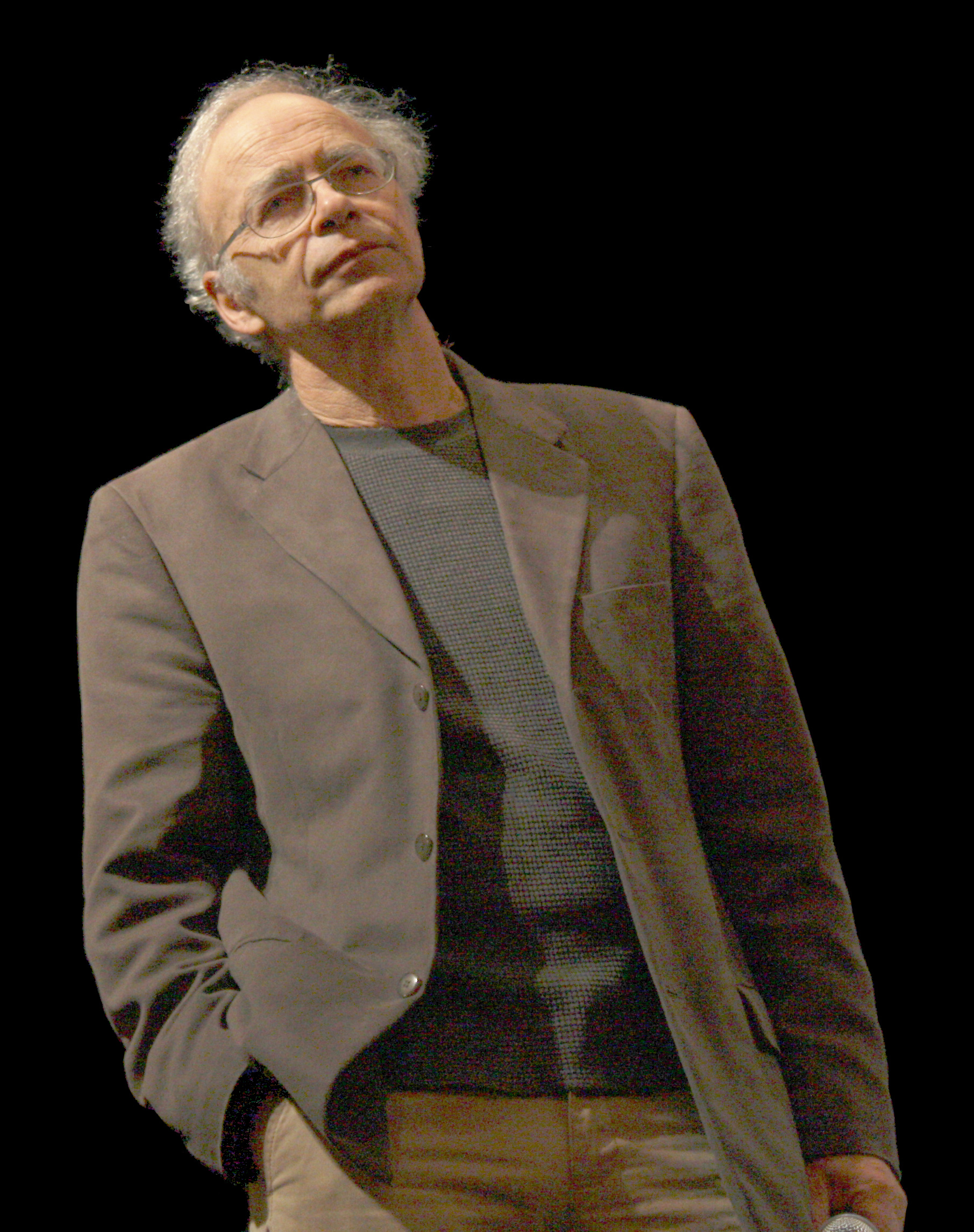
Singer resolutely takes up a Nietzschean call for a “transvaluation of values,” with a full awareness of the radical implications. He argues that we are not creations of God but rather mere Darwinian primates. We exist on an unbroken continuum with animals. Christianity, he says, arbitrarily separated man and animal, placing human life on a pedestal and consigning the animals to the status of tools for human well-being. Now, Singer says, we must remove Homo sapiens from this privileged position and restore the natural order. This translates into more rights for animals and less special treatment for human beings. There is a grim consistency in Singer’s call to extend rights to the apes while removing traditional protections for unwanted children, people with mental disabilities, and the noncontributing elderly.

Some of Singer’s critics have called him a Nazi and compared his proposals to Hitler’s schemes for eliminating those perceived as unwanted and unfit. A careful reading of his work, however, shows that Singer is no Hitler. He doesn’t want state-sponsored killings. Rather, he wants the decision to kill to be made by private individuals like you and me. Instead of government-conducted genocide, Singer favors free-market homicide.

Why haven’t the atheists embraced Peter Singer? I suspect it is because they fear that his unpalatable views will discredit the cause of atheism. What they haven’t considered, however, is whether Singer, virtually alone among their numbers, is uncompromisingly working out the implications of living in a truly secular society, one completely purged of Christian and transcendental foundations. In Singer, we may be witnessing someone both horrifying and yet somehow refreshing: an intellectually honest atheist.

Dr. Francis Schaeffer: Whatever Happened to the Human Race Episode 1 ABORTION

https://youtu.be/tRc0Szq_uWI
Published on Jan 10, 2015

Whatever Happened to the Human Race?
Abortion
Dr. Francis Schaeffer

Related posts:

SANCTITY OF LIFE SATURDAY Francis Schaeffer predicted July 21, 2015 would come when the video “Second Planned Parenthood Senior Executive Haggles Over Baby Parts Prices, Changes Abortion Methods” would be released!!!!

Francis Schaeffer predicted July 21, 2015 would come when the video “Second Planned Parenthood Senior Executive Haggles Over Baby Parts Prices, Changes Abortion Methods” would be released!!!! Al Mohler wrote the article ,”FIRST-PERSON: They indeed were prophetic,” Jan 29, 2004, and in this great article he noted:   . “We stand today on the edge of a […]

“Schaeffer Sunday” Liberals at Ark Times can not stand up to Scott Klusendorf’s pro-life arguments (Part 4) Liberal blogger says “…you don’t get to force your beliefs on me (concerning abortion)…”

I just wanted to note that I have spoken on the phone several times and corresponded with Dr. Paul D. Simmons who is very much pro-choice. (He is quoted in the article below.) He actually helped me write an article to submit to Americans United for the Separation of Church and State back in the […]

RESPONDING TO HARRY KROTO’S BRILLIANT RENOWNED ACADEMICS!! Peter Singer, Professor of Bioethics at Princeton University, THE PROBLEM OF EVIL

On November 21, 2014 I received a letter from Nobel Laureate Harry Kroto and it said: …Please click on this URL http://vimeo.com/26991975 and you will hear what far smarter people than I have to say on this matter. I agree with them. Harry Kroto _________________ Below you have picture of 1996 Chemistry Nobel Prize Winner Dr. […]

Very good article on Francis Schaeffer. Tom Wolfe and Peter Singer!! by Dr. Steven Garber from on November 19, 2013

_______________________ Very good article on Francis Schaeffer. Tom Wolfe. Peter Singer!! Presuppositional Life and Learning Posted on November 19, 2013 by Dr. Steven Garber   Francis Schaeffer. Tom Wolfe. Peter Singer. I spent the morning with the Capitol Fellows thinking about these three men, and their ideas. The first one I studied and studied with many […]

MUSIC MONDAY The Staple Singers Part 1

The Staple Singers Part 1     click to enlarge Mavis Staples   From Wikipedia, the free encyclopedia   Jump to: navigation, search   Mavis Staples Staples performing in Brooklyn, New York in 2007 Background information Birth name Mavis Staples Born July 10, 1939 (age 74) Origin Chicago, Illinois, U.S. Genres Rhythm and blues, soul, gospel […]

FRANCIS SCHAEFFER ANALYZES ART AND CULTURE Part 50 THE BEATLES (Part B, The Psychedelic Music of the Beatles) (Feature on artist Peter Blake )

Francis Schaeffer noted, “In this flow there was also the period of psychedelic rock, an attempt to find this experience without drugs, by the use of a certain type of music. This was the period of the Beatles’ Revolver (1966) and Strawberry Fields Forever (1967)…The psychedelic began with their records REVOLVER, STRAWBERRY FIELDS FOREVER, AND […]

The Staple Singers Part 1 (Mavis Staples in Concert in Little Rock on Oct 11th

The Staple Singers Part 1 Mavis Staples to give concert at Christ Church in Little Rock Posted by Lindsey Millar on Fri, Sep 6, 2013 at 2:48 PM click to enlarge Whoa. One of the greatest soul divas OF ALL TIME is coming to Little Rock next month. Christ Church Little Rock is hosting Mavis […]

FRANCIS SCHAEFFER ANALYZES ART AND CULTURE PART THE BEATLES Part 87 George Bernard Shaw Part B “Why was Shaw on the cover of SGT. PEPPER’S?” Featured Photographer is Henry Grossman

In my last post I demonstrated that George Bernard Shaw was a vocal communist and that probably had a lot to do with his inclusion on the cover of SGT PEPPER’S but today I will look more into more this great playwright’s views. Did you know that Shaw wrote the play that MY FAIR LADY […]

SANCTITY OF LIFE SATURDAY Transcript and Video of Francis Schaeffer speech in 1983 on the word “Evangelical”

Transcript and Video of Francis Schaeffer speech in 1983 on the word “Evangelical” _____________ SOUNDWORD LABRI CONFERENCE VIDEO – Names and Issues – Francis A. Schaeffer Published on Apr 20, 2014 This video is from the 1983 L’Abri Conference in Atlanta. The full lecture with Q&A time has been included. The lecture was also previously […]

“Schaeffer Sunday” Debating Kermit Gosnell Trial, Abortion and infanticide with Ark Times Bloggers Part 2

Surgeon General of the United States In office January 21, 1982 – October 1, 1989 President Ronald Reagan George H. W. Bush Francis Schaeffer Founder of the L’Abri community Born Francis August Schaeffer January 30, 1912 Died May 15, 1984 (aged 72) I truly believe that many of the problems we have today in the USA are […]

THE SERMON ON EVOLUTION BY ADRIAN ROGERS THAT I SENT TO OVER 250 ATHEIST SCIENTISTS FROM 1992 TO 2015!

My good friend Rev. Sherwood Haisty Jr. and I used to discuss which men were the ones who really influenced our lives  and Adrian Rogers had influenced us both more than anybody else. During the 1990′s I actually made it a practice to write famous atheists and scientists that were mentioned by Adrian Rogers and […]

Great article by Ken Ham on Alberto Giubilini, Francesca Minerva, and Peter Singer and their view that parents should be allowed to abort their newborn infants!

Great article by Ken Ham on Alberto Giubilini, Francesca Minerva, and Peter Singer and their view that parents should be allowed to abort their newborn infants!

Francis Schaeffer 

Dr. Francis Schaeffer: Whatever Happened to the Human Race Episode 1 ABORTION

Whatever Happened to the Human Race?
Abortion
Dr. Francis Schaeffer

__________

Great article by Ken Ham on Alberto Giubilini, Francesca Minerva, and   Peter Singer: 

Peter Singer below:

Recently, the Journal of Medical Ethics caused an uproar when it published an article titled, “After-birth Abortion: Why Should the Baby Live?” News reports initially focused on the short abstract of the article that was available for free online (the full paper cost $30 to purchase, according to one report www.ncregister.com/blog/matthew-archbold/ethicists-argue-for-post-birth-abortions), when the paper was suddenly made available in full shortly after the controversy began.  Although I already posted about this story on my Facebook page, I thought it worth looking at the full report for today’s blog and including this link so now you can all read the four-page paper for yourself here (jme.bmj.com/content/early/2012/02/22/medethics-2011-100411.full.pdf+html).

The authors of the paper were Alberto Giubilini, who works with the Centre for Human Bioethics at Monash University in Australia, and Francesca Minerva, who works with the Centre for Applied Philosophy and Public Ethics at the University of Melbourne, Australia. Their thesis? They believe that parents should be allowed to abort their newborn infants.

The authors stated their argument as follows:

Abortion is largely accepted even for reasons that do not have anything to do with the fetus’ health. By showing that (1) both fetuses and newborns do not have the same moral status as actual persons, (2) the fact that both are potential persons is morally irrelevant and (3) adoption is not always in the best interest of actual people, the authors argue that what we call ‘after-birth abortion’ (killing a newborn) should be permissible in all the cases where abortion is, including cases where the newborn is not disabled. (p. 1)

Giubilini and Minerva take abortion a step further, arguing that parents should be allowed to abort their newborns. They justify their position by claiming that an infant is not technically a person:

Both a fetus and a newborn certainly are human beings and potential persons, but neither is a ‘person’ in the sense of ‘subject of a moral right to life’. We take ‘person’ to mean an individual who is capable of attributing to her own existence some (at least) basic value such that being deprived of this existence represents a loss to her. (p. 2)

At which point do Giubilini and Minerva consider infants to be persons? They declined to say: “we do not put forward any claim about the moment at which after-birth abortion would no longer be permissible” (p. 3).

To give you an idea of just where this sort of thinking leads, consider this paragraph from the article:

Failing to bring a new person into existence cannot be compared with the wrong caused by procuring the death of an existing person. The reason is that, unlike the case of death of an existing person, failing to bring a new person into existence does not prevent anyone from accomplishing any of her future aims. However, this consideration entails a much stronger idea than the one according to which severely handicapped children should be euthanised. If the death of a newborn is not wrongful to her on the grounds that she cannot have formed any aim that she is prevented from accomplishing, then it should also be permissible to practise an after-birth abortion on ahealthy newborn too, given that she has not formed any aim yet. (p. 2)

What we’re seeing here is what happens when society loses its biblical foundation. Once people abandon a basis in the absolute authority of God’s Word, then moral relativism will permeate the culture. This is what is happening in our once Christianized West. The situation is akin to that described in the book of Judges:

In those days there was no king in Israel; everyone did what was right in his own eyes. (Judges 21:25)

It also reminds me of Isaiah 5:20: “Woe to those who call evil good and good evil, who put darkness for light and light for darkness.” These people are so blinded by evil that they believe allowing after-birth abortions will be good for society—that it will be good for parents to be able to abort kill their own newborn children for any reason.

This type of thinking may shock many Christians who understand that all life, both inside and outside of the womb, is precious, but it is not really new. Another “ethicist” named Peter Singer has advocated similar ideas for years. (See Singer, Peter. 1979. Practical Ethics, 1st ed., pp. 122–123. Cambridge: Cambridge University Press.) And it won’t just stop at what this article is reporting on—much evil will be claimed as okay as God turns our nations over to judgment because of their rebellion, and as sinful man determines to do what is right in his own eyes.

Romans 1:28–32 delivers the sobering reality of what society will look like when the people willfully reject their Creator. Among other things, they invent ways of doing evil, and even though they know that those who practice such things deserve death, they not only engage in those activities, but approve of those who practice them.

What these two “ethicists” believe about life is exactly contrary to what God teaches about life. The Psalmist praises God, saying, “For you formed my inward parts; you knitted me together in my mother’s womb. I praise you, for I am fearfully and wonderfully made.” God tells Jeremiah, “Before I formed you in the womb, I knew you” (Jeremiah 1:5). Our God is about life—He values it—and He makes clear in His Word that every person—unborn babies and newborn infants alike—are known by Him and exist from conception.
For more on this shocking pro-infanticide thinking, see today’s News to Note and read the commentary by a medical doctor and AiG researcher, Dr. Elizabeth Mitchell.

Thanks for stopping by and thanks for praying,
Ken

Related posts:

SANCTITY OF LIFE SATURDAY Francis Schaeffer predicted July 21, 2015 would come when the video “Second Planned Parenthood Senior Executive Haggles Over Baby Parts Prices, Changes Abortion Methods” would be released!!!!

Francis Schaeffer predicted July 21, 2015 would come when the video “Second Planned Parenthood Senior Executive Haggles Over Baby Parts Prices, Changes Abortion Methods” would be released!!!! Al Mohler wrote the article ,”FIRST-PERSON: They indeed were prophetic,” Jan 29, 2004, and in this great article he noted:   . “We stand today on the edge of a […]

“Schaeffer Sunday” Liberals at Ark Times can not stand up to Scott Klusendorf’s pro-life arguments (Part 4) Liberal blogger says “…you don’t get to force your beliefs on me (concerning abortion)…”

I just wanted to note that I have spoken on the phone several times and corresponded with Dr. Paul D. Simmons who is very much pro-choice. (He is quoted in the article below.) He actually helped me write an article to submit to Americans United for the Separation of Church and State back in the […]

RESPONDING TO HARRY KROTO’S BRILLIANT RENOWNED ACADEMICS!! Peter Singer, Professor of Bioethics at Princeton University, THE PROBLEM OF EVIL

On November 21, 2014 I received a letter from Nobel Laureate Harry Kroto and it said: …Please click on this URL http://vimeo.com/26991975 and you will hear what far smarter people than I have to say on this matter. I agree with them. Harry Kroto _________________ Below you have picture of 1996 Chemistry Nobel Prize Winner Dr. […]

Very good article on Francis Schaeffer. Tom Wolfe and Peter Singer!! by Dr. Steven Garber from on November 19, 2013

_______________________ Very good article on Francis Schaeffer. Tom Wolfe. Peter Singer!! Presuppositional Life and Learning Posted on November 19, 2013 by Dr. Steven Garber   Francis Schaeffer. Tom Wolfe. Peter Singer. I spent the morning with the Capitol Fellows thinking about these three men, and their ideas. The first one I studied and studied with many […]

MUSIC MONDAY The Staple Singers Part 1

The Staple Singers Part 1     click to enlarge Mavis Staples   From Wikipedia, the free encyclopedia   Jump to: navigation, search   Mavis Staples Staples performing in Brooklyn, New York in 2007 Background information Birth name Mavis Staples Born July 10, 1939 (age 74) Origin Chicago, Illinois, U.S. Genres Rhythm and blues, soul, gospel […]

FRANCIS SCHAEFFER ANALYZES ART AND CULTURE Part 50 THE BEATLES (Part B, The Psychedelic Music of the Beatles) (Feature on artist Peter Blake )

Francis Schaeffer noted, “In this flow there was also the period of psychedelic rock, an attempt to find this experience without drugs, by the use of a certain type of music. This was the period of the Beatles’ Revolver (1966) and Strawberry Fields Forever (1967)…The psychedelic began with their records REVOLVER, STRAWBERRY FIELDS FOREVER, AND […]

The Staple Singers Part 1 (Mavis Staples in Concert in Little Rock on Oct 11th

The Staple Singers Part 1 Mavis Staples to give concert at Christ Church in Little Rock Posted by Lindsey Millar on Fri, Sep 6, 2013 at 2:48 PM click to enlarge Whoa. One of the greatest soul divas OF ALL TIME is coming to Little Rock next month. Christ Church Little Rock is hosting Mavis […]

FRANCIS SCHAEFFER ANALYZES ART AND CULTURE PART THE BEATLES Part 87 George Bernard Shaw Part B “Why was Shaw on the cover of SGT. PEPPER’S?” Featured Photographer is Henry Grossman

In my last post I demonstrated that George Bernard Shaw was a vocal communist and that probably had a lot to do with his inclusion on the cover of SGT PEPPER’S but today I will look more into more this great playwright’s views. Did you know that Shaw wrote the play that MY FAIR LADY […]

SANCTITY OF LIFE SATURDAY Transcript and Video of Francis Schaeffer speech in 1983 on the word “Evangelical”

Transcript and Video of Francis Schaeffer speech in 1983 on the word “Evangelical” _____________ SOUNDWORD LABRI CONFERENCE VIDEO – Names and Issues – Francis A. Schaeffer Published on Apr 20, 2014 This video is from the 1983 L’Abri Conference in Atlanta. The full lecture with Q&A time has been included. The lecture was also previously […]

“Schaeffer Sunday” Debating Kermit Gosnell Trial, Abortion and infanticide with Ark Times Bloggers Part 2

Surgeon General of the United States In office January 21, 1982 – October 1, 1989 President Ronald Reagan George H. W. Bush Francis Schaeffer Founder of the L’Abri community Born Francis August Schaeffer January 30, 1912 Died May 15, 1984 (aged 72) I truly believe that many of the problems we have today in the USA are […]

THE SERMON ON EVOLUTION BY ADRIAN ROGERS THAT I SENT TO OVER 250 ATHEIST SCIENTISTS FROM 1992 TO 2015!

My good friend Rev. Sherwood Haisty Jr. and I used to discuss which men were the ones who really influenced our lives  and Adrian Rogers had influenced us both more than anybody else. During the 1990′s I actually made it a practice to write famous atheists and scientists that were mentioned by Adrian Rogers and […]