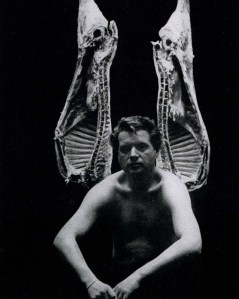
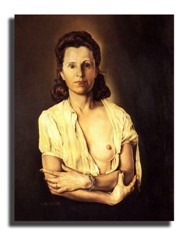
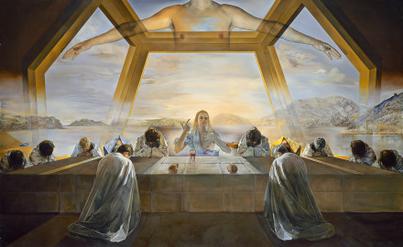
Woody Allen believes that we live in a cold, violent and meaningless universe and it seems that his main character (Gil Pender, played by Owen Wilson) in the movie MIDNIGHT IN PARIS shares that view. Pender’s meeting with the Surrealists is by far the best scene in the movie because they are ones who can understand his predicament concerning the absurdity of life UNDER THE SUN (as Solomon used to phrase it.) If we are here as a result of chance then what lasting purpose can be found? The Surrealists truly grasped the problem and it seems that Gil does too realize the full weight of the predicament.
In the movie Gertrude Stein says to Gil, “Now, about your book,it’s very unusual, indeed.I mean, in a way, it’s almost like science fiction.We all fear death, and question our place in the universe.The artist’s job is not to succumb to DESPAIR,but to find an antidote for the emptiness of existence.You have a clear and lively voice. Don’t be such a defeatist.”
Also in the film we find this exchange.
ADRIANA: Tell me more about your book.
GIL PENDER: My book is kind of a…You know what? I couldn’t careless about my book tonight.I just want to walk around Paris with you.
ADRIANA: I keep forgetting you’re just a tourist.
GIL PENDER: That’s putting it mildly.
ADRIANA: I can never decide whether Paris is more beautiful by day or by night.
GIL PENDER: No, you can’t. You couldn’t pick one. I mean,I can give you a checkmate argument for each side.You know, I sometimes think,”How’s anyone gonna come up with a book, or a painting, or a symphony or a sculpture that can compete with a great city?”You can’t, ’cause, like,you look around, every…every street, every boulevardis its own special art form.And when you think that in the cold,violent, meaningless universe,that Paris exists, these lights…I mean, come on, there’s nothing happening on Jupiter or Neptune,but from way out in space you can see these lights, the cafe’s, people drinking, and singing…I mean, for all we know, Paris is the hottest spot in the universe.-
ADRIANA: Vous êtes un poète.(You are a poet.)-
GIL PENDER:Aw, come on.It’s just… You’re very kind, butI wouldn’t call my babbling poetic.Although I was on a pretty good roll there.
Woody Allen’s main character GIL PENDER in the movie MIDNIGHT IN PARIS firmly believes that we live in a cold, violent, and meaningless universe brought to us by Darwinism chance plus time.
Let’s see what King Solomon had to say about that. Solomon said in Ecclesiastes 9:11-13 “I have seen something else UNDER THE SUN: The race is not to the swift or the battle to the strong, nor does food come to the wise or wealth to the brilliant or favor to the learned; but time and chance happen to them all. Moreover, no one knows when their hour will come: As fish are caught in a cruel net, or birds are taken in a snare, so people are trapped by evil times that fall unexpectedly upon them.”
WHY IS SOLOMON CAUGHT IN DESPAIR IN THE BOOK OF ECCLESIASTES? Christian scholar Ravi Zacharias has noted, “The key to understanding the Book of Ecclesiastes is the term ‘UNDER THE SUN.’ What that literally means is you lock God out of a closed system, and you are left with only this world of time plus chance plus matter.” THIS IS EXACT POINT SCHAEFFER SAYS SECULAR ARTISTS ARE PAINTING FROM TODAY BECAUSE THEY BELIEVED ARE A RESULT OF MINDLESS CHANCE.
By the way, the final chapter of Ecclesiastes finishes with Solomon emphasizing that serving God is the only proper response of man. Solomon LOOKS ABOVE THE SUN AND BRINGS GOD BACK INTO THE PICTURE in the final chapter of the book in Ecclesiastes 12:13-14, “ Now all has been heard; here is the conclusion of the matter: Fear God and keep his commandments, for this is the whole duty of man. For God will bring every deed into judgment, including every hidden thing, whether it is good or evil.”
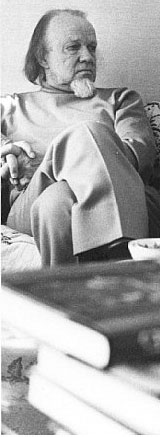
(Francis Schaeffer pictured below)
Francis Schaeffer in Art and the Bible noted, “Many modern artists, it seems to me, have forgotten the value that art has in itself. Much modern art is far too intellectual to be great art. Many modern artists seem not to see the DISTINCTION BETWEEN MAN AND NON-MAN, and it is a part of the lostness of modern man that they no longer see value in the work of art as a work of art.”
Many modern artists are left in this point of desperation that Schaeffer points out and it reminds me of the despair that Solomon speaks of in Ecclesiastes as you looks at life UNDER THE SUN. Another group of artists reached this point of desperation and it is those involved in the Dada movement and then the later Surrealist movement.
Francis Schaeffer noted:
Dada was started in Zurich and came along in modern art. Dada means nothing. The word “Dada” means rocking horse, but it was chosen by chance. The whole concept of Dada is everything means nothing. [In this materialistic mindset Chance and Time have determined the past, and they will determine the future according to Solomon in life UNDER THE SUN]… Dada carried to its logical conclusion the notion of all having come about by chance; the result was the final absurdity of everything, including humanity.
(Surrealists: Man Ray, Jean Arp, Yves Tanguy, André Breton; Tristan Tzara, Salvador Dalí, Paul Eluard, Max Ernst and Rene Clevel, 1930.)
Jean Arp below.
Below is a portion from the Francis Schaeffer book HOW SHOULD WE THEN LIVE?:
Hans (Jean) Arp (1887-1966), an Alsatian sculptor, wrote a poem which appeared in the final issue of the magazine De Stijl (The Style) which was published by the De Stijl group of artists led by Piet Mondrian and Theo van Doesburg. Mondrian (1872-1944) was the best-known artist of this school. He was not of the Dada school which accepted and portrayed absurdity. Rather, Mondrian was hoping to paint the absolute. Hand Arp, however, was a Dadaist artist connected with De Stijl. His power “Für Theo Van Doesburg,” translated from German reads:
the head downward the legs upward he tumbles into the bottomless from whence he came
he has no more honour in his body he bites no more bite of any short meal he answers no greeting and is not proud when being adored
the head downward the legs upward he tumbles into the bottomless from whence he came
like a dish covered with hair like a four-legged sucking chair like a deaf echotrunk half full half empty
the head downward the legs upward he tumbles into the bottomless from whence he came
Jean Arp (Hans Arp)
Jean Arp is associated with the DADA movement. His collages were of torn pieces of paper dropped and affixed where they would land. His use of chance is intended to create free of human intervention. “Dada,” wrote Arp, “wished to destroy the hoaxes of reason and to discover an unreasoned order.”
Collage with Squares Arranged According to the Laws of Chance
Random Collage
Torn Paper and Gouache
Dada carried to its logical conclusion the notion of all having come about by chance; the result was the final absurdity of everything, including humanity.
Pictured below: Salvador Dalí (lower center) and Marcel Duchamp (upper left) attending a bullfight.
_____
Nude Descending a Staircase (1912) by Marcel Duchamp
Francis Schaeffer continues:
The man who perhaps most clearly and consciously showed this understanding of the resulting absurdity fo all things was Marcel Duchamp (1887-1969). He carried the concept of fragmentation further in Nude Descending a Staircase (1912), one version of which is now in the Philadelphia Museum of Art–a painting in which the human disappeared completely. The chance and fragmented concept of what is led to the devaluation and absurdity of all things. All one was left with was a fragmented view of a life which is absurd in all its parts. Duchamp realized that the absurdity of all things includes the absurdity of art itself. His “ready-mades” were any object near at hand, which he simply signed. It could be a bicycle wheel or a urinal. Thus art itself was declared absurd.
_____
(Jackson Pollock pictured below dripping his paint)
Francis Schaeffer in his book HOW SHOULD WE THEN LIVE? noted on pages 200-203:
Jackson Pollock (1912-1956) is perhaps the clearest example in the United States of painting deliberately in order to make the statements that all is chance. He placed canvases horizontally on the floor and dripped paint on them from suspended cans swinging over them. Thus, his paintings were a product of chance. But wait a minute! Is there not an order in the lines of paint on his canvases? Yes, because it was not really chance shaping his canvases! The universe is not a random universe; it has order. Therefore, as the dripping paint from the swinging cans moved over the canvases, the lines of paint were following the order of the universe itself. The universe is not what these painters said it is.
(John Cage pictured above)
(Woody Allen, Peter O’Toole and Capucine)
________
(Marcel Duchamp plays white, John Cage plays black, on a chessboard modified to generate tones depending on where the chess pieces are. Toronto, 1968. Teeny Duchamp at far left, camerman in the background. This was a performance.)
John Cage provides perhaps the clearest example of what is involved in the shift of music. Cage believed the universe is a universe of chance. He tried carrying this out with great consistency. For example, at times he flipped coins to decide what the music should be. At other times he erected a machine that led an orchestra by chance motions so that the orchestra would not know what was coming next. Thus there was no order. Or again, he placed two conductors leading the same orchestra, separated from each other by a partition, so that what resulted was utter confusion. There is a close tie-in again to painting; in 1947 Cage made a composition he called MUSIC FOR MARCEL DUCHAMP. But the sound produced by his music was composed only of silence (interrupted only by random environmental sounds), but as soon as he used his chance methods sheer noise was the outcome.
But Cage also showed that one cannot live on such a base, that the chance concept of the universe does not fit the universe as it is. Cage is an expert in mycology, the science of mushrooms. And he himself said, “I became aware that if I approached mushrooms in the spirit of my chance operation, I would die shortly.” Mushroom picking must be carefully discriminative. His theory of the universe does not fit the universe that exists.
All of this music by chance, which results in noise, makes a strange contrast to the airplanes sitting in our airports or slicing through our skies. An airplane is carefully formed; it is orderly (and many would also think it beautiful). This is in sharp contrast to the intellectualized art which states that the universe is chance. Why is the airplane carefully formed and orderly, and what Cage produced utter noise? Simply because an airplane must fit the orderly flow lines of the universe if it is to fly!
!Midnight in the Paris-best scene of the movie Salvador Dali, Man Ray and Woody Allen
published on Dec 18, 2012
Woody Allen talking with Salvador Dali and Man Ray and Luis Bunuel.
This is the transcript of
DALI: We met, earlier tonight…At the party! Dali.
GIL: I remember!-
DALI: A bottle of red wine!
GIL: It can’t be… Yeah….So?
DALI: Another glass for this man, please. I love the language!The French! The waiters? No.You like the shape of the rhinoceros?
GIL: The rhinoceros? Uh…Haven’t really thought about it.I paint the rhinoceros.
DALI: I paint you. Your sad eyes.Your big lips, melting over the hot sand,with one tear.Yes! And in your tear, another face.The Christ’s face!Yes, in the rhinoceros.
GIL: Yeah. I mean, I probably do look sad. I’m in…a very perplexing situation.
DALI: Diablo…Luis! Oye, Luis!(Damn. Luis! Hey, Luis!)My friends.This… is Luis Bunuel…and…Mr. Man Ray.-
GIL: Man Ray? My Gosh!- How ’bout that?
DALI: This is Pen-der. Pen-der. Pender!- Yes. And I am DalÃ!- DalÃ. Yes.You have to remember. Pender is in a perplexing situation.
GIL: It sounds so crazy to say.You guys are going tothink I’m drunk, but I have to tell someone. I’m…from a…a different time. Another era.The future. OK? I come…from the 2000th millenium to here.I get in a car, and I slide through time.
MAN RAY: Exactly correct.You inhabit two worlds.- So far, I see nothing strange.- Why?
GIL: Yeah, you’re surrealists!But I’m a normal guy. See, in one life,I‘m engaged to marry a woman I love.At least, I think I love her.Christ! I better love her! I’m marrying her!
DALI: The rhinoceros makes love by mounting the female.But…is there a difference in the beauty between two rhinoceroses?
MAN RAY: There is another woman?Adriana. Yes, and I’m…very drawn to her.I find her extremely alluring.The problem is that other men,great artists – geniuses- also find her alluring,and she finds them. So, there’s that…
MAN RAY: A man in love with a woman from a different era.I see a photograph.
LUIS BUNUEL: I see a film.I see an insurmountable problem.I see……a rhinoceros.
Let me make a few points here. We see that Gil Pender’s perplexing problem is that he is in love and this goes against his views that we are not put here for a purpose, but by mindless chance. God created us so we can’t deny that we are created for a purpose and when a person falls truly in love with another person then they have a hard time maintaining this is only just a product of evolution and has no lasting significance.
Solomon wisely noted in Ecclesiastes 3:11 “God has planted eternity in the heart of men…” (Living Bible). No wonder Bertrand Russell wrote in his autobiography, “It is odd, isn’t it? I feel passionately for this worldand many things and people in it, and yet…what is it all? There must be something more important, one feels, though I don’t believe there is. I am haunted. Some ghosts, for some extra mundane regions, seem always trying to tell me something that I am to repeat to the world, but I cannot understand that message.”
Bertrand Russell playing chess with his son (1940).
The Bible teaches that we all know that God exists and has made us in his image and if we deny that then we are suppressing the knowledge of our conscience in unrighteousness. Romans 1:18-19 (Amplified Bible) ” For God’s wrath and indignation are revealed from heaven against all ungodliness and unrighteousness of men, who in their wickedness REPRESSandHINDER the truth and make it inoperative. For that which is KNOWN about God is EVIDENT to them andMADE PLAIN IN THEIR INNER CONSCIOUSNESS, because God has SHOWN IT TO THEM,”(emphasis mine).
Being in Woody’s shoes is not the most cheerful place to be: he sees the universe as a cold place, with no ultimate meaning; transient, unsatisfying; with nothing to hold onto other than temporary distractions from these cold truths. Allen’s favorite distraction is getting absorbed in work (which explains the volume of his creative output). Another distraction we fall into are relationships with other people.
Woody is keenly aware why the life feels unsatisfactory, and he is good at unmasking the fallacies of the usual ‘coping strategies’(such as hoping to achieve satisfaction by leaving something behind which would outlast oneself, or even his self-prescribed absorption in work). Because of this, our life and Allen’s films are full of illusions that we build like walls between ourselves and the reality….At the end, the protagonist gets the point: “That’s what the present is. It’s a little unsatisfying because life is unsatisfying.” The problem is not in the when or where we live, but it is inherent in the experience of living. Allen’s films are moving because there is the realization of the distraction being just that, a distraction, but embracing it never-the-less because it is the best thing we have.
I am grateful for having Allen’s movies as beautiful distractions. It is hard for me to distinguish whether Allen’s worldview happens to coincide with mine, or whether my views were shaped so much by watching and admiring his films since my early teenage years. Where we differ is that I also hope that when we face the cold universe – as we do from time to time whether we want to or not – we can wait a while before blocking it out again, and perhaps discern something that has a real value amidst the fleeting time. But Paris might still be the preferred place for this.
I know that there are many people like Pavel Soukenikout there who do not accept the existence of the supernatural and if there are correct then I would agree with them that all we have left is the “cold universe.” But let me respond further with the words of Francis Schaeffer from his book HE IS THERE AND HE IS NOT SILENT (the chapter is entitled, “Is Propositional Revelation Nonsense?”
Of course, if the infinite uncreated Personal communicated to the finite created personal, he would not exhaust himself in his communication; but two things are clear here:
1. Even communication between once created person and another is not exhaustive, but that does not mean that for that reason it is not true.
2. If the uncreated Personal really cared for the created personal, it could not be thought unexpected for him to tell the created personal things of a propositional nature; otherwise as a finite being the created personal would have numerous things he could not know if he just began with himself as a limited, finite reference point. In such a case, there is no intrinsic reason why the uncreated Personal could communicate some vaguely true things, but could not communicate propositional truth concerning the world surrounding the created personal – for fun, let’s call that science. Or why he could not communicate propositional truth to the created personal concerning the sequence that followed the uncreated Personal making everything he made – let’s call thathistory. There is no reason we could think of why he could not tell these two types of propositional things truly. They would not be exhaustive; but could we think of any reason why they would not be true? The above is, of course, what the Bible claims for itself in regard to propositional revelation.
The only alternative to believing that we were made for a purpose by God is to embrace the chance universe that Woody Allen has demonstrated so well in his films. Below is such a scene from the movie PLAY IT AGAIN SAM.
In 1972’s Play It Again, Sam, Allen plays a film critic trying to get over his wife’s leaving him by dating again. In one scene, Allen tries to pick up a depressive woman in front of the early Jackson Pollock work. This painting, because of its elusive title, has been the subject of much debate as to what it portrays. This makes for a nifty gag when Allen strolls up and asks the suicidal belle, “What does it say to you?”
______________
Woody Allen in Play It Again Sam
Uploaded on May 20, 2009
Scene from ‘Play it Again Sam’ (1972)
____________
Allan: That’s quite a lovely Jackson Pollock, isn’t it?
Museum Girl: It restates the negativeness of the universe. The hideous lonely emptiness of existence. Nothingness. The predicament of Man forced to live in a barren, Godless eternity like a tiny flame flickering in an immense void with nothing but waste, horror and degradation, forming a useless bleak straitjacket in a black absurd cosmos.
Raymond C. TallisF.Med.Sci., FRCP, FRSA (born 10 October 1946[1] in Liverpool, Lancashire) is a philosopher, poet, novelist, cultural critic and a retired medical physician andclinical neuroscientist.[2] Specialising in geriatrics, Tallis served on several UK commissions on medical care of the aged and was an editor or major contributor to two key textbooks in the field, The Clinical Neurology of Old Age and Textbook of Geriatric Medicine and Gerontology.
On leaving Liverpool College, Tallis gained an Open Scholarship to Keble College, Oxford, where he completed a degree in animal physiology in 1967. He completed his medical degreein 1970 at the University of Oxford and St Thomas’ Hospital in London. From 1996 to 2000, he was Consultant Adviser in Care of the Elderly to the Chief Medical Officer. In 1999–2000, he was Vice-Chairman of the Stroke Task Force of the Advisory Group developing the National Service Framework for Older People. He has been on the Standing Medical Advisory Committee and the Council of the Royal College of Physicians and was secretary of the Joint Specialist Committee of the Royal College on Health Care of the Elderly between 1995 and 2003. He was a member of the Joint Task Force on Partnership in Medicine Taking, established by Alan Milburn, the Secretary of State for Health, in 2001. For three years he was a member of one of the appraisal panels of the National Institute of Clinical Excellence. He retired in 2006 as Emeritus Professor of Geriatric Medicine at the University of Manchester.[3]
Tallis attacked post-structuralism in books such as Not Saussure,[4]Theorrhoea and After[5] and rejected the assumptions of much artificial intelligence research in his book Why the Mind is Not a Computer: A Pocket Dictionary on Neuromythology.[6] He denies that our appreciation of art and music can be reduced to scientific terms.[7] His philosophical writings supply an anthropology that acknowledges what is distinctive – and remarkable – about human beings. To this end he has written a trilogy of books entitled The Hand;[8]I Am: A Philosophical Inquiry into First-Person Being;[9] and The Knowing Animal.[10] He has also written extensively about the misuse of scientific language and concepts to explain human experiences.[11]
In 2007 Tallis published Unthinkable Thought: The Enduring Significance of Parmenides. His book The Kingdom of Infinite Space: A Fantastical Journey Around Your Head, which explores the range of activities that go on inside the human head, was published in April 2008.[12] and Michelangelo’s Finger: An Exploration of Everyday Transcendence was published in 2010.[13]
Aping Mankind: Neuromania, Darwinitis and the Misrepresentation of Humanity was published in 2011.[14]In Defence of Wonder and Other Philosophical Reflections, a collection of essays from The Reader and elsewhere, was published in April 2012.[15]
Tallis is among the Distinguished Supporters of the British Humanist Association.[16] Tallis is also a Patron of Dignity in Dying. On 15 September 2010, Tallis, along with 54 other public figures, signed an open letter published inThe Guardian, stating their opposition to Pope Benedict XVI‘s state visit to the UK.[17] In a 2010 interview with author Jesse Horn, Tallis declared that he is an optimistic humanist and an atheist. “Given that I was born a few months after Auschwitz was liberated, it is hardly surprising that I have a strong sense of the evil that humans – individually and collectively – do. My position is that of cautious and chastened optimism, a belief that, if we are ourselves well-treated by others, we will usually treat others reasonably well.”[18]
In the You Tube video “A Further 50 Renowned Academics Speaking About God (Part 3),” Dr. Tallis asserted:
My main reason for being an atheist is that the concept of God is totally illogical. Any attempt to bring together all the qualities that are ascribed to God lead to contradictions. For example, God is separate from His creation but is also infinite and boundless which is contradiction number 1.
There is the obvious contradiction that people have often talked about is that He is omnipotent and all-good and yet allows a world in which terrible things happen. Whatever way you square it the concept of God is a logical impossibility.
Professor Tallis’s other main argument for atheism is that “God is a logically impossible object,” as he puts it in his provocatively titled article, In search of the G-spot. What he particularly objects to, as he writes in his article, “Why I am an atheist,” is the notion of a God who combines in His Being both the unbounded and the specific:
… the notion of a God who is infinite but has specific characteristics; unbounded, but distinct in some sense from His creation; who is a Being that has not been brought into being; who is omniscient, omnipotent and good and yet so constrained as to be unable or unwilling to create a world without evil; who is intelligent and yet has little in common with intelligent beings as we understand them; and so on.
_____________
Dr.Tallis brings up the problem of evil and lays it at the foot of God. In the letter below I answer this objection. Since Dr. Tallis is a secular man and rejects the idea of “blind faith” I have put forth some evidence below that seems to indicate that the Bible is historically accurate.
September 30, 2015
Dr. Raymond Tallis, Emeritus Professor of Geriatric Medicine, The University of Manchester,
Having cleared the table, Tallis puts forward what he considers to be the two best arguments for atheism:first, if a personal God exists, He is a morally capricious Being, which makes His existence implausible; and second, the concept of God is self-contradictory.
On April 28, 2014 I woke up and found out that a family we used to go to church with several years ago had just lost their two oldest daughters and their father the night before in the EF-4 tornado that hit near Little Rock, Arkansas. Actually I coached their oldest daughter in basketball back when she was in the 5th grade in our Upwards Basketball League at Fellowship Bible Church in Little Rock. Later in the day my son Hunter who is in the National Guard told me about his visit in the hospital with his army buddy who was going into surgery and his daughter was also in the hospital and his home was destroyed in Vilonia, Arkansas. After I heard these two pieces of news I turned on the radio and heard the testimony of Kathy Sanders who told of the loss of her two grandchildren Chase and Colton at the Oklahoma City bombing, and that reminded me of my correspondence with 3 signers of Humanist Manifesto 2 back in 1995 after Billy Graham spoke at the Memorial Service in Oklahoma City.
I wanted to write you today for two reasons. First, I wanted to talk to you about the problem of evil since it is probably the number one reason that atheists like you do not consider believing in God. Second, I wanted to point out some scientific evidence that caused Antony Flew to switch from an atheist (as you are now) to a theist. Twenty years I had the opportunity to correspond with two individuals that were regarded as two of the most famous atheists of the 20th Century, Antony Flew and Carl Sagan. (I have enclosed some of those letters between us.) I had read the books and seen the films of the Christian philosopher Francis Schaeffer and he had discussed the works of both of these men. I sent both of these gentlemen philosophical arguments from Schaeffer in these letters and in the first letter I sent a cassette tape of my pastor’s sermon IS THE BIBLE TRUE? (CD is enclosed also.) You may have noticed in the news a few years ago that Antony Flew actually became a theist in 2004 and remained one until his death in 2010. Carl Sagan remained a skeptic until his dying day in 1996.
You will notice in the enclosed letter from June 1, 1994 that Dr. Flew commented, “Thank you for sending me the IS THE BIBLE TRUE? tape to which I have just listened with great interest and, I trust, profit.” It would be a great honor for me if you would take time and drop me a note and let me know what your reaction is to this same message.
One of my favorite songs is called “Before the Morning” and it is by the Christian singer Josh Wilson. The lyrics start out: “Why do you have to feel the things that hurt you? If there’s a God who loves you where is He now?” Over the years I have corresponded with several atheists and many times they confront me on this very issue such as this letter did from Dr. Brian Charlesworth, Dept of Ecology and Evolution, University of Chicago in letter dated May 10, 1994:
Thank you for your various communications. I am afraid that I formed the view many years ago that there is no foundation for any belief in a benevolent creator of the world. For me, there is too much suffering in the world to be compatible with the existence of such a being.
Let me make three points concerning the problem of evil and suffering.First, the problem of evil and suffering hit this world in a big way because of Adam and what happened in Genesis Chapter 3. Second, if there is no God then there is no way to distinguish good from evil and there will be no ultimate punishment for Hitler and Josef Mengele. Third. Christ came and suffered and will destroy all evil from this world eventually forever.
Recently I went to see the movie GOD’S NOT DEAD in a local theater and that prompted me to read the book of the same name by Rice Broocks. In the movie the problem of evil and suffering is discussed just like it is in the book and would love to interact further with anyone who would like to see the film is a big hit in theaters this year. On page 5 on the book you will find these words:
Atheists claim that the universe isn’t what you would expect
if a supernatural God existed. All this death and suffering, they say,
are plain evidence that a loving, intelligent God could not be behind
it all. The truth is that God has created a world where free moral
agents are able to have real choices to do good or evil. If God had
created a world without that fundamental choice and option to do
evil, then we wouldn’t be having this discussion. God made a world
where choices are real and humanity is affected by the choices of
other humans. Drunk drivers kill innocent people. Some murder
and steal from their fellow men. Though God gave clear com-
mandments to humanity, we have for the most part ignored these
directives. The mess that results is not God’s fault. It’s ours.
We are called to follow God and love Him with all our hearts
and minds. This means we have to think and investigate. Truth
is another word for reality. When something is true it’s true
everywhere. The multiplication tables are just as true in China
as they are in America. Gravity works in Africa the way it does
in Asia. The fact that there are moral truths that are true every-
where points to a transcendent morality that we did not invent
and from which we cannot escape (C.S.Lewis, MERE CHRISTIANITY,[1952:
New York: Harper Collins, 2001], p. 35).
As Creator, God has placed not only natural laws in the earth
but also spiritual laws. For instance, lying is wrong everywhere.
So is stealing. Cruelty to children is wrong regardless of what
culture you’re in or country you’re from. When these laws are
broken, people are broken. Not only does violating these spiritual
laws separate us from God, but it causes pain in our lives and
in the lives of those around us. The big question becomes, what
can be done about our condition? When we break these spiritual
laws, whom can we call for help? How can we be reconciled to
God as well as break free from this cycle of pain and dysfunction?
“the True Christian position is that, in space and time and history, there was an unprogrammed man who made a choice, and actually rebelled against God…without Christianity’s answer that God made a significant man in a significant history with evil being the result of Satan’s and then man’s historic space-time revolt, there is no answer but to accept Baudelaire’s answer [‘If there is a God, He is the devil’] with tears. Once the historic Christian answer is put away, all we can do is to leap upstairs and say that against all reason God is good.”(pg. 81)
Someone I knew in 1985 grew up in Germany and was part of the Hitler Youth Program, Was he wrong in his beliefs?
On what basis does the atheist have to say “Hitler was wrong!!!”
My friend who grew up in Germany believed until his dying day that Hitler was right. I had a basis for knowing that Hitler was wrong and here it is below.
It is my view that according the Bible all men are created by God and are valuable. However, the atheist has no basis for coming to this same conclusion. Francis Schaeffer put it this way:
We cannot deal with people like human beings, we cannot deal with them on the high level of true humanity, unless we really know their origin—who they are. God tells man who he is. God tells us that He created man in His image. So man is some- thing wonderful.
In 1972 Schaeffer wrote the book “He is There and He is Not Silent.” Here is the statement that sums up that book:
One of philosophy’s biggest problems is that anything exists at all and has the form that it does. Another is that man exists as a personal being and makes true choices and has moral responsibility. The Bible gives sufficient answers to these problems. In fact, the only sufficient answer is that the infinite-personal triune God is there and He is not silent. He has spoken to man in the Bible.
In the movie CRIMES AND MISDEMEANORS the basic question Woody Allen is presenting to his own agnostic humanistic worldview is: If you really believe there is no God there to punish you in an afterlife, then why not murder if you can get away with it? The secular humanist worldview that modern man has adopted does not work in the real world that God has created. God “has planted eternity in the human heart…” (Ecclesiastes 3:11). This is a direct result of our God-given conscience. The apostle Paul said it best in Romans 1:19, “For that which is known about God is evident to them and made plain in their inner consciousness, because God has shown it to them” (Amplified Version).
It’s no wonder, then, that one of Allen’s fellow humanists would comment, “Certain moral truths — such as do not kill, do not steal, and do not lie — do have a special status of being not just ‘mere opinion’ but bulwarks of humanitarian action. I have no intention of saying, ‘I think Hitler was wrong.’ Hitler WAS wrong.” (Gloria Leitner, “A Perspective on Belief,” The Humanist, May/June 1997, pp.38-39). Here Leitner is reasoning from her God-given conscience and not from humanist philosophy. It wasn’t long before she received criticism.
Humanist Abigail Ann Martin responded, “Neither am I an advocate of Hitler; however, by whose criteria is he evil?” (The Humanist, September/October 1997, p. 2.). Humanists don’t really have an intellectual basis for saying that Hitler was wrong, but their God-given conscience tells them that they are wrong on this issue.
Also here is the link for another fine article on this same issue by Chuck Colson.
Let us take a close look at how you are going to come up with morality as an atheist. When you think about it there is no way around the final conclusion that it is just your opinion against mine concerning morality. There is no final answers. However, if God does exist and he has imparted final answers to us then everything changes.
What doesn’t make sense is to look at the existence of evil and question the existence of God. The reason is that atheism turns out being a self-defeating philosophic solution to this problem of evil. Think of what evil is for a minute when we make this kind of objection. Evil is a value judgment that must be measured against a morally perfect standard in order to be meaningful. In other words, something is evil in that it departs from a perfect standard of good. C.S. Lewis made the point, “My argument against God was that the universe seemed so cruel and unjust. But how had I got this idea of just and unjust? A man does not call something crooked unless he has some idea of a straight line.”[ 1 ] He also goes on to point out that a portrait is a good or a bad likeness depending on how it compares with the “perfect” original. So to talk about evil, which is a departure from good, actually presumes something that exists that is absolutely good. If there is no God there’s no perfect standard, no absolute right or wrong, and therefore no departure from that standard. So if there is no God, there can’t be any evil, only personal likes and dislikes–what I prefer morally and what I don’t prefer morally.
This is the big problem with moral relativism as a moral point of view when talking about the problem of evil. If morality is ultimately a matter of personal taste–that’s what most people hold nowadays–then it’s just your opinion what’s good or bad, but it might not be my opinion. Everybody has their own view of morality and if it’s just a matter of personal taste–like preferring steak over broccoli or Brussels sprouts–the objection against the existence of God based on evil actually vanishes because the objection depends on the fact that some things are intrinsically evil–that evil isn’t just a matter of my personal taste, my personal definition. But that evil has absolute existence and the problem for most people today is that there is no thing that is absolutely wrong. Premarital sex? If it’s right for you. Abortion? It’s an individual choice. Killing? It depends on the circumstances. Stealing? Not if it’s from a corporation.
The fact is that most people are drowning in a sea of moral relativism. If everything is allowed then nothing is disallowed. Then nothing is wrong. Then nothing is ultimately evil. What I’m saying is that if moral relativism is true, which it seems like most people seem to believe–even those that object against evil in the world, then the talk of objective evil as a philosophical problem is nonsense. To put it another way, if there is no God, then morals are all relative. And if moral relativism is true, then something like true moral evil can’t exist because evil becomes a relative thing.
An excellent illustration of this point comes from the movie The Quarrel . In this movie, a rabbi and a Jewish secularist meet again after the Second World War after they had been separated. They had gotten into a quarrel as young men, separated on bad terms, and then had their village and their family and everything destroyed through the Second World War, both thinking the other was dead. They meet serendipitously in Toronto, Canada in a park and renew their friendship and renew their old quarrel.
Rabbi Hersch says to the secularist Jew Chiam, “If a person does not have the Almighty to turn to, if there’s nothing in the universe that’s higher than human beings, then what’s morality? Well, it’s a matter of opinion. I like milk; you like meat. Hitler likes to kill people; I like to save them. Who’s to say which is better? Do you begin to see the horror of this? If there is no Master of the universe then who’s to say that Hitler did anything wrong? If there is no God then the people that murdered your wife and kids did nothing wrong.”
That is a very, very compelling point coming from the rabbi. In other words, to argue against the existence of God based on the existence of evil forces us into saying something like this: Evil exists, therefore there is no God. If there is no God then good and evil are relative and not absolute, so true evil doesn’t exist, contradicting the first point. Simply put, there cannot be a world in which it makes any sense to say that evil is real and at the same time say that God doesn’t exist. If there is no God then nothing is ultimately bad, deplorable, tragic or worthy of blame. The converse, by the way, is also true. This is the other hard part about this, it cuts both ways. Nothing is ultimately good, honorable, noble or worthy of praise. Everything is ultimately lost in a twilight zone of moral nothingness. To paraphrase the late Dr. Francis Schaeffer, the person who argues against the existence of God based on the existence of evil in the world has both feet firmly planted in mid-air.
_____________
Ricky Gervais in a You Tube clip from the show Piers Morgan Tonight on 1-20-2011 said that he embraced the golden rule because it made sense to him to be good to others so they would be good to you. However, how would that work if there is no ultimate lawmaker that also is our final judge? Rabbi Hersch’s argument to the secularist Jew Chiam seems to point out that without God in the picture it really does come to : “If a person does not have the Almighty to turn to, if there’s nothing in the universe that’s higher than human beings, then what’s morality? Well, it’s a matter of opinion. I like milk; you like meat. Hitler likes to kill people; I like to save them. Who’s to say which is better?”
Many crime victims feel forsaken by God. So do many divorced people, war prisoners, and starving refugees. But this young man’s cry of desperation carried added significance because of its historical allusion.
The words had appeared about a thousand years earlier in a song written by a king. The details of the song are remarkably similar to the suffering the young man endured. It said, “All who see me mock me; they hurl insults, shaking their heads …. They have pierced my hands and my feet…. They divide my garments among them and cast lots for my clothing.”{2}
Historians record precisely this behavior during the young man’s execution.{3} It was as if a divine drama were unfolding as the man slipped into death.
Researchers have uncovered more than 300 predictions or prophesies literally fulfilled in the life and death of this unique individual. Many of these statements written hundreds of years before his birth-were beyond his human control. One correctly foretold the place of his birth. {4} Another said he would be born of a virgin. {5} He would be preceded by a messenger who would prepare the way for his work, {6} He would enter the capital city as a king but riding on a donkeys back {7} He would be betrayed for thirty pieces of Silver, {8} pierced, {9} executed among thieves, {10} and yet, though wounded, {11} he would suffer no broken bones.{12}
Peter Stoner, a California mathematics professor, calculated the chance probability of just eight of these 300 prophecies coming true in one person. Using conservative estimates, Stoner concluded that the probability is 1 in 10 to the 17th power that those eight could be fulfilled by a fluke.
He says 1017silver dollars would cover the state of Texas two feet deep. Mark one coin with red fingernail polish. Stir the whole batch thoroughly. What chance would a blindfolded person have of picking the marked coin on the first try? One in 1017, the same chance that just eight of the 300 prophecies “just happened” to come true in this man, Jesus. {13}
In his dying cry from the cross Jesus reminded His hearers that His life and death precisely fulfilled God’s previously stated plan. According to the biblical perspective, at the moment of death Jesus experienced the equivalent of eternal separation from God in our place so that we might be forgiven and find new life.
He took the penalty due for all the crime, injustice, evil, sin, and shortcomings of the world-including yours and mine.
Though sinless Himself, He likely felt guilty and abandoned. Then-again in fulfillment of prophecy{14} and contrary to natural law-He came back to life. As somewhat of a skeptic I investigated the evidence for Christ’s resurrection and found it to be one of the best-attested facts in history. {15} To the seeker Jesus Christ offers true inner peace, forgiveness, purpose, and strength for contented living.
SO WHAT?
“OK, great,” you might say, “but what hope does this give the crime or divorce victim, the hungry and bleeding refugee, the citizen paralyzed by a world gone bad?” Will Jesus prevent every crime, reconcile every troubled marriage, restore every refugee, stop every war? No. God has given us free will. Suffering–even unjust suffering–is a necessary consequence of sin.
Sometimes God does intervene to change circumstances. (I’m glad my assailant became nervous and left.) Other times God gives those who believe in Him strength to endure and confidence that He will see them through. In the process, believers mature.
Most significantly we can hope in what He has told us about the future. Seeing how God has fulfilled prophecies in the past gives us confidence to believe those not yet fulfilled. Jesus promises eternal life to all who trust Him for it: “Whoever hears my word and believes him who sent me has eternal life and will not be condemned; he has crossed over from death to life.”{16}
He promised He would return to rescue people from this dying planet.{17}
Finally justice will prevail. Those who have chosen to place their faith in Him will know true joy: “He shall wipe away every tear from their eyes; and there shall no longer be any death; there shall no longer be any mourning, or crying, or pain.”{19}
Does God intend that we ignore temporal evil and mentally float off into unrealistic ethereal bliss? Nor at all. God is in the business of working through people to turn hearts to Him, resolve conflicts, make peace. After my assailant went to prison, I felt motivated to tell him that I forgave him because of Christ. He apologized, saying he, too, has now come to believe in Jesus.
But through every trial, every injustice you suffer, you can know that God is your friend and that one day He will set things right. You can know that He is still on the throne of the universe and that He cares for you. You can know this because His Son was born (Christmas is, of course, a celebration of His birth), lived, died, and came back to life in fulfillment of prophecy. Because of Jesus, if you personally receive His free gift of forgiveness, you can have hope!
Will you trust Him?
Notes
1. Matthew 27:46.
2. Psalm 22.
3. Matthew 27:35-44; John 20:25.
4. Micah 5:2; Matthew 2:1.
5. Isaiah 7:14; Matthew 1:18, 24-25; Luke 1:26-35.
6. Malachi 3:1; Isaiah 40:3; Matthew 3:1-2.
7. Zechariah 9:9; John 12:15; Matthew 21: 1-9.
8. Zechariah 11:12; Matthew 26:15.
9. Zechariah 12:10; John 19:34, 37.
10. Isaiah 53:12.
11. Matthew 27:38; Isaiah 53:5; Zechariah 13:6; Matthew 27:26.
12. Psalm 34:20; John 19:33, 36.
13. Peter Stoner, Science Speaks, pp. 99-112.
14. Psalm 6:10; Acts 2:31-32.
15. Josh McDowell, Evidence That Demands a Verdict, pp. 185-273.
Rusty Wright, former associate speaker and writer with Probe Ministries, is an international lecturer, award-winning author, and journalist who has spoken on six continents. He holds Bachelor of Science (psychology) and Master of Theology degrees from Duke and Oxford universities, respectively. http://www.rustywright.com/
At my church in Little Rock which is Fellowship Bible our Teaching Pastor Bill Parkinson in his sermon on 4-19-09 noted:
Jesus told his disciples, “These things I have spoken to you, so that in Me you may have peace. In the world you have tribulation, but take courage; I have overcome the world.” If there is one thing that Jesus’ life teaches us it is that life is hard and God is good. Life is hard if the only sinless perfect man can be crucified, but if God can take that crucifixion and bring resurrection not only for Him, but take hundreds of millions out of that into a personal relationship with Him then God is good. Jesus says to take heart in knowing that I have overcome the world and I have given you promises that help you overcome the world as well. Romans 8:28 says, “All things work together for good for those who love God and are called according to His purpose.” God causes everything that is allowed into your life to work for good IF you are called according to his purpose. That purpose is in verse 29 “to become conformed to the image of His Son (Jesus Christ).”
Thank you so much for taking time to read my letter because I know how busy you are.
The Bible and Archaeology – Is the Bible from God? (Kyle Butt 42 min)
Below is a piece of that evidence given by Francis Schaeffer concerning the accuracy of the Bible.
TRUTH AND HISTORY (chapter 5 of WHATEVER HAPPENED TO THE HUMAN RACE?, under footnote #96)
Now we should Now we should turn to one of the most spectacular of modern archaeological discoveries, Ebla. While digging on an extensive mound forty-four miles south of Aleppo in Syria in 1974/75, an Italian archaeological expedition came across another of the vast libraries to which we referred earlier. A small room within the palace suddenly yielded up a thousand tablets and fragments, while another not far away a further fourteen thousand. There lay row upon row, just where they had fallen from the burning wooden shelves when the palace was destroyed about 2250 B.C.
What secrets did these tablets reveal? Without wishing to seem unnecessarily repetitive, we can say immediately that Ebla represents yet another discovery from the ancient past which does not make it harder for us to believe the Bible, but quite the opposite. And remember, these tablets date from well before the time of Abraham. The implications of this discovery will not be exhausted by even the turn of this century. The translation and publication of such a vast number of tablets will take years and years. It is important to understand that the information we now have from Ebla does not bear directly upon the Bible. As far as has been discovered, there is no certain reference to individuals mentioned in the Bible, though many names are similar, for example, Ishmael, Israel, and so forth. Biblical place names like Megiddo, Hazor, Lachish are also referred to. What is clear, however, is that certain individuals outside the Bible who previously had been considered fictitious by the critical scholars, simply because of their antiquity, are now quite definitely historic characters.
For example, the Assyrian King Tudiya (approximately 2500 B.C.) had already been known from the Assyrian king list composed about 1000 B.C. His name appeared at the head of the list, but his reality was dismissed by many scholars as “free invention, or a corruption.” In fact, he was very much a real king of Ebla. Thus, the genealogical tradition of the earlier parts of the Assyrian king list has been vindicated. It preserves faithfully, over a period of 1,500 years, the memory of real, early people who were Assyrian rulers. What we must learn from this is that when we find similar material in the Old Testament, such as the genealogical list in Genesis 7 or the patriarchal stories, we should be careful not to reject them out of hand, as the scholars have so often done. We must remember that these ancient cultures were just as capable of recording their histories as we are.
The most important aspect of the Ebla discoveries is undoubtedly their language. This has been found to be ancient West-Semitic language to which such languages as Hebrew, Canaanite, Ugaritic, Aramaic, and Moabite are related. Thus we have now, for the first time, the whole “tradition” of West-Semitic language stretching over 2,500 years–something which was previously true only of Egyptian and Akkadian, to which Babylonian and Assyrian belong.
Up until quite recently, therefore, this meant that scholars could argue that many words which appeared in the Hebrew Old Testament were what they called “late.” What they meant by this was that these words indicated a much later authorship than the time stated by the text itself. It would be as if one of us pretended to write a sixteenth-century book using such modern words as AUTOMOBILE and COMPUTER. In the case of the Pentateuch, for example, this was one of the arguments which led some scholars to suggest that it was not Moses who wrote these books, as the Bible says, but anonymous scribes from approximately 1,000 years later. The discoveries at Ebla have shown that many of these words were not late, but very early. Here is yet another example of a claimed “scientific” approach that merely reflects the philosophical prejudices of the scholars involved.
Oftentimes people are not told about the archaeological discoveries that document the truths written in the Bible. We are told that science and the Bible disagree. But as is really the case: True science and the Bible do not contradict each other. We supply many short articles which show that archaeology confirms God’s Written Word, The Bible.
The below articles are excerpted from various Archaeological trade journals and publications including Light on Archaeology magazine, and Associates for Biblical Research.
Archaeology: The study of human antiquities – usually as
discovered by excavation. (Chambers English Dictionary)
Below we supply articles from the Associates for Biblical Research and Light on Archaeology to point the reader to the wealth of information that has literally been unearthed by the spades of patient, dedicated people which helps to confirm the historical accuracy of the Bible – God’s Word. Many sights exist in the lands mentioned in the Bible where artifacts of many kinds reveal the life and customs of the people who lived there many centuries earlier.
The Bible has been ridiculed and dismissed in recent times as inaccurate and unreliable. However, students of Biblical Archaeology have found that as the science of archaeology becomes more sophisticated, much more evidence is coming to light regularly that says just the opposite! Finds have been made that show us how historically accurate God’s Word really is.
For those of us who have been privileged to visit Israel – God’s Land, it is thrilling to look down and examine the shaft that Joab climbed up to take the city of Jebus (later Jerusalem) for King David.[2 Sam 5.7-9 : 1 Chron 11.5-7] It is exciting to wade through King Hezekiah’s tunnel, from the spring of Gihon to the pool of Siloam (Silwan). [2 Kings 20.20] It is fascinating to examine the actual scrolls found at Qumram by the Dead Sea and to walk around the Citadel of Jerusalem; the remains of Herod’s fortress palace where Christ was paraded, mocked and then condemned by Pilate.[ Luke 23.1-25] All of these places give us visible evidence of the accuracy of the Biblical record.
The following series of articles are only a small sample of the information available, but, hopefully, the object will be achieved to direct the reader to further studies of the deeper truths revealed in the Bible.
So with your Bible in hand, you are invited to examine the evidence to see whether the work of the archaeologist confirms or denies God’s Word.
NOTE: We supply the below articles with the gracious permission of Bible Archeology. They also provide a free magazine as well, the address for signing up for that is supplied at the end of this study.
TEL MARDIKH:Have you heard of the Empire of Ebla? It is not surprising if you have not – for modern history text books make no references to this kingdom, which existed from approximately 2,300 B.C. to 1,700 B.C.
In fact, only students of ancient Middle East history are likely to have come across the name of Ebla, and even then, only in passing – not realizing the extent and power of this empire which stretched around the shores of the eastern Mediterranean for nearly 600 years. Now the re-writing of our history books will again be necessary to fill the gaps in our knowledge of the past; for there has been a remarkable archaeological discovery in Syria between Aleppo and Damascus, on the site of Tel Mardikh.
On this site of a 4,000 year old fortification, perhaps the most remarkable ‘find’ of the century has been uncovered – 18,000 fired clay and rock tablets relating to the economy, administration and international dealings of this once great empire of Ebla.
Popular history of the third millennium B.C. is taught with little regard for the Biblical account of the customs, manners, social behavior and level of education of the people of this period.
Now for the first time it appears that there exists a record contemporary with the Biblical account of the times, and so different is the picture it reveals from that of accepted historical suppositions, that the linguist in charge of the tablets, Dr Pettinato, has claimed that this discovery calls for a fundamental revision of third millennium B.C. culture and history.
The tablets were discovered in some out-buildings of a palace situated within the vast fortifications around the top of the tel. Many of the buildings, due to their solid roofs of some two feet in thickness, are intact and free of debris. Most of the walls are plastered a gray-green color, with murals in good condition. The two rooms in which the tablets were discovered had been shelved with wood but, due to time and the weight of the tablets, this shelving had collapsed with some breakages; but the tablets, many containing 3,000 lines of cuneiform writing, are in readable condition.
The tablets tell of an ’empire’ and names many areas under the control of Ebla, such as Sinai, Assyria, Lebanon, Cyprus, Carchemish, Lachish, Gaza, Hazor and others. Bible students will readily recognize that many of these names appear in the Old Testament record and it is interesting to note that of the three languages of the tablets, an hitherto unknown tongue, closely resembling Hebrew is prevalent and many common names recorded by the people of Ebla are easily recognizable to Bible readers.
AB-RA-MU – (ABRAM)
E-SA-UM – (ESAU)
IS-MA-EL – (ISHMAEL)
IS-RA-EL – (ISRAEL)
MI-KA-EL – (MICHAEL)
MI-KA-YAH – (MICAIAH)
YE-RU-SA-LU-UM – (JERUSALEM)
Further, many common Ebla words are the same as Hebrew, such as ‘and’ (WA), ‘perfect’ (TAMMIN), ‘fall’ (NAPAL) and ‘good’ (TOB).
But perhaps most interesting of all are the quite extensive descriptions of the Creation and of the Flood, so often derided by modern historians.
The tablets are being translated and published and their contents will be invaluable in enlarging our understanding of the world of 2,000 BC; for they reveal a sophisticated system of international and civil law, including treaties of trade between Ebla and her neighbors within the framework of political agreements. These have been likened to the present-day Treaty of Rome between the EC members.
In addition, long lists of zoological, geographic and mathematical material have been found and there are weather forecasts in some meteorological texts. Records were made of visiting Mesopotamian scribes and mathematicians.
Proverbs and literary works are also preserved, including a set of bilingual tablets for the purpose of teaching translation, besides thousands of matching words. There seems no doubt that the tablets of Tel Mardikh contain the worlds oldest vocabulary lists – a source of no little consternation to students of ancient languages; for it is widely held that Biblical Hebrew is an evolved language, used during the first millennium BC Isaiah, the Hebrew prophet however, had indicated that his language was ‘the language of Canaan’, [Isaiah 19v18] and the Tel Mardikh tablets now support the Biblical reference – Hebrew has now to be recognized as one of the world’s oldest languages (and perhaps the language spoken by Noah, Canaan being the grandson of Noah through Ham). [ Genesis 10v6]
Interesting for Bible students is the fact that the Bible records that Abram, together with his father Terah, left the city of Ur in southern Mesopotamia to go into Canaan. They traveled as far as Haran and dwelt there. [Genesis 11v31,32] Haran was some 300 miles north east from the site at Tell Mardikh and appears to be named after Haran, Abram’s brother. [ Genesis 11v27 ] On his journey to Canaan, Abram in all probability, passed through Tel Mardikh, the then centre of trade and commerce, and of course, the language of Abram would be that of Ebla and of Canaan.
The other two languages written in cuneiform and discovered at Tel Mardikh are Sumerian and Akkadian. It had previously been assumed that the earliest cuneiform languages, were these two languages, developed in east and south Mesopotamia and the possibility that Syrian and Canaanite communications existed in cuneiform had been ruled out (with the exception of Ugaritic texts). But the Tel Mardikh tablets now reveal Sumerian scripts pre-dating those found in eastern Mesopotamia – throwing accepted theories of language origins to the winds. The Akkadian scripts found at Tel Mardikh refer mainly to the later period of the history of Ebla. One of the deities worshipped at Mardikh was Marduk or the Merodak of the Bible. It appears to be basically the same name as Nimrod, the ‘mighty hunter before the Lord’ mentioned in Genesis 10v9 Nimrod, who founded the city of Babel, appears to have been deified and the cult continued long after Ebla had ceased. The main consonants of Nimrod are M R D, hence:
N i M R o D
M a R D ikh
M e R o D ak
Tel Mardikh was then the place of worship for Mardikh.
The finds of Tel Mardikh and the Empire of Ebla, so far have only revealed confirmation of the scriptural narrative.
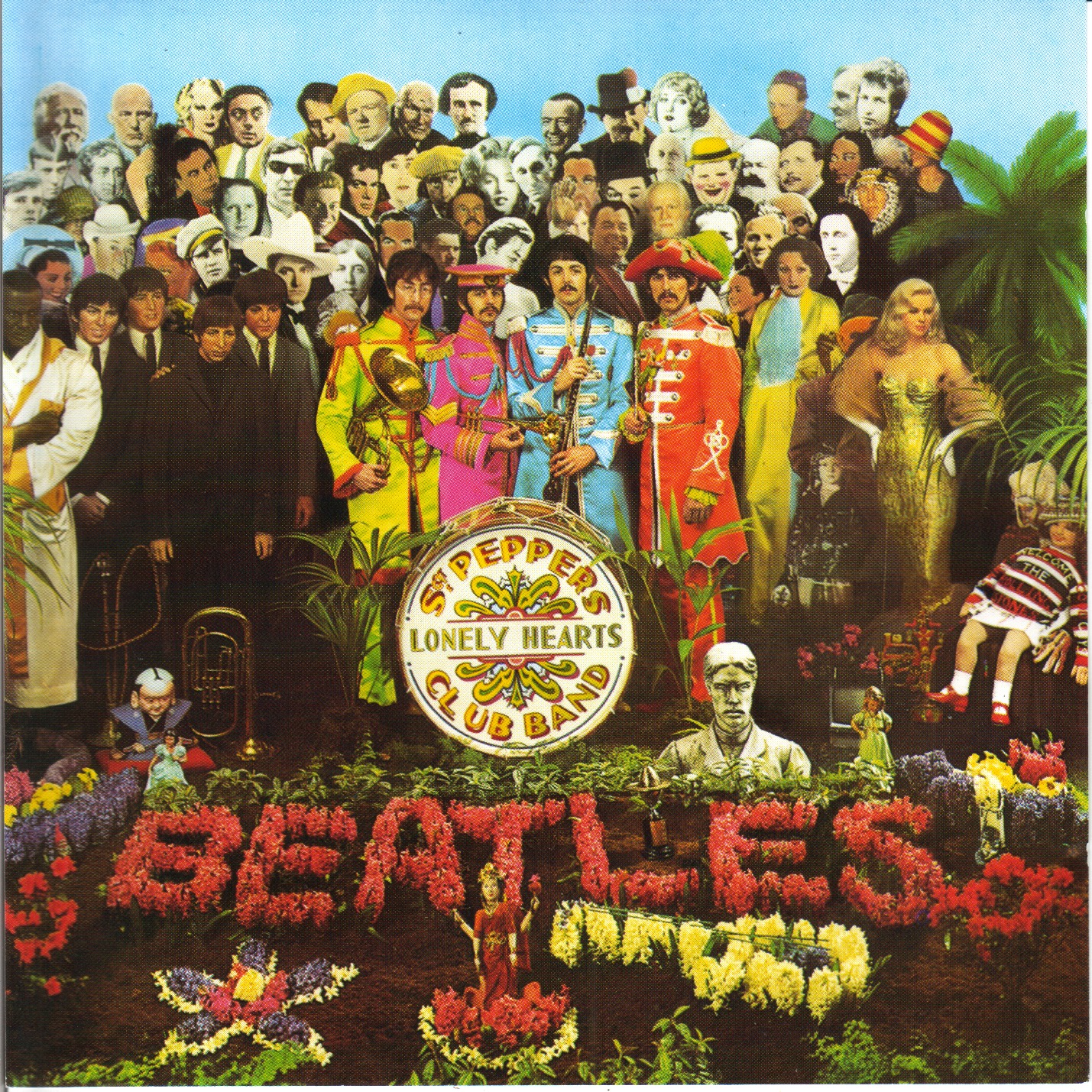
The John Lennon and the Beatles really were on a long search for meaning and fulfillment in their lives just like King Solomon did in the Book of Ecclesiastes. Solomon looked into learning (1:12-18, 2:12-17), laughter, ladies, luxuries, and liquor (2:1-2, 8, 10, 11), and labor (2:4-6, 18-20). He fount that without God in the picture all […]
______________ George Harrison Swears & Insults Paul and Yoko Lucy in the Sky with Diamonds- The Beatles The Beatles: I have dedicated several posts to this series on the Beatles and I don’t know when this series will end because Francis Schaeffer spent a lot of time listening to the Beatles and talking […]
The Beatles in a press conference after their Return from the USA Uploaded on Nov 29, 2010 The Beatles in a press conference after their Return from the USA. The Beatles: I have dedicated several posts to this series on the Beatles and I don’t know when this series will end because Francis […]
__________________ Beatles 1966 Last interview I have dedicated several posts to this series on the Beatles and I don’t know when this series will end because Francis Schaeffer spent a lot of time listening to the Beatles and talking and writing about them and their impact on the culture of the 1960’s. In this […]
_______________ The Beatles documentary || A Long and Winding Road || Episode 5 (This video discusses Stg. Pepper’s creation I have dedicated several posts to this series on the Beatles and I don’t know when this series will end because Francis Schaeffer spent a lot of time listening to the Beatles and talking and writing about […]
_______________ Francis Schaeffer pictured below: _____________________ I have included the 27 minute episode THE AGE OF NONREASON by Francis Schaeffer. In that video Schaeffer noted, ” Sergeant Pepper’s Lonely Hearts Club Band…for a time it became the rallying cry for young people throughout the world. It expressed the essence of their lives, thoughts and their feelings.” How Should […]
Crimes and Misdemeanors: A Discussion: Part 1 ___________________________________ Today I will answer the simple question: IS IT POSSIBLE TO BE AN OPTIMISTIC SECULAR HUMANIST THAT DOES NOT BELIEVE IN GOD OR AN AFTERLIFE? This question has been around for a long time and you can go back to the 19th century and read this same […]
____________________________________ Francis Schaeffer pictured below: __________ Francis Schaeffer has written extensively on art and culture spanning the last 2000years and here are some posts I have done on this subject before : Francis Schaeffer’s “How should we then live?” Video and outline of episode 10 “Final Choices” , episode 9 “The Age of Personal Peace and Affluence”, episode 8 […]
Love and Death [Woody Allen] – What if there is no God? [PL] ___________ _______________ How Should We then Live Episode 7 small (Age of Nonreason) #02 How Should We Then Live? (Promo Clip) Dr. Francis Schaeffer 10 Worldview and Truth Two Minute Warning: How Then Should We Live?: Francis Schaeffer at 100 Francis Schaeffer […]
___________________________________ Francis Schaeffer pictured below: ____________________________ Francis Schaeffer “BASIS FOR HUMAN DIGNITY” Whatever…HTTHR Dr. Francis schaeffer – The flow of Materialism(from Part 4 of Whatever happened to human race?) Dr. Francis Schaeffer – The Biblical flow of Truth & History (intro) Francis Schaeffer – The Biblical Flow of History & Truth (1) Dr. Francis Schaeffer […]
The Bible and Archaeology – Is the Bible from God? (Kyle Butt 42 min)
Why Can’t Morals Be Grounded In Society?
Published on Aug 31, 2012
Dr William Lane Craig was invited by the School of Oriental and African Studies (SOAS) Christian Union, London to give a lecture titled “Can we be good without God?” In this video Dr Craig answers a question about the objectivity of morality. Should we consider morals to be objective? If so, why can’t morals be “abiding” and objectively grounded in society?
The lecture formed part of the Reasonable Faith Tour in October 2011. The Tour was sponsored by Damaris Trust, UCCF and Premier Christian Radio.
(Samuel Beckett example: Life is meaningless, live in tension with reality)
(Modern man sees no hope for the future and has deluded himself by appealing to nonreason to stay sane. Look at the example of the lady tied to the railroad tracks in this above video as a example.)
Francis and Edith Schaeffer pictured below:
HOW SHOULD WE THEN LIVE? was both a book and a film series.
I have discussed many subjects with my liberal friends over at the Ark Times Blog in the past and I have taken them on now on the subject of the absurdity of life without God in the picture. Most of my responses included quotes from William Lane Craig’s book THE ABSURDITY OF LIFE WITHOUT GOD. Here is the result of one of those encounters from June of 2013:
I wrote:
Steven E you are right that atheists can live a moral life. I personally know of many atheists who are very fine moral people who have a wonderful marriage and a great family life. I could go on and name a bunch of names. However, I will mention my good friend John George who passed away a couple of years ago after a battle with cancer.
He wrote a book published by Prometheus which was started by Paul Kurtz. Kurtz was the originator of the Humanist Manifesto II. I have corresponded in the past with him and I have found him to be a very kind man. I highly recommend his debate concerning humanism on the John Ankerberg Show.
I do not question the fact that many atheists live moral lives. However, this idea that humanists and atheists can come up with a logical moral system that rules out murder is not realistic. Rationally they can not do it. Without God in the picture then you only have this world of time and chance. If evolution teaches us the survival of the fittest then why would “might makes right” ever be wrong?
I am not going to repeat what I have said in the past about the movie “Crimes and Misdemeanors” but atheists can not come up with a rational reason not to murder in the same circumstances that Woody Allen presents in that movie. Here is the link:
If I am right, NO ATHEIST OR AGNOSTIC REALLY LIVES CONSISTENTLY WITH HIS WORLDVIEW. IN SOME WAY HE AFFIRMS MEANING, VALUE, OR PURPOSE WITHOUT AN ADEQUATE BASIS. It is our job to discover those areas and lovingly show him where those beliefs are groundless. We need not attack his values themselves—for they are probably largely correct—but we may agree with him concerning them, and then point out only that he lacks any foundation for those values, whereas the Christian has a foundation. Thus, we need not make him defensive by a frontal attack on his personal values; rather we offer him a foundation for the values he already possesses.
I have found the appeal to moral values to be an especially powerful apologetic to university students. Although students may give lip service to relativism, my experience is that 95 percent can be very quickly convinced that objective moral values do exist after all. All you have to do is produce a few illustrations and let them decide for themselves. Ask what they think of the Hindu practice of suttee (burning widows alive on the funeral pyres of their husbands) or the ancient Chinese custom of crippling women for life by tightly binding their feet from childhood to resemble lotus-blossoms. Point out that without God to provide a transcultural basis for moral values, we’re left with socio-cultural relativism, so that such practices are morally unobjectionable—which scarcely anyone can sincerely accept….We believe certain acts to be genuinely wrong or right. Therefore, one ought to respond to the unbeliever on this score by saying, “You’re exactly right: if God does not exist, then values are merely social conventions. But the point I’m trying to make is that it’s impossible to live consistently and happily with such a worldview.” Push him on the Holocaust or some issue of popular concern like ethnic cleansing, apartheid, or child abuse. Bring it home to him personally, and if he’s honest and you are not threatening, I think he will admit that he does hold to some absolutes. Thus, it’s very important to analyze exactly what the unbeliever’s objection actually attacks before we answer.
I believe that this mode of apologetics can be very effective in helping to bring people to Christ because it does not concern neutral matters but cuts to the heart of the unbeliever’s own existential situation. I remember once, when I was delivering a series of talks at the University of Birmingham in England, that the audience the first night was very hostile and aggressive. The second night I spoke on the absurdity of life without God. This time the largely same audience was utterly subdued: the lions had turned to lambs, and now their questions were no longer attacking but sincere and searching. The remarkable transformation was due to the fact that the message had penetrated their intellectual facade and struck at the core of their existence. I would encourage you to employ this material in evangelistic dorm meetings and fraternity/sorority meetings, where you can compel people to really think about the desperate human predicament in which we all find ourselves.
E P I S O D E 1 0 Dr. Francis Schaeffer – Episode X – Final Choices 27 min FINAL CHOICES I. Authoritarianism the Only Humanistic Social Option One man or an elite giving authoritative arbitrary absolutes. A. Society is sole absolute in absence of other absolutes. B. But society has to be […]
E P I S O D E 9 Dr. Francis Schaeffer – Episode IX – The Age of Personal Peace and Affluence 27 min T h e Age of Personal Peace and Afflunce I. By the Early 1960s People Were Bombarded From Every Side by Modern Man’s Humanistic Thought II. Modern Form of Humanistic Thought Leads […]
E P I S O D E 8 Dr. Francis Schaeffer – Episode VIII – The Age of Fragmentation 27 min I saw this film series in 1979 and it had a major impact on me. T h e Age of FRAGMENTATION I. Art As a Vehicle Of Modern Thought A. Impressionism (Monet, Renoir, Pissarro, Sisley, […]
E P I S O D E 7 Dr. Francis Schaeffer – Episode VII – The Age of Non Reason I am thrilled to get this film series with you. I saw it first in 1979 and it had such a big impact on me. Today’s episode is where we see modern humanist man act […]
E P I S O D E 6 How Should We Then Live 6#1 Uploaded by NoMirrorHDDHrorriMoN on Oct 3, 2011 How Should We Then Live? Episode 6 of 12 ________ I am sharing with you a film series that I saw in 1979. In this film Francis Schaeffer asserted that was a shift in […]
E P I S O D E 5 How Should We Then Live? Episode 5: The Revolutionary Age I was impacted by this film series by Francis Schaeffer back in the 1970′s and I wanted to share it with you. Francis Schaeffer noted, “Reformation Did Not Bring Perfection. But gradually on basis of biblical teaching there […]
Dr. Francis Schaeffer – Episode IV – The Reformation 27 min I was impacted by this film series by Francis Schaeffer back in the 1970′s and I wanted to share it with you. Schaeffer makes three key points concerning the Reformation: “1. Erasmian Christian humanism rejected by Farel. 2. Bible gives needed answers not only as to […]
Francis Schaeffer’s “How should we then live?” Video and outline of episode 3 “The Renaissance” Francis Schaeffer: “How Should We Then Live?” (Episode 3) THE RENAISSANCE I was impacted by this film series by Francis Schaeffer back in the 1970′s and I wanted to share it with you. Schaeffer really shows why we have so […]
Francis Schaeffer: “How Should We Then Live?” (Episode 2) THE MIDDLE AGES I was impacted by this film series by Francis Schaeffer back in the 1970′s and I wanted to share it with you. Schaeffer points out that during this time period unfortunately we have the “Church’s deviation from early church’s teaching in regard […]
Francis Schaeffer: “How Should We Then Live?” (Episode 1) THE ROMAN AGE Today I am starting a series that really had a big impact on my life back in the 1970′s when I first saw it. There are ten parts and today is the first. Francis Schaeffer takes a look at Rome and why […]
Francis Schaeffer: “Whatever Happened to the Human Race” (Episode 5) TRUTH AND HISTORY Published on Oct 7, 2012 by AdamMetropolis This crucial series is narrated by the late Dr. Francis Schaeffer and former Surgeon General Dr. C. Everett Koop. Today, choices are being made that undermine human rights at their most basic level. Practices once […]
The opening song at the beginning of this episode is very insightful. Francis Schaeffer: “Whatever Happened to the Human Race” (Episode 4) THE BASIS FOR HUMAN DIGNITY Published on Oct 7, 2012 by AdamMetropolis This crucial series is narrated by the late Dr. Francis Schaeffer and former Surgeon General Dr. C. Everett Koop. Today, choices […]
Francis Schaeffer: “Whatever Happened to the Human Race” (Episode 3) DEATH BY SOMEONE’S CHOICE Published on Oct 6, 2012 by AdamMetropolis This crucial series is narrated by the late Dr. Francis Schaeffer and former Surgeon General Dr. C. Everett Koop. Today, choices are being made that undermine human rights at their most basic level. Practices […]
Francis Schaeffer: “Whatever Happened to the Human Race?” (Episode 2) SLAUGHTER OF THE INNOCENTS Published on Oct 6, 2012 by AdamMetropolis This crucial series is narrated by the late Dr. Francis Schaeffer and former Surgeon General Dr. C. Everett Koop. Today, choices are being made that undermine human rights at their most basic level. Practices […]
It is not possible to know where the pro-life evangelicals are coming from unless you look at the work of the person who inspired them the most. That person was Francis Schaeffer. I do care about economic issues but the pro-life issue is the most important to me. Several years ago Adrian Rogers (past president of […]
Ecclesiastes 2-3 Published on Sep 19, 2012 Calvary Chapel Spring Valley | Sunday Evening | September 16, 2012 | Derek Neider _____________________________ I have written on the Book of Ecclesiastes and the subject of the meaning of our lives on several occasions on this blog. In this series on Ecclesiastes I hope to show how secular […]
Ecclesiastes 1 Published on Sep 4, 2012 Calvary Chapel Spring Valley | Sunday Evening | September 2, 2012 | Pastor Derek Neider _____________________ I have written on the Book of Ecclesiastes and the subject of the meaning of our lives on several occasions on this blog. In this series on Ecclesiastes I hope to show how […]
Ecclesiastes 8-10 | Still Searching After All These Years Published on Oct 9, 2012 Calvary Chapel Spring Valley | Sunday Evening | October 7, 2012 | Pastor Derek Neider _______________________ Ecclesiastes 11-12 | Solomon Finds His Way Published on Oct 30, 2012 Calvary Chapel Spring Valley | Sunday Evening | October 28, 2012 | Pastor Derek Neider […]
Ecclesiastes 6-8 | Solomon Turns Over a New Leaf Published on Oct 2, 2012 Calvary Chapel Spring Valley | Sunday Evening | September 30, 2012 | Pastor Derek Neider _____________________ I have written on the Book of Ecclesiastes and the subject of the meaning of our lives on several occasions on this blog. In this series […]
Ecclesiastes 4-6 | Solomon’s Dissatisfaction Published on Sep 24, 2012 Calvary Chapel Spring Valley | Sunday Evening | September 23, 2012 | Pastor Derek Neider ___________________ I have written on the Book of Ecclesiastes and the subject of the meaning of our lives on several occasions on this blog. In this series on Ecclesiastes I hope […]
Overview of the Book of Ecclesiastes Overview of the Book of EcclesiastesAuthor: Solomon or an unknown sage in the royal courtPurpose: To demonstrate that life viewed merely from a realistic human perspective must result in pessimism, and to offer hope through humble obedience and faithfulness to God until the final judgment.Date: 930-586 B.C. Ecclesiastes 2-3 Published on Sep 19, […]
Ecclesiastes 1 Published on Sep 4, 2012 Calvary Chapel Spring Valley | Sunday Evening | September 2, 2012 | Pastor Derek Neider _____________________ I have written on the Book of Ecclesiastes and the subject of the meaning of our lives on several occasions on this blog. In this series on Ecclesiastes I hope to show how […]
Ecclesiastes 8-10 | Still Searching After All These Years Published on Oct 9, 2012 Calvary Chapel Spring Valley | Sunday Evening | October 7, 2012 | Pastor Derek Neider _______________________ Ecclesiastes 11-12 | Solomon Finds His Way Published on Oct 30, 2012 Calvary Chapel Spring Valley | Sunday Evening | October 28, 2012 | Pastor Derek Neider […]
When Brian “Head” Welch crawled out of Korn in 2005 he was addicted to drugs and an alcoholic. He finally pulled himself together and in 2008 released Save Me From Myself, a solo album full of dark synths, epic-length songs and tunes all sung by Head himself. Now three years later Welch has returned to the studio to record his follow-up album [maybe an EP]. “Paralyzed” is the first single from the upcoming record and it is a brutal vision punctuated by the staccato guitars Head made famous in Korn. The vocals rise to nasty growls and descend into melodic passages revealing how capable the ex-Kornman is as a vocalist. It has not been an easy road. Sober now for many years, Head looks back at his first solo album, his time with Korn and reflects on those moments with a clear head. He was unabashedly open in this conversation and didn’t try to cover up the things he’d done with smoke and mirrors. As further testament to his newfound sense of professionalism, he called precisely at 1:30 p.m. for our interview. The phone rang, I picked it up and someone on the other end said, “Hi, this is Ed.” I said, “Oh, man, I’m sorry I’m waiting for a call from Brian Welch. Could you please hang up?” There was a laugh on the other end. “This is Head.” The connection wasn’t great and I thought the voice had uttered, “Ed.” He had a laugh and we jumped into the dialog. UG: You left Korn in 2005 and didn’t record Save Me From Myself, your first solo album until 2008. What were you doing for those three years?Brian Welch: First of all I wanted to focus on my life and what I was doing and Who am I now? I was a single father so I was taking care of that. I was working on music off and on and I also wrote a book in 2006 and the whole year I spent writing my autobiography [Save Me From Myself]. So that kept me busy and just doin’ the everyday dad stuff, the school, and that stuff. When did you seriously start thinking about putting together your first solo album? I was thinkin’ about it since ’05 since right when I left but it wasn’t nothin’ in a rush. It just kinda took its time and then it finally was done. Like I was happy with it and it was good enough to release for ’08 and that’s just kinda when it all came together. Were any of the songs that ended up on Save Me From Myself stuff you had written for Korn? I wrote it after I left the band and it was more like an experimental album and there a lot of songs were about my life change and everything. Just being fed up with the party and stuff like that; it was for that time period. In what ways was the album experimental? It was my first one so I was experimenting with like singing and all kinds of stuff. There’s one nine-minute song on the album and a lot of five- and six-minute songs. There was just like stuff we [Korn] would never do like before. I experimented with string sounds a lot of keyboard synth sounds and we never did that. So it was just like one of those albums I just wanted to do new stuff. You brought in Josh Freese on drums and Tony Levin on basswere you looking for something special in a rhythm section? Yeah, totally. My manager at the time knew those people and stuff and so it just kind of clicked and it just happened. And it was fun to see these legends in there tearin’ it up on my stuff. It was good times.
“With the Korn guys we were all family but we were dysfunctional and we were drunk the whole time.“
You used a rhythm guitarist on the albumArchie J. Muise, Jr.but did you play most of the guitars on Save Me From Myself? Yeah, totally. I did a lot of em but Archie came in and he was nailin’ some stuff better than me on some of the rhythms so I was like, You need to record some stuff. But I did most of it. In Korn, you and Munky did all the guitars together. How different was it being the sole guitar player in the band? Yeah, it was different. It was more on my plate that I had to come up with the stuff like that. Sure, with the Korn guys we were all family but we were dysfunctional and we were drunk the whole time. So it was good to get away from the craziness but I sure missed havin’ someone to collaborate with like that but it was cool. It was new and exciting so I just went for it. You talk about Korn being drunk pretty much all the time. How was the band able to function in the studio if everyone was drinking? We wouldn’t get wasted while we were recording. We’d wake up, most likely have a hangover and stuff like that, and just kinda wake up, eat and just start recording. And not really start drinkin’ til after; we would keep it together. Certainly one of the experimental aspects of Save Me From Myself was you being the lead singer. Were you influenced by watching Jonathan Davis record all those years? Yeah, totally. Some of the stuff where I’m singin’ now, I’m not the best singer so you know how Jonathan sounds sick sometimes when he sings? He sounds disturbed. And so, yeah, I get a lot of that dark sound like that. It just kinda goes with the style that we do. I learned a lot watchin’ him and a lot of the other bands like the Deftones and Tool and stuff like that. Had you done much singing in Korn? I did some screams and I did a couple backups live but I didn’t do a lot on the records except for the early records like the first two. You knew you wanted to be the singer on your album? Yeah, the reason being I wanted to speak about stuff I went through and I didn’t want another person to do that. It would be weird so yeah, I wanted to try it. I always admired vocalists and it was a cool thing for me to try and do. It was awesome. Flush was the first single from Save Me From Myself. Was that song chosen specifically to sort of introduce Head musically post-Korn? Yeah, and some of the other songs were more spiritual sounding you know. I wanted to release one that was more like just rockin’ and just talkin’ about getting sick of being sick. Steven Tyler said once, I’m sick and tired of being sick and tired. That’s kinda what the song’s about and so I thought it would be a good choice to come out with. The video was pretty heavy. Were you concerned about alienating some of your fans? I wanted to do somethin’ visual; I wanted to do a video but I didn’t have my band picked out yet so it was just me. We just did what we could with it. It was pretty heavy but that’s the life. We did interviews with some ex-drug addicts and strippers and all these messed up lives so we just built the video around that. We got some actresses and it was a little heavy but I think it was meant to be for the time. Bob Clearmountain mixed Save Me From Myself. How did you come to work with him? Again that was a manager call. He’s very like well known and everything but I’d never heard of him. My manager was a fan of him and I heard of the artists he’d worked with [Bruce Springsteen; The Rolling Stones; Bon Jovi] and I said, Heck, yeah, let’s go get him. He only mixed four songs and then a friend of mine did the others. How did you feel about your guitar sounds on Save Me From Myself? They’re good and I liked em. I think I’m getting better sounds now on my new stuff. I like the sound of the new song Paralyzed that I put out. The Save Me From Myself record was cool and I had a lot of cool pedal effects and stuff that reminded me of some of the Korn stuff we used to do. But as far as rhythms and stuff I really like the tones we’re getting right now. Washed By Blood was the nine-minute song you mentioned earlier. That had synth strings and big walls of guitars and was a really different-sounding track. Yeah, totally. I just loved the melody and the strings and stuff and that’s how I was feeling back then. I was feeling like peace and I was feelin’ really good about the future. So that’s what came out and it was really good for the time. Is there a fine line between writing songs about your own life and having a lyric come across as too preachy or artificial? Yeah, totally and the new stuff is more about life. Not totally but you’ve got to live and learn. You know what I mean? Everybody warned me too and I was, I don’t care. I’m doing what I want. But I had to do everything in my time. You talked about getting better guitar sounds on the upcoming recorddid you also want to go a bit heavier than Save Me From Myself? Yeah, the producer Jasen Rauch wanted to pull that out of me. That song just came so quickly and he came to me with the idea and then we both worked on it. I’m really stoked on it; it’s really a lot of energy comes when we play live. I’ve been playing it live for a month and I’m really stoked on it. How did you come to work with Jasen Rauch? I signed on with Union Management, the Union Entertainment Group actually, and he’s one of their clients and I liked the band, Red. I liked their stuff so it was just a natural progress that we hooked up. Once we did it it just clicked and we had two songs in three days that I’m really just stoked on. So I’m hitting the studio and looking to finish an EP or an album by November 7th. Who are the musicians on the album? The guys in my band are Michael Valentine playing bass; Dan Johnson on the drums and J.R. is playing guitar too.
“I just want the best-sounding product so it’s all working better and it’s gonna be the best thing.“
Is this record taking a more band approach than the Save Me From Myself record where you tended to do a lot of it by yourself? Uh, yeah, we’ll track it all separately but it’s all different now because my solo album was all me and that’s how I wanted it to sound and I did that and it was cool and I’m glad. But this time I’m givin’ it to the producer and allowing him to produce me and write with other people. I just want the best-sounding product so it’s all working better and it’s gonna be the best thing. The writing has been going smoothly? Yeah, we’ll have a few done before this year is done; we’ll have like six or seven. Would you mind commenting on some of the Korn stuff? Yeah, no problem. The first Korn record was pretty important in the development of that type of music. When you were making Korn, did you have any idea of what you were creating? A little bit but there was no way no one could predict the impact it had. We knew that it was special and there was a couple people that came to the studio like this guy named McG who is a movie producer now who did Charlie’s Angels. He hadn’t done nothin’ when we met him and he was just a friend of one of the guys that we hooked up with through the record. He came and listened to it while we were recording and he was like, Dude, this stuff is gonna be huge and we’re like, What? You’re crazy. He said, It doesn’t sound like nothin’ out there and sure enough he was right. He did our videos and later on he blew up too and he’s doin’ movies now. Yeah, we knew we had something unique but we didn’t know it was gonna impact that hard. What was it like playing guitar with Munky on that first record? That was always when we were jammin’ in the studio. That was always live and we’d write the songs live. Nowadays it’s differentyou write it on computer and do that but back then it was just get in a room with a bunch of friends, get some beers and jam out. So that was how we did it and it was really fun back then. The first time an audience really heard Korn was with Blind, the first single. Was that a good representation of who the band were at that time? I think it’s really cool; it’s so different. Even now I play Blind in my set. I love some of the stuff we did and I play two or three songs in my set of Korn’s just because I like it and I’m proud of it. So that was a really cool song because it had a fat riff and the verses were really melodic and everything and a chorus that grooved. So I think it was a good introduction song to Korn fans. When you look at the Greatest Hits, Vol. 1 album, how does that collection of songs stand up for you today? Yeah, it’s a trip and it’s humbling. Just really stoked because there’s a lot of musicians out there that are better than us that are just rippers and are just so good. And for us to make it so successful it’s almost a crime. But we did have a unique sound and stuff like that but it’s just funny how we were just these dudes partying, having fun and making music and we just made it so big. I’m pretty thankful to be part of it. What do you remember about recording A.D.I.D.A.S.? Actually it’s funny cause I called in sick that day and they all wrote it without me. There’s like that one and Y’All Want A Single off a later record [Untouchables] and two others off later records that I wasn’t a part of cause I was sick and I didn’t come in. It was a drug sicknessI did drugs the night before and stuff like that so I lied to them at the time cause I didn’t want to feel like a loser [laughs]. I wasn’t a part of that song but I remember they wrote it and A.D.I.D.A.S. stands for all day I dream about sex and they were all reminiscing about their childhood and how they used to say that in school. So everybody was excited about that and I liked it and it was a really cool melody and the guitar part was pretty catchy. The nrr nrr nrr nrr nrr, that thing was catchy. Look In the Mirror album was your last record with Korn. As your final statement with them what do you think about the album? I was on drugs that whole recordI was on crystal methamphetamine. You asked earlier about the studio and I was really havin’ hard time in the studio then. I think that it shows. I think it’s lacking the production and I think it’s not good at all. It’s one of our least-selling records. There are a couple of okay songs but I just really don’t like the drum sounds. It wasn’t horrible or nothin’ but it’s just one of my least favorites and it was in my darkest times so I don’t think it held up as much. I wrote some stuff but I just wasn’t in my primeI was definitely lacking then. So eventually the drugs really did impact on the band. Yeah, totally. In the beginning it didn’t with the alcohol but the drugs took us all down later on in one way or another. It’s strange that bands don’t get into drugs until after they’ve become successful. You’d think that when a band is fighting to become successful is when the drugs and drinking would happen. It’s just a party and everyone wants to party with the band after the show. And everybody wants to go hang out with the girls and stuff and it’s a cycle that most bands go through. It’s pretty jacked up.
“There was no way no one could predict the impact the first Korn record had.“
If Korn hadn’t been pulled apart by drugs and you stayed with them, what kind of music do you think you’d be making now? I think everything happened the way it was meant to be so I don’t really think about that. I’m glad it happened actually because I got humbled by it and it taught me about what life is really aboutabout drugs and mistakes. Do you talk to any of the guys in Korn? Yeah, totally. Jonathan and Fieldy came and visited us at a solo show about a month ago but I haven’t seen the guitar player, Munky, though. I haven’t seen him or talked to him since ’05. I think there’s some bitterness on his part about that still but we got nothin’ but good vibes towards each other and we’re just doing our own thing. Did you hear any of the last Korn album? Yeah, there’s a couple songs I liked. They’re still doin’ it and I’m proud of em. I interviewed Munky a while ago and he really had nothing but positive things to say about you. Oh, that’s cool. He’s up and down you know. I went and hung out with Jonathan and stuff like that and I just heard about some comments he made because they were talking about us getting back together and stuff. I don’t wanna do thatI’m doin’ my solo stuff and I’m happy doin’ the smaller things that I’m doing. And I have no desire but I heard the comments saying that, I don’t wanna talk to him. We made four records without him. So he’s up and down a little but I think overall we’ve got nothin’ but love for each other. His bitterness about you leaving was probably because he was really hurt when you left. I totally agree with you. You’re finishing up your tour now? Yeah, we have one more show with the band, Red, and then we’re off into the studio for the next three months. I’ll be glad to get home. I’m so stokedI’ve got some good ideas and I’m just really excited to get some new stuff done. Dude, I’m like done playing these songs liveI need new material. I mean it’s ’08 and I’m tourin’ on these songs. I’ve got one single out, Paralyzed a month ago so I’m at my wits end. But I’ve been building up the fanbase and stuff like that so it’s a good time to get some new music. Interview by Steven Rosen Ultimate-Guitar.Com 2011
Jim Morrison’s sad drug death was followed by Pamela Courson’s sad story!!! pamela courson/ jim morrison interview Interview with Jim Morrison’s father and sister Uploaded on Aug 9, 2010 This interview is from “When You’re Strange” DVD bonus material. I do not own this video and own no rights to it! Pamela Courson Uploaded […]
__________ NICO – I’m Waiting For The Man – (1982, Warehouse, Preston, UK) One of the top 10 songs from The Velvet Underground and Nico is the song “I’m Waiting for the Man I’m Waiting for the Man From Wikipedia, the free encyclopedia Jump to: navigation, search “I’m Waiting for the Man” Song by […]
The life of Lou Reed (includes videos from 1960′s and 1970′s) ____________ Rock & Roll – Velvet Underground The Velvet Underground – Venus in Furs – Live 1) Lou Reed – Sweet Jane – live in Paris, 1974 Velvet Underground-”Sunday Morning” from “Velvet Underground and Nico” LP Lou Reed From Wikipedia, the free encyclopedia Jump […]
Jim Morrison’s relationship with Nico Nico Icon documentary part 1. Nico Icon documentary part 2. ______________ Jim Morrison at Andy Warhol’s Party.wmv (with Nico) Uploaded on Apr 26, 2010 From the Oliver Stone movie. The Doors. _______________________ nico discusses jim morrison. Uploaded on Jan 2, 2008 nico discusses jim, and how he impacted her […]
I really enjoyed the movie “Savannah Smiles” last night and afterwards I looked up what happened to Bridgette Andersen and where she is today. IMDB notes: Bridgette Andersen was born on July 11, 1975 to Frank Glass and Teresa Andersen in Inglewood, California and grew up in Malibu. She always considered it good luck to […]
Today I heard Tim Todd’s testimony about drugs. Related posts: Whitney Houston dead at 48, long history of drugs and alcohol February 11, 2012 – 8:31 pm Sad news about Whitney Houston’s death tonight. I have included some earlier posts about drugs and alcohol and rock stars. LOS ANGELES (AP) — Whitney Houston, who ruled as […]
I have written about the “27 Club” several times in the past and I have got a lot of hits in the last 30 days on these blog posts below that deal with Rock and Rollers and drugs. Keith Richards’ wife is a bible believing christian Pete de Freitas of Echo and the Bunnymen is a […]
I’m In A Rock ‘N’ Roll Band – The Singer (Part 1) Jim Morrison – books on tape – w subtitles Light My Fire – The Doors The Rolling Stones – Satisfaction ________________________ The Rolling Stones – The Breakthrough The Rolling Stones – Brian Jones The Rolling Stones- Paint it Black Nirvana – Smells Like […]
Amy Winehouse died last week and she joined the “27 club.” Pete de Freitas of Echo and the Bunnymen is also a member of the “27 Club.” This is group of rockers that have died at age 27. A tribute to the amazing drummer of one of our biggest influences, Echo & The Bunnymen. We […]
cc ‘Janis Joplin’ 2/5 from True Hollywood Story (Janis was having affair with Pigpen) Jerry Garcia (guitar, vocals), Ron “Pigpen” McKernan (vocals, harmonica), Bob Weir (guitar, vocals), Phil Lesh (bass), Mickey Hart (drums), Bill Kreutzman (drums). Grateful Dead “Don’t Ease Me In” Live @ Canadian National Exhibition Hall Toronto, CA June 27th, 1970 Grateful Dead […]
Amy Winehouse died last week and joined the “27 club” which is a group of rockers that died at age 27. Gary Thain also joined that same group long ago and I wanted to look at his life today. Uriah Heep – Wizard bb By Sean Nelson, Special to MSN Music , July 23, 2011 […]
Recently Amy Winehouse joined the “27 Club” when she died of a drug overdose. The “27 Club” is a group of rockers that died at age 27. Unfortunately Jimi Hendrix died at age 27 in 1970 and Janis Joplin did the same three weeks later. Today we are going to look at her life and […]
JIMI HENDRIX : FINAL INTERVIEW . The other day when Amy Winehouse died she joined the “27 Club” which includes other famous rockers who died at age 27. Most of them died because of drugs. Unfortunately Jimi Hendrix joined the club for the same reason. Something special for all music and Beat Club-Lovers on YouTube: […]
Amy Winehouse died at age 27 and unfornately joined the “27 club” which is made of famous rockers that died at age 27. Pete Ham was a member of Bad Finger which was one of my favorite groups that I followed. “Come and get it” was my favorite song of theirs. ___________________________________ Badfinger perform a […]
Brian’s Blues, Brian Jones on guitar in the early stones years. unreleased track Brian Jones died at age 27 just like Amy Winehouse did. I remember like yesterday when I first heard the song “I can’t get no satisfaction” by the Rolling Stones. I immediately thought about Solomon’s search for satisfaction in the Book of […]
The Rise And Rise Of Kurt Cobain part 1/3 Amy Winehouse joined the “Club 27 the other day with her early death. I am going through the others one by one. Today is Kurt Cobain. 7. Kurt Cobain very rarely does an artist come along and not just upset the “apple cart” but drops […]
Pictures and Videos of Edie Sedgwick and the story of her losing battle against drugs and alcohol Part 2 Drugs and alcohol have taken the life of many people and I have posted many times about their unfortunate deaths. Whitney Houston, Amy Winehouse, Gary Thain, Janis Joplin, Jimi Hendrix, Brian Jones, Kurt Cobain, and Jim […]
Pictures and Videos of Edie Sedgwick and the story of her losing battle against drugs and alcohol Part 1 Factory Girl – The Real Edie Uploaded on Aug 30, 2011 Friends and family of Edie Sedgwick discuss what the factory girl was really like, and the battles and relationships she went through _____________ Edie Sedgwick Excerpt […]
Around 4 years ago I was in Philadelphia and the local radio station had a talk show that was blasting Alice Walton for coming into town and buying the 1876 Thomas Eakins’ masterpiece “The Gross Clinic” which was hanging at the Jefferson Medical College. However, the people of Philadelphia were given 45 days to […]
I truly believe that many of the problems we have today in the USA are due to the advancement of humanism in the last few decades in our society. Ronald Reagan appointed the evangelical Dr. C. Everett Koop to the position of Surgeon General in his administration. He partnered with Dr. Francis Schaeffer in making the video below. It is very valuable information for Christians to have. Actually I have included a video below that includes comments from him on this subject.
Francis Schaeffer “BASIS FOR HUMAN DIGNITY” Whatever…HTTHR
Dr. Francis Schaeffer: Whatever Happened to the Human Race Episode 1 ABORTION
Dr. Francis schaeffer – The flow of Materialism(from Part 4 of Whatever happened to human race?)
Dr. Francis Schaeffer – The Biblical flow of Truth & History (intro)
Francis Schaeffer – The Biblical Flow of History & Truth (1)
Dr. Francis Schaeffer – The Biblical Flow of Truth & History (part 2)
Olphart you are right about casting out people like the Westboro Baptists. THOSE PEOPLE ARE JUST FILLED WITH HATE!!!!!
Erik Kolliser wrote:
As a former server in several restaurants, I had several conversations with co-workers who had abortions, many who would now admit they were wrong. As I shared the gospel with them and loved on them, they just couldn’t get past what other Christians had said and how they made them feel when going through with those abortions. In fact, it was only a month ago where I attended a pro-life breakfast where a great Christian organization that rallies churches in helping stop abortions from being done in their own community and a similar concern for the “worst of sinners” came up. After hearing the compelling call for action in churches to stand outside of the abortion clinic and try to stop women from walking in, and if possible, share the Gospel with them, a pastor in the room mentioned how he believed there was a fine line in telling these ladies truth about their decisions but also doing it in a way that will turn them off to anything Jesus has to say outside of conception and murder. He then told a story from his own congregation where a woman that’s been visiting his church for years and WON’T GIVE HER LIFE TO CHRIST BECAUSE OF HOW OTHER PRO-LIFE CHRISTIANS TREATED HER in the previous city that she lived in when they found out about her abortion. We all know that could be an excuse for this woman but I’m sure we’ve all seen our fair share of pro-life Christians who allowed their emotions to get the best of them when trying to fight for justice and end up looking unjust because of how they represented God’s grace and compassion in their words and actions.
I believe we can easily lose sight of God’s compassion for sinners and His grace in the gospel when we sometimes fight against an abortion culture. We brought awareness to the Kermit Gosnell trial and God’s desire for justice but have we magnified his heart for the worst of sinners as well? Right now, pro-lifers have the chance of a lifetime to show the atrocity of abortion. But will we error so far to the side of telling people “I told you it was murder” that we’ll forget to say that we love those who murder because Jesus loved them first.
1 Peter 4:7-8 says,
“7 The end of all things is at hand; therefore be self-controlled and sober-minded for the sake of your prayers. 8 Above all, keep loving one another earnestly, since love covers a multitude of sins.”
But we can’t love people enough for their sins to be covered because we’re so focused on exposing these sins.
Melissa was formerly a College Outreach Speaker with Feminists for Life and former Patron of Real Choices Australia. She is the Founder and Director of For Olivia’s Sake, an organization which seeks to raise awareness of the intergenerational impact of abortion on men, women, children, families, and communities. The birth of Olivia, her first child, in 2008,who never would have existed if Melissa’s birthmother’s abortion would have succeeded in ending her life, prompted Melissa to create this organization that would positively raise awareness of the ripple effect of abortion across generations.
In 2012, Melissa founded The Abortion Survivors Network, www.theabortionsurvivors.com, after recognizing the number of abortion survivors and how most felt alone in this role, and after recognizing the need for the public to be educated about the reality of failed abortions and abortion survivors. Since ASN’s inception, Melissa has been in contact with over 130 survivors and she is working on a healing ministry curriculum and a retreat for survivors.
Melissa has been featured on television and radio programs including: The 700 Club, EWTN’s Life on the Rock and Defending Life, Fox News, Facing Life Head On, Focus on the Family, and American Family Radio, the Mike Huckabee show, and the Teresa Tomeo show. Her life and ministry is featured in the award winning pro-life documentary, A Voice for Life.
After years of searching for her biological family and offering them forgiveness for the decision that was made to end her life, Melissa’s story, and her life, is so much more than one of survival. Melissa’s life story is about the beauty of God’s grace in our lives, about the power of love, about the hope for joy and healing in the midst of grief and loss, and about the transformational power of forgiveness and in answering God’s call for your life.
Fulfilling the purpose that she believes God set out for her when He saved her from the certain death of the abortion attempt, Melissa is truly a voice for the voiceless.
For more information about hosting Melissa at an upcoming event, please see the “links” section on this site for more information on Ambassador Speaker’s Bureau, the oldest and most established faith-based talent agency in the United States, who Melissa is affiliated with, or visit the Ambassador Speaker’s Bureau website directly at ambassadorspeakers.com.
Many in the world today are taking a long look at the abortion industry because of the May 14, 2013 guilty verdict and life term penalty handed down by a jury (which included 9 out of 12 pro-choice jurors) to Dr. Kermit Gosnell. During this time of reflection I wanted to put forth some of the […]
Many in the world today are taking a long look at the abortion industry because of the May 14, 2013 guilty verdict and life term penalty handed down by a jury (which included 9 out of 12 pro-choice jurors) to Dr. Kermit Gosnell. During this time of reflection I wanted to put forth some of the […]
Many in the world today are taking a long look at the abortion industry because of the May 14, 2013 guilty verdict and life term penalty handed down by a jury (which included 9 out of 12 pro-choice jurors) to Dr. Kermit Gosnell. During this time of reflection I wanted to put forth some of the […]
Many in the world today are taking a long look at the abortion industry because of the May 14, 2013 guilty verdict and life term penalty handed down by a jury (which included 9 out of 12 pro-choice jurors) to Dr. Kermit Gosnell. During this time of reflection I wanted to put forth some of the […]
Many in the world today are taking a long look at the abortion industry because of the May 14, 2013 guilty verdict and life term penalty handed down by a jury (which included 9 out of 12 pro-choice jurors) to Dr. Kermit Gosnell. During this time of reflection I wanted to put forth some of the […]
Many in the world today are taking a long look at the abortion industry because of the May 14, 2013 guilty verdict and life term penalty handed down by a jury (which included 9 out of 12 pro-choice jurors) to Dr. Kermit Gosnell. During this time of reflection I wanted to put forth some of the […]
Many in the world today are taking a long look at the abortion industry because of the May 14, 2013 guilty verdict and life term penalty handed down by a jury (which included 9 out of 12 pro-choice jurors) to Dr. Kermit Gosnell. During this time of reflection I wanted to put forth some of the […]
Many in the world today are taking a long look at the abortion industry because of the May 14, 2013 guilty verdict and life term penalty handed down by a jury (which included 9 out of 12 pro-choice jurors) to Dr. Kermit Gosnell. During this time of reflection I wanted to put forth some of the […]
Many in the world today are taking a long look at the abortion industry because of the May 14, 2013 guilty verdict and life term penalty handed down by a jury (which included 9 out of 12 pro-choice jurors) to Dr. Kermit Gosnell. During this time of reflection I wanted to put forth some of the […]
Many in the world today are taking a long look at the abortion industry because of the May 14, 2013 guilty verdict and life term penalty handed down by a jury (which included 9 out of 12 pro-choice jurors) to Dr. Kermit Gosnell. During this time of reflection I wanted to put forth some of the […]
Many in the world today are taking a long look at the abortion industry because of the May 14, 2013 guilty verdict and life term penalty handed down by a jury (which included 9 out of 12 pro-choice jurors) to Dr. Kermit Gosnell. During this time of reflection I wanted to put forth some of the […]
Many in the world today are taking a long look at the abortion industry because of the May 14, 2013 guilty verdict and life term penalty handed down by a jury (which included 9 out of 12 pro-choice jurors) to Dr. Kermit Gosnell. During this time of reflection I wanted to put forth some of the […]
Many in the world today are taking a long look at the abortion industry because of the May 14, 2013 guilty verdict and life term penalty handed down by a jury (which included 9 out of 12 pro-choice jurors) to Dr. Kermit Gosnell. During this time of reflection I wanted to put forth some of the […]
Many in the world today are taking a long look at the abortion industry because of the May 14, 2013 guilty verdict and life term penalty handed down by a jury (which included 9 out of 12 pro-choice jurors) to Dr. Kermit Gosnell. During this time of reflection I wanted to put forth some of the […]
Many in the world today are taking a long look at the abortion industry because of the May 14, 2013 guilty verdict and life term penalty handed down by a jury (which included 9 out of 12 pro-choice jurors) to Dr. Kermit Gosnell. During this time of reflection I wanted to put forth some of the […]
Many in the world today are taking a long look at the abortion industry because of the May 14, 2013 guilty verdict and life term penalty handed down by a jury (which included 9 out of 12 pro-choice jurors) to Dr. Kermit Gosnell. During this time of reflection I wanted to put forth some of the […]
Francis Schaeffer: “Whatever Happened to the Human Race” (Episode 1) ABORTION OF THE HUMAN RACE Published on Oct 6, 2012 by AdamMetropolis ________________ What a great article below: Dr. Alveda King: Guilty Gosnell Verdict May Spark More Justice for Women and Babies Contact: Eugene Vigil, King for America, 470-244-3302 PHILADELPHIA, May 13, 2013 /Christian Newswire/ […]
Many in the world today are taking a long look at the abortion industry because of the May 14, 2013 guilty verdict and life term penalty handed down by a jury (which included 9 out of 12 pro-choice jurors) to Dr. Kermit Gosnell. During this time of reflection I wanted to put forth some of the […]
Francis Schaeffer: “Whatever Happened to the Human Race” (Episode 1) ABORTION OF THE HUMAN RACE Published on Oct 6, 2012 by AdamMetropolis ________________ May 14, 2013 Murdered Thousands, Convicted for Three: The Kermit Gosnell Verdict By Drew Belsky Read more: http://www.americanthinker.com/2013/05/murdered_thousands_convicted_for_three_the_kermit_gosnell_verdict.html#ixzz2TMstLk1c Follow us: @AmericanThinker on Twitter | AmericanThinker on FacebookPhiladelphia abortionist Kermit Gosnell was convicted […]
Many in the world today are taking a long look at the abortion industry because of the May 14, 2013 guilty verdict and life term penalty handed down by a jury (which included 9 out of 12 pro-choice jurors) to Dr. Kermit Gosnell. During this time of reflection I wanted to put forth some of the […]
Francis Schaeffer: “Whatever Happened to the Human Race” (Episode 1) ABORTION OF THE HUMAN RACE Published on Oct 6, 2012 by AdamMetropolis ________________ A Verdict Doesn’t End the Gosnell Story By: Chairman Reince Priebus (Diary) | May 13th, 2013 at 03:27 PM | 28 RESIZE: AAA The horrors that unfolded in the clinic of Dr. […]
Many in the world today are taking a long look at the abortion industry because of the May 14, 2013 guilty verdict and life term penalty handed down by a jury (which included 9 out of 12 pro-choice jurors) to Dr. Kermit Gosnell. During this time of reflection I wanted to put forth some of the […]
Francis Schaeffer: “Whatever Happened to the Human Race” (Episode 1) ABORTION OF THE HUMAN RACE Published on Oct 6, 2012 by AdamMetropolis ________________ All-American Horror Story: Top 10 Kermit Gosnell Trial Revelations by Kristan Hawkins | Washington, DC | LifeNews.com | 4/12/13 3:38 PM Since so many in the media have failed/refused to report on […]
Many in the world today are taking a long look at the abortion industry because of the May 14, 2013 guilty verdict and life term penalty handed down by a jury (which included 9 out of 12 pro-choice jurors) to Dr. Kermit Gosnell. During this time of reflection I wanted to put forth some of the […]
Francis Schaeffer: “Whatever Happened to the Human Race” (Episode 1) ABORTION OF THE HUMAN RACE Published on Oct 6, 2012 by AdamMetropolis _____________ Tony Perkins: Gosnell Trial – FOX News Published on May 13, 2013 Tony Perkins: Gosnell Trial – FOX News ________________ Hey Obama, Kermit Gosnell Is What a Real War on Women Looks Like […]
Many in the world today are taking a long look at the abortion industry because of the May 14, 2013 guilty verdict and life term penalty handed down by a jury (which included 9 out of 12 pro-choice jurors) to Dr. Kermit Gosnell. During this time of reflection I wanted to put forth some of the […]
Francis Schaeffer: “Whatever Happened to the Human Race” (Episode 1) ABORTION OF THE HUMAN RACE Published on Oct 6, 2012 by AdamMetropolis ___ _____________ Tony Perkins: Gosnell Trial – FOX News Published on May 13, 2013 Tony Perkins: Gosnell Trial – FOX News ________________ Family Research Council Praises Jury for Bringing Justice to Victims of Abortionist […]
Many in the world today are taking a long look at the abortion industry because of the May 14, 2013 guilty verdict and life term penalty handed down by a jury (which included 9 out of 12 pro-choice jurors) to Dr. Kermit Gosnell. During this time of reflection I wanted to put forth some of the […]
Many in the world today are taking a long look at the abortion industry because of the May 14, 2013 guilty verdict and life term penalty handed down by a jury (which included 9 out of 12 pro-choice jurors) to Dr. Kermit Gosnell. During this time of reflection I wanted to put forth some of the […]
Francis Schaeffer: “Whatever Happened to the Human Race” (Episode 1) ABORTION OF THE HUMAN RACE Published on Oct 6, 2012 by AdamMetropolis ________________ _____________ Tony Perkins: Gosnell Trial – FOX News Published on May 13, 2013 Tony Perkins: Gosnell Trial – FOX News ________________ Kermit Gosnell and the Logic of “Pro-Choice” by Matthew J. Franck within […]
Many in the world today are taking a long look at the abortion industry because of the May 14, 2013 guilty verdict and life term penalty handed down by a jury (which included 9 out of 12 pro-choice jurors) to Dr. Kermit Gosnell. During this time of reflection I wanted to put forth some of the […]
Many in the world today are taking a long look at the abortion industry because of the May 14, 2013 guilty verdict and life term penalty handed down by a jury (which included 9 out of 12 pro-choice jurors) to Dr. Kermit Gosnell. During this time of reflection I wanted to put forth some of the […]
Francis Schaeffer: “Whatever Happened to the Human Race” (Episode 1) ABORTION OF THE HUMAN RACE Published on Oct 6, 2012 by AdamMetropolis ________________ Fr. Pavone: Right to choose must yield to right to life STATEN ISLAND, NY — Father Frank Pavone, National Director of Priests for Life, had the following comment on the verdict in […]
Many in the world today are taking a long look at the abortion industry because of the May 14, 2013 guilty verdict and life term penalty handed down by a jury (which included 9 out of 12 pro-choice jurors) to Dr. Kermit Gosnell. During this time of reflection I wanted to put forth some of the […]
Francis Schaeffer: “Whatever Happened to the Human Race” (Episode 1) ABORTION OF THE HUMAN RACE Published on Oct 6, 2012 by AdamMetropolis ________________ The truth of abortion … the hope for Gosnell’s repentance A conviction in the murder trial of Philadelphia abortionist Kermit Gosnell has boosted the efforts of pro-lifers to demonstrate what abortion really […]
The Selfishness of Chris Evert Part 2 (Includes videos and Pictures) _________________________________ _____________________ _______________________ __________________________ Tennis – Wimbledon 1974 [ Official Film ] – 05/05 Published on May 1, 2012 John Newcombe, Ken Rosewall, Bjor Borg, Jimmy Connors, Cris Evert… ___________________ Jimmy Connors Reflects Published on May 13, 2013 Jimmy Connors visits “SportsCenter” to discuss his memoir, […]
Frances Fox Piven vs. Milton Friedman, Thomas Sowell
Uploaded on Jan 25, 2011
In this clip from the 1980 Free To Choose, socialist Frances Fox Piven tangles with Milton Friedman and Thomas Sowell. We thought this would be interesting in light of the dustup between The New York Times and Fox News (Glenn Beck) on the subject of Piven.
Milton Friedman’s 90th birthday on July 31st provides an occasion to think back on his role as the pre-eminent economist of the 20th century. To those of us who were privileged to be his students, he also stands out as a great teacher.
When I was a graduate student at the University of Chicago, back in 1959, one day I was waiting outside Professor Friedman’s office when another graduate student passed by. He noticed my exam paper on my lap and exclaimed: “You got a B?”
“Yes,” I said. “Is that bad?”
“There were only two B’s in the whole class,” he replied.
“How many A’s?” I asked.
“There were no A’s!”
Today, this kind of grading might be considered to represent a “tough love” philosophy of teaching. I don’t know about love, but it was certainly tough.
Professor Friedman also did not let students arrive late at his lectures and distract the class by their entrance. Once I arrived a couple of minutes late for class and had to turn around and go back to the dormitory.
All the way back, I thought about the fact that I would be held responsible for what was said in that lecture, even though I never heard it. Thereafter, I was always in my seat when Milton Friedman walked in to give his lecture.
On a term paper, I wrote that either (a) this would happen or (b) that would happen. Professor Friedman wrote in the margin: “Or (c) your analysis is wrong.”
“Where was my analysis wrong?” I asked him.
“I didn’t say your analysis was wrong,” he replied. “I just wanted you to keep that possibility in mind.”
Perhaps the best way to summarize all this is to say that Milton Friedman is a wonderful human being — especially outside the classroom. It has been a much greater pleasure to listen to his lectures in later years, after I was no longer going to be quizzed on them, and a special pleasure to appear on a couple of television programs with him and to meet him on social occasions.
Milton Friedman’s enduring legacy will long outlast the memories of his students and extends beyond the field of economics. John Maynard Keynes was the reigning demi-god among economists when Friedman’s career began, and Friedman himself was at first a follower of Keynesian doctrines and liberal politics.
Yet no one did more to dismantle both Keynesian economics and liberal welfare-state thinking. As late as the 1950s, those with the prevailing Keynesian orthodoxy were still able to depict Milton Friedman as a fringe figure, clinging to an outmoded way of thinking. But the intellectual power of his ideas, the fortitude with which he persevered, and the ever more apparent failures of Keynesian analyses and policies, began to change all that, even before Professor Friedman was awarded the Nobel Prize in economics in 1976.
A towering intellect seldom goes together with practical wisdom, or perhaps even common sense. However, Milton Friedman not only excelled in the scholarly journals but also on the television screen, presenting the basics of economics in a way that the general public could understand.
His mini-series “Free to Choose” was a classic that made economic principles clear to all with living examples. His good nature and good humor also came through in a way that attracted and held an audience.
Although Friedrich Hayek launched the first major challenge to the prevailing thinking behind the welfare state and socialism with his 1944 book “The Road to Serfdom,” Milton Friedman became the dominant intellectual force among those who turned back the leftward tide in what had seemed to be the wave of the future.
Without Milton Friedman’s role in changing the minds of so many Americans, it is hard to imagine how Ronald Reagan could have been elected president.
Nor was Friedman’s influence confined to the United States. His ideas reached around the world, not only among economists, but also in political circles which began to understand why left-wing ideas that sounded so good produced results that were so bad.
Milton Friedman rates a 21-gun salute on his birthday. Or perhaps a 90-gun salute would be more appropriate.
Milton Friedman – A Conversation On Minimum Wage
Milton Friedman’s Free to Choose (1980), episode 3 – Anatomy of a Crisis. part 1
Milton Friedman on Donahue – 1979
Uploaded on Aug 26, 2009
Dr. Milton Friedman, Nobel Laureate, promoting “Free to Choose” on the show Donahue.
Milton Friedman: There’s No Such Thing as a Free Lunch
______________
Milton Friedman on Hayek’s “Road to Serfdom” 1994 Interview 1 of 2
Milton Friedman on Hayek’s “Road to Serfdom” 1994 Interview 2 of 2
Milton Friedman The Power of the Market 2-5
____________
Milton Friedman on Self-Interest and the Profit Motive 1of2
Milton Friedman on Self-Interest and the Profit Motive 2of2
Milton Friedman The Power of the Market 1-5 How can we have personal freedom without economic freedom? That is why I don’t understand why socialists who value individual freedoms want to take away our economic freedoms. I wanted to share this info below with you from Milton Friedman who has influenced me greatly over the […]
Milton Friedman: Free To Choose – The Failure Of Socialism With Ronald Reagan (Full) Published on Mar 19, 2012 by NoNationalityNeeded Milton Friedman’s writings affected me greatly when I first discovered them and I wanted to share with you. We must not head down the path of socialism like Greece has done. Abstract: Ronald Reagan […]
Worse still, America’s depression was to become worldwide because of what lies behind these doors. This is the vault of the Federal Reserve Bank of New York. Inside is the largest horde of gold in the world. Because the world was on a gold standard in 1929, these vaults, where the U.S. gold was stored, […]
George Eccles: Well, then we called all our employees together. And we told them to be at the bank at their place at 8:00 a.m. and just act as if nothing was happening, just have a smile on their face, if they could, and me too. And we have four savings windows and we […]
Milton Friedman’s Free to Choose (1980), episode 3 – Anatomy of a Crisis. part 1 FREE TO CHOOSE: Anatomy of Crisis Friedman Delancy Street in New York’s lower east side, hardly one of the city’s best known sites, yet what happened in this street nearly 50 years ago continues to effect all of us today. […]
Friedman Friday” Free to Choose by Milton Friedman: Episode “What is wrong with our schools?” (Part 3 of transcript and video) Here is the video clip and transcript of the film series FREE TO CHOOSE episode “What is wrong with our schools?” Part 3 of 6. Volume 6 – What’s Wrong with our Schools Transcript: If it […]
Here is the video clip and transcript of the film series FREE TO CHOOSE episode “What is wrong with our schools?” Part 2 of 6. Volume 6 – What’s Wrong with our Schools Transcript: Groups of concerned parents and teachers decided to do something about it. They used private funds to take over empty stores and they […]
Here is the video clip and transcript of the film series FREE TO CHOOSE episode “What is wrong with our schools?” Part 1 of 6. Volume 6 – What’s Wrong with our Schools Transcript: Friedman: These youngsters are beginning another day at one of America’s public schools, Hyde Park High School in Boston. What happens when […]
Friedman Friday” Free to Choose by Milton Friedman: Episode “Created Equal” (Part 3 of transcript and video) Liberals like President Obama want to shoot for an equality of outcome. That system does not work. In fact, our free society allows for the closest gap between the wealthy and the poor. Unlike other countries where free enterprise and other […]
Free to Choose by Milton Friedman: Episode “Created Equal” (Part 2 of transcript and video) Liberals like President Obama want to shoot for an equality of outcome. That system does not work. In fact, our free society allows for the closest gap between the wealthy and the poor. Unlike other countries where free enterprise and other freedoms are […]
Milton Friedman and Ronald Reagan Liberals like President Obama (and John Brummett) want to shoot for an equality of outcome. That system does not work. In fact, our free society allows for the closest gap between the wealthy and the poor. Unlike other countries where free enterprise and other freedoms are not present. This is a seven part series. […]
I am currently going through his film series “Free to Choose” which is one the most powerful film series I have ever seen. PART 3 OF 7 Worse still, America’s depression was to become worldwide because of what lies behind these doors. This is the vault of the Federal Reserve Bank of New York. Inside […]
I am currently going through his film series “Free to Choose” which is one the most powerful film series I have ever seen. For the past 7 years Maureen Ramsey has had to buy food and clothes for her family out of a government handout. For the whole of that time, her husband, Steve, hasn’t […]
Friedman Friday:(“Free to Choose” episode 4 – From Cradle to Grave, Part 1 of 7) Volume 4 – From Cradle to Grave Abstract: Since the Depression years of the 1930s, there has been almost continuous expansion of governmental efforts to provide for people’s welfare. First, there was a tremendous expansion of public works. The Social Security Act […]
_________________________ Pt3 Nowadays there’s a considerable amount of traffic at this border. People cross a little more freely than they use to. Many people from Hong Kong trade in China and the market has helped bring the two countries closer together, but the barriers between them are still very real. On this side […]
Aside from its harbor, the only other important resource of Hong Kong is people __ over 4_ million of them. Like America a century ago, Hong Kong in the past few decades has been a haven for people who sought the freedom to make the most of their own abilities. Many of them are […]
“FREE TO CHOOSE” 1: The Power of the Market (Milton Friedman) Free to Choose ^ | 1980 | Milton Friedman Posted on Monday, July 17, 2006 4:20:46 PM by Choose Ye This Day FREE TO CHOOSE: The Power of the Market Friedman: Once all of this was a swamp, covered with forest. The Canarce Indians […]
Milton Friedman: Free To Choose – The Failure Of Socialism With Ronald Reagan (Full) Published on Mar 19, 2012 by NoNationalityNeeded Milton Friedman’s writings affected me greatly when I first discovered them and I wanted to share with you. We must not head down the path of socialism like Greece has done. Abstract: Ronald Reagan […]
In my last post I demonstrated that George Bernard Shaw was a vocal communist and that probably had a lot to do with his inclusion on the cover of SGT PEPPER’S but today I will look more into more this great playwright’s views. Did you know that Shaw wrote the play that MY FAIR LADY was based on? Did you know that George Bernard Shaw was a dedicated humanist too.
The old Beatles are at left side, standing graveside, mourning their death. Legend is this signified when the Beatles realized they could no longer tour and play live dates. The crowds were too large, the noise was too great even for them to hear themselves playing, and the crazies and stalkers were rearing up.
So from this point forward, the new Beatles – shown front and center in their Sgt. Peppers regalia – became a studio band, safely nestled away in the Abbey Road studios.
Another reason for their departure from the stage. By 1967, the Beatles were creating music that was so electronically complex for the time it could not be reproduced live using the technology of the day.
This was the advent of post-production effects. For example, the rising orchestra-glissando and final chord for “Day In The Life” was produced by all 4 Beatles and George Martin banging on 3 pianos simultaneously. As the sound diminished, the recording engineer boosted to faders. The resulting note lasts 42 seconds, and the studio air conditioners can be heard toward the end as the faders were pushed to the limit to record it.
The rising orchestra-glissando and the thundering sound are reminiscent of “Entry of the Gods into Valhalla” from Richard Wagner’s opera “Das Rheingold,” where after the rising glissando, Thor beats with his hammer. George Martin said in his 1979 book All You Need is Earsthat the glissando was Lennon’s idea. After Lennon’s death, Martin seems to have changed his mind. In his 1995 book Summer of Love: The Making of Sgt. Pepper, he states that the rising orchestra-glissando was McCartney’s idea. (thanks to Johan Cavalli, who is a music historian in Stockholm).
This album cover was created by Jann Haworth and Peter Blake. They won the Grammy Award for Best Album Cover, Graphic Arts in 1968 for their work on this cover.
The celebrities and items featured on the front cover are (by row, left to right):
Top row:
Sri Yukteswar Giri (Hindu guru)
Aleister Crowley (occultist)
Mae West (actress)
Lenny Bruce (comedian)
Karlheinz Stockhausen (composer)
W. C. Fields (comedian/actor)
Carl Gustav Jung (psychiatrist)
Edgar Allan Poe (writer)
Fred Astaire (actor/dancer)
Richard Merkin (artist)
The Vargas Girl (by artist Alberto Vargas)
Huntz Hall (actor)
Simon Rodia (designer and builder of the Watts Towers)
Bob Dylan (singer/songwriter)
Second row:
Aubrey Beardsley (illustrator)
Sir Robert Peel (19th century British Prime Minister)
Aldous Huxley (writer)
Dylan Thomas (poet)
Terry Southern (writer)
Dion (singer)
Tony Curtis (actor)
Wallace Berman (artist)
Tommy Handley (comedian)
Marilyn Monroe (actress)
William S. Burroughs (writer)
Sri Mahavatar Babaji (Hindu guru)
Stan Laurel (actor/comedian)
Richard Lindner (artist)
Oliver Hardy (actor/comedian)
Karl Marx (political philosopher)
H. G. Wells (writer)
Sri Paramahansa Yogananda (Hindu guru)
Sigmund Freud (psychiatrist) – barely visible below Bob Dylan
Anonymous (hairdresser’s wax dummy)
Third row:
Stuart Sutcliffe (artist/former Beatle)
Anonymous (hairdresser’s wax dummy)
Max Miller (comedian)
A “Petty Girl” (by artist George Petty)
Marlon Brando (actor)
Tom Mix (actor)
Oscar Wilde (writer)
Tyrone Power (actor)
Larry Bell (artist)
Dr. David Livingstone (missionary/explorer)
Johnny Weissmuller (Olympic swimmer/Tarzan actor)
Stephen Crane (writer) – barely visible between Issy Bonn’s head and raised arm
Issy Bonn (comedian) GEORGE BERNARD SHAW (playwright)
H. C. Westermann (sculptor)
Albert Stubbins (football player)
Sri Lahiri Mahasaya (guru)
Lewis Carroll (writer)
T. E. Lawrence (“Lawrence of Arabia”)
Front row:
Wax model of Sonny Liston (boxer)
A “Petty Girl” (by George Petty)
Wax model of George Harrison
Wax model of John Lennon
Shirley Temple (child actress) – barely visible, first of three appearances on the cover
Wax model of Ringo Starr
Wax model of Paul McCartney
Albert Einstein (physicist) – largely obscured
John Lennon holding a Wagner Tuba
Ringo Starr holding a trumpet
Paul McCartney holding a Cor Anglais
George Harrison holding a flute
Bobby Breen (singer)
Marlene Dietrich (actress/singer)
An American legionnaire[1]
Diana Dors (actress)
Shirley Temple (child actress) – second appearance on the cover
마이 페어 레이디(My Fair Lady) 1964
The Beatles in Texas (1964)
Within You Without You- The Beatles
Below is a portion of an article from the British Humanist Association who claims that George Bernard Shaw put forth their views in his writings and I tend to agree with that assessment although I do not agree with that worldview.
The Twentieth Century – A Scientific and Secular Age
Society
The twentieth century saw a revulsion against war, partly because of the horrors of the first and second World Wars, and partly because the mass media make us aware of atrocities and suffering all over the world. Both world wars, and especially the Nazi genocide against the Jews, made many question their faith in a loving god. We still have wars and the threats of war, but the United Nations exists to encourage negotiation and resolution of conflict by other means, and to police international law on the conduct of war and on human rights. Generally, there has been greater awareness and spread of human rights and democracy in the twentieth century.
Because of their belief that this world is the only one we have and that human problems can only be solved by humans, humanists have often been very active social reformers. The early Ethical Societies set up Neighbourhood Guilds to undertake social and educational work in city slums, where it was much needed in the days before a welfare state. Most humanists believe in democracy, open government and human rights, and support action on world poverty and the environment. Some were and are pacifists, and many are active in charities and politics. Ethical societies came together as the Ethical Union, which in the 1960s became the British Humanist Association, its first director beingHarold Blackham and its first President Julian Huxley. The English social scientist and academic, and founder member of the British Humanist Association, Baroness Barbara Wootton (1897-1988) became the first woman to chair the proceedings of the House of Lords. She always spoke up for humanist causes, especially on social policy.
Religion and Philosophy
The twentieth century saw a decline in religious belief and an increase in secularisation in the developed world. Fewer people in Europe are actively religious and people are free to declare their disbelief in gods with little fear of reprisal or social disadvantage. Mobile populations and the mass media have made most parts of the world aware of a range of belief systems, and more liberal attitudes mean that people often feel free to choose a philosophy for themselves. The growth of studies such as anthropology, pioneered in Sir James Frazer’s exhaustive collection of myths and customs, showed religions as natural human creations, and encouraged a more tolerant attitude towards other cultures.
Few Christian intellectuals nowadays defend the literal truth of the Bible, but focus instead on its metaphorical truth and the exemplary life of Jesus. Religious beliefs have tended to evolve, casting some doubt in the minds of sceptics about what exactly Christians believe these days, or what they mean by “truth” or “God”. Theologians such as Teilhard de Chardin (1881-1955), Deitrich Bonhoeffer (1906-45), William James (1842-1910) and Paul Tillich (1886-1965), and developments such as liberation theology and the ideas of the Sea of Faith group, have done much to liberate academic Christian theology from religious dogma and to integrate secular and scientific ideas into Christianity. Many humanists today see little point in attacking beliefs that are no longer held except by a tiny minority of people.
On the other hand, there is still much popular conventional belief and there is a growing trend towards new religions and ideas, many of which are little more than superstition, and some of which are dangerous. In some countries there has been a growth in religious fundamentalism. Religion is still given special status and privileges in most countries, and non-religious people have often had to organise and campaign for their views to be heard.
Most twentieth century philosophers have worked on the assumption that morality is independent of religious faith e.g Sir Karl Popper, A J Ayer, G E Moore, Mary Warnock, Jean-Paul Sartre, Simone de Beauvoir, Wallace Matson, Antony Flew, Peter Singer, though it was still possible to cause a scandal in Britain by suggesting, as did Margaret Knight in a radio talk in the late 1950s, that morality and religion could usefully be separated.
The Arts
Despite continued laws against blasphemy, artists and intellectuals have increasingly challenged religious privilege and conventions. In the first half of this century, the Bloomsbury Group (which included J M Keynes, Virginia Woolf (1882-1941), Leonard Woolf, E M Forster, Betrand Russell) were an influential group of writers, academics and artists, who were heavily influenced by the ethical theories of G E Moore, which stressed the values of friendship and aesthetic experience. Writers such as Thomas Hardy, George Bernard Shaw, H G Wells, and Joseph Conrad, were well-known free-thinkers and the novelist Arnold Bennett (1867-1931) was an Honorary Associate of the Rationalist Press Association from 1916.
My Fair Lady “Why Can’t the English Learn to Speak”
Sergeant Pepper’s Lonely Hearts Club Band Albumreally did look at every potential answer to meaning in life and to as many people as the Beatles could imagine had the answers to life’s big questions. One of the persons on the cover did have access to those answers and I am saving that person for last in this series on the Beatles.
How Should We then Live Episode 7 small (Age of Nonreason)
In this article below Francis Schaeffer tells how men such as George Bernard Shaw saw that there were two competing worldviews (Humanism and Christianity) and they sought to do away with the traditional view of truth and morality.
The basic problem of the Christians in this country in the last eighty years or so, in regard to society and in regard to government, is that they have seen things in bits and pieces instead of totals.
They have very gradually become disturbed over permissiveness, pornography, the public schools, the breakdown of the family, and finally abortion. But they have not seen this as a totality — each thing being a part, a symptom, of a much larger problem. They have failed to see that all of this has come about due to a shift in world view — that is, through a fundamental change in the overall way people think and view the world and life as a whole. This shift has been away from a world view that was at least vaguely Christian in people’s memory (even if they were not individually Christian) toward something completely different — toward a world view based upon the idea that the final reality is impersonal matter or energy shaped into its present form by impersonal chance. They have not seen that this world view has taken the place of the one that had previously dominated Northern European culture, including the United States, which was at least Christian in memory, even if the individuals were not individually Christian.
These two world views stand as totals in complete antithesis to each other in content and also in their natural results—including sociological and governmental results, and specifically including law.
It is not that these two world views are different only in how they understand the nature of reality and existence. They also inevitably produce totally different results, The operative word here is inevitably. It is not just that they happen to bring forth different results, but it is absolutely inevitable that they will bring forth different results.
Why have the Christians been so slow to understand this? There are various reasons but the central one is a defective view of Christianity. This has its roots in the Pietist movement under the leadership of P. J. Spener in the seventeenth century. Pietism began as a healthy protest against formalism and a too abstract Christianity. But it had a deficient, “platonic” spirituality. It was platonic in the sense that Pietism made a sharp division between the “spiritual” and the “material” world — giving little, or no, importance to the “material” world. The totality of human existence was not afforded a proper place. In particular it neglected the intellectual dimension of Christianity.
Christianity and spirituality were shut up to a small, isolated part of life. The totality of reality was ignored by the pietistic thinking. Let me quickly say that in one sense Christians should be pietists in that Christianity is not just a set of doctrines, even the right doctrines. Every doctrine is in some way to have an effect upon our lives. But the poor side of Pietism and its resulting platonic outlook has really been a tragedy not only in many people’s individual lives, but in our total culture.
True spirituality covers all of reality. There are things the Bible tells us as absolutes which are sinful — which do not conform to the character of God. But aside from these the Lordship of Christ covers all of life and all of life equally. It is not only that true spirituality covers all of life, but it covers all parts of the spectrum of life equally. In this sense there is nothing concerning reality that is not spiritual.
Related to this, it seems to me, is the fact that many Christians do not mean what I mean when I say Christianity is true, or Truth. They are Christians and they believe in, let us say, the truth of creation, the truth of the virgin birth, the truth of Christ’s miracles, Christ’s substitutionary death, and His coming again. But they stop there with these and other individual truths.
When I say Christianity is true I mean it is true to total reality — the total of what is, beginning with the central reality, the objective existence of the personal-infinite God. Christianity is not just a series of truths but Truth — Truth about all of reality. And the holding to that Truth intellectually — and then in some poor way living upon that Truth, the Truth of what is — brings forth not only certain personal results, but also governmental and legal results.
Now let’s go over to the other side — to those who hold the materialistic final reality concept. They saw the complete and total difference between the two positions more quickly than Christians. There were the Huxleys, George Bernard Shaw (1856-1950), and many others who understood a long time ago that there are two total concepts of reality and that it was one total reality against the other and not just a set of isolated and separated differences, The Humanist Manifesto published in 1933, showed with crystal clarity their comprehension of the totality of what is involved. It was to our shame that Julian (1887-1975) and Aldous Huxley (1894-1963), and the others like them, understood much earlier than Christians that these two world views are two total concepts of reality standing in antithesis to each other. We should be utterly ashamed that this is the fact.
They understood not only that there were two totally different concepts but that they would bring forth two totally different conclusions, both for individuals and for society. What we must understand is that the two world views really do bring forth with inevitable certainty not only personal differences, but also total differences in regard to society, government, and law.
There is no way to mix these two total world views. They are separate entities that cannot be synthesized. Yet we must say that liberal theology, the very essence of it from its beginning, is an attempt to mix the two. Liberal theology tried to bring forth a mixture soon after the Enlightenment and has tried to synthesize these two views right up to our own day. But in each case when the chips are down these liberal theologians have always come down, as naturally as a ship coming into home port, on the side of the nonreligious humanist. They do this with certainty because what their liberal theology really is is humanism expressed in theological terms instead of philosophic or other terms.
An example of this coming down naturally on the side of the nonreligious humanists is the article by Charles Hartshorne in the January 21, 1981, issue of The Christian Century, pages 42-45. Its title is, “Concerning Abortion, an Attempt at a Rational View.” He begins by equating the fact that the human fetus is alive with the fact that mosquitoes and bacteria are also alive. That is, he begins by assuming that human life is not unique. He then continues by saying that even after the baby is born it is not fully human until its social relations develop (though he says the infant does have some primitive social relations an unborn fetus does not have).
His conclusion is, “Nevertheless, I have little sympathy with the idea that infanticide is just another form of murder, Persons who are already functionally persons in the full sense have more important rights even than infants.” He then, logically, takes the next step: “Does this distinction apply to the killing of a hopelessly senile person or one in a permanent coma? For me it does.” No atheistic humanist could say it with greater clarity. It is significant at this point to note that many of the denominations controlled by liberal theology have come out, publicly and strongly, in favor of abortion.
Dr. Martin E. Marty is one of the respected, theologically liberal spokesmen. He is an associate editor of The Christian Century and Fairfax M. Cone distinguished service professor at the University of Chicago divinity school. He is often quoted in the secular press as the spokesman for “mainstream” Christianity. In a Christian Century article in the January 7-14, 1981, issue (pages 13-17 with an addition on page 31), he has an article entitled: “Dear Republicans: A Letter on Humanisms.” In it he brilliantly confuses the terms “being human,” humanism, the humanities and being “in love with humanity.” Why does he do this? As a historian he knows the distinctions of those words, but when one is done with these pages the poor reader who knows no better is left with the eradication of the total distinction between the Christian position and the humanist one.
I admire the cleverness of the article but I regret that in it Dr. Marty has come down on the non-religious humanist side, by confusing the issues so totally it would be well at this point to stress that we should not confuse the very different things which Dr. Marty did confuse. Humanitarianisrn is being kind and helpful to people, treating people humanly. The humanities are the studies of literature, art, music, etc. — those things which are the products of human creativity. Humanism is the placing of Man at the center of all things and making him the measure of all things.
Thus, Christians should be the most humanitarian of all people. And Christians certainly should be interested in the humanities as the product of human creativity, made possible because people are uniquely made in the image of the great Creator. in this sense of being interested in the humanities it would be proper to speak of a Christian humanist, This is especially so in the past usage of that term. This would then mean that such a Christian is interested (as we all should be) in the product of people’s creativity. In this sense, for example, Calvin could be called a Christian humanist because he knew the works of the Roman writer Seneca so very well. John Milton and many other Christian poets could also be so called because of their knowledge not only of their own day but also of antiquity.
But in contrast to being humanitarian and being interested in the humanities Christians should be inalterably opposed to the false and destructive humanism, which is false to the Bible and equally false to what Man is.
Along with this we must keep distinct the “humanist world view” of which we have been speaking and such a thing as the “Humanist Society,” which produced the Humanist Manifestos I and 11(1933 and 1973). The Humanist Society is made up of a relatively small group of people (some of whom, however, have been influential — John Dewey, Sir Julian Huxley, Jacques Monod, B. F. Skinner, etc.). By way of contrast, the humanist world view includes many thousands of adherents and today controls the consensus in society, much of the media, much of what is taught in our schools, and much of the arbitrary law being produced by the various departments of government.
The term humanism used in this wider, more prevalent way means Man beginning from himself, with no knowledge except what he himself can discover and no standards outside of himself. In this view Man is the measure of all things, as the Enlightenment expressed it.
Nowhere have the divergent results of the two total concepts of reality, the Judeo-Christian and the humanist world view, been more open to observation than in government and law.
We of Northern Europe (and we must remember that the United States, Canada, Australia, New Zealand and so on are extensions of Northern Europe) take our form-freedom balance in government for granted as though it were natural. There is form in acknowledging the obligations in society, and there is freedom in acknowledging the rights of the individual. We have form, we have freedom; there is freedom, there is form. There is a balance here which we have come to take as natural in the world. It is not natural in the world. We are utterly foolish if we look at the long span of history and read the daily newspapers giving today’s history and do not understand that the form-freedom balance in government which we have had in Northern Europe since the Reformation and in the countries extended from it is unique in the world, past and present.
That is not to say that no one wrestled with these questions before the Reformation nor that no one produced anything worthwhile. One can think, for example, of the Conciliar Movement in the late medieval church and the early medieval parliaments. Especially one must consider the ancient English Common Law. And in relation to that Common Law (and all English Law) there is Henry De Bracton. I will mention more about him in a moment.
Those who hold the material-energy, chance concept of reality, whether they are Marxist or non-Marxist, not only do not know the truth of the final reality, God, they do not know who Man is. Their concept of Man is what Man is not, just as their concept of the final reality is what final reality is not. Since their concept of Man is mistaken, their concept of society and of law is mistaken, and they have no sufficient base for either society or law.
They have reduced Man to even less than his natural finiteness by seeing him only as a complex arrangement of molecules, made complex by blind chance. Instead of seeing him as something great who is significant even in his sinning, they see Man in his essence only as an intrinsically competitive animal, that has no other basic operating principle than natural selection brought about by the strongest, the fittest, ending on top. And they see Man as acting in this way both individually and collectively as society.
Even on the basis of Man’s finiteness having people sweat in court in the name of humanity, as some have advocated, saying something like, “We pledge our honor before all mankind” would be insufficient enough. But reduced to the materialistic view of Man, it is even less. Although many nice words may be used, in reality law constituted on this basis can only mean brute force,
In this setting Jeremy Bentham’s (1748-1842) Utilitarianism can be and must be all that law means. And this must inevitably lead to the conclusion of Oliver Wendell Holmes Jr. (1841-1935): “The life of the law has not been logic: it has been experience.” That is, there is no basis for law except Man’s limited, finite experience. And especially with the Darwinian, survival-of-the-fittest concept of Man (which Holmes held) that must, and will, lead to Holmes’ final conclusion: law is “the majority vote of that nation that could lick all others.”
The problem always was, and is, What is an adequate base for law? What is adequate so that the human aspiration for freedom can exist without anarchy, and yet provides a form that will not become arbitrary tyranny?
In contrast to the materialistic concept, Man in reality is made in the image of God and has real humanness. This humanness has produced varying degrees of success in government, bringing forth governments that were more than only the dominance of brute force.
And those in the stream of the Judeo-Christian world view have had something more. The influence of the Judeo-Christian world view can be perhaps most readily observed in Henry De Bracton’s influence on British Law. An English judge living in the thirteenth century, he wrote De Legibus et Consuetudinibus (c.1250). Bracton, in the stream of the Judeo-Christian world view, said:
And that he [the King] ought to be under the law appears clearly in the analogy of Jesus Christ, whose vice-regent on earth he is, for though many ways were open to Him for His ineffable redemption of the human race, the true mercy of God chose this most powerful way to destroy the devil’s work, he would not use the power of force but the reason of justice.
In other words, God in His sheer power could have crushed Satan in his revolt by the use of that sufficient power. But because of God’s character, justice came before the use of power alone. Therefore Christ died that justice, rooted in what God is, would be the solution.Bracton codified this: Christ’s example, because of who He is, is our standard, our rule, our measure. Therefore power is not first, but justice is first in society and law. The prince may have the power to control and to rule, but he does not have the right to do so without justice. This was the basis of English Common Law. The Magna Charta (1215) was written within thirty-five years (or less) of Bracton’s De Legibus and in the midst of the same universal thinking in England at that time.
The Reformation (300 years after Bracton) refined and clarified this further. It got rid of the encrustations that had been added to the .Judeo-Christian world view and clarified the point of authority — with authority resting in the Scripture rather than church and Scripture, or state and Scripture. This not only had meaning in regard to doctrine but clarified the base for law.
That base was God’s written Law, back through the New Testament to Moses’ written Law; and the content and authority of that written Law is rooted back to Him who is the final reality. Thus, neither church nor state were equal to, let alone above, that Law. The base for law is not divided, and no one has the right to place anything, including king, state or church, above the content of God’s Law.
What the Reformation did was to return most clearly and consistently to the origins, to the final reality, God; but equally to the reality of Man — not only Man’s personal needs (such as salvation), but also Man’s social needs.
What we have had for four hundred years, produced from this clarity, is unique in contrast to the situation that has existed in the world in forms of government. Some of you have been taught that the Greek city states had our concepts in government. It simply is not true. All one has to do is read Plato’s Republic to have this come across with tremendous force.
When the men of our State Department, especially after World War II, went all over the world trying to implant our form-freedom balance in government downward on cultures whose philosophy and religion would never have produced it, it has, in almost every case, ended in some form of totalitarianism or authoritarianism.
The humanists push for “freedom,” but having no Christian consensus to contain it, that “freedom” leads to chaos or to slavery under the state (or under an elite), Humanism, with its lack of any final base for values or law, always leads to chaos. It then naturally leads to some form of authoritarianism to control the chaos. Having produced the sickness, humanism gives more of the same kind of medicine for a cure. With its mistaken concept of final reality, it has no intrinsic reason to be interested in the individual, the human being. Its natural interest is the two collectives: the state and society.
George Bernard Shaw (26 July 1856 – 2 November 1950) was an Irishplaywright and a co-founder of the London School of Economics. Although his first profitable writing was music and literary criticism, in which capacity he wrote many highly articulate pieces of journalism, his main talent was for drama, and he wrote more than 60 plays. He was also an essayist, novelist and short story writer. Nearly all his writings address prevailing social problems with a vein of comedy which makes their stark themes more palatable. Issues which engaged Shaw’s attention included education, marriage, religion, government, health care, and class privilege.
He was most angered by what he perceived as the exploitation of the working class. An ardent socialist, Shaw wrote many brochures and speeches for the Fabian Society. He became an accomplished orator in the furtherance of its causes, which included gaining equal rights for men and women, alleviating abuses of the working class, rescinding private ownership of productive land, and promoting healthy lifestyles. For a short time he was active in local politics, serving on the St Pancras Vestry.
Shaw was noted for expressing his views in uncompromising language, whether on vegetarianism (branding his own pre-vegetarian self a “cannibal“), the development of the human race (his own brand ofeugenics was driven by encouragement of miscegenation and marrying across class lines), or on political questions (in spite of his own generally liberal views he was not an uncritical supporter of democracy, and is even recorded as supporting, or at least condoning, the dictators of the 1930s).
In 1898, Shaw married Charlotte Payne-Townshend, a fellow Fabian, whom he survived. They settled in Ayot St Lawrence in a house now called Shaw’s Corner. Shaw died there, aged 94, from chronic problems exacerbated by injuries he incurred by falling from a ladder.
Shaw declined to stand as an MP, but in 1897 was elected as a local councillor to the St Pancras Vestry as a Progressive. With the creation of the Metropolitan Borough of St Pancras in 1900 Shaw was elected as a borough councillor but dismissed any party label, claiming “I have not yet discovered the party that is anxious to claim me as its representative.”[10][11] He resigned from the council at the next election in 1903 as “in his view, the only perfect Council should consist of millionaires and labourers” and he was neither.[12]
Shaw’s plays were first performed in the 1890s. By the end of the decade he was an established playwright. He wrote sixty-three plays and his output as novelist, critic, pamphleteer, essayist and private correspondent was prodigious. He is known to have written more than 250,000 letters.[13] Along with Fabian Society members Sidney and Beatrice Webb and Graham Wallas, Shaw founded the London School of Economics and Political Science in 1895 with funding provided by private philanthropy, including a bequest of £20,000 from Henry Hunt Hutchinson to the Fabian Society. One of the libraries at the London School of Economics is named in Shaw’s honour; it contains collections of his papers and photographs.[14] Shaw helped to found the left-wing magazine New Statesman in 1913 with the Webbs and other prominent members of the Fabian Society.[15]
During his later years, Shaw enjoyed attending to the grounds at Shaw’s Corner. At 91 he joined the Interplanetary Society for the last three years of his life.[16] He died at the age of 94,[17] of renal failure precipitated by injuries incurred by falling while pruning a tree.[18] He was cremated at Golders Green Crematorium on 6 November. His ashes, mixed with those of his wife, Charlotte Payne-Townshend, were scattered along footpaths and around the statue of Saint Joan in their garden.[19][20]
Shaw writing in a notebook at the time of first production of his play Pygmalion in 1914 (aged 57).
A collection of Shaw’s short stories, The Black Girl in Search of God and Some Lesser Tales, was published in 1934.[37] The Black Girl, an enthusiastic convert to Christianity, goes searching for God. In the story, written as an allegory, somewhat reminiscent of Bunyan’s The Pilgrim’s Progress, Shaw uses her adventures to expose flaws and fallacies in the religions of the world. At the story’s happy ending, the Black Girl quits her searchings in favour of rearing a family with the aid of a red-haired Irishman who has no metaphysical inclination.
One of the Lesser Tales is The Miraculous Revenge (1885), which relates the misadventures of an alcoholic investigator while he probes the mystery of a graveyard—full of saintly corpses—that migrates across a stream to escape association with the body of a newly buried sinner.
By the 1910s, Shaw was a well-established playwright. New works such as Fanny’s First Play (1911) and Pygmalion (1912), had long runs in front of large London audiences. Shaw had permitted a musical adaptation of Arms and the Man (1894) called The Chocolate Soldier (1908), but he had a low opinion of German operetta. He insisted that none of his dialogue be used, and that all the character names be changed, although the operetta actually follows Shaw’s plot quite closely, in particular preserving its anti-war message. The work proved very popular and would have made Shaw rich had he not waived his royalties, but he detested it and for the rest of his life forbade musicalization of his work, including a proposed Franz Lehár operetta based onPygmalion. Several of his plays formed the basis of musicals after his death—most famously the musical My Fair Lady—it is officially adapted from the screenplay of the film version of Pygmalion rather than the original stage play (keeping the film’s ending), and librettist Alan Jay Lerner kept generous chunks of Shaw’s dialogue, and the characters’ names, unchanged.
Shaw’s outlook was changed by World War I; which he uncompromisingly opposed, despite incurring outrage from the public as well as from many friends. His first full-length piece, presented after the War, written mostly during it, was Heartbreak House(1919). A new Shaw had emerged—the wit remained, but his faith in humanity had dwindled. In the preface to Heartbreak House he said:
It is said that every people has the Government it deserves. It is more to the point that every Government has the electorate it deserves; for the orators of the front bench can edify or debauch an ignorant electorate at will. Thus our democracy moves in a vicious circle of reciprocal worthiness and unworthiness.[41]
The movable hut in the garden of Shaw’s Corner, where Shaw wrote most of his works after 1906, including Pygmalion.
Shaw had previously supported gradual democratic change toward socialism, but now he saw more hope in government by benign strong men. This sometimes made him oblivious to the dangers of dictatorships. Near his life’s end that hope failed him too. In the first act of Buoyant Billions (1946–48), his last full-length play, his protagonist asks:
Why appeal to the mob when ninetyfive per cent of them do not understand politics, and can do nothing but mischief without leaders? And what sort of leaders do they vote for? For Titus Oates and Lord George Gordon with their Popish plots, for Hitlers who call on them to exterminate Jews, for Mussolinis who rally them to nationalist dreams of glory and empire in which all foreigners are enemies to be subjugated.[42]
In a letter to Henry James dated 17 January 1909,[46] Shaw said,
I, as a Socialist, have had to preach, as much as anyone, the enormous power of the environment. We can change it; we must change it; there is absolutely no other sense in life than the task of changing it. What is the use of writing plays, what is the use of writing anything, if there is not a will which finally moulds chaos itself into a race of gods.[47]
As well as plays and prefaces, Shaw wrote long political treatises, such as Fabian Essays in Socialism (1889),[54] and The Intelligent Woman’s Guide to Socialism and Capitalism (1912),[55] a 495-page book detailing all aspects of socialistic theory as Shaw interpreted it. Excerpts of the latter were republished in 1928 as Socialism and Liberty,[56] Late in his life he wrote another guide to political issues, Everybody’s Political What’s What (1944).
Shaw corresponded with an array of people, many of them well known. His letters to and from Mrs. Patrick Campbell were adapted for the stage by Jerome Kilty as Dear Liar: A Comedy of Letters,[57] as was his correspondence with the poet Lord Alfred ‘Bosie’ Douglas (the intimate friend of Oscar Wilde), into the drama Bernard and Bosie: A Most Unlikely Friendship by Anthony Wynn. His letters to the prominent actress, Ellen Terry,[58] to the boxer Gene Tunney,[59] and to H.G. Wells,[60] have also been published. Eventually the volume of his correspondence became insupportable, as can be inferred from apologetic letters written by assistants.[61] Shaw campaigned against the executions of the rebel leaders of the Easter Rising, and he became a personal friend of the Cork-born IRA leader Michael Collins, whom he invited to his home for dinner while Collins was negotiating the Anglo-Irish Treaty with Lloyd George in London. After Collins’s assassination in 1922, Shaw sent a personal message of condolence to one of Collins’s sisters. He much admired (and was admired by) G. K. Chesterton.[62] When Chesterton died, Shaw mourned his death in a poignant letter to Chesterton’s widow; he had always expected that he would predecease Chesterton, being the latter’s senior by almost two decades.
Shaw also enjoyed a (somewhat stormy) friendship with T.E. Lawrence, the British Army officer renowned for his liaison role during the Sinai and Palestine Campaign, as well as the Arab Revolt, which Lawrence memorialized in his book The Seven Pillars of Wisdom. Lawrence even used the name “Shaw” as his nom de guerre when he joined the Royal Air Force as an aircraftman in the 1920s.
Shaw was awarded a Nobel Prize in Literature (1925) for his contributions to literature. The citation praised his work as “… marked by both idealism and humanity, its stimulating satire often being infused with a singular poetic beauty”.[66] Shaw wanted to refuse his Nobel Prize outright because he had no desire for public honours, but accepted it at his wife’s behest: she considered it a tribute to Ireland. He did reject the monetary award, requesting it be used to finance translation of fellow playwright August Strindberg‘s works from Swedish to English.[67]
At this time Prime Minister David Lloyd George was considering recommending to the King Shaw’s admission to the Order of Merit, but the place was instead given to J. M. Barrie.[43] Shaw rejected a knighthood.[43] It was not until 1946 that the government of the day arranged for an informal offer of the Order of Merit to be made: Shaw declined, replying that “merit” in authorship could only be determined by the posthumous verdict of history.[43]
Shaw asserted that each social class strove to serve its own ends, and that the upper and middle classes won in the struggle while the working class lost. He condemned the democratic system of his time, saying that workers, ruthlessly exploited by greedy employers, lived in abject poverty and were too ignorant and apathetic to vote intelligently.[69] He believed this deficiency would ultimately be corrected by the emergence of long-lived supermen with experience and intelligence enough to govern properly. He called the developmental process elective breeding but it is sometimes referred to as shavian eugenics, largely because he thought it was driven by a “Life Force” that led women — subconsciously — to select the mates most likely to give them superior children.[70] The outcome Shaw envisioned is dramatised in Back to Methuselah, a monumental play depicting human development from its beginning in the Garden of Eden until the distant future.[71]
In 1882, influenced by Henry George‘s view that the rent value of land belongs to all, Shaw concluded that private ownership of land and its exploitation for personal profit was a form of theft, and advocated equitable distribution of land and natural resources and their control by governments intent on promoting the commonwealth. Shaw believed that income for individuals should come solely from the sale of their own labour and that poverty could be eliminated by giving equal pay to everyone. These concepts led Shaw to apply for membership of the Social Democratic Federation (SDF), led by H. M. Hyndman who introduced him to the works of Karl Marx. Shaw never joined the SDF, which favoured forcible reforms. Instead, in 1884, he joined the newly formed Fabian Society, which accorded with his belief that reform should be gradual and induced by peaceful means rather than by outright revolution.[72] Shaw was an active Fabian. He wrote many of their pamphlets,[54] lectured tirelessly on behalf of their causes and provided money to set up The New Age, an independent socialist journal. As a Fabian, he participated in the formation of the Labour Party. The Intelligent Woman’s Guide to Socialism and Capitalism[55] provides a clear statement of his socialistic views. As evinced in plays like Major Barbara and Pygmalion, class struggle is a motif in much of Shaw’s writing.
Oscar Wilde was the sole literary signator of Shaw’s petition for a pardon of the anarchists arrested (and later executed) after the Haymarket massacre in Chicago in 1886.[73]
After visiting the USSR in 1931 and meeting Joseph Stalin, Shaw became a supporter of the Stalinist USSR. On 11 October 1931 he broadcast a lecture on American national radio telling his audience that any ‘skilled workman … of suitable age and good character’ would be welcomed and given work in the Soviet Union.[75] Tim Tzouliadis asserts that several hundred Americans responded to his suggestion and left for the USSR.[76]
Shaw continued this support for Stalin’s system in the preface to his play On the Rocks (1933) writing:
But the most elaborate code of this sort would still have left unspecified a hundred ways in which wreckers of Communism could have sidetracked it without ever having to face the essential questions: are you pulling your weight in the social boat? are you giving more trouble than you are worth? have you earned the privilege of living in a civilized community? That is why the Russians were forced to set up an Inquisition or Star Chamber, called at first the Cheka and now the Gay Pay Oo (Ogpu), to go into these questions and “liquidate” persons who could not answer them satisfactorily.[77]
Yet, Shaw defends “the sacredness of criticism”:
Put shortly and undramatically the case is that a civilization cannot progress without criticism, and must therefore, to save itself from stagnation and putrefaction, declare impunity for criticism. This means impunity not only for propositions which, however novel, seem interesting, statesmanlike, and respectable, but for propositions that shock the uncritical as obscene, seditious, blasphemous, heretical, and revolutionary.[77]
In an open letter to the Manchester Guardian in 1933, he dismissed stories—which were later determined to be largely substantiated—of a Soviet famine as slanderous, and contrasts them with the hardships then current in the West during the Great Depression:
We desire to record that we saw nowhere evidence of such economic slavery, privation, unemployment and cynical despair of betterment as are accepted as inevitable and ignored by the press as having “no news value” in our own countries.”[78]
In the preface to On The Rocks he wrote:
It sounds simple; but the process requires better planning than is always forthcoming (with local famines and revolts as the penalty); for while the grass grows the steed starves; and when education means not only schools and teachers, but giant collective farms equipped with the most advanced agricultural machinery, which means also gigantic engineering works for the production of the machinery, you may easily find that you have spent too much on these forms of capitalization and are running short of immediately consumable goods, presenting the spectacle of the nation with the highest level of general culture running short of boots and tightening its belt for lack of sufficient food.
I must not suggest that this has occurred all over Russia; for I saw no underfed people there; and the children were remarkably plump. And I cannot trust the reports; for I have no sooner read in The Times a letter from Mr Kerensky assuring me that in the Ukraine the starving people are eating one another, than M. Herriot, the eminent French statesman, goes to Russia and insists on visiting the Ukraine so that he may have ocular proof of the alleged cannibalism, but can find no trace of it. Still, between satiety and starvation mitigated by cannibalism there are many degrees of shortage; and it is no secret that the struggle of the Russian Government to provide more collective farms and more giant factories to provide agricultural machinery for them has to be carried on against a constant clamor from the workers for new boots and clothes, and more varied food and more of it: in short, less sacrifice of the present to the future.[77]
He wrote a defence of Lysenkoism in a letter to Labour Monthly, in which he asserted that an “acquired characteristic” could be heritable, writing of Lysenko: “Following up Michurin’s agricultural experiments he found that it is possible to extend the area of soil cultivation by breeding strains of wheat that flourish in a sub-Arctic climate, and transmit this acquired characteristic to its seed.” He added:
Lysenko is on the right side as a Vitalist; but the situation is confused by the purely verbal snag that Marx called his philosophy Dialectical Materialism. Now in Russia Marx is a Pontif; and all scientists who do not call themselves Materialists must be persecuted. Accordingly, Lysenko has to pretend that he is a Materialist when he is in fact a Vitalist; and thus muddles us ludicrously. Marxism seems to have gone as mad as Weismannism; and it is no longer surprising that Marx had to insist that he was not a Marxist.[79]
Despite Shaw’s scepticism about the creation of the Irish Free State, he was supportive of Éamon de Valera‘s stance on the Second World War, including his policy of refusing to fall in line with the Allies’ demand for neutral countries to deny asylum to Axis war criminals during the war.[80] According to Shaw “The voice of the Irish gentleman and Spanish grandee was a welcome relief from the chorus of retaliatory rancor and self-righteousness then deafening us”.[81]
Shaw delivered speeches on the theory of eugenics and he became a noted figure in the movement in England.[82]
Shaw’s play Man and Superman (1903) has been said to be “invested with eugenic doctrines” and “an ironic reworking” of Nietzsche‘s concept of Übermensch.[82][83] The main character in the play, John Tanner, is the author of “The Revolutionist’s Handbook and Pocket Companion”, which Shaw published along with his play. The Revolutionist’s Handbook includes chapters on “Good Breeding” and “Property and Marriage”. In the “Property and Marriage” section, Tanner writes:
To cut humanity up into small cliques, and effectively limit the selection of the individual to his own clique, is to postpone the Superman for eons, if not for ever. Not only should every person be nourished and trained as a possible parent, but there should be no possibility of such an obstacle to natural selection as the objection of a countess to a navvy or of a duke to a charwoman. Equality is essential to good breeding; and equality, as all economists know, is incompatible with property.
In this Shaw was managing to synthesize eugenics with socialism, his best-loved political doctrine. This was a popular concept at the time.[84]
Shaw in 1905
When, in 1910, Shaw wrote that natural attraction rather than wealth or social class should govern selection of marriage partners, the concept of eugenics did not have the negative connotations it later acquired after having been adopted by the Nazis of Germany.[85] Shaw sometimes treated the topic in a light-hearted way, pointing out that if eugenics had been thought about some generations previously, he himself may not have been born, so depriving humanity of his great contributions.[86] He seems to have maintained his opinion throughout his life.[85]
As with many of the topics that Shaw addressed, but particularly so in his examination of the “social purity” movement, he used irony, misdirection and satire to make his point.[77][87][88] At a meeting of the Eugenics Education Society of 3 March 1910 he suggested the need to use a “lethal chamber” to solve their problem. Shaw said: “We should find ourselves committed to killing a great many people whom we now leave living, and to leave living a great many people whom we at present kill. We should have to get rid of all ideas about capital punishment …” Shaw also called for the development of a “deadly” but “humane” gas for the purpose of killing, many at a time, those unfit to live.[89]
In a newsreel interview released on 5 March 1931, dealing with alternatives to the imprisonment of criminals, Shaw says
You must all know half a dozen people at least who are no use in this world, who are more trouble than they are worth. Just put them there and say Sir, or Madam, now will you be kind enough to justify your existence? If you can’t justify your existence, if you’re not pulling your weight in the social boat, if you’re not producing as much as you consume or perhaps a little more, then, clearly, we cannot use the organizations of our society for the purpose of keeping you alive, because your life does not benefit us and it can’t be of very much use to yourself.[90][91]
Shaw often used satiric irony to mock those who took eugenics to inhumane extremes and commentators have sometimes failed to take this into account.[82][92] Some noticed that this was an example of Shaw satirically employing the reductio ad absurdum argument against the eugenicists’ wilder aspirations: The Globe and The Evening News recognised it as a skit on the dreams of the eugenicists, though many others in the press took his words out of their satirical context. Dan Stone of Liverpool University writes: “Either the press believed Shaw to be serious, and vilified him, or recognised the tongue-in-cheek nature of his lecture”.[92][93]
In his will, Shaw stated that his “religious convictions and scientific views cannot at present be more specifically defined than as those of a believer in Creative Evolution.”[94] He requested that no one should imply that he accepted the beliefs of any specific religious organization, and that no memorial to him should “take the form of a cross or any other instrument of torture or symbol of blood sacrifice.”[94]
Gary Sloan summarises Shaw’s religious views as follows:
Until he was thirty or so, Shaw called himself an Atheist. He became one, he later quipped, before he could think. He adjudged the doctrines of the Church of Ireland, which he attended as a child, unintelligible or absurd. Since the first of its Thirty-nine Articles describes god as “without body, parts, or passions,” he waggishly theorized that the church was atheistic. An incomprehensible god, he opined, was tantamount to no god. In 1875, he blazoned his Atheism abroad. In a letter to Public Opinion, a Dublin newspaper, he announced “with inflexible materialistic logic, and to the extreme horror of my respectable connections, that I was an atheist.” In Immaturity, the first of five novels he wrote in his twenties, the young protagonist, obviously Shaw’s alter ego, walks pensively in the cloisters of Westminster Abbey: “His hushed step, impressive bearing, and reflective calm, marked him as a confirmed freethinker.”
In “The New Theology,” he prepped his audience: “When you are asked, ‘Where is God? Who is God?’ stand up and say, ‘I am God and here is God, not as yet completed, but still advancing towards completion, just in so much as I am working for the purpose of the universe, working for the good of the whole society and the whole world, instead of merely looking after my personal ends.”‘ God “would provide himself with a perfectly fashioned and trustworthy instrument. And such an instrument would be nothing less than God himself.”[95]
_________
Featured Photographer is Henry Grossman
UNSEEN IMAGES
03.27.134:45 AM ET
Beatles Photographer Henry Grossman on ‘Places I Remember’
In his new book, veteran photographer Henry Grossman unveils 1,000 never-before-seen images of his time with the band in the 1960s. He tells Abby Haglage how he caught their goofy side.
The Beatles’ most trusted photographer was a friend, not a fan.At 27, Henry Grossman—then employed by Life magazine—was first invited to shoot the pop stars during their 1964 appearance on The Ed Sullivan Show. A New York City–born opera singer in training, Grossman didn’t like their music, but he loved them. By far the youngest photographer shooting them, he forged a lasting friendship with the group, landing him unprecedented access to their lives, which he captured in 6,000 images, more than any other photographer.In his latest, limited-edition, book, Places I Remember: My Time With the Beatles, Grossman unveils more than 1,000 photos never before seen by the public. He tells Abby Haglage what it was like traveling the world with the most popular band of all time—and what, 50 years later, he’s still remembering.What was it that made you connect with them so well?Well, I liked them! I found them witty, charming, fun, intelligent. They were bright guys—and they were only about four years younger than me. Most of the other photographers were much older than me, so I think that was part of it. But also, as a Life magazine photographer, we were taught to watch. We didn’t set up a lot of pictures, I simply captured their lives. I didn’t want things from them. As a result, it was a lot of fun.
But were you a Beatles fan at the time?
Well, I did not particularly care for Rock music, at all. I loved opera. I didn’t listen to their stuff. Some songs, like “Yesterday,” I loved. But I wasn’t a fan of their music, I was a fan of them. I never had the adoration, the awe that their fans had. I recognized the greatness I was around, definitely, but they were my friends. That made it different.
Is it true that they tried to stop you from running the first intimate photos you took of them?
Well, Brian Epstein [their manager] called me when Life magazine said they were going to syndicate some of the pictures I had taken of them in their home, and he said, “Henry, please don’t do that.” The next day, I got a cable from him that said: “Please disregard phone call. I’ve just seen the pictures. Can I have a set?” So that was good news.
When you imagine a moment with them now, what comes to mind?
I was always singing along the beach in Nassau with them, Oh, what a beautiful morning—simply because I loved that song! They caught on to that quite quickly and began singing it to me whenever I would show up to meet them. Even years later, I had a cable from George, and he started it with “Oh, what a beautiful morning!”
That’s hilarious. It seems like you were really able to see their goofy sides.
Absolutely. When I was shooting the cover for Life magazine, I said to Ringo, “I wish I had the guts to wear a tie like that.” And he came over and fingered my paisley tie, a very quiet tie I’d bought in London, and he said, “Well, Henry, if you did, you’d still be Henry, but with just a bright tie.” I thought that was justmarvelous. I loved it.
“George said to me once, ‘You know, we don’t know if this is going to last at all, Henry.’ That’s crazy to me to think about now.”
It’s clear that they really let you into their lives. Can you describe what that was like?
Well, to give an example, one day in Wales, I passed through the group of photographers waiting outside where they were staying and knocked on the door. John peeked out the curtain window, saw me, and immediately opened it and pulled me inside. The other photographers who were waiting in the courtyard were fuming and making a racket about it, saying, “Why does he get to go inside!?” When John heard them, he leaned back out to explain it: “He’s a friend of ours. He’s traveled around the world with us. If you’d traveled around the world with us, you might be inside too.” I thought that was funny.
Of the four guys, who were you closest with?
I became closer friends with George. When I would end up in London, I would call the office and leave a message for him that I was in town and he’d get back to me. We’d arrange to meet the next day or whenever. One time when I went over to George’s house, he had an instrument hanging on the wall that I didn’t recognize—it was a sitar. He took it down and told me, “I can’t get anyone to teach me how to play it.” I told him that he had enough money to find the best sitar teacher in India and ask him to come stay for the summer to teach him how to play. He took my advice but went further—and headed all the way to India!
What about Paul?
I remember one day I was standing with Paul by the water in Nassau, and I looked down and saw what appeared to be a fossil. It was a piece of coral, I think. I picked it up and handed it to Paul and said, “Look at this, you know how many millions of years it took for this to end up this way?” And he picked it up, looked me in the eye, grinned, and tossed it as far out into the ocean as he could. Then he turned to me laughing and said, “Wow, I guess we set that one back a few million years, didn’t we, Henry?”
It seems like you captured so many light moments like that. In all the time you spent with them, did you ever see them upset?
I never saw any dark days. Maybe that’s just me. I see the best things in people, and I try to capture that. But I can honestly say, I never saw a nasty or biting look from any of them. They were charming. The only time that I really saw them down was the day Brian Epstein died. I left with Jane Asher and Paul for the car ride back to London after they got the news, and the press was surrounding him trying to ask “How do you feel?” and “What’s next?” Those were definitely some down times. But I was there as a friend, not an interviewer or photographer.
What about the iconic Bob Dylan image you took outside the Delmonico in New York?
That one is interesting. I knew who Dylan was, but only got one frame off before he went into the hotel. I did not recognize Al Aronowitz until my publishers told me of the importance of that shot. I didn’t think much of the photograph, but when my publishers saw it, they flipped. I said, “What’s the matter, what’s the matter?” And they said, “You don’t understand, that’s the night Dylan introduced them to pot!”
Did you ever see them doing drugs?
No, I never saw any of that. The closest I came to it was David Crosby was smoking something, that night at the party at George’s. He asked if I wanted some. It was hash, I think. I took a smoke of it and never had it again.
Is there anything you realize now, almost 50 years later, that you missed at the time?
One of the things that I think about, looking back now, is the love and excitement that they engendered. They had no idea how long it would all last. They knew how good they were, but they were always wondering how much longer they had. George said to me once, “You know, we don’t know if this is going to last at all, Henry.” That’s crazy to me to think about now.
In the film MIDNIGHT IN PARIS the best scene of the movie is when Gil Pender encounters the SURREALISTS!!!
This series deals with the Book of Ecclesiastes and Woody Allen films. The first post dealt with MAGIC IN THE MOONLIGHT and it dealt with the fact that in the Book of Ecclesiastes Solomon does contend like Hobbes and Stanley that life is “nasty, brutish and short” and as a result has no meaning UNDER THE SUN.
The movie MIDNIGHT IN PARISoffers many of the same themes we see in Ecclesiastes.
The second postlooked at the question: WAS THERE EVER A GOLDEN AGE AND DID THE MOST TALENTED UNIVERSAL MEN OF THAT TIME FIND TRUE SATISFACTION DURING IT?
In the third post in this series we discover in Ecclesiastes that man UNDER THE SUN finds himself caught in the never ending cycle of birth and death. The SURREALISTS make a leap into the area of nonreason in order to get out of this cycle and that is why the scene in MIDNIGHT IN PARIS with Salvador Dali, Man Ray, and Luis Bunuel works so well!!!! These surrealists look to the area of their dreams to find a meaning for their lives and their break with reality is only because they know that they can’t find a rational meaning in life without God in the picture.
Francis Schaeffer has put it like this: “The tragedy is not only that these talented men [artists] have reached the point of despair, but that so many who look on and admire really do not understand. They are influenced by the concepts, and yet they have never analyzed what it all means.”
Schaeffer noted that Solomon took a look at the meaning of life on the basis of human life standing alone between birth and death “under the sun.” This phrase UNDER THE SUN appears over and over in Ecclesiastes. The Christian Scholar Ravi Zacharias noted, “The key to understanding the Book of Ecclesiastes is the term UNDER THE SUN — What that literally means is you lock God out of a closed system and you are left with only this world of Time plus Chance plus matter.”
Ecclesiastes 1:1-11:
1 The words of the Preacher, the son of David, king in Jerusalem.
2 Vanity of vanities, says the Preacher, vanity of vanities! All is vanity. 3 What does man gain by all the toil at which he toils under the sun? 4 A generation goes, and a generation comes, but the earth remains forever. 5 The sun rises, and the sun goes down, and hastens to the place where it rises. 6 The wind blows to the south and goes around to the north; around and around goes the wind, and on its circuits the wind returns. 7 All streams run to the sea, but the sea is not full; to the place where the streams flow, there they flow again.
8 All things are full of weariness; a man cannot utter it; the eye is not satisfied with seeing, nor the ear filled with hearing. 9 What has been is what will be, and what has been done is what will be done, and there is nothing new under the sun. 10 Is there a thing of which it is said, “See, this is new”? It has been already in the ages before us.
(Below the Queen of Sheba meets King Solomon, Tiepolo)
Francis Schaeffer noted:
Solomon is showing a high degree of comprehension of evaporation and the results of it. Seeing also in reality nothing changes. There is change but always in a set framework and that is cycle. You can relate this to the concepts of modern man. Ecclesiastes is the only pessimistic book in the Bible and that is because of the place where Solomon limits himself. He limits himself to the question of human life, life under the sun between birth and death and the answers this would give.
Ecclesiastes 1:4
English Standard Version (ESV)
4 A generation goes, and a generation comes, but the earth remains forever.
___________________
Ecclesiastes 4:16
English Standard Version (ESV)
16 There was no end of all the people, all of whom he led. Yet those who come later will not rejoice in him. Surely this also is vanity and a striving after wind.
__________________________
In verses 1:4 and 4:16 Solomon places man in the cycle. He doesn’t place man outside of the cycle. Man doesn’t escape the cycle. Man is only cycle. Birth and death and youth and old age. With this in mind Solomon makes this statement.
Ecclesiastes 6:12
12 For who knows what is good for a man during his lifetime, during the few years of his futile life? He will spend them like a shadow. For who can tell a man what will be after him under the sun?
____________________
There is no doubt in my mind that Solomon had the same experience in his life that I had as a younger man. I remember standing by the sea and the moon arose and it was copper and beauty. Then the moon did not look like a flat dish but a globe or a sphere since it was close to the horizon. One could feel the global shape of the earth too. Then it occurred to me that I could contemplate the interplay of the spheres and I was exalted because I thought I can look upon them with all their power, might, and size, but they could contempt nothing and I felt as man as God. Then came upon me a horror of great darkness because it suddenly occurred to me that although I could contemplate them and they could contemplate nothing yet they would continue to turn in ongoing cycles when I saw no more forever and I was crushed.
THIS IS SOLOMON’S FEELING TOO. The universal man, Solomon, beyond our intelligence with an empire at his disposal with the opportunity of observation so he could recite these words here in Ecclesiastes 6:12, “For who knows what is good for a man during his lifetime, during the few years of his futile life? He will spend them like a shadow. For who can tell a man what will be after him under the sun?”
_________
How do the surrealists attempt to break out of this cycle that man finds himself trapped in? They attempt to do in part by looking to their dreams. Surrealism is a 20th-century avant-garde movement in art and literature that sought to release the creative potential of the unconscious mind, for example by the irrational juxtaposition of images.
SALVADOR DALI – SPELLBOUND PAINTING
Hitchcock – Spellbound dream sequence
Uploaded on Oct 2, 2010
This excerpt includes the Salvador Dali dream sequence but puts it in context: Gregory Peck’s character suffers from amnesia, and Ingrid Bergman has brought him to her own analyst and mentor. “JB” (Peck) recounts a dream which the two analysts examine for clues to a murder mystery. The film as a whole makes an appealing but illegitimate analogy between psychoanalysis and solving a mystery which proved to be central to the appeal of psychoanalysis in popular culture.
La colaboración de Hitchcock y Dalí en “Recuerda” (Hitchock and Dali “Spellbound”)
Alfred Hitchcock about his collaboration with Dali on Spellbound
______
Francis Schaeffer pictured below:
the surrealists 1930 Salvador Dali, Paul Eluard, Max Earnst ,Man Ray,Luis Bunuel ,Joan Miro,Marcel Duchamp
________
Midnight in the Paris-best scene of the movie Salvador Dali, Man Ray and Woody Allen
published on Dec 18, 2012
Woody Allen talking with Salvador Dali and Man Ray and Luis Bunuel.
This is the transcript of
DALI: We met, earlier tonight…At the party! Dali.
GIL: I remember!-
DALI: A bottle of red wine!
GIL: It can’t be… Yeah….So?
DALI: Another glass for this man, please. I love the language!The French! The waiters? No.You like the shape of the rhinoceros?
GIL: The rhinoceros? Uh…Haven’t really thought about it.I paint the rhinoceros.
DALI: I paint you. Your sad eyes.Your big lips, meltingover the hot sand,with one tear.Yes! And in your tear, another face.The Christ’s face!Yes, in the rhinoceros.
GIL: Yeah. I mean, I probably do look sad. I’m in…a very perplexing situation.
DALI: Diablo…Luis! Oye, Luis!(Damn. Luis! Hey, Luis!)My friends.This… is Luis Bunuel…and…Mr. Man Ray.-
GIL: Man Ray? My Gosh!- How ’bout that?
DALI: This is Pen-der. Pen-der. Pender!- Yes. And I am DalÃ!- DalÃ. Yes.You have to remember. Pender is in a perplexing situation.
GIL: It sounds so crazy to say.You guys are going tothink I’m drunk, but I have to tell someone. I’m…from a…a different time. Another era.The future. OK? I come…from the 2000th millenium to here.I get in a car, and I slide through time.
MAN RAY: Exactly correct.You inhabit two worlds.- So far, I see nothing strange.- Why?
GIL: Yeah, you’re surrealists!But I’m a normal guy. See, in one life,I‘m engaged to marry a woman I love.At least, I think I love her.Christ! I better love her! I’m marrying her!
DALI: The rhinoceros makes love by mounting the female.But…is there a difference in the beauty between two rhinoceroses?
MAN RAY: There is another woman?Adriana. Yes, and I’m…very drawn to her.I find her extremely alluring.The problem is that other men,great artists – geniuses- also find her alluring,and she finds them. So, there’s that…
MAN RAY: A man in love with a woman from a different era.I see a photograph.
LUIS BUNUEL: I see a film.I see an insurmountable problem.I see……a rhinoceros.
Let me make a few points here.
1. Surrealists like Salvador Dali, Man Ray and Luis Bunuel had accepted that life without God in the picture is absurd with no meaning or purpose.
2. In the movie MIDNIGHT IN PARIS Gil Pender is from the year 2010 but he is struck with love for Adriana who lives in 1925 and he asks the surrealists about this PERPLEXING PROBLEM. There are two elements to this perplexing problem.
A. God created us so we can’t deny that we are created for a purpose and when a person falls truly in love with another person then they have a hard time maintaining this is only just a product of evolution and has no lasting significance. Solomon wisely noted in Ecclesiastes 3:11 “God has planted eternity in the heart of men…” (Living Bible). No wonder Bertrand Russell wrote in his autobiography, “It is odd, isn’t it? I feel passionately for this worldand many things and people in it, and yet…what is it all? There must be something more important, one feels, though I don’t believe there is. I am haunted. Some ghosts, for some extra mundane regions, seem always trying to tell me something that I am to repeat to the world, but I cannot understand that message.”
B. Gil Pender explains that he has traveled through time and the Surrealists accept this because they are used to leaping into the area of nonreason in order to find a meaning for their lives. The Atheist can only come to the conclusion of despair according to Ecclesiastes,but humans many times try to go to the area of non-reason for meaning in their lives instead of turning to God!
Francis Schaeffer illustrates this problem well. He says that we live in a two story universe. On the first story the world is finite without God. This is what Sartre, Russell, and Nietzsche describe. Life here is absurd, with no meaning or purpose. On the second story life has meaning, value, and purpose. This is the story with God. Modern man resides on the first floor because he believes there is no God. But as we have shown, he cannot live there happily, so he makes a leap of faith to the second story where there is meaning and purpose. The problem is that this leap is unjustified because of his disbelief in God. Man cannot live consistently and happily knowing life is meaningless.
We can see that later in both the lives of Luis Bunuel and Salvador Dali that they struggled to find a rational source of values and purpose. Schaeffer noted that in Bunuel’s film BELLE DE JOUR (1967), Bunuel showed pictorially (and with great force) what it is like if man is a machine and also what it is like if man tries to live in the area of non-reason. In the area of non-reason man is left without categories. He has no way to distinguish between right and wrong, or even between what is objectively true as opposed to illusion or fantasy….One could view these films a hundred times and there still would be no way to be sure what was portrayed as objectively true and what was part of a character’s imagination. If people begin only from themselves and really live in a universe in which there is no personal God to speak, they have no final way to be sure of the difference between reality and fantasy or illusion (pp. 201-203).
PORTRAIT DE LUIS BUNUEL By Man Ray 1937
Belle de Jour Presentation
(You will notice in the last part of the 14 minute clip above, it shows how the movie “Belle de Jour” ends. Even though her husband has been shot three times which was the result of the horrible friends she had associated with, he is pictured in her dreams as recovering from his wheel chair and blindness and he gladly kisses her. Francis Schaeffer below in his film series shows how this film was appealing to “nonreason” to answer our problems.)
_______
On November 20th, 1972, George Cukor hosted a lunch in honor of Luis Buñuel. Attendees included Robert Mulligan, William Wyler, Robert Wise, Jean-Claude Carriere, Serge Silberman, Billy Wilder, George Stevens, Alfred Hitchcock,
(Basket of Bread. Date: 1926 above)
From the book THE GOD WHO IS THERE written in 1968 by Francis Schaeffer pages 70-72.
In his earlier days Salvador Dali (1904-1989) was a surrealist. As such he united the teaching of Dada with the concept of the Freudian unconscious, because this is what surrealism is. But at a certain point he could stand this no longer, and so he changed.
One day he painted his wife and called the picture THE BASKET OF BREAD, final title was Portrait of Galarina (1940–45). It is obvious from looking at the picture that on the day he really loved her. It is the same kind of situation as when Picasso wrote on his canvas, “I love Eva.” Before I had heard of any change in Dali, I saw a reproduction of this picture, and it was obvious that there was something different being produced. It is significant that his wife has kept this painting in her private collection.
So on this particular day Dali gave up his surrealism and began his new series of mystical paintings. He had, in fact, already painted two other pictures with the title A BASKET OF BREAD, one in 1926 and one in 1945. These just showed baskets of coarse Spanish bread. But third picture, also painted in 1945, was of his wife Galarina, and shows her with one breast exposed. Her name is written on the picture, and the wedding ring is prominent on her finger.
The second painting in his new style was called CHRIST OF SAINT JOHN OF THE CROSS, painted in 1951, which now hangs in the Glasgow Art Gallery. Salvador Dali has written about this painting in a little folder on sale in the museum: “In artistic texture and technique I painted the CHRIST OF SAINT JOHN OF THE CROSS in the manner in which I had already painted my BASKET OF BREAD which even then, more or less unconsciously, represented the Eucharist to me.
What does he mean? He means that when he looks at his wife one day, really loving her, and paints here with one breast exposed, that is equated by him to the Eucharist, not in the sense that anything really happened back there in Palestine 2000 years ago, but his love jarred him into a modern type of mysticism.
In this painting he differed from Picasso’s J’aime Eva. As far as we know, Picasso never really went beyond the problems of his individual loves; but to Dali it became the key to mysticism. In order to express the leap that he felt forced to take, he picked up Christian symbols, not to express Christian concepts, but a non-rational mysticism.
File:Dali – The Sacrament of the Last Supper – lowres.jpg
After these two painting his next crucifixion was called CORPUS HYPEROULUS, now in the Metropolitan Museum of Art in NY and then later THE SACRAMENT OF THE LAST SUPPER, which is in the National Gallery of Art in Washington. This later painting expresses his thought vividly. As the viewer looks at Jesus he can see the background showing through him; he is a mist.
This is no Christ of history. Above him stands a great human figure with arms outspread, it’s head cut off by the top edge of the picture. No one is sure what this figure is. However, it is stranger reminiscent of the “Yakso” which in Hindu art and architecture often stands behind the “saviors” (“savior” here bearing no relation to the Christian idea). Yakes and Yaksi connect vegetable life with man on one side and the complete concept of pantheism on the other. I think this is what Dali is also saying by this cut-off figure in the painting. Whether this is so or not, the symbolism of the form of the “room” is clear because it is constructed by means of the ancient Greek symbol of the universe.
In an interview Dali connects this religious interest of his later life with science’s reduction of matter to energy. “…the discoveries in quantum physics of the nature of energy, that matter becomes energy, a state of dematerialization. I realized that science is moving toward a spiritual state. It is absolutely astonishing, the eminent scientists: the declaration of Max Planck and the views of Pierre Teilhard de Chardin (1881-1955), a great Jesuit scientist: that man in his constant evolution is coming closer to an oneness with God.”
Here he relates his own mysticism and the religious mysticism of Teilhard de Chardin to impersonal dematerialization rather than to anything personal. He is quite correct and need not have confined himself to modern liberal Roman Catholicism, but could also have included the Protestant forms of the new theology as well.
It is perfectly possible to pick up no defined Christian symbols on words and use them in this new mysticism, while giving them opposite meanings. Their use does not necessarily imply that they have Christian meanings. Dali’s secular mysticism, like the new theology, gives the philosophic other or impersonal “everything” a personal name in order to get relief by connotation from meaningless.
SALVADOR-DALI-AND-WIFE-GALA
__________
Matt Chandler in his sermon on ECCLESIASTES CHAPTER ONE finishes up with this paragraph:
So this circular silliness that we find ourselves caught up in, it needs someone from BEYOND THE SUN to come break it. So the Scriptures tell us that Christ comes, John 10:10 said, to give us life to the full. You want to hear a really good translation of what’s going on in John 10:10, “I came that they may have life and have it abundantly.” He’s basically saying this, “You’re living and you’re breathing, but you’re not alive. You’re just existing. In Me, there’s life. You’re existing, but you’re not living. I have come so that you might have life, what you were created for.” Now all of a sudden, these things do have meaning. Now all of a sudden, when this happens, money can just be money. Like, money no longer becomes our master. We don’t have to have to have some kind of social status. It just becomes money. So, we can give it away or buy a house and it doesn’t own us. Christ removes the futility and vanity from the soul and brings about the purpose that you and I are dying for. Everything else under the sun is running on a treadmill. My hope is that you’ll start to honestly evaluate life and that that might lead you to look BEYOND THE SUN.
Photo taken in 1944 after a reading of Picasso’s play El deseo pillado por la cola: Standing from left to right: Jacques Lacan, Cécile Éluard, Pierre Reverdy, Louise Leiris, Pablo Picasso, Zanie de Campan, Valentine Hugo, Simone de Beauvoir, Brassaï. Sitting, from left to right: Jean-Paul Sartre, Albert Camus, Michel Leiris, Jean Aubier. Photo by Brassaï. –
Paul Eluard, Gala et leur fille Cécile à la fin des années 1920.
Paris: The Luminous Years
“A Friends’ Reunion” by Max Ernst. Seated L to R: Rene Crevel, Max Ernst, Dostoyevsky, Theodore Fraenkel, Jean Paulhan, Benjamin Peret, Johannes T. Baargeld, Robert Desnos. Standing: Philippe Soupault, Jean Arp, Max Morise, Raphael, Paul Eluard, Louis Aragon, Andre Breton, Giorgio de Chirico, Gala Eluard. Photo Credit: Wikipedia
Man Ray : Nusch Eluard, Valentine Penrose, Roland Penrose, Paul Eluard, Pablo Picasso, Cécile Eluard vers 1937
Each month in TAP, we select a Movie of the Month to help prepare our students for their overseas trip. This month we’re starting to prepare for our 2016 adventure in France and the Benelux countries, so we’ve selected the Woody Allen film,Midnight in Paris, to watch first. The big question, of course, iswhat is this movie about?
Well, this is one of those movies that is just about so much. First, it’s about the idea that being somewhere else is better than being here. That’s an idea that’s near and dear to TAP’s heart, and it’s one of the reason why we’ve continued to travel the world with students for the ten years now. It’s not that home is a bad place, it’s that home isn’t the only place, and history books aren’t the only way to learn. In the movie, an American author named Gil Pender (played by Owen Wilson), who is vacationing in Paris while trying to complete his novel. In the movie he visits a bunch of places that we’ll see on our trip (the Palace of Versailles, Monet’s gardens in Giverny, the used book stalls along the Seine River, Notre Dame, and the Eiffel Tower) and many places we could visit during our free time (The Musee de l’Orangerie, the Rodin Museum gardens, and the Moulin Rouge).
Gil’s trouble is that creatively he’s stuck, but suddenly he’s magically transported back in time to the 1920s in Paris. In TAP, we’re lucky enough to travel the world, but how amazing would it be to travel the world and visit different time periods too? That’s what Gil gets to experience.
It’s also sort of about the famous question, “If you could have dinner with any three people from history, living or dead, who would you choose?” Gil gets to experience that. The 1920s in Paris was a time in between WWI and WWII when authors and artists from all over the world settled in the City of Lights, forming an incredibly creative community we call The Lost Generation. Gil gets to meet authors like Fitzgerald, Hemingway, Stein, Faulkner, Barnes, and Eliot along with artists and musicians like Dali, Cole Porter, Picasso, and Matisse, who hung out and talked about art and literature while sitting in cafes, drinking in bars, and dancing the night away in Paris’ hottest clubs. What better place for Gil to get transported to?
It’s also about the very simple idea that there’s just something magical about Paris. I’ve been lucky enough to travel to a lot of places, but there is no place that has quite the same magic as Paris. You guys will know that soon. There’s just something unbelievably special about Paris, and I’d be a fool to try and put into words what that is. Far greater writers than me have made that effort and have failed, so you’re just going to have to wait and see what that feeling is like first hand next year.
For the time being, though, you can watch Gil travel back in time, meet his idols, and stroll through the magical streets of Paris. Every time I’ve been to Paris since seeing this movie, I can not help but hope a magical limo will transport me to different times in Paris’ past. This movie, unlike any other, captures a little bit of that magic that you feel what strolling through the City of Lights.
While you’re watching the movie, here’s a little Lost Generation guidebook to help you better understand and connect with what’s going on.
The Lost Generation
The term “Lost Generation” refers to the generation that grew up and became adults during World War I. The phrase was popularized by the American author Ernest Hemingway in his novel The Sun Also Rises, which was written about the group of “lost” artists (writers, painters, actors, musicians…) who found one another in 1920s Paris. Hemingway claims the phrase actually comes from his mentor, another American author living in Paris during that time, Gertrude Stein.
Hemingway kept journals during the time he was living in Paris, and after his death, those thoughts were published as a memoir called A Moveable Feast. If you really want to know what it was like to be Hemingway or one of his friends, that book would give you incredible insight into their lives. Some of the cafes and bars that Hemingway talks about in the book are still there today, and, if you do your research, maybe you can have lunch where Hemingway ate.
In A Moveable Feast, Hemingway explains that Stein heard an auto mechanic call that generation a “generation perdue,” or a lost generation. Stein, who was a great deal older than the younger authors and artists she mentored, said to Hemingway, “That is what you are. That is what you all are… all of you young people who served in the war. You are a lost generation. In this context, lost doesn’t mean missing, but disoriented, wandering, aimless, or directionless – which is recognizing the fact that there was a great deal of confusion and lack of direction among the young men (and women) who served in WWI in the years following the war.
Below is a very good video that explains the existence and influence of this Lost Generation.
Corey Stoll in Midnight in Paris alongside the real Papa Hemingway. Interestingly enough, Stoll is set to play the villain, Yellowjacket, in the next Marvel movie – Ant-Man.
Ernest Hemingway
Hemingway, who is originally from Oak Park, Illinois (near the Brookfield Zoo – and you can still visit two of the houses he lived in there), plays a key role in the movie, and is probably the most famous member of this “lost generation” of artists.
During his lifetime, Hemingway wrote seven novels, six collections of short stories, and two nonfiction books. Several more pieces (like A Moveable Feast) were published after his death. He won the Nobel Prize in Literature in 1954 and is considered one of the greatest American writers ever.
He was born and raised right here in Illinois, and soon after graduating high school, he enlisted in the military to help in WWI. Working as an ambulance driver near the front lines, Hemingway was seriously injured. These experiences became his novel, A Farewell to Arms.
Shortly after the war, he married and moved to Paris. He worked as a journalist, but also found himself amongst other American, British, and Irish authors and artist known as the “lost generation.” During this time, he wrote and published The Sun Also Rises. Later, living up to the concept of being “lost” he found himself reporting (and on some levels) participating in the Spanish Civil War. He turned that experience into For Whom the Bell Tolls (Mr. Curtis’ favorite Hemingway book). He made his way to London, then back to France. Acting as a reporter, he was there for both the D-Day landings at Normandy and later, the liberation of Paris.
Later he became a big game hunter in Africa, lived in Cuba and in Key West, Florida, eventually retiring to Idaho, where he committed suicide in 1961, just weeks before his 62nd birthday. Throughout his life, four marriages, and countless adventures, he always appeared to be “lost.”
If you’re anything like me, and I imagine a lot of you are, you’ll want to check out some of Hemingway’s (and the other members of the Lost Generation’s) favorite spots while we’re in Paris. Many of them still exist.
Of course, this isn’t required viewing, but you might want to know a bit more about Hemingway. This biography should get you ready for your trips, and have you wishing, just like Gil (from the movie) you could travel back to Paris of the 1920s too.
Yves Heck from the film and Cole Porter.
Cole Porter
Cole Porter appears in Midnight in Paris for only a few moments, but his music is heard throughout and plays an important role.
Despite the wishes of his wealthy family in Indiana, Cole Porter was an American musician, composer, and songwriter. He began writing for Broadway in the 1920s, and by the 1930s he was one of the most successful composers around.
Before that, in 1917, when the United States entered WWI, Porter moved to Paris to work with the relief organizations. He joined the French Foreign Legion and served in the war in North Africa. During his military service, he had a portable piano that he could carry on his back so that he could entertain the troops.
After the war, Porter lived in a luxurious apartment in Paris, where he held extravagant and scandalous parties. Porter’s “lost”-ness was part the artistic lifestyle his family did not want him to pursue, part the aftereffects of the war, and part the fact that he was homosexual in an era where his lifestyle was not widely accepted here at home.
Porter eventually married Linda Lee Thomas, a rich American divorcee. She was well aware of his homosexuality, but his success and status in society gave her better social position, and she enabled him to hide his true self publically, where his lifestyle was not accepted.
He was very successful in the 1930s and 40s, but a horseback riding accident in the late 30s left him severely crippled. After the deaths of his wife and mother in the early 50s, Porter’s injury became too much for him. His leg was amputated in 1958, and he never wrote music again. He died six years later, having been isolated from all but his few closest friends for those final years.
For a little bit more about Porter, check out the video below – his life in Paris begins at about the 10:30 mark, and it continues into the first few minutes of part two of the video (which will have a link at the end of this video). Be sure to watch long enough into part two to hear some of Porter’s timeless show tunes like Anything Goes, I Get a Kick out of You, and Let’s Fall in Love.
Allison Pill & Tom Hiddleston and Zelda & Scott Fitzgerald. Does Hiddleston look familiar to you? He’s Loki in several of the Marvel movies – one of two actors that play famous authors in this film and villains in a Marvel movie.
F. Scott Fitzgerald
Scott Fitzgerald was an American author, from Minnesota, who wrote both novels and short stories. He is considered by many to be one of the greatest American authors of all time. He and Hemingway formed a close friendship during their years in Paris.
Fitzgerald, along with his wife, Zelda, spent a great deal of time in Paris in the 1920s. He befriended Hemingway and several other members of the American expatriate (means citizens of one country living in another) community. During his time in Paris, Fitzgerald wrote countless short stories for American magazines and also worked on his novels The Great Gatsby (which Hemingway read an early draft of) and Tender is the Night (which is partially about his time in Paris with Zelda).
Although he is now considered one of the greatest authors of the 20th century, Fitzgerald’s his first novel was the only one that sold well enough to support the extravagant lifestyle that he and Zelda lived. The Great Gatsby, now considered his masterpiece, did not become popular until after Fitzgerald died.
Because he lived beyond his means, and due to the medical care that Zelda later needed, Fitzgerald was constantly in money trouble. He often took loans from his agent and friends. The financial mess, his wife’s mental illnesses, his own alcoholism, and the fact that his work was poorly received by critics of the time and did not sell well, all took it’s toll on Fitzgerald.
Zelda Fitzgerald
Scott Fitzgerald’s wife, Zelda, was also an author. Zelda was brought up in the American south in a wealthy family who felt Scott was not successful enough for her. This motivated him to move forward from selling short stories to magazines to writing his first novel. However, Scott’s friend, Ernest Hemingway, felt that while the couple lived in France, Zelda intentionally sabotaged Scott’s writing by luring him away from work with parties and alcohol.
Their marriage suffered greatly under the weight of financial troubles, his alcoholism, and her mental illness. For much of the 1920s, the two lived unhappily, Scott focused on his writing, but not progressing as much as he’d like with Zelda distracting him – and Zelda bored. They both mined their relationship for writing material and Zelda’s 1932 novel Save Me the Waltz was a semi-autobiographical look at their declining relationship. The book itself didn’t help matters, as it touched on many of the themes and incidents Scott was drawing from for Tender is the Night, which he worked on for years and finally published in 1934.
Scott Fitzgerald died of a heart attack in 1940. He hadn’t seen Zelda, who was in and out of mental health facilities for several years. She died in a fire in a mental hospital in 1948.
Academy Award winner Kathy Bates and Gertrude Stein.
Gertrude Stein
Gertrude Stein was an American author, poet, and playwright. She served as sort of the matriarch for the lost generation of American expatriate artists living in Paris in the 1920s. She hosted salons (small parties for artists and writers to discuss art, music, literature, and culture) at her home and Paris every Saturday. Many of the younger writers and artists living in Paris at the time saw Stein as a mentor of sorts, so the regular Saturday salons were an effort to make sure she had the rest of the week to work on her own writing instead of being constantly interrupted. Regular attendees of the salons (which are shown in the movie) included Picasso, Hemingway, Fitzgerald, Sinclair Lewis, Ezra Pound, Thornton Wilder, and Henri Matisse – among many others.
Stein’s most famous work is The Autobiography of Alice B. Toklas, which isn’t really an autobiography at all. Alice B. Toklas was Stein’s long time romantic partner. The two lived together in Paris for almost forty years. During Stein’s salons, Toklas would act as hostess and entertain the wives and girlfriends of the authors and artists Stein would work with. The book is a look at the years the couple spent in Paris told through Alice’s eyes.
Stein is arguably the most important person in all of this. Here’s a mini-biography of her.
Sonia Rolland and Josephine Baker.
Josephine Baker
Josephine Baker was an American-born actress, singer, and dancer. She was sometimes known as the Black Pearl or the Bronze Venus. Baker, who was African-American, refused to perform for segregated audiences in America, so she moved to France, became a French citizen, and became incredibly famous and successful in Paris. She was considered to be the most successful American entertainer working in Paris. Not only were the French more tolerant of homosexuals (like Cole Porter, Gertrude Stein, and Oscar Wilde) in the 1920s than Americans were, but there wasn’t the racial segregation that we had here in the States.
Baker’s act, which was unique and quite risque, became the talk of Paris. She began starring in movies, as well as dancing on stage, and she became a muse of sorts to other artists like Picasso, Hemingway, Fitzgerald, Langston Hughes, and Christian Dior. In the movie, Gil sees her for just a few moments dancing at Chez Bricktop’s, a nightclub.
Marcial Di Fonzo Bo and the real Pablo Picasso.
Pablo Picasso
One of Spain’s most successful painters and sculptors, Pablo Picasso spent most of his adult life living in France. He is considered one of the best and most influential artists of the 20th century. Known for helping found the cubist style, the collage, and many other artistic movements, Picasso achieved international fame.
During the 1920s, Picasso was living in Paris with his wife, who introduced him to the high society and social life of wealthy Paris. This wasn’t Picasso’s style, he preferred to live a more isolated life, so a wedge was driven between the two. Eventually, Picasso started an affair with a younger woman and his marriage fell apart. This was just the first in a series of affairs, as Picasso had four children with three different women. He never divorced his wife, though, as it would have been too expensive for him to do so. Their marriage ended when she died in the 1950s. He eventually remarried and continued to work until his death in 1973. Gil meets Picasson at Gertrude Stein’s house while he is showing Stein a new piece of art, and his mistress, the fictional Adrianna looks on.
Here’s a video about Picasso, his time in France, and some of the works you can see while we’re in Paris. The modern art museums aren’t in the itinerary, though, so you’ll have to plan to see it during free time if it’s something you want to see. That’s definitely something you can do, you just have to plan ahead.
Tom Cordier as Man Ray with Oscar Winner Adrian Brody as Salvador Dali alongside the two friends in real life.
Salvador Dali
Another Spanish artist living in Paris at the time was Salvador Dali. Dali had achieved a small amount of success in Spain, but in the late 20s he traveled to Paris where he was introduced to Picasso, whom he idolized. Picasso had heard of Dali through mutual friends and took the younger artist under his wing.
Dali is best known for his surrealistic work, like The Persistence of Memory (which you probably know as the painting with the melting clocks), but he was also a sculptor, a filmmaker, and a photographer. The movie portrays his collaboration with filmmaker Luis Bunuel, and it was during the making of that film that Dali met his future wife, Gala. The two of them lived in Paris, as the surrealist movement grew and Dali became more and more famous, until WWII broke out, then the two moved to the United States.
The Dali scene in Midnight in Paris is one of my favorite’s in the movie. It perfectly shows you that Dali was a weird dude. There’s a museum of his work in the Monmartre neighborhood of Paris, and that’s another option for your free time. The video below gives you a sneak preview of that museum.
Man Ray
Emmanuel Radnitzky, known better as Man Ray, was an American artist who lived much of his life in France. He was an important contributor to the surrealist movements (like Dali), and considered himself a painter and photographer. He moved to Paris in 1921, eventually meeting (and photographing) James Joyce, Gertrude Stein, and other important figures. He befriended Picasso and soon became a regular figure at Stein’s Saturday salons.
T.S. Eliot
An American poet, considered one of the most influential poets of the 20th century, T.S. Eliot spent most of his adult life living in Europe. He spent a year in Paris in the early 1900s, near the end of his college years, and returned often. His time in Paris influenced his writing a great deal, even his most famous poem, which is often considered the best poem of the 20th century,The Waste Lands.
During one trip in 1920, Eliot met another writer, the Irishman James Joyce (another writer who lived in Paris). It’s said that Eliot didn’t like Joyce at first, and that Joyce didn’t think much of Eliot’s poetry – however, the two eventually became very close friends, and Eliot visited Joyce everytime he went to Paris. Joyce, for whatever reason, is not included in the movie.
Gil meets him one night while getting into the magical limo, and Gil gushes about one of Eliot’s most famous works, The Love Song of J. Alfred Prufrock.
James Joyce
Okay, I just said James Joyce isn’t in the movie, Midnight in Paris, but he is mentioned by Gil (Owen Wilson) in a key scene. Joyce was an Irish novelist and poet, considered to be one of the most influential writers of the 20th century. He is best known for his novels , Ulysses, A Portrait of an Artist as a Young Man, and Finnegans Wake.
Joyce finished writing Ulysses while living in Paris. He was just starting to gain a bit of fame, so he was able to stay in Paris and socialize with the other literary figures living in the city – he spent a great deal of time at the bookshop, Shakespeare and Company (more on the bookshop below) to meet other writers. Many people consider Ulysses among the greatest novels ever written, but it was banned in England, Ireland, and America and no company would publish it. Instead, Sylvia Beach, owner of Shakespeare and Company published the first edition of the classic.
Joyce left Paris in the early 40s when the Nazi occupation of France began. Beach also closed the shop during the occupation (don’t worry, it’s back).
Henri Matisse
French artist, Henri Matisse, was known primarily as a painter, but also worked as draughtsman, a printmaker, and a sculptor. Along with Picasso, he is thought to be one of the one of the most influential artists of his time.
Gertrude Stein, along with her brothers and sister-in-law, was a great supporter of Matisse and bought a lot of his work to display in her home. In some ways, it was Matisse who was responsible for starting the regular salons. Matisse was so proud of his work being displayed at Stein’s home that he would bring people to see it regularly. It became somewhat of a nuisance, and Stein was unable to get any of her own work done, so she started the Saturday salons to give everyone a chance to socialize and share on her schedule.
In the early 1900s, Matisse met Picasso at one of the Saturday salons (he also meets Gil at Stein’s house). The two artists quickly became great friends and rivals. Matisse’s style was much more realistic and detailed than Picasso’s but the two men, along with other artists they socialized with at Stein’s salons, were a great influence to one another.
Some of Matisse’s work is on display at the Pompidou Centre in Paris, another free time option. Here’s a brief video someone took of some of his work.
Djuna Barnes
Djuna Barnes was an American poet, playwright, journalist, artist, and short-story writer. Today, she is best known for her novelNightwood, but in the time period Midnight in Paris takes place in, she was more known as a journalist. In the early 20s, an assignment from an American magazine took her to Paris, where she lived for the next decade. During this time she interviewed numerous artists and authors living in Paris, which led to a close friendship with James Joyce. During this time she also published a novel, a collection of poetry, and numerous short stories. Gil dances with her briefly in one scene in the movie.
Luis Buñuel
Luis Buñuel was a Spanish filmmaker who worked in Spain, Mexico and France. He is thought to be a huge influence on the art of filmmaking, especially short film. Critic Roger Ebert called Buñuel’s first film “the most famous short film ever made.” It was a piece that he co-wrote and co-directed with Salvador Dali. In the movie, when Gil meets Buñuel, he makes some suggestions about a future film about a dinner party that the director should make – eventually the filmmaker did make that movie.
The video below is the movie, Un Chien Andalou, that Bunuel and Dali made together. It is probably the weirdest movie I’ve ever watched, and I understood almost none of it. Enjoy.
More Famous Names
If you pay close attention, you’ll hear a few more famous names tossed out during the movie. Jean Cocteau was a French writer and filmmaker, Archibald MacLeish was an American poet, Juan Belmonte was a Spanish bullfighter, Jack Turner was an abstract painter, H.M. Brock was a British painter, Amedeo Modigliani was an Italian painter, Coco Chanel was a French fashion designer, and William Faulkner was an American novelist.
Shakespeare and Co.
Shakespeare and Company is the name of an independent bookstores on Paris’ Left Bank, near the Notre Dame Cathedral. It was owned by Sylvia Beach, an American living in Paris, and opened in 1919. During the 1920s, it was a hangout for writers and artists like Ezra Pound, Hemingway, Joyce, Ford Madox Ford, Fitzgerald, Stein, and Man Ray.
Customers could buy or borrow books, and often young authors could live/sleep in the store in exchange for stocking the shelves and working on their own writing. Beach supported writers, and she offered many books that were banned in the US and UK. In fact, Joyce’s biggest book, Ulysses, was originally published by Beach, because it was banned everywhere else. The store plays a big part in Hemingway’s A Moveable Feast.
The store closed in 1940, during the German occupation, and (at least this version of it) never re-opened.
In 1951 a former American soldier named George Whitman opened another English-language bookstore on Paris’s Left Bank. The store was named Le Mistral. Much like Shakespeare and Company, the store became a hangout for American and British poets and writers living in Paris, writers like Allen Ginsberg and William S. Burroughs. When he opened, Whitman had intentionally modeled his shop after Beach’s and, in 1964, after Beach’s death, Whitman renamed his store “Shakespeare and Company” in tribute to the original (it’s okay, he had Beach’s blessing – they had become close friends).
Now run by Whitman’s daughter, Sylvia Beach Whitman (yes, she was named after the original owner), the bookstore is still there today. Sylvia Whitman runs the store the same way as her father – it still has sleeping facilities, with thirteen beds for young writers, and there are regular poetry readings, writer’s meetings, and other activities. The bookstore does play a small roll in Midnight in Paris, and it is one of Mr. Curtis’ favorite spots in the city.
More Famous Places
One of the first places Gil visits in the 1920s (where he saw Josephine Baker dancing), was Chez Bricktop’s, owned by an America woman named Ada “Bricktop” Smith from 1924-1961. Bricktop’s was an iconic club and one of the most important cultural hotspots of the 20th century. Sadly, Chez Bricktop is long gone.
The scene where Gil first meets Hemingway was set at Crémerie-Restaurant Polidor, a historic restaurant in the Latin Quarter of Paris. The restaurant’s interior looks almost the same as it did 100 years ago, and the menu has been virtually unchanged for longer than that. Back in the ’20s, Hemingway really did hang out there, as did Joyce, and later Henry Miller and Jack Kerouac. Polidor is still there, and perhaps you could have lunch or coffee where Hemingway and Fitzgerald debated and argued about their work and about Zelda.
The Church of St Etienne du Mont is a real Parisian church where Gil was picked up each night at midnight by the magical limo. The church can be visited during our free time, and maybe Mr. Curtis will take a select group of literature enthusiasts to be there for the chime of midnight just in case something magical happens.
Gil, Inez, and their friends tour the Musee Rodin early in the movie. Interestingly enough, the tour guide in those scenes was played by Carla Bruni, an Italian/French actress who just happened to be the French First Lady at the time of the filming. She married French president Nicolas Sarkozy in 2008. The museum, however, was originally the Hotel Biron, where Rodin lived and worked. When he died, he left his work to the French people, on the condition that it be displayed at the Hotel Biron. You can visit the Rodin Museum during free time, but there is an admission charge. The gardens Gil walked through are accessible also – admission to Rodin’s gardens is just €1.
Gertrude Stein’s scenes take place at the writer’s real home, 27 rue de Fleurus. It’s here that Gil also meetsPicasso and Adriana. Unfortunately, the house isn’t open to tours, but there is a plaque above the door that commemorates the Stein’s time in Paris.
Free time can be spent at the Musee de l’Orangerie, where Gil sees several of Monet’s water lily paintings. The museum is also home to works by Paul Cézanne, Henri Matisse, Renoir, and Picasso.
____
Late in the movie, Gil is able to travel further back in time to a time known as La Belle Epoque (The Beautiful Era). There, he meets three more artists from Paris’ past – this time the 1890s.
Henri de Toulouse-Lautrec
Henri de Toulouse-Lautrec was a French painter who was drawn to the colorful life of Parisian theatre and music, including places like the famous Moulin Rouge. He painted exciting and provocative pictures of the life of that time period. He is among the most famous of the post-impressionist painters (along with Cezanne, Van Gogh, and Gauguin).
Paul Gauguin
Gauguin was a French artist who was not well recognized until after his death. Today we appreciate his experimental use of color and style that were very unique to the time period. His work heavily influenced later artists like Picasso and Matisse.
Edgar Degas
Degas was a French artist famous for his paintings, sculptures, and drawings. Many of his most famous works deal the subject of dance. He is also thought to be one of the founders of the impressionist style, but he preferred the term realist. His portraits of people are most famous for the realistic looks on their faces, indicating a psychological complexity.
_______________
I hope you all enjoy Midnight in Paris as much as I did the first time I saw it. I hope it makes you dream about strolling down the quiet streets of Paris. I hope it makes you want to travel back in time. I hope it gets you excited about visiting Paris in just over a year. It’s a fun movie that gives a unique insight into a different time in Paris, and, if you’re anything like me, you’ll be quietly hoping that somehow our plane takes us to 1920s Paris by mistake.
Each of the movies we select are chosen for that very reason, to give you different perspectives on the people, history, and culture of the places we’re visiting. This movie is definitely well worth a few hours of your time before we fly to Europe.
So, sit back, relax, grab some macarons and a croque monsieur, and watch our Movie of the Month,Midnight in Paris, along with the other videos we’ve posted today. You can find Midnight in Paris free at some online streaming sites, or check the local libraries or video stores if you prefer. If it costs money to rent, we suggest you team up and watch it with a few other students in the group.
We ask that all of our France/Benelux travelers take the time to watch our Movies of the Month, then come back here to discuss the movie, the history, and the impact this story had on the people and places we’ll visit. In your response, we’d like you to tell us first what you thought of the movie and why. Second, tell us three specific things you learned from watching this movie (and reading this post) that you think will make your experience in Paris even better than it would have been. The longer and more in depth our discussion gets, the better it is for all of us.
Keep in mind, also, that several books written by the Lost Generation authors are on your Around the World in 80 Books assignment, including Hemingway’s The Sun Also Rises and A Moveable Feast and Fitzgerald’s Tender is the Night. If there are different books, poems, plays, or short story collections you heard about while reading this post or watching the videos that you’d like to read, please go for it. Those will count towards your Around the World in 80 books assignment too.
Midnight in Paris: TAP’s Movie of the Month for June 2015 JUNE 1, 2015 by TAP Adventures Each month in TAP, we select a Movie of the Month to help prepare our students for their overseas trip. This month we’re starting to prepare for our 2016 adventure in France and the Benelux countries, so we’ve selected […]
In the film MIDNIGHT IN PARIS Woody Allen is really looking at one main question through the pursuits of his main character GIL PENDER. That question is WAS THERE EVER A GOLDEN AGE AND DID THE MOST TALENTED UNIVERSAL MEN OF THAT TIME FIND TRUE SATISFACTION DURING IT? This is the second post I have […]
Cole Porter “Let’s Do it, Let’s Fall in Love” in the movie MIDNIGHT IN PARIS Midnight in Paris – Let’s Do It Let’s do it : Cole Porter.( Midnight in Paris ) Celebrate Wikipedia Loves Libraries at your institution in October/November. Let’s Do It, Let’s Fall in Love From Wikipedia, the free encyclopedia Jump to: […]
Cole Porter “Let’s Do it, Let’s Fall in Love” in the movie MIDNIGHT IN PARIS Midnight in Paris – Let’s Do It Let’s do it : Cole Porter.( Midnight in Paris ) Celebrate Wikipedia Loves Libraries at your institution in October/November. Let’s Do It, Let’s Fall in Love From Wikipedia, the free encyclopedia Jump to: […]
I have spent alot of time talking about Woody Allen films on this blog and looking at his worldview. He has a hopeless, meaningless, nihilistic worldview that believes we are going to turn to dust and there is no afterlife. Even though he has this view he has taken the opportunity to look at the weaknesses of his own secular view. I […]
Blue Jasmine — Movie Review Published on Jul 25, 2013 Blue Jasmine directed by Woody Allen and starring Cate Blanchett , Alex Baldwin, and Louis C.K. is reviewed by Ben Mankiewicz (host of Turner Classic Movies), Grae Drake (Senior Editor of Rotten Tomatoes), Alonso Duralde (TheWrap.com and Linoleum Knife podcast) and Christy Lemire (Movie critic). ___________________ […]
I have spent alot of time talking about Woody Allen films on this blog and looking at his worldview. He has a hopeless, meaningless, nihilistic worldview that believes we are going to turn to dust and there is no afterlife. Even though he has this view he has taken the opportunity to look at the weaknesses of his own secular view. I […]
How To Recover From a Break Up With Greta Gerwig Published on May 16, 2012 by younghollywood Young Hollywood is hanging out in NYC during the Tribeca film festival, where we chat with rising star Greta Gerwig about her hip slice-of-life movie, ‘Lola Versus’. Greta offers up some advice on how to get over a […]
How To Recover From a Break Up With Greta Gerwig Published on May 16, 2012 by younghollywood Young Hollywood is hanging out in NYC during the Tribeca film festival, where we chat with rising star Greta Gerwig about her hip slice-of-life movie, ‘Lola Versus’. Greta offers up some advice on how to get over a […]
Manhattan (1979) The director and actress (pictured in front of the Queensboro Bridge in NYC) ended their years-long collaboration after this film, about an eccentric New Yorker who falls for the mistress of his best friend. Allen was nominated for a best writing Oscar. Amazing story. January 25, 2012, 10:33 am <!– — Updated: 12:57 […]
Csaba Csáki, Eric Sather, Witold Skiba, Shu-fang Su, Emanuel Katz, Matthew Schwartz, Shiyamala Thambyahpillai, Liam Fitzpatrick, David Simmons-Duffin, Brian Shuve
In 2007, Randall was named one of Time magazine’s 100 Most Influential People (Time 100) under the section for “Scientists & Thinkers”. Randall was given this honor for her work regarding the evidence of a higher dimension.[10]
Randall has written the libretto for an opera, Hypermusic Prologue: A Projective Opera in Seven Planes, in collaboration with the composer Hèctor Parra.[11]
In the third video below in the 120th clip in this series are her words and my response is below them.
50 Renowned Academics Speaking About God (Part 1)
Another 50 Renowned Academics Speaking About God (Part 2)
A Further 50 Renowned Academics Speaking About God (Part 3)
__________
QUOTE FROM LISA RANDALL:
Today’s politicians seem more comfortable invoking God and religion than they do presenting facts or numbers. Now that is odd. It’s not like they can’t talk about the former but it’s like they have to talk about the former where as talking about science is going to harm you and I actually think we are going to have to get past that if we are going to make progress in some of the big issues we have today.
Reading Dr. Randall’s quote inspired me to write her a letter (which was mailed on September 21, 2015) about a scientist that my favorite philosopher Francis Schaeffer loved to quote. Michael Polanyi took on Harvard’s James D. Watson and the British scientist Francis Crick concerning their reduction-ism and he knocked it out of the park. By the way Polanyi’s son John won the 1986 Nobel Prize for Chemistry. Below is my letter to Dr. Randall and I am hoping she gets some time to respond to me (a politician) about this scientific matter.
September 21, 2015
Dr. Lisa Randall, Professor of Science, Harvard University,
Dear Dr. Randall,
Like you the first time I got to vote in the Presidential Election was in 1980 and there were very interesting candidates including a born and raised New Yorker like you named Barry Commoner. The thing I remember most about Barry was that he had profanity in his radio advertisements. Recently I had the opportunity to come across a very interesting article by Michael Polanyi,LIFE TRANSCENDING PHYSICS AND CHEMISTRY, in the magazine CHEMICAL AND ENGINEERING NEWS, August 21, 1967, and it talks a lot about Barry Commoner. I also got hold of a 1968 talk by Francis Schaeffer based on this article. Polanyi’s son John actually won the 1986 Nobel Prize for Chemistry. This article by Michael Polanyi concerns Francis Crick and James Watson and their discovery of DNA in 1953. Polanyi noted:
Mechanisms, whether man-made or morphological, are boundary conditions harnessing the laws of in animate nature, being themselves irreducible to those laws. The pattern of organic bases in DNA which functions as a genetic code is a boundary condition irreducible to physics and chemistry. Further controlling principles of life may be represented as a hierarchy of boundary conditions extending, in the case of man, to consciousness and responsibility.
I would like to send you a CD copy of this talk because I thought you may find it very interesting. It includes references to not only James D. Watson, and Francis Crick but also Maurice Wilkins, Erwin Schrodinger, J.S. Haldane (his son was the famous J.B.S. Haldane), Peter Medawar, and Barry Commoner. I WONDER IF YOU EVER HAD THE OPPORTUNITY TO RUN ACROSS THESE MEN OR ANY OF THEIR FORMER STUDENTS?
Below is a portion of the transcript from the CD and Michael Polanyi’s words are in italics while Francis Schaeffer’s words are not:
Francis Schaeffer in the fall of 1968 examined an article by Michael Polanyi on Francis Crick and James D. Watson and their views on the ramifications of their DNA discovery.
It deals with Michael Polanyi’s evaluation of Francis Crick and James D. Watson’s concepts of DNA. I will read from NEWSWEEK Feb 26, 1968, a summary, a review of James D. Watson’s book THE DOUBLE HELIX, 226 pages, $5.95, which Watson who was one of the men working with Crick has written this book and this is the review of it. The letters DNA…is the genetic material, the stuff of life that predetermines nearly everything about the nature of individual cells and entire organisms. To know how DNA works is to understand what life is.
I am not going to explain this but I am going to assume that you understand.
In 1953 James D. Watson with two British scientists discovered the three dimensional structure of DNA and the world took a giant step forward towards such knowledge. In the decade that followed, Watson, Crick and Maurice Wilkins were awarded the Nobel Prize in 1962 and molecular biology came of age and surpassed even physics as the most glamorous of the sciences. Whether or not the discovery of DNA’s double helical strands is as important a breakthrough as Newton’s discovery of gravity…”
Here you have the story of DNA with Watson and Crick being the principle ones to work it out. I know men who have worked with Crick and the men who have worked with Crick say he has a simple propitiation. He is completely atheistic and as such his work is all committed to an end. He wants to reduce a simple form of life to a mechanical, deterministic situation within the philosophic concept that if this can be true of a small morsel of life then it would be true of all of life. Then life could be explained by just physics and chemistry and the mechanical.
This is an article by Michael Polanyi, LIFE TRANSCENDING PHYSICS AND CHEMISTRY, in the magazine CHEMICAL AND ENGINEERING NEWS, August 21, 1967, just a year ago.
For most people Michael Polanyi is an unknown name, which Francis Crick is known by almost everybody. Polanyi is almost unknown except among scholars and I have never known a scholar in any of these related areas that didn’t know Polanyi. Polanyi is a tremendous force in the current intellectual world.
This article is the climax of 15 years of Polanyi’s work.
This article by Polanyi is somewhat technical and I’m sorry for anyone who gets lost. Having said that however, it is worthwhile struggling through. I will only read parts of the article but I will be fair to the article and what I have left out is largely the most technical parts that would add nothing except depth.
The discovery by James D. Watson and Francis Crick of the genetic function of DNA combined with the evidence these scientists provided for the self-duplication of DNA, is widely held to prove that living beings can be interpreted at least in principles, by the laws of physic and chemistry.
This is the principle of Crick and Watson that Polanyi will argue against. Now if their position is right then all human life is reduced to chemicals and physics and you would come to the final deterministic argument.
(On page 55 of the article) Barry Commoner has queried this view by citing evidence to show that the self-duplication of DNA is not proven (“Science and Survival”).
If that would hold then it would destroy the position of Crick, Watson and I would add Peter Medawar. Especially for the British the name Medawar is very important in this discussion.
(On page 55 of the article) But the latter point though important, is not in fact decisive. For even if we granted the self-duplication of DNA, this would not show that living beings can be represented in terms of physics and chemistry. It would, for example, not offer a possible physical-chemical explanation of human consciousness.
It becomes very interesting. What he is talking about here is the very thing that I constantly in my arguments would discuss under the term “the mannishness of man.” And he says it doesn’t explain this and the rest of his article goes on and explains his proposition.
For my part, I differ–from Commoner and from most biologists, by holding that no mechanism–be it a machine or a machine like feature of an organism–can be represented in terms of physics and chemistry.
Now he says Commoner would accept that a machine could be explained in terms of chemical and physical laws, but Commoner would not accept that human consciousness could be. But Polanyi says that I differ because you can’t explain the machine either. This is the heart of his argument and I think it is titanic and when I first ran into Polanyi’s argument I must say I was overwhelmed because I had never heard anyone on the dilemma of explaining the machine on the basis of chemical and physical properties and laws. So constantly you know in my lectures that I say that modern science back to Galileo and these other early scientists that they thought of two parts of the universe, the machine portion which follows on the basis of cause and effect and then man, and those I would put under the term of modern scientists, the originators of modern science in contrast to modern, modern science, that they always had two parts of the universe, the machine, it functions on the basis of cause and effect and then man. I point out in my lectures that modern modern science has included everything in the machine.So there is no place for God and no place for man. God disappears and man is included in the machine. So the distinction between modern science, Copernicus, Newton and those before them and modern modern science definition is that modern science had a place for God and man because they were not included in the machine, but modern modern science by also putting the social sciences and psychology on the basis of mechanism this being the case, these are now included in the machine. I would say that you might explain the machines in certain ways but what you could not explain was man, but Polanyi is carrying the argument a step more profoundly and saying you can’t explain the machine either on the basis on mere chemistry and physics. I must say I think Polanyi wins and Crick, Watson and Medawar are stymied by Polanyi’s argument. As far as I know and I have listened and listened and all the arguments I have ever heard about Polanyi, no one has ever been able to disprove his proposition. It is one of the great propositions of the second half of the 20th century.
My account of the situation will seem to oscillate in several directions, and I shall set out, therefore, its stages in order.
I shall show that:
Commoner’s criteria of irreducibility to physics and chemistry are incomplete; they are necessary but not sufficient conditions of it.
Machines are irreducible to physics and chemistry.
By virtue of the principle of boundary control, mechanistic structures of living beings appear to be likewise irreducible.
You have to understand his terminology and “boundary control” means a place where you enter a qualitative new condition. Please listen or you wouldn’t understand the rest of the article… Remember what that means. He has said that machines can not be reduced to physics and chemistry and now he says by the virtue of the principle of boundary control mechanistic structures of living beings, the mechanistic part of living beings including man likewise can not be reduced to physics and chemistry. Polanyi is going to say the argument is not only good for the consciousness of man (or what I call the “mannishness of man”), but also for the biological component parts or machine parts of the organism.
We would say that man has two parts, he is partially a machine and something more than a machine, the spirit or the mannishness of man…Of course, you must understand that the heart is a pump, and when this concept was first put forth it shocked people. People didn’t want to think of the heart as a pump…So when Harvey first put forth the concept of the heart as a pump he really shook the world...Polanyi is not a Christian and I don’t think he is consistent at the end of his argument. He doesn’t draw what I think is the only possible conclusion. Nevertheless, what Polanyi is saying is what if the heart is a pump, are we really reduced to chemical laws and physics. So any of you who have had any discussion on this realizes that this touches on a tremendous factor and it is usually accepted today without debate and it is a part of the implicit faith of modern man and that is the uniformity of natural causes in a closed system and that man is reducible to some form of determinism and certainly the physical parts of man can be reducible to physics and chemistry and Crick, Watson, and Medawar have pushed this to it’s tremendous conclusion in the last few years. It is part of this intellectual discussion and incidentally the death of man.
4. The structure of DNA, which according to Watson and Crick controls heredity, is not explicable by physics and chemistry.
5. Assuming that morphological differentiation reflects the information content of DNA, we can prove that the morphology of living beings forms a boundary condition which, as such, is not explicable by physics and chemistry (the suggestion arrived at in the third item).
________
Thank you for your time. I know how busy you are and I want to thank you for taking the time to read this letter.
Sincerely,
Everette Hatcher,
P.O. Box 23416, Little Rock, AR 72221, United States, cell ph 501-920-5733, everettehatcher@gmail.com
___________________
If you want to hear a politician like me talk about facts then let me leave you two.
1. Evolution can’t explain 4 things that we can have to know
In the video below Adrian Rogers notes four facts about the theory of Evolution:
1. Four Bridges that the Evolutionist Cannot Cross
a. The Origin of Life
The first bridge the evolutionists cannot logically cross is the origin of life—the origin of life. Now, whence came life?
(George Wald is pictured above and I had the opportunity to correspond with him)
Let me tell you something: Dr. George Wald–Professor Emeritus of Biology at Harvard University—he won the Nobel Prize in Biology in 1971—writing in Scientific American on the origin of life, has said this—and I want you to listen carefully: “There are only two possibilities as to how life arose: One is spontaneous generation arising to evolution. The other is a supernatural creative act of God. There is no third possibility.” And, we would all say amen. Either God did it, or it just happened accidentally. All right. But now, let’s go on. So far, he’s doing good. He said there’s no third possibility. “Spontaneous generation, that life arose from nonliving matter, was scientifically disproved 120 years ago”—that was 120 years from when he made this statement—“by Louis Pasteur and others. That leaves us with only one possible conclusion: that life arose as a supernatural creative act of God.”So far, so good. But now, tune your ears, and don’t miss this. I want you to hear what this Nobel Prize winning scientist, Professor Emeritus of Biology at Harvard, said. Now remember, he said there are only two possibilities: Either there’s a creative act of God, or it is spontaneous generation that arises or moves to evolution. He said—and I’m continuing to quote: “I will not accept that…”—what that is he referring to? That it is a supernatural creative act of God—“I will not accept that philosophically, because I do not want to believe in God. Therefore, I choose to believe what I know is scientifically impossible: spontaneous generation arising to evolution.”
b. The Fixity of the Species
The second bridge the evolutionist cannot cross is the steadfastness, the fixity, of the species—that is, “the basic categories of life.” We don’t have any evolutionary fossilized remains, missing links.
c. The Second Law of Thermodynamics
The third bridge that the evolutionist cannot logically cross is the Second Law of Thermodynamics. Now, what is the Second Law of Thermodynamics? This law says that energy is never destroyed. Everything tends to wear out, to run down, to disintegrate, and, ultimately, to die, but energy just moves to some other form. All processes, by definition, involve change, but the change—now, listen very carefully—is not in the upward direction of complexity, as the evolutionist declares. But, change left to itself is always in disintegration, not in integration. Now, that’s the Second Law of Thermodynamics. It’s called…—to itself, everything collapses, deteriorates, grows old, and dies, sooner or later—it’s called entropy.
d. The Non-Physical Properties Found in Creation
Now, here’s the fourth bridge that the evolutionists cannot logically cross, and that is the non-physical properties found in creation. Now, what do I mean by the non-physical properties found in creation? Music, The love of music, art, beauty, a hunger for God, worship. What is there in the survival of the fittest—what is there in the evolutionary process—that would produce these things? How can they be accounted for under the survival of the fittest? Where do these things come from? Genesis 1, verse 26: “And God said, Let us make man in our image, after our likeness…” (Genesis 1:26). You see, we have these inner things—this love for beauty, for art, for truth, for eternity. That didn’t come from some primordial ooze; that came from the God who created us.
Adrian Rogers on Darwinism
2. There is evidence that indicates the Bible is true.
Scientists insist on evidence and don’t want to be encouraged to believe anything on “blind faith.” Therefore, I have included some evidence below that seems to confirm the Biblical accounts. Check it out.
The Bible and Archaeology – Is the Bible from God? (Kyle Butt 42 min)
Below is a piece of that evidence given by Francis Schaeffer concerning the accuracy of the Bible.
TRUTH AND HISTORY (chapter 5 of WHATEVER HAPPENED TO THE HUMAN RACE?, under footnote #96)
We should take one last step back into the history of the Old Testament. In the previous note we looked first at the Dead Sea Scrolls, dating to around 100 B.C. Then we went back to the period of the Late Monarchy and looked first at the siege of Hezekiah in Jerusalemby Sennacherib in 701 B.C. and also at the last years of Judah down to about 600 B.C. Then we went further back to about 850 B.C., to Ahab and Jezebel, the ivory house, the Black Obelisk, the Moabite Stone and so on–then back again to about 950 B.C., to the time of Solomon and his son Rehoboam and the campaign by Shishak, the Egyptian pharaoh.
This should have built up in our minds a vivid impression of the historic reliability of the biblical text, including even the seemingly obscure details such as the ration tabletsin Babylon. We saw, in other words, not only that the Bible gives us a marvelous world view that ties in with the nature of reality and answers the basic problems which philosophers have asked down through the centuries, but also that the Bible is completely reliable, EVEN ON THE HISTORICAL LEVEL.
The previous notes looked back to the time of Moses and Joshua, the escape from Egypt, and the settlement in Canaan. Now we will go back further–back as far as Genesis 12, near the beginning of the Bible.
Do we find that the narrative fades away to a never-never land of myths and legends? By no means. For we have to remind ourselves that although Genesis 12 deals with events a long time ago from our moment of history (about 2000 B.C. or a bit later), the civilized world was already not just old but ancient when Abram/Abraham left “Ur of the Chaldeans” (see Genesis 11:31).
Ur itself was excavated some fifty years ago. In the British Museum, for example, one can see the magnificent contents of a royal burial chamber from Ur. This includes a gold headdress still in position about the head of a queen who died in Ur about 2500 B.C. It has also been possible to reconstruct from archaeological remains what the streets and buildings must have been like at the time.
Like Ur, the rest of the world of the patriarchs (that is, of Abraham, Isaac, and Jacob) was firm reality. Such places as Haran, where Abraham went first, have been discovered. So has Shechem from this time, with its Canaanite stone walls, which are still standing, and its temple.
Genesis 12:5-9New American Standard Bible (NASB)
5 Abram took Sarai his wife and Lot his nephew, and all their possessions which they had accumulated, and the [a]persons which they had acquired in Haran, and they [b]set out for the land of Canaan; thus they came to the land of Canaan.6 Abram passed through the land as far as the site of Shechem, to the[c]oak of Moreh. Now the Canaanite was then in the land.7 The Lord appeared to Abram and said, “To your [d]descendants I will give this land.” So he built an altar there to the Lord who had appeared to him.8 Then he proceeded from there to the mountain on the east of Bethel, and pitched his tent, with Bethel on the west and Ai on the east; and there he built an altar to the Lord andcalled upon the name of the Lord.9 Abram journeyed on, continuing toward the[e]Negev.
Haran and Shechem may be unfamiliar names to us but the Negrev (or Negeb) is a name we have all read frequently in the news accounts of our own day.
This article was first published in the Spring 2005 issue of Bible and Spade.
“If the full meaning of a passage [in the Bible] is to be grasped, the context of the passage needs to be appropriately developed” (Greenwold 2004: 72). In his pithy study of Luke’s Gospel account of Elizabeth and Zachariah, Greenwold gives an example of what he means: “All too often in our church lifetime, we end up being given many theological and doctrinal factual ornaments, but seldom are we shown the tree upon which to hang them. It’s as if we have been handed dozens of pieces to a puzzle, but have never seen what the finished picture on the top of the puzzle box looks like” (2004: 73). I think that Greenwold has it right.
Jesus and the woman at Jacob’s well in John 4 is an excellent case in point. The story takes place near the Old Testament city of Shechem. Shechem is mentioned 60 times in the Old Testament. The city had been abandoned by New Testament times, but Stephen reiterates its importance in his speech in Acts 7:16. A small village, Sychar, was near the ruins of Shechem in New Testament times and is mentioned in the John 4 account (Jn 4:5). Unfortunately, most Bible studies of events at or near Shechem, and commentaries on the Book of John, omit Shechem’s pivotal role in Bible history and how it fit into God’s salvation plan.
The narrow pass where ancient Shechem is located at the modern city of Nablus, view west. Mt. Gerizim is on the left and Mt. Ebal on the right. Dr. James C. Martin.
Archaeological investigations have corroborated much of what the Bible has to say about Shechem’s physical and cultural aspects. Archaeology has confirmed Shechem’s location, its history, and many Biblical details. In this article I will integrate what archaeology has illuminated about this important place and its geographical importance with a macro look at Shechem’s place in revealing God’s promise and plan to restore believers to Him.1
Map of Shechem area showing the location of Tell Balata (ancient Shechem), Joseph’s tomb and Jacob’s Well. ASOR, 2002.
Location and Exploration
About 30 mi (49 km) north of Jerusalem is a low, 15-acre mound, known as Tell Balata. This nondescript ruin covers what was ancient Shechem. The tell rests in a long, narrow, east-west valley with the two highest mountains in central Palestine towering over it, Mt. Ebal on the north and Mt. Gerizim on the south. The Hebrew word shekemmeans “back” or “shoulder,” which probably refers to Shechem’s placement between the two mountains. Coming from the south, the major road from Beersheba, Hebron and Jerusalem splits here. One branch goes east, around Mt. Ebal, and provides access to the Jordan Valley and cities like Beth Shan. The western arm leads to the coastal plain and cities to the north such as Samaria and Dothan. Thus, ancient Shechem and its modern counterpart, Nablus, are in a very strategic location along the watershed road between Judah, the Jordan Valley, Transjordan, and the Galilee.2
In 1903, a group of German scholars under the direction of H. Tiersch examined Tell Balata and concluded it was ancient Shechem. Until that time there had been controversy over whether Tell Balata, or the modern city of Nablus nearby, was the location of ancient Shechem. Tiersch’s identification has never been seriously questioned.
E. Sellin led an Austro-German excavation team to Tell Balata in 1913 and 1914. His work was interrupted by World War I. Sellin began work again in 1926 and continued until 1936. Work was resumed in 1956 by an American team under the direction of G. E. Wright and B. W. Anderson. The latest season of excavations at Tell Balata was in 1973 under the direction of W. G. Dever (Campbell 1993: 1347; Seger 1997:21).
Aerial view of the ruins of Shechem. On the right is the Middle Bronze fortification wall and in the upper center the “Migdal,” or fortress, temple. Holy Land Satellite Atlas, 1999, p. 100.
Abram at Shechem
The first mention of Shechem in the Bible is Genesis 12:6, when Abram first entered Canaan. It is succinctly described: “Abram traveled through the land as far as the site of the great tree of Moreh at Shechem.” At that time, God promised Abram, “To your offspring I will give this land” (Gn 12:7). The next mention of Shechem is 11 chapters, and about 200 years, later, when the Bible records that Jacob, Abram’s grandson, “camped within sight of the city” (Gn 33:18).
Assuming a conservative dating for the Patriarchal events in the Bible,3 note that Abram camped in Canaan about 2090 BC and there is no mention of a city. However, when Jacob arrived 200 hundred years later, around 1890 BC, the Bible notes that he “camped within sight of the city [Shechem].” In the original Hebrew, the word translated in our English Bible as “city” meant a permanent, walled settlement (Hansen 2003:81, Wood 1999:23). Genesis 34:20 and 24 report that Shechem had a city gate; therefore it was fortified.
Can archaeology clarify if there was or was not a city? Yes. The absence of a “city” and walls at Tell Balata when Abram came through and the existence of a city in the time of Jacob is in complete agreement with what the Bible indicates is Shechem’s early history.
Excavations have revealed that the earliest urbanization at Tell Balata was in MB I (Levels XXII-XXI), about 1900–1750 BC. MB I was when Jacob lived by the city of Shechem. Prior to MB I, in the time of Abram’s visit, archaeology has demonstrated that there was a gap in settlement and an absence of fortification walls. Thus, there was no “city” for Abram to reference, as the Bible correctly infers (Campbell 1993: 1347).
Jacob and Joseph at Shechem
What was the city like when Jacob settled there? Archaeologists have revealed that Tell Balata in MB I had structures with mudbrick walls on stone foundations and they have found an abundance of artifacts typical of domestic living (Toombs 1992: 1179). The Bible records that during Jacob’s stay he purchased land near Shechem. This parcel would become the place where his son, Joseph, would later be entombed (Jos 24:32). The tumultuous Dinah affair also occurred during Jacob’s stay at Shechem. Its aftermath resulted in the murder of Shechem’s male population by two of Jacob’s sons (Gn 33–34). Subsequently, God told Jacob to move to Bethel (Gn 35:1) and then on to Hebron (Gn 35:7).
The next Biblical mention of Shechem is in connection with the story of 17-year-old Joseph, Jacob’s son, who was sold into slavery by his jealous brothers (Gn 37). In the account, Joseph’s brothers were grazing the family’s flocks near Shechem when Jacob sent Joseph to inquire of them. After looking for them at Shechem, he found them a short distance north at Dothan. There, the brothers conspired to sell Joseph into slavery, setting the stage for the subsequent accounts of Joseph’s rise to power, Jacob and his family moving to Egypt and, later, Israel’s oppression by Egyptian Pharaohs.
The earliest known extra-Biblical written record of Shechem comes from the Middle Bronze period. It is an inscription on a stele (an upright standing stone) of an Egyptian, Khu-Sebek, who was a nobleman in the court of Sesostris III (ca. 1880–1840 BC). It was found in 1901 by the renowned archaeologist J. Garstang at Abydos, Egypt. King Sesostris III became ruler shortly after Jacob was at Shechem, and he was probably the king when Jacob died in Egypt. Khu-Sebek’s stele describes how the king’s army campaigned in a foreign country named Sekmem (Shechem) and how “Sekmem fell” (Toombs 1992: 1179). W. Shea believes that the campaign on Khu-Sebek’s stele is none other than the Egyptians’ account of the military encounters experienced by the entourage accompanying Joseph when Jacob’s embalmed body was brought to Canaan for entombment at Machpelah (Gn 50:12–14) (Shea 1992: 38 ff.).
Khu-Sebek’s stele reveals that as early as the 19th century BC, Shechem was an important strategic location and a place worthy of mention in a notable Egyptian’s biography.
Stela of Khu-Sebek. He is shown seated, accompanied by members of his family, his nurse, and the superintendent of the cabinet. Discovered by British archaeologist John Garstang at Abydos, Egypt, in 1901, the stela is now on display in the museum of the University of Manchester, England. Mike Luddeni.
Joshua at Shechem
A little over 400 years later, God rescued the Israelites from Egyptian bondage and led them through the desert wilderness for 40 years. Near the end of this sojourn, their leader Moses said that once they entered the land God had promised them (at Shechem, see Gn 12:7!), they were to erect an altar on Mt. Ebal (Dt 27:4) and read portions of the Law while the people were assembled before Mounts Ebal and Gerizim (Dt 11:26–30; 27:12, 13).
As I noted above, the mountains of Ebal and Gerizim overlook the valley wherein lay Shechem. The mountains form a natural amphitheater in which the recitation of the Law could easily be heard. Despite the mountains’ heights (Ebal is 3,083 ft [940 m] and Gerizim is 2,890 ft [881 m]), there are many contemporary accounts of people speaking from the slopes of the mountains and being heard in the valley below. Even with the noise of the busy modern city of Nablus, I myself have been in the park at the top of Gerizim and clearly heard the voices of children playing in the Balata refugee camp at Gerizim’s base.
Joshua fulfilled Moses’ instructions and led the people directly to Gerizim and Ebal after defeating the stronghold at Ai (Jos 7–8). Assuming an “early Exodus” date (1446 BC), the Israelite entry into Canaan, after 40 years in the wilderness, was approximately 1406 BC, in the Late Bronze (LB) IB period.4 LB IB corresponds with Tell Balata’s Level XIV (Campbell 1993: 1347; Toombs 1992: 1178). During the 350 years of the previous MB period, the city had been fortified with earthen embankments and cyclopean wall fortifications. However, Shechem was destroyed around 1540 BC. The ferocity of the destruction resulted in debris covering the city up to a depth of 5.25 ft (1.6 m). It is surmised that the Egyptian armies of Ahmose I or Amenhotep I were the aggressors (Toombs 1992: 1182).
About 90 years after that catastrophe the city was rebuilt early in the LB I period, around 1450 BC. Level XIV corresponds to this date and is noted for the reconstruction of the city’s defensive walls, homes, and a well built, fortress-type, temple. This Level XIV occupation was the city at which Joshua and the Israelites arrived to fulfill Moses’ orders to read the Law before Ebal and Gerizim around 1406 BC.
The Book of Joshua makes an interesting observation about that visit:
All Israel, aliens and citizens alike…. were standing on both sides of the ark of the covenant of the LORD, facing those who carried it…. There was not a word of all that Moses had commanded that Joshua did not read to the whole assembly of Israel, including the women and children, and the aliens who lived among them (Jos 8:33, 35).
It appears that the crowd who heard the words of the Law that day was composed of both Israelites and native Shechemites (aliens)! The Bible implies that both Shechemites and Israelites co-existed at Shechem. This unusual situation can be further confirmed by the fact that Shechem became one of only three Israelite Cities of Refuge on the west side of the Jordan River, as well as being a city of the Levitical priesthood (Jos 20:7; 21:21). All this occurred even though there is no record in the Bible of it being taken in battle.5
Years later, Joshua again gathered the Israelites at Shechem (Jos 24). He reminded them of God’s promises and how He had fulfilled those promises and delivered them from diversities. Joshua then challenged the people to say whom they would serve and they promised to serve God (Jos 24:14–20). The renewal ceremony between the Israelites and God recognized the promises God made to Abraham (Gn 12:7; 17:7, 8), Jacob, and the people at Sinai through Moses (Ex 24:8).
The next event at Shechem in the Bible was the fulfillment of another promise: the burial of the Patriarch Joseph. Just before his death in Egypt, Joseph asked his brothers to bring his body back to the land “promised to Abraham, Isaac and Jacob” when God delivered them from Egypt (Gn 50:24–25).
And Joseph’s bones, which the Israelites had brought up from Egypt, were buried at Shechem in the tract of land that Jacob bought for a hundred pieces of silver from the sons of Hamor, the father of Shechem. This became the inheritance of Joseph’s descendants (Jos 24:32).
Today, there is a place near Tell Balata venerated by the Jewish and Samaritan faiths as the traditional location of Joseph’s tomb. The shrine marking the tomb, and an associated Jewish school, were reduced to rubble in October 2000 in the wake of the most recent hostilities between the Palestinian Arabs and the State of Israel. Conflicting views have abounded as to whether this was, in fact, Joseph’s final resting place. Unfortunately, no archaeological excavations are known to have taken place at this site that could verify that this was the true location of the tomb of Joseph. Several ancient texts mention the site, but the exact location of Joseph’s tomb is still in question.
The discovery of a LB Egyptian library at Amarna has provided additional insights on the LB period. Letters in the library reveal Egypt’s relationship with Canaan’s rulers in the mid-14th century BC. Some of the letters disclose that the kings of Shechem were independent of Egypt. Further, Shechem’s rulers were criticized by other Canaanite rulers for cooperating with an invading group of desert people called the Habiru. Many conservative evangelical scholars (e.g., Wood 1997; 2003: 269–71) believe the Habiru were the Israelites of the early Judges period.6
Letter from Labayu, king of Shechem, to the king of Egypt, probably Amenhotep III. It is defiant in tone, suggesting Labayu had a measure of independence from Egypt (Hess 1993). The letter, numbered El Amarna 252, is written in Akkadian cuneiform, albeit with Canaanite grammar and syntax, and is on display in the British Museum. Mike Luddeni.
Abimelech at Shechem
Later in Bible history, Abimelech, the son of Gideon’s Shechemite concubine (Jgs 8:31), colluded with some Shechemites to kill 70 of Abimelech’s brothers (Jgs 8:30–31; 9). However, Abimelech’s youngest brother Jotham survived (Jgs 9:5). Jotham climbed to the top of Mt. Gerizim and shouted to the Shechemites below. He foretold the destruction of the men of Shechem by fire (Jgs 9:7–21). Later in the same chapter we read that the people of Shechem rose against Abimelech’s leadership. In response, Abimelech fought against the city and razed it. During the attack the leaders of Shechem tried to save themselves in “the stronghold of the temple of El-berith” (Jgs 9:46). The story continues:
He [Abimelech] took an ax and cut off some branches, which he lifted to his shoulders. He ordered the men with him, “Quick! Do what you have seen me do!” So all the men cut branches and followed Abimelech. They piled them against the stronghold and set it on fire over the people inside. So all the people in the tower of Shechem, about a thousand men and women, also died (Jgs 9:48–49).
Archaeologists (e.g., E. Campbell, B. Mazar, G. E. Wright and L. Stager) refer to the “tower of Shechem” as “the Tower (migdal) Temple or Fortress-Temple” of Shechem (Campbell 1993: 1348, Stager 2003: 26 and 68 note 1). Stager recently reexamined the work of Wright who, in 1926, excavated a large building that has been reported to be this Fortress-Temple (Stager 2003). Stager’s conclusions are that this Temple, “Temple 1, ” was, in fact, the migdal referred to in Judges 9. It is the largest such Canaanite structure found in Israel and was 70 ft (21 m) wide, 86 ft (26 m) long with stone foundation walls 17 ft (5.1 m) thick. The foundation supported a multistory mudbrick and timber temple with an entrance flanked by two large towers. Stager hypothesized that the courtyard of this temple could have been where Joshua “took a large stone and set it up there under the oak near the holy place of the LORD” (Jos 24:26).
Stager (2003: 68) places the destruction of the Fortress-Temple around 1100 BC. So does Seger (1997: 22), who correlates the destruction debris found at Level XI as being from the Iron IA period. Campbell (1993: 1347) states that there was a “significant” destruction “around 1100 BCE” and guardedly concludes, “connecting Level XI with the story underlying Judges 9 is plausible” (1993: 1352).
Dating Shechem’s destruction to 1100 BC helps confirm the Biblical date of 1406 BC as the beginning of the Conquest in Canaan. To do this, it is necessary to know that immediately after we read in the Bible of Abimelech’s destruction of Shechem, Jephthah, the ninth Judge, appears (Jgs 11, 12). Jephthah was hired by Israelites who lived in Gilead, east of the Jordan River, to confront the Ammonites who had made war on them for 18 years. Jephthah first attempted diplomacy with the Ammonite king. He reminded the Ammonite king that the Israelites had been in the land east of the Jordan River for “300 years” (Jgs 11:21–26). Jephthah, of course, was referring to the time when Moses led the Israelites through that region and defeated numerous kings (Nm 21:21–31).
Thus, if Abimelech destroyed Shechem ca. 1125–1100 BC (Jgs 9), and Abimelech was a contemporary of Jephthah, the Conquest would have occurred about 300 years earlier, in ca. 1400 BC (1100 BC + 300 years = 1400 BC).
Shechem in the Time of the Divided Monarchy
The Bible sheds little light on Shechem’s role during the reigns of Saul, David or Solomon. Rehoboam, Solomon’s son, was next in line for the throne. All the Israelites assembled at Shechem to anoint Rehoboam king. Rehoboam, however, acted foolishly by chiding the northern tribes and telling them he would tax them heavily. In defense, the northern tribes retaliated by separating themselves from Rehoboam and the southern kingdom. The northern tribes made Jeroboam I king of their region. The country, formerly unified under David and Solomon, became divided. The northern region and tribes, led by Jeroboam I, was known as Israel. The southern area and tribes, first led by Rehoboam, is referred to as Judah in the Bible.
Levels X and IX at Tell Balata represent the Jeroboam I period and are noted for carefully built houses of selected stones. The discovery of stone foundations for stairs suggests two-story, four-room houses, typical homes of that period (Dever 1994: 80–81). Campbell concludes that Level IX (920–810 BC) has “tangible evidence of Jeroboam I’s rebuilding (1 Kg 12:25) and a return to city status” (1993: 1352–53).
The Assyrian invasion of Israel in 724 BC (2 Kgs 17:5–6) brought another destruction to Shechem. The evidence is in Level VII. Toombs noted that in Level VII the city was “reduced to a heap of ruins, completely covered by debris of fallen brickwork, burned beams and tumbled building stones,” typical examples of Assyrian thoroughness (1992: 1185). In addition to the destruction, the Assyrians placed exiled peoples from other nations into the region around Shechem, a common Assyrian practice (2 Kgs 17:23–24).
These new peoples added Yahweh to their own beliefs (2 Kgs 17:25–30). The new religion mimicked Judaism in many respects and Mt. Gerizim was made the center of its worship. New Testament practitioners of the cult are called “Samaritans,” which also referred to the people who lived in the vicinity (Mt 10:5; Lk 9:52, 10:53; 17:16; Jn 4:7, 9, 22, 39, 40; 8:48; Acts 8:25). A remnant of the ancient Samaritans still lives on Mt. Gerizim and they practice sacrifices there just as they did 2,700 years ago.7
Shechem in the Intertestamental Period
Between the Old and New Testaments, Shechem had a modest recovery and there is an abundance of evidence that excellent buildings were constructed in this, the Hellenistic, period (ca. 330–107 BC). It was during this time that the Samaritans built a large temple and sacrificial platform on Mt. Gerizim, the remains of which were still visible in Jesus’ day (Jn 4:20).
As fighting between the Ptolemies and Seleucids swirled around the country in the intertestamental period, physical decline again took place at Shechem. This decline culminated when the Jewish leader, John Hyrcanus, took advantage of the temporary absence of outside armies and destroyed the Samaritan temple on Mt. Gerizim (ca. 126 BC). He leveled the city in 107 BC. Shechem never recovered from this destruction and lay in ruins until identified by Tierschin 1901.
Shechem in the New Testament Period
Samaritans continued to live in the area during the following years, the Roman period. This is confirmed by the discovery of human burials from the period on the lower slopes of Mt. Ebal (Magen 1993: 1358–59). It is known that Samaritans also made several attempts to renew their cult worship on Mt. Gerizim. The Romans suppressed their efforts and in AD 72 constructed a new city, Flavia-Neapolis, about 1 mi (1.6 km) west of Tell Balata (Magen 2001: 40). This new city is now Nablus, a modern Arab city of about 120,000 people8 whose name is probably a corruption of Roman city, Neapolis.
About 500 yd (460 m) southeast of Tell Balata is an ancient well, venerated to be a well that Jacob, the Patriarch, dug when he lived there. Such a well is not mentioned in the Old Testament. There is a small Arab village, Askar, just north of the well. Most scholars associate Askar with Sychar, the village in John 4 near “Jacob’s well” (Jn 4:6). The authenticity of the well is not only based on its physical identification in John 4, but also on “the fact that all traditions-—Jewish, Samaritan, Christian and Muslim-—support it” (Stefanovic 1992: 608). Several churches in Christian history have been built on the site of the well and today it is located under a recently constructed Greek Orthodox church. Access to the well is gained by going down steps from the apse of the new church.
Jacob’s well as it appeared in the 1870s. In the right background is Mt. Gerizim with the tomb of the Arab sheikh, where the ruins of the Samaritan temple were located in New Testament times, visible at the peak.Todd Bolen.
Jacob’s well, at the base of Mt. Gerizim, is at the junction of the main road leading from Jerusalem in the south. Here, the road splits with the eastern branch going toward the Jordan Valley and the western branch leading to Nablus, and in NT times, Samaria and the Galilee. It is an excellent setting for one of the most important passages in the Bible-—the account of Jesus’ verbal Messianic announcement in the fourth chapter of John. In this passage Jesus meets a Samaritan woman at Jacob’s well, dialogues with her, and tells her He is the long-awaited Messiah.
Mt. Gerizim (left peak) as seen from Jacob’s well. When the Samaritan woman said to Jesus, “Our fathers worshipped on this mountain,” she was no doubt referring to the ruins of the Samaritan temple on top of Mt. Gerizim. The small structure on the peak marks the location of the ruins of the Samaritan temple that easily could have been seen from Jacob’s well in Jesus’ day. Bryant Wood.
Significance of Shechem in Understanding John 4
This article began by stating that context in reading the Bible was important to full understanding of what the original writers wanted the original hearers/listeners to know. In the case of Shechem, it is clear that the writer of John’s Gospel was appealing to the hearer/reader’s understanding of Shechem’s unique historical and theological context.
First, the author established that the event took place at Sychar (Jn 4:6). By making reference to Jacob he reminded his readers/hearers that this is where Jacob first settled when he returned to the Promised Land from Paddan Aram (Gn 33:18). At this spot Abram received God’s promise that “To your offspring I will give this land” (Gn 12:7). In addition to God’s promise given here to Abram, the writer wanted the hearer/reader to remember that many human agreements were made at Shechem in Bible history. Unfortunately, most were corrupted because of man’s sin. For example, Jacob made a promise to spare Hamor and the Shechemites after Dinah was sexually violated. Jacob’s use of circumcision to confirm the agreement with the Shechemites was the same symbol God had ordained as “the sign of the covenant between Me and you” (Gn 17:11). To seal a human agreement in this manner and have it subsequently abrogated as Jacob’s sons had done (Gn 34), could not have escaped the attention of the original hearers/reader.
Later, we read in the Bible that Jacob did not destroy family idols: rather he simply placed them under a tree near Shechem (Gn 35). This whole account is a testimony to the human condition and our willful tendency not to obey God. Jacob, who even had the privilege of a personal revelation from God, still could not totally eliminate idol worship; he played on the edge and placed the idols under a tree rather than destroying them.
The reader/hearer also should have been reminded that Shechem was near the place where Joseph’s brothers sold him into slavery and then concocted a lie to explain Joseph’s absence to their father Jacob (Gn 37)—another example of man’s deceit and deception.
All of these accounts are, in themselves, mini-stories that illustrate the human condition and how incapable we are of making a lasting promise to God. As a result, we are in need of rescue and restoration and only God, with His patience, could develop and execute a plan, seen throughout Bible history, for accomplishing a restoration that did not rely on man’s fallible nature.
Juxtaposed against the human failings, lies and deceits, the hearer/reader’s attention was brought to the fact that Shechem was where God reminded the people that He is faithful. Having given Abram the promise of the land, the Israelites were to remember that promise by going to Shechem, building an altar worshipping and re-reading God’s Law. This would refresh in the minds of the Israelites how God had led them out of bondage as He had promised and into a land He had promised. The rededication ceremony was accomplished and is described in Joshua 8. Following the conquest, Joshua again assembled the people at Shechem where he reviewed God’s promises and Israel’s obligations, eliciting from the people an agreement that they would “serve the Lord our God and obey Him” (Jos 24:24). This promise was another one that was repeatedly broken as revealed in the succeeding books of the Old Testament.
Earlier in Israel’s history Joseph, as he lay dying in Egypt, reminded the people that God would lead them to the land He had promised to Abraham, Isaac and his father Jacob. He asked that when they did return, they “carry my bones up from this place” (Gn 50:25). This was fulfilled in Joshua 24:32 when the body of Joseph was placed in a tomb in Shechem.
The Hebrew hearer/reader would also remember that Shechem became the center for the idolatrous worship practices that occurred following Israel’s capture by the Assyrians. Importing peoples from other lands and exporting Jewish believers, syncretism of pagan beliefs and Jewish practices resulted in a corrupted form of worship that became centered at Shechem and on Mt. Gerizim by people who were known as Samaritans. They chose to be worshippers of other gods despite their earlier promise in Joshua 24.
Ruins of a fifth century AD octagonal church on Mt. Gerizim, view north. The church, dedicated to Mary, was built on top of a temple built by the Samaritans in the late fifth century BC. John Hyrcanus destroyed the temple in the late second century BC. The small domed building at the northeast corner, the tomb of an Arab sheikh, is the structure visible from Jacob’s well in the valley below. IAA.
I believe the author of John wanted the reader and hearer to recognize and associate Shechem with God’s eternal unbroken promises, man’s corrupted state, the need for a Rescuer and how a Rescuer had been promised throughout history. In John 4 the Rescuer is revealed. The Samaritan woman makes known the promise: “I know that Messiah is coming (He who is called Christ); when that One comes, He will declare all things to us.” And the Rescuer, Jesus, replied that the Messiah was at hand: “I Who speak to you am He” (Jn 4:26)!
The Samaritan woman’s response was to immediately run into the village, leaving her water jar behind, and tell everyone that the Rescuer was there. What glorious news! The Samaritans rushed to the well, welcomed Him and exclaimed that Jesus was the Rescuer, “the Savior of the world” (Jn 4:42).
It should challenge us to remember that shortly after Jesus’ declaration that He was Messiah, He would complete the promise and achieve the rescue through His death, burial and ascension. As He prepared His disciples for their duties, He told them that they would be His “witnesses in Jerusalem, and in all Judea and Samaria, and to the ends of the earth” (Acts 1:8). The story of Shechem and the Samaritan region had come full circle—from the promises to the Patriarchs to fulfillment of salvation as heard by the woman at the well and declared to the disciples.
Now we have the contextual history of Shechem. It is apparent that the original hearer/reader of John’s Gospel fully understood how Shechem had been a focal point of God’s unbroken promises and man’s fallibility. Hopefully, for the reader of this essay, all pieces of the puzzle of Shechem can now be understood and assembled so one can see the finished picture. And what a wonderful picture it is!
Footnotes
1. The author wishes to express his appreciation to Dr. James C. Martin for permission to use the photographs credited to him in this article.
2. For a discussion of geographical criteria that make for strategic locations in ancient Israel, see Hansen 1991.
3. For these dates, see Davis 1975: 29.
4. For a brief discussion of how this date is derived, see Hansen 2003: 80.
5. See Wood 1997 for his explanation of this unusual situation.
6. For a more thorough discussion of the Amarna tablets and the identity of the Habiru, see Archer 1994: 288–95; Wood 1995 and 2003: 269–71.
7. For a description of the modern Samaritans and how they practice Passover, see Bolen 2001.
2003 Large Cities that Have Walls up to the Sky: Canaanite Fortifications in the Late Bronze I Period.Bible and Spade 16: 78–88.
Hess, Richard S.
1993 Smitten Ant Bites Back: Rhetorical Forms in the Amarna Correspondence from Shechem. Pp. 95–111 in Verses in Ancient Near Eastern Prose, eds. Johannes C. de Moor and Wilfred G.E. Watson, Alter Orient und Altes Testament 42. Kevelaer, Germany: Butzon & Bercker.
Magen, Itzhak
1993 Neapolis. Pp. 1354–59 in The New Encyclopedia of Archaeological Excavations in the Holy Land4, ed. Ephraim Stern. New York: Simon & Schuster.
2001 The Sacred Precinct on Mount Gerizim. Bible and Spade 14:37–40.
Seger, Joe D.
1997 Shechem. Pp. 19–23 in The Oxford Encyclopedia of Archaeology in the Near East 5, ed. Eric M. Myers. New York: Oxford University Press.
2003 The Shechem Temple where Abimelech Massacred a Thousand. Biblical Archaeological Review28.4:26–35, 68–69.
Stefanovic, Zdravko
1992 Jacob’s Well. Pp. 608–609 in The Anchor Bible Dictionary 3, ed. David N. Freedman. New York: Doubleday.
Toombs, Lawrence E.
1992 Shechem. Pp. 1174–86 in The Anchor Bible Dictionary 5, ed, David N. Freedman. New York: Doubleday.
Wood, Bryant G.
1995 Reexamining The Late Bronze Era: An Interview with Bryant Wood by Gordon Govier. Bible and Spade 8: 47–53.
1997 The Role of Shechem in the Conquest of Canaan. Pp 245–56 in To Understand the Scriptures: Essays in Honor of William H. Shea, ed. David Merling. Berrien Springs MI: Institute of Archaeology/Siegfried H. Horn Archaeological Museum.
1999 The Search for Joshua’s Ai: Excavations at Kh. el-Maqatir. Bible and Spade 12:21–30.
The John Lennon and the Beatles really were on a long search for meaning and fulfillment in their lives just like King Solomon did in the Book of Ecclesiastes. Solomon looked into learning (1:12-18, 2:12-17), laughter, ladies, luxuries, and liquor (2:1-2, 8, 10, 11), and labor (2:4-6, 18-20). He fount that without God in the picture all […]
______________ George Harrison Swears & Insults Paul and Yoko Lucy in the Sky with Diamonds- The Beatles The Beatles: I have dedicated several posts to this series on the Beatles and I don’t know when this series will end because Francis Schaeffer spent a lot of time listening to the Beatles and talking […]
The Beatles in a press conference after their Return from the USA Uploaded on Nov 29, 2010 The Beatles in a press conference after their Return from the USA. The Beatles: I have dedicated several posts to this series on the Beatles and I don’t know when this series will end because Francis […]
__________________ Beatles 1966 Last interview I have dedicated several posts to this series on the Beatles and I don’t know when this series will end because Francis Schaeffer spent a lot of time listening to the Beatles and talking and writing about them and their impact on the culture of the 1960’s. In this […]
_______________ The Beatles documentary || A Long and Winding Road || Episode 5 (This video discusses Stg. Pepper’s creation I have dedicated several posts to this series on the Beatles and I don’t know when this series will end because Francis Schaeffer spent a lot of time listening to the Beatles and talking and writing about […]
_______________ Francis Schaeffer pictured below: _____________________ I have included the 27 minute episode THE AGE OF NONREASON by Francis Schaeffer. In that video Schaeffer noted, ” Sergeant Pepper’s Lonely Hearts Club Band…for a time it became the rallying cry for young people throughout the world. It expressed the essence of their lives, thoughts and their feelings.” How Should […]
Crimes and Misdemeanors: A Discussion: Part 1 ___________________________________ Today I will answer the simple question: IS IT POSSIBLE TO BE AN OPTIMISTIC SECULAR HUMANIST THAT DOES NOT BELIEVE IN GOD OR AN AFTERLIFE? This question has been around for a long time and you can go back to the 19th century and read this same […]
____________________________________ Francis Schaeffer pictured below: __________ Francis Schaeffer has written extensively on art and culture spanning the last 2000years and here are some posts I have done on this subject before : Francis Schaeffer’s “How should we then live?” Video and outline of episode 10 “Final Choices” , episode 9 “The Age of Personal Peace and Affluence”, episode 8 […]
Love and Death [Woody Allen] – What if there is no God? [PL] ___________ _______________ How Should We then Live Episode 7 small (Age of Nonreason) #02 How Should We Then Live? (Promo Clip) Dr. Francis Schaeffer 10 Worldview and Truth Two Minute Warning: How Then Should We Live?: Francis Schaeffer at 100 Francis Schaeffer […]
___________________________________ Francis Schaeffer pictured below: ____________________________ Francis Schaeffer “BASIS FOR HUMAN DIGNITY” Whatever…HTTHR Dr. Francis schaeffer – The flow of Materialism(from Part 4 of Whatever happened to human race?) Dr. Francis Schaeffer – The Biblical flow of Truth & History (intro) Francis Schaeffer – The Biblical Flow of History & Truth (1) Dr. Francis Schaeffer […]


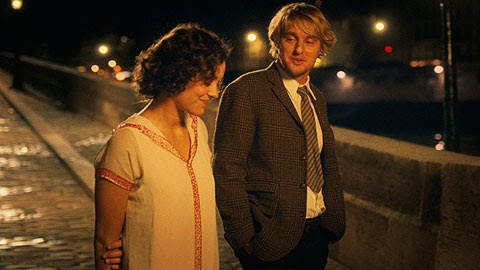


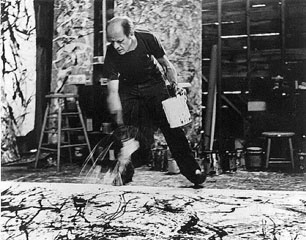


 Image via Complex / APJAC Productions

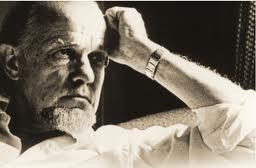


 Despite the initial concerns regarding Melissa’s future after surviving the attempt to end her life and being born alive at approximately seven months gestation, she has not only survived but thrived. With a Master’s Degree in Social Work, she has worked in the fields of substance abuse, mental health, domestic violence/sexual assault counseling, and child welfare. Melissa and her husband Ryan have a daughter, Olivia, whose birth at the same hospital where Melissa’s life was supposed to end, has significantly shaped Melissa’s ministry.