The New Deal and Recovery, Part 10: The Roosevelt Recession (Quotes Milton Friedman!!!)

______

By the start of 1937, things were looking up for the U.S. economy. Although the Supreme Court had struck down both the NIRA and the AAA—the chief pillars of the original New Deal’s recovery plan—some time earlier, like a glider released by its tow plane, the recovery itself kept going.

Indeed, the glider analogy doesn’t quite work, because instead of gradually declining, economic activity started rising faster than ever: whereas in 1934 and 1935 real GNP grew by 7.7 and 8.1 percent, respectively, in 1936 it grew by a whopping 14.1 percent. Between May 1935, when the NIRA was struck down, and April 1937, unemployment fell by a third—as compared to a 28 percent decline while the NRA codes were in effect. Bank lending, long stagnant, also started to revive. And the stock market, which bounced around but otherwise made little headway while the NRA did its thing, rose by a hefty 70 percent.[1]
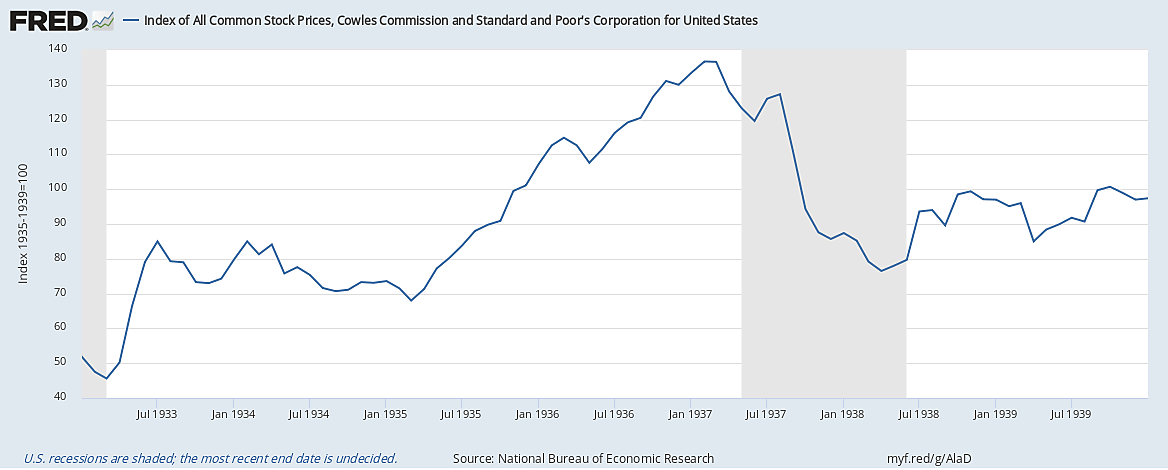
Index of Common Stock Prices

Nor was this improvement at all mysterious. As I explained in an earlier post, instead of promoting recovery as it was supposed to, the NRA codes held it back. It’s therefore not surprising that, by sweeping them off the books in May 1935, and thereby allowing the U.S. economy to make better use of the gold inflows from Europe that were really nursing it to health, the Supreme Court actually did more to promote recovery than the NRA itself had done.

A False Dawn

Things were so good, in fact, that many believed the long-awaited recovery to be just around the corner. FDR must have thought so, or else he wouldn’t have reminded Congress that January that “Your task and mine is not ending with the end of the depression.”

But such optimism didn’t last long. In May, according to the NBER’s business cycle chronology, the economy started shrinking again. Expenditures fell; inventories accumulated; and profits dwindled. Soon it was obvious to all that the U.S. was in the throes of yet another severe recession. By the time it was over, in June 1938, real U.S. GNP had fallen by 18.2 percent. That was less than the 26.6 percent decline suffered in the early years of the depression. But as is clear from the chart below, it happened much more quickly, and was in that respect even more stunning. The setback was also severe enough to undo a substantial part of the gains achieved since FDR took office.
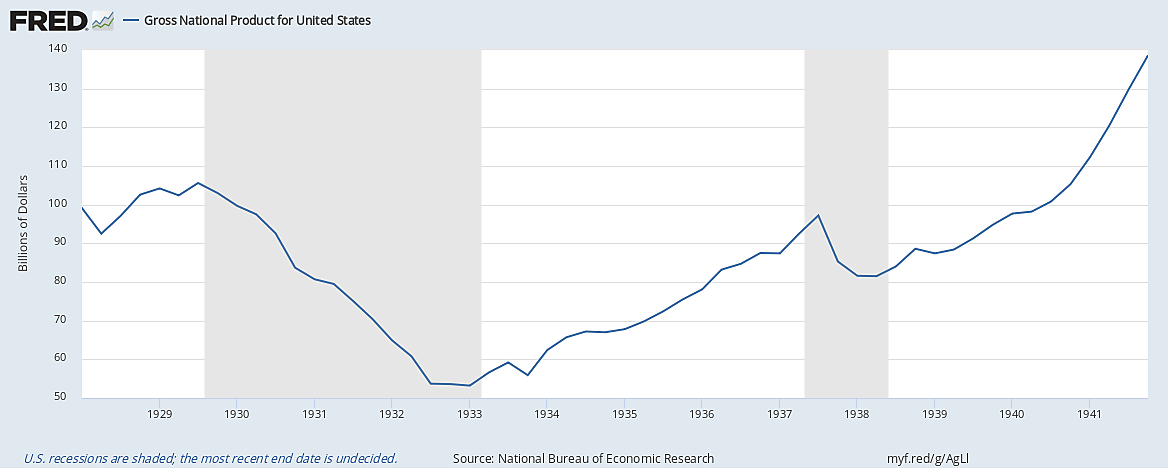
Gross National Product

Bad as the quarterly GNP numbers look, they still don’t accurately convey the extreme nature of the 1937 downturn. Because that downturn was so steep and short-lived, quarterly data can’t do it full justice. To come closer we need to look at industrial production. Although it tracks the nominal output of manufacturing firms, mines, and utilities only—a small portion of the U.S. economy taken as a whole—that statistic has the advantage of being measured every month. Between May 1937 and June 1938, industrial production fell by almost one third—a truly stupendous drop.
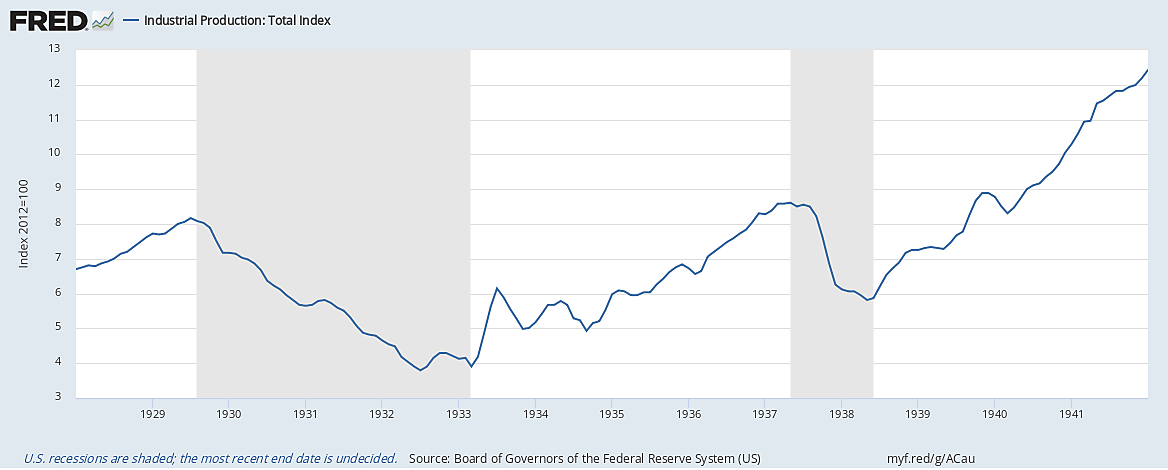
Industrial Production

What came to be known as the “Roosevelt Recession,” especially among FDR’s detractors, has posed a challenge to economic historians. But unlike the challenge of explaining the 1929 downturn, the problem in this case consists not of a lack but of a surfeit of plausible culprits—a very different sort of whodunit.

Fear of ‘Flating

Most accounts of the 1937 crash blame it on demand-side shocks, and particularly on a sudden switch to less expansionary, if not contractionary, monetary and fiscal policies. The switch was partly informed by the belief that full recovery was in sight, and the fact that the markets for stocks and some commodities were already booming. But it was also a reaction to banks’ large holdings of excess reserves. Together these developments suggested to many that, unless steps were taken to prevent it, the United States was headed straight for what Federal Reserve Chairman Marriner Eccles called a “dangerous inflation.” Eccles’ worries were shared by many administration officials, including FDR. “I am concerned—we are all concerned,” he told the press that April, “over the price rise in certain materials.”

Dangerous inflation? In retrospect at least, officials’ fear seems tragi-comic. Far from being something to be dreaded, inflation sufficient to get prices back to their 1926 level had long been one of FDR’s main objectives. One could even say that he regarded its achievement as the sum and substance of a complete recovery. But in the late spring of 1937 the Consumer Price Index was still about 20 percent below its level in mid-1926. And if that wasn’t proof enough that the recovery was far from complete—that the country still had a way to go before “reflation” gave way to inflation proper—there was the fact that the conventionally-measured unemployment rate, which counted those working in government relief programs as “unemployed,” was still in the double-digits. Upon hearing that American officials had begun to worry about inflation, Keynes is supposed to have quipped that they “professed to fear that for which they dared not hope.”

Alas, those officials were in earnest; and their fears soon led to action. What particularly concerned them was the reserve stockpile banks had accumulated since the bank holiday, a large part of which consisted of “excess” reserves, meaning reserves beyond banks’ mandatory requirements. Fed officials feared that, as the recovery continued, a revived demand for credit would lead first to a rapid expansion of bank lending and the money stock, and thence to the “dangerous inflation” Eccles warned about. That European gold—”hot money”—was now flowing into the U.S. faster than ever, and that the Fed’s limited security holdings would prevent it from using open-market sales to keep that inflow from adding to banks’ superfluous reserves, only made the need for other action seem that much more acute.[2]

Although the Fed’s open-market powers were limited, thanks to the Banking Act of 1935 it had another trick up its sleeve: the power to as much as double its member banks’ minimum reserve requirements. Fed officials now chose to put that power to use. On Bastille Day, 1936, a divided Board of Governors voted to raise member bank reserve requirements by 50 percent effective August 15th. Because rates didn’t budge, and gold kept pouring into the country, sentiment grew in favor of further increases. Finally, at the end of January 1937, the Board elected to raise the requirements by another third—the maximum level allowed—this time in two half steps to be taken on March 6th and May 1st, respectively. The vertical lines in the following chart, showing the behavior of total and excess bank reserves between 1931 and 1942, mark the dates of the three increases.
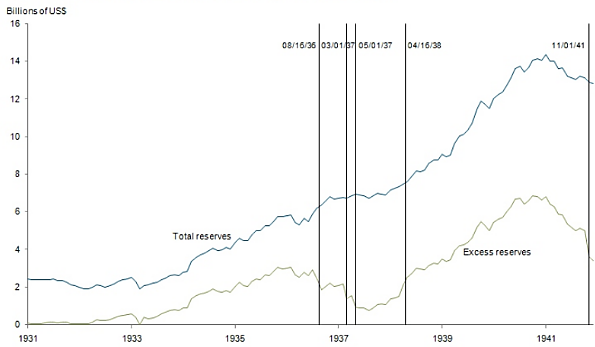
Reserves

A Doubling Debacle

While the Fed’s first two reserve-requirement increases seemed to do little harm, the third almost perfectly coincided with the start of the ’37 downturn. According to many experts, this was no coincidence. So far as they’re concerned, instead of merely serving to head-off inflation, the Fed’s decision to double reserve requirements was one of the chief causes, if not the cause, of the 1937 collapse.

How so? In essence, the argument—which owes its popularity to Milton Friedman and Anna Schwartz’ development of it in their Monetary History of the United States—is that while Fed officials viewed excess reserves as “redundant” reserves, the banks themselves didn’t see them so. Instead, having been traumatized by runs in the early years of the depression, they accumulated excess reserves deliberately, for safety’s sake: unlike required reserves, excess reserves could be used to meet runs without risk of legal penalties. Thanks to low interest rates, this precaution, besides being prudent, was also cheap.[3]

So when the Fed increased banks’ required reserves, and especially when it did so for the third time, instead of doing nothing the banks sought to rebuild their excess reserve cushions. With only so many reserves in the system, this meant limiting their required reserves by shrinking the non-reserve components of their balance sheets: loans, investments, and deposits. The resulting decline in bank credit and the money stock helped bring about the 1937-8 recession, just as the Great Monetary Contraction of 1929-33 led (once again, according to Friedman and Schwartz) to the first Great Depression downturn.

Reserve-ations

Popular as it is, the theory that the Fed triggered the ’37 collapse by raising banks’ reserve requirements has never lacked critics. Unsurprisingly, those Fed officials who argued for the policy, including Lauchlin Currie, the Board’s chief economic advisor, denied that it restricted the supply of credit, or otherwise contributed to the recession. Nor were they alone among their contemporaries in taking that view. According to Benjamin Anderson, who served as Chase National Bank’s chief economist during the depression,

Reducing the [banks’] excess reserves could not reduce the volume of business unless real differences were made thereby in interest rates, and unless restrictions were imposed thereby upon the use of money and credit. Now the evidence is overwhelming that nothing of this sort occurred.

Several more recent writings have drawn renewed attention to and supplemented the evidence Anderson had in mind. In a 2001 article L.G. Telser showed that, instead of lending less, Fed member banks met their increased reserve requirements by selling government securities, ruling out the possibility that the Fed’s actions triggered a credit crunch. A decade later, upon examining data for individual Fed member banks, Charles Calomiris, Joseph Mason, and David Wheelock (2011) found that, even after they’d been doubled, the Fed’s “reserve requirements were not binding on bank reserve demand in 1936 and 1937, and therefore could not have produced a significant contraction in the money multiplier.” Instead, they conclude that, contrary to the Friedman and Schwartz hypothesis, such increases in reserve demand as took place from June 1936 to June 1937 “reflected predictable influences related to the structure of the banks, and not increases in reserve requirements imposed by the Fed.” Finally, Haelim Park and Patrick Van Horn (2014) also find that Fed’s reserve requirement changes didn’t lead member banks to reduce their lending. They therefore conclude that “the actions of the Federal Reserve…cannot be blamed for instigating the economic downturn of 1937-38.”

And a Rejoinder

But Friedman and Schwartz’ critics may not have the last word. Instead, their arguments have been questioned in turn by Gauti Eggertsson and Benjamin Pugsley (2006), who claim that the Fed’s doubling of reserve requirements contributed to the 1937 downturn even though it didn’t lead to any substantial decline in bank lending or the money stock, or to any substantial or lasting increase in short-term interest rates. In their view, the Fed’s decision mattered not because it led to an immediate tightening of credit but because it was the first important sign that the government was reversing its stance on inflation: having long promised to get prices back to their pre-depression levels, and despite not having yet reached that goal, government officials now seemed determined to put a lid on inflation.

Eggertsson and Pugsley consider this official about-face “one of the most peculiar policy mistakes in U.S. economic history.” But they regard it so not because it led to any immediate clamping-down on credit, but because it “created pessimistic expectations of future growth and price inflation that fed into both an expected and an actual deflation.” Nominal rigidities, finally, caused the collapse in prices to be accompanied by an equally severe contraction of output.

Using a dynamic stochastic general equilibrium (DSGE) model, Eggertsson and Pugsley show that, far from depending on any increase in current short-term interest rates (as opposed to expectations of future rate increases), such an expectations-driven downturn can be “particularly damaging at zero interest rates.” Because it’s immune to the objection that monetary policy can only matter if it leads to immediate changes in bank lending, money growth, and short-term rates, the Eggertsson and Pugsley thesis gives “monetary” explanations of the 1937 downturn a new lease on life.

Rebirth Control

The Fed’s doubling of reserve requirements was but one of two monetary policy changes that may have contributed to the Roosevelt Recession, whether through an expectations channel or otherwise. The other, which some consider more important, and which was also part of the government’s effort to forestall inflation, was the Treasury’s decision to “sterilize” gold inflows.

In fact, Friedman and Schwartz themselves viewed the Treasury’s gold sterilization program as being just as important a cause of the contraction of ’37 as the Fed’s reserve requirement increases. The Treasury had nevertheless been cast in most accounts since as the Fed’s less important accomplice. But in a 2012 paper Dartmouth economic historian Doug Irwin makes a strong case for giving the Treasury pride of place.

As we’ve seen, after 1933 gold fleeing Europe for the U.S. was the chief cause of overall demand growth and, starting in 1935, of concerns that the U.S. was headed toward unwanted inflation. The Fed could do nothing to prevent the gold inflow from adding to banks’ reserves; but it could and it did force banks to hold on to those extra reserves. The Treasury, on the other hand, could sever the link between increases in the total U.S. gold stock and increases in the monetary gold stock, where the last alone contributed to bank reserves. Normally, after drawing on its Fed balance to pay to buy gold at the official price of $35 an ounce, the Fed would replenish its account by depositing an equivalent sum in gold certificates. The monetary gold stock and monetary base would then grow in step with the total gold stock. To sever the link, and thereby “sterilize” the gold inflows, the Treasury had merely to quit printing and depositing a like value of gold certificates for every ounce of gold it purchased.

And from December 1936 until February 1938, excepting a one-time “desterilization” of $300 million in September 1937, the Treasury did just that, with the express aim of “halt[ing] the inflationary potentialities” of incoming gold. As the next FRED chart shows, because the Fed itself extended very little credit during the sterilization period, the Treasury’s policy slammed the brakes on the monetary base growth that had been promoting recovery, to the extent that other New Deal policies allowed it to, since 1934. The chart also makes clear the close coincidence, allowing for a short lag, between the start and finish of the Treasury’s policy and the beginning and end of the 1937-8 recession as reflected in Ayres’ Business Activity index.
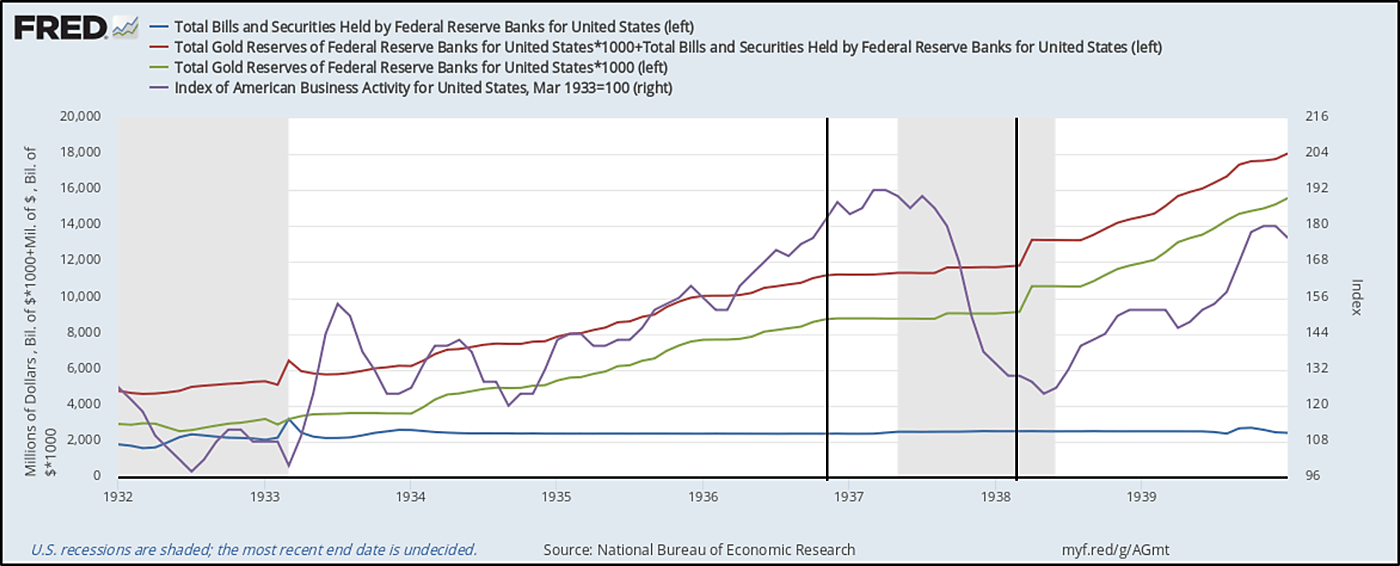
Sterilization

According to Irwin, the Treasury’s sterilization policy was far more contractionary than the Fed’s reserve-requirement increases, partly owing to the fact that reserve requirements were less binding than Friedman and Schwartz and others have supposed, but also because the change in the growth rate of the monetary base, from an average annualized rate of 17 percent between 1934 and 1936 to zero, was far greater than the concurrent change in the money multiplier. For this and other reasons, including its timing, Irwin concludes that the Treasury’s policy played the more important role in the 1937-8 recession.[4]

But it was, after all, the combined effects of the Fed and Treasury actions, rather than the relative importance of each, that really matters. And here it’s worth noting that each player acted rather as if it didn’t know, or didn’t care, what the other was up to! While both Marriner Eccles and Treasury Secretary Henry Morgenthau saw a need to clamp down on money growth to head-off inflation, Eccles favored doing so by raising the Fed’s reserve requirements, while Morgenthau tried to convince him that sterilizing gold inflows was the better policy. Instead of coming to an agreement, or otherwise coordinating their policies, Eccles went ahead with the Fed’s first reserve requirement increase without bothering to tell Morgenthau, let alone gain his approval. When that increase seemed to make little difference, Morgenthau proceeded with his sterilization program, after securing Eccles’ last minute and grudging endorsement. Then, despite Morgenthau’s expressed reservations, Eccles in turn went ahead with Fed’s further reserve requirement increases. It is as though two doctors, sharing the same overanxious patient, each insisted on administering a strong sedative, whether the other did so or not, and ended up rendering her unconscious.

But here again, my analogy falls short, because it’s far from obvious that the U.S. economy needed a sedative at all. It fails in another respect as well. For instead of just getting a double-dose of sedatives, the U.S. economy got several. Just what those other sedatives were, and how they contributed to the economic collapse, will be the subjects of my next installment.

Continue Reading The New Deal and Recovery:

___________________

[1] For more on the slow and erratic progress of recovery while the first New Deal was in effect see Garfield Cox (1936, p. 2). Referring to that progress as measured by Leonard Ayres’ index of American Business Activity (which closely follows the more frequently cited index of industrial production), Cox notes that whereas “all previous recoveries, once started, have brought [that index] back to normal rather quickly,” with the longest delay taking just 14 months, “this time after 33 months this index is still substantially below trend.” Furthermore, “no previous recovery from depression has been punctuated by reversals so extensive as those which have interrupted the current expansion.” Cox also notes (ibid., p. 3) that “in no recovery in eighty years have iron and steel and durable goods in general lagged as they have from 1933 to 1935.” These were, of course, among the sectors most influenced by NRA codes.

[2] Several factors contributed to the Fed’s limited capacity to offset gold-based reserve growth through open market sales. One was that by mid-1936, member bank excess reserves exceeded the Fed’s government securities of just over $2.4 billion. Another was that the Fed relied upon income generated by those securities to pay its operating expenses.

[3] For further developments of the argument that banks’ had a genuine demand for excess reserves see Frost 1971 and Wilcox 1984.

[4] Concerning Eggertsson and Pugsley’s claim that the bearing of the Fed’s reserve requirement changes on expectations made those changes much more potent than they might have been otherwise, Irwin observes (p. 250n7) that “[i]t seems implausible to think that ‘animal spirits’ could sink the economy as much as occurred during 1937-8 in the absence of some tangible change in government policy or some real shock.” This seems rather unfair to Eggertsson and Pugsley, who never suggest otherwise. Instead they claim only that expectation effects further magnified the consequences of “tangible” policy changes, including both the Fed’s reserve requirement increases and the Treasury’s sterilization policy.

[Cross-posted from Alt-M.org]

The largest decrease in government spending in US History was the key to ending the depression and Milton Friedman’s free markets were validated!!!

The Great Depression. A row of out of work men at the New York City docks in 1930s. (Photo: Newscom)

“What is history but a fable agreed upon?” as Napoleon once put it, and never has that been more true than the story of the Great Depression and its aftermath. With liberals again pitching more government spending “stimulus” in Washington, it’s critical we get this history right.

In a previous column I unmasked the historical lie that Franklin Roosevelt’s New Deal programs ended the Great Depression. After seven years of New Deal-era explosions in federal debt and spending, the U.S. economy was still flat on its back, and misery could be seen on the street corners. By 1940, unemployment still averaged a sky-high 14.6 percent. That’s some recovery.

However, I’ve been deluged with the same question from readers: Ok, what did end the Great Depression? Again, the history books get this chapter of history wrong. Most history books tell us that it was government spending on steroids to mobilize for World War II after the Japanese attacks on Pearl Harbor on Dec. 7, 1941.

Well, it is true that the economic output surged and unemployment fell, but periods of all-out war are very different than periods of peace. Is it any surprise that unemployment fell dramatically when nearly 12 million Americans joined the military?

My mother, a teenager in that period, used to tell me that during the war, when fuel was scarce and needed for the military, you wouldn’t be caught dead driving to the movie theater or a party. It was regarded as unpatriotic and selfish. People continued to produce even with high tax rates (94 percent during the war) when their tax dollars were financing the fight against the Nazis and the Japanese.

For nearly four years — from 1942 to 1945 — America was not a free-market economy. We were an all-out wartime economy — with the normal laws of economics suspended.

However, a war is no way to fix an economy — obviously. Countering terrorist acts of the Islamic State is not a jobs program. During World War II, when we built ships, tanks, fighter planes, dropped bombs and sent our troops into harm’s way, we weren’t creating wealth. A war is no more stimulating to the economy than a burglar stealing your money, the Japanese tsunami in 2011, Hurricane Katrina in 2005, or a tornado that levels an entire town. Without such calamity, the resources spent reconstructing (or destroying in the case of war) would be spent either purchasing useful, life-enhancing products for consumption or investing in technology and capital equipment requisite to increasing economic output.

War in self-defense might be necessary to protect our families, but any economic growth derived from it is far less beneficial than growth derived from free people making individual decisions on what to consume and in what to invest.

In the 1940s, government spending did indeed surge. The federal share of gross domestic product (GDP) rose from less than 12 percent in 1941 to more than 40 percent in 1943-45. In other words, almost half of everything that was produced in the nation was to fight the war. Domestic spending on many FDR New Deal programs in education, training and social services dropped more than 90 percent.

The real issue is what caused the economy to surge after the war was over.

This story is also not covered in the history books. Shortly after his third re-election in 1944, and at a time when the outcome of the war was no longer in question, FDR and his domestic advisers plotted a “new” New Deal with such spending items as national health insurance. The Keynesians were sure that the massive reduction in government spending would catastrophically tank the economy.

Paul Samuelson, the dean of neo-Keynesians at that time, warned in 1943 that unless wartime spending and controls were extended, there would be “the greatest period of unemployment and industrial dislocation which any economy has ever faced.” Business Week predicted unemployment would hit 14 percent with the postwar cutbacks.

Here’s what happened. Government spending collapsed from 41 percent of GDP in 1945 to 24 percent in 1946 to less than 15 percent by 1947. And there was no “new” New Deal. This was by far the biggest cut in government spending in U.S. history. Tax rates were cut and wartime price controls were lifted. There was a very short, eight-month recession, but then the private economy surged.

Here are the numbers on the private economy. Personal consumption grew by 6.2 percent in 1945 and 12.4 percent in 1946 even as government spending crashed. At the same time, private investment spending grew by 28.6 percent and 139.6 percent.

The less the feds spent, the more people spent and invested. Keynesianism was turned on its head. Milton Friedman’s free markets were validated.

In 1946, the unemployment rate averaged below 4 percent, and it stayed that low for the better part of a decade. This all happened during the biggest reduction in government spending in American history under President Truman.

In sum, it wasn’t government spending, but the shrinkage of government that finally ended the Great Depression. That’s what should be in every history book — but isn’t.

Originally appeared in the Washington Times.

Related posts:

Milton Friedman rightly pointed out that the crisis of the Great Depression was not a failure of the free market system but of government and Dan Mitchell concurs!!!

___________ Milton Friedman rightly pointed out that the crisis of the Great Depression was  not a failure of the free market system but of government and Dan Mitchell concurs!!! Statist Policy and the Great Depression September 17, 2014 by Dan Mitchell It’s difficult to promote good economic policy when some policy makers have a deeply flawed […]

“Friedman Friday” Milton Friedman: Great Depression was not produced by private enterprise

Milton Friedman – The Great Depression Myth Uploaded by LibertyPen on Mar 25, 2010 Milton Friedman explodes the myth that the Great Depression was produced by a failure of private enterprise. _______________ Milton Friedman is right about the cause of the Great Depression. Ivan Pongracic Jr. The Great Depression According to Milton Friedman The Great […]

FRIEDMAN FRIDAY “The Tyranny of Control” in Milton Friedman’s FREE TO CHOOSE Part 3 of 7 (Transcript and Video) “When anyone complains about unfair competition, consumers beware, That is really a cry for special privilege always at the expense of the consumer”

In 1980 I read the book FREE TO CHOOSE by Milton Friedman and it really enlightened me a tremendous amount.  I suggest checking out these episodes and transcripts of Milton Friedman’s film series FREE TO CHOOSE: “The Failure of Socialism” and “What is wrong with our schools?”  and “Created Equal”  and  From Cradle to Grave, […]

Open letter to President Obama (Part 693) “How to Cure Inflation” in Milton Friedman’s FREE TO CHOOSE Part 3 of 7 “Inflation is just like alcoholism, in both cases when you start drinking or when you start printing too much money, the good effects come first, the bad effects only come later”

Open letter to President Obama (Part 693) (Emailed to White House on July 29, 2013) President Obama c/o The White House 1600 Pennsylvania Avenue NW Washington, DC 20500 Dear Mr. President, I know that you receive 20,000 letters a day and that you actually read 10 of them every day. I really do respect you […]

Open letter to President Obama (Part 692) “How to Cure Inflation” in Milton Friedman’s FREE TO CHOOSE Part 2 of 7 “Many a political leader has been tempted to turn to wage and price controls despite their repeated failure in practice. On this subject they never seem to learn. But some lessons may be learned”

Open letter to President Obama (Part 692) (Emailed to White House on July 29, 2013) President Obama c/o The White House 1600 Pennsylvania Avenue NW Washington, DC 20500 Dear Mr. President, I know that you receive 20,000 letters a day and that you actually read 10 of them every day. I really do respect you […]

FRIEDMAN FRIDAY “The Tyranny of Control” in Milton Friedman’s FREE TO CHOOSE Part 2 of 7 (Transcript and Video) “As always, economic freedom promotes human freedom”

In 1980 I read the book FREE TO CHOOSE by Milton Friedman and it really enlightened me a tremendous amount.  I suggest checking out these episodes and transcripts of Milton Friedman’s film series FREE TO CHOOSE: “The Failure of Socialism” and “What is wrong with our schools?”  and “Created Equal”  and  From Cradle to Grave, […]

Open letter to President Obama (Part 688) “How to Cure Inflation” in Milton Friedman’s FREE TO CHOOSE Part 1 of 7 Taxation without representation: Getting knocked up to higher tax brackets because of inflation!!!!

Open letter to President Obama (Part 688) (Emailed to White House on July 29, 2013) President Obama c/o The White House 1600 Pennsylvania Avenue NW Washington, DC 20500 Dear Mr. President, I know that you receive 20,000 letters a day and that you actually read 10 of them every day. I really do respect you […]

FRIEDMAN FRIDAY “The Tyranny of Control” Milton Friedman’s FREE TO CHOOSE Part 1 of 7 (Transcript and Video) “Adam Smith’s… key idea was that self-interest could produce an orderly society benefiting everybody, It was as though there were an invisible hand at work”

In 1980 I read the book FREE TO CHOOSE by Milton Friedman and it really enlightened me a tremendous amount.  I suggest checking out these episodes and transcripts of Milton Friedman’s film series FREE TO CHOOSE: “The Failure of Socialism” and “What is wrong with our schools?”  and “Created Equal”  and  From Cradle to Grave, […]

Open letter to President Obama (Part 684) “How to Stay Free” in Milton Friedman’s FREE TO CHOOSE Part 7 of 7 “I believe that there is a strong enough component of freedom in our society that we will be able to preserve it, that we’re going to turn this trend back, that we are going to cut government down to size, we’re going to lay the ground work for a resurgence for a, a flowering, of that diversity which has been the real product of our free society”

Open letter to President Obama (Part 684) (Emailed to White House on July 29, 2013) President Obama c/o The White House 1600 Pennsylvania Avenue NW Washington, DC 20500 Dear Mr. President, I know that you receive 20,000 letters a day and that you actually read 10 of them every day. I really do respect you […]

Open letter to President Obama (Part 680) “How to Stay Free” in Milton Friedman’s FREE TO CHOOSE Part 6 of 7 “If you compare the conditions of people in a place like Singapore with the conditions of people in a place like Red China, or for that matter, Indonesia, you will see that the economic freedom is a very important component of total freedom”

Open letter to President Obama (Part 680) (Emailed to White House on July 29, 2013) President Obama c/o The White House 1600 Pennsylvania Avenue NW Washington, DC 20500 Dear Mr. President, I know that you receive 20,000 letters a day and that you actually read 10 of them every day. I really do respect you […]

A Global Leader in Obsolete Technology

FEBRUARY 7, 2021 10:32AM

A Global Leader in Obsolete Technology

Secretary of Transportation Pete Buttigieg wants to make the United States the “global leader” in high-speed rail. That’s like wanting to be the world leader in electric typewriters, rotary telephones, or steam locomotives, all technologies that were once revolutionary but are functionally obsolete today. High-speed trains, in particular, were rendered obsolete in 1958, when Boeing introduced the 707 jetliner, which was twice as fast as the fastest trains today.

Slower than flying, less convenient than driving, and more expensive than either one.
Aside from speed, what makes high-speed rail obsolete is its high cost. Unlike airlines, which don’t require much infrastructure other than landing fields, high-speed trains require huge amounts of infrastructure that must be built and maintained to extremely precise standards. That’s why airfares averaged just 14 cents per passenger-milein 2019, whereas fares on Amtrak’s high-speed Acela averaged more than 90 cents per passenger-mile.

Highways require infrastructure but not this level of precision. While a four-lane freeway costs about $10 million to $20 million a mile, California ended up spending $100 million a mile building its abortive high-speed rail line on flat ground, and it predicted building in hilly territory would cost at least $170 million per mile.

In 2009, President Obama proposed that the United States build 8,600 miles of high-speed rail lines in six disconnected networks in the Northeast, South, Florida, Midwest, California, and the Pacific Northwest. Without ever asking how much this would cost, Congress gave Obama $10.1 billion, which (after adding $1.4 billion of other funds) Obama passed on to the states. Except in California, no one expected that these funds would produce 150-mile-per-hour bullet trains, but they were supposed to increase frequencies and speeds in ten different corridors.

Now, more than ten years later, what has happened with those projects? One corridor saw frequencies increase by two trains a day. That corridor and two others saw speeds increase by an average of 2 miles per hour. Three other corridors actually saw speeds decline by an average of 1 mile per hour. Four corridors saw no changes at all. The one corridor that saw both frequencies and speeds increase also saw ridership decline by 12 percent. Effectively, the $11.5 billion was all wasted.

We now know, based on California’s experience, that constructing true high-speed rail in all of Obama’s 8,600 route miles would have cost well over $1 trillion. Unlike the 48,000-mile Interstate Highway System, which cost about half a trillion in today’s dollars but was paid for entirely out of highway user fees, none of the cost of building high-speed rail lines would ever be covered by rail fares. In fact, fares won’t even cover operating costs on most if not all proposed routes.

Rail advocates want to ignore the dollar costs and instead argue that we should have high-speed trains because they are climate friendly. But building high-speed rail releases thousands of tons of greenhouse gases into the atmosphere for every mile. Even if operating the trains produced fewer emissions than planes, and there’ no guarantee that it would, it would take decades to save enough to make up for the construction cost—and the rail lines must be effectively rebuilt, releasing more carbon dioxide, every 20 to 30 years.

China has built 22,000 miles of high-speed rail lines and that construction has helped put China’s state railway nearly $850 billionin debt. Since this debt is unsustainable and many of the high-speed rail lines, says a Chinese transportation economist, are “bleeding red ink,” the country has slowed its construction of new lines. Far from getting anyone out of cars or planes, both air travel and highway travel are growing much faster than rail travel in China.

If we are to emulate China’s transportation system, we should look instead at its freeways. Including the interstates and other freeways, the United States has 67,000 freeway miles and is building fewer than 800 new miles a year. China, whose land area is about the same as ours and which has about the same number of motor vehicles as the United States, had 93,000 miles at the end of 2019 and is building 4,000 to 5,000 new miles a year.

China’s road construction isn’t slowing down because the roads pay for themselves out of tolls. China also realizes something that American political leaders have forgotten: highways drive economic growth because, unlike Amtrak or public transit, they are used by the vast majority of people.

Where Amtrak trains were only about half full before the pandemic, many of America’s freeways were filled to capacity during much of the day. This congestion costs commuters $166 billion a year and costs shippers even more. While the pandemic reduced some of that congestion, motorists are driving about 90 percent as many miles as before the pandemic and there is still considerable congestion.

Urban freeways are also the safest roads in the country to drive on, while non-freeway arterials are the most dangerous. On top of saving travelers billions of hours a year, replacing non-freeway arterials with freeways could save thousands of lives each year.

The best thing about highways is that they can pay for themselves. Unfortunately, the mechanisms we use to pay for roads, including gas taxes and vehicle registration fees, are archaic. They don’t adjust for inflation, they don’t adjust for fuel-efficient cars, they don’t cover the costs of city and county roads, and they don’t do anything to relieve congestion.

If Buttigieg wants return the United States to global leadership in transportation, he should find and promote mechanisms that will allow and pay for the construction of new highways that will relieve traffic congestion, improve safety, and generate new economic growth. He actually suggested one such mechanism during his presidential campaign: mileage-based user fees. The last thing we need is more deficit spending building obsolete infrastructure that few people will ever use.

RELATED TAGS

There is nothing that is free and that is why we have to cut government spending since we are all paying for this inefficient government!!

Milton Friedman – The Free Lunch Myth

NOVEMBER 10, 2016 3:18PM

Trump Spending Cut Ideas

President-elect Donald Trump said on the campaign trail that he will balance the federal budget and cut wasteful spending. Here are some of Trump’s views on budget reforms:

  • “We are going to ask every department head in government to provide a list of wasteful spending projects that we can eliminate in my first 100 days.” Source.
  • “We can also stop funding programs that are not authorized in law. Congress spent $320 billion last year on 256 expired laws … Removing just 5 percent of that will reduce spending by almost $200 billion over a ten-year period.” Source.
  • “I may cut Department of Education. I believe Common Core is a very bad thing,” Trump said. “I believe that we should be — you know, educating our children from Iowa, from New Hampshire, from South Carolina, from California, from New York. I think that it should be local education.” Source.
  • “If we save just one penny of each federal dollar spent on non-defense, and non-entitlement programs, we can save almost $1 trillion over the next decade.” Source.
  • “We’re going local. Have to go local. Environmental protection—we waste all of this money. We’re going to bring that back to the states … We are going to cut many of the agencies, we will balance our budget, and we will be dynamic again.” Source.
  • “Waste, fraud and abuse all over the place. Waste, fraud and abuse. You look at what’s happening with Social Security, you look—look at what’s happening with every agency—waste, fraud and abuse. We will cut so much, your head will spin.” Source.

I hope my head does spin from cuts, although most of Trump’s proposals are vague and quite timid. Still, I’m hoping that the more the incoming president finds out about the federal budget, the more he will appreciate the need for major terminations.

So let me suggest some wasteful spending that the new administration should tackle, and the annual savings from terminating each:

President Trump will face major budget pressures in coming years as deficits and entitlement spending soar. Today’s $600 billion deficits are headed toward $1 trillion, and deficits will be even higher if a recession comes along.

Federal spending cuts would help avert a fiscal crisis and boost growth by reducing economic distortions. The incoming Trump team should start with some of the cuts here, and there are plenty more proposals at DownsizingGovernment.org.

Related posts:

FRIEDMAN FRIDAY Mark J. Perry@Mark_J_Perry July 30, 2016 10:46 am | AEIdeas Happy 104th birthday, Milton Friedman

Free to Choose: Part 1 of 10 The Power of the Market (Featuring Milton Friedman) Free to Choose Part 2: The Tyranny of Control (Featuring Milton Friedman Free to Choose Part 4: From Cradle to Grave Featuring Milton Friedman Mark J. Perry@Mark_J_Perry July 30, 2016 10:46 am | AEIdeas Happy 104th birthday, Milton Friedman Tomorrow […]

FRIEDMAN FRIDAY Champion of Liberty by Stephen Moore Friday, October 26, 2012

Free to Choose: Part 1 of 10 The Power of the Market (Featuring Milton Friedman) Free to Choose Part 2: The Tyranny of Control (Featuring Milton Friedman Free to Choose Part 4: From Cradle to Grave Featuring Milton Friedman Free to Choose Part 5: Created Equal Featuring Milton Friedman Champion of Liberty by Stephen Moore […]

FRIEDMAN FRIDAY Socialism, RIP Tottering European economies prove again the Keynesian model is a failure By Stephen Moore – – Sunday, July 12, 2015

Free to Choose: Part 1 of 10 The Power of the Market (Featuring Milton Friedman) Free to Choose Part 2: The Tyranny of Control (Featuring Milton Friedman Socialism, RIP Tottering European economies prove again the Keynesian model is a failure By Stephen Moore – – Sunday, July 12, 2015 ANALYSIS/OPINION: A few years ago, the […]

FRIEDMAN FRIDAY What Would Milton Friedman Say? Immigration opponents often try to claim the famed economist as an ally. They’re mistaken. By STEPHEN MOORE Updated May 29, 2013 8:31 p.m. ET

Free to Choose: Part 1 of 10 The Power of the Market (Featuring Milton Friedman) What Would Milton Friedman Say? Immigration opponents often try to claim the famed economist as an ally. They’re mistaken. By STEPHEN MOORE Updated May 29, 2013 8:31 p.m. ET One of the fascinating sideshows of the immigration debate within the […]

FRIEDMAN FRIDAY Obama loves the death tax but listen to what Milton Friedman had to say about it!!!

__ Obama loves the death tax but listen to what Milton Friedman had to say about it!!! Milton Friedman Redistribution of Wealth and the Death Tax ___________ The Obama Administration’s Assault on the Rule of Law September 6, 2016 by Dan Mitchell What’s the worst development in economic policy of the Obama years? The faux stimulus […]

FRIEDMAN FRIDAY Dan Mitchell and Milton Friedman: Subsidies for Higher Education Are the Problem!

Milton Friedman – Should Higher Education Be Subsidized? Published on Aug 14, 2013 Professor Friedman leads a roundtable discussion with students. http://www.LibertyPen.com Hillary Is Wrong: Subsidies for Higher Education Are the Problem, not the Solution August 24, 2016 by Dan Mitchell “So many bad ideas, so little time.” That’s my attitude about Hillary Clinton. She proposes […]

FRIEDMAN FRIDAY Milton Friedman and Walter Williams have explained, minimum wage laws are especially harmful for blacks!

Milton Friedman – A Conversation On Minimum Wage Published on Oct 4, 2013 A debate on whether the minimum wage hurts or helps the working class. http://www.LibertyPen.com Is Anybody Shocked that Higher Minimum Wage Mandates Are Resulting in Fewer Jobs? August 25, 2016 by Dan Mitchell While economists are famous for their disagreements (and their incompetent […]

FRIEDMAN FRIDAY Milton Friedman and Dan Mitchell look at the economics of medical care!!

Milton Friedman on Medical Care (Full Lecture) Another Grim Reminder that Obamacare Has Made Healthcare More Expensive August 29, 2016 by Dan Mitchell Way back in 2009, some folks on the left shared a chart showing that national expenditures on healthcare compared to life expectancy. This comparison was not favorable to the United States, which easily […]

FRIEDMAN FRIDAY 2 videos by Milton Friedman on welfare state plus 2 cartoons that illustrate the fate of socialism from the Cato Institute

__________   Cato Institute scholar Dan Mitchell is right about Greece and the fate of socialism: Two Pictures that Perfectly Capture the Rise and Fall of the Welfare State July 15, 2011 by Dan Mitchell In my speeches, especially when talking about the fiscal crisis in Europe (or the future fiscal crisis in America), I often […]

FRIEDMAN FRIDAY Milton Friedman has the two solutions to the Black Teenage Unemployment Problem!!!

Milton Friedman on Donahue Show in 1979 Milton Friedman has the two solutions to the Black Teenage Unemployment Problem!!! The solutions would be first to lower the Minimum Wage Amount and  second give students the opportunity to have vouchers so their parents can put them in the best schools when they start in the kindergarten […]

DID GOVERNMENT BRING DOWN THE PRICE OF HEALTHCARE AND HIGHER EDUCATION? Dan Mitchell says NO!!!’

In One Image, Everything You Need to Know about Government Intervention

While I freely self-identify as a libertarian, I don’t think of myself as a philosophical ideologue.

Instead, I’m someone who likes digging into data to determine the impact of government policy. And because I’ve repeatedly noticed that more government almost always leads to worse outcomes, I’ve become a practical ideologue.

In other words, when looking at at an issue, I now have a default assumption that government is going to be the problem, not the solution.

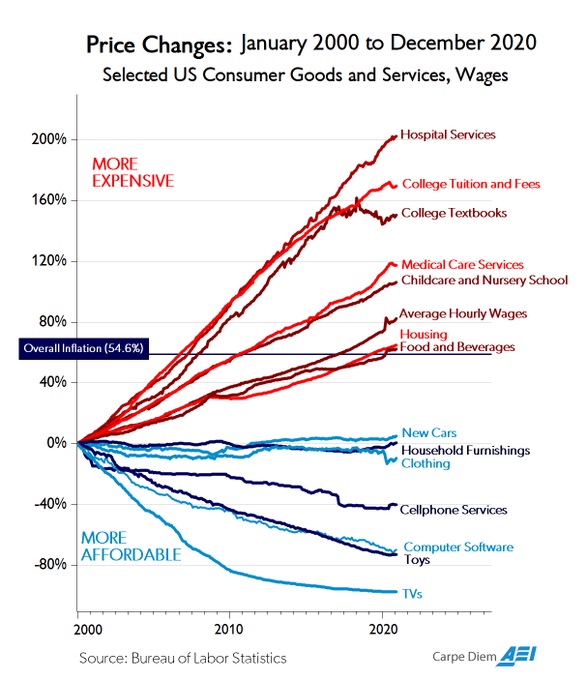
I think more people will share my viewpoint if they peruse this chart from Mark Perry.

It shows changes in prices for selected goods and services over the past 21 years, and the inescapable conclusion (as I noted when writing about the 2014 version of his chart) is that we get higher relative prices in sectors where there’s the most government intervention.

Especially healthcare and higher education.

By contrast, we see falling relative prices (and sometimes falling absolute prices!) in sectors where there is little or no government intervention.

Here’s some of Mark’s description of what we can learn from his chart.

I’ve updated the chart above with price changes through the end of last year. During the most recent 21-year period from January 2000 to December 2020, the CPI for All Items increased by 54.6% and the chart displays the relative price increases over that time period for 14 selected consumer goods and services, and for average hourly wages.…Various observations that have been made about the huge divergence in price patterns over the last several decades… The greater (lower) the degree of government involvement in the provision of a good or service the greater (lower) the price increases (decreases) over time, e.g., hospital and medical costs, college tuition, childcare with both large degrees of government funding/regulation and large price increases vs. software, electronics, toys, cars and clothing with both relatively less government funding/regulation and falling prices.

By the way, I can’t resist also calling attention to Mark’s data on what’s happened over time to prices for various health care services and procedures.

We find that prices have skyrocketed in areas of the healthcare sector where government plays a big role, especially hospital care.

By contrast, prices have been steady (or even falling!) in areas of the healthcare sector where competitive markets are allowed to operate, most notably for cosmetic procedures.

It’s almost as if it makes sense to have a default assumption that government is the problem rather than the solution.

P.S. While the data in Mark’s chart tell a depressing story about the harmful effect of government intervention, he shares one bit of good news in his article.

The annual increase in college tuition and fees of only 1.4% last year was the smallest annual increase in the history of the CPI for college tuition and fees going back to 1978, and the only annual increase ever below 2%. That increase is far below the average annual increase in college tuition of nearly 7% over the last 42 years. So perhaps the “higher education bubble” is finally starting to show signs of deflating?

I hope he’s right, but worry he’s wrong.

P.P.S. Sadly (but predictably), some people seem to thinkgovernment-caused price increases are a reason to support more government intervention.

How are we going to attack the healthcare costs in this country? 1st, we raise deductibles and 2nd, we attack the “Third Party” payment party.

If people have to pay directly for a large part of their healthcare costs then they will be more frugal when they can.

The 4 Ways to Spend Money by Milton Friedman

Uploaded by on Aug 26, 2006

1. You spend your own money on yourself.
2. You spend your own money on someone else.
3. You spend someone else’s money on yourself.
4. You spend someone else’s money on someone else.

___________

Milton Friedman on the four ways you can spend money

Jason Fried

Jason Fried wrote this on / 43 comments

  1. You can spend your own money on yourself. When you do that, why then you really watch out what you’re doing, and you try to get the most for your money.
  2. You can spend your own money on somebody else. For example, I buy a birthday present for someone. Well, then I’m not so careful about the content of the present, but I’m very careful about the cost.
  3. I can spend somebody else’s money on myself. And if I spend somebody else’s money on myself, then I’m sure going to have a good lunch!
  4. I can spend somebody else’s money on somebody else. And if I spend somebody else’s money on somebody else, I’m not concerned about how much it is, and I’m not concerned about what I get.

Via Joshua Kaufman.

Jason Fried wrote this on Mar 03 2010 There are 43 comments.

Jason Fried

About Jason Fried

Jason co-founded 37signals back in 1999. He also co-authored REWORK, the New York Times bestselling book on running a “right-sized” business. Co-founded, co-authored… Can he do anything on his own?

Read all of Jason Fried’s posts, and follow Jason Fried on Twitter.

_______________

I like to think that very few people despise Obamacare more than me.

I don’t like Obamacare because it’s a fiscal boondoggle.

I don’t like Obamacare because it’s bad healthcare policy.

I don’t like Obamacare because it generated an embarrassingly bad decision by the Supreme Court.

I don’t like Obamacare because it is driving people out of the labor force and into government dependency.

I don’t like Obamacare because it has increased corruption in Washington.

And I don’t like Obamacare because it further enriches and empowers Washington’s political class.

But I also like being honest and that means I’m willing to acknowledge that there’s one small part of Obamacare that will have a positive impact.

More specifically, the so-called Cadillac tax on expensive employer-provided health plans will slightly reduce the distortion in the tax code that encourages over-insurance and exacerbates the healthcare system’s pervasive third-party payer problem.

Indeed, we’re seeing some signs of this already, even though the tax preference isn’t capped until 2018. Here are some excerpts from a story published by Fox News, starting with a description of the law.

…companies desperate to avoid a 40 percent ObamaCare “Cadillac tax” are finding ways to shift the costs to workers. The so-called “Cadillac tax,” now four years away, will affect health plans that spend more than $10,200 per worker. “The excise tax, when it hits in 2018, will affect both employers and employees,”said Brian Marcotte, president of the National Business Group on Health.

Allow me to make an important correction before sharing other parts of the story.

Companies aren’t shifting costs to workers. The money currently spent on health insurance policies is part of total employee compensation.

Think of it this way. If a company hires you for a salary of $50,000 and also includes a $10,000 health insurance policy, what’s your total compensation?

If you give an answer other than $60,000, you’re either very bad at math or you have the logic skills of a politician.

So the story should have stated that the Cadillac tax is merely making workers more aware of costs that already exist.

Thanks for letting me vent. Now back to our main point, which is that the Cadillac tax discourages overinsurance, and this is already leading to some positive changes in the marketplace.

Employees will get incentives to reduce costs through such arrangements as wellness programs, including losing weight or stopping smoking. Meanwhile, employers are shifting workers into plans with higher deductibles, just as ObamaCare does in the health care exchanges, and using health savings accounts to help defray the costs.

I’m particularly happy that employers and employees are shifting to plans with higher deductibles. As I’ve explained before, health insurance should cover large, unanticipated costs, such as the onset of cancer or getting injured in a car wreck.

But it shouldn’t cover annual checkups, elective surgery, and other routine and/or predictable expenses.

And we have one other bit of good news. The tax isn’t going to raise nearly as much money as the politicians wanted!

The “Cadillac tax” was originally intended to take effect sooner, but unions and other groups convinced officials to delay it until 2018, reducing the anticipated income from $137 billion to $80 billion over ten years. But many analysts predict it will be far less than that. Henry Aaron of the Brookings Institution said, before then, it’s expected that most of the businesses that offer that form of insurance will back off and make the insurance less generous, so the tax won’t bite.” …if employers are able to avoid it and less than expected is collected, ObamaCare could fall tens of billions short in paying for itself as promised.

I should hasten to add, by the way, that I’m glad that Obamacare isn’t paying for itself since that simply means lots of taxes to accompany all the additional spending.

I’d be even happier, of course, if we could figure out how to get rid of all the spending as well.

Just in case folks are thinking I’ve gone soft, let’s close today’s post with some humor directed at the rest of Obamacare.

Since the IRS is a big part of Obamacare, here’s a particularly good bumper sticker that shares a line with the above poster.

Here’s a poster mocking the delightful fiscal impact of the law.

Though whoever put this together should have been careful of using The Joker.

I like this next poster since it highlights how politicians have exempted themselves from the law.

Last but not least, here’s Dr. Obama making a cameo appearance.

Ah, the IRS shows up again. Do you sense a theme?

And don’t forget the IRS bureaucrats want to be exempt from the law as well.

P.S. If you’re a glass-one-tenth-full person, here’s some other good news about Obamacare.

________________

To be fair here is the opposite point of view from the Huffington Post:

Finally, A Senator In A Tough Re-Election Fight Bets On Obamacare

The Affordable Care Act, in its brief time on this earth, has endured its share of storm and stress. The bungled rollout of the federal online interface cost proponents lots of political capital. There have been high-wire legal challenges to surmount. While public approval of the law’s ends remains steadily high, the popularity of the law itself is often recorded as lacking. There have been uneasy periods for Obamacare’s chief proponents as they’ve waited for enrollment milestones to be reached and rate-hike hysteria to be put to bed. (There’s recent news on that front, actually.) And as the law promises so much, over such a long time frame, there will be more uneasy periods to endure for the lawmakers who put their stamp on the reform.

But the simple fact is that some lawmakers voted for Obamacare and some voted against it, and there’s only so far any of them can run from their decision. That’s why I’ve had the occasion to talk about “the Obamacare bet.” The bill’s opponents have largely settled on a claim: The law is going to fail and their admonitions against it will be proven wise and correct. The bill’s supporters should go ahead and stake the opposite claim. Many of those who supported the bill, however, have been reluctant to go “all in” on the decision they made. Especially among those who voted for the law and have since found themselves in a tough electoral race.

Today, however, comes a change. As Greg Sargent reports over at The Plum Line, Sen. Mark Pryor (D-Ark.) — currently in a tough re-election race against his Republican opponent, Rep. Tom Cotton — is up with a new ad in which he heralds his yes vote on the Affordable Care Act. You can watch the spot and read the transcript below. While Pryor doesn’t exactly go “all in,” he lays more of his chips on the felt.

DAVID: When Mark was diagnosed with cancer, we thought we might lose him.

MARK: My family and my faith helped me through the rough times.

DAVID: But you know what? Mark’s insurance company didn’t want to pay for the treatment that ultimately saved his life.

MARK: No one should be fighting an insurance company while you’re fighting for your life. That’s why I helped pass a law that prevents insurance companies from canceling your policy if you get sick or denying coverage for pre-existing conditions.

(David, by the way, is Mark’s dad as well as a former senator from and governor of Arkansas.)

Now Mark Pryor’s ad could have been a bit bolder. You’ll note that nowhere does he say the words “Obamacare” or “Affordable Care Act,” just that he “pass[ed] a law.” Of course, he does make mention of the law’s most popular features — it prevents people from getting kicked off plans when the time comes to avail themselves of their coverage, and it ends the practice of denying coverage for pre-existing conditions. It’s hard to imagine voters tolerating a return to the status quo ante, which is one of the reasons that it’s been so devilish for the law’s opponents to craft an alternative.

Pryor may have buried the lead in this ad, in fact. As Gallup reported earlier this month, Arkansas leads “all other states in the sharpest reductions in their uninsured rate among adult residents since the healthcare law’s requirement to have insurance took effect at the beginning of the year.”

Per Sargent:

Republicans will undoubtedly cast this as an acknowledgment that their attacks on Pryor over the law are working and could no longer be ignored. They’ll argue Pryor is, in desperation, using his faith and personal experience as a shield against those attacks. But this misses what’s really going on here. This ad is actually coming at a point where there are signs the anti-Obamacare fires are cooling somewhat. GOP advertising against the law has fallen off sharply, and is surprisingly low in Arkansas.

This is correct. As Bloomberg News’ Heidi Pryzbyla reported earlier this week, Republicans have cut way back on on ads that attack Obamacare, in “a sign that the party’s favorite attack against Democrats is losing its punch.” Pryzbyla continues:

The shift — also taking place in competitive states such as Arkansas and Louisiana — shows Republicans are easing off their strategy of criticizing Democrats over the Affordable Care Act now that many Americans are benefiting from the law and the measure is unlikely to be repealed.

“The Republican Party is realizing you can’t really hang your hat on it,” said Andrew Taylor, a political science professor at North Carolina State University. “It just isn’t the kind of issue it was.”

There is a good reason for this shift. As Matt Yglesias pointed out back in June, the “phony Obamacare debate” — the one that broadly alleged that death panels existed, that the fubar launch of the federal website was the law’s death knell, that enrollment numbers would be way off target — has run its course, leaving only the most fundamental debate of all:

[Obamacare] is a large-scale effort to improve living standards for people in the bottom half of the income distribution by giving them additional economic resources. One of America’s political parties doesn’t like that idea in any non-health context and they don’t like it for health care either. They think the money it costs to provide those subsidies should be taken away, and it should be given to high-income households in the form of tax cuts.

This is an excellent and important policy debate to have. One of the great ideological issues not just of our time and place, but of democratic politics across eras and countries. Should economic resources be distributed more equally or less equally?

Since Yglesias wrote that piece, we’ve seen a brief return to the “phony” debate, thanks to a pair of judges on the D.C. Circuit appeals court, who issued a ruling in the Halbig v. Burwell case contending that (to quote Simon Maloy in Salon) “a single poorly worded snippet of the Affordable Care Act invalidates subsidies for people who purchased health coverage through the federal exchanges.” As Maloy inventively points out, this is a hilariously bad-faith argument to make, akin to George Costanza’s “Moops” argument in “Seinfeld”:

Beyond that, however, we are ultimately left with the discussion that Yglesias mentions as the real underlying debate: whether it is right and proper to redistribute money from the top to the bottom so that those on the lower rungs of the economic ladder can live and work longer without going into catastrophic debt.

This argument’s signature virtue is that — unlike all the “death panels” and doom-saying — it is, legitimately, a good-faith argument. Which may cause one to wonder: Why has it taken so long to burn off all the bad-faith arguments and get down to the real bone of contention? I’d posit that arguing that poor people aren’t morally fit enough to deserve health insurance lacks a certain salability outside the Ayn Rand set.

With that in mind, you might think it’s strange that so many of Obamacare’s proponents have seemed reluctant to take “the Obamacare bet.” I agree! It’s strange. From my perspective, the die has long been cast, so lawmakers who affirmed the bill with their vote may as well own it. Pryor’s ad suggests that perhaps those lawmakers long deemed to be vulnerable due to their votes on the Affordable Care Act may be coming around to this position.

None of this should cause you to expect some sort of sea change in the overall fundamentals of the 2014 election. The GOP is still in great shape for the midterms, and they may even discover that they don’t need an anti-Obamacare blitz to win in November. But that’s really just an even better reason for vulnerable lawmakers who supported the Affordable Care Act to put some sustained ballyhoo behind their decision to vote for the law. Win or lose, may as well remind people where you stood. Pryor’s effort is a lot bolder than most.

[Would you like to follow me on Twitter? Because why not?]

Related posts:

Michael F. Cannon of the Cato Institute takes a look at Obamacare and the Halbig v. Burwell decision!!!

___________ Halbig, King and ObamaCare (Michael F. Cannon) Published on Jul 22, 2014 Two federal circuit courts have now ruled on ObamaCare’s health insurance exchanges and have arrived at different conclusions. Michael Cannon, one of the chief architects of this legal challenge, explains what the rulings mean and what’s in store for the future health […]

The best video I have ever seen on Obamacare’s lies about Medicaid!!!!

Arkansas’ own Nick Horton featured on Dan Mitchell’s blog!!! Below is the best video I have ever seen on Obamacare’s lies about Medicaid!!!! An Under-Appreciated Victory over Obamacare July 14, 2014 by Dan Mitchell Let’s enjoy some semi-good news today. We’ve discussed many times why Obamacare is bad news, whether we’re looking at it from […]

Obamacare increased government spending by expanding Medicaid and big subsidies for private insurance and it will bankrupt country eventually!!!

_______________ Obamacare increased government spending by expanding Medicaid and big subsidies for private insurance and it will bankrupt country eventually!!! The Hidden Economic Damage of Obamacare June 25, 2014 by Dan Mitchell Obamacare resulted in big increases in the fiscal burden of government (ironically, it would be even worse if Obama hadn’t unilaterally suspended parts of […]

Obamacare will explode the budget and we must eliminate it!!!

________ Obamacare will explode the budget and we must eliminate it!!! Obamacare is Bad News for Your Wallet Today and Worse News for Your Wallet Tomorrow July 8, 2014 by Dan Mitchell I wrote a few weeks ago about the hidden economic damage of Obamacare, particularly the harm to the job market. Today, let’s get further […]

Obama keeps putting off Obamacare like he was a king!!!!

_________ Obama keeps putting off Obamacare like he was a king!!!! Some of the cartoons below point this out. Dan Mitchell always has great posts about the issues that I care about and he does a good job of picking out editorial cartoons that are very funny too. I really do miss Milton Friedman but […]

Will Republicans defeat Obamacare in Arkansas?

  ________ Will Republicans defeat Obamacare in Arkansas? February 21, 2014 4:24PM Spending Restraint in Arkansas By Nicole Kaeding Share For the fourth day in a row, the Arkansas House of Representatives has refused to approve the yearly appropriation for its Medicaid program, dubbed the “private-option.” If the legislature continues this refusal and reverses its […]

Open letter to President Obama (Part 520) (Should Politicians Be Allowed to Exempt Themselves and their Staff from Obamacare?)

Open letter to President Obama (Part 520) (Emailed to White House on 5-3-13.) President Obama c/o The White House 1600 Pennsylvania Avenue NW Washington, DC 20500 Dear Mr. President, I know that you receive 20,000 letters a day and that you actually read 10 of them every day. I really do respect you for trying to get […]

Obama just made the 18th executive branch’s unilateral change to Obamacare but who will challenge him on it?

__________ Obama just made the 18th executive branch’s unilateral change to Obamacare but who will challenge him on it? Obamacare and the Corruption of the Rule of Law February 11, 2014 by Dan Mitchell We’ve reached the stage where Obamacare is the punchline to a bad joke. The law has been a disaster, both for the economy […]

Obamacare Death Panels Kills Jobs more often than people!!!

____________ Obamacare Death Panels Kills Jobs more often than people!!! Crying about Obamacare, but also Laughing at Obamacare February 8, 2014 by Dan Mitchell I asked back in September whether all the bad news about Obamacare meant it was time to feel sorry for President Obama and other statists. Some people apparently didn’t realize I was […]

Open letter to President Obama (Part 514) (Why We Should Be Optimistic about Repealing Obamacare and Fixing the Healthcare System)

Open letter to President Obama (Part 514) (Emailed to White House on 4-15-13.) President Obama c/o The White House 1600 Pennsylvania Avenue NW Washington, DC 20500 Dear Mr. President, I know that you receive 20,000 letters a day and that you actually read 10 of them every day. I really do respect you for trying to get […]

MUSIC MONDAY The Beatles Anthology 4

THE BEATLES Anthology 4 (Part 1/3) Subtitulado Español.[HQ]

You may be interested in links to the other posts I have done on the Beatles and you can click on the link below: FRANCIS SCHAEFFER ANALYZES ART AND CULTURE PART 288, LINKS TO 3 YEARS OF BEATLES POSTS (March of 2015 to Feb of 2018) Featured artist is Mark Dion

Last year you visited more countries than ever – Yeah, that’s correct
Which was your favourite? – America, I think
Why, in particular? – Because you make a lot of… no!
No, because it’s good-it’s like Britain, only with buttons
There’s more people in America. You get big audiences, it’s all wild and happy
When we were going back for the second tour of America, they said:
“We’ll start in San Francisco with a ticker tape parade”
That was once when I actually said I’m not going
I’m not having a ticker tape parade
It seemed like only a year since they assassinated Kennedy
I could just imagine, you know, how mad it is in America
It was just so much fun
Everyone got into the mania
We were getting a little crazy with it all
We called it the eye of the hurricane. It was calmer right in the middle
Altogether I think it’s 30 days
Stadiums hold more people, we normally play theatres in England
Haircuts, for instance?
It just happened, you know, you wake up one day and there you are
We wrote them, we recorded them, we play them every day
Smiling-that’s all we rehearse
On this tour we don’t get much time to do anything
I’ve just liked this kind of music for about 8 years, or since it came out
It’s just good fun
I loved it
I loved all the decoy cars
and all these intricate ways of getting us to the gigs
People would say, doesn’t it drive you mad, all these girls screaming?
I’d say no. At a big football match you’ll see the men going ‘ruuhhhrrrhh’
This is the girls’ equivalent
We did the same thirty minutes
Twenty-five if we didn’t like you, we’d play it fast
You could never hear anything. We played the repetition of our singles
Just doing our hits, then we only played twenty minutes anyway
We never realised how fast we played when we were live
The adrenalin would sometimes make you, instead of…
Very fast, you know
With all the adrenalin, we’d be talking fast… and on with the next song
We’d like to carry on with a song which was on our first Capitol album
We hope you enjoy the song. It’s called All My Loving
The Hollywood Bowl 23rd August 1964
The Hollywood Bowl was pretty tatty
It’ll probably go out one day, I suppose
But we were so nervous. It was like going on at the Palladium
I wanted to have a live concert
George Martin Record Producer Capitol provided their engineers and we recorded at the Hollywood Bowl
but the techniques we had then in America was three-track half-inch
and the separation wasn’t too great
To begin with, you had the voices in the centre
and a mixture of drums, bass and guitars on separate side-tracks
But pervading the whole lot were the screams from the audience
It was like putting a microphone by a 747 jet
It was just one continual screaming sound
It was difficult to get a good recording with the techniques we had there
And in fact the Hollywood Bowl tapes weren’t issued
But many years later I dug them up and refurbished them
And we did actually issue a record
My idols were Elvis… pre-army Elvis…
I still think that was the most exciting thing going
Little Richard – I was a big fan – but we’d met him in Hamburg
so we didn’t have to go to America to meet him. He was a big idol
Chuck Berry, Jerry Lee Lewis, Fats Domino – we met Fats in New Orleans
He had a very big diamond watch in the shape of a star
which was very impressive
We started to meet people who’d been in the newspapers or on film
We were actually rubbing shoulders with them
He was one of them
He was our idol
Bob was our hero
Not an idol but we heard his record, we’d listen to his album
It really gave us a buzz and we played it over and over
I heard of Bob through John
He played the records to me. It was just great
I think it was Freewheelin’
We loved Bob Dylan
So by the time we met him we’d heard much more about him
It was a great honour to meet him. We had a crazy party the night we met
I thought I’d got the meaning to life that night
I said to our roadie “Mal, get a pencil and paper. I’ve got it ”
Mal couldn’t find a pencil and paper anywhere
Eventually he found it and I wrote down my message for the universe
I said “Keep that in your pocket”
The next morning, he asked if I wanted to see that bit of paper
“Oh yeah” and I’d written… “There are seven levels”
There were two men in the room and Bob’s the well-known one
Al Aronowitz was there – a journalist, who’s like a mate
That was the first time for me that I’d really smoked marijuana
I laughed and laughed and laughed
It was fabulous
I remember travelling with the boys
I was almost kicked out of an aircraft by reporters wanting to get on
I got stuck in a lift between floors when too many people crowded in
and being escorted by police cars
It was just a three-ring circus from which there was no let-up
Peace only came when they were alone in their hotel rooms
hearing the screams outside and watching television
That was about it. Hell of a life, really
Yeah, there was all kinds of stuff
We flew out of Montreal in order to avoid Ringo getting killed
We were playing Canada
and they decided to make an example of an English Jew
One major fault is I’m not Jewish
We were playing the gig and I was always on a high riser
I had a cop, a plain clothes policeman sitting there with me
Now for the first time I was worried, really worried
I had the cymbals a bit like this to give me a bit of protection
Usually they’re like this, but I had ’em up
Then I started getting hysterical, thinking…
if someone in the audience has a pop at me
what is this guy going to do, catch the bullet?
It was getting funnier all the time and this guy was just sitting there
All that kind of stuff was happening all the time. It was terrifying
People would set off firecrackers in the hall
and you’d think one of the others had got shot
But on stage I always feel safe, even though they break through
I just feel as though I’m all right when I’m plugged in
I don’t feel as though they’ll get me
If you look at any books that say where the Beatles were working
you’ll find we hardly ever had a day off. We’d have to complain to Brian
He had all the pressure of people wanting to book us, with high offers
We’d say “We gotta have a day off, man”
Neil Aspinall Tour Manager We didn’t get any time off-we seemed to get five minutes here and there
It might have been longer but it felt like five minutes. But that was OK
Everywhere, there were hordes of people trying to get hold of them
trying to get their autographs, trying to touch them
Everywhere they went they were brought cripples
There was a thing that went around – look out, fellows, cripples coming!
Paraplegics were wheeled in so that they could touch them, like Jesus almost
Derek Taylor Beatles’ Press Officer There was without doubt a lot of opportunism
There were people pushing wheelchairs who were bonkers
The people in the wheelchairs were victims of whatever had got them there
and also the prisoners of these people
That situation did become nightmarish
There were some really bad cases, God help them
but there was really some…
Poor little children would be brought in. Some actual basket cases
I mean they were just in baskets, you know
and also some really…
just sad thalidomide kids
It’s not very nice to be afflicted
but John had this thing that manifest as a joke
He’d always joke about it because the reality was too much for him
I think it was fear or something
You can see, actually, in all these home movies
every time the camera is on John, he goes into a spastic kind…
his interpretation of what a spastic is
John would always do daft clapping
We couldn’t really see ourselves as the sort of ‘yah’, ‘c’mon’, ‘get on’
It was all…
There was a lot of that, but it kept us sane, I think
A bit of irreverent humour. It meant we weren’t falling for the game too much
It’s dead easy. All you’ve got to do is clap hands
Clap your hands
If you don’t want to clap your hands, you can stamp your feet on the floor
When we left the screaming fans, there were screaming policemen
and the Lord Mayors and their wives
and the hotel manager and his entourage
The only place we ever got any peace was when we got in the suite
and went to the bathroom
That was about the only place where you could have a bit of peace
We’ll probably never do another tour like it
It’s been something we’ll probably remember for the rest of our days
We just nipped about very quickly and then we were back home
Today the Beatles returned from America
London Airport 21st September 1964 where they played 32 shows in 34 days in 24 different cities
But there’s no rest for the boys. In two weeks, they’ll be on the road in the UK
John had mucked around with feedback for a while. Yes, it was intentional
He found it difficult to get the right amount of feedback
I think it was the first time that feedback was used on a record
He loved things like that. He loved weird effects
It was his idea, it was great
I remember that John and George had Everly Brothers ‘Gibsons’
We had these big Gibson round sound-hole… electrics
They looked like ones the Everlys had used
They were semi-electrics. They had electric facilities on them
And John leaned his against the amp
We were starting to talk about the song and the A string started feeding back
What? Can we… can you do that?
Oh yes, I can edit it on the front
He figured how to do it. We used to do it on stage then
John figured out that you just hit the A and get it buzzing by the amp
So it was a start of all that… – In a way, he invented Jimi Hendrix
It probably was, actually
Once you see somebody messing with feedback
it’s a whole field of research, isn’t it?
But that’s how it happened. It wasn’t engineered, it came from an accident
and then we made it something we could edit on to the front
Funny chaps, who are they? Maybe I’ll find out as the show goes on
Most of the boys’ songs are taken from their latest LP called…
It’s called Beatles for Sale
It’s got eight of our songs and the rest are…
8 from 14… 9? Please, I’m not very good at counting
6, of course… yes 8 and 6
Who are the other numbers… – Kansas City for one
Two Carl Perkins, one Little Richard, one Chuck Berry and one Dr Feelgood
What’s the Chuck Berry number? – Rock and Roll Music
We like the old numbers – Sing one for us, will you?
All right then, Kansas City
Shindig TV Show London
Palais des Sports Paris
A problem with their concerts was that they couldn’t hear themselves
Today, everyone’s used to the technology and great concerts
and everyone has a fold-back speaker at their feet to hear what’s going on
Didn’t have that in those days
John, Paul and George would be standing at microphones
in front of a screaming crowd of 60000
Ringo would be at the back on the drums and he said to me:
“It was very difficult following, I couldn’t do anything clever
“I couldn’t do great drum kicks or drum rolls or fills
“I just had to keep that back beat going to keep everybody together”
Killer of demons, gorge on this flesh, our offering… drink!
Hold!
The ring, she’s not wearing the sacrificial ring
She cannot be sacrificed without the ring
We’d done the Hard Day’s Night film, which was great
Dick Lester had done this artsy black and white thing we’d all loved
So the next things was: OK, what next? Well, maybe a colour film
In colour, yeah, wow, there you see, they had more money for that one
So then things went a bit awry
We started saying:
We’ve never been to the Bahamas, could you write that in?
It was fabulous
But we went to the Bahamas for the hot scenes and it was freezing
We had to run round in shirts and thin trousers
but it was actually bloody cold!
I’ve never been skiing-could you write in a scene with skiing?
First time I’d been on skis
I loved that, not that any of us could ski
Dick Lester just put us on skis and edged us down a mountain
Boys! Are you buzzing?
I think this was beginning to get into that period
when people were giving up the drink, the stimulant of the times
and were getting into the herbal jazz cigarettes
It was changing things a bit. Things became more imaginitive, more crazy
By then we were smoking marijuana for breakfast
Nobody could communicate with us
It was just glazed eyes, giggling all the time
We had fun in those days
I think that was one reason for not learning the script
We just showed up a bit stoned, smiled and hoped we’d get through it
‘ere you are-cop this one hand
Ugly though, aren’t they? – Hands?
Some people’s are – You’re light in the kitty again
Show us your hand, Ringo
You want to chuck one in – Get on
How about drumming? – Won’t affect it
I don’t know many… – It appears I need one card…
It’s difficult when four people
all have to say lines one behind the other
If one person forgets, you’ve got to start again
and then the next person forgets
The scenes in Buckingham Palace in Help!
We were doing that scene for days
where they put some pipe… and some red smoke comes through
We shove it out of the window and all the guards fall over
It must be their tea break
That scene just went on for ever, we were in stitches, hysterics, laughing
We pushed Dick Lester to the limit of his…
He was very, very easygoing
He was a pleasure to work with
There’s one scene in the film
where Victor Spinetti and whoever else in the scene are curling
You know those big stones they do
And one of them has a bomb in it
We find out about this and we have to run away
Paul and I ran about seven miles
We just ran and ran so we could stop and have a joint and come back
We were just off… You know we’d run to Switzerland
I enjoyed filming it
I’m sort of satisfied but not smug about it, you know. It’ll do
We couldn’t do it any better because we’re not capable enough actors
We were searching around for a title
That was crucial to us, to get the titles good
We’d had the Hard Day’s Night thing
which had been Ringo just making a mistake
He jumbles his words, not meaning to
and you get a new phrase that’s better than the two he mixed
We toyed with Tomorrow Never Knows which was another of his
We ended up using that as a song title
I remember us all sitting around trying to think of stuff
I think John went home
We came up with… With Dick Lester, we came up with the idea of Help!
Then John went home and happened to write it that evening
Wait a minute, hold on. That’s wrong
John got the idea, I think, for the title Help!
From things he said later, I think it was a bit his state of mind
He was feeling a bit constricted by the whole Beatle thing
He never said that when he wrote it
He said later that was how he felt and that’s why he wrote it
But he was kind of plump
I think that he just didn’t feel right
I think it was because he felt he was a bit…
He called it his fat Elvis period
He got a bit podgy, in his own eyes
That was depressing him a bit
But I think John’s done inverviews and articles about that
I’d go into these troughs every few years
It was less noticeable in the Beatles, their image would carry you through
I was in the middle of a trough in Help! but you can’t see it
I’m singing Help! for a kick-off
But you’re protected by the image of the power of the Beatles
Big Night Out TV Show Blackpool
I used to live in a little flat at the top of a house
I had a piano by the bed and woke one morning with this tune in my head
I thought “I don’t know this tune, or do I?” An old jazz tune or something?
My dad knew a lot of old jazz, maybe I remembered it from somewhere
I went to the piano and found the chords to it
It was like G, F sharp minor 7, B…
made sure I remembered it
then said to my friends “What’s this? It’s got to be something”
I couldn’t have written it, I’d just dreamed it. You don’t get that lucky
When he’d got the lyric together, we decided to record it
I said it’s a lovely song, I can’t see what Ringo can do on it
I can’t really see what heavy electric guitars are going to do
Why don’t you sing it to me with a guitar and then decide?
It was good because all the others, the guys…
I look at them, like ooops… I mean, a solo record
They said, it doesn’t matter. There’s nothing we could add
And so for Paul McCartney of Liverpool, opportunity knocks!
Thank you, Ringo. That was wonderful
I remember John listening to it
There’s a particular bit where the cello moves into a kind of bluesy note
John thought that was terrific
It was applauded but it wasn’t really a Beatle record. I said to Brian:
It’s Paul’s song, shall we call it “Paul McCartney”? And he said, no!
I can’t remember him making that suggestion
but I wouldn’t have done that. We never entertained those ideas
It was sometimes tempting. People would flatter you and say…
you should get out front, put this solo record out, but we always said no
We didn’t even ever put it out as a single in England
We were a bit embarrassed. We were a rock’n’roll band, a little R&B combo
NME Poll Winners’ Concert London
George’s songwriting was painful for him as he had no one to collaborate with
John and Paul were such a collaborative duo
They would throw advice to George but they didn’t really work with him
Paul and I really carved up the empire between us
George didn’t even sing when we brought him in. He was a guitarist
He wasn’t in the same league for a long time. That’s not putting him down
He just hadn’t had the practice at writing that we had
They’d been writing since we were at school
They’d written all – or most of their bad songs
before we got into the recording studio
I had to come from nowhere and start writing
and to have something at least quality enough
to put in the record with all their wondrous hits
He wrote Don’t Bother Me, I remember, one of the first ones
Then he started to improve and eventually…
became very good with a classic – Something in the Way She Moves
which I think Frank Sinatra still refers to
as his favourite Lennon-McCartney song. Thanks, Frank
Now something we don’t often do
Give someone a chance to sing who doesn’t often sing
All out of key and nervous, singing Act Naturally… Ringo!
Thank you very much, everybody
It’s lovely to be here
We’d like to carry on with a song which is our record before…
This one’s called Ticket to Ride
I liked it because it was… slightly a new sound at the time
I used to like guitars. I don’t want anything else on the album –
jangling piano, or whatever
It’s a heavy record, you know
George Harrison MBE
John Lennon MBE
Ringo Starr MBE
and Paul McCartney MBE
We were in Twickenham film studios when Brian showed up
He took us to the dressing room rather secretively. What’s this about?
Brian said:
They want to give you these MBEs
We’re going to accept. What do you think, boys?
At first we were very impressed. We said, what does it mean?
You become a Member of the British Empire. We were honoured, genuinely
The lowest honour that you could possibly get
The cynicism crept in and we said, what do you get for it?
He said, û40 a year, and we said, yeah
He said, you can go into St Paul’s whispering gallery for nothing
How much does it cost, anyway? He said, about a shilling
I can’t really remember any sort of Daily Mirror reaction, ‘how dare they’
A lot of the army… that was the only other reaction…
was soldiers sent theirs back
This is a protest to the Queen because this Order is being debased
by giving this to people who are not deserving of it
The Beatles are already rewarded with a tremendous amount of money
If I had the MBE
I should be put out at being placed on the same level as a pop singer
I don’t think it was a good idea to return them
I undertand the surprise that the Beatles would be given the award
It’s a little ridiculous on both sides
One side values the honour too highly and the other too lowly
This medal raises the qustion: where is the British Empire?
It’s purely honorary. I don’t think it has any value at all
Someone always takes exception to someone else getting something
Most people were pleased
It’s a very good thing, they deserved it
They’re great
I think they deserved it
I think the MBE is a bit of a joke
Hundreds of people have got it in the past, why not the Beatles?
I think they’re great
I’m glad everyone’s delighted
They deserve everything they’ve got. They’re very clever people
They’re young, vital, and they give this country a kick and a lift
And, my God, we need it
How do you like having an MBE? – Great. We’re honoured
I thought it was really thrilling
We’re going to meet the Queen and they’re going to give us a badge
We thought, this is cool
Buckingham Palace London In days gone by, they’d storm the Royal Palace gates
demanding bread or the right to vote, or some other civil right
These days, it’s all for the Beatles
The mop-haired quartet receive their MBEs from the Queen today
It was good fun. We ended up at the Palace. Quite strange
An equerry to the Queen, a guardsman
took us into a side room and showed us what we had to do
“You approach Her Majesty like this, and never turn your back on her”
The other part I remember…
Paul and I went up together
and first she said… she felt I had started the band
I said no, I was the last to join
She said, well, how long have you been together?
Without a blink, both Paul and I said:
We’ve been together now for forty years
She just had this strange look on her face like she wanted to…
I don’t know, laugh, or ‘off with their heads! ‘ You know what I mean
Had you met the Queen before? – No, first time
What did she think of you in the flesh? Did she tell you?
No, she’s not going to say, but she seemed pleasant, made us relaxed
We were standing in line, waiting to go through, hundreds of people
We’d been grilled by the guardsman, saying, this is what you do
We were so nervous, we went to the toilet
We smoked a cigarette there – we were all smokers in those days
But years later, I’m sure John… thinking back and remembering:
“We went in the toilet and smoked” and it turned into a reefer
Because the worst thing to do before meeting the Queen is smoke a reefer
But we never
I was too stoned to remember. I don’t know
After all we did for Great Britain
selling all that corduroy and making it swing
they just gave us a bloody old leather medal with wooden string through it
It was like the whole momentum had been going for years. It kept rolling
And now we were playing stadiums
That was in the days people were still playing the Finsbury Park Astoria
And to play at Shea Stadium…
Now, ladies and gentlemen
Honoured by their country
decorated by their Queen
and loved here in America…
Here are the Beatles!
Subtitles: Screentext

OPEN LETTER TO BARACK OBAMA ON HIS AUTOBIOGRAPHY “A PROMISED LAND” Part 79 PRESIDENT OBAMA THANK YOU FOR ENCOURAGING OUR WOUNDED WARRIORS!! “And yet each time I entered a room, each time I shook a hand, I could not ignore how incredibly young most of these service members were, many of them barely out of high school”

Timothy Payne, who provided this image, visited with Mr. Obama and shared a laugh.

President Obama Speaks at the Wounded Warrior Project Soldier Ride Event

Former President George W. Bush gives a tour of his gallery of Warrior Warrir paintings

https://youtu.be/34mx9lRXobk

President surprises wounded warrior

February 8, 2021

Office of Barack and Michelle Obama
P.O. Box 91000
Washington, DC 20066

Dear President Obama,

I wrote you over 700 letters while you were President and I mailed them to the White House and also published them on my blog http://www.thedailyhatch.org .I received several letters back from your staff and I wanted to thank you for those letters. 

There are several issues raised in your book that I would like to discuss with you such as the minimum wage law, the liberal press, the cause of 2007 financial meltdown, and especially your pro-choice (what I call pro-abortion) view which I strongly object to on both religious and scientific grounds, Two of the most impressive things in your book were your dedication to both the National Prayer Breakfast (which spoke at 8 times and your many visits to the sides of wounded warriors!!

I have been reading your autobiography A PROMISED LAND and I have been enjoying it. 

Let me make a few comments on it, and here is the first quote of yours I want to comment on:

ONE AFTERNOON a couple of months after the Af-Pak announcement, I walked alone across the South Lawn—trailed by a military aide carrying the football and my veterans affairs staffer, Matt Flavin—to board the Marine One helicopter and make the brief flight to Maryland for the first of what would be regular visits to Bethesda Naval Hospital and Walter Reed Army Medical Center. On arrival, I was greeted by commanders of the facility, who gave me a quick overview of the number and condition of wounded warriors on-site before leading me through a maze of stairs, elevators, and corridors to the main patients’ ward.
     For the next hour, I proceeded from room to room, sanitizing my hands and donning scrubs and surgical gloves where necessary, stopping in the hallway to get some background on the recovering service member from hospital staffers before knocking softly on the door.
     Though patients at the hospitals came from every branch of the military, many who were there during my first few years in office were members of the U.S. Army and Marine Corps that patrolled the insurgent-dominated areas of Iraq and Afghanistan and had been injured by gunfire or IEDs. Almost all were male and working-class: whites from small rural towns or fading manufacturing hubs, Blacks and Hispanics from cities like Houston or Trenton, Asian Americans and Pacific Islanders from California. Usually they had family members sitting with them—mostly parents, grandparents, and siblings, though if the service member was older, there would be a wife and kids too—toddlers squirming in laps, five-year-olds with toy cars, teenagers playing video games. As soon as I entered the room, everyone would shift around, smiling shyly, appearing not quite sure what to do. For me, this was one of the vagaries of the job, the fact that my presence reliably caused a disruption and a bout of nervousness among those I was meeting. I tried always to lighten the mood, doing what I could to put people at ease.
     Unless fully incapacitated, the service members would usually raise their bed upright, sometimes pulling themselves to a seated position by reaching for the sturdy metal handle on the bedpost. Several insisted on hopping out of bed, often balancing on their good leg to salute and shake my hand. I‘d ask them about their hometown and how long they’d been in the service. I’d ask them how they got their injury and how soon they might be starting rehab or be getting fitted for a prosthetic. We often talked sports, and some would ask me to sign a unit flag hung on the wall, and I’d give each service member a commemorative challenge coin. Then we’d all position ourselves around the bed as Pete Souza took pictures with his camera and with their phones, and Matt would give out business cards so they could call him personally at the White House if they needed anything at all.
     How those men inspired me! Their courage and determination, their insistence that they’d be back at it in no time, their general lack of fuss. It made so much of what passes for patriotism—the gaudy rituals at football games, the desultory flag waving at parades, the blather of politicians—seem empty and trite. The patients I met had nothing but praise for the hospital teams responsible for their treatment—the doctors, nurses, and orderlies, most of them service members themselves but some of them civilians, a surprising number of them foreign-born, originally from places like Nigeria, El Salvador, or the Philippines. Indeed, it was heartening to see how well these wounded warriors were cared for, beginning with the seamless, fast-moving chain that allowed a Marine injured in a dusty Afghan village to be medevaced to the closest base, stabilized, then transported to Germany and onward to Bethesda or Walter Reed for state-of-the-art surgery, all in a matter of days.
     Because of that system—a melding of advanced technology, logistical precision, and highly trained and dedicated people, the kind of thing that the U.S. military does better than any other organization on earth—many soldiers who would have died from similar wounds during the Vietnam era were now able to sit with me at their bedside, debating the merits of the Bears versus the Packers. Still, no level of precision or care could erase the brutal, life-changing nature of the injuries these men had suffered. Those who had lost a single leg, especially if the amputation was below the knee, often described themselves as being lucky. Double or even triple amputees were not uncommon, nor were severe cranial trauma, spinal injuries, disfiguring facial wounds, or the loss of eyesight, hearing, or any number of basic bodily functions. The service members I met were adamant that they had no regrets about sacrificing so much for their country and were understandably offended by anyone who viewed them with even a modicum of pity. Taking their cues from their wounded sons, the parents I met were careful to express only the certainty of their child’s recovery, along with their deep wells of pride.
     And yet each time I entered a room, each time I shook a hand, I could not ignore how incredibly young most of these service members were, many of them barely out of high school. I couldn’t help but notice the rims of anguish around the eyes of the parents, who themselves were often younger than me. I wouldn’t forget the barely suppressed anger in the voice of a father I met at one point, as he explained that his handsome son, who lay before us likely paralyzed for life, was celebrating his twenty-first birthday that day, or the vacant expression on the face of a young mother who sat with a baby cheerfully gurgling in her arms, pondering a life with a husband who was probably going to survive but would no longer be capable of conscious thought.
     Later, toward the end of my presidency, The New York Times would run an article about my visits to the military hospitals. In it, a national security official from a previous administration opined that the practice, no matter how well intentioned, was not something a commander in chief should do—that visits with the wounded inevitably clouded a president’s capacity to make clear-eyed, strategic decisions. I was tempted to call that man and explain that I was never more clear-eyed than on the flights back from Walter Reed and Bethesda. Clear about the true costs of war, and who bore those costs. Clear about war’s folly, the sorry tales we humans collectively store in our heads and pass on from generation to generation—abstractions that fan hate and justify cruelty and force even the righteous among us to participate in carnage. Clear that by virtue of my office, I could not avoid responsibility for lives lost or shattered, even if I somehow justified my decisions by what I perceived to be some larger good.
     Looking through the helicopter window at the tidy green landscape below, I thought about Lincoln during the Civil War, his habit of wandering through makeshift infirmaries not so far from where we were flying, talking softly to soldiers who lay on flimsy cots, bereft of antiseptics to stanch infections or drugs to manage pain, the stench of gangrene everywhere, the clattering and wheezing of impending death.
     I wondered how Lincoln had managed it, what prayers he said afterward. He must have known it was a necessary penance. A penance I, too, had to pay.

Obama visits wounded at Walter Reed

Kevin Freking, The Associated PressJanuary 26, 2016

BETHESDA, MD – JANUARY 25: (AFP OUT) US President Barack Obama steps off Marine One at Walter Reed National Military Medical Center January 25, 2016 in Bethesda, Maryland. President Obama will visit with wounded service members. (Photo by Shawn Thew-Pool/Getty Images) 

BETHESDA, Md. — President Barack Obama is spending part of Monday visiting with wounded and ill soldiers and their families at Walter Reed National Military Medical Center.

The president visits the nation’s largest military hospital a few times each year. They take place out of the public view. The president helicoptered from the snowed-in White House to the hospital, which is located in a Maryland suburb just outside the nation’s capital.

The visit lasted about a half hour. The White House says Obama met with three service members as well as family. Two are serving in the Army and the other in the Navy


Sincerely,

Everette Hatcher III, 13900 Cottontail Lane, Alexander, AR 72002, ph 501-920-5733 everettehatcher@gmail.com

Lt. Cmdr. John Terry doing lunges with President Obama at Walter Reed National Military Medical Center. Commander Terry, who provided the image, said, “I will remember that day until I die.”

Lt. Cmdr. John Terry doing lunges with President Obama at Walter Reed National Military Medical Center. Commander Terry, who provided the image, said, “I will remember that day until I die.”

Related posts:

Open letter to President Obama (Part 293) (Founding Fathers’ view on Christianity, Elbridge Gerry of MA)

April 10, 2013 – 7:02 am

President Obama c/o The White House 1600 Pennsylvania Avenue NW Washington, DC 20500 Dear Mr. President, I know that you receive 20,000 letters a day and that you actually read 10 of them every day. I really do respect you for trying to get a pulse on what is going on out here. There have […]By Everette Hatcher III | Posted in David BartonFounding FathersPresident Obama | Edit |Comments (0)

The Founding Fathers views concerning Jesus, Christianity and the Bible (Part 5, John Hancock)

May 8, 2012 – 1:48 am

There have been many articles written by evangelicals like me who fear that our founding fathers would not recognize our country today because secular humanism has rid our nation of spiritual roots. I am deeply troubled by the secular agenda of those who are at war with religion in our public life. Lillian Kwon quoted somebody […]By Everette Hatcher III | Posted in David BartonFounding Fathers | Edit | Comments (0)

The Founding Fathers views concerning Jesus, Christianity and the Bible (Part 4, Elbridge Gerry)

May 7, 2012 – 1:46 am

There have been many articles written by evangelicals like me who fear that our founding fathers would not recognize our country today because secular humanism has rid our nation of spiritual roots. I am deeply troubled by the secular agenda of those who are at war with religion in our public life. Lillian Kwon quoted somebody […]By Everette Hatcher III | Posted in David BartonFounding Fathers | Edit | Comments (0)

The Founding Fathers views concerning Jesus, Christianity and the Bible (Part 3, Samuel Adams)

May 4, 2012 – 1:45 am

There have been many articles written by evangelicals like me who fear that our founding fathers would not recognize our country today because secular humanism has rid our nation of spiritual roots. I am deeply troubled by the secular agenda of those who are at war with religion in our public life. Lillian Kwon quoted somebody […]By Everette Hatcher III | Posted in David BartonFounding Fathers | Edit | Comments (0)

The Founding Fathers views concerning Jesus, Christianity and the Bible (Part 2, John Quincy Adams)

May 3, 2012 – 1:42 am

There have been many articles written by evangelicals like me who fear that our founding fathers would not recognize our country today because secular humanism has rid our nation of spiritual roots. I am deeply troubled by the secular agenda of those who are at war with religion in our public life. Lillian Kwon quoted somebody […]By Everette Hatcher III | Posted in David BartonFounding Fathers | Edit | Comments (0)

The Founding Fathers views concerning Jesus, Christianity and the Bible (Part 1, John Adams)

May 2, 2012 – 1:13 am

There have been many articles written by evangelicals like me who fear that our founding fathers would not recognize our country today because secular humanism has rid our nation of spiritual roots. I am deeply troubled by the secular agenda of those who are at war with religion in our public life. Lillian Kwon quoted somebody […]By Everette Hatcher III | Posted in Founding Fathers | Edit | Comments (0)

President Obama and the Founding Fathers

May 8, 2013 – 9:20 am

President Obama Speaks at The Ohio State University Commencement Ceremony Published on May 5, 2013 President Obama delivers the commencement address at The Ohio State University. May 5, 2013. You can learn a lot about what President Obama thinks the founding fathers were all about from his recent speech at Ohio State. May 7, 2013, […]By Everette Hatcher III | Posted in Founding FathersPresident Obama | Edit | Comments (0)

Francis Schaeffer’s own words concerning the founding fathers and their belief in inalienable rights

December 5, 2012 – 12:38 am

Dr. C. Everett Koop with Bill Graham. Francis Schaeffer: “Whatever Happened to the Human Race” (Episode 4) THE BASIS FOR HUMAN DIGNITY Published on Oct 7, 2012 by AdamMetropolis The 45 minute video above is from the film series created from Francis Schaeffer’s book “Whatever Happened to the Human Race?” with Dr. C. Everett Koop. This […]By Everette Hatcher III | Posted in Founding FathersFrancis SchaefferProlife | Edit |Comments (1)

David Barton: In their words, did the Founding Fathers put their faith in Christ? (Part 4)

May 30, 2012 – 1:35 am

America’s Founding Fathers Deist or Christian? – David Barton 4/6 There have been many articles written by evangelicals like me who fear that our founding fathers would not recognize our country today because secular humanism has rid our nation of spiritual roots. I am deeply troubled by the secular agenda of those who are at […]By Everette Hatcher III | Posted in David BartonFounding Fathers | Tagged governor of connecticutjohn witherspoonjonathan trumbull | Edit | Comments (1)

Were the founding fathers christian?

May 23, 2012 – 7:04 am

3 Of 5 / The Bible’s Influence In America / American Heritage Series / David Barton There were 55 gentlemen who put together the constitution and their church affliation is of public record. Greg Koukl notes: Members of the Constitutional Convention, the most influential group of men shaping the political foundations of our nation, were […]By Everette Hatcher III | Posted in Founding Fathers | Edit | Comments (0)

John Quincy Adams a founding father?

June 29, 2011 – 3:58 pm

I do  not think that John Quincy Adams was a founding father in the same sense that his  father was. However, I do think he was involved in the  early days of our government working with many of the founding fathers. Michele Bachmann got into another history-related tussle on ABC’s “Good  Morning America” today, standing […]By Everette Hatcher III | Posted in David BartonFounding Fathers | Edit | Comments (0)

“Sanctity of Life Saturday” Taking on Ark Times Bloggers on various issues Part E “Moral absolutes and abortion” Francis Schaeffer Quotes part 5(includes the film SLAUGHTER OF THE INNOCENTS) (editorial cartoon)

July 6, 2013 – 1:26 am

I have gone back and forth and back and forth with many liberals on the Arkansas Times Blog on many issues such as abortion, human rights, welfare, poverty, gun control  and issues dealing with popular culture. Here is another exchange I had with them a while back. My username at the Ark Times Blog is Saline […]By Everette Hatcher III | Posted in Arkansas TimesFrancis SchaefferProlife | Edit |Comments (0)

Article from Adrian Rogers, “Bring back the glory”

June 11, 2013 – 12:34 am

I truly believe that many of the problems we have today in the USA are due to the advancement of humanism in the last few decades in our society. Ronald Reagan appointed the evangelical Dr. C. Everett Koop to the position of Surgeon General in his administration. He partnered with Dr. Francis Schaeffer in making the […]By Everette Hatcher III | Posted in Adrian RogersFrancis Schaeffer | Edit | Comments (0)

“Schaeffer Sundays” Francis Schaeffer’s own words concerning the possibility that minorities may be mistreated under 51% rule

June 9, 2013 – 1:21 am

Francis Schaeffer: “Whatever Happened to the Human Race” (Episode 4) THE BASIS FOR HUMAN DIGNITY Published on Oct 7, 2012 by AdamMetropolis ____________ The 45 minute video above is from the film series created from Francis Schaeffer’s book “Whatever Happened to the Human Race?” with Dr. C. Everett Koop. This book  really helped develop my political […]By Everette Hatcher III | Posted in Francis Schaeffer | Edit | Comments (0)

—-

SUPER BOWL SUNDAY Open Letter #101 to Ricky Gervais on comparison of the Tony character of AFTER LIFE to the Solomon of ECCLESIASTES and Tom Brady QB of TAMPA BAY! (The tweet announcing this post was liked on 3/3/21 by Ricky Gervais!)


After Life on Netflix


https://youtu.be/eIGGKSHMQOM

Ricky Gervais plays bereaved husband Tony Johnson in AFTER LIFE

Tony and his wife Lisa who died 6 months ago of cancer

(Above) Tony and Anne on the bench at the graveyard where their spouses are buried.

February 7, 2021 SUPER BOWL SUNDAY
Ricky Gervais 


Dear Ricky,  

Today is Super Bowl Sunday and my daughter was wondering why the line at Pizza Hut was so long tonight! 
Tom Brady has been to 10 Super Bowls and won 6 already. However, even if he wins 6 more he will still be wondering how he can achieve a peace and lasting satisfaction in his heart without seeking spiritual answers. This is  very similar to the problem Tony is facing in AFTER LIFE which is currently being streamed on NETFLIX. 

As you know I am writing you a series of letters on Solomon’s efforts to find a meaning and purpose to life. Solomon tried to find a meaning and purpose to life UNDER THE SUN in the Book of Ecclesiastes in all of the 6 “L” words and looked into  learning(1:16-18),laughter, ladies, luxuries,  and liquor (2:1-3, 8, 10, 11), and labor (2:4-6, 18-20).  

In season two of AFTER LIFE there is the following discussion: 


Matt: Okay everyone listen up. That was Mr. Middleton. Some of you know that he owns everything, the newspaper and the building. He wants to stop running the paper. He wants to close the paper and then sell the building. 
Tony: Probably sell it to a property developer. This would be luxury flats. 
Kath: I will be alright. Tambury Brewery already said they would take me on. I think the boss fancies me. 
Tony: Well that is the end of the Tambury Gazette kids. Don’t worry we will just get another [crappy] job that barely pays enough to live. 

Sandy: This is the only job I have ever liked. I won’t have a job. My mum is disabled and my daddy can’t work. My brother and sister are in school and they get nothing as it is. (Starts to cry.) 

Tony: Okay. 
Sandy: So I got to find another job that I hate. 
Tony: Okay we will save the paper. 
Sandy: How?

Tony: We will get more revenue. Kath will get more. 
Kath: How?

Tony: You are really good at your job. You will charge more for advertising, like Tambury Brewery. They will pay more, won’t they. Or we will get a loan. Happens all the time. We will buy the building and we will pay back the loan with the profit from the paper and it will be our business to make it work. So don’t worry. 
Sandy: You promise? You will save the paper? 
Tony: Yeah. We will. 
—-

Tony is involved in a very worthwhile effort to save the newspaper but ultimately will it being meaning to his life UNDER THE SUN?

Ravi Zacharias quoted Jack Higgins, author of The Eagle Has Landed, “When you get to the top, there’s nothing there.” Tom Brady’s 2005 60 MINUTES INTERVIEW makes SOLOMON’s Point in ECCLESIASTES 2:11 “Then I considered all that my hands had done and the toil I had expended in doing it, and behold, all was vanity and a striving after wind, and there was nothing to be gained under the sun.”

Emptiness

One of the most common refrains we hear from those who have reached the pinnacle of success is that of the emptiness that still stalks their lives, all their successes notwithstanding. That sort of confession is at least one reason the question of meaning is so central in life’s pursuit. Although none like to admit it, what brings purpose in life for many, particularly in countries rich in enterprising opportunities, is a higher standard of living, even if it means being willing to die for it. Yet, judging by the remarks of some who have attained those higher standards, there is frequently an admission of disappointment. After his second Wimbledon victory, Boris Becker surprised the world by admitting his great struggle with suicide. 

Jack Higgins, the renowned author of The Eagle Has Landed, has said that he had known as a small boy is this: “When you get to the top, there’s nothing there.”

Ravi Zacharias, Can Man Live Without God, (Word Publ., Dallas: 1994), p. 56

In June 2005, 60-Minutes correspondent Steve Kroft spoke with New England Patriots quarterback Tom Brady about his success on and off the field. What he said about being satisfied in life surprised everyone.

BRADY: …There’s times where I’m not the person that I want to be. Why do I have three Super Bowl rings, and still think there’s something greater out there for me? I mean, maybe a lot of people would say, “Hey man, this is what is.” I reached my goal, my dream, my life. Me, I think: God, it’s gotta be more than this. I mean this can’t be what it’s all cracked up to be. I mean I’ve done it. I’m 27. And what else is there for me?

Tom Brady “More than this…” 

——-

Uploaded by EdenWorshipCenter on Jan 22, 2008

EWC sermon illustration showing a clip from the 2005 Tom Brady 60 minutes interview.

To Download this video copy the URL to www.vixy.net

Below you will see several video clips of both Tom Brady and Tim Tebow. Evidently despite all the super bowl rings Brady is still looking for true satisfaction, and Tim Tebow has already found it in a relationship with Jesus Christ (the article below indicates this.)

Tom Brady, the answer is Jesus Christ!

Uploaded by HarvestTV on Jan 28, 2008

Everyone needs Jesus, even Super Bowl champions. See the rest of Pastor Greg Laurie’s message “What Do You Live For?” at www.harvest.org.

_____________________________

Tim Tebow at Lipscomb University (04.17.2010) 4 of 4.wmv

Uploaded by PositiveRoleModels4U on Apr 28, 2010

Tim Tebow’s Inspirational Speech at Lipscomb University on Saturday, April 17, 2010 (Nashville, TN) video 4 of 4

_________________

Tim Tebow

Tim tells the crowds, “I found true satisfaction, true happiness, and it is not by having your name in a newspaper, it is not by winning trophies, it is not by winning championships, it is by having a relationship with Jesus Christ.”

Tim Tebow Prison Sermon

Uploaded by GatorSports on May 2, 2011

Florida quarterback Tim Tebow preaches a sermon with inmates at the Lake City Correctional Facility.–(Aaron Daye/The Gainesville Sun)

_____________________

Tom Brady ESPN Interview

—-

“There’s Gotta Be More Than This…” – Tom Brady

February 6, 2017 Featured Post

Inspired by both the Super Bowl and our first Sunday Night Chapel of the spring 2017 semester, our Director, Andy Deane, wrote this article for calvarychapel.com:

In what many are calling the most exciting Super Bowl game ever played, Tom Brady ended the debate over who is the greatest quarterback of all time. He is the only quarterback to win five Super Bowl games, and it’s a record that may last decades. At one point the Patriots were down 25 points, and I found myself congratulating a

pastor friend who lived in Georgia on a great victory. But, as one commentator put it, “Tom Brady saved his most ruthless performance for the Atlanta Falcons in the Super Bowl.” The unlikely, and terribly suspenseful, comeback sent the game into the first overtime period in Super Bowl history before the Patriots forced their way into the end zone to win it in overtime.

As I sat there in amazement, watching the celebration, I turned to my wife and said, “Isn’t this the guy that 10 years ago said…” After searching online, I found the sobering interview with Tom Brady I was looking for.

In June 2005, 60-Minutes correspondent Steve Kroft spoke with New England Patriots quarterback Tom Brady about his success on and off the field. What he said about being satisfied in life surprised everyone.

BRADY: …There’s times where I’m not the person that I want to be. Why do I have three Super Bowl rings, and still think there’s something greater out there for me? I mean, maybe a lot of people would say, “Hey man, this is what is.” I reached my goal, my dream, my life. Me, I think: God, it’s gotta be more than this. I mean this can’t be what it’s all cracked up to be. I mean I’ve done it. I’m 27. And what else is there for me?

KROFT: What’s the answer?

BRADY: I wish I knew. I wish I knew…

Watch the clip starting around the 55-second marker:

—-

Tom Brady, left, and Gisele Bundchen attend The Metropolitan Museum of Art's Costume Institute benefit gala celebrating the opening of the Heavenly Bodies: Fashion and the Catholic Imagination exhibition on Monday, May 7, 2018, in New York. (Photo by Evan Agostini/Invision/AP)

Tom Brady “More than this…” 


After watching what was the best game I’ve ever seen, I went over to the auditorium at Calvary Chapel Bible College for our first Sunday Night Chapel. As I sat there in worship, we sang the song Crowns written by Hillsong. As I listened to the song, and personally found great joy and peace in the Lord, I found myself praying for Tom Brady. As you read the lyrics, you may see why. The chorus goes like this:

My wealth is in the cross
There’s nothing more I want
Than just to know His love
My heart is set on Christ
And I will count all else as loss
The greatest of my crowns
Mean nothing to me now
For I counted up the cost
And all my wealth is in the cross

Until these words ring true in the heart of every person, they will find themselves saying, “There’s gotta be more than this.” What people experience after they come down from amazing highs in life was described by Solomon thousands of years ago when he wrote, “Then I considered all that my hands had done and the toil I had expended in doing it, and behold, all was vanity and a striving after wind, and there was nothing to be gained under the sun” (Ecclesiastes 2:11).

7 pieces of evidence for the accuracy of the Bible below:

__________

1. Yahweh inscription, c. 1400 BC

This photo displays a reproduction of the oldest known inscription of the name “Yahweh,” the personal name of God (cf. Exodus 3). The writing is in hieroglyphs and is dated to c. 1400 BC. The inscription was discovered in the temple built by the Egyptian Pharaoh Amenhotep III in Soleb, which is in modern day Sudan. The text refers to a group of wandering followers of Yahweh who are possibly the Israelites; however, this is uncertain at this time.

NOTE: The inscription shown here is not related to the purported inscription from Jebel al-Lawz. Though Jebel al-Lawz may someday prove to be the Biblical Mt. Sinai, the purported inscription from there currently lacks scholarly support.

Links to this post

2. Israel outside of the Bible

This engraved slab of granite is more than ten feet tall and was found in 1896 in Western Thebes, Egypt. It contains the oldest* certain reference to “Israel” outside of the Bible, and is referred to as the Merneptah Stela. It was carved c. 1210 BC in hieroglyphs and is currently located in the Egyptian Museum, Cairo. (Note: the word “Israel” is the darkened section in the second line from the bottom, which can be seen more clearly by clicking on the photo to enlarge it.)

*The Berlin Pedestal may contain a reference to Israel that is older than the Merneptah Stela.

Links to this post

3. King David

This inscribed basalt stone contains an ancient reference to the Biblical King David. Being roughly a foot tall, it was written in Aramaic in the mid 9th century BC and is known as the Tel Dan Stela. The text actually refers to the “House of David,” meaning his royal family. Found during excavations in the ancient city of Dan in 1993/94, it is now located in the Israel Museum.

Links to this post

4. King Solomon

In the Biblical passage found in 1 Kings 9:15 it notes that King Solomon constructed the city wall for the town of Gezer.  Archaeologists working at the site have now identified Solomon’s wall, and the photo displayed here shows the remains of the gated portion.PHOTO USED WITH PERMISSION: © BiblePlaces.

Links to this post

5. Pharaoh Shishak

This wall carving within the Karnak Temple complex in Egypt commemorates Pharaoh Shishak’s military exploits, including an invasion into Israel, c. 925 BC. Shishak is referred to in the Bible, and most scholars believe the invasion depicted in the carving is the same event noted in the Bible in 1 Kings 14:25. The carving displays a large image of the god Amun leading a number of captive cities by ropes. The scene is damaged; but, among others, it lists the Israelite city of Megiddo as one of many attacked by the Egyptians. Click “Read more” below to see the sequence of Egyptian pyramid development from the first pyramid to the Great Pyramid.

Links to this post

6. King Ahab

This limestone monument, known as the Kurkh Monolith, is approximately seven feet high and is now located in the British Museum. Discovered in 1861 in Kurkh, Turkey, it was originally carved in c. 852 BC by the Assyrians. The cuneiform writing on the monument refers to a battle involving King Ahab of Israel, who is also frequently referred to in the Bible (cf. 1 Kings 16-22).

Links to this post

7. Moabite Stone

The Moabite Stone, also called the Mesha Stela, is an inscribed black basalt monument written in the Moabite language in c. 835 BC. It stands nearly four feet tall and was found in 1868 in the land of ancient Moab, now modern Jordan. It contains references to Biblical figures such as Israelite King Omri and Moabite King Mesha (cf. 1 and 2 Kings), as well as the covenant name of God, YHWH (cf. Exodus 3). It is now located in the Louvre.

Links to this post

8. Israelite kings

Links to this post

9. King Hazael

Links to this post

10. King Jeroboam II

Links to this post

11. King Ahaz

Links to this post

12. Sargon II


Links to this post

13. Hezekiah’s Tunnel (probable)

Links to this post

14. Sennacherib Prism

Links to this post

15. Siege of Lachish

Links to this post

16. King Manasseh

Links to this post

17. Pharaoh Tirhakah

Links to this post


The answer to find meaning in life is found in putting your faith and trust in Jesus Christ. The Bible is true from cover to cover and can be trusted.

Thank you again for your time and I know how busy you are.

Sincerely,

Everette Hatcher, everettehatcher@gmail.comhttp://www.thedailyhatch.org, cell ph 501-920-5733, 13900 Cottontail Lane, Alexander, AR 72002

PS: What is the meaning of life? Find it in the end of the open letter I wrote to you on April 23, 2020. 

Below is the workforce of THE TAMBURY GAZETTE

Seen below is the third episode of AFTERLIFE (season 1) when Matt takes Tony to a comedy club with front row seats to cheer him up but it turns into disaster!!!

——

—-

Part 1 “Why have integrity in Godless Darwinian Universe where Might makes Right?”

Part 2 “My April 14, 2016 Letter to Ricky mentioned Book of Ecclesiastes and the Meaninglessness of Life”

Part 3 Letter about Brandon Burlsworth concerning suffering and pain and evil in the world.  “Why didn’t Jesus save her [from cancer]?” (Tony’s 10 year old nephew George in episode 2)

Part 4 Letter on Solomon on Death Tony in episode one, “It should be everyone’s moral duty to kill themselves.”

Part 5 Letter on subject of Learning in Ecclesiastes “I don’t read books of fiction but mainly science and philosophy”

Part 6 Letter on Luxuries in Ecclesiastes Part 6, The Music of AFTERLIFE (Part A)

Part 7 Letter on Labor in Ecclesiastes My Letter to Ricky on Easter in 2017 concerning Book of Ecclesiastes and the legacy of a person’s life work

Part 8 Letter on Liquor in Ecclesiastes Tony’s late wife Lisa told him, “Don’t get drunk all the time alright? It will only make you feel worse in the log run!”

Part 9 Letter on Laughter in Ecclesiastes , I said of laughter, “It is foolishness;” and of mirth, “What does it accomplish?” Ecclesiastes 2:2

Part 10 Final letter to Ricky on Ladies in Ecclesiastes “I gathered a chorus of singers to entertain me with song, and—most exquisite of all pleasures— voluptuous maidens for my bed…behold, all was vanity and a striving after wind, and there was nothing to be gained under the sun” Ecclesiastes 2:8-11.

Part 11 Letter about Daniel Stanhope and optimistic humanism  “If man has been kicked up out of that which is only impersonal by chance , then those things that make him man-hope of purpose and significance, love, motions of morality and rationality, beauty and verbal communication-are ultimately unfulfillable and thus meaningless.” (Francis Schaeffer)

Part 12 Letter on how pursuit of God is only way to get Satisfaction Dan Jarrell “[In Ecclesiastes] if one seeks satisfaction they will never find it. In fact, every pleasure will be fleeting and can not be sustained, BUT IF ONE SEEKS GOD THEN ONE FINDS SATISFACTION”

Part 13 Letter to Stephen Hawking on Solomon realizing he will die just as a dog will die “For men and animals both breathe the same air, and both die. So mankind has no real advantage over the beasts; what an absurdity!” Ecclesiastes

Part 14 Letter to Stephen Hawking on 3 conclusions of humanism and Bertrand Russell destruction of optimistic humanism. “That Man is the product of causes which had no prevision of the end they were achieving; that his origin, his growth, his hopes and fears, his loves and his beliefs, are but the outcome of accidental collocations of atoms—no philosophy which rejects them can hope to stand. Only within the scaffolding of these truths, only on the firm foundation of unyielding despair, can the soul’s habitation henceforth be safely built.”(Bertrand Russell, Free Man’s Worship)

Part 15 Letter to Stephen Hawking on Leonardo da Vinci and Solomon and Meaningless of life “I hate life. As far as I can see, what happens on earth is a bad business. It’s smoke—and spitting into the wind” Ecclesiastes Book of Ecclesiastes Part 15 “I hate life. As far as I can see, what happens on earth is a bad business. It’s smoke—and spitting into the wind” Ecclesiastes 2:17

Part 16 Letter to Stephen Hawking on Solomon’s longing for death but still fear of death and 5 conclusions of humanism on life UNDER THE SUN. Francis Schaeffer “Life is just a series of continual and unending cycles and man is stuck in the middle of the cycle. Youth, old age, Death. Does Solomon at this point embrace nihilism? Yes!!! He exclaims that the hates life (Ecclesiastes 2:17), he longs for death (4:2-3) Yet he stills has a fear of death (2:14-16)”

Mandeep Dhillon as Sandy on her first assignment in ‘After Life’. (Twitter)

A still from ‘After Life’ that captures the vibe of the Tambury Gazette. (Twitter)

Michael Scott of THE OFFICE (USA) with Ricky Gervais

After Life on Netflix

After Life on Netflix stars Ricky Gervais as a bereaved husband (Image: Netflix)

—-

Psychiatrist played by Paul Kaye seen below.

The sandy beach walk

Tony Johnson with his dog Brandi seen below:


—-

Related posts:

Taking on Ark Times Bloggers on various issues Part I “Old Testament Bible Prophecy” includes the film TRUTH AND HISTORY and article ” Jane Roe became pro-life”

April 12, 2013 – 5:45 am

I have gone back and forth and back and forth with many liberals on the Arkansas Times Blog on many issues such as abortion, human rights, welfare, poverty, gun control  and issues dealing with popular culture. Here is another exchange I had with them a while back. My username at the Ark Times Blog is Saline […]By Everette Hatcher III | Posted in Biblical ArchaeologyFrancis SchaefferProlife | Edit|Comments (0)

John MacArthur on fulfilled prophecy from the Bible Part 2

August 8, 2013 – 1:28 am

I have posted many of the sermons by John MacArthur. He is a great bible teacher and this sermon below is another great message. His series on the Book of Proverbs was outstanding too.  I also have posted several of the visits MacArthur made to Larry King’s Show. One of two most popular posts I […]By Everette Hatcher III | Posted in Adrian RogersCurrent Events | Edit|Comments (0)

John MacArthur on fulfilled prophecy from the Bible Part 1

August 6, 2013 – 1:24 am

I have posted many of the sermons by John MacArthur. He is a great bible teacher and this sermon below is another great message. His series on the Book of Proverbs was outstanding too.  I also have posted several of the visits MacArthur made to Larry King’s Show. One of two most popular posts I […]By Everette Hatcher III | Posted in Adrian RogersCurrent Events |Tagged Bible Prophecyjohn macarthur | Edit|Comments (0)

John MacArthur: Fulfilled prophecy in the Bible? (Ezekiel 26-28 and the story of Tyre, video clips)

April 5, 2012 – 10:39 am

Prophecy–The Biblical Prophesy About Tyre.mp4 Uploaded by TruthIsLife7 on Dec 5, 2010 A short summary of the prophecy about Tyre and it’s precise fulfillment. Go to this link and watch the whole series for the amazing fulfillment from secular sources. http://www.youtube.com/watch?v=qvt4mDZUefo________________ John MacArthur on the amazing fulfilled prophecy on Tyre and how it was fulfilled […]By Everette Hatcher III | Posted in Biblical Archaeology | Edit|Comments (1)

John MacArthur on the Bible and Science (Part 2)

August 1, 2013 – 12:10 am

John MacArthur on the Bible and Science (Part 2) I have posted many of the sermons by John MacArthur. He is a great bible teacher and this sermon below is another great message. His series on the Book of Proverbs was outstanding too.  I also have posted several of the visits MacArthur made to Larry […]By Everette Hatcher III | Posted in Current Events | Edit|Comments (0)

John MacArthur on the Bible and Science (Part 1)

July 30, 2013 – 1:32 am

John MacArthur on the Bible and Science (Part 1) I have posted many of the sermons by John MacArthur. He is a great bible teacher and this sermon below is another great message. His series on the Book of Proverbs was outstanding too.  I also have posted several of the visits MacArthur made to Larry […]By Everette Hatcher III | Posted in Current Events | Edit|Comments (0)

Adrian Rogers: “Why I believe the Bible is true”

July 9, 2013 – 8:38 am

Adrian Rogers – How you can be certain the Bible is the word of God Great article by Adrian Rogers. What evidence is there that the Bible is in fact God’s Word? I want to give you five reasons to affirm the Bible is the Word of God. First, I believe the Bible is the […]By Everette Hatcher III | Posted in Adrian RogersBiblical Archaeology | Edit|Comments (0)

The Old Testament is Filled with Fulfilled Prophecy by Jim Wallace

June 24, 2013 – 9:47 am

Is there any evidence the Bible is true? Articles By PleaseConvinceMe Apologetics Radio The Old Testament is Filled with Fulfilled Prophecy Jim Wallace A Simple Litmus Test There are many ways to verify the reliability of scripture from both internal evidences of transmission and agreement, to external confirmation through archeology and science. But perhaps the […]By Everette Hatcher III | Posted in Biblical ArchaeologyCurrent Events | Edit|Comments (0)

Taking on Ark Times Bloggers on various issues Part M “Old Testament prophecy fulfilled?”Part 3(includes film DEATH BY SOMEONE’S CHOICE)

April 19, 2013 – 1:52 am

  I have gone back and forth and back and forth with many liberals on the Arkansas Times Blog on many issues such as abortion, human rights, welfare, poverty, gun control  and issues dealing with popular culture. Here is another exchange I had with them a while back. My username at the Ark Times Blog is […]By Everette Hatcher III | Posted in Francis SchaefferProlife | Edit|Comments (0)

Evidence for the Bible

March 27, 2013 – 9:43 pm

Here is some very convincing evidence that points to the view that the Bible is historically accurate. Archaeological and External Evidence for the Bible Archeology consistently confirms the Bible! Archaeology and the Old Testament Ebla tablets—discovered in 1970s in Northern Syria. Documents written on clay tablets from around 2300 B.C. demonstrate that personal and place […]By Everette Hatcher III | Posted in Biblical Archaeology | E

——

OPEN LETTER TO BARACK OBAMA ON HIS AUTOBIOGRAPHY “A PROMISED LAND” Part 78 WELFARE NANNY STATE “we debated…whether the “nanny state” was sapping individual initiative”

Milton Friedman PBS Free to Choose 1980 Vol 4 of 10 From Cradle to Grave

Milton Friedman – Whats wrong with welfare? (Q&A)

Free To Choose – Milton Friedman on The Welfare System (1978) | Thomas S…

Milton Friedman Speaks: What is Wrong with the Welfare State? (B1229) – …

February 7, 2021

Office of Barack and Michelle Obama
P.O. Box 91000
Washington, DC 20066

Dear President Obama,

I wrote you over 700 letters while you were President and I mailed them to the White House and also published them on my blog http://www.thedailyhatch.org .I received several letters back from your staff and I wanted to thank you for those letters. 

There are several issues raised in your book that I would like to discuss with you such as the minimum wage law, the liberal press, the cause of 2007 financial meltdown, and especially your pro-choice (what I call pro-abortion) view which I strongly object to on both religious and scientific grounds, Two of the most impressive things in your book were your dedication to both the National Prayer Breakfast (which spoke at 8 times and your many visits to the sides of wounded warriors!!

I have been reading your autobiography A PROMISED LAND and I have been enjoying it. 

Let me make a few comments on it, and here is the first quote of yours I want to comment on:

As our society grew more complex, more and more of the government’s function took the form of social insurance, with each of us chipping in through our tax dollars to protect ourselves collectively—for disaster relief if our house was destroyed in a hurricane; unemployment insurance if we lost a job; Social Security and Medicare to lessen the indignities of old age; reliable electricity and phone service for those who lived in rural areas where utility companies wouldn’t otherwise make a profit; public schools and universities to make education more egalitarian.
     It worked, more or less. In the span of a generation and for a majority of Americans, life got better, safer, more prosperous, and more just. A broad middle class flourished. The rich remained rich, if maybe not quite as rich as they would have liked, and the poor were fewer in number, and not as poor as they’d otherwise have been. And if we sometimes debated whether taxes were too high or certain regulations were discouraging innovation, whether the “nanny state” was sapping individual initiative or this or that program was wasteful, we generally understood the advantages of a society that at least tried to offer a fair shake to everyone and built a floor beneath which nobody could sink.
     Maintaining this social compact, though, required trust. It required that we see ourselves as bound together, if not as a family then at least as a community, each member worthy of concern and able to make claims on the whole. It required us to believe that whatever actions the government might take to help those in need were available to you and people like you; that nobody was gaming the system and that the misfortunes or stumbles or circumstances that caused others to suffer were ones to which you at some point in your life might fall prey.

Sin Taxes and the Nanny State

Here are three things I’ve written about tax policy. See if you can detect a pattern:

  • I’ve written that I don’t want a value-added tax because the money would be used to finance bigger government.
  • I’ve also explained I don’t want a carbon tax because the revenue from such a levy would finance bigger government.
  • I’ve given thumbs down to financial transactions taxes as well because I don’t want to finance bigger government.

Just in case it’s not obvious, the common theme is that I don’t want to give politicians new sources of revenue that would be used to expand the burden of government spending.

Some of my technocrat friends get upset by these writings. They argue, often correctly, that some of these taxes are not as destructive as the current tax code.

My response is that they’re making an irrelevant argument. Politicians who advocate the above taxes are not proposing to eliminate the income tax and repeal the 16th Amendment. Instead, they simply want to levy a new tax without fully repealing the awful system that already exists.

And now there’s a new tax idea gaining steam.

The Task Force on Fiscal Policy for Health…will examine the evidence on excise tax policy for health, including barriers to implementation, and make recommendations on how countries can best leverage fiscal policies to yield improved health outcomes for their citizens with the added benefit of bringing in additional revenue.

For readers who aren’t familiar with DC bureaucrat-speak, “leverage fiscal policies” means higher taxes. More specifically, advocates want higher “sin taxes” on unhealthy food and drink.

This Task Force is being spearheaded by Larry Summers (yes, that Larry Summers) and Mike Bloomberg (yes, that Mike Bloomberg), so it’s no surprise that this pair of leftists view “additional revenue” as an “added benefit.”

While my focus is on the negative fiscal and economic consequences of higher taxes and more spending, it’s worth pointing out the moral and practical argument against sin taxes.

Bill Wirtz, in a column for CapX, warns that nanny-state policies treat people as infants.

2017 has seen yet another increase in lifestyle regulations and sin taxes… Historically, it was social conservatives pushing for this kind of meddling. …How different is today’s excruciatingly irritating public health lobby…? Food and non-alcoholic drinks are…under fire, and blamed for a range of health issues. France and Ireland are now cracking down on that scourge on society: fizzy drinks. Ireland introduced a new tax on sugary drinks, while France increased the tax created in 2012 under French president Nicolas Sarkozy. Such policies are highly regressive… When Denmark introduced its controversial tax on fatty foods, consumers simply switched to cheaper – but equally unhealthy – alternatives. The country’s diet did not improve. …We are adults and we sometimes make decisions for ourselves which are unhealthy. The answer is for us to moderate our consumption, not quasi-prohibition. It’s time to stop infantilising the…consumer.

Charles Hughes of the Manhattan Institute reviews what happened with a new sin tax on sweetened beverages in Seattle.

Seattle recently became the latest major city to enact a sweetened beverage tax. …customers are reeling from sticker shock. One local reporter found that the tax added $10.34 to a case of Gatorade, bringing the final price to more than $26.00. …One of the justifications for beverage taxes is that customers will respond to price changes by reducing consumption of taxed beverages. The mechanism here is straightforward: tax something to get less of it. If people were to substitute diet sodas or other, less-harmful beverages for sugared sodas, they would be healthier.

But will such a policy work?

Many people are likely to avoid the tax by traveling to other untaxed locations to purchase groceries. Costco tells its customers about locations outside the city that are not subject to the beverage tax. …so the tax will have limited success in its health-related goals while also harming local businesses and failing to generate revenue.

Yet the fact the tax will be a failure at generating revenue isn’t stopping the city was squandering the money.

…revenue has already been allocated to a smorgasbord of causes, ranging from $500,000 for displaced worker retraining, to more than $1 million in tax administration costs, to vouchers to purchase fruits and vegetables.

While I’m glad consumers are escaping the tax by buying beverages from outside the city’s borders, in an ideal world, they would react in a bolder fashion.

If nothing else, the pro-tax crowd has a very elastic definition of sin.

They even want to tax meat.

Move over, taxes on carbon and sugar: the global levy that may be next is meat. Some investors are betting governments around the world will find a way to start taxing meat production…Meat could encounter the same fate as tobacco, carbon and sugar, which are currently taxed in 180, 60, and 25 jurisdictions around the world, respectively, according to a report Monday from investor group the FAIRR (Farm Animal Investment Risk & Return) Initiative. Lawmakers in Denmark, Germany, China and Sweden have discussed creating livestock-related taxes in the past two years.

By the way, the supposed Conservative Party in the United Kingdom is pushing sin taxes to finance bigger government.

The sugar tax was announced by Chancellor Philip Hammond in his budget statement in 2017. He said the money raised as part of the levy would go to the Department for Education. The former Chancellor said the new levy would be put on drinks companies and they would be taxed according to how much sugar was in their beverages. Two categories of taxation are set to come into force. One on the total sugar content on drinks with more than 5g per 100ml and a higher levy for drinks with 8g per 100ml or more. …The new tax could whack up the cost of a 2 litre bottle of Coca-Cola (10.6g per 100ml) by as much as 48p.

The nanny-state crowd complains that this isn’t enough.

Health campaigners have said the fizzy drinks tax should be extended to cover all chocolate, sweets and other confectionery containing the highest levels of sugar. …Action on Sugar is urging a mandatory levy set at a minimum of 20 per cent on all confectionery products that contain high levels of sugar.

Politicians in other nations also are using this excuse to extract more money from the citizenry.

Other countries have introduced similar measures and have seen some success in reducing the drinking of fizzy drinks. Mexico introduced a 10 per cent tax on sugary drinks in 2014 and saw a 12 per cent reduction over the first year. Hungary brought in a tax on the drinks companies and saw a 40 per cent decrease in the amount of sugar in the products. Brits will be joining some of our European neighbours with the move with similar measures in place on drinks in France and Finland and the Norwegians chocolate tax.

Let’s sum this up. The case against sin taxes is based on two simple principles.

  1. Politicians want to seize more of our money in order to have greater ability to buy votes. Saying no to tax increases is a necessary (though sadly not sufficient) condition for good fiscal policy.
  2. Politicians want to tell us how to live our lives. But that’s not their job, even in cases where I agree with the underlying advice. Coerced good behavior is not a sign of virtue.

The bottom line is that some proponents of sin taxes presumably have their hearts in the right place. But they need their brains in a good place as well. If they want to be taken seriously, at the very least they should match their proposed sin taxes with permanent repeal of an existing tax of similar magnitude.

For example, offer to trade a sugar tax for repeal of the death tax. Or suggest a fat tax accompanied by elimination of the capital gains tax.

Until we see such offers, advocates of sin taxes should be met with unyielding opposition.

Sincerely,

Everette Hatcher III, 13900 Cottontail Lane, Alexander, AR 72002, ph 501-920-5733 everettehatcher@gmail.com

Related posts:

Open letter to President Obama (Part 293) (Founding Fathers’ view on Christianity, Elbridge Gerry of MA)

April 10, 2013 – 7:02 am

President Obama c/o The White House 1600 Pennsylvania Avenue NW Washington, DC 20500 Dear Mr. President, I know that you receive 20,000 letters a day and that you actually read 10 of them every day. I really do respect you for trying to get a pulse on what is going on out here. There have […]By Everette Hatcher III | Posted in David BartonFounding FathersPresident Obama | Edit |Comments (0)

The Founding Fathers views concerning Jesus, Christianity and the Bible (Part 5, John Hancock)

May 8, 2012 – 1:48 am

There have been many articles written by evangelicals like me who fear that our founding fathers would not recognize our country today because secular humanism has rid our nation of spiritual roots. I am deeply troubled by the secular agenda of those who are at war with religion in our public life. Lillian Kwon quoted somebody […]By Everette Hatcher III | Posted in David BartonFounding Fathers | Edit | Comments (0)

The Founding Fathers views concerning Jesus, Christianity and the Bible (Part 4, Elbridge Gerry)

May 7, 2012 – 1:46 am

There have been many articles written by evangelicals like me who fear that our founding fathers would not recognize our country today because secular humanism has rid our nation of spiritual roots. I am deeply troubled by the secular agenda of those who are at war with religion in our public life. Lillian Kwon quoted somebody […]By Everette Hatcher III | Posted in David BartonFounding Fathers | Edit | Comments (0)

The Founding Fathers views concerning Jesus, Christianity and the Bible (Part 3, Samuel Adams)

May 4, 2012 – 1:45 am

There have been many articles written by evangelicals like me who fear that our founding fathers would not recognize our country today because secular humanism has rid our nation of spiritual roots. I am deeply troubled by the secular agenda of those who are at war with religion in our public life. Lillian Kwon quoted somebody […]By Everette Hatcher III | Posted in David BartonFounding Fathers | Edit | Comments (0)

The Founding Fathers views concerning Jesus, Christianity and the Bible (Part 2, John Quincy Adams)

May 3, 2012 – 1:42 am

There have been many articles written by evangelicals like me who fear that our founding fathers would not recognize our country today because secular humanism has rid our nation of spiritual roots. I am deeply troubled by the secular agenda of those who are at war with religion in our public life. Lillian Kwon quoted somebody […]By Everette Hatcher III | Posted in David BartonFounding Fathers | Edit | Comments (0)

The Founding Fathers views concerning Jesus, Christianity and the Bible (Part 1, John Adams)

May 2, 2012 – 1:13 am

There have been many articles written by evangelicals like me who fear that our founding fathers would not recognize our country today because secular humanism has rid our nation of spiritual roots. I am deeply troubled by the secular agenda of those who are at war with religion in our public life. Lillian Kwon quoted somebody […]By Everette Hatcher III | Posted in Founding Fathers | Edit | Comments (0)

President Obama and the Founding Fathers

May 8, 2013 – 9:20 am

President Obama Speaks at The Ohio State University Commencement Ceremony Published on May 5, 2013 President Obama delivers the commencement address at The Ohio State University. May 5, 2013. You can learn a lot about what President Obama thinks the founding fathers were all about from his recent speech at Ohio State. May 7, 2013, […]By Everette Hatcher III | Posted in Founding FathersPresident Obama | Edit | Comments (0)

Francis Schaeffer’s own words concerning the founding fathers and their belief in inalienable rights

December 5, 2012 – 12:38 am

Dr. C. Everett Koop with Bill Graham. Francis Schaeffer: “Whatever Happened to the Human Race” (Episode 4) THE BASIS FOR HUMAN DIGNITY Published on Oct 7, 2012 by AdamMetropolis The 45 minute video above is from the film series created from Francis Schaeffer’s book “Whatever Happened to the Human Race?” with Dr. C. Everett Koop. This […]By Everette Hatcher III | Posted in Founding FathersFrancis SchaefferProlife | Edit |Comments (1)

David Barton: In their words, did the Founding Fathers put their faith in Christ? (Part 4)

May 30, 2012 – 1:35 am

America’s Founding Fathers Deist or Christian? – David Barton 4/6 There have been many articles written by evangelicals like me who fear that our founding fathers would not recognize our country today because secular humanism has rid our nation of spiritual roots. I am deeply troubled by the secular agenda of those who are at […]By Everette Hatcher III | Posted in David BartonFounding Fathers | Tagged governor of connecticutjohn witherspoonjonathan trumbull | Edit | Comments (1)

Were the founding fathers christian?

May 23, 2012 – 7:04 am

3 Of 5 / The Bible’s Influence In America / American Heritage Series / David Barton There were 55 gentlemen who put together the constitution and their church affliation is of public record. Greg Koukl notes: Members of the Constitutional Convention, the most influential group of men shaping the political foundations of our nation, were […]By Everette Hatcher III | Posted in Founding Fathers | Edit | Comments (0)

John Quincy Adams a founding father?

June 29, 2011 – 3:58 pm

I do  not think that John Quincy Adams was a founding father in the same sense that his  father was. However, I do think he was involved in the  early days of our government working with many of the founding fathers. Michele Bachmann got into another history-related tussle on ABC’s “Good  Morning America” today, standing […]By Everette Hatcher III | Posted in David BartonFounding Fathers | Edit | Comments (0)

“Sanctity of Life Saturday” Taking on Ark Times Bloggers on various issues Part E “Moral absolutes and abortion” Francis Schaeffer Quotes part 5(includes the film SLAUGHTER OF THE INNOCENTS) (editorial cartoon)

July 6, 2013 – 1:26 am

I have gone back and forth and back and forth with many liberals on the Arkansas Times Blog on many issues such as abortion, human rights, welfare, poverty, gun control  and issues dealing with popular culture. Here is another exchange I had with them a while back. My username at the Ark Times Blog is Saline […]By Everette Hatcher III | Posted in Arkansas TimesFrancis SchaefferProlife | Edit |Comments (0)

Article from Adrian Rogers, “Bring back the glory”

June 11, 2013 – 12:34 am

I truly believe that many of the problems we have today in the USA are due to the advancement of humanism in the last few decades in our society. Ronald Reagan appointed the evangelical Dr. C. Everett Koop to the position of Surgeon General in his administration. He partnered with Dr. Francis Schaeffer in making the […]By Everette Hatcher III | Posted in Adrian RogersFrancis Schaeffer | Edit | Comments (0)

“Schaeffer Sundays” Francis Schaeffer’s own words concerning the possibility that minorities may be mistreated under 51% rule

June 9, 2013 – 1:21 am

Francis Schaeffer: “Whatever Happened to the Human Race” (Episode 4) THE BASIS FOR HUMAN DIGNITY Published on Oct 7, 2012 by AdamMetropolis ____________ The 45 minute video above is from the film series created from Francis Schaeffer’s book “Whatever Happened to the Human Race?” with Dr. C. Everett Koop. This book  really helped develop my political […]By Everette Hatcher III | Posted in Francis Schaeffer | Edit | Comments (0)

—-

Dan Mitchell article Coronavirus and the Failure of Big Government: A Closer Look at the FDA

_-

—-

Coronavirus and the Failure of Big Government: A Closer Look at the FDA

In my five-part series on coronavirus and the failure of big government (here, here, here, here, and here), the Food and Drug Administration (FDA) received some unflattering attention.

Whether we’re examining its performance regarding equipment, testing, or vaccines, the bureaucracy has hindered the private sector’s ability to quickly and effectively respond to the pandemic.

Today, let’s devote an entire column to problems with the FDA.

Historically, the big issue is that the bureaucracy is too cautious and risk-averse.

The argument from the FDA is that a lengthy and expensive process for approving drugs is necessary to avoid the risk of a drug with bad side effects.

And there are benefits to that approach, with thalidomide being the obvious example.

However, there are also costs. Most notably, the FDA’s onerous approval process means that it takes a long time before consumers get access to many life-saving and life-improving drugs.

The net result is that the FDA has killed more people than it has saved.

If you think that is hyperbole, read this summary of academic research from the Independent Institute.

…requiring a lot of testing has at least two negative effects. First, it delays the arrival of superior drugs. During the delay, some people who would have lived end up dying. Second, additional testing requirements raise the costs of bringing a new drug to market; hence, many drugs that would have been developed are not, and all the people who would have been helped,even saved, are not. …three bodies of evidence suggest that the FDA kills and harms, on net. …It is difficult to estimate how many lives the post-1962 FDA controls have cost, but the number is likely to be substantial; Gieringer (1985) estimates the loss of life from delay alone to be in the hundreds of thousands (not to mention millions of patients who endured unnecessary morbidity). …Deaths owing to drug lag have been numbered in the hundreds of thousands. …in recent years thousands of patients have died because the FDA has delayed the arrival of new drugs and devices

Oh, and it’s worth mentioning that the FDA process means companies much charge higher prices to compensate for the expensive approval process.

But let’s look at where we are today and explore the FDA’s role in fighting the coronavirus.

We’ll start with this tweet about the bureaucracy’s unhelpful role last year as the pandemic was getting worse.

But I mostly want to focus on what the FDA is doing today to make our lives less safe.

Professor Garret Jones of George Mason University has a column in the Washington Examiner excoriating the bureaucracy’s deadly delays in approving another vaccine.

Good enough for Britain. Good enough for the European Union. Not good enough for the United States. That’s what the U.S. Food and Drug Administration thinks about the evidence for the Oxford-developed, AstraZeneca-made COVID-19 vaccine: the cheap, refrigerator-friendly, easy-to-transport injection that, so far at least, is 100% successful at keeping people with COVID-19 out of the hospital. The Oxford vaccine has been given to more than a million British citizens, and the EU is now scrambling to find as many doses as it can… So why hasn’t the Oxford vaccine been approved for use in the U.S.? Because the FDA made clear that AstraZeneca needed to finish its lengthy trials in the U.S., above and beyond the trials AstraZeneca had already run in the United Kingdom, Brazil, and South Africa. …My colleague at George Mason University, Alex Tabarrok, refers to the “invisible graveyard” — those dead because lifesaving drugs and vaccines were delayed or never invented. Every day we delayed vaccine approval in 2020 was a day that COVID-19 could spread unabated, killing people in the U.S. in the hundreds of thousands. And that deadly delay continues in 2021. …The FDA should approve the Oxford vaccine immediately. Since it doesn’t require fancy freezers, it will easily reach small towns and local clinics in a way that current COVID-19 vaccines in the U.S. can’t.

Since I have friends who have died from the virus, it’s infuriating that the FDA is hindering the approval and deployment of the AstraZeneca vaccine.

Heck, I would love the chance to get it myself, yet a bunch of cossetted bureaucrats are telling me that my life should be at risk instead.

If you’re wondering why the FDA is mindlessly causing needless danger and death, this tweet from Professor Jones may tell us everything we need to know (he also mentioned Pelosi’s unhelpful role in the column cited above).

Why is she putting people’s lives at risk?

Is it because she reflexively supports red tape? Is it because she’s getting campaign contributions from Pfizer and is trying to keep a competing vaccine off the market? Is it because Astra-Zeneca’s vaccine was developed in the U.K. and she opposed Brexit?

I don’t know the answer, but I’m 99.99 percent sure she’s already been vaccinated and isn’t at risk like the rest of us.

What about the FDA’s motivations?

Dr. Henry Miller’s recent column in the Wall Street Journal has some insight on why the bureaucracy is willing to put our lives in danger.

…countless patients could benefit, if Food and Drug Administration regulators were less risk-averse. I know that from firsthand experience. …As the head of the FDA’s evaluation team, I had a front-row seat. …during the early 1970s, as the supply of animal pancreases declined and the prevalence of diabetes increased, fears of drug shortages spread. Around the same time, a new and powerful tool—recombinant DNA technology, or gene splicing—became available. …Eli Lilly & Co. immediately saw the technology’s promise for producing human insulin…Insulins had long been Lilly’s flagship products, and the company’s expertise was evident in the purification, laboratory testing and clinical trials of Humulin, its new human insulin. Lilly’s scientists painstakingly verified that their product was pure and identical to pancreatic human insulin. …In May 1982 the company submitted to the FDA a voluminous dossier providing evidence of the product’s safety and efficacy. …My team and I were ready to recommend approval after four months’ review. But when I took the packet to my supervisor, he said, “Four months? No way! If anything goes wrong with this product down the road, people will say we rushed it, and we’ll be toast.” That’s the bureaucratic mind-set. …A large part of regulators’ self-interest lies in staying out of trouble. One way to do that, my supervisor understood, is not to approve in record time products that might experience unanticipated problems.

Sadly, this FDA mindset hasn’t changed.

As a result, Americans are needlessly dying.

P.S. Professor Alex Tabarrok has another example of senseless regulation from the FDA.

P.P.S. Here’s my column on the CDC’s unhelpful role in dealing with the pandemic.

P.P.P.S. And here’s what I wrote about the international bureaucrats at the World Health Organization.

P.P.P.P.S. When dealing with other advanced nations, we should adopt the principle of “mutual recognition” so our consumers have the option of benefiting from products approved elsewhere, such as the Astra-Zeneca vaccine.

P.P.P.P.P.S. In an all-too-typical example of Mitchell’s Law, politicians and bureaucrats have created a process than makes drugs very expensive. They then respond by agitating for price controls rather than fixing the underlying problem.

—-

Quotations: Economists’ Judgments about the FDA

Permitting 1: Significant Liberalization Supported, Definite Judgment

Gary Becker argues for eliminating the efficacy requirements, to improve health and to encourage lower-priced pharmaceuticals:

“[T]he prices faced by Americans can be lowered without price controls while drug development is encouraged, rather than stifled. A major step would be to eliminate FDA regulations introduced in 1962 that raise the cost of bringing drugs to market and artificially slow the process . . . Eliminating all requirements except a reasonable safety standard would vastly reduce drug prices in the U.S., as companies would be encouraged to develop additional compounds to compete for customers.” (Becker 2002)

“[To] return to a safety standard alone would lower costs and raise the number of therapeutic compounds available. In particular, this would include more drugs from small biotech firms that do not have the deep pockets to invest in extended efficacy trials. And the resulting increase in competition would mean lower prices—without the bureaucratic burden of price controls. In turn, cheaper and more diverse drugs would induce insurance companies and public providers to cover many more new drugs, even when their efficacy was uncertain . . .” (Becker 2004, 94)

“To be sure, some sick individuals would try ineffective treatments that would otherwise have been prevented from reaching market under present FDA regulations. But the quantity of reliable health information now available with only a little initiative is many times greater than when the efficacy standard was introduced four decades ago . . .” (Becker 2004, 94)

“As part of any relaxation of the efficacy standard, the FDA could further facilitate public access to relevant information. For example, it could allow drug labels to list separately claims that are supported by clinical evidence and those that are not. And it could be proactive in reporting what is known about the value of drugs in treating diseases, making data available through the Internet and other consumer-friendly media.” (Becker 2004, 94)

Noel D. Campbell: “There is an alternative to reform: abandon the current regulatory process and embrace the free market that has worked so well for so long in other fields. Free-market third-party certification promises safe and effective devices—quickly and efficiently—and gives consumers the freedom to choose the amount of risk that best suits them. The market provides consumers with the full remedies and protections of our legal system, and it frees businesses from the crippling costs of undue regulation.” (Campbell 2000, 342)

Milton Friedman: “By now, considerable evidence has accumulated that indicates that FDA regulation is counterproductive, that it has done more harm by retarding progress in the production and distribution of valuable drugs than it has done good by preventing the distribution of harmful or ineffective drugs.” (Friedman and Friedman 1990, 205–6)

“The way the FDA now behaves, and the adverse consequences, are not an accident, not a result of some easily corrected human mistake, but a consequence of its constitution in precisely the same way that a meow is related to the constitution of a cat.” (Friedman and Friedman 1990, 209)

“The FDA did far less harm than it does now before the Kefauver amendments altered the pressures and incentives of the civil servants.” (Friedman and Friedman 1990, 210)

“‘The FDA has already done enormous harm to the health of the American public by greatly increasing the costs of pharmaceutical research, thereby reducing the supply of new and effective drugs, and by delaying the approval of such drugs as survive the tortuous FDA process.’ When asked, if you could do anything to improve health in America, what would you do? Friedman replied: ‘No more licensing of doctors. No more regulation of drugs. Not of any kind. Period.’” (Pearson and Shaw 1993, 39, quoting their correspondence with Milton Friedman)

Dale H. Gieringer: “[T]he benefits of FDA regulation relative to that in foreign countries could reasonably be put at some 5,000 casualties [not lives] per decade or 10,000 per decade for worst-case scenarios. In comparison, it has been argued above that the cost of FDA delay can be estimated at anywhere from 21,000 to 120,000 lives per decade. . . . Given the uncertainties of the data, these results must be interpreted with caution, although it seems clear that the costs of regulation are substantial when compared to benefits. However, one conclusion that can be drawn with certainty is that the FDA fails its own criterion for public health: the FDA’s new drug approval system is in no way proven ‘safe and effective.’ ” (Gieringer 1985, 196)

David Henderson: “The tragedy is that these regulations are not necessary. The FDA may have some expertise when it comes to drug safety and efficacy, but on the only issue that matters—your trade-offs between various risks—you are the expert, and the FDA’s scientists are rank amateurs.” (Henderson 2002, 277)

Robert Higgs: “It [the FDA] could issue to products that meet its standards a seal of approval. Consumers would then know that a certified product had passed whatever tests the FDA considered appropriate to demonstrate its safety and efficacy. Consumers would be free, however, to disregard this information if they did not value it. They would be free to purchase products lacking FDA certification, and sellers would be free to sell uncertified products without government obstruction or penalty. Note that no one would be forced to use products lacking FDA certification. Sellers also seek product certification from private testing organizations, whose seals of approval might become more sought after than those of the FDA.” (Higgs 1995c, 99–100)

“The lack of demonstrable benefits from FDA device regulation is hardly surprising. Even if the FDA did not exist, normal market incentives combined with the terrors of product liability litigation are more than sufficient to encourage manufacturers to produce reasonably safe and effective products . . . The emergency care providers, hospital administrators, and medical practitioners who purchase the bulk of the devices have experience and knowledge and access to ample expert information about products from reliable sources such as ECRI, TUV Product Service, and a variety of trade and professional publications. They fervently desire to help, not hurt, the patients they serve, and their reputations depend on their success in doing so. In short, neither device purchasers nor patients need the FDA’s ‘help.’ The agency’s intrusion has clearly created far more cost than benefit . . .” (Higgs 1995b, 81)

Walter E. Williams: “Here’s the modus operandi: If FDA officials mistakenly approve a device that has unanticipated harmful effects, their necks are on the chopping block because the victims are highly visible. Career-minded FDA officials don’t like that kind of exposure. They prefer the hidden mistake, erring on the side of overcaution by needlessly delaying approval. When FDA officials err on the side of overcaution, their victims are invisible. After all, you didn’t know there was a device available that could have saved a loved one’s life, as would have been the case had the angioplasty procedure occurred in Belgium or some other European country. . . . The FDA is long overdue for overhauling. In the process, Congress should allow for private medical-device certification.” (Williams 1996)

—-

I found this article below from “Reason Magazine” very thought provoking

Deliberately Infect Healthy Young People To Test Coronavirus Vaccines, Propose Bioethicists

An idea that could really speed up vaccine development

|

U.S. military physician Walter Reed and his medical colleagues famously had mosquitoes bite volunteers in order to establish that the disease was in fact borne by the flying pests. This finding was the basis of successful mosquito control efforts to reduce the incidence of the disease in tropical areas. The volunteers in these experiments were paid $200 to participate and $500 if they contracted yellow fever. These substantial payments, made in gold, would amount to approximately $8,000 and $20,000 respectively in today’s dollars.

Now Rutgers University bioethicist Nir Eyal and his colleagues are proposing something like Reed’s “human challenge” study as a way to speed up the development of a vaccine against the novel coronavirus that is responsible for the ongoing COVID-19 pandemic. The idea is that vaccine developers can cut more directly to what is essentially a phase three clinical trial. In phase three, vaccines already tested for safety are generally given to a large group of folks who are at risk of the targeted infection and monitored for a considerable period of time to see how many of the vaccinated people actually come down with the disease versus a group of unvaccinated people.

As Eyal explains in Nature, the proposed idea would “gather a group of people at low risk from any exposure—young and relatively healthy individuals—and ensure that they are not already infected. You give them either the vaccine candidate or a placebo and wait for enough time for an immune response. And then you expose them to the virus.” So instead of waiting around for the virus to find (vaccinated and unvaccinated) folks in the wild as researchers do in regular phase three trials, you speed things up by bringing the virus to them.

Setting aside the misery of illness, the risk of death rate for folks under age 50 is about 1 in 200. Eyal argues that such a trial would be ethical on the grounds that we allow people to engage in risky activities all of the time such as volunteering for emergency medical services that increase their risks of exposure. In addition, volunteers in the trial who are being carefully monitored for the disease would likely be safer than folks relying on the general health care system to treat them.

The authors argue that such human challenge studies, by accelerating vaccine evaluation, could reduce the global burden of coronavirus-related mortality and morbidity. If both test subjects and researchers volunteer to take this on, let’s do it.

Milton Friedman on Donahue – 1980 (First Appearance)

__

Related posts:

“Friedman Friday” Milton Friedman believed in liberty (Interview by Charlie Rose of Milton Friedman part 1)

Charlie Rose interview of Milton Friedman My favorite economist: Milton Friedman : A Great Champion of Liberty  by V. Sundaram   Milton Friedman, the Nobel Prize-winning economist who advocated an unfettered free market and had the ear of three US Presidents – Nixon, Ford and Reagan – died last Thursday (16 November, 2006 ) in San Francisco […]

What were the main proposals of Milton Friedman?

Stearns Speaks on House Floor in Support of Balanced Budget Amendment Uploaded by RepCliffStearns on Nov 18, 2011 Speaking on House floor in support of Balanced Budget Resolution, 11/18/2011 ___________ Below are some of the main proposals of Milton Friedman. I highly respected his work. David J. Theroux said this about Milton Friedman’s view concerning […]

“Friedman Friday,” EPISODE “The Failure of Socialism” of Free to Choose in 1990 by Milton Friedman (Part 1)

Milton Friedman: Free To Choose – The Failure Of Socialism With Ronald Reagan (Full) Published on Mar 19, 2012 by NoNationalityNeeded Milton Friedman’s writings affected me greatly when I first discovered them and I wanted to share with you. We must not head down the path of socialism like Greece has done. Abstract: Ronald Reagan […]

Defending Milton Friedman

What a great defense of Milton Friedman!!!!   Defaming Milton Friedman by Johan Norberg This article appeared in Reason Online on September 26, 2008  PRINT PAGE  CITE THIS      Sans Serif      Serif Share with your friends: ShareThis In the future, if you tell a student or a journalist that you favor free markets and limited government, there is […]

Milton and Rose Friedman “Two Lucky People”

Milton Friedman on Hayek’s “Road to Serfdom” 1994 Interview 2 of 2 Uploaded by PenguinProseMedia on Oct 26, 2011 2nd half of 1994 interview. ________________ I have a lot of respect for the Friedmans.Two Lucky People by Milton and Rose Friedman reviewed by David Frum — October 1998. However, I liked this review below better. It […]

Video clip:Milton Friedman discusses his view of numerous political figures and policy issues in (Part 2)

Milton Friedman on Hayek’s “Road to Serfdom” 1994 Interview 1 of 2 Uploaded by PenguinProseMedia on Oct 25, 2011 Says Federal Reserve should be abolished, criticizes Keynes. One of Friedman’s best interviews, discussion spans Friedman’s career and his view of numerous political figures and public policy issues. ___________________ Here is a review of “Two Lucky People.” […]

Milton Friedman believed in liberty (Interview by Charlie Rose of Milton Friedman part 1)

Charlie Rose interview of Milton Friedman My favorite economist: Milton Friedman : A Great Champion of Liberty  by V. Sundaram   Milton Friedman, the Nobel Prize-winning economist who advocated an unfettered free market and had the ear of three US Presidents – Nixon, Ford and Reagan – died last Thursday (16 November, 2006 ) in San Francisco […]

“The Failure of Socialism” episode of Free to Choose in 1990 by Milton Friedman (Part 1)

Milton Friedman: Free To Choose – The Failure Of Socialism With Ronald Reagan (Full) Published on Mar 19, 2012 by NoNationalityNeeded Milton Friedman’s writings affected me greatly when I first discovered them and I wanted to share with you. We must not head down the path of socialism like Greece has done. Abstract: Ronald Reagan […]

Open Letter #100 to Ricky Gervais: Tony talks about being with his wife in the future. Matt: “Tony that doesn’t even make sense. You are a rational man. You don’t even believe in an afterlife.” Tony: “I know she is nowhere. I would rather be no where with her then somewhere without her!” (Plus Ricky’s comments from January 27th Twitter live)

—-

After Life #1 Trailer

—-

After Life 2 Trailer

—-

On Saturday April 18, 2020 at 6pm in London and noon in Arkansas, I had a chance to ask Ricky Gervais a question on his Twitter Live broadcast which was  “Is Tony a Nihilist?” At the 20:51 mark Ricky answers my question. Below is the video:

—-

—-

If Death is the end then what is the point Kath asks below:

——

Kath: You are an atheist?

—-

Tony and his wife Lisa who died 6 months ago of cancer

(Above) Tony and Anne on the bench at the graveyard where their spouses are buried.

February 5, 2021
Ricky Gervais 


Dear Ricky,  


As you know I am writing you a series of letters on Solomon’s efforts to find a meaning and purpose to life. Solomon tried to find a meaning and purpose to life UNDER THE SUN in the Book of Ecclesiastes in all of the 6 “L” words and looked into  learning (1:16-18),laughter, ladies, luxuries,  and liquor (2:1-3, 8, 10, 11), and labor (2:4-6, 18-20).  In ECCLESIASTES 3:11 Solomon notes that God has put eternity in our hearts. That includes Tony Johnson’s Heart and that can even been seen in AFTER LIFE.  

QUOTE OF DR. ROALD HOFFMANN:

I think this is a human creation because the other part of observing the variety religious experiences that has ever risen in this world out there is that they all take different formats and that convinces me there is no God.

A good observation by Nobel winner Roald Hoffmann who I have the honor to correspond with several times. Why such a vast majority of people believe in God from every part of the world? We will look at that later in this letter!

Solomon had all the resources in the world and he found himself searching for meaning in life and trying to come up with answers concerning the afterlife. However, it seems every door he tries to open is locked. Solomon found no lasting satisfaction in riches (Ecclesiastes 2:8-11), pleasure (2:1), education (2:3) and his work (2:4). None of those were able to “fill the God-sized vacuum in his heart” (quote from famous mathematician and philosopher Blaise Pascal).


1_After-Life-2-Kerry-Godliman-Ricky-Gervais_Netflix.jpg

I started this series for one reason only and it was because I saw so many similarities between Tony and the Solomon of ECCLESIASTES. Solomon wrote, “God has planted eternity in the heart of men…” Ecclesiastes 3:11 (Living Bible). 

—-

I watched your January 27, 2021 Twitter live talk when you noted: 
One more question because it is lovely. This is from Ann in York. My brother and his four year old grandson loved a National Geographic book about evolution and big cats. Sadly my brother died on January 3 and when his grandson was told he understood immediately and said “Grandfather is extinct.” That is really sweet. Question: Why are so many people anti-science? It is weird. All the evidence is there. Some people think it is some big conspiracy but the experiments work over and over again.Some people say “science has been wrong.” But it proves itself. Science says “this is what we know so far.” It keeps testing. It is perfect as opposed to dogma which has a holy book written by goat herders and never questioned.  
Let me make some observations about Ricky’s comments. 
First, Ann’s brother died and his grandson said his grandfather was extinct but this not how Tony reacted when his wife Lisa died! Romans Chapter 1 teaches we all know God exists and Ecclesiastes 3:11 says God put eternity in our hearts!
Second, all the evidence against those GOAT HERDERS who wrote the Bible? See below the historical accuracies found in the Bible!
Third, there is an organization called CSICOP and several of their committee members commented on an assertion made that a lie-detector could prove that we all believe in our heart that God exists. Wikipedia noted concerning this committee: The Committee for Skeptical Inquiry (CSI), formerly known as the Committee for the Scientific Investigation of Claims of the Paranormal (CSICOP), is a program within the transnational American non-profit educational organization Center for Inquiry (CFI), which seeks to “promote scientific inquiry, critical investigation, and the use of reason in examining controversial and extraordinary claims.”[1] Paul Kurtz proposed the establishment of CSICOP in 1976 as an independent non-profit organization (before merging with CFI as one of its programs in 2015[2]), to counter what he regarded as an uncritical acceptance of, and support for, paranormal claims by both the media and society in general.[3] Its philosophical position is one of scientific skepticism. CSI’s fellows have included notable scientists, Nobel laureates, philosophers, psychologists, educators and authors.[4] It is headquartered in Amherst, New York.
I got to correspond with Paul Kurtz  and with many of the other committee members such as Antony Flew and Carl Sagan.

Even Tony seems to feel this same feeling that Solomon had in Ecclesiastes and Tony expressed it in episode 4 of the first season of AFTER LIFE when Tony talks about being with his wife in the future.

Matt: Tony that doesn’t even make sense. You are a rational man. You don’t even believe in an afterlife. 

Tony: I know she is nowhere. Alright. But get this through your head. I would rather be no where with her then somewhere without her. 

0_After-Life-2_Kerry-Gervais-Penelope-Wilton_Netflix.jpg


[From a letter dated August 11, 1918 to Miss Rinder when Bertrand Russell was 46]

It is quite true what you say, that you have never expressed yourself—but who has, that has anything to express? The things one says are all unsuccessful attempts to say something else—something that perhaps by its very nature cannot be said. I know that I have struggled all my life to say something that I never shall learn how to say. And it is the same with you. It is so with all who spend their lives in the quest of something elusive, and yet omnipresent, and at once subtle and infinite. One seeks it in music, and the sea, and sunsets; at times I have seemed very near it in crowds when I have been feeling strongly what they were feeling; one seeks it in love above all. But if one lets oneself imagine one has found it, some cruel irony is sure to come and show one that it is not really found.
The outcome is that one is a ghost, floating through the world without any real contact. Even when one feels nearest to other people, something in one seems obstinately to belong to God and to refuse to enter into any earthly communion—at least that is how I should express it if I thought there was a God. It is odd isn’t it? I care passionately for this world, and many things and people in it, and yet…what is it all? There must be something more important, one feels, though I don’t believe there is. I am haunted—some ghost, from some extra-mundane region, seems always trying to tell me something that I am to repeat to the world, but I cannot understand the message. But it is from listening to the ghost that one comes to feel oneself a ghost. I feel I shall find the truth on my deathbed and be surrounded by people too stupid to understand—fussing about medicines instead of searching for wisdom. 


In the book, THE DEMON-HAUNTED WORLD: Science as a Candle in the Dark by Carl Sagan.  Sagan writes:

The Committee for the Scientific Investigation of Claims of the Paranormal is an organization of scientists, academics, magicians, and others dedicated to skeptical scrutiny of emerging or full-blown pseudo-sciences. It was founded by the University of Buffalo philosopher Paul Kurtz in 1976. I’ve been affiliated with it since its beginning. Its acronym, CSICOP, is pronounced sci-cop C as if it’s an organization of scientists performing a police function  CSICOP publishes a bimonthly periodical called The Skeptical Inquirer. On the day it arrives, I take it home from the office and pore through its pages, wondering what new misunderstandings will be revealed (p. 299).

Back in the late 1990’s I corresponded with many scholars from CSICOP concerning the lie-detector’s ability to detect one’s repressed belief in God. I have a good friend who is a street preacher who preaches on the Santa Monica Promenade in California and during the Q/A sessions he does have lots of atheists that enjoy their time at the mic. When this happens he  always quotes Romans 1:18-19 (Amplified Bible) ” For God’s wrath and indignation are revealed from heaven against all ungodliness and unrighteousness of men, who in their wickedness REPRESS and HINDER the truth and make it inoperative. For that which is KNOWN about God is EVIDENT to them and MADE PLAIN IN THEIR INNER CONSCIOUSNESS, because God  has SHOWN IT TO THEM,”(emphasis mine). Then he  tells the atheist that the atheist already knows that God exists but he has been suppressing that knowledge in unrighteousness. This usually infuriates the atheist.

My friend draws some large crowds at times and was thinking about setting up a lie detector test and see if atheists actually secretly believe in God. He discussed this project with me since he knew that I had done a lot of research on the idea about 20 years ago.

Nelson Price in THE EMMANUEL FACTOR (1987) tells the story about Brown Trucking Company in Georgia who used to give polygraph tests to their job applicants. However, in part of the test the operator asked, “Do you believe in God?” In every instance when a professing atheist answered “No,” the test showed the person to be lying. My pastor Adrian Rogers used to tell this same story to illustrate Romans 1:19 and it was his conclusion that “there is no such thing anywhere on earth as a true atheist. If a man says he doesn’t believe in God, then he is lying. God has put his moral consciousness into every man’s heart, and a man has to try to kick his conscience to death to say he doesn’t believe in God.”

It is true that polygraph tests for use in hiring were banned by Congress in 1988.  Mr and Mrs Claude Brown on Aug 25, 1994  wrote me a letter confirming that over 15,000 applicants previous to 1988 had taken the polygraph test and EVERY TIME SOMEONE SAID THEY DID NOT BELIEVE IN GOD, THE MACHINE SAID THEY WERE LYING.

It had been difficult to catch up to the Browns. I had heard about them from Dr. Rogers’ sermon but I did not have enough information to locate them. Dr. Rogers referred me to Dr. Nelson Price and Dr. Price’s office told me that Claude Brown lived in Atlanta. After writing letters to all 9 of the entries for Claude Brown in the Atlanta telephone book, I finally got in touch with the Browns.

Adrian Rogers also pointed out that the Bible does not recognize the theoretical atheist.  Psalms 14:1: The fool has said in his heart, “There is no God.”  Dr Rogers notes, “The fool is treating God like he would treat food he did not desire in a cafeteria line. ‘No broccoli for me!’ ” In other words, the fool just doesn’t want God in his life and is a practical atheist, but not a theoretical atheist. Charles Ryrie in the The Ryrie Study Bible came to the same conclusion on this verse.

Here are the conclusions of the experts I wrote in the secular world concerning the lie detector test and it’s ability to get at the truth:

Professor Frank Horvath of the School of Criminal Justice at Michigan State University has testified before Congress concerning the validity of the polygraph machine. He has stated on numerous occasions that “the evidence from those who have actually been affected by polygraph testing in the workplace is quite contrary to what has been expressed by critics. I give this evidence greater weight than I give to the most of the comments of critics” (letter to me dated October 6, 1994).

There was no better organization suited to investigate this claim concerning the lie detector test than the Committee for the Scientific Investigation of Claims of the Paranormal (CSICOP). This organization changed their name to the Committe for Skeptical Inquiry in 2006. This organization includes anyone who wants to help debunk the whole ever-expanding gamut of misleading, outlandish, and fraudulent claims made in the name of science.

I read The Skeptical Review(publication of CSICOP) for several years during the 90’s and I would write letters to these scientists about taking this project on and putting it to the test.  Below are some of  their responses (15 to 20 years old now):

1st Observation: Religious culture of USA could have influenced polygraph test results.
ANTONY FLEW  (formerly of Reading University in England, now deceased, in a letter to me dated 8-11-96) noted, “For all the evidence so far available seems to be of people from a culture in which people are either directly brought up to believe in the existence of God or at least are strongly even if only unconsciously influenced by those who do. Even if everyone from such a culture revealed unconscious belief, it would not really begin to show that — as Descartes maintained— the idea of God is so to speak the Creator’s trademark, stamped on human souls by their Creator at their creation.”

(John R. Cole 1945-2020 pictured below)

2nd Observation: Polygraph Machines do not work. JOHN R. COLE, anthropologist, editor, National Center for Science Education, Dr. WOLF RODER, professor of Geography, University of Cincinnati, Dr. SUSAN BLACKMORE,Dept of Psychology, University of the West of England, Dr. CHRISTOPHER C. FRENCH, Psychology Dept, Goldsmith’s College, University of London, Dr.WALTER F. ROWE, The George Washington University, Dept of Forensic Sciences, Graduate School of Arts and Sciences.

(Dr. Susan Blakemore below)

File:Susan Blackmore (2014).jpg

3rd Observation: The sample size probably was not large enough to apply statistical inference. (These gentlemen made the following assertion before I received the letter back from Claude Brown that revealed that the sample size was over 15,000.) JOHN GEOHEGAN, Chairman of New Mexicans for Science and Reason, Dr. WOLF RODER, and Dr WALTER F. ROWE (in a letter dated July 12, 1994) stated, “The polygraph operator for Brown Trucking Company has probably examined only a few hundred or a few thousand job applicants. I would surmise that only a very small number of these were actually atheists. It seems a statistically insignificant (and distinctly nonrandom) sampling of the 5 billion human beings currently inhabiting the earth. Dr. Nelson Price also seems to be impugning the integrity of anyone who claims to be an atheist in a rather underhanded fashion.”4th Observation: The question (Do you believe in God?)  was out of place and it surprised the applicants. THOMAS GILOVICH, psychologist, Cornell Univ., Dr. ZEN FAULKES, professor of Biology, University of Victoria (Canada), ROBERT CRAIG, Head of Indiana Skeptics Organization, Dr. WALTER ROWE, 5th Observation: Proof that everyone believes in God’s existence does not prove that God does in fact exist. PAUL QUINCEY, Nathional Physical Laboratory,(England), Dr. CLAUDIO BENSKI, Schneider Electric, CFEPP, (France),6th Observation: Both the courts and Congress recognize that lie-detectors don’t work and that is why they were banned in 1988.  (Governments and the military still use them.)Dr WALTER ROWE, KATHLEEN M. DILLION, professor of Psychology, Western New England College.7th Observation:This information concerning Claude Brown’s claim has been passed on to us via a tv preacher and eveybody knows that they are untrustworthy– look at their history. WOLF RODER.

(THOMAS GILOVICH, psychologist, Cornell Univ., pictured below)

Gene Emery, science writer for Providence Journal-Bulletin is a past winner of the CSICOP “Responsibility in Journalism Award” and he had the best suggestion of all when he suggested, “Actually, if you want to make a good case about whether Romans 1:19 is true, arrange to have a polygraph operator (preferably an atheist or agnostic) brought to the next CSICOP meeting. (I’m not a member of CSICOP, by the way, so I can’t give you an official invitation or anything.) If none of the folks at that meeting can convince the machine that they truly believe in God, maybe there is, in fact, an innate willingness to believe in God.”_____________


Is the Bible historically accurate? Here are some of the posts I have done in the past on the subject:


1. 
The Babylonian Chronicle
of Nebuchadnezzars Siege of Jerusalem

This clay tablet is a Babylonian chronicle recording events from 605-594BC. It was first translated in 1956 and is now in the British Museum. The cuneiform text on this clay tablet tells, among other things, 3 main events: 1. The Battle of Carchemish (famous battle for world supremacy where Nebuchadnezzar of Babylon defeated Pharoah Necho of Egypt, 605 BC.), 2. The accession to the throne of Nebuchadnezzar II, the Chaldean, and 3. The capture of Jerusalem on the 16th of March, 598 BC.

2. Hezekiah’s Siloam Tunnel Inscription.

King Hezekiah of Judah ruled from 721 to 686 BC. Fearing a siege by the Assyrian king, Sennacherib, Hezekiah preserved Jerusalem’s water supply by cutting a tunnel through 1,750 feet of solid rock from the Gihon Spring to the Pool of Siloam inside the city walls (2 Kings 20; 2 Chron. 32). At the Siloam end of the tunnel, an inscription, presently in the archaeological museum at Istanbul, Turkey, celebrates this remarkable accomplishment.

3. Taylor Prism (Sennacherib Hexagonal Prism)

It contains the victories of Sennacherib himself, the Assyrian king who had besieged Jerusalem in 701 BC during the reign of king Hezekiah, it never mentions any defeats. On the prism Sennacherib boasts that he shut up “Hezekiah the Judahite” within Jerusalem his own royal city “like a caged bird.” This prism is among the three accounts discovered so far which have been left by the Assyrian king Sennacherib of his campaign against Israel and Judah.

4. Biblical Cities Attested Archaeologically.

In addition to Jericho, places such as Haran, Hazor, Dan, Megiddo, Shechem, Samaria, Shiloh, Gezer, Gibeah, Beth Shemesh, Beth Shean, Beersheba, Lachish, and many other urban sites have been excavated, quite apart from such larger and obvious locations as Jerusalem or Babylon. Such geographical markers are extremely significant in demonstrating that fact, not fantasy, is intended in the Old Testament historical narratives;

5. The Discovery of the Hittites

Most doubting scholars back then said that the Hittites were just a “mythical people that are only mentioned in the Bible.” Some skeptics pointed to the fact that the Bible pictures the Hittites as a very big nation that was worthy of being coalition partners with Egypt (II Kings 7:6), and these bible critics would assert that surely we would have found records of this great nation of Hittites.  The ironic thing is that when the Hittite nation was discovered, a vast amount of Hittite documents were found. Among those documents was the treaty between Ramesses II and the Hittite King.

6.Shishak Smiting His Captives

The Bible mentions that Shishak marched his troops into the land of Judah and plundered a host of cities including Jerusalem,  this has been confirmed by archaeologists. Shishak’s own record of his campaign is inscribed on the south wall of the Great Temple of Amon at Karnak in Egypt. In his campaign he presents 156 cities of Judea to his god Amon.

7. Moabite Stone

The Moabite Stone also known as the Mesha Stele is an interesting story. The Bible says in 2 Kings 3:5 that Mesha the king of Moab stopped paying tribute to Israel and rebelled and fought against Israel and later he recorded this event. This record from Mesha has been discovered.

8Black Obelisk of Shalmaneser III

The tribute of Jehu, son of Omri, silver, gold, bowls of gold, chalices of gold, cups of gold, vases of gold, lead, a sceptre for the king, and spear-shafts, I have received.”


The answer to find meaning in life is found in putting your faith and trust in Jesus Christ. The Bible is true from cover to cover and can be trusted.

Thank you again for your time and I know how busy you are.

Sincerely,

Everette Hatcher, everettehatcher@gmail.comhttp://www.thedailyhatch.org, cell ph 501-920-5733, 13900 Cottontail Lane, Alexander, AR 72002

PS: What is the meaning of life? Find it in the end of the open letter I wrote to you on April 23, 2020. 

Below is the workforce of THE TAMBURY GAZETTE 

Seen below is the third episode of AFTERLIFE (season 1) when Matt takes Tony to a comedy club with front row seats to cheer him up but it turns into disaster!!!

——

—-

Part 1 “Why have integrity in Godless Darwinian Universe where Might makes Right?”

Part 2 “My April 14, 2016 Letter to Ricky mentioned Book of Ecclesiastes and the Meaninglessness of Life”

Part 3 Letter about Brandon Burlsworth concerning suffering and pain and evil in the world.  “Why didn’t Jesus save her [from cancer]?” (Tony’s 10 year old nephew George in episode 2)

Part 4 Letter on Solomon on Death Tony in episode one, “It should be everyone’s moral duty to kill themselves.”

Part 5 Letter on subject of Learning in Ecclesiastes “I don’t read books of fiction but mainly science and philosophy”

Part 6 Letter on Luxuries in Ecclesiastes Part 6, The Music of AFTERLIFE (Part A)

Part 7 Letter on Labor in Ecclesiastes My Letter to Ricky on Easter in 2017 concerning Book of Ecclesiastes and the legacy of a person’s life work

Part 8 Letter on Liquor in Ecclesiastes Tony’s late wife Lisa told him, “Don’t get drunk all the time alright? It will only make you feel worse in the log run!”

Part 9 Letter on Laughter in Ecclesiastes , I said of laughter, “It is foolishness;” and of mirth, “What does it accomplish?” Ecclesiastes 2:2

Part 10 Final letter to Ricky on Ladies in Ecclesiastes “I gathered a chorus of singers to entertain me with song, and—most exquisite of all pleasures— voluptuous maidens for my bed…behold, all was vanity and a striving after wind, and there was nothing to be gained under the sun” Ecclesiastes 2:8-11.

Part 11 Letter about Daniel Stanhope and optimistic humanism  “If man has been kicked up out of that which is only impersonal by chance , then those things that make him man-hope of purpose and significance, love, motions of morality and rationality, beauty and verbal communication-are ultimately unfulfillable and thus meaningless.” (Francis Schaeffer)

Part 12 Letter on how pursuit of God is only way to get Satisfaction Dan Jarrell “[In Ecclesiastes] if one seeks satisfaction they will never find it. In fact, every pleasure will be fleeting and can not be sustained, BUT IF ONE SEEKS GOD THEN ONE FINDS SATISFACTION”

Part 13 Letter to Stephen Hawking on Solomon realizing he will die just as a dog will die “For men and animals both breathe the same air, and both die. So mankind has no real advantage over the beasts; what an absurdity!” Ecclesiastes

Part 14 Letter to Stephen Hawking on 3 conclusions of humanism and Bertrand Russell destruction of optimistic humanism. “That Man is the product of causes which had no prevision of the end they were achieving; that his origin, his growth, his hopes and fears, his loves and his beliefs, are but the outcome of accidental collocations of atoms—no philosophy which rejects them can hope to stand. Only within the scaffolding of these truths, only on the firm foundation of unyielding despair, can the soul’s habitation henceforth be safely built.”(Bertrand Russell, Free Man’s Worship)

Part 15 Letter to Stephen Hawking on Leonardo da Vinci and Solomon and Meaningless of life “I hate life. As far as I can see, what happens on earth is a bad business. It’s smoke—and spitting into the wind” Ecclesiastes Book of Ecclesiastes Part 15 “I hate life. As far as I can see, what happens on earth is a bad business. It’s smoke—and spitting into the wind” Ecclesiastes 2:17

Part 16 Letter to Stephen Hawking on Solomon’s longing for death but still fear of death and 5 conclusions of humanism on life UNDER THE SUN. Francis Schaeffer “Life is just a series of continual and unending cycles and man is stuck in the middle of the cycle. Youth, old age, Death. Does Solomon at this point embrace nihilism? Yes!!! He exclaims that the hates life (Ecclesiastes 2:17), he longs for death (4:2-3) Yet he stills has a fear of death (2:14-16)”

Mandeep Dhillon as Sandy on her first assignment in ‘After Life’. (Twitter)

A still from ‘After Life’ that captures the vibe of the Tambury Gazette. (Twitter)

Michael Scott of THE OFFICE (USA) with Ricky Gervais 

After Life on Netflix

After Life on Netflix stars Ricky Gervais as a bereaved husband (Image: Netflix)

—-

Psychiatrist played by Paul Kaye seen below.

The sandy beach walk

Tony Johnson with his dog Brandi seen below:

—-

Related posts:

Taking on Ark Times Bloggers on various issues Part I “Old Testament Bible Prophecy” includes the film TRUTH AND HISTORY and article ” Jane Roe became pro-life”

April 12, 2013 – 5:45 am

I have gone back and forth and back and forth with many liberals on the Arkansas Times Blog on many issues such as abortion, human rights, welfare, poverty, gun control  and issues dealing with popular culture. Here is another exchange I had with them a while back. My username at the Ark Times Blog is Saline […]By Everette Hatcher III | Posted in Biblical ArchaeologyFrancis SchaefferProlife | Edit|Comments (0)

John MacArthur on fulfilled prophecy from the Bible Part 2

August 8, 2013 – 1:28 am

I have posted many of the sermons by John MacArthur. He is a great bible teacher and this sermon below is another great message. His series on the Book of Proverbs was outstanding too.  I also have posted several of the visits MacArthur made to Larry King’s Show. One of two most popular posts I […]By Everette Hatcher III | Posted in Adrian RogersCurrent Events | Edit|Comments (0)

John MacArthur on fulfilled prophecy from the Bible Part 1

August 6, 2013 – 1:24 am

I have posted many of the sermons by John MacArthur. He is a great bible teacher and this sermon below is another great message. His series on the Book of Proverbs was outstanding too.  I also have posted several of the visits MacArthur made to Larry King’s Show. One of two most popular posts I […]By Everette Hatcher III | Posted in Adrian RogersCurrent Events |Tagged Bible Prophecyjohn macarthur | Edit|Comments (0)

John MacArthur: Fulfilled prophecy in the Bible? (Ezekiel 26-28 and the story of Tyre, video clips)

April 5, 2012 – 10:39 am

Prophecy–The Biblical Prophesy About Tyre.mp4 Uploaded by TruthIsLife7 on Dec 5, 2010 A short summary of the prophecy about Tyre and it’s precise fulfillment. Go to this link and watch the whole series for the amazing fulfillment from secular sources. http://www.youtube.com/watch?v=qvt4mDZUefo________________ John MacArthur on the amazing fulfilled prophecy on Tyre and how it was fulfilled […]By Everette Hatcher III | Posted in Biblical Archaeology | Edit|Comments (1)

John MacArthur on the Bible and Science (Part 2)

August 1, 2013 – 12:10 am

John MacArthur on the Bible and Science (Part 2) I have posted many of the sermons by John MacArthur. He is a great bible teacher and this sermon below is another great message. His series on the Book of Proverbs was outstanding too.  I also have posted several of the visits MacArthur made to Larry […]By Everette Hatcher III | Posted in Current Events | Edit|Comments (0)

John MacArthur on the Bible and Science (Part 1)

July 30, 2013 – 1:32 am

John MacArthur on the Bible and Science (Part 1) I have posted many of the sermons by John MacArthur. He is a great bible teacher and this sermon below is another great message. His series on the Book of Proverbs was outstanding too.  I also have posted several of the visits MacArthur made to Larry […]By Everette Hatcher III | Posted in Current Events | Edit|Comments (0)

Adrian Rogers: “Why I believe the Bible is true”

July 9, 2013 – 8:38 am

Adrian Rogers – How you can be certain the Bible is the word of God Great article by Adrian Rogers. What evidence is there that the Bible is in fact God’s Word? I want to give you five reasons to affirm the Bible is the Word of God. First, I believe the Bible is the […]By Everette Hatcher III | Posted in Adrian RogersBiblical Archaeology | Edit|Comments (0)

The Old Testament is Filled with Fulfilled Prophecy by Jim Wallace

June 24, 2013 – 9:47 am

Is there any evidence the Bible is true? Articles By PleaseConvinceMe Apologetics Radio The Old Testament is Filled with Fulfilled Prophecy Jim Wallace A Simple Litmus Test There are many ways to verify the reliability of scripture from both internal evidences of transmission and agreement, to external confirmation through archeology and science. But perhaps the […]By Everette Hatcher III | Posted in Biblical ArchaeologyCurrent Events | Edit|Comments (0)

Taking on Ark Times Bloggers on various issues Part M “Old Testament prophecy fulfilled?”Part 3(includes film DEATH BY SOMEONE’S CHOICE)

April 19, 2013 – 1:52 am

  I have gone back and forth and back and forth with many liberals on the Arkansas Times Blog on many issues such as abortion, human rights, welfare, poverty, gun control  and issues dealing with popular culture. Here is another exchange I had with them a while back. My username at the Ark Times Blog is […]By Everette Hatcher III | Posted in Francis SchaefferProlife | Edit|Comments (0)

Evidence for the Bible

March 27, 2013 – 9:43 pm

Here is some very convincing evidence that points to the view that the Bible is historically accurate. Archaeological and External Evidence for the Bible Archeology consistently confirms the Bible! Archaeology and the Old Testament Ebla tablets—discovered in 1970s in Northern Syria. Documents written on clay tablets from around 2300 B.C. demonstrate that personal and place […]By Everette Hatcher III | Posted in Biblical Archaeology | E

——

Adrian Rogers on Evolution

—-

Charles Darwin Autobiography

Francis Schaeffer “The Age of NONREASON”

——-

—-

—-

—-

OPEN LETTER TO BARACK OBAMA ON HIS AUTOBIOGRAPHY “A PROMISED LAND” Part 77 “In fact, shortly after the impromptu press conference began, I realized I had another commitment to get to, but Clinton was clearly enjoying himself so much that I didn’t want to cut him off. Instead, I leaned into the microphone to say that I had to leave but that President Clinton could stick around”


DEBT LIMIT – A GUIDE TO AMERICAN FEDERAL DEBT MADE EASY.

President Clinton Signing the Balanced Budget Bill (1997)

Newt Gingich Explains How He Balanced the Budget as Speaker of the House

Ronald Reagan Talks About Balancing the Budget on Johnny Carson’s Tonigh…

President Reagan’s Remarks on Balanced Budget Amendment on July 12, 1982

—-

February 6, 2021

Office of Barack and Michelle Obama
P.O. Box 91000
Washington, DC 20066

Dear President Obama,

I wrote you over 700 letters while you were President and I mailed them to the White House and also published them on my blog http://www.thedailyhatch.org .I received several letters back from your staff and I wanted to thank you for those letters. 

I have been reading your autobiography A PROMISED LAND and I have been enjoying it. 

Let me make a few comments on it, and here is the first quote of yours I want to comment on:

The realignment Johnson foresaw ended up taking longer than he had expected. But steadily, year by year—through Vietnam, riots… and Nixon’s southern strategy; through busing, Roe v. Wade, urban crime, and white flight; through affirmative action, the Moral Majority, union busting, and Robert Bork; through assault weapons bans and the rise of NEWT GINGRICH …and the Clinton impeachment—America’s voters and their representatives became more and more polarized.

Page 607

As it so happened, the same mid-December week we announced the deal with McConnell, Bill Clinton joined me in the Oval Office dining room for a visit. Whatever tensions had existed between us during the campaign had largely dissipated by then, and I found it useful to hear the lessons he’d learned after suffering a similar midterm shellacking at the hands of Newt Gingrich in 1994. At some point, we got into the nitty-gritty of the tax agreement I’d just made, and Clinton couldn’t have been more enthusiastic.
     “You need to tell that to some of our friends,” I said, noting the blowback we were getting from certain Democratic circles.
     “If I have the chance, I will,” Clinton said.
     That gave me an idea. “How about you get the chance right now?” Before he could answer, I walked over to Katie’s desk and asked her to have the press team rustle up any correspondents who were in the building. Fifteen minutes later, Bill Clinton and I stepped into the White House briefing room.
     Explaining to the startled reporters that they might like to get some perspective on our tax deal from the person who’d overseen just about the best U.S. economy we’d experienced in recent history, I turned the podium over to Clinton. It didn’t take long for the former president to own the room, mustering all of his raspy-voiced, lip-biting Arkansas charm to make the case for our deal with McConnell. In fact, shortly after the impromptu press conference began, I realized I had another commitment to get to, but Clinton was clearly enjoying himself so much that I didn’t want to cut him off. Instead, I leaned into the microphone to say that I had to leave but that President Clinton could stick around. Later, I asked Gibbs how the whole thing had played.
     “The coverage was great,” Gibbs said. “Though a few of the talking heads said that you diminished yourself by giving Clinton the platform.”
     I wasn’t too worried about that. I knew that Clinton’s poll numbers were a whole lot higher than mine at the time, partly because the conservative press that had once vilified him now found it useful to offer him up as a contrast to me, the kind of reasonable, centrist Democrat, they said, that Republicans could work with. His endorsement would help us sell the deal to the broader public and tamp down any potential rebellion among congressional Democrats. It was an irony that I—like many modern leaders—eventually learned to live with: You never looked as smart as the ex-president did on the sidelines.

There are two main things that Newt Gingrich and Bill Clinton teamed up on and accomplished and they were a balanced budget and welfare reform!

Below Newt talks about moving welfare to workfare!

.

DIANE SCHANZENBACH: I want to start with a couple of ques- tions about the history of welfare reform. Mr. Speaker, the basic question for you is: How did we get there? What sort of intel- lectual and political groundwork was done prior to the signing of the 1996 law?
NEWT GINGRICH: From our side, welfare reform started dur- ing Ronald Reagan’s first campaign for governor of California, and with his efforts to get an Aid to Families with Dependent Children (AFDC) waiver and to move toward a workfare model. Under a workfare model, welfare recipients have to meet certain participation requirements to continue to receive welfare ben- efits. For me personally, welfare reform took off in two stages. The first stage was in the mid-1980s, when Charles Murray wrote Losing Ground. I think that book is still the most decisive explanation of the fact that the real cost of welfare is not borne by the taxpayers who pay for it, but by the people who receive it because it’s so devastating in its cultural and social impact. That book moved a lot of us toward a replacement model of thinking. Former Wisconsin Governor Tommy Thompson, former Michi- gan Governor John Engler, and several others started trying to figure out how to rethink welfare and move back toward a focus on work. The second stage for me was Marvin Olasky’s book, The Tragedy of American Compassion, which is still the most tren- chant analysis of what happened to thinking about the poor over the last century or so.
When we all came in, Bill Clinton had run on ending wel- fare as we know it. Now, being Clinton-esque, one didn’t know exactly what he meant by that, but it’s a great phrase. Everybody who was conservative assumed he meant work. Everybody who was liberal assumed he meant a lot more money. And he was having to say, “Yes, I’m with both of you.” But he had set a stan- dard that was way, way to the right of the Democratic Party at the time. So we were in a position to have a common dialogue around welfare reform. Ron Haskins was one of the key players on the House side, and the governors played a big role in help- ing us shape the legislation because we wanted it to be doable. And then we had a fairly significant fight internally between people who wanted to marginally change the system and people who believed you had to make a real break, and ultimately that’s the fraction that won.
We passed it twice after attaching it to Medicaid reform, and the president cheerfully vetoed it, hiding behind Medicaid. We faced a real decision: Do we continue to pass a welfare reform bill that we know Clinton will veto? If we do that, then we’ll have welfare reform as an issue in the midterm elections. Wel-fare reform was very popular among voters, including among people on welfare. But others—including Louisiana Rep. Jim McCrery—argued for passing welfare reform as a freestanding bill. This strategy would make it much harder for Republican presidential candidate Bob Dole to win but would almost guar- antee that House Republicans would be reelected. We had not been reelected since 1928. We had held the House twice in 1946 and 1952, but we had never been reelected. We made the deci- sion to pass welfare as a freestanding bill, and I was the guy who got to call Dole’s campaign manager, Scott Reed, and say: “We hate to tell you this, but we just bailed out on you.” I think they took it as a very serious blow to their campaign.

SCHANZENBACH: How have the politics around poverty, work, and welfare reform changed over the last 20 years?
GINGRICH: We tend to forget that we were reforming only one small piece of the enormous entitlement system. I think there were 187 different entitlement programs and bureaucracies, and many of them now dwarf the traditional welfare program. Look at the size of disability, look at the size of EITC—the system has now become so cumbersome and so screwed up. I’ll give you an example. Journalist Sam Quinones wrote a book, Dreamland: The True Tale of America’s Opiate Epidemic. It’s a mind-blowing book, and one of the things that he does in the book is explore this chain that connects disability benefits, Medicaid, Walmart theft, and OxyContin and heroin abuse. He describes this entire ecosystem that virtually no one in D.C. knows anything about. My point is that we haven’t even begun to identify the ecosystems that we have to fix. We don’t understand all these relationships. If you come rushing in and say, I want to take care of Entitle- ment No. 17, you have no idea about the consequences because we haven’t made the initial investment to understand the system that we need to reform.
SCHANZENBACH: If we were to commission a new Moynihan report today, what would it cover?
GINGRICH: If you want to do a commission, get people out of D.C. and send them to about 25 different places. Tell them to imagine they are detectives in a detective story and just listen to everybody. When you’re done, put it in a mound and try to figure out what the hell it means. Nobody in public office today has any clue how dense and complex the system is. People in the bottom fifth of American life have adjusted to the governmental infra- structures in which they operate. My mother-in-law has a friend in a very small town in Wisconsin who has figured out every angle of getting on and off disability, unemployment, and two or three other programs. She has developed a model to optimize her capacity to live off the taxpayer.
REED: I’m having this amazing flashback. During the second government shutdown, right after Christmas, we were all gath- ered in the Cabinet room, and the president and the speaker were sitting on the same side of the table with Bob Dole in between. We started talking about welfare reform, and the president and the speaker started bouncing ideas off each other: “What will you do to reduce poverty?” “Have you read this book?” “Have you read that book?” It went on for what seemed like hours. And Bob Dole sat there thinking, “Haven’t I suffered for my country enough?”
SCHANZENBACH: I want to ask a series of questions about what we’ve learned over the last 20 years about what it means to have a social contract built around work. Under the 1996 law, the federal-state matching grant for welfare spending was replaced by a fixed block grant. The block grant has eroded in real terms and the population has shifted, so places that received relatively

Sincerely,

Everette Hatcher III, 13900 Cottontail Lane, Alexander, AR 72002, ph 501-920-5733 everettehatcher@gmail.com

President Reagan’s Remarks on a Constitutional Amendment for a Balanced …

PAY IT BACKWARDS: The Federal Budget Surplus with Milton Friedman

How to Reduce Debt and Grow the Economy: Milton Friedman on Budget Recon…
——

Related posts:

Sixty Six who resisted “Sugar-coated Satan Sandwich” Debt Deal (Part 49)

September 21, 2011 – 7:32 am

Sixty Six who resisted “Sugar-coated Satan Sandwich” Debt Deal (Part 49) This post today is a part of a series I am doing on the 66 Republican Tea Party favorites that resisted eating the “Sugar-coated Satan Sandwich” Debt Deal. Actually that name did not originate from a representative who agrees with the Tea Party, but […]By Everette Hatcher III | Posted in President Obamaspending out of control | Tagged bipartisan compromisebudget controlcompromise dealu s constitution. | Edit | Comments (0)

Sixty Six who resisted “Sugar-coated Satan Sandwich” Debt Deal (Part 48)

September 20, 2011 – 12:25 am

Sixty Six who resisted “Sugar-coated Satan Sandwich” Debt Deal (Part 48) This post today is a part of a series I am doing on the 66 Republican Tea Party favorites that resisted eating the “Sugar-coated Satan Sandwich” Debt Deal. Actually that name did not originate from a representative who agrees with the Tea Party, but […]By Everette Hatcher III | Posted in spending out of control | Edit | Comments (0)

Sixty Six who resisted “Sugar-coated Satan Sandwich” Debt Deal (Part 47)

September 19, 2011 – 12:17 am

Sixty Six who resisted “Sugar-coated Satan Sandwich” Debt Deal (Part 47) This post today is a part of a series I am doing on the 66 Republican Tea Party favorites that resisted eating the “Sugar-coated Satan Sandwich” Debt Deal. Actually that name did not originate from a representative who agrees with the Tea Party, but […]By Everette Hatcher III | Posted in spending out of control | Edit | Comments (0)

Sixty Six who resisted “Sugar-coated Satan Sandwich” Debt Deal (Part 46)

September 18, 2011 – 12:14 am

  Sixty Six who resisted “Sugar-coated Satan Sandwich” Debt Deal (Part 46) This post today is a part of a series I am doing on the 66 Republican Tea Party favorites that resisted eating the “Sugar-coated Satan Sandwich” Debt Deal. Actually that name did not originate from a representative who agrees with the Tea Party, […]By Everette Hatcher III | Posted in spending out of control | Edit | Comments (0)

Image result for milton friedman ronald reagan

Ronald Reagan with Milton Friedman Milton Friedman The Power of the Market 2-5

Milton Friedman Friday:(“Free to Choose” episode 4 – From Cradle to Grave, Part 7 of 7)

October 21, 2011 – 12:15 am

I am currently going through his film series “Free to Choose” which is one the most powerful film series I have ever seen. TEMIN: We don’t think the big capital arose before the government did? VON HOFFMAN: Listen, what are we doing here? I mean __ defending big government is like defending death and taxes. […]By Everette Hatcher III | Edit | Comments (0)

Milton Friedman Friday:(“Free to Choose” episode 4 – From Cradle to Grave, Part 6 of 7)

October 14, 2011 – 12:14 am

I am currently going through his film series “Free to Choose” which is one the most powerful film series I have ever seen worked pretty well for a whole generation. Now anything that works well for a whole generation isn’t entirely bad. From the fact __ from that fact, and the undeniable fact that things […]By Everette Hatcher III | Edit | Comments (0)

Milton Friedman Friday:(“Free to Choose” episode 4 – From Cradle to Grave, Part 5 of 7)

October 7, 2011 – 12:13 am

 I am currently going through his film series “Free to Choose” which is one the most powerful film series I have ever seen. PART 5 of 7 MCKENZIE: Ah, well, that’s not on our agenda actually. (Laughter) VOICE OFF SCREEN: Why not? MCKENZIE: I boldly repeat the question, though, the expectation having been __ having […]By Everette Hatcher III | Edit | Comments (0)

Milton Friedman Friday: (“Free to Choose” episode 4 – From Cradle to Grave, Part 4 of 7)

September 30, 2011 – 12:12 am

 I am currently going through his film series “Free to Choose” which is one the most powerful film series I have ever seen. PART 4 of 7 The massive growth of central government that started after the depression has continued ever since. If anything, it has even speeded up in recent years. Each year there […]

By Everette Hatcher III | Edit | Comments (0)

Milton Friedman Friday: (“Free to Choose” episode 4 – From Cradle to Grave, Part 3 of 7)

September 23, 2011 – 12:11 am

 I am currently going through his film series “Free to Choose” which is one the most powerful film series I have ever seen. PART 3 OF 7 Worse still, America’s depression was to become worldwide because of what lies behind these doors. This is the vault of the Federal Reserve Bank of New York. Inside […]

By Everette Hatcher III | Edit | Comments (0)

Milton Friedman Friday:(“Free to Choose” episode 4 – From Cradle to Grave, Part 2 of 7)

September 16, 2011 – 12:10 am

 I am currently going through his film series “Free to Choose” which is one the most powerful film series I have ever seen. For the past 7 years Maureen Ramsey has had to buy food and clothes for her family out of a government handout. For the whole of that time, her husband, Steve, hasn’t […]By Everette Hatcher III | Edit | Comments (0)

Friedman Friday:(“Free to Choose” episode 4 – From Cradle to Grave, Part 1 of 7)

September 9, 2011 – 12:09 am

Friedman Friday:(“Free to Choose” episode 4 – From Cradle to Grave, Part 1 of 7) Volume 4 – From Cradle to Grave Abstract: Since the Depression years of the 1930s, there has been almost continuous expansion of governmental efforts to provide for people’s welfare. First, there was a tremendous expansion of public works. The Social Security Act […]

By Everette Hatcher III | Edit | Comments (0)


“Friedman Friday” (“Free to Choose” episode 1 – Power of the Market. part 7 of 7)

March 16, 2012 – 12:25 am

  Michael Harrington:  If you don’t have the expertise, the knowledge technology today, you’re out of the debate. And I think that we have to democratize information and government as well as the economy and society. FRIEDMAN: I am sorry to say Michael Harrington’s solution is not a solution to it. He wants minority rule, I […]By Everette Hatcher III | Posted in Current EventsMilton Friedman | Edit | Comments (0)

“Friedman Friday” (“Free to Choose” episode 1 – Power of the Market. part 6 of 7)

March 9, 2012 – 12:29 am

PETERSON: Well, let me ask you how you would cope with this problem, Dr. Friedman. The people decided that they wanted cool air, and there was tremendous need, and so we built a huge industry, the air conditioning industry, hundreds of thousands of jobs, tremendous earnings opportunities and nearly all of us now have air […]By Everette Hatcher III | Posted in Current EventsMilton Friedman | Edit | Comments (0)

“Friedman Friday” (“Free to Choose” episode 1 – Power of the Market. part 5 of 7)

March 2, 2012 – 12:26 am

Part 5 Milton Friedman: I do not believe it’s proper to put the situation in terms of industrialist versus government. On the contrary, one of the reasons why I am in favor of less government is because when you have more government industrialists take it over, and the two together form a coalition against the ordinary […]By Everette Hatcher III | Posted in Current EventsMilton Friedman | Edit | Comments (0)

“Friedman Friday” (“Free to Choose” episode 1 – Power of the Market. part 4 of 7)

February 24, 2012 – 12:21 am

The fundamental principal of the free society is voluntary cooperation. The economic market, buying and selling, is one example. But it’s only one example. Voluntary cooperation is far broader than that. To take an example that at first sight seems about as far away as you can get __ the language we speak; the words […]By Everette Hatcher III | Posted in Current EventsMilton Friedman | Edit | Comments (0)

“Friedman Friday” (“Free to Choose” episode 1 – Power of the Market. part 3 of 7)

February 17, 2012 – 12:12 am

  _________________________   Pt3  Nowadays there’s a considerable amount of traffic at this border. People cross a little more freely than they use to. Many people from Hong Kong trade in China and the market has helped bring the two countries closer together, but the barriers between them are still very real. On this side […]By Everette Hatcher III | Posted in Current EventsMilton Friedman | Edit | Comments (0)

“Friedman Friday” (“Free to Choose” episode 1 – Power of the Market. part 2 of 7)

February 10, 2012 – 12:09 am

  Aside from its harbor, the only other important resource of Hong Kong is people __ over 4_ million of them. Like America a century ago, Hong Kong in the past few decades has been a haven for people who sought the freedom to make the most of their own abilities. Many of them are […]By Everette Hatcher III | Posted in Current EventsMilton Friedman | Edit | Comments (0)

“Friedman Friday” (“Free to Choose” episode 1 – Power of the Market. part 1of 7)

February 3, 2012 – 12:07 am

“FREE TO CHOOSE” 1: The Power of the Market (Milton Friedman) Free to Choose ^ | 1980 | Milton Friedman Posted on Monday, July 17, 2006 4:20:46 PM by Choose Ye This Day FREE TO CHOOSE: The Power of the Market Friedman: Once all of this was a swamp, covered with forest. The Canarce Indians […]

Milton Friedman The Power of the Market 1-5 

Debate on Milton Friedman’s cure for inflation

September 29, 2011 – 7:24 am

If you would like to see the first three episodes on inflation in Milton Friedman’s film series “Free to Choose” then go to a previous post I did. Ep. 9 – How to Cure Inflation [4/7]. Milton Friedman’s Free to Choose (1980) Uploaded by investbligurucom on Jun 16, 2010 While many people have a fairly […]

By Everette Hatcher III | Also posted in Current Events | Tagged dr friedmanexpansion historyincome tax bracketspolitical couragewww youtube | Edit | Comments (0)

“Friedman Friday” Milton Friedman believed in liberty (Interview by Charlie Rose of Milton Friedman part 1)

April 19, 2013 – 1:14 am

Charlie Rose interview of Milton Friedman My favorite economist: Milton Friedman : A Great Champion of Liberty  by V. Sundaram   Milton Friedman, the Nobel Prize-winning economist who advocated an unfettered free market and had the ear of three US Presidents – Nixon, Ford and Reagan – died last Thursday (16 November, 2006 ) in San Francisco […]By Everette Hatcher III | Posted in Milton Friedman | Edit | Comments (0)

What were the main proposals of Milton Friedman?

February 21, 2013 – 1:01 am

Stearns Speaks on House Floor in Support of Balanced Budget Amendment Uploaded by RepCliffStearns on Nov 18, 2011 Speaking on House floor in support of Balanced Budget Resolution, 11/18/2011 ___________ Below are some of the main proposals of Milton Friedman. I highly respected his work. David J. Theroux said this about Milton Friedman’s view concerning […]By Everette Hatcher III | Posted in Milton Friedman | Edit | Comments (0)

“Friedman Friday,” EPISODE “The Failure of Socialism” of Free to Choose in 1990 by Milton Friedman (Part 1)

December 7, 2012 – 5:55 am

Milton Friedman: Free To Choose – The Failure Of Socialism With Ronald Reagan (Full) Published on Mar 19, 2012 by NoNationalityNeeded Milton Friedman’s writings affected me greatly when I first discovered them and I wanted to share with you. We must not head down the path of socialism like Greece has done. Abstract: Ronald Reagan […]By Everette Hatcher III | Posted in Milton FriedmanPresident Obama | Edit | Comments (1)

Defending Milton Friedman

July 31, 2012 – 6:45 am

What a great defense of Milton Friedman!!!!   Defaming Milton Friedman by Johan Norberg This article appeared in Reason Online on September 26, 2008  PRINT PAGE  CITE THIS      Sans Serif      Serif Share with your friends: ShareThis In the future, if you tell a student or a journalist that you favor free markets and limited government, there is […]

Open letter to President Obama (Part 293) (Founding Fathers’ view on Christianity, Elbridge Gerry of MA)

April 10, 2013 – 7:02 am

President Obama c/o The White House 1600 Pennsylvania Avenue NW Washington, DC 20500 Dear Mr. President, I know that you receive 20,000 letters a day and that you actually read 10 of them every day. I really do respect you for trying to get a pulse on what is going on out here. There have […]By Everette Hatcher III | Posted in David BartonFounding FathersPresident Obama | Edit |Comments (0)

The Founding Fathers views concerning Jesus, Christianity and the Bible (Part 5, John Hancock)

May 8, 2012 – 1:48 am

There have been many articles written by evangelicals like me who fear that our founding fathers would not recognize our country today because secular humanism has rid our nation of spiritual roots. I am deeply troubled by the secular agenda of those who are at war with religion in our public life. Lillian Kwon quoted somebody […]By Everette Hatcher III | Posted in David BartonFounding Fathers | Edit | Comments (0)

The Founding Fathers views concerning Jesus, Christianity and the Bible (Part 4, Elbridge Gerry)

May 7, 2012 – 1:46 am

There have been many articles written by evangelicals like me who fear that our founding fathers would not recognize our country today because secular humanism has rid our nation of spiritual roots. I am deeply troubled by the secular agenda of those who are at war with religion in our public life. Lillian Kwon quoted somebody […]By Everette Hatcher III | Posted in David BartonFounding Fathers | Edit | Comments (0)

The Founding Fathers views concerning Jesus, Christianity and the Bible (Part 3, Samuel Adams)

May 4, 2012 – 1:45 am

There have been many articles written by evangelicals like me who fear that our founding fathers would not recognize our country today because secular humanism has rid our nation of spiritual roots. I am deeply troubled by the secular agenda of those who are at war with religion in our public life. Lillian Kwon quoted somebody […]By Everette Hatcher III | Posted in David BartonFounding Fathers | Edit | Comments (0)

The Founding Fathers views concerning Jesus, Christianity and the Bible (Part 2, John Quincy Adams)

May 3, 2012 – 1:42 am

There have been many articles written by evangelicals like me who fear that our founding fathers would not recognize our country today because secular humanism has rid our nation of spiritual roots. I am deeply troubled by the secular agenda of those who are at war with religion in our public life. Lillian Kwon quoted somebody […]By Everette Hatcher III | Posted in David BartonFounding Fathers | Edit | Comments (0)

The Founding Fathers views concerning Jesus, Christianity and the Bible (Part 1, John Adams)

May 2, 2012 – 1:13 am

There have been many articles written by evangelicals like me who fear that our founding fathers would not recognize our country today because secular humanism has rid our nation of spiritual roots. I am deeply troubled by the secular agenda of those who are at war with religion in our public life. Lillian Kwon quoted somebody […]By Everette Hatcher III | Posted in Founding Fathers | Edit | Comments (0)

President Obama and the Founding Fathers

May 8, 2013 – 9:20 am

President Obama Speaks at The Ohio State University Commencement Ceremony Published on May 5, 2013 President Obama delivers the commencement address at The Ohio State University. May 5, 2013. You can learn a lot about what President Obama thinks the founding fathers were all about from his recent speech at Ohio State. May 7, 2013, […]By Everette Hatcher III | Posted in Founding FathersPresident Obama | Edit | Comments (0)

Francis Schaeffer’s own words concerning the founding fathers and their belief in inalienable rights

December 5, 2012 – 12:38 am

Dr. C. Everett Koop with Bill Graham. Francis Schaeffer: “Whatever Happened to the Human Race” (Episode 4) THE BASIS FOR HUMAN DIGNITY Published on Oct 7, 2012 by AdamMetropolis The 45 minute video above is from the film series created from Francis Schaeffer’s book “Whatever Happened to the Human Race?” with Dr. C. Everett Koop. This […]By Everette Hatcher III | Posted in Founding FathersFrancis SchaefferProlife | Edit |Comments (1)

David Barton: In their words, did the Founding Fathers put their faith in Christ? (Part 4)

May 30, 2012 – 1:35 am

America’s Founding Fathers Deist or Christian? – David Barton 4/6 There have been many articles written by evangelicals like me who fear that our founding fathers would not recognize our country today because secular humanism has rid our nation of spiritual roots. I am deeply troubled by the secular agenda of those who are at […]By Everette Hatcher III | Posted in David BartonFounding Fathers | Tagged governor of connecticutjohn witherspoonjonathan trumbull | Edit | Comments (1)

Were the founding fathers christian?

May 23, 2012 – 7:04 am

3 Of 5 / The Bible’s Influence In America / American Heritage Series / David Barton There were 55 gentlemen who put together the constitution and their church affliation is of public record. Greg Koukl notes: Members of the Constitutional Convention, the most influential group of men shaping the political foundations of our nation, were […]By Everette Hatcher III | Posted in Founding Fathers | Edit | Comments (0)

John Quincy Adams a founding father?

June 29, 2011 – 3:58 pm

I do  not think that John Quincy Adams was a founding father in the same sense that his  father was. However, I do think he was involved in the  early days of our government working with many of the founding fathers. Michele Bachmann got into another history-related tussle on ABC’s “Good  Morning America” today, standing […]By Everette Hatcher III | Posted in David BartonFounding Fathers | Edit | Comments (0)

“Sanctity of Life Saturday” Taking on Ark Times Bloggers on various issues Part E “Moral absolutes and abortion” Francis Schaeffer Quotes part 5(includes the film SLAUGHTER OF THE INNOCENTS) (editorial cartoon)

July 6, 2013 – 1:26 am

I have gone back and forth and back and forth with many liberals on the Arkansas Times Blog on many issues such as abortion, human rights, welfare, poverty, gun control  and issues dealing with popular culture. Here is another exchange I had with them a while back. My username at the Ark Times Blog is Saline […]By Everette Hatcher III | Posted in Arkansas TimesFrancis SchaefferProlife | Edit |Comments (0)

Article from Adrian Rogers, “Bring back the glory”

June 11, 2013 – 12:34 am

I truly believe that many of the problems we have today in the USA are due to the advancement of humanism in the last few decades in our society. Ronald Reagan appointed the evangelical Dr. C. Everett Koop to the position of Surgeon General in his administration. He partnered with Dr. Francis Schaeffer in making the […]By Everette Hatcher III | Posted in Adrian RogersFrancis Schaeffer | Edit | Comments (0)

“Schaeffer Sundays” Francis Schaeffer’s own words concerning the possibility that minorities may be mistreated under 51% rule

June 9, 2013 – 1:21 am

Francis Schaeffer: “Whatever Happened to the Human Race” (Episode 4) THE BASIS FOR HUMAN DIGNITY Published on Oct 7, 2012 by AdamMetropolis ____________ The 45 minute video above is from the film series created from Francis Schaeffer’s book “Whatever Happened to the Human Race?” with Dr. C. Everett Koop. This book  really helped develop my political […]By Everette Hatcher III | Posted in Francis Schaeffer | Edit | Comments (0)

—-