Author Archives: Everette Hatcher III

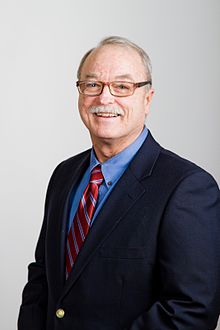
My name is Everette Hatcher III. I am a businessman in Little Rock and have been living in Bryant since 1993. My wife Jill and I have four kids (Rett 24, Hunter 22, Murphey 16, and Wilson 14).

Dan Mitchell: Any type of loan forgiveness exacerbates the original problem, which is how politicians have enabled and subsidized ever-higher tuition rates!

—-

Cancelling Student Loans: More Poor-to-Rich Redistribution from the Left

It is very common for politicians to cause a problem with government intervention and then use the problem as an excuse for even bigger government.

I call this the lather-rinse-repeat cycle of government failure.

And the current controversy over student loan forgiveness is a perfect example.

  • Politicians decided to subsidize student loans.
  • Colleges and universities predictably responded by increasing tuition so they could grab this additional money.
  • Politicians are now responding to the government-created crisis by pushing loan forgiveness.

I could write a column about how this will make a bad situation worse. Heck, I already have written that columnSeveral times.

But I want to focus today on a different aspect of this issue.

Biden on his allies in Congress are pushing a policy that will redistribute money from lower-income people to higher-income people.

Let’s look at some of the findings of a new study by Professor Sylvain Catherine at the University of Pennsylvania and Professor Constantine Yannelis at the University of Chicago.

…on average, those who graduate with a post-secondary degree earn more than those who do not, so student debt forgiveness plans, by definition, are geared toward higher-wage earners. Further, many holders of high loan balances completed graduate and professional degrees and thus earn even higher incomes. …universal debt forgiveness policies would disproportionately benefit high earners. …universal and capped forgiveness policies are highly regressive, with the vast majority of benefits accruing to high-income individuals.

Peter Suderman of Reason is unimpressed by this backwards form of redistribution.

The single largest source of student loan debt is MBA programs, as Brookings Institution Senior Fellow Adam Looney has noted, and MBA grads average more than $73,000 in earnings their first year out of school. “The five degrees responsible for the most student debt are: MBA, JD, BA in business, BS in nursing, and MD,” Looney wrote in 2020.“That’s one reason why the top 20 percent of earners owe 35 percent of the debt, and why most debt is owed by well-educated individuals.” Technically, it’s true that well-paid professional school graduates fall into the category of “working people.” But..what Biden appears to be considering, is a massive program of government aid that would disproportionately benefit doctors, lawyers, well-paid medical specialists, and comfortably salaried individuals with advanced business degrees. …a trillion-dollar bailout for the upper-middle class.

This is disgusting and reprehensible.

I don’t think it is a proper role of the federal government to redistribute money. But it is especially grotesque and misguided when politicians use the coercive power of government to shift resources from lower-income Americans to higher-income Americans.

For what it is worth, there already are many policies and programs in Washingtonthat – on net – shift money from the poor to the rich.

I will close by observing that there has also been a vigorous effort from our friends on the left to restore an unlimited deduction for state and local taxes.

It’s almost as if it is okay to have policies that benefit rich people, so long as they mostly live in blue states.

P.S. It is possible to design loan forgiveness to reduce the level of poor-to-rich redistribution. The aforementioned study by Professors Catherine and Yannelis includes data showing how various income deciles will (or will not) benefit depending on different types of forgiveness rules.

P.P.S. However, any type of loan forgiveness exacerbates the original problem, which is how politicians have enabled and subsidized ever-higher tuition rates.

Georgia Democrats who won Senate in 2021 should remember Dan Mitchell’s words, “Politicians such as Alexandria Ocasio-Cortez and Bernie Sanders would like us to believe the answer involves never-ending tax increases. But such an approach is a recipe for more debt because the economy will weaken and governments will spend more money (look at what’s been happening in Europe, for instance)”

 Sadly last night the Democrats won control of Senate!

Historical Evidence on Reducing Large Debt Burdens

The long-run fiscal outlook for most developed nations is very grim thanks to demographic change and poorly designed entitlement programs.

For all intents and purposes, we’re all destined to become Greece according to long-run projections from the International Monetary FundBank for International Settlements, and Organization for Economic Cooperation and Development.

Are there any solutions to this “most predictable crisis“?

Politicians such as Alexandria Ocasio-Cortez and Bernie Sanders would like us to believe the answer involves never-ending tax increases. But such an approach is a recipe for more debt because the economy will weaken and governments will spend more money (look at what’s been happening in Europe, for instance).

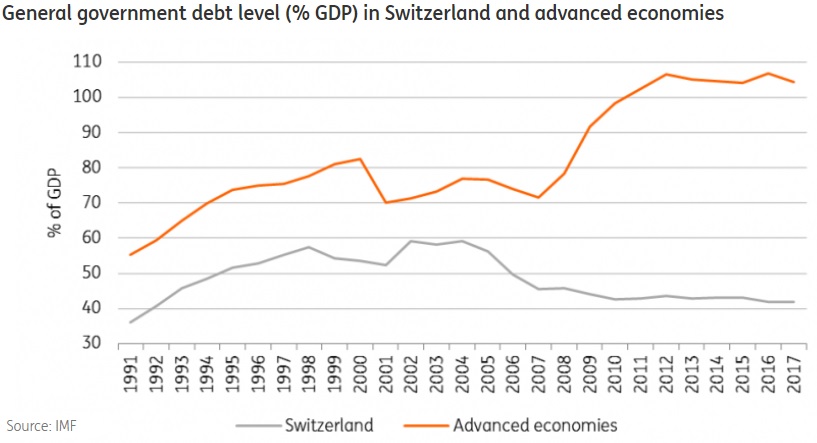
A more sensible approach is a spending cap. I’ve pointed out, for instance, how Swiss government debt has plummeted ever since voters imposed annual limits on budgetary growth.

We also can learn lessons from history according to new research from the International Monetary Fund.

The report contains some very interesting economic history and the evolution of government finance, including the Bank of England being created and given a monopoly so the government would have a vehicle for borrowing money (as I observed in my video on central banking).

But it mostly tells the story of how governments and public finance simultaneously evolved.

Although the written record points to instances of public borrowing as long as two thousand years ago, recent scholarship points to 1000-1400 A.D. as when borrowing agreements with states were concluded with regularity and debt contracts entered into by sovereigns were standardized.…The supply of loans from city-states and territorial monarchies was driven by the need to finance military campaigns and secure borders. …From the 16th century, Europe’s political geography coalesced into the nation states recognized at the Peace of Westphalia in 1648. In parallel, many European states evolved from absolutist regimes to more limited government. …Fiscal states thus evolved in response to the efforts of rulers to secure borders, expand territory and survive. After 1650, larger, more centralized states increasingly possessed the fiscal machinery to raise revenue in uniform ways and had a veto player, such as a parliament, to monitor and discipline public expenditure.

There’s also lots of information in the report about how some governments, primarily outside of Europe, began to borrow money.

In many cases, this produced bad results, with defaults and economic crisis. As the authors wrote, “Debasement and restructuring also have a long history.”

But the part of the report that caught my eye was the description of how three advanced nations – the United Kingdom, the United States, and France – successfully dealt with large debt burdens before World War I.

…we describe three notable debt consolidation episodes before World War I: Great Britain after the Napoleonic Wars, the United States in the last third of the 19th century, and France in the decades leading up to 1913. While the colorful debt crises and defaults of the first era of globalization have been much discussed, less attention has been paid to these successful consolidation episodes. We focus on these three cases because they involved three of the largest economies of the period, but also because their debt burdens were among the heaviest. British public debt as a share of GDP was higher in the aftermath of the Napoleonic Wars, for example, than Greek public debt in 2018. But in all three cases, high public debts were successfully reduced relative to GDP.

In each case, war-time spending was the cause of the debt buildup.

The Napoleonic Wars, Franco-Prussian War and U.S. Civil War were the three most expensive conflicts of the 19th century. …debt accounted for the single largest share of wartime financing.

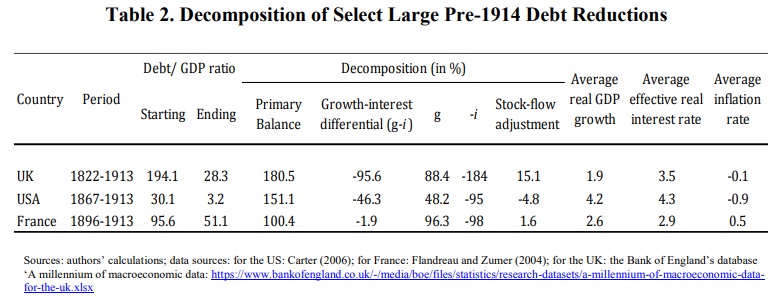
Here’s a table showing that these nations dramatically reduced their debt burdens.
To be sure, there were differences in the three nations.

The reduction in the British debt-GDP ratio was by far the largest and longest: the debt ratio fell from 194 percent in 1822 to 28 percent nine decades later. …The French public-debt-GDP ratio fell from 96 percent in 1896 to 51 percent in 1913… This case ranks second in size but first in pace. U.S. (federal or union) government debt was not as high at the end of the Civil War, and the subsequent consolidation was more leisurely; however, the process is notable for having reduced the debt-GDP ratio to virtually zero by World War I.

When the authors investigated how these nations reduced their debt burdens, they found that limited government was a common answer.

This was true in the United Kingdom.

Britain achieved the impressive feat of maintaining an average primary surplus of 1.6 percent of GDP for nearly a century (the only deficit in Figure 2 is at the time of the Boer War). One of the political legacies of Peel and Gladstone was a fiscal theory or philosophy of “sound finance” emphasizing budget surpluses, low taxes and minimal government expenditure. …demands for spending on welfare relief from the disenfranchised masses were kept in check. In exchange, the self-taxing class of income-tax-paying electors relieved the non-electors from the burden of direct taxation… Budget surpluses then made feasible further reductions in tariffs and taxes, which reduced the cost of living for the working class

It was true in the United States.

In the U.S., primary surpluses were consistently achieved… Southern states opposed an expansive role for the federal government, while entitlements limited to Civil War pensions contained pressure for public spending.

And it was true even in France.

In France, debt reduction was entirely accounted for by primary surpluses. Those surpluses exceeded British levels, reaching 2.5 percent of GDP on average, albeit over a shorter period.

Remember, this was a period when total government spending only consumed about 10 percent of economic output.

And this was a period when there was no welfare state. Redistribution was virtually nonexistent. Not even in France.

So it shouldn’t be a surprise that debt quickly fell in all three countries.
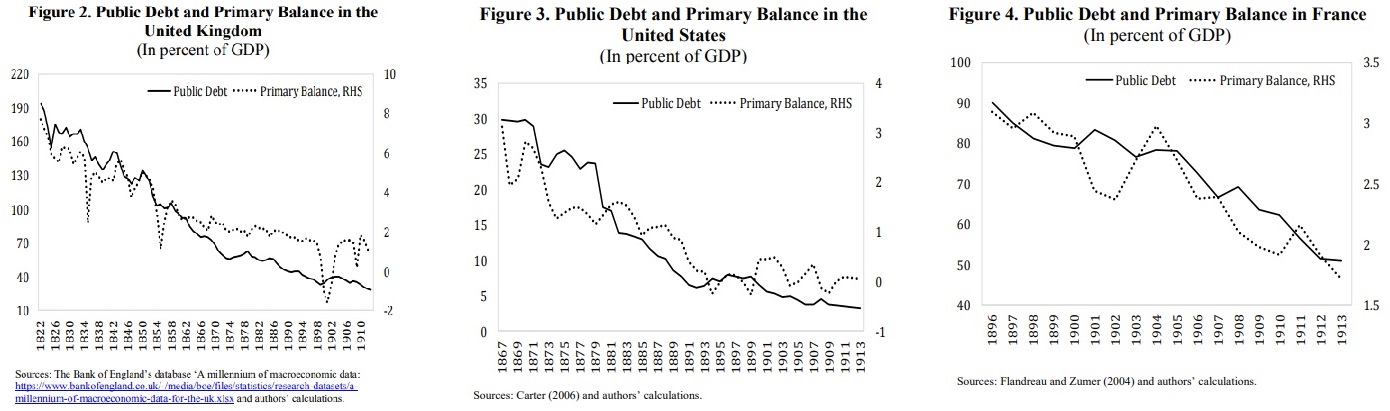
The common thread was small government.

…in all three of these large-scale debt consolidations, governments and societies went to great lengths to service and repay heavy debts. …it reflected prevailing conceptions of the limited functions of government, and limited popular pressure for public programs, entitlements and transfers.

What’s equally important is to note what didn’t happen.

No default. No inflation. No indirect confiscation.

…there was no restructuring or renegotiation of official or privately-held debts in these cases. Nor was there financial repression, i.e., measures artificially depressing interest rates. …Governments for their part did little to bottle up savings at home or to otherwise use regulation and legislation to artificially depress yields. …None of these three governments undertook involuntary restructurings despite the inheritance of heavy debt.

Now let’s shift from the past to the future

The authors point out how debt is rising today because of the welfare state rather than war.

The end of the last century also saw, for the first time, a secular increase in public-debt-to-GDP ratios in a variety of countries in conjunction not with wars and crises but in response to popular demands on governments for pensions, health care, and other often unfunded social services.

Given the demographic changes I mentioned at the beginning of the column, this does not bode well.

So what are the likely implications? As the authors note, there are two ways of dealing with high debt levels.

Countries have pursued two broad approaches to debt reduction. The orthodox approach relies on growth, primary surpluses, and the privatization of government assets. In turn this encourages long debt duration and non-resident holdings. Heterodox approaches, in contrast, include restructuring debt contracts, generating inflation, taxing wealth and repressing private finance.

At the risk of understatement, I fear Robert Higgs is right and that today’s politicians (and today’s voters!) will choose the latter approach.

Given that those policies will make a bad situation even worse, I’m not overflowing with confidence about the future.

—-


Joe Biden: An Incrementalist Version of Bernie Sanders

Hardly anybody noticed because the nation has been focused on protests about police misbehavior, but Joe Biden officially clinched the Democratic nomination this past week.

And he’s now comfortably ahead in the political betting marketsas well as public polling.

If Biden wins in November, what does that mean for the nation’s economic policy?

According to folks on the left, a Biden presidency means bigger government and more statism.

For instance, opining for the New York Times, Jamelle Bouie applauds Biden’s leftist agenda.

…if the goal is to move America to the left…then a Biden candidacy…represents an opportunity. …If Biden goes on to win the White House, there’s real space for the pro-Sanders left to work its will on policy. …It can fulfill some of its goals under the cover of Biden’s moderation, from raising the minimum wage nationally to pushing the American health care system closer to single-payer. …Biden…is a creature of the party. He doesn’t buck the mainstream, he accommodates it. He doesn’t reject the center, he tries to claim it. …the center of the Democratic Party as far left as it’s been since before Ronald Reagan, then Biden is likely to hew to that center, not challenge it.

His colleague at the NYT, Michelle Goldberg, is similarly enthused about the prospects for bigger government under a Biden Administration.
Biden’s proposals go far beyond his call for a $15 federal minimum wage — a demand some saw as radical when Sanders pushed it four years ago. While it’s illegal for companies to fire employees for trying to organize a union, the penalties are toothless. Biden proposes to make those penalties bite and to hold executives personally liable. …should Biden become president, progressives have the opportunity to make generational gains. …To try to unite the party around him, he’s making serious progressive commitments. …he’s moving leftward. Biden recently came out for tuition-free college for students whose families earn less than $125,000. He endorsed Elizabeth Warren’s bankruptcy plan…His climate plan already went beyond any of Barack Obama’s initiatives, and he’s pledged to make it even more robust.

According to (supposedly) neutral analysts, a Biden presidency means bigger government and more statism.

In an article for Newsweek, Steve Friess discusses Biden’s shift to the left.
Being stuck running for the presidency from the basement of his home in Wilmington, Delaware, had given the former vice president a lot of time to think, he told them, and he wanted bigger ideas. Go forth, he urged his financial brain trust, and bring back the boldest, most ambitious proposals they’d ever dreamed of to reshape the U.S. economy…Biden began issuing a raft of new proposals that move his positions closer to the progressive wing of the Democratic Party, with a promise to unveil an even more transformative economic plan this summer. …It’s a yes to adding $200 a month to Social Security benefits and lowering the qualifying age for Medicare from 65 to 60. Yes to trillions in new spending, yes to new regulations on banks and industry, yes to devil-may-care deficits. …the leader he most often invokes—in interviews, in public addresses, on his podcast—is no longer Barack Obama but Franklin Delano Roosevelt. …Biden has already made a series of significant leftward policy shifts since effectively sewing up the nomination in March.

Perry Bacon, in a piece for fivethirtyeight, analyzes Biden’s statist agenda.

…if Biden is elected in November, the left may get a presidency it likes after all…if American politics is moving left, expect Biden to do the same. …Biden’s long record in public office suggests that he is fairly flexible on policy — shifting his positions to whatever is in the mainstream of the Democratic Party at a given moment. …Biden is likely to be a fairly liberal president, no matter how moderate he sounded in the primaries. …Biden’s 2020 primary platform…adopted fairly liberal policies…more liberal than his pre-campaign record suggested. The Democratic Party is more liberal now than it was when Bill Clinton took office, or even when Obama was inaugurated, and Biden’s platform reflects that shift. …Biden and his advisers are now…rolling out more liberal policy plans, speaking in increasingly populist terms and joining forces with the most progressive voices in the party. …“Joe Biden is running on the most progressive platform of any Democratic nominee in recent history. But given the pandemic, he has to look at the New Deal and Great Society traditions in the Democratic Party and go bigger,” said Waleed Shahid, the communications director for Justice Democrats, a left-wing group aligned with Ocasio-Cortez.

Writing for the Washington Post, Sean Sullivan documentsBiden’s leftward drift.

Joe Biden sought to appeal to liberal supporters of Sen. Bernie Sanders on Thursday with a pair of new proposals to expand access to health care and curtail student loan debt. Biden proposed lowering the eligibility age for Medicare coverage from 65 to 60. He also came out in favor of forgiving student loan debt for people who attended public colleges and universities and some private schools and make up to $125,000 a year. …In another peace offering to liberals, Biden proposed paying for his student debt plan by repealing a provision in the recent coronavirus legislation that Congress passed and President Trump enacted. “That tax cut overwhelmingly benefits the richest Americans and is unnecessary for addressing the current COVID-19 economic relief efforts,” he wrote… Biden endorsed a bankruptcy plan put forth by Sen. Elizabeth Warren (D-Mass.), another rival who ran to his left.

And, according to more market-friendly sources, a Biden presidency means bigger government and more statism.

The Wall Street Journal editorialized about Biden’s leftist agenda.
Already Medicare is scheduled to be insolvent by 2026. …In 1970, life expectancy in the U.S. was 70.8. Now it’s about eight years longer. By lowering the age of eligibility instead, Mr. Biden would begin shifting Medicare’s focus from seniors to everybody else.Don’t worry about the funding, he insists, since the extra costs would be “financed out of general revenues.” …Mr. Biden’s new left turn on student loans is equally sharp. …Cancel all federal undergraduate tuition debt for many borrowers who went to public schools, including four-year universities. This forgiveness would be given to anyone who earns $125,000 a year or less. …How much would it cost? There’s no explanation.

Jeff Jacoby analyzed Biden in a column for the Boston Globe.
Biden…is running on a platform far more progressive — i.e., far less moderate — than any Democratic presidential nominee in history. …on issue after issue, Biden has veered sharply from Obama’s path. On health insurance, for example, Obama rejected a public option as part of the Affordable Care Act and repeatedly stressed the importance of maintaining private coverage. But Biden favors a public option open to everyone… Biden supports government-funded health care even for unauthoritzed immigrants, something Obama never came close to proposing. …No Democratic presidential nominee ever endorsed anything like the radical Green New Deal, with its price tag in the tens of trillions of dollars and its goal of eliminating the use of all fossil fuels. But Biden does. No Democratic nominee ever called for a national minimum wage of $15 an hour. But Biden does. …Sanders may not end up on the November ballot, but it will unmistakably reflect his influence. For he and his band of progressives have pushed their party to the left with such success that even the “moderate” in the race would be the most liberal Democrat ever nominated for president.

Here’s some of what Peter Suderman wrote for Reason.
Biden is a moderate compared to Sanders, but he is notably to the left of previous Democratic standard-bearers. …Biden has proposed a significant expansion of the Affordable Care Act that his campaign estimates would cost $750 billion over a decade… Biden has proposed a $1.7 trillion climate planthat is similar in scope to many candidates on his left and a $750 billion education plan… He favors an assault weapons ban and other gun control measures, a national $15 minimum wage, and a raft of subsidies, loans, and other government-granted nudges designed to promote rural economies. Has proposed $3.4 trillion worth of tax hikes—more than double what former Secretary of State Hillary Clinton proposed when she ran in 2016. …Biden’s leftward drift is thus the party’s leftward shift…, a big-government liberal, a candidate whose current incarnation was shaped and informed by progressive politics, if not wholly captured by them.

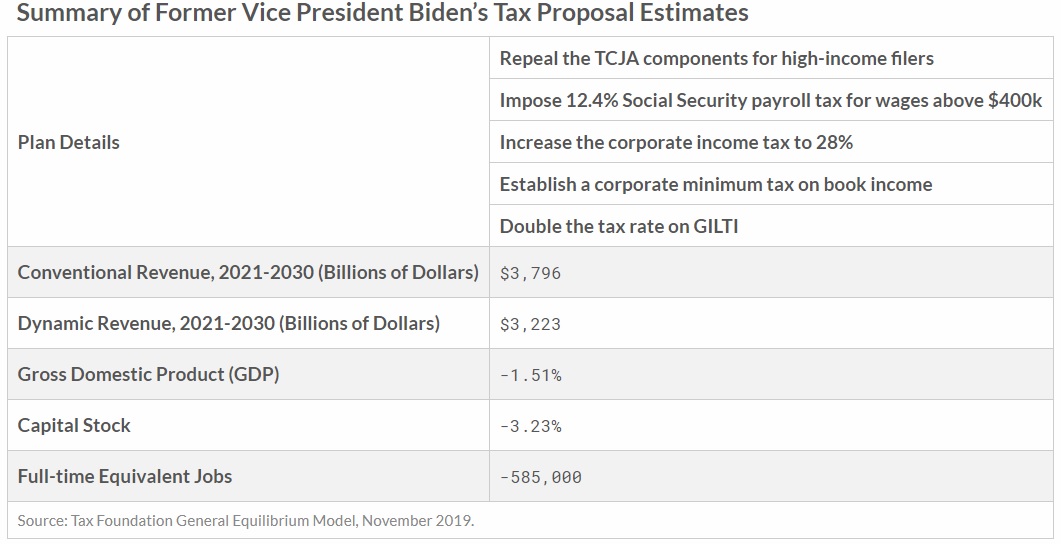
The Tax Foundation examined the former Vice President’s tax plan and the results are not encouraging.

Former Vice President Joe Biden would enact a number of policies that would raise taxes, including individual income taxes and payroll taxes, on high-income individuals with income above $400,000. …According to the Tax Foundation’s General Equilibrium Model, the Biden tax planwould reduce GDP by 1.51 percent over the long term. …The plan would shrink the capital stock by 3.23 percent and reduce the overall wage rate by 0.98 percent, leading to 585,000 fewer full-time equivalent jobs. …On a dynamic basis, we estimate that Biden’s tax plan would raise about 15 percent less revenue than on a conventional basis over the next decade. …That is because the relatively smaller economy would shrink the tax base for payroll, individual income, and business income taxes. …The plan would lead to lower after-tax income for all income levels.

Here’s a table summarizing the findings.
So what does all this mean?

At the risk of oversimplifying, Biden unquestionably would move tax policy to the left (he actually said higher taxes are patriotic, even though he engages in aggressive tax avoidance), and the same thing would happen on regulatory issues.

His spending agenda is terrible, though it’s worth noting that Democrat presidents usually don’t spend as much as Republicans (with the admirable exception of Reagan).

And, to be fair, there’s no way he could be as bad on trade as Trump.

Let’s close by looking at some hard data. Back in January, I sifted through the vote ratings prepared by the National Taxpayers Union and the Club for Growth and showed that Biden was not a Bill Clinton-style moderate.

I went back to those same sources an put together this comparison of Biden and some other well-known Democrats (scores on a 0-100 scale, with zero being statism and 100 being libertarian).
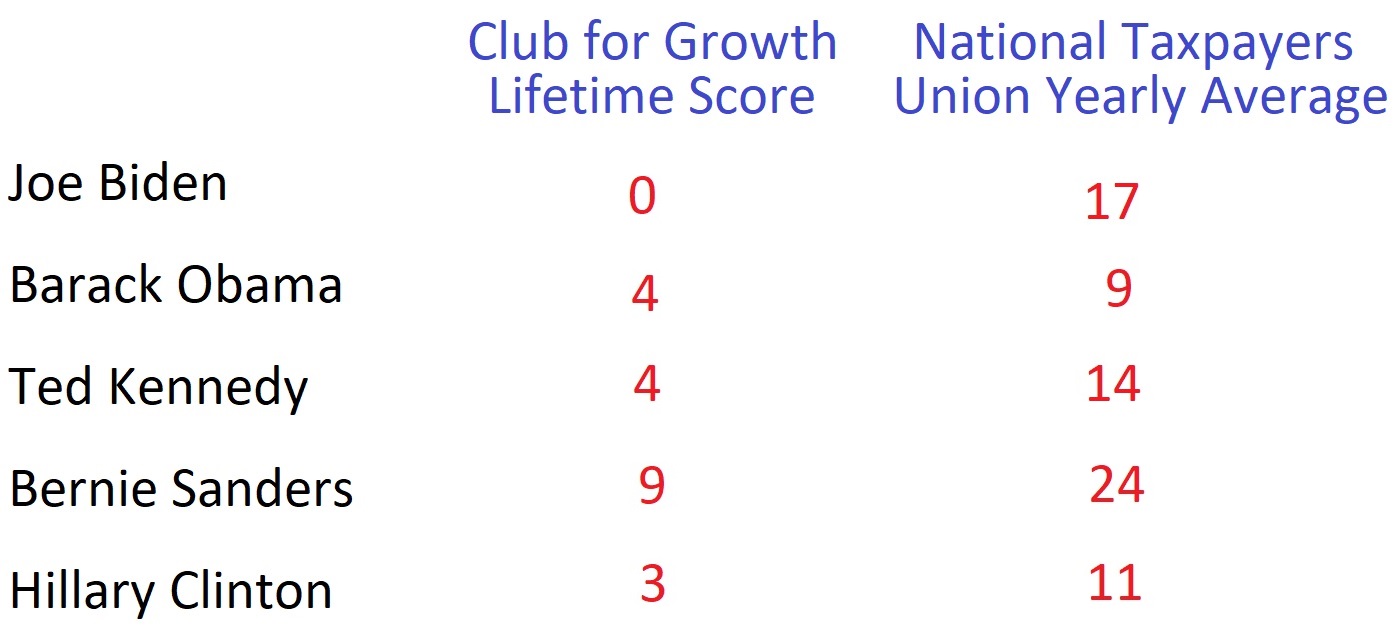
In both measures, he’s worse than Crazy Bernie!

Moreover, a lifetime average of zero from the Club for Growth is rather horrifying. His average from the National Taxpayers Union isn’t quite so bad, but the trend is in the wrong direction. Biden’s post-2000 average was less than 10, while his score for the preceding years averaged more than 23.

That being said, my two cents on this topic is that Biden is a statist, but not overly ideological.

His support for bigger government is largely a strategy of catering to the various interest groups that dominate the Democratic Party.

The good news is that he’s an incrementalist and won’t aggressively push for a horrifying FDR-style agenda if he gets to the White House.

The bad news is that he will probably allow Nancy Pelosi and other statist ideologues to dictate that kind of agenda if he wins the presidency.

P.S. My collection of Biden-oriented humor is rather sparse (see hereherehere, and here), an oversight that I’ll have to address in the near future.

—-

A Victory for Biden, a Defeat for the Left

The day after the election, I wrote that “left-wing goals are now very unlikely” because Republicans almost certainly will retain control of the Senate.

But perhaps I should have been ever bolder and argued that the election was a rejection of the left-wing agenda.

An editorial from the Wall Street Journal points out that voters did not vote for bigger government or more statism.

…the closer we inspect the nationwide election returns, the more the result looks like a defeat…for the progressive agenda. …Democrats lost seats in the House, giving up some of the suburban gains they made in 2018 while continuing to struggle in rural areas. …A GOP Senate may compromise with Mr. Biden around centrist ideas, but the aggressive House agenda of the last two years would die again.This result is all the more remarkable given that Democrats had nearly all of the media, Silicon Valley billionaires, and all of the leading cultural figures and institutions helping them. …The lack of coattails was also evident in the states, where Democrats spent heavily to flip legislatures. …The GOP flipped both legislative bodies in New Hampshire, despite Mr. Trump’s loss in the Granite State, and Republicans protected their advantage nearly everywhere else. …There was no blue wave, and certainly no mandate for progressive change. …in their considerable wisdom, the voters may have elected Mr. Biden but they left his party and its radical ideas behind.

Some readers may think that the Wall Street Journal‘s editors are engaging in spin. In other words, because of their pro-market views, they’re trying to make it seem like a defeat wasn’t really a defeat.

But what about Helaine Olen, a reliably left-wing columnist for the Washington Post, who reached the same conclusion when opining about election results from California.

Proposition 22 — which would allow gig-economy companies such as Uber, Lyft and DoorDash to continue treating drivers as independent contractors — passed handily. On the other hand, Proposition 16, which would have restored affirmative action to California’s public college and university admissions, has gone down in defeat. …Let’s take Proposition 22. Activists have been unhappy with the tech giants of the sharing economy for years, pointing out repeatedly that they are using venture capital to subsidize an unprofitable industry and that, moreover, they offer almost nothing in either the way of labor or consumer protection. The entire business model is designed to get around government regulations. …Voters did not appear particularly concerned that allowing a major employer to override state regulationand effectively set its own working conditions is a terrible precedent — not when a few extra dollars per ride was at stake. When it came down to worker welfare vs. short-term convenience and financial gain, it wasn’t even a contest. …Proposition 16…supporters roundly outspent opponents and hoped the increased attention to issues of systemic racial inequities in the wake of the killing of George Floyd would help them garner support. …The biggest obstacle might have been the traditional antipathy toward affirmative action reasserting itself — a survey last year found that 3 out of 4 Americans opposed using race or ethnicity as a factor in college admissions.

And the New York Times isn’t exactly a bastion of right-wing thinking, yet an article by Thomas Fuller, Shawn Hubler, Tim Arango and Conor Dougherty also acknowledges that the election results were not great for the left.

…the nation’s most populous state put up mammoth numbers for the Democrats. But dig a little deeper into the results and a more complex picture of the Golden State voter emerges, of strong libertarian impulses and resistance to some quintessentially liberal ideas. In a series of referendums, voters in California rejected affirmative action, decisively shot down an expansion of rent control and eviscerated a law that gives greater labor protections for ride-share and delivery drivers, a measure that had the strong backing of labor unions. A measure that would have raised taxes on commercial landlords to raise billions for a state that sorely needs revenue also seemed on track for defeat. …said Bob Shrum, a former Democratic strategist…“California is a very liberal state that is now resistant to higher taxes.” …For all their liberal leanings on issues like the environment, California voters have long been less welcoming to new taxes… Proposition 15, would have removed the Proposition 13 tax limits on commercial properties like office buildings and industrial parks, continuing to shield homeowners while raising an estimated $6.5 billion to $11.5 billion a year for public schools and local governments. The measure was trailing on Thursday.. More than $100 million was also spent on another hot-button measure, rent control. Polls showed that the housing crisis was the No. 1 concern for state voters… And yet voters up and down the state resoundingly rejected efforts to expand tenants’ rights and rent control. …What do voters think about voting for Democrats and at the same time not supporting Democratic-led initiatives? José Legaspi, a Los Angeles resident…voted for Mr. Biden and did not think twice about opposing the measure that would raise taxes on commercial properties. “I truly believe in paying taxes,” he said. “However there is a point at which one should limit how much more in taxes one should personally pay.”

The bottom line is that Joe Biden won the White House (barring some dramatic and unexpected developments), but not because of his statist agenda.

It’s more accurate to say that voters wanted to end the sturm and drang of Trump, but without embracing bigger government.

P.S. I’m not going to pretend that voters are rabid libertarians who are clamoring for my preferred policies (such as shutting down departmentsgenuine entitlement reform, etc). But I also think that it’s safe to say that they don’t want the left’s agenda (class warfareMedicare for allgreen new deal, etc) of bigger government and more dependency

Daniel Mitchell quotes Milton Friedman on minimum wage and contrasts Trump a d Biden approach!

Trump vs. Biden on the Minimum Wage

In another display of selfless masochism, I watched the TrumpBiden debate last night.

The candidates behaved better, for whatever that’s worth, but I was disappointed that there so little time (and even less substance) devoted to economic issues.

One of the few exceptions was the brief tussle regarding the minimum wage. Trump waffled on the issue, so I don’t give him any points, but Biden fully embraced the Bernie Sanders policyof basically doubling the minimum wage to $15 per hour.

This is very bad news for low-skilled workers and very bad news to low-margin businesses.

The economic of this issue are very simple. If a worker generates, say, $9 of revenue per hour, and politicians say that worker can’t be employed for less than $15 per hour, that’s a recipe for unemployment.

Earlier this month, Professor Steven Landsburg on the University of Rochester opined for the Wall Street Journal on Biden’s minimum-wage policy.

It isn’t only that I think Mr. Biden is frequently wrong. It’s that he tends to be wrong in ways that suggest he never cared about being right. He makes no attempt to defend many of his policies with logic or evidence, and he deals with objections by ignoring or misrepresenting them. …Take Mr. Biden’s stance on the federal minimum wage, which he wants to increase to $15 an hour from $7.25. …So why does Mr. Biden want to raise the minimum wage…?He hasn’t said, so I have two guesses, neither of which reflects well on him. Guess No. 1: He’s dissembling about the cost. …The minimum wage…comes directly from employers but indirectly (after firms shrink and prices rise) from consumers. A minimum wage is a stealth tax on eating at McDonald’s or shopping at Walmart. …Mr. Biden should acknowledge the cost of wage hikes and argue for accepting it. Instead he’s silent about the cost, hoping he can foist it on people who won’t realize they’re footing this bill. Guess No. 2: He’s rewarding his friends and punishing his enemies. New York is going to vote for Mr. Biden. The state also has a high cost of living and high wages—so New Yorkers would be largely unaffected by the minimum-wage hike. Alabama is going to vote against Mr. Biden. Alabama has a low cost of living and relatively low wages—so under the Biden plan Alabama firms would shrink, to the benefit of competitors in New York. Alabama workers and consumers would pay a greater price than New Yorkers.

And Mark Perry of the American Enterprise Institute recently highlighted some of the adverse effects for unskilled workers.
It’s an economic reality that workers compete against other workers, not against employers, for jobs, and higher wages in the labor market. And it’s also true that lower-skilled, limited-experience, less-educated workers compete against higher-skilled, more experienced, more educated workers for jobs. …If the minimum wage is increased…, that will…take away from unskilled workers the one advantage they currently have to compete against skilled workers – the ability to offer to work for a significantly lower wage than what skilled workers can command. …Result of a minimum wage hike to $15 an hour? Demand for skilled workers goes up, demand for unskilled workers goes down, and employment opportunities for unskilled workers are reduced.

Since I recently shared videos with Milton Friedman’s wisdom on both taxes and spending, here’s what he said about the minimum wage.


Let’s share one last bit of evidence. Mark Perry’s article referenced some new research by Jeffrey Clemens, Lisa Kahn, and Jonathan Meer.

Here’s what those scholars found in a study published by the National Bureau of Economic Research.
We investigate whether changes in firms’ skill requirements are channels through which labor markets respond to minimum wage increases. …Data from the American Community Survey show that recent minimum wage changes resulted in increases in the average age and education of the individuals employed in low-wage jobs. Data on job vacancy postings show that the prevalence of a high school diploma requirement increases at the same time. The shift in skill requirements begins within the first quarter of a minimum wage hike. Further, it results from both within-firm shifts in postings and across-firms shifts towards firms that sought more-skilled workers at baseline. Given the poor labor market outcomes of individuals without high school diplomas, these findings have substantial policy relevance. This possibility was recognized well over a century ago by Smith (1907), who noted that the “enactment of a minimum wage involves the possibility of creating a class prevented by the State from obtaining employment.” Further, negative effects may be exacerbated for minority groups in the presence of labor market discrimination.

So why do politicians push for higher minimum wages, when all the evidence suggests that vulnerable workers bear the heaviest cost?

Part of the answer is that they don’t understand economics and don’t care about evidence.

But there’s also a more reprehensible answer, which is that they do understand, but they want to curry favor with union bosses, and those union bosses push for higher minimum wages as a way of reducing competition from lower-skilled workers.

P.S. Here’s my CNBC debate with Joe Biden’s top economic advisor on this issue.

P.P.S. Here’s a rather frustrating discussion I had on the minimum wage with Yahoo Finance.

P.P.P.S. But if you’re pressed for time, don’t listen to me pontificate. Instead, watch this video.

—-

Milton Friedman on Taxation

October 4, 2020 by Dan Mitchell

Yesterday’s column featured some of Milton Friedman’s wisdom from 50 years ago on how a high level of societal capital (work ethic, spirit of self-reliance, etc) is needed if we want to limit government.

Today, let’s look at what he said back then about that era’s high tax rates.

His core argument is that high marginal tax rates are self-defeating because the affected taxpayers (like Trump and Biden) will change their behavior to protect themselves from being pillaged.

This was in the pre-Reagan era, when the top federal tax rate was 70 percent, and notice that Friedman made a Laffer Curve-type prediction that a flat tax of 19 percent would collect more revenue than the so-called progressive system.

We actually don’t know if that specific prediction would have been accurate, but we do know that Reagan successfully lowered the top tax rate on the rich from 70 percent in 1980 to 28 percent in 1988.

So, by looking at what happened to tax revenues from these taxpayers, we can get a pretty good idea whether Friedman’s prediction was correct.

Well, here’s the IRS data from 1980 and 1988 for taxpayers impacted by the highest tax rate. I’ve circled (in red) the relevant data showing how we got more rich people, more taxable income, and more tax revenue.

The bottom line is that Friedman was right.

Good tax policy (i.e., lower rates on productive behavior) can be a win-win situation. Taxpayers earn more and keep more, while politicians also wind up with more because the economic pie expands.

Something to keep in mind since some politicians in Washington want a return to confiscatory taxes on work, saving, investment, and entrepreneurship.

—-

Why Milton Friedman Saw School Choice as a First Step, Not a Final One

On his birthday, let’s celebrate Milton Friedman’s vision of enabling parents, not government, to be in control of a child’s education.

Wednesday, July 31, 2019
Kerry McDonald
Kerry McDonald

EducationMilton FriedmanSchool ChoiceSchooling

Libertarians and others are often torn about school choice. They may wish to see the government schooling monopoly weakened, but they may resist supporting choice mechanisms, like vouchers and education savings accounts, because they don’t go far enough. Indeed, most current choice programs continue to rely on taxpayer funding of education and don’t address the underlying compulsory nature of elementary and secondary schooling.

Skeptics may also have legitimate fears that taxpayer-funded education choice programs will lead to over-regulation of previously independent and parochial schooling options, making all schooling mirror compulsory mass schooling, with no substantive variation.

Milton Friedman had these same concerns. The Nobel prize-winning economist is widely considered to be the one to popularize the idea of vouchers and school choice beginning with his 1955 paper, “The Role of Government in Education.” His vision continues to be realized through the important work of EdChoice, formerly the Friedman Foundation for Education Choice, that Friedman and his economist wife, Rose, founded in 1996.

July 31 is Milton Friedman’s birthday. He died in 2006 at the age of 94, but his ideas continue to have an impact, particularly in education policy.

Friedman saw vouchers and other choice programs as half-measures. He recognized the larger problems of taxpayer funding and compulsion, but saw vouchers as an important starting point in allowing parents to regain control of their children’s education. In their popular book, Free To Choose, first published in 1980, the Friedmans wrote:

We regard the voucher plan as a partial solution because it affects neither the financing of schooling nor the compulsory attendance laws. We favor going much farther. (p.161)

They continued:

The compulsory attendance laws are the justification for government control over the standards of private schools. But it is far from clear that there is any justification for the compulsory attendance laws themselves. (p. 162)

The Friedmans admitted that their “own views on this have changed over time,” as they realized that “compulsory attendance at schools is not necessary to achieve that minimum standard of literacy and knowledge,” and that “schooling was well-nigh universal in the United States before either compulsory attendance or government financing of schooling existed. Like most laws, compulsory attendance laws have costs as well as benefits. We no longer believe the benefits justify the costs.” (pp. 162-3)

Still, they felt that vouchers would be the essential starting point toward chipping away at monopoly mass schooling by putting parents back in charge. School choice, in other words, would be a necessary but not sufficient policy approach toward addressing the underlying issue of government control of education.

In their book, the Friedmans presented the potential outcomes of their proposed voucher plan, which would give parents access to some or all of the average per-pupil expenditures of a child enrolled in public school. They believed that vouchers would help create a more competitive education market, encouraging education entrepreneurship. They felt that parents would be more empowered with greater control over their children’s education and have a stronger desire to contribute some of their own money toward education. They asserted that in many places “the public school has fostered residential stratification, by tying the kind and cost of schooling to residential location” and suggested that voucher programs would lead to increased integration and heterogeneity. (pp. 166-7)

To the critics who said, and still say, that school choice programs would destroy the public schools, the Friedmans replied that these critics fail to

explain why, if the public school system is doing such a splendid job, it needs to fear competition from nongovernmental, competitive schools or, if it isn’t, why anyone should object to its “destruction.” (p. 170)

What I appreciate most about the Friedmans discussion of vouchers and the promise of school choice is their unrelenting support of parents. They believed that parents, not government bureaucrats and intellectuals, know what is best for their children’s education and well-being and are fully capable of choosing wisely for their children—when they have the opportunity to do so.

They wrote:

Parents generally have both greater interest in their children’s schooling and more intimate knowledge of their capacities and needs than anyone else. Social reformers, and educational reformers in particular, often self-righteously take for granted that parents, especially those who are poor and have little education themselves, have little interest in their children’s education and no competence to choose for them. That is a gratuitous insult. Such parents have frequently had limited opportunity to choose. However, U.S. history has demonstrated that, given the opportunity, they have often been willing to sacrifice a great deal, and have done so wisely, for their children’s welfare. (p. 160).

Sign-Up: Receive Kerry’s Weekly Parenting and Education Newsletter!

Today, school voucher programs exist in 15 states plus the District of Columbia. These programs have consistently shown that when parents are given the choice to opt-out of an assigned district school, many will take advantage of the opportunity. In Washington, D.C., low-income parents who win a voucher lottery send their children to private schools.

The most recent three-year federal evaluationof voucher program participants found that while student academic achievement was comparable to achievement for non-voucher students remaining in public schools, there were statistically significant improvements in other important areas. For instance, voucher participants had lower rates of chronic absenteeism than the control groups, as well as higher student satisfaction scores. There were also tremendous cost-savings.

In Wisconsin, the Milwaukee Parental Choice Program has served over 28,000 low-income students attending 129 participating private schools.

According to Corey DeAngelis, Director of School Choice at the Reason Foundation and a prolific researcher on the topic, the recent analysis of the D.C. voucher program “reveals that private schools produce the same academic outcomes for only a third of the cost of the public schools. In other words, school choice is a great investment.”

In Wisconsin, the Milwaukee Parental Choice Program was created in 1990 and is the nation’s oldest voucher program. It currently serves over 28,000 low-income students attending 129 participating private schools. Like the D.C. voucher program, data on test scores of Milwaukee voucher students show similar results to public school students, but non-academic results are promising.

Recent research found voucher recipients had lower crime rates and lower incidences of unplanned pregnancies in young adulthood. On his birthday, let’s celebrate Milton Friedman’s vision of enabling parents, not government, to be in control of a child’s education.

According to Howard Fuller, an education professor at Marquette University, founder of the Black Alliance for Educational Options, and one of the developers of the Milwaukee voucher program, the key is parent empowerment—particularly for low-income minority families.

In an interview with NPR, Fuller said: “What I’m saying to you is that there are thousands of black children whose lives are much better today because of the Milwaukee parental choice program,” he says. 
“They were able to access better schools than they would have without a voucher.”

Putting parents back in charge of their child’s education through school choice measures was Milton Friedman’s goal. It was not his ultimate goal, as it would not fully address the funding and compulsion components of government schooling; but it was, and remains, an important first step. As the Friedmans wrote in Free To Choose:

The strong American tradition of voluntary action has provided many excellent examples that demonstrate what can be done when parents have greater choice. (p. 159).

On his birthday, let’s celebrate Milton Friedman’s vision of enabling parents, not government, to be in control of a child’s education.

Kerry McDonald

Related posts:


“Friedman Friday” (“Free to Choose” episode 1 – Power of the Market. part 7 of 7)

March 16, 2012 – 12:25 am

  Michael Harrington:  If you don’t have the expertise, the knowledge technology today, you’re out of the debate. And I think that we have to democratize information and government as well as the economy and society. FRIEDMAN: I am sorry to say Michael Harrington’s solution is not a solution to it. He wants minority rule, I […] By Everette Hatcher III | Posted in Current Events, Milton Friedman | Edit | Comments (0)

“Friedman Friday” (“Free to Choose” episode 1 – Power of the Market. part 6 of 7)

March 9, 2012 – 12:29 am

PETERSON: Well, let me ask you how you would cope with this problem, Dr. Friedman. The people decided that they wanted cool air, and there was tremendous need, and so we built a huge industry, the air conditioning industry, hundreds of thousands of jobs, tremendous earnings opportunities and nearly all of us now have air […] By Everette Hatcher III | Posted in Current Events, Milton Friedman | Edit | Comments (0)

“Friedman Friday” (“Free to Choose” episode 1 – Power of the Market. part 5 of 7)

March 2, 2012 – 12:26 am

Part 5 Milton Friedman: I do not believe it’s proper to put the situation in terms of industrialist versus government. On the contrary, one of the reasons why I am in favor of less government is because when you have more government industrialists take it over, and the two together form a coalition against the ordinary […] By Everette Hatcher III | Posted in Current Events, Milton Friedman | Edit | Comments (0)

“Friedman Friday” (“Free to Choose” episode 1 – Power of the Market. part 4 of 7)

February 24, 2012 – 12:21 am

The fundamental principal of the free society is voluntary cooperation. The economic market, buying and selling, is one example. But it’s only one example. Voluntary cooperation is far broader than that. To take an example that at first sight seems about as far away as you can get __ the language we speak; the words […] By Everette Hatcher III | Posted in Current Events, Milton Friedman | Edit | Comments (0)

“Friedman Friday” (“Free to Choose” episode 1 – Power of the Market. part 3 of 7)

February 17, 2012 – 12:12 am

  _________________________   Pt3  Nowadays there’s a considerable amount of traffic at this border. People cross a little more freely than they use to. Many people from Hong Kong trade in China and the market has helped bring the two countries closer together, but the barriers between them are still very real. On this side […] By Everette Hatcher III | Posted in Current Events, Milton Friedman | Edit | Comments (0)

“Friedman Friday” (“Free to Choose” episode 1 – Power of the Market. part 2 of 7)

February 10, 2012 – 12:09 am

  Aside from its harbor, the only other important resource of Hong Kong is people __ over 4_ million of them. Like America a century ago, Hong Kong in the past few decades has been a haven for people who sought the freedom to make the most of their own abilities. Many of them are […] By Everette Hatcher III | Posted in Current Events, Milton Friedman | Edit | Comments (0)

“Friedman Friday” (“Free to Choose” episode 1 – Power of the Market. part 1of 7)

February 3, 2012 – 12:07 am

“FREE TO CHOOSE” 1: The Power of the Market (Milton Friedman) Free to Choose ^ | 1980 | Milton Friedman Posted on Monday, July 17, 2006 4:20:46 PM by Choose Ye This Day FREE TO CHOOSE: The Power of the Market Friedman: Once all of this was a swamp, covered with forest. The Canarce Indians […]

Milton Friedman The Power of the Market 1-5

Debate on Milton Friedman’s cure for inflation

September 29, 2011 – 7:24 am

If you would like to see the first three episodes on inflation in Milton Friedman’s film series “Free to Choose” then go to a previous post I did. Ep. 9 – How to Cure Inflation [4/7]. Milton Friedman’s Free to Choose (1980) Uploaded by investbligurucom on Jun 16, 2010 While many people have a fairly […]

By Everette Hatcher III | Also posted in Current Events | Tagged dr friedman, expansion history, income tax brackets, political courage, www youtube | Edit | Comments (0)

“Friedman Friday” Milton Friedman believed in liberty (Interview by Charlie Rose of Milton Friedman part 1)

April 19, 2013 – 1:14 am

Charlie Rose interview of Milton Friedman My favorite economist: Milton Friedman : A Great Champion of Liberty  by V. Sundaram   Milton Friedman, the Nobel Prize-winning economist who advocated an unfettered free market and had the ear of three US Presidents – Nixon, Ford and Reagan – died last Thursday (16 November, 2006 ) in San Francisco […] By Everette Hatcher III | Posted in Milton Friedman | Edit | Comments (0)

What were the main proposals of Milton Friedman?

February 21, 2013 – 1:01 am

Stearns Speaks on House Floor in Support of Balanced Budget Amendment Uploaded by RepCliffStearns on Nov 18, 2011 Speaking on House floor in support of Balanced Budget Resolution, 11/18/2011 ___________ Below are some of the main proposals of Milton Friedman. I highly respected his work. David J. Theroux said this about Milton Friedman’s view concerning […] By Everette Hatcher III | Posted in Milton Friedman | Edit | Comments (0)

“Friedman Friday,” EPISODE “The Failure of Socialism” of Free to Choose in 1990 by Milton Friedman (Part 1)

December 7, 2012 – 5:55 am

Milton Friedman: Free To Choose – The Failure Of Socialism With Ronald Reagan (Full) Published on Mar 19, 2012 by NoNationalityNeeded Milton Friedman’s writings affected me greatly when I first discovered them and I wanted to share with you. We must not head down the path of socialism like Greece has done. Abstract: Ronald Reagan […] By Everette Hatcher III | Posted in Milton FriedmanPresident Obama | Edit | Comments (1)

Defending Milton Friedman

July 31, 2012 – 6:45 am

What a great defense of Milton Friedman!!!!   Defaming Milton Friedman by Johan Norberg This article appeared in Reason Online on September 26, 2008  PRINT PAGE  CITE THIS      Sans Serif      Serif Share with your friends: ShareThis In the future, if you tell a student or a journalist that you favor free markets and limited government, there is […]

May 2, 2022 READING A PROVERB A DAY ( PROVERBS 2)

__

DAILY BIBLE DEVOTIONS: DAY 2

My son, if you will receive my words, and treasure my commandments within you… Proverbs 2:1

It happens at different points in each person’s walk. Slowly familiarity settles in. The awe and wonder cease. Next thing you know, someone becomes desensitized to the power of God’s Word and the inevitable happens…

To the angel of the church in Ephesus write: The One who holds the seven stars in His right hand, the One who walks among the seven golden lampstands, says this: ‘I know your deeds and your toil and perseverance, and that you cannot tolerate evil men, and you put to the test those who call themselves apostles, and they are not, and you found them to be false; and you have perseverance and have endured for My name’s sake, and have not grown weary. But I have this against you, that you have left your first love. Therefore remember from where you have fallen, and repent and do the deeds you did at first…” (Revelation 2:1-5)

You see, the Ephesians were a mighty people. They persevered in the face of persecution. They did not grow weary, nor did they welcome sinful people in their camp. They were wise and tested people before they received them as leaders. Yet, somehow (somewhere) things changed in their heart. In the process of having their lives totally transformed by their Savior – the manifested Word of God – many of them left their first love.

We’ll never really know, on this side of eternity, what this means specifically; but from what Christ says next, I think we have a pretty good idea. From what we can tell, they lost discipline, which is why the Lord admonished them,

“…Remember from where you have fallen, and repent and do the deeds you did at first.”

Even though the Ephesians excelled in several areas, they allowed laziness to creep in and were told to go back to the basics. This should lead us to assume that they strayed from the Scripture. At its core, treasuring God’s word and taking heed to what He tells us in the pages of the Bible are the hallmark of the Christian experience.

How about you? Have you left God’s word aside for a season? Have you lost your love for reading the Scripture and treasuring His commands?

If so, the remedy is brilliantly simple: “…Remember from where you have fallen, and repent and do the deeds you did at first!

Proverbs 2Living Bible

1-2 Every young man who listens to me and obeys my instructions will be given wisdom and good sense. 3-5 Yes, if you want better insight and discernment, and are searching for them as you would for lost money or hidden treasure, then wisdom will be given you and knowledge of God himself; you will soon learn the importance of reverence for the Lord and of trusting him.

For the Lord grants wisdom! His every word is a treasure of knowledge and understanding. 7-8 He grants good sense to the godly—his saints. He is their shield, protecting them and guarding their pathway. He shows how to distinguish right from wrong, how to find the right decision every time. 10 For wisdom and truth will enter the very center of your being, filling your life with joy. 11-13 You will be given the sense to stay away from evil men who want you to be their partners in crime—men who turn from God’s ways to walk down dark and evil paths 14 and exult in doing wrong, for they thoroughly enjoy their sins. 15 Everything they do is crooked and wrong.

16-17 Only wisdom from the Lord can save a man from the flattery of prostitutes; these girls have abandoned their husbands and flouted the laws of God. 18 Their houses lie along the road to death and hell. 19 The men who enter them are doomed. None of these men will ever be the same again.[a]

20 Follow the steps of the godly instead, and stay on the right path, 21 for only good men enjoy life to the full;[b] 22 evil men lose the good things they might have had,[c] and they themselves shall be destroyed.

I love the Book of Proverbs and two of my favorite preachers have preached through it and they are Adrian Rogers and John MacArthur. Some of the finest sermons I have heard by Adrian Rogers are in Proverbs such as the Peril of Pride, God’s Grace in the Workplace, God’s Miracle Medicine, God wants me to Prosper, Fathers who teach their children to be wise, God’s Answer to Anger, The Battle of the Bottle, Raising Kids that Count, How to be the Father of a Wise Child, Financial Freedom, What Does the Word of God Say About Government?, Friendship Factor, God’s Way to Wealth, Wisdom and Happiness, The Playboy’s Payday, The Incomparable Worth of Wisdom, How to Answer a Skeptic, How to Guard Your Heart, Treasuring Truth, Finding God’s Way in a Dark Day, Crossing God’s Deadline, Innocent Blood, and Sermon on Gossip.

__-

10 Videos of sermons below by Adrian Rogers on Proverbs:

Related Posts:

April, 16, 2022 READING A PROVERB A DAY ( PROVERBS 16) 16:28 ”A troublemaker plants seeds of strife;    gossip separates the best of friends!” King Solomon on the scoffer Part 11 of series on King Solomon’s words (Verses listed by Adrian Warnock)(Done 12-20-13) Proverbs chapters 16, 19, 22 and 26

April 16, 2022 – 1:43 am

– Proverbs 16 New Living Translation 16 We can make our own plans,     but the Lord gives the right answer. 2 People may be pure in their own eyes,     but the Lord examines their motives. 3 Commit your actions to the Lord,     and your plans will succeed. 4 The Lord has made everything for his own purposes,     even the […]

By Everette Hatcher III | Posted in Current Events | Edit | Comments (0)

April 15, 2022 READING A PROVERB A DAY (PROVERBS 15) Things Animals Don’t Do Proverbs 15:13 

April 15, 2022 – 1:29 am

– Proverbs 15New Living Translation 15 A gentle answer deflects anger,    but harsh words make tempers flare. 2 The tongue of the wise makes knowledge appealing,    but the mouth of a fool belches out foolishness. 3 The Lord is watching everywhere,    keeping his eye on both the evil and the good. 4 Gentle words are a tree of life;    a deceitful tongue crushes the spirit. […]

By Everette Hatcher III | Posted in Uncategorized | Edit | Comments (0)

April 14, 2022 READING A PROVERB A DAY (PROVERBS 14) What Does the Word of God Say About Government? Adrian Rogers Proverbs 14:23

April 14, 2022 – 1:39 am

– Proverbs 14New Living Translation 14 A wise woman builds her home,    but a foolish woman tears it down with her own hands. 2 Those who follow the right path fear the Lord;    those who take the wrong path despise him. 3 A fool’s proud talk becomes a rod that beats him,    but the words of the wise keep them safe. 4 Without […]

By Everette Hatcher III | Posted in Uncategorized | Edit | Comments (0)

April 13, 2022 READING A PROVERB A DAY (PROVERBS 13)  How to Be the Father of a Wise Child Adrian Rogers Proverbs 1, 13

April 13, 2022 – 1:43 am

— Proverbs 13New Living Translation 13 A wise child accepts a parent’s discipline;[a]    a mocker refuses to listen to correction. 2 Wise words will win you a good meal,    but treacherous people have an appetite for violence. 3 Those who control their tongue will have a long life;    opening your mouth can ruin everything. 4 Lazy people want much but get little,    but […]

By Everette Hatcher III | Posted in Uncategorized | Edit | Comments (0)

April 12, 2022 READING A PROVERB A DAY (PROVERBS 12) Adrian Rogers God’s Miracle Medicine PROVERBS 12:25

April 12, 2022 – 1:44 am

Proverbs 12New Living Translation 12 To learn, you must love discipline;    it is stupid to hate correction. 2 The Lord approves of those who are good,    but he condemns those who plan wickedness. 3 Wickedness never brings stability,    but the godly have deep roots. 4 A worthy wife is a crown for her husband,    but a disgraceful woman is like cancer in his bones. 5 The […]

By Everette Hatcher III | Posted in Uncategorized | Edit | Comments (0)

April 11, 2022 READING A PROVERB A DAY ( PROVERBS 11) Proverbs 11:1 “Dishonest scales are an abomination to the Lord, but a just weight is His delight” John Hagee “God’s truth is not on a sliding scale; His values never change. What He considered sin in the Garden of Eden is still sin today”

April 11, 2022 – 1:44 am

— John Hagee Devotional 5th October 2020 Today’s Message Scripture: Dishonest scales are an abomination to the Lord, but a just weight is His delight – Proverbs 11:1 God detests dishonest scales; they cause rage and disgust to burn within Him. Why? Dishonest scales give privilege to some and abuse others when “the Lord is the […]

By Everette Hatcher III | Posted in Uncategorized | Edit | Comments (0)

April 10, 2022 READING A PROVERB A DAY (PROVERBS 10) John MacArthur on Proverbs “Pursue your work” (Also Adrian Rogers: God’s Grace in the Workplace) Chapter 10 verse 4, “Poor is he who works with a negligent hand but the hand of the diligent makes rich. He who gathers in summer is a son who acts wisely. But he who sleeps in harvest is a son who acts shamefully. Teach your son to work and to plan ahead in his work.”

April 10, 2022 – 1:45 am

– Proverbs 10 New Living Translation Proverbs 10 New Living Translation The Proverbs of Solomon 10 The proverbs of Solomon: A wise child[a] brings joy to a father;     a foolish child brings grief to a mother. 2 Tainted wealth has no lasting value,     but right living can save your life. 3 The Lord will not let the godly […]

By Everette Hatcher III | Posted in Adrian RogersCurrent Events | Edit | Comments (0)

April 9, 2022 READING A PROVERB A DAY (PROVERBS 9) Adrian Rogers “Friends” Proverbs 17:17  Proverbs13:20 Proverbs 15:12 Proverbs1:20-22 Proverbs 9:1-4 Proverbs 14:15; 22:3; Proverbs 26:11; 27; Proverbs 17:10

April 9, 2022 – 1:09 am

– Proverbs 9New Living Translation 9 Wisdom has built her house;    she has carved its seven columns.2 She has prepared a great banquet,    mixed the wines, and set the table.3 She has sent her servants to invite everyone to come.    She calls out from the heights overlooking the city.4 “Come in with me,” she urges the simple.    To those who lack good judgment, […]

By Everette Hatcher III | Posted in Uncategorized | Edit | Comments (0)

April 8, 2022 READING A PROVERB A DAY (PROVERBS 8) Adrian Rogers God’s Way to Health, Wealth and Wisdom – October 2019 Proverbs 2 and 8

April 8, 2022 – 1:49 am

Sermon Overview – Proverbs 8New Living Translation Wisdom Calls for a Hearing 8 Listen as Wisdom calls out!    Hear as understanding raises her voice!2 On the hilltop along the road,    she takes her stand at the crossroads.3 By the gates at the entrance to the town,    on the road leading in, she cries aloud,4 “I call to you, to all of you!    I […]

By Everette Hatcher III | Posted in Uncategorized | Edit | Comments (0)

April 7, 2022 READING A PROVERB A DAY (PROVERBS 7) PROVERBS 7 MY 8/23/16 POSTCARD FROM VEGAS TO HUGH HEFNER

April 7, 2022 – 1:18 am

_____ Proverbs 7 New Living Translation Proverbs 7 New International Version Warning Against the Adulterous Woman 7 My son,(A) keep my words     and store up my commands within you. 2 Keep my commands and you will live;(B)     guard my teachings as the apple of your eye. 3 Bind them on your fingers;     write them on the tablet of […]

By Everette Hatcher III | Posted in Adrian RogersAtheists Confronted | Edit | Comments

« Older results

Newer results »

April 6, 2022 READING A PROVERB A DAY (PROVERBS 6) Adrian Rogers “The Peril of Pride” Proverbs 6:16 These six things doth the Lord hate: yea, seven are an abomination unto him: A proud look, a lying tongue, and hands that shed innocent blood, An heart that deviseth wicked 

April 6, 2022 – 1:15 am

— Proverbs 6New Living Translation Lessons for Daily Life 6 My child,[a] if you have put up security for a friend’s debt    or agreed to guarantee the debt of a stranger—2 if you have trapped yourself by your agreement    and are caught by what you said—3 follow my advice and save yourself,    for you have placed yourself at your friend’s mercy.Now swallow […]

By Everette Hatcher III | Posted in Uncategorized | Edit | Comments (0)

April 5, 2022 READING A PROVERB A DAY (PROVERBS 5) Adrian Rogers Financial Freedom

April 5, 2022 – 1:02 am

— Financial Freedom Be not wise in thine own eyes: fear the LORD, and depart from evil. It shall be health to thy navel, and marrow to thy bones. Honour the LORD with thy substance, and with the firstfruits of all thine increase: So shall thy barns be filled with plenty, and thy presses shall […]

By Everette Hatcher III | Posted in Uncategorized | Edit | Comments (0)

April 4, 2022 READING A PROVERB A DAY (PROVERBS 4) My children, listen when your father corrects you verses 1-4 RAISING KIDS WHO COUNT by Adrian Rogers

April 4, 2022 – 1:54 am

— Proverbs 4New Living Translation A Father’s Wise Advice 4 My children,[a] listen when your father corrects you.    Pay attention and learn good judgment,2 for I am giving you good guidance.    Don’t turn away from my instructions.3 For I, too, was once my father’s son,    tenderly loved as my mother’s only child. 4 My father taught me,“Take my words to heart.    Follow my commands, […]

By Everette Hatcher III | Posted in Uncategorized | Edit | Comments (0)

April 3, 2022 READING A PROVERB A DAY (PROVERBS 3) Blessed are those who find wisdom. . . . She is more precious than rubies. — Proverbs 3:13-15

April 3, 2022 – 1:00 am

— Wisdom: More Precious Than Rubies  A  Scripture Reading — Proverbs 3:13-20 Blessed are those who find wisdom. . . . She is more precious than rubies. — Proverbs 3:13-15 The book of Proverbs presents two women of different character. One is Wisdom personified. “She is more precious than rubies; nothing you desire can compare with her” […]

By Everette Hatcher III | Posted in Uncategorized | Edit | Comments (0)

April 2, 2022 READING A PROVERB A DAY (PROVERBS 2) My son, if you accept my words and store up my commands within you . . . then you will understand the fear of the Lord and find the knowledge of God. — Proverbs 2:1-5

April 2, 2022 – 1:57 am

— Storing Up Truths  A  Scripture Reading — Proverbs 2:1-11 My son, if you accept my words and store up my commands within you . . . then you will understand the fear of the Lord and find the knowledge of God. — Proverbs 2:1-5 A subtle, amusing cartoon shows a group of church elders, tired from a lengthy […]

By Everette Hatcher III | Posted in Uncategorized | Edit | Comments (0)

April 1, 2022 READING A PROVERB A DAY (PROVERBS 1) Adrian Rogers “How to Be the Father of a Wise Child” “scorners delight in their scorning” (1:22)

April 1, 2022 – 2:32 am

— Proverbs 1New Living Translation The Purpose of Proverbs 1 These are the proverbs of Solomon, David’s son, king of Israel. 2 Their purpose is to teach people wisdom and discipline,    to help them understand the insights of the wise.3 Their purpose is to teach people to live disciplined and successful lives,    to help them do what is right, just, […]

By Everette Hatcher III | Posted in Uncategorized | Edit | Comments (0)

March 31, 2022 READING A PROVERB A DAY (PROVERBS 31) Adrian Rogers on Alcohol

March 31, 2022 – 2:09 am

__________ Proverbs 31:4 “It is not for kings, O Lemuel, it is not for kings to drink wine, or for rulers to take strong drink,”BUT WASHINGTON’S STATE DEPT RUNS UP TAB OF $180,000 FOR MONTH OF SEPTEMBER!!! Proverbs 31 New Living Translation The Sayings of King Lemuel 31 The sayings of King Lemuel contain this message,[a] […]

By Everette Hatcher III | Posted in Adrian Rogersspending out of control | Edit | Comments (0)

March 30, 2022 READING A PROVERB A DAY (PROVERBS 30) Scripture Reading — Proverbs 30:7-9; Luke 12:13-21

March 30, 2022 – 1:54 am

— How Much Is Enough?  A  Scripture Reading — Proverbs 30:7-9; Luke 12:13-21 Godliness with contentment is great gain. — 1 Timothy 6:6 In Jesus’ parable, a man receives far more than he needs for his health and well-being. But instead of sharing his abundance with people who don’t have enough, he hoards the surplus and plans to take […]

By Everette Hatcher III | Posted in Uncategorized | Edit | Comments (0)

March 29, 2022 READING A PROVERB A DAY (PROVERBS 29) VERSE 11 “Fools vent their anger  but the wise quietly hold it back.” Adrian Rogers God’s Answer to Anger

March 29, 2022 – 1:21 am

— Proverbs 29New Living Translation 29 Whoever stubbornly refuses to accept criticism    will suddenly be destroyed beyond recovery. 2 When the godly are in authority, the people rejoice.    But when the wicked are in power, they groan. 3 The man who loves wisdom brings joy to his father,    but if he hangs around with prostitutes, his wealth is wasted. 4 A just […]

By Everette Hatcher III | Posted in Uncategorized | Edit | Comments (0)

March 28, 2022 READING A PROVERB A DAY (PROVERBS 28) Those who trust in themselves are fools, but those who walk in wisdom are kept safe.Proverbs 28:26

March 28, 2022 – 1:37 am

— Held by God  A  Scripture Reading — Proverbs 28:18-28 Those who trust in themselves are fools, but those who walk in wisdom are kept safe.Proverbs 28:26 —  As we rushed to catch a flight out of Brazil, rains pouring down the hillside changed the roadway into a river. Passing trucks threw sheets of water on our […]

By Everette Hatcher III | Posted in Uncategorized | Edit | Comments 

« Older results

Newer results »

March 27, 2022 READING A PROVERB A DAY (PROVERBS 27) As water reflects the face, so one’s life reflects the heart. — Proverbs 27:19

March 27, 2022 – 1:44 am

— Your “Heart Condition”  A  Scripture Reading — Proverbs 27:19-27 As water reflects the face, so one’s life reflects the heart. — Proverbs 27:19 While chasing prey, cheetahs can run about 60 miles per hour, but only in short spurts. This fast cat’s speed is limited to sprints because of its small heart. Endurance at that speed […]

By Everette Hatcher III | Posted in Uncategorized | Edit | Comments (0)

March 26, 2022 READING A PROVERB A DAY (PROVERBS 26) Scripture Reading — Judges 2:16-19; Proverbs 26:5, 11-12

March 26, 2022 – 1:47 am

— Where’s the Problem  A  Scripture Reading — Judges 2:16-19; Proverbs 26:5, 11-12 They would not listen to their judges… — Judges 2:17 God heard Israel’s cries of distress and often raised up judges to lead and save the people from their enemies. Through Ehud, Deborah, Gideon, and others, God gave the land rest for forty and even eighty […]

By Everette Hatcher III | Posted in Uncategorized | Edit | Comments (0)

March 25, 2022 READING A PROVERB A DAY (PROVERBS 25) “Go not forth hastily to strive, lest thou know not what to do in the end thereof, when thy neighbor hath put thee to shame” (Proverbs 25:8). Adrian Rogers God’s Answer to Anger

March 25, 2022 – 1:22 am

— Proverbs 25New Living Translation More Proverbs of Solomon 25 These are more proverbs of Solomon, collected by the advisers of King Hezekiah of Judah. 2 It is God’s privilege to conceal things    and the king’s privilege to discover them. 3 No one can comprehend the height of heaven, the depth of the earth,    or all that goes on in […]

By Everette Hatcher III | Posted in Uncategorized | Edit | Comments (0)

March 24, 2022 READING A PROVERB A DAY (PROVERBS 24) Wisdom’s Rare and Beautiful Treasures “By wisdom a house is built, and through understanding it is established” . — Proverbs 24:3

March 24, 2022 – 1:50 am

— Wisdom’s Rare and Beautiful Treasures  A  Scripture Reading — Proverbs 24:3-4 By wisdom a house is built, and through understanding it is established. . . . — Proverbs 24:3 A Japanese pastor friend, with whom we worked for many years as missionaries, gave us a beautiful bronze statue of hawks lifting off in flight. He had […]

By Everette Hatcher III | Posted in Uncategorized | Edit | Comments (0)

March 23, 2022 READING A PROVERB A DAY (PROVERBS 23)(Proverbs 23:31).”Don’t gaze at the wine, seeing how red it is, how it sparkles in the cup, how smoothly it goes down.”  Adrian Rogers on alcohol in proverbs

March 23, 2022 – 1:24 am

— Proverbs 23New Living Translation 23 While dining with a ruler,    pay attention to what is put before you.2 If you are a big eater,    put a knife to your throat;3 don’t desire all the delicacies,    for he might be trying to trick you. 4 Don’t wear yourself out trying to get rich.    Be wise enough to know when to quit.5 In the blink […]

By Everette Hatcher III | Posted in Uncategorized | Edit | Comments (0)

March 22, 2022 READING A PROVERB A DAY (PROVERBS 22) Adrian Rogers: The Techniques of Training Children Proverbs 22:6 “Direct your children onto the right path, and when they are older, they will not leave it.”

March 22, 2022 – 1:28 am

— Proverbs 22New Living Translation 22 Choose a good reputation over great riches;    being held in high esteem is better than silver or gold. 2 The rich and poor have this in common:    The Lord made them both. 3 A prudent person foresees danger and takes precautions.    The simpleton goes blindly on and suffers the consequences. 4 True humility and fear of the Lord    lead to […]

By Everette Hatcher III | Posted in Uncategorized | Edit | Comments (0)

March 21, 2022 READING A PROVERB A DAY (PROVERBS 21) Adrian Rogers on Proverbs “How To Be The Father Of A Wise Child” PROVERBS 21: “If you punish a mocker, the simpleminded become wosw”

March 21, 2022 – 1:06 am

Adrian Rogers on Proverbs “How To Be The Father Of A Wise Child” Picture of Adrian Rogers above from 1970’s while pastor of Bellevue Baptist of Memphis, and president of Southern Baptist Convention. (Little known fact, Rogers was the starting quarterback his senior year of the Palm Beach High School football team that won the state title and a […]

By Everette Hatcher III | Posted in Uncategorized | Edit | Comments (0)

March 20, 2022 READING A PROVERB A DAY (PROVERBS 20) The godly walk with integrity; blessed are their children who follow them. verse 7 RAISING KIDS WHO COUNT by Adrian Rogers

March 20, 2022 – 1:55 am

— Proverbs 20New Living Translation 20 Wine produces mockers; alcohol leads to brawls.    Those led astray by drink cannot be wise. 2 The king’s fury is like a lion’s roar;    to rouse his anger is to risk your life. 3 Avoiding a fight is a mark of honor;    only fools insist on quarreling. 4 Those too lazy to plow in the right […]

By Everette Hatcher III | Posted in Uncategorized | Edit | Comments (0)

March 19, 2022 READING A PROVERB A DAY (PROVERBS 19) “The discretion of a man deferreth his anger; and it is his glory to pass over a transgression. The king’s wrath is as the roaring of a lion; but his favour is as dew upon the grass” (Proverbs 19:11-12). Adrian Rogers God’s Answer to Anger

March 19, 2022 – 1:23 am

— Proverbs 19New Living Translation 19 Better to be poor and honest    than to be dishonest and a fool. 2 Enthusiasm without knowledge is no good;    haste makes mistakes. 3 People ruin their lives by their own foolishness    and then are angry at the Lord. 4 Wealth makes many “friends”;    poverty drives them all away. 5 A false witness will not go unpunished,    nor will a […]

By Everette Hatcher III | Posted in Uncategorized | Edit | Comments (0)

March 18, 2022 READING A PROVERB A DAY (PROVERBS 18) Adrian Rogers’ sermon outline for “Raising Kids that Count” v 15 “Intelligent people are always ready to learn.”

March 18, 2022 – 1:03 am

We have to listen to our kids chapter 18 tells us in verse 13: 13 Spouting off before listening to the facts    is both shameful and foolish. Proverbs 18 New Living Translation Proverbs 18 New Living Translation   18 Unfriendly people care only about themselves;    they lash out at common sense. 2 Fools have no interest in understanding;    they only want […]

By Everette Hatcher III | Posted in Adrian Rogers | Edit | Comments 

« Older results

Newer results »

March 17, 2022 READING A PROVERB A DAY (PROVERBS 17) ADRIAN ROGERS ”The friendship Factor” Proverbs 17:17 “A friend is always loyal, and a brother is born to help in time of need.”

March 17, 2022 – 1:50 am

— Proverbs 17New Living Translation 17 Better a dry crust eaten in peace    than a house filled with feasting—and conflict. 2 A wise servant will rule over the master’s disgraceful son    and will share the inheritance of the master’s children. 3 Fire tests the purity of silver and gold,    but the Lord tests the heart. 4 Wrongdoers eagerly listen to gossip;    liars pay close attention […]

By Everette Hatcher III | Posted in Uncategorized | Edit | Comments (0)

John macarthur – Walking in Wisdom, Part 1   March 16, 2022 READING A PROVERB A DAY (PROVERBS 16) v 22 Discretion is a life-giving fountain to those who possess it, but discipline is wasted on fools.

March 16, 2022 – 1:33 am

— Proverbs 16New Living Translation 16 We can make our own plans,    but the Lord gives the right answer. 2 People may be pure in their own eyes,    but the Lord examines their motives. 3 Commit your actions to the Lord,    and your plans will succeed. 4 The Lord has made everything for his own purposes,    even the wicked for a day of disaster. 5 The Lord detests the proud;    they will surely be […]

By Everette Hatcher III | Posted in Uncategorized | Edit | Comments (0)

March 15, 2022 READING A PROVERB A DAY (PROVERBS 15)  “The Lord will destroy the house of the proud” (Proverbs 15:25).  Adrian Rogers “The Peril of Pride”

March 15, 2022 – 1:02 am

— Proverbs 15New Living Translation 15 A gentle answer deflects anger,    but harsh words make tempers flare. 2 The tongue of the wise makes knowledge appealing,    but the mouth of a fool belches out foolishness. 3 The Lord is watching everywhere,    keeping his eye on both the evil and the good. 4 Gentle words are a tree of life;    a deceitful tongue crushes the spirit. […]

By Everette Hatcher III | Posted in Uncategorized | Edit | Comments (0)

March 14, 2022 READING A PROVERB A DAY ( PROVERBS 14)  Adrian Rogers: God’s Grace in the Workplace [#1019] (Audio) Proverbs 14:23 “In all labor there is profit.”

March 14, 2022 – 11:41 pm

—- Proverbs 14 New Living Translation Proverbs 14New Living Translation 14 A wise woman builds her home,    but a foolish woman tears it down with her own hands. 2 Those who follow the right path fear the Lord;    those who take the wrong path despise him. 3 A fool’s proud talk becomes a rod that beats him,    but the words of the […]

By Everette Hatcher III | Posted in Uncategorized | Edit | Comments (0)

March 13, 2022 READING A PROVERB A DAY (PROVERBS 13) v 24 “Those who spare the rod of discipline hate their children. Those who love their children care enough to discipline them” John MacArthur article: Parenting in an Anti-Spanking Culture

March 13, 2022 – 1:48 am

— Parenting in an Anti-Spanking Culture Articles  Deuteronomy 6:6–7; Proverbs 10:13; Proverbs 13:24; Proverbs 19:18; Proverbs 22:15; Proverbs 23:14; Ephesians 6:4 Proverbs 13New Living Translation 13 A wise child accepts a parent’s discipline;[a]    a mocker refuses to listen to correction. 2 Wise words will win you a good meal,    but treacherous people have an appetite for violence. 3 Those who control their tongue will have a […]

By Everette Hatcher III | Posted in Uncategorized | Edit | Comments (0)

March 12, 2022 READING A PROVERB A DAY (PROVERBS 12)

March 12, 2022 – 1:00 am

verse 25 “Worry weighs a person down;” Sermon Overview Scripture Passage: Proverbs 12:25 A heavy heart is the beginning of misery, and we were never meant to carry the load. A burdened soul breaks the spirit. A broken spirit thins the immunity of the body. The body then begins to wither, and we get ill. In […]

By Everette Hatcher III | Posted in Uncategorized | Edit | Comments (0)

March 10, 2022 READING A PROVERB A DAY (PROVERBS 10) The blessing of the Lord, it maketh rich, and He addeth no sorrow with it” (Proverbs 10:22) Adrian Rogers on Proverbs

March 10, 2022 – 1:03 am

— Proverbs 10 New Living Translation — Proverbs 10New Living Translation The Proverbs of Solomon 10 The proverbs of Solomon: A wise child[a] brings joy to a father;    a foolish child brings grief to a mother. 2 Tainted wealth has no lasting value,    but right living can save your life. 3 The Lord will not let the godly go hungry,    but he refuses to […]

By Everette Hatcher III | Posted in Uncategorized | Edit | Comments (0)

March 9, 2022 READING A PROVERB A DAY (PROVERBS 9) v So don’t bother correcting mockers;They will only hate you

March 9, 2022 – 1:02 am

— Proverbs 9New Living Translation 9 Wisdom has built her house;    she has carved its seven columns.2 She has prepared a great banquet,    mixed the wines, and set the table.3 She has sent her servants to invite everyone to come.    She calls out from the heights overlooking the city.4 “Come in with me,” she urges the simple.    To those who lack good judgment, […]

By Everette Hatcher III | Posted in Uncategorized | Edit | Comments (0)

March 8, 2022 READING A PROVERB A DAY (PROVERBS 8) v 11 For wisdom is far more valuable than rubies. Nothing you desire can compare with it.

March 8, 2022 – 1:01 am

— Proverbs 8New Living Translation Wisdom Calls for a Hearing 8 Listen as Wisdom calls out!    Hear as understanding raises her voice!2 On the hilltop along the road,    she takes her stand at the crossroads.3 By the gates at the entrance to the town,    on the road leading in, she cries aloud,4 “I call to you, to all of you!    I raise my […]

By Everette Hatcher III | Posted in Uncategorized | Edit | Comments (0)

March 7, 2022 READING A PROVERB A DAY (PROVERBS 7) The immoral woman

March 7, 2022 – 1:01 am

— Proverbs 7 New Living Translation Proverbs 7New Living Translation Another Warning about Immoral Women 7 Follow my advice, my son;    always treasure my commands.2 Obey my commands and live!    Guard my instructions as you guard your own eyes.[a]3 Tie them on your fingers as a reminder.    Write them deep within your heart. 4 Love wisdom like a sister;    make insight a beloved […]

By Everette Hatcher III | Posted in Uncategorized | Edit | Comment

___

__

___

___

___

___

MUSIC MONDAY Every James Bond Theme Song, Ranked Worst to Best Part 3 (#18-22)

________

I really enjoyed the latest James Bond film NO TIME TO DIE and for my thoughts on it you can go to this link

We have all the time in the world… to debate the relative merits of 50 years of James Bond music, as we do each time a new entry, like Billie Eilish’s “No Time to Die,” is added to the canon. And in the case of the film of that name, a long-distant Bond song has also been revived for the new soundtrack — Louis Armstrong’s “We Have All the Time in the World” — the impact of which may cause everyone to completely rethink where that love theme from “On Her Majesty’s Secret Service” ranks, now that it puts us in mind of sad Daniel Craig instead of sad George Lazenby.

What follows is an unassailable list of 26 Bond songs rated from worst to best. A caveat: I have at least a twinge of respect or affection for every tune in the catalog — even the Jack White and Madonna tracks, which kind of deserve the black eyes they get from the vast majority of Bond buffs, but which deserve at least a little credit… okay, a very little credit… for fearlessness in shaking up what can lean toward a rather algebraic formula. The fact is, we love our post-Shirley Bassey Bond music most when it adheres to tradition in some ways while upending it in others. That could be Paul McCartney juxtaposing a sinister strings break with a goofy reggae bridge in “Live and Let Die,” or it could be Eilish and Finneas working a subtle sliver of Monty Norman’s “James Bond Theme” into their otherwise somber entry before bringing it home with the “spy chord”… the E minor Major 9 that will mean “Bond, James Bond” for the rest of time.

The other nearly universally despised Bond song is certainly a product of its era — the great techno scare of the late ‘90s and early 2000s. I find myself not loathing it as much as I probably should, maybe because the hook works — even if there’s not a lot else to the song but that herky-jerky hook — and because combining proto-EDM with orchestral string-section stings was a kind of intriguing combo that few followed up on. But Madonna seemed just a bit too resistant to throwing in bits of the Bond-song conventions that would have made the number a bit more palatable, and compositionally it remains the thinnest tune in the canon. Also: What’s Freud got to do with it?

You may intuit in these rankings a preference for the early stuff, but we’ll make an exception for this seminal entry, whose modest attributes tend to be overrated for reasons that have to come down mostly to nostalgia. As the first true pop song written for a Bond film, it merits credit for loosely establishing a tone that would follow in many of the tunes, setting out the spy as more of an inner romantic than his cavalier ways on screen might suggest. But really, it’s pretty colorless, pro forma pop — just the kind of tune that you’d expect to find favor a secret agent who mocked the Beatles in the following film. Monro’s vocal version was embedded within the film, while the opening credits featured an instrumental version made into a medley with two other themes. That was just as well — if this entire recording had introduced the film at the start, we might have a harder time remembering the movie as the classic it is.

Big Garbage fan here, so it’s hard to pin down exactly why this doesn’t click the way it should, especially with such a promising hook. Maybe it’s because the song is not enough to contain everything that the overly busy and compressed arrangement throws at it. Orchestration and tremolo guitar, yes — but the programmed-sounding percussion, a boon to many other Garbage songs, just sounds loud, clangy and exhausting in a milieu that demands a subtler touch. Still, you’ve got to give Shirley Manson props for being one of the few lyricists to write a song from the point of view of a Bond villain.


It’s easy to hear this song as a sort of successor to “Nobody Does It Better” and “For Your Eyes Only” in the completion of a romantic easy-listening trilogy. But this time it’s Bond mainstay John Barry saying “I can do that, too” after Marvin Hamlisch and Bill Conti stepped in to take his place on writing the melodies for those earlier hits in his absence. He succeeded, if not quite as wildly, as Coolidge’s song was a multi-week No. 1 hit at adult contemporary radio that didn’t fly quite as high on the pop chart. Each of these songs imagines Bond as a lady-pleaser, not a lady-killer. But because it’s Barry, there’s an intriguing hint of melancholy embedded in the sweet nothings that you didn’t get with the Carly Simon or Sheena Easton songs.


NO TIME TO DIE | Final US Trailer

007 : James Bond : Theme


Casino Royale – Chris Cornell – You Know My Name


Alicia Keys & Jack White – Another Way To Die [Official Video]


Goldfinger Theme Song – James Bond

Diamonds Are Forever Theme Song – James Bond

Moonraker Theme Song – James Bond

Adele – Skyfall (Lyric Video)

—-

Billie Eilish – No Time To Die


——

Sam Smith – Writing’s On The Wall (from Spectre) (Official Video)


—-

Thunderball Theme Song – James Bond


Nancy Sinatra – You Only Live Twice (HQ)

__

The Man with the Golden Gun Opening Title Sequence


—-

The spy who loved me (1977) INTRO HD

Sheena Easton • For Your Eyes Only – James Bond/007

—-

James Bond – Octopussy – Theme Song

A View to a Kill Opening Title Sequence

 –

A-ha • The Living Daylights – James Bond 007


LICENCE TO KILL HIGH DEFINITION


-—

James Bond – Goldeneye Opening Theme (HQ)

Sheryl Crow – Tomorrow Never Dies


Barry, Beatles, Billie: 60 years of Bond tunes

<img class=”i-amphtml-intrinsic-sizer” role=”presentation” src=”data:;base64,” alt=”” aria-hidden=”true” />Barry, Beatles, Billie: 60 years of Bond tunes


British actor Daniel Craig poses during a photocall to promote the 24th James Bond film ‘Spectre’ on February 18, 2015 at Rome’s city hall. AFP PHOTO / TIZIANA FABI (Photo by VINCENZO PINTO and TIZIANA FABI / AFP)

Paris, France — Ever since the twanging guitar of John Barry’s theme song first appeared in “Dr No” in 1962, music has been crucial to the James Bond phenomenon.

The songs written for each title sequence have become a way of marking out the evolution of pop music through the past 60 years, from the classics of Shirley Bassey and Paul McCartney to Adele and Billie Eilish.

Nobody remembers Monty

Many assume the original theme was written by John Barry, in part because he became so closely associated with the Bond franchise, composing the soundtrack for 11 of the films.


In fact, Barry only arranged and performed the theme tune.

The famous dung-digger-dung-dung line was actually written by theater composer Monty Norman, developed from an unused Indian-themed score he had written for an adaptation of VS Naipaul’s “A House for Mr Biswas.”

It was Barry’s job to jazz it up, adding the blaring horns that made it so dramatic.

While Norman was given a one-off payment of just £250, Barry built a Hollywood career that has included five Oscars and classic soundtracks to “Midnight Cowboy,” “Out of Africa,” and many more.

Golden girl Shirley Bassey

Bassey became almost as closely linked to Bond as Barry — the only singer to deliver three title tracks: “Goldfinger” (1964), “Diamonds are Forever” (1971), and “Moonraker” (1979).

The first two are considered the most memorable in Bond history, the latter less so — Bassey later admitted she hated the “Moonraker” song and only did it as a favor to Barry.

“Goldfinger” made her a star, but the recording sessions were grueling, with Barry insisting that Bassey, then 27, hold the last belting note for seven full seconds.

“I was holding it and holding it — I was looking at John Barry and I was going blue in the face and he’s going — hold it just one more second. When it finished, I nearly passed out,” she later recalled.

 A new Beatles beginning

The first Bond film without Barry on the baton was “Live and Let Die” in 1973.

For this, the producers turned to another famous “B” The Beatles.

The group’s producer George Martin took over composing duties and brought in Paul McCartney and his band Wings for the theme song.

It became another classic and spawned a famous cover by Guns’N’Roses in later years.

From this point on, the Bond title song became its own mini-industry, without the involvement of the composer.

Big pop tie-ins followed, ranging from the not-so-successful (Lulu’s “The Man with the Golden Gun”) to classics like Carly Simon’s “Nobody Does it Better” and Duran Duran’s “A View to a Kill.”

<img class=”i-amphtml-intrinsic-sizer” role=”presentation” src=”data:;base64,” alt=”” aria-hidden=”true” />Barry, Beatles, Billie: 60 years of Bond tunes

FILE PHOTO: Auctioneer specialists hold a rare intact James Bond ‘Thunderball’ (1965) film poster (estimate £8,000-£12,000), featuring two panels of poster illustrations on the left by Frank McCarthy and two on the right by Robert McGinnis, at Ewbank’s Auctioneers, ahead of an upcoming sale, in Woking, Britain, April 7, 2021. REUTERS/Hannah McKay


The next generation

After a few desultory outings during the Pierce Brosnan years, the Bond genre got a shot of adrenaline with Adele’s “Skyfall” in 2012, which was the first to win an Oscar for best song.

<img class=”i-amphtml-intrinsic-sizer” role=”presentation” src=”data:;base64,” alt=”” aria-hidden=”true” />Barry, Beatles, Billie: 60 years of Bond tunes


Image: Twitter/@007

The following year’s “Writing’s on the Wall” by Sam Smith also won an Oscar, though it got a more mixed critical reception.

The latest incarnation is pop princess Billie Eilish with “No Time to Die,” which she co-wrote with her brother Finneas.

It already has a thumbs-up from the doyenne of the Bond theme world, with Bassey telling The Big Issue: “She did a good job.”

Golden girl Shirley Bassey Bassey became almost as closely linked to Bond as Barry -- the only singer to deliver three title tracks: "Goldfinger" (1964), "Diamonds are Forever" (1971), and "Moonraker" (1979).  The first two are considered the most memorable in Bond history, the latter less so -- Bassey later admitted she hated the "Moonraker" song and only did it as a favor to Barry.

The latest James Bond movie “Skyfall” stars Daniel Craig. 007 boozed so much that in all reality he would have had the tremulous hands of a chronic alcoholic, according to an offbeat study published by the British Medical Journal. PHOTO FROM FACEBOOK.COM/JAMESBONDOO7

Live And Let Die Theme Song – James Bond


Paul McCartney Uncle Albert Rare Studio Demo

Paul McCartney; Uncle AlbertAdmiral Halsey. (RAM 1971)

Uncle Albert/Admiral Halsey

From Wikipedia, the free encyclopedia
 
 
“Uncle Albert/Admiral Halsey”
Single by Paul and Linda McCartney
from the album Ram
B-side Too Many People
Released 2 August 1971 (US only)
Format 7″
Recorded 6 November 1970
Genre
Length 4:49
Label Apple
Writer(s) Paul and Linda McCartney
Producer(s) Paul and Linda McCartney
Paul and Linda McCartney singles chronology
Another Day
(1971)
Uncle Albert/Admiral Halsey
(1971)
The Back Seat of My Car
(1971)
Ram track listing
 

Uncle Albert/Admiral Halsey” is a song by Paul and Linda McCartney from the album Ram. Released in the United States as a single on 2 August 1971,[1] but premiering on WLS the previous week (as a “Hit Parade Bound” (HPB)),[2] it reached number one on the Billboard Hot 100 on 4 September 1971,[3][4] making it the first of a string of post-Beatles, McCartney-penned singles to top the US pop chart during the 1970s and 1980s. Billboard ranked it number 22 on its Top Pop Singles of 1971 year-end chart.[5]

Elements and interpretation[edit]

https://youtu.be/XI6C7L66zq8
“Uncle Albert/Admiral Halsey” is composed of several unfinished song fragments that McCartney stitched together similar to the medleys from the Beatles‘ album Abbey Road.[6] The song is noted for its sound effects, including the sounds of a thunderstorm, with rain, heard between the first and second stanza, the sound of a telephone ringing, and a message machine, heard after the second stanza, and a sound of chirping sea birds and wind by the seashore. Linda’s voice is heard in the harmonies as well as the bridge section of the “Admiral Halsey” portion of the song.

McCartney said “Uncle Albert” was based on his uncle. “He’s someone I recall fondly, and when the song was coming it was like a nostalgia thing.”[7] McCartney also said, “As for Admiral Halsey, he’s one of yours, an American admiral”, referring to Fleet Admiral William “Bull” Halsey (1882–1959).[7] McCartney has described the “Uncle Albert” section of the song as an apology from his generation to the older generation, and Admiral Halsey as an authoritarian figure who ought to be ignored.[8]

Despite the disparate elements that make up the song, author Andrew Grant Jackson discerns a coherent narrative to the lyrics, related to McCartney’s emotions in the aftermath of the Beatles’ breakup.[9] In this interpretation, the song begins with McCartney apologizing to his uncle for getting nothing done, and being easily distracted and perhaps depressed in the lethargic “Uncle Albert” section.[9] Then, after some sound effects reminiscent of “Yellow Submarine,” Admiral Halsey appears to him calling him to action, although McCartney remains more interested in “tea and butter pie.” McCartney stated that he put the butter in the pie so that it would not melt at all.[9] Jackson sees a possible sinister allusion in the use of Admiral Halsey as a character in the song, since Halsey was famous for fighting the Japanese in World War II and claiming that “after the war, the Japanese language will be spoken only in hell,” and McCartney’s ex-Beatle partner John Lennon had recently married a Japanese woman, Yoko Ono.[9] The “hands across the water” section which follows could be taken as evocative of the command “All hands on deck!”, rousing McCartney to action, perhaps to compete with Lennon.[9] The song then ends with the “gypsy” section, in which McCartney resolves to get back on the road and perform his music, now that he was on his own without his former bandmates who no longer wanted to tour.[9]

Reception[edit]

Paul McCartney won the Grammy Award for Best Arrangement Accompanying Vocalists in 1971 for the song.[10][11] The single was certified Gold by the Recording Industry Association of America for sales of over one million copies.[12]

According to Allmusic critic Stewart Mason, fans of Paul McCartney’s music are divided in their opinions of this song.[13] Although some fans praise it as “one of his most playful and inventive songs” others criticize it for being “exactly the kind of cute self-indulgence that they find so annoying about his post-Beatles career.”[13] Mason himself considers it “churlish” to be annoyed by the song, given that song isn’t intended to be completely serious, and praises the “Hands across the water” section as being “lovably giddy.”[13]

On the US charts, the song set a songwriting milestone as the all-time songwriting record (at the time) for the most consecutive calendar years to write a #1 song. This gave McCartney eight consecutive years (starting with “I Want to Hold Your Hand“), leaving behind Lennon with only seven years.

Later release[edit]

“Uncle Albert/Admiral Halsey” also appears on Wings Greatest from 1978, even though Ram was not a Wings album, and again on the US version of McCartney’s 1987 compilation, All the Best!, as well as the 2001 compilation Wingspan: Hits and History.

Personnel[edit]

Song uses[edit]

Charts[edit]

Peak positions[edit]

Chart (1971) Position
Australian Kent Music Report[14] 5
Canadian RPM Top 100 Singles[15] 1
Mexican Singles Chart[16] 3
U.S. Billboard Hot 100[4] 1
West German Media Control Singles Chart[17] 30

Year-end charts[edit]

Chart (1971) Position
Canadian RPM Singles Chart[18] 14
U.S. Billboard Top Pop Singles[16] 22

Certifications[edit]

Region Certification
United States (RIAA)[19] Gold

Notes[edit]

  1. Jump up^ McGee 2003, p. 195.
  2. Jump up^ “89WLS Hit Parade”. 1971-08-02. Retrieved 2013-12-21.
  3. Jump up^ Billboard.
  4. ^ Jump up to:a b “Allmusic: Paul McCartney: Charts & Awards”. allmusic.com. Retrieved 2 May 2013.
  5. Jump up^ “Top Pop 100 Singles” Billboard December 25, 1971: TA-36
  6. Jump up^ Blaney, J. (2007). Lennon and McCartney: together alone: a critical discography of their solo work. Jawbone Press. pp. 46, 50. ISBN 978-1-906002-02-2.
  7. ^ Jump up to:a b McGee 2003, p. 196.
  8. Jump up^ Benitez, V.P. (2010). The Words and Music of Paul McCartney: The Solo Years. Praeger. pp. 30–31. ISBN 978-0-313-34969-0.
  9. ^ Jump up to:a b c d e f Jackson, A.G. (2012). Still the Greatest: The Essential Songs of The Beatles’ Solo Careers. Scarecrow Press. ISBN 978-0810882225.
  10. Jump up^ “Past Winners Search”. National Academy of Recording Arts and Sciences. Retrieved 2 May 2014.
  11. Jump up^ “1971 Grammy Awards”.
  12. Jump up^ riaa.com
  13. ^ Jump up to:a b c Mason, S. “Uncle Albert/Admiral Halsey”. Allmusic. Retrieved 2013-12-25.
  14. Jump up^ Kent, David (1993). Australian Chart Book 1970–1992. St Ives, NSW: Australian Chart Book. ISBN 0-646-11917-6.
  15. Jump up^ “Top Singles – Volume 16, No. 5”. RPM. 18 September 1971. Retrieved 5 May 2013.
  16. ^ Jump up to:a b Nielsen Business Media, Inc (25 December 1971). Billboard – Talent in Action 1971. Retrieved 1 May 2014.
  17. Jump up^ “Single Search: Paul and Linda McCartney – “Uncle Albert/Admiral Halsey”” (in German). Media Control. Retrieved 20 February 2013.
  18. Jump up^ “RPM 100 Top Singles of 1971”. RPM. 8 January 1972. Retrieved 11 March 2014.
  19. Jump up^ “American single certifications – Paul Mc Cartney – Uncle Albert”. Recording Industry Association of America. If necessary, click Advanced, then click Format, then select Single, then click SEARCH

References[edit]

Preceded by
How Can You Mend a Broken Heart” by Bee Gees
Billboard Hot 100 number-one single
4 September 1971 (one week)
Succeeded by
Go Away Little Girl” by Donny Osmond
Preceded by
Sweet Hitch-Hiker” by Creedence Clearwater Revival
Canadian “RPM” Singles Chart number-one single
18 September 1971 – 2 October 1971 (three weeks)
Succeeded by
Maggie May” by Rod Stewart

Related posts:

MUSIC MONDAY I’m Waiting for the Man sung by Nico in 1982 (about waiting for drug fix)

I’m Waiting for the Man sung by Nico in 1982 (about waiting for drug fix) __________ Nico Icon documentary part 3 Nico Icon documentary part 4 NICO – I’m Waiting For The Man – (1982, Warehouse, Preston, UK) One of the top 10 songs from The Velvet Underground and Nico is the song “I’m Waiting […]

MUSIC MONDAY Nico’s sad story of drugs and her interaction with Jim Morrison

Nico’s sad story of drugs and her interaction with Jim Morrison Nico – These Days The Doors (1991) – Movie Trailer / Best Parts The Doors Movie – Back Door Man/When The Music’s Over/Arrest of Jim Morrison Uploaded on Jul 30, 2009 A clip from “The Doors” movie with “Back Door Man”, “When The Music’s […]

MUSIC MONDAY Christian Singer’s Controversial Journey Revealed in New Documentary: ‘I Placed Homosexuality on Jesus’ Shoulders’ Oct. 2, 2014 2:23pm Billy Hallowell

Dennis Jernigan – You Are My All In All Uploaded on Oct 18, 2009 Dennis Jernigan – You Are My All In All __________________________________________ Christian Singer’s Controversial Journey Revealed in New Documentary: ‘I Placed Homosexuality on Jesus’ Shoulders’ Oct. 2, 2014 2:23pm Billy Hallowell Singer-songwriter Dennis Jernigan has been making Christian music for decades, recording […]

MUSIC MONDAY Cole Porter’s songs “De-Lovely” and “Let’s misbehave”

Cole Porter’s songs “De-Lovely” and “Let’s misbehave”   ‘At Long Last Love’: Let’s Misbehave/De-Lovely Uploaded on Apr 1, 2009 Burt Reynolds and Cybil Shepherd give an extraordinarily charming performance of Cole Porter’s songs in Peter Bogdanovich’s absolutely wonderful tribute to the golden age of film musicals, ‘At Long Last Love’. _____________________ De-Lovely   From Wikipedia, […]

MUSIC MONDAY Cole Porter’s song’s “My Heart Belongs to Daddy”

________ _______ Cole Porter’s song’s “My Heart Belongs to Daddy” My Heart Belongs To Daddy Uploaded on Jun 20, 2010 Mary Martin became popular on Broadway and received attention in the national media singing “My Heart Belongs to Daddy”. “Mary stopped the show with “My Heart Belongs to Daddy”. With that one song in the […]

MUSIC MONDAY Cole Porter’s song “Love for Sale”

______________ Love For Sale (De-Lovely) Love for Sale (song) From Wikipedia, the free encyclopedia Jump to: navigation, search This article needs additional citations for verification. Please help improve this article by adding citations to reliable sources. Unsourced material may be challenged and removed. (September 2008) “Love for Sale“ Written by Cole Porter Published 1930 Form […]

MUSIC MONDAY Cole Porter’s song “Ev’ry Time We Say Goodbye”

Cole Porter’s song “Ev’ry Time We Say Goodbye” _________________ Natalie Cole – Ev’ry Time We Say Goodbye Ev’ry Time We Say Goodbye   From Wikipedia, the free encyclopedia   Jump to: navigation, search   This article needs additional citations for verification. Please help improve this article by adding citations to reliable sources. Unsourced material may be […]

MUSIC MONDAY Cole Porter’s song “So in Love”

Cole Porter’s song “So in Love” __________________ So in love – De-lovely So in Love From Wikipedia, the free encyclopedia Jump to: navigation, search For the song by Orchestral Manoeuvres in the Dark, see So in Love (OMD song). For the song by Jill Scott, see So in Love (Jill Scott song). Not to be […]

MUSIC MONDAY Cole Porter’s song “Night and Day”

____________________ Cole Porter’s song “Night and Day” Cole Porter´s Day and Night by Fred Astaire & Ginger Rogers Night and Day (song) From Wikipedia, the free encyclopedia Jump to: navigation, search This article includes a list of references, but its sources remain unclear because it has insufficient inline citations. Please help to improve this article […]

MUSIC MONDAY John Lennon and Bob Dylan Conversation mention Johnny Cash and his song “Big River”

Johnny Cash – Big River Uploaded on Jan 16, 2008 Grand Ole Opry, 1962 _______________________________ John Lennon and Bob Dylan Conversation mention Johnny Cash and his song “Big River” _______________________ Big River (Johnny Cash song) From Wikipedia, the free encyclopedia Jump to: navigation, search This article may require cleanup to meet Wikipedia’s quality standards. No […]

May 1, 2022 READING A PROVERB A DAY (PROVERBS 1) Adrian Rogers Fathers Who Teach Their Children to Be Wise Proverbs 1,3, 9, 13, 14, 15, 17, 19, 21, 22, 24

Proverbs 3New Living Translation

Trusting in the Lord

My child,[a] never forget the things I have taught you.
    Store my commands in your heart.
If you do this, you will live many years,
    and your life will be satisfying.
Never let loyalty and kindness leave you!
    Tie them around your neck as a reminder.
    Write them deep within your heart.
Then you will find favor with both God and people,
    and you will earn a good reputation.

Trust in the Lord with all your heart;
    do not depend on your own understanding.
Seek his will in all you do,
    and he will show you which path to take.

Don’t be impressed with your own wisdom.
    Instead, fear the Lord and turn away from evil.
Then you will have healing for your body
    and strength for your bones.

Honor the Lord with your wealth
    and with the best part of everything you produce.
10 Then he will fill your barns with grain,
    and your vats will overflow with good wine.

11 My child, don’t reject the Lord’s discipline,
    and don’t be upset when he corrects you.
12 For the Lord corrects those he loves,
    just as a father corrects a child in whom he delights.[b]

13 Joyful is the person who finds wisdom,
    the one who gains understanding.
14 For wisdom is more profitable than silver,
    and her wages are better than gold.
15 Wisdom is more precious than rubies;
    nothing you desire can compare with her.
16 She offers you long life in her right hand,
    and riches and honor in her left.
17 She will guide you down delightful paths;
    all her ways are satisfying.
18 Wisdom is a tree of life to those who embrace her;
    happy are those who hold her tightly.

19 By wisdom the Lord founded the earth;
    by understanding he created the heavens.
20 By his knowledge the deep fountains of the earth burst forth,
    and the dew settles beneath the night sky.

21 My child, don’t lose sight of common sense and discernment.
    Hang on to them,
22 for they will refresh your soul.
    They are like jewels on a necklace.
23 They keep you safe on your way,
    and your feet will not stumble.
24 You can go to bed without fear;
    you will lie down and sleep soundly.
25 You need not be afraid of sudden disaster
    or the destruction that comes upon the wicked,
26 for the Lord is your security.
    He will keep your foot from being caught in a trap.

27 Do not withhold good from those who deserve it
    when it’s in your power to help them.
28 If you can help your neighbor now, don’t say,
    “Come back tomorrow, and then I’ll help you.”

29 Don’t plot harm against your neighbor,
    for those who live nearby trust you.
30 Don’t pick a fight without reason,
    when no one has done you harm.

31 Don’t envy violent people
    or copy their ways.
32 Such wicked people are detestable to the Lord,
    but he offers his friendship to the godly.

33 The Lord curses the house of the wicked,
    but he blesses the home of the upright.

34 The Lord mocks the mockers
    but is gracious to the humble.[c]

35 The wise inherit honor,
    but fools are put to shame!

Adrian Rogers: How to Be the Father of a Wise Child (1932)

Fathers Who Teach Their Children to Be Wise

June 20, 2021 Save Article

Proverbs

Why do some children adore their fathers and others hate them? What’s the difference between fathers? Sometimes children are caught up in the mistakes and mindset of fathers who won’t do what they should to guide those children into a safe, secure haven. The fathers’ own pride and arrogance make shipwreck both of their own lives and their children’s. It doesn’t have to be this way. 

I’ve observed one characteristic in almost all fathers whose children love and follow them. I’ll tell you what it is in a moment. 

The book of Proverbs is a veritable owner’s manual on how to raise a wise child. From the first chapter, it says the proverbs were written, in large part, so we would come… 

…to know wisdom and instruction, to perceive the words of understanding, to receive the instruction of wisdom, justice, judgment, and equity; to give prudence to the simple, to the young man knowledge and discretion—A wise man will hear and increase learning, and a man of understanding will attain wise counsel…. Wisdom calls aloud outside; she raises her voice in the open squares. She cries out in the chief concourses, at the openings of the gates in the city she speaks her words: “How long, you simple [naïve, immature] ones, will you love simplicity? For scorners delight in their scorning, and fools hate knowledge. (Proverbs 1:2-5; 20-22)

Underline three words in this passage: simple, scorners, and fools. A child isn’t born a scorner or a fool. A long road leads to the evolution of a fool. 

Children need your guidance and protection.

They’re easily molded. “Simple” in verse 22 means open and naïve; children’s minds and hearts are plastic—easily shaped, innocent. 

They lack understanding. There comes a time when the child must be guided from innocence into wisdom and maturity.

They can be quickly led into error. A child is an easy target for Hollywood, false religions, and sinful friends. They’re so open, they’ll believe anything. They’re like a sponge. They can be tricked and misled; they’re living in constant danger, sitting ducks for bad influences.

“The simple believes every word…” (Proverbs 24:15). “A prudent man foresees evil and hides himself: but the simple pass on and are punished” (Proverbs 22:3). 

The young tend to think they’re indestructible, not weighing the future, easy to mislead. 

The older child needs godly correction.

Look at the word “scorner.” Little children aren’t scorners yet but heads up, dads: the older children, if not guided by dad and mom, take the next step down—they become the scorners/scoffers. 

They get their jollies from being the smart-alecky kids, the teenage cynics, the mockers at the university. It breaks my heart to say it, but most teenagers in America now are scorners. Scorners can break a parent’s heart.

They defy instruction because “scorners delight in their scorning” (Proverbs 1:22). 
“A wise son heeds his father’s instruction, but a scoffer does not listen to rebuke” (Proverbs 13:1). 

Scorners will fire back at you. (See Proverbs 9:8.) They won’t listen. It’s like talking to a brick wall—they’ll tune you out. “A scoffer does not love one who corrects him, nor will he go to the wise” (Proverbs 15:12).

He’ll never come and say, “Dad, I need help. Will you help me out?” When you try to correct the scorner, he’ll look at you and say with his eyes, “I hate your guts.”

They’re on a track for destruction
“He who despises the Word will be destroyed” (Proverbs 13:13).

If they laugh at the Word of God, they may laugh their way right into Hell. Scorners are very hard to reach, but there is yet hope; they can still be reclaimed.

Catch them before they self-destruct.

First, there was the simple—naïve, open, carefree. But if he’s not taught, he will become a scorner. We all carry that fallen nature. Then the scorner, if not restrained by parents, becomes a person the Bible designates “a fool.” The scorner is insolent, but the fool is immovable—rebellious, arrogant, and wicked. 

A fool will reject wisdom
“And fools hate knowledge” (Proverbs 1:22).

“The heart of him who has understanding seeks knowledge, but the mouth of fools feeds on foolishness” (Proverbs 15:14).

He ridicules righteousness
“Fools mock at sin” (Proverbs 14:9). 

This is why we have sitcoms that laugh at drunkenness, glorify adultery, mock marriage, promote homosexuality and relish perversion. Who does that? Fools. 

He rejoices in iniquity
“Folly is joy to him who is destitute of discernment…” (Proverbs 15:21).

His moral sense is so perverted, he calls good evil and evil good. His heart is hardened, his conscience is seared, and his mind is defiled.

He rejects reproof
God will chasten those who are His own. “For whom the Lord loves, He chastens…” (Hebrews 12:6). But reproof and correction are lost on a fool. “Rebuke is more effective for a wise man than a hundred blows on a fool” (Proverbs 17:10).

Trying to reprove the fool will get you nowhere. Don’t even try. He won’t hear you. He is intransigent. If he were wise, he would repent when God chastised him.

God gives us little children who begin life innocent and open. But if you’re not careful, society will turn them into smart alecks. 

Dad, if they’re not rescued when they become scorners or smart alecks, they’ll become fools. The fool is on the fast track to Hell.

We’re in serious trouble in America. In 1962, prayer in public schools was declared unconstitutional. In 1963, Bible reading in schools was deemed “unconstitutional,” but in 1973 the killing of pre-born children somehow became a Constitutional “right.” Then in 1980, the Ten Commandments had to be removed from where they were posted on school walls because, they said, “The child might be tempted to follow them.” 

Secular humanists have proven to be great strategists. They latched onto the one segment of life almost every child will pass through—public school—and targeted it to become their “Sunday School” for humanist philosophy. To do that, they had to purge any vestige of Christian influence.

In light of this attack on your children, how can you be the father of a wise child and keep from raising a fool?

Dads, with everything in modern culture fighting against you, you must gear up for this battle. 

7 Ways to Be the Father of Wise Children:

1. Expound truth.

Saturate them in the Proverbs. Emblazon the Ten Commandments onto their consciousness. Teach them the Beatitudes, that they might learn these simple, basic truths. It’s your God-given responsibility (See Deuteronomy 6:6-9.) to teach these commandments to your sons, daughters, and grandsons, that your family will survive and your home endure.

The battle is for the mind. As the child thinks, so is he. Get a memorization plan going and make it fun, with rewards when children commit scheduled verses to memory. Get the Word down into their hearts early.

2. Expose sin

The young and innocent will learn by example when they see discipline fall upon the scornerChildren need to see what happens when sin is exposed and consequences are suffered. 

“When the scoffer is punished, the simple is made wise” (Proverbs 21:11). 

The worst thing would be for your child to live in a sinful society where he never sees the repercussions of sin. Our children today are insulated; often they don’t see the result of sin. Help them understand. Don’t just expound truth, but expose sin. Take your child down to skid row. Take him to the prisons. Let him see the end result of bad choices. 

“Strike a scoffer, and the simple will become wary; Rebuke one who has  understanding, and he will discern knowledge” (Proverbs 19:25).

The young think they’re indestructible. You need to pull back the veil.

3. Expel scorners. 

Do not let your children hang around with scorners and fools. Just don’t do it. Help them select their friends. That means you may have to be firm and “cast out the scorner.” Show them the door. Impressionable children will succumb to peer pressure. 

Open up your house to your child’s friends. Make your home the headquarters for fun. And while they’re there, you can monitor those friends. Peer pressure is not bad if the peers are good. If there’s a smart aleck or a fool, say, “Son, there’s the sidewalk.” 

“Cast out the scoffer, and contention will leave; Yes, strife and reproach will cease” (Proverbs 22:10). 

Moms and dads, underline this, a good verse for memorization: 

“He who walks with wise men will be wise, but the companion of fools will be destroyed” (Proverbs 13:20).

4. Express love

Love your children! Delight in them. 

“For whom the Lord loves He corrects, just as a father the son in whom he  delights” (Proverbs 3:12). 

Be positive. Avoid negativism. Words can hurt your children more than a slap in the face. Learn to listen. Try to see life from their point of view. They’re facing things you never faced.

5. Be gentle

This is that one characteristic I mentioned at the beginning, which I’ve seen in all dads whose children love and follow them: They are gentle. That’s what children want out of their dad. Yes, they want a dad they can look up to, who’s the strongest, wisest, smartest, fastest, best dad in the world…but they want him to be gentle! Touch them, hug them, give them non-verbal affection.

6. Be transparent

Let them know your fears, joys, disappointments, failures, and goals. They already know you’re not perfect; they don’t want you to be a phony.

7. Be available

Make it a priority that you’re available to your child.

If you feel inadequate—so do I. None of us has what it takes to be this kind of dad. That’s why we need Jesus.

We’ve got to have Christ in our hearts! The Christian life is not difficult, it’s impossible. Only one who can do it, and that’s Jesus. 

But He will do it, in and through us, if we’ll let Him. The best thing you can do for your children is to love God with all your heart. Give your heart to Jesus.

Related Video Programs

Related posts:

Seeing Jesus in Proverbs, Ecclesiastes, and Job

July 16, 2013 – 1:28 am

Ecclesiastes 8-10 | Still Searching After All These Years Published on Oct 9, 2012 Calvary Chapel Spring Valley | Sunday Evening | October 7, 2012 | Pastor Derek Neider _______________________ Ecclesiastes 11-12 | Solomon Finds His Way Published on Oct 30, 2012 Calvary Chapel Spring Valley | Sunday Evening | October 28, 2012 | Pastor Derek Neider […]By Everette Hatcher III | Posted in Current Events | Edit | Comments (0)

John MacArthur on Proverbs (Part 10) Summing up Proverbs study

May 30, 2013 – 1:06 am

Over and over in Proverbs you hear the words “fear the Lord.” In fact, some of he references are Proverbs 1:7, 29; 2:5; 8:13; 9:10;14:26,27; 15:16 and many more. Below is a sermon by John MacArthur from the Book of Luke on 3 reasons we should fear the Lord. (I have posted John MacArthur’s amazing […]By Everette Hatcher III | Posted in Adrian RogersCurrent Events | Edit | Comments (0)

John MacArthur on Proverbs (Part 9) “Love your neighbor”

May 28, 2013 – 1:23 am

Over and over in Proverbs you hear the words “fear the Lord.” In fact, some of he references are Proverbs 1:7, 29; 2:5; 8:13; 9:10;14:26,27; 15:16 and many more. Below is a sermon by John MacArthur from the Book of Luke on 3 reasons we should fear the Lord. (I have posted John MacArthur’s amazing […]By Everette Hatcher III | Posted in Adrian RogersCurrent Events | Edit | Comments (0)

John MacArthur on Proverbs (Part 8) “Manage your money”

May 23, 2013 – 1:35 am

Over and over in Proverbs you hear the words “fear the Lord.” In fact, some of he references are Proverbs 1:7, 29; 2:5; 8:13; 9:10;14:26,27; 15:16 and many more. Below is a sermon by John MacArthur from the Book of Luke on 3 reasons we should fear the Lord. (I have posted John MacArthur’s amazing […]By Everette Hatcher III | Posted in Adrian RogersCurrent Events | Edit | Comments (0)

John MacArthur on Proverbs (Part 7) “Pursue your work”

May 21, 2013 – 1:05 am

Over and over in Proverbs you hear the words “fear the Lord.” In fact, some of he references are Proverbs 1:7, 29; 2:5; 8:13; 9:10;14:26,27; 15:16 and many more. Below is a sermon by John MacArthur from the Book of Luke on 3 reasons we should fear the Lord. (I have posted John MacArthur’s amazing […]By Everette Hatcher III | Posted in Adrian RogersCurrent Events | Edit | Comments (0)

John MacArthur on Proverbs (Part 6) “Enjoy your wife and watch your words”

May 16, 2013 – 1:23 am

Over and over in Proverbs you hear the words “fear the Lord.” In fact, some of he references are Proverbs 1:7, 29; 2:5; 8:13; 9:10;14:26,27; 15:16 and many more. Below is a sermon by John MacArthur from the Book of Luke on 3 reasons we should fear the Lord. (I have posted John MacArthur’s amazing […]By Everette Hatcher III | Posted in Adrian RogersCurrent Events | Tagged Gene BartowJohn Wooden | Edit | Comments (0)

John MacArthur on Proverbs (Part 5) “Control your body”

May 14, 2013 – 1:44 am

Over and over in Proverbs you hear the words “fear the Lord.” In fact, some of he references are Proverbs 1:7, 29; 2:5; 8:13; 9:10;14:26,27; 15:16 and many more. Below is a sermon by John MacArthur from the Book of Luke on 3 reasons we should fear the Lord. (I have posted John MacArthur’s amazing […]By Everette Hatcher III | Posted in Adrian RogersCurrent Events | Edit | Comments (0)

John MacArthur on Proverbs (Part 4) “Bad company corrupts…”

May 9, 2013 – 1:10 am

Over and over in Proverbs you hear the words “fear the Lord.” In fact, some of he references are Proverbs 1:7, 29; 2:5; 8:13; 9:10;14:26,27; 15:16 and many more. Below is a sermon by John MacArthur from the Book of Luke on 3 reasons we should fear the Lord. (I have posted John MacArthur’s amazing […]By Everette Hatcher III | Posted in Adrian RogersCurrent Events | Edit | Comments (0)

John MacArthur on Proverbs (Part 3) “Guard your mind and obey your parents!!”

May 7, 2013 – 1:43 am

Over and over in Proverbs you hear the words “fear the Lord.” In fact, some of he references are Proverbs 1:7, 29; 2:5; 8:13; 9:10;14:26,27; 15:16 and many more. Below is a sermon by John MacArthur from the Book of Luke on 3 reasons we should fear the Lord. It is tough to guard your […]By Everette Hatcher III | Posted in Adrian RogersCurrent Events | Edit | Comments (0)

John MacArthur on Proverbs (Part 2) What does it mean to fear the Lord?

May 2, 2013 – 1:13 am

Over and over in Proverbs you hear the words “fear the Lord.” In fact, some of he references are Proverbs 1:7, 29; 2:5; 8:13; 9:10;14:26,27; 15:16 and many more. Below is a sermon by John MacArthur from the Book of Luke on 3 reasons we should fear the Lord. What does it mean to fear […]By Everette Hatcher III | Posted in Current EventsUncategorized | Edit | Comments (0)

The Wisdom of Solomon and the Book of Ecclesiastes

July 8, 2013 – 12:01 am

https://bidding-test.devops.iponweb.net/automattic/dio-passback.html

Ecclesiastes 6-8 | Solomon Turns Over a New Leaf Published on Oct 2, 2012 Calvary Chapel Spring Valley | Sunday Evening | September 30, 2012 | Pastor Derek Neider _____________________ I have written on the Book of Ecclesiastes and the subject of the meaning of our lives on several occasions on this blog. In this series on Ecclesiastes I […]By Everette Hatcher III | Posted in Current Events | Edit | Comments (0)

Why is Solomon so depressed in Ecclesiastes? by Brent Cunningham

July 3, 2013 – 7:00 am

Ecclesiastes 1 Published on Sep 4, 2012 Calvary Chapel Spring Valley | Sunday Evening | September 2, 2012 | Pastor Derek Neider _____________________ I have written on the Book of Ecclesiastes and the subject of the meaning of our lives on several occasions on this blog. In this series on Ecclesiastes I hope to show how […]By Everette Hatcher III | Posted in Current Events | Edit | Comments (0)

Robert Leroe on Ecclesiastes (Mentions Thomas Aquinas, Princess Diana, Mother Teresa, King Solomon, King Rehoboam, Eugene Peterson, Chuck Swindoll, and John Newton.)

June 19, 2013 – 1:30 am

Ecclesiastes 1 Published on Sep 4, 2012 Calvary Chapel Spring Valley | Sunday Evening | September 2, 2012 | Pastor Derek Neider _____________________ I have written on the Book of Ecclesiastes and the subject of the meaning of our lives on several occasions on this blog. In this series on Ecclesiastes I hope to show how […]By Everette Hatcher III | Posted in Current Events | Edit | Comments (0)

Solomon was the author of Ecclesiastes

June 11, 2013 – 1:55 am

Ecclesiastes 8-10 | Still Searching After All These Years Published on Oct 9, 2012 Calvary Chapel Spring Valley | Sunday Evening | October 7, 2012 | Pastor Derek Neider _______________________ Ecclesiastes 11-12 | Solomon Finds His Way Published on Oct 30, 2012 Calvary Chapel Spring Valley | Sunday Evening | October 28, 2012 | Pastor Derek Neider […]By Everette Hatcher III | Posted in Current Events | Edit | Comments (0)

Ecclesiastes: Solomon with Life in the Fast Lane

June 3, 2013 – 1:19 am

Ecclesiastes 6-8 | Solomon Turns Over a New Leaf Published on Oct 2, 2012 Calvary Chapel Spring Valley | Sunday Evening | September 30, 2012 | Pastor Derek Neider _____________________ I have written on the Book of Ecclesiastes and the subject of the meaning of our lives on several occasions on this blog. In this series […]By Everette Hatcher III | Posted in Current Events | Edit | Comments (0)

Ecclesiastes a scathing and self-deprecating attack on hedonism and secular humanism by Solomon

May 31, 2013 – 1:17 am

Ecclesiastes 4-6 | Solomon’s Dissatisfaction Published on Sep 24, 2012 Calvary Chapel Spring Valley | Sunday Evening | September 23, 2012 | Pastor Derek Neider ___________________ I have written on the Book of Ecclesiastes and the subject of the meaning of our lives on several occasions on this blog. In this series on Ecclesiastes I hope […]By Everette Hatcher III | Posted in Current Events | Edit | Comments (0)

Solomon was right in his cynicism–unless……unless there is a God who created us and cares about us

May 22, 2013 – 1:34 am

Ecclesiastes 8-10 | Still Searching After All These Years Published on Oct 9, 2012 Calvary Chapel Spring Valley | Sunday Evening | October 7, 2012 | Pastor Derek Neider _______________________ Ecclesiastes 11-12 | Solomon Finds His Way Published on Oct 30, 2012 Calvary Chapel Spring Valley | Sunday Evening | October 28, 2012 | Pastor Derek Neider […]By Everette Hatcher III | Posted in Current Events | Edit | Comments (0)

The Humanist takes on Solomon and the Book of Ecclesiastes

May 20, 2013 – 1:13 pm

Ecclesiastes 8-10 | Still Searching After All These Years Published on Oct 9, 2012 Calvary Chapel Spring Valley | Sunday Evening | October 7, 2012 | Pastor Derek Neider _______________________ Ecclesiastes 11-12 | Solomon Finds His Way Published on Oct 30, 2012 Calvary Chapel Spring Valley | Sunday Evening | October 28, 2012 | Pastor Derek Neider […]By Everette Hatcher III | Posted in Current Events | Edit | Comments (0)

Tom Brady , Coldplay, Kansas, Solomon and the search for satisfaction (part 3)

December 23, 2011 – 11:12 am

Tom Brady “More than this…” Uploaded by EdenWorshipCenter on Jan 22, 2008 EWC sermon illustration showing a clip from the 2005 Tom Brady 60 minutes interview. _______________________ Tom Brady ESPN Interview Tom Brady has famous wife earned over 76 million dollars last year. However, has Brady found lasting satifaction in his life? It does not […]By Everette Hatcher III | Posted in Current Events | Edit | Comments (0)

Adrian Rogers on gambling

July 18, 2013 – 12:44 am

Adrian Rogers: How to Be a Child of a Happy Mother Published on Nov 13, 2012 Series: Fortifying Your Family (To read along turn on the annotations.) Adrian Rogers looks at the 5th commandment and the relationship of motherhood in the commandment to honor your father and mother, because the faith that doesn’t begin at home, […]By Everette Hatcher III | Posted in Adrian RogersCurrent Events | Edit | Comments (0)

Book of Ecclesiastes

July 17, 2013 – 1:40 am

https://bidding-test.devops.iponweb.net/automattic/dio-passback.html

Ecclesiastes 1 Published on Sep 4, 2012 Calvary Chapel Spring Valley | Sunday Evening | September 2, 2012 | Pastor Derek Neider _____________________ I have written on the Book of Ecclesiastes and the subject of the meaning of our lives on several occasions on this blog. In this series on Ecclesiastes I hope to show how secular humanist man […]By Everette Hatcher III | Posted in Current Events | Edit | Comments (0)

Adrian Rogers: Are fathers necessary?

July 16, 2013 – 12:43 am

Adrian Rogers – How to Cultivate a Marriage Another great article from Adrian Rogers. Are fathers necessary? “Artificial insemination is the ideal method of producing a pregnancy, and a lesbian partner should have the same parenting rights accorded historically to biological fathers.” Quoted from the United Nations Fourth World Conference on Women, summer of 1995. […]By Everette Hatcher III | Posted in Adrian RogersCurrent Events | Edit | Comments (0)

Tom Brady, Coldplay, Kansas, Solomon and the search for satisfaction (part 2)

December 22, 2011 – 11:56 am

Tom Brady “More than this…” Uploaded by EdenWorshipCenter on Jan 22, 2008 EWC sermon illustration showing a clip from the 2005 Tom Brady 60 minutes interview. To Download this video copy the URL to http://www.vixy.net ________________ Obviously from the video clip above, Tom Brady has realized that even though he has won many Super Bowls […]

April 30, 2022 READING A PROVERB A DAY (PROVERBS 30) Proverbs 30:7-9 “Two things I request of You (Deprive me not before I die): Remove falsehood and lies far from me. Give me neither poverty nor riches—feed me with the food allotted to me, lest I be full and deny You, and say, “Who is the Lord?” Or lest I be poor and steal, and profane the name of my God” 

You Are Highly Exalted

July 29, 2020 Save Article

PRAY OVER THIS:

“Two things I request of You (Deprive me not before I die): Remove falsehood and lies far from me. Give me neither poverty nor riches—feed me with the food allotted to me, lest I be full and deny You, and say, “Who is the Lord?” Or lest I be poor and steal, and profane the name of my God” (Proverbs 30:7-9)

PONDER THIS:

You may encounter in this life both the tests of poverty and of riches. If so, the Lord has some advice for you.

See poverty in the proper perspective. In the Lord Jesus Christ, you are highly exalted, no matter how poor you are. Having Christ, you are richer than the richest man on earth without the Lord Jesus. As a Christian, you have gone from rags to riches in Him.

It’s hard to be poor and even harder to be rich. The rich man may have an easier time in life, but he has a harder time passing the test.

The Lord doesn’t tell the rich to renounce their riches but to properly assess them. It’s not wrong to have money. Some of God’s choicest saints—Abraham for example—were wealthy. But the rich are to see their wealth from a proper perspective.

Many people would do better being poor than rich. Some people can stand almost anything but prosperity.

PRACTICE THIS:

It’s better to have balance, neither wealth nor poverty, but enough food for our daily bread. If we have too much, we may think we don’t need God. If too little, we might be tempted to steal and dishonor the Lord. Remember to thank the Lord today for His daily provision.

Proverbs 30 New Living Translation

Proverbs 30New Living Translation

The Sayings of Agur

30 The sayings of Agur son of Jakeh contain this message.[a]

I am weary, O God;
    I am weary and worn out, O God.[b]
I am too stupid to be human,
    and I lack common sense.
I have not mastered human wisdom,
    nor do I know the Holy One.

Who but God goes up to heaven and comes back down?
    Who holds the wind in his fists?
Who wraps up the oceans in his cloak?
    Who has created the whole wide world?
What is his name—and his son’s name?
    Tell me if you know!

Every word of God proves true.
    He is a shield to all who come to him for protection.
Do not add to his words,
    or he may rebuke you and expose you as a liar.

O God, I beg two favors from you;
    let me have them before I die.
First, help me never to tell a lie.
    Second, give me neither poverty nor riches!
    Give me just enough to satisfy my needs.
For if I grow rich, I may deny you and say, “Who is the Lord?”
    And if I am too poor, I may steal and thus insult God’s holy name.

10 Never slander a worker to the employer,
    or the person will curse you, and you will pay for it.

11 Some people curse their father
    and do not thank their mother.
12 They are pure in their own eyes,
    but they are filthy and unwashed.
13 They look proudly around,
    casting disdainful glances.
14 They have teeth like swords
    and fangs like knives.
They devour the poor from the earth
    and the needy from among humanity.

15 The leech has two suckers
    that cry out, “More, more!”[c]

There are three things that are never satisfied—
    no, four that never say, “Enough!”:
16 the grave,[d]
    the barren womb,
    the thirsty desert,
    the blazing fire.

17 The eye that mocks a father
    and despises a mother’s instructions
will be plucked out by ravens of the valley
    and eaten by vultures.

18 There are three things that amaze me—
    no, four things that I don’t understand:
19 how an eagle glides through the sky,
    how a snake slithers on a rock,
    how a ship navigates the ocean,
    how a man loves a woman.

20 An adulterous woman consumes a man,
    then wipes her mouth and says, “What’s wrong with that?”

21 There are three things that make the earth tremble—
    no, four it cannot endure:
22 a slave who becomes a king,
    an overbearing fool who prospers,
23     a bitter woman who finally gets a husband,
    a servant girl who supplants her mistress.

24 There are four things on earth that are small but unusually wise:
25 Ants—they aren’t strong,
    but they store up food all summer.
26 Hyraxes[e]—they aren’t powerful,
    but they make their homes among the rocks.
27 Locusts—they have no king,
    but they march in formation.
28 Lizards—they are easy to catch,
    but they are found even in kings’ palaces.

29 There are three things that walk with stately stride—
    no, four that strut about:
30 the lion, king of animals, who won’t turn aside for anything,
31     the strutting rooster,
    the male goat,
    a king as he leads his army.

32 If you have been a fool by being proud or plotting evil,
    cover your mouth in shame.

33 As the beating of cream yields butter
    and striking the nose causes bleeding,
    so stirring up anger causes quarrels.

—-


Related posts:

Seeing Jesus in Proverbs, Ecclesiastes, and Job

July 16, 2013 – 1:28 am

Ecclesiastes 8-10 | Still Searching After All These Years Published on Oct 9, 2012 Calvary Chapel Spring Valley | Sunday Evening | October 7, 2012 | Pastor Derek Neider _______________________ Ecclesiastes 11-12 | Solomon Finds His Way Published on Oct 30, 2012 Calvary Chapel Spring Valley | Sunday Evening | October 28, 2012 | Pastor Derek Neider […]By Everette Hatcher III | Posted in Current Events | Edit | Comments (0)

John MacArthur on Proverbs (Part 10) Summing up Proverbs study

May 30, 2013 – 1:06 am

Over and over in Proverbs you hear the words “fear the Lord.” In fact, some of he references are Proverbs 1:7, 29; 2:5; 8:13; 9:10;14:26,27; 15:16 and many more. Below is a sermon by John MacArthur from the Book of Luke on 3 reasons we should fear the Lord. (I have posted John MacArthur’s amazing […]By Everette Hatcher III | Posted in Adrian RogersCurrent Events | Edit | Comments (0)

John MacArthur on Proverbs (Part 9) “Love your neighbor”

May 28, 2013 – 1:23 am

Over and over in Proverbs you hear the words “fear the Lord.” In fact, some of he references are Proverbs 1:7, 29; 2:5; 8:13; 9:10;14:26,27; 15:16 and many more. Below is a sermon by John MacArthur from the Book of Luke on 3 reasons we should fear the Lord. (I have posted John MacArthur’s amazing […]By Everette Hatcher III | Posted in Adrian RogersCurrent Events | Edit | Comments (0)

John MacArthur on Proverbs (Part 8) “Manage your money”

May 23, 2013 – 1:35 am

Over and over in Proverbs you hear the words “fear the Lord.” In fact, some of he references are Proverbs 1:7, 29; 2:5; 8:13; 9:10;14:26,27; 15:16 and many more. Below is a sermon by John MacArthur from the Book of Luke on 3 reasons we should fear the Lord. (I have posted John MacArthur’s amazing […]By Everette Hatcher III | Posted in Adrian RogersCurrent Events | Edit | Comments (0)

John MacArthur on Proverbs (Part 7) “Pursue your work”

May 21, 2013 – 1:05 am

Over and over in Proverbs you hear the words “fear the Lord.” In fact, some of he references are Proverbs 1:7, 29; 2:5; 8:13; 9:10;14:26,27; 15:16 and many more. Below is a sermon by John MacArthur from the Book of Luke on 3 reasons we should fear the Lord. (I have posted John MacArthur’s amazing […]By Everette Hatcher III | Posted in Adrian RogersCurrent Events | Edit | Comments (0)

John MacArthur on Proverbs (Part 6) “Enjoy your wife and watch your words”

May 16, 2013 – 1:23 am

Over and over in Proverbs you hear the words “fear the Lord.” In fact, some of he references are Proverbs 1:7, 29; 2:5; 8:13; 9:10;14:26,27; 15:16 and many more. Below is a sermon by John MacArthur from the Book of Luke on 3 reasons we should fear the Lord. (I have posted John MacArthur’s amazing […]By Everette Hatcher III | Posted in Adrian RogersCurrent Events | Tagged Gene BartowJohn Wooden | Edit | Comments (0)

John MacArthur on Proverbs (Part 5) “Control your body”

May 14, 2013 – 1:44 am

Over and over in Proverbs you hear the words “fear the Lord.” In fact, some of he references are Proverbs 1:7, 29; 2:5; 8:13; 9:10;14:26,27; 15:16 and many more. Below is a sermon by John MacArthur from the Book of Luke on 3 reasons we should fear the Lord. (I have posted John MacArthur’s amazing […]By Everette Hatcher III | Posted in Adrian RogersCurrent Events | Edit | Comments (0)

John MacArthur on Proverbs (Part 4) “Bad company corrupts…”

May 9, 2013 – 1:10 am

Over and over in Proverbs you hear the words “fear the Lord.” In fact, some of he references are Proverbs 1:7, 29; 2:5; 8:13; 9:10;14:26,27; 15:16 and many more. Below is a sermon by John MacArthur from the Book of Luke on 3 reasons we should fear the Lord. (I have posted John MacArthur’s amazing […]By Everette Hatcher III | Posted in Adrian RogersCurrent Events | Edit | Comments (0)

John MacArthur on Proverbs (Part 3) “Guard your mind and obey your parents!!”

May 7, 2013 – 1:43 am

Over and over in Proverbs you hear the words “fear the Lord.” In fact, some of he references are Proverbs 1:7, 29; 2:5; 8:13; 9:10;14:26,27; 15:16 and many more. Below is a sermon by John MacArthur from the Book of Luke on 3 reasons we should fear the Lord. It is tough to guard your […]By Everette Hatcher III | Posted in Adrian RogersCurrent Events | Edit | Comments (0)

John MacArthur on Proverbs (Part 2) What does it mean to fear the Lord?

May 2, 2013 – 1:13 am

Over and over in Proverbs you hear the words “fear the Lord.” In fact, some of he references are Proverbs 1:7, 29; 2:5; 8:13; 9:10;14:26,27; 15:16 and many more. Below is a sermon by John MacArthur from the Book of Luke on 3 reasons we should fear the Lord. What does it mean to fear […]By Everette Hatcher III | Posted in Current EventsUncategorized | Edit | Comments (0)

The Wisdom of Solomon and the Book of Ecclesiastes

July 8, 2013 – 12:01 am

Ecclesiastes 6-8 | Solomon Turns Over a New Leaf Published on Oct 2, 2012 Calvary Chapel Spring Valley | Sunday Evening | September 30, 2012 | Pastor Derek Neider _____________________ I have written on the Book of Ecclesiastes and the subject of the meaning of our lives on several occasions on this blog. In this series on Ecclesiastes I […]By Everette Hatcher III | Posted in Current Events | Edit | Comments (0)

Why is Solomon so depressed in Ecclesiastes? by Brent Cunningham

July 3, 2013 – 7:00 am

Ecclesiastes 1 Published on Sep 4, 2012 Calvary Chapel Spring Valley | Sunday Evening | September 2, 2012 | Pastor Derek Neider _____________________ I have written on the Book of Ecclesiastes and the subject of the meaning of our lives on several occasions on this blog. In this series on Ecclesiastes I hope to show how […]By Everette Hatcher III | Posted in Current Events | Edit | Comments (0)

Robert Leroe on Ecclesiastes (Mentions Thomas Aquinas, Princess Diana, Mother Teresa, King Solomon, King Rehoboam, Eugene Peterson, Chuck Swindoll, and John Newton.)

June 19, 2013 – 1:30 am

Ecclesiastes 1 Published on Sep 4, 2012 Calvary Chapel Spring Valley | Sunday Evening | September 2, 2012 | Pastor Derek Neider _____________________ I have written on the Book of Ecclesiastes and the subject of the meaning of our lives on several occasions on this blog. In this series on Ecclesiastes I hope to show how […]By Everette Hatcher III | Posted in Current Events | Edit | Comments (0)

Solomon was the author of Ecclesiastes

June 11, 2013 – 1:55 am

Ecclesiastes 8-10 | Still Searching After All These Years Published on Oct 9, 2012 Calvary Chapel Spring Valley | Sunday Evening | October 7, 2012 | Pastor Derek Neider _______________________ Ecclesiastes 11-12 | Solomon Finds His Way Published on Oct 30, 2012 Calvary Chapel Spring Valley | Sunday Evening | October 28, 2012 | Pastor Derek Neider […]By Everette Hatcher III | Posted in Current Events | Edit | Comments (0)

Ecclesiastes: Solomon with Life in the Fast Lane

June 3, 2013 – 1:19 am

Ecclesiastes 6-8 | Solomon Turns Over a New Leaf Published on Oct 2, 2012 Calvary Chapel Spring Valley | Sunday Evening | September 30, 2012 | Pastor Derek Neider _____________________ I have written on the Book of Ecclesiastes and the subject of the meaning of our lives on several occasions on this blog. In this series […]By Everette Hatcher III | Posted in Current Events | Edit | Comments (0)

Ecclesiastes a scathing and self-deprecating attack on hedonism and secular humanism by Solomon

May 31, 2013 – 1:17 am

Ecclesiastes 4-6 | Solomon’s Dissatisfaction Published on Sep 24, 2012 Calvary Chapel Spring Valley | Sunday Evening | September 23, 2012 | Pastor Derek Neider ___________________ I have written on the Book of Ecclesiastes and the subject of the meaning of our lives on several occasions on this blog. In this series on Ecclesiastes I hope […]By Everette Hatcher III | Posted in Current Events | Edit | Comments (0)

Solomon was right in his cynicism–unless……unless there is a God who created us and cares about us

May 22, 2013 – 1:34 am

Ecclesiastes 8-10 | Still Searching After All These Years Published on Oct 9, 2012 Calvary Chapel Spring Valley | Sunday Evening | October 7, 2012 | Pastor Derek Neider _______________________ Ecclesiastes 11-12 | Solomon Finds His Way Published on Oct 30, 2012 Calvary Chapel Spring Valley | Sunday Evening | October 28, 2012 | Pastor Derek Neider […]By Everette Hatcher III | Posted in Current Events | Edit | Comments (0)

The Humanist takes on Solomon and the Book of Ecclesiastes

May 20, 2013 – 1:13 pm

Ecclesiastes 8-10 | Still Searching After All These Years Published on Oct 9, 2012 Calvary Chapel Spring Valley | Sunday Evening | October 7, 2012 | Pastor Derek Neider _______________________ Ecclesiastes 11-12 | Solomon Finds His Way Published on Oct 30, 2012 Calvary Chapel Spring Valley | Sunday Evening | October 28, 2012 | Pastor Derek Neider […]By Everette Hatcher III | Posted in Current Events | Edit | Comments (0)

Tom Brady , Coldplay, Kansas, Solomon and the search for satisfaction (part 3)

December 23, 2011 – 11:12 am

Tom Brady “More than this…” Uploaded by EdenWorshipCenter on Jan 22, 2008 EWC sermon illustration showing a clip from the 2005 Tom Brady 60 minutes interview. _______________________ Tom Brady ESPN Interview Tom Brady has famous wife earned over 76 million dollars last year. However, has Brady found lasting satifaction in his life? It does not […]By Everette Hatcher III | Posted in Current Events | Edit | Comments (0)

Adrian Rogers on gambling

July 18, 2013 – 12:44 am

Adrian Rogers: How to Be a Child of a Happy Mother Published on Nov 13, 2012 Series: Fortifying Your Family (To read along turn on the annotations.) Adrian Rogers looks at the 5th commandment and the relationship of motherhood in the commandment to honor your father and mother, because the faith that doesn’t begin at home, […]By Everette Hatcher III | Posted in Adrian RogersCurrent Events | Edit | Comments (0)

Book of Ecclesiastes

July 17, 2013 – 1:40 am

Ecclesiastes 1 Published on Sep 4, 2012 Calvary Chapel Spring Valley | Sunday Evening | September 2, 2012 | Pastor Derek Neider _____________________ I have written on the Book of Ecclesiastes and the subject of the meaning of our lives on several occasions on this blog. In this series on Ecclesiastes I hope to show how secular humanist man […]By Everette Hatcher III | Posted in Current Events | Edit | Comments (0)

Adrian Rogers: Are fathers necessary?

July 16, 2013 – 12:43 am

Adrian Rogers – How to Cultivate a Marriage Another great article from Adrian Rogers. Are fathers necessary? “Artificial insemination is the ideal method of producing a pregnancy, and a lesbian partner should have the same parenting rights accorded historically to biological fathers.” Quoted from the United Nations Fourth World Conference on Women, summer of 1995. […]By Everette Hatcher III | Posted in Adrian RogersCurrent Events | Edit | Comments (0)

Tom Brady, Coldplay, Kansas, Solomon and the search for satisfaction (part 2)

December 22, 2011 – 11:56 am

Tom Brady “More than this…” Uploaded by EdenWorshipCenter on Jan 22, 2008 EWC sermon illustration showing a clip from the 2005 Tom Brady 60 minutes interview. To Download this video copy the URL to http://www.vixy.net ________________ Obviously from the video clip above, Tom Brady has realized that even though he has won many Super Bowls […]

The Hatcher Razorback Curse

— (written in 2012)

My sons and I have been huge Razorback fans for many years, and  we have tried to go to the Annual Saline County Razorback Club Fish Fry every year since 1992 to hear the Razorback head coaches speak. Many times we have had the opportunity to visit with the coaches personally and on three occasions  we have had our pictures taken with them.On Thursday June 25, 2009 John Pelphrey had his picture taken with my son Wilson at the Saline County Razorback Club Fish Fry. Ever since Wilson had this picture up as his profile picture on face book. I know that this occurred over two and a half years ago, but I have wondered if Pelphrey’s association with the Hatcher boys is another episode in what I call “The Razorback Hatcher Curse.”

After meeting Pelphrey in June of 2009, things started to look up for Razorback basketball. Pelphrey got commitments from some of the finest high school players. In fact, many of them signed early in November of 2010 and Arkansas earned a #3 ranked recruiting class. However, Pelphrey will never get a chance to coach those players after being fired a few days ago.

Likewise, when my son Wilson got his picture taken with Houston Nutt, Mitch Mustain had committed to play for the Razorbacks in football. Later the Razorbacks actually got 4 of the highly recruited Springdale 5.  Everyone thought that would turn out to be a good thing, but instead it sewed the seeds of Nutt’s destruction at Arkansas. Only Ben Cleveland would stay and play all four years for the Razorbacks.

What got me started thinking about all this bad luck with our association with the Razorbacks? It all started in July 1992 when my sons went with me to the Saline County Razorback Club Fish Fry and got their picture taken with then Razorback Head Coach Jack Crowe. This was the first time my sons had the great opportunity to have their pictures taken with a Razorback head coach. A few weeks later  Jack Crowe was fired after the first game when Arkansas lost to the lower division Citadel.

I am just having fun with this topic, and I really don’t think there is a “Razorback Hatcher Curse.” We love the Razorbacks and would do nothing to hurt their program. Furthermore, we had the opportunity on January 2, 2010 while in Memphis when the Liberty Bowl events were being held to see the Razorback Mascot “Tusk II.” Wilson took a picture of Tusk II who had served the Razorbacks for 5 years as our faithful mascot. Two days later Tusk II was no longer the top hog, and Tusk III started his new duties as the new Razorback mascot.

__________________

My son Hunter got to go to the Texas football game at Fayetteville on September 11, 2004. He and his friend Blake Hand got to the stadium early that day, and Hunter got to give starting quarterback Matt Jones a high five when he got off the team bus.Matt Jones had a good game in front of the record crowd of 75,671, and it looked like victory over the #7 ranked Longhorns was possible even though Arkansas trailed in the fourth quarter 22 to 20.

The Razorbacks got the ball on their own 48 with 6:11 left and converted on third-and-1 before Jones hit Cedric Washington for a 27-yard gain to the Texas 15. (At this point I told my son Wilson that we have the game won now because we are in field goal range. All Jones had to do was play it safe.) But three plays later, Jones was forced from the pocket and fumbled when the ball was punched out of his grasp from behind by Larry Dibbles. Texas’ Brian Robison recovered at the 8.

Everette Hatcher is a regular contributor to the Saline Courier, and his political blog is http://www.HaltingArkansasLiberalswithTruth.com. Everette and his wife, Jill, live in Alexander and  have four children and two grandchildren

Biden’s Ministry of Truth

Biden’s Ministry of Truth

David Harsanyi  @davidharsanyi / April 29, 2022

Mayorkas

Earlier this week, Department of Homeland Security Secretary Alejandro Mayorkas told Congress that his agency is creating a “Disinformation Governance Board” to combat “misinformation” coming from Russia as we near this year’s midterm elections. Pictured: Mayorkas testifies before the House Judiciary Committee on April 28. (Photo: Kevin Dietsch/Getty Images)

COMMENTARY BY

David Harsanyi@davidharsanyi

David Harsanyi is a senior writer at National Review and the author of “Eurotrash: Why America Must Reject the Failed Ideas of a Dying Continent.”

A federal speech czar? Just as the Founders imagined it, no doubt.

Earlier this week, Homeland Security Secretary Alejandro Mayorkas told Congress that his agency is creating a “Disinformation Governance Board” to combat “misinformation” coming from Russia as we near this year’s midterm elections. 

The Biden administration’s new Committee on Public Information will be led by Nina Jankowicz, “a disinformation fellow” who, perfectly enough, comes to the administration from a think tank named after Woodrow Wilson. Like Wilson, Mayorkas, himself a font of untruths, does not explain under what constitutional power he proposes to oversee speech.

It gets tedious to point this out, but you can vividly imagine the thermonuclear meltdown the country would be (rightly) subjected to if a Republican president assembled a government panel tasked with weeding out “disinformation.” 

To our technocrats’ dismay, this isn’t Europe, where the state can dictate allowable speech and sometimes arrests those who don’t abide. Here, citizens are the ones who call out the state for peddling misinformation, not the other way around.

The pro-censorship left, which is to say the vast majority of contemporary Democrats, now have Barack Obama on board as well. The one-time neoliberal champion of free speech—a freedom he employed aggressively to mislead the American people when it served his partisan interests—alleged during a recent Stanford University speech that “people are dying” from misinformation. 

And, you know, if censorship can save one life …

Indeed, these arbiters of truth not only happen to be some of the same people who ran around repeating ludicrous conspiracies about foreign interference for five years; they’re also the same people who used the menace of “Russian disinformation” to lie and suppress news that undermined their electoral prospects, as they did with the Hunter Biden laptop story. (That crew, you’ll be surprised to learn, includes Czarina Jankowicz.)

Setting aside such a cynical use of “disinformation,” are we really supposed to believe that an administration that tells us with a straight face that a $3.5 trillion spending bill “costs zero dollars” or that showing an ID is tantamount to Jim Crow 2.0 or that your sex relies entirely on your perception is going to sort out the accuracy of rhetoric? 

Jankowicz was hired by a man who for the past 50 years has been one of our most entertaining fabulists.

Most tech companies do not offer unencumbered free-association rights. They spend tens of millions each year in Washington rent-seeking and lobbying for favorable regulations and are highly susceptible to state intimidation and threats. 

Recall that press secretary Jen Psaki informed the media not long ago that the White House was “flagging problematic posts for Facebook that spread disinformation.” Or that White House communications director Kate Bedingfield was arguing that social media companies “should be held accountable” for the ideas of those who use their platforms. 

Or U.S. Surgeon General Vivek Murthy saying “we” must “root out” misleading speech. What government claims is a conspiracy theory can be a plausible possibility, as we learned when Facebook, at the behest of government officials, banned stories on the Chinese origins of COVID-19.

While the state putting an imprimatur on “truth” is dangerous to freedom, it is also laughable in practice. As a person passing judgment on truth, Jankowicz has shown to be completely inadequate for the job. 

From treating the Steele dossier (Russian misinformation, as it turns out) as fact (not to mention getting the basics about the story wrong) to repeatedly using her position as disinformation “expert” to dismiss the Hunter Biden story as a “Kremlin” concoction, she is no better, it seems, than the average leftist partisan on CNN.

Of course, getting to the truth is not the point of all this. It is by any liberal ideal of open discourse preferable to allow lies to seep into the information stream than to allow a panel nomenklatura to start dictating the veracity of what we read and hear. 

First, and foremost, because it’s authoritarian. Second, because those who take the job can’t be trusted.

Tom Cotton said it best below:

We knew Joe Biden’s son Hunter pocketed $50,000 a month for a job with a Ukrainian gas company. Joe Biden allowed his son to make millions in Ukraine and China while Joe was Vice President. 

Now, the New York Post is reporting that Vice President Biden may have been introduced to some of the corrupt Ukrainian businessmen paying Hunter… at the same time Vice President Biden was supposed to be overseeing our policy towards Ukraine.

Twitter, Facebook Suppress New York Post Report on Hunter Biden

Andrew Kerr4 hours ago

Twitter on Wednesday afternoon began blocking tweets from being posted that contained links to the New York Post’s report on alleged emails that purportedly show Hunter Biden offered to introduce then-Vice President Joe Biden to an executive of the Ukrainian gas company Burisma.

“We can’t complete this request because this link has been identified by Twitter or our partners as being potentially harmful,” Twitter told users who attempted to post a tweet containing a link to the Post’s story.dailycallerlogo

A Twitter spokesperson told the Daily Caller News Foundation that the platform took action to limit the spread of the Post’s report because of the lack of authoritative reporting on the origins of the materials cited by the outlet.

“In line with our Hacked Materials Policy, as well as our approach to blocking URLs, we are taking action to block any links to or images of the material in question on Twitter,” the spokesperson said.

There’s no evidence at the moment the Post relied on hacked materials for its report.

According to the Post, the email was part of a “massive trove of data recovered from a laptop computer” that was dropped off at a Delaware computer repair shop in April 2019. The owner of the repair shop said the customer never came back to pay for the service and retrieve the computer, the Post reported.

The Post uploaded an invoice signed by the customer that states that equipment left with the repair shop “after 90 days of notification of completed service will be treated as abandoned.”

The repair shop owner later alerted the FBI to the existence of the laptop and its hard drive after it went unclaimed, both of which were seized by federal authorities in December, according to a federal subpoena obtained by the Post.

Before the laptop was seized, however, the shop owner reportedly made a copy of its hard drive and turned it over to a lawyer for former New York Mayor Rudy Giuliani, who in turn provided a copy of the hard drive’s contents to the Post.

The Daily Caller News Foundation has not confirmed the authenticity of the emails reported by the Post, and the Biden campaign issued a statement on Wednesday denying that Biden met with the Burisma executive in 2015 as alleged in the Post’s report.

Link to New York Post story blocked by Twitter. (Screenshot: Andrew Kerr)

Also on Wednesday afternoon, Twitter began blocking any tweet from being posted that contained links to one of the two documents the Post uploaded to document sharing platform Scribd.

One of the documents depicts an alleged email sent by Hunter Biden in April 2014 to his former business partner Devon Archer, and the other is an alleged email that Vadym Pozharsky, an advisor to Burisma’s board of directors, sent to Hunter Biden and Archer in May 2014.

Link to New York Post Scribd document titled, “Email from Vadim Pozharskyi to Devon Archer and Hunter Biden” blocked by Twitter. (Screenshot: Andrew Kerr)

story.

https://d-3624628980887906306.ampproject.net/2010010034001/frame.html

Content created by The Daily Caller News Foundation is available without charge to any eligible news publisher that can provide a large audience. For licensing opportunities of this original content, please contact licensing@dailycallernewsfoundation.org.https://www.google.com/amp/s/www.dailysignal.com/2020/10/14/twitter-facebook-suppress-new-york-post-report-on-hunter-biden/amp/

Link to New York Post Scribd document titled, “Email from Robert Biden to Devon Archer” blocked by Twitter. (Screenshot:Andrew Kerr)

Facebook spokesman Andy Stone, a former staffer for the Democratic House Majority PAC and former California Democratic Sen. Barbara Boxer, announced earlier Wednesday it would reduce the distribution of the Post’s report despite the lack of any fact-checks against the story.

6 Highlights From the Pence-Harris Debate

Fred Lucas @FredLucasWH / Jarrett Stepman @JarrettStepman / October 08, 2020 / 182 Comments

During the vice presidential debate Wednesday night, Sen. Kamala Harris, D-Calif., and Vice President Mike Pence sparred over a variety of policies, revealing significant differences on several issues.

The debate, which was moderated by USA Today Washington bureau chief Susan Page, featured the two contenders discussing issues ranging from climate change and COVID-19 to abortion and the Supreme Court. 

Here are six highlights from the debate:

1) COVID-19

Harris aggressively attacked the Trump administration’s handling of the COVID-19 pandemic. After the opening question, she laid out what could be called a prosecutor’s case. How are socialists deluding a whole generation? Learn more now >>

“The American people have witnessed what is the greatest failure of any presidential administration in the history of our country,” the California senator said. “And here are the facts: 210,000 dead people in our country in just the last several months, over 7 million people who have contracted this disease, 1 in 5 businesses closed. We are looking at frontline workers treated like sacrificial workers. We are looking at 30 million people who in the last several months had to file for unemployment.”

That was in response to a question from Page about what the Biden administration would have done differently than Trump to address the COVID-19 pandemic. Harris then went on to summarize the Biden-Harris plan. 

“Our plan is about what we need to do around a national strategy, for contact tracing, for testing, for administration of a vaccine, and make sure it’s free,” Harris said. 

Pence, who headed the White House coronavirus task force, defended the administration’s record. 

“I want the American people to know that from the very first day, President Donald Trump has put the health of America first,” the vice president said. “Before there were more than five cases in the United States—all people who had returned from China—President Donald Trump did what no other American had ever done. That was, he suspended all travel from China, the second-largest economy in the world.”

Pence added: “Joe Biden opposed that decision.”

“He said it was xenophobic and hysterical. I can tell you, having led the White House coronavirus task force that decision alone by President Trump gave us invaluable time to set up the greatest mobilization since World War II,” Pence said. “I believe it saved hundreds of thousands of American lives.” 

As for the Biden plan, Pence said, the Trump administration was already doing much of what it recommends. He also took a shot at a Biden scandal that effectively ended his 1988 presidential bid. 

“The reality is, when you look at the Biden plan, it looks an awful lot like what President Trump and I and our task force have been doing every step of the way,” he said. “ … It looks a little bit like plagiarism, something Joe Biden knows a little bit about.” 

In September 1987, Biden came in for withering criticism for borrowing lines from a speech by then-British Labor Party leader Neil Kinnock without attribution, knocking him out of the race when it was subsequently revealed to be part of a larger pattern of borrowing lines from other politicians without credit.

Asked about the race to develop a vaccine, Harris said she wouldn’t trust a Trump-endorsed vaccine, but would take one approved by Dr. Anthony Fauci, the director of the National Institutes of Allergy and Infectious Diseases.

“If the public health professionals, if Dr. Fauci, if the doctors tell us that we should take it, I’ll be the first in line to take it. Absolutely,” Harris said. “But if Donald Trump tells us that we should take it, I’m not taking it.”

Pence fired back that the California senator was politicizing the vaccine. 

“The fact that you continue to undermine public confidence in a vaccine, if a vaccine emerges during the Trump administration, I think, is unconscionable,” the vice president said. “Senator, I just ask you, stop playing politics with people’s lives. The reality is, we will have a vaccine by the end of this year, and it will continue to save countless American lives.”

2) Taxes and the Economy

Harris and Pence sparred over the tax cuts passed by Congress in 2017 and debated Biden’s tax plan.

Harris said that the Biden administration would repeal the 2017 tax cuts “on Day One,” and that they were passed to benefit the “rich.”

“Joe Biden believes you measure the health and strength of America’s economy based on the health and strength of the American worker and the American family,” Harris said. “On the other hand, you have Donald Trump, who measures the strength of the economy based on how rich people are doing.”

Pence defended the tax cuts and said: “Joe Biden said twice in the debate last week that he’s going to repeal the Trump tax cuts,” Pence said. “That was tax cuts that gave the average working family $2,000 with a tax break.”

In 2017, Congress passed the Tax Cuts and Jobs Act, which reduced federal income taxes and made various other changes to the U.S. tax code.

Following the tax cut, the American economy experienced record low unemployment, wage growth, and an overall increase in business investment, according to Adam Michel, a specialist on tax policy and the federal budget as a policy analyst in the Thomas A. Roe Institute for Economic Policy Studies at The Heritage Foundation.

Harris said that Biden’s tax plan would end tax breaks for the wealthy but wouldn’t raise taxes on American making under $400,000.

“He has been very clear about that,” Harris said, adding, “Joe Biden is the one who, during the Great Recession, was responsible for the Recovery Act that brought America back, and now the Trump and Pence administration wants to take credit for Joe Biden’s success for the economy that they had at the beginning of their term.”

According to The Washington Post, “most Americans received a tax” cut in 2017, not just the rich.

Biden’s tax proposal would raise taxes about $3 trillion over the next decade, according to the nonpartisan Tax Foundation.

“… The Biden tax plan would reduce [gross domestic product] by 1.47 percent over the long term,” according to the Tax Foundation’s General Equilibrium Model. “On a conventional basis, the Biden tax plan by 2030 would lead to about 6.5 percent less after-tax income for the top 1 percent of taxpayers and about a 1.7 percent decline in after-tax income for all taxpayers on average.”

According to the left-leaning Tax Policy Center, Biden’s proposal “would increase taxes on average on all income groups, but the highest-income households would see substantially larger increases, both in dollar amounts and as a share of their incomes.”

3) Climate Change and Fracking 

Harris said a Biden administration would grow the economy through green energy, but she also denied past support for banning fracking. 

“Joe Biden will not ban fracking. That is a fact. I will repeat that Joe Biden has been very clear that he thinks about growing jobs,” Harris said, adding, “Part of those jobs that will be created by Joe Biden are going to be about clean energy and renewable energy, because Joe understands that the West Coast of our country is burning, including my home state of California.”

Harris also spoke about climate-related problems in the Southeast and in the Midwest. 

“Joe sees what is happening in the Gulf states, which are being battered by storms. Joe has seen and talked with the farmers in Iowa, whose entire crops have been destroyed because of floods,” she said. “So, Joe believes again in science. … We have seen a pattern with this administration, which is, they don’t believe in science. Joe’s plan is about saying we are going to deal with it, but we are going to create jobs.” 

Pence addressed the issue of climate change, but also attacked the Biden campaign’s promises for the environment. 

“As I said, Susan, the climate is changing. We’ll follow the science,” he said. 

“With regard to banning fracking, I just recommend people look at the record. You yourself said repeatedly you would ban fracking,” Pence said of Harris. “You were the first Senate co-sponsor of the Green New Deal. 

“While Joe Biden denied support for the Green New Deal, Susan, thank you for pointing out the Green New Deal is on [the Biden-Harris] website. As USA Today said, it’s essentially the same plan as you co-sponsored with AOC.”

That was a reference to Rep. Alexandria Ocasio-Cortez, D-N.Y., the main sponsor of the Green New Deal in the House. 

“You just heard the senator say she was going to resubmit America to the Paris Climate Accord. The American people have always cherished our environment, and we’ll continue to cherish it,” Pence said. “We’ve made great progress reducing [carbon dioxide] emissions through American innovation and the development of natural gas through fracking. 

“We don’t need a massive $2 trillion Green New Deal that would impose all new mandates on American businesses and American families. … It makes no sense. It will cost jobs.”

4) China

Pence and Harris sparred over U.S. relations with China, including its role in the outbreak of the COVID-19 pandemic.

“China and the World Health Organization did not play straight with the American people,” Pence said. “They did not let our personnel into China … until the middle of February.”

The vice president defended the administration’s aggressive trade policy with Beijing. “But China has been taking advantage of the United States for decades, in the wake of Biden cheerleading for China,” he said.

Harris said that the Trump administration had “lost” the trade war with China. “What ended up happening because of a so-called “trade war” with China? America lost 300,000 manufacturing jobs,” she said.

Pence countered that a Biden administration would go soft on the communist country.

“Joe Biden has been a cheerleader for communist China over the last several decades,” he said. 

The vice president criticized the record of the administration of Biden’s boss, President Barack Obama, saying that it had dismissed the idea that manufacturing jobs could ever come back to America.

“In our first three years, this administration saw 500,000 manufacturing jobs created, and that’s the type of growth we’re going to see,” Pence said.

5) Supreme Court and Abortion

With the nomination of federal appeals court Judge Amy Coney Barrett to the Supreme Court, Page asked both candidates what they would want their respective states of Indiana and California to do if the high court were to overturn the 1973 Roe v. Wade decision that legalized abortion nationwide and sent the matter back to the states to decide for themselves.

Neither candidate directly addressed the question, but both spoke of the abortion issue in the context of the Supreme Court. 

“The issues before us couldn’t be more serious,” Harris said. “There is the issue of choice, and I will always fight for a woman’s right to make a decision about her own body. It should be her decision and not that of Donald Trump and the vice president, Michael Pence.”

Pence reiterated his pro-life stance, and called out the Biden-Harris ticket. 

“I couldn’t be more proud to serve as vice president to a president who stands unapologetically for the sanctity of human life. I will not apologize for it,” he said. “This is another one of those cases where there is such a dramatic contrast. Joe Biden and Kamala Harris support taxpayer funding of abortion all the way up to the moment of birth, late-term abortion.” 

Pence asked Harris at one point if she would support packing the courts, meaning increasing the number of Supreme Court justices to 10 or more, and then he accused her of not answering the question.

“Once again you gave a non-answer, Joe Biden gave a non-answer,” Pence said. “The American people deserve a straight answer.”

In his remarks, Pence noted the Supreme Court has had nine justices for the past 150 years.

6) Race Relations

The vice presidential candidates also had a heated exchange on race relations amid social unrest in major American cities. 

Harris called out Trump for what she claimed was his reluctance to condemn white supremacists, referring to last week’s presidential debate between Trump and Biden. 

“Last week, the president of the United States took a debate stage in front of 70 million Americans and refused to condemn white supremacists,” Harris said. “It wasn’t like he wasn’t given a chance. He didn’t do it, and then he doubled down. Then he said, when pressed, ‘Stand back, stand by.’ This is part of a pattern with Donald Trump.” 

She also cited the deadly 2017 Charlottesville, Va., Unite the Right rally. 

Pence countered by citing Trump’s comments regarding the Charlottesville violence. 

“This is one of the things that makes people dislike the media so much in this country, that you selectively edit so much,” Pence said, arguing that the media had distorted what Trump had said about there being “very fine people” on both sides in Charlottesville.

“After President Trump made comments about people on either side of the debate over monuments, he condemned the KKK, neo-Nazis and white supremacists,” the vice president said. 

“He has done so repeatedly. Your concern that he doesn’t condemn neo-Nazis, President Trump has Jewish grandchildren. His daughter and son-in-law are Jewish. This is a president who respects and cherishes all of the American people.”

Pence then went on offense about Harris’ prosecution record as a district attorney in San Francisco.  

“When you were D.A. in San Francisco, African Americans were 19 times more likely to be prosecuted for minor drug offenses than whites and Hispanics,” Pence said to Harris. “You increased the disproportionate incarceration. You did nothing on criminal justice reform in California. You didn’t lift a finger to pass the First Step Act on Capitol Hill.” 

The First Step Act is a bipartisan criminal justice reform bill signed into law by Trump in December 2018.

Harris didn’t directly defend her record as district attorney of San Francisco, but pivoted to her record as California attorney general. 

“Having served as the attorney general of California, the work I did is a model of what our nation needs to do and what we will be able to do,” she said, adding, “I was the first statewide officer to institute a requirement that my agents would wear body cameras and keep them on full time. We were the first to initiate that there would be training for law enforcement on implicit bias.”

——

I grew up and went to EVANGELICAL CHRISTIAN SCHOOL in Memphis and ran some of our track meets at RHODES COLLEGE and I know that campus well and I even was contacted by a official at Rhodes with some recruiting material after a good performance in my sophomore year in my mile run there in 1978. Also during the late 1970’s I helped my friends Byron Tyler and David Rogers in a Christian Rock Saturday morning show on Rhodes’s radio station!!! My brother-in-law graduated from Rhodes but I graduated from University of Memphis in 1982.

—-

Amy Coney Barrett: A View from Rhodes College

By Tim H.

 | September 23, 202027 COMMENTS

President Trump is going to announce his nomination for the Supreme Court later this week, and all the talk is about Amy Coney Barrett, currently a Notre Dame professor of law and a judge on the Seventh Circuit Court of Appeals. As it happens, Amy was a classmate of mine at Rhodes College, a small (1,400 students at the time) liberal-arts school in Memphis. I didn’t know her well, but she was a friend of other friends, and we were acquainted a bit through being in a club together.

I can tell you a few things about her, though. For one thing, she did not have a wild reputation, so I think that if she’s nominated, the Senate hearings will have to find something else to complain about. She was an English major and served on the Honor Council, a student body that enforced our honor code against lying and cheating (a great feature of academics at Rhodes that allowed us take-home tests in many classes). We were both in Mortar Board, an honor society. She wasn’t a political activist and was never a member of the College Republicans (I was, and we had a much larger membership than the College Democrats).Amy at the homecoming game senior year
Popular, as far as I knew, and by our senior year, she shows up in the yearbook’s candid photos taken around campus.Candid photo in the social room (the ironing board refers to another picture)

I hadn’t thought about her for a long time, until three years ago when friends were pointing out she’d been nominated for the Seventh Circuit, and Sen. Dianne Feinstein grilled her over her religion, proclaiming that “the dogma lives loudly within you.” At the time, I thought that was a rough Senate hearing.

My daughter was a Notre Dame student, and two years ago, I stopped by to visit Amy at her home in South Bend and catch up. She had been listed as being on the president’s shortlist for a Supreme Court seat, and Kavanaugh was going through his own nomination process at that time.L to R: Me, Amy Barrett, and my daughter
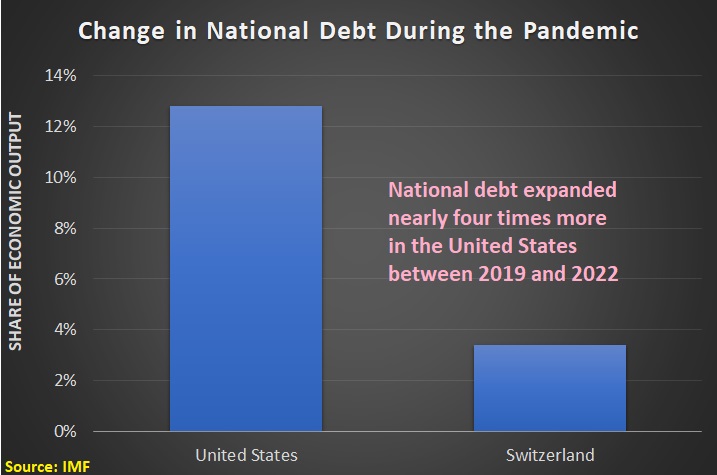
My daughter had been treating the accusations against him as probably true by default and took an unconcerned view towards the behavior of the press. Amy knows Kavanaugh, spoke well of him, and described what it was like seeing the press contacting her and digging through rumors about him. That changed my daughter’s opinion of how these things go, she told me. I meant to ask her if she were named to the Supreme Court if she’d be willing to go through all of the hatred and attacks on her reputation that would surely be a part of it. But I can’t remember if I did. I reckon we’ll all find out soon enough, though.

As a footnote, if Amy is confirmed to the court, she would be the second Supreme Court justice to come from Rhodes. Our first was Abe Fortas (class of 1930), who was named by President Johnson in 1965. Fortas resigned in 1969 after a series of ethics scandals, but the college gives out the Abe Fortas Award for Excellence in Legal Studies each year. Quite understandable; we’re a small school, and we should still be proud one of our own was elevated to the Supreme Court. May Amy Barrett bring us more honor.Published in LawTags: SCOTUS; SUPREME COURT; Amy Coney Barrett
Amy Coney Barrett (born January 28, 1972)[1][2] is an American lawyer, jurist, and academic who serves as a circuit judge on the U.S. Court of Appeals for the Seventh Circuit. Barrett considers herself a public-meaning originalist; her judicial philosophy has been likened to that of her mentor and former boss, Antonin Scalia.[3] Barrett’s scholarship focuses on originalism.

Amy Coney Barrett
Barrett in 2018
Judge of the United States Court of Appeals for the Seventh Circuit
Incumbent
Assumed office 
November 2, 2017
Appointed byDonald Trump
Preceded byJohn Daniel Tinder
Personal details
BornJanuary 28, 1972(age 48)
New OrleansLouisiana, U.S.
Spouse(s)Jesse Barrett
EducationRhodes College (BA)
University of Notre Dame(JD)
Academic background
Academic work
DisciplineJurisprudence
InstitutionsNotre Dame Law School
WebsiteNotre Dame Law Biography

Barrett was nominated to the Seventh Circuit Court of Appeals by President Donald Trump on May 8, 2017 and confirmed by the Senate on October 31, 2017. While serving on the federal bench, she was a professor of law at Notre Dame Law School, where she has taught civil procedure, constitutional law, and statutory interpretation.[4][2][5][6] Shortly after her confirmation to the Seventh Circuit Court of Appeals in 2017, Barrett was added to President Trump’s list of potential Supreme Court nominees.[7]Trump reportedly intends to nominate her to succeed Ruth Bader Ginsburg on the United States Supreme Court.[8]

Early life and education

Barrett was born in New Orleans, Louisiana, in 1972.[2] She is the eldest of seven children, with five sisters and a brother. Her father Michael Coney worked as an attorney for Shell Oil Company, and her mother Linda was a homemaker. Barrett grew up in Metairie, a suburb of New Orleans, and graduated from St. Mary’s Dominican High School in 1990.[9]

Barrett studied English literature at Rhodes College, graduating in 1994 with a Bachelor of Arts magna cum laude and Phi Beta Kappa membership.[10] She then studied law at Notre Dame Law School on a full-tuition scholarship. She served as an executive editor of the Notre Dame Law Review[11] and graduated first in her class in 1997 with a Juris Doctor summa cum laude.[12]

Career

Clerkships and private practice

After law school Barrett spent two years as a judicial law clerk, first for Judge Laurence Silberman of the U.S. Court of Appeals for the D.C. Circuit from 1997 to 1998,[13] then for Justice Antonin Scalia of the U.S. Supreme Court from 1998 to 1999.[13]

From 1999 to 2002, she practiced law at Miller, Cassidy, Larroca & Lewin in Washington, D.C.[11][14]

Teaching and scholarship

Barrett served as a visiting associate professor and John M. Olin Fellow in Law at George Washington University Law School for a year before returning to her alma mater, Notre Dame Law School in 2002.[15]At Notre Dame she taught federal courts, constitutional law, and statutory interpretation. Barrett was named a Professor of Law in 2010, and from 2014 to 2017 held the Diane and M.O. Miller Research Chair of Law.[16] Her scholarship focuses on constitutional law, originalism, statutory interpretation, and stare decisis.[12] Her academic work has been published in journals such as the ColumbiaCornellVirginiaNotre Dame, and TexasLaw Reviews.[15] Some of her most significant publications are Suspension and Delegation, 99 Cornell L. Rev. 251 (2014), Precedent and Jurisprudential Disagreement, 91 Tex. L. Rev. 1711 (2013), The Supervisory Power of the Supreme Court, 106 Colum. L. Rev. 101 (2006), and Stare Decisis and Due Process, 74 U. Colo. L. Rev. 1011 (2003).

At Notre Dame, Barrett received the “Distinguished Professor of the Year” award three times.[15] She taught Constitutional Law, Civil Procedure, Evidence, Federal Courts, Constitutional Theory Seminar, and Statutory Interpretation Seminar.[15] Barrett has continued to teach seminars as a sitting judge.[17]

Federal judicial service

Nomination and confirmation

President Donald Trump nominated Barrett on May 8, 2017, to serve as a United States Circuit Judge of the United States Court of Appeals for the Seventh Circuit, to the seat vacated by Judge John Daniel Tinder, who took senior status on February 18, 2015.[18][19]Judge Laurence Silberman, for whom Barrett first clerked after law school, swearing her in at her investiture as a judge on the Seventh Circuit.

A hearing on Barrett’s nomination before the Senate Judiciary Committee was held on September 6, 2017.[20] During the hearing, Senator Dianne Feinstein questioned Barrett about a law review article Barrett co-wrote in 1998 with Professor John H. Garvey in which she argued that Catholic judges should in some cases recuse themselves from death penalty cases due to their moral objections to the death penalty. The article concluded that the trial judge should recuse herself instead of entering the order. Asked to “elaborate on the statements and discuss how you view the issue of faith versus fulfilling the responsibility as a judge today,” Barrett said that she had participated in many death-penalty appeals while serving as law clerk to Scalia, adding, “My personal church affiliation or my religious belief would not bear on the discharge of my duties as a judge”[21][22] and “It is never appropriate for a judge to impose that judge’s personal convictions, whether they arise from faith or anywhere else, on the law.”[23] Worried that Barrett would not uphold Roe v. Wade given her Catholic beliefs, Feinstein followed Barrett’s response by saying, “the dogma lives loudly within you, and that is a concern.”[24][25][26] The hearing made Barrett popular with religious conservatives,[11] and in response, the conservative Judicial Crisis Network began to sell mugs with Barrett’s photo and Feinstein’s “dogma” remark.[27]Feinstein’s and other senators’ questioning was criticized by some Republicans and other observers, such as university presidents John I. Jenkins and Christopher Eisgruber, as improper inquiry into a nominee’s religious belief that employed an unconstitutional “religious test” for office;[23][28][29]others, such as Nan Aron, defended Feinstein’s line of questioning.[29]

Lambda Legal, an LGBT civil rights organization, co-signed a letter with 26 other gay rights organizations opposing Barrett’s nomination. The letter expressed doubts about her ability to separate faith from her rulings on LGBT matters.[30][31] During her Senate confirmation hearing, Barrett was questioned about landmark LGBTQ legal precedents such as Obergefell v. HodgesUnited States v. Windsor, and Lawrence v. Texas. Barrett said these cases are “binding precedents” that she intended to “faithfully follow if confirmed” to the appeals court, as required by law.[30] The letter co-signed by Lambda Legal said “Simply repeating that she would be bound by Supreme Court precedent does not illuminate—indeed, it obfuscates—how Professor Barrett would interpret and apply precedent when faced with the sorts of dilemmas that, in her view, ‘put Catholic judges in a bind.'”[30] Carrie Severino of the Judicial Crisis Network later said that warnings from LGBT advocacy groups about shortlisted nominees to replace Justice Anthony Kennedy, including Barrett, were “very much overblown” and called them “mostly scare tactics.”[30]

In 2015, Barrett signed a letter in support of the Ordinary Synod of Bishops on the Family that endorsed the Catholic Church’s teachings on human sexuality and its definition of marriage as between one man and one woman. When asked about the letter, she testified that the Church’s definition of marriage is legally irrelevant.[32][33]

Barrett’s nomination was supported by every law clerk she had worked with and all of her 49 faculty colleagues at Notre Dame Law school. 450 former students signed a letter to the Senate Judiciary Committee supporting Barrett’s nomination.[34][35]

On October 5, 2017, the Senate Judiciary Committee voted 11–9 on party lines to recommend Barrett and report her nomination to the full Senate.[36][37] On October 30, the Senate invoked cloture by a vote of 54–42.[38] It confirmed her by a vote of 55–43 on October 31, with three Democrats—Joe DonnellyTim Kaine, and Joe Manchin—voting for her.[10] She received her commission two days later.[2] Barrett is the first and to date only woman to occupy an Indiana seat on the Seventh Circuit.[39]

Notable cases

Title IX

In Doe v. Purdue University, 928 F.3d 652 (7th Cir. 2019), the court, in a unanimous decision written by Barrett, reinstated a suit brought by a male Purdue University student (John Doe) who had been found guilty of sexual assault by Purdue University, which resulted in a one-year suspension, loss of his Navy ROTC scholarship, and expulsion from the ROTC affecting his ability to pursue his chosen career in the Navy.[40] Doe alleged the school’s Advisory Committee on Equity discriminated against him on the basis of his sex and violated his rights to due process by not interviewing the alleged victim, not allowing him to present evidence in his defense, including an erroneous statement that he confessed to some of the alleged assault, and appearing to believe the victim instead of the accused without hearing from either party or having even read the investigation report. The court found that Doe had adequately alleged that the university deprived him of his occupational liberty without due process in violation of the Fourteenth Amendment and had violated his Title IX rights “by imposing a punishment infected by sex bias,” and remanded to the District Court for further proceedings.[41][42][43]

Title VII

In EEOC v. AutoZone, the Seventh Circuit considered the federal government’s appeal from a ruling in a suit brought by the Equal Employment Opportunity Commission against AutoZone; the EEOC argued that the retailer’s assignment of employees to different stores based on race (e.g., “sending African American employees to stores in heavily African American neighborhoods”) violated Title VII of the Civil Rights Act. The panel, which did not include Barrett, ruled in favor of AutoZone. An unsuccessful petition for rehearing en banc was filed. Three judges—Chief Judge Diane Wood and Judges Ilana Rovner and David Hamilton—voted to grant rehearing, and criticized the panel decision as upholding a “separate-but-equal arrangement”; Barrett and four other judges voted to deny rehearing.[11]

Immigration

In Cook County v. Wolf, 962 F.3d 208 (7th Cir. 2020), Barrett wrote a 40-page dissent from the majority’s decision to uphold a preliminary injunction on the Trump administration’s controversial “public charge rule“, which heightened the standard for obtaining a green card. In her dissent, she argued that any noncitizens who disenrolled from government benefits because of the rule did so due to confusion about the rule itself rather than from its application, writing that the vast majority of the people subject to the rule are not eligible for government benefits in the first place. On the merits, Barrett departed from her colleagues Wood and Rovner, who held that DHS’s interpretation of that provision was unreasonable under Chevron Step Two. Barrett would have held that the new rule fell within the broad scope of discretion granted to the Executive by Congress through the Immigration and Nationality Act.[44][45][46] The public charge issue is the subject of a circuit split.[44][46][47]

In Yafai v. Pompeo, 924 F.3d 969 (7th Cir. 2019), the court considered a case brought by a Yemeni citizen, Ahmad, and her husband, a U.S. citizen, who challenged a consular officer’s decision to twice deny Ahmad’s visa application under the Immigration and Nationality Act. Yafai, the U.S. citizen, argued that the denial of his wife’s visa application violated his constitutional right to live in the United States with his spouse.[48] In an 2-1 majority opinion authored by Barrett, the court held that the plaintiff’s claim was properly dismissed under the doctrine of consular nonreviewability. She declined to address whether Yafai had been denied a constitutional right (or whether a constitutional right to live in the United States with his spouse existed) because even if a constitutional right was implicated, the court lacked authority to disturb the consular officer’s decision to deny Ahmad’s visa application because that decision was facially legitimate and bona fide. Following the panel’s decision, Yafai filed a petition for rehearing en banc; the petition was denied, with eight judges voting against rehearing and three in favor, Wood, Rovner and Hamilton. Barrett and Judge Joel Flaumconcurred in the denial of rehearing.[48][49]

Second Amendment

In Kanter v. Barr, 919 F.3d 437 (7th Cir. 2019), Barrett dissented when the court upheld a law prohibiting convicted nonviolent felons from possessing firearms. The plaintiffs had been convicted of mail fraud. The majority upheld the felony dispossession statutes as “substantially related to an important government interest in preventing gun violence.” In her dissent, Barrett argued that while the government has a legitimate interest in denying gun possession to felons convicted of violent crimes, there is no evidence that denying guns to nonviolent felons promotes this interest, and that the law violates the Second Amendment.[50][51]

Fourth Amendment

In Rainsberger v. Benner, 913 F.3d 640 (7th Cir. 2019), the panel, in an opinion by Barrett, affirmed the district court’s ruling denying the defendant’s motion for summary judgment and qualified immunity in a 42 U.S.C. § 1983 case. The defendant, Benner, was a police detective who knowingly provided false and misleading information in a probable cause affidavit that was used to obtain an arrest warrant against Rainsberger. (The charges were later dropped and Rainsberger was released.) The court found the defendant’s lies and omissions violated “clearly established law” and thus Benner was not shielded by qualified immunity.[52]

The case United States v. Watson, 900 F.3d 892 (7th Cir. 2018) involved police responding to an anonymous tip that people were “playing with guns” in a parking lot. The police arrived and searched the defendant’s vehicle, taking possession of two firearms; the defendant was later charged with being a felon in possession of a firearm. The district court denied the defendant’s motion to suppress. On appeal, the Seventh Circuit, in a decision by Barrett, vacated and remanded, determining that the police lacked probable cause to search the vehicle based solely upon the tip, when no crime was alleged. Barrett distinguished Navarette v. California and wrote, “the police were right to respond to the anonymous call by coming to the parking lot to determine what was happening. But determining what was happening and immediately seizing people upon arrival are two different things, and the latter was premature…Watson’s case presents a close call. But this one falls on the wrong side of the Fourth Amendment.”[53]

In a 2013 Texas Law Review article, Barrett included as one of only seven Supreme Court “superprecedents“, Mapp vs Ohio (1961); the seminal case where the court found through the doctrine of selective incorporation that the 4th Amendment’s protections against unreasonable searches and seizures was binding on state and local authorities in the same way it historically applied to the federal government.

Civil procedure and standing

In Casillas v. Madison Ave. Associates, Inc., 926 F.3d 329 (7th Cir. 2019), the plaintiff brought a class-action lawsuit against Madison Avenue, alleging that the company violated the Fair Debt Collection Practices Act (FDCPA) when it sent her a debt-collection letter that described the FDCPA process for verifying a debt but failed to specify that she was required to respond in writing to trigger the FDCPA protections. Casillas did not allege that she had tried to verify her debt and trigger the statutory protections under the FDCPA, or that the amount owed was in any doubt. In a decision written by Barrett, the panel, citing the Supreme Court’s decision in Spokeo, Inc. v. Robins, found that the plaintiff’s allegation of receiving incorrect or incomplete information was a “bare procedural violation” that was insufficiently concrete to satisfy the Article III‘s injury-in-fact requirement. Wood dissented from the denial of rehearing en banc. The issue created a circuit split.[54][55][56]

Judicial philosophy and political views

Barrett considers herself an originalist. She is a constitutional scholar with expertise in statutory interpretation.[10] Reuters described Barrett as a “a favorite among religious conservatives,” and said that she has supported expansive gun rights and voted in favor of one of the Trump administration’s anti-immigration policies.[57]

Barrett was one of Justice Antonin Scalia‘s law clerks. She has spoken and written of her admiration of his close attention to the text of statutes. She has also praised his adherence to originalism.[58]

In 2013, Barrett wrote a Texas Law Review article on the doctrine of stare decisis wherein she listed seven cases that should be considered “superprecedents”—cases that the court would never consider overturning. The list included Brown v. Board of Education but specifically excluded Roe v. Wade. In explaining why it was not included, Barrett referenced scholarship agreeing that in order to qualify as “superprecedent” a decision must enjoy widespread support from not only jurists but politicians and the public at large to the extent of becoming immune to reversal or challenge. She argued the people must trust the validity of a ruling to such an extent the matter has been taken “off of the court’s agenda,” with lower courts no longer taking challenges to them seriously. Barrett pointed to Planned Parenthood v. Casey as specific evidence Roe had not yet attained this status.[59] The article did not include any pro-Second Amendment or pro-LGBT cases as “Super-Precedent”.[30][31] When asked during her confirmation hearings why she did not include any pro-LGBT cases as “superprecedent”, Barrett explained that the list contained in the article was collected from other scholars and not a product of her own independent analysis on the subject.[32][33]

Barrett has never ruled directly on a case pertaining to abortion rights, but she did vote to rehear a successful challenge to Indiana’s parental notification law in 2019. In 2018, Barrett voted against striking down another Indiana law requiring burial or cremation of fetal remains. In both cases, Barrett voted with the minority. The Supreme Court later reinstated the fetal remains law and in July 2020 it ordered a rehearing in the parental notification case.[57] At a 2013 event reflecting on the 40th anniversary of Roe v. Wade, she described the decision—in Notre Dame Magazine‘s paraphrase—as “creating through judicial fiat a framework of abortion on demand.”[60][61] She also remarked that it was “very unlikely” the court would overturn the core of Roe v. Wade: “The fundamental element, that the woman has a right to choose abortion, will probably stand. The controversy right now is about funding. It’s a question of whether abortions will be publicly or privately funded.”[62][63] NPR said that those statements were made before the election of Donald Trump and the changing composition of the Supreme Court to the right subsequent to his election, which could make Barrett’s vote pivotal in overturning Roe v. Wade.[64]

Barrett was critical of Chief Justice John Roberts’opinion in the 5–4 decision that upheld the constitutionality of the central provision in the Affordable Care Act (Obamacare) in NFIB vs. Sebelius. Roberts’s opinion defended the constitutionality of the individual mandate of the Affordable Care Act by characterizing it as a “tax.” Barrett disapproved of this approach, saying Roberts pushed the ACA “beyond it’s plausible limit to save it.”[64][65][66][67] She criticized the Obama administration for providing employees of religious institutions the option of obtaining birth controlwithout having the religious institutions pay for it.[65]

Potential Supreme Court nomination

Barrett has been on President Trump’s list of potential Supreme Court nominees since 2017, almost immediately after her court of appeals confirmation. In July 2018, after Anthony Kennedy‘s retirement announcement, she was reportedly one of three finalists Trump considered, along with Judge Raymond Kethledge and Judge Brett Kavanaugh.[16][68] Trump chose Kavanaugh.[69]Reportedly, although Trump liked Barrett, he was concerned about her lack of experience on the bench.[70] In the Republican Party, Barrett was favored by social conservatives.[70]

After Kavanaugh’s selection, Barrett was viewed as a possible Trump nominee for a future Supreme Court vacancy.[71] Trump was reportedly “saving” Ruth Bader Ginsburg‘s seat for Barrett if Ginsburg retired or died during his presidency.[72] Ginsburg died on September 18, 2020, and Barrett has been widely mentioned as the front-runner to succeed her.[73][74][75][76]

Personal life

Judge Barrett with her husband, Jesse

Since 1999, Barrett has been married to fellow Notre Dame Law graduate Jesse M. Barrett, a partner at SouthBank Legal in South BendIndiana. Previously, Jesse Barrett worked as an Assistant U.S. Attorneyfor the Northern District of Indiana for 13 years.[77][78][79] They live in South Bend and have seven children, ranging in age from 8-19.[80] Two of the Barrett children are adopted from Haiti. Their youngest biological child has special needs.[79][2][81]Barrett is a practicing Catholic.[82][83]

In September 2017, The New York Times reported that Barrett was an active member of a small, tightly knit Charismatic Christian group called People of Praise.[84][85] Founded in South Bend, the group is associated with the Catholic Charismatic Renewalmovement; it is ecumenical and not formally affiliated with the Catholic Church, but about 90% of its members are Catholic.[85][86]

Affiliations and recognition

From 2010 to 2016, Barrett served by appointment of the Chief Justice on the Advisory Committee for the Federal Rules of Appellate Procedure.[15]

Barrett was a member of the Federalist Society from 2005 to 2006 and from 2014 to 2017.[25][10][11] She is a member of the American Law Institute.[87]

Selected publications

See also

References

—-

​Amy Coney Barrett was appointed to the U.S. Court of Appeals for the Seventh Circuit in November 2017. She serves on the faculty of the Notre Dame Law School, teaching on constitutional law, federal courts, and statutory interpretation, and previously served on the Advisory Committee for the Federal Rules of Appellate Procedure. She earned her bachelor’s degree from Rhodes College in 1994 and her J.D. from Notre Dame Law School in 1997. Following law school, Barrett clerked for Judge Laurence Silberman of the U.S. Court of Appeals for the D.C. Circuit and for Associate Justice Antonin Scalia of the U.S. Supreme Court. She also practiced law with Washington, D.C. law firm Miller, Cassidy, Larroca & Lewin.

—-

—-


—-Related posts:

Taking on Ark Times Bloggers on various issues Part P “Freedom of speech lives on Ark Times Blog” (includes the video ABORTION OF THE HUMAN RACE) (editorial cartoon)

April 25, 2013 – 6:49 am

I have gone back and forth and back and forth with many liberals on the Arkansas Times Blog on many issues such as abortion, human rights, welfare, poverty, gun control  and issues dealing with popular culture. Here is another exchange I had with them a while back. My username at the Ark Times Blog is Saline […]By Everette Hatcher III | Posted in Francis SchaefferProlife | Edit | Comments (0)

Taking on Ark Times Bloggers on various issues Part O “Without God in the picture there can not be lasting meaning to our lives” (includes film ABORTION OF THE HUMAN RACE)

April 23, 2013 – 7:04 am

I have gone back and forth and back and forth with many liberals on the Arkansas Times Blog on many issues such as abortion, human rights, welfare, poverty, gun control  and issues dealing with popular culture. Here is another exchange I had with them a while back. My username at the Ark Times Blog is Saline […]By Everette Hatcher III | Posted in Francis SchaefferPresident ObamaProlife | Edit | Comments (0)

Taking on Ark Times Bloggers on various issues Part K “On what basis do you say murder is wrong?”Part 1 (includes film ABORTION OF THE HUMAN RACE)

April 16, 2013 – 5:49 am

I have gone back and forth and back and forth with many liberals on the Arkansas Times Blog on many issues such as abortion, human rights, welfare, poverty, gun control  and issues dealing with popular culture. Here is another exchange I had with them a while back. My username at the Ark Times Blog is Saline […]By Everette Hatcher III | Posted in Francis SchaefferPresident ObamaProlife | Edit | Comments (0)

Taking on Ark Times Bloggers on various issues Part J “Can atheists find lasting meaning to their lives?” (includes film ABORTION OF THE HUMAN RACE)

April 15, 2013 – 7:48 am

I have gone back and forth and back and forth with many liberals on the Arkansas Times Blog on many issues such as abortion, human rights, welfare, poverty, gun control  and issues dealing with popular culture. Here is another exchange I had with them a while back. My username at the Ark Times Blog is Saline […]By Everette Hatcher III | Posted in Francis SchaefferProlife | Edit | Comments (0)

Taking on Ark Times Bloggers on various issues Part H “Are humans special?” includes film ABORTION OF THE HUMAN RACE) Reagan: ” To diminish the value of one category of human life is to diminish us all”

April 10, 2013 – 6:43 am

I have gone back and forth and back and forth with many liberals on the Arkansas Times Blog on many issues such as abortion, human rights, welfare, poverty, gun control  and issues dealing with popular culture. Here is another exchange I had with them a while back. My username at the Ark Times Blog is Saline […]By Everette Hatcher III | Posted in Francis SchaefferProlife | Edit | Comments (0)

Taking on Ark Times Bloggers on various issues Part G “How do moral nonabsolutists come up with what is right?” includes the film “ABORTION OF THE HUMAN RACE”)

April 9, 2013 – 6:36 am

I have gone back and forth and back and forth with many liberals on the Arkansas Times Blog on many issues such as abortion, human rights, welfare, poverty, gun control  and issues dealing with popular culture. Here is another exchange I had with them a while back. My username at the Ark Times Blog is Saline […]By Everette Hatcher III | Posted in Francis SchaefferProlife | Edit | Comments (3)

Taking on Ark Times Bloggers on various issues Part E “Moral absolutes and abortion” Francis Schaeffer Quotes part 5(includes the film SLAUGHTER OF THE INNOCENTS) (editorial cartoon)

April 7, 2013 – 6:25 am

I have gone back and forth and back and forth with many liberals on the Arkansas Times Blog on many issues such as abortion, human rights, welfare, poverty, gun control  and issues dealing with popular culture. Here is another exchange I had with them a while back. My username at the Ark Times Blog is Saline […]By Everette Hatcher III | Posted in Francis SchaefferProlife | Edit | Comments (2)

“Sanctity of Life Saturday” Abortion supporters lying in order to further their clause? Window to the Womb (includes video ABORTION OF THE HUMAN RACE)

April 6, 2013 – 12:01 am

It is truly sad to me that liberals will lie in order to attack good Christian people like state senator Jason Rapert of Conway, Arkansas because he headed a group of pro-life senators that got a pro-life bill through the Arkansas State Senate the last week of January in 2013. I have gone back and […]By Everette Hatcher III | Posted in Arkansas TimesFrancis SchaefferMax BrantleyProlife | Edit | Comments (0)

Taking on Ark Times Bloggers on various issues Part D “If you can’t afford a child can you abort?”Francis Schaeffer Quotes part 4 includes the film ABORTION OF THE HUMAN RACE) (editorial cartoon)

April 5, 2013 – 6:30 am

I have gone back and forth and back and forth with many liberals on the Arkansas Times Blog on many issues such as abortion, human rights, welfare, poverty, gun control  and issues dealing with popular culture. Here is another exchange I had with them a while back. My username at the Ark Times Blog is Saline […]By Everette Hatcher III | Posted in Francis SchaefferProlife | Edit | Comments (0)

April 29, 2022 READING A PROVERB A DAY (PROVERBS 29) Carry These Five Principles into the Voting Booth By Francis Schaeffer Proverbs 29:2 “When the righteous are in authority, the people rejoice. But when a wicked man rules, the people groan.” 

Proverbs 29New Living Translation

29 Whoever stubbornly refuses to accept criticism
    will suddenly be destroyed beyond recovery.

When the godly are in authority, the people rejoice.
    But when the wicked are in power, they groan.

The man who loves wisdom brings joy to his father,
    but if he hangs around with prostitutes, his wealth is wasted.

A just king gives stability to his nation,
    but one who demands bribes destroys it.

To flatter friends
    is to lay a trap for their feet.

Evil people are trapped by sin,
    but the righteous escape, shouting for joy.

The godly care about the rights of the poor;
    the wicked don’t care at all.

Mockers can get a whole town agitated,
    but the wise will calm anger.

If a wise person takes a fool to court,
    there will be ranting and ridicule but no satisfaction.

10 The bloodthirsty hate blameless people,
    but the upright seek to help them.[a]

11 Fools vent their anger,
    but the wise quietly hold it back.

12 If a ruler pays attention to liars,
    all his advisers will be wicked.

13 The poor and the oppressor have this in common—
    the Lord gives sight to the eyes of both.

14 If a king judges the poor fairly,
    his throne will last forever.

15 To discipline a child produces wisdom,
    but a mother is disgraced by an undisciplined child.

16 When the wicked are in authority, sin flourishes,
    but the godly will live to see their downfall.

17 Discipline your children, and they will give you peace of mind
    and will make your heart glad.

18 When people do not accept divine guidance, they run wild.
    But whoever obeys the law is joyful.

19 Words alone will not discipline a servant;
    the words may be understood, but they are not heeded.

20 There is more hope for a fool
    than for someone who speaks without thinking.

21 A servant pampered from childhood
    will become a rebel.

22 An angry person starts fights;
    a hot-tempered person commits all kinds of sin.

23 Pride ends in humiliation,
    while humility brings honor.

24 If you assist a thief, you only hurt yourself.
    You are sworn to tell the truth, but you dare not testify.

25 Fearing people is a dangerous trap,
    but trusting the Lord means safety.

26 Many seek the ruler’s favor,
    but justice comes from the Lord.

27 The righteous despise the unjust;
    the wicked despise the godly.

Carry These Five Principles into the Voting Booth

November 3, 2020 Save Article

PRAY OVER THIS:

“When the righteous are in authority, the people rejoice. But when a wicked man rules, the people groan.” 

(Proverbs 29:2)

PONDER THIS:

Today in the US is an important election day. I trust every one of you will vote. Are you praying over your vote? Dr. Francis Schaeffer, a brilliant man, one of the foremost Christian thinkers of our time, gave us 5 principles to keep in mind when we vote. These have nothing to do with personalities or political parties. The principles guiding our vote should be:

  1. The dignity of human life
  2. The importance of the traditional family
  3. Religious freedom of speech in schools, both public and private
  4. Human rights and the need for justice in our world
  5. The compassionate use of accumulated wealth

These five ought to be in the heart and mind of every child of God. Pray over these. Then, based on God’s Word, make your determination. God will give you wisdom. 

PRACTICE THIS:

Pray it from your heart, “God, bless America, and God, give us space to repent. And may the ones of Your choosing be elected to lead us.” Remember, “…to him who knows to do good and does not do it, to him it is sin” (James 4:17).

Dan Mitchell article: Updated Assessment of Switzerland’s Spending Cap

Updated Assessment of Switzerland’s Spending Cap

Since I’m a big fan of spending caps, I’m very happy to be in Zurich as part of the Free Market Road Show.

Switzerland’s spending cap (called “the debt brake“) is probably the best system in the world. It does have an escape clause for emergencies, so the government did increase spending during the pandemic.

But as this chart illustrates, Swiss lawmakers were much more responsible than their American counterparts. Over the past few years, IMF datashows that the national debt (as a share of GDP) increased by about 3.4 percent in Switzerland compared to 12.8 percent in the United States.

Even more amazing, Switzerland is now quickly restoring spending restraint.

Indeed, as reported by Le News, Switzerland already is going to be back to fiscal balance by the end of this year.

The Covid-19 pandemic plunged Switzerland’s budget into the red in 2020 and 2021. The federal government expects to returnto normality with a balanced budget in 2022. …In 2022, the federal government expects to spend CHF 0.6 billion less than it collects. …the government is aiming for an ordinary operating surplus of CHF 1 billion. Past budget surpluses may also be applied to the accumulated deficit to bring the accounting into line with the debt brake rules.

If you want to know why there such quick progress, one of the big banks, Credit Suisse, recently analyzed the nation’s fiscal status and explained how the debt brake requires future spending restraint to compensate for the emergency spending during the pandemic.

As part of the pandemic response, the Federal Council approved fiscal measures of over 70 billion Swiss francs… As a result of the debt brake, this deficit should be offset in the immediate following years. …the Federal Council announced that it would classify the majority of the fiscal measures as extraordinary spending. Under the law, this can be paid back more slowly – specifically, within six years. Additionally, with the escape clause, the Federal Assembly has the option of extending the repayment deadline even further in special cases.

Another international bank, ING, also issued a reportabout the country’s spending cap and actually expressed concern that the level of government debt is too low.

The main cause of Switzerland’s low indebtedness is a mechanism introduced by the Confederation to stabilise the federal debt: “the debt brake”. Enabled in the Constitution since 2003, with a population approval rate of 85% in 2001, the rule has strong legitimacy and many cantons have introduced similar models.The principle: public spending should not exceed revenues over a full economic cycle. The formula allows for a deficit during a recession, offset by surpluses during an expansion period. …the implementation of this system has resulted in a significant debt reduction, rather than just stabilisation. This is because the rule is applied asymmetrically and expenditure tends to be overestimated each year, while revenue is systematically underestimated. …every budget surplus is greeted with a self-congratulatory round of applause on the sound management of public finances.

Here’s a chart from the article showing on government debt began to decline once the spending cap was implemented. By contrast, debt in other industrialized nations has continued to climb.

Keep in mind, by the way, that this chart was before the pandemic.

Given Switzerland’s more prudent approach, the gap between the two lines is even higher today.

P.S. If you want a more in-depth discussion of how Switzerland’s de facto spending cap operates, there’s a very good article in the Swiss Journal of Economics and Statistics. Authored by Tobias Beljean and Alain Geier, the 2013 study has a lot of useful information.

…the success is not just visible in figures – it is also evident in the way that the budget process has changed. The debt brake has turned the budget process upside down. Previously, spending intentions were submitted by individual government offices, and it was very difficult to make changes to a large number of budget items during the short interval between the first consolidated budget plan (largely influenced by government offices) between April and the final budget proposal in June.More problematic still, the finance minister faced the potential opposition of six “spending” ministers, who were each looking for support to get their policy proposals into the budget. The budget process is now essentially a top-down process, in which targets are set at the beginning of the process and then broken down to individual ministries and offices. …One key aspect is the fact that the debt brake sets a clear target for the deficit and expenditure. …the (risk-averse) administration tends to plan its spending cautiously so as to not exceed the limit of the credit item. Hence, actual outcomes are mostly below spending limits and are not compensated for by occasional overspending and supplementary credits. The consequence for overall spending is a systematic undershooting of expenditure with respect to the budget. … This “revenue brake” and the “debt brake” taken together now result in a framework similar to an expenditure rule, as it is rather difficult to meet the requirements of the debt brake through revenue-side measures – at least in the short term.

P.P.S. You can also read a couple of good summaries (here and here) from the Swiss government’s Federal Finance Administration.

P.P.P.S. Hong Kong also has a spending cap, and Colorado’s Taxpayer Bill of Rights is a spending cap as well. You can click here to watch informative video presentations about the various spending caps.

Steve Forbes is 100 percent correct, as was Milton Friedman. Bloated and wasteful government spending is the problem, not inadequate revenue. Deficits are merely a symptom of over-spending:

The late Nobel Prize-winning economist Milton Friedman once famously observed that he would prefer a federal government budget of $1 trillion (this was when a trillion bucks was real money) with a big deficit to a federal budget of $2 trillion that was balanced. His obvious point was that the bigger Washington is, the more of a burden it puts on the economy, whether it finances its spending via taxation, borrowing or printing money. So it’s not President Obama’s mind-numbing, from-here-to-eternity deficits that we should be worrying about but the increasing deadweight put on the rest of us by Washington’s burgeoning budget bloat. Senate Republicans were right to put the kibosh on the formation of a formal bipartisan deficit-fighting commission. Those things always end up increasing taxes while doing little to reduce spending. …One of the biggest economic myths since the Great Depression is that governments can ameliorate or counteract the ebbs and flows of free markets. Government spending has never worked as a trigger for sustained and vibrant economic growth. Ever. Scholarship has demonstrated that the New Deal perpetuated the Depression rather than cured it. On the eve of the Depression the U.S. had the lowest unemployment rate among developed nations. But a decade later, despite six years of FDR’s New Deal, our unemployment rate was one of the highest among developed economies. Japan’s serial stimulus programs over the past two decades have repeatedly underscored this truth. The more the government takes as a proportion of the economy, the worse equity markets do and the higher the unemployment rate.

Everything You Need to Know about the National Debt

The title of this column is an exaggeration. What we’re really going to do today is explain the main things you need to knowabout government debt.

We’ll start with this video from Kite and Key Media, which correctly observes that entitlement programs are the main cause of red ink.

I like that the video pointed out how tax-the-rich schemeswouldn’t work, though it would have been nice if they added some information on how genuine entitlement reform could solve the problem  (as you can see here and here, I’ve also nit-picked other debt-themed videos).

Which is why I humbly think this is the best video ever produced on the topic.

As you can see, I’m not an anti-debt fanatic. It was perfectly okay, for instance, to incur debt to win World War II.

But I’m very skeptical of running up the nation’s credit card for routine pork and fake stimulus.

But my main message, which I’ve shared over and over again, is that deficits and debt are merely a symptom. The underlying disease is excessive government spending.

And that spending hurts our economy whether it is financed by taxing or borrowing (or, heaven forbid, by printing money).

Now let’s look at some recent articles on the topic.

We’ll start with Eric Boehm’s column for Reason, which explains how red ink has exploded in recent years.

America’s national debt exceeded $10 trillion for the first time ever in October 2008. By mid-September 2017 the national debt had doubled to $20 trillion. …data released by the U.S. Treasury confirmed that the national debt reached a new milestone: $30 trillion.…Entitlements like Social Security and Medicare are in dire fiscal straits and will become even more costly as the average American gets older. Even without another unexpected crisis, deficits will exceed $1 trillion annually, which means the debt will continue growing, both in real terms and as a percentage of the economy. The Congressional Budget Office estimates that the federal government will add another $12.2 trillion to the debt by 2031.

As already stated, I think the real problem is the spending and the debt is the symptom.

But it is possible, of course, that debt rises so high that investors (the people who buy government bonds) begin to lose faith that they will get repaid.

At that point, governments have to pay higher interest rates to compensate for perceived risk of default, which exacerbates the fiscal burden.

And if there’s not a credible plan to fix the problem, a country can go into a downward spiral. In other words, a debt crisis.

This is what happened to Greece. And I think it’s just a matter of time before it happens to Italy.

Heck, many European nations are vulnerable to a debt crisis. As are many developing countries. And don’t forget Japan.

Could the United States also be hit by a debt crisis? Will we reach a “tipping point” that leads to the aforementioned loss of faith?

That’s one of the possibilities mentioned in the New York Timescolumn by Peter Coy.

It’s hard to know how much to worry about the federal debt of the United States. …Either the United States can continue to run big deficits and skate along with no harm done or it’s at risk of losing investors’ confidence and having to pay higher interest rates on its debt, which would suppress economic growth. …the huge increase in federal debt incurred during and after the past two recessions — those of 2007-09 and 2020 — has used upa lot of the “fiscal space” the United States once had. In other words, the federal government is closer to the tipping point where big increases in debt finally start to become a real problem. …any given amount of debt becomes easier to sustain as long as the growth rate of the economy (and thus the growth rate of tax revenue) is higher than the interest rate on the debt. In that scenario, interest payments gradually shrink relative to tax revenue. …but it doesn’t explain how much more the debt can grow. …Past a certain point, there’s a double whammy of more dollars of debt plus higher interest costs on each dollar. …sovereign debt crises tend to be self-fulfilling prophecies: Investors get nervous about a government’s ability to pay, so they demand higher interest rates, which raise borrowing costs and produce the bad outcome they feared. It’s a dynamic that Argentines are familiar with — and that Americans had better hope they never experience.

For what it’s worth, I think other major nations will suffer fiscal crisis before the problem becomes acute in the United States.

I really this will make me sound uncharacteristically optimistic, but I’m keeping my fingers crossed that this will finally lead politicians to adopt a spending cap so we don’t become Argentina.

P.S. The Wall Street Journal recently editorialized on the issue of government debt and made a very important point about the difference between the $30 trillion “gross debt” and the “debt held by the public,” which is about $6 trillion lower.

…the debt really isn’t $30 trillion. About $6 trillion of that is debt the government owes to itself in Social Security and other IOUs. …The debt held by the public is some $24 trillion, which is bad enough.

As I’ve noted when writing about Social Security, the IOUs in government trust funds are not real.

They’re just bookkeeping entries, as even Bill Clinton’s budget freely admitted.

Indeed, if you want to know whether some is both honest and knowledgeable about budget matters, ask them which measure of the national debt really matters.

As you can see from this exchange of tweets, competent and careful budget people (regardless of whether they favor big government or small government) focus on “debt held by the public,” which is the term for the money government actually borrows from credit markets.

If you want to know the difference between the various types of government debt – including “unfunded liabilities” – watch this video.

P.P.S. This column explains how and when debt matters. If you’re interested in how to reduce the debt, there’s very good evidence that spending restraint is the only effective approach. Even in cases where debt is enormous.

P.P.P.S. By contrast, the evidence is very clear that higher taxesactually make debt problems worse.

Yes, Starve the Beast

As part of a recent discussion with Gene Tunny in Australia, I explained why I support “Starve the Beast,” which means keeping taxes as low as possible to help achieve the goal of spending restraint.

The premise of Starve the Beast is very simple.

Politicians like to spend money and they don’t particularly care whether that spending is financed by taxes or financed by borrowing (both bad options).

As Milton Friedman sagely observed, that means they will spend every penny they collect in taxes plus as much additional spending financed by borrowing that the political system will allow.

The IMF published a study on this issue about 10 years ago. The authors (Michael Kumhof, Douglas Laxton, and Daniel Leigh) assert that there’s no way of knowing whether Starve the Beast will lead to good or bad results.

…there is no consensus regarding the macroeconomic and welfare consequences of implementing a starve-the-beast approach, henceforth referred to as STB. …it could be beneficial in the ideal case in which it results in cuts in entirely wasteful government spending. In particular, lower spending frees up resources for private consumption, and the associated lower tax rates reduce distortions in the economy. On the other hand, …lower government spending may itself entail welfare losses…if it augments the productivity of private factors of production. …the paper examines whether the principal macroeconomic variables such as GDP and consumption, both in the United States and in the rest of the world, respond positively to this policy. …In addition, the paper assesses how the welfare effects depend on the degree to which government spending directly contributes to household welfare or to productivity.

The authors don’t really push any particular conclusion. Instead, they show various economic outcomes depending on with assumptions one adopts.

Since plenty of research shows that government spending is not a net plus for the economy (even IMF economists agree on that point), and because I think a less-punitive tax system is possible (and desirable) if there’s a smaller burden of government spending, I think the findings shown in Figure 4 make the most sense.

Now let’s shift from academic analysis to policy analysis.

In a piece for National Review back in July 2020, Jim Geraghty notes that Starve the Beast has an impact on government finances at the state level.

…we’re probably not going to see a massive expansion of government at the state level in the coming year or two. …Thanks to the pandemic lockdown bringing vast swaths of the economy to a halt, state tax revenues are plummeting.…So states will have much less tax revenue, constitutional balanced-budget requirements that are not easily repealed, and a limited amount of budgetary tricks to work around it. State governments could attempt to raise taxes, but that’s going to be unpopular and hurt state economies when they’re already struggling. Add it all up and it’s a tough set of circumstances for a dramatic expansion of government, no matter how ardently progressive the governor and state legislatures are.

For what it’s worth, Geraghty warned in the article that fiscal restraint by state governments wouldn’t happen if the federal government turned on the spending spigot.

And that, of course, is exactly what happened.

Now let’s look at the most unintentional endorsement of Stave the Beast.

A couple of years ago, Paul Krugman sort of admitted that cutting taxes was a potentially effective strategy for spending restraint.

…the same Republicans now wringing their hands over budget deficits…blew up that same deficit by enacting a huge tax cut for corporations and the wealthy. …this has been the G.O.P.’s budget strategy for decades. First, cut taxes. Then, bemoan the deficit created by those tax cuts and demand cuts in social spending.Lather, rinse, repeat. This strategy, known as “starve the beast,” has been around since the 1970s, when Republican economists like Alan Greenspan and Milton Friedman began declaring that the role of tax cuts in worsening budget deficits was a feature, not a bug. As Greenspan openly put it in 1978, the goal was to rein in spending with tax cuts that reduce revenue, then “trust that there is a political limit to deficit spending.” …voters should realize that the threat to programs… Social Security and Medicare as we know them will be very much in danger.

In other words, Krugman doesn’t like Starve the Beast because he fears it is effective (just like he also acknowledges the Laffer Curve, even though he’s opposed to tax cuts).

Let’s close by looking at some very powerful real-world evidence. Over the past 50 years, there’s been a massive increase in the tax burden in Western Europe.

Did all that additional tax revenue lead to lower deficits and less debt?

Nope, the opposite happened. European politicians spent every penny of the new tax revenue (much of it from value-added taxes). And then they added even more spending financed by additional borrowing.

To be fair, one could argue that this was an argument for the view of “Don’t Feed the Beast” rather than “Starve the Beast,” but it nonetheless shows that more money in the hands of politicians simply means more spending. And more red ink.

P.S. I had a discussion last year with Gene Tunny about the issue of “state capacity libertarianism.”


Friedman & Sowell: Should Our School System Be Privatized?

Regular readers know that the two things that get me most excited are the Georgia Bulldogs and the fight against a bloated public sector that is ineffective in the best of circumstances and more often than not is a threat to our freedoms.

So you will not be surprised to know that I am delighted that former Georgia Bulldog star Fran Tarkenton (who also happened to play in the NFL) has a superb piece in the Wall Street Journal ripping apart the inherent inefficiency of government-run monopoly schools.

Here is the key passage.

Imagine the National Football League in an alternate reality. Each player’s salary is based on how long he’s been in the league. It’s about tenure, not talent. The same scale is used for every player, no matter whether he’s an All-Pro quarterback or the last man on the roster. For every year a player’s been in this NFL, he gets a bump in pay. The only difference between Tom Brady and the worst player in the league is a few years of step increases. And if a player makes it through his third season, he can never be cut from the roster until he chooses to retire, except in the most extreme cases of misconduct. Let’s face the truth about this alternate reality: The on-field product would steadily decline. Why bother playing harder or better and risk getting hurt? No matter how much money was poured into the league, it wouldn’t get better. In fact, in many ways the disincentive to play harder or to try to stand out would be even stronger with more money. Of course, a few wild-eyed reformers might suggest the whole system was broken and needed revamping to reward better results, but the players union would refuse to budge and then demonize the reform advocates: “They hate football. They hate the players. They hate the fans.” The only thing that might get done would be building bigger, more expensive stadiums and installing more state-of-the-art technology. But that just wouldn’t help.

This sounds absurd, of course, but Mr. Tarkenton goes on to explain that this is precisely how government schools operate.

If you haven’t figured it out yet, the NFL in this alternate reality is the real-life American public education system. Teachers’ salaries have no relation to whether teachers are actually good at their job—excellence isn’t rewarded, and neither is extra effort. Pay is almost solely determined by how many years they’ve been teaching. That’s it. After a teacher earns tenure, which is often essentially automatic, firing him or her becomes almost impossible, no matter how bad the performance might be. And if you criticize the system, you’re demonized for hating teachers and not believing in our nation’s children. Inflation-adjusted spending per student in the United States has nearly tripled since 1970. According to the Organization for Economic Cooperation and Development, we spend more per student than any nation except Switzerland, with only middling results to show for it.

Actually, I will disagree with the last sentence of this excerpt. We’re not even getting “middling results.” Here’s a chart from an earlier post showing that we’ve gotten more bureaucracy and more spending but no improvement over the past 40 years.

So what’s the solution to this mess? Well, since government is the problem, it stands to reason that competition and markets are the answer.

Sweden, Chile, and the Netherlands are just some of the countries that have seen good results after breaking up state-run education monopolies.

Watch this video to get more details.

Economics 101: School Choice Example Shows Why Government Monopolies Are Bad

Related posts:

FRIEDMAN FRIDAY Milton Friedman’s FREE TO CHOOSE “The Tyranny of Control” Transcript and Video (60 Minutes)

Milton Friedman’s FREE TO CHOOSE “The Tyranny of Control” Transcript and Video (60 Minutes) In 1980 I read the book FREE TO CHOOSE by Milton Friedman and it really enlightened me a tremendous amount.  I suggest checking out these episodes and transcripts of Milton Friedman’s film series FREE TO CHOOSE: “The Failure of Socialism” and […]

FRIEDMAN FRIDAY “The Tyranny of Control” in Milton Friedman’s FREE TO CHOOSE Part 7 of 7 (Transcript and Video) “I’m not pro business, I’m pro free enterprise, which is a very different thing, and the reason I’m pro free enterprise”

In 1980 I read the book FREE TO CHOOSE by Milton Friedman and it really enlightened me a tremendous amount.  I suggest checking out these episodes and transcripts of Milton Friedman’s film series FREE TO CHOOSE: “The Failure of Socialism” and “What is wrong with our schools?”  and “Created Equal”  and  From Cradle to Grave, […]

FRIEDMAN FRIDAY “The Tyranny of Control” in Milton Friedman’s FREE TO CHOOSE Part 6 of 7 (Transcript and Video) “We are the ones who promote freedom, and free enterprise, and individual initiative, And what do we do? We force puny little Hong Kong to impose limits, restrictions on its exports at tariffs, in order to protect our textile workers”

In 1980 I read the book FREE TO CHOOSE by Milton Friedman and it really enlightened me a tremendous amount.  I suggest checking out these episodes and transcripts of Milton Friedman’s film series FREE TO CHOOSE: “The Failure of Socialism” and “What is wrong with our schools?”  and “Created Equal”  and  From Cradle to Grave, […]

FRIEDMAN FRIDAY “The Tyranny of Control” in Milton Friedman’s FREE TO CHOOSE Part 5 of 7 (Transcript and Video) “There is no measure whatsoever that would do more to prevent private monopoly development than complete free trade”

In 1980 I read the book FREE TO CHOOSE by Milton Friedman and it really enlightened me a tremendous amount.  I suggest checking out these episodes and transcripts of Milton Friedman’s film series FREE TO CHOOSE: “The Failure of Socialism” and “What is wrong with our schools?”  and “Created Equal”  and  From Cradle to Grave, […]

FRIEDMAN FRIDAY “The Tyranny of Control” in Milton Friedman’s FREE TO CHOOSE Part 4 of 7 (Transcript and Video) ” What we need are constitutional restraints on the power of government to interfere with free markets in foreign exchange, in foreign trade, and in many other aspects of our lives.”

In 1980 I read the book FREE TO CHOOSE by Milton Friedman and it really enlightened me a tremendous amount.  I suggest checking out these episodes and transcripts of Milton Friedman’s film series FREE TO CHOOSE: “The Failure of Socialism” and “What is wrong with our schools?”  and “Created Equal”  and  From Cradle to Grave, […]

FRIEDMAN FRIDAY “The Tyranny of Control” in Milton Friedman’s FREE TO CHOOSE Part 3 of 7 (Transcript and Video) “When anyone complains about unfair competition, consumers beware, That is really a cry for special privilege always at the expense of the consumer”

In 1980 I read the book FREE TO CHOOSE by Milton Friedman and it really enlightened me a tremendous amount.  I suggest checking out these episodes and transcripts of Milton Friedman’s film series FREE TO CHOOSE: “The Failure of Socialism” and “What is wrong with our schools?”  and “Created Equal”  and  From Cradle to Grave, […]

FRIEDMAN FRIDAY “The Tyranny of Control” in Milton Friedman’s FREE TO CHOOSE Part 2 of 7 (Transcript and Video) “As always, economic freedom promotes human freedom”

In 1980 I read the book FREE TO CHOOSE by Milton Friedman and it really enlightened me a tremendous amount.  I suggest checking out these episodes and transcripts of Milton Friedman’s film series FREE TO CHOOSE: “The Failure of Socialism” and “What is wrong with our schools?”  and “Created Equal”  and  From Cradle to Grave, […]

FRIEDMAN FRIDAY “The Tyranny of Control” Milton Friedman’s FREE TO CHOOSE Part 1 of 7 (Transcript and Video) “Adam Smith’s… key idea was that self-interest could produce an orderly society benefiting everybody, It was as though there were an invisible hand at work”

In 1980 I read the book FREE TO CHOOSE by Milton Friedman and it really enlightened me a tremendous amount.  I suggest checking out these episodes and transcripts of Milton Friedman’s film series FREE TO CHOOSE: “The Failure of Socialism” and “What is wrong with our schools?”  and “Created Equal”  and  From Cradle to Grave, […]

Open letter to President Obama (Part 654) “The Tyranny of Control” in Milton Friedman’s FREE TO CHOOSE Part 7 of 7 (Transcript and Video) “I’m not pro business, I’m pro free enterprise, which is a very different thing, and the reason I’m pro free enterprise”

Open letter to President Obama (Part 654) (Emailed to White House on July 22, 2013) President Obama c/o The White House 1600 Pennsylvania Avenue NW Washington, DC 20500 Dear Mr. President, I know that you receive 20,000 letters a day and that you actually read 10 of them every day. I really do respect you […]

Open letter to President Obama (Part 650) “The Tyranny of Control” in Milton Friedman’s FREE TO CHOOSE Part 6 of 7 (Transcript and Video) “We are the ones who promote freedom, and free enterprise, and individual initiative, And what do we do? We force puny little Hong Kong to impose limits, restrictions on its exports at tariffs, in order to protect our textile workers”

Open letter to President Obama (Part 650) (Emailed to White House on July 22, 2013) President Obama c/o The White House 1600 Pennsylvania Avenue NW Washington, DC 20500 Dear Mr. President, I know that you receive 20,000 letters a day and that you actually read 10 of them every day. I really do respect you […]

_________

FRANCIS SCHAEFFER ANALYZES ART AND CULTURE Part 421 Responding to Dan Barker’s book LIFE DRIVEN PURPOSE ( “A humanistic view of human nature is neither negative nor positive. It is realistic and optimistic”) FEATURED ARTIST IS WILLIAM-ADOLPHE BOUGUEREAU (1825-1905)

Life Driven Purpose: How an Atheist Finds Meaning

I have read articles for years from Dan Barker, but recently I just finished the book Barker wrote entitled LIFE DRIVEN PURPOSE which was prompted by Rick Warren’s book PURPOSE DRIVEN LIFE which I also read several years ago.

Dan Barker is the  Co-President of the Freedom From Religion Foundation, And co-host of Freethought Radio and co-founder of The Clergy Project.

On March 19, 2022, I got an email back from Dan Barker that said:

Thanks for the insights.

Have you read my book Life Driven Purpose? To say there is no purpose OF life is not to say there is no purpose IN life. Life is immensely meaningful when you stop looking for external purpose.

Ukraine … we’ll, we can no longer blame Russian aggression on “godless communism.” The Russian church, as far as I know, has not denounced the war.

db

In the next few weeks I will be discussing the book LIFE DRIVEN PURPOSE which I did enjoy reading. Here is an assertion that Barker makes that I want to discuss:

A humanistic view of human nature is neither negative nor positive. It is realistic and optimistic.

I had the unique opportunity to correspond from 2015 to 2020 with Dr. Horace Barlow who was named after his grandfather Horace Darwin (1851-1928).

In my 32nd letter (my last one) on 4-18-20 I quoted H.J. Blackham on where humanism leads On humanist assumptions, life leads to nothing, and every pretense that it does not is a deceit. If there is a bridge over a gorge which spans only half the distance and ends in mid-air, and if the bridge is crowded with human beings pressing on, one after the other they fall into the abyss. The bridge leads nowhere, and those who are pressing forward to cross it are going nowhere….It does not matter where they think they are going, what preparations for the journey they may have made, how much they may be enjoying it all. The objection merely points out objectively that such a situation is a model of futility

This quote from H.J. Blackham, a humanist leader himself seems to contradict Barker’s assertion: A humanistic view of human nature is neither negative nor positive. It is realistic and optimistic.

Horace Darwin.jpg

Photograph of Horace Darwin

Horace Barlow pictured below:

_____________


April 18, 2020

Dr. Horace Barlow,  Cambridge CB3 9AX, England

Dear Dr. Barlow,

As you know I have been writing you since 2015 and I was so thrilled to get a detailed letter back from you in November of 2017 that answered several of the questions that I have asked you about Charles Darwin’s views. In many of the letters I have written to you have referred also to Solomon and his words in the last book he wrote which was ECCLESIASTES. Well, Ricky Gervais has written and starred in a film series on Netflix called AFTER LIFE that reminds me of a modern day Solomon looking in vain for the meaning in life UNDER THE SUN in the fictional town Tambury which is really filmed in London.

Today I got to ask a question to Ricky and he took time to answer me and I thought you would enjoy some of my open letter to Ricky which I published today:

I have been a big fan of yours for 20 years now and I have taken an interest especially in your philosophical views concerning atheism and your attacks on Christianity, and since 2016 I have written you 9 letters basically concerning the Book of Ecclesiastes and the subject of nihilism. Then I ran across your series AFTER LIFE and Tony reminded me so much of Solomon in the Book of Ecclesiastes and the nihilism that Solomon embraced.

Today, Saturday April 18, 2020 at 6pm in London and noon in Arkansas, I had a chance to ask you on your Twitter Live broadcast “Is Tony a Nihilist?” At the 20:51 mark you answer my question with the following comments:


Not, I mean he [Tony] dabbles with it [nihilism] but a lot of this stuff is like he is being provocative and he is trying to sort of hurt people. No, It is difficult to say. I don’t. The one thing he wants he can’t have so he is angry. He has to compromise. He had the perfect marriage and he doesn’t know how to act or feel anymore. He is confused. He is in pain. He is ill. He is probably ill you know. If you are not right in your [mind] then you are ill, and you can’t just step out of it. You know. You even know you are not normal or well, but what can you do? You don’t feel good. That will do. Did we get serious then? That won’t happen again!

It seems to me that you would classify Tony as angry and confused but not a nihilist. You are the writer so you should know, but let me ask you if you can philosophically back up the view that Tony is not living the life of a nihilist (one who does think there are no rules for his life and no purpose for his life and no basis for morality).

As a member of the British Humanist Association you are familiar with the view of optimistic humanism. Let me share some views on that:

Paul Kurtz – (writer of Humanist Manifesto 2 in 1973 and Dr. Kurtz was a very kind gentleman who took time to correspond with me.)

Image result for paul kurtz

“The universe is neutral, indifferent to man’s existential yearnings. But we instinctively discover life, experience its throb, its excitement, its attraction. Life is here to be lived, enjoyed, suffered, and endured…Again–one cannot ‘prove’ this normative principle to everyone’s satisfaction. Living beings tend instinctively to maintain themselves and to reproduce beyond ultimate justification. It is a brute fact of our contingent natures; It is an instinctive desire to live.”

Image result for j p moreland

220 × 330Images may be subject to copyright. Learn More

https://bidding-test.devops.iponweb.net/automattic/dio-passback.html

J.P. Moreland – “2 Objections to optimistic humanism: #1 There is no rational justification for choosing it over nihilism. As far as rationality is concerned, it has nothing to offer over nihilism. Therefore, optimistic humanism suffers from some of the same objections we raised against nihilism. Kurtz himself admits that the ultimate values of humanism are incapable of rational justification!!!!!!  #2 Optimistic Humanism really answers the question of the meaning of life in the negative, just as nihilism does. For the optimistic humanist life has no objective value or purpose; It offers only subjective satisfaction, one should think long and hard before embracing such a horrible view. If there is a decent case that life has objective value and purpose, then such a case should be given as good a hearing as possible.

Image result for r c sproul

R.C. Sproul:Nihilism has two traditional enemies–Theism and Naive Humanism. The theist contradicts the nihilist because the existence of God guarantees that ultimate meaning and significance of personal life and history. Naive Humanism is considered naive by the nihilist because it rhapsodizes–with no rational foundation–the dignity and significance of human life. The humanist declares that man is a cosmic accident whose origin was fortuitous and entrenched in meaningless insignificance. Yet in between the humanist mindlessly crusades for, defends, and celebrates the chimera of human dignity…Herein is the dilemma: Nihilism declares that nothing really matters ultimately…In my judgment, no philosophical treatise has ever surpassed or equaled the penetrating analysis of the ultimate question of meaning versus vanity that is found in the Book of Ecclesiastes

Image result for h. j. blackham

The humanist H. J. Blackham was the founder of the British Humanist Association and he asserted: On humanist assumptions, life leads to nothing, and every pretense that it does not is a deceit. If there is a bridge over a gorge which spans only half the distance and ends in mid-air, and if the bridge is crowded with human beings pressing on, one after the other they fall into the abyss. The bridge leads nowhere, and those who are pressing forward to cross it are going nowhere….It does not matter where they think they are going, what preparations for the journey they may have made, how much they may be enjoying it all. The objection merely points out objectively that such a situation is a model of futility“( H. J. Blackham, et al., Objections to Humanism (Riverside, Connecticut: Greenwood Press, 1967). Francis Schaeffer comments concerning Blackham’s assertion, “One does not have to be highly educated to understand this. It follows directly from the starting point of the humanists’ position, namely, that everything is just matter. That is, that which has exited forever and in ever is only some form of matter or energy, and everything in our world now is this and only this in a more or less complex form.”

The 5 Conclusions of Humanism according to King Solomon of Israel in the Book of Ecclesiastes!!!!!

Image result for king solomon

The Humanistic world view tells us there is no afterlife and all we have is this life “under the sun.”

Image result for francis schaeffer

Francis Schaeffer (Christian Philosopher) notes Solomon limits himself to “under the sun” – In other words the meaning of life on the basis of human life standing alone between birth and death. It is indeed the book of modern man. Solomon is the universal man with unlimited resources who says let us see where I go. Ravi Zacharias 

“The key to understanding the Book of Ecclesiastes is the term ‘under the sun.’ What that literally means is you lock God out of a closed system and you are left with only this world of time plus chance plus us (Matter)”

1st Conclusion: Nothing in life truly satisfies and that includes wisdom, great works and pleasure. A) Will wisdom satisfy someone under the sun? We know it is good in its proper place. T

But what did Solomon find out about wisdom “under the sun”? Ecclesiastes 1:16-18 (Living Bible): I said to myself, ‘Look, I am better educated than any of the kings before me in Jerusalem. I have greater wisdom and knowledge.’So I worked hard to be wise instead of foolish[c]—but now I realize that even this was like chasing the wind. For the more my wisdom, the more my grief; to increase knowledge only increases distress.” (That is NIHILISM!!!!)

Image result for hugh hefner

KJV and Living Bible Ecclesiastes 2:1-3, 8, 10, 11: I said in mine heart, Go to now, I will prove thee with mirth, therefore enjoy pleasure: and, behold, this also is vanity.I said of laughter, It is mad: and of mirth, What doeth it? I sought in mine heart to give myself unto wine, yet acquainting mine heart with wisdom; and to lay hold on folly,And then there were my many beautiful concubines.10 Anything I wanted I took and did not restrain myself from any joy…11 But as I looked at everything I had tried, it was all so useless, a chasing of the wind, and there was nothing really worthwhile anywhere…

https://bidding-test.devops.iponweb.net/automattic/dio-passback.html

2nd Conclusion: Power reigns in this life and the scales are not balanced!!!!!Ecclesiastes 4:1 (King James Version): So I returned, and considered all the oppressions that are done under the sun: and behold the tears of such as were oppressed, and they had no comforter; and on the side of their oppressors there was power; but they had no comforter.
Ecclesiastes 7:15 (King James Version) All things have I seen in the days of my vanity: there is a just man that perisheth in his righteousness, and there is a wicked man that prolongeth his life in his wickedness.If you are a humanist you must admit that men like Hitler will not be punished in the afterlife because you deny there is an afterlife? Right?

Image result for hitler

3rd Conclusion – Death is the great equalizer. Just as the beasts will not be remembered so ultimately brilliant men will not be remembered. Ecclesiastes 3:20 “All go unto one place; All are of the dust, and all turn to dust again.” Here Solomon comes to the same point that Kerry Livgren came to in January of 1978 when he wrote the hit song DUST IN THE WIND. Can you refute the nihilistic claims of this song within the humanistic world view? Solomon couldn’t but maybe you can.

Image result for rock band kansas dust in the wind

4th Conclusion – Chance and time plus matter (us) has determined the past and it will determine the future.By the way, what are the ingredients that make evolution work? George Wald – “Time is the Hero.”

Image result for george wald

Jacques Monod – “Pure chance, absolutely free but blind, is at the root of the stupendous edifice of evolution.”

Image result for manod jac nobel prize

496 × 744Images may be subject to copyright. Learn More

Image result for movie on the beach 1959

I can not think of a better illustration of this in action than the movie ON THE BEACH by Nevil Shute. On May 4, 1994 I watched the movie for the first time and again I thought of the humanist who believes that history is not heading somewhere with a purpose but is guided by pure chance, absolutely free but blind. I thought of the passage Ecclesiastes 9:10-12 Whatsoever thy hand findeth to do, do it with thy might; for there is no work, nor device, nor knowledge, nor wisdom, in the grave, whither thou goest.11 I returned, and saw under the sun, that the race is not to the swift, nor the battle to the strong, neither yet bread to the wise, nor yet riches to men of understanding, nor yet favour to men of skill; but time and chance happeneth to them all.12 For man also knoweth not his time: as the fishes that are taken in an evil net, and as the birds that are caught in the snare; so are the sons of men snared in an evil time, when it falleth suddenly upon them.

5th Conclusion – Life is just a series ofcontinual and unending cycles and man is stuck in the middle of the cycle. Youth, old age, Death.
Does Solomon at this point embrace nihilism? Yes!!! He exclaims that the hates life (Ecclesiastes 2:17), he longs for death (4:2-3) Yet he stills has a fear of death (2:14-16).

I first starting studying Ecclesiastes in 1976 when I heard Adrian Rogers give a sermon on the nihilism of King Solomon. These facts in Ecclesiastes inspired the author of the song DUST IN THE WIND. Kerry Livgren of KANSAS, who wrote the song noted, “I happened to be reading a book of American Indian poetry and somewhere in it I came across the line, ‘We’re just dust in the wind.’ I remembered in the BOOK of ECCLESIASTES  where it said, ‘All is vanity,’ ” Livgren said of the passage that it reminds man he came from dust and will return to dust.

Image result for kansas rock band

I remember a visit in 1976 that Adrian Rogers made to our Junior High Chapel service at EVANGELICAL CHRISTIAN SCHOOL, and it was that day that I personally began a lifelong interest in King Solomon’s life, and his search for satisfaction as pictured in the Book of Ecclesiastes.

(Kerry Livgren, Dave Hope in back)

Image result for kerry livgren kansas

Solomon was searching for meaning and satisfaction in life in what Rogers called the 6 big L words in the Book of Ecclesiastes. He looked into Learning (1:16-18), Laughter, Ladies, Luxuries, and Liquor (2:1-3, 8, 10, 11), and Labor (2:4-6, 18-20).

Ecclesiastes 2:8-10The Message (MSG)

I piled up silver and gold,
loot from kings and kingdoms.
I gathered a chorus of singers to entertain me with song,
and—most exquisite of all pleasures—
voluptuous maidens for my bed.

9-10 Oh, how I prospered! I left all my predecessors in Jerusalem far behind, left them behind in the dust. What’s more, I kept a clear head through it all. Everything I wanted I took—I never said no to myself. I gave in to every impulse, held back nothing. I sucked the marrow of pleasure out of every task—my reward to myself for a hard day’s work!

(Edward John Poynter Painting  below of Solomon)

Image result for solomon painting

Francis Schaeffer observed concerning Solomon, “You can not know woman by knowing 1000 women.”

Image result for francis schaeffer

King Solomon in Ecclesiastes 2:11 sums up his search for meaning with these words, “…behold, all was vanity and a striving after wind, and there was nothing to be gained under the sun.”

https://bidding-test.devops.iponweb.net/automattic/dio-passback.html

After hearing the sermon by Adrian Rogers in 1976, I took a special interest in the Book of Ecclesiastes and then the next year I bought the album POINT OF KNOW RETURN by the group rock group KANSAS. On that album was the song “Dust in the Wind”  and it rose to #6 on the charts in 1978. That song told me that Kerry Livgren the writer of that song had come to the same conclusion that Solomon had. I remember mentioning to my friends at church that we may soon see some members of KANSAS become Christians because their search for the meaning of life had obviously come up empty even though they had risen from being an unknown band to the top of the music business and had all the wealth and fame that came with that.

(That is the same reason I am excited about Ricky’s series AFTER LIFE!!!)

_____________________

Furthermore, Solomon realized death comes to everyone and there must be something more. I was hoping the members of KANSAS would keep looking for something more than just material pursuits UNDER THE SUN.

Livgren wrote:

“All we do, crumbles to the ground though we refuse to see, Dust in the Wind, All we are is dust in the wind, Don’t hang on, Nothing lasts forever but the Earth and Sky, It slips away, And all your money won’t another minute buy.”

Both Kerry Livgren and the bass player DAVE HOPE of KANSAS became Christians eventually. Kerry Livgren first tried Eastern Religions and DAVE HOPE had to come out of a heavy drug addiction. I was elated to see their personal testimony on The 700 Club in 1981 and that same interview can be seen on youtube today. Livgren lives in Topeka, Kansas today where he teaches “Diggers,” a Sunday school class at Topeka Bible Church. DAVE HOPE is the head of Worship, Evangelism and Outreach at Immanuel Anglican Church in Destin, Florida.

By the way, the final chapter of Ecclesiastes finishes with Solomon emphasizing that serving God is the only proper response of man. Solomon looks above the sun and brings God back into the picture.
13 Now all has been heard;
here is the conclusion of the matter:
Fear God and keep his commandments,
for this is the whole duty of man.

14 For God will bring every deed into judgment,
including every hidden thing,
whether it is good or evil

Sincerely,

Everette Hatcher, 13900 Cottontail Lane, Alexander, AR 72002, cell ph 501-920-5733, everettehatcher@gmail.com

—-

(END OF LETTER TO DR BARLOW)

Francis Schaeffer

Image result for francis schaeffer roman bridge

How Should We Then Live | Season 1 | Episode 7 | The Age of Non-Reason


How Should We Then Live | Season 1 | Episode 8 | The Age of Fragmentation

Whatever Happened To The Human Race? | Episode 1 | Abortion of the Human…

Whatever Happened To The Human Race? | Episode 4 | The Basis for Human D…

1984 SOUNDWORD LABRI CONFERENCE VIDEO – Q&A With Francis & Edith Schaefer

Featured artist is BOUGUEREAU

William Bouguereau - Self-portrait - 1825-1905

WILLIAM-ADOLPHE BOUGUEREAU (1825-1905)

Another case of “love him or hate him” artist. Admired and extremely sought-after during his time, after the rise of the avant-garde his style fell into oblivion, altough he has been somewhat “rediscovered” in recent years.


Related posts:

Taking on Ark Times Bloggers on various issues Part F “Carl Sagan’s views on how God should try and contact us” includes film “The Basis for Human Dignity”

April 8, 2013 – 7:07 am

I have gone back and forth and back and forth with many liberals on the Arkansas Times Blog on many issues such as abortion, human rights, welfare, poverty, gun control  and issues dealing with popular culture. Here is another exchange I had with them a while back. My username at the Ark Times Blog is Saline […]

By Everette Hatcher III|Posted in Francis SchaefferProlife|Edit|Comments (0)

Carl Sagan v. Nancy Pearcey

March 18, 2013 – 9:11 am

On March 17, 2013 at our worship service at Fellowship Bible Church, Ben Parkinson who is one of our teaching pastors spoke on Genesis 1. He spoke about an issue that I was very interested in. Ben started the sermon by reading the following scripture: Genesis 1-2:3 English Standard Version (ESV) The Creation of the […]

By Everette Hatcher III|Posted in Adrian RogersAtheists ConfrontedCurrent Events|TaggedBen ParkinsonCarl Sagan|Edit|Comments (0)

Review of Carl Sagan book (Part 4 of series on Evolution)

May 24, 2012 – 1:47 am

Review of Carl Sagan book (Part 4 of series on Evolution) The Long War against God-Henry Morris, part 5 of 6 Uploaded by FLIPWORLDUPSIDEDOWN3 on Aug 30, 2010 http://www.icr.org/ http://store.icr.org/prodinfo.asp?number=BLOWA2http://store.icr.org/prodinfo.asp?number=BLOWASGhttp://www.fliptheworldupsidedown.com/blog _______________________ I got this from a blogger in April of 2008 concerning candidate Obama’s view on evolution: Q: York County was recently in the news […]

By Everette Hatcher III|Posted in Atheists ConfrontedCurrent EventsPresident Obama|Edit|Comments (0)

Review of Carl Sagan book (Part 3 of series on Evolution)

May 23, 2012 – 1:43 am

Review of Carl Sagan book (Part 3 of series on Evolution) The Long War against God-Henry Morris, part 4 of 6 Uploaded by FLIPWORLDUPSIDEDOWN3 on Aug 30, 2010 http://www.icr.org/ http://store.icr.org/prodinfo.asp?number=BLOWA2http://store.icr.org/prodinfo.asp?number=BLOWASGhttp://www.fliptheworldupsidedown.com/blog______________________________________ I got this from a blogger in April of 2008 concerning candidate Obama’s view on evolution: Q: York County was recently in the news […]

By Everette Hatcher III|Posted in Atheists ConfrontedCurrent EventsPresident Obama|Edit|Comments (0)

Carl Sagan versus RC Sproul

January 9, 2012 – 2:44 pm

At the end of this post is a message by RC Sproul in which he discusses Sagan. Over the years I have confronted many atheists. Here is one story below: I really believe Hebrews 4:12 when it asserts: For the word of God is living and active and sharper than any two-edged sword, and piercing as far as the […]

By Everette Hatcher III|Posted in Adrian RogersAtheists ConfrontedCurrent EventsFrancis Schaeffer|Tagged Bill ElliffCarl SaganJodie FosterRC Sproul|Edit|Comments (0)

Review of Carl Sagan book (Part 4 of series on Evolution)jh68

November 8, 2011 – 12:01 am

Review of Carl Sagan book (Part 4 of series on Evolution) The Long War against God-Henry Morris, part 5 of 6 Uploaded by FLIPWORLDUPSIDEDOWN3 on Aug 30, 2010 http://www.icr.org/ http://store.icr.org/prodinfo.asp?number=BLOWA2http://store.icr.org/prodinfo.asp?number=BLOWASGhttp://www.fliptheworldupsidedown.com/blog _______________________ This is a review I did a few years ago. THE DEMON-HAUNTED WORLD: Science as a Candle in the Dark by Carl […]

By Everette Hatcher III|Posted in Atheists ConfrontedCurrent Events|Edit|Comments (0)

Review of Carl Sagan book (Part 3 of series on Evolution)

November 4, 2011 – 12:57 am

Review of Carl Sagan book (Part 3 of series on Evolution) The Long War against God-Henry Morris, part 4 of 6 Uploaded by FLIPWORLDUPSIDEDOWN3 on Aug 30, 2010 http://www.icr.org/ http://store.icr.org/prodinfo.asp?number=BLOWA2http://store.icr.org/prodinfo.asp?number=BLOWASGhttp://www.fliptheworldupsidedown.com/blog______________________________________ I was really enjoyed this review of Carl Sagan’s book “Pale Blue Dot.” Carl Sagan’s Pale Blue Dot by Larry Vardiman, Ph.D. […]

By Everette Hatcher III|Posted in Atheists ConfrontedCurrent Events|Edit|Comments (0)

Atheists confronted: How I confronted Carl Sagan the year before he died jh47

May 19, 2011 – 10:30 am

In today’s news you will read about Kirk Cameron taking on the atheist Stephen Hawking over some recent assertions he made concerning the existence of heaven. Back in December of 1995 I had the opportunity to correspond with Carl Sagan about a year before his untimely death. Sarah Anne Hughes in her article,”Kirk Cameron criticizes […]

By Everette Hatcher III|Posted in Atheists Confronted|Edit|Comments (2)

FRANCIS SCHAEFFER ANALYZES ART AND CULTURE Part 18 “Michelangelo’s DAVID is the statement of what humanistic man saw himself as being tomorrow” (Feature on artist Paul McCarthy)

April 25, 2014 – 8:26 am

In this post we are going to see that through the years  humanist thought has encouraged artists like Michelangelo to think that the future was extremely bright versus the place today where many artist who hold the humanist and secular worldview are very pessimistic.   In contrast to Michelangelo’s DAVID when humanist man thought he […]

By Everette Hatcher III|Posted in Francis Schaeffer|Tagged David LeedsJ.I.PACKERJoe CarterMassimiliano GioniMichelangeloMichelangelo’s DAVIDMichelangelo’s Florence PietàPaul McCarthyRenaissanceRick PearceyRush LimbaughTony Bartolucci|Edit|Comments (0)

Was Antony Flew the most prominent atheist of the 20th century?

April 25, 2014 – 1:59 am

_________ Antony Flew on God and Atheism Published on Feb 11, 2013 Lee Strobel interviews philosopher and scholar Antony Flew on his conversion from atheism to deism. Much of it has to do with intelligent design. Flew was considered one of the most influential and important thinker for atheism during his time before his death […]

By Everette Hatcher III|Posted in Current