I want to focus on #3 because it’s very distressing that some folks on the left are more interested in hurting the rich rather than helping the poor.
Indeed, some of them are so motivated by spite that they even advocate for policies that will hurt poor people so long as rich people are hurt even more.
I normally try to avoid sounding judgemental, but that’s morally reprehensible.
The decent thing to do is figure out the policies that will help people climb the economic ladder.
With that in mind, here are some highlights from a recent FEE column by Gonzalo Schwarz. He begins with the common-sense observation that it’s best to focus on upward mobility.
…economic mobility, poverty, and income inequality…are not the same, and the policy responses to address them vary. …the income inequality narrativehas come to dominate our current public policy discourse, especially in the United States. …The rich are getting richer, but the poor are getting richer too… Policies that aim to remove the barriers faced by people looking to climb the income ladder should be rigorously discussed and pursued.
He then points out that policies to reduce inequality often backfire.
Schwarz cites the minimum wage as an obvious example since it is a recipe for joblessness when politicians mandate pay levels that exceed the value of many low-skill workers.
But my interest in public finance leads me to share this excerpt.
Policy solutions aimed at reducing income inequality will not necessarily positively impact those looking to escape poverty… Quite often, these goals can come into conflict. …A…popular public policy “solution” to address income inequality is to raise the corporate income tax (CIT) and use the proceeds to fund government programs… A recent Harvard Business School working paper…find that a reduction in state corporate income taxes increases real investment, a key driver of economic growth. This is consistent with data from the Organisation for Economic Cooperation and Development (OECD), which published a wide-ranging 2008 paper that found that taxes on income tend to hamper economic growth significantly more than other tax instruments.
Schwarz’s conclusion is spot on.
Pursuing an agenda focused on boosting upward social mobility is more conducive to the discovery of the barriers in the way of human flourishing and wealth creation. Breaking down these barriers, both artificial and natural, is the best way to ensure that each and every person has the opportunity to achieve their American Dream. Certainly, we don’t need more income inequality to achieve broader prosperity but chasing the inequality red herring puts that goal at risk.
I’ll add my two cents to this discussion by noting that President John F. Kennedy was right to observe that a rising tide lifts all boats.
Data from the Census Bureau shows that all income groups tend to rise and fall together.
In other words, if you’re hurting the rich, you’re probably hurting the poor as well. And vice-versa.
And if you’re enacting policies that help the rich, then incomes for everyone else are probably rising as well.
Today, here’s what I said about the left’s mistaken views on inequality.
—
The fundamental problem is that I think some of our friends on the left are primarily motivated by disdain for the rich.
Indeed, their envy and resentment is so strong that they’re happy to support policies that hurt the poor, so long as the rich suffer a disproportionate amount of harm.
Consider this sarcastic visual.
I hope this visual greatly exaggerates the problem, but I’ve previously shared substantive research suggesting that the folks on the left are fixated on punishing success.
That agenda does not produce good results.
In a thorough article for Reason, David Henderson of the Hoover Institution explores the issues of poverty and inequality.
Most of what is framed as a problem of inequality is better conceived as either a problem of poverty or a problem of unjustly acquired wealth. …It’s important to distinguish the concepts of inequality and poverty. …Many people who worry about income inequality want to tax higher-income people more. Given what economists know about the harmful effects from raising already high marginal tax rates even higher, tax increases could certainly reduce measured inequality—because they would cause higher-income people to reduce their taxable income by working less, by taking more pay in the form of untaxed fringe benefits, or by investing more in municipal bonds, whose interest is not taxable by the feds. Of course, none of this would make lower-income people better off. Indeed, to the extent that higher taxes discourage capital accumulation, they slow the growth of worker productivity. One of the main ways to increase worker productivity is to increase the amount of capital per worker. With a slower growth rate of capital, worker productivity will grow more slowly—and so will real wages. This makes lower-income people worse off than they would have been.
Henderson uses Lydon Johnson as an example of how some people use government favoritism to line their pockets.
But he wisely notes that any inequality that arises from “unjustly acquired wealth” is a symptom of the real problem of cronyism.
Great wealth, meanwhile, is a problem only to the extent that it is unjustly extracted. Government favoritism to politically powerful people may increase income and wealth inequality, as it did in the case of Lyndon Johnson and his wife. But it is the government favoritism, not inequality per se, that is the true problem.
As a quick aside, Lyndon Johnson almost certainly ranks as one of America’s worst presidents (along with failures such as Hoover, Roosevelt, Nixon, and Wilson).
And, having read Henderson’s article, I now have an additional reason to despise LBJ.
Indeed, I sometimes think this theorem is a good way of discerning who is a good person and who is a bad person.
Regarding the latter, we should recognize that some people are simply misguided. These are the folks who actually think that there’s a fixed amount of income and wealth, so they mistakenly believe that if someone like Bill Gates gets rich, the rest of us somehow lose.
Smart folks on the left know that’s not true, so I give them credit for that, but I also think they are reprehensible for being motivated by a desire to hurt the rich, even when that means the rest of us suffer as well.
P.P.P.S. For more wonky readers, I suggest this data and this data about China and this data about the world.
—-
Milton Friedman in his series “Free to Choose” used a pencil as a simple example to should have the “invisible hand” of the freemarket works (phrase originally used by Adam Smith).
“Milton Friedman is a scholar of first rank whose original contributions to economic science have made him one of the greatest thinkers in modern history.” —President Ronald Reagan
“How grateful I have been over the years for the cogency of Friedman’s ideas which have influenced me. Cherishers of freedom will be indebted to him for generations to come.” —Alan Greenspan, former Chairman, Federal Reserve System
“Right at this moment there are people all over the land, I could put dots on the map, who are trying to prove Milton wrong. At some point, somebody else is trying to prove he’s right That’s what I call influence.” —Paul Samuelson, Nobel Laureate in Economic Science
“Friedman’s influence reaches far beyond the academic community and the world of economics. Rather than lock himself in an ivory tower, he has joined the fray to fight for the survival of this great country of ours.” —William E. Simon, former Secretary of the Treasury
“Milton Friedman is the most original social thinker of the era.” —John Kenneth Galbraith, former Professor of Economics, Harvard University
Perhaps Friedman’s greatest success began in 1979 when he and his wife Rose authored the book, Free to Choose, based on the famous ten-part TV series for PBS by the same title. Both the TV program and the book were drawn from an earlier series of lectures presented by Friedman. Because it aired during a period of critical economic distress during the Carter Administration and in the aftermath of the Vietnam War, Watergate scandal, and Richard Nixon’s resignation as President, the program is widely regarded as being a major factor in shifting American public opinion toward appreciating the need to dismantle government largess. The series was shown in England, Japan, Italy, Australia, Germany, Canada, and many other countries, and the book was translated for distribution around the world, selling more than one million copies.
__________
No other issue is more misunderstood today than equality. President Obama has used class warfare over and over the last few months and according to him equality at the finish line is the equality that we should all be talking about. However, socialism has never worked and it has always killed incentive to produce more. Milton Friedman expressed the conversative’s best and I am glad that I had the chance to be studying his work for over 30 years now.
In 1980 when I first sat down and read the book “Free to Choose” I was involved in Ronald Reagan’s campaign for president and excited about the race. Milton Friedman’s books and film series really helped form my conservative views. Take a look at one of my favorite films of his:
Created Equal [1/7]. Milton Friedman’s Free to Choose (1980)
In this program, Milton Friedman visits India, the U.S., and Britain, examining the question of equality. He points out that our society traditionally has embraced two kinds of equality: equality before God and equality of opportunity. The first of these implies that human beings enjoy a certain dignity simply because they are members of the human community. The second suggests societies should allow the talents and inclinations of individuals to unfold, free from arbitrary barriers. Both of these concepts of equality are consistent with the goal of personal freedom.
In recent years, there has been growing support for a third type of equality, which Dr. Friedman calls “equality of outcome.” This concept of equality assumes that justice demands a more equal distribution of the economic fruits of society. While admitting the good intentions of those supporting the idea of equality of outcome, Dr. Friedman points out that government policies undertaken in support of this objective are inconsistent with the ideal of personal freedom. Advocates of equality of outcome typically argue that consumers must be protected by government from the insensitivities of the free market place.
Dr. Friedman demonstrates that in countries where governments have pursued the goal of equality of outcome, the differences in wealth and well being between the top and the bottom are actually much greater than in countries that have relied on free markets to coordinate economic activity. Indeed, says Dr. Friedman, it is the ordinary citizen who benefits most from the free market system. Dr. Friedman concludes that any society that puts equality ahead of freedom will end up with neither. But the society that puts freedom before equality will end up with both greater freedom and great equality.
Friedman: From the Victorian novelists to modern reformers, a favorite device to stir our emotions is to contrast extremes of wealth and of poverty. We are expected to conclude that the rich are responsible for the deprivations of the poor __ that they are rich at the expense of the poor.
Whether it is in the slums of New Delhi or in the affluence of Las Vegas, it simply isn’t fair that there should be any losers. Life is unfair __ there is nothing fair about one man being born blind and another man being born with sight. There is nothing fair about one man being born of a wealthy parent and one of an indigenous parent. There is nothing fair about Mohammed Ali having been born with a skill that enables him to make millions of dollars one night. There is nothing fair about Marleena Detrich having great legs that we all want to watch. There is nothing fair about any of that. But on the other hand, don’t you think a lot of people who like to look at Marleena Detrich’s legs benefited from nature’s unfairness in producing a Marleena Detrich. What kind of a world would it be if everybody was an absolute identical duplicate of anybody else. You might as well destroy the whole world and just keep one specimen left for a museum. In the same way, it’s unfair that Muhammed Ali should be a great fighter and should be able to earn millions. But would it not be even more unfair to the people who like to watch him if you said that in the pursuit of some abstract idea of equality we’re not going to let Muhammed Ali get more for one nights fight than the lowest man on the totem pole can get for a days unskilled work on the docks. You can do that but the result of that would be to deny people the opportunity to watch Mohammad Ali. I doubt very much he would be willing to subject himself to the kind of fights he’s gone through if he were to get the pay of an unskilled docker.
This beautiful estate, its manicured lawns, its trees, its shrubs, was built by men and women who were taken by force in Africa and sold as slaves in America. These kitchen gardens were planted and tended by them to furnish food for themselves and their master, Thomas Jefferson, the Squire of Monticello. It was Jefferson who wrote these words: We hold these truths to be self-evident that all men are created equal. That they are endowed by their creator with certain inalienable rights, that among these are life, liberty and the pursuit of happiness. These words penned by Thomas Jefferson at the age of 33 when he wrote the Declaration of Independence, have served to define a basic ideal of the United States throughout its history.
Much of our history has revolved about the definition and redefinition of the concept of equality, about the intent to translate it into practice. What did Thomas Jefferson mean by the words all men are created equal? He surely did not mean that they were equal and/or identical in what they could do and what they believed. After all, he was himself a most remarkable person. At the age of 26, he designed this beautiful house of Monticello, supervised its construction and indeed is said to have worked on it with his own hands. He was an inventor, a scholar, an author, a statesman, governor of Virginia, President of the United States, minister to France, he helped shape and create the United States. What he meant by the word “equal” can be seen in the phrase “endowed by their creator”. To Thomas Jefferson, all men are equal in the eyes of God. They all must be treated as individuals who have each separately a right to life, liberty and the pursuit of happiness.
Of course, practice did not conform to the ideals. In Jefferson’s life or in ours as a nation, he agonized repeatedly during his lifetime about the conflict between the institution of slavery and the fine words of the declaration. Yet, during his whole life, he was a slave owner.
This is the City Palace in Jaipur, the capitol of the Indian state of Rajasthan, is just one of the elegant houses that were built here 150 years ago by the prince who ruled this land. There are no more princes, no more Maharajas in India today. All titles were swept away by the government of India in its quest for equality. But as you can see, there are still some people here who live a very privileged life. The descendants of the Maharajas financed this kind of life partly by using other palaces as hotels for tourists __ tourists who come to India to see how the other half lives. This side of India, the exotic glamorous side, is still very real. Everywhere in the world there are gross inequalities of income and wealth. They offend most of us.
A myth has grown up that free market capitalism increases such inequalities, that the rich benefit at the expense of the poor. Nothing could be further from the truth. Wherever the free market has been permitted to operate, the ordinary man has been able to attain levels of living never dreamed of before. Nowhere is the gap between rich and poor. Nowhere are the rich richer and the poor poorer than in those societies that do not permit the free market to operate, whether they be feudal societies where status determines position, or modern, centrally-planned economies where access to government determines position.
Central planning was introduced in India in considerable part in the name of equality. The tragedy is that after 30 years, it is hard to see any significant improvement in the lot of the ordinary person.
Liberals like President Obama want to shoot for an equality of outcome. That system does not work. In fact, our free society allows for the closest gap between the wealthy and the poor. Unlike other countries where free enterprise and other freedoms are not present. This is a seven part series. Created Equal [7/7]. Milton Friedman’s Free to Choose […]
Milton Friedman’s solution to limiting poverty Liberals like Michael Cook just don’t get it. They should listen to Milton Friedman (who is quoted in this video below concerning the best way to limit poverty). New Video Shows the War on Poverty Is a Failure Posted by Daniel J. Mitchell The Center for Freedom and Prosperity has […]
Liberals like President Obama want to shoot for an equality of outcome. That system does not work. In fact, our free society allows for the closest gap between the wealthy and the poor. Unlike other countries where free enterprise and other freedoms are not present. This is a seven part series. Created Equal [6/7]. Milton Friedman’s Free to Choose […]
Liberals like President Obama want to shoot for an equality of outcome. That system does not work. In fact, our free society allows for the closest gap between the wealthy and the poor. Unlike other countries where free enterprise and other freedoms are not present. This is a seven part series. Created Equal [5/7]. Milton Friedman’s Free to Choose […]
Republican debate Oct 18, 2011 (last part) with video clips and transcript Below are video clips and the transcript. pt 5 pt 6 pt 7 COOPER: We’re going to move on to an issue very important here in the state of Nevada and throughout the West. We have a question from the hall. QUESTION: Yeah, […]
Uploaded by YAFTV on Aug 19, 2009 Nobel Laureate Dr. Milton Friedman discusses the principles of Ronald Reagan during this talk for students at Young America’s Foundation’s 25th annual National Conservative Student Conference MILTON FRIEDMAN ON RONALD REAGAN In Friday’s WSJ, Milton Friedman reflectedon Ronald Reagan’s legacy. (The link should work for a few more […]
Liberals like President Obama want to shoot for an equality of outcome. That system does not work. In fact, our free society allows for the closest gap between the wealthy and the poor. Unlike other countries where free enterprise and other freedoms are not present. This is a seven part series. Created Equal [4/7]. Milton Friedman’s Free to Choose […]
Friedman Friday” Free to Choose by Milton Friedman: Episode “Created Equal” (Part 3 of transcript and video) Liberals like President Obama want to shoot for an equality of outcome. That system does not work. In fact, our free society allows for the closest gap between the wealthy and the poor. Unlike other countries where free enterprise and other […]
Free to Choose by Milton Friedman: Episode “Created Equal” (Part 2 of transcript and video) Liberals like President Obama want to shoot for an equality of outcome. That system does not work. In fact, our free society allows for the closest gap between the wealthy and the poor. Unlike other countries where free enterprise and other freedoms are […]
Milton Friedman and Ronald Reagan Liberals like President Obama (and John Brummett) want to shoot for an equality of outcome. That system does not work. In fact, our free society allows for the closest gap between the wealthy and the poor. Unlike other countries where free enterprise and other freedoms are not present. This is a seven part series. […]
Rita Hart answers a question during a debate with Mariannette Miller-Meeks in Cedar Rapids, Iowa, Oct. 8.
PHOTO: REBECCA F. MILLER/ASSOCIATED PRESS
How bloody-minded will Democrats be with their precariously thin House majority? We’re about to find out as Speaker Nancy Pelosi’s caucus considers an election challenge from Iowa’s 2nd Congressional district.
On Nov. 30, Iowa certified Republican candidate Mariannette Miller-Meeks the winner of the district, which extends southeast of Des Moines and is currently held by a Democrat. The margin was six votes.
On Tuesday Democrat Rita Hart submitted a briefasking the House of Representatives to overturn that outcome. Authored by Democratic election lawyer Marc Elias, it says counting 22 mostly absentee ballots would give Ms. Hart a nine-vote lead. The brief asks the House to order another recount and use its constitutional authority to seat Ms. Hart instead.
Among the reasons the ballots were wrongly excluded, the brief says, are signature placement, envelope seal and timeliness. Ms. Miller-Meeks’s campaign must file a response, which could raise other ballot disputes, within 30 days. Her campaign said in a statement: “Congresswoman-elect Mariannette Miller-Meeks won the vote on election night, won the 24-county audit and official canvas, won the 24-county recount, and was unanimously certified by the State of Iowa as the winner of the election by a bipartisan council.”
One political vulnerability for the Hart campaign is that it did not exhaust its Iowa court challenges before asking the House to intervene. The campaign said there wasn’t time for judicial relief in the one-week window between certification and the Dec. 8 deadline for a five-member state “contest court” ruling. But if only 22 ballots are at issue, the complaint could have been presented to Iowa judges.
Meanwhile, the counting continues in New York’s 22nd Congressional district upstate, where a state judge ordered a recanvass this month after Republican Claudia Tenney led by 12 votes in the initial count. Now she leads by 19, but the process is unlikely to be completed before the new Congress is sworn in. If Ms. Tenney comes out ahead, Mr. Elias’s firm—which is at work in that district as well—could also ask the House to seat its client.
The last time Congress overturned a state-certified House election result was when the Democratic majority didn’t seat an Indiana Republican in 1985. The GOP anger over that decision may have contributed to Newt Gingrich’s populist success in the House, and overturning an election in 2021 would also guarantee a backlash.
The stakes are also high because Joe Biden has appointed three Democratic House Members to his Administration, meaning that if Republicans hold the seats in Iowa’s 2nd and New York’s 22nd districts, the Democrats could temporarily have a mere 219 seats at the start of the term, with 218 needed for an absolute majority.
That could create an extra incentive for Mrs. Pelosi to abuse House rules for fear of falling short in key progressive votes. Alternatively, the GOP’s House success in 2020 might remind Democrats of the public’s wariness of their tactics—and the political risks for 2022 of stealing a House seat.
Attorney General William Barr will leave office Wednesday. Pictured: Barr holds a news conference at the Department of Justice Dec. 21, 2020, in Washington, D.C. (Photo: Michael Reynolds-Pool/Getty Images)
Attorney General William Barr will leave office Wednesday the same way he came in—as a class act. He carried out his role as the consummate professional who followed the law, administered justice, and forged ahead—despite relentlessly unfair and unjustified criticism leveled at him.
Barr offered a refreshing contrast to President Barack Obama’s former attorney general, Eric Holder, who characterized himself as Obama’s wingman. Barr understands that his first loyalty is to the Constitution and the rule of law, not the president. He knows that the attorney general must be an objective, apolitical enforcer of our nation’s laws.
Barr certainly cannot be characterized as the president’s wingman. Consider the anger expressed from the right over the fact that Barr kept the investigation of former Vice President Joe Biden’s son Hunter Biden secret until after the November election.
Barr has conducted himself as an ethical professional, adhering to the longstanding rules inside the Justice Department that require maintaining the confidentiality of criminal investigations to avoid damaging the lives and reputations of individuals over unproven claims and charges, as well as not harming the ability to conduct thorough criminal investigations.
The left is actively working to undermine the integrity of our elections. Read the plan to stop them now. Learn more now >>
Many conservatives criticized other actions taken by Barr, such as his support for FBI Director Christopher Wray and his statement that he had not seen evidence of widespread voter fraud sufficient enough to change the outcome of last month’s presidential election.
Whether one agrees or disagrees with such statements, Barr obviously called them like he saw them, and certainly was not kowtowing to the president or anyone else.
Barr, who previously served as attorney general under President George H.W. Bush, spent a lot of time trying to bring the Justice Department back in line as an objective executive agency divorced from politics, where prosecution decisions are driven by the best interests of justice.
As he stated in his resignation letter, Barr did not want FBI agents and Justice Department prosecutors to get away with targeting the presidential campaign of the opposition political party “with frenzied and baseless accusations of collusion with Russia.”
Barr’s willingness to appoint U.S. Attorney John Durham as a special counsel to investigate the origins of the Trump-Russia “collusion” probe—regardless of the fact that this could end with the prosecution of federal agents and lawyers—demonstrates his priority of maintaining and repairing the ethics and professionalism of the Justice Department as an institution.
Even if the Durham investigation damages the reputation of the Justice Department in the short run, it will hold individuals responsible for their misconduct and abusive behavior and restore the public’s confidence in the Justice Department in the long run.
It’s important to note that Barr didn’t change a single decision by special counsel Robert Mueller in his investigation of alleged ties between the 2016 Trump campaign and Russia. Nor did Barr try to withhold Mueller’s report or prevent him from testifying before Congress.
In fact, Barr worked with Mueller’s team on issues related to the redaction of sensitive information from the Mueller report, so that the public could see as much of the report as possible. This demonstrated Barr’s interest in transparency and his refusal to allow politics and the desires of some to have him censor and otherwise limit that investigation.
It is hard to summarize all of Barr’s accomplishments. Under his leadership, the Justice Department defended religious liberty, brought back the carrying out of the federal death penalty, and changed the Justice Department’s procedures in light of the abuses of the Foreign Intelligence Surveillance Act. The abuses were revealed by the Russia investigation and the work of the Justice Department’s Office of Inspector General.
Barr’s willingness to reveal the misconduct of government officials involved in the prosecution of former Trump national security adviser Michael Flynn also demonstrated how Barr is determined to do the right thing, not the politically correct thing.
President Donald Trump went on to pardon Flynn and reverse a miscarriage of justice against the retired Army lieutenant general, despite fierce criticism from the media and others.
Under Barr’s leadership, the Justice Departmentfulfilled its obligations to enforce federal immigration law. This included filing the first-ever immigration fraud prosecutions of individuals involved in the birth-tourism industry, a multimillion-dollar criminal industry that existed for decades but was ignored by prior administrations.
Barr also worked to reverse some actions of the Obama administration, which tried its best to terminate all cooperation that local authorities were giving to federal authorities to enforce our immigration laws.
Similarly, many colleges and universities—particularly Ivy League schools—have been violating civil rights law for years with impunity by discriminating on the basis of race in their admissions practices.
Prior administrations ignored this. But under Barr, the Justice Department’s Civil Rights Division finally started investigating these violations of federal law, suing Yale University in October and conducting an investigation of Harvard University.
On top of all this, the Barr Justice Department has done everything it can to help our beleaguered state and local law enforcement agencies. This included opening up multiple investigations of the violent rioters who attacked law enforcement officers—something that many local prosecutors were ignoring (often at the direction of their mayors).
The Latin motto of the Justice Department is “Qui Pro Domina Justitia Sequitur.” Roughly translated, this means he who “prosecutes on behalf of justice.”
Unlike some prior attorneys general who seemed to believe that this motto means he who “prosecutes on behalf of his political and ideological allies,” William Barr successfully carried out his solemn obligation to prosecute on behalf of justice in a professional, ethical, objective, and nonpartisan manner.
We can only hope this continues with the next attorney general.
wonder why both Democrats and Republicans are equally in favor of voter ID laws?
A new undercover video by conservative filmmaker James O’Keefe shows a man being offered Attorney General Eric Holder’s District of Columbia ballot. The poll worker caught on film tells the cameraman that he doesn’t need to see identification.
The video, released Monday, contrasts clips from the “sting” with quotes from Holder saying that voter fraud is generally “a problem that does not exist.” Holder’s Justice Department has blocked voter ID laws in South Carolina and Texas on grounds that include the supposed superfluity of those laws.
O’Keefe’s Project Veritas has targeted voter fraud in previous videos. One project, released last month, shows undercover filmmakers registering to vote in Minnesota, where the governor has attempted to block a voter ID bill, using the names of NFL quarterbacks Tim Tebow and Tom Brady.
_______
Registering Tim Tebow and Tom Brady to Vote in Minnesota
ProjectVeritas.com Investigation. Election officials advise no ID necessary to register Timothy Tebow and Thomas Brady to vote in Minnesota. Absentee ballots are discussed, voter registration forms are given out, and Election officials blow the whistle on potential fraud in their own state
_________
While that project had more local focus, the latest Veritas video strikes at the heart of DOJ’s continued opposition to voter ID laws.
Meanwhile, another undercover video highlighted by Scribe last week shows that some of the most vocal opponents of voter ID laws require that visitors to their Washington D.C. offices present ID at the door. That video looks to undercut claims that ID requirements are excessively burdensome and unwarranted.
_______
Undercover Voter ID Investigation: You Will Never Guess Which Liberal
What’s wrong with showing identification when you vote? That’s an egregious civil rights violation if you ask the Obama Administration and liberal groups like the Center for American Progress, and the Advancement Project. So what happens if you show up at the front door of these groups without ID? Find out on this PJTV undercover investigation.
______________
It is worth pointing out that the Supreme Court just recently weighed in on voter ID, and found its detractors’ arguments lacking.
The court ruled in 2008 that Indiana’s voter ID law, which the National Conference of State Legislatures says is one of the strictest in the nation, did not constitute an overly-burdensome restriction on voting, and was perfectly justified in the face of potential fraud.
I have written about 66 heroes of mine in the House of Representatives that voted “no” on the Obama/Biden debt ceiling increase request in 2011. I believe we must have representatives that will vote to restore our freedom and that means voting to cut spending and lower taxes like the Patriots of long ago wanted. Today the Tea Party represented my views the most closely. Lord knows I have written a lot about that in the past. . I have praised over and over and over the 66 House Republicans that voted no on that before. If they did not raise the debt ceiling then we would have a balanced budget instantly. I agree that the Tea Party has made a difference and I have personally posted 49 posts on my blog on different Tea Party heroes of mine.
THIS BRINGS ME TO ONE OF MY BIGGEST ECONOMIC HEROES AND IT IS THE LATE MILTON FRIEDMAN. Friedman had such revolutionary policies such as eliminating welfare and instituting the negative income tax and putting in school vouchers.
The problem in Washington is not lack of revenue but our lack of spending restraint. This video below makes that point.
The Friedmans and Edwin Feulner with President Reagan at the Heritage Foundation’s tenth-anniversary dinner, 1982; Box 115, Milton Friedman Papers, Hoover Institution Archives –Image credit: White House PhotoImage 12 of 28
Sooner or later we are going to find out that the school voucher system that Milton Friedman came up with around 1960 is the best way to lower the costs in the schools and get our kids a better education through pure competition. Ronald Reagan believed in Milton Friedman’s ideas but was unable to get much done in this area while he was president. Here is a great paper by Friedman onthe voucher system from June 9, 2005:
Milton Friedman
Little did I know when I published an article in 1955 on “The Role of Government in Education” that it would lead to my becoming an activist for a major reform in the organization of schooling, and indeed that my wife and I would be led to establish a foundation to promote parental choice. The original article was not a reaction to a perceived deficiency in schooling. The quality of schooling in the United States then was far better than it is now, and both my wife and I were satisfied with the public schools we had attended. My interest was in the philosophy of a free society. Education was the area that I happened to write on early. I then went on to consider other areas as well. The end result was “Capitalism and Freedom,” published seven years later with the education article as one chapter.
With respect to education, I pointed out that government was playing three major roles: (1) legislating compulsory schooling, (2) financing schooling, (3) administering schools. I concluded that there was some justification for compulsory schooling and the financing of schooling, but “the actual administration of educational institutions by the government, the ‘nationalization,’ as it were, of the bulk of the ‘education industry’ is much more difficult to justify on [free market] or, so far as I can see, on any other grounds.” Yet finance and administration “could readily be separated. Governments could require a minimum of schooling financed by giving the parents vouchers redeemable for a given sum per child per year to be spent on purely educational services. . . . Denationalizing schooling,” I went on, “would widen the range of choice available to parents. . . . If present public expenditure were made available to parents regardless of where they send their children, a wide variety of schools would spring up to meet the demand. . . . Here, as in other fields, competitive enterprise is likely to be far more efficient in meeting consumer demand than either nationalized enterprises or enterprises run to serve other purposes.”
Though the article, and then “Capitalism and Freedom,” generated some academic and popular attention at the time, so far as we know no attempts were made to introduce a system of educational vouchers until the Nixon administration, when the Office of Economic Opportunity took up the idea and offered to finance the actual experiments. One result of that initiative was an ambitious attempt to introduce vouchers in the large cities of New Hampshire, which appeared to be headed for success until it was aborted by the opposition of the teachers unions and the educational administrators — one of the first instances of the oppositional role they were destined to play in subsequent decades. Another result was an experiment in California’s Alum Rock school system involving a choice of schools within a public system.
What really led to increased interest in vouchers was the deterioration of schooling, dating in particular from 1965 when the National Education Association converted itself from a professional association to a trade union. Concern about the quality of education led to the establishment of the National Commission of Excellence in Education, whose final report, “A Nation at Risk,” was published in 1983. It used the following quote from Paul Copperman to dramatize its own conclusion:
“Each generation of Americans has outstripped its parents in education, in literacy, and in economic attainment. For the first time in the history of our country, the educational skills of one generation will not surpass, will not equal, will not even approach, those of their parents.”
“A Nation at Risk” stimulated much soul-searching and a whole series of major attempts to reform the government educational system. These reforms, however extensive or bold, have, it is widely agreed, had negligible effect on the quality of the public school system. Though spending per pupil has more than doubled since 1970 after allowing for inflation, students continue to rank low in international comparisons; dropout rates are high; scores on SATs and the like have fallen and remain flat. Simple literacy, let alone functional literacy, in the United States is almost surely lower at the beginning of the 21st century than it was a century earlier. And all this is despite a major increase in real spending per student since “A Nation at Risk” was published.
* * *
One result has been experimentation with such alternatives as vouchers, tax credits, and charter schools. Government voucher programs are in effect in a few places (Wisconsin, Ohio, Florida, the District of Columbia); private voucher programs are widespread; tax credits for educational expenses have been adopted in at least three states and tax credit vouchers (tax credits for gifts to scholarship-granting organizations) in three states. In addition, a major legal obstacle to the adoption of vouchers was removed when the Supreme Court affirmed the legality of the Cleveland voucher in 2002. However, all of these programs are limited; taken together they cover only a small fraction of all children in the country.
Throughout this long period, we have been repeatedly frustrated by the gulf between the clear and present need, the burning desire of parents to have more control over the schooling of their children, on the one hand, and the adamant and effective opposition of trade union leaders and educational administrators to any change that would in any way reduce their control of the educational system.
We have been involved in two initiatives in California to enact a statewide voucher system (in 1993 and 2000). In both cases, the initiatives were carefully drawn up, and the voucher sums moderate. In both cases, nine months or so before the election, public opinion polls recorded a sizable majority in favor of the initiative. In addition, of course, there was a sizable group of fervent supporters, whose hopes ran high of finally getting control of their children’s schooling. In each case, about six months before the election, the voucher opponents launched a well-financed and thoroughly unscrupulous campaign against the initiative. Television ads blared that vouchers would break the budget, whereas in fact they would reduce spending since the proposed voucher was to be only a fraction of what government was spending per student. Teachers were induced to send home with their students misleading propaganda against the initiative. Dirty tricks of every variety were financed from a very deep purse. The result was to convert the initial majority into a landslide defeat. This has also occurred in Washington state, Colorado and Michigan. Opposition like this explains why progress has been so slow in such a good cause.
The good news is that, despite these setbacks, public interest in and support for vouchers and tax credits continues to grow. Legislative proposals to channel government funds directly to students rather than to schools are under consideration in something like 20 states. Sooner or later there will be a breakthrough; we shall get a universal voucher plan in one or more states. When we do, a competitive private educational market serving parents who are free to choose the school they believe best for each child will demonstrate how it can revolutionize schooling.
*Mr. Friedman, chairman of the Milton and Rose D. Friedman Foundation, is a senior research fellow at the Hoover Institution and a Nobel laureate in economics.
Thank you so much for your time. I know how valuable it is. I also appreciate the fine family that you have and your commitment as a father and a husband.
Sincerely,
Everette Hatcher III, 13900 Cottontail Lane, Alexander, AR 72002, ph 501-920-5733,
Office of Barack and Michelle Obama P.O. Box 91000 Washington, DC 20066
Dear President Obama,
I wrote you over 700 letters while you were President and I mailed them to the White House and also published them on my blog http://www.thedailyhatch.org .I received several letters back from your staff and I wanted to thank you for those letters.
I have been reading your autobiography A PROMISED LAND and I have been enjoying it.
Let me make a few comments on it, and here is the first quote of yours I want to comment on:
And when the United States Conference of Catholic Bishops announced that it couldn’t support the bill (convinced that the bill’s language prohibiting the use of federal subsidies for abortion services wasn’t explicit enough), an unlikely ally arrived in the form of Sister Carol Keehan, a soft-spoken, perpetually cheerful nun who headed up the nation’s Catholic hospitals. Not only did the sixty-six-year-old Daughter of Charity break with the bishops by insisting that passage of the bill was vital to fulfilling her organization’s mission of caring for the sick; she inspired the leaders of Catholic women’s orders and organizations representing more than fifty thousand American nuns to sign a public letter endorsing the bill. “I love nuns,” I told Phil and Nancy-Ann.
ObamaCare requires every American to purchase health insurance, it requires every state to establish health insurance exchanges, and it dramatically expands Medicaid. Each of these – private health insurances programs, exchanges, and Medicaid – can, and in some case are required to, provide coverage for abortion. The result is hundreds of millions of dollars being funneled to the abortion industry every year and the greatest expansion of abortion since Roe v. Wade.
I know that you don’t agree with my pro-life views but I wanted to challenge you as a fellow Christian to re-examine your pro-choice view. Although we are both Christians and have the Bible as the basis for our moral views, I did want you to take a close look at the views of the pro-life atheist Nat Hentoff too. Hentoff became convinced of the pro-life view because of secular evidence that shows that the unborn child is human. I would ask you to consider his evidence and then of course reverse your views on abortion.
___________________
Nat Hentoff is an atheist, but he became a pro-life activist because of the scientific evidence that shows that the unborn child is a distinct and separate human being and even has a separate DNA. His perspective is a very intriguing one that I thought you would be interested in. I have shared before many cases (Bernard Nathanson, Donald Trump, Paul Greenberg, Kathy Ireland) when other high profile pro-choiceleaders have changed their views and this is just another case like those. I have contacted the White House over and over concerning this issue and have even received responses. I am hopeful that people will stop and look even in a secular way (if they are not believers) at this abortion debate and see that the unborn child is deserving of our protection.That is why the writings of Nat Hentoff of the Cato Institute are so crucial.
The Maryland abortion bill that was passed and signed into law in February was generally described as a “moderate” measure ensuring the women of the state the same rights as Roe v. Wade should that decision be overturned by the Supreme Court.
Another provision of the measure was parental notification before minors can get an abortion. This was a scam, however. The person deciding whether the notification is to be given will be the doctor about to perform the abortion.
There is something quite startling in the law that will gladden the hearts of eugenicists, who are considerable in number — though many are still in the closet. The section on Abortion [Restrictions] Procedures declares that the state is not permitted to interfere — at any stage — in a woman’s decision to terminate a pregnancy if “the fetus is affected by genetic defect or serious deformity or abnormality.”
This means that a viable fetus can be destroyed if he or she has any genetic defect. Although the qualifier, “serious,” precedes “deformity or abnormality,” there is no such restriction on performing an abortion because of “genetic defect.”
Last July, much to the celebration of many disabled people, the president signed the Americans with Disabilities Act. Although it is now unlawful to discriminate against the disabled in many areas of life, the Maryland statute permits the ultimate discrimination against them before they are born.
As the Human Genome Project finds out more and more about how to detect genetic defects, the reasons for this kind of abortion on viable fetuses will accumulate. Even now, with increasingly sophisticated prenatal tests, it is possible to discern a considerable number of genetic defects in a fetus.
As law professor Robert Destro points out, by the letter of the Maryland law, a mother could put to death a fetus diagnosed as having myopia. (There are parents who do want perfect children.) And others might well return a fetus marked with cystic fibrosis or sickle cell anemia.
I expected some strong protests from disability rights groups about this enshrinement of eugenics — particularly since I have heard fears of the brave new world of the genome at disability rights meetings. But so far as I know, there has been silence among these usually forthright activists.
One reason may be that disability rights groups are ambivalent about abortion. Some of the members are pro-choice; others have no firm opinion but do not want to be identified with so controversial a movement and one that often gets a bad press. They figure they have enough problems of their own.
Some of the key disability groups, however, have been willing to oppose euthanasia (as in the Cruzan case) and to support the rights of Baby Does — severely handicapped infants whose parents want to let them slide into eternity. The disabled know that as it becomes easier for society to get rid of expensively imperfect people, they themselves may eventually not be safe from lethal mercy.
One disability rights activist — the feminist writer Anne Finger, herself disabled — is aware of the return of eugenics and the dangers it brings. In an article in the Disability Rag, she tells of having joined an abortion rights group and of offering to speak at a meeting about disability and reproductive rights.
“When I started talking about how the reproductive rights movement was sometimes guilty of exploiting fears about disability when it argued for abortion because of fetal defect, things got really strained. I expected lip service, condescension, liberalism — but certainly not hostility.”
Also at that meeting was a Harvard biology professor, Ruth Hubbard, who has since retired. She was not hostile: “My problems with prenatal screening stem mostly from my concern about how it’s creating eugenic thinking. We act as if we can look at a gene and say, ‘Ah-ha, this gene causes this … disability,’ when in fact the interactions between the gene and the environment are enormously complex. It moves our focus from the environmental causes of disabilities — which are terrifying and increasing daily — to individual genetic ones.”
The pro-choice forces, however, are so intent on removing all obstacles to abortion that eugenics is no specter to them.
Anne Finger remembers the initial, stunning triumph of eugenics in the hospitals and mental institutions of Germany, where so many “defectives” were killed before the beginning of the concentration camps. She is still pro-choice, but she also knows what certain choices can lead to.
I truly believe that many of the problems we have today in the USA are due to the advancement of humanism in the last few decades in our society. Ronald Reagan appointed the evangelical Dr. C. Everett Koop to the position of Surgeon General in his administration. He partnered with Dr. Francis Schaeffer in making the video below. It is very valuable information for Christians to have. Actually I have included a video below that includes comments from him on this subject.
Sincerely,
Everette Hatcher III, 13900 Cottontail Lane, Alexander, AR 72002, ph 501-920-5733 everettehatcher@gmail.com
President Obama c/o The White House 1600 Pennsylvania Avenue NW Washington, DC 20500 Dear Mr. President, I know that you receive 20,000 letters a day and that you actually read 10 of them every day. I really do respect you for trying to get a pulse on what is going on out here. There have […]By Everette Hatcher III | Posted in David Barton, Founding Fathers, President Obama | Edit |Comments (0)
There have been many articles written by evangelicals like me who fear that our founding fathers would not recognize our country today because secular humanism has rid our nation of spiritual roots. I am deeply troubled by the secular agenda of those who are at war with religion in our public life. Lillian Kwon quoted somebody […]By Everette Hatcher III | Posted in David Barton, Founding Fathers | Edit | Comments (0)
There have been many articles written by evangelicals like me who fear that our founding fathers would not recognize our country today because secular humanism has rid our nation of spiritual roots. I am deeply troubled by the secular agenda of those who are at war with religion in our public life. Lillian Kwon quoted somebody […]By Everette Hatcher III | Posted in David Barton, Founding Fathers | Edit | Comments (0)
There have been many articles written by evangelicals like me who fear that our founding fathers would not recognize our country today because secular humanism has rid our nation of spiritual roots. I am deeply troubled by the secular agenda of those who are at war with religion in our public life. Lillian Kwon quoted somebody […]By Everette Hatcher III | Posted in David Barton, Founding Fathers | Edit | Comments (0)
There have been many articles written by evangelicals like me who fear that our founding fathers would not recognize our country today because secular humanism has rid our nation of spiritual roots. I am deeply troubled by the secular agenda of those who are at war with religion in our public life. Lillian Kwon quoted somebody […]By Everette Hatcher III | Posted in David Barton, Founding Fathers | Edit | Comments (0)
There have been many articles written by evangelicals like me who fear that our founding fathers would not recognize our country today because secular humanism has rid our nation of spiritual roots. I am deeply troubled by the secular agenda of those who are at war with religion in our public life. Lillian Kwon quoted somebody […]By Everette Hatcher III | Posted in Founding Fathers | Edit | Comments (0)
President Obama Speaks at The Ohio State University Commencement Ceremony Published on May 5, 2013 President Obama delivers the commencement address at The Ohio State University. May 5, 2013. You can learn a lot about what President Obama thinks the founding fathers were all about from his recent speech at Ohio State. May 7, 2013, […]By Everette Hatcher III | Posted in Founding Fathers, President Obama | Edit | Comments (0)
Dr. C. Everett Koop with Bill Graham. Francis Schaeffer: “Whatever Happened to the Human Race” (Episode 4) THE BASIS FOR HUMAN DIGNITY Published on Oct 7, 2012 by AdamMetropolis The 45 minute video above is from the film series created from Francis Schaeffer’s book “Whatever Happened to the Human Race?” with Dr. C. Everett Koop. This […]By Everette Hatcher III | Posted in Founding Fathers, Francis Schaeffer, Prolife | Edit |Comments (1)
America’s Founding Fathers Deist or Christian? – David Barton 4/6 There have been many articles written by evangelicals like me who fear that our founding fathers would not recognize our country today because secular humanism has rid our nation of spiritual roots. I am deeply troubled by the secular agenda of those who are at […]By Everette Hatcher III | Posted in David Barton, Founding Fathers | Tagged governor of connecticut, john witherspoon, jonathan trumbull | Edit | Comments (1)
3 Of 5 / The Bible’s Influence In America / American Heritage Series / David Barton There were 55 gentlemen who put together the constitution and their church affliation is of public record. Greg Koukl notes: Members of the Constitutional Convention, the most influential group of men shaping the political foundations of our nation, were […]By Everette Hatcher III | Posted in Founding Fathers | Edit | Comments (0)
I do not think that John Quincy Adams was a founding father in the same sense that his father was. However, I do think he was involved in the early days of our government working with many of the founding fathers. Michele Bachmann got into another history-related tussle on ABC’s “Good Morning America” today, standing […]By Everette Hatcher III | Posted in David Barton, Founding Fathers | Edit | Comments (0)
I have gone back and forth and back and forth with many liberals on the Arkansas Times Blog on many issues such as abortion, human rights, welfare, poverty, gun control and issues dealing with popular culture. Here is another exchange I had with them a while back. My username at the Ark Times Blog is Saline […]By Everette Hatcher III | Posted in Arkansas Times, Francis Schaeffer, Prolife | Edit |Comments (0)
I truly believe that many of the problems we have today in the USA are due to the advancement of humanism in the last few decades in our society. Ronald Reagan appointed the evangelical Dr. C. Everett Koop to the position of Surgeon General in his administration. He partnered with Dr. Francis Schaeffer in making the […]By Everette Hatcher III | Posted in Adrian Rogers, Francis Schaeffer | Edit | Comments (0)
Francis Schaeffer: “Whatever Happened to the Human Race” (Episode 4) THE BASIS FOR HUMAN DIGNITY Published on Oct 7, 2012 by AdamMetropolis ____________ The 45 minute video above is from the film series created from Francis Schaeffer’s book “Whatever Happened to the Human Race?” with Dr. C. Everett Koop. This book really helped develop my political […]By Everette Hatcher III | Posted in Francis Schaeffer | Edit | Comments (0)
Today, here’s what I said about the left’s mistaken views on inequality.
—
The fundamental problem is that I think some of our friends on the left are primarily motivated by disdain for the rich.
Indeed, their envy and resentment is so strong that they’re happy to support policies that hurt the poor, so long as the rich suffer a disproportionate amount of harm.
Consider this sarcastic visual.
I hope this visual greatly exaggerates the problem, but I’ve previously shared substantive research suggesting that the folks on the left are fixated on punishing success.
That agenda does not produce good results.
In a thorough article for Reason, David Henderson of the Hoover Institution explores the issues of poverty and inequality.
Most of what is framed as a problem of inequality is better conceived as either a problem of poverty or a problem of unjustly acquired wealth. …It’s important to distinguish the concepts of inequality and poverty. …Many people who worry about income inequality want to tax higher-income people more. Given what economists know about the harmful effects from raising already high marginal tax rates even higher, tax increases could certainly reduce measured inequality—because they would cause higher-income people to reduce their taxable income by working less, by taking more pay in the form of untaxed fringe benefits, or by investing more in municipal bonds, whose interest is not taxable by the feds. Of course, none of this would make lower-income people better off. Indeed, to the extent that higher taxes discourage capital accumulation, they slow the growth of worker productivity. One of the main ways to increase worker productivity is to increase the amount of capital per worker. With a slower growth rate of capital, worker productivity will grow more slowly—and so will real wages. This makes lower-income people worse off than they would have been.
Henderson uses Lydon Johnson as an example of how some people use government favoritism to line their pockets.
But he wisely notes that any inequality that arises from “unjustly acquired wealth” is a symptom of the real problem of cronyism.
Great wealth, meanwhile, is a problem only to the extent that it is unjustly extracted. Government favoritism to politically powerful people may increase income and wealth inequality, as it did in the case of Lyndon Johnson and his wife. But it is the government favoritism, not inequality per se, that is the true problem.
As a quick aside, Lyndon Johnson almost certainly ranks as one of America’s worst presidents (along with failures such as Hoover, Roosevelt, Nixon, and Wilson).
And, having read Henderson’s article, I now have an additional reason to despise LBJ.
Indeed, I sometimes think this theorem is a good way of discerning who is a good person and who is a bad person.
Regarding the latter, we should recognize that some people are simply misguided. These are the folks who actually think that there’s a fixed amount of income and wealth, so they mistakenly believe that if someone like Bill Gates gets rich, the rest of us somehow lose.
Smart folks on the left know that’s not true, so I give them credit for that, but I also think they are reprehensible for being motivated by a desire to hurt the rich, even when that means the rest of us suffer as well.
P.P.P.S. For more wonky readers, I suggest this data and this data about China and this data about the world.
—-
Milton Friedman in his series “Free to Choose” used a pencil as a simple example to should have the “invisible hand” of the freemarket works (phrase originally used by Adam Smith).
“Milton Friedman is a scholar of first rank whose original contributions to economic science have made him one of the greatest thinkers in modern history.” —President Ronald Reagan
“How grateful I have been over the years for the cogency of Friedman’s ideas which have influenced me. Cherishers of freedom will be indebted to him for generations to come.” —Alan Greenspan, former Chairman, Federal Reserve System
“Right at this moment there are people all over the land, I could put dots on the map, who are trying to prove Milton wrong. At some point, somebody else is trying to prove he’s right That’s what I call influence.” —Paul Samuelson, Nobel Laureate in Economic Science
“Friedman’s influence reaches far beyond the academic community and the world of economics. Rather than lock himself in an ivory tower, he has joined the fray to fight for the survival of this great country of ours.” —William E. Simon, former Secretary of the Treasury
“Milton Friedman is the most original social thinker of the era.” —John Kenneth Galbraith, former Professor of Economics, Harvard University
Perhaps Friedman’s greatest success began in 1979 when he and his wife Rose authored the book, Free to Choose, based on the famous ten-part TV series for PBS by the same title. Both the TV program and the book were drawn from an earlier series of lectures presented by Friedman. Because it aired during a period of critical economic distress during the Carter Administration and in the aftermath of the Vietnam War, Watergate scandal, and Richard Nixon’s resignation as President, the program is widely regarded as being a major factor in shifting American public opinion toward appreciating the need to dismantle government largess. The series was shown in England, Japan, Italy, Australia, Germany, Canada, and many other countries, and the book was translated for distribution around the world, selling more than one million copies.
__________
No other issue is more misunderstood today than equality. President Obama has used class warfare over and over the last few months and according to him equality at the finish line is the equality that we should all be talking about. However, socialism has never worked and it has always killed incentive to produce more. Milton Friedman expressed the conversative’s best and I am glad that I had the chance to be studying his work for over 30 years now.
In 1980 when I first sat down and read the book “Free to Choose” I was involved in Ronald Reagan’s campaign for president and excited about the race. Milton Friedman’s books and film series really helped form my conservative views. Take a look at one of my favorite films of his:
Created Equal [1/7]. Milton Friedman’s Free to Choose (1980)
In this program, Milton Friedman visits India, the U.S., and Britain, examining the question of equality. He points out that our society traditionally has embraced two kinds of equality: equality before God and equality of opportunity. The first of these implies that human beings enjoy a certain dignity simply because they are members of the human community. The second suggests societies should allow the talents and inclinations of individuals to unfold, free from arbitrary barriers. Both of these concepts of equality are consistent with the goal of personal freedom.
In recent years, there has been growing support for a third type of equality, which Dr. Friedman calls “equality of outcome.” This concept of equality assumes that justice demands a more equal distribution of the economic fruits of society. While admitting the good intentions of those supporting the idea of equality of outcome, Dr. Friedman points out that government policies undertaken in support of this objective are inconsistent with the ideal of personal freedom. Advocates of equality of outcome typically argue that consumers must be protected by government from the insensitivities of the free market place.
Dr. Friedman demonstrates that in countries where governments have pursued the goal of equality of outcome, the differences in wealth and well being between the top and the bottom are actually much greater than in countries that have relied on free markets to coordinate economic activity. Indeed, says Dr. Friedman, it is the ordinary citizen who benefits most from the free market system. Dr. Friedman concludes that any society that puts equality ahead of freedom will end up with neither. But the society that puts freedom before equality will end up with both greater freedom and great equality.
Friedman: From the Victorian novelists to modern reformers, a favorite device to stir our emotions is to contrast extremes of wealth and of poverty. We are expected to conclude that the rich are responsible for the deprivations of the poor __ that they are rich at the expense of the poor.
Whether it is in the slums of New Delhi or in the affluence of Las Vegas, it simply isn’t fair that there should be any losers. Life is unfair __ there is nothing fair about one man being born blind and another man being born with sight. There is nothing fair about one man being born of a wealthy parent and one of an indigenous parent. There is nothing fair about Mohammed Ali having been born with a skill that enables him to make millions of dollars one night. There is nothing fair about Marleena Detrich having great legs that we all want to watch. There is nothing fair about any of that. But on the other hand, don’t you think a lot of people who like to look at Marleena Detrich’s legs benefited from nature’s unfairness in producing a Marleena Detrich. What kind of a world would it be if everybody was an absolute identical duplicate of anybody else. You might as well destroy the whole world and just keep one specimen left for a museum. In the same way, it’s unfair that Muhammed Ali should be a great fighter and should be able to earn millions. But would it not be even more unfair to the people who like to watch him if you said that in the pursuit of some abstract idea of equality we’re not going to let Muhammed Ali get more for one nights fight than the lowest man on the totem pole can get for a days unskilled work on the docks. You can do that but the result of that would be to deny people the opportunity to watch Mohammad Ali. I doubt very much he would be willing to subject himself to the kind of fights he’s gone through if he were to get the pay of an unskilled docker.
This beautiful estate, its manicured lawns, its trees, its shrubs, was built by men and women who were taken by force in Africa and sold as slaves in America. These kitchen gardens were planted and tended by them to furnish food for themselves and their master, Thomas Jefferson, the Squire of Monticello. It was Jefferson who wrote these words: We hold these truths to be self-evident that all men are created equal. That they are endowed by their creator with certain inalienable rights, that among these are life, liberty and the pursuit of happiness. These words penned by Thomas Jefferson at the age of 33 when he wrote the Declaration of Independence, have served to define a basic ideal of the United States throughout its history.
Much of our history has revolved about the definition and redefinition of the concept of equality, about the intent to translate it into practice. What did Thomas Jefferson mean by the words all men are created equal? He surely did not mean that they were equal and/or identical in what they could do and what they believed. After all, he was himself a most remarkable person. At the age of 26, he designed this beautiful house of Monticello, supervised its construction and indeed is said to have worked on it with his own hands. He was an inventor, a scholar, an author, a statesman, governor of Virginia, President of the United States, minister to France, he helped shape and create the United States. What he meant by the word “equal” can be seen in the phrase “endowed by their creator”. To Thomas Jefferson, all men are equal in the eyes of God. They all must be treated as individuals who have each separately a right to life, liberty and the pursuit of happiness.
Of course, practice did not conform to the ideals. In Jefferson’s life or in ours as a nation, he agonized repeatedly during his lifetime about the conflict between the institution of slavery and the fine words of the declaration. Yet, during his whole life, he was a slave owner.
This is the City Palace in Jaipur, the capitol of the Indian state of Rajasthan, is just one of the elegant houses that were built here 150 years ago by the prince who ruled this land. There are no more princes, no more Maharajas in India today. All titles were swept away by the government of India in its quest for equality. But as you can see, there are still some people here who live a very privileged life. The descendants of the Maharajas financed this kind of life partly by using other palaces as hotels for tourists __ tourists who come to India to see how the other half lives. This side of India, the exotic glamorous side, is still very real. Everywhere in the world there are gross inequalities of income and wealth. They offend most of us.
A myth has grown up that free market capitalism increases such inequalities, that the rich benefit at the expense of the poor. Nothing could be further from the truth. Wherever the free market has been permitted to operate, the ordinary man has been able to attain levels of living never dreamed of before. Nowhere is the gap between rich and poor. Nowhere are the rich richer and the poor poorer than in those societies that do not permit the free market to operate, whether they be feudal societies where status determines position, or modern, centrally-planned economies where access to government determines position.
Central planning was introduced in India in considerable part in the name of equality. The tragedy is that after 30 years, it is hard to see any significant improvement in the lot of the ordinary person.
Liberals like President Obama want to shoot for an equality of outcome. That system does not work. In fact, our free society allows for the closest gap between the wealthy and the poor. Unlike other countries where free enterprise and other freedoms are not present. This is a seven part series. Created Equal [7/7]. Milton Friedman’s Free to Choose […]
Milton Friedman’s solution to limiting poverty Liberals like Michael Cook just don’t get it. They should listen to Milton Friedman (who is quoted in this video below concerning the best way to limit poverty). New Video Shows the War on Poverty Is a Failure Posted by Daniel J. Mitchell The Center for Freedom and Prosperity has […]
Liberals like President Obama want to shoot for an equality of outcome. That system does not work. In fact, our free society allows for the closest gap between the wealthy and the poor. Unlike other countries where free enterprise and other freedoms are not present. This is a seven part series. Created Equal [6/7]. Milton Friedman’s Free to Choose […]
Liberals like President Obama want to shoot for an equality of outcome. That system does not work. In fact, our free society allows for the closest gap between the wealthy and the poor. Unlike other countries where free enterprise and other freedoms are not present. This is a seven part series. Created Equal [5/7]. Milton Friedman’s Free to Choose […]
Republican debate Oct 18, 2011 (last part) with video clips and transcript Below are video clips and the transcript. pt 5 pt 6 pt 7 COOPER: We’re going to move on to an issue very important here in the state of Nevada and throughout the West. We have a question from the hall. QUESTION: Yeah, […]
Uploaded by YAFTV on Aug 19, 2009 Nobel Laureate Dr. Milton Friedman discusses the principles of Ronald Reagan during this talk for students at Young America’s Foundation’s 25th annual National Conservative Student Conference MILTON FRIEDMAN ON RONALD REAGAN In Friday’s WSJ, Milton Friedman reflectedon Ronald Reagan’s legacy. (The link should work for a few more […]
Liberals like President Obama want to shoot for an equality of outcome. That system does not work. In fact, our free society allows for the closest gap between the wealthy and the poor. Unlike other countries where free enterprise and other freedoms are not present. This is a seven part series. Created Equal [4/7]. Milton Friedman’s Free to Choose […]
Friedman Friday” Free to Choose by Milton Friedman: Episode “Created Equal” (Part 3 of transcript and video) Liberals like President Obama want to shoot for an equality of outcome. That system does not work. In fact, our free society allows for the closest gap between the wealthy and the poor. Unlike other countries where free enterprise and other […]
Free to Choose by Milton Friedman: Episode “Created Equal” (Part 2 of transcript and video) Liberals like President Obama want to shoot for an equality of outcome. That system does not work. In fact, our free society allows for the closest gap between the wealthy and the poor. Unlike other countries where free enterprise and other freedoms are […]
Milton Friedman and Ronald Reagan Liberals like President Obama (and John Brummett) want to shoot for an equality of outcome. That system does not work. In fact, our free society allows for the closest gap between the wealthy and the poor. Unlike other countries where free enterprise and other freedoms are not present. This is a seven part series. […]
Regulatory policy is one of the five ingredients in the recipe for growth and prosperity.
Ideally, there should be a minimal amount of red tape, and it should be governed by sensible cost-benefit analysis (i.e., so it deals with genuine externalities such as pollution).
Unfortunately, politicians rarely favor this light-touch approach, in part because of unseemly “public choice” incentives and in part because they focus only on the benefit side of the cost-benefit equation.
But the cost is very real.
And that means that there are substantial benefits when governments reduce the regulatory burden.
Let’s look at some research published by Italy’s central bank. Sauro Mocetti, Emanuela Ciapanna, and Alessandro Notarpietro investigated the impact of liberalization last decade. Here’s what they looked at.
…the importance of structural reforms, aimed at promoting sustainable and balanced growth, has been at the center of the economic debate, in Italy… Structural reforms are measures designed for modifying the very structure of an economy; they typically act on the supply side,i.e. by removing obstacles to an efficient (and equitable) production of goods and services, and by increasing productivity, so as to improve a country’s capacity to increase its growth potential… The aim of this paper is to assess the macroeconomic impact of three major structural reforms carried out in Italy over the last decade. They include (i)liberalization of services, (ii) incentives to “business innovation” (included in the so-called “Industry 4.0” Plan) and (iii) several measures in the civil justice system aimed at increasing the courts efficiency.
And here are their results.
Our results indicate that the three reforms, introduced in different years and with different timing, starting in 2011 and up to 2017, have already begun to produce their effects on the main macroeconomic variables and on Italy’s potential output. In particular, and taking into account the uncertainty surrounding our micro-econometric estimates, by 2019 GDP was between 3 and 6% higher than it would otherwise have been in the absence of these reforms, with the largest contribution being attributable to the liberalizations in the service sector. A further increase of about 2 percentage points would be reached in the next decade, due to the unfolding of the effects of all the reforms considered here. Therefore, the long-run increase in Italy’s potential output would lie in between 4% and 8%. We also detect non-negligible effects on the labor market: employment would increase in the long term by about 0.4%, while the unemployment rate would be reduced by about 0.3 percentage points.
More output and more jobs. Hard to argue with that outcome.
Here are some charts from the study. Figure 7 shows the impact on some macroeconomic aggregates.
And Figure 8 shows the estimated improvement in the labor market.
These results are good news, but Italy still has a long way to go. It’s only ranked #51 according to Economic Freedom of the World, and it’s score for regulation has only improved by a slight margin over the past decade.
Last year, I shared this video from the Competitive Enterprise Institute to help explain how government bureaucrats are making it harder for Americans to clean their plates, bowls, and silverware.
Washington’s dishwasher mandate is just one example of how red tape diminishes the quality of life.
Bureaucrats have concocted other ways of spreading misery and frustration.
Call me crazy, but I don’t like spending extra time in the shower, flushing more than once, and risking self-immolation when I refill my lawnmower.
But there is a bit of good news. The Trump Administration wants to make it easier for us to clean up after dinner.
The Wall Street Journal’s editorial is a good summary of the issue.
For years American homes have been stuck with dishwashers that take forever and still don’t get the job done. A new Department of Energy rule…will help change that. …Regulations on energy and water usage—tightened in 2013 by the Obama Administration—mean that dishwashers now take at least two hours to complete a full wash cycle.Dishes may still emerge with pieces of last night’s lasagna baked on. …CEI petitioned the Energy Department to allow dishwashers that would reduce the average cycle to one hour from two, while also giving better performance. CEI argued that if the aim of the regulation was to conserve water and energy, it’s unlikely they achieved their purpose. People responded to poor dishwasher performance by pre-rinsing each dish before putting it through their washers, wasting more water… The revised DOE rule is…an example of how common-sense deregulation can deliver real benefits for the public.
And Sam Rutzick of Reason explains this latest development in the battle for clean dishes.
Trump’s Department of Energy finalized a rule establishing a new product class for residential dishwashers that will have a normal cycle time of up to one hour and that can use five gallons of water per cycle. Those rules effectively roll back an Obama-era rule limiting standard dishwashers to use no more than 3.1 gallons of water per cycle.That limit forced dishwasher companies to adjust their products’ cycle lengths. And the supposedly more efficient but less useful dishwashers have been a punchline…the average dishwasher cycle time has jumped from the one-hour cycle that was common a decade ago to more than two hours today. The tighter rules didn’t lead to energy savings for customers. …they actually increased water consumption by 63 billion gallons, as households would have to run their dishwashers multiple cycles, or pre-rinse their dishes by hand, in order to get dishes actually clean.
But Rutzick’s column contains a very important caveat.
Joe Biden may reverse this important bit of deregulation.
Unfortunately, the new rules may not last. While the incoming administration has been vague about which deregulatory efforts they intend to undo, they have spoken in favor of tightening environmental regulations—and the new dishwasher rules could be a casualty. If so, that’ll be bad news for consumers.
But I fear environmentalism is an area where he will push policy significantly to the left.
So I’m not overly optimistic that we’ll have better dishwashers in the future.
The only good news is that Americans, every time they do the dishes, will have an irritating reminder that government is the problem rather than the solution.
P.S. Yes, I realize better dishwashers are not as important as better tax policy (or as important as worse trade policy), but I don’t think politicians should be undermining our quality of life.
Open letter to President Obama (Part 549)
(Emailed to White House on 6-25-13.)
President Obama c/o The White House 1600 Pennsylvania Avenue NW Washington, DC 20500
But the regulatory burden goes way beyond these odd anecdotes. We’re talking about a huge cost to the economy, and it’s been getting worse for the past 12 years.
Team Obama is now the red tape record holder. …pages in the Code of Federal Regulations hit an all-time high of 174,545 in 2012, an increase of more than 21% during the last decade.…the cost of federal rules exceeded $1.8 trillion, roughly equal to the GDP of Canada. These costs are embedded in nearly everything Americans buy…at $14,768 per household, meaning that red tape is now the second largest item in the typical family budget after housing. Last year 4,062 regulations were at various stages of implementation inside the Beltway. The government completed work on 1,172, an increase of 16% over the 1,010 that the feds imposed in 2011, which was a 40% increase over 722 in 2010. …the Obama Administration did not break the all-time record of 81,405 pages it set in 2010. But the 78,961 pages it churned out in 2012 mean that the President has posted three of the four greatest paperwork years on record. And to be fair, if Mr. Obama were ever to acknowledge that this is a problem, he could reasonably blame George W. Bush for setting a lousy example. Despite the Obama myth that the Bush years were an era of deregulation, the Bush Administration routinely generated more than 70,000 pages a year in the Federal Register.
If those numbers don’t make you sit up and take notice, how about these ones?
Today’s Byzantine system is good fortax lawyers, accountants, and bureaucrats, but it’s bad news for America. We need to wipe the slate clean and get rid of this corrupt mess. And you knowhow to make that happen.
_____________
Thank you so much for your time. I know how valuable it is. I also appreciate the fine family that you have and your commitment as a father and a husband.
Sincerely,
Everette Hatcher III, 13900 Cottontail Lane, Alexander, AR 72002, ph 501-920-5733, lowcostsqueegees@yahoo.com
Dan Mitchell Talking about China, Regulation, and Wealth with Cavuto These posts are all dealing with issues that President Obama did not help on in his first term. I am hopeful that he will continue to respond to my letters that I have written him and that he will especially reconsider his view on the […]
I wondered why President Obama was claiming that he was not increasing regulations as much as Bush did. However, the real truth coming out in this article below: Chart of the Week: Obama Tops Bush With More, Costlier Major Regulations Alison Meyer March 18, 2012 at 2:40 pm President Obama famously declared in this year’s […]
In this article below you will see that the American people do not want Obamacare but yet it is being crammed down their throats and all the regulations that go with that too. Sickening Regulation by Michael D. Tanner Michael Tanner is a senior fellow at the Cato Institute and author of Leviathan on the […]
The Heritage Foundation website does it again. Take a look. CAFE Standards: Fleet-Wide Regulations Costly and Unwarranted By Diane Katz November 28, 2011 Automakers would be required to double current fleet-wide fuel economy by 2025 under regulations proposed last week by the Obama Administration. Advocates contend that this crackdown on the internal combustion engine would […]
Arkansas a model for other states on Medicaid expansion, I hope not!!!! This is a great article and I am sad that many of the Republicans in Arkansas are actually trusting the Obama administration to keep their word. Currently we have 3 scandals with this administration and that speaks volumes about their integrity. Think Again: […]
I have put up lots of cartoons from Dan Mitchell’s blog before and they have got lots of hits before. Many of them have dealt with the economy, eternal unemployment benefits, socialism, Greece, welfare state or on gun control. Reagan inherited a sluggish economy like President Obama did but he cut taxes and regulations and got the […]
I have put up lots of cartoons from Dan Mitchell’s blog before and they have got lots of hits before. Many of them have dealt with the economy, eternal unemployment benefits, socialism, Greece, welfare state or on gun control. The sad truth is Obama is wrong about the mean rich people keeping this county down. The Grinch […]
Obama is condemned by his own words from 2008 by encouraging housing loans to unworthy credit borrowers. Housing Finance Nominee: Expect Big Government Housing Policies Doomed to Fail John Ligon May 3, 2013 at 10:00 am Polaris/Newscom President Obama nominated Representative Mel Watt (D–NC) as new chief regulator to the Federal Housing Finance Agency (FHFA), […]
Planned Parenthood is hoping to advance its abortion agenda in a prospective administration of Joe Biden, seen here at a campaign event in Milwaukee on Oct. 30. (Photo: Jim Watson/Agence France-Presse/Getty Images)
Planned Parenthood is preparing its wish list for former Vice President Joe Biden’s prospective administration, but pro-life forces are gearing up for a fight.
In a Roll Call interview, Planned Parenthood Action Fund President and CEO Alexis McGill Johnson said her organization’s top goal in 2021 is abolishing the Hyde Amendment, which for 40 years has prohibited federal funding for most abortions.
“A lot of, I think, the public conversation has to be around how a policy like Hyde, which discriminates against low-income people largely and people of color, you know, is in a moment where those same people are being disproportionately affected by a pandemic and access to health care broadly,” McGill Johnson told Roll Call.
“I think you can send a different message, that the very things that we’re trying to address, like racism, are also baked into our various policies,” she said.
The left is actively working to undermine the integrity of our elections. Read the plan to stop them now. Learn more now >>
The Hyde Amendment is named for the late Rep. Henry Hyde, R-Ill., who sponsored the amendment, first adopted in 1976.
McGill Johnson’s effort already has support in Congress, as the incoming chairman of the House Appropriations Committee, Rep. Rosa DeLauro, D-Conn., has said she also wants to do away with the Hyde Amendment.
In a statement to The Daily Signal, Jeanne Mancini, president of March for Life, said she is concerned about the obvious pro-abortion trajectory of a Biden administration.
“Despite his pledge of unity, it is truly heartbreaking that Joe Biden is taking his policy direction from our nation’s largest abortion business, Planned Parenthood, a group under investigation for waste, abuse, and potential fraud, not to mention the trafficking of baby body parts,” Mancini said, adding:
Joe Biden would do well to review where the majority of Americans stand on the radical policy goals pushed by Planned Parenthood, including eliminating the Hyde Amendment, a move that would quickly cement his role as the most pro-abortion president in history.
Melanie Israel, a research associate in the DeVos Center for Religion and Civil Society at The Heritage Foundation, told The Daily Signal that a Biden administration will remove life-affirming policies set in place by the Trump administration.
“The abortion lobby, along with its allies in Congress, is committed to [rolling] back the pro-life movement’s progress,” Israel said, adding:
From forcing taxpayers to fund elective abortions both at home and overseas to rolling back conscience and religious freedom protections, pro-abortion actors are eager to remove critical guardrails through both legislative and administrative action.
Pro-life policymakers will, without a doubt, have their work cut out for them. Regardless of who is in control of Congress and the administration, the pro-life movement will continue its crucial work serving women, children, and their families.
As far back as January, CNBC reported that Planned Parenthood was gearing up to support pro-abortion candidates for elective office, reporting that the abortion provider would spend $45 million in the 2020 elections to help its chosen candidates win.
Dean Nelson, executive director of Human Coalition Action, told The Daily Signal that Planned Parenthood’s agenda is clear.
“It’s plain to see that Planned Parenthood’s top priority is not protecting women’s health—as they want the public to believe—but in promoting abortions,” he said, adding:
In recent days, they’ve even tried to paint the Hyde Amendment as racist, when in fact the Hyde Amendment restrains the racist exploitation of minority and impoverished communities by the abortion industry.
Kristan Hawkins, president of Students for Life of America and Students for Life Action, told The Daily Signal that taxpayer funding for abortions isn’t as popular among the public as Planned Parenthood would like it to be.
“Given all the interviews Planned Parenthood leadership is giving, with their shopping list for taxpayers, it’s clear that they expect some real payback for what they spent during the election,” Hawkins said, adding:
But one thing that is consistently bipartisan is that people don’t want to pay for abortion here at home or around the world. The majority of Americans, pro-lifers, will be calling for the Hyde Amendment to stay in place and for Planned Parenthood to quit picking the pocket of taxpayers.
Their ‘choice’ to ending preborn lives to make money doesn’t mean we should pay them to do it.
NATIONAL MICAIAH BILGER NOV 20, 2020 | 10:57AM WASHINGTON, DC
Detroit Archbishop Allen Vigneron will lead a new committee of Catholic leaders to respond to Joe Biden’s pro-abortion agenda, should he be confirmed president of the United States.
Biden has “given us reason to believe that he will support policies that attack some fundamental values we hold dear as Catholics,” said Archbishop José Gomez of Los Angeles, the president of the USCCB.
According to the Detroit Free Press, Gomez appointed Vigneron to lead the committee to address Biden’s conflicting statements about his faith and public policy.
“These policies include the repeal of the Hyde amendment and the preservation of Roe v. Wade,” Gomez said. “Both of these policies undermine our ‘preeminent priority’ of the elimination of abortion. These policies also include restoration of the HHS (Health and Human Services) mandate, the passage of the Equality Act, and the unequal treatment of Catholic schools.”
While Gomez said Biden supports “some good policies” relating to immigration reform, poverty, the death penalty, the environment and racism, he said Biden’s pro-abortion policies “pose a serious threat to the common good.”
“We have long opposed these policies strongly, and we will continue to do so. But when politicians who profess the Catholic faith support them, there are additional problems. Among other things, it creates confusion with the faithful about what the Church actually teaches on these questions,” he continued.
“This is a difficult and complex situation,” Gomez said. “In order to help us navigate it, I have decided to appoint a Working Group, Chaired by Archbishop Vigneron, and consisting of the Chairmen of the Committees responsible for the policy areas at stake, as well as Doctrine and Communications.”
Vigneron has spoken out against Biden’s pro-abortion policies in the past.
He also warned Americans in 2009 about Obama’s pro-abortion agenda.
“I share the concern of all of the bishops of the United States that the [Obama] administration has, at least prior to the election, given us indications that they are going to rescind some of the protections of the unborn,” Vigneron said at the time. “And I am very disappointed in that. We are going to have to represent our opposition as forcefully as we can and try to build coalitions to dissuade the administration from moving to that.”
More recently, leftists criticized the archbishop for attending a pro-life fundraiser in September where former White House Press Secretary Sarah Huckabee Sanders spoke and some people endorsed President Donald Trump, according to the Free Press.
Biden is being celebrated as the second Catholic to be elected as president of the United States, though votes are still being certified and President Donald Trump filed lawsuits in several states.
Biden’s pro-abortion agenda includes advocating for abortions without limits and forcing taxpayers to fund them. He also opposes religious freedom measures that protect Catholic charities like the Little Sisters of the Poor, which serves the poor and elderly.
Biden said he plans to codify Roe v. Wade into federal law and appoint U.S. Supreme Court justices who will support abortion on demand. He also said he would fight to end the Hyde Amendment and force taxpayers to pay for elective abortions – which could lead to 60,000 more unborn babies’ deaths to abortion each year.
If you really want to know how Carl Sagan thought then it can be summed up with the word humanism. In fact, Sagan was the Humanist of the year in 1981!!!
___________
Richard Dawkins
Carl Sagan
I mailed a letter to Carl Sagan on August 30, 1995 and it included a letter that I had published that very day in the Democrat-Gazette. Here is the letter below:
My letter to the editor to the Arkansas Democrat-Gazette was published on August 30, 1995 and appeared under the title THE HUMANIST WORLD VIEW. Here below is the published letter:
George Foehringer (Voices, August 1) is critical of those fundamentalist Christians who use the Bible as their basis for morals, and he praises the “enlightenment brought about by scientists and humanists.”
The Christian philosopher Francis Schaeffer best to this charge when he said, “First, the superior attitude toward Christianity–as if Christianity had all the problems and humanism had all the answers–is quite unjustified.
“The humanists of the enlightenment two centuries ago thought they were going to find all the answers, but as time has passed, this optimistic hope has been proved wrong.
“Second, this humanist world view has also brought us the present devaluation of human life.”
Schaeffer is referring to the humanist view toward abortion and infanticide.
Adrian Rogers, a former president of the Southern Baptist Convention, has rightly said, “Secular Humanism and so-called abortion rights are inseparably linked together.”
The pro-abortion movement in America has benefited from support from such humanists as Lester R. Brown, James Farmer, Sol Gordon, Matthew Ies Spetter, Richard Dawkins, Kendrick Frazier, Gordon Stein and Gerald R. Larue.
Likewise, the infanticide movement was given a lift in 1978 when Francis Crick, a Nobel Laureate and a humanist, said that no newborn infant should be declared human until it has passed certain tests regarding its genetic endowment and that if it fails these tests, it forfeits the right to live. The humanist world view does devalue life.
Everette Hatcher III, Little Rock, Arkansas
In a letter from Carl Sagan dated December 5, 1995, Sagan disagreed with me concerning the close relationship between atheistic evolutionists and the abortion movement. I know this was true of skeptics such as Sean Carroll, Michael Shermer, Noam Chomsky, Jonathan Haidt, Daniel Dennett, Alan M. Dershowitz, Jared Diamond, Bart D. Ehrman, Melvin Konner, Lawrence Krauss, Colin McGinn, Leonard Mlodinow, P.Z. Myers, Massimo Pigliucci, Steven Pinker, Lisa Randall, Neil deGrasse Tyson, Craig Venter, James D. Watson, Frank Wilczek, Steven Weinberg, and Edward O. Wilson.
Thanks for your recent letter about evolution and abortion. The correlation is hardly one to one; there are evolutionists who are anti-abortion and anti-evolutionists who are pro-abortion.
This most recent presidential election does seem to disprove Sagan’s point since it was the prolife evangelical vote that pushed Trump over the finish line.
Richard Dawkins was the 1997 Humanist of the Year and his pro-abortion views are well known. Moreover, on March 13, 2013, Dawkins tweeted,
With respect to those meanings of “human” that are relevant to the morality of abortion, any fetus is less human than an adult pig.
I know how Dawkins and his humanist friends think. Since 1994 I have tried to read the works of humanists and then correspond with them. In fact, some of them have been past Humanists of the Year such as Steven Pinker 2007, Daniel Dennett 2005, Edward O. Wilson 2000, Lloyd Morain 1995, and Albert Ellis 1972.
Since Carl Sagan was the 1982 Humanist of the Year himself, I thought it would be obvious to him too that humanists are radically pro-abortion.
The following is an excerpt from Roy Speckhardt’s Creating Change Through Humanism (Humanist Press, 2015):
In the 1960s, the AHA was active in challenging the illegality of abortion. It was the first national membership organization to support abortion rights, even before Planned Parenthood expanded to address the issue. Humanists were instrumental in the founding of leading pro-choice organizations such as the Religious Coalition for Reproductive Choice and NARAL Pro-Choice America. These organizations continue to defend and support elective abortion rights.
I truly believe that many of the problems we have today in the USA are due to the advancement of humanism in the last few decades in our society. Ronald Reagan appointed the evangelical Dr. C. Everett Koop to the position of Surgeon General in his administration. He partnered with Dr. Francis Schaeffer in making the video below. It is very valuable information for Christians to have. Actually I have included a video below that includes comments from him on this subject.
Carl Sagan wrote to me:
You argue that God exists because otherwise we could not understand the world in our consciousness. But if you think God is necessary to understand the world, then why do you not ask the next question of where God came from? And if you say “God was always here,” why not say that the universe was always here?
Quote from Roy J. Glauber:
“I have never had any feeling toward the intelligent designer approach. The one thing that is clear is that it takes one great deal of intelligence to figure out what is going on and I think there are more than a few people having figured some of this out feel they are somehow getting down to the same processes that went on in creating it. That doesn’t mean a thing to me.
Glauber says that he has no feelings towards the intelligent designer approach to science but he says that it takes a great deal of intelligence to figure the big questions out. He says that we have only scratched the surface of knowledge in the world on evolution but that we have accomplished rather more in the world of physics than in the world of evolution. We now have an explanation for everything that explains chemistry and chemistry underlies all living things. We have it all, he says and we are simply going on to explore other worlds. We have the basic tools without question. It is true he says that it is becoming more and more difficult to explore sub-atomic particles for the reason that it is enormously expensive. He says that what has been discovered is enormously interesting but it tells us nothing about intelligent design and certainly nothing at all about life.
____________________
I have more articles posted on my blog about the last few yearsof Antony Flew’s life than any other website in the world probably. The reason is very simple. I had the opportunity to correspond with Antony Flew back in the middle 90’s and he said that he had the opportunity to listen to several of the cassette tapes that I sent him with messages from Adrian Rogers and he also responded to several of the points I put in my letters that I got from Francis Schaeffer’s materials. The ironic thing was that I purchased the sermon IS THE BIBLE TRUE? originally from the Bellevue Baptist Church Bookstore in 1992 and in the same bookstore in 2008 I bought the book THERE IS A GOD by Antony Flew. Back in 1993 I decided to contact some of the top secular thinkers of our time and I got my initial list of individuals from those scholars that were mentioned in the works of both Francis Schaeffer and Adrian Rogers. Schaeffer had quoted Flew in his book ESCAPE FROM REASON. It was my opinion after reviewing the evidence that Antony Flew was the most influential atheistic philosopher of the 20th century.
__________
The Fine Tuning Argument for the Existence of God fromAntony Flew!
Imagine entering a hotel room on your next vacation. The CD player on the bedside table is softly playing a track from your favorite recording. The framed print over the bed is identical to the image that hangs over the fireplace at home. The room is scented with your favorite fragrance…You step over to the minibar, open the door, and stare in wonder at the contents. Your favorite beverage. Your favorite cookies and candy. Even the brand of bottled water you prefer…You notice the book on the desk: it’s the latest volume by your favorite author…
Chances are, with each new discovery about your hospitable new environment, you would be less inclined to think it has all a mere coincidence, right? You might wonder how the hotel managers acquired such detailed information about you. You might marvel at their meticulous preparation. You might even double-check what all this is going to cost you. But you would certainly be inclined to believe that someone knew you were coming. There Is A God (2007) p.113-4
Pt 1 of 2 Listen to this Important Message by Francis Schaeffer
Published on Sep 30, 2013
This message “A Christian Manifesto” was given in 1982 by the late Christian Philosopher Francis Schaeffer when he was age 70 at D. James Kennedy’s Corral Ridge Presbyterian Church. Listen to this important message where Dr. Schaeffer says it is the duty of Christians to disobey the government when it comes in conflict with God’s laws. So many have misinterpreted Romans 13 to mean unconditional obedience to the state. When the state promotes an evil agenda and anti-Christian statues we must obey God rather than men. Acts I use to watch James Kennedy preach from his TV pulpit with great delight in the 1980’s. Both of these men are gone to be with the Lord now. We need new Christian leaders to rise up in their stead. To view Part 2 See Francis Schaeffer Lecture- Christian Manifesto Pt 2 of 2 video The religious and political freedom’s we enjoy as Americans was based on the Bible and the legacy of the Reformation according to Francis Schaeffer. These freedoms will continue to diminish as we cast off the authority of Holy Scripture. In public schools there is no other view of reality but that final reality is shaped by chance. Likewise, public television gives us many things that we like culturally but so much of it is mere propaganda shaped by a humanistic world and life view.
_____________________________ I was able to watch Francis Schaeffer deliver a speech on a book he wrote called “A Christian Manifesto” and I heard him in several interviews on it in 1981 and 1982. I listened with great interest since I also read that book over and over again. Below is a portion of one of Schaeffer’s talks on a crucial subject that is very important today too.
A Christian Manifesto by Dr. Francis A. Schaeffer The following address was delivered by the late Dr. Schaeffer in 1982 at the Coral Ridge Presbyterian Church, Fort Lauderdale, Florida. It is based on one of his books, which bears the same title.
Christians, in the last 80 years or so, have only been seeing things as bits and pieces which have gradually begun to trouble them and others, instead of understanding that they are the natural outcome of a change from a Christian World View to a Humanistic one; things such as over permissiveness, pornography, the problem of the public schools, the breakdown of the family, abortion, infanticide (the killing of newborn babies), increased emphasis upon the euthanasia of the old and many, many other things.
All of these things and many more are only the results. We may be troubled with the individual thing, but in reality we are missing the whole thing if we do not see each of these things and many more as only symptoms of the deeper problem. And that is the change in our society, a change in our country, a change in the Western world from a Judeo-Christian consensus to a Humanistic one. That is, instead of the final reality that exists being the infinite creator God; instead of that which is the basis of all reality being such a creator God, now largely, all else is seen as only material or energy which has existed forever in some form, shaped into its present complex form only by pure chance.
I want to say to you, those of you who are Christians or even if you are not a Christian and you are troubled about the direction that our society is going in, that we must not concentrate merely on the bits and pieces. But we must understand that all of these dilemmas come on the basis of moving from the Judeo-Christian world view — that the final reality is an infinite creator God — over into this other reality which is that the final reality is only energy or material in some mixture or form which has existed forever and which has taken its present shape by pure chance.
The word Humanism should be carefully defined. We should not just use it as a flag, or what younger people might call a “buzz” word. We must understand what we are talking about when we use the word Humanism. Humanism means that the man is the measure of all things. Man is the measure of all things. If this other final reality of material or energy shaped by pure chance is the final reality, it gives no meaning to life. It gives no value system. It gives no basis for law, and therefore, in this case, man must be the measure of all things. So, Humanism properly defined, in contrast, let us say, to the humanities or humanitarianism, (which is something entirely different and which Christians should be in favor of) being the measure of all things, comes naturally, mathematically, inevitably, certainly. If indeed the final reality is silent about these values, then man must generate them from himself.
So, Humanism is the absolute certain result, if we choose this other final reality and say that is what it is. You must realize that when we speak of man being the measure of all things under the Humanist label, the first thing is that man has only knowledge from himself. That he, being finite, limited, very faulty in his observation of many things, yet nevertheless, has no possible source of knowledge except what man, beginning from himself, can find out from his own observation. Specifically, in this view, there is no place for any knowledge from God.
But it is not only that man must start from himself in the area of knowledge and learning, but any value system must come arbitrarily from man himself by arbitrary choice. More frightening still, in our country, at our own moment of history, is the fact that any basis of law then becomes arbitrary — merely certain people making decisions as to what is for the good of society at the given moment.
Now this is the real reason for the breakdown in morals in our country. It’s the real reason for the breakdown in values in our country, and it is the reason that our Supreme Court now functions so thoroughly upon the fact of arbitrary law. They have no basis for law that is fixed, therefore, like the young person who decides to live hedonistically upon their own chosen arbitrary values, society is now doing the same thing legally. Certain few people come together and decide what they arbitrarily believe is for the good of society at the given moment, and that becomes law.
The world view that the final reality is only material or energy shaped by pure chance, inevitably, (that’s the next word I would bring to you ) mathematically — with mathematical certainty — brings forth all these other results which are in our country and in our society which have led to the breakdown in the country — in society — and which are its present sorrows. So, if you hold this other world view, you must realize that it is inevitable that we will come to the very sorrows of relativity and all these other things that are so represented in our country at this moment of history.
It should be noticed that this new dominant world view is a view which is exactly opposite from that of the founding fathers of this country. Now, not all the founding fathers were individually, personally, Christians. That certainly is true. But, nevertheless, they founded the country on the base that there is a God who is the Creator (now I come to the next central phrase) who gave the inalienable rights.
We must understand something very thoroughly. If society — if the state gives the rights, it can take them away — they’re not inalienable. If the states give the rights, they can change them and manipulate them. But this was not the view of the founding fathers of this country. They believed, although not all of them were individual Christians, that there was a Creator and that this Creator gave the inalienable rights — this upon which our country was founded and which has given us the freedoms which we still have — even the freedoms which are being used now to destroy the freedoms.
The reason that these freedoms were there is because they believed there was somebody who gave the inalienable rights. But if we have the view that the final reality is material or energy which has existed forever in some form, we must understand that this view never, never, never would have given the rights which we now know and which, unhappily, I say to you (those of you who are Christians) that too often you take all too much for granted. You forget that the freedoms which we have in northern Europe after the Reformation (and the United States is an extension of that, as would be Australia or Canada, New Zealand, etc.) are absolutely unique in the world.
Occasionally, some of you who have gone to universities have been taught that these freedoms are rooted in the Greek city-states. That is not the truth. All you have to do is read Plato’s Republic and you understand that the Greek city-states never had any concept of the freedoms that we have. Go back into history. The freedoms which we have (the form / freedom balance of government) are unique in history and they are also unique in the world at this day.
A fairly recent poll of the 150 some countries that now constitute the world shows that only 25 of these countries have any freedoms at all. What we have, and take so poorly for granted, is unique. It was brought forth by a specific world view and that specific world view was the Judeo-Christian world view especially as it was refined in the Reformation, putting the authority indeed at a central point — not in the Church and the state and the Word of God, but rather the Word of God alone. All the benefits which we know — I would repeat — which we have taken so easily and so much for granted, are unique. They have been grounded on the certain world view that there was a Creator there to give inalienable rights. And this other view over here, which has become increasingly dominant, of the material-energy final world view (shaped by pure chance) never would have, could not, has, no basis of values, in order to give such a balance of freedom that we have known so easily and which we unhappily, if we are not careful, take so for granted.
We are now losing those freedoms and we can expect to continue to lose them if this other world view continues to take increased force and power in our county. We can be sure of this. I would say it again — inevitably, mathematically, all of these things will come forth. There is no possible way to heal the relativistic thinking of our own day, if indeed all there is is a universe out there that is silent about any values. None, whatsoever! It is not possible. It is a loss of values and it is a loss of freedom which we may be sure will continually grow.
A good illustration is in the public schools. This view is taught in our public schools exclusively — by law. There is no other view that can be taught. I’ll mention it a bit later, but by law there is no other view that can be taught. By law, in the public schools, the United States of America in 1982, legally there is only one view of reality that can be taught. I’ll mention it a bit later, but there is only one view of reality that can be taught, and that is that the final reality is only material or energy shaped by pure chance.
It is the same with the television programs. Public television gives us many things that many of us like culturally, but is also completely committed to a propaganda position that the last reality is only material / energy shaped by pure chance. Clark’s Civilization, Brunowski, The Ascent of Man, Carl Sagan’s Cosmos — they all say it. There is only one final view of reality that’s possible and that is that the final reality is material or energy shaped by pure chance.
It is about us on every side, and especially the government and the courts have become the vehicle to force this anti-God view on the total population. It’s exactly where we are.
The abortion ruling is a very clear one. The abortion ruling, of course, is also a natural result of this other world view because with this other world view, human life — your individual life — has no intrinsic value. You are a wart upon the face of an absolutely impersonal universe. Your aspirations have no fulfillment in the “what-isness” of what is. Your aspirations damn you. Many of the young people who come to us understand this very well because their aspirations as Humanists have no fulfillment, if indeed the final reality is only material or energy shaped by pure chance.
The universe cannot fulfill anything that you say when you say, “It is beautiful”; “I love”; “It is right”; “It is wrong.” These words are meaningless words against the backdrop of this other world view. So what we find is that the abortion case should not have been a surprise because it boiled up out of, quite naturally, (I would use the word again) mathematically, this other world view. In this case, human life has no distinct value whatsoever, and we find this Supreme Court in one ruling overthrew the abortion laws of all 50 states, and they made this form of killing human life (because that’s what it is) the law. The law declared that this form of killing human life was to be accepted, and for many people, because they had no set ethic, when the Supreme Court said that it was legal, in the intervening years, it has become ethical.
The courts of this country have forced this view and its results on the total population. What we find is that as the courts have done this, without any longer that which the founding fathers comprehended of law (A man like Blackstone, with his Commentaries, understood, and the other lawgivers in this country in the beginning): That there is a law of God which gives foundation. It becomes quite natural then, that they would also cut themselves loose from a strict constructionism concerning the Constitution.
Everything is relative. So as you cut yourself loose from the Law of God, in any concept whatsoever, you also soon are cutting yourself loose from a strict constructionism and each ruling is to be seen as an arbitrary choice by a group of people as to what they may honestly think is for the sociological good of the community, of the country, for the given moment.
Now, along with that is the fact that the courts are increasingly making law and thus we find that the legislatures’ powers are increasingly diminished in relationship to the power of the courts. Now the pro-abortion people have been very wise about this in the last, say, 10 years, and Christians very silly. I wonder sometimes where we’ve been because the pro-abortion people have used the courts for their end rather than the legislatures — because the courts are not subject to the people’s thinking, nor their will, either by election nor by a re-election. Consequently, the courts have been the vehicle used to bring this whole view and to force it on our total population. It has not been largely the legislatures. It has been rather, the courts.
The result is a relativistic value system. A lack of a final meaning to life — that’s first. Why does human life have any value at all, if that is all that reality is? Not only are you going to die individually, but the whole human race is going to die, someday. It may not take the falling of the atom bombs, but someday the world will grow too hot, too cold. That’s what we are told on this other final reality, and someday all you people not only will be individually dead, but the whole conscious life on this world will be dead, and nobody will see the birds fly. And there’s no meaning to life.
As you know, I don’t speak academically, shut off in some scholastic cubicle, as it were. I have lots of young people and older ones come to us from the ends of the earth. And as they come to us, they have gone to the end of this logically and they are not living in a romantic setting. They realize what the situation is. They can’t find any meaning to life. It’s the meaning to the black poetry. It’s the meaning of the black plays. It’s the meaning of all this. It’s the meaning of the words “punk rock.” And I must say, that on the basis of what they are being taught in school, that the final reality is only this material thing, they are not wrong. They’re right! On this other basis there is no meaning to life and not only is there no meaning to life, but there is no value system that is fixed, and we find that the law is based then only on a relativistic basis and that law becomes purely arbitrary.
And this is brought to bear, specifically, and perhaps most clearly, in the public schools (I’ll come to that now) in this country. In the courts of this country, they are saying that it’s absolutely illegal, from the lowest grades up through university, for the public schools of this country to teach any other world view except this world view of final material or energy. Now this is done, no matter what the parents may wish. This is done regardless of what those who pay the taxes for their schools may wish. I’m giving you an illustration, as well as making a point. The way the courts force their view, and this false view of reality on the total population, no matter what the total population wants.
We find that in the January 18 — just recently — Time magazine, there was an article that said there was a poll that pointed out that about 76% of the people in this country thought it would be a good idea to have both creation and evolution taught in the public schools. I don’t know if the poll was accurate, but assuming that the poll was accurate, what does it mean? It means that your public schools are told by the courts that they cannot teach this, even though 76% of the people in the United States want it taught. I’ll give you a word. It’s TYRANNY. There is no other word that fits at such a point.
And at the same time we find the medical profession has radically changed. Dr. Koop, in our seminars for Whatever Happened to the Human Race, often said that (speaking for himself), “When I graduated from medical school, the idea was ‘how can I save this life?’ But for a great number of the medical students now, it’s not, ‘How can I save this life?’, but ‘Should I save this life?’”
Believe me, it’s everywhere. It isn’t just abortion. It’s infanticide. It’s allowing the babies to starve to death after they are born. If they do not come up to some doctor’s concept of a quality of life worth living. I’ll just say in passing — and never forget it – it takes about 15 days, often, for these babies to starve to death. And I’d say something else that we haven’t stressed enough. In abortion itself, there is no abortion method that is not painful to the child — just as painful that month before birth as the baby you see a month after birth in one of these cribs down here that I passed — just as painful.
So what we find then, is that the medical profession has largely changed — not all doctors. I’m sure there are doctors here in the audience who feel very, very differently, who feel indeed that human life is important and you wouldn’t take it, easily, wantonly. But, in general, we must say (and all you have to do is look at the TV programs), all you have to do is hear about the increased talk about allowing the Mongoloid child — the child with Down’s Syndrome — to starve to death if it’s born this way. Increasingly, we find on every side the medical profession has changed its views. The view now is, “Is this life worth saving?”
I look at you… You’re an older congregation than I am usually used to speaking to. You’d better think, because — this — means — you! It does not stop with abortion and infanticide. It stops at the question, “What about the old person? Is he worth hanging on to?” Should we, as they are doing in England in this awful organization, EXIT, teach older people to commit suicide? Should we help them get rid of them because they are an economic burden, a nuisance? I want to tell you, once you begin chipping away the medical profession… The intrinsic value of the human life is founded upon the Judeo-Christian concept that man is unique because he is made in the image of God, and not because he is well, strong, a consumer, a sex object or any other thing. That is where whatever compassion this country has is, and certainly it is far from perfect and has never been perfect. Nor out of the Reformation has there been a Golden Age, but whatever compassion there has ever been, it is rooted in the fact that our culture knows that man is unique, is made in the image of God. Take it away, and I just say gently, the stopper is out of the bathtub for all human life.
The January 11 Newsweek has an article about the baby in the womb. The first 5 or 6 pages are marvelous. If you haven’t seen it, you should see if you can get that issue. It’s January 11 and about the first 5 or 6 pages show conclusively what every biologist has known all along, and that is that human life begins at conception. There is no other time for human life to begin, except at conception. Monkey life begins at conception. Donkey life begins at conception. And human life begins at conception. Biologically, there is no discussion — never should have been — from a scientific viewpoint. I am not speaking of religion now. And this 5 or 6 pages very carefully goes into the fact that human life begins at conception. But you flip the page and there is this big black headline, “But is it a person?” And I’ll read the last sentence, “The problem is not determining when actual human life begins, but when the value of that life begins to out weigh other considerations, such as the health or even the happiness of the mother.”
We are not just talking about the health of the mother (it’s a propaganda line), or even the happiness of the mother. Listen! Spell that out! It means that the mother, for her own hedonistic happiness — selfish happiness — can take human life by her choice, by law. Do you understand what I have said? By law, on the basis of her individual choice of what makes her happy. She can take what has been declared to be, in the first five pages [of the article], without any question, human life. In other words, they acknowledge that human life is there, but it is an open question as to whether it is not right to kill that human life if it makes the mother happy.
And basically that is no different than Stalin, Mao, or Hitler, killing who they killed for what they conceived to be the good of society. There is absolutely no line between the two statements — no absolute line, whatsoever. One follows along: Once that it is acknowledged that it is human life that is involved (and as I said, this issue of Newsweek shows conclusively that it is) the acceptance of death of human life in babies born or unborn, opens the door to the arbitrary taking of any human life. From then on, it’s purely arbitrary.
It was this view that opened the door to all that followed in Germany prior to Hitler. It’s an interesting fact here that the only Supreme Court in the Western World that has ruled against easy abortion is the West German Court. The reason they did it is because they knew, and it’s clear history, that this view of human life in the medical profession and the legal profession combined, before Hitler came on the scene, is what opened the way for everything that happened in Hitler’s Germany. And so, the German Supreme Court has voted against easy abortion because they know — they know very well where it leads.
I want to say something tonight. Not many of you are black in this audience. I can’t tell if you are Puerto Rican. But if I were in the minority group in this country, tonight, I would be afraid. I’ve had big gorgeous blacks stand up in our seminars and ask, “Sir, do you think there is a racial twist to all this?” And I have to say, “Right on! You’ve hit it right on the head!” Once this door is opened, there is something to be afraid of. Christians should be deeply concerned, and I cannot understand why the liberal lawyer of the Civil Liberties Union is not scared to death by this open door towards human life. Everyone ought to be frightened who knows anything about history — anything about the history of law, anything about the history of medicine. This is a terrifying door that is open.
Abortion itself would be worth spending much of our lifetimes to fight against, because it is the killing of human life, but it’s only a symptom of the total. What we are facing is Humanism: Man, the measure of all things — viewing final reality being only material or energy shaped by chance — therefore, human life having no intrinsic value — therefore, the keeping of any individual life or any groups of human life, being purely an arbitrary choice by society at the given moment.
The flood doors are wide open. I fear both they, and too often the Christians, do not have just relativistic values (because, unhappily, Christians can live with relativistic values) but, I fear, that often such people as the liberal lawyers of the Civil Liberties Union and Christians, are just plain stupid in regard to the lessons of history. Nobody who knows his history could fail to be shaken at the corner we have turned in our culture. Remember why: because of the shift in the concept of the basic reality!
Now, we cannot be at all surprised when the liberal theologians support these things, because liberal theology is only Humanism using theological terms, and that’s all it ever was, all the way back into Germany right after the Enlightenment. So when they come down on the side of easy abortion and infanticide, as some of these liberal denominations as well as theologians are doing, we shouldn’t be surprised. It follows as night after day.
I have a question to ask you, and that is: Where have the Bible-believing Christians been in the last 40 years? All of this that I am talking about has only come in the last 80 years (I’m 70… I just had my birthday, so just 10 years older than I am). None of this was true in the United States. None of it! And the climax has all come within the last 40 years, which falls within the intelligent scope of many of you sitting in this room. Where have the Bible-believing Christians been? We shouldn’t be surprised the liberal theologians have been no help — but where have we been as we have changed to this other consensus and all the horrors and stupidity of the present moment has come down on out culture? We must recognize that this country is close to being lost. Not, first of all , because of the Humanist conspiracy — I believe that there are those who conspire, but that is not the reason this country is almost lost. This country is almost lost because the Bible-believing Christians, in the last 40 years, who have said that they know that the final reality is this infinite-personal God who is the Creator and all the rest, have done nothing about it as the consensus has changed. There has been a vast silence!
Christians of this country have simply been silent. Much of the Evangelical leadership has not raised a voice. As a matter of fact, it was almost like sticking pins into the Evangelical constituency in most places to get them interested in the issue of human life while Dr. Koop and Franky and I worked on Whatever Happened to the Human Race, a vast, vast silence.
I wonder what God has to say to us? All these freedoms we have. All the secondary blessings we’ve had out of the preaching of the Gospel and we have let it slip through our fingers in the lifetime of most of you here. Not a hundred years ago — it has been in our lifetime in the last 40 years that these things have happened.
It’s not only the Christian leaders. Where have the Christian lawyers been? Why haven’t they been challenging this change in the view of what the First Amendment means, which I’ll deal with in a second. Where have the Christian doctors been — speaking out against the rise of the abortion clinics and all the other things? Where have the Christian businessmen been — to put their lives and their work on the line concerning these things which they would say as Christians are central to them? Where have the Christian educators been — as we have lost our educational system? Where have we been? Where have each of you been? What’s happened in the last 40 years?
This country was founded on a Christian base with all its freedom for everybody. Let me stress that. This country was founded on a Christian base with all its freedom for everybody, not just Christians, but all its freedom for everyone. And now, this is being largely lost. We live not ten years from now, but tonight, in a Humanistic culture and we are rapidly moving at express train speed into a totally Humanistic culture. We’re close to it. We are in a Humanistic culture, as I point out in the public schools and these other things, but we are moving toward a TOTALLY Humanistic culture and moving very quickly.
I would repeat at this place about our public schools because it’s worth saying. Most people don’t realize something. Communism, you know, is not basically an economic theory. It’s materialistic communism, which means that at the very heart of the Marx, Engels, Lenin kind of communism (because you have to put all three together to really understand) is the materialistic concept of the final reality. That is the base for all that occurs in the communist countries.
I am wearing a Solidarity pin — in case you wonder what this is on my lapel. We had two young men from L’Abri take in an 8 ton truck of food into Poland — very bad weather — they almost were killed on the roads. They got in just three days before the crackdown. We, of L’Abri, have taken care of small numbers of each successive wave of Europeans who have been persecuted in the communist nations, the Hungarians, Czechoslovakians, now the Poles. A dear wonderful Christian schoolteacher that we love very much (she’s a wonderful, wonderful Christian young woman, brilliant as brilliant, and she studied at L’Abri for a long time and she was one of the contact points for the destination of the food) — thought that the crackdown might come. So she sent me out this Solidarity pin. This wasn’t made in Newark! This came from Poland. I have a hope. I hope I can wear it until I can hand it back to her and she can wear it again in Poland. That’s my hope! But all the oppression you have ever heard of in Mao’s China, Stalin’s day, Poland, Czechoslovakia — any place that you can name it — Afghanistan — all the oppression is the automatic, the mechanical certainty, that comes from having this other world view of the final reality only being material or energy shaped by pure chance. That’s where it comes from.
And what about our schools? I think I should stress again! By law, you are no more allowed to teach religious values and religious views in our public schools than you are in the schools of Russia tonight. We don’t teach Marxism over here in most of our schools, but as far as all religious teaching (except the religion of Humanism, which is a different kind of a thing) it is just as banned by law from our schools, and our schools are just as secular as the schools in Soviet Russia — just exactly! Not ten years from now. Tonight!
Congress opens with prayer. Why? Because Congress always is opened with prayer. Back there, the founding fathers didn’t consider the 13 provincial congresses that sent representatives to form our country in Philadelphia really open until there was prayer. The Congress in Washington, where Edith and I have just been, speaking to various men in political areas and circles — that Congress is not open until there is prayer. It’s illegal, in many places, for youngsters to merely meet and pray on the geographical location of the public schools. I would repeat, we are not only immoral, we’re stupid. I mean that. I don’t know which is the worst: being immoral or stupid on such an issue. We are not only immoral, we are stupid for the place we have allowed ourselves to come to without noticing.
I would now repeat again the word I used before. There is no other word we can use for our present situation that I have just been describing, except the word TYRANNY! TYRANNY! That’s what we face! We face a world view which never would have given us our freedoms. It has been forced upon us by the courts and the government — the men holding this other world view, whether we want it or not, even though it’s destroying the very freedoms which give the freedoms for the excesses and for the things which are wrong.
We, who are Christians, and others who love liberty, should be acting in our day as the founding fathers acted in their day. Those who founded this country believed that they were facing tyranny. All you have to do is read their writings. That’s why the war was fought. That’s why this country was founded. They believed that God never, never, never wanted people to be under tyrannical governments. They did it not as a pragmatic or economic thing, though that was involved too, I guess, but for principle. They were against tyranny, and if the founding fathers stood against tyranny, we ought to recognize, in this year 1982, if they were back here and one of them was standing right here, he would say the same thing — what you are facing is tyranny. The very kind of tyranny we fought, he would say, in order that we might escape.
And we face a very hidden censorship. Every once in a while, as soon as we begin to talk about the need of re-entering Christian values into the discussion, someone shouts “Khomeni.” Someone says that what you are after is theocracy. Absolutely not! We must make absolutely plain, we are not in favor of theocracy, in name or in fact. But, having said that, nevertheless, we must realize that we already face a hidden censorship — a hidden censorship in which it is impossible to get the other world view presented in something like public television. It’s absolutely impossible.
I could give you a couple of examples. I’ll give you one because it’s so close to me. And that is, that after we made Whatever Happened to the Human Race, Franky made an 80 minute cutting for TV of the first 3 episodes (and people who know television say that it’s one of the best television films they have ever seen technically, so that’s not a problem). Their representative presented it to a director of public television, and as soon as she heard (It happened to be a woman. I’m sure that’s incidental.) that it was against abortion, she said, “We can’t show that. We only shoe things that give both sides.” And, at exactly the same time, they were showing that abominable Hard Choices, which is just straight propaganda for abortion. As I point out, the study guide that went with it (as I quote it in Christian Manifesto [the book] with a long quote) was even worse. It was saying that the only possible view of reality was this material thing — this material reality. They spelled it out in that study guide more clearly than I have tonight as to what the issue is. They said, “that’s it!” What do you call that? That’s hidden censorship.
Dr. Koop, one of the great surgeons of the world, when he was nominated as Surgeon General, much of the press (printed) great swelling things against him — a lot of them not true, a lot of them twisted. Certainly though, lots of space was made for trying to not get his nomination accepted. When it was accepted though, I looked like mad in some of the papers, and in most of them what I found was about one inch on the third page that said that Dr. Koop had been accepted. What do you call that? Just one thing: hidden censorship.
You must realize that this other view is totally intolerant. It is totally intolerant. I do not think we are going to get another opportunity if we do not take it now in this country. I would repeat, we are a long way down the road. I do not think we are going to get another opportunity. If the Christians, specifically, but others also, who love liberty, do not do something about it now, I don’t believe your grandchildren are going to get a chance. In the present so-called conservative swing in the last election, we have an opportunity, but we must remember this, and I would really brand this into your thinking: A conservative Humanism is no better than a liberal Humanism. It’s the Humanism that is wrong, not merely the coloration. And therefore, at the present moment, what we must insist on, to people in our government who represent us, is that we do not just end with words. We must see, at the present opportunity, if it continues, a real change. We mustn’t allow it to just drift off into mere words.
Now I want to say something with great force, right here. What I have been talking about, whether you know it or not, is true spirituality. This is true spirituality. Spirituality, after you are a Christian and have accepted Christ as your Savior, means that Christ is the Lord of ALL your life — not just your religious life, and if you make a dichotomy in these things, you are denying your Lord His proper place. I don’t care how many butterflies you have in your stomach, you are poor spiritually. True spirituality means that the Lord Jesus Christ is the Lord of all of life, and except for the things that He has specifically told us in the Bible are sinful and we’ve set them aside — all of life is spiritual and all of life is equally spiritual. That includes (as our forefathers did) standing for these things of freedom and standing for these things of human life and all these other matters that are so crucial, if indeed, this living God does exist as we know that He does exist.
We have forgotten our heritage. A lot of the evangelical complex like to talk about the old revivals and they tell us we ought to have another revival. We nee[d] another revival — you and I need revival. We need another revival in our hearts. But they have forgotten something. Most of the Christians have forgotten and most of the pastors have forgotten something. That is the factor that every single revival that has ever been a real revival, whether it was the great awakening before the American Revolution; whether it was the great revivals of Scandinavia; whether it was Wesley and Whitefield; wherever you have found a great revival, it’s always had three parts. First, it has called for the individual to accept Christ as Savior, and thankfully, in all of these that I have named, thousands have been saved. Then, it has called upon the Christians to bow their hearts to God and really let the Holy Spirit have His place in fullness in their life. But there has always been, in every revival, a third element. It has always brought SOCIAL CHANGE!
Cambridge historians who aren’t Christians would tell you that if it wasn’t for the Wesley revival and the social change that Wesley’s revival had brought, England would have had its own form of the French Revolution. It was Wesley saying people must be treated correctly and dealing down into the social needs of the day that made it possible for England to have its bloodless revolution in contrast to France’s bloody revolution.
The Wall Street Journal, not too long ago, and I quote it again in A Christian Manifesto, pointed out that it was the Great Awakening, that great revival prior to the founding of the United States, that opened the way and prepared for the founding of the United States. Every one of the great revivals had tremendous social implications. What I am saying is, that I am afraid that we have forgotten our heritage, and we must go on even when the cost is high.
I think the Church has failed to meet its obligation in these last 40 years for two specific reasons. The first is this false, truncated view of spirituality that doesn’t see true spirituality touching all of life. The other thing is that too many Christians, whether they are doctors, lawyers, pastors, evangelists — whatever they are — too many of them are afraid to really speak out because they did not want to rock the boat for their own project. I am convinced that these two reasons, both of which are a tragedy and really horrible for the Christian, are an explanation of why we have walked the road we have walked in the last 40 years.
We must understand, it’s going to cost you to take a stand on these things. There are doctors who are going to get kicked out of hospitals because they refuse to perform abortions; there are nurses that see a little sign on a crib that says, “Do not feed,” and they feed and they are fired. There’s a cost, but I’d ask you, what is loyalty to Christ worth to you? How much do you believe this is true? Why are you a Christian? Are you a Christian for some lesser reason, or are you a Christian because you know that this is the truth of reality? And then, how much do you love the Lord Jesus Christ? How much are you willing to pay the price for loyalty to the Lord Jesus?
We must absolutely set out to smash the lie of the new and novel concept of the separation of religion from the state which most people now hold and which Christians have just bought a bill of goods. This is new and this is novel. It has no relationship to the meaning of the First Amendment. The First Amendment was that the state would never interfere with religion. THAT’S ALL THE MEANING THERE WAS TO THE FIRST AMENDMENT. Just read Madison and the Spectator Papers if you don’t think so. That’s all it was!
Now we have turned it over and we have put it on its head and what we must do is absolutely insist that we return to what the First Amendment meant in the first place — not that religion can’t have an influence into society and into the state — not that. But we must insist that there’s a freedom that the First Amendment really gave. Now with this we must emphasize, and I said it, but let me say it again, we do not want a theocracy! I personally am opposed to a theocracy. On this side of the New Testament I do not believe there is a place for a theocracy ’till Jesus the King comes back. But that’s a very different thing while saying clearly we are not in favor of a theocracy in name or in fact, from where we are now, where all religious influence is shut out of the processes of the state and the public schools. We are only asking for one thing. We are asking for the freedom that the First Amendment guaranteed. That’s what we should be standing for. All we ask for is what the founding fathers of this country stood and fought and died for, and at the same time, very crucial in all this is standing absolutely for a high view of human life against the snowballing low view of human life of which I have been talking. This thing has been presented under the hypocritical name of choice. What does choice equal? Choice, as I have already shown, means the right to kill for your own selfish desires. To kill human life! That’s what the choice is that we’re being presented with on this other basis.
Now, I come toward the close, and that is that we must recognize something from the Scriptures, and that’s why I had that Scripture read that I had read tonight. When the government negates the law of God, it abrogates its authority. God has given certain offices to restrain chaos in this fallen world, but it does not mean that these offices are autonomous, and when a government commands that which is contrary to the Law of God, it abrogates its authority.
Throughout the whole history of the Christian Church, (and again I wish people knew their history. In A Christian Manifesto I stress what happened in the Reformation in reference to all this) at a certain point, it is not only the privilege but it is the duty of the Christian to disobey the government. Now that’s what the founding fathers did when they founded this country. That’s what the early Church did. That’s what Peter said. You heard it from the Scripture: “Should we obey man?… rather than God?” That’s what the early Christians did.
Occasionally — no, often, people say to me, “But the early Church didn’t practice civil disobedience.” Didn’t they? You don’t know your history again. When those Christians that we all talk about so much allowed themselves to be thrown into the arena, when they did that, from their view it was a religious thing. They would not worship anything except the living God. But you must recognize from the side of the Roman state, there was nothing religious about it at all — it was purely civil. The Roman Empire had disintegrated until the only unity it had was its worship of Caesar. You could be an atheist; you could worship the Zoroastrian religion… You could do anything. They didn’t care. It was a civil matter, and when those Christians stood up there and refused to worship Caesar, from the side of the state, they were rebels. They were in civil disobedience and they were thrown to the beasts. They were involved in civil disobedience, as much as your brothers and sisters in the Soviet Union are. When the Soviet Union says that, by law, they cannot tell their children, even in their home about Jesus Christ, they must disobey and they get sent off to the mental ward or to Siberia. It’s exactly the same kind of civil disobedience that’s represented in a very real way by the thing I am wearing on my lapel tonight.
Every appropriate legal and political governmental means must be used. “The final bottom line”– I have invented this term in A Christian Manifesto. I hope the Christians across this country and across the world will really understand what the Bible truly teaches: The final bottom line! The early Christians, every one of the reformers (and again, I’ll say in A Christian Manifesto I go through country after country and show that there was not a single place with the possible exception of England, where the Reformation was successful, where there wasn’t civil disobedience and disobedience to the state), the people of the Reformation, the founding fathers of this country, faced and acted in the realization that if there is no place for disobeying the government, that government has been put in the place of the living God. In such a case, the government has been made a false god. If there is no place for disobeying a human government, [t]hat government has been made GOD.
Caesar, under some name, thinking of the early Church, has been put upon the final throne. The Bible’s answer is NO! Caesar is not to be put in the place of God and we as Christians, in the name of the Lordship of Christ, and all of life, must so think and act on the appropriate level. It should always be on the appropriate level. We have lots of room to move yet with our court cases, with the people we elect — all the things that we can do in this country. If, unhappily, we come to that place, the appropriate level must also include a disobedience to the state.
If you are not doing that, you haven’t thought it through. Jesus is not really on the throne. God is not central. You have made a false god central. Christ must be the final Lord and not society and not Caesar.
May I repeat the final sentence again? CHRIST MUST BE THE FINAL LORD AND NOT CAESAR AND NOT SOCIETY.
May we pray together?
Our heavenly Father, we come together, and we have no illusions that these things are serious, but have no illusions, either, that they were serious to the early Church when they watched their loved ones dragged off and thrown to their death when all they had to do was say that they worshipped Caesar.
We have no illusions that it was easy for Peter to stand and say that he would obey God rather than the Sanhedrin. We have no illusion that for our Reformation forefathers who won the liberties that we have, not only in the church but in state, that it was easy for them in those hard and difficult days.
And, our heavenly Father, we would ask tonight that you will forgive the Christians of the United States. May we be repentant for the silence of the last forty years, when we have denied what we say we believe by our silence.
We ask Thee, that you will stir the Church of the Lord Jesus, across this country, across northern Europe, across other places. Give us that which, our heavenly Father, Wesley really understood, and Finney, the evangelist that most people know in this country and Whitefield and many of the others. A call for the individual to accept Christ as Savior and come under the shed blood of Christ and pass from death to life. A call for those of us who are Christians, oh God, to bow our hearts more completely and not let other things get in the way — to let the Holy Spirit have His place under the teaching of Scripture and within the circle of the teaching of Scripture, and then, Heavenly Father, to realize that everything belongs to the Lord Jesus. That He died not only to take our souls to heaven — but that our bodies will be raised one day from the dead.
The one day, as Peter said, just right after His ascension, “He’s going to heaven until He comes back to restore all things.” That His death there on Calvary’s cross is for us individually, but it’s not egotistically individualistic. Our individual salvation will one day be a portion of the restoration of all things. It is our calling until He comes back again that happy day, to do all we can — while it won’t be perfect as when He comes back — to see substantial healing in every area that He will then perfectly heal, and that Wesley did understand. Finney understood. Men like Blanchard, who founded Wheaton College, understood that if there is a true preaching of the Gospel, it carries with it then an action out into the social life around us into the world. That the Church is to preach the Gospel, but it is also to live the Good News — that there are answers to these horrendous questions, and that we might see a turning back from the absolute tragedy and tyranny which we face in our Western culture and in this country tonight. Help us! Forgive us! Use us!
And Father, as we just think of the number of people sitting here from so many backgrounds and different churches and different levels of life: If only these things were carried out into something in the power of the Holy Spirit… into the totality of life, as salt and light… that we might make a change and save this country from utter tragedy. Help Thou us, so we ask, and we ask it in no lesser name than the Lord Jesus Christ, our Lamb and our God.
(Carl Sagan (President and founder of The Planetary Society), Raúl Colomb (former director of the Instituto Argentino de Radioastronomía) and Paul Horowitz (Harvard University) during The Planetary Society SETI Conference, held in Toronto in October 7-8, 1988, where the agreement for the construction of META II was established.)
850 × 667Images may be subject to copyright. Learn More
Francis Schaeffer talked quite a lot about the works of Carl Sagan and that is why I think Carl Sagan took the time to write me back.
Carl Sagan on C-Span
_
_
_
_
Carl Sagan and other participants of SETI conference in 1971
503 × 336Images may be subject to copyright. Learn More
(Conference on Extraterrestrial Civilizations and Problems of Contact with Them, held on September 6-11, 1971, in Byurakan, Armenia, Ed. Carl Sagan,)
Thanks for your recent letter about evolution and abortion. The correlation is hardly one to one; there are evolutionists who are anti-abortion and anti-evolutionists who are pro-abortion.You argue that God exists because otherwise we could not understand the world in our consciousness. But if you think God is necessary to understand the world, then why do you not ask the next question of where God came from? And if you say “God was always here,” why not say that the universe was always here? On abortion, my views are contained in the enclosed article (Sagan, Carl and Ann Druyan {1990}, “The Question of Abortion,” Parade Magazine, April 22.)
898 × 324Images may be subject to copyright. Learn More
I mentioned earlier that I was blessed with the opportunity to correspond with Dr. Sagan. In his December 5, 1995 letter Dr. Sagan went on to tell me that he was enclosing his article “The Question of Abortion: A Search for Answers”by Carl Sagan and Ann Druyan. I am going to respond to several points made in that article. Here is a portion of Sagan’s article (here is a link to the whole article):
Carl Sagan and Ann Druyan pictured above
Astronomer Carl Sagan Speaks at a news conference where NASA made available the last pictures taken by Voyager 1, which show the solar system as viewed from the outside.
For the complete text, including illustrations, introductory quote, footnotes, and commentary on the reaction to the originally published article see Billions and Billions.
The issue had been decided years ago. The court had chosen the middle ground. You’d think the fight was over. Instead, there are mass rallies, bombings and intimidation, murders of workers at abortion clinics, arrests, intense lobbying, legislative drama, Congressional hearings, Supreme Court decisions, major political parties almost defining themselves on the issue, and clerics threatening politicians with perdition. Partisans fling accusations of hypocrisy and murder. The intent of the Constitution and the will of God are equally invoked. Doubtful arguments are trotted out as certitudes. The contending factions call on science to bolster their positions. Families are divided, husbands and wives agree not to discuss it, old friends are no longer speaking. Politicians check the latest polls to discover the dictates of their consciences. Amid all the shouting, it is hard for the adversaries to hear one another. Opinions are polarized. Minds are closed.
Is it wrong to abort a pregnancy? Always? Sometimes? Never? How do we decide? We wrote this article to understand better what the contending views are and to see if we ourselves could find a position that would satisfy us both. Is there no middle ground? We had to weigh the arguments of both sides for consistency and to pose test cases, some of which are purely hypothetical. If in some of these tests we seem to go too far, we ask the reader to be patient with us–we’re trying to stress the various positions to the breaking point to see their weaknesses and where they fail.
In contemplative moments, nearly everyone recognizes that the issue is not wholly one-sided. Many partisans of differing views, we find, feel some disquiet, some unease when confronting what’s behind the opposing arguments. (This is partly why such confrontations are avoided.) And the issue surely touches on deep questions: What are our responses to one another? Should we permit the state to intrude into the most intimate and personal aspects of our lives? Where are the boundaries of freedom? What does it mean to be human?
Of the many actual points of view, it is widely held–especially in the media, which rarely have the time or the inclination to make fine distinctions–that there are only two: “pro-choice” and “pro-life.” This is what the two principal warring camps like to call themselves, and that’s what we’ll call them here. In the simplest characterization, a pro-choicer would hold that the decision to abort a pregnancy is to be made only by the woman; the state has no right to interfere. And a pro-lifer would hold that, from the moment of conception, the embryo or fetus is alive; that this life imposes on us a moral obligation to preserve it; and that abortion is tantamount to murder. Both names–pro-choice and pro-life–were picked with an eye toward influencing those whose minds are not yet made up: Few people wish to be counted either as being against freedom of choice or as opposed to life. Indeed, freedom and life are two of our most cherished values, and here they seem to be in fundamental conflict.
Let’s consider these two absolutist positions in turn. A newborn baby is surely the same being it was just before birth. There ‘s good evidence that a late-term fetus responds to sound–including music, but especially its mother’s voice. It can suck its thumb or do a somersault. Occasionally, it generates adult brain-wave patterns. Some people claim to remember being born, or even the uterine environment. Perhaps there is thought in the womb. It’s hard to maintain that a transformation to full personhood happens abruptly at the moment of birth. Why, then, should it be murder to kill an infant the day after it was born but not the day before?
As a practical matter, this isn’t very important: Less than 1 percent of all tabulated abortions in the United States are listed in the last three months of pregnancy (and, on closer investigation, most such reports turn out to be due to miscarriage or miscalculation). But third-trimester abortions provide a test of the limits of the pro-choice point of view. Does a woman’s “innate right to control her own body” encompass the right to kill a near-term fetus who is, for all intents and purposes, identical to a newborn child?
We believe that many supporters of reproductive freedom are troubled at least occasionally by this question. But they are reluctant to raise it because it is the beginning of a slippery slope. If it is impermissible to abort a pregnancy in the ninth month, what about the eighth, seventh, sixth … ? Once we acknowledge that the state can interfere at any time in the pregnancy, doesn’t it follow that the state can interfere at all times?
Abortion and the slippery slope argument above
This conjures up the specter of predominantly male, predominantly affluent legislators telling poor women they must bear and raise alone children they cannot afford to bring up; forcing teenagers to bear children they are not emotionally prepared to deal with; saying to women who wish for a career that they must give up their dreams, stay home, and bring up babies; and, worst of all, condemning victims of rape and incest to carry and nurture the offspring of their assailants. Legislative prohibitions on abortion arouse the suspicion that their real intent is to control the independence and sexuality of women…
And yet, by consensus, all of us think it proper that there be prohibitions against, and penalties exacted for, murder. It would be a flimsy defense if the murderer pleads that this is just between him and his victim and none of the government’s business. If killing a fetus is truly killing a human being, is it not the duty of the state to prevent it? Indeed, one of the chief functions of government is to protect the weak from the strong.
If we do not oppose abortion at some stage of pregnancy, is there not a danger of dismissing an entire category of human beings as unworthy of our protection and respect? And isn’t that dismissal the hallmark of sexism, racism, nationalism, and religious fanaticism? Shouldn’t those dedicated to fighting such injustices be scrupulously careful not to embrace another?
(Adrian Rogers pictured above in his youth)
Adrian Rogers’ sermon on animal rights refutes Sagan here
There is no right to life in any society on Earth today, nor has there been at any former time… : We raise farm animals for slaughter; destroy forests; pollute rivers and lakes until no fish can live there; kill deer and elk for sport, leopards for the pelts, and whales for fertilizer; entrap dolphins, gasping and writhing, in great tuna nets; club seal pups to death; and render a species extinct every day. All these beasts and vegetables are as alive as we. What is (allegedly) protected is not life, but human life.
Genesis 3 defines being human
And even with that protection, casual murder is an urban commonplace, and we wage “conventional” wars with tolls so terrible that we are, most of us, afraid to consider them very deeply… That protection, that right to life, eludes the 40,000 children under five who die on our planet each day from preventable starvation, dehydration, disease, and neglect.
Those who assert a “right to life” are for (at most) not just any kind of life, but for–particularly and uniquely—human life. So they too, like pro-choicers, must decide what distinguishes a human being from other animals and when, during gestation, the uniquely human qualities–whatever they are–emerge.
The Bible talks about the differences between humans and animals
Despite many claims to the contrary, life does not begin at conception: It is an unbroken chain that stretches back nearly to the origin of the Earth, 4.6 billion years ago. Nor does human life begin at conception: It is an unbroken chain dating back to the origin of our species, hundreds of thousands of years ago. Every human sperm and egg is, beyond the shadow of a doubt, alive. They are not human beings, of course. However, it could be argued that neither is a fertilized egg.
In some animals, an egg develops into a healthy adult without benefit of a sperm cell. But not, so far as we know, among humans. A sperm and an unfertilized egg jointly comprise the full genetic blueprint for a human being. Under certain circumstances, after fertilization, they can develop into a baby. But most fertilized eggs are spontaneously miscarried. Development into a baby is by no means guaranteed. Neither a sperm and egg separately, nor a fertilized egg, is more than a potential baby or a potential adult. So if a sperm and egg are as human as the fertilized egg produced by their union, and if it is murder to destroy a fertilized egg–despite the fact that it’s only potentially a baby–why isn’t it murder to destroy a sperm or an egg?
Hundreds of millions of sperm cells (top speed with tails lashing: five inches per hour) are produced in an average human ejaculation. A healthy young man can produce in a week or two enough spermatozoa to double the human population of the Earth. So is masturbation mass murder? How about nocturnal emissions or just plain sex? When the unfertilized egg is expelled each month, has someone died? Should we mourn all those spontaneous miscarriages? Many lower animals can be grown in a laboratory from a single body cell. Human cells can be cloned… In light of such cloning technology, would we be committing mass murder by destroying any potentially clonable cells? By shedding a drop of blood?
All human sperm and eggs are genetic halves of “potential” human beings. Should heroic efforts be made to save and preserve all of them, everywhere, because of this “potential”? Is failure to do so immoral or criminal? Of course, there’s a difference between taking a life and failing to save it. And there’s a big difference between the probability of survival of a sperm cell and that of a fertilized egg. But the absurdity of a corps of high-minded semen-preservers moves us to wonder whether a fertilized egg’s mere “potential” to become a baby really does make destroying it murder.
Opponents of abortion worry that, once abortion is permissible immediately after conception, no argument will restrict it at any later time in the pregnancy. Then, they fear, one day it will be permissible to murder a fetus that is unambiguously a human being. Both pro-choicers and pro-lifers (at least some of them) are pushed toward absolutist positions by parallel fears of the slippery slope.
(Gerard Kuiper and Carl Sagan)
Another slippery slope is reached by those pro-lifers who are willing to make an exception in the agonizing case of a pregnancy resulting from rape or incest. But why should the right to live depend on the circumstances of conception? If the same child were to result, can the state ordain life for the offspring of a lawful union but death for one conceived by force or coercion? How can this be just? And if exceptions are extended to such a fetus, why should they be withheld from any other fetus? This is part of the reason some pro-lifers adopt what many others consider the outrageous posture of opposing abortions under any and all circumstances–only excepting, perhaps, when the life of the mother is in danger.
By far the most common reason for abortion worldwide is birth control. So shouldn’t opponents of abortion be handing out contraceptives and teaching school children how to use them? That would be an effective way to reduce the number of abortions. Instead, the United States is far behind other nations in the development of safe and effective methods of birth control–and, in many cases, opposition to such research (and to sex education) has come from the same people who oppose abortions.continue on to Part 3
(Carl Sagan on set filming a documentary about Mars for NASA)
850 × 682Images may be subject to copyright.Learn More
For the complete text, including illustrations, introductory quote, footnotes, and commentary on the reaction to the originally published article see Billions and Billions.
The attempt to find an ethically sound and unambiguous judgment on when, if ever, abortion is permissible has deep historical roots. Often, especially in Christian tradition, such attempts were connected with the question of when the soul enters the body–a matter not readily amenable to scientific investigation and an issue of controversy even among learned theologians. Ensoulment has been asserted to occur in the sperm before conception, at conception, at the time of “quickening” (when the mother is first able to feel the fetus stirring within her), and at birth. Or even later.
Different religions have different teachings. Among hunter-gatherers, there are usually no prohibitions against abortion, and it was common in ancient Greece and Rome. In contrast, the more severe Assyrians impaled women on stakes for attempting abortion. The Jewish Talmud teaches that the fetus is not a person and has no rights. The Old and New Testaments–rich in astonishingly detailed prohibitions on dress, diet, and permissible words–contain not a word specifically prohibiting abortion. The only passage that’s remotely relevant (Exodus 21:22) decrees that if there’s a fight and a woman bystander should accidentally be injured and made to miscarry, the assailant must pay a fine.
Neither St. Augustine nor St. Thomas Aquinas considered early-term abortion to be homicide (the latter on the grounds that the embryo doesn’t look human). This view was embraced by the Church in the Council of Vienne in 1312, and has never been repudiated. The Catholic Church’s first and long-standing collection of canon law (according to the leading historian of the Church’s teaching on abortion, John Connery, S.J.) held that abortion was homicide only after the fetus was already “formed”–roughly, the end of the first trimester.
But when sperm cells were examined in the seventeenth century by the first microscopes, they were thought to show a fully formed human being. An old idea of the homunculus was resuscitated–in which within each sperm cell was a fully formed tiny human, within whose testes were innumerable other homunculi, etc., ad infinitum. In part through this misinterpretation of scientific data, in 1869 abortion at any time for any reason became grounds for excommunication. It is surprising to most Catholics and others to discover that the date was not much earlier.
(Here is a previously unpublished photo that shows Carl Sagan, Ray Bradbury, and a third person (whose name is unknown to me, but is, I believe, a network reporter) at a press conference on the occasion of the Viking Mars Landing in July 1976. The original 35 mm Ektachrome image was taken by Mr. Richard A. Sweetsir, a gifted teacher and science writer in his own right.)
800 × 543Images may be subject to copyright.Learn More
From colonial times to the nineteenth century, the choice in the United States was the woman’s until “quickening.” An abortion in the first or even second trimester was at worst a misdemeanor. Convictions were rarely sought and almost impossible to obtain, because they depended entirely on the woman’s own testimony of whether she had felt quickening, and because of the jury’s distaste for prosecuting a woman for exercising her right to choose. In 1800 there was not, so far as is known, a single statute in the United States concerning abortion. Advertisements for drugs to induce abortion could be found in virtually every newspaper and even in many church publications–although the language used was suitably euphemistic, if widely understood.
But by 1900, abortion had been banned at any time in pregnancy by every state in the Union, except when necessary to save the woman’s life. What happened to bring about so striking a reversal? Religion had little to do with it.Drastic economic and social conversions were turning this country from an agrarian to an urban-industrial society. America was in the process of changing from having one of the highest birthrates in the world to one of the lowest. Abortion certainly played a role and stimulated forces to suppress it.
One of the most significant of these forces was the medical profession. Up to the mid-nineteenth century, medicine was an uncertified, unsupervised business. Anyone could hang up a shingle and call himself (or herself) a doctor. With the rise of a new, university-educated medical elite, anxious to enhance the status and influence of physicians, the American Medical Association was formed. In its first decade, the AMA began lobbying against abortions performed by anyone except licensed physicians. New knowledge of embryology, the physicians said, had shown the fetus to be human even before quickening.
Their assault on abortion was motivated not by concern for the health of the woman but, they claimed, for the welfare of the fetus. You had to be a physician to know when abortion was morally justified, because the question depended on scientific and medical facts understood only by physicians. At the same time, women were effectively excluded from the medical schools, where such arcane knowledge could be acquired. So, as things worked out, women had almost nothing to say about terminating their own pregnancies. It was also up to the physician to decide if the pregnancy posed a threat to the woman, and it was entirely at his discretion to determine what was and was not a threat. For the rich woman, the threat might be a threat to her emotional tranquillity or even to her lifestyle. The poor woman was often forced to resort to the back alley or the coathanger.
This was the law until the 1960s, when a coalition of individuals and organizations, the AMA now among them, sought to overturn it and to reinstate the more traditional values that were to be embodied in Roe v. Wade.continue on to Part 4
If you deliberately kill a human being, it’s called murder. If you deliberately kill a chimpanzee–biologically, our closest relative, sharing 99.6 percent of our active genes–whatever else it is, it’s not murder. To date, murder uniquely applies to killing human beings. Therefore, the question of when personhood (or, if we like, ensoulment) arises is key to the abortion debate. When does the fetus become human? When do distinct and characteristic human qualities emerge?
Section 8 Sperm journey to becoming Human
We recognize that specifying a precise moment will overlook individual differences. Therefore, if we must draw a line, it ought to be drawn conservatively–that is, on the early side. There are people who object to having to set some numerical limit, and we share their disquiet; but if there is to be a law on this matter, and it is to effect some useful compromise between the two absolutist positions, it must specify, at least roughly, a time of transition to personhood.
Every one of us began from a dot. A fertilized egg is roughly the size of the period at the end of this sentence. The momentous meeting of sperm and egg generally occurs in one of the two fallopian tubes. One cell becomes two, two become four, and so on—an exponentiation of base-2 arithmetic. By the tenth day the fertilized egg has become a kind of hollow sphere wandering off to another realm: the womb. It destroys tissue in its path. It sucks blood from capillaries. It bathes itself in maternal blood, from which it extracts oxygen and nutrients. It establishes itself as a kind of parasite on the walls of the uterus.By the third week, around the time of the first missed menstrual period, the forming embryo is about 2 millimeters long and is developing various body parts. Only at this stage does it begin to be dependent on a rudimentary placenta. It looks a little like a segmented worm.By the end of the fourth week, it’s about 5 millimeters (about 1/5 inch) long. It’s recognizable now as a vertebrate, its tube-shaped heart is beginning to beat, something like the gill arches of a fish or an amphibian become conspicuous, and there is a pronounced tail. It looks rather like a newt or a tadpole. This is the end of the first month after conception.By the fifth week, the gross divisions of the brain can be distinguished. What will later develop into eyes are apparent, and little buds appear—on their way to becoming arms and legs.By the sixth week, the embryo is 13 millimeteres (about ½ inch) long. The eyes are still on the side of the head, as in most animals, and the reptilian face has connected slits where the mouth and nose eventually will be.By the end of the seventh week, the tail is almost gone, and sexual characteristics can be discerned (although both sexes look female). The face is mammalian but somewhat piglike.By the end of the eighth week, the face resembles that of a primate but is still not quite human. Most of the human body parts are present in their essentials. Some lower brain anatomy is well-developed. The fetus shows some reflex response to delicate stimulation.By the tenth week, the face has an unmistakably human cast. It is beginning to be possible to distinguish males from females. Nails and major bone structures are not apparent until the third month.By the fourth month, you can tell the face of one fetus from that of another. Quickening is most commonly felt in the fifth month. The bronchioles of the lungs do not begin developing until approximately the sixth month, the alveoli still later.
So, if only a person can be murdered, when does the fetus attain personhood? When its face becomes distinctly human, near the end of the first trimester? When the fetus becomes responsive to stimuli–again, at the end of the first trimester? When it becomes active enough to be felt as quickening, typically in the middle of the second trimester? When the lungs have reached a stage of development sufficient that the fetus might, just conceivably, be able to breathe on its own in the outside air?
The trouble with these particular developmental milestones is not just that they’re arbitrary. More troubling is the fact that none of them involves uniquely humancharacteristics–apart from the superficial matter of facial appearance. All animals respond to stimuli and move of their own volition. Large numbers are able to breathe. But that doesn’t stop us from slaughtering them by the billions. Reflexes and motion are not what make us human.
Sagan’s conclusion based on arbitrary choice of the presence of thought by unborn baby
Other animals have advantages over us–in speed, strength, endurance, climbing or burrowing skills, camouflage, sight or smell or hearing, mastery of the air or water. Our one great advantage, the secret of our success, is thought–characteristically human thought. We are able to think things through, imagine events yet to occur, figure things out. That’s how we invented agriculture and civilization. Thought is our blessing and our curse, and it makes us who we are.
Thinking occurs, of course, in the brain–principally in the top layers of the convoluted “gray matter” called the cerebral cortex. The roughly 100 billion neurons in the brain constitute the material basis of thought. The neurons are connected to each other, and their linkups play a major role in what we experience as thinking. But large-scale linking up of neurons doesn’t begin until the 24th to 27th week of pregnancy–the sixth month.
By placing harmless electrodes on a subject’s head, scientists can measure the electrical activity produced by the network of neurons inside the skull. Different kinds of mental activity show different kinds of brain waves. But brain waves with regular patterns typical of adult human brains do not appear in the fetus until about the 30th week of pregnancy–near the beginning of the third trimester. Fetuses younger than this–however alive and active they may be–lack the necessary brain architecture. They cannot yet think.
Acquiescing in the killing of any living creature, especially one that might later become a baby, is troublesome and painful. But we’ve rejected the extremes of “always” and “never,” and this puts us–like it or not–on the slippery slope. If we are forced to choose a developmental criterion, then this is where we draw the line: when the beginning of characteristically human thinking becomes barely possible.
It is, in fact, a very conservative definition: Regular brain waves are rarely found in fetuses. More research would help… If we wanted to make the criterion still more stringent, to allow for occasional precocious fetal brain development, we might draw the line at six months. This, it so happens, is where the Supreme Court drew it in 1973–although for completely different reasons.
Its decision in the case of Roe v. Wade changed American law on abortion. It permits abortion at the request of the woman without restriction in the first trimester and, with some restrictions intended to protect her health, in the second trimester. It allows states to forbid abortion in the third trimester, except when there’s a serious threat to the life or health of the woman. In the 1989 Webster decision, the Supreme Court declined explicitly to overturn Roe v. Wade but in effect invited the 50 state legislatures to decide for themselves.
What was the reasoning in Roe v. Wade? There was no legal weight given to what happens to the children once they are born, or to the family. Instead, a woman’s right to reproductive freedom is protected, the court ruled, by constitutional guarantees of privacy. But that right is not unqualified. The woman’s guarantee of privacy and the fetus’s right to life must be weighed–and when the court did the weighing’ priority was given to privacy in the first trimester and to life in the third. The transition was decided not from any of the considerations we have been dealing with so far…–not when “ensoulment” occurs, not when the fetus takes on sufficient human characteristics to be protected by laws against murder. Instead, the criterion adopted was whether the fetus could live outside the mother. This is called “viability” and depends in part on the ability to breathe. The lungs are simply not developed, and the fetus cannot breathe–no matter how advanced an artificial lung it might be placed in—until about the 24th week, near the start of the sixth month. This is why Roe v. Wade permits the states to prohibit abortions in the last trimester. It’s a very pragmatic criterion.
If the fetus at a certain stage of gestation would be viable outside the womb, the argument goes, then the right of the fetus to life overrides the right of the woman to privacy. But just what does “viable” mean? Even a full-term newborn is not viable without a great deal of care and love. There was a time before incubators, only a few decades ago, when babies in their seventh month were unlikely to be viable. Would aborting in the seventh month have been permissible then? After the invention of incubators, did aborting pregnancies in the seventh month suddenly become immoral? What happens if, in the future, a new technology develops so that an artificial womb can sustain a fetus even before the sixth month by delivering oxygen and nutrients through the blood–as the mother does through the placenta and into the fetal blood system? We grant that this technology is unlikely to be developed soon or become available to many. But if it were available, does it then become immoral to abort earlier than the sixth month, when previously it was moral? A morality that depends on, and changes with, technology is a fragile morality; for some, it is also an unacceptable morality.
And why, exactly, should breathing (or kidney function, or the ability to resist disease) justify legal protection? If a fetus can be shown to think and feel but not be able to breathe, would it be all right to kill it? Do we value breathing more than thinking and feeling? Viability arguments cannot, it seems to us, coherently determine when abortions are permissible. Some other criterion is needed. Again, we offer for consideration the earliest onset of human thinking as that criterion.
Since, on average, fetal thinking occurs even later than fetal lung development, we find Roe v. Wade to be a good and prudent decision addressing a complex and difficult issue. With prohibitions on abortion in the last trimester–except in cases of grave medical necessity–it strikes a fair balance between the conflicting claims of freedom and life.What do you think? What have others said about Carl Sagan’s thoughts on
END OF SAGAN’S ARTICLE
Carl Sagan with his wife Ann in the 1990’s
I grew up in Memphis as a member of Bellevue Baptist Church under our pastor Adrian Rogers and attended ECS High School where the books and films of Francis Schaeffer were taught. Both men dealt with current issues in the culture such as the film series COSMOS by Carl Sagan. I personally read several of Sagan’s books. (Francis and Edith Schaeffer pictured below in their home at L’ Abri in Switzerland where Francis taught students for 3 decades.
630 × 414Images may be subject to copyright.
Xxxxxxxxxxxxx
576 × 576Images may be subject to copyright.Learn More
I have gone back and forth and back and forth with many liberals on the Arkansas Times Blog on many issues such as abortion, human rights, welfare, poverty, gun control and issues dealing with popular culture. Here is another exchange I had with them a while back. My username at the Ark Times Blog is Saline […] By Everette Hatcher III | Posted in Francis Schaeffer, Prolife | Edit | Comments (0)
On March 17, 2013 at our worship service at Fellowship Bible Church, Ben Parkinson who is one of our teaching pastors spoke on Genesis 1. He spoke about an issue that I was very interested in. Ben started the sermon by reading the following scripture: Genesis 1-2:3 English Standard Version (ESV) The Creation of the […] By Everette Hatcher III | Posted in Adrian Rogers, Atheists Confronted, Current Events | TaggedBen Parkinson, Carl Sagan | Edit | Comments (0)
Georgia Secretary of State Brad Raffensperger, seen here speaking at a Martin Luther King Jr. commemorative service on Jan. 20 in Atlanta, has drawn the wrath of many fellow Republicans for his handling of the 2020 election. (Photo: Paras Griffin/Getty Images)
Fifteen House Republicans are seeking a briefing with Georgia Secretary of State Brad Raffensperger over suspected election irregularities in the state.
The GOP members of the House Oversight and Reform Committee, in a letter sent late Tuesday, raised concerns in the aftermath of the disputed 2020 presidential election, but also ahead of two special U.S. Senate runoffs in Georgia set for Jan. 5.
The outcomes of the two Senate races in Georgia will determine which party controls the upper chamber.
Changes must be made to ensure the results are fair and accurate before the Senate runoff voting, said Rep. Jody Hice, R-Ga., the oversight committee member who drafted the letter signed by his colleagues.
The left is actively working to undermine the integrity of our elections. Read the plan to stop them now. Learn more now >>
“There is no question the Nov. 3 election was a disaster. The Secretary of State’s Office sent out request forms for absentee ballots. We have been asking the secretary of state for better signature verification,” Hice told The Daily Signal, adding:
We want more hands on deck for the Senate [runoff] elections—4,000 GOP poll watchers. And we want more transparency. We have heard crickets, really.
On Monday, Raffensperger, a fellow Republican, announced his office was launching a statewide audit for signature matches on absentee ballots from the Nov. 3 election.
“Election integrity has been a top priority since Day One of my administration,” Raffensperger said in a public statement.
Though the outcome of the [presidential] race in Georgia will not change, conducting this audit follows in the footsteps of the audit-triggered hand recount we conducted in November to provide further confidence in the accuracy, security, and reliability of the vote in Georgia.
Georgia certified that former Vice President Joe Biden won the state’s 16 electoral votes. Raffensperger has since been on defense against members of his own party, and Hice still has questions.
“The secretary of state has been on a media tour, talking about how this has been the most secure election ever,” Hice said. “At the same time, he says there are 250 open investigations for wrongdoing.”
Biden is the first Democratic presidential candidate to carry the Peach State since Bill Clinton in 1992, but Hice is not convinced that’s the legitimate outcome.
“I’ve seen and heard about issues all over the state,” he said. “I do not believe Georgia is a blue state. The state loves President [Donald] Trump.”
The letter was also signed by Oversight and Reform Committee members Reps. Glenn Grothman, R-Wis.; Michael Cloud and Chip Roy, both R-Texas; Mark Green, R-Tenn.; Jim Jordan, R-Ohio; Paul Gosar, R-Ariz.; Thomas Massie, R-Ky.; Gary Palmer, R-Ala.; Bob Gibbs, R-Ohio; Clay Higgins, R-La.; Ralph Norman, R-S.C.; Kelly Armstrong, R-N.D.; Greg Steube, R-Fla.; and James Comer, R-Ky.
“The sanctity of the ballot box and the maxim ‘one person, one vote’ are paramount in a democratic society,” the Republican letter to the secretary of state says. “Yet in the aftermath of the 2020 election, our constituents have genuine concerns that their vote may have been diluted by fraud, ballots that failed to comply with applicable elections laws, and ballots cast by ineligible voters. This is particularly the case for voters in Georgia.”
The letter goes on to say:
Fraud and illegality cannot be tolerated, whether or not the outcome would be affected.
Moreover, it is far from clear that the outcome in this case was unaffected, as the candidates in the presidential race in Georgia are separated by less than 13,000 votes out of almost 5 million cast in the state.
The number of absentee ballot rejections for signature issues increased by about 350% in the November 2020 election, compared with the 2018 election. That’s consistent with the rate of increase in the total number of absentee ballots accepted, according to the Secretary of State’s Office.
In all, 2,011 absentee ballots were rejected in the November 2020 election for missing or non-matching signatures out of 1.3 million absentee ballots cast. In November 2018, the state rejected 454 absentee ballots for missing or non-matching signatures out of 284,393 absentee ballots cast.
According to the Secretary of State’s Office, counties will have to strictly ensure residency in Georgia before registering voters. That comes after some liberal activists have advocated for people to move into the state just to vote in the Senate races.
Further, according to the office, about 48,000 new registrations have occurred since Nov. 4, and the bulk of those came from people getting their driver’s licenses, rather than voter registration drives.
When Georgians request absentee ballots, the application must be signed. County election offices review the signatures on the applications, comparing them against signatures of the same voter on file in the voter registration files, according to the Georgia Secretary of State’s Office.
If the signature is consistent with previous signatures, then the application is accepted and an absentee ballot packet is mailed to the voter. However, the signature need not be an exact match, according to the secretary’s office.
For the Secretary of State’s Absentee Ballot Online Portal, the applicant must provide his or her date of birth and driver’s license number to verify his or her identity when applying for the absentee ballot. If the information matches the voter registration information, the voter need not provide a signature, and the absentee ballot packet is mailed to the voter.
Voters must sign the oath on the outside of the outer envelope. When the ballot is returned to the county, the first thing the county must do is compare the signature against the absentee ballot application, unless the application was made online, according to the Secretary of State’s Office.
The county election offices also compare the ballot envelope signature against the signature of the voter from the voter registration system. Similarly, though, the Secretary of State’s Office said it does not have to be an exact match.
If a ballot is missing a signature or not consistent with the signatures on file, the county office rejects the ballot, but contacts the voter and sends a “cure affidavit” for the voter to provide a signature and a copy of their ID to confirm that it is actually the registered voter who voted and returned the ballot, according to the Secretary of State’s Office.
If the voter fails to provide that information within three days after the election, the ballot isn’t counted.
Chris Harvey, director of the elections division for the Secretary of State’s Office, sent a letter to county election offices on Dec. 9 reminding them that the signature verification process should be transparent.
Harvey cited Georgia law that states, “[a]ll proceedings at the tabulating center and precincts shall be open to the view of the public, but no person except one employed and designated for the purpose by the superintendent or the superintendent’s authorized deputy shall touch any ballot or ballot container.”
But he told the election officials, “The fact that the signature verification process is public under Georgia law does not mean that public observers should be allowed to see confidential information or to interfere in the process.”
Supporters of the president gather Friday outside the Supreme Court, which later declined to hear a case seeking to overturn the election results in four states. (Photo: Stefani Reynolds/Getty Images)
In a dramatic blow to President Donald Trump’s attempts to challenge the unofficial election results, the Supreme Court on Friday evening rejected a Texas lawsuit seeking to overturn the outcome in four battleground states.
The high court’s one-page opinion said Texas did not have standing to sue over election procedures in Georgia, Michigan, Pennsylvania, and Wisconsin, four closely contested states that Trump won in 2016 but that his Democratic challenger, former Vice President Joe Biden, appeared to win five weeks ago.
Justices Clarence Thomas and Samuel Alito made a nominal dissent in holding that any state has the standing to sue another state, but made clear that doesn’t mean they would rule in favor of Texas.
The left is actively working to undermine the integrity of our elections. Read the plan to stop them now. Learn more now >>
The Trump campaign had filed multiple lawsuits challenging the outcome in the four states as well as in Nevada and Arizona.
By Friday, 18 other states had joined Texas’ lawsuit through friend-of-the-court briefs filed at the Supreme Court. The Trump campaign also supported Texas, as did House Minority Leader Kevin McCarthy, R-Calif., and at least 120 other House Republicans.
In an unsigned opinion, the high court said:
The State of Texas’s motion for leave to file a bill of complaint is denied for lack of standing under Article III of the Constitution. Texas has not demonstrated a judicially cognizable interest in the manner in which another state conducts its elections. All other pending motions are dismissed as moot.
Alito issued a statement, which Thomas joined:
In my view, we do not have discretion to deny the filing of a bill of complaint in a case that falls within our original jurisdiction. See Arizona v. California, 589 U. S. ___ (Feb. 24, 2020) (Thomas, J., dissenting). I would therefore grant the motion to file the bill of complaint but would not grant other relief, and I express no view on any other issue.
Texas Attorney General Ken Paxton, a Republican, announced Tuesday that his state was seeking to take the four states to the Supreme Court. Each of the four went for Trump in 2016.
The 18 states that joined Texas in the case include Alabama, Arizona, Arkansas, Florida, Indiana, Kansas, Louisiana, Mississippi, Missouri, Montana, Nebraska, North Dakota, Oklahoma, South Carolina, South Dakota, Tennessee, Utah, and West Virginia.
Earlier Friday, Trump had tweeted about the case.
The Texas-led lawsuit was an attempt to “disregard the will of the people” and “tear at the fabric of our Constitution,” Michigan Attorney General Dana Nessel, Pennsylvania Attorney General Josh Shapiro, and Wisconsin Attorney General Josh Kaul, all Democrats, said in a joint statement.
Texas alleged that Georgia, Michigan, Pennsylvania, and Wisconsin violated the rights of Texas voters when they changed election ruleswithout authorization by their respective state legislatures.
The suit argued that each of the four states violated the Electors Clause of the Constitution (Article II, Section 1, Clause 2), which Texas argued vests “state legislatures with plenary authority regarding the appointment of presidential electors.”
The lawsuit asked the Supreme Court for a declaratory judgment that Pennsylvania, Michigan, Georgia, and Wisconsin violated election law and thus their electoral votes—as they currently stand—should not be counted.
TITUSVILLE, FL – Placing three justices on the U.S. Supreme Court is among President Trump’s greatest accomplishments during his first term in office, according to Father Frank Pavone, National Director of Priests for Life.
“Tonight’s confirmation of Justice Amy Coney Barrett was a highlight of the most successful four years in office for any U.S. president,” Father Pavone said. “Justice Barrett is a brilliant scholar and will be another vital originalist voice on the Court.”
Father Pavone said that after the confirmation of President Trump’s second nominee, Justice Brett Kavanaugh, in 2018, the name that came up most frequently among pro-life Americans for candidates they would like to see nominated to fill the next vacancy on the court was Amy Coney Barrett.
“Justice Barrett is literally a dream that today became a reality,” he said.
Priests for Life (EndAbortion.US) is the world’s largest Catholic pro-life organization dedicated exclusively to ending abortion.
The issue of Abortion is a very central one in our culture today and I will do a series of posts on my correspondence with Carl Sagan concerning this issue.
Unplanned Official Trailer – In Theaters March 29
___________
I wrote Carl Sagan a letter on 8-30-95 about abortion and he responded by sending me a copy of his article on abortion. In my letter I included this article below by Greg Koukl.
What makes a person a person? Does a fetus qualify?
I’m asking for people just to work hard to get some clarity on this issue. It’s not that hard. If I’ve heard this once, I’ve heard it a dozen times: “This is a difficult issue. It’s a confusing issue. It’s hard to come to a real, proper understanding.” The abortion issue is not a difficult issue. It is not a confusing issue. It is a very simple issue when it comes to the facts themselves. And I’m trying to urge people to have some clarity based on what is true here and what is moral and right; not based on what we want for ourselves. That’s what makes these kind of issues complicated. The truth is self-evident but we don’t like what is true because it makes a moral demand upon us, and that moral demand frequently is uncomfortable and inconveniencing. When we face discomfort and inconvenience, then we want to change the rules; and we try to change the rules by using contorted, disfigured arguments and we claim that it’s a difficult issue. It’s not difficult at all.
I talked with a young lady last night who made the point that she
thinks that. She used the illustration of snapshots. If you took a photo
of the developing fetus at every stage of development you would see
something different; therefore the fetus is a different thing at each
different stage of development. Well, that’s an idea, I guess. That’s a
way of looking at it but it doesn’t make any sense whatsoever. It
doesn’t mean because you can take a picture of me at six, and ten, and
twelve, and twenty-four, and forty-four that I am somehow a different
being. I’m the same being talking on this show right now that graduated
from Simon Greenleaf University two weeks ago, and graduated from York
High School in 1968, even though I don’t look the same as I did back
then. I still have my girlish figure, but I look different.
Does that mean I’m a different person? I’m a different being? All
these gradualism arguments fail because they don’t have a clear fix on
what it means for a thing to be a thing. It sounds like double talk, but
it’s not double talk at all. It’s very simple. A thing is itself and
not something else, and it remains itself as long as it exists.
I am Greg Koukl. I was Greg Koukl when I was born, and I’ll be Greg
Koukl when I die. I am Greg Koukl from beginning to end. I am Greg Koukl
the whole time through even though my body changes form. Beings don’t
transform into different beings. They are what they are.
When does an acorn become an oak? Well, no one knows for sure. Of course we do! An acorn never becomes an oak. An acorn is
an oak. Period. That’s what an acorn is. It’s an oak in immature form.
It can become a mature oak tree. But young or old, it’s an oak. This is
not a matter of opinion, folks. When we get down to it, acorn doesn’t
describe what a thing is, in a sense; it describes the stage of
development of that particular thing. It’s kind of like asking what is a
teenager? Well, a teenager isn’t a particular thing, like there is a
being called teenager. What a teenager is a description of the stage of
development of the human being. It is a human at a certain age. An acorn
is an oak at a certain age. And a fetus is a human being at a certain
age.
Now some people try to get around this by saying, “Okay, I’ll give
in. An unborn child is a human being, but it’s not a person.” And I have
a very simple Columbo for you in that situation. It’s very, very easy
to use. When someone lays this on you, ask them a very fair question:
What’s the difference? They will say absolutely nothing. There will be a
long, embarrassing silence and don’t you dare open your mouth because
what this person has just said is that they are willing to sacrifice the
life of a human child because it’s not a person, yet they are not in
any position whatsoever to tell you the difference between the two.
It’s kind of like saying why are you killing those children? “Well, it’s because they don’t have a high enough I.Q.” Well, how high of an I.Q. do you have to have to live? “Frankly, I don’t have the faintest idea, but I know these kids are pretty dumb.” What is that? That is exactly what this response implies. Nonpersons shouldn’t be allowed to live. What’s a nonperson? “I don’t know, but they’re not one of them.” If a person is willing to sacrifice the life of a child based on its nonpersonhood, it seems to me they ought to have a fairly clear idea of what personhood actually is. But of course nobody does in a clear fashion. It becomes arbitrary at that point.
(Frank Beckwith has written many good pro-life articles)
The fact is that human beings are persons. They are personal kinds of beings whether they are in an early stage of development or a later stage of development. That’s what a human is and it remains itself from the beginning to end. It’s very simple. It’s not hard. It’s not complex. We’ve known it for ages. This personhood argument is only 10-20 years old, since Roe vs. Wade, Frank Beckwithsays. Before then there was never a personhood argument. It was introduced after Roe v. Wade to make the decision to have an abortion a little more palatable. The same thing happened with Dred Scott. He’s not a person, he’s black. He’s not a person, though he’s a human technically; but that’s just a little detail. It’s not significant.
For the complete text, including illustrations, introductory quote,
footnotes, and commentary on the reaction to the originally published
article see Billions and Billions.
The issue had been decided years ago. The court had chosen the middle
ground. You’d think the fight was over. Instead, there are mass
rallies, bombings and intimidation, murders of workers at abortion
clinics, arrests, intense lobbying, legislative drama, Congressional
hearings, Supreme Court decisions, major political parties almost
defining themselves on the issue, and clerics threatening politicians
with perdition. Partisans fling accusations of hypocrisy and murder. The
intent of the Constitution and the will of God are equally invoked.
Doubtful arguments are trotted out as certitudes. The contending
factions call on science to bolster their positions. Families are
divided, husbands and wives agree not to discuss it, old friends are no
longer speaking. Politicians check the latest polls to discover the
dictates of their consciences. Amid all the shouting, it is hard for the
adversaries to hear one another. Opinions are polarized. Minds are
closed.
Is it wrong to abort a pregnancy? Always? Sometimes? Never? How do we
decide? We wrote this article to understand better what the contending
views are and to see if we ourselves could find a position that would
satisfy us both. Is there no middle ground? We had to weigh the
arguments of both sides for consistency and to pose test cases, some of
which are purely hypothetical. If in some of these tests we seem to go
too far, we ask the reader to be patient with us–we’re trying to stress
the various positions to the breaking point to see their weaknesses and
where they fail.
In contemplative moments, nearly everyone recognizes that the issue
is not wholly one-sided. Many partisans of differing views, we find,
feel some disquiet, some unease when confronting what’s behind the
opposing arguments. (This is partly why such confrontations are
avoided.) And the issue surely touches on deep questions: What are our
responses to one another? Should we permit the state to intrude into the
most intimate and personal aspects of our lives? Where are the
boundaries of freedom? What does it mean to be human?
Of the many actual points of view, it is widely held–especially in
the media, which rarely have the time or the inclination to make fine
distinctions–that there are only two: “pro-choice” and “pro-life.” This
is what the two principal warring camps like to call themselves, and
that’s what we’ll call them here. In the simplest characterization, a
pro-choicer would hold that the decision to abort a pregnancy is to be
made only by the woman; the state has no right to interfere. And a
pro-lifer would hold that, from the moment of conception, the embryo or
fetus is alive; that this life imposes on us a moral obligation to
preserve it; and that abortion is tantamount to murder. Both
names–pro-choice and pro-life–were picked with an eye toward influencing
those whose minds are not yet made up: Few people wish to be counted
either as being against freedom of choice or as opposed to life. Indeed,
freedom and life are two of our most cherished values, and here they
seem to be in fundamental conflict.
Let’s consider these two absolutist positions in turn. A newborn baby
is surely the same being it was just before birth. There ‘s good
evidence that a late-term fetus responds to sound–including music, but
especially its mother’s voice. It can suck its thumb or do a somersault.
Occasionally, it generates adult brain-wave patterns. Some people claim
to remember being born, or even the uterine environment. Perhaps there
is thought in the womb. It’s hard to maintain that a transformation to
full personhood happens abruptly at the moment of birth. Why, then,
should it be murder to kill an infant the day after it was born but not
the day before?
As a practical matter, this isn’t very important: Less than 1 percent
of all tabulated abortions in the United States are listed in the last
three months of pregnancy (and, on closer investigation, most such
reports turn out to be due to miscarriage or miscalculation). But
third-trimester abortions provide a test of the limits of the pro-choice
point of view. Does a woman’s “innate right to control her own body”
encompass the right to kill a near-term fetus who is, for all intents
and purposes, identical to a newborn child?
We believe that many supporters of reproductive freedom are troubled
at least occasionally by this question. But they are reluctant to raise
it because it is the beginning of a slippery slope. If it is
impermissible to abort a pregnancy in the ninth month, what about the
eighth, seventh, sixth … ? Once we acknowledge that the state can
interfere at any time in the pregnancy, doesn’t it follow that the state can interfere at all times?
This conjures up the specter of predominantly male, predominantly
affluent legislators telling poor women they must bear and raise alone
children they cannot afford to bring up; forcing teenagers to bear
children they are not emotionally prepared to deal with; saying to women
who wish for a career that they must give up their dreams, stay home,
and bring up babies; and, worst of all, condemning victims of rape and
incest to carry and nurture the offspring of their assailants.
Legislative prohibitions on abortion arouse the suspicion that their
real intent is to control the independence and sexuality of women…
And yet, by consensus, all of us think it proper that there be
prohibitions against, and penalties exacted for, murder. It would be a
flimsy defense if the murderer pleads that this is just between him and
his victim and none of the government’s business. If killing a fetus is
truly killing a human being, is it not the duty of the state to prevent it? Indeed, one of the chief functions of government is to protect the weak from the strong.
If we do not oppose abortion at some stage of pregnancy, is
there not a danger of dismissing an entire category of human beings as
unworthy of our protection and respect? And isn’t that dismissal the
hallmark of sexism, racism, nationalism, and religious fanaticism?
Shouldn’t those dedicated to fighting such injustices be scrupulously
careful not to embrace another?
For the complete text, including illustrations, introductory quote,
footnotes, and commentary on the reaction to the originally published
article see Billions and Billions.
There is no right to life in any society on Earth today, nor has
there been at any former time… : We raise farm animals for slaughter;
destroy forests; pollute rivers and lakes until no fish can live there;
kill deer and elk for sport, leopards for the pelts, and whales for
fertilizer; entrap dolphins, gasping and writhing, in great tuna nets;
club seal pups to death; and render a species extinct every day. All
these beasts and vegetables are as alive as we. What is (allegedly)
protected is not life, but human life.
And even with that protection, casual murder is an urban commonplace,
and we wage “conventional” wars with tolls so terrible that we are,
most of us, afraid to consider them very deeply… That protection, that
right to life, eludes the 40,000 children under five who die on our
planet each day from preventable starvation, dehydration, disease, and
neglect.
Those who assert a “right to life” are for (at most) not just any
kind of life, but for–particularly and uniquely—human life. So they too,
like pro-choicers, must decide what distinguishes a human being from
other animals and when, during gestation, the uniquely human
qualities–whatever they are–emerge.
Despite many claims to the contrary, life does not begin at
conception: It is an unbroken chain that stretches back nearly to the
origin of the Earth, 4.6 billion years ago. Nor does human life
begin at conception: It is an unbroken chain dating back to the origin
of our species, hundreds of thousands of years ago. Every human sperm
and egg is, beyond the shadow of a doubt, alive. They are not human
beings, of course. However, it could be argued that neither is a
fertilized egg.
In some animals, an egg develops into a healthy adult without benefit
of a sperm cell. But not, so far as we know, among humans. A sperm and
an unfertilized egg jointly comprise the full genetic blueprint for a
human being. Under certain circumstances, after fertilization, they can
develop into a baby. But most fertilized eggs are spontaneously
miscarried. Development into a baby is by no means guaranteed. Neither a
sperm and egg separately, nor a fertilized egg, is more than a potential baby or a potential adult.
So if a sperm and egg are as human as the fertilized egg produced by
their union, and if it is murder to destroy a fertilized egg–despite the
fact that it’s only potentially a baby–why isn’t it murder to destroy a sperm or an egg?
Hundreds of millions of sperm cells (top speed with tails lashing:
five inches per hour) are produced in an average human ejaculation. A
healthy young man can produce in a week or two enough spermatozoa to
double the human population of the Earth. So is masturbation mass
murder? How about nocturnal emissions or just plain sex? When the
unfertilized egg is expelled each month, has someone died? Should we
mourn all those spontaneous miscarriages? Many lower animals can be
grown in a laboratory from a single body cell. Human cells can be
cloned… In light of such cloning technology, would we be committing mass
murder by destroying any potentially clonable cells? By shedding a drop
of blood?
All human sperm and eggs are genetic halves of “potential” human
beings. Should heroic efforts be made to save and preserve all of them,
everywhere, because of this “potential”? Is failure to do so immoral or
criminal? Of course, there’s a difference between taking a life and
failing to save it. And there’s a big difference between the probability
of survival of a sperm cell and that of a fertilized egg. But the
absurdity of a corps of high-minded semen-preservers moves us to wonder
whether a fertilized egg’s mere “potential” to become a baby really does
make destroying it murder.
Opponents of abortion worry that, once abortion is permissible
immediately after conception, no argument will restrict it at any later
time in the pregnancy. Then, they fear, one day it will be permissible
to murder a fetus that is unambiguously a human being. Both pro-choicers
and pro-lifers (at least some of them) are pushed toward absolutist
positions by parallel fears of the slippery slope.
Another slippery slope is reached by those pro-lifers who are willing
to make an exception in the agonizing case of a pregnancy resulting
from rape or incest. But why should the right to live depend on the
circumstances of conception? If the same child were to result, can the
state ordain life for the offspring of a lawful union but death for one
conceived by force or coercion? How can this be just? And if exceptions
are extended to such a fetus, why should they be withheld from any other
fetus? This is part of the reason some pro-lifers adopt what many
others consider the outrageous posture of opposing abortions under any
and all circumstances–only excepting, perhaps, when the life of the
mother is in danger.
By far the most common reason for abortion worldwide is birth
control. So shouldn’t opponents of abortion be handing out
contraceptives and teaching school children how to use them? That would
be an effective way to reduce the number of abortions. Instead, the
United States is far behind other nations in the development of safe and
effective methods of birth control–and, in many cases, opposition to
such research (and to sex education) has come from the same people who
oppose abortions.continue on to Part 3
For the complete text, including illustrations, introductory quote,
footnotes, and commentary on the reaction to the originally published
article see Billions and Billions.
The attempt to find an ethically sound and unambiguous judgment on
when, if ever, abortion is permissible has deep historical roots. Often,
especially in Christian tradition, such attempts were connected with
the question of when the soul enters the body–a matter not readily
amenable to scientific investigation and an issue of controversy even
among learned theologians. Ensoulment has been asserted to occur in the
sperm before conception, at conception, at the time of “quickening”
(when the mother is first able to feel the fetus stirring within her),
and at birth. Or even later.
Different religions have different teachings. Among hunter-gatherers,
there are usually no prohibitions against abortion, and it was common
in ancient Greece and Rome. In contrast, the more severe Assyrians
impaled women on stakes for attempting abortion. The Jewish Talmud
teaches that the fetus is not a person and has no rights. The Old and
New Testaments–rich in astonishingly detailed prohibitions on dress,
diet, and permissible words–contain not a word specifically prohibiting
abortion. The only passage that’s remotely relevant (Exodus 21:22)
decrees that if there’s a fight and a woman bystander should
accidentally be injured and made to miscarry, the assailant must pay a
fine.
Neither St. Augustine nor St. Thomas Aquinas considered early-term
abortion to be homicide (the latter on the grounds that the embryo
doesn’t look human). This view was embraced by the Church in
the Council of Vienne in 1312, and has never been repudiated. The
Catholic Church’s first and long-standing collection of canon law
(according to the leading historian of the Church’s teaching on
abortion, John Connery, S.J.) held that abortion was homicide only after
the fetus was already “formed”–roughly, the end of the first trimester.
But when sperm cells were examined in the seventeenth century by the
first microscopes, they were thought to show a fully formed human being.
An old idea of the homunculus was resuscitated–in which within each
sperm cell was a fully formed tiny human, within whose testes were
innumerable other homunculi, etc., ad infinitum. In part
through this misinterpretation of scientific data, in 1869 abortion at
any time for any reason became grounds for excommunication. It is
surprising to most Catholics and others to discover that the date was
not much earlier.
From colonial times to the nineteenth century, the choice in the
United States was the woman’s until “quickening.” An abortion in the
first or even second trimester was at worst a misdemeanor. Convictions
were rarely sought and almost impossible to obtain, because they
depended entirely on the woman’s own testimony of whether she had felt
quickening, and because of the jury’s distaste for prosecuting a woman
for exercising her right to choose. In 1800 there was not, so far as is
known, a single statute in the United States concerning abortion.
Advertisements for drugs to induce abortion could be found in virtually
every newspaper and even in many church publications–although the
language used was suitably euphemistic, if widely understood.
But by 1900, abortion had been banned at any time in pregnancy by
every state in the Union, except when necessary to save the woman’s
life. What happened to bring about so striking a reversal? Religion had
little to do with it. Drastic economic and social conversions were
turning this country from an agrarian to an urban-industrial society.
America was in the process of changing from having one of the highest
birthrates in the world to one of the lowest. Abortion certainly played a
role and stimulated forces to suppress it.
One of the most significant of these forces was the medical
profession. Up to the mid-nineteenth century, medicine was an
uncertified, unsupervised business. Anyone could hang up a shingle and
call himself (or herself) a doctor. With the rise of a new,
university-educated medical elite, anxious to enhance the status and
influence of physicians, the American Medical Association was formed. In
its first decade, the AMA began lobbying against abortions performed by
anyone except licensed physicians. New knowledge of embryology, the
physicians said, had shown the fetus to be human even before quickening.
Their assault on abortion was motivated not by concern for the health
of the woman but, they claimed, for the welfare of the fetus. You had
to be a physician to know when abortion was morally justified, because
the question depended on scientific and medical facts understood only by
physicians. At the same time, women were effectively excluded from the
medical schools, where such arcane knowledge could be acquired. So, as
things worked out, women had almost nothing to say about terminating
their own pregnancies. It was also up to the physician to decide if the
pregnancy posed a threat to the woman, and it was entirely at his
discretion to determine what was and was not a threat. For the rich
woman, the threat might be a threat to her emotional tranquillity or
even to her lifestyle. The poor woman was often forced to resort to the
back alley or the coat hanger.
This was the law until the 1960s, when a coalition of individuals and
organizations, the AMA now among them, sought to overturn it and to
reinstate the more traditional values that were to be embodied in Roe v. Wade.continue on to Part 4
If you deliberately kill a human being, it’s called murder. If you
deliberately kill a chimpanzee–biologically, our closest relative,
sharing 99.6 percent of our active genes–whatever else it is, it’s not
murder. To date, murder uniquely applies to killing human beings.
Therefore, the question of when personhood (or, if we like, ensoulment)
arises is key to the abortion debate. When does the fetus become human?
When do distinct and characteristic human qualities emerge?
We recognize that specifying a precise moment will overlook
individual differences. Therefore, if we must draw a line, it ought to
be drawn conservatively–that is, on the early side. There are people who
object to having to set some numerical limit, and we share their
disquiet; but if there is to be a law on this matter, and it is to
effect some useful compromise between the two absolutist positions, it
must specify, at least roughly, a time of transition to personhood.
Every one of us began from a dot. A fertilized egg is roughly the
size of the period at the end of this sentence. The momentous meeting of
sperm and egg generally occurs in one of the two fallopian tubes. One
cell becomes two, two become four, and so on—an exponentiation of base-2
arithmetic. By the tenth day the fertilized egg has become a kind of
hollow sphere wandering off to another realm: the womb. It destroys
tissue in its path. It sucks blood from capillaries. It bathes itself in
maternal blood, from which it extracts oxygen and nutrients. It
establishes itself as a kind of parasite on the walls of the uterus.By
the third week, around the time of the first missed menstrual period,
the forming embryo is about 2 millimeters long and is developing various
body parts. Only at this stage does it begin to be dependent on a
rudimentary placenta. It looks a little like a segmented worm.By the end
of the fourth week, it’s about 5 millimeters (about 1/5 inch) long.
It’s recognizable now as a vertebrate, its tube-shaped heart is
beginning to beat, something like the gill arches of a fish or an
amphibian become conspicuous, and there is a pronounced tail. It looks
rather like a newt or a tadpole. This is the end of the first month
after conception.By the fifth week, the gross divisions of the brain can
be distinguished. What will later develop into eyes are apparent, and
little buds appear—on their way to becoming arms and legs.By the sixth
week, the embryo is 13 millimeteres (about ½ inch) long. The eyes are
still on the side of the head, as in most animals, and the reptilian
face has connected slits where the mouth and nose eventually will be.By
the end of the seventh week, the tail is almost gone, and sexual
characteristics can be discerned (although both sexes look female). The
face is mammalian but somewhat piglike.By the end of the eighth week,
the face resembles that of a primate but is still not quite human. Most
of the human body parts are present in their essentials. Some lower
brain anatomy is well-developed. The fetus shows some reflex response to
delicate stimulation.By the tenth week, the face has an unmistakably
human cast. It is beginning to be possible to distinguish males from
females. Nails and major bone structures are not apparent until the
third month.By the fourth month, you can tell the face of one fetus from
that of another. Quickening is most commonly felt in the fifth month.
The bronchioles of the lungs do not begin developing until approximately
the sixth month, the alveoli still later.
So, if only a person can be murdered, when does the fetus attain
personhood? When its face becomes distinctly human, near the end of the
first trimester? When the fetus becomes responsive to stimuli–again, at
the end of the first trimester? When it becomes active enough to be felt
as quickening, typically in the middle of the second trimester? When
the lungs have reached a stage of development sufficient that the fetus
might, just conceivably, be able to breathe on its own in the outside
air?
The trouble with these particular developmental milestones is not
just that they’re arbitrary. More troubling is the fact that none of
them involves uniquely humancharacteristics–apart from the
superficial matter of facial appearance. All animals respond to stimuli
and move of their own volition. Large numbers are able to breathe. But
that doesn’t stop us from slaughtering them by the billions. Reflexes
and motion are not what make us human.
Other animals have advantages over us–in speed, strength, endurance,
climbing or burrowing skills, camouflage, sight or smell or hearing,
mastery of the air or water. Our one great advantage, the secret of our
success, is thought–characteristically human thought. We are able to
think things through, imagine events yet to occur, figure things out.
That’s how we invented agriculture and civilization. Thought is our
blessing and our curse, and it makes us who we are.
Thinking occurs, of course, in the brain–principally in the top
layers of the convoluted “gray matter” called the cerebral cortex. The
roughly 100 billion neurons in the brain constitute the material basis
of thought. The neurons are connected to each other, and their linkups
play a major role in what we experience as thinking. But large-scale
linking up of neurons doesn’t begin until the 24th to 27th week of
pregnancy–the sixth month.
By placing harmless electrodes on a subject’s head, scientists can
measure the electrical activity produced by the network of neurons
inside the skull. Different kinds of mental activity show different
kinds of brain waves. But brain waves with regular patterns typical of
adult human brains do not appear in the fetus until about the 30th week
of pregnancy–near the beginning of the third trimester. Fetuses younger
than this–however alive and active they may be–lack the necessary brain
architecture. They cannot yet think.
Acquiescing in the killing of any living creature, especially one
that might later become a baby, is troublesome and painful. But we’ve
rejected the extremes of “always” and “never,” and this puts us–like it
or not–on the slippery slope. If we are forced to choose a developmental
criterion, then this is where we draw the line: when the beginning of
characteristically human thinking becomes barely possible.
It is, in fact, a very conservative definition: Regular brain waves
are rarely found in fetuses. More research would help… If we wanted to
make the criterion still more stringent, to allow for occasional
precocious fetal brain development, we might draw the line at six
months. This, it so happens, is where the Supreme Court drew it in
1973–although for completely different reasons.
Its decision in the case of Roe v. Wade changed American law
on abortion. It permits abortion at the request of the woman without
restriction in the first trimester and, with some restrictions intended
to protect her health, in the second trimester. It allows states to
forbid abortion in the third trimester, except when there’s a serious
threat to the life or health of the woman. In the 1989 Webster decision,
the Supreme Court declined explicitly to overturn Roe v. Wade but in effect invited the 50 state legislatures to decide for themselves.
What was the reasoning in Roe v. Wade? There was no legal
weight given to what happens to the children once they are born, or to
the family. Instead, a woman’s right to reproductive freedom is
protected, the court ruled, by constitutional guarantees of privacy. But
that right is not unqualified. The woman’s guarantee of privacy and the
fetus’s right to life must be weighed–and when the court did the
weighing’ priority was given to privacy in the first trimester and to
life in the third. The transition was decided not from any of the
considerations we have been dealing with so far…–not when “ensoulment”
occurs, not when the fetus takes on sufficient human characteristics to
be protected by laws against murder. Instead, the criterion adopted was
whether the fetus could live outside the mother. This is called
“viability” and depends in part on the ability to breathe. The lungs are
simply not developed, and the fetus cannot breathe–no matter how
advanced an artificial lung it might be placed in—until about the 24th
week, near the start of the sixth month. This is why Roe v. Wade permits the states to prohibit abortions in the last trimester. It’s a very pragmatic criterion.
If the fetus at a certain stage of gestation would be viable outside
the womb, the argument goes, then the right of the fetus to life
overrides the right of the woman to privacy. But just what does “viable”
mean? Even a full-term newborn is not viable without a great deal of
care and love. There was a time before incubators, only a few decades
ago, when babies in their seventh month were unlikely to be viable.
Would aborting in the seventh month have been permissible then? After
the invention of incubators, did aborting pregnancies in the seventh
month suddenly become immoral? What happens if, in the future, a new
technology develops so that an artificial womb can sustain a fetus even
before the sixth month by delivering oxygen and nutrients through the
blood–as the mother does through the placenta and into the fetal blood
system? We grant that this technology is unlikely to be developed soon
or become available to many. But if it were available, does it
then become immoral to abort earlier than the sixth month, when
previously it was moral? A morality that depends on, and changes with,
technology is a fragile morality; for some, it is also an unacceptable
morality.
And why, exactly, should breathing (or kidney function, or the
ability to resist disease) justify legal protection? If a fetus can be
shown to think and feel but not be able to breathe, would it be all
right to kill it? Do we value breathing more than thinking and feeling?
Viability arguments cannot, it seems to us, coherently determine when
abortions are permissible. Some other criterion is needed. Again, we
offer for consideration the earliest onset of human thinking as that
criterion.
Since, on average, fetal thinking occurs even later than fetal lung development, we find Roe v. Wade to be a good and prudent decision addressing a complex and difficult issue. With prohibitions on abortion in the last trimester–except in cases of grave medical necessity–it strikes a fair balance between the conflicting claims of freedom and life.What do you think? What have others said about Carl Sagan’s thoughts on
___________________ ______________ Katha Pollitt gives it her
best try to portray abortion in a positive light while Scott Klusendorf
has pointed that “…when the pro-life debate has faltered, it’s because
the focus has been shifted from the real issue: What is the unborn?”
Katha Pollitt “Pro: Reclaiming Abortion Rights” Published on Nov 4, 2014
http://www.politics-prose.com/event/b… […]
By Everette Hatcher III
|
Posted in Francis Schaeffer
|
Edit
|
Comments (0)
SGT. PEPPER’S had a lot of sad stories on it and many of the
stories including people addicted to drugs and alcohol. Who are the
alcoholics on the cover of Sgt. Pepper’s Lonely Hearts Club Band Album
cover? James Joyce, W.C. Fields, and Tony Curtis are three we can start
off with. W.C.Fields’ said, “I only have […]
By Everette Hatcher III
|
Posted in Current Events
|
Edit
|
Comments (0)
I just wanted to note that I have spoken on the phone several
times and corresponded with Dr. Paul D. Simmons who is very much
pro-choice. (He is quoted in the article below.) He actually helped me
write an article to submit to Americans United for the Separation of
Church and State back in the […]
Dr. Francis schaeffer – The flow of Materialism(from Part 4 of Whatever happened to human race? Co-authored by Francis Schaeffer and Dr. C. Everett Koop)
Edith Schaeffer with her husband, Francis Schaeffer, in 1970 in Switzerland, where they founded L’Abri, a Christian commune.
________________
______________________
March 4, 2021
President Biden c/o The White House
1600 Pennsylvania Avenue NW
Washington, DC 20500
Dear Mr. President,
I wanted to share with you some about my pro-life perspective.
I have gone back and forth and back and forth with many liberals on the Arkansas Times Blog on many issues such as abortion, human rights, welfare, poverty, gun control and issues dealing with popular culture. Here is another exchange I had with them a while back. My username at the Ark Times Blog is Saline Republican.
Used to when I’d see David Sanders on my TV it would usually cause my bowels to move right after that.
And would a young girl be looking for an oil change if she was sitting in an abortion clinic? I’ll have to ask the many women I know if when they were younger and went to LR or Fayetteville for an abortion…did they find the doctor on his knees begging them to go for it because his babies needed new shoes.
When, unless the mother isn’t able or the fetus has a major defect…..what other times does a doctor look at a woman and “advise” she better ditch that fetus before the sun goes down….little Missy! I smell a cooked up story….sniff sniff….yep…cooked up, sure smells like it.
DBI,you are wrong about young pregnant girls not being encouraged to have abortions for small things. Gendercide is actually happening a lot today. DO YOU FAVOR GENDERCIDE ? Here is a video of this happening in Texas. https://thedailyhatch.org/2012/06/11/why-wo…
Over 100 millions girls are missing today. These girls were victims of gendercide. The war on baby girls begins in the womb. Here is an article below about the case in Texas.
AUSTIN, May 29 — Today, Live Action released a new undercover video showing a Planned Parenthood abortion clinic in Austin, TX encouraging a woman to obtain a late-term abortion because she was purportedly carrying a girl and wanted to have a boy. The video is first in a new series titled “Gendercide: Sex-Selection in America,” exposing the practice of sex-selective abortion in the United States and how Planned Parenthood and the rest of the abortion industry facilitate the selective elimination of baby girls in the womb.
“I see that you’re saying that you want to terminate if it’s a girl, so are you just wanting to continue the pregnancy in the meantime?” a counselor named “Rebecca” offers the woman, who is purportedly still in her first trimester and cannot be certain about the gender. “The abortion covers you up until 23 weeks,” explains Rebecca, “and usually at 5 months is usually (sic) when they detect, you know, whether or not it’s a boy or a girl.” Doctors agree that the later in term a doctor performs an abortion, the greater the risk of complications.
The Planned Parenthood staffer suggests that the woman get on Medicaid in order to pay for an ultrasound to determine the gender of her baby, even though she plans to use the knowledge for an elective abortion. She also tells the woman to “just continue and try again” for the desired gender after aborting a girl, and adds, “Good luck, and I hope that you do get your boy.”
“The search-and-destroy targeting of baby girls through prenatal testing and abortion is a pandemic that is spreading across the globe,” notes Lila Rose, founder and president of Live Action. “Research proves that sex-selective abortion has now come to America. The abortion industry, led by Planned Parenthood, is a willing participant.”
Six studies in the past four years indicate that there are thousands of “missing girls” in the U.S., many from sex-selective abortion. The U.K., India, Australia, and other countries ban sex-selective abortion, but the U.S., save for three states, does not. On Wednesday, Congress will debate the Prenatal Non-Discrimination Act (PRENDA), which would ban sex-selective abortions nationally.
“Planned Parenthood and their ruthless abortion-first mentality is the real ‘war on women’,” says Rose. “Sex-selective abortion is gender discrimination with lethal consequences for little girls.”
The complete, unedited video and transcript can be viewed at http://www.ProtectOurGirls.com, a hub of research and information on sex-selective abortions.
Live Action is a youth led movement dedicated to building a culture of life and ending the human rights abuse of abortion. They use new media to educate the public about the humanity of the unborn and investigative journalism to expose threats against the vulnerable and defenseless.
For further information, please contact Dan Wilson or Jameson Cunningham with Shirley & Banister Public Affairs at (703) 739-5920 or (800) 536-5920 and email at media@liveaction.org
Francis Schaeffer: How Should We Then Live? (Full-Length Documentary)
Francis Schaeffer Whatever Happened to the Human Race (Episode 1) ABORTION
Francis Schaeffer: What Ever Happened to the Human Race? (Full-Length Documentary)
Part 1 on abortion runs from 00:00 to 39:50, Part 2 on Infanticide runs from 39:50 to 1:21:30, Part 3 on Youth Euthanasia runs from 1:21:30 to 1:45:40, Part 4 on the basis of human dignity runs from 1:45:40 to 2:24:45 and Part 5 on the basis of truth runs from 2:24:45 to 3:00:04
Dr. Francis schaeffer – The flow of Materialism(from Part 4 of Whatever happened to human race?)
Dr. Francis Schaeffer – The Biblical flow of Truth & History (intro)
Francis Schaeffer – The Biblical Flow of History & Truth (1)
Dr. Francis Schaeffer – The Biblical Flow of Truth & History (part 2)
Francis Schaeffer saw the issues that our society would be facing in the future because of humanism and he was right on just about everything. Take a look at some of his quotes below: (By the way one of my favorite quotes is the first one listed below.)
“We must realize that the Reformation world view leads in the direction of government freedom. But the humanist world view with inevitable certainty leads in the direction of statism. This is so because humanists, having no god, must put something at the center, and it is inevitably society, government, or the state.”
― Francis A. Schaeffer
“The Bible is clear here: I am to love my neighbor as myself, in the manner needed, in a practical way, in the midst of the fallen world, at my particular point of history. This is why I am not a pacifist. Pacifism in this poor world in which we live — this lost world — means that we desert the people who need our greatest help.”
― Francis A. Schaeffer
“To fail to exhibit that we take truth seriously at those points where there is a cost in our doing so, is to push the next generation in the relative, dialectical millstream that surrounds us. ”
― Francis A. Schaeffer
“A Christian should use these arts to the glory of God, not just as tracts, mind you, but as things of beauty to the praise of God. An art work can be a doxology in itself.”
― Francis A. Schaeffer, Art & the Bible
“The tree in the field is to be treated with respect. It is not to be romanticized as the old lady romanticizes her cat (that is, she reads human reactions into it). . . . But while we should not romanticize the tree, we must realize that God made it and it deserves respect because he made it as a tree. Christians who do not believe in the complete evolutionary scale have reason to respect nature as the total evolutionist never can, because we believe that God made these things specifically in their own areas. So if we are going to argue against evolutionists intellectually, we should show the results of our beliefs in our attitudes. The Christian is a man who has a reason for dealing with each created thing on a high level of respect.”
― Francis A. Schaeffer, Pollution & the Death of Man
“The basic problem of the Christians in this country in the last eighty years or so, in regard to society and in regard to government, is that they have seen things in bits and pieces instead of totals.”
― Francis A. Schaeffer, A Christian Manifesto
“The ancients were afraid that if they went to the end of the earth they would fall off and be consumed by dragons. But once we understand that Christianity is true to what is there, true to the ultimate environment – the infinite, personal God who is really there – then our minds are freed. We can pursue any question and can be sure that we will not fall off the end of the earth.”
― Francis A. Schaeffer, Art & the Bible
“How should an artist begin to do his work as an artist? I would insist that he begin his work as an artist by setting out to make a work of art.”
― Francis A. Schaeffer, Art & the Bible
“In face of this modern nihilism, Christians are often lacking in courage. We tend to give the impression that we will hold on to the outward forms whatever happens, even if God really is not there. But the opposite ought to be true of us, so that people can see that we demand the truth of what is there and that we are not dealing merely with platitudes. In other words, it should be understood that we take this question of truth and personality so seriously that if God were not there we would be among the first of those who had the courage to step out of the queue.”
― Francis A. Schaeffer
“People have presuppositions… By ‘presuppositions’ we mean the basic way that an individual looks at life- his worldview. The grid through which he sees the world. Presuppositions rest upon that which a person considers to be the truth of what exists. A person’s presuppositions provide the basis for their values- and therefore the basis for their decisions.”
― Francis A. Schaeffer
Thank you so much for your time. I know how valuable it is. I also appreciate the fine family that you have and your commitment as a father and a husband.
Sincerely,
Everette Hatcher III, 13900 Cottontail Lane, Alexander, AR 72002, ph 501-920-5733
Francis Schaeffer: “Whatever Happened to the Human Race” (Episode 1) ABORTION OF THE HUMAN RACE Published on Oct 6, 2012 by AdamMetropolis The 45 minute video above is from the film series created from Francis Schaeffer’s book “Whatever Happened to the Human Race?” with Dr. C. Everett Koop. This book really helped develop my political views […]
E P I S O D E 1 0 Dr. Francis Schaeffer – Episode X – Final Choices 27 min FINAL CHOICES I. Authoritarianism the Only Humanistic Social Option One man or an elite giving authoritative arbitrary absolutes. A. Society is sole absolute in absence of other absolutes. B. But society has to be […]
E P I S O D E 9 Dr. Francis Schaeffer – Episode IX – The Age of Personal Peace and Affluence 27 min T h e Age of Personal Peace and Afflunce I. By the Early 1960s People Were Bombarded From Every Side by Modern Man’s Humanistic Thought II. Modern Form of Humanistic Thought Leads […]
E P I S O D E 8 Dr. Francis Schaeffer – Episode VIII – The Age of Fragmentation 27 min I saw this film series in 1979 and it had a major impact on me. T h e Age of FRAGMENTATION I. Art As a Vehicle Of Modern Thought A. Impressionism (Monet, Renoir, Pissarro, Sisley, […]
E P I S O D E 7 Dr. Francis Schaeffer – Episode VII – The Age of Non Reason I am thrilled to get this film series with you. I saw it first in 1979 and it had such a big impact on me. Today’s episode is where we see modern humanist man act […]
E P I S O D E 6 How Should We Then Live 6#1 Uploaded by NoMirrorHDDHrorriMoN on Oct 3, 2011 How Should We Then Live? Episode 6 of 12 ________ I am sharing with you a film series that I saw in 1979. In this film Francis Schaeffer asserted that was a shift in […]
E P I S O D E 5 How Should We Then Live? Episode 5: The Revolutionary Age I was impacted by this film series by Francis Schaeffer back in the 1970′s and I wanted to share it with you. Francis Schaeffer noted, “Reformation Did Not Bring Perfection. But gradually on basis of biblical teaching there […]
Dr. Francis Schaeffer – Episode IV – The Reformation 27 min I was impacted by this film series by Francis Schaeffer back in the 1970′s and I wanted to share it with you. Schaeffer makes three key points concerning the Reformation: “1. Erasmian Christian humanism rejected by Farel. 2. Bible gives needed answers not only as to […]
Francis Schaeffer’s “How should we then live?” Video and outline of episode 3 “The Renaissance” Francis Schaeffer: “How Should We Then Live?” (Episode 3) THE RENAISSANCE I was impacted by this film series by Francis Schaeffer back in the 1970′s and I wanted to share it with you. Schaeffer really shows why we have so […]
Francis Schaeffer: “How Should We Then Live?” (Episode 2) THE MIDDLE AGES I was impacted by this film series by Francis Schaeffer back in the 1970′s and I wanted to share it with you. Schaeffer points out that during this time period unfortunately we have the “Church’s deviation from early church’s teaching in regard […]
Francis Schaeffer: “How Should We Then Live?” (Episode 1) THE ROMAN AGE Today I am starting a series that really had a big impact on my life back in the 1970′s when I first saw it. There are ten parts and today is the first. Francis Schaeffer takes a look at Rome and why […]
Francis Schaeffer: “Whatever Happened to the Human Race” (Episode 5) TRUTH AND HISTORY Published on Oct 7, 2012 by AdamMetropolis This crucial series is narrated by the late Dr. Francis Schaeffer and former Surgeon General Dr. C. Everett Koop. Today, choices are being made that undermine human rights at their most basic level. Practices once […]
The opening song at the beginning of this episode is very insightful. Francis Schaeffer: “Whatever Happened to the Human Race” (Episode 4) THE BASIS FOR HUMAN DIGNITY Published on Oct 7, 2012 by AdamMetropolis This crucial series is narrated by the late Dr. Francis Schaeffer and former Surgeon General Dr. C. Everett Koop. Today, choices […]
Francis Schaeffer: “Whatever Happened to the Human Race” (Episode 3) DEATH BY SOMEONE’S CHOICE Published on Oct 6, 2012 by AdamMetropolis This crucial series is narrated by the late Dr. Francis Schaeffer and former Surgeon General Dr. C. Everett Koop. Today, choices are being made that undermine human rights at their most basic level. Practices […]
Francis Schaeffer: “Whatever Happened to the Human Race?” (Episode 2) SLAUGHTER OF THE INNOCENTS Published on Oct 6, 2012 by AdamMetropolis This crucial series is narrated by the late Dr. Francis Schaeffer and former Surgeon General Dr. C. Everett Koop. Today, choices are being made that undermine human rights at their most basic level. Practices […]
It is not possible to know where the pro-life evangelicals are coming from unless you look at the work of the person who inspired them the most. That person was Francis Schaeffer. I do care about economic issues but the pro-life issue is the most important to me. Several years ago Adrian Rogers (past president of […]
This essay below is worth the read. Schaeffer, Francis – “Francis Schaeffer and the Pro-Life Movement” [How Should We Then Live?, Whatever Happened to the Human Race?, A Christian Manifesto] Editor note: <p> </p> [The following essay explores the role that Francis Schaeffer played in the rise of the pro-life movement. It examines the place of […]
Great article on Schaeffer. Who was Dr. Francis A. Schaeffer? By Francis Schaeffer The unique contribution of Dr. Francis Schaeffer on a whole generation was the ability to communicate the truth of historic Biblical Christianity in a way that combined intellectual integrity with practical, loving care. This grew out of his extensive understanding of the Bible […]


 Indeed, some of them are so motivated by spite that they even advocate for policies that will hurt poor people so long as rich people are hurt even more.
has come to dominate our current public policy discourse, especially in the United States. …The rich are getting richer, but the poor are getting richer too… Policies that aim to remove the barriers faced by people looking to climb the income ladder should be rigorously discussed and pursued.
 Data from the Census Bureau shows that all income groups tend to rise and fall together.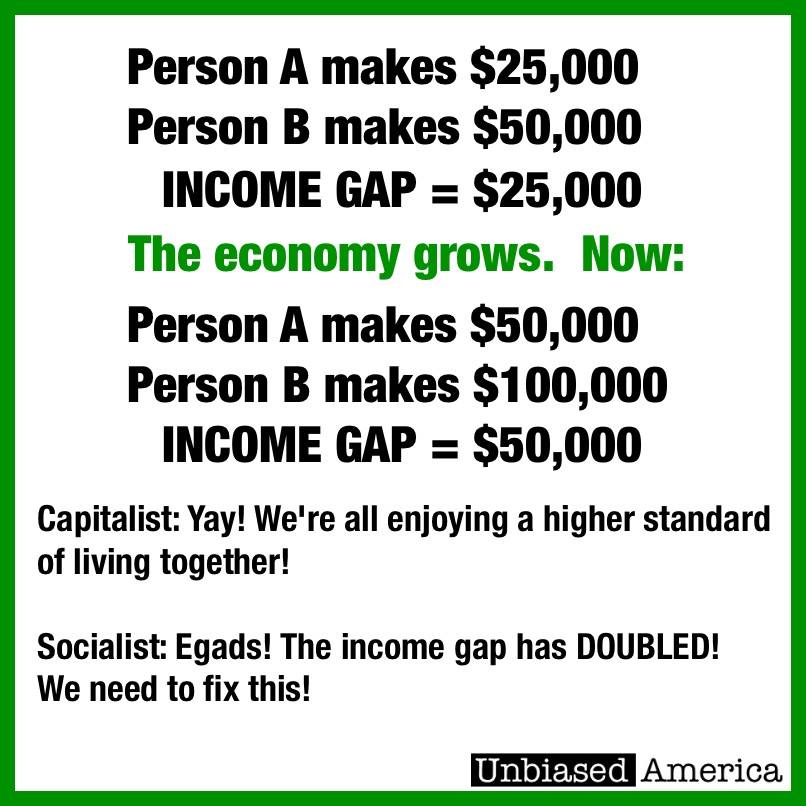
Given what economists know about the harmful effects from raising already high marginal tax rates even higher, tax increases could certainly reduce measured inequality—because they would cause higher-income people to reduce their taxable income by working less, by taking more pay in the form of untaxed fringe benefits, or by investing more in municipal bonds, whose interest is not taxable by the feds. Of course, none of this would make lower-income people better off. Indeed, to the extent that higher taxes discourage capital accumulation, they slow the growth of worker productivity. One of the main ways to increase worker productivity is to increase the amount of capital per worker. With a slower growth rate of capital, worker productivity will grow more slowly—and so will real wages. This makes lower-income people worse off than they would have been.










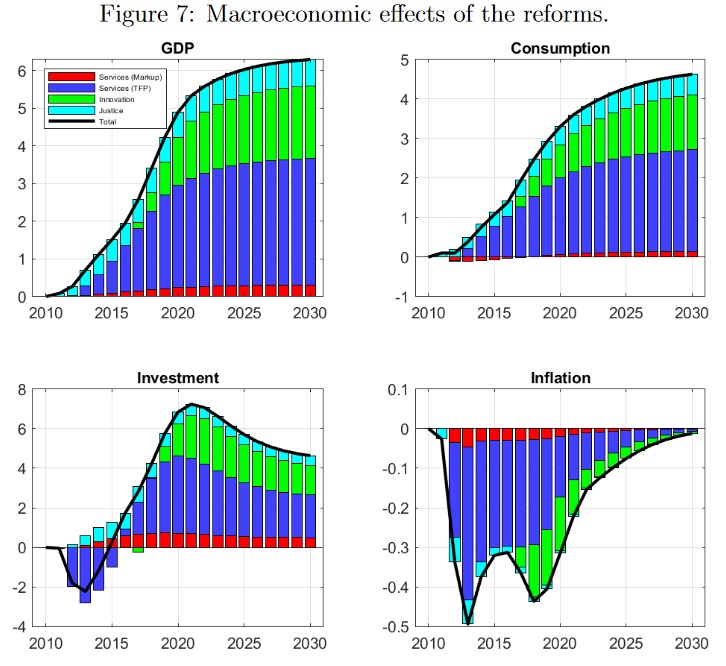
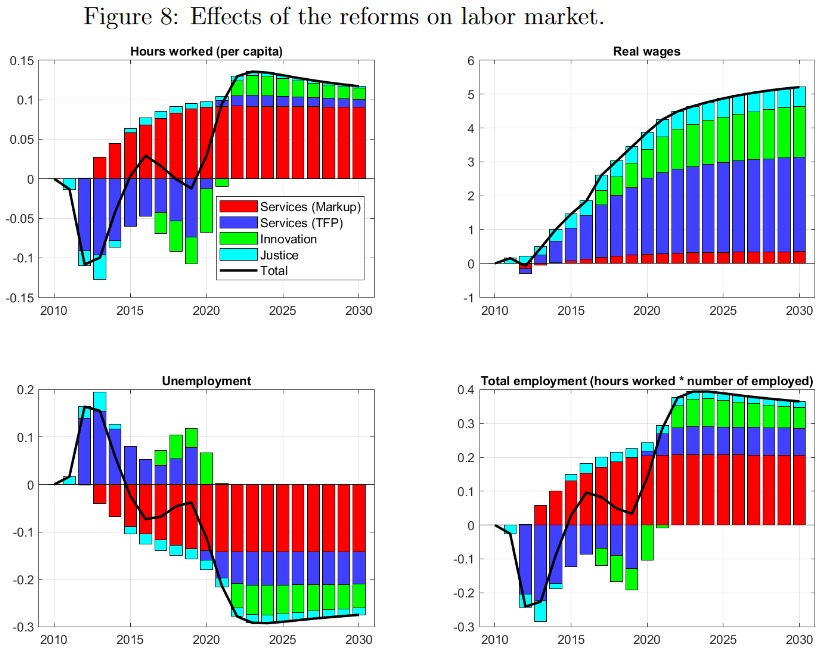






























 The Daily Hatch