Monthly Archives: December 2015

Great article by Ken Ham on Alberto Giubilini, Francesca Minerva, and Peter Singer and their view that parents should be allowed to abort their newborn infants!

Great article by Ken Ham on Alberto Giubilini, Francesca Minerva, and Peter Singer and their view that parents should be allowed to abort their newborn infants!

Francis Schaeffer 

Dr. Francis Schaeffer: Whatever Happened to the Human Race Episode 1 ABORTION

Whatever Happened to the Human Race?
Abortion
Dr. Francis Schaeffer

__________

Great article by Ken Ham on Alberto Giubilini, Francesca Minerva, and   Peter Singer: 

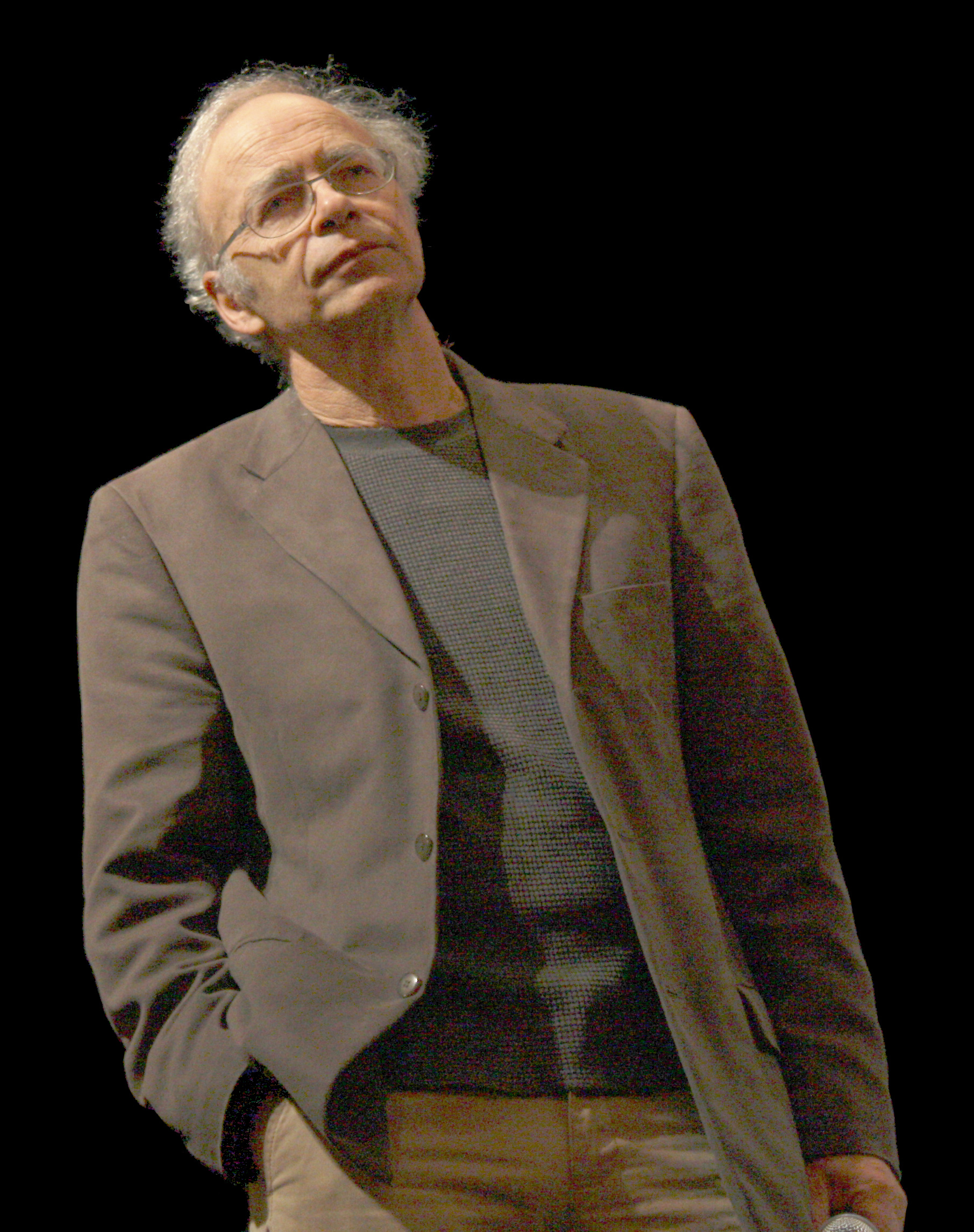
Peter Singer below:

Recently, the Journal of Medical Ethics caused an uproar when it published an article titled, “After-birth Abortion: Why Should the Baby Live?” News reports initially focused on the short abstract of the article that was available for free online (the full paper cost $30 to purchase, according to one report www.ncregister.com/blog/matthew-archbold/ethicists-argue-for-post-birth-abortions), when the paper was suddenly made available in full shortly after the controversy began.  Although I already posted about this story on my Facebook page, I thought it worth looking at the full report for today’s blog and including this link so now you can all read the four-page paper for yourself here (jme.bmj.com/content/early/2012/02/22/medethics-2011-100411.full.pdf+html).

The authors of the paper were Alberto Giubilini, who works with the Centre for Human Bioethics at Monash University in Australia, and Francesca Minerva, who works with the Centre for Applied Philosophy and Public Ethics at the University of Melbourne, Australia. Their thesis? They believe that parents should be allowed to abort their newborn infants.

The authors stated their argument as follows:

Abortion is largely accepted even for reasons that do not have anything to do with the fetus’ health. By showing that (1) both fetuses and newborns do not have the same moral status as actual persons, (2) the fact that both are potential persons is morally irrelevant and (3) adoption is not always in the best interest of actual people, the authors argue that what we call ‘after-birth abortion’ (killing a newborn) should be permissible in all the cases where abortion is, including cases where the newborn is not disabled. (p. 1)

Giubilini and Minerva take abortion a step further, arguing that parents should be allowed to abort their newborns. They justify their position by claiming that an infant is not technically a person:

Both a fetus and a newborn certainly are human beings and potential persons, but neither is a ‘person’ in the sense of ‘subject of a moral right to life’. We take ‘person’ to mean an individual who is capable of attributing to her own existence some (at least) basic value such that being deprived of this existence represents a loss to her. (p. 2)

At which point do Giubilini and Minerva consider infants to be persons? They declined to say: “we do not put forward any claim about the moment at which after-birth abortion would no longer be permissible” (p. 3).

To give you an idea of just where this sort of thinking leads, consider this paragraph from the article:

Failing to bring a new person into existence cannot be compared with the wrong caused by procuring the death of an existing person. The reason is that, unlike the case of death of an existing person, failing to bring a new person into existence does not prevent anyone from accomplishing any of her future aims. However, this consideration entails a much stronger idea than the one according to which severely handicapped children should be euthanised. If the death of a newborn is not wrongful to her on the grounds that she cannot have formed any aim that she is prevented from accomplishing, then it should also be permissible to practise an after-birth abortion on ahealthy newborn too, given that she has not formed any aim yet. (p. 2)

What we’re seeing here is what happens when society loses its biblical foundation. Once people abandon a basis in the absolute authority of God’s Word, then moral relativism will permeate the culture. This is what is happening in our once Christianized West. The situation is akin to that described in the book of Judges:

In those days there was no king in Israel; everyone did what was right in his own eyes. (Judges 21:25)

It also reminds me of Isaiah 5:20: “Woe to those who call evil good and good evil, who put darkness for light and light for darkness.” These people are so blinded by evil that they believe allowing after-birth abortions will be good for society—that it will be good for parents to be able to abort kill their own newborn children for any reason.

This type of thinking may shock many Christians who understand that all life, both inside and outside of the womb, is precious, but it is not really new. Another “ethicist” named Peter Singer has advocated similar ideas for years. (See Singer, Peter. 1979. Practical Ethics, 1st ed., pp. 122–123. Cambridge: Cambridge University Press.) And it won’t just stop at what this article is reporting on—much evil will be claimed as okay as God turns our nations over to judgment because of their rebellion, and as sinful man determines to do what is right in his own eyes.

Romans 1:28–32 delivers the sobering reality of what society will look like when the people willfully reject their Creator. Among other things, they invent ways of doing evil, and even though they know that those who practice such things deserve death, they not only engage in those activities, but approve of those who practice them.

What these two “ethicists” believe about life is exactly contrary to what God teaches about life. The Psalmist praises God, saying, “For you formed my inward parts; you knitted me together in my mother’s womb. I praise you, for I am fearfully and wonderfully made.” God tells Jeremiah, “Before I formed you in the womb, I knew you” (Jeremiah 1:5). Our God is about life—He values it—and He makes clear in His Word that every person—unborn babies and newborn infants alike—are known by Him and exist from conception.
For more on this shocking pro-infanticide thinking, see today’s News to Note and read the commentary by a medical doctor and AiG researcher, Dr. Elizabeth Mitchell.

Thanks for stopping by and thanks for praying,
Ken

Related posts:

SANCTITY OF LIFE SATURDAY Francis Schaeffer predicted July 21, 2015 would come when the video “Second Planned Parenthood Senior Executive Haggles Over Baby Parts Prices, Changes Abortion Methods” would be released!!!!

Francis Schaeffer predicted July 21, 2015 would come when the video “Second Planned Parenthood Senior Executive Haggles Over Baby Parts Prices, Changes Abortion Methods” would be released!!!! Al Mohler wrote the article ,”FIRST-PERSON: They indeed were prophetic,” Jan 29, 2004, and in this great article he noted:   . “We stand today on the edge of a […]

“Schaeffer Sunday” Liberals at Ark Times can not stand up to Scott Klusendorf’s pro-life arguments (Part 4) Liberal blogger says “…you don’t get to force your beliefs on me (concerning abortion)…”

I just wanted to note that I have spoken on the phone several times and corresponded with Dr. Paul D. Simmons who is very much pro-choice. (He is quoted in the article below.) He actually helped me write an article to submit to Americans United for the Separation of Church and State back in the […]

RESPONDING TO HARRY KROTO’S BRILLIANT RENOWNED ACADEMICS!! Peter Singer, Professor of Bioethics at Princeton University, THE PROBLEM OF EVIL

On November 21, 2014 I received a letter from Nobel Laureate Harry Kroto and it said: …Please click on this URL http://vimeo.com/26991975 and you will hear what far smarter people than I have to say on this matter. I agree with them. Harry Kroto _________________ Below you have picture of 1996 Chemistry Nobel Prize Winner Dr. […]

Very good article on Francis Schaeffer. Tom Wolfe and Peter Singer!! by Dr. Steven Garber from on November 19, 2013

_______________________ Very good article on Francis Schaeffer. Tom Wolfe. Peter Singer!! Presuppositional Life and Learning Posted on November 19, 2013 by Dr. Steven Garber   Francis Schaeffer. Tom Wolfe. Peter Singer. I spent the morning with the Capitol Fellows thinking about these three men, and their ideas. The first one I studied and studied with many […]

MUSIC MONDAY The Staple Singers Part 1

The Staple Singers Part 1     click to enlarge Mavis Staples   From Wikipedia, the free encyclopedia   Jump to: navigation, search   Mavis Staples Staples performing in Brooklyn, New York in 2007 Background information Birth name Mavis Staples Born July 10, 1939 (age 74) Origin Chicago, Illinois, U.S. Genres Rhythm and blues, soul, gospel […]

FRANCIS SCHAEFFER ANALYZES ART AND CULTURE Part 50 THE BEATLES (Part B, The Psychedelic Music of the Beatles) (Feature on artist Peter Blake )

Francis Schaeffer noted, “In this flow there was also the period of psychedelic rock, an attempt to find this experience without drugs, by the use of a certain type of music. This was the period of the Beatles’ Revolver (1966) and Strawberry Fields Forever (1967)…The psychedelic began with their records REVOLVER, STRAWBERRY FIELDS FOREVER, AND […]

The Staple Singers Part 1 (Mavis Staples in Concert in Little Rock on Oct 11th

The Staple Singers Part 1 Mavis Staples to give concert at Christ Church in Little Rock Posted by Lindsey Millar on Fri, Sep 6, 2013 at 2:48 PM click to enlarge Whoa. One of the greatest soul divas OF ALL TIME is coming to Little Rock next month. Christ Church Little Rock is hosting Mavis […]

FRANCIS SCHAEFFER ANALYZES ART AND CULTURE PART THE BEATLES Part 87 George Bernard Shaw Part B “Why was Shaw on the cover of SGT. PEPPER’S?” Featured Photographer is Henry Grossman

In my last post I demonstrated that George Bernard Shaw was a vocal communist and that probably had a lot to do with his inclusion on the cover of SGT PEPPER’S but today I will look more into more this great playwright’s views. Did you know that Shaw wrote the play that MY FAIR LADY […]

SANCTITY OF LIFE SATURDAY Transcript and Video of Francis Schaeffer speech in 1983 on the word “Evangelical”

Transcript and Video of Francis Schaeffer speech in 1983 on the word “Evangelical” _____________ SOUNDWORD LABRI CONFERENCE VIDEO – Names and Issues – Francis A. Schaeffer Published on Apr 20, 2014 This video is from the 1983 L’Abri Conference in Atlanta. The full lecture with Q&A time has been included. The lecture was also previously […]

“Schaeffer Sunday” Debating Kermit Gosnell Trial, Abortion and infanticide with Ark Times Bloggers Part 2

Surgeon General of the United States In office January 21, 1982 – October 1, 1989 President Ronald Reagan George H. W. Bush Francis Schaeffer Founder of the L’Abri community Born Francis August Schaeffer January 30, 1912 Died May 15, 1984 (aged 72) I truly believe that many of the problems we have today in the USA are […]

THE SERMON ON EVOLUTION BY ADRIAN ROGERS THAT I SENT TO OVER 250 ATHEIST SCIENTISTS FROM 1992 TO 2015!

My good friend Rev. Sherwood Haisty Jr. and I used to discuss which men were the ones who really influenced our lives  and Adrian Rogers had influenced us both more than anybody else. During the 1990′s I actually made it a practice to write famous atheists and scientists that were mentioned by Adrian Rogers and […]

RESPONDING TO HARRY KROTO’S BRILLIANT RENOWNED ACADEMICS!! Part 57 Neil deGrasse Tyson is fretting because we are on “a one-way expanding universe as we wind down to oblivion!”


On November 21, 2014 I received a letter from Nobel Laureate Harry Kroto and it said:

…Please click on this URL http://vimeo.com/26991975

and you will hear what far smarter people than I have to say on this matter. I agree with them.

Harry Kroto

____________________

Below you have picture of 1996 Chemistry Nobel Prize Winner Dr. Harry Kroto:

______________

Neil deGrasse Tyson Biography

Scientist, Writer, Television Personality (1958–)
Astrophysicist Neil DeGrasse Tyson hosted NOVA ScienceNow and appeared on such shows as The Daily Show and Real Time with Bill Maher.

Synopsis

Born and raised in New York City, astrophysicist Neil DeGrasse Tyson discovered his love for the stars at an early age. After studying at Harvard University, he earned his doctorate from Columbia University in 1991. Tyson went to work for the Hayden Planetarium in 1996 and still serves as its director. He hosted the NOVA ScienceNow series from 2006 to 2011. Tyson remains a popular TV science expert today and has amassed over 3.6 million followers on Twitter.

Early Life

One of America’s best-known scientists, astrophysicist Neil deGrasse Tyson has spent much of his career sharing his knowledge with others. He has a great talent for presenting complex concepts in a clear and accessible manner.

Tyson grew up in New York City. When he was nine, he took a trip to the Hayden Planetarium at the Museum of Natural History where he got his first taste of star-gazing. Tyson later took classes at the Planetarium and got his own telescope. As a teenager, he would watch the skies from the roof of his apartment building.

An excellent student, Tyson graduated from the Bronx High School of Science in 1976. He then earned a bachelor’s degree in Physics from Harvard University and a doctorate in astrophysics from Columbia University in 1991. After spending a few years doing post-doctorate work at Princeton University, Tyson landed a job at the Hayden Planetarium.

Career Highlights

Tyson eventually became the director of the Planetarium and worked on an extensive renovation of the facility, from assisting with its design to helping raise the necessary funds. This $210 million project was completed in 2000, and the revamped site offered visitors a cutting-edge look at astronomy. One of Tyson’s most controversial decisions at the time was the removal of Pluto from the display of planets. He classified Pluto as a dwarf planet, which invoked a strong response from some visitors. While some asked for the planet Pluto back, the International Astronomical Union followed Tyson’s lead in 2006. The organization officially labeled Pluto as a dwarf planet.

In addition to his work at the planetarium, Tyson has found other ways of improving the nation’s scientific literacy. “One of my goals is to bring the universe down to Earth in a way that further excites the audience to want more,” he once said. To this end, Tyson has written several books for the general public, including Death by Black Hole and Other Cosmic Quandariesand The Pluto Files: The Rise and Fall of America’s Favorite Planet. He has taken his message to the airwaves as well, serving as the host of PBS’sNOVA ScienceNow documentary series from 2006 to 2011. In addition to breaking down barriers between scientists and the general public, Tyson has brought diversity to astrophysics. He is one of the few African Americans in his field.

Tyson has also served as a presidential advisor. In 2001, President George W. Bush appointed him to a commission on the future of the aerospace industry. He also served another commission three years later to examine U.S. policy on space exploration.

These days, Tyson is one of the most in-demand science experts. He gives talks across the country and is a media favorite whenever there is an important science issue making news. Tyson is known for his ability to make difficult concepts accessible to every audience, his oratory skills and his sense of humor, which has led to appearances on such shows as Real Time with Bill Maher, The Colbert Report and The Daily Show. He also hosts his own podcast StarTalk Radio, a science-based talk show that features comedic co-hosts.

In 2014, Tyson hosted and was the executive editor of a 13-episode television series entitled COSMOS: A Space-Time Odyssey. The series reboots the classic science documentary, Cosmos. The original version featured Carl Sagan as host and provided a general audience with a greater understanding of the origin of life and our universe.

Personal Life

Tyson lives in New York City with his wife and their two children. Outside of his scientific endeavors, he is an avid collector of writing instruments.

In  the first video below in the 41st clip in this series are his words and  my response is below them. 

50 Renowned Academics Speaking About God (Part 1)

Another 50 Renowned Academics Speaking About God (Part 2)

A Further 50 Renowned Academics Speaking About God (Part 3)

__________

Recently I ran across this quote from Neil deGrasse Tyson:

“…a look at all the things that just wanna killers ok of most planet orbiting
unstable heartstart formations completely inefficient most places universal kill life instantly
instantly if you will say all the forces of nature just right for life excuse me
expects to look at the volume of the universe where you can live you’ll die instantly that’s not thus not
that’s not what i call the garden of eden right about galaxy orbits the week warburg once every couple hundred million years
you’re bound to come close to a supernova that will wipe out your ozone layer and kill everybody on the surface
doesn’t otherwise have dark-skinned because your high-energy rays will give you skin cancer um… well the collision course with a drama galaxy gold is beautiful spiral that we’re and of course what a one-way expanding universe as we wind down to oblivion as the temperature the universes into a quid pro quo proaches actions if that’s the universe standouts volcanoes tsunami just killed up you know i think that numbers higher  up two hundred thousand people flood twenty none of this is a sign that there’s a benevolent anything out there and this ninety percent is shipping nine nine percent of his earlier noted that’s uh… uh…” Neil deGrasse Tyson 


________

It seems that like Carl Sagan and even Charles Darwin before him Neil is  fretting over the future extinction of the human race. Darwin rightly noted that Christians do not have this same worry because they believe in the afterlife. Below at the bottom of this post you will find some evidence that indicates that the Bible is a historically accurate book and if that is so then maybe the Bible’s claims concerning the afterlife are also true.

I have corresponded on scientific issues with dozens of scientists for over 20 years now. You are probably familiar with these names below from Harvard:  Ernest Mayr (1904-2005), Gerald Holton (1922-), Edward O. Wilson(1929-), and Nobel Prize winners George Wald (1906-1997), and Nicolaas Bloembergen (1920-).

Some other scientists I have corresponded are not from Harvard but none the less are very note worthy such as   Carl Sagan (1934-1996),  Robert Shapiro (1935-2011),   Brian Charlesworth (1945-),  Francisco J. Ayala (1934-) Elliott Sober (1948-), Kevin Padian (1951-), Matt Cartmill (1943-) , Milton Fingerman (1928-), John J. Shea (1969-), , Michael A. Crawford (1938-),   Harry Kroto (1939-),   Lewis Wolpert (1929),  Martin Rees (1942-), Alan Macfarlane (1941-),  Roald Hoffmann (1937-), Herbert Kroemer (1928-), and  Thomas H. Jukes (1906-1999). As you will notice several of these men have won Nobel Prizes.

___________________

March 16, 2015

Neil deGrasse Tyson

C/O Hayden Planetarium & Department of Astrophysics

Dear Dr. Tyson,

Let me start off by saying that this is not the first time that I have written you. Earlier I shared several letters of correspondence I had with Carl Sagan, and Antony Flew. Both men with strong believers in evolution as you are today. Instead of talking to you about their views today I wanted to discuss the views of you and Charles Darwin.

Previously I wrote you that in 1994 and 1995 I had the opportunity to correspond with the famous evolutionist Dr. Ernst Mayr of Harvard. He stated in his letter of 10-3-94, “Owing to your ideological commitments, it is only natural that you cannot accept the cogency of the scientific evidence. However, to a person such as myself without such commitments, the story of the gradual evolution of life as reconstructed by chemists and molecular biologists is totally convincing.”

I responded by pointing out several points and here are two of them. First, Scientific Naturalism is atheistic by definition. Second, many great scientists of the past were Christians, and that did not disqualify their observations and discoveries.

Recently I ran across this quote from you:

“…a look at all the things that just wanna killers ok of most planet orbiting
unstable heartstart formations completely inefficient most places universal kill life instantly
instantly if you will say all the forces of nature just right for life excuse me
expects to look at the volume of the universe where you can live you’ll die instantly that’s not thus not
that’s not what i call the garden of eden right about galaxy orbits the week warburg once every couple hundred million years
you’re bound to come close to a supernova that will wipe out your ozone layer and kill everybody on the surface
doesn’t otherwise have dark-skinned because your high-energy rays will give you skin cancer um… well the collision course with a drama galaxy gold is beautiful spiral that we’re and of course what a one-way expanding universe as we wind down to oblivion as the temperature the universes into a quid pro quo proaches actions if that’s the universe standouts volcanoes tsunami just killed up you know i think that numbers higher  up two hundred thousand people flood twenty none of this is a sign that there’s a benevolent anything out there and this ninety percent is shipping nine nine percent of his earlier noted that’s uh… uh…” Neil deGrasse Tyson 

Sounds like you are stressing a little bit about the universe ultimately being destroyed. I thought of this quote of you recently when I was reading the works of Charles Darwin because he talks about this same subject. I just finished reading the online addition of the book Darwin, Francis ed. 1892. Charles Darwin: his life told in an autobiographical chapter, and in a selected series of his published letters [abridged edition]. London: John Murray. There are several points that Charles Darwin makes in this book that were very wise, honest, logical, shocking and some that were not so wise. The Christian Philosopher Francis Schaeffer once said of Darwin’s writings, “Darwin in his autobiography and in his letters showed that all through his life he never really came to a quietness concerning the possibility that chance really explained the situation of the biological world. You will find there is much material on this [from Darwin] extended over many many years that constantly he was wrestling with this problem.”

When I read the book  Charles Darwin: his life told in an autobiographical chapter, and in a selected series of his published letters, I also read  a commentary on it by Francis Schaeffer and I wanted to both  quote some of Charles Darwin’s own words to you and then include the comments of Francis Schaeffer on those words. I have also enclosed a CD with two messages from Adrian Rogers and Bill Elliff concerning Darwinism.

Darwin wrote in his Autobiography in 1876:

“But I was very unwilling to give up my belief; I feel sure of this, for I can well remember often and often inventing day-dreams of old letters between distinguished Romans, and manuscripts being discovered at Pompeii or elsewhere, which confirmed in the most striking manner all that was written in the Gospels.

Francis Schaeffer commented:

This is very sad. He lies on his bunk and the Beagle tosses and turns and he makes daydreams, and his dreams and hopes are that someone would find in Pompeii or some place like this, an old manuscript by a distinguished Roman that would put his stamp of authority on it, which would be able to show that Christ existed. This is undoubtedly what he is talking about. Darwin gave up this hope with great difficulty. I think he didn’t want to come to the position where his accepted presuppositions were driving him. He didn’t want to give it up, just as an older man he understood where it would lead and “man can do his duty.” Instinctively this of brains understood where this whole thing was going to eventually go…

SINCE CHARLES DARWIN’S DEATH WE NOW HAVE LOTS OF HISTORICAL RECORDS AND MUCH EVIDENCE FROM THE FIELD OF ARCHAEOLOGY THAT SHOW THE BIBLE IS HISTORICALLY ACCURATE.

Just like Darwin you need to ask yourself this same question but you will be doing it almost a century and a half later: Is the Bible historically accurate and have I taken the time to examine the evidence? Obviously Darwin was hoping that archaeology would provide some hope for the accuracy of the Bible. Here are some of the posts I have done in the past on the subject and if you like you could just google these subjects: 1. The Babylonian Chronicleof Nebuchadnezzars Siege of Jerusalem2. Hezekiah’s Siloam Tunnel Inscription. 3. Taylor Prism (Sennacherib Hexagonal Prism)4. Biblical Cities Attested Archaeologically. 5. The Discovery of the Hittites6.Shishak Smiting His Captives7. Moabite Stone8Black Obelisk of Shalmaneser III9A Verification of places in Gospel of John and Book of Acts., 9B Discovery of Ebla Tablets10. Cyrus Cylinder11. Puru “The lot of Yahali” 9th Century B.C.E.12. The Uzziah Tablet Inscription13. The Pilate Inscription14. Caiaphas Ossuary14 B Pontius Pilate Part 214c. Three greatest American Archaeologists moved to accept Bible’s accuracy through archaeology.,

In Darwin’s 1876 Autobiography he noted:

“…it is an intolerable thought that he and all other sentient beings are doomed to complete annihilation after such long-continued slow progress. To those who fully admit the immortality of the human soul, the destruction of our world will not appear so dreadful.”

Francis Schaeffer commented:

Here you feel Marcel Proust and the dust of death is on everything today because the dust of death is on everything tomorrow. Here you have the dilemma of Nevil Shute’s ON THE BEACH. If it is true that all we have left is biological continuity and increased biological complexity, which is all we have left in Darwinism here, or with many of the modern philosophers, then you can’t stand Shute’s ON THE BEACH. Maybe tomorrow at noon human life may be wiped out. Darwin already feels the tension, because if human life is going to be wiped out tomorrow, what is it worth today? Darwin can’t stand the thought of death of all men. Charlie Chaplin when he heard there was no life on Mars said, “I’m lonely.”

You think of the Swedish Opera (ANIARA) that is pictured inside a spaceship. There was a group of men and women going into outer space and they had come to another planet and the singing inside the spaceship was normal opera music. Suddenly there was a big explosion and the world had blown up and these were the last people left, the only conscious people left, and the last scene is the spaceship is off course and it will never land, but will just sail out into outer space and that is the end of the plot. They say when it was shown in Stockholm the first time, the tough Swedes with all their modern  mannishness, came out (after the opera was over) with hardly a word said, just complete silence.

Darwin already with his own position says he CAN’T STAND IT!! You can say, “Why can’t you stand it?” We would say to Darwin, “You were not made for this kind of thing. Man was made in the image of God. Your CAN’T- STAND- IT- NESS is screaming at you that your position is wrong. Why can’t you listen to yourself?”

You find all he is left here is biological continuity, and thus his feeling as well as his reason now is against his own theory, yet he holds it against the conclusions of his reason. Reason doesn’t make it hard to be a Christian. Darwin shows us the other way. He is holding his position against his reason.

____________

These words of Darwin ring in my ear, “…it is an intolerable thought that he and all other sentient beings are doomed to complete annihilation after such long-continued slow progress…” . Schaeffer rightly noted, “Maybe tomorrow at noon human life may be wiped out. Darwin already feels the tension, because if human life is going to be wiped out tomorrow, what is it worth today? Darwin can’t stand the thought of death of all men.” IN OTHER WORDS ALL WE ARE IS DUST IN THE WIND.  I sent you a CD that starts off with the song DUST IN THE WIND by Kerry Livgren of the group KANSAS which was a hit song in 1978 when it rose to #6 on the charts because so many people connected with the message of the song. It included these words, “All we do, crumbles to the ground though we refuse to see, Dust in the Wind, All we are is dust in the wind, Don’t hang on, Nothing lasts forever but the Earth and Sky, It slips away, And all your money won’t another minute buy.”

Kerry Livgren himself said that he wrote the song because he saw where man was without a personal God in the picture. Solomon pointed out in the Book of Ecclesiastes that those who believe that God doesn’t exist must accept three things. FIRST, death is the end and SECOND, chance and time are the only guiding forces in this life.  FINALLY, power reigns in this life and the scales are never balanced. The Christian can  face death and also confront the world knowing that it is not determined by chance and time alone and finally there is a judge who will balance the scales.

Both Kerry Livgren and the bass player Dave Hope of Kansas became Christians eventually. Kerry Livgren first tried Eastern Religions and Dave Hope had to come out of a heavy drug addiction. I was shocked and elated to see their personal testimony on The 700 Club in 1981 and that same  interview can be seen on You Tube today. Livgren lives in Topeka, Kansas today where he teaches “Diggers,” a Sunday school class at Topeka Bible ChurchDAVE HOPE is the head of Worship, Evangelism and Outreach at Immanuel Anglican Church in Destin, Florida.

The answer to find meaning in life is found in putting your faith and trust in Jesus Christ. The Bible is true from cover to cover and can be trusted.

Thank you again for your time and I know how busy you are.

Everette Hatcher, everettehatcher@gmail.com, http://www.thedailyhatch.org, cell ph 501-920-5733, Box 23416, LittleRock, AR 72221, United States


You can hear DAVE HOPE and Kerry Livgren’s stories from this youtube link:

(part 1 ten minutes)

(part 2 ten minutes)

Kansas – Dust in the Wind (Official Video)

Uploaded on Nov 7, 2009

Pre-Order Miracles Out of Nowhere now at http://www.miraclesoutofnowhere.com

About the film:
In 1973, six guys in a local band from America’s heartland began a journey that surpassed even their own wildest expectations, by achieving worldwide superstardom… watch the story unfold as the incredible story of the band KANSAS is told for the first time in the DVD Miracles Out of Nowhere.

LET ME LEAVE YOU WITH TWO THOUGHTS:

1. Evolution can’t explain 4 things that we can have to know

In the video below Adrian Rogers notes four facts about the theory of Evolution:

1. Four Bridges that the Evolutionist Cannot Cross

a. The Origin of Life
The first bridge the evolutionists cannot logically cross is the origin of life—the origin of life. Now, whence came life?

(George Wald  is pictured above and I had the opportunity to correspond with him)

Let me tell you something: Dr. George Wald–Professor Emeritus of Biology at Harvard University—he won the Nobel Prize in Biology in 1971—writing in Scientific American on the origin of life, has said this—and I want you to listen carefully: “There are only two possibilities as to how life arose: One is spontaneous generation arising to evolution. The other is a supernatural creative act of God. There is no third possibility.” And, we would all say amen. Either God did it, or it just happened accidentally. All right. But now, let’s go on. So far, he’s doing good. He said there’s no third possibility. “Spontaneous generation, that life arose from nonliving matter, was scientifically disproved 120 years ago”—that was 120 years from when he made this statement—“by Louis Pasteur and others. That leaves us with only one possible conclusion: that life arose as a supernatural creative act of God.”So far, so good. But now, tune your ears, and don’t miss this. I want you to hear what this Nobel Prize winning scientist, Professor Emeritus of Biology at Harvard, said. Now remember, he said there are only two possibilities: Either there’s a creative act of God, or it is spontaneous generation that arises or moves to evolution. He said—and I’m continuing to quote: “I will not accept that…”—what that is he referring to? That it is a supernatural creative act of God—“I will not accept that philosophically, because I do not want to believe in God. Therefore, I choose to believe what I know is scientifically impossible: spontaneous generation arising to evolution.”

b. The Fixity of the Species
The second bridge the evolutionist cannot cross is the steadfastness, the fixity, of the species—that is, “the basic categories of life.”  We don’t have any evolutionary fossilized remains, missing links.

c. The Second Law of Thermodynamics
The third bridge that the evolutionist cannot logically cross is the Second Law of Thermodynamics. Now, what is the Second Law of Thermodynamics? This law says that energy is never destroyed. Everything tends to wear out, to run down, to disintegrate, and, ultimately, to die, but energy just moves to some other form. All processes, by definition, involve change, but the change—now, listen very carefully—is not in the upward direction of complexity, as the evolutionist declares. But, change left to itself is always in disintegration, not in integration. Now, that’s the Second Law of Thermodynamics. It’s called…—to itself, everything collapses, deteriorates, grows old, and dies, sooner or later—it’s called entropy.

d. The Non-Physical Properties Found in Creation
Now, here’s the fourth bridge that the evolutionists cannot logically cross, and that is the non-physical properties found in creation. Now, what do I mean by the non-physical properties found in creation? Music, The love of music, art, beauty, a hunger for God, worship. What is there in the survival of the fittest—what is there in the evolutionary process—that would produce these things? How can they be accounted for under the survival of the fittest? Where do these things come from? Genesis 1, verse 26: “And God said, Let us make man in our image, after our likeness…” (Genesis 1:26). You see, we have these inner things—this love for beauty, for art, for truth, for eternity. That didn’t come from some primordial ooze; that came from the God who created us.

Adrian Rogers on Darwinism

2. There is evidence that indicates the Bible is true.

Scientists insist on evidence and don’t want to be encouraged to believe anything on “blind faith.” Therefore, I have included some evidence below that seems to confirm the Biblical accounts. Check it out.

The Bible and Archaeology – Is the Bible from God? (Kyle Butt 42 min)

Below is a piece of that evidence given by Francis Schaeffer concerning the accuracy of the Bible.

TRUTH AND HISTORY (chapter 5 of WHATEVER HAPPENED TO THE HUMAN RACE?, under footnote #96)

We should take one last step back into the history of the Old Testament. In the previous note we looked first at the Dead Sea Scrolls, dating to around 100 B.C. Then we went back to the period of the Late Monarchy and looked first at the siege of Hezekiah in Jerusalem by Sennacherib in 701 B.C. and also at the last years of Judah down to about 600 B.C. Then we went further back to about 850 B.C., to Ahab and Jezebel, the ivory house, the Black Obelisk, the Moabite Stone and so on–then back again to about 950 B.C., to the time of Solomon and his son Rehoboam and the campaign by Shishak, the Egyptian pharaoh.

This should have built up in our minds a vivid impression of the historic reliability of the biblical text, including even the seemingly obscure details such as the ration tablets in Babylon. We saw, in other words, not only that the Bible gives us a marvelous world view that ties in with the nature of reality and answers the basic problems which philosophers have asked down through the centuries, but also that the Bible is completely reliable, EVEN ON THE HISTORICAL LEVEL.

The previous notes looked back to the time of Moses and Joshua, the escape from Egypt, and the settlement in Canaan. Now we will go back further–back as far as Genesis 12, near the beginning of the Bible.

Do we find that the narrative fades away to a never-never land of myths and legends? By no means. For we have to remind ourselves that although Genesis 12 deals with events a long time ago from our moment of history (about 2000 B.C. or a bit later), the civilized world was already not just old but ancient when Abram/Abraham left “Ur of the Chaldeans” (see Genesis 11:31).

Ur itself was excavated some fifty years ago. In the British Museum, for example, one can see the magnificent contents of a royal burial chamber from Ur. This includes a gold headdress still in position about the head of a queen who died in Ur about 2500 B.C. It has also been possible to reconstruct from archaeological remains what the streets and buildings must have been like at the time.

Like Ur, the rest of the world of the patriarchs (that is, of Abraham, Isaac, and Jacob) was firm reality. Such places as Haran, where Abraham went first, have been discovered. So has Shechem from this time, with its Canaanite stone walls, which are still standing, and its temple.

Genesis 12:5-9New American Standard Bible (NASB)

Abram took Sarai his wife and Lot his nephew, and all their possessions which they had accumulated, and the [a]persons which they had acquired in Haran, and they [b]set out for the land of Canaan; thus they came to the land of Canaan. Abram passed through the land as far as the site of Shechem, to the[c]oak of Moreh. Now the Canaanite was then in the land. The Lord appeared to Abram and said, “To your [d]descendants I will give this land.” So he built an altar there to the Lord who had appeared to him. Then he proceeded from there to the mountain on the east of Bethel, and pitched his tent, with Bethel on the west and Ai on the east; and there he built an altar to the Lord andcalled upon the name of the Lord. Abram journeyed on, continuing toward the[e]Negev.

Haran and Shechem may be unfamiliar names to us but the Negrev (or Negeb) is a name we have all read frequently in the news accounts of our own day. 

Negev Nuclear Research Center – Israel

The Negev – Israel’s Desert

This article was first published in the Spring 2005 issue of Bible and Spade.
“If the full meaning of a passage [in the Bible] is to be grasped, the context of the passage needs to be appropriately developed” (Greenwold 2004: 72). In his pithy study of Luke’s Gospel account of Elizabeth and Zachariah, Greenwold gives an example of what he means: “All too often in our church lifetime, we end up being given many theological and doctrinal factual ornaments, but seldom are we shown the tree upon which to hang them. It’s as if we have been handed dozens of pieces to a puzzle, but have never seen what the finished picture on the top of the puzzle box looks like” (2004: 73). I think that Greenwold has it right.
Jesus and the woman at Jacob’s well in John 4 is an excellent case in point. The story takes place near the Old Testament city of Shechem. Shechem is mentioned 60 times in the Old Testament. The city had been abandoned by New Testament times, but Stephen reiterates its importance in his speech in Acts 7:16. A small village, Sychar, was near the ruins of Shechem in New Testament times and is mentioned in the John 4 account (Jn 4:5). Unfortunately, most Bible studies of events at or near Shechem, and commentaries on the Book of John, omit Shechem’s pivotal role in Bible history and how it fit into God’s salvation plan.
 
The narrow pass where ancient Shechem is located at the modern city of Nablus, view west. Mt. Gerizim is on the left and Mt. Ebal on the right. Dr. James C. Martin.
Archaeological investigations have corroborated much of what the Bible has to say about Shechem’s physical and cultural aspects. Archaeology has confirmed Shechem’s location, its history, and many Biblical details. In this article I will integrate what archaeology has illuminated about this important place and its geographical importance with a macro look at Shechem’s place in revealing God’s promise and plan to restore believers to Him.1
Map of Shechem area showing the location of Tell Balata (ancient Shechem), Joseph’s tomb and Jacob’s Well. ASOR, 2002.
Location and Exploration
About 30 mi (49 km) north of Jerusalem is a low, 15-acre mound, known as Tell Balata. This nondescript ruin covers what was ancient Shechem. The tell rests in a long, narrow, east-west valley with the two highest mountains in central Palestine towering over it, Mt. Ebal on the north and Mt. Gerizim on the south. The Hebrew word shekemmeans “back” or “shoulder,” which probably refers to Shechem’s placement between the two mountains. Coming from the south, the major road from Beersheba, Hebron and Jerusalem splits here. One branch goes east, around Mt. Ebal, and provides access to the Jordan Valley and cities like Beth Shan. The western arm leads to the coastal plain and cities to the north such as Samaria and Dothan. Thus, ancient Shechem and its modern counterpart, Nablus, are in a very strategic location along the watershed road between Judah, the Jordan Valley, Transjordan, and the Galilee.2
In 1903, a group of German scholars under the direction of H. Tiersch examined Tell Balata and concluded it was ancient Shechem. Until that time there had been controversy over whether Tell Balata, or the modern city of Nablus nearby, was the location of ancient Shechem. Tiersch’s identification has never been seriously questioned.
E. Sellin led an Austro-German excavation team to Tell Balata in 1913 and 1914. His work was interrupted by World War I. Sellin began work again in 1926 and continued until 1936. Work was resumed in 1956 by an American team under the direction of G. E. Wright and B. W. Anderson. The latest season of excavations at Tell Balata was in 1973 under the direction of W. G. Dever (Campbell 1993: 1347; Seger 1997:21).
Aerial view of the ruins of Shechem. On the right is the Middle Bronze fortification wall and in the upper center the “Migdal,” or fortress, temple. Holy Land Satellite Atlas, 1999, p. 100.
Abram at Shechem
The first mention of Shechem in the Bible is Genesis 12:6, when Abram first entered Canaan. It is succinctly described: “Abram traveled through the land as far as the site of the great tree of Moreh at Shechem.” At that time, God promised Abram, “To your offspring I will give this land” (Gn 12:7). The next mention of Shechem is 11 chapters, and about 200 years, later, when the Bible records that Jacob, Abram’s grandson, “camped within sight of the city” (Gn 33:18).
Assuming a conservative dating for the Patriarchal events in the Bible,3 note that Abram camped in Canaan about 2090 BC and there is no mention of a city. However, when Jacob arrived 200 hundred years later, around 1890 BC, the Bible notes that he “camped within sight of the city [Shechem].” In the original Hebrew, the word translated in our English Bible as “city” meant a permanent, walled settlement (Hansen 2003:81, Wood 1999:23). Genesis 34:20 and 24 report that Shechem had a city gate; therefore it was fortified.
Can archaeology clarify if there was or was not a city? Yes. The absence of a “city” and walls at Tell Balata when Abram came through and the existence of a city in the time of Jacob is in complete agreement with what the Bible indicates is Shechem’s early history.
Excavations have revealed that the earliest urbanization at Tell Balata was in MB I (Levels XXII-XXI), about 1900–1750 BC. MB I was when Jacob lived by the city of Shechem. Prior to MB I, in the time of Abram’s visit, archaeology has demonstrated that there was a gap in settlement and an absence of fortification walls. Thus, there was no “city” for Abram to reference, as the Bible correctly infers (Campbell 1993: 1347).
Jacob and Joseph at Shechem
What was the city like when Jacob settled there? Archaeologists have revealed that Tell Balata in MB I had structures with mudbrick walls on stone foundations and they have found an abundance of artifacts typical of domestic living (Toombs 1992: 1179). The Bible records that during Jacob’s stay he purchased land near Shechem. This parcel would become the place where his son, Joseph, would later be entombed (Jos 24:32). The tumultuous Dinah affair also occurred during Jacob’s stay at Shechem. Its aftermath resulted in the murder of Shechem’s male population by two of Jacob’s sons (Gn 33–34). Subsequently, God told Jacob to move to Bethel (Gn 35:1) and then on to Hebron (Gn 35:7).
The next Biblical mention of Shechem is in connection with the story of 17-year-old Joseph, Jacob’s son, who was sold into slavery by his jealous brothers (Gn 37). In the account, Joseph’s brothers were grazing the family’s flocks near Shechem when Jacob sent Joseph to inquire of them. After looking for them at Shechem, he found them a short distance north at Dothan. There, the brothers conspired to sell Joseph into slavery, setting the stage for the subsequent accounts of Joseph’s rise to power, Jacob and his family moving to Egypt and, later, Israel’s oppression by Egyptian Pharaohs.
The earliest known extra-Biblical written record of Shechem comes from the Middle Bronze period. It is an inscription on a stele (an upright standing stone) of an Egyptian, Khu-Sebek, who was a nobleman in the court of Sesostris III (ca. 1880–1840 BC). It was found in 1901 by the renowned archaeologist J. Garstang at Abydos, Egypt. King Sesostris III became ruler shortly after Jacob was at Shechem, and he was probably the king when Jacob died in Egypt. Khu-Sebek’s stele describes how the king’s army campaigned in a foreign country named Sekmem (Shechem) and how “Sekmem fell” (Toombs 1992: 1179). W. Shea believes that the campaign on Khu-Sebek’s stele is none other than the Egyptians’ account of the military encounters experienced by the entourage accompanying Joseph when Jacob’s embalmed body was brought to Canaan for entombment at Machpelah (Gn 50:12–14) (Shea 1992: 38 ff.).
Khu-Sebek’s stele reveals that as early as the 19th century BC, Shechem was an important strategic location and a place worthy of mention in a notable Egyptian’s biography.
Stela of Khu-Sebek. He is shown seated, accompanied by members of his family, his nurse, and the superintendent of the cabinet. Discovered by British archaeologist John Garstang at Abydos, Egypt, in 1901, the stela is now on display in the museum of the University of Manchester, England. Mike Luddeni.
Joshua at Shechem
A little over 400 years later, God rescued the Israelites from Egyptian bondage and led them through the desert wilderness for 40 years. Near the end of this sojourn, their leader Moses said that once they entered the land God had promised them (at Shechem, see Gn 12:7!), they were to erect an altar on Mt. Ebal (Dt 27:4) and read portions of the Law while the people were assembled before Mounts Ebal and Gerizim (Dt 11:26–30; 27:12, 13).
As I noted above, the mountains of Ebal and Gerizim overlook the valley wherein lay Shechem. The mountains form a natural amphitheater in which the recitation of the Law could easily be heard. Despite the mountains’ heights (Ebal is 3,083 ft [940 m] and Gerizim is 2,890 ft [881 m]), there are many contemporary accounts of people speaking from the slopes of the mountains and being heard in the valley below. Even with the noise of the busy modern city of Nablus, I myself have been in the park at the top of Gerizim and clearly heard the voices of children playing in the Balata refugee camp at Gerizim’s base.
Joshua fulfilled Moses’ instructions and led the people directly to Gerizim and Ebal after defeating the stronghold at Ai (Jos 7–8). Assuming an “early Exodus” date (1446 BC), the Israelite entry into Canaan, after 40 years in the wilderness, was approximately 1406 BC, in the Late Bronze (LB) IB period.4 LB IB corresponds with Tell Balata’s Level XIV (Campbell 1993: 1347; Toombs 1992: 1178). During the 350 years of the previous MB period, the city had been fortified with earthen embankments and cyclopean wall fortifications. However, Shechem was destroyed around 1540 BC. The ferocity of the destruction resulted in debris covering the city up to a depth of 5.25 ft (1.6 m). It is surmised that the Egyptian armies of Ahmose I or Amenhotep I were the aggressors (Toombs 1992: 1182).
About 90 years after that catastrophe the city was rebuilt early in the LB I period, around 1450 BC. Level XIV corresponds to this date and is noted for the reconstruction of the city’s defensive walls, homes, and a well built, fortress-type, temple. This Level XIV occupation was the city at which Joshua and the Israelites arrived to fulfill Moses’ orders to read the Law before Ebal and Gerizim around 1406 BC.
The Book of Joshua makes an interesting observation about that visit:
All Israel, aliens and citizens alike…. were standing on both sides of the ark of the covenant of the LORD, facing those who carried it…. There was not a word of all that Moses had commanded that Joshua did not read to the whole assembly of Israel, including the women and children, and the aliens who lived among them (Jos 8:33, 35).
It appears that the crowd who heard the words of the Law that day was composed of both Israelites and native Shechemites (aliens)! The Bible implies that both Shechemites and Israelites co-existed at Shechem. This unusual situation can be further confirmed by the fact that Shechem became one of only three Israelite Cities of Refuge on the west side of the Jordan River, as well as being a city of the Levitical priesthood (Jos 20:7; 21:21). All this occurred even though there is no record in the Bible of it being taken in battle.5
Years later, Joshua again gathered the Israelites at Shechem (Jos 24). He reminded them of God’s promises and how He had fulfilled those promises and delivered them from diversities. Joshua then challenged the people to say whom they would serve and they promised to serve God (Jos 24:14–20). The renewal ceremony between the Israelites and God recognized the promises God made to Abraham (Gn 12:7; 17:7, 8), Jacob, and the people at Sinai through Moses (Ex 24:8).
The next event at Shechem in the Bible was the fulfillment of another promise: the burial of the Patriarch Joseph. Just before his death in Egypt, Joseph asked his brothers to bring his body back to the land “promised to Abraham, Isaac and Jacob” when God delivered them from Egypt (Gn 50:24–25).
And Joseph’s bones, which the Israelites had brought up from Egypt, were buried at Shechem in the tract of land that Jacob bought for a hundred pieces of silver from the sons of Hamor, the father of Shechem. This became the inheritance of Joseph’s descendants (Jos 24:32).
Today, there is a place near Tell Balata venerated by the Jewish and Samaritan faiths as the traditional location of Joseph’s tomb. The shrine marking the tomb, and an associated Jewish school, were reduced to rubble in October 2000 in the wake of the most recent hostilities between the Palestinian Arabs and the State of Israel. Conflicting views have abounded as to whether this was, in fact, Joseph’s final resting place. Unfortunately, no archaeological excavations are known to have taken place at this site that could verify that this was the true location of the tomb of Joseph. Several ancient texts mention the site, but the exact location of Joseph’s tomb is still in question.
The discovery of a LB Egyptian library at Amarna has provided additional insights on the LB period. Letters in the library reveal Egypt’s relationship with Canaan’s rulers in the mid-14th century BC. Some of the letters disclose that the kings of Shechem were independent of Egypt. Further, Shechem’s rulers were criticized by other Canaanite rulers for cooperating with an invading group of desert people called the Habiru. Many conservative evangelical scholars (e.g., Wood 1997; 2003: 269–71) believe the Habiru were the Israelites of the early Judges period.
Letter from Labayu, king of Shechem, to the king of Egypt, probably Amenhotep III. It is defiant in tone, suggesting Labayu had a measure of independence from Egypt (Hess 1993). The letter, numbered El Amarna 252, is written in Akkadian cuneiform, albeit with Canaanite grammar and syntax, and is on display in the British Museum. Mike Luddeni.
Abimelech at Shechem
Later in Bible history, Abimelech, the son of Gideon’s Shechemite concubine (Jgs 8:31), colluded with some Shechemites to kill 70 of Abimelech’s brothers (Jgs 8:30–31; 9). However, Abimelech’s youngest brother Jotham survived (Jgs 9:5). Jotham climbed to the top of Mt. Gerizim and shouted to the Shechemites below. He foretold the destruction of the men of Shechem by fire (Jgs 9:7–21). Later in the same chapter we read that the people of Shechem rose against Abimelech’s leadership. In response, Abimelech fought against the city and razed it. During the attack the leaders of Shechem tried to save themselves in “the stronghold of the temple of El-berith” (Jgs 9:46). The story continues:
He [Abimelech] took an ax and cut off some branches, which he lifted to his shoulders. He ordered the men with him, “Quick! Do what you have seen me do!” So all the men cut branches and followed Abimelech. They piled them against the stronghold and set it on fire over the people inside. So all the people in the tower of Shechem, about a thousand men and women, also died (Jgs 9:48–49).
Archaeologists (e.g., E. Campbell, B. Mazar, G. E. Wright and L. Stager) refer to the “tower of Shechem” as “the Tower (migdal) Temple or Fortress-Temple” of Shechem (Campbell 1993: 1348, Stager 2003: 26 and 68 note 1). Stager recently reexamined the work of Wright who, in 1926, excavated a large building that has been reported to be this Fortress-Temple (Stager 2003). Stager’s conclusions are that this Temple, “Temple 1, ” was, in fact, the migdal referred to in Judges 9. It is the largest such Canaanite structure found in Israel and was 70 ft (21 m) wide, 86 ft (26 m) long with stone foundation walls 17 ft (5.1 m) thick. The foundation supported a multistory mudbrick and timber temple with an entrance flanked by two large towers. Stager hypothesized that the courtyard of this temple could have been where Joshua “took a large stone and set it up there under the oak near the holy place of the LORD” (Jos 24:26).
Stager (2003: 68) places the destruction of the Fortress-Temple around 1100 BC. So does Seger (1997: 22), who correlates the destruction debris found at Level XI as being from the Iron IA period. Campbell (1993: 1347) states that there was a “significant” destruction “around 1100 BCE” and guardedly concludes, “connecting Level XI with the story underlying Judges 9 is plausible” (1993: 1352).
Dating Shechem’s destruction to 1100 BC helps confirm the Biblical date of 1406 BC as the beginning of the Conquest in Canaan. To do this, it is necessary to know that immediately after we read in the Bible of Abimelech’s destruction of Shechem, Jephthah, the ninth Judge, appears (Jgs 11, 12). Jephthah was hired by Israelites who lived in Gilead, east of the Jordan River, to confront the Ammonites who had made war on them for 18 years. Jephthah first attempted diplomacy with the Ammonite king. He reminded the Ammonite king that the Israelites had been in the land east of the Jordan River for “300 years” (Jgs 11:21–26). Jephthah, of course, was referring to the time when Moses led the Israelites through that region and defeated numerous kings (Nm 21:21–31).
Thus, if Abimelech destroyed Shechem ca. 1125–1100 BC (Jgs 9), and Abimelech was a contemporary of Jephthah, the Conquest would have occurred about 300 years earlier, in ca. 1400 BC (1100 BC + 300 years = 1400 BC).
Shechem in the Time of the Divided Monarchy
The Bible sheds little light on Shechem’s role during the reigns of Saul, David or Solomon. Rehoboam, Solomon’s son, was next in line for the throne. All the Israelites assembled at Shechem to anoint Rehoboam king. Rehoboam, however, acted foolishly by chiding the northern tribes and telling them he would tax them heavily. In defense, the northern tribes retaliated by separating themselves from Rehoboam and the southern kingdom. The northern tribes made Jeroboam I king of their region. The country, formerly unified under David and Solomon, became divided. The northern region and tribes, led by Jeroboam I, was known as Israel. The southern area and tribes, first led by Rehoboam, is referred to as Judah in the Bible.
Levels X and IX at Tell Balata represent the Jeroboam I period and are noted for carefully built houses of selected stones. The discovery of stone foundations for stairs suggests two-story, four-room houses, typical homes of that period (Dever 1994: 80–81). Campbell concludes that Level IX (920–810 BC) has “tangible evidence of Jeroboam I’s rebuilding (1 Kg 12:25) and a return to city status” (1993: 1352–53).
The Assyrian invasion of Israel in 724 BC (2 Kgs 17:5–6) brought another destruction to Shechem. The evidence is in Level VII. Toombs noted that in Level VII the city was “reduced to a heap of ruins, completely covered by debris of fallen brickwork, burned beams and tumbled building stones,” typical examples of Assyrian thoroughness (1992: 1185). In addition to the destruction, the Assyrians placed exiled peoples from other nations into the region around Shechem, a common Assyrian practice (2 Kgs 17:23–24).
These new peoples added Yahweh to their own beliefs (2 Kgs 17:25–30). The new religion mimicked Judaism in many respects and Mt. Gerizim was made the center of its worship. New Testament practitioners of the cult are called “Samaritans,” which also referred to the people who lived in the vicinity (Mt 10:5; Lk 9:52, 10:53; 17:16; Jn 4:7, 9, 22, 39, 40; 8:48; Acts 8:25). A remnant of the ancient Samaritans still lives on Mt. Gerizim and they practice sacrifices there just as they did 2,700 years ago.7
Shechem in the Intertestamental Period
Between the Old and New Testaments, Shechem had a modest recovery and there is an abundance of evidence that excellent buildings were constructed in this, the Hellenistic, period (ca. 330–107 BC). It was during this time that the Samaritans built a large temple and sacrificial platform on Mt. Gerizim, the remains of which were still visible in Jesus’ day (Jn 4:20).
As fighting between the Ptolemies and Seleucids swirled around the country in the intertestamental period, physical decline again took place at Shechem. This decline culminated when the Jewish leader, John Hyrcanus, took advantage of the temporary absence of outside armies and destroyed the Samaritan temple on Mt. Gerizim (ca. 126 BC). He leveled the city in 107 BC. Shechem never recovered from this destruction and lay in ruins until identified by Tierschin 1901.
Shechem in the New Testament Period
Samaritans continued to live in the area during the following years, the Roman period. This is confirmed by the discovery of human burials from the period on the lower slopes of Mt. Ebal (Magen 1993: 1358–59). It is known that Samaritans also made several attempts to renew their cult worship on Mt. Gerizim. The Romans suppressed their efforts and in AD 72 constructed a new city, Flavia-Neapolis, about 1 mi (1.6 km) west of Tell Balata (Magen 2001: 40). This new city is now Nablus, a modern Arab city of about 120,000 people8 whose name is probably a corruption of Roman city, Neapolis.
About 500 yd (460 m) southeast of Tell Balata is an ancient well, venerated to be a well that Jacob, the Patriarch, dug when he lived there. Such a well is not mentioned in the Old Testament. There is a small Arab village, Askar, just north of the well. Most scholars associate Askar with Sychar, the village in John 4 near “Jacob’s well” (Jn 4:6). The authenticity of the well is not only based on its physical identification in John 4, but also on “the fact that all traditions-—Jewish, Samaritan, Christian and Muslim-—support it” (Stefanovic 1992: 608). Several churches in Christian history have been built on the site of the well and today it is located under a recently constructed Greek Orthodox church. Access to the well is gained by going down steps from the apse of the new church.
Jacob’s well as it appeared in the 1870s. In the right background is Mt. Gerizim with the tomb of the Arab sheikh, where the ruins of the Samaritan temple were located in New Testament times, visible at the peak.Todd Bolen.
Jacob’s well, at the base of Mt. Gerizim, is at the junction of the main road leading from Jerusalem in the south. Here, the road splits with the eastern branch going toward the Jordan Valley and the western branch leading to Nablus, and in NT times, Samaria and the Galilee. It is an excellent setting for one of the most important passages in the Bible-—the account of Jesus’ verbal Messianic announcement in the fourth chapter of John. In this passage Jesus meets a Samaritan woman at Jacob’s well, dialogues with her, and tells her He is the long-awaited Messiah.
Mt. Gerizim (left peak) as seen from Jacob’s well. When the Samaritan woman said to Jesus, “Our fathers worshipped on this mountain,” she was no doubt referring to the ruins of the Samaritan temple on top of Mt. Gerizim. The small structure on the peak marks the location of the ruins of the Samaritan temple that easily could have been seen from Jacob’s well in Jesus’ day. Bryant Wood.
Significance of Shechem in Understanding John 4
This article began by stating that context in reading the Bible was important to full understanding of what the original writers wanted the original hearers/listeners to know. In the case of Shechem, it is clear that the writer of John’s Gospel was appealing to the hearer/reader’s understanding of Shechem’s unique historical and theological context.
First, the author established that the event took place at Sychar (Jn 4:6). By making reference to Jacob he reminded his readers/hearers that this is where Jacob first settled when he returned to the Promised Land from Paddan Aram (Gn 33:18). At this spot Abram received God’s promise that “To your offspring I will give this land” (Gn 12:7). In addition to God’s promise given here to Abram, the writer wanted the hearer/reader to remember that many human agreements were made at Shechem in Bible history. Unfortunately, most were corrupted because of man’s sin. For example, Jacob made a promise to spare Hamor and the Shechemites after Dinah was sexually violated. Jacob’s use of circumcision to confirm the agreement with the Shechemites was the same symbol God had ordained as “the sign of the covenant between Me and you” (Gn 17:11). To seal a human agreement in this manner and have it subsequently abrogated as Jacob’s sons had done (Gn 34), could not have escaped the attention of the original hearers/reader.
Later, we read in the Bible that Jacob did not destroy family idols: rather he simply placed them under a tree near Shechem (Gn 35). This whole account is a testimony to the human condition and our willful tendency not to obey God. Jacob, who even had the privilege of a personal revelation from God, still could not totally eliminate idol worship; he played on the edge and placed the idols under a tree rather than destroying them.
The reader/hearer also should have been reminded that Shechem was near the place where Joseph’s brothers sold him into slavery and then concocted a lie to explain Joseph’s absence to their father Jacob (Gn 37)—another example of man’s deceit and deception.
All of these accounts are, in themselves, mini-stories that illustrate the human condition and how incapable we are of making a lasting promise to God. As a result, we are in need of rescue and restoration and only God, with His patience, could develop and execute a plan, seen throughout Bible history, for accomplishing a restoration that did not rely on man’s fallible nature.
Juxtaposed against the human failings, lies and deceits, the hearer/reader’s attention was brought to the fact that Shechem was where God reminded the people that He is faithful. Having given Abram the promise of the land, the Israelites were to remember that promise by going to Shechem, building an altar worshipping and re-reading God’s Law. This would refresh in the minds of the Israelites how God had led them out of bondage as He had promised and into a land He had promised. The rededication ceremony was accomplished and is described in Joshua 8. Following the conquest, Joshua again assembled the people at Shechem where he reviewed God’s promises and Israel’s obligations, eliciting from the people an agreement that they would “serve the Lord our God and obey Him” (Jos 24:24). This promise was another one that was repeatedly broken as revealed in the succeeding books of the Old Testament.
Earlier in Israel’s history Joseph, as he lay dying in Egypt, reminded the people that God would lead them to the land He had promised to Abraham, Isaac and his father Jacob. He asked that when they did return, they “carry my bones up from this place” (Gn 50:25). This was fulfilled in Joshua 24:32 when the body of Joseph was placed in a tomb in Shechem.
The Hebrew hearer/reader would also remember that Shechem became the center for the idolatrous worship practices that occurred following Israel’s capture by the Assyrians. Importing peoples from other lands and exporting Jewish believers, syncretism of pagan beliefs and Jewish practices resulted in a corrupted form of worship that became centered at Shechem and on Mt. Gerizim by people who were known as Samaritans. They chose to be worshippers of other gods despite their earlier promise in Joshua 24.

Ruins of a fifth century AD octagonal church on Mt. Gerizim, view north. The church, dedicated to Mary, was built on top of a temple built by the Samaritans in the late fifth century BC. John Hyrcanus destroyed the temple in the late second century BC. The small domed building at the northeast corner, the tomb of an Arab sheikh, is the structure visible from Jacob’s well in the valley below. IAA.
I believe the author of John wanted the reader and hearer to recognize and associate Shechem with God’s eternal unbroken promises, man’s corrupted state, the need for a Rescuer and how a Rescuer had been promised throughout history. In John 4 the Rescuer is revealed. The Samaritan woman makes known the promise: “I know that Messiah is coming (He who is called Christ); when that One comes, He will declare all things to us.” And the Rescuer, Jesus, replied that the Messiah was at hand: “I Who speak to you am He” (Jn 4:26)!
The Samaritan woman’s response was to immediately run into the village, leaving her water jar behind, and tell everyone that the Rescuer was there. What glorious news! The Samaritans rushed to the well, welcomed Him and exclaimed that Jesus was the Rescuer, “the Savior of the world” (Jn 4:42).
It should challenge us to remember that shortly after Jesus’ declaration that He was Messiah, He would complete the promise and achieve the rescue through His death, burial and ascension. As He prepared His disciples for their duties, He told them that they would be His “witnesses in Jerusalem, and in all Judea and Samaria, and to the ends of the earth” (Acts 1:8). The story of Shechem and the Samaritan region had come full circle—from the promises to the Patriarchs to fulfillment of salvation as heard by the woman at the well and declared to the disciples.
Now we have the contextual history of Shechem. It is apparent that the original hearer/reader of John’s Gospel fully understood how Shechem had been a focal point of God’s unbroken promises and man’s fallibility. Hopefully, for the reader of this essay, all pieces of the puzzle of Shechem can now be understood and assembled so one can see the finished picture. And what a wonderful picture it is!
Footnotes
1. The author wishes to express his appreciation to Dr. James C. Martin for permission to use the photographs credited to him in this article.
2. For a discussion of geographical criteria that make for strategic locations in ancient Israel, see Hansen 1991.
3. For these dates, see Davis 1975: 29.
4. For a brief discussion of how this date is derived, see Hansen 2003: 80.
5. See Wood 1997 for his explanation of this unusual situation.
6. For a more thorough discussion of the Amarna tablets and the identity of the Habiru, see Archer 1994: 288–95; Wood 1995 and 2003: 269–71.
7. For a description of the modern Samaritans and how they practice Passover, see Bolen 2001.
Bibliography
Archer, Gleason L.
1994 A Survey of Old Testament Introduction, new and revised ed. Chicago: Moody.
Bolen, Todd
2001 Samaritan Passover. Bible and Spade 14: 41–42.
Campbell, Edward F.
1993 Shechem. Pp. 1345–54 in The New Encyclopedia of Archaeological Excavations in the Holy Land4, ed. Ephraim Stern. New York: Simon & Schuster.
Davis, John J.
1975 Paradise to Prison: Studies in Genesis. Grand Rapids MI: Baker.
Dever, William G.
1994 Monumental Architecture in Ancient Israel in the Period of the United Monarchy. Bible and Spade 7: 68–87.
Greenwold, Douglas
2004 Zechariah & Elizabeth: Persistent Faith in a Faithful God. Rockville MD: Bible-in-Context Ministries.
Hansen, David G.
1991 The Case of Meggido [sic]. Archaeology and Biblical Research 4: 84–93.
2003 Large Cities that Have Walls up to the Sky: Canaanite Fortifications in the Late Bronze I Period.Bible and Spade 16: 78–88.
Hess, Richard S.
1993 Smitten Ant Bites Back: Rhetorical Forms in the Amarna Correspondence from Shechem. Pp. 95–111 in Verses in Ancient Near Eastern Prose, eds. Johannes C. de Moor and Wilfred G.E. Watson, Alter Orient und Altes Testament 42. Kevelaer, Germany: Butzon & Bercker.
Magen, Itzhak
1993 Neapolis. Pp. 1354–59 in The New Encyclopedia of Archaeological Excavations in the Holy Land4, ed. Ephraim Stern. New York: Simon & Schuster.
2001 The Sacred Precinct on Mount Gerizim. Bible and Spade 14:37–40.
Seger, Joe D.
1997 Shechem. Pp. 19–23 in The Oxford Encyclopedia of Archaeology in the Near East 5, ed. Eric M. Myers. New York: Oxford University Press.
Shea, William H.
1992 The Burial of Jacob: A New Correlation Between Genesis 50 and an Egyptian Inscription.Archaeology and Biblical Research 5:33–44.
Stager, Lawrence E.
2003 The Shechem Temple where Abimelech Massacred a Thousand. Biblical Archaeological Review28.4:26–35, 68–69.
Stefanovic, Zdravko
1992 Jacob’s Well. Pp. 608–609 in The Anchor Bible Dictionary 3, ed. David N. Freedman. New York: Doubleday.
Toombs, Lawrence E.
1992 Shechem. Pp. 1174–86 in The Anchor Bible Dictionary 5, ed, David N. Freedman. New York: Doubleday.
Wood, Bryant G.
1995 Reexamining The Late Bronze Era: An Interview with Bryant Wood by Gordon Govier. Bible and Spade 8: 47–53.
1997 The Role of Shechem in the Conquest of Canaan. Pp 245–56 in To Understand the Scriptures: Essays in Honor of William H. Shea, ed. David Merling. Berrien Springs MI: Institute of Archaeology/Siegfried H. Horn Archaeological Museum.
1999 The Search for Joshua’s Ai: Excavations at Kh. el-Maqatir. Bible and Spade 12:21–30.

Related posts:

FRANCIS SCHAEFFER ANALYZES ART AND CULTURE Part 53 THE BEATLES (Part E, Stg. Pepper’s and John Lennon’s search in 1967 for truth was through drugs, money, laughter, etc & similar to King Solomon’s, LOTS OF PICTURES OF JOHN AND CYNTHIA) (Feature on artist Yoko Ono)

The John Lennon and the Beatles really were on a long search for meaning and fulfillment in their lives  just like King Solomon did in the Book of Ecclesiastes. Solomon looked into learning (1:12-18, 2:12-17), laughter, ladies, luxuries, and liquor (2:1-2, 8, 10, 11), and labor (2:4-6, 18-20). He fount that without God in the picture all […]

FRANCIS SCHAEFFER ANALYZES ART AND CULTURE Part 52 THE BEATLES (Part D, There is evidence that the Beatles may have been exposed to Francis Schaeffer!!!) (Feature on artist Anna Margaret Rose Freeman )

______________   George Harrison Swears & Insults Paul and Yoko Lucy in the Sky with Diamonds- The Beatles The Beatles:   I have dedicated several posts to this series on the Beatles and I don’t know when this series will end because Francis Schaeffer spent a lot of time listening to the Beatles and talking […]

FRANCIS SCHAEFFER ANALYZES ART AND CULTURE Part 51 THE BEATLES (Part C, List of those on cover of Stg.Pepper’s ) (Feature on artist Raqib Shaw )

  The Beatles in a press conference after their Return from the USA Uploaded on Nov 29, 2010 The Beatles in a press conference after their Return from the USA. The Beatles:   I have dedicated several posts to this series on the Beatles and I don’t know when this series will end because Francis […]

FRANCIS SCHAEFFER ANALYZES ART AND CULTURE Part 50 THE BEATLES (Part B, The Psychedelic Music of the Beatles) (Feature on artist Peter Blake )

__________________   Beatles 1966 Last interview I have dedicated several posts to this series on the Beatles and I don’t know when this series will end because Francis Schaeffer spent a lot of time listening to the Beatles and talking and writing about them and their impact on the culture of the 1960’s. In this […]

FRANCIS SCHAEFFER ANALYZES ART AND CULTURE Part 49 THE BEATLES (Part A, The Meaning of Stg. Pepper’s Cover) (Feature on artist Mika Tajima)

_______________ The Beatles documentary || A Long and Winding Road || Episode 5 (This video discusses Stg. Pepper’s creation I have dedicated several posts to this series on the Beatles and I don’t know when this series will end because Francis Schaeffer spent a lot of time listening to the Beatles and talking and writing about […]

FRANCIS SCHAEFFER ANALYZES ART AND CULTURE PART 48 “BLOW UP” by Michelangelo Antonioni makes Philosophic Statement (Feature on artist Nancy Holt)

_______________ Francis Schaeffer pictured below: _____________________ I have included the 27 minute  episode THE AGE OF NONREASON by Francis Schaeffer. In that video Schaeffer noted,  ” Sergeant Pepper’s Lonely Hearts Club Band…for a time it became the rallying cry for young people throughout the world. It expressed the essence of their lives, thoughts and their feelings.” How Should […]

FRANCIS SCHAEFFER ANALYZES ART AND CULTURE Part 47 Woody Allen and Professor Levy and the death of “Optimistic Humanism” from the movie CRIMES AND MISDEMEANORS Plus Charles Darwin’s comments too!!! (Feature on artist Rodney Graham)

Crimes and Misdemeanors: A Discussion: Part 1 ___________________________________ Today I will answer the simple question: IS IT POSSIBLE TO BE AN OPTIMISTIC SECULAR HUMANIST THAT DOES NOT BELIEVE IN GOD OR AN AFTERLIFE? This question has been around for a long time and you can go back to the 19th century and read this same […]

FRANCIS SCHAEFFER ANALYZES ART AND CULTURE PART 46 Friedrich Nietzsche (Featured artist is Thomas Schütte)

____________________________________ Francis Schaeffer pictured below: __________ Francis Schaeffer has written extensively on art and culture spanning the last 2000years and here are some posts I have done on this subject before : Francis Schaeffer’s “How should we then live?” Video and outline of episode 10 “Final Choices” , episode 9 “The Age of Personal Peace and Affluence”, episode 8 […]

FRANCIS SCHAEFFER ANALYZES ART AND CULTURE Part 45 Woody Allen “Reason is Dead” (Feature on artists Allora & Calzadilla )

Love and Death [Woody Allen] – What if there is no God? [PL] ___________ _______________ How Should We then Live Episode 7 small (Age of Nonreason) #02 How Should We Then Live? (Promo Clip) Dr. Francis Schaeffer 10 Worldview and Truth Two Minute Warning: How Then Should We Live?: Francis Schaeffer at 100 Francis Schaeffer […]

FRANCIS SCHAEFFER ANALYZES ART AND CULTURE Part 44 The Book of Genesis (Featured artist is Trey McCarley )

___________________________________ Francis Schaeffer pictured below: ____________________________ Francis Schaeffer “BASIS FOR HUMAN DIGNITY” Whatever…HTTHR Dr. Francis schaeffer – The flow of Materialism(from Part 4 of Whatever happened to human race?) Dr. Francis Schaeffer – The Biblical flow of Truth & History (intro) Francis Schaeffer – The Biblical Flow of History & Truth (1) Dr. Francis Schaeffer […]

How to Cure Health Care: What We Can Learn from Milton Friedman 2 years ago Kurt Jaros

How to Cure Health Care: What We Can Learn from Milton Friedman

I recently read about Michael Ciampi, a doctor from Maine who has stopped accepting payments from insurance companies, both private and public. The article states:

…the decision to do away with insurance allows Ciampi to practice medicine the way he sees fit, he said. Insurance companies no longer dictate how much he charges. He can offer discounts to patients struggling with their medical bills. He can make house calls.

One benefit to his new style of business is that patients who are self-employed, lack insurance or those with a high deductible will see Ciampi as having competitive prices for their medical needs. This is because the doctor has “cut [his] prices in half because [his] overhead will be so much less.

I’m not a health care expert, but for quite some time I have been skeptical of insurance companies. I see insurance companies as playing the role of middle man, which in most other areas of economics creates higher costs.

My esteemed economist Milton Friedman also recognized this. In his article “How to Cure Health Care” Friedman argues that third parties are (at least, partly) responsible for the rise in medical costs. He writes:

Two simple observations are key to explaining both the high level of spending on medical care and the dissatisfaction with that spending. The first is that most payments to physicians or hospitals or other caregivers for medical care are made not by the patient but by a third party—an insurance company or employer or governmental body. The second is that nobody spends somebody else’s money as wisely or as frugally as he spends his own … No third party is involved when we shop at a supermarket. We pay the supermarket clerk directly: the same for gasoline for our car, clothes for our back, and so on down the line. Why, by contrast, are most medical payments made by third parties?

Friedman goes on to explain how this came about back during World War II when employers first began offering medical coverage to employees (because the government placed wage control upon employers; hence employers offered other ways of payment to get around the regulation). The government quickly pounced on this to regulate it, but people objected. Thus, employers’ medical expenditures were treated as a tax-deductible expense instead being given as the employee’s income and subject to the income tax.

Additionally, in 1965 the birth of Medicaid and Medicare brought another third-party into the marketplace of healthcare insurance: the government. In my next post I’ll write on how and why the government’s cost has gone from “an eighth of the total in 1919 to a quarter in 1965 to nearly half in 1997,” according to Friedman.


Milton Friedman on Medical Care (Full Lecture)

Published on Feb 2, 2014

I have written about Obamacare over and over again on this blog. Dan Mitchell has shared many funny cartoons about Obamacare too. Milton Friedman has spoken out about government healthcare many times in the past and his film series FREE TO CHOOSE is on You Tube and I encourage you to watch it. It is clear that the federal government debt is growing so much that it is endangering us because if things keep going like they are now we will not have any money left for the national defense because we are so far in debt as a nation.

We have been spending so much on our welfare state through food stamps and other programs that I am worrying that many of our citizens are becoming more dependent on government and in many cases they are losing their incentive to work hard because of the welfare trap the government has put in place. Other nations in Europe have gone down this road and we see what mess this has gotten them in. People really are losing their faith in big government and they want more liberty back. It seems to me we have to get back to the founding  principles that made our country great.  We also need to realize that a big government will encourage waste and corruption. Also raising taxes on the job creators is a very bad idea too. The Laffer Curve clearly demonstrates that when the tax rates are raised many individuals will move their investments to places where they will not get taxed as much.

In 1980 I read the book FREE TO CHOOSE by Milton Friedman and it really enlightened me a tremendous amount.  I suggest checking out these episodes and transcripts of Milton Friedman’s film series FREE TO CHOOSE: “The Failure of Socialism” and “The Anatomy of a Crisis” and “What is wrong with our schools?”  and “Created Equal”  and  From Cradle to Grave, and – Power of the Market.

Milton Friedman – Health Care Reform (1992) pt 1/4

Milton Friedman – Health Care Reform (1992) pt 2/4

Milton Friedman – Health Care Reform (1992) pt 3/4

Milton Friedman – Health Care Reform (1992) pt 4/4

_____________________

Related posts:

Dan Mitchell on Obamacare Supreme Court Decision: “I’m disgusted that the Supreme Court once again has decided to put politics above the Constitution!” (Includes lots of videos and cartoons)

__________ Enzi statement on the Supreme Court’s King Vs. Burwell decision 5 Takeaways From Today’s Supreme Court Ruling on Obamacare Wicker Comments on King v Burwell Supreme Court Decision Senator Lankford Discusses the King v. Burwell Supreme Court Decision Congressman Steve King Response to SCOTUS King v. Burwell Ruling Obamacare and the Odious Anti-Constitutionalism of […]

Open letter to President Obama (Part 718) Cartoonists Go to War against Obamacare

Open letter to President Obama (Part 718) (Emailed to White House on 6-25-13.) President Obama c/o The White House 1600 Pennsylvania Avenue NW Washington, DC 20500 Dear Mr. President, I know that you receive 20,000 letters a day and that you actually read 10 of them every day. I really do respect you for trying to get […]

The Region – Banking and Policy Issues Magazine – Interview with Milton Friedman June 1992

______ Milton Friedman’s Free to Choose (1980), episode 3 – Anatomy of a Crisis. part 1 The Region – Banking and Policy Issues Magazine – Interview with Milton Friedman June 1992 In his new book, Money Mischief, economist Milton Friedman compares inflation to alcoholism; blames the rise of Chinese communism, in large part, on an […]

NEW RIVER MEDIA INTERVIEW WITH: MILTON FRIEDMAN Professor Emeritus of Economics, University of Chicago Senior Fellow, Hoover Institution

______ Milton Friedman – A Conversation On Minimum Wage Milton Friedman Interview Milton Friedman is Professor Emeritus of Economics at the University of Chicago and Senior Fellow at the Hoover Institution.Dr. Friedman received the 1976 Nobel Memorial Prize for Economic Science. Member of the research staff of the National Bureau of Economic Research from 1937 […]

Walter E. Williams: “Milton Friedman was an economist’s economist” Wednesday, Dec. 6 2006 1

________ Milton Friedman on Donahue – 1979 Uploaded on Aug 26, 2009 Dr. Milton Friedman, Nobel Laureate, promoting “Free to Choose” on the show Donahue. Walter E. Williams: Milton Friedman was an economist’s economist Print Font [+] [-] Leave a comment » By Walter E. Williams Published: Wednesday, Dec. 6 2006 12:00 a.m. MST Walter […]

FRIEDMAN FRIDAY 40 Years Later: Milton Friedman’s Legacy in Chile “Chilean Miracle” Struck a Blow against Communism When Needed Most José Niño April 22, 2015

_______ José Niño José Niño is a graduate student based in Santiago, Chile. A citizen of the world, he has lived in Venezuela, Colombia, and the United States. He is currently an international research analyst with the Acton Circle of Chile. Follow@JoseAlNino. 40 Years Later: Milton Friedman’s Legacy in Chile “Chilean Miracle” Struck a Blow […]

FRIEDMAN FRIDAY Milton Friedman came up with the NEGATIVE INCOME TAX

____ Milton Friedman – The Negative Income Tax The Conservative Case for a Guaranteed Basic Income NOAH GORDON AUG 6, 2014 Creating a wage floor is an effective way to fight poverty—and it would reduce government spending and intrusion. Swiss backers of a minimum income spread out coins in Bern. Denis Balibouse/Reuters Last week, my […]

FRIEDMAN FRIDAY Which Fed Bill Would Milton Friedman Have Liked? Posted on March 10, 2015by John Taylor

________________ Which Fed Bill Would Milton Friedman Have Liked? Posted on March 10, 2015by John Taylor Writing last week on the Cato at Liberty blog, Steve Hanke argued that Milton Friedman would have supported the “Audit the Fed” bill recently introduced in the Senate.  Steve’s reasoning is based on Friedman’s 1962 essay “Should there be an […]

5 myths that conceal reality by Milton Friedman

A great speech below: Here are the myths:Robber Baron Myth, The Cause of Great Depression Myth, The Demand for Government Service Myth, The Free Lunch Smith, and The Robin Hood Myth. 1) the Robber Baron Myth, 2) the Great Depression Myth, 3) the Demand for Government Service Myth, 4) the Free Lunch Myth, and 5) […]

FRIEDMAN FRIDAY SEPTEMBER 4, 2006 An Interview with Milton Friedman

_______________ FEATURED ARTICLE | SEPTEMBER 4, 2006 An Interview with Milton Friedman Milton Friedman* I recently sat down with Milton Friedman, a few days before his 94th birthday, to discuss the impact of two of his most important contributions to economics and liberty: A Monetary History of the United States, 1870-1960 [co-written] with Anna Schwartz, […]

FRIEDMAN FRIDAY The Social Responsibility of Business is to Increase its Profits by Milton Friedman The New York Times Magazine, September 13, 1970.

Milton Friedman on Self-Interest and the Profit Motive 1of2 Milton Friedman on Self-Interest and the Profit Motive 2of2 The Social Responsibility of Business is to Increase its Profits by Milton FriedmanThe New York Times Magazine, September 13, 1970. Copyright @ 1970 by The New York Times Company. When I hear businessmen speak eloquently about the […]

FRIEDMAN FRIDAY Levin on Milton Friedman: ‘One Thing to Have Free Immigration to Jobs, Another for Welfare’ By Michael Morris | January 16, 2015

____________ Levin on Milton Friedman: ‘One Thing to Have Free Immigration to Jobs, Another for Welfare’ By Michael Morris | January 16, 2015 | 5:12 PM EST During his show on January 15, 2015, Nationally syndicated radio host Mark Levin recalled the famed economist Milton Friedman and explored an important reason why open immigration, despite […]

“Truth Tuesday” Debating the Founding Fathers with Ark Times Bloggers Part 1 John Adams “The general principles on which the fathers achieved independence were. . . . the general principles of Christianity.”

Debating the Founding Fathers with Ark Times Bloggers Part 1

I have gone back and forth and back and forth with many liberals on the Arkansas Times Blog on many issues such as abortionhuman rightswelfarepovertygun control  and issues dealing with popular culture , but the issue of the founding fathers’ views on religion got one of the biggest responses.

It is true that 29 of the signers of the Declaration of Independence had degrees with Bible Colleges or Seminaries and these men we know were God-fearing Protestants. This means they had a biblical view of man with an understanding of our sin nature and this led them to come up with a limited government with many checks and balances. They had a strong belief in the afterlife and in future punishments and rewards. They also encouraged Christianity and were not hostile to religion. However, they did not set up a Christian Theocracy but wanted freedom of religion.

People really are losing their faith in big government and they want more liberty back. It seems to me we have to get back to the founding  principles that made our country great.  We also need to realize that a big government will encourage waste and corruptionThe recent scandals in our government have proved my point. In fact, the jokes President Obama made at Ohio State about possibly auditing them are not so funny now that reality shows how the IRS was acting more like a monster out of control.  Here is a clip discussing the founders and what their religious views were.

David Barton: Declaration and Constitution Are Based Entirely On The Bible

Here is some comments from our debate on the Arkansas Times Blog in July of 2013:

Max Brantley has cited an article that claims that John Adams said, “The government of the United States is in no sense founded on the Christian religion.”
This is a quote from the 1797 Treaty of Tripoli. David Barton gives the context of that statement here:
http://www.wallbuilders.com/libissuesartic…

Then Barton shows what some Jewish leaders think about the founding of our country here: https://thedailyhatch.org/2012/08/17/presid…

The Supreme Court has expressed what they think about that over the years:

https://thedailyhatch.org/2012/08/16/presid…
____________________________

The general principles on which the fathers achieved independence were. . . . the general principles of Christianity.

JOHN ADAMS The Works of John Adams, Second President of the United States, Charles Francis Adams, editor (Boston: Little, Brown and Company, 1856), Vol. X, pp. 45-46, to Thomas Jefferson on June 28, 1813
_______________________

“No nation has ever existed or been governed without religion. Nor can be. The Christian religion is the best religion that has been given to man and I, as Chief Magistrate of this nation, am bound to give it the sanction of my example.”

THOMAS JEFFERSON, Hutson, Religion, p. 96, quoting from a handwritten history in possession of the Library of Congress, “Washington Parish, Washington City,” by Rev. Ethan Allen.

The blogger using the username “YassariaMinderbinder came back and pointed out that the last quote I used was actually just a three hand account and could not be considered reliable and here is my response::

YossarianMinderbinder thanks for the correction. I will not use that quote again. Here is a post I did on the importance of using primary documents:

https://thedailyhatch.org/2012/07/12/misquo…

Here are some others from Jefferson that I liked:

The doctrines of Jesus are simple, and tend all to the happiness of man.63

The practice of morality being necessary for the well being of society, He [God] has taken care to impress its precepts so indelibly on our hearts that they shall not be effaced by the subtleties of our brain. We all agree in the obligation of the moral principles of Jesus and nowhere will they be found delivered in greater purity than in His discourses.64

I am a Christian in the only sense in which He wished anyone to be: sincerely attached to His doctrines in preference to all others.65

I am a real Christian – that is to say, a disciple of the doctrines of Jesus Christ.66

______________
References:
63. Thomas Jefferson, The Writings of Thomas Jefferson, Albert Bergh, editor (Washington, D. C.: Thomas Jefferson Memorial Assoc., 1904), Vol. XV, p. 383, to Dr. Benjamin Waterhouse on June 26, 1822. (Return)

64. Thomas Jefferson, The Writings of Thomas Jefferson, Alberty Ellery Bergh, editor (Washington D.C.: The Thomas Jefferson Memorial Association, 1904), Vol. XII, p. 315, to James Fishback, September 27, 1809. (Return)

65. Thomas Jefferson, Memoir, Correspondence, and Miscellanies from the Papers of Thomas Jefferson, Thomas Jefferson Randolph, editor (Boston: Grey & Bowen, 1830), Vol. III, p. 506, to Benjamin Rush, April 21, 1803. (Return)

66. Thomas Jefferson, The Writings of Thomas Jefferson, Albert Ellery Bergh, editor (Washington, D.C.: The Thomas Jefferson Memorial Association, 1904), Vol. XIV, p. 385, to Charles Thomson on January 9, 1816.

Related posts:

Open letter to President Obama (Part 293) (Founding Fathers’ view on Christianity, Elbridge Gerry of MA)

President Obama c/o The White House 1600 Pennsylvania Avenue NW Washington, DC 20500 Dear Mr. President, I know that you receive 20,000 letters a day and that you actually read 10 of them every day. I really do respect you for trying to get a pulse on what is going on out here. There have […]

The Founding Fathers views concerning Jesus, Christianity and the Bible (Part 5, John Hancock)

There have been many articles written by evangelicals like me who fear that our founding fathers would not recognize our country today because secular humanism has rid our nation of spiritual roots. I am deeply troubled by the secular agenda of those who are at war with religion in our public life. Lillian Kwon quoted somebody […]

The Founding Fathers views concerning Jesus, Christianity and the Bible (Part 4, Elbridge Gerry)

There have been many articles written by evangelicals like me who fear that our founding fathers would not recognize our country today because secular humanism has rid our nation of spiritual roots. I am deeply troubled by the secular agenda of those who are at war with religion in our public life. Lillian Kwon quoted somebody […]

The Founding Fathers views concerning Jesus, Christianity and the Bible (Part 3, Samuel Adams)

There have been many articles written by evangelicals like me who fear that our founding fathers would not recognize our country today because secular humanism has rid our nation of spiritual roots. I am deeply troubled by the secular agenda of those who are at war with religion in our public life. Lillian Kwon quoted somebody […]

The Founding Fathers views concerning Jesus, Christianity and the Bible (Part 2, John Quincy Adams)

There have been many articles written by evangelicals like me who fear that our founding fathers would not recognize our country today because secular humanism has rid our nation of spiritual roots. I am deeply troubled by the secular agenda of those who are at war with religion in our public life. Lillian Kwon quoted somebody […]

The Founding Fathers views concerning Jesus, Christianity and the Bible (Part 1, John Adams)

There have been many articles written by evangelicals like me who fear that our founding fathers would not recognize our country today because secular humanism has rid our nation of spiritual roots. I am deeply troubled by the secular agenda of those who are at war with religion in our public life. Lillian Kwon quoted somebody […]

President Obama and the Founding Fathers

President Obama Speaks at The Ohio State University Commencement Ceremony Published on May 5, 2013 President Obama delivers the commencement address at The Ohio State University. May 5, 2013. You can learn a lot about what President Obama thinks the founding fathers were all about from his recent speech at Ohio State. May 7, 2013, […]

Francis Schaeffer’s own words concerning the founding fathers and their belief in inalienable rights

Dr. C. Everett Koop with Bill Graham. Francis Schaeffer: “Whatever Happened to the Human Race” (Episode 4) THE BASIS FOR HUMAN DIGNITY Published on Oct 7, 2012 by AdamMetropolis The 45 minute video above is from the film series created from Francis Schaeffer’s book “Whatever Happened to the Human Race?” with Dr. C. Everett Koop. This […]

David Barton: In their words, did the Founding Fathers put their faith in Christ? (Part 4)

America’s Founding Fathers Deist or Christian? – David Barton 4/6 There have been many articles written by evangelicals like me who fear that our founding fathers would not recognize our country today because secular humanism has rid our nation of spiritual roots. I am deeply troubled by the secular agenda of those who are at […]

Were the founding fathers christian?

3 Of 5 / The Bible’s Influence In America / American Heritage Series / David Barton There were 55 gentlemen who put together the constitution and their church affliation is of public record. Greg Koukl notes: Members of the Constitutional Convention, the most influential group of men shaping the political foundations of our nation, were […]

John Quincy Adams a founding father?

I do  not think that John Quincy Adams was a founding father in the same sense that his  father was. However, I do think he was involved in the  early days of our government working with many of the founding fathers. Michele Bachmann got into another history-related tussle on ABC’s “Good  Morning America” today, standing […]

“Sanctity of Life Saturday” Taking on Ark Times Bloggers on various issues Part E “Moral absolutes and abortion” Francis Schaeffer Quotes part 5(includes the film SLAUGHTER OF THE INNOCENTS) (editorial cartoon)

I have gone back and forth and back and forth with many liberals on the Arkansas Times Blog on many issues such as abortion, human rights, welfare, poverty, gun control  and issues dealing with popular culture. Here is another exchange I had with them a while back. My username at the Ark Times Blog is Saline […]

Article from Adrian Rogers, “Bring back the glory”

I truly believe that many of the problems we have today in the USA are due to the advancement of humanism in the last few decades in our society. Ronald Reagan appointed the evangelical Dr. C. Everett Koop to the position of Surgeon General in his administration. He partnered with Dr. Francis Schaeffer in making the […]

“Schaeffer Sundays” Francis Schaeffer’s own words concerning the possibility that minorities may be mistreated under 51% rule

Francis Schaeffer: “Whatever Happened to the Human Race” (Episode 4) THE BASIS FOR HUMAN DIGNITY Published on Oct 7, 2012 by AdamMetropolis ____________ The 45 minute video above is from the film series created from Francis Schaeffer’s book “Whatever Happened to the Human Race?” with Dr. C. Everett Koop. This book  really helped develop my political […]


A Handy Guide to All the Philosophers Referenced in Irrational Man Eliza Berman July 17, 2015

___

Existentialism and the Meaningful Life [The Common Room]

Francis Schaeffer “BASIS FOR HUMAN DIGNITY” Whatever…HTTHR

A Handy Guide to All the Philosophers Referenced in Irrational Man

Joaquin Phoenix and Emma Stone attend the premiere of "Irrational Man" in Los Angeles on July 9, 2015.
David Livingston–Getty ImagesJoaquin Phoenix and Emma Stone attend the premiere of “Irrational Man” in Los Angeles on July 9, 2015.

Leave it to Woody Allen to make a movie that doubles as a philosophy lecture

Depending on your tolerance for the existential anguish that defines so many of Woody Allen’s characters, a philosophy professor is either the perfect protagonist for one of his movies, or the worst. In the director’s new film Irrational Man (out July 17), Joaquin Phoenix is the latest actor to take the lead, with Allen now outsourcing roles he once played himself to younger actors carrying out onscreen affairs with actresses even younger still (in this case, it’s Emma Stone).

Phoenix’s Abe Lucas is a reputed but heavy-drinking philosophy professor whose morose detachment elicits lust—both intellectual and sexual—from faculty and students alike. After a series of personal misfortunes and a few too many nights wrestling with long-dead existentialists, he has come to possess what his student Jill (Stone) describes as a “bleak view of existence.” He’s also come to seriously question whether his chosen discipline isn’t merely “verbal masturbation,” a “theoretical world of bulls–t” that’s no match for the trials of real life.

As Abe navigates his feelings for Jill, the advances of his colleague Rita Richards (Parker Posey) and a disturbing plan to inject purpose into his meaningless existence—by murdering a perfect stranger to improve the life of another stranger—hardly ten minutes pass without hearing him name-drop a philosopher. Though Philosophy 101 isn’t a prerequisite for the film, a refresher on the thinkers whose theories connect the plot’s dots will keep audiences in step with Abe’s evolving existential circumstances.

Immanuel Kant: None of these philosophers can be summarized in a tidy paragraph—least of all Kant—but of all the 18th century philosopher’s work on metaphysics, epistemology, ethics and aesthetics, his notion of a categorical imperative is the one referenced most frequently in Irrational Man. The concept on morality and reason, introduced in 1785, states that one must “Act only according to that maxim by which you can, at the same time, will that it should become a universal law.” Practically speaking, the moral thing to do in a situation is the action that would be universally moral no matter the circumstances. The action’s consequences are inconsequential, because the morality exists in the act itself.

The categorical imperative also suggests that one can never lie to another person, for any reason, even if the asker is a murderer seeking information to help carry out a killing. Abe chooses to ignore the categorical imperative, making a decision the morality of which is explicitly wrapped up in the specifics of the circumstance—one which, if universalized, would spell disaster. Allen, for his part, told the New York Times he believes the concept to be limited: “The problem with the categorical imperative is that you always try to use it in these trivial life decisions… The truth is there are decisions you make in life where you can’t go by it, it’s not a reliable thing.”

Søren Kierkegaard: Often considered the father of existentialism, Kierkegaard, like Allen, was rather preoccupied with death—possibly because his parents and all but one of his siblings died by the time he was in his mid-twenties. He is attributed with the term “angst,” a human condition linked to the terror that results from our freedom of choice. In facing this “dizziness of freedom,” he believed, humans are overwhelmed by possibilities—to jump or not to jump, for instance—but we also reach a deeper self-awareness.

Abe references Kierkegaard’s The Sickness Unto Death, which the philosopher wrote under the pseudonym Anti-Climacus in 1849. For the Christian existentialist Kierkegaard, this sickness was, in a word, despair, which he believed resulted from failing to align with God’s plan for oneself. Phoenix’s Abe is certainly characterized by some kind of despair—but his antidote, rather than seeking out a god, is to play one himself.

Martin Heidegger: That Abe references Heidegger with derision, in the same breath as “fascism,” isn’t surprising given the German philosopher’s affiliation with the Nazi Party. Though he made significant contributions in the realms of existentialism, political theory, hermeneutics and other fields, his anti-Semitic writings have come to contaminate his reputation.

Abe’s equation of Heidegger with fascism, in a breezy aside, is a bit of an oversimplification. Heidegger was concerned with what it means to be, as he explored in his seminal 1927 work, Being and Time. While fascism presupposes a dictator ruling over a faceless crowd, Heidegger’s thoughts on being encourage accepting the inevitability of death as motivation to live for oneself, and acknowledging other people as ends rather than means. Still, Heidegger’s adherents today grapple with the cloud that hangs over his career.

Jean-Paul Sartre: A key 20th century figure in existentialism, phenomenology and Marxism, Sartre wrote that we are “condemned to be free.” Free will exists, he believed, and humans must acknowledge that freedom and make meaning of our existence as we go along, for meaning does not exist just because we exist. We must not live in accordance with a set of preordained meanings (capitalism, for example), for to do so falsely removes the burden of our own freedom.

Abe quotes Sartre as having said that “hell is other people,” which is, in a way, a misquote, or at least an oft-misinterpreted line. It comes from a 1944 play by Sartre, “No Exit” (Sartre, therefore, penned but did not himself utter the words), and is often misinterpreted to mean exactly what it implies. Sartre said that what he actually meant is that our own self-judgment is colored by how we perceive others to judge us. Abe seems immune to such a notion, as he justifies his actions without regard for the potential judgment of others.

Hannah Arendt: It bears mentioning that Arendt, though often labeled a philosopher, described herself as a political theorist, as she dealt with men (and women) in the plural, as opposed to “man,” singular. She wrote on many subjects, from totalitarianism to revolution to the nature of freedom, but one of her best known works is Eichmann in Jerusalem: A Report on the Banality of Evil (1963), and this reverberating catchphrase— “the banality of evil” —is the concept invoked by Allen in Irrational Man.

The phrase describes a phenomenon Arendt observed in Adolf Eichmann and other Nazis who claimed that in carrying out the Holocaust, they were simply following orders and doing their jobs, which in their views abdicated them of responsibility. Arendt wrote that even under a totalitarian regime, moral choice remains. Eichmann, rather than acting on evil impulses, acted in an unthinking manner: a bureaucrat incapable of comprehending the consequences of his actions on his victims. As far as the banality of evil plays out in Abe’s world, his decision to do evil does not originate from outside of himself, nor is he a cog in the regime—he just chooses to create his own framework of morality and evil.

Simone de Beauvoir: Though she produced work on a wide array of subjects, de Beauvoir’s most influential writing is The Second Sex, a 1949 treatise on the oppression of women, which is often credited with inspiring second-wave feminism. In the book, de Beauvoir traces the position of women through the perspectives of biology, psychology, social structures, history, religion and politics, concluding, among other things, that “it is not women’s inferiority that has determined their historical insignificance: it is their historical insignificance that has doomed them to inferiority.”

Abe and Jill can both quote de Beauvoir from memory, though the way Jill’s character is written—her whole world revolves around her infatuation with her professor—shows she’s not exactly a living embodiment of the philosopher’s ideas. De Beauvoir’s writings on ethics, and the responsibility of individual human beings to their fellow humans, are actually much more relevant to the themes explored in Irrational Man.

As to the feminism of Allen’s works, that’s a topic for another day.


Dr. Francis Schaeffer: Whatever Happened to the Human Race Episode 1 ABORTION

Published on Jan 10, 2015

Whatever Happened to the Human Race?
Abortion
Dr. Francis Schaeffer

Dr. Francis schaeffer – The flow of Materialism(from Part 4 of Whatever happened to human race?)

Dr. Francis Schaeffer – The Biblical flow of Truth & History (intro)

Related posts:

SANCTITY OF LIFE SATURDAY Francis Schaeffer predicted July 21, 2015 would come when the video “Second Planned Parenthood Senior Executive Haggles Over Baby Parts Prices, Changes Abortion Methods” would be released!!!!

Francis Schaeffer predicted July 21, 2015 would come when the video “Second Planned Parenthood Senior Executive Haggles Over Baby Parts Prices, Changes Abortion Methods” would be released!!!! Al Mohler wrote the article ,”FIRST-PERSON: They indeed were prophetic,” Jan 29, 2004, and in this great article he noted:   . “We stand today on the edge of a […]

“Schaeffer Sunday” Liberals at Ark Times can not stand up to Scott Klusendorf’s pro-life arguments (Part 4) Liberal blogger says “…you don’t get to force your beliefs on me (concerning abortion)…”

I just wanted to note that I have spoken on the phone several times and corresponded with Dr. Paul D. Simmons who is very much pro-choice. (He is quoted in the article below.) He actually helped me write an article to submit to Americans United for the Separation of Church and State back in the […]

RESPONDING TO HARRY KROTO’S BRILLIANT RENOWNED ACADEMICS!! Peter Singer, Professor of Bioethics at Princeton University, THE PROBLEM OF EVIL

On November 21, 2014 I received a letter from Nobel Laureate Harry Kroto and it said: …Please click on this URL http://vimeo.com/26991975 and you will hear what far smarter people than I have to say on this matter. I agree with them. Harry Kroto _________________ Below you have picture of 1996 Chemistry Nobel Prize Winner Dr. […]

Very good article on Francis Schaeffer. Tom Wolfe and Peter Singer!! by Dr. Steven Garber from on November 19, 2013

_______________________ Very good article on Francis Schaeffer. Tom Wolfe. Peter Singer!! Presuppositional Life and Learning Posted on November 19, 2013 by Dr. Steven Garber   Francis Schaeffer. Tom Wolfe. Peter Singer. I spent the morning with the Capitol Fellows thinking about these three men, and their ideas. The first one I studied and studied with many […]

MUSIC MONDAY The Staple Singers Part 1

The Staple Singers Part 1     click to enlarge Mavis Staples   From Wikipedia, the free encyclopedia   Jump to: navigation, search   Mavis Staples Staples performing in Brooklyn, New York in 2007 Background information Birth name Mavis Staples Born July 10, 1939 (age 74) Origin Chicago, Illinois, U.S. Genres Rhythm and blues, soul, gospel […]

FRANCIS SCHAEFFER ANALYZES ART AND CULTURE Part 50 THE BEATLES (Part B, The Psychedelic Music of the Beatles) (Feature on artist Peter Blake )

Francis Schaeffer noted, “In this flow there was also the period of psychedelic rock, an attempt to find this experience without drugs, by the use of a certain type of music. This was the period of the Beatles’ Revolver (1966) and Strawberry Fields Forever (1967)…The psychedelic began with their records REVOLVER, STRAWBERRY FIELDS FOREVER, AND […]

The Staple Singers Part 1 (Mavis Staples in Concert in Little Rock on Oct 11th

The Staple Singers Part 1 Mavis Staples to give concert at Christ Church in Little Rock Posted by Lindsey Millar on Fri, Sep 6, 2013 at 2:48 PM click to enlarge Whoa. One of the greatest soul divas OF ALL TIME is coming to Little Rock next month. Christ Church Little Rock is hosting Mavis […]

FRANCIS SCHAEFFER ANALYZES ART AND CULTURE PART THE BEATLES Part 87 George Bernard Shaw Part B “Why was Shaw on the cover of SGT. PEPPER’S?” Featured Photographer is Henry Grossman

In my last post I demonstrated that George Bernard Shaw was a vocal communist and that probably had a lot to do with his inclusion on the cover of SGT PEPPER’S but today I will look more into more this great playwright’s views. Did you know that Shaw wrote the play that MY FAIR LADY […]

SANCTITY OF LIFE SATURDAY Transcript and Video of Francis Schaeffer speech in 1983 on the word “Evangelical”

Transcript and Video of Francis Schaeffer speech in 1983 on the word “Evangelical” _____________ SOUNDWORD LABRI CONFERENCE VIDEO – Names and Issues – Francis A. Schaeffer Published on Apr 20, 2014 This video is from the 1983 L’Abri Conference in Atlanta. The full lecture with Q&A time has been included. The lecture was also previously […]

“Schaeffer Sunday” Debating Kermit Gosnell Trial, Abortion and infanticide with Ark Times Bloggers Part 2

Surgeon General of the United States In office January 21, 1982 – October 1, 1989 President Ronald Reagan George H. W. Bush Francis Schaeffer Founder of the L’Abri community Born Francis August Schaeffer January 30, 1912 Died May 15, 1984 (aged 72) I truly believe that many of the problems we have today in the USA are […]

THE SERMON ON EVOLUTION BY ADRIAN ROGERS THAT I SENT TO OVER 250 ATHEIST SCIENTISTS FROM 1992 TO 2015!

My good friend Rev. Sherwood Haisty Jr. and I used to discuss which men were the ones who really influenced our lives  and Adrian Rogers had influenced us both more than anybody else. During the 1990′s I actually made it a practice to write famous atheists and scientists that were mentioned by Adrian Rogers and […]

DONALD DEMARCO The new tradition that Peter Singer welcomes is founded on a “quality-of-life” ethic. It allegedly replaces the outgoing morality that is based on the “sanctity-of-life.”

Donald Demarco rightly notes, “[Singer’s view] plays into the Culture of Death because it distrusts the province of the heart, fails to discern the true dignity of the human person, and elevates the killing of innocent human beings — young and old — to the level of a social therapeutic.

Francis Schaeffer “BASIS FOR HUMAN DIGNITY” Whatever…HTTHR

Peter Singer: Architect of the Culture of Death

DONALD DEMARCO

The new tradition that Peter Singer welcomes is founded on a “quality-of-life” ethic. It allegedly replaces the outgoing morality that is based on the “sanctity-of-life.”

Peter Singer

“After ruling our thoughts and our decisions about life and death for nearly two thousand years, the traditional Western ethic has collapsed.”

On this triumphant note, Professor Peter Singer begins his milestone book, Rethinking Life and Death. It conveys an attitude of revolutionary confidence that brings to mind another atheistic iconoclast, Derek Humphry, who has said, “We are trying to overturn 2,000 years of Christian tradition.”

The new tradition that Singer welcomes is founded on a “quality-of-life” ethic. It allegedly replaces the outgoing morality that is based on the “sanctity-of-life.” Wesley J. Smith states that Rethinking Life and Death can fairly be called the Mein Kampf of the euthanasia movement, in that it drops many of the euphemisms common to pro-euthanasia writing and acknowledges euthanasia for what it is: killing.” A disability advocacy group that calls itself “Not Dead Yet” has fiercely objected to Singer’s views on euthanasia. Some refer to him as “Professor Death.” Others have gone as far as to liken him to Josef Mengele. Troy McClure, an advocate for the disabled, calls him “the most dangerous man in the world today.” There is indeed a bluntness to Singer’s pronouncements that gives his thought a certain transparency. This makes his philosophy, comparatively speaking, easy to understand and to evaluate.

Despite the vehemence of some of his opponents, Professor Singer is regarded, in other circles, as an important and highly respected philosopher and bioethicist. His books are widely read, his articles frequently appear in anthologies, he is very much in demand throughout the world as a speaker, and has lectured at prestigious universities in different countries. He currently holds the Ira W. Decamp chair of Bioethics at Princeton University’s Center for the Study of Human Values. And he has written a major article for Encyclopedia Britannica.

Singer’s philosophy begins in a broad egalitarianism and culminates in a narrow preferentialism. His egalitarianism has won him many supporters; his preferentialism has earned him his detractors. Hence, he is both strongly admired and soundly vilified. In his widely read article, “All Animals Are Equal,” Singer expresses his disdain for racism and sexism. Here he is on solid ground. From this beachhead, he invites his readers to conquer “the last remaining form of discrimination,” which is discrimination against animals. He refers to this form of discrimination, borrowing the term from Richard Ryder, “speciesism.” This latter form of discrimination rests on the wholly unwarranted assumption, in Singer’s view, that one species is superior to another. “I am urging,” he writes, “that we extend to other species the basic principle of equality that most of us recognize should be extended to all members of our own species.” Here Singer endears himself to animal “rights” activists. In 1992, he devoted an entire book to the subject, Animal Liberation: A New Ethic for Our Treatment of Animals.

Singer rejects what he regards as non-philosophical ways of understanding human beings and non-human animals. He finds notions of “sanctity-of-life,” “dignity,” “created in the image of God,” and so on to be spurious. “Fine phrases,” he says, “are the last resource of those who have run out of argument.” He also sees no moral or philosophical significance to traditional teens such as “being,” “nature” and “essence.” He takes pride in being a modern philosopher who has cast off such “metaphysical and religious shackles.”

What is fundamentally relevant, for Singer, is the capacity of humans and non-human animals tosuffer. Surely non-human animals, especially mammals, suffer. At this point, Singer adds to his egalitarian followers those who base their ethics on compassion. Singer deplores the fact that we cruelly and unconscionably oppress and misuse non-human animals by eating their flesh and experimenting on them. Thus he advocates a vegetarian diet for everyone and a greatly restricted use of animal experimentation.

By using a broad egalitarian base that elicits a compassionate response to the capacity of human and non-human animals to suffer, Singer thereby replaces the sanctity-of-life ethic with a quality-of-life ethic that, in his view, has a more solid and realistic foundation. In this way Singer appears to possess a myriad of modern virtues. He is broadminded, fair, non-discriminatory, compassionate, innovative, iconoclastic, and consistent. It is the quality of life that counts, not some abstract and gratuitous notion that cannot be validated or substantiated through rational inquiry.

Charles Darwin once conjectured that “animals, our fellow brethren in pain, disease, suffering and famine … may partake of our origin in one common ancestor — we may all be melted together.” Singer takes Darwin’s “conjecture” and turns it into a conviction. Thus he adds to his coterie of adherents, Darwinists and assorted evolutionists.

Humans and non-human animals are fundamentally sufferers. They possess consciousness that gives them the capacity to suffer or to enjoy life, to be miserable or to be happy. This incontrovertible fact gives Singer a basis, ironically, for a new form of discrimination that is more invidious than the ones he roundly condemns. Singer identifies the suffering/enjoying status of all animals with their quality of life. It follows from this precept, then, that those who suffer more than others have less quality-of-life, and those who do not possess an insufficiently developed consciousness fall below the plane of personhood. He argues, for example, that where a baby has Down syndrome, and in other instances of “life that has begun very badly,” parents should be free to kill the child within 28 days after birth. Here he is in fundamental agreement with Michael Tooley, a philosopher he admires, who states that “new-born humans are neither persons nor quasi-persons, and their destruction is in no way intrinsically wrong.” Tooley believes that killing infants becomes wrong when they acquire “morally significant properties,” an event he believes occurs about three months after their birth.

According to Singer, some humans are non-persons, while some non-human animals are persons. The key is not nature or species membership, but consciousness. A pre-conscious human cannot suffer as much as a conscious horse. In dealing with animals, we care only about their quality of life. We put a horse that has broken its leg out of its misery as quickly as possible. This merciful act spares the animal an untold amount of needless suffering. If we look upon human animals in the same fashion, our opposition to killing those who are suffering will begin to dissolve. The “quality-of-life” ethic has a tangible correlative when it relates to suffering; the “sanctity-of-life” seemingly relates to a mere vapor.

Here is where Singer picks up his detractors. According to this avant garde thinker, unborn babies or neonates, lacking the requisite consciousness to qualify as persons, have less right to continue to live than an adult gorilla. By the same token, a suffering or disabled child would have a weaker claim not to be killed than a mature pig. Singer writes, in Rethinking Life and Death:

Human babies are not born self-aware or capable of grasping their lives over time. They are not persons. Hence their lives would seem to be no more worthy of protection that the life of a fetus.

And writing specifically about Down syndrome babies, he advocates trading a disabled or defective child (one who is apparently doomed to too much suffering) for one who has better prospects for happiness:

We may not want a child to start on life’s uncertain voyage if the prospects arc clouded. When this can be known at a very early stage in the voyage, we may still have a chance to make a fresh start. This means detaching ourselves from the infant who has been born, cutting ourselves free before the ties that have already begun to bind us to our child have become irresistible. Instead of going forward and putting all our effort into making the best of the situation, we can still say no, and start again from the beginning.

Needless to say, we all begin our lives on an uncertain voyage. Life is full of surprises. A Helen Keller can enjoy a fulfilling life, despite her limitations; Loeb and Leopold can become hardened killers, despite the fact that they were darlings of fortune. Who can prognosticate? Human beings should not be subject to factory control criteria. Even in starting again, one still does not generate the same individual that was lost. Singer’s concern for quality-of-life causes him to miss the reality and the value of the underlying life.

Ironically, the man who claimed to be conquering the last domain of discrimination was offending his readers precisely because of his penchant for discrimination (and even in failing to discriminate). A number of statements that appeared in the first edition of his Practical Ethicswere expurgated from the second edition. They include his demeaning of persons with Down syndrome, reviling mentally challenged individuals as “vegetables,” rating the mind of a one-year-old human below that of many brute animals, and stating that “not … everything the Nazis did was horrendous; we cannot condemn euthanasia just because the Nazis did it.”

For Peter Singer a human being is not a subject who suffers, but a sufferer. Singer’s error here is to identify the subject with consciousness. This is an error that dates back to 17th Century Cartesianism — “I think therefore I am” (which is to identify being with thinking). Descartes defined man solely in terms of his consciousness as a thinking thing (res cogitans) rather than as a subject who possesses consciousness.

At the heart of Pope John Paul II’s personalism (his philosophy of the person) is the recognition that it is the concrete individual person who is the subject of consciousness. The subject comes before consciousness. That subject may exist prior to consciousness (as in the case of the human embryo) or during lapses of consciousness (as in sleep or in a coma). But the existing subject is not to be identified with consciousness itself, which is an operation or activity of the subject. The Holy Father rejects what he calls the “hypostatization of the cogito” (the reification of consciousness) precisely because it ignores the fundamental reality of the subject of consciousness — the person — who is also the object of love. “Consciousness itself’ is to be regarded “neither as an individual subject nor as an independent faculty.”

John Paul refers to the elevation of consciousness to the equivalent of the person’s being as “the great anthropocentric shift in philosophy.” What he means by this “shift” is a movement away from existence to a kind of absolutization of consciousness. Referring to Saint Thomas Aquinas, the Holy Father reiterates that “it is not thought which determines existence, but existence, “esse,” which determines thought!”

Dr. Francis Schaeffer: Whatever Happened to the Human Race Episode 1 ABORTION

Published on Jan 10, 2015

Whatever Happened to the Human Race?
Abortion
Dr. Francis Schaeffer

____________

Singer, by trying to be more broadminded than is reasonable, has created a philosophy that actually dehumanizes people, reducing them to points of consciousness that are indistinguishable from those of many non-human animals. Therefore, what is of primary importance for the Princeton bioethicists is not the existence of the being in question, but itsquality of life. But this process of dehumanization leads directly to discrimination against those whose quality of life is not sufficiently developed. Singer has little choice but to divide humanity into those who have a preferred state of life from those who do not. In this way, his broad egalitarianism decays into a narrow preferentialism:

When we reject belief in God we must give up the idea that life on this planet has some preordained meaning. Life as a whole has no meaning. Life began, as the best available theories tell us, in a chance combination of gasses; it then evolved through random mutation and natural selection. All this just happened; it did not happen to any overall purpose. Now that it has resulted in the existence of beings who prefer some states of affairs to others, however, it may be possible for particular lives to be meaningful. In this sense some atheists can find meaning in life.

Life can be meaningful for an atheist when he is able to spend his life in a “preferred state.” The atheistic perspective here does not center on people, however, it centers on happiness. This curious preference for happiness over people engenders a rather chilling logic. It is not human life or the existing human being that is good, but the “preferred state.” Human life is not sacrosanct, but a certain kind of life can be “meaningful.” If one baby is disabled, does it not make sense to kill it and replace it with one who is not and “therefore” has a better chance for happiness? “When the death of the disabled infant,” writes Singer, “will lead to the birth of another infant with better prospects of a happy life, the total amount of happiness will be greater if the disabled infant is killed.”

Singer has a point, though perhaps marginal at best, that all other things being equal, it is better to be more happy than to be less happy. Yet this point hardly forms a basis for ending the life of a person who has less happiness than the hypothetically conceived greater happiness of his possible replacement. Ethics should center on the person, not the quantum of happiness a person may or may not enjoy. It is the subject who exists that has the right to life, and neither Peter Singer nor anyone else who employs a “relative happiness calculator” should expropriate that right.

Having neglected concrete existence, Singer inevitably wanders into abstractions. He is a humanist, one might say, because he wants people to enjoy better and happier states of life. But the more relevant point is that he is not particularly interested in the actual lives of those who are faced with states that he believes to be less than preferable. On the other hand, Pope John Paul II stresses that each human life is “inviolable, unrepeatable, and irreplaceable.” In stating this, the Pontiff is implying that our first priority should be loving human beings rather than preferring better states.

In a 1995 article in the London Spectator entitled “Killing Babies Isn’t Always Wrong,” Singer said of the Pope, “I sometimes think that he and I at least share the virtue of seeing clearly what is at stake.” The Culture of Life based on the sanctity-of-life ethic is at stake. The Pope and the Meister Singer are poles apart. “That day had to come,” states Singer, “when Copernicus proved that the earth is not at the center of the universe. It is ridiculous to pretend that the old ethics make sense when plainly they do not. The notion that human life is sacred just because it’s human is medieval.”

There are a number of things that are “plain.” One is that Copernicus did not “prove” that the earth is not at the center of the universe. He proposed a theory based on the erroneous assumption that planets travel in perfect circles and hypothesized that the sun was at the center, not of the universe, but of what we now refer to as the solar system, Another is that the sacredness of life is a Judaeo-Christian notion, not an arbitrary fabrication of the Middle Ages. Yet another is that it is unethical to kill disabled people just because they are disabled.

At a Princeton forum Professor Singer remarked that he would have supported the parents of his disabled protesters, if they had sought to kill their disabled offspring in infancy. This is the kind of unkind remark that will ensure that his disabled protesters will continue to protest.

An additional error in Singer’s thinking is the assumption he makes that the suffering (or happiness) of individuals can somehow be added to each other and thus create “all this suffering in the world.” C. S. Lewis explains that if you have a toothache of intensity x and another person in the room with you also has a toothache of intensity x, “You may, if you choose, say that the total amount of pain in the room is now 2x. But you must remember that no one is suffering 2x.” There is no composite pain in anyone’s consciousness. There is no such thing as the sum of collective human suffering, because no one suffers it.

Yet another error in Singer’s thinking is that philosophy should be built up solely on the basis of rational thinking, and that feelings and emotions should be distrusted, if not uprooted. Concerning the infant child, he advises us, in Practical Ethics, to “put aside feelings based on its small, helpless and — sometimes — cute appearance,” so we can look at the more ethically relevant aspects, such as its quality of life. This coldly cerebral approach is radically incompatible with our ability to derive any enjoyment whatsoever from life. By “putting feelings aside,” we would be putting enjoyment aside. It is not the mind that becomes filled with joy, but the heart. Thus the man (Peter Singer) who allegedly prizes happiness is eager to de-activate the very faculty that makes happiness possible. Dr. David Gend, who is a general practitioner and secretary of the Queensland, Australia, branch of the World Federation of Doctors who Respect Human Life, suggests that Singer’s announcement of the collapse of the sanctity-of-life ethic is premature:

Nevertheless, Herod could not slaughter all the innocents, and Singer will not corrupt the love of innocence in every reader. As long as some hearts are softened by the image of an infant stirring in its sleep, or even by their baby’s movements on ultrasound at sixteen weeks, Singer’s call to “put feelings aside” in killing babies will reek of decay.”

Reason and emotion are not antagonistic to each other. This is the assumption intrinsic to Cartesian dualism in the integrated person, reason and emotion form an indissoluble unity. For a person to set aside his feelings, therefore, in order to view a situation “ethically” is tantamount to setting aside his humanity. It is precisely this utter detachment from one’s moral feelings, particularly relevant in the case where an individual experiences no emotions whatsoever while holding an infant, that is suggestive of a moral disorder. Singer seems to view practical ethics the way one views practical mathematics. But this is to dehumanize ethics. Perceiving the ethical significance of things is not a specialized activity of reason. There is a “moral sense” (James Q. Wilson) and a “wisdom in disgust” (Leon Kass), a “knowledge through connaturality” (Jacques Maritain), and a “copresence” (Gabriel Marcel), that involves the harmonious integration of reason and emotion.

“The heart has reasons that reason knows nothing of,” said Pascal. Neurobiologist Antonio Damasio, author of Descartes’ Error: Emotion, Reason, and the Human Brain, finds scientific evidence that “Absence of emotion appears to be at least as pernicious for rationality as excessive emotion … Emotion may well be the support system without which the edifice of reason cannot function properly and may even collapse.” The ethic that is more likely to “collapse,” therefore is not one that is based on the personal integration of reason and emotion, but the rational approach that is dissociated from emotion and thereby left one-sided, vulnerable, and counterproductive.

Professor Singer underscores the importance of reason, broadmindedness, and compassion. But his emphasis on reason displaces human feelings. His advocacy of broadmindedness causes him to lose sight of the distinctiveness of the human being (he does not object to sexual “relationships” between humans and non-human animals). And his sensitivity for compassion is exercised at the expense of failing to understand how suffering can have personal meaning. In the end, his philosophy is one-sided and distorted. It plays into the Culture of Death because it distrusts the province of the heart, fails to discern the true dignity of the human person, and elevates the killing of innocent human beings — young and old — to the level of a social therapeutic.

ACKNOWLEDGEMENT

DeMarco, Donald. “Peter Singer: Architect of the Culture of Death.” Social Justice Review 94 no. 9-10 (September/October 2003):154-157

Reprinted with permission of Social Justice Review.

Social Justice Review is a pioneer American journal of Catholic social action founded in 1908 by Frederick P. Kenkel. It is the official organ of the Catholic Central Union of America. SJR is published bi-monthly. Subscribe by calling 314-371-1653 or click here.

THE AUTHOR

Donald DeMarco is adjunct professor at Holy Apostles College & Seminary in Cromwell, Connecticut and Professor Emeritus at St. Jerome’s University in Waterloo Ontario. He also continues to work as a corresponding member of the Pontifical Acadmy for Life. Donald DeMarco has written hundreds of articles for various scholarly and popular journals, and is the author of twenty books, including The Heart of VirtueThe Many Faces of VirtueVirtue’s Alphabet: From Amiability to Zeal andArchitects Of The Culture Of Death. Donald DeMarco is on the Advisory Board of The Catholic Education Resource Center.

Copyright © 2003 Social Justice Review

Dr. Francis schaeffer – The flow of Materialism(from Part 4 of Whatever happened to human race?)

Dr. Francis Schaeffer – The Biblical flow of Truth & History (intro)

Related posts:

SANCTITY OF LIFE SATURDAY Francis Schaeffer predicted July 21, 2015 would come when the video “Second Planned Parenthood Senior Executive Haggles Over Baby Parts Prices, Changes Abortion Methods” would be released!!!!

Francis Schaeffer predicted July 21, 2015 would come when the video “Second Planned Parenthood Senior Executive Haggles Over Baby Parts Prices, Changes Abortion Methods” would be released!!!! Al Mohler wrote the article ,”FIRST-PERSON: They indeed were prophetic,” Jan 29, 2004, and in this great article he noted:   . “We stand today on the edge of a […]

“Schaeffer Sunday” Liberals at Ark Times can not stand up to Scott Klusendorf’s pro-life arguments (Part 4) Liberal blogger says “…you don’t get to force your beliefs on me (concerning abortion)…”

I just wanted to note that I have spoken on the phone several times and corresponded with Dr. Paul D. Simmons who is very much pro-choice. (He is quoted in the article below.) He actually helped me write an article to submit to Americans United for the Separation of Church and State back in the […]

RESPONDING TO HARRY KROTO’S BRILLIANT RENOWNED ACADEMICS!! Peter Singer, Professor of Bioethics at Princeton University, THE PROBLEM OF EVIL

On November 21, 2014 I received a letter from Nobel Laureate Harry Kroto and it said: …Please click on this URL http://vimeo.com/26991975 and you will hear what far smarter people than I have to say on this matter. I agree with them. Harry Kroto _________________ Below you have picture of 1996 Chemistry Nobel Prize Winner Dr. […]

Very good article on Francis Schaeffer. Tom Wolfe and Peter Singer!! by Dr. Steven Garber from on November 19, 2013

_______________________ Very good article on Francis Schaeffer. Tom Wolfe. Peter Singer!! Presuppositional Life and Learning Posted on November 19, 2013 by Dr. Steven Garber   Francis Schaeffer. Tom Wolfe. Peter Singer. I spent the morning with the Capitol Fellows thinking about these three men, and their ideas. The first one I studied and studied with many […]

MUSIC MONDAY The Staple Singers Part 1

The Staple Singers Part 1     click to enlarge Mavis Staples   From Wikipedia, the free encyclopedia   Jump to: navigation, search   Mavis Staples Staples performing in Brooklyn, New York in 2007 Background information Birth name Mavis Staples Born July 10, 1939 (age 74) Origin Chicago, Illinois, U.S. Genres Rhythm and blues, soul, gospel […]

FRANCIS SCHAEFFER ANALYZES ART AND CULTURE Part 50 THE BEATLES (Part B, The Psychedelic Music of the Beatles) (Feature on artist Peter Blake )

Francis Schaeffer noted, “In this flow there was also the period of psychedelic rock, an attempt to find this experience without drugs, by the use of a certain type of music. This was the period of the Beatles’ Revolver (1966) and Strawberry Fields Forever (1967)…The psychedelic began with their records REVOLVER, STRAWBERRY FIELDS FOREVER, AND […]

The Staple Singers Part 1 (Mavis Staples in Concert in Little Rock on Oct 11th

The Staple Singers Part 1 Mavis Staples to give concert at Christ Church in Little Rock Posted by Lindsey Millar on Fri, Sep 6, 2013 at 2:48 PM click to enlarge Whoa. One of the greatest soul divas OF ALL TIME is coming to Little Rock next month. Christ Church Little Rock is hosting Mavis […]

FRANCIS SCHAEFFER ANALYZES ART AND CULTURE PART THE BEATLES Part 87 George Bernard Shaw Part B “Why was Shaw on the cover of SGT. PEPPER’S?” Featured Photographer is Henry Grossman

In my last post I demonstrated that George Bernard Shaw was a vocal communist and that probably had a lot to do with his inclusion on the cover of SGT PEPPER’S but today I will look more into more this great playwright’s views. Did you know that Shaw wrote the play that MY FAIR LADY […]

SANCTITY OF LIFE SATURDAY Transcript and Video of Francis Schaeffer speech in 1983 on the word “Evangelical”

Transcript and Video of Francis Schaeffer speech in 1983 on the word “Evangelical” _____________ SOUNDWORD LABRI CONFERENCE VIDEO – Names and Issues – Francis A. Schaeffer Published on Apr 20, 2014 This video is from the 1983 L’Abri Conference in Atlanta. The full lecture with Q&A time has been included. The lecture was also previously […]

“Schaeffer Sunday” Debating Kermit Gosnell Trial, Abortion and infanticide with Ark Times Bloggers Part 2

Surgeon General of the United States In office January 21, 1982 – October 1, 1989 President Ronald Reagan George H. W. Bush Francis Schaeffer Founder of the L’Abri community Born Francis August Schaeffer January 30, 1912 Died May 15, 1984 (aged 72) I truly believe that many of the problems we have today in the USA are […]

THE SERMON ON EVOLUTION BY ADRIAN ROGERS THAT I SENT TO OVER 250 ATHEIST SCIENTISTS FROM 1992 TO 2015!

My good friend Rev. Sherwood Haisty Jr. and I used to discuss which men were the ones who really influenced our lives  and Adrian Rogers had influenced us both more than anybody else. During the 1990′s I actually made it a practice to write famous atheists and scientists that were mentioned by Adrian Rogers and […]

MUSIC MONDAY Coldplay’s song EVERGLOW was inspired by Chris Martin’s love for GWYNETH PALTROW!!!

Coldplay – Everglow (Live at Belasco Theater)

Coldplay’s song EVERGLOW was inspired by Chris Martin’s love for GWYNETH PALTROW!!!

Listen to Coldplay’s new song with Gwyneth Paltrow, ‘Everglow’

Gwynnie and Chris, in better times.

So we were confused when Beats 1 host Zane Lowe premiered Everglow, Coldplay’s song with Gwynne’s vocals, last week.

Because while the song’s lyrics certainly seem inspired by Martin and Paltrow’s relationship…

But when I’m cold, cold
You alone are the sun
And I know that you’re with me, in a way it’ll show
And you’re with me wherever I go
But you give me this feeling, this everglow

…the actual song is mighty light on Gwyneth, save for one shadowy vocal sample. A Martin/Paltrow duet this most certainly isn’t.

Everglow

oh they say people come, say people go
this particular diamond was extra special
and though you might be gone, and the world may not know
still I see you, celestial

like a lion you ran,  a goddess you rolled
like an eagle you circled, in perfect purple
so how come things move on, how come cars don’t slow
when it feels like the end of my world
when I should but I can’t let you go?

but when I’m cold, cold
oh when I’m cold, cold
there’s a light that you give me when I’m in shadow
there’s a feeling you give me, an everglow

like brothers in blood, sisters who ride
and we swore on that night we’d be friends til we die
but the changing of winds, and the way waters flow
life as short as the falling of snow
and now I’m gonna miss you I know

but when I’m cold, cold
in water rolled, salt
I know that you’re with me and the way you will show
and you’re with me wherever I go
and you give me this feeling this everglow

oh- I I I I
what I wouldn’t give for just a moment to hold
yeah I live for this feeling this everglow

so if you love someone, you should let them know
oh the light that you left me will everglow

Everglow

From Wikipedia, the free encyclopedia
“Everglow”
Promotional single by Coldplay from the album A Head Full of Dreams
Released 26 November 2015
Format Digital download
Length 4:43
Label Parlophone
Writer
Producer
A Head Full of Dreams track listing

Everglow” is a song by English rock band Coldplay. It was released on 26 November 2015 as promotional single from their upcoming seventh studio album, A Head Full of Dreams.[1] The song features uncredited guest vocals by Gwyneth Paltrow, the ex-wife of Chris Martin.[2]

Background[edit]

Martin came up with the idea for the title of the song from a slang word he heard from a surfer. In an interview with Zane Lowe, he explained the origin of the phrase: “I was in the ocean one day with this surfer guy, who spoke just like you’d imagine a surfer guy to speak … This guy spoke like Sean Penn‘s character from Fast Times at Ridgemont High. He was like, ‘Yo dude, I was doing this thing the other day man, it gave me this total everglow!'”.[3]

Composition[edit]

“Everglow” revolves around a heartfelt piano riff. The track is written in the key of C-sharp minor at 73 BPM and a chord progression that alternates between C#m-A-E-G#m7 and C#m-A-E-B. [4]

Coldplay – Amazing Day (new song) (lyric) testo + traduzione (lyrics)

Related posts:

The Spiritual Implication of Coldplay songs

_________ Coldplay – Midnight At the bottom of this post are links to other articles about the spiritual implications of some Coldplay songs. Midnight (Coldplay song) From Wikipedia, the free encyclopedia “Midnight” Song by Coldplay Recorded 2013 at The Bakery and The Beehive (London, England) Genre Ambient, experimental rock,electronic[1] Label Parlophone, Atlantic Writer Guy Berryman, Jonny Buckland, Will Champion, Jon Hopkins, Chris Martin Producer […]

“Music Monday” The most popular posts in the last 30 days about the spiritual quest of Chris Martin of Coldplay that can be found on www.thedailyhatch.org

These are some of the most popular posts in the last 30 days about the spiritual quest of Chris Martin of Coldplay that can be found on http://www.thedailyhatch.org: Chris Martin of Coldplay unknowingly lives out his childhood Christian beliefs (Part 3 of notes from June 23, 2012 Dallas Coldplay Concert, Martin left Christianity because of […]

Steve Jobs, Death, Woody Allen, Ecclesiastes and the band Coldplay

_________________________ (If you want to check out other posts I have done about about Steve Jobs:Some say Steve Jobs was an atheist , Steve Jobs and Adoption , What is the eternal impact of Steve Jobs’ life? ,Steve Jobs versus President Obama: Who created more jobs? ,Steve Jobs’ view of death and what the Bible has to say about it ,8 things you might not know about […]

“Music Monday” Coldplay the documentary with pictures and videos (Part 7 )

Coldplay Live 2003 Backstage Chris Martin revealed in his interview with Howard Stern that he was rasied an evangelical Christian but he has left the church. I believe that many words that he puts in his songs today are generated from the deep seated Christian beliefs from his childhood that find their way out in […]

Are Gwyneth Paltrow and Chris Martin looking for Spiritual Answers? (Coldplay’s spiritual search Part 4)jh62

  I wrote this article a couple of years ago. Are Gwyneth Paltrow and Chris Martin looking for Spiritual Answers? Just like King Solomon’s predicament in the Book of Ecclesiastes, both of these individuals are very wealthy, famous, and successful, but they still are seeking satisfying answers to life’s greatest questions even though it seems […]

Insight into what Coldplay meant by “St. Peter won’t call my name” (Series on Coldplay’s spiritual search, Part 3)jh61

Coldplay seeks to corner the market on earnest and expressive rock music that currently appeals to wide audiences Here is an article I wrote a couple of years ago about Chris Martin’s view of hell. He says he does not believe in it but for some reason he writes a song that teaches that it […]

Will Coldplay’s 2011 album continue on spiritual themes found in 2008 Viva La Vida? (Series on Coldplay’s spiritual search, Part 2)jh60

Views:2 By waymedia Coldplay Coldplay – Life In Technicolor ii Back in 2008 I wrote a paper on the spiritual themes of Coldplay’s album Viva La Vida and I predicted this spiritual search would continue in the future. Below is the second part of the paper, “Coldplay’s latest musical lyrics indicate a Spiritual Search for the […]

How to Cure Health Care By Milton Friedman (a paper from 2001)

Milton Friedman on Medical Care (Full Lecture)

Published on Feb 2, 2014

I have written about Obamacare over and over again on this blog. Dan Mitchell has shared many funny cartoons about Obamacare too. Milton Friedman has spoken out about government healthcare many times in the past and his film series FREE TO CHOOSE is on You Tube and I encourage you to watch it. It is clear that the federal government debt is growing so much that it is endangering us because if things keep going like they are now we will not have any money left for the national defense because we are so far in debt as a nation.

We have been spending so much on our welfare state through food stamps and other programs that I am worrying that many of our citizens are becoming more dependent on government and in many cases they are losing their incentive to work hard because of the welfare trap the government has put in place. Other nations in Europe have gone down this road and we see what mess this has gotten them in. People really are losing their faith in big government and they want more liberty back. It seems to me we have to get back to the founding  principles that made our country great.  We also need to realize that a big government will encourage waste and corruption. Also raising taxes on the job creators is a very bad idea too. The Laffer Curve clearly demonstrates that when the tax rates are raised many individuals will move their investments to places where they will not get taxed as much.

In 1980 I read the book FREE TO CHOOSE by Milton Friedman and it really enlightened me a tremendous amount.  I suggest checking out these episodes and transcripts of Milton Friedman’s film series FREE TO CHOOSE: “The Failure of Socialism” and “The Anatomy of a Crisis” and “What is wrong with our schools?”  and “Created Equal”  and  From Cradle to Grave, and – Power of the Market.

Milton Friedman – Health Care Reform (1992) pt 1/4

Milton Friedman – Health Care Reform (1992) pt 2/4

Winter 2001
Since the end of World War II, the provision of medical care in the United States and other advanced countries has displayed three major features: first, rapid advance in the science of medicine; second, large increases in spending, both in terms of inflation-adjusted dollars per person and the fraction of national income spent on medical care; and third, rising dissatisfaction with the delivery of medical care, on the part of both consumers of medical care and physicians and other suppliers of medical care.

Rapid technological advance has occurred repeatedly since the industrial revolution – in agriculture, steam engine, railroad, telephone, electricity, automobile, radio, television, and, most recently, computers and telecommunication. The other two features seem unique to medicine. It is true that spending initially increased after nonmedical technical advances, but the fraction of national income spent did not increase dramatically after the initial phase of widespread acceptance. On the contrary, technological development lowered cost, so that the fraction of national income spent on food, transportation, communication, and much more has gone down, releasing resources to produce new products or services. Similarly, there seems no counterpart in these other areas to the rising dissatisfaction with the delivery of medical care.

I. International comparison

These developments in medicine have been worldwide. By their very nature, scientific advances know no geographical boundaries. Data on spending are readily available for 29 Organization for Economic Cooperation and Development (OECD) countries. In every one, medical spending has gone up both in inflation-adjusted dollars per person and as a fraction of national income. Data are available for both 1960 and 1997 for 21 countries. In 13, spending more than doubled as a fraction of gross domestic product. The smallest increase was 67 percent, the largest, 378 percent. In 1997, 16 of the 29 OECD countries spent between 7 percent and 9 percent of gross domestic product on medical care. The United States spent 14 percent, the highest of any OECD country. Germany was a distant second at 11 percent; Turkey was the lowest at 4 percent.

A key difference between medical care and the other technological revolutions is the role of government. In other technological revolutions, the initiative, financing, production, and distribution were primarily private, though government sometimes played a supporting or regulatory role. In medical care, government has come to play a leading role in financing, producing, and delivering medical service. Direct government spending on health exceeds 75 percent of total health spending for 15 OECD countries. The United States is next to the lowest of the 29 countries, at 46 percent. In addition, some governments indirectly subsidize medical care through favorable tax treatment. For the United States, such subsidization raises the fraction of health spending financed directly or indirectly by government to over 50 percent.

What are countries getting for the money they are spending on medical care? What is the relation between input and output? Spending on medical care provides a reasonably good measure of input, but, unfortunately, there is no remotely satisfactory objective measure of output. For the hospital segment, number of beds occupied may at first seem like an objective measure. However, improvements in medicine have included a reduction in the length of hospital stay required for various medical procedures or illnesses. So, fewer patient days may be a sign of greater, not lesser, output. The desired output of medical care is “good health.” But how can we quantify “good health,” and equally important, allow for the role that factors other than medical care – such as plentiful food, pure water, and protective clothing – play in producing “good health”?

The least objectionable measure I have been able to find is expected length of life at birth or at various later ages, though that too is a far from unambiguous measure of the output attributable to spending on medical care. The remarkable increase in life span in advanced countries during the past century reflects much more than spending on medical care proper. Moreover, it does not allow for changes in the quality of life-attempted measurement of which is still in its infancy.

Figure 1 (see Appendix) shows the relation in 1996 for the 29 OECD countries between the percentage of the gross domestic product spent on medical care and the expected length of life at birth for females.1 The relation is clearly positive, though very loose.2 The United States and Germany are clear outliers, ranking first and second in spending but twentieth and seventeenth in length of life. As another indication of looseness, nine countries spent between 7 and 8 percent of GDP on medicine. The group includes Japan, which has the highest expected length of life (83.6 years), and the Czech Republic, fourth from the bottom (77.3 years). Clearly, many factors other than spending on medical care affect expected length of life.

Exploring that relation more fully, however worthwhile a project, is not the purpose of this article, which is to examine the situation in the United States. I have presented the data on the OECD countries primarily to document the two (related?) respects in which the United States is an outlier: We spend a higher percentage of national income on medical care (and more per capita) than any other OECD country, and government finances a smaller fraction of that spending than all except Korea.

II. Why third-party payment?

Two simple observations are key to explaining both the high level of spending on medical care and the dissatisfaction with that spending. The first is that most payments to physicians or hospitals or other caregivers for medical care are made not by the patient but by a third party – an insurance company or employer or governmental body. The second is that nobody spends somebody else’s money as wisely or as frugally as he spends his own. These statements apply equally to other OECD countries. They do not by themselves explain why the United States spends so much more than other countries.

No third party is involved when we shop at a supermarket. We pay the supermarket clerk directly. The same for gasoline for our car, clothes for our back, and so on down the line. Why, by contrast, are most medical payments made by third parties? The answer for the United States begins with the fact that medical-care expenditures are exempt from the income tax if, and only if, medical care is provided by the employer. If an employee pays directly for medical care, the expenditure comes out of the employee’s income after income tax. If the employer pays for the employee’s medical care, the expenditure is treated as a tax-deductible expense for the employer and is not included as part of the employee’s income subject to income tax. That strong incentive explains why most consumers get their medical care through their employer or their spouse’s or their parents’ employer. In the next place, the enactment of Medicare and Medicaid in 1965 made the government a third-party payer for persons and medical care covered by those measures.

We have become so accustomed to employer-provided medical care that we regard it as part of the natural order. Yet it is thoroughly illogical. Why single out medical care? Food is more essential to life than medical care. Why not exempt the cost of food from taxes if provided by the employer? Why not return to the much-reviled company store when workers were in effect paid in kind rather than in cash?

The revival of the company store for medicine has less to do with logic than pure chance. It is a wonderful example of how one bad government policy leads to another. During World War II, the government financed much wartime spending by printing money while, at the same time, imposing wage and price controls. The resulting repressed inflation produced shortages of many goods and services, including labor. Firms competing to acquire labor at government-controlled wages started to offer medical care as a fringe benefit. That benefit proved particularly attractive to workers and spread rapidly.

Initially, employers did not report the value of a fringe benefit to the Internal Revenue Service as part of their workers’ wages. It took some time before the IRS realized what was going on. When it did, it issued regulations requiring employers to include the value of medical care as part of reported employees’ wages. By this time, workers had become accustomed to the tax exemption of that particular fringe benefit and made a big fuss. Congress responded by legislating that medical care provided by employers should be tax-exempt.

III. Effect of third-party payment on medical costs

The tax exemption of employer-provided medical care has two different effects, both of which raise health costs. First, it leads employees to rely on their employer, rather than themselves, to make arrangements for medical care. Yet employees are likely to do a better job of monitoring medical-care providers, because it is in their own interest, than is the employer or the insurance company or companies designated by the employer. Second, it leads employees to take a larger fraction of their total remuneration in the form of medical care than they would if spending on medical care had the same tax status as other expenditures.

If the tax exemption were removed, employees could bargain with their employers for a higher take-home pay in lieu of medical care and provide for their own medical care either by dealing directly with medical-care providers or by purchasing medical insurance. Removal of the tax exemption would enable governments to reduce the tax rate on income while raising the same total revenue. This hidden subsidy for medical care, currently more than $100 billion a year, is not included in reported figures on government health spending.

Extending the tax exemption to all medical care – as in the current limited provision for medical savings accounts and the proposals to make such accounts more widely available – would reduce reliance on third-party payment. But, by extending the hidden subsidy to all medical-care expenditures, it would increase the tendency of employees to take a larger portion of their remuneration in the form of medical care. (I will more fully discuss medical savings accounts in the conclusion.)

Enactment of Medicare and Medicaid provided a direct subsidy for medical care. The cost grew much more rapidly than originally estimated – as the cost of all handouts invariably do. Legislation cannot repeal the non-legislated law of demand and supply. The lower the price, the greater the quantity demanded; at a zero price, the quantity demanded becomes infinite. Some method of rationing must be substituted for price and that invariably means administrative rationing.

Figure 2 provides an estimate of the effect on medical costs of tax exemption and the subsequent enactment of Medicare and Medicaid. The top line in the chart is actual per capita spending on medical care expressed in constant 1992 prices, to allow for the effect of inflation. Spending multiplied more than 23-fold from 1919 to 1997, going from $155 per capita to $3,625. The bottom line shows what would have happened to per capita spending if it had continued to rise at the same rate as it did from 1919 to 1940 (3.1 percent per year). On that assumption, per capita spending would have risen to $1,751, instead of $3,625 by 1997, or less than half as much.3,4

To estimate the separate effects of tax exemption and of Medicare and Medicaid, the second line shows what would have happened to spending if, after Medicare and Medicaid were enacted, spending had continued to rise at the same rate as it did from 1946 to 1965 (4 percent per year). The segment between the two bottom lines shows the effect of tax exemption; the segment between the two top lines shows the effect of the enactment of Medicare and Medicaid. According to these estimates, tax exemption accounts for 57 percent of the increase in cost; Medicare and Medicaid, 43 percent.

Figure 3 presents a different breakdown of the cost of medical care: between the part paid directly by the government and the part paid privately. As the figure shows, the government share has been growing over the whole period. Government’s share went from one-eighth of the total in 1919 to nearly a quarter in 1946 to a quarter in 1965 to nearly half in 1997. The rise in the government’s share has been accompanied by centralization of spending – from primarily by state and local governments to primarily by the federal government. We are headed toward completely socialized medicine and are already halfway there, if in addition to direct costs, we include indirect tax subsidies.

Expressed as a fraction of national income, spending on medical care went from 3 percent of the national income in 1919 to 4.5 percent in 1946, to 7 percent in 1965 to a mind-boggling 17 percent in 1997.5 No other country in the world approaches that level of spending as a fraction of national income no matter how its medical care is organized. The change in the role of medical care in the U.S. economy is truly breathtaking. To illustrate, in 1946, seven times as much was spent on food, beverages, and tobacco as on medical care; in 1996, 50 years later, more was spent on medical care than on food, beverages, and tobacco. In 1946, twice as much was spent on transportation as on medical care; in 1996, one-and-a-half times as much was spent on medical care as on transportation.

IV. The changing meaning of insurance

Employer financing of medical care has caused the term “insurance” to acquire a rather different meaning in medicine than in most other contexts. We generally rely on insurance to protect us against events that are highly unlikely to occur but involve large losses if they do occur – major catastrophes, not minor regularly recurring expenses. We insure our houses against loss from fire, not against the cost of having to cut the lawn. We insure our cars against liability to others or major damage, not against having to pay for gasoline. Yet in medicine, it has become common to rely on insurance to pay for regular medical examinations and often for prescriptions.

This is partly a question of the size of the deductible and the co-payment, but it goes beyond that. “Without medical insurance” and “without access to medical care” have come to be treated as nearly synonymous. Moreover, the states and the federal government have increasingly specified the coverage of insurance for medical care to a detail not common in other areas. The effect has been to raise the cost of insurance and to limit the options open to individuals. Many, if not most, of the “medically uninsured” are persons who for one reason or another do not have access to employer-provided medical care and are not willing to pay the cost of the only kinds of insurance contracts available to them.

If tax exemption for employer-provided medical care and Medicare and Medicaid had never been enacted, the insurance market for medical care would probably have developed as other insurance markets have. The typical form of medical insurance would have been catastrophic insurance – i.e., insurance with a very high deductible.

V. Bureaucratization and Gammon’s Law

Third-party payment has required the bureaucratization of medical care and, in the process, has changed the character of the relation between physicians or other caregivers and patients. A medical transaction is not simply between a caregiver and a patient; it has to be approved as “covered” by a bureaucrat and the appropriate payment authorized. The patient, the recipient of the medical care, has little or no incentive to be concerned about the cost – since it’s somebody else’s money. The caregiver has become, in effect, an employee of the insurance company or, in the case of Medicare and Medicaid, the government. The patient is no longer the one, and the only one, the caregiver has to serve. An inescapable result is that the interest of the patient is often in direct conflict with the interest of the caregiver’s ultimate employer. That has been manifest in public dissatisfaction with the increasingly impersonal character of medical care.

Some years ago, the British physician Max Gammon, after an extensive study of the British system of socialized medicine, formulated what he called “the theory of bureaucratic displacement.” In Health and Security, he observed that in “a bureaucratic system … increase in expenditure will be matched by fall in production…. Such systems will act rather like ‘black holes,’ in the economic universe, simultaneously sucking in resources, and shrinking in terms of ’emitted production.'” Gammon’s observations for the British system have their exact parallel in the partly socialized U.S. medical system. Here too input has been going up sharply relative to output. This tendency can be documented particularly clearly for hospitals, thanks to the availability of high quality data for a long period.

Before 1940, output, as measured by number of patient days per 1,000 population (equal to the number of occupied beds per 1,000 population) and input, as measured by cost per 1,000 population, both rose (input somewhat more than output presumably because of the introduction of more sophisticated and expensive treatments). The number of occupied beds per resident of the United States rose from 1929 to 1940 at the rate of 2.4 percent per year; the cost of hospital care per resident, adjusted for inflation, at 5 percent per year; and the cost per patient day, adjusted for inflation, at 2 percent per year.

The situation changed drastically after the war, as Figure 4 and the top part of Table 1 show. From 1946 to 1996, the number of beds per 1,000 population fell by more than 60 percent; the fraction of beds occupied, by more than 20 percent. In sharp contrast, input skyrocketed. Hospital personnel per occupied bed multiplied nine-fold, and cost per patient day, adjusted for inflation, an astounding 40-fold, from $30 in 1946 to $1,200 in 1996 (at 1992 prices). A major engine of these changes was the enactment of Medicare and Medicaid in 1965. A mild rise in input was turned into a meteoric rise; a mild fall in output, into a rapid decline. The 40-fold increase in the cost per patient day was converted into a 13-fold increase in hospital cost per resident of the United States by the sharp decline in output. Hospital days per person per year were cut by two-thirds, from three days in 1946 to an average of less than a day by 1996.

Taken by itself, the decline in hospital days is evidence of progress in medical science. A healthy population needs less hospitalization, and advances in science and medical technology have reduced the length of hospital stays and increased outpatient surgery. Progress in medical science may well explain most of the decline in output; it does not explain much, if any, of the rise in input per unit of output. True, medical machines have become more complex. However, in other areas where there has been great technical progress – whether it be agriculture or telephones or steel or automobiles or aviation or, most recently, computers and the Internet – progress has led to a reduction, not an increase, in cost per unit of output. Why is medicine an exception? Gammon’s law, not medical miracles, was clearly at work. The provision of medical care as an untaxed fringe benefit by employers, and then the federal government’s assumption of responsibility for hospital and medical care of the elderly and the poor, provided a fresh pool of money. And there was no shortage of takers. Growing costs, in turn, led to more regulation of hospitals and medical care, further increasing administrative costs, and leading to the bureaucratization that is so prominent a feature of medical care today.

Medicine is not the only area where this pattern has prevailed. Aside from defense and medicine, schooling is the only other major area of our society that is largely financed and administered by government, and here too Gammon’s law has clearly operated. Input per unit of output, however measured, has clearly been going up; output, especially if measured in terms of quality, has been going down, and dissatisfaction, as in medicine, is growing. The same may well be true also in defense. However, measuring output independently of input is even more baffling for defense than for medicine.

To return to medicine, hospital cost has risen as a percentage of total medical cost from 24 percent in 1946 to 32 percent half a century later. The cost of physician services is currently the second largest component of total medical cost. It too has risen sharply, though less sharply than hospital costs. In 1946, the cost of physician services exceeded the cost of hospital services. According to the estimates in Table 1, the cost of physician services has multiplied four-fold since 1946, the major rise coming after the adoption of Medicare and Medicaid in 1965.

Figure 5 shows what has happened to the number of physicians and their income. The number almost doubled, and the income per physician almost tripled over the half-century from 1946 to 1996. Both reflect the increase in funds available to finance medical care and the third-party character of payment. The demand for physician services went up, and income had to go up to attract additional physicians. Paradoxically, the attempt by third-party payers – particularly the federal government – to keep costs down has been at least partly self-defeating, because it took the form of imposing onerous rules and regulations on physicians. The resultant bureaucratization of medical practice has made the practice of medicine less attractive as an occupation to most actual and potential physicians, which increased the necessary rise in incomes. It has also reduced their productivity.

VI. Medical-care output

So much for input. What about output? What have we gotten in return for quadrupling the share of the nation’s income spent on medical care?

I have already referred to one component of output – days of hospital care per person per year. That has gone down from three days in 1946 to less than one in 1996. Insofar as the reduction reflects the improvements in medicine, it clearly is a good thing. However, it also reflects the pressure to keep hospital stays short in order to keep down cost. That this is not a good thing is clear from protests by patients, widespread enough to have led Congress to mandate minimum stays for some medical procedures.

The output of the medical-care industry that we are interested in is its contribution to better health. How can we measure better health in a reasonably objective way that is not greatly influenced by other factors? For example, if medical care enables people to live longer and healthier lives, we might expect that the fraction of persons aged 65 to 70 who continue to work would go up. In fact, of course, the fraction has gone down drastically – thanks to higher incomes reinforced by financial incentives from Social Security. With the same “if” we might expect the fraction of the population classified as disabled to go down, but that fraction has gone up, again not for reasons of health but because of government social security programs. And so I have found with one initially plausible measure after another – all of them are too contaminated by other factors to reflect the output of the medical-care industry.

As noted earlier, the least bad measure that I have been able to come up with is length of life, though that too is seriously contaminated by other factors – improvements in diet, housing, clothing, and so on generated by greater affluence, better garbage collection and disposal, the provision of purer water, and other governmental public-health measures. Wars, epidemics, and natural and man-made disasters have played a part. Even more important, the quality of life is as meaningful as the length of life. Perhaps the extensive research on aging currently underway will lead to a better measure than length of life.

Figures 6 and 7 present two different sets of data on expected length of life: Figure 6, expected length of life at birth; Figure 7, remaining length of life at age 65. Both cover the whole century, from 1900 to 1997, the last year for which I was able to get data. For Figure 6 the data are annual; for Figure 7, decennial until recent years. The two tell very different, but equally remarkable, stories.

Expected longevity went from 47 years in 1900 to 68 years in 1950, a truly remarkable rise that proceeded at a fairly steady rate, averaging four-tenths of a year per year. Public-health activities, such as those leading to cleaner water and air and better control of epidemics, played a major role in lengthening life, no doubt; but so too did improvements in medical practice and hospital care, particularly those leading to a sharp reduction in infant and maternal mortality. Whatever its source, the increase in longevity did not have any systematic relation to spending on medical care as a fraction of income. We have reasonably accurate data on spending only from 1929 on; crude data from 1919 on. Except for the deep depression years of 1932 and 1933, national health spending never exceeded 5 percent of national income, and from 1919 to 1948, varied between 3 and 5 percent, primarily as a result of wider swings in national income than in health spending.

The most striking feature of Figure 6 is the sharp slowdown in the increase in longevity after 1950. From 1950 on, longevity grew at less than half the rate that it grew from 1900 to 1950-averaging less than two-tenths of a year per year compared to the earlier four-tenths.6 In the first 50 years of the century, the life span increased by 21 years; in the next 47 years, by eight years. As in the first 50 years, the increase proceeded at a surprisingly steady pace. I have no good explanation for the shift from one trend to the other. I conjecture that it reflects the exhaustion by the end of World War II of the possibility of further major improvements from public-health activity. I leave it to scholars more knowledgeable about medicine than I to give a more satisfactory answer.

The later trend was accompanied, as the earlier one was not, by a major increase in spending as a fraction of national income. However, I attribute that increase in spending to the changes in the economic organization of medical care discussed earlier. I doubt that it is related as either cause or effect to the slowdown in the growth of longevity.

Data are much less readily available for longevity at age 65 than at birth, so I have resorted to the use of decennial estimates except for the most recent year. Figure 7 is almost the mirror image of Figure 6 – that is, the same picture reversed. Instead of first rising rapidly and then slowly, longevity at age 65 at first rose slowly and then rapidly. Until 1940, longevity rose at an average of only .025 years per year. Remaining years of life went from 12 – or to age 77 – in 1900 to 13 – or age 78 – in 1940. Then there was a sharp acceleration, and in the next 57 years, remaining years of life went up by an additional five years to 18 – or age 83, rising at the average rate of .085 years per year. Understandably, both the earlier and the later rates of growth in longevity at age 65 are much smaller than the comparable figures for longevity at birth. The remarkable phenomenon is the shift in trend around 1940, and the steadiness of the trend both before and after 1940.

Data for later years of life suggests that the steadiness of the trend in longevity at age 65 is not likely to continue. At these later ages, there has been a distinct slowing of increases in longevity since about 1980. At age 85, remaining years of life for females has not changed in the 17 years from 1980 to 1997. It was 6.4 years in both 1980 and 1997.7

What caused the change in the trend at age 65, and why was that change in the opposite direction from the change in the trend at birth, and why did it occur about 10 years earlier? Could it have been the emergence of penicillin and sulfa at around 1940 that explains the dating of the shift? No doubt many other advances in medicine, from the handling of blood pressure to the perfecting of open-heart surgery, the improved treatment of cancer, and the better understanding of diet were of special importance for preventing death at later ages. I am incompetent to judge these matters and their relative importance. But I have no doubt that one economic change also played an important role. That was the sharp improvement in the economic status of the elderly brought about by government transfer programs, notably Social Security. From being among the poorest groups in society, the elderly have become among the most affluent in the post-World War II period.

However interesting these speculations may be, they are a long way from providing an answer to the question with which we started this section, namely, “What have we gotten in return for quadrupling the share of the nation’s income spent on medical care?” The slowdown in the increase of longevity at birth started before tax exemption and Medicare had any effect on spending. Similarly, the acceleration in the increase in longevity at age 65 started 25 years before Medicare was enacted and showed no speedup thereafter. Perhaps better measures of the health of the population and various subgroups will show a relation to total spending. But on the evidence to date, it is hard to see that we have gotten much for that spending other than bureaucratization and widespread dissatisfaction with the economic organization of medical care.

Promo by Google

Are you looking for a way to save money on auto insurance? We’ve taken the mystery out of this confusing subject by outlining 10 simple steps to saving money while getting the best coverage for yourself and your car. Welcome:
Auto Insurance reviews

VII. The United States vs. other countries

Our steady movement toward reliance on third-party payment no doubt explains the extraordinary rise in spending on medical care in the United States. However, other advanced countries also rely on third-party payment, many or most of them to an even greater extent than we do. What explains our higher level of spending?

I must confess that despite much thought and scouring of the literature, I have no satisfactory answer. One clue is my estimate that if the pre-World War II system had continued – that is, if tax exemption and Medicare and Medicaid had never been enacted – expenditures on medical care would have amounted to less than half its current level, which would have put us near the bottom of the OECD list rather than at the top.

In terms of holding down cost, one-payer directly administered government systems, such as exist in Canada and Great Britain, have a real advantage over our mixed system. As the direct purchaser of all or nearly all medical services, they are in a monopoly position in hiring physicians and can hold down their remuneration, so that physicians earn much less in those countries than in the United States. In addition, they can ration care more directly – at the cost of long waiting lists and much dissatisfaction.8

In addition, once the whole population is covered, there is little political incentive to increase spending on medical care. In an insightful analysis of political entrepreneurship, W. Allen Wallis noted that

one of the ways politicians compete for votes is by offering to have the government provide new services. For an offer of a new service to have substantial electoral impact, the service ordinarily must be one that a large number of voters is familiar with, and in fact already use. The most effective innovations for a political entrepreneur to offer, therefore, are those whose effect is to transfer from individuals to the government the costs of services which are already in existence, not to alter appreciably the amount of the service reaching the people.9

Medicare, Medicaid, the political stress on the “uninsured,” and the current political pressure for government financing of prescriptions all exemplify this phenomenon. Once the bulk of costs have been taken over by government, as they have in most of the other OECD countries, the political entrepreneur has no additional groups to attract, and attention turns to holding down costs.

An additional factor is the tax treatment of private expenditures on medical care. In most countries, any private expenditure comes out of after-tax income. It does in the United States also, unless the medical care is provided by the employer. For this reason, the bulk of medical care is provided through employers, and private expenditures on medical care are decidedly higher than they would be if medical care, like food, clothing, and other consumer goods, had to be financed out of post-tax income. It is consistent with this view that Germany, the country second to the United States in the fraction of income spent on medical care, has a system in which the employer plays a central role in the provision of medical care and in which, so far as I have been able to determine, half of the cost comes out of pre-tax income, half out of post-tax income.

Our mixed system has many advantages in accessibility and quality of medical care, but it has produced a higher level of cost than would result from either wholly individual choice or wholly collective choice.

VIII. Medical savings accounts and beyond

The high cost and inequitable character of our medical-care system is the direct result of our steady movement toward reliance on third-party payment. A cure requires reversing course, reprivatizing medical care by eliminating most third-party payment, and restoring the role of insurance to providing protection against major medical catastrophes.

The ideal way to do that would be to reverse past actions: repeal the tax exemption of employer-provided medical care; terminate Medicare and Medicaid; deregulate most insurance; and restrict the role of the government, preferably state and local rather than federal, to financing care for the hard cases. However, the vested interests that have grown up around the existing system, and the tyranny of the status quo, clearly make that solution not feasible politically. Yet it is worth stating the ideal as a guide to judging whether proposed incremental changes are in the right direction.

Most changes made in the final decade of the twentieth century have been in the wrong direction. Despite rejection of the sweeping socialization of medicine proposed by Hillary Clinton, subsequent incremental changes have expanded the role of government, increased regulation of medical practice, and further constrained the terms of medical insurance, thereby raising its cost and increasing the fraction of individuals who choose or are forced to go without insurance.

There is one exception, which, though minor in current scope, is pregnant of future possibilities. The Kassebaum-Kennedy bill, passed in 1996 after lengthy and acrimonious debate, included a narrowly limited four-year pilot program authorizing medical savings accounts. A medical savings account enables individuals to deposit tax-free funds in an account usable only for medical expense, provided they have a high-deductible insurance policy that limits the maximum out-of-pocket expense. As noted earlier, it eliminates third-party payment except for major medical expenses and is thus a movement very much in the right direction. By extending tax exemption to all medical expenses whether paid by the employer or not, it eliminates the present bias in favor of employer-provided medical care. That too is a move in the right direction. However, the extension of tax exemption increases the bias in favor of medical care compared to other household expenditures. This effect would tend to increase the implicit government subsidy for medical care, which would be a step in the wrong direction.10 But, on balance, given how large a fraction of current medical expenditures are exempt, it seems likely that the net effect of widely available and flexible medical savings accounts would be very much in the right direction.

However, the current pilot program is neither widely available nor flexible. The act limits the number of medical savings accounts to no more than 750,000 policies, available only to the self-employed who are uninsured and employees at firms with 50 or fewer employees. Moreover, the act specifies the precise terms of the medical savings account and the associated insurance. Finally, at the end of four years (the year 2000) Congress will have to vote to continue or change the program. (Those who signed up in the first four years would be entitled to continue their accounts even if Congress terminates the program.) A number of representatives and senators have indicated their intention to introduce bills to extend and widen the availability of medical savings accounts.

Prior to this pilot project, a number of large companies (e.g., Quaker Oats, Forbes, Golden Rule Insurance Co.) had offered their employees the choice of a medical savings account instead of the usual low-deductible employer-provided insurance policy. In each case, the employer purchased a high-deductible major medical insurance policy for the employee and deposited a stated sum, generally about half of the deductible, in a medical savings account for the employee. That sum could be used by the employee for medical care. Any part not used during the year was the property of the employee and had to be included in taxable income. Despite this loss of tax exemption, this alternative has generally been very popular with both employers and employees. It has reduced costs for the employer and empowered the employee, eliminating much third-party payment.

Medical savings accounts offer one way to resolve the growing financial and administrative problems of Medicare and Medicaid. Each current participant could be given the alternative of continuing with present arrangements or receiving a high-deductible major medical insurance policy and a specified deposit in a medical savings account. New entrants would be required to accept the alternative. Many details would have to be worked out: the size of the deductible and the deposit in the medical savings account, the size of any co-payment, and whether additional medical spending would be tax-exempt. Yet it seems clear from private experience that a program along these lines would be less expensive and bureaucratic than the current system, and more satisfactory to the participants. In effect, it would be a way to voucherize Medicare and Medicaid. It would enable participants to spend their own money on themselves for routine medical care and medical problems, rather than having to go through HMOs and insurance companies, while at the same time providing protection against medical catastrophes.

An interesting and instructive experiment with medical savings accounts has recently taken place in South Africa, as explained by Shaun Matisonn of the National Center for Policy Analysis:

For most of the last decade [the nineties] – under the leadership of Nelson Mandela – South Africa enjoyed what was probably the freest market for health insurance anywhere in the world…. South Africa’s insurance regulations were and are sufficiently flexible to allow the type of innovation and experimentation that American law stifles…. The result has been remarkable…. In just five years, MSA plans captured half the market, proving that they are popular and meet consumer needs as well as or better than rival products. South Africa’s experience with MSAs shows that MSA holders save money, spending less on discretionary items in a way that does not increase the cost of inpatient care. Contrary to allegations by some critics, the South African experience also shows that MSAs attract individuals of all different ages and different degrees of health.

A more radical reform would, first, end both Medicare and Medicaid, at least for new entrants, and replace them by providing every family in the United States with catastrophic insurance – i.e., a major medical policy with a high deductible. Second, it would end tax exemption of employer-provided medical care. And third, it would remove the restrictive regulations that are now imposed on medical insurance – hard to justify with universal catastrophic insurance.

This reform would solve the problem of the currently medically uninsured, eliminate most of the bureaucratic structure, free medical practitioners from an increasingly heavy burden of paperwork and regulation, and lead many employers and employees to convert employer-provided medical care into a higher cash wage. The taxpayer would save money because total government costs would plummet. The family would be relieved of one of its major concerns – the possibility of being impoverished by a major medical catastrophe – and most could readily finance the remaining medical costs. Families would once again have an incentive to monitor the providers of medical care and to establish the kind of personal relations with them that were once customary. The demonstrated efficiency of private enterprise would have a chance to improve the quality and lower the cost of medical care. The first question asked of a patient entering a hospital might once again become “What’s wrong?” and not “What’s your insurance?”

While so radical a reform is almost surely not politically feasible at the moment, it may become so as dissatisfaction with the current arrangements continue to grow. And again, it gives a standard – if less than an ideal one – against which to judge incremental changes.


a

a

a

a

a

a

a

a

Notes

1 Females only are included to remove one source of irrelevant difference among countries. In general, females tend to have a longer expected length of life than males, and countries differ in the ratio of males to females. The correlation of expected length of life with per capita spending on medical care in dollars is almost the same as with percent of GDP spent on medical care.

2 The correlation is partly spurious because percent spent tends to be positively correlated with real GDP, and real GDP is positively correlated with length of life for given percent spent. However, the partial correlation of percent spent with length of life is statistically significant and higher than the partial correlation of real GDP with length of life.

3 In an extensive study, the Rand Corporation compared the effect of different health-insurance plans, varying from one with no deductible and no co-payment – that is, free medical care – to one with 95 percent co-payment, very close to complete private responsibility. In his summary of the results, Joseph Newhouse concluded that, “had there been no MDE [maximum deductible expense], demand on the 95 percent coinsurance plan would have been a little over half as large as on the free care plan,” and an accompanying table gives 55 percent as the actual fraction.

The 1997 value of the extrapolated trend from 1919-1940 is 48 percent of on a completely independent set of data. See Joseph P. Newhouse, Free for All? Lessons from Rand Health Insurance Experiment (Harvard University Press, 1993), p. 458.

4 Had this been the total expenditure in 1996, the United States would have ranked twenty-first, rather than first, among the 29 OECD countries in fraction of income spent on medical care.

5 The figure of 14 percent referred to earlier was from OECD data; it referred to 1996 rather than 1997 and to percent of gross domestic product, not national income.

6 I have used data for the population as a whole, although data are also available by sex and race. There are minor differences between the sexes and between the races, but the broad picture is essentially the same for all, so I have not thought it worthwhile to present more detailed data, as I did in Input and Output in Medical Care (Stanford: Hoover Institution Press, 1992).

7 I am indebted to James Fries, a leading expert on aging, for calling this phenomenon to my attention. The data cited are from Metropolitan Life Insurance Statistical Bulletin, Oct.-Dec., 1998.

8 See Cynthia Ramsay and Michael Walker, Critical Issues Bulletin: Waiting Your Turn, 7th edition (Vancouver, B.C., Canada: Fraser Institute, 1997).

9 W. Allen Wallis, An Overgoverned Society (Free Press, 1976), p. 256.

10 Whether medical savings accounts increase or decrease the government subsidy to medical care, including the hidden tax subsidy of tax exemption, depends on whether they raise or lower total medical expenditures exempted from tax. First-party payment works toward reducing such expenditures by giving consumers an incentive to economize and by reducing administrative costs. The availability of tax exemption to a wider class of medical expenses has the opposite effect. Such experience as we have with medical savings accounts or their equivalent suggests that the first effect is highly significant and is likely to overwhelm the second. However, this issue deserves more systematic investigation.

Milton Friedman is a senior research fellow at the Hoover Institution and author (with Rose D. Friedman) of Two Lucky People (University of Chicago Press, 1998). He received the Nobel Prize for Economic Science in 1976.

Milton Friedman – Health Care Reform (1992) pt 3/4

Milton Friedman – Health Care Reform (1992) pt 4/4

_____________________

Related posts:

Dan Mitchell on Obamacare Supreme Court Decision: “I’m disgusted that the Supreme Court once again has decided to put politics above the Constitution!” (Includes lots of videos and cartoons)

__________ Enzi statement on the Supreme Court’s King Vs. Burwell decision 5 Takeaways From Today’s Supreme Court Ruling on Obamacare Wicker Comments on King v Burwell Supreme Court Decision Senator Lankford Discusses the King v. Burwell Supreme Court Decision Congressman Steve King Response to SCOTUS King v. Burwell Ruling Obamacare and the Odious Anti-Constitutionalism of […]

Open letter to President Obama (Part 718) Cartoonists Go to War against Obamacare

Open letter to President Obama (Part 718) (Emailed to White House on 6-25-13.) President Obama c/o The White House 1600 Pennsylvania Avenue NW Washington, DC 20500 Dear Mr. President, I know that you receive 20,000 letters a day and that you actually read 10 of them every day. I really do respect you for trying to get […]

The Region – Banking and Policy Issues Magazine – Interview with Milton Friedman June 1992

______ Milton Friedman’s Free to Choose (1980), episode 3 – Anatomy of a Crisis. part 1 The Region – Banking and Policy Issues Magazine – Interview with Milton Friedman June 1992 In his new book, Money Mischief, economist Milton Friedman compares inflation to alcoholism; blames the rise of Chinese communism, in large part, on an […]

NEW RIVER MEDIA INTERVIEW WITH: MILTON FRIEDMAN Professor Emeritus of Economics, University of Chicago Senior Fellow, Hoover Institution

______ Milton Friedman – A Conversation On Minimum Wage Milton Friedman Interview Milton Friedman is Professor Emeritus of Economics at the University of Chicago and Senior Fellow at the Hoover Institution.Dr. Friedman received the 1976 Nobel Memorial Prize for Economic Science. Member of the research staff of the National Bureau of Economic Research from 1937 […]

Walter E. Williams: “Milton Friedman was an economist’s economist” Wednesday, Dec. 6 2006 1

________ Milton Friedman on Donahue – 1979 Uploaded on Aug 26, 2009 Dr. Milton Friedman, Nobel Laureate, promoting “Free to Choose” on the show Donahue. Walter E. Williams: Milton Friedman was an economist’s economist Print Font [+] [-] Leave a comment » By Walter E. Williams Published: Wednesday, Dec. 6 2006 12:00 a.m. MST Walter […]

FRIEDMAN FRIDAY 40 Years Later: Milton Friedman’s Legacy in Chile “Chilean Miracle” Struck a Blow against Communism When Needed Most José Niño April 22, 2015

_______ José Niño José Niño is a graduate student based in Santiago, Chile. A citizen of the world, he has lived in Venezuela, Colombia, and the United States. He is currently an international research analyst with the Acton Circle of Chile. Follow@JoseAlNino. 40 Years Later: Milton Friedman’s Legacy in Chile “Chilean Miracle” Struck a Blow […]

FRIEDMAN FRIDAY Milton Friedman came up with the NEGATIVE INCOME TAX

____ Milton Friedman – The Negative Income Tax The Conservative Case for a Guaranteed Basic Income NOAH GORDON AUG 6, 2014 Creating a wage floor is an effective way to fight poverty—and it would reduce government spending and intrusion. Swiss backers of a minimum income spread out coins in Bern. Denis Balibouse/Reuters Last week, my […]

FRIEDMAN FRIDAY Which Fed Bill Would Milton Friedman Have Liked? Posted on March 10, 2015by John Taylor

________________ Which Fed Bill Would Milton Friedman Have Liked? Posted on March 10, 2015by John Taylor Writing last week on the Cato at Liberty blog, Steve Hanke argued that Milton Friedman would have supported the “Audit the Fed” bill recently introduced in the Senate.  Steve’s reasoning is based on Friedman’s 1962 essay “Should there be an […]

5 myths that conceal reality by Milton Friedman

A great speech below: Here are the myths:Robber Baron Myth, The Cause of Great Depression Myth, The Demand for Government Service Myth, The Free Lunch Smith, and The Robin Hood Myth. 1) the Robber Baron Myth, 2) the Great Depression Myth, 3) the Demand for Government Service Myth, 4) the Free Lunch Myth, and 5) […]

FRIEDMAN FRIDAY SEPTEMBER 4, 2006 An Interview with Milton Friedman

_______________ FEATURED ARTICLE | SEPTEMBER 4, 2006 An Interview with Milton Friedman Milton Friedman* I recently sat down with Milton Friedman, a few days before his 94th birthday, to discuss the impact of two of his most important contributions to economics and liberty: A Monetary History of the United States, 1870-1960 [co-written] with Anna Schwartz, […]

FRIEDMAN FRIDAY The Social Responsibility of Business is to Increase its Profits by Milton Friedman The New York Times Magazine, September 13, 1970.

Milton Friedman on Self-Interest and the Profit Motive 1of2 Milton Friedman on Self-Interest and the Profit Motive 2of2 The Social Responsibility of Business is to Increase its Profits by Milton FriedmanThe New York Times Magazine, September 13, 1970. Copyright @ 1970 by The New York Times Company. When I hear businessmen speak eloquently about the […]

FRIEDMAN FRIDAY Levin on Milton Friedman: ‘One Thing to Have Free Immigration to Jobs, Another for Welfare’ By Michael Morris | January 16, 2015

____________ Levin on Milton Friedman: ‘One Thing to Have Free Immigration to Jobs, Another for Welfare’ By Michael Morris | January 16, 2015 | 5:12 PM EST During his show on January 15, 2015, Nationally syndicated radio host Mark Levin recalled the famed economist Milton Friedman and explored an important reason why open immigration, despite […]

February 20, 2014 Richard Dawkins and the ability to feel pain By Paul Stark

“With respect to those meanings of ‘human’ that are relevant to the morality of abortion, any fetus is less human than an adult pig.” – A tweet from Richard Dawkins, echoing philosopher Peter Singer, who has made the same comparison.

Francis Schaeffer “BASIS FOR HUMAN DIGNITY” Whatever…HTTHR

Richard Dawkins and the ability to feel pain

By Paul Stark

Richard Dawkins

“With respect to those meanings of ‘human’ that are relevant to the morality of abortion, any fetus is less human than an adult pig.” – A tweet from Richard Dawkins, echoing philosopher Peter Singer, who has made the same comparison.

(Dawkins is probably the world’s most famous, or infamous, proponent of atheism, but a belief in atheism need not entail the pro-choice position on the ethics of abortion that Dawkins holds. Indeed, that position is contravened by science and reason accessible to people of any or no faith, independent of any religious teaching or texts. (See here.)

A clarification must be made regarding Dawkins’ use of the term “human.” It can be used in a biological sense to mean a living human organism—a member of the species Homo sapiens—and in that sense the fetus, from the beginning of his or her existence at conception, is a full-fledged human being, like you and me only at an earlier developmental stage, while the pig is not and never will be. But Dawkins uses “human” in a different sense to refer to certain characteristically-human qualities that he considers morally relevant with respect to how a being ought to be treated—qualities that may not be possessed by all human beings (those who have yet to acquire them, or who have lost them, are excluded from serious moral regard) and that may be possessed by some non-human animals (such as pigs).

Dawkins went on to further discuss abortion and clarify his position. He considers the ability to experience pain the decisive factor: Only beings who can feel pain deserve the sort of moral respect that would preclude killing them. Only when an unborn child is developed enough to feel pain is abortion (presumably) morally impermissible.

But this position does not seem defensible. Surely we may not kill people as long as we do so in a painless fashion. So it must be, as Dawkins puts it, the ability to feel pain that counts. But what about people who are under anesthesia or temporarily comatose? What about people with the condition called congenital insensitivity to pain? They cannot experience pain. Do they not still have a right to life? Imagine a person whose brain has been surgically altered to prevent the experience of pain. Are these people not still people?

Even normal, adult human beings who can suffer pain have that ability in varying degrees. Does that mean that our moral worth, our right not to be killed, is also a matter of degree? Are some people more valuable than others? Philosopher Christopher Kaczor writes:

“The kung fu master can put his arms around a burning cauldron, endure the searing of flesh, and carry the weighty object. The proverbial princess cannot stand the pea under her multiple mattresses. Many men cannot bear the least discomfort, and many women endure childbirth without anesthetic. Certain injuries and diseases greatly hinder the human capacity for pain, as do drugs of various kinds, as do differences in degrees of concentration and experience. … Our experiences of pains and pleasures are conditioned by our prior experiences, beliefs, and habits. Since no two human persons have the same experiences, beliefs, and habits, no two human persons have equal capacities for pleasure and pain, and therefore human persons do not have equal rights” [if rights depends on the ability to feel pain, which Kaczor rejects].

This is not to say that pain and suffering are morally irrelevant—clearly they matter a great deal. But it is just as clear that the ability to experience pain is not a necessary criterion for having a right to life or for deserving the kind of moral respect that precludes killing for socio-economic reasons. Nor can the ability to experience pain serve as the basis for equal dignity and rights.

Dawkins will have to rethink his position. (In the meantime, he can at least support current legislation in the United States to stop the dismemberment and killing of unborn children developed enough to feel pain.)

Editor’s note. Mr. Stark is Communications Associate for MCCL, NRLC’s state affiliate. This first appeared at prolifemn.blogspot.com.

Dr. Francis Schaeffer: Whatever Happened to the Human Race Episode 1 ABORTION

Published on Jan 10, 2015

Whatever Happened to the Human Race?
Abortion
Dr. Francis Schaeffer

Dr. Francis schaeffer – The flow of Materialism(from Part 4 of Whatever happened to human race?)

Dr. Francis Schaeffer – The Biblical flow of Truth & History (intro)

Related posts:

SANCTITY OF LIFE SATURDAY Francis Schaeffer predicted July 21, 2015 would come when the video “Second Planned Parenthood Senior Executive Haggles Over Baby Parts Prices, Changes Abortion Methods” would be released!!!!

Francis Schaeffer predicted July 21, 2015 would come when the video “Second Planned Parenthood Senior Executive Haggles Over Baby Parts Prices, Changes Abortion Methods” would be released!!!! Al Mohler wrote the article ,”FIRST-PERSON: They indeed were prophetic,” Jan 29, 2004, and in this great article he noted:   . “We stand today on the edge of a […]

“Schaeffer Sunday” Liberals at Ark Times can not stand up to Scott Klusendorf’s pro-life arguments (Part 4) Liberal blogger says “…you don’t get to force your beliefs on me (concerning abortion)…”

I just wanted to note that I have spoken on the phone several times and corresponded with Dr. Paul D. Simmons who is very much pro-choice. (He is quoted in the article below.) He actually helped me write an article to submit to Americans United for the Separation of Church and State back in the […]

RESPONDING TO HARRY KROTO’S BRILLIANT RENOWNED ACADEMICS!! Peter Singer, Professor of Bioethics at Princeton University, THE PROBLEM OF EVIL

On November 21, 2014 I received a letter from Nobel Laureate Harry Kroto and it said: …Please click on this URL http://vimeo.com/26991975 and you will hear what far smarter people than I have to say on this matter. I agree with them. Harry Kroto _________________ Below you have picture of 1996 Chemistry Nobel Prize Winner Dr. […]

Very good article on Francis Schaeffer. Tom Wolfe and Peter Singer!! by Dr. Steven Garber from on November 19, 2013

_______________________ Very good article on Francis Schaeffer. Tom Wolfe. Peter Singer!! Presuppositional Life and Learning Posted on November 19, 2013 by Dr. Steven Garber   Francis Schaeffer. Tom Wolfe. Peter Singer. I spent the morning with the Capitol Fellows thinking about these three men, and their ideas. The first one I studied and studied with many […]

MUSIC MONDAY The Staple Singers Part 1

The Staple Singers Part 1     click to enlarge Mavis Staples   From Wikipedia, the free encyclopedia   Jump to: navigation, search   Mavis Staples Staples performing in Brooklyn, New York in 2007 Background information Birth name Mavis Staples Born July 10, 1939 (age 74) Origin Chicago, Illinois, U.S. Genres Rhythm and blues, soul, gospel […]

FRANCIS SCHAEFFER ANALYZES ART AND CULTURE Part 50 THE BEATLES (Part B, The Psychedelic Music of the Beatles) (Feature on artist Peter Blake )

Francis Schaeffer noted, “In this flow there was also the period of psychedelic rock, an attempt to find this experience without drugs, by the use of a certain type of music. This was the period of the Beatles’ Revolver (1966) and Strawberry Fields Forever (1967)…The psychedelic began with their records REVOLVER, STRAWBERRY FIELDS FOREVER, AND […]

The Staple Singers Part 1 (Mavis Staples in Concert in Little Rock on Oct 11th

The Staple Singers Part 1 Mavis Staples to give concert at Christ Church in Little Rock Posted by Lindsey Millar on Fri, Sep 6, 2013 at 2:48 PM click to enlarge Whoa. One of the greatest soul divas OF ALL TIME is coming to Little Rock next month. Christ Church Little Rock is hosting Mavis […]

FRANCIS SCHAEFFER ANALYZES ART AND CULTURE PART THE BEATLES Part 87 George Bernard Shaw Part B “Why was Shaw on the cover of SGT. PEPPER’S?” Featured Photographer is Henry Grossman

In my last post I demonstrated that George Bernard Shaw was a vocal communist and that probably had a lot to do with his inclusion on the cover of SGT PEPPER’S but today I will look more into more this great playwright’s views. Did you know that Shaw wrote the play that MY FAIR LADY […]

SANCTITY OF LIFE SATURDAY Transcript and Video of Francis Schaeffer speech in 1983 on the word “Evangelical”

Transcript and Video of Francis Schaeffer speech in 1983 on the word “Evangelical” _____________ SOUNDWORD LABRI CONFERENCE VIDEO – Names and Issues – Francis A. Schaeffer Published on Apr 20, 2014 This video is from the 1983 L’Abri Conference in Atlanta. The full lecture with Q&A time has been included. The lecture was also previously […]

“Schaeffer Sunday” Debating Kermit Gosnell Trial, Abortion and infanticide with Ark Times Bloggers Part 2

Surgeon General of the United States In office January 21, 1982 – October 1, 1989 President Ronald Reagan George H. W. Bush Francis Schaeffer Founder of the L’Abri community Born Francis August Schaeffer January 30, 1912 Died May 15, 1984 (aged 72) I truly believe that many of the problems we have today in the USA are […]

THE SERMON ON EVOLUTION BY ADRIAN ROGERS THAT I SENT TO OVER 250 ATHEIST SCIENTISTS FROM 1992 TO 2015!

My good friend Rev. Sherwood Haisty Jr. and I used to discuss which men were the ones who really influenced our lives  and Adrian Rogers had influenced us both more than anybody else. During the 1990′s I actually made it a practice to write famous atheists and scientists that were mentioned by Adrian Rogers and […]

“Schaeffer Sunday” Debating Kermit Gosnell Trial, Abortion and infanticide with Ark Times Bloggers Part 16 Denny Burk: ” The culture of death is mainstream, People are accustomed to the fact that killing unborn babies is legal”

C. Everett Koop, 1980s.jpg
Surgeon General of the United States
In office
January 21, 1982 – October 1, 1989
President Ronald Reagan
George H. W. Bush
Francis Schaeffer
Francis Schaeffer.jpg

Founder of the L’Abri community
Born Francis August Schaeffer
January 30, 1912

Died May 15, 1984 (aged 72)

I truly believe that many of the problems we have today in the USA are due to the advancement of humanism in the last few decades in our society. Ronald Reagan appointed the evangelical Dr. C. Everett Koop to the position of Surgeon General in his administration. He partnered with Dr. Francis Schaeffer in making the video below. It is very valuable information for Christians to have.  Actually I have included a video below that includes comments from him on this subject.

Francis Schaeffer “BASIS FOR HUMAN DIGNITY” Whatever…HTTHR

Dr. Francis Schaeffer: Whatever Happened to the Human Race Episode 1 ABORTION

Dr. Francis schaeffer – The flow of Materialism(from Part 4 of Whatever happened to human race?)

Dr. Francis Schaeffer – The Biblical flow of Truth & History (intro)

Francis Schaeffer – The Biblical Flow of History & Truth (1)

Dr. Francis Schaeffer – The Biblical Flow of Truth & History (part 2)

I have gone back and forth and back and forth with many liberals on the Arkansas Times Blog on many issues such as abortionhuman rightswelfarepovertygun control  and issues dealing with popular culture . This time around I have discussed morality with the Ark Times Bloggers and particularly the trial of the abortionist Dr. Kermit Gosnell and through that we discuss infanticide, abortion and even partial birth abortion. Here are some of my favorite past posts on the subject of Gosnell: ,Abby Johnson comments on Dr. Gosnell’s guilty verdict, Does President Obama care about Kermit Gosnell verdict?Dr. Gosnell Trial mostly ignored by mediaKermit Gosnell is guilty of same crimes of abortion clinics are says Jennifer MasonDenny Burk: Is Dr. Gosnell the usual case or not?, Pro-life Groups thrilled with Kermit Gosnell guilty verdict,  Reactions to Dr. Gosnell guilty verdict from pro-life leaders,  Kermit Gosnell and Planned Parenthood supporting infanticide?, Owen Strachan on Dr. Gosnell Trial, Al Mohler on Kermit Gosnell’s abortion practice, Finally we get justice for Dr. Kermit Gosnell .

In July of 2013 I went back and forth with several bloggers from the Ark Times Blog concerning Dr. Kermit Gosnell’s abortion practice and his trial which had finished up in the middle of May:

Couldn’t be better wrote, ” You won’t find one person on the blog who defends Gosnell..”

How about President Barack Obama.

Denny Burk shows the logical connection below:

Pro-abortion activists long ago took the position that granting human rights to survivors of abortion would present a threat to the regime of Roe v. Wade. Their position has not been a secret. That’s why a spokesperson for Planned Parenthood recently argued against a bill that would protect the live-born infants from being left to die.

http://www.youtube.com/watch?feature=playe…

http://www.dennyburk.com/planned-parenthoo…

That’s why our own PRESIDENT OBAMA–WHEN HE WAS AN ILLINOIS STATE SENATOR–VOTED FOUR TIMES AGAINST LEGISLATION THAT WOULD HAVE PROTECTED BABIES IN THE SAME SITUATION AS THE ONES IN GOSNELL’S CLINIC.

http://www.nationalreview.com/articles/316…

This was all well-known when President Obama was a candidate, and Americans seemed to be indifferent about it as they elected him twice to be their chief executive. The bottom line is this. The culture of death is mainstream. People are accustomed to the fact that killing unborn babies is legal. What’s the difference if some of them are killed right after they pass from their mother’s body?

Gosnell did not act alone. He had many who assisted him. I’m thinking about those clinic workers. How did they sleep at night when day after day, week after week, year after year they went to work and “ensured the fetal demise” of human babies? No matter how you euphemize it, it is what it is—cold-blooded murder. What kind of culture produces a clinic full of workers who went along with this atrocity for so long? I’ll tell you what kind of culture it is. It’s the culture of sexual revolutionaries and radical feminists who sold our country a bill of goods—that a woman’s right to be free from the consequences of her fertility is sacrosanct, even if it means that human infants have to die. It’s a culture that won’t speak about what abortion really is but that euphemizes murder with bromides about “reproductive rights” and “access to healthcare.” It’s the culture of death.

In this context, what is the real significance of the Gosnell trial? The Gosnell trial exposes the abortion license for what it is. It forces Americans to look square in the face at what they usually cover up in euphemism and indifference. Gosnell killed human beings. He regularly killed them inside the womb, and he regularly killed them outside the womb. Gosnell forces us to ask the questions that the pro-abortion activists desperately try to keep us from asking. Why was it legal to kill the one and not the other? Why is it normal and right to kill a baby in the birth canal but appalling and repugnant to kill that same baby moments later outside the womb? Gosnell exposes the farce that a baby’s location should determine his right to life.

At this point, what else can be said about the Gosnell verdict? Isn’t the point of it all as plain as the nose on one’s face? For me it is. Yet I am still astonished that for so many it isn’t. Planned Parenthood and NARAL both lauded Gosnell’s conviction as reminder of the importance of providing “safe” abortions for women. Neither group acknowledged the sanctity and the worth of the human babies who were killed at Gosnell’s hands. After all the pictures of murdered human babies and after all the testimony from witnesses who watched as these children were ruthlessly killed, how can Planned Parenthood and NARAL be so cold-hearted? Will we as a culture follow pro-abortion absolutists into moral bankruptcy? Will we follow the darkened logic that says that there are no lessons to be learned about the morality of abortion from all of this?

http://www.breakpoint.org/wvc-digest/featu…

Melissa Ohden: An Abortion Survivor – CBN.com

Melissa is the survivor of a failed saline infusion abortion in 1977 (copies of her medical records that document the abortion meant to end her life can be viewed on this website’s picture page).
2013Despite the initial concerns regarding Melissa’s future after surviving the attempt to end her life and being born alive at approximately seven months gestation, she has not only survived but thrived.  With a Master’s Degree in Social Work, she has worked in the fields of substance abuse, mental health, domestic violence/sexual assault counseling, and child welfare.  Melissa and her husband Ryan have a daughter, Olivia, whose birth at the same hospital where Melissa’s life was supposed to end, has significantly shaped Melissa’s ministry.

Melissa was formerly a College Outreach Speaker with Feminists for Life and former Patron of Real Choices Australia.  She is the Founder and Director of For Olivia’s Sake, an organization which seeks to raise awareness of the intergenerational impact of abortion on men, women, children, families, and communities. The birth of Olivia, her first child, in 2008,who never would have existed if Melissa’s birthmother’s abortion would have succeeded in ending her life, prompted Melissa to create this organization that would positively raise awareness of the ripple effect of abortion across generations.

In 2012, Melissa founded The Abortion Survivors Network, www.theabortionsurvivors.com, after recognizing the number of abortion survivors and how most felt alone in this role, and after recognizing the need for the public to be educated about the reality of failed abortions and abortion survivors.  Since ASN’s inception, Melissa has been in contact with over 130 survivors and she is working on a healing ministry curriculum and a retreat for survivors.

Melissa has been featured on television and radio programs including:  The 700 Club, EWTN’s Life on the Rock and Defending Life, Fox News, Facing Life Head On, Focus on the Family, and American Family Radio, the Mike Huckabee show, and the Teresa Tomeo show.  Her life and ministry is featured in the award winning pro-life documentary, A Voice for Life.

After years of searching for her biological family and offering them forgiveness for the decision that was made to end her life, Melissa’s story, and her life, is so much more than one of survival.  Melissa’s life story is about the beauty of God’s grace in our lives, about the power of love, about the hope for joy and healing in the midst of grief and loss, and  about the transformational power of forgiveness and in answering God’s call for your life.

Fulfilling the purpose that she believes God set out for her when He saved her from the certain death of the abortion attempt, Melissa is truly a voice for the voiceless.

For more information about hosting Melissa at an upcoming event, please see the “links” section on this site for more information on Ambassador Speaker’s Bureau, the oldest and most established faith-based talent agency in the United States, who Melissa is affiliated with, or visit the Ambassador Speaker’s Bureau website directly at ambassadorspeakers.com.

Related posts:

GBCSUMC on Gosnell: What’s abortion got to do with it? #UMC

Many in the world today are taking a long look at the abortion industry because of the May 14, 2013 guilty verdict and life term penalty handed down by a jury (which included 9 out of 12 pro-choice jurors)  to Dr. Kermit Gosnell. During this time of reflection I wanted to put forth some of the […]

Kermit Gosnell and the irony of the coat hanger back alley argument

Many in the world today are taking a long look at the abortion industry because of the May 14, 2013 guilty verdict and life term penalty handed down by a jury (which included 9 out of 12 pro-choice jurors)  to Dr. Kermit Gosnell. During this time of reflection I wanted to put forth some of the […]

History’s Jury Is Out: Has Gosnell Rocked Our Conscience?

Many in the world today are taking a long look at the abortion industry because of the May 14, 2013 guilty verdict and life term penalty handed down by a jury (which included 9 out of 12 pro-choice jurors)  to Dr. Kermit Gosnell. During this time of reflection I wanted to put forth some of the […]

Evangelical Blogger Lists Eight Reasons the Media Are Ignoring the Gosnell Murder Trial

Many in the world today are taking a long look at the abortion industry because of the May 14, 2013 guilty verdict and life term penalty handed down by a jury (which included 9 out of 12 pro-choice jurors)  to Dr. Kermit Gosnell. During this time of reflection I wanted to put forth some of the […]

Cornerstone Executive Ashley Pratte on Gosnell Trial Verdict

Many in the world today are taking a long look at the abortion industry because of the May 14, 2013 guilty verdict and life term penalty handed down by a jury (which included 9 out of 12 pro-choice jurors)  to Dr. Kermit Gosnell. During this time of reflection I wanted to put forth some of the […]

Dr. Gosnell Trial ignored for a while by mainstream media

Many in the world today are taking a long look at the abortion industry because of the May 14, 2013 guilty verdict and life term penalty handed down by a jury (which included 9 out of 12 pro-choice jurors)  to Dr. Kermit Gosnell. During this time of reflection I wanted to put forth some of the […]

ANALYSIS: Will the Kermit Gosnell verdict change the abortion debate?

Many in the world today are taking a long look at the abortion industry because of the May 14, 2013 guilty verdict and life term penalty handed down by a jury (which included 9 out of 12 pro-choice jurors)  to Dr. Kermit Gosnell. During this time of reflection I wanted to put forth some of the […]

What’s So Bad About Kermit Gosnell?

Many in the world today are taking a long look at the abortion industry because of the May 14, 2013 guilty verdict and life term penalty handed down by a jury (which included 9 out of 12 pro-choice jurors)  to Dr. Kermit Gosnell. During this time of reflection I wanted to put forth some of the […]

Kermit Gosnell and the Gospel

Many in the world today are taking a long look at the abortion industry because of the May 14, 2013 guilty verdict and life term penalty handed down by a jury (which included 9 out of 12 pro-choice jurors)  to Dr. Kermit Gosnell. During this time of reflection I wanted to put forth some of the […]

VIDEO: Kermit Gosnell killings like ‘weeding your garden’

Many in the world today are taking a long look at the abortion industry because of the May 14, 2013 guilty verdict and life term penalty handed down by a jury (which included 9 out of 12 pro-choice jurors)  to Dr. Kermit Gosnell. During this time of reflection I wanted to put forth some of the […]

Gosnell: The Silence is Deafening

Many in the world today are taking a long look at the abortion industry because of the May 14, 2013 guilty verdict and life term penalty handed down by a jury (which included 9 out of 12 pro-choice jurors)  to Dr. Kermit Gosnell. During this time of reflection I wanted to put forth some of the […]

Five Thoughts on the Gosnell Conviction

Many in the world today are taking a long look at the abortion industry because of the May 14, 2013 guilty verdict and life term penalty handed down by a jury (which included 9 out of 12 pro-choice jurors)  to Dr. Kermit Gosnell. During this time of reflection I wanted to put forth some of the […]

Implications of the Kermit Gosnell Verdict

Many in the world today are taking a long look at the abortion industry because of the May 14, 2013 guilty verdict and life term penalty handed down by a jury (which included 9 out of 12 pro-choice jurors)  to Dr. Kermit Gosnell. During this time of reflection I wanted to put forth some of the […]

Godly comments on Dr. Kermit Gosnell

Many in the world today are taking a long look at the abortion industry because of the May 14, 2013 guilty verdict and life term penalty handed down by a jury (which included 9 out of 12 pro-choice jurors)  to Dr. Kermit Gosnell. During this time of reflection I wanted to put forth some of the […]

Dr. Gosnell Trial has prompted closer look at Albuquerque abortion clinic

Many in the world today are taking a long look at the abortion industry because of the May 14, 2013 guilty verdict and life term penalty handed down by a jury (which included 9 out of 12 pro-choice jurors)  to Dr. Kermit Gosnell. During this time of reflection I wanted to put forth some of the […]

Why won’t President Obama comment on Dr. Gosnell Trial?

Many in the world today are taking a long look at the abortion industry because of the May 14, 2013 guilty verdict and life term penalty handed down by a jury (which included 9 out of 12 pro-choice jurors)  to Dr. Kermit Gosnell. During this time of reflection I wanted to put forth some of the […]

Dr. Alveda King reacts to guilty verdict of Kermit Gosnell

Francis Schaeffer: “Whatever Happened to the Human Race” (Episode 1) ABORTION OF THE HUMAN RACE Published on Oct 6, 2012 by AdamMetropolis ________________ What a great article below: Dr. Alveda King: Guilty Gosnell Verdict May Spark More Justice for Women and Babies Contact: Eugene Vigil, King for America, 470-244-3302 PHILADELPHIA, May 13, 2013 /Christian Newswire/ […]

Kristen Hatten: Dr. Gosnell guilty verdict, but what about the rest?

Many in the world today are taking a long look at the abortion industry because of the May 14, 2013 guilty verdict and life term penalty handed down by a jury (which included 9 out of 12 pro-choice jurors)  to Dr. Kermit Gosnell. During this time of reflection I wanted to put forth some of the […]

Lila Rose of Live Action comments on Kermit Gosnell guilty verdict

Francis Schaeffer: “Whatever Happened to the Human Race” (Episode 1) ABORTION OF THE HUMAN RACE Published on Oct 6, 2012 by AdamMetropolis ________________ May 14, 2013 Murdered Thousands, Convicted for Three: The Kermit Gosnell Verdict By Drew Belsky Read more: http://www.americanthinker.com/2013/05/murdered_thousands_convicted_for_three_the_kermit_gosnell_verdict.html#ixzz2TMstLk1c Follow us: @AmericanThinker on Twitter | AmericanThinker on FacebookPhiladelphia abortionist Kermit Gosnell was convicted […]

Gerard M. Nadal: Dr. Gosnell Guilty, but now what?

Many in the world today are taking a long look at the abortion industry because of the May 14, 2013 guilty verdict and life term penalty handed down by a jury (which included 9 out of 12 pro-choice jurors)  to Dr. Kermit Gosnell. During this time of reflection I wanted to put forth some of the […]

Reince Priebus on Kermit Gosnell guilty verdict

Francis Schaeffer: “Whatever Happened to the Human Race” (Episode 1) ABORTION OF THE HUMAN RACE Published on Oct 6, 2012 by AdamMetropolis ________________ A Verdict Doesn’t End the Gosnell Story By: Chairman Reince Priebus (Diary)  |  May 13th, 2013 at 03:27 PM  |  28 RESIZE: AAA The horrors that unfolded in the clinic of Dr. […]

Kirsten Powers of USA Today on Dr. Gosnell Trial

Many in the world today are taking a long look at the abortion industry because of the May 14, 2013 guilty verdict and life term penalty handed down by a jury (which included 9 out of 12 pro-choice jurors)  to Dr. Kermit Gosnell. During this time of reflection I wanted to put forth some of the […]

Top 10 Revelations of Kermit Gosnell Trial

Francis Schaeffer: “Whatever Happened to the Human Race” (Episode 1) ABORTION OF THE HUMAN RACE Published on Oct 6, 2012 by AdamMetropolis ________________ All-American Horror Story: Top 10 Kermit Gosnell Trial Revelations by Kristan Hawkins | Washington, DC | LifeNews.com | 4/12/13 3:38 PM Since so many in the media have failed/refused to report on […]

Denny Burk: We have to learn from Dr. Gosnell’s Crimes

Many in the world today are taking a long look at the abortion industry because of the May 14, 2013 guilty verdict and life term penalty handed down by a jury (which included 9 out of 12 pro-choice jurors)  to Dr. Kermit Gosnell. During this time of reflection I wanted to put forth some of the […]

Tony Perkins on Kermit Gosnell Trial

Francis Schaeffer: “Whatever Happened to the Human Race” (Episode 1) ABORTION OF THE HUMAN RACE Published on Oct 6, 2012 by AdamMetropolis _____________ Tony Perkins: Gosnell Trial – FOX News Published on May 13, 2013 Tony Perkins: Gosnell Trial – FOX News ________________ Hey Obama, Kermit Gosnell Is What a Real War on Women Looks Like […]

Ross Douthat of NY Times on Dr. Gosnell

Many in the world today are taking a long look at the abortion industry because of the May 14, 2013 guilty verdict and life term penalty handed down by a jury (which included 9 out of 12 pro-choice jurors)  to Dr. Kermit Gosnell. During this time of reflection I wanted to put forth some of the […]

Family Research Council happy with Kermit Gosnell Guilty Verdict

Francis Schaeffer: “Whatever Happened to the Human Race” (Episode 1) ABORTION OF THE HUMAN RACE Published on Oct 6, 2012 by AdamMetropolis ___ _____________ Tony Perkins: Gosnell Trial – FOX News Published on May 13, 2013 Tony Perkins: Gosnell Trial – FOX News ________________ Family Research Council Praises Jury for Bringing Justice to Victims of Abortionist […]

Peter Jones on Infanticide and Dr. Gosnell

Many in the world today are taking a long look at the abortion industry because of the May 14, 2013 guilty verdict and life term penalty handed down by a jury (which included 9 out of 12 pro-choice jurors)  to Dr. Kermit Gosnell. During this time of reflection I wanted to put forth some of the […]

Is Dr. Gosnell a “one-of-a-kind anomaly”?

Many in the world today are taking a long look at the abortion industry because of the May 14, 2013 guilty verdict and life term penalty handed down by a jury (which included 9 out of 12 pro-choice jurors)  to Dr. Kermit Gosnell. During this time of reflection I wanted to put forth some of the […]

Kermit Gosnell and the Logic of “Pro-Choice”

Francis Schaeffer: “Whatever Happened to the Human Race” (Episode 1) ABORTION OF THE HUMAN RACE Published on Oct 6, 2012 by AdamMetropolis ________________ _____________ Tony Perkins: Gosnell Trial – FOX News Published on May 13, 2013 Tony Perkins: Gosnell Trial – FOX News ________________ Kermit Gosnell and the Logic of “Pro-Choice” by  Matthew J. Franck within […]

______________________

Do New York late term abortionists need more attention like Dr. Gosnell did?

Many in the world today are taking a long look at the abortion industry because of the May 14, 2013 guilty verdict and life term penalty handed down by a jury (which included 9 out of 12 pro-choice jurors)  to Dr. Kermit Gosnell. During this time of reflection I wanted to put forth some of the […]

Dr. Gosnell Trial has prompted Texas authorities to take closer look a Houston abortionist

Many in the world today are taking a long look at the abortion industry because of the May 14, 2013 guilty verdict and life term penalty handed down by a jury (which included 9 out of 12 pro-choice jurors)  to Dr. Kermit Gosnell. During this time of reflection I wanted to put forth some of the […]

Father Frank Pavone reacts to Kermit Gosnell guilty verdict

Francis Schaeffer: “Whatever Happened to the Human Race” (Episode 1) ABORTION OF THE HUMAN RACE Published on Oct 6, 2012 by AdamMetropolis ________________ Fr. Pavone: Right to choose must yield to right to life STATEN ISLAND, NY — Father Frank Pavone, National Director of Priests for Life, had the following comment on the verdict in […]

NAF reacts to Dr. Gosnell guilty verdict

Many in the world today are taking a long look at the abortion industry because of the May 14, 2013 guilty verdict and life term penalty handed down by a jury (which included 9 out of 12 pro-choice jurors)  to Dr. Kermit Gosnell. During this time of reflection I wanted to put forth some of the […]

Hope for Kermit Gosnell’s repentance?

Francis Schaeffer: “Whatever Happened to the Human Race” (Episode 1) ABORTION OF THE HUMAN RACE Published on Oct 6, 2012 by AdamMetropolis ________________ The truth of abortion … the hope for Gosnell’s repentance A conviction in the murder trial of Philadelphia abortionist Kermit Gosnell has boosted the efforts of pro-lifers to demonstrate what abortion really […]

The Selfishness of Chris Evert Part 5 (Includes videos and Pictures)

The Selfishness of Chris Evert Part 2 (Includes videos and Pictures) _________________________________ _____________________ _______________________ __________________________ Tennis – Wimbledon 1974 [ Official Film ] – 05/05 Published on May 1, 2012 John Newcombe, Ken Rosewall, Bjor Borg, Jimmy Connors, Cris Evert… ___________________ Jimmy Connors Reflects Published on May 13, 2013 Jimmy Connors visits “SportsCenter” to discuss his memoir, […]

By Everette Hatcher III | Posted in Current Events, Francis Schaeffer, Prolife | Tagged , | Edit | Comments (0)