Monthly Archives: December 2013

“How to Stay Free” in Milton Friedman’s FREE TO CHOOSE Part 1 of 7 “A DICTATOR IS NOT RUNNING THE GOVERNMENT WE HAVE A CHANCE TO CHANGE WHAT IS GOING ON!!!”

In 1980 I read the book FREE TO CHOOSE by Milton Friedman and it really enlightened me a tremendous amount.  I suggest checking out these episodes and transcripts of Milton Friedman’s film series FREE TO CHOOSE: “The Failure of Socialism” and “The Anatomy of a Crisis” and “What is wrong with our schools?”  and “Created Equal”  and  From Cradle to Grave, and – Power of the Market.

In this episode “How to Stay Free” Friedman makes the statement “What we need is widespread public recognition that the central government should be limited to its basic functions: defending the nation against foreign enemies, preserving order at home, and mediating our disputes. We must come to recognize that voluntary cooperation through the market and in other ways is a far better way to solve our problems than turning them over to the government.”

http://www.freetochoosemedia.org/freetochoose/detail_ftc1980_transcript.php?page=10

Volume 10 How to Stay Free
Abstract:
The Great Depression of the 1930s changed the public philosophy regarding the appropriate role of government in American life. Before the Depression, government was not assumed to have special responsibilities for individual or business welfare. The severity of the economic tragedy of the 1930s resulted in a dramatic change in public attitudes. Many believed the Depression represented a “failure of capitalism.” Because of this alleged failure, government has ever since been expanding its power and the scope of its control. Government growth has resulted in waste, inefficiency, and a loss of personal freedom. Intended to serve the interests of the people, many governmental programs have been revealed to serve primarily the interests of the bureaucrats. Many government programs serve at cross purposes. For example, different agencies attempt, on the one hand, to discourage use of tobacco as potentially dangerous to good health and, on the other hand, to encourage production of tobacco through subsidies to tobacco farmers. The list of government inconsistencies and inefficiencies goes on and on. Dr. Friedman, however, says that there is reason for optimism. Today, he notes, the public is better informed about these matters and is increasingly willing to take a stand against further unnecessary expansion of government services. He suggests the most fruitful approach is to remove discretionary budget power from the government. Friedman favors passage of a Constitutional amendment limiting the government’s budget and forcing government to work within that budget. But this is only the first step. As Dr. Friedman points out, “What we need is widespread public recognition that the central government should be limited to its basic functions: defending the nation against foreign enemies, preserving order at home, and mediating our disputes. We must come to recognize that voluntary cooperation through the market and in other ways is a far better way to solve our problems than turning them over to the government.”

_____________________________________________

Milton Friedman makes the point: “If power were really concentrated in monolithic in a few hands, it would be hopeless to reform the system. But because it’s fragmented, because it’s split up, we can see how much waste there is, we can see how inefficient it is, how the left hand seldom knows what the right hand is doing.” IN OTHER WORDS A DICTATOR IS NOT RUNNING THE GOVERNMENT WE HAVE A CHANCE TO CHANGE WHAT IS GOING ON!!!

Volume 10 How to Stay Free
Transcript:
Friedman: Every day hundreds of people flock to the capital in Washington, D.C. attracted only by power. That power has accumulated here over the past 50 years at the seat of government of the most powerful nation on Earth.
Worker: How do you do? Glad to meet you. How are you? How’s it going? What are you talking about? Guns?
Warren Richardson: Hello, this is Warren Richardson. Oh Mary, yes, what’s on your mind?
Friedman: Warren Richardson makes his living by knowing who has power and influence to trade.
Warren Richardson: I’ll be waiting for you.
Friedman: He’s a lobbyist.
Warren Richardson: Thanks a lot. Bye.
Unidentified Member of the House: The official administration position on this bill, however, is that its consideration would be premature in view of the President’s….
Friedman: He trades with people like these. Members of the House Committee on Agriculture. They make some of the laws and regulations that among other things, control the food we eat. They are elected officials who have the power to spend billions of dollars of our tax money.
Mr. Baldus: It’s all of page two. It takes all of page three.
Friedman: Naturally, lots of people would like to get their hands on that money.
Mr. Baldus: That’s the kind of stuff that ought never go into the statute books. And I think anybody who’s practicing justice court knows it.
Unidentified Member of the House: Bill, the way you get common sense administration is by having common sense administrators. And it seems like there’s more common sense administration in agriculture.
Michael Masterson (Congressional Aide): Access is all important and how you gain access. It used to be there were only a few hundred lobbyists in this town, now we record up to 15,000 lobbyists plus ancillary personnel, secretaries, receptionists and typists and the researchers that go with that. They are calling upon all the law firms imaginable. So there is a tremendous support base out there for the lobbying effort.
Friedman: You don’t have to walk these corridors for very long before you begin to realize that the concentration of power in the hands of a few people, however well intentioned, is a real threat to the freedom of the individual. Of course, Warren Richardson doesn’t see it that way. Over the years he’s successfully lobbied for special interest groups in energy, environment, wages and prices. Today he’s arguing the case for another special interest. The National Action Committee on Labor Law Reform, hoping to swing influence his way.
Warren Richardson: When the bill goes overboard in terms…much, much too far.
Friedman:There’s hardly a time when the corridors of Congressional Office buildings are not peppered with people waiting for their chance to see and influence the elected man at the center of power.
Unidentified Member of the House: Within that legislation for funds for communities of 50,000 and under, the goals of the existing law and certain statutory paperwork requirements are often very unrealistic for smaller communities.
Friedman: The deals made here effect all of us and sometimes in ways we don’t like. But don’t blame the people making the deals. They’re just pursuing their own self-interest which may be as narrow as making a buck or as broad as trying to reform the world. We, the citizens, are to blame because we’ve handed over much of our lives of personal decision making to government. And we now find that was government does severely limits our freedom.
The leather and wood paneled official offices of a Congressman in Washington, D.C. It’s the mecca of those who try for behind the scenes influence. Weaving his way between special interest groups can be tough for a politician. To stay in office he needs votes. To get votes he often has to make deals.
Unidentified Politician: The chances of our party regaining the White House. Republicans. If the President sends the policies to the public …..
Friedman: It’s frequently a frustrating business.
Michael Masterson: When you have people who are coming in not for purposes of debate and dialogue and discussion on something, but merely they demand their special interest or their single issue concern. That’s where it becomes extremely difficult because there might be an equal number on the opposite side of the coin.
Friedman: Every time I come to Washington I’m impressed all over again with how much power is concentrated in this city. But we must understand the character of that power. It is not monolithic power in a few hands like the way it is in countries like the Soviet Union or Red China. It is fragmented into lots of little bits and pieces and with every special group around the country trying to get its hand on whatever bits and pieces it can. The result is that there’s hardly an issue in which you won’t find government on both sides. For example, in one of these massive buildings spread, scattering all through this town filled to the bursting with government employees, so of them are sitting around trying to figure out how to spend our money to discourage us from smoking cigarettes. In another of the massive building, maybe far away from the first, some other employees, equally dedicated, equally hardworking, are sitting around figuring out how to spend our money to subsidize farmers to grow more tobacco. In one building they’re figuring out how to hold down prices, in another building they’ve got schemes for raising prices. The prices the farmers receive or import prices or keeping out cheap foreign goods. We set up an enormous Department of Energy with 20,000 employees to encourage us to save energy. We set up an enormous Department of Environmental Protection to figure out ways to get cleaner air involving our using more energy.
Now, many of these effects cancel out but that doesn’t mean that these programs don’t do a great deal of harm and that there aren’t some very bad things about it. One thing you can be sure of, the costs don’t cancel out, they add together. Each of these programs spends money taken from our pockets that we could be using to buy goods and services to meet our separate needs. All of these programs use very able, very skilled people who could be doing productive things. They, all of them, grind out rules, regulations, red tape, forms to fill-in. I doubt that there’s a person in this country who doesn’t violate one or another of those rules or regulations or laws everyday. Not because he wants to or intends to, but simply because it’s impossible for anybody to know what they all are. Those are the bad things. But there’s something good about this fragmentation of power too. And that is, that it enables us to do something about it.
If power were really concentrated in monolithic in a few hands, it would be hopeless to reform the system. But because it’s fragmented, because it’s split up, we can see how much waste there is, we can see how inefficient it is, how the left hand seldom knows what the right hand is doing.
It wasn’t always like this. The armies of bureaucrats administering our lives making our decisions spending our money, all supposedly for our good. Our nation was founded with something fundamentally different in mind.

Related posts:

“The Power of the Market” episode of Free to Choose in 1990 by Milton Friedman (Part 1)

Milton Friedman The Power of the Market 1-5 How can we have personal freedom without economic freedom? That is why I don’t understand why socialists who value individual freedoms want to take away our economic freedoms.  I wanted to share this info below with you from Milton Friedman who has influenced me greatly over the […]

“Friedman Friday,” EPISODE “The Failure of Socialism” of Free to Choose in 1990 by Milton Friedman (Part 1)

Milton Friedman: Free To Choose – The Failure Of Socialism With Ronald Reagan (Full) Published on Mar 19, 2012 by NoNationalityNeeded Milton Friedman’s writings affected me greatly when I first discovered them and I wanted to share with you. We must not head down the path of socialism like Greece has done. Abstract: Ronald Reagan […]

________________

“Friedman Friday” (“Free to Choose” episode 3 – Anatomy of a Crisis. part 3 of 7)

Worse still, America’s depression was to become worldwide because of what lies behind these doors. This is the vault of the Federal Reserve Bank of New York. Inside is the largest horde of gold in the world. Because the world was on a gold standard in 1929, these vaults, where the U.S. gold was stored, […]

“Friedman Friday” (Part 16) (“Free to Choose” episode 3 – Anatomy of a Crisis. part 2 of 7)

  George Eccles: Well, then we called all our employees together. And we told them to be at the bank at their place at 8:00 a.m. and just act as if nothing was happening, just have a smile on their face, if they could, and me too. And we have four savings windows and we […]

“Friedman Friday” (“Free to Choose” episode 3 – Anatomy of a Crisis. part 1of 7)

Milton Friedman’s Free to Choose (1980), episode 3 – Anatomy of a Crisis. part 1 FREE TO CHOOSE: Anatomy of Crisis Friedman Delancy Street in New York’s lower east side, hardly one of the city’s best known sites, yet what happened in this street nearly 50 years ago continues to effect all of us today. […]

By Everette Hatcher III | Also posted in Current Events | Edit | Comments (0)

____________________________

_____________


________________________________________________

_____________________________________________

Friedman Friday” Free to Choose by Milton Friedman: Episode “What is wrong with our schools?” (Part 3 of transcript and video)

Friedman Friday” Free to Choose by Milton Friedman: Episode “What is wrong with our schools?” (Part 3 of transcript and video) Here is the video clip and transcript of the film series FREE TO CHOOSE episode “What is wrong with our schools?” Part 3 of 6.   Volume 6 – What’s Wrong with our Schools Transcript: If it […]

Friedman Friday” Free to Choose by Milton Friedman: Episode “What is wrong with our schools?” (Part 2 of transcript and video)

Here is the video clip and transcript of the film series FREE TO CHOOSE episode “What is wrong with our schools?” Part 2 of 6.   Volume 6 – What’s Wrong with our Schools Transcript: Groups of concerned parents and teachers decided to do something about it. They used private funds to take over empty stores and they […]

By Everette Hatcher III | Also posted in Vouchers | Edit | Comments (1)

Friedman Friday” Free to Choose by Milton Friedman: Episode “What is wrong with our schools?” (Part 1 of transcript and video)

Here is the video clip and transcript of the film series FREE TO CHOOSE episode “What is wrong with our schools?” Part 1 of 6.   Volume 6 – What’s Wrong with our Schools Transcript: Friedman: These youngsters are beginning another day at one of America’s public schools, Hyde Park High School in Boston. What happens when […]

By Everette Hatcher III | Also posted in Vouchers | Tagged , , , , | Edit | Comments (0)

Friedman Friday” Free to Choose by Milton Friedman: Episode “Created Equal” (Part 3 of transcript and video)

Friedman Friday” Free to Choose by Milton Friedman: Episode “Created Equal” (Part 3 of transcript and video) Liberals like President Obama want to shoot for an equality of outcome. That system does not work. In fact, our free society allows for the closest gap between the wealthy and the poor. Unlike other countries where free enterprise and other […]

Free to Choose by Milton Friedman: Episode “Created Equal” (Part 2 of transcript and video)

Free to Choose by Milton Friedman: Episode “Created Equal” (Part 2 of transcript and video) Liberals like President Obama want to shoot for an equality of outcome. That system does not work. In fact, our free society allows for the closest gap between the wealthy and the poor. Unlike other countries where free enterprise and other freedoms are […]

Free to Choose by Milton Friedman: Episode “Created Equal” (Part 1 of transcript and video)

 Milton Friedman and Ronald Reagan Liberals like President Obama (and John Brummett) want to shoot for an equality of outcome. That system does not work. In fact, our free society allows for the closest gap between the wealthy and the poor. Unlike other countries where free enterprise and other freedoms are not present.  This is a seven part series. […]

Milton Friedman Friday: (“Free to Choose” episode 4 – From Cradle to Grave, Part 3 of 7)

 I am currently going through his film series “Free to Choose” which is one the most powerful film series I have ever seen. PART 3 OF 7 Worse still, America’s depression was to become worldwide because of what lies behind these doors. This is the vault of the Federal Reserve Bank of New York. Inside […]

By Everette Hatcher III | Edit | Comments (0)

Milton Friedman Friday:(“Free to Choose” episode 4 – From Cradle to Grave, Part 2 of 7)

 I am currently going through his film series “Free to Choose” which is one the most powerful film series I have ever seen. For the past 7 years Maureen Ramsey has had to buy food and clothes for her family out of a government handout. For the whole of that time, her husband, Steve, hasn’t […]

Friedman Friday:(“Free to Choose” episode 4 – From Cradle to Grave, Part 1 of 7)

Friedman Friday:(“Free to Choose” episode 4 – From Cradle to Grave, Part 1 of 7) Volume 4 – From Cradle to Grave Abstract: Since the Depression years of the 1930s, there has been almost continuous expansion of governmental efforts to provide for people’s welfare. First, there was a tremendous expansion of public works. The Social Security Act […]

By Everette Hatcher III | Edit | Comments (0)

“Friedman Friday” (“Free to Choose” episode 1 – Power of the Market. part 3 of 7)

  _________________________   Pt3  Nowadays there’s a considerable amount of traffic at this border. People cross a little more freely than they use to. Many people from Hong Kong trade in China and the market has helped bring the two countries closer together, but the barriers between them are still very real. On this side […]

“Friedman Friday” (“Free to Choose” episode 1 – Power of the Market. part 2 of 7)

  Aside from its harbor, the only other important resource of Hong Kong is people __ over 4_ million of them. Like America a century ago, Hong Kong in the past few decades has been a haven for people who sought the freedom to make the most of their own abilities. Many of them are […]

“Friedman Friday” (“Free to Choose” episode 1 – Power of the Market. part 1of 7)

“FREE TO CHOOSE” 1: The Power of the Market (Milton Friedman) Free to Choose ^ | 1980 | Milton Friedman Posted on Monday, July 17, 2006 4:20:46 PM by Choose Ye This Day FREE TO CHOOSE: The Power of the Market Friedman: Once all of this was a swamp, covered with forest. The Canarce Indians […]

By Everette Hatcher III | Posted in Current Events, Milton Friedman | Edit | Comments (0)

“Friedman Friday,” EPISODE “The Failure of Socialism” of Free to Choose in 1990 by Milton Friedman (Part 1)

Milton Friedman: Free To Choose – The Failure Of Socialism With Ronald Reagan (Full) Published on Mar 19, 2012 by NoNationalityNeeded Milton Friedman’s writings affected me greatly when I first discovered them and I wanted to share with you. We must not head down the path of socialism like Greece has done. Abstract: Ronald Reagan […]

By Everette Hatcher III | Posted in Milton FriedmanPresident Obama | Edit | Comments (1)

Dear Senator Pryor, here are some spending cut suggestions (“Thirsty Thursday”, Open letter to Senator Pryor)

Senator Pryor pictured below:

Why do I keep writing and email Senator Pryor suggestions on how to cut our budget? I gave him hundreds of ideas about how to cut spending and as far as I can tell he has taken none of my suggestions. You can find some of my suggestions here, here, here, here, here, here, here, here, here, here, here, here, here, here, here, here, here, here, here,  here, and  here, and they all were emailed to him. In fact, I have written 13 posts pointing out reasons why I believe Senator Pryor’s re-election attempt will be unsuccessful. HERE I GO AGAIN WITH ANOTHER EMAIL I JUST SENT TO SENATOR PRYOR!!!

Dear Senator Pryor,

Why not pass the Balanced  Budget amendment? As you know that federal deficit is at all time high (1.6 trillion deficit with revenues of 2.2 trillion and spending at 3.8 trillion).

On my blog www.thedailyhatch.org . I took you at your word and sent you over 100 emails with specific spending cut ideas. (Actually there were over 160 emails with specific spending cut suggestions.) However, I did not see any of them in the recent debt deal that Congress adopted although you did respond to me several times. Now I am trying another approach. Every week from now on I will send you an email explaining different reasons why we need the Balanced Budget Amendment. It will appear on my blog on “Thirsty Thursday” because the government is always thirsty for more money to spend. Today I actually have included a great article below from the Heritage Foundation concerning an area of our federal budget that needs to be cut down to size. The funny thing about the Sequester and the 2.4% of cuts in future increases is that President Obama set these up and then he acted like the sky was falling in as the cartoons indicate in the newspapers.

IF YOU TRULY WANT TO CUT THE BUDGET AND BALANCE THE BUDGET THEN SUBMIT THESE POTENTIAL BUDGET CUTS PRESENTED BELOW!!

___________

Better

Published on May 28, 2013

No description available.

____________

Agriculture: Downsizing The Federal Government

Uploaded on Dec 19, 2008

Agriculture is easily the most distorted sector, with high tariffs and, in developed countries at least, large amounts of government subsidies through price supports and direct payments. On the other hand, developing countries, who have a comparative advantage in these products, cannot afford to subsidize their agriculture sector and face prohibitive tariffs for their products abroad. The powerful agriculture lobby groups, particularly in the large developed countries, make reform politically difficult. Chris Edwards, Sallie James and Dan Ikenson discuss the inequities of American farm policies.

____________________

We got to stop spending money on the dumb farm programs.

May 8, 2013 at 11:00 am

Federico Gambarini/dpa/picture-alliance/Newscom

Newscom

Every five years or so, Congress reauthorizes recurring legislation known as the “Farm Bill.” The Senate and House Agriculture Committees are expected to mark up new farm bill legislation this week and next week, respectively. As Congress develops a new farm bill, here are a few things it should keep in mind:

1) Central planning is just as bad with agriculture as it is with any other industry. Some in Washington may think, for example, that they can take on the impossible tasks of determining the perfect price for soybeans or the proper supply of sugar. Only the free market, and not centrally planned economic systems, can allocate resources in the most productive manner. Agriculture is an extremely complicated sector, and those who advocate for limited government and free-market principles in all other aspects of the economy shouldn’t create a special exception for agriculture.

2) Respect farmers and the agriculture sector. Farming is a sophisticated business and there are endless innovations within the field. Farmers are just as capable of handling the challenges and risks associated with their work as any other business leaders, as evidenced by record high net farm income. They don’t need subsidies upon subsidies, and they especially don’t need taxpayer dollars to try and eliminate virtually all of their risk. Just like with other business leaders, they can minimize their risk through private means and sound risk management. The myriad different farm policies can also hurt farmers, such as through quotas that limit the amount of a crop that can be placed in commerce and conservation restrictions that tie the hands of farmers when it comes to how they can utilize their own property.

3) Stop paying farmers to not grow crops. Under the direct payment program, farmers are paid regardless of whether they grow crops. According to a 2012 Government Accountability Office report, from 2003 to 2011, $10.6 billion (about 25 percent of all direct payments) went to farmers who did not grow any of the crops for which they were being allocated money in a given year.

4) Don’t forget about taxpayers and family farms. If the existing farm bill programs continue as is, it would likely cost about $1 trillion from 2014 to 2023. That’s not the federal government’s money, that’s taxpayer money. At a minimum, Congress should represent the interests of taxpayers by, among other things, placing a cap on all premium subsidies that farmers can receive through the crop insurance program, setting caps on total subsidies received, and setting strict income eligibility limits for receipt of any subsidies.

There’s a misconception that the purpose of the farm programs is to assist small family farms. While family farms receive significant subsidies, the large farms are the primary beneficiaries of subsidies. As stated in a recent Heritage report, “Nearly 80 percent of farms with gross cash farm income of $250,000–$999,999 receive government payments, compared to 24 percent of farms with gross cash farm income of $10,000–$249,999.” Ironically, as large farms receive massive subsidies, they are better able to compete against smaller farms and keep out any new competition.

5) No shell games: There needs to be a significant net reduction in subsidy costs. Last year, the Senate passed a farm bill that would have repealed costly programs, including direct payments. The House Agriculture Committee did the same thing. The problem is that the Senate and the House Agriculture Committee would have just replaced the direct payment program with programs that would have been as costly, or even costlier, than the direct payment program. Eliminating one program only to replace it with another is just a shell game that can’t hide the fact that taxpayers will continue to bear the large financial burden of massive farm subsidies.

6) Subsidies hurt consumers. The cost of subsidies is not just limited to the burden on taxpayers. Consumers are also harmed because of higher prices that result from artificial attempts to drive up prices, such as through quotas and tariffs. The sugar program, for example, which is essentially one big anti-consumer market distortion, has led to American sugar prices being two to four times greater than world sugar prices.

The farm bill is one of the most important pieces of legislation that Congress will consider this year. As it does so, these six principles would serve as a useful framework for providing direction in developing sound agriculture policy.

_______________

The Balanced Budget Amendment is the only thing I can think of that would force Washington to cut spending. We have only a handful of balanced budgets in the last 60 years, so obviously what we are doing is not working. We are passing along this debt to the next generation. YOUR APPROACH HAS BEEN TO REJECT THE BALANCED BUDGET “BECAUSE WE SHOULD CUT THE BUDGET OURSELF,” WELL THEN HERE IS YOUR CHANCE!!!! SUBMIT THESE CUTS!!!!

Thank you for this opportunity to share my ideas with you.

Sincerely,

Everette Hatcher, lowcostsqueegees@yahoo.com www.thedailyhatch.org, 13900 Cottontail Lane, Alexander, AR 72002, ph 501-920-5733

Related posts:

Agriculture dept continues to grow as the number of people at farms has decreased

Agriculture: Downsizing The Federal Government I got this info below from Cato Institute website: Uploaded by catoinstitutevideo on Dec 19, 2008 Agriculture is easily the most distorted sector, with high tariffs and, in developed countries at least, large amounts of government subsidies through price supports and direct payments. On the other hand, developing countries, who […]

We need more brave souls that will vote against Washington welfare programs

We need to cut Food Stamp program and not extend it. However, it seems that people tell the taxpayers back home they are going to Washington and cut government spending but once they get up there they just fall in line with  everyone else that keeps spending our money. I am glad that at least […]

Open letter to President Obama (Part 117.4)

President Obama c/o The White House 1600 Pennsylvania Avenue NW Washington, DC 20500 Dear Mr. President, I know that you receive 20,000 letters a day and that you actually read 10 of them every day. I really do respect you for trying to get a pulse on what is going on out here. We need […]

Rick Crawford again makes conservatives mad

Earlier I posted about Rick Crawford’s mistake where he said he agree to tax increases if the Democrats tried to balance the budget. Now he has allowed a bloated bill that includes Food Stamps to get out of committee and it has angered the conservative Cato Institute. GOP Freshmen Vote to Move Farm Bill Out […]

Senator Pryor asks for Spending Cut Suggestions! Here are a few!(Part 155)

Senator Mark Pryor wants our ideas on how to cut federal spending. Take a look at this video clip below: Senator Pryor has asked us to send our ideas to him at cutspending@pryor.senate.gov and I have done so in the past and will continue to do so in the future. On May 11, 2011,  I emailed to […]

Senator Pryor asks for Spending Cut Suggestions! Here are a few!(Part 137)

Senator Mark Pryor wants our ideas on how to cut federal spending. Take a look at this video clip below: Senator Pryor has asked us to send our ideas to him at cutspending@pryor.senate.gov and I have done so in the past and will continue to do so in the future. On May 11, 2011,  I emailed to […]

Senator Pryor asks for Spending Cut Suggestions! Here are a few!(Part 133)

  Senator Mark Pryor wants our ideas on how to cut federal spending. Take a look at this video clip below: Senator Pryor has asked us to send our ideas to him at cutspending@pryor.senate.gov and I have done so in the past and will continue to do so in the future. On May 11, 2011,  I emailed […]

Senator Pryor asks for Spending Cut Suggestions! Here are a few!(Part 103)

Senator Mark Pryor wants our ideas on how to cut federal spending. Take a look at this video clip below: Senator Pryor has asked us to send our ideas to him at cutspending@pryor.senate.gov and I have done so in the past and will continue to do so in the future. On May 11, 2011,  I […]

Senator Pryor asks for Spending Cut Suggestions! Here are a few!(Part 98)

  Senator Mark Pryor wants our ideas on how to cut federal spending. Take a look at this video clip below: Senator Pryor has asked us to send our ideas to him at cutspending@pryor.senate.gov and I have done so in the past and will continue to do so in the future. On May 11, 2011, […]

Senator Pryor asks for Spending Cut Suggestions! Here are a few!(Part 80)

Senator Mark Pryor wants our ideas on how to cut federal spending. Take a look at this video clip below: Senator Pryor has asked us to send our ideas to him at cutspending@pryor.senate.gov and I have done so in the past and will continue to do so in the future. On May 11, 2011,  I […]

Mark Pryor responds to me concerning Debt Ceiling email (Part 1)

The problem with the debt ceiling is very clear to me. We need to get serious about cutting federal spending. I am so upset about it that I have emailed over 100 emails to Senator Pryor concerning specific spending suggestions. I get emails from back from Senator Pryor like the one below. This means that […]

Senator Pryor asks for Spending Cut Suggestions! Here are a few!(Part 164)

Senator Pryor asks for Spending Cut Suggestions! Here are a few!(Part 164) Senator Mark Pryor wants our ideas on how to cut federal spending. Take a look at this video clip below: Senator Pryor has asked us to send our ideas to him at cutspending@pryor.senate.gov and I have done so in the past and will continue to […]

Senator Pryor asks for Spending Cut Suggestions! Here are a few!(Part 163)

Senator Pryor asks for Spending Cut Suggestions! Here are a few!(Part 163) Senator Mark Pryor wants our ideas on how to cut federal spending. Take a look at this video clip below: Senator Pryor has asked us to send our ideas to him at cutspending@pryor.senate.gov and I have done so in the past and will continue to […]

Senator Pryor asks for Spending Cut Suggestions! Here are a few!(Part 162)

Senator Pryor asks for Spending Cut Suggestions! Here are a few!(Part 162) Senator Mark Pryor wants our ideas on how to cut federal spending. Take a look at this video clip below: Senator Pryor has asked us to send our ideas to him at cutspending@pryor.senate.gov and I have done so in the past and will continue to […]

Capitol Tours with Senator Mark Pryor

Three very good video tours below from Senator Mark Pryor. Published on Jun 13, 2012 by SenatorPryor Episode 1: Arkansans in the Capitol Published on Jul 9, 2012 by SenatorPryor Episode 2: The Crypt and the Old Supreme Court Published on Aug 20, 2012 by SenatorPryor Episode 3: The Senate Chamber If you want to […]

Senator Pryor asks for Spending Cut Suggestions! Here are a few!(Part 161)

Senator Pryor asks for Spending Cut Suggestions! Here are a few!(Part 161) Senator Mark Pryor wants our ideas on how to cut federal spending. Take a look at this video clip below: Senator Pryor has asked us to send our ideas to him at cutspending@pryor.senate.gov and I have done so in the past and will continue to […]

Senator Mark Pryor responds to my email

Senator Mark Pryor wants our ideas on how to cut federal spending and I sent them to him but he didn’t take any of my suggestions. However, he did take time to get back to me today, but I am not too impressed with Senator Pryor’s response. I gave him hundreds of ideas about how […]

Senator Pryor asks for Spending Cut Suggestions! Here are a few!(Part 160)

Senator Pryor asks for Spending Cut Suggestions! Here are a few!(Part 160) Senator Mark Pryor wants our ideas on how to cut federal spending. Take a look at this video clip below: Senator Pryor has asked us to send our ideas to him at cutspending@pryor.senate.gov and I have done so in the past and will continue to […]

Senator Pryor asks for Spending Cut Suggestions! Here are a few!(Part 159)

Senator Pryor asks for Spending Cut Suggestions! Here are a few!(Part 159) Senator Mark Pryor wants our ideas on how to cut federal spending. Take a look at this video clip below: Senator Pryor has asked us to send our ideas to him at cutspending@pryor.senate.gov and I have done so in the past and will continue to […]

Senator Pryor asks for Spending Cut Suggestions! Here are a few!(Part 158)

Senator Mark Pryor wants our ideas on how to cut federal spending. Take a look at this video clip below: Senator Pryor has asked us to send our ideas to him at cutspending@pryor.senate.gov and I have done so in the past and will continue to do so in the future. On May 11, 2011,  I emailed to […]

Dear Senator Pryor, why not pass the Balanced Budget Amendment? (“Thirsty Thursday”, Open letter to Senator Pryor)

Office of the Majority Whip | Balanced Budget Amendment Video In 1995, Congress nearly passed a constitutional amendment mandating a balanced budget. The Balanced Budget Amendment would have forced the federal government to live within its means. This Balanced Budget Amendment failed by one vote. 16 years later, Congress has the chance to get it […]

Dear Senator Pryor, why not pass the Balanced Budget Amendment? (“Thirsty Thursday”, Open letter to Senator Pryor)

Sadly Senator Pryor has voted against the Balanced Budget Amendment over and over in his long time in the Senate. Senator Pryor: “There are a lot of people who think a balanced-budget amendment solves all the fiscal problems. I completely disagree.” (Peter Urban, Pryor Tilts Balanced Budget, Southwest Times Record, 11/17/11) Dear Senator Pryor, Why […]

Dear Senator Pryor, why not pass the Balanced Budget Amendment? (“Thirsty Thursday”, Open letter to Senator Pryor)

Mark Levin and Senator Hatch discuss the balanced budget amendment and it’s importance. Uploaded by loveconstitution on Jan 28, 2011 Mark Levin interviews Senator Hatch 1/27/2011 about the balanced budget amendment. Mark is very excited about the balanced budget amendment being proposed by Senator Orin Hatch and John Cornyn and he discusses the amendment with […]

Will Senator Pryor be re-elected in 2014? (Part 4)(Royal Wedding Part 5)

Dr. Jay Barth with Hendrix College comments on our latest poll results on Arkansas politics (clip from Talkbusiness) Talk Business reported today in the article “Poll Shows Beebe Strength, Pryor Shaky,” the following: A new Talk Business-Hendrix College Poll shows Gov. Mike Beebe (D) maintaining his high job approval rating, while Sen. Mark Pryor (D) […]

Will Senator Pryor be re-elected in 2014? Part 3 (The Conspirator Part 16)

U.S. Sen. Mark Pryor at the 2009 Democratic Party Jefferson Jackson Dinner, Arkansas’s largest annual political event. Mark Pryor is up for re-election to the Senate in 2014. It is my opinion that the only reason he did not have an opponent in 2008 was because the Republicans in Arkansas did not want to go […]

Will Senator Pryor be re-elected or not? (Part 3)

Michael Tanner, a senior fellow at the CATO institute, explains that the rate of return on social security will be much lower for todays youth. Steve Brawner wrote in his article “Tiptoeing toward the third rail,” (Arkansas News Bureau, Jan 9,): Social Security has long been considered the “third rail” for American politicians, meaning it’s […]

Will Senator Pryor be re-elected or not? Part 2

HALT:HaltingArkansasLiberalswithTruth.com   CBS — October 19, 2010 — New York Times’ Jeff Zeleny talks to Jan Crawford about the state of Democrats in the South… Are they a dying species? In the article “Southern Democrat much closer to extinction after GOP wave,” (Washington Times, Nov 4, 2010), Ben Evans notes: After this week’s elections, the […]

Will Senator Pryor be re-elected or not? Part 1

HALT:HaltingArkansasLiberalswithTruth.com Roland Martin appears on Rick’s List with Rick Sanchez and the Best Political Team on television (Candy Crowley, John King, Jeffery Toobin, Ed Rollins, Gloria Borger and Victoria Toensing) to discuss day two of the Elena Kagan Supreme Court confirmation hearings. During the analysis, Senator Graham and Elena Kagan had an interesting exchange over […]

By Everette Hatcher III | Posted in Arkansas Times, Mark Pryor, Max Brantley | Edit | Comments (0)

Open letter to President Obama (Part 478)(Spending is the problem Mr. President!!! Includes cartoons)

Open letter to President Obama (Part 478)

(Emailed to White House on 4-9-13.)

President Obama c/o The White House 1600 Pennsylvania Avenue NW Washington, DC 20500

Dear Mr. President,

I know that you receive 20,000 letters a day and that you actually read 10 of them every day. I really do respect you for trying to get a pulse on what is going on out here.

Spending is the problem Mr. President!!!

___________

When Governments Cut Spending

Uploaded on Sep 28, 2011

Do governments ever cut spending? According to Dr. Stephen Davies, there are historical examples of government spending cuts in Canada, New Zealand, Sweden, and America. In these cases, despite popular belief, the government spending cuts did not cause economic stagnation. In fact, the spending cuts often accelerated economic growth by freeing up resources for the private sector.

In the USA we are just increasing welfare spending while a few other countries like the ones mentioned in the video above are cutting it.

Welfare Spending at All-Time High…and Growing

By and
October 22, 2012

Welfare spending has hit a stunning, all-time high. A new Congressional Research Service report confirms what research here at The Heritage Foundation has shown: The government’s means-tested welfare programs now cost taxpayers roughly $1 trillion a year. (This figure does not include either Social Security or Medicare.)

Unlike general government programs, mean-tested welfare programs provide assistance exclusively to poor and low-income individuals.  The federal government runs over 80 means-tested programs providing cash, food, housing, medical care and social services to around 100 million Americans.  That’s a third of the U.S. population.  Combined federal and state expenditures on these programs come to roughly $9,000 per recipient per year.

The size and cost of these programs largely are hidden from public view because government decision makers and the mainstream media invariably discuss welfare one program at a time.  By analyzing each of the 80-plus programs in isolation, they conceal the overall size of the welfare state.   The Congressional Research Service report is a rare departure from this piecemeal approach.

Discussing the welfare state one program at a time is misleading because most recipients will receive aid from several programs at once. Converted into cash, total welfare spending would equal five times the amount needed to eliminate all poverty in the U.S.

Although liberals constantly lament the level of defense spending, annual means-tested welfare spending has exceeded defense spending for nearly two decades.  In the next decade, the U.S. will spend well over $2 on welfare for every $1 it spends on national defense.

Yet somehow $1 trillion a year in means-tested welfare spending isn’t enough for President Obama, on whose watch this spending already has increased by more than a third. This isn’t a temporary increase because of the recession. According to Obama’s budget plans it would continue to grow in the next decade, reaching $1.56 trillion by 2022.

Under the Obama administration’s approach, the welfare system will continue to grow and more Americans will remain dependent on government. Over the summer the administration announced it would waive work requirements in the Temporary Assistance to Needy Families program.  This illegal move puts at risk the successes of the 1996 welfare reform–which created TANF and resulted in major declines in the welfare rolls and higher rates of employment among low-income Americans.

Gutting TANF’s work requirements also means that only two of the nation’s 80-plus welfare programs will require able-bodied recipients to work or prepare for work as a condition of receiving aid.

For liberals, a bigger welfare state and greater dependence on government seems to equate with helping the poor. This view is contrary to President Lyndon Johnson’s original aim in launching the War on Poverty.  Johnson sought to make the poor self-sufficient, not dependent on government.  But after $19 trillion in means-tested welfare spending, our nation is further than ever from that original goal than ever.

Putting ever-greater numbers of Americans on welfare is not a mark of success. Although government spending may artificially prop up living standards, it utterly fails in the real task of building self-sufficiency. The growth of welfare is unsustainable, and is no way to promote the authentic well-being of Americans.

Promisingly, we can take steps to bring this spending under control while helping those in need. Once the unemployment rate declines, total welfare spending should be returned to pre-recession levels and then allowed to grow no faster than the rate of inflation.  This would save taxpayers over $2.5 trillion in the next decade.

In addition,  rather than weakening work requirements, policymakers should expand this crucial element of welfare to other means-tested programs such as food stamps and public housing, building on the success of the 1996 reforms. Contrary to liberal ideology, promoting self-reliance, rather than government dependence, is the way to help the poor and encourage a thriving society.

Robert Rector, senior research fellow in domestic policy at The Heritage Foundation, is author of the recent paper “Obama’s End Run on Welfare Reform, Part Two: Dismantling Workfare.” Rachel Sheffield, research associate in Heritage’s DeVos Center for Religion and Civil Society, is co-author with Rector of the paper “Ending Work for Welfare: An Overview.”

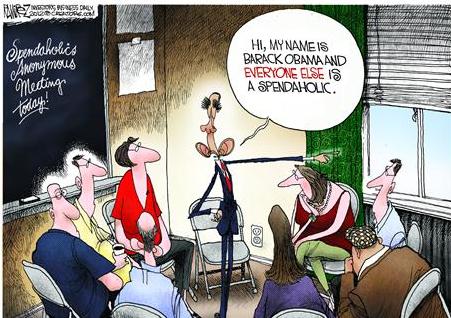
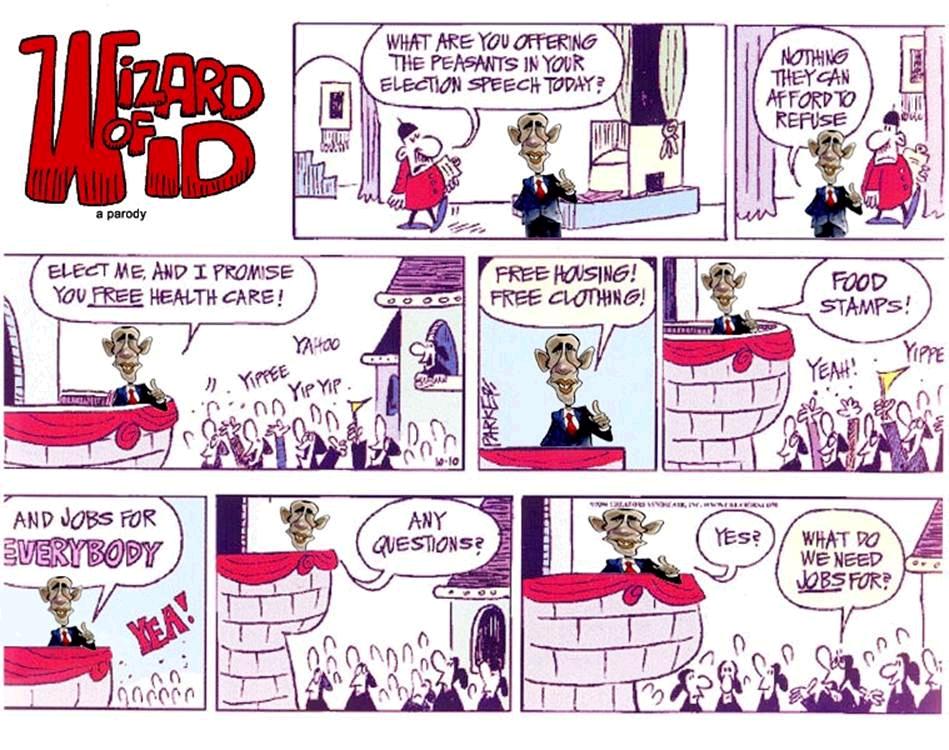
Let me start this post by stating that George W. Bush was a bigger spender than Barack Obama (though the numbers are somewhat distorted by TARP, which caused a big increase in the burden of spending during Bush’s last fiscal year and artificially dampened outlays in Obama’s first fiscal year since repayments from the banks counted as negative spending).

So I’m not trying to make a partisan point by sharing these cartoons. I don’t like it when Democrats increase the burden of government spending and I’m equally dismayed when Republicans engage in same type of profligacy.

That being said, I was a big dumbfounded when President Obama recently claimed that there’s not a spending problem in Washington.

We know that the United States has a huge long-run problem with deficits and debt according to both the Bank for International Settlements and the Organization for Economic Cooperation and Development.

We also know that tax revenues, measured as a share of GDP, will soon be above their post-World War II average and that the tax burden is expected to increase in coming decades.

So a person would have to be in serious denial to claim that spending isn’t a problem.

Which is the point Eric Allie makes in this cartoon.

Spending Problem Cartoon 1

And the point Robert Ariail makes in this cartoon.

Spending Problem Cartoon 2

Ditto for Bob Gorrell.

Spending Problem Cartoon 3

And Gary Varvel.

Spending Problem Cartoon 4

Last but not least, the great Michael Ramirez.

Spending Problem Cartoon 5.jpg

Gee, it’s almost like we’re seeing a pattern.

And if you like this spendaholic-in-denial theme, you can click here and here for further amusement.

P.S. Oh, by the way, if anybody’s actually interested in how to solve the spending problem (you know, the one that doesn’t exist), we do know the answer.

P.P.S. Remember when Obama claimed the private sector was doing fine? Well, here’s how cartoonists mocked him for that absurd comment.


________________

Thank you so much for your time. I know how valuable it is. I also appreciate the fine family that you have and your commitment as a father and a husband.

Sincerely,

Everette Hatcher III, 13900 Cottontail Lane, Alexander, AR 72002, ph 501-920-5733, lowcostsqueegees@yahoo.com

We need real spending cuts now!!!BUDGET DEAL OF DEC 2013: Representative Raul Labrador noted that the deal is nothing but “empty promises”

House, Senate Budget chairs reach deal to preempt another gov t shutdown

Paul Ryan has been fighting for sequestration for years(1 yr ago)

_____________________________

We need real spending cuts now!!!BUDGET DEAL OF DEC 2013: Representative Raul Labrador noted that the deal is nothing but “empty promises.”

Conservatives Express Disdain for Budget Deal That Kicks Spending Cuts Years Down the Road

December 11, 2013 at 4:06 pm

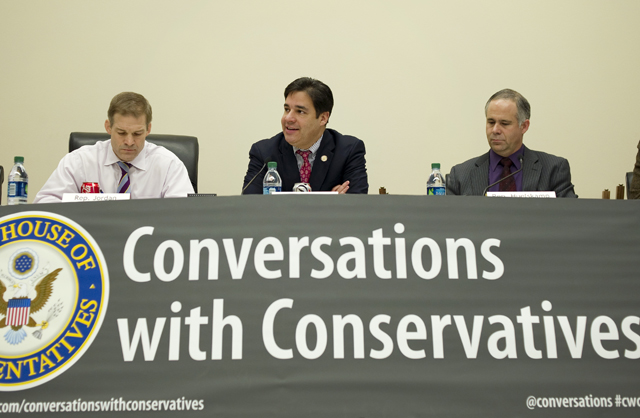
Conversations with Conservatives (Credit: Chris Maddaloni/CQ Roll Call/Newscom)

Conversations with Conservatives (Credit: Chris Maddaloni/CQ Roll Call/Newscom)

House conservatives expressed disagreement and disappointment with the Senate-House budget deal at today’s “Conversations with Conservatives” hosted by The Foundry on Capitol Hill.

The deal, brokered by Senate Budget Committee Chairman Patty Murray (D-WA) and House Budget Committee Chairman Paul Ryan (R-WI), was a bipartisan compromise.

One of the most outspoken members on today’s panel, Representative Raul Labrador (R-ID), said of the budget deal, “I haven’t decided if I’m going to be a really strong no or just a no.”

The two-year budget deal, which was released Tuesday night, calls for $1 trillion in federal spending in 2014 while replacing some sequestration cuts. While it promises savings later, it calls for more spending now—something many conservatives have a big problem with.

One reason some are so vehemently opposed is because it doesn’t just delay savings, it pushes it nine or 10 years down the road.

The only person on the panel dedicated to voting “yes” on the deal was Representative Vicky Hartzler (R-MO), who still expressed skepticism about the direction of the deal, saying it was not “preferable” but “does achieve some…goals without raising taxes.”

Many on the panel disagreed with Hartzler’s position, and as Heritage pointed out today, “raising revenue to spend more is simply taxing and spending.”

Labrador noted that the deal is nothing but “empty promises.”

Most Members on the panel are outspoken on reducing Washington’s out-of-control spending, and this budget deal does not rein that in.  Additionally, it raises Transportation and Security Administration fees—yet another burden on the American people.

“Since August 2011, the debt ceiling was raised to the tune of $3 trillion,” said Representative Tim Huelskamp (R-KS). “What have conservatives gotten in exchange for that?”

Washington has a spending problem, yet this budget deal is another step towards more spending. Representative Mick Mulvaney (R-SC) summed it up:

The debate about the debt ceiling needs to be about whether or not the we solve the problems that give rise to the debt ceiling issue in the first place…Now we’ve raised the debt ceiling over $1 trillion this year without a single penny of spending reductions….we’re not doing anything at all about the underlying problem.

While the deal was cut seemingly to avoid gridlock again, it’s clear that those in opposition have no plans to remain silent.

________

Related posts:

Letter to Senator John Boozman about Sequester Negotiations (PLEASE KEEP SEQUESTER!!!!)

________________________ Senator John Boozman, 320 Hart Senate Office Building Washington, DC 20510 Phone: (202) 224-4843 Fax: (202) 228-1371 Dear Senator Boozman, I want to thank you for taking the time out of your busy day to respond to my earlier letter to you on this same subject. I have always TRIED TO CONTACT THE REPRESENTATIVES AND SENATORS ABOUT THEIR RESPONSIBILITY […]

Open letter to Senator Boozman: Copy of my letter to President Obama on Socialism (Part 116.7)

Senator John Boozman, 320 Hart Senate Office Building Washington, DC 20510 Phone: (202) 224-4843 Fax: (202) 228-1371 Dear Senator Boozman, I want to thank you for taking the time out of your busy day to respond to my earlier letter to you on this same subject. It is obvious to me that if President Obama […]

Senator Boozman’s response to my letter on fiscal cliff and possible debt ceiling increase

It is obvious to me that if President Obama gets his hands on more money then he will continue to spend away our children’s future. He has already taken the national debt from 11 trillion to 16 trillion in just 4 years. Over, and over, and over, and over, and over and over I have written […]

Boozman says Obama should cut spending

___ Corker Says President’s 2012 Budget Proposal Shows “Lack of Urgency” on Spending Uploaded by senatorcorker on Feb 14, 2011 In remarks on the Senate floor today, U.S. Senator Bob Corker, R-Tenn., expressed disappointment in President Obama’s 2012 budget proposal, saying it displayed a “lack of urgency” to get federal spending under control. Corker has introduced the […]

Balanced Budget Amendment the answer? Boozman says yes, Pryor no, Part 36 (Input from Dan Mitchell of the Cato Institute Part 8)

From a lecture given by Dr. Milton Friedman in Erie, Pennsylvania (1978). Steve Brawner in his article “Safer roads and balanced budgets,” Arkansas News Bureau, April 13, 2011, noted: The disagreement is over the solutions — on what spending to cut; what taxes to raise (basically none ever, according to Boozman); whether or not to […]

By Everette Hatcher III | Posted in Cato Institute, Mark Pryor, Milton Friedman | Edit | Comments (0)

Pro-life Atheists?

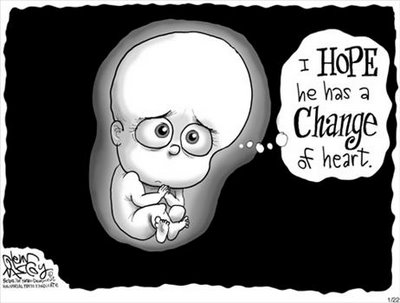
Nat Hentoff is an atheist, but he became a pro-life activist because of the scientific evidence that shows that the unborn child is a distinct and separate human being and even has a separate DNA. His perspective is a very intriguing one that I thought you would be interested in. I have shared before many   cases (Bernard Nathanson, Donald Trump, Paul Greenberg, Kathy Ireland)    when other high profile pro-choice leaders have changed their views and this is just another case like those. I have contacted the White House over and over concerning this issue and have even received responses. I am hopeful that people will stop and look even in a secular way (if they are not believers) at this abortion debate and see that the unborn child is deserving of our protection.That is why the writings of Nat Hentoff of the Cato Institute are so crucial.

In the film series “WHATEVER HAPPENED TO THE HUMAN RACE?” the arguments are presented  against abortion (Episode 1),  infanticide (Episode 2),   euthanasia (Episode 3), and then there is a discussion of the Christian versus Humanist worldview concerning the issue of “the basis for human dignity” in Episode 4 and then in the last episode a close look at the truth claims of the Bible.

Francis Schaeffer

__________________________

I truly believe that many of the problems we have today in the USA are due to the advancement of humanism in the last few decades in our society. Ronald Reagan appointed the evangelical Dr. C. Everett Koop to the position of Surgeon General in his administration. He partnered with Dr. Francis Schaeffer in making the video below. It is very valuable information for Christians to have.  Actually I have included a video below that includes comments from him on this subject.

Francis Schaeffer Whatever Happened to the Human Race (Episode 1) ABORTION

Francis Schaeffer: What Ever Happened to the Human Race? (Full-Length Documentary)


Part 1 on abortion runs from 00:00 to 39:50, Part 2 on Infanticide runs from 39:50 to 1:21:30, Part 3 on Youth Euthanasia runs from 1:21:30 to 1:45:40, Part 4 on the basis of human dignity runs from 1:45:40 to 2:24:45 and Part 5 on the basis of truth runs from 2:24:45 to 3:00:04

________________

January 24, 2013
Non-religious pro-lifers contend you don’t have to believe in God to know the unborn have rights.
Secular ProLife founder Kelsey Hazzard, left, carries a sign at the 2012 March for Life in Washington, DC.

“Could it be true?” Marco Rossi asks in the September/October 2012 issue of The Humanist. “Is there really such a thing as a pro-life atheist? What’s next, Intelligent Design Agnostics? How about Secularists for Sharia Law?”

Although Rossi seems to think his analogies are comical and highly effective, they are actually inapt. Pro-life atheists do not claim God created prenatal children, that he endowed them with souls, or that he even exists. Instead, pro-life atheists, agnostics, and secular people argue that prenatal children are human beings who have rights, and that to abort them is wrong.

Kelsey Hazzard is a 24-year-old, pro-life University of Miami alumna and recent graduate of the University of Virginia School of Law. She was raised in the United Methodist Church, but as an adult began having doubts about God.

“I took a break from religion for a while, and soon realized that it had no impact whatsoever on my morals,” she said. She now describes herself as an “apatheist,” meaning she does not care whether God exists or not, although she says she finds God’s existence “highly unlikely.”

“I was pro-life the instant I learned what abortion was,” said Hazzard, who is a legal fellow at Americans United for Life. “But my position became much stronger in college, when I took a course on prenatal development.”

In 2009, Hazzard founded Secular ProLife (SPL), a group whose vision is “a world in which abortion is unthinkable, for people of every faith and no faith.” Hazzard, SPL’s president, created the group in part to attract non-religious people to the pro-life movement.

“The first time I attended a March for Life, I was struck by all the religious imagery,” she explained. “I thought ‘Wow, if this were an atheist’s first impression of the pro-life movement, she would never come back!’ And from there, it was a case of ‘build it and they will come.’”

Hazzard points to opinion polls showing the US becoming less religious but more pro-life as compelling reasons to use secular arguments to support the pro-life position. SPL, with a membership made up predominately of college-aged students, has participated in the annual March for Life and the Students for Life of America Conference. Last year, SPL attended the American Atheist Convention in Washington, DC, which included Richard Dawkins among the attendees. SPL also sent a representative to the Texas Freethought Convention last year.

According to SPL member Julie Thielen, who identifies as a gnostic antitheist atheist, the best ways to reach secular people with the pro-life message are through biology and an appeal to human rights.

“When the sperm meets the egg, a genetically complete human being is formed, and all that is required for maturation is time and nutrition,” Thielen said. “As complete human beings in the most vulnerable stages, there should be protections afforded. As a society we are judged by how we treat the most vulnerable—the young, the aged, the infirm, those who can’t speak for themselves. The unborn belong here.”

For many, the historical argument for human equality is the strongest secular argument in favor of life.

“History has many lessons about human beings who were not legal ‘persons,’” said Hazzard. “What seems like common sense to one generation—‘Of course Negroes aren’t real people’—is horrific to the next. What criteria can we set that will prevent this from happening? Every criterion proposed to exclude the unborn can also be used to exclude others. Consciousness? Then it’s fine to kill someone in a temporary coma; they merely have ‘potential.’ Physical independence? So much for conjoined twins. Human appearance? Discrimination based on appearance has been some of the most insidious of all. Birth? Totally arbitrary; there is no ‘personhood fairy’ residing in the birth canal, conferring rights upon exit. At the end of the day, human rights are for all humans. If we don’t protect them for the weakest among us, they’re rather worthless.”

Some pro-choice atheists have expressed skepticism about Secular ProLife, pointing to an old article in the Miami Hurricane, the University of Miami’s college newspaper, in which the student pro-life group was featured and Hazzard misidentified as Catholic. “I understand their skepticism, but I’m not Catholic and never have been,” Hazzard said.

The idea of a pro-life atheist is not new, as Doris Gordon’s story proves. For Gordon, a Jewish, atheist libertarian and former elementary school teacher, it all began in 1959 when she read Atlas Shrugged by Ayn Rand. Ironically, although Rand and her associates were adamantly pro-abortion, reading Rand set Gordon on the path to becoming a fervent pro-lifer. This novel introduced her to Rand’s philosophy, objectivism. Interested by what she read, Gordon was eager to learn more. In 1960, she took the 20-lecture course “The Basic Principles of Objectivism” by Rand’s then-closest associate, Nathaniel Branden.

Things began to unravel in 1967, however, when Gordon attended a talk titled “Certainty v. Omniscience” at an objectivism conference. The talk was given by Leonard Peikoff, a member of Rand’s inner circle and the sole heir to her estate when she died.

“Following the talk, during a Q&A period, a questioner angrily challenged [Peikoff] about abortion, and a big debate broke out among the audience and the conference speakers on the topic. One point of disagreement was on when the new human being begins to exist,” Gordon said.

“That word ‘exist’ really struck me,” she continued. “Rand’s philosophy begins with the axiom ‘existence exists’; A is A. Nothing can pre-exist existence. I am something concrete; I didn’t exist 100 years ago but today I do. When did my existence begin?”

“Well, Rand taught us to think for ourselves, so when I went home, I began to do so. My studying objectivism taught me something about logical reasoning,” Gordon said.

She asked herself if there was any essential difference between the moment before she was born and the moment immediately after. She could not think of any. What about at the junction between the eighth and ninth months? No. From there, she worked her way back, month by month, to see if she could find any essential difference. She could not, until she got to the point of fertilization, where something essentially different occurs: the sperm meets the oocyte, then growth and development can begin.

“It has long been settled by science that in sexual reproduction, the new human organism, a human being, begins to exist and to grow and mature into an adult. On the other hand, individually, neither a sperm nor an oocyte has the capacity to do the same. Logically, therefore, the human zygote is already a living human being,” she said.

Gordon went on to wonder whether the new human being has rights. Though Rand and Gordon have different ideas on the definition of “human being,” Gordon came to conclude, “If all human beings have rights, as Ayn Rand held, then so must this new human being.”

But there was a problem: “What about the mother’s right to control her own body, her unalienable right to liberty?” The child’s right not to be killed seemed to conflict with the mother’s right to control her own body. In 1973, Gordon wrote a letter that was published in Reason, which stated that unwanted pregnancy presented an insoluble conflict of rights between woman and child. She argued that “the unfortunate child was unaware of what was happening, and after all, the mother was in existence first.”  For nine years, Gordon remained on the “abortion-choice” side of the debate.

Then one day she thought back on an article by Branden she read in The Objectivist Newsletter, titled, “What are the respective obligations of parents to children, and children to parents?” In a response to a reader’s question, Branden stated that, like it or not, parents have the obligation to take care of their children. “The key to understanding the nature of parental obligation,” he wrote, “lies in the moral principle that human beings must assume responsibility for the consequences of their actions.” He insisted that the basic necessities of food, clothing, and so forth are the child’s “by right.” This helped Gordon begin to see why there is no conflict of rights between mother and child.

“A woman’s right to control her own body does not trump a child’s right not to be killed,” she said. “Given parental obligation, even in unwanted pregnancy, it is the child’s right to parental support and protection from harm that is trump. Parents have no right to intentionally or negligently destroy their children, nor do they have a right to evict their children from the crib or the womb and let them die.”

In an article she wrote years later, “Abortion and Rights: Applying Libertarian Principles Correctly,” Gordon reasoned: “A child’s creation and presence in the womb are caused by biological forces independent and beyond the control of the child; they are brought into play by the acts of the parents. The cause and effect relationship between heterosexual intercourse and pregnancy is well-known.”

“The parent-child situation is unique,” she continues. “It is the only human relationship that begins by one side bringing the other into existence. This fact of parental agency refutes any assertion that the child is a trespasser, a parasite, or an aggressor of any sort. Prenatal children have the right under justice to be in the mother’s body, and both parents owe them support and protection from harm.”

Gordon understood Branden’s argument for parental obligation was about born children only, but she wrote to him to ask whether it could apply, in principle, to children before they are born. He wrote back saying it can’t because they are not yet human beings. She wrote back to Branden asking him for his definition of “human being,” but he never replied.

Gordon, a member of the Association of Libertarian Feminists (ALF), agreed to handle publicity for a panel discussion the group was planning for the 1976 Libertarian Convention. By the time the convention rolled around, Gordon had become a pro-lifer, and tried to talk about abortion and her move to the “other side” to Sharon Presley, one of ALF’s founders and a pro-choicer. Presley, who was setting up an exhibit table, brushed Gordon off, claiming she was tired and had not given much thought to the debate, which shocked Gordon. Presley suggested Gordon talk to her expert on the topic, Lucinda Cisler, who was one of the organizers of the New York chapter of NARAL, originally the National Association for the Repeal of Abortion Laws. “That was Strike One,” Gordon said.

Then Gordon saw Branden at the convention, approached him, and mentioned her letters to him. “I asked him again how he would define ‘human being,’” she remembers. “Instead of defining the term, he said, ‘How would you feel if your 15-year-old daughter got pregnant?’ He evaded my question. One of the most evil things you can do in objectivism is evade the question. And he added further remarks that made me feel as if he had taken everything he had taught me and thrown it out the window. That was Strike Two.”

Later that day, Gordon attended an ALF panel at which Cisler defended unrestricted abortion. Gordon recalls: “When it ended, I ran after her and asked if she could please answer one question for me. She stopped and turned to me. ‘Is a fetus a human being?’ I asked. She said, ‘Yes,’ and walked on. Strike Three.”

The experience inspired Gordon to join with other like-minded libertarians to form Libertarians for Life (LFL). “LFL was different from other pro-life organizations in that we seemed to be alone in focusing on why the so-called woman’s right to control her own body is false,” she said of her group.

Another person who proves that being pro-life is not just for the religious is Nat Hentoff. Hentoff, a Jewish, atheist liberal, is a veteran journalist of 60 years, having written for the Village Voice and the Washington Post. He changed his mind about abortion while writing a news story many years ago.

“I was doing a story about a very young child in Long Island who had spina bifida, and the parents decided they would not treat her anymore, because she would not recognize them and would never be able to communicate with them,” he said.

The ACLU and the prominent media figures agreed with the parents’ decision not to allow further surgeries for the child or use shunts to drain fluid from her brain so she could continue living. “I said, ‘Wait a minute. Anytime everyone agrees with something, I am automatically suspicious,’” Hentoff remembers. He found several doctors who were neonatal experts on spina bifida, and they told him,“No, it will take care, but the worst thing that would happen is she would need a wheelchair,” and that spina bifida “would not affect the brain.”

Hentoff said he read books by physicians who treat babies and their mothers at the same time and—although they did not specifically use the term “pro-life”—it was clear the authors held that a living human organism should be recognized as a human being.

“That made me pro-life,” he says.

Hentoff encourages anyone who wants to find secular information to support the pro-life argument to read works written by doctors who operate on babies in utero. “Read them in terms of what they do—surgeons who deal with the child before the child is actually a child, according to the law,” he said.

Being an atheist pro-lifer often can have its costs. Hentoff has lost lecture-circuit jobs and the opportunity to have a journalism school named after him and was delayed in getting a Lifetime Achievement Award from the National Press Foundation because of his pro-life views. “Being pro-life has cost me a lot, but these are losses I am proud of,” he said.

According to some atheist and secular pro-lifers on the Internet, not all Christians have welcomed their collaboration. Some believers have even urged them to “go get their own events.” This type of response does not help advance the cause of the pro-life movement, according to Dr. Francis Beckwith, who teaches philosophy and church-state studies at Baylor University. In 2007, Beckwith wrote Defending Life: A Moral and Legal Case Against Abortion Choice, which is widely regarded as one of the strongest books defending the pro-life position.  According to Beckwith, Christians should work with all people of goodwill who are pro-life.

“We are instructed by the Church, and by Scripture, to advance the good of our neighbor. The fact that we are not in ecclesial communion with those who want to cooperate with us in advancing that good should not matter,” explained Beckwith. “This is so commonsensical that it is a mystery why we would even have to ask the question when it comes to the sanctity of life. Consider an example outside of the abortion debate. Suppose you discovered that the chef who prepares the food for the soup kitchen is an atheist. Would it even cross your mind not to take the food he prepares? Of course not.”

Beckwith said there are three reasons using secular arguments to defend the pro-life position is important. “First, we want to show respect for those who do not share our faith. One way of doing that is to try to persuade based on reasoning that those outside of our communities are more apt to find convincing. Second, these rational and secular arguments are part of the reservoir of the Church’s intellectual tradition, which maintains that faith and reason are not rival understandings, but complimentary ways of acquiring truth. So, when we are employing these arguments we are actually being good Catholics, as well as setting an example to those within the Church and the wider pro-life community on how to engage those with whom we disagree. And third, because these arguments are good arguments, we have an obligation to use them.”

This is not to say we cannot make appeals to religion or Church teaching. “Having said that, there is nothing wrong in principle with employing religious arguments,” Beckwith said. “But we have to know our audience. Take, for example, St. Paul’s encounter with his Gentile and Jewish critics on Mars Hill (Acts 17). When dealing with the Greeks and the Romans, St. Paul did not appeal to the Torah. On the other hand, when St. Paul engaged his Hebrew audience, he did not cite Roman and Greek philosophers.”

Beckwith added, “The Church has a long and noble history of supporting its views by appealing to the deliverances of rational argument.”

Related posts:

Al Mohler on Kermit Gosnell’s abortion practice

Francis Schaeffer: “Whatever Happened to the Human Race” (Episode 1) ABORTION OF THE HUMAN RACE Published on Oct 6, 2012 by AdamMetropolis ________________ Picture of Francis Schaeffer and his wife Edith from the 1930′s above. I was sad to read about Edith passing away on Easter weekend in 2013. I wanted to pass along this fine […]

Taking on Ark Times Bloggers on various issues Part U “Do men have a say in the abortion debate?” (includes the film SLAUGHTER OF THE INNOCENTS and editorial cartoon)

I have gone back and forth and back and forth with many liberals on the Arkansas Times Blog on many issues such as abortion, human rights, welfare, poverty, gun control  and issues dealing with popular culture. Here is another exchange I had with them a while back. My username at the Ark Times Blog is Saline […]

Taking on Ark Times Bloggers on various issues Part T “Abortion is a dirty business” (includes video “Truth and History” and editorial cartoon)

I have gone back and forth and back and forth with many liberals on the Arkansas Times Blog on many issues such as abortion, human rights, welfare, poverty, gun control  and issues dealing with popular culture. Here is another exchange I had with them a while back. My username at the Ark Times Blog is Saline […]

“Sanctity of Life Saturday” Abortion supporters lying in order to further their clause? Window to the Womb (includes video ABORTION OF THE HUMAN RACE)

It is truly sad to me that liberals will lie in order to attack good Christian people like state senator Jason Rapert of Conway, Arkansas because he headed a group of pro-life senators that got a pro-life bill through the Arkansas State Senate the last week of January in 2013. I have gone back and […]

Taking on Ark Times Bloggers on various issues Part D “If you can’t afford a child can you abort?”Francis Schaeffer Quotes part 4 includes the film ABORTION OF THE HUMAN RACE) (editorial cartoon)

I have gone back and forth and back and forth with many liberals on the Arkansas Times Blog on many issues such as abortion, human rights, welfare, poverty, gun control  and issues dealing with popular culture. Here is another exchange I had with them a while back. My username at the Ark Times Blog is Saline […]

Taking on Ark Times Bloggers on various issues Part C “Abortion” (Francis Schaeffer Quotes part 3 includes the film SLAUGHTER OF THE INNOCENTS) (editorial cartoon)

I have gone back and forth and back and forth with many liberals on the Arkansas Times Blog on many issues such as abortion, human rights, welfare, poverty, gun control  and issues dealing with popular culture. Here is another exchange I had with them a while back. My username at the Ark Times Blog is Saline […]

Taking on Ark Times Bloggers on various issues Part B “Gendercide” (Francis Schaeffer Quotes Part 2 includes the film ABORTION OF THE HUMAN RACE) (editorial cartoon)

I have gone back and forth and back and forth with many liberals on the Arkansas Times Blog on many issues such as abortion, human rights, welfare, poverty, gun control  and issues dealing with popular culture. Here is another exchange I had with them a while back. My username at the Ark Times Blog is Saline […]

SANCTITY OF LIFE SATURDAY “AngryOldWoman” blogger argues that she has no regrets about past abortion

Sometimes you can see evidences in someone’s life of how content they really are. I saw  something like that on 2-8-13 when I confronted a blogger that goes by the name “AngryOldWoman” on the Arkansas Times Blog. See below. Leadership Crisis in America Published on Jul 11, 2012 Picture of Adrian Rogers above from 1970′s […]

“Sanctity of Life Saturday” The Church Awakens: Whatever Happened to the Human Race? (includes the video ABORTION OF THE HUMAN RACE)

In the film series “WHATEVER HAPPENED TO THE HUMAN RACE?” the arguments are presented  against abortion (Episode 1),  infanticide (Episode 2),   euthenasia (Episode 3), and then there is a discussion of the Christian versus Humanist worldview concerning the issue of “the basis for human dignity” in Episode 4 and then in the last episode a close […]

Taking on Ark Times Bloggers on various issues Part H “Are humans special?” includes film ABORTION OF THE HUMAN RACE) Reagan: ” To diminish the value of one category of human life is to diminish us all”

I have gone back and forth and back and forth with many liberals on the Arkansas Times Blog on many issues such as abortion, human rights, welfare, poverty, gun control  and issues dealing with popular culture. Here is another exchange I had with them a while back. My username at the Ark Times Blog is Saline […]

Taking on Ark Times Bloggers on various issues Part G “How do moral nonabsolutists come up with what is right?” includes the film “ABORTION OF THE HUMAN RACE”)

I have gone back and forth and back and forth with many liberals on the Arkansas Times Blog on many issues such as abortion, human rights, welfare, poverty, gun control  and issues dealing with popular culture. Here is another exchange I had with them a while back. My username at the Ark Times Blog is Saline […]

Taking on Ark Times Bloggers on various issues Part E “Moral absolutes and abortion” Francis Schaeffer Quotes part 5(includes the film SLAUGHTER OF THE INNOCENTS) (editorial cartoon)

I have gone back and forth and back and forth with many liberals on the Arkansas Times Blog on many issues such as abortion, human rights, welfare, poverty, gun control  and issues dealing with popular culture. Here is another exchange I had with them a while back. My username at the Ark Times Blog is Saline […]

Francis Schaeffer’s “How should we then live?” Video and outline of episode 10 “Final Choices” (Schaeffer Sundays)

E P I S O D E 1 0   Dr. Francis Schaeffer – Episode X – Final Choices 27 min FINAL CHOICES I. Authoritarianism the Only Humanistic Social Option One man or an elite giving authoritative arbitrary absolutes. A. Society is sole absolute in absence of other absolutes. B. But society has to be […]

Francis Schaeffer’s “How should we then live?” Video and outline of episode 9 “The Age of Personal Peace and Affluence” (Schaeffer Sundays)

E P I S O D E 9 Dr. Francis Schaeffer – Episode IX – The Age of Personal Peace and Affluence 27 min T h e Age of Personal Peace and Afflunce I. By the Early 1960s People Were Bombarded From Every Side by Modern Man’s Humanistic Thought II. Modern Form of Humanistic Thought Leads […]

Francis Schaeffer’s “How should we then live?” Video and outline of episode 8 “The Age of Fragmentation” (Schaeffer Sundays)

E P I S O D E 8 Dr. Francis Schaeffer – Episode VIII – The Age of Fragmentation 27 min I saw this film series in 1979 and it had a major impact on me. T h e Age of FRAGMENTATION I. Art As a Vehicle Of Modern Thought A. Impressionism (Monet, Renoir, Pissarro, Sisley, […]

Francis Schaeffer’s “How should we then live?” Video and outline of episode 7 “The Age of Non-Reason” (Schaeffer Sundays)

E P I S O D E 7 Dr. Francis Schaeffer – Episode VII – The Age of Non Reason I am thrilled to get this film series with you. I saw it first in 1979 and it had such a big impact on me. Today’s episode is where we see modern humanist man act […]

Francis Schaeffer’s “How should we then live?” Video and outline of episode 6 “The Scientific Age” (Schaeffer Sundays)

E P I S O D E 6 How Should We Then Live 6#1 Uploaded by NoMirrorHDDHrorriMoN on Oct 3, 2011 How Should We Then Live? Episode 6 of 12 ________ I am sharing with you a film series that I saw in 1979. In this film Francis Schaeffer asserted that was a shift in […]

Francis Schaeffer’s “How should we then live?” Video and outline of episode 5 “The Revolutionary Age” (Schaeffer Sundays)

E P I S O D E 5 How Should We Then Live? Episode 5: The Revolutionary Age I was impacted by this film series by Francis Schaeffer back in the 1970′s and I wanted to share it with you. Francis Schaeffer noted, “Reformation Did Not Bring Perfection. But gradually on basis of biblical teaching there […]

Francis Schaeffer’s “How should we then live?” Video and outline of episode 4 “The Reformation” (Schaeffer Sundays)

Dr. Francis Schaeffer – Episode IV – The Reformation 27 min I was impacted by this film series by Francis Schaeffer back in the 1970′s and I wanted to share it with you. Schaeffer makes three key points concerning the Reformation: “1. Erasmian Christian humanism rejected by Farel. 2. Bible gives needed answers not only as to […]

“Schaeffer Sundays” Francis Schaeffer’s “How should we then live?” Video and outline of episode 3 “The Renaissance”

Francis Schaeffer’s “How should we then live?” Video and outline of episode 3 “The Renaissance” Francis Schaeffer: “How Should We Then Live?” (Episode 3) THE RENAISSANCE I was impacted by this film series by Francis Schaeffer back in the 1970′s and I wanted to share it with you. Schaeffer really shows why we have so […]

Francis Schaeffer’s “How should we then live?” Video and outline of episode 2 “The Middle Ages” (Schaeffer Sundays)

  Francis Schaeffer: “How Should We Then Live?” (Episode 2) THE MIDDLE AGES I was impacted by this film series by Francis Schaeffer back in the 1970′s and I wanted to share it with you. Schaeffer points out that during this time period unfortunately we have the “Church’s deviation from early church’s teaching in regard […]

Francis Schaeffer’s “How should we then live?” Video and outline of episode 1 “The Roman Age” (Schaeffer Sundays)

Francis Schaeffer: “How Should We Then Live?” (Episode 1) THE ROMAN AGE   Today I am starting a series that really had a big impact on my life back in the 1970′s when I first saw it. There are ten parts and today is the first. Francis Schaeffer takes a look at Rome and why […]

By Everette Hatcher III | Posted in Francis Schaeffer | Edit | Comments (0)

Andy Warhol

Modern Masters – Andy Warhol – Documentary

Published on May 14, 2013

____________

_____________

Andy Warhol Picture

Andy Warhol (1928–1987)


Andrew Warhola was born on 6 August 1928 in Forest City, Pennsylvania, USA, a small town northeast of Scranton. His father, Ondrej, came from the Austria-Hungary Empire (now Slovakia) in 1912, and sent for his mother, Julia Zavacky Warhola, in 1921. His father worked as a construction worker and later as a coal miner… See full bio »

Related posts:

Pictures and Videos of Edie Sedgwick and the story of her losing battle against drugs and alcohol Part 2

Pictures and Videos of Edie Sedgwick and the story of her losing battle against drugs and alcohol Part 2 Drugs and alcohol have taken the life of many people and I have posted many times about their unfortunate deaths. Whitney Houston, Amy Winehouse, Gary Thain, Janis Joplin, Jimi Hendrix, Brian Jones, Kurt Cobain, and Jim […]

Pictures and Videos of Edie Sedgwick and the story of her losing battle against drugs and alcohol Part 1

Pictures and Videos of Edie Sedgwick and the story of her losing battle against drugs and alcohol Part 1 Factory Girl – The Real Edie Uploaded on Aug 30, 2011 Friends and family of Edie Sedgwick discuss what the factory girl was really like, and the battles and relationships she went through _____________ Edie Sedgwick Excerpt […]

Crystal Bridges Museum of American Art opens on 11-11-11

  Around 4 years ago I was in Philadelphia and the local radio station had a talk show that was blasting Alice Walton for coming into town and buying  the 1876 Thomas Eakins’ masterpiece “The Gross Clinic” which was hanging at the  Jefferson Medical College. However, the people of Philadelphia were given 45 days to […]

Picasso painting “The acrobat” in Woody Allen movie “Midnight in Paris”

Pablo Picasso, ‘The acrobat,’ January 18, 1930 Picasso Dreamed About Limbs by DAVE SEGAL The Acrobat (1930) is a simple, surreal cartoon, almost comical in its minimalism. It’s practically a one-line drawing that was seemingly slapdashed off in a few minutes, offering a barely feasible depiction of the body’s pliability. With utmost economy (a black […]

The Characters referenced in Woody Allen’s “Midnight in Paris” (Part 29, Pablo Picasso)

In his weekly opinion piece, Andy Rooney shares his views on public art. I have really enjoyed this series on the characters referenced in the film “Midnight in Paris.” I can’t express how much I have learned during this series on the characters referenced in Woody Allen’s latest movie “Midnight  in Paris.” Today I am looking […]

The characters referenced in Woody Allen’s movie “Midnight in Paris” (Part 23,Adriana, fictional mistress of Picasso)

(UPDATE: A reader that used the username “therealchirpy” notes, “Although any affair with Picasso may be fictional, isn’t the ‘Adriana’ referred to in Allen’s ‘Midnight in Paris’ based on Hemingway’s mistress Adriana Ivancich.” I have found some evidence for that. I read a review that draws that same conclusion although some have said that Hemingway […]

The Characters referenced in Woody Allen’s “Midnight in Paris” (Part 14, Henri Matisse)

I am currently going through the characters referenced in the Woody Allen movie “Midnight in Paris.” Today I am looking at Henri Matisse. Below is a press release from a museum in San Francisco:  the steins were known for their saturday evening salons, where artists, writers, musicians, intellectuals, and collectors gathered to discuss contemporary art, […]

Mike Wallace 1958 interview of Salvador Dali (Part 2)

There was a very interesting interview with Dali by Mike Wallace. Here are the video clips and transcript below: WALLACE: …in religion. Well now I spoke with you about a year ago and we talked about religion, and you said that as the years go by,you embrace Roman Catholicism more and more with your mind […]

Mike Wallace 1958 interview of Salvador Dali (Part 1)

There was a very interesting interview with Dali by Mike Wallace. Here are the video clips and transcript below: Salvador Dali – Mike Wallace interview 1958 – Part 1/2 THE MIKE WALLACE INTERVIEW Guest: Salvador Dali 4/19/58WALLACE: Good evening…Tonight we go after the story of an extraordinary personality. He’s Salvador Dali, the great surrealist painter […]

Mike Wallace 1958 interview of Salvador Dali (Part 2)

Mike Wallace passed away recently and I wanted to post this to honor him. Rest in Peace Mike Wallace (1918-2012). There was a very interesting interview with Dali by Mike Wallace. Here are the video clips and transcript below: WALLACE: …in religion. Well now I spoke with you about a year ago and we talked […]

Mike Wallace 1958 interview of Salvador Dali (Part 1)

Mike Wallace passed away recently and I wanted to post this to honor him. Rest in Peace Mike Wallace (1918-2012).   There was a very interesting interview with Dali by Mike Wallace. Here are the video clips and transcript below: Salvador Dali – Mike Wallace interview 1958 – Part 1/2 THE MIKE WALLACE INTERVIEW Guest: […]

Mike Wallace 1958 interview of Salvador Dali (Part 2)

There was a very interesting interview with Dali by Mike Wallace. Here are the video clips and transcript below: WALLACE: …in religion. Well now I spoke with you about a year ago and we talked about religion, and you said that as the years go by,you embrace Roman Catholicism more and more with your mind […]

Mike Wallace 1958 interview of Salvador Dali (Part 1)

There was a very interesting interview with Dali by Mike Wallace. Here are the video clips and transcript below: Salvador Dali – Mike Wallace interview 1958 – Part 1/2 THE MIKE WALLACE INTERVIEW Guest: Salvador Dali 4/19/58WALLACE: Good evening…Tonight we go after the story of an extraordinary personality. He’s Salvador Dali, the great surrealist painter […]

Surrealists Salvador Dali, Man Ray and Luis Bunuel provide funniest scene in “Midnight in Paris”

Associated Press Dali and his surrealist friends provide the funniest scene of Woody Allen’s latest film “Midnight in Paris.” Here are links to what I have written about these gentlemen before: (Part 27, Man Ray) July 5, 2011 – 4:49 am (Part 15, Luis Bunuel) June 23, 2011 – 5:37 am (Part 10 Salvador Dali) June 18, 2011 – 2:57 pm […]

The Characters referenced in Woody Allen’s “Midnight in Paris” (Part 10 Salvador Dali)

Artists and bohemians inspired Woody Allen for ‘Midnight in Paris I love the movie “Midnight in Paris” by Woody Allen and I am going through the whole list of famous writers and artists that he included in the movie. Today we will look at Salvador Dali.  By the way, I know that some of you […]

“Woody Wednesday” Discussing Woody Allen’s movie “Crimes and Misdemeanors” and various other subjects with Ark Times Bloggers (Part 6) Judah ” I believe in God, Miriam. I know it… because without God the world is a cesspool”

_____________________________

Crimes and Misdemeanors: A Discussion: Part 3

Uploaded by on Sep 23, 2007

Part 3 of 3: ‘Is Woody Allen A Romantic Or A Realist?’
A discussion of Woody Allen’s 1989 movie, Crimes and Misdemeanors, perhaps his finest.
By Anton Scamvougeras.

http://camdiscussion.blogspot.com/
antons@mail.ubc.ca

______________

I have gone back and forth and back and forth with many liberals on the Arkansas Times Blog on many issues such as abortionhuman rightswelfarepovertygun control  and issues dealing with popular culture . This time around I have discussed morality with the Ark Times Bloggers and have used the examples given in Woody Allen’s movie “Crimes and Misdemeanors” to do so. With out God in the picture to punish the evildoers  in an afterlife, then can people do anything they want because “might makes right.”

Without the infinite-personal God of the Bible to reveal moral absolutes then man is left to embrace moral relativism. In a time plus chance universe man is reduced to a machine and can not find a place for values such as love. Both of Francis Schaeffer’s film series have tackled these subjects and he shows how this is reflected in the arts.

Here are some posts I have done on the series “HOW SHOULD WE THEN LIVE? : Francis Schaeffer’s “How should we then live?” Video and outline of episode 10 “Final Choices” episode 9 “The Age of Personal Peace and Affluence”episode 8 “The Age of Fragmentation”episode 7 “The Age of Non-Reason” episode 6 “The Scientific Age”  episode 5 “The Revolutionary Age” episode 4 “The Reformation” episode 3 “The Renaissance”episode 2 “The Middle Ages,”, and  episode 1 “The Roman Age,” .

In the film series “WHATEVER HAPPENED TO THE HUMAN RACE?” the arguments are presented  against abortion (Episode 1),  infanticide (Episode 2),   euthenasia (Episode 3), and then there is a discussion of the Christian versus Humanist worldview concerning the issue of “the basis for human dignity” in Episode 4 and then in the last episode a close look at the truth claims of the Bible.

In July of 2013 I got into this discussion about morality and the meaning of life with the Arkansas Times Bloggers:

I commented:

Vanessa wrote:

Chimpanzees have a sense of right and wrong. If they got it from god, then man is not so special and if they could develop it themselves, then why did we need god?

_________________

Monkeys do not have a sense of right and wrong. Also it is not wrong for a monkey to kill. He is not made in the image of God knowing right from wrong like humans are. They can kill and go on like nothing ever happened. Humans can’t. 

In the movie “Crimes and Misdemeanors” Judah has his mistress killed but he struggles with the guilt afterwards. Here is a scene from the movie with his underworld brother Jack:


JACK:Judah, you’re having a breakdown.

JUDAH:The police know she phoned me. I lied, but they saw through it. I can’t take this.

JACK: Pull yourself together or you’ll blow it.

JUDAH:I did it, and it’s irrevocable, and now I’m gonna pay. I had to fight an urge to confess to the police. I want this off my mind.


JACK: Listen. I’m in this with you. I helped you out and I don’t wanna go to jail for it. You may not care if you drag me down with you, but I’m not letting that happen.

JUDAH:- What the hell is that? A threat? – 

JACK:Just be a man. You’re in the clear.

JUDAH: – You’ll rub me out, too? – 

JACK: Don’t talk nonsense.

JUDAH: What did you mean by saying you won’t let it happen?

JACK:You’re my brother. You’ve helped me out financially. I did you a favor when you needed it.Now all of a sudden you want to confess? The time to confess was to Miriam, about your mistress. Not about this. This is murder. You paid for it, I engineered it. It’s over. Forget about it.

JUDAH:One sin leads to a deeper sin.

JACK:Now you sound like Papa. – 

JUDAH:Adultery, fornication, lies, killing.

JACK:- Shut up already. – Or you’ll have your friends shut me up?

JUDAH:One phone call, like pushing a button, right?

_______________________________

Later when talking with his wife Miriam:

MIRIAM: Judah, I don’t know what’s wrong with you these days. You’re a different person.

JUDAH: I believe in God, Miriam. I know it… because without God the world is a cesspool.

___________________

Olphart wrote:

The polygraph purportedly detects lying by measuring small increases in respiratory rate, perspiration, blood pressure, etc. Say you need a job, and for some reason, your perspective employer requires you to take a polygraph test. That in itself would produce anxiety in a lot of people. Then in the middle of the test being given in the deep south prior to 8/25/94, you are asked the unexpected question, “Do you believe in God?” Most people, in this time and place, are going to answer “yes” truthfully. Any of the rest are likely to say yes anyway because they need the job and a “no” answer would automatically disqualify them. Those answering “no” would realize they’d lost the job already and THAT would trip the anxiety detectors.

___________________________

I commented:

I have wrote several professors back in the 1990’s about this practice of Claude Brown at his trucking company and you are right Olphart that the objection you brought up was also brought up by several other professors and here are their names:

1. Dr.Walter F. Rowe, The George Washington University, Dept of Forensic Sciences, Graduate School of Arts and Sciences.
2. Dr. Zen Faulkes, professor of Biology, University of Victoria (Canada), 
3. Robert Craig, Head of Indiana Skeptics Organization (Mr. Craig is not a professor). 

Here are the conclusions of the experts I wrote in the secular world concerning the lie detector test and it’s ability to get at the truth:

Professor Frank Horvath of the School of Criminal Justice at Michigan State University has testified before Congress concerning the validity of the polygraph machine. He has stated on numerous occasions that “the evidence from those who have actually been affected by polygraph testing in the workplace is quite contrary to what has been expressed by critics. I give this evidence greater weight than I give to the most of the comments of critics” (letter to me dated October 6, 1994).

There was no better organization suited to investigate this claim concerning the lie detector test than the Committee for the Scientific Investigation of Claims of the Paranormal (CSICOP). This organization changed their name to the Committe for Skeptical Inquiry in 2006. This organization includes anyone who wants to help debunk the whole ever-expanding gamut of misleading, outlandish, and fraudulent claims made in the name of science.


Official Website:
http://www.csicop.org/


Some prominent members of CSICOP earlier were talk show host Steve Allen, author Isaac Asimov, scientist Francis Crick, biologist Stephen Jay Gould, magician James Randi, astronomer Carl Sagan, and philosopher Antony Flew. Current members you may have heard of are author Ann Druyan (Carl Sagan’s widow), biologist Richard Dawkins, tv personality Bill Nye, and philosopher Paul Kurtz (writer of Humanist Manifesto II 1973).


Most members are atheists or agnostics but some members are Christians like Andre Kole, a Christian illusionist. I read The Skeptical Review(publication of CSICOP) for several years during the 90’s and I would write letters to these writers challenging them on their skeptical views on religion. Then when this came up, I wrote them about taking this project on and putting it to the test. Below are their responses (14 or 15 years old now):

1st OBSERVATION Religious culture of USA could have influenced polygraph test results.
Antony Flew (formerly of Reading University in England, now deceased, in a letter to me dated 8-11-96) noted, “For all the evidence so far available seems to be of people from a culture in which people are either directly brought up to believe in the existence of God or at least are strongly even if only unconsciously influenced by those who do. Even if everyone from such a culture revealed unconscious belief, it would not really begin to show that — as Descartes maintained— the idea of God is so to speak the Creator’s trademark, stamped on human souls by their Creator at their creation.”

(Antony Flew was one of the few skeptics that actually took time to listen to the cassette tapes by Adrian Rogers that I sent him in 1992 and 1996. He said they reminded him of his days growing up when he used to listen to his father preach.)

2nd OBSERVATION: Polygraph Machines do not work. Dr. Wolf Roder, professor of Geography, University of Cincinnati, Dr. Susan Blackmore,Dept of Psychology, University of the West of England, Dr. Christopher C.French, Psychology Dept, Goldsmith’s College, University of London, Dr.Walter F. Rowe, The George Washington University, Dept of Forensic Sciences, Graduate School of Arts and Sciences.

3rd OBSERVATION: The sample size probably was not large enough to apply statistical inference. (These gentlemen made the following assertion before I received the letter back from Claude Brown that revealed that the sample size was over 15,000.) John Geohegan, Chairman of New Mexicans for Science and Reason, Dr. Wolf Roder, and Dr Walter F. Rowe (in a letter dated July 12, 1994) stated, “The polygraph operator for Brown Trucking Company has probably examined only a few hundred or a few thousand job applicants. I would surmise that only a very small number of these were actually atheists. It seems a statistically insignificant (and distinctly nonrandom) sampling of the 5 billion human beings currently inhabiting the earth. Dr. Nelson Price also seems to be impugning the integrity of anyone who claims to be an atheist in a rather underhanded fashion.”

4th OBSERVATION: The question (Do you believe in God?) was out of place and it surprised the applicants. Dr. Zen Faulkes, professor of Biology, University of Victoria (Canada), Robert Craig, Head of Indiana Skeptics Organization, Dr. Walter Rowe.

5th OBSERVATION: Proof that everyone believes in God’s existence does not prove that God does in fact exist. Paul Quincey, Nathional Physical Laboratory,(England), Dr. Claudio Benski, Schneider Electric, CFEPP, (France),

6th OBSERVATION: Both the courts and Congress recognize that lie-detectors don’t work and that is why they were banned in 1988. (Governments and the military still use them.)
Dr Walter Rowe, Kathleen M. Dillion, professor of Psychology, Western New England College.

7th OBSERVATION:This information concerning Claude Brown’s claim has been passed on to us via a tv preacher and eveybody knows that they are untrustworthy– look at their history. Wolf Roder.

_____________

Olphart responded:

Re Saline’s Polygraph posts:

The preponderance of the evidence in your response seemed to support my side of the argument. That doesn’t mean you’re agreeing with me but I do respect the objectivity you are displaying here.

Having said that I’m gonna throw you some ammunition that supports YOUR side. You probably already know this but I’ve never seen you mention it. Antony Flew actually changed his mind about his atheism, right before he died. He wrote a book about it called “There Is A God: How the world’s most notorious atheist changed his mind”. I read it but, needless to say, it didn’t change MY mind. Most of his contention seemed to boil down to the fact that his father had been a minister and he had fond memories of his upbringing. Also, needless to say, most of his atheist friends were dismayed by the deathbed conversion.

_____________

I responded:

Olphart I ran across that book of Flew’s in the Bellevue Baptist Church bookstore in Memphis and am on page 46. The irony is that I sent Flew several cassette tapes from that same church 20 years ago when we were corresponding.

Related posts:

“Woody Wednesday” Another look at Woody Allen’s movie Crimes and Misdemeanors

I have spent alot of time talking about Woody Allen films on this blog and looking at his worldview. He has a hopeless, meaningless, nihilistic worldview that believes we are going to turn to dust and there is no afterlife. Even though he has this view he has taken the opportunity to look at the weaknesses of […]

“Woody Wednesday” In 2009 interview Woody Allen talks about the lack of meaning of life and the allure of younger women

Ecclesiastes 1 Published on Sep 4, 2012 Calvary Chapel Spring Valley | Sunday Evening | September 2, 2012 | Pastor Derek Neider _____________________ Ecclesiastes 2-3 Published on Sep 19, 2012 Calvary Chapel Spring Valley | Sunday Evening | September 16, 2012 | Derek Neider _____________________________ I have spent alot of time talking about Woody Allen films on […]

Another look at Woody Allen’s movie Crimes and Misdemeanors

I have spent alot of time talking about Woody Allen films on this blog and looking at his worldview. He has a hopeless, meaningless, nihilistic worldview that believes we are going to turn to dust and there is no afterlife. Even though he has this view he has taken the opportunity to look at the weaknesses of […]

Ecclesiastes and the subject of atheism

Ecclesiastes 8-10 | Still Searching After All These Years Published on Oct 9, 2012 Calvary Chapel Spring Valley | Sunday Evening | October 7, 2012 | Pastor Derek Neider _______________________ Ecclesiastes 11-12 | Solomon Finds His Way Published on Oct 30, 2012 Calvary Chapel Spring Valley | Sunday Evening | October 28, 2012 | Pastor Derek Neider […]

Ecclesiastes, Purpose, Meaning, and the Necessity of God by Suiwen Liang (Quotes Will Durant, Madalyn Murray O’Hair, Stephen Jay Gould,Richard Dawkins, Jean-Paul Sartre,Bertrand Russell, Leo Tolstoy, Loren Eiseley,Aldous Huxley, G.K. Chesterton, Ravi Zacharias, and C.S. Lewis.)

Ecclesiastes 2-3 Published on Sep 19, 2012 Calvary Chapel Spring Valley | Sunday Evening | September 16, 2012 | Derek Neider _____________________________ I have written on the Book of Ecclesiastes and the subject of the meaning of our lives on several occasions on this blog. In this series on Ecclesiastes I hope to show how secular […]

Ecclesiastes: Philosophical Atheist, Before you Commit Suicide Read Ecclesiastes (Quotes Sharon Rocha, Erik Wielenberg, the Declaration of Independence, Stephen Hawking, and Alan Sandage)

Ecclesiastes 1 Published on Sep 4, 2012 Calvary Chapel Spring Valley | Sunday Evening | September 2, 2012 | Pastor Derek Neider _____________________ I have written on the Book of Ecclesiastes and the subject of the meaning of our lives on several occasions on this blog. In this series on Ecclesiastes I hope to show how […]

Open letter to President Obama (Part 477) (Uncle Sam Wants You… on Food Stamps?)

Open letter to President Obama (Part 477)

(Emailed to White House on 5-4-13.)

President Obama c/o The White House 1600 Pennsylvania Avenue NW Washington, DC 20500

Dear Mr. President,

I know that you receive 20,000 letters a day and that you actually read 10 of them every day. I really do respect you for trying to get a pulse on what is going on out here.

______________

Does Government Have a Revenue or Spending Problem?

People say the government has a debt problem. Debt is caused by deficits, which is the difference between what the government collects in tax revenue and the amount of government spending. Every time the government runs a deficit, the government debt increases. So what’s to blame: too much spending, or too little tax revenue? Economics professor Antony Davies examines the data and concludes that the root cause of the debt is too much government spending.

_______________

If we want to cut back on the size of government then we have to cut our spending and not  grow our spending. Look at what is happening right now in the federal government with the foodstamp program.

April 30, 2013 at 12:45 pm

Joseph Sohm/Visions of America/Newscom

Joseph Sohm/Visions of America/Newscom

Across the country, states are courting participants for food stamps (now known as the Supplemental Nutrition Assistance Program, or SNAP). The U.S. Department of Agriculture (USDA) even has a webpage dedicated to helping states create “SNAP Outreach Plans.”

The argument from the USDA is that “Food Stamps Make America Stronger” by stimulating states’ economies. States are responding to the call. According to The Washington Post: “Rhode Island hosts SNAP-themed bingo games for the elderly. Alabama hands out fliers that read: ‘Be a patriot. Bring your food stamp money home.’ Three states in the Midwest throw food-stamp parties where new recipients sign up en masse.” And Florida even employs recruiters.

The recruiter profiled in the Post’s story, Dillie Nerios, is required to get “at least 150 seniors” to enroll in “food stamps each month, a quota she usually exceeds.”

“Help is available. You deserve it. So, yes or no?” she tells prospective food stamp recipients. “State-issued training manuals” even provides responses she can use when individuals protest.

Not surprisingly, food stamp enrollment in Florida has swelled in the past four years, rising from 1.45 million in 2008 to 3.35 million in 2012.

Policy changes over the years have also helped swell the numbers. For example, in 2000, the Clinton Administration broadened food stamp eligibility by allowing states to weaken income limits and waive asset limits. Then, in 2009, President Obama suspended food stamp work requirements for able-bodied adults. This was to be a temporary change, but he’s continued to allow states to waive work requirements.

The underlying mentality of all of this is one that completely overlooks helping individuals achieve self-sufficiency, instead promoting government dependence.

The U.S. welfare system—which today includes roughly 80 means-tested welfare programs that provide food, housing, cash, medical care, and social services—has operated under this mentality since the War on Poverty began in the 1960s. For decades now, welfare has failed to promote individual independence through addressing the causes of poverty, instead growing ever larger to merely band-aid the symptoms.

Americans are a generous people and want to help their neighbors—but they also know that work is the best way out of poverty. And helping individuals out of poverty should be the goal.

Said Senator Jeff Sessions (R–AL) in February of this year, “No longer can we measure compassion by how much we spend on poverty, but [instead we should measure it by] how many people we help to lift out of poverty.”

In my speeches, especially when talking about the fiscal crisis in Europe (or the future fiscal crisis in America), I often warn that the welfare state reaches a point-of-no-return when the number of people riding in the wagon begins to outnumber the number of people pulling the wagon.

To be more specific, if more than 50 percent of the population is dependent on government (employed in the bureaucracy, living off welfare, receiving pensions, etc), it becomes rather difficult to form a coalition to fix the mess. This may explain why Greek politicians have resisted significant reforms, even though the nation faces a fiscal death spiral.

But you don’t need me to explain this relationship. One of our Cato interns, Silvia Morandotti, used her artistic skills to create two images (click pictures for better resolution) that show what a welfare state looks like when it first begins and what it eventually becomes.

These images are remarkably accurate. The welfare state starts with small programs targeted at a handful of genuinely needy people. But as  politicians figure out the electoral benefits of expanding programs and people figure out the that they can let others work on their behalf, the ratio of producers to consumers begins to worsen.

Eventually, even though the moochers and looters should realize that it is not in their interest to over-burden the people pulling the wagon, the entire system breaks down.

Then things get really interesting. Small nations such as Greece can rely on permanent bailouts from bigger countries and the IMF, but sooner or later, as larger nations begin to go bankrupt, that approach won’t be feasible.

I often conclude my speeches by joking with the audience that it’s time to stock up on canned goods, bottled water, and ammo. Many people, I’m finding, don’t think that line very funny.

If you spend too much then people won’t want to work anymore.

Economists often do a crummy job of teaching people about the impact of fiscal policy on the labor force, largely because we put people to sleep with boring discussions about “labor supply” decisions (my blog post from last year perhaps being an example of this tendency).

From now on, I will try to remember to use this cartoon. It’s a parody of Obama’s policies, but the last slide (or is it a panel?) is a great teaching tool about what happens when politicians turn the safety net into a hammock.

_________

Bipartisan cliff cartoon

_______________________

Thank you so much for your time. I know how valuable it is. I also appreciate the fine family that you have and your commitment as a father and a husband.

Sincerely,

Everette Hatcher III, 13900 Cottontail Lane, Alexander, AR 72002, ph 501-920-5733, lowcostsqueegees@yahoo.com

Related posts:

Tell the 48 million food stamps users to eat more broccoli!!!!

Welfare Can And Must Be Reformed             Uploaded on Jun 29, 2010 If America does not get welfare reform under control, it will bankrupt America. But the Heritage Foundation’s Robert Rector has a five-step plan to reform welfare while protecting our most vulnerable. __________________________ We got to slow down the growth of Food Stamps. One […]

Republicans for more food stamps?

Eight Reasons Why Big Government Hurts Economic Growth __________________ We got to cut spending and we must first start with food stamp program and we need some Senators that are willing to make the tough cuts. Food Stamp Republicans Posted by Chris Edwards Newt Gingrich had fun calling President Obama the “food stamp president,” but […]

Obama promotes food stamps but Milton Friedman had a better suggestion

Milton Friedman’s negative income tax explained by Friedman in 1968: We need to cut back on the Food Stamp program and not try to increase it. What really upsets me is that when the government gets involved in welfare there is a welfare trap created for those who become dependent on the program. Once they […]

400% increase in food stamps since 2000

Welfare Can And Must Be Reformed Uploaded by HeritageFoundation on Jun 29, 2010 If America does not get welfare reform under control, it will bankrupt America. But the Heritage Foundation’s Robert Rector has a five-step plan to reform welfare while protecting our most vulnerable. __________________________ If welfare increases as much as it has in the […]

Which states are the leaders in food stamp consumption?

I am glad that my state of Arkansas is not the leader in food stamps!!! Mirror, Mirror, on the Wall, Which State Has the Highest Food Stamp Usage of All? March 19, 2013 by Dan Mitchell The food stamp program seems to be a breeding ground of waste, fraud, and abuse. Some of the horror stories […]

Why not cancel the foodstamp program and let the churches step in?

Government Must Cut Spending Uploaded by HeritageFoundation on Dec 2, 2010 The government can cut roughly $343 billion from the federal budget and they can do so immediately. __________ We are becoming a country filled with people that dependent on the federal government when we should be growing our economy by lowering taxes and putting […]

Food Stamp Program is constantly ripped off and should be discontinued

Uploaded by oversightandreform on Mar 6, 2012 Learn More at http://oversight.house.gov The Oversight Committee is examining reports of food stamp merchants previously disqualified who continue to defraud the program. According to a Scripps Howard News Service report, food stamp fraud costs taxpayers hundreds of millions every year. Watch the Oversight hearing live tomorrow at 930 […]

Why are despicable people sometimes subsidized by taxpayers?

  Why are despicable people sometimes subsidized by taxpayers? Are You Happy that Your Tax Dollars Subsidized the Tsarnaev Family? April 28, 2013 by Dan Mitchell The bad news is that there are despicable and evil people seeking to kill innocents. The worse news is that some of these pathetic excuses for protoplasm are subsidized by […]

We got to stop encouraging people to stay on welfare

  We got to stop encouraging people to stay on welfare. How the Welfare State Erodes Social Capital, as Illustrated by a Chuck Asay Cartoon April 26, 2013 by Dan Mitchell I’m a big fan of Chuck Asay’s political cartoons. My favorite is his nothing-left-to-steal masterpiece. And his tractor cartoon and his regime-uncertainty cartoon are brilliant indictments […]

Moocher’s Hall of Fame is a hall of shame

  The Dangers of Government Dependency   Published on Jun 10, 2012 This video from the Center for Freedom and Prosperity Foundation contrasts the dependency mentality in the President’s “Life of Julia” campaign with the traditional American approach of self reliance and individual achievement. _____________________ Moocher’s Hall of Fame is a hall of shame. The Moocher […]

Abortion debating with Ark Times Bloggers Part 12 “Is there a biological reason to be pro-life?” and the article “How Francis Schaeffer shaped Michele Bachman’s pro-life views” (includes the film TRUTH AND HISTORY and editorial cartoon)

I have debated with Ark Times Bloggers many times in the past on many different subjects. Abortion is probably the most often debated subject and I have noticed that many pro-life individuals are now surfacing on the Arkansas Times Blog.  Here are some examples. Arhogfan501 asserted: This is the beginning of the end for recreational abortion in Arkansas. Songbird777 noted: Babies have a right to live and not be chopped up for someone else’s convenience. The person using the username “baker” commented: Planned Parenthood (PPA) does not nor cannot provide mammograms, indeed no affiliate has the necessary license. PPA is an abortion provider and at some 900 plus killings a day rather prolific.

Here is another debate I got into recently on the Arkansas Times Blog and I go by the username “Saline Republican”:

____________

The person going by the username “Steven E” asserted:

Not snarky and unsubstantiated lunacy as stating that it is not life, or whatever nonsense you spouted.

It is fine to go after those that spout only from faith, but what about biology?

I replied:

Steven E asks, “It is fine to go after those that spout only from faith, but what about biology?”
______
How about the secular man Dr. Bernard Nathanson who left the abortion movement in the 1970’s because he was convinced the unborn baby could experience pain? Is that an argument from biology? (Dr. Nathanson later converted to become a Catholic from agnosticism.)

At the time of Dr. Nathanson’s death in 2011 I read this article by Dr. George. Robert P. George is McCormick Professor of Jurisprudence and Director of the James Madison Program in American Ideals and Institutions at Princeton University. He is a member of the President’s Council on Bioethics and previously served on the United States Commission on Civil Rights.
“Bernard Nathanson: A Life Transformed by the Truth about Abortion.” (Feb 11, 2011)

(Here is a portion of that article.)

Nathanson later in his life became a pro-life advocate.In 1985, Nathanson employed the new fetal imaging technology to produce a documentary film, “The Silent Scream,” which energized the pro-life movement and threw the pro-choice side onto the defensive by showing in graphic detail the killing of a twelve-week-old fetus in a suction abortion. Nathanson used the footage to describe the facts of fetal development and to make the case for the humanity and dignity of the child in the womb. At one point, viewers see the child draw back from the surgical instrument and open his mouth: “This,” Nathanson says in the narration, “is the silent scream of a child threatened imminently with extinction.”

______________

In the film series “WHATEVER HAPPENED TO THE HUMAN RACE?” the arguments are presented  against abortion (Episode 1),  infanticide (Episode 2),   euthenasia (Episode 3), and then there is a discussion of the Christian versus Humanist worldview concerning the issue of “the basis for human dignity” in Episode 4 and then in the last episode a close look at the truth claims of the Bible.

I truly believe that many of the problems we have today in the USA are due to the advancement of humanism in the last few decades in our society. Ronald Reagan appointed the evangelical Dr. C. Everett Koop to the position of Surgeon General in his administration. He partnered with Dr. Francis Schaeffer in making the video below. It is very valuable information for Christians to have.  Actually I have included a video below that includes comments from him on this subject.

___________

Francis Schaeffer Whatever Happened to the Human Race (Episode 1) ABORTION

Francis Schaeffer: What Ever Happened to the Human Race? (Full-Length Documentary)


Part 1 on abortion runs from 00:00 to 39:50, Part 2 on Infanticide runs from 39:50 to 1:21:30, Part 3 on Youth Euthanasia runs from 1:21:30 to 1:45:40, Part 4 on the basis of human dignity runs from 1:45:40 to 2:24:45 and Part 5 on the basis of truth runs from 2:24:45 to 3:00:04

________________

I read a very good article back during the middle of the Republican Presidential Primary about Michele Bachman and how her pro-life views evolved after reading the works of Francis Schaeffer and Dr. C. Everett Koop. Here it is:

Bachmann: Christian Writer Francis Schaeffer Shaped Pro-Life Views

by Steven Ertelt | Des Moines, IA | LifeNews.com | 7/26/11 12:06 PM

Congresswoman Michele Bachmann is one of the several pro-life advocates seeking the Republican nomination to face pro-abortion President Barack Obama and she cites Christian writer Francis Schaeffer as an influence on her pro-life views.

In a campaign stop to speak to local residents at a church in Cedar Rapids, Iowa, Bachmann shared her testimony and talked about the Christian faith she and her husband share. That faith, which has matured thanks to the writings of Schaeffer, has led Bachman to a pro-life view that has seen her compile a 100% pro-life voting record in Congress and adopt dozens of foster children.

“One thing that Dr. Schaeffer said is that [God is] not just the God of theology. He’s not just the God of the Bible,” Bachmann said, according to the Des Moines Register. “Since he is the Creator God, he’s the father of biology, sociology, of political science, of you name the subject. … And that altered our way of thinking, that God had something to say about our career.”

“Francis Schaeffer also said that life is the watershed issue of our time, and how we come down on how we view human life will impact all other issues,” she said. “And so Marcus and I decided we didn’t want to be pro-life only, just as speaking… We wanted to live a life of being about pro-life.”

The Register indicates Bachmann told the audience that, upon the encouragement to put her pro-life views into action, she and her husband began counseling and praying with single mothers and helping them get to pregnancy and adoption centers to provide further practical support instead of abortion.

“This is not to condemn any woman who here has ever had an abortion or participated in one,” she said, according to the newspaper. “Because God is there also with grace and mercy in that situation, but to say that he is the life-giving only God who has answers in the midst of our trying times.”

Dave Andrusko, of the National Right to Life Committee, says he is not surprised Schaeffer helped shaped Bachmann’s faith and pro-life views.

“There are a couple of reasons it’s useful to talk about Congresswoman Bachmann’s talk—her testimony. Like almost all the GOP candidates current running, and most of the few who may still jump in, she is staunchly pro-life,” he says. “Schaeffer is perhaps best known to pro-life veterans for co-authoring with Dr. C. Everett Koop (later Surgeon General) the hugely influential “Whatever Happened to the Human Race?” Both as a book and a video series, the impact of “Whatever Happened to the Human Race” cannot be exaggerated. It awakened and mobilized Evangelical Protestants as nothing before had ever done.”

He called the Bachmanns “loving pro-lifers” who have expressed their Christian faith and pro-life views “through the hands and feet” of action.

President Obama talks a lot about hope and change but how does that apply to unborn babies? This editorial cartoon touches on this issue.

Related posts:

Open Letter to Senator John Boozman about BUDGET DEAL OF 2013: Representative Raúl Labrador (R-ID) “We are making promises of future spending decreases again, for actual spending increases today”

Emailed to John Boozman on 12-17-13

Senator John Boozman, 320 Hart Senate Office Building Washington, DC 20510 Phone: (202) 224-4843 Fax: (202) 228-1371
Dear Senator Boozman,

I want to thank you for taking the time out of your busy day to respond to my earlier letter to you on this same subject. I have always TRIED TO CONTACT THE REPRESENTATIVES AND SENATORS ABOUT THEIR RESPONSIBILITY TO BALANCE OUR BUDGET AND CUT SPENDING WHENEVER POSSIBLE.

House, Senate Budget chairs reach deal to preempt another gov t shutdown

Paul Ryan has been fighting for sequestration for years(1 yr ago)

_____________________________

BUDGET DEAL OF 2013: Representative Raúl Labrador (R-ID)  “We are making promises of future spending decreases again, for actual spending increases today.”

The More You Buy, the More You Save

December 12, 2013 at 6:30 am

‘Tis the season for sales. But beware of this enticing line: “The more you buy, the more you save!”

Because, when the bill comes, the truth is: The more you buy, the more you spend.

Some Members of Congress are using this logic in their latest budget proposal. They’re promising savings—but they’re actually just spending more (of your money).

Yesterday, Representative Raúl Labrador (R-ID) expressed strong opposition to the budget plan, explaining, “We are making promises of future spending decreases again, for actual spending increases today.”

Promises of future spending cuts. That should sound familiar. As Heritage visiting fellow Patrick Louis Knudsen has explained, this is one of several tricks Congress uses to make its proposals sound appealing in the short term. He calls it “Spend Now, Save Later.”

“This time-honored practice does just what the name implies: It spends money up front with the promise of cutting spending and reducing deficits later.”

Sure enough, the latest budget plan promises it will reduce the deficit—later. But not without raising the deficit first!

The Ryan-Murray budget plan would increase the deficit by $45 billion over the next three years. But later on—maybe in about nine years?—it will start reducing…the deficit it just increased.

It spends long before it saves. The more you buy, the more you spend. Spending is the now—and the later may never come.

Speaking of faulty promises, you may have heard that the proposal includes increasing TSA “user fees” for travelers. Even this characterization is a bait-and-switch: The fee increase would not have anything to do with making your air travel safer or smoother. Instead, it would pump new money into the Treasury’s general fund for more government spending.

Congress will not make any progress toward balancing the budget—and avoiding future debt ceiling and government shutdown fights—until it gets serious about hitting the brakes on spending your hard-earned money. The more they spend, the more we pay.

Read the Morning Bell and more en español every day at Heritage Libertad.

Thank you for your time.

Sincerely,

Everette Hatcher, 13900 Cottontail Lane, Alexander, AR 72002, cell ph 501-920-5733, everettehatcher@gmail.com, lowcostsqueegees@yahoo.comwww.thedailyhatch.org

________


Related posts:

Letter to Senator John Boozman about Sequester Negotiations (PLEASE KEEP SEQUESTER!!!!)

________________________ Senator John Boozman, 320 Hart Senate Office Building Washington, DC 20510 Phone: (202) 224-4843 Fax: (202) 228-1371 Dear Senator Boozman, I want to thank you for taking the time out of your busy day to respond to my earlier letter to you on this same subject. I have always TRIED TO CONTACT THE REPRESENTATIVES AND SENATORS ABOUT THEIR RESPONSIBILITY […]

Open letter to Senator Boozman: Copy of my letter to President Obama on Socialism (Part 116.7)

Senator John Boozman, 320 Hart Senate Office Building Washington, DC 20510 Phone: (202) 224-4843 Fax: (202) 228-1371 Dear Senator Boozman, I want to thank you for taking the time out of your busy day to respond to my earlier letter to you on this same subject. It is obvious to me that if President Obama […]

Senator Boozman’s response to my letter on fiscal cliff and possible debt ceiling increase

It is obvious to me that if President Obama gets his hands on more money then he will continue to spend away our children’s future. He has already taken the national debt from 11 trillion to 16 trillion in just 4 years. Over, and over, and over, and over, and over and over I have written […]

Boozman says Obama should cut spending

___ Corker Says President’s 2012 Budget Proposal Shows “Lack of Urgency” on Spending Uploaded by senatorcorker on Feb 14, 2011 In remarks on the Senate floor today, U.S. Senator Bob Corker, R-Tenn., expressed disappointment in President Obama’s 2012 budget proposal, saying it displayed a “lack of urgency” to get federal spending under control. Corker has introduced the […]

Balanced Budget Amendment the answer? Boozman says yes, Pryor no, Part 36 (Input from Dan Mitchell of the Cato Institute Part 8)

From a lecture given by Dr. Milton Friedman in Erie, Pennsylvania (1978). Steve Brawner in his article “Safer roads and balanced budgets,” Arkansas News Bureau, April 13, 2011, noted: The disagreement is over the solutions — on what spending to cut; what taxes to raise (basically none ever, according to Boozman); whether or not to […]

By Everette Hatcher III | Posted in Cato Institute, Mark Pryor, Milton Friedman | Edit | Comments (0)