and you will hear what far smarter people than I have to say on this matter. I agree with them.
Harry Kroto
__________________________
There are 3 videos in this series and they have statements by 150 academics and scientists and I hope to respond to all of them. The 7th clip in the first video is of Alan Guth. Below the videos I give the transcript of his complete quote.
50 Renowned Academics Speaking About God (Part 1)
Another 50 Renowned Academics Speaking About God (Part 2)
A Further 50 Renowned Academics Speaking About God (Part 3)
Alan Guth is an American theoretical physicist and cosmologist. Guth has researched elementary particle theory (and how particle theory is applicable to the early universe). Currently serving as Victor Weisskopf Professor of Physics at the Massachusetts Institute of Technology, he is the originator of the inflationary universe theory.
“My feeling about the word God is that I’m not sure if I know really what it means. I certainly have a big place in my philosophy for the unknown – I don’t think at this point we have any way of knowing where the laws of physics came from, we could hope that when we really understand the laws of physics that they will describe how the universe came into existence…
…I have never seen much in the idea that the universe was designed. My problem with the concept is that it always seems that the designer is more sophisticated and more complicated than the object being designed – that is certainly true with the way it works with cars, building, and trucks. So, if one needs a designer that is more complex than the thing being designed, the designer doesn’t help explain the design – it becomes an infinite regress.
So, I’ll freely admit that I have no idea why the laws of physics are what they are – and I also have no idea how to even go about approaching that question – but to me just saying that there is a designer doesn’t help at all.”
____________________
I have more articles posted on my blog about the last few years of Antony Flew’s life than any other website in the world probably. The reason is very simple. I had the opportunity to correspond with Antony Flew back in the middle 90’s and he said that he had the opportunity to listen to several of the cassette tapes that I sent him with messages from Adrian Rogers and he also responded to several of the points I put in my letters that I got from Francis Schaeffer’s materials. The ironic thing was that I purchased the sermon IS THE BIBLE TRUE? originally from the Bellevue Baptist Church Bookstore in 1992 and in the same bookstore in 2008 I bought the book THERE IS A GOD by Antony Flew. Back in 1993 I decided to contact some of the top secular thinkers of our time and I got my initial list of individuals from those scholars that were mentioned in the works of both Francis Schaeffer and Adrian Rogers. Schaeffer had quoted Flew in his book ESCAPE FROM REASON. It was my opinion after reviewing the evidence that Antony Flew was the most influential atheistic philosopher of the 20th century.
__________
The Fine Tuning Argument for the Existence of God from Antony Flew!
Imagine entering a hotel room on your next vacation. The CD player on the bedside table is softly playing a track from your favorite recording. The framed print over the bed is identical to the image that hangs over the fireplace at home. The room is scented with your favorite fragrance…You step over to the minibar, open the door, and stare in wonder at the contents. Your favorite beverage. Your favorite cookies and candy. Even the brand of bottled water you prefer…You notice the book on the desk: it’s the latest volume by your favorite author…
Chances are, with each new discovery about your hospitable new environment, you would be less inclined to think it has all a mere coincidence, right? You might wonder how the hotel managers acquired such detailed information about you. You might marvel at their meticulous preparation. You might even double-check what all this is going to cost you. But you would certainly be inclined to believe that someone knew you were coming. There Is A God (2007) p.113-4
In January of 2004, the atheist community was rocked by a major announcement. Antony Flew, probably the world’s most influential atheist of the last 50 years, publicly acknowledged his move from atheism to belief in God’s existence (he hasn’t embraced Christianity just yet, though). Let me give you some perspective. Flew’s announcement is equivalent to Billy Graham calling a press conference and telling the world he is leaving Christianity. Can you imagine the shockwaves throughout the Christian world?
So why did this life-long atheist ditch atheism? Flew said he “had to go where the evidence leads.” And what was that evidence? “I think that the most impressive arguments for God’s existence are those that are supported by recent scientific discoveries…I think the argument to Intelligent Design is enormously stronger than it was when I first met it.”
Whoa. Did you hear that? A really smart atheist was convinced by the scientific evidence for God’s existence. If only everyone could be as open-minded and honest as Flew. So what is Intelligent Design? And what evidence is he referring to?
Intelligent Design makes two basic claims: 1) Intelligent agents leave behind evidence or “fingerprints” and 2) in the natural world we have discovered those fingerprints. The first claim is uncontroversial.
Think about it. You’re an intelligent agent. Everywhere you go you leave behind evidence of your presence. It could be a note you wrote, clothes you left on the floor, or actual fingerprints you smudged on a sliding glass door. If someone enters a room after you and looks closely enough, they’ll find evidence you had been there. Likewise, when we investigate the natural world, we find Someone’s fingerprints. Here are two examples.
First, scientific discoveries of the last century provide strong evidence the universe exploded into existence in the Big Bang. Yes, I said the Big Bang. And no, if you accept the Big Bang it does not mean you accept evolution. This is an unfortunate myth Christians sometimes believe. If Big Bang evidence is persuasive to you, then you must also accept an old universe (approximately 12 billions years old). But some Christians think an old earth is necessarily connected to evolution. That’s nonsense. In fact, don’t get stuck on debates about the age of the earth. It’s more important that God created than when He created. Whether you think the earth is young or old, Christians on both sides can join forces against macroevolution.
The important thing about the Big Bang is it points to a beginning and therefore, to a Beginner or First Cause. If you heard a small bang in the room next door and asked your mom what caused it and she said it was nothing, would you be satisfied with her answer? Of course not. You’d check it out for yourself. You’d look for the cause of the small bang. Well, what’s true of small bangs is true of big bangs. The Big Bang implies a beginning and therefore, a Beginner. And no one fits that description better than God.
Second, recent scientific discoveries show our universe is finely tuned. This simply means there are certain details in the universe that had to be “just right” in order to produce life. For example, the gravitational force must be constant. The expansion rate of the universe must be constant. A life-sustaining solar system can have only one star. And on and on.
Scientists tell us there are more than 50 “just right” details in the universe that make life on planet earth possible. What are the chances of this happening? Really smart guys who calculate this stuff tell us there is a trillionth of a trillionth of a trillionth of a trillionth of a percent chance. In other words, there is no chance for chance. Instead, a finely tuned universe points to a Fine Tuner, God. These are just two examples of the evidence but we’ve got more. Biological information in DNA. Irreducible complexity at the molecular level. Earth’s special location in the universe. The more we discover about our universe, the more we see God’s fingerprints all around us.
Jesus’ Resurrection: Atheist, Antony Flew, and Theist, Gary Habermas, Dialogue
Published on Apr 7, 2012
http://www.veritas.org/talks – Did Jesus die, was he buried, and what happened afterward? Join legendary atheist Antony Flew and Christian historian and apologist Gary Habermas in a discussion about the facts surrounding the death and resurrection of Jesus Christ. Join the third and final debate between Flew and Habermas, one that took place shortly before Flew admitted there might be a God, just before his death.
Over the past two decades, The Veritas Forum has been hosting vibrant discussions on life’s hardest questions and engaging the world’s leading colleges and universities with Christian perspectives and the relevance of Jesus. Learn more at http://www.veritas.org, with upcoming events and over 600 pieces of media on topics including science, philosophy, music, business, medicine, and more!
_________________
The God Debate II: Harris vs. Craig
Uploaded on Apr 12, 2011
The second annual God Debate features atheist neuroscientist Sam Harris and Evangelical Christian apologist William Lane Craig as they debate the topic: “Is Good From God?” The debate was sponsored in large part by the Notre Dame College of Arts and Letters: The Henkels Lecturer Series, The Center for Philosophy of Religion and the Institute for Scholarship in the Liberal Arts.
and you will hear what far smarter people than I have to say on this matter. I agree with them.
Harry Kroto
__________________________
There are 3 videos in this series and they have statements by 150 academics and scientists and I hope to respond to all of them. The 23rd quote on the first video comes from Sir David Attenborough and it is below:
“I often get letters, quite frequently, from people who say how they like the programmes a lot, but I never give credit to the almighty power that created nature. To which I reply and say, “Well, it’s funny that the people, when they say that this is evidence of the Almighty, always quote beautiful things. They always quote orchids and hummingbirds and butterflies and roses.” But I always have to think too of a little boy sitting on the banks of a river in west Africa who has a worm boring through his eyeball, turning him blind before he’s five years old. And I reply and say, “Well, presumably the God you speak about created the worm as well,” and now, I find that baffling to credit a merciful God with that action. And therefore it seems to me safer to show things that I know to be truth, truthful and factual, and allow people to make up their own minds about the moralities of this thing, or indeed the theology of this thing.”
50 Renowned Academics Speaking About God (Part 1)
Another 50 Renowned Academics Speaking About God (Part 2)
A Further 50 Renowned Academics Speaking About God (Part 3)
Recently, we’ve been looking at what we’ve coined as The Stephen Fry syndrome – the idea of hiding behind the views of people more famous/clever/socially acceptable than yourself. Whatever our worldview, it’s easy to lazily hold up as truth things that the glitterati have said, rather than engage with the questions at hand. Below is a prime example of this. It’s one that gets plastered on Facebook and memed all over the internet in different ways. It was said by the wonderfully quintessential Englishman, David Attenborough. So, let’s have a look at what he says and then unpack it a bit.
“I often get letters from people who say I never give credit to the almighty power that created nature. To which I reply and say, well, it’s funny that the people, when they say that this is evidence of the Almighty, always quote beautiful things. But I always have to think too of a little boy sitting on the banks of a river in West Africa who has a worm boring through his eyeball, turning him blind before he’s five years old. And I reply and say, well, presumably the God you speak about created the worm as well. I find that baffling to credit a merciful God with that action. And therefore it seems to me safer to show things that I know to be truth, truthful and factual, and allow people to make up their own minds about the morality of this thing.”
Ok, so the main point seems to be that a ‘merciful God’ wouldn’t allow a small boy to suffer in this way. And therefore we’re looking at the classic question of ‘Why does God allow bad things to happen to good people?’
First of all, let’s acknowledge the horrendousness of what that small boy is going through. We don’t think it’s good – we don’t even think it’s acceptable. But nor do we think that God causes it to happen. Christians don’t believe that God created a broken world where life would be a bit crappy and then you’d die. It’s broken and crappy because of us.
So much human suffering is down, ironically, to human freedom. Could God remove all suffering? Yes, but he would have to remove all freedom. And you might think a world where we weren’t free to sin or suffer would be the obvious thing to create anyway. But think about it: the freedom that allows a man to slaughter innocent people is the same freedom that allows you to watch your 50″ plasma TV, or drive a sports car, or disbelieve in God. Seriously. There aren’t good people and bad people. There’s free people.
You want God to stop famine? Great – let’s give everything we have to Africa. What are you waiting for?
Furthermore, if you’re an atheist, the situation here for this young lad is bleak. Because for this little boy there is no ultimate hope. He will remain blind, suffer throughout his short life, die and turn to dust. He won’t ‘Rest In Peace’ as we glibly say. He won’t be ‘At Rest’. He will simply cease to exist.
Interestingly, there seems here to be a strange irony at work. Attenborough, who doesn’t believe in God, is blaming God for being unmerciful. But if there’s no God, then the only hope this young lad has is…us. It’s startling that we in the West would hold up this example as an example of a heartless God we don’t believe in, when the reason this lad has no hope is because we have raped the planet so we can have nice GTAV marathons and venti Chai Lattes.
He finished by talking about the morality of it. But on Atheism, by what standard is this situation morally wrong? If we’re just molecules bumping into one another and the only purpose is what we create for ourselves, then why should I care? We’ve talked about morality here, but you only get objective morality once you ground it in God. And once you do ground it in God, you realise that God isn’t cool with this situation either. We know this is wrong because He does.
However, for Christians, the situation is not so futile. We should indeed plough resources into situations like this (Jesus told the rich man to give everything he had to the poor), but we also believe that there is hope in this life for people like this young lad. Jesus changes lives, transforms, forgives, heals. And what isn’t fully redeemed in this life absolutely will be in the next. We believe that, through Jesus, a day will come where suffering is finished, and this young lad can sit on the river bank and drink a Chai Latte in peace.
God’s major hope for you isn’t to have a long, comfortable life. It’s simply to know the transforming and saving love of Jesus.
Sorry I missed recording the first few minutes of this but it is still worth watching. John Lennox is a mathematician who debated Richard Dawkins in “The God Delusion Debate”.
________________________
Some people have suggested that God was responsible for evil in the world and that meant that he was responsible for 9/11. However, I wanted to make the simple point today that there must be an absolute standard to judge evil by and most atheists do not have that. Of course, Christians have the Bible.
Today we have a growing number of atheists because of the secular humanism in the schools. The teaching of humanism in the area of moral choices has been the main reason for this. Our students are being taught that we all are a product of chance and there are no absolutes.
The Bible tells us, “{God} has also set eternity in the hearts of men…” (Ecclesiastes 3:11 NIV). The secularist calls this an illusion, but the Bible tells us that the idea that we will survive the grave was planted in everyone’s heart by God Himself. Romans 1:19-21 tells us that God has instilled a conscience in everyone that points each of them to Him and tells them what is right and wrong (also Romans 2:14 -15).
It’s no wonder, then, that a humanist would comment, “Certain moral truths — such as do not kill, do not steal, and do not lie — do have a special status of being not just ‘mere opinion’ but bulwarks of humanitarian action. I have no intention of saying, ‘I think Hitler was wrong.’ Hitler WAS wrong.” (Gloria Leitner, “A Perspective on Belief,” THE HUMANIST, May/June 1997, pp. 38-39)
Here Leitner is reasoning from her God-given conscience and not from humanist philosophy. However, I know how moral relativism works, and I expected that Mrs. Leitner would soon be challenged by her fellow humanists. It wasn’t long before she received criticism. Humanist Abigail Ann Martin responded, “Neither am I an advocate of Hitler; however, by whose criteria is he evil?” (THE HUMANIST, September/October 1997, p. 2)
Do you see where our moral relativism has taken us in the USA?
I had a chance back in 1996 to visit with a gentleman by the name of Robert Lester Mondale while he was retired in Missouri. He was born on May 28, 1904 and he died on August 19, 2003. He was an Unitarian minister and a humanist. In fact, he was the only person to sign all three of the Humanist Manifestos of 1933, 1973 and 2003. In my conversation with him he mentioned that he had the opportunity to correspond with John Dewey who was one of Mondale’s fellow signers of the 1933 Humanist Manifesto I.
I really believe that the influence of John Dewey’s humanistic philosophy has won the battle of the textbooks in the USA today (with evolution teaching being a key component). As a result, we have people like humanist Abigail Ann Martin who wrote, “Neither am I an advocate of Hitler; however, by whose criteria is he evil?” Check out this excellent article by Greg Koukl:
Bosnia, Rape and the Problem of Evil
Gregory Koukl
Greg responds to a letter to the editor in which the writer’s pain causes him to ask the age-old question of why God allows evil to exist.
I was reading the L.A. Times today in the letters to the editor section and there was a letter written by a gentleman in Newport Beach that was a response to a tragic story that the Times had carried a few days ago. Maybe some of you had seen that story or have read about it in the local papers about not just the rank and file tragedy in Bosnia- Hertzegovena, not about the general tragedy of war. The article was about the problems of the refugees and also a women being victimized by soldiers.
…we say, “Why, God? Why me? Why this pain? Why this difficulty?”
This respondent writes, “Glancing at your April 10 paper my eyes fell upon the tragic story ‘Ordeals Put Off Bosnia Rape Victim’s Healing.’ My heart ached for Amira, the 35 year old Muslim woman, mother of two children, suffering the loss of her husband, wandering about the countryside begging to survive. Placed in a detention camp, raped repeatedly by Serb soldiers acting as animal pigs rather than humans, the woman became another tragic victim of human wickedness. Where is mankind headed? My thoughts turn to God and ask, ‘Why, God? Why did you create such monsters? God, are you for real?’ If this is God’s way of teaching or testing my faith”, he continues, ” then my beliefs and faith are being shattered with contempt instead. Having just lost my wife to cancer, maybe my feelings are more prone and fragile to be torn apart and my feelings turn more intensely to those who are suffering also.” It’s signed Victor Jashinski in Newport Beach.There’s probably hardly a person listening to this account that does not feel the same emotion with him. First of all, we feel the sense of horror as we read about the kinds of things that other people do to each other. Just a couple of days ago was the last of a five part series of “The Holocaust” that was on the Family Channel which was re-aired for the first time in fifteen years. But in any event, seeing again in vivid portrayal what man is capable of doing, our hearts and our minds are taken with this situation. Not only that, but we are also touched by evil in the world ourselves as we look at circumstances and we’re horrified. We also look at pains in our own life as this man has reflected and we say, “Why, God? Why me? Why this pain? Why this difficulty?” And this is really one of the most thorny problems and one of the most complex problems that anyone, regardless of their philosophical avocations or persuasions, has to address.
There is no way that I’m going to resolve this in ten minutes because this problem in its fullness, in its entirety resists a thorough resolution. I think there’s some good responses, but for the most part it is something that we kind of have to live with . But I would like to give some thoughts that may provide a few guidelines for you in dealing with this yourself and people like this gentleman as they face these circumstances both outside of their life and inside of their life.
My policy in dealing with a difficult, tricky problem that defies a thorough-going solution is to work from the known to the unknown. There are some things I think we can know about this issue. We can draw some conclusions that will at least clear the deck a bit and help us to focus on those things that are less clear and less resolvable, and maybe demystify the question for us, and maybe make our hearts feel a little better about the issue.
One of the things I need to say at the outset, by the way, is that’s it’s very important to distinguish between the issue of evil and suffering as a philosophic problem and the problem of evil from a pastoral perspective. Actually, both were raised in this letter. Why does God allow evil in the world such that a female Bosnian refugee might be subjected to repeated rape by Serbian soldiers? Why does the problem happen out there (which is the philosophic question) but why does evil hurt me? That’s a different kind of question because that’s an emotional response. Even people who have resolved the issue of evil philosophically still shudder under its impact when it hits them. Even though their mind may have answers their heart still asks “Why?” when they become victimized by evil in the world. So we see both kinds here.
I’m going to start out by trying to deal with the philosophic problem and then make a comment about the pastoral problem. They are distinct questions.
By the way, when someone comes to you with the pastoral issue, you can’t resolve that by giving them a philosophic answer. It just doesn’t work . That’s not their need. Their need isn’t their mind at that point or their intellect; their need is their heart, the grief they are going through. There’s a different kind of approach there. I’m actually better at the first than the second. I’m better at the intellectual part than the pastoral part. That’s why I’m a radio talk show host and not a church shepherd as many pastors are. My gifts are different. In any event, let me try to deal with the philosophic problem first and then briefly address the pastoral issue.
So if there is no God, there can’t be any evil, only personal likes and dislikes–what I prefer morally and what I don’t prefer morally.
One thing to note, by the way, is that this man presumes that God made man this way (“Why, God, why did you create such monsters?”). Now if you are thinking from a Biblical perspective, you know that that is not the case. The Bible does not teach that God created monsters. It teaches that He created human beings that were not monsters at all but were good. They didn’t have this propensity and proclivity for evil. He didn’t make man with that. But He did make man with the possibility of going wrong and the writer’s response here is really a response questioning the character of God. “How could You do this? What kind of God are you? Are you for real?” are other questions which are the approach that most people usually take when struggling with evil. In other words, when they see this kind of thing they don’t question the character of man, which in my point of view would be a sensible response. (You’ll understand why I say that in just a moment.) Instead they attack the existence of God. In other words, they say since there is evil in the world then God can’t exist. This is not a reasonable response. It is not a rational response. It is not a fruitful answer to the philosophic problem of evil and I’m going to tell you why that just can’t work.
What doesn’t make sense is to look at the existence of evil and question the existence of God. The reason is that atheism turns out being a self-defeating philosophic solution to this problem of evil. Think of what evil is for a minute when we make this kind of objection. Evil is a value judgment that must be measured against a morally perfect standard in order to be meaningful. In other words, something is evil in that it departs from a perfect standard of good. C.S. Lewis made the point, “My argument against God was that the universe seemed so cruel and unjust. But how had I got this idea of just and unjust? A man does not call something crooked unless he has some idea of a straight line.”[ 1 ] He also goes on to point out that a portrait is a good or a bad likeness depending on how it compares with the “perfect” original. So to talk about evil, which is a departure from good, actually presumes something that exists that is absolutely good. If there is no God there’s no perfect standard, no absolute right or wrong, and therefore no departure from that standard. So if there is no God, there can’t be any evil, only personal likes and dislikes–what I prefer morally and what I don’t prefer morally.
This is the big problem with moral relativism as a moral point of view when talking about the problem of evil. If morality is ultimately a matter of personal taste–that’s what most people hold nowadays–then it’s just your opinion what’s good or bad, but it might not be my opinion. Everybody has their own view of morality and if it’s just a matter of personal taste–like preferring steak over broccoli or Brussels sprouts–the objection against the existence of God based on evil actually vanishes because the objection depends on the fact that some things are intrinsically evil–that evil isn’t just a matter of my personal taste, my personal definition. But that evil has absolute existence and the problem for most people today is that there is no thing that is absolutely wrong. Premarital sex? If it’s right for you. Abortion? It’s an individual choice. Killing? It depends on the circumstances. Stealing? Not if it’s from a corporation.
The fact is that most people are drowning in a sea of moral relativism. If everything is allowed then nothing is disallowed. Then nothing is wrong. Then nothing is ultimately evil. What I’m saying is that if moral relativism is true, which it seems like most people seem to believe–even those that object against evil in the world, then the talk of objective evil as a philosophical problem is nonsense. To put it another way, if there is no God, then morals are all relative. And if moral relativism is true, then something like true moral evil can’t exist because evil becomes a relative thing.
An excellent illustration of this point comes from the movie The Quarrel . In this movie, a rabbi and a Jewish secularist meet again after the Second World War after they had been separated. They had gotten into a quarrel as young men, separated on bad terms, and then had their village and their family and everything destroyed through the Second World War, both thinking the other was dead. They meet serendipitously in Toronto, Canada in a park and renew their friendship and renew their old quarrel.
To paraphrase the late Dr. Francis Schaeffer, the person who argues against the existence of God based on the existence of evil in the world has both feet firmly planted in mid-air.
Rabbi Hersch says to the secularist Jew Chiam, “If a person does not have the Almighty to turn to, if there’s nothing in the universe that’s higher than human beings, then what’s morality? Well, it’s a matter of opinion. I like milk; you like meat. Hitler likes to kill people; I like to save them. Who’s to say which is better? Do you begin to see the horror of this? If there is no Master of the universe then who’s to say that Hitler did anything wrong? If there is no God then the people that murdered your wife and kids did nothing wrong.”
That is a very, very compelling point coming from the rabbi. In other words, to argue against the existence of God based on the existence of evil forces us into saying something like this: Evil exists, therefore there is no God. If there is no God then good and evil are relative and not absolute, so true evil doesn’t exist, contradicting the first point. Simply put, there cannot be a world in which it makes any sense to say that evil is real and at the same time say that God doesn’t exist. If there is no God then nothing is ultimately bad, deplorable, tragic or worthy of blame. The converse, by the way, is also true. This is the other hard part about this, it cuts both ways. Nothing is ultimately good, honorable, noble or worthy of praise. Everything is ultimately lost in a twilight zone of moral nothingness. To paraphrase the late Dr. Francis Schaeffer, the person who argues against the existence of God based on the existence of evil in the world has both feet firmly planted in mid-air.
No, the existence of the problem forces us into some kind of theistic solution. This is a good thing, which brings me to my third point. If atheism is a self-defeating philosophic solution to the problem, and some kind of theism is necessary, then it seems to me that theism is one of the only satisfying pastoral solutions to the problem.
Let’s say for example that you are suffering with some kind of pain and evil in your life and you come to the conclusion that there is no God. What is the solution to the problem of your personal pain? The only solution I can think of is that your personal pain and suffering are meaningless. They are useless. They are helpless. And, in fact, it reminds me of Os Guiness in his fine book The Dust of Death , which has just been re-released, where he makes the point in regards to eastern religion that many eastern religions hold that the world is just an illusion–Hinduism characteristically. He quotes from a poet of the Eastern tradition who had just experienced tremendous tragedy in his life. He went to his avatar to get some comfort from his religious leader after his wife and children had been killed. His religious leader simply said to him in the face of this terrible anguish, “The world is dew.” His point was that it’s all an illusion anyway. The poet went back and he wrote this poem, a simple poem, only four lines : “The world is dew. The world is dew. And yet….And yet….” In other words the religious answer his religious leader was that the evil simply didn’t exist. But he knew personally that it wasn’t dew, that it wasn’t an illusion. It was there. It was real and it was impacting his life. But what comfort was there in that–nothing whatsoever.
If God wiped out all the evil in the world tonight at midnight, where would you and I be at 12:01?
If there is no God then there is no answer to the pastoral question of personal suffering and evil . It ‘s not there–your suffering is meaningless. But if there is a God, and if that God is the God of the Bible, then at least we have the potential of an answer. There’s some kind of comfort there. God is ultimately good and just, and one day the accounts will be perfectly balanced. We can place ourselves in the hands of a powerful Creator who, by all other evidence, loves us, cares for us and comforts the afflicted. One Who will not break off a bent reed and Who will not put out a smoldering wick. One Who will hold us close to Himself. There is at least the possibility that this suffering and pain can make sense because God can use it for good in our lives.
We might ask ourselves the question, Why does God put up with this kind of evil in the world? The rapes, the war in Bosnia Hertzegovena, for example? My response is that God puts up with that kind of evil for the same reason he puts up with your evil and with my evil for the time being. I’m not going to try to explain what that reason is now. The point I’m making is that this justice issue cuts both ways.
If God wiped out all the evil in the world tonight at midnight, where would you and I be at 12:01? See, the fact is that God’s going to do a complete job when he finally deals with evil. C.S. Lewis makes the point when he says, “I wonder whether people who ask God to interfere openly and directly in our world quite realize what it will be like when He does….When the author walks on the stage the play is over.”[ 2 ] Evil deeds can never be isolated from the evil doer. Our prints, yours and mine, are on the smoking gun.
What’s curious to me in dealing with this issue is that no one raises the issue of whether one ought to continue to believe in the goodness of man after these kinds of tragedies. We see things like the Holocaust, the crime level, the innocent suffering at the hands of other human beings more often than not, and instead of shaking our fists at humankind who perpetrate the action we shake our fists at God. I don’t get it.
Dennis Prager says, “Whenever I meet someone who claims to find faith in God impossible, but who persists in believing in the essential goodness of humanity, I know that I have met a person for whom evidence is irrelevant.” ( Ultimate Issues , July- September, 1989) I like that. I think that hits the nail on the head.
The last thought I will offer is just another curious one from my perspective as I hear these kinds of responses. We live our lives in rebellion to God, constantly disobeying Him, constantly disregarding him, refusing to live according to His precepts and according to His rules, and then we wonder where He is when things go wrong.
Let that one sink in a little bit.
1 Lewis, Clive Staples, Mere Christianity. 2 ibid.
Jim meets Sir David Attenborough | University of Surrey
Uploaded on Jan 31, 2011
Professor Jim Al-Khalili, Professor of Physics and Public Engagement in Science at the University of Surrey hosts an audience with Sir David Attenborough – live at University of Surrey, Guildford.
David Attenborough’s broadcasting career began in 1952, when he joined the BBC as a trainee producer. His early work involved producing live studio programmes on a range of non-fiction subjects: from ballet and knitting, to religious programmes and archaeological quizzes.
His first natural history series, The Pattern of Animals, covered camouflage, warnings and signals, and courtship displays and was presented by Sir Julian Huxley. The limited budget of the BBC confined the series to the studio and restricted the animals featured to those of London Zoo. However, as a result of the programme, David met Jack Lester, the curator of London Zoo’s reptile house, and the two joined forces to create a series about collecting animals for the Zoo. Zoo Quest allowed the pair to go travelling together to exotic places and combined footage of animals in the wild with live studio sequences. Jack Lester presented the first programme but then became ill and was unable to present the second – David stepped in at the last minute and the rest is history.
After completing the series Travellers’ Tales, David Attenborough became more and more interested in social anthropology. So much so, that he decided to devote more of his time to studying the subject at the London School of Economics, although he still managed to work for the BBC while doing his degree.
In 1964 BBC2 was launched, and David Attenborough was invited to become the Controller of the channel when it was less than a year old. He introduced colour broadcasting to Britain in 1967 and shortly after was made the Director of Programmes for both BBC1 and BBC2. However, in 1973 he resigned from management to make a return to programme production with the series Eastwards with Attenborough, set in southeast Asia.
Life on Earth was the first of David’s epic Life series, and told the story of the evolution of life on the planet within thirteen 50-minute programmes. At the time, it was the most ambitious series ever produced by the BBC’s Natural History Unit. Universally acclaimed by both press and public, it remains to this day the series that David is the most proud of and that has given him most satisfaction. In 1984, The Living Planet was screened, which surveyed the natural world from an ecological point of view and this was followed by the conclusion to the trilogy in 1990 – The Trials of Life, which dealt with animal behaviour.
In addition to these major series, he has also presented, written and narrated many shorter ones and one-offs and has more recently made several series dealing with sections of the natural world: The Private Life of Plants in 1995; The Life of Birds in 1998; The Life of Mammals in 2002; Life in the Undergrowth in 2005; and Life in Cold Blood in 2008.
In 1982, David Attenborough received the Panda Award for Outstanding Achievement at Wildscreen and was knighted for his services to broadcasting in 1985.
Sir David Attenborough On God
Published on May 8, 2012
Some wise and honest words from Sir David Attenborough on the subject of God, Creation, Genesis 1-3 and Richard Dawkins (from In Confidence: An Interview by Laurie Taylor)
An arrogant young atheist approached William Lane Craig with a question (which just about sounded rhetorical), and to his surprise Craig shot-back at him with a straightforward answer. Apparently, this young college student underestimated Craig.
Sir Harry Kroto FRS Nobel Laureate Keynote Lecture, University of Sussex Chemistry
and you will hear what far smarter people than I have to say on this matter. I agree with them.
Harry Kroto
__________________________
There are 3 videos in this series and they have statements by 150 scientists and I hope to respond to all of them. Actually I have now covered almost half of the 150 and here are the links to the individuals I have covered so far:
20:32 Sir Harold Kroto – “I’m an atheist. Whatever that is, agnostic, atheist, I don’t know. Most scientists, there are a few scientists less than 10% that believe in God. Of the major scientists more than 90% are atheists and they transfer the aspects of science to their everyday life which I think is an intellectual issue for me. It’s not that I don’t need some mystical thing, it’s that I don’t accept it. I think people who do accept it – they have a tremendous Achilles’ heel in the sense that they accept anything, any old story from anywhere a thousand years old for which there’s no evidence. These people bother me because they’re in positions of power and responsibility and when people are willing to accept one of twenty or thirty stories from thousands of year ago, I wonder what else they are prepared to accept when it comes to decisions that affect me.”
50 Renowned Academics Speaking About God (Part 1)
Another 50 Renowned Academics Speaking About God (Part 2)
A Further 50 Renowned Academics Speaking About God (Part 3)
My first response is to recount my correspondence with the famous evolutionist Ernst Mayr (1904-2005) of Harvard. In his letter to me he basically said that there are many chemists and molecular biologists who find the story of gradual evolution of life totally convincing and that he is sticking with them. This is very similar to the approach by Dr. Kroto and it is an appeal to authority in that they are suggesting that we just accept the brilliant scientists’ point of view because they are brilliant scientists and they are smarter than the rest of us.THERE IS A SIMPLE ANSWER THAT I COULD GIVE to both Dr. Mayr and Dr. Kroto which is a quote from Adrian Rogers:
Did you know that all atheists are not atheists because of intellectual problems? They’re atheists because of moral problems. You say, “But I know some brilliant people who are atheists.” Well, that may be so, but I know some brilliant people who are not. You say, “I know some foolish people who believe in God.” Well, I know everyone who doesn’t believe in God is foolish.
In other words there are brilliant and stupid people on both sides of the fence and it is not an intellectual issue but a moral one.
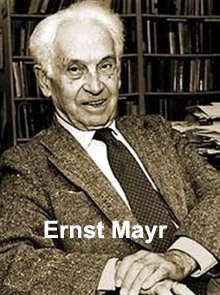
Ernst Mayr (pictured below with the beard)
Bill Gates, John Grisham, James Michener, E. O. Wilson, Ernst Mayr, George Lucas…
Published on May 19, 2012
Bill Gates, John Grisham, James Michener, E. O. Wilson, Ernst Mayr, George Lucas, James Cameron, Larry King, Ian Wilmut, Jane Goodall, Stephen Jay Gould, Tim D. White, Leon Lederman, Timothy Berners-Lee and Bill Gates. Complete and more interview go to websites “www.achievement.org”.
Mais entrevistas e completas no site “www.achievement.org”.
In 1994 and 1995 I had the opportunity to correspond with the famous evolutionist Dr. Ernst Mayr of Harvard. He stated in his letter of 10-3-94, “Owing to your ideological commitments, it is only natural that you cannot accept the cogency of the scientific evidence. However, to a person such as myself without such commitments, the story of the gradual evolution of life as reconstructed by chemists and molecular biologists is totally convincing.”
I responded by pointing out three points. First, Scientific Naturalism is atheistic by definition. Second, many great scientists of the past were Christians, and that did not disqualify their observations and discoveries. Third, the fact that evolution is true does not rule out God’s existence (Harvard’s own Owen Gingerich and many others such as Francis Collins hold to a Creator and evolution).
Let me just spend some time on my second point. Francis Schaeffer in his book “HOW SHOULD WE THEN LIVE?” stated that according to Alfred North Whitehead and J. Robert Oppenheimer, both renowned philosophers and scientists of our era (but not Christians themselves), modern science was born out of the Christian world view. Whitehead said that Christianity is the “mother of science” because of the insistence on the rationality of God. In the article, “Christianity and Technological Advance – The Astonishing Connection,” by T. V. Varughese, Ph.D, he observed:
Without question, “technology” has now become the new magic word in place of the word “science.” Since technology represents the practical applications of science, it is clearly consumer-oriented. Herein is bright economic promise to all who can provide technology.
In terms of technology, our present world can be divided into at least three groups: countries that are strong providers of technology, both original and improved; countries that are mass producers because of cheaper labor; and countries that are mostly consumers. Without a doubt, being in the position of “originating” superior technology should be a goal for any major country. The difficult question, however, is “how.”
An obvious place to start suggests itself. Why not begin with the countries that have established themselves as strong originators of technology and see if there is a common thread between them? The western nations, after the Renaissance and the Reformation of the 16th century, offer a ready example. Any book on the history of inventions, such as the Guinness Book of Answers, will reveal that the vast majority of scientific inventions have originated in Europe (including Britain) and the USA since the dawn of the 17th century. What led to the fast technological advances in the European countries and North America around that time?
The answer is that something happened which set the stage for science and technology to emerge with full force. Strange as it may seem, that event was the return to Biblical Christianity in these countries.
The Epistemological Foundation of Technology
According to Alfred North Whitehead and J. Robert Oppenheimer, both renowned philosophers and scientists of our era (but not Christians themselves), modern science was born out of the Christian world view. Whitehead said that Christianity is the “mother of science” because of the insistence on the rationality of God.[1] Entomologist Stanley Beck,though not a Christian himself, acknowledged the corner-stone premises of science which the Judeo-Christian world view offers: “The first of the unprovable premises on which science has been based is the belief that the world is real and the human mind is capable of knowing its real nature. The second and best-known postulate underlying the structure of scientific knowledge is that of cause and effect. The third basic scientific premise is that nature is unified.”[2] In other words, the epistemological foundation of technology has been the Judeo-Christian world view presented in the Bible…
Perhaps the most obvious affirmation that Biblical Christianity and science are friends and not foes comes from the fact that most of the early scientists after the Renaissance were also strong believers in the Bible as the authoritative source of knowledge concerning the origin of the universe and man’s place in it.[4] The book of Genesis, the opening book of the Bible, presents the distinctly Judeo-Christian world view of a personal Creator God behind the origin and sustenance of the universe (Genesis 1:1; Colossians 1:17; etc.).
Among the early scientists of note who held the Biblical creationist world view are Blaise Pascal (1623-1662), Sir Isaac Newton (1642-1727), and Samuel Morse (1791-1872) – what motivated them was a confidence in the “rationality” behind the universe and the “goodness” of the material world. The creation account in Genesis presents an intelligent, purposeful Creator, who, after completing the creation work, declared it to be very good (Genesis 1:31). That assures us that the physical universe operates under reliable laws which may be discovered by the intelligent mind and used in practical applications. The confidence in the divinely pronounced goodness of the material world removed any reluctance concerning the development of material things for the betterment of life in this world. The spiritual world and the material world can work together in harmony.
References –
Francis A. Schaeffer: How Should We Then Live (Revell, 1976), p. 132.
Henry M. Morris, Biblical Basis for Modern Science (Baker, 1991), p. 30.
Schaeffer, p. 131.
Henry M. Morris, Men of Science, Men of God (Master Books, CA, 1988), 107 pp.
Many of these great scientists of the past were before Darwin, but not all of them. However, all of them were acquainted with secular philosophies and some were in fact opponents of Darwinism (Agassiz, Pasteur, Lord Kelvin, Maxwell, Dawson, Virchow, Fabre, Fleming, etc). Many of them believed in the inspiration and authority of the Bible, as well as in the deity and saving work of Jesus Christ. They believed that God had supernaturally created all things, each with its own complex structure for its own unique purpose. They believed that, as scientists, they were “thinking God’s thoughts after Him,” learning to understand and control the laws and processes of nature for God’s glory and man’s good. They believed and practiced science in exactly the same way that modern creationist scientists do.
And somehow this attitude did not hinder them in their commitment to the “scientific method.” In fact one of them, Sir Francis Bacon, is credited with formulating and establishing the scientific method! They seem also to have been able to maintain a proper “scientific attitude,” for it was these men (Newton, Pasteur, Linnaeus, Faraday, Pascal, Lord Kelvin, Maxwell, Kepler, etc.) whose researches and analyses led to the very laws and concepts of science which brought about our modern scientific age….
To illustrate the caliber and significance of these great scientists of the past, Tables I and II have been prepared. These tabulations are not complete lists, of course, but at least are representative and they do point up the absurdity of modern assertions that no true scientist can be a creationist and Bible-believing Christian.
Table I lists the creationist “fathers” of many significant branches of modern science. Table II lists the creationist scientists responsible for various vital inventions, discoveries, and other contributions to mankind. These identifications are to some degree oversimplified, of course, for even in the early days of science every new development involved a number of other scientists, before and after. Nevertheless, in each instance, a strong case can be made for attributing the chief responsibility to the creationist scientist indicated. At the very least, his contribution was critically important and thus supports our contention that belief in creation and the Bible helps, rather than hinders, scientific discovery.
_______________
My relatives live 3 miles from Spring Hill, Tennessee. When the new General Motors plant opened there I got to go see it. What if I had said, “The assembly line created a beautiful Saturn automobile!” Hopefully, some would have corected me by responding, “The assembly line did not create the automobile. It was first designed by the General Motors engineers in Detroit.” ASSUMING EVOLUTION IS TRUE, IT WOULD STILL ONLY BE THE MECHANISM. DOES EVOLUTION ACCOUNT FOR THE DESIGNER?
NOTABLE INVENTIONS, DISCOVERIES
OR DEVELOPMENTS BY CREATIONIST SCIENTISTS
CONTRIBUTION
SCIENTIST
ABSOLUTE TEMPERATURE SCALE
LORD KELVIN (1824-1907)
ACTUARIAL TABLES
CHARLES BABBAGE (1792-1871)
BAROMETER
BLAISE PASCAL (1623-1662)
BIOGENESIS LAW
LOUIS PASTEUR (1822-1895)
CALCULATING MACHINE
CHARLES BABBAGE (1792-1871)
CHLOROFORM
JAMES SIMPSON (1811-1870)
CLASSIFICATION SYSTEM
CAROLUS LINNAEUS (1707-1778)
DOUBLE STARS
WILLIAM HERSCHEL (1738-1822)
ELECTRIC GENERATOR
MICHAEL FARADAY (1791-1867)
ELECTRIC MOTOR
JOSEPH HENRY (1797-1878)
EPHEMERIS TABLES
JOHANN KEPLER (1571-1630)
FERMENTATION CONTROL
LOUIS PASTEUR (1822-1895)
GALVANOMETER
JOSEPH HENRY (1797-1878)
GLOBAL STAR CATALOG
JOHN HERSCHEL (1792-1871)
INERT GASES
WILLIAM RAMSAY (1852-1916)
KALEIDOSCOPE
DAVID BREWSTER (1781-1868)
LAW OF GRAVITY
ISAAC NEWTON (1642-1727)
MINE SAFETY LAMP
HUMPHREY DAVY (1778-1829)
PASTEURIZATION
LOUIS PASTEUR (1822-1895)
REFLECTING TELESCOPE
ISAAC NEWTON (1642-1727)
SCIENTIFIC METHOD
FRANCIS BACON (1561-1626)
SELF-INDUCTION
JOSEPH HENRY (1797-1878)
TELEGRAPH
SAMUEL F.B. MORSE (1791-1872)
THERMIONIC VALVE
AMBROSE FLEMING (1849-1945)
TRANS-ATLANTIC CABLE
LORD KELVIN (1824-1907)
VACCINATION & IMMUNIZATION
LOUIS PASTEUR (1822-1895)
_______________
2000 Interview with Ernst Mayr, Harvard University
Uploaded on Jul 13, 2008
Interviews conducted in March 2000 at the annual meeting of the American Institute of Biological Sciences on the topic of Challenges for the New Millennium. Museum of Natural History, Smithsonian Institution, Washington DC. See http://www.aibs.org/media-library/ for additional AIBS conference recordings.
With the passing in recent years of the three most revered scientific spokesmen for evolution—Isaac Asimov, Carl Sagan, and now Stephen Jay Gould—Professor Ernst Mayr is left as the unquestioned dean of the modern evolutionary establishment.
Gould, Asimov, and Sagan were all three extremely prolific and brilliant writers. All three were atheistic professors at prestigious eastern universities (Gould at Harvard, Asimov at Boston University, Sagan at Cornell), and all three were effusive and vigorous anti-creationists. They were formidable opponents (but eminently quotable), and we miss them. All three died at relatively young ages.
But that leaves Ernst Mayr, long-time professor of biology at Harvard. Dr. Mayr was born in 1904 and is (at this writing) still very much alive, and nearing the century mark. Dr. Gould recently called him “the greatest living evolutionary biologist and a writer of extraordinary insight and clarity” (in a jacket blurb on Mayr’s latest book).
Mayr’s New Book
And that book is the subject of this article. Its title is intriguing—What Evolution Is (Basic Books, 2001, 318 pages),—for if anyone could speak authoritatively on such a subject, it should be Professor Mayr. In his adulatory foreword, Jared Diamond, another leading modern evolutionist, concludes: “There is no better book on evolution. There will never be another book like it” (p. xii).
That evaluation should give any reader very high expectations. Unfortunately, however, Dr. Mayr first shows his disdain for creationism, not even considering its arguments. He simply says:
It is now actually misleading to refer to evolution as a theory, considering the massive evidence that has been discovered over the last 140 years documenting its existence. Evolution is no longer a theory, it is simply a fact (p. 275).
He dismissed the evidence for creation as unworthy of further discussion. “The claims of the creationists” he says, “have been refuted so frequently and so thoroughly that there is no need to cover this subject once more” (p. 269).
Ignoring Creation Evidence
He himself, however, has apparently not bothered to read any creationist or secular anti-evolutionist scientific books or articles. Or at least that is what one would infer from the fact that none of them or their arguments and evidence are even mentioned in his book.
No mention is made by Mayr, for example, of creationist expositions of the amazing created designs in living systems, nor of the effects of God’s curse on the creation, or of the significance of the great flood in understanding the geologic record. He does not even acknowledge the significance of naturalistic catastrophism or of such scientific concepts as complexity or probability. Current ideas about “intelligent design” are never mentioned. The origins of all things are due to time, chance, and natural selection, no matter how complex and interdependent they may be, according to Professor Mayr, who had been (along with Julian Huxley, George Simpson, and a few others) primarily responsible for the so-called modern evolutionary synthesis (or neo-Darwinism) back in the 1930s and 1940s.
Neither does Mayr seem aware that there are now thousands of credentialed and knowledgeable scientists (including a great many biologists) who reject evolution, giving not even a nod to the Creation Research Society, or to ICR, or any other creationist organization. He does occasionally refer to God or to Christianity, but only in passing, and always in a context that indicates that he does not believe in either one. He, like his three younger colleagues, is an atheist, and this naturally constrains him to ignore any possible theological implications of the origins issues.
The Alleged Evidence for Evolution
Mayr’s new book is beautifully written and does contain much good material, but it will not convert many to evolutionism, even though he does devote a chapter to what he thinks are the evidences for evolution. These evidences are essentially the same as those used 140 years ago by Darwin in the Origin (fossils, comparative morphology, embryological similarities and recapitulation, vestigial structures, and geographical distribution). Mayr adds nothing new to these arguments, ignoring the fact that creationists (and even a number of evolutionists) have long since refuted all of them. He does devote a brief section to the more recent “evidence” from molecular biology. But that also has been vigorously disputed by a number of specialists in this field, especially the supposed evolutionary relationships implied by the molecules. Even Mayr admits that “molecular clocks are not nearly as constant as often believed” (p. 37), but he does not mention any of the numerous contradictory relationships implied by these biochemical studies (e.g., the well-known genomic similarities of humans and bananas).
As do most evolutionists, Mayr spends much time in discussing micro-evolution, whereas modern creationists only reject macroevolution. He devotes five chapters to microevolution and only one to macroevolution. This particular chapter is quite long, discussing many speculative theories about how macroevolutionary changes might be produced, but there is one vital deficiency. He gives no example of any macroevolutionary change known to have happened. In other words, macroevolution seems never to have occurred within the several thousand years of recorded history. Thus, real evolution (as distinct from variation, recombination, hybridization, and other such “horizontal” changes) does not happen at present. Where, we would ask Professor Mayr, are there any living forms in the process of evolutionary change? He gives no examples, of course, because there are none.
As far as pre-human history is concerned, Dr. Mayr does insist that the fossil record documents past evolution. He cites the usual claims—horses, Archaeopteryx, mammal-like reptiles, walking whales, etc.—which are very equivocal, at best, and have all been shown by creationists to be invalid as transitional forms. Instead of a handful of highly doubtful examples, there ought to be thousands of obvious transitional forms in the fossils if evolution had really been occurring. Yet Mayr admits,
Wherever we look at the living biota, . . . discontinuities are overwhelmingly frequent. . . . The discontinuities are even more striking in the fossil record. New species usually appear in the fossil record suddenly, not connected with their ancestors by a series of intermediates (p. 189).
Professor Mayr still says that the fossils are “the most convincing evidence for the occurrence of evolution” (p. 13). Yet he also says that “the fossil record remains woefully inadequate” (p. 69). Thus, as creationists have often pointed out, there is no real evidence of either present or past evolution.
We have repeatedly noted also that the scientific reason why this is so is because real evolution to any higher level of complexity is impossible by the law of entropy, which states the proven fact that every system of any kind “tends” to go toward lower complexity, unless constrained otherwise by some pre-designed external program and mechanism.
Yet Ernst Mayr seems either to ignore or misunderstand this key argument of the creationists. Here is what he says:
Actually there is no conflict, because the law of entropy is valid only for closed systems, whereas the evolution of a species of organisms takes place in an open system in which organisms can reduce entropy at the expense of the environment and the sun supplies a continuing input of energy (p. 8).
And that’s all he says about one of the key arguments against evolution. This ubiquitous dodge of the evolutionists has been discredited again and again by creationists, and one would think that this “greatest living evolutionary biologist” in this “best book on evolution” would at least take notice of our arguments! At least half of America’s population, according to many polls, are creationists, apparently agreeing more with us than with Mayr.
An open system and external energy are, indeed, necessary conditions for a system to grow in complexity, but most definitely are not sufficient conditions. The question is just how does the sun’s energy produce complexity in an open system? The fact is that the application of external heat energy to an open system (such as from the sun to the earth) will increase the entropy (that is, decrease the organized complexity) in any open system, if that’s all there is. This is a basic principle of thermodynamics, and neither Mayr nor any other evolutionist has answered this problem. Evolution seems to be impossible by the known laws of science.
Professor Mayr does not deal with the theological or Biblical evidences, of course. For those who believe in God and the Bible, on the other hand, creation—not evolution—is, to appropriate Mayr’s words, “simply a fact.” Evolution is merely a belief held by many who “willingly are ignorant” (II Peter 3:5) of the strong evidences and arguments for creation, and who don’t even bother to consider them. In the words of the apostle Paul: “Where is the disputer of this world? hath not God made foolish the wisdom of this world?” (I Corinthians 1:20).
Open letter to President Obama (Part 519) (Emailed to White House on 5-3-13.) President Obama c/o The White House 1600 Pennsylvania Avenue NW Washington, DC 20500 Dear Mr. President, I know that you receive 20,000 letters a day and that you actually read 10 of them every day. I really do respect you for trying to get […]
The Scientific Age Published on Jul 24, 2012 Dr. Schaeffer’s sweeping epic on the rise and decline of Western thought and Culture Francis Schaeffer rightly noted, “These two world views stand as totals in complete antithesis in content and also in their natural results….It is not just that they happen to bring forth different results, […]
The Way of Discovery: A Personal Journey of Faith Henry F. Schaefer III The Scientific Age Uploaded by NoMirrorHDDHrorriMoN on Oct 3, 2011 _______________ Episode VII – The Age of Non Reason ____________________ Episode 8: The Age Of Fragmentation Published on Jul 24, 2012 Dr. Schaeffer’s sweeping epic on the rise and decline of Western thought and […]
The Long War against God-Henry Morris, part 6 of 6 _______________ I have debated with Ark Times Bloggers many times in the past on many different subjects. Here are some of the subjects: communism, morality, origin of evil, and the Tea Party. I have always loved to post about evolution and I have had a chance […]
The Long War against God-Henry Morris, part 5 of 6 _______________ I have debated with Ark Times Bloggers many times in the past on many different subjects. Here are some of the subjects: communism, morality, origin of evil, and the Tea Party. I have always loved to post about evolution and I have had a chance […]
The Long War against God-Henry Morris, part 4 of 6 _______________ I have debated with Ark Times Bloggers many times in the past on many different subjects. Here are some of the subjects: communism, morality, origin of evil, and the Tea Party. I have always loved to post about evolution and I have had a chance […]
The Long War against God-Henry Morris, part 1 of 6 Uploaded by FLIPWORLDUPSIDEDOWN3 on Aug 30, 2010 _________ I have debated with Ark Times Bloggers many times in the past on many different subjects. Here are some of the subjects: communism, morality, origin of evil, and the Tea Party. I have always loved to post about evolution […]






 The Daily Hatch