In Little Rock just a few feet away from where we went shopping the night before a National Guard recruiter was killed by a muslim extremist. President Obama does not want to admit that terrorists have killed anybody on U.S. soil. Take a look at this article about the Ft Hood killing.
In 2010, Kimberly Munley sat next to Michelle Obama as President Barack Obama delivered his State of the Union address. Munley was invited as a hero of the 2009 Fort Hood shootings. As a civilian police officer, Munley fired back after Maj. Nidal Hasan allegedly opened fire in an attack that killed 13 adults and wounded 32. Munley was shot three times. Her partner, Mark Todd, fired the shots that brought down Hasan and ended the carnage.
Three years later, Munley told ABC News reporter Brian Ross, she feels “betrayed,” as Obama broke his promise to care for the Fort Hood victims.
Because the government classified the injuries not as “combat-related” but as the result of “workplace violence,” the wounded troops are not eligible for Purple Hearts. They claim they are not being given the priority they deserve from Veterans Affairs.
“It was no different than an insurgent in Iraq or Afghanistan trying to kill us,” Shawn Manning told ABC. Manning should know. He was deployed twice to Iraq. He was hit by six bullets, and his wounds led him to retire from the military. As a veteran, he complained, he is being treated as if he were downtown and got hit by a car.
Munley, Manning and other victims — both military and civilian — are plaintiffs in a lawsuit against federal and military officials. Attorney Reed Rubinstein says they are outraged at their noncombat Veterans Affairs status. Ditto the snail’s pace of military courts; three years after a public slaughter, Hasan has yet to go to trial even though he wanted to plead guilty. Then there’s the military’s political correctness that allowed Hasan to remain in the Army and even be promoted to major when he should have been booted out before the shootings.
As a Senate committee reported in 2011, the FBI knew Hasan had been in touch with Anwar al-Awlaki — who was killed by a U.S. drone in Yemen in 2011 because he was a terrorist leader. Hasan had given a pro-Osama bin Laden lecture at Walter Reed National Military Medical Center. A colleague branded Hasan a “ticking time bomb.” The report concluded the FBI and Department of Defense “collectively had sufficient information to have detected Hasan’s radicalization to violent Islamist extremism but failed both to understand and to act on it.”
There is something pathetic about the military’s refusal to call the attack an act of terrorism. “The pattern of response to Fort Hood and the pattern of response to (the recent attack on the U.S. Consulate in Benghazi, Libya) is not dissimilar,” Rubinstein said. After both attacks, Washington tried to paper over the role of organized terrorists.
Military law expert Geoffrey Corn, a professor at the South Texas College of Law, told me that if the military branded the Fort Hood shootings as terrorism, it could complicate the jury selection process and otherwise hinder the prosecution’s efforts.
But Rep. Michael McCaul, R-Texas, sees the shootings as terrorism “clearly.” McCaul plans to reintroduce legislation to force the Pentagon and Obama administration to recognize the Fort Hood victims’ combat status.
It is Rubinstein’s hope that “one way or another,” America does right by Munley, Manning and the rest. “Whether it’s through Congress or the courts or the pressure of public opinion, this treatment, the way the government has given them the back of the hand, will not stand.”
America’s public education system is failing. We’re spending more money on education but not getting better results for our children.
That’s because the machine that runs the K-12 education system isn’t designed to produce better schools. It’s designed to produce more money for unions and more donations for politicians.
For decades, teachers’ unions have been among our nation’s largest political donors. As Reason Foundation’s Lisa Snell has noted, the National Education Association (NEA) alone spent $40 million on the 2010 election cycle (source: http://reason.org/news/printer/big-education-and-big-labor-electio). As the country’s largest teachers union, the NEA is only one cog in the infernal machine that robs parents of their tax dollars and students of their futures.
Students, teachers, parents, and hardworking Americans are all victims of this political machine–a system that takes money out of taxpayers’ wallets and gives it to union bosses, who put it in the pockets of politicians.
If you want to change this nation in a big way then you will at the fact that in the last 40 years we have increased our educational spending every year and our test scores have dropped. The problem is not money but education competition. We don’t need to spend over $29,000 per kid in the Washington D.C. district when we could give vouchers out (under $9000 per kid) and have better results. Take a look at this article from Milton Friedman.
Michelle: you are the grandfather of school vouchers do you feel victorious?
Mr. Friedman: Far from victorious, but very optimistic and hopeful. We are at the beginning of the task because as of the moment vouchers are available to only a very small amount of children. Our goal is to have a system in which every family in the U.S. will be able to choose for itself the school to which its children go we are far from that ultimate result. If we had that a system of free choice we would also have a system of competition, innovation which would change the character of education. You know our educational system is one of the most backwards things in our society in the may we teach people they did 200 years ago there is a person in the front of the room there are children sitting down at the bottom and they are being talked to can you name any other industry in the U.S. which is as technologically backward I can name one and only one..the legislature for the same reason. Both are monopolies the elementary and secondary school system is the single most Socialist industry in the U.S. leaving aside the military, but aside from the military its a major socialist industry, it is centralized and the control comes from the center and the difficulty of having a monopoly in which people cannot choose has been exacerbated by the fact that it has been largely taken over by teachers unions, the national education association and the american federation of teachers and the unions. Understandably I do not blame them but they are interested in the welfare of their members not the welfare of the children and the result is they have introduced a degree of rigidity which makes it impossible to reform the public school system from within. Reform has to come through competition from the outside and the only way you can get competition is by making it possible for parents to have the ability to choose.
Michelle: Give to me a model, an example of how it would work
Mr. Friedman: Very simple, take the extreme the government says we are willing to finance schooling for every child. The government compels children. If you look at the role of government in education there are 3 different levels there is a level of compulsory the government says every child must go to school until such and such and age. That is the equivalent of saying if you are going to drive a car you must have a license. The second stage is funding not only do we require you to have an education but the government is willing to pay for that schooling. That would be equivalent to saying the government is willing to pay for your car that you drive. The third level is running the educational industry that would be the equivalent of the government manufacturing the automobile or to put it in a different image consider food stamps today. Food stamps are funds provided by the government but if that were to be runned like the schools they would say everybody has to use these food stamps at a government grocery and each person with food stamps is assigned to a particular government grocers so the only way you can get your food stamps is by going to that grocer do you think those groceries would be very good? We know what the situation is in schooling people say why now and not 50-75 years ago? Well, when I went to high school t hat was a long time ago in the 1920s there were a 150,000 school districts in the U.S and the population was half what it is now. Today, there are fewer than 15,000 school districts. So it used to be that you really did have competition cause you had small school districts and parents had a good deal of control over those school districts, but increasingly we have shifted to very large school districts, to centralized control, to a system in which the governmental officials in which the educational professionals control it and like every socialist industry it produces a product that is very expensive and of very low quality. Of course it is not uniform there are some very good schools do not misunderstand me, but there are also some very bad ones.
Michelle: I interviewed some folks who are against school vouchers and they say that if you really want to help out a school what you should do is provide high quality early childhood education, small classes, small schools, summer school available to children who want it. Put money to those items which they claim would work.
Mr. Friedman: They don’t, we have been doing that. The amount of money spent per child adjusted for inflation has something like doubled or tripled over the last 20 years. Twenty years ago we had this report A Nation at Risk that pointed out all of the difficulties I just referred to and which pointed out this was a first generation that was going to be less schooled then its parents. We are now in the next generation and will be even less well schooled. We have had every possible effort you could have from reform from within. It is not just in schools it is in any area reform has to come from outside it has to come from competition. Let me illustrate that from within the school system. the united states from all accounts ranks #1 in higher education people from all over the world regard the United States colleges and universities the best and most varied. On the other hand in every other international comparison we rank near the bottom in elementary and secondary education why the difference?…one word..choice. The elementary and secondary education the school picks the child it picks its customer. In higher education the customer picks its school, you have choice that makes all the difference in the world. It means competition forces product. Look over the rest of the economy is there any area in the u.s. in which progress has not required progress from the outside. Look at the telephone industry when it was broken down into the little bells and opened up the competition it started a period of rapid innovation and development the key word is competition and the question is how can you get competition. only by having the customer choosing.
Michelle: There is concern that money is going to religious schools. That the majority of the students in voucher programs that exist use them to attend schools with religious affiliation?
Mr. Friedman: Why? Because the vouchers are so small in some cases. It is true that of the private schools in the u.s the great bulk of them are religious. that is for one simple reason here is someone selling something for nothing somebody down the street is giving away chocolate and you want to get into the business of selling chocolate that is kind of tough isn’t it here at schools children can attend them they are not free they are paying for it in the form of taxes but there is no specific charge for going to that school somebody else is going to offer it. The churches, the religious organizations have had a real advantage in that they were the only ones around who were in a position to subsidize the education and keep the fees down low. If you open it wide the most recent case was Ohio, cleveland case. The voucher that they had had a max value of $2,500 now it is not easy to provide a decent education at $2,500 and make money at it make it pay at the same time the state of Ohio was spending something like over $7,000 per child on schooling if that voucher had been $7,000 instead of $2,500 I have no doubt that there would have been a whole raft of new private, non-profit both profit and non-profit schools. That is what has happened in Milwaukee. Milwaukee has a voucher system and today the fraction of the voucher users in Milwaukee going to religious schools is less than the fraction going to religious schools was before this system started because there have been new schools developed and some of them have been religious but many of them are not. In any event, the Supreme Court has settled that issue they have said that if it is the choice of the parent if there are alternatives available there are government schools, charter schools, private non-denominational schools, private denominational schools so long as the choice is in the hands of the parent that is not a violation of the 1st amendment.
Michelle: You have a friend and an ally in the White House when it comes to vouchers
Mr. Friedman: I should say. Mr. Bush has always been in favor. He is in favor of free choice. Remember vouchers are a means not an end the purpose of vouchers is to enable parents to have free choice and the purpose of having free choice is to provide competition and allow the educational industry to get out of the 17th century and get into the 21st century and have more innovation and more evolvement. There is no reason why you cannot have the same kind of change in the provision of education as you have had in industries like the computer industry, the television industry and other things.
Michelle: Is it refreshing to have a President that, Bill Clinton was firmly against vouchers.
Mr. Friedman: No, it is a case of circumstances when he was Governor of Arkansas he was not against vouchers. He was in favor, but when he became President he came out against vouchers. I should say he did not oppose vouchers as Governor and he did as President and that was for political reasons. People don’t recognize how powerful politically the teachers unions are. Something like a quarter of all the delegates at the democratic national convention are from the teachers union. They are probably the most powerful pressure group in the U.S… very large funds, very large number of people and very active politically.
Michelle: We talk in the office about how President Bush has some very Friedmanesq ideas.
Mr. Friedman: They are not freidmanesq they are just good ideas. I hope that is true anyway. I think very highly of President Bush and I think in these areas don’t misunderstand me that is not a blanket statement there are some things he has done that I disagree with, but taken as a whole he has been moving in the right direction of trying to move toward a smaller more limited government trying to provide more freedom and more initiative in all areas. His philosophy on Medicare is the same as his philosophy in schools.
Michelle: Is that refreshing?
Mr. Friedman: It is an interesting thing, if you look at the facts the one area the area in which the low income people of this country, the blacks and the minority are most disadvantaged is with respect with the kinds of schools they can send their children to. The people who live in Harlem or the slums or the corresponding areas in LA or San Francisco they can go to the same stores, shop in the same stores everybody else can, they can buy the same automobiles, they can go to supermarket but they have very limited choice of schools everybody agrees that the schools in those areas are the worst they are poor. Yet, here you have a Democrat who allege their interest is to help the poor and the low income people here you have to take a different point every poll has shown that the strongest supporters of vouchers are the low income blacks and yet hardly a single black leader has been willing to come out for vouchers there were some exceptions Paul Williams in Milwaukee who was responsible for that…and a few others
Michelle: Why do you think that is?
Mr. Friedman: For obvious reasons, political. It has been to the self interest to the leaders the school system as long as its governmental its a source of power and jobs to hand around and funds to dispose of. If it is privatized that disappears and the other aspect of it is the power of the teachers unions. Right now those of us that are in the upper income classes have freedom of choice for our children in various ways we can decide where to live and we can choose places to live that have good schools or we can afford to pay twice for schooling once by taxes and once by paying tuition at a private school. It seems to me utterly unfair that those opportunities should not be open to everybody at all levels of income. If you had a system the kind I would like to see the government would say we require every child to get a certain number of years of schooling and in order to make that possible we are going to provide for every parent a voucher equal to a certain number of dollars which they can use only for schooling can’t use it for anything else. They can add to it, but they cannot subtract from it. Those will be those can be used in government schools let the government run the school but force them to be in competition so that all government schools charge tuition, but can be paid for by that voucher but that same voucher can also be used in private schools of all kinds and then you would have an open the teachers union complained and they insist they are doing a good job. if they are doing a good job then why are they so afraid of some competition?
No one did more to advance the cause of school vouchers than Milton and Rose Friedman. Friedman made it clear in his film series “Free to Choose” how sad he was that young people who live in the inner cities did not have good education opportunities available to them. Remembering Milton Friedman’s School Choice Legacy […]
Everywhere school vouchers have been tried they have been met with great success. Why do you think President Obama got rid of them in Washington D.C.? It was a political disaster for him because the school unions had always opposed them and their success made Obama’s allies look bad. In 1980 when I first sat […]
I ran across this very interesting article about Milton Friedman from 2002: Friedman: Market offers poor better learningBy Tamara Henry, USA TODAY By Doug Mills, AP President Bush honors influential economist Milton Friedman for his 90th birthday earlier this month. About an economist Name:Milton FriedmanAge: 90Background: Winner of the 1976 Nobel Prize for economic science; […]
Milton Friedman and Chile – The Power of Choice Uploaded by FreeToChooseNetwork on May 13, 2011 In this excerpt from Free To Choose Network’s “The Power of Choice (2006)”, we set the record straight on Milton Friedman’s dealings with Chile — including training the Chicago Boys and his meeting with Augusto Pinochet. Was the tremendous […]
The True Cost of Public Education Uploaded by catoinstitutevideo on Mar 5, 2010 What is the true cost of public education? According to a new study by the Cato Institute, some of the nation’s largest public school districts are underreporting the true cost of government-run education programs. http://www.cato.org/pub_display.php?pub_id=11432 Cato Education Analyst Adam B. Schaeffer explains […]
Max Brantley of the Arkansas Times Blog reports today that Mitt Romney is for school vouchers. I am glad to hear that. Over and over we hear that the reason private schools are better is because they don’t have to keep the troubling making kids. It reminds me of this short film that I saw many […]
John Brummett (10-26-11, Arkansas Democrat-Gazette online edition) does not want charter schools to put public schools out of business but he wants them to show public schools how to do it. (Paywall) I seek in these matters a kind of Clintonian third-way finesse: I support charter schools only to the extent that they should be […]
Some advocates of Obamacare are proud of the slow down of medical spending recently but that is to be expected in a recession. If you want to know where Obamacare will take us with premium increases then take a look at where Romneycare in Massachusetts has taken them. I posted another funny but sad cartoon from Dan Mitchell’s blog about Obamacare. My nephew is in college now studying in pre-med and I have a niece studying to be an nurse. I joked with them both about doctors and nurses getting paid about the same in Obama’s perfect world.
The congressional Democrats who crafted the legislation ignored virtually every actuarial principle governing rational insurance pricing. Premiums will soon reflect that disregard—indeed, premiums are already reflecting it. …Guaranteed issue incentivizes people to forgo buying a policy until they get sick and need coverage (and then drop the policy after they get well). While ObamaCare imposes a financial penalty—or is it a tax?—to discourage people from gaming the system, it is too low to be a real disincentive. The result will be insurance pools that are smaller and sicker, and therefore more expensive.
How bad will it be? Well…
Many actuaries, such as those in the international consulting firm Oliver Wyman, are now predicting an average increase of roughly 50% in premiums for some in the individual market for the same coverage. …Arizona, Arkansas, Georgia, Idaho, Iowa, Kentucky, Missouri, Ohio, Oklahoma, Tennessee, Utah, Wyoming and Virginia will likely see the largest increases—somewhere between 65% and 100%. Another 18 states, including Texas and Michigan, could see their rates rise between 35% and 65%.
Which is why 2014 is the “Year of the Snake” in more places than just China.
If you like Ramirez cartoons, you can see some of my favorites here, here, here, here, and here.
Max Brantley is wrong about Tom Cotton’s accusation concerning the rise of welfare spending under President Obama. Actually welfare spending has been increasing for the last 12 years and Obama did nothing during his first four years to slow down the rate of increase of welfare spending. Rachel Sheffield of the Heritage Foundation has noted: […]
I have put up lots of cartoons from Dan Mitchell’s blog before and they have got lots of hits before. Many of them have dealt with the economy, eternal unemployment benefits, socialism, Greece, welfare state or on gun control. I think Max Brantley of the Arkansas Times Blog was right to point out on 2-6-13 that Hillary […]
I thought it was great when the Republican Congress and Bill Clinton put in welfare reform but now that has been done away with and no one has to work anymore it seems. In fact, over 40% of the USA is now on the government dole. What is going to happen when that figure gets over […]
Again we have another shooting and the gun control bloggers are out again calling for more laws. I have written about this subject below and on May 23, 2012, I even got a letter back from President Obama on the subject. Now some very interesting statistics below and a cartoon follows. (Since this just hit the […]
watch?v=llQUrko0Gqw] The federal government spends about 10% on roads and public goods but with the other money in the budget a lot of harm is done including excessive regulations on business. That makes Obama’s comment the other day look very silly. A Funny Look at Obama’s You-Didn’t-Build-That Comment July 28, 2012 by Dan Mitchell I made […]
I have written a lot about this in the past and sometimes you just have to sit back and laugh. Laughing at Obama’s Bumbling Class Warfare Agenda July 13, 2012 by Dan Mitchell We know that President Obama’s class-warfare agenda is bad economic policy. We know high tax rates undermine competitiveness. And we know tax increases […]
Dan Mitchell Discussing Dishonest Budget Numbers with John Stossel Uploaded by danmitchellcato on Feb 11, 2012 No description available. ______________ Dan Mitchell of the Cato Institute has shown before how excessive spending at the federal level has increased in recent years. A Humorous Look at Obama’s Screwy Budget Math May 31, 2012 by Dan Mitchell I’ve […]
Sometimes it is so crazy that you just have to laugh a little. The European Mess, Captured by a Cartoon June 22, 2012 by Dan Mitchell The self-inflicted economic crisis in Europe has generated some good humor, as you can see from these cartoons by Michael Ramirez and Chuck Asay. But for pure laughter, I don’t […]
Another great cartoon on President Obama’s efforts to create jobs!!! A Simple Lesson about Job Creation for Barack Obama December 7, 2011 by Dan Mitchell Even though leftist economists such as Paul Krugman and Larry Summers have admitted that unemployment insurance benefits are a recipe for more joblessness, the White House is arguing that Congress should […]
Dan Mitchell hits the nail on the head and sometimes it gets so sad that you just have to laugh at it like Conan does. In order to correct this mess we got to get people off of government support and get them in the private market place!!!! Chuck Asay’s New Cartoon Nicely Captures Mentality […]
Cato Institute scholar Dan Mitchell is right about Greece and the fate of socialism: Two Pictures that Perfectly Capture the Rise and Fall of the Welfare State July 15, 2011 by Dan Mitchell In my speeches, especially when talking about the fiscal crisis in Europe (or the future fiscal crisis in America), I often warn that […]
John Stossel report “Myth: Gun Control Reduces Crime Sheriff Tommy Robinson tried what he called “Robinson roulette” from 1980 to 1984 in Central Arkansas where he would put some of his men in some stores in the back room with guns and the number of robberies in stores sank. I got this from Dan Mitchell’s […]
I have put up lots of cartons and posters from Dan Mitchell’s blog before and they have got lots of hits before. Many of them have dealt with the economy, eternal unemployment benefits, socialism, Greece, welfare state or on gun control. Amusing Gun Control Picture – Circa 1999 April 3, 2010 by Dan Mitchell Dug this gem out […]
We got to cut spending and stop raising the debt ceiling!!! When Governments Cut Spending Uploaded on Sep 28, 2011 Do governments ever cut spending? According to Dr. Stephen Davies, there are historical examples of government spending cuts in Canada, New Zealand, Sweden, and America. In these cases, despite popular belief, the government spending […]
I have put up lots of cartons and posters from Dan Mitchell’s blog before and they have got lots of hits before. Many of them have dealt with the economy, eternal unemployment benefits, socialism, Greece, welfare state or on gun control. On 2-6-13 the Arkansas Times Blogger “Sound Policy” suggested, “All churches that wish to allow concealed […]
Gun Free Zones???? Stalin and gun control On 1-31-13 ”Arkie” on the Arkansas Times Blog the following: “Remember that the biggest gun control advocate was Hitler and every other tyrant that every lived.” Except that under Hitler, Germany liberalized its gun control laws. __________ After reading the link from Wikipedia that Arkie provided then I responded: […]
On 1-31-13 I posted on the Arkansas Times Blog the following: I like the poster of the lady holding the rifle and next to her are these words: I am compensating for being smaller and weaker than more violent criminals. __________ Then I gave a link to this poster below: On 1-31-13 also I posted […]
Be first to receive our videos and other timely info about economic policy. Subscribe at http://www.bankruptingamerica.org
————————-
According to a recent poll, 74 percent of likely voters are extremely or very concerned about the current level of government spending. And 58 percent think the level of spending is unsustainable.
Is the public right? Is Washington bankrupting America? Some facts from the video:
Spending per household has risen over 40 percent in the last 10 years and is set to do so again in the next 10 pushing debt (and interest on the debt) to unprecedented levels. But that’s just a result of PAST spending…
Our government owes $106 trillion in FUTURE spending commitments – that cannot be paid for.
We can solve it, but politicians will have to make tough choices. Increasing taxes can’t do the trick ($106 trillion is equivalent to taking all of the taxable income from every American nine times over), nor is it fair to saddle taxpayers with a problem created by government irresponsibility.
We need real spending reform. Merely returning to the spending per household levels of the 1990s would balance the budget in three years.
___________
President Obama c/o The White House
1600 Pennsylvania Avenue NW
Washington, DC 20500
And I emphasized that the fiscal problem in Europe is the size of government, not the fact that nations are having a hard time borrowing money. As explained in this video, spending is the disease and deficits are one of the symptoms.
This is also an issue in the United States, and Steve Moore of the Wall Street Journal is worried that the GOP ticket is debt-obsessed and doesn’t have sufficient enthusiasm for lower tax rates and tax reform.
Stylistically, Paul Ryan’s Republican convention speech last night was a grand slam. …But was it the growth message that supply-siders wanted to hear, or debt-clock obsession? There were clearly apocalyptic claims. “Before the math and the momentum overwhelm us all, we are going to solve this nation’s economic problems,” said Mr. Ryan in reference to the federal rea ink. “I’m going to level with you; we don’t have that much time.” …In fact, he talked about turning around the economy with “tax fairness.” Ugh, that’s an Obama term. …Larry Kudlow of CNBC and a former Reagan economist tells me, “Paul’s speech just didn’t have the growth, tax-cutting message. We didn’t even get the words tax reform. I don’t know what happened, but it worries me.” It’s a question of priorities. Are Mitt Romney and Paul Ryan signaling that they will put spending cuts ahead of pro-growth tax-rate cuts?
As a general rule, it is always good to do spending cuts (however defined). And it is always good to lower tax rates. And if you can do both at the same time, even better.
But since I have low expectations, I’ll be delighted if we “merely” manage to get entitlement reform during a Romney-Ryan Administration. That would mean some progress on the spending side and presumably reduce the risk of bad things (like a VAT!) on the revenue side.
_________
Thank you so much for your time. I know how valuable it is. I also appreciate the fine family that you have and your commitment as a father and a husband.
Sincerely,
Everette Hatcher III, 13900 Cottontail Lane, Alexander, AR 72002, ph 501-920-5733, lowcostsqueegees@yahoo.com
Mark Levin interviews Senator Hatch 1/27/2011 about the balanced budget amendment. Mark is very excited about the balanced budget amendment being proposed by Senator Orin Hatch and John Cornyn and he discusses the amendment with Senator Hatch. Senator Hatch explains the bill it’s ramifications and limitations. Senator Hatch actually worked on this bill with renowned economist Milton Friedman. This ammendment is the first big step in saving our country.
_______________
Dear Senator Pryor,
Why not pass the Balanced Budget Amendment? As you know that federal deficit is at all time high (1.6 trillion deficit with revenues of 2.2 trillion and spending at 3.8 trillion).
On my blog www.HaltingArkansasLiberalswithTruth.com I took you at your word and sent you over 100 emails with specific spending cut ideas. However, I did not see any of them in the recent debt deal that Congress adopted. Now I am trying another approach. Every week from now on I will send you an email explaining different reasons why we need the Balanced Budget Amendment. It will appear on my blog on “Thirsty Thursday” because the government is always thirsty for more money to spend.
I really wish we would restraint the growth of the federal budget and the only way to do that is to pass the Balanced Budget Amendment. My favorite economist was Milton Friedman and he discusses that below:
Yesterday, I did a twenty minute interview by phone with Milton Friedman. Of course, Mr. Friedman has an INCREDIBLE resume. He won the 1976 Nobel Memorial Prize for economic science, won the “Presidential Medal of Freedom in 1988 and received the National Medal of Science the same year”.
He was also an “economic adviser to Senator Barry Goldwater in his unsuccessful campaign for the presidency in 1964, to Richard Nixon in his successful 1968 campaign, to President Nixon subsequently, and to Ronald Reagan in his 1980 campaign.”
There is much, much, more I could add. But I think the fact that Mr. Friedman finished in a tie for the 15 slot when RWN had conservative bloggers select, “The Greatest Figures Of The 20th Century gives you some idea of Mr. Friedman’s stature.
Enjoy the interview!
John Hawkins:Slate’s Chris Suellentrop has pointed out that Howard Dean has said “that he would demand that other countries adopt the exact same labor, environmental, health, and safety standards as the United States” if they wanted trade agreements with us (Dean said something similar to the WAPO). If that policy were ever implemented, what sort of damage do you think it would cause to the US economy?
Milton Friedman: I think it would cause immense damage, not to the US economy, but to other economies around the world — much more to the others than to us.
John Hawkins: Really? So you don’t really think it would hurt the US economy that much?
Milton Friedman: It would hurt the US economy, but it would be disastrous for the countries that are smaller than we are. World trade depends on differences among countries, not similarities. Different countries are in different stages of development. It is appropriate for them to have different patterns, different policies for ecology, labor standards, and so forth.
From my point of view, we in the United States have gone overboard in respect to the extent of regulation and detailed control of labor standards, industry, and the like. It’s bad for us, but fortunately we had two hundred years of relatively free development to provide a strong basis to sustain the cost. But to impose this on other countries that are not at that stage would be a disgraceful thing to do.
John Hawkins: Because it would keep them from ever getting to the point we’re at?
Milton Friedman: That’s right.
John Hawkins: Do you think George Bush, with the economy being as it was, did the right thing by cutting taxes?
Milton Friedman: I am in favor of cutting taxes under any circumstances and for any excuse, for any reason, whenever it’s possible. The reason I am is because I believe the big problem is not taxes, the big problem is spending. The question is, “How do you hold down government spending?” Government spending now amounts to close to 40% of national income not counting indirect spending through regulation and the like. If you include that, you get up to roughly half. The real danger we face is that number will creep up and up and up. The only effective way I think to hold it down, is to hold down the amount of income the government has. The way to do that is to cut taxes.
John Hawkins: Now let me ask you about that. In the Reagan years, we cut taxes and it ended up leading to economic growth which increased the amount of revenue that came into the government.
Milton Friedman: Well, economic growth will inevitably increase the amount of revenue coming into the government. But so far as the Reagan years were concerned, we have to be careful there. There were initial cuts in 1981-1982 and then there was a very good income tax law in 1986. But in between that, there were increases in taxes as well. So it’s not an entirely clear picture that you can attribute the growth in revenue entirely to the tax reductions. But it’s a hard thing to disentangle the effects of several things happening at the same time. In particular, there’s no doubt that growth is very favorable to government revenue.
John Hawkins: Well let me ask you a related question about holding down the deficit. Really, I’m not seeing much political will on either side of the aisle to hold down costs. Do you think we should consider a Balanced Budget Amendment?
Milton Friedman: What we should consider and what has been considered is a Tax And Spending Limitation Amendment, an amendment to hold down total spending. I don’t think it needs to be in the form of a Balanced Budget Amendment, but that’s one form it can take.
John Hawkins: So would you favor for example a 3/5th’s majority to raise taxes like they suggested in the “Contract with America”?
Milton Friedman: Yes, but the example that comes to mind really is the Colorado Tax And Expenditure Limitation Amendment that requires the spending to increase no more from year to year than population and inflation. Also, it requires that any revenues in excess of spending have to be returned to the taxpayers.
For many more archaeological evidences in support of the Bible, see Archaeology and the Bible . (There are some great posts on this too at the bottom of this post.)
Robert Dick Wilson at the Grove City Bible Conference in 1909.
IS THE HIGHER CRITICISM SCHOLARLY?Clearly attested facts showing that thedestructive “assured results of modern scholarship” are indefensible
By Robert Dick Wilson, Ph.D., D.D.
Professor of Semitic Philology in Princeton Theological Seminary[Originally Published in 1922]
An Argument From Silence Which Proves Nothing
This is an argument from silence which proves nothing absolutely. There is a history of the United States called Scribners by William Cullen Bryant and others. It has 53 pages, double column, of Index. The word Presbyterian does not occur in this Index; the word Christian only in the phrase Christian Commission; the word church only twice. And yet, this is a history of a republic founded by Christians, observing the Sabbath, devoted to foreign missions, and full of Christian churches and activities. Thirty-five hundred pages quarto and no mention of Thanksgiving Day, nor of the days of fasting and prayer during the Civil War, nor of the Bible except in the relation of the Bible Society to slavery!
Nor does it prove that the law did not exist, to show that it was not completely observed, or that things forbidden in it were done. Does the crime wave that has been sweeping the world since the close of the war prove that the Gospel does not exist? In one week of December, 1920, the front page of one of our great New York dailies had scarcely space for anything except reports of murders, burglaries, and other crimes. Are the Ten Commandments unknown in New York City?
But the critics assert that a long period of development was necessary before such a system of laws could have been formulated, accepted, and enforced. I agree readily to this; but I claim that all the development necessary for the formulation may have taken place before the time of Moses and that its hearty acceptance by the people and its enforcement depended upon moral rather than intellectual condition. As far as intellectual requirements are concerned, there is nothing in the law that might not have been written either in Babylon or Egypt centuries before Moses. Then as now it was spiritual power and moral inclination that was wanted rather than intellectual perception in order to do the right and abhor the wrong. In each successive generation of Israelitish men each individual of the nation had to be converted and to submit his soul and conduct to the teachings of the divine law. The ancient Jewish church had its ups and downs, its times of strenuous faith and of declension and decay, just as the Christian church has had.
Ample Time for Revision of Laws
It is claimed by the critics that signs of progress or change are to be observed in some of the laws as given in Exodus 20-24, Leviticus, and Deuteronomy. This may be admitted. It is, however, a sufficient answer to this claim that in the forty years from the arrival at Sinai to the final address of Moses at Shittim, there was plenty of time for Moses to apply these laws to suit all probable variety of circumstances awaiting the people of God. Consider the changes in forty years in the fish laws of Pennsylvania, or in the tariff or railroad legislation of the United States! Besides many of these seemingly variant legislations with regard to the same thing are, as Mr. Wiener has so clearly shown in his “Studies in Biblical Law,” really laws affecting different relations of the same thing. Some, also, like the Income Tax Laws upon our yearly declaration sheet, are general laws for the whole people; while others, like the detailed statements of the Income Tax Law that are meant to guide the tax officials, are meant for the Priests and Levites who officiated at the sanctuary.
That there should be repetitions of the laws affecting the Sabbath, festivals, idolatry, and so forth, does not argue against the unity of authorship. The central facts of a new system are frequently emphasized by such repetition, as is manifest in almost every chapter of the Koran, and in almost every epistle of the apostle Paul. Why they thus repeat is not always clear to us; but it is to be supposed that it was clear to the authors of the repetitions. That is a question of motive and not of text or evidence. What the Peace Treaty says is evident; why the treaty-makers said thus and so is not always apparent, and cannot be produced in evidence.
That there should be alleged contradictions among so many laws was inevitable. Some of them appear contradictory, but really relate to different persons or circumstances. If they were truly contradictory as the critics suppose, why were the contradictions not removed by one of the numerous editors and disakeuasts (revisers), who are unknown to history but assumed by the critics to have existed and to have labored for centuries upon the elaboration of these laws? Surely, these alleged contradictions cannot have escaped their notice. Surely, they cannot have seemed incongruous to the priests of the second temple and to the Scribes and Pharisees who put them into execution. Surely, if real contradictions exist in the laws [and I do not believe they do] it is more likely that they were not in the ancient documents and that they arose in the process of transmission through the vicissitudes of many centuries, than that they should have been inserted in the time of Jeremiah, or of Ezra, that ready scribe in the law of Moses.
Will Objectors Please Answer a Few Questions?
Before leaving the matter of the law, it may be well to propose for the consideration of the objectors to the Biblical account of the origin of the laws of Moses a few questions that, it seems to me, require an answer before we can accept their theory of its origin, unsupported as it is by any direct evidence.
First, if Exodus 20-24 and Deuteronomy were written in the period of the kingdoms of Israel and Judah, how can we account for the fact that the king is referred to but once (Deuteronomy 16), and that in a passage difficult to read and explain and claiming to be anticipatory? And why should this passage make no reference to the house of David, and place its emphasis on a warning against a return to Egypt?
Second, why should the law never mention Zion, or Jerusalem, as the place where men ought to worship, if these laws were written hundreds of years after the temple had been built?
Third, why should the temple itself receive no consideration, but be set aside for a “mythical” tabernacle whose plan to the minutest particular has been elaborated with so much care? And why, if this plan were devised in Babylon in the fifth century B. C., should it in its form and divisions show more resemblance to an Egyptian than to a Babylonian house of God?
Why the Emphasis on the Shedding of Blood?
Fourth, if the laws of the priest-code were made at Babylon, how does it come about that the main emphasis in these laws is upon the shedding of blood and that the principle offerings are bloody offerings; whereas, in the Babylonian religion it is doubtful if any reference is ever made to the importance of the blood and no word corresponding to the Hebrew word for altar (misbeach) has ever yet been found in the Babylonian language? How is it, also, that almost the entire vocabulary bearing upon the ceremonial observances is different in the Babylonian from what it is in the Hebrew? The Hebrew name for the various articles of clothing worn by the priests, for the stones of the breastplate, for the sacrifices, for the altar and the many spoons and other implements used in its service, for the festivals, for the ark and the multifarious articles used in its construction, for sins and removal of sins, and for nearly all the gracious acts of God in redemption, differ almost altogether from the Babylonian. How do we account for all this, if the ceremonies of the second temple were first conceived by the rivers of Babylon under the shadow of the tower of Bel?
Ezra’s Careful Camouflage!
Fifth, if the ceremonial law were written between 500 and 300 B. C., at a time when the Persian power was supreme, how do we account for the entire absence of Persian words and customs from the priestly document? Why should Ezra and his contemporaries have used so many Persian words in their other compositions and have utterly eschewed in the lengthiest of their works? Not one Persian word, forsooth! How careful they must have been in this endeavor to camouflage their attempt to foist their work on Moses! They should have spent more of their time and energy on the removal of alleged incongruities in the subject matter.
Sixth, if the Israelitish religion is a natural development like that of the nations that surrounded them, how does it happen that the Phoenicians who spoke substantially the same language have an almost entirely different nomenclature for their ceremonial acts, for sacrifices and the material of sacrifice; and that the Phoenicians and Carthaginians and their colonies remained polytheistic to the last?
Seventh, if the ceremonial law were written after the exile, when all the Jews, from Elephantine in Egypt on the west to Babylon on the east, were speaking and writing Aramaic, how did it come to pass that the law was written in a Hebrew so different from anything found in any Aramaic dialect that almost every word used in it required to be translated in order to make it understood by the Aramaic speaking Jews? Are we to suppose that the exiled Hebrews invented their religious vocabulary arbitrarily after their language had ceased to be spoken by any great body of living men? Are we to suppose that they invented, or borrowed, the names of the stones of the breastplate, and then forgot so completely their Aramaic equivalents that scarcely any two of the Aramaic targums, or versions, should afterwards be able to agree as to the meaning in Aramaic of more than two or three of them at most? Why, also, should the articles of dress, the names of the sacrifice, the materials of the tabernacle, the verbs to denote the ceremonial acts, and the fact that the general coloring and the particular shades of the coloring of the whole fabric be so different?
Eighth, how is it to be explained that the Aramaic of the Targum and Talmud has taken over so many roots and vocables from the Hebrew of the Old Testament? For a comparison of the Old Testament Hebrew with the Aramaic of the Targums and of both of these with the Syriac shows that about six hundred roots and words found in the two former do not appear in Syriac, nor in any other Aramaic dialect not written by the Jews. The critics are in the habit of charging that such words are Aramaisms in Hebrew; but it is manifest that, while it is possible for the Jews who wrote Aramaic two hundred years after Christ to have taken over Hebrew words from the Old Testament into their translations and commentaries, it would have been impossible for Hebrew authors living from two hundred to five hundred years before Christ to have taken over into their vocabulary Aramaic words not in use until A. D. 200, or later. All of the “Introductions” to the Old Testament need to be revised along this line.
“To the Text and to the Testimony”
That a word occurs in the Old Testament but once and then reappears five hundred or a thousand years later in an Aramaic document written by Jews is to be expected. To say that such a word may have been in the spoken Aramaic before ever the Hebrew document was written, but it did not appear in writing till A. D. 200, may be met by affirming that it may have existed in the spoken Hebrew for a thousand years before it was written. When we once attempt to argue on the basis of what is not contained in documents, one man’s conjecture is just about as good as another’s. I am willing to leave all such cases to the written testimony found in the documents we possess, and I demand that the assailants of the Scriptures confine themselves in like manner to that which has been written. To the text and to the testimony! By these let us stand or fall.
____________
Is the Bible historically accurate? Here are some of the posts I have done in the past on the subject:
This clay tablet is a Babylonian chronicle recording events from 605-594BC. It was first translated in 1956 and is now in the British Museum. The cuneiform text on this clay tablet tells, among other things, 3 main events: 1. The Battle of Carchemish (famous battle for world supremacy where Nebuchadnezzar of Babylon defeated Pharoah Necho of Egypt, 605 BC.), 2. The accession to the throne of Nebuchadnezzar II, the Chaldean, and 3. The capture of Jerusalem on the 16th of March, 598 BC.
King Hezekiah of Judah ruled from 721 to 686 BC. Fearing a siege by the Assyrian king, Sennacherib, Hezekiah preserved Jerusalem’s water supply by cutting a tunnel through 1,750 feet of solid rock from the Gihon Spring to the Pool of Siloam inside the city walls (2 Kings 20; 2 Chron. 32). At the Siloam end of the tunnel, an inscription, presently in the archaeological museum at Istanbul, Turkey, celebrates this remarkable accomplishment.
It contains the victories of Sennacherib himself, the Assyrian king who had besieged Jerusalem in 701 BC during the reign of king Hezekiah, it never mentions any defeats. On the prism Sennacherib boasts that he shut up “Hezekiah the Judahite” within Jerusalem his own royal city “like a caged bird.” This prism is among the three accounts discovered so far which have been left by the Assyrian king Sennacherib of his campaign against Israel and Judah.
In addition to Jericho, places such as Haran, Hazor, Dan, Megiddo, Shechem, Samaria, Shiloh, Gezer, Gibeah, Beth Shemesh, Beth Shean, Beersheba, Lachish, and many other urban sites have been excavated, quite apart from such larger and obvious locations as Jerusalem or Babylon. Such geographical markers are extremely significant in demonstrating that fact, not fantasy, is intended in the Old Testament historical narratives;
Most doubting scholars back then said that the Hittites were just a “mythical people that are only mentioned in the Bible.” Some skeptics pointed to the fact that the Bible pictures the Hittites as a very big nation that was worthy of being coalition partners with Egypt (II Kings 7:6), and these bible critics would assert that surely we would have found records of this great nation of Hittites. The ironic thing is that when the Hittite nation was discovered, a vast amount of Hittite documents were found. Among those documents was the treaty between Ramesses II and the Hittite King.
The Bible mentions that Shishak marched his troops into the land of Judah and plundered a host of cities including Jerusalem, this has been confirmed by archaeologists. Shishak’s own record of his campaign is inscribed on the south wall of the Great Temple of Amon at Karnak in Egypt. In his campaign he presents 156 cities of Judea to his god Amon.
The Moabite Stone also known as the Mesha Stele is an interesting story. The Bible says in 2 Kings 3:5 that Mesha the king of Moab stopped paying tribute to Israel and rebelled and fought against Israel and later he recorded this event. This record from Mesha has been discovered.
The tribute of Jehu, son of Omri, silver, gold, bowls of gold, chalices of gold, cups of gold, vases of gold, lead, a sceptre for the king, and spear-shafts, I have received.”
Sir William Ramsay, famed archaeologist, began a study of Asia Minor with little regard for the book of Acts. He later wrote:
I found myself brought into contact with the Book of Acts as an authority for the topography, antiquities and society of Asia Minor. It was gradually borne upon me that in various details the narrative showed marvelous truth.
9B Discovery of Ebla Tablets. When I think of discoveries like the Ebla Tablets that verify names like Adam, Eve, Ishmael, David and Saul were in common usage when the Bible said they were, it makes me think of what amazing confirmation that is of the historical accuracy of the Bible.
This cube is inscribed with the name and titles of Yahali and a prayer: “In his year assigned to him by lot (puru) may the harvest of the land of Assyria prosper and thrive, in front of the gods Assur and Adad may his lot (puru) fall.” It provides a prototype (the only one ever recovered) for the lots (purim) cast by Haman to fix a date for the destruction of the Jews of the Persian Empire, ostensibly in the fifth century B.C.E. (Esther 3:7; cf. 9:26).
The Bible mentions Uzziah or Azariah as the king of the southern kingdom of Judah in 2 Kings 15. The Uzziah Tablet Inscription is a stone tablet (35 cm high x 34 cm wide x 6 cm deep) with letters inscribed in ancient Hebrew text with an Aramaic style of writing, which dates to around 30-70 AD. The text reveals the burial site of Uzziah of Judah, who died in 747 BC.
The Pilate Inscription is the only known occurrence of the name Pontius Pilate in any ancient inscription. Visitors to the Caesarea theater today see a replica, the original is in the Israel Museum in Jerusalem. There have been a few bronze coins found that were struck form 29-32 AD by Pontius Pilate
This beautifully decorated ossuary found in the ruins of Jerusalem, contained the bones of Caiaphas, the first century AD. high priest during the time of Jesus.
In June 1961 Italian archaeologists led by Dr. Frova were excavating an ancient Roman amphitheatre near Caesarea-on-the-Sea (Maritima) and uncovered this interesting limestone block. On the face is a monumental inscription which is part of a larger dedication to Tiberius Caesar which clearly says that it was from “Pontius Pilate, Prefect of Judea.”
Despite their liberal training, it was archaeological research that bolstered their confidence in the biblical text:Albright said of himself, “I must admit that I tried to be rational and empirical in my approach [but] we all have presuppositions of a philosophical order.” The same statement could be applied as easily to Gleuck and Wright, for all three were deeply imbued with the theological perceptions which infused their work.
Gun Free Zones???? Stalin and gun control On 1-31-13 ”Arkie” on the Arkansas Times Blog the following: “Remember that the biggest gun control advocate was Hitler and every other tyrant that every lived.” Except that under Hitler, Germany liberalized its gun control laws. __________ After reading the link from Wikipedia that Arkie provided then I responded: […]
On 1-31-13 I posted on the Arkansas Times Blog the following: I like the poster of the lady holding the rifle and next to her are these words: I am compensating for being smaller and weaker than more violent criminals. __________ Then I gave a link to this poster below: On 1-31-13 also I posted […]
Will “CARRYING HANDGUN IS PROHIBITED” poster work? Dan Mitchell of the Cato Institute on gun control On 1-13-13 on the Arkansas Times Blog the person with the username “ArkDemocrat” stated, “I visited a church in another state that allows guns, and there was a sign similar to the “No Smoking” signs (i.e. smoking cigarette with […]
Poster for November 2008 benefit for Pressly family, held at Peabody Hotel in Little Rock. ______________ Max Brantley of the Ark Times Blog often attacks those on my side of the gun control debate and that makes me argue even harder for the 2nd amendment. Several months ago Lindsey Miller and Max Brantley were talking […]
I have posted some cartoons featured on Dan Mitchell’s blog before and they are very funny. An Amusing Look at Gun-Free Zones September 26, 2012 by Dan Mitchell I’ve shared a very clever Chuck Asay cartoon about gun-free zones, so let’s now enjoy four posters on the topic. Let’s begin with a good jab at one […]
The recent killing by a mad gunman in CT is not indicating a trend. School killings have gone down and probably peaked in 1929. Nick Gillespie reported in the below video, “Across the board, schools are less dangerous than they used be. Over the past 20 years, the rate of theft per 1,000 students dropped […]
Pretty shocking admissions from the liberal Jeffrey Goldberg on gun control. An Honest Liberal Writes about Gun Control December 16, 2012 by Dan Mitchell I wrote earlier this month about an honest liberal who acknowledged the problems created by government dependency. Well, it happened again. First, some background. Like every other decent person, I was horrified […]
Despite what Max Brantley of the Arkansas Times Blog (1-9-13) would have you believe gun control does not make since unless you suspend your reasoning ability. There are so many examples that show how silly gun control is. Mocking Gun Control Fanatics October 18, 2012 by Dan Mitchell Last month, I shared some very amusing images […]
It seems to me that most of the gun control arguments I have heard are not very logical. Deciphering How Statists Think about Gun Control September 9, 2012 by Dan Mitchell Even though I don’t own that many guns, I’m an unyielding supporter of the 2nd Amendment. Indeed, I use gun control as a quick and […]
John Stossel report “Myth: Gun Control Reduces Crime After this horrible shooting in the school the other day it seems the gun control debate has fired up again. Max Brantley of the Arkansas Times jumped on Charlie Collins concerning his position on concealed weapons but I think that would lower gun crimes and not raise […]
You are right about many people getting abortions have been Christians.
From the website Lifewatch.org this is testimony from Cindy Evans:
In 1973 I was a middle-class, single, 23-year-old college student. After a “one night stand,” I learned that I was pregnant. There was no one to whom I could turn. Alone, I went to the university medical center and had a D&C abortion. Afterwards, I walked home—again, alone…
A year later, despite precautions, I was pregnant again. My boyfriend wanted nothing to do with the whole situation, so he gave me half the abortion fee. I drove myself to a clinic an hour away, had the abortion, and drove home alone. That was the end of the relationship with that man. And that was the end of my problem, I thought.
In 1976 I married and settled in another state. We joined a United Methodist church, and I became active in its UMW. At a UMW meeting in the early 1980s, during a discussion of abortion, I admitted, even bragged about, my two abortions. I did not mention any details, or that my thoughts and feelings were eating away at my insides.
Months later, I shared my experiences of abortion – and the pain, guilt, and fears they caused – with a friend. I was convinced that God hated me and would punish me with no more children. My friend listened and cared. In the midst of many tears, we prayed for God’s forgiveness. And forgiveness came. I remember that moment as if it happened yesterday.
From personal experience, I know that abortion virtually guarantees the “devastating damage” our Social Principles say we want to avoid.
If I were the only woman to experience these consequences of abortion, then my testimony could be ignored. Unfortunately, there are millions of women, like me, who have had abortions and who have suffered similar, or worse, consequences. Even Planned Parenthood’s Alan Guttmacher Institute admits that 90% of the women who have had abortions would not have done so if they had believed they had another option. All women who face unplanned pregnancies need people who will care about them and their long-term welfare. As followers of Jesus Christ, as The United Methodist Church, we can and we should love them both.
The person using the username “arhogfan501” stated, “Pathetic! Got to love the selfishness. This baby will wreck my career and social plans. I’ll just go have it sucked out. Good thing our mothers took on the responsibility when they got pregnant or none of us would be here. That’s what’s wrong with society today, no one takes responsibility for their actions.”
The person using the username “Couldn’t be better” responded, “arhogfan, no one, NO ONE, has mentioned anything about abortion related to career.”
@couldn’t be better. She mentions the word “job” twice, you’re right, I’m sure her JOB (career) had no influence. You’re a pathetic individual when you feel abortion is just another form of birth control, equal to buying a box of condoms at Wal-Mart. You say “the State has shown no interest in helping families”. Are you one of those worthless parents who teach your kids to rely on the “State” for their every need? When this bill becomes law, maybe it will force people like you to take responsibility for your actions and have to endure the consequences of such actions. Sorry, if I’m not sympathetic to the I’m only 23, my mommy is going to kill me and I just got my first job crap. Back at you, how about you take take vacuum hose you love so much and stick it where the sun doesn’t shine!
“Arhogfan501” brought up the subject of selfishness. That reminds me of a story about Hillary Clinton, who I admit probably will be our next president. I got this off of Doug Lawrence’s blog:
Hillary Clinton’s encounter with Mother Teresa began, it just so happens, at the National Prayer Breakfast, way back in 1994. That year, the keynoter was a special guest: Mother Teresa. Nearly 3,000 packed a huge room. Near the dais were the president and first lady—the Clintons.
Unlike in typical years, where the keynoter sits among the assembled waiting for others to finish speaking, Mother Teresa appeared from behind a curtain only when called to the platform, and then slowly hunched toward the microphone. She began talking about Jesus and John the Baptist in their wombs, about their mothers, and how the “unborn child” in the womb of Elizabeth—John—leapt with joy, heralding the arrival of Christ as Mary neared Elizabeth, a moment known as “The Visitation.”
Mother Teresa next spoke of love, of selfishness, of a lack of love for the unborn—and a lack of want of the unborn because of selfishness. Then, the gentle sister made this elite group uncomfortable: “But I feel that the greatest destroyer of peace today is abortion, because Jesus said, ‘If you receive a little child, you receive me.’ So every abortion is the denial of receiving Jesus.”
After an awkward silence, the entire ballroom erupted in a standing ovation that seemed to last minutes. It felt even longer to the embarrassed Clintons (and Al and Tipper Gore), who remained seated and did not clap.
Undeterred by the Clintons’ coldness, the tiny, aged lady was only warming up. Abortion was, said Mother, “really a war against the child, and I hate the killing of the innocent child, murder by the mother herself. And if we accept that the mother can kill even her own child, how can we tell other people not to kill one another? … This is why the greatest destroyer of love and peace is abortion.”
The January 11 Newsweek has an article about the baby in the womb. The first 5 or 6 pages are marvelous. If you haven’t seen it, you should see if you can get that issue. It’s January 11 and about the first 5 or 6 pages show conclusively what every biologist has known all along, and that is that human life begins at conception. There is no other time for human life to begin, except at conception. Monkey life begins at conception. Donkey life begins at conception. And human life begins at conception. Biologically, there is no discussion — never should have been — from a scientific viewpoint. I am not speaking of religion now. And this 5 or 6 pages very carefully goes into the fact that human life begins at conception. But you flip the page and there is this big black headline, “But is it a person?” And I’ll read the last sentence, “The problem is not determining when actual human life begins, but when the value of that life begins to out weigh other considerations, such as the health or even the happiness of the mother.”
We are not just talking about the health of the mother (it’s a propaganda line), or even the happiness of the mother. Listen! Spell that out! It means that the mother, for her own hedonistic happiness — selfish happiness — can take human life by her choice, by law. Do you understand what I have said? By law, on the basis of her individual choice of what makes her happy. She can take what has been declared to be, in the first five pages [of the article], without any question, human life. In other words, they acknowledge that human life is there, but it is an open question as to whether it is not right to kill that human life if it makes the mother happy.
Dr. C. Everett Koop is pictured above.
Francis Schaeffer: “Whatever Happened to the Human Race” (Episode 1) ABORTION OF THE HUMAN RACE
Francis Schaeffer and, former Surgeon General, C. Everette Koop deal directly with the devaluing of human life and its results in our society. It did not take place in a vacuum. It is a direct result of a worldview that has rejected the doctrine of man being created in the image of God. Man as a product of the impersonal, plus time and chance has no sufficient basis for worth.
In our time, humanism has replaced Christianity as the consensus of the west. This has had many results, not the least of which is to change people’s view of themselves and their attitudes toward other human beings. Here is how the change came about. Having rejected God, humanistic scientists, philosophers and professors began to teach that only what can be mathematically measured is real and that all reality is like a machine. Man is only one part of the larger cosmic machine. Man is more complicated than the machines people make, but is still a machine, nevertheless.
(Francis A. Schaeffer and C. Everette Koop, Whatever Happened to the Human Race?, Ch. 1)
January 22 marked the 40th sobering anniversary of the Supreme Court’s Roe v. Wade decision, which legalized abortion-on-demand nationwide. Now, many Americans are looking closer at the trends surrounding the practice of abortion.
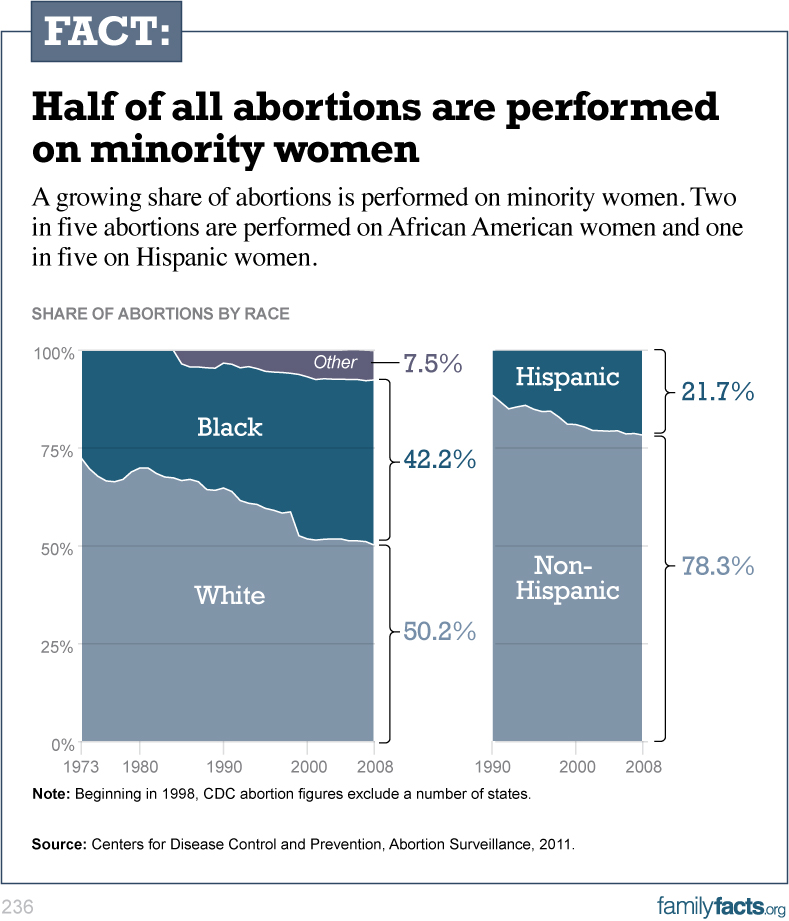
Today, half of all abortions are performed on minority women, according to the latest official figures published by the Centers for Disease Control and Prevention.
(article continues below chart)
Since the 1970s, the share of abortions performed on white women in America has decreased by 24 percent, while the share performed on African American women has increased by 34 percent. And while African Americans are 13 percent of the population, they account for over 42 percent of the abortions.
After 40 years of our nation devaluing life, our leaders in Washington should advocate policies that would allow each new life to flourish to its full potential.
You can listen to this Family Facts radio feature here. Radio stations interested in airing the daily Family Facts Radio Feature can learn more here. Family Facts charts are also delivered weekly in Heritage’s Culture Watch e-newsletter.
Dr Richard Land discusses abortion and slavery – 10/14/2004 – part 3 The best pro-life film I have ever seen below by Francis Schaeffer and Dr. C. Everett Koop “Whatever happened to the human race?” Over the years I have taken on the Ark Times liberal bloggers over and over and over concerning the issue […]
The best pro-life film I have ever seen below by Francis Schaeffer and Dr. C. Everett Koop “Whatever happened to the human race?” Francis Schaeffer pictured above._________ The 45 minute video above is from the film series created from Francis Schaeffer’s book “Whatever Happened to the Human Race?” with Dr. C. Everett Koop. This book really […]
The best pro-life film I have ever seen below by Francis Schaeffer and Dr. C. Everett Koop “Whatever happened to the human race?” Over the years I have taken on the Ark Times liberal bloggers over and over and over concerning the issue of abortion. I asked over and over again for one liberal blogger […]
Francis Schaeffer pictured above._________ The best pro-life film I have ever seen below by Francis Schaeffer and Dr. C. Everett Koop “Whatever happened to the human race?” Over the years I have taken on the Ark Times liberal bloggers over and over and over concerning the issue of abortion. I asked over and over again […]
The best pro-life film I have ever seen below by Francis Schaeffer and Dr. C. Everett Koop “Whatever happened to the human race?” On 1-24-13 I took on the child abuse argument put forth by Ark Times Blogger “Deathbyinches,” and the day before I pointed out that because the unborn baby has all the genetic code […]
PHOTO BY STATON BREIDENTHAL from Pro-life march in Little Rock on 1-20-13. Tim Tebow on pro-life super bowl commercial. Over the years I have taken on the Ark Times liberal bloggers over and over and over concerning the issue of abortion. Here is another encounter below. On January 22, 2013 (on the 40th anniversary of the […]
Dr Richard Land discusses abortion and slavery – 10/14/2004 – part 3 The best pro-life film I have ever seen below by Francis Schaeffer and Dr. C. Everett Koop “Whatever happened to the human race?” Over the years I have taken on the Ark Times liberal bloggers over and over and over concerning the issue […]
I have spent alot of time talking about Woody Allen films on this blog and looking at his worldview. He has a hopeless, meaningless, nihilistic worldview that believes we are going to turn to dust and there is no afterlife. Even though he has this view he has taken the opportunity to look at the weaknesses of his own secular view. I salute him for doing that. That is why I have returned to his work over and over and presented my own Christian worldview as an alternative. Take a moment and read again a good article on Woody Allen below. There are some links below to some other posts about him.
In the final scene of Manhattan, Woody Allen’s character, Isaac, is lying on the sofa with a microphone and a tape-recorder, dictating to himself an idea for a short story. It’ll be about “people in Manhattan,” he says, “who are constantly creating these real unnecessary, neurotic problems for themselves” because they cannot bear to confront the “more unsolvable, terrible problems about the universe.” In an attempt to keep it optimistic, he begins by asking himself the question, “Why is life worth living?” He gives it some thought. “That’s a very good question,” he says, “There are certain things, I guess, that make it worthwhile.” And then the list begins: Groucho Marx, Willie Mays, the second movement of Mozart’s ‘Jupiter Symphony,’ Louis Armstrong’s recording of Potato Head Blues, “Swedish movies, naturally,” Flaubert’s Sentimental Education, Marlon Brando, Frank Sinatra, “those incredible apples and pears by Cézanne, the crabs at Sam Wo’s … Tracy’s face.”
This list acts as an important hinge in the film’s narrative, the point at which Isaac suddenly becomes aware of his feelings for Tracy and resolves to go after her. But within the list there is also something far greater being communicated, something which, I believe, can be described as the central subject of nearly every Woody Allen film, or, perhaps, as the thing that compels him to make films in the first place. Isaac is conveying here a belief in the sheer power of art, its ability to provide a sense of worth to an otherwise empty existence. Art, Woody Allen seems to be saying, is the only valuable response – or the only conceivable response – to the dreadful human predicament as he sees it.
~ ~ ~
“My relationship with death remains the same: I’m strongly against it.”
~ ~ ~
Recently, at the Cannes Film Festival, Woody Allen was asked about what motivates him. He simply laughed and said, “Fear is what drives me.” Work, for Allen, is a wonderful distraction from the “terrible truth” – the ostensible meaninglessness of life, the apparent futility of all human endeavour, the inevitability of sickness, the unescapable prognosis of death. Film-making, like the “unnecessay, neurotic problems” dreamt up by the characters in Isaac’s short story, diverts Allen’s attention away from this reality, from the fear that presents itself when he stops to think about the fact that eventually everybody dies, “the sun burns out, and the earth is gone, and … all the stars, all the planets, the entire universe, goes, disappears.” So this fear is the reason for his prolificity, the impulse behind all of his artistic achievements. Manhattan, Annie Hall, Hannah and Her Sisters, Sleeper came about, first of all, as distractions, projects that prevented him from having to “sit in a chair and think about what a terrible situation all human beings are in.”
I believe there’s a lot of truth in Woody Allen’s perspective. We distract ourselves constantly, we refuse to think about the meaning of our existence, we skirt around the inevitable. Certainly – and he acknowledges this – Allen is not the first person to have hit upon this truth. It’s been recognised by thinkers such as Kierkegaard, Nietzsche, Freud, Sartre, the Buddha and the writer of Ecclesiastes. And Allen knows, too, that one can’t live in a perpetual awareness of this fact. Such a life would be crippling torment. Indeed, it’s this very torment that Tolstoy found himself in after having realised that there was “nothing ahead other than deception of life and of happiness, and the reality of suffering and death: of complete annihilation.” After realising, in other words, the sheer absurdness of human existence, the meaninglessness of life without God. In his Confession he writes:
My life came to a standstill. I could breathe, eat, drink and sleep and I could not help breathing, eating, drinking and sleeping; but there was no life in me because I had no desires whose gratification I would have deemed it reasonable to fulfil. If I wanted something I knew in advance that whether or not I satisfied my desire nothing would come of it.
We can’t live like this, says Woody Allen. We must provide ourselves with necessary delusions in order to carry ourselves through life. He remarks that, in fact, it’s only those people whom he calls “self-deluded” that seem to find any kind of real satisfaction in living, any peace or enjoyment. These people can say, “Well, my priest, or my rabbi tells me everthing’s going to be all right,” and they find their answers in what he calls “magical solutions.” And this recourse to the “magical” he dismisses as nonsense.
It’s worth comparing Woody Allen’s pessimistic agnosticism with the utopian atheism of someone like Richard Dawkins. Evidently, the former worldview is entirely consistent with non-belief in God, but it’s not clear that the latter is. In fact, it appears unfounded, false. Dawkins removes God from the picture entirely, yet clings persistently to a belief in life’s meaning, grounding this meaning, it appears, in natural selection. There’s a contradiction here in Dawkins’ thought. On the one hand, he claims that science “can tell us why we are here, tell us the purpose of human existence,” yet, on the other, he insists on characterising natural selection itself as a blind mechanism, containing “no design, no purpose, no evil, no good, nothing but pointless indifference.”
Whilst I myself do believe in God and don’t share Woody Allen’s agnostic belief, I can respect his consistency, his willingness to acknowledge an existence without God for what it really is: “a grim, painful, nightmarish, meaningless experience.” His worldview follows naturally from what Heidegger termed the state of human “abandonment,” the absence of God in all human affairs. Dawkins’ worldview, however, doesn’t – it’s an embarrassing mishmash of strict empricist and naturalistic belief with what really amounts to a kind of foggy mysticism, a belief system according to which human beings can create for themselves an objective purpose. What he fails to realise is that this purpose is nothing more than a delusion, a mere appearance of purpose. It might get us up in the morning, but, once again, it’s no more real than the neurotic problems dreamt up by Isaac’s characters.
~ ~ ~
“It is impossible to experience one’s death objectively and still carry a tune.”
~ ~ ~
Let’s return to Woody Allen’s seemingly affirmative opinion of art. Given his lifelong insistence on the belief that human existence is “a big, meaningless thing,” how are we to make sense of Isaac’s list? Is it really possible to reconcile Woody Allen’s adament nihilism with his invocation of the power of art, its ability to stand firm in the face of such a “terrible truth”? The point to be made, I believe, is a very subtle one. In that same interview at Cannes, Allen talks about the role of the artist as he sees it: essentially, they must respond to the question that Isaac poses, “Why is life worth living?” Faced with the emptiness of life, they must try to “figure out – knowing that it’s true, knowing the worst – why it’s still worthwhile.” Allen isn’t, I believe, claiming that art can provide objective meaning to life. Such an assertion would conflict with his unswerving pessimism. Instead, he’s saying that the essence of art, what animates it, what inspires it to flourish, is a courageous struggle against this “terrible truth.” The artist, he says, must confront the futility of life, look at it in the face, embrace it in all of its hopelessness and despair, and provide humanity with an honest reply. The question we should ask in response, then, isn’t, ‘Can Woody Allen justify his belief in objective meaning as embodied in art?’ I don’t think he believes in objective meaning, a necessary purpose for human existence. Rather, the question should be, ‘Is it possible for the artist to look squarely at the human predicament and supply humanity with a worthwhile answer?’
And this, I want to say, still isn’t possible. As we’ve seen in the example of Tolstoy, one can’t live one’s life in full awareness of its apparent futility, of the imminence of death, of the falsity of one’s happiness, and yet carry on as normal. One would end up utterly debilitated. And if this is indeed how artists have been living for centuries, confronting the inevitable, facing the dismal truth, then art itself is an inexplicable phenomenon.
~ ~ ~
“On the plus side, death is one of the few things that can be done just as easily lying down.”
~ ~ ~
The answer isn’t to appeal to art as something that can provide human existence with objective meaning. Such a ‘faith in art’ would merely beg the question, ‘But why is art so special?’ How can art, if viewed as just another custom, an event within the world, give purpose and value to human life? How can that which is within the world give meaning to that which is also within the world? Meaning, I believe, can only come from without, from a personal God who transcends the world, yet is immanent within it, actively involved in human existence, instilling it with significance and worth. One of the purposes of art, I believe, is to reflect the being and glory of God, who is the groundof being itself. Far from art being an escape from a “terrible truth” or a desperate attempt to confront and suppress nihilism, it should be seen as an affirmative activity, an act of creative celebration to be enjoyed in the company of our good Creator God.
Here is a complete list of all the posts I did on the film “Midnight in Paris”
I read this on http://www.crosswalk.com which is one of my favorite websites. Life Lessons from Woody Allen Stephen McGarvey I confess I am a huge film buff. But I’ve never really been a Woody Allen fan, even though most film critics consider him to be one of the most gifted and influential filmmakers of our […]
“Music Monday”:Coldplay’s best songs of all time (Part 6) This is “Music Monday” and I always look at a band with some of their best music. I am currently looking at Coldplay’s best songs. Here are a few followed by another person’s preference: My son Hunter Hatcher’s 15th favorite song is “trouble.” Even though […]
Woody Allen, the film writer, director, and actor, has consistently populated his scripts with characters who exchange dialogue concerning meaning and purpose. In Hannah and Her Sisters a character named Mickey says, “Do you realize what a thread were all hanging by? Can you understand how meaningless everything is? Everything. I gotta get some answers.”{7} […]
“Music Monday”:Coldplay’s best songs of all time (Part 5) This is “Music Monday” and I always look at a band with some of their best music. I am currently looking at Coldplay’s best songs. Here are a few followed by another person’s preference: Hunter picked “Don’t Panic,” as his number 16 pick of Coldplay’s best […]
(If you want to check out other posts I have done about about Steve Jobs:Some say Steve Jobs was an atheist , Steve Jobs and Adoption , What is the eternal impact of Steve Jobs’ life? ,Steve Jobs versus President Obama: Who created more jobs? ,Steve Jobs’ view of death and what the Bible has to say about it ,8 things you might not know about Steve Jobs ,Steve […]
I am a big Woody Allen fan. Not all his films can be recommended but he does look at some great issues and he causes the viewer to ask the right questions. My favorite is “Crimes and Misdemeanors” but the recent film “Midnight in Paris” was excellent too. Looking at the (sometimes skewed) morality of […]
(The signs are up on the buses in Little Rock now and the leader of the movement to put them up said on the radio today that he does not anticipate any physical actions against the signs by Christians. He noted that the Christians that he knows would never stoop to that level.) Debate: Christianity […]
Dave Hogan/ Getty Images This is “Music Monday” and I always look at a band with some of their best music. I am currently looking at Coldplay’s best songs. Here are a few followed by another person’s preference: For the 17th best Coldplay song of all-time, Hunter picks “42.” He notes, “You thought you might […]
Arkansas should allow guns into colleges if people have the proper permits. Look at what happened in 1991 at Luby’s in Texas when a gun had to be left in the vehicle by an honest citizen while a dishonest citizen opened fire killing 23 people. The strictest gun control laws in the land did not save those children at Sandy Hook Elementary either.
Suzanna Gratia Hupp explains meaning of 2nd Amendment!
“Before a standing army can rule, the people must be disarmed; as they are in almost every kingdom in Europe. The supreme power in America cannot enforce unjust laws by the sword; because the whole body of the people are armed….”- Noah Webster, An Examination of the Leading Principles of the Federal Constitution, 1787
On October 16, 1991, Hennard drove his 1987 Ford Ranger pickup truck through the front window of a Luby’s Cafeteria at 1705 East Central Texas Expressway in Killeen, yelled “This is what Bell County has done to me!”, then opened fire on the restaurant’s patrons and staff with a Glock 17 pistol and later a Ruger P89. About 80 people were in the restaurant at the time. He stalked, shot, and killed 23 people and wounded another 20 before committing suicide. During the shooting, he approached Suzanna Gratia Hupp and her parents. Hupp had actually brought a handgun to the Luby’s Cafeteria that day, but had left it in her vehicle due to the laws in force at the time, forbidding citizens from carrying firearms. According to her later testimony in favor of Missouri’s HB-1720 bill[1] and in general, after she realized that her firearm was not in her purse, but “a hundred feet away in [her] car”, her father charged at Hennard in an attempt to subdue him, only to be gunned down; a short time later, her mother was also shot and killed. (Hupp later expressed regret for abiding by the law in question by leaving her firearm in her car, rather than keeping it on her person. One patron, Tommy Vaughn, threw himself through a plate-glass window to allow others to escape. Hennard allowed a mother and her four-year-old child to leave. He reloaded several times and still had ammunition remaining when he committed suicide by shooting himself in the head after being cornered and wounded by police.
Reacting to the massacre, in 1995 the Texas Legislature passed a shall-issue gun law allowing Texas citizens with the required permit to carry concealed weapons. The law had been campaigned for by Suzanna Hupp, who was present at the Luby’s massacre and both of whose parents were shot and killed. Hupp testified across the country in support of concealed-handgun laws, and was elected to the Texas House of Representatives in 1996. The law was signed by then-Governor George W. Bush and became part of a broad movement to allow U.S. citizens to easily obtain permits to carry concealed weapons.