The Killers, a really good rock band

The Killers – Human

The Killers – Read My Mind

The Killers – All These Things That I’ve Done

The Killers – Spaceman

I have really enjoyed the music of The Killers band.

The Killers

From Wikipedia, the free encyclopedia


Jump to: navigation, search

Not to be confused with The Kills.
The Killers

The Killers in concert
Background information
Origin Las Vegas, Nevada, United States
Genres Indie rock,[1] [2] [2] heartland rock[3]
Years active 2001–present
Labels Island, Vertigo, Marrakesh
Website thekillersmusic.com
Members
Brandon Flowers
Dave Keuning
Mark Stoermer
Ronnie Vannucci, Jr.

The Killers are an American rock band that was formed in Las Vegas, Nevada in 2001, by Brandon Flowers (lead vocals, keyboards) and Dave Keuning (guitar, backing vocals). Mark Stoermer (bass, backing vocals) and Ronnie Vannucci Jr. (drums, percussion) would complete the current line-up of the band in 2002. The name The Killers is derived from a logo on the bass drum of a fictitious band, portrayed in the music video for the New Order song “Crystal“.[4]

The group has released four studio albums, Hot Fuss (2004), Sam’s Town (2006), Day & Age (2008) and Battle Born (2012).[5] They have also released one compilation album, Sawdust (2007) and one live album titled Live from the Royal Albert Hall (2009). To date, the band has sold over 6 million albums in the United States, over 5 million albums in the United Kingdom, and a total of 16 million worldwide.[6]

Contents

 [hide] 

[edit] History

[edit] 2001–03: Origins and formation

In 2001, Brandon Flowers was abandoned by his first band, a Las Vegas synthpop trio known as Blush Response,[4] after he declined to move with them to Los Angeles. After seeing Oasis play at the Hard Rock Hotel during the band’s The Tour of Brotherly Love, Flowers realized his calling was to be in a rock band and began searching for like-minded musicians. He eventually came across an ad posted in a Las Vegas newspaper by Dave Keuning, a 25 year-old guitarist who had moved to Vegas from Iowa a year earlier; the pair shared similar musical influences and soon began writing songs together in Keuning’s apartment. By the end of 2001, they had recorded a demo at Kill The Messenger Studio in Henderson, Nevada; the demo featured four tracks including early versions of “Mr. Brightside” and “Under the Gun”. Local drummer Matt Norcross played drums on the demo while Dell Neal, who was Keuning’s roommate at the time, covered bass on two of the tracks. Keuning and Flowers played their first live show together at an open mic night at the Cafe Espresso Roma in Las Vegas in January 2002; the pair, joined by Neal and Norcross, began playing numerous venues around Las Vegas where they would also hand out free copies of their demo.[7] The Killers brought a unique style to the small Vegas music scene which was predominately filled with punk, nu metal, and rap bands, one local reviewer stated “The Killers, thankfully, don’t come across like any other band in town” and described their sound as a mix between the “pop styles of British music and the lo-fi fuzz of modern indie rock.”.[8] However, The Killers, whose early live sound was also described as erratic, had, by the summer of 2002, fired drummer Matt Norcross and replaced him briefly with Brian Havens, who also was eventually fired. Bassist Dell Neal later left the band due to personal reasons.[7]

Drummer Ronnie Vannucci, Jr. and bass player Mark Stoermer were members of other bands who regularly played on the same bills as The Killers, both were eventually persuaded to join Keuning and Flowers and by November 2002, the band’s current line up was complete. The four of them began practising in Vannucci’s garage as he was the only member who owned a house. They would also sneak into the band room of UNLV (where Vannucci was studying percussion) at night to practice. The band claimed that they wrote much of the debut album Hot Fuss during these sessions including the hit single “Somebody Told Me“.[9]

The band continued playing at small venues in Las Vegas, where they built a small but loyal following. Talent scout Braden Merrick spotted the band after hearing one of their demos on a website dedicated to local unsigned bands,[10] and after attending a few of their live shows he offered to become the band’s manager. He took the band to the San Francisco area, to Berkeley, California, to record demos with former Green Day manager Jeff Saltzman and mix engineer Mark Needham, they then sent the demo tapes to major record labels in the US. Most of the record labels turned them down, but one company, Warner Bros. Records, invited them to perform at a showcase. Though Warner Bros. was not impressed by the band after the showcase, the band did catch the eye of Niall Norbury,[11] who was from the United Kingdom. Norbury took the band’s demo back to the UK with him, playing it for friend Ben Durling, who worked at UK indie label Lizard King Records. The Killers signed with the British label in July 2003.[12]

[edit] 2003–06: Hot Fuss

On August 19, 2003, the song “Mr. Brightside” premiered on DJ Zane Lowe‘s BBC Radio 1 show in the UK.[13] The Killers then travelled to London and began to play shows in bars and clubs, and critical reviews were generally positive. On September 29, 2003, they released the song “Mr. Brightside” on a limited number of CDs and vinyl records in the UK. As a result of the buzz generated in the UK, upon returning to America, they were invited to play at the ASCAP CMJ Music Marathon in New York City.[14] A number of labels showed interest in the band, and they eventually signed with the record company Island Def Jam in early 2004.[9]

The band’s Hot Fuss Tour started in the UK in May 2004. Prior to that, the band had played support slots for British Sea Power in the UK, Morrissey in the US and Stellastarr in both the UK and US; during the spring and summer of 2004, the group played much-praised sets at festivals across Europe and North America which helped add to their growing fanbase.[15]

The Killers released their debut album Hot Fuss in June 2004 in the United Kingdom on Lizard King Records and in the United States on Island Records.[16] Extensive touring and a number of hit singles led to the album becoming a huge commercial success. Hot Fuss reached Number 1 in the UK in January 2005, seven months after its release, and has been classified 6x Platinum by the BPI.[17] It also reached the top spot in Australia, where it was certified 3x Platinum, and has also been certified 3x Platinum in the United States and Canada.[18] On the UK version of Hot Fuss, “Glamorous Indie Rock and Roll” replaces “Change Your Mind” as track 8.

The band had success with “Mr. Brightside“, which became the band’s first Top 10 hit in both the UK and US,[19] “All These Things That I’ve Done,”[20] “Somebody Told Me,” and “Smile Like You Mean It.”[16]

In 2005, The Killers were nominated for three Grammy Awards; Hot Fuss was nominated for Best Rock Album while “Somebody Told Me” was nominated for two awards including Best Rock Song, in the UK they won an NME Award for Best International Band.

In July 2005, The Killers performed on the London stage of the Live 8 concert, playing “All These Things That I’ve Done”. Robbie Williams incorporated the song’s refrain “I’ve got soul but I’m not a soldier” into his own performance.[21] Coldplay and U2 followed suit and, at their separate concerts played in Las Vegas, with The Killers in the crowd, incorporated the line into their songs “God Put a Smile Upon Your Face” and “Beautiful Day“, respectively.[22]

[edit] 2006–08: Sam’s Town and Sawdust

The Killers’ second album, Sam’s Town, was released in October 2006 under Island Def Jam Music Group.[23] Brandon Flowers said that Sam’s Town would be “one of the best albums of the past twenty years”.[24] It received a mixed response with some praising the album and others mocking it. However, Rolling Stone ranked Sam’s Town as the number one underrated album of the decade. The album sold over 706,000 copies worldwide in the first week of release, with a number two debut on the Billboard chart.[25] The record has been certified 4x Platinum in the United Kingdom, Platinum in the United States, and 2x Platinum in both Australia and Canada. The album produced four singles: “When You Were Young” (Platinum in the United States, Diamond in Brazil), “Bones“, “Read My Mind” and “For Reasons Unknown“.

The Killers recorded a live session at Abbey Road Studios for Live from Abbey Road on November 29, 2006.[26] They performed an almost totally unplugged set, which included a rendition of the Dire Straits hit “Romeo and Juliet“. In December 2006 the band released a Christmas charity song (the first of what would become an annual tradition), “A Great Big Sled“, which benefited Product Red.

In February 2007, The Killers attended the BRIT Awards in the United Kingdom, where they performed “When You Were Young“. The band won two awards — Best International Group & International Album.[27] In the same month the band’s Tim Burton directed video for Bones won Best Video at the NME Awards. During the Sam’s Town Tour The Killers headlined Madison Square Garden for the first time as well as Glastonbury Festival.[28]

The band released a compilation album called Sawdust, containing B-sides, rarities, and unreleased material, in November 2007. Sawdust has been classified Platinum by the BPI.[29] The album’s first single “Tranquilize“, a collaboration with Lou Reed, was released in October 2007.[29] The first pressing of Sawdust contained a rare demo version of “Move Away” which Brandon Flowers later stated was a mistake on the part of the band’s record label; the proper version the group intended to put on the album was previously available on the Spider-Man 3 soundtrack is included on later pressings of Sawdust.[30]

In 2008 the band picked up two awards in the first NME Awards USA, including “Best Band” and “Best Track” for “Tranquilize”. “Sawdust” was also nominated for best album.

[edit] 2008–11: Day & Age and hiatus

The song “Spaceman” was released as band’s third studio album Day & Age on November 4, 2008. This song was number 17 on Rolling Stone‘s list of the 100 Best Songs of 2008.[1] The song has been used regularly as the opening song during the band’s tour.The group began performing the song at shows during their Summer 2008 tour and played it as part of a two-song set on the October 4, 2008 episode of Saturday Night Live. They also performed the song on November 4, 2008 on BBC2’s Later… with Jools Holland.

The Killers performing in September 2009 in the United States

The Killers’ third album, Day & Age, was released on November 24, 2008 in the UK and November 25, 2008 in North America. They worked with Stuart Price who did the Thin White Duke remix of “Mr Brightside” and produced “Leave the Bourbon on the Shelf” and “Sweet Talk”. The first single from the album was “Human” which was released on September 22 and has been certified Platinum by the RIAA.[31] Day & Age became the band’s third studio album to reach number one in both the UK and Ireland, it reached number six on the Billboard 200 album chart.[32] It has also been certified 4x Platinum by the BPI.

In February 2009, the band won Best International band at the NME Awards for the third time following wins in 2005 & 2008. Later, they were awarded the ASCAP Awards‘ highest honor, the Vanguard Award, for their musical genre’s “impact on the future of American music”.[33] During the summer of 2009, The Killers headlined a number of festivals across Europe including the Friday night show of 2009’s Hard Rock Calling in Hyde Park, London, they also headlined American festivals Lollapalooza and Coachella for the first time. On July 5–6 at the Royal Albert Hall, London The Killers recorded their first live DVD, “Live from the Royal Albert Hall“. It was released in November and played at various cinemas across the globe. Live from Royal Albert Hall was certified 4x Platinum by the BPI (UK) and Platinum by the RIAA (US).

After the release of Day & Age, the band embarked on the worldwide Day & Age Tour from 2008 to 2010. The tour was a huge success, with sold-out shows both domestically and internationally. It also marked the first time The Killers played on the continent of Africa.

In late February 2010, Flowers’ mother died after a two year fight with brain cancer. This resulted in a premature closing of their Day & Age tour and cancellation of dates in Asia. Two Australian dates in Sydney and Perth were also cancelled; however, both the Gold Coast and Melbourne concerts went ahead, with the Day & Age tour finally coming to a close in Melbourne on February 21 as the headline act at the Good Vibrations Festival at Flemington Racecourse.[34]

In January 2010, the band announced that they would take a short break after being on the road for the better part of six years.[35][36] The break lasted for about a year-and-a-half, during which band members devoted themselves on solo projects, while the band made sporadic other contributions.

[edit] 2011–present: Return and Battle Born

The band returned to the stage in 2011 when they headlined the new International Lollapalooza Festival in Santiago, Chile on April 2, 2011.[37] They also performed at the season closing Top of the Mountain concert in Ischgl, Austria on April 30, 2011.[38] They headlined for the second time Hard Rock Calling in Hyde Park, London on June 24, 2011.[39] The Killers were the inaugural headliner of the new Orlando Calling Festival in Orlando, FL on November 12, 2011.[40]

The band began work on their fourth studio album[41] in May 2011 at their Las Vegas studio.[42] After a year of recording the Killers revealed in May 2012 that their fourth studio album will be titled Battle Born.[43] During recording, the band worked with producers Steve Lillywhite, Damian Taylor, Brendan O’Brien, Stuart Price and Daniel Lanois.[43] The album was mixed by Alan Moulder, who also worked on the band’s first two albums,[44] and was released on September 18, 2012 (released on September 14, 2012 in New Zealand and Australia). In April 2012, saxophonist Tommy Marth committed suicide. Marth had contributed to Sam’s Town and Day & Age, as well as touring with the band.[45]

In June 2012, The Killers released a trailer for their new album Battle Born.[46] The first single from the album was “Runaways“. It was voted the Best Song of Summer 2012 by Rolling Stone Magazine readers. The album had the third highest opening week in the UK for 2012 albums and became the band’s fourth No. 1 album in the UK (Brandon Flowers’ fifth). It was voted the #2 album of 2012 by Rolling Stone Magazine readers, with single “Miss Atomic Bomb” voted the ‘Best Song of 2012’ in the accompanying poll.[47]

The Killers headlined several festivals in North America and Europe in summer 2012, including the UK’s V Festival and Sziget Festival in Hungary.[48] The band will be headlining the 2013 Big Day Out music festival in Australia.[49]

On June 22 2013, the band are set to perform at the 90,000 capacity Wembley Stadium as one of the final concerts of the Battle Born World Tour; it will be their biggest show to date.

[edit] Contributions and solo work

The Killers own and operate Battle Born Studios where members recorded Battle Born, Day & Age, Flamingo, Big Talk and Another Life. Other artists who have recorded there include Mötley Crüe, Elton John, Imagine Dragons, Jerry Lee Lewis, BB King, Wayne Newton, as well as members of Third Eye Blind, Aerosmith, and Kansas.

The song “A White Demon Love Song” was added to the New Moon soundtrack. The band also performed a tune called “Spaceship Adventure” on Nickelodeon’s Yo Gabba Gabba, where the group were referred to simply as “Brandon, Ronnie, Mark and Dave”, as opposed to “The Killers”, in order to be more suitable for young children.[50]

The band recorded a cover of the Raspberries‘ song “Go All the Way” for Tim Burton‘s film Dark Shadows (an adaptation of the late 1960s gothic soap opera), which plays over the end credits, however the song does not appear on the film’s soundtrack.[51]

In October 2011, The Killers contributed a cover of “Ultraviolet (Light My Way)” to a cover album of U2’s acclaimed 1991 album Achtung Baby. The cover album, titled AHK-toong BAY-bi Covered, was released in the October 25 issue of Q Magazine.[52]

  • In September 2010, Brandon Flowers released a solo album, titled Flamingo. It charted as a top ten album in ten countries including reaching No. 1 in the UK where it has been certified Gold.[53] Single “Crossfire” became Flowers’ fifth top ten single in the UK, including work by The Killers.
  • Drummer Ronnie Vannucci released an album titled Big Talk in July 2011 via his own record label, Little Oil, in a team effort with Epitaph Records.[54] Vannucci also featured as a guest artist on Mt. Desolation‘s self-titled debut album.
  • Bassist Mark Stoermer released his debut solo album titled Another Life in November 2011 as a free download via markstoermer.com for a limited time, with a physical self-release following.[55] Stoermer also produced the Howling Bells‘s third album, The Loudest Engine, released on September 12, 2011 via Cooking Vinyl.[56][57]

[edit] Band members

Current members
  • Brandon Flowers – lead vocals, keyboards, synthesizers, piano, bass guitar (2001–present)
  • Dave Keuning – lead guitar, backing vocals (2001–present)
  • Mark Stoermer – bass guitar, backing vocals, guitar (2002–present)
  • Ronnie Vannucci, Jr. – drums, percussion, backing vocals (2002–present)
Former members
  • Dell Neal – bass guitar (2001–2002)
  • Matt Norcross – drums (2001–2002)
  • Brian Havens – drums (2002)
Touring musicians
  • Rob Whited – percussion, backing vocals (2006–present)
  • Bobby Lee Parker – acoustic guitar (2008–present)
  • Ted Sablay – keyboards, guitar, backing vocals (2006–2007, 2011, 2012–Present)
  • Jake Blanton – keyboards, guitar, backing vocals (2011–present)
Former touring musicians
  • Tommy Marth – saxophone, backing vocals (2008–2010; died 2012)
  • Ray Suen – keyboards, guitar, violin, backing vocals (2008–2010)

[edit] Discography

[edit] Tours

[edit] Commercial and critical acclaim

Hot Fuss has sold more than 7 million units worldwide, it was the 26th best-selling album of the decade in the United Kingdom. It spent 173 weeks on the UK Albums Chart, more than any other album.[58] In 2013, Gigwise readers ranked it No. 1 “Best Debut Album of All Time”.[59] Rolling Stone magazine ranked Hot Fuss as the 43rd best album in their “100 Best Albums of the Decade” list,[60] and “Mr. Brightside” was ranked the 48th Best Song Of The Decade.[61]

Sam’s Town has sold over 5 million units worldwide. The readers of the American music magazine Rolling Stone, in December 2009, voted Sam’s Town the No. 1 “Most Underrated Album of the Decade”.[62] While in the UK, Sam’s Town was the 70th best selling album of the decade, and Q magazine ranked it as the 11th best album of the decade.[63]

The Killers have won four NME Awards: “Best International Band” in 2005, 2008 and 2009 and Best Video for “Bones” in 2006. They have also received two awards in the first NME Awards USA in 2008 for “Best Band” and “Best Track” for “Tranquilize”. The band has also been nominated for seven Grammy Awards. In 2006, the band won the BRIT Award for “Best International Band”, while the album Sam’s Town went on to win “Best International Album”. To date, the band has received six nominations for “Best International Band” at the NME Awards and three nominations for “Best International Group” at the BRIT Awards.

In 2008, Rolling Stone readers voted Day & Age the “Album of the Year” and “Cover of the Year”.[64] In 2009, readers voted “Sam’s Town” the #1 “Most Underrated Album of the Decade”.[65] In 2012, readers voted “Battle Born” the #2 “Album of the Year” and single “Miss Atomic Bomb” the “Best Song of 2012”.[66][67]

Eleven songs by The Killers feature in the book XFM’s 1000 Greatest Songs of All Time; frontman Brandon Flowers also wrote a foreword for the book.[68]

In November 2009, “Mr. Brightside” was voted the best song of the decade by the listeners of the British alternative rock station XFM.[69] Over 14,000 individual votes were cast by XFM listeners via the station’s official website. “Somebody Told Me” was ranked No. 9[69] and “All These Things That I’ve Done” was ranked No. 22.[70] Other songs not in the Top 25 include “When You Were Young” at No. 31,[71] “Read My Mind” at No. 86,[72] and “Human” at No. 94.[73][74] Absolute Radio listeners also voted “Mr. Brightside” as the best song of the decade.
Amazon.com UK released their lists of the best-selling artists and albums of the decade,[75] with The Killers coming in at No. 3 in Top 10 best-selling artists of the decade.

[edit] Activism

Invited by U.S. President Barack Obama, the band played on the White House South Lawn on July 4, 2010 for the second annual “Salute To The Military” United Service Organizations concert as part of Independence Day celebrations, which Flowers described as a “monumental honor”.[76] Despite their hiatus, the band got together to play “Human”, “Somebody Told Me”, “Mr. Brightside”, “A Dustland Fairytale”, “God Bless America/Read My Mind” and “When You Were Young”.[77] Flowers, Keuning and Stoermer also played at a campaign rally on July 8, 2010 in Nevada for Obama and U.S. Senate Majority Leader Harry Reid who was up for re-election. The Killers played an acoustic version of “Read My Mind” and did a folksy rendition of the state song, “Home Means Nevada“.

In February 2011, Flowers had a private one-on-one lunch with Mitt Romney during Romney’s visit to the Republican Party convention in Nevada.[78] In October 2012 Flowers confirmed that the band had declined an offer to support Romney, stating that the band were staying neutral in the election.[79]

[edit] Philanthropy

The Killers have become recognized for their work with the Product Red campaign, headed by Bono and Bobby Shriver. To date they have released seven Christmas themed songs and music videos: “A Great Big Sled” (2006), “Don’t Shoot Me Santa” (2007), Joseph, Better You Than Me” (2008), “¡Happy Birthday Guadalupe!” (2009), “Boots” (2010), “The Cowboy’s Christmas Ball” (2011) and “I Feel It In My Bones” (2012). On November 30, 2011 they released the (RED) Christmas EP on iTunes which features all six songs that had been released up to that point. All proceeds from the songs have been donated to Product Red campaign and the fight against AIDS in Africa. They have also enlisted the help of other acts including Elton John, Neil Tennant (Pet Shop Boys), Toni Halliday (Curve), Wild Light and Mariachi El Bronx.

Additionally, their song “Goodnight, Travel Well” was used in an effort to promote awareness for sex trafficking headed by UNICEF, MTV EXIT (End Exploitation And Trafficking) and the US Agency for International Development.[80][81] The song “Hotel California” was covered by the Killers and Rhythms del Mundo for climate crisis and natural disaster relief

The Critics’ Admissions Concerning Daniel

The Bible and Archaeology (1/5)

I have been amazed at the prophecies in the Bible that have been fulfilled in history. John MacArthur went through every detail of the prophecy concerning Tyre and how history shows the Bible prophecy was correct.
I love the Book of Daniel and I am starting a series today on the historicity of the Book of Daniel.
1998 / March-April


Farrell Till has asserted that reputable Bible scholars believe that the book of Daniel was not written by an individual named Daniel during the sixth century B.C. (TSR, Vol 4.3, p. 12). These scholars hold that the writer lived in the time of the Maccabees, and his “purpose was to give his countrymen reason to believe that centuries earlier a prophet of Yahweh had foreseen the rise of the Seleucid Empire and had predicted the triumph of the Maccabean struggle for independence against Antiochus Epiphanes” (TSR, Vol. 7.3, p. 3). William Sierichs, Jr. also takes this position in his article, “Daniel in the Historians’ Den” (TSR, Vol. 7.4, p.8). Sierichs comments, “Daniel can’t get Babylonian history straight, but he does pretty well by the Hellenistic era. Obviously, whoever wrote the book was a very solid citizen of the 2nd century B.C.E., whose `prophecies’ were wholly retroactive.”

Both Till and Sierichs have been influenced by biblical scholars who have embraced the higher critical views of the 1800’s. However, most people have overlooked the fact that these same scholars have made several admissions which are damaging to their Maccabean thesis.

The first admission concerns the conservative’s view that Rome is the fourth kingdom identified in Daniel’s prophecy. Till states the critic’s logic: “A flaw in this interpretation is the obvious fact that the writer of Daniel considered the median and Persian kingdoms to be separate empires, because he had the Neo-Babylonian empire falling to `Darius the Mede’ (5:30-31). This is historically inaccurate (just one of many historical inaccuracies in the book of Daniel), because reliable records of the time indicate that Cyrus the Great captured Babylon and ended the Neo-Babylonian kingdom. Nevertheless, the writer of Daniel told of a reign under “Darius the Mede: that preceded the reign of the Persian king, Cyrus the Great (6:28; 10:1). So if the writer believed that the Neo-Babylonian Empire fell to the Medes and then the Medes fell to the Persians, then the fourth kingdom in Daniel’s interpretation would have been Alexander’s Hellenistic empire” (TSR, Vol. 4.3, p. 12).

Notice that Till bases his conclusion on the “obvious fact that the writer of Daniel considered the Median and Persian kingdoms to be separate empires….” However, the famous Bible critic, Dr. Samuel Driver, admitted, “In the book of Daniel the `Medes and Persians’ are, it is true, sometimes represented as united (Daniel 5:28; 6:8, 12, 15, cf. 8:20)” (The Book of Daniel: Cambridge Bible for Schools and Colleges, Cambridge: University Press, 1900, p. 29). Conservative scholar Stephen Miller comments: “Such an admission seems fatal to Driver’s position, for if the author was aware at one point that the two nations were united into one empire, he certainly would not have construed them as separate both physically and chronologically elsewhere in the same book” (Daniel: The New American Commentary, Nashville, TN, Broadman and Holman Publishers, 1994, p. 95).

Moreover, in Daniel 5:28, the word peres has the same consonants (only the consonants were written in ancient Aramaic and Hebrew scripts) as the Aramaic term translated “Persians” and likely was a paronomasia (a word play) hinting that the division of the kingdom would be accomplished by the Persian armies. Bible critic Norman W. Porteous admits this hints at “the victory of Persia over Babylon” (Daniel, The Old Testament Library, Philadelphia: Westminster, 1965, p. 81). Furthermore, the Bible critic John A. Montgomery agrees (“A Critical and Exegetical Commentary on the Book of Daniel,” International Critical Commentary, T. and T. Clark, Edinburgh, 1979, p. 263).

Arthur Jeffrey claims the author assumed from his reading of Old Testament prophecies (Isaiah 13:17; 21:2, and Jeremiah 51:11, 28) that the Medes conquered Babylon before the Persians (Arthur Jeffrey, “The Book of Daniel,” Interpreter’s Bible, Nashville: Abingdon, 1956, p. 434). However, Isaiah 21:2 blows this theory out of the water, because it speaks of Elam and Media as the joint-conquerors of Babylon. The critic H. H. Rowley admits: “This was doubtless written after Cyrus, king of Anshan, in southwest Elam, had brought the rest of Elam under his sway, when to the Hebrew observer it appeared likely that these two powers might unite in the destruction of Babylon. And since Elam is mentioned first, it is possible that the passage dates from a time after the absorption of Media by Cyrus” (H. H. Rowley, Darius the Mede and the Four World Empires in the Book of Daniel, 1935; reprint, Cardiff: University of Wales, 1964, p. 58).

Till correctly notes that the writer of Daniel had “Darius the Mede” conquering Babylon, but nowhere does the writer state that Darius was “the king of the Medes” or the “king of Media.” Dr. Robert H. Pfeiffer of Harvard University admitted the author of Daniel was “a very learned man” and “a sage” (Robert H. Pfeiffer, Introduction to the Old Testament, New York: Harper and Brothers, 1948, p. 757), but Pfeiffer must have assumed that this “sage” had never read 2 Chronicles 36:20 where it is said that the Jews were servants to Nebuchadnezzar “and his sons until the reign of the kingdom of Persia.” Clearly this indicates that the Persian reign came immediately after the Babylonian reign.

The second admission concerns the madness of Nebuchadnezzar in Daniel chapter four. William Sierichs, Jr., states that “the story of Nebuchadnezzar’s insanity may be a reference to a bout of insanity or lengthy depression in Nabonidus, who apparently was very unpopular in Babylon…” (TSR, Vol. 7.4, p. 8). This is the position held by many modern critical scholars today. Conservatives prefer a different explanation. Stephen Miller comments: “Some scholars have deemed this chapter primarily a fictional account, likely derived from the same source as the so-called `prayer of Nabonidus’ (4QPrBab), an Aramaic fragment discovered at Qumran in 1952 (D. N. Freedman, “The Prayer of Nabonidus,” Bulletin of the American Schools of Oriental Research, Vol. 145, 1957, pp. 31-32). Though affinities exist between Daniel 4 and the “Prayer of Nabonidus,” they are far outweighed by the differences (e.g., name of the king, nature of the illness, and location). It seems reasonable to categorize the Nabonidus story as a distorted version or a later application of the biblical narrative” (p. 145).

Nevertheless, the critics insist there is no hint in the historical record that indicates it was Nebuchadnezzar with this strange case of madness that resulted in a seven-year absence. R. H. Pfeiffer called Daniel chapter four an “unhistorical tale,” and “a confused reminiscence of the years when Nabonidus spent at Tema in Arabia” (p. 758). Norman W. Porteous states, “indeed there is no record of Nebuchadnezzar’s having had leave of absence from his royal duties on account of insanity” (p. 70). However, later on the same page Porteous admits that fellow Bible critics Bevan, Montgomery, Bentzen, and Jeffrey have recorded such a story. Abydenus’s account is preserved by Eusebius (Praeparatio Evangelica, 9.41.1) and is reproduced by John A. Montgomery (p. 221).

Abydenus says that in the last days of Nebuchadnezzar, the king was “possessed by some god or other” while in his palace, and announced the coming of a Persian mule (i.e., Cyrus), who would bring the people into slavery. Then says Abydenus, “He, when he had uttered this prediction, immediately disappeared” (Praeparatio Evangelica, 9.41.1). Surely Porteous is wrong to admit the existence of this story by the historian Abydenus, and at the same time insist that “there is no record of Nebuchadnezzar’s having had leave of absence from his royal duties…”

The third and fourth admissions concern linguistic arguments. Farrell Till asserts: “Bible fundamentalists like to think that Daniel was written in the sixth century B. C., shortly after the events that the book closes with during the reign of Cyrus the Great, who had conquered Babylon in 539 B.C. Few reputable Bible scholars, however, would fix the date that early, because the book exhibits signs of a much later authorship. Scholars cite the writer’s obvious confusion about political events of the time that a contemporary would have surely been familiar with, the linguistic style (especially the section written in Aramaic), and other factors too numerous to discuss in detail as evidence that the book was written at the extreme end of the Old Testament period (no sooner than the second century)” (TSR, Vol. 4.3, p. 13).

Dr. Samuel Driver also made much of the Aramaic of the Book of Daniel. he stated, “The Aramaic of Daniel (which is all but identical with that of Ezra) is a Western Aramaic dialect, of the type spoken in and about Palestine” (p. 59 of the introduction of Driver’s commentary on Daniel), and he went on to suggest that archaeology had confirmed this. However, Jeffrey admits that the Aramaic in the Book of Daniel “cannot be pressed as evidence for a particular date, for it is that type of Aramaic which grew up for official use in the chancelleries and came to be widely used in the ancient Near East” (p. 349). Jeffrey cites more recent discoveries of fifth-century Aramaic texts that totally discredit Driver’s view (Franz Rosenthal, Die Aramaistische Forschung, [Leiden: E. J. Brill, 1939] pp. 66-71).

Till has highly recommended Jeffrey’s work on Daniel (TSR, Vol. 7.3, p. 3, and Vol 7.4, p. 8). According to Till, Jeffrey’s material “gives a detailed analysis of the Book of Daniel to show, first of all, that it was not written by its namesake who allegedly lived in Babylon during the captivity, but by an unknown author during the time of the Seleucid Empire, which arose from the partitioning of Alexander’s kingdom after his death” (TSR, Vol. 7.3, p. 3). Does Jeffrey’s work accomplish this feat? Let’s look at a couple of popular arguments that he uses.

The fourth admission by the critics concerns the term “Chaldeans.” Jeffrey argues: “The use of the word kasdim (Chaldeans), not in the proper ethnic sense which it has, for example, in Jeremiah, but to mean a caste of wise men, points to a time when the word was commonly used for a class of priestly astrologers, diviners, or magicians, a sense the word has in the pages of Strabo or Diodorus Siculus, who wrote in the first century B.C. (p. 349).

Dr. Driver agrees that the argument concerning the use of the term “Chaldeans” is very convincing. So much that he places it first in the list of his three strongest arguments that show that the book of Daniel was composed in Palestine “during the persecution of Antiochus Epiphanes” (pp. 47-56 of the Introduction).

How strong is this argument? On page 12 of Driver’s commentary, Driver himself takes exceptions to some of the assertions made by Jeffrey. Driver admits that in Daniel 5:30, and 9:1 the author of the book of Daniel did use the ethnic sense of the word “Chaldeans.” Then on the same page Driver admits this term “Chaldeans” is found “in Herodotus (Herodotus, Histories, 1.181-183, c. 440 B.C.), and is common afterwards in the classical writers” (p. 12). Furthermore, Driver also admits that evidence indicates that such a group of wise men as pictured in the book of Daniel did exist as a group as early as 2000 B.C. (p. 14).

Francis Schaeffer summarized Driver’s argument: “Remember this is his first strong argument. he is going to take the book of Daniel and throw away its historical date on the basis of these `so-called’ strong arguments. Now we have defined this question in regard to the term “Chaldeans.” The writer knew the ethnic sense. This group did exist from a long time before. About 90 years later everybody acknowledges that the word was used in this sense to the wise men. And so he is going to throw away the book of Daniel and its dating and all that it means on the basis that this specific group of wise men, who were well known from long before and afterwards, were not called this term in this 90-year span (530 B.C. to 440 B.C.). Now, once you word it this way, it doesn’t look so strong” (Francis Schaeffer’s five part series, Dr. Driver’s Criticism of the Book of Daniel, tape #2).

Is it any wonder that the bible critic J.J. Collins admits that the author’s use of the term “Chaldeans” cannot be used to date his material (Daniel, Hermeneia, Minneapolis: Fortress, 1994, pp. 137-138). In fact, Jeffrey makes a similar error in his commentary on Daniel 10:1. He states: “Cyrus is here called `king of Persia.’ This may be merely a statement of fact, for he was king of Persia, but if it is meant as an official title, it is an anachronism in the mouth of Daniel. The title ‘king of Persia’, was Hellenistic usage and not the usage of the Achaemenid kings at this time” (p. 500).

Jeffrey overlooked the fact that Robert Dick Wilson contradicted this view expressly with what he found in the tablets of the Persian period (Robert Dick Wilson, “The Title `King of Persia’ in the Scriptures,” The Princeton Theological Review, Vol. 15, 1917, pp. 90-145). Wilson commented: “It is evident therefore, that there are thirty-eight distinct extra-biblical instances of the use of this title from 545 to about 400 B.C.; and that these instances are found in twenty different works by nineteen different persons (p. 100).”

This argument of Jeffrey’s is completely put to flight concerning Daniel 10:1. It shows how much many of these scholars continue to repeat the same old arguments. No doubt, Jeffrey had read this argument in Driver’s commentary (p. 152), but he had failed to read the refutation provided by Wilson seventeen years later. I must admit that I have just repeated the arguments of others on occasion without taking a closer look at both sides of the argument. For example, I was guilty of making it appear that the interpretation of Daniel 5:7 is a simple matter. Driver says the verse should read, “Shall rule as one of three in the kingdom” (p. 64), but most conservative scholars claim the translation should be “the third highest ruler in the kingdom” (NIV). Conservatives claim this is an indirect reference to Nabonidus while the critics relate the passage to Daniel 6:2, which speaks of three rulers of equal rank and uses a similar word.

At first I sided with the conservatives, but after further investigation I must admit that I am undecided. What created doubts in my mind? It was the admission of three conservative scholars that the critics may be right on this verse. On 4-26-96, I wrote Dr. Robert L. Alden about this verse. He responded: “I looked up both Wood and Young as well as a couple [of] other commentaries on Daniel. I also looked over the Aramaic original just to see what the syntax of the verse was. I understand the reason for the differences of opinion that you have discovered and am not sure which side of the log I fall off. Perhaps the concluding sentence at the end of the first paragraph in E.J. Young’s commentary is best, `but probably it is not to be too dogmatic concerning the precise meaning of this word….’ Incidently [sic] I had E. J. Young when I was a student at Westminster Theological Seminary 1959- 1962. And I worked with Leon Wood on the translation of the NIV.”

Earlier I thought I had a lot of ammunition with the admission by critics W. Sibley Towner and R.A. Anderson that the conservatives had the translation of Daniel 5:7 correct (W. Sibley Towner, Daniel, Interpretation: A Bible Commentary for Teaching and Preaching, Atlanta: John Knox, 1984, p. 73; R. A. Anderson, Signs and Wonders, International Theological Commentary, Grand Rapids: Eerdmans, 1984, p. 57). However, now I don’t think it is wise to press the issue.

Nevertheless, there are two other issues in this chapter that I will press, and they both concern Belshazzar. In the article “Daniel in the Historians’ Den,” William Sierichs, Jr., states that Belshazzar was not the “son” of Nebuchadnezzar, and “Belshazzar was not the ruler as the Book of Daniel claims, and he was never king” (TSR, Vol. 7.4, p. 8).

These are two of the most common arguments used against the book of Daniel, but even the radical critic, Dr. Philip R. Davies has admitted that both are “weak arguments” (Philip R. Davies, Daniel, Sheffield: JSOT Press, 1985, p. 31). He stated: “Critical commentaries, especially around the turn of the century, made much of the fact that Belshazzar was neither a son of Nebuchadnezzar, nor king of Babylon. This is still sometimes repeated as a charge against the historicity of Daniel, and resisted by conservative scholars. But it has been clear since 1924 (J.A. Montgomery, Daniel, International Critical Commentary, Edinburgh: T. and T. Clark, New York: C. Scribner’s Sons, 1927, pp. 66-67) that although Nabonidus was the last king of the Neo-Babylonian dynasty, Belshazzar was effectively ruling Babylon. In this respect, then, Daniel is correct. The literal meaning of son should not be pressed” (pp. 30-31).

I call Davies a radical critic because he refuses to accept the archaeological evidence that indicates that king David existed (Philip R. Davies, “`House of David’ built on Sand,” Biblical Archaeology Review, July/August 1994, pp. 54-55), and more recently he suggested that Hezekiah’s tunnel was not dug by Hezekiah’s men when the Bible claims, but was constructed centuries later. However, several eminent archaeologists put this reinterpretation to rest (“Defusing Pseudo-Scholarship,” Biblical Archaeology Review, March/April 1997, pp. 41-50). For Davies to concede anything, it must really be self-evident. Therefore, I put forth his admissions as especially meaningful. Furthermore, Davies does not accept the same view that Till and Sierichs do concerning the date of the authorship of the first six chapters of Daniel.

In the 19th century the consensus among Bible critics was that all of the chapters of Daniel were written in Palestine during the 2nd century B.C. However, in the 20th century most of the critics admit the first six chapters could have been written as early as the 6th century B.C. in Babylon. Philip R. Davies comments, “According to nearly every modern commentator, the tales of chapter 1-6 are originally products of a Jewish community in a Gentile environment” (Philip R. Davies, “Eschatology in the Book of Daniel,” Journal for the Study of the Old Testament, Vol. 17, 1980, p. 33).

Could it be that the archaeological, linguistic, and historical evidence concerning Daniel will lead next century’s critics to consider the traditional theological view? This reminds me of an amazing quote from the astronomer Dr. Robert Jastrow: “For the scientist who has lived by his faith in the power of reason, the story ends like a bad dream. He has scaled the mountains of ignorance; he is about to conquer the highest peak; as he pulls himself over the final rock, he is greeted by a band of theologians who have been sitting there for centuries” (Robert Jastrow, God and the Astronomers, New York: Warner Books, 1978, p. 111).

(Everette Hatcher III, P. O. Box 23416, Little Rock, AR 72221)

Video clips of Jonah Goldberg and an interview about his book “Liberal Fascism” (Part 4)

_______________

Liberal Fascism Q-A (2)

Uploaded by on Feb 17, 2008

PLAYLIST: http://www.youtube.com/view_play_list?p=C20E954A7632DCFD
PART 1: http://www.youtube.com/watch?v=GsFoiVZDSRs&feature=PlayList&p=C20E954…
Q&A session — Jonah Goldberg discusses his new book, “Liberal Fascism: The Secret History of the American Left, From Mussolini to the Politics of Meaning”, at The Heritage Foundation on C-SPAN2. 09 JAN 08. (heritage.org)

____________________________________________

Below is  a portion of the blog post Interviewing Jonah Goldberg About His New Book, Liberal Fascism by John Hawkins. I thought you would enjoy it:

Yesterday, I interviewed Jonah Goldberg about his new book, Liberal Fascism: The Secret History of the American Left, From Mussolini to the Politics of Meaning.

What follows is a slightly edited transcript of our conversation.

________

If you were going to give people a 30 second explanation of why they should buy your book, what would you tell them?

The primary reason someone should buy my book is because it’s the first book to put all in one place the stuff that is left out of the history books and the narrative that we’ve heard for the last 70 years. It corrects the record about the slander that has been aimed at conservatives for a half century — that we are fascists, that we are Nazis. Even if you disagree with a lot of the arguments, I think most, if not all fair minded readers will concede that they learned a lot from it. I am not winging it. Every claim is backed up by facts, by footnotes. Every argument marshals evidence to support it. If you disagree with everything, even if you think liberalism is still the best thing that we have for bettering society…I think that you’ll be better armed to make your case because you’ll at least know the downside of your own intellectual history. You’ll know the darker side of progressivism. In an age where Hillary Clinton is saying that…she’s a progressive, I think it’s pretty important to understand what progressivism was and what its ultimate aims and impulses are.

Do you regularly or semi-regularly read any blogs you’d like to recommend to RWN’s readers?

I’m not reading anything right now because of the book tour, but all the obvious ones. The National Review blogs, The Corner, The Campaign Spot, that kind of thing. I obviously check out Instapundit and my mom’s site, Lucianne.

The problem is, whenever I am asked this question, I get in more trouble for the blogs that I don’t mention than the ones that I do, (laughs). So, Ross Douthat has always had some fascinating and interesting things to say. I think Mickey Kaus, even though he’s a liberal, is the best guy out there at dissecting the really fine point stuff, like how the New York Times covers things. It’s useful. I think (bloggers) do great stuff…

Well Jonah, thanks a lot…

Great, I appreciate it!

Liberal Fascism Q-A (3)

Uploaded by on Feb 17, 2008

PLAYLIST: http://www.youtube.com/view_play_list?p=C20E954A7632DCFD
PART 1: http://www.youtube.com/watch?v=GsFoiVZDSRs&feature=PlayList&p=C20E954…
Q&A session — Jonah Goldberg discusses his new book, “Liberal Fascism: The Secret History of the American Left, From Mussolini to the Politics of Meaning”, at The Heritage Foundation on C-SPAN2. 09 JAN 08. (heritage.org)

Sequester Cartoons from Dan Mitchell’s blog Part 3

I have put up lots of cartoons from Dan Mitchell’s blog before and they have got lots of hits before. Many of them have dealt with the economy, eternal unemployment benefits, socialism,  Greece,  welfare state or on gun control.

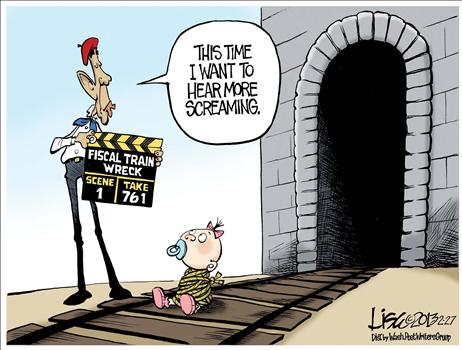
These sequester cartoons from Dan Mitchell’s blog have been great but today he has about 1/2 cartoons that are much more funny than the past ones. Obama’s scare tactics make for real funny cartoons.

I shared some sequester cartoons last month, but I didn’t think they hit the nail on the head.

As regular readers know, I want the message to be focused.

  1. The problem is spending, not deficits.
  2. Government is too big.
  3. The sequester is a good thing, albeit too small.
  4. Obama and the other politicians are engaging in hysterical hyperbole to protect special-interest spending.

I think that message is slowly sinking in, which is why I was much happier about the next batch of sequester cartoons.

Now we have an embarrassment of riches. Enjoy (and widely share) this set of cartoons.

We’ll start with Michael Ramirez, who uses pie charts to show how much bigger government is today and how the sequester is just crumbs.

Sequester Cartoon Ramirez 3

And here’s one from Ed Gamble showing the President engaging in fear tactics, though both Ramirez and Gamble are wrong about the “cuts.” The sequester cuts $85 billion of “budget authority,” but that translates into only $44 billion of “budget outlays.”

That’s just 1.2 percent of FY2013 spending. And remember that this means spending will still go up compared to FY2012 – as I explained in my most recent interview.

Sequester Cartoon Gamble 3

Here’s a cartoon from Gary Varvel, which is quite similar to an excellent cartoon he produced last year.

Sequester Cartoon Varvel 3

Here’s one from Glenn McCoy, poking fun at Obama for taking everything in stride…except when something happens to threaten the amount of waste in Washington.

Sequester Cartoon McCoy 3

I’m especially fond of this Glenn Foden cartoon since I’m sick and tired of the absurd hyperbole from the interest groups in DC.

Makes me wish I could bop a few Chicken Little characters on the head.

Sequester Cartoon Foden 3

Here’s one from A.F. Branco, which I also like because it simultaneously mocks Obama’s Keynesian mindset while showing that the real danger is an ever-rising burden of government spending.

Sequester Cartoon Branco 3

Last but not least, Lisa Benson makes fun of Obama for his never-ending efforts to instill panic.

Sequester Cartoon Benson 3

Let’s keep our fingers crossed that the sequester happens on March 1. Then, even if the Obama Administration deliberately tries to cause inconvenience for the American people, we’ll see that the world doesn’t come to an end.

Who knows, maybe that will even lead lawmakers to think they can impose some real fiscal restraint, as we’ve recently seen in countries like Estonia and in the 1990s by nations such as Canada and New Zealand.

Related posts:

Cartoons from Dan Mitchell’s blog that demonstrate what Obama is doing to our economy Part 2

Max Brantley is wrong about Tom Cotton’s accusation concerning the rise of welfare spending under President Obama. Actually welfare spending has been increasing for the last 12 years and Obama did nothing during his first four years to slow down the rate of increase of welfare spending. Rachel Sheffield of the Heritage Foundation has noted: […]

Cartoons from Dan Mitchell’s blog that demonstrate what Obama is doing to our economy Part 1

  I have put up lots of cartoons from Dan Mitchell’s blog before and they have got lots of hits before. Many of them have dealt with the economy, eternal unemployment benefits, socialism,  Greece,  welfare state or on gun control. I think Max Brantley of the Arkansas Times Blog was right to point out on 2-6-13 that Hillary […]

Great cartoon from Dan Mitchell’s blog on government moochers

I thought it was great when the Republican Congress and Bill Clinton put in welfare reform but now that has been done away with and no one has to work anymore it seems. In fact, over 40% of the USA is now on the government dole. What is going to happen when that figure gets over […]

Gun Control cartoon hits the internet

Again we have another shooting and the gun control bloggers are out again calling for more laws. I have written about this subject below  and on May 23, 2012, I even got a letter back from President Obama on the subject. Now some very interesting statistics below and a cartoon follows. (Since this just hit the […]

“You-Didn’t-Build-That” comment pictured in cartoons!!!

watch?v=llQUrko0Gqw] The federal government spends about 10% on roads and public goods but with the other money in the budget a lot of harm is done including excessive regulations on business. That makes Obama’s comment the other day look very silly. A Funny Look at Obama’s You-Didn’t-Build-That Comment July 28, 2012 by Dan Mitchell I made […]

Cartoons about Obama’s class warfare

I have written a lot about this in the past and sometimes you just have to sit back and laugh. Laughing at Obama’s Bumbling Class Warfare Agenda July 13, 2012 by Dan Mitchell We know that President Obama’s class-warfare agenda is bad economic policy. We know high tax rates undermine competitiveness. And we know tax increases […]

Cartoons on Obama’s budget math

Dan Mitchell Discussing Dishonest Budget Numbers with John Stossel Uploaded by danmitchellcato on Feb 11, 2012 No description available. ______________ Dan Mitchell of the Cato Institute has shown before how excessive spending at the federal level has increased in recent years. A Humorous Look at Obama’s Screwy Budget Math May 31, 2012 by Dan Mitchell I’ve […]

Funny cartoon from Dan Mitchell’s blog on Greece

Sometimes it is so crazy that you just have to laugh a little. The European Mess, Captured by a Cartoon June 22, 2012 by Dan Mitchell The self-inflicted economic crisis in Europe has generated some good humor, as you can see from these cartoons by Michael Ramirez and Chuck Asay. But for pure laughter, I don’t […]

Obama on creating jobs!!!!(Funny Cartoon)

Another great cartoon on President Obama’s efforts to create jobs!!! A Simple Lesson about Job Creation for Barack Obama December 7, 2011 by Dan Mitchell Even though leftist economists such as Paul Krugman and Larry Summers have admitted that unemployment insurance benefits are a recipe for more joblessness, the White House is arguing that Congress should […]

Get people off of government support and get them in the private market place!!!!(great cartoon too)

Dan Mitchell hits the nail on the head and sometimes it gets so sad that you just have to laugh at it like Conan does. In order to correct this mess we got to get people off of government support and get them in the private market place!!!! Chuck Asay’s New Cartoon Nicely Captures Mentality […]

2 cartoons illustrate the fate of socialism from the Cato Institute

Cato Institute scholar Dan Mitchell is right about Greece and the fate of socialism: Two Pictures that Perfectly Capture the Rise and Fall of the Welfare State July 15, 2011 by Dan Mitchell In my speeches, especially when talking about the fiscal crisis in Europe (or the future fiscal crisis in America), I often warn that […]

Cartoon demonstrates that guns deter criminals

John Stossel report “Myth: Gun Control Reduces Crime Sheriff Tommy Robinson tried what he called “Robinson roulette” from 1980 to 1984 in Central Arkansas where he would put some of his men in some stores in the back room with guns and the number of robberies in stores sank. I got this from Dan Mitchell’s […]

Gun control posters from Dan Mitchell’s blog Part 2

I have put up lots of cartons and posters from Dan Mitchell’s blog before and they have got lots of hits before. Many of them have dealt with the economy, eternal unemployment benefits, socialism,  Greece,  welfare state or on gun control. Amusing Gun Control Picture – Circa 1999 April 3, 2010 by Dan Mitchell Dug this gem out […]

We got to cut spending and stop raising the debt ceiling!!!

  We got to cut spending and stop raising the debt ceiling!!! When Governments Cut Spending Uploaded on Sep 28, 2011 Do governments ever cut spending? According to Dr. Stephen Davies, there are historical examples of government spending cuts in Canada, New Zealand, Sweden, and America. In these cases, despite popular belief, the government spending […]

Gun control posters from Dan Mitchell’s blog Part 1

I have put up lots of cartons and posters from Dan Mitchell’s blog before and they have got lots of hits before. Many of them have dealt with the economy, eternal unemployment benefits, socialism,  Greece,  welfare state or on gun control. On 2-6-13 the Arkansas Times Blogger “Sound Policy” suggested,  “All churches that wish to allow concealed […]

Taking on Ark Times bloggers on the issue of “gun control” (Part 3) “Did Hitler advocate gun control?”

Gun Free Zones???? Stalin and gun control On 1-31-13 ”Arkie” on the Arkansas Times Blog the following: “Remember that the biggest gun control advocate was Hitler and every other tyrant that every lived.” Except that under Hitler, Germany liberalized its gun control laws. __________ After reading the link  from Wikipedia that Arkie provided then I responded: […]

Taking on Ark Times bloggers on the issue of “gun control” (Part 2) “Did Hitler advocate gun control?”

On 1-31-13 I posted on the Arkansas Times Blog the following: I like the poster of the lady holding the rifle and next to her are these words: I am compensating for being smaller and weaker than more violent criminals. __________ Then I gave a link to this poster below: On 1-31-13 also I posted […]


Remembering Dr. C. Everett Koop with pictures and quotes Part 2 (Doonesbury cartoon by Gary Trudeau included)

Dr. C. Everett Koop on Baby Doe, euthanasia, abortion

Uploaded on Nov 3, 2008

Dr. Koop answers questions on Baby Doe, euthanasia and abortion during interview at Wheaton College, Wheaton, IL http://www.christianethics.org

Dr. Koop

On 2-25-13 we lost a great man when we lost Dr. C. Everett Koop. I have written over and over the last few years quoting Dr. C. Everett Koop and his good friend Francis Schaeffer. They both came together for the first time in 1973 when Dr. Koop operated on Schaeffer’s daughter and as a result they became close friends. That led to their involvement together in the book and film series “WHATEVER HAPPENED TO THE HUMAN RACE?” in 1979.

In the film series “WHATEVER HAPPENED TO THE HUMAN RACE?” the arguments are presented  against abortion (Episode 1),  infanticide (Episode 2),   euthenasia (Episode 3), and then there is a discussion of the Christian versus Humanist worldview concerning the issue of “the basis for human dignity” in Episode 4 and then in the last episode a close look at the truth claims of the Bible. 

In this 1979 film series they dealt with the big social issues and predicted what social problems we have in the future because of humanism. For instance, they knew that the Jack Kevorkians of the world would be coming down the pike. They predicted that there was a slippery slope from abortion to infanticide to youth euthanasia brought on by the materialistic worldview.

AUL calls Dr. C. Everett Koop “A Pro-life Giant and Pioneer,” and says former board member will be greatly missed
By Americans United for Life
Tuesday, February 26th, 2013

WASHINGTON, D.C. (02-26-13) Americans United for Life President and CEO Dr. Charmaine Yoest paid tribute to AUL’s former board member Dr. C. Everett Koop who passed away this week, saying he was “a pro-life giant. He saw the issues of abortion and infanticide for what they were, assaults on the civil rights of the most vulnerable of human beings.”

Dr. Yoest made the following statement: “C. Everett Koop, M.D., was a pro-life pioneer in every possible sense of the term.  While most publicly known for his service as Surgeon General of the United States under President Ronald Reagan, Dr. Koop’s most enduring legacy is that which he carved in 35 years of practice as the foremost pediatric surgeon in the country, if not the world.  He was among the founders of the medical specialty of general pediatric surgery, launched the Journal of Pediatric Surgery as its first editor, and in 1956 established, at the Children’s Hospital of Philadelphia (CHOP), the first neonatal surgical intensive care unit in the nation.

“Dr. Koop joined the Board of Directors of Americans United for Life in the mid-1970s.  He published The Right to Live, The Right to Die, in 1976, setting forth his principled beliefs against abortion, infanticide, and medical neglect of handicapped newborns. He took leave from his medical practice to co-produce, with Francis Schaeffer, the groundbreaking film and book, Whatever Happened to the Human Race?

“Importantly, Dr. Koop’s leadership was pivotal in turning the tide against the medical neglect of handicapped newborns.  He keynoted the 1981 AUL conference, Infanticide and the Handicapped Newborn. As Surgeon General, he supported development and implementation of the ‘Baby Doe’regulations, promulgated after the much-publicized death of ‘Baby Doe’ in Bloomington, Indiana – an infant born with Downs syndrome whose parents refused to treat correctable esophageal atresia with surgery, ultimately leading to the baby’s needless death. It was no coincidence that Dr. Koop also pioneered the techniques to correct such disorders. Thanks to these regulations, and the Baby Doe Amendments passed by Congress in 1984, such deliberate and lethal medical neglect is prohibited under Federal civil rights laws.

“Dr. Koop’s name became synonymous with CHOP; his residents at that institution became the leaders of their field at hospitals in the United States and internationally. There, he developed surgical techniques that have saved the lives of countless children who otherwise would have died, or been allowed to die, because of their deformities.  He invented anesthetic and surgical techniques suited to the small bodies of his patients, developed surgical techniques to correct various forms of atresias, and successfully treated extremely complex cases of conjoined twins.

“There is no doubt that Dr. Koop’s leadership in the field of neonatal and pediatric surgery literally saved thousands of lives, and continues to do so today.  His own writings, and his work with Francis Schaeffer, inspired an entire generation of pro-life activists and leaders.  His surgical breakthroughs, coupled with his policy leadership, made possible the civil rights protections enjoyed today by handicapped newborns.

“Tragically, his piercing question, ‘whatever happened to the human race?,’ continues to haunt the conscience of a nation where abortion on demand remains the law of the land, and campaigns for assisted suicide and euthanasia continue. He will be greatly missed.”

Dr. C. Everett Koop is pictured above.

Francis Schaeffer: “Whatever Happened to the Human Race” (Episode 1) ABORTION OF THE HUMAN RACE

Related posts:

Open letter to President Obama (Part 232 B) Dr. C. Everett Koop and Reagan pictured together

Dr. C. Everett Koop with Ronald Reagan. Dr. Koop was delayed in his confirmation by Ted Kennedy because of his film Whatever Happened to the Human Race? President Obama c/o The White House 1600 Pennsylvania Avenue NW Washington, DC 20500 Dear Mr. President, I know that you receive 20,000 letters a day and that you […]

“Sanctity of Life Saturday” Francis Schaeffer and Dr. C. Everett Koop asked Reagan to issue pro-life proclamation in 1983 (includes video ABORTION OF THE HUMAN RACE)

In the film series “WHATEVER HAPPENED TO THE HUMAN RACE?” the arguments are presented  against abortion (Episode 1),  infanticide (Episode 2),   euthenasia (Episode 3), and then there is a discussion of the Christian versus Humanist worldview concerning the issue of “the basis for human dignity” in Episode 4 and then in the last episode a close […]

Dr. C. Everett Koop on abortion’s 1973 Roe v. Wade impact on child abuse

Dr. C. Everett Koop with Ronald Reagan. Dr. Koop was delayed in his confirmation by Ted Kennedy because of his film Whatever Happened to the Human Race? Watch the film below starting at the 19 minute mark and that will lead into a powerful question from Dr. C. Everett Koop. This 1979 film is WHATEVER […]

Open letter to President Obama (Part 221 B) Dr. C. Everett Koop and Francis Schaeffer rightly called abortion “the watershed issue of our era”

 Dr. Koop was delayed in his confirmation by Ted Kennedy because of his film Whatever Happened to the Human Race? Francis Schaeffer February 21, 1982 (Part 1) Uploaded by DeBunker7 on Feb 21, 2008 READ THIS FIRST: In decline of all civilizations we first see a war against the freedom of ideas. Discussion is limited […]

Francis Schaeffer and C. Everette Koop on the Hippocratic oath (March for Life January 20, 2013)

Dr. C. Everett Koop was appointed to the Reagan administration but was held up in the Senate in his confirmation hearings by Ted Kennedy because of his work in pro-life causes. I was thinking about the March for Life that is coming up on Jan 20, 2013  and that is why I posted this today […]

Ronald Wilson Reagan pictured with Dr. C. Everett Koop

High resolution version (11,426,583 Bytes) Description: The photograph is signed by President Ronald Reagan with the inscription “To Chick Koop, With Best Wishes.” Chick, from chicken coop, was the nickname Koop gained will attending Dartmouth College in the mid-1930s. Koop maintained a cordial relationship with President Reagan, despite his disappointment over Reagan’s refusal to address […]

Francis Schaeffer and C. Everett Koop were prophetic (jh29)

Francis Schaeffer and C. Everett Koop were prophetic (jh29) What Ever Happened to the Human Race? I recently heard this Breakpoint Commentary by Chuck Colson and it just reminded me of how prophetic Francis Schaeffer and C. Everett Koop were in the late 1970′s with their book and film series “Whatever happened to the human […]

Should Michele Bachmann be punished for taking pro-life views from Schaeffer and Koop? (March for Life January 20, 2013)

  Dr. C. Everett Koop I was thinking about the March for Life that is coming up on Jan 20, 2013  and that is why I posted this today Secular leaps of faith 39 Comments Written by Janie B. Cheaney August 15, 2011, 2:17 PM I’m willing to cut Ryan Lizza some slack. His profile […]

“Schaeffer Sundays” Francis Schaeffer’s own words concerning humanism and its bad results

Francis Schaeffer: “Whatever Happened to the Human Race?” (Episode 2) SLAUGHTER OF THE INNOCENTS Published on Oct 6, 2012 by AdamMetropolis The 45 minute video above is from the film series created from Francis Schaeffer’s book “Whatever Happened to the Human Race?” with Dr. C. Everett Koop. This book  really helped develop my political views concerning […]

“Sanctity of Life Saturday”:Derek Melleby’s review of the book “Francis Schaeffer: An Authentic Life” (includes film THE BASIS FOR HUMAN DIGNITY)

  I truly believe that many of the problems we have today in the USA are due to the advancement of humanism in the last few decades in our society. Ronald Reagan appointed the evangelical Dr. C. Everett Koop to the position of Surgeon General in his administration. He partnered with Dr. Francis Schaeffer in making […]

Taking on Ark Times bloggers about abortion on the 40th anniversary date of Roe v. Wade (Part 5) “Slavery issue compared to rights of unborn child”

The best pro-life film I have ever seen below by Francis Schaeffer and Dr. C. Everett Koop “Whatever happened to the human race?” Over the years I have taken on the Ark Times liberal bloggers over and over and over concerning the issue of abortion. I asked over and over again for one liberal blogger […]

Taking on Ark Times bloggers about abortion on the 40th anniversary date of Roe v. Wade (Part 4) “How do pro-lifers react to the movie THE CIDER HOUSE RULES?”

Francis Schaeffer pictured above._________ The best pro-life film I have ever seen below by Francis Schaeffer and Dr. C. Everett Koop “Whatever happened to the human race?” Over the years I have taken on the Ark Times liberal bloggers over and over and over concerning the issue of abortion. I asked over and over again […]

Taking on Ark Times bloggers about abortion on the 40th anniversary date of Roe v. Wade (Part 3) “What should be the punishment for abortion doctors?”

The best pro-life film I have ever seen below by Francis Schaeffer and Dr. C. Everett Koop “Whatever happened to the human race?” On 1-24-13 I took on the child abuse argument put forth by Ark Times Blogger “Deathbyinches,” and the day before I pointed out that because the unborn baby has all the genetic code […]

Taking on Ark Times bloggers about abortion on the 40th anniversary date of Roe v. Wade (Part 2) “The pro-abortion child abuse argument destroyed here”

PHOTO BY STATON BREIDENTHAL from Pro-life march in Little Rock on 1-20-13. Tim Tebow on pro-life super bowl commercial. Over the years I have taken on the Ark Times liberal bloggers over and over and over concerning the issue of abortion. Here is another encounter below. On January 22, 2013 (on the 40th anniversary of the […]

Taking on Ark Times bloggers about abortion on the 40th anniversary date of Roe v. Wade (Part 6) For many pro-abortionists ” …the problem is not determining when actual human life begins, but when the value of that life begins to out weigh other considerations”

The best pro-life film I have ever seen below by Francis Schaeffer and Dr. C. Everett Koop “Whatever happened to the human race?” Francis Schaeffer pictured above._________ The 45 minute video above is from the film series created from Francis Schaeffer’s book “Whatever Happened to the Human Race?” with Dr. C. Everett Koop. This book  really […]

Taking on Ark Times bloggers about abortion on the 40th anniversary date of Roe v. Wade (Part 7) “Poverty not good reason for abortion, why not give up for adoption?”

Dr Richard Land discusses abortion and slavery – 10/14/2004 – part 3 The best pro-life film I have ever seen below by Francis Schaeffer and Dr. C. Everett Koop “Whatever happened to the human race?” Over the years I have taken on the Ark Times liberal bloggers over and over and over concerning the issue […]

Taking on Ark Times bloggers about abortion on the 40th anniversary date of Roe v. Wade (Part 1)

Dr Richard Land discusses abortion and slavery – 10/14/2004 – part 3 The best pro-life film I have ever seen below by Francis Schaeffer and Dr. C. Everett Koop “Whatever happened to the human race?” Over the years I have taken on the Ark Times liberal bloggers over and over and over concerning the issue […]

Paul Greenberg became pro-life because we are all “endowed with certain unalienable rights”

On January 20, 2013 I heard Paul Greenberg talk about the words of Thomas Jefferson that we are all “endowed with certain unalienable rights” and the most important one is the right to life. He mentioned this also in this speech below from 2011: Paul Greenberg Dinner Speech 2011 Fall 2011 Issue Some of you […]

How Pulitzer Prize-winning Paul Greenberg, one of the most respected and honored commentators in America, changed his mind about abortion and endorses now the pro-life view

It is not possible to know where the pro-life evangelicals are coming from unless you look at the work of the person who inspired them the most. That person was Francis Schaeffer.  I do care about economic issues but the pro-life issue is the most important to me. Several years ago Adrian Rogers (past president of […]


“Woody Wednesday” A 2010 review of Woody Allen’s Annie Hall

I have spent alot of time talking about Woody Allen films on this blog and looking at his worldview. He has a hopeless, meaningless, nihilistic worldview that believes we are going to turn to dust and there is no afterlife. Even though he has this view he has taken the opportunity to look at the weaknesses of his own secular view. I salute him for doing that. That is why I have returned to his work over and over and presented my own Christian worldview as an alternative. Take a moment and read again a good article on Woody Allen below. There are some links below to some other posts about him.

________

An Analysis of Woody Allen’s Film, Annie Hall

0


Truly, Woody Allen is one of the most influential film makers of the last 40 years. Annie Hall shows us how and why.

Andrew Smith
on Mar 22, 2010
 

Allan Stewart Konigsberg, a.k.a. Woody Allen, was born in the Bronx on December 1, 1935. As one of the most creative cinema writer/director/producers of his time, Annie Hall (1977) is a mirror to Allen’s life. His work draws from interests in literature, psychology, Jewish culture, philosophy, European cinema and New York City, where he was born and has lived his entire life.

He first became hooked on movies upon seeing Snow White, and “from that day theatres became his second home,” according to WoodyAllen.com. He has played the clarinet since the age of 15, and continues playing it to this day. While appearing socially awkward and clumsy, Allen was said to be quite good at sports in his youth and popular amongst peers.

His type of creativity relies on a certain amount of interaction within culture. Parts of his humour rely on timeliness. We can see then how if his works are to stay relevant, he needs to still be connected to larger frames that operate within society. While a mathematician may lock themselves away, a comedian cannot afford such a luxury.

What makes Woody Allen a creative success, may lay in part to feeling detached from the world, feelings which he explores in Annie Hall . “In 1959, Woody began seeing a psychiatrist, feeling melancholic for no identifiable reason. Ever since he sees an analyst once a week or so, with occasional breaks, not much for treatment but to talk to an objective person unlinked to his personal life,” says WoodyAllen.com. In this film, and in a lot of his works, analysts and jokes feature as large parts of his wit. “The ambiguous reference to the poetically imaginative and the nimbly amusing which ‘wit’ had enjoyed from Elizabethan times was split during the neo-classic age into the meaning of ‘propriety’ which we have observed and a second and lighter meaning of ‘sheer wit’ or repartee in comedy” (Wimsatt, 1957. p243).

Annie Hall

Annie Hall is both a comedy and a tragedy, and contains solid examples of creativity in comedy. It is a film about the absurdity of the human condition. As such, we will explore key scenes from the film and how Woody Allen’s unique style creates comedy through ridicule, jokes, pairing of opposites.

We know that the relationship between Annie Hall and Alvy Singer is doomed from the beginning, because most of the film occurs in flashback. This style also allows great freedom in the structure. “Wit is the Lustre resulting from the quick Elucidation of one Subject, by a just and unexpected Arrangement of it with another Subject” (Wimsatt, 1957. p243). The film can leap back and forth randomly in time, creating different emotions for the viewer. We can dart from romance, to joy, to sorrow, and so on.

Woody Allen is a master of all the best known tools of comedy. In the scene following the opening monologue, begins the flashbacks to visit his childhood. He begins with a caricature of his mother and her need to control, and goes on to talk about his earlier life using farce. “My analyst says I exaggerate my childhood memories, but I swear I was brought up underneath a rollercoaster in the Coney Island section of Brooklyn. Maybe that accounts for my personality which is uh, a little nervous I think” (Alvy, in Annie Hall).

Alvy appears to be a vehicle, as are a lot of his characters, for the issues surrounding Woody Allen’s real life. The character is a classic figure for comedy: a controlling, suspicious male who is consumed by jealousy. When paired with the light-hearted, somewhat ditzy “la dee-da” Annie Hall,

it creates a foundation for comedy. “Relational opposites… cannot be known without the other; to know what a ruled person is you must know whether the ruler is a general or an archbishop. Thus a word which names both parts of a relation may be more precise than a word which only names half of it. Another reason is that, case which out to be distinguished, but being anxious on the point you find it hard to remember which is which. To the senses they may be opposite, but they excite the same feelings” (Empson, 1966. p195). Allen uses a combination of his natural wit, filmic devices, and specific narrative structure to tell this comedy effectively.

Here is a complete list of all the posts I did on the film “Midnight in Paris”

What can we learn from Woody Allen Films?, August 1, 2011 – 6:30 am

Movie Review of “Midnight in Paris” lastest movie by Woody Allen, July 30, 2011 – 6:52 am

Leo Stein and sister Gertrude Stein’s salon is in the Woody Allen film “Midnight in Paris”, July 28, 2011 – 6:22 am

Great review on Midnight in Paris with talk about artists being disatisfied, July 27, 2011 – 6:20 am

Critical review of Woody Allen’s latest movie “Midnight in Paris”, July 24, 2011 – 5:56 am

Not everyone liked “Midnight in Paris”, July 22, 2011 – 5:38 am

“Midnight in Paris” one of Woody Allen’s biggest movie hits in recent years, July 18, 2011 – 6:00 am

(Part 32, Jean-Paul Sartre)July 10, 2011 – 5:53 am

 (Part 29, Pablo Picasso) July 7, 2011 – 4:33 am

(Part 28,Van Gogh) July 6, 2011 – 4:03 am

(Part 27, Man Ray) July 5, 2011 – 4:49 am

(Part 26,James Joyce) July 4, 2011 – 5:55 am

(Part 25, T.S.Elliot) July 3, 2011 – 4:46 am

(Part 24, Djuna Barnes) July 2, 2011 – 7:28 am

(Part 23,Adriana, fictional mistress of Picasso) July 1, 2011 – 12:28 am

(Part 22, Silvia Beach and the Shakespeare and Company Bookstore) June 30, 2011 – 12:58 am

(Part 21,Versailles and the French Revolution) June 29, 2011 – 5:34 am

(Part 16, Josephine Baker) June 24, 2011 – 5:18 am

(Part 15, Luis Bunuel) June 23, 2011 – 5:37 am

“Woody Wednesday” The heart wants what it wants”jh67

I read this on http://www.crosswalk.com which is one of my favorite websites. Life Lessons from Woody Allen Stephen McGarvey I confess I am a huge film buff. But I’ve never really been a Woody Allen fan, even though most film critics consider him to be one of the most gifted and influential filmmakers of our […]

“Music Monday”:Coldplay’s best songs of all time (Part 6)

  “Music Monday”:Coldplay’s best songs of all time (Part 6) This is “Music Monday” and I always look at a band with some of their best music. I am currently looking at Coldplay’s best songs. Here are a few followed by another person’s preference: My son Hunter Hatcher’s 15th favorite song is “trouble.” Even though […]

“Woody Wednesday” Allen once wrote these words: “Do you realize what a thread were all hanging by? Can you understand how meaningless everything is? Everything. I gotta get some answers.” jh31

Woody Allen, the film writer, director, and actor, has consistently populated his scripts with characters who exchange dialogue concerning meaning and purpose. In Hannah and Her Sisters a character named Mickey says, “Do you realize what a thread were all hanging by? Can you understand how meaningless everything is? Everything. I gotta get some answers.”{7} […]

“Music Monday”:Coldplay’s best songs of all time (Part 5)

“Music Monday”:Coldplay’s best songs of all time (Part 5) This is “Music Monday” and I always look at a band with some of their best music. I am currently looking at Coldplay’s best songs. Here are a few followed by another person’s preference: Hunter picked “Don’t Panic,” as his number 16 pick of Coldplay’s best […]

Steve Jobs’ view of death and what the Bible has to say about it jh55

(If you want to check out other posts I have done about about Steve Jobs:Some say Steve Jobs was an atheist , Steve Jobs and Adoption , What is the eternal impact of Steve Jobs’ life? ,Steve Jobs versus President Obama: Who created more jobs? ,Steve Jobs’ view of death and what the Bible has to say about it ,8 things you might not know about Steve Jobs ,Steve […]

“Woody Wednesday” A review of some of the past Allen films jh32

I am a big Woody Allen fan. Not all his films can be recommended but he does look at some great issues and he causes the viewer to ask the right questions. My favorite is “Crimes and Misdemeanors” but the recent film “Midnight in Paris” was excellent too. Looking at the (sometimes skewed) morality of […]

Good without God?

(The signs are up on the buses in Little Rock now and the leader of the movement to put them up said on the radio today that he does not anticipate any physical actions against the signs by Christians. He noted that the Christians that he knows would never stoop to that level.) Debate: Christianity […]

“Music Monday”:Coldplay’s best songs of all time (Part 4)

Dave Hogan/ Getty Images This is “Music Monday” and I always look at a band with some of their best music. I am currently looking at Coldplay’s best songs. Here are a few followed by another person’s preference: For the 17th best Coldplay song of all-time, Hunter picks “42.” He notes, “You thought you might […]

Video clips of Jonah Goldberg and an interview about his book “Liberal Fascism” (Part 3)

Liberal Fascism (5) – Jonah Goldberg ** UNEDITED **

Uploaded by on Feb 17, 2008

PLAYLIST: http://www.youtube.com/view_play_list?p=C20E954A7632DCFD
Jonah Goldberg discusses his new book, “Liberal Fascism: The Secret History of the American Left, From Mussolini to the Politics of Meaning”, at The Heritage Foundation on C-SPAN2. 09 JAN 08.

____

Below is  a portion of the blog post Interviewing Jonah Goldberg About His New Book, Liberal Fascism by John Hawkins. I thought you would enjoy it:

Yesterday, I interviewed Jonah Goldberg about his new book, Liberal Fascism: The Secret History of the American Left, From Mussolini to the Politics of Meaning.

What follows is a slightly edited transcript of our conversation.

________

In Ron Radosh’s review of your book, he says, “Turning to what he calls liberal racism, Mr. Goldberg offers readers his finest chapter. It is a devastating picture of how liberals adopted eugenics — a basic part of Nazi doctrine..” Talk about that a bit.

Sure. You often hear, especially from the fringe feminist Left, that pro-lifers are like Nazis or fascistic because they want to “oppress women.” I’m perfectly willing to have an argument about pro-life, pro-choice, all that sort of thing and even though I might disagree with the pro-choicers on most of their arguments, I don’t think it’s inherently disqualifying to make a pro-choice argument. But, what is simply factually not the case, is that the pro-life position has anything to do with Nazism.

You would think that a half-century after the Holocaust, it wouldn’t be necessary to remind people that Nazis weren’t pro-life. Long before they started the campaign against the Jews, they started a massive euthanasia campaign, killing what they called the useless bread gobblers….What I think a lot of people don’t appreciate and what has been pretty well established now in the historical literature is that the Nazis were in many ways picking up on ideas that first flourished in the United States under the progressives.

The progressives start the forced sterilizations. It is the progressives who talk about weeding out the inferior races. Margaret Sanger, the Founder of Planned Parenthood, was all about weeding out the duskier and darker races…and all of that. The socialists of Britain, the Fabian socialists, George Bernard Shaw, HG Wells, all of those guys, were soaked to the bone eugenicists who considered eugenics and socialism to be the same project. Oliver Wendell Holmes, the author of the Bell Case, where the court ruled it was OK to forcibly sterilize low income whites because they were viewed as sort of sub par genetic filth that needed to be cleaned up; Oliver Wendell Holmes said the first priority of social reform was to build a race. There were plenty of eugenicists who wanted to create a genetic Gulag Archipelago. They were going to put inferior women in, essentially, these interior colonies during their fertile years so that they could not breed.

The welfare state was in many senses a eugenic project. As one famous progressive put it, his argument for the minimum wage was, the Cooley — meaning the Chinese worker — cannot outwork the white man, but he can under-live him. The logic of that was that since these inferior races needed so little to live on, if you created a minimum wage to lock them out, they would sort of die out of their own accord, because no employer in his right mind would hire anybody but a white man if he had to pay a white man’s wage. That logic suffused the founding of the liberal welfare state.

Woodrow Wilson, when he was Governor of New Jersey, he signed a eugenics sterilization law that appointed a eugenics minister for the state of New Jersey, who ended up being a “doctor” in one of the Nazi concentration camps….

Do you think some of the things that now occur on college campuses, school papers being deliberately trashed if they say something politically incorrect, college Republicans being persecuted for simply having different views, conservative speakers being screamed over and attacked with food, is reminiscent of fascist tactics?

Of course it is. Leading the charge of the Nazi movement in the 1930s were student groups. The students far outpaced the rest of society in joining the Nazi Party. The Nazi Party was in many respects — much like the Italian Fascist Party — a youth movement. They appealed to youth, they claimed that they were the voice of the new generation, you had students attacking the conservative teachers who wanted to maintain the traditional notion of a university. The students were demanding that buzzword we hear on college campuses today, “relevance.” You know, why do we have to learn Latin and Greek and all these things? Why can’t we learn about the progressive things of today? All the protests that you saw on campuses were reminiscent of it. At the end of the day, whether you want to call it communist tactics or fascist tactics or whatever, any time you have people burning campus newspapers, shouting down speakers, mobbing the stage like you had at Columbia, those are undemocratic tactics, those are totalitarian tactics, those are mob rule tactics. The thing to remember about all of these “isms” of the Left is that they are rationalizations for mob rule.

Liberal Fascism Q-A (1)

Uploaded by on Feb 17, 2008

PLAYLIST: http://www.youtube.com/view_play_list?p=C20E954A7632DCFD
PART 1: http://www.youtube.com/watch?v=GsFoiVZDSRs&feature=PlayList&p=C20E954…
Q&A session — Jonah Goldberg discusses his new book, “Liberal Fascism: The Secret History of the American Left, From Mussolini to the Politics of Meaning”, at The Heritage Foundation on C-SPAN2. 09 JAN 08. (heritage.org)

John MacArthur on Larry King Live Part 3 Who was Jesus?

Who was Jesus? (Larry King Live with John MacArthur)

Published on Jul 17, 2012

___________

I have seen John MacArthur on Larry King Show many times and I thought you would like to see some of these episodes. I have posted several of John MacArthur’s sermons in the past and my favorite is his sermon on the Tyre prophecy.

Photo of John MacArthur

John MacArthur

Related posts:

Atheist says “It’s not about having a purpose in life..” (Arkansas Atheist, Part 1)jh69

The Bible and Archaeology (1/5) The Bible maintains several characteristics that prove it is from God. One of those is the fact that the Bible is accurate in every one of its details. The field of archaeology brings to light this amazing accuracy. _________________________- I want to make two points today. 1. There is no […]

Book of Mormon is not historically accurate, but Bible is (Part 32) (What are the Dead Sea Scrolls?)

The Book of Mormon vs The Bible, Part 6 of an indepth study of Latter Day Saints Archeology The Book of Mormon verses The Bible, Part 6 of an indepth study With the great vast amounts of evidence we find in the Bible through archeology, why is there no evidence for anything writte in the Book […]

Book of Mormon is not historically accurate, but Bible is (Part 31)

The Book of Mormon vs The Bible, Part 5 of an indepth study of Latter Day Saints Archeology The Book of Mormon verses The Bible, Part 5 of an indepth study With the great vast amounts of evidence we find in the Bible through archeology, why is there no evidence for anything writte in the […]

Book of Mormon is not historically accurate, but Bible is (Part 29)

The Book of Mormon vs The Bible, Part 3 of an indepth study of Latter Day Saints Archeology The Book of Mormon verses The Bible, Part 1 of an indepth study With the great vast amounts of evidence we find in the Bible through archeology, why is there no evidence for anything writte in the […]

Book of Mormon is not historically accurate, but Bible is (Part 28)

The Book of Mormon vs The Bible, Part 2 of an indepth study of Latter Day Saints Archeology The Book of Mormon verses The Bible, Part 2 of an indepth study With the great vast amounts of evidence we find in the Bible through archeology, why is there no evidence for anything writte in the […]

Easter Morning April 24, 2011,List of posts on series: Is the Bible historically accurate? (Updated 1 through 14C)

“In Christ Alone” music video featuring scenes from “The Passion of the Christ”. It is sung by Lou Fellingham of Phatfish and the writer of the hymn is Stuart Townend. On this Easter Morning April 24, 2011 there is no other better time to take a look at the truth and accuracy of the Bible.  […]

Is the Bible historically accurate?(Part 14C)(The Conspirator Part 7)

Critics – Part 1 By Dr In my ongoing debate with other bloggers on the Arkansas Times Blog, I had an interesting response from Dobert: You can’t have it both ways. If the Gospel writers were allowed to adapt their message to a particular audience then it can’t be claimed that God literally took their […]

Is the Bible historically accurate?(Part 14B)(The Conspirator Part 5)

The Institute for Creation Research equips believers with evidences of the Bible’s accuracy and authority through scientific research, educational programs, and media presentations, all conducted within a thoroughly biblical framework. info@icr.org http://www.icr.org Last night I had the opportunity to go back and forth with a couple of bloggers on the Arkansas Times Blog and this […]

Is the Bible historically accurate? (part 14)(The Conspirator part 3)

This is a quick summary of the Bible’s reliability by a famous and well-respected former atheist. Please check out his website (http://www.leestrobel.com) for hundreds of FREE high quality videos investigating the critical aspects of our faith. Todd Tyszka http://www.toddtyszka.com On April 19, 2011 on the Arkansas Blog an entry of mine got this response from […]

Is the Bible historically accurate? (Part 13)

Many Kings and important people in the Bible are also verified by secular documents. From time to time you will read articles in the Arkansas press by  such writers as  John Brummett, Max Brantley and Gene Lyons that poke fun at those that actually believe the Bible is historically accurate when in fact the Bible […]

Is the Bible historically accurate? (Part 12)(Johnny Cash, Famous Arkansan pt C)

Dr Price, who directs excavations at the Qumran plateau in Israel, the site of the community that produced the dead sea scrolls some 2,000 years ago, expertly guides you through the latest archaeological finds that have changed the way we understand the world of the bible. (Part 6 of 6 in the film series The Stones […]

Is the Bible historically accurate? (Part 11)

My sons Wilson  and Hunter  went to California and visited Yosemite National Park with our friend Sherwood Haisty Jr. (Sherwood on left) March 21-27. Here you can see all the snow they had to deal with. Dr Price, who directs excavations at the Qumran plateau in Israel, the site of the community that produced the […]

Is the Bible historically accurate? (Part 10)

Dr Price, who directs excavations at the Qumran plateau in Israel, the site of the community that produced the dead sea scrolls some 2,000 years ago, expertly guides you through the latest archaeological finds that have changed the way we understand the world of the bible. (Part 4 of 6 in the film series The Stones […]

Sequestration only cuts 2.4% of the budget

Sequestration only cuts 2.4% of the budget.

T. Elliot Gaiser

February 24, 2013 at 11:29 am

Federal spending will explode from $3.6 trillion to $6 trillion over the next 10 years, but the much-maligned sequester will cut only 2.4 percent of this spending.

Sequestration represents a relatively small cut in projected spending. So why are so many in Washington wringing their hands over a two-and-a-half percent reduction?

Because sequestration leaves the largest component of federal spending—entitlements—nearly untouched. Instead, it falls most heavily on national defense, with 50 percent of sequestration cuts impacting national security. Thirty-five percent would impact non-defense discretionary spending. Less than 15 percent would fall on mandatory spending, which consumes 62 percent of the federal budget.

Not one of these cuts will address the dominant underlying cause of growth in government spending: entitlements.

Medicare, Medicaid, and Social Security together drain 44 percent of the budget each year—and their share of spending is growing. By midcentury, these programs and Obamacare together will gobble up all of America’s historical tax revenue, leaving everything else—defense, federal law enforcement, transportation, and veteran care, etc.—to be financed on federal borrowing. But sequestration fails to curb this growth in spending.

Tax increases are no solution. President Obama already grabbed $618 billion in tax increases. These tax hikes harmed opportunity for Americans by increasing taxes on investors and job creators, and yet the budget remains out of balance. Washington has a spending problem—not a revenue problem—and only spending cuts can put the budget on a path to balance.

Spending cuts from sequestration and more are necessary. Without them, Americans will suffer even more in the future as economic uncertainty undermines opportunity and as deficits become growth-reducing debt. The good news is that there are smart ways to cut spending to offset sequestration, and at least six bipartisan ways to reform entitlements.

For example, as Heritage experts J. D. Foster and Alison Acosta Fraser write, Congress could:

  • Correct the cost-of-living adjustment (COLA) for Social Security;
  • Raise the Social Security eligibility age to match increases in longevity; and
  • Raise the Medicare eligibility age to match Social Security.

There are many ways to save money now, too. Congress could cut:

  • The Lifeline program. This program spent $2.2 billion to provide telephones and service to low-income individuals. As Heritage expert Patrick Louis Knudsen writes, “Remarkably, 41 percent of ‘customers’ receiving taxpayer-subsidized service from the top five carriers failed to verify their eligibility, according to the Federal Communications Commission.”
  • Community Development Block Grants. Many of the $3 billion in grants from this program go to economically well-off communities that don’t need them.
  • The Job Corps. According to Knudsen, this is $1.7 billion spent on “a demonstrably ineffective program that has failed to match many of its trainees with the jobs they were trained for.”

These are a few suggestions for how to reduce government spending now and correct the drivers in spending growth into the future. Ordinary citizens will see even more economic growth–reducing debt unless Congress reins in federal spending. Instead of panicking over the 2.4 percent cut that is sequestration, lawmakers should tackle entitlement reform and cut other spending to balance the budget in 10 years.

Open letter to President Obama (Part 252)

Dan Mitchell Commenting on Obama’s Failure to Propose a Fiscal Plan

Published on Aug 16, 2012 by

No description available.

___________


President Obama c/o The White House
1600 Pennsylvania Avenue NW
Washington, DC 20500

Dear Mr. President,

I know that you receive 20,000 letters a day and that you actually read 10 of them every day. I really do respect you for trying to get a pulse on what is going on out here.

We have to change the economic direction of our country!!! The Heritage Foundation gives us a plan to get our country on a firm financial basis again.

Amy Payne

August 31, 2012 at 9:09 am

Entering the final stretch of the presidential contest, Americans are facing a monumental choice. The American people will decide the direction of government and its role in their lives for the coming years.

The debate in Tampa this week raised a number of issues, including preserving the American dream of working hard to achieve success. The Heritage Foundation has extensive research and policy prescriptions on each of these issues:

Energy: America needs to end energy subsidies and restore a free market in the energy sector. We can and should develop our domestic energy sources in an environmentally responsible way. Go to Energy & Environment

School choice: America’s education focus should be our students. The best way to serve the needs of a diverse population is to give families the freedom to choose a school—public, private, charter, or home school—that best fits their children’s needs. See where your state stands

Free trade: America needs jobs, and promoting free trade is an excellent way to create high-quality jobs in America. We should have a free flow of goods, services, and investments between democratic nations. Catch up on the U.S. free trade record

The federal budget: Tackling the federal budget is a complex task, but it must be done. Heritage’s Saving the American Dream plan details ideas for reforming major entitlement programs, permanently balancing the budget, and reducing the national debt. See the Heritage plan

Tax reform: America’s families and businesses need tax relief. A tax cut here and there isn’t enough; we need fundamental tax reform. A tax system that is simple and fair would spur economic growth and protect those at the bottom of the income ladder. How it could be done

Repealing Obamacare: Obamacare doesn’t stop with government intrusion into your relationship with your doctor. It also raises taxes, adds to the U.S. deficit, and attacks religious and personal freedoms. Top 5 Reasons to Repeal Obamacare

Reforming Medicare: Medicare reform is not an option—it is a necessity. To keep the program working for those it is designed to help, we should give seniors more control over their health care decisions and guarantee better access to quality care. The way forward for Medicare

Next week, the debate will continue in Charlotte, and more policy issues may enter the mix.

There’s no way to predict how the election will turn out. But as Heritage’s Matt Spalding has written, “it will be a turning point in American history: Either our leaders will guide the country even further along the road to ‘progressivism’ or they will begin a long, slow turn back toward the principles of the American Founding.”

“The federal government has acquired an all but unquestioned dominance over virtually every area of American life,” Spalding says. “It acts without constitutional limits and is restricted only by expediency, political will, and (less and less) budget constraints.”

The Heritage Foundation recently published Changing America’s Course, which gives our political leaders recommendations on how to stay within the limits of the Constitution.

To put America on a path toward preserving and growing freedom, Spalding says, “The first step is to reduce the size and scope of government and unleash the engines of economic productivity and the institutions of cultural renewal.”

It is possible to change America’s course.

_____________

Thank you so much for your time. I know how valuable it is. I also appreciate the fine family that you have and your commitment as a father and a husband.

Sincerely,

Everette Hatcher III, 13900 Cottontail Lane, Alexander, AR 72002, ph 501-920-5733, lowcostsqueegees@yahoo.com