“Sanctity of Life Saturday” Remembering Dr. C. Everett Koop with pictures and quotes Part 1 (pro-life cartoon)

What a great man he was.

Dr. C. Everett Koop is pictured above.

Francis Schaeffer: “Whatever Happened to the Human Race” (Episode 1) ABORTION OF THE HUMAN RACE

Published on Oct 6, 2012 by

Memorial Tribute Former Surgeon General C.Everett Koop © A Genuine G-Shot.wmv

Dr. Koop

On 2-25-13 we lost a great man when we lost Dr. C. Everett Koop. I have written over and over the last few years quoting Dr. C. Everett Koop and his good friend Francis Schaeffer. They both came together for the first time in 1973 when Dr. Koop operated on Schaeffer’s daughter and as a result they became close friends. That led to their involvement together in the book and film series “WHATEVER HAPPENED TO THE HUMAN RACE?” in 1979.

In the film series “WHATEVER HAPPENED TO THE HUMAN RACE?” the arguments are presented  against abortion (Episode 1),  infanticide (Episode 2),   euthenasia (Episode 3), and then there is a discussion of the Christian versus Humanist worldview concerning the issue of “the basis for human dignity” in Episode 4 and then in the last episode a close look at the truth claims of the Bible.

In this 1979 film series they dealt with the big social issues and predicted what social problems we have in the future because of humanism. For instance, they knew that the Jack Kevorkians of the world would be coming down the pike. They predicted that there was a slippery slope from abortion to infanticide to youth euthanasia brought on by the materialistic worldview.

Actually I have written the President several times about abortion and have received several responses from the White House. In several of the letters I emailed to the White House I included links to the episodes of “WHATEVER HAPPENED TO THE HUMAN RACE?” and in one letter I included the article Francis Schaeffer and C. Everett Koop’s Invaluable Impact on Pro-Life Evangelicalism written by Dr. Richard Land from 2003.

I have received several form letter responses from the White House and the most popular goes like this:

Thank you for taking the time to share your views on abortion.  This is a heart-wrenching issue, and I appreciate your input and thoughts.

I am committed to making my Administration the most open and transparent in history, and part of delivering on that promise is hearing from people like you.  I take seriously your opinions and respect your point of view on this issue.  Please know that your concerns will be on my mind in the days ahead.

Thank you, again, for writing.  I encourage you to visit www.WhiteHouse.gov to learn more about my Administration or to contact me in the future.

Sincerely,

Barack Obama

______________

Sanctity of Life Sunday began in 1983 when the Christian Action Council (now known as Care Net), founded with the help of Francis Schaeffer and former Surgeon General C. Everett Koop, “asked President Ronald Reagan to create a special day to focus on the intrinsic value of human life.”

In the film series “WHATEVER HAPPENED TO THE HUMAN RACE?” in the first episode “Abortion of the Human Race” Dr. Koop takes on the lies of the abortion crowd. One of those lies is that abortion will keep down child abuse numbers. Child abuse has been rising dramatically in the last forty years.

In 1972 there were 60,000 reported child-abuse incidents in the U.S.  In
1976, the number had soared to over 500,000!  Child Abuse is now the fifth most frequent cause of death among children.  (Francis Shaeffer and Dr.  C.  Everett Koop, “Whatever Happened to the Human Race?”, Crossway Books, Westchester, IL., )

At the 32 minute mark in the episode you will see Dr. C. Everett Koop make this comment (in 1979):

There are those who try and justify abortions by saying that abortions get rid of unwanted children and therefore will cut down on child abuse, but consider this, since 1973 there have been 6 million abortions in the USA and there are therefore 6 million fewer children than there would have been without the liberal abortion ruling and yet child abuse has increased in incidents year by year from that date.

Dr. Koop went on to point out concerning the Hippocratic oath:

The graduates of American medical schools have traditionally taken the Hippocratic oath, which goes back more than two thousand years at the time of their commencement. The Declaration of Geneva (adopted in September 1948 by the General Assembly of the World Medical Organization and modeled closely on the Hippocratic oath) became used as the graduation oath by more and more medical schools. It includes, “I will maintain the utmost respect for human life; from the time of conception.” This concept for the preservation of human life has been the basis of the medical profession and society in general. It is significant that, when the University of Pittsburgh changed from the Hippocratic oath to the Declaration of Geneva in 1971, the students deleted “from the time of conception” from the clause beginning “I will maintain the utmost respect for human life.” The University of Toronto School of Medicine has also removed the phrase “from the time of conception” from the form of oath it now uses.

_____________

There is a question that I have asked pro-abortionists over and over and they just don’t like answering it. It comes also from the first episode of “WHATEVER HAPPENED TO THE HUMAN RACE.” Dr. Koop put forth the question:

My question to the pro-abortionist who would not directly kill a newborn baby the minute it is born is this, “Would you have killed it a minute before that or a minute before that or a minute before that or a minute before that?” You can see what I am getting at. At what minute does an unborn baby cease to be worthless and become a person entitled to the right to life and legal protection?

_____

Dr. C. Everett Koop was appointed to the Reagan administration but was held up in the Senate in his confirmation hearings by Ted Kennedy because of his work in pro-life causes.

___________

February 25, 2013

Died: C. Everett Koop, Surgeon General Who Taught Evangelicals To Hate Abortion

(UPDATED) Koop brought abortion into the social conscience of American evangelicals.

Kate Shellnutt

NIH

C. Everett Koop, the Christian physician and former U.S. Surgeon General who brought abortion to the forefront of evangelical social action, died today at 96.

Together with theologian Francis Schaeffer (they met when Koop operated on Schaeffer’s daughter), Koop—a pioneering pediatric surgeon—exposed the issues of abortion and euthanasia in a series of films and books in the early 1980s. Their arguments began the movement against abortion that continues within American evangelicalism today.

(Editor’s note: Philip Yancey wrote a 1989 CT cover story on Koop’s embattled career spent attempting to “fight disease, not people.”)

A graduate of Dartmouth College, Cornell Medical College, and the University of Pennsylvania, Koop established the first neonatal surgical intensive care unit and was the first surgeon to separate twins conjoined at the heart, according to the National Institutes of Health (NIH).

“Operating on newborns with life-threatening birth defects, spending nights at the bedside of a sick or dying child, and consoling bereaved parents gained Koop acclaim as a pioneering surgeon and empathic healer, and led him to reexamine his Christian faith and the ethical implications of medical procedures, above all abortion and euthanasia,” his NIH biography said.

During Koop’s seven years in office, NBC News reports:

Koop changed the previously low-profile position of surgeon general into a bully pulpit for seven years during the Ronald Reagan and George H. W. Bush administrations.Yet, as an evangelical Christian, he surprised conservatives when he endorsed condoms and sex education—in order stop the spread of AIDS, which blossomed into a national epidemic on his watch.

He also embarked on a mission to end smoking in the United States by 2000. A former pipe smoker, he said cigarettes were as addictive as heroin and cocaine.

Koop continued to speak out on abortion as recently as 2009, when he wrote and hand-delivered a letter to Congress to voice his opposition to proposed federal funding for the procedure.

In addition to Yancey’s cover story on Koop’s career, CT featured his thoughts on death and dying in an essay Koop wrote called “The End Is Not the End.” CT’s first interview with Koop was in 1973 when he and five other evangelical scholars discussed technology and bioethics.

___________

In the film WHATEVER HAPPENED TO THE HUMAN RACE? Dr. C. Everett Koop makes the same pointhttps://thedailyhatch.org/wp-content/uploads/2013/02/prolifecartoon.jpg

Related posts:

Open letter to President Obama (Part 232 B) Dr. C. Everett Koop and Reagan pictured together

Dr. C. Everett Koop with Ronald Reagan. Dr. Koop was delayed in his confirmation by Ted Kennedy because of his film Whatever Happened to the Human Race? President Obama c/o The White House 1600 Pennsylvania Avenue NW Washington, DC 20500 Dear Mr. President, I know that you receive 20,000 letters a day and that you […]

“Sanctity of Life Saturday” Francis Schaeffer and Dr. C. Everett Koop asked Reagan to issue pro-life proclamation in 1983 (includes video ABORTION OF THE HUMAN RACE)

In the film series “WHATEVER HAPPENED TO THE HUMAN RACE?” the arguments are presented  against abortion (Episode 1),  infanticide (Episode 2),   euthenasia (Episode 3), and then there is a discussion of the Christian versus Humanist worldview concerning the issue of “the basis for human dignity” in Episode 4 and then in the last episode a close […]

Dr. C. Everett Koop on abortion’s 1973 Roe v. Wade impact on child abuse

Dr. C. Everett Koop with Ronald Reagan. Dr. Koop was delayed in his confirmation by Ted Kennedy because of his film Whatever Happened to the Human Race? Watch the film below starting at the 19 minute mark and that will lead into a powerful question from Dr. C. Everett Koop. This 1979 film is WHATEVER […]

Open letter to President Obama (Part 221 B) Dr. C. Everett Koop and Francis Schaeffer rightly called abortion “the watershed issue of our era”

 Dr. Koop was delayed in his confirmation by Ted Kennedy because of his film Whatever Happened to the Human Race? Francis Schaeffer February 21, 1982 (Part 1) Uploaded by DeBunker7 on Feb 21, 2008 READ THIS FIRST: In decline of all civilizations we first see a war against the freedom of ideas. Discussion is limited […]

Francis Schaeffer and C. Everette Koop on the Hippocratic oath (March for Life January 20, 2013)

Dr. C. Everett Koop was appointed to the Reagan administration but was held up in the Senate in his confirmation hearings by Ted Kennedy because of his work in pro-life causes. I was thinking about the March for Life that is coming up on Jan 20, 2013  and that is why I posted this today […]

Ronald Wilson Reagan pictured with Dr. C. Everett Koop

High resolution version (11,426,583 Bytes) Description: The photograph is signed by President Ronald Reagan with the inscription “To Chick Koop, With Best Wishes.” Chick, from chicken coop, was the nickname Koop gained will attending Dartmouth College in the mid-1930s. Koop maintained a cordial relationship with President Reagan, despite his disappointment over Reagan’s refusal to address […]

Francis Schaeffer and C. Everett Koop were prophetic (jh29)

Francis Schaeffer and C. Everett Koop were prophetic (jh29) What Ever Happened to the Human Race? I recently heard this Breakpoint Commentary by Chuck Colson and it just reminded me of how prophetic Francis Schaeffer and C. Everett Koop were in the late 1970′s with their book and film series “Whatever happened to the human […]

Should Michele Bachmann be punished for taking pro-life views from Schaeffer and Koop? (March for Life January 20, 2013)

  Dr. C. Everett Koop I was thinking about the March for Life that is coming up on Jan 20, 2013  and that is why I posted this today Secular leaps of faith 39 Comments Written by Janie B. Cheaney August 15, 2011, 2:17 PM I’m willing to cut Ryan Lizza some slack. His profile […]

“Schaeffer Sundays” Francis Schaeffer’s own words concerning humanism and its bad results

Francis Schaeffer: “Whatever Happened to the Human Race?” (Episode 2) SLAUGHTER OF THE INNOCENTS Published on Oct 6, 2012 by AdamMetropolis The 45 minute video above is from the film series created from Francis Schaeffer’s book “Whatever Happened to the Human Race?” with Dr. C. Everett Koop. This book  really helped develop my political views concerning […]

“Sanctity of Life Saturday”:Derek Melleby’s review of the book “Francis Schaeffer: An Authentic Life” (includes film THE BASIS FOR HUMAN DIGNITY)

  I truly believe that many of the problems we have today in the USA are due to the advancement of humanism in the last few decades in our society. Ronald Reagan appointed the evangelical Dr. C. Everett Koop to the position of Surgeon General in his administration. He partnered with Dr. Francis Schaeffer in making […]

Taking on Ark Times bloggers about abortion on the 40th anniversary date of Roe v. Wade (Part 5) “Slavery issue compared to rights of unborn child”

The best pro-life film I have ever seen below by Francis Schaeffer and Dr. C. Everett Koop “Whatever happened to the human race?” Over the years I have taken on the Ark Times liberal bloggers over and over and over concerning the issue of abortion. I asked over and over again for one liberal blogger […]

Taking on Ark Times bloggers about abortion on the 40th anniversary date of Roe v. Wade (Part 4) “How do pro-lifers react to the movie THE CIDER HOUSE RULES?”

Francis Schaeffer pictured above._________ The best pro-life film I have ever seen below by Francis Schaeffer and Dr. C. Everett Koop “Whatever happened to the human race?” Over the years I have taken on the Ark Times liberal bloggers over and over and over concerning the issue of abortion. I asked over and over again […]

Taking on Ark Times bloggers about abortion on the 40th anniversary date of Roe v. Wade (Part 3) “What should be the punishment for abortion doctors?”

The best pro-life film I have ever seen below by Francis Schaeffer and Dr. C. Everett Koop “Whatever happened to the human race?” On 1-24-13 I took on the child abuse argument put forth by Ark Times Blogger “Deathbyinches,” and the day before I pointed out that because the unborn baby has all the genetic code […]

Taking on Ark Times bloggers about abortion on the 40th anniversary date of Roe v. Wade (Part 2) “The pro-abortion child abuse argument destroyed here”

PHOTO BY STATON BREIDENTHAL from Pro-life march in Little Rock on 1-20-13. Tim Tebow on pro-life super bowl commercial. Over the years I have taken on the Ark Times liberal bloggers over and over and over concerning the issue of abortion. Here is another encounter below. On January 22, 2013 (on the 40th anniversary of the […]

Taking on Ark Times bloggers about abortion on the 40th anniversary date of Roe v. Wade (Part 6) For many pro-abortionists ” …the problem is not determining when actual human life begins, but when the value of that life begins to out weigh other considerations”

The best pro-life film I have ever seen below by Francis Schaeffer and Dr. C. Everett Koop “Whatever happened to the human race?” Francis Schaeffer pictured above._________ The 45 minute video above is from the film series created from Francis Schaeffer’s book “Whatever Happened to the Human Race?” with Dr. C. Everett Koop. This book  really […]

Taking on Ark Times bloggers about abortion on the 40th anniversary date of Roe v. Wade (Part 7) “Poverty not good reason for abortion, why not give up for adoption?”

Dr Richard Land discusses abortion and slavery – 10/14/2004 – part 3 The best pro-life film I have ever seen below by Francis Schaeffer and Dr. C. Everett Koop “Whatever happened to the human race?” Over the years I have taken on the Ark Times liberal bloggers over and over and over concerning the issue […]

Taking on Ark Times bloggers about abortion on the 40th anniversary date of Roe v. Wade (Part 1)

Dr Richard Land discusses abortion and slavery – 10/14/2004 – part 3 The best pro-life film I have ever seen below by Francis Schaeffer and Dr. C. Everett Koop “Whatever happened to the human race?” Over the years I have taken on the Ark Times liberal bloggers over and over and over concerning the issue […]

Paul Greenberg became pro-life because we are all “endowed with certain unalienable rights”

On January 20, 2013 I heard Paul Greenberg talk about the words of Thomas Jefferson that we are all “endowed with certain unalienable rights” and the most important one is the right to life. He mentioned this also in this speech below from 2011: Paul Greenberg Dinner Speech 2011 Fall 2011 Issue Some of you […]

How Pulitzer Prize-winning Paul Greenberg, one of the most respected and honored commentators in America, changed his mind about abortion and endorses now the pro-life view

It is not possible to know where the pro-life evangelicals are coming from unless you look at the work of the person who inspired them the most. That person was Francis Schaeffer.  I do care about economic issues but the pro-life issue is the most important to me. Several years ago Adrian Rogers (past president of […]

Obama has created less jobs than people he has on disability (includes cartoons)

Obama has created less jobs than people he has on disability.

Plagued by Rising Costs and Vulnerable to Fraud, It’s Time to Focus Attention on the Disability Progam

April 12, 2013 by Dan Mitchell

When I think of the disability program, I think of the bum who is collecting a check so he can be an “adult baby” and indulge his fetish of wearing diapers. Though I guess that’s not as bad as the situation in Greece, where you can get a disability payment for being a pedophile.

But this is a much bigger and more serious issue. Earlier this morning, I took part in a joint Brooking Institution/American Enterprise Institute/Secretary’s Innovation Group conference on the disability insurance program.

I only had a minor role, posing question to Mark Duggan of the University of Pennsylvania and Stephen Goss of the Social Security Administration, but it was a very useful exercise because I was exposed to some sobering details about the program.

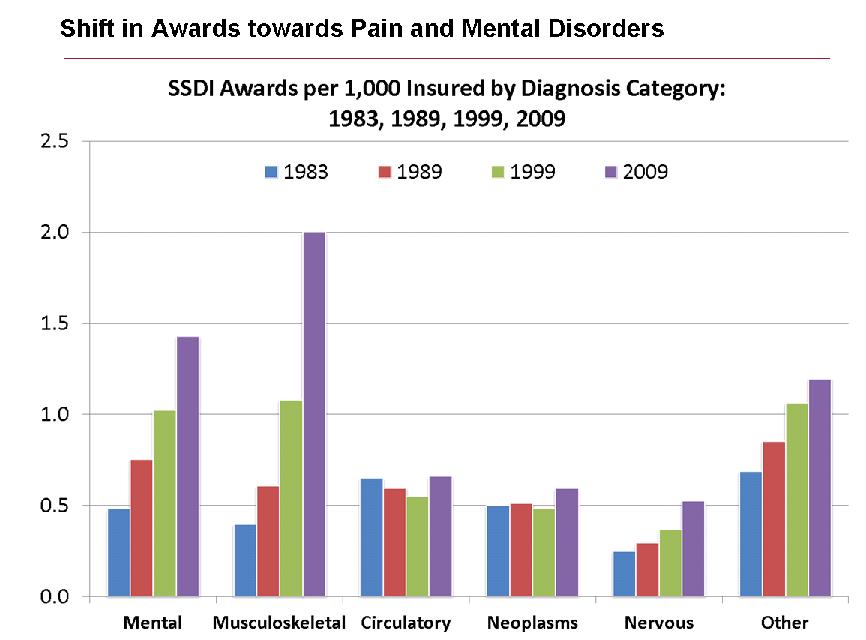
Let’s review a couple of Professor Duggan’s charts, starting with a look at how the disability rate has exploded in the past 22 years.

Disability Slide 2

And here is some very disturbing data showing that much of the increase is in the areas that are most subject to abuse because of subjective judgements about “bad backs” and “depression.”

Disability Slide 1

Hmmm…, I’m a bit depressed about the ever-rising burden of government. Maybe I should get a check from the government!

Joking aside, I briefly touched on this issue in a recent CNBC interview. Here’s the segment dealing with the disability program and the disturbing rise in dependency.

I’m not overly impressed by the counter-argument from Christian Weller. Does he really want us to believe that the service sector jobs of today are more disabling than the manufacturing jobs of 20-plus years ago?

This is a depressing topic, so let’s close with a couple of cartoons, starting with this gem from Chip Bok.

Disability Cartoon 1

It’s amusing, but keep in mind that we have an unusually high joblessness rate right now, but it would be even higher if we counted the people who shifted to this other form of unemployment dependency.

And here’s a Chuck Asay cartoon that I really like because he augments my argument in the interview that it hurts the economy when you lure workers out of the job market and make them wards of the state.

Disability Cartoon 2

Asay takes it one step farther and shows the lifeboat sinking. That’s basically what will happen if we don’t adopt the entitlement reforms that are needed to rein in the welfare state.

P.S. If you want some jokes referencing the disability program, we have the politically correct version of The Little Red Hen, as well as two very similar jokes about Jesus performing miracles and how liberals differ from conservatives and libertarians.

Related posts:

Dan Mitchell on Obamacare (includes cartoons on Obamacare)

Some very good points by Dan Mitchell of the Cato Institute on Obamacare: Why We Should Be Optimistic about Repealing Obamacare and Fixing the Healthcare System April 10, 2013 by Dan Mitchell I’m going to make an assertion that seems utterly absurd. The enactment of Obamacare may have been good news. Before sending a team of medical […]

Dan Mitchell’s blog has great cartoon that demonstrates what President Obama has been doing the last 4 years!!!

I have put up lots of cartoons from Dan Mitchell’s blog before and they have got lots of hits before. Many of them have dealt with the economy, eternal unemployment benefits, socialism,  Greece,  welfare state or on gun control.     I’ve Obtained a Secret Pre-Release Copy of Obama’s Budget April 9, 2013 by Dan Mitchell The President is supposed to release […]

Dan Mitchell’s tribute to Margaret Thatcher

Very well said by Dan Mitchell. A Tribute to Margaret Thatcher April 8, 2013 by Dan Mitchell The woman who saved the United Kingdom has died. A Great Woman I got to meet Margaret Thatcher a couple of times and felt lucky each time that I was in the presence of someone who put her nation’s […]

Dan Mitchell, Ron Paul, and Milton Friedman on Immigration Debate (includes editorial cartoon)

I like Milton Friedman’s comments on this issue of immigration   and Ron Paul and Dan Mitchell do well on the issue too. Question of the Week: What’s Your Take on the Immigration Debate? April 7, 2013 by Dan Mitchell A reader from overseas wonders about my views on immigration, particularly amnesty. I confess that this is one of […]

Dan Mitchell on Texas v. California (includes editorial cartoon)

We should lower federal taxes because jobs are going to states like Texas that have low taxes. What Can We Learn by Comparing the Employment Situation in Texas vs. California? April 3, 2013 by Dan Mitchell One of the great things about federalism, above and beyond the fact that it both constrains the power of governments […]

Cartoons from Dan Mitchell’s blog on Obamacare

Third-Party Payer is the Biggest Economic Problem With America’s Health Care System Published on Jul 10, 2012 This mini-documentary from the Center for Freedom and Prosperity Foundation explains that “third-party payer” is the main problem with America’s health care system. This is why undoing Obamacare, while desirable, is just a small first step if we […]

Obamacare cartoons from Dan Mitchell’s blog

I have put up lots of cartoons from Dan Mitchell’s blog before and they have got lots of hits before. Many of them have dealt with the economy, eternal unemployment benefits, socialism,  Greece,  welfare state or on gun control. The funniest cartoon is the one with “Nurse Sebelius” stuffing the huge capsule down the kid’s throat!!! Obamacare […]

Editorial cartoon from Dan Mitchell’s blog on California’s sorry state of affairs

I have put up lots of cartoons from Dan Mitchell’s blog before and they have got lots of hits before. Many of them have dealt with the sequester, economy, eternal unemployment benefits, socialism,  minimum wage laws, tax increases, social security, high taxes in California, Obamacare,  Greece,  welfare state or on gun control. President Obama’s favorite state must be California because […]

Dan Mitchell of the Cato Institute:HUD has to go!!!! (includes political cartoon)

You want a suggestion on how to cut the government then start at HUD. I would prefer to eliminate all of it. Here are Dan Mitchell’s thoughts below: Sequestration’s Impact on HUD: Just 358 More Days and Mission Accomplished March 12, 2013 by Dan Mitchell As part of my “Question of the Week” series, I had […]

Dan Mitchell: Cartoonists React to the Senate Democratic Budget

I read that President Obama in his meetings with the Republicans would not even say that a balanced budget was a goal. According to the budget presented by the Democratic Senate he is in agreement with their approach. Cartoonists have taken the opportunity to poke fun at that below. I  have put up lots of cartoons […]

Remembering Dr. C. Everett Koop with pictures and quotes Part 33 (includes editorial cartoon)

Dr. Koop

C. Everett Koop

Published on Feb 25, 2013

The PBS NewsHour interviewed former Surgeon General, Dr. C. Everett Koop, on the anniversary of the first surgeon general’s report on smoking. Jim Lehrer interviewed Koop for a newsmaker conversation for the The MacNeil/Lehrer NewsHour from the surgeon general’s office in Washington on Jan. 11, 1989. Koop died Monday at the age of 96.

Dr. C. Everett Koop was appointed to the Reagan administration but was held up in the Senate in his confirmation hearings by Ted Kennedy because of his work in pro-life causes.

Memorial Tribute Former Surgeon General C.Everett Koop © A Genuine G-Shot.wmv

On 2-25-13 we lost a great man when we lost Dr. C. Everett Koop. I have written over and over the last few years quoting Dr. C. Everett Koop and his good friend Francis Schaeffer. They both came together for the first time in 1973 when Dr. Koop operated on Schaeffer’s daughter and as a result they became close friends. That led to their involvement together in the book and film series “WHATEVER HAPPENED TO THE HUMAN RACE?” in 1979.

The Journal of Medical Ethics recently published an article advocating “post-birth abortions.” Alberto Giubilini and Francesca Minerva, who wrote the article, argue that there are many cases where women have abortions because having a child would be physically, psychologically, or economically difficult for them. But what if these hardships are not realized until after the baby is born? What if the child’s father leaves, for example, or the child is born with an unforeseen disability? Should the mother have to bear the burden of raising a child in non-ideal circumstances? Or what if the financial and organizational burden of caring for the child falls to the state?Though Giubilini and Minerva acknowledge that people with severe disabilities are often “reported to be happy,” they argue:

“to bring up such children might be an unbearable burden on the family and on society as a whole, when the state economically provides for their care. On these grounds, the fact that a fetus has the potential to become a person who will have an (at least) acceptable life is no reason for prohibiting abortion. Therefore, we argue that, when circumstances occur after birth such that they would have justified an abortion, what we call after-birth abortion should be permissible.” (emphasis original)

Medicine is one of those front lines where the specific definition of key words such as “person,” “fetus,” “justified,” “burden” and so on have huge implications. For example, why call the active murder of a baby (some advocate killing children up to a year old) “post-birth abortion”? Giubilini and Minerva explain:

“In spite of the oxymoron in the expression, we propose to call this practice ‘after-birth abortion’, rather than ‘infanticide’, to emphasize that the moral status of the individual killed is comparable with that of a fetus (on which ‘abortions’ in the traditional sense are performed) rather than to that of a child. Therefore, we claim that killing a newborn could be ethically permissible in all the circumstances where abortion would be.”

There is much here that should concern us as Christians. Rather than offering my own thoughts on this, I will share some insights that I gleaned from reading Francis Schaeffer’s book Whatever Happened to the Human Race? (co-authored by C. Everett Koop, M.D.). Schaeffer wrote this book in 1979 to call attention to the issues at stake in the growing popularity of abortion, infanticide, and euthanasia. Relevant as his words were in his day, they proved to be prophet of our time as well.

Though many were shocked that the Journal of Medical Ethics would publish such an article, this is merely the logical conclusion of people operating within a Darwinian mentality. If survival of the fittest really is the driving force behind life, then humanity has no inherent value. What value he has must be derived from his ability to survive. And if a young child stands in the way of another evolutionary being (i.e., a mother) of surviving in the way she wants to, why shouldn’t she practice survival of the fittest with her infant?

As soon as we leave behind an absolute standard of right and wrong, the inherent value of human life gets reworked, even discarded. We are left only with prevailing notions of what humanity is and ought to be. Looking at the push for abortion in the late 70s, Schaeffer says, “It all started with the acceptance of the attitude that there is such a thing as a life not worthy to be lived.”

He insightfully explains the degenerating logic that unfolds once we abandon an absolute standard of morality:

“At first we hear much talk of compassion for the unwanted. The discussion moves on to ‘rights,’ then to ‘my’ rights and soon to pure ‘economics.’ The discussion of life must be brought back to where it belongs—not to emotional, extreme examples, not to selfish questions of rights, not to expedience, and certainly not to economics. The matter should be discussed in terms of right and wrong.”

With regard to the use of language in these types of debates, do we really think we’re kidding anyone by calling the murder of young children “post-birth abortions”? Does the softened title make the act itself any less reprehensible? Yet this simple decision to not call it “baby-slaughtering” will likely go a long way towards its being perceived in a more understandable light. Schaeffer warned: “Language has power. The language we use actually forms the concepts we have and the results these concepts produce.”

I will explore some of the issues presented in Giubilini and Minvera’s article in the next two posts as well. But before I close this post, Schaeffer gives us another warning that we should take to heart:

“One wonders what the chances are for someone who becomes a burden in a society that practices the concept of the survival of the fittest and has begun this practice by starting to eliminate its children.”

______________________

In the film series “WHATEVER HAPPENED TO THE HUMAN RACE?” the arguments are presented  against abortion (Episode 1),  infanticide (Episode 2),   euthenasia (Episode 3), and then there is a discussion of the Christian versus Humanist worldview concerning the issue of “the basis for human dignity” in Episode 4 and then in the last episode a close look at the truth claims of the Bible.

In this 1979 film series they dealt with the big social issues and predicted what social problems we have in the future because of humanism. For instance, they knew that the Jack Kevorkians of the world would be coming down the pike. They predicted that there was a slippery slope from abortion to infanticide to youth euthanasia brought on by the materialistic worldview.

Dr. C. Everett Koop is pictured above.

Francis Schaeffer: “Whatever Happened to the Human Race” (Episode 1) ABORTION OF THE HUMAN RACE

Published on Oct 6, 2012 by

Great prolife poster:

Christianity and Scientific Concerns

AP

C. Everett Koop

Related posts:

Remembering Dr. C. Everett Koop with pictures and quotes Part 12 (with editorial cartoon)

Dr. C. Everett Koop on Baby Doe, euthanasia, abortion Uploaded on Nov 3, 2008 Dr. Koop answers questions on Baby Doe, euthanasia and abortion during interview at Wheaton College, Wheaton, IL http://www.christianethics.org Dr. Koop   On 2-25-13 we lost a great man when we lost Dr. C. Everett Koop. I have written over and over […]

Remembering Dr. C. Everett Koop with pictures and quotes Part 11 (including editorial cartoon on abortion)

Dr. Koop Memorial Tribute Former Surgeon General C.Everett Koop © A Genuine G-Shot.wmv On 2-25-13 we lost a great man when we lost Dr. C. Everett Koop. I have written over and over the last few years quoting Dr. C. Everett Koop and his good friend Francis Schaeffer. They both came together for the first […]

Remembering Dr. C. Everett Koop with pictures and quotes Part 10 (includes editorial cartoon about abortion)

Newsmaker Interview with Surgeon General C. Everett Koop Published on Feb 25, 2013 The PBS NewsHour interviewed former Surgeon General, Dr. C. Everett Koop, on the anniversary of the first surgeon general’s report on smoking. Jim Lehrer interviewed Koop for a newsmaker conversation for the The MacNeil/Lehrer NewsHour from the surgeon general’s office in Washington […]

Remembering Dr. C. Everett Koop with pictures and quotes Part 9 (Picture of Joycelyn Elders with Koop)

Dr. C. Everett Koop on Baby Doe, euthanasia, abortion Uploaded on Nov 3, 2008 Dr. Koop answers questions on Baby Doe, euthanasia and abortion during interview at Wheaton College, Wheaton, IL http://www.christianethics.org Dr. Koop   Joycelyn Elders was the first black Surgeon General of the USA and I have a picture of her with Dr. C. […]

Remembering Dr. C. Everett Koop with pictures and quotes Part 8 (editorial picture about Surgeon General)

Memorial Tribute Former Surgeon General C.Everett Koop © A Genuine G-Shot.wmv Dr. Koop. C. Everett Koop Before Dr. C. Everett Koop arrived in 1981 as Surgeon General could anybody ever name who the Surgeon General was? Koop also caused lots of editorial cartoons to be drawn about him because of his positions he took on […]

Remembering Dr. C. Everett Koop with pictures and quotes Part 7 (Public Health poster)

Newsmaker Interview with Surgeon General C. Everett Koop Published on Feb 25, 2013 The PBS NewsHour interviewed former Surgeon General, Dr. C. Everett Koop, on the anniversary of the first surgeon general’s report on smoking. Jim Lehrer interviewed Koop for a newsmaker conversation for the The MacNeil/Lehrer NewsHour from the surgeon general’s office in Washington […]

Remembering Dr. C. Everett Koop with pictures and quotes Part 6 (includes funniest cartoon ever during Koop’s tenure)

Dr. C. Everett Koop on Baby Doe, euthanasia, abortion Uploaded on Nov 3, 2008 Dr. Koop answers questions on Baby Doe, euthanasia and abortion during interview at Wheaton College, Wheaton, IL http://www.christianethics.org Dr. Koop. C. Everett Koop On June 8, 1988 Ralph Dunagin of the LA Times came out with the funniest editorial cartoon I […]

Remembering Dr. C. Everett Koop with pictures and quotes Part 5 (Public Health poster developed under Koop)

Memorial Tribute Former Surgeon General C.Everett Koop © A Genuine G-Shot.wmv Dr. C. Everett Koop was active on getting the word out about how people could catch AIDS. Public Health officials during the second half of the 1980s became concerned about the spread of AIDS particularly among minorities, a disproportionate number of whom were intravenous […]

Remembering Dr. C. Everett Koop with pictures and quotes Part 4 (funny editorial cartoon too)

Dr. Koop Gary Brookings of the Richmond Times Dispatch did a very funny editorial cartoon about the time in 1988 when Dr. C. Everett Koop sent the unapproved mail  piece out to millions of homes about AIDS. There were many such cartoons at the time since everyone knew Dr. Koop got the mail piece out […]

Remembering Dr. C. Everett Koop with pictures and quotes Part 3 ( three more editorial cartoons too)

Dr. Koop with Hillary Clinton In 1980 I really was influenced at my highschool by a teacher of mine named Mark Brink. He introduced me to the film series “Whatever happened to the human race?” by Francis Schaeffer and Dr. C. Everett Koop. In this  film series that came out in 1979 they dealt with […]

Remembering Dr. C. Everett Koop with pictures and quotes Part 2 (Doonesbury cartoon by Gary Trudeau included)

Dr. Koop On 2-25-13 we lost a great man when we lost Dr. C. Everett Koop. I have written over and over the last few years quoting Dr. C. Everett Koop and his good friend Francis Schaeffer. They both came together for the first time in 1973 when Dr. Koop operated on Schaeffer’s daughter and […]

Remembering Dr. C. Everett Koop with pictures and quotes Part 1

Dr. C. Everett Koop is pictured above. Francis Schaeffer: “Whatever Happened to the Human Race” (Episode 1) ABORTION OF THE HUMAN RACE Published on Oct 6, 2012 by AdamMetropolis Dr. Koop On 2-25-13 we lost a great man when we lost Dr. C. Everett Koop. I have written over and over the last few years […]

Open letter to President Obama (Part 232 B) Dr. C. Everett Koop and Reagan pictured together

Dr. C. Everett Koop with Ronald Reagan. Dr. Koop was delayed in his confirmation by Ted Kennedy because of his film Whatever Happened to the Human Race? President Obama c/o The White House 1600 Pennsylvania Avenue NW Washington, DC 20500 Dear Mr. President, I know that you receive 20,000 letters a day and that you […]

“Sanctity of Life Saturday” Francis Schaeffer and Dr. C. Everett Koop asked Reagan to issue pro-life proclamation in 1983 (includes video ABORTION OF THE HUMAN RACE)

In the film series “WHATEVER HAPPENED TO THE HUMAN RACE?” the arguments are presented  against abortion (Episode 1),  infanticide (Episode 2),   euthenasia (Episode 3), and then there is a discussion of the Christian versus Humanist worldview concerning the issue of “the basis for human dignity” in Episode 4 and then in the last episode a close […]

Dr. C. Everett Koop on abortion’s 1973 Roe v. Wade impact on child abuse

Dr. C. Everett Koop with Ronald Reagan. Dr. Koop was delayed in his confirmation by Ted Kennedy because of his film Whatever Happened to the Human Race? Watch the film below starting at the 19 minute mark and that will lead into a powerful question from Dr. C. Everett Koop. This 1979 film is WHATEVER […]

Open letter to President Obama (Part 221 B) Dr. C. Everett Koop and Francis Schaeffer rightly called abortion “the watershed issue of our era”

 Dr. Koop was delayed in his confirmation by Ted Kennedy because of his film Whatever Happened to the Human Race? Francis Schaeffer February 21, 1982 (Part 1) Uploaded by DeBunker7 on Feb 21, 2008 READ THIS FIRST: In decline of all civilizations we first see a war against the freedom of ideas. Discussion is limited […]

Francis Schaeffer and C. Everette Koop on the Hippocratic oath (March for Life January 20, 2013)

Dr. C. Everett Koop was appointed to the Reagan administration but was held up in the Senate in his confirmation hearings by Ted Kennedy because of his work in pro-life causes. I was thinking about the March for Life that is coming up on Jan 20, 2013  and that is why I posted this today […]

Ronald Wilson Reagan pictured with Dr. C. Everett Koop

High resolution version (11,426,583 Bytes) Description: The photograph is signed by President Ronald Reagan with the inscription “To Chick Koop, With Best Wishes.” Chick, from chicken coop, was the nickname Koop gained will attending Dartmouth College in the mid-1930s. Koop maintained a cordial relationship with President Reagan, despite his disappointment over Reagan’s refusal to address […]

Francis Schaeffer and C. Everett Koop were prophetic (jh29)

Francis Schaeffer and C. Everett Koop were prophetic (jh29) What Ever Happened to the Human Race? I recently heard this Breakpoint Commentary by Chuck Colson and it just reminded me of how prophetic Francis Schaeffer and C. Everett Koop were in the late 1970′s with their book and film series “Whatever happened to the human […]

Should Michele Bachmann be punished for taking pro-life views from Schaeffer and Koop? (March for Life January 20, 2013)

  Dr. C. Everett Koop I was thinking about the March for Life that is coming up on Jan 20, 2013  and that is why I posted this today Secular leaps of faith 39 Comments Written by Janie B. Cheaney August 15, 2011, 2:17 PM I’m willing to cut Ryan Lizza some slack. His profile […]

“Schaeffer Sundays” Francis Schaeffer’s own words concerning humanism and its bad results

Francis Schaeffer: “Whatever Happened to the Human Race?” (Episode 2) SLAUGHTER OF THE INNOCENTS Published on Oct 6, 2012 by AdamMetropolis The 45 minute video above is from the film series created from Francis Schaeffer’s book “Whatever Happened to the Human Race?” with Dr. C. Everett Koop. This book  really helped develop my political views concerning […]

“Sanctity of Life Saturday”:Derek Melleby’s review of the book “Francis Schaeffer: An Authentic Life” (includes film THE BASIS FOR HUMAN DIGNITY)

  I truly believe that many of the problems we have today in the USA are due to the advancement of humanism in the last few decades in our society. Ronald Reagan appointed the evangelical Dr. C. Everett Koop to the position of Surgeon General in his administration. He partnered with Dr. Francis Schaeffer in making […]

Taking on Ark Times bloggers about abortion on the 40th anniversary date of Roe v. Wade (Part 5) “Slavery issue compared to rights of unborn child”

The best pro-life film I have ever seen below by Francis Schaeffer and Dr. C. Everett Koop “Whatever happened to the human race?” Over the years I have taken on the Ark Times liberal bloggers over and over and over concerning the issue of abortion. I asked over and over again for one liberal blogger […]

Taking on Ark Times bloggers about abortion on the 40th anniversary date of Roe v. Wade (Part 4) “How do pro-lifers react to the movie THE CIDER HOUSE RULES?”

Francis Schaeffer pictured above._________ The best pro-life film I have ever seen below by Francis Schaeffer and Dr. C. Everett Koop “Whatever happened to the human race?” Over the years I have taken on the Ark Times liberal bloggers over and over and over concerning the issue of abortion. I asked over and over again […]

Taking on Ark Times bloggers about abortion on the 40th anniversary date of Roe v. Wade (Part 3) “What should be the punishment for abortion doctors?”

The best pro-life film I have ever seen below by Francis Schaeffer and Dr. C. Everett Koop “Whatever happened to the human race?” On 1-24-13 I took on the child abuse argument put forth by Ark Times Blogger “Deathbyinches,” and the day before I pointed out that because the unborn baby has all the genetic code […]

Taking on Ark Times bloggers about abortion on the 40th anniversary date of Roe v. Wade (Part 2) “The pro-abortion child abuse argument destroyed here”

PHOTO BY STATON BREIDENTHAL from Pro-life march in Little Rock on 1-20-13. Tim Tebow on pro-life super bowl commercial. Over the years I have taken on the Ark Times liberal bloggers over and over and over concerning the issue of abortion. Here is another encounter below. On January 22, 2013 (on the 40th anniversary of the […]

Taking on Ark Times bloggers about abortion on the 40th anniversary date of Roe v. Wade (Part 6) For many pro-abortionists ” …the problem is not determining when actual human life begins, but when the value of that life begins to out weigh other considerations”

The best pro-life film I have ever seen below by Francis Schaeffer and Dr. C. Everett Koop “Whatever happened to the human race?” Francis Schaeffer pictured above._________ The 45 minute video above is from the film series created from Francis Schaeffer’s book “Whatever Happened to the Human Race?” with Dr. C. Everett Koop. This book  really […]

Taking on Ark Times bloggers about abortion on the 40th anniversary date of Roe v. Wade (Part 7) “Poverty not good reason for abortion, why not give up for adoption?”

Dr Richard Land discusses abortion and slavery – 10/14/2004 – part 3 The best pro-life film I have ever seen below by Francis Schaeffer and Dr. C. Everett Koop “Whatever happened to the human race?” Over the years I have taken on the Ark Times liberal bloggers over and over and over concerning the issue […]

Taking on Ark Times bloggers about abortion on the 40th anniversary date of Roe v. Wade (Part 1)

Dr Richard Land discusses abortion and slavery – 10/14/2004 – part 3 The best pro-life film I have ever seen below by Francis Schaeffer and Dr. C. Everett Koop “Whatever happened to the human race?” Over the years I have taken on the Ark Times liberal bloggers over and over and over concerning the issue […]

Paul Greenberg became pro-life because we are all “endowed with certain unalienable rights”

On January 20, 2013 I heard Paul Greenberg talk about the words of Thomas Jefferson that we are all “endowed with certain unalienable rights” and the most important one is the right to life. He mentioned this also in this speech below from 2011: Paul Greenberg Dinner Speech 2011 Fall 2011 Issue Some of you […]

How Pulitzer Prize-winning Paul Greenberg, one of the most respected and honored commentators in America, changed his mind about abortion and endorses now the pro-life view

It is not possible to know where the pro-life evangelicals are coming from unless you look at the work of the person who inspired them the most. That person was Francis Schaeffer.  I do care about economic issues but the pro-life issue is the most important to me. Several years ago Adrian Rogers (past president of […]

Taking on Ark Times Bloggers on various issues Part I “Old Testament Bible Prophecy” includes the film TRUTH AND HISTORY and article ” Jane Roe became pro-life”

I have gone back and forth and back and forth with many liberals on the Arkansas Times Blog on many issues such as abortion, human rights, welfare, poverty, gun control  and issues dealing with popular culture. Here is another exchange I had with them a while back. My username at the Ark Times Blog is Saline Republican.

On 2-22-13 on the Arkansas Times Blog  the person using the username “Olphart” asserted: 

“Olphart you have a head knowledge of the Bible and you say you would accept written decisions from God but you would not. Just like Sagan you set out stipulations for God but He has given you sufficient evidence through Old Testiment prophecies such as the one on the destruction of Tyre and also Psalms 22 and Isaiah 53.You do not accept them because of intellectual problems but you want your independence. Very smart people are believers and some dummies too. It has nothing to do with how smart a person is.”

I agree that none of this has much to do with how smart you are. Francis Collins, the head of the group who mapped the human genome is, obviously, very smart, and is a practicing Christian. I don’t believe that I.Q. tells you much about how smart you are either. At best, it tells you what potential you may have to become smart.

Yes, I WOULD ACCEPT a certifiable written decision from God. I WOULDN’T accept it relayed from you or any other 3rd party, religious or not. How do you know ME better than I know ME? That makes no sense. It would be arrogant of me if I claimed to know you better than you know you. Independence from what? A celestial puppeteer? Independence from control by your religion which tells me what I should do, based on your interpretation of some ancient and contradictory text?

About your so-called prophesies: Nobody knows when the prophesies were written, much less what they actually predicted. It’s very possible that the prophesied event was written before the prophesy. And yes, I know that the latest nation of Israel was formed in 1948 but the temple hasn’t been entirely razed to the ground–the west wall still stands. That’s a self-fulfilling prophesy anyway, enabled by “Christian” nations.

In other posts you claim to admire Carl Sagan and detest Adolph Hitler. I concur with those opinions. But answer me this: Since both of these men are both deceased, according to any reasonable interpretation of your beliefs, the souls of both men are currently being tortured for their sins in the flames of Hell and that torture will continue forever. Hitler is being tortured for the deaths of millions of humans and Sagan is being tortured because he didn’t believe in your God. Of course, either or both may have had a deathbed conversion but, barring that, how can you possibly reconcile that with a just and loving God?

Somewhere you decry ad hominem attacks on your person. I believe that I have avoided those here. I have asked you some questions though and am anxiously awaiting your answers.

On 2-22-13 on the Arkansas Times Blog  I responded: 

Olphart me answer your questions but here is just the first part.

Thank you for avoiding Ad hominem attacks so we can discuss the issues. You are right about that prophecies must be clear and be written before the events they are talking about.

Remember that the dead sea scrolls have part of every Old Testament book except Esther and a complete scroll of Isaiah. All these books are dated pre100BC. With that in mind take a look at these prophecies:

In the fifth century B.C. a prophet named Zechariah declared that the Messiah would be betrayed for the price of a slave—thirty pieces of silver, according to Jewish law-and also that this money would be used to buy a burial ground for Jerusalem’s poor foreigners (Zechariah 11:12-13). Bible writers and secular historians both record thirty pieces of silver as the sum paid to Judas Iscariot for betraying Jesus, and they indicate that the money went to purchase a “potter’s field,” used—just as predicted—for the burial of poor aliens (Matthew 27:3-10).

(Probability of chance fulfillment = 1 in 1011.)

SECOND:

Some 400 years before crucifixion was invented, both Israel’s King David and the prophet Zechariah described the Messiah’s death in words that perfectly depict that mode of execution. Further, they said that the body would be pierced and that none of the bones would be broken, contrary to customary procedure in cases of crucifixion (Psalm 22 and 34:20; Zechariah 12:10). Again, historians and New Testament writers confirm the fulfillment: Jesus of Nazareth died on a Roman cross, and his extraordinarily quick death eliminated the need for the usual breaking of bones. A spear was thrust into his side to verify that he was, indeed, dead.

—
https://thedailyhatch.org/2011/06/23/book-o…

Israel was predicted to return to the holy land and that occurred in 1948 and they are the first to revive a dead language (Hebrew)…Olphart you are correct that I hold to the view that faith in Christ is the only way to heaven. John 14:6 makes it clear that Christ is the only way to heaven. I have friends and relatives who have died as unbelievers and they are in hell unless they had deathbed conversions.

Hank Hannegraff notes:
Finally, common sense regarding justice dictates that there must be a hell. Without hell, the wrongs of Hitler’s Holocaust would never be righted. Justice would be impugned if, after slaughtering six million Jews, Hitler merely died in the arms of his mistress with no eternal consequences. The ancients knew better than to think such a thing. David knew that it might seem for a time as though the wicked prosper despite their evil deeds, but in the end justice will be served. We may wish to think that no one will go to hell, but common sense regarding justice precludes that possibility.

——–
Here is a portion of an article I wrote back in 2009 about Chris Martin who like you Olphart had a problem with the idea of hell but he can’t get away from it logically if he wanted to.

Chris Martin of the rock group Coldplay wrote the song Viva La Vida, and the song just won both the grammy for the “Song of the Year” and “Best Pop Performance by a duo or Group with Vocals.”

In this song, Martin is discussing an evil king that has been disposed. “I used to rule the world…Feel the fear in my enemy’s eyes…there was never an honest word and that was when I ruled the world, It was the wicked and wild wind, Blew down the doors to let me in, Shattered windows and the sound of drums, People couldn’t believe what I’d become…For some reason I can’t explain, I know Saint Peter won’t call my name,  Never an honest word, But that was when I ruled the world.”

Q Magazine asked Chris Martin about the lyric in this song “I know Saint Peter won’t call my name.” Martin replied, “It’s about…You’re not on the list. I was a naughty boy. Its always fascinated me that idea of finishing your life and then being analyzed on it…That is the most frightening thing you could possibly say to somebody. Eternal damnation. I know about this stuff because I studied it. I was into it all. I know it. It’s mildly terrifying to me. And this is serious.”

I have been following the career of Chris Martin for the last decade. He grew up in a Christian home that believed in Heaven and Hell, but made it clear several years ago that he actually resents those who hold to those same religious dogmatic views he did as a youth. Yet it seems his view on the possibility of an afterlife has changed again.

________________

Dr. C. Everett Koop is pictured above.

Francis Schaeffer: “Whatever Happened to the Human Race” (Episode 5) TRUTH AND HISTORY

Published on Oct 7, 2012 by

____________

Great  quotes from “Whatever happened to the human race?”  by Francis Schaeffer and Dr. C. Everett Koop (from the shelter website):.

Summary


Francis Schaeffer and, former Surgeon General, C. Everette Koop deal directly with the devaluing of human life and its results in our society. It did not take place in a vacuum. It is a direct result of a worldview that has rejected the doctrine of man being created in the image of God. Man as a product of the impersonal, plus time and chance has no sufficient basis for worth.

The Bible teaches that man is made in the image of God and therefore is unique. Remove that teaching, as humanism has done on both sides of the Iron Curtain, and there is no adequate basis for treating people well.
(Francis A. Schaeffer and C. Everette Koop, Whatever Happened to the Human Race?, Ch. 1)

Justin Taylor|12:29 pm CT

5 Things You Didn’t Know about “Jane Roe”

5 Things You Didn’t Know about “Jane Roe” avatar

Today is the 40th anniversary of Roe v. Wade, the controversial Supreme Court ruling that progressives want to enshrine and conservatives want to overturn. Few rulings have been more consequential. According to Planned Parenthood’s Guttmacher Institute, 22% of all pregnancies now end in abortion, with 3 in 10 women terminating their pregnancy by the age of 45. There have been approximately 57 million legally induced abortions in the U.S. since 1973—nearly the current population of California and Texas combined.

Yet a recent Pew study found that 4 in 10 “Millennials” don’t even know that Roe v. Wade has to do with abortion. And even fewer today know the true story of the woman who started it all, the pseudonymous plaintiff “Jane Roe.” Here are five things you may not know about her, culled from interviews and profiles along with her sworn congressional testimony and memoirs.

(1) The name “Jane Roe” was created over beer and pizza.

In 1969 Norma was 21 years old, divorced, and pregnant for the third time. (The first two children were placed for adoption.) After seeking an abortion but finding out it was illegal, and then driving to an illegal clinic only to find it closed, adoption attorney Henry McCluskey referred her to two young lawyers in Dallas, Sarah Weddington and Linda Coffee. Weddington (who had traveled to Mexico a couple of years earlier to have an abortion) was seeking a class-action lawsuit against the state of Texas in order to legalize abortion. It was an unlikely party at the corner booth of Columbo’s pizza parlor in Dallas: two recent law-school grads in business suits sitting across the table from a rough and uneducated homeless woman. The lawyers needed a representative for all women seeking abortions—one who was young, poor, and white. They just didn’t want her to cross state lines to get a legal abortion, or the case would be considered moot and dismissed. Without money and five months pregnant, Norma was the ideal candidate. After downing several pitchers of beer, they agreed on using the pseudonym “Jane Roe.” (“Wade” referred to Henry B. Wade, the attorney general of Dallas.)

(2) Jane Roe didn’t know the meaning of “abortion.” 

Weddington and Coffee told Norma that abortion just dealt with a piece of tissue, and that it was like passing a period rather than the termination of a distinct, living, and whole human organism. Abortion was a taboo topic in 1970, and Norma had dropped out of school at the age of 14. She knew that John Wayne movies talked about “aborting the mission,” so she thought it meant to “go back”—as in, going back to not being pregnant. She honestly believed “abortion” meant a child was prevented from coming into existence.

(3) Jane Roe never appeared in court.

Her lawyers drafted a one-page legal affidavit, which she signed but did not read. (Even today, she has not read it.) This was only the second time she would meet with her lawyers—and it turned out to be the last. She would not be called to testify and attended none of the trial. She found out about the Supreme Court ruling from the newspaper on January 23, 1973, just like the rest of the nation. Few on that day understood the implications of Justice Blackmun’s instruction that Roe v. Wade was to be read in conjunction with its companion case Doe v. Bolton, which effectively made abortion legal at any stage of pregnancy for any reason. As a result, the United States (with Canada) became the only Western country offering no legal protection for the unborn at any stage of the pregnancy.

(4) Jane Roe never had an abortion.

Norma had already given birth and placed the baby for adoption before the three-judge Texas panel ruled against her in May of 1970, long before the Supreme Court decision in January of 1973. She was in a committed lesbian relationship and would not become pregnant again. Abortion continued to be a part of her life, however. She went on to work in abortion clinics, holding the hands of women and offering reassurance as they terminated their pregnancies, and making appearances on the Roe anniversaries.

(5) Jane Roe became pro-life.

In 1995, while working at the clinic, Norma became haunted by the sight and sound of empty playgrounds in her neighborhood. Once teeming with kids, they now seemed deserted. And she began to see it was the result of what she once called “my law.” But the decisive change happened when she met Emily Mackey, a seven-year-old girl whose parents were protesting at the clinic where “Miss Norma” worked. Emily, who had almost been aborted herself, befriended Norma, showing genuine interest and love, giving her hugs and inviting her to church. Through the influence this young girl’s combination of truth and grace, along with those who shared the gospel of Jesus with her, Norma not only became convinced of the pro-life position but also converted to Christianity.

* * *

Norma McCorvey now says that “Jane Roe has been laid to rest.” Both sides in America’s most contentious debate have claimed her at one point, and both have had reason to be disappointed. But for evangelicals—the demographic most committed to overturning Roe—the case for protecting the smallest and most defenseless members of the human race does not rest with the testimony of a single individual. It does not even rest on biblical revelation; moral philosophers have pointed out that the differences between a fetus in utero and an infant outside the womb—size, location, degree of dependency, and level of development—are morally irrelevant when determining a person’s right to life.

On this fortieth anniversary of Roe v. Wade, evangelicals would do well to remember that we must not only labor to protect the unborn, but to continue reaching out with assistance and love and the good news of grace to the Norma McCorveys of the world—broken women who feel they have no other place to turn.

__________

Open letter to President Obama (Part 295)

Robert Rector Explains Obama’s “Dirty Trick” To Gut Welfare Reform

Published on Aug 23, 2012 by

Barack Obama’s campaign is outraged that Mitt Romney’s campaign is running ads exposing the fact that last month he quietly, and illegally, gutted the work requirement in welfare reform. Who do you trust: Barack Obama, who has lied and lied again, or Mr. Rector?

___________


President Obama c/o The White House
1600 Pennsylvania Avenue NW
Washington, DC 20500

Dear Mr. President,

I know that you receive 20,000 letters a day and that you actually read 10 of them every day. I really do respect you for trying to get a pulse on what is going on out here.

We got to lower our federal spending or we will be heading to Greece soon. This is a top priority.

Rachel Sheffield

October 19, 2012 at 11:00 am

Welfare spending is at a staggering, all-time high. A new government report confirms that the U.S. now spends roughly $1 trillion a year on what has become a behemoth welfare system consisting of more than 80 federal programs. Robert Rector explains more in congressional testimony from earlier this year: “Examining the Means-Tested Welfare State.”

This news comes in the wake of the controversy that erupted this summer when the Obama Administration announced it would gut work requirements from welfare’s largest cash-assistance program, Temporary Assistance for Needy Families (TANF).

Here’s a recap of Heritage’s top publications and interviews on the Obama Administration’s illegal move to waive the work requirements in welfare reform:

“An Overview of Obama’s End Run on Welfare Reform” (Robert Rector)

The Heritage Foundation, 9/20/2012

Summarizes the key points of the Obama Administration’s overturning of welfare work requirements.

“Obama’s End Run on Welfare Reform Part One: Understanding Workfare” (Robert Rector)

The Heritage Foundation, 9/20/2012

Explains how “workfare” works.

“Obama’s End Run on Welfare Reform, Part Two: Dismantling Workfare” (Robert Rector)

The Heritage Foundation, 9/26/2012

Provides a comprehensive analysis of the Obama Administration’s action to overturn welfare work requirements.

“How Obama Has Gutted Welfare Reform” (Robert Rector)

The Washington Post, 9/6/2012

Summarizes the issue.

“Video: Robert Rector on the PBS News Hour” (Robert Rector)

PBS, 8/9/2012

Robert Rector debates Peter Edelmann on welfare, welfare reform, and the attack on work requirements.

“Welfare Reform’s Work Requirements Cannot Be Waived” (Andrew Grossman)

The Heritage Foundation, 8/8/2012

Explains why the Obama Administration’s waiver of work requirements is illegal.

“Report Finds Obama Can Waive Welfare Work Requirements…or Not” (Andrew Grossman)

The Heritage Foundation, 9/14/2012

Reviews the Congressional Research Service report on the legality of the Obama Administration’s waiver of work requirements.

“Gutting Welfare Reform at Taxpayer Expense” (Robert Rector)

The Heritage Foundation, 9/24/2012

Liberals in the House of Representatives voted unsuccessfully to jettison the federal work requirements of the welfare reform law. Worse, they voted to increase the national debt to accomplish it.

“Video: Fact Checking the Fact Checkers on Welfare Reform” (Sarah Morris)

The Heritage Foundation, 9/20/2012

This event features Senator Orrin Hatch (R–UT), Robert Rector, Mickey Kaus, and Kay Hymowitz discussing the Obama Administration’s attack on work requirements in welfare.

“Obama Guts Welfare Reform” (Robert Rector and Kiki Bradley)

The Heritage Foundation, 7/12/2012

This initial article, which broke the news, blew the whistle on the Obama Administration’s illegal attempt to overturn the welfare work requirements.

Other Materials

“Obama’s Palace Guard: How Media Fact Checkers Made Themselves of Service to the President in the Welfare Reform Debate” (Mark Hemingway)

The Weekly Standard, 10/12/2012

Discusses the distortions of the waiver issues by the mainstream media’s so-called fact checkers.

“The Welfare Waivers: How They Really Do Water Down Work Requirements” (Russell Sykes)

Manhattan Institute, 10/2012

The chief administrator of New York’s TANF program explains how the Obama Administration’s waiver policy will potentially undermine the TANF work requirements.

Various articles appearing in the Daily Caller by Mickey Kaus: “Obama Weakens Welfare Reform—Again” (7/13/2012); “The Case for Romney’s Welfare Attack” (8/8/2012); “NYT Proves Romney Right on Welfare” (8/10/2012); “The Welfare Issue Is Back” (8/28/2012); “Credulous Fact-Checkers Fall for 20% Scam” (9/2/2012); “Welfare Fight, Round Four” (9/14/2012).

__________

Thank you so much for your time. I know how valuable it is. I also appreciate the fine family that you have and your commitment as a father and a husband.

Sincerely,

Everette Hatcher III, 13900 Cottontail Lane, Alexander, AR 72002, ph 501-920-5733, lowcostsqueegees@yahoo.com

“Friedman Friday” Milton Friedman remembered at 100 years from his birth (Part 5)

Testing Milton Friedman – Preview

Uploaded by on Feb 21, 2012

2012 is the 100th anniversary of Milton Friedman’s birth. His work and ideas continue to make the world a better place. As part of Milton Friedman’s Century, a revival of the ideas featured in the landmark television series Free To Choose are being revisited in a new 3-part PBS broadcast.

To learn more visit: miltonfriedmanscentury(dot)org

Or: freetochoose(dot)net/media/broadcast/testing_milton_friedman/

______________________

I have to agree that Milton Friedman was a great man.

A great man

DAVID WARREN

Milton Friedman and his wife Rose, the pair of them — diminutive octogenarians from Chicago — were like a couple of fresh-fallen teen-aged lovers, doting and inseparable, often holding hands. Even in their mid-eighties, they left an impression of guileless youth.

Rose and Milton Friedman

After Friedrich Hayek, I think he was the 20th-century economist in whom I reposed most trust: one of the few who rise above the surface noise of economic events to see a large, essentially moral, landscape.

He was part of our inheritance from Adam Smith and the Scottish Enlightenment; for if you consult The Wealth of Nations (a book more praised and damned than read), you will be reminded that the man who “discovered” the first principles of capitalism did so out of a native curiosity about why human societies work at all. Adam Smith, and his legitimate descendents, were men capable of bold, and very acute, generalizations; not mere statistical wizards. See especially the earlier sections in Book V of The Wealth of Nations, which deal with defence, justice, education — on e.g. the need to inculcate such virtues as courage in the body politic.

Friedman was a man in that tradition, and like his ultimate intellectual master, never an ideologist, nor a front man. He followed an argument wherever it led, and spent more of his time lobbying against the old military draft in the U.S., or later in favour of school-voucher programmes, than he ever spent advising three Presidents on the macroeconomic facts of life. Friedman held, for instance, that anti-drug laws were effectively a government subsidy on organized crime. He was hardly a Republican party hack.

He espoused, to my mind, the sort of libertarianism that is worth engaging, the kind that insists on looking at the evidence from human affairs, and analysing real institutions, rather than prescribing by rote from principle. He had no lasting interest in grand theory, made all his own preferences and assumptions perfectly plain, and never wrote the sort of chef-d’oeuvre by which we remember most dead white males.

To my taste, Friedman took this insistence on what I’ll pretentiously call “the priority of the visible” a little too far — and I prefer Hayek’s more European sense of things under, as well as on, the table. Hayek, though he rejected the label “conservative”, had the old Tory’s indulgence for long-established customs, that may answer to the deepest needs in men and women. He appreciated things that remain invisible in daylight, but whose shapes become apparent in the dark. Friedman, an American optimist, didn’t believe in goblins.


The pair of them — diminutive octogenarians from Chicago — were like a couple of fresh-fallen teen-aged lovers, doting and inseparable, often holding hands. Even in their mid-eighties, they left an impression of guileless youth.


I spent an afternoon with Milton Friedman, and his wife Rose, and Michael Walker (the founder of the Fraser Institute), in a tea shop in Whistler, B.C., almost a decade ago. The pair of them — diminutive octogenarians from Chicago — were like a couple of fresh-fallen teen-aged lovers, doting and inseparable, often holding hands. Even in their mid-eighties, they left an impression of guileless youth. Both were economists, both passionate, seemingly naive idealists for free markets and free men. But with a wonderful ability to pull paradoxical ideas out of the air, that followed from the simple ones they started with.

Incredibly generous with their time, and humour; humble to a fault. Happy people. When Michael or I would mention something horrible happening in the world, there’d be a moment of hesitation, then one or the other of them would pipe up to mention all the new and positive opportunities created by that latest disaster — in the course of which they’d show they had already discussed between them in detail, and from alternative angles, something we had only spotted in a newspaper. They also seemed to know almost everything there was to know about Canada, and about Whistler, B.C. But wanted to know the rest.

When I would come up with one of my more fanciful suggestions for turning the world inside out, they would praise it before charitably ripping it to pieces, quoting statistics by the yard. They would make excuses for their worst enemies; they would explain the intellectual milieux from which each idiot had emerged; and always accept the idiot’s right to an opinion. They were just the most cheerful, decent people you could imagine, tingling with alert intelligence.

And exemplars of the broadest “family values”: maternal and paternal, respectively, towards even the servers replenishing our tea. Rose had one of the waitresses showing her pictures of her family. Americans, in the most beautiful way. And Jewish: wonderfully Jewish.

A very great man and his very great wife. One thinks at such times of the human dimension; and I think of Rose. She will have a million messages from well-wishers, but no Milton to share them with.


ACKNOWLEDGEMENT

David Warren. “A great man.” Ottawa Citizen(November 19, 2006).

This article reprinted with permission from David Warren.

THE AUTHOR

David Warren, once editor of the Idler Magazine, is widely travelled — especially in the Middle and Far East. He has been writing for the Ottawa Citizen since 1996. His commentaries on international affairs appear Wednesdays & Saturdays; on Sundays he writes a general essay on the editorial page. Read more from David Warren at David Warren Online.

Related posts:

“Friedman Friday” :“A Nobel Laureate on the American Economy” VTR: 5/31/77 Transcript and video clip (Part 4)

Milton Friedman on the American Economy (4 of 6)   Uploaded by donotswallow on Aug 9, 2009 THE OPEN MIND Host: Richard D. Heffner Guest: Milton Friedman Title: A Nobel Laureate on the American Economy VTR: 5/31/77 _____________________________________ Below is a transcipt from a portion of an interview that Milton Friedman gave on 5-31-77: Friedman: […]

Obama promotes food stamps but Milton Friedman had a better suggestion

Milton Friedman’s negative income tax explained by Friedman in 1968: We need to cut back on the Food Stamp program and not try to increase it. What really upsets me is that when the government gets involved in welfare there is a welfare trap created for those who become dependent on the program. Once they […]

“Friedman Friday” :“A Nobel Laureate on the American Economy” VTR: 5/31/77 Transcript and video clip (Part 3)

Milton Friedman on the American Economy (3 of 6) Uploaded by donotswallow on Aug 9, 2009 THE OPEN MIND Host: Richard D. Heffner Guest: Milton Friedman Title: A Nobel Laureate on the American Economy VTR: 5/31/77 _____________________________________ Below is a transcipt from a portion of an interview that Milton Friedman gave on 5-31-77: Friedman: Now […]

“The Power of the Market” episode of Free to Choose in 1990 by Milton Friedman (Part 5)

Milton Friedman The Power of the Market 5-5 How can we have personal freedom without economic freedom? That is why I don’t understand why socialists who value individual freedoms want to take away our economic freedoms.  I wanted to share this info below with you from Milton Friedman who has influenced me greatly over the […]

“The Power of the Market” episode of Free to Choose in 1990 by Milton Friedman (Part 4)

Milton Friedman The Power of the Market 4-5 How can we have personal freedom without economic freedom? That is why I don’t understand why socialists who value individual freedoms want to take away our economic freedoms.  I wanted to share this info below with you from Milton Friedman who has influenced me greatly over the […]

Obama’s solution to our healthcare problems: MORE FEDERAL OVERSIGHT!!!

A Taxing Distinction for ObamaCare Published on Jun 28, 2012 by catoinstitutevideo http://www.cato.org/publications/commentary/it-now-falls-congress http://www.cato.org/publications/commentary/taxing-decision http://www.cato-at-liberty.org/supreme-court-unlawfully-rewrites-obamacare-to… http://www.cato-at-liberty.org/congress-its-not-a-tax-scotus-yes-it-is/ The Cato Institute’s Roger Pilon, Ilya Shapiro, Michael F. Cannon, Michael D. Tanner and Trevor Burrus evaluate today’s ruling on ObamaCare at the Supreme Court. Video produced by Caleb O. Brown and Austin Bragg. ____________ When I think about […]

“Friedman Friday”:“A Nobel Laureate on the American Economy” VTR: 5/31/77 Transcript and video clip (Part 2)

Milton Friedman on the American Economy (2 of 6) Uploaded by donotswallow on Aug 9, 2009 THE OPEN MIND Host: Richard D. Heffner Guest: Milton Friedman Title: A Nobel Laureate on the American Economy VTR: 5/31/77 _____________________________________ Below is a transcipt from a portion of an interview that Milton Friedman gave on 5-31-77: Friedman: General […]

“The Power of the Market” episode of Free to Choose in 1990 by Milton Friedman (Part 3)

Milton Friedman The Power of the Market 3-5 How can we have personal freedom without economic freedom? That is why I don’t understand why socialists who value individual freedoms want to take away our economic freedoms.  I wanted to share this info below with you from Milton Friedman who has influenced me greatly over the […]

“The Power of the Market” episode of Free to Choose in 1990 by Milton Friedman (Part 2)

Milton Friedman The Power of the Market 2-5 How can we have personal freedom without economic freedom? That is why I don’t understand why socialists who value individual freedoms want to take away our economic freedoms.  I wanted to share this info below with you from Milton Friedman who has influenced me greatly over the […]

“Friedman Friday” :“A Nobel Laureate on the American Economy” VTR: 5/31/77 Transcript and video clip (Part 1)

Milton Friedman on the American Economy (1 of 6) Uploaded by donotswallow on Aug 9, 2009 THE OPEN MIND Host: Richard D. Heffner Guest: Milton Friedman Title: A Nobel Laureate on the American Economy VTR: 5/31/77 _____________________________________ Below is a transcipt from a portion of an interview that Milton Friedman gave on 5-31-77: THE OPEN […]

“The Power of the Market” episode of Free to Choose in 1990 by Milton Friedman (Part 1)

Milton Friedman The Power of the Market 1-5 How can we have personal freedom without economic freedom? That is why I don’t understand why socialists who value individual freedoms want to take away our economic freedoms.  I wanted to share this info below with you from Milton Friedman who has influenced me greatly over the […]

Milton Friedman’s best 10 quotes

Milton Friedman – Public Housing Uploaded by LibertyPen on May 6, 2011 Professor Friedman looks at the destination of another road paved with good intentions. _______________ 10 great quotes from Milton Friedman below: Nov 29, 2011 10 Of The Best Economics Quotes From Milton Friedman John Hawkins John Hawkins is a professional blogger who runs […]

Myth:Conservative Herbert Hoover responsible for Depression?

Myth:Conservative Herbert Hoover responsible for Depression When I grew up I always heard that the conservative Herbert Hoover was responsible for the depression. Is that true? The Hoover Myth Marches On Posted by David Boaz In the New York Times today,  columnist Joseph Nocera quotes a book published in 1940 on Herbert Hoover and the Great Depression: […]

“The Failure of Socialism” episode of Free to Choose in 1990 by Milton Friedman (Part 5)

Milton Friedman: Free To Choose – The Failure Of Socialism With Ronald Reagan (Full) Published on Mar 19, 2012 by NoNationalityNeeded Milton Friedman’s writings affected me greatly when I first discovered them and I wanted to share with you. Abstract: Ronald Reagan introduces this program, and traces a line from Adam Smith’s “The Wealth of […]

Case Study on Chelsea Clinton:Can equality of results be acheived best by punishing those who were born rich? “Friedman Friday”

Milton Friedman – Redistribution of Wealth Uploaded by LibertyPen on Feb 12, 2010 Milton Friedman clears up misconceptions about wealth redistribution, in general, and inheritance tax, in particular. http://www.LibertyPen.com _______________________________ Many times in the past our government has tried to even the playing field but the rich and poor will always be with us as […]

Remembering Margaret Thatcher, 1925-2013

Remembering Margaret Thatcher, 1925-2013

Published on Apr 8, 2013

The world lost one of its greatest champions of freedom in Lady Margaret Thatcher. Ed Feulner, Edwin Meese III, and Becky Norton Dunlop remember her contributions as a great leader and friend of The Heritage Foundation.

________________

Great post from the Heritage Foundation on Margaret Thatcher’s legacy. She truly believed in freedom and a limited government.

Heritage Remembers Margaret Thatcher (VIDEO)

Margaret Thatcher — a woman of character, leadership and a convicted spirit. A woman dedicated to individual freedom. The Heritage Foundation is proud of our special friendship with Lady Thatcher.

At a time when the Soviet Empire was still a powerful force, oppressing millions of people, Lady Thatcher tackled communism head on as prime minister of Great Britain.

She believed in the crucial need for America to exert international leadership in the cause of freedom and partnered with conservative American leaders like Ronald Reagan and The Heritage Foundation to ensure individual liberty.

Her commitment to the principles of free enterprise, limited government, and individual freedom lace the eternal friendship between The Heritage Foundation and Lady Thatcher.

Lady Thatcher visited Heritage several times throughout her life and received the Clare Boothe Luce Award, Heritage’s highest honor for contributions to the conservative movement.

She often referred to Heritage as the leader for conservative principles and said Heritage flew “the flag for conservatism over this last quarter-century with pride and distinction” during a1997 visit.

When Lady Thatcher chose Heritage to house the Thatcher Center for Freedom, an institution faithful to carrying forward her legacy in the United States, Heritage was honored.

In an open letter to Heritage members, Lady Thatcher said she selected Heritage because of its commitment “to defending and restoring sound conservative principles.”

In 2006, Lady Thatcher became the “patron” of Heritage. Her new title recognized Lady Thatcher’s “singular contributions as a leader of the free world and to the improvement of the life of her nation and people.”

Through blog posts, reports, videos, lectures and special events, Heritage remains a strong support system for the important lessons to be learned from Lady Thatcher and her legacy.

We’ve compiled some of our favorite moments of the Heritage–Lady Thatcher friendship. Read, watch and learn more below.

The Foundry:

Margaret Thatcher-related blog posts

Reports:

How Margaret Thatcher Helped to End the Cold War

Margaret Thatcher Center to be based at The Heritage Foundation

A Tribute to Margaret Thatcher – 30 years on

The West Must Prevail

Remarks by the Vice President Presenting Lady Margaret Thatcher with the Clare Boothe Luce Award

Lectures:

Achieving Change: What we can learn from Margaret Thatcher

What we can learn from Margaret Thatcher

The West Must Prevail by Lady Margaret Thatcher 12/9/02

Multimedia:

Remembering Margaret Thatcher, 1925-2013

(VIDEO) The real legacy of Margaret Thatcher, Britain’s Iron Lady

(AUDIO) Ronald Reagan and Margaret Thatcher: A political marriage

(AUDIO) Achieving Change: What we can learn from Margaret Thatcher

(AUDIO) Ted Bromund on “The Iron Lady”: Heritage in Focus Podcast

Events:

There is no alternative: Why Margaret Thatcher Matters

Ronald Reagan and Margaret Thatcher: A political marriage

Achieving Change: What we can learn from Margaret Thatcher

United States of …America or Europe?

Dear Senator Pryor, here are some spending cut suggestions (“Thirsty Thursday”, Open letter to Senator Pryor, cartoons included)

Senator Pryor pictured below:

Why do I keep writing and email Senator Pryor suggestions on how to cut our budget? I gave him hundreds of ideas about how to cut spending and as far as I can tell he has taken none of my suggestions. You can find some of my suggestions here, here, here, here, here, here, here, here, here, here, here, here, here, here, here, here, here, here, here,  here, and  here, and they all were emailed to him. In fact, I have written 13 posts pointing out reasons why I believe Senator Pryor’s re-election attempt will be unsuccessful. HERE I GO AGAIN WITH ANOTHER EMAIL I JUST SENT TO SENATOR PRYOR!!!

Dear Senator Pryor,

Why not pass the Balanced  Budget amendment? As you know that federal deficit is at all time high (1.6 trillion deficit with revenues of 2.2 trillion and spending at 3.8 trillion).

On my blog www.thedailyhatch.org . I took you at your word and sent you over 100 emails with specific spending cut ideas. (Actually there were over 160 emails with specific spending cut suggestions.) However, I did not see any of them in the recent debt deal that Congress adopted although you did respond to me several times. Now I am trying another approach. Every week from now on I will send you an email explaining different reasons why we need the Balanced Budget Amendment. It will appear on my blog on “Thirsty Thursday” because the government is always thirsty for more money to spend. Today I actually have included a great article below from the Heritage Foundation concerning an area of our federal budget that needs to be cut down to size. The funny thing about the Sequester and the 2.4% of cuts in future increases is that President Obama set these up and then he acted like the sky was falling in as the cartoons indicate in the newspapers.

IF YOU TRULY WANT TO CUT THE BUDGET AND BALANCE THE BUDGET THEN SUBMIT THESE POTENTIAL BUDGET CUTS PRESENTED BELOW!!

T. Elliot Gaiser and M. Christian McNally

February 28, 2013 at 12:09 pm

Rainer Jensen/dpa/picture-alliance/Newscom

President Obama is touring the country and campaigning against the spending cuts under sequestration, such as cuts to energy research. The Department of Energy (DOE) itself has claimed that it may have to “curtail vital programs” and furlough employees in light of sequestration.

The Heritage Foundation has already identified wasteful spending and targeted ways in which Congress could scale back the budgets at the Department of Education and Small Business Administration. The situation at the DOE is no different.

The DOE is no stranger to wasteful spending. As Senator Tom Coburn’s (R–OK) Wastebook 2012 reports, the agency:

  • Gave away $100,000 in prize money for a duplicative mobile phone app that had already been developed;
  • Spent $489,000 retrofitting a 73-foot, VIP touring yacht in Los Angeles that regularly hosts Universal Studios’s screenwriters, members of the exclusive Jonathan Club, and dozens of the mayor’s interns; and
  • Sent $15 million to a Russian weapons institute, where it was used contrary to the program’s purpose in recruiting scientists for the weapons institute.

Waste and inefficiencies run deep at the DOE. The Government Accountability Office (GAO) discovered that the agency spends approximately $5 billion on redundant contractor-managed production and testing sites that could be streamlined to yield significant savings. The GAO also found 90—count them, 90—separate initiatives focused on “green” building that it recommended the agency consolidate.

Congress and the President have also squandered taxpayer dollars through so-called investments in green energy companies—which have failed in droves. Remember Solyndra? Or Beacon Power, Evergreen Solar, and Abound Solar, which also received millions—even hundreds of millions—in subsidies, yet filed for bankruptcy?

Federal energy spending has grown steadily in recent years, as Washington increasingly subsidizes programs for energy efficiency, energy supply, and technology commercialization.

Such a bloated budget parallels an ever-expanding mission at the DOE, a trend that should be reversed. As Heritage expert Nick Loris writes, “Congress’s ultimate objective should be to eliminate any Department of Energy function that does not support a critical national interest unmet by the private sector.” Loris explains that lawmakers could start by:

  1. Reforming or eliminating applied-research programs in Commercial Deployment and Technology Development (Savings: $3.04 billion);
  2. Ending or scaling back spending on programs in the Office of Science (SC), and returning the SC to its original intent (Savings: $1.42 billion); and
  3. Ending direct payments to the four Power Marketing Administrations and restructuring them to sell electricity at market rates (Savings: $85 million).

The private sector is far more efficient at providing for America’s energy needs than Washington bureaucrats and an endless stream of market-distorting subsidies. As history shows, when the DOE chooses winners and losers in the energy market, American taxpayers often are the ultimate losers.

T. Elliot Gaiser and M. Christian McNally are currently members of the Young Leaders Program at The Heritage Foundation. For more information on interning at Heritage, please click here.

_______________

From Dan Mitchell’s blog:

I shared some sequester cartoons last month, but I didn’t think they hit the nail on the head.

As regular readers know, I want the message to be focused.

  1. The problem is spending, not deficits.
  2. Government is too big.
  3. The sequester is a good thing, albeit too small.
  4. Obama and the other politicians are engaging in hysterical hyperbole to protect special-interest spending.

I think that message is slowly sinking in, which is why I was much happier about the next batch of sequester cartoons.

Now we have an embarrassment of riches. Enjoy (and widely share) this set of cartoons.

We’ll start with Michael Ramirez, who uses pie charts to show how much bigger government is today and how the sequester is just crumbs.

Sequester Cartoon Ramirez 3

And here’s one from Ed Gamble showing the President engaging in fear tactics, though both Ramirez and Gamble are wrong about the “cuts.” The sequester cuts $85 billion of “budget authority,” but that translates into only $44 billion of “budget outlays.”

That’s just 1.2 percent of FY2013 spending. And remember that this means spending will still go up compared to FY2012 – as I explained in my most recent interview.

Sequester Cartoon Gamble 3

Here’s a cartoon from Gary Varvel, which is quite similar to an excellent cartoon he produced last year.

Sequester Cartoon Varvel 3

Here’s one from Glenn McCoy, poking fun at Obama for taking everything in stride…except when something happens to threaten the amount of waste in Washington.

Sequester Cartoon McCoy 3

_________

The Balanced Budget Amendment is the only thing I can think of that would force Washington to cut spending. We have only a handful of balanced budgets in the last 60 years, so obviously what we are doing is not working. We are passing along this debt to the next generation. YOUR APPROACH HAS BEEN TO REJECT THE BALANCED BUDGET “BECAUSE WE SHOULD CUT THE BUDGET OURSELF,” WELL THEN HERE IS YOUR CHANCE!!!! SUBMIT THESE CUTS!!!!

Thank you for this opportunity to share my ideas with you.

Sincerely,

Everette Hatcher, lowcostsqueegees@yahoo.com www.thedailyhatch.org, 13900 Cottontail Lane, Alexander, AR 72002, ph 501-920-5733

Related posts:

Mark Pryor responds to me concerning Debt Ceiling email (Part 1)

The problem with the debt ceiling is very clear to me. We need to get serious about cutting federal spending. I am so upset about it that I have emailed over 100 emails to Senator Pryor concerning specific spending suggestions. I get emails from back from Senator Pryor like the one below. This means that […]

Senator Pryor asks for Spending Cut Suggestions! Here are a few!(Part 164)

Senator Pryor asks for Spending Cut Suggestions! Here are a few!(Part 164) Senator Mark Pryor wants our ideas on how to cut federal spending. Take a look at this video clip below: Senator Pryor has asked us to send our ideas to him at cutspending@pryor.senate.gov and I have done so in the past and will continue to […]

Senator Pryor asks for Spending Cut Suggestions! Here are a few!(Part 163)

Senator Pryor asks for Spending Cut Suggestions! Here are a few!(Part 163) Senator Mark Pryor wants our ideas on how to cut federal spending. Take a look at this video clip below: Senator Pryor has asked us to send our ideas to him at cutspending@pryor.senate.gov and I have done so in the past and will continue to […]

Senator Pryor asks for Spending Cut Suggestions! Here are a few!(Part 162)

Senator Pryor asks for Spending Cut Suggestions! Here are a few!(Part 162) Senator Mark Pryor wants our ideas on how to cut federal spending. Take a look at this video clip below: Senator Pryor has asked us to send our ideas to him at cutspending@pryor.senate.gov and I have done so in the past and will continue to […]

Capitol Tours with Senator Mark Pryor

Three very good video tours below from Senator Mark Pryor. Published on Jun 13, 2012 by SenatorPryor Episode 1: Arkansans in the Capitol Published on Jul 9, 2012 by SenatorPryor Episode 2: The Crypt and the Old Supreme Court Published on Aug 20, 2012 by SenatorPryor Episode 3: The Senate Chamber If you want to […]

Senator Pryor asks for Spending Cut Suggestions! Here are a few!(Part 161)

Senator Pryor asks for Spending Cut Suggestions! Here are a few!(Part 161) Senator Mark Pryor wants our ideas on how to cut federal spending. Take a look at this video clip below: Senator Pryor has asked us to send our ideas to him at cutspending@pryor.senate.gov and I have done so in the past and will continue to […]

Senator Mark Pryor responds to my email

Senator Mark Pryor wants our ideas on how to cut federal spending and I sent them to him but he didn’t take any of my suggestions. However, he did take time to get back to me today, but I am not too impressed with Senator Pryor’s response. I gave him hundreds of ideas about how […]

Senator Pryor asks for Spending Cut Suggestions! Here are a few!(Part 160)

Senator Pryor asks for Spending Cut Suggestions! Here are a few!(Part 160) Senator Mark Pryor wants our ideas on how to cut federal spending. Take a look at this video clip below: Senator Pryor has asked us to send our ideas to him at cutspending@pryor.senate.gov and I have done so in the past and will continue to […]

Senator Pryor asks for Spending Cut Suggestions! Here are a few!(Part 159)

Senator Pryor asks for Spending Cut Suggestions! Here are a few!(Part 159) Senator Mark Pryor wants our ideas on how to cut federal spending. Take a look at this video clip below: Senator Pryor has asked us to send our ideas to him at cutspending@pryor.senate.gov and I have done so in the past and will continue to […]

Senator Pryor asks for Spending Cut Suggestions! Here are a few!(Part 158)

Senator Mark Pryor wants our ideas on how to cut federal spending. Take a look at this video clip below: Senator Pryor has asked us to send our ideas to him at cutspending@pryor.senate.gov and I have done so in the past and will continue to do so in the future. On May 11, 2011,  I emailed to […]

Dear Senator Pryor, why not pass the Balanced Budget Amendment? (“Thirsty Thursday”, Open letter to Senator Pryor)

Office of the Majority Whip | Balanced Budget Amendment Video In 1995, Congress nearly passed a constitutional amendment mandating a balanced budget. The Balanced Budget Amendment would have forced the federal government to live within its means. This Balanced Budget Amendment failed by one vote. 16 years later, Congress has the chance to get it […]

Dear Senator Pryor, why not pass the Balanced Budget Amendment? (“Thirsty Thursday”, Open letter to Senator Pryor)

Sadly Senator Pryor has voted against the Balanced Budget Amendment over and over in his long time in the Senate. Senator Pryor: “There are a lot of people who think a balanced-budget amendment solves all the fiscal problems. I completely disagree.” (Peter Urban, Pryor Tilts Balanced Budget, Southwest Times Record, 11/17/11) Dear Senator Pryor, Why […]

Dear Senator Pryor, why not pass the Balanced Budget Amendment? (“Thirsty Thursday”, Open letter to Senator Pryor)

Mark Levin and Senator Hatch discuss the balanced budget amendment and it’s importance. Uploaded by loveconstitution on Jan 28, 2011 Mark Levin interviews Senator Hatch 1/27/2011 about the balanced budget amendment. Mark is very excited about the balanced budget amendment being proposed by Senator Orin Hatch and John Cornyn and he discusses the amendment with […]

Will Senator Pryor be re-elected in 2014? (Part 4)(Royal Wedding Part 5)

Dr. Jay Barth with Hendrix College comments on our latest poll results on Arkansas politics (clip from Talkbusiness) Talk Business reported today in the article “Poll Shows Beebe Strength, Pryor Shaky,” the following: A new Talk Business-Hendrix College Poll shows Gov. Mike Beebe (D) maintaining his high job approval rating, while Sen. Mark Pryor (D) […]

Will Senator Pryor be re-elected in 2014? Part 3 (The Conspirator Part 16)

U.S. Sen. Mark Pryor at the 2009 Democratic Party Jefferson Jackson Dinner, Arkansas’s largest annual political event. Mark Pryor is up for re-election to the Senate in 2014. It is my opinion that the only reason he did not have an opponent in 2008 was because the Republicans in Arkansas did not want to go […]

Will Senator Pryor be re-elected or not? (Part 3)

Michael Tanner, a senior fellow at the CATO institute, explains that the rate of return on social security will be much lower for todays youth. Steve Brawner wrote in his article “Tiptoeing toward the third rail,” (Arkansas News Bureau, Jan 9,): Social Security has long been considered the “third rail” for American politicians, meaning it’s […]

Will Senator Pryor be re-elected or not? Part 2

HALT:HaltingArkansasLiberalswithTruth.com   CBS — October 19, 2010 — New York Times’ Jeff Zeleny talks to Jan Crawford about the state of Democrats in the South… Are they a dying species? In the article “Southern Democrat much closer to extinction after GOP wave,” (Washington Times, Nov 4, 2010), Ben Evans notes: After this week’s elections, the […]

Will Senator Pryor be re-elected or not? Part 1

HALT:HaltingArkansasLiberalswithTruth.com Roland Martin appears on Rick’s List with Rick Sanchez and the Best Political Team on television (Candy Crowley, John King, Jeffery Toobin, Ed Rollins, Gloria Borger and Victoria Toensing) to discuss day two of the Elena Kagan Supreme Court confirmation hearings. During the analysis, Senator Graham and Elena Kagan had an interesting exchange over […]

Open letter to President Obama (Part 294)


President Obama c/o The White House
1600 Pennsylvania Avenue NW
Washington, DC 20500

Dear Mr. President,

I know that you receive 20,000 letters a day and that you actually read 10 of them every day. I really do respect you for trying to get a pulse on what is going on out here.

I got this cartoon below from Dan Mitchell’s blog.

Where can our government turn to get out of this socialist mess they have got themselves in? They have to realize what really creates wealth. Over in France they are facing the same problems we are because of the welfare state and they are about to put in a bunch of new leaders who want more of the same. How can you get out of this mess by doing the same thing that got you in the mess to begin with? Bradley Gitz wrote on 4-29-12 in the Arkansas Democrat-Gazette:

Escape from reality

LITTLE ROCK — The “left” is making a comeback in France. Not just Francois Hollande’s Socialists, but the hard left guys, the French Communist Party (PCF).

More than two decades after the dissolution of the Soviet Union supposedly signaled the end of Marxism-Leninism as a viable belief system, the Communists are once again attracting huge crowds waving red flags and their candidate, the “charismatic” Jean-Luc Melenchon, is said to hold the key to the outcome of the May run-off between Hollande and French President Nicolas Sarkozy.

Just as some Catholics can be more Catholic than the Pope, during the Cold War the PCF was often more Stalinist than Stalin (or at least Leonid Brezhnev and Andrei Gromyko). The crimes against humanity committed by the Soviet regime and other Communist despotisms around the world never seemed to make a dent in their moral obtuseness. The PCF even condemned Mikhail Gorbachev’s perestroika as a betrayal of the dictatorship of the proletariat.

That such a blight on the human experience, one exceeding even Nazism in its body count, could gain electoral traction in an advanced postindustrial democracy tells us something other than that cheese-eating surrender monkeys have a unique capacity for political idiocy. Indeed, the foundation of the Communist comeback has been resistance to the austerity measures that the French government has been reluctantly forced to embrace due to France’s mounting debt problems. The irony comes when considering that Communism represents the most extreme extrapolation of the welfare state mentality that produced such debt levels in the first place.

The European crisis (and the American crisis, too) is essentially a crisis of the welfare state. More precisely, it represents the presentation of the bill for payment that the welfare state has racked up for decades on both sides of the Atlantic. And in both Europe and America, the left, whether Communist, socialist,or “liberal-progressive,” is counting upon voters refusing to accept reality and the austerity measures that it so obviously dictates. More of what caused the disease is now being recommended as treatment.

Just as Communism in its heyday represented an effort to repeal the laws of human nature and the economic realities that flowed from them, today’s French Communists (and American liberals) seek to deny that budget numbers have any real meaning because money grows on trees.

What Charles Krauthammer calls “free lunch egalitarianism” is now firmly, perhaps irreversibly, entrenched in the politics of democratic states. That you can get something for nothing (or at least something that others can be made through political coercion to pay for) increasingly drives the voting behavior of ever-larger chunks of their dependent, dumbed-down electorates.

Momentum in that direction continues even after the money has run out.

The ability of Communism to survive in the electoral politics of France requires both historical amnesia regarding its crimes as well as an encouragement of the human desire to believe that two plus two really can be made to add up to seven or eight if one wishes it hard enough; that if we just close our eyes, plug up our ears, and stamp our feet in unison those nasty budget deficits will magically disappear, there will be no need for painful austerity programs, and we can go on providing free college tuition, health care, housing, and anything else that the political left designates as a fundamental human right without economic repercussion.

In the end, there is apparently something deeply ingrained in human nature that makes Communism and other forms of political leftism alluring. But just as there will always be credulous people living under the imperfections of capitalism who crave what Communism promises, there will always also be people who seek to escape from the ugly practice of Communism wherever it is established. What history has never produced, and likely never will, are a people who, once having arrived at the Communist paradise, are content to remain there. The guard towers atop the Berlin Wall weren’t, after all, designed to prevent people from entering.

Of course, no one with anything resembling a functioning brain really believes that if the French do what Melenchon and the PCF recommends-to confiscate wealth, nationalize banks and industries, and dramatically increase government benefits and the minimum wage-things will go well for France. Rather,

their supporters appear to only be hoping that it will provide them with the ability to continue to live beyond their means for a bit longer, and thereby push the inevitable crash onto the next generation.

The truly sad thing about all of this is that the formula for economic growth in the post-industrial age isn’t all that complicated, consisting as it does of secure property rights, low tax rates, and reasonable constraints upon governmental regulation, spending, and welfare state entitlements.

The left, whether in its French Communist or American liberal permutations, cannot construct sustainable societies because it has never figured out where wealth comes from. There are, in the end, no “shortcuts” to prosperity, and reality can only be temporarily ignored.

———◊-

———

Freelance columnist Bradley R. Gitz, who lives and teaches in Batesville, received his Ph.D. in political science from the University of Illinois.

Editorial, Pages 75 on 04/29/2012

Print Headline: Escape from reality

<!–Editorial 75

_____________

Thank you so much for your time. I know how valuable it is. I also appreciate the fine family that you have and your commitment as a father and a husband.

Sincerely,

Everette Hatcher III, 13900 Cottontail Lane, Alexander, AR 72002, ph 501-920-5733, lowcostsqueegees@yahoo.com

Book of Daniel written in 6th century B.C.? (Part 4 )

The Bible and Archaeology (4/5)

I have been amazed at the prophecies in the Bible that have been fulfilled in history, and also many of the historical details in the Bible have been confirmed by archaeology too. ( I have put a list below of several posts I have made in the past about this.) One of the most amazing is the prediction that the Jews would be brought back and settle in Jerusalem again. Another prophecy in Psalms 22 describes messiah dying on a cross  almost 1000 years before the Romans came up with this type of punishment.  One of the top 10 posts on this concerns the city of Tyre.  John MacArthur went through every detail of the prophecy concerning Tyre and how history shows the Bible prophecy was correct.

Below is an article on the Dead Sea Scrolls and it talks some about the dating of the Book of Daniel.

The Dead Sea Scrolls and Biblical Integrity

by Garry K. Brantley, M.A., M.Div.

Bible believers often are confronted with the charge that the Bible is filled with mistakes. These alleged mistakes can be placed into two major categories: (1) apparent internal inconsistencies among revealed data; and (2) scribal mistakes in the underlying manuscripts themselves. The former category involves those situations in which there are apparent discrepancies between biblical texts regarding a specific event, person, place, etc. [For a treatment of such difficulties see Archer, 1982; Geisler and Brooks, 1989, pp. 163-178]. The latter category involves a much more fundamental concern—the integrity of the underlying documents of our English translations. Some charge that the Hebrew, Aramaic, and Greek manuscripts, having been copied and recopied by hand over many years, contain a plethora of scribal errors that have altered significantly the information presented in the original documents. As such, we cannot be confident that our English translations reflect the information initially penned by biblical writers. However, the materials discovered at Qumran, commonly called the Dead Sea Scrolls, have provided impressive evidence for both the integrity of the Hebrew and Aramaic manuscripts of the Old Testament and the authenticity of the books themselves.

DATE OF THE MATERIALS

When the scrolls first were discovered in 1947, scholars disputed their dates of composition. Scholars now generally agree that although some materials are earlier, the Qumran materials date primarily to the Hasmonean (152-63 B.C.) and early Roman periods (63 B.C.-A.D. 68). Several strands of evidence corroborate these conclusions. First, archaeological evidence from the ruins of the Qumran community supports these dates. After six major seasons of excavations, archaeologists have identified three specific phases of occupation at the ancient center of Qumran. Coinage discovered in the first stratum dates from the reign of Antiochus VII Sidetes (138-129 B.C.). Such artifacts also indicate that the architecture associated with the second occupational phase dates no later than the time of Alexander Jannaeus (103-76 B.C.). Also reflected in the material remains of the site is the destruction of its buildings in the earthquake reported by the first-century Jewish historian, Josephus (Antiquities of the Jews, 15.5.2). Apparently, this natural disaster occurred around 31 B.C. a position that prompted the occupants to abandon the site for an indeterminate time. Upon reoccupation of the area—the third phase—the buildings were repaired and rebuilt precisely on the previous plan of the old communal complex. The community flourished until the Romans, under the military direction of Vespasian, occupied the site by force (see Cross, 1992, pp. 21-22). Such evidence is consistent with the second century B.C. to first-century A.D. dates for the scrolls.

The second strand of evidence is that the generally accepted dates for the scrolls are corroborated by palaeographical considerations. Palaeography is the study of ancient writing and, more specifically, the shape and style of letters. Characteristic of ancient languages, the manner in which Hebrew and Aramaic letters were written changed over a period of time. The trained eye can determine, within certain boundaries, the time frame of a document based upon the shape of its letters. This is the method by which scholars determine the date of a text on palaeographical grounds. According to this technique, the scripts at Qumran belong to three periods of palaeographical development: (1) a small group of biblical texts whose archaic style reflects the period between about 250-150 B.C.; (2) a large cache of manuscripts, both biblical and non-biblical, that is consistent with a writing style common to the Hasmonean period (c. 150-30 B.C.); and (3) a similarly large number of texts that evinces a writing style characteristic of the Herodian period (30 B.C.-A.D. 70). This linguistic information also is consistent with the commonly accepted dates of the Qumran materials.

Finally, as an aside, the carbon-14 tests done on both the cloth in which certain scrolls were wrapped, and the scrolls themselves, generally correspond to the palaeographic dates. There are, however, some considerable differences. Due to the inexact nature of carbon-14 dating techniques (see Major, 1993), and the possibility of chemical contamination, scholars place greater confidence in the historically corroborated palaeographic dates (see Shanks, 1991, 17[6]:72). At any rate, the archaeological and linguistic data provide scholars with reasonable confidence that the scrolls date from 250 B.C. to A.D. 70.

THE IMPORTANCE OF THE SCROLLS

While the importance of these documents is multifaceted, one of their principle contributions to biblical studies is in the area of textual criticism. This is the field of study in which scholars attempt to recreate the original content of a biblical text as closely as possible. Such work is legitimate and necessary since we possess only copies (apographs), not the original manuscripts (autographs) of Scripture. The Dead Sea Scrolls are of particular value in this regard for at least two reasons: (1) every book of the traditional Hebrew canon, except Esther, is represented (to some degree) among the materials at Qumran (Collins, 1992, 2:89); and (2) they have provided textual critics with ancient manuscripts against which they can compare the accepted text for accuracy of content.

THE SCROLLS AND THE MASORETIC TEXT

This second point is of particular importance since, prior to the discovery of the Qumran manuscripts, the earliest extant Old Testament texts were those known as the Masoretic Text (MT), which dated from about A.D. 980. The MT is the result of editorial work performed by Jewish scribes known as the Masoretes. The scribes’ designation was derived from the Hebrew word masora, which refers collectively to the notes entered on the top, bottom, and side margins of the MT manuscripts to safeguard traditional transmission. Hence, the Masoretes, as their name suggests, were the scribal preservers of the masora (Roberts, 1962, 3:295). From the fifth to the ninth century A.D., the Masoretes labored to introduce both these marginal notes and vowel points to the consonantal text—primarily to conserve correct pronunciation and spelling (see Seow, 1987, pp. 8-9).

Critical scholars questioned the accuracy of the MT, which formed the basis of our English versions of the Old Testament, since there was such a large chronological gap between it and the autographs. Because of this uncertainty, scholars often “corrected” the text with considerable freedom. Qumran, however, has provided remains of an early Masoretic edition predating the Christian era on which the traditional MT is based. A comparison of the MT to this earlier text revealed the remarkable accuracy with which scribes copied the sacred texts. Accordingly, the integrity of the Hebrew Bible was confirmed, which generally has heightened its respect among scholars and drastically reduced textual alteration.

Most of the biblical manuscripts found at Qumran belong to the MT tradition or family. This is especially true of the Pentateuch and some of the Prophets. The well-preserved Isaiah scroll from Cave 1 illustrates the tender care with which these sacred texts were copied. Since about 1700 years separated Isaiah in the MT from its original source, textual critics assumed that centuries of copying and recopying this book must have introduced scribal errors into the document that obscured the original message of the author.

The Isaiah scrolls found at Qumran closed that gap to within 500 years of the original manuscript. Interestingly, when scholars compared the MT of Isaiah to the Isaiah scroll of Qumran, the correspondence was astounding. The texts from Qumran proved to be word-for-word identical to our standard Hebrew Bible in more than 95 percent of the text. The 5 percent of variation consisted primarily of obvious slips of the pen and spelling alterations (Archer, 1974, p. 25). Further, there were no major doctrinal differences between the accepted and Qumran texts (see Table 1 below). This forcibly demonstrated the accuracy with which scribes copied sacred texts, and bolstered our confidence in the Bible’s textual integrity (see Yamauchi, 1972, p. 130). The Dead Sea Scrolls have increased our confidence that faithful scribal transcription substantially has preserved the original content of Isaiah.

TABLE 1. QUMRAN VS. THE MASORETES
______________________________________
Of the 166 Hebrew words in Isaiah 53, only
seventeen letters in Dead Sea Scroll 1QIsb
differ from the Masoretic Text (Geisler and
Nix, 1986, p. 382).

10 letters = spelling differences

4 letters = stylistic changes

3 letters = added word for “light” (vs. 11)
______________________________________
17 letters = no affect on biblical teaching

CRITICAL SCHOLARSHIP, DANIEL, AND THE SCROLLS

The Qumran materials similarly have substantiated the textual integrity and authenticity of Daniel. Critical scholarship, as in the case of most all books of the Old Testament, has attempted to dismantle the authenticity of the book of Daniel. The message of the book claims to have originated during the Babylonian exile, from the first deportation of the Jews into captivity (606 B.C.; Daniel 1:1-2) to the ascension of the Persian Empire to world dominance (c. 536 B.C.; Daniel 10:1). This date, however, has been questioned and generally dismissed by critical scholars who date the final composition of the book to the second century B.C. Specifically, it is argued that the tales in chapters 1-6 as they appear in their present form can be no earlier than the Hellenistic age (c. 332 B.C.). Also, the four-kingdom outline, explicitly stated in chapter 2, allegedly requires a date after the rise of the Grecian Empire. Further, these scholars argue that since there is no explicit reference to Antiochus Epiphanes IV (175-164 B.C.), a Seleucid king clearly under prophetic consideration in chapter 11, a date in the late third or early second century B.C. is most likely (see Collins, 1992a, 2:31; Whitehorne, 1992, 1:270).

The apparent reason for this conclusion among critical scholars is the predictive nature of the book of Daniel. It speaks precisely of events that transpired several hundred years removed from the period in which it claims to have been composed. Since the guiding principles of the historical-critical method preclude a transcendent God’s intervening in human affairs (see Brantley, 1994), the idea of inspired predictive prophecy is dismissed a priori from the realm of possibility. Accordingly, Daniel could not have spoken with such precision about events so remote from his day. Therefore, critical scholars conclude that the book was written actually as a historical record of events during the Maccabean period, but couched in apocalyptic or prophetic language. Such conclusions clearly deny that this book was the authentic composition of a Daniel who lived in the sixth century B.C., that the Bible affirms.

The Dead Sea Scrolls have lifted their voice in this controversy. Due to the amount of Daniel fragments found in various caves near Qumran, it appears that this prophetic book was one of the most treasured by that community. Perhaps the popularity of Daniel was due to the fact that the people of Qumran lived during the anxious period in which many of these prophecies actually were being fulfilled. For whatever reason, Daniel was peculiarly safeguarded to the extent that we have at our disposal parts of all chapters of Daniel, except chapters 9 and 12. However, one manuscript (4QDanc; 4 = Cave 4; Q = Qumran; Danc = one of the Daniel fragments arbitrarily designated “c” for clarification), published in November 1989, has been dated to the late second century B.C. (see Hasel, 1992, 5[2]:47). Two other major documents (4QDanb, 4QDana) have been published since 1987, and contribute to scholarly analysis of Daniel. These recently released fragments have direct bearing on the integrity and authenticity of the book of Daniel.

INTEGRITY OF THE TEXT

As in the case of Isaiah, before Qumran there were no extant manuscripts of Daniel that dated earlier than the late tenth century A.D. Accordingly, scholars cast suspicion on the integrity of Daniel’s text. Also, as with Isaiah, this skepticism about the credibility of Daniel’s contents prompted scholars to take great freedom in adjusting the Hebrew text. One reason for this suspicion is the seemingly arbitrary appearance of Aramaic sections within the book. Some scholars had assumed from this linguistic shift that Daniel was written initially in Aramaic, and then some portions were translated into Hebrew. Further, a comparison of the Septuagint translation (Greek translation of the Hebrew Bible) with the MT revealed tremendous disparity in length and content between the two texts. Due to these and other considerations, critical scholars assigned little value to the MT rendition of Daniel.

Once again, however, the findings at Qumran have confirmed the integrity of Daniel’s text. Gerhard Hasel listed several strands of evidence from the Daniel fragments found at Qumran that support the integrity of the MT (see 1992, 5[2]:50). First, for the most part, the Dead Sea Scroll manuscripts of Daniel are very consistent in content among themselves, containing very few variants. Second, the Qumran fragments conform very closely to the MT overall, with only a few rare variants in the former that side with the Septuagint version. Third, the transitions from Hebrew to Aramaic are preserved in the Qumran fragments. Based on such overwhelming data, it is evident that the MT is a well-preserved rendition of Daniel. In short, Qumran assures us that we can be reasonably confident that the Daniel text on which our English translations are based is one of integrity. Practically speaking, this means that we have at our disposal, through faithful translations of the original, the truth God revealed to Daniel centuries ago.

DATE OF THE BOOK

The Daniel fragments found at Qumran also speak to the issue of Daniel’s authenticity. As mentioned earlier, conventional scholarship generally places the final composition of Daniel during the second century B.C. Yet, the book claims to have been written by a Daniel who lived in the sixth century B.C. However, the Dead Sea fragments of Daniel present compelling evidence for the earlier, biblical date of this book.

The relatively copious remains of Daniel indicate the importance of this book to the Qumran community. Further, there are clear indications that this book was considered “canonical” for the community, which meant it was recognized as an authoritative book on a par with other biblical books (e.g., Deuteronomy, Kings, Isaiah, Psalms). The canonicity of Daniel at Qumran is indicated, not only by the prolific fragments, but by the manner in which it is referenced in other materials. One fragment employs the quotation, “which was written in the book of Daniel the prophet.” This phrase, similar to Jesus’ reference to “Daniel the prophet” (Matthew 24:15), was a formula typically applied to quotations from canonical Scripture at Qumran (see Hasel, 1992, 5[2]:51).

The canonical status of Daniel at Qumran is important to the date and authenticity of the book. If, as critical scholars allege, Daniel reached its final form around 160 B.C., how could it have attained canonical status at Qumran in a mere five or six decades? While we do not know exactly how long it took for a book to reach such authoritative status, it appears that more time is needed for this development (see Bruce, 1988, pp. 27-42). Interestingly, even before the most recent publication of Daniel fragments, R.K. Harrison recognized that the canonical status of Daniel at Qumran militated against its being a composition of the Maccabean era, and served as confirmation of its authenticity (1969, p. 1126-1127).

Although Harrison made this observation in 1969, over three decades before the large cache of Cave 4 documents was made available to the general and scholarly public, no new evidence has refuted it. On the contrary, the newly released texts from Qumran have confirmed this conclusion. The canonical acceptance of Daniel at Qumran indicates the antiquity of the book’s composition—certainly much earlier than the Maccabean period. Hence, the most recent publications of Daniel manuscripts offer confirmation of Daniel’s authenticity; it was written when the Bible says it was written.

A final contribution from Qumran to the biblically claimed date for Daniel’s composition comes from linguistic considerations. Though, as we mentioned earlier, critical scholars argue that the Aramaic sections in Daniel indicate a second-century B.C. date of composition, the Qumran materials suggest otherwise. In fact, a comparison of the documents at Qumran with Daniel demonstrates that the Aramaic in Daniel is a much earlier composition than the second-century B.C. Such a comparison further demonstrates that Daniel was written in a region different from that of Judea. For example, the Genesis Apocryphon found in Cave 1 is a second-century B.C. document written in Aramaic—the same period during which critical scholars argue that Daniel was composed. If the critical date for Daniel’s composition were correct, it should reflect the same linguistic characteristics of the Genesis Apocryphon. Yet, the Aramaic of these two books is markedly dissimilar.

The Genesis Apocryphon, for example, tends to place the verb toward the beginning of the clause, whereas Daniel tends to defer the verb to a later position in the clause. Due to such considerations, linguists suggest that Daniel reflects an Eastern type Aramaic, which is more flexible with word order, and exhibits scarcely any Western characteristics at all. In each significant category of linguistic comparison (i.e., morphology, grammar, syntax, vocabulary), the Genesis Apocryphon (admittedly written in the second century B.C.) reflects a much later style than the language of Daniel (Archer, 1980, 136:143; cf. Yamauchi, 1980). Interestingly, the same is true when the Hebrew of Daniel is compared with the Hebrew preserved in the Qumran sectarian documents (i.e., those texts composed by the Qumran community reflecting their peculiar societal laws and religious customs). From such linguistic considerations provided by Qumran, Daniel hardly could have been written by a Jewish patriot in Judea during the early second-century B.C., as the critics charge.

CONCLUSION

There are, of course, critical scholars who, despite the evidence, continue to argue against the authenticity of Daniel and other biblical books. Yet, the Qumran texts have provided compelling evidence that buttresses our faith in the integrity of the manuscripts on which our translations are based. It is now up to Bible believers to allow these texts to direct our attention to divine concerns and become the people God intends us to be.

REFERENCES

Archer, Gleason, Jr. (1974), A Survey of Old Testament Introduction (Chicago, IL: Moody).

Archer, Gleason, Jr. (1980), “Modern Rationalism and the Book of Daniel,” Bibliotheca Sacra, 136:129-147, April-June.

Archer, Gleason, Jr. (1982), Encyclopedia of Bible Difficulties (Grand Rapids, MI: Baker).

Brantley, Garry K. (1994), “Biblical Miracles: Fact or Fiction?,” Reason and Revelation, 14:33-38, May.

Bruce, F.F. (1988), The Canon of Scriptures (Downers Grove, IL: InterVarsity Press).

Collins, John J. (1992a), “Daniel, Book of,” The Anchor Bible Dictionary, ed. David Noel Freedman (New York: Doubleday), 2:29-37.

Collins, John J. (1992b), “Dead Sea Scrolls,” The Anchor Bible Dictionary, ed. David Noel Freedman (New York: Doubleday), 2:85-101.

Cross, Frank Moore (1992), “The Historical Context of the Scrolls,” Understanding the Dead Sea Scrolls, ed. Hershel Shanks (New York: Random House).

Geisler, Norman and Ronald Brooks (1989), When Skeptics Ask (Wheaton, IL: Victor).

Geisler, Norman and William Nix (1986), A General Intorduction to the Bible (Chicago, IL: Moody).

Harrison, R.K. (1969), Introduction to the Old Testament (Grand Rapids, MI: Eerdmans).

Hasel, Gerhard (1992), “New Light on the Book of Daniel from the Dead Sea Scrolls,” Archaeology and Biblical Research, 5[2]:45-53, Spring.

Josephus, “Antiquities of the Jews,” The Life and Works of Flavius Josephus, (Chicago, IL: John C. Winston; translated by William Whiston).

Major, Trevor (1993), “Dating in Archaeology: Radiocarbon and Tree-Ring Dating,” Reason and Revelation, 13:73-77, October.

Roberts, B.J. (1962), “Masora,” The Interpreter’s Dictionary of the Bible (Nashville, TN: Abingdon), 3:295.

Seow, C.L. (1987), A Grammar for Biblical Hebrew (Nashville, TN: Abingdon).

Shanks, Hershel (1991), “Carbon-14 Tests Substantiate Scroll Dates,” Biblical Archaeology Review, 17[6]:72, November/December.

Whitehorne, John (1992), “Antiochus,” The Anchor Bible Dictionary, ed. David Noel Freedman (New York: Doubleday), 1:269-272.

Yamauchi, Edwin (1972), The Stones and the Scriptures: An Evangelical Perspective (New York: Lippincott).

Yamauchi, Edwin (1980), “The Archaeological Background of Daniel,” Bibliotheca Sacra, 137:3-16, January-March.


Copyright © 1995 Apologetics Press, Inc. All rights reserved.

We are happy to grant permission for items in the “Inspiration of the Bible” section to be reproduced in their entirety, as long as the following stipulations are observed: (1) Apologetics Press must be designated as the original publisher; (2) the specific Apologetics Press Web site URL must be noted; (3) the author’s name must remain attached to the materials; (4) any references, footnotes, or endnotes that accompany the article must be included with any written reproduction of the article; (5) alterations of any kind are strictly forbidden (e.g., photographs, charts, graphics, quotations, etc. must be reproduced exactly as they appear in the original); (6) serialization of written material (e.g., running an article in several parts) is permitted, as long as the whole of the material is made available, without editing, in a reasonable length of time; (7) articles, in whole or in part, may not be offered for sale or included in items offered for sale; and (8) articles may be reproduced in electronic form for posting on Web sites pending they are not edited or altered from their original content and that credit is given to Apologetics Press, including the web location from which the articles were taken.

For catalog, samples, or further information, contact:

Apologetics Press
230 Landmark Drive
Montgomery, Alabama 36117
U.S.A.
Phone (334) 272-8558

http://www.apologeticspress.org

Related posts:

Robert Dick Wilson’s talk “Is the Higher Criticism Scholarly?” (part 3 of transcript) (Wilson looks at the Book of Daniel)

The Bible and Archaeology (4/5) For many more archaeological evidences in support of the Bible, see Archaeology and the Bible . (There are some great posts on this too at the bottom of this post.)   Robert Dick Wilson at the Grove City Bible Conference in 1909. IS THE HIGHER CRITICISM SCHOLARLY?Clearly attested facts showing that […]

Hanukkah celebrates Maccabean Revolt: Was the Book of Daniel written then or when the Bible claims?

Bible Prophecy vs. History (Daniel 11:1-19) _____________________________ Wikipedia notes: Hanukkah (Hebrew: חֲנֻכָּה‎, Tiberian: Ḥănukkāh, usually spelled חנוכה pronounced [χanuˈka] in Modern Hebrew, also romanized as Chanukah, Chanukkah, or Chanuka), also known as the Festival of Lights, is an eight-day Jewish holiday commemorating the rededication of the Holy Temple (the Second Temple) in Jerusalem at the time […]

Was Daniel an Eyewitness of 6th-Century B.C. Events? (part 2) (Plus Six Pieces of Archaeological Evidence that Support the 6th Century View and video of John MacArthur on Daniel 4)

The Bible and Archaeology (3/5) For many more archaeological evidences in support of the Bible, see Archaeology and the Bible . (There are some great posts on this too at the bottom of this post.) I believe the evidence points to Daniel writing the Book of Daniel in the 6th century B.C. Below is a sermon […]

Was Daniel an Eyewitness of 6th-Century B.C.Events? (part 1)

The Bible and Archaeology (2/5) There is evidence pointing to the accuracy of the Bible. Here is some below. For many more archaeological evidences in support of the Bible, see Archaeology and the Bible . (There are some great posts on this too at the bottom of this post.) Was Daniel an Eyewitness of 6th-Century B. […]

The Critics’ Admissions Concerning Daniel

The Bible and Archaeology (1/5) I have been amazed at the prophecies in the Bible that have been fulfilled in history. John MacArthur went through every detail of the prophecy concerning Tyre and how history shows the Bible prophecy was correct.   I love the Book of Daniel and I am starting a series today […]

Is the Bible historically accurate? Here are some of the posts I have done in the past on the subject:


1. 
The Babylonian Chronicle
of Nebuchadnezzars Siege of Jerusalem

This clay tablet is a Babylonian chronicle recording events from 605-594BC. It was first translated in 1956 and is now in the British Museum. The cuneiform text on this clay tablet tells, among other things, 3 main events: 1. The Battle of Carchemish (famous battle for world supremacy where Nebuchadnezzar of Babylon defeated Pharoah Necho of Egypt, 605 BC.), 2. The accession to the throne of Nebuchadnezzar II, the Chaldean, and 3. The capture of Jerusalem on the 16th of March, 598 BC.

2. Hezekiah’s Siloam Tunnel Inscription.

King Hezekiah of Judah ruled from 721 to 686 BC. Fearing a siege by the Assyrian king, Sennacherib, Hezekiah preserved Jerusalem’s water supply by cutting a tunnel through 1,750 feet of solid rock from the Gihon Spring to the Pool of Siloam inside the city walls (2 Kings 20; 2 Chron. 32). At the Siloam end of the tunnel, an inscription, presently in the archaeological museum at Istanbul, Turkey, celebrates this remarkable accomplishment.

3. Taylor Prism (Sennacherib Hexagonal Prism)

It contains the victories of Sennacherib himself, the Assyrian king who had besieged Jerusalem in 701 BC during the reign of king Hezekiah, it never mentions any defeats. On the prism Sennacherib boasts that he shut up “Hezekiah the Judahite” within Jerusalem his own royal city “like a caged bird.” This prism is among the three accounts discovered so far which have been left by the Assyrian king Sennacherib of his campaign against Israel and Judah.

4. Biblical Cities Attested Archaeologically.

In addition to Jericho, places such as Haran, Hazor, Dan, Megiddo, Shechem, Samaria, Shiloh, Gezer, Gibeah, Beth Shemesh, Beth Shean, Beersheba, Lachish, and many other urban sites have been excavated, quite apart from such larger and obvious locations as Jerusalem or Babylon. Such geographical markers are extremely significant in demonstrating that fact, not fantasy, is intended in the Old Testament historical narratives;

5. The Discovery of the Hittites

Most doubting scholars back then said that the Hittites were just a “mythical people that are only mentioned in the Bible.” Some skeptics pointed to the fact that the Bible pictures the Hittites as a very big nation that was worthy of being coalition partners with Egypt (II Kings 7:6), and these bible critics would assert that surely we would have found records of this great nation of Hittites.  The ironic thing is that when the Hittite nation was discovered, a vast amount of Hittite documents were found. Among those documents was the treaty between Ramesses II and the Hittite King.

6.Shishak Smiting His Captives

The Bible mentions that Shishak marched his troops into the land of Judah and plundered a host of cities including Jerusalem,  this has been confirmed by archaeologists. Shishak’s own record of his campaign is inscribed on the south wall of the Great Temple of Amon at Karnak in Egypt. In his campaign he presents 156 cities of Judea to his god Amon.

7. Moabite Stone

The Moabite Stone also known as the Mesha Stele is an interesting story. The Bible says in 2 Kings 3:5 that Mesha the king of Moab stopped paying tribute to Israel and rebelled and fought against Israel and later he recorded this event. This record from Mesha has been discovered.

8. Black Obelisk of Shalmaneser III

The tribute of Jehu, son of Omri, silver, gold, bowls of gold, chalices of gold, cups of gold, vases of gold, lead, a sceptre for the king, and spear-shafts, I have received.”

View from the dome of the Capitol!9A Verification of places in Gospel of John and Book of Acts.

Sir William Ramsay, famed archaeologist, began a study of Asia Minor with little regard for the book of Acts. He later wrote:

I found myself brought into contact with the Book of Acts as an authority for the topography, antiquities and society of Asia Minor. It was gradually borne upon me that in various details the narrative showed marvelous truth.

9B Discovery of Ebla Tablets. When I think of discoveries like the Ebla Tablets that verify  names like Adam, Eve, Ishmael, David and Saul were in common usage when the Bible said they were, it makes me think of what amazing confirmation that is of the historical accuracy of the Bible.

10. Cyrus Cylinder

There is a well preserved cylinder seal in the Yale University Library from Cyrus which contains his commands to resettle the captive nations.

11. Puru “The lot of Yahali” 9th Century B.C.E.

This cube is inscribed with the name and titles of Yahali and a prayer: “In his year assigned to him by lot (puru) may the harvest of the land of Assyria prosper and thrive, in front of the gods Assur and Adad may his lot (puru) fall.”  It provides a prototype (the only one ever recovered) for the lots (purim) cast by Haman to fix a date for the destruction of the Jews of the Persian Empire, ostensibly in the fifth century B.C.E. (Esther 3:7; cf. 9:26).

12. The Uzziah Tablet Inscription

The Bible mentions Uzziah or Azariah as the king of the southern kingdom of Judah in 2 Kings 15. The Uzziah Tablet Inscription is a stone tablet (35 cm high x 34 cm wide x 6 cm deep) with letters inscribed in ancient Hebrew text with an Aramaic style of writing, which dates to around 30-70 AD. The text reveals the burial site of Uzziah of Judah, who died in 747 BC.

13. The Pilate Inscription

The Pilate Inscription is the only known occurrence of the name Pontius Pilate in any ancient inscription. Visitors to the Caesarea theater today see a replica, the original is in the Israel Museum in Jerusalem. There have been a few bronze coins found that were struck form 29-32 AD by Pontius Pilate

14. Caiaphas Ossuary

This beautifully decorated ossuary found in the ruins of Jerusalem, contained the bones of Caiaphas, the first century AD. high priest during the time of Jesus.

14 B Pontius Pilate Part 2      

In June 1961 Italian archaeologists led by Dr. Frova were excavating an ancient Roman amphitheatre near Caesarea-on-the-Sea (Maritima) and uncovered this interesting limestone block. On the face is a monumental inscription which is part of a larger dedication to Tiberius Caesar which clearly says that it was from “Pontius Pilate, Prefect of Judea.”

14c. Three greatest American Archaeologists moved to accept Bible’s accuracy through archaeology.

Despite their liberal training, it was archaeological research that bolstered their confidence in the biblical text:Albright said of himself, “I must admit that I tried to be rational and empirical in my approach [but] we all have presuppositions of a philosophical order.” The same statement could be applied as easily to Gleuck and Wright, for all three were deeply imbued with the theological perceptions which infused their work.