Obama jokes about audit of Ohio St by IRS then IRS scandal breaks!!!!!

You want to talk about irony then look at President Obama’s speech a few days ago when he joked about a potential audit of Ohio St by the IRS then a few days later the IRS scandal breaks!!!!

The I.R.S. Abusing Americans Is Nothing New

Published on May 15, 2013

The I.R.S. targeting of tea party groups in the United States is par for the course. It’s not the first time the agency has been used for partisan political ends. Whether or not the targeting was undertaken as a directive from the White House, the agency’s broad latitude in determining what constitutes partisan political activity is very problematic. The solutions offered by campaign finance reformers would unfortunately only give the agency more power.

Featuring: David Keating, President of the Center for Competitive Politics / Michael W. MacLeod-Ball, Chief Legislative and Policy Counsel, ACLU / John Samples, Director of the Cato Institute’s Center for Representative Government / Gene Healy, Vice-President, Cato Institute

________________

MAY 16, 2013 9:07AM

Scandals Keep Eroding Our Faith in Benevolent Government

George Will, Michael Gerson, and our own Gene Healy are among the columnists who reminded us – in the wake of the IRS and AP snooping scandals – of President Obama’s stirring words just two days before the IRS story broke:

Unfortunately, you’ve grown up hearing voices that incessantly warn of government as nothing more than some separate, sinister entity. . . . They’ll warn that tyranny is always lurking just around the corner. You should reject these voices.

No road to serfdom here. Just us folks working together, to protect ourselves from sneaky reporters and organized taxpayers.

And now lots of people are noting that a series of scandals in government just might undermine people’s faith in government. John Dickerson of Slate writes:

The Obama administration is doing a far better job making the case for conservatism than Mitt Romney, Mitch McConnell, or John Boehner ever did. Showing is always better than telling, and when the government overreaches in so many ways it gives support to the conservative argument about the inherently rapacious nature of government….

Conservatives argue that the more government you have, the more opportunities you will have for it to grow out of control.

And Paul Begala, the Bill Clinton operative, notes:

This hurts the Obama Administration more than similar issues hurt the Bush administration because a central underpinning of the progressive philosophy is a belief in the efficacy of government. In the main almost all of the Obama agenda requires expanding folks’ faith in government, and these issues erode that faith.

“Faith in government” indeed. To paraphrase Oscar Wilde, putting your faith in government is, like a second marriage, a triumph of hope over experience.

But most particularly this week I’m reminded of Murray Rothbard’s comment in 1975 about what the era of Vietnam, Watergate, and stagflation had done to trust in government:

Twenty years ago, the historian Cecelia Kenyon, writing of the Anti-Federalist opponents of the adoption of the U.S. Constitution, chided them for being “men of little faith” – little faith, that is, in a strong central government. It is hard to think of anyone having such unexamined faith in government today.

Another 38 years later, it should be even more difficult to retain such faith.

Kermit Gosnell and Planned Parenthood supporting infanticide?

Francis Schaeffer: “Whatever Happened to the Human Race” (Episode 1) ABORTION OF THE HUMAN RACE

Published on Oct 6, 2012 by

________________

_____________

Tony Perkins: Gosnell Trial – FOX News

Published on May 13, 2013

Tony Perkins: Gosnell Trial – FOX News

________________

Kermit Gosnell and Planned Parenthood: Pro-Infanticide Buddies

by Anna Higgins | Washington, DC | LifeNews.com | 4/19/13 10:25 AM

The horrors that have been revealed by witnesses in the murder trial of abortionist Kermit Gosnellare almost unspeakable. It appears the disgusting conditions found at his facility were just the tip of the iceberg.

As we hear further testimony, we have discovered that babies born alive were routinely killed with scissors. One worker testified that she heard a baby scream as it was killed and another worker said she witnessed a baby “jump” when it was stabbed with scissors. Just as disturbing is the fact that these gruesome deaths could have been prevented had this abortion facility been inspected by the state of Pennsylvania. Despite numerous complaints, it is reported that Gosnell’s house of horrors remained uninspected since 1993.

According to the Grand Jury Report, the political powers that be in Pennsylvania decided that inspections should be avoided because they would pose a “barrier to women.” These facts together are so appalling that they should disturb any human being on the most visceral level, no matter his political affiliation.

In the midst of the Gosnell trial, another shocking infanticide story broke.

Alisa LaPolt Snow, lobbyist for the Florida Alliance of Planned Parenthood Affiliates, testified in opposition to a bill that would require life-saving treatment for infants born alive following a failed abortion. She complained that such born alive infant protection acts “insert politics where it doesn’t belong.” Administering life-saving treatment to a live infant interferes with “a woman’s ability to make her own personal, medical decisions.” It is hard to imagine a policy that could be less political than saving the life of a struggling infant who is alive outside the womb. Legislators were shocked by these statements, as well they should have been.

The response of Americans to these horrific stories of infanticide has also been shock and outrage. Until last week, however, there was almost no way to gauge the opinion of the public because the mainstream media had remained virtually silent, largely refusing to cover these stories. Thanks to grassroots efforts from astute citizens, concerned non-profit groups, and a few courageous congressmen, the media seem to have gotten the message that silence in the face of such important human rights events is unacceptable.

Rep. Chris Smith held a special speaking panel in the House of Representatives on April 11 to address this very issue. One speaker, Rep. Marlin Stutzman of Indiana, gave a very eloquent summary of this egregious violation of journalistic responsibility. He noted of the Gosnell debacle, “The loss of these lives should scar the consciences of people everywhere … Gosnell is a predator who should be publicly exposed and denounced.” As for the media, Rep Stutzman hit the nail on the head, asking, “How is it in our day of constant news, not a single major news outlet has reported [on the Gosnell trial]?” He also made a very poignant point that gets to the heart of why this story had gone unreported – perhaps it is that our national conscience has been seared by the deaths of 1.2 million children by abortion every year.

Perhaps we have become so accustomed to accepting abortion as a “choice” rather than the death of a unique human being that infanticide has become simply a natural and acceptable extension of the “abortion right.” This Pennsylvania abortion facility is not the first, nor will it be the last, to be revealed as unsafe and unsanitary. In fact, many facilities around the country have been found to be in violation of basic health and safety standards. Just last week a Planned Parenthood in Wilmington, Delaware closed its doors when two employees released statements that the facility was performing abortions in an unsafe and unsanitary manner. The local TV station covered this story extensively, to their credit. However, these violations continue to go largely unreported in the media.

Every American should be incensed that he cannot trust the media to cover, in a neutral manner, serious events affecting human rights without heavy pressure from the public and from Congress. We are constantly bombarded with stories of celebrities and athletes, yet this important story – the perpetration of violence against children – was largely ignored. We must remain vigilant and demand that all stories affecting our families and our values be given fair coverage. Tony Perkins, President of Family Research Council, along with several conservative leaders signed on to a letter authored by the Media Research Center demanding that networks stop censoring coverage of these events. It is our hope that the media continues coverage of the Gosnell trial in a fair, impartial manner and that stories so obviously important to the national interest are never again pushed to the wayside.

LifeNews Note: Anna Higgins writes for the Family Research Council blog.

Political Cartoons by Chuck Asay

Next Political Cartoon

Related posts:

Francis Schaeffer’s “How should we then live?” Video and outline of episode 10 “Final Choices” (Schaeffer Sundays)

E P I S O D E 1 0   Dr. Francis Schaeffer – Episode X – Final Choices 27 min FINAL CHOICES I. Authoritarianism the Only Humanistic Social Option One man or an elite giving authoritative arbitrary absolutes. A. Society is sole absolute in absence of other absolutes. B. But society has to be […]

Francis Schaeffer’s “How should we then live?” Video and outline of episode 9 “The Age of Personal Peace and Affluence” (Schaeffer Sundays)

E P I S O D E 9 Dr. Francis Schaeffer – Episode IX – The Age of Personal Peace and Affluence 27 min T h e Age of Personal Peace and Afflunce I. By the Early 1960s People Were Bombarded From Every Side by Modern Man’s Humanistic Thought II. Modern Form of Humanistic Thought Leads […]

Francis Schaeffer’s “How should we then live?” Video and outline of episode 8 “The Age of Fragmentation” (Schaeffer Sundays)

E P I S O D E 8 Dr. Francis Schaeffer – Episode VIII – The Age of Fragmentation 27 min I saw this film series in 1979 and it had a major impact on me. T h e Age of FRAGMENTATION I. Art As a Vehicle Of Modern Thought A. Impressionism (Monet, Renoir, Pissarro, Sisley, […]

Francis Schaeffer’s “How should we then live?” Video and outline of episode 7 “The Age of Non-Reason” (Schaeffer Sundays)

E P I S O D E 7 Dr. Francis Schaeffer – Episode VII – The Age of Non Reason I am thrilled to get this film series with you. I saw it first in 1979 and it had such a big impact on me. Today’s episode is where we see modern humanist man act […]

Francis Schaeffer’s “How should we then live?” Video and outline of episode 6 “The Scientific Age” (Schaeffer Sundays)

E P I S O D E 6 How Should We Then Live 6#1 Uploaded by NoMirrorHDDHrorriMoN on Oct 3, 2011 How Should We Then Live? Episode 6 of 12 ________ I am sharing with you a film series that I saw in 1979. In this film Francis Schaeffer asserted that was a shift in […]

Francis Schaeffer’s “How should we then live?” Video and outline of episode 5 “The Revolutionary Age” (Schaeffer Sundays)

E P I S O D E 5 How Should We Then Live? Episode 5: The Revolutionary Age I was impacted by this film series by Francis Schaeffer back in the 1970′s and I wanted to share it with you. Francis Schaeffer noted, “Reformation Did Not Bring Perfection. But gradually on basis of biblical teaching there […]

Francis Schaeffer’s “How should we then live?” Video and outline of episode 4 “The Reformation” (Schaeffer Sundays)

Dr. Francis Schaeffer – Episode IV – The Reformation 27 min I was impacted by this film series by Francis Schaeffer back in the 1970′s and I wanted to share it with you. Schaeffer makes three key points concerning the Reformation: “1. Erasmian Christian humanism rejected by Farel. 2. Bible gives needed answers not only as to […]

“Schaeffer Sundays” Francis Schaeffer’s “How should we then live?” Video and outline of episode 3 “The Renaissance”

Francis Schaeffer’s “How should we then live?” Video and outline of episode 3 “The Renaissance” Francis Schaeffer: “How Should We Then Live?” (Episode 3) THE RENAISSANCE I was impacted by this film series by Francis Schaeffer back in the 1970′s and I wanted to share it with you. Schaeffer really shows why we have so […]

Francis Schaeffer’s “How should we then live?” Video and outline of episode 2 “The Middle Ages” (Schaeffer Sundays)

  Francis Schaeffer: “How Should We Then Live?” (Episode 2) THE MIDDLE AGES I was impacted by this film series by Francis Schaeffer back in the 1970′s and I wanted to share it with you. Schaeffer points out that during this time period unfortunately we have the “Church’s deviation from early church’s teaching in regard […]

Francis Schaeffer’s “How should we then live?” Video and outline of episode 1 “The Roman Age” (Schaeffer Sundays)

Francis Schaeffer: “How Should We Then Live?” (Episode 1) THE ROMAN AGE   Today I am starting a series that really had a big impact on my life back in the 1970′s when I first saw it. There are ten parts and today is the first. Francis Schaeffer takes a look at Rome and why […]

By Everette Hatcher III | Posted in Francis Schaeffer | Edit | Comments (0)

Open letter to President Obama (Part 321)

Government Must Cut Spending

Uploaded by on Dec 2, 2010

The government can cut roughly $343 billion from the federal budget and they can do so immediately.

__________


President Obama c/o The White House
1600 Pennsylvania Avenue NW
Washington, DC 20500

Dear Mr. President,

I know that you receive 20,000 letters a day and that you actually read 10 of them every day. I really do respect you for trying to get a pulse on what is going on out here.

For the first 150 years our federal government lived on about 4% of our GDP  (except in wartime) but now federal spending has risen to over 24%. We need to lower spending now and not raise taxes. The problem isn’t that we don’t have enough taxes, but it is that we spend too much.

We are becoming a country filled with people that dependent on the federal government when we should be growing our economy by lowering taxes and putting people back to work. Why not cancel the foodstamp program and let the churches step in? Some of the greatest churches in the world are in your hometown of Chicago. D.L. Moody pastored there for many years too.

Rachel Sheffield

September 5, 2012 at 5:06 pm

One in seven Americans is on food stamps. According to the left, this high rate of participation is part of what makes America exceptional. So boasts liberal political commentator Alan Colmes in Monday’s Wall Street Journal op-ed “How Democrats Made America Exceptional.”

Since the food stamps program began in the 1960s, the participation rate has soared from roughly one in 20 Americans to where it is today. Apparently, this is the liberal idea of progress.

And so anxious are they to make even greater strides that the Department of Agriculture was busily working to recruit more participants.

Today, the food stamps program is one of the largest and the fastest growing of the roughly 80 welfare programs funded by the federal government. Since 2000, spending has nearly quadrupled, with much of the growth taking place over the last four years. Since President Obama came to office, food stamps spending doubled from roughly $39 billion in 2008 to an estimated $85 billion in 2012.

As Heritage Foundation’s Robert Rector and Kiki Bradley explain, part of the recent growth is due to policies that make it easier for individuals to enroll in food stamps. “Application loopholes that permit food stamp recipients to bypass income and asset tests” boost participation rates. The program “discourages work, rewards idleness, and promotes long-term dependence.”

Removing work requirements from the few welfare programs that contain them seems to be the Obama Administration’s method of operation. President Obama’s 2009 stimulus suspended the food stamps work requirement through September 2010, and his next two budgets attempted to maintain the suspension. Then, on July 12 his Administration announced it would begin waiving the work requirements that were the heart of the successful 1996 welfare reform law.

Personal responsibility and work are key American principles. Food stamps and other welfare programs should promote these principles by requiring all able-bodied recipients to work, prepare for work, or at least look for a job in order to receive assistance.

__________

Thank you so much for your time. I know how valuable it is. I also appreciate the fine family that you have and your commitment as a father and a husband.

Sincerely,

Everette Hatcher III, 13900 Cottontail Lane, Alexander, AR 72002, ph 501-920-5733, lowcostsqueegees@yahoo.com

“Friedman Friday” Milton Friedman destroys liberal student challenges

In the video above Milton Friedman takes on some liberal students with their challenges to capitalism.
 
As Delivered by Secretary of Defense Donald H. Rumsfeld, White House, Washington, D.C., Thursday, May 09, 2002

Mr. President (George W. Bush), Rose and Milton (Friedman), Minister of Defense of Italy (Antonio) Martino, a student of Milton’s, colleagues and friends, it’s good to see you all.

I am delighted to join in celebrating the life and work of a good friend, and a rare talent-indeed, a talent to be treasured.

Last year, I was disappointed to miss the birthday lunch that Ed Feulner hosts every year at some fish house on the road to Bohemian Grove in July. It’s nice of the President to bring us all together for an early celebration here in the EEOB (Eisenhower Executive Office Building).

And Milton, what an impact you have had. Precious few people live long enough to witness the rise and fall of empires. Even fewer can see that their work has had a profound effect on those truly momentous events.

Milton is the embodiment of the truth that “ideas have consequences.” Over the course of his career, he has turned down offers of influential posts, in and out of government, preferring to fight the battle of ideas, trusting that reasoned argument could change the course of history. And indeed, as we heard from Gary Becker, Ed Meese and Alan Greenspan, it has changed the course of history.

Of course, we cannot honor Milton without also honoring Rose. I’m told they met in Economics 301 at the University of Chicago… how appropriate. Rose, as has been indicated, has been the intellectual collaborator ever since, to his and our great benefit.

They were creators of the television series, “Free to Choose.” Several decades ago I had the good fortune to participate on occasion on their television shows. There is something about Milton that when I am around him, and talking to him, I feel smarter. (laughter)… So I felt very fortunate to do that.

More recently, their book, a joint-memoir, “Two Lucky People,” as Alan has indicated – really should be reversed, because we indeed are the lucky ones and have benefited from that lifetime of collaboration.

I’m told that when Capitalism and Freedom came out in 1963, it was almost ignored by the mainstream press. The ideas were seen as so unorthodox – so unusual – that no major newspaper bothered to do a book review.

What a difference forty years makes. Today, many of those ideas, which seemed outrageous and so unorthodox to some in the 1960s, are now the law of the land, and many of them have been mentioned – airline deregulation has not, trucking deregulation has not, and-heaven forbid-private competition for the Post Office. (laughter)

In fact, for all his books and lectures, I suspect that when it’s all over, maybe that Milton will be best remembered as the “godfather of overnight delivery.” (laughter)

As a young Congressman in the 1960s, I used to go to seminars at the University of Chicago. Bob Goldman was the Director of the Center for Continuing Education there, He would gather a cluster of geniuses, and then allow a few young pups to come in and learn at their feet. As a then young pup, I was so privileged, and participated on a number of occasions.

I remember well the conference on the “all-volunteer” Army-Milton was persuasive that I became an early advocate- as a young congressman, introducing legislation, testifying before the House and Senate Armed Services Committees, and then, as a young Cabinet officer in the Nixon Administration working to help achieve the all-volunteer service.

Later, life turned down, and George Shultz came to me and asked me if I would run the wage price controls for the United States of America. (laughter) It was the country’s first peacetime experiment. As I recall, it was not Milton Friedman, but H. L. Mencken who once said, “For every human problem there is a solution that is simple, neat and wrong.” Richard Nixon found it.

(laughter and applause)

Early on, I figured out that the key to success was not to even try to manage wages and prices. Senator Proxmire’s law, I think written on the back of an envelope, was only a paragraph or two, and it embarrassed the President because inflation was coming along and the President wasn’t stopping it. So he passed a law saying that the president shall have the right to control wages and prices. I put the law on the floor in my office, next to my desk. And then every time The Wage Board, or The Price Commission, or The Health Services Board, or The Rent Board, or The Construction Stabilization Industries Board, any one of those alphabet boards that were spawned by this Economic Stabilization Act – every time they issued a regulation, we stuck on top. Before too long it started working its way up to the ceiling. As a reminder for everybody for the potential damage we were doing.

He’s not here and I hate to talk behind people’s back, but I think the record should show that Vice President (Richard) Cheney, of course, was part of that operation, (laughter) and I have never once seen it on his resume. (laughter) But he was there.

There was one other thing we did early on was to get agreement that any employee of the wage price controls could be fired within 30 days. The goal was to not allow a permanent bureaucracy to self-perpetuate, and it worked. So we worked and we worked we kept letting out everybody, we kept freeing up all of these categories. We had tiers and we would let this group free at wages and controls, and this group free at price controls, because it was an option or because of something else, or because it was food and the answer to (inaudible) prices is high prices.

And after a while, Milton Friedman called me up and he said, “You have got to stop doing what you are doing.” And I said, “Why? Inflation used to be up at around 6 or 7, it’s now down to about 4 or 5. We’re freeing up all kinds of activities. We’re not doing much damage the economy.” He said, “I know, I know that. But you’re not the reason inflation is coming down, and YOU know that! (laughter) I said “That’s true.” And he said the problem is that people are going to think that you’re doing it, and you’re not – you’re letting everybody out and Inflation’s coming down and they’re going to learn the going to learn the wrong lesson. And it’s important he did not quite go as far as to say that I should start damaging the economy, but that was right underneath what he was telling me. (laughter) And of course he was correct.

Of course, the central theme of Milton’s work in public policy has been the defense and promotion of human freedom-and the critical link between political and economic freedom.

“Government,” he has told us, “has three primary functions: It should provide for the military defense of the nation. It should enforce contracts between individuals. And it should protect citizens against crimes against themselves or their property.” Milton, I’m relieved Defense made the cut. (laughter)

You know, what’s remarkable about this man is that he was making these arguments in the heyday of the Great Society-a time when the Federal government was growing in unprecedented size and scope. Against the rising concentration of federal power, he stood as an often lonesome voice. “If government is to exercise power,” he declared, “better in the county than in the state, better in the state than in Washington, D.C. because if I do not like what my local community does, I can move to another community… and if I do not like what my state does, I can move to another. But if I do not like what Washington D.C. imposes, I have few alternatives in this world of jealous nations.” I’ve heard President Bush express similar sentiments.

Building a truly great society requires not the power of government, but unleashing the power of human freedom — creating a climate in which millions of individuals can think, speak, create and build.

People behind the Iron Curtain were listening — the dissidents and intellectuals of the captive nations, who were later to become the Presidents and Prime Ministers of free nations.

One such Prime Minister was recounting the steps his country was taking to build a free market society out of the rubble of communism. Dick Armey asked where the government got the ideas for their reforms. The Prime Minister replied: “We read Milton Friedman and F. A. Hayek’.”

So, yes, he has changed the course of history.

So today, Milton, as we say when we are visiting our troops around the world – the men and women who defend what you have helped to build, “Thank you for what you do for our country.” Thank You. (applause)

The private sector is doing fine? (Cartoons showing Obama claiming things are fine)

I have put up lots of cartoons from Dan Mitchell’s blog before and they have got lots of hits before. Many of them have dealt with the economy, eternal unemployment benefits, socialism,  Greece,  welfare state or on gun control.

Reagan inherited a sluggish economy like President Obama did but he cut taxes and regulations and got the economy growing. President Obama has done neither of those and he nows claims the economy is doing fine like these cartoons show.

Unemployment is too high and growth is anemic, but President Obama says the “private sector is doing fine.”

This is a gift to political cartoonists, and they’ve taken advantage of Obama’s daft remark.

As best as I can recall, this is my first Glenn Foden cartoon, but it’s a good one.

I wrote the other day about the debate on whether Obama’s a socialist. I concluded that it’s best to describe him as a statist, corporatist, or cronyist, but Chip Bok adds another term that might be most appropriate.

If you like Chip Bok’s work, I recommend this class-warfare cartoon and this gem about union thuggery in Wisconsin.

And Eric Allie makes the very good point that Obama not only screws up the diagnosis, but also offers the wrong prescription.

Eric Allie is relatively new to me, but he’s on the right track as you can see from  this cartoons about Obama’s counting skills.

P.S. If Obama actually wants to fix the economy, I suggest he watch this video tutorial so he can learn that the private sector is suffering because too many resources are being diverted to unproductive uses by the public sector.

Related posts:

Cartoons from Dan Mitchell’s blog that demonstrate what Obama is doing to our economy Part 2

Max Brantley is wrong about Tom Cotton’s accusation concerning the rise of welfare spending under President Obama. Actually welfare spending has been increasing for the last 12 years and Obama did nothing during his first four years to slow down the rate of increase of welfare spending. Rachel Sheffield of the Heritage Foundation has noted: […]

Cartoons from Dan Mitchell’s blog that demonstrate what Obama is doing to our economy Part 1

  I have put up lots of cartoons from Dan Mitchell’s blog before and they have got lots of hits before. Many of them have dealt with the economy, eternal unemployment benefits, socialism,  Greece,  welfare state or on gun control. I think Max Brantley of the Arkansas Times Blog was right to point out on 2-6-13 that Hillary […]

Great cartoon from Dan Mitchell’s blog on government moochers

I thought it was great when the Republican Congress and Bill Clinton put in welfare reform but now that has been done away with and no one has to work anymore it seems. In fact, over 40% of the USA is now on the government dole. What is going to happen when that figure gets over […]

Gun Control cartoon hits the internet

Again we have another shooting and the gun control bloggers are out again calling for more laws. I have written about this subject below  and on May 23, 2012, I even got a letter back from President Obama on the subject. Now some very interesting statistics below and a cartoon follows. (Since this just hit the […]

“You-Didn’t-Build-That” comment pictured in cartoons!!!

watch?v=llQUrko0Gqw] The federal government spends about 10% on roads and public goods but with the other money in the budget a lot of harm is done including excessive regulations on business. That makes Obama’s comment the other day look very silly. A Funny Look at Obama’s You-Didn’t-Build-That Comment July 28, 2012 by Dan Mitchell I made […]

Cartoons about Obama’s class warfare

I have written a lot about this in the past and sometimes you just have to sit back and laugh. Laughing at Obama’s Bumbling Class Warfare Agenda July 13, 2012 by Dan Mitchell We know that President Obama’s class-warfare agenda is bad economic policy. We know high tax rates undermine competitiveness. And we know tax increases […]

Cartoons on Obama’s budget math

Dan Mitchell Discussing Dishonest Budget Numbers with John Stossel Uploaded by danmitchellcato on Feb 11, 2012 No description available. ______________ Dan Mitchell of the Cato Institute has shown before how excessive spending at the federal level has increased in recent years. A Humorous Look at Obama’s Screwy Budget Math May 31, 2012 by Dan Mitchell I’ve […]

Funny cartoon from Dan Mitchell’s blog on Greece

Sometimes it is so crazy that you just have to laugh a little. The European Mess, Captured by a Cartoon June 22, 2012 by Dan Mitchell The self-inflicted economic crisis in Europe has generated some good humor, as you can see from these cartoons by Michael Ramirez and Chuck Asay. But for pure laughter, I don’t […]

Obama on creating jobs!!!!(Funny Cartoon)

Another great cartoon on President Obama’s efforts to create jobs!!! A Simple Lesson about Job Creation for Barack Obama December 7, 2011 by Dan Mitchell Even though leftist economists such as Paul Krugman and Larry Summers have admitted that unemployment insurance benefits are a recipe for more joblessness, the White House is arguing that Congress should […]

Get people off of government support and get them in the private market place!!!!(great cartoon too)

Dan Mitchell hits the nail on the head and sometimes it gets so sad that you just have to laugh at it like Conan does. In order to correct this mess we got to get people off of government support and get them in the private market place!!!! Chuck Asay’s New Cartoon Nicely Captures Mentality […]

2 cartoons illustrate the fate of socialism from the Cato Institute

Cato Institute scholar Dan Mitchell is right about Greece and the fate of socialism: Two Pictures that Perfectly Capture the Rise and Fall of the Welfare State July 15, 2011 by Dan Mitchell In my speeches, especially when talking about the fiscal crisis in Europe (or the future fiscal crisis in America), I often warn that […]

Cartoon demonstrates that guns deter criminals

John Stossel report “Myth: Gun Control Reduces Crime Sheriff Tommy Robinson tried what he called “Robinson roulette” from 1980 to 1984 in Central Arkansas where he would put some of his men in some stores in the back room with guns and the number of robberies in stores sank. I got this from Dan Mitchell’s […]

Gun control posters from Dan Mitchell’s blog Part 2

I have put up lots of cartons and posters from Dan Mitchell’s blog before and they have got lots of hits before. Many of them have dealt with the economy, eternal unemployment benefits, socialism,  Greece,  welfare state or on gun control. Amusing Gun Control Picture – Circa 1999 April 3, 2010 by Dan Mitchell Dug this gem out […]

We got to cut spending and stop raising the debt ceiling!!!

  We got to cut spending and stop raising the debt ceiling!!! When Governments Cut Spending Uploaded on Sep 28, 2011 Do governments ever cut spending? According to Dr. Stephen Davies, there are historical examples of government spending cuts in Canada, New Zealand, Sweden, and America. In these cases, despite popular belief, the government spending […]

Gun control posters from Dan Mitchell’s blog Part 1

I have put up lots of cartons and posters from Dan Mitchell’s blog before and they have got lots of hits before. Many of them have dealt with the economy, eternal unemployment benefits, socialism,  Greece,  welfare state or on gun control. On 2-6-13 the Arkansas Times Blogger “Sound Policy” suggested,  “All churches that wish to allow concealed […]

Taking on Ark Times bloggers on the issue of “gun control” (Part 3) “Did Hitler advocate gun control?”

Gun Free Zones???? Stalin and gun control On 1-31-13 ”Arkie” on the Arkansas Times Blog the following: “Remember that the biggest gun control advocate was Hitler and every other tyrant that every lived.” Except that under Hitler, Germany liberalized its gun control laws. __________ After reading the link  from Wikipedia that Arkie provided then I responded: […]

Taking on Ark Times bloggers on the issue of “gun control” (Part 2) “Did Hitler advocate gun control?”

On 1-31-13 I posted on the Arkansas Times Blog the following: I like the poster of the lady holding the rifle and next to her are these words: I am compensating for being smaller and weaker than more violent criminals. __________ Then I gave a link to this poster below: On 1-31-13 also I posted […]

Francis Schaeffer’s wife Edith passes away on Easter weekend 2013 Part 21 (includes pro-life editorial cartoon)

The Francis and Edith Schaeffer Story Pt.1 – Today’s Christian Videos

The Francis and Edith Schaeffer Story – Part 3 of 3

Francis Schaeffer: “Whatever Happened to the Human Race” (Episode 1) ABORTION OF THE HUMAN RACE

Published on Oct 6, 2012 by

________________

Mrs. Schaeffer became a missionary in Switzerland. Mrs. Schaeffer became a missionary in Switzerland.

Associated Press / April 4, 2013

____

Picture of Francis Schaeffer and his wife Edith from the 1930′s above. I was sad to read about Edith passing away on Easter weekend in 2013. I wanted to pass along this fine article below.

pril 03, 2013

Remembering Edith Schaeffer

Edith SchaefferEdith Schaeffer was a Christ-loving, creative, caring, and classy woman. She entered the presence of Jesus this past weekend, at age 98. (See also this post from Tim Challies, with thoughts from his mom about the time she spent with Edith.)  

I had a wonderful time talking with Edith on an airplane 25 years ago. I told her how her husband Francis Schaeffer had a profound impact on me as a young Christian. I also shared how I had written him a long letter as a college student, and was very touched that he’d taken the time to respond to me.  (I wrote about this in a 2009 blog, Francis Schaeffer: Intellectual and Christ-Lover.)

Edith and FrancesI read and enjoyed every book written by Francis Schaeffer and I read Edith’s books as well, notably The Hidden Art of Homemaking, What is a Family? and L’Abri.  

Edith, I will never forget you, and our delightful conversation. I am delighted that you are with our Lord and Savior, and that you have been reunited with your beloved husband Francis. God used both of you in my life, and I look forward to seeing you again in the presence of our King.   

Randy's signature

________

May 14, 2009

Francis Schaeffer: Intellectual and Christ-lover

Francis SchaefferFriday, May 15, 2009, is the 25th anniversary of the home-going of Francis Schaeffer, intellectual and Christ-lover. When I was a new believer, I was profoundly influenced by what he wrote; Schaeffer’s philosophical and apologetic writings, among them He Is There & He Is Not Silent, shaped my thinking in the seventies. (For those unfamiliar with Schaeffer, you can find excerpts from nearly all of his books at www.rationalpi.com/theshelter/sitemap.html)

As a young believer, books and bookstores had an enormous influence on my own life. My first youth pastor did me a huge favor—he gave me a key to his office, so I could go in any time and read his books, hundreds of them. I read everything I could get my hands on. There was an elderly couple in our church, who had a Christian book store in their house in Gresham, Oregon, my hometown. I would go there several days a week, for hours at a time. They would point out books for me to read. They introduced me to Lewis, Schaeffer, and Tozer. Ultimately, everything I’ve ever written has been affected by those three men.

I still have a wonderful hand written letter Francis Schaeffer wrote to me after I wrote to him as a college student, telling him how God had shaped me through his books.

writingMay 11, 1976

Dear Randy:

Thank you for your letter of April 21. I want to thank you for your letter. It was a real encouragement to me. I can’t write you a long note. The enclosed slip will tell you why, but I did want you to know that really your letter touched me and it is a letter like yours that gives me the courage to go on. With the busyness of my life it’s not been easy to write these books, and the thing which has made it worthwhile is the way the Lord has used them in so many parts of the world and with so many people.

I would ask you if you would pray for this new film and book. The title will be How Should We Then Live? 50th L’Abri Anniversary Edition Revell is releasing the book in November. The film will be released at a series of seminars across the United States, Lord willing, early next year. I’ve worked on this film and book for almost two years and I must say I feel overwhelmingly tired. And even beyond that Satan has done everything he could to see that the film doesn’t come out. I would be glad if Nanci and you would pray especially about this.
Francis Schaeffer signature

Thank you, Francis, for your impact on my life. In eternity it will be great for me to meet you face to face, along with other innumerable people who’ve written books that have shaped me. I anticipate saying “Thank you,” then having a great discussion over the best dinner we’ve ever tasted!

President Obama talks a lot about hope and change but how does that apply to unborn babies? This editorial cartoon touches on this issue.

(Francis did a great job in his film series “How Should we then live?” in looking at how humanism has affected art and culture in the Western World in the last 2000 years. My favorite episodes include his study of the Renaissance, the Revolutionary age, the age of Nonreason, and the age of Fragmentation.)

Related posts:

Francis Schaeffer’s “How should we then live?” Video and outline of episode 10 “Final Choices” (Schaeffer Sundays)

E P I S O D E 1 0   Dr. Francis Schaeffer – Episode X – Final Choices 27 min FINAL CHOICES I. Authoritarianism the Only Humanistic Social Option One man or an elite giving authoritative arbitrary absolutes. A. Society is sole absolute in absence of other absolutes. B. But society has to be […]

Francis Schaeffer’s “How should we then live?” Video and outline of episode 9 “The Age of Personal Peace and Affluence” (Schaeffer Sundays)

E P I S O D E 9 Dr. Francis Schaeffer – Episode IX – The Age of Personal Peace and Affluence 27 min T h e Age of Personal Peace and Afflunce I. By the Early 1960s People Were Bombarded From Every Side by Modern Man’s Humanistic Thought II. Modern Form of Humanistic Thought Leads […]

Francis Schaeffer’s “How should we then live?” Video and outline of episode 8 “The Age of Fragmentation” (Schaeffer Sundays)

E P I S O D E 8 Dr. Francis Schaeffer – Episode VIII – The Age of Fragmentation 27 min I saw this film series in 1979 and it had a major impact on me. T h e Age of FRAGMENTATION I. Art As a Vehicle Of Modern Thought A. Impressionism (Monet, Renoir, Pissarro, Sisley, […]

Francis Schaeffer’s “How should we then live?” Video and outline of episode 7 “The Age of Non-Reason” (Schaeffer Sundays)

E P I S O D E 7 Dr. Francis Schaeffer – Episode VII – The Age of Non Reason I am thrilled to get this film series with you. I saw it first in 1979 and it had such a big impact on me. Today’s episode is where we see modern humanist man act […]

Francis Schaeffer’s “How should we then live?” Video and outline of episode 6 “The Scientific Age” (Schaeffer Sundays)

E P I S O D E 6 How Should We Then Live 6#1 Uploaded by NoMirrorHDDHrorriMoN on Oct 3, 2011 How Should We Then Live? Episode 6 of 12 ________ I am sharing with you a film series that I saw in 1979. In this film Francis Schaeffer asserted that was a shift in […]

Francis Schaeffer’s “How should we then live?” Video and outline of episode 5 “The Revolutionary Age” (Schaeffer Sundays)

E P I S O D E 5 How Should We Then Live? Episode 5: The Revolutionary Age I was impacted by this film series by Francis Schaeffer back in the 1970′s and I wanted to share it with you. Francis Schaeffer noted, “Reformation Did Not Bring Perfection. But gradually on basis of biblical teaching there […]

Francis Schaeffer’s “How should we then live?” Video and outline of episode 4 “The Reformation” (Schaeffer Sundays)

Dr. Francis Schaeffer – Episode IV – The Reformation 27 min I was impacted by this film series by Francis Schaeffer back in the 1970′s and I wanted to share it with you. Schaeffer makes three key points concerning the Reformation: “1. Erasmian Christian humanism rejected by Farel. 2. Bible gives needed answers not only as to […]

“Schaeffer Sundays” Francis Schaeffer’s “How should we then live?” Video and outline of episode 3 “The Renaissance”

Francis Schaeffer’s “How should we then live?” Video and outline of episode 3 “The Renaissance” Francis Schaeffer: “How Should We Then Live?” (Episode 3) THE RENAISSANCE I was impacted by this film series by Francis Schaeffer back in the 1970′s and I wanted to share it with you. Schaeffer really shows why we have so […]

Francis Schaeffer’s “How should we then live?” Video and outline of episode 2 “The Middle Ages” (Schaeffer Sundays)

  Francis Schaeffer: “How Should We Then Live?” (Episode 2) THE MIDDLE AGES I was impacted by this film series by Francis Schaeffer back in the 1970′s and I wanted to share it with you. Schaeffer points out that during this time period unfortunately we have the “Church’s deviation from early church’s teaching in regard […]

Francis Schaeffer’s “How should we then live?” Video and outline of episode 1 “The Roman Age” (Schaeffer Sundays)

Francis Schaeffer: “How Should We Then Live?” (Episode 1) THE ROMAN AGE   Today I am starting a series that really had a big impact on my life back in the 1970′s when I first saw it. There are ten parts and today is the first. Francis Schaeffer takes a look at Rome and why […]

Francis Schaeffer: An Introduction to his Apologetics by Jim Leffel

Francis Schaeffer: An Introduction to his Apologetics by Jim Leffel

Episode VII – The Age of Non Reason

____________________

Episode 8: The Age Of Fragmentation

Published on Jul 24, 2012

Dr. Schaeffer’s sweeping epic on the rise and decline of Western thought and Culture

_______________________

I love the works of Francis Schaeffer and I have been on the internet reading several blogs that talk about Schaeffer’s work and the work below  by Jim Leffel was really helpful. Schaeffer’s film series “How should we then live?  Wikipedia notes, “According to Schaeffer, How Should We Then Live traces Western history from Ancient Rome until the time of writing (1976) along three lines: the philosophic, scientific, and religious.[3] He also makes extensive references to art and architecture as a means of showing how these movements reflected changing patterns of thought through time. Schaeffer’s central premise is: when we base society on the Bible, on the infinite-personal God who is there and has spoken,[4] this provides an absolute by which we can conduct our lives and by which we can judge society.  Here are some posts I have done on this series: Francis Schaeffer’s “How should we then live?” Video and outline of episode 10 “Final Choices” , episode 9 “The Age of Personal Peace and Affluence”, episode 8 “The Age of Fragmentation”, episode 7 “The Age of Non-Reason” , episode 6 “The Scientific Age” ,  episode 5 “The Revolutionary Age” , episode 4 “The Reformation”,  episode 3 “The Renaissance”, episode 2 “The Middle Ages,”, and  episode 1 “The Roman Age,” .

In the film series “WHATEVER HAPPENED TO THE HUMAN RACE?” the arguments are presented  against abortion (Episode 1),  infanticide (Episode 2),   euthanasia (Episode 3), and then there is a discussion of the Christian versus Humanist worldview concerning the issue of “the basis for human dignity” in Episode 4 and then in the last episode a close look at the truth claims of the Bible.

Francis Schaeffer

Francis Schaeffer: An Introduction to his Apologetics

with Jim Leffel

Course Outline

Week Three: From Fragmentation to Postmodernism

“I believe more and more that this is truly the central task of the Christian, to give the Lord the opportunity to exhibit his existence.” (Letters, 63,4).

The age of fragmentation: Failure of the humanist base

Truth

Objective————————–> Objective——————-> Limited knowledge
Reason & revelation Reason alone Correspondence Technology and science
  • Radical empiricism/ logical positivism: Attempt to reduce all truth to propositions verified by science.
  • Loss of any absolutes

“We can now see why it is impossible to find a criterion for determining the validity of ethical judgments. It is not because they have an absolute validity which is mysteriously independent of ordinary sense experience, but because they have no objective validity whatsoever. If a sentence makes no statement at all, there is obviously no sense in asking whether what it says is true or false.” — A.J. Ayer, Language, Truth and Logic

“The existentialist, on the contrary, thinks it is very distressing that God does not exist, because all possibility of finding values in a heaven of ideas disappears along with Him; there can no longer be an objective Good, since there is no infinite and perfect consciousness to think it. Nowhere is it written that the Good exists, that we must be honest, that we must not lie; because the fact is we are on a plane where there are only men. Dostoevsky said, ‘If God didn’t exist, everything would be possible.’” — Jean-Paul Sartre, “Existentialism Is Humanism”

Reality

Creation of God———->Machine——————————–>Inaccessible
Open system of cause and effect Closed system of cause and effect, manipulable More chaotic and less machine-like
  • Kant’s noumenal/phenomenal distinction
  • Reality as it is cannot be apprehended, only interpreted

Man

Image of God—————————–> Rational————————> Machine
Both intrinsically valuable and fallen Man is fragmented Man the machine Autonomy collapses into social Darwinism There is no unifying basis for man
  • Dilemma: Reason says man is a machine, but there remains a quest for inner meaning and significance and definition. What is man? How is the individual connected to ultimate reality?

“Has existence significance at all? This is the question which will require a couple of centuries even to be completely heard in all its profundity.” — Fredrich Nietzsche, Joyful Wisdom

“The fact that God could create free beings vis-à -vis of Himself is the cross which philosophy could not carry, but remained hanging therefrom.” — Soren Kierkegaard, Aphorisms

How Should We Then Live, “The Age of Fragmentation”

  • Discussion
    • How do the art, music and religious thought reflect legitimate human longings?
  • What are the logical conclusions of humanist presuppositions?
  • Where is man in tension with rationalistic presuppositions?
  • How do we “take the roof off”?

From fragmentation to postmodernism

Ideological shift to postmodernism

  • Why ideology matters

Truth

Objective—————> Objective————> Limited knowledge—-> Constructivism
Reason & revelation Reason Correspondence Technology and science Subjective, relative. Desire, experience, and power
  • Paradigms: From “metanarrative” to “local knowledge”
  • Power substitutes for truth

“The best we can hope to do is convert someone from their set of beliefs to ours. This is persuasion. It has nothing to do with transcendent truth or knowledge. It is an art, as the old rhetoricians knew. Fortunately, our belief structures contain within themselves the possibility of alteration, of adopting a new opinion.” — Stanley Fish, Atlantic Monthly, March 1991

  • Propositional truth is out. Words do not convey meaning
  • Some thoughts on “Words are Useless”

Reality

Creation of God—->Machine————————>Flux——————> Social construct
Open system of cause and effect Closed system of cause and effect, manipulable Chaotic, less machine-like Cultruall relative paradigms
  • A story of three umpires
  • Reality is socially constructed
  • No common ground
  • Openness and tolerance are the only (arbitrary) absolutes

Man

Image of God———–> Rational——————> Machine———–> Social construct
Both intrinsically valuable and fallen Man the machine Autonomy collapses into social Darwinism Fragmented No unifying basis for man No human essence. Defined by cultural determinism.
  • Human personhood as a “social construct”
  • Postmodern art and human identity: Selected interviews
    • Jeff Koons: What is an artist?
      • Seducers, manipulators
  • Artists must exploit themselves first
  • After we learn to manipulate, then we exploit the masses
  • This is a moral quest
  • Ashley Bickerton: People are social constructs
    • Individuals defined by a series of choices prescribed by culture
  • Artistic intent is nullified: Experience of viewing is the end
    • Grotesque and beautiful are eclectic
  • Viewer has a sense of complicity with the art, but there is no objective meaning
  • Explanations make art poor by ruining the experience
  • Robert Pincus Witten: Transition to postmodern art
    • Modern artists saw art as a means through which society could have been bettered. That didn’t work, so postmodern artists realize that art’s role is to make sarcastic, ironic commentary on society.
  • Art as a commodity

The Posthuman

  • Human nature
    • Product of Darwinian evolution
    • Self is a social construct, thus it is possible to “reinvent” one’s self by artificial evolution. Computers and biotechnology make this possible..
    • There is no correct or true model of the self.
    • Postmodern era is a period of disintegrated selves.
  • Reality
    • There is a “multiplicity of possible realities.”
    • Reality is rooted in perception.
    • Reality appears to be increasingly irrational.
  • Values
    • Should we take control of our bodies? Is it right to artificially control evolution?
    • Are genetic manipulations “improvements”?
    • There is a sense that we are advancing, but not progressing.
    • Okatu represent a new view of social interaction, relating to machines over people.
    • Traditional norms of gender, sexuality and self-identity need to be explored.
    • Will the posthuman era produce increased freedom or manipulation?
  • Truth
    • Absolute truth no longer applies. There are numerous ways to look at the world, and numerous equally valid standards of behavior.
    • There is little sense of past or future.
    • Absolutes no longer apply in political and social contexts.
    • New technologies lead to new structures of thinking. Deductive rational structures are eclipsed by electronic media’s compressed sense of time. Images replace deduction.
    • Patterns of thinking are becoming less rational.
    • Hierarchical belief systems are being replaced by perceptual, multifaceted ones.
  • Key points of tensions raised by the author:
    • The need to create a new moral vision. What shall we do with the technologies that are increasingly part of postmodern life?

“Postmodernism has often been viewed as morally bankrupt because it fails to profess any fundamental values or principles. More forcefully put, postmodernism fails to offer arguments against Nazism or any other form of cultural tyranny.” — Kenneth Gergen, The Saturated Self

  • With no stable meaning or value to personhood, how will individuals find any basis for their lives?
  • If modern utopian faith in rational solutions is rejected, and irrationalism is substituted, how can we hope to govern ourselves? As society fragments into “multiple realities” the sense of lostness and alienation are likely to pervade.

Understanding postmodern culture

  • The manipulability of belief

“We assume beliefs are under conscious control at all times. But beliefs can be created merely by passively accepting information without attempting to analyze it. . . [W]hen distractions derailed their train of thought, volunteers in psychological experiments who had been given reason to doubt false information nevertheless tended to accept that information as true.”

— Bruce Bower, Science News (January 5, 1991, 14)

  • Beliefs are more absorbed than carefully thought out
  • What are the implications to “plausibility structures”?

1. The power of social consensus

2. The opportunity to provide a compelling case for the gospel by causing uncertainty and tension

  • Some thoughts on relativism statistics
  • How inclusive and tolerant is postmodern relativism?
  • Sociological shifts and influences on personal identity: Dilemmas and opportunities
    • Family

1. Loss of trust, alienation

2. Power of Christian love

  • Education

1. General cynicism, pragmatism

2. Relevance, clarity and authenticity still make a difference

  • Faith

1. No consensus, virtues of tolerance and openness

2. Necessity of pre-evangelism

3. Thankfully, nominalism is dead

  • Media

“Used in one way, the press, the radio and the cinema are indispensable to the survival of democracy. Used in another way, they are among the most powerful weapons in the dictator’s armory. . . In regard to propaganda the early advocates of universal literacy and a free press envisaged only two possibilities: the propaganda might be true, or it might be false. They did not foresee what in fact has happened, above all in our Western capitalistic democracies–the development of a vast mass communications industry, concerned in the main neither with the true nor the false, but with the unreal, the more or less totally irrelevant. In a word, they failed to take into account man’s almost infinite appetite for distractions. . . Only the vigilant can maintain their liberties, and only those who are constantly and intelligently on the spot can hope to govern themselves effectively by democratic procedures.” — Aldous Huxley, Brave New World Revisited

1. Beliefs and values shaped by media

2. Media is not trusted as a source of truth

Related posts:

Francis Schaeffer’s wife Edith passes away on Easter weekend 2013 Part 7 (includes pro-life editorial cartoon)

The Francis and Edith Schaeffer Story Pt.1 – Today’s Christian Videos The Francis and Edith Schaeffer Story – Part 3 of 3 Francis Schaeffer: “Whatever Happened to the Human Race” (Episode 1) ABORTION OF THE HUMAN RACE Published on Oct 6, 2012 by AdamMetropolis ________________ Picture of Francis Schaeffer and his wife Edith from the […]

The Mark of the Christian by Francis Schaeffer Part 1

  THE MARK OF A CHRISTIAN – CLASS 1 – Introduction Published on Mar 7, 2012 This is the introductory class on “The Mark Of A Christian” by Francis Schaeffer. The class was originally taught at Redeemer Presbyterian Church in Overland Park, KS by Dan Guinn from FrancisSchaefferStudies.org as part of the adult Sunday School hour […]

Francis Schaeffer’s wife Edith passes away on Easter weekend 2013 Part 6 (includes pro-life editorial cartoon and tribute from son-in-law Ranald Macaulay)

The Francis and Edith Schaeffer Story Pt.1 – Today’s Christian Videos The Francis and Edith Schaeffer Story – Part 3 of 3 Francis Schaeffer: “Whatever Happened to the Human Race” (Episode 1) ABORTION OF THE HUMAN RACE Published on Oct 6, 2012 by AdamMetropolis ________________ Picture of Francis Schaeffer and his wife Edith from the […]

Francis Schaeffer’s wife Edith passes away on Easter weekend 2013 Part 5 (includes pro-life editorial cartoon)

The Francis and Edith Schaeffer Story Pt.1 – Today’s Christian Videos The Francis and Edith Schaeffer Story – Part 3 of 3 Francis Schaeffer: “Whatever Happened to the Human Race” (Episode 1) ABORTION OF THE HUMAN RACE Published on Oct 6, 2012 by AdamMetropolis ________________ Picture of Francis Schaeffer and his wife Edith from the […]

Francis Schaeffer’s wife Edith passes away on Easter weekend 2013 Part 4 (includes pro-life editorial cartoon)

The Francis and Edith Schaeffer Story Pt.1 – Today’s Christian Videos The Francis and Edith Schaeffer Story – Part 3 of 3 Francis Schaeffer: “Whatever Happened to the Human Race” (Episode 1) ABORTION OF THE HUMAN RACE Published on Oct 6, 2012 by AdamMetropolis ________________ Picture of Francis Schaeffer and his wife Edith from the […]

Francis Schaeffer’s wife Edith passes away on Easter weekend 2013 Part 3 (includes pro-life editorial cartoon)

The Francis and Edith Schaeffer Story Pt.1 – Today’s Christian Videos The Francis and Edith Schaeffer Story – Part 3 of 3 Francis Schaeffer: “Whatever Happened to the Human Race” (Episode 1) ABORTION OF THE HUMAN RACE Published on Oct 6, 2012 by AdamMetropolis ________________ Picture of Francis Schaeffer and his wife Edith from the […]

“Schaeffer Sundays” Francis Schaeffer’s own words concerning humanist dominated public schools in USA even though country was founded on a Christian base

Francis Schaeffer: “Whatever Happened to the Human Race?” (Episode 2) SLAUGHTER OF THE INNOCENTS Published on Oct 6, 2012 by AdamMetropolis The 45 minute video above is from the film series created from Francis Schaeffer’s book “Whatever Happened to the Human Race?” with Dr. C. Everett Koop. This book  really helped develop my political views concerning […]

“Schaeffer Sundays” Francis Schaeffer’s own words concerning where the Bible-believing Christians been the last few decades

Francis Schaeffer: “Whatever Happened to the Human Race” (Episode 1) ABORTION OF THE HUMAN RACE Published on Oct 6, 2012 by AdamMetropolis The 45 minute video above is from the film series created from Francis Schaeffer’s book “Whatever Happened to the Human Race?” with Dr. C. Everett Koop. This book  really helped develop my political views […]

Taking on Ark Times Bloggers on various issues Part E “Moral absolutes and abortion” Francis Schaeffer Quotes part 5(includes the film SLAUGHTER OF THE INNOCENTS) (editorial cartoon)

I have gone back and forth and back and forth with many liberals on the Arkansas Times Blog on many issues such as abortion, human rights, welfare, poverty, gun control  and issues dealing with popular culture. Here is another exchange I had with them a while back. My username at the Ark Times Blog is Saline […]

“Schaeffer Sundays” Francis Schaeffer’s own words concerning religious liberals and humanists

Francis Schaeffer: “Whatever Happened to the Human Race” (Episode 5) TRUTH AND HISTORY Published on Oct 7, 2012 by AdamMetropolis The 45 minute video above is from the film series created from Francis Schaeffer’s book “Whatever Happened to the Human Race?” with Dr. C. Everett Koop. This book  really helped develop my political views concerning abortion, […]

Taking on Ark Times Bloggers on various issues Part V “Abortion and the issue of rape” (includes the film TRUTH AND HISTORY and editorial cartoon)

I have gone back and forth and back and forth with many liberals on the Arkansas Times Blog on many issues such as abortion, human rights, welfare, poverty, gun control  and issues dealing with popular culture. Here is another exchange I had with them a while back. My username at the Ark Times Blog is Saline Republican.

On 3-5-13 on the Arkansas Times Blog the person with the username “Sound Policy” asserted:

SaleenSolution/Everette is a forced-birther, nothing more. He has a 9-month interest in a growing mass of cells. Period.

Pro-life, my ass!

_________

I replied:

Sound policy contends that pro-lifers are “Forced birthers!!” However, we did not tell anyone to get pregnant did we?

Steven J. Cole observed:
Before conception, there is not a new human life. But at the moment of conception, there is a new life, possessing 46 chromosomes, distinct from both the mother and the father. Genetically, the baby is not the mother’s body! By 21 days, the first heartbeats have begun. At 45 days, brain waves can be detected. By the ninth and tenth weeks, the thyroid and adrenal glands are functioning. By 12 or 13 weeks, he has fingernails, sucks his thumb, recoils from pain, and has his own unique fingerprints. The only things that developing life needs to become what we are, are time and nurture…

According to former Surgeon General, Dr. C. Everett Koop, the most common reason for abortion is convenience. Only three to five percent of all abortions performed are for reasons of rape, incest, the possibility of a deformed child, or severe threat to the life of the mother…In other countries, such as China and India, where male babies are favored over female babies, the abortion and infanticide of girls has led to a severe shortage of brides for young men.
___________________
Sound policy, do you support gendercide? How about you Vanessa? It is happening a lot today. Why don’t you take up for those young ladies who are having their short lives snuffed out?

___

On 3-5-13 on the Arkansas Times Blog the person with the username “the outlier” responded:

Saline, can you explain to me how you can make an exception for the life of the mother? Or exceptions for rape or incest as is found in Arkansas’ most recent legislation? Maybe God’s will is that she carry that fetus to term, even if it kills her. Maybe he’s got big plans for that fetus. Maybe God’s will is that a 12 year old carry her uncle’s or father’s baby to term, even if it ruins further an already damaged young girl.

You can’t have it both ways which all you forced birthers try to do. You can only, by your logic, be against all abortions for any reason.

I replied:

The outlier asked some very hard questions that deserve answers.

I would be in favor of making abortion illegal except for the case of rape and incest and the mother’s physical health being in danger because it would eliminate the vast majority of abortions in the USA. Philosophically I do not think two wrongs make a right, but when facing political realities that would be what I would be happy with.

I keep coming back to the distinct genetic code of the unborn child at conception. That proves the unborn baby’s personhood and medical science is showing us more evidence as time passes that the unborn baby does feel pain.

_________

On 3-5-13 on the Arkansas Times Blog the person with the username “the outlier” replied:

So, Saline, you are happy with some “murders” but not others as long as you get to choose the exceptions.

DNA is in every cell of your body.

What about all the little snowflake “babies” in cold storage, Saline? Will you, like Robby George, do away with in vitro fertilization? I have two little friends in California who would not be here except for IVF and they are inclined to disagree with you and Professor George.

Face it Saline, the whole situation is nuanced, ambiguous. It’s too nuanced and ambiguous to let a bunch of ignorant yahoos in our lege, or someone with all those letters after his name like George, or someone like you (an obsessed forced birther with a blog) make the rules.

Trust women. No one has an abortion blithely. You cite Koop or someone as saying that most abortions are done for convenience. I say to you that one man’s inconvenience can be a life altering and impossible situation for a woman.

Also, the SCOTUS cases you cited were decided 5-4. It is not so overwhelmingly clear to even the justices. If it is so obviously clear, then I would expect at least an 8-1 decision or 7-2.

I replied:

Vanessa says that until the Republicans try to improve the lives of those who already born then why should we be listened to.
1. We care about human life and we speak up for both males and females.
2. We don’t think supporting the welfare state is in the best long term interests of the poor.
3. Why not give the baby up for adoption if there are hard financial issues to overcome?

Frank Beckwith has noted, “…we must ask whether or not the unborn entity is fully human, for hardship does not justify homicide. In such cases, those in the religious and charitable communities should help lend financial and emotional support to the family. And it may be wise — if it is a case of extreme hardship — for the woman to put her baby up for adoption, so that she may give to others the gift of parenthood.”

Baylor University philosopher and bioethicist Baruch Brody comments:

In an age where we doubt the justice of capital punishment even for very dangerous criminals, killing a fetus who has not done any harm, to avoid a future problem it may pose, seems totally unjust. There are indeed many social problems that could be erased simply by destroying those persons who constitute or cause them, but that is a solution repugnant to the values of society itself. In short, then, if the fetus is a human being, the appeal to its being unwanted justifies no abortions.
___________
If you do think that by voting free healthcare and welfare for everyone then you will end up like Greece. The founding fathers knew this and warned against it. I do think that Milton Friedman makes a very convincing argument that if government stays out of the way then the free market will create the kind of wealth that it did in Europe and the USA for many decades.

________

Pcowen asked, “Saline, why would you allow for abortions in cases of rape, incest, or where the life of the mother is threatened?”

I answered:

Pcowan, I would allow abortion when the mother’s life is in danger, and I don’t know of anybody that disagrees with that. Now I would be delighted to support bills that would also allow a few other exceptions if that is what it took to get it passed.

The mental health of the mother can be used as an escape clause for almost anything and that is why I would oppose that language.

Rape and incest is sad but the child should not be aborted. In fact many times the mother decides to have the child in these cases now. Adoption would be a great option.

One day I hope we are looking back on the abortion days and talking about them as we now speak of the dark days of slavery. Jesse Jackson made this comparison in a 1977 speech that I read the other day.

_________________

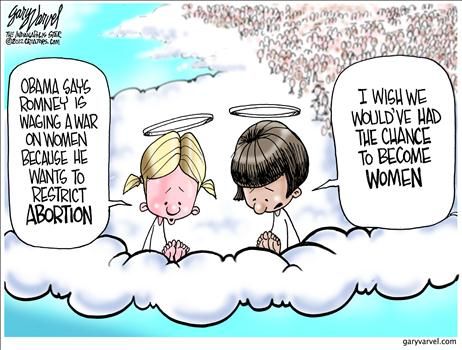
This whole debate about the war on woman makes me think of this editorial cartoon about abortion that I wish many people would see. It shows both sides of the debate on this “war on women.”

In the film series “WHATEVER HAPPENED TO THE HUMAN RACE?” the arguments are presented  against abortion (Episode 1),  infanticide (Episode 2),   euthenasia (Episode 3), and then there is a discussion of the Christian versus Humanist worldview concerning the issue of “the basis for human dignity” in Episode 4 and then in the last episode a close look at the truth claims of the Bible.

I truly believe that many of the problems we have today in the USA are due to the advancement of humanism in the last few decades in our society. Ronald Reagan appointed the evangelical Dr. C. Everett Koop to the position of Surgeon General in his administration. He partnered with Dr. Francis Schaeffer in making the video below. It is very valuable information for Christians to have.  Actually I have included a video below that includes comments from him on this subject.

___________

Francis Schaeffer: “Whatever Happened to the Human Race” (Episode 5) TRUTH AND HISTORY

Published on Oct 7, 2012 by

________________

Below Derek Brown notes, “As Schaeffer spoke across the United States at various colleges, he would not only impress listeners with his engagement with the wider culture and his ability to make Christianity appear intellectually tenable and relevant to the contemporary era, he also demonstrated a notable compassion for those whose works he would analyze and interpret.”

Though I am grateful for this time in Schaeffer’s life it was later after the release of his two film series that he reached a much larger audience.

Compassionate Engagement, Part 3: Life at L’Abri

By Derek Brown on January 10, 2012

Part 1     Part 2

Prior to the establishment of the L’Abri fellowship, Schaeffer trudged through a season of spiritual turmoil and profound questioning.  He had grown disillusioned with the spiritual reality of his own life and of those within the separatist movement and in other orthodox churches with which he was familiar (Louis Parkhurst, Francis Schaeffer: The Man and His Message, 69-70).  The result of the honest questioning his faith and of Christianity led Schaeffer, not to despair and unbridled skepticism, but to a deeper faith and experience of God’s reality as he saw the clear truth of God’s existence and his revelation in Scripture.  This newfound joy in Christ would lead to a fruitful–albeit unique–ministry over the next several years.

When the Schaeffer’s completed a one-year furlough back in the United States, they were, through various (and at times, extremely difficult) circumstances, able to purchase a home that would “always be open to young people” (Hankins, 55).  Shortly after their purchase of this home, the Schaeffer’s resigned from the Independent Board for Foreign Missions on June 4, 1955.  Schaeffer’s break from fundamentalism was now complete (Hankins, 56).

The Schaeffer’s new venture would formally begin in July 1955 as L’Abri (“the shelter”) Fellowship became the official name of the Schaeffer’s new ministry.  During the first years of L’Abri, a variety of visitors would come to the Chalet and find warm welcome.  Shortly after they opened L’Abri, the Schaeffer’s were able to purchase and use other nearby buildings.  These buildings would become places of study and accommodations for visitors.  The main feature of L’Abri, however, was the discussions.

Schaeffer would entertain and encourage discussions of all kinds with visitors.  These conversations typically flowed out of questions posed by the guests as they inquired into the nature and reality of Christianity or boldly asserted their unbelief.  The talks, however, were, for Schaeffer’s part, never mere academic banter; they were, as Hankins observes, “about truth and how it affected real lives” (Hankins, 61).  The Schaeffer’s were intentional in coupling sincere intellectual engagement with an environment of warmth and love.  They were convinced of that the “final apologetic” for the truth of Christianity was the demonstration of the love that Christians had for one another and for others.  Regarding the importance of this visible testimony to the reality of Christianity, Schaffer would later write in his book, The God Who is There,

The final apologetic, along with the rational, logical defense and presentation, is what the world sees in the individual Christian and in our corporate relationships together…What we are called to do…is to exhibit substantial healing, individual and then corporate, so that people may observe it (Schaeffer, The Francis Schaeffer Trilogy, 165).

This important facet of Christianity and the defense of its truth had been absent in much of the fundamentalism to which Francis Schaeffer had been exposed; he and Edith were resolute in their effort to make sure L’Abri would be different in this regard (Hankins, 72).

As L’Abri’s popularity grew, Schaeffer would have the opportunity to speak at university campuses throughout Europe.  Yet, as Schaeffer became more convinced of the truth he was purveying in the work among the questioning visitors and among the universities, he also became frustrated that only a handful of people—those who visited L’Abri and those in the European universities—would hear these important messages.  Schaeffer’s effort to speak to a larger audience would eventually lead to lecture circuits to colleges in the United States (Hankins, 74-75).

As Schaeffer spoke across the United States at various colleges, he would not only impress listeners with his engagement with the wider culture and his ability to make Christianity appear intellectually tenable and relevant to the contemporary era, he also demonstrated a notable compassion for those whose works he would analyze and interpret.  This latter characteristic of Schaeffer’s approach to intellectual engagement was illustrated vividly when, after reading a nonsensical poem by an unbelieving author, rebuked the laughing crowd, saying,

I get so tired of Bible believing Christians who laugh at these people—who laugh at them when they look at their tortured paintings.  Do you laugh at a man at the door of hell?  When evangelicals learn to stop their laughing and take such men and their struggles seriously then [evangelicals] can again begin to speak to our generation (Hankins, 77).

Here again we find a man not only interested in developing an apologetic to demonstrate the reasonableness of Christianity, but also—and just as importantly—a love that could weep over those with whom he would engage with intellectual argument and rigor.

Next: A Few Significant Works

Related posts:

WHY FRANCIS SCHAEFFER MATTERS:The Role of the Church in Cultural Transformation – PART 9 By David Steele

WHY FRANCIS SCHAEFFER MATTERS:The Role of the Church in Cultural Transformation – PART 9 By David Steele

The Scientific Age

Uploaded by  on Oct 3, 2011

_______________

Episode VII – The Age of Non Reason

Dr. Schaeffer’s sweeping epic on the rise and decline of Western thought and Culture

_______________________

I love the works of Francis Schaeffer and I have been on the internet reading several blogs that talk about Schaeffer’s work and the work below   by David Steele was really helpful. Schaeffer’s film series “How should we then live?  Wikipedia notes, “According to Schaeffer, How Should We Then Live traces Western history from Ancient Rome until the time of writing (1976) along three lines: the philosophic, scientific, and religious.[3] He also makes extensive references to art and architecture as a means of showing how these movements reflected changing patterns of thought through time. Schaeffer’s central premise is: when we base society on the Bible, on the infinite-personal God who is there and has spoken,[4] this provides an absolute by which we can conduct our lives and by which we can judge society.  Here are some posts I have done on this series: Francis Schaeffer’s “How should we then live?” Video and outline of episode 10 “Final Choices” , episode 9 “The Age of Personal Peace and Affluence”, episode 8 “The Age of Fragmentation”, episode 7 “The Age of Non-Reason” , episode 6 “The Scientific Age” ,  episode 5 “The Revolutionary Age” , episode 4 “The Reformation”,  episode 3 “The Renaissance”, episode 2 “The Middle Ages,”, and  episode 1 “The Roman Age,” .

In the film series “WHATEVER HAPPENED TO THE HUMAN RACE?” the arguments are presented  against abortion (Episode 1),  infanticide (Episode 2),   euthanasia (Episode 3), and then there is a discussion of the Christian versus Humanist worldview concerning the issue of “the basis for human dignity” in Episode 4 and then in the last episode a close look at the truth claims of the Bible.

Francis Schaeffer

WHY FRANCIS SCHAEFFER MATTERS:The Role of the Church in Cultural Transformation – PART 9

Francis Schaeffer believes that the church has a heavy responsibility to promote community.  He holds that the first step in comprehending Christian community is understanding the individuals who make up the community.  The reason: The individual is important to God.  He adds, “I am convinced that in the twentieth century people all over the world will not listen if we have the right doctrine, the right polity, but are not exhibiting community” (The Church At The End Of The Twentieth Century, 64).

He stresses “existential living in the community.”  The horizontal relationships must all be rooted in the vertical, namely, a relationship with God.  He holds that the primary responsibility is developing community within the church.  He does not minimize the importance of reaching out to the lost but contends the community of the faithful must come first.

We Must Practice Purity

Schaeffer expresses his passion for maintaining purity in the church by appealing to the bride motif in Scripture.  “As the bride of Christ, the church is to keep itself pure and faithful which involve two principles that seem to work against each other” (The Church Before The Watching World, 115).  These principles include the practice of purity in regard to doctrine and life and the practice of an observable love and oneness among all true Christians regardless of who they happen to be.

Ultimately our task is to exhibit simultaneously the holiness and the love of God.  Schaeffer explains this complex responsibility.  “If we stress the love of God without the holiness of God, it turns out only to be compromise.  But if we stress the holiness of God without the love of God, we practice something that is hard and lacks beauty” (The Church Before The Watching World, 152).

The method for practicing purity within the church is the consistent practice of church discipline (noted above as one of the norms of the New Testament church).  Schaeffer unapologetically believes that anyone who rejects the teaching of Scripture in belief or practice should be placed under church discipline – the very purity of Christ’s church is at stake.

Drawing further on the bride motif, Schaeffer warns Christians from committing spiritual adultery:  “The bride of Christ can be led away and can become less than the bride should be.  As there can be physical adultery, so too there can be unfaithfulness to the divine Bridegroom – spiritual adultery” (The Church Before The Watching World, 139).  Further, “To turn away from the divine Bridegroom is to turn to unfufillment.  This is not only sin, it is destruction” (The Church Before The Watching World, 147).

The moment by moment experience with the Bridegroom is an extremely important issue in Schaeffer’s thinking.  He believes that evangelicals for the most part have banked on the doctrine of justification by faith alone but they have failed to live in the light of this teaching:  “As the bride puts herself in the bridegroom’s arms on the wedding day and then daily, and as therefore children are born, so the individual Christian is to put himself in the Bridegroom’s arms, not only once for all in justification, but existentially, moment by moment” (The Church Before The Watching World, 135).  Moreover, “We are to act as that we are.  We are not just going to heaven.  We are even now the wife of God.  We are at this moment the bride of Christ.  And what does  our divine Bridegroom want from us?  He wants from us not only doctrinal faithfulness, but our love day by day” (The Church Before The Watching World, 148).

We Must Demonstrate the Reality of Christianity

Schaeffer does not stop with doctrinal and existential faithfulness to Christ.  He contends that we must also demonstrate the reality of the Christian faith in tangible ways to the watching world.  He holds that the essential quality of a believer is love for one another (John 13:35).

Despite Schaeffer’s vigorous attempts to provide a defense of the Christian faith, he contends that love for one another and a unified body provide the basis for the unbeliever to become interested in the Christian faith.  He calls this love and unity “the final apologetic.”  He offers this challenge to the evangelical church:  Our love will not be perfect, but it must be substantial enough for the world to be able to observe or it does not fit into the structure or the verses in John 13 and John 17.  And if the world does not observe this among true Christians, the world has a right to make two awful judgments which these verses indicate: that we are not Christians, and that Christ was not sent by the Father (The Mark Of The Christian, 197).

We Must Engage in a Christian Revolution

Schaeffer contends that the evangelical church must return to the base of Scripture and embark on a Christian revolution.  He maintains the church must be pitted against everyone who has turned away from God and the revelation of the Word of God.  He believes the implications of revolution are threefold:  First, Christians must realize that there is a difference between being a cobelligerent and an ally.  Second, the church must take truth seriously (Here is the repeated emphasis on antithesis).  Third, the church must be a real place of community (as noted above).

He provides two basic principles for being a revolutionary Christian.  First, we need a Christianity that is strong, not  a mere memory.  He simply calls this “hot Christianity.”  Second, our Christianity must become truly universal; relevant to all segments of society and all societies of the world.  He refers to this as “compassionate Christianity.”

Schaeffer does not believe, however, that mere revolution is enough.  He believes that the church in the modern generation also needs reformation and revival.  Reformation refers to a restoration to pure doctrine and a return to the teachings of Scripture.  Revival refers to a restoration in the Christian life and a proper relationship to the Holy Spirit.

Reformation and revival must occur simultaneously.  Or as Schaeffer puts it, “The great moments of church history have come when these two restorations have simultaneously come into action so that the church has returned to pure doctrine and the  lives of the Christians in the church have known the power of the Holy Spirit.  There cannot be true revival unless there has been reformation; and reformation is not complete without revival” (Death In The City, 210).

We Must Reclaim the Culture for the Cause of Christ and His Kingdom

This final admonition for Dr. Schaeffer plays a central role in his thinking.  He sums up his view in his little book, Back To Freedom and Dignity.  “In short, Christians should prepare to take the lead in giving direction to cultural change.”

The primary issue at hand is a return to the Christian consensus; the Christian worldview.  “I tell you in the name of God He will judge our culture unless there is a return to a Christian base for the culture – and that begins with true repentance and renewal in the church” (The Church Before The Watching World, 147).

The most definitive look at Schaeffer’s view in this area is his popular work, A Christian Manifesto.  Inspired by Samuel Rutherford who wrote Lex Rex (law is king) in 1644, Schaeffer proceeds to describe the cultural responsibilities of the church.  He quotes John Witherspoon approvingly who writes, “A republic once easily poised must either preserve it’s virtue or lose it’s liberty.”

He addresses the problem of pluralism and believes “it is up to Christians to show that Christianity is the Truth of total reality in the open marketplace of freedom” (A Christian Manifesto, 440).

He addresses the problem of humanism and writes, “If we are going to join the battle in a way that has any hope of effectiveness – with Christians truly being salt and the light in our culture and our society – then we must do battle on the entire front” (A Christian Manifesto, 445).  He continues:

Most fundamentally, our culture, society, government, and law are in the conditions they are in, not because of a conspiracy, but because the church has forsaken its duty to be the salt of the culture.  It is the church’s duty (as well as its privilege ) to do now what it should have been doing all the time – to use freedom we do have to be that salt of the culture (A Christian Manifesto, 447).

The answer Schaeffer gives for the enduring problems that America faces is most interesting.  He endorses civil disobedience and goes so far to say that a given Christian is disobedient if she does not engage in necessary civil disobedience.

The foundation for Schaeffer’s adherence to civil disobedience may be found in the book,  Lex Rex.  It essentially proclaims that the law is king, and if the king and the government disobey the law they are to be disobeyed.  The logic is defined as follows:  All power is from God (Rom. 13) and government is ordained and instituted by God.  However, the state is to be administered according to the principles of God’s Law.  Acts of the state which contradict God’s Law are illegitimate and are considered acts of tyranny (defined as ruling without the sanction of God).

Therefore, the following principles apply to the Christian church:  First, since tyranny is satanic, not to resist it is to resist God.  Conversely, to resist tyranny is to honor God.  Second, since the ruler is granted conditional power, it follows that the people have the power to withdraw their sanction if the proper conditions are not fulfilled.  Third, Christians have a moral obligation to resist unjust and tyrannical government.

Rutherford further explains the steps for a private person engaging in civil disobedience.  The first step is to defend oneself by protest (in our society this would most likely take place by exerting legal action).  Second, one must flee if at all possible.  Finally, one may use force if necessary to defend himself.  Dr. Schaeffer mentions that potential protest or withholding of taxes may be used to protest immoral activity such as euthanasia.

Building on the principles set forth in Lex Rex, Dr. Schaeffer suggests a strategy for Christian force in an injustice such as abortion.  First, one should aggressively support a human life bill or a constitutional amendment that protects the unborn.  Second, one must enter the courts seeking to overturn the Supreme Court’s decision.  Third, legal and political action should be taken against hospitals and abortion clinics that perform abortions.  Fourth, the state must be made to feel the presence of the Christian community.

Schaeffer’s position is clear.  He maintains that the early church engaged in civil disobedience.  He uses Caesar as an example who commanded everyone to worship him.  The Christians in Rome willingly disobeyed and paid the ultimate price for their act of courage.

Schaeffer, then,  issues a challenge to the present day church.  “And we must demonstrate to people that there is indeed a bottom line.  To repeat: the bottom line is that at a certain point there is not only the right, but the duty to disobey the state (A Christian Manifesto, 485).

If there is no final place for civil disobedience, then the government has been made autonomous, and as such, it has been put in the place of the Living God.  If there is no final place for civil disobedience, then the government has been put in the place of the Living God, because then you are to obey it even when it tells you in its own way at the time to worship Caesar (A Christian Manifesto, 491).

To sum up, Dr. Schaeffer challenges the church to stand up and act.  The Christian church must respond to the cultural decay or find itself wanting.  Schaeffer’s warning in the late 60′s and early 70′s is even more relevant today!

Related posts:

Taking on Ark Times Bloggers on various issues Part A “The Pro-life Issue” (Francis Schaeffer Quotes Part 1 includes the film SLAUGHTER OF THE INNOCENTS) (editorial cartoon)

I have gone back and forth and back and forth with many liberals on the Arkansas Times Blog on many issues such as abortion, human rights, welfare, poverty, gun control  and issues dealing with popular culture. Here is another exchange I had with them a while back. My username at the Ark Times Blog is Saline […]

“Schaeffer Sunday” Francis Schaeffer: “Whatever Happened to the Human Race” (Episode 1) ABORTION OF THE HUMAN RACE

It is not possible to know where the pro-life evangelicals are coming from unless you look at the work of the person who inspired them the most. That person was Francis Schaeffer.  I do care about economic issues but the pro-life issue is the most important to me. Several years ago Adrian Rogers (past president of […]

The movie “Les Miserables” and Francis Schaeffer

I got this off a Christian blog spot. This person makes some good points and quotes my favorite Christian philosopher Francis Schaeffer too. Prostitution, Chaos, and Christian Art The newest theatrical release of Victor Hugo’s 1862 novel “Les Miserables” was released on Christmas, but many Christians are refusing to see the movie. The reason simple — […]

“Schaeffer Sunday” Francis Schaeffer is one of the great evangelical theologians of our modern day

Francis Schaeffer was truly a great man and I enjoyed reading his books. A theologian #2: Rev. Francis Schaeffer Duriez, Colin. Francis Schaeffer: An Authentic Life. Wheaton, IL: Crossway Books, 2008. Pp. 240. Francis Schaeffer is one of the great evangelical theologians of our modern day. I was already familiar with some of his books and his […]

“Schaeffer Sundays” Francis Schaeffer’s own words concerning infanticide and youth enthansia

Francis Schaeffer: “Whatever Happened to the Human Race?” (Episode 2) SLAUGHTER OF THE INNOCENTS Published on Oct 6, 2012 by AdamMetropolis ___________ The 45 minute video above is from the film series created from Francis Schaeffer’s book “Whatever Happened to the Human Race?” with Dr. C. Everett Koop. This book  really helped develop my political views […]

Francis Schaeffer’s wife Edith passes away on Easter weekend 2013 Part 7 (includes pro-life editorial cartoon)

The Francis and Edith Schaeffer Story Pt.1 – Today’s Christian Videos The Francis and Edith Schaeffer Story – Part 3 of 3 Francis Schaeffer: “Whatever Happened to the Human Race” (Episode 1) ABORTION OF THE HUMAN RACE Published on Oct 6, 2012 by AdamMetropolis ________________ Picture of Francis Schaeffer and his wife Edith from the […]

The Mark of the Christian by Francis Schaeffer Part 1

  THE MARK OF A CHRISTIAN – CLASS 1 – Introduction Published on Mar 7, 2012 This is the introductory class on “The Mark Of A Christian” by Francis Schaeffer. The class was originally taught at Redeemer Presbyterian Church in Overland Park, KS by Dan Guinn from FrancisSchaefferStudies.org as part of the adult Sunday School hour […]

“Schaeffer Sundays” Francis Schaeffer’s own words concerning humanist dominated public schools in USA even though country was founded on a Christian base

Francis Schaeffer: “Whatever Happened to the Human Race?” (Episode 2) SLAUGHTER OF THE INNOCENTS Published on Oct 6, 2012 by AdamMetropolis The 45 minute video above is from the film series created from Francis Schaeffer’s book “Whatever Happened to the Human Race?” with Dr. C. Everett Koop. This book  really helped develop my political views concerning […]

“Schaeffer Sundays” Francis Schaeffer’s own words concerning where the Bible-believing Christians been the last few decades

Francis Schaeffer: “Whatever Happened to the Human Race” (Episode 1) ABORTION OF THE HUMAN RACE Published on Oct 6, 2012 by AdamMetropolis The 45 minute video above is from the film series created from Francis Schaeffer’s book “Whatever Happened to the Human Race?” with Dr. C. Everett Koop. This book  really helped develop my political views […]

Taking on Ark Times Bloggers on various issues Part E “Moral absolutes and abortion” Francis Schaeffer Quotes part 5(includes the film SLAUGHTER OF THE INNOCENTS) (editorial cartoon)

I have gone back and forth and back and forth with many liberals on the Arkansas Times Blog on many issues such as abortion, human rights, welfare, poverty, gun control  and issues dealing with popular culture. Here is another exchange I had with them a while back. My username at the Ark Times Blog is Saline […]

“Schaeffer Sundays” Francis Schaeffer’s own words concerning religious liberals and humanists

Francis Schaeffer: “Whatever Happened to the Human Race” (Episode 5) TRUTH AND HISTORY Published on Oct 7, 2012 by AdamMetropolis The 45 minute video above is from the film series created from Francis Schaeffer’s book “Whatever Happened to the Human Race?” with Dr. C. Everett Koop. This book  really helped develop my political views concerning abortion, […]

Dear Senator Pryor, why not pass the Balanced Budget Amendment? (“Thirsty Thursday”, Open letter to Senator Pryor)

Dear Senator Pryor,

Why not pass the Balanced  Budget Amendment? As you know that federal deficit is at all time high (1.6 trillion deficit with revenues of 2.2 trillion and spending at 3.8 trillion).

On my blog www.HaltingArkansasLiberalswithTruth.com I took you at your word and sent you over 100 emails with specific spending cut ideas. However, I did not see any of them in the recent debt deal that Congress adopted. Now I am trying another approach. Every week from now on I will send you an email explaining different reasons why we need the Balanced Budget Amendment. It will appear on my blog on “Thirsty Thursday” because the government is always thirsty for more money to spend.

There’s nothing nutty about a balanced-budget amendment
In fact, it makes a lot of sense
Thursday, July 21, 2011
By Dick Thornburgh

A late entry in the budget deficit-debt ceiling talkathon in Washington is increasing support for a constitutional requirement that the federal budget be balanced each and every year.

Doctrinaire liberals will no doubt characterize this proposal as a nutty one, but careful scrutiny of such an amendment to our Constitution demonstrates its potential to prevent future train wrecks in the budgeting process.

Coupled with a presidential line-item veto and separate capital budgeting (which differentiates investments from current outlays), a constitutional budget-balancing requirement makes sense. These tools already are available to most governors and state legislatures. And they work.

The current debate in the Congress will likely include the following arguments usually raised against a balanced-budget amendment.

First, it will be argued that the amendment would “clutter up” our basic document in a way contrary to the intention of the founding fathers.

This is clearly wrong. The framers of the Constitution contemplated that amendments would be necessary to keep it abreast of the times. It already has been amended on 27 occasions.

Moreover, at the time of the Constitutional Convention, one of the major preoccupations was how to liquidate the Revolutionary War debts of the states. Certainly, it would have been unthinkable to the framers that the federal government itself would systematically run at a deficit, decade after decade. Indeed, the Treasury did not begin to follow such a practice until the mid-1930s.

Second, critics will argue that the adoption of a balanced-budget amendment would not solve the deficit problem overnight.

This is correct, but begs the issue. Serious supporters of the amendment recognize that a phasing-in period of five or 10 years would be required to reach a zero deficit. During this interim period, however, budget makers would be disciplined to meet declining deficit targets in order to reach a balanced budget by the established deadline.

As pointed out by former Commerce Secretary Peter G. Peterson, such “steady progress toward eliminating the deficit will maintain investor confidence, keep long-term interest rates headed down and keep our economy growing.”

Third, it will be argued that such an amendment would require vast cuts in social services and entitlements or defense expenditures.

Not necessarily. True, these programs would have to be paid for on a current basis rather than heaped on the backs of upcoming generations. Certainly, difficult choices would have to be made about priorities and levels of program funding. But the very purpose of the amendment is to discipline the executive and legislative branches actually to debate these choices and not to propose or perpetuate vast spending programs without providing the revenues to fund them.

The amendment would, in effect, make the president and Congress fully accountable for their spending and taxing decisions, as they should be.

Fourth, critics will say that a balanced-budget amendment would prevent or hinder our capacity to respond to national defense or economic emergencies.

This concern is easy to counter. Any sensible amendment proposal would feature a “safety valve” to exempt deficits incurred in response to such emergencies, requiring, for example, a three-fifths “super majority” in both houses of Congress. Such action should, of course, be based on a finding that such an emergency actually exists.

Fifth, it will be said that a balanced-budget amendment would be “more loophole than law” and might be easily circumvented.

The experience of the states suggests otherwise. Balanced-budget requirements are now in effect in all but one of the 50 states and have served them well.

Moreover, the line-item veto, available to 43 governors, would assure that any specific congressional overruns (or loophole end-runs) could be dealt with by the president. The public’s outcry, the elective process and the courts would also provide backup restraint on any tendency to simply ignore a constitutional directive.

In the final analysis, most of the excuses raised for not enacting a constitutional mandate to balance the budget rest on a stated or implied preference for solving our deficit dilemma through the “political process” — that is to say, through responsible action by the president and Congress.

But that has been tried and found wanting, again and again.

Surely, this country is ready for a simple, clear and supreme directive that its elected officials fulfill their fiscal responsibilities. A constitutional amendment is the only instrument that will meet this need effectively. Years of experience at the state level argue persuasively in favor of such a step. Years of debate have produced no persuasive arguments against it.

Perhaps Thomas Jefferson put it best:

“To preserve our independence, we must not let our rulers load us down with perpetual debt.”

That is the aim of a balanced-budget amendment. Reform-minded members of Congress should choose to support such an amendment to our Constitution as a means of resolving future legislative crises and ending “credit card” government once and for all.

A nutty idea? Not by a long shot.

Dick Thornburgh, of counsel to the Pittsburgh law firm K&L Gates, is a former U.S. attorney general and governor of Pennsylvania.
First published on July 21, 2011 at 12:00 am