Open letter to President Obama (Part 362)

Does Government Have a Revenue or Spending Problem?

People say the government has a debt problem. Debt is caused by deficits, which is the difference between what the government collects in tax revenue and the amount of government spending. Every time the government runs a deficit, the government debt increases. So what’s to blame: too much spending, or too little tax revenue? Economics professor Antony Davies examines the data and concludes that the root cause of the debt is too much government spending.

____________

(This letter was emailed to White House on 12-12-12.)

President Obama c/o The White House
1600 Pennsylvania Avenue NW
Washington, DC 20500

Dear Mr. President,

I know that you receive 20,000 letters a day and that you actually read 10 of them every day. I really do respect you for trying to get a pulse on what is going on out here.

When you try and tax and spend too much then the business community will try and relocate to another state. That is exactly what is happening in California today. We need to lower taxes if we want to grow the economy.

Over the years, I’ve shared some outrageous examples of overpaid bureaucrats.

Hopefully we’re all disgusted when insiders rig the system to rip off taxpayers. And I suspect you’re not surprised to see that the worst example on that list comes from California, which is in a race with Illinois to see which state can become the Greece of America.

Well, the Golden State has a new über-bureaucrat. Here are some of the jaw-dropping details from a Bloomberg report.

The numbers are even larger in California, where a state psychiatrist was paid $822,000, a highway patrol officer collected $484,000 in pay and pension benefits and 17 employees got checks of more than $200,000 for unused vacation and leave. The best-paid staff in other states earned far less for the same work, according to the data.

Wow, $822,000 for a state psychiatrist. Not bad for government work. So what is Governor Jerry Brown doing to fix the mess? As you might expect, he’s part of the problem.

…the state’s highest-paid employees make far more than comparable workers elsewhere in almost all job and wage categories, from public safety to health care, base pay to overtime. …California has set a pattern of lax management, inefficient operations and out-of-control costs. …In California, Governor Jerry Brown hasn’t curbed overtime expenses that lead the 12 largest states or limited payments for accumulated vacation time that allowed one employee to collect $609,000 at retirement in 2011. …Last year, Brown waived a cap on accrued leave for prison guards while granting them additional paid days off. California’s liability for the unused leave of its state workers has more than doubled in eight years, to $3.9 billion in 2011, from $1.4 billion in 2003, according to the state’s annual financial reports. …The per-worker costs of delivering services in California vastly exceed those even in New York, New Jersey, Illinois and Ohio.

Actually, it’s not just that he’s part of the problem. He’s making things worse, having seduced voters into approving a ballot measure to dramatically increase the tax burden on the upper-income taxpayers.

I suppose the silver lining to that dark cloud is that many bureaucrats now rank as part of the top 1 percent, so they’ll have to recycle some of their loot back to the political vultures in Sacramento.

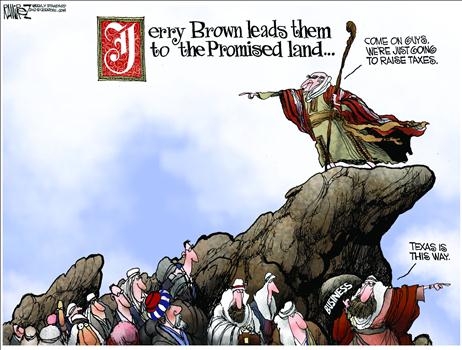
Cartoon California Promised Land

But the biggest impact of the tax hike – as shown in the Ramirez cartoon – will be to accelerate the shift of entrepreneurs, investors, and small business owners to states that don’t steal as much. Indeed, a study from the Manhattan Institute looks at the exodus to lower-tax states.

The data also reveal the motives that drive individuals and businesses to leave California. One of these, of course, is work. …Taxation also appears to be a factor, especially as it contributes to the business climate and, in turn, jobs. Most of the destination states favored by Californians have lower taxes. States that have gained the most at California’s expense are rated as having better business climates. The data suggest that many cost drivers—taxes, regulations, the high price of housing and commercial real estate, costly electricity, union power, and high labor costs—are prompting businesses to locate outside California, thus helping to drive the exodus.

Yet another example of why tax competition is such an important force for economic liberalization. It punishes governments that are too greedy and gives taxpayers a chance to protect their property from the looter class.

___________

_____________

Thank you so much for your time. I know how valuable it is. I also appreciate the fine family that you have and your commitment as a father and a husband.

Sincerely,

Everette Hatcher III, 13900 Cottontail Lane, Alexander, AR 72002, ph 501-920-5733, lowcostsqueegees@yahoo.com

Wrestling with Ecclesiastes

Ecclesiastes 6-8 | Solomon Turns Over a New Leaf

Published on Oct 2, 2012

Calvary Chapel Spring Valley | Sunday Evening | September 30, 2012 | Pastor Derek Neider

_____________________

I have written on the Book of Ecclesiastes and the subject of the meaning of our lives on several occasions on this blog. In this series on Ecclesiastes I hope to show how secular humanist man can not hope to find a lasting meaning to his life in a closed system without bringing God back into the picture. This is the same exact case with Solomon in the Book of Ecclesiastes. Three thousand years ago, Solomon took a look at life “under the sun” in his book of Ecclesiastes. Christian scholar Ravi Zacharias has noted, “The key to understanding the Book of Ecclesiastes is the term ‘under the sun.’ What that literally means is you lock God out of a closed system, and you are left with only this world of time plus chance plus matter.”

Let me show you some inescapable conclusions if you choose to live without God in the picture. Solomon came to these same conclusions when he looked at life “under the sun.”

  1. Death is the great equalizer (Eccl 3:20, “All go to the same place; all come from dust, and to dust all return.”)
  2. Chance and time have determined the past, and they will determine the future.  (Ecclesiastes 9:11-13)
  3. Power reigns in this life, and the scales are not balanced(Eccl 4:1)
  4. Nothing in life gives true satisfaction without God including knowledge (1:16-18), ladies and liquor (2:1-3, 8, 10, 11), and great building projects (2:4-6, 18-20).

You can only find a lasting meaning to your life by looking above the sun and bring God back into the picture.

WRESTLING WITH THE MEANING OF LIFE


Week of January 3, 2010

Bible Verses:  Ecclesiastes 1:1-11; 12:13-14.

Lesson Focus: This lesson is about the struggle people face when defining the meaning of their lives.

Is Life Meaningless?: Ecclesiastes 1:1-7.

[1]  The words of the Preacher, the son of David, king in Jerusalem. [2]  Vanity of vanities, says the Preacher, vanity of vanities! All is vanity. [3]  What does man gain by all the toil at which he toils under the sun? [4]  A generation goes, and a generation comes, but the earth remains forever. [5]  The sun rises, and the sun goes down, and hastens to the place where it rises.

[6]  The wind blows to the south and goes around to the north; around and around goes the wind, and on its circuits the wind returns. [7]  All streams run to the sea, but the sea is not full; to the place where the streams flow, there they flow again.  [ESV]

Ecclesiastes is an open letter from God to everyone who is willing to think about the issues of life. In a graphic and relentless way, the awful realities are exposed and the way is pointed to God’s answers. God gave this Word through the Preacher (or Teacher) to His covenant people in order to lead them back to the joy of meaningful life in reconciled fellowship with Him. The Preacher asked all the basic questions that wracked the minds of men and women in his day. And just as surely and as timely, his message impacts on the need of our own day. Is there any real meaning in life? Or is everything meaningless? All is vanity says the Preacher. On the face of it, the writer seems to be promoting the idea that everything really is meaningless. We must remember, however, that he is constructing an argument designed to lead us from one way of thinking to another that is radically different. He therefore starts with the wrong idea so that he may lead us to the right one. He means to expose what we nowadays call the secular view of life: a life without any absolutes, a life without the certainties of the revelation of God’s Word, a life lived out of values generated by man without reference to God, a life that expects lasting satisfaction from earthbound things. He wants to show how such a life can only be meaningless and must end in disillusionment in time, not to mention eternity. To heighten the drama of his argument, he gives a vivid presentation of this position as if it is all there is! Surprisingly perhaps, this theme of meaninglessness is only a means to his primary goal. Later, as he develops his argument, he shows his readers that there is real meaning in life and that it consists in loving God and being his disciples [12:13-14]. He is not a cynic. He firmly believes that all meaning comes from the infinite, personal God who has revealed Himself to humanity in His Word. Consequently, he is persuaded that this meaning is only understood and grasped in a personal relationship with God – a living faith in Him, which results in a commitment to discipleship as a child of God.

[1-3]  What does the Preacher mean when he ascribes meaninglessness to everything? His point of contact with everyone who reads his words is their everyday experience of life. Everything around us reminds us of our transient foothold on planet Earth, and only a faith that sees beyond this level of reality can find comfort and security, or even meaning itself, that transcend the inevitabilities of change, decay and death. The Hebrew word translated vanity is used no fewer than thirty-six times in Ecclesiastes. It basically means ‘wind’ or ‘breath’, but, depending upon the specific context, it implies vanity, senselessness, transitoriness and meaninglessness. This sense of futility attaches to just about every aspect of our lives: pleasure [2:1-2]; property [2:4]; knowledge [2:12-16]; wealth [2:8; 5:8-15]; work [2:17-23]; success [4:13-16]; youth [11:10]; and, needless to say, frustration [4:4,7-8], loneliness [4:9-12], and death [3:19; 11:8]. Futility is endemic to the human condition and inevitably recurs in our experience. If now is all there is, you can be sure that as much meaning as possible will be wrung from it. Why? Because there is no other source! But this source is identical to the all that the Preacher declares so emphatically to be utterly meaningless. But over against the seeming futility of our fleeting impermanence stands the majestic unchangeableness of the infinite and eternal God and, not lease, the promise of redemption. The phrase under the sun is used twenty-five times in Ecclesiastes to characterize the secular life as seen through the Preacher’s eyes. It refers to a life limited to material, earthly categories – a life without the eternal dimension and the ultimate reality of the infinite, personal God. The question in verse 3 invites the reader to participate in the Preacher’s struggle about the meaning of life. Man, gain, toil and under the sun are all key terms that are repeated by the Preacher throughout the book. Man or humanity and under the sun point out the universal nature of the quest for meaning of life. Gain or benefit and toil or labor used together by the Preacher indicates his concern about our labor providing any gain in our quest for the meaning of life. He is perplexed about the meaningfulness or benefit of labor as he observes the world around him. The contemporary and pastoral significance of the Preacher’s quest should not be underestimated. As with all biblical religion, his concern is with all of human life as God has made it. The refrain under the sun evokes this comprehensive range as does the variety of areas of life on which he will focus.

[4-7]  Verses 4-11 are a poem that is deliberately placed between the programmatic question in verse 3 and the Preacher’s first-person introduction of himself in verse 12. The poem alerts us to two key issues that the Preacher will struggle with as he explores the benefit of labor and thus the meaning of life: the repetitiveness of history and the fact that people are not remembered. The following issues are raised as indications of why the benefit of labor is such a problem. The earth exhibits permanence, but not so humankind. Generations come and go and this transience raises major questions for the Preacher of the value of labor. In contrast to the earth, which stands forever, there is a lot of activity in nature, as indicated by the large number of participles in verses 5-7, evoking continuous action. The sun and the wind are very active, but their activity is circular and repetitive and seems to go nowhere. The verb translated hastens means ‘to pant’. The sun is like a runner endlessly making his way around a racetrack. As the movement of the sun implies an east-west course, now the wind is described as moving north and south. The repetition around and around heightens the sense of monotony and purposelessness. The sense of accomplishing nothing is reinforced in verse 7. The rivers continually empty into the sea but cannot fill it. The implication here is not repetitive motion but futile activity. These verses profoundly impress certain sensations on the reader. First comes a sense of the indifference of the universe to our presence. It was here before we came, and it will be here, unchanged, after we have gone. Second, however, the universe, like us, is trapped in a cycle of monotonous and meaningless motion. It is forever moving, but it accomplishes nothing. Finally, a sense of loneliness and abandonment pervades the text.

Is Life Wearing You Down?:  Ecclesiastes 1:8-11.

[8]  All things are full of weariness; a man cannot utter it; the eye is not satisfied with seeing, nor the ear filled with hearing. [9]  What has been is what will be, and what has been done is what will be done, and there is nothing new under the sun. [10]  Is there a thing of which it is said, “See, this is new”? It has been already in the ages before us. [11]  There is no remembrance of former things, nor will there be any remembrance of later things yet to be among those who come after.  [ESV]

[8]  If all we have are our senses – what we see and hear – we know that there is no end to the round of pleasing them. Just as our eyes and ears demand to be fed with new sensations, so an under-the-sun life is never satisfied. Yet the modern consumer society is largely built on this frantic foundation. It remains a fact of experience that the highest sensations of the cult of consumerism tend to leave an aftertaste of dissatisfaction and a craving for newer and better experiences. There is no lasting satisfaction under the sun: All things are full of weariness.

[9-11]  There is nothing new under the sun. In other words, what is new never remains new; it soon becomes old. In terms of the deeper things of the human spirit – meaning and aspirations – there is no real hope of anything different or better. Today’s novelty becomes tomorrow’s drudgery and seems, in the end, only to compound the problem. Today, there is plenty of change, an endless flow of new things. But what is really new, in terms of the things that matter? In the ancient world there was a certain timelessness to the passing of the years. The original readers of Ecclesiastes did not generally experience the kind of rapid change that we today find so commonplace and so impossibly difficult to catch up with. The force of the Preacher’s words is perhaps blunted by the very pace of modern society. We are, after all, submerged in novelty as a matter of everyday experience. Candid reflection, however, unmasks the illusion. Modern man knows in his heart that if anything has changed, it has probably been for the worse rather than the better. At the root of the matter, secular man views the world and human history as a closed system. There is no God and no divine goal for life or history. All that remains is unaided human effort clawing forward in the context of an evolving material universe. If the new soon becomes tedious commonplace [1:10], the past becomes irrelevant and is eventually forgotten altogether [1:11]. History is nonsense. Reality is now. Existence is all. There is an alternative to this meaninglessness. It is to see the world God’s way. It is to realize your need of a Savior and to come to Him in the person of the Lord Jesus Christ, whose death effects the redemption of the lost who will come to Him. Christ is the focus of all meaning for a fallen world. Life without a personal faith relationship with the Lord – a godless, secular, under-the-sun life – is life without ultimate meaning. It is life without a future. More accurately, it is life with an endless non-future of eternal alienation from God. Such life in the present is without true meaningfulness, however much it is overlaid by the pursuit of knowledge or pleasure. But Jesus calls us, in the good news of His everlasting gospel, to new life in him – to fullness of meaning – right now and for evermore.

What is the Answer?:  Ecclesiastes 12:13-14.

[13]  The end of the matter; all has been heard. Fear God and keep his commandments, for this is the whole duty of man. [14]  For God will bring every deed into judgment, with every secret thing, whether good or evil.  [ESV]

When Solomon says, let us hear the end of the matter, it is like he is shouting, ‘Hear this!’. This is the point to which everything has been leading. So pay attention and don’t miss it. This conclusion comprises a double point. One concerns the Lord and the other His Word. These are the twin foci of the entire book: Fear God and keep his commandments, for this is the whole duty of man. To obey God is to be truly human. Throughout his book the Preacher has investigated the situation of mankind. Now, surprisingly, he affirms that the whole of humanity consists not in its mortality or ignorance but in its dependence on God. And yet the conclusion is not surprising. It not only flows naturally from all that has gone before but is the book’s final look at Genesis 2-3. Humanity sought to become like God in disobeying Him, but instead they lost the one thing that made them truly human. Everything Ecclesiastes has affirmed up to this point – the sovereign freedom of God, the limits of human wisdom, thoughts on the use and abuse of wealth and power, and the brevity and absolute contingency of human life – all lead to the command to fear God. For us the meaninglessness of life which the Preacher so ruthlessly exposes would seem to lead to despair or nihilism; for him it is an incitement to true piety. The insignificance of all that is done under the sun leaves him awestruck and silent before God. His inability to control or predict the future provokes him to dependence on God. The futility of attempting to secure his future through wisdom or acts of religion leads him not to impiety but to an understanding of the true nature of obedient trust. Seen in this light, to keep his commandments is not to behave with the self-satisfied arrogance of religious presumption, nor is it a nod to piety from an otherwise impious book. Rather, it is the deepest expression of humble acceptance of what it means to be a human before God.


This summary statement can be unpacked into some leading questions that challenge the conscience to the depths. (1) Do you know God? (2) Are you keeping His commandments? (3) Have you acknowledged your accountability before Him? (4) Will you confess that God is just in all His judgments? Outside of God and a loving reverence for Him and His revealed will, there really can only be vanity and meaninglessness. The full revelation of the New Testament now clothes this truth with the evangelical warmth of the gospel of Christ. God has revealed Himself to us in all His fullness as the Three-in-One, full of love and grace; the Father-God who is love and is to be worshipped in holy fear; the incarnate Son, the Lord Jesus Christ, the mediator who has died in our place to bear our sins; and the Holy Spirit, who since Pentecost has ministered in the hearts of God’s people with transforming power. It is only in faithful relationship to this Godhead that mankind can avoid the despair of a fallen world and find true hope and meaningfulness for eternity.

Questions for Discussion:

1.         What is the author’s purpose in writing Ecclesiastes? What does he mean when he writes that everything is vanity or meaninglessness?

2.         What is the alternative to all this meaninglessness?

3.         Why is to fear God and keep his commandments … the whole duty of man? Throughout Ecclesiastes, the Preacher has dealt with the issue of being truly human and how to find lasting meaning in life. How does fearing God and obeying His commandments provide the only solution to the Preacher’s search? What does it mean to fear God?  What is the relationship between studying God’s Word and keeping his commandments?

References:

Ecclesiastes, Craig Bartholomew, Baker Academic.

Ecclesiastes, Gordon Keddie, Evangelical Press.

Ecclesiastes, Duane Garrett, NAC, Broadman.

Related posts:

The Humanist takes on Solomon and the Book of Ecclesiastes

This from the American Humanist website: This week we’re pleased to publish a new poem “Ecclesiastes” by Frank S. Robinson. Frank S. Robinson is a retired New York State administrative law judge, a rare coin dealer, and author of five books, most recently The Case for Rational Optimism. He is married to the poet Therese […]

Avril Lavigne commits “the fool’s sin” in front of family crowd in Tampa (Avril and the Book of Ecclesiastes Part 1)

Tampa Bay Rays apologize for Avril Lavigne TMZ reported: According to local reports, Avril’s mic didn’t work at the start of her show … and she responded to the cavalcade of boos by yelling obscenities at crowd. Rays rep Rick Vaughn tells TMZ, “The Rays demand profanity-free performances from all of our concert performers and […]

Taking on Ark Times Bloggers on various issues Part U “Do men have a say in the abortion debate?” (includes the film SLAUGHTER OF THE INNOCENTS and editorial cartoon)

I have gone back and forth and back and forth with many liberals on the Arkansas Times Blog on many issues such as abortion, human rights, welfare, poverty, gun control  and issues dealing with popular culture. Here is another exchange I had with them a while back. My username at the Ark Times Blog is Saline […]

2008 article on Woody Allen on the meaning of life

I have spent alot of time talking about Woody Allen films on this blog and looking at his worldview. He has a hopeless, meaningless, nihilistic worldview that believes we are going to turn to dust and there is no afterlife. Even though he has this view he has taken the opportunity to look at the weaknesses of […]

If I see Chris Martin of Coldplay in person what would I say to him? (Part 3)

Chris Martin revealed in his interview with Howard Stern that he was rasied an evangelical Christian but he has left the church. I believe that many words that he puts in his songs today are generated from the deep seated Christian beliefs from his childhood that find their way out in his songs. His belief in […]

Part 4 Adrian Rogers on Proverbs “How To Be The Father Of A Wise Child” (video too)

Picture of Adrian Rogers above from 1970′s while pastor of Bellevue Baptist of Memphis, and president of Southern Baptist Convention. (Little known fact, Rogers was the starting quarterback his senior year of the Palm Beach High School football team that won the state title and a hero to a 7th grader at the same school named […]

If I see Chris Martin of Coldplay in person what would I say to him? (Part 2)

Chris Martin revealed in his interview with Howard Stern that he was rasied an evangelical Christian but he has left the church. I believe that many words that he puts in his songs today are generated from the deep seated Christian beliefs from his childhood that find their way out in his songs. His belief in […]

Taking on Ark Times Bloggers on various issues Part N “A discussion of the Woody Allen Movie CRIMES AND MISDEMEANORS”(includes film DEATH BY SOMEONE’S CHOICE)

I have gone back and forth and back and forth with many liberals on the Arkansas Times Blog on many issues such as abortion, human rights, welfare, poverty, gun control  and issues dealing with popular culture. Here is another exchange I had with them a while back. My username at the Ark Times Blog is Saline […]

Taking on Ark Times Bloggers on various issues Part L “On what basis do you say murder is wrong?”Part 2 (includes the film THE BASIS FOR HUMAN DIGNITY)

I have gone back and forth and back and forth with many liberals on the Arkansas Times Blog on many issues such as abortion, human rights, welfare, poverty, gun control  and issues dealing with popular culture. Here is another exchange I had with them a while back. My username at the Ark Times Blog is Saline […]

Taking on Ark Times Bloggers on various issues Part K “On what basis do you say murder is wrong?”Part 1 (includes film ABORTION OF THE HUMAN RACE)

I have gone back and forth and back and forth with many liberals on the Arkansas Times Blog on many issues such as abortion, human rights, welfare, poverty, gun control  and issues dealing with popular culture. Here is another exchange I had with them a while back. My username at the Ark Times Blog is Saline […]

“Woody Wednesday” Another look at Woody Allen’s movie Crimes and Misdemeanors

I have spent alot of time talking about Woody Allen films on this blog and looking at his worldview. He has a hopeless, meaningless, nihilistic worldview that believes we are going to turn to dust and there is no afterlife. Even though he has this view he has taken the opportunity to look at the weaknesses of […]

“Woody Wednesday” A 2010 review of Woody Allen’s Annie Hall

I have spent alot of time talking about Woody Allen films on this blog and looking at his worldview. He has a hopeless, meaningless, nihilistic worldview that believes we are going to turn to dust and there is no afterlife. Even though he has this view he has taken the opportunity to look at the weaknesses of […]

Robert Dick Wilson’s talk “Is the Higher Criticism Scholarly?” (part 6 of transcript)

The Bible and Archaeology (3/5) For many more archaeological evidences in support of the Bible, see Archaeology and the Bible . (There are some great posts on this too at the bottom of this post.) Robert Dick Wilson at the Grove City Bible Conference in 1909. IS THE HIGHER CRITICISM SCHOLARLY?Clearly attested facts showing that thedestructive […]

“Woody Wednesday” In 2009 interview Woody Allen talks about the lack of meaning of life and the allure of younger women

I have spent alot of time talking about Woody Allen films on this blog and looking at his worldview. He has a hopeless, meaningless, nihilistic worldview that believes we are going to turn to dust and there is no afterlife. Even though he has this view he has taken the opportunity to look at the weaknesses of […]

“Woody Wednesday” Woody Allen on the Emptiness of Life by Toby Simmons

I have spent alot of time talking about Woody Allen films on this blog and looking at his worldview. He has a hopeless, meaningless, nihilistic worldview that believes we are going to turn to dust and there is no afterlife. Even though he has this view he has taken the opportunity to look at the weaknesses of […]

12 Questions for Woody Allen (Woody Wednesday)

Above is a clip of 12 questions for Woody Allen. Below is a list of some of his movies. WOODY’S FINEST: Philip French’s favourite five Annie Hall (1977) In his first fully achieved masterwork, a semi-autobiographical comedy in which his ex-lover Diane Keaton and best friend Tony Roberts play versions of themselves, Allen created a […]

“Woody Wednesday” Allen on the meaning of life (part 2)

September 3, 2011 · 5:16 PM ↓ Jump to Comments Woody Allen on the Emptiness of Life In the final scene of Manhattan, Woody Allen’s character, Isaac, is lying on the sofa with a microphone and a tape-recorder, dictating to himself an idea for a short story. It will be about “people in Manhattan,” he says, […]

Video interviews of Gwyneth Paltrow and Chris Martin (Part 4)

As far as I know they have never done an interview together. Therefore, I have included separate interviews that they have done below and I have some links to past posts I have done on them too. Shane Warne – Chris Martin Interview (Part 1) Uploaded by HandyAndy136 on Nov 24, 2010 Originally broadcast on […]

“Woody Wednesday” Allen realizes if God doesn’t exist then all is meaningless

The Bible and Archaeology (1/5) The Bible maintains several characteristics that prove it is from God. One of those is the fact that the Bible is accurate in every one of its details. The field of archaeology brings to light this amazing accuracy. _________________________- I want to make two points today. 1. There is no […]

Milton Friedman’s religious views

John Lofton noted: “DR. FRIEDMAN an evolutionist with ‘values’ of unknown origin but he said they were not ‘accidental.’ “   If anyone takes time to read my blog for any length of time they can not question my respect for the life long work of Milton Friedman. He has advanced the cause of freedom […]

Kermit Gosnell and the irony of the coat hanger back alley argument

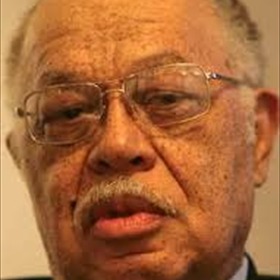
Many in the world today are taking a long look at the abortion industry because of the May 14, 2013 guilty verdict and life term penalty handed down by a jury (which included 9 out of 12 pro-choice jurors)  to Dr. Kermit Gosnell. During this time of reflection I wanted to put forth some of the pro-life’s best arguments.

In the film series “WHATEVER HAPPENED TO THE HUMAN RACE?” the arguments are presented  against abortion (Episode 1),  infanticide (Episode 2),   euthanasia (Episode 3), and then there is a discussion of the Christian versus Humanist worldview concerning the issue of “the basis for human dignity” in Episode 4 and then in the last episode a close look at the truth claims of the Bible.

Francis Schaeffer

__________________________

I truly believe that many of the problems we have today in the USA are due to the advancement of humanism in the last few decades in our society. Ronald Reagan appointed the evangelical Dr. C. Everett Koop to the position of Surgeon General in his administration.

________________

coat hanger argument

On the one hand, a favorite argument for abortion goes something  like this:

History shows that women have always tried to terminate unwanted pregnancies. When safe medical procedures are banned by law, they have resorted to dangerous–sometimes deadly–”back-alley” abortions.

(socialistworker.org/2005-2/562/562_06_Abortion.shtml)

And:

Those who push for more restrictions on abortion access – really, those who push for abortion to be made illegal – seem unwilling to acknowledge the disastrous alternatives.

…

Women would be left injured, ill, sterile, or dead.

Then on the other hand there’s the horrific news about the trial of abortionist Kermit Gosnell’s horrific murder of babies and mothers.

Kermit Gosnell abortion

For those who can stomach it, you can read the 281 page Grand Jury report in PDF form HERE and it literally comes with this warning: “Warning: This Grand Jury Report is very explicit. Read at your own risk.”  One thing is clear: Readers will notice that Kermit Gosnell’s abortion business is the epitome of the back alley styled dangerous abortionists that advocates of legalized abortion like to invoke to defend their position.

Pro-abortionists talk about how legalized abortion means safer abortion.  Yet their response to regulations is not often favorable, since advocates commit the slippery slope fallacious argument that regulations would infringe on the rights to abortion when clinics are shut down for failing health and sanitary standards by officials.  But is abortion to be allowed and legalized…at any cost?  Would we legalized coat hanger back alley abortions?  Should regulators do their job?  And where’s the officials regulating Kermit Gosnell?

According to the Washington Post,

This nightmare facility had not been inspected in 17 years – other than by someone from the National Abortion Federation, whom he actually invited there. For whatever reason, Gosnell applied for NAF membership two days after the death of the 41-year-old Nepalese woman, Karnamaya Mongar. Even on a day when the place had been scrubbed and spiffed up for the visit, the NAF investigator found it disgusting and rejected Gosnell’s application for membership. But despite noting many outright illegalities, including a padlocked emergency exit in a part of the clinic where women were left alone overnight, the grand jury report notes that the NAF inspector did not report any of these violations to authorities.”

(http://www.washingtonpost.com/blogs/she-the-people/wp/2013/04/15/why-kermit-gosnell-hasnt-been-on-page-one/)

The irony of all of this is that in order to make sure women do not resort to dangerous “unsanitary,” back alley coat hanger style abortions, authorities and medical officials have to look the other way so as not to close down abortion clinics with the result that this unregulated medical environment foster the very thing the pro-abortionist say we need to prevent: dangerous unsanitary shady and murderous abortion centers.

History tells us that any time any industry or line of work that foster a culture of looking the other way, it only makes things worst:  Crooked cops now become the gangsters, soldiers now become the terrorists and the abortionists becomes…well, still the abortionists.  But now as one who operates in an unsanitary murderous house of horror.

Kermit Gosnell is the coat hanger argument against the rhetorics of current pro-abortion advocates, the abortion industry, their governmental regulators looking the other way, our Federal government and the nation as a whole.

I pray the Lord has mercy, for our nation as a whole to repent, turn to Jesus as Lord and Saviorf, and end this abortion holocaust.

_____________

Tony Perkins: Gosnell Trial – FOX News

Published on May 13, 2013

Tony Perkins: Gosnell Trial – FOX News

Related posts:

Al Mohler on Kermit Gosnell’s abortion practice

Francis Schaeffer: “Whatever Happened to the Human Race” (Episode 1) ABORTION OF THE HUMAN RACE Published on Oct 6, 2012 by AdamMetropolis ________________ Picture of Francis Schaeffer and his wife Edith from the 1930′s above. I was sad to read about Edith passing away on Easter weekend in 2013. I wanted to pass along this fine […]

Taking on Ark Times Bloggers on various issues Part U “Do men have a say in the abortion debate?” (includes the film SLAUGHTER OF THE INNOCENTS and editorial cartoon)

I have gone back and forth and back and forth with many liberals on the Arkansas Times Blog on many issues such as abortion, human rights, welfare, poverty, gun control  and issues dealing with popular culture. Here is another exchange I had with them a while back. My username at the Ark Times Blog is Saline […]

Taking on Ark Times Bloggers on various issues Part T “Abortion is a dirty business” (includes video “Truth and History” and editorial cartoon)

I have gone back and forth and back and forth with many liberals on the Arkansas Times Blog on many issues such as abortion, human rights, welfare, poverty, gun control  and issues dealing with popular culture. Here is another exchange I had with them a while back. My username at the Ark Times Blog is Saline […]

“Sanctity of Life Saturday” Abortion supporters lying in order to further their clause? Window to the Womb (includes video ABORTION OF THE HUMAN RACE)

It is truly sad to me that liberals will lie in order to attack good Christian people like state senator Jason Rapert of Conway, Arkansas because he headed a group of pro-life senators that got a pro-life bill through the Arkansas State Senate the last week of January in 2013. I have gone back and […]

Taking on Ark Times Bloggers on various issues Part D “If you can’t afford a child can you abort?”Francis Schaeffer Quotes part 4 includes the film ABORTION OF THE HUMAN RACE) (editorial cartoon)

I have gone back and forth and back and forth with many liberals on the Arkansas Times Blog on many issues such as abortion, human rights, welfare, poverty, gun control  and issues dealing with popular culture. Here is another exchange I had with them a while back. My username at the Ark Times Blog is Saline […]

Taking on Ark Times Bloggers on various issues Part C “Abortion” (Francis Schaeffer Quotes part 3 includes the film SLAUGHTER OF THE INNOCENTS) (editorial cartoon)

I have gone back and forth and back and forth with many liberals on the Arkansas Times Blog on many issues such as abortion, human rights, welfare, poverty, gun control  and issues dealing with popular culture. Here is another exchange I had with them a while back. My username at the Ark Times Blog is Saline […]

Taking on Ark Times Bloggers on various issues Part B “Gendercide” (Francis Schaeffer Quotes Part 2 includes the film ABORTION OF THE HUMAN RACE) (editorial cartoon)

I have gone back and forth and back and forth with many liberals on the Arkansas Times Blog on many issues such as abortion, human rights, welfare, poverty, gun control  and issues dealing with popular culture. Here is another exchange I had with them a while back. My username at the Ark Times Blog is Saline […]

SANCTITY OF LIFE SATURDAY “AngryOldWoman” blogger argues that she has no regrets about past abortion

Sometimes you can see evidences in someone’s life of how content they really are. I saw  something like that on 2-8-13 when I confronted a blogger that goes by the name “AngryOldWoman” on the Arkansas Times Blog. See below. Leadership Crisis in America Published on Jul 11, 2012 Picture of Adrian Rogers above from 1970′s […]

“Sanctity of Life Saturday” The Church Awakens: Whatever Happened to the Human Race? (includes the video ABORTION OF THE HUMAN RACE)

In the film series “WHATEVER HAPPENED TO THE HUMAN RACE?” the arguments are presented  against abortion (Episode 1),  infanticide (Episode 2),   euthenasia (Episode 3), and then there is a discussion of the Christian versus Humanist worldview concerning the issue of “the basis for human dignity” in Episode 4 and then in the last episode a close […]

Taking on Ark Times Bloggers on various issues Part H “Are humans special?” includes film ABORTION OF THE HUMAN RACE) Reagan: ” To diminish the value of one category of human life is to diminish us all”

I have gone back and forth and back and forth with many liberals on the Arkansas Times Blog on many issues such as abortion, human rights, welfare, poverty, gun control  and issues dealing with popular culture. Here is another exchange I had with them a while back. My username at the Ark Times Blog is Saline […]

Taking on Ark Times Bloggers on various issues Part G “How do moral nonabsolutists come up with what is right?” includes the film “ABORTION OF THE HUMAN RACE”)

I have gone back and forth and back and forth with many liberals on the Arkansas Times Blog on many issues such as abortion, human rights, welfare, poverty, gun control  and issues dealing with popular culture. Here is another exchange I had with them a while back. My username at the Ark Times Blog is Saline […]

Taking on Ark Times Bloggers on various issues Part E “Moral absolutes and abortion” Francis Schaeffer Quotes part 5(includes the film SLAUGHTER OF THE INNOCENTS) (editorial cartoon)

I have gone back and forth and back and forth with many liberals on the Arkansas Times Blog on many issues such as abortion, human rights, welfare, poverty, gun control  and issues dealing with popular culture. Here is another exchange I had with them a while back. My username at the Ark Times Blog is Saline […]

Francis Schaeffer’s “How should we then live?” Video and outline of episode 10 “Final Choices” (Schaeffer Sundays)

E P I S O D E 1 0   Dr. Francis Schaeffer – Episode X – Final Choices 27 min FINAL CHOICES I. Authoritarianism the Only Humanistic Social Option One man or an elite giving authoritative arbitrary absolutes. A. Society is sole absolute in absence of other absolutes. B. But society has to be […]

Francis Schaeffer’s “How should we then live?” Video and outline of episode 9 “The Age of Personal Peace and Affluence” (Schaeffer Sundays)

E P I S O D E 9 Dr. Francis Schaeffer – Episode IX – The Age of Personal Peace and Affluence 27 min T h e Age of Personal Peace and Afflunce I. By the Early 1960s People Were Bombarded From Every Side by Modern Man’s Humanistic Thought II. Modern Form of Humanistic Thought Leads […]

Francis Schaeffer’s “How should we then live?” Video and outline of episode 8 “The Age of Fragmentation” (Schaeffer Sundays)

E P I S O D E 8 Dr. Francis Schaeffer – Episode VIII – The Age of Fragmentation 27 min I saw this film series in 1979 and it had a major impact on me. T h e Age of FRAGMENTATION I. Art As a Vehicle Of Modern Thought A. Impressionism (Monet, Renoir, Pissarro, Sisley, […]

Francis Schaeffer’s “How should we then live?” Video and outline of episode 7 “The Age of Non-Reason” (Schaeffer Sundays)

E P I S O D E 7 Dr. Francis Schaeffer – Episode VII – The Age of Non Reason I am thrilled to get this film series with you. I saw it first in 1979 and it had such a big impact on me. Today’s episode is where we see modern humanist man act […]

Francis Schaeffer’s “How should we then live?” Video and outline of episode 6 “The Scientific Age” (Schaeffer Sundays)

E P I S O D E 6 How Should We Then Live 6#1 Uploaded by NoMirrorHDDHrorriMoN on Oct 3, 2011 How Should We Then Live? Episode 6 of 12 ________ I am sharing with you a film series that I saw in 1979. In this film Francis Schaeffer asserted that was a shift in […]

Francis Schaeffer’s “How should we then live?” Video and outline of episode 5 “The Revolutionary Age” (Schaeffer Sundays)

E P I S O D E 5 How Should We Then Live? Episode 5: The Revolutionary Age I was impacted by this film series by Francis Schaeffer back in the 1970′s and I wanted to share it with you. Francis Schaeffer noted, “Reformation Did Not Bring Perfection. But gradually on basis of biblical teaching there […]

Francis Schaeffer’s “How should we then live?” Video and outline of episode 4 “The Reformation” (Schaeffer Sundays)

Dr. Francis Schaeffer – Episode IV – The Reformation 27 min I was impacted by this film series by Francis Schaeffer back in the 1970′s and I wanted to share it with you. Schaeffer makes three key points concerning the Reformation: “1. Erasmian Christian humanism rejected by Farel. 2. Bible gives needed answers not only as to […]

“Schaeffer Sundays” Francis Schaeffer’s “How should we then live?” Video and outline of episode 3 “The Renaissance”

Francis Schaeffer’s “How should we then live?” Video and outline of episode 3 “The Renaissance” Francis Schaeffer: “How Should We Then Live?” (Episode 3) THE RENAISSANCE I was impacted by this film series by Francis Schaeffer back in the 1970′s and I wanted to share it with you. Schaeffer really shows why we have so […]

Francis Schaeffer’s “How should we then live?” Video and outline of episode 2 “The Middle Ages” (Schaeffer Sundays)

  Francis Schaeffer: “How Should We Then Live?” (Episode 2) THE MIDDLE AGES I was impacted by this film series by Francis Schaeffer back in the 1970′s and I wanted to share it with you. Schaeffer points out that during this time period unfortunately we have the “Church’s deviation from early church’s teaching in regard […]

Francis Schaeffer’s “How should we then live?” Video and outline of episode 1 “The Roman Age” (Schaeffer Sundays)

Francis Schaeffer: “How Should We Then Live?” (Episode 1) THE ROMAN AGE   Today I am starting a series that really had a big impact on my life back in the 1970′s when I first saw it. There are ten parts and today is the first. Francis Schaeffer takes a look at Rome and why […]

By Everette Hatcher III | Posted in Francis Schaeffer | Edit | Comments (0)

Altruism and Ayn Rand

There are lots of articles on the subject of Ayn Rand’s view and how it was hard for a Christian to embrace all of it.

I’m in Monaco for the 10th forum of the Convention of Independent Financial Advisors, a Swiss-based NGO that focuses on promoting an ethical and productive environment for private investment. I moderated a couple of panels on interesting topics, including the European fiscal crisis.

Matthieu Ricard

But I want to focus on the comments of another speaker, Monsieur Matthieu Ricard, a French-born Buddhist monk. As you can see from his Wikipedia entry, he’s a very impressive individual. In addition to his other accomplishments, he serves as the French translator for the Dalai Lama.

During one of the dinners, we got into a fascinating conversation about the Buddhist concept of altruism (or at least one strain of that tradition) and Ayn Rand’s concept of selfishness, both as general ideas and as they relate to happiness.

At the risk of sounding un-libertarian, I’m siding with the monk.

Even though I’m a big fan of Ayn Rand and periodically give away copies of Atlas Shrugged to unwary young people, I’ve always been puzzled by the Randian hostility to altruism.

Yes, coercive altruism is wrong. Indeed, it’s not even altruism, particularly if you think (like Michael Gerson or Barack Obama) it’s noble or selfless to forcibly give away other people’s money.

But Rand seemed to think (and some Randians definitely think) that voluntary acts of charity and compassion are somehow wrong. In some sense, these folks take an ultra-homo economicus view that people are relentless utility maximizers based on self interest.

If this is a correct interpretation of Randianism (perhaps I should say Objectivism?), then I think it is inadequate. Yes, people want money, and almost everybody would like more money, but I’m guessing that it is non-monetary things that make people happiest.

I don’t want to sound too warm and fuzzy and ruin my image, but aren’t children, friends, family, and love the things that make the world go ’round for most of us? Yes, we also value achievement, but even that can be unrelated to pecuniary considerations.

These are amateur ramblings on my part, and I’ve probably done a poor job of describing the views of Randians and Monsieur Ricard. Moreover, I’m sure that very intelligent people have examined this issue in a much more sophisticated fashion.

For a fiscal policy wonk like me, though, this conference and this encounter forced me to give some thought to how you can be a big fan of Ayn Rand while also feeling good about holding open doors for little old ladies.

MUSIC MONDAY:Keith Green Story, includes my favorite song (Part 8)

Keith Green – Asleep In The Light

Uploaded by on Jul 23, 2006

keith green performing Asleep In The Light at Jesus West Coast 1982

__________________________

Keith Green was a great song writer and performer and the video clip above includes my favorite Keith Green song. Here is his story below:

“I repent of ever having recorded one single song and ever having performed one concert if my music, and more importantly —  my life — has not provoked you into godly jealousy, or to sell out more completely to Jesus!”

Keith Green

straightonKeith was born in New York near Brooklyn. His mom had been a singer with the Big Bands, his dad a schoolteacher.  Before he was two his mom said Keith had perfect pitch as he sang his baby songs.  A year later his family moved to CA and settled into the newly developed orchards of the San Fernando Valley, just a short drive to Hollywood, which would play a significant role in Keith’s future.
Keith’s parents made sure he learned how to play guitar and piano at a young age. He liked piano best, but got bored playing the long classical pieces.  So instead of learning to read sheet music, he’d memorize each piece, then pretend to be site reading when his teacher was there. But his grandfather, who started Jaguar Records, the first rock and roll label, taught Keith how to play chords on the piano… and was he end of classical music for him. From that moment on Keith began writing and singing his own songs. He was only 6 years old at the time.

When he was 11 Keith signed a recording contract with Decca Records, singing his own songs.  Although his pictures were in the Teen Magazines and his single had some minor success, the industry didn’t know how market with such a young artist. Keith was very disappointed and at 14, felt like a total failure, a ‘has been’ which was very difficult for someone who had  been groomed all his life to be a pop star.

Keith was 15 the first time he ran away from home. He started a journal that very day and for years as he looked for musical adventure and spiritual truth, the wrote his journey down. Keith had a Jewish background, but he grew up reading the New Testament. He called it “a confusing combination” that left  him deeply unsatisfied. His journey led him to drugs, eastern mysticism, and free love.
When Keith was 19 he met a fellow seeker/musician named Melody. They were inseparable and got married a year later — now he had a partner as his spiritual quest continued.  Then when he had nearly given up hope, Keith found the truth he had been looking for.  He now was 21 and never looked back.

KGPhotos-4

Keith had grown up reading about Jesus in the bible, but was confused when he figured out he was Jewish, a fact his family had hidden from him. But now what once confused him made sense as Keith proudly told the world, “I’m a Jewish Christian.” As soon as Keith opened his heart to Jesus, he and Melody opened their home. Anyone with a need, or who wanted to kick drugs, or get off the street, was welcome.  Of course, they always heard plenty about Jesus at what fondly became known as “The Greenhouse.”
Not only did Keith’s life take a radical turn, but by then he was a highly skilled  musician and songwriter,  and so all of his songs changed too. His quest for stardom had ended.  And now his songs reflected the absolute thrill of finding Jesus and seeing his own life radically changed. Keith’s spiritual intensity not only took him beyond most people’s comfort zones, but it constantly drove him even beyond his own places of content.
Somewhat reluctantly, Keith was thrust into a “John the Baptist” type ministry — calling believers to wake up, repent, and live a life that looked like what they said they believed. Keith felt he would have met Jesus sooner if not for Christians who led double lives. He made audiences squirm by saying, “If you praise and worship Jesus with your mouth, and your life does not praise and worship him, there’s something wrong!”

The radical commitment Keith preached was also the kind of faith he wanted  his own life to display. About Jesus Keith said, “Loving Him is to be our cause. He can take care of a lot of other causes without us, but He can’t make us love Him with all our heart. That’s the work we must do.  Anything else is an imitation.”

Keith’s songs were often birthed during his own spiritual struggles. When he pointed his finger at hypocrisy, he knew he had four fingers pointing back at himself.  He penned honest and vulnerable lyrics—but left room for God to convict the rest of us too. He knew the journey to heaven often twists through rocky valleys, and saw no value in portraying his journey as otherwise.
With Keith’s honesty, he would have chafed against a glossed-over reading of his own life. After all, Keith was in the spotlight as he grew in Jesus. So when he made mistakes, he would talk about them to portray his life honestly.  He believed we miss something essential when we overlook the frailty and humanity of others as well as ourselves. He knew he was far from perfect, but he passionately hungered and thirsted after righteousness.
Keith was constantly praying, asking the Holy Spirit to,  “Please change my heart, and convict me of my sin.” And when he was convicted, he took action.  If he needed to repent, he repented.  If he needed to phone someone to ask forgiveness, he made the call.
Keith’s views on many subjects were often controversial -– especially when it came to charging for his ministry. With his albums at the top of industry charts.  Keith decided to give his albums away for whatever people could afford, even for free. Keith’s heart was to make sure those who could not afford to buy his music could get it.  Since Keith and Melody felt their songs were musical ministry messages and they did not want anyone left out due to lack of funds.  At last count at least 15 years ago over 200,000 albums were sent into prisions and to the poor, without charge.

The same issue arose with Keith’s concerts, which he felt were nights of ministry. After a few years of trying different ways of funding his concerts there was just one idea that gave him peace. He decided his concerts would be free so anyone who wanted could come.  The ministry would rent a hall or stadium and Keith took one offering for LDM to help cover the expenses.  He and Melody did not receive any of the offerings because they were able to support themselves with their music royalties.
Doing free concerts along with Keith’s new album policy were moves that sent shockwaves through the Christian music industry, causing, some record labels, bookstores, or other artists to question his motives. Some thought he wanted to undercut the system and make others look bad. But that wasn’t his heart at all and in the end it was understood he was just following his convictions.

Discussing Woody Allen’s movie “Crimes and Misdemeanors” and various other subjects with Ark Times Bloggers (Part 4) “ON WHAT BASIS COULD YOU CONVINCE JUDAH IT WAS WRONG FOR HIM TO MURDER?”

Crimes and Misdemeanors: A Discussion: Part 1

Uploaded by on Sep 23, 2007

Part 1 of 3: ‘What Does Judah Believe?’
A discussion of Woody Allen’s 1989 movie, perhaps his finest.
By Anton Scamvougeras.

http://camdiscussion.blogspot.com/
antons@mail.ubc.ca

I have gone back and forth and back and forth with many liberals on the Arkansas Times Blog on many issues such as abortion, human rights, welfare, poverty, gun control  and issues dealing with popular culture . This time around I have discussed morality with the Ark Times Bloggers and have used the examples given in Woody Allen’s movie “Crimes and Misdemeanors” to do so. With out God in the picture to punish the evildoers  in an afterlife, then can people do anything they want because “might makes right.”

Without the infinite-personal God of the Bible to reveal moral absolutes then man is left to embrace moral relativism. In a time plus chance universe man is reduced to a machine and can not find a place for values such as love. Both of Francis Schaeffer’s film series have tackled these subjects and he shows how this is reflected in the arts.

Here are some posts I have done on the series “HOW SHOULD WE THEN LIVE? : Francis Schaeffer’s “How should we then live?” Video and outline of episode 10 “Final Choices” , episode 9 “The Age of Personal Peace and Affluence”, episode 8 “The Age of Fragmentation”, episode 7 “The Age of Non-Reason” , episode 6 “The Scientific Age” ,  episode 5 “The Revolutionary Age” , episode 4 “The Reformation”,  episode 3 “The Renaissance”, episode 2 “The Middle Ages,”, and  episode 1 “The Roman Age,” .

In the film series “WHATEVER HAPPENED TO THE HUMAN RACE?” the arguments are presented  against abortion (Episode 1),  infanticide (Episode 2),   euthenasia (Episode 3), and then there is a discussion of the Christian versus Humanist worldview concerning the issue of “the basis for human dignity” in Episode 4 and then in the last episode a close look at the truth claims of the Bible.

In July of 2013 I got into this discussion about morality and the meaning of life with the Arkansas Times Bloggers:

I asserted:

Mudturtle, I want to personally thank you for answering the question, ON WHAT BASIS IS MURDER WRONG?

Your response is:

Because I think it is wrong for me. Internally….Yes. Apparently Christians can sit around saying, “Is it OK to murder? I don’t know yet, I’m only on Genesis” whereas every other culture seems to know it inherently, whether they believe in the God of Abraham or not.

_________________

Why do you have that belief internally that murder is wrong? 

The Bible tells us, “{God} has also set eternity in the hearts of men…” (Ecclesiastes 3:11 NIV). The secularist calls this an illusion, but the Bible tells us that the idea that we will survive the grave was planted in everyone’s heart by God Himself. Romans 1:19-21 tells us that God has instilled a conscience in everyone that points each of them to Him and tells them what is right and wrong (also Romans 2:14 -15). THAT IS WHY YOU (MUDTURTLE) SAY THAT MURDER IS WRONG AND THAT OTHER CULTURES SAY THAT TOO!!!

It’s no wonder, then, that one of your own fellow humanists would comment, “Certain moral truths — such as do not kill, do not steal, and do not lie — do have a special status of being not just ‘mere opinion’ but bulwarks of humanitarian action. I have no intention of saying, ‘I think Hitler was wrong.’ Hitler WAS wrong.” (Gloria Leitner, “A Perspective on Belief,” THE HUMANIST, May/June 1997, pp. 38-39)

Here Leitner is reasoning from her God-given conscience JUST LIKE YOU DO MUDTURTLE, and not from humanist philosophy. It wasn’t long before she received criticism. Humanist Abigail Ann Martin responded, “Neither am I an advocate of Hitler; however, by whose criteria is he evil?” (THE HUMANIST, September/October 1997, p. 2)

THIS IS EXACTLY WHAT HAPPENED IN THE MOVIE ‘CRIMES AND MISDEMEANORS” WHEN JUDAH STRUGGLED AT FIRST WITH THIS CONSCIENCE BUT THEN KILLED HIS OWN CONSCIENCE IN ORDER TO TAKE THE EASY WAY OUT. Look at how Romans 1 describes this process:


18 For God’s [holy] wrath and indignation are revealed from heaven against all ungodliness and unrighteousness of men, who in their wickedness repress and hinder the truth and make it inoperative.

19 FOR THAT WHICH IS KNOWN ABOUT GOD IS EVIDENT TO THEM AND MADE PLAIN IN THEIR INNER CONSCIOUSNESS, BECAUSE GOD (HIMSELF) HAS SHOWN IT TO THEM. 

20 FOR EVER SINCE THE CREATION OF THE WORLD His invisible nature and attributes, that is, His eternal power and divinity, HAVE BEEN MADE INTELLIGIBLE AND CLEARLY DISCERNIBLE in and through the things that have been made (His handiworks). So [men] are without excuse [altogether without any defense or justification],

21 Because when they knew and recognized Him as God, they did not honor and glorify Him as God or give Him thanks. But instead they became futile and [a]godless in their thinking [with vain imaginings, foolish reasoning, and stupid speculations] and their senseless minds were darkened.

22 Claiming to be wise, they became fools [professing to be smart, they made simpletons of themselves].

(By the way did you notice the two evidences given every person that God exists? In verse 19 we see the conscience put in everyone that tells a person that there is more than just breath in their body and in verse we see the testimony of the creation that everyone sees around them!!!)

Judah ‘s final conclusion was that might did make right. He observed that one day, because of this conclusion, he woke up and the cloud of guilt was gone. He was, as his aunt said, “home free.”

Woody Allen has exposed a weakness in his own humanistic view that God is not necessary as a basis for good ethics. There must be an enforcement factor in order to convince Judah not to resort to murder. Otherwise, it is fully to Judah ‘s advantage to remove this troublesome woman from his life.


The secularist can only give incomplete answers to these questions: HOW COULD YOU HAVE CONVINCED JUDAH NOT TO KILL? ON WHAT BASIS COULD YOU CONVINCE JUDAH IT WAS WRONG FOR HIM TO MURDER?

As Christians, we would agree with Judah ‘s father that “The eyes of God are always upon us.” Proverbs 5:21 asserts, “For the ways of man are before the eyes of the Lord, and He ponders all his paths.” Revelation 20:12 states, “…And the dead were judged (sentenced) by what they had done (their whole way of feeling and acting, their aims and endeavors) in accordance with what was recorded in the books” (Amplified Version). The Bible is revealed truth from God. It is the basis for our morality. Judah inherited the Jewish ethical values of the Ten Commandments from his father, but, through years of life as a skeptic, his standards had been lowered. Finally, we discover that Judah ‘s secular version of morality does not resemble his father’s biblical-based morality.

Related posts:

“Woody Wednesday” Another look at Woody Allen’s movie Crimes and Misdemeanors

I have spent alot of time talking about Woody Allen films on this blog and looking at his worldview. He has a hopeless, meaningless, nihilistic worldview that believes we are going to turn to dust and there is no afterlife. Even though he has this view he has taken the opportunity to look at the weaknesses of […]

“Woody Wednesday” In 2009 interview Woody Allen talks about the lack of meaning of life and the allure of younger women

Ecclesiastes 1 Published on Sep 4, 2012 Calvary Chapel Spring Valley | Sunday Evening | September 2, 2012 | Pastor Derek Neider _____________________ Ecclesiastes 2-3 Published on Sep 19, 2012 Calvary Chapel Spring Valley | Sunday Evening | September 16, 2012 | Derek Neider _____________________________ I have spent alot of time talking about Woody Allen films on […]

Another look at Woody Allen’s movie Crimes and Misdemeanors

I have spent alot of time talking about Woody Allen films on this blog and looking at his worldview. He has a hopeless, meaningless, nihilistic worldview that believes we are going to turn to dust and there is no afterlife. Even though he has this view he has taken the opportunity to look at the weaknesses of […]

Ecclesiastes and the subject of atheism

Ecclesiastes 8-10 | Still Searching After All These Years Published on Oct 9, 2012 Calvary Chapel Spring Valley | Sunday Evening | October 7, 2012 | Pastor Derek Neider _______________________ Ecclesiastes 11-12 | Solomon Finds His Way Published on Oct 30, 2012 Calvary Chapel Spring Valley | Sunday Evening | October 28, 2012 | Pastor Derek Neider […]

Ecclesiastes, Purpose, Meaning, and the Necessity of God by Suiwen Liang (Quotes Will Durant, Madalyn Murray O’Hair, Stephen Jay Gould,Richard Dawkins, Jean-Paul Sartre,Bertrand Russell, Leo Tolstoy, Loren Eiseley,Aldous Huxley, G.K. Chesterton, Ravi Zacharias, and C.S. Lewis.)

Ecclesiastes 2-3 Published on Sep 19, 2012 Calvary Chapel Spring Valley | Sunday Evening | September 16, 2012 | Derek Neider _____________________________ I have written on the Book of Ecclesiastes and the subject of the meaning of our lives on several occasions on this blog. In this series on Ecclesiastes I hope to show how secular […]

Ecclesiastes: Philosophical Atheist, Before you Commit Suicide Read Ecclesiastes (Quotes Sharon Rocha, Erik Wielenberg, the Declaration of Independence, Stephen Hawking, and Alan Sandage)

Ecclesiastes 1 Published on Sep 4, 2012 Calvary Chapel Spring Valley | Sunday Evening | September 2, 2012 | Pastor Derek Neider _____________________ I have written on the Book of Ecclesiastes and the subject of the meaning of our lives on several occasions on this blog. In this series on Ecclesiastes I hope to show how […]

Libertarian Jonathan Martin on Francis Schaeffer

Libertarian Jonathan Martin on Francis Schaeffer

Episode 8: The Age Of Fragmentation

Published on Jul 24, 2012

Dr. Schaeffer’s sweeping epic on the rise and decline of Western thought and Culture

How Should We Then Live Episode 9: The Age Of Personal Peace & Affluence

_______________________

I love the works of Francis Schaeffer and I have been on the internet reading several blogs that talk about Schaeffer’s work and the work below by Jonathan Martin was really helpful. Schaeffer’s film series “How should we then live?  Wikipedia notes, “According to Schaeffer, How Should We Then Live traces Western history from Ancient Rome until the time of writing (1976) along three lines: the philosophic, scientific, and religious.[3] He also makes extensive references to art and architecture as a means of showing how these movements reflected changing patterns of thought through time. Schaeffer’s central premise is: when we base society on the Bible, on the infinite-personal God who is there and has spoken,[4] this provides an absolute by which we can conduct our lives and by which we can judge society.  Here are some posts I have done on this series: Francis Schaeffer’s “How should we then live?” Video and outline of episode 10 “Final Choices” , episode 9 “The Age of Personal Peace and Affluence”, episode 8 “The Age of Fragmentation”, episode 7 “The Age of Non-Reason” , episode 6 “The Scientific Age” ,  episode 5 “The Revolutionary Age” , episode 4 “The Reformation”,  episode 3 “The Renaissance”, episode 2 “The Middle Ages,”, and  episode 1 “The Roman Age,” .

In the film series “WHATEVER HAPPENED TO THE HUMAN RACE?” the arguments are presented  against abortion (Episode 1),  infanticide (Episode 2),   euthanasia (Episode 3), and then there is a discussion of the Christian versus Humanist worldview concerning the issue of “the basis for human dignity” in Episode 4 and then in the last episode a close look at the truth claims of the Bible.

Francis Schaeffer

__________________________

Fallen Babel

A Biblical look at our world and its history

Menu

Adventism: A Light For Our Time

Disclaimer: this article is not meant to imply that only Adventist Christians have light to offer to the world.

People today are wondering why the middle class is fading away. The populist protests that are gaining popularity among young adults around the world express a great anxiety about the declining middle class and the prospects of future social mobility. While these concerns are real and entirely founded, speculation on this topic abounds. Some insist that government intervention created the middle class and that it is because of the decline of social programs that the middle class is fading. Others say that the key to restoring the middle class is to cut all social programs and let people fend for themselves. It is often suggested in some circles that people today are simply lazy and complacent and that if the safety nets were removed, they would have to work and would be forced to pull themselves up by their bootstraps so to speak. Still others blame high taxes, saying that taxation takes away the incentive to work and makes people less willing to invest their time and money into projects when the profits won’t all be theirs.

In order to make sense of the declining middle class, it is useful to go back in time and understand what created it. One historian who is making a lasting mark on this topic is university of Chicago economics and history professor Deirdre McCloskey. In her latest book, Bourgeois Dignity, McCloskey describes how the creation of the bourgeoisie cannot be explained by materialistic phenomena like new technologies, slavery, access to education, genetic superiority, banking or property rights. In the history of western civilisation, the middle class bourgeoisie started with a spiritual and intellectual revaluation of economic life and innovation which happened first in the Netherlands, Scandinavia and Great Britain during the 17th century. McCloskey however does not seem to know why this change happened, she simply attributes it to happy coincidences of history. Her contribution is to demonstrate that it happened and that this was the fundamental reason the world changed. But this begs an explanation, one which we turn to next.

THE LINK BETWEEN MEDIEVAL TIMES AND TODAY

Medieval society had cast nature as inferior and unspiritual. By nature, I am referring to the mundane and natural realities of existence like work, raising a family, facing hardships and death. The monastic ideal sought to shun these things in an effort to pursue more ‘noble’ and ‘spiritual’ endeavors. Inventors, innovators and entrepreneurs, who were finding practical solutions to daily life were seen as inferior to the philosophers and theologians who speculated on the higher spheres.

As Francis Schaeffer points out in his book How Then Shall We Live?, an important part in reversing this developement was the rediscovery of the Biblical view of nature and sanctity of living life in the real world. Nature and its scarcity, work, child rearing and death were made a part of God’s appointed agencies for our redemption. Nature involved difficulty and trials, but it also has the marks of great beauty, harmony and order that point to God. This conviction also existed in the early Christian church, as attested by the art that was produced by early Christian artists. But Christianity was soon attacked by a very enduring heresy called gnosticism.

Gnosticism taught that nature (and the work, suffering and death that came with it) were actually created by an evil God. The true God sought to free us from this existence by giving us special knowledge and showing us that these are all illusions. There is no evil, no pain and no death. The only evil is to believe the contrary. All that is in this world is simply an illusion, not to be appreciated or paid attention to. This extreme form of gnosticism did not last very long and was eventually abandoned. However the seed it had sown remained in medieval teachings about monastic life, death, marriage, family and salvation. The church was cast as the kingdom of God on earth, while the natural world was seen as irrelevant and unspiritual.

A particular point of interest is the medieval teaching about death. Like the gnostics taught, death was essentially presented as an illusion and as the gateway to paradise. An extremely unfortunate corollary of this idea was that of an eternal conscious torment in hell. The modern view of death has remained largely unchanged other than the fact that most have simply put hell aside and believe that everyone will either go to a paradise of some kind or at least have another shot at it in another life. Many prominent biblical scholars like John Stott and N.T. Wright have returned to the Biblical and realist view of death. It is another temporary problem that will be solved when Christ establishes his kingdom. In the mean time it is not to be feared since it has been defanged by Christ’s resurrection. The Bible presents death as a temporary sleep as we wait in the tomb for Christ’s kingdom. Death also has redemptive aspects. It teaches us to “number our days that we may gain a heart of wisdom” (Psalm 90:12). Death reminds us of our mortality and that this earth can therefore never be anything other than a fool’s paradise.

As the Bible was rediscovered and became widely read in the 16th and 17th centuries, there was a renewed interest in nature and godly living in the real world. No longer was spirituality confined to the monastery and the church. Spirituality could be lived in the mundane every day life. In fact, it had to be. The story of Genesis gave meaning to all aspects of life, from birth to death we are in a training ground for eternal life in God’s kingdom – a kingdom that will have a literal fulfillment in history. The medieval theologians had taught that the kingdom of God was already here in the church and to enter it was to leave the real world and shun its realities. But the Biblical view was that the kingdom of God had not yet come and living faithful and useful lives in the real world was the only way to be fitted for it.  As Martin Luther discovered, man was to live not by religious works but by practical everyday faith. Economic life was thus revalued in the process.

But economic prosperity sowed the seeds of its own destruction. In short, what happened is that economic prosperity and the ease and pleasure that accompanied it came to be seen as the most important end. In the place of living by faith in God, society set up the idols of personal peace and prosperity. In prosperity, people lost the Biblical view of nature and once again came to see nature as a purposeless and undesirable taskmaster to be escaped as soon as possible. Technology and science, which had been created by the practical and realist view of nature derived from the Bible, became tools to deny God and lead the world to escape the realities of  nature which God had created. Once again nature was rejected; this time not because it was unspiritual, but because it was seen as unpleasurable and unsatisfying. It was decided that the natural hardships and setbacks of life should be completely eliminated by human institutions. Prosperity made hedonism the new religion and the interventionist state would be the new church which would free men to pursue this higher goal of personal peace and pleasure.

Nobelist economist F.A. Hayek, who professed atheism, states the problem this way: “One can even say that the very success of liberalism became the cause of its decline. The success already achieved made men less willing to tolerate the evils still existing, which appeared both unbearable and unnecessary.” – The Road to Serfdom

Moses in fact warned the Israelites against this tendency in Deuteronomy.

When you have eaten and are satisfied, praise the Lord your God for the good land he has given you. Be careful that you do not forget the Lord your God, failing to observe his commands, his laws and his decrees that I am giving you this day. Otherwise, when you eat and are satisfied, when you build fine houses and settle down,and when your herds and flocks grow large and your silver and gold increase and all you have is multiplied, then your heart will become proud and you will forget the Lord your God, who brought you out of Egypt, out of the land of slavery… You may say to yourself, “My power and the strength of my hands have produced this wealth for me.” But remember the Lord your God, for it is he who gives you the ability to produce wealth, and so confirms his covenant, which he swore to your ancestors, as it is today.If you ever forget the Lord your God and follow other gods and worship and bow down to them, I testify against you today that you will surely be destroyed. Like the nations the Lord destroyed before you, so you will be destroyed for not obeying the Lord your God. (Deuteronomy 8:11-14, 17-20)

Of course, a rejection of nature is a rejection of the very liberty that had made prosperity possible. But society no longer had patience for liberty – they wanted happiness and the promise of an easy life for all. It was decided that now that we had science, wise central planners would be capable of bringing about better results than that produced by the creative chaos of the bourgeois era. Economists like John Maynard Keynes were happy to fill this desire and reinvented economics as a positivist statistic-based science rather than a social science. In short, society chose to entrust their welfare to wise industrialists, bankers and central planners who would organise society in such a way as to insulate us from hardship. It was hoped that the right to vote would ensure that these would not abuse their privilege. But lo and behold, today this class makes up an important part of the much loathed 1%. Who would have thought that if you gave special privileges to a certain class of people that they would end up using these to benefit themselves more than anyone else?

On a side note, I don’t intend this post to be a polemic against all state intervention and social safety nets. In reality, these are only a small part of the big picture. The problem is that our lust for security and easy living at all cost has led us to focus more on temporary ease than long-term sustainability and basic justice. Bailouts, subsidies, tariffs, quotas, state-granted monopolies, artificial interest rates, managed currency, fractional reserve banking, etc. These are the norm in today’s economy. To compensate for these privileges, populist politicians push for social programs, regulations and worker protection regimes. But these only serve to perpetuate the cancer by hiding the symptoms. They also make the state more and more dependent on economic elite in order to keep financing these programs. It’s a vicious cycle of dependence. Today, because of their endless financial obligations, governments must bow to the whim of the bond markets and hedge funds which hold the wealth of the banking and industrial elite. It’s not that there should be no laws to protect individuals in the most dire situations. But attempts to create heaven on earth through government is an experiment that can only fail for the simple reason that “power corrupts and absolute power corrupts absolutely”-Lord Acton

LIGHT THROUGH DARKNESS

Adventist Christianity is the light of the world because it places an important focus on God as Creator. Our message hails from the three angels messages of Revelation 14 which begins with the words: “Fear God and give glory to Him, for the hour of His judgment has come; and worship Him who made heaven and earth, the sea and springs of water.” (Revelation 14:7) Our faith is therefore also founded on the first chapters of Genesis. In these we find that hardship, work and death have a purpose in our redemption.

The second and third angel’s message speak of the fall of Babylon and the destruction of those who cling to it. Adventism rejects babel-builders ancient and modern. Our message is that Babylon is fallen. Fallen are the attempts at building a perfect world through human power, science and scheming. These can only ever make life worse because they are built around corruptible man rather than God. Babel has always been based around the fear of work, hardship and death which we are not afraid of because we know they are temporary and that they have a purpose. On the contrary we embrace them as the cross we must bear on the path to heaven. This world is fading away and the only hope of paradise is Jesus Christ’s kingdom.

Finally, the mark of those who have escaped Babylon and do not fear suffering in this world will be whole-hearted obedience to God’s law of love. (Revelation 14:12). The Sabbath is at the heart of God’s law and points to the past, present and future. The past to remind us that nature is not evil and even under the curse is a part our redemption. The present to remind us that we do not live by bread alone – that this life is passing away and that what matters even more than material well-being is faithfulness to God. It also points to the future: to the time when toil, suffering and death will be no more.

More than anyone else, Adventists have a clear vision of God’s purposes – past, present and future, which is why we are the light of the world at this crucial time in history when liberty is on its deathbed because of increasing fear all around us. We have a clear and credible message of peace and hope because our prophetic faith, more than any other, gives us the assurance that God is in charge and history is moving along as planned. We don’t need central planners because we have His plan of salvation and restoration of our world. This plan of salvation is large and broad enough to ensure that every human that has ever lived has a fair chance at being saved. All that it takes is to walk in humble obedience to God, choosing to submit to God’s providence and His law rather than the path of ease and popularity. We hunger and thirst after the righteousness of God and recognise the hand that allows the suffering as one of love.

This may raise a question in the minds of some. Is Adventist christianity nothing but a life of stoic and morose resolve to suffer. No, quite on the contrary, facing reality without fear is the key to successful living. Ironically, when one accepts and embraces the inevitable suffering of life without fear, their creative potential is unleashed and they will lead lives that are the greatest blessing to themselves and to others. This is the lesson of history: prosperity and freedom are the unintended consequence of humility and poverty and slavery will be the unintended consequence of living for ease and wealth. This simple fact has extraordinary explanatory power in explaining the rise and fall of civilisations. It also perfectly echos the teachings of Christ: “whoever exalts himself will be humbled, and he who humbles himself will be exalted”. (Matthew 23:12)

Jesus Christ is the Desire of all Nations and is known in the hearts of all people who seek Him and His path of humility – no matter their religion. In presenting Jesus Christ to the world, we are introducing the humble people of all religions of the world to a fuller knowledge of the God they already knew dimly in their hearts. We are pulling them out of fear to a life of tangible and reasonable hope. Christ’s death and resurrection have reconciled the whole world to God and are the guarantee of the future kingdom He has promised.

Further suggested reading:

On Economics and History: Murray N. Rothbard, Austrian Perspectives on the History of Economic Thought, 2 vol.; Karl Popper, The Open Society and it Enemies; Frederic Bastiat, The Law; Antony Sutton, Wall Street and FDR; Lord Acton, Essays on Freedom and Power; Henry Hazlitt, Economics in One Lesson; Ludwig von Mises, The Free Market and its Enemies; Marxism Unmasked: From Delusion to Destruction (most of these books can be read online or purchased at www.mises.org)

On Adventism and its historical significance: Ellen G. White, The Great Controversy; Keepers of the Flame (video series)

d

Obamacare will self-destruct!!! (Funny cartoons on Obamacare!!!)

Obamacare will self-destruct!!!!

We have a very interesting question from a reader in Nebraska. Is Obamacare such a cluster-you-know-what that the law will self-destruct?

Well, I’ve already explained why I’m optimistic about the possibility of turning Obamacare lemons into free-market lemonade.

Simply stated, the law took a healthcare system that already was a mess because of government intervention and subsidies and it doubled down on that misguided approach!

And since it’s highly unlikely that more government is the solution to problems created by government in the first place, I think we’ll have great fun being able to highlight all the bad consequences of Obamacare and make a principled case for pro-market reform (meaning not only Medicaid reform and Medicare reform, but also tax reform to help deal with the third-party payer crisis).

That being said, I don’t think Obamacare will collapse on its own. We’re going to have to give it a push. A big push.

This is because legislation will be required to undo all the taxes and subsidies in the law. And even though we have the bizarre situation of the Obama Administration deciding to deliberately ignore a legal requirement to impose an employer mandate beginning in 2014, we’ll also need legislation to undo both the individual and the employer mandate.

In other words, the fact that the law won’t achieve any of its goals (such as lower costs and universal insurance coverage) won’t cause the bad policy to disappear.

But it will make the law even more unpopular – particularly if we do our job.

That’s why we should relentlessly highlight examples of wasteful Obamacare spending. The Washington Post, for instance, is reporting on “the extreme measures states are taking to get young people signed up for Obamacare programs.”

And when even the Washington Post thinks politicians and bureaucrats are going above and beyond in their efforts to waste money, you know it’s something especially foolish. But when you’re trying to trick young people into signing up for insurance policies designed to subsidize richer seniors, you don’t really have much choice.

Oregon might do branded coffee cups, for example, whereas Seattle is looking at doing outreach at music festivals. It only makes sense, then, that Kentucky would be doing outreach at multiple bourbon festivals across the state.

From a big picture perspective, this type of waste in just a penny or two on the dollar, but it’s very symbolic of a law that is poorly designed and unworkable.

I also think political cartoonists are very helpful allies since they’re so effective at illustrating some of the worst parts of Obamacare. So let’s wrap up this post with a new batch of cartoons.

We’ll start with a couple that skirt the edge of appropriateness by playing off the recent airline crash in San Francisco. The first one is by Steve Breen.

Obamacare Cartoon July 15 1

And the second one is by Eric Allie.

Obamacare Cartoon July 15 2

The donkey pilot blaming the elephant passenger is a good touch, and you find that theme in this Gary Varvel gem.

Obamacare Cartoon July 15 3

Let’s close with a great Rick McKee cartoon that focuses on exploding costs, a message near and dear to my heart.

Obamacare Cartoon July 15 4

One final warning. We’re not guaranteed of victory simply because Obamacare is leading to bad results. The statists are going to try and seize control of the narrative by asserting that the higher costs and greater inefficiencies could be fixed by squandering more money in the short run and imposing a single-payer system in the long run.

That’s a very perverse example of Mitchell’s Law and it surely doesn’t make sense to normal people. But it’s an approach that plays to the worst instincts of politicians, many of who will grab any excuse to increase the size and scope of Washington.


Related posts:

Obamacare may be scarier than you think!!!!

Putting the government in charge of healthcare is pretty stupid!!! I have already pointed out how Obamacare will grow the size of government. Josef Stalin Would Have Admired the U.K.’s Government-Run Healthcare System June 29, 2013 by Dan Mitchell One of history’s worst butchers, Josef Stalin, is rumored to have said that, “The death of one man […]

Obamacare will grow government like nothing ever has in our country’s history!!!

If you to cut the size of government then you don’t add a program like Obamacare. It will grow government like nothing ever has in American history. The Obamacare Problem Isn’t Messaging, It’s Statism July 1, 2013 by Dan Mitchell The political elitists in Washington are worried that the American people are lukewarm – or even downright hostile – […]

Dying laughing at Obamacare

When our government is spending over a trillion dollars they don’t have and then they put in another big government program then watch out. Costs will go through the roof because the government will run Obamacare about as good as it runs the post office. Sometimes things get so sad that you just have to […]

‘Why Indiana Shouldn’t Fall for Obamacare’s Medicaid Expansion’

Expanding government is not right. Take a look at this article: APRIL 25, 2013 6:35PM ‘Why Indiana Shouldn’t Fall for Obamacare’s Medicaid Expansion’ By  MICHAEL F. CANNON SHARE My latest oped, in the Indy Star: Meanwhile, many [Medicaid] enrollees can’t even find a doctor. One-third of primary care physicians won’t take new Medicaid patients. Only 20 percent of […]

If Obamacare is so wonderful then why are so many people trying to get exemptions?

If Obamacare is so wonderful then why are so many people trying to get exemptions? The Heritage foundation ran a fine article on this too.  Should Politicians Be Allowed to Exempt Themselves and their Staff from Obamacare? April 25, 2013 by Dan Mitchell I get upset by a lot of what happens in the corridors of power, […]

Reason’s Peter Suderman highlights six reasons why states should refuse to implement any part of ObamaCare

Jacque Martin asks CATO Institute Michael Cannon about Obamacare Published on Mar 19, 2013 The CATO Institute’s Michael Cannon spoke at the Arkansas Conservative Caucus on Tuesday March 19th. Several conservatives were present. Cannon talked about how to defeat Obamacare in Arkansas & how the states can stop Obamacare on a national level. Jacque Martin […]

Dan Mitchell on Obamacare (includes cartoons on Obamacare)

Some very good points by Dan Mitchell of the Cato Institute on Obamacare: Why We Should Be Optimistic about Repealing Obamacare and Fixing the Healthcare System April 10, 2013 by Dan Mitchell I’m going to make an assertion that seems utterly absurd. The enactment of Obamacare may have been good news. Before sending a team of medical […]

Obama up to his Chicago style politics and tricks with Obamacare

Nic Horton Medicaid Expansion will “Cost Almost Double than Doing Nothing” part I It is amazing to me that Repubican lawmakers are considering taking President Obama’s advice on anything in light of this article below. March 25, 2013 4:26PM Here’s Your Free Health Care. Would You Care to Vote? By Michael F. Cannon Share Tweet […]

Will President Obama keep his word concerning Obamacare?

A Red-Ink Train Wreck: The Real Fiscal Cost of Government-Run Healthcare Uploaded on Nov 9, 2009 This CF&P Foundation video explains why healthcare proposals in Washington will result in bloated government and higher deficits. This mini-documentary exposes the pervasive inaccuracy of congressional forecasts and succinctly lists 12 reasons why Obamacare will be a budget buster. […]

Republicans in Arkansas messing up by endorsing Obamacare

  Enlarge image Credit Nathan Vandiver / KUAR Michael Cannon of the Cato Institute told lawmakers March 19, 2013 that abandoning plans to partner with the federal government on a health insurance exchange would both benefit the state and reduce the power of the Affordable Care Act. __________________ I am very pleased with the Republican lawmakers in […]

“Schaeffer Sundays” Francis Schaeffer’s own words concerning a “conservative” humanism

Francis Schaeffer: “Whatever Happened to the Human Race” (Episode 4) THE BASIS FOR HUMAN DIGNITY

Published on Oct 7, 2012 by

The 45 minute video above is from the film series created from Francis Schaeffer’s book “Whatever Happened to the Human Race?” with Dr. C. Everett Koop. This book  really helped develop my political views concerning abortion, infanticide, and youth euthanasia, and it gave me a good understanding of those issues.
I was able to watch Francis Schaeffer deliver a speech on a book he wrote called “A Christian Manifesto” and I heard him in several interviews on it in 1981 and 1982. I listened with great interest since I also read that book over and over again. Below is a portion of one of Schaeffer’s talks  on a crucial subject that is very important today too.
A Christian Manifesto
by Dr. Francis A. Schaeffer
This address was delivered by the late Dr. Schaeffer in 1982 at the Coral Ridge Presbyterian Church, Fort Lauderdale, Florida. It is based on one of his books, which bears the same title.
Conservative humanism is not what we need
—–
You must realize that this other view is totally intolerant. It is totally intolerant. I do not think we are going to get another opportunity if we do not take it now in this country. I would repeat, we are a long way down the road. I do not think we are going to get another opportunity. If the Christians, specifically, but others also, who love liberty, do not do something about it now, I don’t believe your grandchildren are going to get a chance. In the present so-called conservative swing in the last election, we have an opportunity, but we must remember this, and I would really brand this into your thinking: A conservative Humanism is no better than a liberal Humanism. It’s the Humanism that is wrong, not merely the coloration. And therefore, at the present moment, what we must insist on, to people in our government who represent us, is that we do not just end with words. We must see, at the present opportunity, if it continues, a real change. We mustn’t allow it to just drift off into mere words.
Now I want to say something with great force, right here. What I have been talking about, whether you know it or not, is true spirituality. This is true spirituality. Spirituality, after you are a Christian and have accepted Christ as your Savior, means that Christ is the Lord of ALL your life — not just your religious life, and if you make a dichotomy in these things, you are denying your Lord His proper place. I don’t care how many butterflies you have in your stomach, you are poor spiritually. True spirituality means that the Lord Jesus Christ is the Lord of all of life, and except for the things that He has specifically told us in the Bible are sinful and we’ve set them aside — all of life is spiritual and all of life is equally spiritual. That includes (as our forefathers did) standing for these things of freedom and standing for these things of human life and all these other matters that are so crucial, if indeed, this living God does exist as we know that He does exist.
Related posts:

Francis Schaeffer’s own words concerning religious liberals and humanists

Francis Schaeffer: “Whatever Happened to the Human Race” (Episode 5) TRUTH AND HISTORY Published on Oct 7, 2012 by AdamMetropolis The 45 minute video above is from the film series created from Francis Schaeffer’s book “Whatever Happened to the Human Race?” with Dr. C. Everett Koop. This book  really helped develop my political views concerning abortion, […]

Francis Schaeffer’s own words concerning the possibility that minorities may be mistreated under 51% rule

Francis Schaeffer: “Whatever Happened to the Human Race” (Episode 4) THE BASIS FOR HUMAN DIGNITY Published on Oct 7, 2012 by AdamMetropolis ____________ The 45 minute video above is from the film series created from Francis Schaeffer’s book “Whatever Happened to the Human Race?” with Dr. C. Everett Koop. This book  really helped develop my political […]

Francis Schaeffer’s own words concerning our view of acceptable killing versus Stalin, Mao and Hitler

Francis Schaeffer: “Whatever Happened to the Human Race” (Episode 3) DEATH BY SOMEONE’S CHOICE Published on Oct 6, 2012 by AdamMetropolis _________ The 45 minute video above is from the film series created from Francis Schaeffer’s book “Whatever Happened to the Human Race?” with Dr. C. Everett Koop. This book  really helped develop my political views […]

Francis Schaeffer’s own words concerning infanticide and youth enthansia

Francis Schaeffer: “Whatever Happened to the Human Race?” (Episode 2) SLAUGHTER OF THE INNOCENTS Published on Oct 6, 2012 by AdamMetropolis ___________ The 45 minute video above is from the film series created from Francis Schaeffer’s book “Whatever Happened to the Human Race?” with Dr. C. Everett Koop. This book  really helped develop my political views […]

Francis Schaeffer’s own words concerning tyranny as anti-God agenda pushed through courts

Francis Schaeffer: “Whatever Happened to the Human Race” (Episode 1) ABORTION OF THE HUMAN RACE Published on Oct 6, 2012 by AdamMetropolis ________ The 45 minute video above is from the film series created from Francis Schaeffer’s book “Whatever Happened to the Human Race?” with Dr. C. Everett Koop. This book  really helped develop my political […]

Francis Schaeffer’s own words concerning secular humanism and the public schools in the USA

Francis Schaeffer: “Whatever Happened to the Human Race” (Episode 5) TRUTH AND HISTORY Published on Oct 7, 2012 by AdamMetropolis The 45 minute video above is from the film series created from Francis Schaeffer’s book “Whatever Happened to the Human Race?” with Dr. C. Everett Koop. This book  really helped develop my political views concerning abortion, […]

Francis Schaeffer’s own words concerning the founding fathers and their belief in inalienable rights

Francis Schaeffer: “Whatever Happened to the Human Race” (Episode 4) THE BASIS FOR HUMAN DIGNITY Published on Oct 7, 2012 by AdamMetropolis The 45 minute video above is from the film series created from Francis Schaeffer’s book “Whatever Happened to the Human Race?” with Dr. C. Everett Koop. This book  really helped develop my political views […]

Francis Schaeffer’s own words concerning humanism and its arbitrary laws

Francis Schaeffer: “Whatever Happened to the Human Race” (Episode 3) DEATH BY SOMEONE’S CHOICE Published on Oct 6, 2012 by AdamMetropolis The 45 minute video above is from the film series created from Francis Schaeffer’s book “Whatever Happened to the Human Race?” with Dr. C. Everett Koop. This book  really helped develop my political views concerning […]

Francis Schaeffer’s own words concerning humanism and its bad results

Francis Schaeffer: “Whatever Happened to the Human Race?” (Episode 2) SLAUGHTER OF THE INNOCENTS Published on Oct 6, 2012 by AdamMetropolis The 45 minute video above is from the film series created from Francis Schaeffer’s book “Whatever Happened to the Human Race?” with Dr. C. Everett Koop. This book  really helped develop my political views concerning […]

Francis Schaeffer’s prayer for us in USA

 Francis Schaeffer: “Whatever Happened to the Human Race” (Episode 1) ABORTION OF THE HUMAN RACE Published on Oct 6, 2012 by AdamMetropolis The 45 minute video above is from the film series created from Francis Schaeffer’s book “Whatever Happened to the Human Race?” with Dr. C. Everett Koop. This book  really helped develop my political views […]

Francis Schaeffer’s “How should we then live?” Video and outline of episode 10 “Final Choices” (Schaeffer Sundays)

E P I S O D E 1 0   Dr. Francis Schaeffer – Episode X – Final Choices 27 min FINAL CHOICES I. Authoritarianism the Only Humanistic Social Option One man or an elite giving authoritative arbitrary absolutes. A. Society is sole absolute in absence of other absolutes. B. But society has to be […]

Francis Schaeffer’s “How should we then live?” Video and outline of episode 9 “The Age of Personal Peace and Affluence” (Schaeffer Sundays)

E P I S O D E 9 Dr. Francis Schaeffer – Episode IX – The Age of Personal Peace and Affluence 27 min T h e Age of Personal Peace and Afflunce I. By the Early 1960s People Were Bombarded From Every Side by Modern Man’s Humanistic Thought II. Modern Form of Humanistic Thought Leads […]

Francis Schaeffer’s “How should we then live?” Video and outline of episode 8 “The Age of Fragmentation” (Schaeffer Sundays)

E P I S O D E 8 Dr. Francis Schaeffer – Episode VIII – The Age of Fragmentation 27 min I saw this film series in 1979 and it had a major impact on me. T h e Age of FRAGMENTATION I. Art As a Vehicle Of Modern Thought A. Impressionism (Monet, Renoir, Pissarro, Sisley, […]

Francis Schaeffer’s “How should we then live?” Video and outline of episode 7 “The Age of Non-Reason” (Schaeffer Sundays)

E P I S O D E 7 Dr. Francis Schaeffer – Episode VII – The Age of Non Reason I am thrilled to get this film series with you. I saw it first in 1979 and it had such a big impact on me. Today’s episode is where we see modern humanist man act […]

Francis Schaeffer’s “How should we then live?” Video and outline of episode 6 “The Scientific Age” (Schaeffer Sundays)

E P I S O D E 6 How Should We Then Live 6#1 Uploaded by NoMirrorHDDHrorriMoN on Oct 3, 2011 How Should We Then Live? Episode 6 of 12 ________ I am sharing with you a film series that I saw in 1979. In this film Francis Schaeffer asserted that was a shift in […]

Francis Schaeffer’s “How should we then live?” Video and outline of episode 5 “The Revolutionary Age” (Schaeffer Sundays)

E P I S O D E 5 How Should We Then Live? Episode 5: The Revolutionary Age I was impacted by this film series by Francis Schaeffer back in the 1970′s and I wanted to share it with you. Francis Schaeffer noted, “Reformation Did Not Bring Perfection. But gradually on basis of biblical teaching there […]

Francis Schaeffer’s “How should we then live?” Video and outline of episode 4 “The Reformation” (Schaeffer Sundays)

Dr. Francis Schaeffer – Episode IV – The Reformation 27 min I was impacted by this film series by Francis Schaeffer back in the 1970′s and I wanted to share it with you. Schaeffer makes three key points concerning the Reformation: “1. Erasmian Christian humanism rejected by Farel. 2. Bible gives needed answers not only as to […]

“Schaeffer Sundays” Francis Schaeffer’s “How should we then live?” Video and outline of episode 3 “The Renaissance”

Francis Schaeffer’s “How should we then live?” Video and outline of episode 3 “The Renaissance” Francis Schaeffer: “How Should We Then Live?” (Episode 3) THE RENAISSANCE I was impacted by this film series by Francis Schaeffer back in the 1970′s and I wanted to share it with you. Schaeffer really shows why we have so […]

Francis Schaeffer’s “How should we then live?” Video and outline of episode 2 “The Middle Ages” (Schaeffer Sundays)

  Francis Schaeffer: “How Should We Then Live?” (Episode 2) THE MIDDLE AGES I was impacted by this film series by Francis Schaeffer back in the 1970′s and I wanted to share it with you. Schaeffer points out that during this time period unfortunately we have the “Church’s deviation from early church’s teaching in regard […]

Francis Schaeffer’s “How should we then live?” Video and outline of episode 1 “The Roman Age” (Schaeffer Sundays)

Francis Schaeffer: “How Should We Then Live?” (Episode 1) THE ROMAN AGE   Today I am starting a series that really had a big impact on my life back in the 1970′s when I first saw it. There are ten parts and today is the first. Francis Schaeffer takes a look at Rome and why […]

Francis Schaeffer: “Whatever Happened to the Human Race” (Episode 5) TRUTH AND HISTORY

Francis Schaeffer: “Whatever Happened to the Human Race” (Episode 5) TRUTH AND HISTORY Published on Oct 7, 2012 by AdamMetropolis This crucial series is narrated by the late Dr. Francis Schaeffer and former Surgeon General Dr. C. Everett Koop. Today, choices are being made that undermine human rights at their most basic level. Practices once […]

Francis Schaeffer: “Whatever Happened to the Human Race” (Episode 4) THE BASIS FOR HUMAN DIGNITY

The opening song at the beginning of this episode is very insightful. Francis Schaeffer: “Whatever Happened to the Human Race” (Episode 4) THE BASIS FOR HUMAN DIGNITY Published on Oct 7, 2012 by AdamMetropolis This crucial series is narrated by the late Dr. Francis Schaeffer and former Surgeon General Dr. C. Everett Koop. Today, choices […]

Francis Schaeffer: “Whatever Happened to the Human Race” (Episode 3) DEATH BY SOMEONE’S CHOICE

Francis Schaeffer: “Whatever Happened to the Human Race” (Episode 3) DEATH BY SOMEONE’S CHOICE Published on Oct 6, 2012 by AdamMetropolis This crucial series is narrated by the late Dr. Francis Schaeffer and former Surgeon General Dr. C. Everett Koop. Today, choices are being made that undermine human rights at their most basic level. Practices […]

Francis Schaeffer: “Whatever Happened to the Human Race?” (Episode 2) SLAUGHTER OF THE INNOCENTS

Francis Schaeffer: “Whatever Happened to the Human Race?” (Episode 2) SLAUGHTER OF THE INNOCENTS Published on Oct 6, 2012 by AdamMetropolis This crucial series is narrated by the late Dr. Francis Schaeffer and former Surgeon General Dr. C. Everett Koop. Today, choices are being made that undermine human rights at their most basic level. Practices […]

Francis Schaeffer: “Whatever Happened to the Human Race” (Episode 1) ABORTION OF THE HUMAN RACE

It is not possible to know where the pro-life evangelicals are coming from unless you look at the work of the person who inspired them the most. That person was Francis Schaeffer.  I do care about economic issues but the pro-life issue is the most important to me. Several years ago Adrian Rogers (past president of […]

The following essay explores the role that Francis Schaeffer played in the rise of the pro-life movement. It examines the place of How Should We Then Live?, Whatever Happened to the Human Race?, and A Christian Manifesto in that process.

This essay below is worth the read. Schaeffer, Francis – “Francis Schaeffer and the Pro-Life Movement” [How Should We Then Live?, Whatever Happened to the Human Race?, A Christian Manifesto] Editor note: <p> </p> [The following essay explores the role that Francis Schaeffer played in the rise of the pro-life movement.  It examines the place of […]

Who was Francis Schaeffer? by Udo Middelmann

Great article on Schaeffer. Who was Dr. Francis A. Schaeffer? By Francis Schaeffer The unique contribution of Dr. Francis Schaeffer on a whole generation was the ability to communicate the truth of historic Biblical Christianity in a way that combined intellectual integrity with practical, loving care. This grew out of his extensive understanding of the Bible […]

Abraham Lincoln Quotes About Friends and Friendships

121108_BB_AbrahamLincoln-2x

Abraham Lincoln (Daniel Day-Lewis)

Spielberg’s film follows 56-year-old Abraham Lincoln, the 16th president of the United States, from January of 1865 until his death in April. The portrait on the left was taken in 1864.

_________-

Abraham Lincoln Quotes About Friends and Friendships <!img src=”quotables.gif” width=”364″ height=”80″ alt=”Abraham Lincoln Quotes About Friends and Friendship”>

“When I have friends who disagree with each other, I am very slow to take sides in their quarrel.” The Collected Works of Abraham Lincoln edited by Roy P. Basler, Volume IV, “Letter to Andrew G. Curtin” (February 4, 1861), p. 184.

“The better part of one’s life consists of his friendships…” The Collected Works of Abraham Lincoln edited by Roy P. Basler, Volume II, “Letter to Joseph Gillespie” (July 13, 1849), p. 57.

“…the loss of enemies does not compensate for the loss of friends.” The Collected Works of Abraham Lincoln edited by Roy P. Basler, Volume V, “Telegram to William H. Seward” (June 30, 1862), p. 295.

“I distrust the wisdom if not the sincerity of friends, who would hold my hands while my enemies stab me.” The Collected Works of Abraham Lincoln edited by Roy P. Basler, Volume V, “Letter to Reverdy Johnson” (July 26, 1862), p. 343.

“You distinguish between yourself and my original friends—a distinction which, by your leave, I propose to forget.” The Collected Works of Abraham Lincoln edited by Roy P. Basler, Volume IV, “Letter to Schuyler Colfax” (May 26, 1860), p. 54.

“It is an old and a true maxim, that a ‘drop of honey catches more flies than a gallon of gall.’ So with men. If you would win a man to your cause, first convince him that you are his sincere friend.” The Collected Works of Abraham Lincoln edited by Roy P. Basler, Volume I, “Temperance Address” (February 22, 1842), p. 273.

“How miserably things seem to be arranged in this world. If we have no friends, we have no pleasure; and if we have them, we are sure to lose them, and be doubly pained by the loss.” The Collected Works of Abraham Lincoln edited by Roy P. Basler, Volume I, “Letter to Joshua F. Speed” (February 25, 1842), p. 281.

“…for we much prefer standing with old friends, to being driven to form new ones.” The Collected Works of Abraham Lincoln edited by Roy P. Basler, Volume II, “Letter to Joseph Gillespie” (February 11, 1854), p. 211.

“It is a delicate matter to oppose the wishes of a friend…” The Collected Works of Abraham Lincoln edited by Roy P. Basler, Volume II, “Letter to William B. Preston” (May 16, 1849), p. 42.

“We must never sell old friends to buy old enemies.” The Collected Works of Abraham Lincoln, Supplement 1832-1865 edited by Roy P. Basler, Volume X, “Letter to Ozias M. Hatch” (March 24, 1858), p. 29.

“…I wish to assure you, as once a friend, and still, I hope, not an enemy…” The Collected Works of Abraham Lincoln edited by Roy P. Basler, Volume IV, “Letter to Alexander H. Stephens” (December 22, 1860), p. 160.

“I have always been in the habit of acceding to almost any proposal that a friend would make…” The Collected Works of Abraham Lincoln edited by Roy P. Basler, Volume I, “Letter to John J. Hardin” (January 19, 1846), p. 357.

“All our friends.—They are too numerous to be now named individually, while there is no one of them who is not too dear to be forgotten or neglected.” The Collected Works of Abraham Lincoln edited by Roy P. Basler, Volume I, “A Toast Volunteered at a Public Dinner at Springfield, Illinois” (July 25, 1837), p. 87. (The dinner was held at Spottswood’s Rural Hotel in celebration of the removal to Springfield of the Illinois state capital.)

The friends I left that parting day,
How changed, as time has sped!
Young childhood grown, strong manhood gray,
And half of all are dead.
The Collected Works of Abraham Lincoln edited by Roy P. Basler, Volume I, “My Childhood-Home I See Again” (February 25, 1846?), p. 368.

NOTE: All page references to The Collected Works of Abraham Lincoln refer to the 1953 edition published by the Rutgers University Press, New Brunswick, New Jersey.

Several good single volume sources of authentic Lincoln quotes are: (1) Recollected Words of Abraham Lincoln compiled and edited by Don E. Fehrenbacher and Virginia Fehrenbacher. (2) A Treasury of Lincoln Quotations edited by Fred Kerner. (3) Of the People, By the People, For the People and other Quotations from Abraham Lincoln edited by Gabor S. Boritt. (4) Abe Lincoln Laughing: Humorous Anecdotes from Original Sources by and about Abraham Lincoln edited by P.M. Zall.


Related posts:

New movie about Abraham Lincoln (Part 6)

13 September 2012 Photo by Film Frame – © 2012 – DreamWorks II Distribution Co., LLC. All Rights Reserved. Titles: Lincoln Names: Tommy Lee Jones I have written a lot about Abraham Lincoln in the past as you can tell from the “related posts” noted below. Most of my posts were concerning the movie “The […]

Christian Review of new movie about Abraham Lincoln

8 October 2012 Photo by Larry Busacca – © 2012 Getty Images – Image courtesy gettyimages.com Titles: Lincoln Names: Steven Spielberg, Sally Field, Gloria Reuben, S. Epatha Merkerson, Tony Kushner Steven Spielberg, Sally Field, Gloria Reuben, S. Epatha Merkerson and Tony Kushner at event of Lincoln I have written a lot about Abraham Lincoln in […]

New movie about Abraham Lincoln (Part 5)

13 September 2012 Photo by David James, SMPSP – © 2012 – DreamWorks II Distribution Co., LLC. All Rights Reserved. Titles: Lincoln Names: Daniel Day-Lewis Characters: Abraham Lincoln I have written a lot about Abraham Lincoln in the past as you can tell from the “related posts” noted below. Most of my posts were concerning […]

New movie about Abraham Lincoln (Part 4)

13 September 2012 Photo by David James, SMPSP – © 2012 – DreamWorks II Distribution Co., LLC. All Rights Reserved. Titles: Lincoln Names: Daniel Day-Lewis Characters: Abraham Lincoln I have written a lot about Abraham Lincoln in the past as you can tell from the “related posts” noted below. Most of my posts were concerning […]

New movie about Abraham Lincoln (Part 3)

8 August 2012 Photo by David James – © 2012 – DreamWorks II Distribution Co., LLC. All Rights Reserved. Titles: Lincoln Names: Daniel Day-Lewis Characters: Abraham Lincoln I have written a lot about Abraham Lincoln in the past as you can tell from the “related posts” noted below. Most of my posts were concerning the […]

New movie about Abraham Lincoln (Part 2)

13 September 2012 Photo by Film Frame – © 2012 – DreamWorks II Distribution Co., LLC. All Rights Reserved. Titles: Lincoln Names: Daniel Day-Lewis Characters: Abraham Lincoln I have written a lot about Abraham Lincoln in the past as you can tell from the “related posts” noted below. Most of my posts were concerning the […]

New movie about Abraham Lincoln (Part 1)

13 September 2012 Photo by David James, SMPSP – © 2012 – DreamWorks II Distribution Co., LLC. All Rights Reserved. Titles: Lincoln Names: Daniel Day-Lewis Characters: Abraham Lincoln Still of Daniel Day-Lewis in Lincoln I have written a lot about Abraham Lincoln in the past as you can tell from the “related posts” noted below. […]

More about the historical characters mentioned in the movie “Lincoln” by Steven Spielberg (Part 3) “Robert Todd Lincoln”

I have written a lot about Abraham Lincoln in the past as you can tell from the “related posts” noted below. Most of my posts were concerning the movie “The Conspirator” which is one of my favorite movies.  I enjoyed reading about all the historical people involved with Lincoln. Boston Corbett is the man who shot […]

More about the historical characters mentioned in the movie “Lincoln” by Steven Spielberg (Part 2) (Pictures of historical figures)

I have written a lot about Abraham Lincoln in the past as you can tell from the “related posts” noted below. Most of my posts were concerning the movie “The Conspirator” which is one of my favorite movies.  I enjoyed reading about all the historical people involved with Lincoln. Boston Corbett is the man who shot […]

More about the historical characters mentioned in the movie “Lincoln” by Steven Spielberg (Part 1)

13 September 2012 Photo by David James, SMPSP – © 2012 – DreamWorks II Distribution Co., LLC. All Rights Reserved. Titles: Lincoln Names: Joseph Gordon-Levitt, Robert Lincoln Characters: Robert Todd Lincoln I have written a lot about Abraham Lincoln in the past as you can tell from the “related posts” noted below. Most of my […]