Woody Allen’s new film, which opens the Cannes Film Festival, is a bittersweet 1930s-set romance starring Jesse Eisenberg and Kristen Stewart.
Woody Allen’s first significantly Los Angeles-filmed feature since Annie Hall nearly 40 years ago is another bittersweet, lightly comic romance, this one set in the big studio heyday of the 1930s.
Wispy and familiar in its themes and humorous strokes, Cafe Society benefits from an exceptionally adept cast led by Jesse Eisenberg, Kristen Stewart and Steve Carell, as well as from a luminous glow that emphasizes both the old Hollywood nostalgia and the story’s basis in dreams and artifice (it’s the director’s first feature shot digitally, by Vittorio Storaro, no less). After a six-picture run with Sony Classics, this time Allen has chosen to go with Amazon Studios for the film’s domestic release on July 29, which will test the new distributor’s ability to hit the auteur’s target theatrical audience prior to home viewing availability.
Layered with a rich soundtrack of romantic tunes from the period, this is a familiar tale of love yearned for, gained, lost and savored after the fact. In other words, it’s a format Allen has relied upon many times before, but even past the age of 80, the still-fertile writer-director, amazingly sticking to his one-film-per-year rhythm (not to mention his upcoming TV series, also with Amazon), has created a small fiction of amiable appeal and vibrancy which goes down as easily as a fizzy cocktail.
Brooklyn kid Bobby Dorfman (Eisenberg) shows up in mid-1930s Hollywood hoping to get a job with his powerhouse agent uncle Phil (Carell), who makes the newcomer wait a bit before giving him an entry-level position (“We don’t want to emphasize the nepotism,” Phil says in all seriousness). Phil, who bears more than a passing resemblance to legendary agent Charles Feldman (who was Allen’s first Hollywood agent and the producer of What’s New, Pussycat?), can’t utter a sentence without name-dropping and seems in all ways the master of his universe. But he does have an Achilles heel — he’s married, but is nuts about his assistant, the comely young Vonnie (Stewart).
Assigned by Phil to show his nephew around (basically showing him a lot of stars’ homes), Vonnie initially cools Bobby’s amorous enthusiasm by claiming she has a boyfriend, but Allen adroitly pulls the long-reliable levers of classic farce to create complications among the three and build pressure in all of them: Phil keeps vacillating between his wife and Vonnie, Vonnie can’t make up her mind either and Bobby eventually decides he wants to move back to New York (the strongest anti-Hollywood sentiment Allen can manage now is having Bobby say, “It’s really a kind of boring, nasty, dog-eat-dog industry”).
All the same, there’s nothing caustic in Allen’s approach here; as usual, his characters are all wrapped up in their own neuroses, momentary desires and indecision, and they love to verbalize it all. Despite his delirious feelings about Vonnie, Bobby is also hard and hasty to a significant degree, more than is usual for Allen’s partly self-based protagonists, so when circumstances dictate, he has no trouble pulling up stakes and returning to New York to work for his big-shot gangster older brother Ben (Corey Stoll), who puts him in charge of a high-end nightclub (hence the film’s title).
The long final act, nearly 45 minutes, leapfrogs considerably in time and relies significantly on narration that sounds like it’s spoken by Allen himself, despite a stilted quality that gives it the feel of something being read cold from a piece of paper. Jeannie Berlin and Ken Stott (the latter could pass as the late Buddy Hackett’s brother) are comic highlights as the complaining parents of very different sons; that Bobby could marry and have a baby with a shiksa (Blake Lively) is one thing, but it drives them to existential angst that another is a king of the underworld.
Despite the shadow of innumerable bittersweet romances, including Allen’s own, that hangs over the trajectory of this love story, Cafe Society nonetheless generates a genuine, if mild, poignancy at the end for what the central characters have and what they don’t. There’s an entirely visible formula at work here, but Allen still knows how to milk it to reasonable effect.
Eisenberg has no trouble supplying the requisite neurotic quotient as the nominal Allen stand-in, but Stewart is good enough to almost make you wish for another version of The Great Gatsby just so she could play Daisy, and Carell layers his initially stock Hollywood big shot in unexpected ways that pay off rewardingly.
Many of the posh Hollywood scenes are wittily costumed by the resourceful Suzy Benzinger to have all the men suited in shades of tan and brown, and she has a field day with the glamorous women’s outfits throughout. Santo Loquasto’s production design takes you back to the town’s high-glamour days, while the cinematography — Storaro’s first work in the U.S. and on a mainstream feature in more than a decade — bathes everything in the exquisite artificiality of amber light.
Production: Gravier Productions, Perdido Productions
Cast: Jeannie Berlin, Steve Carell, Jesse Eisenberg, Blake Lively, Parker Posey, Kristen Stewart, Corey Stoll, Ken Stott
Director-screenwriter: Woody Allen
Producers: Lettie Aronson, Stephen Tenenbaum, Edward Walson
Executive producers: Ron Chez, Adam B. Stern
Director of photography: Vittorio Storaro
Production designer: Santo Loquasto
Costume designer: Suzy Benzinger
Editor: Alisa Lepselter
Casting: Patricia Kerrigan DiCerto, Juliet Taylor
___________ Fifty Years Ago, Woody Allen PlottedMidnight in Paris in This Stand-up Routine By Kyle Buchanan Follow @kylebuchanan 341Shares Share254Tweet70Share8EmailPrint When Woody Allen won the Best Original Screenplay Oscar this year for writing Midnight in Paris, he set a record at age 76 as the oldest person to ever triumph in that category. Turns out, […]
_____ _______ Woody Allen Stand Up Comic 1964 1968 09 The Science Fiction Film Woody Allen’s stand-up comedy albums reissued in new box set BY JOSH TERRY ON DECEMBER 16, 2014, 12:10PM 1 COMMENT FACEBOOK TWITTER TUMBLR STUMBLEUPON REDDIT Before Woody Allen became the prolific director responsible for such classics as Manhattan and Annie Hall, he was a […]
Woody Allen Stand Up Comic 1964 1968 15 Brooklyn Separating The Art From the Artist With Woody Allen: The Stand-Up Years By Samantha Allen January 20, 2015 | 11:30am Share Tweet Share In the liner notes for Woody Allen: The Stand-Up Years 1964-1968, longtime director and producer Robert B. Weide (Curb Your Enthusiasm) waxes nostalgic […]
_ The first picture from Woody Allen’s new movie confirms that Joaquin Phoenix and Emma Stone are its stars. But what do we know about the bigger picture? Not saying much … Emma Stone and Joaquin Phoenix in Woody Allen’s Irrational Man. Photograph: PR Andrew Pulver @Andrew_Pulver Monday 13 April 2015 08.27 EDTLast modified on Monday […]
I love it when I find someone else who has a love for Woody Allen movies like I do. Evidently Paul Semel is person like that. Below is Paul Semel’s fine review: Woody Allen Stand Up Comic 1964 1968 01 The Vodka Ad JANUARY 12, 2015 Woody Allen The Stand-Up Years 1964-1968 Review Given that he’s […]
Woody Allen Stand Up Comic 1964 1968 05 Mechanical Objects Standing Up and Floating Out Our favorite things this week include Woody Allen’s “The Stand-Up Years,” “Inherent Vice” by Thomas Pynchon not Paul Thomas Anderson, and “Saga” by Brian K. Vaughan. MILK & HONEY Email this page Posted January 14, 2015 Allen’s Stand-Up Roots: On […]
____ Woody Allen’s past movies and the subject of the Meaning of Life examined!!! Out of the Past: Woody Allen, Nostalgia, the Meaning of Life, and Radio Days Kyle Turner Jul 25, 2014 Film, Twilight Time 1 Comment “I firmly believe, and I don’t say this as a criticism, that life is meaningless.” – Woody […]
Woody Allen Should Have Quoted Pascal: “Magic in the Moonlight” January 7, 2015 by Roger E. Olson 9 Comments Woody Allen Should Have Quoted Pascal: “Magic in the Moonlight” I am no Roger Ebert and don’t watch that many movies, but in my opinion, for what it’s worth, Woody Allen’s 2014 film “Magic in […]
______________ If anyone has read my blog for any length of time they know that I am the biggest Woody Allen fan of all time. No one except maybe Bergman has attacked the big questions in life as well as Woody Allen. Furthermore, Francis Schaeffer is my favorite Christian Philosopher and he spent a lot […]
___________ Woody Allen to make first TV series for Amazon Prime ‘I’m not sure where to begin,’ says 79-year-old Oscar-winner about his small screen debut, as streaming TV service seeks to gain march on rivals with exclusive content Comment: in signing Woody Allen, Amazon Prime has delivered a nuclear blast to the competition Woody […]
Jesse Eisenberg and Kristen Stewart in Woody Allen’s new movie.ILLUSTRATION BY BEN KIRCHNER
The new Woody Allen film, “Café Society,” is set in the nineteen-thirties—you know, that far-off land where movies were movies, cars were like boats, and a guy could wear a suit the color of peanut butter and still look good. Aside from a goggling glance at things to come, in “Sleeper” (1973), Allen’s preference, as a time traveller, has been for an express ticket to the past. The trip hasn’t always worked out, and Allen has been sage enough, in “Zelig” (1983) and “Midnight in Paris” (2011), to remind us how frail and treacherous history can be; and yet, more often than not, the destination has been a haven. Just look at “The Purple Rose of Cairo” (1985), “Radio Days” (1987), “Bullets Over Broadway” (1994), or the melodious “Sweet and Lowdown” (1999). Allen was born in 1935, which is why a movie like “Radio Days,” though full of tall warm tales, feels less like a fantasy and more like a family scrapbook.
The hero of the new film is Bobby Dorfman (Jesse Eisenberg), who lives in the Bronx with his father, Marty (Ken Stott), and his mother, Rose (Jeannie Berlin). We first meet Bobby as he arrives in Los Angeles, hoping to try his luck with his Uncle Phil. This is not such a bad idea. Phil Stern (Steve Carell) is a Hollywood agent, and we first meet him in a tuxedo, beside his pool, encircled by the beau monde of his trade. “I’m expecting a call from Ginger Rogers,” he says. Phil is forever expecting, taking, or making calls, although we never see the stars to whom, or of whom, he chats—not because he’s a fraud but because the movie gods of that epoch were and remain, to anyone of Allen’s vintage, beyond human reckoning, and certainly beyond impersonation. Likewise, when Phil gives his assistant, Vonnie (Kristen Stewart), the task of showing his nephew the town, what she and Bobby do is stand outside the homes of stars and gaze. They might as well be staring at the night sky.
The one place we do see a celebrity is onscreen—at a movie theatre, where Bobby and Vonnie watch Barbara Stanwyck, in “Lady in Red” (1935). It’s a perfect choice by Allen: not a great film but the sort of entertainment that—so we like to tell ourselves—swept smoothly into view on a regular basis. (And Stanwyck, in closeup, makes you catch your breath. That’s not nostalgia; that’s awe.) By now, needless to say, Bobby and Vonnie have grown close. Bobby is a klutz of the heart; rather than simply falling in love, he tumbles and trips—nicely caught in Eisenberg’s voluble patter, dotted with hiccups of anxiety. But there is, as there always must be, a hitch. Vonnie is stepping out with someone else. Worse still, the stepping needs to be stealthy, because the someone is Uncle Phil.
Love triangles, like other forms of romantic geometry, are nothing new in Allen’s films. What’s different about “Café Society” is how casually the telling of the tale proceeds. It’s not that Allen is going through the motions but that the motions no longer consume him. (That could imply the mellowing of the years, but consider Robert Bresson, who was Allen’s age, in his early eighties, when he made “L’Argent” (1983)—a narrative as taut as piano wire.) The Phil-shaped twist, for instance, is introduced early, without a scrap of suspense, and, when we tack back East, to a subplot about Bobby’s no-good brother, Ben (Corey Stoll), a hoodlum whose idea of friendly persuasion involves a pit of wet concrete, the mood of the movie barely skips a beat. People get shot in front of us, yet we are left with the shrugging sense that no harm was done. Later, with Ben’s backing, Bobby returns to New York, and they open a night club. It thrives, attracting the same brand of tony folk who had once thronged around Phil’s pool. A resourceful clan, the Dorfmans.
None of this, you could claim, is remotely credible, but “Café Society” does not seem like a confection or a skit. There is a gravity to it, and a tug of sadness, that cannot be accounted for by the story. In “Crimes and Misdemeanors” (1989), ostensibly a far more serious film, Allen says, of show business, that “it’s worse than dog-eat-dog. It’s dog-doesn’t-return-other-dog’s-phone-calls.” In “Café Society,” the hero says, of Hollywood, “It’s really a kind of boring, nasty, dog-eat-dog industry.” No kicker, no laugh. The performances, too, shy away from the nutty and the broad, and Carell, a master of the brave face, does a fine job of suggesting the strain behind Uncle Phil’s bonhomie. Better still is Stewart, who, despite the girlish touches in her outfits (headband, white ankle socks with strappy sandals), reveals a woman veiled in ruefulness, and her final moments, in which Vonnie muses on paths both taken and spurned, are a lovely act of suspension, done without a word.
If this film has a secret, it dwells in the cinematography—by Vittorio Storaro, no less, who shot “The Conformist,” “Last Tango in Paris,” and “Apocalypse Now.” He worked with Allen on a segment of “New York Stories” (1989), but “Café Society” marks their first full-length collaboration, and the result is ravishing to behold—more so, I think, than any Allen picture since Gordon Willis filmed “Manhattan” in black-and-white. No one has delved more fruitfully than Storaro into the depths of color, exploring its contribution to political and physical extremes, and you could argue that Allen should have summoned him sooner, to chart Cate Blanchett’s prostration in “Blue Jasmine” (2013). Is “Café Society” too slight an occasion for Storaro’s inquiring art? Maybe so, yet there are scenes here—particularly the interiors, in Phil’s office, in the bar where he takes Vonnie on the sly, and in the lowly apartment where Bobby cooks her a dinner for which she doesn’t show—that burn almost painfully with Woody Allen’s yearning for the past. It lies there glowing, as recognizable as a movie star and as homely as a hearth, forever out of reach.
The subject of “Life, Animated,” a new documentary directed by Roger Ross Williams, is Owen Suskind, who is now twenty-five years old. In the early nineteen-nineties, when Owen was three, he began to withdraw into himself. Neither his motor skills nor his powers of speech were functioning as they should. The change was so rapid as to leave his parents—Ron Suskind, then a reporter for the Wall Street Journal, and his wife, Cornelia—profoundly alarmed. They seemed to be losing the Owen they knew. In Ron’s words, “Someone kidnapped our son.”
They consulted a specialist, who diagnosed autism. The prospects of retrieving Owen, as it were, or of assuaging his condition in any substantial way, were arid. Then—“a year along, into his silence,” as Ron puts it—the family was watching a video of Disney’s “The Little Mermaid.” Suddenly, Owen spoke, repeating the villain’s words: “Just your voice.” Of all the lines in all the movies in all the world, he went for those. A doctor, however, dampened hopes by identifying a case of echolalia—in psychiatric terms, a parroting of sounds that carries no weight of meaning. Cut to the ninth birthday of Walter, Owen’s older brother, when Owen, having talked for four years in what Ron describes as “gibberish,” came into the kitchen and announced, “Walter doesn’t want to grow up, like Mowgli or Peter Pan.”
Only the chilliest viewer could watch the Suskinds recalling this event and not share in their astonishment and joy. Added to that was the strange realization that Disney was not an escape or a palliative for Owen but his principal tool for connecting with experience—making sense of it rather than feeling overwhelmed or mobbed. (In itself, his addiction to Disney films, plus his knack for learning them by heart, is not unusual. Any frazzled parent in the era of “Frozen” will confirm as much.) Often, he was drawn less to heroes than to sidekicks, such as Baloo, in “The Jungle Book,” or the cranky Iago, in “Aladdin,” even devising a Land of the Lost Sidekicks, with himself as their appointed protector. He wanted to help the helpers.
Owen has made immense progress, to which “Life, Animated” is a stirring tribute, yet it leaves a trail of questions unanswered or unasked. How many children with autism find a particular template, in the way that Owen found Disney, and, without such a model, are they more likely to be locked in? Would a kid bereft of the unstinting love, the intellectual curiosity, and the worldly means of the Suskinds be able to follow Owen’s course? Then, there are larger and more uneasy conundrums: You wonder how this film affects the cultural accusations that have long been levelled against Disney—that the products charm and infantilize one generation after another, offering a vision of life that is soluble and simplified to a fault. Does the story of Owen require us to retract that charge? At one point, with the Suskind boys grown up, Walter gently explains to his brother how people in love like to kiss. “They don’t just use their lips, they use their—?” Walter asks. Pause. “They use their feelings,” Owen replies. The other Walt would be proud. ♦
___________ Fifty Years Ago, Woody Allen PlottedMidnight in Paris in This Stand-up Routine By Kyle Buchanan Follow @kylebuchanan 341Shares Share254Tweet70Share8EmailPrint When Woody Allen won the Best Original Screenplay Oscar this year for writing Midnight in Paris, he set a record at age 76 as the oldest person to ever triumph in that category. Turns out, […]
_____ _______ Woody Allen Stand Up Comic 1964 1968 09 The Science Fiction Film Woody Allen’s stand-up comedy albums reissued in new box set BY JOSH TERRY ON DECEMBER 16, 2014, 12:10PM 1 COMMENT FACEBOOK TWITTER TUMBLR STUMBLEUPON REDDIT Before Woody Allen became the prolific director responsible for such classics as Manhattan and Annie Hall, he was a […]
Woody Allen Stand Up Comic 1964 1968 15 Brooklyn Separating The Art From the Artist With Woody Allen: The Stand-Up Years By Samantha Allen January 20, 2015 | 11:30am Share Tweet Share In the liner notes for Woody Allen: The Stand-Up Years 1964-1968, longtime director and producer Robert B. Weide (Curb Your Enthusiasm) waxes nostalgic […]
_ The first picture from Woody Allen’s new movie confirms that Joaquin Phoenix and Emma Stone are its stars. But what do we know about the bigger picture? Not saying much … Emma Stone and Joaquin Phoenix in Woody Allen’s Irrational Man. Photograph: PR Andrew Pulver @Andrew_Pulver Monday 13 April 2015 08.27 EDTLast modified on Monday […]
I love it when I find someone else who has a love for Woody Allen movies like I do. Evidently Paul Semel is person like that. Below is Paul Semel’s fine review: Woody Allen Stand Up Comic 1964 1968 01 The Vodka Ad JANUARY 12, 2015 Woody Allen The Stand-Up Years 1964-1968 Review Given that he’s […]
Woody Allen Stand Up Comic 1964 1968 05 Mechanical Objects Standing Up and Floating Out Our favorite things this week include Woody Allen’s “The Stand-Up Years,” “Inherent Vice” by Thomas Pynchon not Paul Thomas Anderson, and “Saga” by Brian K. Vaughan. MILK & HONEY Email this page Posted January 14, 2015 Allen’s Stand-Up Roots: On […]
____ Woody Allen’s past movies and the subject of the Meaning of Life examined!!! Out of the Past: Woody Allen, Nostalgia, the Meaning of Life, and Radio Days Kyle Turner Jul 25, 2014 Film, Twilight Time 1 Comment “I firmly believe, and I don’t say this as a criticism, that life is meaningless.” – Woody […]
Woody Allen Should Have Quoted Pascal: “Magic in the Moonlight” January 7, 2015 by Roger E. Olson 9 Comments Woody Allen Should Have Quoted Pascal: “Magic in the Moonlight” I am no Roger Ebert and don’t watch that many movies, but in my opinion, for what it’s worth, Woody Allen’s 2014 film “Magic in […]
______________ If anyone has read my blog for any length of time they know that I am the biggest Woody Allen fan of all time. No one except maybe Bergman has attacked the big questions in life as well as Woody Allen. Furthermore, Francis Schaeffer is my favorite Christian Philosopher and he spent a lot […]
___________ Woody Allen to make first TV series for Amazon Prime ‘I’m not sure where to begin,’ says 79-year-old Oscar-winner about his small screen debut, as streaming TV service seeks to gain march on rivals with exclusive content Comment: in signing Woody Allen, Amazon Prime has delivered a nuclear blast to the competition Woody […]
There’s not much to “Cafe Society,” but for a while now Woody Allen has been getting by with not much happening at the keyboard. Thanks to the warm, glowing light lavished on the film by cinematographer Vittorio Storaro, shooting digitally, the writer-director’s 47th feature looks like a million bucks in that drippingly nostalgic late-period Allen way.
The dialogue? The dialogue ranges in value from a quarter-million to a buck eighty-three. Then again, the cast is pretty wonderful, particularly Jesse Eisenberg and Kristen Stewart, who conduct a stealthy acting class throughout “Cafe Society.” They remind us that even routine banter and sentiments can be made to work with a light touch, a little sincerity and the right faces in close-up.
The actors look swell in their ’30s duds. (Allen regular Suzy Benzinger did the clothes; Santo Loquasto went to town on the production design.) If that sounds shallow, well, costumes matter, especially when swank escapism — Manhattan nightclubs and Hollywood parties, antidotes to the Depression — was foremost on Allen’s mind shooting “Cafe Society.” (He has acknowledged the project went over budget, completed for somewhere between $25 million and $30 million, higher than usual for Allen’s annual movie.)
Stewart and Eisenberg clicked beautifully in the lovely ’80s-set romantic fable “Adventureland,” and their subsequent film careers have become triumphs of the narrow-range but first-rate actor. All actors have their limitations, but with certain ones, dazzling versatility is neither their goal nor their forte. Eisenberg and Stewart are remarkably similar in their techniques. They hang back. They’re great listeners. Their know how to keep a scene moving, and how to pierce even an obvious moment of conflict or revelation or plain old exposition with a little arrow of truth. They have never been more appealingly glamorous than they are in Allen’s 1936-set seriocomedy, located in never-never Hollywood and grubbier, vital New York.
The story here is made up of stray stardust memories, fashioned around a fairly entertaining romantic triangle that turns into a quadrangle. Bobby Dorfman, the Eisenberg character, leaves the Bronx to make his fortune in Hollywood. He pays a visit to his big-time agent uncle (Steve Carell, playing a cliche, but not in a cliched way). Bobby falls hard for his uncle’s secretary, Vonnie (Stewart). He courts her, earnestly; she speaks of a faraway boyfriend, but she’s lying — she’s the lover of her employer, and Carell’s character, a blowhard but apparently sincere, keeps making noises about leaving his wife.
That covers one narrative line in “Cafe Society.” The other half, the East Coast half, deals with everything Bobby left behind, and why he eventually comes back. Bobby’s gangster brother (Corey Stoll) runs a sleek nightclub Bobby returns to manage. (Jeanne Berlin and Ken Stott play Bobby’s parents, and it’s too bad their material wasn’t better, more amusing, more something.) Blake Lively, currently dealing with that shark in “The Shallows,” appears on the scene as Bobby’s second chance and first wife. Then Vonnie drops back into Bobby’s life, and as Allen himself tells us in the guise of voice-over narrator, the young man has never really gotten the love of his life out of his mind.
The gangster scenes in “Cafe Society” couldn’t be flatter, or more hackneyed. The comedy works only fitfully well. But when the central players enact the scenes of courtship, and humanize even the weaker material, the movie quietly shifts into a more compelling gear. It’s strange, really. You don’t necessarily “believe” a damn thing in this movie, and to enjoy any of it, you must set aside the lingering questions of Allen’s off-screen behavior, and allegations of sexual abuse, long enough to take “Cafe Society” at face value.
This is Allen’s 47th feature in 50 years. I’ve long since given up hope that Allen wants to grapple with much of anything at this point beyond surface satisfactions. The score of “Cafe Society” leans hard on the canon of Rodgers & Hart, and “I Didn’t Know What Time It Was” opens the film, heard under the credits. “I thought I had a trick or two/ Up my imaginary sleeve,” goes one of Hart’s lyrics from that song. Does Allen believe he has a trick or two left to share? Some lines are so prosaic (“He was smitten by her face”) it’s hard to believe they made the final script.
The film’s depiction of romantic love comes down the usual: chance and timing and luck. Yes, well, can’t argue there. But then something interesting happens right at the end, not in terms of story, but tone. A complex and wisely bittersweet chord is struck, similar to the one at the end of “Vicky Cristina Barcelona” on the airport escalator, with the young women wondering what just hit them. Allen seems to recognize that wallowing in old love and seductive nostalgia has its drawbacks. “Cafe Society” is a good-looking nothing, but there are times — thanks more to Allen’s direction than his writing, and thanks mostly to the people acting out the masquerade — when “nothing” is sufficient.
___________ Fifty Years Ago, Woody Allen PlottedMidnight in Paris in This Stand-up Routine By Kyle Buchanan Follow @kylebuchanan 341Shares Share254Tweet70Share8EmailPrint When Woody Allen won the Best Original Screenplay Oscar this year for writing Midnight in Paris, he set a record at age 76 as the oldest person to ever triumph in that category. Turns out, […]
_____ _______ Woody Allen Stand Up Comic 1964 1968 09 The Science Fiction Film Woody Allen’s stand-up comedy albums reissued in new box set BY JOSH TERRY ON DECEMBER 16, 2014, 12:10PM 1 COMMENT FACEBOOK TWITTER TUMBLR STUMBLEUPON REDDIT Before Woody Allen became the prolific director responsible for such classics as Manhattan and Annie Hall, he was a […]
Woody Allen Stand Up Comic 1964 1968 15 Brooklyn Separating The Art From the Artist With Woody Allen: The Stand-Up Years By Samantha Allen January 20, 2015 | 11:30am Share Tweet Share In the liner notes for Woody Allen: The Stand-Up Years 1964-1968, longtime director and producer Robert B. Weide (Curb Your Enthusiasm) waxes nostalgic […]
_ The first picture from Woody Allen’s new movie confirms that Joaquin Phoenix and Emma Stone are its stars. But what do we know about the bigger picture? Not saying much … Emma Stone and Joaquin Phoenix in Woody Allen’s Irrational Man. Photograph: PR Andrew Pulver @Andrew_Pulver Monday 13 April 2015 08.27 EDTLast modified on Monday […]
I love it when I find someone else who has a love for Woody Allen movies like I do. Evidently Paul Semel is person like that. Below is Paul Semel’s fine review: Woody Allen Stand Up Comic 1964 1968 01 The Vodka Ad JANUARY 12, 2015 Woody Allen The Stand-Up Years 1964-1968 Review Given that he’s […]
Woody Allen Stand Up Comic 1964 1968 05 Mechanical Objects Standing Up and Floating Out Our favorite things this week include Woody Allen’s “The Stand-Up Years,” “Inherent Vice” by Thomas Pynchon not Paul Thomas Anderson, and “Saga” by Brian K. Vaughan. MILK & HONEY Email this page Posted January 14, 2015 Allen’s Stand-Up Roots: On […]
____ Woody Allen’s past movies and the subject of the Meaning of Life examined!!! Out of the Past: Woody Allen, Nostalgia, the Meaning of Life, and Radio Days Kyle Turner Jul 25, 2014 Film, Twilight Time 1 Comment “I firmly believe, and I don’t say this as a criticism, that life is meaningless.” – Woody […]
Woody Allen Should Have Quoted Pascal: “Magic in the Moonlight” January 7, 2015 by Roger E. Olson 9 Comments Woody Allen Should Have Quoted Pascal: “Magic in the Moonlight” I am no Roger Ebert and don’t watch that many movies, but in my opinion, for what it’s worth, Woody Allen’s 2014 film “Magic in […]
______________ If anyone has read my blog for any length of time they know that I am the biggest Woody Allen fan of all time. No one except maybe Bergman has attacked the big questions in life as well as Woody Allen. Furthermore, Francis Schaeffer is my favorite Christian Philosopher and he spent a lot […]
___________ Woody Allen to make first TV series for Amazon Prime ‘I’m not sure where to begin,’ says 79-year-old Oscar-winner about his small screen debut, as streaming TV service seeks to gain march on rivals with exclusive content Comment: in signing Woody Allen, Amazon Prime has delivered a nuclear blast to the competition Woody […]
The new film, with Jesse Eisenberg and Kristen Stewart, is full of lavish set designs
By DON STEINBERG
Updated July 6, 2016 7:11 p.m. ET
3 COMMENTS
Re-creating opulent 1930s Hollywood and post-Prohibition New York for Woody Allen’s new film, “Cafe Society,” Santo Loquasto found himself in comfortable territory. He’s been helping Mr. Allen depict bygone days on screen for more than three decades.
The movie, which opens on July 15, received mixed reviews when it premiered at the Cannes Film Festival in May. But critics raved about the scenery; Variety praised the “lusciously visualized period-Tinseltown backdrop,” calling it an “art deco daydream.”
Corey Stoll and Saul Stein in Woody Allen’s ‘Café Society’
Corey Stoll and Saul Stein in Woody Allen’s ‘Café Society’ PHOTO: \LIONS GATE/EVERETT COLLECTION
With 29 Allen films in his portfolio, the 71-year-old Mr. Loquasto started out doing costumes; he began to act as production designer in the late 1980s for such voyages to yesteryear as “Radio Days” and “Bullets Over Broadway,” which earned Mr. Loquasto Oscar nominations. He has done plenty of contemporary films for Mr. Allen and other directors, including Penny Marshall’s “Big.” He also worked on Broadway shows, including “Glengarry Glen Ross” and the current musical “Shuffle Along.”
–– ADVERTISEMENT ––
The big difference here is Mr. Allen’s return to celebrate Los Angeles, a town he’s had a reputation for putting down ever since his character in 1977 “Annie Hall” griped: “I don’t want to live in a city where the only cultural advantage is that you can make a right turn on a red light.” And: “I don’t respond well to mellow. If I get too mellow, I ripen and then rot.”
In truth, Mr. Allen doesn’t hate L.A. so much as he prefers to sleep at home in New York. Though the vintage Hollywood scenes look lavish, the production didn’t linger on the West Coast and used some New York set-ups to pose as L.A.
“We really shot less than a week in Los Angeles—over a weekend,” Mr. Loquasto says. That was largely a budget issue. “Comparable to period movies other people make, there’s no budget.”
Santo Loquasto, the production designer of Woody Allen’s ‘Cafe Society.’ ‘He never has savored the shots,’ Mr. Loquasto says of Mr. Allen. ‘He doesn’t really luxuriate if the joke doesn’t work.’
Santo Loquasto, the production designer of Woody Allen’s ‘Cafe Society.’ ‘He never has savored the shots,’ Mr. Loquasto says of Mr. Allen. ‘He doesn’t really luxuriate if the joke doesn’t work.’ PHOTO: LIONSGATE
The movie is about a polite and only slightly neurotic young man, Bobby Dorfman ( Jesse Eisenberg), who leaves his Bronx parents for Hollywood, where he works for his uncle, a wealthy agent ( Steve Carell), and falls in love with the agent’s assistant ( Kristen Stewart), causing some awkwardness. He retreats to New York to open a nightclub with his gangster brother ( Corey Stoll), and complications arise. The plot shares its basics with “A Second Hand Memory,” a melancholic 2004 play by Mr. Allen. Mr. Loquasto designed those sets.
There are dozens of showy shots of sunbathed L.A. exteriors and art-deco interiors—mansions, nightclubs, other hangouts. Mr. Allen doesn’t include a lot of scenery description in his screenplays, Mr. Loquasto says. “You have to draw out the information often. It’s far more conversational than you’d ever imagine. I’ll show him photos. We’ve built models. But he doesn’t really trust drawings so much.”
Jesse Eisenberg and Kristen Stewart in ‘Cafe Society’
Jesse Eisenberg and Kristen Stewart in ‘Cafe Society’ PHOTO: LIONSGATE
The opening scene originally was going to take place inside a re-creation of the extinct Cocoanut Grove nightclub in Los Angeles, to be rebuilt in a dilapidated 1930s dance hall in the Bronx. “Really in a horrible place, but quite marvelous,” Mr. Loquasto says. It would have cost too much to restore the hall, so they switched to shoot it as a poolside party at a modernist white mansion in Santa Monica once owned by Dolores Del Rio.
“The people were so accommodating,” Mr. Loquasto says of the home’s occupants. “We just didn’t go into the house. That was the deal.”
RELATED READING
Cannes 2016: This Year’s Coming Attractions (May 11, 2016)
An Interview With Woody Allen (July 8, 2015)
Amazon’s Newest Hire: Woody Allen (Jan. 13, 2015)
How Woody Allen Sees It (June 28, 2013)
For the agent-uncle’s extravagant home, they shot inside a 1928 Spanish Colonial Revival-style villa in Los Feliz. Its owners already had restored it impeccably. “Even the light switches were 1920s buttons,” Mr. Loquasto recalls. The home was sold while they were shooting, for a reported $11 million, to Patty Hearst’s daughter Lydia and comedy/podcast impresario Chris Hardwick.
The agent’s Hollywood office actually is the ornate office of the president of the Brooklyn Library. The exterior of the hotel where Bobby stays in California was in Los Feliz, but the inside was in Forest Hills, Queens, where Mr. Loquasto correctly surmised he would find homes in a style he calls “hacienda deco—plastered walls with arches and tile floors.”
In one scene, the two young lovebirds ogle Hollywood movie-star homes from the sidewalk. They’re real mansions, and Mr. Loquasto didn’t have to alter much to get a 1930s look.
“I hid security systems mostly,” he says.
Mr. Allen and cinematographer Vittorio Storaro (whose work includes Francis Ford Coppola’s “Apocalypse Now” and several Bernardo Bertolucci classics) wanted to contrast the L.A. scenes visually with those set back in Depression-era New York. Much is achieved with color. Some L.A. scenes are drenched in amber light.
“Well, there’s always that with Woody,” Mr. Loquasto says. “Honey-dipped is what I call it.”
In New York, they shot in a rundown apartment on Riverside Drive and built a small jazz club inside Reverend Ike’s United Palace theater in Harlem. The ritzy “Les Tropiques” nightclub that Bobby and his brother run was built from scratch on a Brooklyn soundstage.
Over the years, Mr. Loquasto has come to accept that Mr. Allen likes to nail the visual details, but it’s to achieve something romantic and quirky, not art for art’s sake. In the editing room after filming is done, substance tends to beat style. Mr. Allen is always most focused on telling his story.
“He never has savored the shots,” Mr. Loquasto says. “We have our long pans, but there are scenes—we have a little jazz club where I fought to get a flashing light outside the window, for the effect in the room. And he cuts just before you get to the window! He doesn’t really luxuriate if the joke doesn’t work.”
___________ Fifty Years Ago, Woody Allen PlottedMidnight in Paris in This Stand-up Routine By Kyle Buchanan Follow @kylebuchanan 341Shares Share254Tweet70Share8EmailPrint When Woody Allen won the Best Original Screenplay Oscar this year for writing Midnight in Paris, he set a record at age 76 as the oldest person to ever triumph in that category. Turns out, […]
_____ _______ Woody Allen Stand Up Comic 1964 1968 09 The Science Fiction Film Woody Allen’s stand-up comedy albums reissued in new box set BY JOSH TERRY ON DECEMBER 16, 2014, 12:10PM 1 COMMENT FACEBOOK TWITTER TUMBLR STUMBLEUPON REDDIT Before Woody Allen became the prolific director responsible for such classics as Manhattan and Annie Hall, he was a […]
Woody Allen Stand Up Comic 1964 1968 15 Brooklyn Separating The Art From the Artist With Woody Allen: The Stand-Up Years By Samantha Allen January 20, 2015 | 11:30am Share Tweet Share In the liner notes for Woody Allen: The Stand-Up Years 1964-1968, longtime director and producer Robert B. Weide (Curb Your Enthusiasm) waxes nostalgic […]
_ The first picture from Woody Allen’s new movie confirms that Joaquin Phoenix and Emma Stone are its stars. But what do we know about the bigger picture? Not saying much … Emma Stone and Joaquin Phoenix in Woody Allen’s Irrational Man. Photograph: PR Andrew Pulver @Andrew_Pulver Monday 13 April 2015 08.27 EDTLast modified on Monday […]
I love it when I find someone else who has a love for Woody Allen movies like I do. Evidently Paul Semel is person like that. Below is Paul Semel’s fine review: Woody Allen Stand Up Comic 1964 1968 01 The Vodka Ad JANUARY 12, 2015 Woody Allen The Stand-Up Years 1964-1968 Review Given that he’s […]
Woody Allen Stand Up Comic 1964 1968 05 Mechanical Objects Standing Up and Floating Out Our favorite things this week include Woody Allen’s “The Stand-Up Years,” “Inherent Vice” by Thomas Pynchon not Paul Thomas Anderson, and “Saga” by Brian K. Vaughan. MILK & HONEY Email this page Posted January 14, 2015 Allen’s Stand-Up Roots: On […]
____ Woody Allen’s past movies and the subject of the Meaning of Life examined!!! Out of the Past: Woody Allen, Nostalgia, the Meaning of Life, and Radio Days Kyle Turner Jul 25, 2014 Film, Twilight Time 1 Comment “I firmly believe, and I don’t say this as a criticism, that life is meaningless.” – Woody […]
Woody Allen Should Have Quoted Pascal: “Magic in the Moonlight” January 7, 2015 by Roger E. Olson 9 Comments Woody Allen Should Have Quoted Pascal: “Magic in the Moonlight” I am no Roger Ebert and don’t watch that many movies, but in my opinion, for what it’s worth, Woody Allen’s 2014 film “Magic in […]
______________ If anyone has read my blog for any length of time they know that I am the biggest Woody Allen fan of all time. No one except maybe Bergman has attacked the big questions in life as well as Woody Allen. Furthermore, Francis Schaeffer is my favorite Christian Philosopher and he spent a lot […]
___________ Woody Allen to make first TV series for Amazon Prime ‘I’m not sure where to begin,’ says 79-year-old Oscar-winner about his small screen debut, as streaming TV service seeks to gain march on rivals with exclusive content Comment: in signing Woody Allen, Amazon Prime has delivered a nuclear blast to the competition Woody […]
Jesse Eisenberg and Kristen Stewart pair off in Woody Allen’s beautiful-looking but overly familiar Hollywood love triangle
Going into a new Woody Allen film, there’s always the hope that it’s going to be major, like “Blue Jasmine,” and not one of his trifles, like the Allen movies that have opened the Cannes Film Festival in recent years (“Hollywood Ending,” “Midnight in Paris”). At this point, however, his track record vastly favors the probability that it’s going to be a trifle, at which point the question then becomes: Will it be one of his good ones — that is, one of those Allen fables that really sings? “Café Society,” starring Jesse Eisenberg as a sweetly naïve Bronx nebbish who journeys to Hollywood in the 1930s to seek his fortune, has been made with all the verve and high-style panache and star magnetism of a small-scale Allen gem. Yet the film, watchable as it is, never quite overcomes the sense that it’s a lavish diagram working hard to come off as a real movie. With intermittent romantic sparks struck between Eisenberg and his co-star, a poised and glowing Kristen Stewart, “Café Society” is likely to draw a larger swath of the Allen audience than his last two, “Magic in the Moonlight” and “Irrational Man.” But there may be a limit to its success, since it’s one of those Allen films that keeps talking about passion instead of actually making the audience feel it.
Eisenberg, looking handsome in wide-pleated pants and a curly pompadour, is the latest in a long line of actors who have been given the obvious directive to channel Allen’s onscreen spirit. But he does a more appealing job of it than most, because the Eisenberg mannerisms – the antic verbal dexterity, the slight sputter of people-pleasing insecurity – match up so organically with Allen’s own. Eisenberg plays Bobby Dorfman, who arrives in Hollywood looking to get a job in the office of his uncle, Phil (Steve Carell), a veteran agent so powerful that he can’t turn around at a pool party without being badgered about some deal he’s negotiating for Ginger Rogers or William Powell. We suspect — or maybe hope — that Phil is going to be the oily player who lures Bobby into his world of corrupt glamor, but Carell, looking appealingly fleshy, plays Phil as a busy, babbly Type A mensch who gives his nephew errands to run and finds the time to introduce him to all the right people.
One of those is Phil’s secretary, Vonnie (Stewart), a willowy but disarmingly level-headed former ingénue who claims to reject the Hollywood game. She takes Bobby on an impromptu tour of celebrity mansions, and they discuss the larger-than-life quality of movie stardom, which prompts Vonnie to insist: “I think I’d be happier being life-size.” Stewart makes you touch the reality of that line. She sheds some of her own halting mannerisms to play a woman of warmth who, with a twinkle, holds her ardor close to the vest, and the mood of quiet confidence fits the actress beautifully. It’s that quality that attracts the guileless Bobby, and it isn’t long before puppy love ensues.
There’s a twist, of course: Vonnie already has a boyfriend — and that lover, it’s revealed early on, is none other than Uncle Phil, who has promised to abandon his wife and marry Vonnie. There’s nothing very original about this love-triangle dilemma, especially in a Woody Allen film, where it directly mirrors so many of the setups in his earlier work, notably the adulterous tangle of “Manhattan.” The question is: Where will he take it this time? And the answer turns out to be: not somewhere very interesting. Carell’s Phil, even though he’s betraying his wife, is portrayed as such a victim of his own romantic devotion that it’s hard to root against him — and Vonnie, in fact, insists that she loves both men.
There’s a hint of novelty in the way this plays out against a lusciously visualized period-Tinseltown backdrop. And, indeed, Vittorio Storaro’s scrumptious, dark-toned cinematography is so breathtaking that it almost seems to be telling a story of its own. Storaro, that maestro of color and shadow, turns the wood-paneled offices and restaurants into an Art Deco daydream, and when Bobby and Vonnie are seated in Bobby’s motel room and the electricity goes out, the sudden illumination-by-candlelight looks like something out of “Barry Lyndon.” Every shot in “Café Society” glows with lustrous classicism. Yet all of this just makes you wish that Allen had brought the Old Hollywood setting to life with a richer sense of drama and play, the way that the Coen brothers did recently in “Hail, Caesar!”
If you’re wondering what the title means, “Café Society” refers to the high life back in New York City, where Bobby returns after being spurned by Vonnie. He goes to work in the nightclub owned by his cliché gangster of a brother, Ben (Corey Stoll), and he supposedly finds his place among the swells, but it’s hard to escape the slightly disappointing sense that the movie is starting all over again. And this time, more than ever, it’s telling rather than showing. Allen has chosen to narrate the film himself, which seems like a harmless enough gambit, but his voice, after a while, begins to sound almost syrupy with didactic melancholy, and we can’t help but notice that a lot of the stuff he’s telling us — Bobby gets to know politicians and gangsters! He becomes a man of the world! — should, in fact, have been the very substance of the movie’s plot. Eisenberg’s likable performance never gets a chance to grow; the character development mostly comes down to the fact that in the nightclub, he starts wearing a white tuxedo. He remains that same sweet kid, pining away. By the end, that seems to be the point: that a great many people walk around carrying the ghosts of love – a dream of what might have been. But that’s a message we need to feel in our hearts, rather than our heads, if it’s going to haunt us. Mostly, “Café Society” leaves you dreaming of the movie it might have been had Woody Allen made it by doing what he’s done in his best work: nudging himself out of his comfort zone.
interview of Woody Allen Café Society
Published on May 12, 2016
Cannes Report 2016 Day 1: Woody Allen on Café Society
Published on May 12, 2016
Daily reports from the Cannes Film Festival!
The 69th edition of the Cannes festival opened with Café Society by Cannes-favorite Woody Allen. VPRO Cinema spoke with the 80 year old director. http://www.vpro.nl/cannes
‘I cannot escape my own films’, Woody Allen tells FRANCE 24
Published on May 11, 2016
FRANCE 24’s Genie Godula interviewed legendary American movie director Woody Allen at the Cannes Film Festival on Wednesday. Allen has made one film a year for the past five decades, and “Café Society” makes him the only director in Cannes history to open the festival three times.
By Genie GODULA
Latest update : 2016-05-11
Cafe Society – intervista Jesse Eisenberg Kristen Stewart Woody Allen – Festival Cannes 2016
FRANCE 24 caught up with Kristen Stewart, who is getting ready to screen her second film at Cannes this year after starring in the Woody Allen opener, “Cafe Society”.
The Cannes red carpet got a real dose of star power with the world premiere of “Money Monster” on Thursday. Jodie Foster directs George Clooney and Julia Roberts in this thriller about a TV talk show host who is taken hostage after giving a bad financial tip. Foster made her Cannes debut when she was 13 for “Taxi Driver” but it was a first-time event for Roberts.
Blake Lively first shot to international fame thanks to the international TV hit “Gossip Girl”. Her career has exploded since then, spiced up by her movie star glamour and her Hollywood romance with actor-husband Ryan Reynolds. The actress told us more about her new shark film “The Shallows” and being a working mother.
___________ Fifty Years Ago, Woody Allen PlottedMidnight in Paris in This Stand-up Routine By Kyle Buchanan Follow @kylebuchanan 341Shares Share254Tweet70Share8EmailPrint When Woody Allen won the Best Original Screenplay Oscar this year for writing Midnight in Paris, he set a record at age 76 as the oldest person to ever triumph in that category. Turns out, […]
_____ _______ Woody Allen Stand Up Comic 1964 1968 09 The Science Fiction Film Woody Allen’s stand-up comedy albums reissued in new box set BY JOSH TERRY ON DECEMBER 16, 2014, 12:10PM 1 COMMENT FACEBOOK TWITTER TUMBLR STUMBLEUPON REDDIT Before Woody Allen became the prolific director responsible for such classics as Manhattan and Annie Hall, he was a […]
Woody Allen Stand Up Comic 1964 1968 15 Brooklyn Separating The Art From the Artist With Woody Allen: The Stand-Up Years By Samantha Allen January 20, 2015 | 11:30am Share Tweet Share In the liner notes for Woody Allen: The Stand-Up Years 1964-1968, longtime director and producer Robert B. Weide (Curb Your Enthusiasm) waxes nostalgic […]
_ The first picture from Woody Allen’s new movie confirms that Joaquin Phoenix and Emma Stone are its stars. But what do we know about the bigger picture? Not saying much … Emma Stone and Joaquin Phoenix in Woody Allen’s Irrational Man. Photograph: PR Andrew Pulver @Andrew_Pulver Monday 13 April 2015 08.27 EDTLast modified on Monday […]
I love it when I find someone else who has a love for Woody Allen movies like I do. Evidently Paul Semel is person like that. Below is Paul Semel’s fine review: Woody Allen Stand Up Comic 1964 1968 01 The Vodka Ad JANUARY 12, 2015 Woody Allen The Stand-Up Years 1964-1968 Review Given that he’s […]
Woody Allen Stand Up Comic 1964 1968 05 Mechanical Objects Standing Up and Floating Out Our favorite things this week include Woody Allen’s “The Stand-Up Years,” “Inherent Vice” by Thomas Pynchon not Paul Thomas Anderson, and “Saga” by Brian K. Vaughan. MILK & HONEY Email this page Posted January 14, 2015 Allen’s Stand-Up Roots: On […]
____ Woody Allen’s past movies and the subject of the Meaning of Life examined!!! Out of the Past: Woody Allen, Nostalgia, the Meaning of Life, and Radio Days Kyle Turner Jul 25, 2014 Film, Twilight Time 1 Comment “I firmly believe, and I don’t say this as a criticism, that life is meaningless.” – Woody […]
Woody Allen Should Have Quoted Pascal: “Magic in the Moonlight” January 7, 2015 by Roger E. Olson 9 Comments Woody Allen Should Have Quoted Pascal: “Magic in the Moonlight” I am no Roger Ebert and don’t watch that many movies, but in my opinion, for what it’s worth, Woody Allen’s 2014 film “Magic in […]
______________ If anyone has read my blog for any length of time they know that I am the biggest Woody Allen fan of all time. No one except maybe Bergman has attacked the big questions in life as well as Woody Allen. Furthermore, Francis Schaeffer is my favorite Christian Philosopher and he spent a lot […]
___________ Woody Allen to make first TV series for Amazon Prime ‘I’m not sure where to begin,’ says 79-year-old Oscar-winner about his small screen debut, as streaming TV service seeks to gain march on rivals with exclusive content Comment: in signing Woody Allen, Amazon Prime has delivered a nuclear blast to the competition Woody […]
Woody Allen’s new film, which opens the Cannes Film Festival, is a bittersweet 1930s-set romance starring Jesse Eisenberg and Kristen Stewart.
Woody Allen’s first significantly Los Angeles-filmed feature since Annie Hall nearly 40 years ago is another bittersweet, lightly comic romance, this one set in the big studio heyday of the 1930s.
Wispy and familiar in its themes and humorous strokes, Cafe Society benefits from an exceptionally adept cast led by Jesse Eisenberg, Kristen Stewart and Steve Carell, as well as from a luminous glow that emphasizes both the old Hollywood nostalgia and the story’s basis in dreams and artifice (it’s the director’s first feature shot digitally, by Vittorio Storaro, no less). After a six-picture run with Sony Classics, this time Allen has chosen to go with Amazon Studios for the film’s domestic release on July 29, which will test the new distributor’s ability to hit the auteur’s target theatrical audience prior to home viewing availability.
Layered with a rich soundtrack of romantic tunes from the period, this is a familiar tale of love yearned for, gained, lost and savored after the fact. In other words, it’s a format Allen has relied upon many times before, but even past the age of 80, the still-fertile writer-director, amazingly sticking to his one-film-per-year rhythm (not to mention his upcoming TV series, also with Amazon), has created a small fiction of amiable appeal and vibrancy which goes down as easily as a fizzy cocktail.
Brooklyn kid Bobby Dorfman (Eisenberg) shows up in mid-1930s Hollywood hoping to get a job with his powerhouse agent uncle Phil (Carell), who makes the newcomer wait a bit before giving him an entry-level position (“We don’t want to emphasize the nepotism,” Phil says in all seriousness). Phil, who bears more than a passing resemblance to legendary agent Charles Feldman (who was Allen’s first Hollywood agent and the producer of What’s New, Pussycat?), can’t utter a sentence without name-dropping and seems in all ways the master of his universe. But he does have an Achilles heel — he’s married, but is nuts about his assistant, the comely young Vonnie (Stewart).
Assigned by Phil to show his nephew around (basically showing him a lot of stars’ homes), Vonnie initially cools Bobby’s amorous enthusiasm by claiming she has a boyfriend, but Allen adroitly pulls the long-reliable levers of classic farce to create complications among the three and build pressure in all of them: Phil keeps vacillating between his wife and Vonnie, Vonnie can’t make up her mind either and Bobby eventually decides he wants to move back to New York (the strongest anti-Hollywood sentiment Allen can manage now is having Bobby say, “It’s really a kind of boring, nasty, dog-eat-dog industry”).
All the same, there’s nothing caustic in Allen’s approach here; as usual, his characters are all wrapped up in their own neuroses, momentary desires and indecision, and they love to verbalize it all. Despite his delirious feelings about Vonnie, Bobby is also hard and hasty to a significant degree, more than is usual for Allen’s partly self-based protagonists, so when circumstances dictate, he has no trouble pulling up stakes and returning to New York to work for his big-shot gangster older brother Ben (Corey Stoll), who puts him in charge of a high-end nightclub (hence the film’s title).
The long final act, nearly 45 minutes, leapfrogs considerably in time and relies significantly on narration that sounds like it’s spoken by Allen himself, despite a stilted quality that gives it the feel of something being read cold from a piece of paper. Jeannie Berlin and Ken Stott (the latter could pass as the late Buddy Hackett’s brother) are comic highlights as the complaining parents of very different sons; that Bobby could marry and have a baby with a shiksa (Blake Lively) is one thing, but it drives them to existential angst that another is a king of the underworld.
Despite the shadow of innumerable bittersweet romances, including Allen’s own, that hangs over the trajectory of this love story, Cafe Society nonetheless generates a genuine, if mild, poignancy at the end for what the central characters have and what they don’t. There’s an entirely visible formula at work here, but Allen still knows how to milk it to reasonable effect.
Eisenberg has no trouble supplying the requisite neurotic quotient as the nominal Allen stand-in, but Stewart is good enough to almost make you wish for another version of The Great Gatsby just so she could play Daisy, and Carell layers his initially stock Hollywood big shot in unexpected ways that pay off rewardingly.
Many of the posh Hollywood scenes are wittily costumed by the resourceful Suzy Benzinger to have all the men suited in shades of tan and brown, and she has a field day with the glamorous women’s outfits throughout. Santo Loquasto’s production design takes you back to the town’s high-glamour days, while the cinematography — Storaro’s first work in the U.S. and on a mainstream feature in more than a decade — bathes everything in the exquisite artificiality of amber light.
Production: Gravier Productions, Perdido Productions
Cast: Jeannie Berlin, Steve Carell, Jesse Eisenberg, Blake Lively, Parker Posey, Kristen Stewart, Corey Stoll, Ken Stott
Director-screenwriter: Woody Allen
Producers: Lettie Aronson, Stephen Tenenbaum, Edward Walson
Executive producers: Ron Chez, Adam B. Stern
Director of photography: Vittorio Storaro
Production designer: Santo Loquasto
Costume designer: Suzy Benzinger
Editor: Alisa Lepselter
Casting: Patricia Kerrigan DiCerto, Juliet Taylor
___________ Fifty Years Ago, Woody Allen PlottedMidnight in Paris in This Stand-up Routine By Kyle Buchanan Follow @kylebuchanan 341Shares Share254Tweet70Share8EmailPrint When Woody Allen won the Best Original Screenplay Oscar this year for writing Midnight in Paris, he set a record at age 76 as the oldest person to ever triumph in that category. Turns out, […]
_____ _______ Woody Allen Stand Up Comic 1964 1968 09 The Science Fiction Film Woody Allen’s stand-up comedy albums reissued in new box set BY JOSH TERRY ON DECEMBER 16, 2014, 12:10PM 1 COMMENT FACEBOOK TWITTER TUMBLR STUMBLEUPON REDDIT Before Woody Allen became the prolific director responsible for such classics as Manhattan and Annie Hall, he was a […]
Woody Allen Stand Up Comic 1964 1968 15 Brooklyn Separating The Art From the Artist With Woody Allen: The Stand-Up Years By Samantha Allen January 20, 2015 | 11:30am Share Tweet Share In the liner notes for Woody Allen: The Stand-Up Years 1964-1968, longtime director and producer Robert B. Weide (Curb Your Enthusiasm) waxes nostalgic […]
_ The first picture from Woody Allen’s new movie confirms that Joaquin Phoenix and Emma Stone are its stars. But what do we know about the bigger picture? Not saying much … Emma Stone and Joaquin Phoenix in Woody Allen’s Irrational Man. Photograph: PR Andrew Pulver @Andrew_Pulver Monday 13 April 2015 08.27 EDTLast modified on Monday […]
I love it when I find someone else who has a love for Woody Allen movies like I do. Evidently Paul Semel is person like that. Below is Paul Semel’s fine review: Woody Allen Stand Up Comic 1964 1968 01 The Vodka Ad JANUARY 12, 2015 Woody Allen The Stand-Up Years 1964-1968 Review Given that he’s […]
Woody Allen Stand Up Comic 1964 1968 05 Mechanical Objects Standing Up and Floating Out Our favorite things this week include Woody Allen’s “The Stand-Up Years,” “Inherent Vice” by Thomas Pynchon not Paul Thomas Anderson, and “Saga” by Brian K. Vaughan. MILK & HONEY Email this page Posted January 14, 2015 Allen’s Stand-Up Roots: On […]
____ Woody Allen’s past movies and the subject of the Meaning of Life examined!!! Out of the Past: Woody Allen, Nostalgia, the Meaning of Life, and Radio Days Kyle Turner Jul 25, 2014 Film, Twilight Time 1 Comment “I firmly believe, and I don’t say this as a criticism, that life is meaningless.” – Woody […]
Woody Allen Should Have Quoted Pascal: “Magic in the Moonlight” January 7, 2015 by Roger E. Olson 9 Comments Woody Allen Should Have Quoted Pascal: “Magic in the Moonlight” I am no Roger Ebert and don’t watch that many movies, but in my opinion, for what it’s worth, Woody Allen’s 2014 film “Magic in […]
______________ If anyone has read my blog for any length of time they know that I am the biggest Woody Allen fan of all time. No one except maybe Bergman has attacked the big questions in life as well as Woody Allen. Furthermore, Francis Schaeffer is my favorite Christian Philosopher and he spent a lot […]
___________ Woody Allen to make first TV series for Amazon Prime ‘I’m not sure where to begin,’ says 79-year-old Oscar-winner about his small screen debut, as streaming TV service seeks to gain march on rivals with exclusive content Comment: in signing Woody Allen, Amazon Prime has delivered a nuclear blast to the competition Woody […]
Does anyone not know the name Picasso? Based on sales of his works at auctions, he holds the title of top ranked artist according to the Art Market Trends report. He was also a prolific artist with estimates of 50,000 works of art producedin his lifetime. (This includes paintings, drawings, sculptuers, etc).
Pablo Picasso worked up until the day he died at age 91; literally painting till 3 am on Sunday, April 8th, which was just hours before his death.
His last well known self-portriat was done a little less than a year before his death, entitled Self Portrait Facing Death (June 30, 1972).
The piece is done with crayon on paper, and took several months to complete. A friend, Pierre Daix, tells of his memory of the piece on a visit to Picasso, “[Picasso] held the drawing beside his face to show that the expression of fear was a contrivance.” Then on another visit 3 months later, Pierre recalled that the harsh colored lines were even deeper, and Pierre writes, “He did not blink. I had the sudden impression that he was staring his own death in the face, like a good Spaniard”
There is much comentary about this piece. People talk about the fear of death Picasso had and how terrified his eyes look. They comment on the deep lines of age, and the work symbolizing Picasso’s confrontation of death.
Interestingly, as I researched this post I found a complete catolgue of Picasso’s works, in sequential order. It appears that just days prior and days after the piece above, he did several other self portraits.
I’m placing them in order, and wonder if there is a comment in the progression, I certainly feel there is a change with each. Below, copyright Estate of Pablo Picasso/Artists Rights Society (ARS), New York, are Self Portrait (June 28, 1972), Self Portrait (July 2, 1972), and Self Portrait (July 3, 1972)
In all his works through the next months before his death, I saw no further self portraits, these above were done in a burst, as if when done with these, he was done contemplating self and death.
Picasso’s death itself was sudden, waking on the morning of the 8th with an inabilty to get out of bed, calling for his wife, and dying 10 mins later. His cause of death was likely a heart attack with complications from heart failure.
I am happy to have stummbled upon the other portraits, giving us different glimpses of the idea of himself. Having such different works done in such a short time, gives testament to the complexity of all of our own self concepts. Just as I see the feelings of chaos, fear and acceptance in the works above, my own patients contemplating death can bounce from chaos, fear and acceptance sometimes in the span of a few hours.
“Love the sort of Van Goh poster”
a.k.a “The title card is too simple (not that I’m complaining)”
While vacationing in Paris with his fiancée Inez (Rachel McAdams), Hollywood screenwriter Gil (Owen Wilson) falls in love with the city and dreams of, in his opinion, its golden age in the 1920s. Drunk and lost on his way back to his hotel, the city clock strikes 12 and Gil rides a vintage car to the era he loves in the city he adores. That’s when the rest of the movie begins, the romance flourishes, and the smiles chime in.
“A scene to tease and to deceive. Why? Watch.”
a.k.a. “A kiss is always a good start to a movie”
Like Before Sunrise (also a love story set in Europe) or Vicky Cristina Barcelona (also written and directed by Woody Allen, but less whimsical than this one), the movie carries the same tone all three movies share—very spontaneous and carefree. But while it’s a love story on many levels, it’s also a fantasy adventure, kind of a time-traveling, self-reflection story of a guy who seeks more in life.
“I said “more in life”. not more girls in life” a.k.a “Owen is one lucky guy” (left: with Marion Cotillard); right: with Lea Seydoux)
Part of the mystique is having world-renowned artists and literary giants portrayed by current actors. If you paid attention during your art and literature classes, you’ll spot them easily and get their drift and the narrative slightly better than those who flunked the subject.
“Star-studded cast both past and current” a.k.a. “The only few I know”
Clockwise from top left: The Fritzgeralds (Alison Pill, Tom Hiddleston), Hemingway (Corey Stoll),
Gertrude Stein (Kathy Bates), Picasso (Marcial Di Fonzo Bo), and Dali (Adrien Brody)
I love how all the movie’s themes cut across time, also proving that old school can still be relevant in this day and age. Plus, to be so taken by the breathtaking sights of Paris—spectacular yet not very tourist-y, as Allen captured it—is always a pleasure. The film’s premise and story is simple but profound, yet such a breeze to watch. And if you don’t take with you romance or lessons, you should have at least bagged a good, genuine smile.
Midnight in Paris gets a seven-point-five out of ten for giving us a very timeless upgrade: romance with a hint of modern and a dash of nostalgia in the city of love.
You don’t have to be an art lover to know the name Pablo Picasso (1881-1973). But few would think to associate a Harlequin-esque character with the cubist legend.
The character of “Harlequin” shows up in a countless number of Picasso’s paintings (especially his Rose Period) and became the ideal personality onto which he could project his ponderings of life and death. One of the most powerful paintings of Harlequin is Death of Harlequin (1905), which shows a somber funeral scene after the entertainer’s death.
Why choose to work through Harlequin? He is, after all, a character who had no resemblance to the painter himself. The physical traits of Harelquin are far from discreet: his face eclipsed in white, while his body constantly overwhelmed by the gaudiness of his clothes. As far as we know, Picasso was never seen running around in a 15th century romper.
“Why choose to work through Harlequin? He is, after all, a character who had no resemblance to the painter himself.”
“Death of Harlequin” (1905) by Pacblo Picasso. Credit: cultured.com
There are endless academic and arty ponderings as to why Picasso chose to paint Harlequin in his tableaux. A mythological perspective notes that Harlequin was “a mysterious character with classical origins,” who “had long been associated with the god Mercury and with Alchemy and the Underworld.” Perhaps Picasso was drawn to Harlequin for the dark undertones of the character’s peppy visage – it presented an opportunity for him to explore a harsh duality.
Pablo Picasso (Paris, 1937). (Photo credit: Recuerdos de Pandora)
According the Met Museum, “Picasso has revealed the private sadness behind the public face of [Harlequin],” through “an interpretation that has greater resonance when one considers that the artist often regarded his clowns as representations of his alter ego.” In a way, Picasso played a similar role to Harlequin; he was never an entertainer per-se, but was expected to perform on a certain level as an artist for the public.
Death of Harlequin could very well show the exhaustion Picasso felt from such pressure. The image of Harlequin reclined in his garb, but also succumbed to death, represents the metaphorical death Picasso’s inspiration from time to time. With the constant pressure to “perform” well as a painter, it becomes easier to see the empathy Picasso could have felt with clowns like Harlequin. Another piece of information worth noting, says the Met, is the fact that Picasso was quite depressed at the time he painted Death of Harlequin, as his dear friend Carlos Casagemas had just committed suicide.
“As far as we know, Picasso was never seen running around in a 15th century romper.”
The tone of the painting is a bit undecided, walking the line between sadness and tranquility; helplessness and relief in the face of death. Harlequin and his mourners are bathed in white halos that seem to extend from their own face paint. The viewer doesn’t even see the legs of the table Harlequin is placed upon; instead he seems to float upon a cool, white portion of Picasso’s under-painting. Is Harlequin experiencing a peaceful death? Is he filled with regret after a life of tireless performance, or fulfillment? The wonderful thing about the work is, perhaps, its malleability: depending on our own mood, we can see a man reposed in peace, or surrendered to a life – and inspiration — exhausted.
What do you see in the face of Harlequin? We look forward to your comments below.
20th Century Artist: Pablo Picasso
Title and Year: Death of Casagemas, 1901
Size: 27cm x 35cm
Medium: Oil on Canvas
Collection: Musée Picasso, Paris, France
Subject: Portraits, Male Portraits, Self Portraits
More
This deathbed painting of Carlos Casagemas is an intimate portrait of a friend that committed suicide over a lover. Casagemas also appears in the melancholy La Vie painting of 1903.
The thick, expressive brushstrokes and complimentary colors are reminiscent of Vincent van Gogh.
Francis Schaeffer comments on the Book of Ecclesiastes and the subject of death:
Ecclesiastes 9:11
11 Again I saw that under the sun the race is not to the swift, nor the battle to the strong, nor bread to the wise, nor riches to the intelligent, nor favor to those with knowledge, but time and chance happen to them all.
Chance rules. If a man starts out only from himself and works outward it must eventually if he is consistent seem so that only chance rules and naturally in such a setting you can not expect him to have anything else but finally a hate of life.
Ecclesiastes 2:17-18a
17 So I hated life, because what is done under the sun was grievous to me, for all is vanity and a striving after wind. 18 I hated all my toil in which I toil under the sun…
That first great cry “So I hated life.” Naturally if you hate life you long for death and you find him saying this in Ecclesiastes 4:2-3:
2 And I thought the dead who are already dead more fortunate than the living who are still alive.3 But better than both is he who has not yet been and has not seen the evil deeds that are done under the sun.
He lays down an order. It is best never have to been. It is better to be dead, and worse to be alive. But like all men and one could think of the face of Vincent Van Gogh in his final paintings as he came to hate life and you watch something die in his self portraits, the dilemma is double because as one is consistent and one sees life as a game of chance, one must come in a way to hate life. Yet at the same time men never get beyond the fear to die. Solomon didn’t either. So you find him in saying this.
Ecclesiastes 2:14-15
14 The wise person has his eyes in his head, but the fool walks in darkness. And yet I perceived that the same event happens to all of them.15 Then I said in my heart, “What happens to the fool will happen to me also. Why then have I been so very wise?” And I said in my heart that this also is vanity.
The Hebrew is stronger than this and it says “it happens EVEN TO ME,” Solomon on the throne, Solomon the universal man. EVEN TO ME, even to Solomon.
Ecclesiastes 3:18-21
18 I said in my heart with regard to the children of man that God is testing them that they may see that they themselves are but beasts.19 For what happens to the children of man and what happens to the beasts is the same; as one dies, so dies the other. They all have the same breath, and man has no advantage over the beasts, for all is vanity.[n]20 All go to one place. All are from the dust, and to dust all return.21 Who knows whether the spirit of man goes upward and the spirit of the beast goes down into the earth?
What he is saying is as far as the eyes are concerned everything grinds to a stop at death.
Ecclesiastes 4:16
16 There was no end of all the people, all of whom he led. Yet those who come later will not rejoice in him. Surely this also is vanity and a striving after wind.
That is true. There is no place better to feel this than here in Switzerland. You can walk over these hills and men have walked over these hills for at least 4000 years and when do you know when you have passed their graves or who cares? It doesn’t have to be 4000 years ago. Visit a cemetery and look at the tombstones from 40 years ago. Just feel it. IS THIS ALL THERE IS? You can almost see Solomon shrugging his shoulders.
Ecclesiastes 8:8
8 There is no man that hath power over the spirit to retain the spirit; neither hath he power in the day of death: and there is no discharge in that war; neither shall wickedness deliver those that are given to it. (King James Version)
A remarkable two phrase. THERE IS NO DISCHARGE IN THAT WAR or you can translate it “no casting of weapons in that war.” Some wars they come to the end. Even the THIRTY YEARS WAR (1618-1648) finally finished, but this is a war where there is no casting of weapons and putting down the shield because all men fight this battle and one day lose. But more than this he adds, WICKEDNESS WON’T DELIVER YOU FROM THAT FIGHT. Wickedness delivers men from many things, from tedium in a strange city for example. But wickedness won’t deliver you from this war. It isn’t that kind of war. More than this he finally casts death in the world of chance.
Full Name: Pablo Diego José Francisco de Paula Juan Nepomuceno María de los Remedios Cipriano de la Santísima Trinidad Clito Ruiz y Picasso
Born October 25, 1881 – Died April 8, 1973.
“Everyone wants to understand art. Why don’t we try to understand the song of a bird? Why do we love the night, the flowers, everything around us, without trying to understand them? But in the case of a painting, people think they have to understand. If only they would realize above all that an artist works of necessity, that he himself is only an insignificant part of the world, and that no more importance should be attached to him than to plenty of other things which please us in the world though we can’t explain them; people who try to explain pictures are usually barking up the wrong tree.” – Picasso
After WWII, The Late Works: 1946-1973
In 1944, after the liberation of Paris, Picasso joined the Communist Party and became an active participant of the Peace Movement. In 1949, the Paris World Peace Conference adopted a dove created by Picasso as the official symbol of the various peace movements. The USSR awarded Picasso the International Stalin Peace Prize twice, once in 1950 and for the second time in 1961 (by this time, the award had been renamed the International Lenin Peace Prize, as a result of destalinization) . He protested against the American intervention in Korea and against the Soviet occupation of Hungary. In his public life, he always expressed humanitarian views.
After WWII, Françoise gave birth to two children: Claude (1947) and Paloma (1949). Paloma is the Spanish word for “dove” — the girl was named after the peace symbol.
Picasso would not settle down, and more women would come into his life, some coming and going, like Sylvette David; and some staying longer, like Jacqueline Rogue. Picasso would remain sexually active and seeking throughout most of his life; it wasn’t that he was looking for something better than what he had had previously; the artist had a passion for the new and untried, evident in his travels, his art and, of course, his women. For him, it was a way of staying young.
In the summer of 1955, Picasso bought “La Californie”, a large villa near Cannes. From his studio, he had a view of the enormous garden, which he filled with his sculptures. The south and the Mediterranean were just right for his mentality; they reminded of Barcelona, his childhood and youth. There, he painted “Studio ‘La Californie’ at Cannes” (1956) and Jacqueline in the Studio (1956). By 1958, however “La Californie” had become a tourist attraction. There had been a constantly increasing stream of admirers and of people trying to catch a glimpse of the painter at his work, and Picasso, who disliked public attention, chose to move house. Picasso bought the Chateau Vauvenargues, near Aix-en-Provence, and this was reflected in his art with an increasing reduction of his range of colors to black, white and green.
The mass media turned Picasso into a celebrity, and the public deprived him of privacy and wanted to know his every step, but his later art was given very little attention and was regarded as no more than the hobby of an aging genius who could do nothing but talk about himself in his pictures. Picasso’s late works are an expression of his final refusal to fit into categories. He did whatever he wanted in art and did not arouse a word of criticism.
With his adaptation of “Las Meninas” by Velászquez and his experiments with Manet’s Luncheon on the Grass, was Picasso still trying to discover something new, or was he just laughing at the public, its stupidity and its inability to see the obvious.
A number of elements had become characteristic in his art of this period: Picasso’s use of simplified imagery, the way he let the unpainted canvas shine through, his emphatic use of lines, and the vagueness of the subject. In 1956, the artist would comment, referring to some schoolchildren: “When I was as old as these children, I could draw like Raphael, but it took me a lifetime to learn to draw like them.”
In the last years of his life, painting became an obsession with Picasso, and he would date each picture with absolute precision, thus creating a vast amount of similar paintings — as if attempting to crystallize individual moments of time, but knowing that, in the end, everything would be in vain.
The movie MIDNIGHT IN PARISoffers many of the same themes we see in Ecclesiastes. The second postlooked at the question: WAS THERE EVER A GOLDEN AGE AND DID THE MOST TALENTED UNIVERSAL MEN OF THAT TIME FIND TRUE SATISFACTION DURING IT?
In the third post in this series we discover in Ecclesiastes that man UNDER THE SUN finds himself caught in the never ending cycle of birth and death. The SURREALISTS make a leap into the area of nonreason in order to get out of this cycle and that is why the scene in MIDNIGHT IN PARIS with Salvador Dali, Man Ray, and Luis Bunuel works so well!!!! These surrealists look to the area of their dreams to find a meaning for their lives and their break with reality is only because they know that they can’t find a rational meaning in life without God in the picture.
The fourth post looks at the solution of WINE, WOMEN AND SONG and the fifthandsixth posts look at the solution T.S.Eliot found in the Christian Faith and how he left his fragmented message of pessimism behind. In theseventh post the SURREALISTS say that time and chance is all we have but how can that explain love or art and the hunger for God? The eighth post looks at the subject of DEATH both in Ecclesiastes and MIDNIGHT IN PARIS. In the ninth post we look at the nihilistic worldview of Woody Allen and why he keeps putting suicides into his films.
In the tenth post I show how Woody Allen pokes fun at the brilliant thinkers of this world and how King Solomon did the same thing 3000 years ago. In theeleventh postI point out how many of Woody Allen’s liberal political views come a lack of understanding of the sinful nature of man and where it originated. In thetwelfth post I look at the mannishness of man and vacuum in his heart that can only be satisfied by a relationship with God.
In the thirteenth postwe look at the life of Ernest Hemingway as pictured in MIDNIGHT AND PARIS and relate it to the change of outlook he had on life as the years passed. In the fourteenth post we look at Hemingway’s idea of Paris being a movable feast. The fifteenth andsixteenth posts both compare Hemingway’s statement, “Happiness in intelligent people is the rarest thing I know…” with Ecclesiastes 2:18 “For in much wisdom is much vexation, and he who increases knowledge increases sorrow.” The seventeenth post looks at these words Woody Allen put into Hemingway’s mouth, “We fear death because we feel that we haven’t loved well enough or loved at all.”
In MIDNIGHT IN PARIS Hemingway and Gil Pender talk about their literary idol Mark Twain and the eighteenth post is summed up nicely by Kris Hemphill‘swords, “Both Twain and [King Solomon in the Book of Ecclesiastes] voice questions our souls long to have answered: Where does one find enduring meaning, life purpose, and sustainable joy, and why do so few seem to find it? The nineteenth postlooks at the tension felt both in the life of Gil Pender (written by Woody Allen) in the movie MIDNIGHT IN PARIS and in Mark Twain’s life and that is when an atheist says he wants to scoff at the idea THAT WE WERE PUT HERE FOR A PURPOSE but he must stay face the reality of Ecclesiastes 3:11 that says “God has planted eternity in the heart of men…” and THAT CHANGES EVERYTHING! Therefore, the secular view that there is no such thing as love or purpose looks implausible. The twentieth post examines how Mark Twain discovered just like King Solomon in the Book of Ecclesiastes that there is no explanation for the suffering and injustice that occurs in life UNDER THE SUN. Solomon actually brought God back into the picture in the last chapter and he looked ABOVE THE SUN for the books to be balanced and for the tears to be wiped away.
The twenty-first post looks at the words of King Solomon, Woody Allen and Mark Twain that without God in the picture our lives UNDER THE SUN will accomplish nothing that lasts. The twenty-second postlooks at King Solomon’s experiment 3000 years that proved that luxuries can’t bring satisfaction to one’s life but we have seen this proven over and over through the ages. Mark Twain lampooned the rich in his book “The Gilded Age” and he discussed get rich quick fever, but Sam Clemens loved money and the comfort and luxuries it could buy. Likewise Scott Fitzgerald was very successful in the 1920’s after his publication of THE GREAT GATSBY and lived a lavish lifestyle until his death in 1940 as a result of alcoholism.
In the twenty-third postwe look at Mark Twain’s statement that people should either commit suicide or stay drunk if they are “demonstrably wise” and want to “keep their reasoning faculties.” We actually see this play out in the film MIDNIGHT IN PARIS with the character Zelda Fitzgerald. In the twenty-fourth, twenty-fifth and twenty-sixth posts I look at Mark Twain and the issue of racism. In MIDNIGHT IN PARIS we see the difference between the attitudes concerning race in 1925 Paris and the rest of the world.
The twenty-seventh and twenty-eighth posts are summing up Mark Twain. In the 29th post we ask did MIDNIGHT IN PARIS accurately portray Hemingway’s personality and outlook on life? and in the 30th postthe life and views of Hemingway are summed up.
In the 31st post we will observe that just like Solomon Picasso slept with many women. Solomon actually slept with over 1000 women ( Eccl 2:8, I Kings 11:3), and both men ended their lives bitter against all women and in the 32nd post we look at what happened to these former lovers of Picasso. In the 33rd post we see that Picasso deliberately painted his secular worldview of fragmentation on his canvas but he could not live with the loss of humanness and he reverted back at crucial points and painted those he loved with all his genius and with all their humanness!!! In the 34th post we notice that both Solomon in Ecclesiastes and Picasso in his painting had an obsession with the issue of their impending death!!!
Woody Allen believes that we live in a cold, violent and meaningless universe and it seems that his main character (Gil Pender, played by Owen Wilson) in the movie MIDNIGHT IN PARIS shares that view. Pender’s meeting with the Surrealists is by far the best scene in the movie because they are ones who can […]
In the last post I pointed out how King Solomon in Ecclesiastes painted a dismal situation for modern man in life UNDER THE SUN and that Bertrand Russell, and T.S. Eliot and other modern writers had agreed with Solomon’s view. However, T.S. Eliot had found a solution to this problem and put his faith in […]
In MIDNIGHT IN PARIS Gil Pender ponders the advice he gets from his literary heroes from the 1920’s. King Solomon in Ecclesiastes painted a dismal situation for modern man in life UNDER THE SUN and many modern artists, poets, and philosophers have agreed. In the 1920’s T.S.Eliot and his house guest Bertrand Russell were two of […]
Ernest Hemingway and Scott Fitzgerald left the prohibitionist America for wet Paris in the 1920’s and they both drank a lot. WINE, WOMEN AND SONG was their motto and I am afraid ultimately wine got the best of Fitzgerald and shortened his career. Woody Allen pictures this culture in the first few clips in the […]
In the film MIDNIGHT IN PARIS Woody Allen the best scene of the movie is when Gil Pender encounters the SURREALISTS!!! This series deals with the Book of Ecclesiastes and Woody Allen films. The first post dealt with MAGIC IN THE MOONLIGHT and it dealt with the fact that in the Book of Ecclesiastes Solomon does contend […]
In the film MIDNIGHT IN PARIS Woody Allen is really looking at one main question through the pursuits of his main character GIL PENDER. That question is WAS THERE EVER A GOLDEN AGE AND DID THE MOST TALENTED UNIVERSAL MEN OF THAT TIME FIND TRUE SATISFACTION DURING IT? This is the second post I have […]
I am starting a series of posts called ECCLESIASTES AND WOODY ALLEN’S FILMS: SOLOMON “WOULD GOT ALONG WELL WITH WOODY!” The quote from the title is actually taken from the film MAGIC IN THE MOONLIGHT where Stanley derides the belief that life has meaning, saying it’s instead “nasty, brutish, and short. Is that Hobbes? I would have […]
Picasso was a genius as a painter but he deliberately painted his secular worldview of fragmentation on his canvas but he could not live with the loss of humanness and he reverted back at crucial points and painted those he loved with all his genius and with all their humanness!!!
Gertrude Stein (Kathy Bates) and Marical e Fonzo Bo (Picasso) in ‘Midnight in Paris’.
Gertrude Stein, Pablo Picasso
Movie: Midnight in Paris
added by MG
The Lost Generation A&E Biography. I DO NOT OWN THIS MATERIAL.
Francis Schaeffer pictured below:
How Should We Then Live – Episode 8 – The Age of Fragmentation
Francis Schaeffer in the episode, “The Age of Fragmentation,” Episode 8 of HOW SHOULD WE THEN LIVE? noted:
Monet, Renoir, Camille Pissarro, Sisley, Degas were following nature as it has been called in their painting they were impressionists.They painted only what their eyes brought them. But was there reality behind the light waves reaching their eyes? After 1885 Monet carried this to its conclusion and reality tended to become a dream. With impressionism the door was open for art to become the vehicle for modern thought. As reality became a dream, impressionism began to fall apart. These men Cezanne, Van Gogh, Gauguin, Seurat, all great post Impressionists felt the problem, felt the loss of meaning. They set out to solve the problem, to find the way back to reality, to the absolute behind the individual things, behind the particulars, ultimately they failed.
I am not saying that these painters were always consciously painting their philosophy of life, but rather in their work as a whole their worldview was often reflected. Cezanne reduced nature to what he considered its basic geometric forms. In this he was searching for an universal which would tie all kinds of individual things in nature together, but this gave a broken fragmented appearance to his pictures.
In his bathers there is much freshness, much vitality. An absolute wonder in the balance of the picture as a whole, but he portrayed not only nature but also man himself in fragmented form. I want to stress that I am not minimizing these men as men. To read van Gogh’s letters is to weep for the pain of this sensitive man. Nor do I minimize their talent as painters. Their work often has great beauty indeed. But their art did become the vehicle of modern man’s view of fractured truth and light. As philosophy had moved from unity to fragmentation so did painting. In 1912Kaczynski wrote an article saying that in so far as the old harmony, that is an unity of knowledge have been lost, that only two possibilities remained: extreme abstraction or extreme naturalism, both he said were equal.
With this painting modern art was born. Picasso painted it in 1907 and called it Les Demoiselles d’Avignon. It unites Cezzanne’s fragmentation with Gauguin’s concept of the noble savage using the form of the African mask which was popular with Parisian art circle of that time. In great art technique is united with worldview and the technique of fragmentation works well with the worldview of modern man. A view of a fragmented world and a fragmented man and a complete break with the art of the Renaissance which was founded on man’s humanist hopes.
Here man is made to be less than man. Humanity is lost. Speaking of a part of Picasso’s private collection of his own works David Douglas Duncan says “Of course, not one of these pictures was actually a portrait, but his prophecy of a ruined world.”
But Picasso himself could not live with this loss of the human. When he was in love with Olga and later Jacqueline he did not consistently paint them in a fragmented way.At crucial points of their relationship he painted them as they really were with all his genius, with all their humanity. When he was painting his own young children he did not use fragmented techniques and presentation. Picasso had many mistresses, but these were the two women he married. It is interesting that Jacqueline kept one of these paintings in her private sitting room. Duncan says of this lovely picture, “Hanging precariously on an old nail driven high on one of La Californie’s (Picasso and Jacqueline’s home) second floor sitting room walls, a portrait of Jacqueline Picasso reigns supreme. The room is her domain…Painted in oil with charcoal, the picture has been at her side since shortly after she and the maestro met…She loves it and wants in nearby.”
I want you to understand that I am not saying that gentleness and humanness is not present in modern art, but as the techniques of modern art advanced, humanity was increasingly fragmented–as we shall see, for example, with Marcel Duchamp….The opposite of fragmentation would be unity, and the old philosophic thinkers thought they could bring forth this unity from the humanist base and then they gave this up.
The modern thinking has accepted fragmentation as a defeat really, a defeat that human mentality beginning from itself can’t bring forth an unity of thought and of life. By unity what we mean is that which would include all of thought and all of life. It can achieved if indeed God has spoken and has not been silent, and in giving us the facts that man could not find for himself, there is an unity inside of which all that marvelous diversity then man can study, has an unified place whether it is knowledge, or in values, and in life.
_______________
Their son Paulo (Paul) was born in 1921 (and died in 1975), influencing Picasso’s imagery to turn to mother and child themes. Paul’s three children are Pablito (1949-1973), Marina (born in 1951), and Bernard (1959). Some of the Picassos in this Saper Galleries exhibition are from Marina and Bernard’s personal Picasso collection.
Portrait of Paul Picasso as a Child. 1923. Oil on canvas.
Collection of Paul Picasso, Paris, France.
In 1917 ballerina Olga Khokhlova (1891-1955) met Picasso while the artist was designing the ballet “Parade” in Rome, to be performed by the Ballet Russe. They married in the Russian Orthodox church in Paris in 1918 and lived a life of conflict. She was of high society and enjoyed formal events while Picasso was more bohemian in his interests and pursuits. Their son Paulo (Paul) was born in 1921 (and died in 1975), influencing Picasso’s imagery to turn to mother and child themes. Paul’s three children are Pablito (1949-1973), Marina (born in 1951), and Bernard (1959). Some of the Picassos in this Saper Galleries exhibition are from Marina and Bernard’s personal Picasso collection.
__________
A charming Picasso family portrait:
Picasso’s drawing, Portrait of Francoise, from 1946:
PICASSO COULD NOT LIVE WITH THE LOSS OF HUMANNESS AND HE REVERTED BACK ON OCCASION TO PAINT THOSE HE LOVED WITH ALL HIS GENIUS AND WITH ALL THEIR HUMANNESS!!!!
Right. You can see what sort of look like straps around her body in the painting [which is shown on the opening spread of “Picasso’s Erotic Code”].
Exactly. So his relationships with these women were very different. Take Francoise Gilot, the mother of Claude and Paloma Picasso, who was the mistress from 1944 until 1952. She came from a rich family and was extremely intelligent. When asked why her relationship with Picasso, which had started off so well, had fizzled out, she replied, “Je ne suis pas une femme soumise”—I’m not a submissive woman.
Why do you think he preferred to paint women rather than men? Did he simply find women more interesting as subjects and enjoy their company more as models?
I think it’s way beyond that. Women were all important in his life because he was always apt to associate sex with art: the procreative act with the creative act. Hence the Artist and Model series in which he makes great play with the phallic brush the artist wields on his model as well as in paint on canvas in real life. As for the men in his work, most of them turn out to be self-portraits in one form or another. Time and again he appears as a painter—old or young, bearded or clean-shaven, art student or old master, Renaissance master or contemporary hack. He frequently envisages himself in the bullring as a picador or torero, as well as the bull. He even identifies with Christ. But he identifies above all with the Minotaur, this mythological creature who was half bull and half man, to whom maidens had to be sacrificed. However, Picasso’s Minotaur is not always a monster; on the contrary, he is a poignant creature, a victim like himself of misfortune and tragedy—blinded by fate and love for the little girl—Marie-Thérèse, of course—who leads him around.
Photo taken in 1944 after a reading of Picasso’s play El deseo pillado por la cola: Standing from left to right: Jacques Lacan, Cécile Éluard, Pierre Reverdy, Louise Leiris, Pablo Picasso, Zanie de Campan, Valentine Hugo, Simone de Beauvoir, Brassaï. Sitting, from left to right: Jean-Paul Sartre, Albert Camus, Michel Leiris, Jean Aubier. Photo by Brassaï. –
Gil Pender in the movie MIDNIGHT IN PARIS regards these gentlemen of the 1920’s as geniuses and they could be compared to what Francis Schaeffer calls the “universal man” of many talents. Francis Schaeffer explains:
Solomon is the author of Ecclesiastes and he is truly an universal man like Leonardo da Vinci.
Two men of the Renaissance stand above all others –Michelangelo and Leonardo da Vinci and it is in them that one can perhaps grasp a view of the ultimate conclusion of humanism for man. Michelangelo was unequaled as a sculptor in the Renaissance and arguably no one has ever matched his talents.
The other giant of the Renaissance period was Leonardo da Vinci – the perfect Renaissance Man, the man who could do almost anything and does it better than most anyone else. As an inventor, an engineer, an anatomist, an architect, an artist, a chemist, a mathematician, he was almost without equal. It was perhaps his mathematics that lead da Vinci to come to his understanding of the ultimate meaning of Humanism. Leonardo is generally accepted as the first modern mathematician. He not only knew mathematics abstractly but applied it in his Notebooks to all manner of engineering problems. He was one of the unique geniuses of history, and in his brilliance he perceived that beginning humanistically with mathematics one only had particulars. He understood that man beginning from himself would never be able to come to meaning on the basis of mathematics. And he knew that having only individual things, particulars, one never could come to universals or meaning and thus one only ends with mechanics. In this he saw ahead to where our generation has come: everything, including man, is the machine.
Leonardo da Vinci compares well to Solomon and they both were universal men searching for the meaning in life. Solomon was searching for a meaning in the midst of the details of life.His struggle was to find the meaning of life. Not just plans in life.Anybody can find plans in life. A child can fill up his time with plans of building tomorrow’s sand castle when today’s has been washed away. There is a difference between finding plans in life and purpose in life. Humanism since the Renaissance and onward has never found it and it has never found it. Modern man has not found it and it has always got worse and darker in a very real way.
We have here the declaration of Solomon’s universality in I Kings 4:34, “And people of all nations came to hear the wisdom of Solomon, and from all the kings of the earth, who had heard of his wisdom.”
Here is the universal man and his genius. Solomon is the universal man with a empire at his disposal. Solomon had it all.
Ecclesiastes 1:3
English Standard Version (ESV)
3 What does man gain by all the toil at which he toils under the sun?
Schaeffer noted that Solomon took a look at the meaning of life on the basis of human life standing alone between birth and death “under the sun.” This phrase UNDER THE SUN appears over and over in Ecclesiastes. The Christian Scholar Ravi Zacharias noted, “The key to understanding the Book of Ecclesiastes is the term UNDER THE SUN — What that literally means is you lock God out of a closed system and you are left with only this world of Time plus Chance plus matter.”
Francis Schaeffer asserted:
The universal man, Solomon, beyond our intelligence with an empire at his disposal with the opportunity of observation so he could recite these words here in Ecclesiastes 6:12, “For who knows what is good for a man during his lifetime, during the few years of his futile life? He will spend them like a shadow. For who can tell a man what will be after him under the sun?”
In Ecclesiastes 1:8 he drives this home when he states, “All things are wearisome; Man is not able to tell it. The eye is not satisfied with seeing, Nor is the ear filled with hearing.” Solomon is stating here the fact that there is no final satisfaction because you don’t get to the end of the thing. THERE IS NO FINAL SATISFACTION. This is related to Leonardo da Vinci’s similar search for universals and then meaning in life.
In the film MIDNIGHT IN PARIS we have Gil meeting Gertrude Stein in her studio where at separate times both Pablo Picasso, and Henri Matisse are present in the 1920’s and in this same film we meet the great artists from the 1880’s such as Henri de Toulouse-Lautrec, Paul Gauguin, and Edgar Degas, but no matter how brilliant you are there is no escaping the fact that no one can find satisfaction UNDER THE SUN but you have to look ABOVE THE SUN.
By the way, the final chapter of Ecclesiastes finishes with Solomon emphasizing that serving God is the only proper response of man. Solomon looks above the sun and brings God back into the picture (Ecclesiastes 12:13-14).
The movie MIDNIGHT IN PARISoffers many of the same themes we see in Ecclesiastes. The second postlooked at the question: WAS THERE EVER A GOLDEN AGE AND DID THE MOST TALENTED UNIVERSAL MEN OF THAT TIME FIND TRUE SATISFACTION DURING IT?
In the third post in this series we discover in Ecclesiastes that man UNDER THE SUN finds himself caught in the never ending cycle of birth and death. The SURREALISTS make a leap into the area of nonreason in order to get out of this cycle and that is why the scene in MIDNIGHT IN PARIS with Salvador Dali, Man Ray, and Luis Bunuel works so well!!!! These surrealists look to the area of their dreams to find a meaning for their lives and their break with reality is only because they know that they can’t find a rational meaning in life without God in the picture.
The fourth post looks at the solution of WINE, WOMEN AND SONG and the fifthandsixth posts look at the solution T.S.Eliot found in the Christian Faith and how he left his fragmented message of pessimism behind. In theseventh post the SURREALISTS say that time and chance is all we have but how can that explain love or art and the hunger for God? The eighth post looks at the subject of DEATH both in Ecclesiastes and MIDNIGHT IN PARIS. In the ninth post we look at the nihilistic worldview of Woody Allen and why he keeps putting suicides into his films.
In the tenth post I show how Woody Allen pokes fun at the brilliant thinkers of this world and how King Solomon did the same thing 3000 years ago. In theeleventh postI point out how many of Woody Allen’s liberal political views come a lack of understanding of the sinful nature of man and where it originated. In thetwelfth post I look at the mannishness of man and vacuum in his heart that can only be satisfied by a relationship with God.
In the thirteenth postwe look at the life of Ernest Hemingway as pictured in MIDNIGHT AND PARIS and relate it to the change of outlook he had on life as the years passed. In the fourteenth post we look at Hemingway’s idea of Paris being a movable feast. The fifteenth andsixteenth posts both compare Hemingway’s statement, “Happiness in intelligent people is the rarest thing I know…” with Ecclesiastes 2:18 “For in much wisdom is much vexation, and he who increases knowledge increases sorrow.” The seventeenth post looks at these words Woody Allen put into Hemingway’s mouth, “We fear death because we feel that we haven’t loved well enough or loved at all.”
In MIDNIGHT IN PARIS Hemingway and Gil Pender talk about their literary idol Mark Twain and the eighteenth post is summed up nicely by Kris Hemphill‘swords, “Both Twain and [King Solomon in the Book of Ecclesiastes] voice questions our souls long to have answered: Where does one find enduring meaning, life purpose, and sustainable joy, and why do so few seem to find it? The nineteenth postlooks at the tension felt both in the life of Gil Pender (written by Woody Allen) in the movie MIDNIGHT IN PARIS and in Mark Twain’s life and that is when an atheist says he wants to scoff at the idea THAT WE WERE PUT HERE FOR A PURPOSE but he must stay face the reality of Ecclesiastes 3:11 that says “God has planted eternity in the heart of men…” and THAT CHANGES EVERYTHING! Therefore, the secular view that there is no such thing as love or purpose looks implausible. The twentieth post examines how Mark Twain discovered just like King Solomon in the Book of Ecclesiastes that there is no explanation for the suffering and injustice that occurs in life UNDER THE SUN. Solomon actually brought God back into the picture in the last chapter and he looked ABOVE THE SUN for the books to be balanced and for the tears to be wiped away.
The twenty-first post looks at the words of King Solomon, Woody Allen and Mark Twain that without God in the picture our lives UNDER THE SUN will accomplish nothing that lasts. The twenty-second postlooks at King Solomon’s experiment 3000 years that proved that luxuries can’t bring satisfaction to one’s life but we have seen this proven over and over through the ages. Mark Twain lampooned the rich in his book “The Gilded Age” and he discussed get rich quick fever, but Sam Clemens loved money and the comfort and luxuries it could buy. Likewise Scott Fitzgerald was very successful in the 1920’s after his publication of THE GREAT GATSBY and lived a lavish lifestyle until his death in 1940 as a result of alcoholism.
In the twenty-third postwe look at Mark Twain’s statement that people should either commit suicide or stay drunk if they are “demonstrably wise” and want to “keep their reasoning faculties.” We actually see this play out in the film MIDNIGHT IN PARIS with the character Zelda Fitzgerald. In the twenty-fourth, twenty-fifth and twenty-sixth posts I look at Mark Twain and the issue of racism. In MIDNIGHT IN PARIS we see the difference between the attitudes concerning race in 1925 Paris and the rest of the world.
The twenty-seventh and twenty-eighth posts are summing up Mark Twain. In the 29th post we ask did MIDNIGHT IN PARIS accurately portray Hemingway’s personality and outlook on life? and in the 30th postthe life and views of Hemingway are summed up.
In the 31st post we will observe that just like Solomon Picasso slept with many women. Solomon actually slept with over 1000 women ( Eccl 2:8, I Kings 11:3), and both men ended their lives bitter against all women and in the 32nd post we look at what happened to these former lovers of Picasso. In the 33rd post we see that Picasso deliberately painted his secular worldview of fragmentation on his canvas but he could not live with the loss of humanness and he reverted back at crucial points and painted those he loved with all his genius and with all their humanness!!! In the 34th post we notice that both Solomon in Ecclesiastes and Picasso in his painting had an obsession with the issue of their impending death!!!
Just like Solomon in Ecclesiastes Picasso’s women mostly considered suicide or accepted nihilism and Woody Allen alludes to this in MIDNIGHT IN PARIS when Adriana tells her own story:
GIL PENDER: No, you do! How long have you been dating Picasso?My God, did I just say that?Pardon?I don’t mean to…I didn’t meanto pry…. Were you born in Paris?
ADRIANA: .I…came here to study with Coco Chanel,and I fell in love with Paris,and also,a very dark-eyed, haunted Jewish-Italian painter.And I knew Amedeo had another woman, but still, I couldn’t resist moving into his apartment when he asked,and it was a beautiful six months.
GIL PENDER: M..M…Modigliani?You lived with… You lived with Modigliani?
ADRIANA: You asked me, so I’m telling you my sad story.With Braque, though, there was another woman.Many.And now,with Pablo.I mean, he’s married, but…every day, it’son-again, off-again.I don’t know how any woman can stay with him. He’s so difficult.
GIL PENDER: My God, you take “art groupie” to a whole new level!-
HEMINGWAY:This is Gil Pender, Miss Stein.He’s a young American writer. I thought you two should know each other.
GERTRUDE STEIN:I’m glad you’re here.You can help decide which of usis right, and which of us is wrong.I was just telling Pablo that thisportrait doesn’t capture Adriana.It has a universality,but no objectivity.
GERTRUDE STEIN: I’ll take a look.Have you read it, Hemingway?
HEMINGWAY:No, this I leave to you. You’ve always been a fine judge of my work.”
GERTRUDE STEIN:”Out of the Past” was the name of the store,””and its products consisted of memories.””What was prosaic and even vulgar to one generation,””had been transmuted by the mere passing of years””to a status at once magical and also camp.“
ADRIANA:I love it.I’m already hooked. Hooked!
GERTRUDE STEIN: I’ll start it tonight,but first, you and I have something to talk about.I’ve been waiting for two months for a reply from that editor.I sent him the piece you andI looked at, plus four others,plus four shorter pieces. And this guy, I gave him a copy of the…- Nevertheless, two months: nary a word.-
GIL PENDER: Right.So were you really hooked with those opening lines?
ADRIANA: Oh, the past has always had a great charisma for me.Oh, me, too. Great charisma for me.I always say that I was born too late.Mmm. Moi aussi. (Mmm. Me, too.)For me, la Belle ÉpoqueParis would have been perfect.-
GIL PENDER: Really? Better than now?-
ADRIANA: Yes.Another whole sensibility,the street lamps, the kiosques,the…horse and carriages,and Maxim’s then.
GIL PENDER:You speak very good English.-
ADRIANA:No, not really.-
GIL PENDER: No, you do! How long have you been dating Picasso?My God, did I just say that?Pardon?I don’t mean to…I didn’t mean to pry…. Were you born in Paris?
ADRIANA:I was born in Bordeaux.I moved here to study fashion.But you don’t want to hear all this.
GIL PENDER: Yes, I do.Yes, continue.You moved here to study fashion..
ADRIANA: .I…came here to study with Coco Chanel,and I fell in love with Paris,and also,a very dark-eyed, haunted Jewish-Italian painter.And I knew Amedeo had another woman, but still, I couldn’t resist moving into his apartment when he asked,and it was a beautiful six months.
GIL PENDER: M..M…Modigliani?You lived with… Youlived with Modigliani?
ADRIANA: You asked me, so I’mtelling you my sad story.With Braque, though,there was another woman.Many.And now,with Pablo.I mean, he’s married, but…every day, it’son-again, off-again.I don’t know how any woman canstay with him. He’s so difficult.
GIL PENDER: My God, you take “art groupie” to a whole new level!-
ADRIANA:Pardon?-
GIL PENDER: Nothing. I was just saying that…
ADRIANA: But tell me about yourself.-
GIL PENDER: What? Well, what can I say…-
ADRIANA: So, have you come to Paris to write?Because, you know,these days, so many Americansfeel the need to move here.Isn’t Hemingway attractive?I love his writing.
GIL PENDER: I know. Actually, I’m just here visiting.
ADRIANA: Oh, you must stay here.-
GIL PENDER: Really?-
ADRIANA: Yeah. It’s a wonderful city, for- writers, artists.-
GIL PENDER: M I know. I’d like to, but it’s not that easy.
ADRIANA: And,I didn’t fall in love madly with your book…-
GIL PENDER: Really?-
ADRIANA: …so I want to hear the rest of it.-
GIL PENDER: You really like? Because I’m still kind of tinkering…
HEMINGWAY: – Pender?-
GIL PENDER: Yeah,
HEMINGWAY: let’s go up to Montmartre. Let’s get a drink, OK?
GIL PENDER: – Uh…yeah.
GERTRUDE STEIN: I’ll discuss your book with you as soon as I’ve finished it. Where can I reach you?
GIL PENDER: Why don’t I drop back by, instead of you trying to find me, if that’s all right?-
GERTRUDE STEIN: We run an open house.-
HEMINGWAY: Are you coming with us?
GIL PENDER: I wish that I could. I cant, but hopefully I’ll see you again eventually.
ADRIANA: That would be nice.-
HEMINGWAY: Let’s go!- One of these days, I plan to steal you away from this genius who’s great, but he’s no Joan Miró
‘Nude Woman in a Red Armchair’ by Pablo Picasso, on display at Tate Britain in 2012CREDIT: REX FEATURES
Pablo Picasso, who was born on October 25, 1881, died on April 8, 1973, aged 91. The artist had a complicated relationship with women. This article by Mark Hudson was first published in 2009 to mark the National Gallery exhibition ‘Picasso: Challenging the Past’.
“Women are machines for suffering,” Picasso told his mistress Françoise Gilot in 1943. Indeed, as they embarked on their nine-year affair, the 61-year-old artist warned the 21-year-old student: “For me there are only two kinds of women, goddesses and doormats”.
From Rembrandt and Goya to Bonnard and Stanley Spencer, male artists have drawn obsessively and immensely productively on the faces and bodies of their wives and lovers. But no one used and abused his women quite like the greatest artist of the 20th century, Pablo Picasso.
Looking at the extraordinary images in a new Picasso exhibition that opens later this month at the National Gallery in London, you feel that Picasso eviscerates his women in the service of his art. Here, alongside images of exquisite tenderness, are women pulled and gouged into tortured shapes, women cut in bits and reconfigured on the canvas. Yet harrowing as these images are, they are nothing beside the real life dramas that led to their creation.
Of the seven most important women in Picasso’s life, two killed themselves and two went mad. Another died of natural causes only four years into their relationship. Yet while Picasso had affairs with dozens, perhaps hundreds of women, and was true to none of them – except possibly the last – each of these seven women shines out as a crucial catalyst in his development as an artist. Each stands for a different period in his career, representing a complementary or opposing ideal that inspired the evolution of a new visual language. Just as they became obsessively involved with him, so he was dependent on them.
‘Portrait of Dora Maar’ by Pablo PicassoCREDIT: REX FEATURES
Loyal, generous and affectionate when it suited him, Picasso could be astoundingly brutal, to friends, lovers, even complete strangers. Yet he felt real, often anguished passion for each of these women – a passion he explored in tens of thousands of paintings, drawings and prints, in which he attempted to capture not just the way these women looked, but the totality of his feelings towards them. Fernande Olivier, the first great love of the Spanish artist’s life whom he met in 1904, was far from a pushover.
Incorrigibly lazy and promiscuous, but with a lively and independent mind, this statuesque redhead was a popular artist’s model, a kind of “it” girl of the Parisian avant-garde. To the young Picasso, who had arrived in Paris from Barcelona only two years before – and whose experience of women was limited largely to prostitutes and the pious Catholic women who raised him – Olivier must have seemed an intoxicating challenge.
Physically obsessed with her languid, bemused presence, Picasso moved from the poetic romanticism of his Rose Period to a new way of working inspired both by the dynamism of modern Paris and by the enduring values of Mediterranean culture on which he was to draw all his life.
In 1906, Olivier accompanied him to the village of Gosol in the Spanish Pyrenees, where the cubistic traditional architecture and her strong, sensual features were endlessly analysed in a vast body of drawings that led to the most influential painting of the 20th century – Demoiselles d’Avignon. As Picasso worked on this definitive canvas in the suffocating heat of his Montmartre studio, he was consumed with jealousy and anger towards Olivier who had temporarily walked out on him – this emotional violence feeding into a work that blasted the Renaissance idea of fixed perspective out of the window and changed the course of Western art.
Pablo PicassoCREDIT: REX FEATURES
When Olivier took up with a minor Italian artist in 1912 in an attempt to pique his jealousy, Picasso began seeing her close friend, Eva Gouel, the most elusive of the seven women. Frail and slender, she appears in only two photographs and her personality remains an enigma.
Picasso’s time with her coincided with the moment of synthetic cubism, in which observational elements were synthesised into semi-abstract compositions, often including collage or text. While Picasso never painted Gouel, he paid homage to her in several of these paintings, by including the words Ma Jolie – my pretty one – which is perhaps the most overtly affectionate artistic gesture he made to any of his women.
While he was apparently devastated by her death from tuberculosis in 1916, this didn’t stop him carrying on a simultaneous affair with one Gaby Depeyre. Picasso’s marriage to the Russian dancer Olga Khokhlova in 1915 coincided with a complete reversal in his artistic direction – from world-changing abstraction to relatively conservative neoclassicism. His portraits of Khokhlova have a restraint and serenity inspired by the 19th-century master Jean Auguste Dominique Ingres.
Yet just as Picasso’s artistic restlessness couldn’t be contained for more than a few hours, so the desire of the socially ambitious Khokhlova to tame the now wealthy artist soon began to suffocate him. As their relationship disintegrated and she became increasingly delusional, his depictions of her and women in general grew ever more hateful – tortured masses of teeth, limbs and vaginas.
Jacqueline and Pablo Picasso at a bullfight in France in 1954CREDIT: REX FEATURES
While Picasso’s sense that he could do what he liked with absolutely anyone increased as his fame and wealth grew, he stayed with Khokhlova out of a residual desire for bourgeois respectability and the deeply ingrained Spanish idea that however unfaithful, a man doesn’t leave his wife.
Picasso kept his relationship with the youthful Marie-Thérèse Walter – just 17 when he met her – secret from Khokhlova for eight years. Blonde, of equable temperament and athletic physique – but completely ignorant of art – Walter was immortalised in images of melting, idyllic eroticism in which we feel her guiltless enjoyment of her own sensuality and the artist’s complete satisfaction in regarding it.
If Walter offered Picasso little on an intellectual level, his next great muse was the one who came closest to challenging him on his own terms – an artist and photographer closely involved with the Surrealists. He first encountered the mesmerising, raven-haired Dora Maar across the tables of the Café aux Deux Magots, stabbing a knife between her fingers till she drew blood.
Picasso asked to keep her bloodstained gloves. When Maar and Walter later met in his studio, the ensuing argument degenerated into an all-out catfight between the two women, an incident Picasso later described as one of his “choicest memories”.
Maar was Picasso’s partner during the period of his greatest political engagement, her inner turmoil standing in for Spain’s agony during the Civil War in Tate’s iconic Crying Woman. She made a photographic record of Picasso’s work on the monumental masterpiece Guernica, and her unmistakable features appear in the banshee-like head swooping into the painting. But in Picasso’s most telling images of Maar, her features are disturbingly reconfigured – growing out of each other in all the wrong places – as though she is literally breaking down in front of us.
When Picasso threw her over for the much younger Françoise Gilot in 1943, Maar suffered a complete mental collapse, followed by nun-like seclusion. “After Picasso,” she famously declared, “only God.” Lest it should be thought that Picasso had things entirely his own way, the case of Gilot is instructive. This young aspiring artist – just 21 when they met – seems to have handled Picasso’s cruelties and perversities with amazing deftness, and was the only woman to leave him entirely voluntarily, with her dignity more or less intact. She bore him two children, with whom they lived a relatively normal family life for nine years.
Picasso’s painting of Jacqueline Roque CREDIT: REX FEATURES
But was this domestic stability good for Picasso’s art?
While he captured Gilot’s features in a series of radiant drawings and etchings, this was the period of his greatest fame, when his millionaire life on the Cote d’Azur was cut off from external reality, and it was all too easy for the artist to “play Picasso” in art and life. The last of Picasso’s great loves was, on the face of it, the one most in control. Picasso created more than 400 portraits of the demure Jacqueline Roque, who he married in 1961.
The most memorable imbue her sharp features with a watchful, almost classical stillness that harks back to his Blue period paintings of nearly 70 years before. Roque, you feel, was the one who finally got Picasso to behave, and created a tranquil base for his last years. Yet even her story ended in tragedy. In 1986 she killed herself, 13 years after Picasso’s death. Like the other six women, she had collaborated in what is arguably the greatest artistic oeuvre of all time. Whether it was worth the pain, only she would be able to say.
Picasso’s muses: Fernande Olivier (clockwise from top left), Olga Khoklova, Marie-Thérèse Walter, Dora Maar, Françoise Gilot and Jacqueline Roque
Picasso’s female muses
Fernande Olivier (1881-1966; with Picasso 1904-1911)
After an abusive childhood and a violent teenage marriage, Olivier escaped into Paris’s bohemia, and took up with Picasso during his most revolutionary phase – though she never saw the point of cubism. Picasso failed to suppress her lively memoir Picasso et ses Amis, but paid her a small pension provided the second volume didn’t appear till after his death.
Eva Gouel (1885-1915; with Picasso 1911-1915)
Born as Marcelle Humbert, she was the girlfriend of fellow artist Louis Marcoussis when Picasso became involved with her in 1911. Little is known of the frail Eva. While Picasso later claimed he knew greater contentment with her than anyone else, he carried on an affair as Eva lay dying of tuberculosis in 1915.
Olga Khokhlova (1891-1954; with Picasso 1917-1935)
Picasso’s Ukrainian first wife, and the mother of his eldest child Paulo, was a dancer with Diaghilev’s Ballets Russes, and one of the few people of either sex to stand up to the artist. After their separation in 1935, she bombarded him with hate mail. But since Picasso refused to divide his assets with her, as required by French law, they never divorced.
Marie-Thérèse Walter (1909-1977; with Picasso 1927-1936)
Picasso met the blonde 17 year-old outside the Galeries Lafayette department store in Paris in 1927, but kept their affair secret for eight years. She gave him a daughter, Maia, in 1935, at about the time she was supplanted in Picasso’s affections by Dora Maar. She hanged herself in 1977.
Dora Maar (1907-1997; with Picasso 1936-1944)
Born Henriette Theodora Markovitch, of Croatian and French descent. A talented artist and photographer, this Surrealist icon – powerfully portrayed by Man Ray – had a tragic air, caused, Picasso believed, by her inability to have children. She ended her days surrounded by dust-encrusted relics of her time with Picasso.
Françoise Gilot (b.1921; with Picasso 1944-1953)
This level-headed law student abandoned her studies in favour of art and began an affair with Picasso at 21. She gave him two children, Claude and Paloma, and recalled their nine-year relationship in the best-selling Life with Picasso. Later married to American vaccine pioneer Jonas Salk, she still paints.
Jacqueline Roque (1927-1986; with Picasso 1954-1993)
A sales assistant in the Madoura Pottery Studio in Vallauris, where Picasso created his ceramics, Jacqueline met Picasso in 1954, when she was 27, and became his second wife in 1961. While she quarrelled with his children over the division of his estate, they collaborated in the creation of the Musée Picasso. She shot herself in 1986.
Speaking of Picasso’s vampiric quality, SEVERAL OF HIS WOMEN CAME TO UNFORTUNATE ENDS—his first wife, Olga, would sometimes need to be institutionalized, and both Marie-Thérèse and Jacqueline, his second wife, committed suicide. Was it due in part to the draining emotional toll of their relationships with Picasso?
Totally. I think he obsessed them. Dora Maar did not commit suicide but, after being cooped up with Picasso for most of World War II, suffered a total nervous collapse. Both Marie-Thérèse and Jacqueline were evidently prepared to sacrifice themselves on the altar of his art.
As you’ve written, for all his tenderness, Picasso could be quite cruel to the women in his life.
He could on occasion be cruel; bear in mind, however, that whatever you say about Picasso, the reverse is also apt to be true. In life, as in art, he could be one of the kindest and one of the unkindest people I have ever known. And then remember that whereas Dora was masochistic by nature, Marie-Thérèse was submissive, and throughout her relationship with Picasso she did what she was told. And because she was insanely in love with him, she was happy to do so. Her rival, Dora, was more sophisticated. She had lived previously with Georges Bataille, a great thinker and a disciple of the Marquis de Sade. Like most of the Surrealist women, she knew what she was in for. Remember too, that Man Ray, the greatest of Surrealist photographers, was a close friend of Picasso’s. I didn’t realize how close until a friend discovered that the painting that fetched $106 million last year [Nude, Green Leaves and Bust] was in fact based on a bondage photograph taken by Man Ray. In the catalogue of our Marie-Thérèse show, we’re placing the photograph and the painting side by side.
Man Ray photograph of -paul eluard and picasso in 1936
Tom Cordier as Man Ray with Oscar Winner Adrian Brody as Salvador Dali
Not to be too crude about it, but do you think that, in terms of the sheer number of his conquests, he was on par with, say, a Warren Beatty or Wilt Chamberlain?
I think it would be rash to speculate about that, but we have to take into account how different life was a century ago, when Picasso was coming of age. He was brought up in Spain, where there was a whole brothel culture. In Malaga, where he grew up, his father was famous for going to the brothels. It was kind of a feather in his cap. The men would go to Mass on Sunday, and afterward they’d all go to the brothel. Then they’d go to the café, where they’d drink and discuss politics, sports, and sex—whether the new brunette in the whorehouse was better than the old one, for instance.
This was acceptable for people in that social class? Church and then the brothel?
Absolutely. It was standard in the south of Spain—standard. Picasso was going to brothels by the age of 13. It was an accepted part of Spanish and French culture in the first half of the 20th century.
When you knew Picasso, in the 1950s and 60s, was he still on the prowl, despite being in his late 70s and early 80s?
Oh, yes. He was uncontrollably horny. I’ll give you an example of a very naughty thing he did: he made gold figurines of a little man with a huge phallus, like the ones they sell in the back streets of Naples. And he would give them to women he had seduced or was trying to seduce—right in front of Jacqueline, his wife. He’d give the woman one of these gold figures, and immediately everyone knew what was going on, and the result was that that woman would never be allowed back into the house.
In the film MIDNIGHT IN PARIS Gertrude Stein tells Gil Pender what she thinks about his book, “Now, about your book,it’s very unusual, indeed.I mean, in a way, it’s almost like science fiction.We all fear death, and question our place in the universe.The artist’s job is not to succumb to despair,but to find an antidote for the emptiness of existence.You have a clear and lively voice. Don’t be such a defeatist.”
Three thousand years ago, Solomon took a look at life “under the sun” in his book of Ecclesiastes. Christian scholar Ravi Zacharias has noted, “The key to understanding the Book of Ecclesiastes is the term ‘under the sun.’ What that literally means is you lock God out of a closed system, and you are left with only this world of time plus chance plus matter.”
Let me show you some inescapable conclusions if you choose to live without God in the picture. Solomon came to these same conclusions when he looked at life “under the sun.”
Death is the great equalizer (Eccl 3:20, “All go to the same place; all come from dust, and to dust all return.”)
Chance and time have determined the past, and they will determine the future. (Ecclesiastes 9:11-13 “I have seen something else under the sun: The race is not to the swift
or the battle to the strong, nor does food come to the wise
or wealth to the brilliant or favor to the learned; but time and chance happen to them all. Moreover, no one knows when their hour will come: As fish are caught in a cruel net,
or birds are taken in a snare, so people are trapped by evil times that fall unexpectedly upon them.”)
_______
Francis Schaeffer comments on the Book of Ecclesiastes and the subject of death:
Ecclesiastes 9:11
11 Again I saw that under the sun the race is not to the swift, nor the battle to the strong, nor bread to the wise, nor riches to the intelligent, nor favor to those with knowledge, but time and chance happen to them all.
Chance rules. If a man starts out only from himself and works outward it must eventually if he is consistent seem so that only chance rules and naturally in such a setting you can not expect him to have anything else but finally a hate of life.
Ecclesiastes 2:17-18a
17 So I hated life, because what is done under the sun was grievous to me, for all is vanity and a striving after wind. 18 I hated all my toil in which I toil under the sun…
That first great cry “So I hated life.” Naturally if you hate life you long for death and you find him saying this in Ecclesiastes 4:2-3:
2 And I thought the dead who are already dead more fortunate than the living who are still alive.3 But better than both is he who has not yet been and has not seen the evil deeds that are done under the sun.
He lays down an order. It is best never have to been. It is better to be dead, and worse to be alive. But like all men and one could think of the face of Vincent Van Gogh in his final paintings as he came to hate life and you watch something die in his self portraits, the dilemma is double because as one is consistent and one sees life as a game of chance, one must come in a way to hate life. Yet at the same time men never get beyond the fear to die.
________________
By the way, the final chapter of Ecclesiastes finishes with Solomon emphasizing that serving God is the only proper response of man. Solomon looks above the sun and brings God back into the picture. I am hoping that Woody Allen will also come to that same conclusion that Solomon came to concerning the meaning of life and man’s proper place in the universe in Ecclesiastes 12:13-14:
13 Now all has been heard;
here is the conclusion of the matter:
Fear God and keep his commandments,
for this is the whole duty of man.
14 For God will bring every deed into judgment,
including every hidden thing,
whether it is good or evil
CANNES, France — Jacqueline Picasso, the widow of Pablo Picasso, committed suicide Wednesday at the chateau on the French Riviera where the giant of modern art died in 1973, police said.
Picasso, 60, was found dead in her bed at 9 a.m. by her maid. An automatic pistol was at her side. Police said the single gunshot wound to the head appeared to have been self-inflicted.
The death occurred at Notre Dame de Vie, French for Our Lady of Life, a medieval mountaintop castle at Mougins, a village overlooking Cannes. She and Picasso lived there until his death in April 8, 1973, at age 92. The castle is virtually a museum filled with some of Picasso’s greatest works.
Stormy Relationship
Jacqueline Picasso was the painter’s second wife, and though their relationship was often stormy, with separations and reconciliations, she remained loyal to him until the end.
Friends said Jacqueline never was able to get over her grief after the death of the Spanish-born Picasso, who in 60 years created about 10,000 paintings and other artworks.
She first came to know the painter as his model in 1953 when she was a 28-year-old divorcee and Picasso was 72. His first wife, Russian ballerina Olga Khokhlova, died in 1955, and he married Jacqueline Roque in 1961.
A doctor said “the state of her health was very serious,” police reported. The nature of her illness was not disclosed.
Her depression was said to have increased in recent months, and she reportedly confided to a close friend recently that she intended to commit suicide because “I would prefer to die than to continue like this.”
‘He Lives Always’
Jacqueline Picasso once told a photographer: “I am not the widow of Picasso. He lives always.”
She spent her last years organizing exhibitions of his work for worldwide tours. A Picasso retrospective she was planning is scheduled to open in Madrid on Oct. 25.
Her body will be buried alongside her husband at the Chateau de Vauvenargues, near Aix-en-Provence in southern France.
This series deals with the Book of Ecclesiastes and Woody Allen films. The first post dealt with MAGIC IN THE MOONLIGHT and it dealt with the fact that in the Book of Ecclesiastes Solomon does contend like Hobbes and Stanley that life is “nasty, brutish and short” and as a result has no meaning UNDER THE SUN.
The movie MIDNIGHT IN PARISoffers many of the same themes we see in Ecclesiastes. The second postlooked at the question: WAS THERE EVER A GOLDEN AGE AND DID THE MOST TALENTED UNIVERSAL MEN OF THAT TIME FIND TRUE SATISFACTION DURING IT?
In the third post in this series we discover in Ecclesiastes that man UNDER THE SUN finds himself caught in the never ending cycle of birth and death. The SURREALISTS make a leap into the area of nonreason in order to get out of this cycle and that is why the scene in MIDNIGHT IN PARIS with Salvador Dali, Man Ray, and Luis Bunuel works so well!!!! These surrealists look to the area of their dreams to find a meaning for their lives and their break with reality is only because they know that they can’t find a rational meaning in life without God in the picture.
The fourth post looks at the solution of WINE, WOMEN AND SONG and the fifthandsixth posts look at the solution T.S.Eliot found in the Christian Faith and how he left his fragmented message of pessimism behind. In theseventh post the SURREALISTS say that time and chance is all we have but how can that explain love or art and the hunger for God? The eighth post looks at the subject of DEATH both in Ecclesiastes and MIDNIGHT IN PARIS. In the ninth post we look at the nihilistic worldview of Woody Allen and why he keeps putting suicides into his films.
In the tenth post I show how Woody Allen pokes fun at the brilliant thinkers of this world and how King Solomon did the same thing 3000 years ago. In theeleventh postI point out how many of Woody Allen’s liberal political views come a lack of understanding of the sinful nature of man and where it originated. In thetwelfth post I look at the mannishness of man and vacuum in his heart that can only be satisfied by a relationship with God.
In the thirteenth postwe look at the life of Ernest Hemingway as pictured in MIDNIGHT AND PARIS and relate it to the change of outlook he had on life as the years passed. In the fourteenth post we look at Hemingway’s idea of Paris being a movable feast. The fifteenth andsixteenth posts both compare Hemingway’s statement, “Happiness in intelligent people is the rarest thing I know…” with Ecclesiastes 2:18 “For in much wisdom is much vexation, and he who increases knowledge increases sorrow.” The seventeenth post looks at these words Woody Allen put into Hemingway’s mouth, “We fear death because we feel that we haven’t loved well enough or loved at all.”
In MIDNIGHT IN PARIS Hemingway and Gil Pender talk about their literary idol Mark Twain and the eighteenth post is summed up nicely by Kris Hemphill‘swords, “Both Twain and [King Solomon in the Book of Ecclesiastes] voice questions our souls long to have answered: Where does one find enduring meaning, life purpose, and sustainable joy, and why do so few seem to find it? The nineteenth postlooks at the tension felt both in the life of Gil Pender (written by Woody Allen) in the movie MIDNIGHT IN PARIS and in Mark Twain’s life and that is when an atheist says he wants to scoff at the idea THAT WE WERE PUT HERE FOR A PURPOSE but he must stay face the reality of Ecclesiastes 3:11 that says “God has planted eternity in the heart of men…” and THAT CHANGES EVERYTHING! Therefore, the secular view that there is no such thing as love or purpose looks implausible. The twentieth post examines how Mark Twain discovered just like King Solomon in the Book of Ecclesiastes that there is no explanation for the suffering and injustice that occurs in life UNDER THE SUN. Solomon actually brought God back into the picture in the last chapter and he looked ABOVE THE SUN for the books to be balanced and for the tears to be wiped away.
The twenty-first post looks at the words of King Solomon, Woody Allen and Mark Twain that without God in the picture our lives UNDER THE SUN will accomplish nothing that lasts. The twenty-second postlooks at King Solomon’s experiment 3000 years that proved that luxuries can’t bring satisfaction to one’s life but we have seen this proven over and over through the ages. Mark Twain lampooned the rich in his book “The Gilded Age” and he discussed get rich quick fever, but Sam Clemens loved money and the comfort and luxuries it could buy. Likewise Scott Fitzgerald was very successful in the 1920’s after his publication of THE GREAT GATSBY and lived a lavish lifestyle until his death in 1940 as a result of alcoholism.
In the twenty-third postwe look at Mark Twain’s statement that people should either commit suicide or stay drunk if they are “demonstrably wise” and want to “keep their reasoning faculties.” We actually see this play out in the film MIDNIGHT IN PARIS with the character Zelda Fitzgerald. In the twenty-fourth, twenty-fifth and twenty-sixth posts I look at Mark Twain and the issue of racism. In MIDNIGHT IN PARIS we see the difference between the attitudes concerning race in 1925 Paris and the rest of the world.
The twenty-seventh and twenty-eighth posts are summing up Mark Twain. In the 29th post we ask did MIDNIGHT IN PARIS accurately portray Hemingway’s personality and outlook on life? and in the 30th postthe life and views of Hemingway are summed up.
In the 31st post we will observe that just like Solomon Picasso slept with many women. Solomon actually slept with over 1000 women ( Eccl 2:8, I Kings 11:3), and both men ended their lives bitter against all women and in the 32nd post we look at what happened to these former lovers of Picasso. In the 33rd post we see that Picasso deliberately painted his secular worldview of fragmentation on his canvas but he could not live with the loss of humanness and he reverted back at crucial points and painted those he loved with all his genius and with all their humanness!!! In the 34th post we notice that both Solomon in Ecclesiastes and Picasso in his painting had an obsession with the issue of their impending death!!!
Summing up Hemingway is not as hard as I thought it was going to be. Hemingway was nihilistic in that he understood the problem of modern man UNDER THE SUN without God in the picture just like Solomon did in the Book of Ecclesiastes. MICHAEL NICHOLSON in the article below does a great job of evaluating Hemingway’s life in the light of Ecclesiastes. In fact, Hemingway named his book THE SUN ALSO RISES from the first chapter of Ecclesiastes and he seemed to be influenced by several of the verses from Ecclesiastes such as this example below:
“Happiness in intelligent people is the rarest thing I know” (Ernest Hemingway).
“For in much wisdom is much vexation, and he who increases knowledge increases sorrow” (Eccl. 2:18).
When this truth hit home with Hemingway then he drowned himself in his booze. Francis Schaeffer observed:
PAPA HEMINGWAY CAN FIND THE CHAMPAGNE OF PARIS SUFFICIENT FOR A TIME, BUT ONCE HE LEFT HIS YOUTH HE NEVER FOUND IT SUFFICIENT AGAIN. HE HAD A LIFETIME SPENT LOOKING BACK TO PARIS AND THAT CHAMPAGNEAND NEVER FINDING IT ENOUGH.
We live our lives bounded by those two mysteries, birth and death—our beginning and our end—and in between we stumble about in the dark, looking for the light, or at least for a good pair of existential shoes so we will not cut our feet quite so much on the sharp edges of Reality as we head for the Exit. What most of us find is ordinary life. The accidents of history have for now enclosed a space in which a wide swath of humanity—though not all of us, to be sure—experience ordinariness in the prosperity and pleasures of an industrialized and technologized world. With some effort, relative comfort and regular enjoyable experiences belong to us almost as a birthright. This is not necessarily bad. Go ahead, King Solomon said,
“Eat your food with gladness, and drink your wine with a joyful heart, for God has already approved what you do. Always be clothed in white, and always anoint your head with oil. Enjoy life with your wife, whom you love, all the days of this meaningless life that God has given you under the sun …” (Ecclesiastes 9:7-9).
You might as well enjoy yourself. Work hard, eat, drink, dress well, and make love with your wife while you can, “for in the realm of the dead, where you are going, there is neither working nor planning nor knowledge nor wisdom” (Ecclesiastes 9:10). Is Solomon sincerely offering helpful advice here, or is he just being ironic, to make a point? Duane Garrett, a Southern Baptist Old Testament scholar, says that Solomon “anticipates the existentialists” in their perception of the absurdities of life. Indeed, he does. From Kierkegaard and Nietzsche to Camus and Sartre, from Dostoevsky to Hemingway, the existential philosophers and writers explored as best they could the realms of absurdity and death, as Solomon had thousands of years before. In the 20th century, the mystery of sex was added to the Existentialist mix. But Solomon had been there first, too.
Solomon wrote the two most indigestible books of the Bible, Song of Songs andEcclesiastes. The former sings the delights of physical love between a man and a woman, replete with carnal metaphors and allusions—“your breasts are like two fawns.” The latter teaches that the course of this earthly life, shut up “under the sun,” is ultimately hebel—meaningless, futile, a chasing after the wind—since the prize and the glory for all who run the race is always the same—the silence of the grave. Sex and Death.
Sex, but Song of Songs is never tawdry or titillating. It is eros poetically restrained, a song of romantic love and consummation constrained within the boundaries of committed love and marriage. Constrained, yet still exuberant, and finally exultant: “Love is as strong as death, its passion intense as the grave. It burns like a blazing fire, like a mighty flame.” (Song of Songs 8:6). Yet even in the midst of celebration and the pledge that somehow love touches the eternal, comes the reminder that physical passion and intimacy, like everything else, is transitory; love may be strong but the grave is inexorable.
Death, but Ecclesiastes is never morbid or obsessive. It is down to earth reality, an unflinching look at the stamp of futility that death impresses on all merely earthly pursuits. Wealth, fame, ambition, achievement, pleasure; they never grant us immortality, they never gain eternity, they all blow away like dust in the wind. Who can argue with this logic? “Utterly meaningless! Everything is meaningless” (Ecclesiastes 1:2). And wisdom may be better than foolishness, but it still won’t stop time: “Like the fool, the wise man too must die!” (Ecclesiastes 2:16). Live long enough and life itself may lose its taste and turn to ashes in your mouth: “All things are wearisome, more than one can say. The eye is never satisfied with seeing, nor the ear with hearing.” Under the aspect of temporality everything eventually loses its shine: “There is nothing new under the sun.”
It’s certainly not Solomon’s fault, then, when the human race recycles the same game with each passing generation, expects different results, and yet is disappointed each time. Albert Camus, the French atheist existentialist, compared Man’s predicament to the Greek myth of Sisyphus, the man condemned by the gods to “ceaselessly rolling a rock to the top of a mountain, whence the stone would fall back of its own weight. They had thought with some reason that there is no more dreadful punishment than futile and hopeless labor.” Camus was right to make the comparison, but he was wrong to proclaim that this absurd labor can “take place in joy.” Maybe we can be happy for awhile; there is nothing wrong with enjoying the honest, innocent, and even passionate pleasures of our few days here on earth. But true joy? That’s not to be had “under the sun.” What’s the existential man, or woman, to do?
The existential approach to life, like sexuality and high explosives, has the capacity to do damage if not constrained and channeled. Yet, equally, it can both strip away the overburden of the debris of ordinary life, revealing the bare bedrock of human existence, and also create the space—the possibility—of true encounter and real relationship. Taken wrong, the existential sensibility can seem little more than “eat, drink, and be merry for tomorrow we die.” Yet taken right, it can say “enjoy the journey when you can, but do not lose sight of the destination, and never forget that an accounting is inevitably due: ‘For God will bring every deed into judgment, including every hidden thing, whether it is good or evil’ (Ecclesiastes 12:14).”
I use the term “existentialism” only as a convenience; there is no such philosophical system as Existentialism. On the one hand, an existential frame of mind will cordially distrust any sealed-off, overly structured system of thought, be it Platonism, Calvinism, Marxism, or Veganism. On the other hand, however, the idiot sing-song, the mindless chant often rising from the postmodern landscape—“What’s true for you isn’t true for me”— bestirs both concerned compassion and disgust, something like a mother or father’s reaction to baby puke. No, the chastened, constrained existentialist says, there really is Truth, hard as it may be to find and acknowledge, and sometimes the truth hurts very much. There are hard edges to Reality, and they will not bend or soften to suit your wishes.
No sealed-off “foolproof” system is adequate to actual human living. No “airtight” theology survives contact with real existence. But any journey requires a map, even if it’s only a set of mental way-points, and from where we get our maps makes a difference as to where we end up. This is particularly clear in the life, writing, and death of Ernest Hemingway.
As Hemingway-biographer, Michael Reynolds wrote, “Hemingway was existential long before the word was current.” This was true of Hemingway’s life as well as his writing. In fact, it is impossible for anyone to be existential in writing without being existential in life. Hemingway’s pas de trois with sex and death is well-known, but the core of his existential effort, personal as well as literary, was the quest for grace. Every Hemingway code hero—Nick Adams, Jake Barnes, Frederic Henry, Robert Jordan, Harry Morgan, Thomas Hudson, the matadors of Death in the Afternoon, the old fisherman Santiago—sought “grace under pressure,” a phrase Hemingway himself coined. This grace was cool-headedness in the midst of violence and chaos, resolve in the face of inevitable loss and failure, and poise at the approach of death. This was the grace Hemingway himself sought all his life and never gained.
But this is manufactured “grace,” cobbled together of equal parts worked-up courage and personal ritual. It is hard individual effort, reliance on character, and aesthetic self-making. It is works. There is actually no grace in this “grace.” It is spiritual only in a vague, attenuated sense and religious only abstractly, as a purely personal, subjective sacrament. Hemingway’s spiritual and religious views were deeply ambivalent. To call him a Believer would empty that term of solid meaning, but to call him an Atheist is just propaganda. Grasping atheists are fond of the quote from A Farewell to Arms: “All thinking men are atheists.” But this is not Hemingway, nor even his alter ego, Frederic Henry. It is a major in the Italian Army speaking, not the main, or even a particularly sympathetic, character. Just as well, or better, to quote Jake Barnes in The Sun Also Rises, “I’m pretty religious,” and then call Hemingway a saint. What is true is that religion and the question of God never go away throughout the entire Hemingway oeuvre. To miss this is the same error as missing Melville’s struggle with his own Calvinist demons and thinking Moby Dick is just a tale about hunting a whale.
Hemingway wrote eloquently and stylishly about human struggle and failure, loss and death, relationships, love and, yes, sex. But he was a man profoundly disappointed with life, which included his disappointment with religion, and his disappointment with God. Of Hemingway’s discouragement with the failure of Catholicism in particular to provide him comfort or assuage his sense of guilt, Hemingway scholar Kenneth Lynn wrote, “he … adopted a privately formed and far more pessimistic religious vision which stressed that human life was hopeless, that God was indifferent, and that the cosmos was a vast machine meaninglessly rolling on into eternity.” At the last, Hemingway despaired and took his own life.
That almost sounds like something Qohelet—Solomon as the Teacher—might have felt, and wrote, and done at the end of Ecclesiastes. After a rambling, personal disquisition on the meaninglessness of all human endeavor and achievement; after finding no lasting satisfaction from wine, women, and song; after seeing that “time and chance happen to us all”; and that death, the final disappointment, takes everyone, shouldn’t Solomon have ended up in the same place as Hemingway? But he did not. Why not? Because Solomon had a different map, a map not of his own self-making, and not a personal code of manly grace under pressure. Solomon’s map allowed him to admit defeat without despair. The map, of course wasTorah, the law and the commandments, and, most importantly in these circumstances, the instruction of the LORD, the covenant God of Israel.
Hemingway’s existentialism failed him because it ended as it began, with the assumptions of an indifferent God in an indifferent universe, and the sufficienc of the self. Hemingway, as accomplished a man and writer as he was, patched his worldview together only from the broken pieces of a difficult youth, the disaffection and disenchantment of the post-World War I generation, and the deep themes of alienation and abandonment that had already overtaken modernist literature. Solomon, too, tried his hand at personal worldview making. He not only made himself, he made an empire. And when in hishubris he turned away from the LORD, the God of Israel, he lived long enough to hear God tell him, “Since this is your attitude . . . I will most certainly tear the kingdom away from you” (1 Kings11:11).
Solomon’s existentialism showed him what Hemingway would also realize, that a man’s life “under the sun” is hebel—vapor—a chasing after the wind. But Solomon’s existential journey was also a return, to the God who alone gives meaning to life. I imagine, and I think it is consonant with Scripture, that Solomon wrote Ecclesiastes toward the end of his life. And I believe that, chastened and contrite, he was offering the broken pieces of his life back to God, who graciously accepted the offering. The last of Ecclesiastes is eloquently cautionary: “Remember your Creator while you are still young, before the days of despair come and the years draw near of which you will say, ‘I find no pleasure in any of this’ ” (Ecclesiastes 12:1); “Fear God and keep his commandments, for this is what being a man is all about” (Ecclesiastes 12:13). Maybe if Hemingway had listened to this he would have understood what true manhood is, and maybe he would have lived to find light beyond despair. Kenneth Lynn writes of Hemingway the art lover, that he was “deeply in love with the image of Jesus Christ crucified.” Perhaps even in his desolation, there was a part of Hemingway, deeply buried, that was in love with the real Jesus Christ crucified. Wouldn’t it be pretty to think so?
_
Midnight in Paris (2011) Scene: “What are you writing?”/’Hemingway’.
This series deals with the Book of Ecclesiastes and Woody Allen films. The first post dealt with MAGIC IN THE MOONLIGHT and it dealt with the fact that in the Book of Ecclesiastes Solomon does contend like Hobbes and Stanley that life is “nasty, brutish and short” and as a result has no meaning UNDER THE SUN.
The movie MIDNIGHT IN PARISoffers many of the same themes we see in Ecclesiastes. The second postlooked at the question: WAS THERE EVER A GOLDEN AGE AND DID THE MOST TALENTED UNIVERSAL MEN OF THAT TIME FIND TRUE SATISFACTION DURING IT?
In the third post in this series we discover in Ecclesiastes that man UNDER THE SUN finds himself caught in the never ending cycle of birth and death. The SURREALISTS make a leap into the area of nonreason in order to get out of this cycle and that is why the scene in MIDNIGHT IN PARIS with Salvador Dali, Man Ray, and Luis Bunuel works so well!!!! These surrealists look to the area of their dreams to find a meaning for their lives and their break with reality is only because they know that they can’t find a rational meaning in life without God in the picture.
The fourth post looks at the solution of WINE, WOMEN AND SONG and the fifthandsixth posts look at the solution T.S.Eliot found in the Christian Faith and how he left his fragmented message of pessimism behind. In theseventh post the SURREALISTS say that time and chance is all we have but how can that explain love or art and the hunger for God? The eighth post looks at the subject of DEATH both in Ecclesiastes and MIDNIGHT IN PARIS. In the ninth post we look at the nihilistic worldview of Woody Allen and why he keeps putting suicides into his films.
In the tenth post I show how Woody Allen pokes fun at the brilliant thinkers of this world and how King Solomon did the same thing 3000 years ago. In theeleventh postI point out how many of Woody Allen’s liberal political views come a lack of understanding of the sinful nature of man and where it originated. In thetwelfth post I look at the mannishness of man and vacuum in his heart that can only be satisfied by a relationship with God.
In the thirteenth postwe look at the life of Ernest Hemingway as pictured in MIDNIGHT AND PARIS and relate it to the change of outlook he had on life as the years passed. In the fourteenth post we look at Hemingway’s idea of Paris being a movable feast. The fifteenth andsixteenth posts both compare Hemingway’s statement, “Happiness in intelligent people is the rarest thing I know…” with Ecclesiastes 2:18 “For in much wisdom is much vexation, and he who increases knowledge increases sorrow.” The seventeenth post looks at these words Woody Allen put into Hemingway’s mouth, “We fear death because we feel that we haven’t loved well enough or loved at all.”
In MIDNIGHT IN PARIS Hemingway and Gil Pender talk about their literary idol Mark Twain and the eighteenth post is summed up nicely by Kris Hemphill‘swords, “Both Twain and [King Solomon in the Book of Ecclesiastes] voice questions our souls long to have answered: Where does one find enduring meaning, life purpose, and sustainable joy, and why do so few seem to find it? The nineteenth postlooks at the tension felt both in the life of Gil Pender (written by Woody Allen) in the movie MIDNIGHT IN PARIS and in Mark Twain’s life and that is when an atheist says he wants to scoff at the idea THAT WE WERE PUT HERE FOR A PURPOSE but he must stay face the reality of Ecclesiastes 3:11 that says “God has planted eternity in the heart of men…” and THAT CHANGES EVERYTHING! Therefore, the secular view that there is no such thing as love or purpose looks implausible. The twentieth post examines how Mark Twain discovered just like King Solomon in the Book of Ecclesiastes that there is no explanation for the suffering and injustice that occurs in life UNDER THE SUN. Solomon actually brought God back into the picture in the last chapter and he looked ABOVE THE SUN for the books to be balanced and for the tears to be wiped away.
The twenty-first post looks at the words of King Solomon, Woody Allen and Mark Twain that without God in the picture our lives UNDER THE SUN will accomplish nothing that lasts. The twenty-second postlooks at King Solomon’s experiment 3000 years that proved that luxuries can’t bring satisfaction to one’s life but we have seen this proven over and over through the ages. Mark Twain lampooned the rich in his book “The Gilded Age” and he discussed get rich quick fever, but Sam Clemens loved money and the comfort and luxuries it could buy. Likewise Scott Fitzgerald was very successful in the 1920’s after his publication of THE GREAT GATSBY and lived a lavish lifestyle until his death in 1940 as a result of alcoholism.
In the twenty-third postwe look at Mark Twain’s statement that people should either commit suicide or stay drunk if they are “demonstrably wise” and want to “keep their reasoning faculties.” We actually see this play out in the film MIDNIGHT IN PARIS with the character Zelda Fitzgerald. In the twenty-fourth, twenty-fifth and twenty-sixth posts I look at Mark Twain and the issue of racism. In MIDNIGHT IN PARIS we see the difference between the attitudes concerning race in 1925 Paris and the rest of the world.
The twenty-seventh and twenty-eighth posts are summing up Mark Twain. In the 29th post we ask did MIDNIGHT IN PARIS accurately portray Hemingway’s personality and outlook on life? and in the 30th postthe life and views of Hemingway are summed up.


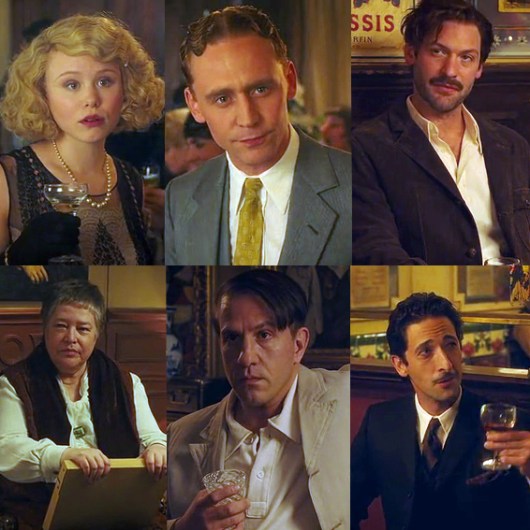
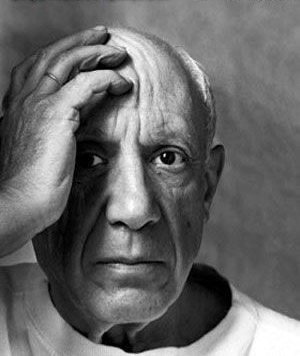
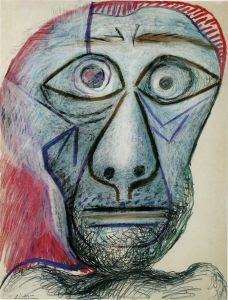 The piece is done with crayon on paper, and took several months to complete. A friend, Pierre Daix, tells of his memory of the piece on a visit to Picasso, “[Picasso] held the drawing beside his face to show that the expression of fear was a contrivance.” Then on another visit 3 months later, Pierre recalled that the harsh colored lines were even deeper, and Pierre writes, “He did not blink. I had the sudden impression that he was staring his own death in the face, like a good Spaniard”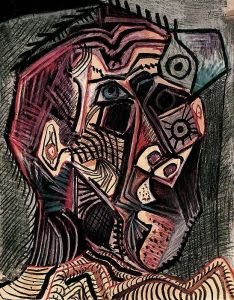
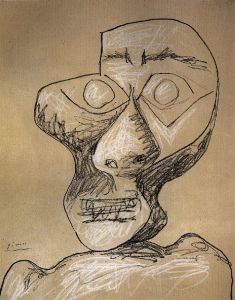
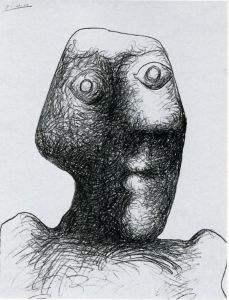
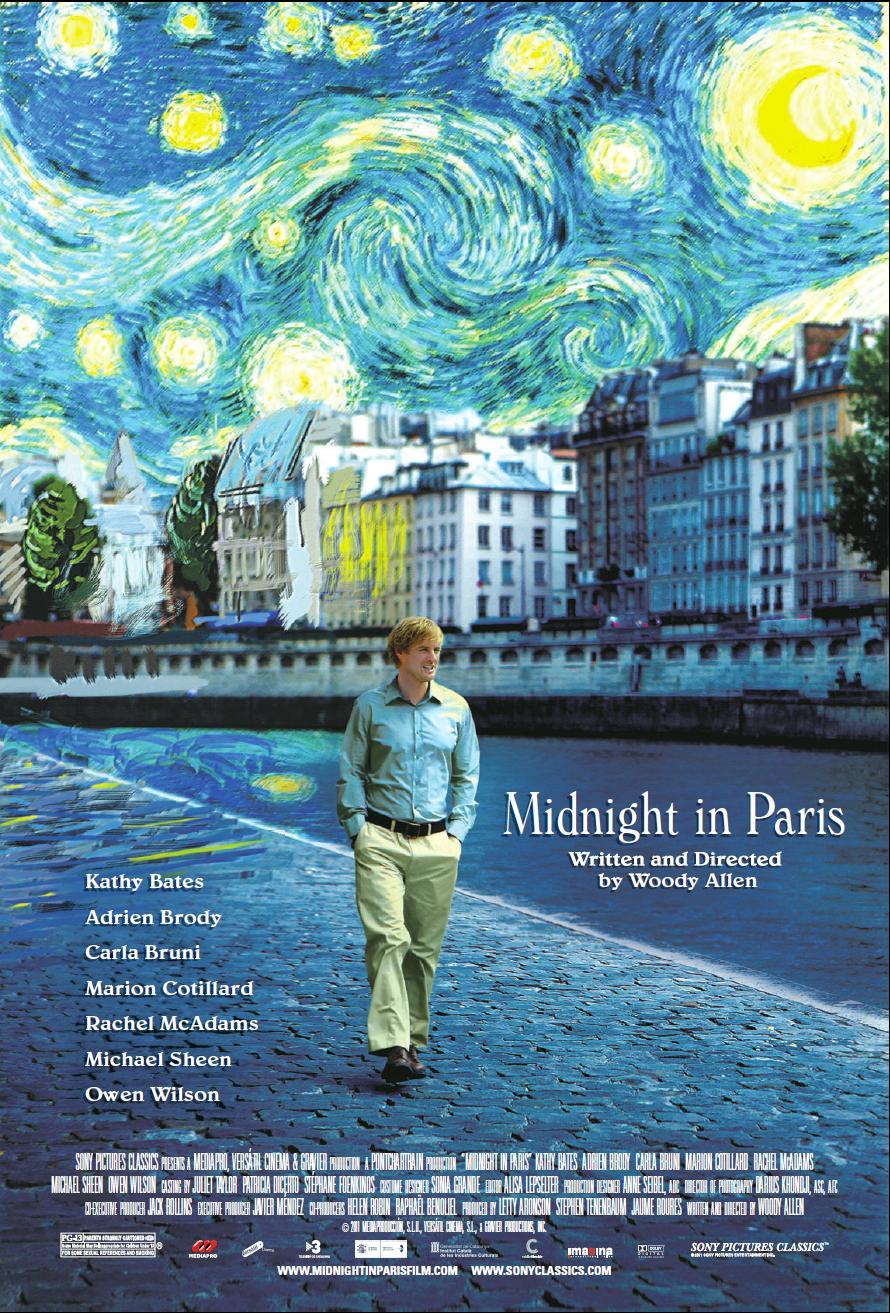

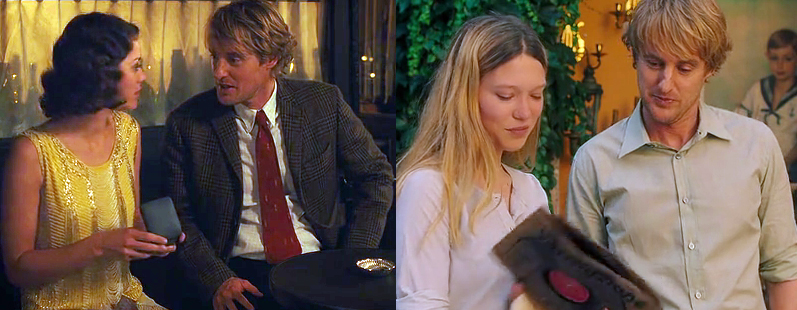
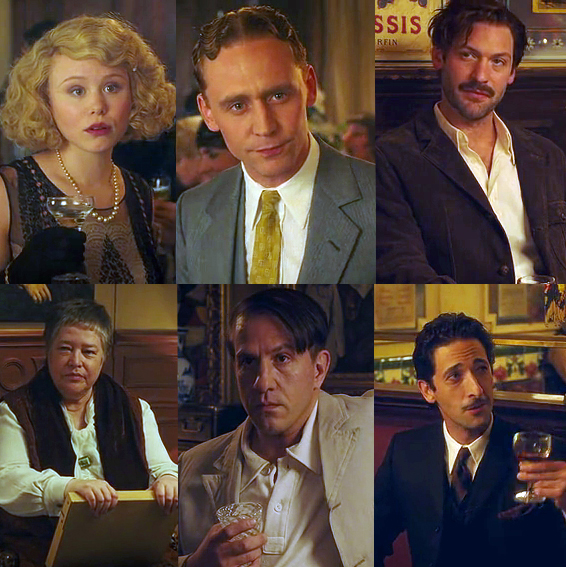
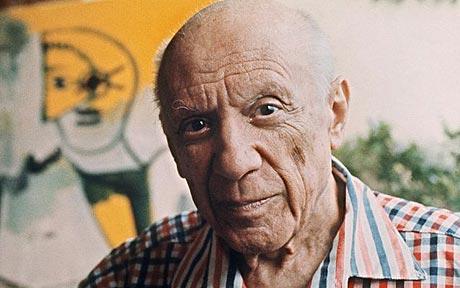
,_gouache_and_pencil_on_board,_68.5_x_96_cm,_private_collection.jpg)


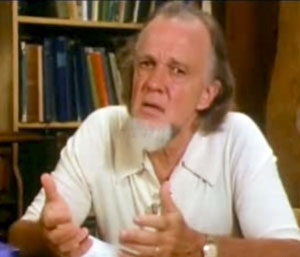


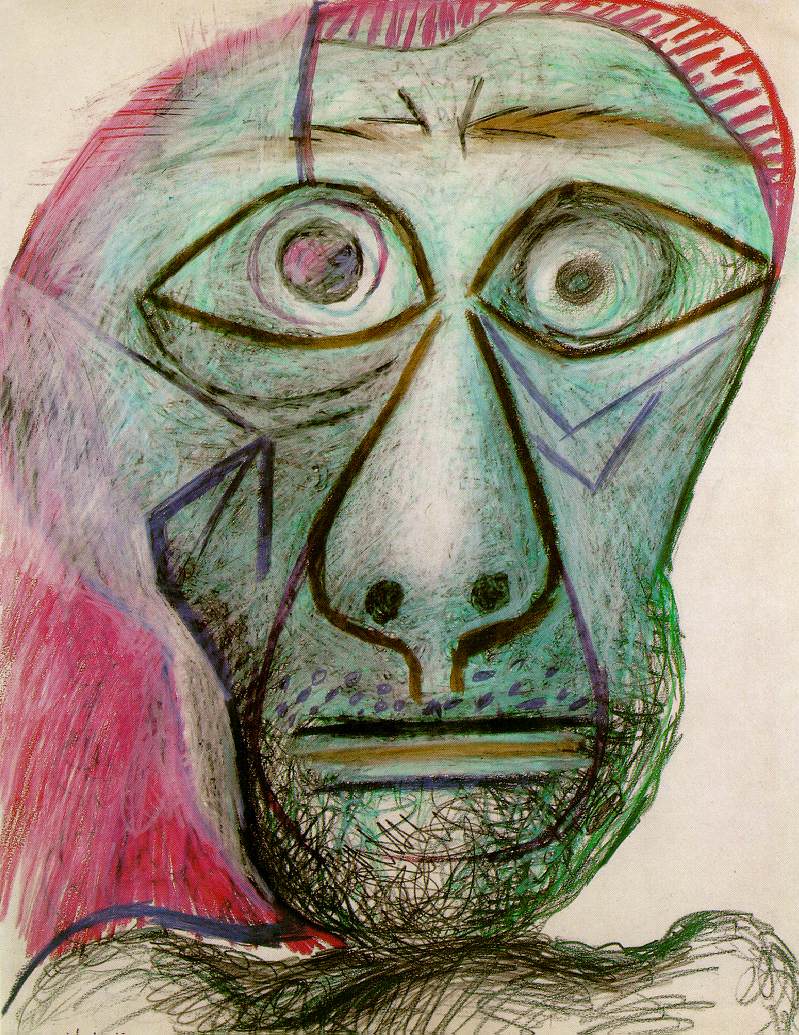
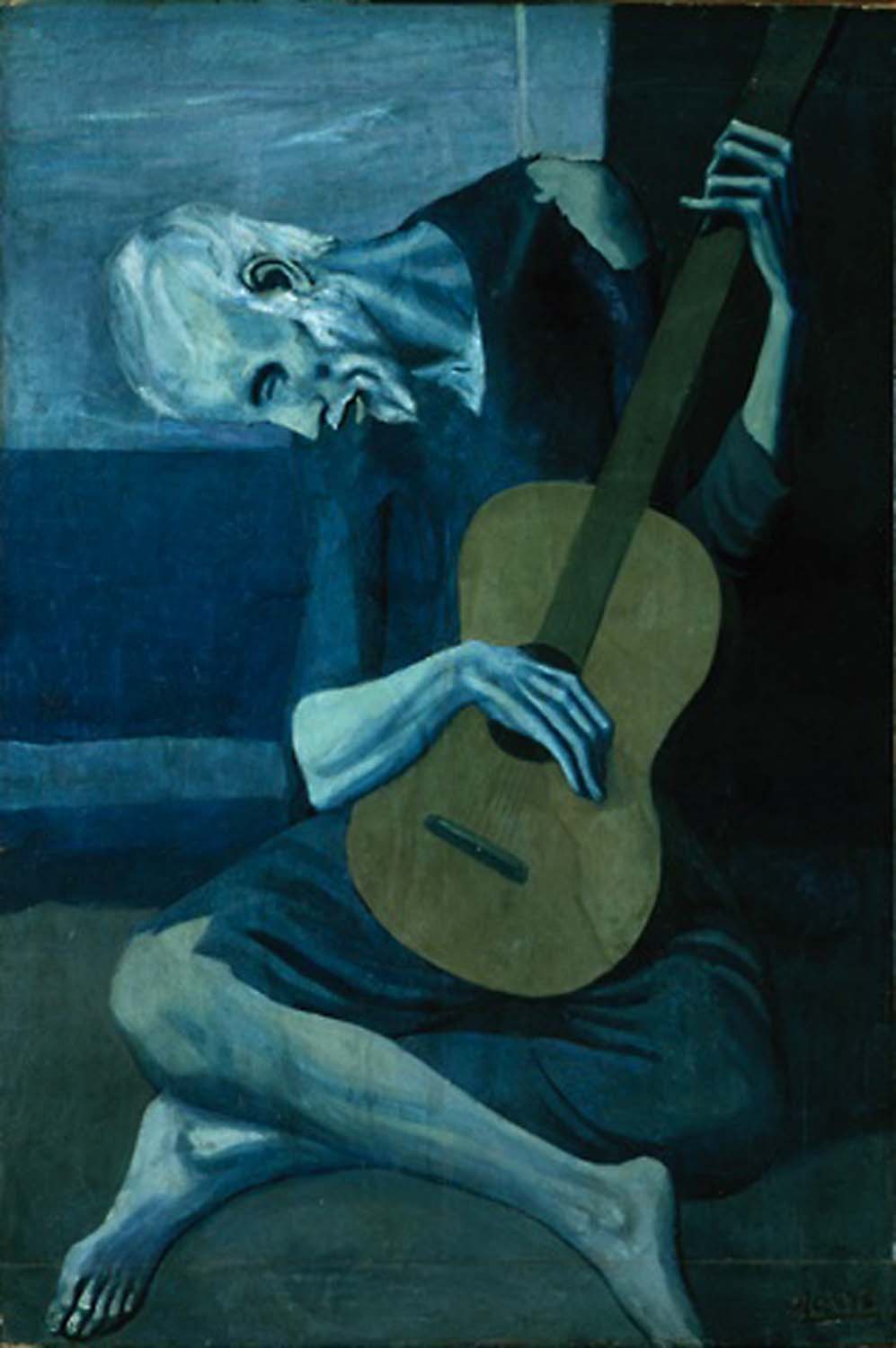

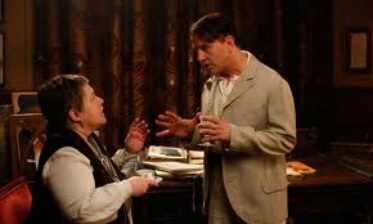




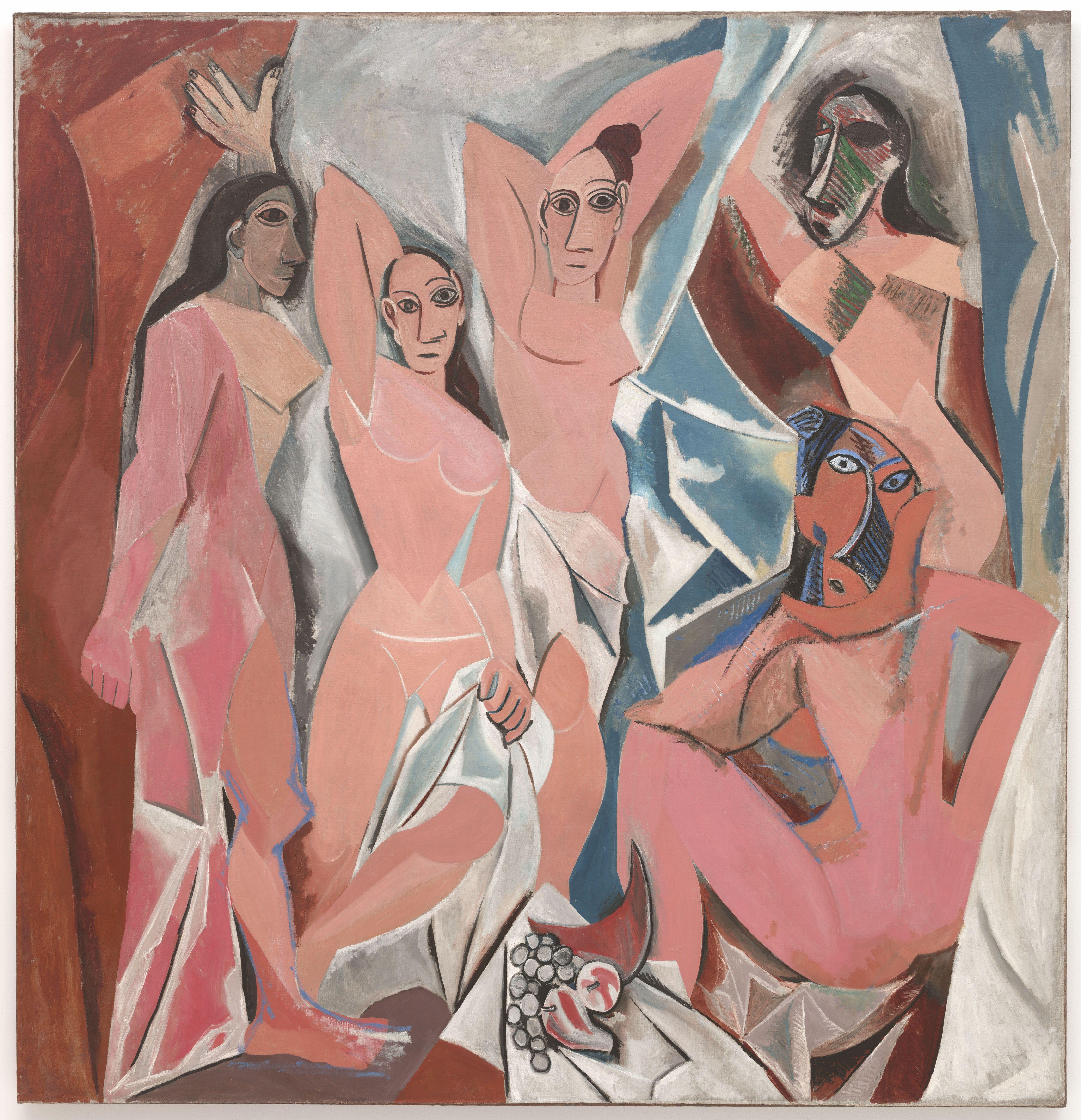
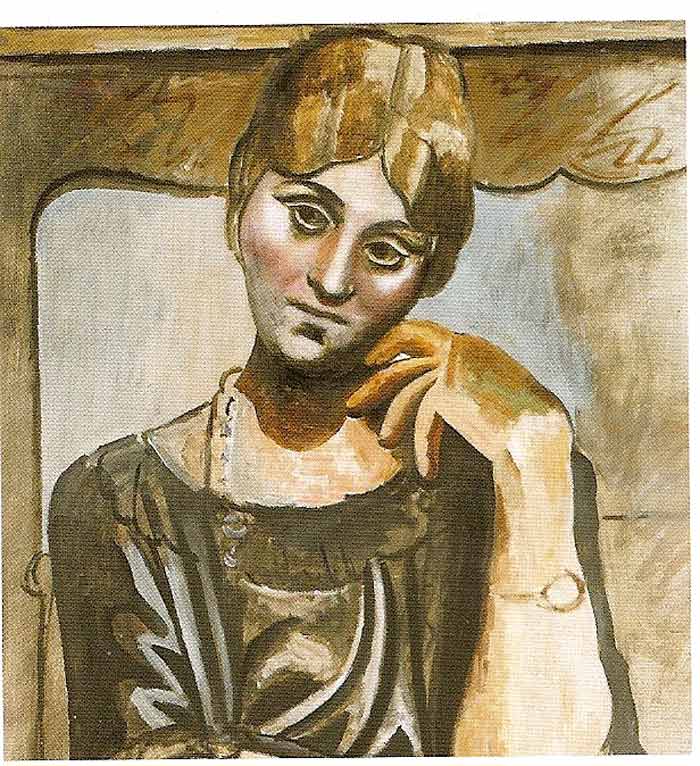


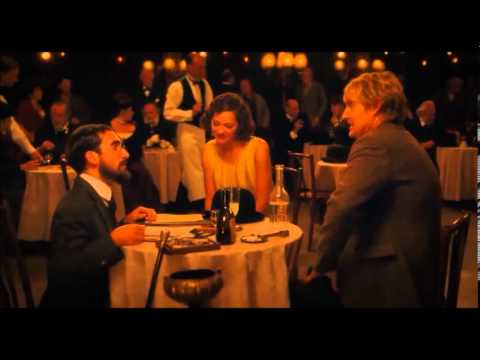


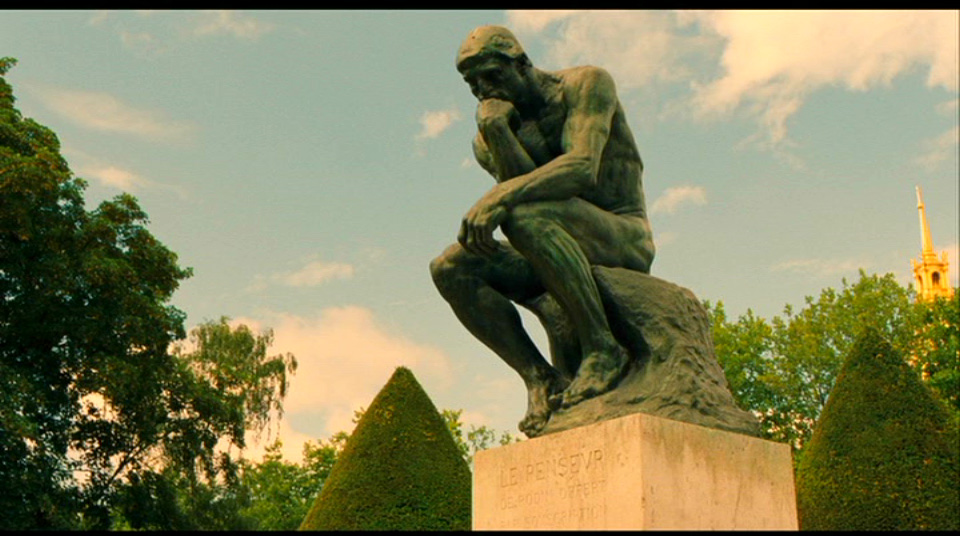


 making, and not a personal code of manly grace under pressure. Solomon’s map allowed him to admit defeat without despair. The map, of course wasTorah, the


 The Daily Hatch

