HENRY MANCINI WAS ONE OF THE MOST VERSATILE TALENTS IN CONTEMPORARY MUSIC.
THE MANCINI NAME IS SYNONYMOUS WITH GREAT MOTION PICTURE AND TELEVISION MUSIC, FINE RECORDINGS AND INTERNATIONAL CONCERT PERFORMANCES.
During his lifetime, Mancini was nominated for 72 GRAMMY® Awards, winning 20. He was nominated for 18 Academy Awards® winning four, honored with a Golden Globe® Award and nominated for two Emmy ®Awards.
Mancini created many memorable film scores including ‘Breakfast at Tiffany’s’, ‘The Pink Panther’, ‘Days of Wine and Roses’, ‘Hatari!’, ‘Charade’, ‘Victor/Victoria’, “10,” ‘Darling Lili’, ‘Arabesque’, and ‘The Glass Menagerie’. He also wrote for a number of television films including “The Thorn Birds” and “The Shadow Box,” as well as television themes including “Peter Gunn,” “Mr. Lucky,” “NBC Election Night Theme,” “Newhart,” “Remington Steele” and “Hotel.” Mancini recorded over 90 albums with styles varying from big band to jazz to classical to pop, eight of which were certified gold by The Recording Industry Association of America®.
Born in Cleveland, Ohio on April 16, 1924, Mancini was introduced to music and the flute at the age of eight by his father, Quinto, an avid flutist. The family moved to Aliquippa, Pennsylvania where at age 12 he took up piano, and within a few years became interested in arranging. ;After graduating from high school in 1942 Mancini enrolled in New York’s Juilliard School of Music but his studies were interrupted the next year when he was drafted, leading to overseas service in the Air Force and later in the infantry.
In 1946 Mancini joined The Glenn Miller-Tex Beneke Orchestra as a pianist/arranger. It was there that he met the future Mrs. Henry Mancini, Ginny O’Connor, who was one of the original members of Mel Torme’s Mel-Tones. Ginny and Henry were married in Hollywood the following year.
In 1952 Mancini joined the Universal-International Studios music department. During the next six years he contributed to over 100 films, most notably The Glenn Miller Story (for which he received his first Academy Award® nomination), The Benny Goodman Story and Orson Welles’ Touch of Evil. Mancini left Universal-International in 1958 to work as an independent composer/arranger. Soon after he scored the television series “Peter Gunn” for writer/producer Blake Edwards, the genesis of a close relationship that lasted over 30 years and produced 26 films.
Mancini was an in-demand concert performer conducting over 50 engagements a year, resulting in over 600 symphony performances. Among the symphony orchestras he conducted were the London Symphony Orchestra, the Israel Philharmonic, the Boston Pops, the Los Angeles Philharmonic and the Royal Philharmonic Orchestra.
He appeared in 1966, 1980 and 1984 in command performances for the Royal Family. Mancini collaborated with a number of noted artists such as Sir James Galway, Johnny Mathis, Luciano Pavarotti, Doc Severinsen and Andy Williams.
Henry Mancini wrote two books: ‘Sounds and Scores – A Practical Guide to Professional Orchestration’, which can be found on the shelf of virtually every serious student of music, and his autobiography ‘Did They Mention The Music?’
In 1994 Mancini received UCLA’s most prestigious award, The Distinguished Artist Circle Award. Mancini was also bestowed with four honorary doctorate degrees: Duquesne University of Pennsylvania, Mount Saint Mary’s College in Maryland, Washington and Jefferson College in Pennsylvania, and the California Institute of the Arts in Valencia.
Mancini’s deep love of music and support of young musicians is evident in the scholarships and fellowships he established at top music schools. Many up and coming composers, conductors and arrangers have benefited from Mancini programs at Juilliard School of Music, UCLA, USC and at The American Federation of Music’s “Congress of Strings.”
Henry Mancini died in 1994. His wife, Ginny, and their three children – Chris, Monica and Felice; and two grandchildren -Christopher and Luca, continue the Mancini legacy.
In April 2004, Mancini was honored by the United States Postal Service with a stamp commemorating his lifetime achievements in film music, and to celebrate the 40th anniversary of the film The Pink Panther.
__________________ A Funny Press Interview of The Beatles in The US (1964) Funny Pictures of The Beatles Published on Oct 23, 2012 funny moments i took from the beatles movie; A Hard Days Night ___________________ Scene from Help! The Beatles Funny Clips and Outtakes (Part 1) The Beatles * Wildcat* (funny) Uploaded on Mar 20, […]
_____________________ Great article on Dylan and Sergeant Pepper’s Lonely Hearts Club Band Cover: A famous album by the fab four – The Beatles – is “Sergeant peppers lonely hearts club band“. The album itself is one of the must influential albums of all time. New recording techniques and experiments with different styles of music made this […]
__________________________ Beatles 1966 Last interview 69 THE BEATLES TWO OF US As a university student, Karl Marx (1818-1883) joined a movement known as the Young Hegelians, who strongly criticized the political and cultural establishments of the day. He became a journalist, and the radical nature of his writings would eventually get him expelled by the […]
____________ Aleister Crowley on cover of Stg. Pepper’s: _______________ I have dedicated several posts to this series on the Beatles and I don’t know when this series will end because Francis Schaeffer spent a lot of time listening to the Beatles and talking and writing about them and their impact on the culture of the 1960’s. […]
“Johnny Angel” is a song written and composed by Lyn Duddy and Lee Pockriss. The song was originally recorded by both Laurie Loman and Georgia Lee, but those two versions were not successful.[2] It first became a popular hit single when it was recorded by Shelley Fabares in the fall of 1961; she took it to No. 1 on the Billboard Hot 100 Chart when the song was released in 1962. In the same year, British singer Patti Lynn had a moderate hit on the UK Singles Chart with her cover of the song. The American pop music duo The Carpenters recorded “Johnny Angel” in 1973 as part of a medley of oldies on side two of their album Now & Then.
“Johnny Angel” is the debut pop single by Shelley Fabares. Her cover version of the song was recorded in the fall of 1961, and was released in 1962 on the Colpix label.[3] The track was the first single taken from Fabares’ debut solo album Shelley!, which was produced and arranged by Stu Phillips.
The single premiered on an episode, “Donna’s Prima Donna” of Fabares’ sitcom, The Donna Reed Show, during the fourth season (episode 20).[4] It also has a sequel song entitled “Johnny Loves Me“, which tells the story of how the girl won Johnny’s heart.
Darlene Love and her group, the Blossoms, sang backup vocals on the track.[5] Fabares is quoted in The Billboard Book of Number One Singles by Fred Bronson as saying she was intimidated by Love’s group and their “beautiful” voices and was terrified at the prospect of becoming a recording artist, as she did not consider herself a singer,[6] but was expected to sing on the show anyway.[7] The song also featured an echo chamber, where the intro of the repeated title words: “Johnny Angel, Johnny Angel” was used by Fabares and the backup singers. Musicians who played on the track include Hal Blaine on drums, Carol Kaye on bass and Glen Campbell on guitar.[8][better source needed]
The song is an expression of a teenage girl’s romantic longing for a boy who doesn’t know she exists, to the point where she declines other boys’ propositions for dates because she would rather concentrate on the boy she loves.
Although Fabares’ career as an actress stayed strong for three decades, her career as a singer came to an end within a few years of “Johnny Angel” when she was unable to come up with another Top 20 hit. However, the song has become an oldies radio airplay favorite.
“Johnny Angel” hit number one on the Billboard Hot 100 on April 7, 1962, during a 15-week run on the chart.[9] It was a number one hit on the Top 100 Best Sellers chart in April 1962 as published by Cashbox. It charted at number one in both Canada and in New Zealand. “Johnny Angel” also peaked at number 41 on the UK Singles chart, where Patti Lynn’s recording of the song was a slightly bigger hit.[10] It sold over one-million copies and was awarded a gold disc.[11]
Year-end chartsEditChart (1962)RankU.S. Billboard Hot 100[16]6U.S. Cash Box[17]11All-time chartsEditChart (1958-2018)PositionUS Billboard Hot 100[18]569
In the song The Beat of Black Wings, which appears on Joni Mitchell‘s album Chalk Mark in a Rain Storm, the words Johnny Angel are sung at the end of several lines, in the same style as the Shelley Fabares cover, in an apparent reference to the Fabares version of the song.
British pop singer Patti Lynn released a cover version of “Johnny Angel” for the Fontana Records label in March 1962. It was produced by Harry Robinson.[19]Her version of the song charted on the UK Singles Chart at number 37 in May 1962.
The pop music duo the Carpenters recorded “Johnny Angel” and included it on their fifth studio album Now & Then in May 1973. The song was produced by Richard Carpenter and his sister Karen and was issued on the A&M record label. The song was included on Side “B” of the album as part of an oldies medley.
__________________ A Funny Press Interview of The Beatles in The US (1964) Funny Pictures of The Beatles Published on Oct 23, 2012 funny moments i took from the beatles movie; A Hard Days Night ___________________ Scene from Help! The Beatles Funny Clips and Outtakes (Part 1) The Beatles * Wildcat* (funny) Uploaded on Mar 20, […]
_____________________ Great article on Dylan and Sergeant Pepper’s Lonely Hearts Club Band Cover: A famous album by the fab four – The Beatles – is “Sergeant peppers lonely hearts club band“. The album itself is one of the must influential albums of all time. New recording techniques and experiments with different styles of music made this […]
__________________________ Beatles 1966 Last interview 69 THE BEATLES TWO OF US As a university student, Karl Marx (1818-1883) joined a movement known as the Young Hegelians, who strongly criticized the political and cultural establishments of the day. He became a journalist, and the radical nature of his writings would eventually get him expelled by the […]
____________ Aleister Crowley on cover of Stg. Pepper’s: _______________ I have dedicated several posts to this series on the Beatles and I don’t know when this series will end because Francis Schaeffer spent a lot of time listening to the Beatles and talking and writing about them and their impact on the culture of the 1960’s. […]
Jo Elizabeth Stafford (November 12, 1917 – July 16, 2008) was an American traditional pop music singer, whose career spanned five decades from the late 1930s to the early 1980s. Admired for the purity of her voice, she originally underwent classical training to become an opera singer before following a career in popular music, and by 1955 had achieved more worldwide record sales than any other female artist. Her 1952 song “You Belong to Me” topped the charts in the United States and United Kingdom, becoming the second single to top the UK Singles Chart, and the first by a female artist to do so.
Jo Stafford
Picture of Stafford from the New York Sunday News, September 21, 1947
John Huddleston (1937–div.1943) Paul Weston (1952–d.1996)
Born in remote oil-rich Coalinga, California, near Fresno in the San Joaquin Valley, Stafford made her first musical appearance at age 12. While still at high school, she joined her two older sisters to form a vocal trio named the Stafford Sisters, who found moderate success on radio and in film. In 1938, while the sisters were part of the cast of Twentieth Century Fox‘s production of Alexander’s Ragtime Band, Stafford met the future members of the Pied Pipers and became the group’s lead singer. Bandleader Tommy Dorsey hired them in 1939 to perform vocals with his orchestra. From 1940 to 1942, the group often performed with Dorsey’s new male singer, Frank Sinatra.
In addition to her singing with the Pied Pipers, Stafford was featured in solo performances with Dorsey. After leaving the group in 1944, she recorded a series of pop songs now regarded as standards for Capitol Records and Columbia Records. Many of her recordings were backed by the orchestra of Paul Weston. She also performed duets with Gordon MacRae and Frankie Laine. Her work with the United Service Organizations giving concerts for soldiers during World War II earned her the nickname “G.I. Jo”. Starting in 1945, Stafford was a regular host of the National Broadcasting Company (NBC) radio series The Chesterfield Supper Club and later appeared in television specials—including two series called The Jo Stafford Show, in 1954 in the U.S. and in 1961 in the UK.
Stafford married twice, first in 1937 to musician John Huddleston (the couple divorced in 1943), then in 1952 to Paul Weston, with whom she had two children. She and Weston developed a comedy routine in which they assumed the identity of an incompetent lounge act named Jonathan and Darlene Edwards, parodying well-known songs. The act proved popular at parties and among the wider public when the couple released an album as the Edwardses in 1957. In 1961, the album Jonathan and Darlene Edwards in Paris won Stafford her only Grammy Award for Best Comedy Album, and was the first commercially successful parody album. Stafford largely retired as a performer in the mid-1960s, but continued in the music business. She had a brief resurgence in popularity in the late 1970s when she recorded a cover of the Bee Gees hit, “Stayin’ Alive” as Darlene Edwards. In the 1990s, she began re-releasing some of her material through Corinthian Records, a label founded by Weston. She died in 2008 in Century City, Los Angeles, and is interred with Weston at Holy Cross Cemetery, Culver City. Her work in radio, television, and music is recognized by three stars on the Hollywood Walk of Fame.
Jo Elizabeth Stafford was born in Coalinga, California, in 1917, to Grover Cleveland Stafford and Anna Stafford (née York)—a second cousin of World War I hero Sergeant Alvin York.[1][note 1] She was the third of four children.[4][5] She had two older sisters, Christine and Pauline, and one younger sister, Betty.[6][7] Both her parents enjoyed singing and sharing music with their family.[1] Stafford’s father hoped for success in the California oil fields when he moved his family from Gainesboro, Tennessee, but worked in a succession of unrelated jobs. Her mother was an accomplished banjo player, playing and singing many of the folk songs that influenced Stafford’s later career.[4][8] Anna insisted that her children should take piano lessons, but Jo was the only one among her sisters who took a keen interest in it, and through this, she learned to read music.[9]
Stafford’s first public singing appearance was in Long Beach, where the family lived when she was 12. She sang “Believe Me, If All Those Endearing Young Charms“, a Stafford family favorite.[10] Her second was far more dramatic. As a student at Long Beach Polytechnic High School with the lead in the school musical, she was rehearsing on stage when the 1933 Long Beach earthquake destroyed part of the school.[11] With her mother’s encouragement, Stafford originally planned to become an opera singer and studied voice as a child, taking private lessons from Foster Rucker, an announcer on California radio station KNX.[12][13][note 2] Because of the Great Depression, she abandoned that idea and joined her older sisters Christine and Pauline in a popular vocal group the Stafford Sisters.[14][15] The two older Staffords were already part of a trio with an unrelated third member when the act got a big booking at Long Beach’s West Coast Theater. Pauline was too ill to perform, and Jo was drafted in to take her place so they could keep the engagement. She asked her glee club teacher for a week’s absence from school, saying her mother needed her at home, and this was granted. The performance was a success, and Jo became a permanent member of the group.[16][note 3]
The Staffords’ first radio appearance was on Los Angeles station KHJ as part of The Happy Go Lucky Hour when Jo was 16, a role they secured after hopefuls at the audition were asked if they had their own musical accompanist(s). Christine Stafford said that Jo played piano, and the sisters were hired, though she had not previously given a public piano performance.[9][17] The Staffords were subsequently heard on KNX’s The Singing Crockett Family of Kentucky, and California Melodies, a network radio show aired on the Mutual Broadcasting System.[1][9]While Stafford worked on The Jack Oakie Show, she met John Huddleston—a backing singer on the program, and they were married in October 1937.[16][18][note 4] The couple divorced in 1943.[19][20]
The sisters found work in the film industry as backup vocalists, and immediately after graduating from high school, Jo worked on film soundtracks.[8][20]The Stafford Sisters made their first recording,”Let’s Get Together and Swing” with Louis Prima, in 1936.[22][23][24] In 1937, Jo worked behind the scenes with Fred Astaire on the soundtrack of A Damsel in Distress, creating the arrangements for the film, and with her sisters she arranged the backing vocals for “Nice Work If You Can Get It“. Stafford said that her arrangement had to be adapted because Astaire had difficulty with some of the syncopation. In her words: “The man with the syncopated shoes couldn’t do the syncopated notes”.[9][25]
By 1938, the Staffords were involved with Twentieth Century Fox’s production of Alexander’s Ragtime Band. The studio brought in many vocal groups to work on the film, including the Four Esquires, the Rhythm Kings, and the King Sisters, who began to sing and socialized between takes. The Stafford Sisters, the Four Esquires and the Rhythm Kings became a new vocal group called the Pied Pipers.[8][26] Stafford later said, “We started singing together just for fun, and these sessions led to the formation of an eight-voice singing group that we christened ‘The Pied Pipers'”.[27] The group consisted of eight members, including Stafford—John Huddleston, Hal Hooper, Chuck Lowry, Bud Hervey, George Tait, Woody Newbury, and Dick Whittinghill.[28]
The Pied Pipers in 1944: Pictured here are Charles Lowry, Jo Stafford, Clark Yocum, and John Huddleston,
As the Pied Pipers, they worked on local radio and movie soundtracks.[29] When Alyce and Yvonne King threw a party for their boyfriends’ visit to Los Angeles, the group was invited to perform.[8][30] The King Sisters’ boyfriends were Tommy Dorsey’s arrangers Axel Stordahl and Paul Weston, who became interested in the group.[8] Weston said the group’s vocals were unique for its time and that their vocal arrangements were much like those for orchestral instruments.[31]
Weston persuaded Dorsey to audition the group in 1938, and the eight drove together to New York City.[8] Dorsey liked them and signed them for 10 weeks. After their second broadcast, the sponsor visiting from overseas heard the group sing “Hold Tight (Want Some Seafood Mama)”. Until this point, the sponsor knew only that he was paying for Dorsey’s program and that its ratings were very good; transcription discs mailed to him by his advertising agency always arrived broken. He thought that the performance was terrible, and pressured the advertising agency representing his brand to fire the group.[4][30][31] They stayed in New York for several months, landing one job that paid them $3.60 each, and they recorded some material for RCA Victor Records.[8] Weston later said that Stordahl and he felt responsibility for the group, since Weston had arranged their audition with Dorsey.[30] After six months in New York and with no work there for them, the Pied Pipers returned to Los Angeles, where four of their members left the group to seek regular employment. Shortly afterwards, Stafford received a telephone call from Dorsey, who told her he wished to hire the group, but wanted only four of them, including Stafford. After she agreed to the offer, the remaining Pied Pipers—Stafford, Huddleston, Lowry, and Wilson—traveled to Chicago in 1939. The decision led to success for the group, especially Stafford, who featured in both collective and solo performances with Dorsey’s orchestra.[8][31][32][33]
When Frank Sinatra joined the Dorsey band, the Pied Pipers provided backing vocals for his recordings. Their version of “I’ll Never Smile Again” topped the Billboard Chart for 12 weeks in 1940 and helped to establish Sinatra as a singer.[26][34][35] Stafford, Sinatra, and the Pied Pipers toured extensively with Dorsey during their three years as part of his orchestra, giving concerts at venues across the United States.[36] Stafford made her first solo recording—”Little Man with a Candy Cigar”—in 1941, after Dorsey agreed to her request to record solo.[4][37] Her public debut as a soloist with the band occurred at New York’s Hotel Astor in May 1942.[38]Bill Davidson of Collier’s reported in 1951 that because Stafford weighed in excess of 180 lb, Dorsey was reluctant to give her a leading vocal role in his orchestra, believing she was not sufficiently glamorous for the part.[16] However, Peter Levinson‘s 2005 biography of Dorsey offers a different account. Stafford recalls that she was overweight, but Dorsey did not try hiding her because of it.[39]
In November 1942, the Pied Pipers had a disagreement with Dorsey when he fired Clark Yocum, a guitarist and vocalist who had replaced Billy Wilson in the lineup, when he mistakenly gave the bandleader misdirections at a railroad station in Portland, Oregon. The remaining three members then quit in an act of solidarity.[31][40] At the time, the number-one song in the United States was “There Are Such Things” by Frank Sinatra and the Pied Pipers.[31] Sinatra also left Dorsey that year.[41]Following their departure from the orchestra, the Pied Pipers played a series of vaudeville dates in the Eastern United States; when they returned to California, they were signed to appear in the 1943 Universal Pictures movie Gals Incorporated. From there, they joined the NBC Radio show Bob Crosby and Company.[42] In addition to working with Bob Crosby, they also appeared on radio shows hosted by Sinatra and Johnny Mercer, and were one of the first groups signed to Mercer’s new label, Capitol Records, which was founded in 1942.[26][34][43][44]Weston, who left Dorsey’s band in 1940 to work with Dinah Shore, became music director at Capitol.[8][45][46]
Capitol Records and United Service OrganizationEdit
Jo Stafford, 1946
While Stafford was still working for Dorsey, Johnny Mercer told her, “Some day I’m going to have my own record company, and you’re going to record for me.”[4] She subsequently became the first solo artist signed to Capitol after leaving the Pied Pipers in 1944.[4][47] A key figure in helping Stafford to develop her solo career was Mike Nidorf, an agent who first heard her as a member of the Pied Pipers while he was serving as a captain in the United States Army. Having previously discovered artists such as Glenn Miller, Artie Shaw, and Woody Herman, Nidorf was impressed by Stafford’s voice, and contacted her when he was demobilized in 1944. After she agreed to let him represent her, he encouraged her to reduce her weight and arranged a string of engagements that raised her profile and confidence.[16]
The success of Stafford’s solo career led to a demand for personal appearances, and from February 1945, she embarked on a six-month residency at New York’s La Martinique nightclub.[48][49][50] Her performance was well-received; an article in the July 1945 edition of Band Leadersmagazine described it as “sensational”, but Stafford did not enjoy singing before live audiences, and it was the only nightclub venue she ever played.[47][50][51] Speaking about her discomfort with live performances, Stafford told a 1996 interview with The New Yorker‘s Nancy Franklin, “I’m basically a singer, period, and I think I’m really lousy up in front of an audience—it’s just not me.”[47]
Stafford’s tenure with the United Service Organizations during World War II, which often had her perform for soldiers stationed in the U.S., led to her acquiring the nickname “G.I. Jo”.[14][30] On returning from the Pacific theater, a veteran told Stafford that the Japanese would play her records on loudspeakers in an attempt to make the U.S. troops homesick enough to surrender. She replied personally to all the letters she received from servicemen.[4][8][20] Stafford was a favorite of many servicemen during both World War II and the Korean War; her recordings received extensive airplay on the American Forces radio and in some military hospitals at lights-out. Stafford’s involvement with servicemen led to an interest in military history and a sound knowledge of it. Years after World War II, Stafford was a guest at a dinner party with a retired naval officer. When the discussion turned to a wartime action off Mindanao, the officer tried to correct Stafford, who held to her point. He countered her by saying, “Madame, I was there”. A few days after the party, Stafford received a note of apology from him, saying he had reread his logs and that she was correct.[4]
Chesterfield Supper Club, duets, and Voice of AmericaEdit
Beginning on December 11, 1945, Stafford hosted the Tuesday and Thursday broadcasts of NBC musical variety radio program The Chesterfield Supper Club.[52][53][54] On April 5, 1946, the entire cast, including Stafford and Perry Como, participated in the first commercial radio broadcast from an airplane. The initial plan was to use the stand-held microphones used in studios, but when these proved to be problematic, the cast switched to hand-held microphones, which because of the plane’s cabin pressure became difficult to hold. Three flights were made that day; a rehearsal in the afternoon, then two in the evening—one for the initial 6:00 pm broadcast and another at 10:00 pm for the West Coast broadcast.[55][56][57]
Stafford moved from New York to California in November 1946, continuing to host Chesterfield Supper Club from Hollywood.[53][58][59] In 1948, she restricted her appearances on the show to Tuesdays, and Peggy Lee hosted the Thursday broadcasts.[60] Stafford left the show when it was expanded to 30 minutes, making her final appearance on September 2, 1949. She returned to the program in 1954; it ended its run on NBC Radio the following year.[61] During her time with Chesterfield Supper Club, Stafford revisited some of the folk music she had enjoyed as a child. Weston, her conductor on the program, suggested using some of the folk music for the show. With her renewed interest in folk tunes came an interest in folklore; Stafford established a contest to award a prize to the best collection of American folklore submitted by a college student. The annual Jo Stafford Prize for American Folklore was handled by the American Folklore Society, with the first prize of $250 awarded in 1949.[1][62]
In 1954, James Conkling, president of Columbia Records, presented Stafford with a diamond-studded plaque to mark the sale of 25 million of her records.
Stafford continued to record. She duetted with Gordon MacRae on a number of songs. In 1948, their version of “Say Something Sweet to Your Sweetheart” sold over a million copies. The following year, they repeated their success with “My Happiness”, and Stafford and MacRae recorded “Whispering Hope” together.[8] Stafford began hosting a weekly program on Radio Luxembourg in 1950; working unpaid, she recorded the voice portions of the shows in Hollywood.[63] At the time, she was hosting Club Fifteen with Bob Crosby for CBS Radio.[1]
Weston moved from Capitol to Columbia Records, and in 1950, Stafford followed suit. Content and very comfortable working with him, Stafford had had a clause inserted in her contract with Capitol stating that if Weston left that label, she would automatically be released from her obligations to them.[8][47] When that happened, Capitol wanted Stafford to record eight more songs before December 15, 1950, and she found herself in the unusual situation of simultaneously working for two competing record companies, an instance that was very rare in an industry where musicians were seen as assets.[64] In 1954, Stafford became the second artist after Bing Crosby to sell 25 million records for Columbia.[19][65] She was presented with a diamond-studded disc to mark the occasion.[65]
In 1950, Stafford began working for Voice of America(VOA), the U.S. government broadcaster transmitting programmes overseas to undermine the influence of communism.[66] She presented a weekly show that aired in Eastern Europe, and Collier’s published an article about the program in its April 21, 1951, issue that discussed her worldwide popularity, including in countries behind the Iron Curtain. The article, titled “Jo Stafford: Her Songs Upset Joe Stalin“, earned her the wrath of the U.S. Communist Daily Worker newspaper, which published a column critical of Stafford and VOA.[16][26][67][note 5]
__________________ A Funny Press Interview of The Beatles in The US (1964) Funny Pictures of The Beatles Published on Oct 23, 2012 funny moments i took from the beatles movie; A Hard Days Night ___________________ Scene from Help! The Beatles Funny Clips and Outtakes (Part 1) The Beatles * Wildcat* (funny) Uploaded on Mar 20, […]
_____________________ Great article on Dylan and Sergeant Pepper’s Lonely Hearts Club Band Cover: A famous album by the fab four – The Beatles – is “Sergeant peppers lonely hearts club band“. The album itself is one of the must influential albums of all time. New recording techniques and experiments with different styles of music made this […]
__________________________ Beatles 1966 Last interview 69 THE BEATLES TWO OF US As a university student, Karl Marx (1818-1883) joined a movement known as the Young Hegelians, who strongly criticized the political and cultural establishments of the day. He became a journalist, and the radical nature of his writings would eventually get him expelled by the […]
____________ Aleister Crowley on cover of Stg. Pepper’s: _______________ I have dedicated several posts to this series on the Beatles and I don’t know when this series will end because Francis Schaeffer spent a lot of time listening to the Beatles and talking and writing about them and their impact on the culture of the 1960’s. […]
Learn moreThis article needs additional citations for verification. (April 2019)“The Naughty Lady of Shady Lane” is a popularsong written by Sid Tepper and Roy C. Bennett.”The Naughty Lady of Shady Lane”Single by The Ames Brothersfrom the album The Best of the Ames Brothers B-side“Addio”ReleasedNovember 1954Recorded1954GenreTraditional popLength2:49LabelRCA VictorSongwriter(s)Sid Tepper, Roy C. BennettThe Ames Brothers singles chronology”One More Time” (1954)”The Naughty Lady of Shady Lane” (1954)”Addio” (1954)BackgroundEditThe lyrics suggest that this “naughty lady” driving the whole town crazy is an attractive young woman who “throws those come-hither glances at every Tom, Dick and Joe” and “when offered some liquid refreshment never says no”; but the last line reveals her to be an infant “nine days old”.RecordingsEditPopular versions of the song were the 1954recordings by The Ames Brothers and by Archie Bleyer. The recording by The Ames Brothers was made on September 8, 1954. It was released by RCA Victor Records as catalog number 20-5897.[1] It first reached the Billboard magazine charts on November 20, 1954. On the Disk Jockey chart, it peaked at number 3; on the Best Seller chart, at number 3; on the Juke Box chart, at number 3.[2] This version sold over one million copies in the US, and also peaked at number 6 in the UK Singles Chart in February 1955.[3]The Bleyer version was released by Cadence Records as catalog number 1254.[4] The record first reached the Billboard magazine charts on November 24, 1954 and lasted 5 weeks on the chart, peaking at number 26.[2] A contemporary review in Billboardcompared the two versions by saying: “The Bleyer record has the sound; the Ames disk has the smoothness. Both have style …”[5]Dean Martin, Alma Cogan and the McGuire Sisterscovered the song in 1955, as well as Ray Charles in 1964 and the Statler Brothers in the 1990s.In 2004, The Four Lads performed it with Ed Ameson the PBS made for TV special, Magic Moments: The Best of 50s Pop.In 2007, The Roches recorded a version on their album Moonswept.ChartsEditDean MartinChart (1955)Peak positionUnited Kingdom (NME)5[6]United Kingdom (Record Mirror)1[7]References
__________________ A Funny Press Interview of The Beatles in The US (1964) Funny Pictures of The Beatles Published on Oct 23, 2012 funny moments i took from the beatles movie; A Hard Days Night ___________________ Scene from Help! The Beatles Funny Clips and Outtakes (Part 1) The Beatles * Wildcat* (funny) Uploaded on Mar 20, […]
_____________________ Great article on Dylan and Sergeant Pepper’s Lonely Hearts Club Band Cover: A famous album by the fab four – The Beatles – is “Sergeant peppers lonely hearts club band“. The album itself is one of the must influential albums of all time. New recording techniques and experiments with different styles of music made this […]
__________________________ Beatles 1966 Last interview 69 THE BEATLES TWO OF US As a university student, Karl Marx (1818-1883) joined a movement known as the Young Hegelians, who strongly criticized the political and cultural establishments of the day. He became a journalist, and the radical nature of his writings would eventually get him expelled by the […]
____________ Aleister Crowley on cover of Stg. Pepper’s: _______________ I have dedicated several posts to this series on the Beatles and I don’t know when this series will end because Francis Schaeffer spent a lot of time listening to the Beatles and talking and writing about them and their impact on the culture of the 1960’s. […]
The song has been recorded by many other artists.[3] It became the theme song for Andy Williams, who first recorded it in 1962 (and performed it at the Academy Awards ceremony that year). He sang the first eight bars of the song at the beginning of each episode of his eponymous television show and named his production company and venue in Branson, Missouri, after it; his autobiography is called “Moon River” and Me. Williams’ version was never released as a single, but it charted as an LP track that he recorded for Columbia on a hit album of 1962, Moon River and Other Great Movie Themes.[4] In 2022, Williams’ rendition of the song was selected for preservation in the Library of Congress.[5]
The song’s success was responsible for relaunching Mercer’s career as a songwriter, which had stalled in the mid-1950s because rock and roll had replaced jazz standards as the popular music of the time. The song’s popularity is such that it has been used as a test sample in a study on people’s memories of popular songs.[6] Comments about the lyrics have noted that they are particularly reminiscent of Mercer’s youth in the southern United States and his longing to expand his horizons.[7]Robert Wrightwrote in The Atlantic Monthly, “This is a love sung [sic] to wanderlust. Or a romantic song in which the romantic partner is the idea of romance.”[8] An inlet near Savannah, Georgia, Johnny Mercer’s hometown, was named Moon River in honor of him and this song.[6]
Mercer and Mancini wrote the song for Audrey Hepburn to sing in the film Breakfast at Tiffany’s. The lyrics, written by Mercer, are reminiscent of his childhood in Savannah, Georgia, including its waterways. As a child, he had picked huckleberriesin summer, and he connected them with a carefree childhood and Mark Twain’s Huckleberry Finn. Although an instrumental version is played over the film’s opening titles, the lyrics are first heard in a scene where Paul “Fred” Varjak (George Peppard) discovers Holly Golightly (Hepburn) singing the song, accompanying herself on the guitar while sitting on the fire escape outside their apartments.[3][7]
There was an eruption of behind-the-scenes consternation when a Paramount Pictures executive, Martin Rackin, suggested removing the song from the film after a tepid Los Angeles preview. Hepburn’s reaction was described by Mancini and others in degrees varying from her saying, “Over my dead body!” to her using more colorful language to make the same point.[9]
An album version was recorded by Mancini and his orchestra and chorus (without Hepburn’s vocal) on December 8, 1960.[10] It was released as a single in 1961 and became a number 11 hit in December of that year.[11] Due to unpublished charts in Billboard, Joel Whitburn’s Top Adult (Contemporary) Songsvariously reported the song as a number 3 or number 1 easy listening hit. Mancini’s original version was also featured in the film Born on the Fourth of July (1989). In 1993, following Hepburn’s death, her version was released on an album titled Music from the Films of Audrey Hepburn. In 2004, Hepburn’s version finished at number 4 on AFI’s 100 Years…100 Songs survey of top tunes in American cinema.
“Moon River” was a hit single for Jerry Butler in late 1961. Released simultaneously with Mancini’s, it reached number 11 on the Billboard Hot 100 chart[13]and number 3 Easy Listening[14] in December, two weeks before Mancini’s recording reached the same chart ranking. British singer Danny Williams had a hit version of the song that reached number one in the UK in the final week of 1961.[1] Although Andy Williams never released the song as a single, his LP Moon River and Other Great Movie Themes (1962), was certified gold in 1963 for selling one million units.[15] The album reached number 3 on the Billboard Top 200, eventually selling more than two million copies by 1967.[16] In 2002, a 74-year-old Andy Williams sang the song at the conclusion of the live NBC special telecast celebrating the network’s 75th anniversary.[17]
__________________ A Funny Press Interview of The Beatles in The US (1964) Funny Pictures of The Beatles Published on Oct 23, 2012 funny moments i took from the beatles movie; A Hard Days Night ___________________ Scene from Help! The Beatles Funny Clips and Outtakes (Part 1) The Beatles * Wildcat* (funny) Uploaded on Mar 20, […]
_____________________ Great article on Dylan and Sergeant Pepper’s Lonely Hearts Club Band Cover: A famous album by the fab four – The Beatles – is “Sergeant peppers lonely hearts club band“. The album itself is one of the must influential albums of all time. New recording techniques and experiments with different styles of music made this […]
__________________________ Beatles 1966 Last interview 69 THE BEATLES TWO OF US As a university student, Karl Marx (1818-1883) joined a movement known as the Young Hegelians, who strongly criticized the political and cultural establishments of the day. He became a journalist, and the radical nature of his writings would eventually get him expelled by the […]
____________ Aleister Crowley on cover of Stg. Pepper’s: _______________ I have dedicated several posts to this series on the Beatles and I don’t know when this series will end because Francis Schaeffer spent a lot of time listening to the Beatles and talking and writing about them and their impact on the culture of the 1960’s. […]
“My Little Corner of the World” (sometimes recorded as “In My Little Corner of the World”) is a 1960 love song with music written by Lee Pockrissand lyrics by Bob Hilliard.
It was first recorded by singer Anita Bryant in 1960, as “In My Little Corner of the World”, and released on the album of the same name. Bryant’s version reached number 10 on the Billboard Hot 100 in 1960.[1]
It was also recorded by singer Marie Osmond in 1974, again as “In My Little Corner of the World”, as the song of her album that also bears the same title. This version was released as a single, and reached the Country Top 40 chart.
The song was recorded and released in July 2017 as a backing track for an Air New Zealand inflight safety video. This reinterpreted version was recorded by NZ artist Gin Wigmore (Island Aust./UMA).
__________________ A Funny Press Interview of The Beatles in The US (1964) Funny Pictures of The Beatles Published on Oct 23, 2012 funny moments i took from the beatles movie; A Hard Days Night ___________________ Scene from Help! The Beatles Funny Clips and Outtakes (Part 1) The Beatles * Wildcat* (funny) Uploaded on Mar 20, […]
_____________________ Great article on Dylan and Sergeant Pepper’s Lonely Hearts Club Band Cover: A famous album by the fab four – The Beatles – is “Sergeant peppers lonely hearts club band“. The album itself is one of the must influential albums of all time. New recording techniques and experiments with different styles of music made this […]
__________________________ Beatles 1966 Last interview 69 THE BEATLES TWO OF US As a university student, Karl Marx (1818-1883) joined a movement known as the Young Hegelians, who strongly criticized the political and cultural establishments of the day. He became a journalist, and the radical nature of his writings would eventually get him expelled by the […]
____________ Aleister Crowley on cover of Stg. Pepper’s: _______________ I have dedicated several posts to this series on the Beatles and I don’t know when this series will end because Francis Schaeffer spent a lot of time listening to the Beatles and talking and writing about them and their impact on the culture of the 1960’s. […]
Rock band “Led Zeppelin” poses for a portrait in 1970. (L-R) John Paul Jones, Jimmy Page, John Bonham, Robert Plant
A spectral presence loomed over the making of Led Zeppelin’s IV, with Jimmy Page convinced that ghosts haunted the house of Headley Grange where the band did much of the recording for their classic album. But it was a very real-world guest who influenced the title of Black Dog, IV’s exhilarating opener named for an elderly Labrador that kept wandering in and out of the grounds.
The track originated from a searing blues riff by John Paul Jones, the bassist influenced by Tom Cat, a song on the Muddy Waters album Electric Mudthat similarly revolves around a lithe, repetitive lick.
Jones had scrawled the idea down on a train home from a rehearsal at Page’s boathouse in Berkshire. “My dad had taught me this very easy notation system using note values and numbers,” Jones told Mojo in 2007, “so I wrote it on a bit of paper on the train.”
For Plant, Black Dog summed up one way that Led Zep could work speedily and efficiently. “Sometimes John Paul would contribute the leading part of a song and then it would be a pretty quick arrangement of bits and pieces so that the song fitted together rather quickly,” Plant said in Joe Smith’s 1988 book Off The Record.
Black Dog, though, might have been the exception – it took a few gos for the band to lock into its irregular groove. “It was originally all in 3/16 time,” Jones recalled in Classic Rock, “but no one could keep up with that.” Bonham, in particular, struggled the song’s shifting rhythms. “I told Bonzo he had to keep playing four-to-the-bar all the way through Black Dog,” Jones said. “If you go through enough 5/8s it arrives back on the beat.”
Whilst that take on the song suggests you might require a masters in maths and musical notation to revel in its magnificence, Black Dog’s thrills are much more visceral. It remains an explosive, daring opener to a classic record.
__________________ A Funny Press Interview of The Beatles in The US (1964) Funny Pictures of The Beatles Published on Oct 23, 2012 funny moments i took from the beatles movie; A Hard Days Night ___________________ Scene from Help! The Beatles Funny Clips and Outtakes (Part 1) The Beatles * Wildcat* (funny) Uploaded on Mar 20, […]
_____________________ Great article on Dylan and Sergeant Pepper’s Lonely Hearts Club Band Cover: A famous album by the fab four – The Beatles – is “Sergeant peppers lonely hearts club band“. The album itself is one of the must influential albums of all time. New recording techniques and experiments with different styles of music made this […]
__________________________ Beatles 1966 Last interview 69 THE BEATLES TWO OF US As a university student, Karl Marx (1818-1883) joined a movement known as the Young Hegelians, who strongly criticized the political and cultural establishments of the day. He became a journalist, and the radical nature of his writings would eventually get him expelled by the […]
____________ Aleister Crowley on cover of Stg. Pepper’s: _______________ I have dedicated several posts to this series on the Beatles and I don’t know when this series will end because Francis Schaeffer spent a lot of time listening to the Beatles and talking and writing about them and their impact on the culture of the 1960’s. […]
The Supreme Court has finally banned racial preferences in college admissions, burying the racist “separate but equal” doctrine in education once and for all. Pictured: Supporters pose for a photo outside the Supreme Court during a rally in support of affirmative action in admissions policies at Harvard University and the University of North Carolina. Oct. 31, 2022. (Photo: Eric Lee, The Washington Post/Getty Images)
Jonathan Butcher is the Will Skillman fellow in education at The Heritage Foundation and the author of “Splintered: Critical Race Theory and the Progressive War on Truth” (Post Hill Press/Bombardier Books, 2022).
On May 17, 1954, The New York Times reported that the U.S. Supreme Court “set aside” the “separate but equal” doctrine in education in its Brown v. Board of Education ruling. Racial segregation would no longer be permitted in K-12 public schools. On June 29, 2023, the court finally buried the doctrine once and for all, along with the prejudice that has haunted college admissions for more than 50 years.
The justices banned the use of racial preferences in college and university admissions programs. Students for Fair Admissions, an advocacy group representing Asian-American students, brought two lawsuits—one against Harvard University and another against the University of North Carolina—charging that the schools used racial bias in their admissions practices and discriminated against these students.
The court agreed and ruled that the schools violated the 14th Amendment of the U.S. Constitution. Americans have long supported the ideas in the court’s majority opinion. Surveys find broad opposition to the use of racial preferences.
Results from a Pew Research survey released earlier this month found that 82% of respondents do not think that race or ethnicity should be a factor in college admissions. Seventy-one percent of black respondents and 81% of Hispanic respondents agree.
State voters have also rejected racial preferences at the ballot box. Californians have twice rejected preferences, first with the passage of a measure known as Proposition 209 in 1996 and then again with the defeat of Proposition 16 (which would have overturned Proposition 209) in 2020. In 2006, Michigan voters also voted to ban racial preferences.
While citizens and taxpayers have been waiting for this high court ruling, many college administrators have been devising ways to continue using race in admissions.
For example, research from law professor and well-known critic of racial preferences Richard Sander and others has documented how administrators in the University of California system defied Proposition 209 after its passage. More than a decade ago, the American Bar Association attempted to change its policies to require law schools to defy state and federal legislation if lawmakers chose to ban racial preferences (the ABA toned down the policy after some resistance, but only slightly).
Meanwhile, college administrators have helped so-called “diversity, equity, and inclusion” departments to spread across campuses nationwide. These offices serve as political outposts that rally support for racial preferences in university hiring, campus speakers, and other school activities.
The court’s ruling allows Americans to ask what, exactly, DEI intends, if not to continue the racial discrimination the justices just ruled illegal. Lawmakers in Florida and Texas have already adopted policies that defund these offices, recognizing the prejudice that has been in plain sight for years.
Yet if activists really want to help minority students, they should be interested in what racial preferences hath wrought. For example, the “mismatch” problem that the preferences cause is a notable one that critical race theorists and other radical activists do not care to discuss.
By putting a finger on the scales for or against students who are racial or ethnic minorities, racial preferences have caused black and Hispanic students, in particular, to be admitted to competitive institutions even if those students were unprepared for their academic rigor. A mismatch is created between students and schools, and these students earn lower grades, are more likely to drop out, and are less likely to be able to use their college experience to succeed in the workplace.
High-performing black and brown students succeeded at competitive colleges and graduate schools before and after California’s Proposition 209 and other bans on preferences—and will still do so after the Supreme Court’s ruling. But students across the nation who would have been mismatched at postsecondary and graduate institutions due to preferences are now more likely to enroll and succeed at colleges aligned with their skills.
Woke actors can no longer claim that discrimination has a place in college admissions. School officials must maintain high standards and make school admissions policies transparent so families and students know how they are being evaluated. Lawmakers should use the court’s opinion as justification to replace DEI programs with merit-based, colorblind departments and activities that work with students according to their academic abilities and needs.
This is the American Dream—one in which public officials cannot judge you based on the color of your skin. The Supreme Court has given all Americans, of all skin colors, more reasons to dream again.
Have an opinion about this article? To sound off, please email letters@DailySignal.com, and we’ll consider publishing your edited remarks in our regular “We Hear You” feature. Remember to include the URL or headline of the article plus your name and town and/or state.
January 16, 2021
Office of Barack and Michelle Obama P.O. Box 91000 Washington, DC 20066
Dear President Obama,
I wrote you over 700 letters while you were President and I mailed them to the White House and also published them on my blog http://www.thedailyhatch.org .I received several letters back from your staff and I wanted to thank you for those letters.
There are several issues raised in your book that I would like to discuss with you such as the minimum wage law, the liberal press, the cause of 2007 financial meltdown, and especially your pro-choice (what I call pro-abortion) view which I strongly object to on both religious and scientific grounds, Two of the most impressive things in your book were your dedication to both the National Prayer Breakfast (which spoke at 8 times and your many visits to the sides of wounded warriors!!
I have been reading your autobiography A PROMISED LAND and I have been enjoying it.
Let me make a few comments on it, and here is the first quote of yours I want to comment on:
Over the years, that trust proved difficult to sustain. In particular, the fault line of race strained it mightily. Accepting that African Americans and other minority groups might need extra help from the government—that their specific hardships could be traced to a brutal history of discrimination rather than immutable characteristics or individual choices—required a level of empathy, of fellow feeling, that many white voters found difficult to muster. Historically, programs designed to help racial minorities, from “forty acres and a mule” to affirmative action, were met with open hostility. Even universal programs that enjoyed broad support—like public education or public sector employment—had a funny way of becoming controversial once Black and brown people were included as beneficiaries. And harder economic times strained civic trust. As the U.S. growth rate started to slow in the 1970s—as incomes then stagnated and good jobs declined for those without a college degree, as parents started worrying about their kids doing at least as well as they had done—the scope of people’s concerns narrowed. We became more sensitive to the possibility that someone else was getting something we weren’t and more receptive to the notion that the government couldn’t be trusted to be fair. Promoting that story—a story that fed not trust but resentment—had come to define the modern Republican Party. With varying degrees of subtlety and varying degrees of success, GOP candidates adopted it as their central theme, whether they were running for president or trying to get elected to the local school board. It became the template for Fox News and conservative radio, the foundational text for every think tank and PAC the Koch Brothers financed: The government was taking money, jobs, college slots, and status away from hardworking, deserving people like us and handing it all to people like them—those who didn’t share our values, who didn’t work as hard as we did, the kind of people whose problems were of their own making.
Martin Luther King was confident in the belief that the success of his quest for equality was rooted in the promise of America’s founding vision and documents and the progress that has been made toward their realization. Pictured: King gives his “I Have a Dream” speech to a crowd before the Lincoln Memorial during the March on Washington in Washington, D.C., Aug. 28, 1963. (Photo: Bettmann/Getty Images)
Robert L. Woodson Sr. is founder and president of the Woodson Center, formerly known as the Center for Neighborhood Enterprise.
One name that goes conspicuously unmentioned by those self-proclaimed champions of racial justice such as Black Lives Matters is an internationally acclaimed American hero who lived his life for racial equality. Martin Luther King Jr. gave his life for it, too.
King’s quest for equality and his legacy are inconvenient for today’s vigilantes because his efforts contrasted sharply with theirs—both with regard to their goal and means.
While today’s self-righteous violent protestershave left vulnerable inner-city neighborhoods devastated and residents in tears of anguish, Kingstaked all he had on a belief in the unifying power of passive resistance and nonviolence, as did others who brought about worldwide change, from Mahatma Gandhi to Nelson Mandela.
Today’s racial-grievance opportunists portray blacks as impotent victims, unable to move forward or upward under the weight of a legacy of slavery and the all-purpose villain of institutional racism.
Stand for your principles in 2021—even in the face of Congress, the media, and the radical Left ganging up on conservatives and our values. Learn more now >>
In their agenda, equality of opportunitymakes no difference. Instead, their proclaimed goal is to demand equality of outcome by monetizing the suffering of their ancestors as reparations—checks that would be handed to them.
The demand for reparations ignores problematic issues of who should pay for and who should receive remuneration and the situation of the descendants of blacks who owned slaves and of those who arrived on our nation’s shores—penniless but filled with hope—long after the end of slavery.
The accounts of sports superstars of the NFL and NBA who were once millionaires but ended up bankrupt can serve as cautionary tales regarding the inconsequential impact of cash payouts in the absence of qualities such as delayed gratification, personal restraint, and foresight.
In contrast with today’s racial justice vigilantes, King did not advocate lowering the bar for standards of behavior and ethical values among those he represented. The most aspirational element of his famous Dream was that his children would one day be judged by the content of their character.
The history of the black community is replete with evidence that, even against the greatest odds and oppression, moral qualities of personal responsibility, determination, integrity, and mutual assistance were sufficient to empower men and women to achieve success.
In 1917, in the Bronzeville area of Chicago, there were 731 black-owned businesses. Blacks owned $100 million in real estate there in 1929. Some 192 local churches provided social services.
In Philadelphia, blacks dominated the catering business until the end of the 19th century, making that city’s catering famous across the country. James Forten, one of Philadelphia’s principal sailmakers, employed more than 40 white and black workers and had a fortune of $100,000 in the 1830s.
The Chesapeake and Marine Railroad and Dry Dock Co. was formed by black Baltimore dockworkers after 1,000 black workers lost their jobs in 1863. In St. Louis, Madam C. J. Walker made a million dollars with the invention of the first commercially successful hair-straightening process.
In the first 50 years after the Emancipation Proclamation, black Americans had accumulated a personal wealth of $700 million. They owned more than 40,000 businesses, 40,000 churches, and 937,999 farms. The literacy rate had climbed from 5% to 70%.
Black commercial enclaves in Durham, North Carolina, and the Greenwood Avenue section of Tulsa, Oklahoma, were together known as the Negro Wall Street.
In an era of legalized discrimination, the marriage rate in the black community was higher than it was in the white community despite times of economic deprivation and racism.
In 1925 in New York City, 85% of black families had a man and woman raising children. In stark contrast, the current rate of births to unwed mothers is above 75%.
Today, young black men who take responsibility to raise and nurture their children significantly increase those children’s chances for academic success and educational attainment and decrease the likelihood that they will drop out of school, spend time in prison, or engage in destructive or self-destructive behavior.
King said that we must reach down into the deep, dark regions of our souls and sign our own Emancipation Proclamation. In looking back, we need to rediscover the standards and institutions that blacks historically embraced to accomplish the liberation of mind and spirit that allowed them to survive and thrive.
Intertwined with the agenda of today’s racial justice warriors is the ultimate goal of the destruction of the nation. King was confident in the belief that the success of his quest for equality was rooted in the promise of America’s founding vision and documents and the progress that has been made toward their realization. In his “Letter From a Birmingham Jail” he wrote:
One day the South will know that when these disinherited children of God sat down at lunch counters, they were in reality standing up for what is best in the American dream and for the most sacred values in our Judeo-Christian heritage, thereby bringing our nation back to those great wells of democracy which were dug deep by the founding fathers in their formulation of the Constitution and Declaration of Independence … . We will reach the goal of freedom in Birmingham and all over the nation because the goal of America is freedom … and our destiny is tied up with America’s destiny.
President Obama c/o The White House 1600 Pennsylvania Avenue NW Washington, DC 20500 Dear Mr. President, I know that you receive 20,000 letters a day and that you actually read 10 of them every day. I really do respect you for trying to get a pulse on what is going on out here. There have […]By Everette Hatcher III | Posted in David Barton, Founding Fathers, President Obama | Edit |Comments (0)
There have been many articles written by evangelicals like me who fear that our founding fathers would not recognize our country today because secular humanism has rid our nation of spiritual roots. I am deeply troubled by the secular agenda of those who are at war with religion in our public life. Lillian Kwon quoted somebody […]By Everette Hatcher III | Posted in David Barton, Founding Fathers | Edit | Comments (0)
There have been many articles written by evangelicals like me who fear that our founding fathers would not recognize our country today because secular humanism has rid our nation of spiritual roots. I am deeply troubled by the secular agenda of those who are at war with religion in our public life. Lillian Kwon quoted somebody […]By Everette Hatcher III | Posted in David Barton, Founding Fathers | Edit | Comments (0)
There have been many articles written by evangelicals like me who fear that our founding fathers would not recognize our country today because secular humanism has rid our nation of spiritual roots. I am deeply troubled by the secular agenda of those who are at war with religion in our public life. Lillian Kwon quoted somebody […]By Everette Hatcher III | Posted in David Barton, Founding Fathers | Edit | Comments (0)
There have been many articles written by evangelicals like me who fear that our founding fathers would not recognize our country today because secular humanism has rid our nation of spiritual roots. I am deeply troubled by the secular agenda of those who are at war with religion in our public life. Lillian Kwon quoted somebody […]By Everette Hatcher III | Posted in David Barton, Founding Fathers | Edit | Comments (0)
There have been many articles written by evangelicals like me who fear that our founding fathers would not recognize our country today because secular humanism has rid our nation of spiritual roots. I am deeply troubled by the secular agenda of those who are at war with religion in our public life. Lillian Kwon quoted somebody […]By Everette Hatcher III | Posted in Founding Fathers | Edit | Comments (0)
President Obama Speaks at The Ohio State University Commencement Ceremony Published on May 5, 2013 President Obama delivers the commencement address at The Ohio State University. May 5, 2013. You can learn a lot about what President Obama thinks the founding fathers were all about from his recent speech at Ohio State. May 7, 2013, […]By Everette Hatcher III | Posted in Founding Fathers, President Obama | Edit | Comments (0)
Dr. C. Everett Koop with Bill Graham. Francis Schaeffer: “Whatever Happened to the Human Race” (Episode 4) THE BASIS FOR HUMAN DIGNITY Published on Oct 7, 2012 by AdamMetropolis The 45 minute video above is from the film series created from Francis Schaeffer’s book “Whatever Happened to the Human Race?” with Dr. C. Everett Koop. This […]By Everette Hatcher III | Posted in Founding Fathers, Francis Schaeffer, Prolife | Edit |Comments (1)
America’s Founding Fathers Deist or Christian? – David Barton 4/6 There have been many articles written by evangelicals like me who fear that our founding fathers would not recognize our country today because secular humanism has rid our nation of spiritual roots. I am deeply troubled by the secular agenda of those who are at […]By Everette Hatcher III | Posted in David Barton, Founding Fathers | Tagged governor of connecticut, john witherspoon, jonathan trumbull | Edit | Comments (1)
3 Of 5 / The Bible’s Influence In America / American Heritage Series / David Barton There were 55 gentlemen who put together the constitution and their church affliation is of public record. Greg Koukl notes: Members of the Constitutional Convention, the most influential group of men shaping the political foundations of our nation, were […]By Everette Hatcher III | Posted in Founding Fathers | Edit | Comments (0)
I do not think that John Quincy Adams was a founding father in the same sense that his father was. However, I do think he was involved in the early days of our government working with many of the founding fathers. Michele Bachmann got into another history-related tussle on ABC’s “Good Morning America” today, standing […]By Everette Hatcher III | Posted in David Barton, Founding Fathers | Edit | Comments (0)
I have gone back and forth and back and forth with many liberals on the Arkansas Times Blog on many issues such as abortion, human rights, welfare, poverty, gun control and issues dealing with popular culture. Here is another exchange I had with them a while back. My username at the Ark Times Blog is Saline […]By Everette Hatcher III | Posted in Arkansas Times, Francis Schaeffer, Prolife | Edit |Comments (0)
I truly believe that many of the problems we have today in the USA are due to the advancement of humanism in the last few decades in our society. Ronald Reagan appointed the evangelical Dr. C. Everett Koop to the position of Surgeon General in his administration. He partnered with Dr. Francis Schaeffer in making the […]By Everette Hatcher III | Posted in Adrian Rogers, Francis Schaeffer | Edit | Comments (0)
Francis Schaeffer: “Whatever Happened to the Human Race” (Episode 4) THE BASIS FOR HUMAN DIGNITY Published on Oct 7, 2012 by AdamMetropolis ____________ The 45 minute video above is from the film series created from Francis Schaeffer’s book “Whatever Happened to the Human Race?” with Dr. C. Everett Koop. This book really helped develop my political […]By Everette Hatcher III | Posted in Francis Schaeffer | Edit | Comments (0)
National Portrait Gallery, London Eyes of the Storm, which collects McCartney’s pictures taken as the Beatles’ fame went stratospheric, record a pivotal moment in pop culture
First they were ours, for a brief and precious moment. Then, suddenly, they belonged to the world. Eyes of the Storm, the exhibition of Paul McCartney’s photographs at London’s newly reopened National Portrait Gallery, depicts with great clarity and special intimacy the handful of weeks in which the Beatles were transformed from a local celebration into a global phenomenon. Whatever their merits as art, McCartney’s hitherto unseen photos, taken between December 1963 and February 1964, record a pivotal moment in popular culture.
The sequence of 250 backstage and off-duty images begins at the Liverpool Empire, a triumphant return home for the group during a UK tour reaching its climax at Finsbury Park Astoria in north London, where their 16-night Christmas variety show also features the actor Dora Bryan, recently in the charts with All I Want for Christmas Is a Beatle. Then, early in the new year, come 18 sold-out days and nights at the venerable Olympia music hall in Paris, playing two and sometimes three shows a day to a new generation of yé-yé fans at the top of a bill including acrobats and comedians.
Jane Asher: ‘I moved in with Jane Asher at the end of the year. I often took her portrait while we were together’
Within days they are in New York, appearing on the Ed Sullivan Show and conquering the hearts of a nation whose teenagers have, until this moment, been content to worship home-grown idols. As the Beatles travel on to snow-covered Washington DC and sun-kissed Miami Beach, I Want to Hold Your Hand is topping the US charts and the British invasion has begun.
McCartney wasn’t a photographer, although later he would marry one, and later still a daughter of that marriage would become one. (His younger brother has also worked as a photographer, and Mike McCartney’s wonderful study of Paul and John Lennon playing acoustic guitars together, heads down as they work on a song, is part of this exhibition.) But Paul fondly remembers, as many of his contemporaries would, the experience of loading his parents’ primitive “Kodak box Brownie” with a roll of film good for only eight exposures, generally considered quite enough to record an entire postwar family holiday.
In 1963, as Beatlemania swept Britain, and perhaps partly in retaliation against now being constantly confronted by the lenses of newspaper and magazine photographers, McCartney acquired a 35mm Pentax. Small enough to carry with him on tour, it enabled him to capture moments offstage with his bandmates and their entourage.
Ringo Starr on a flight to Miami: ‘Following our US trip, Ringo coined the phrase “Tomorrow never knows”. As true today as it was back then’
From the ever-present professionals, he could solicit advice. Dezo Hoffmann, a Czech émigré who had flown with the RAF in the second world war and now worked for Record Mirror, was one; he had travelled to Liverpool to photograph the Beatles in 1962 and stayed close. Robert Freeman was another; he had recently been hired by Brian Epstein, the band’s manager, to take the striking chiaroscuro shot, influenced by French new wave cinema, for the cover of With the Beatles, their second album. Closer to their age, Freeman looked like he belonged in their gang.
After McCartney’s films were developed, he marked up his favourite shots on contact sheets with a chinagraph pencil, as he’d watched the pros do. In the absence of the original negatives, lost over the years, many of the images in this show are printed from the contacts. Some softening is inevitable but unimportant; it suits the best of the black and white shots. Anyone would be proud of Paul’s image of Ringo Starr in a tricorn hat, taken during their stay in Paris, while his discernment is shown in the choice between two very similar shots of George Harrison: he selects the less obvious but more intriguing of the pair.
Slovak photographer and friend of the band Dezo Hoffmann (on right), among the throng in Paris
Among those who pass before his lens are Epstein, faithful crew members Neil Aspinall and Mal Evans, Cilla Black, Paul’s girlfriend Jane Asher, David Jacobs, host of the special Beatles edition of BBC TV’s Juke Box Jury, and Sylvie Vartan, their co-star at the Olympia, and her boyfriend, Johnny Hallyday. The novelty of a first visit to New York is captured in shots of skyscrapers and NYPD officers on horseback, penning back the fans outside their hotel.
In those innocent days their circle was relatively porous, with no permanent ring of personal security to guard them. Hence the presence of Murray the K, the soi-disant “fifth Beatle”, the radio DJ who had broadcast his show from their suite at the Plaza in New York and followed them to Miami, where he joined them by their hotel pool, in swimming trunks. There’s a quayside photo of Diane Levine, a pretty brunette who accompanied Paul to a drive-in movie in Miami.
The convulsion set off by that short US trip is reflected in McCartney’s acquisition of colour film. Superficially, the results seem less “serious” – like going from character studies to holiday snaps. But the switch reflects a deeper sense of how their world was changing, almost overnight, as they took everyone along with them for the ride of a lifetime.
This article has been corrected: Mike McCartney is Paul’s younger, not older brother.
… we have a small favour to ask. Tens of millions have placed their trust in the Guardian’s fearless journalism since we started publishing 200 years ago, turning to us in moments of crisis, uncertainty, solidarity and hope. More than 1.5 million supporters, from 180 countries, now power us financially – keeping us open to all, and fiercely independent. Will you make a difference and support us too?
Unlike many others, the Guardian has no shareholders and no billionaire owner. Just the determination and passion to deliver high-impact global reporting, always free from commercial or political influence. Reporting like this is vital for democracy, for fairness and to demand better from the powerful.
And we provide all this for free, for everyone to read. We do this because we believe in information equality. Greater numbers of people can keep track of the events shaping our world, understand their impact on people and communities, and become inspired to take meaningful action. Millions can benefit from open access to quality, truthful news, regardless of their ability to pay for it.
Whether you give a little or a lot, your funding will power our reporting for the years to come.
______
____ I have read over 40 autobiographies by ROCKERS and it seems to me that almost every one of those books can be reduced to 4 points. Once fame hit me then I became hooked on drugs. Next I became an alcoholic (or may have been hooked on both at same time). Thirdly, I chased the skirts and thought happiness would be found through more sex with more women. Finally, in my old age I have found being faithful to my wife and getting over addictions has led to happiness like I never knew before. (Almost every autobiography I have read from rockers has these points in it although Steven Tyler is still chasing the skirts!!). Paul was a playboy early on when with the Beatles but he settled down when he met Linda. Paul has not written an autobiography but I highly recommend the book PAUL MCCARTNEY: THE LIFE by Philip Norman.
_
August 13, 2022
Paul McCartney
Dear Paul,
I was so pumped up to attend your fine concert in Little Rock in 2016. I got a big kick out of taking my family to see Ringo at Orange Beach, Alabama on July 4th, 2012. It was a great show. In fact, I have been so focused on the Beatles in recent years that I have done over a year worth of weekly posts on my blog http://www.thedailyhatch.org ever Thursday entitled FRANCIS SCHAEFFER ANALYZES ART AND CULTURE and posts 49 to 101 have been about the Beatles with more to come. In fact, if you google the words FRANCIS SCHAEFFER BEATLES you the first 10 items that pop up will be links to my blog posts on Thursdays about the Beatles and what Francis Schaeffer had to say about them.
Melanie Coe ran away from home in 1967 when she was 15. Paul McCartney read about her in the papers and wrote ‘She’s Leaving Home’ for Sgt.Pepper’s. Melanie didn’t know Paul’s song was about her, but actually, the two did meet earlier, when Paul was the judge and Melanie a contestant in Ready Steady Go!
The subtitles are produced live for The One Show, so some seconds late and with a few mistakes.
Melanie’s first moment of fame, receiving a prize from Paul McCartney for miming to Brenda Lee on Ready Steady Go! in 1963
Melanie in 2008
She’s Leaving Home The Beatles Sgt. Pepper’s
Wednesday morning at five o’clock as the day begins Silently closing her bedroom door Leaving the note that she hoped would say more She goes downstairs to the kitchen clutching her hankerchief Quietly turing the backdoor key Stepping outside she is free. She (We gave her most of our lives) is leaving (Sacraficed most of our lives) home (We gave her everything money could buy) She’s leaving home after living alone For so many years. Bye, bye Father snores as his wife gets into her dressing gown Picks up the letter that’s lying there Standing alone at the top of the stairs She breaks down and cries to her husband Daddy our baby’s gone. Why would she treat us so thoughtlessly How could she do this to me. She (We never though of ourselves) Is leaving (Never a thought for ourselves) home (We struggled hard all our lives to get by) She’s leaving home after living alone For so many years. Bye, bye Friday morning at nine o’clock she is far away Waiting to keep the appointment she made Meeting a man from the motor trade. She What did we do that was wrong Is having We didn’t know it was wrong Fun Fun is the one thing that money can’t buy Something inside that was always denied For so many years. Bye, Bye She’s leaving home bye bye
Why is she leaving home? Francis Schaeffer noted on pages 15-17 in volume 4 of THE COMPLETE WORKS OF FRANCIS SCHAEFFER from the original book “The Church at the end of the 20th Century” the reason she left and it was because of the bankruptcy of the materialistic views of her parents. Schaeffer points that for many years there was one message that the media was promoting and that was since we now believe in the “UNIFORMITY OF NATURAL CAUSES IN A CLOSED SYSTEM we are left with only the impersonal plus time plus chance.” Schaeffer continued:What is taught is that there is no final truth, no meaning, no absolutes, that it is only that we have not found truth and meaning, but that they do not exist. The student and the common man may not be able to analyze it, but day after day, day after day, they are being battered by this concept. We have now had several generations exposed to this and we must not be blind to the fact that it is being excepted increasingly.In contrast, this way of thinking has not had as much influence on the middle class. Many of these keep thinking in the old way as a memory of the time before the Christian base was lost in this post-Christian world. However, the majority in the middle-class have no real basis for their values since so many have given up the Christian viewpoint. They just function on the “memory.” This is why so many young people have felt that the middle class is ugly.They feel middle-class people are plastic, ugly and plastic because they try to tell others what to do on the basis of their own values but with no ground for those values.They have no base and they have no clear categories for their choices of right and wrong. Their choices tend to turn on what is for their material benefit. Take for example the fact faculty members who cheered when the student revolt struck against the administration and who immediately began to howl when the students started to burn up faculty manuscripts. They have no categories to say this is right and that is wrong. Many such people still hang on to their old values by memory but they have no base for them at all. A few years ago John Gardner head of the urban coalition spoke in Washington to a group of student leaders. His topic was on restoring values in our culture. When he finished there was a dead silence then finally one man from Harvard stood up and in a moment of brilliance asked, “Sir upon what base do you build your values?” I have never felt more sorry for anybody in my life. He simply looked down and said, “I do not know.” I had spoken that same day about what I was writing in the first part of this book. It was almost too good an illustration of my lecture. Here was a man appealing to the young people for a return to values but he is offering nothing to build on. man who was trying to tell his hearers not to drop out and yet giving no reason why they should not. Functioning only on a dim memory, these are the parents who have turned off their children when their children ask why and how. When their children crying out, “Yours is a plastic culture.” They are silent. We had the response so beautifully stated in the 1960s in the Beatles’ Sergeant Pepper’s song “She is leaving home.” “We gave her everything money could buy.” This is the only answer many parents can give.They are bothered about what they read in the newspapers concerning the way the country and the culture are going. When they read of the pornographic plays, see pornographic films on TV, they are distressed. They have a vague unhappiness about it, feel threatened by all of it and yet have no base upon which to found their judgments. And tragically such people are everywhere. They constitute the largest body in our culture-northern Europe, Britain, and also in America and other countries as well. They are a majority-what is called for a time the “silent majority”–but they are weak as water. They are people who like the old ways because they are pleasant memories, because they give what to them is a comfortable way to live but they have no basis for their values. Education for example is excepted and pressed upon their children as the only thinkable thing to pursue. Success is starting the child at the earliest possible age and then within the least possible years he is obtaining a Masters or PhD degree. Yet if the child asks why?, the only answers are first because it gives social status and then because statistics show that if you have a university or college education you will make more money. There is no base for real values are even the why of a real education. ________ When you think about the song SHE’S LEAVING HOME, you must come to the conclusion that the Beatles knew exactly what was going through the young person’s mind in the 1960’s. No wonder in the video THE AGE OF NON-REASON (which is on You Tube under the title HOW SHOULD WE THEN LIVE? EPISODE 7) Schaeffer noted, ” Sergeant Pepper’s Lonely Hearts Club Band…for a time it became the rallying cry for young people throughout the world. It expressed the essence of their lives, thoughts and their feelings.”
Billy Graham had a similar message to the young people in 1969 that they like the girl in SHE’S LEAVING HOME was right to Re just her parents materialism!!!
The 1969 Miami Rock Music Festival featured the Grateful Dead, Santana, Canned Heat, Johnny Winter, Vanilla Fudge and, interestingly enough, Billy Graham.
What follows is Billy Graham’s description of his countercultural gospel message at the Miami Rock Music Festival found in his autobiography Just As I Am.
It was eleven o’clock on a Sunday morning, but I was most definitely not in church. Instead, to the horror of some, I was attending the 1969 Miami Rock Music Festival.
America in 1969 was in the midst of cataclysmic social upheaval. Stories of violent student protests against the Vietnam War filled the media. Images from the huge Woodstock music festival that took place just six months before the Miami event near Bethel, New York – for many a striking symbol of the anti-establishment feelings of a whole generation of rebellious youth – were still firmly etched in the public’s memory.
Concert promoter Norman Johnson perhaps hoped my presence would neutralize at least some of the fierce opposition he had encountered from Miami officials. Whatever his reasons, I was delighted for the opportunity to speak from the concert stage to young people who probably would have felt uncomfortable in the average church, and yet whose searching questions about life and sharp protests against society’s values echoed from almost every song.
“I gladly accept your kind invitation to speak to those attending the Miami Rock Festival on Sunday morning, December 28,” I wired him the day before Christmas. “They are the most exciting and challenging generation in American history.”
As I stepped onto the platform that Sunday morning, several thousand young people were lolling on the straw-covered ground or wandering around the concert site in the warm December sun, waiting for such groups as the Grateful Dead and Santana to make their appearance. A few were sleeping; the nonstop music had quit around four that morning.
In order to get a feel for the event, for a few hours the night before I put on a simple disguise and slipped into the crowd. My heart went out to them. Though I was thankful for their youthful exuberance, I was burdened by their spiritual searching and emptiness.
A bearded youth who had come all the way from California for the event recognized me. “Do me a favor,” he said to me with a smile, “and say a prayer to thank God for good friends and good weed.” Every evening at sunset, he confided to me, he got high on marijuana and other drugs.
“You can also get high on Jesus,” I replied.
That Sunday morning, I came prepared to be shouted down, but instead I was greeted with scattered applause. Most listened politely as I spoke. I told the young people that I had been listening carefully to the message of their music. We reject your materialism, it seemed to proclaim, and we want something of the soul. Jesus was a nonconformist, I reminded them, and He could fill their souls and give them meaning and purpose in life. “Tune in to God today, and let Him give you faith. Turn on to His power.”
Afterward two dozen responded by visiting a tent on the grounds set up by a local church as a means of outreach. During the whole weekend, the pastor wrote me later, 350 young people made commitments to Christ, and two thousand New Testaments were distributed.
As I have reflected on my own calling as an evangelist, I frequently recall the words of Christianity’s greatest evangelist, the Apostle Paul: “It has always been my ambition to preach the gospel where Christ was not known … ” (Romans 15:20). … I once told an interviewer that I would be glad to preach in Hell itself-if the Devil would let me out again!
Excerpted from Just As I Am: The Autobiography of Billy Graham (Harper Collins 1997).
Little One – From the Film, “Sarah’s Choice” Rebecca St James on faith and values – theDove.us Sarah’s Choice Trailer Sarah’s Choice – Behind the Scenes Rebecca St. James on Sarah’s Choice – CBN.com Rebecca St James Interview on Real Videos Sarah’s Choice – The Proposal Sarahs Choice Pregnancy Test Sarahs Choice Crossroad Sarah’s Choice […]By Everette Hatcher III | Posted in Current Events | Edit | Comments (0)
Lion – Rebecca St. James I will praise You – Rebecca St James Rebecca St James 1995 TBN – Everything I Do Rebecca St. James & Rachel Scott “Blessed Be Your Name” Rebecca St. James From Wikipedia, the free encyclopedia Rebecca St. James St. James in 2007 Background information Birth name Rebecca Jean Smallbone Also […]By Everette Hatcher III | Posted in Current Events | Edit | Comments (0)
Foster The People – Pumped up Kicks Foster the People From Wikipedia, the free encyclopedia Foster the People Foster the People at the 2011 MuchMusic Video Awards, from left to right: Pontius, Foster, and Fink Background information Origin Los Angeles, California, U.S. Genres Indie pop alternative rock indietronica alternative dance neo-psychedelia[1] Years active 2009–present Labels […]By Everette Hatcher III | Posted in Current Events | Edit | Comments (0)
‘Apple gave me advice’: Coldplay’s Chris Martin turned to 11-year-old daughter for words of wisdom ahead of Superbowl 50 By DAILYMAIL.COM REPORTER PUBLISHED: 00:58 EST, 2 February 2016 | UPDATED: 17:20 EST, 2 February 2016 n Facebook They’ve sold 80 million records and been around for 20 years. But Coldplay’s lead singer Chris Martin, 38, […]By Everette Hatcher III | Posted in Current Events | Edit | Comments (0)
__________ Chris Martin, Lead Singer of Coldplay: 5 Fast Facts You Need to Know Published 3:44 pm EDT, February 7, 2016 Updated 3:44 pm EDT, February 7, 2016 Comment By Lauren Weigle 17.6k (Getty) Chris Martin has been the front-man of the band Coldplay for about 20 years, though the band changed its name a […]By Everette Hatcher III | Posted in Current Events | Edit | Comments (0)
Christian Rock Pioneer Larry Norman’s Songs Part 14 I posted a lot in the past about my favorite Christian musicians such as Keith Green (I enjoyed reading Green’s monthly publications too), and 2nd Chapter of Acts and others. Today I wanted to talk about one of Larry Norman’s songs. David Rogers introduced me to Larry […]By Everette Hatcher III | Posted in Current Events | Edit | Comments (0)
Christian Rock Pioneer Larry Norman’s Songs Part 13 I posted a lot in the past about my favorite Christian musicians such as Keith Green (I enjoyed reading Green’s monthly publications too), and 2nd Chapter of Acts and others. Today I wanted to talk about one of Larry Norman’s songs. David Rogers introduced me to Larry […]By Everette Hatcher III | Posted in Current Events | Edit | Comments (0)
Christian Rock Pioneer Larry Norman’s Songs Part 12 I posted a lot in the past about my favorite Christian musicians such as Keith Green (I enjoyed reading Green’s monthly publications too), and 2nd Chapter of Acts and others. Today I wanted to talk about one of Larry Norman’s songs. David Rogers introduced me to Larry […]By Everette Hatcher III | Posted in Current Events | Edit | Comments (0)
Christian Rock Pioneer Larry Norman’s Songs Part 11 I posted a lot in the past about my favorite Christian musicians such as Keith Green (I enjoyed reading Green’s monthly publications too), and 2nd Chapter of Acts and others. Today I wanted to talk about one of Larry Norman’s songs. David Rogers introduced me to Larry […]By Everette Hatcher III | Posted in Current Events | Edit | Comments (0)
Christian Rock Pioneer Larry Norman’s Songs Part 10 more on Album “Only Visiting This Planet” I posted a lot in the past about my favorite Christian musicians such as Keith Green (I enjoyed reading Green’s monthly publications too), and 2nd Chapter of Acts and others. Today I wanted to talk about one of Larry Norman’s […]By Everette Hatcher III | Posted in Current Events | Edit | Comments (0)
(Francis Schaeffer’s books and films were introduced to me in the 1970’s by my high school teacher Mark Brink of EVANGELICAL CHRISTIAN SCHOOL and pictured below is Francis Schaeffer.
1. Four Bridges that the Evolutionist Cannot Cross
Now, I said I rejected evolution. The first reason is for logical reasons. There are four bridges that the evolutionist cannot cross; and, I want to mention these, and this is all under the heading of logical reasons.
b. The Fixity of the Species The second bridge the evolutionist cannot cross is the steadfastness, the fixity, of the species—that is, “the basic categories of life.”
Now, what does the Bible say about the species? Well, Genesis 1, verses 11–12: “And God said, Let the earth bring forth grass, the herb yielding seed, and the fruit tree yielding fruit”—now, listen to this phrase—“after his kind, whose seed is in itself, upon the earth: and it was so. And the earth brought forth grass, and herb yielding seed after his kind, and the tree yielding fruit, whose seed was in itself, after his kind: and God saw that it was good” (Genesis 1:11–12). You continue this passage. Ten times God uses this phrase, “after his kind”—“after his kind,” “after his kind”—because like produces like.
Now, the evolutionist must believe that reproduction does not always come kind after kind. There has to be a mutation—or a transmutation, rather—between species—that you can become a protozoa; and then you can become an un-segmented worm; and then you may become a fish; and then you may become a reptile, and move from one species to another. Now, all of us know there is such a thing as mutation. If you have roses, you can get various varieties of roses. If you have dogs—canines—you can have everything from a poodle to a Great Dane, but they’re still canines; they’re still dogs. The scientists have bombarded fruit flies with gamma rays or some kind of rays to cause mutations, and they get all kinds of strange fruit flies. But, they never get June bugs; they’re still fruit flies.You see, there are variations and adaptations that God has built, but you never have one species turning to another species. You never have a cat turn into a dog that turns to a cow that turns to a horse. You just don’t have that.
Now, men have tried to do that. I heard, one time, about a marine biologist who tried to take one of these beautiful shell creatures called an abalone and cross it with a crocodile. What he got was a crock of baloney. And, anytime anybody tries this, that’s exactly what they come up with. Now, you say, “Pastor Rogers, why are you so certain about the fixity of the species, the steadfastness of the species?” Number one: because the Bible teaches it, and that’s enough for me. But, let’s move beyond that. We’re not talking about theological reasons now; we’re talking about logical reasons. Friend, if this is true, you would expect to find transitional forms in the fossils. There are billions of fossils; there are trillions of fossils— multiplied fossils. In not one instance—are you listening?—in not one instance do we find a transitional form. None—there are none.
Now, there are some people who will attempt to show you a proof of these, but I can tell you that eminent scientists have proven that these are not true. You would think that if man has evolved for millions and billions of years, and that life has evolved from one-celled life, some amoeba, to what we have today, that, in the fossils in the earth, we would find these transitional forms. But, they’re not there. The people talking about finding the missing link… Friend, the whole chain is missing—the whole chain is missing. Now, you ask them to prove it—that that is not true; and, they cannot come up with evidence. Well, you say, “But Pastor, they seem to have the proof. What about these ape-men? What about these people who lived in caves—these cave dwellers?” We have cave dwellers today. People have lived in caves through the years. “But, what about these things that we see in the museum? What about these creatures in this Time-Life advertisement?” Those are the products of imagination, and artistry, and plaster of Paris.
Adrian Rogers pastor of Bellevue Baptist in Memphis visiting with Ronald Reagan in White House pictured above.
Below Bellevue Baptist pictured in 1975:
Some years ago—in 1925, I believe it was—in Tennessee—Dayton, Tennessee— we had something called The Monkey Trial. Clarence Darrow and William Jennings Bryan were in a court case. A teacher had taught evolution in school, and there were people who sued that evolution should not be taught in school. Now it is reversed— you’re sued if you don’t teach evolution in school. But, there was a great debate, and Clarence Darrow, who was a very brilliant lawyer, was presenting evidence for evolution. Part of the evidence that Clarence Darrowpresented was Nebraska Man, and he had all of these pictures.
Now, what had happened is there was a man named Harold Cook. And, Harold Cook had found a piece of evidence, and out of that piece of evidence the artist had created this half-man, half-ape—this Nebraska Man. Well, what was it that Clarence Darrow used as evidence that Harold Cook had discovered? It was a tooth. I didn’t say, “teeth”; I said, “tooth.” He had a tooth; and, with that tooth, he had devised a race—male and female.
I was interested in reading, in my research for this message, where a creationist went to the University of Nebraska, where they have the campus museum. And, since he’s named Nebraska Man, they have the replica of Nebraska Man there, in the museum. So, this creationist went in there and said, “I want to see Nebraska Man.” So, they took him in there, and in a case were the skull and the skeleton of Nebraska Man. And, the creationist said, “Are these the actual bones of Nebraska Man?” “Oh,” he said, “no, they’re not the actual bones.” “Well,” the man said, “where could I see the actual bones?” “Oh,” he said, “well, we don’t have the bones. These are plaster of Paris casts of Nebraska Man.” “Well, you must have had the bones to make the cast.” The man in charge seemed embarrassed. “We don’t have any bones. All we have is a tooth.” That’s Nebraska Man. And, what they had done was to take a tooth, take some imagination, take an artist, take plaster of Paris, take some paste and some hair, and glue it on him—make a male, make a female, make a civilization called Nebraska Man out of one—one—tooth.
When I was in school, I studied about the Java ape-man. If you go back as far as I do, you studied about the Java ape-man. Where’d he come from? Well, in 1891, Sir Eugene Dubois found, in Java, the top of a skull, the fragment of a left thighbone, and three molar teeth. He announced the missing link had been found—750,000 years old. These bones that he found—these sparse bones—were not found together, and they were found scattered, over the space of one year. Twenty-four eminent scientists got together to investigate these bones; they were from Europe. There was no agreement. Ten said that they were the bones of an ape; seven said that they were the bones of a man; seven said that it was the missing link. Later, Dubois himself had to confess that it was the remains of an ape. But, in the museum, he is called Pithecanthropus Erectus— “the ape-man who stands up.” But, he’s just an ape.
What about the Piltdown man? I, in college, was introduced to the Piltdown man. Where’d we get his name? Well, Charles Dawson, in Piltdown, England, found in a gravel pit a piece of a jaw, two molar teeth, and a piece of a skull. For 50 years, this was known as “the Piltdown man,” but it was later shown to be a hoax. And, The Reader’s Digest, in 1958, said this—and I quote: “The great Piltdown hoax was an ape only 50 years old. Its teeth had been filed down and artificially colored.” Well, we laugh at that, and we say anybody could have a joke pulled on him. Yes, but friend, the scientists took this and put it in the museum for 50 years. Do you see how anxious man is to make a monkey of himself? I mean, it was a hoax.
The painting, entitled “A Discussion on the Piltdown Skull,”is based on a meeting at the Royal College of Surgeons on the afternoon of August 11, 1913, during which the participants presented their views on the anatomy of Piltdown man. One or more of these men may have been involved in committing the fraud, while others were the unwitting victims. The anthropologist Arthur Keith (wearing the white laboratory coat) is seated at the table examining the Piltdown skull. Seated to Keith’s left are the osteologist William Pycraft and the zoologist Ray Lankester. The dentist Arthur Underwood stands in front, to Keith’s right. Standing in the back (from Keith’s far left) are the geologist Arthur Smith Woodward, the amateur paleontologist Charles Dawson, the anatomist Grafton Elliot Smith, and Frank Barlow, an assistant to Woodward. Other notables in the Piltdown affair, such as Pierre Teilhard de Chardin, Lewis Abbot and Martin Hinton, were not present at the discussion. On the back wall, a portrait of Charles Darwin presides over the meeting. (Photograph courtesy of the Geological Society of London.)
______________________________________________
And, Dr. Austin H. Clark, noted biologist of the Smithsonian Institute, said this—listen to this, this is Smithsonian: “There is no evidence which would show man developing step-by-step from lower forms of life. There is nothing to show that man was in any way connected with monkeys. He appeared suddenly and in substantially the same form as he is today. There are no such things as missing links. So far as concerns the major groups of animals, the creationists appear to have the best argument. There is not the slightest evidence that any one of the major groups arose from any other.” Folks, again—not that I’m embarrassed at being a Baptist preacher—but that’s not a Baptist preacher speaking; that’s a biologist at the Smithsonian.
There’s a man today who’s going about speaking on college campuses. His name is Dr. Philip E. Johnson. He’s a Harvard gradate and also a graduate of the University of Chicago. He’s an attorney—and no mean attorney. He has served as a law clerk for the Chief Justice of the United State Supreme Court. I want you… And, by the way, Mr. Johnson, whose books are in our library and in our bookstore, I believe, is a true believer and does not believe in evolution. He’s brilliant. And, he tells the following story of a lecture given by Colin Patterson at the American Museum of Natural History in 1981. Let me tell you who Patterson is. Patterson is a senior paleontologist—that means, just simply, “someone who studies ancient events, and creatures, and so forth”—he is a senior paleontologist at the British Natural History Museum. And, I’ve been to that museum. As you walk in, the first thing you see is the head of Darwin there—the bust of Darwin. He is—Colin Patterson is—the senior paleontologist at the British Natural History Museum, and he is the author of that museum’s general text on evolution. So, this guy’s no “6” or “7.” When it comes to science, he’s a “9” or “10.”
(Phillip Johnson)
(Colin Patterson)
Now, Philip Johnson, who is this lawyer from Harvard, quotes Colin Patterson, and he says this happened: He says—Patterson is lecturing now, and Philip Johnson is talking about it; and, here’s what Philip Johnson says: “First, Patterson asked his audience of experts a question which reflected his own doubts about much of what has been thought to be secured knowledge about evolution.” Now, here’s this man; he’s asking his colleagues this question: “Can you tell me anything you know about evolution—any one thing—that is true?” A good question: “Can you tell me…”—now listen; it’s kind of funny—“Can you tell me anything—any one thing—you know is true?” Now, here are these learned men sitting out there. And, let me tell you what happened: He said, “I tried that question on the geology staff at the Field Museum of Natural History, and the only answer I got was silence. I tried it on the members of the Evolutionary Morphology Seminar in the University of Chicago”—morphology means, “to change from one form to another”—I tried it on the members of the Evolutionary Morphology Seminar in the University of Chicago, a very prestigious body of evolutionists, and all I got there was silence for a long time. Eventually, one person said, ‘I do know one thing: It ought not to be taught in high school.’” Now, get the setting: Here is a man, a brilliant scientist from the British Museum, who has written a book on the thing. And, he gets these high muckety-mucks out there—these intellectual top waters—and he said, “
Can you tell me one thing that you know to be true—that you know to be true?” Silence. Only thing one of them said: “I know that it ought not to be taught in high school.”
You see, folks, there are some bridges that they cannot cross. One bridge is the origin of life. George Wald said, “That’s impossible, but I believe it—spontaneous generation—because I don’t want to believe in God.” The other is the fixity of the species. We don’t have any evolutionary fossilized remains, missing links.
E.O. Wilson: Science, Not Philosophy, Will Explain the Meaning of Existence
The Social Conquest of Earth | Edward O. Wilson
Edward O. Wilson The Meaning of Human Existence Audiobook
Harvard University Professor E.O. Wilson in his office at Harvard University in Cambridge, MA. USACredit: Rick Friedman/Corbis via Getty.
Francis Schaeffer mentioned Edward O. Wilson in his book WHATEVER HAPPENED TO THE HUMAN RACE? co-authored by C.Everett Koop on pages 289-291 (ft note 6 0n page 504). That was when I was first introduced to Dr. Wilson’s work. Wikipedia notes, Edward Osborne Wilson (June 10, 1929 – December 26, 2021) was an American biologist, naturalist, and writer. His specialty was myrmecology, the study of ants, on which he was called the world’s leading expert,[3][4] and he was nicknamed Ant Man.[5][6][7][8]
I was honored to correspond with Dr. Wilson from 1994 to 2021!!
emailed me back Subject “Pages from TIME book” 6-13-18
Dear Mr. Hatcher:
Thank you very much for your kind note and the pages from the TIME book, which I hadn’t seen.
Dr. Edward O. Wilson, Museum of Comparative Zoology Faculty Emeritus Pellegrino University Professor, Emeritus c/o Museum of Comparative Zoology Harvard University 26 Oxford Street Cambridge, MA 02138
Dear Dr. Wilson,
I had the opportunity recently to pass on your quote “Behave honorably. Prepare to be alone at times, and to endure failure. Persist! The world needs all you can give,” to a group of senior managers. Today, I wanted to send you a copy of this article about you that appeared in Time Magazine. I also wanted to send you this article on Stephen Hawking. An article on Joseph Lister also appeared in the same issue and I wanted to point out that the Bible has more advanced medical understanding in it than 19th century scientists did!! Finally, I wanted to ask you this question, “Has the Multiverse Replaced God?”
I have enjoyed reading several of your books and I am going to continue to read them and send you letters about them. Keep up the stimulating work.
This week I bought this magazine at a Wal-Mart store “Time Magazine Great Scientists the Geniuses, Eccentrics and Visionaries Who Transformed Our World,” and I thought you may be interested in obtaining a copy since it will be out in stores just until the end of July.
The issue features a cover picture of Stephen Hawking (1942-2018) and it looks at the scientists that have shaped our world by impacting the fields of physics, mathematics, paleontology, astronomy, chemistry, earth sciences, archaeology, social sciences, genetics, and medicine.
Some of the scientists included would be described today as ardent creationists who believe in a personal Creator and that list would include Isaac Newton, James Clerk Maxwell, Galileo Galilei, Johannes Kepler, Robert Boyle, Francis Collins, Louis Pasteur, William Herschel, Gregor Mendel, Georges Cuvier, and Louis Agassiz.
I hope you get a copy, but if you don’t have a chance to then please enjoy this small portion I have sent to you.
Respectfully,
Mr. Everette Hatcher III
P.O.Box 23416, Little Rock, AR 72221, United States, everettehatcher@gmail.com, cell phone 501-920-5733
__________________
_
_
James D. Watson and Craig Venter below
_
James D. Watson and Francis Crick picture in Time Magazine
_
HOW STEPHEN HAWKING HELPED REDEFINE THE RULES OF REALITY
During the fall of my sophomore year at Harvard, a group of my fellow physics majors were excitedly discussing a rumor they’d just heard: Stephen Hawking was coming to give the prestigious Loeb Lectures. I played along with their excitement, but truth be told, I didn’t know who Stephen Hawking was. This was the early 1980s, well before A Brief History of Time, so to all but the most physics-savvy of people, Hawking had yet to become Hawking. The rumor was true, and a few weeks later the physics-savvy crowd turned out in force, packing the largest hall to hear Hawking discuss relativity and the origin of the universe.
Although his movements had been reduced to flicking a finger or squinting an eye, Hawking could still speak — a soft, monotone murmur that was barely audible. One of Hawking’s graduate students, trained to decipher his speech, sat inches from the wheelchair, attentively listening and relaying Hawking’s remarks to an audience that hung on every word. The reduced pace allowed me to follow a lecture that otherwise would have left me baffled, making the experience all the more remarkable. I was riding to the edge of space and time on a mind soaring free of a body that had been mandated to sit as still as stone.
As the world would come to know, Hawking suffered from amyotrophic lateral sclerosis, a disease that ravages the neurons controlling voluntary muscle movement, but leaves cognitive functioning intact. By shifting from the tactile tools of a typical theoretical physicist — pen, paper, chalkboards, computers — to diagrams and imagery he could manipulate solely with the mind’s eye, Hawking was able to continue his research and, in time, see further than anyone previously had. Among much else, that vision would illuminate the darkness of black holes.
Hawking didn’t discover black holes. But he sparked a revolution, still ongoing, in our understanding of them. In the early decades of the 20th century, we learned from Einstein’s theory of gravity, known as the general theory of relativity, that if you cram enough matter into a small enough region, the gravitational pull will be so strong that nothing can escape its forceful grip. Included in that “nothing” is light, and so the gravity-infused mass will go dark — it will fade to black. In the early 1970s, Hawking updated this conclusion by including quantum mechanics, the hard-won mathematical description of the behavior of particles like electrons and photons, developed in the first half of the 20th century. What Hawking found was so surprising that at first even he didn’t believe it. Through quantum processes, particles can leak through the surface of a black hole, creating an outward streaming swarm causing a black hole to glow — or even explode. Black holes, in other words, are not fully black. They radiate. Although such “Hawking radiation” has yet to be observed (for typical black holes, the effect is minuscule) there is now universal consensus that Hawking’s analysis is correct.
The result transcends black holes. It reveals strange properties of space, time and gravity in a quantum universe that have thrilled, fascinated and frustrated physicists for more than 40 years. One stunning outgrowth of Hawking’s insight, at the forefront of current thinking, is that the three-dimensional reality we inhabit may be akin to a hologram — we may be a three-dimensional projection of comings and goings that take place on a thin two-dimensional surface that surrounds us. Called the holographic principle, it’s one of the strangest ideas of modern physics, and one that emerged from physicists carefully thinking about Hawking’s radiation and its implications for the information carried by anything that falls over a black hole’s edge. Many now believe that the holographic insight is essential to realizing Einstein’s dream of a unified theory of all of nature’s forces.
Some years back, Hawking was the honored guest at the World Science Festival’s annual gala in New York. As we accompanied Stephen through the throngs of invited guests and swarms of press and photographers — all pushing in, straining to catch a glimpse — it became beyond intense. For brief moments, it felt atavistic. Yet, Stephen seemed to take it all in stride. I remembering wondering: Is he off in another world, undertaking some mental calculation that lets him rise above the tumult? Is he parking his mind near the edge of a black hole, reducing the time he’ll experience before it’s safe to come back to Earth? I will never know. But as I think about it now, I like to imagine he was mulling over a remark he’d made some years earlier, in which he reflected on our bestial past and captured in the simplest and starkest terms what it means to be human: “We are just an advanced breed of monkeys on a minor planet of a very average star. But we can understand the Universe. That makes us something very special.” And how special for us to have been on this minor planet while this major mind rewrote the rules of reality.
—-
Has the Multiverse Replaced God?
William Lane Craig
Several years ago I spoke with Robin Collins, a Christian philosopher who specializes in cosmology, just after his return from a conference on science and theology sponsored by the John Templeton Foundation. “Bill,” he said to me, “When these scientists talk about the multiverse, that’s actually their way of talking about theology! It’s their way of doing metaphysics without using the G– word!”
Indeed, I suspect for many in our contemporary culture the multiverse serves as a sort of God surrogate. The multiverse serves the role of a creator and designer of the universe. It explains why the universe came into being and why the universe is fine-tuned for the existence of intelligent, interactive life. It is thus a sort of substitute deity……..
In 1994…Arvind Borde and Alexander Vilenkin showed that any spacetime eternally inflating toward the future cannot be “geodesically complete” in the past, that is to say, there must have existed at some point in the indefinite past an initial singularity. Hence, the multiverse scenario cannot be past eternal. They write,
A model in which the inflationary phase has no end . . . naturally leads to this question: Can this model also be extended to the infinite past, avoiding in this way the problem of the initial singularity?
. . . this is in fact not possible in future-eternal inflationary spacetimes as long as they obey some reasonable physical conditions: such models must necessarily possess initial singularities.
. . . the fact that inflationary spacetimes are past incomplete forces one to address the question of what, if anything, came before. [11]
In response, Linde concurred with the conclusion of Borde and Vilenkin: there must have been a Big Bang singularity at some point in the past. [12]
……Roger Penrose calculates that the odds of our universe’s low entropy condition obtaining by chance alone are on the order of 1:1010(123), an inconceivable number. [25] The probability that our solar system should suddenly form by the random collision of particles is 1:1010(60). (Penrose calls it “utter chicken feed” by comparison.)
Conclusion
In conclusion the multiverse hypothesis does nothing to eliminate the need for a creator and designer of the universe. Whether or not a multiverse exists, one needs a transcendent, personal creator and designer of the cosmos.
[11]A. Borde and A. Vilenkin, “Eternal Inflation and the Initial Singularity,” Physical Review Letters 72 (1994): 3305, 3307.
[12]Andrei Linde, Dmitri Linde, and Arthur Mezhlumian, “From the Big Bang Theory to the Theory of a Stationary Universe,”Physical Review D 49 (1994): 1783-1826. Linde has since tried to suggest a way to escape the conclusion of a beginning (“Inflation and String Cosmology,” arXiv:hep-th/0503195v1 (24 Mar 2005), p. 13. But he does not succeed in extending past spacetime paths to infinity, which is a necessary condition of the universe’s having no beginning.
[15]Audrey Mithani and Alexander Vilenkin, “Did the universe have a beginning?” ArXiv 1204.4658v1 [hep-th] 20 April 2012. Cf. his statement “There are no models at this time that provide a satisfactory model for a universe without a beginning” (A. Vilenkin, “Did the Universe Have a Beginning?” lecture at Cambridge University, 2012). Specifically, Vilenkin closed the door on three models attempting to avert the implication of his theorem: eternal inflation, a cyclic universe, and an “emergent” universe which exists for eternity as a static seed before expanding.
[16]Lisa Grossman, “Why physicists can’t avoid a creation event,” New Scientist 11 January 2012.
[22]See Leonard Susskind, The Cosmic Landscape: String Theory and the Illusion of Intelligent Design (New York: Little, Brown, & Co., 2006). Susskind apparently believes that the discovery of the cosmic landscape undercuts the argument for design, when in fact precisely the opposite is true. Susskind doesn’t seem to appreciate that the 10500 worlds in the cosmic landscape are not real but merely possible universes consistent with M-Theory. To find purchase for the anthropic principle mentioned by Hawking as the third alternative, one needs a plurality of real universes, which string theory alone does not provide.
[25]Roger Penrose, The Road to Reality (New York: Alfred A. Knopf, 2005), pp. 762-5. Penrose concludes that anthropic explanations are so “impotent” that it is actually “misconceived” to appeal to them to explain the special features of the universe
On page 103 there is praise for Joseph Lister, but why is Ignaz Semmelweis ignored?
Semmelweis’s professional timing could not have been worse. He made his landmark discovery between 1846 and 1861, long before the medical profession was ready to accept it.
Although Louis Pasteur began exploring the role of bacteria and fermentation in spoiling wine during the late 1850s, much of his most important work initiating the germ theory of disease occurred between 1860 and 1865. A few years later, in 1867, the Scottish surgeon Joseph Lister, who apparently had never heard of Semmelweis, elaborated the theory and practice of antiseptic surgery, which included washing the hands with carbolic acid to prevent infection. And in 1876, the German physician Robert Koch successfully linked a germ, Bacillus anthracis, to a specific infectious disease, anthrax.
Numbers 19:18 A clean person shall take hyssop and dip it in water, sprinkle it on the tent, on all the vessels, on the persons who where there, or on the one who touched a bone, the slain, the dead, or a grave. “The Bible is not a book of science.” We hear and read that statement a lot these days but there is a deceptive lie hidden with this claim.
In 1844 in Austria, it was a fearful thing when a woman went into the great Vienna Hospital to have her baby. One mother out of every five died of child-bed fever. Dr. Ignaz Semmelweis, set out to find out why. In those days no one knew about bacteria and while the existence of “germs” was suspected it was merely a theory and many did not believe in the existence of “germs.” Semmelweis noticed that after examining the dead patients the young doctors would then examine the living and never considered washing their hands between examinations. With great opposition Dr. Semmelweis insisted they wash their hands and the death rate dropped almost to zero. Sadly, Dr. Semmelweis was dismissed and the old practice continued with the awful death rate.
However, Dr. Semmelweis’s discovery was not new knowledge. Thousands of years earlier God had given Moses this knowledge and the Israelites knew they were unclean after touching the dead. By Mosaic Law they had to wash and use hyssop branches. Today, we know that hyssop contains a powerful antibacterial and antifungal agent.
So when the Bible touches upon an area of science it is still completely accurate. After all, the Author of the Bible is also the Author of everything that science studies!
Notes: Thompson, Bert. 1990. Dr. Semmelweis and the Bible. Reasoning from Revelation, June. p. 3.Thanks
MEDICINE
I do not want anyone to think that the Bible is like a recent medical textbook. The purpose of the Bible is far from that. However, I invite you, the reader, to explore some passages in the Bible that hopefully will surprise and fascinate you about the possibility of there being Scientific Foreknowledge in the Bible.
THE ABSENCE OF CONTEMPORARY HARMFUL TREATMENTS
My own opinion is that there certainly appears to be statements in the Old Testament that clearly exceed the knowledge of that time. As a physician, I am amazed at the advanced health regulations given in the Mosaic Law, especially since Moses and the Israelites had just come out of Egypt. Now the time of the Exodus was about 1446 BC, and this was also the time when the Bible says God gave Moses the Ten Commandments and over 600 other laws. Contemporary practices from the great knowledge and wisdom of the Egyptians was clearly known by Moses (Act 7:22), which very likely included the famous medical treatments such as are found in the Papyrus Ebers, which is dated about 1552 BC. Dr. S. I. McMillen quotes a summary of some of the hundreds of remedies for diseases based on Massengill’s (1943) assessment:
These drugs include “lizards’ blood, swines’ teeth, putrid meat, stinking fat, moisture from pigs’ ears, milk goose grease, asses’ hoofs, animal fats from various sources, excreta from animals, including human beings, donkeys, antelopes, dogs, cats, and even flies.”1
It is clear that these treatments would not have been effective in eradicating illness, and in fact, the sewage treatments would have caused tetanus (including neonatal), wound infections, sepsis and death. Yet, this was the greatest medical wisdom in the world at that time. However, we find none of these things being commanded in the health regulations in the Law of Moses. Now this would have been a major departure, not only for Moses, but also for the Israelites. There must have been a substantial trust in God by Moses and the Israelites for them to have abandoned these harmful, though highly touted Egyptian medical practices as found in the Papyrus Ebers.
HYGIENE ISSUES
Instead we find in the Mosaic Law solid principles of public health that still apply today. For example, major policies include the following:
Isolating infected people (Lev 13:45-46). Washing after handling a dead body (Num 19:11-19). Burying excrement away from the camp (Deut 23:12-13).2
McMillen points out that the first policy was the only thing that stopped the Leprosy and the Black Death during the Dark Ages.3 The second policy was the only thing that stopped the obstetrical deaths in Vienna in the 1840’s.4 The third policy was absolutely needed to stop the epidemics of typhoid, cholera and dysentery.5
Even today these simple public health principles, if properly used, would stop the spread of killer infections in hospitals. Wash your hands under running water! How simple does it get! Yet, it is a constant battle to get physicians and nurses to wash their hands before treating the next patient. The same thing applies to everyone who has an infectious illness such as influenza or diarrhea. Wash your hands! At this time there is a considerable concern about the spread of H1N1 (swine influenza). Again, the recommendation is to “wash your hands!”
What is the point? Moses was 3500 years ahead of his time. Moses could not have known, based on his own education as a prince in Egypt, the simple and effective public heath principles that are revealed in the Mosaic Law. The only way he could have learned these principles 3500 years ahead of their time was by receiving revelation from the all-knowing God.
FOOD RESTRICTIONS
The medical marvels in the Law of Moses are not confined to hygiene issues. Food rules are impressive. For example, swine are notorious for carrying trichinosis because of what they eat (i.e., raw garbage and infected rodents), and this disease can easily be passed to humans eating inadequately cooked pork. Pork must be raised in a controlled environment and their meat cooked well-done in order to be safe for consumption. Of course, Moses didn’t know that, but God did and told the Israelites not to eat pork.
Another very interesting finding is that God commanded the Israelites through Moses not to eat fat (Lev 3:16-17). It was only just a few years ago that the cholesterol hypothesis was proven: High fat diets are not good for humans as these predispose people to higher rates of cholesterol plaques with all their complications such as heart attacks and strokes. How could Moses have known on his own 3500 years ago that fat should be excluded from the diet of his people? He didn’t learn that from his Egyptian education! Where did it come from? It came from God.
.CONCLUSION
Therefore, there seems to be compelling evidence that the Bible contains sound medical principles that clearly predate their more recent discovery by thousands of years. Dear friends, this is real Scientific Foreknowledge. It reveals the finger of God, the breath of God. He was there, and revealed these things to the ancients.
As an aside for my profession, I think it unfortunate for our patients that we as physicians and nurses and health care workers have been so slow to see the very basic principles of hygiene that were established so long ago. If we had, we wouldn’t be fighting a plague of infections like MRSA, multiply resistant enterococci, and multiply resistant flesh-eating bacteria, and multiply resistant EVERYTHING caused by poor hand washing and inadequate containment procedures. My colleagues, we have been slow to learn, slow to believe, and slow to respond. Our patients deserve better, and we all know it.
Armenian-born American painter, Gorky was a surrealist painter and also one of the leaders of abstract expressionism. He was called “the Ingres of the unconscious”.
My Homage to the Late Harvard Biologist EO Wilson (THE SAAD TRUTH_1351)
How Should We Then Live | Season 1 | Episode 6 | The Scientific Age
How Did Writer & Biologist EO Wilson Die | The Life and Sad Ending Edwar…
Edward O Wilson has passed away 💔|| his last moment before death so touc…
Remembering the life of renowned biologist and Alabama native E.O. Wilson
—
How Should We Then Live (1977) | Full Movie | Francis Schaeffer | Edith …
–
A Tribute to E. O. Wilson: A Life in Nature
–
How Should We Then Live | Season 1 | Episode 9 | The Age of Personal Pea…
—
Whatever Happened To The Human Race? (2010) | Full Movie | Michael Hordern
I have gone back and forth and back and forth with many liberals on the Arkansas Times Blog on many issues such as abortion, human rights, welfare, poverty, gun control and issues dealing with popular culture. Here is another exchange I had with them a while back. My username at the Ark Times Blog is Saline […]
On March 17, 2013 at our worship service at Fellowship Bible Church, Ben Parkinson who is one of our teaching pastors spoke on Genesis 1. He spoke about an issue that I was very interested in. Ben started the sermon by reading the following scripture: Genesis 1-2:3 English Standard Version (ESV) The Creation of the […]
At the end of this post is a message by RC Sproul in which he discusses Sagan. Over the years I have confronted many atheists. Here is one story below: I really believe Hebrews 4:12 when it asserts: For the word of God is living and active and sharper than any two-edged sword, and piercing as far as the […]
In today’s news you will read about Kirk Cameron taking on the atheist Stephen Hawking over some recent assertions he made concerning the existence of heaven. Back in December of 1995 I had the opportunity to correspond with Carl Sagan about a year before his untimely death. Sarah Anne Hughes in her article,”Kirk Cameron criticizes […]


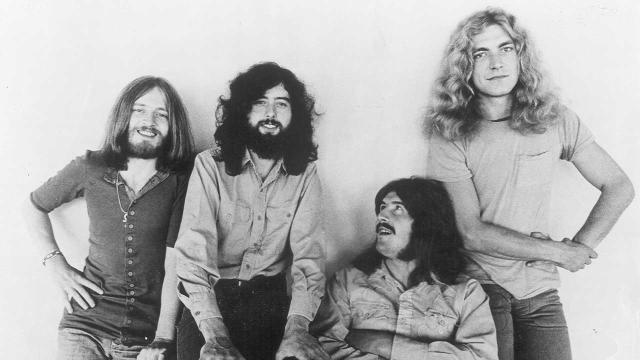

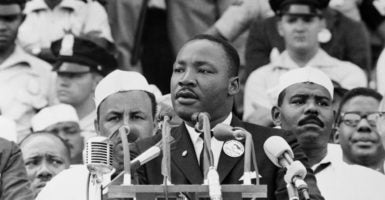
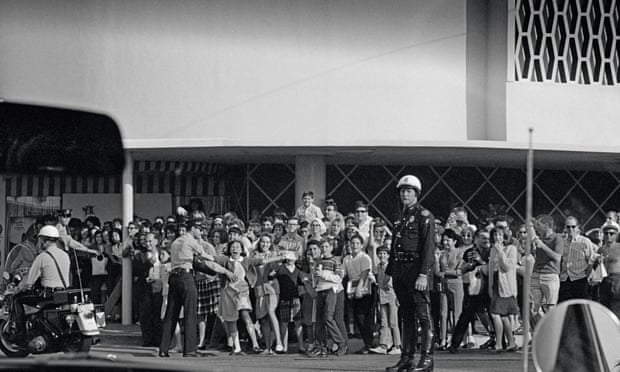

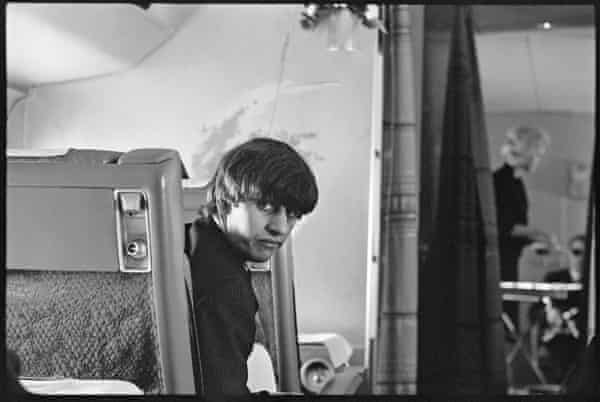
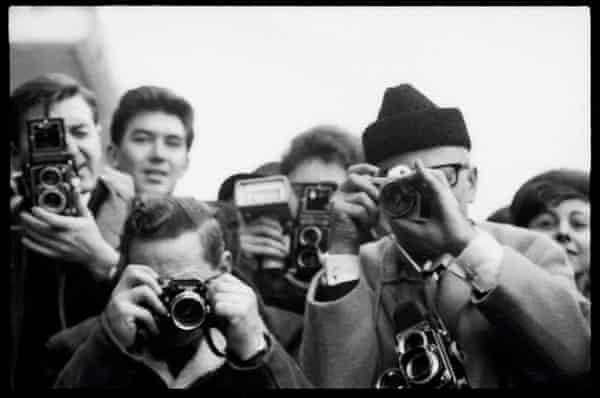





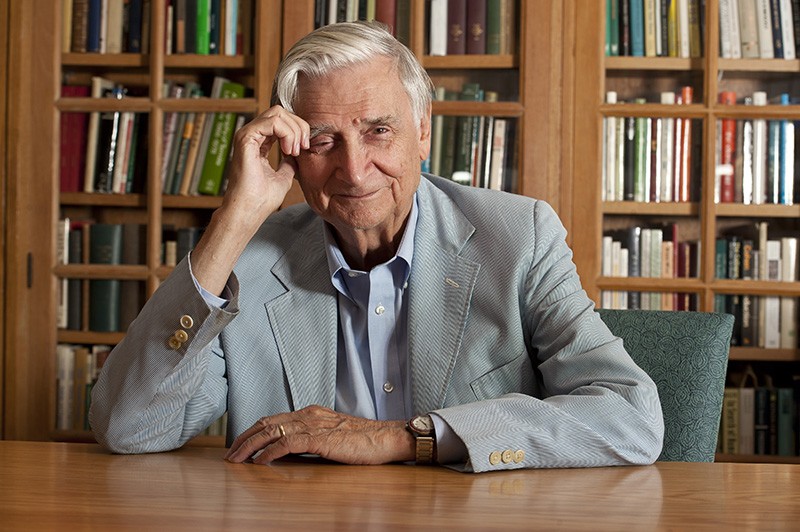






 The Daily Hatch


.jpg)
,_ca._July_1946)_(LOC)_(5148793528)_(cropped)_(cropped).jpg)