This Kennedy descendant insists in her New York Times Book Review that “How to Blow Up a Pipeline” doesn’t offer “any actual instructions” for explosions. Pictured: The New York Times building seen on June 30, 2020, in New York City. (Photo: Johannes Eisele/AFP/Getty Images)
If the name Tatiana Schlossberg sounds like a brand for white privilege, you would be right. She’s not a top chef or fashion designer. She’s the 30-year-old daughter of Caroline Kennedy and Ed Schlossberg, the granddaughter of former President John F. Kennedy.
Like Maria Shriver at NBC News, Tatiana Schlossberg became an “objective journalist” for a while, covering the environment for The New York Times from 2014 to 2017.
When she wrote a book in 2019 called “Inconspicuous Consumption,” NBC put her on TV and pushed her to run for office. She deferred, saying she is a journalist … a political activist of a different stripe.
On Jan. 24, she reviewed three books on “environmental disaster” for The New York Times Book Review. One book had an especially provocative title: “How to Blow Up a Pipeline,” by a far-left Swedish professor named Andreas Malm. It was published on Jan. 5 by Verso Books, which calls itself “the largest independent, radical publishing house in the English-speaking world.”
The Left has declared war on our culture, but we should never back down, nor compromise our principles. Learn more now >>
Verso’s promotional blurb for this latest version of a Unabomber treatise is really something.
“In this lyrical manifesto, noted climate scholar (and saboteur of SUV tires and coal mines) Andreas Malm makes an impassioned call for the climate movement to escalate its tactics in the face of ecological collapse,” it says. “We need, he argues, to force fossil fuel extraction to stop—with our actions, with our bodies, and by defusing and destroying its tools. We need, in short, to start blowing up some oil pipelines.”
It seems intellectually incoherent for The New York Times to cheer social media platforms for squashing voices that promoted conspiracy theories about Donald Trump’s “landslide victory” because they might lead to violence … and then offer space to a book advocating property destruction.
Online, the Times promoted it with the headline “Three Books Offer New Ways to Think About Environmental Disaster.” When it comes to Big Energy (as opposed to Big Government), a few pipeline bombs offer “new ways to think,” an expansion of our ecological possibilities.
Schlossberg calls it “a compelling but frustrating treatise.” She says, “one of the most satisfying parts of his book comes when he brutally dispatches with ‘climate fatalists.’” (Perhaps when reviewing a book that endorses blowing stuff up, the words “brutally” and “dispatches” should be avoided.)
She loves how Malm writes that “climate fatalism is for those on top.” But here’s the poster girl for white privilege, a roving global correspondent born “on top,” promoting violence against energy companies, which provide jobs to Americans in flyover states much less privileged than she is.
This Kennedy descendant insists Malm doesn’t offer “any actual instructions” for explosions. She concludes, “the problem with violence, even if it’s meant only to destroy ‘fossil capital,’ is that ultimately it’s impossible to control.” That’s true.
Philosophically, one can ask whether it would be advisable or appropriate to publish a book titled “How to Blow Up a Book Publisher.” Did Verso Books ever consider that, or whether someone who’s hurt (or whose family members are killed) in a pipeline explosion could sue for damages?
And shouldn’t President Joe Biden’s Department of Homeland Security broaden its focus on “domestic terrorism” from merely the far right to the far left? The left’s attempt to place the entire terrorism narrative on the right is completely undermined by its promotion of noxious books like this.
The Daily Signal publishes a variety of perspectives. Nothing written here is to be construed as representing the views of The Heritage Foundation.
Have an opinion about this article? To sound off, please email letters@DailySignal.com and we will consider publishing your remarks in our regular “We Hear You” feature.
A crowd of about 35,000 had gathered near the Washington Monument during a cold blustery Presidents Day weekend in the midst of an unusually mild winter to prod the Obama administration to take actions against climate change. The largest climate action rally in American history had been scheduled for noon on a Sunday, not exactly a time chosen with regular church-goers in mind”though, undoubtedly, for some present the environmental cause would be the closest thing to a religion in their lives.
I carried a sign that declared “Jesus is Pro-Planet” in 175-point type. I have no hesitation about the truth of the statement. Paul makes it clear in Colossians 1 that, through Christ, God is indeed reconciling to himself “all things, whether things on earth or things in heaven,” and that this is good news for “every creature under heaven.”
As C.S. Lewis noted in Mere Christianity , the true cosmic nature of Christ’s atonement is difficult for our inwardly focused minds to fathom but “there are strange, exciting hints in the Bible that when we are drawn in [to Christ], a great many other things in Nature will begin to come right.”
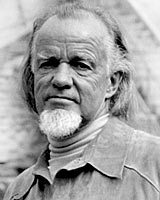
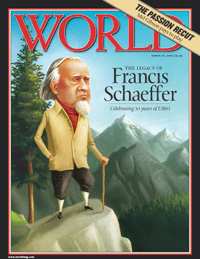
Francis Schaeffer made a similar point in his important Pollution and the Death of Man , a neglected manifesto for Evangelical environmentalism:
The blood of the Lamb will redeem man and nature together . . . . But Christians who believe the Bible are not simply called to say that “one day” there will be healing, but that by God’s grace, upon the basis of the work of Christ, substantial healing can be a reality here and now.
In 1970, Schaeffer spoke against the “greed and haste” that was destroying creation and called for the Church to be a “pilot plant” demonstrating the healing of man and nature. The failure to do so would, to Schaeffer, be both disobedient and bring the loss of a great evangelistic opportunity, with pantheism filling the vacuum as long as the Church practiced this “sub-Christianity.”
While Evangelical leaders enthusiastically embraced Schaeffer’s push to engage on abortion and other cultural issues in the 1980s, his words and actions about the darkness of environmental degradation and the beauty of nature have largely been forgotten. He agreed with the 1960s countercultural critique of a “plastic culture” with its overreliance on “the machine” of technology and a diminished concept of nature.
The counterculture’s diagnosis was largely correct , Schaeffer thought, but the favored prescription”implicit or explicit pantheism”reduced man to “no more than grass,” after which he feared that “impersonal technology will reign even more securely.”
Also problematic was the popular but “perverted” form of Christianity that embraced a type of Platonic dualism, focused exclusively on the soul and getting it to the higher state of Heaven. For such Christians, the realm of nature might, at best, serve as an apologetic tool, but it had no real intrinsic value to them or their version of God, despite his having proclaimed it “good” from the start.
Pollution and the Death of Man illustrates this point with the true story of a Christian institution run with its eyes solely on the sky. This austere school campus sits across a large ravine from what, despite its lushness, was derisively labeled as just a “hippie community” by the Christians. Schaeffer, after speaking at the school, visited the neighbors. He spoke with their leadership about ecological issues, saw the lovely fields, trees, gardens and even the site of their communal grape stomps.
Schaeffer realized that the Christians, with their unbiblical and cavalier attitude towards nature, were offering little to draw the sincere but lost pagans toward a true vision of creation and redemption. “When I stood on Christian ground and looked at the Bohemian people’s place,” wrote Schaeffer, “it was beautiful. Then I stood on pagan ground and looked at the Christian community and saw ugliness.” Schaeffer took it as a sad compliment when his hippie host said he was the first to come from “across the ravine” in such a manner.
Indeed, Schaeffer (who loved to hike the Alps and did not own a car after 1948) believed that only a return to orthodox Christianity could effectively bridge this chasm. He countered Platonic Christianity by emphasizing that all of creation, from the human body on down to a tree or a stone, has inherent value stemming from its association with the Creator. “What God has made, I, who am also a creature, must not despise.”
Schaeffer insisted that man is finite, as separated from the infinite God, as are our kin, the animals and the grass. But, lest we slide into pantheism, he also emphasized the separation from nature brought about by our special creation in the image of God. Here, the rest of creation lies below us, and in this regard we are much more than grass.
Maintaining these two truths in proper tension allows us to engage the environment with an appropriate respect for its order and worth. It is not a plaything, designed solely for our hedonistic enjoyment. We may use it, yes, but we should exercise dominion without utter destruction, always avoid disdain for what God has made, and delights in it independent of its utility to us. In practice, the Christian community should be a people that have learned “to say ‘Stop!’” and “refuse men the right to ravish our land, just as we refuse them the right to ravish our women.”
As I approached the D.C. throng calling for a “Stop!” of its own, I felt a bit as though I was taking the name of Jesus across a green ravine similar to the one Schaeffer walked. Looking over the crowd, I was reminded, though, that God has not been without his witnesses in this realm. The ringleader of the event, 350.org founder Bill McKibben, has regularly referenced his Methodist faith, and multiple Earth Flags”first created in 1969 by faithful believers John and Anna McConnell (who, incidentally, met with a little help from Richard John Neuhaus)”were taut in the stiff breeze.
Nevertheless, forty-three years after Schaeffer wrote his little treatise, plenty of pantheistic Mother Earth spirituality was on display as well as the secular humanism that Schaeffer famously warned against elsewhere. Unfortunately, the Evangelical Church did not step into the breach and much of its leadership instead now treats the small creation care movement as a theological leper, unclean because it engages with a green movement viewed as beyond redemption.
Yet the name of Jesus was surprisingly well received on the National Mall. I saw not one glare or frown; instead dozens of people made positive comments and requested photographs. A self-described agnostic hawking The Socialist Worker newspaper engaged with me about mankind’s relationship to God and closed by saying of Jesus with a smile, “Well, if he got you out here, he can’t be all bad.”
A small group of banner-wielding Evangelical college students, who allowed me to join them despite my relatively advanced years, also drew thanks from fellow believers in the crowd and inquiries from the curious. One secular liberal couple stood with us for quite a while asking questions about what it meant to be an Evangelical, honestly discussing their own negative associations of the term with George W. Bush and SUVs. They eventually were comfortable enough”in deliciously appropriate clichéd fashion” to share their granola bars, even with an openly pro-life Bush voter like me.
Plenty of work remains to be done, both to bandage God’s wounded creation and reach his most precious creatures. “ We’ve got the whole world in our hands,” a gaggle of green-clad marchers sang to a familiar Sunday School tune. “I think they’ve got the lyrics wrong,” I remarked with a wink to the students. We set about to sing the song correctly.
John Murdock works as a natural resources attorney in Washington, D.C., and is a member of The Falls Church Anglican in northern Virginia. He has written on environmental matters for numerous outlets including The New Atlantis.
_________ This series of posts entitled “FRANCIS SCHAEFFER ANALYZES ART AND CULTURE” touches things that affect our culture today. The first post took a look at the foundations of our modern society today that were set by the Roman Democracy 2000 years ago and then it related it to the art we see today. […]
__________ Francis Schaeffer pictured below: ______________ Francis Schaeffer pictured below: _____________ This series of posts entitled “FRANCIS SCHAEFFER ANALYZES ART AND CULTURE” touches things that affect our culture today. The first post took a look at the foundations of our modern society today that were set by the Roman Democracy 2000 years ago and […]
__________ This series of posts entitled “FRANCIS SCHAEFFER ANALYZES ART AND CULTURE” touches things that affect our culture today. The first post took a look at the foundations of our modern society today that were set by the Roman Democracy 2000 years ago and then it related it to the art we see today. […]
___________ Francis Schaeffer pictured below: _____________ Series “FRANCIS SCHAEFFER ANALYZES ART AND CULTURE” traces Schaeffer’s comments on modern culture and can be found weekly onhttp://www.thedailyhatch.org !!!!! Paul Gauguin and his life questions! This series of posts entitled “FRANCIS SCHAEFFER ANALYZES ART AND CULTURE” touches things that affect our culture today. The first post took […]
This series of posts entitled “FRANCIS SCHAEFFER ANALYZES ART AND CULTURE” touches things that affect our culture today. The first post took a look at the foundations of our modern society today that were set by the Roman Democracy 2000 years ago and then it related it to the art we see today. The […]
____________________________________________ “FRANCIS SCHAEFFER ANALYZES ART AND CULTURE” can be found weekly onhttp://www.thedailyhatch.org ! Why Communism catches the attention of young people but never comes through!!! Dr. Francis Schaeffer – Episode 9 – The Age of Personal Peace and Affluence NoMirrorHDDHrorriMoN This series of posts entitled “FRANCIS SCHAEFFER ANALYZES ART AND CULTURE” touches things […]
_____________ Jürgen Habermas Interview Uploaded on Feb 1, 2007 Rare video footage of Jurgen Habermas discussing some of his theories.http://soundcloud.com/st-hanshaugen Francis Schaeffer pictured below: ______________ Francis Schaeffer notes: At Berkeley the Free Speech Movement arose simultaneously with the hippie world of drugs. At first it was politically neither left nor right, but rather a […]
Bettina Aptheker pictured below: Moral Support: “One Dimensional Man” author Herbert Marcuse accompanies Bettina Aptheker, center, and Angela Davis’ mother, Sallye Davis, to Angela Davis’ 1972 trial in San Jose. Associated Press ___________________________________________________________________________ Francis Schaeffer has written extensively on art and culture spanning the last 2000years and here are some posts I have done on […]
_____________________ Francis Schaeffer pictured below: ____ Elston Gunn- Ballad of A Thin Man, Live Sheffield 1966 Francis Schaeffer has written extensively on art and culture spanning the last 2000 years and here are some posts I have done on this subject before : Francis Schaeffer’s “How should we then live?” Video and outline of episode 10 […]
______________ Just like tom thumb´s blues (no direction home) Francis Schaeffer has written extensively on art and culture spanning the last 2000 years and here are some posts I have done on this subject before : Francis Schaeffer’s “How should we then live?” Video and outline of episode 10 “Final Choices” , episode 9 “The Age of Personal […]
A recent Supreme Court precedent could stand in the way of President Joe Biden’s reversal of his predecessor’s action clearing the way for construction of an oil pipeline from Alberta, Canada, to Nebraska. Pictured: Pipes prepared for the Keystone XL pipeline sit in a lot outside Gascoyne, North Dakota, on Oct.14, 2014. (Photo: Andrew Burton/Getty Images)
A lawsuit from across the northern U.S. border over the Biden administration’s halting of an oil pipeline could hang on a Supreme Court ruling against the Trump administration related to the southern border.
In his first day in office, President Joe Biden canceled construction of the Keystone XL oil pipeline, an action projected to wipe out 11,000 jobs, including 8,000 union jobs.
Biden’s move reversed President Donald Trump’s executive action in early 2017 clearing the way for construction of the 1,200-mile pipeline from Alberta, Canada, through Montana and South Dakota to Nebraska. The project already had begun in Canada.
Alberta Premier Jason Kenney threatened legal action against the Biden administration, calling cancellation of the project a “gut punch” and “insult” to Canada.
The Left has declared war on our culture, but we should never back down, nor compromise our principles. Learn more now >>
Alberta-based TC Energy Corp. did not respond to inquiries for this story from The Daily Signal, but said in a recent press release: “TC Energy will review the decision, assess its implications, and consider its options.”
A recent Supreme Court case that may provide guidance is Department of Homeland Security v. Regents of the University of California. In a 5-4 decision last June, the justices ruled that the Trump administration violated the Administrative Procedure Act by doing away with an Obama administration policy called Deferred Action for Childhood Arrivals, or DACA.
President Barack Obama’s executive action, which allowed illegal immigrants brought to the United States as minors to stay legally under certain circumstances, created an expectation among people in the country. Thus, if the U.S. government wanted to scrap the DACA policy, it would have to go through an administrative procedure.
This created a “reliance interest” in the policy, the majority opinion by Chief Justice John Roberts said.
TC Energy and the Canadian government likely also would have a reliance interest, said Canaparo, who has been researching potential legal avenues for the pipeline case:
In DHS v. Regents, the court found that Trump couldn’t rescind DACA even though it was an executive action, because there was a reliance interest. That could be a stumbling block for Biden with regard to the Keystone pipeline. … The administration did not consider any reliance interest.
Just as Obama’s DACA stated that certain people could live and work in the United States, Trump’s go-ahead for Keystone XL instituted a right to build a pipeline across the Canadian-U.S. border, Canaparo said. Both policies, according to court precedent, “created rights” that require the government to go through a procedure to undo, he said.
“Those rights were snatched away and the Biden administration did not consider the reliance interests of TC Energy, the Canadian government, or Alberta,” Canaparo said. “The administration also did not provide a stated purpose for the decision. You could say it was to reduce carbon emissions. But the oil will still be transported by train or truck.”
The majority opinion in the Supreme Court’s ruling noted that some DACA recipients had enrolled in degree programs, started careers, opened businesses, and bought homes. This crossed from being an emotional appeal to being a legal argument, because those persons took such actions in reliance on government policy.
Similarly, TC Energy issued at least six contracts and was set to employ 11,000 for the $8 billion construction of the pipeline to carry 830,000 barrels of crude oil per day from oil sands in Alberta to Steele City, Nebraska. From there, the pipeline would connect with another Keystone pipeline that runs south to the Gulf Coast.
The Supreme Court kept DACA in place, for the interim, while stating that the Department of Homeland Security has the authority to rescind the amnesty policy.
The high court didn’t rule on the legality of Obama’s policy, only that the Trump administration violated the Administrative Procedure Act in ending it. The justices also said Trump’s DHS was “arbitrary and capricious” for not providing a compelling reason for the policy change.
Congress passed the Administrative Procedure Act in 1946, after World War II, to recognize that the executive branch might have to take emergency action without congressional approval. Congress, however, wanted guidelines in place.
In a 2009 case, FCC v. Fox Television Stations, the Supreme Court established detailed guidelines for judicial review of a change in a government standard, according to a Congressional Research Service report. Among these guidelines is that the change cannot be an “unexplained inconsistency.”
The high court’s 2009 ruling also said that an agency would be required to provide a “more detailed justification” for a change in policy in some instances, including when a previous policy has “engendered serious reliance interests that must be taken into account.” The court determined that it would be “arbitrary and capricious” to “ignore” or “disregard” such matters.
In its 2016 opinion in Encino Motorcars, LLC v. Navarro, the Supreme Court determined that “serious reliance interests are at stake” when the Labor Department altered its statutory interpretation of a rule without a “reasoned explanation.” The agency’s move came after decades of “industry reliance” on an existing policy, the court said.
In addition to suing the Biden administration in federal court, TC Energy could launch a case under a provision of the North American Free Trade Agreement. A NAFTA provision called Chapter 11 allows companies in the United States, Mexico, or Canada to challenge decisions by one of the three nations. The provision was grandfathered into the U.S.-Mexico-Canada Agreement, which replaced NAFTA, until 2023.
A complaint by TC Energy about the pipeline cancellation under Chapter 11 could provide more neutral ground, Mark Warner, an international trade lawyer at MAAW Law in Toronto, told the Financial Post.
“They could file a complaint under the old Chapter 11 and make a case that this was arbitrary and a denial of due process,” Warner told the Post.
The energy company was going to launch both a Chapter 11 complaint under NAFTA and a federal lawsuit in 2016, but dropped both after Trump approved the pipeline project, the Post reported.
Have an opinion about this article? To sound off, please email letters@DailySignal.com and we will consider publishing your remarks in our regular “We Hear You” feature.
Environmental extremists are currently pushing for Janet Yellen, President-elect Joe Biden’s nominee for treasury secretary (pictured), to take drastic action to address climate change, such as by forcing oil and gas companies to sell off fossil fuel assets. (Photo: Demetrius Freeman/The Washington Post/Getty Images)
Many on the left continue to place their ideology of environmental extremism above all other considerations, including economic growth, individual freedom, and the welfare of low-income Americans.
This worldview ignores critical trade-offs and places environmental interests above even basic principles that have long served as a foundation of this nation. Further, this extreme environmental movement has crept into almost every issue area imaginable.
There are certainly environmental issues that need attention, but sensible environmental policy doesn’t address those issues in a vacuum without regard for other important concerns. Yet, this extreme movement acts in such a manner.
The following examples highlight how environmental extremism is skewing public policy:
The demand for socialism is on the rise from young Americans today. But is socialism even morally sound? Find out more now >>
Energy
To environmental extremists, it’s more important for the government to force radical changes to how we generate electricity and fuel our vehicles than it is to have reliable and affordable energy or to remove barriers to innovation.
It doesn’t matter how unrealistic their objectives are, or the fact that their climate change efforts would have no meaningful effect on global temperatures.
This virtue-signaling may make the extremists feel better about themselves, but it certainly won’t make low-income households feel better when they are disproportionately impacted by higher energy prices. Nor will it make Americans feel better to pay more of their hard-earned money for less reliable energy.
Food and Agriculture
Some extremists would prioritize their environmental agenda over efficiently producing safe and affordable food for Americans.
Instead of simply addressing specific environmental issues, some want to develop a national food policy, which is just another way of saying a federally centralized approach to dictate food and agricultural production, distribution, and consumption.
One of the primary goals of this envisioned national food and agricultural policy would be advancing environmental objectives. What is ignored in this movement is affordable food and consumer choice.
To see how such a philosophy would be applied in practice, the 2015 Dietary Guidelines process is instructive.
In developing its recommendations for the Department of Agriculture and the Department of Health and Human Services, the influential Dietary Guidelines Advisory Committee decided it would take into account non-dietary issues, such as climate change and sustainability, and not focus solely on the nutritional health of Americans—which is the purpose of the guidelines. Fortunately, the agencies rejected this extremism.
Housing, Land Use, and Transportation
The extreme environmental agenda has long been entrenched in urban policy, primarily through “smart growth,” which is a pleasant name given to an unpleasant centralized planning philosophy.
Some of the key components of this philosophy are restricting development through land use regulations, which drives up housing prices, and limiting the use of cars by promoting higher density development and transit. The ability of Americans to afford their own homes and live where they would like is ignored.
Financial Regulation
Environmental extremists are currently pushing for Janet Yellen, President-elect Joe Biden’s nominee for treasury secretary, to take drastic action to address climate change, such as by forcing oil and gas companies to sell off fossil fuel assets.
This is yet another effort to create a government mandate for environmental, social, and governance risks to play a primary role in banking and investing.
These efforts are a backdoor way to try and accomplish environmental objectives and simultaneously to try and radically change the very purpose of American businesses, and as a result, the entire economy.
Conclusion
Environmental policy should be debated in an open and transparent fashion. Using every issue imaginable as a pretext to push an environmental agenda is both not transparent and minimizes other critical concerns, from higher prices of basic needs to ensuring a stable food supply.
The left likes to claim a monopoly about caring for the environment. But nobody, either on the left or right, has such a monopoly.
Placing the environment over individual rights and freedom, and even humanity itself, as some extremists do, may make some feel better about their commitment to the environment, but they do so at the expense of the well-being of the American people.
A crowd of about 35,000 had gathered near the Washington Monument during a cold blustery Presidents Day weekend in the midst of an unusually mild winter to prod the Obama administration to take actions against climate change. The largest climate action rally in American history had been scheduled for noon on a Sunday, not exactly a time chosen with regular church-goers in mind”though, undoubtedly, for some present the environmental cause would be the closest thing to a religion in their lives.
I carried a sign that declared “Jesus is Pro-Planet” in 175-point type. I have no hesitation about the truth of the statement. Paul makes it clear in Colossians 1 that, through Christ, God is indeed reconciling to himself “all things, whether things on earth or things in heaven,” and that this is good news for “every creature under heaven.”
As C.S. Lewis noted in Mere Christianity , the true cosmic nature of Christ’s atonement is difficult for our inwardly focused minds to fathom but “there are strange, exciting hints in the Bible that when we are drawn in [to Christ], a great many other things in Nature will begin to come right.”
Francis Schaeffer made a similar point in his important Pollution and the Death of Man , a neglected manifesto for Evangelical environmentalism:
The blood of the Lamb will redeem man and nature together . . . . But Christians who believe the Bible are not simply called to say that “one day” there will be healing, but that by God’s grace, upon the basis of the work of Christ, substantial healing can be a reality here and now.
In 1970, Schaeffer spoke against the “greed and haste” that was destroying creation and called for the Church to be a “pilot plant” demonstrating the healing of man and nature. The failure to do so would, to Schaeffer, be both disobedient and bring the loss of a great evangelistic opportunity, with pantheism filling the vacuum as long as the Church practiced this “sub-Christianity.”
While Evangelical leaders enthusiastically embraced Schaeffer’s push to engage on abortion and other cultural issues in the 1980s, his words and actions about the darkness of environmental degradation and the beauty of nature have largely been forgotten. He agreed with the 1960s countercultural critique of a “plastic culture” with its overreliance on “the machine” of technology and a diminished concept of nature.
The counterculture’s diagnosis was largely correct , Schaeffer thought, but the favored prescription”implicit or explicit pantheism”reduced man to “no more than grass,” after which he feared that “impersonal technology will reign even more securely.”
Also problematic was the popular but “perverted” form of Christianity that embraced a type of Platonic dualism, focused exclusively on the soul and getting it to the higher state of Heaven. For such Christians, the realm of nature might, at best, serve as an apologetic tool, but it had no real intrinsic value to them or their version of God, despite his having proclaimed it “good” from the start.
Pollution and the Death of Man illustrates this point with the true story of a Christian institution run with its eyes solely on the sky. This austere school campus sits across a large ravine from what, despite its lushness, was derisively labeled as just a “hippie community” by the Christians. Schaeffer, after speaking at the school, visited the neighbors. He spoke with their leadership about ecological issues, saw the lovely fields, trees, gardens and even the site of their communal grape stomps.
Schaeffer realized that the Christians, with their unbiblical and cavalier attitude towards nature, were offering little to draw the sincere but lost pagans toward a true vision of creation and redemption. “When I stood on Christian ground and looked at the Bohemian people’s place,” wrote Schaeffer, “it was beautiful. Then I stood on pagan ground and looked at the Christian community and saw ugliness.” Schaeffer took it as a sad compliment when his hippie host said he was the first to come from “across the ravine” in such a manner.
Indeed, Schaeffer (who loved to hike the Alps and did not own a car after 1948) believed that only a return to orthodox Christianity could effectively bridge this chasm. He countered Platonic Christianity by emphasizing that all of creation, from the human body on down to a tree or a stone, has inherent value stemming from its association with the Creator. “What God has made, I, who am also a creature, must not despise.”
Schaeffer insisted that man is finite, as separated from the infinite God, as are our kin, the animals and the grass. But, lest we slide into pantheism, he also emphasized the separation from nature brought about by our special creation in the image of God. Here, the rest of creation lies below us, and in this regard we are much more than grass.
Maintaining these two truths in proper tension allows us to engage the environment with an appropriate respect for its order and worth. It is not a plaything, designed solely for our hedonistic enjoyment. We may use it, yes, but we should exercise dominion without utter destruction, always avoid disdain for what God has made, and delights in it independent of its utility to us. In practice, the Christian community should be a people that have learned “to say ‘Stop!’” and “refuse men the right to ravish our land, just as we refuse them the right to ravish our women.”
As I approached the D.C. throng calling for a “Stop!” of its own, I felt a bit as though I was taking the name of Jesus across a green ravine similar to the one Schaeffer walked. Looking over the crowd, I was reminded, though, that God has not been without his witnesses in this realm. The ringleader of the event, 350.org founder Bill McKibben, has regularly referenced his Methodist faith, and multiple Earth Flags”first created in 1969 by faithful believers John and Anna McConnell (who, incidentally, met with a little help from Richard John Neuhaus)”were taut in the stiff breeze.
Nevertheless, forty-three years after Schaeffer wrote his little treatise, plenty of pantheistic Mother Earth spirituality was on display as well as the secular humanism that Schaeffer famously warned against elsewhere. Unfortunately, the Evangelical Church did not step into the breach and much of its leadership instead now treats the small creation care movement as a theological leper, unclean because it engages with a green movement viewed as beyond redemption.
Yet the name of Jesus was surprisingly well received on the National Mall. I saw not one glare or frown; instead dozens of people made positive comments and requested photographs. A self-described agnostic hawking The Socialist Worker newspaper engaged with me about mankind’s relationship to God and closed by saying of Jesus with a smile, “Well, if he got you out here, he can’t be all bad.”
A small group of banner-wielding Evangelical college students, who allowed me to join them despite my relatively advanced years, also drew thanks from fellow believers in the crowd and inquiries from the curious. One secular liberal couple stood with us for quite a while asking questions about what it meant to be an Evangelical, honestly discussing their own negative associations of the term with George W. Bush and SUVs. They eventually were comfortable enough”in deliciously appropriate clichéd fashion” to share their granola bars, even with an openly pro-life Bush voter like me.
Plenty of work remains to be done, both to bandage God’s wounded creation and reach his most precious creatures. “ We’ve got the whole world in our hands,” a gaggle of green-clad marchers sang to a familiar Sunday School tune. “I think they’ve got the lyrics wrong,” I remarked with a wink to the students. We set about to sing the song correctly.
John Murdock works as a natural resources attorney in Washington, D.C., and is a member of The Falls Church Anglican in northern Virginia. He has written on environmental matters for numerous outlets including The New Atlantis.
_________ This series of posts entitled “FRANCIS SCHAEFFER ANALYZES ART AND CULTURE” touches things that affect our culture today. The first post took a look at the foundations of our modern society today that were set by the Roman Democracy 2000 years ago and then it related it to the art we see today. […]
__________ Francis Schaeffer pictured below: ______________ Francis Schaeffer pictured below: _____________ This series of posts entitled “FRANCIS SCHAEFFER ANALYZES ART AND CULTURE” touches things that affect our culture today. The first post took a look at the foundations of our modern society today that were set by the Roman Democracy 2000 years ago and […]
__________ This series of posts entitled “FRANCIS SCHAEFFER ANALYZES ART AND CULTURE” touches things that affect our culture today. The first post took a look at the foundations of our modern society today that were set by the Roman Democracy 2000 years ago and then it related it to the art we see today. […]
___________ Francis Schaeffer pictured below: _____________ Series “FRANCIS SCHAEFFER ANALYZES ART AND CULTURE” traces Schaeffer’s comments on modern culture and can be found weekly onhttp://www.thedailyhatch.org !!!!! Paul Gauguin and his life questions! This series of posts entitled “FRANCIS SCHAEFFER ANALYZES ART AND CULTURE” touches things that affect our culture today. The first post took […]
This series of posts entitled “FRANCIS SCHAEFFER ANALYZES ART AND CULTURE” touches things that affect our culture today. The first post took a look at the foundations of our modern society today that were set by the Roman Democracy 2000 years ago and then it related it to the art we see today. The […]
____________________________________________ “FRANCIS SCHAEFFER ANALYZES ART AND CULTURE” can be found weekly onhttp://www.thedailyhatch.org ! Why Communism catches the attention of young people but never comes through!!! Dr. Francis Schaeffer – Episode 9 – The Age of Personal Peace and Affluence NoMirrorHDDHrorriMoN This series of posts entitled “FRANCIS SCHAEFFER ANALYZES ART AND CULTURE” touches things […]
_____________ Jürgen Habermas Interview Uploaded on Feb 1, 2007 Rare video footage of Jurgen Habermas discussing some of his theories.http://soundcloud.com/st-hanshaugen Francis Schaeffer pictured below: ______________ Francis Schaeffer notes: At Berkeley the Free Speech Movement arose simultaneously with the hippie world of drugs. At first it was politically neither left nor right, but rather a […]
Bettina Aptheker pictured below: Moral Support: “One Dimensional Man” author Herbert Marcuse accompanies Bettina Aptheker, center, and Angela Davis’ mother, Sallye Davis, to Angela Davis’ 1972 trial in San Jose. Associated Press ___________________________________________________________________________ Francis Schaeffer has written extensively on art and culture spanning the last 2000years and here are some posts I have done on […]
_____________________ Francis Schaeffer pictured below: ____ Elston Gunn- Ballad of A Thin Man, Live Sheffield 1966 Francis Schaeffer has written extensively on art and culture spanning the last 2000 years and here are some posts I have done on this subject before : Francis Schaeffer’s “How should we then live?” Video and outline of episode 10 […]
______________ Just like tom thumb´s blues (no direction home) Francis Schaeffer has written extensively on art and culture spanning the last 2000 years and here are some posts I have done on this subject before : Francis Schaeffer’s “How should we then live?” Video and outline of episode 10 “Final Choices” , episode 9 “The Age of Personal […]
Office of Barack and Michelle Obama P.O. Box 91000 Washington, DC 20066
Dear President Obama,
I wrote you over 700 letters while you were President and I mailed them to the White House and also published them on my blog http://www.thedailyhatch.org .I received several letters back from your staff and I wanted to thank you for those letters.
There are several issues raised in your book that I would like to discuss with you such as the minimum wage law, the liberal press, the cause of 2007 financial meltdown, and especially your pro-choice (what I call pro-abortion) view which I strongly object to on both religious and scientific grounds, Two of the most impressive things in your book were your dedication to both the National Prayer Breakfast (which spoke at 8 times and your many visits to the sides of wounded warriors!!
I have been reading your autobiography A PROMISED LAND and I have been enjoying it.
Let me make a few comments on it, and here is the first quote of yours I want to comment on:
WHEN IT CAME to immigration, everyone agreed that the system was broken. The process of immigrating legally to the United States could take a decade or longer, often depending on what country you were coming from and how much money you had.Meanwhile, the economic gulf between us and our southern neighbors drove hundreds of thousands of people to illegally cross the 1,933-mile U.S.-Mexico border each year, searching for work and a better life. Congress had spent billions to harden the border, with fencing, cameras, drones, and an expanded and increasingly militarized border patrol. But rather than stop the flow of immigrants, these steps had spurred an industry of smugglers—coyotes—who made big money transporting human cargo in barbaric and sometimes deadly fashion. And although border crossings by poor Mexican and Central American migrants received most of the attention from politicians and the press, about 40 percent of America’s unauthorized immigrants arrived through airports or other legal ports of entry and then overstayed their visas. By 2010, an estimated eleven million undocumented persons were living in the United States, in large part thoroughly woven into the fabric of American life.Many were longtime residents, with children who either were U.S. citizens by virtue of having been born on American soil or had been brought to the United States at such an early age that they were American in every respect except for a piece of paper. Entire sectors of the U.S. economy relied on their labor, as undocumented immigrants were often willing to do the toughest, dirtiest work for meager pay—picking the fruits and vegetables that stocked our grocery stores, mopping the floors of offices, washing dishes at restaurants, and providing care to the elderly. But although American consumers benefited from this invisible workforce, many feared that immigrants were taking jobs from citizens, burdening social services programs, and changing the nation’s racial and cultural makeup, which led to demands for the government to crack down on illegal immigration. This sentiment was strongest among Republican constituencies, egged on by an increasingly nativist right-wing press. However, the politics didn’t fall neatly along partisan lines: The traditionally Democratic trade union rank and file, for example, saw the growing presence of undocumented workers on co nstruction sites as threatening their livelihoods, while Republican-leaning business groups interested in maintaining a steady supply of cheap labor (or, in the case of Silicon Valley, foreign-born computer programmers and engineers) often took pro-immigration positions. Back in 2007, the maverick version of John McCain, along with his sidekick Lindsey Graham, had actually joined Ted Kennedy to put together a comprehensive reform bill that offered citizenship to millions of undocumented immigrants while more tightly securing our borders. Despite strong support from President Bush, it had failed to clear the Senate. The bill did, however, receive twelve Republican votes, indicating the real possibility of a future bipartisan accord. I’d pledged during the campaign to resurrect similar legislation once elected, and I’d appointed former Arizona governor Janet Napolitano as head of the Department of Homeland Security—the agency that oversaw U.S. Immigration and Customs Enforcement (ICE) and U.S. Customs and Border Protection—partly because of her knowledge of border issues and her reputation for having previously managed immigration in a way that was both compassionate and tough. My hopes for a bill had thus far been dashed. With the economy in crisis and Americans losing jobs,few in Congress had any appetite to take on a hot-button issue like immigration. Kennedy was gone. McCain, having been criticized by the right flank for his relatively moderate immigration stance, showed little interest in taking up the banner again. Worse yet, my administration was deporting undocumented workers at an accelerating rate. This wasn’t a result of any directive from me, but rather it stemmed from a 2008 congressional mandate that both expanded ICE’s budget and increased collaboration between ICE and local law enforcement departments in an effort to deport more undocumented immigrants with criminal records. My team and I had made a strategic choice not to immediately try to reverse the policies we’d inherited in large part because we didn’t want to provide ammunition to critics who claimed that Democrats weren’t willing to enforce existing immigration laws—a perception that we thought could torpedo our chances of passing a future reform bill. But by 2010, immigrant-rights and Latino advocacy groups were criticizing our lack of progress..And although I continued to urge Congress to pass immigration reform, I had no realistic path for delivering a new comprehensive law before the midterms.
Milton Friedmanwisely noted, “It’s just obvious you can’t have free immigration and a welfare state,” Is it prudent to allow illegal immigrants (60 percent of whom are high-school dropouts) access to Social Security, Medicare, and, over time, to 60 federal means-tested welfare programs? I don’t think so either
A reader from overseas wonders about my views on immigration, particularly amnesty.
I confess that this is one of those issues where I’m conflicted.
On the general topic of immigration, I think the United States has benefited in the past – and can benefit in the future – from newcomers. And I express that position in this interview for Fox Business News.
But the real issue, which isn’t addressed in the interview, is magnitude. I assume almost nobody wants zero immigration. On the other hand, I also assume that very few people favor totally open borders.
So where do we draw the line? I think we should welcome lots of immigration, particularly people with skills, education, and money. This is the approach that is used to varying degrees by nations such as Australia, Canada, and Switzerland, and I wrote favorably about a similar proposal by Congressman Jared Polis, a Democrat from Colorado.
And I think substantial numbers of low-skilled people who want to work also should be welcome, but I don’t think everybody in the world who wants to come to America should have that right. I haven’t met more than a tiny handful of folks who disagree with Walter Williams’ assertion that, “not…everyone on the planet had a right to live in the U.S.”
Particularly since politicians have redistribution systems that can lure people into a life of dependency. Which is presumably why Milton Friedman warned, to the dismay of some other libertarians, “You cannot simultaneously have free immigration and a welfare state.”
Even the Wall Street Journal, which is a leading voice for both increased immigration and amnesty for existing illegals, also is concerned that a growing welfare state could attract immigrants for the wrong reasons.
Speaking of amnesty, I suppose I should answer the question of how I would deal with people who are in the country illegally? And my response probably depends whether I answer with my heart or my head.
My heart tells me to give these people the benefit of the doubt. Every illegal I’ve met seems to be a good person. And I know if I lived someplace like Mexico, Somalia, or Honduras, I almost certainly would want to improve my family’s position by getting to America, legally or illegally.
On the other hand, I believe in the rule of law and I’m a bit uncomfortable rewarding those who jumped the line at the expense of those who followed the rules.
And to be perfectly honest, I also worry about the political implications of any policy that increases the number of people who – on net – will vote for redistribution. I could do without the partisan implications, but this Chuck Asay cartoon captures my concerns.
I also think that people respond to incentives. Another round of amnesty almost surely will encourage further illegal immigration. Putting myself in the position of a poor person in the developing world, I would logically conclude that it would just be a matter of time, so I would sneak across the border in order to take advantage of that future amnesty.
That doesn’t strike me as a good approach. Far better to figure out how to genuinely reform the system.
By the way, a senior staffer on Capitol Hill floated to me the idea of a new status that enables illegals to stay in the country, but bars them from citizenship unless they get in line and follow the rules. I’m definitely not familiar with the fault lines on these issues, but perhaps that could be a good compromise.
And it goes without saying that I want the strictest possible limits on access to welfare programs and other government handouts for immigrants, regardless of their status.
So, like everybody else, I want border security and some form of legalization as part of a new system that brings people to America for the right reason. See, I’m the epitome of reasonableness.
President Obama c/o The White House 1600 Pennsylvania Avenue NW Washington, DC 20500 Dear Mr. President, I know that you receive 20,000 letters a day and that you actually read 10 of them every day. I really do respect you for trying to get a pulse on what is going on out here. There have […]By Everette Hatcher III | Posted in David Barton, Founding Fathers, President Obama | Edit |Comments (0)
There have been many articles written by evangelicals like me who fear that our founding fathers would not recognize our country today because secular humanism has rid our nation of spiritual roots. I am deeply troubled by the secular agenda of those who are at war with religion in our public life. Lillian Kwon quoted somebody […]By Everette Hatcher III | Posted in David Barton, Founding Fathers | Edit | Comments (0)
There have been many articles written by evangelicals like me who fear that our founding fathers would not recognize our country today because secular humanism has rid our nation of spiritual roots. I am deeply troubled by the secular agenda of those who are at war with religion in our public life. Lillian Kwon quoted somebody […]By Everette Hatcher III | Posted in David Barton, Founding Fathers | Edit | Comments (0)
There have been many articles written by evangelicals like me who fear that our founding fathers would not recognize our country today because secular humanism has rid our nation of spiritual roots. I am deeply troubled by the secular agenda of those who are at war with religion in our public life. Lillian Kwon quoted somebody […]By Everette Hatcher III | Posted in David Barton, Founding Fathers | Edit | Comments (0)
There have been many articles written by evangelicals like me who fear that our founding fathers would not recognize our country today because secular humanism has rid our nation of spiritual roots. I am deeply troubled by the secular agenda of those who are at war with religion in our public life. Lillian Kwon quoted somebody […]By Everette Hatcher III | Posted in David Barton, Founding Fathers | Edit | Comments (0)
There have been many articles written by evangelicals like me who fear that our founding fathers would not recognize our country today because secular humanism has rid our nation of spiritual roots. I am deeply troubled by the secular agenda of those who are at war with religion in our public life. Lillian Kwon quoted somebody […]By Everette Hatcher III | Posted in Founding Fathers | Edit | Comments (0)
President Obama Speaks at The Ohio State University Commencement Ceremony Published on May 5, 2013 President Obama delivers the commencement address at The Ohio State University. May 5, 2013. You can learn a lot about what President Obama thinks the founding fathers were all about from his recent speech at Ohio State. May 7, 2013, […]By Everette Hatcher III | Posted in Founding Fathers, President Obama | Edit | Comments (0)
Dr. C. Everett Koop with Bill Graham. Francis Schaeffer: “Whatever Happened to the Human Race” (Episode 4) THE BASIS FOR HUMAN DIGNITY Published on Oct 7, 2012 by AdamMetropolis The 45 minute video above is from the film series created from Francis Schaeffer’s book “Whatever Happened to the Human Race?” with Dr. C. Everett Koop. This […]By Everette Hatcher III | Posted in Founding Fathers, Francis Schaeffer, Prolife | Edit |Comments (1)
America’s Founding Fathers Deist or Christian? – David Barton 4/6 There have been many articles written by evangelicals like me who fear that our founding fathers would not recognize our country today because secular humanism has rid our nation of spiritual roots. I am deeply troubled by the secular agenda of those who are at […]By Everette Hatcher III | Posted in David Barton, Founding Fathers | Tagged governor of connecticut, john witherspoon, jonathan trumbull | Edit | Comments (1)
3 Of 5 / The Bible’s Influence In America / American Heritage Series / David Barton There were 55 gentlemen who put together the constitution and their church affliation is of public record. Greg Koukl notes: Members of the Constitutional Convention, the most influential group of men shaping the political foundations of our nation, were […]By Everette Hatcher III | Posted in Founding Fathers | Edit | Comments (0)
I do not think that John Quincy Adams was a founding father in the same sense that his father was. However, I do think he was involved in the early days of our government working with many of the founding fathers. Michele Bachmann got into another history-related tussle on ABC’s “Good Morning America” today, standing […]By Everette Hatcher III | Posted in David Barton, Founding Fathers | Edit | Comments (0)
I have gone back and forth and back and forth with many liberals on the Arkansas Times Blog on many issues such as abortion, human rights, welfare, poverty, gun control and issues dealing with popular culture. Here is another exchange I had with them a while back. My username at the Ark Times Blog is Saline […]By Everette Hatcher III | Posted in Arkansas Times, Francis Schaeffer, Prolife | Edit |Comments (0)
I truly believe that many of the problems we have today in the USA are due to the advancement of humanism in the last few decades in our society. Ronald Reagan appointed the evangelical Dr. C. Everett Koop to the position of Surgeon General in his administration. He partnered with Dr. Francis Schaeffer in making the […]By Everette Hatcher III | Posted in Adrian Rogers, Francis Schaeffer | Edit | Comments (0)
Francis Schaeffer: “Whatever Happened to the Human Race” (Episode 4) THE BASIS FOR HUMAN DIGNITY Published on Oct 7, 2012 by AdamMetropolis ____________ The 45 minute video above is from the film series created from Francis Schaeffer’s book “Whatever Happened to the Human Race?” with Dr. C. Everett Koop. This book really helped develop my political […]By Everette Hatcher III | Posted in Francis Schaeffer | Edit | Comments (0)
Office of Barack and Michelle Obama P.O. Box 91000 Washington, DC 20066
Dear President Obama,
I wrote you over 700 letters while you were President and I mailed them to the White House and also published them on my blog http://www.thedailyhatch.org .I received several letters back from your staff and I wanted to thank you for those letters.
I have been reading your autobiography A PROMISED LAND and I have been enjoying it.
Let me make a few comments on it, and here is the first quote of yours I want to comment on:
The financial system was in a meltdown and taking the American economy with it... I had always made the need for more progressive economic policies a central part of my argument for change.
—
You think that progressive policies of more government is the solution but look at this assertion by Dan Mitchell:
The one silver lining to the dark cloud in financial markets is that it is no longer tenable to credibly argue in favor of government‐sponsored enterprises such as Fannie and Freddie.
The one silver lining to the dark cloud in financial markets is that it is no longer tenable to credibly argue in favor of government‐sponsored enterprises such as Fannie and Freddie. These corrupt entities played a significant role in causing the real‐estate bubble, and politicians — if they had any sense — should liquidate Fannie and Freddie now that they are officially insolvent.
Let’s quickly review why Fannie and Freddie should have been shut down and also show how they contributed to the financial mess.
Fannie and Freddie were explicitly designed to divert capital into residential real estate. The implicit (now explicit) government guarantee meant that interest rates for home mortgages were subsidized compared to rates for other forms of borrowing. This does not necessarily cause systemic risk, but it does harm long‐run economic performance by soaking up funds that otherwise would have been used for business investment.
Fannie and Freddie were perverse examples of crony capitalism. An important feature of a genuine free market is that everybody plays by the same rules. But the interest‐rate subsidy available to Fannie and Freddie gave them a huge advantage over other companies. Ironically, much of that subsidy wound up lining the pockets of the political elite that somehow — notwithstanding a total lack of real‐world business acumen — wound up getting top slots in the Fannie and Freddie hierarchy.
Fannie and Freddie expanded their activities beginning in the 1990s, shifting from being akin to a subsidized investment bank that issued mortgage securities to being akin to a savings and loan institution on steroids. In effect, Freddie and Fannie became their own biggest customers, issuing debt to amass huge portfolios of securitized mortgages. This destabilized the entire financial system by contributing to the housing bubble. A few policymakers tried to rein in the worst excesses, but they were blocked by politicians such as Rep. Barney Frank and Sen. Chris Dodd, all of whom were major recipients of campaign contributions from Fannie and Freddie.
In 2000, Bill Clinton’s Department of Housing and Urban Development made a bad situation even worse by imposing so‐called affordable‐housing quotas on Fannie and Freddie. The government‐sponsored enterprises responded by becoming huge purchasers of securities containing subprime mortgages. This further contributed to systemic instability and the housing bubble. The Bush administration added fuel to the fire in 2004 by increasing the affordable‐housing quotas, and Fannie and Freddie responded by lowering the standards for mortgages they would purchase for securitization.
There is a lot more that can be written about Fannie’s and Freddie’s mistakes and their corrupt symbiotic relationship with the political class, but there’s only so much that can be said given space limitations.
The key question is what should be done now that Fannie and Freddie are on life support. If there is any common sense in Washington, they will be shut down. The simplest approach, at least once the financial crisis has passed, is to cease and desist any new securitization (leave that function to real private‐sector companies) and to pay off existing debt as the securities and mortgages in their portfolios mature.
President Obama c/o The White House 1600 Pennsylvania Avenue NW Washington, DC 20500 Dear Mr. President, I know that you receive 20,000 letters a day and that you actually read 10 of them every day. I really do respect you for trying to get a pulse on what is going on out here. There have […]By Everette Hatcher III | Posted in David Barton, Founding Fathers, President Obama | Edit |Comments (0)
There have been many articles written by evangelicals like me who fear that our founding fathers would not recognize our country today because secular humanism has rid our nation of spiritual roots. I am deeply troubled by the secular agenda of those who are at war with religion in our public life. Lillian Kwon quoted somebody […]By Everette Hatcher III | Posted in David Barton, Founding Fathers | Edit | Comments (0)
There have been many articles written by evangelicals like me who fear that our founding fathers would not recognize our country today because secular humanism has rid our nation of spiritual roots. I am deeply troubled by the secular agenda of those who are at war with religion in our public life. Lillian Kwon quoted somebody […]By Everette Hatcher III | Posted in David Barton, Founding Fathers | Edit | Comments (0)
There have been many articles written by evangelicals like me who fear that our founding fathers would not recognize our country today because secular humanism has rid our nation of spiritual roots. I am deeply troubled by the secular agenda of those who are at war with religion in our public life. Lillian Kwon quoted somebody […]By Everette Hatcher III | Posted in David Barton, Founding Fathers | Edit | Comments (0)
There have been many articles written by evangelicals like me who fear that our founding fathers would not recognize our country today because secular humanism has rid our nation of spiritual roots. I am deeply troubled by the secular agenda of those who are at war with religion in our public life. Lillian Kwon quoted somebody […]By Everette Hatcher III | Posted in David Barton, Founding Fathers | Edit | Comments (0)
There have been many articles written by evangelicals like me who fear that our founding fathers would not recognize our country today because secular humanism has rid our nation of spiritual roots. I am deeply troubled by the secular agenda of those who are at war with religion in our public life. Lillian Kwon quoted somebody […]By Everette Hatcher III | Posted in Founding Fathers | Edit | Comments (0)
President Obama Speaks at The Ohio State University Commencement Ceremony Published on May 5, 2013 President Obama delivers the commencement address at The Ohio State University. May 5, 2013. You can learn a lot about what President Obama thinks the founding fathers were all about from his recent speech at Ohio State. May 7, 2013, […]By Everette Hatcher III | Posted in Founding Fathers, President Obama | Edit | Comments (0)
Dr. C. Everett Koop with Bill Graham. Francis Schaeffer: “Whatever Happened to the Human Race” (Episode 4) THE BASIS FOR HUMAN DIGNITY Published on Oct 7, 2012 by AdamMetropolis The 45 minute video above is from the film series created from Francis Schaeffer’s book “Whatever Happened to the Human Race?” with Dr. C. Everett Koop. This […]By Everette Hatcher III | Posted in Founding Fathers, Francis Schaeffer, Prolife | Edit |Comments (1)
America’s Founding Fathers Deist or Christian? – David Barton 4/6 There have been many articles written by evangelicals like me who fear that our founding fathers would not recognize our country today because secular humanism has rid our nation of spiritual roots. I am deeply troubled by the secular agenda of those who are at […]By Everette Hatcher III | Posted in David Barton, Founding Fathers | Tagged governor of connecticut, john witherspoon, jonathan trumbull | Edit | Comments (1)
3 Of 5 / The Bible’s Influence In America / American Heritage Series / David Barton There were 55 gentlemen who put together the constitution and their church affliation is of public record. Greg Koukl notes: Members of the Constitutional Convention, the most influential group of men shaping the political foundations of our nation, were […]By Everette Hatcher III | Posted in Founding Fathers | Edit | Comments (0)
I do not think that John Quincy Adams was a founding father in the same sense that his father was. However, I do think he was involved in the early days of our government working with many of the founding fathers. Michele Bachmann got into another history-related tussle on ABC’s “Good Morning America” today, standing […]By Everette Hatcher III | Posted in David Barton, Founding Fathers | Edit | Comments (0)
I have gone back and forth and back and forth with many liberals on the Arkansas Times Blog on many issues such as abortion, human rights, welfare, poverty, gun control and issues dealing with popular culture. Here is another exchange I had with them a while back. My username at the Ark Times Blog is Saline […]By Everette Hatcher III | Posted in Arkansas Times, Francis Schaeffer, Prolife | Edit |Comments (0)
I truly believe that many of the problems we have today in the USA are due to the advancement of humanism in the last few decades in our society. Ronald Reagan appointed the evangelical Dr. C. Everett Koop to the position of Surgeon General in his administration. He partnered with Dr. Francis Schaeffer in making the […]By Everette Hatcher III | Posted in Adrian Rogers, Francis Schaeffer | Edit | Comments (0)
Francis Schaeffer: “Whatever Happened to the Human Race” (Episode 4) THE BASIS FOR HUMAN DIGNITY Published on Oct 7, 2012 by AdamMetropolis ____________ The 45 minute video above is from the film series created from Francis Schaeffer’s book “Whatever Happened to the Human Race?” with Dr. C. Everett Koop. This book really helped develop my political […]By Everette Hatcher III | Posted in Francis Schaeffer | Edit | Comments (0)
Trump: Let me be clear, I condemn the KKK, white supremacists and the President Trump
Gutfeld on Trump getting rid of critical race theory
Ben Carson: I’ve never seen evidence of Trump being racist
January 30, 2021
Office of Barack and Michelle Obama P.O. Box 91000 Washington, DC 20066
Dear President Obama,
I wrote you over 700 letters while you were President and I mailed them to the White House and also published them on my blog http://www.thedailyhatch.org .I received several letters back from your staff and I wanted to thank you for those letters.
There are several issues raised in your book that I would like to discuss with you such as the minimum wage law, the liberal press, the cause of 2007 financial meltdown, and especially your pro-choice (what I call pro-abortion) view which I strongly object to on both religious and scientific grounds, Two of the most impressive things in your book were your dedication to both the National Prayer Breakfast (which spoke at 8 times and your many visits to the sides of wounded warriors!!
I have been reading your autobiography A PROMISED LAND and I have been enjoying it.
Let me make a few comments on it, and here is the first quote of yours I want to comment on:
Over the years, that trust proved difficult to sustain. In particular, the fault line of race strained it mightily. Accepting that African Americans and other minority groups might need extra help from the government—that their specific hardships could be traced to a brutal history of discrimination rather than immutable characteristics or individual choices—required a level of empathy, of fellow feeling, that many white voters found difficult to muster. Historically, programs designed to help racial minorities, from “forty acres and a mule” to affirmative action, were met with open hostility. Even universal programs that enjoyed broad support—like public education or public sector employment—had a funny way of becoming controversial once Black and brown people were included as beneficiaries. And harder economic times strained civic trust. As the U.S. growth rate started to slow in the 1970s—as incomes then stagnated and good jobs declined for those without a college degree, as parents started worrying about their kids doing at least as well as they had done—the scope of people’s concerns narrowed. We became more sensitive to the possibility that someone else was getting something we weren’t and more receptive to the notion that the government couldn’t be trusted to be fair. Promoting that story—a story that fed not trust but resentment—had come to define the modern Republican Party. With varying degrees of subtlety and varying degrees of success, GOP candidates adopted it as their central theme, whether they were running for president or trying to get elected to the local school board. It became the template for Fox News and conservative radio, the foundational text for every think tank and PAC the Koch Brothers financed: The government was taking money, jobs, college slots, and status away from hardworking, deserving people like us and handing it all to people like them—those who didn’t share our values, who didn’t work as hard as we did, the kind of people whose problems were of their own making.
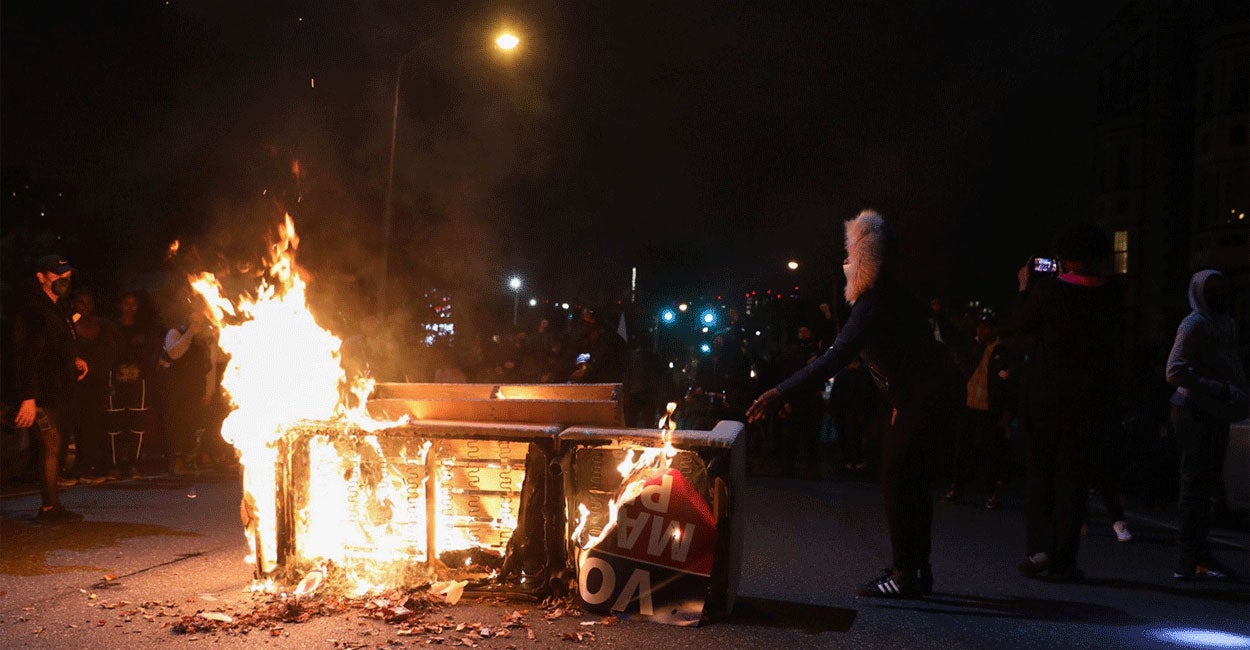
An area resident assesses the damage, with the store manager’s permission June 1, after looters vandalized several business overnight in the Mount Airy/Wadsworth sections of Northwest Philadelphia. (Photo: Bastiaan Slabbers/NurPhoto/Getty Images)
Kay C. James is president of The Heritage Foundation. James formerly served as director of the U.S. Office of Personnel Management and as Virginia’s secretary of health and human resources. She is also the founder and president of The Gloucester Institute.
I’m going to get straight to the point. It’s time for bold action. It’s time for Americans everywhere who love their country to heed the words of President Ronald Reagan: “If we lose freedom here, there’s no place to escape to. This is the last stand on earth.”
All around us, the forces of socialism, Marxism, and anarchy are waging a war against democracy and the moral legitimacy of the great American experiment. Radicals have hijacked peaceful protests and are using the current racial unrest as a tool to attack the very foundation of our nation.
Violent mobs have defaced and torn down statues across the country in the name of “social justice,” yet they’ve gone beyond toppling the statues of slave owners and Confederates to toppling statues like that of former slave Frederick Douglass, one of the nation’s greatest abolitionists who dedicated his life to ending slavery and promoting justice for African Americans.
Memorials to Founding Fathers George Washington and Thomas Jefferson, and even the statues of Union heroes like Abraham Lincoln and Ulysses S. Grant—more than 150 statues and memorials nationwide—have been destroyed, defaced, or taken down during the last month and a half of protests.
Stand for your principles in 2021—even in the face of Congress, the media, and the radical Left ganging up on conservatives and our values. Learn more now >>
It has become clear that it matters little to the Marxists and anarchists what a statue or monument represents. All that matters to them is that it represents America’s past, and therefore, it must come down.
It’s also clear that they’re not interested in resolving race issues. Destroying monuments, burning churches, and looting businesses do nothing to bring attention to racism or to advance police reforms. They’re simply using racial discontent to forward their Marxist agenda.
Meanwhile, spineless politicians who agree with the rioters’ agenda, if not their tactics, have told police to stand down. After rioters in Baltimore recently tore down a statue of Christopher Columbus and tossed it into the harbor, House Speaker Nancy Pelosi, a Baltimore native, blithely excused the behavior, telling reporters, “People will do what they do.”
Many of these mal-educated rioters and politicians believe everything about America’s past is based in racism. They are fed this lie in schools and by institutions like The New York Times, which claims with great historical illiteracy in its 1619 Project that this country wasn’t founded based on humanity’s highest ideals in 1776, but rather in 1619, when the first slaves were brought to the New World.
The Times even absurdly asserts that the Revolutionary War wasn’t fought to gain our independence but to keep slavery alive in the colonies. That’s why The Heritage Foundation has joined with other conservative leaders in the 1776 Project to rebut this revisionist history and bring the truth to light.
In his speech at Mount Rushmore honoring Independence Day, President Trump spoke to the heart of the matter:
[O]ur children are taught in school to hate their own country and to believe that the men and women who built it were not heroes, but were villains … [A]ll perspective is removed, every virtue is obscured, every motive is twisted, every fact is distorted, and every flaw is magnified until the history is purged and the record is disfigured beyond all recognition.
We have built statues and memorials to recognize individuals and events representing some of the noblest—and even some of the worst—moments in our history. The people memorialized didn’t lead perfect lives, and many did controversial or even evil things, but monuments help tell our history and help us remember our highest ideals—as well as the mistakes we’ve made and wish not to repeat again.
If localities decide that some of their public statues need to come down because they no longer represent the values of their community, then the proper course is through the democratic process and civil dialogue, not mobocracy.
But if politicians ignore or even tacitly encourage these mobs, they will declare more and more things offensive until they have targeted every Founding Father, every religious institution (some are even calling for the removal of images of Jesus because his representations are “too white”), and virtually any symbol of “oppressive” Western civilization.
We must put an end to this now. The rioters and statue topplers must be arrested and prosecuted. We must educate the public about the truth of the founding of the most exceptional nation on Earth. And we must wrest our educational system from the hands of leftists who use our schools as indoctrination centers—before we lose yet another generation to them.
This must be our wake-up call, because as Ronald Reagan also admonished, freedom must be fought for, protected, and handed on to our children to do the same, or one day, we’ll be telling our children’s children what it was once like in the United States where men were free.
Originally published by The Washington Times
Sincerely,
Everette Hatcher III, 13900 Cottontail Lane, Alexander, AR 72002, ph 501-920-5733 everettehatcher@gmail.com
President Obama c/o The White House 1600 Pennsylvania Avenue NW Washington, DC 20500 Dear Mr. President, I know that you receive 20,000 letters a day and that you actually read 10 of them every day. I really do respect you for trying to get a pulse on what is going on out here. There have […]By Everette Hatcher III | Posted in David Barton, Founding Fathers, President Obama | Edit |Comments (0)
There have been many articles written by evangelicals like me who fear that our founding fathers would not recognize our country today because secular humanism has rid our nation of spiritual roots. I am deeply troubled by the secular agenda of those who are at war with religion in our public life. Lillian Kwon quoted somebody […]By Everette Hatcher III | Posted in David Barton, Founding Fathers | Edit | Comments (0)
There have been many articles written by evangelicals like me who fear that our founding fathers would not recognize our country today because secular humanism has rid our nation of spiritual roots. I am deeply troubled by the secular agenda of those who are at war with religion in our public life. Lillian Kwon quoted somebody […]By Everette Hatcher III | Posted in David Barton, Founding Fathers | Edit | Comments (0)
There have been many articles written by evangelicals like me who fear that our founding fathers would not recognize our country today because secular humanism has rid our nation of spiritual roots. I am deeply troubled by the secular agenda of those who are at war with religion in our public life. Lillian Kwon quoted somebody […]By Everette Hatcher III | Posted in David Barton, Founding Fathers | Edit | Comments (0)
There have been many articles written by evangelicals like me who fear that our founding fathers would not recognize our country today because secular humanism has rid our nation of spiritual roots. I am deeply troubled by the secular agenda of those who are at war with religion in our public life. Lillian Kwon quoted somebody […]By Everette Hatcher III | Posted in David Barton, Founding Fathers | Edit | Comments (0)
There have been many articles written by evangelicals like me who fear that our founding fathers would not recognize our country today because secular humanism has rid our nation of spiritual roots. I am deeply troubled by the secular agenda of those who are at war with religion in our public life. Lillian Kwon quoted somebody […]By Everette Hatcher III | Posted in Founding Fathers | Edit | Comments (0)
President Obama Speaks at The Ohio State University Commencement Ceremony Published on May 5, 2013 President Obama delivers the commencement address at The Ohio State University. May 5, 2013. You can learn a lot about what President Obama thinks the founding fathers were all about from his recent speech at Ohio State. May 7, 2013, […]By Everette Hatcher III | Posted in Founding Fathers, President Obama | Edit | Comments (0)
Dr. C. Everett Koop with Bill Graham. Francis Schaeffer: “Whatever Happened to the Human Race” (Episode 4) THE BASIS FOR HUMAN DIGNITY Published on Oct 7, 2012 by AdamMetropolis The 45 minute video above is from the film series created from Francis Schaeffer’s book “Whatever Happened to the Human Race?” with Dr. C. Everett Koop. This […]By Everette Hatcher III | Posted in Founding Fathers, Francis Schaeffer, Prolife | Edit |Comments (1)
America’s Founding Fathers Deist or Christian? – David Barton 4/6 There have been many articles written by evangelicals like me who fear that our founding fathers would not recognize our country today because secular humanism has rid our nation of spiritual roots. I am deeply troubled by the secular agenda of those who are at […]By Everette Hatcher III | Posted in David Barton, Founding Fathers | Tagged governor of connecticut, john witherspoon, jonathan trumbull | Edit | Comments (1)
3 Of 5 / The Bible’s Influence In America / American Heritage Series / David Barton There were 55 gentlemen who put together the constitution and their church affliation is of public record. Greg Koukl notes: Members of the Constitutional Convention, the most influential group of men shaping the political foundations of our nation, were […]By Everette Hatcher III | Posted in Founding Fathers | Edit | Comments (0)
I do not think that John Quincy Adams was a founding father in the same sense that his father was. However, I do think he was involved in the early days of our government working with many of the founding fathers. Michele Bachmann got into another history-related tussle on ABC’s “Good Morning America” today, standing […]By Everette Hatcher III | Posted in David Barton, Founding Fathers | Edit | Comments (0)
I have gone back and forth and back and forth with many liberals on the Arkansas Times Blog on many issues such as abortion, human rights, welfare, poverty, gun control and issues dealing with popular culture. Here is another exchange I had with them a while back. My username at the Ark Times Blog is Saline […]By Everette Hatcher III | Posted in Arkansas Times, Francis Schaeffer, Prolife | Edit |Comments (0)
I truly believe that many of the problems we have today in the USA are due to the advancement of humanism in the last few decades in our society. Ronald Reagan appointed the evangelical Dr. C. Everett Koop to the position of Surgeon General in his administration. He partnered with Dr. Francis Schaeffer in making the […]By Everette Hatcher III | Posted in Adrian Rogers, Francis Schaeffer | Edit | Comments (0)
Francis Schaeffer: “Whatever Happened to the Human Race” (Episode 4) THE BASIS FOR HUMAN DIGNITY Published on Oct 7, 2012 by AdamMetropolis ____________ The 45 minute video above is from the film series created from Francis Schaeffer’s book “Whatever Happened to the Human Race?” with Dr. C. Everett Koop. This book really helped develop my political […]By Everette Hatcher III | Posted in Francis Schaeffer | Edit | Comments (0)
Many Catholic leaders have criticized Joe Biden for his stand on abortion, same-sex marriage, and transgender equality. Pictured: Biden speaks about his racial equity agenda in the State Dining Room of the White House, Jan. 26. (Photo: Doug Mills-Pool/Getty Images)
Cal Thomas is a syndicated columnist, author, broadcaster, and speaker with access to world leaders, U.S. presidents, celebrities, educators, and countless other notables. He has authored several books, including his latest, “America’s Expiration Date: The Fall of Empires and Superpowers and the Future of the United States.” Readers can email him at tcaeditors@tribpub.com.
President Joe Biden and his press secretary, Jen Psaki, have assured us he is a “devout Catholic” who “attends church regularly.”
The question is not new but should be asked again and a credible answer demanded. How can one be devout about one’s faith and not comport with Scripture and the teachings of the Catholic Church?
As the Apostle James wrote, “Faith without works is dead,” (James 2:14-26).
Biden might believe his “works” consist of more government programs, executive orders, and policies that some believe are contributing to the divisive culture wars, but some of these policies are antithetical to his church’s doctrines.
The Left has declared war on our culture, but we should never back down, nor compromise our principles. Learn more now >>
Many Catholic leaders have criticized him for his stand on abortion, same-sex marriage, and transgender equality. Biden has added to his pro-choice stand a reversal on federal funding of abortion, which he long opposed until the 2020 presidential campaign.
Archbishop Jose Gomez, president of the U.S. Conference of Catholic Bishops, has said: “When politicians who profess the Catholic faith support [abortion rights], there are additional problems. Among other things, it creates confusion among the faithful about what the Catholic Church actually teaches on these questions.”
Since Biden is such a “devout Catholic” maybe he should consider what Jesus said about false teachers: “Beware of false prophets, which come to you in sheep’s clothing, but inwardly they are ravening wolves.” (Matthew 7:15)
Biden was the safest choice for the left in advancing a liberal agenda. He put on the sheep’s clothing of a “moderate,” but underneath is a man whose policies have been revealed to comport with the Bernie Sanders wing of his party.
Say one thing and do another is a major reason so many have become cynical about politics and politicians. They increasingly want to spend more of our money on things that improve few lives, while imposing policies, like stopping the Keystone XL pipeline, which cost jobs.
That Keystone executive order earned condemnation from several labor unions that had endorsed Biden for president.
If spending and other liberal policies improved lives would they not have by now, considering our massive debt? And yet they tell us the problems remain. All they need is ever-higher taxes and more spending and all will be well.
On the question of private faith and public responsibilities, the U.S. Conference of Catholic Bishops has again made church teaching clear: “Many Catholics do not adequately understand that the social teaching of the Church is an essential part of Catholic faith.”
Biden has reverted to an old and meaningless excuse when he says he doesn’t want to “impose” his faith on others. The question then becomes why have a faith at all, if he won’t apply what his church teaches as truth?
How is Biden different from a person who is about to witness a murder but doesn’t try to stop it, or call the police, because he doesn’t want to impose his moral views about the value of life on a man about to commit an illegal and immoral act?
If Biden doesn’t want to “impose” his view about unborn life, why can’t he at least argue in favor of it in an attempt to persuade people of life’s value at the start and at all stages until natural death? That is the position of his church. If it is his position, he should say so and publicly defend it, otherwise it becomes devoid of any moral value.
Posted Wednesday, January 13, 2021 4:45 amBY CARDINAL TIMOTHY M. DOLAN
Why are you Catholics so hung up about abortion?” this rather well-known political leader asked me.
“Well, let me tell you,” I happily replied.
“For one, thanks for acknowledging how urgent this matter is for us. I don’t mind at all agreeing with you: we Catholics are ‘hung up’ on abortion.”
I went on. “Actually, we’re obsessed with the dignity of the human person and the sacredness of all human life! Yes, the innocent, helpless life of the baby in the womb, but also the life of the death row prisoner, the immigrant, the fragile elderly, the poor and the sick.”
I wasn’t done. “And it’s not just ‘you Catholics’ who are very upset about the unfettered abortion-on-demand culture in which we live. Most Americans, of any religion, or none at all, report they are as well. As a matter of fact, this is not a uniquely ‘Catholic’ issue at all, but one of human rights. We didn’t learn that abortion was horrible in religion class, but in biology, and in our courses on the ‘inalienable rights’ tradition in American history.”
By now he probably regretted he had asked! But on I went.
“How can we sustain a culture that recoils at violence, exclusion, suicide, racism, injustice, and callousness toward those in need, if we applaud, allow, pay for, and promote the destruction of the most helpless, the baby in the womb?”
Did I change his mind? I doubt it. Did I answer his questions as to why we are “hung up” on the civil rights of the baby in the sanctuary of her mother’s womb? I hope so.
All this comes to mind as we prepare to observe the somber anniversary of the tragic decision by the Supreme Court on Jan. 22, 1973 to allow abortion-on-demand.
Don’t worry, the pro-abortionists reassured us forty-eight years ago. You’ll learn to accept this. We dread taking the life of the little infant in the womb, too. Abortion will be kept safe, legal, and rare! It would be limited to the earliest weeks of pregnancy, and only resorted to in extreme cases like the endangerment of the mother’s life. And we’d never force people whose conscience disagrees with us to perform or pay for one.
So much for the reassurances! We have hardly gotten used to it. Abortion remains the hottest issue in our politics, with polls showing that most Americans want restrictions on its unquestioned use, and do not want their taxes to pay for it.
Now, the pro-abortionists no longer call abortion regrettable, but celebrate it and brag about it! No longer do they argue that the question about the viability of the “fetus” is one impossible to answer. Readily do they admit it’s a baby. It’s just that, for them, the desire of another trumps the baby’s right to life.
Rare? Forget about it! Now it’s an unfettered right, at any time during the pregnancy, up to and including the very birth, with demands that sincere health care professionals whose consciences rebel at the grizzly procedure be forced to perform them, that tax money pay for them, that our foreign policy insists other countries promote them, and that the freedom of employers who abhor them still offer insurance to cover them.
We’re even more “hung up” now, as our new president, whom we wish well, and who speaks with admirable sensitivity about protecting the rights of the weakest and most threatened, ran on a platform avidly supporting this gruesome capital punishment for innocent pre-born babies.
As Pope Francis observes, “We defend and promote all legitimate human rights. But, what use are they if the right of the baby to be born is violated!”
We’re all still cringing from the disturbing violence last week in Washington. This upheaval was made the more nauseating as it was seemingly encouraged by the one sworn to uphold the Constitution and the rule of law, and because it trashed the very edifice designed to be a sanctuary of safety, reason, civility, and decorum, the arena of our freedoms, the U.S. Capitol.
President-elect Biden was eloquent last week in reminding us that the rampage we saw was not America, whose citizens are renowned for their decency, observance of the law, and the respect we show each other.
In the renewal and rededication that usually accompanies the inauguration of a new president, can we hope that violence will subside, that civil discourse will again become the norm for all sides, that a respect for the sacredness of all life and the dignity of the human person will be revived, and that the sanctuary of the womb will be off-limits to violent invasion?
The Supreme Court has reinstated a requirement that women seeking to obtain abortion pills must pick up the pills in person. (Photo: Phil Walter/Getty Images)
The United States Supreme Court reinstated a requirement Tuesday that women seeking to obtain abortion pills must pick up the pills in person from a hospital or medical office rather than receiving them by mail.
“The question before us is not whether the requirements for dispensing mifepristone impose an undue burden on a woman’s right to an abortion as a general matter,” Chief Justice John Roberts wrote in the unsigned ruling. “The question is instead whether the District Court properly ordered the Food and Drug Administration to lift those established requirements because of the court’s own evaluation of the impact of the COVID–19 pandemic.”
“Here, as in related contexts concerning government responses to the pandemic, my view is that courts owe significant deference to the politically accountable entities with the ‘background, competence, and expertise to assess public health,’” he continued. “In light of those considerations, I do not see a sufficient basis here for the District Court to compel the FDA to alter the regimen for medical abortion.”
The ruling comes after both pro-life supporters and pro-choice advocates fought over abortion access for months during the pandemic: Pro-lifers lobbied for governors to ban abortions as medically unnecessary procedures, while pro-abortion advocates called for continued and increased abortion access despite the pandemic.
“This country’s laws have long singled out abortions for more onerous treatment than other medical procedures that carry similar or greater risks,” Justice Sonia Sotomayor, joined by Justice Elena Kagan, wrote in her dissent, the Times reported.
“Like many of those laws, maintaining the FDA’s in-person requirements” for picking up the drug “during the pandemic not only treats abortion exceptionally, it imposes an unnecessary, irrational and unjustifiable undue burden on women seeking to exercise their right to choose.”
Content created by The Daily Caller News Foundation is available without charge to any eligible news publisher that can provide a large audience. For licensing opportunities for this original content, email licensing@dailycallernewsfoundation.org.
OPINION MARJORIE DANNENFELSER NOV 20, 2020 | 2:57PM WASHINGTON, DC
Share this story
Move over, Nancy Pelosi: Pro-life women are driving the new Republican surge in Congress – an unmistakable rebuke to Democrats’ radical abortion agenda.
With several races still too close to call, the number of newly elected pro-life women is up to 16. Seven of these candidates flipped seats held by pro-abortion Democrats. The group includes the first Iranian American elected to Congress, a member of the Cherokee nation, a daughter of Cuban exiles, and a first-generation Korean American, showing that the life issue brings a diverse coalition together. Including incumbents, the total number of pro-life women in the House now stands at 27.
In the Senate, the ranks of pro-life women continue to grow. Joni Ernst (R-Iowa) and Cindy Hyde-Smith (R-Miss.) won competitive reelection races. Additionally, former U.S. Rep. Cynthia Lummis (R-Wyo.) won her race and will be the first woman to represent Wyoming in the Senate.
I remember when there was just a small handful of pro-life women in the House and none in the Senate. Over the years Susan B. Anthony List has worked tirelessly to fix this severe underrepresentation and counter the well-funded abortion lobby. This is breathtaking progress, something that Republican insiders and even some staunch pro-lifers doubted could be done.
Moreover, pro-abortion Democrats failed to flip a single state legislature despite spending historic sums of money. In New Hampshire, Republicans won a trifecta, unexpectedly flipping both chambers of the legislature while holding on to the governor’s office. In Texas, our team helped defeat pro-abortion radical Wendy Davis and more than a dozen others like her at the state level, while electing pro-life champions like Beth Van Duyne in U.S. House races. Our efforts succeeded in thwarting pro-abortion extremists’ plans to infiltrate the Texas legislature and redraw district maps next year, solidifying the state as a stronghold in the fight to defend unborn children.
This surge is a testament not only to the power of the life issue to motivate voters, but to its most high-profile champion: Donald Trump. Because of his presidency, party leaders are unified and energized, and it is practically unthinkable for Republican candidates anywhere to win elections without being pro-life.
LifeNews depends on the support of readers like you to combat the pro-abortion media. Please donate now.
Where the old Republican Party was glad to benefit from pro-lifers’ votes while holding them at arm’s length, President Trump fully embraced the pro-life movement and governed as the most pro-life president in history. He is the first president ever to get Planned Parenthood to forfeit Title X tax dollars or to address the March for Life in person.
Where Republican candidates used to speak timidly about abortion, if they spoke about it at all, he boldly called out his Democrat opponents’ support for late-term abortion and infanticide while repeatedly and publicly identifying his party with the protection of unborn children and their mothers. Under President Trump’s lead, the Republican National Convention featured the most explicit pro-life speeches ever given at a major party convention.
The president consistently delivered on his promises – most importantly, to nominate only constitutionalist judges. Because of President Trump and pro-life Senate Republicans, we have three outstanding justices on the Supreme Court – including the court’s first pro-life woman, Amy Coney Barrett – and more than 200 new federal judges who will serve for life, giving us the best chance in half a century to mount a serious, successful challenge to the status quo under Roe v. Wade.
In contrast, the Democrats led by Joe Biden and Kamala Harris hid their extreme views from the American people in the months before the election. At the Democratic National Convention, the word “abortion” was not uttered a single time – a stark difference from 2016, when three heads of pro-abortion groups secured prime speaking slots.
Whatever else happens, the American people have spoken. It is clear no “mandate” exists to enact deeply unpopular policies expanding abortion-on-demand through the moment of birth, paid for by taxpayers, as Biden and Harris have promised – or to drastically remake the brilliant system of checks and balances that has existed from the founding of our nation.
There is no more urgent task for pro-life advocates now than to ensure that the Senate remains in pro-life hands, standing as a firewall against any attempts by Democrats to eliminate the filibuster, expand the Supreme Court, or roll back vital pro-life policies like the Hyde Amendment. To that end, SBA List’s team is all in to re-elect Sens. Kelly Loeffler and David Perdue in the Georgia runoff elections this January.
Before the election, I wrote a book titled “Life is Winning,” inspired by a saying of Vice President Mike Pence, making the case that the pro-life movement was just one election away from achieving unimaginable victories and predicting that Joe Biden would be the last thoroughly pro-abortion presidential candidate. The rise of pro-life women leaves me more convinced than ever that momentum is on our side, and the battle to save unborn children and their mothers is one we can – and will – win.
LifeNews Note: Marjorie Dannenfelser is the president and an original organizer of the Susan B. Anthony List (SBA List), a national pro-life group dedicated to pursuing policies and electing candidates to reduce and ultimately end abortion.
——
Carl Sagan and his wife Anne said, “We wrote this article to understand better what the contending views are and to see if we ourselves could find a position that would satisfy us both.”
Many people in the public don’t realize what is involved in the taking of an unborn baby’s life. Many times when women are considering an abortion they change their minds when they see an ultrasound.
Francis Schaeffer noted:
If abortion is decided on too late to be accomplished by either a D & C, suction, or saline procedure, physicians resort to a final technique called hysterotomy. A hysterotomy is exactly the same as a Cesarean section with one difference–in a Cesarean section the operation is usually performed to save the life of the baby, whereas a hysterotomy is performed to kill the baby. These babies look very much like other babies except that they are small and weigh, for example, about two pounds at the end of a twenty-four-week pregnancy. They are truly alive, but they are allowed to die through neglect or sometimes killed by a direct act.
Hysterotomy gives the fetus the best chance for survival, but at a very high price in morbidity for the mother–fifteen times greater than that of saline infusion, the more commonly used alternative. In 1977 a Boston jury found Dr. Kenneth Edelin guilty of manslaughter for killing the product of this type of abortion.
According to nurses’ testimony after the uterus was opened at the time of the hysterotomy, Dr. Edelin purportedly cut off the blood supply of an allegedly viable fetus by detaching the placenta and waiting three minutes before removing the fetus from the uterus. A number of emotional factors were introduced by the media during this trial. One of these factors was that the trial was taking place in Roman Catholic Boston which obviously should be against abortion. A second of these factors was that Dr. Edelin was black and therefore the trial was seen as racist. The final conclusion of the case was that a higher court reversed the lower court’s decision and Dr. Edelin was not only free but went on to become the president of a national medical organization.
That children are often born alive after abortions is fact and not a new phenomenon. A brief in one case before the Supreme Court (Markle v. Adele) contained a table listing twenty-seven live births after abortions. That was in 1972. In the first year of liberalized abortion laws in New York State, before the Supreme Court decision regarding abortion-on-demand, some of those “products of abortions” were eventually adopted.
( Carl Sagan in his wedding with Linda Salzman Sagan (the mother of Carl’s third child, Nick) circa 1968 )
470 × 323Images may be subject to copyright. Learn More
Thanks for your recent letter about evolution and abortion. The correlation is hardly one to one; there are evolutionists who are anti-abortion and anti-evolutionists who are pro-abortion.You argue that God exists because otherwise we could not understand the world in our consciousness. But if you think God is necessary to understand the world, then why do you not ask the next question of where God came from? And if you say “God was always here,” why not say that the universe was always here? On abortion, my views are contained in the enclosed article (Sagan, Carl and Ann Druyan {1990}, “The Question of Abortion,” Parade Magazine, April 22.)
Lynn Alexander married Carl Sagan when she was 19 years old. The happy couple at their wedding. Dorion Sagan, their first son, was born two years later
Francis Schaeffer
630 × 372Images may be subject to copyright. Learn More
I mentioned earlier that I was blessed with the opportunity to correspond with Dr. Sagan. In his December 5, 1995 letter Dr. Sagan went on to tell me that he was enclosing his article “The Question of Abortion: A Search for Answers”by Carl Sagan and Ann Druyan. I am going to respond to several points made in that article. Here is a portion of Sagan’s article (here is a link to the whole article):
For the complete text, including illustrations, introductory quote, footnotes, and commentary on the reaction to the originally published article see Billions and Billions.
The issue had been decided years ago. The court had chosen the middle ground. You’d think the fight was over. Instead, there are mass rallies, bombings and intimidation, murders of workers at abortion clinics, arrests, intense lobbying, legislative drama, Congressional hearings, Supreme Court decisions, major political parties almost defining themselves on the issue, and clerics threatening politicians with perdition. Partisans fling accusations of hypocrisy and murder. The intent of the Constitution and the will of God are equally invoked. Doubtful arguments are trotted out as certitudes. The contending factions call on science to bolster their positions. Families are divided, husbands and wives agree not to discuss it, old friends are no longer speaking. Politicians check the latest polls to discover the dictates of their consciences. Amid all the shouting, it is hard for the adversaries to hear one another. Opinions are polarized. Minds are closed.
Is it wrong to abort a pregnancy? Always? Sometimes? Never? How do we decide? We wrote this article to understand better what the contending views are and to see if we ourselves could find a position that would satisfy us both. Is there no middle ground? We had to weigh the arguments of both sides for consistency and to pose test cases, some of which are purely hypothetical. If in some of these tests we seem to go too far, we ask the reader to be patient with us–we’re trying to stress the various positions to the breaking point to see their weaknesses and where they fail.
In contemplative moments, nearly everyone recognizes that the issue is not wholly one-sided. Many partisans of differing views, we find, feel some disquiet, some unease when confronting what’s behind the opposing arguments. (This is partly why such confrontations are avoided.) And the issue surely touches on deep questions: What are our responses to one another? Should we permit the state to intrude into the most intimate and personal aspects of our lives? Where are the boundaries of freedom? What does it mean to be human?
(Dr. Lester Grinspoon, associate professor emeritus of Psychiatry at Harvard Medical School, recalls exploring the cosmos with a little help from cannabis, and his best friend Carl)
1278 × 718Images may be subject to copyright.Learn More
Of the many actual points of view, it is widely held–especially in the media, which rarely have the time or the inclination to make fine distinctions–that there are only two: “pro-choice” and “pro-life.” This is what the two principal warring camps like to call themselves, and that’s what we’ll call them here. In the simplest characterization, a pro-choicer would hold that the decision to abort a pregnancy is to be made only by the woman; the state has no right to interfere. And a pro-lifer would hold that, from the moment of conception, the embryo or fetus is alive; that this life imposes on us a moral obligation to preserve it; and that abortion is tantamount to murder. Both names–pro-choice and pro-life–were picked with an eye toward influencing those whose minds are not yet made up: Few people wish to be counted either as being against freedom of choice or as opposed to life. Indeed, freedom and life are two of our most cherished values, and here they seem to be in fundamental conflict.
Let’s consider these two absolutist positions in turn. A newborn baby is surely the same being it was just before birth. There ‘s good evidence that a late-term fetus responds to sound–including music, but especially its mother’s voice. It can suck its thumb or do a somersault. Occasionally, it generates adult brain-wave patterns. Some people claim to remember being born, or even the uterine environment. Perhaps there is thought in the womb. It’s hard to maintain that a transformation to full personhood happens abruptly at the moment of birth. Why, then, should it be murder to kill an infant the day after it was born but not the day before?
As a practical matter, this isn’t very important: Less than 1 percent of all tabulated abortions in the United States are listed in the last three months of pregnancy (and, on closer investigation, most such reports turn out to be due to miscarriage or miscalculation). But third-trimester abortions provide a test of the limits of the pro-choice point of view. Does a woman’s “innate right to control her own body” encompass the right to kill a near-term fetus who is, for all intents and purposes, identical to a newborn child?
We believe that many supporters of reproductive freedom are troubled at least occasionally by this question. But they are reluctant to raise it because it is the beginning of a slippery slope. If it is impermissible to abort a pregnancy in the ninth month, what about the eighth, seventh, sixth … ? Once we acknowledge that the state can interfere at any time in the pregnancy, doesn’t it follow that the state can interfere at all times?
Abortion and the slippery slope argument above
This conjures up the specter of predominantly male, predominantly affluent legislators telling poor women they must bear and raise alone children they cannot afford to bring up; forcing teenagers to bear children they are not emotionally prepared to deal with; saying to women who wish for a career that they must give up their dreams, stay home, and bring up babies; and, worst of all, condemning victims of rape and incest to carry and nurture the offspring of their assailants. Legislative prohibitions on abortion arouse the suspicion that their real intent is to control the independence and sexuality of women…
And yet, by consensus, all of us think it proper that there be prohibitions against, and penalties exacted for, murder. It would be a flimsy defense if the murderer pleads that this is just between him and his victim and none of the government’s business. If killing a fetus is truly killing a human being, is it not the duty of the state to prevent it? Indeed, one of the chief functions of government is to protect the weak from the strong.
If we do not oppose abortion at some stage of pregnancy, is there not a danger of dismissing an entire category of human beings as unworthy of our protection and respect? And isn’t that dismissal the hallmark of sexism, racism, nationalism, and religious fanaticism? Shouldn’t those dedicated to fighting such injustices be scrupulously careful not to embrace another?
(Adrian Rogers pictured above)
Adrian Rogers’ sermon on animal rights refutes Sagan here
There is no right to life in any society on Earth today, nor has there been at any former time… : We raise farm animals for slaughter; destroy forests; pollute rivers and lakes until no fish can live there; kill deer and elk for sport, leopards for the pelts, and whales for fertilizer; entrap dolphins, gasping and writhing, in great tuna nets; club seal pups to death; and render a species extinct every day. All these beasts and vegetables are as alive as we. What is (allegedly) protected is not life, but human life.
Genesis 3 defines being human
And even with that protection, casual murder is an urban commonplace, and we wage “conventional” wars with tolls so terrible that we are, most of us, afraid to consider them very deeply… That protection, that right to life, eludes the 40,000 children under five who die on our planet each day from preventable starvation, dehydration, disease, and neglect.
Those who assert a “right to life” are for (at most) not just any kind of life, but for–particularly and uniquely—human life. So they too, like pro-choicers, must decide what distinguishes a human being from other animals and when, during gestation, the uniquely human qualities–whatever they are–emerge.
The Bible talks about the differences between humans and animals
Despite many claims to the contrary, life does not begin at conception: It is an unbroken chain that stretches back nearly to the origin of the Earth, 4.6 billion years ago. Nor does human life begin at conception: It is an unbroken chain dating back to the origin of our species, hundreds of thousands of years ago. Every human sperm and egg is, beyond the shadow of a doubt, alive. They are not human beings, of course. However, it could be argued that neither is a fertilized egg.
In some animals, an egg develops into a healthy adult without benefit of a sperm cell. But not, so far as we know, among humans. A sperm and an unfertilized egg jointly comprise the full genetic blueprint for a human being. Under certain circumstances, after fertilization, they can develop into a baby. But most fertilized eggs are spontaneously miscarried. Development into a baby is by no means guaranteed. Neither a sperm and egg separately, nor a fertilized egg, is more than a potential baby or a potential adult. So if a sperm and egg are as human as the fertilized egg produced by their union, and if it is murder to destroy a fertilized egg–despite the fact that it’s only potentially a baby–why isn’t it murder to destroy a sperm or an egg?
Hundreds of millions of sperm cells (top speed with tails lashing: five inches per hour) are produced in an average human ejaculation. A healthy young man can produce in a week or two enough spermatozoa to double the human population of the Earth. So is masturbation mass murder? How about nocturnal emissions or just plain sex? When the unfertilized egg is expelled each month, has someone died? Should we mourn all those spontaneous miscarriages? Many lower animals can be grown in a laboratory from a single body cell. Human cells can be cloned… In light of such cloning technology, would we be committing mass murder by destroying any potentially clonable cells? By shedding a drop of blood?
(Planetary Society founders Bruce Murray, Carl Sagan, and Louis Friedman.)
All human sperm and eggs are genetic halves of “potential” human beings. Should heroic efforts be made to save and preserve all of them, everywhere, because of this “potential”? Is failure to do so immoral or criminal? Of course, there’s a difference between taking a life and failing to save it. And there’s a big difference between the probability of survival of a sperm cell and that of a fertilized egg. But the absurdity of a corps of high-minded semen-preservers moves us to wonder whether a fertilized egg’s mere “potential” to become a baby really does make destroying it murder.
Opponents of abortion worry that, once abortion is permissible immediately after conception, no argument will restrict it at any later time in the pregnancy. Then, they fear, one day it will be permissible to murder a fetus that is unambiguously a human being. Both pro-choicers and pro-lifers (at least some of them) are pushed toward absolutist positions by parallel fears of the slippery slope.
Another slippery slope is reached by those pro-lifers who are willing to make an exception in the agonizing case of a pregnancy resulting from rape or incest. But why should the right to live depend on the circumstances of conception? If the same child were to result, can the state ordain life for the offspring of a lawful union but death for one conceived by force or coercion? How can this be just? And if exceptions are extended to such a fetus, why should they be withheld from any other fetus? This is part of the reason some pro-lifers adopt what many others consider the outrageous posture of opposing abortions under any and all circumstances–only excepting, perhaps, when the life of the mother is in danger.
By far the most common reason for abortion worldwide is birth control. So shouldn’t opponents of abortion be handing out contraceptives and teaching school children how to use them? That would be an effective way to reduce the number of abortions. Instead, the United States is far behind other nations in the development of safe and effective methods of birth control–and, in many cases, opposition to such research (and to sex education) has come from the same people who oppose abortions.continue on to Part 3
For the complete text, including illustrations, introductory quote, footnotes, and commentary on the reaction to the originally published article see Billions and Billions.
The attempt to find an ethically sound and unambiguous judgment on when, if ever, abortion is permissible has deep historical roots. Often, especially in Christian tradition, such attempts were connected with the question of when the soul enters the body–a matter not readily amenable to scientific investigation and an issue of controversy even among learned theologians. Ensoulment has been asserted to occur in the sperm before conception, at conception, at the time of “quickening” (when the mother is first able to feel the fetus stirring within her), and at birth. Or even later.
Different religions have different teachings. Among hunter-gatherers, there are usually no prohibitions against abortion, and it was common in ancient Greece and Rome. In contrast, the more severe Assyrians impaled women on stakes for attempting abortion. The Jewish Talmud teaches that the fetus is not a person and has no rights. The Old and New Testaments–rich in astonishingly detailed prohibitions on dress, diet, and permissible words–contain not a word specifically prohibiting abortion. The only passage that’s remotely relevant (Exodus 21:22) decrees that if there’s a fight and a woman bystander should accidentally be injured and made to miscarry, the assailant must pay a fine.
Neither St. Augustine nor St. Thomas Aquinas considered early-term abortion to be homicide (the latter on the grounds that the embryo doesn’t look human). This view was embraced by the Church in the Council of Vienne in 1312, and has never been repudiated. The Catholic Church’s first and long-standing collection of canon law (according to the leading historian of the Church’s teaching on abortion, John Connery, S.J.) held that abortion was homicide only after the fetus was already “formed”–roughly, the end of the first trimester.
(Asimov and Sagan at a banquet celebrating the 20th anniversary of Mariner 2, December 14, 1982)
479 × 422Images may be subject to copyright.Learn More
But when sperm cells were examined in the seventeenth century by the first microscopes, they were thought to show a fully formed human being. An old idea of the homunculus was resuscitated–in which within each sperm cell was a fully formed tiny human, within whose testes were innumerable other homunculi, etc., ad infinitum. In part through this misinterpretation of scientific data, in 1869 abortion at any time for any reason became grounds for excommunication. It is surprising to most Catholics and others to discover that the date was not much earlier.
From colonial times to the nineteenth century, the choice in the United States was the woman’s until “quickening.” An abortion in the first or even second trimester was at worst a misdemeanor. Convictions were rarely sought and almost impossible to obtain, because they depended entirely on the woman’s own testimony of whether she had felt quickening, and because of the jury’s distaste for prosecuting a woman for exercising her right to choose. In 1800 there was not, so far as is known, a single statute in the United States concerning abortion. Advertisements for drugs to induce abortion could be found in virtually every newspaper and even in many church publications–although the language used was suitably euphemistic, if widely understood.
But by 1900, abortion had been banned at any time in pregnancy by every state in the Union, except when necessary to save the woman’s life. What happened to bring about so striking a reversal? Religion had little to do with it.Drastic economic and social conversions were turning this country from an agrarian to an urban-industrial society. America was in the process of changing from having one of the highest birthrates in the world to one of the lowest. Abortion certainly played a role and stimulated forces to suppress it.
One of the most significant of these forces was the medical profession. Up to the mid-nineteenth century, medicine was an uncertified, unsupervised business. Anyone could hang up a shingle and call himself (or herself) a doctor. With the rise of a new, university-educated medical elite, anxious to enhance the status and influence of physicians, the American Medical Association was formed. In its first decade, the AMA began lobbying against abortions performed by anyone except licensed physicians. New knowledge of embryology, the physicians said, had shown the fetus to be human even before quickening.
Their assault on abortion was motivated not by concern for the health of the woman but, they claimed, for the welfare of the fetus. You had to be a physician to know when abortion was morally justified, because the question depended on scientific and medical facts understood only by physicians. At the same time, women were effectively excluded from the medical schools, where such arcane knowledge could be acquired. So, as things worked out, women had almost nothing to say about terminating their own pregnancies. It was also up to the physician to decide if the pregnancy posed a threat to the woman, and it was entirely at his discretion to determine what was and was not a threat. For the rich woman, the threat might be a threat to her emotional tranquillity or even to her lifestyle. The poor woman was often forced to resort to the back alley or the coathanger.
This was the law until the 1960s, when a coalition of individuals and organizations, the AMA now among them, sought to overturn it and to reinstate the more traditional values that were to be embodied in Roe v. Wade.continue on to Part 4
(Carl Sagan and the Dalai Lama)
400 × 267Images may be subject to copyright.Learn More
If you deliberately kill a human being, it’s called murder. If you deliberately kill a chimpanzee–biologically, our closest relative, sharing 99.6 percent of our active genes–whatever else it is, it’s not murder. To date, murder uniquely applies to killing human beings. Therefore, the question of when personhood (or, if we like, ensoulment) arises is key to the abortion debate. When does the fetus become human? When do distinct and characteristic human qualities emerge?
We recognize that specifying a precise moment will overlook individual differences. Therefore, if we must draw a line, it ought to be drawn conservatively–that is, on the early side. There are people who object to having to set some numerical limit, and we share their disquiet; but if there is to be a law on this matter, and it is to effect some useful compromise between the two absolutist positions, it must specify, at least roughly, a time of transition to personhood.
Every one of us began from a dot. A fertilized egg is roughly the size of the period at the end of this sentence. The momentous meeting of sperm and egg generally occurs in one of the two fallopian tubes. One cell becomes two, two become four, and so on—an exponentiation of base-2 arithmetic. By the tenth day the fertilized egg has become a kind of hollow sphere wandering off to another realm: the womb. It destroys tissue in its path. It sucks blood from capillaries. It bathes itself in maternal blood, from which it extracts oxygen and nutrients. It establishes itself as a kind of parasite on the walls of the uterus.By the third week, around the time of the first missed menstrual period, the forming embryo is about 2 millimeters long and is developing various body parts. Only at this stage does it begin to be dependent on a rudimentary placenta. It looks a little like a segmented worm.By the end of the fourth week, it’s about 5 millimeters (about 1/5 inch) long. It’s recognizable now as a vertebrate, its tube-shaped heart is beginning to beat, something like the gill arches of a fish or an amphibian become conspicuous, and there is a pronounced tail. It looks rather like a newt or a tadpole. This is the end of the first month after conception.By the fifth week, the gross divisions of the brain can be distinguished. What will later develop into eyes are apparent, and little buds appear—on their way to becoming arms and legs.By the sixth week, the embryo is 13 millimeteres (about ½ inch) long. The eyes are still on the side of the head, as in most animals, and the reptilian face has connected slits where the mouth and nose eventually will be.By the end of the seventh week, the tail is almost gone, and sexual characteristics can be discerned (although both sexes look female). The face is mammalian but somewhat piglike.By the end of the eighth week, the face resembles that of a primate but is still not quite human. Most of the human body parts are present in their essentials. Some lower brain anatomy is well-developed. The fetus shows some reflex response to delicate stimulation.By the tenth week, the face has an unmistakably human cast. It is beginning to be possible to distinguish males from females. Nails and major bone structures are not apparent until the third month.By the fourth month, you can tell the face of one fetus from that of another. Quickening is most commonly felt in the fifth month. The bronchioles of the lungs do not begin developing until approximately the sixth month, the alveoli still later.
(CARL SAGAN WITH DR. DAVID MORRISON (AMES). First International Conference)
1600 × 1067Images may be subject to copyright.Learn More
So, if only a person can be murdered, when does the fetus attain personhood? When its face becomes distinctly human, near the end of the first trimester? When the fetus becomes responsive to stimuli–again, at the end of the first trimester? When it becomes active enough to be felt as quickening, typically in the middle of the second trimester? When the lungs have reached a stage of development sufficient that the fetus might, just conceivably, be able to breathe on its own in the outside air?
The trouble with these particular developmental milestones is not just that they’re arbitrary. More troubling is the fact that none of them involves uniquely humancharacteristics–apart from the superficial matter of facial appearance. All animals respond to stimuli and move of their own volition. Large numbers are able to breathe. But that doesn’t stop us from slaughtering them by the billions. Reflexes and motion are not what make us human.
Sagan’s conclusion based on arbitrary choice of the presence of thought by unborn baby
Other animals have advantages over us–in speed, strength, endurance, climbing or burrowing skills, camouflage, sight or smell or hearing, mastery of the air or water. Our one great advantage, the secret of our success, is thought–characteristically human thought. We are able to think things through, imagine events yet to occur, figure things out. That’s how we invented agriculture and civilization. Thought is our blessing and our curse, and it makes us who we are.
Thinking occurs, of course, in the brain–principally in the top layers of the convoluted “gray matter” called the cerebral cortex. The roughly 100 billion neurons in the brain constitute the material basis of thought. The neurons are connected to each other, and their linkups play a major role in what we experience as thinking. But large-scale linking up of neurons doesn’t begin until the 24th to 27th week of pregnancy–the sixth month.
By placing harmless electrodes on a subject’s head, scientists can measure the electrical activity produced by the network of neurons inside the skull. Different kinds of mental activity show different kinds of brain waves. But brain waves with regular patterns typical of adult human brains do not appear in the fetus until about the 30th week of pregnancy–near the beginning of the third trimester. Fetuses younger than this–however alive and active they may be–lack the necessary brain architecture. They cannot yet think.
Acquiescing in the killing of any living creature, especially one that might later become a baby, is troublesome and painful. But we’ve rejected the extremes of “always” and “never,” and this puts us–like it or not–on the slippery slope. If we are forced to choose a developmental criterion, then this is where we draw the line: when the beginning of characteristically human thinking becomes barely possible.
(Spielberger, as the University of South Florida Distinguished Research Professor, congratulating Carl Sagan, first recipient of the Carl Sagan Award for Public Appreciation of Science, 1993;)
2522 × 1500Images may be subject to copyright.Learn More
It is, in fact, a very conservative definition: Regular brain waves are rarely found in fetuses. More research would help… If we wanted to make the criterion still more stringent, to allow for occasional precocious fetal brain development, we might draw the line at six months. This, it so happens, is where the Supreme Court drew it in 1973–although for completely different reasons.
Its decision in the case of Roe v. Wade changed American law on abortion. It permits abortion at the request of the woman without restriction in the first trimester and, with some restrictions intended to protect her health, in the second trimester. It allows states to forbid abortion in the third trimester, except when there’s a serious threat to the life or health of the woman. In the 1989 Webster decision, the Supreme Court declined explicitly to overturn Roe v. Wade but in effect invited the 50 state legislatures to decide for themselves.
What was the reasoning in Roe v. Wade? There was no legal weight given to what happens to the children once they are born, or to the family. Instead, a woman’s right to reproductive freedom is protected, the court ruled, by constitutional guarantees of privacy. But that right is not unqualified. The woman’s guarantee of privacy and the fetus’s right to life must be weighed–and when the court did the weighing’ priority was given to privacy in the first trimester and to life in the third. The transition was decided not from any of the considerations we have been dealing with so far…–not when “ensoulment” occurs, not when the fetus takes on sufficient human characteristics to be protected by laws against murder. Instead, the criterion adopted was whether the fetus could live outside the mother. This is called “viability” and depends in part on the ability to breathe. The lungs are simply not developed, and the fetus cannot breathe–no matter how advanced an artificial lung it might be placed in—until about the 24th week, near the start of the sixth month. This is why Roe v. Wade permits the states to prohibit abortions in the last trimester. It’s a very pragmatic criterion.
If the fetus at a certain stage of gestation would be viable outside the womb, the argument goes, then the right of the fetus to life overrides the right of the woman to privacy. But just what does “viable” mean? Even a full-term newborn is not viable without a great deal of care and love. There was a time before incubators, only a few decades ago, when babies in their seventh month were unlikely to be viable. Would aborting in the seventh month have been permissible then? After the invention of incubators, did aborting pregnancies in the seventh month suddenly become immoral? What happens if, in the future, a new technology develops so that an artificial womb can sustain a fetus even before the sixth month by delivering oxygen and nutrients through the blood–as the mother does through the placenta and into the fetal blood system? We grant that this technology is unlikely to be developed soon or become available to many. But if it were available, does it then become immoral to abort earlier than the sixth month, when previously it was moral? A morality that depends on, and changes with, technology is a fragile morality; for some, it is also an unacceptable morality.
And why, exactly, should breathing (or kidney function, or the ability to resist disease) justify legal protection? If a fetus can be shown to think and feel but not be able to breathe, would it be all right to kill it? Do we value breathing more than thinking and feeling? Viability arguments cannot, it seems to us, coherently determine when abortions are permissible. Some other criterion is needed. Again, we offer for consideration the earliest onset of human thinking as that criterion.
Since, on average, fetal thinking occurs even later than fetal lung development, we find Roe v. Wade to be a good and prudent decision addressing a complex and difficult issue. With prohibitions on abortion in the last trimester–except in cases of grave medical necessity–it strikes a fair balance between the conflicting claims of freedom and life.What do you think? What have others said about Carl Sagan’s thoughts on
END OF SAGAN’S ARTICLE
_
Carl Sagan with his wife Ann in the 1990’s
I grew up in Memphis as a member of Bellevue Baptist Church under our pastor Adrian Rogers and attended ECS High School where the books and films of Francis Schaeffer were taught. Both men dealt with current issues in the culture such as the film series COSMOS by Carl Sagan. I personally read several of Sagan’s books. (Francis and Edith Schaeffer pictured below in their home at L’ Abri in Switzerland where Francis taught students for 3 decades.
I have gone back and forth and back and forth with many liberals on the Arkansas Times Blog on many issues such as abortion, human rights, welfare, poverty, gun control and issues dealing with popular culture. Here is another exchange I had with them a while back. My username at the Ark Times Blog is Saline […] By Everette Hatcher III | Posted in Francis Schaeffer, Prolife | Edit | Comments (0)
On March 17, 2013 at our worship service at Fellowship Bible Church, Ben Parkinson who is one of our teaching pastors spoke on Genesis 1. He spoke about an issue that I was very interested in. Ben started the sermon by reading the following scripture: Genesis 1-2:3 English Standard Version (ESV) The Creation of the […] By Everette Hatcher III | Posted in Adrian Rogers, Atheists Confronted, Current Events | TaggedBen Parkinson, Carl Sagan | Edit | Comments (0)
DEBT LIMIT – A GUIDE TO AMERICAN FEDERAL DEBT MADE EASY.
President Clinton Signing the Balanced Budget Bill (1997)
Newt Gingich Explains How He Balanced the Budget as Speaker of the House
Ronald Reagan Talks About Balancing the Budget on Johnny Carson’s Tonigh…
President Reagan’s Remarks on Balanced Budget Amendment on July 12, 1982
—-
—
January 29, 2021
Office of Barack and Michelle Obama P.O. Box 91000 Washington, DC 20066
Dear President Obama,
I wrote you over 700 letters while you were President and I mailed them to the White House and also published them on my blog http://www.thedailyhatch.org .I received several letters back from your staff and I wanted to thank you for those letters.
I have been reading your autobiography A PROMISED LAND and I have been enjoying it.
Let me make a few comments on it, and here is the first quote of yours I want to comment on:
Page 607
As it so happened, the same mid-December week we announced the deal with McConnell, Bill Clinton joined me in the Oval Office dining room for a visit. Whatever tensions had existed between us during the campaign had largely dissipated by then, and I found it useful to hear the lessons he’d learned after suffering a similar midterm shellacking at the hands of Newt Gingrich in 1994. At some point, we got into the nitty-gritty of the tax agreement I’d just made, and Clinton couldn’t have been more enthusiastic. “You need to tell that to some of our friends,” I said, noting the blowback we were getting from certain Democratic circles. “If I have the chance, I will,” Clinton said. That gave me an idea. “How about you get the chance right now?” Before he could answer, I walked over to Katie’s desk and asked her to have the press team rustle up any correspondents who were in the building. Fifteen minutes later, Bill Clinton and I stepped into the White House briefing room. Explaining to the startled reporters that they might like to get some perspective on our tax deal from the person who’d overseen just about the best U.S. economy we’d experienced in recent history, I turned the podium over to Clinton. It didn’t take long for the former president to own the room, mustering all of his raspy-voiced, lip-biting Arkansas charm to make the case for our deal with McConnell. In fact, shortly after the impromptu press conference began, I realized I had another commitment to get to, but Clinton was clearly enjoying himself so much that I didn’t want to cut him off. Instead, I leaned into the microphone to say that I had to leave but that President Clinton could stick around. Later, I asked Gibbs how the whole thing had played. “The coverage was great,” Gibbs said. “Though a few of the talking heads said that you diminished yourself by giving Clinton the platform.” I wasn’t too worried about that. I knew that Clinton’s poll numbers were a whole lot higher than mine at the time, partly because the conservative press that had once vilified him now found it useful to offer him up as a contrast to me, the kind of reasonable, centrist Democrat, they said, that Republicans could work with. His endorsement would help us sell the deal to the broader public and tamp down any potential rebellion among congressional Democrats. It was an irony that I—like many modern leaders—eventually learned to live with: You never looked as smart as the ex-president did on the sidelines.
There are two main things that Newt Gingrich and Bill Clinton teamed up on and accomplished and they were a balanced budget and welfare reform!
I have posted articles on my blog (www.thedailyhatch.org) about the balanced budget efforts of very prudent people like Milton Friedman and Ronald Reagan.
Below notice these words in the article below:
President Clinton (and Senator Daschle) agreed with Leader Lott and Speaker Gingrich to a deal that cut spending, reduced the deficit enough to balance the budget, and cut taxes.
Wish You had followed President Clinton’s example on this!
In 1993 President Bill Clinton worked with Speaker Tom Foley (D) and Senate Majority Leader George Mitchell (D) to enact a law that reduced the deficit by cutting entitlement spending and raising taxes. At the time Democrats labeled this a “deficit reduction law,” while Republicans labeled it a “tax increase law.” The law passed Congress with only Democratic votes – all Republicans voted no.
A little more than a year later, Republicans won the 1994 elections and took the majorities in the House and Senate. In 1995 Republicans passed a spending cut bill that would have balanced the budget, and another bill that cut taxes. President Clinton vetoed both.
On May 15, 1997, after months of intense negotiations, President Clinton reached a bipartisan budget agreement with Speaker Newt Gingrich (R), Senate Majority Leader Trent Lott (R), and Senate Minority Leader Tom Daschle (D).House Minority Leader Dick Gephardt (D) did not sign on.
I was Senator Lott’s budget staffer at the time. In addition to aiding him in those negotiations, I assembled the 1997 agreement document. While it was widely circulated then, that was 14 years ago, and I haven’t seen the 24-page document or that agreement discussed anywhere recently.
Of particular relevance to the current negotiation is the table on page 4, titled “SUMMARY OF DEFICIT REDUCTION IN BUDGET RESOLUTION MARK.” From this table you can see that President Clinton (and Senator Daschle) agreed with Leader Lott and Speaker Gingrich to a deal that cut spending, reduced the deficit enough to balance the budget, and cut taxes.
That’s right. The 1997 Clinton-Gingrich-Lott bipartisan budget agreement cut spending enough to balance the budget and cut taxes.
You can see from this table that over a five year period (1998-2002) the agreement:
cut defense discretionary spending by $77 billion and cut nondefense discretionary spending by $61 billion;
“cut” (reduced the growth rate of) Medicare spending by $115 billion;
“cut” Medicaid spending by $14 billion;
cut other mandatory spending by $40 billion;
contained new “Presidential [spending] initiatives” that increased spending by $31 billion; and
cut taxes by a net $85 billion (and a gross $135 billion, $50 billion of which was offset by other tax increases).
The net result of this agreement was $204 billion of net deficit reduction over five years, and a projected balanced budget in 2002. That $204 billion accounts for the deficit-increasing effects of both the President’s new spending and the Republicans’ net tax cuts. The gross deficit reduction was about $320 billion over five years.
Not mentioned in this document is that the deal also included an agreed-upon downward adjustment, made by the Clinton Administration administratively, to the Consumer Price Index.
At the time:
President Clinton’s negotiators were his budget director, Leon Panetta, and his White House Chief of Staff, Erskine Bowles.
Jack Lew was #3 in President Clinton’s OMB and ran OMB legislative affairs.
Gene Sperling was Deputy Director of President Clinton’s National Economic Council.
Tim Geithner was a Deputy Assistant Secretary in President Clinton’s Treasury Department.
A “grand bargain” between President Obama and Republican Leaders has now broken down, apparently both because the President wouldn’t agree to deep enough long-term entitlement spending cuts, and because Speaker Boehner and Leader McConnell wouldn’t agree to net tax increases.
For the past week the Obama White House and their allies have been setting up the argument that a Republican refusal to raise net taxes as part of a deficit reduction deal is “extreme.” But if we compare President Obama’s position to both the 1993 Democrat-only reconciliation law and to the 1997 bipartisan budget agreement, we should not be surprised.
President Obama is insisting Republicans sign onto a deal like that which Democrats passed by themselves in 1993, and which Republicans unanimously opposed.
As you try to understand why a grand bargain is not happening in 2011, please consider the successful bipartisan grand bargain of 1997. Republican Leaders are now insisting only that taxes not go up, while President Obama is to the left of where President Clinton was when he successfully negotiated a bipartisan agreement.
Sincerely,
Everette Hatcher III, 13900 Cottontail Lane, Alexander, AR 72002, ph 501-920-5733 everettehatcher@gmail.com
—
President Reagan’s Remarks on a Constitutional Amendment for a Balanced …
—
PAY IT BACKWARDS: The Federal Budget Surplus with Milton Friedman
How to Reduce Debt and Grow the Economy: Milton Friedman on Budget Recon… ——
Sixty Six who resisted “Sugar-coated Satan Sandwich” Debt Deal (Part 48) This post today is a part of a series I am doing on the 66 Republican Tea Party favorites that resisted eating the “Sugar-coated Satan Sandwich” Debt Deal. Actually that name did not originate from a representative who agrees with the Tea Party, but […]By Everette Hatcher III | Posted in spending out of control | Edit | Comments (0)
Sixty Six who resisted “Sugar-coated Satan Sandwich” Debt Deal (Part 47) This post today is a part of a series I am doing on the 66 Republican Tea Party favorites that resisted eating the “Sugar-coated Satan Sandwich” Debt Deal. Actually that name did not originate from a representative who agrees with the Tea Party, but […]By Everette Hatcher III | Posted in spending out of control | Edit | Comments (0)
Sixty Six who resisted “Sugar-coated Satan Sandwich” Debt Deal (Part 46) This post today is a part of a series I am doing on the 66 Republican Tea Party favorites that resisted eating the “Sugar-coated Satan Sandwich” Debt Deal. Actually that name did not originate from a representative who agrees with the Tea Party, […]By Everette Hatcher III | Posted in spending out of control | Edit | Comments (0)
Ronald Reagan with Milton Friedman Milton Friedman The Power of the Market 2-5
I am currently going through his film series “Free to Choose” which is one the most powerful film series I have ever seen. TEMIN: We don’t think the big capital arose before the government did? VON HOFFMAN: Listen, what are we doing here? I mean __ defending big government is like defending death and taxes. […]By Everette Hatcher III | Edit | Comments (0)
I am currently going through his film series “Free to Choose” which is one the most powerful film series I have ever seen worked pretty well for a whole generation. Now anything that works well for a whole generation isn’t entirely bad. From the fact __ from that fact, and the undeniable fact that things […]By Everette Hatcher III | Edit | Comments (0)
I am currently going through his film series “Free to Choose” which is one the most powerful film series I have ever seen. PART 5 of 7 MCKENZIE: Ah, well, that’s not on our agenda actually. (Laughter) VOICE OFF SCREEN: Why not? MCKENZIE: I boldly repeat the question, though, the expectation having been __ having […]By Everette Hatcher III | Edit | Comments (0)
I am currently going through his film series “Free to Choose” which is one the most powerful film series I have ever seen. PART 4 of 7 The massive growth of central government that started after the depression has continued ever since. If anything, it has even speeded up in recent years. Each year there […]
I am currently going through his film series “Free to Choose” which is one the most powerful film series I have ever seen. PART 3 OF 7 Worse still, America’s depression was to become worldwide because of what lies behind these doors. This is the vault of the Federal Reserve Bank of New York. Inside […]
I am currently going through his film series “Free to Choose” which is one the most powerful film series I have ever seen. For the past 7 years Maureen Ramsey has had to buy food and clothes for her family out of a government handout. For the whole of that time, her husband, Steve, hasn’t […]By Everette Hatcher III | Edit | Comments (0)
Friedman Friday:(“Free to Choose” episode 4 – From Cradle to Grave, Part 1 of 7) Volume 4 – From Cradle to Grave Abstract: Since the Depression years of the 1930s, there has been almost continuous expansion of governmental efforts to provide for people’s welfare. First, there was a tremendous expansion of public works. The Social Security Act […]
Michael Harrington: If you don’t have the expertise, the knowledge technology today, you’re out of the debate. And I think that we have to democratize information and government as well as the economy and society. FRIEDMAN: I am sorry to say Michael Harrington’s solution is not a solution to it. He wants minority rule, I […]By Everette Hatcher III | Posted in Current Events, Milton Friedman | Edit | Comments (0)
PETERSON: Well, let me ask you how you would cope with this problem, Dr. Friedman. The people decided that they wanted cool air, and there was tremendous need, and so we built a huge industry, the air conditioning industry, hundreds of thousands of jobs, tremendous earnings opportunities and nearly all of us now have air […]By Everette Hatcher III | Posted in Current Events, Milton Friedman | Edit | Comments (0)
Part 5 Milton Friedman: I do not believe it’s proper to put the situation in terms of industrialist versus government. On the contrary, one of the reasons why I am in favor of less government is because when you have more government industrialists take it over, and the two together form a coalition against the ordinary […]By Everette Hatcher III | Posted in Current Events, Milton Friedman | Edit | Comments (0)
The fundamental principal of the free society is voluntary cooperation. The economic market, buying and selling, is one example. But it’s only one example. Voluntary cooperation is far broader than that. To take an example that at first sight seems about as far away as you can get __ the language we speak; the words […]By Everette Hatcher III | Posted in Current Events, Milton Friedman | Edit | Comments (0)
_________________________ Pt3 Nowadays there’s a considerable amount of traffic at this border. People cross a little more freely than they use to. Many people from Hong Kong trade in China and the market has helped bring the two countries closer together, but the barriers between them are still very real. On this side […]By Everette Hatcher III | Posted in Current Events, Milton Friedman | Edit | Comments (0)
Aside from its harbor, the only other important resource of Hong Kong is people __ over 4_ million of them. Like America a century ago, Hong Kong in the past few decades has been a haven for people who sought the freedom to make the most of their own abilities. Many of them are […]By Everette Hatcher III | Posted in Current Events, Milton Friedman | Edit | Comments (0)
“FREE TO CHOOSE” 1: The Power of the Market (Milton Friedman) Free to Choose ^ | 1980 | Milton Friedman Posted on Monday, July 17, 2006 4:20:46 PM by Choose Ye This Day FREE TO CHOOSE: The Power of the Market Friedman: Once all of this was a swamp, covered with forest. The Canarce Indians […]
If you would like to see the first three episodes on inflation in Milton Friedman’s film series “Free to Choose” then go to a previous post I did. Ep. 9 – How to Cure Inflation [4/7]. Milton Friedman’s Free to Choose (1980) Uploaded by investbligurucom on Jun 16, 2010 While many people have a fairly […]
Charlie Rose interview of Milton Friedman My favorite economist: Milton Friedman : A Great Champion of Liberty by V. Sundaram Milton Friedman, the Nobel Prize-winning economist who advocated an unfettered free market and had the ear of three US Presidents – Nixon, Ford and Reagan – died last Thursday (16 November, 2006 ) in San Francisco […]By Everette Hatcher III | Posted in Milton Friedman | Edit | Comments (0)
Stearns Speaks on House Floor in Support of Balanced Budget Amendment Uploaded by RepCliffStearns on Nov 18, 2011 Speaking on House floor in support of Balanced Budget Resolution, 11/18/2011 ___________ Below are some of the main proposals of Milton Friedman. I highly respected his work. David J. Theroux said this about Milton Friedman’s view concerning […]By Everette Hatcher III | Posted in Milton Friedman | Edit | Comments (0)
Milton Friedman: Free To Choose – The Failure Of Socialism With Ronald Reagan (Full) Published on Mar 19, 2012 by NoNationalityNeeded Milton Friedman’s writings affected me greatly when I first discovered them and I wanted to share with you. We must not head down the path of socialism like Greece has done. Abstract: Ronald Reagan […]By Everette Hatcher III | Posted in Milton Friedman, President Obama | Edit | Comments (1)
What a great defense of Milton Friedman!!!! Defaming Milton Friedman by Johan Norberg This article appeared in Reason Online on September 26, 2008 PRINT PAGE CITE THIS Sans Serif Serif Share with your friends: ShareThis In the future, if you tell a student or a journalist that you favor free markets and limited government, there is […]
President Obama c/o The White House 1600 Pennsylvania Avenue NW Washington, DC 20500 Dear Mr. President, I know that you receive 20,000 letters a day and that you actually read 10 of them every day. I really do respect you for trying to get a pulse on what is going on out here. There have […]By Everette Hatcher III | Posted in David Barton, Founding Fathers, President Obama | Edit |Comments (0)
There have been many articles written by evangelicals like me who fear that our founding fathers would not recognize our country today because secular humanism has rid our nation of spiritual roots. I am deeply troubled by the secular agenda of those who are at war with religion in our public life. Lillian Kwon quoted somebody […]By Everette Hatcher III | Posted in David Barton, Founding Fathers | Edit | Comments (0)
There have been many articles written by evangelicals like me who fear that our founding fathers would not recognize our country today because secular humanism has rid our nation of spiritual roots. I am deeply troubled by the secular agenda of those who are at war with religion in our public life. Lillian Kwon quoted somebody […]By Everette Hatcher III | Posted in David Barton, Founding Fathers | Edit | Comments (0)
There have been many articles written by evangelicals like me who fear that our founding fathers would not recognize our country today because secular humanism has rid our nation of spiritual roots. I am deeply troubled by the secular agenda of those who are at war with religion in our public life. Lillian Kwon quoted somebody […]By Everette Hatcher III | Posted in David Barton, Founding Fathers | Edit | Comments (0)
There have been many articles written by evangelicals like me who fear that our founding fathers would not recognize our country today because secular humanism has rid our nation of spiritual roots. I am deeply troubled by the secular agenda of those who are at war with religion in our public life. Lillian Kwon quoted somebody […]By Everette Hatcher III | Posted in David Barton, Founding Fathers | Edit | Comments (0)
There have been many articles written by evangelicals like me who fear that our founding fathers would not recognize our country today because secular humanism has rid our nation of spiritual roots. I am deeply troubled by the secular agenda of those who are at war with religion in our public life. Lillian Kwon quoted somebody […]By Everette Hatcher III | Posted in Founding Fathers | Edit | Comments (0)
President Obama Speaks at The Ohio State University Commencement Ceremony Published on May 5, 2013 President Obama delivers the commencement address at The Ohio State University. May 5, 2013. You can learn a lot about what President Obama thinks the founding fathers were all about from his recent speech at Ohio State. May 7, 2013, […]By Everette Hatcher III | Posted in Founding Fathers, President Obama | Edit | Comments (0)
Dr. C. Everett Koop with Bill Graham. Francis Schaeffer: “Whatever Happened to the Human Race” (Episode 4) THE BASIS FOR HUMAN DIGNITY Published on Oct 7, 2012 by AdamMetropolis The 45 minute video above is from the film series created from Francis Schaeffer’s book “Whatever Happened to the Human Race?” with Dr. C. Everett Koop. This […]By Everette Hatcher III | Posted in Founding Fathers, Francis Schaeffer, Prolife | Edit |Comments (1)
America’s Founding Fathers Deist or Christian? – David Barton 4/6 There have been many articles written by evangelicals like me who fear that our founding fathers would not recognize our country today because secular humanism has rid our nation of spiritual roots. I am deeply troubled by the secular agenda of those who are at […]By Everette Hatcher III | Posted in David Barton, Founding Fathers | Tagged governor of connecticut, john witherspoon, jonathan trumbull | Edit | Comments (1)
3 Of 5 / The Bible’s Influence In America / American Heritage Series / David Barton There were 55 gentlemen who put together the constitution and their church affliation is of public record. Greg Koukl notes: Members of the Constitutional Convention, the most influential group of men shaping the political foundations of our nation, were […]By Everette Hatcher III | Posted in Founding Fathers | Edit | Comments (0)
I do not think that John Quincy Adams was a founding father in the same sense that his father was. However, I do think he was involved in the early days of our government working with many of the founding fathers. Michele Bachmann got into another history-related tussle on ABC’s “Good Morning America” today, standing […]By Everette Hatcher III | Posted in David Barton, Founding Fathers | Edit | Comments (0)
I have gone back and forth and back and forth with many liberals on the Arkansas Times Blog on many issues such as abortion, human rights, welfare, poverty, gun control and issues dealing with popular culture. Here is another exchange I had with them a while back. My username at the Ark Times Blog is Saline […]By Everette Hatcher III | Posted in Arkansas Times, Francis Schaeffer, Prolife | Edit |Comments (0)
I truly believe that many of the problems we have today in the USA are due to the advancement of humanism in the last few decades in our society. Ronald Reagan appointed the evangelical Dr. C. Everett Koop to the position of Surgeon General in his administration. He partnered with Dr. Francis Schaeffer in making the […]By Everette Hatcher III | Posted in Adrian Rogers, Francis Schaeffer | Edit | Comments (0)
Francis Schaeffer: “Whatever Happened to the Human Race” (Episode 4) THE BASIS FOR HUMAN DIGNITY Published on Oct 7, 2012 by AdamMetropolis ____________ The 45 minute video above is from the film series created from Francis Schaeffer’s book “Whatever Happened to the Human Race?” with Dr. C. Everett Koop. This book really helped develop my political […]By Everette Hatcher III | Posted in Francis Schaeffer | Edit | Comments (0)
Milton Friedman PBS Free to Choose 1980 Vol 4 of 10 From Cradle to Grave
Milton Friedman – Whats wrong with welfare? (Q&A)
Free To Choose – Milton Friedman on The Welfare System (1978) | Thomas S…
Milton Friedman Speaks: What is Wrong with the Welfare State? (B1229) – …
January 28, 2021
Office of Barack and Michelle Obama P.O. Box 91000 Washington, DC 20066
Dear President Obama,
I wrote you over 700 letters while you were President and I mailed them to the White House and also published them on my blog http://www.thedailyhatch.org .I received several letters back from your staff and I wanted to thank you for those letters.
There are several issues raised in your book that I would like to discuss with you such as the minimum wage law, the liberal press, the cause of 2007 financial meltdown, and especially your pro-choice (what I call pro-abortion) view which I strongly object to on both religious and scientific grounds, Two of the most impressive things in your book were your dedication to both the National Prayer Breakfast (which spoke at 8 times and your many visits to the sides of wounded warriors!!
I have been reading your autobiography A PROMISED LAND and I have been enjoying it.
Let me make a few comments on it, and here is the first quote of yours I want to comment on:
As our society grew more complex, more and more of the government’s function took the form of social insurance, with each of us chipping in through our tax dollars to protect ourselves collectively—for disaster relief if our house was destroyed in a hurricane; unemployment insurance if we lost a job; Social Security and Medicare to lessen the indignities of old age; reliable electricity and phone service for those who lived in rural areas where utility companies wouldn’t otherwise make a profit; public schools and universities to make education more egalitarian. It worked, more or less. In the span of a generation and for a majority of Americans, life got better, safer, more prosperous, and more just. A broad middle class flourished. The rich remained rich, if maybe not quite as rich as they would have liked, and the poor were fewer in number, and not as poor as they’d otherwise have been. And if we sometimes debated whether taxes were too high or certain regulations were discouraging innovation, whether the “nanny state” was sapping individual initiative or this or that program was wasteful, we generally understood the advantages of a society that at least tried to offer a fair shake to everyone and built a floor beneath which nobody could sink. Maintaining this social compact, though, required trust. It required that we see ourselves as bound together, if not as a family then at least as a community, each member worthy of concern and able to make claims on the whole. It required us to believe that whatever actions the government might take to help those in need were available to you and people like you; that nobody was gaming the system and that the misfortunes or stumbles or circumstances that caused others to suffer were ones to which you at some point in your life might fall prey.
Considering that America’s Founders created a very small central government that operated for more than 100 yearswithout any income tax (or any other broad-based tax), it’s very disappointing that Washington is now consuming more that 20 percent of our nation’s output.
But let’s also keep in mind that politicians also impose policies that may not have much impact on GDP statistics, but definitely reduce our quality of life.
I’ve written about some of these annoying bits of red tape.
Jeffrey Tucker, in a column for the Foundation for Economic Education, shares my disdain for the nanny state.
Soap doesn’t work. Toilets don’t flush. Clothes washers don’t clean. Light bulbs don’t illuminate. Refrigerators break too soon. Paint discolors. Lawnmowers have to be hacked. It’s all caused by idiotic government regulations that are wrecking our lives one consumer product at a time, all in ways we hardly notice.
And he points out another item to add to our list.
We now have gas cans that don’t work nearly as well as they used to because of mindless bureaucracy.
Who would make a can without a vent unless it was done under duress? After all, everyone knows to vent anything that pours. Otherwise, it doesn’t pour right and is likely to spill. …The whole trend began in (wait for it) California. …The notion spread and was picked up by the EPA, which is always looking for new and innovative ways to spread as much human misery as possible. …So…you have not been able to buy gas cans that work properly. They are not permitted to have a separate vent. The top has to close automatically.
Environmental zealots tell us we need these poorly functioning gas cans to save the environment from vapor.
But as Tucker explains, the policy is backfiring.
…don’t tell me about spillage. It is far more likely to spill when the gas is gurgling out in various uneven ways, when one spout has to both pour and suck in air. …There is no possible rationale for these kinds of regulations. It can’t be about emissions really, since the new cans are more likely to result in spills.
Amen.
This is a never-ending nightmare when I mow my lawn. When it’s time to refill the gas tank, I know gas is going to spill regardless of how careful I am.
I can’t imagine that’s good for the environment (I’m sure it releases far more vapor than would seep into the atmosphere with a vent), but I confess that my main concern is that gas dribbles onto a hot lawnmower engine. So I’m always poised to run away from my mower if the thing bursts into flame.
Oh, the joy of red tape!
Writing for Forbes, Clyde Wayne Crews also has commented on this inane and counter-productive regulation.
…when I first tried to use these new gas cans a few months after purchase I was shocked at their new spring-loaded, Mousetrap game style…spouts. …You need three hands to operate today’s gas can spouts. You’ll start each project spilling more gas than you get into the mower, motorcycle, car or whichever. In other words, you will create more vapor emissions than you ever would have otherwise. …No gas cans available for sale anymore have vents on the opposite top-side either, so when trying to pour you get a sloshing, heaving mess, burping gasoline eruptions leaking from the complex yet flimsy spout that easily breaks.
But Wayne very helpfully proposes a solution…assuming one is willing to incur a small risk.
…in order to harm the Earth less with a normal, non-polluting spout, I was wondering about workarounds for the inhumane, vapor-spewing trick spouts the environmentally unfriendly EPA forces you to buy to increase pollution. With a bit of searching, I found so-called EZ Pour “water” jugs. Note: You and I cannot use these alternatives to pour gasoline into vehicles or equipment, since that is an illegal non-EPA bureaucrat-approved hack, but they can be used to pour “liquid,” however.
The EPA can have our EZ Pour jugs when they pry them from our cold, dead, non-polluting fingers!
I had some fun in 2013 by pointing out that when they outlaw tanks, only outlaws will have tanks. Who could have predicted we’d be saying the same thing about well-functioning gas cans?
Sincerely,
Everette Hatcher III, 13900 Cottontail Lane, Alexander, AR 72002, ph 501-920-5733 everettehatcher@gmail.com
President Obama c/o The White House 1600 Pennsylvania Avenue NW Washington, DC 20500 Dear Mr. President, I know that you receive 20,000 letters a day and that you actually read 10 of them every day. I really do respect you for trying to get a pulse on what is going on out here. There have […]By Everette Hatcher III | Posted in David Barton, Founding Fathers, President Obama | Edit |Comments (0)
There have been many articles written by evangelicals like me who fear that our founding fathers would not recognize our country today because secular humanism has rid our nation of spiritual roots. I am deeply troubled by the secular agenda of those who are at war with religion in our public life. Lillian Kwon quoted somebody […]By Everette Hatcher III | Posted in David Barton, Founding Fathers | Edit | Comments (0)
There have been many articles written by evangelicals like me who fear that our founding fathers would not recognize our country today because secular humanism has rid our nation of spiritual roots. I am deeply troubled by the secular agenda of those who are at war with religion in our public life. Lillian Kwon quoted somebody […]By Everette Hatcher III | Posted in David Barton, Founding Fathers | Edit | Comments (0)
There have been many articles written by evangelicals like me who fear that our founding fathers would not recognize our country today because secular humanism has rid our nation of spiritual roots. I am deeply troubled by the secular agenda of those who are at war with religion in our public life. Lillian Kwon quoted somebody […]By Everette Hatcher III | Posted in David Barton, Founding Fathers | Edit | Comments (0)
There have been many articles written by evangelicals like me who fear that our founding fathers would not recognize our country today because secular humanism has rid our nation of spiritual roots. I am deeply troubled by the secular agenda of those who are at war with religion in our public life. Lillian Kwon quoted somebody […]By Everette Hatcher III | Posted in David Barton, Founding Fathers | Edit | Comments (0)
There have been many articles written by evangelicals like me who fear that our founding fathers would not recognize our country today because secular humanism has rid our nation of spiritual roots. I am deeply troubled by the secular agenda of those who are at war with religion in our public life. Lillian Kwon quoted somebody […]By Everette Hatcher III | Posted in Founding Fathers | Edit | Comments (0)
President Obama Speaks at The Ohio State University Commencement Ceremony Published on May 5, 2013 President Obama delivers the commencement address at The Ohio State University. May 5, 2013. You can learn a lot about what President Obama thinks the founding fathers were all about from his recent speech at Ohio State. May 7, 2013, […]By Everette Hatcher III | Posted in Founding Fathers, President Obama | Edit | Comments (0)
Dr. C. Everett Koop with Bill Graham. Francis Schaeffer: “Whatever Happened to the Human Race” (Episode 4) THE BASIS FOR HUMAN DIGNITY Published on Oct 7, 2012 by AdamMetropolis The 45 minute video above is from the film series created from Francis Schaeffer’s book “Whatever Happened to the Human Race?” with Dr. C. Everett Koop. This […]By Everette Hatcher III | Posted in Founding Fathers, Francis Schaeffer, Prolife | Edit |Comments (1)
America’s Founding Fathers Deist or Christian? – David Barton 4/6 There have been many articles written by evangelicals like me who fear that our founding fathers would not recognize our country today because secular humanism has rid our nation of spiritual roots. I am deeply troubled by the secular agenda of those who are at […]By Everette Hatcher III | Posted in David Barton, Founding Fathers | Tagged governor of connecticut, john witherspoon, jonathan trumbull | Edit | Comments (1)
3 Of 5 / The Bible’s Influence In America / American Heritage Series / David Barton There were 55 gentlemen who put together the constitution and their church affliation is of public record. Greg Koukl notes: Members of the Constitutional Convention, the most influential group of men shaping the political foundations of our nation, were […]By Everette Hatcher III | Posted in Founding Fathers | Edit | Comments (0)
I do not think that John Quincy Adams was a founding father in the same sense that his father was. However, I do think he was involved in the early days of our government working with many of the founding fathers. Michele Bachmann got into another history-related tussle on ABC’s “Good Morning America” today, standing […]By Everette Hatcher III | Posted in David Barton, Founding Fathers | Edit | Comments (0)
I have gone back and forth and back and forth with many liberals on the Arkansas Times Blog on many issues such as abortion, human rights, welfare, poverty, gun control and issues dealing with popular culture. Here is another exchange I had with them a while back. My username at the Ark Times Blog is Saline […]By Everette Hatcher III | Posted in Arkansas Times, Francis Schaeffer, Prolife | Edit |Comments (0)
I truly believe that many of the problems we have today in the USA are due to the advancement of humanism in the last few decades in our society. Ronald Reagan appointed the evangelical Dr. C. Everett Koop to the position of Surgeon General in his administration. He partnered with Dr. Francis Schaeffer in making the […]By Everette Hatcher III | Posted in Adrian Rogers, Francis Schaeffer | Edit | Comments (0)
Francis Schaeffer: “Whatever Happened to the Human Race” (Episode 4) THE BASIS FOR HUMAN DIGNITY Published on Oct 7, 2012 by AdamMetropolis ____________ The 45 minute video above is from the film series created from Francis Schaeffer’s book “Whatever Happened to the Human Race?” with Dr. C. Everett Koop. This book really helped develop my political […]By Everette Hatcher III | Posted in Francis Schaeffer | Edit | Comments (0)
Richard Dawkins c/o Richard Dawkins Foundation, Washington, DC 20005
Dear Mr. Dawkins,
Page 322 of THE GOD DELUSION: “All [Kurt Wise] had to do was toss out bible Or interpret symbolically as the theologians do”
i am surprised that you would say that you prefer those who explain away the miracles to those who actually hold to what the Bible teaches. I consider liberals fake Christians because they believe in Christ but they don’t think he rose from the dead.
Francis Schaeffer
I remember like yesterday hearing my pastor Adrian Rogersin 1979 going through the amazing fulfilled prophecy of Ezekiel 26-28 and the story of the city of Tyre. In 1980 in my senior year (taught by Mark Brink) at Evangelical Christian High School, I watched the film series by Francis Schaeffer called WHATEVER HAPPENED TO THE HUMAN RACE? Later that same year I read the book by the same name and I was amazed at the historical accuracy of the Bible and the many examples from archaeology that Schaeffer gave and recently I have shared several of these in my current series on Schaeffer and the Beatles. The reason I did that was because many people in the 1960’s had taken non-rational leaps into such areas as communism, the occult, drugs,and easternmysticism, but sitting right there in front of them was the historical accurate Bible which contained sufficient evidence to warrant trust.
(Adrian Rogers met with Presidents Jimmy Carter and Ronald Reagan.)
Anyone who has read my blog for any length of time knows that politically Milton Friedmanand Ronald Reagan were my heroes. Spiritually my heroes have been both Francis Schaefferand Adrian Rogers. An interesting fact about both of these two men and that is they both believed the Bible is the inspired and inerrant word of God. Both men defended the historical accuracy of the Bible even though both of the religious denominations they belonged to started to shift to the liberal view that the Bible contains errors in it.
Francis Schaeffer’s battle on this issue came in the 1930’s when he got to know Dr. J. Gresham Machen was involved in a battle with the Presbyterian Church USA over their leftward shift in theology. Francis Schaeffer observed:
H.L. Mencken died when I was a young man and I read some of the stuff he wrote and he came at just the point of the total collapse of the American consensus back in the 1930’s or a little before. H.L.Mencken was very destructive to the American consensus and he was way out. It is he who said the famous thing about Dr. J. Gresham Machen. Dr. Machen was the man who was fighting the battle for historic Christianity against the liberals in the big denominations and expressly the Presbyterian denomination and the liberals were trying to laugh Machen out of court. But H.L. Mencken said a remarkable thing, “Well, if you really want to be a Christian there is only one kind of Christian to be and that is the Machen kind.” This is wonderful. This is exactly where the battlefield is. When you take Christianity and chip away at it like the liberals wanted to do then you don’t have anything left. This is no halfway war. If you are going to be a Christian you have to be a biblical Christian. Machen and Mencken understood this and this is my position too.
Adrian Rogers also was that type of Christian too. Recently a relative told me that his Bible Study Teacher at the church he started attended recently started a series on Genesis and he said on the front end that evolution is true. I encouraged my relative to ask the simple question: DO YOU BELIEVE IN A LITERAL “ADAM AND EVE?” I sent him the sermon on Evolution by Adrian Rogers and here is a portion of it below:
H.G. Wells
H. G. Wells, the brilliant historian who wrote The Outlines of History, said this—and I quote: “If all animals and man evolved, then there were no first parents, and no Paradise, and no Fall. If there had been no Fall, then the entire historic fabric of Christianity, the story of the first sin, and the reason for the atonement, collapses like a house of cards.” H. G. Wells says—and, by the way, I don’t believe that he did believe in creation—but he said, “If there’s no creation, then you’ve ripped away the foundation of Christianity.”
Now, the Bible teaches that man was created by God and that he fell into sin. The evolutionist believes that he started in some primordial soup and has been coming up and up. And, these two ideas are diametrically opposed. What we call sin the evolutionist would just call a stumble up. And so, the evolutionist believes that all a man needs—he’s just going up and up, and better and better—he needs a boost from beneath. The Bible teaches he’s a sinner and needs a birth from above. And, these are both at heads, in collision.
What is evolution? Evolution is man’s way of hiding from God, because, if there’s no creation, there is no Creator. And, if you remove God from the equation, then sinful man has his biggest problem removed—and that is responsibility to a holy God. And, once you remove God from the equation, then man can think what he wants to think, do what he wants to do, be what he wants to be, and no holds barred, and he has no fear of future judgment.
Mount Sinai is one of the most important sites of the entire Bible. It was here that the Hebrew people came shortly after their flight from Egypt. Here God spoke to them through Moses, giving them directions for their life as newly formed nation and making a covenant with them.
The thing to notice about this epochal moment for Israel is the emphasis on history which the Bible itself makes. Time and time again Moses reminds the people of what has happened on Mount Sinai:
Deuteronomy 4:11-12New International Version (NIV)
11 You came near and stood at the foot of the mountain while it blazed with fireto the very heavens, with black clouds and deep darkness.12 Then the Lordspoke to you out of the fire. You heard the sound of words but saw no form;there was only a voice.
Moses emphasized that those alive at the time had actually heard God’s voice. They had received God’s direct communication in words. They were eyewitnesses of what had occurred–they saw the cloud and the mountain burning with fire. They saw and they heard. Moses says, on the basis of what they themselves have seen and heard in their own lifetime, they are not to be afraid of their present or future enemies.
On the same basis too, Moses urges them to obey God: “Only be careful, and watch yourselves closely so that you do not forget the things your eyes have seen…” (Deuteronomy 4:9)
Thus the people’s confidence and trust in God and their obedience to Him are alike rooted in truth that is historical and open to observation…The relationship between God and His people was not based on an upward experience inside their own heads, but upon a reality which was seen and heard. They were called to obey God not because of a leap of faith, but because of God’s real acts in history. For God is the LIVING GOD….”Religious Truth” according to the Bible involves the same sort of truth which people operate on in their everyday lives. If something is true, then its opposite cannot also be true.From the Bible’s viewpoint, all truth finally rests upon the fact that the infinite-personal God exists in contrast to His not existing. This means that God exists objectively. He exists whether or not people say He does. The Bible also teaches that God is personal.Much of the Bible is in the sphere of normal existence and is observable. God communicated himself in language. This is not surprising for He was the creator of people who use language in communicating with other people.In the Hebrew (and biblical) view, truth is grounded ultimately in the existence and character of God and what has been given us by God in creation and revelation. Because people are finite, reality cannot be exhausted by human reason.It is within this Judeo-Christian view of truth that, by its own insistence, we must understand the Bible. Moses could appeal to real historical events as the basis for Israel’s confidence and obedience into the future. He could even pass down to subsequent generations physical reminders of what God had done, so that the people could see them and remember.
John 21:1-14New International Version (NIV)
Jesus and the Miraculous Catch of Fish
21 Afterward Jesus appeared again to his disciples, by the Sea of Galilee.[a] It happened this way: 2 Simon Peter, Thomas (also known as Didymus[b]), Nathanael from Cana in Galilee, the sons of Zebedee, and two other disciples were together. 3 “I’m going out to fish,” Simon Peter told them, and they said, “We’ll go with you.” So they went out and got into the boat, but that night they caught nothing.
4 Early in the morning, Jesus stood on the shore, but the disciples did not realize that it was Jesus.
5 He called out to them, “Friends, haven’t you any fish?”
“No,” they answered.
6 He said, “Throw your net on the right side of the boat and you will find some.”When they did, they were unable to haul the net in because of the large number of fish.
7 Then the disciple whom Jesus loved said to Peter, “It is the Lord!” As soon as Simon Peter heard him say, “It is the Lord,” he wrapped his outer garment around him (for he had taken it off) and jumped into the water. 8 The other disciples followed in the boat, towing the net full of fish, for they were not far from shore, about a hundred yards.[c]9 When they landed, they saw a fire of burning coals there with fish on it, and some bread.
10 Jesus said to them, “Bring some of the fish you have just caught.” 11 So Simon Peter climbed back into the boat and dragged the net ashore. It was full of large fish, 153, but even with so many the net was not torn. 12 Jesus said to them, “Come and have breakfast.” None of the disciples dared ask him, “Who are you?” They knew it was the Lord. 13 Jesus came, took the bread and gave it to them, and did the same with the fish. 14 This was now the third time Jesus appeared to his disciples after he was raised from the dead.
__________
The resurrected Christ stood there on the beach of the Sea of Galilee. Before the disciples reached the shore, He had already prepared a fire with fish cooking on it for them to eat. It was a fire that could be seen and felt; the fire cooked the fish, and the fish and bread could be eaten for breakfast.
When the fire died down, it left ashes on the beach; the disciples were well fed with bread and fish and Christ’s footprints would have been visible on the beach…
Thomas, Christ tells us, should have believed the ample evidence given to him of the physical evidence of the resurrection by the other apostles. Christ rebuked him for not accepting this evidence.He at that time and we today have the same sufficient witness of those who have seen and heard and were able to touch the resurrected Christ and were able to observe what He had done.
Because Thomas insisted on seeing and touching we have a more sure witness than we otherwise would have had. In the testimony of those who saw and heard we have a sure witness and this includes Thomas’ doubt and his personal verification which removed that doubt. WE SHOULD BOW BEFORE THE TOTAL WITNESS OF THE RECORD WHICH WE HAVE IN THE BIBLE, OF THE TESTIMONY OF THE EXISTENCE OF THE UNIVERSE AND IT’S FORM AND THE UNIQUENESS OF MAN. IT IS ENOUGH! BELIEVE HE HAS RISEN.
John 20:24-29New International Version (NIV)
Jesus Appears to Thomas
24 Now Thomas (also known as Didymus[a]), one of the Twelve, was not with the disciples when Jesus came. 25 So the other disciples told him, “We have seen the Lord!”
But he said to them, “Unless I see the nail marks in his hands and put my finger where the nails were, and put my hand into his side, I will not believe.”
26 A week later his disciples were in the house again, and Thomas was with them. Though the doors were locked, Jesus came and stood among them and said, “Peace be with you!”27 Then he said to Thomas, “Put your finger here; see my hands. Reach out your hand and put it into my side. Stop doubting and believe.”
28 Thomas said to him, “My Lord and my God!”
29 Then Jesus told him, “Because you have seen me, you have believed;blessed are those who have not seen and yet have believed.”
In the appendix of his book, He Is There and He Is Not Silent,Francis Schaeffer wrote a little piece called “Is Propositional Revelation Nonsense?” Schaeffer explains that, “To modern man, and much modern theology, the concept of propositional revelation and the historic Christian view of infallibility is not so much mistaken as meaningless” (345). The 20thcentury came with many challenges to theological formulation, not the least of which was the assault on propositional truth and revelation. Such camps as existentialists and logical positivists attempted to remove religious truth from the reason and revelation while others sought to justify meaning, reality, and truth with other criterion of verification such as experience and perception. However, center to the Christian faith is the belief that God has spoken and revealed himself in the written Word of God. In this revelation, God used language as the medium to carry and convey biblical truths and realities. This is not to say that God has revealed himself exhaustively, but it does mean that he has revealed himself truly and definitively. Schaeffer makes two points which I would like to mention here:
Even communication between one created person and another is not exhaustive; but that does not mean that for that reason it is not true.
If the uncreated Personal really cared for the created personal, it could not be thought unthinkable for him to tell the created personal things of a propositional nature; otherwise, as a finite being, the created personal would have numerous things he could not know if he just began with himself as a limited, finite reference point.
Schaffer makes some salient points here that deserve to be brought up in the 21stcentury. While we do not disagree that revelation is also personal, we cannot flinch on the assault on propositional revelation. God has revealed himself to us, his nature and his acts, through propositional revelation (i.e. the Bible), and the implications of this truth is that we do not have the rights to reinvent or rename the God Who Is There. If we do not begin with God and his revelation, Schaeffer is correct to conclude that there are many things we could not know about God based on such a limited, finite reference point as ourselves. It is no coincidence that, at the time of Schaeffer’s publishing of this book (1972), John Hick was advancing his pluralistic hypothesis which argued for the ineffability of the “Real” which argued that one cannot know anything about God as he is (ding an sich).Adapting the Kantian model of the noumenal and phenomenal worlds, Hick argues that God (“Real”) has not and cannot reveal himself truly and definitely; furthermore, it is impossible to know anything at all about the Real (except that it is ineffable and that it exists which is something he claims to know). The result when God is not the beginning, the reference point, the apriori grounds of knowledge and revelation, then knowing and defining God is a free-for-all to anyone who wants to postulate their phenomenological interpretations as religious truth. Schaeffer concludes his little article with this important paragraph in which he said:
“The importance of all this is that most people today (including some who still call themselves evangelical) who have given up the historical and biblical concept of revelation and infallibility have not done so because of the consideration of detailed problems objectively approached, but because they have accepted, either in analyzed fashion or blindly, the other set of presuppositions. Often this has taken place by means of cultural injection, without their realizing what has happened to them” (349, emphasis added).
In the days ahead, I hope to share how propositional truth is foundational to personal truth and give a few examples of the redefinition of revelation in contemporary contexts.
Long ago, at many times and in many ways, God spoke to our fathers by the prophets, but in these last days he has spoken to us by his Son, whom he appointed the heir of all things, through whom also he created the world. Hebrews 1:1-2
Francis and Edith Schaeffer at their home in Switzerland with some visiting friends
__
Schaeffer with his wife Edith in Switzerland.
Richard Dawkins and John Lennox
_
_
_
Dawkins, Hitchens, Dennett, Harris
Canary Islands 2014: Harold Kroto and Richard Dawkins
__
Francis Schaeffer pictured below:
—
The Basis of Human Dignity by Francis Schaeffer
Richard Dawkins, founder of the Richard Dawkins Foundation for Reason and Science. Credit: Don Arnold Getty Images
—
Francis Schaeffer in 1984
Christian Manifesto by Francis Schaeffer
Francis Schaeffer in 1982
—-
Whatever Happened to the Human Race? Episode 1
—
—
–
Garik Israelian, Stephen Hawking, Alexey Leonov, Brian May, Richard Dawkins and Harry Kroto
—-
—-
—-
—-
Featured artist is Albert Oehlen
Albert Oehlen was born on September 17, 1954, in Krefeld, Germany. He went to Hochschule für Bildende Künste, where he graduated in 1978. He received his first solo show in 1981 at Galerie Max Hetzler in Berlin. Albert Oehlen worked as a professor at the Kunstakademie Düsseldorf from 2000 to 2009.
Albert Oehlen is an influential contemporary painter. He is working in a variety of techniques and imagery. His interest is the exploration of the medium as a genre. Albert Oehlen went from abstraction to realism, often serving as a parody or imitation of traditional painting models. Bad Paintings series, a notable work includes a 1986 portrait of Adolf Hitler. Albert Oehlen Computer Paintings explored abstract imagery derived from a laptop. He lives and works in Bühlen, Switzerland.
Oehlen’s works are held in the collections of The Museum of Modern Art in New York, the Musée d’Art Moderne et Contemporain in Strasbourg, and the Cleveland Museum of Art.
On November 21, 2014 I received a letter from Nobel Laureate Harry Kroto and it said: …Please click on this URL http://vimeo.com/26991975 and you will hear what far smarter people than I have to say on this matter. I agree with them. Harry Kroto _________________ Below you have picture of 1996 Chemistry Nobel Prize Winner […]
The Beatles were “inspired by the musique concrète of German composer and early electronic music pioneer Karlheinz Stockhausen…” as SCOTT THILL has asserted. Francis Schaeffer noted that ideas of “Non-resolution” and “Fragmentation” came down German and French streams with the influence of Beethoven’s last Quartets and then the influence of Debussy and later Schoenberg’s non-resolution which is in total contrast […]
_______ On November 21, 2014 I received a letter from Nobel Laureate Harry Kroto and it said: …Please click on this URL http://vimeo.com/26991975 and you will hear what far smarter people than I have to say on this matter. I agree with them. Harry Kroto _________________ Below you have picture of 1996 Chemistry Nobel Prize […]
On November 21, 2014 I received a letter from Nobel Laureate Harry Kroto and it said: …Please click on this URL http://vimeo.com/26991975 and you will hear what far smarter people than I have to say on this matter. I agree with them. Harry Kroto ____________________ Below you have picture of 1996 Chemistry Nobel Prize Winner Dr. […]
Sen. Patrick Leahy, D-Vt., speaks Monday with Senate Minority Leader Mitch McConnell, R-Ky., left, at the Capitol. Leahy will preside over former President Donald Trump’s impeachment trial. (Photo: Brendan Smialowski/AFP/Getty Images)
The sequel to Donald Trump’s impeachment trial will begin about one year after the Senate voted to acquit him the first time.
House impeachment managers delivered an article of impeachment Monday to the Senate, where Trump’s second trial is set to begin Feb. 8. Senators on Tuesday took an oath to be impartial, as they did ahead of last year’s trial.
The biggest difference, of course, is that the 2020 trial was of a president during an election year, with the verdict focused on whether to remove Trump from office. The upcoming verdict on whether Trump incited insurrection will determine whether Citizen Trump will be disqualified from holding future federal office.
The Left has declared war on our culture, but we should never back down, nor compromise our principles. Learn more now >>
But plenty of other changes will be evident as well, some of which haven’t been determined. Here’s a look at differences between the two impeachment trials.
1. Who Presides Over the Trial
The Constitution says, “When the President of the United States is tried, the Chief Justice shall preside.”
Chief Justice John Roberts presided over the Senate trial of Trump last year. However, Roberts declined to do so this time around, since Trump no longer is an officeholder.
In his place is Senate President Pro Tempore Patrick Leahy, D-Vt., the longest serving senator of the majority party.
“The president pro tempore has historically presided over Senate impeachment trials of non-presidents,” Leahy said in a written statement, adding:
When presiding over an impeachment trial, the president pro tempore takes an additional special oath to do impartial justice according to the Constitution and the laws. It is an oath that I take extraordinarily seriously.
When I preside over the impeachment trial of former President Donald Trump, I will not waver from my constitutional and sworn obligations to administer the trial with fairness, in accordance with the Constitution and the laws.
Leahy spokesman David Carle told The Daily Signal that Senate leaders, not the presiding officer, would work out details of the rules for the trial.
Leahy was hospitalized briefly Tuesday for muscle spasms.
2. When the Target Isn’t in Office
Sen. Rand Paul, R-Ky., forced a vote Tuesday on a resolution asserting that a Senate trial for a former officeholder and private citizen would be unconstitutional.
Paul’s resolution failed, but gained votes from 45 out of 50 Republicans. One of them was Minority Leader Mitch McConnell, R-Ky., who has been critical of Trump since the Jan. 6 riot at the Capitol.
The five Senate Republicans who voted with all the Democrats to proceed with the trial were Lisa Murkowski of Alaska, Pat Toomey of Pennsylvania, Mitt Romney of Utah, Susan Collins of Maine, and Ben Sasse of Nebraska.
Although the vote foreshadowed what most already knew—a conviction of Trump by two-thirds of senators is near impossible—the debate over jurisdiction likely won’t end.
A key part of the constitutional argument revolves around the word “and.”
The Constitution states that punishment upon conviction “shall not extend further than to removal from office, and disqualification to hold and enjoy any office of honor, trust or profit under the United States.”
Only after a two-thirds supermajority vote to convict can the Senate take a separate vote—requiring only a simple majority—to disqualify someone from holding a future federal office.
The closest historical parallel is the case of former War Secretary William Belknap, who resigned in 1876 to avoid impeachment during a corruption scandal. The House impeached Belknap anyway and sent five articles of impeachment concerning bribery to the Senate.
Nevertheless, the Senate haggled over whether it had jurisdiction to try Belknap, who no longer held office. After much debate and a narrow 37-29 vote, the Senate determined that it could try the case.
The Senate later voted 35-25 to convict Belknap, short of the supermajority needed.
“The Democrats know they can’t get a conviction to disqualify Trump, but the trial itself could do maximum damage to Trump’s reputation, while also forcing Republican senators to go on the record,” Thomas Jipping, a former chief counsel for the Senate Judiciary Committee, told The Daily Signal.
The weakness in trying to force Republican senators on the record is the process argument, noted Jipping, who played a role in the 2010 Senate impeachment trial of U.S. District Judge Thomas Porteous of the Eastern District of Louisiana. Jipping now is a senior legal fellow at The Heritage Foundation.
Voting against conviction wouldn’t be an automatic show of support for Trump, but rather express concern about the constitutionality of voting to convict a private citizen, Jipping said.
Of the 25 senators who voted to acquit Belknap, 22 said their votes primarily were based on the view the Senate had no jurisdiction over an official who had resigned.
Other examples of impeachment after an individual leaves office include three federal judges who resigned after being impeached by the House. The Senate nixed a trial in each case.
In 2009, the House impeached District Judge Samuel Kent of the Southern District of Texas over allegations of sexual assault and obstructing an investigation. Kent resigned from a prison cell, and senators terminated his trial.
In 1926, the House impeached District Judge George English of the Eastern District of Illinois for abuse of power. He resigned and the Senate dismissed the case.
In 1873, the House impeached District Judge Mark Delahay of the District of Kansas on charges of intoxication on the bench. Delahay resigned before his trial and the Senate didn’t proceed.
In the very first House impeachment, lawmakers impeached Sen. William Blount in 1797 on charges of conspiring with Great Britain. The Senate, which already had expelled Blount, declined to consider the impeachment.
It remains the only time the House has impeached another member of Congress.
3. What About Witnesses This Time?
Senate Majority Leader Charles Schumer, D-N.Y., will hammer out details of the trial and, with the chamber’s 50-50 split, is expected to include McConnell.
The House managers prosecuting the case reportedly are mulling whether to call witnesses.
Trump’s previous Senate trial was the first impeachment trial of a president not to include witnesses. The trial of Bill Clinton in 1999 had three witnesses give depositions in recorded video shown to the full Senate. The trial of Andrew Johnson in 1868 was a grand affair with 25 prosecution witnesses and 16 defense witnesses.
In the trial of Belknap, a former Cabinet official, more than 40 witnesses were called.
That said, the previous Trump trial didn’t set any new precedent on witnesses. The rules for the Clinton trial and the earlier Trump trial were nearly identical in granting each side—the House managers and the president’s defense team—24 hours each to present their case. Questions and answers from senators followed.
Senate impeachment rules specify that senators vote on whether to allow witnesses.
In the case of Clinton, the Republican-controlled Senate was not willing to allow witnesses on the Senate floor, so lawmakers saw video depositions. In the Trump trial, the Republican-controlled Senate voted against having witnesses.
“This is a much more simpler, straightforward charge than the previous impeachment, where details were foundational,” Jipping said of Trump. “In this charge, there is less need for witnesses.”
4. Who’s in New Cast for Sequel
South Carolina attorney Butch Bowers, 55, a go-to lawyer in the Palmetto State for Republicans, is leading Trump’s legal defense.
Bowers has a strong record, but wasn’t part of the all-star cast of Trump’s legal team in his 2020 Senate trial, which included then-White House counsel Pat Cipollone; well-known legal pundit and author Jay Sekulow; former U.S. solicitor general, federal judge, and independent counsel Kenneth Starr; former independent counsel Robert Ray; longtime Harvard professor and legal pundit Alan Dershowitz; and former Florida Attorney General Pam Bondi.
Trump reportedly had difficulty recruiting lawyers this time.
Based in Columbia, South Carolina, Bowers is a JAG officer and colonel in the South Carolina Air National Guard, the Charleston-based Post and Courier newspaper reported. He received his law degree from Tulane University in 1998.
After law school, Bowers went to work at the family law firm of South Carolina’s current governor, Henry McMaster, a Republican. Bowers served as lead counsel at the time for the South Carolina Repuoblican Party.
He also is a former chairman of the South Carolina Election Commission. He did a stint in the U.S. Justice Department during the George W. Bush administration, as special counsel on voting matters.
In 2009, Bowers represented South Carolina’s sitting governor, Mark Sanford, and helped the Republican avoid impeachment. Sanford had left the state for a week to visit his mistress in Argentina while telling staff he was hiking the Appalachian Trail.
Bowers later represented then-South Carolina Gov. Nikki Haley in 2015 before the state’s ethics commission when the Republican faced an allegation made while she was a member of the state Legislature.
Bowers represented the administration of another Republican governor, North Carolina’s Pat McCrory, in litigation that included a case involving the state’s voter ID law.
Joining Bowers for the Trump impeachment trial is Deborah Barbier, a fellow Columbia lawyer and former federal prosecutor, the Post and Courier reported.
From 1996 to 2011, Barbier worked in the criminal division of the U.S. Attorney’s Office for the District of South Carolina. She was deputy chief of the general crimes section, chief of the asset forfeiture unit, and chief of the civil division.
Barbier received her law degree from the University of South Carolina. After going into private practice, she defended Joey Meek, a friend of Charleston church shooter Dylann Roof. Meek pleaded guilty to telling others not to share information with police on what Roof was planning.
Barbier also defended state political operative Richard Quinn against charges of conspiracy and illegal lobbying. State prosecutors dropped the charge in 2017 when Quinn’s son, state Rep. Rick Quinn, a Republican, pleaded guilty to misconduct in office and resigned his seat.
Acting as prosecutors in the Trump impeachment trial will be the nine House managers appointed by House Speaker Nancy Pelosi.
The managers, or prosecutors, in the first Trump trial included heavy hitters among House Democrats such as Intelligence Chairman Adam Schiff of California and Judiciary Chairman Jerry Nadler of New York.
In place of Schiff, the leader of the team will be Rep. Jamie Raskin, D-Md., a former law professor at American University and advocate since 2017 of using the 25th Amendment to remove Trump from office.
Rep. Eric Swalwell, D-Calif., currently faces questions about his relationship with an alleged Chinese spy, Christine Fang. Swalwell, who has denied any wrongdoing, was a staple on cable news for criticizing Trump over since-disproven allegations about conspiring with Russia.
Before he was elected to the House, Rhode Island’s David Cicilline was the mayor of Providence and the first openly gay mayor in the United States.
Other prosecutors include California’s Ted Lieu, a former Air Force prosecutor; Texas’ Joaquin Castro, who first called for Trump’s impeachment in 2017; and Stacey Plaskett, who represents the Virgin Islands as a nonvoting House member.
Have an opinion about this article? To sound off, please email letters@DailySignal.com and we will consider publishing your remarks in our regular “We Hear You” feature.
Former judge Michael Luttig has argued correctly that the Constitution refers to impeachment of the president, not the ex‐president. Article II, section 4 provides that “The President … shall be removed from Office on Impeachment for, and Conviction of, Treason, Bribery, or other high Crimes and Misdemeanors.” Accordingly, once a person is no longer president, he can’t be impeached or convicted. Our federal government has only those powers enumerated in the Constitution; it does not have the power to impeach a former president.
On the other hand, several legal experts have pointed to Article I, section 3, where the Constitution states that “Judgment in Cases of Impeachment shall not extend further than to removal from Office, and disqualification to hold and enjoy any Office of honor, Trust or Profit under the United States.” Those experts note further that disqualification is a separate vote — requiring only a majority of the Senate, not the two‐thirds required for conviction and removal. Accordingly, the disqualification vote could occur after the president had already been removed.
Ergo, the entirety of the impeachment process, expanded to include disqualification, could apply to an ex‐president. Can those two provisions be reconciled? First, nothing in the Constitution requires that conviction and removal occur simultaneously. The Senate could certainly vote to convict while declaring that removal would occur on a specified future date. Then, between the date of conviction and the date of removal, the Senate could decide whether to disqualify the president from holding future office, in which case the three‐stage process – impeachment, conviction, disqualification – would be complete prior to removal. None of the stages would affect an ex‐president, thereby complying with both of the Articles cited above.
Second, the two Articles can be reconciled even if the disqualification vote occurs post‐removal. Article II expressly refers to impeachment and conviction of “The President.” By contrast, Article I refers to disqualification, but limits that remedy to someone who is subject to “Judgment in Cases of Impeachment,” which could include an ex‐president. Therefore, if the president is impeached and convicted in accordance with Article II, he might subsequently – post‐removal, as an ex‐president – be disqualified in accordance with Article I.
Of course, the president could avoid removal and disqualification if he resigned prior to conviction. In that event, if he had committed a crime, he might still be indicted after leaving office. And the voters might determine that his behavior disqualified him from future office.
Here are my conclusions: (1) Per Article II, President Trump was vulnerable to impeachment and conviction while in office. (2) Per Article II, he is not subject to impeachment and conviction post‐presidency. (3) Per Article I, if he had been impeached and convicted while in office, ex‐President Trump would still be at risk of disqualification. As we know, Trump was impeached but not convicted. In my view, he may not now be constitutionally convicted or disqualified. Yes, in 1876 the Secretary of War was impeached after he had resigned; but that act was never challenged in court and consequently does not establish legal precedent. After all, Congress has done many things that are unconstitutional.
Suppose Trump is unconstitutionally convicted? What redress is available? The Supreme Court might be reluctant to get involved because impeachment is a political question explicitly assigned by the Constitution to the legislative branch. Perhaps, however, while not inclined to rule on matters that arise during an impeachment, the Court would nonetheless be willing to address the threshold question of what counts as a legitimate impeachment. Otherwise, if Trump were once again to become a presidential candidate, despite the Senate’s vote to disqualify him, the Court might then opine on litigation initiated by one or more of his would‐be opponents.
BY ALAN DERSHOWITZ, OPINION CONTRIBUTORThe views expressed by contributors are their own and not the view of The Hill
—
January 22, 2021 – 04:00 PM EST
If former President Trump – now Citizen Trump – is to be tried by the United States Senate, who will be the presiding officer?
With Senate Majority Leader Charles Schumer (D-N.Y.) stating today that the House will deliver its impeachment article on Jan. 25 and insisting that the process will move forward – “Make no mistake, a trial will be held” – this is no longer just a question for a law school exam or a dinner-table trivia debate. It is a serious legal and constitutional matter that must be resolved in a matter of days.
The Constitution provides as follows: “When the president is tried, the chief justice shall preside.” But there is only one president of the United States, and his name now is Joseph Biden. Donald Trump is no longer the president. So it would be improper, and in violation of the Constitution, to have the chief justice of the Supreme Court preside over a trial. This is true even though Trump was impeached while he still was president. The Constitution is explicit: It uses the word “tried.”
If the Senate were to invite Chief Justice John Roberts to preside over the trial of Citizen Trump, Roberts would have to decide whether to accept that invitation. I predict he will review the words of the Constitution, the history of the impeachment clause and any relevant precedents. He then will decide that the Constitution gives him no proper role in the trial of a former president.
One important reason why the Constitution assigned the chief justice the role of presiding officer only in the case of a Senate trial of a sitting president is that it would constitute a conflict of interest for the president of the Senate – the vice president of the United States – to preside over such a trial. After all, if the president were to be removed, the vice president would take office. So the Framers chose a nonpolitical judicial official who was not in the line of succession to the presidency as the presiding officer for such a trial.
This conflict, however, does not exist – at least not directly – when a former president is on trial. Who, then, would preside over the trial of Trump if Chief Justice Roberts were to decline that role?
In the normal course of events, Vice President Kamala Harris would preside, since she has the constitutional role of president of the Senate. But in this instance, the vice president, too, may have a conflict of interest. It is certainly possible that she may run for president in 2024. President Biden will be 82 years old then, and it is certainly possible that he will not seek reelection. The most obvious Democratic candidate to succeed him would be his vice president. Would it not be a conflict of interest for a potential candidate to preside over a trial whose only real function is to preclude a former president from running again in 2024?
Conflicts of interest involve not only actual prejudice but also the appearance of prejudice. Would it not appear to be a conflict of interest for Harris to make rulings regarding the disqualification of a leading potential candidate against her?
So, if the chief justice and the vice president should not preside, who should, and how should that decision be made? The Constitution provides for no such process. Presumably, the senators themselves would elect a presiding officer or the majority leader would appoint one. Since Democrats now control the Senate, with the vice president casting any tie-breaking vote, that too would create an appearance of conflict.
The real point is that the Framers never contemplated a Senate trial of a former or a potential future president. Had they contemplated such a bizarre scenario, they would have provided an answer to the question of who presides. That they did not is additional evidence – beyond the words of the Constitution – that a former president cannot be tried by the Senate.
To place a private citizen on trial in the Senate also would constitute a bill of attainder, which is expressly prohibited by the text of the Constitution. A bill of attainder is any legislature trial of a specific individual that could result in punishment (including future disqualification from running for federal office). The Senate trial of Citizen Trump would fit that definition comfortably.
We often hear the now-weaponized cliché that “No one is above the law.” That is true not only of a president but of Congress as well. The Constitution provides for a special oath to be taken by senators in impeachment and removal trials: “When sitting for that purpose, they shall be on oath or affirmation.” That oath includes a commitment to abide by the limitations of the Constitution. Those limitations include not putting private citizens on trial. So the Senate itself should not be above the law and the Constitution.
Congress should do in this instance what it did when President Nixon was forced to resign and leave the presidency: It should do nothing. That is its proper role with regard to an impeached former president.
Alan Dershowitz, professor emeritus at Harvard Law School, served on the legal team representing President Trump during the Senate impeachment trial. He is author of the recent book “Cancel Culture: The Latest Attack on Free Speech and Due Process” and his podcast “The Dershow” is also now available on Spotify and YouTube. You can find him on Twitter @AlanDersh.
I have read several books by Alan Dershowitz and he is a liberal but he does look at the constitution honestly and here he has made some very insightful observations that I am sure will upset Democrats but nonetheless will not slow them down from impeaching the President a second time because of their hate of all things Trump!
Dershowitz: Senate Rules Would Prevent Impeachment Trial Of Trump
An image from video of Alan Dershowitz, an attorney for President Donald Trump, walking from the podium after speaking on behalf of the president during the impeachment trial in the Senate on Jan. 27, 2020. (Senate Television via AP)By Newsmax Wires Sunday, 10 Jan 2021 2:42 PM
Harvard law professor and constitutional law expert Alan Dershowitz on Sunday warned an impeachment of President Donald Trump won’t go to trial — but could “lie around like a loaded weapon” for both parties in the future.
In an interview on Fox News’ “Sunday Morning Futures,” Dershowitz said a Senate trial of citizen Trump would be unconstitutional.
“It will not go to trial,” he said. “All Democrats can do is impeach the president in House of Representatives, for that you only need a majority vote.
“The case cannot come to trial in the Senate” because of rules that do no allow it until, “according to the Majority Leader [Mitch McConnell, R-Ky.), until 1 p.m. on Jan. 20” — an hour after Trump leaves office.
“Congress has no power to impeach or try a private citizen, whether it’d be a private citizen in Donald Trump or …. Barack Obama or anyone else,” he said. “The jurisdiction is limited to a sitting president and so there won’t be a trial.”
But Dershowitz said he worried more about is“the impact of impeachment on the First Amendment.”
“For 100 years the Supreme Court and other courts have struggled to develop a juris prudence which distinguishes between advocacy and incitement.”
“To impeach a president for having exercised his First Amendment rights would be so dangerous to the Constitution, it would lie around like a loaded weapon ready to be used by either party against the other party and that’s not what impeachment nor the 25th amendment were intended to be,” Dershowitz said.
The host emphasizes that “we should be furious about what happened on Capitol Hill,” but adds that “the media have played a huge, huge role in what’s going on in this country.”
“We need to reject all this violence, but what about the media?” asks Levin before displaying front pages of various newspapers from around the country.
“The New York Times: ‘Trump Incites Mob’. This is projection,” Levin contends. “This is projection. He never did that. Or The Washington Post: ‘Trump mob storms Capitol’. There were hundreds and hundreds of thousands of people there … That’s an awfully broad brush. Or the [New York] Daily News: ‘President Incites Insurrection’ … or USA Today: ‘Pro-Trump Mobs Storm US [sic] Capitol’. How about ‘Thugs Storm U.S. Capitol’? How about ‘Lawbreakers Storm U.S. Capitol’?”
Levin then calls out politicians like Rep. Adam Kinzinger, R-Ill., and Senate Minority Leader Chuck Schumer, D-N.Y., who he says are also “exploiting the situation.”
“They’re talking about impeaching the president of the United States or [invoking] the 25th Amendment nine days before he leaves office,” the host says. “Do they even know what’s involved in the 25th Amendment?
“So they double down, they triple down, they quadruple down. They’re not going to change at all. On one side of their mouth, they talk about unity. Out of the other side of their mouth, they spit on people,” he goes on. “Seventy-four million [Trump-voting] people and more, they’re not going away. Their concerns still exist.”
Meanwhile, Levin says, House Democrats are working toward their goal to “choke the system even further” by passing a rules package for the 117th Congressthat makes it “virtually impossible for Republicans to even propose legislation or amend legislation, even though [they] only has a 10- or 11-person majority in the House.”
“Nancy Pelosi … eliminated 100 years of tradition …”, the host argues, “and the media are trying to intimidate conservatives and constitutionalists by projecting onto them the violence that occurred by reprobates and others who need to be tracked down and punished.
“So it seems that the lessons have not been learned,” Levin concludes. “They certainly haven’t been learned by the left, they certainly haven’t been learned by the media, and they certainly haven’t been learned by the Never Trumpers.”
—-
December 13, 2020
Office of Barack and Michelle Obama P.O. Box 91000 Washington, DC 20066
Dear President Obama,
I wrote you over 700 letters while you were President and I mailed them to the White House and also published them on my blog http://www.thedailyhatch.org .I received several letters back from your staff and I wanted to thank you for those letters.
I have been reading your autobiography A PROMISED LAND and I have been enjoying it.
Let me make a few comments on it, and here is the first quote of yours I want to comment on:
The story of how this postwar consensus broke down—starting with LBJ’s signing of the Civil Rights Act of 1964 and his prediction that it would lead to the South’s wholesale abandonment of the Democratic Party—has been told many times before. The realignment Johnson foresaw ended up taking longer than he had expected. But steadily, year by year—through Vietnam, RIOTS…and Nixon’s southern strategy; through busing, Roe v. Wade, urban crime, and white flight; through affirmative action, the Moral Majority, union busting, and Robert Bork; through assault weapons bans and the rise of Newt Gingrich…and the Clinton impeachment—America’s voters and their representatives became more and more polarized.
During 2020 I have noticed lots of riots and looting across the USA and I wanted to ask you why it is always the liberals doing that? AND WHY DIDN’T ANYONE CONDEMN THESE ACTIONS AT THE 2020 CONVENTION AND DIDN’T YOU SPEAK AT THE CONVENTION TOO?
In Kenosha, Portland, Seattle, and Chicago, city officials have tolerated criminal activity performed by mobs for politically motivated reasons. Philadelphia appears to be the next hotspot for mob violence to go unchecked. Pictured: A barricade is set on fire during a night of looting and violence in Philadelphia on Oct. 27. (Photo: Gabriella Audi/AFP/Getty Images)
James Jay Carafano, a leading expert in national security and foreign policy challenges, is The Heritage Foundation’s vice president for foreign and defense policy studies, E. W. Richardson fellow, and director of the Kathryn and Shelby Cullom Davis Institute for International Studies. Read his research.
Like the replay of a bad movie, a law enforcement incident in Philadelphia triggered an excuse for violence and looting. It remains to be seen whether the City of Brotherly Love will become the next “Kenosha,” where city officials moved quickly to restore order and seek state and federal support—though sadly after 48 hours of opportunistic looting, violence, and destruction devastated the city.
Or perhaps Philadelphia will be the next Portland, Seattle, or Chicago, where systemic attacks seem to be a daily occurrence.
Police in Philadelphia are fully capable of restoring peace. The open question is whether the mayor and Larry Krasner, the former defense attorney-turned elected rogue prosecutor, will do their job and hold people accountable for their crimes.
When local, state, and federal governments work together, act quickly, and demonstrate no tolerance for organized violence to advance radical agendas, communities are kept safe and equal protection under the law is afforded for all citizens.
The left is actively working to undermine the integrity of our elections. Read the plan to stop them now. Learn more now >>
On the other hand, when local officials, the media, and politicians ignore, excuse, normalize, and enable violence, everyday Americans pay the price.
There is a plague sweeping this country that many don’t want to talk about: The deliberate use of street violence to advance radical political agendas, often under a smoke screen of campaigning for civil liberties. The evidence of organized criminal activity at the root of the outbreaks in American cities is mounting.
The list of people enabling this violence sadly includes some public officials, who are principally responsible for ensuring public safety. For example, a growing threat to peaceful communities is “rogue prosecutors,” former criminal defense attorneys recruited and funded by liberal billionaire backers, who—once elected—abuse their office by refusing to prosecute entire categories of crimes.
These rogue prosecutors are usurping the power of the legislature in the process, and ignoring victim’s rights—all to advance their politics.
Baltimore is a perfect example. Since being sworn into office, under the watch of Baltimore City State’s Attorney Marilyn J. Mosby.
Rogue prosecutors fuel street violence by refusing to prosecute rioters and looters. When confronted with the rising crimes rates, Mosby called the statistics “rhetoric.”
The only way to break the cycle of violence is for local and state officials to work with each other, and if necessary, the federal government. They need to stop enabling the destruction of property and lives on their streets, and start investigating and prosecuting the individuals (and organizations) behind the riots.
It’s time to start shaming and calling out the media, politicians, and advocates who excuse and normalize the violence.
There is a proven action plan for making our streets safe. It is past time for officials to start following this blueprint.
There is no time—zero time to waste. There are already fears of more violence in our streets, regardless of the outcome of the national elections.
In my hometown of Washington, D.C., downtown buildings are already boarding up in anticipation of violence on our streets after the election. If Trump wins, violence. If Biden wins, violence. This makes no sense, and it’s time for it to stop.
It is time for every official and public figure, every political party, in every part of the country to publically reject violence on American streets as a legitimate form of protected speech. Violence is not protected speech, period.
The notion of deliberately destroying the lives and property of our neighbors to advance a radical political agenda is abhorrent. American leaders—of all stripes—should stand up now as one and reject these violent acts. It has gone on for too long, well before the death of George Floyd.
Leaders in Philadelphia and across America must take a principled stand to demand the end to this violence, and they need to do it before the election. In one voice, they should demand: “Leave our streets alone.”
Sincerely,
Everette Hatcher III, 13900 Cottontail Lane, Alexander, AR 72002, ph 501-920-5733 everettehatcher@gmail.com
President Obama c/o The White House 1600 Pennsylvania Avenue NW Washington, DC 20500 Dear Mr. President, I know that you receive 20,000 letters a day and that you actually read 10 of them every day. I really do respect you for trying to get a pulse on what is going on out here. There have […]By Everette Hatcher III | Posted in David Barton, Founding Fathers, President Obama | Edit |Comments (0)
There have been many articles written by evangelicals like me who fear that our founding fathers would not recognize our country today because secular humanism has rid our nation of spiritual roots. I am deeply troubled by the secular agenda of those who are at war with religion in our public life. Lillian Kwon quoted somebody […]By Everette Hatcher III | Posted in David Barton, Founding Fathers | Edit | Comments (0)
There have been many articles written by evangelicals like me who fear that our founding fathers would not recognize our country today because secular humanism has rid our nation of spiritual roots. I am deeply troubled by the secular agenda of those who are at war with religion in our public life. Lillian Kwon quoted somebody […]By Everette Hatcher III | Posted in David Barton, Founding Fathers | Edit | Comments (0)
There have been many articles written by evangelicals like me who fear that our founding fathers would not recognize our country today because secular humanism has rid our nation of spiritual roots. I am deeply troubled by the secular agenda of those who are at war with religion in our public life. Lillian Kwon quoted somebody […]By Everette Hatcher III | Posted in David Barton, Founding Fathers | Edit | Comments (0)
There have been many articles written by evangelicals like me who fear that our founding fathers would not recognize our country today because secular humanism has rid our nation of spiritual roots. I am deeply troubled by the secular agenda of those who are at war with religion in our public life. Lillian Kwon quoted somebody […]By Everette Hatcher III | Posted in David Barton, Founding Fathers | Edit | Comments (0)
There have been many articles written by evangelicals like me who fear that our founding fathers would not recognize our country today because secular humanism has rid our nation of spiritual roots. I am deeply troubled by the secular agenda of those who are at war with religion in our public life. Lillian Kwon quoted somebody […]By Everette Hatcher III | Posted in Founding Fathers | Edit | Comments (0)
President Obama Speaks at The Ohio State University Commencement Ceremony Published on May 5, 2013 President Obama delivers the commencement address at The Ohio State University. May 5, 2013. You can learn a lot about what President Obama thinks the founding fathers were all about from his recent speech at Ohio State. May 7, 2013, […]By Everette Hatcher III | Posted in Founding Fathers, President Obama | Edit | Comments (0)
Dr. C. Everett Koop with Bill Graham. Francis Schaeffer: “Whatever Happened to the Human Race” (Episode 4) THE BASIS FOR HUMAN DIGNITY Published on Oct 7, 2012 by AdamMetropolis The 45 minute video above is from the film series created from Francis Schaeffer’s book “Whatever Happened to the Human Race?” with Dr. C. Everett Koop. This […]By Everette Hatcher III | Posted in Founding Fathers, Francis Schaeffer, Prolife | Edit |Comments (1)
America’s Founding Fathers Deist or Christian? – David Barton 4/6 There have been many articles written by evangelicals like me who fear that our founding fathers would not recognize our country today because secular humanism has rid our nation of spiritual roots. I am deeply troubled by the secular agenda of those who are at […]By Everette Hatcher III | Posted in David Barton, Founding Fathers | Tagged governor of connecticut, john witherspoon, jonathan trumbull | Edit | Comments (1)
3 Of 5 / The Bible’s Influence In America / American Heritage Series / David Barton There were 55 gentlemen who put together the constitution and their church affliation is of public record. Greg Koukl notes: Members of the Constitutional Convention, the most influential group of men shaping the political foundations of our nation, were […]By Everette Hatcher III | Posted in Founding Fathers | Edit | Comments (0)
I do not think that John Quincy Adams was a founding father in the same sense that his father was. However, I do think he was involved in the early days of our government working with many of the founding fathers. Michele Bachmann got into another history-related tussle on ABC’s “Good Morning America” today, standing […]By Everette Hatcher III | Posted in David Barton, Founding Fathers | Edit | Comments (0)
I have gone back and forth and back and forth with many liberals on the Arkansas Times Blog on many issues such as abortion, human rights, welfare, poverty, gun control and issues dealing with popular culture. Here is another exchange I had with them a while back. My username at the Ark Times Blog is Saline […]By Everette Hatcher III | Posted in Arkansas Times, Francis Schaeffer, Prolife | Edit |Comments (0)
I truly believe that many of the problems we have today in the USA are due to the advancement of humanism in the last few decades in our society. Ronald Reagan appointed the evangelical Dr. C. Everett Koop to the position of Surgeon General in his administration. He partnered with Dr. Francis Schaeffer in making the […]By Everette Hatcher III | Posted in Adrian Rogers, Francis Schaeffer | Edit | Comments (0)
Francis Schaeffer: “Whatever Happened to the Human Race” (Episode 4) THE BASIS FOR HUMAN DIGNITY Published on Oct 7, 2012 by AdamMetropolis ____________ The 45 minute video above is from the film series created from Francis Schaeffer’s book “Whatever Happened to the Human Race?” with Dr. C. Everett Koop. This book really helped develop my political […]By Everette Hatcher III | Posted in Francis Schaeffer | Edit | Comments (0)





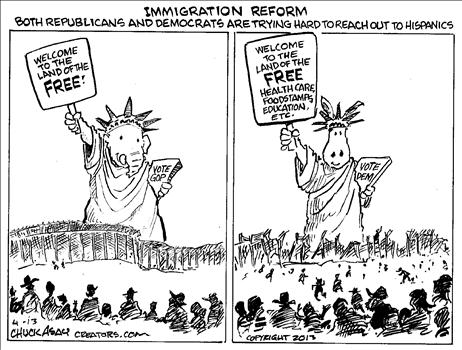



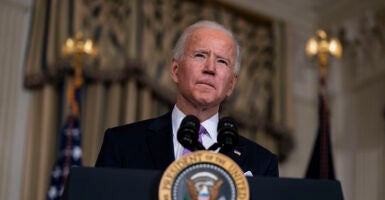















:max_bytes(150000):strip_icc()/carl-sagan-3232391-5c4bd9efc9e77c00013802b5.jpg)