I recently read this article about your love of Bach’s music.
If any example proves this point, it is the confession of evolutionary biologist and self-professed “militant atheist,” Richard Dawkins. Dawkins recalls an appearance he had on Desert Island Discs, a British radio show. When asked to choose the eight records he would take with him on a desert island, he included “Mache dich mein Herze rein” from J. S. Bach’s St Matthew Passion. “The interviewer was unable to understand how I could choose religious music without being religious,” Dawkins recalls. “You might as well say, how can you enjoy Wuthering Heights when you know perfectly well that Cathy and Heathcliff never really existed?”
I once was the guest of the week on a British radio show called Desert Island Discs. You have to choose the eight records you would take with you if marooned on a desert island. Among my choices was ‘Mache dich mein Herze rein’ from Bach’s St Matthew Passion. The interviewer was unable to understand how I could choose religious music without being religious. You might as well say, how can you enjoy Wuthering Heights when you know perfectly well that Cathy and Heathcliff never really existed?
But there is an additional point that I might have made, and which needs to be made whenever religion is given credit for, say, the Sistine Chapel or Raphael’s Annunciation. Even great artists have to earn a living, and they will take commissions where they are to be had. I have no reason to doubt that Raphael and Michelangelo were Christians – it was pretty much the only option in their time – but the fact is almost incidental. Its enormous wealth had made the Church the dominant patron of the arts. If history had worked out differently, and Michelangelo had been commissioned to paint a ceiling for a giant Museum of Science, mightn’t he have produced something at least as inspirational as the Sistine Chapel? How sad that we shall never hear Beethoven’s Mesozoic Symphony, or Mozart’s opera The Expanding Universe.
2 RESPONSES TO YOUR ASSERTION THAT AN EARLIER ACCEPTANCE OF EVOLUTION WOULD HAVE ENRICHED MUSIC AND THE ARTS.
First, we have the testimony of Charles Darwin himself concerning this.
Second, we have the actual details from Bach’s life.
I have said that in one respect my mind has changed during the last twenty or thirty years. Up to the age of thirty, or beyond it, poetry of many kinds, such as the works of Milton, Gray, Byron, Wordsworth, Coleridge, and Shelley, gave me great pleasure, and even as a schoolboy I took intense delight in Shakespeare, especially in the historical plays. I have also said that formerly pictures gave me considerable, and music very great delight. But now for many years I cannot endure to read a line of poetry: I have tried lately to read Shakespeare, and found it so intolerably dull that it nauseated me. I have also almost lost my taste for pictures or music. Music generally sets me thinking too energetically on what I have been at work on, instead of giving me pleasure. I retain some taste for fine scenery, but it does not cause me the exquisite delight which it formerly did…
This curious and lamentable loss of the higher æsthetic tastes is all the odder, as books on history, biographies, and travels (independently of any scientific facts which they may contain), and essays on all sorts of subjects interest me as much as ever they did. My mind seems to have become a kind of machine for grinding general laws out of large collections of facts, but why this should have caused the atrophy of that part of the brain alone, on which the higher tastes depend, I cannot conceive. A man with a mind more highly organised or better constituted than mine, would not, I suppose, have thus suffered; and if I had to live my life again, I would have made a rule to read some poetry and listen to some music at least once every week; for perhaps the parts of my brain now atrophied would thus have been kept active through use. The loss of these tastes is a loss of happiness, and may possibly be injurious to the intellect, and more probably to the moral character, by enfeebling the emotional part of our nature.
Francis Schaeffer commented:
This is the old man Darwin writing at the end of his life. What he is saying here is the further he has gone on with his studies the more he has seen himself reduced to a machine as far as aesthetic things are concerned. I think this is crucial because as we go through this we find that his struggles and my sincere conviction is that he never came to the logical conclusion of his own position, but he nevertheless in the death of the higher qualities as he calls them, art, music, poetry, and so on, what he had happen to him was his own theory was producing this in his own self just as his theories a hundred years later have produced this in our culture. I don’t think you can hold the evolutionary position as he held it without becoming a machine. What has happened to Darwin personally is merely a forerunner to what occurred to the whole culture as it has fallen in this world of pure material, pure chance and later determinism. Here he is in a situation where his mannishness has suffered in the midst of his own position.
Let’s take a closer look at the music by Bach that you call your favorite.
From Francis Schaeffer’s How Should We Then Live? (p. 92):
Johann Sebastian Bach (1685 – 1750) was certainly the zenith of the composers coming out of the Reformation. His music was a direct result of the Reformation culture and the biblical Christianity of the time, which was so much a part of Bach himself. There would have been no Bach had there been no Luther. Bach wrote on his score initials representing such phrases as: “With the help of Jesus” – “To God alone be the glory” – “In the name of Jesus.” It was appropriate that the last thing Bach the Christian wrote was “Before Thy Throne I Now Appear.” Bach consciously related both the form and the words of his music to biblical truth. Out of the biblical context came a rich combination of music and words and a diversity of unity. This rested on the fact that the Bible gives unity to the universal and the particulars, and therefore the particulars have meaning. Expressed musically, there can be endless variety and diversity without chaos. There is variety yet resolution.
And this is why I love Bach.
In THE GOD WHO IS THERE Francis Schaeffer makes great point:
In a different but related way this is also true of a man like Bernard Berenson (1865-1959). He was the world’s greatest expert on Renaissance art during his lifetime. He graduated from Harvard and lived most of his later life in Florence. He was such an authority on his subject that when he dated and priced a picture, it was generally accepted as decisive. He was a truly “modern” man and accepted sexual amorality. Therefore when he took Mary Costelloe (sister of the American essayist Logan Pearsall Smith) away from her husband, he lived with her for a number of years until her husband died and then married her (the Costelloes’ marriage was Roman Catholic, and so a divorce could not be arranged). When Berenson eventually married her, they had an agreement that they would both be free to engage in extramarital affairs, and both took advantage of the agreement many times. They lived this way for forty-five years. When anyone chided Berenson, he would simply say, “You are forgetting the animal basis of our nature.” Thus he was perfectly willing in his private life to accept a completely animal situation.
But in contrast to this, he expressed a completely different view where his real love and true integration point—Renaissance art—was concerned. “Bernard Berenson found that modern figure painting in general was not based on seeing, on observing, but on exasperation and on the preconceived assumption that the squalid, the sordid, the violent, the bestial, the misshapen, in short . . . low life was the only reality!”1 In the area of sexual morals he was perfectly willing to live consistently to his view of life as an animal. But in the area which had become his attempt to find an integration point, that of art, he was prepared to say that he disliked modern art because it is bestial! No man like Berenson can live with his system. Every truly modern man is forced to accept some sort of leap in theory or practice, because the pressure of his own humanity demands it. He can say what he will concerning what he himself is; but no matter what he says he is, he still is man. These kinds of leaps, produced in desperation as an act of blind faith, are totally different from the faith of historic Christianity. On the basis of biblical Christianity a rational discussion and consideration can take place, because it is fixed in the stuff of history. When Paul was asked whether Jesus was raised from the dead, he gave a completely nonreligious answer, in the twentieth-century sense. He said: “There are almost 500 living witnesses; go and ask them!”2 This is the faith that involves the whole man, including his reason; it does not ask for a belief into the void. As the twentieth-century mentality would understand the concept of religion, the Bible is a nonreligious book.
I have spent alot of time talking about Woody Allen films on this blog and looking at his worldview. He has a hopeless, meaningless, nihilistic worldview that believes we are going to turn to dust and there is no afterlife. Even though he has this view he has taken the opportunity to look at the weaknesses of […]By Everette Hatcher III | Posted in Current Events | Edit | Comments (0)
I have spent alot of time talking about Woody Allen films on this blog and looking at his worldview. He has a hopeless, meaningless, nihilistic worldview that believes we are going to turn to dust and there is no afterlife. Even though he has this view he has taken the opportunity to look at the weaknesses of […]By Everette Hatcher III | Posted in Current Events | Edit | Comments (0)
Woody Allen video interview in France Related posts: “Woody Wednesdays” Woody Allen on God and Death June 6, 2012 – 6:00 am Good website on Woody Allen How can I believe in God when just last week I got my tongue caught in the roller of an electric typewriter? If Jesus Christ came back today and […]By Everette Hatcher III | Posted in Current Events | Edit | Comments (0)
I have spent alot of time talking about Woody Allen films on this blog and looking at his worldview. He has a hopeless, meaningless, nihilistic worldview that believes we are going to turn to dust and there is no afterlife. Even though he has this view he has taken the opportunity to look at the weaknesses of […]By Everette Hatcher III | Posted in Current Events | Edit | Comments (0)
A surprisingly civil discussion between evangelical Billy Graham and agnostic comedian Woody Allen. Skip to 2:00 in the video to hear Graham discuss premarital sex, to 4:30 to hear him respond to Allen’s question about the worst sin and to 7:55 for the comparison between accepting Christ and taking LSD. ___________________ The Christian Post > […]By Everette Hatcher III | Posted in Current Events | Edit | Comments (0)
Crimes and Misdemeanors: A Discussion: Part 1 If you like Woody Allen films as much as I do then join me every Wednesday for another look the man and his movies. Below are some of the posts from the past: “Woody Wednesday” How Allen’s film “Crimes and Misdemeanors makes the point that hell is necessary […]By Everette Hatcher III | Posted in Current Events | Edit | Comments (0)
I really enjoyed this documentary on Woody Allen from PBS. Woody Allen: A Documentary, Part 1 Published on Mar 26, 2012 by NewVideoDigital Beginning with Allen’s childhood and his first professional gigs as a teen – furnishing jokes for comics and publicists – WOODY ALLEN: A DOCUMENTARY chronicles the trajectory and longevity of Allen’s career: […]By Everette Hatcher III | Posted in Current Events | Edit | Comments (0)
Crimes and Misdemeanors: A Discussion: Part 3 Uploaded by camdiscussion on Sep 23, 2007 Part 3 of 3: ‘Is Woody Allen A Romantic Or A Realist?’ A discussion of Woody Allen’s 1989 movie, Crimes and Misdemeanors, perhaps his finest. By Anton Scamvougeras. http://camdiscussion.blogspot.com/antons@mail.ubc.ca______________ One of my favorite Woody Allen movies and I reviewed […]By Everette Hatcher III | Posted in Uncategorized | Edit | Comments (0)
Crimes and Misdemeanors: A Discussion: Part 2 Uploaded by camdiscussion on Sep 23, 2007 Part 2 of 3: ‘What Does The Movie Tell Us About Ourselves?’ A discussion of Woody Allen’s 1989 movie, perhaps his finest. By Anton Scamvougeras. http://camdiscussion.blogspot.com/antons@mail.ubc.ca _________________- One of my favorite Woody Allen movies and I reviewed it earlier but […]By Everette Hatcher III | Posted in Current Events | Edit | Comments (0)
I have spent alot of time talking about Woody Allen films on this blog and looking at his worldview. He has a hopeless, meaningless, nihilistic worldview that believes we are going to turn to dust and there is no afterlife. Even though he has this view he has taken the opportunity to look at the weaknesses of […]By Everette Hatcher III | Posted in Current Events | Edit | Comments (0)
Crimes and Misdemeanors: A Discussion: Part 1 If you like Woody Allen films as much as I do then join me every Wednesday for another look the man and his movies. Below are some of the posts from the past: “Woody Wednesday” How Allen’s film “Crimes and Misdemeanors makes the point that hell is necessary […]By Everette Hatcher III | Posted in Current Events | Edit | Comments (0)
I have spent alot of time talking about Woody Allen films on this blog and looking at his worldview. He has a hopeless, meaningless, nihilistic worldview that believes we are going to turn to dust and there is no afterlife. Even though he has this view he has taken the opportunity to look at the weaknesses of […]By Everette Hatcher III | Posted in Current Events | Edit | Comments (0)
Crimes and Misdemeanors: A Discussion: Part 1 Uploaded by camdiscussion on Sep 23, 2007 Part 1 of 3: ‘What Does Judah Believe?’ A discussion of Woody Allen’s 1989 movie, perhaps his finest. By Anton Scamvougeras. http://camdiscussion.blogspot.com/antons@mail.ubc.ca _____________ One of my favorite films is this gem by Woody Allen “Crimes and Misdemeanors”: Film Review By […]By Everette Hatcher III | Posted in Uncategorized | Edit | Comments (0)
Crimes and Misdemeanors: A Discussion: Part 3 Uploaded by camdiscussion on Sep 23, 2007 Part 3 of 3: ‘Is Woody Allen A Romantic Or A Realist?’ A discussion of Woody Allen’s 1989 movie, Crimes and Misdemeanors, perhaps his finest. By Anton Scamvougeras. http://camdiscussion.blogspot.com/antons@mail.ubc.ca______________ One of my favorite Woody Allen movies and I reviewed […]By Everette Hatcher III | Posted in Current Events | Edit | Comments (0)
Crimes and Misdemeanors: A Discussion: Part 2 Uploaded by camdiscussion on Sep 23, 2007 Part 2 of 3: ‘What Does The Movie Tell Us About Ourselves?’ A discussion of Woody Allen’s 1989 movie, perhaps his finest. By Anton Scamvougeras. http://camdiscussion.blogspot.com/antons@mail.ubc.ca _________________- One of my favorite Woody Allen movies and I reviewed it earlier but […]By Everette Hatcher III | Posted in Current Events | Edit | Comments (0)
Crimes and Misdemeanors: A Discussion: Part 1 Uploaded by camdiscussion on Sep 23, 2007 Part 1 of 3: ‘What Does Judah Believe?’ A discussion of Woody Allen’s 1989 movie, perhaps his finest. By Anton Scamvougeras. http://camdiscussion.blogspot.com/antons@mail.ubc.ca _____________ Today I am starting a discusssion of the movie “Crimes and Misdemeanors” by Woody Allen. This 1989 […]By Everette Hatcher III | Posted in Current Events | Edit | Comments (0)
Milton Friedman – A Conversation On Minimum Wage FREE TO CHOOSE
May 4, 2021
Office of Barack and Michelle Obama P.O. Box 91000 Washington, DC 20066
Dear President Obama,
I wrote you over 700 letters while you were President and I mailed them to the White House and also published them on my blog http://www.thedailyhatch.org .I received several letters back from your staff and I wanted to thank you for those letters.
There are several issues raised in your book that I would like to discuss with you such as the minimum wage law, the liberal press, the cause of 2007 financial meltdown, and especially your pro-choice (what I call pro-abortion) view which I strongly object to on both religious and scientific grounds, Two of the most impressive things in your book were your dedication to both the National Prayer Breakfast (which spoke at 8 times and your many visits to the sides of wounded warriors!!
I have been reading your autobiography A PROMISED LAND and I have been enjoying it.
Let me make a few comments on it, and here is the first quote of yours I want to comment on:
I was campaigning to push the country in the opposite direction. I didn’t think America could roll back automation or sever the global supply chain (though I did think we could negotiate stronger labor and environmental provisions in our trade agreements). But I was certain we could adapt our laws and institutions, just as we’d done in the past, to make sure that folks willing to work could get a fair shake. At every stop I made, in every city and small town, my message was the same. I promised to raise taxes on high-income Americans to pay for vital investments in education, research, and infrastructure. I promised to strengthen unions and raise the minimum wage as well as to deliver universal healthcare and make college more affordable. I wanted people to understand that there was a precedent for bold government action. FDR had saved capitalism from itself, laying the foundation for a post–World War II boom.
—-
The minimum wage has hurt young people as they seek to enter the job market and prove themselves and start heading up the financial ladder of opportunity and by cutting the bottom of the ladder off it is difficult for the most unskilled and disadvantaged to compete!
When I debate my leftist friends on the minimum wage, it’s often a strange experience. When other people are listening or watching, they’ll adopt a very extreme position and basically claim that politicians have the power to dramatically boost take-home pay by simply mandating higher levels of pay. And somehow there won’t be any noticeable negative impact on employment and labor markets, even though businesses only create jobs if they expect some net profit.
But when we talk privately, they have a more nuanced argument. They’ll confess that higher minimum wages will cause some low-skilled workers to become unemployed, but then justify that outcome using either or both of these arguments.
Amoral utilitarianism – A large number of people will get pay raises and only a small handful will lose their jobs, and this is okay if policy is based on some notion of greatest good for the greatest number. In other words, you can’t make an omelet without breaking a few eggs.
Keynesian stimulus – Some people will lose their jobs, but the income gains for those who keep their jobs will boost “aggregate demand” and thus provide a boost for the economy. Sort of like they also claim giving people unemployment benefits will somehow generate more economic activity.
I’ve always rejected the first argument because I believe in the individual right of contract. The government should not prevent an employer and employee from engaging in voluntary exchange.
And I’ve always rejected the second argument because there can’t be any net “stimulus” since any additional income for workers is automatically offset by less income for employers.
So who is right?
Well, the real world just kicked advocates of higher minimum wages in the teeth. Or maybe even someplace even more painful. A new study from the National Bureau of Economic Research looks at the impact of the $11 and $13 minimum wages in the city of Seattle and finds very bad results.
Let’s start by simply citing what the local government did.
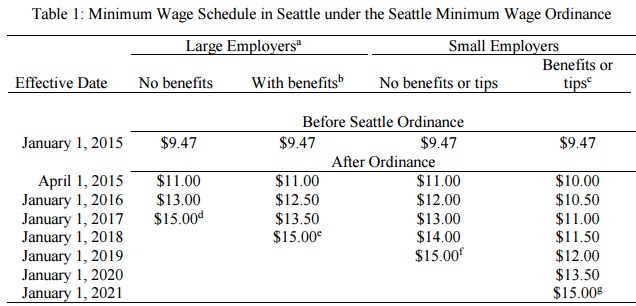
This paper, using rich administrative data on employment, earnings and hours in Washington State, re-examines this prediction in the context of Seattle’s minimum wage increases from $9.47 to $11/hour in April 2015 and to $13/hour in January 2016.
And here’s a table from the study, showing details on the minimum-wage mandate.
And what’s been happening as a result of this intervention in the labor market?
Unsurprisingly, the jump to $13 has been much more damaging that the jump to $11.
…conclusion: employment losses associated with Seattle’s mandated wage increases are in fact large enough to have resulted in net reductions in payroll expenses – and total employee earnings – in the low-wage job market. …We show that the impact of Seattle’s minimum wage increase on wage levels is much smaller than the statutory increase, reflecting the fact that most affected low-wage workers were already earning more than the statutory minimum at baseline. Our estimates imply, then, that conventionally calculated elasticities are substantially underestimated. Our preferred estimates suggest that the rise from $9.47 to $11 produced disemployment effects that approximately offset wage effects, with elasticity estimates around -1. The subsequent increase to as much as $13 yielded more substantial disemployment effects, with net elasticity estimates closer to -3.
Here’s a chart from the study looking at the impact on hours worked.
If you want a healthy labor market, it’s not good to be below the line.
And here’s some of the explanatory text.
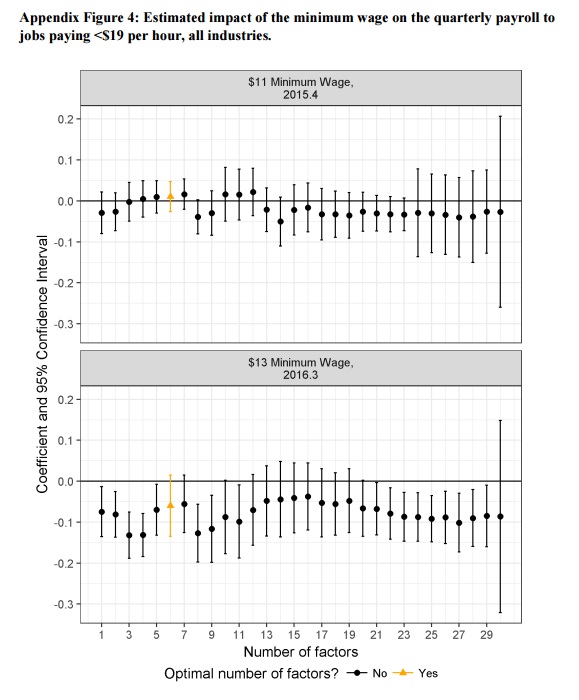
…Because the estimated magnitude of employment losses exceeds the magnitude of wage gains in the second phase-in period, we would expect a decline in total payroll for jobs paying under $13 per hour relative to baseline. Indeed, we observe this decline in first-differences when comparing “peak” calendar quarters, as shown in Table 3 above. …point estimates suggest payroll declines of 4.0% to 7.6% (averaging 5.8%) during the second phase-in period. This implies that the minimum wage increase to $13 from the baseline level of $9.47 reduced income paid to low-wage employees of single-location Seattle businesses by roughly $120 million on an annual basis. …Our preferred estimates suggest that the Seattle Minimum Wage Ordinance caused hours worked by low-skilled workers (i.e., those earning under $19 per hour) to fall by 9.4% during the three quarters when the minimum wage was $13 per hour, resulting in a loss of 3.5 million hours worked per calendar quarter. Alternative estimates show the number of low-wage jobs declined by 6.8%, which represents a loss of more than 5,000 jobs.
But the biggest takeaway from the report is that hours dropped so much that the average low-wage worker wound up with less income
The reduction in hours would cost the average employee $179 per month, while the wage increase would recoup only $54 of this loss, leaving a net loss of $125 per month (6.6%), which is sizable for a low-wage worker.
Here’s the relevant chart.
Once again, it’s not good to be below the line.
This data is remarkable because it shows that higher minimum wages are a bad idea, even according to the metrics of our friends on the left.
The amoral utlitarianism argument doesn’t apply because it’s no longer possible to claim that income gains for those keeping jobs will more than offset income losses for those who become unemployed.
The Keynesian aggregate-demand argument doesn’t apply because it’s no longer possible to assert macroeconomic benefits based on the assumption of a net increase in “spending power” in the economy.
Let’s close with a couple of observations from others who have looked at the new study.
Diana Furchtgott-Roth of the Manhattan Institute (and formerly Chief Economist at the Department of Labor) highlights the most relevant findings.
Raising the pay floor has led to net losses in payroll expenses and worker incomes for low-wage workers. …When hourly wages rose from $11 to $13 in 2016, hours of work and earnings for low-wage workers were reduced by 9 percent for the first three calendar quarters, resulting in 3.5 million fewer hours worked for each calendar quarter. The number of jobs declined by 7 percent, with the result that 5,000 jobs were lost. …The evidence shows that in Seattle, low-wage workers got less money in their pockets, rather than more.
Some proponents of intervention and mandates may want to dismiss Diana’s analysis since of her reputation as a market-friendly scholar.
But even Ben Casselman and Kathryn Casteel of FiveThirtyEightbasically reach the same conclusion.
As cities across the country pushed their minimum wages to untested heights in recent years, some economists began to ask: How high is too high? Seattle, with its highest-in-the-country minimum wage, may have hit that limit. …New research released Monday by a team of economists at the University of Washington suggests the wage hike may have come at a significant cost: The increase led to steep declines in employment for low-wage workers, and a drop in hours for those who kept their jobs. Crucially, the negative impact of lost jobs and hours more than offset the benefits of higher wages — on average, low-wage workers earned $125 per month less because of the higher wage.
I’m amused to find more evidence that left-leaning economists admit that higher minimum wages cause damage, albeit never on the record.
Even some liberal economists have expressed concern, often privately, that employers might respond differently to a minimum wage of $12 or $15, which would affect a far broader swath of workers.
I’m wondering how they can look at themselves in the mirror. It seems very immoral (in other words, beyond amoral) to publicly defend a policy that you privately admit is bad.
I understand that this type of dishonesty happens all the time in the political world (for example, some Republicans are now supporting Trump’s plans for infrastructure boondoggles and parental leave when they would have been strongly opposed if the same policies had been proposed by Obama).
But what’s the point of being a tenured academic if you can’t at least be honest?
Though maybe there’s some sort of cognitive dissonance at play, where they feel the rules of honesty don’t apply in the political world. For instance, both Paul Krugman and Larry Summers have acknowledged in their academic work that unemployment benefits lead to more unemployment. But they pretend that’s not the case when commenting on the policy debate.
Sincerely,
Everette Hatcher III, 13900 Cottontail Lane, Alexander, AR 72002, ph 501-920-5733 everettehatcher@gmail.com
President Obama c/o The White House 1600 Pennsylvania Avenue NW Washington, DC 20500 Dear Mr. President, I know that you receive 20,000 letters a day and that you actually read 10 of them every day. I really do respect you for trying to get a pulse on what is going on out here. There have […]By Everette Hatcher III | Posted in David Barton, Founding Fathers, President Obama | Edit |Comments (0)
There have been many articles written by evangelicals like me who fear that our founding fathers would not recognize our country today because secular humanism has rid our nation of spiritual roots. I am deeply troubled by the secular agenda of those who are at war with religion in our public life. Lillian Kwon quoted somebody […]By Everette Hatcher III | Posted in David Barton, Founding Fathers | Edit | Comments (0)
There have been many articles written by evangelicals like me who fear that our founding fathers would not recognize our country today because secular humanism has rid our nation of spiritual roots. I am deeply troubled by the secular agenda of those who are at war with religion in our public life. Lillian Kwon quoted somebody […]By Everette Hatcher III | Posted in David Barton, Founding Fathers | Edit | Comments (0)
There have been many articles written by evangelicals like me who fear that our founding fathers would not recognize our country today because secular humanism has rid our nation of spiritual roots. I am deeply troubled by the secular agenda of those who are at war with religion in our public life. Lillian Kwon quoted somebody […]By Everette Hatcher III | Posted in David Barton, Founding Fathers | Edit | Comments (0)
There have been many articles written by evangelicals like me who fear that our founding fathers would not recognize our country today because secular humanism has rid our nation of spiritual roots. I am deeply troubled by the secular agenda of those who are at war with religion in our public life. Lillian Kwon quoted somebody […]By Everette Hatcher III | Posted in David Barton, Founding Fathers | Edit | Comments (0)
There have been many articles written by evangelicals like me who fear that our founding fathers would not recognize our country today because secular humanism has rid our nation of spiritual roots. I am deeply troubled by the secular agenda of those who are at war with religion in our public life. Lillian Kwon quoted somebody […]By Everette Hatcher III | Posted in Founding Fathers | Edit | Comments (0)
President Obama Speaks at The Ohio State University Commencement Ceremony Published on May 5, 2013 President Obama delivers the commencement address at The Ohio State University. May 5, 2013. You can learn a lot about what President Obama thinks the founding fathers were all about from his recent speech at Ohio State. May 7, 2013, […]By Everette Hatcher III | Posted in Founding Fathers, President Obama | Edit | Comments (0)
Dr. C. Everett Koop with Bill Graham. Francis Schaeffer: “Whatever Happened to the Human Race” (Episode 4) THE BASIS FOR HUMAN DIGNITY Published on Oct 7, 2012 by AdamMetropolis The 45 minute video above is from the film series created from Francis Schaeffer’s book “Whatever Happened to the Human Race?” with Dr. C. Everett Koop. This […]By Everette Hatcher III | Posted in Founding Fathers, Francis Schaeffer, Prolife | Edit |Comments (1)
America’s Founding Fathers Deist or Christian? – David Barton 4/6 There have been many articles written by evangelicals like me who fear that our founding fathers would not recognize our country today because secular humanism has rid our nation of spiritual roots. I am deeply troubled by the secular agenda of those who are at […]By Everette Hatcher III | Posted in David Barton, Founding Fathers | Tagged governor of connecticut, john witherspoon, jonathan trumbull | Edit | Comments (1)
3 Of 5 / The Bible’s Influence In America / American Heritage Series / David Barton There were 55 gentlemen who put together the constitution and their church affliation is of public record. Greg Koukl notes: Members of the Constitutional Convention, the most influential group of men shaping the political foundations of our nation, were […]By Everette Hatcher III | Posted in Founding Fathers | Edit | Comments (0)
I do not think that John Quincy Adams was a founding father in the same sense that his father was. However, I do think he was involved in the early days of our government working with many of the founding fathers. Michele Bachmann got into another history-related tussle on ABC’s “Good Morning America” today, standing […]By Everette Hatcher III | Posted in David Barton, Founding Fathers | Edit | Comments (0)
I have gone back and forth and back and forth with many liberals on the Arkansas Times Blog on many issues such as abortion, human rights, welfare, poverty, gun control and issues dealing with popular culture. Here is another exchange I had with them a while back. My username at the Ark Times Blog is Saline […]By Everette Hatcher III | Posted in Arkansas Times, Francis Schaeffer, Prolife | Edit |Comments (0)
I truly believe that many of the problems we have today in the USA are due to the advancement of humanism in the last few decades in our society. Ronald Reagan appointed the evangelical Dr. C. Everett Koop to the position of Surgeon General in his administration. He partnered with Dr. Francis Schaeffer in making the […]By Everette Hatcher III | Posted in Adrian Rogers, Francis Schaeffer | Edit | Comments (0)
Francis Schaeffer: “Whatever Happened to the Human Race” (Episode 4) THE BASIS FOR HUMAN DIGNITY Published on Oct 7, 2012 by AdamMetropolis ____________ The 45 minute video above is from the film series created from Francis Schaeffer’s book “Whatever Happened to the Human Race?” with Dr. C. Everett Koop. This book really helped develop my political […]By Everette Hatcher III | Posted in Francis Schaeffer | Edit | Comments (0)
Education Secretary Betsy DeVos supports vouchers that allow parents to use taxpayer funds to help pay private-school tuition for their children. Like the noted economist Milton Friedman, she believes that parental choice and competition among schools to attract students in a voucher system would result in better education than that provided by public schools. A corollary of her and Friedman’s perspective is that detailed regulations governing the operation of schools hinder their performance.
While there are many small-scale voucher programs in the United States operated by local communities or states, none has sufficient scale to shed light on the consequences of a universal voucher system. For such evidence we must turn to Chile, a country that shares the U.S.’s strong support for the operation of markets and its high degree of income inequality.
The effects of a nationwide, universal voucher program there show that unregulated school choice led to flat test scores and greater achievement gaps among rich and poor. Only when regulation was added did private school choice begin to deliver on its promise.
In 1981, Chile introduced a universal educational voucher system for students in both its elementary and secondary schools that was very similar to the model Friedman proposed in 1955. Parents could use government-provided vouchers either to pay for a year of education at a public school or to contribute to the tuition charged by a private not-for-profit or profit-seeking school.
The financial value of the voucher did not depend on family income. Private schools that participated in the voucher program could decide what tuition to charge and which students to admit. In contrast, public schools were required to admit any students and could not charge tuition. This basic design of the voucher system remained in effect through 2007.
A number of scholars have examined the consequences of the introduction of vouchers in Chile. The percentage of students enrolled in public schools declined markedly, from 78 percent in 1980 to less than 50 percent in 2007. Student achievement in mathematics and Spanish, as measured on national tests, stagnated, and the gap between the average achievement of children from low- and middle-income families increased.
So did segregation of students by socio-economic background. Students from low-income families ended up attending different schools from those attended by children from more affluent families. If this were the end of the story from Chile, the lesson would be that advocates for improving the education received by children from low-income families should strongly oppose the introduction of vouchers. However, new evidence presents a more complicated picture.
In January 2008, the Chilean national legislature passed the Preferential School Subsidy Law (SEP) that dramatically altered the regulations governing the nation’s educational voucher system. SEP recognized explicitly that it costs more to educate students from low-income families well, especially in schools serving large percentages of children living in poverty.
Under SEP, the vouchers provided to “Priority students,” basically those whose families were in the bottom 40 percent of the income distribution, were worth 50 percent more than those provided to other students. In addition to the higher-valued vouchers, schools serving large percentages of Priority students received per-student concentration bonuses, the size of which depended on the percentage of Priority students in the school’s student body.
To be eligible to receive the higher-valued vouchers and concentration bonuses, schools had to agree to three requirements of the SEP program. One was not to charge Priority students any tuition. A second was to agree not to select students based on their academic skills, nor expel them on academic grounds. A third requirement was that schools had to participate in a government-administered accountability system that, for the first time, made schools responsible for improving student test scores and for the use of financial resources.
Working with several colleagues, we examined the consequences of the change in the rules governing Chile’s voucher system. We learned that the majority of for-profit private schools found SEP requirements unacceptable and initially decided not to participate. Most not-for-profit private schools and virtually all public schools did choose to participate.
In the first five years after the passage of SEP, the average test scores of Chilean fourth grade students from both low- and higher-income families increased markedly and income-based gaps in those scores declined by one-third. We found that the key mechanism responsible for these gains was the combination of increased financial support of schools and the SEP accountability system.
We also found that the movement of students away from public schools and into private schools continued under SEP, and that this trend held for low-income as well as those from higher-income families. The segregation of low-income students into different schools from those attended by higher-income students did not decrease in the first five years after the passage of SEP.
Some private schools specialized in serving low-income students, just as had been the case before the passage of SEP. But under SEP, these schools had much more money to work with as well as pressure to improve student test scores. Other private schools specialized in serving students from middle-class families and served relatively few Priority students.
Chile’s long-term experience with universal voucher systems offers two lessons for policymakers concerned with improving the education of all American children, including those from low-income families. The first is that the rules governing the operation of a voucher system matter enormously.
A voucher system that provides the same amount of money to every child and that relies solely on the operation of education markets to monitor the quality of schools is likely to result in more segregated schools and greater inequality of educational outcomes. In contrast, a voucher system that takes into account the especially high cost of educating well children from low-income families, especially when they are concentrated in particular schools, and that provides government monitoring of the performance of individual schools, may result in improved test scores for both low- and higher-income students and a closing of income-related achievement gaps.
The second lesson is that school choice is unlikely to reduce school segregation by income or race. School segregation by income increased in Chile under a voucher system that treated all students equally. It did not markedly decrease during the first five years of SEP, even though this voucher system provided significant financial incentives to schools to recruit students from low-income families. If reducing school segregation is a public policy goal, progress will require something other than providing parents with education vouchers.
Michael Harrington: If you don’t have the expertise, the knowledge technology today, you’re out of the debate. And I think that we have to democratize information and government as well as the economy and society. FRIEDMAN: I am sorry to say Michael Harrington’s solution is not a solution to it. He wants minority rule, I […]
By Everette Hatcher III | Posted in Current Events, Milton Friedman | Edit | Comments (0)
PETERSON: Well, let me ask you how you would cope with this problem, Dr. Friedman. The people decided that they wanted cool air, and there was tremendous need, and so we built a huge industry, the air conditioning industry, hundreds of thousands of jobs, tremendous earnings opportunities and nearly all of us now have air […]
By Everette Hatcher III | Posted in Current Events, Milton Friedman | Edit | Comments (0)
Part 5 Milton Friedman: I do not believe it’s proper to put the situation in terms of industrialist versus government. On the contrary, one of the reasons why I am in favor of less government is because when you have more government industrialists take it over, and the two together form a coalition against the ordinary […]
By Everette Hatcher III | Posted in Current Events, Milton Friedman | Edit | Comments (0)
The fundamental principal of the free society is voluntary cooperation. The economic market, buying and selling, is one example. But it’s only one example. Voluntary cooperation is far broader than that. To take an example that at first sight seems about as far away as you can get __ the language we speak; the words […]
By Everette Hatcher III | Posted in Current Events, Milton Friedman | Edit | Comments (0)
_________________________ Pt3 Nowadays there’s a considerable amount of traffic at this border. People cross a little more freely than they use to. Many people from Hong Kong trade in China and the market has helped bring the two countries closer together, but the barriers between them are still very real. On this side […]
By Everette Hatcher III | Posted in Current Events, Milton Friedman | Edit | Comments (0)
Aside from its harbor, the only other important resource of Hong Kong is people __ over 4_ million of them. Like America a century ago, Hong Kong in the past few decades has been a haven for people who sought the freedom to make the most of their own abilities. Many of them are […]
By Everette Hatcher III | Posted in Current Events, Milton Friedman | Edit | Comments (0)
“FREE TO CHOOSE” 1: The Power of the Market (Milton Friedman) Free to Choose ^ | 1980 | Milton Friedman Posted on Monday, July 17, 2006 4:20:46 PM by Choose Ye This Day FREE TO CHOOSE: The Power of the Market Friedman: Once all of this was a swamp, covered with forest. The Canarce Indians […]
If you would like to see the first three episodes on inflation in Milton Friedman’s film series “Free to Choose” then go to a previous post I did. Ep. 9 – How to Cure Inflation [4/7]. Milton Friedman’s Free to Choose (1980) Uploaded by investbligurucom on Jun 16, 2010 While many people have a fairly […]
Charlie Rose interview of Milton Friedman My favorite economist: Milton Friedman : A Great Champion of Liberty by V. Sundaram Milton Friedman, the Nobel Prize-winning economist who advocated an unfettered free market and had the ear of three US Presidents – Nixon, Ford and Reagan – died last Thursday (16 November, 2006 ) in San Francisco […]
By Everette Hatcher III | Posted in Milton Friedman | Edit | Comments (0)
Stearns Speaks on House Floor in Support of Balanced Budget Amendment Uploaded by RepCliffStearns on Nov 18, 2011 Speaking on House floor in support of Balanced Budget Resolution, 11/18/2011 ___________ Below are some of the main proposals of Milton Friedman. I highly respected his work. David J. Theroux said this about Milton Friedman’s view concerning […]
By Everette Hatcher III | Posted in Milton Friedman | Edit | Comments (0)
Milton Friedman: Free To Choose – The Failure Of Socialism With Ronald Reagan (Full) Published on Mar 19, 2012 by NoNationalityNeeded Milton Friedman’s writings affected me greatly when I first discovered them and I wanted to share with you. We must not head down the path of socialism like Greece has done. Abstract: Ronald Reagan […]
By Everette Hatcher III | Posted in Milton Friedman, President Obama | Edit | Comments (1)
What a great defense of Milton Friedman!!!! Defaming Milton Friedman by Johan Norberg This article appeared in Reason Online on September 26, 2008 PRINT PAGE CITE THIS Sans Serif Serif Share with your friends: ShareThis In the future, if you tell a student or a journalist that you favor free markets and limited government, there is […]
Office of Barack and Michelle Obama P.O. Box 91000 Washington, DC 20066
Dear President Obama,
I wrote you over 700 letters while you were President and I mailed them to the White House and also published them on my blog http://www.thedailyhatch.org .I received several letters back from your staff and I wanted to thank you for those letters.
I have been reading your autobiography A PROMISED LAND and I have been enjoying it.
Let me make a few comments on it, and here is the first quote of yours I want to comment on:
Veteran politicians decided to step up despite active opposition in their conservative districts—folks like Baron Hill of southern Indiana, Earl Pomeroy of North Dakota, and Bart Stupak, a devout Catholic from Michigan’s Upper Peninsula who worked with me on getting the abortion funding language to a point where he could vote for it. So did political neophytes like Betsy Markey of Colorado, or John Boccieri of Ohio and Patrick Murphy of Pennsylvania, both young Iraq War vets, all of them seen as rising stars in the party. In fact, it was often those with the most to lose who needed the least convincing. Tom Perriello, a thirty-five-year-old human rights lawyer turned congressman who’d eked out a victory in a majority-Republican district that covered a wide swath of Virginia, spoke for a lot of them when he explained his decision to vote for the bill. “There are things more important,” he told me, “than getting reelected.”
ObamaCare requires every American to purchase health insurance, it requires every state to establish health insurance exchanges, and it dramatically expands Medicaid. Each of these – private health insurances programs, exchanges, and Medicaid – can, and in some case are required to, provide coverage for abortion. The result is hundreds of millions of dollars being funneled to the abortion industry every year and the greatest expansion of abortion since Roe v. Wade.
Pro-life atheist Nat Hentoff: With Obama you will get more abortions!!!
Nat Hentoff is an atheist, but he became a pro-life activist because of the scientific evidence that shows that the unborn child is a distinct and separate human being and even has a separate DNA. His perspective is a very intriguing one that I thought you would be interested in. I have shared before many cases (Bernard Nathanson, Donald Trump, Paul Greenberg, Kathy Ireland) when other high profile pro-choiceleaders have changed their views and this is just another case like those. I have contacted the White House over and over concerning this issue and have even received responses. I am hopeful that people will stop and look even in a secular way (if they are not believers) at this abortion debate and see that the unborn child is deserving of our protection.That is why the writings of Nat Hentoff of the Cato Institute are so crucial.
I truly believe that many of the problems we have today in the USA are due to the advancement of humanism in the last few decades in our society. Ronald Reagan appointed the evangelical Dr. C. Everett Koop to the position of Surgeon General in his administration. He partnered with Dr. Francis Schaeffer in making the video below. It is very valuable information for Christians to have. Actually I have included a video below that includes comments from him on this subject.
Nat Hentoff The Washington Times – Washington, DC 11/24/2008
OP-ED:Our new president-elect has not equivocated in his reverence for abortion rights. Speaking at a Planned Parenthood event on July 17, 2007, Barack Obama pledged that his first act as president would be to sign the Freedom of Choice Act. It is the most radical attack yet on the deep beliefs of millions of American pro-lifers.As Democratic Sen. Barbara Boxer, a champion of the bill, exulted: “Women would have the absolute right to choose whether to continue or terminate their pregnancies before fetal viability, and that right would be protected by this legislation. The Freedom of Choice Act also supersedes any law, regulation or local ordinance that impinges on a woman’s right to choose,” she said. With regard to “fetal viability” – the ability to survive on his or her own – the ardent supporters of FOCA slide over the language in the surviving 2007 version of FOCA bill that, as Douglas Johnson of the National Right to Life Committee points out, “contains no objective criteria for ‘viability,’ but rather, requires that the judgment regarding ‘viability’ be left entirely in the hands of ‘the attending physician.’ “Guess who that would be? The abortionist! There’s more. The restrictions on “the absolute right to choose” would also apply even after “viability” if a woman wanted to abort what would undeniably be seen during pregnancy as a baby in ultrasound for reasons of her health.But the Supreme Court in 1973 (the same year as Roe v. Wade) in Doe v. Bolton defined very broadly “health” justification for aborting a viable human being, as “physical, emotional, psychological, familial and the woman’s age.” This was nearly a blank check to dispose of that aborted person.It’s no wonder that Mr. Obama opposed the Supreme Court decision that eventually ruled against the lawfulness of “partial-birth abortion,” which the late Democratic Sen. Daniel Patrick Moynihan (who was pro-choice) said was infanticide.The rabidly pro-abortion Freedom of Choice Act Mr. Obama supports would – unless there is an unlikely successful filibuster in the Democratic controlled Senate – invalidate parental-notification laws; any state’s requirement of full disclosure of the physical and emotional risks inherent in abortion; and (can you believe this?) all laws prohibiting medical personnel other than licensed physicians from performing abortions because such restrictions might “interfere” with access to this absolute right to abortion.This is respect for women? As of now, before our abortion president gets his wish, 26 states have informed-consent laws, 36 have parental-involvement laws and 34 states have restrictions on funding for abortions.Also disposed of will be the “conscience rights” in many states. They include, Mr. Johnson reminds us, “all laws allowing doctors, nurses or other state-licensed professionals, and hospitals or other health care providers, to decline to provide or pay for abortions.” What about religiously based hospitals and clinics that refuse to perform abortions? At presidential press conferences, can we depend on at least some members of the Washington press corps to ask Mr. Obama about that provision or the others I’ve cited? Sen. Dianne Feinstein, California Democrat, heralded the election of Mr. Obama as “a new birth of freedom.” Not, however, for the early-stage human beings – each with his or her own distinct DNA – who, under this law, could never become citizens.Matt Bowman, an attorney with the pro-life Alliance Defense Fund, projects that if FOCA is passed into law (Lifenews.com, Sept. 24), there will be an increase in abortion “by 125,000 per year” in the United States because of the abolition of laws in states that have parental involvement, informed-consent laws and funding restrictions. “Even with this minimum,” Mr. Bowman adds, “that’s 125,000 children that were not killed this year because we (still) have these laws, and 125,000 (added to the existing 1.3 million abortions) who will be killed in 2009” and beyond.On Jan. 22, 2008, the 35th anniversary of Roe v. Wade, Mr. Obama said with pride: “Throughout my career, I’ve been a consistent and strong supporter of reproductive justice and have consistently had a 100 percent pro-choice rating with Planned Parenthood and NARAL Pro-Choice America … To truly honor (Roe v. Wade), we need to update the social contract so that women can free themselves and their children from violent relationships.”What, Mr. President, can be more violent than murder by abortion? Alveda King, niece of Dr. Martin Luther King, said on Nov. 11 (Lifenews.com) that “his dream of full equality remains just a dream as long as unborn children continue to be treated no better than property. The elections are over. The pro-life battle begins anew.”Nat Hentoff’s column for The Washington Times appears on
Sincerely,
Everette Hatcher III, 13900 Cottontail Lane, Alexander, AR 72002, ph 501-920-5733 everettehatcher@gmail.com
President Obama c/o The White House 1600 Pennsylvania Avenue NW Washington, DC 20500 Dear Mr. President, I know that you receive 20,000 letters a day and that you actually read 10 of them every day. I really do respect you for trying to get a pulse on what is going on out here. There have […]By Everette Hatcher III | Posted in David Barton, Founding Fathers, President Obama | Edit |Comments (0)
There have been many articles written by evangelicals like me who fear that our founding fathers would not recognize our country today because secular humanism has rid our nation of spiritual roots. I am deeply troubled by the secular agenda of those who are at war with religion in our public life. Lillian Kwon quoted somebody […]By Everette Hatcher III | Posted in David Barton, Founding Fathers | Edit | Comments (0)
There have been many articles written by evangelicals like me who fear that our founding fathers would not recognize our country today because secular humanism has rid our nation of spiritual roots. I am deeply troubled by the secular agenda of those who are at war with religion in our public life. Lillian Kwon quoted somebody […]By Everette Hatcher III | Posted in David Barton, Founding Fathers | Edit | Comments (0)
There have been many articles written by evangelicals like me who fear that our founding fathers would not recognize our country today because secular humanism has rid our nation of spiritual roots. I am deeply troubled by the secular agenda of those who are at war with religion in our public life. Lillian Kwon quoted somebody […]By Everette Hatcher III | Posted in David Barton, Founding Fathers | Edit | Comments (0)
There have been many articles written by evangelicals like me who fear that our founding fathers would not recognize our country today because secular humanism has rid our nation of spiritual roots. I am deeply troubled by the secular agenda of those who are at war with religion in our public life. Lillian Kwon quoted somebody […]By Everette Hatcher III | Posted in David Barton, Founding Fathers | Edit | Comments (0)
There have been many articles written by evangelicals like me who fear that our founding fathers would not recognize our country today because secular humanism has rid our nation of spiritual roots. I am deeply troubled by the secular agenda of those who are at war with religion in our public life. Lillian Kwon quoted somebody […]By Everette Hatcher III | Posted in Founding Fathers | Edit | Comments (0)
President Obama Speaks at The Ohio State University Commencement Ceremony Published on May 5, 2013 President Obama delivers the commencement address at The Ohio State University. May 5, 2013. You can learn a lot about what President Obama thinks the founding fathers were all about from his recent speech at Ohio State. May 7, 2013, […]By Everette Hatcher III | Posted in Founding Fathers, President Obama | Edit | Comments (0)
Dr. C. Everett Koop with Bill Graham. Francis Schaeffer: “Whatever Happened to the Human Race” (Episode 4) THE BASIS FOR HUMAN DIGNITY Published on Oct 7, 2012 by AdamMetropolis The 45 minute video above is from the film series created from Francis Schaeffer’s book “Whatever Happened to the Human Race?” with Dr. C. Everett Koop. This […]By Everette Hatcher III | Posted in Founding Fathers, Francis Schaeffer, Prolife | Edit |Comments (1)
America’s Founding Fathers Deist or Christian? – David Barton 4/6 There have been many articles written by evangelicals like me who fear that our founding fathers would not recognize our country today because secular humanism has rid our nation of spiritual roots. I am deeply troubled by the secular agenda of those who are at […]By Everette Hatcher III | Posted in David Barton, Founding Fathers | Tagged governor of connecticut, john witherspoon, jonathan trumbull | Edit | Comments (1)
3 Of 5 / The Bible’s Influence In America / American Heritage Series / David Barton There were 55 gentlemen who put together the constitution and their church affliation is of public record. Greg Koukl notes: Members of the Constitutional Convention, the most influential group of men shaping the political foundations of our nation, were […]By Everette Hatcher III | Posted in Founding Fathers | Edit | Comments (0)
I do not think that John Quincy Adams was a founding father in the same sense that his father was. However, I do think he was involved in the early days of our government working with many of the founding fathers. Michele Bachmann got into another history-related tussle on ABC’s “Good Morning America” today, standing […]By Everette Hatcher III | Posted in David Barton, Founding Fathers | Edit | Comments (0)
I have gone back and forth and back and forth with many liberals on the Arkansas Times Blog on many issues such as abortion, human rights, welfare, poverty, gun control and issues dealing with popular culture. Here is another exchange I had with them a while back. My username at the Ark Times Blog is Saline […]By Everette Hatcher III | Posted in Arkansas Times, Francis Schaeffer, Prolife | Edit |Comments (0)
I truly believe that many of the problems we have today in the USA are due to the advancement of humanism in the last few decades in our society. Ronald Reagan appointed the evangelical Dr. C. Everett Koop to the position of Surgeon General in his administration. He partnered with Dr. Francis Schaeffer in making the […]By Everette Hatcher III | Posted in Adrian Rogers, Francis Schaeffer | Edit | Comments (0)
Francis Schaeffer: “Whatever Happened to the Human Race” (Episode 4) THE BASIS FOR HUMAN DIGNITY Published on Oct 7, 2012 by AdamMetropolis ____________ The 45 minute video above is from the film series created from Francis Schaeffer’s book “Whatever Happened to the Human Race?” with Dr. C. Everett Koop. This book really helped develop my political […]By Everette Hatcher III | Posted in Francis Schaeffer | Edit | Comments (0)
MICKEY (sighing and gesturing) If there’s nothing wrong with me (pacing back to the desk and Gail) then why does he want me to come back for tests?! GAIL (gesturing) Well, he has to rule out certain things. (sighing) MICKEY Like what?! What? GAIL (shrugging) I don’t know. Cancer, I– MICKEY (interrupting) Don’t say that! I don’t want to hear that word! (gesturing) Don’t mention that while I’m in the building. 48.
                  GAIL
          (gesturing)
      But you don't have any symptoms!
                  MICKEY
          (gesturing)
      You--I got the classic symptoms of a
      brain tumor!
Mickey sighs. GAIL Two months ago, you thought you had a malignant melanoma. MICKEY (gesturing) Naturally, I, I–Do you know I–The sudden appearance of a black spot on my back! GAIL It was on your shirt! MICKEY (sighing) I–How was I to know?! (pointing to his back) Everyone was pointing back here. He sighs again as Gail, frustrated, gestures impatiently to the papers on the desk. GAIL Come on, we’ve got to make some booking decisions. Mickey begins pacing around the room again. He wrings his hands and blows on them. MICKEY I can’t. I can’t think of it. This morning, I was so happy, you know. Now I, I don’t know what went wrong. (sighing) GAIL Eh, you were miserable this morning! We got bad reviews, terrible ratings, the sponsors are furious… 49.
                  MICKEY
          (pacing back to the
           desk, still wringing
           his hands)
      No, I was happy, but I just didn't
      realize I was happy.
LATER IN HANNAH AND HER SOSTERS
MICKEY (V.O.) It’s over. I’m face-to-face with eternity. DR. BROOKS (offscreen) …grown quite large without being detected… (trailing off indistinctly as Mickey continues his anguished ramblings) MICKEY (V.O.) Not later, but now. I’m so frightened I can’t move, speak, or breathe. As Mickey finishes his speech, the “real” Dr. Brooks is seen walking into the office. The previous scene had been a figment of Mickey’s imagination, a nightmare fantasy only. Holding Mickey’s X-rays, the “real” Dr. Brooks walks past the same row of books to the light panel. DR. BROOKS Well, you’re just fine. There’s absolutely nothing here at all. And your tests are all fine. (switching on the light on the panel and propping up the X-rays) I must admit, I was concerned, given your symptoms. (turning to look at the offscreen Mickey) What caused this hearing loss in one ear, I guess we’ll never really know for sure. But whatever it was, it’s certainly not anything serious at all. (nodding) I’m very relieved. 107. CUT TO:
EXT. MOUNT SINAI HOSPITAL – DAY Once again, Mickey is seen leaving the building, but this time he bounds down the steps, jumping for joy. He runs swirling down the street, clapping his hands, happy with relief. Upbeat, uptempo jazz plays in the background. Several cars pass as Mickey joyfully runs. Suddenly he stops, his hand to his mouth, reflecting. CUT TO: INT. MICKEY’S OFFICE – DAY Gail sits in a chair in front of a bookshelf. A sofa, a coffee table holding periodicals, and an endtable with a lamp complete the tableau. Gail’s hands are clasped on her lap. GAIL What do you mean you’re quitting? Why? The news is good! You don’t have canc–the thing. Mickey, standing behind his desk, his back to the camera, his coat still on, looks out at the Manhattan skyline. MICKEY Do you realize what a thread we’re all hanging by? GAIL (offscreen) Mickey, you’re off the hook. You should be celebrating. MICKEY (walking around to the front of his desk, gesturing) Can you understand how meaningless everything is? Everything! I’m talking about nnnn–our lives, the show…the whole world, it’s meaningless. GAIL (gesturing) Yeah…but you’re not dying! MICKEY No, I’m not dying now, but, but (MORE) 108.
                  MICKEY (CONT'D)
          (gesturing)
      you know, when I ran out of the
      hospital, I, I was so thrilled because
      they told me I was going to be all
      right.  And I'm running down the
      street, and suddenly I stop, 'cause
      it hit me, all right, so, you know,
      I'm not going to go today.
      I'm okay.  I'm not going to go
      tomorrow.
          (pointing)
      But eventually, I'm going to be in
      that position.
Gail gets up from her chair. She walks past Mickey to a nearby cabinet. She opens a drawer, rummaging around for something. The camera follows her, leaving Mickey briefly. GAIL You’re just realizing this now? MICKEY (offscreen) Well, I don’t realize it now, I know it all the time, but, but I managed to stick it in the back of my mind… As Mickey continues to talk offscreen, Gail closes the cabinet drawer and walks to a file cabinet behind Mickey’s desk. MICKEY …because it-it’s a very horrible thing to… think about! Gail opens the file cabinet and takes out a pack of gum. She slams it closed, distracted. GAIL (muttering) Yeah. What? MICKEY (turning to Gail) Can I tell you something? Can I tell you a secret? GAIL (nodding impatiently as she walks around the desk) Yes, please. 109.
                  MICKEY
          (pointing)
      A week ago, I bought a rifle.
                  GAIL
          (sitting on the arm
           of a chair near Mickey)
      No.
                  MICKEY
          (overlapping, nodding
           and gesturing)
      I went into a store, I bought a rifle.
      I was gonna... You know, if they
      told me that I had a tumor, I was
      going to kill myself.  The only thing
      that mighta stopped me, might've, is
      my parents would be devastated.  I
      would, I woulda had to shoot them,
      also, first.  And then, I have an
      aunt and uncle, I would have... You
      know, it would have been a bloodbath.
                  GAIL
          (shrugging, unwrapping
           a stick of gum)
      Tch, well, you know, eventually it,
      it is going to happen to all of us.
                  MICKEY
      Yes, but doesn't that ruin everything
      for you?  That makes everything...
Gail sighs. She pops a piece of gum into her mouth as Mickey continues to speak. MICKEY (continuing) …you know it, it just takes the pleasure out of everything. (gesturing, pointing) I mean, you’re gonna die, I’m gonna die, the audience is gonna die, the network’s gonna– The sponsor. Everything! GAIL (chewing) I know, I know, and your hamster. MICKEY (nodding emphatically) Yes! 110.
                  GAIL
          (chewing and pointing
           to Mickey)
      Listen, kid, I think you snapped
      your cap.
Mickey sighs. GAIL (continuing, chewing loudly) Maybe you need a few weeks in Bermuda, or something. Or go to a whorehouse! No? MICKEY (shaking his head, his hand to his chest) I can’t stay on this show. I gotta get some answers. Otherwise (pausing and holding his head) I’m telling you, I’m going to do something drastic
1984 SOUNDWORD LABRI CONFERENCE VIDEO – Q&A With Francis & Edith Schaeffer
I have spent alot of time talking about Woody Allen films on this blog and looking at his worldview. He has a hopeless, meaningless, nihilistic worldview that believes we are going to turn to dust and there is no afterlife. Even though he has this view he has taken the opportunity to look at the weaknessesof his own secular view. I salute him for doing that. That is why I have returned to his work over and over and presented my own Christian worldview as an alternative. Take a moment and read again a good article on Woody Allen below. There are some links below to some other posts about him.
Francis Schaeffer two months before he died made the following comments in Knoxville, TN in 1984 and he comments on Woody Allen:
I would emphasize and it grows on me always with intensified strength the older I live that there is only ONE REASON to be a Christian and that is because it is TRUTH. There is no other reason to be a Christian.
The reason to become a Christian is not because it gives you butterflies in your stomach on Sunday morning. The reason for being a Christian is because it is true.
We at L’Abri talk about it being TRUE TRUTH and we are talking about it not just being religiously true but true in all reality. In other words, if you don’t have the Bible and you don’t act upon it, it isn’t that you just don’t know how to escape hell and go to heaven, you do that too happily, but it also is true that without the Bible we won’t know who God is and we would know who people are.
That is what is wrong with our generation and that is why it accepted abortion and the infanticide and youth euthanasia came in quickly with such a flood because this generation doesn’t understand who people are.
I don’t know if you saw the TIME editorial a short time ago called THINKING ANIMAL THOUGHTS. It did so much better than most of our evangelical magazines did on dealing with this because what they said was (it was from a non-christian point of view) if you take away the biblical view of who God is and man being made in his image then there is no basis for a distinction between human life and other forms of life. You only have distinctions and that is life and non-life, and he carried it out quite properly to its extension. What right does the human race to perform experimentation’s on animals if the human race is good and the human race is only the same qualification of life? This author really understood the game much better than most Christians seem to understand it.
What I’m saying is without the Bible it isn’t just that you don’t know how to go to heaven, but without the Bible you don’t know who people are and you don’t know what this world is. When you watch the birds fly across the sky if you really don’t have the Bible to tell you who created this world and what the world is even the birds flying across the sky is very different. We have many people that come to L’Abri that have thought this out to the very end properly and that is there is no meaning to life, no meaning to life, no meaning to human life. They are not wrong. They are right.
The younger generation who grab the needle and shoot it up because they can’t find any meaning to life, they are not wrong. They are right. if you take the Bible away it is not just that people are lost for eternity, but they are lost now. They have no meaning to life…. If I was talking to a gentleman I was sitting next to on an airplane about Christ I wouldn’t necessarily start off quoting Bible verses. I would go back rather to their dilemma if they hold the modern worldview of the final reality only being energy, etc., I would start with that. I would begin as I stress in the book THE GOD WHO IS THERE about their own [humanist] prophets who really show where their view goes. For instance, Jacques Monod, Nobel Prize winner from France, in his book NECESSITY AND CHANCE said there is no way to tell the OUGHT from the IS. In other words, you live in a TOTALLY SILENT universe.
The men like Monod and Sartre or whoever the man might know that is his [humanist] prophet and they point out quite properly and conclusively what life is like, not just that there is no meaningfulness in life but everyone according to modern man is just living out some kind of game plan. It may be knocking 1/10th of a second off a downhill ski run or making one more million dollars. But all you are doing is making a game plan within the mix of a meaningless situation. WOODY ALLEN exploits this very strongly in his films. He really lives it. I feel for that man, and he has expressed it so thoroughly in ANNIE HALL and MANHATTAN and so on.
I have spent alot of time talking about Woody Allen films on this blog and looking at his worldview. He has a hopeless, meaningless, nihilistic worldview that believes we are going to turn to dust and there is no afterlife. Even though he has this view he has taken the opportunity to look at the weaknesses of […]By Everette Hatcher III | Posted in Current Events | Edit | Comments (0)
I have spent alot of time talking about Woody Allen films on this blog and looking at his worldview. He has a hopeless, meaningless, nihilistic worldview that believes we are going to turn to dust and there is no afterlife. Even though he has this view he has taken the opportunity to look at the weaknesses of […]By Everette Hatcher III | Posted in Current Events | Edit | Comments (0)
Woody Allen video interview in France Related posts: “Woody Wednesdays” Woody Allen on God and Death June 6, 2012 – 6:00 am Good website on Woody Allen How can I believe in God when just last week I got my tongue caught in the roller of an electric typewriter? If Jesus Christ came back today and […]By Everette Hatcher III | Posted in Current Events | Edit | Comments (0)
I have spent alot of time talking about Woody Allen films on this blog and looking at his worldview. He has a hopeless, meaningless, nihilistic worldview that believes we are going to turn to dust and there is no afterlife. Even though he has this view he has taken the opportunity to look at the weaknesses of […]By Everette Hatcher III | Posted in Current Events | Edit | Comments (0)
A surprisingly civil discussion between evangelical Billy Graham and agnostic comedian Woody Allen. Skip to 2:00 in the video to hear Graham discuss premarital sex, to 4:30 to hear him respond to Allen’s question about the worst sin and to 7:55 for the comparison between accepting Christ and taking LSD. ___________________ The Christian Post > […]By Everette Hatcher III | Posted in Current Events | Edit | Comments (0)
Crimes and Misdemeanors: A Discussion: Part 1 If you like Woody Allen films as much as I do then join me every Wednesday for another look the man and his movies. Below are some of the posts from the past: “Woody Wednesday” How Allen’s film “Crimes and Misdemeanors makes the point that hell is necessary […]By Everette Hatcher III | Posted in Current Events | Edit | Comments (0)
I really enjoyed this documentary on Woody Allen from PBS. Woody Allen: A Documentary, Part 1 Published on Mar 26, 2012 by NewVideoDigital Beginning with Allen’s childhood and his first professional gigs as a teen – furnishing jokes for comics and publicists – WOODY ALLEN: A DOCUMENTARY chronicles the trajectory and longevity of Allen’s career: […]By Everette Hatcher III | Posted in Current Events | Edit | Comments (0)
Crimes and Misdemeanors: A Discussion: Part 3 Uploaded by camdiscussion on Sep 23, 2007 Part 3 of 3: ‘Is Woody Allen A Romantic Or A Realist?’ A discussion of Woody Allen’s 1989 movie, Crimes and Misdemeanors, perhaps his finest. By Anton Scamvougeras. http://camdiscussion.blogspot.com/antons@mail.ubc.ca______________ One of my favorite Woody Allen movies and I reviewed […]By Everette Hatcher III | Posted in Uncategorized | Edit | Comments (0)
Crimes and Misdemeanors: A Discussion: Part 2 Uploaded by camdiscussion on Sep 23, 2007 Part 2 of 3: ‘What Does The Movie Tell Us About Ourselves?’ A discussion of Woody Allen’s 1989 movie, perhaps his finest. By Anton Scamvougeras. http://camdiscussion.blogspot.com/antons@mail.ubc.ca _________________- One of my favorite Woody Allen movies and I reviewed it earlier but […]By Everette Hatcher III | Posted in Current Events | Edit | Comments (0)
I have spent alot of time talking about Woody Allen films on this blog and looking at his worldview. He has a hopeless, meaningless, nihilistic worldview that believes we are going to turn to dust and there is no afterlife. Even though he has this view he has taken the opportunity to look at the weaknesses of […]By Everette Hatcher III | Posted in Current Events | Edit | Comments (0)
Crimes and Misdemeanors: A Discussion: Part 1 If you like Woody Allen films as much as I do then join me every Wednesday for another look the man and his movies. Below are some of the posts from the past: “Woody Wednesday” How Allen’s film “Crimes and Misdemeanors makes the point that hell is necessary […]By Everette Hatcher III | Posted in Current Events | Edit | Comments (0)
I have spent alot of time talking about Woody Allen films on this blog and looking at his worldview. He has a hopeless, meaningless, nihilistic worldview that believes we are going to turn to dust and there is no afterlife. Even though he has this view he has taken the opportunity to look at the weaknesses of […]By Everette Hatcher III | Posted in Current Events | Edit | Comments (0)
Crimes and Misdemeanors: A Discussion: Part 1 Uploaded by camdiscussion on Sep 23, 2007 Part 1 of 3: ‘What Does Judah Believe?’ A discussion of Woody Allen’s 1989 movie, perhaps his finest. By Anton Scamvougeras. http://camdiscussion.blogspot.com/antons@mail.ubc.ca _____________ One of my favorite films is this gem by Woody Allen “Crimes and Misdemeanors”: Film Review By […]By Everette Hatcher III | Posted in Uncategorized | Edit | Comments (0)
Crimes and Misdemeanors: A Discussion: Part 3 Uploaded by camdiscussion on Sep 23, 2007 Part 3 of 3: ‘Is Woody Allen A Romantic Or A Realist?’ A discussion of Woody Allen’s 1989 movie, Crimes and Misdemeanors, perhaps his finest. By Anton Scamvougeras. http://camdiscussion.blogspot.com/antons@mail.ubc.ca______________ One of my favorite Woody Allen movies and I reviewed […]By Everette Hatcher III | Posted in Current Events | Edit | Comments (0)
Crimes and Misdemeanors: A Discussion: Part 2 Uploaded by camdiscussion on Sep 23, 2007 Part 2 of 3: ‘What Does The Movie Tell Us About Ourselves?’ A discussion of Woody Allen’s 1989 movie, perhaps his finest. By Anton Scamvougeras. http://camdiscussion.blogspot.com/antons@mail.ubc.ca _________________- One of my favorite Woody Allen movies and I reviewed it earlier but […]By Everette Hatcher III | Posted in Current Events | Edit | Comments (0)
Crimes and Misdemeanors: A Discussion: Part 1 Uploaded by camdiscussion on Sep 23, 2007 Part 1 of 3: ‘What Does Judah Believe?’ A discussion of Woody Allen’s 1989 movie, perhaps his finest. By Anton Scamvougeras. http://camdiscussion.blogspot.com/antons@mail.ubc.ca _____________ Today I am starting a discusssion of the movie “Crimes and Misdemeanors” by Woody Allen. This 1989 […]By Everette Hatcher III | Posted in Current Events | Edit | Comments (0)
If nothing else, Biden’s big-government agenda is triggering a debate about fundamental issues, such as whether it’s a good idea to make America’s economy more like Singapore or more like Italy.
But we need to realize that Biden is using a straw-man definition. In his mind, “trickle-down economics” is giving a tax cut to rich people under the assumption that some of that cash eventually will wind up in other people’s pockets.
However, if you actually ask proponents of pro-growth tax policywhat they support, they will explain that they want lower tax rates for everyone in order to reduce penalties on productive behaviors such as work, saving, investment, and entrepreneurship.
Why? Because every economic theory – even socialism, even Marxism – agrees that saving and investment are a key to long-run growth and rising living standards.
Indeed, it’s almost a tautology to say that this form of “trickle-down taxation” leads to higher productivity, which leads to higher wages for workers.
The mechanism of raising real wages by stimulating investment is sometimes derisively referred to as “trickle-down” economics. But regardless of the label used, no one doubts that the primary mechanism for raising the return to work is providing each worker with better and more numerous tools. One can wonder about the length of time it takes for such a policy of increasing saving and investments to have a pronounced effect on wages, but I know of no one who doubts the correctness of the underlying mechanism. In fact, most economists would state the only way to increase real wages in the long run is through extra investments per worker.
In other words, everyone agrees with the “trickle-down economics” as a concept, but people disagree on other things.
So I guess it depends on how the term is defined. If it simply means tax cuts while ignoring other policies (or making those other policies worse, like we saw during the Bush years or Trump years), then you can make an argument that trickle-down economics has a mediocre track record.
For instance, here’s a chart from the most-recent edition of Economic Freedom of the World. Nations with market-oriented economies are far more prosperous than countries with state-controlled economies.
By the way, Biden is not an honest redistributionist.
Instead of admitting that higher taxes and bigger government will lead to less economic output (and justifying that outcome by saying incomes will be more equal), Biden actually wants people to believe that bigger government somehow will lead to more prosperity.
I call this the “magic beans” theory of economic development.
Which is why I always ask people making this argument to cite a single example – anywhere in the world, at any point in history – of a nation that has prospered by expanding the burden of government.
To be sure, I don’t expect Joe Biden to answer the question. Or to understand economics. Heck, I don’t even expect him to care. He’s just trying to buy votes, using other people’s money.
But there are plenty of smart folks on the left, and none of them have a response to the never-answered question, either. Heck, none of them have ever given me a good reason why we should copy Europe when incomes are so much lower on that side of the Atlantic Ocean.
Ronald Reagan Bill Clinton with a jar of jelly beans in November of 1992.
January 23, 2021
Office of Barack and Michelle Obama P.O. Box 91000 Washington, DC 20066
Dear President Obama,
I wrote you over 700 letters while you were President and I mailed them to the White House and also published them on my blog http://www.thedailyhatch.org .I received several letters back from your staff and I wanted to thank you for those letters.
I have been reading your autobiography A PROMISED LAND and I have been enjoying it.
Let me make a few comments on it, and here is the first quote of yours I want to comment on:
The financial system was in a meltdown and taking the American economy with it. Although Iraq had been the biggest issue at the start of our campaign, I had always made the need for more progressive economic policies a central part of my argument for change. As I saw it, the combination of globalization and revolutionary new technologies had been fundamentally altering the American economy for at least two decades. U.S. manufacturers had shifted production overseas, taking advantage of low-cost labor and shipping back cheap goods to be sold by big-box retailers against which small businesses couldn’t hope to compete. More recently, the internet had wiped out entire categories of office work and, in some cases, whole industries. In this new, winner-take-all economy, those controlling capital or possessing specialized, high-demand skills—whether tech entrepreneurs, hedge fund managers, LeBron James, or Jerry Seinfeld—could leverage their assets, market globally, and amass more wealth than any group in human history. But for ordinary workers, capital mobility and automation meant an ever-weakening bargaining position. Manufacturing towns lost their lifeblood. Low inflation and cheap flat-screen TVs couldn’t compensate for layoffs, fewer hours and temp work, stagnant wages and reduced benefits, especially when both healthcare and education costs (two sectors less subject to cost-saving automation) kept soaring. Inequality also had a way of compounding itself. Even middle-class Americans found themselves increasingly priced out of neighborhoods with the best schools or cities with the best job prospects. They were unable to afford the extras—SAT prep courses, computer camps, invaluable but unpaid internships—that better-off parents routinely provided their kids. By 2007, the American economy was not only producing greater inequality than almost every other wealthy nation but also delivering less upward mobility. I believed that these outcomes weren’t inevitable, but rather were the result of political choices dating back to Ronald Reagan. Under the banner of economic freedom—an “ownership society” was the phrase President Bush used—Americans had been fed a steady diet of tax cuts for the wealthy and seen collective bargaining laws go unenforced. There had been efforts to privatize or cut the social safety net, and federal budgets had consistently underinvested in everything from early childhood education to infrastructure. All this further accelerated inequality, leaving families ill-equipped to navigate even minor economic turbulence. I was campaigning to push the country in the opposite direction. I didn’t think America could roll back automation or sever the global supply chain (though I did think we could negotiate stronger labor and environmental provisions in our trade agreements). But I was certain we could adapt our laws and institutions, just as we’d done in the past, to make sure that folks willing to work could get a fair shake. At every stop I made, in every city and small town, my message was the same. I promised to raise taxes on high-income Americans to pay for vital investments in education, research, and infrastructure. I promised to strengthen unions and raise the minimum wage as well as to deliver universal healthcare and make college more affordable. I wanted people to understand that there was a precedent for bold government action. FDR had saved capitalism from itself, laying the foundation for a post–World War II boom.
—
The housing crisis of 2008 was not caused by Reagan/Bush tax cuts but by actions of Bill Clinton as the article below states:
Ultimately, he declared, “[the] new regulations would be very costly to the economy, to the banking system, and to the communities they serve.” The CRA, then, became an agent of Clinton’s campaign promises, causing only unsustainable short-term prosperity for the lowest class and a dangerous precedent within the mortgage bond market.
Capital FlowsContributorOpinionGuest commentary curated by Forbes Opinion. Avik Roy, Opinion Editor.This article is more than 4 years old.
GUEST POST WRITTEN BY
Philip DeVoe
Mr. DeVoe is a freelance reporter for The Daily Caller and assistant news editor for the Hillsdale Collegian newspaper at Hillsdale College.
Director and writer Adam McKay dangerously[+]
The Community Reinvestment Act of 1977. If you haven’t heard of it, I wouldn’t be surprised. I wasn’t surprised when nobody mentioned it after the housing market collapsed in 2008, and I wasn’t surprised when few noticed in 2010 when the federal banking executives proposed changes expanding the act. I was surprised, however, when The Big Short, a movie claiming to explain the housing collapse so as to prevent another one, left out not only the CRA but also any responsibility of the federal government, since the act–and the government–is the major cause of the 2008 housing collapse yet still remains a part of the U.S. Code of Laws.
I realize Adam McKay, a disciple of Bernie Sanders and the movie’s director, would be eager to pin blame upon Wall Street (whose investment bankers are certainly not entirely innocent) but his obligation to the truth, the whole truth, should’ve yielded a mention of the act. The best way to prevent another housing collapse, which McKay foreshadows at the end of the movie, would be to repeal the act. But Americans must first be informed of its history and implications.
The Community Reinvestment Act of 1977
Signed by U.S. President Jimmy Carter, the act requires banks wishing to receive Federal Deposit Insurance Corporation (FDIC) insurance meet the financial needs of housing borrowers in all areas of the bank’s business charter–including low-income neighborhoods with a high chance for mortgage delinquency, where the loan is most likely to be subprime and unprofitable. Since banks commonly avoided granting loans for people in low-income areas in favor of the much more financially attractive higher-income ones, money was poured into the wealthy areas, leaving the impoverished ones even more impoverished.
Carter saw an opportunity for economic growth here, so he took it. His flagship act did not require banks purchase subprime loans, however, only that they fill a certain percentage of their overall mortgage portfolio with loans from low-income neighborhoods–regardless of rating–which greatly improved the economy and pulled new money into new parts of the country.
The CRA allowed Lewis Raineri of Salomon Brothers to develop collateralized debt obligations, a structuring system of mortgage bonds placing the most debt obligation upon the strongest loans in the bond and the least on the weakest. Originally a sound system, which Raineri himself supported even in 2007, the CDOs’ collapse caused the collapse of the housing market, and just as the CRA allowed them to exist, it caused their death.
Clinton politics to blame
What crippled the collateralized debt obligations[+]
What crippled the CDOs was U.S. President Bill Clinton’s 1995 revamp of the CRA. Needing a way to revive the country’s economy, which was suffering after the savings and loan crisis of the 1980s and ’90s, and make good on his campaign promise to help the lowest classes, Clinton turned his eyes to CRA reforms within a year of entering office.
The final copy of the CRA revisions earned outcry by many economists, most notably William Niskanen of the Cato Institute, who believed the 1995 revisions would be greatly harmful to the American economy. In his testimony to the Subcommittee on Financial Institutions and Consumer Credit that year, during Congressional hearings ahead of voting on the act, Niskanen revealed several unsettling problems with the revisions, including the requirement that banks purchase subprime loans, which were expected to result in losses for the banks acquiring them, in order to continue receiving benefits.
Ultimately, he declared, “[the] new regulations would be very costly to the economy, to the banking system, and to the communities they serve.” The CRA, then, became an agent of Clinton’s campaign promises, causing only unsustainable short-term prosperity for the lowest class and a dangerous precedent within the mortgage bond market.
In 2003, an interagency review of the 1995 revisions discovered that the federal government reviewed less than 30% of all housing loans, leading many to blame Wall Street for growing mortgage delinquency rates and CDOs composed of mostly subprime loans leading up to and after the collapse. Of course, people were unaware that the CRA was encouraging this dangerous lending practice, for which “Clinton politics,” not “Wall Street greed” was to blame.
“Toxic” coercion into subprime loans
According to an article in City Journal entitled “Yes, the CRA Is Toxic,” American Enterprise Institute fellow Edward Pinto wrote that Bank of America reported in 2008 that its CRA portfolio, 7% of its owned mortgages, was responsible for 29% of its losses, proving strong correlation between the government and the collapse. If Bank of America had not been coerced into purchasing subprime loans, it, and all other Wall Street banks, would have been able to contain their losses.
The loans to low-income housing, which the CRA required banks acquire, were, as Pinto says, “toxic” to the American economy.
And they weren’t only toxic to the wealthy. As Patrick Bayer, Fernando Ferreira and Stephen L. Ross found in a 2014 paper published under the Real Estate Department at Penn’s Wharton School of Business, “those black and Hispanic homeowners drawn into the market near the peak,” that is, when the CRA benefits made it financially obligatory, “were especially vulnerable to adverse economic shocks and raise serious concerns about homeownership as a mechanism for reducing racial disparities in wealth.”
Essentially, their point is that using the housing market to even out the economic playing field puts at risk those who are unable to sustain themselves should the market collapse and puts a far too heavy burden on the lowest economic bracket. Clinton’s idealized resuscitation of the lower class temporarily worked, but after the market collapsed, the only people left standing were those wealthy enough to survive.
Good intentions, poor intelligence
Ultimately, therefore, the responsibility for the housing collapse rests on the shoulders of the federal government, who oversaw the mutation of the CRA into the beast it is today for personal political gain. While their intentions were good, the federal government acted irresponsibly by putting too much financial burden on the shoulders of the lower classes’ subprime loans. Wall Street bankers seeking profits should have realized this mistake, but the government should never have offered incentives encouraging this practice in the first place.
McKay’s elimination of the government’s role in the collapse in The Big Short is dangerous on many levels. Not only does he misinform Americans unfamiliar with the causes of the collapse but also lets the true danger–the government–go unchecked in favor of gunning down Wall Street. The CRA still has yet to be repealed, and while the federal government is already responsible for the 8 million jobs lost because of 2008’s collapse, if it fails to remove this toxicity from the American economy, it will be responsible for any collapses in the future emitting from a fraudulent loan market.
In the words of Niskanen, repeal the CRA. Repeal it now.
Sincerely,
Everette Hatcher III, 13900 Cottontail Lane, Alexander, AR 72002, ph 501-920-5733 everettehatcher@gmail.com
President Obama c/o The White House 1600 Pennsylvania Avenue NW Washington, DC 20500 Dear Mr. President, I know that you receive 20,000 letters a day and that you actually read 10 of them every day. I really do respect you for trying to get a pulse on what is going on out here. There have […]By Everette Hatcher III | Posted in David Barton, Founding Fathers, President Obama | Edit |Comments (0)
There have been many articles written by evangelicals like me who fear that our founding fathers would not recognize our country today because secular humanism has rid our nation of spiritual roots. I am deeply troubled by the secular agenda of those who are at war with religion in our public life. Lillian Kwon quoted somebody […]By Everette Hatcher III | Posted in David Barton, Founding Fathers | Edit | Comments (0)
There have been many articles written by evangelicals like me who fear that our founding fathers would not recognize our country today because secular humanism has rid our nation of spiritual roots. I am deeply troubled by the secular agenda of those who are at war with religion in our public life. Lillian Kwon quoted somebody […]By Everette Hatcher III | Posted in David Barton, Founding Fathers | Edit | Comments (0)
There have been many articles written by evangelicals like me who fear that our founding fathers would not recognize our country today because secular humanism has rid our nation of spiritual roots. I am deeply troubled by the secular agenda of those who are at war with religion in our public life. Lillian Kwon quoted somebody […]By Everette Hatcher III | Posted in David Barton, Founding Fathers | Edit | Comments (0)
There have been many articles written by evangelicals like me who fear that our founding fathers would not recognize our country today because secular humanism has rid our nation of spiritual roots. I am deeply troubled by the secular agenda of those who are at war with religion in our public life. Lillian Kwon quoted somebody […]By Everette Hatcher III | Posted in David Barton, Founding Fathers | Edit | Comments (0)
There have been many articles written by evangelicals like me who fear that our founding fathers would not recognize our country today because secular humanism has rid our nation of spiritual roots. I am deeply troubled by the secular agenda of those who are at war with religion in our public life. Lillian Kwon quoted somebody […]By Everette Hatcher III | Posted in Founding Fathers | Edit | Comments (0)
President Obama Speaks at The Ohio State University Commencement Ceremony Published on May 5, 2013 President Obama delivers the commencement address at The Ohio State University. May 5, 2013. You can learn a lot about what President Obama thinks the founding fathers were all about from his recent speech at Ohio State. May 7, 2013, […]By Everette Hatcher III | Posted in Founding Fathers, President Obama | Edit | Comments (0)
Dr. C. Everett Koop with Bill Graham. Francis Schaeffer: “Whatever Happened to the Human Race” (Episode 4) THE BASIS FOR HUMAN DIGNITY Published on Oct 7, 2012 by AdamMetropolis The 45 minute video above is from the film series created from Francis Schaeffer’s book “Whatever Happened to the Human Race?” with Dr. C. Everett Koop. This […]By Everette Hatcher III | Posted in Founding Fathers, Francis Schaeffer, Prolife | Edit |Comments (1)
America’s Founding Fathers Deist or Christian? – David Barton 4/6 There have been many articles written by evangelicals like me who fear that our founding fathers would not recognize our country today because secular humanism has rid our nation of spiritual roots. I am deeply troubled by the secular agenda of those who are at […]By Everette Hatcher III | Posted in David Barton, Founding Fathers | Tagged governor of connecticut, john witherspoon, jonathan trumbull | Edit | Comments (1)
3 Of 5 / The Bible’s Influence In America / American Heritage Series / David Barton There were 55 gentlemen who put together the constitution and their church affliation is of public record. Greg Koukl notes: Members of the Constitutional Convention, the most influential group of men shaping the political foundations of our nation, were […]By Everette Hatcher III | Posted in Founding Fathers | Edit | Comments (0)
I do not think that John Quincy Adams was a founding father in the same sense that his father was. However, I do think he was involved in the early days of our government working with many of the founding fathers. Michele Bachmann got into another history-related tussle on ABC’s “Good Morning America” today, standing […]By Everette Hatcher III | Posted in David Barton, Founding Fathers | Edit | Comments (0)
I have gone back and forth and back and forth with many liberals on the Arkansas Times Blog on many issues such as abortion, human rights, welfare, poverty, gun control and issues dealing with popular culture. Here is another exchange I had with them a while back. My username at the Ark Times Blog is Saline […]By Everette Hatcher III | Posted in Arkansas Times, Francis Schaeffer, Prolife | Edit |Comments (0)
I truly believe that many of the problems we have today in the USA are due to the advancement of humanism in the last few decades in our society. Ronald Reagan appointed the evangelical Dr. C. Everett Koop to the position of Surgeon General in his administration. He partnered with Dr. Francis Schaeffer in making the […]By Everette Hatcher III | Posted in Adrian Rogers, Francis Schaeffer | Edit | Comments (0)
Francis Schaeffer: “Whatever Happened to the Human Race” (Episode 4) THE BASIS FOR HUMAN DIGNITY Published on Oct 7, 2012 by AdamMetropolis ____________ The 45 minute video above is from the film series created from Francis Schaeffer’s book “Whatever Happened to the Human Race?” with Dr. C. Everett Koop. This book really helped develop my political […]By Everette Hatcher III | Posted in Francis Schaeffer | Edit | Comments (0)
If you are like me, you are feeling overwhelmed by the sheer size, scope, and number of federal spending proposals that have been coming out of the Biden White House: The American Rescue Plan. The American Jobs Plan. The American Family Plan. The budget. It is too much to process, and the price tag – trillions of dollars – too gargantuan to conceptualize.
Unfortunately, because the stakes are so high, we cannot let these proposals go unscrutinized, even if we think all we can do is hunker down and hope we survive the tidal wave threatening to crash over us. Given their astonishing cost and expanse, if these proposals are enacted and do not work we will suffer.
Yesterday, I testified before the House Committee on Education and Labor and was able to zero in on what, at least in education, are the big thrusts in all this. You can read my written testimony for my thoughts on education spending broadly. What follows here is a relatively quick offering of research and data on what appear to be the major targets for funding: early childhood education and childcare, building and renovating K-12 schools, and “free” community college.
This is not a comprehensive analysis or rebuttal of any proposal, but a quick collection of evidence to get you started on responding when someone tells you, “Of course Washington needs to spend more on these things.”
Constitutionality
I know this is no longer even an orange traffic cone in the way of the federal Mack Truck, but the Constitution does not allow broad federal spending for child care, schools, etc. And the rule of law should still matter.
This 2010 blog post remains the most succinct thing I’ve written explaining that nothing in the Constitution – not the “general Welfare” clause, not the taxing power, not the “necessary and proper” clause – allows the feds to go beyond the specific enumerated powers given to them, among which you will find nothing about education. I also recently completed reading these volumes, and there is almost zero mention of education except for a bit of discussion of a national university. And how was National U dealt with? As James Madison recorded Gouverneur Morris of Pennsylvania explaining, placing the creation of a national university among the enumerated powers “is not necessary. The exclusive power at the Seat of Government, will reach the object.”
Creating a specific, enumerated power to engage in education was turned down because another specific, enumerated power handled it, not because it could be done using the “General Welfare” or some other clause.
Early Childhood
I heard much yesterday suggesting the evidence is overwhelming that money spent on early childhood education and care is a terrific investment. What gets in the way is the early childhood research, especially the top‐quality, random‐assignment kind that controls well for unobservable characteristics like motivation, and allows for long‐term tracking. What we often see is that whatever benefits there are soon fade out, and a lot of research cited as proof that early childhood funding pays off falls short of proving anything.
This 2014 Policy Analysis from Professor David Armor is a great overview and analysis of the research, both the methodologies and what the body of research shows.
I also came across this paper from the Institute for Family Studies, which discusses a lot of the child welfare research on early childhood. Not only is government child‐care assistance not always positive, it can sometimes hurt.
K-12 School Conditions
It is asserted that public school buildings are often in terrible condition and only the feds can spend enough to resurrect them.
There is some grounds for this conclusion, including a recent Government Accountability Office (GAO) report showingthat about 41 percent of districts say at least half of their schools need updates or replacements of HVAC systems, about 28 percent improvements of their interior light fixtures, and more.
Matters, however, are not as simple as “district say they’ve got problems, the feds have to fix them.”
For one thing, a federal report on school conditions based on a 2012–13 survey found that only 3 percent of permanent buildings were in “poor” condition, meaning they fell short of “minimum requirements for normal school performance,” and even in poor districts only 4 percent of permanent buildings were in such health. Despite the 4 percent finding, the crumbling building problem is thought to be especially acute in low‐income districts, and perhaps it is. But if so, it is not clear that it is for want of resources. As a 2019 federal report shows (table 7), in the large majority of states the lowest‐income quartile of districts spend the most per student. When aggregated at the national level they spend almost as much as the wealthiest districts, and if you include the second lowest quartile, the spending in the bottom half of wealth is more than $1,000 per student higher than in the top half.
Another problem, which the GAO report and othersfind, is that many districts do not want to pay for building construction or improvements, and when the public does want something it is not mundane stuff like maintaining a boiler, but building new, much bigger buildings, or buying the latest tech. As the GAO reported of a Rhode Island district, “Officials said participants in public forums told them they preferred educational enhancements over facility repairs.” Of course, money could also just get burned off in bureaucracy.
It is not clear that school districts have major facilities problems, and if they do, that a lack of funding creates them.
“Free” College
Nothing is free. Someone has to pay. And if we have learned anything in higher education it is that when students pay with someone else’s money, especially taxpayer dollars, it is a recipe for massive, expensive distortions.
The chart below strongly suggests that, ironically, what created skyrocketing college sticker prices – arguably the biggest problem in higher ed – were federal laws creating and expanding student aid to make college more affordable. It turns out the more you give people someone else’s money to pay for something, the more they demand that thing, the less they focus on getting it as efficiently as possible, and the higher prices go.
But we got a lot of additional, powerful learning out of this, right?
Wrong. We got a lot more degrees. But not all credentials are created equal.
We have two national assessments of adult literacy that we can break down by educational attainment, and both show declining average literacy for degree holders as degree‐attainment rose. The National Assessment of Adult Literacy, conducted in 1992 and 2003, found both “prose” and “document” literacy dropping substantially for holders of four‐year and advanced‐degrees, and the Program for the International Assessment of Adult Competencies, administered in 2012/14 and 2017, also found falling literacy (though not statistically significant) among people with more than a high school education. And as the chart below shows — taken from this report, earnings for all education attainment levels dropped between 2000 and 2018.
Added to these pieces of evidence, we have long had about a third of Americans with bachelor’s degrees in careers – not just short‐term employment – that do not require the credential.
Alas, what government breaks, it often “fixes” by making problems even worse.
Free college would further sever the consumer from the payment, encouraging even more overconsumption and fueling a cycle of even worse credential inflation – needing degrees for jobs that did not previously require them. The push is starting with community college, which is already essentially free: the average Pell Grant of $4,418 more than covers the average community college tuition and fees of $3,377.
Nor surprising, as data from the National Student Clearinghouse show, community colleges – typically two‐year programs – have six-year completion rates of only about 40 percent. As I wrote about a defense of community colleges by Tom Hanks a few years ago, what the completion data suggest is, like a young Hanks experienced, community colleges may often be places to dabble in education, which is fine on one’s own dime, but not someone else’s. And there is no reason to believe “free” two‐year colleges are the end goal: that is almost certainly free four‐year public institutions.
That said, one thing about free college may prevent mass lingering and over‐creation of degrees: rationing. If demand is goosed beyond what even the federal government might be able to spend, spaces would have to be rationed. As a paper from Jason Delisle and Preston Cooper at the American Enterprise Institute illustrates, at the very least there are tradeoffs between how much government funds colleges, the levels of resources those schools have, and how many people can attend.
Also, as bloated as America’s ivory tower is, ours is almost certainly the best in the world because, unlike most other countries, we primarily fund students instead of schools, and leave institutions a lot of autonomy to innovate and compete. England moved to our model over the last couple of decades, and wouldn’t you know it, the top ten universities in the world are all in the U.S. or England (granted, as rated by a publication in London)!
Conclusion
The Biden proposals seem to be premised on one idea: we do not spend enough money. At the very least, the situation is not at all that simple.
January 26, 2021
Office of Barack and Michelle Obama P.O. Box 91000 Washington, DC 20066
Dear President Obama,
I wrote you over 700 letters while you were President and I mailed them to the White House and also published them on my blog http://www.thedailyhatch.org .I received several letters back from your staff and I wanted to thank you for those letters.
I have been reading your autobiography A PROMISED LAND and I have been enjoying it.
Let me make a few comments on it, and here is the first quote of yours I want to comment on:
The story of how this postwar consensus broke down—starting with LBJ’s signing of the Civil Rights Act of 1964 and his prediction that it would lead to the South’s wholesale abandonment of the Democratic Party—has been told many times before. The realignment Johnson foresaw ended up taking longer than he had expected. But steadily, year by year—through Vietnam, riots… and Nixon’s southern strategy; through BUSING, Roe v. Wade, urban crime, and white flight; through affirmative action, the Moral Majority, union busting, and Robert Bork; through assault weapons bans and the rise of Newt Gingrich…and the Clinton impeachment—America’s voters and their representatives became more and more polarized.
—
I have put many posts up on my blog about school vouchers and how they would lower the cost of good education and give inner city children the chance to go to better schools since their parents would have real school choice!!! Why do you think inner city schools have the worst schools? The answer is those kids are trapped in schools where those educators know their students are trapped!
According to the union bosses at the National Education Association, November 18-22 is National Education Week and a “wonderful opportunity to celebrate public education.”
Let’s start with this stunning visual from Mark Perry at the American Enterprise Institute. As you can see, the main takeaways are that costs have soared and bureaucracy has expanded.
And if you look at this chart, you’ll see that test scores have been flat.
Indeed, an article in National Review explains that all this money and this bureaucracy has produced a negative rate of return
A Nation at Risk…revealed, in the words of Ronald Reagan, an education system plagued by “low standards, lack of purpose, ineffective use of resources, and a failure to challenge students to push performance to the boundaries of individual ability.” …Since then the nation has devoted a great deal of attention to getting education right. To little avail. …The results of the 2017 National Assessment of Educational Progress (NAEP)…, released this month, are dismal. Fewer than half of students are rated “proficient” in each of these subjects.
But it’s not just folks on the right who think the current system is a failure.
An article in left-of-center Vox is even more dour about the effectiveness of government schools.
…cast a cold look at the performance of schools… Consider the trends: Since 2005, SAT reading scores have dropped by 14 points. A writing component was added to the SAT in 2006, and scores have dropped every year since then except for two years when they were flat. Math scores for 2015 were the lowest in 20 years. …On the ACT’s measure of “college readiness” in math, English, reading, and science, slightly more than one-third of test takers met the benchmarks in three subjects, while another one-third did not meet any(!) of the benchmarks. …According to the National Assessment of Educational Progress exams (the “Nation’s Report Card,” administered by the Education Department’s National Center for Educational Statistics), only one-quarter of 12th-graders are proficient in civics, one-fifth in geography, just over one-third (37 percent) in reading, one-fifth (22 percent) in science, and one-eighth (12 percent) in US history. Only one-quarter of them reach proficiency in math. …At the same time, we have another discrepancy, outcomes versus public school funding. …Adjusted for inflation, the national average for per-pupil spending rose steadily…the cost-benefit numbers continue to look bleak.
The fundamental problem is that teacher unions are in bed with politicians.
This doesn’t just mean that government schools are needlessly expensive (and they are). It also means that the government monopoly primarily exists as a tool to serve bureaucracy rather than students.
Does collective bargaining by teachers help or hurt students?Two Cornell academics— Michael Lovenheim, an associate professor of policy analysis and management, and Alexander Willén, a doctoral student—have recently completed a study that tries to answer it. In “A Bad Bargain: How teacher collective bargaining affects students’ employment and earnings later in life,” the professors conclude: “We find strong evidence that teacher collective bargaining has a negative effect on students’ earnings as adults.” …Students who spent all 12 years of their elementary and secondary education in schools with mandatory collective bargain earned $795 less per year as adults than their peers who weren’t in such schools. They also worked on average a half hour less per week, were 0.9% less likely to be employed, and were in occupations requiring lower skills. The authors found that these add up to a large overall loss of $196 billion per year…collective bargaining may be profitable for the teachers and staff of public schools, but the price is being paid by the students.
Washington-driven policies certainly haven’t helped. Bush’s so-called No Child Left Behind scheme failed, and the same is true for Obama’s Common Core.
Indeed, this article from the Federalist documents the failure of Obama’s approach.
…the Obama administration lured states into adopting Common Core sight unseen, with promises it would improve student achievement. Like President Obama’s other big promises — “If you like your doctor, you can keep your doctor” — this one’s been proven a scam. …Race to the Top was a $4 billion money pot inside the 2009 stimulus that helped bribe states into Common Core. …Are American children increasingly prepared…? We’re actually seeing the opposite. They’re increasingly less prepared. And there’s mounting evidence that Common Core deserves some of the blame. …ACT scores released earlier this month show that students’ math achievement is at a 20-year low. The latest English ACT scores are slightly down since 2007, and students’ readiness for college-level English was at its lowest level since ACT’s creators began measuring that item…the latest round of international tests…showed U.S. fourth graders declining on reading achievement. …Common Core sucked all the energy, money, and motivation right out of desperately needed potential reforms to U.S. public schools for a decade, and for nothing. It’s more money right down our nation’s gigantic debt hole, another generation lost to sickening ignorance, another set of corrupt bureaucrats‘ careers and bank accounts built out of the wreckage of American minds.
We can also see the dismal impact of bigger budgets by looking at experiences in various cities.
Throwing more money at the government monopoly didn’t work in New York City.
Mayor Bill de Blasio is canceling one of his signature education initiatives, acknowledging that despite spending $773 million he was unable to turn around many long-struggling public schools in three years after decades of previous interventions had also failed. …the program has been plagued by bureaucratic confusion and uneven academic results… The question of how to fix broken schools is a great unknown in education…no large school system has cracked the code, despite decades of often costly attempts. …the program was based on the union-friendly theory that struggling schools need more resources.
(For some very grim first-hand accounts of New York City’s government schools, click here, here, and here.)
Booker pitched Facebook founder Mark Zuckerberg that, with $100 million, they “could flip a whole city!” In September 2010, the troika appeared on Oprah Winfrey’s television show to present and accept the gift. For education reformers convinced that poverty could be solved given the will and the money, it was a dream come true. …the reformers’ dreams turned into a political nightmare. …Hopes for a game-changing teacher contract were quickly dashed, as reformers learned that teacher tenure protections were enshrined in state law. …Newark public schools spend $19,650 per pupil, but only $9,604 reaches the classroom.
Denver’s once-celebrated ProComp pay system…was jointly developed by the DCTA and Denver Public Schools in 2005. …Back then, ProComp was heralded as a pioneering step forward on pay-for-performance/merit pay… The only problem? This narrative is bunk. For all the talk about “merit” and “performance,” ProComp is almost wholly devoid of any links between pay and teacher performance. …ProComp is mostly designed to reward the usual credentialism… Denver’s situation is so noteworthy because Denver is no laggard. Indeed, for many years, it has been celebrated as a “model” district by reformers. So it’s disheartening how little progress the city has actually made.
And you won’t be surprised to learn it didn’t work in D.C.
The much-celebrated success of education reform in the nation’s capital turns out to have been a lie. …Education reformers used to celebrate D.C.’s dramatic decline in school suspensions. Then a Washington Post investigation revealed that it was fake; administrators had merely taken suspensions off the books. The same reformers used to celebrate D.C.’s sharp increase in high-school graduations. Then an NPR investigation revealed that it, too, was fake; almost half of students who missed more than half the year graduated. …consider Abdullah Zaki, who back in 2013 was named DCPS principal of the year. He was just placed on administrative leave (not fired, mind you) after an audit revealed that 4,000 changes were made to 118 students’ attendance records at his high school. …consider Yetunde Reeves…who took Ballou High School from 57 percent graduation to 100 percent college acceptance in just one year. She was placed on administrative leave (again, not fired) after NPR reported teacher allegations that she leveraged the teacher-evaluation system to coerce teachers to go along with her scheme.
I realize I’m being repetitive, but more money for the government monopoly also didn’t work in Providence.
Rhode Island’s politicians this summer made a show of decrying the shameful condition of Providence public schools…peeling lead paint, vermin, brown water, leaking sewage—from a Johns Hopkins Institute for Education Policy 93-page report on Providence schools… Student test scores are the worst in Rhode Island and lower than districts in other states with similar demographics. …“the district’s performance is continuing to decline despite increased interventions and funding.” Providence’s school budget has increased by nearly a quarter since 2011.
You can also click here to read about failure in Patterson, N.J., and Los Angeles, CA. The bottom line is that more spending does not lead to better student performance.
It’s also nauseating that government schools try to brainwash kids with leftist pabulum.
California’s Education Department has issued an “Ethnic Studies Model Curriculum”…written by an advisory board of teachers, academics and bureaucrats. It’s as bad as you imagine. …The document is filled with fashionable academic jargon like “positionalities,” “hybridities,” “nepantlas” and “misogynoir.” It includes faddish social-science lingo like “cis-heteropatriarchy”… It is difficult to comprehend the depth and breadth of the ideological bias and misrepresentations without reading the whole curriculum—something few will want to do. Begin with economics. Capitalism is described as a “form of power and oppression,” alongside “patriarchy,” “racism,” “white supremacy” and “ableism.” …Housing policy gets the treatment. The curriculum describes subprime loans as an attack on home buyers with low incomes rather than a misguided attempt by the government to help such home buyers. …This curriculum explicitly aims at encouraging students to become “agents of change, social justice organizers and advocates.”
Seattle’s public-school district has proposed a new math curriculum that would teach its students all about how math has been “appropriated” — and how it “continues to be used to oppress and marginalize people and communities.” …the social-justice approach to teaching math has officially entered the mainstream (and taxpayer-funded!) arena. …this approach to teaching math will only end up harming the very groups it claims it champions. …The minority students, the members of the very groups that this curriculum presumably aims to aid, are actually going to be learning less math than they would have without it — because they will be spending some of that class time learning about how math’s racism has hurt them.
To round out our discussion, here’s a video from Reason.
So what’s the solution?
Writing for Real Clear Politics, Heather Wilhelm says we need to give up on the government monopoly.
…there might not be much left to do but vote with your feet. The term “Go Galt,” which comes from Ayn Rand’s “Atlas Shrugged,” refers to citizens retreating from a political system that basically takes their money and otherwise does them no good. …odds are the public school system isn’t doing you any favors. If you’re a poor kid in the inner city, the damage and injustice is obvious… “If you send your kid to a private school,” Slate’s Allison Benedikt wrote in a 2013 essay-gone-viral, you are “a bad person … ruining one of our nation’s most essential institutions.” News flash: The public school system is already a mess, it’s getting messier, and it can only improve the old-fashioned way — through competition.
If you prefer, this quote from Thomas Sowell is spot on.
The bottom line is that government has created a bad system. It doesn’t matter that most teachers have noble intentions. It doesn’t matter that most kids are capable of higher achievement. Monopolies simply don’t perform, especially when mixed with special-interest politics.
Here is the video clip and transcript of the film series FREE TO CHOOSE episode “What is wrong with our schools?” Part 6 of 6. Volume 6 – What’s Wrong with our Schools Transcript: FRIEDMAN: But I personally think it’s a good thing. But I don’t see that any reason whatsoever why I shouldn’t have been required […]By Everette Hatcher III | Posted in Milton Friedman, Vouchers | Edit | Comments (0)
Here is the video clip and transcript of the film series FREE TO CHOOSE episode “What is wrong with our schools?” Part 5 of 6. Volume 6 – What’s Wrong with our Schools Transcript: Are your voucher schools going to accept these tough children? COONS: You bet they are. (Several talking at once.) COONS: May I answer […]By Everette Hatcher III | Posted in Milton Friedman, Vouchers | Edit | Comments (0)
Here is the video clip and transcript of the film series FREE TO CHOOSE episode “What is wrong with our schools?” Part 2 of 6. Volume 6 – What’s Wrong with our Schools Transcript: Groups of concerned parents and teachers decided to do something about it. They used private funds to take over empty stores and they […]By Everette Hatcher III | Posted in Milton Friedman, Vouchers | Edit | Comments (0)
Here is the video clip and transcript of the film series FREE TO CHOOSE episode “What is wrong with our schools?” Part 1 of 6. Volume 6 – What’s Wrong with our Schools Transcript: Friedman: These youngsters are beginning another day at one of America’s public schools, Hyde Park High School in Boston. What happens when […]
I am currently going through his film series “Free to Choose” which is one the most powerful film series I have ever seen. TEMIN: We don’t think the big capital arose before the government did? VON HOFFMAN: Listen, what are we doing here? I mean __ defending big government is like defending death and taxes. […]By Everette Hatcher III | Edit | Comments (0)
I am currently going through his film series “Free to Choose” which is one the most powerful film series I have ever seen worked pretty well for a whole generation. Now anything that works well for a whole generation isn’t entirely bad. From the fact __ from that fact, and the undeniable fact that things […]By Everette Hatcher III | Edit | Comments (0)
I am currently going through his film series “Free to Choose” which is one the most powerful film series I have ever seen. PART 5 of 7 MCKENZIE: Ah, well, that’s not on our agenda actually. (Laughter) VOICE OFF SCREEN: Why not? MCKENZIE: I boldly repeat the question, though, the expectation having been __ having […]By Everette Hatcher III | Edit | Comments (0)
I am currently going through his film series “Free to Choose” which is one the most powerful film series I have ever seen. PART 4 of 7 The massive growth of central government that started after the depression has continued ever since. If anything, it has even speeded up in recent years. Each year there […]
I am currently going through his film series “Free to Choose” which is one the most powerful film series I have ever seen. PART 3 OF 7 Worse still, America’s depression was to become worldwide because of what lies behind these doors. This is the vault of the Federal Reserve Bank of New York. Inside […]
I am currently going through his film series “Free to Choose” which is one the most powerful film series I have ever seen. For the past 7 years Maureen Ramsey has had to buy food and clothes for her family out of a government handout. For the whole of that time, her husband, Steve, hasn’t […]By Everette Hatcher III | Edit | Comments (0)
Friedman Friday:(“Free to Choose” episode 4 – From Cradle to Grave, Part 1 of 7) Volume 4 – From Cradle to Grave Abstract: Since the Depression years of the 1930s, there has been almost continuous expansion of governmental efforts to provide for people’s welfare. First, there was a tremendous expansion of public works. The Social Security Act […]
Michael Harrington: If you don’t have the expertise, the knowledge technology today, you’re out of the debate. And I think that we have to democratize information and government as well as the economy and society. FRIEDMAN: I am sorry to say Michael Harrington’s solution is not a solution to it. He wants minority rule, I […]By Everette Hatcher III | Posted in Current Events, Milton Friedman | Edit | Comments (0)
PETERSON: Well, let me ask you how you would cope with this problem, Dr. Friedman. The people decided that they wanted cool air, and there was tremendous need, and so we built a huge industry, the air conditioning industry, hundreds of thousands of jobs, tremendous earnings opportunities and nearly all of us now have air […]By Everette Hatcher III | Posted in Current Events, Milton Friedman | Edit | Comments (0)
Part 5 Milton Friedman: I do not believe it’s proper to put the situation in terms of industrialist versus government. On the contrary, one of the reasons why I am in favor of less government is because when you have more government industrialists take it over, and the two together form a coalition against the ordinary […]By Everette Hatcher III | Posted in Current Events, Milton Friedman | Edit | Comments (0)
The fundamental principal of the free society is voluntary cooperation. The economic market, buying and selling, is one example. But it’s only one example. Voluntary cooperation is far broader than that. To take an example that at first sight seems about as far away as you can get __ the language we speak; the words […]By Everette Hatcher III | Posted in Current Events, Milton Friedman | Edit | Comments (0)
_________________________ Pt3 Nowadays there’s a considerable amount of traffic at this border. People cross a little more freely than they use to. Many people from Hong Kong trade in China and the market has helped bring the two countries closer together, but the barriers between them are still very real. On this side […]By Everette Hatcher III | Posted in Current Events, Milton Friedman | Edit | Comments (0)
Aside from its harbor, the only other important resource of Hong Kong is people __ over 4_ million of them. Like America a century ago, Hong Kong in the past few decades has been a haven for people who sought the freedom to make the most of their own abilities. Many of them are […]By Everette Hatcher III | Posted in Current Events, Milton Friedman | Edit | Comments (0)
“FREE TO CHOOSE” 1: The Power of the Market (Milton Friedman) Free to Choose ^ | 1980 | Milton Friedman Posted on Monday, July 17, 2006 4:20:46 PM by Choose Ye This Day FREE TO CHOOSE: The Power of the Market Friedman: Once all of this was a swamp, covered with forest. The Canarce Indians […]
If you would like to see the first three episodes on inflation in Milton Friedman’s film series “Free to Choose” then go to a previous post I did. Ep. 9 – How to Cure Inflation [4/7]. Milton Friedman’s Free to Choose (1980) Uploaded by investbligurucom on Jun 16, 2010 While many people have a fairly […]
Charlie Rose interview of Milton Friedman My favorite economist: Milton Friedman : A Great Champion of Liberty by V. Sundaram Milton Friedman, the Nobel Prize-winning economist who advocated an unfettered free market and had the ear of three US Presidents – Nixon, Ford and Reagan – died last Thursday (16 November, 2006 ) in San Francisco […]By Everette Hatcher III | Posted in Milton Friedman | Edit | Comments (0)
Stearns Speaks on House Floor in Support of Balanced Budget Amendment Uploaded by RepCliffStearns on Nov 18, 2011 Speaking on House floor in support of Balanced Budget Resolution, 11/18/2011 ___________ Below are some of the main proposals of Milton Friedman. I highly respected his work. David J. Theroux said this about Milton Friedman’s view concerning […]By Everette Hatcher III | Posted in Milton Friedman | Edit | Comments (0)
Milton Friedman: Free To Choose – The Failure Of Socialism With Ronald Reagan (Full) Published on Mar 19, 2012 by NoNationalityNeeded Milton Friedman’s writings affected me greatly when I first discovered them and I wanted to share with you. We must not head down the path of socialism like Greece has done. Abstract: Ronald Reagan […]By Everette Hatcher III | Posted in Milton Friedman, President Obama | Edit | Comments (1)
What a great defense of Milton Friedman!!!! Defaming Milton Friedman by Johan Norberg This article appeared in Reason Online on September 26, 2008 PRINT PAGE CITE THIS Sans Serif Serif Share with your friends: ShareThis In the future, if you tell a student or a journalist that you favor free markets and limited government, there is […]By Everette Hatcher III | Posted in Milton Friedman | Edit | Comments (0)
Milton Friedman on Hayek’s “Road to Serfdom” 1994 Interview 2 of 2 Uploaded by PenguinProseMedia on Oct 26, 2011 2nd half of 1994 interview. ________________ I have a lot of respect for the Friedmans.Two Lucky People by Milton and Rose Friedman reviewed by David Frum — October 1998. However, I liked this review below better. It […]By Everette Hatcher III | Posted in Current Events, Milton Friedman | Edit | Comments (0)
Milton Friedman on Hayek’s “Road to Serfdom” 1994 Interview 1 of 2 Uploaded by PenguinProseMedia on Oct 25, 2011 Says Federal Reserve should be abolished, criticizes Keynes. One of Friedman’s best interviews, discussion spans Friedman’s career and his view of numerous political figures and public policy issues. ___________________ Here is a review of “Two Lucky People.” […]By Everette Hatcher III | Posted in Milton Friedman | Edit | Comments (0)
Charlie Rose interview of Milton Friedman My favorite economist: Milton Friedman : A Great Champion of Liberty by V. Sundaram Milton Friedman, the Nobel Prize-winning economist who advocated an unfettered free market and had the ear of three US Presidents – Nixon, Ford and Reagan – died last Thursday (16 November, 2006 ) in San Francisco […]By Everette Hatcher III | Posted in Milton Friedman | Edit | Comments (0)
Milton Friedman: Free To Choose – The Failure Of Socialism With Ronald Reagan (Full) Published on Mar 19, 2012 by NoNationalityNeeded Milton Friedman’s writings affected me greatly when I first discovered them and I wanted to share with you. We must not head down the path of socialism like Greece has done. Abstract: Ronald Reagan […]By Everette Hatcher III | Posted in Milton Friedman, Ronald Reagan | Edit | Comments (0)
President Obama c/o The White House 1600 Pennsylvania Avenue NW Washington, DC 20500 Dear Mr. President, I know that you receive 20,000 letters a day and that you actually read 10 of them every day. I really do respect you for trying to get a pulse on what is going on out here. There have […]By Everette Hatcher III | Posted in David Barton, Founding Fathers, President Obama | Edit |Comments (0)
There have been many articles written by evangelicals like me who fear that our founding fathers would not recognize our country today because secular humanism has rid our nation of spiritual roots. I am deeply troubled by the secular agenda of those who are at war with religion in our public life. Lillian Kwon quoted somebody […]By Everette Hatcher III | Posted in David Barton, Founding Fathers | Edit | Comments (0)
There have been many articles written by evangelicals like me who fear that our founding fathers would not recognize our country today because secular humanism has rid our nation of spiritual roots. I am deeply troubled by the secular agenda of those who are at war with religion in our public life. Lillian Kwon quoted somebody […]By Everette Hatcher III | Posted in David Barton, Founding Fathers | Edit | Comments (0)
There have been many articles written by evangelicals like me who fear that our founding fathers would not recognize our country today because secular humanism has rid our nation of spiritual roots. I am deeply troubled by the secular agenda of those who are at war with religion in our public life. Lillian Kwon quoted somebody […]By Everette Hatcher III | Posted in David Barton, Founding Fathers | Edit | Comments (0)
There have been many articles written by evangelicals like me who fear that our founding fathers would not recognize our country today because secular humanism has rid our nation of spiritual roots. I am deeply troubled by the secular agenda of those who are at war with religion in our public life. Lillian Kwon quoted somebody […]By Everette Hatcher III | Posted in David Barton, Founding Fathers | Edit | Comments (0)
There have been many articles written by evangelicals like me who fear that our founding fathers would not recognize our country today because secular humanism has rid our nation of spiritual roots. I am deeply troubled by the secular agenda of those who are at war with religion in our public life. Lillian Kwon quoted somebody […]By Everette Hatcher III | Posted in Founding Fathers | Edit | Comments (0)
President Obama Speaks at The Ohio State University Commencement Ceremony Published on May 5, 2013 President Obama delivers the commencement address at The Ohio State University. May 5, 2013. You can learn a lot about what President Obama thinks the founding fathers were all about from his recent speech at Ohio State. May 7, 2013, […]By Everette Hatcher III | Posted in Founding Fathers, President Obama | Edit | Comments (0)
Dr. C. Everett Koop with Bill Graham. Francis Schaeffer: “Whatever Happened to the Human Race” (Episode 4) THE BASIS FOR HUMAN DIGNITY Published on Oct 7, 2012 by AdamMetropolis The 45 minute video above is from the film series created from Francis Schaeffer’s book “Whatever Happened to the Human Race?” with Dr. C. Everett Koop. This […]By Everette Hatcher III | Posted in Founding Fathers, Francis Schaeffer, Prolife | Edit |Comments (1)
America’s Founding Fathers Deist or Christian? – David Barton 4/6 There have been many articles written by evangelicals like me who fear that our founding fathers would not recognize our country today because secular humanism has rid our nation of spiritual roots. I am deeply troubled by the secular agenda of those who are at […]By Everette Hatcher III | Posted in David Barton, Founding Fathers | Tagged governor of connecticut, john witherspoon, jonathan trumbull | Edit | Comments (1)
3 Of 5 / The Bible’s Influence In America / American Heritage Series / David Barton There were 55 gentlemen who put together the constitution and their church affliation is of public record. Greg Koukl notes: Members of the Constitutional Convention, the most influential group of men shaping the political foundations of our nation, were […]By Everette Hatcher III | Posted in Founding Fathers | Edit | Comments (0)
I do not think that John Quincy Adams was a founding father in the same sense that his father was. However, I do think he was involved in the early days of our government working with many of the founding fathers. Michele Bachmann got into another history-related tussle on ABC’s “Good Morning America” today, standing […]By Everette Hatcher III | Posted in David Barton, Founding Fathers | Edit | Comments (0)
I have gone back and forth and back and forth with many liberals on the Arkansas Times Blog on many issues such as abortion, human rights, welfare, poverty, gun control and issues dealing with popular culture. Here is another exchange I had with them a while back. My username at the Ark Times Blog is Saline […]By Everette Hatcher III | Posted in Arkansas Times, Francis Schaeffer, Prolife | Edit |Comments (0)
I truly believe that many of the problems we have today in the USA are due to the advancement of humanism in the last few decades in our society. Ronald Reagan appointed the evangelical Dr. C. Everett Koop to the position of Surgeon General in his administration. He partnered with Dr. Francis Schaeffer in making the […]By Everette Hatcher III | Posted in Adrian Rogers, Francis Schaeffer | Edit | Comments (0)
Francis Schaeffer: “Whatever Happened to the Human Race” (Episode 4) THE BASIS FOR HUMAN DIGNITY Published on Oct 7, 2012 by AdamMetropolis ____________ The 45 minute video above is from the film series created from Francis Schaeffer’s book “Whatever Happened to the Human Race?” with Dr. C. Everett Koop. This book really helped develop my political […]By Everette Hatcher III | Posted in Francis Schaeffer | Edit | Comments (0)
Would lowering the 6 percent [payroll tax] rate but extending it to higher incomes (up to $50,000 or $100,000, or what have you) violate Joe Biden’s pledge to not raise taxes on couples earning under $400,000? The tax is formally paid by businesses; does that make the individual tax pledge by Biden not applicable?
Ron Wyden
Yeah, we don’t think that’s applicable, because [the] $400,000 [pledge] is on the individual side.
[F]or the payroll tax, virtually all applied incidence studies assume that both the employee share and the employer share are borne by the employee (through a fall in the net wage by the full amount of payroll tax). This assumption has been tested and confirmed repeatedly, going back to Brittain (1971) who used a 1958 cross‐section of 13 industries in 64 nations and found full burdens on labor. Gruber (1997) reviews other more recent empirical studies that use both cross‐section and time‐series data, consistently finding full burdens on labor. Gruber (1997) himself uses data from a survey of manufacturing plants in Chile over the 1979–86 period to estimate the effects of dramatic 1981 cuts in that country’s payroll tax, and finds that “the reduced costs of payroll taxation to firms appear to have been fully passed on to workers in the form of higher wages …”
Milton Friedman – A Conversation On Minimum Wage FREE TO CHOOSE
April 8, 2021
Office of Barack and Michelle Obama P.O. Box 91000 Washington, DC 20066
Dear President Obama,
I wrote you over 700 letters while you were President and I mailed them to the White House and also published them on my blog http://www.thedailyhatch.org .I received several letters back from your staff and I wanted to thank you for those letters.
There are several issues raised in your book that I would like to discuss with you such as the minimum wage law, the liberal press, the cause of 2007 financial meltdown, and especially your pro-choice (what I call pro-abortion) view which I strongly object to on both religious and scientific grounds, Two of the most impressive things in your book were your dedication to both the National Prayer Breakfast (which spoke at 8 times and your many visits to the sides of wounded warriors!!
I have been reading your autobiography A PROMISED LAND and I have been enjoying it.
Let me make a few comments on it, and here is the first quote of yours I want to comment on:
I was campaigning to push the country in the opposite direction. I didn’t think America could roll back automation or sever the global supply chain (though I did think we could negotiate stronger labor and environmental provisions in our trade agreements). But I was certain we could adapt our laws and institutions, just as we’d done in the past, to make sure that folks willing to work could get a fair shake. At every stop I made, in every city and small town, my message was the same. I promised to raise taxes on high-income Americans to pay for vital investments in education, research, and infrastructure. I promised to strengthen unions and raise the minimum wage as well as to deliver universal healthcare and make college more affordable. I wanted people to understand that there was a precedent for bold government action. FDR had saved capitalism from itself, laying the foundation for a post–World War II boom.
—-
The minimum wage has hurt young people as they seek to enter the job market and prove themselves and start heading up the financial ladder of opportunity and by cutting the bottom of the ladder off it is difficult for the most unskilled and disadvantaged to compete!
Politicians can interfere with the laws of supply and demand (and they do, with distressing regularity), but they can’t repeal them.
The minimum wage issue is a tragic example. If lawmakers pass a law mandating wages of $10 per hour, that is going to have a very bad effect on low-skilled workers who can only generate, say, $8 of revenue per hour.
You don’t need to be a libertarian to realize this is a problem.
Catherine Rampell leans to the left, but she warned last year in the Washington Post about the danger of “helping” workers to the unemployment line.
…the left needs to think harder about the unintended consequences of…benevolent-seeming proposals. In isolation, each of these policies has the potential to make workers more costly to hire. Cumulatively, they almost certainly do. Which means that, unless carefully designed,a lefty “pro-labor” platform might actually encourage firms to hire less labor… It’s easier, or perhaps more politically convenient, to assume that “pro-worker” policies never hurt the workers they’re intended to help. Take the proposal to raise the federal minimum wage to $15 an hour… raising wages in Seattle to $13 has produced sharp cuts in hours, leaving low-wage workers with smaller paychecks. And that’s in a high-cost city. Imagine what would happen if Congress raised the minimum wage to $15 nationwide. …Why wouldn’t you want to improve the living standards of as many people as possible? The answer: You won’t actually be helping them if making their labor much more expensive, much too quickly, results in their getting fired.
By the way, while I’m glad Ms. Rampell recognizes how big increases in the minimum wage will have an adverse impact, I think she is rather naive to believe that there are “carefully designed” options that wouldn’t be harmful.
Or does she have a cutoff point for acceptable casualties? Maybe she thinks that an increase in the minimum wage is bad if it throws 500,000 people into unemployment, but a small increase that leads to 200,000 fewer jobs is acceptable?
In any event, the voters of DC apparently didn’t read her column and they voted earlier this year to restrict the freedom of employers and employees in the restaurant sector to engage in voluntary exchange.
But then something interesting happened. Workers and owners united together and urged DC’s government to reverse the referendum.
The Wall Street Journalopined on this development.
…last week Washington, D.C.’s Democratic city councillors moved to overturn a mandatory minimum wage for tipped workers after bartenders, waiters and restaurant managers served up a lesson in economics. …The wage hike was billed as a way to give workers financial stability…But tipped workers realized the policy came with serious unintended consequences. …workers pushed for repeal. Though restaurants pay a $3.89 hourly wage to tipped workers, “we choose these jobs because we make far more than the standard minimum wage” from tips, bartender Valerie Graham told the City Council. …“Increasing the base wage for tipped workers who already make well above minimum wage threatens those who do not make tips,” such as cooks, dishwashers and table bussers, Rose’s Luxury bartender Chelsea Silber told the City Council. …Repeal requires a second council vote, but Democratic Mayor Muriel Bowser says she agrees. Congratulations on the revolt of the restaurant masses.
Let’s review another example.
There’s now a mandate for a higher minimum wage in New York. Ellie Bufkin explains some of the consequences in a column for the Federalist.
This minimum wage spike has forced several New York City businesses to shutter their doors and will claim many more victims soon. Businesses must meet the $15 wage by the end of 2018, the culmination of mandatory increment increases that began in 2016. …For many businesses, this egregious law is not just an inconvenience,it is simply unaffordable. The most recent victim is long-time staple, The Coffee Shop… In explaining his decision to close following 28 years of high-volume business, owner Charles Milite told the New York Post, “The times have changed in our industry. The rents are very high and now the minimum wage is going up and we have a huge number of employees.” …Of all affected businesses, restaurants are at the greatest risk of losing their ability to operate under the strain of crushing financial demands. They run at the highest day-to-day operational costs of any business, partly because they must employ more people to run efficiently. …Eventually, minimum wage laws and other prohibitive regulations will cause the world-renowned restaurant life in cities like New York, DC, and San Francisco to cease to exist.
For what it’s worth, I don’t think restaurants will “cease to exist” because of mandates for higher minimum wages.
But there will definitely be fewer establishments with fewer workers.
Why? Because business aren’t charities. They hire workers to increase profits, so it’s unavoidable that we get bad results when government mandates result in some workers costing more than the revenue they generate.
I’ll close by recycling this debate clip from a few years ago. I made the point that faster growth is the right way to boost wages.
And I also gave a plug for federalism. If some states want to throw low-skilled workers out of jobs, I think that will be an awful outcome. But it won’t be as bad as a nationwide scheme to increase unemployment (especially for minorities).
President Obama c/o The White House 1600 Pennsylvania Avenue NW Washington, DC 20500 Dear Mr. President, I know that you receive 20,000 letters a day and that you actually read 10 of them every day. I really do respect you for trying to get a pulse on what is going on out here. There have […]By Everette Hatcher III | Posted in David Barton, Founding Fathers, President Obama | Edit |Comments (0)
There have been many articles written by evangelicals like me who fear that our founding fathers would not recognize our country today because secular humanism has rid our nation of spiritual roots. I am deeply troubled by the secular agenda of those who are at war with religion in our public life. Lillian Kwon quoted somebody […]By Everette Hatcher III | Posted in David Barton, Founding Fathers | Edit | Comments (0)
There have been many articles written by evangelicals like me who fear that our founding fathers would not recognize our country today because secular humanism has rid our nation of spiritual roots. I am deeply troubled by the secular agenda of those who are at war with religion in our public life. Lillian Kwon quoted somebody […]By Everette Hatcher III | Posted in David Barton, Founding Fathers | Edit | Comments (0)
There have been many articles written by evangelicals like me who fear that our founding fathers would not recognize our country today because secular humanism has rid our nation of spiritual roots. I am deeply troubled by the secular agenda of those who are at war with religion in our public life. Lillian Kwon quoted somebody […]By Everette Hatcher III | Posted in David Barton, Founding Fathers | Edit | Comments (0)
There have been many articles written by evangelicals like me who fear that our founding fathers would not recognize our country today because secular humanism has rid our nation of spiritual roots. I am deeply troubled by the secular agenda of those who are at war with religion in our public life. Lillian Kwon quoted somebody […]By Everette Hatcher III | Posted in David Barton, Founding Fathers | Edit | Comments (0)
There have been many articles written by evangelicals like me who fear that our founding fathers would not recognize our country today because secular humanism has rid our nation of spiritual roots. I am deeply troubled by the secular agenda of those who are at war with religion in our public life. Lillian Kwon quoted somebody […]By Everette Hatcher III | Posted in Founding Fathers | Edit | Comments (0)
President Obama Speaks at The Ohio State University Commencement Ceremony Published on May 5, 2013 President Obama delivers the commencement address at The Ohio State University. May 5, 2013. You can learn a lot about what President Obama thinks the founding fathers were all about from his recent speech at Ohio State. May 7, 2013, […]By Everette Hatcher III | Posted in Founding Fathers, President Obama | Edit | Comments (0)
Dr. C. Everett Koop with Bill Graham. Francis Schaeffer: “Whatever Happened to the Human Race” (Episode 4) THE BASIS FOR HUMAN DIGNITY Published on Oct 7, 2012 by AdamMetropolis The 45 minute video above is from the film series created from Francis Schaeffer’s book “Whatever Happened to the Human Race?” with Dr. C. Everett Koop. This […]By Everette Hatcher III | Posted in Founding Fathers, Francis Schaeffer, Prolife | Edit |Comments (1)
America’s Founding Fathers Deist or Christian? – David Barton 4/6 There have been many articles written by evangelicals like me who fear that our founding fathers would not recognize our country today because secular humanism has rid our nation of spiritual roots. I am deeply troubled by the secular agenda of those who are at […]By Everette Hatcher III | Posted in David Barton, Founding Fathers | Tagged governor of connecticut, john witherspoon, jonathan trumbull | Edit | Comments (1)
3 Of 5 / The Bible’s Influence In America / American Heritage Series / David Barton There were 55 gentlemen who put together the constitution and their church affliation is of public record. Greg Koukl notes: Members of the Constitutional Convention, the most influential group of men shaping the political foundations of our nation, were […]By Everette Hatcher III | Posted in Founding Fathers | Edit | Comments (0)
I do not think that John Quincy Adams was a founding father in the same sense that his father was. However, I do think he was involved in the early days of our government working with many of the founding fathers. Michele Bachmann got into another history-related tussle on ABC’s “Good Morning America” today, standing […]By Everette Hatcher III | Posted in David Barton, Founding Fathers | Edit | Comments (0)
I have gone back and forth and back and forth with many liberals on the Arkansas Times Blog on many issues such as abortion, human rights, welfare, poverty, gun control and issues dealing with popular culture. Here is another exchange I had with them a while back. My username at the Ark Times Blog is Saline […]By Everette Hatcher III | Posted in Arkansas Times, Francis Schaeffer, Prolife | Edit |Comments (0)
I truly believe that many of the problems we have today in the USA are due to the advancement of humanism in the last few decades in our society. Ronald Reagan appointed the evangelical Dr. C. Everett Koop to the position of Surgeon General in his administration. He partnered with Dr. Francis Schaeffer in making the […]By Everette Hatcher III | Posted in Adrian Rogers, Francis Schaeffer | Edit | Comments (0)
Francis Schaeffer: “Whatever Happened to the Human Race” (Episode 4) THE BASIS FOR HUMAN DIGNITY Published on Oct 7, 2012 by AdamMetropolis ____________ The 45 minute video above is from the film series created from Francis Schaeffer’s book “Whatever Happened to the Human Race?” with Dr. C. Everett Koop. This book really helped develop my political […]By Everette Hatcher III | Posted in Francis Schaeffer | Edit | Comments (0)
After three columns on the topic in the past five weeks (see here, here, and here), I wasn’t expecting to write again about school choice anytime soon, but this speech by State Senator Justin Wayne of Nebraska must be watched.
What a great idea! All politicians who vote against school choice have to send their kids to the crummy government schools in their states and districts.
Heck, we could create a giant list of all the rich leftists who exercise choice for their own children while voting to deny similar opportunities for kids from families that don’t have lots of money.
And this is why I’m overjoyed that we have seen a lot of progress on the issue this year.
And it’s continuing. Here are excerpts from an editorial in the Wall Street Journal about recent steps to expand choice in Florida.
Florida already has among the most expansive school-choice offerings in the nation, and this week the Legislature expanded private-school vouchers to more families. …The bill increases the eligible household income cap from 300% to 375% of the poverty level—about $100,000 for a family of four—though it prioritizes households under 185%. The enrollment cap will continue to escalate by 1% of public-school enrollment annually, allowing roughly 28,000 new students each year. …One of the bill’s biggest boons is extending scholarships to students already in private school. …Florida is a haven for overtaxed northerners, but it’s also an education refuge for low- and middle-income families.
Also in the Wall Street Journal, Paul Peterson of Harvard has a column on how government lockdowns have created an opening for expanded educational freedom.
President Biden wants credit for opening up the nation’s schools within 100 days of taking office. …The big news at the 100-day mark isn’t school opening but the revival of the school-choice movement. …school-choice advocates have scored big victories around the country. Indiana enlarged its voucher program. Montana lifted caps on charter schools. Arkansas now offers tax-credit scholarships to low-income students. West Virginia and Kentucky have funded savings accounts that help parents pay tuition at private schools. Florida, a movement leader, has enlarged its tax-credit scholarship programs. Even Rhode Island Gov. Dan McKee promises to veto a moratorium on new charter schools. …The pandemic is the driving force. The failure of the public schools to educate children in the past year has angered parents and policy makers. …the loss of learning and social connectivity produced by school closures has been devastating, especially for low-income minority children. …Survey data show a rise in the level of support over the past two years for vouchers, charters and tax-credit scholarships. Political leaders sense a change in the public mood. After aggressive unions and bewildered school boards shut down schools for a year, the choice bandwagon has begun to roll.
Let’s hope that choice bandwagon rolls further. It will be great for kids.
From school choice to personalized lifelong learning.
Sixty years ago, Milton Friedman came up with a profound idea for improving education. Rather than paying public schools to educate the students in their districts, the future Nobel Laureate argued, the government should provide parents with vouchers to allow them to choose what school each child would attend.
In cities such as Milwaukee and Cleveland and Washington, D.C., and states such as Arizona and Florida and Indiana, families across America have benefited from programs designed to give families educational choice. Empirical evidence assessing these programs shows that allowing parents to choose their children’s schools results in greater parental satisfaction, higher student test scores, and improved graduation rates.
But in 2015, the landscape of K–12 and higher education, as well as the economy and the labor market as a whole, are changing. And these changes require us to rethink how choice in education could best help children and adults succeed. Consider two key trends:
First, students of all ages now have unprecedented opportunities to benefit from affordable and high-quality learning experiences. In 2015, a student in the United States — or anywhere in the world — with an Internet connection has the opportunity to learn from a wide variety of terrific teachers.
Many schools are using technology to offer personalized and challenging forms of instruction. Brilliant educators like Salman Khan — the founder of Khan Academy — are providing lessons online, for free, for any student who is willing to do the work. Colleges like MIT and Stanford now offer coursework online for free and even award credentials to those who pass an exam.
For motivated students of all ages, learning is becoming a personalized journey that can happen any day, at any hour, at their own pace, not just within the walls of a traditional classroom or during the school year. Students will experience education through multiple channels, and not just from one school.
Second, it is becoming increasingly clear that the need to learn doesn’t end with earning a diploma. Many adults who have traditional credentials like college degrees are struggling to find well-paying jobs. According to the New York Federal Reserve Bank, 44 percent of recent college graduates are in jobs that don’t require a college degree. Some professions that once were secure livelihoods are being disrupted or replaced by machines, technologies, or new enterprises. As a result, many workers are being forced to acquire new skills in order to change careers.
What do these trends mean for Milton Friedman’s original idea of using school vouchers to improve education?
We should be giving families control of the funds that they will spend on K–12 and higher education throughout their lives.
Instead of simply providing parents with the power to choose which school their child attends during a given school year, we should be giving them — and eventually the students themselves, when they reach adulthood — control of the funds that they will spend on K–12 and higher education throughout their lives. Rather than only allowing parents to answer the question of where a child goes to school, we should let students (or, initially, their parents) control where, when, how, and from whom they learn.
Five states, led by Arizona, have introduced state-funded education savings accounts that give families this control of K–12 funding. Parents can use funds in the account to pay for school tuition, tutoring, online classes, and instructional materials, and if there is anything left in a given year, to save it for future years. The state maintains proper oversight by tracking how funds are spent.
Nevada recently enacted a universal education-savings-account program that will offer the parents of all public-school students the chance to take direct control of their children’s education in this way.
Besides these promising state efforts, Congress has an opportunity to begin giving families direct control over how their education funds are spent over the course of a lifetime. Congress could reform federal 529 savings plans, which allow tax-free saving for college, to include other allowable uses — from preschool and K–12 education to post-college job training.
Transforming 529 accounts into Lifelong Learning Education Savings Accounts would provide an immediate benefit to the families of the 12 million holders of 529 savings accounts. Use of the accounts would likely grow if other expenses were allowed, since 35 states and D.C. offer tax incentives for contributions into 529 accounts. Congress could also give families the option of receiving their share of federal education funds directly into an account if they forgo public programs such as Head Start. This would ensure that disadvantaged students also have the opportunity to benefit.
Parents should be thankful for Milton Friedman’s vision for school choice, which has improved educational opportunities for millions. But in 2015, education savings accounts and lifelong learning offer a more promising answer to the question of how best to equip Americans to learn, succeed, and pursue happiness throughout their lives.
— Dan Lips is a fellow with the Goldwater Institute. In 2005, he wrote a paper for the Institute proposing the nation’s first state-funded K–12 education-savings-account program for Arizona.
Michael Harrington: If you don’t have the expertise, the knowledge technology today, you’re out of the debate. And I think that we have to democratize information and government as well as the economy and society. FRIEDMAN: I am sorry to say Michael Harrington’s solution is not a solution to it. He wants minority rule, I […]
By Everette Hatcher III | Posted in Current Events, Milton Friedman | Edit | Comments (0)
PETERSON: Well, let me ask you how you would cope with this problem, Dr. Friedman. The people decided that they wanted cool air, and there was tremendous need, and so we built a huge industry, the air conditioning industry, hundreds of thousands of jobs, tremendous earnings opportunities and nearly all of us now have air […]
By Everette Hatcher III | Posted in Current Events, Milton Friedman | Edit | Comments (0)
Part 5 Milton Friedman: I do not believe it’s proper to put the situation in terms of industrialist versus government. On the contrary, one of the reasons why I am in favor of less government is because when you have more government industrialists take it over, and the two together form a coalition against the ordinary […]
By Everette Hatcher III | Posted in Current Events, Milton Friedman | Edit | Comments (0)
The fundamental principal of the free society is voluntary cooperation. The economic market, buying and selling, is one example. But it’s only one example. Voluntary cooperation is far broader than that. To take an example that at first sight seems about as far away as you can get __ the language we speak; the words […]
By Everette Hatcher III | Posted in Current Events, Milton Friedman | Edit | Comments (0)
_________________________ Pt3 Nowadays there’s a considerable amount of traffic at this border. People cross a little more freely than they use to. Many people from Hong Kong trade in China and the market has helped bring the two countries closer together, but the barriers between them are still very real. On this side […]
By Everette Hatcher III | Posted in Current Events, Milton Friedman | Edit | Comments (0)
Aside from its harbor, the only other important resource of Hong Kong is people __ over 4_ million of them. Like America a century ago, Hong Kong in the past few decades has been a haven for people who sought the freedom to make the most of their own abilities. Many of them are […]
By Everette Hatcher III | Posted in Current Events, Milton Friedman | Edit | Comments (0)
“FREE TO CHOOSE” 1: The Power of the Market (Milton Friedman) Free to Choose ^ | 1980 | Milton Friedman Posted on Monday, July 17, 2006 4:20:46 PM by Choose Ye This Day FREE TO CHOOSE: The Power of the Market Friedman: Once all of this was a swamp, covered with forest. The Canarce Indians […]
If you would like to see the first three episodes on inflation in Milton Friedman’s film series “Free to Choose” then go to a previous post I did. Ep. 9 – How to Cure Inflation [4/7]. Milton Friedman’s Free to Choose (1980) Uploaded by investbligurucom on Jun 16, 2010 While many people have a fairly […]
Charlie Rose interview of Milton Friedman My favorite economist: Milton Friedman : A Great Champion of Liberty by V. Sundaram Milton Friedman, the Nobel Prize-winning economist who advocated an unfettered free market and had the ear of three US Presidents – Nixon, Ford and Reagan – died last Thursday (16 November, 2006 ) in San Francisco […]
By Everette Hatcher III | Posted in Milton Friedman | Edit | Comments (0)
Stearns Speaks on House Floor in Support of Balanced Budget Amendment Uploaded by RepCliffStearns on Nov 18, 2011 Speaking on House floor in support of Balanced Budget Resolution, 11/18/2011 ___________ Below are some of the main proposals of Milton Friedman. I highly respected his work. David J. Theroux said this about Milton Friedman’s view concerning […]
By Everette Hatcher III | Posted in Milton Friedman | Edit | Comments (0)
Milton Friedman: Free To Choose – The Failure Of Socialism With Ronald Reagan (Full) Published on Mar 19, 2012 by NoNationalityNeeded Milton Friedman’s writings affected me greatly when I first discovered them and I wanted to share with you. We must not head down the path of socialism like Greece has done. Abstract: Ronald Reagan […]
By Everette Hatcher III | Posted in Milton Friedman, President Obama | Edit | Comments (1)
What a great defense of Milton Friedman!!!! Defaming Milton Friedman by Johan Norberg This article appeared in Reason Online on September 26, 2008 PRINT PAGE CITE THIS Sans Serif Serif Share with your friends: ShareThis In the future, if you tell a student or a journalist that you favor free markets and limited government, there is […]
Federal spending that century, on average, consumed less than 5 percent of the country’s economic output, meaning we had a public sector far smaller that what is found today in supposedly small-government jurisdictions such as Hong Kong and Singapore.
But not everybody sees history the same way. Earlier this month, David Brooks opined in the New York Times in favor of Biden’s spending binge.
Given his long-standing opposition to libertarianism/small-government conservatism, that’s not a big surprise. But what is noteworthy is that he argued Biden’s statism is part of the American tradition.
What is the quintessential American act? It is the leap of faith. …The early days of the Biden administration are nothing if not a daring leap. …What is this thing, Bidenomics? …democracy needs to remind the world that it, too, can solve big problems. Democracy needs to stand up and show that we are still the future. …Cecilia Rouse, the chair of Biden’s Council of Economic Advisers, …said…“the private sector…is not best suited to deliver certain public goods like work force training and infrastructure investment,” she told me. “These are places where there is market failure, which creates a role for government.” …Some people say this is like the New Deal. I’d say this is an updated, monster-size version of “the American System,” the 19th-century education and infrastructure investments inspired by Alexander Hamilton, championed by Henry Clay and then advanced by the early Republicans, like Abraham Lincoln. That was an unabashedly nationalist project, made by a youthful country, using an energetic government to secure two great goals: economic dynamism and national unity.
The column concludes that we have to make this leap to deal with a threat from China.
Sometimes you take a risk to shoot forward. The Chinese are convinced they own the future. It’s worth taking this shot to prove them wrong.
But Mr. Brooks is wrong. We’re not taking a daring leap into the unknown with Biden’s agenda.
At the risk of understatement, that doesn’t seem like a good idea.
P.S. I also can’t resist pointing out that there are several small points in Brooks’ column that cry out for correction, such as the anti-empirical assertions that government job training is a good idea or that government intervention in the 1800s produced good results.
P.P.S. I’m also baffled that so many people view China as a successful economic model when living standards in that nation are only about one-fifth of American levels.
Milton Friedman in 2004
Power of the Market – Immigration
MILTON FRIEDMAN ON IMMIGRATION
MILTON FRIEDMAN ON IMMIGRATION PART 2
April 24, 2021
Office of Barack and Michelle Obama P.O. Box 91000 Washington, DC 20066
Dear President Obama,
I wrote you over 700 letters while you were President and I mailed them to the White House and also published them on my blog http://www.thedailyhatch.org .I received several letters back from your staff and I wanted to thank you for those letters.
There are several issues raised in your book that I would like to discuss with you such as the minimum wage law, the liberal press, the cause of 2007 financial meltdown, and especially your pro-choice (what I call pro-abortion) view which I strongly object to on both religious and scientific grounds, Two of the most impressive things in your book were your dedication to both the National Prayer Breakfast (which spoke at 8 times and your many visits to the sides of wounded warriors!!
I have been reading your autobiography A PROMISED LAND and I have been enjoying it.
Let me make a few comments on it, and here is the first quote of yours I want to comment on:
WHEN IT CAME to immigration, everyone agreed that the system was broken. The process of immigrating legally to the United States could take a decade or longer, often depending on what country you were coming from and how much money you had.Meanwhile, the economic gulf between us and our southern neighbors drove hundreds of thousands of people to illegally cross the 1,933-mile U.S.-Mexico border each year, searching for work and a better life. Congress had spent billions to harden the border, with fencing, cameras, drones, and an expanded and increasingly militarized border patrol. But rather than stop the flow of immigrants, these steps had spurred an industry of smugglers—coyotes—who made big money transporting human cargo in barbaric and sometimes deadly fashion. And although border crossings by poor Mexican and Central American migrants received most of the attention from politicians and the press, about 40 percent of America’s unauthorized immigrants arrived through airports or other legal ports of entry and then overstayed their visas. By 2010, an estimated eleven million undocumented persons were living in the United States, in large part thoroughly woven into the fabric of American life.Many were longtime residents, with children who either were U.S. citizens by virtue of having been born on American soil or had been brought to the United States at such an early age that they were American in every respect except for a piece of paper. Entire sectors of the U.S. economy relied on their labor, as undocumented immigrants were often willing to do the toughest, dirtiest work for meager pay—picking the fruits and vegetables that stocked our grocery stores, mopping the floors of offices, washing dishes at restaurants, and providing care to the elderly. But although American consumers benefited from this invisible workforce, many feared that immigrants were taking jobs from citizens, burdening social services programs, and changing the nation’s racial and cultural makeup, which led to demands for the government to crack down on illegal immigration. This sentiment was strongest among Republican constituencies, egged on by an increasingly nativist right-wing press. However, the politics didn’t fall neatly along partisan lines: The traditionally Democratic trade union rank and file, for example, saw the growing presence of undocumented workers on co nstruction sites as threatening their livelihoods, while Republican-leaning business groups interested in maintaining a steady supply of cheap labor (or, in the case of Silicon Valley, foreign-born computer programmers and engineers) often took pro-immigration positions. Back in 2007, the maverick version of John McCain, along with his sidekick Lindsey Graham, had actually joined Ted Kennedy to put together a comprehensive reform bill that offered citizenship to millions of undocumented immigrants while more tightly securing our borders. Despite strong support from President Bush, it had failed to clear the Senate. The bill did, however, receive twelve Republican votes, indicating the real possibility of a future bipartisan accord. I’d pledged during the campaign to resurrect similar legislation once elected, and I’d appointed former Arizona governor Janet Napolitano as head of the Department of Homeland Security—the agency that oversaw U.S. Immigration and Customs Enforcement (ICE) and U.S. Customs and Border Protection—partly because of her knowledge of border issues and her reputation for having previously managed immigration in a way that was both compassionate and tough. My hopes for a bill had thus far been dashed. With the economy in crisis and Americans losing jobs,few in Congress had any appetite to take on a hot-button issue like immigration. Kennedy was gone. McCain, having been criticized by the right flank for his relatively moderate immigration stance, showed little interest in taking up the banner again. Worse yet, my administration was deporting undocumented workers at an accelerating rate. This wasn’t a result of any directive from me, but rather it stemmed from a 2008 congressional mandate that both expanded ICE’s budget and increased collaboration between ICE and local law enforcement departments in an effort to deport more undocumented immigrants with criminal records. My team and I had made a strategic choice not to immediately try to reverse the policies we’d inherited in large part because we didn’t want to provide ammunition to critics who claimed that Democrats weren’t willing to enforce existing immigration laws—a perception that we thought could torpedo our chances of passing a future reform bill. But by 2010, immigrant-rights and Latino advocacy groups were criticizing our lack of progress..And although I continued to urge Congress to pass immigration reform, I had no realistic path for delivering a new comprehensive law before the midterms.
Milton Friedmanwisely noted, “It’s just obvious you can’t have free immigration and a welfare state,” Is it prudent to allow illegal immigrants (60 percent of whom are high-school dropouts) access to Social Security, Medicare, and, over time, to 60 federal means-tested welfare programs? I don’t think so either!
During his show on January 15, 2015, Nationally syndicated radio host Mark Levin recalled the famed economist Milton Friedman and explored an important reason why open immigration, despite what many now think, is not in the best interest of the United States and its citizenry.
“I want to talk about what’s about to happen,” said Levin, “and it’s going to upset you and disappoint you. I have no control over that.”
You aren’t going to be happy about it, Levin suggests.
Levin continued:
“I want to remind you of something – what Milton Friedman said many years ago about what he called free immigration to jobs and welfare. I played this some time ago, as well as many other clips, and we’ve dug deeply into this subject. You know more about the issue of immigration and illegal immigration and amnesty than the average political hack voter.”
I want to remind you about what Milton Friedman said about all of this, “because this whole notion that you can have open borders or you can pretend you are going to secure the border, and then, immediately after passing that bill, you’re passing a wide range of other bills, which all add up to so-called comprehensive immigration reform,” says Levin. “There’s nothing reformist about it.”
Milton Friedman had the following to say about immigration:
“I have always been amused by kind of a paradox. Suppose you go around and ask people: ‘The United States, as you know, before 1914 had completely free immigration. Anybody could get on a boat and come to these shores. If you landed on Ellis Island, it was an immigrant. Was that a good thing or a bad thing?’ You will find hardly a soul who will say it was a bad thing. Almost everybody will say it was a good thing.
“But then, suppose I say to the same people: ‘But now, what about today? Do you think we should have free immigration?’
“’Oh no,’ they’ll say. ‘We couldn’t possibly have free immigration today. Boy that would, uhh, that would flood us with immigrants from India and God knows where. We’d be driven down to a bare subsistence level.’
“What’s the difference? How can people be so inconsistent? Why is it that free immigration was a good thing before 1914 and free immigration is a bad thing today?
“Well, there is a sense in which that answer is right. There is a sense in which free immigration, in the same sense in which we had it before 1914, is not possible today.
“Why not? Because it is one thing to have free immigration to jobs. It is another thing to have free immigration to welfare.”
“It is one thing to have free immigration to jobs, which is what the radical amnesty crowd argues for, including many in the Republican Party, and another thing to have free amnesty or free immigration to welfare,” repeated Levin.
“And look how Obama is handling this issue, in addition to his lawlessness,” remarked Levin.
“He’s immediately trying to sign people up for social security, many of whom haven’t paid a penny into it. He’s immediately trying to sign people up to Medicaid, for all kinds of benefits.
“And this is, really, one of the key issues,” said Levin. It’s ignored by many. It is argued that it will benefit the U.S. economically; it is said that the people coming here do so because they love this country; and these people reject Milton Friedman’s words.
“You have a massive welfare state. We have too many American citizens, who are dipping into our welfare system and are encouraged to do it,” said Levin.
Mark Levin then finished with this query, followed by Milton Friedman’s answer:
“What do you think dirt poor people from overseas, aliens, are going to do when they come into this country – when they’re encouraged to do this by our own government and politicians?
“So it’s one thing to come to America, it’s one thing to immigrate for jobs, it’s another for welfare.”
_________________
Milton Friedman is the short one!!!
Sincerely,
Everette Hatcher III, 13900 Cottontail Lane, Alexander, AR 72002, ph 501-920-5733 everettehatcher@gmail.com
President Obama c/o The White House 1600 Pennsylvania Avenue NW Washington, DC 20500 Dear Mr. President, I know that you receive 20,000 letters a day and that you actually read 10 of them every day. I really do respect you for trying to get a pulse on what is going on out here. There have […]By Everette Hatcher III | Posted in David Barton, Founding Fathers, President Obama | Edit |Comments (0)
There have been many articles written by evangelicals like me who fear that our founding fathers would not recognize our country today because secular humanism has rid our nation of spiritual roots. I am deeply troubled by the secular agenda of those who are at war with religion in our public life. Lillian Kwon quoted somebody […]By Everette Hatcher III | Posted in David Barton, Founding Fathers | Edit | Comments (0)
There have been many articles written by evangelicals like me who fear that our founding fathers would not recognize our country today because secular humanism has rid our nation of spiritual roots. I am deeply troubled by the secular agenda of those who are at war with religion in our public life. Lillian Kwon quoted somebody […]By Everette Hatcher III | Posted in David Barton, Founding Fathers | Edit | Comments (0)
There have been many articles written by evangelicals like me who fear that our founding fathers would not recognize our country today because secular humanism has rid our nation of spiritual roots. I am deeply troubled by the secular agenda of those who are at war with religion in our public life. Lillian Kwon quoted somebody […]By Everette Hatcher III | Posted in David Barton, Founding Fathers | Edit | Comments (0)
There have been many articles written by evangelicals like me who fear that our founding fathers would not recognize our country today because secular humanism has rid our nation of spiritual roots. I am deeply troubled by the secular agenda of those who are at war with religion in our public life. Lillian Kwon quoted somebody […]By Everette Hatcher III | Posted in David Barton, Founding Fathers | Edit | Comments (0)
There have been many articles written by evangelicals like me who fear that our founding fathers would not recognize our country today because secular humanism has rid our nation of spiritual roots. I am deeply troubled by the secular agenda of those who are at war with religion in our public life. Lillian Kwon quoted somebody […]By Everette Hatcher III | Posted in Founding Fathers | Edit | Comments (0)
President Obama Speaks at The Ohio State University Commencement Ceremony Published on May 5, 2013 President Obama delivers the commencement address at The Ohio State University. May 5, 2013. You can learn a lot about what President Obama thinks the founding fathers were all about from his recent speech at Ohio State. May 7, 2013, […]By Everette Hatcher III | Posted in Founding Fathers, President Obama | Edit | Comments (0)
Dr. C. Everett Koop with Bill Graham. Francis Schaeffer: “Whatever Happened to the Human Race” (Episode 4) THE BASIS FOR HUMAN DIGNITY Published on Oct 7, 2012 by AdamMetropolis The 45 minute video above is from the film series created from Francis Schaeffer’s book “Whatever Happened to the Human Race?” with Dr. C. Everett Koop. This […]By Everette Hatcher III | Posted in Founding Fathers, Francis Schaeffer, Prolife | Edit |Comments (1)
America’s Founding Fathers Deist or Christian? – David Barton 4/6 There have been many articles written by evangelicals like me who fear that our founding fathers would not recognize our country today because secular humanism has rid our nation of spiritual roots. I am deeply troubled by the secular agenda of those who are at […]By Everette Hatcher III | Posted in David Barton, Founding Fathers | Tagged governor of connecticut, john witherspoon, jonathan trumbull | Edit | Comments (1)
3 Of 5 / The Bible’s Influence In America / American Heritage Series / David Barton There were 55 gentlemen who put together the constitution and their church affliation is of public record. Greg Koukl notes: Members of the Constitutional Convention, the most influential group of men shaping the political foundations of our nation, were […]By Everette Hatcher III | Posted in Founding Fathers | Edit | Comments (0)
I do not think that John Quincy Adams was a founding father in the same sense that his father was. However, I do think he was involved in the early days of our government working with many of the founding fathers. Michele Bachmann got into another history-related tussle on ABC’s “Good Morning America” today, standing […]By Everette Hatcher III | Posted in David Barton, Founding Fathers | Edit | Comments (0)
I have gone back and forth and back and forth with many liberals on the Arkansas Times Blog on many issues such as abortion, human rights, welfare, poverty, gun control and issues dealing with popular culture. Here is another exchange I had with them a while back. My username at the Ark Times Blog is Saline […]By Everette Hatcher III | Posted in Arkansas Times, Francis Schaeffer, Prolife | Edit |Comments (0)
I truly believe that many of the problems we have today in the USA are due to the advancement of humanism in the last few decades in our society. Ronald Reagan appointed the evangelical Dr. C. Everett Koop to the position of Surgeon General in his administration. He partnered with Dr. Francis Schaeffer in making the […]By Everette Hatcher III | Posted in Adrian Rogers, Francis Schaeffer | Edit | Comments (0)
Francis Schaeffer: “Whatever Happened to the Human Race” (Episode 4) THE BASIS FOR HUMAN DIGNITY Published on Oct 7, 2012 by AdamMetropolis ____________ The 45 minute video above is from the film series created from Francis Schaeffer’s book “Whatever Happened to the Human Race?” with Dr. C. Everett Koop. This book really helped develop my political […]By Everette Hatcher III | Posted in Francis Schaeffer | Edit | Comments (0)