Editor’s note: Sen. Tim Scott, R-S.C., delivered the Republican response to President Joe Biden’s address to Congress. Below is a lightly edited transcriptand above is video of his remarks.
Good evening. I’m Sen. Tim Scott from the great state of South Carolina.
We just heard President [Joe] Biden’s first address to Congress. Our president seems like a good man. His speech was full of good words. But President Biden promised you a specific kind of leadership. He promised to unite a nation. To lower the temperature. To govern for all Americans, no matter how we voted. This was the pitch. You just heard it again.
But our nation is starving for more than empty platitudes. We need policies and progress that brings us closer together. But three months in, the actions of the president and his party are pulling us further and further apart.
Want to keep up with the 24/7 news cycle? Want to know the most important stories of the day for conservatives? Need news you can trust? Subscribe to The Daily Signal’s email newsletter. Learn more >>
I won’t waste your time with finger-pointing or partisan bickering. You can get that on TV anytime you want.
I want to have an honest conversation about common sense and common ground, about this feeling that our nation is sliding off its shared foundation and how we move forward together.
Growing up, I never dreamed I would be standing here tonight. When I was a kid, my parents divorced. My mother and my brother and I moved in with my grandparents, three of us sharing one bedroom. I was disillusioned and angry and I nearly failed out of school.
But I was blessed. First, with a praying mama. And let me say this, to the single mothers out there who are working their tails off, working hard trying to make the ends meet, wondering if it’s worth it—you can bet it is. God bless your amazing effort on the part of your kids.
I was also blessed by a Chick-fil-A operator, John Moniz, and finally, with a string of opportunities that are only possible here in America.
This past year, I’ve watched COVID attack every rung of the ladder that helped me up. So many families have lost parents and grandparents too early. So many small businesses have gone under. Becoming a Christian transformed my life, but for months, too many churches were shut down.
Most of all, I’m saddened that millions of kids have lost a year of learning when they could not afford to lose a single day. Locking vulnerable kids out of the classroom is locking adults out of their future. Our public school should have reopened months ago. Other countries did. Private and religious schools did. Science has shown for months that schools are safe.
But too often, powerful grown-ups set science aside and kids like me were left behind, the clearest case I’ve seen for school choice in our lifetimes, because we know that education is the closest thing to magic in America.
Last year under Republican leadership, we passed five bipartisan COVID packages. Congress supported our schools, our hospitals, saved our economy, and funded Operation Warp Speed, delivering vaccines in record time. All five bills got 90 votes in the Senate. Common sense found common ground.
In February, Republicans told President Biden we wanted to keep working together to finish this fight. But Democrats wanted to go it alone. They spent almost $2 trillion on a partisan bill that the White House bragged was the most liberal bill in American history. Only 1% went to vaccinations. No requirement to reopen schools promptly.
COVID brought Congress together five times. This administration pushed us apart.
Another issue that should unite us is infrastructure. Republicans support everything you think of when you think of infrastructure. Roads, bridges, ports, airports, waterways, high speed broadband—we’re in for all of that. But, again, Democrats want a partisan wish list. They won’t even build bridges to prevent waste. Plus, the biggest job-killing tax hikes in a generation. Experts say, when all is said and done, it would lower wages of the average American worker and shrink our economy.
Tonight, we also heard about a so-called family plan, even more taxing, even more spending to put Washington even more in the middle of your life, from the cradle to college. The beauty of the American dream is that families get to define it for themselves. We should be expanding opportunities and options for all families.
Throwing money is not common sense. Weakening our southern borders and creating a crisis is not compassionate. The president is also abandoning principles he’s held for decades. Now, he says your tax dollars should fund abortions. He’s laying groundwork to pack the Supreme Court. This is not common ground.
Nowhere do we need common ground more desperately than in our discussions of race. I have experienced the pain of discrimination. I know what it feels like to be pulled over for no reason, to be followed around a store while I’m shopping.
I remember every morning at the kitchen table, my grandfather would open the newspaper and read it, I thought. But later I realized he had never learned to read it. He just wanted to set the right example.
I’ve also experienced a different kind of intolerance. I get called “Uncle Tom” and the N-word by progressives, by liberals. Just last week, a national newspaper suggested my family’s poverty was actually privilege.
Our healing is not finished. In 2015, after the shooting of Walter Scott, I wrote a bill to fund body cameras. Last year, after the deaths of Breonna Taylor and George Floyd, I built an even bigger police reform proposal, but my Democratic colleagues blocked it. I extended an olive branch, I offered amendments, but Democrats used the filibuster to block the debate from even happening. My friends across the aisle seem to want the issue more than they wanted a solution. But I’m still working. I’m hopeful that this will be different.
When America comes together, we’ve made tremendous progress, but powerful forces want to pull us apart. A hundred years ago, kids in classrooms were taught the color of their skin was their most important characteristic, and if they looked a certain way, they were inferior. Today, kids are being taught that the color of their skin defines them again, and if they look a certain way, they’re an oppressor.
From colleges to corporations to our culture, people are making money and gaining power by pretending we haven’t made any progress at all, by doubling down on the divisions we’ve worked so hard to heal. You know this stuff is wrong.
Hear me clearly: America is not a racist country. It’s backwards to fight discrimination with different types of discrimination, and it’s wrong to try to use our painful past to dishonestly shut down debates in the present.
I’m an African American who’s voted in the South my entire life. I take voting rights personally.
Republicans support making it easier to vote and harder to cheat, and so do the voters. Big majorities of Americans support early voting and big majorities support voter ID, including African Americans and Hispanics. Common sense makes common ground.
But today, this conversation has collapsed. The state of Georgia passed a law that expands early voting, preserves no-excuse mail-in voting, and despite what the president claimed, did not reduce Election Day hours. If you actually read this law, it’s mainstream. It will be easier to vote early in Georgia than in Democrat-run New York.
But the left doesn’t want you to know that. They want people virtue signaling by yelling about a law they haven’t even read. Fact-checkers have called out the White House for misstatements. The president absurdly claims that this is worse than Jim Crow. What is going on here?
I’ll tell you: a Washington power grab. This misplaced outrage is supposed to justify Democrats’ new sweeping bill that would take over elections for all 50 states. It would send public funds to political campaigns you disagree with and make the bipartisan Federal Elections Commission partisan.
This is not about civil rights or our racial past. It’s about rigging elections in the future.
And no, the same filibuster that President [Barack] Obama and President Biden praised when they were senators, the same filibuster that the Democrats used to kill my police reform bill last year, has not suddenly become a racist relic, just because the shoe is now on the other foot. Race is not a political weapon to settle every issue the way one side wants. It’s far too important.
This should be a joyful springtime for our nation. This administration inherited a tide that had already turned. The coronavirus is on the run. Thanks to Operation Warp Speed and the Trump administration, our country is flooded with safe and effective vaccines. Thanks to our bipartisan work last year, job openings are rebounding.
So why do we feel so divided, anxious? A nation with so much cause for hope should not feel so heavy laden. A president who promised to bring us together should not be pushing agendas that tear us apart.
The American family deserves better and we know what better looks like. Just before COVID, we had the most inclusive economy in my lifetime, the lowest unemployment rates ever recorded for African Americans, Hispanics, and Asians, and a 70-year-low, nearly, for women. Hear me, wages were growing faster at the bottom than at the top. The bottom 25% saw their wages go up faster than the top 25%. That happened because Republicans focus on expanding opportunity for all Americans.
In addition to that, we’ve passed opportunity zones, criminal justice reform, and permanent funding for historically black colleges and universities for the first time ever. We fought the drug epidemic, rebuilt our military, and cut taxes for working families and single moms, like the one that raised me.
Our best future will not come from Washington schemes or socialist dreams. It will come from you, the American people: black, Hispanic, white, and Asian; Republican and Democrat; brave police officers in black neighborhoods.
We are not adversaries. We are family. We are all in this together and we get to live in the greatest country on Earth, the country where my grandfather in his 94 years saw his family go from cotton to Congress in one lifetime. So I am more than hopeful, I am confident that our finest hour has yet to come.
Original sin is never the end of the story, not in our souls and not for our nation. The real story is always redemption.
I am standing here because my mom has prayed me through some really tough times. I believe our nation has succeeded the same way, because generations of Americans in their own ways have asked for grace and God has applied it.
So I will close with a word from a worship song that really helped me through this past year of COVID. The music is new, but the words draw from Scripture. May the Lord bless you and keep you. May his face shine upon you and be gracious to you. May his presence go before you and behind you and beside you in your weeping and your rejoicing. He is for you. May his favor be upon our nation for a thousand generations and your family and your children and their children. Good night and God bless.
A.F. Branco was born and raised in Mendocino County, California, and later relocated to northwest Washington. He served in the U.S. Army Military Police Corps, which offered him the opportunity to attend college on the GI Bill. He is a talented musician — guitar, bass and singing — who played gigs all over the Northwest with his band, Tony and the Tigers.
Over the years, Branco created cartoons as a hobby. Once he saw America under assault by radical leftists, the hobby became a calling and another form of service to the country he loves and swore to protect from “all enemies, foreign and domestic.” His toons resonate and inform with razor-sharp humor, accruing a following of patriots everywhere.
Branco has appeared on Fox News, “The Larry Elder Show,” “The Lars Larson Show” and more. His first book, “Comically Incorrect: A Collection of Politically Incorrect Comics: Volume 1,” published in November 2015, was well-received. His calendars sell out each year, as the demand for humorous cartoons increases in an otherwise mean-spirited political climate.
And now, with his book “Make America Laugh Again,” A.F Branco continues slaying the dragons of Leftist Lunacy via the power of the cartoonist’s pencil.
A.F. Branco’s cartoons are in high demand as he slays dragons of Leftist Lunacy with his razor-sharp humor. He has appeared on Fox News, “The Larry Elder Show,” “The Lars Larson Show” and more. Read his full bio here.
President Joe Biden, flanked by Vice President Kamala Harris and House Speaker Nancy Pelosi, addresses about 200 lawmakers Wednesday night in a streamlined joint session of Congress at the Capitol. (Photo: Melina Mara/Pool/AFP /Getty Images)
President Joe Biden delivered his first address to a joint session of a downsized Congress on Wednesday night, nearly 100 days into his presidency.
Biden spoke to only 200 masked lawmakers in the spacious House chamber, even though most, if not all, members of Congress have been vaccinated for COVID-19 and federal health guidelines don’t require such masking and distancing precautions.
The president fist-bumped senators and representatives on his way to the podium, where he delivered his address as Vice President Kamala Harris and House Speaker Nancy Pelosi sat behind him, keeping their masks on.
“One hundred days ago, America’s house was on fire,” Biden said early on. “We had to act.”
Want to keep up with the 24/7 news cycle? Want to know the most important stories of the day for conservatives? Need news you can trust? Subscribe to The Daily Signal’s email newsletter. Learn more >>
Speaking for just over an hour, Biden talked about numerous issues on his agenda—but wasn’t always truthful.
Here’s a look at seven instances where setting the record straight may help those evaluating the speech.
1. ‘Protect the Sacred Right to Vote’
“And if we are to truly restore the soul of America, we need to protect the sacred right to vote. More people voted in the last presidential election than ever before in our history—in the middle of one of the worst pandemics ever. That should be celebrated. Instead it’s being attacked.”
But conservatives say the left is out to nationalize elections by giving the federal government control over local and state elections, what the president apparently meant when he said voter turnout is “being attacked.”
Congressional Democrats’ legislation, which they call the For the People Act, would override states’ authority to conduct their elections, mandate “no fault” absentee ballots, and make it easier “to commit fraud and promote chaos at the polls through same-day registration,” according to a backgrounder from The Heritage Foundation.
Democrats’ legislation, known in the House as HR 1 and in the Senate as S 1, also would mandate that states allow 16- and 17-year-olds to register to vote. This move, “when combined with a ban on voter ID and restrictions on the ability to challenge the eligibility of a voter … would effectively ensure that underage individuals could vote with impunity,” Heritage’s paper says.
The Daily Signal is the multimedia news organization of The Heritage Foundation.
The legislation also would provide taxpayer money for candidates for federal office, require nonprofits to disclose donors, mandate that states allow voter registration on Election Day, allow felons to vote, and allow ballots to be counted outside voters’ home precincts.
“Congress should pass HR 1 and the John Lewis Voting Rights Act and send them to my desk right away,” Biden said. “The country supports it. Congress should act.”
Biden is partly correct on this point. An Associated Press poll in April found that about half of those surveyed said they support expanding access to early and mail-in voting, which HR 1 and S 1 would do.
However, the legislation also would eliminate most state voter ID laws, which require anyone who wants to vote to first show a recognized form of identification.
A Fox News poll this week found that 77% of Americans say “a valid form of state or federally issued photo identification to prove U.S. citizenship” should be required for voting.
2. Tax Cuts ‘Added $2 Trillion to Deficit’
“Look at the big tax cut in 2017. It was supposed to pay for itself and generate vast economic growth. Instead it added $2 trillion to the deficit.”
In his speech, Biden pushed for tax increases for high earners and corporations, and took a shot at the tax reform law passed by Congress and signed by President Donald Trump just before Christmas 2017.
As noted in an analysis last month published by The Daily Signal, the Trump tax cuts did not pay for themselves. But the tax cuts were not the cause of the budget deficit.
The tax cuts helped to grow the economy, but not enough to shrink the deficit—which is caused by spending, former Heritage tax expert Adam Michel noted in the analysis.
Annual budget deficits primarily are the result of a systemic gap between revenues and expenditures resulting from sustained growth in mandatory spending programs since the 1970s.
If Congress undoes the 2017 tax cuts, the deficit would continue to grow. The tax cuts represent only about 16% of the pre-pandemic budget deficit.
The projected annual deficit in 2030 is bigger than the entire 10-year cost of the Trump tax cuts from 2017.
After the tax cuts, the economy grew, the labor market improved, and wages increased by more than a percentage point in the two subsequent years, resulting in annual wages of more than $1,400 above trend for production and nonsupervisory workers.
New job openings increased in 2018, and about 83,000 more Americans voluntarily left their jobs for better opportunities at the end of 2019 and before the COVID-19 pandemic struck in early 2020.
According to data from the Internal Revenue Service, Americans in every income group benefited from lower effective tax rates, which dropped 1.4 percentage points in 2018.
The tax cuts that took effect in 2018, as a percentage of taxes paid in 2017, were largest for the lowest-income Americans and smallest for the top 1% of earners. This means high-income Americans now pay a larger share of income taxes than they did before the Trump tax cuts.
3. Corporations Must ‘Pay Fair Share’
“I will not impose any tax increases on people making less than $400,000 a year. … We’re going to reform corporate taxes so they [corporations] pay their fair share—and help pay for the public investments their businesses will benefit from.”
Between 75% and 100% of corporate tax increases are passed onto workers through lower wages and less investment, according to past analysis from Congress’ Joint Committee on Taxation, the U.S. Department of the Treasury’s Office of Tax Analysis, and the Congressional Budget Office.
These estimates indicate that, even without tax hikes for “people making less than $400,000 a year,” they would be affected by higher taxes on other Americans.
4. ‘Epidemic of Gun Violence’
“[So-called ghost guns] are homemade guns built from a kit that includes the directions on how to finish the firearm. The parts have no serial numbers, so when they show up at a crime scene, they can’t be traced.”
Biden, noting that he already has called for a ban on “ghost guns,” asked Senate Republicans to close loopholes on background checks to purchase a gun and again ban high-capacity magazines.
“I will do everything in my power to protect the American people from this epidemic of gun violence,” the president said. “But it’s time for Congress to act as well.”
Gun crimes actually are down from the early 1990s, when Congress passed several gun control laws, according to the Pew Research Center.
Amy Swearer, a legal fellow at The Heritage Foundation, wrote:
Neither regulating ‘ghost guns’ nor making gun owners pay a $200 tax for pistol arm braces meaningfully addresses root causes of gun violence. These actions are, in fact, far more likely to turn responsible gun owners into felons than to prevent a single gun death.
5. ‘Add Millions of Jobs’
“[The American Jobs Plan] creates jobs to upgrade our transportation infrastructure. Jobs modernizing roads, bridges, and highways. Jobs building ports and airports, rail corridors and transit lines.”
Despite Biden’s calling his proposal an infrastructure bill, less than 6% of the spending in it would go to building or repairing roads, bridges, and other projects typically associated with infrastructure, according to a Fox News analysis.
Referring to a White House summary, the Fox News analysis said the proposed American Jobs Plan, with a price tag of over $2 trillion, would spend only $115 billion to modernize bridges, highways, and roads.
A more broad definition, allowing for “infrastructure resilience,” Amtrak, broadband, airports, and road safety, stretches infrastructure spending to $750 billion.
The proposal includes hundreds of billions in other spending, such as $400 billion for home-based elder care; $35 billion for climate change research; $50 billion for “research infrastructure” at the National Science Foundation; and $213 billion for “home sustainability” and public housing.
6. ‘Vaccinating the Nation’
“We’re vaccinating the nation … After I promised 100 million COVID-19 vaccine shots in 100 days, we will have provided over 220 million COVID shots in 100 days.”
Biden did surpass his initially stated goal of a million vaccine doses given per day. However, according to a Washington Post analysispublished two days after Biden’s inauguration, the Trump administration already was closing in on that target with nearly 1 million vaccinations administered per day.
The Trump administration’s Operation Warp Speed spurred drug companies and agencies to develop and approve two different COVID-19 vaccines by the time Biden took over.
The Post analysis noted “greater manufacturing certainty and the increased pace of inoculations in the final days of the Trump administration.”
The Post added:
Even with vaccine shortages and bottlenecks in delivery, the pace needed to meet the new administration’s goal—1 million doses administered per day—was already achieved [Jan. 22] and four other daysof the previous eight, according to Washington Post data. The accelerating speedof the program undercuts assertions by some Biden advisers that they were left no plan by the Trump administration and suggests they need only to keep their feet on the pedal to clear the bar they set for themselves.
7. ‘American Families Plan’
“We add two years of universal, high-quality preschool for every 3- and 4-year-old in America. … And then we add two years of free community college.”
Studies cast doubt on the effectiveness of government-funded prekindergarten programs.
In 2012, for example, a Department of Health and Human Services study of Head Start tracked 5,000 3- and 4-year-old children through the end of third grade. The study found the program had little to no impact on parenting practices.
Researchers at Vanderbilt University evaluated Tennessee’s voluntary pre-K program. They reported no significant differences in achievement by the end of kindergarten.
Regarding “free” community college, England tried and discarded the idea of taxpayer-funded college after three decades encompassing the 1960s through the 1980s. Officials there determined that the program hurt low-income students when colleges capped enrollment.
Ken McIntyre contributed to this report.
Have an opinion about this article? To sound off, please email letters@DailySignal.com and we’ll consider publishing your remarks in our regular “We Hear You” feature. Remember to include the url or headline of the article plus your name and town and/or state.
It isn’t actually happening (these are my friends who apparently don’t know how to read).
It’s happening, but it doesn’t matter (data from the IRS suggests it actually is significant).
It’s happening, but high-tax states will be better off without these selfish and greedy people.
The folks making the third point actually have a decent argument, at least in terms of short-run political outcomes. Democrats rarely have to worry about retaining control of states like California, New York, Illinois, and New Jersey now that many Republican-leaning voters have moved away.
As you can see, there’s a continuing shift of political power – as measured by seats in Congress – from blue states to red states.
Patrick Gleason of Americans for Tax Reform explains what this means in a column for Forbes.
Over the past decade Americans have been voting with their feet in favor of states with lower overall tax burdens… As a result, high tax states…are set to lose congressional clout for the next decade, to the benefit of low tax states… the seven states that will lose congressional seats due to stagnant population growth have higher top income tax rates and greater overall tax burdens, on average, than do the six states gaining seats. In fact, the average top personal income tax rate for states losing seats in congress is 6.5%, which is 46% greater than the 4.45% average top income tax rate for states gaining seats.
Some people may want to dismiss Mr. Gleason’s column since he works for a group that supports smaller government.
But you can find the same analysis in this column in the Washington Post by Aaron Blake.
…what does the new breakdown mean from a partisan perspective? All told, five seats will migrate from blue states to red ones — owing to population shifts from the Rust Belt, the Northeast and California to the South and other portions of the West. Five of the seven seats being added also go to states under complete GOP control of redistricting, with three of seven being taken away coming from states in which Democrats have some measure of control over the maps. …That should help Republicans… The Cook Political Report estimates the shifts are worth about 3.5 seats… As for the electoral college in future presidential elections, …Michigan and Pennsylvania…are states Democrats probably need to win in the near future, meaning it’s probably a bigger loss for them. …If we reran the 2020 electoral college with the new electoral votes by state, Biden’s margin would shrink from 306-232 to 303-235. That seems negligible. But if you overlay the 2000 presidential results — three reapportionments ago — on the current electoral vote totals, George W. Bush’s narrow win with 271 electoral votes becomes a much more decisive win with 290. That gives you a sense where things have trended.
Let’s now return to the hypothesis that tax-motivated migration is playing a role.
I’ll wrap up today’s column by augmenting the data in Mr. Wilford’s tweet.
Because not only are there, on average, lower tax burdens in the states gaining congressional seats, but every one of them has some very desirable feature of its tax code.
To be sure, not all of the state-to-state migration is due to tax policy. There are all sorts of other policies that determine whether a state is an attractive place for people looking to relocate.
And there are other factors (family, climate, etc) that have nothing to do with public policy.
All things considered, however, being a low-tax state means more jobs, growth, and people, at least when compared with being a high-tax state.
P.S. If you’re interested in seeing how states rank in various indices, click here, here, and here.
After November’s election, I figured we would have gridlock. Biden would propose some statist ideas, but they would be blocked by Republicans in the Senate.
That won’t be good news for America’s economy or American competitiveness.
Today, let’s focus on the biggest tax increase that the President Elect is proposing.
In an article for National Review, Joseph Sullivan writes about the adverse impact of Biden’s increase in the corporate tax rate.
Biden’s corporate-tax proposal is remarkable. …If the U.S. adopted Biden’s proposed federal tax rate, its overall corporate-tax rate would not be “in line” with the rest of the G7. Assuming U.S. state and local corporate taxes stayed the same, Biden’s proposal would result in nearly the highest overall corporate-tax rate in the G7, according to data from the OECD. The U.S. would be tied with France. …The average overall corporate rate among the G7 has fallen to 25 percent… With the G7 average trending in one direction, Biden would move the U.S. in the opposite direction.
In other words, while the Biden team claims that a higher corporate tax won’t be too damaging because it will be similar to the rate in other major nations, the U.S. actually will be tied with France once you include the impact of state corporate tax burdens.
Here’s the chart included with the article.
And don’t forget that there are many other economies where the corporate tax rate is well below the G7 average.
The bottom line is that the United States currently ranks only #19out of 35 nations in the Tax Foundation’s competitiveness ranking for OECD nations.
The good news is that being #19 is much better than being #31, which is where the U.S. was in 2016.
The bad news is that Biden wants to undo much of the 2017 reform, as well as impose other tax increases. And that means a much lower competitiveness score in the future.
Which ultimately means lower wages for American workers.
P.S. Although the proposed increase in the corporate rate is theoretically the biggest revenue raiser in Biden’s tax plan, I will safely predict that it won’t raise nearly as much revenue as projected by static revenue estimates. I wasn’t able to educate Obama on this issue, and I’m even less hopeful of getting through to Biden.
Unfortunately, there’s no reason to think Biden will try to reverse those mistakes.
Indeed, he wants expand the burden of federal spending. And, regarding monetary policy, appointing Janet Yellen as Secretary of Treasury certainly suggests he is comfortable with the current approach.
And to make matters worse, he definitely wants a more punitive tax system. We will shortly learn whether Democratstake control of the Senate, which presumably would give Biden more leeway to enact his class-warfare tax agenda.
P.S. I mentioned in the interview that we have “three Americas” with regards to coronavirus. I’m not sure I was completely clear, so here’s what I was trying to get across.
Tourism-reliant states – They are going to be in bad shape until coronavirus is in the rear-view mirror and people feel comfortable with traveling and socializing.
Lock-down states – They have higher unemployment rates because more businesses are shut down.
Laissez-faire states – These are the states that generally allow businesses to remain open and have lower unemployment rates.
For what it’s worth, I think it’s best to let businesses stay open and to allow them and their customers to assess safety risks. It will be interesting to see whether any link is discovered between state policy and coronavirus rates.
I’m (unfortunately) not a rich person, but that doesn’t stop me from opposing punitive taxes on successful entrepreneurs, investors, and small business owners.
Likewise, I’m not a gun aficionado, but that doesn’t stop me from opposing efforts to restrict the rights of law-abiding people to own and bear arms.
In part, my views on guns are driven by cost-benefit analysis. Simply stated, the evidence is fairly clear that there is less crime when bad people have to worry that potential victims have the ability to defend themselves.
Interestingly, it seems that more folks on the left are coming to their senses on the issue of gun control, generally for practical reasons rather than philosophical reasons.
In 2012, I shared some important observations from Jeffrey Goldberg, a left-leaning writer for The Atlantic. In his column, he basically admitted his side was wrong about gun control.
Then, in 2013, I wrote about a column by Justin Cronin in the New York Times. He self-identified as a liberal, but explained how real-world events have led him to become a supporter of private gun ownership.
In 2015, I shared a column by Jamelle Bouie in Slate, who addressed the left’s fixation on trying to ban so-called assault weapons and explains that such policies are meaningless.
More recently, in 2017, Leah Libresco wrote in the Washington Post that advocates of gun control are driven by emotion rather empirical research and evidence.
Last but not least, Alex Kingsbury in 2019 acknowledged the futility of gun control in a column for the New York Times.
Today, we’re going to add to the collection.
Charles Blow of the New York Times recently wrote about how he has become more understanding of why fellow blacks want to own guns.
Growing up in rural northern Louisiana, everyone I knew, at least every household, seemed to have guns. …Gun ownership was the norm in those parts, including in the Black community. It was not associated with danger but with safety. …Indeed, one could argue that the right to bear arms in this country has never been so brazenly and openly abridged as it has against Black people. Many state codes prohibited Black gun ownership before the Civil War and allowed for the disarmament of Black people after. …When I moved north, first to Detroit and then to New York, I moved into a mental space of more stringent gun control. …city dwellers simply didn’t have the same need for weapons as the people in the rural community where I was raised… I, like many, were convinced that fewer guns in the Black community would make it safer. But, for many Black people, that sentiment has turned. …gun sales to Black people are surging. …I, as much as anyone, would like to live in a society in which all citizens felt safe without the need of personal firearms. America could have created such a society. However, it chose not to. …many Black people feel the need to defend themselves from their own country.
To be sure, Mr. Blow can’t be considered a full convert to the 2nd Amendment. That being said, I think it’s nonetheless remarkable that even a committed, hard-core leftist has (partially) seen the light.
Though I can’t resist quibbling with one point in his column.He wrote, “America could have created” a society where gun control would be desirable because no guns would be needed, but “it chose not to.”
I would replace “it chose not to” with “our government is not sufficiently competent.”
Heck, I would probably add “or trustworthy” as well. Given the unsavory history of gun control, Mr. Blow should be among the first to appreciate that argument.
P.S. In 2018, I shared the story of Ryan Moore, another leftist who changed his mind on gun control. But since he also evolved away from being a leftist, I don’t include him
—-
President Barack Obama announces the creation of an interagency task force for guns as as Vice President Joseph Biden listens on.Getty Images
From an economic perspective, one major goal is to change the cost-benefit analysis for criminals. If bad guys have to worry that good guys may be armed, that significantly increases the potential cost of illegal behavior.
A well-functioning system of law enforcement can help, of course, but that’s not a description of how things work in some communities – even in normal times, much less when there’s civil unrest.
But all this evidence and analysis doesn’t seem to matter for Joe Biden. A look at his campaign website shows support for a wide range of gun-control laws from the soon-to-be Democratic nominee.
…gun violence is a public health epidemic. …In 1994, Biden – along with Senator Dianne Feinstein – secured the passage of 10-year bans on assault weapons and high-capacity magazines. As president, Joe Biden will defeat the NRA again. …As president, Biden will: …Ban the manufacture and sale of assault weapons and high-capacity magazines. …Regulate possession of existing assault weapons under the National Firearms Act. …Biden supports legislation restricting the number of firearms an individual may purchase per month to one. …End the online sale of firearms and ammunitions. …Give states incentives to set up gun licensing programs.
What’s especially discouraging is that Biden apparently hasn’t learned anything about so-called assault weapons since 1994.
In a 2019 column for Reason, Jacob Sullum dissected Biden’s incoherent views on the topic.
Joe Biden…is still proud of the ban on “assault weapons”… Biden argues that it made mass shootings less common…, citing a study reported in The Journal of Trauma and Acute Care Surgery last January. But that is not what the researchers, led by New York University epidemiologist Charles DiMaggio, actually found.…The study…looked not at the number of mass shootings, as Biden claims, but the number of mass-shooting deaths as a share of all firearm homicides. The difference in total fatalities during the period when the ban was in effect amounted to 15 fewer deaths over a decade, or 1.5 a year on average, including mass shootings that did not involve weapons covered by the ban. …The causal mechanism imagined by Biden is even harder to figure out. He describes “assault weapons” as “military-style firearms designed to fire rapidly.” But they do not fire any faster than any other semi-automatic. …Under the 1994 ban, removing “military-style” features such as folding stocks, flash suppressors, or bayonet mounts transformed forbidden “assault weapons” into legal firearms, even though the compliant models fired the same ammunition at the same rate with the same muzzle velocity as the ones targeted by the law.
I wonder if Biden understands the policy he’s advocating.
Does he think that “assault weapons” are actual machine guns, capable of firing multiple rounds with one pull on the trigger (a remarkably common misconception among gun-control advocates)?
Or, if he understands that a so-called assault weapon is just like any other gun (firing one round each time the trigger is pulled), then why would he think anything would be achieved by banning some guns and leaving others (that work the same way) legal?
The bottom line is that people are “voting with their dollars” for gun ownership for the simple reason that they know it’s unwise to trust government (either to protect them from crime or to respect their rights).
But that doesn’t mean their constitutional freedoms will be secure if Biden wins the 2020 election.
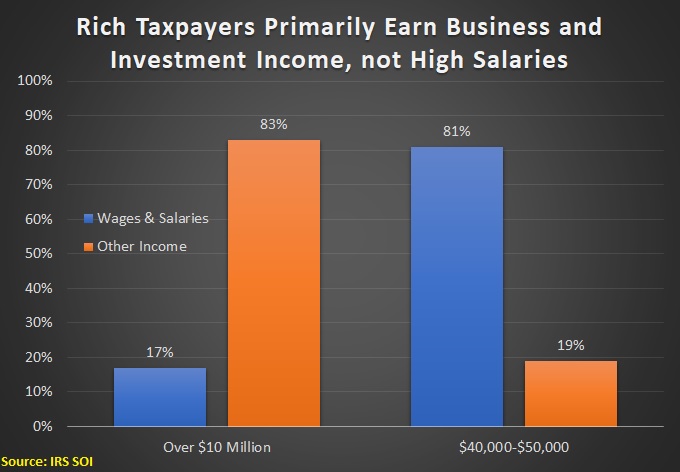
But the main goal of that column was to explain that the internal revenue code already is heavily weighted against investors, entrepreneurs, business owners and other upper-income taxpayers.
And to underscore that point, I shared two charts from Brian Riedl’s chartbook to show that the “rich” are now paying a much larger share of the tax burden – notwithstanding the Reagan tax cuts, Bush tax cuts, and Trump tax cuts – than they were 40 years ago.
Not only that, but the United States has a tax system that is more “progressive” than all other developed nations (all of whom also impose heavy tax burdens on upper-income taxpayers, but differ from the United States in that they also pillage lower-income and middle-class residents).
In other words, Biden’s class-warfare tax plan is bad policy.
Today’s column, by contrast, will point out that his tax increases are impractical. Simply stated, they won’t collect much revenue because people change their behavior when incentives to earn and report income are altered.
This is especially true when looking at upper-income taxpayers who – compared to the rest of us – have much greater ability to change the timing, level, and composition of their income.
This helps to explain why rich people paid five times as much tax to the IRS during the 1980s when Reagan slashed the top tax rate from 70 percent to 28 percent.
When writing about this topic, I normally use the Laffer Curve to help people understand why simplistic assumptions about tax policy are wrong (that you can double tax revenue by doubling tax rates, for instance). And I point out that even folks way on the left, such as Paul Krugman, agree with this common-sense view (though it’s also worth noting that some people on the right discredit the concept by making silly assertions that “all tax cuts pay for themselves”).
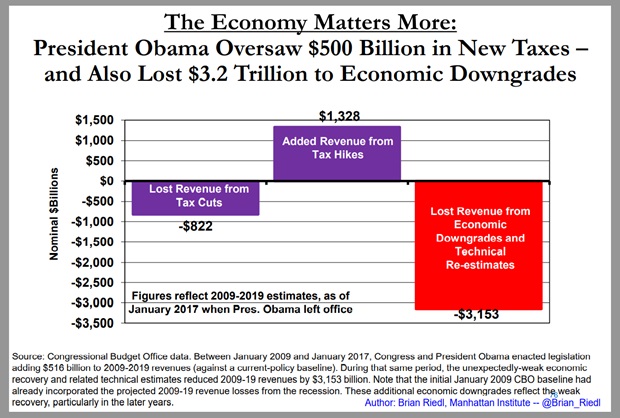
But instead of showing the curve again, I want to go back to Brian Riedl’s chartbook and review his data on of revenue changes during the eight years of the Obama Administration.
It shows that Obama technically cut taxes by $822 billion (as further explained in the postscript, most of that occurred when some of the Bush tax cuts were made permanent by the “fiscal cliff” deal in 2012) and raised taxes by $1.32 trillion (most of that occurred as a result of the Obamacare legislation).
If we do the math, that means Obama imposed a cumulative net tax increase of about $510 billion during his eight years in office
But, if you look at the red bar on the chart, you’ll see that the government didn’t wind up with more money because of what the number crunchers refer to as “economic and technical reestimates.”
Indeed, those reestimates resulted in more than $3.1 trillion of lost revenue during the Obama years.
I don’t want the politicians and bureaucrats in Washington to have more tax revenue, but I obviously don’t like it when tax revenues shrink simply because the economy is stagnant and people have less taxable income.
Yet that’s precisely what we got during the Obama years.
To be sure, it would be inaccurate to assert that revenues declined solely because of Obama’s tax increase. There were many other bad policies that also contributed to taxable income falling short of projections.
Heck, maybe there was simply some bad luck as well.
But even if we add lots of caveats, the inescapable conclusion is that it’s not a good idea to adopt policies – such as class-warfare tax rates – that discourage people from earning and reporting taxable income.
The bottom line is that we should hope Biden’s proposed tax increases die a quick death.
P.S. The “fiscal cliff” was the term used to describe the scheduled expiration of the 2001 and 2003 Bush tax cuts. According to the way budget data is measured in Washington, extending some of those provisions counted as a tax cut even though the practical impact was to protect people from a tax increase.
P.P.S. Even though Biden absurdly asserted that paying higher taxes is “patriotic,” it’s worth pointing out that he engaged in very aggressive tax avoidance to protect his family’s money.
The good news, as I wrote earlier this year, is that he probably isn’t serious about some of his worst ideas.
Biden is a statist, but not overly ideological. His support for bigger government is largely a strategy of catering to the various interest groups that dominate the Democratic Party. The good news is that he’s an incrementalist and won’t aggressively push for a horrifying FDR-style agenda if he gets to the White House.
But what if Joe Biden’s health deteriorates and Kamala Harris – sooner or later – winds up in charge?
And it doesn’t appear that being Biden’s choice for Vice President has led her to moderate her views. Consider this campaign ad, where she openly asserted that “equitable treatment means we all end up at the same place.”
The notion that we should strive for equality of outcomes rather than equality of opportunity is horrifying.
For all intents and purposes,Harris has embraced a harsh version of redistributionism where everyone above average is punished and everyone below average is rewarded.
This goes way beyond a safety net and it’s definitely a recipe for economic misery since people on both sides of the equationhave less incentive to be productive.
I’m not the only one to be taken aback by Harris’ dogmatic leftism.
Robby Soave, writing for Reason, is very critical of her radical outlook.
Harris gives voice to a leftist-progressive narrative about the importance of equity—equal outcomes—rather than mere equality before the law. …Harris contrasted equal treatment—all people getting the same thing—with equitable treatment,which means “we all end up at the same place.” …This may seem like a trivial difference, but when it comes to public policy, the difference matters. A government shouldbe obligated to treat all citizens equally, giving them the same access to civil rights and liberties like voting, marriage, religious freedom, and gun ownership. …A mandate to foster equity, though, would give the government power to violate these rights in order to achieve identical social results for all people.
And, in a column for National Review, Brad Polumbo expresses similar reservations about her views.
Whether she embraces the label “socialist” or not, Harris’s stated agenda and Senate record both reveal her to be positioned a long way to the left on matters of economic policy. From health care to the environment to housing, Harris thinks the answer to almost every problem we face is simply more government and more taxpayer money — raising taxes and further indebting future generations in the process.…Harris…supports an astounding $40 trillion in new spending over the next decade. In a sign of just how far left the Democratic Party has shifted on economics, Harris backs more than 20 times as much spending as Hillary Clinton proposed in 2016. …And this is not just a matter of spending. During her failed presidential campaign, Harris supported a federal-government takeover of health care… The senator jumped on the “Green New Deal” bandwagon as well. She co-sponsored the Green New Deal resolution in the Senate that called for a “new national, social, industrial, and economic mobilization on a scale not seen since World War II and the New Deal era.” …she supports enacting price controls on housing across the country. …The left-wing group Progressive Punch analyzed Harris’s voting record and found that she is the fourth-most liberal senator, more liberal even than Massachusetts senator Elizabeth Warren. Similarly, the nonpartisan organization GovTrack.us deemed Harris the furthest-left member of the Senate for the 2019 legislative year. (Spoiler alert: If your voting record is to the left of Bernie Sanders, you might be a socialist.)
To be fair, Harris is simply a politician, so we have no idea what she really believes. Her hard-left agenda might simply be her way of appealing to Democratic voters, much as Republicans who run for president suddenly decide they support big tax cuts and sweeping tax reform.
But whether she’s sincere or insincere, it’s troubling that she actually says it’s the role of government to make sure we all “end up at the same place.”
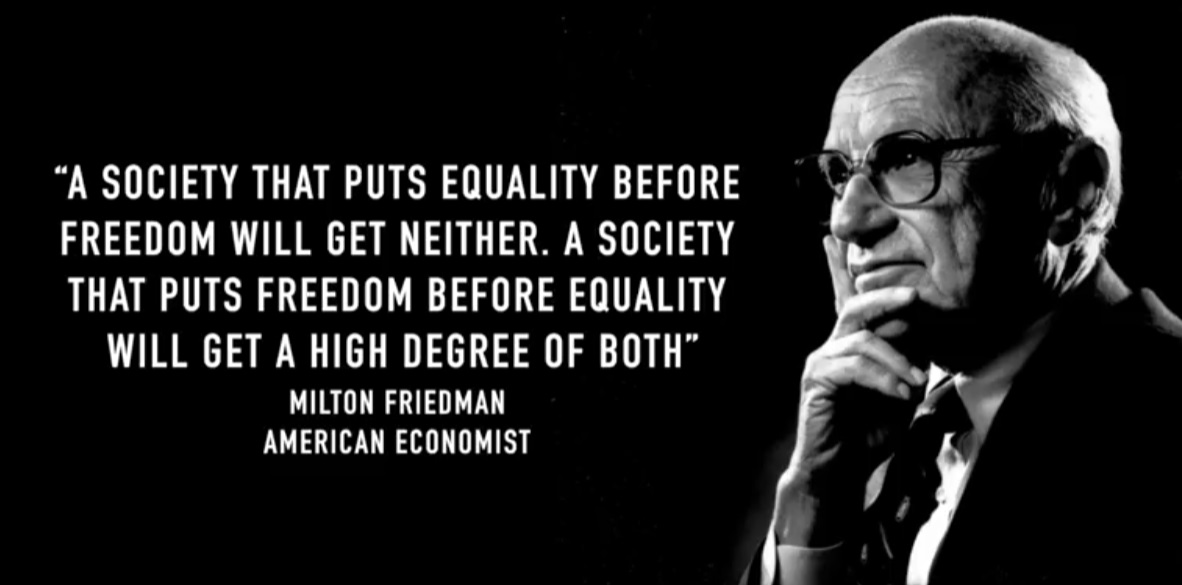
Let’s close with a video clip from Milton Friedman. At the risk of understatement, he has a different perspective than Ms. Harris.
Since we highlighted Harris’ key quote, let’s also highlight the key quote from Friedman.
Amen.
P.S. It appears Republicans will hold the Senate, which presumably (hopefully?) means that any radical proposals would be dead on arrival, regardless of whether they’re proposed by Biden or Harris.
After Barack Obama took office (and especially after he was reelected), there was a big uptick in the number of rich people who chose to emigrate from the United States.
There are many reasons wealthy people choose to move from one nation to another, but Obama’s embrace of class-warfare tax policy (including FATCA) was seen as a big factor.
Joe Biden’s tax agenda is significantly more punitive than Obama’s, so we may see something similar happen if he wins the 2020 election.
Given the economic importance of innovators, entrepreneurs, and inventors, this would be not be good news for the American economy.
The New York Timesreported late last year that the United States could be shooting itself in the foot by discouraging wealthy residents.
…a different group of Americans say they are considering leaving — people of both parties who would be hit by the wealth tax… Wealthy Americans often leave high-tax states like New York and California for lower-tax ones like Florida and Texas. But renouncing citizenship is a far more permanent, costly and complicated proposition. …“America’s the most attractive destination for capital, entrepreneurs and people wanting to get a great education,” said Reaz H. Jafri, a partner and head of the immigration practice at Withers, an international law firm. “But in today’s world, when you have other economic centers of excellence — like Singapore, Switzerland and London — people don’t view the U.S. as the only place to be.” …now, the price may be right to leave. While the cost of expatriating varies depending on a person’s assets, the wealthiest are betting that if a Democrat wins…, leaving now means a lower exit tax. …The wealthy who are considering renouncing their citizenship fear a wealth tax less than the possibility that the tax on capital gains could be raised to the ordinary income tax rate, effectively doubling what a wealthy person would pay… When Eduardo Saverin, a founder of Facebook…renounced his United States citizenship shortly before the social network went public, …several estimates said that renouncing his citizenship…saved him $700 million in taxes.
Here are some excerpts from a 2017 Bloomberg story.
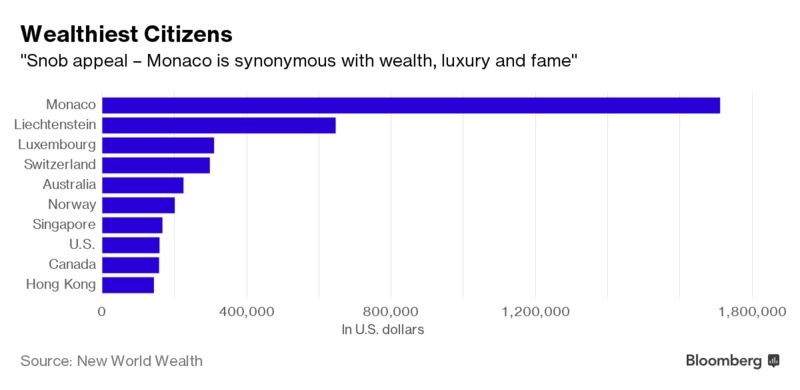
Australia is luring increasing numbers of global millionaires, helping make it one of the fastest growing wealthy nations in the world… Over the past decade, total wealth held in Australia has risen by 85 percent compared to 30 percent in the U.S. and 28 percent in the U.K… As a result, the average Australian is now significantly wealthier than the average American or Briton. …Given its relatively small population, Australia also makes an appearance on a list of average wealth per person. This one is, however, dominated by small tax havens.
Here’s one of the charts from the story.
As you can see, Australia is doing very well, though the small tax havens like Monaco are world leaders.
I’m mystified, however, that the Cayman Islands isn’t listed.
But I’m digressing.
Let’s get back to our main topic. It’s worth noting that even Greece is seeking to attract rich foreigners.
The new tax law is aimed at attracting fresh revenues into the country’s state coffers – mainly from foreigners as well as Greeks who are taxed abroad – by relocating their tax domicile to Greece, as it tries to woo “high-net-worth individuals” to the Greek tax register.The non-dom model provides for revenues obtained abroad to be taxed at a flat amount… Having these foreigners stay in Greece for at least 183 days a year, as the law requires, will also entail expenditure on accommodation and everyday costs that will be added to the Greek economy. …most eligible foreigners will be able to considerably lighten their tax burden if they relocate to Greece…nevertheless, the amount of 500,000 euros’ worth of investment in Greece required of foreigners and the annual flat tax of 100,000 euros demanded (plus 20,000 euros per family member) may keep many of them away.
The system is too restrictive, but it will make the beleaguered nation an attractive destination for some rich people. After all, they don’t even have to pay a flat tax, just a flat fee.
Italy has enjoyed some success with a similar regime to entice millionaires.
Last but not least, an article published last year has some fascinating details on the where rich people move and why they move.
The world’s wealthiest people are also the most mobile. High net worth individuals (HNWIs) – persons with wealth over US$1 million – may decide to pick up and move for a number of reasons. In some cases they are attracted by jurisdictions with more favorable tax laws… Unlike the middle class, wealthy citizens have the means to pick up and leave when things start to sideways in their home country. An uptick in HNWI migration from a country can often be a signal of negative economic or societal factors influencing a country. …Time-honored locations – such as Switzerland and the Cayman Islands – continue to attract the world’s wealthy, but no country is experiencing HNWI inflows quite like Australia. …The country has a robust economy, and is perceived as being a safe place to raise a family. Even better, Australia has no inheritance tax
Here’s a map from the article.
The good news is that the United States is attracting more millionaires than it’s losing (perhaps because of the EB-5 program).
The bad news is that this ratio could flip after the election. Indeed, it may already be happening even though recent data on expatriation paints a rosy picture.
The bottom line is that the United States should be competing to attract millionaires, not repel them. Assuming, of course, politicians care about jobs and prosperity for the rest of the population.
P.S. American politicians, copying laws normally imposed by the world’s most loathsome regimes, have imposed an “exit tax” so they can grab extra cash from rich people who choose to become citizens elsewhere.
P.P.S. I’ve argued that Australia is a good place to emigrate even for those of us who aren’t rich.
While acknowledging that Social Security and Medicare also are in desperate need of modernization, I wrote that Medicaid reformshould be the first priority.
But I’d be happy if we made progress on any type of entitlement reform, so I don’t think there are right or wrong answers to this kind of question.
We have the same type of question this week. A reader sent an email to ask “Which federal department should be abolished first?”
I guess this is what is meant when people talk about a target-rich environment. We have an abundance of candidates:
Simply stated, there is no legitimate argument for HUD. And I think there would be the least political resistance.
As with the answer to the question about entitlements, this is a judgment call. I’d be happy to be proven wrong if it meant that politicians were aggressively going after another department. Anything that reduces the burden of government spending is a step in the right direction
I identified four heroes from the “Battle of Ideas” video I shared in late August – Friedrich Hayek, Milton Friedman, Ronald Reagan, and Margaret Thatcher. Here’s one of those heroes, Milton Friedman, explaining what’s needed to control big government.
Libertarians and others are often torn about school choice. They may wish to see the government schooling monopoly weakened, but they may resist supporting choice mechanisms, like vouchers and education savings accounts, because they don’t go far enough. Indeed, most current choice programs continue to rely on taxpayer funding of education and don’t address the underlying compulsory nature of elementary and secondary schooling.
Skeptics may also have legitimate fears that taxpayer-funded education choice programs will lead to over-regulation of previously independent and parochial schooling options, making all schooling mirror compulsory mass schooling, with no substantive variation.
Friedman Challenged Compulsory Schooling Laws
Milton Friedman had these same concerns. The Nobel prize-winning economist is widely considered to be the one to popularize the idea of vouchers and school choice beginning with his 1955 paper, “The Role of Government in Education.” His vision continues to be realized through the important work of EdChoice, formerly the Friedman Foundation for Education Choice, that Friedman and his economist wife, Rose, founded in 1996.
July 31 is Milton Friedman’s birthday. He died in 2006 at the age of 94, but his ideas continue to have an impact, particularly in education policy.
Friedman saw vouchers and other choice programs as half-measures. He recognized the larger problems of taxpayer funding and compulsion, but saw vouchers as an important starting point in allowing parents to regain control of their children’s education. In their popular book, Free To Choose, first published in 1980, the Friedmans wrote:
We regard the voucher plan as a partial solution because it affects neither the financing of schooling nor the compulsory attendance laws. We favor going much farther. (p.161)
They continued:
The compulsory attendance laws are the justification for government control over the standards of private schools. But it is far from clear that there is any justification for the compulsory attendance laws themselves. (p. 162)
The Friedmans admitted that their “own views on this have changed over time,” as they realized that “compulsory attendance at schools is not necessary to achieve that minimum standard of literacy and knowledge,” and that “schooling was well-nigh universal in the United States before either compulsory attendance or government financing of schooling existed. Like most laws, compulsory attendance laws have costs as well as benefits. We no longer believe the benefits justify the costs.” (pp. 162-3)
Still, they felt that vouchers would be the essential starting point toward chipping away at monopoly mass schooling by putting parents back in charge. School choice, in other words, would be a necessary but not sufficient policy approach toward addressing the underlying issue of government control of education.
Vouchers as a First Step
In their book, the Friedmans presented the potential outcomes of their proposed voucher plan, which would give parents access to some or all of the average per-pupil expenditures of a child enrolled in public school. They believed that vouchers would help create a more competitive education market, encouraging education entrepreneurship. They felt that parents would be more empowered with greater control over their children’s education and have a stronger desire to contribute some of their own money toward education. They asserted that in many places “the public school has fostered residential stratification, by tying the kind and cost of schooling to residential location” and suggested that voucher programs would lead to increased integration and heterogeneity. (pp. 166-7)
To the critics who said, and still say, that school choice programs would destroy the public schools, the Friedmans replied that these critics fail to
explain why, if the public school system is doing such a splendid job, it needs to fear competition from nongovernmental, competitive schools or, if it isn’t, why anyone should object to its “destruction.” (p. 170)
What I appreciate most about the Friedmans discussion of vouchers and the promise of school choice is their unrelenting support of parents. They believed that parents, not government bureaucrats and intellectuals, know what is best for their children’s education and well-being and are fully capable of choosing wisely for their children—when they have the opportunity to do so.
They wrote:
Parents generally have both greater interest in their children’s schooling and more intimate knowledge of their capacities and needs than anyone else. Social reformers, and educational reformers in particular, often self-righteously take for granted that parents, especially those who are poor and have little education themselves, have little interest in their children’s education and no competence to choose for them. That is a gratuitous insult. Such parents have frequently had limited opportunity to choose. However, U.S. history has demonstrated that, given the opportunity, they have often been willing to sacrifice a great deal, and have done so wisely, for their children’s welfare. (p. 160).
Today, school voucher programs exist in 15 states plus the District of Columbia. These programs have consistently shown that when parents are given the choice to opt-out of an assigned district school, many will take advantage of the opportunity. In Washington, D.C., low-income parents who win a voucher lottery send their children to private schools.
The most recent three-year federal evaluationof voucher program participants found that while student academic achievement was comparable to achievement for non-voucher students remaining in public schools, there were statistically significant improvements in other important areas. For instance, voucher participants had lower rates of chronic absenteeism than the control groups, as well as higher student satisfaction scores. There were also tremendous cost-savings.
In Wisconsin, the Milwaukee Parental Choice Program has served over 28,000 low-income students attending 129 participating private schools.
According to Corey DeAngelis, Director of School Choice at the Reason Foundation and a prolific researcher on the topic, the recent analysis of the D.C. voucher program “reveals that private schools produce the same academic outcomes for only a third of the cost of the public schools. In other words, school choice is a great investment.”
In Wisconsin, the Milwaukee Parental Choice Program was created in 1990 and is the nation’s oldest voucher program. It currently serves over 28,000 low-income students attending 129 participating private schools. Like the D.C. voucher program, data on test scores of Milwaukee voucher students show similar results to public school students, but non-academic results are promising.
Increased Access and Decreased Crime
Recent research found voucher recipients had lower crime rates and lower incidences of unplanned pregnancies in young adulthood. On his birthday, let’s celebrate Milton Friedman’s vision of enabling parents, not government, to be in control of a child’s education.
According to Howard Fuller, an education professor at Marquette University, founder of the Black Alliance for Educational Options, and one of the developers of the Milwaukee voucher program, the key is parent empowerment—particularly for low-income minority families.
In an interview with NPR, Fuller said: “What I’m saying to you is that there are thousands of black children whose lives are much better today because of the Milwaukee parental choice program,” he says. “They were able to access better schools than they would have without a voucher.”
Putting parents back in charge of their child’s education through school choice measures was Milton Friedman’s goal. It was not his ultimate goal, as it would not fully address the funding and compulsion components of government schooling; but it was, and remains, an important first step. As the Friedmans wrote in Free To Choose:
The strong American tradition of voluntary action has provided many excellent examples that demonstrate what can be done when parents have greater choice. (p. 159).
On his birthday, let’s celebrate Milton Friedman’s vision of enabling parents, not government, to be in control of a child’s education.
Michael Harrington: If you don’t have the expertise, the knowledge technology today, you’re out of the debate. And I think that we have to democratize information and government as well as the economy and society. FRIEDMAN: I am sorry to say Michael Harrington’s solution is not a solution to it. He wants minority rule, I […]
By Everette Hatcher III | Posted in Current Events, Milton Friedman | Edit | Comments (0)
PETERSON: Well, let me ask you how you would cope with this problem, Dr. Friedman. The people decided that they wanted cool air, and there was tremendous need, and so we built a huge industry, the air conditioning industry, hundreds of thousands of jobs, tremendous earnings opportunities and nearly all of us now have air […]
By Everette Hatcher III | Posted in Current Events, Milton Friedman | Edit | Comments (0)
Part 5 Milton Friedman: I do not believe it’s proper to put the situation in terms of industrialist versus government. On the contrary, one of the reasons why I am in favor of less government is because when you have more government industrialists take it over, and the two together form a coalition against the ordinary […]
By Everette Hatcher III | Posted in Current Events, Milton Friedman | Edit | Comments (0)
The fundamental principal of the free society is voluntary cooperation. The economic market, buying and selling, is one example. But it’s only one example. Voluntary cooperation is far broader than that. To take an example that at first sight seems about as far away as you can get __ the language we speak; the words […]
By Everette Hatcher III | Posted in Current Events, Milton Friedman | Edit | Comments (0)
_________________________ Pt3 Nowadays there’s a considerable amount of traffic at this border. People cross a little more freely than they use to. Many people from Hong Kong trade in China and the market has helped bring the two countries closer together, but the barriers between them are still very real. On this side […]
By Everette Hatcher III | Posted in Current Events, Milton Friedman | Edit | Comments (0)
Aside from its harbor, the only other important resource of Hong Kong is people __ over 4_ million of them. Like America a century ago, Hong Kong in the past few decades has been a haven for people who sought the freedom to make the most of their own abilities. Many of them are […]
By Everette Hatcher III | Posted in Current Events, Milton Friedman | Edit | Comments (0)
“FREE TO CHOOSE” 1: The Power of the Market (Milton Friedman) Free to Choose ^ | 1980 | Milton Friedman Posted on Monday, July 17, 2006 4:20:46 PM by Choose Ye This Day FREE TO CHOOSE: The Power of the Market Friedman: Once all of this was a swamp, covered with forest. The Canarce Indians […]
If you would like to see the first three episodes on inflation in Milton Friedman’s film series “Free to Choose” then go to a previous post I did. Ep. 9 – How to Cure Inflation [4/7]. Milton Friedman’s Free to Choose (1980) Uploaded by investbligurucom on Jun 16, 2010 While many people have a fairly […]
Charlie Rose interview of Milton Friedman My favorite economist: Milton Friedman : A Great Champion of Liberty by V. Sundaram Milton Friedman, the Nobel Prize-winning economist who advocated an unfettered free market and had the ear of three US Presidents – Nixon, Ford and Reagan – died last Thursday (16 November, 2006 ) in San Francisco […]
By Everette Hatcher III | Posted in Milton Friedman | Edit | Comments (0)
Stearns Speaks on House Floor in Support of Balanced Budget Amendment Uploaded by RepCliffStearns on Nov 18, 2011 Speaking on House floor in support of Balanced Budget Resolution, 11/18/2011 ___________ Below are some of the main proposals of Milton Friedman. I highly respected his work. David J. Theroux said this about Milton Friedman’s view concerning […]
By Everette Hatcher III | Posted in Milton Friedman | Edit | Comments (0)
Milton Friedman: Free To Choose – The Failure Of Socialism With Ronald Reagan (Full) Published on Mar 19, 2012 by NoNationalityNeeded Milton Friedman’s writings affected me greatly when I first discovered them and I wanted to share with you. We must not head down the path of socialism like Greece has done. Abstract: Ronald Reagan […]
By Everette Hatcher III | Posted in Milton Friedman, President Obama | Edit | Comments (1)
What a great defense of Milton Friedman!!!! Defaming Milton Friedman by Johan Norberg This article appeared in Reason Online on September 26, 2008 PRINT PAGE CITE THIS Sans Serif Serif Share with your friends: ShareThis In the future, if you tell a student or a journalist that you favor free markets and limited government, there is […]
Many people look at this broken world and think we can’t make sense of it all. However, like when were doing a jigsaw, if we want to see the big picture we don’t need every piece of a puzzle. All we need is enough important parts that stand out and fit together.
My eldest daughter used to love doing jigsaws as a young girl, and one day I spoke to her about a puzzle she was working on. “Sophia, I wonder what the picture is?” She confidently responded, “Dad, it’s Cinderella!” I recognized a teachable moment and pointed out, “But you haven’t put all the pieces together.” She merely tilted her head and said, “Dad, it’s Cinderella!”
I faked a serious expression and challenged her again, this time with more emotion. “Sophia, wait, it’s not too late to change your mind. You can’t be sure because you haven’t completed the puzzle.” Sophia, who is used to her dad asking unusual questions, merely rolled her eyes the way only a daughter can. “Dad, it’s Cinderella and I’m sure because I have enough pieces in place.”
Clearly Sophia had seen the box and retained this picture in her mind. In fact, it would be easy to assume this was what she was referring to when I asked her about the big picture. But note what she said: “Dad, I have enough pieces in place.” Sophia’s attention had shifted from the box to the puzzle pieces. These were now responsible for her confidence about the big picture. My daughter had stumbled on something significant about this broken world, and I wanted to be sure she remembered it: We can know the truth—and we can know the truth without knowing everything.
I have lost count of the number of times a meaningful conversation has ground to a halt when someone shrugged his or her shoulders and said, “Well, we can’t really know because we’ll never have all the answers.” I normally agree that we’ll never find every answer to every question, but I like to get the conversation back on track. Many people look at this broken world and think we can’t make sense of it all. However, like when we’re doing a jigsaw, if we want to see the big picture we don’t need every piece of a puzzle. All we need is enough important parts that stand out and fit together.
Don’t be put off by things in life that don’t make sense or stumped by parts that don’t seem to fit. Turn your attention to what clearly stands out and start snapping things into place. While it can be frustrating to know we’ll never complete this puzzle, it’s worth the effort to try to see the big picture. When you’ve done enough to see enough, you’ll be confident you know the truth.
This is a jigsaw guide to making sense of the world, and it is a strategy that comes naturally. Transcending boundaries of age, language, intellect and culture, the jigsaw idea has connected with people around the world, and we can use it everywhere to talk about things that really matter. I’ve stood before the Scottish Parliament and used the jigsaw to make a cumulative case for the truth and reasonableness of the Christian worldview. When you hold this key to confident Christianity, you are prepared to share anywhere!
For a long time I’ve known that Christianity is more than endorsing tradition or subscribing to a religion because it offers a unique relationship with God that changes lives. I learned this firsthand as a young boy growing up in Edinburgh, Scotland. My parents, Alex and June McLellan, were unchurched and non-Christian. By the time I was three years old, my sister Paula and I joined the long list of children whose families had been fragmented by divorce. However, a few years later my parents became Christians, radically changed for the better and decided to get remarried—to each other. Witnessing this transformation got my attention and encouraged me to commit my life to Jesus Christ.
If Christianity is real, change is important, but I came to understand that change is not enough. The ultimate question is not “does it work?” but “is it true?” In my teenage years I wrestled with this question until an absence of answers made it easier to drift away from God, and this steady slide continued until difficult circumstances drew me back to faith. The sharp edges of life remind us that we cannot put off until tomorrow what we need to do today. I knew I had to decide where I stood in relation to God and his Son, Jesus Christ. I needed to switch my attention from the missing pieces of the puzzle to what I believed about the big picture. I realized my faith still stood—and stood strong—because it rang true. Therefore I was responsible to do something about it, and I wholeheartedly recommitted my life to Christ.
C.S. Lewis, one of the most influential Christian writers of the twentieth century, said, “If you examined a hundred people who had lost their faith in Christianity, I wonder how many of them would turn out to have been reasoned out of it by honest argument? Do not most people simply drift away?”1 I knew the danger of this, so I was determined to do whatever it took to strengthen my belief and add weight to the anchor in my soul: to know what I believed and the reasons I believed it. This was the first step on a lifelong journey. I knew I needed God’s help, so like the man in Mark’s Gospel I prayed, “[Lord,] I do believe; help me overcome my unbelief!” (Mk 9:24).
Today I am the founder and executive director of Reason Why International, traveling broadly to speak at churches, universities, schools, camps, conferences and a variety of outreach events and sharing the good news of Jesus Christ. What changed? My overwhelming conviction that Christianity is true! How did this happen? I was not zapped by a supernatural bolt of understanding. Rather, I learned many good reasons to believe that a biblical perspective provides the right framework for life and resonates with reality.
Be Prepared to See It
Imagine the wonder of waking up every morning knowing you have discovered the meaning of life—and that it is good news. What would you do? Who would you tell? It may sound too good to be true, but this should be the confident claim of every Christian. Followers of Jesus Christ hold a belief that is supernaturally signed and sealed, but it is also a faith anchored in the real world. Christian apologist Ravi Zacharias has defended this message in some of the most prestigious religious, academic and political settings around the world. He notes, “God has a script. He has spoken of it in His Scriptures. Finding the script moves us closer to solving the mystery.”2
Life is mysterious, but God’s natural revelation is designed to shine light on the truth and point us in the direction of his supernatural revelation (Rom 1:20; Ps 19:1). As author Paul Little has said, “God expects us to believe in him based on comprehensible evidence. He gives us intelligent and logical reasons. He is saying, ‘Look at the natural world, even the universe or your own body and you will have ample evidence for belief.’”3
G.K. Chesterton is one of my favorite authors. A prolific and engaging writer, he has been described as a man of colossal genius, and his classic work Orthodoxy powerfully captures the role of reason in his journey to Christian faith. It also discusses the limits of responsibility when it comes to sharing one’s faith with others: “It is the purpose of the writer to attempt an explanation, not of whether the Christian faith can be believed, but of how he personally has come to believe it.”4 As a Christian, I am responsible to share why I believe what I believe with those who are willing to listen. I cannot make anyone believe anything, nor should I try. Yet like Chesterton I firmly believe that ultimate answers are within the reach of everyone who is prepared to look for them with open eyes and an open mind. We will never exhaust the wonders of this world but we can still grasp—and gasp at—the significance of the big picture.
Whenever we are disillusioned by missing pieces of the puzzle or parts that don’t seem to fit, we can turn our attention to things that do snap into place. There is a basic level of revelation that allows everyone to grasp something of the wonder of this world without ever exhausting the depths of knowledge available. Chesterton demonstrates this paradox powerfully: “The good news is so simple a child can understand it at once, and so subtle that the greatest intellects never quite get to the bottom of it.”5 We will never complete the puzzle of this world, but people of all ages and stages can do enough to see the big picture, and the jigsaw puzzle provides a simple mechanism that drives home this wonderful reality.
A Strategy That Comes Naturally
Earlier I described how my daughter was able to look at the jumbled pieces of a Cinderella puzzle and snap them into place. But what if she was able to do this only because she had seen the box? Sophia may have switched her attention to the puzzle pieces, yet it’s possible she was relying on her previous exposure to the picture to guide her. In real life we don’t have this advantage; we are not granted direct access to life’s big picture— which is the reason many people are so confused. And any illustration that offers hope of making sense of the real world must take this into consideration.
Jigsaw 2.0.
Let’s consider a situation where Sophia is confronted by a puzzle and hasn’t had access to the big picture. We’ll call this illustration jigsaw 2.0. Let’s say there was a mix-up at the factory and the Cinderella puzzle pieces were placed in a box with a picture of Sleeping Beauty on it. Sophia is given the jigsaw, but she does not have the picture on the box to guide her. Even worse, she doesn’t know she’s contending with the wrong box. This would be a frustrating experience, and the disparity would encourage her to eventually forget about the box and focus entirely on the puzzle pieces. What is curious—and crucial—is we would expect her to find a way to snap important pieces into place, perhaps enough to see the big picture begin to emerge.
Still, while Sophia lacks the right picture in her hand, she still has the right picture in her mind. She’s already familiar with Cinderella. Perhaps through sheer luck she stumbles on the fact that this is what the jigsaw represents. If so, her progress from that point on will still owe everything to having the right guide, albeit one planted in her mind rather than painted on a box. If this explains the outcome, then once again the illustration loses its luster. Skeptics will contend that in real life we don’t have access to the big picture—one painted on a box or planted in our mind.
Jigsaw 3.0.
We need to anticipate this objection and undercut it by going straight to jigsaw 3.0. This time Sophia is given a blank box with a Dinderella puzzle inside. (Dinderella is my imaginary addition to the princess hall of fame; I’m willing to develop her if Disney shows an interest.) Sophia has no previous knowledge of this character. There is no concrete image to guide her—in her mind or on a box. Yet we would still expect her to find a way to fit things together. Examining the broken puzzle would take more time, but she could still snap important pieces into place. With patience and perseverance, Sophia would do enough to start to glimpse the big picture, discovering the general nature of this new character without knowing her name or what she looks like, and this suggests that something else is going on.
Sophia has a basic level of understanding about the world—prior knowledge of the way princesses (or people) are and ought to be—and this helps her recognize particular patterns that stand out and fit together. She never really starts with a clean slate or works with a blank canvas; she has a fuzzy familiarity that allows her to look at a broken puzzle and naturally put pieces together. This admission does not undermine the jigsaw approach to making sense of the world. In fact, it provides the transition we need to illustrate why it works.
Sophia can look at a broken puzzle with a sense of the way things are and ought to be, and the jigsaw analogy suggests that we look at the world the same way. We do not start out in life with a clean slate, nor do we work with a blank canvas. We have a fuzzy familiarity with the world that helps us see that it is broken, and this allows us to put important pieces back together. There may be no concrete image in our minds to guide us, but there is a degree of awareness that makes particular pieces of the puzzle stand out and get our attention. Whether it’s Cinderella, Dinderella or making sense of the world, we have a basic ability to snap a number of important things into place, and if we can do enough to see the big picture we will have good reason to believe we know the truth.5
Digging Deeper
You don’t have to dig too deep to remind people that they do know some things are and ought to be, and some things ought not to be. But reason is never enough to convince those determined to resist a particular conclusion. I once spoke at a high school conference on ethical issues and one student was eager to speak to me afterward. He rejected my defense of absolute moral values, defiantly stating, “It all depends on the situation.” I said I appreciated that there are gray areas when it comes to ethics, adding, “But surely we can know that particular acts—for example, the torture of innocent children for fun—are absolutely wrong.” He hesitated before shaking his head. “I couldn’t say it was absolutely wrong.” This kind of steely determination to turn away from an objective moral value, one that slaps us in the face, was disturbing, but he was ready to do what was necessary to keep up the pretense of his moral autonomy.
The encounter reminded me of a story told by one of my philosophy professors. J. P. Moreland is Distinguished Professor of Philosophy at Talbot School of Theology, and he once had a similar dialogue with a student who was holding tight to everyone’s right to do what they want. Eventually J. P. pretended to end the conversation and walk away, stopping only long enough to pick up the student’s music player on his way out the door. As the young man rose to his feet in protest, J. P. paused and asked why this was a problem.6 In practice we do not really support everyone’s right to do what they want, but we like to superficially suggest it whenever it’s convenient, using it as a thinly veiled warning for people to leave us alone.
Identifying examples of absolute right and absolute wrong is a powerful way to start talking about things that really matter. We can make a good case for the way the world ought to be and ought not to be. It is worth sounding a note of caution: this will take us into sensitive areas, so we need to tread carefully—but the fact is we need to tread. There is a natural order that we can recognize, standards above and beyond us that serve as an ultimate guide to putting things right. Even Greek philosopher Plato said, “In heaven … there is laid up a pattern for it, methinks, which he who desires may behold, and beholding, may set his own house in order.”7 So our goal should be to discern and learn from this heavenly sense of direction, snapping things into place on earth so we can see the big picture and start living in light of the truth.
The challenge is that every religion claims to grant such heavenly insight, and many peer groups will pull together to defend what is common sense, at least to them. They may even point to a few pieces of the puzzle that seem to go together and support their view. A small sample of life can give you a glimpse of the big picture but it can also distort it, and when someone has drifted off course we need to try to steer them back in the right direction. Raising questions and reflecting on critical issues encourages people to stand back and take stock, and we can share the reasons we believe our worldview fills in critical gaps and captures the big picture better than anything else. Our goal is to arrive at that “Eureka!” moment when someone starts to make sense of the world. But a number of obstacles stand in the way.
The First Obstacle: A Random World
If you were presented with a completely random assortment of broken puzzle pieces, there would be no point trying to fit things together. You could amuse yourself by creating pretty patterns, but there would be nothing reasonable or rational for you to discover. The first obstacle relates to the fact that some people look at the world the same way and come to the same conclusion. Influential atheist philosopher Bertrand Russell won the Nobel Prize for literature in 1950, and he famously said we are simply “the accidental outcome of a collocation of atoms.”8 If this is true, the world is only a random collection of broken parts that will not make sense in any satisfying way, and it’s not worth the effort to look for ultimate answers when the world is the result of cosmic disorder. But it’s worth considering how an accidental outcome of a collocation of atoms is able to figure out that he is an accidental outcome of a collocation of atoms. As John Gray has argued, “If Darwin’s theory of natural selection is true … the human mind serves evolutionary success, not truth,”9 and the outworking of atheism is that “humans cannot be other than irrational. Curiously, this is a conclusion that few rationalists have been ready to accept.”10 Gray has written several books on politics and philosophy, and his honesty about the logical consequences of atheism is admirable, particularly since he seems to hold an atheistic outlook on life.11One cannot help but wonder about the self-defeating nature of Russell’s statement. Chesterton remarked on this kind of curiosity (with a smile, I am sure): “Descartes said, ‘I think; therefore I am!’ The philosophic evolutionist reverses and negates this epigram. He says, ‘I am not; therefore I cannot think.’”12 However, let us be gracious and give Russell (and Gray?) the benefit of the doubt, thinking for a moment about this natural perspective, since it drives the anchor of the first obstacle deep into the ground.
Seeing the world without God’s glasses means seeing reality as a random array of broken bits and pieces and, as a consequence, our lives as insignificant pieces of a meaningless puzzle. This worldview has special prominence in our culture. Indeed, it shapes many people’s outlook on life, and if it’s true, we are simply the byproduct of a cosmic accident. I enjoy standing up in schools and being open and honest about what this means for young people today: You are a grown-up germ! What surprises me is that a secular education that preaches this with such passion wrinkles its collective forehead when students take it to heart and start acting like it. We rebuke rowdy students for behaving like animals—after indoctrinating them with the belief that they are animals. What should we expect from an evolved bacterium that has learned to survive by selfishly promoting its own ends and eradicating everything that stands in its way?
Despite this embarrassing ancestry, atheists still like to inject meaning into a meaningless existence, as the Philosopher’s Magazine cofounder Julian Baggini demonstrates: “What most atheists do believe is that although there is only one kind of stuff in the universe and it is physical, out of this stuff comes minds, beauty, emotions, moral values—in short the full gamut of phenomena that gives richness to human life.”13 A natural ability to recognize this world of wonders comes as no surprise to those who hold a Christian worldview, but the real issue is that a godless perspective has no philosophical justification for it. In other words, Baggini et al. are writing existential checks their worldview cannot cash.
I am thrilled when people have an opportunity to hear what atheism has to say, particularly when Christians can stand on the same platform and point out the logical consequences of this worldview. Atheism results in a world where there is no basis for rationality, human beings have no intrinsic value, life has no absolute meaning, and there is no hope for the future—all beliefs that strike us as deeply problematic. It is not just that these conclusions are uncomfortable; they completely contradict our experience and fall short of our expectations.
The idea that the world is meaningless does not sit comfortably with us, and this should raise a red flag. To suggest that we are simply an insignificant part of a meaningless picture troubles us and reveals something very important. We do not live like this is true, we do not want to live like this is true, and we are unable to live like this is true. So it is worth considering why we should believe this is true when we seem to be wired for so much more. Turn your attention for a moment to the Christian worldview and you discover there is a basis for rationality, every person has absolute value, life has real meaning, and there is hope for the future. When you discover that a number of important arrows are pointing in one direction, it makes sense to pay attention. Atheism, on the other hand, seems to be pointing us in the wrong direction. We need to engage those whose minds have been subtly saturated by this way of thinking to share the reasons it does not fit and is not true. Christians are called to invest their hearts, minds and souls in meeting this challenge, and when we share the good news it is tremendously exciting to see eternal hope rise from the ashes of ultimate despair.
G.K. Chesterton and C.S. Lewis unmask the insufficiency of a godless worldview grounded in meaninglessness, pointing out, “Christian optimism is based on the fact that we do not fit this world,”14 and “If I find in myself a desire which no experience in this world can satisfy, the most probable explanation is that I was made for another world.”15 We are born with the expectation that the world ought to make sense, life really means something, and we live in hope of finding ultimate answers. Naturalism, curiously enough, does not come naturally, and despite the pressure of a secular society that indirectly promotes these “values,” our internal compass stubbornly steers us in another direction. This overcomes the suggestion that there is no point in trying to make sense of the world—there is—or that we have no hope of finding ultimate answers—we do. So we are ready to move on and consider the next obstacle to a jigsaw guide to making sense of the world: what about the picture on the box?
The Second Obstacle: A World Without A Box
There are generally two ways to tackle a jigsaw puzzle: top-down and bottom-up. The top-down method is when you start with a big picture and search for puzzle pieces that correspond to it. The bottom-up approach is when you immediately start trying to snap the puzzle pieces into place. Typically you employ both methods at the same time, but when it comes to solving the puzzle of the world we will consider each in turn. The top-down approach overcomes the second obstacle (a world without a box), and we will return to the bottom-up approach when we focus on the third obstacle (a world of broken pieces).
The beauty of the top-down approach is that it addresses the concerns of someone who looks at life and wonders how to find the right guide to making sense of the world. Many people assume we live in a world without the box, yet many others are looking for the right box to fit this world. Look around and you see that there is no lack of ultimate guides on offer, but how do you know which one is the right one—if any of them are? The best way to begin is to choose one and put it to the test. Every worldview claims to paint the big picture, representing the right way to see the real world; therefore it should connect with life’s broken pieces. The more it corresponds to critical things that stand out in this world, the more we will be inclined to believe it is accurate—and truly reflects the big picture. So when you hear someone say we cannot make sense of the world because we cannot be sure we have the right guide, ask them: why not try one to see how it measures up?
All individuals have a worldview, whether or not they realize it, and it’s possible to put your worldview to the test to see what it’s made of. No one can boast of twenty-twenty vision when it comes to making sense of the world, but we can discover the extent of our shortsightedness. Francis Schaeffer was a Christian author and speaker who was responsible for starting L’Abri Fellowship, a community that has grown into an international network of study centers for those seeking answers to life’s ultimate questions. He noted, “People’s presuppositions lay a grid for all they bring forth into the external world. Their presuppositions also provide a basis for their values and therefore the basis for their decisions. ‘As a man thinketh, so is he.’”16Internal forces are at work that taint the way we see things, so we do not approach the world directly as a blank slate, or tabula rasa,17 but neither do we have the power to “create a world or environment from scratch and then live in it,” says R. C. Sproul. “Rather we step into a world and culture that already exists, and we learn to interact with it.”18There is an objective world out there, existing in spite of us and independent from us. And while some things are out of focus and out of reach, there are times when we can directly engage with the world and see it as it is.
We all have a worldview, but this does not mean we are locked in to a particular perspective. Any disconnect between what we expect and what we experience will raise the question: does my worldview really measure up? Earlier I pointed out the hollow outcome of viewing the human race as a byproduct of a chemical collision, and some people even suggest that it more closely resembles a virus. “The human species is now so numerous as to constitute a serious planetary malady … a plague of people.”19 If this big picture is true, our lives do not add up to much. Those who hold to naturalism do not shout this from the rooftops but it is the logical outworking of their worldview. It presents the picture on the box and suggests that it is up to us (or others) whether to assign value to human existence. We should be thankful that most atheists who hold this view do not practice what they preach.
Those with the power to promote this kind of godless ideology have demonstrated how damaging it can be. The pages of human history were deeply stained when Hitler attached his political ambition to a philosophy inspired by the writings of atheist philosopher Friedrich Nietzsche. Nietzsche preached Darwin’s survival of the fittest, arguing that our creed should be to ensure the evolution of human beings and the realization of their full potential through the “will to power.”20 Hitler embraced this ideology and put it into practice, combining it with his Darwinian ideals focused on survival of the strong.21 When people talk about survival of the fittest, they tend to forget the other side of the coin: eradication of the weak.22 Hitler did not, and six million people lost their lives when they were deemed worse than worthless and weeded out of the human gene pool.
Many of Darwin’s defenders argue that any social application of his theories is a misapplication, but on what basis? How can you defend the red tooth and claw of the animal kingdom and then suggest that it does not apply to us? Peter Singer is an ethicist from Princeton University who would argue that this is simply speciesism: “a prejudice or attitude of bias toward the interests of members of one’s own species and against those of members of another species.”23Naturalism is a worldview that runs into trouble when we try to use it consistently as a guide to life, and our persistent belief in human life as absolutely valuable is a serious stumbling block to its success. It presents the kind of big picture that does not make sense of the world, others or ourselves, and this is a good reason to reject it and look for another to take its place.
The Christian worldview presents a radically different top-down approach. Rather than undermine the belief that human life is absolutely valuable, the biblical perspective promotes it and provides a reasonable basis for it. Every human being is made by God, for God and in the image of God. This means every person is stamped with absolute value, and it is not up to us to assign value to human beings or take it away. This cornerstone of Christian belief has motivated acts of kindness and sacrifice throughout history. Jesus himself set the ultimate standard of altruism by giving everything—literally—for everyone else. This is the kind of behavior that is generally lauded and applauded, deemed to be a good thing, even described as something we ought to do—but why? A popular cosmetics company coined a phrase that inadvertently answers this question and captures the ethos of the Christian worldview: “Because you’re worth it!”
The value of human life, in real terms, is one of the most fundamental issues we can address, and to dismiss the fact that Christianity explains it and sustains it is like cutting off your nose to spite your face. We cannot deny that there are difficult pieces of the puzzle, whatever our worldview, but the jigsaw encourages us to build on the things that do make sense and do the best we can fitting the other pieces together. If we have enough pieces in place, we can be confident we know the truth.
The Third Obstacle: A World of Broken Pieces
We now turn our attention to the third obstacle, switching to a bottom-up approach to making sense of the world. Instead of starting with the picture on the box that represents a particular worldview, we focus directly on the broken pieces of life to see whether anything stands out and gets our attention.
Just as you can look at an ordinary puzzle and pick out corners, straight edges, and colorful details, so we can naturally identify things in the real world that help us understand more about life and see it in its true context. This chapter has already considered the belief that human beings are absolutely valuable, working from the top down, and we seem to know this is true from the bottom up, without referring to a big picture. There is something special about a person that sets him or her apart from other physical things, and our natural ability to recognize this helps us build a worldview that resembles reality.
Another important piece of the puzzle that stands out and shapes our understanding relates to the world and where it came from. Consider the origin of the universe. There is good reason to believe the universe started to exist, and if it did, then the universe must have a cause.24 The universe could not have brought itself into existence, since it was not around at the time, so we need to posit the existence of something outside the universe, to be responsible. While this sounds reasonable, it is often viewed as fighting talk among those who have closed their minds to such a possibility.
When you hear the statement “the universe came into existence from nothing,” you cannot assume that truly means nothing. I encountered serious equivocation on this issue in a debate at the National Law Library of Scotland. Pointing out the problem with a universe that came into existence from nothing without a cause, one of my opponents, a physics teacher, accused me of ignorance: “You don’t understand what nothing is. If you know a bit of physics, nothing is not nothing, it’s things emerging in and out of existence.”25 I could counter that absence of evidence is not the same as evidence of absence. The belief that things can “emerge in and out of existence” moves beyond the test tube, since we have no physical apparatus to confirm something is out of existence, and if you mean what you say it is always better to say what you mean.
Yet many people, some physicists included, will do anything to resist the conclusion that something exists outside the physical universe. Equivocation is employed to balance the scientific evidence that suggests the universe started from nothing with a philosophical presupposition that nothing can exist outside the physical universe—to start it. In other words, you can talk about a big bang while refusing to concede there had to be a big banger. The statement “the universe started from nothing” must be subtly manipulated in light of the profound consequences. Otherwise you are effectively admitting something (or someone) incredibly powerful (and personal) was responsible. As Stephen Hawking, one of the world’s giants of science, has admitted, “Many people do not like the idea that time has a beginning, probably because it smacks of divine intervention.”26
Working from the bottom up, we know that human life is absolutely valuable, a universe that began to exist must have a cause, and particular human actions and attitudes seem to be right, that is, consider the belief that we ought to have a basic level of respect for other people. This moral value has not always been promoted, but wherever it has gone wrong it has resulted in serious damage until powerful forces emerged to try to put it right. It seems to be the way things ought to be. Philosophers may debate the merits of objective morality, but I take comfort from the fact that those who deny it continue to demonstrate it. Michel Foucault was a twentieth-century French philosopher, one of the leading lights in a movement to break free from absolute moral values, yet he could not restrain himself in reacting to the immorality of France’s war in Algeria.27 This brought him into conflict with others who shared his worldview, as they knew he was undermining his own position by indirectly suggesting we can make sense of the world and recognize the way things ought to be.
As you start putting the pieces together to make sense of this broken world, the first thing to do is always the thing to do first: start with what you do know. I was granted the opportunity to do this at the Scottish Parliament, and my confidence was not based on the belief that I know it all (I do not know it all, and I know that I don’t). I was prepared to share because I knew I could put the pieces together and make a cumulative case for the truth and reasonableness of the Christian worldview. There remain many, many things that I do not know, but what I do know clearly stands out.
Consider the universe—where did it come from? I believe in God because something from someone is more probable than something from nothing.
Consider Jesus of Nazareth—a man who lived in a remote place with little money, no political power and no military might. He never wrote a book, taught for only three years and yet turned the history of the world upside-down. I believe that the life, teaching and impact of Jesus Christ confirms he is the Son of God. Consider our experience—a desire for significance in a universe where we are less than a speck, a desire for relationship in a world that is socially broken and fragmented, and a desire for permanence in a life that is fleeting. I believe the Bible makes sense when it says we were made by God (significance), we were created to know God (relationship) and God wants us to spend eternity with him (permanence). As G. K. Chesterton said, the fact that we do not fit this world is the best evidence that we were made for another world, and Christianity offers the reason why.
It’s fascinating that in such a diverse and complex world we share an amazing level of agreement about the way the world is and ought to be. Not that we agree on everything or automatically rubber-stamp whatever appears to be the consensus. Consensus (or what we believe the consensus to be) can often take us in the wrong direction. However, particular beliefs persist and seem to have a transcendent quality; they deserve our special attention. For example, those who experience the bitter taste of injustice feel a searing pain that suggests something significant: the reversal of a universal standard. As Chesterton observed, “Reason and justice grip the remotest and the loneliest star…. On plains of opal, under cliffs cut out of pearl, you would still find a notice-board, ‘Thou shall not steal!’”28 C. S. Lewis extended this thought when he remarked, “Think of a country where people were admired for running away in battle, or where a man felt proud of double-crossing all the people who had been kindest to him. You might just as well try to imagine a country where two and two made five.”29 In cases where such “universal” standards break down, we generally believe these countercultures to be the result of a broken understanding, and this is reinforced when those who hold such views are willing to reject them in favor of embracing another way of looking at the world.30
The Fourth Obstacle: A World Out of Reach
We can empathize with those who think making sense of the world is a pointless exercise. The scale of the problem can be overwhelming, and that’s why some people choose to stand back and hold their head in their hands. When we don’t know what to do, sometimes it’s easier to do nothing. However, a jigsaw guide helps us overcome the fourth obstacle, grasping a world that seems out of reach. The answer? Think big by starting small. Do not be daunted; just look for the next piece of the puzzle. Take hold of what stands out in this world and then consider what comes next.
There’s a good illustration of this in the movie What About Bob? The main character, played by Bill Murray, suffers from numerous phobias and visits a respected psychiatrist who helps him move toward recovery by introducing him to his latest book, Baby Steps. Suddenly all of Bob’s greatest fears are reduced to bite-sized chunks, small enough to swallow, and he’s able to move forward and overcome them (here’s the comic twist) by breaking everything down into baby steps. When Bob leaves the psychiatrist’s office he doesn’t know how he’ll get home, but he’s willing to put one foot in front of the other, which is enough to get him where he needs to go. If we are going to make sense of the world we need to take it one step at a time. Think big by starting small, and put the pieces in place one at a time.
What does this look like? Take one important piece we’ve already identified: a universe that started to exist needs a cause. This raises the next question, or presents the next piece of the puzzle: what kind of cause? The universe that exists is incredibly ordered and complex, which makes it hard to believe that it’s the result of unguided forces.31 While it is possible that such a finely tuned universe is the accidental outcome of a cosmic explosion, science—as well as our own experience—tells us that order does not tend to come from disorder.32 Therefore, it is more reasonable to believe that some kind of intelligence is responsible, so we can fit these two things together and get a better idea about the big picture: our universe was created by an intelligence that is out of this world.
I remember meeting a medical doctor who surprised me when he said, “Hemoglobin encouraged me to believe in God.” The function of this protein in our blood shouted purpose and design, loud enough to get his attention. Even among those who eventually go a different direction, many are willing to admit that the evidence initially supports this conclusion.33 Much in this world strongly suggests that an intelligent agent is necessary to make sense of it all, and with every piece that fits together there is more reason to believe it is true.
It is exciting when you use a jigsaw guide to making sense of the world and start to see things taking shape, and I enjoy turning to popular atheist Richard Dawkins to reinforce the way things seem to fit together. A scientist with a gift for communicating with the general public, Dawkins seems to have taken on responsibility for shooting down the reasonable foundation for all religious belief. Yet even in his book The God Delusionhe cannot deny the remarkable truth that the planet earth resides in “the Goldilocks zone.” In the story of Goldilocks and the three bears, the little girl wanders into the forest and ends up in the home of three bears. She decides to sample the three bowls of porridge on the table. The first bowl is too hot, the second too cold, so she turns to the last bowl and exclaims it is just right! This picture of perfection has been used to describe the earth’s position in relation to the sun, since “it is not too hot and not too cold, but just right.”34 Hence the Goldilocks zone. The science behind this is incredibly complex, and while Dawkins and others try to put it down to unbelievable good fortune on our part,35 the probability of this naturally occurring—as the product of unguided forces—is off the chart. 36
For a scientist who should always make an inference to the best explanation, Dawkins seems determined to believe in anything but God. But for those who are more open-minded there should be a growing sense that something else is going on: someone or something out there must be responsible for it all. The Goldilocks zone is a great piece of this broken world that stands out and gets our attention.
This kind of revelation stirs a sense of excitement in my soul. People are not condemned to look at the stars and wonder, “Is anybody out there?” We can make sense of the world and begin to see things clearly. There are good reasons to believe that life and intelligence out there are responsible for what we see down here. Do not look at the world and be overwhelmed by the scale of the problem. Take baby steps toward finding the solution. Think big by starting small.
Other Barriers
Christianity is entirely reasonable and we need to share good reasons to believe it, but making the intellectual case clears away only one level of obstacles. There are still reasons to reject the big picture, and among the most powerful are moral, emotional and spiritual reasons.
Moral resistance: Multiple barriers stand in the way of someone hearing, understanding and embracing the Christian worldview. So when it comes to knowing how much is enough to see the big picture, Christians are responsible only to prayerfully and practically do their best and trust God to take care of the rest. We need to live as a good example of the truth, speak in a way that makes people think about the truth, and allow God to deal with the heart of the matter—the matter of the heart. 37
Jesus understood this better than anyone, and he exposed the underlying obstacles in his conversation with a rich young ruler (Mt 19:16-22). This man appeared to be ready to follow Jesus, having overcome the intellectual obstacles and realizing he spoke the truth; however, his instructions to “go sell your possessions and give to the poor” identified the greater issue and the real stumbling block. Instead of doing what Jesus asked, the man turned and walked away. You do not have to be rich to count the cost of following Christ because we all understand the aversion to giving up what we cling to in life. God requires us to let go and let him take control, while we are determined to hang on to our life with white knuckles. Moral obstacles are often what really stand in the way of people embracing the truth of the Christian worldview, and when this is the case no reason to believe will ever be good enough.
Hitting back in hurt: Emotions are another powerful force at work in our lives, and when we have been deeply wounded in some way it is not unusual to take this out on God. I have read the arguments of some of Christianity’s fiercest critics, and what they lack in substance they generally make up for with rage or sarcasm. A degree of knowledge about God can encourage this response, because God has revealed that he chooses to make himself vulnerable to our actions and attitudes; people can cause God pain (Gen 6:6; Eph 4:30). Among those who resist him the most are those trying to hurt him the best. C. S. Lewis was reflecting on his own experience when he said, “All that stuff about the cosmic sadist was not so much the expression of thought as of hatred. I was getting from it the only pleasure a man in anguish can get; the pleasure of hitting back.”38
Other people may be less vindictive but equally scarred by life’s circumstances. They would rather resist God if it means they can hold on to their pain or anger. Christianity offers forgiveness from God, but it also demands that we be willing to forgive others (and ourselves). When the greater attraction is holding a grudge against those responsible for our deepest hurts, emotional barriers will stand between us and doing what it takes to embrace the Christian worldview.
Spiritual blindness: Another obstacle that leads to resistance, perhaps starting out as a moral or emotional barrier, is spiritual blindness. The Bible says everyone has a natural inclination to resist God’s truth and revelation in the world (Jn 3:19-20), so you could say we are all spiritually shortsighted. No one can see the truth until God supernaturally makes the truth known. However, some people persist in denying God’s revelation (and prompting) for so long that their hearts become hardened (Ps 95:8; Heb 3:8). This is not irrevocable, since God will open eyes and reveal the truth to all those who genuinely seek it (Jer 29:12-13), but when spiritual blindness stands in the way there is nothing more you can do or say but pray.
When I was a student at seminary I found a part-time job gardening for a retired couple, and while the lady was very warm and friendly to me her husband had a strong revulsion toward Christianity. It was intense in a way I had never witnessed before. I could not even raise the subject of my studies without him hardening his expression and turning away, as if something seized him from within. There was no willingness to discuss anything related to the Christian worldview, and he made me think of a seafarer determined to remain onboard as captain of his ship even when that ship was sinking. The tragedy was that this man wasn’t in good health, and in real terms his ship was sinking, but he seemed determined to grit his teeth and resist anything I could do or say.
While I look back on this I regret never breaking through this barrier to talk about things that really matter, but I take heart from the fact that no one is out of reach of the truth. In fact, the apostle Paul, one of the greatest ambassadors of the Christian message, started out as one of its fiercest opponents. A violent persecutor of Christians, he was determined to eradicate Christian faith from the world, and there is no natural explanation for why his life completely turned around. That is why Paul’s conversion has been long regarded as a substantial evidence for the truth of.39 I can only hope that the power of God was at work in this man’s life too, able to turn things around in time.
The best worldview is always the one that resonates with reality. While some people automatically rule out anything supernatural, there is no valid reason to do so—without demonstrating an antisupernatural bias. We should be open to natural and supernatural explanations as we try to make sense of the world, and the Christian worldview draws from both realms to put the pieces together. Seeing the big picture is never enough for someone to embrace Christianity and follow Jesus Christ; however, demonstrating that it is the best way to make sense of the world will do three important things: those who grasp it will have reason to hold on to it, those who seek truth will have reason to consider it, and those who reject it will have reason to regret it (and hopefully take time to reconsider).
Putting the Pieces Together
G. K. Chesterton became convinced that Christianity was true and reflective of the real world based on “an enormous accumulation of small but unanimous facts.”40 Certainly Chesterton’s faith was built on more than his intellect, but this reasonable foundation gave him tremendous confidence in the truth of the gospel and enabled him to successfully share his faith with others. Chesterton effectively used a jigsaw guide to making sense of the world to anchor his belief and undercut popular arguments that life’s big questions were too hard or too heavy. On the contrary, ultimate answers are available, and while people have different levels of access to the world there is sufficient evidence—within the world and within us—to point us in the right direction (see Rom 1:20). Identify things that stand out in the world, start putting the pieces together, and when you have enough pieces of the puzzle in place you can be confident that you see the big picture.
A jigsaw guide to making sense of the world will not answer every question, but it will help you start putting the pieces together so you can make sense of this broken world and see the big picture. Listen before you leap into a conversation that counts, learn to talk about things that really matter and be prepared to share the reason why the Christian worldview resonates with reality.
____________________
Alex McLellan is founder and executive director of Reason Why International and serves as an associate with RZIM Europe.
4 G.K. Chesterton, Orthodoxy(Colorado Springs, CO: Shaw Books, 2001), xxiii.
5 A jigsaw guide to making sense of the world could be described as “exploratory particularism.” See Philosophical Foundations for a Christian Worldview, ed., J. P. Moreland & William Lane Craig (Downers Grove, Ill.: InterVarsity Press, 2003), 99-102.
7 Plato, “Knowledge and Virtue” in Great Traditions in Ethics, ed. Theodore Denise, Sheldon Peterfreund and Nicholas White (Belmont, CA: Wadsworth Publishing Company, 1999), 21.
8 Bertrand Russell, “A Free Man’s Worship,” in Why I Am Not A Christian, ed. Paul Edwards (New York: Simon & Schuster, 1957), 107.
17 John Locke, the seventeenth -century British philosopher, coined this term to describe the belief that the mind at birth is a blank tablet and the only input is ideas of sensation and reflection. See Nicholas P. Wolterstorff, “The Essay” in Cambridge Dictionary of Philosophy, ed. Robert Audi, 2nd ed. (New York: Cambridge University Press, 1999), 506.
21 “The Fuhrer exhorted them to have no mercy. ‘Might is right.’” See John Toland, Adolf Hitler(New York: First Anchor Books Edition, 1992), 544.
22 “Over and over he preached his pseudo-Darwinist sermon of nature’s way: conquest of the weak by the strong.” Ibid., 226.
23 Peter Singer, “All Animals Are Equal,” Morality and Moral Controversies, ed. John Arthur, 5th ed., (Upper Saddle River, NJ: Prentice Hall 1981), 134.
24 This presents one form of the cosmological argument for the existence of God.
25 One of my opponents, a physics teacher, made this statement during a debate at the National Law Library in Edinburgh, Scotland, October 2009.
30 See Don Richardson, Peace Child(Ventura, CA: Regal Books, 2005) and Lords of the Earth(Ventura, CA: Regal Books, 2008) as good examples of those standards that generally reflect a broken society in need of repair.
31 “The theistic conclusion is not logically coercive, but it can claim serious consideration as an intellectually satisfying understanding of what would otherwise be unintelligible good fortune.” John Polkinghorne, Belief in God in an Age of Science(New Haven, CT: Yale University Press 1998), 10.
32 The second law of thermodynamics, or the law of entropy, confirms that order tends towards disorder.
33 “The process that Darwin discovered … does all the work of explaining the means/ends economy of biological nature that shouts out ‘purpose’ or ‘design’ at us.” See “The Disenchanted Naturalist’s Guide to Reality,” On the Human: A project of the National Humanities Center, www.onthehuman.org/2009/11/the-disenchanted-naturalists-guide-to-reality.
34 Richard Dawkins, The God Delusion(London: Bantam Press, 2006), 135.
Doreen Garner was born in 1986 in Philadelphia, Pennsylvania. She lives and works in Brooklyn, New York. Since graduating from Rhode Island School of Design with an MFA in glass in 2014, Garner has created corporeal sculptures—that utilize glass alongside silicone, beads, crystals, rubber, synthetic hair, petroleum jelly, and other materials—to explore the frequently suppressed and traumatic medical histories of the Black body. Her sculptures are often incorporated in her performances and video works, examining the links between clinical and medical repulsions alongside sensual and sexual fascinations. Assertively reclaiming power, Garner’s work confronts viewers, challenging them to consider their complacency in systems of objectification, racism, false narratives, and historical omissions while commemorating those who have been subjected to enslavement, medical torture, and racial oppression. Garner has held residencies and fellowships at Recess Art, the International Studio and Curatorial Program, Socrates Sculpture Park, Pioneer Works, and Skowhegan School of Painting and Sculpture. She is also a licensed tattoo artist, a practice that extends her acknowledgment of the simultaneous resilience and silencing of African Americans throughout history.
I have gone back and forth and back and forth with many liberals on the Arkansas Times Blog on many issues such as abortion, human rights, welfare, poverty, gun control and issues dealing with popular culture. Here is another exchange I had with them a while back. My username at the Ark Times Blog is Saline […]By Everette Hatcher III | Posted in Biblical Archaeology, Francis Schaeffer, Prolife | Edit | Comments (0)
I have posted many of the sermons by John MacArthur. He is a great bible teacher and this sermon below is another great message. His series on the Book of Proverbs was outstanding too. I also have posted several of the visits MacArthur made to Larry King’s Show. One of two most popular posts I […]By Everette Hatcher III | Posted in Adrian Rogers, Current Events | Edit | Comments (0)
I have posted many of the sermons by John MacArthur. He is a great bible teacher and this sermon below is another great message. His series on the Book of Proverbs was outstanding too. I also have posted several of the visits MacArthur made to Larry King’s Show. One of two most popular posts I […]By Everette Hatcher III | Posted in Adrian Rogers, Current Events | Tagged Bible Prophecy, john macarthur | Edit | Comments (0)
Prophecy–The Biblical Prophesy About Tyre.mp4 Uploaded by TruthIsLife7 on Dec 5, 2010 A short summary of the prophecy about Tyre and it’s precise fulfillment. Go to this link and watch the whole series for the amazing fulfillment from secular sources. http://www.youtube.com/watch?v=qvt4mDZUefo ________________ John MacArthur on the amazing fulfilled prophecy on Tyre and how it was fulfilled […]By Everette Hatcher III | Posted in Biblical Archaeology | Edit | Comments (1)
John MacArthur on the Bible and Science (Part 2) I have posted many of the sermons by John MacArthur. He is a great bible teacher and this sermon below is another great message. His series on the Book of Proverbs was outstanding too. I also have posted several of the visits MacArthur made to Larry […]By Everette Hatcher III | Posted in Current Events | Edit | Comments (0)
John MacArthur on the Bible and Science (Part 1) I have posted many of the sermons by John MacArthur. He is a great bible teacher and this sermon below is another great message. His series on the Book of Proverbs was outstanding too. I also have posted several of the visits MacArthur made to Larry […]By Everette Hatcher III | Posted in Current Events | Edit | Comments (0)
Adrian Rogers – How you can be certain the Bible is the word of God Great article by Adrian Rogers. What evidence is there that the Bible is in fact God’s Word? I want to give you five reasons to affirm the Bible is the Word of God. First, I believe the Bible is the […]By Everette Hatcher III | Posted in Adrian Rogers, Biblical Archaeology | Edit | Comments (0)
Is there any evidence the Bible is true? Articles By PleaseConvinceMe Apologetics Radio The Old Testament is Filled with Fulfilled Prophecy Jim Wallace A Simple Litmus Test There are many ways to verify the reliability of scripture from both internal evidences of transmission and agreement, to external confirmation through archeology and science. But perhaps the […]By Everette Hatcher III | Posted in Biblical Archaeology, Current Events | Edit | Comments (0)
I have gone back and forth and back and forth with many liberals on the Arkansas Times Blog on many issues such as abortion, human rights, welfare, poverty, gun control and issues dealing with popular culture. Here is another exchange I had with them a while back. My username at the Ark Times Blog is […]By Everette Hatcher III | Posted in Francis Schaeffer, Prolife | Edit | Comments (0)
Here is some very convincing evidence that points to the view that the Bible is historically accurate. Archaeological and External Evidence for the Bible Archeology consistently confirms the Bible! Archaeology and the Old Testament Ebla tablets—discovered in 1970s in Northern Syria. Documents written on clay tablets from around 2300 B.C. demonstrate that personal and place […]By Everette Hatcher III | Posted in Biblical Archaeology | Edit | Comments (0)
The John Lennon and the Beatles really were on a long search for meaning and fulfillment in their lives just like King Solomon did in the Book of Ecclesiastes. Solomon looked into learning (1:12-18, 2:12-17), laughter, ladies, luxuries, and liquor (2:1-2, 8, 10, 11), and labor (2:4-6, 18-20). He fount that without God in the picture all […]
______________ George Harrison Swears & Insults Paul and Yoko Lucy in the Sky with Diamonds- The Beatles The Beatles: I have dedicated several posts to this series on the Beatles and I don’t know when this series will end because Francis Schaeffer spent a lot of time listening to the Beatles and talking […]
The Beatles in a press conference after their Return from the USA Uploaded on Nov 29, 2010 The Beatles in a press conference after their Return from the USA. The Beatles: I have dedicated several posts to this series on the Beatles and I don’t know when this series will end because Francis […]
__________________ Beatles 1966 Last interview I have dedicated several posts to this series on the Beatles and I don’t know when this series will end because Francis Schaeffer spent a lot of time listening to the Beatles and talking and writing about them and their impact on the culture of the 1960’s. In this […]
_______________ The Beatles documentary || A Long and Winding Road || Episode 5 (This video discusses Stg. Pepper’s creation I have dedicated several posts to this series on the Beatles and I don’t know when this series will end because Francis Schaeffer spent a lot of time listening to the Beatles and talking and writing about […]
_______________ Francis Schaeffer pictured below: _____________________ I have included the 27 minute episode THE AGE OF NONREASON by Francis Schaeffer. In that video Schaeffer noted, ” Sergeant Pepper’s Lonely Hearts Club Band…for a time it became the rallying cry for young people throughout the world. It expressed the essence of their lives, thoughts and their feelings.” How Should […]
Crimes and Misdemeanors: A Discussion: Part 1 ___________________________________ Today I will answer the simple question: IS IT POSSIBLE TO BE AN OPTIMISTIC SECULAR HUMANIST THAT DOES NOT BELIEVE IN GOD OR AN AFTERLIFE? This question has been around for a long time and you can go back to the 19th century and read this same […]
____________________________________ Francis Schaeffer pictured below: __________ Francis Schaeffer has written extensively on art and culture spanning the last 2000years and here are some posts I have done on this subject before : Francis Schaeffer’s “How should we then live?” Video and outline of episode 10 “Final Choices” , episode 9 “The Age of Personal Peace and Affluence”, episode 8 […]
Milton Friedman – A Conversation On Minimum Wage FREE TO CHOOSE
April 29, 2021
Office of Barack and Michelle Obama P.O. Box 91000 Washington, DC 20066
Dear President Obama,
I wrote you over 700 letters while you were President and I mailed them to the White House and also published them on my blog http://www.thedailyhatch.org .I received several letters back from your staff and I wanted to thank you for those letters.
There are several issues raised in your book that I would like to discuss with you such as the minimum wage law, the liberal press, the cause of 2007 financial meltdown, and especially your pro-choice (what I call pro-abortion) view which I strongly object to on both religious and scientific grounds, Two of the most impressive things in your book were your dedication to both the National Prayer Breakfast (which spoke at 8 times and your many visits to the sides of wounded warriors!!
I have been reading your autobiography A PROMISED LAND and I have been enjoying it.
Let me make a few comments on it, and here is the first quote of yours I want to comment on:
The financial system was in a meltdown and taking the American economy with it. As I saw it, the combination of globalization and revolutionary new technologies had been fundamentally altering the American economy for at least two decades…. By 2007, the American economy was not only producing greater inequality than almost every other wealthy nation but also delivering less upward mobility. I believed that these outcomes weren’t inevitable, but rather were the result of political choices dating back to Ronald Reagan. Under the banner of economic freedom—an “ownership society” was the phrase President Bush used—Americans had been fed a steady diet of tax cuts for the wealthy and seen collective bargaining laws go unenforced. There had been efforts to privatize or cut the social safety net, and federal budgets had consistently underinvested in everything from early childhood education to infrastructure. All this further accelerated inequality, leaving families ill-equipped to navigate even minor economic turbulence. I was campaigning to push the country in the opposite direction. I didn’t think America could roll back automation or sever the global supply chain (though I did think we could negotiate stronger labor and environmental provisions in our trade agreements). But I was certain we could adapt our laws and institutions, just as we’d done in the past, to make sure that folks willing to work could get a fair shake. At every stop I made, in every city and small town, my message was the same. I promised to raise taxes on high-income Americans to pay for vital investments in education, research, and infrastructure. I promised to strengthen unions and raise the minimum wage as well as to deliver universal healthcare and make college more affordable. I wanted people to understand that there was a precedent for bold government action. FDR had saved capitalism from itself, laying the foundation for a post–World War II boom.
—-
Clinton and not Reagan was responsible for the 2008 housing bubble crisis because of home buying subsidies! Take a look at this quote from the article below:
The sordid tale begins in 1994, with President Bill Clinton and his National Partners in Homeownership. U.S. politicians long have sought to win votes with homebuying subsidies, but Mr. Clinton took the strategy to new levels. “It was unheard‐of for regulators to team up this closely with those they were charged with policing,” observe the authors.
I often ask such people whether they are more likely to buy a Big Mac if McDonald’s raises the price by 24 percent. They say they are less likely.
I then ask them if they are more likely to buy a car if GM increases the price of a Buick by 24 percent. They say less likely, of course.
But they seem to have a blind spot when I ask them whether employers will be more likely or less likely to hire low-skilled workers when the government increases the cost of those workers by 24 percent.
I explain further in this interview for Yahoo! Finance.
The interviewer, by the way, seems to be economically illiterate.
At one point, I delicately state that one of his questions “betrays a certain lack of historical knowledge,” which is a polite way of saying “you’re either lying or you have no idea what you’re talking about.”
I’m not sure I made any progress, so feel free to suggest other ways of convincing skeptics that freedom is better than statism.
Anyway, for those who want more information, this videoexplains the underlying economics of the minimum wage. We also have plenty of evidence (see here and here) that unemployment rose following the most recent hike in the minimum wage.
Sincerely,
Everette Hatcher III, 13900 Cottontail Lane, Alexander, AR 72002, ph 501-920-5733 everettehatcher@gmail.com
President Obama c/o The White House 1600 Pennsylvania Avenue NW Washington, DC 20500 Dear Mr. President, I know that you receive 20,000 letters a day and that you actually read 10 of them every day. I really do respect you for trying to get a pulse on what is going on out here. There have […]By Everette Hatcher III | Posted in David Barton, Founding Fathers, President Obama | Edit |Comments (0)
There have been many articles written by evangelicals like me who fear that our founding fathers would not recognize our country today because secular humanism has rid our nation of spiritual roots. I am deeply troubled by the secular agenda of those who are at war with religion in our public life. Lillian Kwon quoted somebody […]By Everette Hatcher III | Posted in David Barton, Founding Fathers | Edit | Comments (0)
There have been many articles written by evangelicals like me who fear that our founding fathers would not recognize our country today because secular humanism has rid our nation of spiritual roots. I am deeply troubled by the secular agenda of those who are at war with religion in our public life. Lillian Kwon quoted somebody […]By Everette Hatcher III | Posted in David Barton, Founding Fathers | Edit | Comments (0)
There have been many articles written by evangelicals like me who fear that our founding fathers would not recognize our country today because secular humanism has rid our nation of spiritual roots. I am deeply troubled by the secular agenda of those who are at war with religion in our public life. Lillian Kwon quoted somebody […]By Everette Hatcher III | Posted in David Barton, Founding Fathers | Edit | Comments (0)
There have been many articles written by evangelicals like me who fear that our founding fathers would not recognize our country today because secular humanism has rid our nation of spiritual roots. I am deeply troubled by the secular agenda of those who are at war with religion in our public life. Lillian Kwon quoted somebody […]By Everette Hatcher III | Posted in David Barton, Founding Fathers | Edit | Comments (0)
There have been many articles written by evangelicals like me who fear that our founding fathers would not recognize our country today because secular humanism has rid our nation of spiritual roots. I am deeply troubled by the secular agenda of those who are at war with religion in our public life. Lillian Kwon quoted somebody […]By Everette Hatcher III | Posted in Founding Fathers | Edit | Comments (0)
President Obama Speaks at The Ohio State University Commencement Ceremony Published on May 5, 2013 President Obama delivers the commencement address at The Ohio State University. May 5, 2013. You can learn a lot about what President Obama thinks the founding fathers were all about from his recent speech at Ohio State. May 7, 2013, […]By Everette Hatcher III | Posted in Founding Fathers, President Obama | Edit | Comments (0)
Dr. C. Everett Koop with Bill Graham. Francis Schaeffer: “Whatever Happened to the Human Race” (Episode 4) THE BASIS FOR HUMAN DIGNITY Published on Oct 7, 2012 by AdamMetropolis The 45 minute video above is from the film series created from Francis Schaeffer’s book “Whatever Happened to the Human Race?” with Dr. C. Everett Koop. This […]By Everette Hatcher III | Posted in Founding Fathers, Francis Schaeffer, Prolife | Edit |Comments (1)
America’s Founding Fathers Deist or Christian? – David Barton 4/6 There have been many articles written by evangelicals like me who fear that our founding fathers would not recognize our country today because secular humanism has rid our nation of spiritual roots. I am deeply troubled by the secular agenda of those who are at […]By Everette Hatcher III | Posted in David Barton, Founding Fathers | Tagged governor of connecticut, john witherspoon, jonathan trumbull | Edit | Comments (1)
3 Of 5 / The Bible’s Influence In America / American Heritage Series / David Barton There were 55 gentlemen who put together the constitution and their church affliation is of public record. Greg Koukl notes: Members of the Constitutional Convention, the most influential group of men shaping the political foundations of our nation, were […]By Everette Hatcher III | Posted in Founding Fathers | Edit | Comments (0)
I do not think that John Quincy Adams was a founding father in the same sense that his father was. However, I do think he was involved in the early days of our government working with many of the founding fathers. Michele Bachmann got into another history-related tussle on ABC’s “Good Morning America” today, standing […]By Everette Hatcher III | Posted in David Barton, Founding Fathers | Edit | Comments (0)
I have gone back and forth and back and forth with many liberals on the Arkansas Times Blog on many issues such as abortion, human rights, welfare, poverty, gun control and issues dealing with popular culture. Here is another exchange I had with them a while back. My username at the Ark Times Blog is Saline […]By Everette Hatcher III | Posted in Arkansas Times, Francis Schaeffer, Prolife | Edit |Comments (0)
I truly believe that many of the problems we have today in the USA are due to the advancement of humanism in the last few decades in our society. Ronald Reagan appointed the evangelical Dr. C. Everett Koop to the position of Surgeon General in his administration. He partnered with Dr. Francis Schaeffer in making the […]By Everette Hatcher III | Posted in Adrian Rogers, Francis Schaeffer | Edit | Comments (0)
Francis Schaeffer: “Whatever Happened to the Human Race” (Episode 4) THE BASIS FOR HUMAN DIGNITY Published on Oct 7, 2012 by AdamMetropolis ____________ The 45 minute video above is from the film series created from Francis Schaeffer’s book “Whatever Happened to the Human Race?” with Dr. C. Everett Koop. This book really helped develop my political […]By Everette Hatcher III | Posted in Francis Schaeffer | Edit | Comments (0)
President Joe Biden addresses a joint session of congress as Vice President Kamala Harris and Speaker of the House Nancy Pelosi look on in the House chamber of the U.S. Capitol on April 28. (Photo: Chip Somodevilla/Getty Images)
Christian Mysliwiec is commentary editor of The Daily Signal.
President Joe Biden is addressing a joint session of Congress this evening, and experts from The Heritage Foundation are weighing in. Here’s what they have to say.
>>> The Daily Signal is the multimedia news and commentary outlet of The Heritage Foundation.
Biden’s speech began with a discussion of the so-called “infrastructure package” the administration released several weeks ago, which is based on outdated and long-repudiated ideas of having the federal government centrally plan the economy.
Want to keep up with the 24/7 news cycle? Want to know the most important stories of the day for conservatives? Need news you can trust? Subscribe to The Daily Signal’s email newsletter. Learn more >>
From the speech: “These are the investments we make together, as one country, and that only government can make.”
Here, Biden is falsely saying that only governments create transformative investments. The value of private infrastructure—such as buildings, utilities, and production hardware—far exceeds the value of public infrastructure. That private infrastructure investment has in turn created far more jobs and value for American families than government spending ever could.
Private investments have made America the most prosperous nation in the history of the world. Unfortunately, Biden’s tax-and-spend agenda would kneecap the post-pandemic recovery by putting bureaucrats ahead of businesses when it comes to deciding how and where to invest.
From the speech: “The American Jobs Plan will create millions of good paying jobs.”
On the contrary, the plan would destroy good paying jobs by taking trillions of dollars from the economy with tax hikes. It would remove incentives for businesses and investors to take risks in hiring workers and starting or expanding operations. Instead of letting businesses respond to consumer demand and create value for everyone, the Biden agenda would respond to left-wing political demands and create value only for narrow interest groups.
The federal government has tried the tax-and-spend approach to job creation many times, and the results have always been dismal. Most recently, the stimulus package signed by President Barack Obama in 2009 utterly failed to create the number of promised “shovel-ready jobs” due to fundamental flaws of red tape and choosing the wrong priorities.
The Biden plan doubles down on these flaws, which would dramatically reduce the value of the spending he proposes. And since every dollar the government spends must be taken from the private economy, those bad investments would leave us poorer as a result. Congress must reject this approach.
-David Ditch is a research associate at the Grover M. Hermann Center for the Federal Budget
Economic Policies
“Unions built the middle class.” Unions played an important historical role in helping workers achieve safety protections and just compensation, but unions did not build the middle class and their failure to update their model beyond the 1950s industrial is the source of their increasing irrelevance. The fact that only 6% of private sector workers belong to labor unions—and that even among union members, fully 94% never actually voted in favor of a union—is evidence that unions aren’t providing services that workers value.
The good middle-class union jobs that the president refers to were—at least in part—unsustainable allusions. For starters, unions driving compensation to uncompetitive levels dragged down entire industries such as U.S. automaking which is now only one-third the level it was three decades ago.
And unions’ allegedly secure pension benefits now look more like Ponzi schemes as union pension set aside only 42 cents for every dollar in promised benefits and accumulated $673 billion in unfunded pension promises.
Were it not for taxpayers already being forced to bail out over $90 billion of unions’ broken pension promises, millions of union members would be on course to receive mere pennies on the dollar in promised pension benefits.
“Two million women have dropped out of the workforce during this pandemic.” It appears the president may have mixed up men’s and women’s labor force participation levels. According to the most recent data from the Bureau of Labor Statistics, the number of men in the labor force declined by 2.0 million between February 2020 and March 2021 while the number of women in the labor force declined by a slightly smaller 1.9 million. Easing lockdowns and reopening schools—not permanent new government child care and Pre-K programs—was the solution to reversing disproportionate employment losses for women.
“Pay your fair share.” Biden should begin by paying his own fair share, including more than $500,000 worth of Medicare and Obamacare taxes that the Biden’s avoided by attributing $13.3 million in income from speaking fees and book royalties as profits to their S-corporation instead of income.
“Trickle down economics has never worked.”The president claimed that corporate executives reaped all the benefits of the tax cuts, rather than passing them on to workers. In addition to large income gains, including the largest gains for the lowest 10th percentile of workers, companies used the resources from the tax cuts to provide an unprecedented increase in paid family and medical leave benefits.
Over just four years, from 2016 to 2020, the percentage of companies offering paid parental leave more than doubled (to 55% offering paid maternity leave and 45% providing paid paternity leave.
“The American Families Plan will provide access to quality, affordable childcare.” The best thing the government could do to lower childcare costs is eliminate unnecessary childcare regulations and invite more small family providers into the market. The president’s plan does the opposite. By adding costly new regulations that will make it harder for smaller and more flexible providers to exist, the president’s plans will drive up the cost of child care and further limit its supply.
Forcing workers and families—including families that choose to have one parent stay home with children—to pay for other families childcare costs is not only unfair, but redistribution is not the same as reducing costs.
Policymakers should not place more value on wages parents earn, the taxes they pay, and their contribution to gross domestic product than on their contribution to raising children. There is huge value to parents staying home to raise children as well as unintended consequences of government programs that try to push all parents into the workforce.
One such example is Quebec’s $5-a-day government childcare program, which did increase young mother’s labor force participation by 14.5%, but also resulted in researchers finding“striking evidence that children are worse off in a variety of behavioral and health dimensions, ranging from aggression to moto-social skills to illness.
Our analysis also suggests that the new childcare program led to more hostile, less consistent parenting, worse parental health, and lower-quality parental relationships.” Teens exposed to the program also had significantly higher rates of crime and anxiety, and lower levels of health and life satisfaction.
–Rachel Greszler is a research fellow in economics, budget, and entitlements in the Grover M. Hermann Center for the Federal Budget, of the Institute for Economic Freedom
Education
Critical Race Theory and Identity Politics
Biden mentioned the word “equity” twice in his address and the term “systemic racism” also twice. In a speech that was over 6,000 words, given how Biden started his presidency three months ago, this is something of a victory.
We don’t know what internal polls are telling the White House, but for an administration that has promoted critical race theory since day one, these meager mentions may signal something of a retreat.
In his first act in office, on the day of his inauguration, Biden signed his “Executive Order on Advancing Racial Equity and Support for Underserved Communities Through the Federal Government.” It called for “an ambitious whole-of-government equity agenda” that smacked of a Great Society for identity politics.
In that first order, the word “equity” appeared 21 times, while that old American mainstay of “equality” didn’t even rate one mention. In his joint address to Congress, however, Biden mentioned equality once, but not in the way Americans understand the term. It was to plug the “Equality Act,” which The Heritage Foundation’s Emilie Kao, director of the Richard and Helen DeVos Center for Religion and Civil Society, said, “placed feelings at the center of academia, displacing empirical knowledge.”
Kao says the act would mean “the triumph of cancel culture over facts, reason, and empirical knowledge.”
As we have explained, equity has now come to mean the functional opposite of equality. The latter means equal treatment to all citizens, such as the Constitution calls for in the clause of the 14th Amendment that deals with equal protection of laws. Equity means treating Americans unequally to ensure that outcomes are equalized—the old tried (and failed) Marxist standard.
Meanwhile, systemic racism is the lynchpin of the critical race theory ideology that believes that racism is so structural and institutional in our society that, to remove it from our lives, we must radically alter all structures, institutions and the American system itself. According to this ideology, parents and children must depend on federal programs like his “American Families Plan” to succeed because families cannot reach the American Dream on their own.
This breathtakingly presumptive idea implies that individuals and community members from ethnic minority backgrounds are not capable of reaching their goals.
Americans do not want this taught to children. A nationally representative survey finds that 70% of parents of school aged children want educators to teach that “slavery was a tragedy that harmed the nation, but our freedom and prosperity represent who we are as a nation, offering a beacon to those wanting to immigrate here.”
Biden’s verbal acknowledgement of “systemic racism” in his address introduces the American public to critical race theory’s patronizing dogma. Americans who do not want to replay the sacrifices that were necessary to remove racism from American law and cultural institutions must understand that “systemic racism” and its underlying philosophy will revert this nation back to a time where people were not judged by the content of their character but by the color of their skin. No American should want to return to such an era.
That it was mentioned but twice may mean that the Biden administration may be beginning to understand how unpopular this agenda will be.
-Mike Gonzalez is a senior fellow at the Douglas and Sarah Allison Center for Foreign Policy and the Angeles T. Arredondo E Pluribus Unum fellow, and Jonathan Butcher is the Will Skillman fellow in education at the Center for Education Policy
‘Free’ Community College and Massive New College Subsidies
Biden pitched unprecedented new higher education subsidies, particularly in the community college realm. The administration’s American Families Plan includes an unprecedented $109 billion proposal to finance two years of “free” community college, available to first-time students and “workers wanting to reskill.”
Yet, just 20% of students who begin community college each year complete their program within 150% of the standard time, according to the U.S. Department of Education. Even after factoring in transfers to four-year colleges, the completion for stands at just 34% for community college students.
The proposal seeks to improve these statistics by sending an additional $62 billion to community colleges to increase retention and completion. After decades of lackluster outcomes, more federal spending is unlikely to improve performance.
The plan would also spend more than $80 billion on the federal Pell Grant program (nearly tripling spending which currently stands at $29 billion). This would increase the maximum Pell Grant award by $1,400 per student, from $6,495 to $7,895. (Pell Grants are grants to income-eligible students to offset the cost of tuition and do not have to be repaid.)
It would also spend $46 billion in additional funding on historically black colleges and universities, tribal colleges and universities, and institutions such as Hispanic-serving institutions, Asian American and Native American Pacific Islander-serving institutions, and other minority-serving institutions.
Through all of the proposed higher education subsidies, from “free” community college to increases in Pell funding, the Biden administration is pursuing initiatives that would subsidize rising costs, rather than pursuing policies that would actually address the driver of college cost increases.
-Lindsey M. Burke, director of the Center for Education Policy and the Mark A. Kolokotrones Fellow in Education at the Heritage Foundation
Universal Preschool
Biden announced his push for “free” universal preschool for all three- and four-year-old children. In addition to being an massive federal expenditure that is not the appropriate role of Washington, the rigorous research suggests universal preschool programs do not live up to the promises often made by proponents.
Researchers at Vanderbilt University, for example, evaluated Tennessee’s oft-referenced “model” Pre-K program for low-income children found that the program failed to produce any sustained benefits for children and actually had some negative effects.
As the authors of this rigorous randomized control trial evaluation found, “First grade teachers rated the TN-VPK children as less well prepared for school, having poorer work skills in the classrooms, and feeling more negative about school. It is notable that these ratings preceded the downward achievement trend we found for VPK children in second and third grades.”
Indeed, the Biden plan, through structure and delivery, is more likely to resemble—and indeed, bolster—the failing Head Start program, a Lyndon Johnson-era relic that is likely the closest analog to any new or expanded federal preschool program.
In 2012, the Department of Health and Human Services released a?scientifically rigorous evaluation of Head Start, tracking five thousand three- and four-year-old children through the end of third grade. It found that the program had little to no impact on parenting practices. Additionally, it did not have much impact on the cognitive, social-emotional, and health outcomes of participants.
Instead of spending billions in taxpayer money at ineffective federal programs like universal preschool, parents should be empowered with more options for childcare and education through portability of existing dollars.
-Lindsey M. Burke, director of the Center for Education Policy and the Mark A. Kolokotrones Fellow in Education at the Heritage Foundation
Foreign Policy
Russia
In his speech, Biden referenced the U.S.’s recent sanctioning of Russia for its election interference and cyber hacking of SolarWinds. He rightly said that this was a “direct and proportionate” way to respond. However, his administration should have also imposed sanctions on Russia for committing human rights abuses against Alexei Navalny, especially since human rights are supposedly a priority of the administration.
Biden also mentioned that Russia and the U.S. should cooperate “when it’s in our mutual interests.” But that’s just the problem—as long as Vladimir Putin is in charge, the U.S. cannot have a viable partnership with Russia because Putin has proven that he cannot be trusted, time and time again.
-Alexis Mrachek is a research associate focusing on Russia and Eurasia at the Davis Institute for National Security and Foreign Policy
Health Care
Expanding Obamacare
The president called on Congress to expand Obamacare permanently, suggesting it would help lower the costs American families face. As Heritage scholars Ed Haislmaier and Abigail Slagle demonstrate, Obamacare’s costs have doubled thanks to government mandates and other problems.
Pouring more taxpayer money only puts put Band-Aids on broken government program. That is not the right way to lower health costs.
Rather than improve America’s health care, Biden’s plan expands government control of the health care system. His proposals don’t address American’s top health care concerns of reducing health care costs, improving coverage options and expanding access to quality health care.
The American Families Plan would put even more bureaucrats between patients and their doctors. And it would give more money to insurance companies in ways that decrease choices, increase costs, and offer limited access to doctors (as Obamacare currently does).
We need real reforms that remove barriers between patients and doctors. Congress could start by replacing failed government health care programs with one that sends dollars to individuals so they can buy health coverage of their choice, eliminating cost-increasing federal mandates, and directing funds to the states to help the sick.
-Marie Fishpaw is the director of Domestic Policy Studies
Price Controls on Pharmaceuticals
Biden tonight called on Congress to impose price controls on prescription drugs. Democrats’ price control bill, HR 3, would direct the secretary of Health and Human Services to establish a “maximum fair price” for drugs based on prices set by foreign governments.
The secretary would then attempt to negotiate that price down with the product’s manufacturer. This negotiated price would be imposed on all drugs. Failure to negotiate would subject manufacturers to confiscatory tax penalties.
That’s the wrong direction for America’s families, who will be hurt by this proposal. A December 2019 report by the White House Council of Economic Advisors estimated that price controls of this nature would result in 100 fewer new drugs coming to market over the next decade. It would also reduce economic output by $1 trillion, 30 times the federal savings that price controls might deliver.
To understand the impact of lost innovation, imagine our society if pharmaceutical companies had not developed COVID-19 vaccines. Unlike lockdowns, mask mandates, and extended school closures, those vaccines have dramatically reduced pandemic-related hospitalizations and deaths.
Pharmaceutical companies were able to develop the vaccines in record time because they were willing to invest in years of experimentation that did not yield immediate results.
-Doug Badger is a visiting fellow at The Heritage Foundation
Vaccinations
How to encourage Americans to get vaccinated? Educate, not indoctrinate, as Doug Badger and Ed Haislmaier’s outline in their op-ed, “What it Took For A Group of Republicans to Overcome Their Vaccine Hesitancy.”
-Marguerite Bowling is a senior communications manager at the Institute for Family, Community and Opportunity
Law
Gun Control
Biden called for stricter gun control by touting some of the same mischaracterizations of the issue that gun control activists have used for years to muddy the waters of national debate. This was, of course, not unexpected. What was unusual was the president’s planned use of objectively false statements—statements that can already fairly be characterized as lies.
He began by asserting that “gun violence has become an epidemic in America,” which is odd description, given that gun homicide and gun crime rates remain far lower today than in the early 1990s. While there is certainly more work than can and should be done to continue reducing rates of gun violence (especially gun suicides, which account for about 60% of gun deaths every year), it’s difficult to see how the nation is experiencing an epidemic based on the actual data.
The president also supported his push for a ban on so-called “assault weapons” by claiming that gun violence rates declined during the 1990s when the ban was in place. Gun violence certainly did decline significantly during the 1990s, as did overall violence. But it had absolutely nothing to do with a decade-long ban on the purchase of so-called assault weapons.
In fact, the official report on the ban noted that these weapons “were rarely used in gun crimes even before the ban,” and that “should it be renewed, the ban’s effects on gun violence are likely to be small at best and perhaps too small for reliable measurement.”
It’s little wonder that gun homicide and gun crime rates have remained consistently lower after the ban expired than before the ban was put into place, despite the facts that millions of Americans have purchased these guns in the last 15 years.
There are mischaracterizations, and then there are lies. Biden lied when he said high-capacity magazines enable semi-automatic firearms to fire 100 rounds in mere “seconds.” Semi-automatic firearms, unlike their fully automatic counterparts, have a rate of fire between 45 and 65 rounds per minute.
On top of this, the president lied when he said the majority of gun owners support bans on “assault weapons”—and it isn’t the first time he’s been caught telling this lie.
Biden is correct that there’s much more we can do to address gun violence in this country. But until he and other politicians put aside the blatant mischaracterizations and falsehoods, it’s unlikely that the national conversation progresses.
-Amy Swearer is a legal fellow at the Institute for Constitutional Government
Election Reform
Biden apparently didn’t realize the contradiction inherent in what he said about voting and elections in his speech tonight. He urged Congress to pass H.R. 1 and the John Lewis Voting Rights Act, two bills that would lead to a federal takeover of the election process, destroy the integrity and security of our elections, and give partisan federal bureaucrats and the party in power in Washington, D.C., the ability to manipulate election results.
Yet, he admitted that “more people voted in the last presidential election than ever before in our history—in the middle of one of the worst pandemics ever.” If that is true, why is there any need for any federal legislation at all? That record turnout demonstrates that Americans are having no problems registering and voting, contrary to the false claims of “voter suppression” being made by the sponsors of these two unwise, dangerous bills.
The president said at the beginning of his speech that he would be talking about “crisis and opportunity.” When it comes to our elections and the two ill-advised bills he is supporting, it is clear that Democrats want to manufacture a nonexistent “crisis” about voting in the eyes of the public, which will give fraudsters a greater “opportunity” to cheat when it comes to our elections.
– Hans von Spakovsky, manager of the Election Law Reform Initiative and senior legal fellow at the Institute for Constitutional Government
The Equality Act, the COVID-19 Hate Crimes Act, and the Violence Against Women Act
In her invitation to the president to address the joint session of Congress on Wednesday night, House Speaker Nancy Pelosi gushed, “Nearly 100 days ago, when you took the oath of office, you pledged in a spirit of great hope that ‘Help is on the way.’ Now, because of your historic and transformative leadership, help is here!”
But during his national address, Biden made clear that the kind of help he is offering isn’t intended for women, children, or the religiously faithful, regardless of how his proffered “American Family Plan” is titled. As a candidate, Biden had declared during his campaign, “Transgender equality is the civil rights issue of our time,” making passage of the Equality Act within the first 100 days of his presidency a pledge to Americans.
Tonight, Biden reiterated his prior promises on the Equality Act which, after passing the House in a vote of 224-206 in March, is stalled in the upper chamber and lacks bipartisan support due to its many failings. Biden urged, “I also hope Congress can get to my desk the Equality Act to protect the rights of LGBTQ Americans,” adding, “To all the transgender Americans watching at home – especially the young people who are so brave—I want you to know that your president has your back.”
If ever there has been a perfect progressive weapon on Capitol Hill, the Equality Act is it.
Biden also thanked the Senate “for voting 94-1 to pass the COVID-19 Hate Crimes Act to protect Asian Americans and Pacific Islanders from … vicious hate crimes,” though the bill contained head-scratching provisions on sexual orientation and gender identity and duplicates state and federal protections already on the books.
He called for reauthorization of the “Violence Against Women Act, which has been law in this country for 27 years” since Biden first wrote it. If only that law was now as it was when Biden wrote it. But its current iteration not only makes vast increases in gun control provisions for misdemeanor offenses, it—like the Equality Act and COVID-19 Hate Crimes Act—places the new sexual orthodoxy at the heart of an otherwise bipartisan bill.
This trio of bad bills would result in loss of many of the legal protections women have under current federal law, would crush their opportunities in scholastic sport, would eliminate privacy in intimate spaces, and would risk the safety and security of women in prisons, domestic abuse shelters, and more.
Biden’s remarks tonight mirrored the stylings of his big-government model, perhaps in an effort to channel Presidents Franklin Roosevelt or Lyndon Johnson. A chief difference, however, is that his Big Government administration plays sexual politics in a way Roosevelt or Johnson would never have dreamed.
– Sarah Parshall Perry is a legal fellow at the Institute for Constitutional Government
Legal Reform
Tonight, Biden outlined an aggressive agenda much of which will be impossible to achieve democratically with a closely divided House and an evenly divided Senate that is, at least for now, committed to preserving the filibuster. How then will he achieve this agenda? By turning to administrative state to achieve by bureaucratic diktat what he cannot achieve through the democratic process.
Biden has issued far more executive orders and memoranda in his first 100 days than any president in the nation’s history. These have been sweeping actions that will require the administrative state to effectively rewrite scores of laws.
For example, Biden has ordered every administrative agency in the country to rewrite all laws under their purview that forbid discrimination “on the basis of sex” so that the laws also apply to transgender status and sexual preference.
He has also ordered a halt to a program that leases land to natural gas and oil drillers even though the program is required by law.
No matter; who needs laws when you have an administrative state?
The good news is people who care about the rule of law can fight back. The Supreme Court has taken a few steps towards reining in the a vast and undemocratic administrative state.
Moreover, two recent decisions by the Supreme Court that were intended to trip-up President Donald Trump’s agenda, will apply with equal force to trip-up Biden’s.
In Department of Homeland Security v. Regentsand Department of Commerce v. New York, the Supreme Court prohibited President Trump’s administration from ending the Deferred Action for Childhood Arrivals program and from adding a citizenship question to the census. The court reached those outcomes by significantly increasing the amount of work an agency must do to comply with the Administrative Procedure Act (a law that lays out the requirements agencies must meet before they can do almost anything).
The cases were not well-reasoned or consistent with prior law; Justice Clarence Thomas called them “administration specific.” But the lower courts are bound by them, nonetheless. That means that unless the Supreme Court changes them, their heightened requirements apply to Biden just as much as they did to Trump.
Lawyers and litigants should make full use those cases to gum-up the works of Biden’s administrative juggernaut.
– GianCarlo Canaparo is a legal fellow at the Institute for Constitutional Government
Police Reform
Police reform in the United States has become a contentious topic recently, with little agreement on the best path forward.
Unfortunately, Biden did not help matters with his endorsement of the George Floyd Justice in Policing Act during his speech.
As I have previously written, the act, which passed the House of Representatives in March along a party-line vote, would make it more difficult and dangerous for police officers to do their jobs.
Imagine a Ferguson Effect on steroids at a time when our nation can least afford it because violent crime rates—especially the homicide rates—in some cities are soaring.
Biden said, “We need to work together to find a consensus” on this issue because the “country supports this reform.”
That may be true for pieces of the bill, but certainly not for all of it.
If Biden is serious about working together, he should encourage passage of the non-controversial aspects of the bill, divorced from the more controversial aspects, so that immediate action can be taken.
These uncontroversial aspects include the bill’s requirement that the attorney general establish a national task force on law enforcement oversight staffed by various Justice Department officials, a push for uniformed officers to wear body cameras, and for marked police cruisers be equipped with dashboard cameras.
He could likely also garner broad bipartisan support for the bill’s provision that would make it a federal crime for a law enforcement officer to engage in sexual contact with someone in his or her custody.
But he should urge supporters of the bill to abandon the piece of it that would force police departments to consider an individual’s protected characteristics, such as race or gender, when engaging in many routine law enforcement activities—which would be in plain contravention of the bill’s goal of ending racial profiling.
He should also take pains to make sure that law enforcement officers aren’t deprived of crucial tools used for their own safety.
As my colleague John Malcolm has written, “it is often the police who suffer the greatest backlash, both in threats to their own physical safety and in growing distrust from some in the communities they are sworn to serve and protect,” whenever tragic events such as George Floyd’s death occur.
This bill would not enhance officer safety nor would help repair the growing distrust from some in the communities they serve.
-Zack Smith is legal fellow in the Meese Center for Legal and Judicial Studies
Systematic Raciscm in the Criminal Justice System
Twice during his speech, Biden referred to “systematic racism” in our criminal justice system. That is a canard.
Did the president identify what constitutes “systemic racism”? No, he did not—and he has not done so throughout his time on the campaign trail or his time in office.
Biden repeats the phrase “systemic racism” incessantly without backing it up. He does not sound like a man who is looking out for all Americans, black and white, especially when they are victims of a crime.
What are the facts?
No state has separate criminal codes for blacks and whites.
No state has more serious penalties for black offenders than white ones.
No state prosecutes only black offenders.
Here is what we do have:
There are black politicians in numerous state and local offices throughout the nation, including mayors, district attorneys, and chiefs of police.
America is not the Birmingham, Alabama, of the Bull Connor days. Those days are long gone.
Take Chicago. The mayor and chief prosecutor are both black, yet Chicago has a tragically high rate of homicides. That is not—not—due to white politicians letting white offenders rampage through black communities. On the contrary, black offenders victimize other blacks more often than we see interracial crimes.
Any and every defendant who believes that he has been treated unfairly because of his race can raise that claim in court and get a fair hearing.
The president claims that he wants to unite Americans, not divide them.
Well, that is a lie. A “lie” is an ugly term, but it is the only one that applies. He is pandering to the worst angels of our nature, and to the furthest left wing of the Democratic party, by incessantly claiming that blacks have been victimized by “systematic racism” without offering any evidence or argument to support it.
-Paul Larkin, Jr., is the John, Barbara, and Victoria Rumpel senior legal research fellow in the Meese Center for Legal and Judicial Studies.
Welfare
American Families Plan
The American Families Plan undermines welfare reform with new cash payments (referred to as refundable tax credits by Biden) and will discourage work and marriage, thwart upward mobility, and trap families in long-term dependence on government welfare. Disconnecting government benefits from work reverses decades of successful welfare reform. If enacted permanently, this would be the second largest expansion of the welfare state in U.S. history.
Under the plan, a family that chooses not to work at all would receive almost three times as much in new benefits as a median-income working family. The Biden plan adds new cash grants on top of extensive unconditional benefits already provided to non-working single parents. A single mother with two school-aged children would typically receive a combined $59,000 in free welfare, medical and education benefits even if she doesn’t work or prepare for work.
The Biden plan rewards households lacking work and marriage compared with those married and working. For the first time in a quarter century, it increases unconditional cash aid to young teen mothers. This is not an effective or compassionate strategy for reducing long-term poverty or improving the well-being of the poor.
Policymakers who care about helping American families who need financial help should reform—not expand—the existing 89 welfare programs costing $1.1 trillion a year, starting by removing the substantial penalties against marriage within the welfare system.
-Leslie Ford, visiting fellow in Domestic Policy Studies, and Robert Rector, senior research fellow at the Institute for Family, Community, and Opportunity
Have an opinion about this article? To sound off, please email letters@DailySignal.com and we will consider publishing your remarks in our regular “We Hear You” feature.
April 28, 2021
Office of Barack and Michelle Obama P.O. Box 91000 Washington, DC 20066
Dear President Obama,
I wrote you over 700 letters while you were President and I mailed them to the White House and also published them on my blog http://www.thedailyhatch.org .I received several letters back from your staff and I wanted to thank you for those letters.
I have been reading your autobiography A PROMISED LAND and I have been enjoying it.
Let me make a few comments on it, and here is the first quote of yours I want to comment on:
But with that came a corollary lesson: an awareness of what we risked when our actions failed to live up to our image and our ideals, the anger and resentment this could breed, the damage that was done. When I heard Indonesians talk about the hundreds of thousands slaughtered in a coup—widely believed to have CIA backing—that had brought a military dictatorship to power in 1967, or listened to Latin American environmental activists detailing how U.S. companies were befouling their countryside, or commiserated with Indian American or Pakistani American friends as they chronicled the countless times that they’d been pulled aside for “random” searches at airports since 9/11, I felt America’s defenses weakening, saw chinks in the armor that I was sure over time made our country less safe. That dual vision, as much as my skin color, distinguished me from previous presidents. For my supporters, it was a defining foreign policy strength, enabling me to amplify America’s influence around the world and anticipate problems that might arise from ill-considered policies. For my detractors, it was evidence of weakness, raising the possibility that I might hesitate to advance American interests because of a lack of conviction, or even divided loyalties. For some of my fellow citizens, it was far worse than that. Having the son of a black African with a Muslim name and socialist ideas ensconced in the White House with the full force of the U.S. government under his command was precisely the thing they wanted to be defended against.
A common theme that runs through President Obama’s statements is the idea the United States must atone for its past policies, whether it is America’s application of the war against Islamist terrorism or its overall foreign policy. At the core of this message is the concept that the U.S. is a flawed nation that must seek redemption by apologizing for its past “sins.”
On several occasions, President Obama has sought to apologize for the actions of his own country when addressing a foreign audience–including seven of the 10 apologies listed below. The President has already apologized for his country to nearly 3 billion people across Europe, the Muslim world, and the Americas.
The Obama Administration’s strategy of unconditional engagement with America’s enemies combined with a relentless penchant for apology-making is a dangerous recipe for failure. The overall effect of this approach has been to weaken American power on the world stage rather than strengthen it.
President Obama’s personal approval ratings across much of the world may be sky high, but that has not translated into greater support for U.S.-led initiatives, such as the NATO mission in Afghanistan, which is heavily dependent on American and British troops. The U.S. is increasingly viewed as a soft touch internationally, which has encouraged rogue regimes such as North Korea and Iran to accelerate their nuclear and missile programs.
As President Obama embarks this week on his second major overseas tour, which will take him to Saudi Arabia, Egypt, Germany, and France, the world does not need yet another apology from the President. Rather, it is looking for strong and principled leadership from the most powerful nation on the face of the earth. American leadership is not a popularity contest, nor should it be an exercise in self-loathing. Rather, it is about taking tough positions that will be met with hostility in many parts of the globe. Above all, it demands the assertive projection of American power, both to secure the homeland and to protect America’s allies.
The following is a list of the 10 most significant apologies by the President of the United States in his first four months of office as they relate to foreign policy and national security issues.
1. Apology to France and Europe (“America Has Shown Arrogance”)
Speech by President Obama, Rhenus Sports Arena, Strasbourg, France, April 3, 2009.[1]
So we must be honest with ourselves. In recent years we’ve allowed our Alliance to drift. I know that there have been honest disagreements over policy, but we also know that there’s something more that has crept into our relationship. In America, there’s a failure to appreciate Europe’s leading role in the world. Instead of celebrating your dynamic union and seeking to partner with you to meet common challenges, there have been times where America has shown arrogance and been dismissive, even derisive.
2. Apology to the Muslim World (“We Have Not Been Perfect”)
President Obama, interview with Al Arabiya, January 27, 2009.[2]
My job to the Muslim world is to communicate that the Americans are not your enemy. We sometimes make mistakes. We have not been perfect. But if you look at the track record, as you say, America was not born as a colonial power, and that the same respect and partnership that America had with the Muslim world as recently as 20 or 30 years ago, there’s no reason why we can’t restore that.
3. Apology to the Summit of the Americas (“At Times We Sought to Dictate Our Terms”)
President Obama, address to the Summit of the Americas opening ceremony, Hyatt Regency, Port of Spain, Trinidad and Tobago, April 17, 2009.[3]
All of us must now renew the common stake that we have in one another. I know that promises of partnership have gone unfulfilled in the past, and that trust has to be earned over time. While the United States has done much to promote peace and prosperity in the hemisphere, we have at times been disengaged, and at times we sought to dictate our terms. But I pledge to you that we seek an equal partnership. There is no senior partner and junior partner in our relations; there is simply engagement based on mutual respect and common interests and shared values. So I’m here to launch a new chapter of engagement that will be sustained throughout my administration.
The United States will be willing to acknowledge past errors where those errors have been made.
4. Apology at the G-20 Summit of World Leaders (“Some Restoration of America’s Standing in the World”)
News conference by President Obama, ExCel Center, London, United Kingdom, April 2, 2009.[4]
I would like to think that with my election and the early decisions that we’ve made, that you’re starting to see some restoration of America’s standing in the world. And although, as you know, I always mistrust polls, international polls seem to indicate that you’re seeing people more hopeful about America’s leadership.
I just think in a world that is as complex as it is, that it is very important for us to be able to forge partnerships as opposed to simply dictating solutions. Just to try to crystallize the example, there’s been a lot of comparison here about Bretton Woods. “Oh, well, last time you saw the entire international architecture being remade.” Well, if there’s just Roosevelt and Churchill sitting in a room with a brandy, that’s an easier negotiation. But that’s not the world we live in, and it shouldn’t be the world that we live in.
5. Apology for the War on Terror (“We Went off Course”)
President Obama, speech at the National Archives, Washington, D.C., May 21, 2009.[5]
Unfortunately, faced with an uncertain threat, our government made a series of hasty decisions. I believe that many of these decisions were motivated by a sincere desire to protect the American people. But I also believe that all too often our government made decisions based on fear rather than foresight; that all too often our government trimmed facts and evidence to fit ideological predispositions. Instead of strategically applying our power and our principles, too often we set those principles aside as luxuries that we could no longer afford. And during this season of fear, too many of us–Democrats and Republicans, politicians, journalists, and citizens–fell silent.
In other words, we went off course. And this is not my assessment alone. It was an assessment that was shared by the American people who nominated candidates for President from both major parties who, despite our many differences, called for a new approach–one that rejected torture and one that recognized the imperative of closing the prison at Guantanamo Bay.
6. Apology for Guantanamo in France (“Sacrificing Your Values”)
Speech by President Obama, Rhenus Sports Arena, Strasbourg, France, April 3, 2009.[6]
Our two republics were founded in service of these ideals. In America, it is written into our founding documents as “life, liberty, and the pursuit of happiness.” In France: “Liberté”–absolutely–“egalité, fraternité.” Our moral authority is derived from the fact that generations of our citizens have fought and bled to uphold these values in our nations and others. And that’s why we can never sacrifice them for expedience’s sake. That’s why I’ve ordered the closing of the detention center in Guantanamo Bay. That’s why I can stand here today and say without equivocation or exception that the United States of America does not and will not torture.
In dealing with terrorism, we can’t lose sight of our values and who we are. That’s why I closed Guantanamo. That’s why I made very clear that we will not engage in certain interrogation practices. I don’t believe that there is a contradiction between our security and our values. And when you start sacrificing your values, when you lose yourself, then over the long term that will make you less secure.
7. Apology before the Turkish Parliament (“Our Own Darker Periods in Our History”)
Speech by President Obama to the Turkish Parliament, Ankara, Turkey, April 6, 2009.[7]
Every challenge that we face is more easily met if we tend to our own democratic foundation. This work is never over. That’s why, in the United States, we recently ordered the prison at Guantanamo Bay closed. That’s why we prohibited–without exception or equivocation–the use of torture. All of us have to change. And sometimes change is hard.
Another issue that confronts all democracies as they move to the future is how we deal with the past. The United States is still working through some of our own darker periods in our history. Facing the Washington Monument that I spoke of is a memorial of Abraham Lincoln, the man who freed those who were enslaved even after Washington led our Revolution. Our country still struggles with the legacies of slavery and segregation, the past treatment of Native Americans.
Human endeavor is by its nature imperfect. History is often tragic, but unresolved, it can be a heavy weight. Each country must work through its past. And reckoning with the past can help us seize a better future.
8. Apology for U.S. Policy toward the Americas (“The United States Has Not Pursued and Sustained Engagement with Our Neighbors”)
Opinion editorial by President Obama: “Choosing a Better Future in the Americas,” April 16, 2009.[8]
Too often, the United States has not pursued and sustained engagement with our neighbors. We have been too easily distracted by other priorities, and have failed to see that our own progress is tied directly to progress throughout the Americas. My Administration is committed to the promise of a new day. We will renew and sustain a broader partnership between the United States and the hemisphere on behalf of our common prosperity and our common security.
9. Apology for the Mistakes of the CIA (“Potentially We’ve Made Some Mistakes”)
Remarks by the President to CIA employees, CIA Headquarters, Langley, Virginia, April 20, 2009.[9] The remarks followed the controversial decision to release Office of Legal Counsel memoranda detailing CIA enhanced interrogation techniques used against terrorist suspects.
So don’t be discouraged by what’s happened in the last few weeks. Don’t be discouraged that we have to acknowledge potentially we’ve made some mistakes. That’s how we learn. But the fact that we are willing to acknowledge them and then move forward, that is precisely why I am proud to be President of the United States, and that’s why you should be proud to be members of the CIA.
10. Apology for Guantanamo in Washington (“A Rallying Cry for Our Enemies”)
President Obama, speech at the National Archives, Washington, D.C., May 21, 2009.[10]
There is also no question that Guantanamo set back the moral authority that is America’s strongest currency in the world. Instead of building a durable framework for the struggle against al Qaeda that drew upon our deeply held values and traditions, our government was defending positions that undermined the rule of law. In fact, part of the rationale for establishing Guantanamo in the first place was the misplaced notion that a prison there would be beyond the law–a proposition that the Supreme Court soundly rejected. Meanwhile, instead of serving as a tool to counter terrorism, Guantanamo became a symbol that helped al Qaeda recruit terrorists to its cause. Indeed, the existence of Guantanamo likely created more terrorists around the world than it ever detained.
So the record is clear: Rather than keeping us safer, the prison at Guantanamo has weakened American national security. It is a rallying cry for our enemies.
Nile Gardiner is the Director of, and Morgan Roach is Research Assistant in, the Margaret Thatcher Center for Freedom at The Heritage Foundation.
Sincerely,
Everette Hatcher III, 13900 Cottontail Lane, Alexander, AR 72002, ph 501-920-5733 everettehatcher@gmail.com
President Obama c/o The White House 1600 Pennsylvania Avenue NW Washington, DC 20500 Dear Mr. President, I know that you receive 20,000 letters a day and that you actually read 10 of them every day. I really do respect you for trying to get a pulse on what is going on out here. There have […]By Everette Hatcher III | Posted in David Barton, Founding Fathers, President Obama | Edit |Comments (0)
There have been many articles written by evangelicals like me who fear that our founding fathers would not recognize our country today because secular humanism has rid our nation of spiritual roots. I am deeply troubled by the secular agenda of those who are at war with religion in our public life. Lillian Kwon quoted somebody […]By Everette Hatcher III | Posted in David Barton, Founding Fathers | Edit | Comments (0)
There have been many articles written by evangelicals like me who fear that our founding fathers would not recognize our country today because secular humanism has rid our nation of spiritual roots. I am deeply troubled by the secular agenda of those who are at war with religion in our public life. Lillian Kwon quoted somebody […]By Everette Hatcher III | Posted in David Barton, Founding Fathers | Edit | Comments (0)
There have been many articles written by evangelicals like me who fear that our founding fathers would not recognize our country today because secular humanism has rid our nation of spiritual roots. I am deeply troubled by the secular agenda of those who are at war with religion in our public life. Lillian Kwon quoted somebody […]By Everette Hatcher III | Posted in David Barton, Founding Fathers | Edit | Comments (0)
There have been many articles written by evangelicals like me who fear that our founding fathers would not recognize our country today because secular humanism has rid our nation of spiritual roots. I am deeply troubled by the secular agenda of those who are at war with religion in our public life. Lillian Kwon quoted somebody […]By Everette Hatcher III | Posted in David Barton, Founding Fathers | Edit | Comments (0)
There have been many articles written by evangelicals like me who fear that our founding fathers would not recognize our country today because secular humanism has rid our nation of spiritual roots. I am deeply troubled by the secular agenda of those who are at war with religion in our public life. Lillian Kwon quoted somebody […]By Everette Hatcher III | Posted in Founding Fathers | Edit | Comments (0)
President Obama Speaks at The Ohio State University Commencement Ceremony Published on May 5, 2013 President Obama delivers the commencement address at The Ohio State University. May 5, 2013. You can learn a lot about what President Obama thinks the founding fathers were all about from his recent speech at Ohio State. May 7, 2013, […]By Everette Hatcher III | Posted in Founding Fathers, President Obama | Edit | Comments (0)
Dr. C. Everett Koop with Bill Graham. Francis Schaeffer: “Whatever Happened to the Human Race” (Episode 4) THE BASIS FOR HUMAN DIGNITY Published on Oct 7, 2012 by AdamMetropolis The 45 minute video above is from the film series created from Francis Schaeffer’s book “Whatever Happened to the Human Race?” with Dr. C. Everett Koop. This […]By Everette Hatcher III | Posted in Founding Fathers, Francis Schaeffer, Prolife | Edit |Comments (1)
America’s Founding Fathers Deist or Christian? – David Barton 4/6 There have been many articles written by evangelicals like me who fear that our founding fathers would not recognize our country today because secular humanism has rid our nation of spiritual roots. I am deeply troubled by the secular agenda of those who are at […]By Everette Hatcher III | Posted in David Barton, Founding Fathers | Tagged governor of connecticut, john witherspoon, jonathan trumbull | Edit | Comments (1)
3 Of 5 / The Bible’s Influence In America / American Heritage Series / David Barton There were 55 gentlemen who put together the constitution and their church affliation is of public record. Greg Koukl notes: Members of the Constitutional Convention, the most influential group of men shaping the political foundations of our nation, were […]By Everette Hatcher III | Posted in Founding Fathers | Edit | Comments (0)
I do not think that John Quincy Adams was a founding father in the same sense that his father was. However, I do think he was involved in the early days of our government working with many of the founding fathers. Michele Bachmann got into another history-related tussle on ABC’s “Good Morning America” today, standing […]By Everette Hatcher III | Posted in David Barton, Founding Fathers | Edit | Comments (0)
I have gone back and forth and back and forth with many liberals on the Arkansas Times Blog on many issues such as abortion, human rights, welfare, poverty, gun control and issues dealing with popular culture. Here is another exchange I had with them a while back. My username at the Ark Times Blog is Saline […]By Everette Hatcher III | Posted in Arkansas Times, Francis Schaeffer, Prolife | Edit |Comments (0)
I truly believe that many of the problems we have today in the USA are due to the advancement of humanism in the last few decades in our society. Ronald Reagan appointed the evangelical Dr. C. Everett Koop to the position of Surgeon General in his administration. He partnered with Dr. Francis Schaeffer in making the […]By Everette Hatcher III | Posted in Adrian Rogers, Francis Schaeffer | Edit | Comments (0)
Francis Schaeffer: “Whatever Happened to the Human Race” (Episode 4) THE BASIS FOR HUMAN DIGNITY Published on Oct 7, 2012 by AdamMetropolis ____________ The 45 minute video above is from the film series created from Francis Schaeffer’s book “Whatever Happened to the Human Race?” with Dr. C. Everett Koop. This book really helped develop my political […]By Everette Hatcher III | Posted in Francis Schaeffer | Edit | Comments (0)
Office of Barack and Michelle Obama P.O. Box 91000 Washington, DC 20066
Dear President Obama,
I wrote you over 700 letters while you were President and I mailed them to the White House and also published them on my blog http://www.thedailyhatch.org .I received several letters back from your staff and I wanted to thank you for those letters.
I have been reading your autobiography A PROMISED LAND and I have been enjoying it.
Let me make a few comments on it, and here is the first quote of yours I want to comment on:
But with that came a corollary lesson: an awareness of what we risked when our actions failed to live up to our image and our ideals, the anger and resentment this could breed, the damage that was done. When I heard Indonesians talk about the hundreds of thousands slaughtered in a coup—widely believed to have CIA backing—that had brought a military dictatorship to power in 1967, or listened to Latin American environmental activists detailing how U.S. companies were befouling their countryside, or commiserated with Indian American or Pakistani American friends as they chronicled the countless times that they’d been pulled aside for “random” searches at airports since 9/11, I felt America’s defenses weakening, saw chinks in the armor that I was sure over time made our country less safe. That dual vision, as much as my skin color, distinguished me from previous presidents. For my supporters, it was a defining foreign policy strength, enabling me to amplify America’s influence around the world and anticipate problems that might arise from ill-considered policies. For my detractors, it was evidence of weakness, raising the possibility that I might hesitate to advance American interests because of a lack of conviction, or even divided loyalties. For some of my fellow citizens, it was far worse than that. Having the son of a black African with a Muslim name and socialist ideas ensconced in the White House with the full force of the U.S. government under his command was precisely the thing they wanted to be defended against.
A common theme that runs through President Obama’s statements is the idea the United States must atone for its past policies, whether it is America’s application of the war against Islamist terrorism or its overall foreign policy. At the core of this message is the concept that the U.S. is a flawed nation that must seek redemption by apologizing for its past “sins.”
On several occasions, President Obama has sought to apologize for the actions of his own country when addressing a foreign audience–including seven of the 10 apologies listed below. The President has already apologized for his country to nearly 3 billion people across Europe, the Muslim world, and the Americas.
The Obama Administration’s strategy of unconditional engagement with America’s enemies combined with a relentless penchant for apology-making is a dangerous recipe for failure. The overall effect of this approach has been to weaken American power on the world stage rather than strengthen it.
President Obama’s personal approval ratings across much of the world may be sky high, but that has not translated into greater support for U.S.-led initiatives, such as the NATO mission in Afghanistan, which is heavily dependent on American and British troops. The U.S. is increasingly viewed as a soft touch internationally, which has encouraged rogue regimes such as North Korea and Iran to accelerate their nuclear and missile programs.
As President Obama embarks this week on his second major overseas tour, which will take him to Saudi Arabia, Egypt, Germany, and France, the world does not need yet another apology from the President. Rather, it is looking for strong and principled leadership from the most powerful nation on the face of the earth. American leadership is not a popularity contest, nor should it be an exercise in self-loathing. Rather, it is about taking tough positions that will be met with hostility in many parts of the globe. Above all, it demands the assertive projection of American power, both to secure the homeland and to protect America’s allies.
The following is a list of the 10 most significant apologies by the President of the United States in his first four months of office as they relate to foreign policy and national security issues.
1. Apology to France and Europe (“America Has Shown Arrogance”)
Speech by President Obama, Rhenus Sports Arena, Strasbourg, France, April 3, 2009.[1]
So we must be honest with ourselves. In recent years we’ve allowed our Alliance to drift. I know that there have been honest disagreements over policy, but we also know that there’s something more that has crept into our relationship. In America, there’s a failure to appreciate Europe’s leading role in the world. Instead of celebrating your dynamic union and seeking to partner with you to meet common challenges, there have been times where America has shown arrogance and been dismissive, even derisive.
2. Apology to the Muslim World (“We Have Not Been Perfect”)
President Obama, interview with Al Arabiya, January 27, 2009.[2]
My job to the Muslim world is to communicate that the Americans are not your enemy. We sometimes make mistakes. We have not been perfect. But if you look at the track record, as you say, America was not born as a colonial power, and that the same respect and partnership that America had with the Muslim world as recently as 20 or 30 years ago, there’s no reason why we can’t restore that.
3. Apology to the Summit of the Americas (“At Times We Sought to Dictate Our Terms”)
President Obama, address to the Summit of the Americas opening ceremony, Hyatt Regency, Port of Spain, Trinidad and Tobago, April 17, 2009.[3]
All of us must now renew the common stake that we have in one another. I know that promises of partnership have gone unfulfilled in the past, and that trust has to be earned over time. While the United States has done much to promote peace and prosperity in the hemisphere, we have at times been disengaged, and at times we sought to dictate our terms. But I pledge to you that we seek an equal partnership. There is no senior partner and junior partner in our relations; there is simply engagement based on mutual respect and common interests and shared values. So I’m here to launch a new chapter of engagement that will be sustained throughout my administration.
The United States will be willing to acknowledge past errors where those errors have been made.
4. Apology at the G-20 Summit of World Leaders (“Some Restoration of America’s Standing in the World”)
News conference by President Obama, ExCel Center, London, United Kingdom, April 2, 2009.[4]
I would like to think that with my election and the early decisions that we’ve made, that you’re starting to see some restoration of America’s standing in the world. And although, as you know, I always mistrust polls, international polls seem to indicate that you’re seeing people more hopeful about America’s leadership.
I just think in a world that is as complex as it is, that it is very important for us to be able to forge partnerships as opposed to simply dictating solutions. Just to try to crystallize the example, there’s been a lot of comparison here about Bretton Woods. “Oh, well, last time you saw the entire international architecture being remade.” Well, if there’s just Roosevelt and Churchill sitting in a room with a brandy, that’s an easier negotiation. But that’s not the world we live in, and it shouldn’t be the world that we live in.
5. Apology for the War on Terror (“We Went off Course”)
President Obama, speech at the National Archives, Washington, D.C., May 21, 2009.[5]
Unfortunately, faced with an uncertain threat, our government made a series of hasty decisions. I believe that many of these decisions were motivated by a sincere desire to protect the American people. But I also believe that all too often our government made decisions based on fear rather than foresight; that all too often our government trimmed facts and evidence to fit ideological predispositions. Instead of strategically applying our power and our principles, too often we set those principles aside as luxuries that we could no longer afford. And during this season of fear, too many of us–Democrats and Republicans, politicians, journalists, and citizens–fell silent.
In other words, we went off course. And this is not my assessment alone. It was an assessment that was shared by the American people who nominated candidates for President from both major parties who, despite our many differences, called for a new approach–one that rejected torture and one that recognized the imperative of closing the prison at Guantanamo Bay.
6. Apology for Guantanamo in France (“Sacrificing Your Values”)
Speech by President Obama, Rhenus Sports Arena, Strasbourg, France, April 3, 2009.[6]
Our two republics were founded in service of these ideals. In America, it is written into our founding documents as “life, liberty, and the pursuit of happiness.” In France: “Liberté”–absolutely–“egalité, fraternité.” Our moral authority is derived from the fact that generations of our citizens have fought and bled to uphold these values in our nations and others. And that’s why we can never sacrifice them for expedience’s sake. That’s why I’ve ordered the closing of the detention center in Guantanamo Bay. That’s why I can stand here today and say without equivocation or exception that the United States of America does not and will not torture.
In dealing with terrorism, we can’t lose sight of our values and who we are. That’s why I closed Guantanamo. That’s why I made very clear that we will not engage in certain interrogation practices. I don’t believe that there is a contradiction between our security and our values. And when you start sacrificing your values, when you lose yourself, then over the long term that will make you less secure.
7. Apology before the Turkish Parliament (“Our Own Darker Periods in Our History”)
Speech by President Obama to the Turkish Parliament, Ankara, Turkey, April 6, 2009.[7]
Every challenge that we face is more easily met if we tend to our own democratic foundation. This work is never over. That’s why, in the United States, we recently ordered the prison at Guantanamo Bay closed. That’s why we prohibited–without exception or equivocation–the use of torture. All of us have to change. And sometimes change is hard.
Another issue that confronts all democracies as they move to the future is how we deal with the past. The United States is still working through some of our own darker periods in our history. Facing the Washington Monument that I spoke of is a memorial of Abraham Lincoln, the man who freed those who were enslaved even after Washington led our Revolution. Our country still struggles with the legacies of slavery and segregation, the past treatment of Native Americans.
Human endeavor is by its nature imperfect. History is often tragic, but unresolved, it can be a heavy weight. Each country must work through its past. And reckoning with the past can help us seize a better future.
8. Apology for U.S. Policy toward the Americas (“The United States Has Not Pursued and Sustained Engagement with Our Neighbors”)
Opinion editorial by President Obama: “Choosing a Better Future in the Americas,” April 16, 2009.[8]
Too often, the United States has not pursued and sustained engagement with our neighbors. We have been too easily distracted by other priorities, and have failed to see that our own progress is tied directly to progress throughout the Americas. My Administration is committed to the promise of a new day. We will renew and sustain a broader partnership between the United States and the hemisphere on behalf of our common prosperity and our common security.
9. Apology for the Mistakes of the CIA (“Potentially We’ve Made Some Mistakes”)
Remarks by the President to CIA employees, CIA Headquarters, Langley, Virginia, April 20, 2009.[9] The remarks followed the controversial decision to release Office of Legal Counsel memoranda detailing CIA enhanced interrogation techniques used against terrorist suspects.
So don’t be discouraged by what’s happened in the last few weeks. Don’t be discouraged that we have to acknowledge potentially we’ve made some mistakes. That’s how we learn. But the fact that we are willing to acknowledge them and then move forward, that is precisely why I am proud to be President of the United States, and that’s why you should be proud to be members of the CIA.
10. Apology for Guantanamo in Washington (“A Rallying Cry for Our Enemies”)
President Obama, speech at the National Archives, Washington, D.C., May 21, 2009.[10]
There is also no question that Guantanamo set back the moral authority that is America’s strongest currency in the world. Instead of building a durable framework for the struggle against al Qaeda that drew upon our deeply held values and traditions, our government was defending positions that undermined the rule of law. In fact, part of the rationale for establishing Guantanamo in the first place was the misplaced notion that a prison there would be beyond the law–a proposition that the Supreme Court soundly rejected. Meanwhile, instead of serving as a tool to counter terrorism, Guantanamo became a symbol that helped al Qaeda recruit terrorists to its cause. Indeed, the existence of Guantanamo likely created more terrorists around the world than it ever detained.
So the record is clear: Rather than keeping us safer, the prison at Guantanamo has weakened American national security. It is a rallying cry for our enemies.
Nile Gardiner is the Director of, and Morgan Roach is Research Assistant in, the Margaret Thatcher Center for Freedom at The Heritage Foundation.
Sincerely,
Everette Hatcher III, 13900 Cottontail Lane, Alexander, AR 72002, ph 501-920-5733 everettehatcher@gmail.com
President Obama c/o The White House 1600 Pennsylvania Avenue NW Washington, DC 20500 Dear Mr. President, I know that you receive 20,000 letters a day and that you actually read 10 of them every day. I really do respect you for trying to get a pulse on what is going on out here. There have […]By Everette Hatcher III | Posted in David Barton, Founding Fathers, President Obama | Edit |Comments (0)
There have been many articles written by evangelicals like me who fear that our founding fathers would not recognize our country today because secular humanism has rid our nation of spiritual roots. I am deeply troubled by the secular agenda of those who are at war with religion in our public life. Lillian Kwon quoted somebody […]By Everette Hatcher III | Posted in David Barton, Founding Fathers | Edit | Comments (0)
There have been many articles written by evangelicals like me who fear that our founding fathers would not recognize our country today because secular humanism has rid our nation of spiritual roots. I am deeply troubled by the secular agenda of those who are at war with religion in our public life. Lillian Kwon quoted somebody […]By Everette Hatcher III | Posted in David Barton, Founding Fathers | Edit | Comments (0)
There have been many articles written by evangelicals like me who fear that our founding fathers would not recognize our country today because secular humanism has rid our nation of spiritual roots. I am deeply troubled by the secular agenda of those who are at war with religion in our public life. Lillian Kwon quoted somebody […]By Everette Hatcher III | Posted in David Barton, Founding Fathers | Edit | Comments (0)
There have been many articles written by evangelicals like me who fear that our founding fathers would not recognize our country today because secular humanism has rid our nation of spiritual roots. I am deeply troubled by the secular agenda of those who are at war with religion in our public life. Lillian Kwon quoted somebody […]By Everette Hatcher III | Posted in David Barton, Founding Fathers | Edit | Comments (0)
There have been many articles written by evangelicals like me who fear that our founding fathers would not recognize our country today because secular humanism has rid our nation of spiritual roots. I am deeply troubled by the secular agenda of those who are at war with religion in our public life. Lillian Kwon quoted somebody […]By Everette Hatcher III | Posted in Founding Fathers | Edit | Comments (0)
President Obama Speaks at The Ohio State University Commencement Ceremony Published on May 5, 2013 President Obama delivers the commencement address at The Ohio State University. May 5, 2013. You can learn a lot about what President Obama thinks the founding fathers were all about from his recent speech at Ohio State. May 7, 2013, […]By Everette Hatcher III | Posted in Founding Fathers, President Obama | Edit | Comments (0)
Dr. C. Everett Koop with Bill Graham. Francis Schaeffer: “Whatever Happened to the Human Race” (Episode 4) THE BASIS FOR HUMAN DIGNITY Published on Oct 7, 2012 by AdamMetropolis The 45 minute video above is from the film series created from Francis Schaeffer’s book “Whatever Happened to the Human Race?” with Dr. C. Everett Koop. This […]By Everette Hatcher III | Posted in Founding Fathers, Francis Schaeffer, Prolife | Edit |Comments (1)
America’s Founding Fathers Deist or Christian? – David Barton 4/6 There have been many articles written by evangelicals like me who fear that our founding fathers would not recognize our country today because secular humanism has rid our nation of spiritual roots. I am deeply troubled by the secular agenda of those who are at […]By Everette Hatcher III | Posted in David Barton, Founding Fathers | Tagged governor of connecticut, john witherspoon, jonathan trumbull | Edit | Comments (1)
3 Of 5 / The Bible’s Influence In America / American Heritage Series / David Barton There were 55 gentlemen who put together the constitution and their church affliation is of public record. Greg Koukl notes: Members of the Constitutional Convention, the most influential group of men shaping the political foundations of our nation, were […]By Everette Hatcher III | Posted in Founding Fathers | Edit | Comments (0)
I do not think that John Quincy Adams was a founding father in the same sense that his father was. However, I do think he was involved in the early days of our government working with many of the founding fathers. Michele Bachmann got into another history-related tussle on ABC’s “Good Morning America” today, standing […]By Everette Hatcher III | Posted in David Barton, Founding Fathers | Edit | Comments (0)
I have gone back and forth and back and forth with many liberals on the Arkansas Times Blog on many issues such as abortion, human rights, welfare, poverty, gun control and issues dealing with popular culture. Here is another exchange I had with them a while back. My username at the Ark Times Blog is Saline […]By Everette Hatcher III | Posted in Arkansas Times, Francis Schaeffer, Prolife | Edit |Comments (0)
I truly believe that many of the problems we have today in the USA are due to the advancement of humanism in the last few decades in our society. Ronald Reagan appointed the evangelical Dr. C. Everett Koop to the position of Surgeon General in his administration. He partnered with Dr. Francis Schaeffer in making the […]By Everette Hatcher III | Posted in Adrian Rogers, Francis Schaeffer | Edit | Comments (0)
Francis Schaeffer: “Whatever Happened to the Human Race” (Episode 4) THE BASIS FOR HUMAN DIGNITY Published on Oct 7, 2012 by AdamMetropolis ____________ The 45 minute video above is from the film series created from Francis Schaeffer’s book “Whatever Happened to the Human Race?” with Dr. C. Everett Koop. This book really helped develop my political […]By Everette Hatcher III | Posted in Francis Schaeffer | Edit | Comments (0)
It isn’t actually happening (these are my friends who apparently don’t know how to read).
It’s happening, but it doesn’t matter (data from the IRS suggests it actually is significant).
It’s happening, but high-tax states will be better off without these selfish and greedy people.
The folks making the third point actually have a decent argument, at least in terms of short-run political outcomes. Democrats rarely have to worry about retaining control of states like California, New York, Illinois, and New Jersey now that many Republican-leaning voters have moved away.
As you can see, there’s a continuing shift of political power – as measured by seats in Congress – from blue states to red states.
Patrick Gleason of Americans for Tax Reform explains what this means in a column for Forbes.
Over the past decade Americans have been voting with their feet in favor of states with lower overall tax burdens… As a result, high tax states…are set to lose congressional clout for the next decade, to the benefit of low tax states… the seven states that will lose congressional seats due to stagnant population growth have higher top income tax rates and greater overall tax burdens, on average, than do the six states gaining seats. In fact, the average top personal income tax rate for states losing seats in congress is 6.5%, which is 46% greater than the 4.45% average top income tax rate for states gaining seats.
Some people may want to dismiss Mr. Gleason’s column since he works for a group that supports smaller government.
But you can find the same analysis in this column in the Washington Post by Aaron Blake.
…what does the new breakdown mean from a partisan perspective? All told, five seats will migrate from blue states to red ones — owing to population shifts from the Rust Belt, the Northeast and California to the South and other portions of the West. Five of the seven seats being added also go to states under complete GOP control of redistricting, with three of seven being taken away coming from states in which Democrats have some measure of control over the maps. …That should help Republicans… The Cook Political Report estimates the shifts are worth about 3.5 seats… As for the electoral college in future presidential elections, …Michigan and Pennsylvania…are states Democrats probably need to win in the near future, meaning it’s probably a bigger loss for them. …If we reran the 2020 electoral college with the new electoral votes by state, Biden’s margin would shrink from 306-232 to 303-235. That seems negligible. But if you overlay the 2000 presidential results — three reapportionments ago — on the current electoral vote totals, George W. Bush’s narrow win with 271 electoral votes becomes a much more decisive win with 290. That gives you a sense where things have trended.
Let’s now return to the hypothesis that tax-motivated migration is playing a role.
I’ll wrap up today’s column by augmenting the data in Mr. Wilford’s tweet.
Because not only are there, on average, lower tax burdens in the states gaining congressional seats, but every one of them has some very desirable feature of its tax code.
To be sure, not all of the state-to-state migration is due to tax policy. There are all sorts of other policies that determine whether a state is an attractive place for people looking to relocate.
And there are other factors (family, climate, etc) that have nothing to do with public policy.
All things considered, however, being a low-tax state means more jobs, growth, and people, at least when compared with being a high-tax state.
P.S. If you’re interested in seeing how states rank in various indices, click here, here, and here.
After November’s election, I figured we would have gridlock. Biden would propose some statist ideas, but they would be blocked by Republicans in the Senate.
That won’t be good news for America’s economy or American competitiveness.
Today, let’s focus on the biggest tax increase that the President Elect is proposing.
In an article for National Review, Joseph Sullivan writes about the adverse impact of Biden’s increase in the corporate tax rate.
Biden’s corporate-tax proposal is remarkable. …If the U.S. adopted Biden’s proposed federal tax rate, its overall corporate-tax rate would not be “in line” with the rest of the G7. Assuming U.S. state and local corporate taxes stayed the same, Biden’s proposal would result in nearly the highest overall corporate-tax rate in the G7, according to data from the OECD. The U.S. would be tied with France. …The average overall corporate rate among the G7 has fallen to 25 percent… With the G7 average trending in one direction, Biden would move the U.S. in the opposite direction.
In other words, while the Biden team claims that a higher corporate tax won’t be too damaging because it will be similar to the rate in other major nations, the U.S. actually will be tied with France once you include the impact of state corporate tax burdens.
Here’s the chart included with the article.
And don’t forget that there are many other economies where the corporate tax rate is well below the G7 average.
The bottom line is that the United States currently ranks only #19out of 35 nations in the Tax Foundation’s competitiveness ranking for OECD nations.
The good news is that being #19 is much better than being #31, which is where the U.S. was in 2016.
The bad news is that Biden wants to undo much of the 2017 reform, as well as impose other tax increases. And that means a much lower competitiveness score in the future.
Which ultimately means lower wages for American workers.
P.S. Although the proposed increase in the corporate rate is theoretically the biggest revenue raiser in Biden’s tax plan, I will safely predict that it won’t raise nearly as much revenue as projected by static revenue estimates. I wasn’t able to educate Obama on this issue, and I’m even less hopeful of getting through to Biden.
Unfortunately, there’s no reason to think Biden will try to reverse those mistakes.
Indeed, he wants expand the burden of federal spending. And, regarding monetary policy, appointing Janet Yellen as Secretary of Treasury certainly suggests he is comfortable with the current approach.
And to make matters worse, he definitely wants a more punitive tax system. We will shortly learn whether Democratstake control of the Senate, which presumably would give Biden more leeway to enact his class-warfare tax agenda.
P.S. I mentioned in the interview that we have “three Americas” with regards to coronavirus. I’m not sure I was completely clear, so here’s what I was trying to get across.
Tourism-reliant states – They are going to be in bad shape until coronavirus is in the rear-view mirror and people feel comfortable with traveling and socializing.
Lock-down states – They have higher unemployment rates because more businesses are shut down.
Laissez-faire states – These are the states that generally allow businesses to remain open and have lower unemployment rates.
For what it’s worth, I think it’s best to let businesses stay open and to allow them and their customers to assess safety risks. It will be interesting to see whether any link is discovered between state policy and coronavirus rates.
I’m (unfortunately) not a rich person, but that doesn’t stop me from opposing punitive taxes on successful entrepreneurs, investors, and small business owners.
Likewise, I’m not a gun aficionado, but that doesn’t stop me from opposing efforts to restrict the rights of law-abiding people to own and bear arms.
In part, my views on guns are driven by cost-benefit analysis. Simply stated, the evidence is fairly clear that there is less crime when bad people have to worry that potential victims have the ability to defend themselves.
Interestingly, it seems that more folks on the left are coming to their senses on the issue of gun control, generally for practical reasons rather than philosophical reasons.
In 2012, I shared some important observations from Jeffrey Goldberg, a left-leaning writer for The Atlantic. In his column, he basically admitted his side was wrong about gun control.
Then, in 2013, I wrote about a column by Justin Cronin in the New York Times. He self-identified as a liberal, but explained how real-world events have led him to become a supporter of private gun ownership.
In 2015, I shared a column by Jamelle Bouie in Slate, who addressed the left’s fixation on trying to ban so-called assault weapons and explains that such policies are meaningless.
More recently, in 2017, Leah Libresco wrote in the Washington Post that advocates of gun control are driven by emotion rather empirical research and evidence.
Last but not least, Alex Kingsbury in 2019 acknowledged the futility of gun control in a column for the New York Times.
Today, we’re going to add to the collection.
Charles Blow of the New York Times recently wrote about how he has become more understanding of why fellow blacks want to own guns.
Growing up in rural northern Louisiana, everyone I knew, at least every household, seemed to have guns. …Gun ownership was the norm in those parts, including in the Black community. It was not associated with danger but with safety. …Indeed, one could argue that the right to bear arms in this country has never been so brazenly and openly abridged as it has against Black people. Many state codes prohibited Black gun ownership before the Civil War and allowed for the disarmament of Black people after. …When I moved north, first to Detroit and then to New York, I moved into a mental space of more stringent gun control. …city dwellers simply didn’t have the same need for weapons as the people in the rural community where I was raised… I, like many, were convinced that fewer guns in the Black community would make it safer. But, for many Black people, that sentiment has turned. …gun sales to Black people are surging. …I, as much as anyone, would like to live in a society in which all citizens felt safe without the need of personal firearms. America could have created such a society. However, it chose not to. …many Black people feel the need to defend themselves from their own country.
To be sure, Mr. Blow can’t be considered a full convert to the 2nd Amendment. That being said, I think it’s nonetheless remarkable that even a committed, hard-core leftist has (partially) seen the light.
Though I can’t resist quibbling with one point in his column.He wrote, “America could have created” a society where gun control would be desirable because no guns would be needed, but “it chose not to.”
I would replace “it chose not to” with “our government is not sufficiently competent.”
Heck, I would probably add “or trustworthy” as well. Given the unsavory history of gun control, Mr. Blow should be among the first to appreciate that argument.
P.S. In 2018, I shared the story of Ryan Moore, another leftist who changed his mind on gun control. But since he also evolved away from being a leftist, I don’t include him
—-
President Barack Obama announces the creation of an interagency task force for guns as as Vice President Joseph Biden listens on.Getty Images
From an economic perspective, one major goal is to change the cost-benefit analysis for criminals. If bad guys have to worry that good guys may be armed, that significantly increases the potential cost of illegal behavior.
A well-functioning system of law enforcement can help, of course, but that’s not a description of how things work in some communities – even in normal times, much less when there’s civil unrest.
But all this evidence and analysis doesn’t seem to matter for Joe Biden. A look at his campaign website shows support for a wide range of gun-control laws from the soon-to-be Democratic nominee.
…gun violence is a public health epidemic. …In 1994, Biden – along with Senator Dianne Feinstein – secured the passage of 10-year bans on assault weapons and high-capacity magazines. As president, Joe Biden will defeat the NRA again. …As president, Biden will: …Ban the manufacture and sale of assault weapons and high-capacity magazines. …Regulate possession of existing assault weapons under the National Firearms Act. …Biden supports legislation restricting the number of firearms an individual may purchase per month to one. …End the online sale of firearms and ammunitions. …Give states incentives to set up gun licensing programs.
What’s especially discouraging is that Biden apparently hasn’t learned anything about so-called assault weapons since 1994.
In a 2019 column for Reason, Jacob Sullum dissected Biden’s incoherent views on the topic.
Joe Biden…is still proud of the ban on “assault weapons”… Biden argues that it made mass shootings less common…, citing a study reported in The Journal of Trauma and Acute Care Surgery last January. But that is not what the researchers, led by New York University epidemiologist Charles DiMaggio, actually found.…The study…looked not at the number of mass shootings, as Biden claims, but the number of mass-shooting deaths as a share of all firearm homicides. The difference in total fatalities during the period when the ban was in effect amounted to 15 fewer deaths over a decade, or 1.5 a year on average, including mass shootings that did not involve weapons covered by the ban. …The causal mechanism imagined by Biden is even harder to figure out. He describes “assault weapons” as “military-style firearms designed to fire rapidly.” But they do not fire any faster than any other semi-automatic. …Under the 1994 ban, removing “military-style” features such as folding stocks, flash suppressors, or bayonet mounts transformed forbidden “assault weapons” into legal firearms, even though the compliant models fired the same ammunition at the same rate with the same muzzle velocity as the ones targeted by the law.
I wonder if Biden understands the policy he’s advocating.
Does he think that “assault weapons” are actual machine guns, capable of firing multiple rounds with one pull on the trigger (a remarkably common misconception among gun-control advocates)?
Or, if he understands that a so-called assault weapon is just like any other gun (firing one round each time the trigger is pulled), then why would he think anything would be achieved by banning some guns and leaving others (that work the same way) legal?
The bottom line is that people are “voting with their dollars” for gun ownership for the simple reason that they know it’s unwise to trust government (either to protect them from crime or to respect their rights).
But that doesn’t mean their constitutional freedoms will be secure if Biden wins the 2020 election.
But the main goal of that column was to explain that the internal revenue code already is heavily weighted against investors, entrepreneurs, business owners and other upper-income taxpayers.
And to underscore that point, I shared two charts from Brian Riedl’s chartbook to show that the “rich” are now paying a much larger share of the tax burden – notwithstanding the Reagan tax cuts, Bush tax cuts, and Trump tax cuts – than they were 40 years ago.
Not only that, but the United States has a tax system that is more “progressive” than all other developed nations (all of whom also impose heavy tax burdens on upper-income taxpayers, but differ from the United States in that they also pillage lower-income and middle-class residents).
In other words, Biden’s class-warfare tax plan is bad policy.
Today’s column, by contrast, will point out that his tax increases are impractical. Simply stated, they won’t collect much revenue because people change their behavior when incentives to earn and report income are altered.
This is especially true when looking at upper-income taxpayers who – compared to the rest of us – have much greater ability to change the timing, level, and composition of their income.
This helps to explain why rich people paid five times as much tax to the IRS during the 1980s when Reagan slashed the top tax rate from 70 percent to 28 percent.
When writing about this topic, I normally use the Laffer Curve to help people understand why simplistic assumptions about tax policy are wrong (that you can double tax revenue by doubling tax rates, for instance). And I point out that even folks way on the left, such as Paul Krugman, agree with this common-sense view (though it’s also worth noting that some people on the right discredit the concept by making silly assertions that “all tax cuts pay for themselves”).
But instead of showing the curve again, I want to go back to Brian Riedl’s chartbook and review his data on of revenue changes during the eight years of the Obama Administration.
It shows that Obama technically cut taxes by $822 billion (as further explained in the postscript, most of that occurred when some of the Bush tax cuts were made permanent by the “fiscal cliff” deal in 2012) and raised taxes by $1.32 trillion (most of that occurred as a result of the Obamacare legislation).
If we do the math, that means Obama imposed a cumulative net tax increase of about $510 billion during his eight years in office
But, if you look at the red bar on the chart, you’ll see that the government didn’t wind up with more money because of what the number crunchers refer to as “economic and technical reestimates.”
Indeed, those reestimates resulted in more than $3.1 trillion of lost revenue during the Obama years.
I don’t want the politicians and bureaucrats in Washington to have more tax revenue, but I obviously don’t like it when tax revenues shrink simply because the economy is stagnant and people have less taxable income.
Yet that’s precisely what we got during the Obama years.
To be sure, it would be inaccurate to assert that revenues declined solely because of Obama’s tax increase. There were many other bad policies that also contributed to taxable income falling short of projections.
Heck, maybe there was simply some bad luck as well.
But even if we add lots of caveats, the inescapable conclusion is that it’s not a good idea to adopt policies – such as class-warfare tax rates – that discourage people from earning and reporting taxable income.
The bottom line is that we should hope Biden’s proposed tax increases die a quick death.
P.S. The “fiscal cliff” was the term used to describe the scheduled expiration of the 2001 and 2003 Bush tax cuts. According to the way budget data is measured in Washington, extending some of those provisions counted as a tax cut even though the practical impact was to protect people from a tax increase.
P.P.S. Even though Biden absurdly asserted that paying higher taxes is “patriotic,” it’s worth pointing out that he engaged in very aggressive tax avoidance to protect his family’s money.
The good news, as I wrote earlier this year, is that he probably isn’t serious about some of his worst ideas.
Biden is a statist, but not overly ideological. His support for bigger government is largely a strategy of catering to the various interest groups that dominate the Democratic Party. The good news is that he’s an incrementalist and won’t aggressively push for a horrifying FDR-style agenda if he gets to the White House.
But what if Joe Biden’s health deteriorates and Kamala Harris – sooner or later – winds up in charge?
And it doesn’t appear that being Biden’s choice for Vice President has led her to moderate her views. Consider this campaign ad, where she openly asserted that “equitable treatment means we all end up at the same place.”
The notion that we should strive for equality of outcomes rather than equality of opportunity is horrifying.
For all intents and purposes,Harris has embraced a harsh version of redistributionism where everyone above average is punished and everyone below average is rewarded.
This goes way beyond a safety net and it’s definitely a recipe for economic misery since people on both sides of the equationhave less incentive to be productive.
I’m not the only one to be taken aback by Harris’ dogmatic leftism.
Robby Soave, writing for Reason, is very critical of her radical outlook.
Harris gives voice to a leftist-progressive narrative about the importance of equity—equal outcomes—rather than mere equality before the law. …Harris contrasted equal treatment—all people getting the same thing—with equitable treatment,which means “we all end up at the same place.” …This may seem like a trivial difference, but when it comes to public policy, the difference matters. A government shouldbe obligated to treat all citizens equally, giving them the same access to civil rights and liberties like voting, marriage, religious freedom, and gun ownership. …A mandate to foster equity, though, would give the government power to violate these rights in order to achieve identical social results for all people.
And, in a column for National Review, Brad Polumbo expresses similar reservations about her views.
Whether she embraces the label “socialist” or not, Harris’s stated agenda and Senate record both reveal her to be positioned a long way to the left on matters of economic policy. From health care to the environment to housing, Harris thinks the answer to almost every problem we face is simply more government and more taxpayer money — raising taxes and further indebting future generations in the process.…Harris…supports an astounding $40 trillion in new spending over the next decade. In a sign of just how far left the Democratic Party has shifted on economics, Harris backs more than 20 times as much spending as Hillary Clinton proposed in 2016. …And this is not just a matter of spending. During her failed presidential campaign, Harris supported a federal-government takeover of health care… The senator jumped on the “Green New Deal” bandwagon as well. She co-sponsored the Green New Deal resolution in the Senate that called for a “new national, social, industrial, and economic mobilization on a scale not seen since World War II and the New Deal era.” …she supports enacting price controls on housing across the country. …The left-wing group Progressive Punch analyzed Harris’s voting record and found that she is the fourth-most liberal senator, more liberal even than Massachusetts senator Elizabeth Warren. Similarly, the nonpartisan organization GovTrack.us deemed Harris the furthest-left member of the Senate for the 2019 legislative year. (Spoiler alert: If your voting record is to the left of Bernie Sanders, you might be a socialist.)
To be fair, Harris is simply a politician, so we have no idea what she really believes. Her hard-left agenda might simply be her way of appealing to Democratic voters, much as Republicans who run for president suddenly decide they support big tax cuts and sweeping tax reform.
But whether she’s sincere or insincere, it’s troubling that she actually says it’s the role of government to make sure we all “end up at the same place.”
Let’s close with a video clip from Milton Friedman. At the risk of understatement, he has a different perspective than Ms. Harris.
Since we highlighted Harris’ key quote, let’s also highlight the key quote from Friedman.
Amen.
P.S. It appears Republicans will hold the Senate, which presumably (hopefully?) means that any radical proposals would be dead on arrival, regardless of whether they’re proposed by Biden or Harris.
After Barack Obama took office (and especially after he was reelected), there was a big uptick in the number of rich people who chose to emigrate from the United States.
There are many reasons wealthy people choose to move from one nation to another, but Obama’s embrace of class-warfare tax policy (including FATCA) was seen as a big factor.
Joe Biden’s tax agenda is significantly more punitive than Obama’s, so we may see something similar happen if he wins the 2020 election.
Given the economic importance of innovators, entrepreneurs, and inventors, this would be not be good news for the American economy.
The New York Timesreported late last year that the United States could be shooting itself in the foot by discouraging wealthy residents.
…a different group of Americans say they are considering leaving — people of both parties who would be hit by the wealth tax… Wealthy Americans often leave high-tax states like New York and California for lower-tax ones like Florida and Texas. But renouncing citizenship is a far more permanent, costly and complicated proposition. …“America’s the most attractive destination for capital, entrepreneurs and people wanting to get a great education,” said Reaz H. Jafri, a partner and head of the immigration practice at Withers, an international law firm. “But in today’s world, when you have other economic centers of excellence — like Singapore, Switzerland and London — people don’t view the U.S. as the only place to be.” …now, the price may be right to leave. While the cost of expatriating varies depending on a person’s assets, the wealthiest are betting that if a Democrat wins…, leaving now means a lower exit tax. …The wealthy who are considering renouncing their citizenship fear a wealth tax less than the possibility that the tax on capital gains could be raised to the ordinary income tax rate, effectively doubling what a wealthy person would pay… When Eduardo Saverin, a founder of Facebook…renounced his United States citizenship shortly before the social network went public, …several estimates said that renouncing his citizenship…saved him $700 million in taxes.
Here are some excerpts from a 2017 Bloomberg story.
Australia is luring increasing numbers of global millionaires, helping make it one of the fastest growing wealthy nations in the world… Over the past decade, total wealth held in Australia has risen by 85 percent compared to 30 percent in the U.S. and 28 percent in the U.K… As a result, the average Australian is now significantly wealthier than the average American or Briton. …Given its relatively small population, Australia also makes an appearance on a list of average wealth per person. This one is, however, dominated by small tax havens.
Here’s one of the charts from the story.
As you can see, Australia is doing very well, though the small tax havens like Monaco are world leaders.
I’m mystified, however, that the Cayman Islands isn’t listed.
But I’m digressing.
Let’s get back to our main topic. It’s worth noting that even Greece is seeking to attract rich foreigners.
The new tax law is aimed at attracting fresh revenues into the country’s state coffers – mainly from foreigners as well as Greeks who are taxed abroad – by relocating their tax domicile to Greece, as it tries to woo “high-net-worth individuals” to the Greek tax register.The non-dom model provides for revenues obtained abroad to be taxed at a flat amount… Having these foreigners stay in Greece for at least 183 days a year, as the law requires, will also entail expenditure on accommodation and everyday costs that will be added to the Greek economy. …most eligible foreigners will be able to considerably lighten their tax burden if they relocate to Greece…nevertheless, the amount of 500,000 euros’ worth of investment in Greece required of foreigners and the annual flat tax of 100,000 euros demanded (plus 20,000 euros per family member) may keep many of them away.
The system is too restrictive, but it will make the beleaguered nation an attractive destination for some rich people. After all, they don’t even have to pay a flat tax, just a flat fee.
Italy has enjoyed some success with a similar regime to entice millionaires.
Last but not least, an article published last year has some fascinating details on the where rich people move and why they move.
The world’s wealthiest people are also the most mobile. High net worth individuals (HNWIs) – persons with wealth over US$1 million – may decide to pick up and move for a number of reasons. In some cases they are attracted by jurisdictions with more favorable tax laws… Unlike the middle class, wealthy citizens have the means to pick up and leave when things start to sideways in their home country. An uptick in HNWI migration from a country can often be a signal of negative economic or societal factors influencing a country. …Time-honored locations – such as Switzerland and the Cayman Islands – continue to attract the world’s wealthy, but no country is experiencing HNWI inflows quite like Australia. …The country has a robust economy, and is perceived as being a safe place to raise a family. Even better, Australia has no inheritance tax
Here’s a map from the article.
The good news is that the United States is attracting more millionaires than it’s losing (perhaps because of the EB-5 program).
The bad news is that this ratio could flip after the election. Indeed, it may already be happening even though recent data on expatriation paints a rosy picture.
The bottom line is that the United States should be competing to attract millionaires, not repel them. Assuming, of course, politicians care about jobs and prosperity for the rest of the population.
P.S. American politicians, copying laws normally imposed by the world’s most loathsome regimes, have imposed an “exit tax” so they can grab extra cash from rich people who choose to become citizens elsewhere.
P.P.S. I’ve argued that Australia is a good place to emigrate even for those of us who aren’t rich.
While acknowledging that Social Security and Medicare also are in desperate need of modernization, I wrote that Medicaid reformshould be the first priority.
But I’d be happy if we made progress on any type of entitlement reform, so I don’t think there are right or wrong answers to this kind of question.
We have the same type of question this week. A reader sent an email to ask “Which federal department should be abolished first?”
I guess this is what is meant when people talk about a target-rich environment. We have an abundance of candidates:
Simply stated, there is no legitimate argument for HUD. And I think there would be the least political resistance.
As with the answer to the question about entitlements, this is a judgment call. I’d be happy to be proven wrong if it meant that politicians were aggressively going after another department. Anything that reduces the burden of government spending is a step in the right direction
I identified four heroes from the “Battle of Ideas” video I shared in late August – Friedrich Hayek, Milton Friedman, Ronald Reagan, and Margaret Thatcher. Here’s one of those heroes, Milton Friedman, explaining what’s needed to control big government.
Libertarians and others are often torn about school choice. They may wish to see the government schooling monopoly weakened, but they may resist supporting choice mechanisms, like vouchers and education savings accounts, because they don’t go far enough. Indeed, most current choice programs continue to rely on taxpayer funding of education and don’t address the underlying compulsory nature of elementary and secondary schooling.
Skeptics may also have legitimate fears that taxpayer-funded education choice programs will lead to over-regulation of previously independent and parochial schooling options, making all schooling mirror compulsory mass schooling, with no substantive variation.
Friedman Challenged Compulsory Schooling Laws
Milton Friedman had these same concerns. The Nobel prize-winning economist is widely considered to be the one to popularize the idea of vouchers and school choice beginning with his 1955 paper, “The Role of Government in Education.” His vision continues to be realized through the important work of EdChoice, formerly the Friedman Foundation for Education Choice, that Friedman and his economist wife, Rose, founded in 1996.
July 31 is Milton Friedman’s birthday. He died in 2006 at the age of 94, but his ideas continue to have an impact, particularly in education policy.
Friedman saw vouchers and other choice programs as half-measures. He recognized the larger problems of taxpayer funding and compulsion, but saw vouchers as an important starting point in allowing parents to regain control of their children’s education. In their popular book, Free To Choose, first published in 1980, the Friedmans wrote:
We regard the voucher plan as a partial solution because it affects neither the financing of schooling nor the compulsory attendance laws. We favor going much farther. (p.161)
They continued:
The compulsory attendance laws are the justification for government control over the standards of private schools. But it is far from clear that there is any justification for the compulsory attendance laws themselves. (p. 162)
The Friedmans admitted that their “own views on this have changed over time,” as they realized that “compulsory attendance at schools is not necessary to achieve that minimum standard of literacy and knowledge,” and that “schooling was well-nigh universal in the United States before either compulsory attendance or government financing of schooling existed. Like most laws, compulsory attendance laws have costs as well as benefits. We no longer believe the benefits justify the costs.” (pp. 162-3)
Still, they felt that vouchers would be the essential starting point toward chipping away at monopoly mass schooling by putting parents back in charge. School choice, in other words, would be a necessary but not sufficient policy approach toward addressing the underlying issue of government control of education.
Vouchers as a First Step
In their book, the Friedmans presented the potential outcomes of their proposed voucher plan, which would give parents access to some or all of the average per-pupil expenditures of a child enrolled in public school. They believed that vouchers would help create a more competitive education market, encouraging education entrepreneurship. They felt that parents would be more empowered with greater control over their children’s education and have a stronger desire to contribute some of their own money toward education. They asserted that in many places “the public school has fostered residential stratification, by tying the kind and cost of schooling to residential location” and suggested that voucher programs would lead to increased integration and heterogeneity. (pp. 166-7)
To the critics who said, and still say, that school choice programs would destroy the public schools, the Friedmans replied that these critics fail to
explain why, if the public school system is doing such a splendid job, it needs to fear competition from nongovernmental, competitive schools or, if it isn’t, why anyone should object to its “destruction.” (p. 170)
What I appreciate most about the Friedmans discussion of vouchers and the promise of school choice is their unrelenting support of parents. They believed that parents, not government bureaucrats and intellectuals, know what is best for their children’s education and well-being and are fully capable of choosing wisely for their children—when they have the opportunity to do so.
They wrote:
Parents generally have both greater interest in their children’s schooling and more intimate knowledge of their capacities and needs than anyone else. Social reformers, and educational reformers in particular, often self-righteously take for granted that parents, especially those who are poor and have little education themselves, have little interest in their children’s education and no competence to choose for them. That is a gratuitous insult. Such parents have frequently had limited opportunity to choose. However, U.S. history has demonstrated that, given the opportunity, they have often been willing to sacrifice a great deal, and have done so wisely, for their children’s welfare. (p. 160).
Today, school voucher programs exist in 15 states plus the District of Columbia. These programs have consistently shown that when parents are given the choice to opt-out of an assigned district school, many will take advantage of the opportunity. In Washington, D.C., low-income parents who win a voucher lottery send their children to private schools.
The most recent three-year federal evaluationof voucher program participants found that while student academic achievement was comparable to achievement for non-voucher students remaining in public schools, there were statistically significant improvements in other important areas. For instance, voucher participants had lower rates of chronic absenteeism than the control groups, as well as higher student satisfaction scores. There were also tremendous cost-savings.
In Wisconsin, the Milwaukee Parental Choice Program has served over 28,000 low-income students attending 129 participating private schools.
According to Corey DeAngelis, Director of School Choice at the Reason Foundation and a prolific researcher on the topic, the recent analysis of the D.C. voucher program “reveals that private schools produce the same academic outcomes for only a third of the cost of the public schools. In other words, school choice is a great investment.”
In Wisconsin, the Milwaukee Parental Choice Program was created in 1990 and is the nation’s oldest voucher program. It currently serves over 28,000 low-income students attending 129 participating private schools. Like the D.C. voucher program, data on test scores of Milwaukee voucher students show similar results to public school students, but non-academic results are promising.
Increased Access and Decreased Crime
Recent research found voucher recipients had lower crime rates and lower incidences of unplanned pregnancies in young adulthood. On his birthday, let’s celebrate Milton Friedman’s vision of enabling parents, not government, to be in control of a child’s education.
According to Howard Fuller, an education professor at Marquette University, founder of the Black Alliance for Educational Options, and one of the developers of the Milwaukee voucher program, the key is parent empowerment—particularly for low-income minority families.
In an interview with NPR, Fuller said: “What I’m saying to you is that there are thousands of black children whose lives are much better today because of the Milwaukee parental choice program,” he says. “They were able to access better schools than they would have without a voucher.”
Putting parents back in charge of their child’s education through school choice measures was Milton Friedman’s goal. It was not his ultimate goal, as it would not fully address the funding and compulsion components of government schooling; but it was, and remains, an important first step. As the Friedmans wrote in Free To Choose:
The strong American tradition of voluntary action has provided many excellent examples that demonstrate what can be done when parents have greater choice. (p. 159).
On his birthday, let’s celebrate Milton Friedman’s vision of enabling parents, not government, to be in control of a child’s education.
Michael Harrington: If you don’t have the expertise, the knowledge technology today, you’re out of the debate. And I think that we have to democratize information and government as well as the economy and society. FRIEDMAN: I am sorry to say Michael Harrington’s solution is not a solution to it. He wants minority rule, I […]
By Everette Hatcher III | Posted in Current Events, Milton Friedman | Edit | Comments (0)
PETERSON: Well, let me ask you how you would cope with this problem, Dr. Friedman. The people decided that they wanted cool air, and there was tremendous need, and so we built a huge industry, the air conditioning industry, hundreds of thousands of jobs, tremendous earnings opportunities and nearly all of us now have air […]
By Everette Hatcher III | Posted in Current Events, Milton Friedman | Edit | Comments (0)
Part 5 Milton Friedman: I do not believe it’s proper to put the situation in terms of industrialist versus government. On the contrary, one of the reasons why I am in favor of less government is because when you have more government industrialists take it over, and the two together form a coalition against the ordinary […]
By Everette Hatcher III | Posted in Current Events, Milton Friedman | Edit | Comments (0)
The fundamental principal of the free society is voluntary cooperation. The economic market, buying and selling, is one example. But it’s only one example. Voluntary cooperation is far broader than that. To take an example that at first sight seems about as far away as you can get __ the language we speak; the words […]
By Everette Hatcher III | Posted in Current Events, Milton Friedman | Edit | Comments (0)
_________________________ Pt3 Nowadays there’s a considerable amount of traffic at this border. People cross a little more freely than they use to. Many people from Hong Kong trade in China and the market has helped bring the two countries closer together, but the barriers between them are still very real. On this side […]
By Everette Hatcher III | Posted in Current Events, Milton Friedman | Edit | Comments (0)
Aside from its harbor, the only other important resource of Hong Kong is people __ over 4_ million of them. Like America a century ago, Hong Kong in the past few decades has been a haven for people who sought the freedom to make the most of their own abilities. Many of them are […]
By Everette Hatcher III | Posted in Current Events, Milton Friedman | Edit | Comments (0)
“FREE TO CHOOSE” 1: The Power of the Market (Milton Friedman) Free to Choose ^ | 1980 | Milton Friedman Posted on Monday, July 17, 2006 4:20:46 PM by Choose Ye This Day FREE TO CHOOSE: The Power of the Market Friedman: Once all of this was a swamp, covered with forest. The Canarce Indians […]
If you would like to see the first three episodes on inflation in Milton Friedman’s film series “Free to Choose” then go to a previous post I did. Ep. 9 – How to Cure Inflation [4/7]. Milton Friedman’s Free to Choose (1980) Uploaded by investbligurucom on Jun 16, 2010 While many people have a fairly […]
Charlie Rose interview of Milton Friedman My favorite economist: Milton Friedman : A Great Champion of Liberty by V. Sundaram Milton Friedman, the Nobel Prize-winning economist who advocated an unfettered free market and had the ear of three US Presidents – Nixon, Ford and Reagan – died last Thursday (16 November, 2006 ) in San Francisco […]
By Everette Hatcher III | Posted in Milton Friedman | Edit | Comments (0)
Stearns Speaks on House Floor in Support of Balanced Budget Amendment Uploaded by RepCliffStearns on Nov 18, 2011 Speaking on House floor in support of Balanced Budget Resolution, 11/18/2011 ___________ Below are some of the main proposals of Milton Friedman. I highly respected his work. David J. Theroux said this about Milton Friedman’s view concerning […]
By Everette Hatcher III | Posted in Milton Friedman | Edit | Comments (0)
Milton Friedman: Free To Choose – The Failure Of Socialism With Ronald Reagan (Full) Published on Mar 19, 2012 by NoNationalityNeeded Milton Friedman’s writings affected me greatly when I first discovered them and I wanted to share with you. We must not head down the path of socialism like Greece has done. Abstract: Ronald Reagan […]
By Everette Hatcher III | Posted in Milton Friedman, President Obama | Edit | Comments (1)
What a great defense of Milton Friedman!!!! Defaming Milton Friedman by Johan Norberg This article appeared in Reason Online on September 26, 2008 PRINT PAGE CITE THIS Sans Serif Serif Share with your friends: ShareThis In the future, if you tell a student or a journalist that you favor free markets and limited government, there is […]
Office of Barack and Michelle Obama P.O. Box 91000 Washington, DC 20066
Dear President Obama,
I wrote you over 700 letters while you were President and I mailed them to the White House and also published them on my blog http://www.thedailyhatch.org .I received several letters back from your staff and I wanted to thank you for those letters.
I have been reading your autobiography A PROMISED LAND and I have been enjoying it.
Let me make a few comments on it, and here is the first quote of yours I want to comment on:
Veteran politicians decided to step up despite active opposition in their conservative districts—folks like Baron Hill of southern Indiana, Earl Pomeroy of North Dakota, and Bart Stupak, a devout Catholic from Michigan’s Upper Peninsula who worked with me on getting the abortion funding language to a point where he could vote for it. So did political neophytes like Betsy Markey of Colorado, or John Boccieri of Ohio and Patrick Murphy of Pennsylvania, both young Iraq War vets, all of them seen as rising stars in the party. In fact, it was often those with the most to lose who needed the least convincing. Tom Perriello, a thirty-five-year-old human rights lawyer turned congressman who’d eked out a victory in a majority-Republican district that covered a wide swath of Virginia, spoke for a lot of them when he explained his decision to vote for the bill. “There are things more important,” he told me, “than getting reelected.”
Bart Stupak: Hatred Not Worst Part of Health Care Drama
Michigan congressman Bart Stupak, who played a pivotal role in the passage of the health care bill, said there is something worse than the hatred – including death threats and angry calls to his house – he experienced because of his support for the legislation.
“Ultimately, what stings the most isn’t the hatred,” wrote Stupak in a column posted on the Newsweek magazine’s website. “It’s that people tried to use abortion as a tool to stop health-care reform, even after protections were added.”
The pro-life Democrat said in the column for the magazine’s May 17 issue that he has “two longstanding personal convictions”: that health care is a right and federal funds should not pay for abortions.
He maintained that President Obama’s executive order sufficiently safeguards against the use of federal money to pay for abortions in health care reform. Obama had assured him that the executive order is “ironclad,” he said.
President Obama, Stupak and his group of pro-life Democrats worked out a last minute deal in March that exchanged the congressmen’s votes in favor of the health care bill for an executive order stating that no tax dollars be used for abortions.
Free CP Newsletters
Join over 250,000 others to get the top stories curated daily, plus special offers!SUBMIT
FREE CP NEWSLETTERS
Join over 250,000 others to get the top stories curated daily, plus special offers!SUBMIT
Stupak argued that at that point the health care bill would have passed even if they voted against it. He said his coalition’s agreement with the president was meant to “add pro-life protections” on the legislation.
Pro-life groups, however, denounced the deal, arguing that an executive order does not have the force of law and that Stupak betrayed the movement at the most critical time.
“We need statutory law,” Stupak recalled the U.S. Conference of Catholic Bishops telling him after hearing about the deal
ObamaCare requires every American to purchase health insurance, it requires every state to establish health insurance exchanges, and it dramatically expands Medicaid. Each of these – private health insurances programs, exchanges, and Medicaid – can, and in some case are required to, provide coverage for abortion. The result is hundreds of millions of dollars being funneled to the abortion industry every year and the greatest expansion of abortion since Roe v. Wade.
This address was delivered by the late Dr. Schaeffer in 1982 at the Coral Ridge Presbyterian Church, Fort Lauderdale, Florida. It is based on one of his books, which bears the same title.
Dr. C. Everett Koop, in our seminars for Whatever Happened to the Human Race, often said that (speaking for himself), “When I graduated from medical school, the idea was ‘how can I save this life?’ But for a great number of the medical students now, it’s not, ‘How can I save this life?’, but ‘Should I save this life?’”
Believe me, it’s everywhere. It isn’t just abortion. It’s infanticide. It’s allowing the babies to starve to death after they are born. If they do not come up to some doctor’s concept of a quality of life worth living. I’ll just say in passing — and never forget it – it takes about 15 days, often, for these babies to starve to death. And I’d say something else that we haven’t stressed enough. In abortion itself, there is no abortion method that is not painful to the child — just as painful that month before birth as the baby you see a month after birth in one of these cribs down here that I passed — just as painful…
The January 11 Newsweek has an article about the baby in the womb. The first 5 or 6 pages are marvelous. If you haven’t seen it, you should see if you can get that issue. It’s January 11 and about the first 5 or 6 pages show conclusively what every biologist has known all along, and that is that human life begins at conception. There is no other time for human life to begin, except at conception. Monkey life begins at conception. Donkey life begins at conception. And human life begins at conception. Biologically, there is no discussion — never should have been — from a scientific viewpoint. I am not speaking of religion now. And this 5 or 6 pages very carefully goes into the fact that human life begins at conception. But you flip the page and there is this big black headline, “But is it a person?” And I’ll read the last sentence, “The problem is not determining when actual human life begins, but when the value of that life begins to out weigh other considerations, such as the health or even the happiness of the mother.”
We are not just talking about the health of the mother (it’s a propaganda line), or even the happiness of the mother. Listen! Spell that out! It means that the mother, FOR HER OWN HENDONISTIC HAPPINESS — selfish happiness — can take human life by her choice, by law. Do you understand what I have said? By law, on the basis of her individual choice of what makes her happy. She can take what has been declared to be, in the first five pages [of the article], without any question, human life. In other words, they acknowledge that human life is there, but it is an open question as to whether it is not right to kill that human life if it makes the mother happy.
And basically that is no different than Stalin, Mao, or Hitler, killing who they killed for what they conceived to be the good of society. There is absolutely no line between the two statements — no absolute line, whatsoever. One follows along: Once that it is acknowledged that it is human life that is involved (and as I said, this issue of Newsweek shows conclusively that it is) the acceptance of death of human life in babies born or unborn, opens the door to the arbitrary taking of any human life. From then on, it’s purely arbitrary.
I understand many humanists support financially NARAL.Did you know that the founder of NARAL left the abortion business because as technology advanced he discovered that the unborn baby experienced pain? Here is a little more about Dr. Bernard Nathanson:
In 1985, Nathanson employed the new fetal imaging technology to produce a documentary film, “The Silent Scream,” which energized the pro-life movement and threw the pro-choice side onto the defensive by showing in graphic detail the killing of a twelve-week-old fetus in a suction abortion. Nathanson used the footage to describe the facts of fetal development and to make the case for the humanity and dignity of the child in the womb. At one point, viewers see the child draw back from the surgical instrument and open his mouth: “This,” Nathanson says in the narration, “is the silent scream of a child threatened imminently with extinction.”
Publicity for “The Silent Scream” was provided by no less a figure than President Ronald Reagan, who showed the film in the White House and touted it in speeches. Like Nathanson, Reagan, who had signed one of the first abortion-legalization bills when he was Governor of California, was a zealous convert to the pro-life cause. During his term as president, Reagan wrote and published a powerful pro-life book entitled Abortion and the Conscience of the Nation—a book that Nathanson praised for telling the truth about the life of the child in the womb and the injustice of abortion.
My last question to you today is WHAT ABOUT UNBORN WOMAN’S RIGHTS? Don’t little baby girls who are just months away from being born have the right to life? This letter has been about politics but the spiritual answers your heart is seeking can be found in putting your faith and trust in Jesus Christ. The Bible is true from cover to cover and can be trusted. Without the Bible then we are left with Schaeffer’s final conclusion,“If there are no absolutes by which to judge society, then society is absolute.”
Sincerely,
Everette Hatcher III, 13900 Cottontail Lane, Alexander, AR 72002, ph 501-920-5733 everettehatcher@gmail.com
President Obama c/o The White House 1600 Pennsylvania Avenue NW Washington, DC 20500 Dear Mr. President, I know that you receive 20,000 letters a day and that you actually read 10 of them every day. I really do respect you for trying to get a pulse on what is going on out here. There have […]By Everette Hatcher III | Posted in David Barton, Founding Fathers, President Obama | Edit |Comments (0)
There have been many articles written by evangelicals like me who fear that our founding fathers would not recognize our country today because secular humanism has rid our nation of spiritual roots. I am deeply troubled by the secular agenda of those who are at war with religion in our public life. Lillian Kwon quoted somebody […]By Everette Hatcher III | Posted in David Barton, Founding Fathers | Edit | Comments (0)
There have been many articles written by evangelicals like me who fear that our founding fathers would not recognize our country today because secular humanism has rid our nation of spiritual roots. I am deeply troubled by the secular agenda of those who are at war with religion in our public life. Lillian Kwon quoted somebody […]By Everette Hatcher III | Posted in David Barton, Founding Fathers | Edit | Comments (0)
There have been many articles written by evangelicals like me who fear that our founding fathers would not recognize our country today because secular humanism has rid our nation of spiritual roots. I am deeply troubled by the secular agenda of those who are at war with religion in our public life. Lillian Kwon quoted somebody […]By Everette Hatcher III | Posted in David Barton, Founding Fathers | Edit | Comments (0)
There have been many articles written by evangelicals like me who fear that our founding fathers would not recognize our country today because secular humanism has rid our nation of spiritual roots. I am deeply troubled by the secular agenda of those who are at war with religion in our public life. Lillian Kwon quoted somebody […]By Everette Hatcher III | Posted in David Barton, Founding Fathers | Edit | Comments (0)
There have been many articles written by evangelicals like me who fear that our founding fathers would not recognize our country today because secular humanism has rid our nation of spiritual roots. I am deeply troubled by the secular agenda of those who are at war with religion in our public life. Lillian Kwon quoted somebody […]By Everette Hatcher III | Posted in Founding Fathers | Edit | Comments (0)
President Obama Speaks at The Ohio State University Commencement Ceremony Published on May 5, 2013 President Obama delivers the commencement address at The Ohio State University. May 5, 2013. You can learn a lot about what President Obama thinks the founding fathers were all about from his recent speech at Ohio State. May 7, 2013, […]By Everette Hatcher III | Posted in Founding Fathers, President Obama | Edit | Comments (0)
Dr. C. Everett Koop with Bill Graham. Francis Schaeffer: “Whatever Happened to the Human Race” (Episode 4) THE BASIS FOR HUMAN DIGNITY Published on Oct 7, 2012 by AdamMetropolis The 45 minute video above is from the film series created from Francis Schaeffer’s book “Whatever Happened to the Human Race?” with Dr. C. Everett Koop. This […]By Everette Hatcher III | Posted in Founding Fathers, Francis Schaeffer, Prolife | Edit |Comments (1)
America’s Founding Fathers Deist or Christian? – David Barton 4/6 There have been many articles written by evangelicals like me who fear that our founding fathers would not recognize our country today because secular humanism has rid our nation of spiritual roots. I am deeply troubled by the secular agenda of those who are at […]By Everette Hatcher III | Posted in David Barton, Founding Fathers | Tagged governor of connecticut, john witherspoon, jonathan trumbull | Edit | Comments (1)
3 Of 5 / The Bible’s Influence In America / American Heritage Series / David Barton There were 55 gentlemen who put together the constitution and their church affliation is of public record. Greg Koukl notes: Members of the Constitutional Convention, the most influential group of men shaping the political foundations of our nation, were […]By Everette Hatcher III | Posted in Founding Fathers | Edit | Comments (0)
I do not think that John Quincy Adams was a founding father in the same sense that his father was. However, I do think he was involved in the early days of our government working with many of the founding fathers. Michele Bachmann got into another history-related tussle on ABC’s “Good Morning America” today, standing […]By Everette Hatcher III | Posted in David Barton, Founding Fathers | Edit | Comments (0)
I have gone back and forth and back and forth with many liberals on the Arkansas Times Blog on many issues such as abortion, human rights, welfare, poverty, gun control and issues dealing with popular culture. Here is another exchange I had with them a while back. My username at the Ark Times Blog is Saline […]By Everette Hatcher III | Posted in Arkansas Times, Francis Schaeffer, Prolife | Edit |Comments (0)
I truly believe that many of the problems we have today in the USA are due to the advancement of humanism in the last few decades in our society. Ronald Reagan appointed the evangelical Dr. C. Everett Koop to the position of Surgeon General in his administration. He partnered with Dr. Francis Schaeffer in making the […]By Everette Hatcher III | Posted in Adrian Rogers, Francis Schaeffer | Edit | Comments (0)
Francis Schaeffer: “Whatever Happened to the Human Race” (Episode 4) THE BASIS FOR HUMAN DIGNITY Published on Oct 7, 2012 by AdamMetropolis ____________ The 45 minute video above is from the film series created from Francis Schaeffer’s book “Whatever Happened to the Human Race?” with Dr. C. Everett Koop. This book really helped develop my political […]By Everette Hatcher III | Posted in Francis Schaeffer | Edit | Comments (0)
Office of Barack and Michelle Obama P.O. Box 91000 Washington, DC 20066
Dear President Obama,
I wrote you over 700 letters while you were President and I mailed them to the White House and also published them on my blog http://www.thedailyhatch.org .I received several letters back from your staff and I wanted to thank you for those letters.
I have been reading your autobiography A PROMISED LAND and I have been enjoying it.
Let me make a few comments on it, and here is the first quote of yours I want to comment on:
In another place in the book you say “FDR had saved capitalism from itself, laying the foundation for a post–World War II boom.”
Then at the end of chapter 13 you also imply about the failures of the free market and capitalism in 2007 but the REAL cause of the crisis was government housing policies (encouraged by Bill Clinton), implemented principally by Fannie Mae and Freddie Mac!
Whatever resistance there might have been to America’s global vision seemed to collapse with the 1991 fall of the Soviet Union. In the dizzying span of little more than a decade, Germany and then Europe were unified; former Eastern bloc countries rushed to join NATO and the European Union; China’s capitalism took off; numerous countries across Asia, Africa, and Latin America transitioned from authoritarian rule to democracy; and apartheid in South Africa came to an end. Commentators proclaimed the ultimate triumph of liberal, pluralistic, capitalist, Western-style democracy, insisting that the remaining vestiges of tyranny, ignorance, and inefficiency would soon be swept away by the end of history, the flattening of the world. Even at the time, such exuberance was easy to mock. This much was true, though: At the dawn of the twenty-first century, the United States could legitimately claim that the international order we had forged and the principles we had promoted—a Pax Americana—had helped bring about a world in which billions of people were freer, more secure, and more prosperous than before. That international order was still in place in the spring of 2009 when I touched down in London. But faith in American leadership had been shaken—not by the 9/11 attacks but by the handling of Iraq, by images of corpses floating down the streets of New Orleans after Hurricane Katrina, and, most of all, by the Wall Street meltdown...And for the moment, at least, it felt to them like they might have followed us over a cliff.
—
I disagree with your view that the depression with a failure of capitalism. You asserted, “FDR had saved capitalism from itself, laying the foundation for a post–World War II boom.” This article below by Dan Mitchell debunks that view:
Let’s revisit the issue today by seeing what some other scholars have written about the New Deal. Let’s start with some analysisfrom Robert Higgs, a highly regarded economic historian.
…as many observers claimed at the time, the New Deal did prolong the depression. …FDR and Congress, especially during the congressional sessions of 1933 and 1935, embraced interventionist policies on a wide front. With its bewildering, incoherent mass of new expenditures, taxes, subsidies, regulations, and direct government participation in productive activities, the New Deal created so much confusion, fear, uncertainty, and hostility among businessmen and investors that private investment, and hence overall private economic activity, never recovered enough to restore the high levels of production and employment enjoyed in the 1920s. …the American economy between 1930 and 1940 failed to add anything to its capital stock: net private investment for that eleven-year period totaled minus $3.1 billion. Without capital accumulation, no economy can grow. …If demagoguery were a powerful means of creating prosperity, then FDR might have lifted the country out of the depression in short order. But in 1939, ten years after its onset and six years after the commencement of the New Deal, 9.5 million persons, or 17.2 percent of the labor force, remained officially unemployed.
Writing for the American Institute for Economic Research, Professor Vincent Geloso also finds that FDR’s New Deal hurt rather than helped.
…let us state clearly what is at stake: did the New Deal halt the slump or did it prolong the Great Depression? …The issue that macroeconomists tend to consider is whether the rebound was fast enough to return to the trendline. …The…figure below shows the observed GDP per capita between 1929 and 1939 expressed as the ratio of what GDP per capita would have been like had it continued at the trend of growth between 1865 and 1929.On that graph, a ratio of 1 implies that actual GDP is equal to what the trend line predicts. …As can be seen, by 1939, the United States was nowhere near the trendline. …Most of the economic historians who have written on the topic agree that the recovery was weak by all standards and paled in comparison with what was observed elsewhere. …there is also a wide level of agreement that other policies lengthened the depression. The one to receive the most flak from economic historians is the National Industrial Recovery Act (NIRA). …In essence, it constituted a piece of legislation that encouraged cartelization. By definition, this would reduce output and increase prices. As such, it is often accused of having delayed recovery. …other sets of policies (such as the Agricultural Adjustment Act, the National Labor Relations Act and the National Industrial Recovery Act)…were very probably counterproductive.
Here’s one of the charts from his article, which shows that the economy never recovered lost output during the 1930s.
In a column for CapX, Professor Philip Booth adds some interesting evidence on how the United Kingdom adopted a smarter approach in the 1930s.
…the UK had a relatively good Great Depression by international standards. There was an extremely conservative fiscal policy (much more so than during the so-called austerity after 2008) and yet the economy bounced back. In the period 1930-1933, the average public sector deficit was just 1.1% of GDP. And there were only two years of negative GDP growth (1930 and 1931). By 1938, GDP growth had been sufficiently rapid, that the country had returned to trend national income as if the Great Depression had never happened. …In the UK, we had a stable regulatory environment, a liberalised market for land for building purposes and fiscal austerity. …though Roosevelt is often regarded as the great saviour, he is nothing of the sort. …taking the period 1929-1939 as a whole, real GDP growth was only 1% per annum. There was no return to trend national income levels. …unemployment in the US was much higher than in the UK. For the economy to be operating at those levels of unemployment for so long requires some very bad policies. …Arbitrary regulation damaged business and created “policy uncertainty” and top marginal tax rates were raised.
For what it’s worth, I also think it’s worth comparing what happened in the 1930s with the genuine economic recovery from the deep recession in 1920-21.
President Obama c/o The White House 1600 Pennsylvania Avenue NW Washington, DC 20500 Dear Mr. President, I know that you receive 20,000 letters a day and that you actually read 10 of them every day. I really do respect you for trying to get a pulse on what is going on out here. There have […]By Everette Hatcher III | Posted in David Barton, Founding Fathers, President Obama | Edit |Comments (0)
There have been many articles written by evangelicals like me who fear that our founding fathers would not recognize our country today because secular humanism has rid our nation of spiritual roots. I am deeply troubled by the secular agenda of those who are at war with religion in our public life. Lillian Kwon quoted somebody […]By Everette Hatcher III | Posted in David Barton, Founding Fathers | Edit | Comments (0)
There have been many articles written by evangelicals like me who fear that our founding fathers would not recognize our country today because secular humanism has rid our nation of spiritual roots. I am deeply troubled by the secular agenda of those who are at war with religion in our public life. Lillian Kwon quoted somebody […]By Everette Hatcher III | Posted in David Barton, Founding Fathers | Edit | Comments (0)
There have been many articles written by evangelicals like me who fear that our founding fathers would not recognize our country today because secular humanism has rid our nation of spiritual roots. I am deeply troubled by the secular agenda of those who are at war with religion in our public life. Lillian Kwon quoted somebody […]By Everette Hatcher III | Posted in David Barton, Founding Fathers | Edit | Comments (0)
There have been many articles written by evangelicals like me who fear that our founding fathers would not recognize our country today because secular humanism has rid our nation of spiritual roots. I am deeply troubled by the secular agenda of those who are at war with religion in our public life. Lillian Kwon quoted somebody […]By Everette Hatcher III | Posted in David Barton, Founding Fathers | Edit | Comments (0)
There have been many articles written by evangelicals like me who fear that our founding fathers would not recognize our country today because secular humanism has rid our nation of spiritual roots. I am deeply troubled by the secular agenda of those who are at war with religion in our public life. Lillian Kwon quoted somebody […]By Everette Hatcher III | Posted in Founding Fathers | Edit | Comments (0)
President Obama Speaks at The Ohio State University Commencement Ceremony Published on May 5, 2013 President Obama delivers the commencement address at The Ohio State University. May 5, 2013. You can learn a lot about what President Obama thinks the founding fathers were all about from his recent speech at Ohio State. May 7, 2013, […]By Everette Hatcher III | Posted in Founding Fathers, President Obama | Edit | Comments (0)
Dr. C. Everett Koop with Bill Graham. Francis Schaeffer: “Whatever Happened to the Human Race” (Episode 4) THE BASIS FOR HUMAN DIGNITY Published on Oct 7, 2012 by AdamMetropolis The 45 minute video above is from the film series created from Francis Schaeffer’s book “Whatever Happened to the Human Race?” with Dr. C. Everett Koop. This […]By Everette Hatcher III | Posted in Founding Fathers, Francis Schaeffer, Prolife | Edit |Comments (1)
America’s Founding Fathers Deist or Christian? – David Barton 4/6 There have been many articles written by evangelicals like me who fear that our founding fathers would not recognize our country today because secular humanism has rid our nation of spiritual roots. I am deeply troubled by the secular agenda of those who are at […]By Everette Hatcher III | Posted in David Barton, Founding Fathers | Tagged governor of connecticut, john witherspoon, jonathan trumbull | Edit | Comments (1)
3 Of 5 / The Bible’s Influence In America / American Heritage Series / David Barton There were 55 gentlemen who put together the constitution and their church affliation is of public record. Greg Koukl notes: Members of the Constitutional Convention, the most influential group of men shaping the political foundations of our nation, were […]By Everette Hatcher III | Posted in Founding Fathers | Edit | Comments (0)
I do not think that John Quincy Adams was a founding father in the same sense that his father was. However, I do think he was involved in the early days of our government working with many of the founding fathers. Michele Bachmann got into another history-related tussle on ABC’s “Good Morning America” today, standing […]By Everette Hatcher III | Posted in David Barton, Founding Fathers | Edit | Comments (0)
I have gone back and forth and back and forth with many liberals on the Arkansas Times Blog on many issues such as abortion, human rights, welfare, poverty, gun control and issues dealing with popular culture. Here is another exchange I had with them a while back. My username at the Ark Times Blog is Saline […]By Everette Hatcher III | Posted in Arkansas Times, Francis Schaeffer, Prolife | Edit |Comments (0)
I truly believe that many of the problems we have today in the USA are due to the advancement of humanism in the last few decades in our society. Ronald Reagan appointed the evangelical Dr. C. Everett Koop to the position of Surgeon General in his administration. He partnered with Dr. Francis Schaeffer in making the […]By Everette Hatcher III | Posted in Adrian Rogers, Francis Schaeffer | Edit | Comments (0)
Francis Schaeffer: “Whatever Happened to the Human Race” (Episode 4) THE BASIS FOR HUMAN DIGNITY Published on Oct 7, 2012 by AdamMetropolis ____________ The 45 minute video above is from the film series created from Francis Schaeffer’s book “Whatever Happened to the Human Race?” with Dr. C. Everett Koop. This book really helped develop my political […]By Everette Hatcher III | Posted in Francis Schaeffer | Edit | Comments (0)
A.F. Branco was born and raised in Mendocino County, California, and later relocated to northwest Washington. He served in the U.S. Army Military Police Corps, which offered him the opportunity to attend college on the GI Bill. He is a talented musician — guitar, bass and singing — who played gigs all over the Northwest with his band, Tony and the Tigers.
Over the years, Branco created cartoons as a hobby. Once he saw America under assault by radical leftists, the hobby became a calling and another form of service to the country he loves and swore to protect from “all enemies, foreign and domestic.” His toons resonate and inform with razor-sharp humor, accruing a following of patriots everywhere.
Branco has appeared on Fox News, “The Larry Elder Show,” “The Lars Larson Show” and more. His first book, “Comically Incorrect: A Collection of Politically Incorrect Comics: Volume 1,” published in November 2015, was well-received. His calendars sell out each year, as the demand for humorous cartoons increases in an otherwise mean-spirited political climate.
And now, with his book “Make America Laugh Again,” A.F Branco continues slaying the dragons of Leftist Lunacy via the power of the cartoonist’s pencil.
A.F. Branco’s cartoons are in high demand as he slays dragons of Leftist Lunacy with his razor-sharp humor. He has appeared on Fox News, “The Larry Elder Show,” “The Lars Larson Show” and more. Read his full bio here.


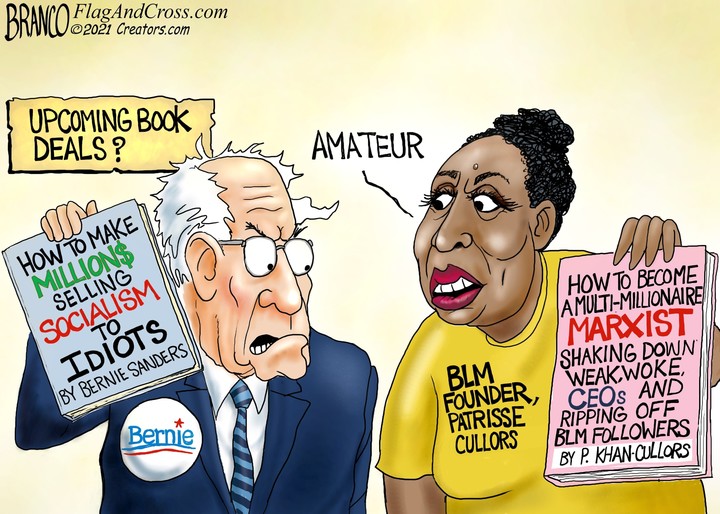




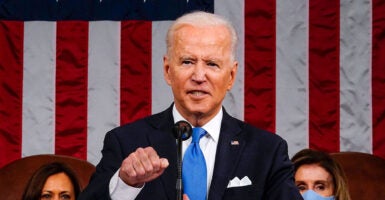
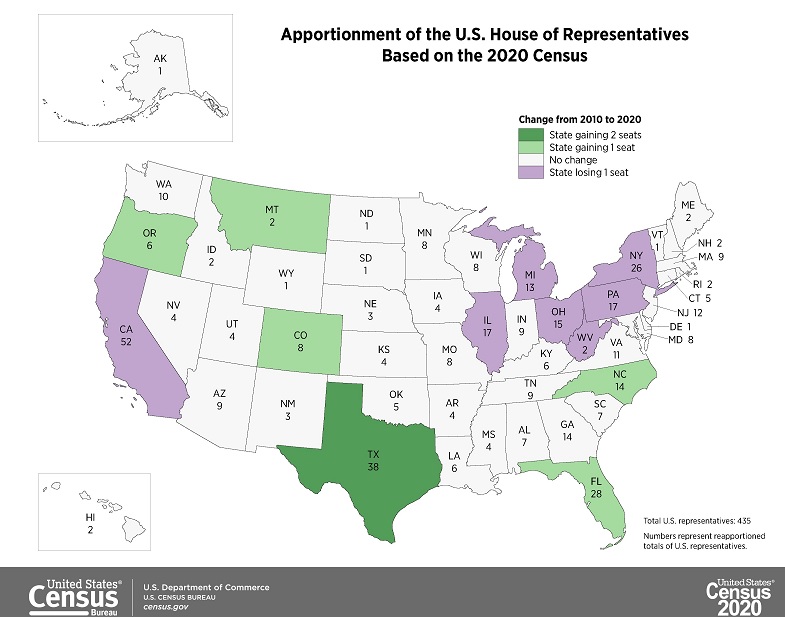

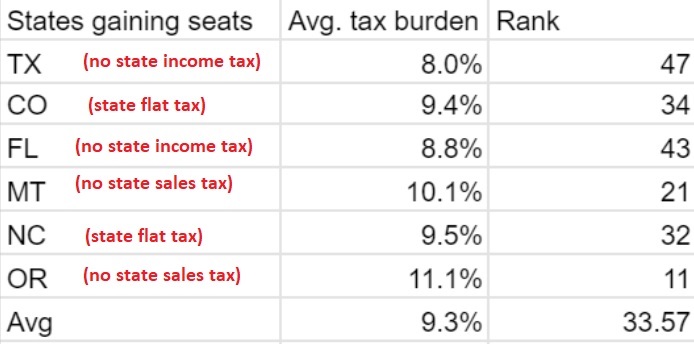


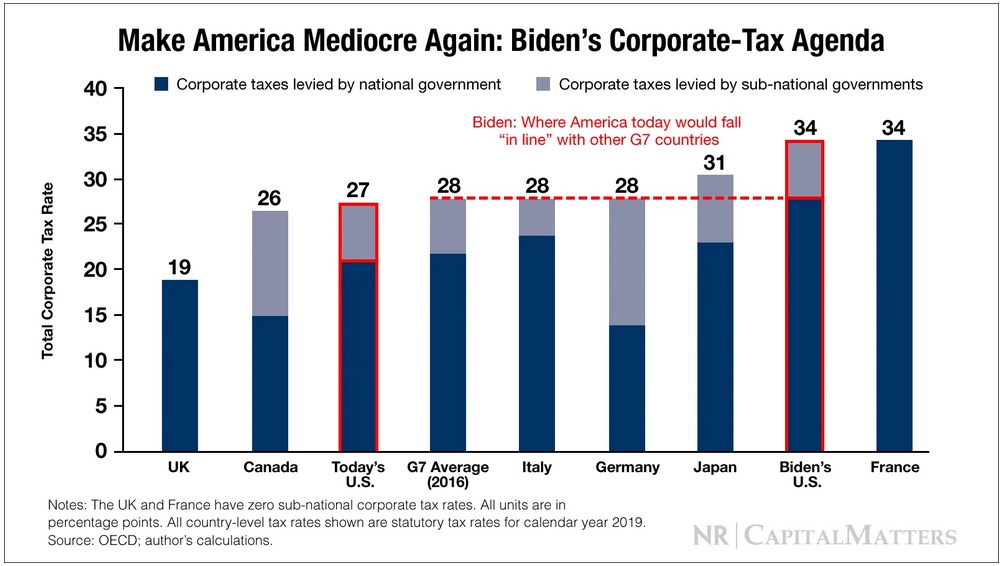


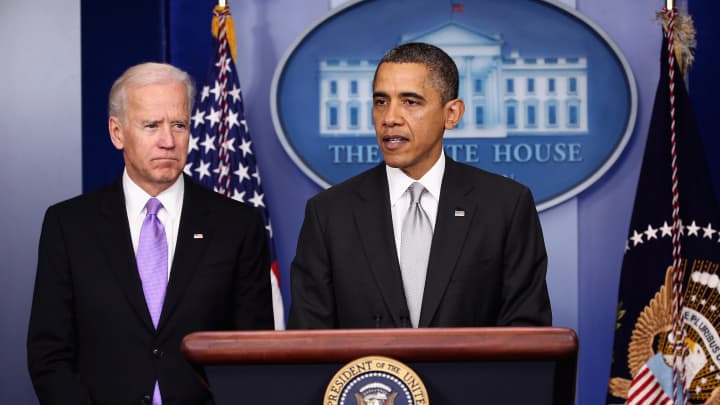 President Barack Obama announces the creation of an interagency task force for guns as as Vice President Joseph Biden listens on.Getty Images