Category Archives: spending out of control

Welfare Spending at All-Time High…and Growing (Cartoons)

When Governments Cut Spending

Uploaded on Sep 28, 2011

Do governments ever cut spending? According to Dr. Stephen Davies, there are historical examples of government spending cuts in Canada, New Zealand, Sweden, and America. In these cases, despite popular belief, the government spending cuts did not cause economic stagnation. In fact, the spending cuts often accelerated economic growth by freeing up resources for the private sector.

In the USA we are just increasing welfare spending while a few other countries like the ones mentioned in the video above are cutting it.

Welfare Spending at All-Time High…and Growing

By and
October 22, 2012

Welfare spending has hit a stunning, all-time high. A new Congressional Research Service report confirms what research here at The Heritage Foundation has shown: The government’s means-tested welfare programs now cost taxpayers roughly $1 trillion a year. (This figure does not include either Social Security or Medicare.)

Unlike general government programs, mean-tested welfare programs provide assistance exclusively to poor and low-income individuals.  The federal government runs over 80 means-tested programs providing cash, food, housing, medical care and social services to around 100 million Americans.  That’s a third of the U.S. population.  Combined federal and state expenditures on these programs come to roughly $9,000 per recipient per year.

The size and cost of these programs largely are hidden from public view because government decision makers and the mainstream media invariably discuss welfare one program at a time.  By analyzing each of the 80-plus programs in isolation, they conceal the overall size of the welfare state.   The Congressional Research Service report is a rare departure from this piecemeal approach.

Discussing the welfare state one program at a time is misleading because most recipients will receive aid from several programs at once. Converted into cash, total welfare spending would equal five times the amount needed to eliminate all poverty in the U.S.

Although liberals constantly lament the level of defense spending, annual means-tested welfare spending has exceeded defense spending for nearly two decades.  In the next decade, the U.S. will spend well over $2 on welfare for every $1 it spends on national defense.

Yet somehow $1 trillion a year in means-tested welfare spending isn’t enough for President Obama, on whose watch this spending already has increased by more than a third. This isn’t a temporary increase because of the recession. According to Obama’s budget plans it would continue to grow in the next decade, reaching $1.56 trillion by 2022.

Under the Obama administration’s approach, the welfare system will continue to grow and more Americans will remain dependent on government. Over the summer the administration announced it would waive work requirements in the Temporary Assistance to Needy Families program.  This illegal move puts at risk the successes of the 1996 welfare reform–which created TANF and resulted in major declines in the welfare rolls and higher rates of employment among low-income Americans.

Gutting TANF’s work requirements also means that only two of the nation’s 80-plus welfare programs will require able-bodied recipients to work or prepare for work as a condition of receiving aid.

For liberals, a bigger welfare state and greater dependence on government seems to equate with helping the poor. This view is contrary to President Lyndon Johnson’s original aim in launching the War on Poverty.  Johnson sought to make the poor self-sufficient, not dependent on government.  But after $19 trillion in means-tested welfare spending, our nation is further than ever from that original goal than ever.

Putting ever-greater numbers of Americans on welfare is not a mark of success. Although government spending may artificially prop up living standards, it utterly fails in the real task of building self-sufficiency. The growth of welfare is unsustainable, and is no way to promote the authentic well-being of Americans.

Promisingly, we can take steps to bring this spending under control while helping those in need. Once the unemployment rate declines, total welfare spending should be returned to pre-recession levels and then allowed to grow no faster than the rate of inflation.  This would save taxpayers over $2.5 trillion in the next decade.

In addition,  rather than weakening work requirements, policymakers should expand this crucial element of welfare to other means-tested programs such as food stamps and public housing, building on the success of the 1996 reforms. Contrary to liberal ideology, promoting self-reliance, rather than government dependence, is the way to help the poor and encourage a thriving society.

Robert Rector, senior research fellow in domestic policy at The Heritage Foundation, is author of the recent paper “Obama’s End Run on Welfare Reform, Part Two: Dismantling Workfare.” Rachel Sheffield, research associate in Heritage’s DeVos Center for Religion and Civil Society, is co-author with Rector of the paper “Ending Work for Welfare: An Overview.”

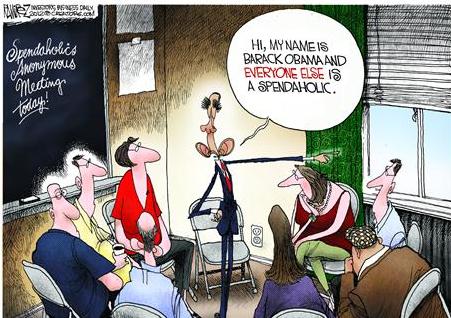
Let me start this post by stating that George W. Bush was a bigger spender than Barack Obama (though the numbers are somewhat distorted by TARP, which caused a big increase in the burden of spending during Bush’s last fiscal year and artificially dampened outlays in Obama’s first fiscal year since repayments from the banks counted as negative spending).

So I’m not trying to make a partisan point by sharing these cartoons. I don’t like it when Democrats increase the burden of government spending and I’m equally dismayed when Republicans engage in same type of profligacy.

That being said, I was a big dumbfounded when President Obama recently claimed that there’s not a spending problem in Washington.

We know that the United States has a huge long-run problem with deficits and debt according to both the Bank for International Settlements and the Organization for Economic Cooperation and Development.

We also know that tax revenues, measured as a share of GDP, will soon be above their post-World War II average and that the tax burden is expected to increase in coming decades.

So a person would have to be in serious denial to claim that spending isn’t a problem.

Which is the point Eric Allie makes in this cartoon.

Spending Problem Cartoon 1

And the point Robert Ariail makes in this cartoon.

Spending Problem Cartoon 2

Ditto for Bob Gorrell.

Spending Problem Cartoon 3

And Gary Varvel.

Spending Problem Cartoon 4

Last but not least, the great Michael Ramirez.

Spending Problem Cartoon 5.jpg

Gee, it’s almost like we’re seeing a pattern.

And if you like this spendaholic-in-denial theme, you can click here and here for further amusement.

P.S. Oh, by the way, if anybody’s actually interested in how to solve the spending problem (you know, the one that doesn’t exist), we do know the answer.

P.P.S. Remember when Obama claimed the private sector was doing fine? Well, here’s how cartoonists mocked him for that absurd comment.

Why Are Republicans Willing to Help Obama Make America More Like Europe When the Welfare State Is Collapsing? (includes cartoons)

Why can’t we learn from history?

Washington frustrates me. The entire town is based on legalized corruption as an unworthy elite figure out new ways of accumulating unearned wealth by skimming money from the nation’s producers.

But one thing that especially irks me is the way people focus on the trees and forget about the forest. Politicians and journalists are now engaged in an inside-baseball game of analyzing every twist and turn of the fiscal cliff negotiations.

That’s all fine and well, but perhaps it would be a good idea to talk about the need to fix the real crisis of excessive spending instead of arguing about how fast we should be traveling in the wrong direction.

And let’s not delude ourselves. In the absence of real entitlement reform, the United States is doomed to repeat Europe’s mistakes.

And how are things going in Europe? Well, I’m glad you ask. Let’s look at some excerpts from an Associated Press report.

Another month, another record unemployment rate for the economy of the 17 European Union countries that use the euro. Figures released Friday by Eurostat, the EU’s statistics office, showed that the recession in the eurozone pushed unemployment up in the currency bloc to 11.7 percent in October, the highest level since the introduction of the euro in 1999. …Eurostat found that 18.7 million people were out of work across the eurozone, an increase of 173,000 on the previous month and 2.2 million higher than the year before. The wider 27-nation EU that includes non-euro countries such as Britain and Poland had an unemployment rate of 10.7 percent in October and a total of 25.9 million out of work. …”Talk of a `lost generation’ of young people now looks like an alarming possibility,” said Andrea Broughton, principal research fellow at the Institute for Employment Studies.

In other words, we may complain about America’s miserable track record on jobs during the Obama years, but at some point in the future we may someday look back on 8 percent unemployment as good news.

Unfortunately, the crowd in Washington doesn’t want to acknowledge that the real problem is spending. And I’m particularly irked (but not surprised) that Republicans now seem willing to go along with Obama even though they won this fight back in 2010 when they didn’t control the House and had fewer seats in the Senate. Here’s what I said to one of the local DC stations.

Dan Mitchell Comments on Washington’s Spending Problem and GOP Appeasement

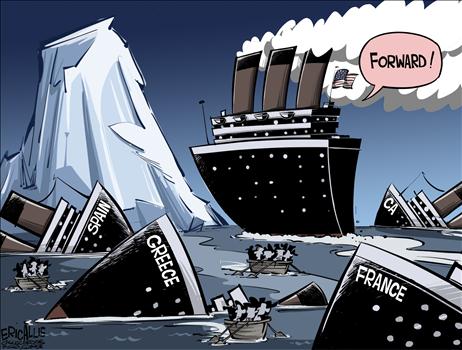
I realize I’m sounding glum, so let’s close out this post with a couple of amusing cartoons about America’s European future.

I’ve already shared the “European Lemming” cartoon. This one has the same theme.

Cartoon Obama Iceberg

Other Eric Allie cartoons can be enjoyed here, here , hereherehere, and here.

And here another cartoon with the same theme.

Cartoon Obama Cliff

If you like this Bok cartoon, some of my other favorites can be seen here,  hereherehereherehere, and here.

If you still haven’t cheered up, this bit of Dave Barry humor about the European fiscal crisis is a classic, and I’d also recommend this bit of unintentional satire.

Open letter to President Obama (Part 404) Need to listen to ideas on cutting government spending from Senator Ted Cruz

(Emailed to White House on 1-3-13.)

President Obama c/o The White House
1600 Pennsylvania Avenue NW
Washington, DC 20500

Dear Mr. President,

I know that you receive 20,000 letters a day and that you actually read 10 of them every day. I really do respect you for trying to get a pulse on what is going on out here.

Ronald Reagan pictured above.

Ted Cruz has the right idea about cutting the size of government. He has some good ideas and he reminds me a lot of Rand Paul. He also has a great role model in Ronald Reagan who he quotes in the video clip below.

Less than one week ago, I identified three potential vehicles for some long-overdue fiscal reforms to restrain the burden of government spending.

In that post, I suggested that the “continuing resolution” was the best vehicle since lawmakers obviously would have to consider legislation to provide funding for the rest of the 2013 fiscal year.

The debt limit, by contrast, creates too many opportunities for demagoguery. Geithner and Bernanke have already demonstrated, for instance, that they’re willing to prevaricate and scare financial markets.

It’s much smarter to pick a fight on the “CR” since there not even a make-believe risk of default. Instead, the only thing that happens is that the “non-essential” parts of the federal government are shut down.

So I’m delighted to see that Ted Cruz, the new Senator from Texas, understands that the shutdown fight in 1995 led to very good results. I wrote a piece for National Review making the same point, so I’m delighted to hear someone else singing from the same sheet of music. Pay close attention at the 3:15 mark of this video.

Texas Sen. Ted Cruz on the Deficit, Gun Rights, Immigration

My only quibble is that he mentions the debt limit as the vehicle for the fight, when he should have mentioned the CR.

But I’m nit-picking. Cruz seems to get it. He puts the focus on the disease of too much government rather than fixating on the symptom of too much red ink.

He also understands that high tax rates discourage productive behavior, so he’s obviously not a fan of the President’s class-warfare approach.

Last but not least, you’ll also see he gave a very strong response on protecting the 2nd Amendment immediately following his discussion of fiscal policy.

Seems like there’s a chance he could be a second Rand Paul.

_________

Thank you so much for your time. I know how valuable it is. I also appreciate the fine family that you have and your commitment as a father and a husband.

Sincerely,

Everette Hatcher III, 13900 Cottontail Lane, Alexander, AR 72002, ph 501-920-5733, lowcostsqueegees@yahoo.com

Related posts:

Open letter to President Obama (Part 201)Tea Party favorite Representative links article “Prescott and Ohanian: Taxes Are Much Higher Than You Think”

    (Emailed to White House on 12-21-12.) President Obama c/o The White House 1600 Pennsylvania Avenue NW Washington, DC 20500 Dear Mr. President, I know that you receive 20,000 letters a day and that you actually read 10 of them every day. I really do respect you for trying to get a pulse on […]

Open letter to President Obama (Part 200.2)Tea Party Republican Representative takes on the President concerning fiscal cliff

(Emailed to White House on 12-21-12.) President Obama c/o The White House 1600 Pennsylvania Avenue NW Washington, DC 20500 Dear Mr. President, I know that you receive 20,000 letters a day and that you actually read 10 of them every day. I really do respect you for trying to get a pulse on what is […]

Open letter to President Obama (Part 200.1)Tea Party favorite Representative shares link on facebook

(Emailed to White House on 12-21-12) President Obama c/o The White House 1600 Pennsylvania Avenue NW Washington, DC 20500 Dear Mr. President, I know that you receive 20,000 letters a day and that you actually read 10 of them every day. I really do respect you for trying to get a pulse on what is […]

Open letter to President Obama (Part 199) Tea Party favorite takes on President

  The federal government has a spending problem and Milton Friedman came up with the negative income tax to help poor people get out of the welfare trap. It seems that the government screws up about everything. Then why is President Obama wanting more taxes? _______________ Milton Friedman – The Negative Income Tax Published on […]

Tea Party Heroes Rep. David Schweikert (R-AZ),Justin Amash (R-MI), Tim Huelskamp (R-KS) have been punished by Boehner

I was sad to read that the Speaker John Boehner has been involved in punishing tea  party republicans. Actually I have written letters to several of these same tea party heroes telling them that I have emailed Boehner encouraging him to listen to them. Rep. David Schweikert (R-AZ),Justin Amash (R-MI), and Tim Huelskamp (R-KS). have been contacted […]

Some Tea Party heroes (Part 10)

Michael Tanner of the Cato Institute in his article, “Hitting the Ceiling,” National Review Online, March 7, 2012 noted: After all, despite all the sturm und drang about spending cuts as part of last year’s debt-ceiling deal, federal spending not only increased from 2011 to 2012, it rose faster than inflation and population growth combined. […]

Some Tea Party heroes (Part 9)

Michael Tanner of the Cato Institute in his article, “Hitting the Ceiling,” National Review Online, March 7, 2012 noted: After all, despite all the sturm und drang about spending cuts as part of last year’s debt-ceiling deal, federal spending not only increased from 2011 to 2012, it rose faster than inflation and population growth combined. […]

49 posts on Tea Party heroes of mine

Some of the heroes are Mo Brooks, Martha Roby, Jeff Flake, Trent Franks, Duncan Hunter, Tom Mcclintock, Devin Nunes, Scott Tipton, Bill Posey, Steve Southerland and those others below in the following posts. THEY VOTED AGAINST THE DEBT CEILING INCREASE IN 2011 AND WE NEED THAT TYPE OF LEADERSHIP NOW SINCE PRESIDENT OBAMA HAS BEEN […]

Some Tea Party Republicans win and some lose

I hated to see that Allen West may be on the way out. ABC News reported: Nov 7, 2012 7:20am What Happened to the Tea Party (and the Blue Dogs?) Some of the Republican Party‘s most controversial House members are clinging to narrow leads in races where only a few votes are left to count. […]

Some Tea Party heroes (Part 8)

Rep Himes and Rep Schweikert Discuss the Debt and Budget Deal Michael Tanner of the Cato Institute in his article, “Hitting the Ceiling,” National Review Online, March 7, 2012 noted: After all, despite all the sturm und drang about spending cuts as part of last year’s debt-ceiling deal, federal spending not only increased from 2011 […]

Why increase the stamp prices again when we could save money by privatizing the post office!!!!!

Why increase the stamp prices again when we could save money by privatizing the post office!!!!!

SEPTEMBER 5, 2013 4:57PM

U.S. Postal Service Likely to Seek “Emergency” Increase in Stamp Prices

The U.S. Postal Service is structured to subsist on the revenues it generates from the sale of its products and services. In recent years, however, USPS expenses have exceeded revenues and the government agency now finds itself effectively broke having maxed out its $15 billion line of credit with the U.S. Treasury.

Postal employee unions blame a 2006 law that forces the USPS to prefund retiree health benefits (a benefit that a small and declining number of private sector workers enjoy) for the government agency’s financial woes. But as a recent Congressional Research Service papernotes, the USPS would be in trouble even without the required payments:

While [Retiree Health Benefits Fund] payments have affected the USPS’s profitability, the USPS would have run deficits each of the past four years even if the agency did not have to make RHBF payments. These non-RHBF deficits would total $14.7 billion, an amount nearly equal to the USPS’s total borrowing authority. [T]hese deficits were produced by a sharp drop in revenues. (Expenses did not fall equivalently.)

Congress has been fumbling around with postal reform legislation for a couple of years now. And as I’ve noted more times than I can count, congressional micromanagement makes it difficult for the USPS to downsize its operations to match 21st century realities. So the USPS is reportedly looking to generate more revenue through higher stamp prices.

The USPS is limited in its ability to increase stamp prices. For “market-dominant” (the government’s amusing euphemism for “monopoly”) products, annual price increases cannot exceed inflation (as measured by the Consumer Price Index for All Urban Consumers). The USPS can, however, request a rate increase above inflation on the basis of extraordinary or exceptional circumstances from its regulator, the Postal Regulatory Commission (PRC).

The PRC rejected such a request in 2010, but it appears that the USPS will try again. And both the Washington Post and The Hill are reporting that industries forced to use the USPS (greeting card companies, magazines, direct marketers, etc) are non-too-pleased with the prospect of higher prices. The mailers argue that an excessive price increase to deliver their products will speed up the diversion from physical mail to electronic alternatives (and thus hurt their bottom lines).

Here’s my opinion on an exigent increase in stamp prices: the postal service should beprivatized and delivery charges should be determined by market forces. Maybe the mailing industry is paying too little; maybe it’s paying too much. I think it’s impossible to say so long as the government maintains a monopoly on the delivery of its products and delivery prices are set by politicians and regulators. Unfortunately, ending the government mail monopoly and privatizing the postal service isn’t even a topic for discussion in Congress.

Nope, those busy little bees have more important postal matters to attend to (from the New York Times):

As Congress has become less and less efficient, the numbers are all the more striking. In the 111th Congress, which met from 2009 to 2010, members passed 383 statutes, 70 of which named post offices. In the 112th Congress, the last Congress to meet before the current one convened in January, members passed 46 measures naming post offices, out of 240 statutes over all.

Related posts:

President Obama and government spending (GSA Govt waste tip of iceberg)

I wish President Obama would try to cut spending instead of increasing spending and our debt. Two Very Good GSA Waste Cartoons April 21, 2012 by Dan Mitchell One of my first blog posts back in 2009 featured a column about the Social Security Administration squandering $750,000 on a “conference” at a fancy golf resort in […]

A suggestion to cut some wasteful spending out of the government Part 8 (includes editorial cartoon)

Does Government Have a Revenue or Spending Problem? People say the government has a debt problem. Debt is caused by deficits, which is the difference between what the government collects in tax revenue and the amount of government spending. Every time the government runs a deficit, the government debt increases. So what’s to blame: too […]

A suggestion to cut some wasteful spending out of the government Part 7 (includes editorial cartoon)

What Are the Dangers of Too Much Debt? Published on Mar 20, 2012 Interest payments on U.S. government debt are three times spending in the Iraq and Afghanistan wars already, and that is with the lowest interest rate we have seen since the 1960s. A rise in interest rates would increase interest payments dramatically. What […]

A suggestion to cut some wasteful spending out of the government Part 6 (includes editorial cartoon)

Funding Government by the Minute Published on Mar 28, 2012 At the rate the federal government spends, it runs out of money on July 31. What programs should be cut to balance the budget and fund the government for the remaining five months of the year? Cutting NASA might buy two days; cutting the Navy […]

A suggestion to cut some wasteful spending out of the government Part 5 (includes editorial cartoon)

Does Government Have a Revenue or Spending Problem? People say the government has a debt problem. Debt is caused by deficits, which is the difference between what the government collects in tax revenue and the amount of government spending. Every time the government runs a deficit, the government debt increases. So what’s to blame: too […]

A suggestion to cut some wasteful spending out of the government Part 4 (includes editorial cartoon)

What Are the Dangers of Too Much Debt? Published on Mar 20, 2012 Interest payments on U.S. government debt are three times spending in the Iraq and Afghanistan wars already, and that is with the lowest interest rate we have seen since the 1960s. A rise in interest rates would increase interest payments dramatically. What […]

A suggestion to cut some wasteful spending out of the government Part 3 (includes editorial cartoon)

What Can We Cut to Balance the Budget Published on Oct 16, 2012 Will Rogers has a great quote that I love. He noted, “Lord, the money we do spend on Government and it’s not one bit better than the government we got for one-third the money twenty years ago”(Paula McSpadden Love, The Will Rogers Book, (1972) […]

A suggestion to cut some wasteful spending out of the government Part 2 (includes editorial cartoon)

Does Government Have a Revenue or Spending Problem? People say the government has a debt problem. Debt is caused by deficits, which is the difference between what the government collects in tax revenue and the amount of government spending. Every time the government runs a deficit, the government debt increases. So what’s to blame: too […]

A suggestion to cut some wasteful spending out of the government Part 1 (includes editorial cartoon)

What Are the Dangers of Too Much Debt? Published on Mar 20, 2012 Interest payments on U.S. government debt are three times spending in the Iraq and Afghanistan wars already, and that is with the lowest interest rate we have seen since the 1960s. A rise in interest rates would increase interest payments dramatically. What […]

Lots of wasteful spending by federal government

I wish the federal government would go back to spending less than 5% of GDP like they did the first 150 years of our country’s history. We could cut down on a lot of wasteful spending if we did that. Morning Bell: The Governing Class and Us Mike Brownfield April 19, 2012 at 8:57 am […]

Video by economics professor Antony Davies “Does Government Have a Revenue or Spending Problem?” (Cartoons)

Does Government Have a Revenue or Spending Problem?

People say the government has a debt problem. Debt is caused by deficits, which is the difference between what the government collects in tax revenue and the amount of government spending. Every time the government runs a deficit, the government debt increases. So what’s to blame: too much spending, or too little tax revenue? Economics professor Antony Davies examines the data and concludes that the root cause of the debt is too much government spending.

Taking from the rich and giving to the poor is no way to grow the economy and running up our national debt doesn’t help either.

I shared a cartoon last Halloween that made fun of those who support class-warfare tax policy.

Now we have a related cartoon, featuring a stop at the White House.

Republicans will like the ghost’s comments, of course.

The next two cartoons are almost identical. We’ll start with this one from Michael Ramirez.

Ramirez is one of my favorite cartoonists, incidentally, and you can see more of his work here, here, here, here, here, here, here, here, here, here, herehereherehereherehere, and here.

Here’s a Gary Varvel cartoon with the exact same message.

Instead of great minds thinking alike, this is a case of great cartoonists thinking alike. Though they probably have great minds as well.

But I don’t want to make too many fawning comments since I would modify both of these cartoons so that the kids were looking at papers that said “Medicare” and “Social Security” instead of “debt.”

It’s always important to focus first and foremost on the disease of spending, after all, and not the symptom of red ink.

Last but not least, I can’t resist linking to this comedian’s video, which includes some very good economic insights about work incentives.

Sort of like this Wizard of Id parody featuring Obama.

Related posts:

Cartoons from Dan Mitchell’s blog that demonstrate what Obama is doing to our economy Part 2

Max Brantley is wrong about Tom Cotton’s accusation concerning the rise of welfare spending under President Obama. Actually welfare spending has been increasing for the last 12 years and Obama did nothing during his first four years to slow down the rate of increase of welfare spending. Rachel Sheffield of the Heritage Foundation has noted: […]

Cartoons from Dan Mitchell’s blog that demonstrate what Obama is doing to our economy Part 1

  I have put up lots of cartoons from Dan Mitchell’s blog before and they have got lots of hits before. Many of them have dealt with the economy, eternal unemployment benefits, socialism,  Greece,  welfare state or on gun control. I think Max Brantley of the Arkansas Times Blog was right to point out on 2-6-13 that Hillary […]

Great cartoon from Dan Mitchell’s blog on government moochers

I thought it was great when the Republican Congress and Bill Clinton put in welfare reform but now that has been done away with and no one has to work anymore it seems. In fact, over 40% of the USA is now on the government dole. What is going to happen when that figure gets over […]

Gun Control cartoon hits the internet

Again we have another shooting and the gun control bloggers are out again calling for more laws. I have written about this subject below  and on May 23, 2012, I even got a letter back from President Obama on the subject. Now some very interesting statistics below and a cartoon follows. (Since this just hit the […]

“You-Didn’t-Build-That” comment pictured in cartoons!!!

watch?v=llQUrko0Gqw] The federal government spends about 10% on roads and public goods but with the other money in the budget a lot of harm is done including excessive regulations on business. That makes Obama’s comment the other day look very silly. A Funny Look at Obama’s You-Didn’t-Build-That Comment July 28, 2012 by Dan Mitchell I made […]

Cartoons about Obama’s class warfare

I have written a lot about this in the past and sometimes you just have to sit back and laugh. Laughing at Obama’s Bumbling Class Warfare Agenda July 13, 2012 by Dan Mitchell We know that President Obama’s class-warfare agenda is bad economic policy. We know high tax rates undermine competitiveness. And we know tax increases […]

Cartoons on Obama’s budget math

Dan Mitchell Discussing Dishonest Budget Numbers with John Stossel Uploaded by danmitchellcato on Feb 11, 2012 No description available. ______________ Dan Mitchell of the Cato Institute has shown before how excessive spending at the federal level has increased in recent years. A Humorous Look at Obama’s Screwy Budget Math May 31, 2012 by Dan Mitchell I’ve […]

Funny cartoon from Dan Mitchell’s blog on Greece

Sometimes it is so crazy that you just have to laugh a little. The European Mess, Captured by a Cartoon June 22, 2012 by Dan Mitchell The self-inflicted economic crisis in Europe has generated some good humor, as you can see from these cartoons by Michael Ramirez and Chuck Asay. But for pure laughter, I don’t […]

Obama on creating jobs!!!!(Funny Cartoon)

Another great cartoon on President Obama’s efforts to create jobs!!! A Simple Lesson about Job Creation for Barack Obama December 7, 2011 by Dan Mitchell Even though leftist economists such as Paul Krugman and Larry Summers have admitted that unemployment insurance benefits are a recipe for more joblessness, the White House is arguing that Congress should […]

Get people off of government support and get them in the private market place!!!!(great cartoon too)

Dan Mitchell hits the nail on the head and sometimes it gets so sad that you just have to laugh at it like Conan does. In order to correct this mess we got to get people off of government support and get them in the private market place!!!! Chuck Asay’s New Cartoon Nicely Captures Mentality […]

2 cartoons illustrate the fate of socialism from the Cato Institute

Cato Institute scholar Dan Mitchell is right about Greece and the fate of socialism: Two Pictures that Perfectly Capture the Rise and Fall of the Welfare State July 15, 2011 by Dan Mitchell In my speeches, especially when talking about the fiscal crisis in Europe (or the future fiscal crisis in America), I often warn that […]

Cartoon demonstrates that guns deter criminals

John Stossel report “Myth: Gun Control Reduces Crime Sheriff Tommy Robinson tried what he called “Robinson roulette” from 1980 to 1984 in Central Arkansas where he would put some of his men in some stores in the back room with guns and the number of robberies in stores sank. I got this from Dan Mitchell’s […]

Gun control posters from Dan Mitchell’s blog Part 2

I have put up lots of cartons and posters from Dan Mitchell’s blog before and they have got lots of hits before. Many of them have dealt with the economy, eternal unemployment benefits, socialism,  Greece,  welfare state or on gun control. Amusing Gun Control Picture – Circa 1999 April 3, 2010 by Dan Mitchell Dug this gem out […]

We got to cut spending and stop raising the debt ceiling!!!

  We got to cut spending and stop raising the debt ceiling!!! When Governments Cut Spending Uploaded on Sep 28, 2011 Do governments ever cut spending? According to Dr. Stephen Davies, there are historical examples of government spending cuts in Canada, New Zealand, Sweden, and America. In these cases, despite popular belief, the government spending […]

Gun control posters from Dan Mitchell’s blog Part 1

I have put up lots of cartons and posters from Dan Mitchell’s blog before and they have got lots of hits before. Many of them have dealt with the economy, eternal unemployment benefits, socialism,  Greece,  welfare state or on gun control. On 2-6-13 the Arkansas Times Blogger “Sound Policy” suggested,  “All churches that wish to allow concealed […]

Taking on Ark Times bloggers on the issue of “gun control” (Part 3) “Did Hitler advocate gun control?”

Gun Free Zones???? Stalin and gun control On 1-31-13 ”Arkie” on the Arkansas Times Blog the following: “Remember that the biggest gun control advocate was Hitler and every other tyrant that every lived.” Except that under Hitler, Germany liberalized its gun control laws. __________ After reading the link  from Wikipedia that Arkie provided then I responded: […]

Taking on Ark Times bloggers on the issue of “gun control” (Part 2) “Did Hitler advocate gun control?”

On 1-31-13 I posted on the Arkansas Times Blog the following: I like the poster of the lady holding the rifle and next to her are these words: I am compensating for being smaller and weaker than more violent criminals. __________ Then I gave a link to this poster below: On 1-31-13 also I posted […]

Why not cut out all the dollars that are being wasted on green technology programs?

If you want to cut waste out of government then why not cut out all the dollars that are being wasted on green technology programs?

I’ve written before that Obama’s Solyndra-style handouts have been a grotesque waste of tax dollars.

I’ve argued that they destroy jobs rather than create jobs.

I’ve gone on TV to explain why government intervention in energy creates a cesspool of cronyism.

I’ve even shared a column from Obama’s hometown newspaper that criticizes the rank corruption in green-energy programs.

And it goes without saying that I’ve disseminated some good cartoons on the issue.

But even though green-energy programs are a disgusting boondoggle, American taxpayers and consumers should be thankful they’re not in Germany.

Our programs may be wasteful and corrupt, but we’re amateurs compared to what’s happening on the other side of the Atlantic.

Here are some passages from a must-read story in Der Spiegel.

The government predicts that the renewable energy surcharge added to every consumer’s electricity bill will increase from 5.3 cents today to between 6.2 and 6.5 cents per kilowatt hour — a 20-percent price hike. German consumers already pay the highest electricity prices in Europe. But because the government is failing to get the costs of its new energy policy under control, rising prices are already on the horizon. Electricity is becoming a luxury good in Germany.

As is so often the case with government intervention, the promises from politicians about low costs were a mirage.

Even well-informed citizens can no longer keep track of all the additional costs being imposed on them. According to government sources, the surcharge to finance the power grids will increase by 0.2 to 0.4 cents per kilowatt hour next year. On top of that, consumers pay a host of taxes, surcharges and fees that would make any consumer’s head spin. Former Environment Minister Jürgen Tritten of the Green Party once claimed that switching Germany to renewable energy wasn’t going to cost citizens more than one scoop of ice cream. Today his successor Altmaier admits consumers are paying enough to “eat everything on the ice cream menu.”

Perhaps the most shocking part of the story is that Germans are being forced to pay $26 billion in subsidies to get less than $4 billion of green energy.

For society as a whole, the costs have reached levels comparable only to the euro-zone bailouts. This year, German consumers will be forced to pay €20 billion ($26 billion) for electricity from solar, wind and biogas plants — electricity with a market price of just over €3 billion. Even the figure of €20 billion is disputable if you include all the unintended costs and collateral damage associated with the project. …On Thursday, a government-sanctioned commission plans to submit a special report called “Competition in Times of the Energy Transition.” The report is sharply critical, arguing that Germany’s current system actually rewards the most inefficient plants, doesn’t contribute to protecting the climate, jeopardizes the energy supply and puts the poor at a disadvantage.

Here’s what it means for ordinary people.

In the near future, an average three-person household will spend about €90 a month for electricity. That’s about twice as much as in 2000. Two-thirds of the price increase is due to new government fees, surcharges and taxes. …Today, more than 300,000 households a year are seeing their power shut off because of unpaid bills. Caritas and other charity groups call it “energy poverty.”

Not surprisingly, politically well-connected interest groups are the ones reaping the benefits.

…the renewable energy subsidies redistribute money from the poor to the more affluent, like when someone living in small rental apartment subsidizes a homeowner’s roof-mounted solar panels through his electricity bill. The SPD, which sees itself as the party of the working class, long ignored this regressive aspect of the system. The Greens, the party of higher earners, continue to do so. Germany’s renewable energy policy is particularly unfair with respect to the economy. About 2,300 businesses have managed to largely exempt themselves from the green energy surcharge by claiming, often with little justification, that they face tough international competition. Companies with less lobbying power, however, are required to pay the surcharge.

Let’s conclude with an ominous excerpt from the article. Even though prices already are very high, energy will get even more expensive in the future.

If the government sticks to its plans, the price of electricity will literally explode in the coming years. According to a current study for the federal government, electricity will cost up to 40 cents a kilowatt-hour by 2020, a 40-percent increase over today’s prices.

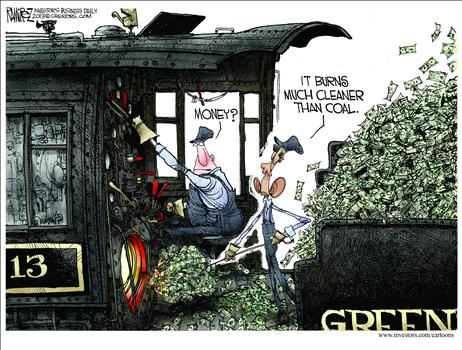
And isn’t it nice to know that Obama is doing everything he can to impose these policies in the United States?

This cartoon from Michael Ramirez is a perfect summary of Obama’s policy.

Ramirez Green Energy Cartoon

You can see why Ramirez won my political cartoonist contest.

P.S. I don’t like being the bearer of bad news, but green-energy subsidies are just one part of the statist/green agenda. The IMF, for instance, has recommended a huge carbon tax (about $5,500 per year for a family of four!) for the United States. A few gullible folks think this might not be a bad idea if the money gets used to lower other taxes, but they’re the same people who get suckered into buying oceanfront property in Kansas.

P.P.S. Germany may be more responsible (less irresponsible) than certain other European nations, but the country’s political elite is hopelessly statist. Even the supposedly pro-liberty political party tilts left and wants bigger government. Yet the Washington Post still thought it was appropriate and accurate to declare that Germany is “fiscally conservative.” Sure, and I’m a socialist.

P.P.P.S. But at least the mess in Europe has generated some amusing videos (here, here, and here), as well as a very funny set of maps.

Related posts:

Cartoons from Dan Mitchell’s blog that demonstrate what Obama is doing to our economy (Solyndra cartoon)

I have put up lots of cartoons from Dan Mitchell’s blog before and they have got lots of hits before. Many of them have dealt with the economy, eternal unemployment benefits, socialism,  Greece,  welfare state or on gun control. President Obama is from Chicago and sometimes I think he plays ball like the Chicago political bosses did […]

Cartoons from Dan Mitchell’s blog that demonstrate what Obama is doing to our economy Part 3.1 (Solyndra investment cartoon)

  I have put up lots of cartoons from Dan Mitchell’s blog before and they have got lots of hits before. Many of them have dealt with the economy, eternal unemployment benefits, socialism,  Greece,  welfare state or on gun control. Al Gore spoke in Little Rock yesterday at the Clinton Library Max Brantley of the Arkansas Times […]

Solyndra, oil company tax deductions, etc

Obamanomics: A Legacy of Wasteful Spending Published on Aug 12, 2012 by CFPEcon101 This mini-documentary from the Center for Freedom and Prosperity Foundation highlights egregious examples of wasteful spending from the so-called stimulus legislation and explains why government spending hurts economic performance. **Links to additional reading material** Thomas Sowell, “Stimulus or Sedative?” http://www.realclearpolitics.com/articles/2010/03/09/stimulus_or_sedative_104… Veronique de […]

Emails on Solyndra surface from Obama administration

The government shouldn’t pick winners and losers in the private market place like President Obama has done. The 10 Most Revealing Solyndra Emails Lachlan Markay August 3, 2012 at 12:40 pm On Thursday, the House Energy and Commerce Committee released a bombshell report, 18 months in the making and 147 pages long, detailing its investigation […]

Corrupt scams like Solyndra and bailouts make people resent paying their taxes and look for tax havens

The Economic Case for Tax Havens Uploaded by afq2007 on Sep 10, 2008 Statist politicians and international bureaucracies such as the OECD and UN routinely attack tax havens, claiming that they lead to “harmful tax competition.” Yet at no point do critics bother to provide any evidence for this claim. This mini-documentary from the Center […]

Cartoons from Dan Mitchell’s blog that demonstrate what Obama is doing to our economy (Obama’s 9-9-9 Plan and other Jokes about Energy Policy)

I have put up lots of cartoons from Dan Mitchell’s blog before and they have got lots of hits before. Many of them have dealt with the economy, eternal unemployment benefits, socialism,  Greece,  welfare state or on gun control. Obama’s 9-9-9 Plan and other Jokes about Energy Policy March 3, 2012 by Dan Mitchell I get agitated when I think about”energy policy” […]

Cartoon from Dan Mitchell’s blog (Cronyism is hurting the economy)

I have put up lots of cartoons from Dan Mitchell’s blog before and they have got lots of hits before. Many of them have dealt with the economy, eternal unemployment benefits, socialism,  Greece,  welfare state or on gun control. The Corrupt Nexus of Big Business and Big Government February 18, 2013 by Dan Mitchell I did a video […]

We got to cut corporate welfare out of the budget too!!!

We got to cut corporate welfare out of the budget too!!! JULY 23, 2013 5:40PM Feds and the States Tag-Teaming on Corporate Welfare By TAD DEHAVEN In a recent op-ed for the Indianapolis Star I discussed the symbiotic relationship between federal and state government when it comes to doling out corporate welfare subsidies. The focus was primarily on Indiana, but […]

John Stossel notes how good intentions lead to bad results when the government is involved

John Stossel notes how good intentions lead to bad results when the government is involved. Why do we keep on giving the government more money when they waste so much? We should be putting more time in staying out of the small businessperson’s way!!!! The Reverse Midas Touch of Government January 6, 2013 by Dan Mitchell […]

Cartoons from Dan Mitchell’s blog that demonstrate what Obama is doing to our economy (Auto bailout humor)

Why not cut the budget in these 25 areas that have grown so much in the last 40 years?


Why not cut the budget in these 25 areas that have grown so much in the last 40 years?

SEPTEMBER 5, 2013 2:24PM

U.S. Government Spending, 1970-2013

Downsizing Government has a new tool allowing readers to chart spending for more than 500 federal agencies with the click of a mouse. It’s pretty cool. Hopefully it will help citizens, reporters, and policymakers understand how the budget has grown to a colossal $3.5 trillion a year.

The data is sourced from the most recent federal budget and converted to 2013 constant dollars. In other words, the effect of inflation has been removed so that today’s spending can be fairly compared to spending in past years.

You can learn a lot about the government by exploring with the charting tool. Here are some things that I noticed:

  • Department of Agriculture. Spending was fairly flat for 25 years, but then soared after 2008 because of food stamp costs (Food and Nutrition Services). Regarding agriculture, subsidies from the Farm Service Agency are down, but subsidies from the Risk Management Agency are way up.
  • Department of Defense. The main components of defense spending (such as procurement) have followed a similar pattern—down in the 1970s, up in the 1980s, down in the 1990s, and up in the 2000s.
  • Department of Education. Spending has gyrated wildly over the past decade partly due to large reestimates of student loan costs (Office of Student Aid). Regarding K-12 schools (Office of Elementary and Secondary Education), subsidies soared under Bush and then under Obama with the 2009 stimulus bill.
  • Department of Energy. Subsidies (Energy Programs) soared under Carter, were cut under Reagan, and then soared again under Obama. The two other largest components of DOE spending are nuclear security and the environmental cleanup of federal nuclear sites.
  • Department of Health and Human Services. Real spending has increased nine-fold since 1970 and now tops $900 billion. Yikes.
  • Department of Homeland Security. If you are concerned about America becoming a police state, look no further than this department. Real spending has tripled over the past decade because of big-government policies such as nationalizing airport security. (The 2006 spike in the chart is post-Katrina FEMA spending).
  • Department of Housing and Urban Development. This department includes perhaps the silliest of all federal spending activities: Community Planning at $11 billion a year. The federal government has enough truly national problems to deal with that it can leave the bicycle paths and parking lots to local governments. The spending chart for Community Planning illustrates a classic case of how Reagan’s budget cuts were reversed by Bush, Clinton, Bush, and then Obama.
  • Department of Justice. Real spending has more than tripled since 1990.
  • Department of Labor. The recent spike in spending stems from unemployment insurance costs being far larger than during prior recessions.
  • Department of State. Real spending has more than tripled since 2000.
  • Department of Transportation. Is government infrastructure being starved? It doesn’t look like it to me.
  • Department of the Treasury. Chart the IRS and you will see that spending has more than quintupled since 1990. This is the huge, hidden welfare budget of refundable tax credits.
  • Department of Veterans Affairs. Spending was roughly flat for three decades until 2000, but has more than doubled since then.
  • Other. Open up the Other category with the “+” button, and you will see hundreds of federal activities you’ve probably never heard of.

The chart tool is here www.downsizinggovernment.org/charts.php.

Data notes are here www.downsizinggovernment.org/chart-notes.

Related posts:

President Obama and government spending (GSA Govt waste tip of iceberg)

I wish President Obama would try to cut spending instead of increasing spending and our debt. Two Very Good GSA Waste Cartoons April 21, 2012 by Dan Mitchell One of my first blog posts back in 2009 featured a column about the Social Security Administration squandering $750,000 on a “conference” at a fancy golf resort in […]

A suggestion to cut some wasteful spending out of the government Part 8 (includes editorial cartoon)

Does Government Have a Revenue or Spending Problem? People say the government has a debt problem. Debt is caused by deficits, which is the difference between what the government collects in tax revenue and the amount of government spending. Every time the government runs a deficit, the government debt increases. So what’s to blame: too […]

A suggestion to cut some wasteful spending out of the government Part 7 (includes editorial cartoon)

What Are the Dangers of Too Much Debt? Published on Mar 20, 2012 Interest payments on U.S. government debt are three times spending in the Iraq and Afghanistan wars already, and that is with the lowest interest rate we have seen since the 1960s. A rise in interest rates would increase interest payments dramatically. What […]

A suggestion to cut some wasteful spending out of the government Part 6 (includes editorial cartoon)

Funding Government by the Minute Published on Mar 28, 2012 At the rate the federal government spends, it runs out of money on July 31. What programs should be cut to balance the budget and fund the government for the remaining five months of the year? Cutting NASA might buy two days; cutting the Navy […]

A suggestion to cut some wasteful spending out of the government Part 5 (includes editorial cartoon)

Does Government Have a Revenue or Spending Problem? People say the government has a debt problem. Debt is caused by deficits, which is the difference between what the government collects in tax revenue and the amount of government spending. Every time the government runs a deficit, the government debt increases. So what’s to blame: too […]

A suggestion to cut some wasteful spending out of the government Part 4 (includes editorial cartoon)

What Are the Dangers of Too Much Debt? Published on Mar 20, 2012 Interest payments on U.S. government debt are three times spending in the Iraq and Afghanistan wars already, and that is with the lowest interest rate we have seen since the 1960s. A rise in interest rates would increase interest payments dramatically. What […]

A suggestion to cut some wasteful spending out of the government Part 3 (includes editorial cartoon)

What Can We Cut to Balance the Budget Published on Oct 16, 2012 Will Rogers has a great quote that I love. He noted, “Lord, the money we do spend on Government and it’s not one bit better than the government we got for one-third the money twenty years ago”(Paula McSpadden Love, The Will Rogers Book, (1972) […]

A suggestion to cut some wasteful spending out of the government Part 2 (includes editorial cartoon)

Does Government Have a Revenue or Spending Problem? People say the government has a debt problem. Debt is caused by deficits, which is the difference between what the government collects in tax revenue and the amount of government spending. Every time the government runs a deficit, the government debt increases. So what’s to blame: too […]

A suggestion to cut some wasteful spending out of the government Part 1 (includes editorial cartoon)

What Are the Dangers of Too Much Debt? Published on Mar 20, 2012 Interest payments on U.S. government debt are three times spending in the Iraq and Afghanistan wars already, and that is with the lowest interest rate we have seen since the 1960s. A rise in interest rates would increase interest payments dramatically. What […]

Lots of wasteful spending by federal government

I wish the federal government would go back to spending less than 5% of GDP like they did the first 150 years of our country’s history. We could cut down on a lot of wasteful spending if we did that. Morning Bell: The Governing Class and Us Mike Brownfield April 19, 2012 at 8:57 am […]

Dear Senator Pryor, here are some spending cut suggestions (“Thirsty Thursday”, Open letter to Senator Pryor)

Senator Pryor pictured below:

 Why do I keep writing and email Senator Pryor suggestions on how to cut our budget? I gave him hundreds of ideas about how to cut spending and as far as I can tell he has taken none of my suggestions. You can find some of my suggestions herehereherehere, hereherehereherehere, herehereherehereherehereherehereherehere,  here, and  here, and they all were emailed to him. In fact, I have written 13 posts pointing out reasons why I believe Senator Pryor’s re-election attempt will be unsuccessful. HERE I GO AGAIN WITH ANOTHER EMAIL I JUST SENT TO SENATOR PRYOR!!!

Dear Senator Pryor,

Why not pass the Balanced  Budget amendment? As you know that federal deficit is at all time high (1.6 trillion deficit with revenues of 2.2 trillion and spending at 3.8 trillion).

On my blog www.thedailyhatch.org . I took you at your word and sent you over 100 emails with specific spending cut ideas. (Actually there were over 160 emails with specific spending cut suggestions.) However, I did not see any of them in the recent debt deal that Congress adopted although you did respond to me several times. Now I am trying another approach. Every week from now on I will send you an email explaining different reasons why we need the Balanced Budget Amendment or I send you specific spending cut suggestions. It will appear on my blog on “Thirsty Thursday” because the government is always thirsty for more money to spend.

IF YOU TRULY WANT TO CUT THE BUDGET AND BALANCE THE BUDGET THEN SUBMIT THESE POTENTIAL BUDGET CUTS PRESENTED BELOW!!

_______________

When Governments Cut Spending

Uploaded on Sep 28, 2011

Do governments ever cut spending? According to Dr. Stephen Davies, there are historical examples of government spending cuts in Canada, New Zealand, Sweden, and America. In these cases, despite popular belief, the government spending cuts did not cause economic stagnation. In fact, the spending cuts often accelerated economic growth by freeing up resources for the private sector.

_______________

Six Bipartisan Entitlement Reforms to Solve the Real Fiscal Crisis: Only Presidential Leadership Is Needed

By and
November 30, 2012

Abstract: The United States faces a real fiscal crisis, and the impending fiscal cliff of massive tax hikes and spending cuts in January is only the first act. In early 2013, the federal government will exhaust its ability to issue debt legally. Yet as large and as major a concern as federal budget deficits are today, they are of secondary consequence compared with the fiscal quagmire of unaffordable entitlement spending in the next decade. Fortunately, the entitlement problem can be resolved by six simple reforms to improve the fiscal future for Social Security and Medicare. But to implement these reforms, President Barack Obama must lead.

A high-stakes fiscal policy debate of unique size and import has just begun. Absent congressional action to the contrary, a massive slate of tax hikes and spending cuts will take effect on January 1, and that is only the first act. The second act will occur early in 2013 when the federal government will exhaust its ability to issue debt legally. Both acts need prompt solutions.

Speaker of the House John Boehner (R–OH) made the first move. After congratulating President Barack Obama upon his reelection, Boehner promised a willingness to work with him, giving Obama the additional revenues he desired through pro-growth tax reform accompanied by reforms in entitlement programs.[1] President Obama’s counter, while unsurprising, was unhelpful because he focused exclusively on fiscally meaningless and economically harmful tax hikes on upper-income taxpayers. The President repeatedly has argued for a balanced approach, but he has yet to offer a single meaningful proposal on spending reductions.

While the President prepares to start his second term, he should set about negotiating in good faith with Republicans, especially in the House where Republicans were returned to office in the majority with expectations of cutting spending without increasing taxes. The voters, we are told, expect it. This means the President cannot sit back and just harp on revenues. He needs to address spending and in particular entitlements.

Fortunately, the President has occasion and opportunity to lead by proposing some simple yet transformational reforms in two of the prime sources of the nation’s fiscal problems: Social Security and Medicare. Better yet, many such reforms have already been thoroughly considered and enjoy broad bipartisan support, lacking only the moment and the leadership to become a reality. These proposals will not resolve either program’s key structural flaws—they constitute a start of the reform journey, not the conclusion—but they would be a powerful start that would markedly alter the nation’s fiscal trajectory.

At the start of a President’s second term, the political stars are in the best possible alignment for solving big problems. All the President needs to do is seize the moment. This is the moment; President Obama must lead.

Fiscal Cliff: By Design, Not by Chance

Many events arrive by chance, but the present fiscal spectacle is not one of them. The fiscal cliff results from explicit actions by Congress and the President to push difficult fiscal policy issues past the recent election. In this, they succeeded, although it took a series of legislative acts to accomplish it. With regard to taxes:

  • The payroll tax cut, extended in the spring of 2012, will expire on December 31, 2012.
  • The extension of the Bush tax cuts, signed into law in December 2010, will expire at the end of the year.
  • This same law also established a new structure for the death tax with a 35 percent rate and a $5 million exemption per spouse, which will expire at the end of the year.
  • Various Obamacare tax hikes begin at the start of 2013.[2]

The same pattern holds for the spending cuts. For example, the sequester slated to gouge defense spending while making modest cuts—such as a 2 percent across-the-board cut to Medicare providers—reflects the final leavings of the earlier Budget Control Act, which created the failed “supercommittee.” Early in 2012, Congress also prevented deep and disastrous reductions in Medicare provider payments, but this “doc fix” remedy expires at the end of the year.

In May 2011, the federal government exhausted its legal authority to finance deficit spending by issuing debt. The U.S. Department of the Treasury exercised its typical but limited authorities for temporarily creating more room under the “debt limit,” allowing policymakers to postpone action until early August. A brutal and economically risky political battle ensued, eventually resulting in legislation that raised the debt limit by $2.1 trillion, sufficient to fund the federal government past the November election.

Projections now suggest that the government will reach the debt limit late in 2012, after which the Treasury will again deploy its limited authorities. This will trigger what could be another difficult negotiation for Congress and President Obama—a negotiation that will be heavily influenced by what happens with the fiscal cliff.

No Time for Distractions

President Obama clearly believes in raising taxes on upper-income taxpayers, and he is willing to weaken the economy, slow job growth, and constrain wage growth to do so. It is difficult to fathom his acceptance of this trade-off of economic security for an ideological doctrine of social justice, especially considering that this long-standing debate likely will rage indefinitely. However, these tax hikes are a distant sideshow in the present context, a political distraction that diverts attention from the central fiscal issue of runaway spending, which gives rise to persistent and economically dangerous deficits.

In his own budget, the President proposed to extend the Bush tax cuts except for those making $250,000 or more, raising $836 billion over the next 10 years. His companion proposal to limit the value of deductions for upper-income taxpayers would raise another $574 billion, for a total of $1.4 trillion. In absolute terms, that is a lot of revenue. However, even allowing for all the other budget gimmicks and tax hikes in Obama’s budget, the federal debt would rise by $7.7 trillion over the next 10 years including these tax hikes and by $9.1 trillion without them.

Obama’s tax hikes would reduce the rise in federal debt over the next 10 years by about 15 percent. The President is silent about the remaining 85 percent. The numbers confirm that President Obama’s tax hike demands are at best tangential to attaining a balanced budget.

Fiscal Cliff Today, Entitlement Crisis Tomorrow

As large and as major a concern as federal budget deficits are today, they are nevertheless secondary in consequence to the fiscal quagmire of unaffordable entitlements. Social Security and Medicare in particular share certain vital characteristics. Both programs are extraordinarily complicated, having been built up in complexity over the years one Congress at a time. Similarly, each program badly needs programmatic reforms. For example, the minimum benefit in Social Security is woefully inadequate to protect low-income seniors from poverty, and Medicare still lacks a catastrophic benefit. These are only some of the many shortcomings that must be addressed in fundamental overhauls of each program.

Of most immediate concern, however, is that Social Security and Medicare are unaffordable in their current forms. When this year’s kindergarteners enter college, just 13 years away, spending on these two programs plus Medicaid and interest on the debt will devour all tax revenue. (See Chart 1.)

Entitlements and Interest Driving Future Spending Surge

Social Security will lack the funds to pay full benefits beginning as early as 2033.[3] Medicare’s unfunded promises in current dollars reach into the many tens of trillions of dollars. These facts are not in dispute. Solutions to our fiscal challenges are needed, urgent, and inevitable.

Carpe Diem, Mr. President

The fiscal cliff and the debt limit have set the stage, but there is also the reality of the rhythms in the American political system. There are certain windows in every four-year or eight-year cycle when bold leaders can achieve bold things. The first few months of a reelected President’s second term is one such window, but it closes fast, and lame-duck status arrives quickly.

Thus, the President must adopt the mantle of leadership, rather than brinksmanship, to steer the nation away from the fiscal cliff and all that is set to follow, and he must start with spending. However, the critical silver lining is that simple, commonsense, and thoroughly vetted solutions such as the four listed below constitute a strong start on the journey to more complete programmatic reforms remedying acknowledged flaws in these programs, and they already enjoy broad support across the political spectrum.

  1. Raise the Social Security eligibility age to match increases in longevity. Originally set at 65, the normal eligibility age is rising two months every year until 2022, when it will reach 67. According to the Social Security actuaries, continuing to increase the eligibility age to 69 by the year 2034 and allowing it to rise more slowly thereafter to reflect gains in longevity could go a long way toward reducing Social Security’s funding shortfall.[4] While this would not reduce today’s budget deficit, it would strengthen Social Security’s finances and dissipate far more important long-term budget pressures.
  2. Correct the cost-of-living adjustment (COLA). The annual COLA benefit adjustment is determined today by the Bureau of Labor Statistics’ Consumer Price Index (CPI). However, the CPI, an antiquated measure, generally overstates inflation, meaning that benefits are increased a bit too much each year to offset inflation. The effect on benefits in a given year of switching to a more accurate inflation measure is minute, but Social Security spans generations.[5] Again, according to the Social Security actuaries, using a more modern inflation measure would substantially reduce Social Security’s shortfall over time.
  3. Raise the Medicare eligibility age to agree with Social Security. Medicare has an eligibility age problem, but unlike Social Security, the Medicare eligibility age remains stuck at 65. An obvious solution is to wait five years and then slowly raise the eligibility age to align eventually with the Social Security eligibility age. While the short-term budgetary savings would be negligible, the long-term savings in Medicare would be profound.
  4. Reduce the Medicare subsidy for upper-income beneficiaries. In 2012, the average Medicare beneficiary received a subsidy of about $5,000. The subsidy is the per capita amount of Treasury revenue that is used to fill the financial hole arising each year because Medicare’s premiums are inadequate, in conjunction with its other revenue sources, to cover Medicare’s total costs. Subsidizing Medicare benefits for low-income seniors—and perhaps for some middle-income seniors—makes sense, but upper-income seniors do not need and should not receive a $5,000 subsidy to buy Medicare health insurance. The Medicare subsidy was first cut for the wealthiest seniors in legislation signed by President George W. Bush in 2004 by income-relating premiums so that higher-income beneficiaries pay a higher share of their Medicare cost. It was cut further in Obamacare, and President Obama proposed to pare it back still further in his budget proposals of February 2012 with still-higher premiums for upper-income beneficiaries.Medicare has many programmatic problems that demand attention, and the sooner the better, but the immediate fiscal problem is straightforward: It is the subsidy. The total cost of the Medicare subsidy—about $230 billion in 2012—will soar over time as health care costs rise and the baby boomers retire.[6] Paring back the subsidy for well-to-do retirees is an obvious step toward reducing the budget deficit today and shoring up Medicare for the long run.

Bolder Proposals

The four foregoing proposals for Social Security and Medicare meet the test of simplicity, being relatively easy to communicate to the American people, having been thoroughly vetted, and enjoying widespread support. Together, they would dramatically improve America’s fiscal future for the better. Two additional proposals, one each for Social Security and Medicare, meet the tests of simplicity and effectiveness but have not been considered as intensively. Yet they should also garner bipartisan support and consideration.

  1. Phase out Social Security benefits for upper-income retirees. Everyone who has ever paid into Social Security is entitled to the benefits prescribed by law. However, as a nation, we need to ask whether today’s working families should pay payroll taxes so that upper-income retirees can continue to receive their checks. We need to ask why phasing out the Medicare subsidy to upper-income seniors while continuing to send them their full Social Security check would make sense. In short, Social Security should be social insurance against poverty rather than a government-run pension scheme.Some might charge that this is redistributionism, but would anyone suggest that millionaires should receive food stamps? Food stamps and other welfare programs are specifically intended to operate as part of the social safety net, yet their existence constitutes a form of redistributionism that most Americans accept. Social Security (and Medicare) should become real insurance against poverty, meaning that only those seniors who need help should receive help. On the other hand, if Social Security remains a universal government-run pension, then it remains a vastly larger program built on an entirely different redistributionist principle: redistribution from workers to retirees, including the wealthy.
  2. Consolidate Medicare’s elements and collect a single higher premium. Medicare is actually three distinct components, referred to generally as Parts A, B, and D, reflecting the fact that Medicare was built up over many years. This antiquated structure is confusing and inefficient. An obvious reform is to consolidate the three distinct parts into a unified Medicare program.Medicare Parts B and D each require beneficiaries to pay a premium covering 25 percent of the cost of the programs. As the Medicare Parts are consolidated, the premium should be consolidated as well and then raised to 35 percent of the relevant costs.[7]

Conclusion

The nation’s fiscal problems, today and beyond, derive entirely from excess spending, especially entitlement spending, not a dearth of revenue. While current revenues are exceptionally low as a share of the economy, this is due almost entirely to the weak economy. As analysis by the Administration’s budget office and the Congressional Budget Office affirm, revenues will return to a more normal 18.5 percent of the economy as the economy recovers. Given these facts, President Obama’s insistence on an economically harmful tax hike for what is essentially a fiscally meaningless increase in revenues will not help policymakers navigate successfully around the fiscal cliff.

A hopeful sign, however, is that the political timing is propitious, and important policy reforms in Social Security and Medicare are simple, straightforward, and well known. These proposals, while not correcting more fundamental programmatic flaws, would materially correct the spending excesses in these programs. Better yet, these proposals are not partisan in nature, but have been supported on a bipartisan basis in the past.

All that is lacking to avoid the fiscal cliff, profoundly stabilize the nation’s public finances, and shore up these critical entitlement programs is for the President to take the lead. The nation waits.

—J. D. Foster, Ph.D., is Norman B. Ture Senior Fellow in the Economics of Fiscal Policy in and Alison Acosta Fraser is Director of the Thomas A. Roe Institute for Economic Policy Studies at The Heritage Foundation.

The Balanced Budget Amendment is the only thing I can think of that would force Washington to cut spending. We have only a handful of balanced budgets in the last 60 years, so obviously what we are doing is not working. We are passing along this debt to the next generation. YOUR APPROACH HAS BEEN TO REJECT THE BALANCED BUDGET “BECAUSE WE SHOULD CUT THE BUDGET OURSELF,” WELL THEN HERE IS YOUR CHANCE!!!! SUBMIT THESE CUTS!!!!

Thank you for this opportunity to share my ideas with you.

Sincerely,

Everette Hatcher, lowcostsqueegees@yahoo.com www.thedailyhatch.org, 13900 Cottontail Lane, Alexander, AR 72002, ph 501-920-5733

Related posts:

Mark Pryor responds to me concerning Debt Ceiling email (Part 1)

The problem with the debt ceiling is very clear to me. We need to get serious about cutting federal spending. I am so upset about it that I have emailed over 100 emails to Senator Pryor concerning specific spending suggestions. I get emails from back from Senator Pryor like the one below. This means that […]

Senator Pryor asks for Spending Cut Suggestions! Here are a few!(Part 164)

Senator Pryor asks for Spending Cut Suggestions! Here are a few!(Part 164) Senator Mark Pryor wants our ideas on how to cut federal spending. Take a look at this video clip below: Senator Pryor has asked us to send our ideas to him at cutspending@pryor.senate.gov and I have done so in the past and will continue to […]

Senator Pryor asks for Spending Cut Suggestions! Here are a few!(Part 163)

Senator Pryor asks for Spending Cut Suggestions! Here are a few!(Part 163) Senator Mark Pryor wants our ideas on how to cut federal spending. Take a look at this video clip below: Senator Pryor has asked us to send our ideas to him at cutspending@pryor.senate.gov and I have done so in the past and will continue to […]

Senator Pryor asks for Spending Cut Suggestions! Here are a few!(Part 162)

Senator Pryor asks for Spending Cut Suggestions! Here are a few!(Part 162) Senator Mark Pryor wants our ideas on how to cut federal spending. Take a look at this video clip below: Senator Pryor has asked us to send our ideas to him at cutspending@pryor.senate.gov and I have done so in the past and will continue to […]

Capitol Tours with Senator Mark Pryor

Three very good video tours below from Senator Mark Pryor. Published on Jun 13, 2012 by SenatorPryor Episode 1: Arkansans in the Capitol Published on Jul 9, 2012 by SenatorPryor Episode 2: The Crypt and the Old Supreme Court Published on Aug 20, 2012 by SenatorPryor Episode 3: The Senate Chamber If you want to […]

Senator Pryor asks for Spending Cut Suggestions! Here are a few!(Part 161)

Senator Pryor asks for Spending Cut Suggestions! Here are a few!(Part 161) Senator Mark Pryor wants our ideas on how to cut federal spending. Take a look at this video clip below: Senator Pryor has asked us to send our ideas to him at cutspending@pryor.senate.gov and I have done so in the past and will continue to […]

Senator Mark Pryor responds to my email

Senator Mark Pryor wants our ideas on how to cut federal spending and I sent them to him but he didn’t take any of my suggestions. However, he did take time to get back to me today, but I am not too impressed with Senator Pryor’s response. I gave him hundreds of ideas about how […]

Senator Pryor asks for Spending Cut Suggestions! Here are a few!(Part 160)

Senator Pryor asks for Spending Cut Suggestions! Here are a few!(Part 160) Senator Mark Pryor wants our ideas on how to cut federal spending. Take a look at this video clip below: Senator Pryor has asked us to send our ideas to him at cutspending@pryor.senate.gov and I have done so in the past and will continue to […]

Senator Pryor asks for Spending Cut Suggestions! Here are a few!(Part 159)

Senator Pryor asks for Spending Cut Suggestions! Here are a few!(Part 159) Senator Mark Pryor wants our ideas on how to cut federal spending. Take a look at this video clip below: Senator Pryor has asked us to send our ideas to him at cutspending@pryor.senate.gov and I have done so in the past and will continue to […]

Senator Pryor asks for Spending Cut Suggestions! Here are a few!(Part 158)

Senator Mark Pryor wants our ideas on how to cut federal spending. Take a look at this video clip below: Senator Pryor has asked us to send our ideas to him at cutspending@pryor.senate.gov and I have done so in the past and will continue to do so in the future. On May 11, 2011,  I emailed to […]

Dear Senator Pryor, why not pass the Balanced Budget Amendment? (“Thirsty Thursday”, Open letter to Senator Pryor)

Office of the Majority Whip | Balanced Budget Amendment Video In 1995, Congress nearly passed a constitutional amendment mandating a balanced budget. The Balanced Budget Amendment would have forced the federal government to live within its means. This Balanced Budget Amendment failed by one vote. 16 years later, Congress has the chance to get it […]

Dear Senator Pryor, why not pass the Balanced Budget Amendment? (“Thirsty Thursday”, Open letter to Senator Pryor)

Sadly Senator Pryor has voted against the Balanced Budget Amendment over and over in his long time in the Senate. Senator Pryor: “There are a lot of people who think a balanced-budget amendment solves all the fiscal problems. I completely disagree.” (Peter Urban, Pryor Tilts Balanced Budget, Southwest Times Record, 11/17/11) Dear Senator Pryor, Why […]

Dear Senator Pryor, why not pass the Balanced Budget Amendment? (“Thirsty Thursday”, Open letter to Senator Pryor)

Mark Levin and Senator Hatch discuss the balanced budget amendment and it’s importance. Uploaded by loveconstitution on Jan 28, 2011 Mark Levin interviews Senator Hatch 1/27/2011 about the balanced budget amendment. Mark is very excited about the balanced budget amendment being proposed by Senator Orin Hatch and John Cornyn and he discusses the amendment with […]

Will Senator Pryor be re-elected in 2014? (Part 4)(Royal Wedding Part 5)

Dr. Jay Barth with Hendrix College comments on our latest poll results on Arkansas politics (clip from Talkbusiness) Talk Business reported today in the article “Poll Shows Beebe Strength, Pryor Shaky,” the following: A new Talk Business-Hendrix College Poll shows Gov. Mike Beebe (D) maintaining his high job approval rating, while Sen. Mark Pryor (D) […]

Will Senator Pryor be re-elected in 2014? Part 3 (The Conspirator Part 16)

U.S. Sen. Mark Pryor at the 2009 Democratic Party Jefferson Jackson Dinner, Arkansas’s largest annual political event. Mark Pryor is up for re-election to the Senate in 2014. It is my opinion that the only reason he did not have an opponent in 2008 was because the Republicans in Arkansas did not want to go […]

Will Senator Pryor be re-elected or not? (Part 3)

Michael Tanner, a senior fellow at the CATO institute, explains that the rate of return on social security will be much lower for todays youth. Steve Brawner wrote in his article “Tiptoeing toward the third rail,” (Arkansas News Bureau, Jan 9,): Social Security has long been considered the “third rail” for American politicians, meaning it’s […]

Will Senator Pryor be re-elected or not? Part 2

HALT:HaltingArkansasLiberalswithTruth.com   CBS — October 19, 2010 — New York Times’ Jeff Zeleny talks to Jan Crawford about the state of Democrats in the South… Are they a dying species? In the article “Southern Democrat much closer to extinction after GOP wave,” (Washington Times, Nov 4, 2010), Ben Evans notes: After this week’s elections, the […]

Will Senator Pryor be re-elected or not? Part 1

HALT:HaltingArkansasLiberalswithTruth.com Roland Martin appears on Rick’s List with Rick Sanchez and the Best Political Team on television (Candy Crowley, John King, Jeffery Toobin, Ed Rollins, Gloria Borger and Victoria Toensing) to discuss day two of the Elena Kagan Supreme Court confirmation hearings. During the analysis, Senator Graham and Elena Kagan had an interesting exchange over […]

Open letter to President Obama (Part 400) At least the Tea Party stood up for the founding fathers’ idea of limited government

(Emailed to White House on 1-3-13.)

President Obama c/o The White House
1600 Pennsylvania Avenue NW
Washington, DC 20500

Dear Mr. President,

I know that you receive 20,000 letters a day and that you actually read 10 of them every day. I really do respect you for trying to get a pulse on what is going on out here.

You are the President of the United States and it seems to me that you should care more about the young children of our nation. The other day twenty young kids were killed in a school shooting in CT and lots of people were rightly upset. However, our federal government is piling tremendous amounts of debt on our children and grand children every day. How will they ever survive that?

At least the Tea Party stood up for the founding fathers’ idea of limited government. They did not vote for the “fiscal cliff deal” which only cut 15 billion when it raised taxes by 600 billion. They wanted spending cut and I mean real cuts in spending too.

When Governments Cut Spending

Uploaded on Sep 28, 2011

Do governments ever cut spending? According to Dr. Stephen Davies, there are historical examples of government spending cuts in Canada, New Zealand, Sweden, and America. In these cases, despite popular belief, the government spending cuts did not cause economic stagnation. In fact, the spending cuts often accelerated economic growth by freeing up resources for the private sector.

Chuck Asay has produced some great political cartoons, including personal favorites such as the Geithner-Obama tractor, the big-bad-wolf economic climate, and (his all-time best, in my humble opinion) the nothing-left-to-steal warning for statists.

Here’s one that’s quite appropriate for today since the politicians are busy negotiating over how to raise taxes while failing to address the real problem of a federal government that is too big and spending too much.

What makes this cartoon so perceptive is that it shows how many – if not most – Republicans are just as willing and happy as Democrats to exacerbate our fiscal problems.

Asay Kick the Can Cartoon

The only bad news is that the cartoon implies the Tea Party has the ability to stop Obama and the other big spenders from kicking the can down the road.

If only. We’re going to get a tax increase in January and there’s nothing the Tea Party can do to stop that from happening. They can’t force Obama, the Senate, or even the GOP leadership in the House to implement pro-growth spending reforms such as a Swiss-style spending cap.

But at least there are some lawmakers who are fighting to do what’s right. I don’t know if they’ll ever succeed, but at least some folks in Washington understand that something needs to happen to restrain the burden of government spending.

__________

__________

Thank you so much for your time. I know how valuable it is. I also appreciate the fine family that you have and your commitment as a father and a husband.

Sincerely,

Everette Hatcher III, 13900 Cottontail Lane, Alexander, AR 72002, ph 501-920-5733, lowcostsqueegees@yahoo.com

Related posts:

Open letter to President Obama (Part 201)Tea Party favorite Representative links article “Prescott and Ohanian: Taxes Are Much Higher Than You Think”

    (Emailed to White House on 12-21-12.) President Obama c/o The White House 1600 Pennsylvania Avenue NW Washington, DC 20500 Dear Mr. President, I know that you receive 20,000 letters a day and that you actually read 10 of them every day. I really do respect you for trying to get a pulse on […]

Open letter to President Obama (Part 200.2)Tea Party Republican Representative takes on the President concerning fiscal cliff

(Emailed to White House on 12-21-12.) President Obama c/o The White House 1600 Pennsylvania Avenue NW Washington, DC 20500 Dear Mr. President, I know that you receive 20,000 letters a day and that you actually read 10 of them every day. I really do respect you for trying to get a pulse on what is […]

Open letter to President Obama (Part 200.1)Tea Party favorite Representative shares link on facebook

(Emailed to White House on 12-21-12) President Obama c/o The White House 1600 Pennsylvania Avenue NW Washington, DC 20500 Dear Mr. President, I know that you receive 20,000 letters a day and that you actually read 10 of them every day. I really do respect you for trying to get a pulse on what is […]

Open letter to President Obama (Part 199) Tea Party favorite takes on President

  The federal government has a spending problem and Milton Friedman came up with the negative income tax to help poor people get out of the welfare trap. It seems that the government screws up about everything. Then why is President Obama wanting more taxes? _______________ Milton Friedman – The Negative Income Tax Published on […]

Tea Party Heroes Rep. David Schweikert (R-AZ),Justin Amash (R-MI), Tim Huelskamp (R-KS) have been punished by Boehner

I was sad to read that the Speaker John Boehner has been involved in punishing tea  party republicans. Actually I have written letters to several of these same tea party heroes telling them that I have emailed Boehner encouraging him to listen to them. Rep. David Schweikert (R-AZ),Justin Amash (R-MI), and Tim Huelskamp (R-KS). have been contacted […]

Some Tea Party heroes (Part 10)

Michael Tanner of the Cato Institute in his article, “Hitting the Ceiling,” National Review Online, March 7, 2012 noted: After all, despite all the sturm und drang about spending cuts as part of last year’s debt-ceiling deal, federal spending not only increased from 2011 to 2012, it rose faster than inflation and population growth combined. […]

Some Tea Party heroes (Part 9)

Michael Tanner of the Cato Institute in his article, “Hitting the Ceiling,” National Review Online, March 7, 2012 noted: After all, despite all the sturm und drang about spending cuts as part of last year’s debt-ceiling deal, federal spending not only increased from 2011 to 2012, it rose faster than inflation and population growth combined. […]

49 posts on Tea Party heroes of mine

Some of the heroes are Mo Brooks, Martha Roby, Jeff Flake, Trent Franks, Duncan Hunter, Tom Mcclintock, Devin Nunes, Scott Tipton, Bill Posey, Steve Southerland and those others below in the following posts. THEY VOTED AGAINST THE DEBT CEILING INCREASE IN 2011 AND WE NEED THAT TYPE OF LEADERSHIP NOW SINCE PRESIDENT OBAMA HAS BEEN […]

Some Tea Party Republicans win and some lose

I hated to see that Allen West may be on the way out. ABC News reported: Nov 7, 2012 7:20am What Happened to the Tea Party (and the Blue Dogs?) Some of the Republican Party‘s most controversial House members are clinging to narrow leads in races where only a few votes are left to count. […]

Some Tea Party heroes (Part 8)

Rep Himes and Rep Schweikert Discuss the Debt and Budget Deal Michael Tanner of the Cato Institute in his article, “Hitting the Ceiling,” National Review Online, March 7, 2012 noted: After all, despite all the sturm und drang about spending cuts as part of last year’s debt-ceiling deal, federal spending not only increased from 2011 […]

Cartoonists Are Much Smarter than Republicans

How Raising Taxes Will Not Balance the Budget: More Evidence

Published on Nov 15, 2012

Although it may seem counterintuitive, raising taxes on the rich does not actually increase the amount of taxes the government collects. How could this possibly be the case? According to Professor Antony Davies, it is because the many loopholes in federal income taxes, capital gains taxes, and many other taxes, enable people to partially avoid these taxes. Perhaps instead of discussing how to raise tax revenues, we should spend our energy simplifying the tax code. This would make it more difficult for people to avoid taxes and, Davies says, “The less time and money we spend trying to work around a complex tax code, the more time and money we will have available to put to more productive uses.”

Do you think that the tax code is too complicated? Let us know in the comments!

__________

Republicans falling for that “balanced approach” ploy again?

Okay, I’ll admit the title of this post doesn’t really say anything. My toaster is smarter than most Republicans.

But let’s focus specifically on the budget and tax negotiations. As I explained the other day, we basically have a situation where the President wants to trick GOPers into jumping out of the “fiscal cliff” frying pan and into the Obama class-warfare fire.

The frying pan is not a good option since it means a return of Clinton-era tax rates (but unfortunately not a return to Clinton-era levels of spending and regulation), but at least there would also be “sequestration,” which is budget-wonk term for automatic reductions in the growth of government spending.

Obama’s class-warfare fire, by contrast, is nothing but bad news. The tax increases might not be as large in the short run, but they would be designed to impose maximum damage on the economy. And the sequester would disappear. Indeed, Obama’s actually demanding more Keynesian stimulus!

The President says (with a straight face, so he does have acting talent) that he also wants “spending cuts” as part of his “balanced approach.”

Gullible Republicans seem to think this is just peachy keen, but here is the work of some cartoonists with a more realistic assessment. We’ll start with my favorite, from Robert Ariail, if for no other reason than it builds upon a cartoon I created for this 2011 post.

Cartoon Fiscal Cliff 3

Here are two cartoons about that share the same theme, putting Obama in the role of Wimpy from the Popeye series. If that’s not a familiar cultural reference (i.e., if you’re not as old as me), watch this YouTube clip.

Cartoon Fiscal Cliff 2

Cartoon Fiscal Cliff 6

And here’s the cartoon version of a post I wrote back in 2011.

Cartoon Fiscal Cliff 4

Here’s one from the great Michael Ramirez, acknowledging the President’s willingness to meet his opponents halfway.

Cartoon Fiscal Cliff 5

Let’s now close with two really good additions to this collection. Here’s one mocking Republicans for their naiveté.

Cartoon fiscal cliff 1

Last but not least, here’s one showing that Obama prefers the European version of a “balanced approach” rather than the version I put together.

Cartoon Fiscal Cliff 7

By the way, here’s another original bit of Dan Mitchell humor – the very simple two-line Barack Obama flat tax.

Related posts:

Cartoons from Dan Mitchell’s blog that demonstrate what Obama is doing to our economy Part 2

Max Brantley is wrong about Tom Cotton’s accusation concerning the rise of welfare spending under President Obama. Actually welfare spending has been increasing for the last 12 years and Obama did nothing during his first four years to slow down the rate of increase of welfare spending. Rachel Sheffield of the Heritage Foundation has noted: […]

Cartoons from Dan Mitchell’s blog that demonstrate what Obama is doing to our economy Part 1

  I have put up lots of cartoons from Dan Mitchell’s blog before and they have got lots of hits before. Many of them have dealt with the economy, eternal unemployment benefits, socialism,  Greece,  welfare state or on gun control. I think Max Brantley of the Arkansas Times Blog was right to point out on 2-6-13 that Hillary […]

Great cartoon from Dan Mitchell’s blog on government moochers

I thought it was great when the Republican Congress and Bill Clinton put in welfare reform but now that has been done away with and no one has to work anymore it seems. In fact, over 40% of the USA is now on the government dole. What is going to happen when that figure gets over […]

Gun Control cartoon hits the internet

Again we have another shooting and the gun control bloggers are out again calling for more laws. I have written about this subject below  and on May 23, 2012, I even got a letter back from President Obama on the subject. Now some very interesting statistics below and a cartoon follows. (Since this just hit the […]

“You-Didn’t-Build-That” comment pictured in cartoons!!!

watch?v=llQUrko0Gqw] The federal government spends about 10% on roads and public goods but with the other money in the budget a lot of harm is done including excessive regulations on business. That makes Obama’s comment the other day look very silly. A Funny Look at Obama’s You-Didn’t-Build-That Comment July 28, 2012 by Dan Mitchell I made […]

Cartoons about Obama’s class warfare

I have written a lot about this in the past and sometimes you just have to sit back and laugh. Laughing at Obama’s Bumbling Class Warfare Agenda July 13, 2012 by Dan Mitchell We know that President Obama’s class-warfare agenda is bad economic policy. We know high tax rates undermine competitiveness. And we know tax increases […]

Cartoons on Obama’s budget math

Dan Mitchell Discussing Dishonest Budget Numbers with John Stossel Uploaded by danmitchellcato on Feb 11, 2012 No description available. ______________ Dan Mitchell of the Cato Institute has shown before how excessive spending at the federal level has increased in recent years. A Humorous Look at Obama’s Screwy Budget Math May 31, 2012 by Dan Mitchell I’ve […]

Funny cartoon from Dan Mitchell’s blog on Greece

Sometimes it is so crazy that you just have to laugh a little. The European Mess, Captured by a Cartoon June 22, 2012 by Dan Mitchell The self-inflicted economic crisis in Europe has generated some good humor, as you can see from these cartoons by Michael Ramirez and Chuck Asay. But for pure laughter, I don’t […]

Obama on creating jobs!!!!(Funny Cartoon)

Another great cartoon on President Obama’s efforts to create jobs!!! A Simple Lesson about Job Creation for Barack Obama December 7, 2011 by Dan Mitchell Even though leftist economists such as Paul Krugman and Larry Summers have admitted that unemployment insurance benefits are a recipe for more joblessness, the White House is arguing that Congress should […]

Get people off of government support and get them in the private market place!!!!(great cartoon too)

Dan Mitchell hits the nail on the head and sometimes it gets so sad that you just have to laugh at it like Conan does. In order to correct this mess we got to get people off of government support and get them in the private market place!!!! Chuck Asay’s New Cartoon Nicely Captures Mentality […]

2 cartoons illustrate the fate of socialism from the Cato Institute

Cato Institute scholar Dan Mitchell is right about Greece and the fate of socialism: Two Pictures that Perfectly Capture the Rise and Fall of the Welfare State July 15, 2011 by Dan Mitchell In my speeches, especially when talking about the fiscal crisis in Europe (or the future fiscal crisis in America), I often warn that […]

Cartoon demonstrates that guns deter criminals

John Stossel report “Myth: Gun Control Reduces Crime Sheriff Tommy Robinson tried what he called “Robinson roulette” from 1980 to 1984 in Central Arkansas where he would put some of his men in some stores in the back room with guns and the number of robberies in stores sank. I got this from Dan Mitchell’s […]

Gun control posters from Dan Mitchell’s blog Part 2

I have put up lots of cartons and posters from Dan Mitchell’s blog before and they have got lots of hits before. Many of them have dealt with the economy, eternal unemployment benefits, socialism,  Greece,  welfare state or on gun control. Amusing Gun Control Picture – Circa 1999 April 3, 2010 by Dan Mitchell Dug this gem out […]

We got to cut spending and stop raising the debt ceiling!!!

  We got to cut spending and stop raising the debt ceiling!!! When Governments Cut Spending Uploaded on Sep 28, 2011 Do governments ever cut spending? According to Dr. Stephen Davies, there are historical examples of government spending cuts in Canada, New Zealand, Sweden, and America. In these cases, despite popular belief, the government spending […]

Gun control posters from Dan Mitchell’s blog Part 1

I have put up lots of cartons and posters from Dan Mitchell’s blog before and they have got lots of hits before. Many of them have dealt with the economy, eternal unemployment benefits, socialism,  Greece,  welfare state or on gun control. On 2-6-13 the Arkansas Times Blogger “Sound Policy” suggested,  “All churches that wish to allow concealed […]

Taking on Ark Times bloggers on the issue of “gun control” (Part 3) “Did Hitler advocate gun control?”

Gun Free Zones???? Stalin and gun control On 1-31-13 ”Arkie” on the Arkansas Times Blog the following: “Remember that the biggest gun control advocate was Hitler and every other tyrant that every lived.” Except that under Hitler, Germany liberalized its gun control laws. __________ After reading the link  from Wikipedia that Arkie provided then I responded: […]

Taking on Ark Times bloggers on the issue of “gun control” (Part 2) “Did Hitler advocate gun control?”

On 1-31-13 I posted on the Arkansas Times Blog the following: I like the poster of the lady holding the rifle and next to her are these words: I am compensating for being smaller and weaker than more violent criminals. __________ Then I gave a link to this poster below: On 1-31-13 also I posted […]