Dear Mr. President,
I truly believe that many of the problems we have today in the USA are due to the advancement of humanism in the last few decades in our society. Ronald Reagan appointed the evangelical Dr. C. Everett Koop to the position of Surgeon General in his administration. He partnered with Dr. Francis Schaeffer in making the video below. It is very valuable information for Christians to have. Actually I have included a video below that includes comments from him on this subject.
This pastor, apologist and writer had a profound impact on evangelicalism in the second half of the twentieth century, and his impact is still very much felt today. Although he has been dead now for a quarter of a century (he died in 1984), this great Christian continues to influence believers around the world.Born in 1912, he studied under Cornelius Van Til and J. Gresham Machen at Westminster Theological Seminary. He became a Presbyterian pastor in the US. But his global impact took off when he went to Europe in 1948.In Holland he met art historian Hans Rookmaaker, and was introduced to the thinking of Abraham Kuyper and Dutch neo-Calvinism. Thus the presuppositional apologetics and worldview thinking he learned at Westminster was further augmented in Europe.He and his wife Edith soon settled in Switzerland, and established a ministry which would influence millions of people. In 1955 they started L’Abri (French for ’shelter’) in the Swiss Alps. There he taught Christian truths to anyone who would listen, and soon travellers worldwide were coming to the Swiss chalets to hear and learn and work.This ministry became especially vital during the counterculture of the 60s. Westerners seeking truth and gurus in the East would often travel along the “hippy trail”. From London and Amsterdam, Western young people would travel through Europe to India, Nepal and other exotic locations hoping to find truth in the wisdom of the East.As they often stopped at L’Abri along the way, they were exposed to the truth about Jesus Christ and biblical Christianity. The routine there was fairly simple. They could stay at the chalets, do some work during the day, and study and listen to lectures by Schaeffer, Rookmaaker, Oz Guinness and others during evenings and weekends.
Edith Schaeffer especially developed a hospitality ministry (which she wrote up in Hidden Art and L’Abri). Sure, people would throw up on the carpets and cause other headaches for the Schaeffers, but they loved these young people and were intent on reaching them with the Gospel of Christ.
The evening lectures and debates were the highlight of life at L’Abri. Many young intellectuals and seekers were warmly yet forthrightly confronted with the logical contradictions of their own non-Christian thought systems, and the coherence and beauty of the Christian worldview. Many people were saved through this ministry, and countless others were strongly influenced by it.
The core of his thought appeared in his first three works: Escape from Reason (1968), The God Who is There (1968), and He is There and He is Not Silent (1972). This trilogy serves as the basis of all his other thought. In it he lays out the case for the biblical worldview, and offers penetrating critiques of non-Christian philosophies and worldviews.
His apologetic method was full-orbed, with many discussions of art, film, literature, culture, sociology, philosophy, theology and history along the way. He firmly believed that Christianity spoke to every area of life, and that believers must love God with their minds as well as the rest of their being.
He insisted that Christians develop a complete biblical worldview, and see how their faith impacts on all aspects of life. He said, “The basic problem of the Christians in this country in the last eighty years or so is that they have seen things in bits and pieces instead of totals.”
And his apologetics was not just about right thinking. He was a pastor, and he knew that right behaviour was also critical. This was a constant theme in his writings, especially in his The Mark of the Christian (1970) and True Spirituality (1971). He insisted that we not only defend the truthfulness of the Gospel, but that we live the truth of the Gospel as well.
As he said in his important 1976 volume How Should We Then Live?, “As Christians we are not only to know the right worldview, the worldview that tells us the truth of what is, but consciously to act upon that worldview so as to influence society in all its parts and facets across the whole spectrum of life, as much as we can.”
He was certainly no mere egghead. All his learning and brilliance was aimed only at one thing: to help people come to know Christ, and to make Christianity known as the sole answer to mankind’s problems. He engaged with all the important thinkers and philosophers of the day, not as a simple academic exercise, but so that he could effectively speak to them and their followers about the truth claims of Christianity.
Consider an illustration of his real heart on this: after delivering a learned lecture on a deep philosophical and apologetic topic, he said in the ensuing question time that he was ‘just a plain old evangelist’. The audience broke into laughter, trying to square this with his eloquent discourse. But deep down that was what Schaeffer was all about: an evangelist.
Schaeffer was greatly concerned that the church was just not doing its job in terms of having a holistic witness to the surrounding culture: “Our culture, society, government, and law are in the condition they are in, not because of a conspiracy, but because the church has forsaken its duty to be the salt of the culture.”
Thus he wrote books on a wide variety of themes, including Art and the Bible (1973), and Pollution and the Death of Man: The Christian View of Ecology (1970). Toward the latter part of his career he made two important series of videos dealing with contemporary issues: How Should We Then Live? and Whatever Happened to the Human Race?
His concerns especially moved in the direction of the life issues, and he became an outspoken critic of the culture of death, taking a strong stand against abortion and euthanasia at a time when few other evangelicals were concerned about such matters.
Indeed, he became increasingly concerned about the state of evangelical Christianity, and how it had in so many ways simply followed the dead-end paths of the surrounding culture. His last book, The Great Evangelical Disaster, written the year he died (1984), was a clarion call for the church to rouse from its slumbers, and become a true beacon of hope, truth and light in a dark and broken world.
He was greatly concerned about the erosion of truth and the collapse of moral absolutes, and offered a genuine prophetic voice to a dying world. His works and influence were enormous, and he was one of the great Christian apologists and activists of last century.
No committed Christian should be ignorant of his life and work. For those who want to go further with Schaeffer, his twenty or so books can still be found, but a 5-volume Complete Works of Francis Schaeffer came out in 1985 and is still widely available. It is well worth getting if you don’t have his original volumes.
Also, helpful works about Schaeffer include:
Scott Burson and Jerry Walls, CS Lewis & Francis Schaeffer (IVP, 1998).
Colin Duriez, Francis Schaeffer: An Authentic Life (IVP, 2008).
Bryan Follis, Truth and Love: The Apologetics of Francis Schaeffer. (Crossway, 2006).
Barry Hankins, Francis Schaeffer and the Shaping of Evangelical America. (Eerdmans, 2008).
Schaeffer was a prophetic voice, both to the non-Christian culture around him, and to the church as well. He took his faith seriously, and wanted all believers to engage with their culture in order to reach it for Christ and his Kingdom. We will all benefit greatly by reading – or re-reading – the works of this great Christian thinker, pastor, evangelist and apologist.
____________
Thank you so much for your time. I know how valuable it is. I also appreciate the fine family that you have and your commitment as a father and a husband.
Sincerely,
Everette Hatcher III, 13900 Cottontail Lane, Alexander, AR 72002, ph 501-920-5733, lowcostsqueegees@yahoo.com
Related posts:
-
Francis Schaeffer: “Whatever Happened to the Human Race” (Episode 1) ABORTION OF THE HUMAN RACE Published on Oct 6, 2012 by AdamMetropolis The 45 minute video above is from the film series created from Francis Schaeffer’s book “Whatever Happened to the Human Race?” with Dr. C. Everett Koop. This book really helped develop my political views […]
E P I S O D E 1 0 Dr. Francis Schaeffer – Episode X – Final Choices 27 min FINAL CHOICES I. Authoritarianism the Only Humanistic Social Option One man or an elite giving authoritative arbitrary absolutes. A. Society is sole absolute in absence of other absolutes. B. But society has to be […]
E P I S O D E 9 Dr. Francis Schaeffer – Episode IX – The Age of Personal Peace and Affluence 27 min T h e Age of Personal Peace and Afflunce I. By the Early 1960s People Were Bombarded From Every Side by Modern Man’s Humanistic Thought II. Modern Form of Humanistic Thought Leads […]
E P I S O D E 8 Dr. Francis Schaeffer – Episode VIII – The Age of Fragmentation 27 min I saw this film series in 1979 and it had a major impact on me. T h e Age of FRAGMENTATION I. Art As a Vehicle Of Modern Thought A. Impressionism (Monet, Renoir, Pissarro, Sisley, […]
E P I S O D E 7 Dr. Francis Schaeffer – Episode VII – The Age of Non Reason I am thrilled to get this film series with you. I saw it first in 1979 and it had such a big impact on me. Today’s episode is where we see modern humanist man act […]
E P I S O D E 6 How Should We Then Live 6#1 Uploaded by NoMirrorHDDHrorriMoN on Oct 3, 2011 How Should We Then Live? Episode 6 of 12 ________ I am sharing with you a film series that I saw in 1979. In this film Francis Schaeffer asserted that was a shift in […]
E P I S O D E 5 How Should We Then Live? Episode 5: The Revolutionary Age I was impacted by this film series by Francis Schaeffer back in the 1970′s and I wanted to share it with you. Francis Schaeffer noted, “Reformation Did Not Bring Perfection. But gradually on basis of biblical teaching there […]
Dr. Francis Schaeffer – Episode IV – The Reformation 27 min I was impacted by this film series by Francis Schaeffer back in the 1970′s and I wanted to share it with you. Schaeffer makes three key points concerning the Reformation: “1. Erasmian Christian humanism rejected by Farel. 2. Bible gives needed answers not only as to […]
Francis Schaeffer’s “How should we then live?” Video and outline of episode 3 “The Renaissance” Francis Schaeffer: “How Should We Then Live?” (Episode 3) THE RENAISSANCE I was impacted by this film series by Francis Schaeffer back in the 1970′s and I wanted to share it with you. Schaeffer really shows why we have so […]
Francis Schaeffer: “How Should We Then Live?” (Episode 2) THE MIDDLE AGES I was impacted by this film series by Francis Schaeffer back in the 1970′s and I wanted to share it with you. Schaeffer points out that during this time period unfortunately we have the “Church’s deviation from early church’s teaching in regard […]
Francis Schaeffer: “How Should We Then Live?” (Episode 1) THE ROMAN AGE Today I am starting a series that really had a big impact on my life back in the 1970′s when I first saw it. There are ten parts and today is the first. Francis Schaeffer takes a look at Rome and why […]
Francis Schaeffer: “Whatever Happened to the Human Race” (Episode 5) TRUTH AND HISTORY Published on Oct 7, 2012 by AdamMetropolis This crucial series is narrated by the late Dr. Francis Schaeffer and former Surgeon General Dr. C. Everett Koop. Today, choices are being made that undermine human rights at their most basic level. Practices once […]
The opening song at the beginning of this episode is very insightful. Francis Schaeffer: “Whatever Happened to the Human Race” (Episode 4) THE BASIS FOR HUMAN DIGNITY Published on Oct 7, 2012 by AdamMetropolis This crucial series is narrated by the late Dr. Francis Schaeffer and former Surgeon General Dr. C. Everett Koop. Today, choices […]
Francis Schaeffer: “Whatever Happened to the Human Race” (Episode 3) DEATH BY SOMEONE’S CHOICE Published on Oct 6, 2012 by AdamMetropolis This crucial series is narrated by the late Dr. Francis Schaeffer and former Surgeon General Dr. C. Everett Koop. Today, choices are being made that undermine human rights at their most basic level. Practices […]
Francis Schaeffer: “Whatever Happened to the Human Race?” (Episode 2) SLAUGHTER OF THE INNOCENTS Published on Oct 6, 2012 by AdamMetropolis This crucial series is narrated by the late Dr. Francis Schaeffer and former Surgeon General Dr. C. Everett Koop. Today, choices are being made that undermine human rights at their most basic level. Practices […]
It is not possible to know where the pro-life evangelicals are coming from unless you look at the work of the person who inspired them the most. That person was Francis Schaeffer. I do care about economic issues but the pro-life issue is the most important to me. Several years ago Adrian Rogers (past president of […]
This essay below is worth the read. Schaeffer, Francis – “Francis Schaeffer and the Pro-Life Movement” [How Should We Then Live?, Whatever Happened to the Human Race?, A Christian Manifesto] Editor note: <p> </p> [The following essay explores the role that Francis Schaeffer played in the rise of the pro-life movement. It examines the place of […]
Great article on Schaeffer. Who was Dr. Francis A. Schaeffer? By Francis Schaeffer The unique contribution of Dr. Francis Schaeffer on a whole generation was the ability to communicate the truth of historic Biblical Christianity in a way that combined intellectual integrity with practical, loving care. This grew out of his extensive understanding of the Bible […]





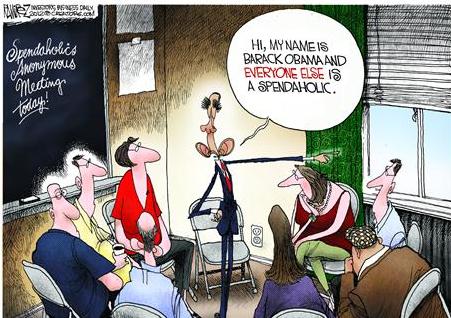
 Casual empiricism certainly suggests that higher taxes are associated with more government, not less red ink. We see this, for instance, in the
  What about the facts? Bill does some regression analysis for the 1949-2005 period, where he looks at the change in federal spending as a share of GDP and tests its relationship with the level of tax receipts as a share of GDP, the change in the unemployment rate, and the change in interest payments (the latter two variables are there to hopefully wash out the effects of the business cycle and to limit the analysis to the spending that lawmakers actually can control).






 The Daily Hatch