Category Archives: Current Events

The House Fight Heats Up

An Iowa candidate asks Democrats not to seat the Republican winner.

—-

The House Fight Heats Up

An Iowa candidate asks Democrats not to seat the Republican winner.

 
Rita Hart answers a question during a debate with Mariannette Miller-Meeks in Cedar Rapids, Iowa, Oct. 8.

Rita Hart answers a question during a debate with Mariannette Miller-Meeks in Cedar Rapids, Iowa, Oct. 8.

PHOTO: REBECCA F. MILLER/ASSOCIATED PRESS

How bloody-minded will Democrats be with their precariously thin House majority? We’re about to find out as Speaker Nancy Pelosi’s caucus considers an election challenge from Iowa’s 2nd Congressional district.

On Nov. 30, Iowa certified Republican candidate Mariannette Miller-Meeks the winner of the district, which extends southeast of Des Moines and is currently held by a Democrat. The margin was six votes.

On Tuesday Democrat Rita Hart submitted a briefasking the House of Representatives to overturn that outcome. Authored by Democratic election lawyer Marc Elias, it says counting 22 mostly absentee ballots would give Ms. Hart a nine-vote lead. The brief asks the House to order another recount and use its constitutional authority to seat Ms. Hart instead.

Among the reasons the ballots were wrongly excluded, the brief says, are signature placement, envelope seal and timeliness. Ms. Miller-Meeks’s campaign must file a response, which could raise other ballot disputes, within 30 days. Her campaign said in a statement: “Congresswoman-elect Mariannette Miller-Meeks won the vote on election night, won the 24-county audit and official canvas, won the 24-county recount, and was unanimously certified by the State of Iowa as the winner of the election by a bipartisan council.”

One political vulnerability for the Hart campaign is that it did not exhaust its Iowa court challenges before asking the House to intervene. The campaign said there wasn’t time for judicial relief in the one-week window between certification and the Dec. 8 deadline for a five-member state “contest court” ruling. But if only 22 ballots are at issue, the complaint could have been presented to Iowa judges.

Meanwhile, the counting continues in New York’s 22nd Congressional district upstate, where a state judge ordered a recanvass this month after Republican Claudia Tenney led by 12 votes in the initial count. Now she leads by 19, but the process is unlikely to be completed before the new Congress is sworn in. If Ms. Tenney comes out ahead, Mr. Elias’s firm—which is at work in that district as well—could also ask the House to seat its client.

The last time Congress overturned a state-certified House election result was when the Democratic majority didn’t seat an Indiana Republican in 1985. The GOP anger over that decision may have contributed to Newt Gingrich’s populist success in the House, and overturning an election in 2021 would also guarantee a backlash.

The stakes are also high because Joe Biden has appointed three Democratic House Members to his Administration, meaning that if Republicans hold the seats in Iowa’s 2nd and New York’s 22nd districts, the Democrats could temporarily have a mere 219 seats at the start of the term, with 218 needed for an absolute majority.

That could create an extra incentive for Mrs. Pelosi to abuse House rules for fear of falling short in key progressive votes. Alternatively, the GOP’s House success in 2020 might remind Democrats of the public’s wariness of their tactics—and the political risks for 2022 of stealing a House seat.


——-

7 Ways the 2005 Carter-Baker Report Could Have Averted Problems With 2020 Election

Continue reading

Barr’s Outstanding Record of Accomplishments

I

LAWCOMMENTARY

Barr’s Outstanding Record of Accomplishments

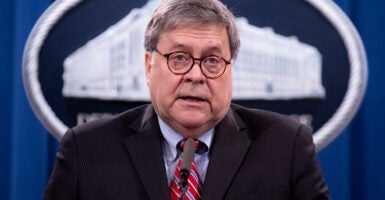
Attorney General William Barr will leave office Wednesday. Pictured: Barr holds a news conference at the Department of Justice Dec. 21, 2020, in Washington, D.C. (Photo: Michael Reynolds-Pool/Getty Images)

Attorney General William Barr will leave office Wednesday the same way he came in—as a class act. He carried out his role as the consummate professional who followed the law, administered justice, and forged ahead—despite relentlessly unfair and unjustified criticism leveled at him.

Barr offered a refreshing contrast to President Barack Obama’s former attorney general, Eric Holder, who characterized himself as Obama’s wingman. Barr understands that his first loyalty is to the Constitution and the rule of law, not the president. He knows that the attorney general must be an objective, apolitical enforcer of our nation’s laws.

Barr certainly cannot be characterized as the president’s wingman. Consider the anger expressed from the right over the fact that Barr kept the investigation of former Vice President Joe Biden’s son Hunter Biden secret until after the November election.

Barr has conducted himself as an ethical professional, adhering to the longstanding rules inside the Justice Department that require maintaining the confidentiality of criminal investigations to avoid damaging the lives and reputations of individuals over unproven claims and charges, as well as not harming the ability to conduct thorough criminal investigations.

The left is actively working to undermine the integrity of our elections. Read the plan to stop them now. Learn more now >>

Many conservatives criticized other actions taken by Barr, such as his support for FBI Director Christopher Wray and his statement that he had not seen evidence of widespread voter fraud sufficient enough to change the outcome of last month’s presidential election.

Whether one agrees or disagrees with such statements, Barr obviously called them like he saw them, and certainly was not kowtowing to the president or anyone else.

Barr, who previously served as attorney general under President George H.W. Bush, spent a lot of time trying to bring the Justice Department back in line as an objective executive agency divorced from politics, where prosecution decisions are driven by the best interests of justice.

As he stated in his resignation letter, Barr did not want FBI agents and Justice Department prosecutors to get away with targeting the presidential campaign of the opposition political party “with frenzied and baseless accusations of collusion with Russia.”

Barr’s willingness to appoint U.S. Attorney John Durham as a special counsel to investigate the origins of the Trump-Russia “collusion” probe—regardless of the fact that this could end with the prosecution of federal agents and lawyers—demonstrates his priority of maintaining and repairing the ethics and professionalism of the Justice Department as an institution.

Even if the Durham investigation damages the reputation of the Justice Department in the short run, it will hold individuals responsible for their misconduct and abusive behavior and restore the public’s confidence in the Justice Department in the long run.

It’s important to note that Barr didn’t change a single decision by special counsel Robert Mueller in his investigation of alleged ties between the 2016 Trump campaign and Russia. Nor did Barr try to withhold Mueller’s report or prevent him from testifying before Congress.

In fact, Barr worked with Mueller’s team on issues related to the redaction of sensitive information from the Mueller report, so that the public could see as much of the report as possible. This demonstrated Barr’s interest in transparency and his refusal to allow politics and the desires of some to have him censor and otherwise limit that investigation.

It is hard to summarize all of Barr’s accomplishments. Under his leadership, the Justice Department defended religious liberty, brought back the carrying out of the federal death penalty, and changed the Justice Department’s procedures in light of the abuses of the Foreign Intelligence Surveillance Act. The abuses were revealed by the Russia investigation and the work of the Justice Department’s Office of Inspector General.

Barr’s willingness to reveal the misconduct of government officials involved in the prosecution of former Trump national security adviser Michael Flynn also demonstrated how Barr is determined to do the right thing, not the politically correct thing.

President Donald Trump went on to pardon Flynn and reverse a miscarriage of justice against the retired Army lieutenant general, despite fierce criticism from the media and others.

Under Barr’s leadership, the Justice Departmentfulfilled its obligations to enforce federal immigration law. This included filing the first-ever immigration fraud prosecutions of individuals involved in the birth-tourism industry, a multimillion-dollar criminal industry that existed for decades but was ignored by prior administrations.

Barr also worked to reverse some actions of the Obama administration, which tried its best to terminate all cooperation that local authorities were giving to federal authorities to enforce our immigration laws.

Similarly, many colleges and universities—particularly Ivy League schools—have been violating civil rights law for years with impunity by discriminating on the basis of race in their admissions practices.

Prior administrations ignored this. But under Barr, the Justice Department’s Civil Rights Division finally started investigating these violations of federal law, suing Yale University in October and conducting an investigation of Harvard University.

On top of all this, the Barr Justice Department has done everything it can to help our beleaguered state and local law enforcement agencies. This included opening up multiple investigations of the violent rioters who attacked law enforcement officers—something that many local prosecutors were ignoring (often at the direction of their mayors).

The Latin motto of the Justice Department is “Qui Pro Domina Justitia Sequitur.” Roughly translated, this means he who “prosecutes on behalf of justice.”

Unlike some prior attorneys general who seemed to believe that this motto means he who “prosecutes on behalf of his political and ideological allies,” William Barr successfully carried out his solemn obligation to prosecute on behalf of justice in a professional, ethical, objective, and nonpartisan manner.

We can only hope this continues with the next attorney general.

wonder why both Democrats and Republicans are equally in favor of voter ID laws?

Lachlan Markay

April 9, 2012 at 12:43 pm

A new undercover video by conservative filmmaker James O’Keefe shows a man being offered Attorney General Eric Holder’s District of Columbia ballot. The poll worker caught on film tells the cameraman that he doesn’t need to see identification.

The video, released Monday, contrasts clips from the “sting” with quotes from Holder saying that voter fraud is generally “a problem that does not exist.” Holder’s Justice Department has blocked voter ID laws in South Carolina and Texas on grounds that include the supposed superfluity of those laws.

Eric Holder: There’s No Proof Of ID Fraud…

Uploaded by on Apr 9, 2012

Voter uses Eric Holders name no vote

___________

O’Keefe’s Project Veritas has targeted voter fraud in previous videos. One project, released last month, shows undercover filmmakers registering to vote in Minnesota, where the governor has attempted to block a voter ID bill, using the names of NFL quarterbacks Tim Tebow and Tom Brady.

_______

Registering Tim Tebow and Tom Brady to Vote in Minnesota

Uploaded by on Feb 7, 2012

ProjectVeritas.com Investigation. Election officials advise no ID necessary to register Timothy Tebow and Thomas Brady to vote in Minnesota. Absentee ballots are discussed, voter registration forms are given out, and Election officials blow the whistle on potential fraud in their own state

_________

While that project had more local focus, the latest Veritas video strikes at the heart of DOJ’s continued opposition to voter ID laws.

Meanwhile, another undercover video highlighted by Scribe last week shows that some of the most vocal opponents of voter ID laws require that visitors to their Washington D.C. offices present ID at the door. That video looks to undercut claims that ID requirements are excessively burdensome and unwarranted.

_______

Undercover Voter ID Investigation: You Will Never Guess Which Liberal

Uploaded by on Apr 3, 2012

What’s wrong with showing identification when you vote? That’s an egregious civil rights violation if you ask the Obama Administration and liberal groups like the Center for American Progress, and the Advancement Project. So what happens if you show up at the front door of these groups without ID? Find out on this PJTV undercover investigation.
______________

It is worth pointing out that the Supreme Court just recently weighed in on voter ID, and found its detractors’ arguments lacking.

The court ruled in 2008 that Indiana’s voter ID law, which the National Conference of State Legislatures says is one of the strictest in the nation, did not constitute an overly-burdensome restriction on voting, and was perfectly justified in the face of potential fraud.

MUSIC MONDAY Dan Peek’s life plus OPEN LETTER TO PAUL MCCARTNEY about Dan Peek

Dan Peek -All Things Are Possible

Dan Peek Testimony

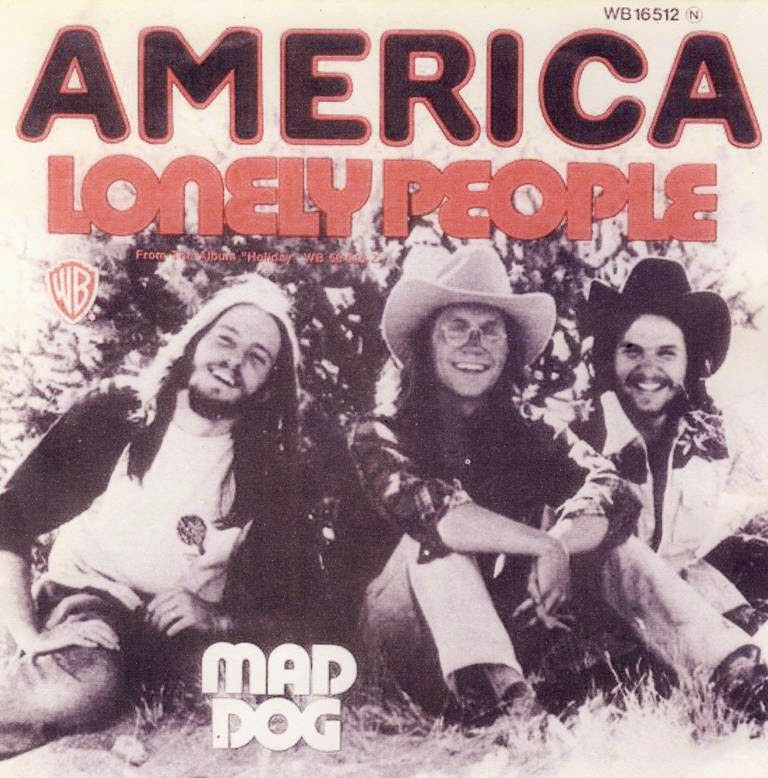
America – Lonely People

Dan Peek

From Wikipedia, the free encyclopedia
Dan Peek
Dan Peek on TopPop 1972.png

Peek performs on the AVRO show TopPop in 1972.
Background information
Birth name Daniel Milton Peek
Born November 1, 1950
Panama City, Florida
Died July 24, 2011 (aged 60)
Farmington, Missouri
Genres Folk rock, soft rock, country rock, contemporary Christian
Instruments Vocals, guitars, bass, keyboards, harmonica
Years active 1969-2011
Labels Warner Bros., Lamb & Lion
Associated acts America
Website danpeek.com

Daniel MiltonDanPeek (November 1, 1950 – July 24, 2011)[1] was a musician best known as a member of the folk rock band America from 1970 to 1977, together with Gerry Beckleyand Dewey Bunnell. He was also a “pioneer in contemporary Christian music“.[2][3]

Biography[edit]

Peek was born in Panama City, Florida[1] on November 1, 1950 while his father was in the U.S. Air Force.

When Peek was a young boy, he suffered from rheumatoid arthritis and had to be hospitalized for weeks 100 miles (160 km) away from the family home; his parents could only visit occasionally. Peek remembered this experience when, about a year before he died, he decided to dispose of five of his vintage guitars. Because the Ronald McDonald Houses exist to provide housing for families of hospitalized children close to hospitals around the United States and the world, Peek donated these five guitars to the San Diego house, which were subsequently sold to a collector, resulting in a $50,000 donation.[4]

Peek moved to England in 1963 with his family when his father was assigned to a base in London, meeting Dewey Bunnell and Gerry Beckley at London Central High School.[3]

Beginning in 1963, Peek was educated at London Central Elementary High School at Bushey Hall in North London. In 1973 he married Catherine Maberry,[5] with whom he would write a number of songs, including “Lonely People“.[6] He published an autobiography entitled An American Band, based on America’s most successful period, and his own spiritual journey.[7]

America[edit]

Peek contributed lead and backing vocals, guitars, bass, keyboards, and harmonica to their recordings during his tenure in the band. As a member of America, Peek wrote or co-wrote four Top 100 singles: “Don’t Cross the River” (No. 35), “Lonely People” (No. 5), “Woman Tonight” (No. 44), and “Today’s the Day” (No. 23), all of which he also sang lead on. “Lonely People” and “Today’s the Day” also hit No. 1 on the Billboard AC charts.[5]

Peek abused alcohol and other drugs during this period. In 2004 he released an autobiography about that era entitled An American Band: The America Story which was very difficult for him to write because of the bad memories it brought up.[1]

Contemporary Christian music[edit]

Peek left the band shortly after the February 1977 release of the Harbor album. Years of life on the road had taken a toll on him.[7] He renewed his Christian faith and had begun to seek a different artistic direction than Beckley or Bunnell. He went on to sign with Pat Boone‘s Lamb & Lion Records[7] and found modest success as a pioneering artist in the emerging Christianpop music genre.

Peek’s debut solo album, All Things Are Possible was released in 1979. Chris Christian co-wrote, produced, and contributed acoustic guitar and backing vocals on the album. The title track reached the Billboard charts, making the Top 10 in the A/C Billboard chart and number 1 in the Christian charts, becoming one of the earliest contemporary Christian music crossover hits. Another song on the album, “Love Was Just Another Word”, was recorded in Los Angeles and written by Chris Christian and Steve Kipner. Gerry Beckley and Dewey Bunnell contributed the background vocals. This was the last time the three original members of America recorded together.[citation needed] At the22nd Grammy Awards, the album was nominated,[2] losing in the Contemporary Gospel category to The Imperials album Heed the Call. Peek followed All Things Are Possible with Doer of the Word, which hit number 2 in the Christian charts. Gerry Beckley contributed background vocals, which were recorded at Chris Christian’s studio in Los Angeles while Peek was there.[8]

Peek waited five years before releasing a second solo album, 1984’s Doer of the Word. 1986 saw the release of his Electrovoice album, again to the CCM market, which included a remake of “Lonely People”, featuring a very similar lead vocal treatment and overall arrangement to the original America version. He changed some of the song’s lyrics to reflect his Christian faith,[citation needed] for example, the lines “And ride that highway in the sky” and “You never know until you try” became “And give your heart to Jesus Christ”.

Peek spent much of the 1990s in semi-retirement, occasionally recording music at his home in Bodden Town, Grand Cayman Island.[7] He released several solo projects and collaborated with Ken Marvin and Brian Gentry as “Peace” on three albums. In the years before his death, Peek released music via his website. His last musical collaboration was performing lead vocal on a track on the 2011 album Steps on the Water by Etcetera.

Death[edit]

Peek died in his sleep of fibrinous pericarditis on July 24, 2011, at age 60 at his home in Farmington, Missouri.[1][9] His interment was in Farmington’s Zolman Cemetery.

Discography[edit]

Table Key:
CCM – Contemporary Christian Music Chart
BB – Billboard Pop Singles Chart
AC – Billboard Adult Contemporary Chart
CB – Cash Box Singles Chart

Year Title
Album ————————– Single
CCM BB[10] AC[10] CB[11] Comments
1979 All Things Are Possible (album) Produced by Chris Christian
1979 “All Things Are Possible” 1 78 6 95 13 weeks at number 1. Nominated for a Grammy award.
1980 “Ready for Love” 7 Canadian Adult Contemporary Chart
1981 “Divine Lady” 23
1979 On This Christmas Night Various artists
1979 “The Star” Produced by Chris Christian
1984 Doer of the Word (album) Produced by Chris Christian
1984 “Doer of the Word” 2 Backing vocal by Gerry Beckley
1985 “Power and Glory”
1986 Electro Voice (album)
1986 “Lonely People” 2 Remake of Peek’s 1975 hit with America
1986 “Electro Voice” 7
1986 Christmas Greetings Various artists
1986 “Sleep Baby Jesus”
1987 Cross Over (album)
1987 “Cross Over” 13
1988 Best of Dan Peek Compilation
1989 Light of the World[12] With Marvin and Gentry
1997 Peace Peace with Marvin and Gentry
1998 “Summer Rain” Peace with Marvin and Gentry
1999 Bodden Town
2000 Under the Mercy Peace with Marvin and Gentry
2000 “On Wings of Eagles”
2000 Caribbean Christmas Instrumental
2001 Driftin’
2002 Guitar Man
2006 Guitar Man II Digital Internet release
2007 All American Boy Digital Internet release
2012 Greatest Hits Digital Internet release – Compilation
2012 Christian Artists Series: Dan Peek, Vol. 1 Digital Internet release – Compilation
2012 Christian Artists Series: Dan Peek, Vol. 2 Digital Internet release – Compilation
2012 Christian Artists Series: Dan Peek & Friends Digital Internet release – Compilation with Various Artists
2012 Christmas With Dan Peek and Friends Digital Internet release – Compilation with Various Artists

References[edit]

  1. ^ Jump up to:a b c d Lewis, Randy (27 July 2011). “Dan Peek dies at 60; founding member of the band America”. LA Times. Retrieved 27 July 2011.
  2. ^ Jump up to:a b “America singer Dan Peek dies aged 60”. BBC News. July 27, 2011. Retrieved 2011-07-27.
  3. ^ Jump up to:a b “Dan Peek, Co-Founder of America, Dead at 60”. Billboard magazine. July 26, 2011. Retrieved 2012-10-10. Peek was born in Panama City, Fla., to a U.S. Air Force officer father. He moved to England in 1963 when his father was assigned to a base there, meeting Bunnell and Beckley at London Central High School. Peek and Beckley played in a band called The Days, and after Peek left to attend Old Dominion University in Virginia, Bunnell took his place.
  4. Jump up^ “A first for Navy ship: Baby born on board”. The San Diego Union-Tribune. Retrieved 16 September 2015.
  5. ^ Jump up to:a b Margalit Fox (July 26, 2011). “Dan Peek, of the Rock Band America, Dies at 60”. New York Times. Dan Peek, an original member of the rock band America who later forsook the group for a life in Christian music, died on Sunday at his home in Farmington, Mo. He was 60. …
  6. Jump up^ “Lonely People” compositional info, ASCAP. Retrieved August 31, 2011.
  7. ^ Jump up to:a b c d “Dan Peek”. London: Telegraph. July 27, 2011. Retrieved 2011-07-28.
  8. Jump up^ Dan Peek recording Doer of the Word with Gerry Beckley and Chris Christian in LA on YouTube.
  9. Jump up^ Tijs, Andrew (2011-07-26). “Dan Peek of America Dies at 60 – Undercover.fm News”. Undercover.fm. Retrieved 2012-05-01.
  10. ^ Jump up to:a b “– US Billboard Music Charts”. Billboard.com. Retrieved 2011-07-27.
  11. Jump up^ “US Cash Box Charts”. CashBoxMagazine.com. Retrieved 2011-07-27.
  12. Jump up^ “Marvin & Gentry with Dan Peek – Light of the World – Amazon.com Music”. amazon.com. Retrieved 16 September 2015.

External links[edit]

______________

__

Francis and Edith Schaeffer pictured below:

___

Dan and Catherine Peek wedding day

___

Francis Schaeffer

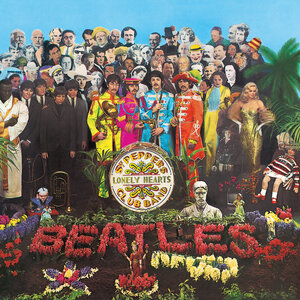
Sergeant Pepper’s Lonely Hearts Club Band

__

May 2, 2016

Paul McCartney

Dear Paul,

I so enjoyed the concert April 30th in Little Rock and you played one of my favorite Beatles songs ELEANOR RIGBY because it takes a long hard look at the loneliness felt by so many people in the world today. Another band also captured that same feel in one of their songs and it happened to be produced by your old friend GEORGE MARTIN who you also took time to recognize at the concert. The song is LONELY PEOPLE by the band AMERICA and it was written by Dan and Catherine Peek. Let’s take a look first at the lyrics of ELEANOR RIGBY:

Ah look at all the lonely people
Eleanor Rigby, picks up the rice
In the church where a wedding has been
Lives in a dream
Waits at the window, wearing the face
That she keeps in a jar by the door
Who is it for
All the lonely people
Where do they all come from?
All the lonely people
Where do they all belong?
Father McKenzie, writing the words
Of a sermon that no one will hear
No one comes near
Look at him working, darning his socks
In the night when there’s nobody there
What does he care
All the lonely people
Where do they all come from?
All the lonely people
Where do they all belong?
Ah look at all the lonely people
___
Now let’s examine the second to last sentence in the song: WHERE DO THEY ALL BELONG? What did the Beatles find the answer to that question was after all their searching in the 1960’s? Here is Francis Schaeffer’s analysis of the Beatles search:
This record,  Sergeant Pepper’s Lonely Hearts Club Band, became the rallying cry for young people throughout the world. It expressed the essence of their lives, thoughts and their feelings. 

Later came psychedelic rock, an attempt to find this experience without drugs. The younger people and the older ones tried drug taking but then turned to the eastern religions. Both drugs and the eastern religions seek truth inside one’s own head, a negation of reason. The central reason of the popularity of eastern religions in the west is a hope for a nonrational meaning to life and values….

Then the Beatles gradually came home. The last thing we find them doing is the YELLOW SUBMARINE. I sure a lot of parents thought this is much better than the old hard rock, but I thought it was a very sad thing because it really wasn’t a children’s story at all, but what it was in fact was a romantic statement and the fact is that is all there is. Just the same as [Ingmar] Bergman after he makes the movie SILENCE [1963] then he makes a comedy [ALL THESE WOMEN in 1964]. It is the same as Picasso when he pictures his child as a clown [Paul in a Clown Suit, 1924]. So we find the Beatles making the YELLOW SUBMARINE, but there is something more to it than this because Erich Segal made his reputation by writing the script for the movie version of YELLOW SUBMARINE and then he went on and wrote LOVE STORY. So what we have done is we have come around in a big circle. There was the destruction of the romantic. Students in the 1960’s said we are tired of the romantic of giving us optimistic statements with no sufficient base.

So the Beatles destroyed that and then they went through these various trips into non-reason but when they came out they had nothing left but the romantic. This is the tragedy of the young people starting with Berkeley in 1964. How right they were in saying we have largely a plastic culture.    This is something the church should have been saying. These students said give us reality. Then the students tried those trips and they weren’t trips based on reality but they were separated from reason. It was trying to find answers in one’s own head whether it was the drug  trip or the Eastern Religion trip. Then they came around in a big circle and what do we find–we end up with Segal’s LOVE STORY, just the romantic thing as one can imagine but with no adequate base at all, yet giving us a lovely romantic answer, which just like the YELLOW SUBMARINE is very, very sad because the Beatles and young people WERE GIVING UP THE SEARCH and just accepting something like this. 

Now let’s turn to the song LONELY PEOPLE by the band AMERICA but let’s look at the later Christian version of the song written by  Dan and Catherine Peek and they were the original writers of the original song. However, the original song did not have the answer to loneliness in it, but they found the answers to the big questions in life when they found Christ. Here is that Christian version of the song:

This is for all the lonely people
Thinkin’ that life has passed them by
Don’t give up until you drink from the silver cup
And give your heart to Jesus Christ

This is for all the single people
Thinkin’ that love has left them dry
Don’t give up until you drink from the silver cup
And give your heart to Jesus Christ

Well, He’s on his way
He’s coming back someday
He’s coming back to take us home

This is for all the lonely people
Thinkin’ that life has passed them by
Don’t give up until you drink from the silver cup
He’ll never take you down or He’ll never give you up
But you’ll never know until you try

Actually the answer to find meaning in life is found in putting your faith and trust in Jesus Christ. The Bible is true from cover to cover and can be trusted. Here are some of the posts I have done in the past on the subject and if you like you could just google these subjects: 1. The Babylonian Chronicleof Nebuchadnezzars Siege of Jerusalem, 2. Hezekiah’s Siloam Tunnel Inscription.13. The Pilate Inscription14. Caiaphas Ossuary14 B Pontius Pilate Part 214c. Three greatest American Archaeologists moved to accept Bible’s accuracy through archaeology.

Dan Peek, of the Rock Band America, Dies at 60

“We wanted to set ourselves apart and not be seen as English guys trying to do American music, but instead accentuate that we were an American band,” Mr. Peek told The Jerusalem Post last year.

The group’s self-titled debut album was released in Britain in 1971 and in the United States by Warner Brothers the next year.

The band won a Grammy Award in 1973 as best new artist. A string of successful albums followed, including “Homecoming,” “Holiday,” “Hearts” and “Hideaway.” Many were produced by George Martin, who produced many of the Beatles’ records.

As Mr. Peek later recalled, those early years passed in a blur of airplanes and limousines, wealth, drugs and alcohol.

“Sex, drugs and rock ’n’ roll; it was the whole cornucopia of fleshly material,” he said in an interview with the Christian Broadcasting Network show “The 700 Club.” “I tried everything. I tasted every possible thing. I had a spiritual compass, but I abandoned it completely.”

In 1977, distraught at the turn his life had taken, Mr. Peek became a born-again Christian. He renounced drugs and alcohol and left the band. He signed with Lamb & Lion Records, a label founded by Pat Boone, for which he recorded “All Things Are Possible.” His other albums of religious music include “Electro Voice,” “Cross Over” and “Caribbean Christmas.” (Mr. Peek and his wife lived in the Cayman Islands for many years.)

Sincerely,

Everette Hatcher, everettehatcher@gmail.com, http://www.thedailyhatch.org, cell ph 501-920-5733, Box 23416, LittleRock, AR 72221

Remembering Dan Peek of AMERICA – Lonely People (Christian version)

Lonely People

From Wikipedia, the free encyclopedia
For the EP by Orla Gartland, see Lonely People (EP).
“Lonely People”
Single by America
from the album Holiday
B-side “Mad Dog”
Released November 27, 1974
Genre Pop Rock
Length 2:27
Label Warner Bros. 8048
Writer(s) Dan Peek, Catherine Peek
Producer(s) George Martin
America singles chronology
Tin Man
(1974)
Lonely People
(1974)
Sister Golden Hair
(1975)

Lonely People” is a song written by the husband-and-wife team of Dan and Catherine Peek and recorded by America.

Background[edit]

“Lonely People” was the second single release from America’s 1974 album Holiday. “Lonely People” reached number five on the Billboard Hot 100,[1] Dan Peek’s only credited song to reach that chart’s top 10,[2] and was America’s second number one on the Easy Listening chart, where it stayed for one week in February 1975.[3]

“Lonely People” was not automatically earmarked for the Holiday album: Peek unsuccessfully submitted a demo of the song for John Sebastian to consider recording.[4]

“Lonely People” was written as an optimistic response to the Beatles‘ song “Eleanor Rigby“. Peek considered “Eleanor Rigby” an “overwhelming” “picture…of the masses of lost humanity, drowning in grey oblivion” and would recall being “lacerated” on first hearing the lyrics of its chorus which run “All the lonely people: where do they all come from…where do they all belong”.[4] “Lonely People” was written within a few weeks of Peek’s 1973 marriage to Catherine Mayberry: Peek- “I always felt like a melancholy, lonely person. And now [upon getting married] I felt like I’d won.”[5] The lyrics of “Lonely People” advise “all the lonely people”: “Don’t give up until you drink from the silver cup”, a metaphor which Peek thus explains: “It’s possible to drink from another’s well of experience…and be refreshed.”[4]

Dan Peek would recall that in his post-America solo career he would utilize “Lonely People” to close his concerts, introducing the song “with words to the effect” “that Jesus is the answer to loneliness”. On the advice of a fan Peek began amending the actual lyrics of the song to convey this pro-Christian message and Peek recorded a lyrically revised version of “Lonely People” for his 1986 album Electro Voice. This revised version amended the original lyrics “And ride that highway in the sky” and “You never know until you try” to “And give your heart to Jesus Christ.”[6]

Charts[edit]

Chart (1974) Peak
position
US Billboard Easy Listening 1
US Billboard Hot 100 5
US Cash Box Singles Chart 10
US Record World Singles Chart 9
US Radio & Records Singles Chart 12

Other versions[edit]

Jars of Clay remade “Lonely People” for their 2003 album Who We Are Instead. Their version was featured on The WB TV series Everwood and was on the 2004 Everwood soundtrack album.

See also[edit]

References[edit]

  1. Jump up^ America, “Lonely People” Chart Positions Retrieved March 30, 2015
  2. Jump up^ Chart Positions for Dan Peek songs Retrieved March 30, 2015
  3. Jump up^ Whitburn, Joel (2002). Top Adult Contemporary: 1961-2001. Record Research. p. 20.
  4. ^ Jump up to:a b c Peak, Dan (2004). An American Band: the America Story. Xulon Press. ISBN 1-594679-29-0.
  5. Jump up^ “America Founding Guitarist Dan Peek Dies”. The Morton Report. Retrieved March 7, 2014.
  6. Jump up^ “Dan Peek Discusses His Latest Album Electro Voice”. Billboard (The Morton Report) (vol 98 #32 (August 9, 1986)).

External links[edit]

Related posts:

MUSIC MONDAY The song LITTLE ONE sung by Rebecca St. James in the film SARAH’S CHOICE

Little One – From the Film, “Sarah’s Choice” Rebecca St James on faith and values – theDove.us Sarah’s Choice Trailer Sarah’s Choice – Behind the Scenes Rebecca St. James on Sarah’s Choice – CBN.com Rebecca St James Interview on Real Videos Sarah’s Choice – The Proposal Sarahs Choice Pregnancy Test Sarahs Choice Crossroad Sarah’s Choice […]

MUSIC MONDAY Rebecca St James

Lion – Rebecca St. James I will praise You – Rebecca St James Rebecca St James 1995 TBN – Everything I Do Rebecca St. James & Rachel Scott “Blessed Be Your Name” Rebecca St. James From Wikipedia, the free encyclopedia Rebecca St. James St. James in 2007 Background information Birth name Rebecca Jean Smallbone Also […]

MUSIC MONDAY “Foster the People” Cubbie Fink married to Rebecca St. James who is one of my favorite Christian singers!!!

Foster The People – Pumped up Kicks Foster the People From Wikipedia, the free encyclopedia Foster the People Foster the People at the 2011 MuchMusic Video Awards, from left to right: Pontius, Foster, and Fink Background information Origin Los Angeles, California, U.S. Genres Indie pop alternative rock indietronica alternative dance neo-psychedelia[1] Years active 2009–present Labels […]

MUSIC MONDAY ‘Apple gave me advice’: Coldplay’s Chris Martin turned to 11-year-old daughter for words of wisdom ahead of Superbowl 50 By DAILYMAIL.COM REPORTER PUBLISHED: 00:58 EST, 2 February 2016

‘Apple gave me advice’: Coldplay’s Chris Martin turned to 11-year-old daughter for words of wisdom ahead of Superbowl 50 By DAILYMAIL.COM REPORTER PUBLISHED: 00:58 EST, 2 February 2016 | UPDATED: 17:20 EST, 2 February 2016 n Facebook They’ve sold 80 million records and been around for 20 years. But Coldplay’s lead singer Chris Martin, 38, […]

MUSIC MONDAY Chris Martin, Lead Singer of Coldplay: 5 Fast Facts You Need to Know Published 3:44 pm EDT, February 7, 2016

__________ Chris Martin, Lead Singer of Coldplay: 5 Fast Facts You Need to Know Published 3:44 pm EDT, February 7, 2016 Updated 3:44 pm EDT, February 7, 2016 Comment By Lauren Weigle 17.6k (Getty) Chris Martin has been the front-man of the band Coldplay for about 20 years, though the band changed its name a […]

MUSIC MONDAY Christian Rock Pioneer Larry Norman’s Songs Part 14

Christian Rock Pioneer Larry Norman’s Songs Part 14 I posted a lot in the past about my favorite Christian musicians such as Keith Green (I enjoyed reading Green’s monthly publications too), and 2nd Chapter of Acts and others. Today I wanted to talk about one of Larry Norman’s songs. David Rogers introduced me to Larry […]

MUSIC MONDAY Christian Rock Pioneer Larry Norman’s Songs Part 13

Christian Rock Pioneer Larry Norman’s Songs Part 13 I posted a lot in the past about my favorite Christian musicians such as Keith Green (I enjoyed reading Green’s monthly publications too), and 2nd Chapter of Acts and others. Today I wanted to talk about one of Larry Norman’s songs. David Rogers introduced me to Larry […]

MUSIC MONDAY Christian Rock Pioneer Larry Norman’s Songs Part 12

Christian Rock Pioneer Larry Norman’s Songs Part 12 I posted a lot in the past about my favorite Christian musicians such as Keith Green (I enjoyed reading Green’s monthly publications too), and 2nd Chapter of Acts and others. Today I wanted to talk about one of Larry Norman’s songs. David Rogers introduced me to Larry […]

MUSIC MONDAY Christian Rock Pioneer Larry Norman’s Songs Part 11

Christian Rock Pioneer Larry Norman’s Songs Part 11 I posted a lot in the past about my favorite Christian musicians such as Keith Green (I enjoyed reading Green’s monthly publications too), and 2nd Chapter of Acts and others. Today I wanted to talk about one of Larry Norman’s songs. David Rogers introduced me to Larry […]

MUSIC MONDAY Christian Rock Pioneer Larry Norman’s Songs Part 10 more on Album “Only Visiting This Planet”

Christian Rock Pioneer Larry Norman’s Songs Part 10 more on Album “Only Visiting This Planet” I posted a lot in the past about my favorite Christian musicians such as Keith Green (I enjoyed reading Green’s monthly publications too), and 2nd Chapter of Acts and others. Today I wanted to talk about one of Larry Norman’s […]

MUSIC MONDAY Eric Clapton and Jimi Hendrix were good friends!!

Eric Clapton and Jimi Hendrix were good friends!!

Jimi Hendrix & Cream – Sunshine Of Your Love

Uploaded on Feb 5, 2012

Hey Joe JIMI HENDRIX live images in 1969, in London! BBC! dedicated to cream”Sunshine of Your Love”. High quality and superior sound. ¡¡¡¡¡full screen!!!!!

Everyone wanted to meet or take a picture with the great Jimi Hendrix. Check it out some of the classic photos of Jimi with other musicians of his time…

Jimi Hendrix & The Who

Jimi Hendrix With The Who

Jimi Hendrix & Eric Clapton

Jimi Hendrix Eric Clapton

Jimi Hendrix & Mick Jagger

Jimi Hendrix with Mick Jagger The Rolling Stones

Jimi Hendrix & Keith Richards

Jimi Hendrix Keith Richards The Rolling Stones

Jimi Hendrix & Brian Jones

Jimi Hendrix Brian Jones The Rolling Stones

Jimi Hendrix & Janis Joplin

Jimi Hendrix Meeting Janis Joplin

Jimi Hendrix with Cream & Pink Floyd

Jimi Hendrix Cream Pink Floyd

Even “Legends” want to meet a “Legend”

Jimi Hendrix: ‘You never told me he was that good’
On the the 40th anniversary of the great guitarist’s death, Ed Vulliamy speaks to the people who knew him best and unearths a funny, if driven, superstar
The Jimi Hendrix Experience
The ‘extraordinary’ Jimi Hendrix with the Experience at Olympia, London, on 22 December 1967. Photograph: Ray Stevenson/Rex Features
Ed Vulliamy

Ed Vulliamy

Saturday 7 August 2010 19.02 EDT

On the morning of 21 September 1966, a Pan Am airliner from New York landed at Heathrow, carrying among its passengers a black American musician from a poor home. Barely known in his own country and a complete stranger to England, he had just flown first class for the first time in his life. His name was James Marshall Hendrix.

On 18 September 1970, four years later, I picked up a copy of London’s Evening Standard on my way home from school, something I never usually did. There was a story of extreme urgency on the front page and a picture of Hendrix playing at a concert – still ringing in my ears – at the Isle of Wight festival, only 18 days earlier. The text reported how Hendrix had died that morning in a hotel in the street, Lansdowne Crescent in Notting Hill, in which I had been born, and a block away from where I now lived.

During those three years and 362 days living in London, Hendrix had conjured – with his vision and sense of sound, his personality and genius – the most extraordinary guitar music ever played, the most remarkable sound-scape ever created; of that there is little argument. Opinion varies only over the effect his music has on people: elation, fear, sexual stimulation, sublimation, disgust – all or none of these – but always drop-jawed amazement.

The 40th anniversary of Hendrix’s death next month will be marked by the opening of an exhibition of curios and memorabilia at the only place he ever called home – a flat diagonally above that once occupied by the composer George Frideric Handel, on Brook Street in central London, in the double building now known as Handel House. The flat will be opened to the public for 12 days in September and there is talk about plans for a joint museum, adding Hendrix’s presence to that already established in the museum devoted to Handel. Involved in the discussions is the woman with whom Hendrix furnished the top flat of 23 Brook St, and with whom he lived: the only woman he ever really loved, Kathy Etchingham.

In a rare interview by telephone, (she has moved abroad), Ms Etchingham explains: “I want him to be remembered for what he was – not this tragic figure he has been turned into by nit-pickers and people who used to stalk us and collect photographs and ‘evidence’ of what we were doing on a certain day. He could be grumpy, and he could be terrible in the studio, getting exactly what he wanted – but he was fun, he was charming. I want people to remember the man I knew.”

When she met Hendrix (the same night he landed in London), he had already lived an interesting, if frustrating, 23 years. He was born to a father who cared, but not greatly, and a mother he barely knew – she died when he was 15 – but adored (she’s said to be the focus of two of his three great ballads, “Little Wing” and “Angel”). He had always been enthralled by guitar playing – a “natural”, immersed in R&B on the radio and the music of blues giants Albert King and Muddy Waters. When he was 18, he was offered the chance to avoid jail for a minor misdemeanour by joining the army, which he did, training for the 101st Airborne Division.
Robert Stredder, 29, kissing at the Isle of Wight festival, 1970
Read more

His military career was marked by friendship with a bass player called Billy Cox from West Virginia, with whom he would play his last concerts, and a report which read: “Individual is unable to conform to military rules and regulations. Misses bed check: sleeps while supposed to be working: unsatisfactory duty performance.”

Hendrix engineered his discharge in time to avoid being mobilised to Vietnam and worked hard as a backing guitarist for Little Richard, Curtis Knight, the Isley Brothers and others. But, arriving in New York to try and establish himself in his own right, Hendrix found he did not fit. The writer Paul Gilroy, in his recent book Darker Than Blue, makes the point that Hendrix’s life and music were propelled by two important factors: his being an “ex-paratrooper who gradually became an advocate of peace” and his “transgressions of redundant musical and racial rules”.
Advertisement

Hendrix didn’t fit because he wasn’t black enough for Harlem, nor white enough for Greenwich Village. His music was closer to the blues than any other genre; the Delta and Chicago blues which had captivated a generation of musicians, not so much in the US as in London, musicians such as John Mayall and Alexis Korner, and thereafter Eric Clapton, Peter Green, Jeff Beck and Jimmy Page among many others.

As luck would have it, the Brits were in town and Linda Keith, girlfriend of the Stones’ Keith Richards, persuaded Chas Chandler, bass player of the Animals, to go and listen to Hendrix play at the Cafe Wha? club in the Village. Chandler wanted to move into management and happened to be fixated by a song, “Hey Joe”, by Tim Rose.

“It was a song Chas knew would be a hit if only he could find the right person to play it,” says Keith Altham, then of the New Musical Express, who would later become a kind of embedded reporter with the Hendrix London entourage. “There he was, this incredible man, playing a wild version of that very song. It was like an epiphany for Chas – it was meant to be.”

“To be honest,” remembers Tappy Wright, the Animals’ roadie who came to Cafe Wha? with Chandler that night, “I wasn’t too impressed at first, but when he started playing with his teeth, and behind his head, it was obvious that here was someone different.”

Before long, Hendrix was aboard the plane to London with Chandler and the Animals’ manager, Michael Jeffery, to be met by Tony Garland, who would end up being general factotum for Hendrix’s management company, Anim. “When he arrived,” recalls Garland now, sitting on his barge beside the canal in Maida Vale, west London, where he now lives, “I filled out the customs form. We couldn’t say he’d come to work because he didn’t have a permit, so I told them he was a famous American star coming to collect his royalties.”

It is strange, tracking down Hendrix’s inner circle in London. His own musicians in his great band, the Experience – Noel Redding and Mitch Mitchell – are dead. Likewise, his two managers, Chandler and Jeffery, and one of his closest musician friends, the Rolling Stone Brian Jones; the other, Eric Burdon of the Animals, declined to be interviewed. But some members of the close-knit entourage are still around, such as Kathy Etchingham and Keith Altham, wearing a flaming orange jacket befitting the time of which he agrees to speak, in defiance of a heart attack only a few days before.
Lithofayne Pridgon: Jimi Hendrix’s original ‘foxy lady’
Read more

Music in London had reached a tumultuously creative moment when Hendrix arrived and was perfectly poised to receive him. “The performers were just your mates who played guitars,” recalls Altham. “It was tight – everyone knew everyone else. It was just Pete from the Who, Eric of Cream, or Brian and Mick of the Stones, all going to each other’s gigs.”

For reasons never quite explained, the blues – both in their acoustic Delta form, and Chicago blues plugged into an amplifier – had captivated this generation of English musicians more deeply than their American counterparts. Elderly blues musicians found themselves, to their amazement, courted for concerts, such as an unforgettable night at Hammersmith with Son House and Bukka White. Champion Jack Dupree married and settled in Yorkshire. “People [here] felt a certain affinity with the blues, music which added a bit of colour to grey life,” Altham continues. And as Garland points out: “White America was listening to Doris Day – black American music got nowhere near white AM radio. Jimi was too white for black radio. Here, there were a lot of white guys listening to blues from America and wanting to sound like their heroes.”
Advertisement

Things happened at speed after Hendrix landed. “’Come down to the Scotch,’ Chas told me the day Jimi arrived and hear what I found in New York,” recalls Altham. “Jimi couldn’t play because he had no work permit, but he jammed that night, and my first impression was that he’d make a great jazz musician.” That was the night, his first in London, that Hendrix met Kathy Etchingham. “It happened straightaway,” she recalls. “Here was this man: different, funny, coy – even about his own playing.”

“A short while later,” recalls Altham, “Chas took me to hear him at the Bag O’Nails club [in Soho] for one of his first proper gigs, turned to me and said, ‘What’ya think?’ I said I’d never heard anything like it in all my life.” At a concert in the same series, remembers Garland, “Michael Jeffery put an arm round Chas, another round me and said, ‘I think we’ve cracked it, mate.’” They had: Kit Lambert, according to Altham, literally scrambled across the tables to Chas at one of the shows and said, “in his plummy accent”, he had to sign him. Chas needed a record contract, Decca had turned Hendrix down (along with the Beatles) and Lambert was about to launch a new label, Track Records, with interest from Polydor: “The deal was done, on the back of a napkin,” says Altham.

Hendrix had formed his band at speed: a rhythm guitarist from Kent called Noel Redding – who had applied to join the Animals but to whom Hendrix now allocated bass guitar – and Mitch Mitchell, a jazz drummer seeking to mould himself in the style of John Coltrane’s great percussionist, Elvin Jones. With a stroke of genius, Jeffery came up with the only name befitting what was to follow: the Jimi Hendrix Experience. Is there any line in rock’n’roll more assuredly seductive as: “Are you experienced?/ Have you ever been experienced?/ Well, I have” (from 1967’s “Are You Experienced”)?

Paul McCartney, John Lennon and the other Beatles quickly converged to hear this phenomenon, along with the Stones and Pete Townshend. Arriving one night at the Bag O’Nails, Altham met Brian Jones “walking back up the stairs with tears in his eyes. I said, ‘Brian, what is it?’ and he replied, ‘It’s what he does, it chokes me’ – only he put it better than that”.

There was also curiosity from the emergent powerhouse of British blues: Cream and Eric Clapton. There was a particular night when Cream allowed Jimi to join them for a jam at the Regent Street Polytechnic in central London. Meeting Clapton had been among the enticements Chandler had used to lure Hendrix to Britain: “Hendrix blew into a version of [Howlin’ Wolf’s] ‘Killing Floor’,” recalls Garland, “and plays it at breakneck tempo, just like that – it stopped you in your tracks.” Altham recalls Chandler going backstage after Clapton left in the middle of the song “which he had yet to master himself”; Clapton was furiously puffing on a cigarette and telling Chas: “You never told me he was that fucking good.”

With a reputation, a recording contract and the adoration of his peers, Hendrix was allocated a flat belonging to Ringo Starr, in Montagu Square, in which he lived with Etchingham, Chandler and Chandler’s Swedish girlfriend, Lotta. It was not ideal, but base camp for an initial tour – as opening act for Cat Stevens and Engelbert Humperdinck, with the Walker Brothers topping the bill.

Something was needed, Chandler thought, whereby Hendrix could blow the successive acts off the stage and Altham had the beginning of an idea. He said: “’It’s a pity that you can’t set fire to your guitar.’ There was a pregnant pause in the dressing room, after which Chas said, ‘Go out and get some lighter fuel.’” Garland remembers: “I went out into Seven Sisters Road [in north London] to buy lighter fluid. At first, it didn’t make sense to me – there were too many things going on to worry about lighter fluid – but it all became clear in the end.”

Altham borrowed a lighter from Gary – the third Walker brother and drummer – and that night, at the Astoria theatre in central London, Hendrix set his guitar ablaze for the first time. “One of the security guards said, ‘Why are you waving it around your head?’” recalls Altham. “’Cause I’m trying to put it out,’ replied Jimi. Actually, he only did it three times after,” says Altham, “but it became a trademark.”
Advertisement

The touring began in earnest during that winter of 1966-7: around working men’s clubs and little theatres in the north of England. “That’s when I remember him at his very best,” recalls Etchingham. “And at his happiest. The small clubs in regional venues. When he was desperate to make a name for himself, but was also playing for himself. In the working men’s clubs, they just wanted some music to enjoy while they drank their beer. In the small theatres, people had come to hear him. But that was his best music ever – played for its own sake. None of these crazy expectations, no one hanging on – just the people he knew, liked and trusted, and his own music.”

But what was this music, this singular, uplifting, otherworldly, menacing, exotic and erotic sound? “Hendrix was a magpie,” says Altham. “He would take from blues, jazz – only Coltrane could play in that way – and Dylan was the greatest influence. But he’d listen to Mozart, he’d read sci-fi and Asimov and it would all go through his head and come out as Jimi Hendrix. Then there was just the dexterity – he was left-handed, but I remember people throwing him a right-handed guitar and Hendrix picking it up and playing it upside down.”

“And don’t forget,” says Tappy Wright, who acted as roadie at first, then joined the management team, “we were using the cheapest guitars. These were no Fenders or Stratocasters. These were Hofners we bought for a few quid. Very basic, but stretched to the fucking limit.”

The most precious insight comes from Etchingham. “People often saw Jimi on stage looking incredibly intense and serious. And suddenly this smile would come across his face, almost a laugh, for no apparent reason,” she says. “Well, I remember that very well, sitting on the bed or the floor at home in Brook Street. Sometimes, he would play a riff for hours, until he had it just right. Then this great smile would creep across his face or he’d throw his head back and laugh. Those were the moments he had got it right for himself, not for anyone else.”

Touring ran concurrent with work in the studio – first the singles: “Hey Joe”, the inimitable “Purple Haze” and “The Wind Cries Mary”, written for Kathy when Hendrix was left alone at home after she had stormed out from an argument, so the story goes (Mary is her middle name). “I never realised quite how hard he worked,” says Sarah Bardwell, director of the Handel House Museum, researching her new charge. The Experience would finish a concert up north, drive south, record between 3am and 9am, then return north for two more shows each day. LSD had yet to play a major role – if the Experience were on amphetamines, it was to keep the schedule.

In various studios, ending up at west London’s Olympic, work began. “I used to ring them up to book time,” recalls Etchingham. “Thirty quid an hour and they’d want the cheque there and then.” Chandler was aware of this and would occasionally hasten things along by taking what the band thought was a warm-up to be the finished product. “’What?’ the band would say,” recalls Altham. “’That’s it,’ Chas would reply. ‘Now for the next one.’”

But the soundscape unique to Hendrix, pushing the technology to its limits, was not serendipity, nor was it only about Hendrix’s genius: there was science behind the subliminal magic. “This was not ‘psychcolergic’, as Eric Burdon used to call it,” says Garland. “Hendrix knew exactly what he was doing.” And this process began with a man called Roger Mayer.

“We call this the Surrey blues Delta,” says Mayer, with a wave of his arms across the crazy-paving pathways of Worcester Park, near Surbiton. “Eric over here, Keith down the road, the Stones from there.” Mayer was an acoustician and sonic wave engineer for the Admiralty, a civil servant in the Ministry of Defence, but also an inventor of various electronic musical devices, including an improved wah-wah pedal and the “Octavia” guitar effect with its unique “doubling” effect. “I’d shown it to Jimmy Page, but he thought it was too far out. Jimi said, the moment we met, ‘Yeah, I’d like to try that stuff.’” “One of my favourite memories of all,” says Etchingham, “is Jimi and Roger huddled together over the console and the instruments, talking about stuff way over my head, and then this glorious thing happening.”
Advertisement

“We started from the premise that music was a mission, not a competition,” says Mayer, who describes himself as a “sonic consultant” to Hendrix. “That the basis was the blues, but that the framework of the blues was too tight. We’d talk first about what he wanted the emotion of the song to be. What’s the vision? He would talk in colours and my job was to give him the electronic palette which would engineer those colours so he could paint the canvas.

“Let me try to explain why it sounds like it does: when you listen to Hendrix, you are listening to music in its pure form,” he adds. “The electronics we used were ‘feed forward’, which means that the input from the player projects forward – the equivalent of electronic shadow dancing – so that what happens derives from the original sound and modifies what is being played. But nothing can be predictive – it is speed-forward analogue, a non-repetitive wave form, and that is the definition of pure music and therefore the diametric opposite of digital.

“Look, if you throw a pebble into a lake, you have no way of predicting the ripples – it depends on how you throw the stone, or the wind. Digital makes the false presumption that you can predict those ripples, but Jimi and I were always looking for the warning signs. The brain knows when it hears repetition that this is no longer music and what you hear when you listen to Hendrix is pure music. It took discussion and experiment, and some frustrations, but then that moment would come, we’d put the headphones down and say, ‘Got it. That’s the one.’

“But I take none of the credit,” insists Mayer. “You can build a racing car just like the one that won the 1955 grand prix. But if you can’t drive like Juan Manuel Fangio, you’re not going to win the grand prix. Jimi Hendrix only sounds like he does because he was Jimi Hendrix.”

Everyone knows that Hendrix had hundreds of women, often concurrently – but that is not as interesting as the fact that, says Altham, “Kathy Etchingham was the love of his life”. Mayer recalls them “oozing affection, even when there was a row – he needed her very badly indeed”. Hendrix called the flat into which he moved with her in 1968 “the only home I ever had”.

“We knew we wanted Mayfair,” says Etchingham, “so we could walk to the gigs, but the prices were high, even though it was a little seedy – £30 a week.” The couple furnished the split-level, top-floor apartment together with prints and wall hangings from Portobello Road. When Hendrix found out that Handel had lived downstairs, “he went round to HMV or One Stop Records to get Messiah,” says Sarah Bardwell. “What is so interesting is that they were both musicians from abroad, who came to London to make their name in this building.”

It feels extraordinary now to walk over the venerable floorboards past a replica of Handel’s harpsichord, portraits of the composer and the score of Messiah in the room in which it was composed, then up a wooden staircase to Hendrix’s whitewashed sitting room and bedroom above. Sarah Bardwell’s aim is for a joint Handel-Hendrix house museum of some kind. Blue English Heritage plaques accompany each other on the wall outside; Hendrix was added in 1997, a labour of devotion by Kathy Etchingham, who recalls English Heritage balking at the fact that the shop front below was a lingerie shop, “all mannequins wearing suspenders and knickers”, which needed covering up while the plaque was unveiled.

Now, it is the posh Jo Malone perfumery, though “in our day it was Mr Love’s cafe,” she recalls fondly. “On the corner of Oxford Street. And there was an Indian tea shop we’d go to in South Molton Street, and always HMV or One Stop – and we’d walk to the gigs along Regent Street or across Hanover Square, and maybe take a taxi home.”
Advertisement

The memories of the people who actually knew him overshadow the tragic, antiheroic Hendrix of popular imagination. Etchingham and Keith Altham recall a man with a sense of humour. “If things were getting tense in the studio,” says Altham, “he’d just play ‘Teddy Bears’ Picnic’.” Adds Tony Garland: “If I told Jimi to ‘kiss my arse’, he’d answer, ‘You’ve got a rubber neck, do it yourself’ with a sly grin. You always knew you were with someone quicker-witted than yourself.”

Altham also talks about Hendrix “saying nothing to reporters, or contradictory things, on purpose. He would pat his fingers against his lips mid-sentence and go, ‘etcetera, etcetera, etcetera’, in order to say, in effect, nothing. He wanted the music to speak. He also had this way of saying things that made you do a double take: ‘Did he really say that?’ Such as, just before he went on to play with Clapton, who was his idol, for the first time, he told me, ‘I want to see if he is as good as he thinks I am’ – which is not at all the remark you first think it is.”

But many of those who comprised Hendrix’s inner circle in London now talk about some demise in his mental agility once he became popular in his native US, a mass commodity caught between the triangle of his own “racially transgressive” music, his blackness and the black power movement, and his overwhelmingly white audience. Even then, though, Hendrix closed the 1969 Woodstock festival with a version of “The Star-Spangled Banner”, which became the anthem for both the movement against the war in Vietnam and Hendrix’s own complicated empathy with the young American fodder sent to fight it, as a former military man himself. Many of his childhood friends were over there, some never to return. The anthem made Jimi famous worldwide, veering into a vortex out of which emerged “Purple Haze”, a glorious, lyrical dirge – for something, for everything; an endpiece not only to Woodstock but to so many dreams.

“Chas Chandler would come into the studio and find two women in his chair,” recalls Tappy Wright. “’Get out of my chair!’ he’d say. And then, well, there were drugs, drugs, drugs. I never took any, because I had to make sure everyone got out of bed in the morning – but they were around, too much around.” Altham says that Chandler told him “that he gave Jimi an ultimatum: ‘Either I go or the hangers-on go.’ But there was no getting rid of them, so Chas quit and Jimi was left with Michael Jeffery”.

“Jimi was at his best when the fame never got in the way of the music,” says Etchingham, “and at his worst when the fame took over, when people who hardly knew him suddenly became his best friends.” “He had this thing,” says Altham, “of not being able to say no to people – and this became a problem.”

Even the flat on Brook Street became an open house, to journalists, anyone. “It’s funny,” says Sarah Bardwell. “Here we are trying to contact his old friends who are now superstars for our events and exhibition, and it’s like laying siege to Fort Knox! Yet Hendrix was available to anyone, perhaps almost too much so.”

Despite the distractions, there was one project consistently dear to Hendrix’s heart: the state-of-the-art Electric Lady Studios in New York, opened with a party on 26 August 1970, the night before he was due to fly back to England to play the Isle of Wight festival. Only Hendrix was almost too shy to appear and, when he did so, he retreated to the steps outside, where he met a young singer-songwriter too shy to enter the fray – Patti Smith. “It was all too much for me. Johnny Winter in there and all,” recalled Smith in a past interview with the Observer. “So I thought, ‘I’ll just sit awhile on the steps’ and out came Jimi and sat next to me. And he was so full of ideas; the different sounds he was going to create in this studio, wider landscapes, experiments with musicians and new soundscapes. All he had to do was get over back to England, play the festival and get back to work…”
Advertisement

It had been a long weekend on the Isle of Wight and, for me, an exciting one. I was compelled – not disgusted, as is the official history – by the determination of French and German anarchists to tear down the fences so that it be a free festival. I loved the fact that Notting Hill’s local band, Hawkwind, played outside the fence in protest at the ticket prices. The strange atmosphere added to the climactic moment, after the Who and others: the one set, at 2am on the Monday, for which it was imperative to get down from among the crowds on Desolation Row and force a way right to the front and concentrate or, rather, submit to hypnosis. The set by Jimi Hendrix.

It is written in the lore of Hendrixology that this was a terrible performance. Hendrix had arrived exhausted, by the previous month’s events, the upcoming tour, the day’s violence and by walkie-talkie voices that somehow made their way into the PA system. But all I remember, having just turned 16, is a dream coming true: the greatest rock musician of all time (one knew this with assurance) dressed in blazing red and purple silks, actually playing the version of “Sgt Pepper’s” about which I had read so much in NME, playing “Purple Haze”, “Voodoo Chile” and a long, searing “Machine Gun”, just yards away. I remember the sound – the sounds, plural – bombarding me from the far side of some emotional, existential, hallucinogenic and sexual checkpoint along the road towards the rest of my life. I remember him playing the horn parts to “Sgt Pepper’s” on his guitar! I remember the deafening and painful silence after he finished his fusillade and in the crowd a mixture of rapture, gratitude, enlightenment and affection.

Afterwards, Hendrix went on a reportedly disastrous tour of Scandinavia and Germany (failing to meet one of his two children, by a Swedish girlfriend – the other he had sired in New York and also never met), before returning to the Cumberland hotel and the room in which he gave his last ever interview, to Keith Altham. (To mark the anniversary, the Cumberland has designed and decorated these rooms in a swirl of colour, stocked it with Hendrix music and called it the Hendrix Suite, in which people can stay.)

“There were two women in the room,” recalls Altham. “One of them was a girlfriend called Devon Wilson and she was dodgy – she dealt him drugs and I can say that now because she’s dead. But he knew me well by this time and he seemed better than I’d seen him previously.” The interview is a remarkable one, utterly devoid of all the nonsense that would ensue about suicide and a death wish. On the tape, Hendrix laughs and jokes; he tells Altham about plans to re-form the Experience and tour England again.

On the night of 16 September, Hendrix went to Ronnie Scott’s without his guitar, hoping to jam with Eric Burdon’s new band, War. Burdon considered him unfit to play. The following night, he returned and joined his friend on stage. “I was tired, I missed it,” says Altham, “though, of course, I regret that now. It was the last time Hendrix ever played the guitar.”

Hendrix went on to a party with a German woman, Monika Dannemann, and back to her rooms at the Samarkand hotel in Lansdowne Crescent. There are so many accounts of exactly what happened next, but all converge on the fact that he had drunk a fair amount, taken some kind of amphetamines (“Black bombers, I think, given to him by Devon Wilson,” surmises Altham) and some of Danneman’s Vesparax sleeping pills, not knowing their strength. He vomited during the deep ensuing sleep, insufficiently conscious enough to throw up; Danneman panicked, and telephoned Burdon, who urged her to call an ambulance. But the greatest guitarist of all time was dead upon arrival at St Mary Abbot’s hospital, aged 27. (Sadly, Danneman took her own life in 1996.)
Advertisement

So it was, back in September 1970, that I made my way up Lansdowne Rise and round the corner to the Samarkand hotel after reading the news today, oh boy. I was amazed to have the pavement outside the address at which Jimi Hendrix had died that morning all to myself for a good couple of hours – not a soul. I went home, got some chalk, and wrote: “Scuse us while we kiss the sky, Jimi” on the flagstones (OK, but I was only 16) and retreated to watch. Nothing happened and after another hour, a man came out and washed the words away and I returned home to write a lament in my diary, which I still have, the Standard’s front page folded at the date.

Speculations about suicide and murder are too ridiculous to contemplate – most of them are probably concocted in order to dramatise and distract from the awful reality of such a genius dying in this way – but what does matter are Kathy Etchingham’s reflections. “Jimi died because the simple things got complicated. He was born to a father who was an alcoholic and a mother who died and he died because he was in that flat in Notting Hill with a complete stranger who gave him a load of sleeping pills without telling him how strong they were. It’s as simple and as complicated as that.

“I’m older and wiser now,” she says. “I enjoy culture and the fine things in life. I can look back and see all that more clearly than I did at the time – I was so young, only 24.” Of the compelling memoir she has written, Through Gypsy Eyes, she says: “I’d like to go over it again, fill in a few things, but what I want now, most of all from this anniversary, is for people to understand that it was in Britain that he was welcomed, it was there he was happy and such fun to be around – yes, grumpy at times, and a handful – but such a man. I’d like the young people to know that.”

“Let’s face it,” says Tappy Wright, “if Jimi had stayed with Kathy, he’d probably be alive and playing still. Plus, he always said he wanted to be buried in London, not Seattle, where he was born and his family lived. It wasn’t just me he told that, it was plenty of people – that this was home.” “Still,” says Etchingham, “at least we’ve got the plaque, the Handel House Museum, and I’m looking forward to seeing everyone in September. They were great times and we’ll take a trip down memory lane. Only 40 years is a long time and Jimi won’t be there.”

The Hendrix in Britain exhibition runs at Handel House museum, 25 Brook Street, London W1, from 25 Aug-7Nov. Hendrix’s rooms will be open from 15-26 Sep

Related posts:

MUSIC MONDAY The song LITTLE ONE sung by Rebecca St. James in the film SARAH’S CHOICE

Little One – From the Film, “Sarah’s Choice” Rebecca St James on faith and values – theDove.us Sarah’s Choice Trailer Sarah’s Choice – Behind the Scenes Rebecca St. James on Sarah’s Choice – CBN.com Rebecca St James Interview on Real Videos Sarah’s Choice – The Proposal Sarahs Choice Pregnancy Test Sarahs Choice Crossroad Sarah’s Choice […]

MUSIC MONDAY Rebecca St James

Lion – Rebecca St. James I will praise You – Rebecca St James Rebecca St James 1995 TBN – Everything I Do Rebecca St. James & Rachel Scott “Blessed Be Your Name” Rebecca St. James From Wikipedia, the free encyclopedia Rebecca St. James St. James in 2007 Background information Birth name Rebecca Jean Smallbone Also […]

MUSIC MONDAY “Foster the People” Cubbie Fink married to Rebecca St. James who is one of my favorite Christian singers!!!

Foster The People – Pumped up Kicks Foster the People From Wikipedia, the free encyclopedia Foster the People Foster the People at the 2011 MuchMusic Video Awards, from left to right: Pontius, Foster, and Fink Background information Origin Los Angeles, California, U.S. Genres Indie pop alternative rock indietronica alternative dance neo-psychedelia[1] Years active 2009–present Labels […]

MUSIC MONDAY ‘Apple gave me advice’: Coldplay’s Chris Martin turned to 11-year-old daughter for words of wisdom ahead of Superbowl 50 By DAILYMAIL.COM REPORTER PUBLISHED: 00:58 EST, 2 February 2016

‘Apple gave me advice’: Coldplay’s Chris Martin turned to 11-year-old daughter for words of wisdom ahead of Superbowl 50 By DAILYMAIL.COM REPORTER PUBLISHED: 00:58 EST, 2 February 2016 | UPDATED: 17:20 EST, 2 February 2016 n Facebook They’ve sold 80 million records and been around for 20 years. But Coldplay’s lead singer Chris Martin, 38, […]

MUSIC MONDAY Chris Martin, Lead Singer of Coldplay: 5 Fast Facts You Need to Know Published 3:44 pm EDT, February 7, 2016

__________ Chris Martin, Lead Singer of Coldplay: 5 Fast Facts You Need to Know Published 3:44 pm EDT, February 7, 2016 Updated 3:44 pm EDT, February 7, 2016 Comment By Lauren Weigle 17.6k (Getty) Chris Martin has been the front-man of the band Coldplay for about 20 years, though the band changed its name a […]

MUSIC MONDAY Christian Rock Pioneer Larry Norman’s Songs Part 14

Christian Rock Pioneer Larry Norman’s Songs Part 14 I posted a lot in the past about my favorite Christian musicians such as Keith Green (I enjoyed reading Green’s monthly publications too), and 2nd Chapter of Acts and others. Today I wanted to talk about one of Larry Norman’s songs. David Rogers introduced me to Larry […]

MUSIC MONDAY Christian Rock Pioneer Larry Norman’s Songs Part 13

Christian Rock Pioneer Larry Norman’s Songs Part 13 I posted a lot in the past about my favorite Christian musicians such as Keith Green (I enjoyed reading Green’s monthly publications too), and 2nd Chapter of Acts and others. Today I wanted to talk about one of Larry Norman’s songs. David Rogers introduced me to Larry […]

MUSIC MONDAY Christian Rock Pioneer Larry Norman’s Songs Part 12

Christian Rock Pioneer Larry Norman’s Songs Part 12 I posted a lot in the past about my favorite Christian musicians such as Keith Green (I enjoyed reading Green’s monthly publications too), and 2nd Chapter of Acts and others. Today I wanted to talk about one of Larry Norman’s songs. David Rogers introduced me to Larry […]

MUSIC MONDAY Christian Rock Pioneer Larry Norman’s Songs Part 11

Christian Rock Pioneer Larry Norman’s Songs Part 11 I posted a lot in the past about my favorite Christian musicians such as Keith Green (I enjoyed reading Green’s monthly publications too), and 2nd Chapter of Acts and others. Today I wanted to talk about one of Larry Norman’s songs. David Rogers introduced me to Larry […]

MUSIC MONDAY Christian Rock Pioneer Larry Norman’s Songs Part 10 more on Album “Only Visiting This Planet”

Christian Rock Pioneer Larry Norman’s Songs Part 10 more on Album “Only Visiting This Planet” I posted a lot in the past about my favorite Christian musicians such as Keith Green (I enjoyed reading Green’s monthly publications too), and 2nd Chapter of Acts and others. Today I wanted to talk about one of Larry Norman’s […]

Auburn Tigers fire coach Gus Malzahn after eight seasons! Hugh Freeze next coach?

——

Hugh Freeze, Gus MalzahnOle Miss head coach Hugh Freeze talks with Auburn head coach Gus Malzahn before the Ole Miss game Saturday, Oct. 29, 2016, at Vaught-Hemingway Stadium in Oxford, Miss. (Julie Bennett/al.com)

My nephew was all-state player for Briarcrest Christian High School in Memphis and I went to a lot of his games over a three year period and saw a lot of people who were  enjoying the fine football program that included past SEC players and coaches like Michael Oher and Hugh Freeze!!! I believe that Hugh Freeze is the only coach in SEC history to beat Nick Sabin two years in a row while Sabin was at Bama!! Maybe Freeze is the right choice to face Sabin again?

Auburn Tigers fire coach Gus Malzahn after eight seasons

1:30 PM CT

  • Alex ScarboroughESPN Staff Writer

Auburn fired head football coach Gus Malzahn, the school announced on Sunday.

The decision comes less than 24 hours after the Tigers finished the regular season with a 6-4 record after beating Mississippi State 24-10 on Saturday.

“After evaluating the state of the Auburn football program, we’ve decided that it was time to make a change in leadership,” said Auburn Director of Athletics Allen Greene in a statement. “We appreciate everything that Gus did for the program over the last eight seasons. We will begin a search immediately for a coach that can help the Auburn program consistently compete at the highest level.”

Defensive coordinator Kevin Steele will take over as interim head coach.

Malzahn finished with a record of 68-34.

The program reached the BCS National Championship Game in his first season in 2013 and competed in two other New Year’s Six bowl games.

“Coach Malzahn led the Auburn football program with honor and integrity,” Auburn president Jay Gogue said in a statement. “We appreciate his service to Auburn Athletics, Auburn University and, in particular, our student-athletes. We wish him and Kristi all the best.”

——

Gov. Beebe, Shane Broadway, Steve Sullivan, Jeff Hankins and all the notable ASU grads were in the audience today at the Little Rock Touchdown Club.

This was the second time I got to see Gus Malzahn speak at the Little Rock Touchdown Club. Two years ago he was skyped in since tornadoes made it impossible to catch a flight from Atlanta to Little Rock. (Gus went on to lead Auburn to an undefeated national championship later that year.) I remember that meeting because he was asked directly about the 10-1 Razorbacks in 2006 and the fact that the last three games of that year seemed to have coach Nutt calling the plays and Gus wisely avoided that question by saying, “No comment.”

This time around he alluded to that possibly when he said when things went south at Arkansas he took a job at Tulsa where he could call the plays. He noted that he was very blessed everywhere he went to have great talented players to coach.

Probably the most interesting answer he gave was concerning Arkansas State’s interest in playing the Razorbacks every year. Gus said that this is not 1970 anymore and this a different time. He noted that everyone else throughout the country plays instate teams!!!!

Related posts:

The good character of new Arkansas St Coach Gus Malzahn

Gus Malzahn is the new Arkansas State Football Coach and will paid 850,000 per year according to the Arkansas Times Blog and not 750,000 like other outlets reported earlier.  Arkansas 360 is reporting that Ark St has a press conference scheduled for 3:30pm today. Malzahn replaces his good friend Hugh Freeze as the new Ark […]

Paul Finebaum speaks at Little Rock Touchdown Club Part 3

Harvey Updyke Interview on The Paul Finebaum Show 4 21 11 Part 3 Bobby Petrino going to Tennessee later this year? I thought he would jump at the chance to do that. However, the Vols have looked pretty good this year and if they go into Miss St’s homefield this week and beat the #17 […]

Paul Finebaum speaks at Little Rock Touchdown Club Part 2

Harvey Updyke Interview on The Paul Finebaum Show – 4-21-11 – Part 2 ___________ I attended the Little Rock Touchdown Club on Oct 8, 2012 and enjoyed it very much. I got to ask a question. “Will we ever get to the point where someone else besides a running back, quarterback or receiver is considered for the Heisman […]

Mark May at Little Rock Touchdown Club Part 3

I went to hear Mark May speak at the Little Rock Touchdown Club on August 20, 2012 and he did a great job of giving some insights into the Penn St case and he also looked into the SEC race this year. I do think that May has some good insights and I think his […]

Mark May at Little Rock Touchdown Club Part 2

Wally Hall wrote a fine article on the Little Rock Touchdown Club meeting yesterday that I got to attend. It was moving when Mark May got choked up responding to a question about the Penn St scandal. Wally refers to that. LIKE IT IS: ESPN analyst starts LRTC talks with bang Tuesday, August 21, 2012 […]

10 most hated men in SEC football

Got this off the internet: Nutt makes the top 10 for one of the few times in his SEC Coaching Career 10 Most Hated Men in the SEC There is no doubt that the college football conference with the most emotion is the SEC.  One of those emotions is hate and this is the list […]

Past Little Rock Touchdown Club meetings (Part 3)

This year’s Little Rock Touchdown Club speakers are very exciting and I am really excited about the first one being Mark May. Below that are some of the posts about past speakers. Here is an article from Arkansas Sports 360 on the lineup of speakers: ESPN’s Mark May Kicks Off Little Rock Touchdown Club Aug. 20 <!– 23 […]

Top 25 football teams for 2012

Photo by Erin Nelson Alabama head coach Nick Saban signs autographs for fans at the Southeastern Conference NCAA college football media days in Hoover, Ala. on Thursday, July 19, 2012. (AP Photo/The Tuscaloosa News, Erin Nelson) Photo by Butch Dill LSU coach Les Miles speaks to reporters at the Southeastern Conference NCAA college football media […]

Past Little Rock Touchdown Club meetings (Part 1)

This year’s Little Rock Touchdown Club speakers are very exciting. Below is this year’s list followed by some of the posts about past speakers. Mark May – ESPN ESPN College Football Analyst teaming with Lou Holtz for the popular College Football Scoreboard. Inducted into the College Football Hall of Fame in 2005, May was a 1st Team […]

My rough draft letter to President Elect Biden that will be mailed on February 25, 2021! (Part 37) John Hancock

—-

xx

David Barton
David Barton

David Barton is the Founder of WallBuilders, a national pro- family organization that presents America’s forgotten history and heroes, with an emphasis on our moral, religious and constitutional heritage.

WallBuilders is a name taken from the Old Testament writings of Nehemiah, who led a grassroots movement to rebuild the walls of Jerusalem and restore its strength and honor. In the
same way, WallBuilders seeks to energize the grassroots today to become involved in strengthening their communities, states, and nation.

David is the author of numerous best-selling books, with the subjects being drawn largely from his massive library of tens of thousands of original writings from the Founding Era. He also addresses well over 400 groups each year.

His exhaustive research has rendered him an expert in historical and constitutional issues and he serves as a consultant to state and federal legislators, has participated in several cases at the Supreme Court, was involved in the development of the History/Social Studies standards for states such as Texas and California, and has helped produce history textbooks now used in schools across the nation.

A national news organization has described him as “America’s historian,” and Time Magazine called him “a hero to millions – including some powerful politicians.” In fact, Newsmax named him as one of America’s top 100 most influential evangelicals, and Time Magazine named him as one of America’s 25.

David has received numerous national and international awards, including Who’s Who in Education, DAR’s Medal of Honor, and the George Washington Honor Medal from the Freedoms Foundation at Valley Forge. His work in media has merited several Angel Awards, Telly Awards, and the Dove Foundation Seal of Approval.

David and his wife Cheryl reside in Aledo, Texas, they have three grown, married children (Damaris, Timothy, and Stephen), and four grandchildren.

barton-and-beck

(David Barton on Glenn Beck Show above)
February 25, 2021

President Biden, c/o The White House
1600 Pennsylvania Avenue NW
Washington, DC 20500

Dear Mr. President,

There have been many articles written by evangelicals like me who fear that our founding fathers would not recognize our country today because secular humanism has rid our nation of spiritual roots. I am deeply troubled by the secular agenda of those who are at war with religion in our public life. WERE OUR FOUNDING FATHERS BELIEVERS IN CHRISTIANITY OR SECULAR HUMANISTS THEMSELVES?

I had a chance to take my kids to hear Ken Ham speak one time in Little Rock because I really respect him a lot. Evangelical leader Ken Ham rightly has noted, “Most of the founding fathers of this nation … built the worldview of this nation on the authority of the Word of God.”

Dr. Michael Davis of California has asserted that he has no doubts that our President is a professing Christian, but his policies are those of a secular humanist. I share these same views. However, our founding fathers were anything but secular humanists in their views. John Adams actually wrote in a letter, “There is no authority, civil or religious – there can be no legitimate government – but that which is administered by this Holy Ghost.”

David Barton has put together a great collection of quotes from the founding fathers about their faith in Christ:

The Founders As Christians

04/2006
(Note: this is a representative list only, there are many other quotes that could be listed)


Samuel Adams
Father of the American Revolution, Signer of the Declaration of Independence

I . . . recommend my Soul to that Almighty Being who gave it, and my body I commit to the dust, relying upon the merits of Jesus Christ for a pardon of all my sins.

Will of Samuel Adams


Charles Carroll
Signer of the Declaration of Independence

On the mercy of my Redeemer I rely for salvation and on His merits; not on the works I have done in obedience to His precepts.

From an autographed letter in our possession written by Charles Carroll to Charles W. Wharton, Esq., on September 27, 1825, from Doughoragen, Maryland.


William Cushing
First Associate Justice Appointed by George Washington to the Supreme Court

Sensible of my mortality, but being of sound mind, after recommending my soul to Almighty God through the merits of my Redeemer and my body to the earth . . .

Will of William Cushing


John Dickinson
Signer of the Constitution

Rendering thanks to my Creator for my existence and station among His works, for my birth in a country enlightened by the Gospel and enjoying freedom, and for all His other kindnesses, to Him I resign myself, humbly confiding in His goodness and in His mercy through Jesus Christ for the events of eternity.

Will of John Dickinson


John Hancock
Signer of the Declaration of Independence

I John Hancock, . . . being advanced in years and being of perfect mind and memory-thanks be given to God-therefore calling to mind the mortality of my body and knowing it is appointed for all men once to die [Hebrews 9:27], do make and ordain this my last will and testament…Principally and first of all, I give and recommend my soul into the hands of God that gave it: and my body I recommend to the earth . . . nothing doubting but at the general resurrection I shall receive the same again by the mercy and power of God. . .

Will of John Hancock


Patrick Henry
Governor of Virginia, Patriot

This is all the inheritance I can give to my dear family. The religion of Christ can give them one which will make them rich indeed.

Will of Patrick Henry


Thank you so much for your time. I know how valuable it is. I also appreciate the fine family that you have and your commitment as a father and a husband.

Sincerely,

Everette Hatcher III, 13900 Cottontail Lane, Alexander, AR 72002, ph 501-920-5733

David Barton

1 Of 5 / The Bible’s Influence In America / American Heritage Series / David Barton

2 Of 5 / The Bible’s Influence In America / American Heritage Series / David Barton

barton videos

4 Of 5 / The Bible’s Influence In America / American Heritage Series / David Barton

Related posts:

Two Unconfirmed quotes attributed to Noah Webster

HALT:HaltingArkansasLiberalswithTruth.com Part 5 David Barton: Were the Founding Fathers Deists? First Bible printed in USA was printed by our founding fathers for use in the public schools. 20,000 Bibles. 10 commandments hanging in our courthouses. The last few days I have been  looking at this issue of unconfirmed quotes that people think that the Founding […]

Misquotes, Fake Quotes, and Disputed Quotes of the Founders

Many inauthentic quotes attributed to the Founding Fathers have been in circulation for much of the 20th century. These are still being used frequently, especially by those in the religious right. Fortunately we have many of the letters, diaries, and notes written by the Founding Fathers. Thomas Jefferson wrote many letters daily. John Quincy Adams […]

Did David Barton fabricate quotes and attribute them to the founding fathers?

On the Arkansas Times Blog on June 17, 2012 I noted: Google the phrase ” David Barton fabricated quotes” and you will get many websites that claim this is true and Rob Boston’s 1996 article “consumer alert” in the Church and State Magazine is what prompted this reaction throughout the country. As a journalist you […]

Unconfirmed Quote attributed to Thomas Jefferson

HALT:HaltingArkansasLiberalswithTruth.com Part 6 David Barton:Were the Founding Fathers Deists? In 1988 only 25% of Christians voted but that doubled in 1994. Christians are the salt of the world. The last few days I have been  looking at this issue of unconfirmed quotes that people think that the Founding Fathers actually said and the historical evidence […]

Unconfirmed Quote attibuted to Patrick Henry

HALT:HaltingArkansasLiberalswithTruth.com Part 4 David Barton: Were Founding Fathers Deists? Only 5% of the original 250 founding fathers were not Christians (Ben Franklin, Thomas Jefferson, Aaron Burr, Thomas Paine, Ethan Allen, Joe Barlow, Charles Lee, Henry Dearborn, ect) In the next few weeks I will be looking at this issue of unconfirmed quotes that people think […]

Samuel Adams Unconfirmed Quote was Confirmed Eventually

HALT:HaltingArkansasLiberalswithTruth.com Part 3 David Barton: Were Founding Fathers Deists? American Bible Society filled with Founding Fathers Here is another in the series of  unconfirmed quotes that people think that the Founding Fathers actually said and the historical evidence concerning them. David Barton has collected these quotes and tried to confirm them over the last 20 […]

Unconfirmed Quote attributed to Ben Franklin

HALT:HaltingArkansasLiberalswithTruth.com Part 2 David Barton on Founding Fathers were they deists? Not James Wilson and William Samuel Johnson In the next few weeks I will be looking at this issue of unconfirmed quotes that people think that the Founding Fathers actually said and the historical evidence concerning them. David Barton has collected these quotes and […]

Unconfirmed Quote attributed to Alexis de Tocqueville

HALT: HaltingArkansasLiberalswithTruth.com Part 1 David Barton: Were the Founding Fathers Deists? Religious holidays, Court cases, punishing kids in school for praying in Jesus name In the next few weeks I will be looking at this issue of unconfirmed quotes that people think that the Founding Fathers actually said and the historical evidence concerning them. David […]

Lots of Fake Quotes of Founding Fathers in Circulation

HALT: HaltingArkansasLiberalswith Truth   ___ I wanted to thank Gene Lyons for bringing this issue of fake quotes of the Founding Fathers to our attention because it should be addressed. In April 8, 2010 article “Facts Drowning in Disinformation,” he rightly notes that Thomas Jefferson never said, “The democracy will cease to exist when you […]

Rude Rob Boston favored Notre Dame giving Obama honorary degree but what came of that?

Uploaded by audotorg on May 13, 2009 Rob Boston of AU debates and defeats Bill Donahue on Obama’s invitation to speak at Notre Dame University. _________________ Rob Boston favored President Obama speaking at Notre Dame but it turned out that after President Obama got the honorary degree he went out and now is going to […]

Did David Barton fabricate quotes and attribute them to the founding fathers?

On the Arkansas Times Blog on June 17, 2012 I noted: Google the phrase ” David Barton fabricated quotes” and you will get many websites that claim this is true and Rob Boston’s 1996 article “consumer alert” in the Church and State Magazine is what prompted this reaction throughout the country. As a journalist you […]

Rob Boston is not very courteous while being interviewed on CNN

Uploaded by audotorg on Aug 16, 2007 Rob Boston of Americans United debates the Family Research Council’s Sharmane Yost over teaching creationism in public school science courses on CNN’s “Anderson Cooper 360.” _______________ I saw this interview a few years ago and it reminded me of my run in with Rob Boston and how rude […]

My rough draft letter to President Elect Biden that will be mailed on February 23, 2021! (Part 35) Samuel Adams “I . . . recommend my Soul to that Almighty Being who gave it, and my body I commit to the dust, relying upon the merits of Jesus Christ for a pardon of all my sins.”

xx

David Barton
David Barton

David Barton is the Founder of WallBuilders, a national pro- family organization that presents America’s forgotten history and heroes, with an emphasis on our moral, religious and constitutional heritage.

WallBuilders is a name taken from the Old Testament writings of Nehemiah, who led a grassroots movement to rebuild the walls of Jerusalem and restore its strength and honor. In the
same way, WallBuilders seeks to energize the grassroots today to become involved in strengthening their communities, states, and nation.

David is the author of numerous best-selling books, with the subjects being drawn largely from his massive library of tens of thousands of original writings from the Founding Era. He also addresses well over 400 groups each year.

His exhaustive research has rendered him an expert in historical and constitutional issues and he serves as a consultant to state and federal legislators, has participated in several cases at the Supreme Court, was involved in the development of the History/Social Studies standards for states such as Texas and California, and has helped produce history textbooks now used in schools across the nation.

A national news organization has described him as “America’s historian,” and Time Magazine called him “a hero to millions – including some powerful politicians.” In fact, Newsmax named him as one of America’s top 100 most influential evangelicals, and Time Magazine named him as one of America’s 25.

David has received numerous national and international awards, including Who’s Who in Education, DAR’s Medal of Honor, and the George Washington Honor Medal from the Freedoms Foundation at Valley Forge. His work in media has merited several Angel Awards, Telly Awards, and the Dove Foundation Seal of Approval.

David and his wife Cheryl reside in Aledo, Texas, they have three grown, married children (Damaris, Timothy, and Stephen), and four grandchildren.

barton-and-beck

(David Barton on Glenn Beck Show above)

February 23, 2021

President Biden,

c/o The White House
1600 Pennsylvania Avenue NW
Washington, DC 20500

Dear Mr. President,

There have been many articles written by evangelicals like me who fear that our founding fathers would not recognize our country today because secular humanism has rid our nation of spiritual roots. I am deeply troubled by the secular agenda of those who are at war with religion in our public life. WERE OUR FOUNDING FATHERS BELIEVERS IN CHRISTIANITY OR SECULAR HUMANISTS THEMSELVES?

I had a chance to take my kids to hear Ken Ham speak one time in Little Rock because I really respect him a lot. Evangelical leader Ken Ham rightly has noted, “Most of the founding fathers of this nation … built the worldview of this nation on the authority of the Word of God.”

Dr. Michael Davis of California has asserted that he has no doubts that our President is a professing Christian, but his policies are those of a secular humanist. I share these same views. However, our founding fathers were anything but secular humanists in their views. John Adams actually wrote in a letter, “There is no authority, civil or religious – there can be no legitimate government – but that which is administered by this Holy Ghost.”

David Barton has put together a great collection of quotes from the founding fathers about their faith in Christ:

The Founders As Christians

04/2006
(Note: this is a representative list only, there are many other quotes that could be listed)


Samuel Adams
Father of the American Revolution, Signer of the Declaration of Independence

I . . . recommend my Soul to that Almighty Being who gave it, and my body I commit to the dust, relying upon the merits of Jesus Christ for a pardon of all my sins.

Will of Samuel Adams


Charles Carroll
Signer of the Declaration of Independence

On the mercy of my Redeemer I rely for salvation and on His merits; not on the works I have done in obedience to His precepts.

From an autographed letter in our possession written by Charles Carroll to Charles W. Wharton, Esq., on September 27, 1825, from Doughoragen, Maryland.


William Cushing
First Associate Justice Appointed by George Washington to the Supreme Court

Sensible of my mortality, but being of sound mind, after recommending my soul to Almighty God through the merits of my Redeemer and my body to the earth . . .

Will of William Cushing


John Dickinson
Signer of the Constitution

Rendering thanks to my Creator for my existence and station among His works, for my birth in a country enlightened by the Gospel and enjoying freedom, and for all His other kindnesses, to Him I resign myself, humbly confiding in His goodness and in His mercy through Jesus Christ for the events of eternity.

Will of John Dickinson


John Hancock
Signer of the Declaration of Independence

I John Hancock, . . . being advanced in years and being of perfect mind and memory-thanks be given to God-therefore calling to mind the mortality of my body and knowing it is appointed for all men once to die [Hebrews 9:27], do make and ordain this my last will and testament…Principally and first of all, I give and recommend my soul into the hands of God that gave it: and my body I recommend to the earth . . . nothing doubting but at the general resurrection I shall receive the same again by the mercy and power of God. . .

Will of John Hancock


Patrick Henry
Governor of Virginia, Patriot

This is all the inheritance I can give to my dear family. The religion of Christ can give them one which will make them rich indeed.

Will of Patrick Henry


Thank you so much for your time. I know how valuable it is. I also appreciate the fine family that you have and your commitment as a father and a husband.

Sincerely,

Everette Hatcher III, 13900 Cottontail Lane, Alexander, AR 72002, ph 501-920-5733

David Barton

1 Of 5 / The Bible’s Influence In America / American Heritage Series / David Barton

2 Of 5 / The Bible’s Influence In America / American Heritage Series / David Barton

barton videos

4 Of 5 / The Bible’s Influence In America / American Heritage Series / David Barton

Related posts:

Two Unconfirmed quotes attributed to Noah Webster

HALT:HaltingArkansasLiberalswithTruth.com Part 5 David Barton: Were the Founding Fathers Deists? First Bible printed in USA was printed by our founding fathers for use in the public schools. 20,000 Bibles. 10 commandments hanging in our courthouses. The last few days I have been  looking at this issue of unconfirmed quotes that people think that the Founding […]

Misquotes, Fake Quotes, and Disputed Quotes of the Founders

Many inauthentic quotes attributed to the Founding Fathers have been in circulation for much of the 20th century. These are still being used frequently, especially by those in the religious right. Fortunately we have many of the letters, diaries, and notes written by the Founding Fathers. Thomas Jefferson wrote many letters daily. John Quincy Adams […]

Did David Barton fabricate quotes and attribute them to the founding fathers?

On the Arkansas Times Blog on June 17, 2012 I noted: Google the phrase ” David Barton fabricated quotes” and you will get many websites that claim this is true and Rob Boston’s 1996 article “consumer alert” in the Church and State Magazine is what prompted this reaction throughout the country. As a journalist you […]

Unconfirmed Quote attributed to Thomas Jefferson

HALT:HaltingArkansasLiberalswithTruth.com Part 6 David Barton:Were the Founding Fathers Deists? In 1988 only 25% of Christians voted but that doubled in 1994. Christians are the salt of the world. The last few days I have been  looking at this issue of unconfirmed quotes that people think that the Founding Fathers actually said and the historical evidence […]

Unconfirmed Quote attibuted to Patrick Henry

HALT:HaltingArkansasLiberalswithTruth.com Part 4 David Barton: Were Founding Fathers Deists? Only 5% of the original 250 founding fathers were not Christians (Ben Franklin, Thomas Jefferson, Aaron Burr, Thomas Paine, Ethan Allen, Joe Barlow, Charles Lee, Henry Dearborn, ect) In the next few weeks I will be looking at this issue of unconfirmed quotes that people think […]

Samuel Adams Unconfirmed Quote was Confirmed Eventually

HALT:HaltingArkansasLiberalswithTruth.com Part 3 David Barton: Were Founding Fathers Deists? American Bible Society filled with Founding Fathers Here is another in the series of  unconfirmed quotes that people think that the Founding Fathers actually said and the historical evidence concerning them. David Barton has collected these quotes and tried to confirm them over the last 20 […]

Unconfirmed Quote attributed to Ben Franklin

HALT:HaltingArkansasLiberalswithTruth.com Part 2 David Barton on Founding Fathers were they deists? Not James Wilson and William Samuel Johnson In the next few weeks I will be looking at this issue of unconfirmed quotes that people think that the Founding Fathers actually said and the historical evidence concerning them. David Barton has collected these quotes and […]

Unconfirmed Quote attributed to Alexis de Tocqueville

HALT: HaltingArkansasLiberalswithTruth.com Part 1 David Barton: Were the Founding Fathers Deists? Religious holidays, Court cases, punishing kids in school for praying in Jesus name In the next few weeks I will be looking at this issue of unconfirmed quotes that people think that the Founding Fathers actually said and the historical evidence concerning them. David […]

Lots of Fake Quotes of Founding Fathers in Circulation

HALT: HaltingArkansasLiberalswith Truth   ___ I wanted to thank Gene Lyons for bringing this issue of fake quotes of the Founding Fathers to our attention because it should be addressed. In April 8, 2010 article “Facts Drowning in Disinformation,” he rightly notes that Thomas Jefferson never said, “The democracy will cease to exist when you […]

Rude Rob Boston favored Notre Dame giving Obama honorary degree but what came of that?

Uploaded by audotorg on May 13, 2009 Rob Boston of AU debates and defeats Bill Donahue on Obama’s invitation to speak at Notre Dame University. _________________ Rob Boston favored President Obama speaking at Notre Dame but it turned out that after President Obama got the honorary degree he went out and now is going to […]

Did David Barton fabricate quotes and attribute them to the founding fathers?

On the Arkansas Times Blog on June 17, 2012 I noted: Google the phrase ” David Barton fabricated quotes” and you will get many websites that claim this is true and Rob Boston’s 1996 article “consumer alert” in the Church and State Magazine is what prompted this reaction throughout the country. As a journalist you […]

Rob Boston is not very courteous while being interviewed on CNN

Uploaded by audotorg on Aug 16, 2007 Rob Boston of Americans United debates the Family Research Council’s Sharmane Yost over teaching creationism in public school science courses on CNN’s “Anderson Cooper 360.” _______________ I saw this interview a few years ago and it reminded me of my run in with Rob Boston and how rude […]

John Lennon Honored by His Sons, Paul McCartney and Ringo Starr on 40th Anniversary of His Death

—-

—-

——

John Lennon Honored by His Sons, Paul McCartney and Ringo Starr on 40th Anniversary of His Death

“I will always be proud and happy to have known and worked with this incredible Scouser! Love, Paul,” McCartney wrote in a heartfelt post he shared on Twitter

John Lennon Honored by His Sons, Paul McCartney and Ringo Starr on 40th Anniversary of His Death

It’s hard to believe it’s been four decades since the tragic death of The Beatles rock legend John Lennon.

On Tuesday — the 40th anniversary of his murder — the 7-time Grammy winner, who was killed on Dec. 8, 1980, was remembered by his children as well as former bandmates Paul McCartney, 78, and Ringo Starr, 80.

Lennon was shot in front of his New York City home, by Mark David Chapman, when he was 40 years old.

In a heartfelt post that McCartney shared on Twitter, the former bassist wrote: “A sad, sad day, but remembering my friend John with the great joy he brought to the world.” Added the star, who shared a vintage photo with Lennon that was taken by McCartney’s late wife Linda, “I will always be proud and happy to have known and worked with this incredible Scouser! X love, Paul.”

Lennon’s son Sean Ono, 45, shared a photo of himself along with his older brother Julian, their dad and his own mom Yoko Ono.

A sad sad day but remembering my friend John with the great joy he brought to the world. I will always be proud and happy to have known and worked with this incredible Scouser! X love Paul

#JohnLennon

📷 by Linda McCartney

—-

Johnny Cash – Big River

Uploaded on Jan 16, 2008

Grand Ole Opry, 1962

_______________________________

John Lennon and Bob Dylan Conversation mention Johnny Cash and his song “Big River”

_______________________

Big River (Johnny Cash song)

From Wikipedia, the free encyclopedia
Jump to: navigation, search
“Big River”
Single by Johnny Cash
from the album Sings the Songs That Made Him Famous
Released March 1958
Genre Rockabilly
Length 2:35
Label Sun
Writer(s) Johnny Cash
Producer Sam Phillips, Jack Clement
Johnny Cash singles chronology
Ballad of a Teenage Queen
(1958)
Big River
(1958)
Guess Things Happen That Way
(1958)

Big River” is a song written and originally recorded by Johnny Cash. Released as a single by Sun Records in 1958, it went as high as #4 on the Billboard country music charts and stayed on the charts for 14 weeks.[1] A verse omitted from the original recording was later performed during Johnny Cash’s live performances.[2]

Cover versions

Ian Tyson (of Ian and Sylvia) included a spirited version of Big River on the duo’s “Lovin’ Sound” album released in 1967, with David Rae on lead guitar. The Grateful Dead played a cover version of this song in 396 live performances[3]. It appears on many of their concert recordings, such as Dick’s Picks Volume 1 (Grateful Dead Records). It was also included in a 2003 tribute to Johnny Cash, Johnny’s Blues: A Tribute To Johnny Cash (Northern Blues), in a version by Colin Linden. Trick Pony recorded a version of Big River with Johnny Cash and Waylon Jennings on their debut album. Australian band Cold Chisel included a live version of the song on their 2003 Ringside reunion tour and DVD. Hank Williams Jr. covered this song on his 1970 album; Singing My Songs – Johnny Cash, which contains exclusively songs by Johnny Cash. The Secret Sisters also recorded a version of the song in 2011, with Jack White playing backing guitar.[4] Bob Dylan and The Band also recorded a version of the song in 1967 during The Basement Tapes sessions. It was never officially released, but can be found on many bootlegs. Johnny Cash was featured in a cover performed by The Highwaymen, a country supergroup featuring Cash, Willie Nelson, Waylon Jennings and Kris Kristofferson. This cover is slightly more upbeat, skewing to “Outlaw Country.”

Chart performance

Chart (1958) Peak
position
U.S. Billboard Hot Country Singles 4
U.S. Billboard Hot 100 14

Song information

References

  1. ^ Wiki Music Guide
  2. ^ Big River information
  3. ^ http://www.setlists.net/?search=true&venue=&city=&state=&month=&day=&year=&songs=big+river&submit=Search
  4. ^ “Secret Sisters cover”. Retrieved 2011-01-28.

Related posts:

My favorite Johnny Cash song “God’s Gonna Cut You Down

Wikipedia noted: Johnny Cash recorded a version of “God’s Gonna Cut You Down” on American V: A Hundred Highways in 2003, with an arrangement quite different from most known gospel versions of the song. A music video, directed by Tony Kaye,[1] was made for this version in late 2006. It featured a number of celebrities, including: David Allan Coe (Intro) Travis Barker […]

1986 – Miss America, Kelly Cash (Johnny Cash’s great niece)

1986 – Miss America, Kelly Cash (Johnny Cash’s great niece) _______________________________ Miss America 1988 — Pre-Evening Gown Performance 1986 – Miss America, Kelly Cash Kellye Cash Miss America 1987 I Bowed On My Knees-Kellye Cash Sheppard Uploaded on Jun 14, 2010 Kellye live at First Baptist Church, Milan, TN Sunday morning, June 6th, 2010 Miss […]

Johnny Cash (Part 6)

I got to see Cash perform in 1978 in Memphis. Johnny Cash remembered for his faith-based music Johnny Cash was remembered for how his music “sang the faith” in an article published on Sunday in the Italian Bishops’ Conference’s newspaper Avvenire. Without his faith, the article said, “the voice of Cash would not have been […]

Johnny Cash (Part 5)

I really liked Johnny Cash. Here is an article about his faith: Real Hard Cash Russell D. Moore on the Path of the Man in Black There was an empty seat at this year’s MTV Music Video Awards​. The late Johnny Cash​ wasn’t there. It’s not as though Cash frequented the Generation X​/Y annual awards […]

Johnny Cash (Part 4)

I got to hear Johnny Cash sing in person back in 1978.  Here is a portion of an article about his Christian Testimony. The Man Came Around   “Being a Christian isn’t for sissies,” Cash said once. “It takes a real man to live for God—a lot more man than to live for the devil, […]

Johnny Cash (Part 3)

I got to hear Johnny Cash sing in person back in 1978.  Here is a portion of an article about his Christian Testimony. The Man Came Around   A Walking Contradiction Cash’s daughter, singer-songwriter Rosanne Cash, once pointed out that “my father was raised a Baptist, but he has the soul of a mystic. He’s […]

Johnny Cash (Part 2)

I got to hear Johnny Cash sing in person back in 1978 at a Billy Graham Crusade in Memphis. Here is a portion of an article about his Christian Testimony. The Man Came Around Cash also made major headlines when he shared his faith on The Johnny Cash Show, a popular variety program on ABC […]

Johnny Cash (Part 1)

I got to hear Johnny Cash sing in person back in 1978. Here is a portion of an article about his Christian Testimony. The Man Came Around Johnny Cash was not ashamed of his Christian faith—though it was sometimes a messy faith—and even got some encouragement from Billy Graham along the way. Dave Urbanski | […]

“Music Monday” People in the Johnny Cash video “God’s Gonna Cut You Down”

Wikipedia noted: Johnny Cash recorded a version of “God’s Gonna Cut You Down” on American V: A Hundred Highways in 2003, with an arrangement quite different from most known gospel versions of the song. A music video, directed by Tony Kaye,[1] was made for this version in late 2006. It featured a number of celebrities, […]


Remarks by President Trump at the Presentation of the Presidential Medal of Freedom to Lou Holtz

<img class="i-amphtml-blurry-placeholder" src="data:;base64,Donald Trump, Lou HoltzPresident Donald Trump awards the medal of Freedom, the highest civilian honor, to former college football coach Lou Holtz at the White House, Thursday, Dec. 3, 2020, in Washington. Holtz had a storied 34-year coaching career that included winning the 1988 national title at the University of Notre Dame.

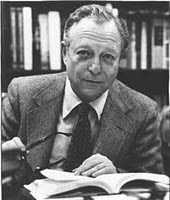
—-

—-

Oval Office

11:46 A.M. EST

THE PRESIDENT: Well, thank you very much. Today it’s my privilege to present our nation’s highest civilian honor, the Presidential Medal of Freedom, to one of the greatest coaches in American history: the legendary Lou Holtz — a friend of mine. Great gentleman. Great man.

We’re delighted to be joined this afternoon by members of Lou’s wonderful family, along with the Director of National Intelligence, John Ratcliffe — John, thank you for being here; and Senator Lindsey Graham, who I think most people know — I would say they know you, for the most part; and Pat Cipollone, a big fan of Notre Dame. Right? Thank you, Pat, for being here.

Lou was born during the Great Depression in the steel town of Follansbee, West Virginia. We love West Virginia. He grew up in poverty in a two-room cellar. But as Lou says, “I knew God and my family loved me, and their love was all the wealth I needed. That’s everything I needed. That’s all I wanted.”

As a child, Lou sat on his uncle and grandfather’s lap and listened to Notre Dame football games on the radio. They were big fans of Notre Dame, I guess, even before you. That wasn’t too long ago, was it? (Laughter.) They were big fans. And you — so he learned at an early age about Notre Dame.

At the age of nine, he took the field in his first game. He then played throughout high school. And Lou went on to attend Kent State, where he did very well, on an ROTC scholarship.

After graduation, Lou served as an officer in the United States Army and then pursued his dream of coaching. He wanted to be a coach right from the beginning because he knew he was a leader. He didn’t have to say it; he knew he was a leader.

In 1961, Lou made what he described as “the smartest decision of my life.” And I knew your wife, and I will tell you, that was your smartest decision, right? (Laughter.) We got to know her well. She was strong and good. He married his wife of 59 years. Beth passed away just a short while ago, and it was a very tough time, I will tell you. It was a very tough time for Lou and the family. But we know that she’s looking down from heaven right now with incredible pride. She’s so proud of this man. I got to know her over the last few years, and she was a — she was a great woman. But she’s looking down right now. She’s very proud of you, Lou.

In 1969, Lou became head coach of William & Mary. And over three seasons, he won the Southern Conference and led the Tribe to their first bowl game in 22 years.

And, by the way — and I have to tell you, when we were researching this out, I knew he was supposed to be a good coach, but I didn’t know how good he was, because these stats are very amazing. You’ll see. I was really very impressed, John, I will tell you.

Lou then became head coach of North Carolina State, which had won only nine games over the previous three years. Not too good. He took it off — he took it over, and under Coach Holtz, they won the ACC title and achieved the highest national ranking in NC State’s history.

Lou went on to coach, and so I guess you were making a lot of money by this time because they were trying to get him to go to all these different schools. He was a hot coach. Nothing like being hot, right? (Laughter.) He had his choice. He had his choice to go into a lot of different places.

Lou went on to coach at the University of Arkansas. He built the Razorbacks up from a five-and-five record into a top five team in the nation. They won everything.

Lou left Arkansas with the best win-loss record ever and a very fat bank account. (Laughter.) He then coached at the University of — you were making a lot of money all of the sudden. Huh? I know how that works.

He then coached at the University of Minnesota, which was ranked dead last in the Big Ten. Before he signed his contract, he prayed, and then he did something that was unprecedented. He inserted a clause — with great negotiation talent, which he has — that they call today the “Notre Dame clause.” It stipulated that if Lou did really well and went to a bowl game, he would be free to go to Notre Dame should they ask him to go.

So he had something going, right? You great football player. You are — you are some player, I’ll tell you. (Laughter.) You are something. You just — just — and you’re — you weigh about 30 pounds less than you weighed when you played in the NFL, right? (Laughter.) I’m very impressed.

In just two years, he secured a top 20 ranking and propelled the Golden Gophers to victory at the Independence Bowl. So he was on his way to Notre Dame. He knew it. Nobody else did. I guess the Notre Dame officials knew it.

He was offered a coaching job at Notre Dame immediately, and he also took it immediately, as much as he loved the team that he just left. When he became the head coach a year later, the Fighting Irish were losing team. They were doing very, very poorly. Lou got to work and quickly returned Notre Dame to the status of a football powerhouse and the legend that they were.

At the end of Lou’s first season, the team faced off against their archrivals, the University of Southern California Trojans. The Fighting Irish were down 17 points in the fourth quarter, but they soon pulled off — Notre Dame — one of the greatest comebacks in college football history. They scored two touchdowns in less than eight minutes and then kicked a field goal in the final two seconds of the game. At that moment, Holtz said he felt the spirit of Notre Dame. He loved Notre Dame. And do you still remember that game?

MR. HOLTZ: Oh, very — my son roughed the punter.

(Laughter.)

THE PRESIDENT: Oh, I — (laughs) — you weren’t too happy about that.

MR. HOLTZ: Oh, no. I understood why a certain species of animals devour their young. (Laughter.)

THE PRESIDENT: So your son has a little of you in him as well. (Laughter.)

For the next decade, the Fighting Irish won 80 percent of their games and went to nine consecutive New Year’s Day Bowls. And in 1988, the cover of Sports Illustrated said, “Notre Dame is back.” “Notre Dame is back.” He was on the cover of Sports Illustrated and many other covers. Notre Dame remained number one in the country for the longest stretch in the school’s history.

See, I didn’t know all this stuff. I knew you were a great coach; I didn’t know you were this good, to be honest. (Laughter.) This is beyond a great coach. So you had the longest streak in the history of Notre Dame at number one. What do you think about that, Lindsey? Sounds like you in the Senate.

SENATOR GRAHAM: Yeah. (Laughter.) Except we don’t play with a helmet.

THE PRESIDENT: He had an easy race. You know, he had an easy race. The problem was his opponent had $140 million. That’s — that was a record, I guess. Wasn’t it, huh? Guess what? Here’s Lindsey.

During the tenure at Notre Dame, he coached a — Lou coached a record number of games, secured 100 victories, and delivered Notre Dame’s most recent national championship. So he did some job at Notre Dame.

Then Lou became the head coach at the University of South Carolina, which he loves. He loves South Carolina — which had won only one bowl game in 108 years. He was going to take it easy, and then he gets another offer. Man, oh, man. I’m watching that money just pile up. (Laughter.)

He was going to go and just relax now. He did his thing at Notre Dame. He won national championships — the longest streak. Then he goes to University of South Carolina, and I can imagine why. He loves — you do like money a little bit, don’t you? Right? He was offered a big deal. Lou tripled that number and secured a top 20 ranking immediately.

Over the course of his career, Lou won nearly 250 games — and is one of the highest ever, by the way — and is the only coach in NCAA history to take six different teams to a bowl game. Think of that.

Wherever Lou went, football glory followed. He was inducted into the College Football Hall of Fame in 2008.
And I will say this about Lou: Everybody loves him. Everybody respects him. He’s tough as hell, and yet they all respect Lou. They just — it’s amazing. They love him, and they respect him. Sometimes it’s a combination that doesn’t come together, you know? They respect, but you are — you are something. “I never coached football; I coached life,” he said. And it’s true. His players really always loved him.

He’s turned his inspirational story and motivational message into three best-selling books. He’s also been an exceptional philanthropist. That’s all that stuff that he collected. He’s opened educational opportunities for students, provided insulin pumps to diabetic children.

And we’ve just brought down the price and the cost of insulin. Right? You’re shaking your head. It’s amazing what we did, right? Insulin — you couldn’t buy it. It was destroying families. People were going without it. Now it’s $35, right? You can’t believe it. I see you’re an insulin pro. You’re involved, right? Family.

AUDIENCE MEMBER: (Inaudible.)

THE PRESIDENT: That’s great. No, it’s — we’ve done a great job with — with costs. But insulin, maybe, Lindsey, is one of the best — $35. They were paying 10 times that amount. You couldn’t get it. So we changed that around, Lou.

And supported cancer research. And has traveled to 13 countries to visit the American troops. Lou’s leadership and his faith and kindness have inspired and uplifted millions of fellow citizens.

He’s one of the greatest titans in American football history. And his towering reputation will endure forever in the chronicles of athletics, but more importantly, in the chronicles of life — because he’s really a life teacher. That’s what he is; he’s a life teacher. He teaches people how to live and how to live properly, and how to live with dignity.

So I’d like to now ask the military aide to come forward and prepare for me to give our highest medal. We have the Congressional Medal of Honor, and we have the Presidential Medal of Freedom. And I will say, I give away a lot of Congressional Medal of Honors, and that’s a tough one to get. You know, that’s a tough one to get, because they come in with — when they come in, a lot of times, mostly, they can’t come in for obvious reasons. But they come in where — they’re unbelievably brave people. And they have had more bullet holes and bullets shot at them and in them. That’s the Congressional Medal of Honor.

Your route is a much easier one. (Laughter.) As tough as it may have been, it’s a much easier one.

MR. HOLTZ: That’s true.

THE PRESIDENT: I always say that about the two.

MR. HOLTZ: I’ll remember that. (Laughter.)

THE PRESIDENT: It’s — your route is a much easier — the Presidential Medal of Freedom.

So I’d like to ask first Lou to say a few words, and then we’re going to present. Thank you very much.

MR. HOLTZ: Thank you. (Applause.) Thank you. Thank you, Mr. President. I’m humbled by the various comments and the opportunity to receive this award.

But I want to assure you how proud I am not only to receive the award; I’m even prouder to receive it from President Donald Trump, who I think was the greatest President during my lifetime. And the things you’ve done for this country have given people the opportunity. (Applause.)

As far as making money — I do have to correct one thing, Mr. President. You talk about making money. When I went to Notre Dame, they had a policy: The head football coach was not allowed to make more than the president of Notre Dame. The president of Notre Dame was a priest who took a vow of poverty. (Laughter.) I made 95,000 (inaudible).

I get this award; I accept it humbly. And you don’t go in life saying “I want to win this award.” You just wake up one day and it happens. But this award, as great as it is, does not define who Lou Holtz is.

My beautiful family, my precious wife, my friends: You have determined who I am, and I just try to be a solid person. As I think it was said, the two most important days of your life was the day you were born; the other is the day you discover why you’re born. When we discover we’re born basically (inaudible) other people and overcome problems and difficulties that are going to come our way. And I just cannot be prouder to be a part of this country. I could not be prouder to receive this award from an individual I respect and admire as much as President Trump.

Thank you, sir.

THE PRESIDENT: Thank you. So nice. Thank you. (Applause.)

MILITARY AIDE: Attention to orders. Louis L. Holtz, an American sports legend, is awarded the Medal of Freedom. A member of the College Football Hall of Fame, Coach Holtz’s achievements include 249 wins, 12 bowl game victories, and a national championship. He is the only football coach to lead six different programs to bowl games. His tenure at Notre Dame was historic, securing 10 straight winning seasons and the 1988 National Championship.

Off the field, he’s a staple of sports television, a powerful motivational speaker, a devout Catholic, and a dedicated philanthropist. The United States proudly honors Louis L. Holtz for his contributions to our nation.

Signed, Donald J. Trump, the President of the United States of America.

(The Medal of Freedom is presented.)

THE PRESIDENT: Beautiful. (Applause.)

MR. HOLTZ: Thank you. Whoa. Okay, that’s it. (Laughter.)

Q Mr. Holtz, congratulations. How are you feeling?

MR. HOLTZ: I feel so indebted to so many people in my life that had such a positive influence on it. For a guy that graduated in the lower third of his high school class, I feel fortunate to be able to be here but also to be part of this great country and to be next to an individual that I respect as much as him.

So I say it: You’ve honored a lot of people. You go look at all the people — in Tiger Woods and Jack Nicklaus — they’re recognized for what they did. I’m recognized for what other people did. I never made a block or a tackle, but I did try to teach people to make good choices. That’s all I’ve ever tried to do. But thank you.

THE PRESIDENT: Such a great statement. Thank you, Lou.

Q Mr. President, Mitch McConnell says COVID relief may be in sight. Will you support this bill? Do you support —

THE PRESIDENT: I will. And I think —

Q — the 900-billion-dollar —

THE PRESIDENT: — we’re getting very close. And I want it to happen, and I believe that they’re getting very close to a deal. Yeah.

Q And you’ll support it? You’ll sign it?

THE PRESIDENT: I will. I will. Absolutely. Yeah.

Q Okay. And, Mr. President, can I ask you to respond to the comments by your Attorney General who indicated he has not seen, at this point, any evidence of fraud enough to overturn the election results? Given that, why is now not the time to concede?

THE PRESIDENT: Well, he hasn’t done anything. So he hasn’t looked. When he looks, he’ll see the kind of evidence that right now you’re seeing in the Georgia Senate. You know, they’re going through hearings right now in Georgia, and they’re finding tremendous volume. So they haven’t looked very hard, which is a disappointment, to be honest with you, because it’s massive fraud.

Whether you go to Wisconsin, where we just filed a case, or Michigan, or if you look at what’s happening in Georgia, as an example, or Pennsylvania; if you look at Nevada, which is moving along very rapidly, or Arizona — you saw those numbers come out yesterday — we found massive fraud. And in other states also. This is a — probably the most fraudulent election that anyone has ever seen.

Q Do you still have confidence in Bill Barr?

THE PRESIDENT: Uh, ask me that in a number of weeks from now. They should be looking at all of this fraud. This is not civil; he thought it was civil. This is not civil; this is criminal stuff. This is very bad criminal stuff.

So I just say this: We went through an election. At 10 o’clock, everybody said, “That was an easy victory for Trump.” All of a sudden, the votes started disappearing — miraculously disappearing. We found much of it, but we found far more votes than we need in almost all of these states. And I think I can say in all of these states, far more votes than we need to win every one of them.

And I want to just thank my team because my team is doing an unbelievable job. And more importantly, I want to thank the 74 million-plus people that voted, which, Lou, is the largest amount of people that a sitting President has ever had — 74 million-plus. And because the level of — of loyalty, I’ve never seen anything like it. All over the country, they know it was a fixed election. It was a rigged election. They know it, and I appreciate their support.

Thank you all very much. (Applause.


Lou Holtz: Undergraduate Commencement Address 2015

Published on May 13, 2015

2015 Commencement Address at Franciscan University of Steubenville delivered by Lou Holtz, former NCAA football coach and former ESPN analyst. Holtz received an honorary doctorate in Communications.

The class of 2015 was the fourth-largest in University history.

More about Commencement and the class of 2015: http://www.franciscan.edu/News/Commen…

Lou Holtz delivers Franciscan grad talk

May 10, 2015
By MARK LAW – For The Weirton Daily Times (mlaw@heraldstaronline.com) , Weirton Daily Times

– See more at: http://weirtondailytimes.com/page/content.detail/id/639944/Lou-Holtz-delivers-Franciscan-grad-talk.html?nav=5006#sthash.vlhwd7k7.dpuf

STEUBENVILLE -Legendary football coach Lou Holtz brought humor and life lessons as the speaker at the Franciscan University of Steubenville’s 67th commencement on Saturday at the Finnegan Fieldhouse.

More than 660 students received graduate and post-graduate degrees.

Holtz told the graduates he is able to give life lessons because he was once 21 years old.

Article Photos

Lou Holtz, left, legendary football coach, spends some time talking with the Rev. Sean O. Sherridan, TOR, Franciscan University of Steubenville president, prior to the university’s 67th commencement on Saturday at the Finnegan Fieldhouse. More than 660 students participated in graduation ceremonies. — Mark Law

“You have never been 78,” he said.

Holtz said the students have been fortunate to share their faith in God.

“I assume you will have a good personal life and want to feel secure in your future. You don’t have to sacrifice your faith in God,” he said.

He said life doesn’t have to be complicated, saying there are only seven colors in a rainbow. He said there are only seven musical notes and only 10 numbers. But he said great works of art and music was created with only a few colors and notes.

“It doesn’t need to be complicated,” Holtz said about life.

He told the graduates they only need four things in life: Something to do, somebody to love, something to believe in and something to hope for.

He also said there are three rules the graduates must follow the rest of their life.

“Do what is right. There is never a right time to do the wrong thing,” he said.

Holtz told the graduates not to go through life being bitter.

“Keep a positive attitude. You will have problems and difficulties in life. Don’t tell people about your problems. Ninety percent don’t care and the other 10 percent will blame everything on God. Don’t let people tear you down. Don’t let other people control your attitude.”

Holtz said the second rule is to do everything to the best of your ability.

“Everyone can be the best they are capable of. You have the right to fail. Every part of life has obligations to do the best you can do,” Holtz said in reference to marriage, parenthood and professional life,” he said.

Holtz recounted his early years growing up in Follansbee. He said his father only had a third-grade education but his parents taught him life is about choices.

He said his family was poor but he was born with a silver spoon in his mouth because of the life lessons his parents instilled in him.

The third rule is to show people you care, Holtz said.

He told the graduates to smile at every person they meet for the rest of their life.

“If you follow those three rules you will make right choices. If you do the right thing, people will always be on your side. You will be successful and make a lot of money and then you will die and it will be over. Hopefully (your life) will be significant. Significant is when you make other people successful,” he said.

Holtz said if you want to be happy for a day, go golfing. If you want to be happy for a month, buy a car. If you want to be happy for a year, win the lottery.

“If you want to be happy for a lifetime, put your faith in Jesus Christ,” Holtz said.

Holtz is the only coach in the history of college football to take six different teams to a bowl game, win five bowl games with different teams and have four different teams ranked in the top 20 poll. He was selected for the College Football Hall of Fame in 2008.

Holtz is the author of three New York Times best-selling books. He recently retired after a long tenure as a college football studio analyst on ESPN.

Holtz prior to the commencement speech talked about his days as a TV college football analyst.

“I will miss the camaraderie with people. It is better for people to ask why you retired than when are you going to retire,” he said.

Holtz said he will miss the attentiveness he has given to football. He said he has been involved in football since the fourth grade.

He said it will be nice to do want he wants to do as a retiree. He said he will continue to go to college football games and looks forward to spending time with his wife, Beth.

Holtz said being a college football analyst kept his mind sharp at the age of 78.

“It caused me to think at my age. I had no script. I had to keep all the names and stats in my head. It kept me thinking.”

Holtz was presented an honorary doctorate in communications “for his service as a public leader and sports authority unashamed of his Catholic faith.”

Related posts:

When were the Hogs in the hunt in November since Lou Holtz left?

Normal 0   mso-para-margin-bottom:.0001pt; mso-pagination:widow-orphan; font-size:10.0pt; font-family:”Times New Roman”;} Sometimes when I get down about Arkansas Football like I am now after losing 52-7 to South Carolina, I like to think about the years that Arkansas was still in the hunt for the national title in November. There are not that many years since Lou […]

Bret Bielema at Little Rock Touchdown Club entertained the sellout crowd of more than 700 with humor and homespun stories!

_________ Streamed live on Aug 24, 2015 Bret Bielema speaks to the Touchdown Club ____________ Bret Bielema is first speaker in 2015https://cm.g.doubleclick.net/push?client=ca-pub-4836457508486497&srn=gdn By Harry King Arkansas News Bureau King: Bielema Draws, Keeps Big Crowd – See more at: http://arkansasnews.com/harry-king/king-bielema-draws-keeps-big-crowd#sthash.ipmj1pOi.dpuf — Working out before 8 a.m. Monday, a regular at the neighborhood gym planned to […]

How about a coach swap? :Charlie Strong to Arkansas and Bobby Petrino to Louisville

Everybody is talking about what a great coaching job Bobby Petrino did at Arkansas and what a shame it is that legally he can not stay. However, maybe there is a place where he would be welcome? If there is any place that I know of that would come close to welcoming him with open […]

Mack Brown does great job at Little Rock Touchdown Club!!!

______ Brown: It takes a different kind of coach at Texas Share on facebookShare on twitterMore Sharing Services0 By Jeremy Muck This article was published today at 3:14 a.m. Being the head football coach at the University of Texas is no small task. Ask Mack Brown, who was in charge of the Longhorns’ football program […]

STEPHEN JONES OF DALLAS COWBOYS SPEAKS AT LITTLE ROCK TOUCHDOWN CLUB PART 3

_________ Cowboys VP: Don’t be surprised if we change quarterbacks <p>Cowboys vice president Stephen Jones</p> By SportsDayDFW.com Follow @SportsDayDFW websports@dallasnews.com Staff Published: 12 October 2015 05:33 PM Updated: 12 October 2015 10:46 PM Cowboys vice president Stephen Jones spoke at the Little Rock Touchdown Club on Monday. Some highlights via @LRTouchdownClub and â@chase_shannon : On […]

STEPHEN JONES OF DALLAS COWBOYS SPEAKS AT LITTLE ROCK TOUCHDOWN CLUB PART 2

___________ Jones: Cowboys studying options Share on facebookShare on twitterMore Sharing Services1 By Jeremy Muck This article was published today at 3:03 a.m. PHOTO BY MELISSA GERRITS Dallas Cowboys COO Stephen Jones reacts to comments by Rex Nelson before addressing the Little Rock Touchdown Club October 12, 2015 at Embassy Suites. Comments aAFont Size It […]

STEPHEN JONES OF DALLAS COWBOYS SPEAKS AT LITTLE ROCK TOUCHDOWN CLUB PART 1

___________ Stephen Jones did a great job at the Little Rock Touchdown Club today and he told a lot of stories about his dad and  Father Tribou of Catholic High of Little Rock. Little Rock Touchdown Club – October 12, 2015 Streamed live on Oct 12, 2015 Stephen Jones speaks to the Touchdown Club _______________ […]

Jay Barker speaks to Little Rock Touchdown Club on 10-5-15 PART 4

___________ Jay Barker mentioned his wife Sara Evans several times in his talk at Little Rock Touchdown Club so I have included some of her musical videos and more about their relationship below. Little Rock Touchdown Club – October 5, 2015 Streamed live on Oct 5, 2015 Jay Barker speaks to the Touchdown Club _____________________ […]

Jay Barker speaks to Little Rock Touchdown Club on 10-5-15 PART 3 Jay Barker said that coach Gene Stallings emphasized the THIRD WEEKEND IN OCTOBER series with the Vols

______________ Jay Barker said that coach Gene Stallings emphasized the THIRD WEEKEND IN OCTOBER series with the Vols when he was the coach at Bama and sure enough those 4 games that Barker started in came down to the wire.  Bama tying in 93 and winning the other 3. In 91 Bama won over #8 […]

Jay Barker speaks to Little Rock Touchdown Club on 10-5-15 PART 2

Jay Barker explained at the Little Rock Touchdown Club what the word CHAMPIONS  meant to him and it all started with being Christ-centered and that is the “C” in CHAMPIONS. Barker warned against being self-centered or morality-centered.   Little Rock Touchdown Club – October 5, 2015 Streamed live on Oct 5, 2015 Jay Barker speaks to […]

__________

Left Pegs Israel as Villain in Assassination of Iran’s Top Nuclear Scientist

Iran’s top nuclear scientist, Mohsen Fakhrizadeh, shown in a photo dated Jan. 23, 2019, was assassinated by gunmen Friday on the outskirts of Iran’s capital, Tehran. (Photo: Iranian Leader Press Office/Handout/Anadolu Agency/Getty Images)

I always thought no one—including Israel—could pull off something as incredible as the raid on Entebbe, Uganda, on July 4, 1976.

To remind readers what happened that day: A week earlier, on June 27, two Palestinian terrorists and two German terrorists hijacked an Air France flight from Tel Aviv to Paris with 248 passengers on board; they diverted it to Entebbe Airport in Uganda.

At the airport, the hijackers and four additional terrorists, aided by Uganda’s Idi Amin regime, held the Israelis and other Jews. They allowed the 148 non-Jewish passengers to fly on to Paris.

The terrorists announced that unless 53 Palestinian prisoners—40 in Israel and 13 elsewhere—were released, the kidnapped Jews (and the Air France crew, all of whom heroically remained with the Jewish passengers) would be killed.

On July 4, the Israelis flew a disguised transport plane filled with Israeli commandos 2,500 miles from Israel to Entebbe. After refueling in Kenya, the commandos landed in Entebbe, killed the terrorists, and saved nearly every hostage—all in 53 minutes.

No one had seen anything quite like the raid on Entebbe, considered at the time to have achieved the impossible … until last week.

On Friday, Mohsen Fakhrizadeh, the Iranian scientist considered by The New York Times to be “the driving force behind Iran’s nuclear weapons program for two decades,” was assassinated in Iran.

To appreciate how remarkable this operation was, consider this: Fakhrizadeh took a different route to work every day, traveled in a bulletproof car, and was accompanied by three personnel carriers that transported heavily armed bodyguards.

The assassins had cut off electricity to the surrounding area and disabled all video cameras in the vicinity. They exploded a car next to Fakhrizadeh’s vehicle and had a remote-control machine gun fire at the scientist.

The entire operation took three minutes. None of the assassins were killed or even wounded. All 12 got away. (The number of assassins is according to Javad Mogouyi, a documentary filmmaker for Iran’s Islamic Revolutionary Guards Corps.)

Fakhrizadeh was the fifth Iranian nuclear scientist to be killed in the past 13 years. One must assume that most, if not all, of these assassinations, whether or not Israel was involved, were carried out by Iranians. This shows how many Iranians loathe their liberty-suppressing, life-suppressing, women-suppressing, Islamofascist regime.

Too bad Western countries and the Western media also don’t loathe the Iranian regime; what they loathe is labeling the Iranian regime “Islamofascist.”

One would think that every decent human being would welcome the elimination of a man whose life was dedicated to the annihilation of another country. There is, after all, no parallel in the world to the Iranian regime’s repeatedly stated goal of annihilating Israel.

And Israel—to the consternation of European leaders, the United Nations, and major American media—does whatever it takes to prevent itself from being annihilated.

John Brennan, the head of the CIA under President Barack Obama, strongly condemned the Fakhrizadeh assassination. Brennan, who has never abandoned the moral values he held when he was a communist, condemned the assassination as “a criminal act” and “highly reckless” and labeled it “murder” and “state-sponsored terrorism.”

Brennan asked Iran to “resist the urge” to retaliate and “wait for the return of responsible American leadership on the global stage.”

In other words, wait until the Holocaust-denying, Islamofascist, America-hating, genocide-seeking Iranian regime is appeased by a Democrat in the White House—something guaranteed by, among other developments, Joe Biden’s appointment of Brennan’s former deputy director at the CIA, Avril Haines, as his director of national intelligence.

A United Nations spokesman said, “We condemn any assassination or extrajudicial killing.”

A spokesperson for the European Union called Fakhrizadeh’s killing “a criminal act” that “runs counter to the principle of respect for human rights the EU stands for.”

A New York Times opinion piece said the assassination “could strengthen hard-line factions in Iran arguing against a return to diplomacy.” This statement embodies the naivete of the world’s left, including liberals: that evil regimes are composed of “hard-line factions” and “moderate factions.”

The author of the Times opinion piece, Barbara Slavin of the Atlantic Council, wrote that the foreign ministers of Britain, France, and Germany should “issue a statement condemning the assassination as illegal under international law and damaging to the cause of nonproliferation.”

Slavin added: “It would be the ultimate tragedy if Israel’s aggression now led Iran to change its calculus and go for weapons.”

To the left around the world, Israel is the villain here, not Iran.

Upon returning to France, Michel Bacos, the heroic captain of the Air France plane hijacked to Entebbe, who refused the opportunity to return to France and insisted on remaining with the kidnapped Jews, “was reprimanded by his superiors at Air France and temporarily suspended from duty” (The Jerusalem Post, Aug. 3, 2006).

Such are the values of our European allies.

COPYRIGHT 2020 CREATORS.COM

Irving Kristol pictured below:

In 1980 I read the books HOW SHOULD WE THEN LIVE? by Francis Schaeffer and WHATEVER HAPPENED TO THE HUMAN RACE? by both Schaeffer and Dr. C. Everett Koop and I saw the film series by the same names. In those two books Daniel Bell was quoted. In HOW SHOULD WE THEN LIVE? In the chapter entitled, “Our Society,” these words are found:

Daniel Bell (1919-), professor of socialogy at Harvard University, sees an elite composed of select intellectuals. He writes in THE COMING OF POST-INDUSTRIAL SOCIETY (1973), in the chapter entitled “Who will Rule,” that “the university–or some other knowledge institute–will become the central institution of the next hundred years because of its role as the new source of innovation and knowledge.” He says that crucial decisions will come from government, but more and more the decisions of both business and government will be predicated on government-sponsored research, and “because of the intricately linked nature of their consequences, [the decisions] will have an increasingly technical character.” Society thus turns into a technocracy where “the determining influence belongs to technicians of the administration and of its business, its education, its government, even the daily pattern of the ordinary man’s life–becomes a matter of control by the technocratic elite. They are the only ones who know how to run the complicated machinery of society and they will then, in collusion with the government elite, have all the power necessary to manage it.

“Bell’s most astute warning concerns the ethical implications of this situation: ‘A post-industrial society cannot provide a transcendent ethic….The lack of a rooted moral belief system is the cultural contradiction of a society, the deepest challenge to its survival.’ He adds that in the future, men can be remade, their behavior conditioned, or their consciousness altered. The constraints of the past vanish. To the extent that Bell’s picture of this future is fulfilled, Galbraith’s form of the elite will be the actuality.” (Schaffer, p. 224-225)

In the 1990’s I took the opportunity to confront many of the scholars of the sort that Francis Schaeffer had mentioned in his books and Adrian Rogers was mentioning in his sermons and confront them with the evidence that showed that Old Testament prophecies were true and that the Bible could be trusted. Daniel Bell and his good friend Irving Kristol were two of the intellectuals that I had the opportunity to correspond with.

I sent them both a letter that included many scriptures from the Old Testament that showed that the prophets predicted  the Jews would be brought back from all over the world to rebirth the country of Israel again. Daniel Bell responded in a letter dated September 23, 1995:

Dear Mr. Hatcher, Thank you for your thoughtful letter. I don’t know whether or not the prophecies of the Ezekiel are being fulfilled. The very nature of such prophecy, or the parables of Jesus, are inherently ambiguous, and so always opaque. As to the survival of the Jewish people, I think of the remark of Samuel Johnson that there is nothing stronger than the knowledge that one may be hanged the next day to concentrate the mind–or the will. Sincerely, Daniel Bell

On September 21, 1995 his good friend Irving Kristol added this comment, “I am leery of taking Biblical prophecies too literally. They always seem to get fulfilled, some way or other, whatever happens. They are inspiring, of course, which enough for me.”

Let me make a few observations about Irving Kristol who I was very fascinated with because of some of his comments in the 1990’s. First, isn’t it worth noting that the Old Testament predicted that the Jews would regather from all over the world and form a new reborn nation of Israel. Second, it was also predicted that the nation of Israel would become a stumbling block to the whole world. Third, it was predicted that the Hebrew language would be used again as the Jews first language even though we know in 1948 that Hebrew at that time was a dead language!!!Fourth, it was predicted that the Jews would never again be removed from their land.

Now let’s take a look at Irving Kristol’s comments on God.

Irving Kristol 1/6 – Father of Neoconservatism

Irving Kristol 2/6 – Father of Neoconservatism

Irving Kristol 3/6 – Father of Neoconservatism

In this video clip above you will find this exchange:

Mr. KRISTOL: Oh, I’ve never had a problem with God, never. Even when I was a young Trotskyist, I never had a problem with God. I mean, the so-called existence of God was never a problem for me. I mean, I–however you define God–and that is a serious theological matter, what you mean when you use the word `God’ is a serious theological matter. But I had no doubt, ever since I read the opening of the Bible, that, yes, there is such a thing as original sin, and we all live with it. And if you want to understand the human condition, reading the f–opening of the Bible is as good a place as any, the best I think. And so that part of religion has simply never been a problem for me.
LAMB: The last several essays in your book, of the 41, is about Judaism or about being a Jew.
Mr. KRISTOL: Mm-hmm.
LAMB: Where are you? Are you a practicing Jew?
Mr. KRISTOL: Sort of. That is, I’m a member of a Jewish congregation, and I go to synagogue on the high holidays. I attend bar mitzvahs and bat mitzvahs. I do not observe Jewish law because I never did. I think if I had it to do over again, I would be more observant. But I don’t have it to do over again, and I’m not going to completely change my life now. That’s rather silly, I think. But being Jewish has never been a problem for me.
LAMB: What does that mean?
Mr. KRISTOL: Well, I–I–you know, I…
LAMB: What is being Jewish? I mean, what i–what’s the culture?
Mr. KRISTOL: Well, it’s not a question of culture. It’s a question of identity. I always knew I was Jewish. I never thought of not being Jewish. I was always very pleased to be Jewish. After all, not everyone is a member of the chosen people, and so I just went along. Even when I was not all that observant–I still am not all that observant–being Jewish just came naturally to me.
_____________________
Burt Reynolds knew the gospel when he was young and he when he became  rich and successful he said that he would live his life for his selfish desires when he was young but when he was old he would repent and serve God. Adrian Rogers in a sermon noted that he doubted very seriously if Reynolds would ever get around to repenting when he was old. Irving Kristol’s statement above reminded me of Reynolds. Kristol noted, “I think if I had it to do over again, I would be more observant. But I don’t have it to do over again, and I’m not going to completely change my life now. That’s rather silly, I think.”
Here the words of Christ tells us how those who are not righteous after they did really do long for their friends and relatives to follow the Bible’s directives, but they will not even accept the evidence of someone coming back from the gave if they don’t accept what the prophets had to say.

Luke 16:19-31 The Rich Man and Lazarus

19 “There was a rich man who was dressed in purple and fine linen and lived in luxury every day. 20 At his gate was laid a beggar named Lazarus, covered with sores 21 and longing to eat what fell from the rich man’s table. Even the dogs came and licked his sores.

22 “The time came when the beggar died and the angels carried him to Abraham’s side. The rich man also died and was buried. 23 In Hades, where he was in torment, he looked up and saw Abraham far away, with Lazarus by his side. 24 So he called to him, ‘Father Abraham, have pity on me and send Lazarus to dip the tip of his finger in water and cool my tongue, because I am in agony in this fire.’

25 “But Abraham replied, ‘Son, remember that in your lifetime you received your good things, while Lazarus received bad things, but now he is comforted here and you are in agony. 26 And besides all this, between us and you a great chasm has been set in place, so that those who want to go from here to you cannot, nor can anyone cross over from there to us.’

27 “He answered, ‘Then I beg you, father, send Lazarus to my family, 28 for I have five brothers. Let him warn them, so that they will not also come to this place of torment.’

29 “Abraham replied, ‘They have Moses and the Prophets; let them listen to them.’

30 “‘No, father Abraham,’ he said, ‘but if someone from the dead goes to them, they will repent.’

31 “He said to him, ‘If they do not listen to Moses and the Prophets, they will not be convinced even if someone rises from the dead.’”

New International Version (NIV)Holy Bible, New International Version®, NIV® Copyright © 1973, 1978, 1984, 2011 by Biblica, Inc.® Used by permission. All rights reserved worldwide.________________The famous preacher Charles Finney had some very insightful comments on this passage:The wicked dread to have their friends come to them in this place of torment. You see this feeling most distinctly manifested in this parable. The reason of the feeling is obvious. They are still human beings and therefore it can be no joy to them to have their earthly friends come into their place of woe. They have human feelings. They know they can look for no alleviation of their own woe from the presence of their friends. They know that if those friends come there as they did they can never escape; therefore they beg that those friends may never come. Therefore this rich man prays that Abraham would send Lazarus to his five brethren, to testify to them, lest they also come into that place of torment.The state of mind that rejects the Bible would reject any testimony that could be given. This is plainly taught here, and can be proved. It can be proved that the testimony of one who should rise from the dead is no better or stronger than that of the Bible…When unbelief has taken possession of the mind, you may pile miracle on miracle; men will not believe it. Suppose ever so many should rise from the dead. Men who reject the Bible would not believe their testimony. They would insist either that they had not been really dead, or that if they had been, they did not bring back a reliable report from that other country. They would make a thousand objections, as they do now, against the Bible, and with much more plausibility then than now. Now, they only know their objections are really unfounded; then they would have more plausible objections to make, and would be sure to give them credit enough to refuse to repent under their teachings. They would not be persuaded even then.

My Dinner with Irving

On evangelicals, the evangelical Left, and the Jews

My Dinner with Irving

Several years ago, I gave a lecture at the American Enterprise Institute (AEI) on the subject of religion and secularism. Afterward, the discussion continued at a relaxed and intimate dinner for selected guests—an occasion greatly enlivened by the presence of the late Irving Kristol, then an AEI senior fellow, and his wife Gertrude Himmelfarb, the distinguished historian. As usual, Irving had plenty to say. In particular, when the subject turned to the distinctive character of evangelical Christianity, he pronounced himself in a manner that I (and others in the room) remember vividly to this day. “Well, after all,” he remarked, with casual assurance, “religion is what you’re born with.”

But no, I insisted in response, that was precisely what evangelicals don’t believe. There are no grandchildren in the kingdom of heaven, they like to say, which is their way of asserting that religious truth is something each person must come to individually through a process of personal conversion, a process that does not require a church or a priest but is thought to be a direct and unmediated act of “coming to Jesus.” Hence there are no legacy admissions, for this faith cannot be inherited or otherwise passed along; it must be re-appropriated freshly by each generation. This is why evangelicals say, following Jesus’ words to Nicodemus, that one must be “born again.” The first birth is not the one that counts.

Irving was completely unmoved by my impromptu catechesis. “Religion is what you’re born with,” he repeated, unraveling an amused smile and seemingly all the more pleased with a formulation that had kicked up some dust in the room. Even his wife sitting next to him, who knows a very great deal about Anglo-American evangelicalism, clearly thought him off-base. “Irving, you don’t understand. . . ,” she started, but then gently shook her head in an exasperation no doubt earned through years of experience.

As for me, with my deep respect for Irving, I couldn’t help beginning to wonder whether he may have understood something important that I was missing.

This little episode came to mind as I read Robert W. Nicholson’s thoughtful open letter to American Jews about evangelical-Jewish relations. It came to mind partly because Kristol was one of the first prominent American Jewish intellectuals to proclaim that Jews ought to be less dismissive of their evangelical admirers, but indeed should learn to cherish evangelicals as loyal and reliable allies, preferable in most ways to secular liberals. This declaration brought down on him a level of wrath and ridicule and repudiation that was stunning in its vehemence. Irving fully expected that reaction, and never showed any sign of being upset by it. He realized that the religion that his Jewish detractors were born with—militantly secular liberalism, welded to a sense of ethnic identity—would impel them to deal harshly, even savagely, with his apostasy.

One thing that Nicholson perhaps underestimates, given his typically evangelical generosity to the ideal of the free and uncoerced conscience, is just how difficult, how very nearly unthinkable, it is for most American Jews to imagine taking seriously the beliefs of most evangelicals. It is hard to judge—and as a non-Jew, I perhaps have no business even trying—whether the greater force in producing this near-unanimity is cultural consensus or cultural fear. Both probably play a role, and the fears involved are powerful ones, manifested not only publicly but on the most intimate levels.

I think of a Jewish friend, a man of impressive intellect and great moral courage, who converted to Christianity after two decades of waiting . . . for his mother to die. If this sounds like the material for a great Jewish joke, it is also powerful testimony to Irving’s contention that religion is what you are born with. For if this man had really fully believed that his eternal salvation depended on his acceptance of Jesus as his savior, would he have waited all those years? Would he have waited ten minutes?

That may be putting it ungenerously. Loyalty to what you were born with carries a weight of moral obligation all its own, not only for Jews but perhaps for Jews especially. Strangely, it seems that this logic of loyalty persists even when the specifically religious elements in Jewish identity have been all but banished in favor of full-bore secular liberalism. That would certainly help explain the vehement reaction to Irving’s daring to say a good word about an evangelical-Jewish alliance.

All this goes to underscore the importance of Nicholson’s message. It is a message that today needs to be heard more than ever as Israel faces mortal peril in a world where it is increasingly alone and abandoned, with anti-Semitism, having acquired a new lease on life, on the rampage. Under the circumstances, American Jews need especially to overcome their hardwired prejudices and see the clear truth that 300 million evangelicals have been, and still are, arguably Israel’s most stalwart non-Jewish allies in the Western world.

Just as important, what needs to be understood is that this stalwart support is not imperishable and that it cannot be taken for granted in the future. Nicholson supports with his own research and interviews the important work of Gerald McDermott in identifying the rise of an anti-Israel movement within American evangelicalism, potentially a very serious and consequential departure.

Nicholson is right about this, and the movement he describes is real. At the same time, however, I would urge caution lest one exaggerate the extent or the durability of anti-Israel evangelicalism—or, for that matter, the size and influence of the American evangelical Left altogether.

Anti-Israel sentiment among evangelical elites is strongest in the academic world and in international missions and relief groups. But the actual influence of such groups on the larger world of American evangelical churches is debatable. One can count on the fingers of two hands, with fingers left over, the number of voluble and publicity-savvy figures on the evangelical Left like Sojourner’s Jim Wallis. (Frank Schaeffer, whom Nicholson quotes as urging “an end to the largely unchallenged influence of Christian Zionism,” is a convert to Eastern Orthodoxy.) And Bethlehem Bible College, while a seedbed for the kind of pro-Palestinian revisionism that is enjoying a run of popularity with the American evangelical Left, is not itself an American college.

So I would be wary and vigilant, but not unduly panicked. The fact is that evangelicalism thrives on a flat and somewhat amorphous ecclesiastical structure, without popes or bishops or prelates. This renders it hard to be captured by ideological missionaries—particularly ones who openly reject the authority of the Bible as so many on the evangelical Left do.

Moreover, figures like Wallis have badly tarnished their credibility by their near-total identification with Democratic-party politics. They made a reputation for themselves post-9/11 by opposing the Bush administration’s anti-terror policies, but their abject and total silence as the Obama administration has continued those same policies, expanding them into areas like the use of unmanned drones to assassinate putative terrorists, has left them utterly discredited in the eyes of many of their idealistic young followers. For years, the evangelical Right has been accused of choosing Caesar over God by aligning itself with the Republican party and conservative politics. Now the charge applies in spades to the evangelical Left.

In any event, much more important, and more worthy of concern, are the “mainline” Protestant denominations, including the Presbyterian Church USA, the Episcopal Church, and others. Their antagonism to Israel is blatant and of long standing; of even longer standing is their fealty to the standard desiderata of theological and political liberalism. Indeed, the growing liberalization of American evangelicalism can itself be seen as a convergence with the beliefs and views of these churches, bleaching out the particularisms inherent in the Jewish and Christian faiths and reducing them to a bland universalism. This is a movement that speaks to the status anxieties of the rising generation of young evangelicals, affluent, suburban-bred, and socially mobile, who are intent that, whatever else their church will be, it will not be the church of their fathers. That is generally what they mean in proclaiming their ideal of a “countercultural” faith.

I do not mean to sound dismissive of this generation. I often lecture in evangelical colleges, and I love the students I meet there. But I am struck by some of the very phenomena that Nicholson describes. They appear to be getting a very limited education, particularly in politics and economics. Instead, they are heavy on emotivism, a disposition that leaves them prepared to speculate endlessly about what they imagine “Jesus would do” but poorly equipped for engagement with challenging points of view.

How to overcome these limitations and what they might portend? I can think of few better ways than by bringing such students into a fuller awareness of the Jewish roots of their own faith. For how can one possibly grasp the Christian doctrine of vicarious atonement, or the meaning of the Eucharist, without understanding how those ideas are grounded in Jewish understandings of sin, guilt, and expiation? How to understand the source of human rights and inviolable dignity without recurring to the biblical belief that man is made in the image of God?

To be sure, the evangelical-Jewish alliance will always be at least partially a matter of strange bedfellows. That can’t be helped, and it shouldn’t be denied. The differences are profound. But at the same time, there is a deep commonality, going to the heart of both faiths and revealed by and through the course of two millennia of human history. It is, I think, most succinctly expressed in the idea that both traditions worship the God of Abraham, Isaac, and Jacob. That phrase carries the weight of a distinct cosmology, anthropology, and moral universe.

This, in other words—and in ways that Jews perhaps understand better than evangelicals—is the religion that both groups have indeed been “born with,” as Irving was right to suggest. That bedrock fact points to at least the possibility of an alliance destined, in the fullness of time, to be of far more than mere political convenience.

___________________

Wilfred M. McClay is the Blankenship Chair in the history of liberty at the University of Oklahoma and director of its Center for the History of Liberty. 

_______________________

Is the Bible historically accurate? Here are some of the posts I have done in the past on the subject: 1. The Babylonian Chronicleof Nebuchadnezzars Siege of Jerusalem2. Hezekiah’s Siloam Tunnel Inscription. 3. Taylor Prism (Sennacherib Hexagonal Prism)4. Biblical Cities Attested Archaeologically. 5. The Discovery of the Hittites6.Shishak Smiting His Captives7. Moabite Stone8Black Obelisk of Shalmaneser III9A Verification of places in Gospel of John and Book of Acts., 9B Discovery of Ebla Tablets10. Cyrus Cylinder11. Puru “The lot of Yahali” 9th Century B.C.E.12. The Uzziah Tablet Inscription13. The Pilate Inscription14. Caiaphas Ossuary14 B Pontius Pilate Part 214c. Three greatest American Archaeologists moved to accept Bible’s accuracy through archaeology.

The answer to finding out more about God is found in putting your faith and trust in Jesus Christ. The Bible is true from cover to cover and can be trusted.

____________________________________________________

Adrian Rogers: An Old Testament Portrait of Christ

Published on Jan 27, 2014

I own nothing, all the rights belong to Adrian Rogers (R.I.P.) & his website http://www.lwf.org. Story of Abraham is told.

______________________________________

Adrian Rogers: Why I Believe in Jesus Christ

Adrian Rogers: The Biography of the King

Related posts:

Former atheist Antony Flew pointed out that natural selection can’t explain the origin of first life and in every other case, information necessarily points to an intelligent source!

______________ Does God Exist? Thomas Warren vs. Antony Flew Published on Jan 2, 2014 Date: September 20-23, 1976 Location: North Texas State University Christian debater: Thomas B. Warren Atheist debater: Antony G.N. Flew For Thomas Warren: http://www.warrenapologeticscenter.org/ ______________________ Antony Flew and his conversion to theism Uploaded on Aug 12, 2011 Antony Flew, a well known spokesperson […]

DARWINISM RECONSIDERED article from 2005 quotes Antony Flew, Richard Dawkins, Jonathan Miller, and Phillip Johnson

______________ William Lane Craig versus Eddie Tabash Debate Uploaded on Feb 6, 2012 Secular Humanism versus Christianity, Lawyer versus Theologian. Evangelical Christian apologist William Lane Craig debates humanist atheist lawyer Eddie Tabash at Pepperdine University, February 8, 1999. Visithttp://www.Infidels.org and http://www.WilliamLaneCraig.com ________________ Antony Flew on God and Atheism Published on Feb 11, 2013 Lee Strobel […]

Antony Flew interviewed by Benjamin Wiker and the two reasons Flew left atheism!!!

_______________________ Discussion (1 of 3): Antony Flew, N.T. Wright, and Gary Habermas Uploaded on Sep 22, 2010 A discussion with Antony Flew, N.T. Wright, and Gary Habermas. This was held at Westminster Chapel March, 2008 Debate – William Lane Craig vs Christopher Hitchens – Does God Exist? Uploaded on Jan 27, 2011 April 4, 2009 – Craig […]

Kyle Butt notes that Antony Flew left Atheism but fell short of making a profession of faith during his lifetime

_________________ Antony Flew – World’s Most Famous Atheist Accepts Existence of God Uploaded on Nov 28, 2008 Has Science Discovered God? A half-century ago, in 1955, Professor Antony Flew set the agenda for modern atheism with his Theology and Falsification, a paper presented in a debate with C.S. Lewis. This work became the most widely […]

Gary Habermas explains the reasons for Antony Flew’s change of mind

_____________   Antony Flew on God and Atheism Published on Feb 11, 2013 Lee Strobel interviews philosopher and scholar Antony Flew on his conversion from atheism to deism. Much of it has to do with intelligent design. Flew was considered one of the most influential and important thinker for atheism during his time before his […]

The finest article on Antony Flew’s long path from Atheism to Theism!!

___________________    This is the finest article yet I have read that traces Antony Flew’s long path from atheism to theism. How Anthony Flew – Flew to God Among the world’s atheists there was hardly any with the intellectual stature of Anthony Flew.  He was a contemporary with C.S. Lewis and has been a thorn in […]

Antony Flew incorrectly wrote that George Wald later abandoned atheism!!!

  Making Sense of Faith and Science Uploaded on May 16, 2008 Dr. H. Fritz Schaefer confronts the assertion that one cannot believe in God and be a credible scientist. He explains that the theistic world view of Bacon, Kepler, Pascal, Boyle, Newton, Faraday and Maxwell was instrumental in the rise of modern science itself. Presented […]

Antony Flew opened himself up to the possibility of accepting Christian teachings although never making a public profession of faith

Discussion (2 of 3): Antony Flew, N.T. Wright, and Gary Habermas ______________ Atheist Lawrence Krauss loses debate to wiser Christian Published on Sep 13, 2013 http://www.reasonablefaith.org More of this here The Bible and Science (Part 02) The Kalam Cosmological Argument (Scientific Evidence) (Henry Schaefer, PhD) Published on Jun 11, 2012 Scientist Dr. Henry “Fritz” Schaefer gives a lecture […]

Part of the reason Antony Flew left atheism can be found in this Paul Davies’ quote “Science can proceed only if the scientist adopts an essentially theological worldview!”

  Conversation with John Barrow Published on Jun 16, 2012 Templeton Prize 2006, Gifford Lectures 1988 British Academy, 1 June 2012 _______ Many Christians are involved in science and John D. Barrow is one of the leaders of science today. Here is his bio: John D Barrow John D. Barrow was born in London in […]

Antony Flew, “I was particularly impressed with Gerry Schroeder’s point-by-point refutation of what I call the MONKEY THEOREM” or the “the possibility of life arising by chance using the analogy of a multitude of monkeys banging away on computer keyboards and eventually ending up writing a Shakespearean sonnet!”

____________   Discussion (1 of 3): Antony Flew, N.T. Wright, and Gary Habermas Uploaded on Sep 22, 2010 A discussion with Antony Flew, N.T. Wright, and Gary Habermas. This was held at Westminster Chapel March, 2008 ___________   __________ Antony Flew, “I was particularly impressed with Gerry Schroeder’s point-by-point refutation of what I call the MONKEY […]