Category Archives: Current Events

MUSIC MONDAY According to Roy Orbison, when he was first asked by Brian Epstein to tour England with the Beatles, he responded, “What’s a Beatle?” Orbison was fresh off hits like “Only the Lonely,” “Crying,” and “In Dreams,” and his popularity was rising fast in the U.K., but he wasn’t yet used to Mersey Beat bands with such goofy names. It was his first U.K. tour, and, as Orbison later recalled, he didn’t know what to expect

_____

———

———

BEATLES OVERTAKE THEIR IDOLS

https://slate.com/culture/2013/05/the-beatles-tour-with-roy-orbison-even-the-beatles-struggled-to-follow-roy-orbison.html

Brow Beat is following the Beatles in “real time,” 50 years later, from their first chart-topper to their final rooftop concert. 50 years ago this month, the Beatles went on tour with one of their idols, Roy Orbison.

According to Roy Orbison, when he was first asked by Brian Epstein to tour England with the Beatles, he responded, “What’s a Beatle?” Orbison was fresh off hits like “Only the Lonely,” “Crying,” and “In Dreams,” and his popularity was rising fast in the U.K., but he wasn’t yet used to Mersey Beat bands with such goofy names. It was his first U.K. tour, and, as Orbison later recalled, he didn’t know what to expect. But the president of the Roy Orbison Fan Club wrote him a letter, explaining that touring with the Beatles would be terrific for him. They were No. 1 in England, Orbison’s fan explained, and would get him more exposure. There was, at first, no doubt about who the headliner would be.

The Beatles certainly knew who Orbison was. He was one of their greatest idols, and Lennon had modeled their first No. 1 on “Only the Lonely.” Later, when the Beatles were photographed with Orbison,Ringo, in particular, looked more than a little excited to be with him:
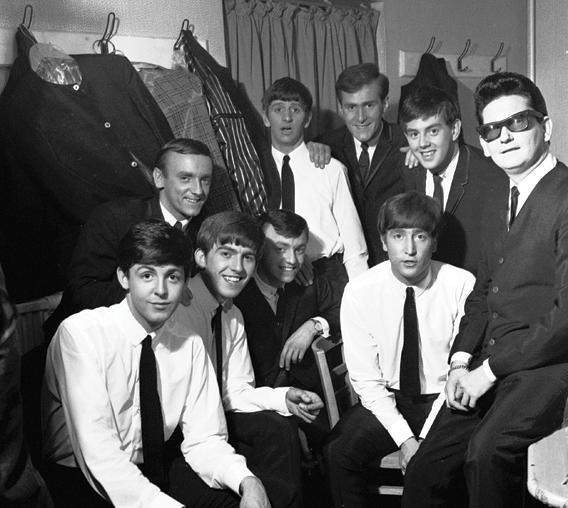
The Beatles backstage at the Roy Orbison tour with Gerry and the Pacemakers.
The Beatles backstage at the Roy Orbison tour with Gerry and the Pacemakers. This photo is excerpted from The Beatles in Liverpoolby Spencer Leigh, courtesy of the Mark Naboshek Collection.

Nonetheless, by the time Orbison arrived in the U.K., his one-time opener had surpassed him in popularity. In a concession to audience demand, Orbison graciously agreed to share co-billing, and to let the Beatles close out each night.

Not that Roy Orbison would let himself simply be upstaged. Though he was greeted each night with a roar of screaming Beatles fans, clamoring to see their favorite band, he countered, rather ingeniously, by telling his band to play the first song pianissimo (as Spencer Leigh tells it), so that the audience had to hush in order to hear him. Once the crowd had quieted down, Orbison had no trouble transporting them with a few ballads. “It was pretty hard to keep up with that man,” Lennon later remembered, “He really put on a show, well, they all did, but Orbison had that fantastic voice.” Harrison agreed:

He’d had so many hit songs and people could sit and listen to him all night. He didn’t have to do anything, he didn’t have to wiggle his legs, in fact he never even twitched, he was like marble. The only things that moved were his lips—even when he hit those high notes he never strained. He was quite a miracle, unique.

The band would set up behind Orbison as he finished, hidden behind a curtain, and Harrison remembers listening to him do encore after encore and thinking, “How are we going to following this?” Ringo put it more bluntly: “It was terrible, following Roy. He’d slay them and they’d scream for more.”

Of course, the Beatles were beginning to grow quite a repertoire themselves by this point. Their standard set consisted of “Please Please Me,” “Love Me Do,” “Some Other Guy,” “Do You Want to Know a Secret,” “From Me to You,” “I Saw Her Standing There,” and “Twist and Shout.” So they didn’t fare too poorly either. Beatlemania was starting to set in, and they were being pelted by jellybeans night after night, just because George had mentioned liking them in an interview.

He’d had so many hit songs and people could sit and listen to him all night. He didn’t have to do anything, he didn’t have to wiggle his legs, in fact he never even twitched, he was like marble. The only things that moved were his lips—even when he hit those high notes he never strained. He was quite a miracle, unique.

The band would set up behind Orbison as he finished, hidden behind a curtain, and Harrison remembers listening to him do encore after encore and thinking, “How are we going to following this?” Ringo put it more bluntly: “It was terrible, following Roy. He’d slay them and they’d scream for more.”

Of course, the Beatles were beginning to grow quite a repertoire themselves by this point. Their standard set consisted of “Please Please Me,” “Love Me Do,” “Some Other Guy,” “Do You Want to Know a Secret,” “From Me to You,” “I Saw Her Standing There,” and “Twist and Shout.” So they didn’t fare too poorly either. Beatlemania was starting to set in, and they were being pelted by jellybeans night after night, just because George had mentioned liking them in an interview.

The competition between the two groups spilled over to the tour bus. Paul later remembered how at the back of the bus Orbison would be writing songs like “Pretty Woman,” and it would just about make them jealous: “He would play us his song,” Paul said, “and we’d say, ‘Oh, it’s great, Roy. Have you just written that?’ But we’d be thinking, ‘We have to have something as good.’ ” As would later happen with groups like the Beach Boys and the Rolling Stones, their competitiveness with Orbison inspired them to produce some of their best work. For his part, McCartney was writing such songs as “All My Loving,” which he began composing on the tour bus and worked out on the piano at one of the venues.

The rivalry between the artists didn’t stop them from becoming friends—25 years later, Harrison would work with Orbison again, as part of the Traveling Wilburys. But within months, the Beatles wouldn’t need to share billing at all. When they went out on tour again in November, the tour was billed only as “the Beatles Show.”

Read more recent posts from Blogging the Beatles
The Beatles Get Their Own Show
Did John Lennon Have a Secret Affair With Brian Epstein?
The Songs the Beatles Gave Away
The Beatles Meet the Stones
John Lennon Has a Secret Wife and Son
The Beatles Rock a Boarding School
The Beatles Lead a Movement
The Beatles Become the Headliners

______

_—

The Beatles albums ranked

December 23, 2022

The Beatles discography ranked

It’s difficult to have the albums created by the most important band in the history of music ranked from worst to best. After all, it’s unlikely that you’ll find any band or musical artist unwilling to share their admiration for the Fab Four. Their fingerprints are over everything created in popular music.

The Liverpool quartet recorded albums at a significant pace between 1963 and 1970. Many of these are classics that redefined what pop-rock could be. Most of these are tremendously experimental, adventurous affairs.

Still, which one’s the best? Is there any one album worth avoiding?

I’ve looked at the evidence and listened to the whole discography once more, and I think that I have an answer or two.

For simplicity’s sake, I have only included official UK releases. That means that the early US-released records aren’t on here. Neither are compilations such as “Anthology,” “Rarities,” or “Hey Jude.” “Yellow Submarine” is included as it included mostly unreleased material and was crafted as a studio album.

With this in mind, here’s a quick initiation into the musical world created by John, Paul, George, and Ringo, The Beatles albums ranked.

13. “Yellow Submarine” (1969)

The Beatles had built an entire world since releasing their debut. It was populated by colorful characters and by exotic philosophies. Best of all, millions of folks in the real world knew everything about it.

“Yellow Submarine” is a soundtrack album by The Beatles. It was released in 1969 to accompany the animated film of the same name. The album features songs from the film, as well as a number of previously released tracks.

The colored submarine had, of course, already been added to the band’s cosmos. Smartly, it serves as the entry point for the story presented in this movie. It would become one of the most beloved animated films of all time.

It’s a good showcase for the band’s catchy melodies and clever lyrics. Standout tracks include the title track, “Yellow Submarine,” and the infectious “All You Need Is Love.”

This Beatles album also includes a number of instrumental tracks, which add to the playful and lighthearted mood of the album.

The album is a perfect introduction to The Beatles for those unfamiliar with their music and a must-have for any fan of the band. In fact, it acted as the debut Beatles record for many children familiar with the film.

Despite this, it should be noted that while the animated Beatles are characters in the film, their voices are dubbed by actors taking their best stab at a Scouse accent.

With all this being said, it’s not an album constructed with the same level of attention as some of the others in The Beatles’ discography.

Come Together – John Lennon (Live In New York City)

You may be interested in links to the other posts I have done on the Beatles and you can click on the link below: FRANCIS SCHAEFFER ANALYZES ART AND CULTURE PART 288, LINKS TO 3 YEARS OF BEATLES POSTS (March of 2015 to Feb of 2018) Featured artist is Mark Dion

DAY TRIPPING: THE 10 DRUGGIEST BEATLES SONGS

1

‘Strawberry Fields Forever’

From 1967 Single

‘Strawberry Fields Forever’ has become synonymous with John Lennon. The portion of New York’s Central Park where fans celebrate his memory is named for the 1967 song — a giant psychedelic leap forward for a band that had been holding girls’ hands and loving them eight days a week just a few years prior. The song gets its drippy, droney melody from then-futuristic Mellotron keyboard, and it features absurdest lyrics that at one point place the narrator in a “tree” he figures “must be high or low.” There’s no “or” there, buddy. You’re just high.https://youtu.be/HtUH9z_Oey8

Read More: Day Tripping: The 10 Druggiest Beatles Songs | https://diffuser.fm/druggiest-beatles-songs/?utm_source=tsmclip&utm_medium=referral
2

‘Tomorrow Never Knows’

From ‘Revolver’

“Turn off your mind, relax, and float downstream / It is not dying.” That’s how the Beatles’ ‘Tomorrow Never Knows,’ on 1966’s ‘Revolver,’ kicks off. It’s the “This is your captain speaking” moment, delivered by Capt. John of the Airship High. Yes, folks, you’re eight miles high, flying at an altitude unknown to your parents — your head is spinning right ’round like a record on your friend’s sofa, your eyes following the needle as it creates a strange, warm, crackling sound in the black groove on the circular disc that’s turning, turning, turning. This was a new sound to say the least, and all these years later, it still has the power to amaze.

https://youtu.be/pHNbHn3i9S4

Read More: Day Tripping: The 10 Druggiest Beatles Songs | https://diffuser.fm/druggiest-beatles-songs/?utm_source=tsmclip&utm_medium=referral

Capitol/Parlophone
3

‘Lucy in the Sky With Diamonds’

Lennon always claimed ‘Lucy in the Sky With Diamonds’ has nothing to do with LSD (or Lysergic Acid Diethylamide), and that it was his son that came up with the idea for the song’s title. But come on — this ‘Sgt. Pepper’s’ classic is obviously about psychedelic drug use. No sober person could have written something this bizarre. It’d be like asking Salvador Dalí to paint a watercolor of a house and a yard with a lemon-yellow sun. Not gonna happen.

Read More: Day Tripping: The 10 Druggiest Beatles Songs | https://diffuser.fm/druggiest-beatles-songs/?utm_source=tsmclip&utm_medium=referral

The Beatles call for the legalisation of marijuana

A full-page advertisement appeared in The Times newspaper on this day, signed by 64 of the most prominent members of British society, which called for the legalisation of marijuana. Among the signatories were The Beatles and Brian Epstein.

Advertisement calling for the legalisation of marijuana, The Times, 24 July 1967

The advertisement was instigated as a response to the nine-month prison sentence for possession received on 1 June 1967 by John Hopkins, founder of International Times, the UFO Club and the 24 Hour Technicolour Dream. The following day an emergency meeting was held at the Indica Bookshop, during which Steve Abrams of drug-research organisation SOMA suggested bringing the issue into public debate by running a full-page advertisement.

Abrams agreed to organise the signatures, but the question of financing the advertisement proved temporarily problematic. None of The Beatles were present at the Indica, but the bookshop’s co-owner Barry Miles telephoned Paul McCartney, who agreed to finance the advertisement.

On 3 June Miles and Abrams visited McCartney’s house in Cavendish Avenue. McCartney listened to the plans, told Abrams that all The Beatles and Epstein would put their names to it, and told them how to contact the rest of the group for their signatures.

On 23 July, the day before publication, the ad was mentioned in The Sunday Times’ Atticus column, written by Philip Oates. Behind the scenes, however, The Times’ advertising manager, R Grant Davidson, nervously insisted on checking that all the people had indeed agreed for their names to be associated with the article.

Davidson also insisted on advance payment. Steve Abrams contacted Peter Brown at Brian Epstein’s office, and shortly afterwards received a personal cheque for £1,800 made out to The Times. At the time the amount was twice the average annual wage.

Although McCartney had wanted to keep the funding a secret, in fear of negative publicity, it soon proved impossible. The day after the advertisement appeared, the information appeared in the Evening Standard’s Londoner’s Diary.

Within a week of its appearance, the advertisement led to questions being asked in the House of Commons, and began a public debate which eventually led to liberalisation in the laws against cannabis use in Britain.

ADVERTISEMENT
This advertisement is sponsored by SOMA*
The law against marijuana is immoral in principle and unworkable in practice.

“All laws which can be violated without doing anyone any injury are laughed at. Nay, so far are they from doing anything to control the desires and passions of man that, on the contrary, they direct and incite men’s thoughts toward these very objects; for we always strive toward what is forbidden and desire the things we are not allowed to have. And men of leisure are never deficient in the ingenuity needed to enable them to outwit laws framed to regulate things which cannot be entirely forbidden. …He who tries to determine everything by law will foment crime rather than lessen it.”- Spinoza

The herb Cannabis sativa, known as ‘Marihuana’ or ‘Hashish’, is prohibited under the Dangerous Drugs Act (1965). The maximum penalty for smoking cannabis is ten years’ imprisonment and a fine of £1,000. Yet informed medical opinion supports the view that cannabis is the least harmful of pleasure-giving drugs, and is, in particular, far less harmful than alcohol. Cannabis is non-addictive, and prosecutions for disorderly behaviour under its influence are unknown.

The use of cannabis is increasing, and the rate of increase is accelerating. Cannabis smoking is widespread in the universities, and the custom has been taken up by writers, teachers, doctors, businessmen, musicians, scientists, and priests. Such persons do not fit the stereotype of the unemployed criminal dope fiend. Smoking the herb also forms a traditional part of the social and religious life of hundreds of thousands of immigrants to Britain.

A leading article in The Lancet (9 November, 1963) has suggested that it is “worth considering … giving cannabis the same status as alcohol by legalising its import and consumption … Besides the undoubted attraction of reducing, for once, the number of crimes that a member of our society can commit, and of allowing the wider spread of something that can give pleasure, a greater revenue would certainly come to the State from taxation than from fines. …Additional gains might be the reduction of inter-racial tension, as well as that between generations.”

The main justification for the prohibition of cannabis has been the contention that its use leads to heroin addiction. This contention does not seem to be supported by any documented evidence, and has been specifically refuted by several authoritative studies. It is almost certainly correct to state that the risk to cannabis smokers of becoming heroin addicts is far less than the risk to drinkers of becoming alcoholics.

Cannabis is usually taken by normal persons for the purpose of enhancing sensory experience. Heroin is taken almost exclusively by weak and disturbed individuals for the purpose of withdrawing from reality. By prohibiting cannabis Parliament has created a black market where heroin could occasionally be offered to persons who would not otherwise have had access to it. Potential addicts, having found cannabis to be a poor escape route, have doubtless been tempted to try heroin; and it is probable that their experience of the harmlessness and non-addictive quality of cannabis has led them to underestimate the dangers of heroin. It is the prohibition of cannabis, and not cannabis itself, which may contribute to heroin addiction.

The present system of controls has strongly discouraged the use of cannabis preparations in medicine. It is arguable that claims which were formerly made for the effectiveness of cannabis in psychiatric treatment might now bear re-examination in the light of modern views on drug therapy; and a case could also be made out for further investigation of the antibiotic properties of cannabidiolic acid, one of the constituents of the herb. The possibility of alleviating suffering through the medical use of cannabis preparations should not be dismissed because of prejudice concerning the social effects of ‘drugs’.

The Government ought to welcome and encourage research into all aspects of cannabis smoking, but according to the law as it stands no one is permitted to smoke cannabis under any circumstances, and exceptions cannot be made for scientific and medical research. It is a scandal that doctors who are entitled to prescribe heroin, cocaine, amphetamines and barbiturates risk being sent to prison for personally investigating a drug which is known to be less damaging than alcohol or even tobacco.

A recent leader in The Times called attention to the great danger of the “deliberate sensationalism” which underlies the present campaign against ‘drugs’ and cautioned that: “Past cases have shown what can happen when press, police and public all join in a manhunt at a moment of national anxiety”. In recent months the persecution of cannabis smokers has been intensified. Much larger fines and an increasing proportion of unreasonable prison sentences suggest that, the crime at issue is not so much drug abuse as heresy.

The prohibition of cannabis has brought the law into disrepute and has demoralized police officers faced with the necessity of enforcing an unjust law. Uncounted thousands of frightened persons have been arbitrarily classified as criminals and threatened with arrest, victimisation and loss of livelihood. Many of them have been exposed to public contempt in the courts, insulted by uninformed magistrates and sent to suffer in prison. They have been hunted down with Alsatian dogs or stopped on the street at random and improperly searched. The National Council for Civil Liberties has called attention to instances where drugs have apparently been ‘planted’ on suspected cannabis smokers. Chief Constables have appealed to the public to inform on their neighbours and children. Yet despite these gross impositions and the threat to civil liberties which they pose the police freely admit that they have been unable to prevent the spread of cannabis smoking.

Abuse of opiates, amphetamines and barbiturates has become a serious national problem, but very little can be done about it so long as the prohibition of cannabis remains in force. The police do not have the resources or the manpower to deal with both cannabis and the dangerous drugs at the same time. Furthermore prohibition provides a potential breeding ground for many forms of drug abuse and gangsterism. Similar legislation in America in the ‘twenties brought the sale of both alcohol and heroin under the control of an immensely powerful criminal conspiracy which still thrives today. We in Britain must not lose sight of the parallel.


MEDICAL OPINION

“There are no lasting ill-effects from the acute use of marihuana and no fatalities have ever been recorded. … The causal relationship between these two events (marihuana smoking and heroin addiction) has never been substantiated. In spite of the once heated interchanges among members of the medical profession and between the medical profession and law enforcement officers there seems to be a growing agreement within the medical community, at least, that marihuana does not directly cause criminal behaviour, juvenile delinquency, sexual excitement, or addiction.”
Dr. J. H. Jaffe, in The Pharmacological Basis of Therapeutics, L. Goodman and A. Gillman, Eds., 3rd Ed. 1965

“Certain specific myths require objective confrontation since otherwise they recurrently confuse the issue, and incidentally divert the energy and attention of police and customs and immigration authorities in directions which have very little to do with the facts and much more to do with prejudiced beliefs. The relative innocence of marijuana by comparison with alcohol is one such fact, its social denial a comparable myth.”
Dr. David Stafford-Clark, Director of Psychological Medicine, Guy’s Hospital. The Times, 12 April 1967.

“Marijuana is not a drug of addiction and is, medically speaking, far less harmful than alcohol or tobacco … It is generally smoked in the company of others and its chief effect seems to be an enhanced appreciation of music and colour and together with a feeling of relaxation and peace. A mystical experience of being at one with the universe is common, which is why the drug has been highly valued in Eastern religions. Unlike alcohol, marijuana does not lead to aggressive behaviour, nor is it aphrodisiac. There is no hangover, nor, so far as it is known, any deleterious physical effect.”
Dr. Anthony Storr, Sunday Times, 5 February 1967

“The available evidence shows that marijuana is not a drug of addiction and has no harmful effects … (the problem of marijuana) has been created by an ill-informed society rather than the drug itself.”
Guy’s Hospital Gazette, 17, 1965

“I think we can now say that marijuana does not lead to degeneration, does not affect the brain cells, is not habit-forming, and does not lead to heroin addiction.”
Dr James H. Fox, Director of the Bureau of Drug abuse Control, U.S. Food and Drug administration. Quoted Champaign, Illinois News-Gazette, 25 August 1966

“Cannabis is taken for euphoria, reduction of fatigue, and relief from tension, … (it) is a valuable pleasure-giving drug, probably much safer than alcohol.”
Dr. Joel Fort, Consultant on Drug Addiction to the World Health Organisation, Lecturer in School of Criminology, University of California. From Blum, Richard Ed., Utopiates 1965

“(Smoking cannabis) only occasionally is followed by heroin use, probably in those who would have become heroin addicts as readily without the marijuana.”
Dr L. Bender, Comprehens. Psychiat. 1963, 4, 181-94


The signatories to this petition suggest to the Home Secretary that he implement a five point programme of cannabis reform:
1 THE GOVERNMENT SHOULD PERMIT AND ENCOURAGE RESEARCH INTO ALL ASPECTS OF CANNABIS USE, INCLUDING ITS MEDICAL APPLICATIONS.
2 ALLOWING THE SMOKING OF CANNABIS ON PRIVATE PREMISES SHOULD NO LONGER CONSTITUTE AN OFFENCE.
3 CANNABIS SHOULD BE TAKEN OFF THE DANGEROUS DRUGS LIST AND CONTROLLED, RATHER THAN PROHIBITED, BY A NEW AD HOC INSTRUMENT.
4 POSSESSION OF CANNABIS SHOULD EITHER BE LEGALLY PERMITTED OR AT MOST BE CONSIDERED A MISDEMEANOUR, PUNISHABLE BY A FINE OF NOT MORE THAN ukp10 FOR A FIRST OFFENCE AND NOT MORE THAN ukp25 FOR ANY SUBSEQUENT OFFENCE.
5 ALL PERSONS NOW IMPRISONED FOR POSSESSION OF CANNABIS OR FOR ALLOWING CANNABIS TO BE SMOKED ON PRIVATE PREMISES SHOULD HAVE THEIR SENTENCES COMMUTED.

  1. Jonathan Aitken
  2. Tariq Ali
  3. David Bailey
  4. Humphrey Berkeley
  5. Anthony Blond
  6. Derek Boshier
  7. Sidney Briskin
  8. Peter Brook
  9. Dr. David Cooper
  10. Dr. Francis Crick, F.R.S.
  11. David Dimbleby
  12. Tom Driberg, M.P.
  13. Dr. Ian Dunbar
  14. Brian Epstein
  15. Dr. Aaron Esterson
  16. Peter Fryer
  17. John Furnival
  18. Tony Garnett
  19. Clive Goodwin
  20. Graham Greene
  21. Richard Hamilton
  22. George Harrison, M.B.E.
  23. Michael Hastings
  24. Dr. J.M. Heaton
  25. David Hockney
  26. Jeremy Hornsby
  27. Dr. S. Hutt
  28. Francis Huxley
  29. Dr. Brian Inglis
  30. The Revd. Dr. Victor E.S. Kenna, O.B.E.
  31. George Kiloh
  32. Herbert Kretzmer
  33. Dr. R.D. Laing
  34. Dr. Calvin Mark Lee
  35. John Lennon, M.B.E.
  36. Dr. D.M. Lewis
  37. Paul McCartney, M.B.E.
  38. David McEwen
  39. Alasdair MacIntyre
  40. Dr. O.D. Macrae-Gibson
  41. Tom Mashler
  42. Michael Abul Malik
  43. George Melly
  44. Dr. Jonathan Miller
  45. Adrian Mitchell
  46. Dr. Ann Mully
  47. P.H. Nowell-Smith
  48. Dr. Christopher Pallis
  49. John Piper
  50. Patrick Procktor
  51. John Pudney
  52. Alastair Reid
  53. L. Jeffrey Selznick
  54. Nathan Silver
  55. Tony Smythe
  56. Michael Schofield
  57. Dr. David Stafford-Clark
  58. Richard Starkey, M.B.E.
  59. Dr. Anthony Storr
  60. Kenneth Tynan
  61. Dr. W. Grey Walter
  62. Brian Walden, M.P.
  63. Michael White
  64. Pat Williams

DISCLAIMER – Signatures should in no way be taken to imply affiliation to SOMA or support of its aims or objectives.

*SOMA is applying for recognition as a company limited by guarantee with Charitable Trusts. It is being formed to examine without prejudice the scientific, medical, legal, moral, social, and philosophical aspects of heightened mental awareness, with special reference to the effects of pleasure-giving drugs. SOMA will sponsor research and discussion on the mechanisms, potentialities and dangers of heightened mental awareness and will publish its findings. Contributions can now be accepted. Cheques and postal orders should be made payable to SOMA, and sent to Michael Henshaw, Accountant, 20, Fitzroy Square, W.1.

______

MUSIC MONDAY “El Paso” is a western ballad written and originally recorded by Marty Robbins, and first released on Gunfighter Ballads and Trail Songs in September 1959. It was released as a single the following month, and became a major hit on both the countryand pop music charts, becoming the first No. 1 hit of the 1960s on both

___

Bernie Taupin wrote in the first chapter of his autobiography:

Johnny Horton was the first artist who had cut through the pabulum churned out on the BBC. Songs like “North to Alaska,” “The Battle of New Orleans,” and “Sink the Bismarck” were narratives that stood out among the bland pop dreck that made up the majority of the typical playlists. The life changer, though, was Marty Robbins’s bittersweet cowboy ballad “El Paso.” This was the blue touch paper and led to his 1959 album Gunfighter Ballads and Trail Songs, which became the first album I ever owned. It remains to this day the single most influential record of my early years before The Band’s Music from Big Pink encouraged me to follow my instincts in 1968. When it came to the crunch, I knew I wanted to write stories.

El Paso” is a western ballad written and originally recorded by Marty Robbins, and first released on Gunfighter Ballads and Trail Songs in September 1959. It was released as a single the following month, and became a major hit on both the countryand pop music charts, becoming the first No. 1 hit of the 1960s on both. It won the Grammy Award for Best Country & Western Recording in 1961. It is widely considered a genre classic for its gripping narrative which ends in the death of its protagonist, its shift from past to present tense, haunting harmonies by vocalists Bobby Sykes and Jim Glaser(of the Glaser Brothers) and the eloquent and varied Spanish guitar accompaniment by Grady Martin that lends the recording a distinctive Tex-Mex feel. The name of the character Feleena[1] was based upon a schoolmate of Robbins in the fifth grade, Fidelina Martinez.[2]

“El Paso”

El Paso by Marty Robbins
Single by Marty Robbins
from the album Gunfighter Ballads and Trail Songs
B-side “Running Gun”
Released October 26, 1959
Recorded April 1959
Genre Country, Tex-Mex
Length 4:38
Label Columbia
Songwriter(s) Marty Robbins
Producer(s) Don Law
Marty Robbins singles chronology
“Cap and Gown”
(1959)
El Paso
(1959)
Big Iron
(1960)

Members of the Western Writers of America chose “El Paso” as one of the Top 100 Western songs of all time.[3]

In 1998, the 1959 recording of “El Paso” on Columbia Records by Marty Robbins was inducted into the Grammy Hall of Fame.[4]

StorylineEdit

The song is a first-person narrative told by a cowboy in El Paso, Texas, in the days of the Wild West. The singer recalls how he frequented “Rosa’s Cantina”, where he became smitten with a young Mexicandancer named Feleena. When the singer notices another cowboy sharing a drink with “wicked Feleena”, out of jealousy he challenges the newcomer to a gunfight. The singer kills the newcomer, then flees. In the act of escaping, the singer commits the additional hanging offense of horse theft. Departing the town, the singer hides out in the “badlands of New Mexico.”The song then fast-forwards to an undisclosed time later – the lyrics at this point change from past to present tense – when the singer describes the yearning for Feleena that drives him to return, without regard for his own life, to El Paso. He states that his “love is stronger than [his] fear of death.”[5]Upon arriving, the singer races for the cantina, but is chased and fatally wounded by a posse. Feleena rushes to his side, and he dies in her arms after “one little kiss”.

Chart performanceEdit

VersionsEdit

There have been three versions of Robbins’ original recording of “El Paso”: the original full-length version, the edited version, and the abbreviated version, which is an alternate take in stereo that can be found on the Gunfighter Ballads album. The original version, released on a 45 single record, is in mono and is around 4 minutes and 38 seconds in duration, far longer than most contemporary singles at the time, especially in the country genre. Robbins’ longtime record company, Columbia Records, was unsure whether radio stations would play such a long song, so it released two versions of the song on a promo 45:[5] the full-length version on one side, and an edited version on the other which was nearer to the three-minute mark. This version omitted a verse describing the cowboy’s remorse over the “foul evil deed [he] had done” before his flight from El Paso. The record-buying public, as well as most disc jockeys, overwhelmingly preferred the full-length version.

Cover versionsEdit

“El Paso” frequently was performed by the Grateful Dead in concert. The song entered the band’s repertoire in 1969, and remained there until the band parted ways after Garcia’s passing in 1995; in total, it was performed 389 times.[17] It was sung by rhythm guitarist Bob Weir, with Jerry Garciacontributing harmony vocals. On the album Ladies and Gentlemen… the Grateful Dead, Bob Weir introduces the song as the Dead’s “most requested number”. Later post-Garcia groups such as Furthur, The Other Ones, and Dead & Company also performed the song, though not as often.

Grady Martin released an instrumental version in 1965 on his Instrumentally Yours album.[18]

After Lolita and her Western Trio had a hit[citation needed] in the US with Seemann (Deine Heimat ist das Meer) she recorded a German version of El Paso which contributed to a long series of bi-national songs such as Wenn der Sommer Kommtand two songs which would top the U.S. country charts thirteen years later as performed by Marie Osmond Lieber Jonny, Komm doch Wieder and Das einsame Haus in Waikiki.

A parody version, “El Pizza” by H.B. Barnum, was a radio hit[citation needed] in 1960. It moved the action to Azusa, California, where Rosa’s Cantina became a pizza place where Feleena worked as a waitress.

Homer and Jethro also parodied the song in their “El Paso – Numero Dos”. When the singer asks for directions to Rosa’s Cantina, a cab driver tells him to “ask Marty Robbins, ’cause he’s the hombre who made up the song”. The singer encounters a woman named “Velveeta” and asks her where she had been all his life; “she answered, ‘Most of it I wasn’t born'”.

In the late 1980s a version for marching band (called “El Paso” (Miners Fight)) became the official fight song of the University of Texas at El Paso Miners.

SequelsEdit

Robbins wrote two songs that are explicit sequels to “El Paso”, one in 1966, one in 1976.

Feleena (From El Paso)Edit

In 1966, Robbins recorded “Feleena (From El Paso)”, telling the life story of Feleena, the “Mexican girl” from “El Paso”, in a third-person narrative. This track was over eight minutes long. Robbins wrote most of it in Phoenix, Arizona, but went to El Paso seeking inspiration for the conclusion.

Born in a desert shack in New Mexico during a thunderstorm, Feleena runs away from home at 17, living off her charms for a year in Santa Fe, New Mexico, before moving to the brighter lights of El Paso to become a paid dancer. After another year, the narrator of “El Paso” arrives, the first man she did not have contempt for. He spends six weeks romancing her and then, in a retelling of the key moment in the original song, beset by “insane jealousy”, he shoots another man with whom she was flirting.

Her lover’s return to El Paso comes only a day after his flight (the original song suggests a longer time frame before his return) and as she goes to run to him, the cowboy motions to her to stay out of the line of fire and is shot; immediately after his dying kiss, Feleena shoots herself with his gun. Their ghosts are heard to this day in the wind blowing around El Paso: “It’s only the young cowboy showing Feleena the town”.

El Paso CityEdit

In 1976 Robbins released another reworking, “El Paso City“, in which the present-day singer is a passenger on a flight over El Paso, which reminds him of a song he had heard “long ago”, proceeding to summarize the original “El Paso” story. “I don’t recall who sang the song,” he sings, but he feels a supernatural connection to the story: “Could it be that I could be the cowboy in this mystery…,” he asks, suggesting a past life. This song reached No. 1 on the country charts. The arrangement includes riffs and themes from the previous two El Paso songs. Robbins wrote it while flying over El Paso in, he reported, the same amount of time it takes to sing—four minutes and 14 seconds. It was only the second time that ever happened to him; the first time was when he composed the original “El Paso” as fast as he could write it down. Robbins intended to do one more sequel, “The Mystery of Old El Paso”, but he died in late 1982 before he could finish the final song.

———-

The Battle of New Orleans” is a song written by Jimmy Driftwood. The song describes the Battle of New Orleans from the perspective of an American soldier; the song tells the tale of the battle with a light tone and provides a rather comical version of what actually happened at the battle. It has been recorded by many artists, but the singer most often associated with this song is Johnny Horton. His version scored number 1 on the Billboard Hot 100 in 1959 (see 1959 in music). Billboard ranked it as the No. 1 song for 1959, it was very popular with teenagers in the late 1950s/early 1960s in an era mostly dominated by rock and roll music.

“The Battle of New Orleans”
Single by Johnny Horton
B-side “All for the Love of a Girl”
Released April 6, 1959
Recorded 1959
Genre
Length 2:33
Label Columbia
Songwriter(s) Jimmy Driftwood
Producer(s) Don Law
Johnny Horton singles chronology
When It’s Springtime in Alaska (It’s Forty Below)
(1959)
The Battle of New Orleans
(1959)
“Johnny Reb”
(1959)

Horton’s version began with the quoting of the first 12 notes of the song “Dixie,” by Daniel Emmett. It ends with the sound of an officer leading a count off in marching, as the song fades out.

In Billboard magazine’s rankings of the top songs in the first 50 years of the Billboard Hot 100 chart, “The Battle of New Orleans” was ranked as the 28th song overall[2] and the number-one country music song to appear on the chart.[3]

Members of the Western Writers of America chose it as one of the Top 100 Western songs of all time.[4]

HistoryEdit

The melody is based on a well-known American fiddle tune “The 8th of January,” which was the date of the Battle of New Orleans. Jimmy Driftwood, a school principal in Arkansas with a passion for history, set an account of the battle to this music in an attempt to get students interested in learning history.[5] It seemed to work, and Driftwood became well known in the region for his historical songs. He was “discovered” in the late 1950s by Don Warden, and eventually was given a recording contract by RCA, for whom he recorded 12 songs in 1958, including “The Battle of New Orleans.”[6]“The Battle of New Orleans” is often played during North American sporting events.

Chart performanceEdit

Other versionsEdit

Covers and remakesEdit

Johnny Horton’s 1959 version is the best-known recording of the song, which omits the mild expletives and many of the historical references of the original. Horton also recorded an alternative version for release in British Commonwealth countries, avoiding the unfavorable lyrics concerning the British: the word “British” was replaced with “Rebels,” along with a few other differences.

Many other artists have recorded this song. Notable versions include the following:

ParodiesEdit

“The Battle of Kookamonga”Edit

“The Battle of Kookamonga”
Single by Homer and Jethro
from the album Homer and Jethro at the Country Club
B-side “Waterloo”
Released 1959
Genre Country, Parody
Length 2:38
Label RCA Victor
Songwriter(s) Jimmy Driftwood, J. J. Reynolds

Country music parodists Homer and Jethro parodied “The Battle of New Orleans” with their song “The Battle of Kookamonga”. The single was released in 1959 and featured production work by Chet Atkins. In this version, the scene shifts from a battleground to a campground, with the combat being changed to the Boy Scouts chasing after the Girl Scouts.

Other parodiesEdit

_———-

Johnny Cash’s Daughter Rosanne Shares Throwback Photo of Late Singer with King Charles: ‘Too Good’

“I expect a lot of captions, but none I haven’t thought of already,” Rosanne Cash tweeted alongside the throwback image of dad Johnny Cash and King Charles

Johnny Cash King Charles
King Charles and Johnny Cash. PHOTO: ROSANNE CASH/TWITTER

Rosanne Cash is sharing a never-before-seen photo of dad Johnny Cash and King Charles III.

On Monday, Rosanne, 67, posted the decades-old image of Charles, now 73, and Johnny, who died in 2003 at age 71, sharing a moment asthey stood together, looking off-camera.

“I’ve been debating all day whether or not to post this photo, but it’s just too good to keep under wraps,” wrote Rosanne, who posted the photo amid Queen Elizabeth‘s funeral.

“I expect a lot of captions, but none I haven’t thought of already. But go right ahead,” she added.

Never miss a story — sign up for PEOPLE’s free daily newsletter to stay up-to-date on the best of what PEOPLE has to offer, from juicy celebrity news to compelling human-interest stories.

<a href="https://people.com/tag/queen-elizabeth/" data-inlink="true">Queen Elizabeth</a> II Funeral - King Charles
King Charles III. BBC AMERICA

RELATED GALLERY: Guess the Celebrity from the Throwback Photo

King Charles recently became monarch upon the death of his mother, Queen Elizabeth, who died at age 96 on Sept. 8 at Balmoral Castle in Scotland.

Billy Graham and Johnny Cash

Skip to content

← The pin-up and the preacher

Billy Graham, hippies, and the rock concert →

Billy Graham and Johnny Cash: An Unlikely Friendship

Posted on March 2, 2018 by Steve-O

Image: SLADE Paul / Getty Images

By Tony Carnes

Billy Graham and Johnny Cash were the best of friends, mutual confessors, and fishing buddies. Their wives, Ruth Bell and June Carter, were prayer partners. The two men could sit for hours in the same room without saying a word—Billy working on a book and Johnny on his songs. Once in a while, Johnny would interrupt and try out a song on Billy or ask a question about the Bible. At mealtimes, the families would gather to pray, sing, and eat. Usually the subject moved quickly to family and friends, problems and challenges. Johnny always had a list of friends he wanted Billy to call, while Billy would ask Johnny for advice and prayer for his loved ones.
***
Billy and Johnny had a superficial connection based on their roots in the hardscrabble rural South. They grew up around Baptist churches and barns. Barbecue, cornbread, and pork and beans would set their mouths watering.

On a deeper level, though, their backgrounds couldn’t have been more different. “Johnny came from the wild side, while Billy had never been through that phase. Billy walked the straight and narrow,” observes [Steve] Turner.

Even after his return to faith in 1967, Johnny’s life was pretty bumpy with what he called his “goof-ups.” And when he slipped back into amphetamine usage, he could get out of control. Johnny also felt let down by some of the ministries that he had latched on to for help. Turner says Johnny felt that “some failed him, some exploited him.”
***
So it was Billy’s faithfulness and integrity that Johnny gravi­tated toward. Billy was constant through the years, both in his personal relationship with Johnny and in his theology. Billy didn’t seem to go off on theological tangents at the drop of a dime. “Billy was a beacon to Cash who didn’t change,” says Turner. “Billy remained a stable character.”

When Johnny fell off the wagon, he likely didn’t confide that to Billy, though June may well have shared it with Ruth. The two wives constantly prayed with each other over their husbands and children. Johnny told Turner that in 1977 he was embarrassed that Billy would talk about the biography of the apostle Paul that Johnny was writing, because he was too stoned to even write. In the 1980s, there was a tabloid uproar over claims that Johnny was having an affair and too stoned to appear at two Graham crusades. Johnny denied the drug usage and said no one could separate him and June. However, Johnny checked into a drug rehabilitation program.

Whether Billy knew all the details of Johnny’s “goof-ups,” his response to Johnny was as a loving friend, loyal through thick and thin. “Daddy stayed his friend, that’s all,” Franklin says. Johnny’s faith didn’t change, but his closeness to God did. “Johnny never had problems with his faith, but he had problems with his life,” Franklin observes. Billy continued to invite Johnny to his crusades and, after Johnny got clean from drugs, encouraged him to finally finish his book on Paul, Man in White, in 1986.

When Johnny and Billy were together, it was like two broth­ers picking cotton together—one pretty steady and the other occasionally cutting up.

Read entire Christianity Today article HERE.Or below:

Billy Graham and Johnny Cash: An Unlikely Friendship

The evangelist originally sought out the singer for the sake of his son.

TONY CARNES|

Billy Graham and Johnny Cash: An Unlikely Friendship

Image: SLADE Paul / Getty Image

Billy Graham and Johnny Cash were the best of friends, mutual confessors, and fishing buddies. Their wives, Ruth Bell and June Carter, were prayer partners. The two men could sit for hours in the same room without saying a word—Billy working on a book and Johnny on his songs. Once in a while, Johnny would interrupt and try out a song on Billy or ask a question about the Bible. At mealtimes, the families would gather to pray, sing, and eat. Usually the subject moved quickly to family and friends, problems and challenges. Johnny always had a list of friends he wanted Billy to call, while Billy would ask Johnny for advice and prayer for his loved ones.

Billy and Johnny’s connection originated with Billy’s desire to connect with his son Franklin and the boy’s teenage peers. Franklin says that even as a little boy, “I loved Johnny Cash’s music.” He recalls that in 1969, Billy called the governor of Ten­nessee to ask for help in setting up an appointment with Johnny. Billy was observing his son slip into smoking, drinking, drugs, and girls. Franklin left one school after another, sometimes after being expelled. In his autobiography, Just as I Am, Billy explained that Franklin believed he was successfully hiding these things from his dad—“or so he thought,” Billy wrote.

Both father and son later agreed that Billy had approached Johnny with the goal of connecting with Franklin. “My favorite song was ‘Ring of Fire,’” says Franklin. “Father wanted to con­nect to me by connecting to Johnny Cash.” The elder Graham framed the matter in more global terms while visiting the sing­er’s home near Nashville.

Johnny told Country Music magazine that he was curious about why Billy had come to see him. Johnny had only recently gotten off drugs, started attending church, and married June. “We had a big meal and we sat around and talked a long time. I kept waiting for him to say what he came to see me about.” Billy said he just wanted to talk about music, a conversational topic Billy’s friends might have found surprising coming from the evangelist.

Then Billy obliquely mentioned his real concern: “He said the kids were not going to church, that they were losing interest in religion, and he said he thought that the music had a lot to do with it, because there was nothing in the church house that they heard that they liked,” Johnny recalled. Billy admitted that the music in church sounded old. His own crusades mainly used older hymns. “The latest thing the kids can hear in the church is ‘Bringing in the Sheaves’ and ‘How Great Thou Art,’” the evan­gelist told the singer.

By this time Billy seemed to have shrewdly read Johnny as a man who liked a challenge and maintained his own spiritual direction by having his friends gather around to move him in the right direction through rough spots. Johnny recalled how Billy pricked his interest: “He kind of challenged me to chal­lenge others, to try to use what talent we have to write something inspiring.” According to Steve Turner, a Christian journalist who began collaboration with Johnny on an autobiography just before the singer’s death in 2003, Johnny was taken by this pastor who was as charismatic as Johnny, yet was humble and quietly confident in God.

Johnny had found a friend, confidant, and inspiration—a down-home boy like himself, but one who plowed his rows straight. “Well, first thing that happened,” Johnny described, “the night after [Billy] left, I wrote ‘What Is Truth?’ Just him coming to the house inspired me to write that, if you want to call it inspira­tion.” Johnny then talked to June about producing a film in Israel about Jesus. The singer also appeared at a crusade in Knoxville, Tennessee, in 1970, the first of his 30 crusade appearances.

The evangelist was intrigued by Johnny’s honesty about his trou­bles and his faith, and how that honesty connected with the non-churchgoing crowd. Billy invited Johnny to his May 24, 1970, crusade in Knoxville, Tennessee, causing some concern among Billy’s staff. “There was an uproar in Dad’s organization,” Franklin recalls. “It was like he had invited Elvis Presley!”

Billy told people that Johnny was the type of person he wanted to reach. Franklin describes his dad’s thinking as a way to minister to Johnny while also reaching new people. “Daddy saw the type of people Johnny would bring. And Johnny and June themselves came knowing they would hear the gospel.” Graham’s music director, Cliff Barrows, said that he knew Johnny was adding a new dimension to the crusades: “All the guys that drove pickups and were in the ‘rough and ready’ crowd would come. We could always count on a larger percentage of uncon­verted folks to come who needed the Lord.”

At the Knoxville crusade, Billy and Johnny teamed up to meet the Jesus Revolution of the early 1970s. Billy preached on the Jesus who could revolutionize someone’s life, while Johnny testified to Jesus’ power to bring him off drugs, which he said “ain’t worth it.” Johnny was entering a new phase of spiritual depth. Before, Jesus was his lifesaver—now he started to see Jesus as someone who could mature him. He characterized this change as a move from careerism to ministry. “I’ve lived all my life for the devil up until now,” the singer told church audiences, “and from here on I’m going to live it for the Lord.” Although Johnny partnered with a number of ministries and was pastored by Jimmy Lee of Nash­ville, his personal relationship with Billy continued to grow.

In a bit of Nashville legend, Billy did a cameo role reciting a Bible verse in one of Johnny’s songs, “The Preacher Said, ‘Jesus Said.’” Johnny was inspired by Billy and his wife to film the life of Christ in Israel. The Gospel Road was bought by the Billy Gra­ham Evangelistic Association in 1972 and was used with great evangelistic success.

In 1972, Billy Graham and Bill Bright of Campus Crusade for Christ put on their evangelistic Jesus Revolution extravaganza, Explo ’72, in Dallas, Texas. With 150,000 in attendance, Billy addressed what he called “a religious Woodstock” with Johnny and Johnny’s friend Kris Kristofferson as key performers. Johnny sang “I’ve Seen Men Like Trees Walking,” “A Thing Called Love,” and “Supper Time.” Billy and Johnny also continued to grow closer, though Johnny was still sporadically living out a painful legacy of depravity and despair. The golden-haired evangelist and the man in black seemed such an unlikely pair of friends.

Constant Companion

Billy and Johnny had a superficial connection based on their roots in the hardscrabble rural South. They grew up around Baptist churches and barns. Barbecue, cornbread, and pork and beans would set their mouths watering.

On a deeper level, though, their backgrounds couldn’t have been more different. “Johnny came from the wild side, while Billy had never been through that phase. Billy walked the straight and narrow,” observes Turner.

Even after his return to faith in 1967, Johnny’s life was pretty bumpy with what he called his “goof-ups.” And when he slipped back into amphetamine usage, he could get out of control. Johnny also felt let down by some of the ministries that he had latched on to for help. Turner says Johnny felt that “some failed him, some exploited him.”

So it was Billy’s faithfulness and integrity that Johnny gravi­tated toward. Billy was constant through the years, both in his personal relationship with Johnny and in his theology. Billy didn’t seem to go off on theological tangents at the drop of a dime. “Billy was a beacon to Cash who didn’t change,” says Turner. “Billy remained a stable character.”

When Johnny fell off the wagon, he likely didn’t confide that to Billy, though June may well have shared it with Ruth. The two wives constantly prayed with each other over their husbands and children. Johnny told Turner that in 1977 he was embarrassed that Billy would talk about the biography of the apostle Paul that Johnny was writing, because he was too stoned to even write. In the 1980s, there was a tabloid uproar over claims that Johnny was having an affair and too stoned to appear at two Graham crusades. Johnny denied the drug usage and said no one could separate him and June. However, Johnny checked into a drug rehabilitation program.

Whether Billy knew all the details of Johnny’s “goof-ups,” his response to Johnny was as a loving friend, loyal through thick and thin. “Daddy stayed his friend, that’s all,” Franklin says. Johnny’s faith didn’t change, but his closeness to God did. “Johnny never had problems with his faith, but he had problems with his life,” Franklin observes. Billy continued to invite Johnny to his crusades and, after Johnny got clean from drugs, encouraged him to finally finish his book on Paul, Man in White, in 1986.

When Johnny and Billy were together, it was like two broth­ers picking cotton together—one pretty steady and the other occasionally cutting up. Franklin says it was this Southern sen­sibility that drew their relationship together once a foundation in Christ was set. “Johnny never lost his love of country, and neither had my father. The food they liked, the tastes they had,” says Franklin. Johnny liked to bring the Grahams to his fishing cabin at Port Richey on the Pithlachascotee River and to his old-style Jamaican house on Montego Bay. In the spring of 1976, after Johnny had reportedly brewed coffee so strong you could barely drink it, Billy and Johnny headed out to fish. They picked up shrimp, mullet, and squid for bait at Des Little’s Fish Camp and spent the day casting lines, Scriptures, and songs.

These trips were a little primitive for the women. Ruth was always a little relieved to get back to the hotel in Jamaica after time at Johnny’s ramshackle place with creepy crawlies and loose boards. But wherever they were, the Grahams and Cashes were like family.

In their later years, the couples talked to each other every week, sometimes every day. Billy was something of a hypochon­driac and would get on the phone to update Johnny on all the ail­ments that he had or might have. Johnny would meet ailment for ailment until they would laugh together and pray for each other. When Ruth fell deathly sick one time, June spent six hours pray­ing over her bedside. Johnny’s phone calls to Billy were often peppered with questions about the Bible, some so difficult that the evangelist just counseled Johnny to ask God when he got to heaven.

Billy wrote Johnny a note after their first Christmas together in 1974 that summarizes the many aspects of their rela­tionship: “When we left, Ruth and I had tears in our eyes. … We have come to love you all as few people we have ever known. The fun we had, the delicious food we ate, the stimulating conversa­tion, lying in the moonlight at night, the prayer meetings, the music we heard, etc. There has been running over and over in my mind ‘Matthew 24 is knocking at the door.’ I have a feeling this could be a big hit.” Their friendship in Christ certainly was.

Tony Carnes is a former senior writer for Christianity Todayand is now publisher and editor of A Journey through NYC religions.

March 16, 2019

. Justin Timberlake

Dear Justin,

Like you, I have always loved golf and like you I grew up in the Memphis area.

In 1977, two huge events made national news at the now titled “Danny Thomas Memphis Classic.” First, President Gerald Ford made a hole-in-one during Wednesday’s Celebrity Pro-Am. That event is now referred to as the “Shot Heard ‘Round the World.” Two days later, Al Geiberger shocked the golf world with his record low round of 59 on Friday of the tournament. The 13-under-par round still stands as a PGA TOUR record. (Chip Beck and David Duval have since tied the mark.)

I had the chance to hear the roar that came from the crowd that day that President Ford hit the hole in one (on hole #5 at Colonial Country Club in Cordova, TN). Just a few holes later I saw Danny Thomas walking around saying with slurred speech, :”This is the ball, this is the ball” while he held up a golf ball. I thought he was going to fall on me as he passed by.

Then just two days later I saw the last 5 holes of Al Geiberger’s 59. He was walking around with this silly grin on his face because almost every putt was going in.

You and I have something in common and it is the song GOD’S GONNA CUT YOU DOWN. You were in the video and my post about that video entitled, People in the Johnny Cash video “God’s Gonna Cut You Down” is the most popular post I have done in recent years. It ranked #1 for all of 2015 and I have over 1,000,000 hits on my http://www.thedailyhatch.org blog site. The ironic thing is that I never knew what a big deal Johnny Cash was until he had died. I grew up in Memphis with his nephew Paul Garrett and we even went to the same school and church. Paul’s mother was Johnny Cash’s sister Margaret Louise Garrett.

Stu Carnall, an early tour manager for Johnny Cash, recalled, “Johnny’s an individualist, and he’s a loner….We’d be on the road for weeks at a time, staying at motels and hotels along the way. While the other members of the troupe would sleep in, Johnny would disappear for a few hours. When he returned, if anyone asked where he’d been, he’d answer straight faced, ‘to church.'”

There were two sides to Johnny Cash and he expressed that best when he said, “There is a spiritual side to me that goes real deep, but I confess right up front that I’m the biggest sinner of them all.”

Have you ever taken the time to read the words of the song?

You can run on for a long time
Run on for a long time
Sooner or later God’ll cut you down
Go tell that long tongue liar
Go and tell that midnight rider
Tell the rambler,
The gambler,
The back biter
Tell ’em that God’s gonna cut ’em down
Well my goodness gracious let me tell you the news
My head’s been wet with the midnight dew
I’ve been down on bended knee talkin’ to the man from Galilee
He spoke to me in the voice so sweet
I thought I heard the shuffle of the angel’s feet
He called my name and my heart stood still
When he said, “John go do My will!”

 Well you may throw your rock and hide your hand

Workin’ in the dark against your fellow man
But as sure as God made black and white
What’s down in the dark will be brought to the light
You can run on for a long time
Run on for a long time
Sooner or later God’ll cut you down
___
Johnny Cash sang this song of Judgment because he knew the Bible says in  Romans 6:23, “For the wages of sin is death; but the GIFT OF GOD IS ETERNAL LIFE THROUGH JESUS CHRIST OUR LORD.” The first part of this verse is about the judgment sinners must face if not pardoned, but the second part is about Christ who paid our sin debt!!! Did you know that Romans 6:23 is part of what we call the Roman Road to Christ. Here is how it goes:
  • Because of our sin, we are separated from God.
    For all have sinned and fall short of the glory of God.  (Romans 3:23)
  • The Penalty for our sin is death.
    For the wages of sin is death, but the gift of God is eternal life in Jesus Christ our Lord. (Romans 6:23)
  • The penalty for our sin was paid by Jesus Christ!
    But God demonstrates His own love toward us, in that while we were yet sinners, Christ died for us. (Romans 5:8)
  • If we repent of our sin, then confess and trust Jesus Christ as our Lord and Savior, we will be saved from our sins!
    For whoever calls on the name of the Lord shall be saved.  (Romans 10:13)
    …if you confess with your mouth the Lord Jesus and believe in your heart that God has raised Him from the dead, you will be saved. For with the heart one believes unto righteousness, and with the mouth confession is made unto salvation. (Romans 10:9,10)

The answer to find meaning in life is found in putting your faith and trust in Jesus Christ. The Bible is true from cover to cover and can be trusted.

Thanks for your time.

Everette Hatcher, everettehatcher@gmail.com, http://www.thedailyhatch.org, cell ph 501-920-5733, Box 23416, LittleRock, AR 72221

PS:If one repents and puts trust in Christ alone for eternal life then he or she will be forgiven. Francis Schaeffer noted, “If Satan tempts you to worry over it, rebuff him by saying I AM FORGIVEN ON THE BASIS OF THE WORK OF CHRIST AS HE DIED ON THE CROSS!!!”

Johnny Cash – God’s Gonna Cut You Down

Johnny Cash’s version of the traditional God’s Gonna Cut You Down, from the album “American V: A Hundred Highways”, was released as a music video on November 9 2006, just over three years after Cash died. Producer Rick Rubin opens the music video, saying, “You know, Johnny always wore black. He wore black because he identified with the poor and the downtrodden…”. What follows is a collection of black and white clips of well known pop artists wearing black, each interacting with the song in their own way. Some use religious imagery. Howard sits in his limo reading from Ezekiel 34, a Biblical passage warning about impending judgment for false shepherd. Bono leaning on a graffiti-filled wall between angel’s wings and a halo, pointing to the words, “Sinners Make The Best Saints. J.C. R.I.P.” A number of artists wear or hold crosses.

Faces in Johnny Cash God's Gonna Cut You Down music video

Artists appear in this order: Rick Rubin, Iggy Pop, Kanye West, Chris Martin, Kris Kristofferson, Patti Smith, Terence Howard, Flea (Red Hot Chili Peppers), Q-Tip, Adam Levine (Maroon 5), Chris Rock, Justin Timberlake, Kate Moss, Sir Peter Blake (Sgt Peppers Artist), Sheryl Crow, Denis Hopper, Woody Harrelson, Amy Lee of Evanescence, Tommy Lee, Natalie Maines, Emily Robison, Martie Maguire (Dixie Chicks), Mick Jones, Sharon Stone, Bono, Shelby Lynne, Anthony Kiedis, Travis Barker, Lisa Marie Presley, Kid Rock, Jay Z, Keith Richards, Billy Gibbons, Corinne Bailey Rae, Johnny Depp, Graham Nash, Brian Wilson, Rick Rubin and Owen Wilson. The video finishes with Rick Rubin traveling to a seaside cliff with friend Owen Wilson to throw a bouquet of flowers up in the air.

  • American singer and civil rights activist Odetta recorded a traditional version of the song. Musician Sean Michel covered the song during his audition on Season 6 of American Idol. Matchbox Twenty also used the song before playing “How Far We’ve Come” on their “Exile in America” tour.

  • The New Jersey rock band The Gaslight Anthem have also covered the song.[citation needed] Canadian rock band Three Days Grace has used the song in the opening of their live shows, as well as the rock band Staind . Bobbie Gentry recorded a version as “Sermon” on her album The Delta Sweete. Guitarist Bill Leverty recorded a version for his third solo project Deep South, a tribute album of traditional songs. Tom Jones recorded an up-tempo version which appears on his 2010 album Praise & BlamePow woW recorded a version with the Golden Gate Quartet for their 1992 album Regagner les Plaines and performed a live version with the quartet in 2008. A cover of the song by Blues Saraceno was used for the Season 8 trailer of the TV series DexterPedro Costarecorded a neo-blues version for the Discovery channel TV show Weed Country (2013). Virginia based folk rock band Carbon Leaf covered the song many times during their live shows.
  • Chart positions[edit]

    Moby version: “Run On”[edit]

    Chart (1999) Peak
    position
    UK Singles Chart 33

    Johnny Cash version[edit]

    Chart (2006) Peak
    position
    UK Singles Chart 77

  • American Idol contestant ministers in Chile

  • SANTIAGO, Chile (BP)–Sean Michel smiled through his distinctive, foot-long beard as he slid the guitar strap over his shoulder and greeted the crowd at El Huevo nightclub with what little Spanish he knows. The former American Idol contestant and his band then erupted into the sounds of Mississippi Delta blues-rock.But unlike other musicians who played that night, the Sean Michel band sang about every person’s need for God and the salvation that comes only through faith in Jesus Christ.”We came down [to Chile] to open doors that other ministries couldn’t,” said Jay Newman, Michel’s manager. “To get in places that only a rock band could — to create a vision for new church-planting movements among the underground, disenfranchised subcultures of Chile.”The Sean Michel band recently traveled through central Chile playing more than 15 shows in bars, churches, schools and parks. The group consists of Southern Baptists Sean Michel, lead singer; Alvin Rapien, lead guitarist; Seth Atchley, bass guitarist; and Tyler Groves, drummer.”Although we’re a blues rock ‘n’ roll band, we’re an extension of the church,” Michel said. “We’re kind of like ‘musicianaries,’ if you will.”MISSIONS-MINDED MUSICIANSThe band formed after Michel and Newman met as students at Ouachita Baptist University in Arkadelphia, Ark. While there, the two began recording and selling Michel’s music as a way to raise money for mission trips to Africa and Asia.”We were just trying to raise money for a mission trip, but we’d also seen God speaking to people through the music,” Michel said. “So we were like, ‘Well, maybe we need to do something with this,’ and we became a music ministry. But it’s always been rooted in missions and … in the Great Commission.”Michel graduated from Ouachita in 2001, Newman in 2004. In 2007, Newman talked Michel into auditioning for American Idol. The exposure Michel received through the television show gained a wider audience for their ministry.”The whole American Idol thing was so weird,” Michel said. “We just kind of went on a whim. But the Lord used it in a big way.”During his tryout, Michel belted out a soulful rendition of Johnny Cash’s “God’s Gonna Cut You Down.” The video of the audition went viral on the Internet.Soon he was doing radio interviews in which he identified himself as a Christian and directed listeners to the band’s Gospel-laden MySpace page. On their next mission trip to Asia, Michel and Newman found that being recognizable gave them access to venues they couldn’t have entered before.The band is now an official extension of First Southern Baptist Church of Bryant, Ark., where the musicians have long been active members serving in the music and youth ministries. Every mission trip they have taken has involved working with International Mission Board (IMB) missionaries.”We’re Southern Baptist,” Michel said. “That’s who we roll with.”TOUR DE FAITH”With short-term mission trips, you can plan, but you just got to be willing for your plans to change,” said Michel. When the band arrived in Chile, they were surprised to find that their schedule wasn’t nearly as full as expected. Almost no public venues had booked shows, and many rock-wary churches had declined to host the band.”The biggest barrier we had was the pastors,” said Cliff Case, an IMB missionary in Santiago, Chile, and a 1984 graduate of Ouachita Baptist. “The older pastors on two or three different occasions gave excuses for not doing it. It was a real frustration in that sense.”Disappointed by the lack of interest, the band prayed for God’s help. They met Jose Campos — or Pépe, as the band came to know him. Campos works with music and youth for the Ministry of the Down and Out, an independent Christian ministry that seeks to reach the often-overlooked demographics of Santiago.Campos was able to use his connections to book shows for the band in venues they wouldn’t have known about otherwise.”Had we met Pépe (Campos) two or three weeks before the group came, there’s no telling how many shows we might have done,” said Case, who met Newman at Ouachita when Case and his wife, Cinthy, were missionaries-in-residence there.Campos booked the show at El Huevo, possibly Chile’s most popular club. Playing there has given the band musical credibility among Chilean rockers. And, one Chilean church reported that a youth accepted Christ after hearing Newman talk before a show. The band already is contemplating a return tour next year.OPENING NEW DOORS

    Sharing the Gospel through their songs is only the beginning for the Sean Michel band. Their vision is to be a catalyst to help churches — and missionaries — connect with the lost people of their communities.

    “God is not saving the world through rock bands,” Michel said. “He’s saving the world through the church. And it will always be through the local body.”

    The band wants to see churches take ministry beyond the church doors.

    “If you’re going to want to legitimately reach lost people, you’re going to have to get out,” Michel said. “Go out into the dark places. Those are the places we need to be to reach out.”

    The band’s ministry in Chile opened new doors for IMB missionaries to reach the young, musical subculture of Chilean society.

    “They laid the groundwork for more opportunities,” Case said. “Now we have a network of who to talk to and how to get organized. We can focus on how to use the work they’re doing so we can win people to the Lord and plant some churches.”


    Tristan Taylor is an International Mission Board writer living in the Americas.

  • Featured artist is Joseph Beuys

    At the 1:20:41 point until the end of the talk is about Joseph Beuys

    [ARTS 315] Contemporary Liturgies: Performance Art and Embodied Belief – Jon Anderson

    At the 6:45 mark in the below video Jon Anderson talks about Joseph Beuys.

    [ARTS 315] Bodies of Knowledge: Performance Art and Social Space – Jon Anderson

    Published on Apr 5, 2012

    Contemporary Art Trends [ARTS 315], Jon Anderson

    Bodies of Knowledge: Performance Art and Social Space

    November 11, 2011

    _______________

    The Wound and The Coyote: Joseph Beuys’ Spiritual Vision

    19/07/2010Posted in: Artists, Ethics, Theology

    If you come in a space with a big flame of fire you will get burnt, and you cannot say: ‘This is the symbol of a flame’, because you will die of the heat of this flame.  So is Christ not a symbol for something.  It is the substance in itself.  It means life.  It means power, the power of life… Without this substance of Christ the earth would already have died.[1]

    Joseph Beuys believed that Western society, and particularly Germany, had become spiritually bankrupt.  During WWII, Beuys flew in the German Luftwaffe and his plane was shot down.  As the legend goes, a tribe of tartars found him and managed to keep him alive by wrapping him in animal fat and felt until German soldiers eventually brought him to a hospital.  After WWII, Beuys watched his country and Europe fall into dark times.  He believed that Western society was wounded.

    The wound is a potent and pervasive theme in Beuys’ work.  His environment Show Your Wound (1974) spoke of death and the possibility of regeneration, and exhorted Germans to “show your wound.”  In his famous I Like America and America Likes Me (photo above, 1974), the wound motif reappears.  The performance begins at Beuys’ home in Germany where he is wrapped in felt, placed on a stretcher and driven by ambulance to the airport.  When he arrives in New York, he is met by another ambulance that takes him to a gallery.  Beuys then prepares a room for himself and a coyote to live together for several days.  He had only a shepherd’s staff and a blanket of felt for protection.  Over the course of their cohabitation, Beuys is able to tame the wild coyote, and at one point the coyote actually lays harmlessly upon his lap.  In this remarkable piece the wound is recognized and healed.  As one commentator puts it, this encounter becomes a “reconciliation between the New World and the Old World, fraternization between different races, animal and man, nature and culture.”[2]

    Beuys’ work could be described as prophetic.  The prophet is one who, as Walter Bruggemann says, embodies an “alternative consciousness” in such a way that he “serves to criticize in dismantling the dominant consciousness”[3] and “energize persons and communities by its promise of another time and situation toward which the community of faith may move.”[4] It is clear from nearly all of his works and from his numerous statements, that Beuys’ main concern was to nurture, nourish, and evoke an alternative consciousness.  Beuys thought that the key to transforming society is found in what he calls Social Sculpture: the shaping of society through the collective creativity of its members.  Beuys believed that human freedom begins with the recognition that everyone is an artist.

    For Beuys, there is no potential for social change in a materialist world and, thus, no possibility of experiencing the freedom that Christ offers.  This is why Beuys urgently appealed to humanity to restore their connection with a spiritual reality.  So, what are our wounds, and how might art be brought into service to heal them?


    [1] Joseph Beuys,  Interview with Louwrien Wijers, Joseph Beuys Talks to Louwrien Wijers, (Holland: Kantoor Voor Cultuur Extracten, 1980), 46.

    [2] Lucrezia De Domizio Durini, The Felt Hat: Joseph Beuys A Life Told, trans. by Howard Roger Mac Lean, (Milano: Edizioni Charta, 1997).

    [3] Walter Brueggemann, The Prophetic Imagination, (Minneapolis: Fortress Press, 2001) 3.

    [4] Ibid.

  • Related posts:
  • Johnny Cash (Part 4)

    I got to hear Johnny Cash sing in person back in 1978.  Here is a portion of an article about his Christian Testimony. The Man Came Around   “Being a Christian isn’t for sissies,” Cash said once. “It takes a real man to live for God—a lot more man than to live for the devil, […]

  • Johnny Cash a Christian?

    I got to see Johnny Cash perform in Memphis in 1978 and I actually knew his nephew very well. He was an outspoken Christian and evangelical. Here is an article that discusses this. Johnny Cash’s Complicated Faith Dave Urbanski <!– var fbShare = { google_analytics: ‘true’, } tweetmeme_source = ‘RELEVANTMag’; –> Unwrapping the enigma of […]

    Johnny Cash (Part 3)

    I got to hear Johnny Cash sing in person back in 1978.  Here is a portion of an article about his Christian Testimony. The Man Came Around   A Walking Contradiction Cash’s daughter, singer-songwriter Rosanne Cash, once pointed out that “my father was raised a Baptist, but he has the soul of a mystic. He’s […]

    Johnny Cash (Part 2)

    I got to hear Johnny Cash sing in person back in 1978 at a Billy Graham Crusade in Memphis. Here is a portion of an article about his Christian Testimony. The Man Came Around Cash also made major headlines when he shared his faith on The Johnny Cash Show, a popular variety program on ABC […]

    Johnny Cash (Part 1)

    I got to hear Johnny Cash sing in person back in 1978. Here is a portion of an article about his Christian Testimony. The Man Came Around Johnny Cash was not ashamed of his Christian faith—though it was sometimes a messy faith—and even got some encouragement from Billy Graham along the way. Dave Urbanski | […]

  • People in the Johnny Cash video “God’s Gonna Cut You Down”

    Wikipedia noted: Johnny Cash recorded a version of “God’s Gonna Cut You Down” on American V: A Hundred Highways in 2003, with an arrangement quite different from most known gospel versions of the song. A music video, directed by Tony Kaye,[1] was made for this version in late 2006. It featured a number of celebrities, […]

MUSIC MONDAY “Sink the Bismark” is a march song by American country music singer Johnny Horton and songwriter Tillman Franks, based on the pursuit and eventual sinking of the Germanbattleship Bismarck in May 1941, during World War II. Horton released this song through Columbia Records in 1960, when it reached #3 on the charts

___—

———-

Sink the Bismark” (later “Sink the Bismarck“) is a march song by American country music singer Johnny Horton and songwriter Tillman Franks, based on the pursuit and eventual sinking of the Germanbattleship Bismarck in May 1941, during World War II. Horton released this song through Columbia Records in 1960, when it reached #3 on the charts. As originally released, the record label used the common misspelling “Bismark”; this error was corrected for later releases of the song. It was inspired by the 1960 British war movie Sink the Bismarck! and was in fact (with the producer John Brabourne‘s approval) commissioned from Johnny Horton by 20th Century Fox who were worried about the subject’s relative obscurity in the United States. For some reason the size comparisons of guns and shells are switched. While the song was used in U.S. theater trailers for the film, it was not used in the film itself.

“Sink the Bismark (Sink the Bismarck)”

The photo on the “45” Columbia record jacket is from the movie, but depicts the model of HMS Prince of Wales made for the movie. The models made for this movie are closely modeled after their real-life counterparts.
Single by Johnny Horton
B-side “The Same Old Tale the Crow Told Me”
Released 1960
Genre Country, Novelty
Length 3:12
Label Columbia
Songwriter(s) Johnny Horton and Tilman Franks
Producer(s) Don Law[1]
Johnny Horton singles chronology
“Sal’s Got a Sugar Lip”
(1959)
Sink the Bismark (Sink the Bismarck)
(1960)
“Johnny Freedom”
(1960)

Chart performanceEdit

Chart (1960) Peak
position
U.S. Billboard Hot C&W Sides[2] 6
U.S. Billboard Hot 100[3] 3
Canadian CHUM Chart [4] 1

Blues Brothers recordingEdit

The song was later recorded by The Blues Brothersfor a scene in the movie, The Blues Brothers, but was cut out.[5]

Cover versionsEdit

  • In the UK the song was a hit for Don Lang also in 1960, where it peaked at #43.[6]

Bernie Taupin wrote in the first chapter of his autobiography:

Johnny Horton was the first artist who had cut through the pabulum churned out on the BBC. Songs like “North to Alaska,” “The Battle of New Orleans,” and “Sink the Bismarck” were narratives that stood out among the bland pop dreck that made up the majority of the typical playlists. The life changer, though, was Marty Robbins’s bittersweet cowboy ballad “El Paso.” This was the blue touch paper and led to his 1959 album Gunfighter Ballads and Trail Songs, which became the first album I ever owned. It remains to this day the single most influential record of my early years before The Band’s Music from Big Pink encouraged me to follow my instincts in 1968. When it came to the crunch, I knew I wanted to write stories.

———-

The Battle of New Orleans” is a song written by Jimmy Driftwood. The song describes the Battle of New Orleans from the perspective of an American soldier; the song tells the tale of the battle with a light tone and provides a rather comical version of what actually happened at the battle. It has been recorded by many artists, but the singer most often associated with this song is Johnny Horton. His version scored number 1 on the Billboard Hot 100 in 1959 (see 1959 in music). Billboard ranked it as the No. 1 song for 1959, it was very popular with teenagers in the late 1950s/early 1960s in an era mostly dominated by rock and roll music.

“The Battle of New Orleans”
Single by Johnny Horton
B-side “All for the Love of a Girl”
Released April 6, 1959
Recorded 1959
Genre
Length 2:33
Label Columbia
Songwriter(s) Jimmy Driftwood
Producer(s) Don Law
Johnny Horton singles chronology
When It’s Springtime in Alaska (It’s Forty Below)
(1959)
The Battle of New Orleans
(1959)
“Johnny Reb”
(1959)

Horton’s version began with the quoting of the first 12 notes of the song “Dixie,” by Daniel Emmett. It ends with the sound of an officer leading a count off in marching, as the song fades out.

In Billboard magazine’s rankings of the top songs in the first 50 years of the Billboard Hot 100 chart, “The Battle of New Orleans” was ranked as the 28th song overall[2] and the number-one country music song to appear on the chart.[3]

Members of the Western Writers of America chose it as one of the Top 100 Western songs of all time.[4]

HistoryEdit

The melody is based on a well-known American fiddle tune “The 8th of January,” which was the date of the Battle of New Orleans. Jimmy Driftwood, a school principal in Arkansas with a passion for history, set an account of the battle to this music in an attempt to get students interested in learning history.[5] It seemed to work, and Driftwood became well known in the region for his historical songs. He was “discovered” in the late 1950s by Don Warden, and eventually was given a recording contract by RCA, for whom he recorded 12 songs in 1958, including “The Battle of New Orleans.”[6]“The Battle of New Orleans” is often played during North American sporting events.

Chart performanceEdit

Other versionsEdit

Covers and remakesEdit

Johnny Horton’s 1959 version is the best-known recording of the song, which omits the mild expletives and many of the historical references of the original. Horton also recorded an alternative version for release in British Commonwealth countries, avoiding the unfavorable lyrics concerning the British: the word “British” was replaced with “Rebels,” along with a few other differences.

Many other artists have recorded this song. Notable versions include the following:

ParodiesEdit

“The Battle of Kookamonga”Edit

“The Battle of Kookamonga”
Single by Homer and Jethro
from the album Homer and Jethro at the Country Club
B-side “Waterloo”
Released 1959
Genre Country, Parody
Length 2:38
Label RCA Victor
Songwriter(s) Jimmy Driftwood, J. J. Reynolds

Country music parodists Homer and Jethro parodied “The Battle of New Orleans” with their song “The Battle of Kookamonga”. The single was released in 1959 and featured production work by Chet Atkins. In this version, the scene shifts from a battleground to a campground, with the combat being changed to the Boy Scouts chasing after the Girl Scouts.

Other parodiesEdit

_———-

Johnny Cash’s Daughter Rosanne Shares Throwback Photo of Late Singer with King Charles: ‘Too Good’

“I expect a lot of captions, but none I haven’t thought of already,” Rosanne Cash tweeted alongside the throwback image of dad Johnny Cash and King Charles

Johnny Cash King Charles
King Charles and Johnny Cash. PHOTO: ROSANNE CASH/TWITTER

Rosanne Cash is sharing a never-before-seen photo of dad Johnny Cash and King Charles III.

On Monday, Rosanne, 67, posted the decades-old image of Charles, now 73, and Johnny, who died in 2003 at age 71, sharing a moment asthey stood together, looking off-camera.

“I’ve been debating all day whether or not to post this photo, but it’s just too good to keep under wraps,” wrote Rosanne, who posted the photo amid Queen Elizabeth‘s funeral.

“I expect a lot of captions, but none I haven’t thought of already. But go right ahead,” she added.

Never miss a story — sign up for PEOPLE’s free daily newsletter to stay up-to-date on the best of what PEOPLE has to offer, from juicy celebrity news to compelling human-interest stories.

<a href="https://people.com/tag/queen-elizabeth/" data-inlink="true">Queen Elizabeth</a> II Funeral - King Charles
King Charles III. BBC AMERICA

RELATED GALLERY: Guess the Celebrity from the Throwback Photo

King Charles recently became monarch upon the death of his mother, Queen Elizabeth, who died at age 96 on Sept. 8 at Balmoral Castle in Scotland.

Billy Graham and Johnny Cash

Skip to content

← The pin-up and the preacher

Billy Graham, hippies, and the rock concert →

Billy Graham and Johnny Cash: An Unlikely Friendship

Posted on March 2, 2018 by Steve-O

Image: SLADE Paul / Getty Images

By Tony Carnes

Billy Graham and Johnny Cash were the best of friends, mutual confessors, and fishing buddies. Their wives, Ruth Bell and June Carter, were prayer partners. The two men could sit for hours in the same room without saying a word—Billy working on a book and Johnny on his songs. Once in a while, Johnny would interrupt and try out a song on Billy or ask a question about the Bible. At mealtimes, the families would gather to pray, sing, and eat. Usually the subject moved quickly to family and friends, problems and challenges. Johnny always had a list of friends he wanted Billy to call, while Billy would ask Johnny for advice and prayer for his loved ones.
***
Billy and Johnny had a superficial connection based on their roots in the hardscrabble rural South. They grew up around Baptist churches and barns. Barbecue, cornbread, and pork and beans would set their mouths watering.

On a deeper level, though, their backgrounds couldn’t have been more different. “Johnny came from the wild side, while Billy had never been through that phase. Billy walked the straight and narrow,” observes [Steve] Turner.

Even after his return to faith in 1967, Johnny’s life was pretty bumpy with what he called his “goof-ups.” And when he slipped back into amphetamine usage, he could get out of control. Johnny also felt let down by some of the ministries that he had latched on to for help. Turner says Johnny felt that “some failed him, some exploited him.”
***
So it was Billy’s faithfulness and integrity that Johnny gravi­tated toward. Billy was constant through the years, both in his personal relationship with Johnny and in his theology. Billy didn’t seem to go off on theological tangents at the drop of a dime. “Billy was a beacon to Cash who didn’t change,” says Turner. “Billy remained a stable character.”

When Johnny fell off the wagon, he likely didn’t confide that to Billy, though June may well have shared it with Ruth. The two wives constantly prayed with each other over their husbands and children. Johnny told Turner that in 1977 he was embarrassed that Billy would talk about the biography of the apostle Paul that Johnny was writing, because he was too stoned to even write. In the 1980s, there was a tabloid uproar over claims that Johnny was having an affair and too stoned to appear at two Graham crusades. Johnny denied the drug usage and said no one could separate him and June. However, Johnny checked into a drug rehabilitation program.

Whether Billy knew all the details of Johnny’s “goof-ups,” his response to Johnny was as a loving friend, loyal through thick and thin. “Daddy stayed his friend, that’s all,” Franklin says. Johnny’s faith didn’t change, but his closeness to God did. “Johnny never had problems with his faith, but he had problems with his life,” Franklin observes. Billy continued to invite Johnny to his crusades and, after Johnny got clean from drugs, encouraged him to finally finish his book on Paul, Man in White, in 1986.

When Johnny and Billy were together, it was like two broth­ers picking cotton together—one pretty steady and the other occasionally cutting up.

Read entire Christianity Today article HERE.Or below:

Billy Graham and Johnny Cash: An Unlikely Friendship

The evangelist originally sought out the singer for the sake of his son.

TONY CARNES|

Billy Graham and Johnny Cash: An Unlikely Friendship

Image: SLADE Paul / Getty Image

Billy Graham and Johnny Cash were the best of friends, mutual confessors, and fishing buddies. Their wives, Ruth Bell and June Carter, were prayer partners. The two men could sit for hours in the same room without saying a word—Billy working on a book and Johnny on his songs. Once in a while, Johnny would interrupt and try out a song on Billy or ask a question about the Bible. At mealtimes, the families would gather to pray, sing, and eat. Usually the subject moved quickly to family and friends, problems and challenges. Johnny always had a list of friends he wanted Billy to call, while Billy would ask Johnny for advice and prayer for his loved ones.

Billy and Johnny’s connection originated with Billy’s desire to connect with his son Franklin and the boy’s teenage peers. Franklin says that even as a little boy, “I loved Johnny Cash’s music.” He recalls that in 1969, Billy called the governor of Ten­nessee to ask for help in setting up an appointment with Johnny. Billy was observing his son slip into smoking, drinking, drugs, and girls. Franklin left one school after another, sometimes after being expelled. In his autobiography, Just as I Am, Billy explained that Franklin believed he was successfully hiding these things from his dad—“or so he thought,” Billy wrote.

Both father and son later agreed that Billy had approached Johnny with the goal of connecting with Franklin. “My favorite song was ‘Ring of Fire,’” says Franklin. “Father wanted to con­nect to me by connecting to Johnny Cash.” The elder Graham framed the matter in more global terms while visiting the sing­er’s home near Nashville.

Johnny told Country Music magazine that he was curious about why Billy had come to see him. Johnny had only recently gotten off drugs, started attending church, and married June. “We had a big meal and we sat around and talked a long time. I kept waiting for him to say what he came to see me about.” Billy said he just wanted to talk about music, a conversational topic Billy’s friends might have found surprising coming from the evangelist.

Then Billy obliquely mentioned his real concern: “He said the kids were not going to church, that they were losing interest in religion, and he said he thought that the music had a lot to do with it, because there was nothing in the church house that they heard that they liked,” Johnny recalled. Billy admitted that the music in church sounded old. His own crusades mainly used older hymns. “The latest thing the kids can hear in the church is ‘Bringing in the Sheaves’ and ‘How Great Thou Art,’” the evan­gelist told the singer.

By this time Billy seemed to have shrewdly read Johnny as a man who liked a challenge and maintained his own spiritual direction by having his friends gather around to move him in the right direction through rough spots. Johnny recalled how Billy pricked his interest: “He kind of challenged me to chal­lenge others, to try to use what talent we have to write something inspiring.” According to Steve Turner, a Christian journalist who began collaboration with Johnny on an autobiography just before the singer’s death in 2003, Johnny was taken by this pastor who was as charismatic as Johnny, yet was humble and quietly confident in God.

Johnny had found a friend, confidant, and inspiration—a down-home boy like himself, but one who plowed his rows straight. “Well, first thing that happened,” Johnny described, “the night after [Billy] left, I wrote ‘What Is Truth?’ Just him coming to the house inspired me to write that, if you want to call it inspira­tion.” Johnny then talked to June about producing a film in Israel about Jesus. The singer also appeared at a crusade in Knoxville, Tennessee, in 1970, the first of his 30 crusade appearances.

The evangelist was intrigued by Johnny’s honesty about his trou­bles and his faith, and how that honesty connected with the non-churchgoing crowd. Billy invited Johnny to his May 24, 1970, crusade in Knoxville, Tennessee, causing some concern among Billy’s staff. “There was an uproar in Dad’s organization,” Franklin recalls. “It was like he had invited Elvis Presley!”

Billy told people that Johnny was the type of person he wanted to reach. Franklin describes his dad’s thinking as a way to minister to Johnny while also reaching new people. “Daddy saw the type of people Johnny would bring. And Johnny and June themselves came knowing they would hear the gospel.” Graham’s music director, Cliff Barrows, said that he knew Johnny was adding a new dimension to the crusades: “All the guys that drove pickups and were in the ‘rough and ready’ crowd would come. We could always count on a larger percentage of uncon­verted folks to come who needed the Lord.”

At the Knoxville crusade, Billy and Johnny teamed up to meet the Jesus Revolution of the early 1970s. Billy preached on the Jesus who could revolutionize someone’s life, while Johnny testified to Jesus’ power to bring him off drugs, which he said “ain’t worth it.” Johnny was entering a new phase of spiritual depth. Before, Jesus was his lifesaver—now he started to see Jesus as someone who could mature him. He characterized this change as a move from careerism to ministry. “I’ve lived all my life for the devil up until now,” the singer told church audiences, “and from here on I’m going to live it for the Lord.” Although Johnny partnered with a number of ministries and was pastored by Jimmy Lee of Nash­ville, his personal relationship with Billy continued to grow.

In a bit of Nashville legend, Billy did a cameo role reciting a Bible verse in one of Johnny’s songs, “The Preacher Said, ‘Jesus Said.’” Johnny was inspired by Billy and his wife to film the life of Christ in Israel. The Gospel Road was bought by the Billy Gra­ham Evangelistic Association in 1972 and was used with great evangelistic success.

In 1972, Billy Graham and Bill Bright of Campus Crusade for Christ put on their evangelistic Jesus Revolution extravaganza, Explo ’72, in Dallas, Texas. With 150,000 in attendance, Billy addressed what he called “a religious Woodstock” with Johnny and Johnny’s friend Kris Kristofferson as key performers. Johnny sang “I’ve Seen Men Like Trees Walking,” “A Thing Called Love,” and “Supper Time.” Billy and Johnny also continued to grow closer, though Johnny was still sporadically living out a painful legacy of depravity and despair. The golden-haired evangelist and the man in black seemed such an unlikely pair of friends.

Constant Companion

Billy and Johnny had a superficial connection based on their roots in the hardscrabble rural South. They grew up around Baptist churches and barns. Barbecue, cornbread, and pork and beans would set their mouths watering.

On a deeper level, though, their backgrounds couldn’t have been more different. “Johnny came from the wild side, while Billy had never been through that phase. Billy walked the straight and narrow,” observes Turner.

Even after his return to faith in 1967, Johnny’s life was pretty bumpy with what he called his “goof-ups.” And when he slipped back into amphetamine usage, he could get out of control. Johnny also felt let down by some of the ministries that he had latched on to for help. Turner says Johnny felt that “some failed him, some exploited him.”

So it was Billy’s faithfulness and integrity that Johnny gravi­tated toward. Billy was constant through the years, both in his personal relationship with Johnny and in his theology. Billy didn’t seem to go off on theological tangents at the drop of a dime. “Billy was a beacon to Cash who didn’t change,” says Turner. “Billy remained a stable character.”

When Johnny fell off the wagon, he likely didn’t confide that to Billy, though June may well have shared it with Ruth. The two wives constantly prayed with each other over their husbands and children. Johnny told Turner that in 1977 he was embarrassed that Billy would talk about the biography of the apostle Paul that Johnny was writing, because he was too stoned to even write. In the 1980s, there was a tabloid uproar over claims that Johnny was having an affair and too stoned to appear at two Graham crusades. Johnny denied the drug usage and said no one could separate him and June. However, Johnny checked into a drug rehabilitation program.

Whether Billy knew all the details of Johnny’s “goof-ups,” his response to Johnny was as a loving friend, loyal through thick and thin. “Daddy stayed his friend, that’s all,” Franklin says. Johnny’s faith didn’t change, but his closeness to God did. “Johnny never had problems with his faith, but he had problems with his life,” Franklin observes. Billy continued to invite Johnny to his crusades and, after Johnny got clean from drugs, encouraged him to finally finish his book on Paul, Man in White, in 1986.

When Johnny and Billy were together, it was like two broth­ers picking cotton together—one pretty steady and the other occasionally cutting up. Franklin says it was this Southern sen­sibility that drew their relationship together once a foundation in Christ was set. “Johnny never lost his love of country, and neither had my father. The food they liked, the tastes they had,” says Franklin. Johnny liked to bring the Grahams to his fishing cabin at Port Richey on the Pithlachascotee River and to his old-style Jamaican house on Montego Bay. In the spring of 1976, after Johnny had reportedly brewed coffee so strong you could barely drink it, Billy and Johnny headed out to fish. They picked up shrimp, mullet, and squid for bait at Des Little’s Fish Camp and spent the day casting lines, Scriptures, and songs.

These trips were a little primitive for the women. Ruth was always a little relieved to get back to the hotel in Jamaica after time at Johnny’s ramshackle place with creepy crawlies and loose boards. But wherever they were, the Grahams and Cashes were like family.

In their later years, the couples talked to each other every week, sometimes every day. Billy was something of a hypochon­driac and would get on the phone to update Johnny on all the ail­ments that he had or might have. Johnny would meet ailment for ailment until they would laugh together and pray for each other. When Ruth fell deathly sick one time, June spent six hours pray­ing over her bedside. Johnny’s phone calls to Billy were often peppered with questions about the Bible, some so difficult that the evangelist just counseled Johnny to ask God when he got to heaven.

Billy wrote Johnny a note after their first Christmas together in 1974 that summarizes the many aspects of their rela­tionship: “When we left, Ruth and I had tears in our eyes. … We have come to love you all as few people we have ever known. The fun we had, the delicious food we ate, the stimulating conversa­tion, lying in the moonlight at night, the prayer meetings, the music we heard, etc. There has been running over and over in my mind ‘Matthew 24 is knocking at the door.’ I have a feeling this could be a big hit.” Their friendship in Christ certainly was.

Tony Carnes is a former senior writer for Christianity Todayand is now publisher and editor of A Journey through NYC religions.

March 16, 2019

. Justin Timberlake

Dear Justin,

Like you, I have always loved golf and like you I grew up in the Memphis area.

In 1977, two huge events made national news at the now titled “Danny Thomas Memphis Classic.” First, President Gerald Ford made a hole-in-one during Wednesday’s Celebrity Pro-Am. That event is now referred to as the “Shot Heard ‘Round the World.” Two days later, Al Geiberger shocked the golf world with his record low round of 59 on Friday of the tournament. The 13-under-par round still stands as a PGA TOUR record. (Chip Beck and David Duval have since tied the mark.)

I had the chance to hear the roar that came from the crowd that day that President Ford hit the hole in one (on hole #5 at Colonial Country Club in Cordova, TN). Just a few holes later I saw Danny Thomas walking around saying with slurred speech, :”This is the ball, this is the ball” while he held up a golf ball. I thought he was going to fall on me as he passed by.

Then just two days later I saw the last 5 holes of Al Geiberger’s 59. He was walking around with this silly grin on his face because almost every putt was going in.

You and I have something in common and it is the song GOD’S GONNA CUT YOU DOWN. You were in the video and my post about that video entitled, People in the Johnny Cash video “God’s Gonna Cut You Down” is the most popular post I have done in recent years. It ranked #1 for all of 2015 and I have over 1,000,000 hits on my http://www.thedailyhatch.org blog site. The ironic thing is that I never knew what a big deal Johnny Cash was until he had died. I grew up in Memphis with his nephew Paul Garrett and we even went to the same school and church. Paul’s mother was Johnny Cash’s sister Margaret Louise Garrett.

Stu Carnall, an early tour manager for Johnny Cash, recalled, “Johnny’s an individualist, and he’s a loner….We’d be on the road for weeks at a time, staying at motels and hotels along the way. While the other members of the troupe would sleep in, Johnny would disappear for a few hours. When he returned, if anyone asked where he’d been, he’d answer straight faced, ‘to church.'”

There were two sides to Johnny Cash and he expressed that best when he said, “There is a spiritual side to me that goes real deep, but I confess right up front that I’m the biggest sinner of them all.”

Have you ever taken the time to read the words of the song?

You can run on for a long time
Run on for a long time
Sooner or later God’ll cut you down
Go tell that long tongue liar
Go and tell that midnight rider
Tell the rambler,
The gambler,
The back biter
Tell ’em that God’s gonna cut ’em down
Well my goodness gracious let me tell you the news
My head’s been wet with the midnight dew
I’ve been down on bended knee talkin’ to the man from Galilee
He spoke to me in the voice so sweet
I thought I heard the shuffle of the angel’s feet
He called my name and my heart stood still
When he said, “John go do My will!”

 Well you may throw your rock and hide your hand

Workin’ in the dark against your fellow man
But as sure as God made black and white
What’s down in the dark will be brought to the light
You can run on for a long time
Run on for a long time
Sooner or later God’ll cut you down
___
Johnny Cash sang this song of Judgment because he knew the Bible says in  Romans 6:23, “For the wages of sin is death; but the GIFT OF GOD IS ETERNAL LIFE THROUGH JESUS CHRIST OUR LORD.” The first part of this verse is about the judgment sinners must face if not pardoned, but the second part is about Christ who paid our sin debt!!! Did you know that Romans 6:23 is part of what we call the Roman Road to Christ. Here is how it goes:
  • Because of our sin, we are separated from God.
    For all have sinned and fall short of the glory of God.  (Romans 3:23)
  • The Penalty for our sin is death.
    For the wages of sin is death, but the gift of God is eternal life in Jesus Christ our Lord. (Romans 6:23)
  • The penalty for our sin was paid by Jesus Christ!
    But God demonstrates His own love toward us, in that while we were yet sinners, Christ died for us. (Romans 5:8)
  • If we repent of our sin, then confess and trust Jesus Christ as our Lord and Savior, we will be saved from our sins!
    For whoever calls on the name of the Lord shall be saved.  (Romans 10:13)
    …if you confess with your mouth the Lord Jesus and believe in your heart that God has raised Him from the dead, you will be saved. For with the heart one believes unto righteousness, and with the mouth confession is made unto salvation. (Romans 10:9,10)

The answer to find meaning in life is found in putting your faith and trust in Jesus Christ. The Bible is true from cover to cover and can be trusted.

Thanks for your time.

Everette Hatcher, everettehatcher@gmail.com, http://www.thedailyhatch.org, cell ph 501-920-5733, Box 23416, LittleRock, AR 72221

PS:If one repents and puts trust in Christ alone for eternal life then he or she will be forgiven. Francis Schaeffer noted, “If Satan tempts you to worry over it, rebuff him by saying I AM FORGIVEN ON THE BASIS OF THE WORK OF CHRIST AS HE DIED ON THE CROSS!!!”

Johnny Cash – God’s Gonna Cut You Down

Johnny Cash’s version of the traditional God’s Gonna Cut You Down, from the album “American V: A Hundred Highways”, was released as a music video on November 9 2006, just over three years after Cash died. Producer Rick Rubin opens the music video, saying, “You know, Johnny always wore black. He wore black because he identified with the poor and the downtrodden…”. What follows is a collection of black and white clips of well known pop artists wearing black, each interacting with the song in their own way. Some use religious imagery. Howard sits in his limo reading from Ezekiel 34, a Biblical passage warning about impending judgment for false shepherd. Bono leaning on a graffiti-filled wall between angel’s wings and a halo, pointing to the words, “Sinners Make The Best Saints. J.C. R.I.P.” A number of artists wear or hold crosses.

Faces in Johnny Cash God's Gonna Cut You Down music video

Artists appear in this order: Rick Rubin, Iggy Pop, Kanye West, Chris Martin, Kris Kristofferson, Patti Smith, Terence Howard, Flea (Red Hot Chili Peppers), Q-Tip, Adam Levine (Maroon 5), Chris Rock, Justin Timberlake, Kate Moss, Sir Peter Blake (Sgt Peppers Artist), Sheryl Crow, Denis Hopper, Woody Harrelson, Amy Lee of Evanescence, Tommy Lee, Natalie Maines, Emily Robison, Martie Maguire (Dixie Chicks), Mick Jones, Sharon Stone, Bono, Shelby Lynne, Anthony Kiedis, Travis Barker, Lisa Marie Presley, Kid Rock, Jay Z, Keith Richards, Billy Gibbons, Corinne Bailey Rae, Johnny Depp, Graham Nash, Brian Wilson, Rick Rubin and Owen Wilson. The video finishes with Rick Rubin traveling to a seaside cliff with friend Owen Wilson to throw a bouquet of flowers up in the air.

  • American singer and civil rights activist Odetta recorded a traditional version of the song. Musician Sean Michel covered the song during his audition on Season 6 of American Idol. Matchbox Twenty also used the song before playing “How Far We’ve Come” on their “Exile in America” tour.

  • The New Jersey rock band The Gaslight Anthem have also covered the song.[citation needed] Canadian rock band Three Days Grace has used the song in the opening of their live shows, as well as the rock band Staind . Bobbie Gentry recorded a version as “Sermon” on her album The Delta Sweete. Guitarist Bill Leverty recorded a version for his third solo project Deep South, a tribute album of traditional songs. Tom Jones recorded an up-tempo version which appears on his 2010 album Praise & BlamePow woW recorded a version with the Golden Gate Quartet for their 1992 album Regagner les Plaines and performed a live version with the quartet in 2008. A cover of the song by Blues Saraceno was used for the Season 8 trailer of the TV series DexterPedro Costarecorded a neo-blues version for the Discovery channel TV show Weed Country (2013). Virginia based folk rock band Carbon Leaf covered the song many times during their live shows.
  • Chart positions[edit]

    Moby version: “Run On”[edit]

    Chart (1999) Peak
    position
    UK Singles Chart 33

    Johnny Cash version[edit]

    Chart (2006) Peak
    position
    UK Singles Chart 77

  • American Idol contestant ministers in Chile

  • SANTIAGO, Chile (BP)–Sean Michel smiled through his distinctive, foot-long beard as he slid the guitar strap over his shoulder and greeted the crowd at El Huevo nightclub with what little Spanish he knows. The former American Idol contestant and his band then erupted into the sounds of Mississippi Delta blues-rock.But unlike other musicians who played that night, the Sean Michel band sang about every person’s need for God and the salvation that comes only through faith in Jesus Christ.”We came down [to Chile] to open doors that other ministries couldn’t,” said Jay Newman, Michel’s manager. “To get in places that only a rock band could — to create a vision for new church-planting movements among the underground, disenfranchised subcultures of Chile.”The Sean Michel band recently traveled through central Chile playing more than 15 shows in bars, churches, schools and parks. The group consists of Southern Baptists Sean Michel, lead singer; Alvin Rapien, lead guitarist; Seth Atchley, bass guitarist; and Tyler Groves, drummer.”Although we’re a blues rock ‘n’ roll band, we’re an extension of the church,” Michel said. “We’re kind of like ‘musicianaries,’ if you will.”MISSIONS-MINDED MUSICIANSThe band formed after Michel and Newman met as students at Ouachita Baptist University in Arkadelphia, Ark. While there, the two began recording and selling Michel’s music as a way to raise money for mission trips to Africa and Asia.”We were just trying to raise money for a mission trip, but we’d also seen God speaking to people through the music,” Michel said. “So we were like, ‘Well, maybe we need to do something with this,’ and we became a music ministry. But it’s always been rooted in missions and … in the Great Commission.”Michel graduated from Ouachita in 2001, Newman in 2004. In 2007, Newman talked Michel into auditioning for American Idol. The exposure Michel received through the television show gained a wider audience for their ministry.”The whole American Idol thing was so weird,” Michel said. “We just kind of went on a whim. But the Lord used it in a big way.”During his tryout, Michel belted out a soulful rendition of Johnny Cash’s “God’s Gonna Cut You Down.” The video of the audition went viral on the Internet.Soon he was doing radio interviews in which he identified himself as a Christian and directed listeners to the band’s Gospel-laden MySpace page. On their next mission trip to Asia, Michel and Newman found that being recognizable gave them access to venues they couldn’t have entered before.The band is now an official extension of First Southern Baptist Church of Bryant, Ark., where the musicians have long been active members serving in the music and youth ministries. Every mission trip they have taken has involved working with International Mission Board (IMB) missionaries.”We’re Southern Baptist,” Michel said. “That’s who we roll with.”TOUR DE FAITH”With short-term mission trips, you can plan, but you just got to be willing for your plans to change,” said Michel. When the band arrived in Chile, they were surprised to find that their schedule wasn’t nearly as full as expected. Almost no public venues had booked shows, and many rock-wary churches had declined to host the band.”The biggest barrier we had was the pastors,” said Cliff Case, an IMB missionary in Santiago, Chile, and a 1984 graduate of Ouachita Baptist. “The older pastors on two or three different occasions gave excuses for not doing it. It was a real frustration in that sense.”Disappointed by the lack of interest, the band prayed for God’s help. They met Jose Campos — or Pépe, as the band came to know him. Campos works with music and youth for the Ministry of the Down and Out, an independent Christian ministry that seeks to reach the often-overlooked demographics of Santiago.Campos was able to use his connections to book shows for the band in venues they wouldn’t have known about otherwise.”Had we met Pépe (Campos) two or three weeks before the group came, there’s no telling how many shows we might have done,” said Case, who met Newman at Ouachita when Case and his wife, Cinthy, were missionaries-in-residence there.Campos booked the show at El Huevo, possibly Chile’s most popular club. Playing there has given the band musical credibility among Chilean rockers. And, one Chilean church reported that a youth accepted Christ after hearing Newman talk before a show. The band already is contemplating a return tour next year.OPENING NEW DOORSSharing the Gospel through their songs is only the beginning for the Sean Michel band. Their vision is to be a catalyst to help churches — and missionaries — connect with the lost people of their communities.

    “God is not saving the world through rock bands,” Michel said. “He’s saving the world through the church. And it will always be through the local body.”

    The band wants to see churches take ministry beyond the church doors.

    “If you’re going to want to legitimately reach lost people, you’re going to have to get out,” Michel said. “Go out into the dark places. Those are the places we need to be to reach out.”

    The band’s ministry in Chile opened new doors for IMB missionaries to reach the young, musical subculture of Chilean society.

    “They laid the groundwork for more opportunities,” Case said. “Now we have a network of who to talk to and how to get organized. We can focus on how to use the work they’re doing so we can win people to the Lord and plant some churches.”


    Tristan Taylor is an International Mission Board writer living in the Americas.

  • Featured artist is Joseph Beuys

    At the 1:20:41 point until the end of the talk is about Joseph Beuys

    [ARTS 315] Contemporary Liturgies: Performance Art and Embodied Belief – Jon Anderson

    At the 6:45 mark in the below video Jon Anderson talks about Joseph Beuys.

    [ARTS 315] Bodies of Knowledge: Performance Art and Social Space – Jon Anderson

    Published on Apr 5, 2012

    Contemporary Art Trends [ARTS 315], Jon Anderson

    Bodies of Knowledge: Performance Art and Social Space

    November 11, 2011

    _______________

    The Wound and The Coyote: Joseph Beuys’ Spiritual Vision

    19/07/2010Posted in: Artists, Ethics, Theology

    If you come in a space with a big flame of fire you will get burnt, and you cannot say: ‘This is the symbol of a flame’, because you will die of the heat of this flame.  So is Christ not a symbol for something.  It is the substance in itself.  It means life.  It means power, the power of life… Without this substance of Christ the earth would already have died.[1]

    Joseph Beuys believed that Western society, and particularly Germany, had become spiritually bankrupt.  During WWII, Beuys flew in the German Luftwaffe and his plane was shot down.  As the legend goes, a tribe of tartars found him and managed to keep him alive by wrapping him in animal fat and felt until German soldiers eventually brought him to a hospital.  After WWII, Beuys watched his country and Europe fall into dark times.  He believed that Western society was wounded.

    The wound is a potent and pervasive theme in Beuys’ work.  His environment Show Your Wound (1974) spoke of death and the possibility of regeneration, and exhorted Germans to “show your wound.”  In his famous I Like America and America Likes Me (photo above, 1974), the wound motif reappears.  The performance begins at Beuys’ home in Germany where he is wrapped in felt, placed on a stretcher and driven by ambulance to the airport.  When he arrives in New York, he is met by another ambulance that takes him to a gallery.  Beuys then prepares a room for himself and a coyote to live together for several days.  He had only a shepherd’s staff and a blanket of felt for protection.  Over the course of their cohabitation, Beuys is able to tame the wild coyote, and at one point the coyote actually lays harmlessly upon his lap.  In this remarkable piece the wound is recognized and healed.  As one commentator puts it, this encounter becomes a “reconciliation between the New World and the Old World, fraternization between different races, animal and man, nature and culture.”[2]

    Beuys’ work could be described as prophetic.  The prophet is one who, as Walter Bruggemann says, embodies an “alternative consciousness” in such a way that he “serves to criticize in dismantling the dominant consciousness”[3] and “energize persons and communities by its promise of another time and situation toward which the community of faith may move.”[4] It is clear from nearly all of his works and from his numerous statements, that Beuys’ main concern was to nurture, nourish, and evoke an alternative consciousness.  Beuys thought that the key to transforming society is found in what he calls Social Sculpture: the shaping of society through the collective creativity of its members.  Beuys believed that human freedom begins with the recognition that everyone is an artist.

    For Beuys, there is no potential for social change in a materialist world and, thus, no possibility of experiencing the freedom that Christ offers.  This is why Beuys urgently appealed to humanity to restore their connection with a spiritual reality.  So, what are our wounds, and how might art be brought into service to heal them?


    [1] Joseph Beuys,  Interview with Louwrien Wijers, Joseph Beuys Talks to Louwrien Wijers, (Holland: Kantoor Voor Cultuur Extracten, 1980), 46.

    [2] Lucrezia De Domizio Durini, The Felt Hat: Joseph Beuys A Life Told, trans. by Howard Roger Mac Lean, (Milano: Edizioni Charta, 1997).

    [3] Walter Brueggemann, The Prophetic Imagination, (Minneapolis: Fortress Press, 2001) 3.

    [4] Ibid.

  • Related posts:
  • Johnny Cash (Part 4)

    I got to hear Johnny Cash sing in person back in 1978.  Here is a portion of an article about his Christian Testimony. The Man Came Around   “Being a Christian isn’t for sissies,” Cash said once. “It takes a real man to live for God—a lot more man than to live for the devil, […]

  • Johnny Cash a Christian?

    I got to see Johnny Cash perform in Memphis in 1978 and I actually knew his nephew very well. He was an outspoken Christian and evangelical. Here is an article that discusses this. Johnny Cash’s Complicated Faith Dave Urbanski <!– var fbShare = { google_analytics: ‘true’, } tweetmeme_source = ‘RELEVANTMag’; –> Unwrapping the enigma of […]

    Johnny Cash (Part 3)

    I got to hear Johnny Cash sing in person back in 1978.  Here is a portion of an article about his Christian Testimony. The Man Came Around   A Walking Contradiction Cash’s daughter, singer-songwriter Rosanne Cash, once pointed out that “my father was raised a Baptist, but he has the soul of a mystic. He’s […]

    Johnny Cash (Part 2)

    I got to hear Johnny Cash sing in person back in 1978 at a Billy Graham Crusade in Memphis. Here is a portion of an article about his Christian Testimony. The Man Came Around Cash also made major headlines when he shared his faith on The Johnny Cash Show, a popular variety program on ABC […]

    Johnny Cash (Part 1)

    I got to hear Johnny Cash sing in person back in 1978. Here is a portion of an article about his Christian Testimony. The Man Came Around Johnny Cash was not ashamed of his Christian faith—though it was sometimes a messy faith—and even got some encouragement from Billy Graham along the way. Dave Urbanski | […]

  • People in the Johnny Cash video “God’s Gonna Cut You Down”

    Wikipedia noted: Johnny Cash recorded a version of “God’s Gonna Cut You Down” on American V: A Hundred Highways in 2003, with an arrangement quite different from most known gospel versions of the song. A music video, directed by Tony Kaye,[1] was made for this version in late 2006. It featured a number of celebrities, […]

MUSIC MONDAY “The Battle of New Orleans” is a song written by Jimmy Driftwood. The song describes the Battle of New Orleans from the perspective of an American soldier; the song tells the tale of the battle with a light tone and provides a rather comical version of what actually happened at the battle. It has been recorded by many artists, but the singer most often associated with this song is Johnny Horton. His version scored number 1 on the Billboard Hot 100 in 1959

___

Bernie Taupin wrote in the first chapter of his autobiography:

Johnny Horton was the first artist who had cut through the pabulum churned out on the BBC. Songs like “North to Alaska,” “The Battle of New Orleans,” and “Sink the Bismarck” were narratives that stood out among the bland pop dreck that made up the majority of the typical playlists. The life changer, though, was Marty Robbins’s bittersweet cowboy ballad “El Paso.” This was the blue touch paper and led to his 1959 album Gunfighter Ballads and Trail Songs, which became the first album I ever owned. It remains to this day the single most influential record of my early years before The Band’s Music from Big Pink encouraged me to follow my instincts in 1968. When it came to the crunch, I knew I wanted to write stories.

———-

The Battle of New Orleans” is a song written by Jimmy Driftwood. The song describes the Battle of New Orleans from the perspective of an American soldier; the song tells the tale of the battle with a light tone and provides a rather comical version of what actually happened at the battle. It has been recorded by many artists, but the singer most often associated with this song is Johnny Horton. His version scored number 1 on the Billboard Hot 100 in 1959 (see 1959 in music). Billboard ranked it as the No. 1 song for 1959, it was very popular with teenagers in the late 1950s/early 1960s in an era mostly dominated by rock and roll music.

“The Battle of New Orleans”
Single by Johnny Horton
B-side “All for the Love of a Girl”
Released April 6, 1959
Recorded 1959
Genre
Length 2:33
Label Columbia
Songwriter(s) Jimmy Driftwood
Producer(s) Don Law
Johnny Horton singles chronology
When It’s Springtime in Alaska (It’s Forty Below)
(1959)
The Battle of New Orleans
(1959)
“Johnny Reb”
(1959)

Horton’s version began with the quoting of the first 12 notes of the song “Dixie,” by Daniel Emmett. It ends with the sound of an officer leading a count off in marching, as the song fades out.

In Billboard magazine’s rankings of the top songs in the first 50 years of the Billboard Hot 100 chart, “The Battle of New Orleans” was ranked as the 28th song overall[2] and the number-one country music song to appear on the chart.[3]

Members of the Western Writers of America chose it as one of the Top 100 Western songs of all time.[4]

HistoryEdit

The melody is based on a well-known American fiddle tune “The 8th of January,” which was the date of the Battle of New Orleans. Jimmy Driftwood, a school principal in Arkansas with a passion for history, set an account of the battle to this music in an attempt to get students interested in learning history.[5] It seemed to work, and Driftwood became well known in the region for his historical songs. He was “discovered” in the late 1950s by Don Warden, and eventually was given a recording contract by RCA, for whom he recorded 12 songs in 1958, including “The Battle of New Orleans.”[6]“The Battle of New Orleans” is often played during North American sporting events.

Chart performanceEdit

Other versionsEdit

Covers and remakesEdit

Johnny Horton’s 1959 version is the best-known recording of the song, which omits the mild expletives and many of the historical references of the original. Horton also recorded an alternative version for release in British Commonwealth countries, avoiding the unfavorable lyrics concerning the British: the word “British” was replaced with “Rebels,” along with a few other differences.

Many other artists have recorded this song. Notable versions include the following:

ParodiesEdit

“The Battle of Kookamonga”Edit

“The Battle of Kookamonga”
Single by Homer and Jethro
from the album Homer and Jethro at the Country Club
B-side “Waterloo”
Released 1959
Genre Country, Parody
Length 2:38
Label RCA Victor
Songwriter(s) Jimmy Driftwood, J. J. Reynolds

Country music parodists Homer and Jethro parodied “The Battle of New Orleans” with their song “The Battle of Kookamonga”. The single was released in 1959 and featured production work by Chet Atkins. In this version, the scene shifts from a battleground to a campground, with the combat being changed to the Boy Scouts chasing after the Girl Scouts.

Other parodiesEdit

_———-

Johnny Cash’s Daughter Rosanne Shares Throwback Photo of Late Singer with King Charles: ‘Too Good’

“I expect a lot of captions, but none I haven’t thought of already,” Rosanne Cash tweeted alongside the throwback image of dad Johnny Cash and King Charles

Johnny Cash King Charles
King Charles and Johnny Cash. PHOTO: ROSANNE CASH/TWITTER

Rosanne Cash is sharing a never-before-seen photo of dad Johnny Cash and King Charles III.

On Monday, Rosanne, 67, posted the decades-old image of Charles, now 73, and Johnny, who died in 2003 at age 71, sharing a moment asthey stood together, looking off-camera.

“I’ve been debating all day whether or not to post this photo, but it’s just too good to keep under wraps,” wrote Rosanne, who posted the photo amid Queen Elizabeth‘s funeral.

“I expect a lot of captions, but none I haven’t thought of already. But go right ahead,” she added.

Never miss a story — sign up for PEOPLE’s free daily newsletter to stay up-to-date on the best of what PEOPLE has to offer, from juicy celebrity news to compelling human-interest stories.

<a href="https://people.com/tag/queen-elizabeth/" data-inlink="true">Queen Elizabeth</a> II Funeral - King Charles
King Charles III. BBC AMERICA

RELATED GALLERY: Guess the Celebrity from the Throwback Photo

King Charles recently became monarch upon the death of his mother, Queen Elizabeth, who died at age 96 on Sept. 8 at Balmoral Castle in Scotland.

Billy Graham and Johnny Cash

Skip to content

← The pin-up and the preacher

Billy Graham, hippies, and the rock concert →

Billy Graham and Johnny Cash: An Unlikely Friendship

Posted on March 2, 2018 by Steve-O

Image: SLADE Paul / Getty Images

By Tony Carnes

Billy Graham and Johnny Cash were the best of friends, mutual confessors, and fishing buddies. Their wives, Ruth Bell and June Carter, were prayer partners. The two men could sit for hours in the same room without saying a word—Billy working on a book and Johnny on his songs. Once in a while, Johnny would interrupt and try out a song on Billy or ask a question about the Bible. At mealtimes, the families would gather to pray, sing, and eat. Usually the subject moved quickly to family and friends, problems and challenges. Johnny always had a list of friends he wanted Billy to call, while Billy would ask Johnny for advice and prayer for his loved ones.
***
Billy and Johnny had a superficial connection based on their roots in the hardscrabble rural South. They grew up around Baptist churches and barns. Barbecue, cornbread, and pork and beans would set their mouths watering.

On a deeper level, though, their backgrounds couldn’t have been more different. “Johnny came from the wild side, while Billy had never been through that phase. Billy walked the straight and narrow,” observes [Steve] Turner.

Even after his return to faith in 1967, Johnny’s life was pretty bumpy with what he called his “goof-ups.” And when he slipped back into amphetamine usage, he could get out of control. Johnny also felt let down by some of the ministries that he had latched on to for help. Turner says Johnny felt that “some failed him, some exploited him.”
***
So it was Billy’s faithfulness and integrity that Johnny gravi­tated toward. Billy was constant through the years, both in his personal relationship with Johnny and in his theology. Billy didn’t seem to go off on theological tangents at the drop of a dime. “Billy was a beacon to Cash who didn’t change,” says Turner. “Billy remained a stable character.”

When Johnny fell off the wagon, he likely didn’t confide that to Billy, though June may well have shared it with Ruth. The two wives constantly prayed with each other over their husbands and children. Johnny told Turner that in 1977 he was embarrassed that Billy would talk about the biography of the apostle Paul that Johnny was writing, because he was too stoned to even write. In the 1980s, there was a tabloid uproar over claims that Johnny was having an affair and too stoned to appear at two Graham crusades. Johnny denied the drug usage and said no one could separate him and June. However, Johnny checked into a drug rehabilitation program.

Whether Billy knew all the details of Johnny’s “goof-ups,” his response to Johnny was as a loving friend, loyal through thick and thin. “Daddy stayed his friend, that’s all,” Franklin says. Johnny’s faith didn’t change, but his closeness to God did. “Johnny never had problems with his faith, but he had problems with his life,” Franklin observes. Billy continued to invite Johnny to his crusades and, after Johnny got clean from drugs, encouraged him to finally finish his book on Paul, Man in White, in 1986.

When Johnny and Billy were together, it was like two broth­ers picking cotton together—one pretty steady and the other occasionally cutting up.

Read entire Christianity Today article HERE.Or below:

Billy Graham and Johnny Cash: An Unlikely Friendship

The evangelist originally sought out the singer for the sake of his son.

TONY CARNES|

Billy Graham and Johnny Cash: An Unlikely Friendship

Image: SLADE Paul / Getty Image

Billy Graham and Johnny Cash were the best of friends, mutual confessors, and fishing buddies. Their wives, Ruth Bell and June Carter, were prayer partners. The two men could sit for hours in the same room without saying a word—Billy working on a book and Johnny on his songs. Once in a while, Johnny would interrupt and try out a song on Billy or ask a question about the Bible. At mealtimes, the families would gather to pray, sing, and eat. Usually the subject moved quickly to family and friends, problems and challenges. Johnny always had a list of friends he wanted Billy to call, while Billy would ask Johnny for advice and prayer for his loved ones.

Billy and Johnny’s connection originated with Billy’s desire to connect with his son Franklin and the boy’s teenage peers. Franklin says that even as a little boy, “I loved Johnny Cash’s music.” He recalls that in 1969, Billy called the governor of Ten­nessee to ask for help in setting up an appointment with Johnny. Billy was observing his son slip into smoking, drinking, drugs, and girls. Franklin left one school after another, sometimes after being expelled. In his autobiography, Just as I Am, Billy explained that Franklin believed he was successfully hiding these things from his dad—“or so he thought,” Billy wrote.

Both father and son later agreed that Billy had approached Johnny with the goal of connecting with Franklin. “My favorite song was ‘Ring of Fire,’” says Franklin. “Father wanted to con­nect to me by connecting to Johnny Cash.” The elder Graham framed the matter in more global terms while visiting the sing­er’s home near Nashville.

Johnny told Country Music magazine that he was curious about why Billy had come to see him. Johnny had only recently gotten off drugs, started attending church, and married June. “We had a big meal and we sat around and talked a long time. I kept waiting for him to say what he came to see me about.” Billy said he just wanted to talk about music, a conversational topic Billy’s friends might have found surprising coming from the evangelist.

Then Billy obliquely mentioned his real concern: “He said the kids were not going to church, that they were losing interest in religion, and he said he thought that the music had a lot to do with it, because there was nothing in the church house that they heard that they liked,” Johnny recalled. Billy admitted that the music in church sounded old. His own crusades mainly used older hymns. “The latest thing the kids can hear in the church is ‘Bringing in the Sheaves’ and ‘How Great Thou Art,’” the evan­gelist told the singer.

By this time Billy seemed to have shrewdly read Johnny as a man who liked a challenge and maintained his own spiritual direction by having his friends gather around to move him in the right direction through rough spots. Johnny recalled how Billy pricked his interest: “He kind of challenged me to chal­lenge others, to try to use what talent we have to write something inspiring.” According to Steve Turner, a Christian journalist who began collaboration with Johnny on an autobiography just before the singer’s death in 2003, Johnny was taken by this pastor who was as charismatic as Johnny, yet was humble and quietly confident in God.

Johnny had found a friend, confidant, and inspiration—a down-home boy like himself, but one who plowed his rows straight. “Well, first thing that happened,” Johnny described, “the night after [Billy] left, I wrote ‘What Is Truth?’ Just him coming to the house inspired me to write that, if you want to call it inspira­tion.” Johnny then talked to June about producing a film in Israel about Jesus. The singer also appeared at a crusade in Knoxville, Tennessee, in 1970, the first of his 30 crusade appearances.

The evangelist was intrigued by Johnny’s honesty about his trou­bles and his faith, and how that honesty connected with the non-churchgoing crowd. Billy invited Johnny to his May 24, 1970, crusade in Knoxville, Tennessee, causing some concern among Billy’s staff. “There was an uproar in Dad’s organization,” Franklin recalls. “It was like he had invited Elvis Presley!”

Billy told people that Johnny was the type of person he wanted to reach. Franklin describes his dad’s thinking as a way to minister to Johnny while also reaching new people. “Daddy saw the type of people Johnny would bring. And Johnny and June themselves came knowing they would hear the gospel.” Graham’s music director, Cliff Barrows, said that he knew Johnny was adding a new dimension to the crusades: “All the guys that drove pickups and were in the ‘rough and ready’ crowd would come. We could always count on a larger percentage of uncon­verted folks to come who needed the Lord.”

At the Knoxville crusade, Billy and Johnny teamed up to meet the Jesus Revolution of the early 1970s. Billy preached on the Jesus who could revolutionize someone’s life, while Johnny testified to Jesus’ power to bring him off drugs, which he said “ain’t worth it.” Johnny was entering a new phase of spiritual depth. Before, Jesus was his lifesaver—now he started to see Jesus as someone who could mature him. He characterized this change as a move from careerism to ministry. “I’ve lived all my life for the devil up until now,” the singer told church audiences, “and from here on I’m going to live it for the Lord.” Although Johnny partnered with a number of ministries and was pastored by Jimmy Lee of Nash­ville, his personal relationship with Billy continued to grow.

In a bit of Nashville legend, Billy did a cameo role reciting a Bible verse in one of Johnny’s songs, “The Preacher Said, ‘Jesus Said.’” Johnny was inspired by Billy and his wife to film the life of Christ in Israel. The Gospel Road was bought by the Billy Gra­ham Evangelistic Association in 1972 and was used with great evangelistic success.

In 1972, Billy Graham and Bill Bright of Campus Crusade for Christ put on their evangelistic Jesus Revolution extravaganza, Explo ’72, in Dallas, Texas. With 150,000 in attendance, Billy addressed what he called “a religious Woodstock” with Johnny and Johnny’s friend Kris Kristofferson as key performers. Johnny sang “I’ve Seen Men Like Trees Walking,” “A Thing Called Love,” and “Supper Time.” Billy and Johnny also continued to grow closer, though Johnny was still sporadically living out a painful legacy of depravity and despair. The golden-haired evangelist and the man in black seemed such an unlikely pair of friends.

Constant Companion

Billy and Johnny had a superficial connection based on their roots in the hardscrabble rural South. They grew up around Baptist churches and barns. Barbecue, cornbread, and pork and beans would set their mouths watering.

On a deeper level, though, their backgrounds couldn’t have been more different. “Johnny came from the wild side, while Billy had never been through that phase. Billy walked the straight and narrow,” observes Turner.

Even after his return to faith in 1967, Johnny’s life was pretty bumpy with what he called his “goof-ups.” And when he slipped back into amphetamine usage, he could get out of control. Johnny also felt let down by some of the ministries that he had latched on to for help. Turner says Johnny felt that “some failed him, some exploited him.”

So it was Billy’s faithfulness and integrity that Johnny gravi­tated toward. Billy was constant through the years, both in his personal relationship with Johnny and in his theology. Billy didn’t seem to go off on theological tangents at the drop of a dime. “Billy was a beacon to Cash who didn’t change,” says Turner. “Billy remained a stable character.”

When Johnny fell off the wagon, he likely didn’t confide that to Billy, though June may well have shared it with Ruth. The two wives constantly prayed with each other over their husbands and children. Johnny told Turner that in 1977 he was embarrassed that Billy would talk about the biography of the apostle Paul that Johnny was writing, because he was too stoned to even write. In the 1980s, there was a tabloid uproar over claims that Johnny was having an affair and too stoned to appear at two Graham crusades. Johnny denied the drug usage and said no one could separate him and June. However, Johnny checked into a drug rehabilitation program.

Whether Billy knew all the details of Johnny’s “goof-ups,” his response to Johnny was as a loving friend, loyal through thick and thin. “Daddy stayed his friend, that’s all,” Franklin says. Johnny’s faith didn’t change, but his closeness to God did. “Johnny never had problems with his faith, but he had problems with his life,” Franklin observes. Billy continued to invite Johnny to his crusades and, after Johnny got clean from drugs, encouraged him to finally finish his book on Paul, Man in White, in 1986.

When Johnny and Billy were together, it was like two broth­ers picking cotton together—one pretty steady and the other occasionally cutting up. Franklin says it was this Southern sen­sibility that drew their relationship together once a foundation in Christ was set. “Johnny never lost his love of country, and neither had my father. The food they liked, the tastes they had,” says Franklin. Johnny liked to bring the Grahams to his fishing cabin at Port Richey on the Pithlachascotee River and to his old-style Jamaican house on Montego Bay. In the spring of 1976, after Johnny had reportedly brewed coffee so strong you could barely drink it, Billy and Johnny headed out to fish. They picked up shrimp, mullet, and squid for bait at Des Little’s Fish Camp and spent the day casting lines, Scriptures, and songs.

These trips were a little primitive for the women. Ruth was always a little relieved to get back to the hotel in Jamaica after time at Johnny’s ramshackle place with creepy crawlies and loose boards. But wherever they were, the Grahams and Cashes were like family.

In their later years, the couples talked to each other every week, sometimes every day. Billy was something of a hypochon­driac and would get on the phone to update Johnny on all the ail­ments that he had or might have. Johnny would meet ailment for ailment until they would laugh together and pray for each other. When Ruth fell deathly sick one time, June spent six hours pray­ing over her bedside. Johnny’s phone calls to Billy were often peppered with questions about the Bible, some so difficult that the evangelist just counseled Johnny to ask God when he got to heaven.

Billy wrote Johnny a note after their first Christmas together in 1974 that summarizes the many aspects of their rela­tionship: “When we left, Ruth and I had tears in our eyes. … We have come to love you all as few people we have ever known. The fun we had, the delicious food we ate, the stimulating conversa­tion, lying in the moonlight at night, the prayer meetings, the music we heard, etc. There has been running over and over in my mind ‘Matthew 24 is knocking at the door.’ I have a feeling this could be a big hit.” Their friendship in Christ certainly was.

Tony Carnes is a former senior writer for Christianity Todayand is now publisher and editor of A Journey through NYC religions.

March 16, 2019

. Justin Timberlake

Dear Justin,

Like you, I have always loved golf and like you I grew up in the Memphis area.

In 1977, two huge events made national news at the now titled “Danny Thomas Memphis Classic.” First, President Gerald Ford made a hole-in-one during Wednesday’s Celebrity Pro-Am. That event is now referred to as the “Shot Heard ‘Round the World.” Two days later, Al Geiberger shocked the golf world with his record low round of 59 on Friday of the tournament. The 13-under-par round still stands as a PGA TOUR record. (Chip Beck and David Duval have since tied the mark.)

I had the chance to hear the roar that came from the crowd that day that President Ford hit the hole in one (on hole #5 at Colonial Country Club in Cordova, TN). Just a few holes later I saw Danny Thomas walking around saying with slurred speech, :”This is the ball, this is the ball” while he held up a golf ball. I thought he was going to fall on me as he passed by.

Then just two days later I saw the last 5 holes of Al Geiberger’s 59. He was walking around with this silly grin on his face because almost every putt was going in.

You and I have something in common and it is the song GOD’S GONNA CUT YOU DOWN. You were in the video and my post about that video entitled, People in the Johnny Cash video “God’s Gonna Cut You Down” is the most popular post I have done in recent years. It ranked #1 for all of 2015 and I have over 1,000,000 hits on my http://www.thedailyhatch.org blog site. The ironic thing is that I never knew what a big deal Johnny Cash was until he had died. I grew up in Memphis with his nephew Paul Garrett and we even went to the same school and church. Paul’s mother was Johnny Cash’s sister Margaret Louise Garrett.

Stu Carnall, an early tour manager for Johnny Cash, recalled, “Johnny’s an individualist, and he’s a loner….We’d be on the road for weeks at a time, staying at motels and hotels along the way. While the other members of the troupe would sleep in, Johnny would disappear for a few hours. When he returned, if anyone asked where he’d been, he’d answer straight faced, ‘to church.'”

There were two sides to Johnny Cash and he expressed that best when he said, “There is a spiritual side to me that goes real deep, but I confess right up front that I’m the biggest sinner of them all.”

Have you ever taken the time to read the words of the song?

You can run on for a long time
Run on for a long time
Sooner or later God’ll cut you down
Go tell that long tongue liar
Go and tell that midnight rider
Tell the rambler,
The gambler,
The back biter
Tell ’em that God’s gonna cut ’em down
Well my goodness gracious let me tell you the news
My head’s been wet with the midnight dew
I’ve been down on bended knee talkin’ to the man from Galilee
He spoke to me in the voice so sweet
I thought I heard the shuffle of the angel’s feet
He called my name and my heart stood still
When he said, “John go do My will!”

 Well you may throw your rock and hide your hand

Workin’ in the dark against your fellow man
But as sure as God made black and white
What’s down in the dark will be brought to the light
You can run on for a long time
Run on for a long time
Sooner or later God’ll cut you down
___
Johnny Cash sang this song of Judgment because he knew the Bible says in  Romans 6:23, “For the wages of sin is death; but the GIFT OF GOD IS ETERNAL LIFE THROUGH JESUS CHRIST OUR LORD.” The first part of this verse is about the judgment sinners must face if not pardoned, but the second part is about Christ who paid our sin debt!!! Did you know that Romans 6:23 is part of what we call the Roman Road to Christ. Here is how it goes:
  • Because of our sin, we are separated from God.
    For all have sinned and fall short of the glory of God.  (Romans 3:23)
  • The Penalty for our sin is death.
    For the wages of sin is death, but the gift of God is eternal life in Jesus Christ our Lord. (Romans 6:23)
  • The penalty for our sin was paid by Jesus Christ!
    But God demonstrates His own love toward us, in that while we were yet sinners, Christ died for us. (Romans 5:8)
  • If we repent of our sin, then confess and trust Jesus Christ as our Lord and Savior, we will be saved from our sins!
    For whoever calls on the name of the Lord shall be saved.  (Romans 10:13)
    …if you confess with your mouth the Lord Jesus and believe in your heart that God has raised Him from the dead, you will be saved. For with the heart one believes unto righteousness, and with the mouth confession is made unto salvation. (Romans 10:9,10)

The answer to find meaning in life is found in putting your faith and trust in Jesus Christ. The Bible is true from cover to cover and can be trusted.

Thanks for your time.

Everette Hatcher, everettehatcher@gmail.com, http://www.thedailyhatch.org, cell ph 501-920-5733, Box 23416, LittleRock, AR 72221

PS:If one repents and puts trust in Christ alone for eternal life then he or she will be forgiven. Francis Schaeffer noted, “If Satan tempts you to worry over it, rebuff him by saying I AM FORGIVEN ON THE BASIS OF THE WORK OF CHRIST AS HE DIED ON THE CROSS!!!”

Johnny Cash – God’s Gonna Cut You Down

Johnny Cash’s version of the traditional God’s Gonna Cut You Down, from the album “American V: A Hundred Highways”, was released as a music video on November 9 2006, just over three years after Cash died. Producer Rick Rubin opens the music video, saying, “You know, Johnny always wore black. He wore black because he identified with the poor and the downtrodden…”. What follows is a collection of black and white clips of well known pop artists wearing black, each interacting with the song in their own way. Some use religious imagery. Howard sits in his limo reading from Ezekiel 34, a Biblical passage warning about impending judgment for false shepherd. Bono leaning on a graffiti-filled wall between angel’s wings and a halo, pointing to the words, “Sinners Make The Best Saints. J.C. R.I.P.” A number of artists wear or hold crosses.

Faces in Johnny Cash God's Gonna Cut You Down music video

Artists appear in this order: Rick Rubin, Iggy Pop, Kanye West, Chris Martin, Kris Kristofferson, Patti Smith, Terence Howard, Flea (Red Hot Chili Peppers), Q-Tip, Adam Levine (Maroon 5), Chris Rock, Justin Timberlake, Kate Moss, Sir Peter Blake (Sgt Peppers Artist), Sheryl Crow, Denis Hopper, Woody Harrelson, Amy Lee of Evanescence, Tommy Lee, Natalie Maines, Emily Robison, Martie Maguire (Dixie Chicks), Mick Jones, Sharon Stone, Bono, Shelby Lynne, Anthony Kiedis, Travis Barker, Lisa Marie Presley, Kid Rock, Jay Z, Keith Richards, Billy Gibbons, Corinne Bailey Rae, Johnny Depp, Graham Nash, Brian Wilson, Rick Rubin and Owen Wilson. The video finishes with Rick Rubin traveling to a seaside cliff with friend Owen Wilson to throw a bouquet of flowers up in the air.

  • American singer and civil rights activist Odetta recorded a traditional version of the song. Musician Sean Michel covered the song during his audition on Season 6 of American Idol. Matchbox Twenty also used the song before playing “How Far We’ve Come” on their “Exile in America” tour.

  • The New Jersey rock band The Gaslight Anthem have also covered the song.[citation needed] Canadian rock band Three Days Grace has used the song in the opening of their live shows, as well as the rock band Staind . Bobbie Gentry recorded a version as “Sermon” on her album The Delta Sweete. Guitarist Bill Leverty recorded a version for his third solo project Deep South, a tribute album of traditional songs. Tom Jones recorded an up-tempo version which appears on his 2010 album Praise & BlamePow woW recorded a version with the Golden Gate Quartet for their 1992 album Regagner les Plaines and performed a live version with the quartet in 2008. A cover of the song by Blues Saraceno was used for the Season 8 trailer of the TV series DexterPedro Costarecorded a neo-blues version for the Discovery channel TV show Weed Country (2013). Virginia based folk rock band Carbon Leaf covered the song many times during their live shows.
  • Chart positions[edit]

    Moby version: “Run On”[edit]

    Chart (1999) Peak
    position
    UK Singles Chart 33

    Johnny Cash version[edit]

    Chart (2006) Peak
    position
    UK Singles Chart 77

  • American Idol contestant ministers in Chile

  • SANTIAGO, Chile (BP)–Sean Michel smiled through his distinctive, foot-long beard as he slid the guitar strap over his shoulder and greeted the crowd at El Huevo nightclub with what little Spanish he knows. The former American Idol contestant and his band then erupted into the sounds of Mississippi Delta blues-rock.But unlike other musicians who played that night, the Sean Michel band sang about every person’s need for God and the salvation that comes only through faith in Jesus Christ.”We came down [to Chile] to open doors that other ministries couldn’t,” said Jay Newman, Michel’s manager. “To get in places that only a rock band could — to create a vision for new church-planting movements among the underground, disenfranchised subcultures of Chile.”The Sean Michel band recently traveled through central Chile playing more than 15 shows in bars, churches, schools and parks. The group consists of Southern Baptists Sean Michel, lead singer; Alvin Rapien, lead guitarist; Seth Atchley, bass guitarist; and Tyler Groves, drummer.”Although we’re a blues rock ‘n’ roll band, we’re an extension of the church,” Michel said. “We’re kind of like ‘musicianaries,’ if you will.”MISSIONS-MINDED MUSICIANSThe band formed after Michel and Newman met as students at Ouachita Baptist University in Arkadelphia, Ark. While there, the two began recording and selling Michel’s music as a way to raise money for mission trips to Africa and Asia.”We were just trying to raise money for a mission trip, but we’d also seen God speaking to people through the music,” Michel said. “So we were like, ‘Well, maybe we need to do something with this,’ and we became a music ministry. But it’s always been rooted in missions and … in the Great Commission.”Michel graduated from Ouachita in 2001, Newman in 2004. In 2007, Newman talked Michel into auditioning for American Idol. The exposure Michel received through the television show gained a wider audience for their ministry.”The whole American Idol thing was so weird,” Michel said. “We just kind of went on a whim. But the Lord used it in a big way.”During his tryout, Michel belted out a soulful rendition of Johnny Cash’s “God’s Gonna Cut You Down.” The video of the audition went viral on the Internet.Soon he was doing radio interviews in which he identified himself as a Christian and directed listeners to the band’s Gospel-laden MySpace page. On their next mission trip to Asia, Michel and Newman found that being recognizable gave them access to venues they couldn’t have entered before.The band is now an official extension of First Southern Baptist Church of Bryant, Ark., where the musicians have long been active members serving in the music and youth ministries. Every mission trip they have taken has involved working with International Mission Board (IMB) missionaries.”We’re Southern Baptist,” Michel said. “That’s who we roll with.”TOUR DE FAITH”With short-term mission trips, you can plan, but you just got to be willing for your plans to change,” said Michel. When the band arrived in Chile, they were surprised to find that their schedule wasn’t nearly as full as expected. Almost no public venues had booked shows, and many rock-wary churches had declined to host the band.”The biggest barrier we had was the pastors,” said Cliff Case, an IMB missionary in Santiago, Chile, and a 1984 graduate of Ouachita Baptist. “The older pastors on two or three different occasions gave excuses for not doing it. It was a real frustration in that sense.”Disappointed by the lack of interest, the band prayed for God’s help. They met Jose Campos — or Pépe, as the band came to know him. Campos works with music and youth for the Ministry of the Down and Out, an independent Christian ministry that seeks to reach the often-overlooked demographics of Santiago.Campos was able to use his connections to book shows for the band in venues they wouldn’t have known about otherwise.”Had we met Pépe (Campos) two or three weeks before the group came, there’s no telling how many shows we might have done,” said Case, who met Newman at Ouachita when Case and his wife, Cinthy, were missionaries-in-residence there.

    Campos booked the show at El Huevo, possibly Chile’s most popular club. Playing there has given the band musical credibility among Chilean rockers. And, one Chilean church reported that a youth accepted Christ after hearing Newman talk before a show. The band already is contemplating a return tour next year.

    OPENING NEW DOORS

    Sharing the Gospel through their songs is only the beginning for the Sean Michel band. Their vision is to be a catalyst to help churches — and missionaries — connect with the lost people of their communities.

    “God is not saving the world through rock bands,” Michel said. “He’s saving the world through the church. And it will always be through the local body.”

    The band wants to see churches take ministry beyond the church doors.

    “If you’re going to want to legitimately reach lost people, you’re going to have to get out,” Michel said. “Go out into the dark places. Those are the places we need to be to reach out.”

    The band’s ministry in Chile opened new doors for IMB missionaries to reach the young, musical subculture of Chilean society.

    “They laid the groundwork for more opportunities,” Case said. “Now we have a network of who to talk to and how to get organized. We can focus on how to use the work they’re doing so we can win people to the Lord and plant some churches.”


    Tristan Taylor is an International Mission Board writer living in the Americas.

  • Featured artist is Joseph Beuys

    At the 1:20:41 point until the end of the talk is about Joseph Beuys

    [ARTS 315] Contemporary Liturgies: Performance Art and Embodied Belief – Jon Anderson

    At the 6:45 mark in the below video Jon Anderson talks about Joseph Beuys.

    [ARTS 315] Bodies of Knowledge: Performance Art and Social Space – Jon Anderson

    Published on Apr 5, 2012

    Contemporary Art Trends [ARTS 315], Jon Anderson

    Bodies of Knowledge: Performance Art and Social Space

    November 11, 2011

    _______________

    The Wound and The Coyote: Joseph Beuys’ Spiritual Vision

    19/07/2010Posted in: Artists, Ethics, Theology

    If you come in a space with a big flame of fire you will get burnt, and you cannot say: ‘This is the symbol of a flame’, because you will die of the heat of this flame.  So is Christ not a symbol for something.  It is the substance in itself.  It means life.  It means power, the power of life… Without this substance of Christ the earth would already have died.[1]

    Joseph Beuys believed that Western society, and particularly Germany, had become spiritually bankrupt.  During WWII, Beuys flew in the German Luftwaffe and his plane was shot down.  As the legend goes, a tribe of tartars found him and managed to keep him alive by wrapping him in animal fat and felt until German soldiers eventually brought him to a hospital.  After WWII, Beuys watched his country and Europe fall into dark times.  He believed that Western society was wounded.

    The wound is a potent and pervasive theme in Beuys’ work.  His environment Show Your Wound (1974) spoke of death and the possibility of regeneration, and exhorted Germans to “show your wound.”  In his famous I Like America and America Likes Me (photo above, 1974), the wound motif reappears.  The performance begins at Beuys’ home in Germany where he is wrapped in felt, placed on a stretcher and driven by ambulance to the airport.  When he arrives in New York, he is met by another ambulance that takes him to a gallery.  Beuys then prepares a room for himself and a coyote to live together for several days.  He had only a shepherd’s staff and a blanket of felt for protection.  Over the course of their cohabitation, Beuys is able to tame the wild coyote, and at one point the coyote actually lays harmlessly upon his lap.  In this remarkable piece the wound is recognized and healed.  As one commentator puts it, this encounter becomes a “reconciliation between the New World and the Old World, fraternization between different races, animal and man, nature and culture.”[2]

    Beuys’ work could be described as prophetic.  The prophet is one who, as Walter Bruggemann says, embodies an “alternative consciousness” in such a way that he “serves to criticize in dismantling the dominant consciousness”[3] and “energize persons and communities by its promise of another time and situation toward which the community of faith may move.”[4] It is clear from nearly all of his works and from his numerous statements, that Beuys’ main concern was to nurture, nourish, and evoke an alternative consciousness.  Beuys thought that the key to transforming society is found in what he calls Social Sculpture: the shaping of society through the collective creativity of its members.  Beuys believed that human freedom begins with the recognition that everyone is an artist.

    For Beuys, there is no potential for social change in a materialist world and, thus, no possibility of experiencing the freedom that Christ offers.  This is why Beuys urgently appealed to humanity to restore their connection with a spiritual reality.  So, what are our wounds, and how might art be brought into service to heal them?


    [1] Joseph Beuys,  Interview with Louwrien Wijers, Joseph Beuys Talks to Louwrien Wijers, (Holland: Kantoor Voor Cultuur Extracten, 1980), 46.

    [2] Lucrezia De Domizio Durini, The Felt Hat: Joseph Beuys A Life Told, trans. by Howard Roger Mac Lean, (Milano: Edizioni Charta, 1997).

    [3] Walter Brueggemann, The Prophetic Imagination, (Minneapolis: Fortress Press, 2001) 3.

    [4] Ibid.

  • Related posts:
  • Johnny Cash (Part 4)

    I got to hear Johnny Cash sing in person back in 1978.  Here is a portion of an article about his Christian Testimony. The Man Came Around   “Being a Christian isn’t for sissies,” Cash said once. “It takes a real man to live for God—a lot more man than to live for the devil, […]

  • Johnny Cash a Christian?

    I got to see Johnny Cash perform in Memphis in 1978 and I actually knew his nephew very well. He was an outspoken Christian and evangelical. Here is an article that discusses this. Johnny Cash’s Complicated Faith Dave Urbanski <!– var fbShare = { google_analytics: ‘true’, } tweetmeme_source = ‘RELEVANTMag’; –> Unwrapping the enigma of […]

    Johnny Cash (Part 3)

    I got to hear Johnny Cash sing in person back in 1978.  Here is a portion of an article about his Christian Testimony. The Man Came Around   A Walking Contradiction Cash’s daughter, singer-songwriter Rosanne Cash, once pointed out that “my father was raised a Baptist, but he has the soul of a mystic. He’s […]

    Johnny Cash (Part 2)

    I got to hear Johnny Cash sing in person back in 1978 at a Billy Graham Crusade in Memphis. Here is a portion of an article about his Christian Testimony. The Man Came Around Cash also made major headlines when he shared his faith on The Johnny Cash Show, a popular variety program on ABC […]

    Johnny Cash (Part 1)

    I got to hear Johnny Cash sing in person back in 1978. Here is a portion of an article about his Christian Testimony. The Man Came Around Johnny Cash was not ashamed of his Christian faith—though it was sometimes a messy faith—and even got some encouragement from Billy Graham along the way. Dave Urbanski | […]

  • People in the Johnny Cash video “God’s Gonna Cut You Down”

    Wikipedia noted: Johnny Cash recorded a version of “God’s Gonna Cut You Down” on American V: A Hundred Highways in 2003, with an arrangement quite different from most known gospel versions of the song. A music video, directed by Tony Kaye,[1] was made for this version in late 2006. It featured a number of celebrities, […]

MUSIC MONDAY Led Zeppelin’s “All My Love” was written for Robert Plant’s son, Karac, who passed away while the band was on tour in 1977

__—

Led Zeppelin’s “All My Love” was written for Robert Plant’s son, Karac, who passed away while the band was on tour in 1977

———-

_

_

June 20, 2019

Jimmy Page
Guildford, Surrey,
England,

Dear Jimmy,

I read a story about you and I wanted to ask you if it is true. Francis Schaeffer talked about the views of the Beatles  and other 1960’s Rock Groups including CREAM.  His son Frank wrote recently about the impact of SGT. PEPPER’S LONELY HEARTS CLUB BAND:

“Sgt. Pepper’s” became my personal sound track of liberation back then…Genie, my wife of 44 years… grew up in the Bay Area and as a teen had the distinction of seeing the Beatles three times (!) live and the Rolling Stones four times (!) live.

Meanwhile, I was growing up in Switzerland in a mission (L’Abri Fellowship), and my “almost famous” rock-n-roll high point came when I got a job helping with the Led Zeppelin’s light show at the Montreux Jazz/rock festival. I met Jimmy Page and noticed he was reading one of my dad’s first books, ESCAPE FROM REASON. (No kidding.) Image result for francis schaeffer

This was back in the days when Dad was a sort of hippie guru for Jesus catering to Beats, hippies and dropouts hitching across Europe. Eric Clapton had given Page the book as it turned out. I was trying to be “cool” that day on the light show crew… and I wasn’t too pleased to find my brief escape into the rock world from the world of my Dad’s evangelical mission was no escape from my God-world at all. He’d been giving lectures on Bob Dylan, and drug guru Timothy Leary had been a guest at L’Abri. And now I got to briefly “hang out with the band” and Dad got there first, or at least one of his books did! Sheesh! It’s hard to be cool!

Image result for eric clapton jimmy page

Image result for francis schaeffer

…Anyway… Just before coming to my parent’s mission in 1969 – Genie was visiting a friend and knew nothing about the place — she was hanging out with the Santana drummer in California. My then teen bride-to-be Genie might as well have gone to another planet when she stumbled into Dad and Mom’s ministry. The only Billy Graham she’d ever heard of was the Fillmore West manager!

I wonder if my wife-to-be was in the Fillmore West rock palace when Dad and I were there one night in 1968 listening to the Jefferson Airplane together and some hippie handed Dad a joint? Dad passed it on down the row, not taking any himself but totally un-shocked and loving Grace Slick as much as I did… if only Jerry Falwell could have seen us then…

This was back in the days when Dad was a sort of hippie guru for Jesus catering to Beats, hippies and dropouts hitching across Europe. Eric Clapton had given Page the book as it turned out.

Image result for francis schaeffer

Let me share with you a few parts of the book ESCAPE FROM REASON:

WHY FRANCIS SCHAEFFER MATTERS: Consequences of Pitting Rationality Against Faith – PART 4

The decisive result of falling below the line of despair is a pitting of rationality against faith.  Schaeffer sees this as an enormous problem and details four consequences in his book, Escape From Reason.

First, when rationality contends against faith, one is not able to establish a system of morality.  It is simply impossible to have an “upstairs morality” that is unrelated to matters of everyday living.

Second, when rationality and faith are dichotomized, there is no adequate basis for law.  “The whole Reformation system of law was built on the fact that God had revealed something real down into the common things of life” (Escape From Reason, 261).  But when rationality and faith are pitted against one another, all hope for law is obliterated.

The third consequence is that this scheme throws away the answer to the problem of evil.  Christianity’s answer rests in the historic, space-time, real and complete Fall of man who rebelled and made a choice against God.  “Once the historic Christian answer is put away, all we can do is to leap upstairs and say that against all reason God is good” (Escape From Reason, 262).

Finally, when one accepts this unbiblical dichotomy he loses the opportunity to evangelize people at their real point of despair.  Schaeffer makes it clear that modern man longs for answers.  “He did not accept the line of despair and the dichotomy because he wanted to.  He accepted it because, on the basis of the natural development of his rationalistic presuppositions, he had to.  He may talk bravely at times, but in the end it is despair” (Escape From Reason, 262).  It is at this point that Schaeffer believes the Christian apologist has a golden opportunity to make an impact.  “Christianity has the opportunity, therefore, to say clearly that its answer has the very thing modern man has despaired of – the unity of thought.  It  provides a unified answer for the whole of life.  True, man has to renounce his rationalism; but then, on the basis of what can be discussed, he has the possibility of recovering his rationality” (Escape From Reason, 262).

Schaeffer challenges us, “Let us Christians remember, then, that if we fall into the trap  against which I have been warning, what we have done, among other things, is to put ourselves in the position where in reality we are only saying with evangelical words what the unbeliever is saying with his words.  In order to confront modern man effectively, we must not have this dichotomy.  You must have the Scriptures speaking truth both about God Himself and about the area where the Bible touches history and the cosmos” (Escape From Reason, 263).

The Tension of Being a Man

Before proceeding to Dr. Schaeffer’s basic approach to apologetics one must understand the concept he calls “mannishness” or the tension of being a man.  The idea is essentially that no man can live at ease in the area of despair.  His significance, ability to love and be loved, and his capacity for rationality distinguish him from machines and animals and give evidence to this fact: Man is made in the image of God.  Modern man has been forced to accept the false dichotomy between nature and grace and consequently takes a leap of faith to the upper story and embraces some form of mysticism, which gives an illusion of unity to the whole.  But as Schaeffer points out, “The very ‘mannishness’ of man refuses to live in the logic of the position  to which his humanism and rationalism have brought him.  To say that I am only a machine is one thing; to live consistently  as if this were true is quite another” (The God Who Is There, 68).  Schaeffer continues, “Every truly modern man is forced to accept some sort of leap in theory or practice, because the pressure of his own humanity demands it.  He can say what he will concerning what he himself is; but no matter what he says he is, he is still a man” (The God Who Is There, 69).

Thus, the foundation for Francis Schaeffer’s basic approach to apologetics is simply to recognize that man is an image-bearer.  Man even in his sin has personality, significance, and worth.  Therefore, the apologist should approach him in those terms.  The apologist must not only recognize that man is made in the image of God;  he must also love him in word and deed.  Finally, the apologist must speak to the man as a unit; he must reach the whole man (for faith truly does involve the whole man) and refuse to buy into the popularized Platonic idea that man’s soul is more important than the body.

Francis Schaeffer in describing the 1960’s noted:

The younger people and the older ones tried drug taking but then turned to the eastern religions. Both drugs and the eastern religions seek truth inside one’s own head, a negation of reason. The central reason of the popularity of eastern religions in the west is a hope for a nonrational meaning to life and values. The reason the young people turn to eastern religion is simply the fact as we have said and that is that man having moved into the area of nonreason could put anything up there and the heart of the eastern religions  is a denial of reason just exactly as the idealistic drug taking was….The universe was created by an infinite personal God and He brought it into existence by spoken word and made man in His own image. When man tries to reduce [philosophically in a materialistic point of view] himself to less than this [less than being made in the image of God] he will always fail and he will always be willing to make these impossible leaps into the area of nonreason even though they don’t give an answer simply because that isn’t what he is. He himself testifies that this infinite personal God, the God of the Old and New Testament is there. 

Here are some wise words of Francis Schaeffer from his book HE IS THERE AND HE IS NOT SILENT (the chapter is entitled, “Is Propositional Revelation Nonsense?”

Of course, if the infinite uncreated Personal communicated to the finite created personal, he would not exhaust himself in his communication; but two things are clear here:
 
1. Even communication between once created person and another is not exhaustive, but that does not mean that for that reason it is not true. 
 
2. If the uncreated Personal really cared for the created personal, it could not be thought unexpected for him to tell the created personal things of a propositional nature; otherwise as a finite being the created personal would have numerous things he could not know if he just began with himself as a limited, finite reference point. In such a case, there is no intrinsic reason why the uncreated Personal could communicate some vaguely true things, but could not communicate propositional truth concerning the world surrounding the created personal – for fun, let’s call that science. Or why he could not communicate propositional truth to the created personal concerning the sequence that followed the uncreated Personal making everything he made – let’s call that history. There is no reason we could think of why he could not tell these two types of propositional things truly. They would not be exhaustive; but could we think of any reason why they would not be true? The above is, of course, what the Bible claims for itself in regard to PROPOSITIONAL revelation.

Francis Schaeffer tells his story in his film series HOW SHOULD WE THEN LIVE?:

Before you even come to the Bible and begin to read it one must realize there are 2 ways to read the Bible. One is just one more religious thing among thousands of other religious is nothing more than another form of a trip, not very, very different actually from a drug trip. The other way is to understand that the Bible is truth and as such what we are listening to is something that is completely contrary to what here about us on every side namely merely statistical averages, relativistic things. Now having said this then I would have to guard myself for the simple reason that it doesn’t mean a person has to believe all of this before he can begin to read the Bible and find truth in the Bible.

I would just say in just passing I was not raised in a Christian family and I was reading much philosophy when I was a young man and I didn’t read the Bible because I believed it was true. I read it simply out of an intellectual honesty, but I did do one thing. I read it exactly as it was written beginning with Genesis 1:1 and going right on, I read it just as I would read another book expecting what was being given was a straight forward statement of what was meant and it wasn’t supposed to be read on a different level than that I would read in another kind of book. As I read it, it answered the questions already at that time I realized that humanistic philosophy couldn’t answer and over a six month period I came to conclude it was truth. Nevertheless, we must keep in the back of our mind how are we reading the Bible, just as another religious trip or am I really wrestling with the question of what is given in all the areas in which it speaks. Is it truth in comparison to merely relativism?

IS THE BIBLE ACCURATE IN  THE AREAS OF SCIENCE AND HISTORY? The Bible is true from cover to cover and can be trusted. Here are some of the posts I have done in the past on the subject and if you like you could just google these subjects: 1. The Babylonian Chronicleof Nebuchadnezzars Siege of Jerusalem, 2. Hezekiah’s Siloam Tunnel Inscription.13. The Pilate Inscription14. Caiaphas Ossuary14 B Pontius Pilate Part 214c. Three greatest American Archaeologists moved to accept Bible’s accuracy through archaeology.

Instead of making a leap into the area of nonreason the better choice would be to investigate the claims that the Bible is a historically accurate book and that God created the universe and reached out to humankind with the Bible. Below is a piece of that evidence given by Francis Schaeffer concerning the accuracy of the Bible.

TRUTH AND HISTORY (chapter 5 of WHATEVER HAPPENED TO THE HUMAN RACE? written by Francis Schaeffer and C. Everett Koop, under footnote #94):

Consider, too, the threat in the entire Middle East from the power of Assyria. In 853 B.C. King Shalmaneser III of Assyria came west from the region of the Euphrates River, only to be successfully repulsed by a determined alliance of all the states in that area of the Battle of Qarqar. Shalmaneser’s record gives details of the alliance. In these he includes Ahab, who he tells us put 2000 chariots and 10,000 infantry into the battle. However, after Ahab’s death, Samaria was no longer strong enough to retain control, and Moab under King Mesha declared its independence, as II Kings 3:4,5 makes clear:

Now Mesha king of Moab was a sheep breeder, and he had to deliver to the king of Israel 100,000 lambs and the wool of 100,000 rams. But when Ahab died, the king of Moab rebelled against the king of Israel.

The famous Moabite (Mesha) Stone, now in the Louvre, bears an inscription which testifies to Mesha’s reality and of his success in throwing off the yoke of Israel. This is an inscribed black basalt stela, about four feet high, two feet wide, and several inches thick.

In an earlier letter to you I quoted Psalms chapter 22. Why not take a few minutes and just read the short chapter of Psalms 22 that was written hundreds of years before the Romans even invented the practice of Crucifixion. 1000 years BC the Jews had the practice of stoning people but we read in this chapter a graphic description of Christ dying on the cross. How do you explain that without looking ABOVE THE SUN to God.

Thanks for your time.

Sincerely,

Everette Hatcher, everettehatcher@gmail.comhttp://www.thedailyhatch.org, cell ph 501-920-5733, Box 23416, LittleRock, AR 72221

Led Zeppelin – Stairway to Heaven Live (HD)

_____________

_________

Inductees: John “Bonzo” Bonham (drums; born May 31, 1948, died September 25, 1980), John Paul Jones (bass, keyboards; born January 3, 1946), Jimmy Page (guitar; born January 9, 1944), Robert Plant (vocals; born August 20, 1948)

Combining the visceral power and intensity of hard rock with the finesse and delicacy of British folk music, Led Zeppelin redefined rock in the Seventies and for all time. They were as influential in that decade as the Beatles were in the prior one. Their impact extends to classic and alternative rockers alike. Then and now, Led Zeppelin looms larger than life on the rock landscape as a band for the ages with an almost mystical power to evoke primal passions. The combination of Jimmy Page’s powerful, layered guitar work, Robert Plant’s keening, upper-timbre vocals, John Paul Jones’ melodic bass playing and keyboard work, and John Bonham’s thunderous drumming made for a band whose alchemy proved enchanting and irresistible. “The motto of the group is definitely, ‘Ever onward,’” Page said in 1977, perfectly summing up Led Zeppelin’s forward-thinking philosophy.

The group formed in 1968 from the ashes of the Yardbirds, for which guitarist Jimmy Page had served as lead guitarist after Eric Clapton and Jeff Beck. Page’s stint in the Yardbirds (1966-1968) followed a period of years as one of Britain’s most in-demand session guitarists. As a generally anonymous hired gun, Page performed on mid-Sixties British Invasion records by the likes of Donovan (“Hurdy Gurdy Man”), Them (“Gloria”), the Who (“I Can’t Explain”) and hundreds of others. Page assembled a “New Yardbirds” in order to fulfill contractual obligations that, once served, allowed him to move on to his blues-based dream band, Led Zeppelin.

Bassist John Paul Jones also boasted a lofty session musician’s pedigree. His resume included work for the Rolling Stones, Donovan, Jeff Beck and Dusty Springfield. Singer Robert Plant and drummer John “Bonzo” Bonham came from Birmingham, England, where they’d previously played in the Band of Joy. Page described Led Zeppelin in a press release for their first album with these words: “I can’t put a tag to our music. Every one of us has been influenced by the blues, but it’s one’s interpretation of it and how you utilize it. I wish someone would invent an expression, but the closest I can get is contemporary blues.” Integrating Delta blues and U.K. folk influences with a modern rock approach, Led Zeppelin’s symbiosis gave rise to hard rock, which flourished in the Seventies under their expert tutelage. Such classics as “Whole Lotta Love” were built around Page’s heavyweight guitar riffs, Plant’s raw, half-screamed vocals, and the rhythm section’s deep, walloping assaults – all hallmarks of a new approach to rock that combined heaviness and delicacy.

In Jimmy Page’s words, the band aimed for “a kind of construction in light and shade.” The members of Led Zeppelin were musical sponges, often traveling the world –literally traipsing about foreign lands and figuratively exploring the cultural landscape via their record collections – in search of fresh input to trigger their muse. “The very thing Zeppelin was about was that there were absolutely no limits,” explained bassist Jones. “We all had ideas, and we’d use everything we came across, whether it was folk, country music, blues, Indian, Arabic.”

The group’s use of familiar blues-rock forms spiced with exotic flavors found favor among the rock audience that emerged in the Seventies. Led Zeppelin aimed itself at the album market, eschewing the AM-radio singles orientation of the previous decade. Their self-titled first album found them elongating blues forms with extended solos and psychedelic effects, most notably on the agonized “Dazed and Confused,” and launching pithy hard-rock rave-ups like “Good Times Bad Times” and “Communication Breakdown.” Led Zeppelin II found them further tightening up and modernizing their blues-rock approach on such tracks as “Whole Lotta Love,” “Heartbreaker” and “Ramble On.” Led Zeppelin III took a more acoustic, folk-oriented approach on such numbers as Leadbelly’s “Gallows Pole” and their own “Tangerine,” yet they also rocked furiously on “Immigrant Song” and offered a lengthy electric blues, “Since I’ve Been Loving You.”

The group’s untitled fourth album (a.k.a., Led Zeppelin IV, “The Runes Album” and ZOSO), which appeared in 1971, remains an enduring rock milestone and their defining work. The album was a fully realized hybrid of the folk and hard-rock directions they’d been pursuing, particularly on “When the Levee Breaks” and “The Battle of Evermore.” “Black Dog” was a piledriving hard-rock number cut from the same cloth as “Whole Lotta Love.” Most significant of the album’s eight tracks was the fable-like “Stairway to Heaven,” an eight-minute epic that, while never released as a single, remains radio’s all-time most-requested rock song. Houses of the Holy, Led Zeppelin’s fifth album, was another larger-than-life offering, from its startling artwork to the adventuresome music within. Even more taut, dynamic and groove-oriented, it included such Zeppelin staples as “Dancing Days,” “The Song Remains the Same” and “D’yer Mak’er.” They followed this with the Physical Graffiti, a double-album assertion of group strength that included the “Trampled Underfoot,” “Sick Again,” “Ten Years Gone” and the lengthy, Eastern-flavored “Kashmir.”

Led Zeppelin’s sold-out concert tours became rituals of high-energy rock and roll theater. The Song Remains the Same, a film documentary and double-album soundtrack from 1976, attests to the group’s powerful and somewhat saturnalian appeal at the height of their popularity. The darker side of Led Zeppelin – their reputation as one of the most hedonistic and indulgent of all rock bands– is an undeniable facet of the band’s history.

In the mid-to-late Seventies, a series of tragedies befell and ultimately broke up Led Zeppelin. A 1975 car crash on a Greek island nearly cost Plant his leg and sidelined him (and the band) for two years. In 1977, Plant’s six-year-old son Karac died of a viral infection. The group inevitably lost momentum, as three years passed between the release of the underrated Presence (1976) and In Through the Out Door, their final studio album (1979). On September 25, 1980, while in the midst of rehearsals for an upcoming American tour, Led Zeppelin suffered another debilitating blow. Drummer John Bonham was found dead due to asphyxiation following excessive alcohol consumption. Feeling that he was irreplaceable, Led Zeppelin disbanded.

Robert Plant launched a solo career, Jimmy Page formed The Firm with former Bad Company singer Paul Rodgers, and John Paul Jones returned to producing, arranging and scoring music. There were brief reunions at Live Aid and for Atlantic Records’ 40th anniversary celebration. Something of the old power was rekindled in 1994-1995, when Page and Plant reunited to record an album (No Quarter) and tour with a large and diverse ensemble of musicians.

On December 10, 2007, the surviving members of Led Zeppelin reunited for a tribute concert in memory of the late founder of Atlantic Records, Ahmet Ertegun. With Jason Bonham, the son of John Bonham, on drums, the group performed at the O2 Arena in London. They played 16 songs, opening with “Good Times, Bad Times” and closing their set with “Kashmir.” The show was filmed and was finally released to theaters in October 2012. A commercial DVD and CD were released in November 2012. Even though the band members talked about possibly playing more shows, the London concert was the band’s final appearance.

Meanwhile, the Led Zeppelin legend endures and grows long after their demise, much like that of the Doors and Elvis Presley. The lingering appeal of Led Zeppelin is perhaps best summed up by guitarist Page: “Passion is the word….It was a very passionate band, and that’s really what comes through.” At the dawn of the new millennium, Led Zeppelin placed second only to the Beatles in terms of record sales, having sold 84 million units. Led Zeppelin IV is the fourth best-selling album in history, having sold more than 22 million copies, and four other albums by the band – Physical Graffiti, Led Zeppelin II, Houses of the Holy and Led Zeppelin – also rank among the all-time top 100 best-sellers. Fittingly, Led Zeppelin is tied with the Beatles (five apiece) for the most albums on that esteemed list – a mark of both bands’ impact. In their ceaseless determination to move music forward, Led Zeppelin carved out an indelible place in rock history.

– See more at: http://rockhall.com/inductees/led-zeppelin/bio/#sthash.IyslytVh.dpuf

Related posts:

MUSIC MONDAY I’m Waiting for the Man sung by Nico in 1982 (about waiting for drug fix)

I’m Waiting for the Man sung by Nico in 1982 (about waiting for drug fix) __________ Nico Icon documentary part 3 Nico Icon documentary part 4 NICO – I’m Waiting For The Man – (1982, Warehouse, Preston, UK) One of the top 10 songs from The Velvet Underground and Nico is the song “I’m Waiting […]

MUSIC MONDAY Nico’s sad story of drugs and her interaction with Jim Morrison

Nico’s sad story of drugs and her interaction with Jim Morrison Nico – These Days The Doors (1991) – Movie Trailer / Best Parts The Doors Movie – Back Door Man/When The Music’s Over/Arrest of Jim Morrison Uploaded on Jul 30, 2009 A clip from “The Doors” movie with “Back Door Man”, “When The Music’s […]

MUSIC MONDAY Christian Singer’s Controversial Journey Revealed in New Documentary: ‘I Placed Homosexuality on Jesus’ Shoulders’ Oct. 2, 2014 2:23pm Billy Hallowell

Dennis Jernigan – You Are My All In All Uploaded on Oct 18, 2009 Dennis Jernigan – You Are My All In All __________________________________________ Christian Singer’s Controversial Journey Revealed in New Documentary: ‘I Placed Homosexuality on Jesus’ Shoulders’ Oct. 2, 2014 2:23pm Billy Hallowell Singer-songwriter Dennis Jernigan has been making Christian music for decades, recording […]

MUSIC MONDAY Cole Porter’s songs “De-Lovely” and “Let’s misbehave”

Cole Porter’s songs “De-Lovely” and “Let’s misbehave”   ‘At Long Last Love’: Let’s Misbehave/De-Lovely Uploaded on Apr 1, 2009 Burt Reynolds and Cybil Shepherd give an extraordinarily charming performance of Cole Porter’s songs in Peter Bogdanovich’s absolutely wonderful tribute to the golden age of film musicals, ‘At Long Last Love’. _____________________ De-Lovely   From Wikipedia, […]

MUSIC MONDAY Cole Porter’s song’s “My Heart Belongs to Daddy”

________ _______ Cole Porter’s song’s “My Heart Belongs to Daddy” My Heart Belongs To Daddy Uploaded on Jun 20, 2010 Mary Martin became popular on Broadway and received attention in the national media singing “My Heart Belongs to Daddy”. “Mary stopped the show with “My Heart Belongs to Daddy”. With that one song in the […]

MUSIC MONDAY Cole Porter’s song “Love for Sale”

______________ Love For Sale (De-Lovely) Love for Sale (song) From Wikipedia, the free encyclopedia Jump to: navigation, search This article needs additional citations for verification. Please help improve this article by adding citations to reliable sources. Unsourced material may be challenged and removed. (September 2008) “Love for Sale“ Written by Cole Porter Published 1930 Form […]

MUSIC MONDAY Cole Porter’s song “Ev’ry Time We Say Goodbye”

Cole Porter’s song “Ev’ry Time We Say Goodbye” _________________ Natalie Cole – Ev’ry Time We Say Goodbye Ev’ry Time We Say Goodbye   From Wikipedia, the free encyclopedia   Jump to: navigation, search   This article needs additional citations for verification. Please help improve this article by adding citations to reliable sources. Unsourced material may be […]

MUSIC MONDAY Cole Porter’s song “So in Love”

Cole Porter’s song “So in Love” __________________ So in love – De-lovely So in Love From Wikipedia, the free encyclopedia Jump to: navigation, search For the song by Orchestral Manoeuvres in the Dark, see So in Love (OMD song). For the song by Jill Scott, see So in Love (Jill Scott song). Not to be […]

MUSIC MONDAY Cole Porter’s song “Night and Day”

____________________ Cole Porter’s song “Night and Day” Cole Porter´s Day and Night by Fred Astaire & Ginger Rogers Night and Day (song) From Wikipedia, the free encyclopedia Jump to: navigation, search This article includes a list of references, but its sources remain unclear because it has insufficient inline citations. Please help to improve this article […]

MUSIC MONDAY John Lennon and Bob Dylan Conversation mention Johnny Cash and his song “Big River”

Johnny Cash – Big River Uploaded on Jan 16, 2008 Grand Ole Opry, 1962 _______________________________ John Lennon and Bob Dylan Conversation mention Johnny Cash and his song “Big River” _______________________ Big River (Johnny Cash song) From Wikipedia, the free encyclopedia Jump to: navigation, search This article may require cleanup to meet Wikipedia’s quality standards. No […]

MUSIC MONDAY Billy Joel was inspired to write “Uptown Girl” after hanging out with Christie Brinkley, Whitney Houston and Elle Macpherson. He later married Brinkley

Billy Joel was inspired to write “Uptown Girl” after hanging out with Christie Brinkley, Whitney Houston and Elle Macpherson. He later married Brinkley

Related posts:

Rolling Stones Jumping Jack Flash

__________ __ The Rolling Stones ~ Jumpin’ Jack Flash. (1968) The Dirty Mac Band (John Lennon, Eric Clapton, Keith Richards & Mitch Mitchell) | FeelNumb.com John Lennon, Eric Clapton, Keith Richards, Mitch Mitchell, Jimi Hendrix     ____

“Music Monday” Katy Perry and the Rolling Stones

News/ Katy Perry Sings With Mick Jagger at Rolling Stones Concert—Watch Now by Rebecca Macatee Today 5:45 AM PDT The Rolling Stones & Katy Perry – Beast Of Burden – Live – By Request Published on May 12, 2013 The Rolling Stones and special guest Katy Perry perform ‘Beast Of Burden’ at the Las Vegas […]

Katy Perry performs song “Beast of Burden” with Rolling Stones

News/ Katy Perry Sings With Mick Jagger at Rolling Stones Concert—Watch Now by Rebecca Macatee Today 5:45 AM PDT The Rolling Stones & Katy Perry – Beast Of Burden – Live – By Request Published on May 12, 2013 The Rolling Stones and special guest Katy Perry perform ‘Beast Of Burden’ at the Las Vegas […]

RESPONDING TO HARRY KROTO’S BRILLIANT RENOWNED ACADEMICS!! Part 98 Michael Mann, UCLA Anthropologist, “My mother was a very loving, warm person who I remember her getting extremely unhappy when I told her at the age of 13 I was an atheist but she was the core of the family”

MUSIC MONDAY Eric Clapton and Jimi Hendrix were good friends!!

Jimi Hendrix & Cream – Sunshine Of Your Love Jimi Hendrix & Eric Clapton Jimi Hendrix & Mick Jagger Jimi Hendrix & Keith Richards Jimi Hendrix & Brian Jones Jimi Hendrix & Janis Joplin Jimi Hendrix with Cream & Pink Floyd Even “Legends” want to meet a “Legend” Jimi Hendrix: ‘You never told me he […]

Eric Clapton and Jimi Hendrix were good friends!!

Eric Clapton and Jimi Hendrix were good friends!! Jimi Hendrix & Cream – Sunshine Of Your Love Uploaded on Feb 5, 2012 Hey Joe JIMI HENDRIX live images in 1969, in London! BBC! dedicated to cream”Sunshine of Your Love”. High quality and superior sound. ¡¡¡¡¡full screen!!!!! Everyone wanted to meet or take a picture with […]

RESPONDING TO HARRY KROTO’S BRILLIANT RENOWNED ACADEMICS!! Michael Mann, UCLA Anthropologist, “My mother was a very loving, warm person who I remember her getting extremely unhappy when I told her at the age of 13 I was an atheist but she was the core of the family”

RESPONDING TO HARRY KROTO’S BRILLIANT RENOWNED ACADEMICS!! Michael Mann, UCLA Anthropologist, “My mother was a very loving, warm person who I remember her getting extremely unhappy when I told her at the age of 13 I was an atheist but she was the core of the family”

Open letter to George F. Will concerning Donald Trump!!!

The following was emailed to George F. Will on 6-27-16: Scott Ableman / Wikimedia Dear Mr. Will, I really enjoyed your You Tube cllip “George Will Keynotes 2010 Milton Friedman Prize Dinner:” If you google ARKANSAS MILTON FRIEDMAN you will be brought to my website http://www.thedailyhatch.org since I have written so many posts on my economic hero […]

MUSIC MONDAY Christian Rock Pioneer Larry Norman’s Songs Part 14

Christian Rock Pioneer Larry Norman’s Songs Part 14 I posted a lot in the past about my favorite Christian musicians such as Keith Green (I enjoyed reading Green’s monthly publications too), and 2nd Chapter of Acts and others. Today I wanted to talk about one of Larry Norman’s songs. David Rogers introduced me to Larry […]

FRANCIS SCHAEFFER ANALYZES ART AND CULTURE PART 107 A look at the BEATLES as featured in 7th episode of Francis Schaeffer film HOW SHOULD WE THEN LIVE? Was popularity of OCCULTISM in UK the reason Aleister Crowley appeared on SGT PEP cover? Schaeffer notes, “People put the Occult in the area of non-reason in the hope of some kind of meaning even if it is a horrendous kind of meaning” Part E (Artist featured today is Gerald Laing )

On the cover of Sergeant Pepper’s Lonely Hearts Club Band Album there were many individuals that were historical figures that changed history. Many of these individuals had died before the release June 1, 1967 of the album. Aldous Huxley was a major figure in the drug culture and he had died on November 22, 1963. Aleister […]

In 2012 I wrote “Calipari’s super recruiting success all started after Derrick Rose’s #1 draft pick in NBA” NOW WATCH HIM DO HIS MAGIC FOR HOGS!!!!

In 2012 I wrote “Calipari’s super recruiting success all started after Derrick Rose’s #1 draft pick in NBA” NOW WATCH HIM DO HIS MAGIC FOR HOGS!!!!


One Shining Moment 2012 HD

Everything you will read below by Dan Wetzel is true, but it all started when Derrick Rose was taken first in the NBA draft after spending one year under Calipari at Memphis.

John Calipari stuggled to recruit top players to Memphis the first 4 years he was there because the “one and done” rule had not been put into place yet and many of the talented recruits of his skipped college and went straight to the NBA. Then everything changed.

Memphis reaped the benefits of the talented recruits Calipari brought to Memphis. In 2008 Derrick Rose led Memphis to the NCAA finals and he was chosen first in the NBA draft. This is where his recruiting really took off and Jerry Meyer called the Memphis Tiger 2009 class “arguably the best recruiting class ever.”

Of course, Calipari left Memphis took several of that great class with him to Kentucky (through a loophole in the rules and that loophole was later closed with the “Calipari rule”.)

Calipari gets victory over Self and revenge for 2008 loss to Kansas when he had Derrick Rose. Below is 2008 version of “One Shining Moment”

Kentucky’s John Calipari has built a 21st century program that’s destined for more success

Dan Wetzel

By Dan Wetzel, Yahoo! Sports 4 hours, 39 minutes ago

NEW ORLEANS – Anthony Davis was charging right into the still delirious Kentucky section of the Superdome, where friends and family sit, after the Wildcats’ 67-59 victory over Kansas in the national title game. He was searching for his family. First he found the program’s friends.

He came across William Wesley, the basketball power broker who’s befriended stars from Michael Jordan to LeBron James. The two locked in a long embrace, rocking back and forth in celebration. When Worldwide Wes let go, Davis moved on to Lynn Merritt, Nike Basketball’s senior director and a man of immense influence in the game.

Later in the locker room, Davis and the rest of the Wildcats would hug it out with Phil Knight, the Nike founder and freshly minted Hall of Famer who was wearing the same “No 1 Greater” championship hat they were. Soon Knight and Wes were locked in joy themselves.

John Calipari’s Kentucky program isn’t just No. 1 in the country. It’s the hottest program since UCLA used to win it all every year.
(Getty Images)

Ashley Judd was at the Superdome cheering. Jay-Z came to the game Saturday. Drake is a regular. LeBron once even attended a game in Lexington and when the cheerleaders spelled out K-E-N-T-U-C-K-Y, he was the “Y.”

John Calipari’s program isn’t just the hottest in the country after it captured its eighth NCAA title and Cal spoke boldly about placing six of his players (three of them freshmen) in the first round of June’s NBA draft.

It’s the hottest program since UCLA used to win everything every single year.

And so here’s the worst nightmare for everyone who had to swallow hard to accept the vision of Calipari and his band of pro prospects having their One (and Done) Shining Moment:

There’s no reason to think that UK can’t repeat next year … with an almost entirely new team.

[ Related: Kentucky holds off Kansas to capture national title ]

“Right now I’m going to have two days and then I’ve got to go out recruiting Friday,” Calipari said of his plans to enjoy his first title.

His top three targets are Las Vegas’ Shabazz Muhammad, the No. 1-ranked recruit in America, Nerlens Noel, an Anthony Davis-like 6-10 star out of Massachusetts that Rivals.com has as the third-best player, and Anthony Bennett, the seventh-ranked recruit who’s also from Vegas.

Multiple sources think Kentucky has a tremendous chance at all three players, and this Final Four infomercial didn’t hurt. If so, you add them to three other top-40 recruits who have already signed and, well, here comes Kentucky.

Again. Like, back-in-the-Final-Four-in-Atlanta-level again.

Calipari spent much of his postgame press conference doing what he does best, trying to deflect credit to his players while focusing just about every single word he says to the open ears of top high school talent, their families and the inner circles that control the recruiting process.

[ Photos: Kentucky celebrates winning eighth national title ]

Calipari is destroying the conventional wisdom that you can’t build a “program” with players who leave campus after just a few months. It may not be your traditional definition of a program, but it is at least a “system” that showcases talent, prepares them not just to be drafted but to succeed in the NBA and, now with this trophy as proof, win championships.

“I told them I wanted this to be one for the ages,” Calipari said. “It doesn’t matter how young you are, it’s how you play together.”

This 38-victory season has been the final breakthrough for Calipari. The great players already believed in him, but now with these clipped nets he can sell it all.

“I said a couple years ago, and everybody got crazy, [that] when we had five guys drafted in the [2010] first round [that] this is one of the biggest moments, if not the biggest, in Kentucky history,” Calipari said Monday night. “The reason was, I knew now other kids would look and say, ‘You’ve got to go there.’ ”

[ Pat Forde: Stars playing without ego help Kentucky set a new standard for dominance ]

And they came. First last year, when UK got to the Final Four. And now for this one, when they closed it out.

Now this year’s players will all go, the whole thing will be gone in an instant.

Kentucky will have many new faces next season but it’s success shouldn’t change.
(Getty Images)

And that’s how the coach wants it. Calipari may be the most honest coach in the country when it comes to navigating the NBA’s age minimum that forces the best players to campus for at least one year. At no moment does he pretend that getting to the NBA isn’t the primary goal of each and every member of his team.

So he’s worked and worked and worked to create a place where the players come first, where a coach will risk the wrath of fans and snark of his coaching peers by declaring draft night as bigger than winning championships. And then he figured out how to coach them to the ultimate success.

“You’ve got to recruit them so they know you’re trustworthy,” Calipari said. “And they’ve got to trust that you’re doing it for them; [that] it’s not about me. Then they’ll do what you ask them to do because it’s for them. I’m not doing it for me.”

Well, of course he’s doing it for himself. And for Kentucky. And for the salary. And all the rest. The players can accept that deal, though. So can the power brokers, because it’s clear this different kind of “program” is working.

Recruiting is an ugly business, but it’s also the reality of this business. Everyone is chasing the same stars. Everyone goes after the same guys. Just about everyone walks the same line. In the end, it’s still about where players and their people feel they’ll succeed.

You give John Calipari and Kentucky a chance with a great prospect and he not only doesn’t screw him up, he returns a player prepared for the NBA. He coached two of the last three rookies of the year. And Anthony Davis looks pretty ready for 2012-13.

The old establishment of this sport may hate it, but to most high school stars there isn’t a more tantalizing image than Davis celebrating a national title with kingmakers such as Phil Knight, Lynn Merritt and World Wide Wes.

Maybe once this game was about a four-year star such as Shane Battier and his coach, Mike Krzyzewski, sharing a long-worked-for moment of mutual respect and love.

That was then. This is now. And this is Kentucky.

Deal with it. As long as Calipari doesn’t follow his players back to the NBA, he’s sitting on a juggernaut that could redefine what’s possible in the modern era.

Calipari hopes he loses his top six players to the NBA draft.

“That’s why I’ve got to go recruiting,” Calipari said.

See you in Atlanta next April.

Related posts:

John Calipari versus Bill Self for National Title Act 2 (part 5)

Kansas vs. Memphis – 2008 NCAA Title Game Highlights (HD) The same matchup as 2008 coming tonight. Is John Calipari truly the villain against Bill Self? Rob Dauster Apr 1, 2012, 3:20 PM EDT Leave a comment Over the coming two days, one of the story lines that will be the most intriguing to follow is […]

John Calipari versus Bill Self for National Title Act 2 (part 4)

Memphis’ epic collapse at the end of the ’08 title game opened the door for a Kansas championship. (AP photo) Kansas vs. Memphis – 2008 NCAA Title Game Highlights (HD) #1 Kansas vs #1 Memphis National Championship 2008 (Part 1) After the collapse in the last 2 minutes of the game by Memphis, Kansas went […]

John Calipari versus Bill Self for National Title Act 2 (part 3)

Memphis Tigers John Calipari Interview 2008 Basketball Final Kansas vs. Memphis – 2008 NCAA Title Game Highlights (HD) Knoxnews.com reported: Calipari (and Kentucky) get Kansas again for title NANCY ARMOUR – AP National Writer (AP) Posted April 1, 2012 at 12:18 a.m., updated April 1, 2012 at 3:04 a.m NEW ORLEANS (AP) — Well, this […]

John Calipari versus Bill Self for National Title Act 2 (part 2)

_____ Kansas vs. Memphis – 2008 NCAA Title Game Highlights (HD) What happened last time Calipari and Self faced each other in a national championship game? KMBC reported: San Antonio, TX — (Sports Network) – Mario Chalmers hit the tying three-pointer with 2.1 seconds left in regulation and Kansas rallied from a nine-point deficit late […]

John Calipari versus Bill Self for National Title Act 2 (part 1)

Kansas vs. Memphis – 2008 NCAA Title Game Highlights (HD) Associated Press breaks down second national championship game between Calipari and Self: NEW ORLEANS (AP) A look at Monday night’s national championship game: KENTUCKY (37-2) vs. KANSAS (32-6) KENTUCKY ROAD TO THE TITLE GAME No. 1 Kentucky beat No. 16 Western Kentucky 81-65; No. 8 […]

Related posts:

John Calipari’s religious views

Today I read an article that quoted John Calipari using the Buddhist term “karma” and it got me thinking about what his religious views are. Here an excerpt from the Lexington paper that got me thinking this morning:  On several occasions this season, Kentucky Coach John Calipari counseled fans not to root against any other […]

Did Rick Pitino help John Calipari get his first head coaching job?

Seth Davis discusses the question: “Did Pitino help Calipari get UMass job?” Published on Mar 27, 2012 by CBSSports CBS Sports Network college basketball analyst Seth Davis joined the Tim Brando Show to break down the matchup between Kentucky’s John Calipari and Louisville’s Rick Pitino as they prepare to face off this Saturday in New […]

“Satisfaction Guaranteed” sermon by Brandon Barnard of Fellowship Bible Church (3-11-12)

I Still Haven’t Found What I’m Looking For / U2 The Rolling Stones Satisfaction (rare) If you want to see the path that Kerry Livgren and Dave Hope of the rock group Kansas took to find true satisfaction then listen to their song “Dust in the Wind” and then read their testimony at this link […]

________________

2012 Press Conferences with Pitino and Calipari

John Calipari Pre-Louisville Press Conference Uploaded by uknationofblue on Mar 27, 2012 Kentucky head basketball coach John Calipari talks about the upcoming game with Louisville in the Final 4. ______ Related posts: Calipari’s been to 4 final fours and his record is 1-3 so far March 26, 2012 – 9:35 am > Kentucky Wildcats head coach […]

People have been counting UL Cardinals out all along, Pressure on Calipari to win

  Over and over in the 2012 NCAA Tournament the Louisville Cardinals have been counted out.  Now John Clay has counted them out again. (Wally Hall of the Arkansas Democrat-Gazette is picking Kentucky.) The tables are now turned. Calipari’s program has the advantage in tradition, fan base and, in this case, talent. To whom much is […]

___________

The movie “The Grey” and the answer to nihilism

Uploaded by gwain30 on Jan 29, 2012 A review of the new Liam Neeson film, the grey, as iI say there may be some minor spoilers but nothing too drastic, enjoy and dont forget to comment, rate and subscribe ________________ Uploaded by ClevverMovies on Dec 5, 2011 http://bit.ly/clevvermovies – Click to Subscribe! http://Facebook.com/ClevverMovies – Become […]

Steve Jobs’ view of death and what the Bible has to say about it jh55

(If you want to check out other posts I have done about about Steve Jobs:Some say Steve Jobs was an atheist , Steve Jobs and Adoption , What is the eternal impact of Steve Jobs’ life? ,Steve Jobs versus President Obama: Who created more jobs? ,Steve Jobs’ view of death and what the Bible has to say about it ,8 things you might not know about Steve Jobs ,Steve […]

_______________________

Calipari’s been to 4 final fours and his record is 1-3 so far

> Kentucky Wildcats head coach John Calipari celebrated with the team after the University of Kentucky defeated Baylor University in the NCAA South Regional final played in the Georgia Dome in Atlanta, Ga., Sunday, March 25, 2012. This is second half action. UK won 82-70. Charles Bertram | Staff HERALD-LEADER Buy Photo Calipari is going […]

____________

“Woody Wednesday” Will Allen and Martin follow same path as Kansas to Christ?

Several members of the 70′s band Kansas became committed Christians after they realized that the world had nothing but meaningless to offer. It seems through the writings of both Woody Allen and Chris Martin of Coldplay that they both are wrestling with the issue of death and what meaning does life bring. Kansas went through […]

SEC gets one in final four: Kentucky

We came close to get two in but only Kentucky got in. Calipari’s wife and son can be seen in this picture below:     > Kentucky Wildcats head coach John Calipari hugged his son, Bradley, and his wife Ellen after the University of Kentucky defeated Baylor University in the NCAA South Regional final played […]

“Woody Wednesday” Allen is searching for satisfaction in wrong place jh17

Coldplay – 42 Live Coldplay perform on the french television channel W9. In 1992 Woody Allen took up with one of his adopted kids and lived in with her. He was given over to the pursuit of pleasure. Actually he has made that a major focus of his life. In the latter part of his […]

Brian Jones’ futile search for satisfaction (Part 3 of series on 27 Club)

Brian’s Blues, Brian Jones on guitar in the early stones years. unreleased track Brian Jones died at age 27 just like Amy Winehouse did. I remember like yesterday when I first heard the song “I can’t get no satisfaction” by the Rolling Stones. I immediately thought about Solomon’s search for satisfaction in the Book of […]

A Christian response to Papa Roach’s song “The Last Resort” (Part 1)

Papa Roach – Last Resort (Censored Version) Amy Winehouse died at the young age of 27 and she had lived a life filled with drug and alcohol addiction. This series on Papa Roach is meant to provide answers to those who feel trapped. Hopefully it will people to avoid  troubles like Amy Winehouse experienced.  Today I […]

Insight into what Coldplay meant by “St. Peter won’t call my name” (Series on Coldplay’s spiritual search, Part 3)jh61

Coldplay seeks to corner the market on earnest and expressive rock music that currently appeals to wide audiences Here is an article I wrote a couple of years ago about Chris Martin’s view of hell. He says he does not believe in it but for some reason he writes a song that teaches that it […]

In 2012 I wrote “If Calipari had stayed at Memphis he could have won a national championship earlier!!!” I still believe that and I think he will bring the Hogs one soon!!!!

John Calipari’s Kentucky program isn’t just No. 1 in the country. It’s the hottest program since UCLA used to win it all every year.
(Getty Images)
In 2012 I wrote “If Calipari had stayed at Memphis he could have won a national championship earlier!!!” I still believe that and I think he will bring the Hogs one soon!!!!

The conventional thinking is that John Calipari won a national title because he went to Kentucky.  However, when he left Memphis he had the best recruiting class in the history of mankind coming in to Memphis in 2009 ( Jerry Meyer called the Memphis Tiger 2009 class “arguably the best recruiting class ever”)and his Memphis team of 2009-10 was going to be more talented than any team in the country that year. Furthermore, Xaiver Henry had signed to play with Memphis and his stats were very impressive too. In fact, when Calipari took the Kentucky job, Henry got out of going to Memphis because of the Calipari exception clause (later such clauses were outlawed when the NCAA passed the  “John Calipari rule”) and had a great year at Kansas. Below are his stats:

Xavier Henry Stat Summary:

Season GP MPG PPG FG% 3FG% FT% APG RPG BPG SPG
2009-10 36 27.5 13.4 45.8 41.8 78.3 1.5 4.4 0.5 1.5

Calipari’s ability to recruit almost anybody he wanted  started when Derrick Rose was taken first in the NBA draft after spending one year under Calipari at Memphis.

John Calipari stuggled to recruit top players to Memphis the first 4 years he was there because the “one and done” rule had not been put into place yet and many of the talented recruits of his skipped college and went straight to the NBA. Then everything changed.

Memphis reaped the benefits of the talented recruits Calipari brought to Memphis. In 2008 Derrick Rose led Memphis to the NCAA finals and he was chosen first in the NBA draft. This is where his recruiting really took off. That is why I really do think that Calipari could have had a national title sooner if he stayed at Memphis. We will never know and I do think he will be very successful in the future at Kentucky. Maybe the SEC will win their first ever triple crown this year (national titles in football, basketball and baseball).

Kentucky will have many new faces next season but it’s success shouldn’t change.
(Getty Images)

Related posts:

John Calipari versus Bill Self for National Title Act 2 (part 5)

Kansas vs. Memphis – 2008 NCAA Title Game Highlights (HD) The same matchup as 2008 coming tonight. Is John Calipari truly the villain against Bill Self? Rob Dauster Apr 1, 2012, 3:20 PM EDT Leave a comment Over the coming two days, one of the story lines that will be the most intriguing to follow is […]

John Calipari versus Bill Self for National Title Act 2 (part 4)

Memphis’ epic collapse at the end of the ’08 title game opened the door for a Kansas championship. (AP photo) Kansas vs. Memphis – 2008 NCAA Title Game Highlights (HD) #1 Kansas vs #1 Memphis National Championship 2008 (Part 1) After the collapse in the last 2 minutes of the game by Memphis, Kansas went […]

John Calipari versus Bill Self for National Title Act 2 (part 3)

Memphis Tigers John Calipari Interview 2008 Basketball Final Kansas vs. Memphis – 2008 NCAA Title Game Highlights (HD) Knoxnews.com reported: Calipari (and Kentucky) get Kansas again for title NANCY ARMOUR – AP National Writer (AP) Posted April 1, 2012 at 12:18 a.m., updated April 1, 2012 at 3:04 a.m NEW ORLEANS (AP) — Well, this […]

John Calipari versus Bill Self for National Title Act 2 (part 2)

_____ Kansas vs. Memphis – 2008 NCAA Title Game Highlights (HD) What happened last time Calipari and Self faced each other in a national championship game? KMBC reported: San Antonio, TX — (Sports Network) – Mario Chalmers hit the tying three-pointer with 2.1 seconds left in regulation and Kansas rallied from a nine-point deficit late […]

John Calipari versus Bill Self for National Title Act 2 (part 1)

Kansas vs. Memphis – 2008 NCAA Title Game Highlights (HD) Associated Press breaks down second national championship game between Calipari and Self: NEW ORLEANS (AP) A look at Monday night’s national championship game: KENTUCKY (37-2) vs. KANSAS (32-6) KENTUCKY ROAD TO THE TITLE GAME No. 1 Kentucky beat No. 16 Western Kentucky 81-65; No. 8 […]

Related posts:

John Calipari’s religious views

Today I read an article that quoted John Calipari using the Buddhist term “karma” and it got me thinking about what his religious views are. Here an excerpt from the Lexington paper that got me thinking this morning:  On several occasions this season, Kentucky Coach John Calipari counseled fans not to root against any other […]

Did Rick Pitino help John Calipari get his first head coaching job?

Seth Davis discusses the question: “Did Pitino help Calipari get UMass job?” Published on Mar 27, 2012 by CBSSports CBS Sports Network college basketball analyst Seth Davis joined the Tim Brando Show to break down the matchup between Kentucky’s John Calipari and Louisville’s Rick Pitino as they prepare to face off this Saturday in New […]

“Satisfaction Guaranteed” sermon by Brandon Barnard of Fellowship Bible Church (3-11-12)

I Still Haven’t Found What I’m Looking For / U2 The Rolling Stones Satisfaction (rare) If you want to see the path that Kerry Livgren and Dave Hope of the rock group Kansas took to find true satisfaction then listen to their song “Dust in the Wind” and then read their testimony at this link […]

________________

2012 Press Conferences with Pitino and Calipari

John Calipari Pre-Louisville Press Conference Uploaded by uknationofblue on Mar 27, 2012 Kentucky head basketball coach John Calipari talks about the upcoming game with Louisville in the Final 4. ______ Related posts: Calipari’s been to 4 final fours and his record is 1-3 so far March 26, 2012 – 9:35 am > Kentucky Wildcats head coach […]

People have been counting UL Cardinals out all along, Pressure on Calipari to win

  Over and over in the 2012 NCAA Tournament the Louisville Cardinals have been counted out.  Now John Clay has counted them out again. (Wally Hall of the Arkansas Democrat-Gazette is picking Kentucky.) The tables are now turned. Calipari’s program has the advantage in tradition, fan base and, in this case, talent. To whom much is […]

___________

The movie “The Grey” and the answer to nihilism

Uploaded by gwain30 on Jan 29, 2012 A review of the new Liam Neeson film, the grey, as iI say there may be some minor spoilers but nothing too drastic, enjoy and dont forget to comment, rate and subscribe ________________ Uploaded by ClevverMovies on Dec 5, 2011 http://bit.ly/clevvermovies – Click to Subscribe! http://Facebook.com/ClevverMovies – Become […]

Steve Jobs’ view of death and what the Bible has to say about it jh55

(If you want to check out other posts I have done about about Steve Jobs:Some say Steve Jobs was an atheist , Steve Jobs and Adoption , What is the eternal impact of Steve Jobs’ life? ,Steve Jobs versus President Obama: Who created more jobs? ,Steve Jobs’ view of death and what the Bible has to say about it ,8 things you might not know about Steve Jobs ,Steve […]

_______________________

Calipari’s been to 4 final fours and his record is 1-3 so far

> Kentucky Wildcats head coach John Calipari celebrated with the team after the University of Kentucky defeated Baylor University in the NCAA South Regional final played in the Georgia Dome in Atlanta, Ga., Sunday, March 25, 2012. This is second half action. UK won 82-70. Charles Bertram | Staff HERALD-LEADER Buy Photo Calipari is going […]

____________

“Woody Wednesday” Will Allen and Martin follow same path as Kansas to Christ?

Several members of the 70′s band Kansas became committed Christians after they realized that the world had nothing but meaningless to offer. It seems through the writings of both Woody Allen and Chris Martin of Coldplay that they both are wrestling with the issue of death and what meaning does life bring. Kansas went through […]

SEC gets one in final four: Kentucky

We came close to get two in but only Kentucky got in. Calipari’s wife and son can be seen in this picture below:     > Kentucky Wildcats head coach John Calipari hugged his son, Bradley, and his wife Ellen after the University of Kentucky defeated Baylor University in the NCAA South Regional final played […]

“Woody Wednesday” Allen is searching for satisfaction in wrong place jh17

Coldplay – 42 Live Coldplay perform on the french television channel W9. In 1992 Woody Allen took up with one of his adopted kids and lived in with her. He was given over to the pursuit of pleasure. Actually he has made that a major focus of his life. In the latter part of his […]

Brian Jones’ futile search for satisfaction (Part 3 of series on 27 Club)

Brian’s Blues, Brian Jones on guitar in the early stones years. unreleased track Brian Jones died at age 27 just like Amy Winehouse did. I remember like yesterday when I first heard the song “I can’t get no satisfaction” by the Rolling Stones. I immediately thought about Solomon’s search for satisfaction in the Book of […]

A Christian response to Papa Roach’s song “The Last Resort” (Part 1)

Papa Roach – Last Resort (Censored Version) Amy Winehouse died at the young age of 27 and she had lived a life filled with drug and alcohol addiction. This series on Papa Roach is meant to provide answers to those who feel trapped. Hopefully it will people to avoid  troubles like Amy Winehouse experienced.  Today I […]

Insight into what Coldplay meant by “St. Peter won’t call my name” (Series on Coldplay’s spiritual search, Part 3)jh61

Coldplay seeks to corner the market on earnest and expressive rock music that currently appeals to wide audiences Here is an article I wrote a couple of years ago about Chris Martin’s view of hell. He says he does not believe in it but for some reason he writes a song that teaches that it […]

In 2014 I reported that Kentucky fans were sick of the one and done method  and I do think Calipari left because of the unhappy KY fans for a place like Arkansas where the enormous pressure has been reduced!!!!

__________

In 2014 I reported that Kentucky fans were sick of the one and done method  and I do think Calipari left because of the unhappy KY fans for a place like Arkansas where the enormous pressure has been reduced!!!!

UConn Wins National Championship With 60-54 Win Over Kentucky

I have been around Calipari for 15 years and I know how the man thinks. When he hit the big time in Memphis and was the top 5 in the last 4 seasons at Memphis in the last regular season AP polls he brought up how he was mistreated by fans the previous years at Memphis. In fact, the Associated Press reported on the eve of the West Virginia v. Kentucky game in the final eight in 2010, “John Calipari keeps the “for sale” signs angry Memphis fans once staked in his yard in his garage. He has them as reminders that, even when times are good, there were plenty of years when fans wanted him gone.”

Will the disgruntled fans at Kentucky make Calipari feel the heat? Some of the fans I have talked to are sick and tired of the one and done show. The results have been outstanding though. Through 5 seasons Kentucky has a 18-3 record in the NCAA tournament (last year the cats went to the NIT). Furthermore, Kentucky has a National Championship and two more Final Fours on top of that. Who can argue with that record?

Believe it or not there are criticisms and here they are. First, the players are two young and they don’t come together till the end of the year. I disagree with this assessment because that certainly was not true with Calipari’s first and third team at Kentucky. It was true with the second and fifth team at Kentucky and the fourth team never did come around. For instance take those three teams performance against Arkansas. The second team lost to Arkansas in Fayetteville and fell to 6-6 in the SEC but then went undefeated until they lost to UConn by one in the final four. The fourth team lost convincingly to the Hogs and I was at that game and it was never in doubt. The fifth team lost twice to Arkansas but rallied in the SEC tournament and looked great in the NCAA tournament.

Second, Calipari’s teams can’t shoot free throws. Maybe this is a good criticism. However, it also may come back to freshman being put in tough spots. When Derrick Rose missed a big free throw in a key point in the NCAA finals for Memphis he had actually made his 20 previous free throws in a row. Here is more on that issue below:

Memphis Tigers choke away Championship Game

Free-throws cost John Calipari once again, UConn near perfect

BY SCOTT GLEESON

(Matthew Emmons-USA TODAY Sports)

ARLINGTON, Texas — Kentucky coach John Calipari came up short in a national championship game for a second time, and the main reason for the loss Monday against UConn was strikingly similar to Calipari’s other title game loss, in 2008  when his Memphis Tigers fell to Kansas.

Both championship games were lost at the free-throw line.

In 2008, Memphis’ Derrick Rose and Chris Douglas-Roberts missed key free throws down the stretch before Mario Chalmers sent the game into overtime with a memorable three-pointer to help Kansas prevail. Memphis went 12 of 19 from the line while Kansas hit 14 of 15. On Monday, the Wildcats shot 54.2 percent from the line, going 13-for-24 and missing pivotal freebies down the stretch, as Connecticut pulled away for a 60-54 victory.

“We missed some shots that we needed to make, some free throws,” Calipari said. “But these kids are not machines, they’re not robots or computers.”

________________

From Twitter

Q. You could argue that you’ve had two national championships that have kind of wilted away at the free-throw line. I’m wondering if you flashback to that Memphis night in 2008 tonight?

COACH CALIPARI: No.

A whole lot of other people did, though.

___________

UConn, on the other hand, shot a perfect 10-for-10 from the line, becoming the first team to make all of its free throws in the national championship game. It’s been the common denominator in the Huskies’ close wins on the path to a championship. In games against Iowa State and Michigan State, UConn went 41-for-44.

“Late you could say, ‘Why not foul?’ Because they didn’t miss any free throws. Those are the dice I rolled,” Calipari said.

What’s the secret? Cue coach Huskies coach Kevin Ollie.

“We just worked on it tirelessly in practice,” Ollie said of a drill that uses speed and motivation. “It’s competitive every time. We’ve got winners and losers. Losers gotta run sprints. It’s also getting the right people to the free-throw line. … Our guys are so composed under pressure and confident.”

MORE: “5 factors that decided UConn’s championship win

Justin Timberlake – dissing Derrick Rose

Related posts:

John Calipari target of Lexington paper carton

I have to admit that I always pull for the SEC teams to win but I made an exception when Kentucky made it to the final four this year. Maybe the point of this carton below had something to do with it. I am not a Tennessee fan but I pull for them to beat […]

Post national championship interviews with John Calipari

Kentucky’s John Calipari on being a National Champion Uploaded by CBSSports on Apr 3, 2012 Kentucky Wildcats coach John Calipari talks to Tim Brando about what it feels like to finally win a national title ________ John Calipari and Darius Miller speak at UK championship celebration ____________ _____________ Related posts: If Calipari had stayed at […]

John Calipari’s best recruiting class of all time fell apart

 Enlarge   John Calipari address the press on his first day as Kentucky basketball coach. John Calipari stuggled to recruit top players to Memphis the first 4 years he was there because the “one and done” rule had not been put into place yet and many of the talented recruits of his skipped college and […]

John Calipari versus Bill Self for National Title Act 2 (part 8)

#1 Kansas vs #1 Memphis National Championship 2008 (Part 3) The paths of Self and Calipari cross for championship By Kory Carpenter Sunday, April 1, 2012 More New Orleans, La. — Bill Self’s start in coaching is probably well known by now. A guard on the Oklahoma State basketball team, he worked at a Kansas […]

John Calipari versus Bill Self for National Title Act 2 (part 7)

Kansas vs. Memphis – 2008 NCAA Title Game Highlights (HD) Kentucky vs. Kansas: Bill Self a Fitting Final Obstacle to John Calipari’s Title By Josh Martin (Featured Columnist) on April 2, 2012   Stacy Revere/Getty Images The long and winding road to an NCAA Tournament title has led John Calipari back to Bill Self‘s door. […]

John Calipari versus Bill Self for National Title Act 2 (part 6)

Memphis Tigers John Calipari Interview 2008 Basketball Final FOX Sports Exclusive Calipari, Self more than just recruiters   NEW ORLEANS There is an inherent silliness to a profession like the one that has made rich men of John Calipari and Bill Self. They spend months, even years, burning thousands of gallons of jet fuel and […]

John Calipari versus Bill Self for National Title Act 2 (part 5)

Kansas vs. Memphis – 2008 NCAA Title Game Highlights (HD) The same matchup as 2008 coming tonight. Is John Calipari truly the villain against Bill Self? Rob Dauster Apr 1, 2012, 3:20 PM EDT Leave a comment Over the coming two days, one of the story lines that will be the most intriguing to follow is […]

John Calipari versus Bill Self for National Title Act 2 (part 4)

Memphis’ epic collapse at the end of the ’08 title game opened the door for a Kansas championship. (AP photo) Kansas vs. Memphis – 2008 NCAA Title Game Highlights (HD) #1 Kansas vs #1 Memphis National Championship 2008 (Part 1) After the collapse in the last 2 minutes of the game by Memphis, Kansas went […]

John Calipari versus Bill Self for National Title Act 2 (part 3)

Memphis Tigers John Calipari Interview 2008 Basketball Final Kansas vs. Memphis – 2008 NCAA Title Game Highlights (HD) Knoxnews.com reported: Calipari (and Kentucky) get Kansas again for title NANCY ARMOUR – AP National Writer (AP) Posted April 1, 2012 at 12:18 a.m., updated April 1, 2012 at 3:04 a.m NEW ORLEANS (AP) — Well, this […]

John Calipari versus Bill Self for National Title Act 2 (part 2)

_____ Kansas vs. Memphis – 2008 NCAA Title Game Highlights (HD) What happened last time Calipari and Self faced each other in a national championship game? KMBC reported: San Antonio, TX — (Sports Network) – Mario Chalmers hit the tying three-pointer with 2.1 seconds left in regulation and Kansas rallied from a nine-point deficit late […]

John Calipari’s religious views (originally posted in 2012)

Picture BY CHRIS WARE

(UConn v. Kentucky pictures and videos 2014)

Today I read an article by Jerry Tipton that quoted John Calipari using the Buddhist term “karma” and it got me thinking about what his religious views are. Here an excerpt from the Lexington paper that got me thinking this morning:

On several occasions this season, Kentucky Coach John Calipari counseled fans not to root against any other team. “Even Duke?” one caller to his weekly radio show asked.
Yes, even Duke,
And even archrival Louisville, which plays Kentucky on Saturday in the national semifinals, would be best viewed dispassionately.
To root against a team is to risk a cosmic balancing of the scales, the UK coach said. Fate could be cruel in a boomerang kind of way.
“I just don’t think it’s good that you root against other teams,” Calipari said in Thursday’s Final Four interview session. “I just think if you start rooting against another team and you’re a fan of ours, turn the TV off. Walk to the other room. Make yourself a coffee. And go for a walk with the dog. Do something.
“I just think that karma comes back at you.”… (skipping to end of article)

Unwittingly or not, Calipari, a practicing Catholic who also attends a Methodist church on Sundays, follows a Buddhist path by stressing performance rather than purely victory.
“The only thing you can control is how you do something,” Leaman said of the Buddhist philosophy. “That’s different from the West, which is result oriented.”
Safe to say, UK fans are result oriented, especially so Saturday.
How would a Buddhist view UK fans?
“How should I put it?,” Leaman said. “I think they’d be perplexed by the passion.”
Jerry Tipton: (859) 231-3227. Email: jtipton@herald-leader.com.Twitter: @JerryTipton. Blog: ukbasketball.bloginky.com

_________________

Thursday, December 3, 2009

Kentucky Coach John Calipari Proud of His Catholic Faith

Excerpt of article from TheBostonPilot.com:

“It’s important to me that people know I have a strong faith,” he said. “I couldn’t have handled the jobs I’ve had by myself.”One of the ways Calipari feeds that faith is by attending Mass during the week. In Lexington, he has been seen at the Cathedral of Christ the King and at Mary Queen of the Holy Rosary Church.Calipari was picked for the Kentucky job this spring, becoming the highest paid college basketball coach in the country. Heading into a Dec. 5 game against North Carolina, his Wildcats had a 7-0 record for the 2009-2010 regular season.Calipari credits God’s plan for his life and the life of his family. “I believe that things happen for a reason,” he said.As in Memphis, Catholics in Lexington are a minority. Like many families in the diocese, the Calipari family is interdenominational.”When we got married, my wife was a better Methodist than I was a Catholic,” Calipari said. He met his wife, Ellen, while he was working as an assistant coach at the University of Kansas.The Caliparis have raised their children — daughters Erin and Megan and son Bradley — as Methodists.Something — he doesn’t remember exactly what — pushed him back toward the Catholic Church eight to 10 years ago and Calipari began attending Holy Rosary Church in Memphis. “They called me a ‘Metholic,'” Calipari said. “I would go to the Methodist church with my family on Sundays and to the Catholic church during the week.”______________Related posts:

The Reason Calipari would leave Kentucky!!!

__________ UConn Wins National Championship With 60-54 Win Over Kentucky I have been around Calipari for 15 years and I know how the man thinks. When he hit the big time in Memphis and was the top 5 in the last 4 seasons at Memphis in the last regular season AP polls he brought up […]

Post national championship interviews with John Calipari

Kentucky’s John Calipari on being a National Champion Uploaded by CBSSports on Apr 3, 2012 Kentucky Wildcats coach John Calipari talks to Tim Brando about what it feels like to finally win a national title ________ John Calipari and Darius Miller speak at UK championship celebration ____________ _____________ Related posts: If Calipari had stayed at […]

PBS: Post Kentucky, Assessing NBA’s One-And-Done Rule

Post Kentucky, Assessing NBA’s One-And-Done Rule Uploaded by PBSNewsHour on Apr 3, 2012 As Kentucky fans celebrate their latest basketball championship, the team’s dominance has revived questions about the NBA’s One-and-Done rule, which requires players to be 19 and just one year out of high school. Gwen Ifill and guests discuss. ____________ Uploaded by worldnewslive4u […]

If Calipari had stayed at Memphis he could have won a national championship earlier!!!

John Calipari’s Kentucky program isn’t just No. 1 in the country. It’s the hottest program since UCLA used to win it all every year. (Getty Images) The conventional thinking is that John Calipari won a national title because he went to Kentucky.  However, when he left Memphis he had the best recruiting class in the […]

Calipari’s super recruiting success all started after Derrick Rose’s #1 draft pick in NBA

One Shining Moment 2012 HD Everything you will read below by Dan Wetzel is true, but it all started when Derrick Rose was taken first in the NBA draft after spending one year under Calipari at Memphis. John Calipari stuggled to recruit top players to Memphis the first 4 years he was there because the […]

Prediction:Calipari’s Wildcats will win with comeback in last 2 minutes over Kansas

Kansas will build a good lead going inside of two minutes and then Kentucky will hit some big shots and Kansas will miss some key free throws as Calipari’s Wildcats squeeze out a victory. I do think it will be dramatic and it will be totally opposite of what happened to Calipari’s team in 2008. […]

John Calipari’s religious views

Today I read an article that quoted John Calipari using the Buddhist term “karma” and it got me thinking about what his religious views are. Here an excerpt from the Lexington paper that got me thinking this morning:  On several occasions this season, Kentucky Coach John Calipari counseled fans not to root against any other […]

Did Rick Pitino help John Calipari get his first head coaching job?

Seth Davis discusses the question: “Did Pitino help Calipari get UMass job?” Published on Mar 27, 2012 by CBSSports CBS Sports Network college basketball analyst Seth Davis joined the Tim Brando Show to break down the matchup between Kentucky’s John Calipari and Louisville’s Rick Pitino as they prepare to face off this Saturday in New […]

FRANCIS SCHAEFFER ANALYZES ART AND CULTURE Part 52 THE BEATLES (Part D, There is evidence that the Beatles may have been exposed to Francis Schaeffer!!!) (Feature on artist Anna Margaret Rose Freeman )

______________ I have dedicated several posts to this series on the Beatles and I don’t know when this series will end because Francis Schaeffer spent a lot of time talking and writing about them and their impact on the culture of the 1960’s. Lucy in the Sky with Diamonds- The Beatles The Beatles: The Beatles […]

FRANCIS SCHAEFFER ANALYZES ART AND CULTURE Part 51 THE BEATLES (Part C, List of those on cover of Stg.Pepper’s ) (Feature on artist Raqib Shaw )

________________ I have dedicated several posts to this series on the Beatles and I don’t know when this series will end because Francis Schaeffer spent a lot of time talking and writing about them and their impact on the culture of the 1960’s. The Beatles: The Beatles and their album St. Pepper’s Lonely Hearts Club […]

FRANCIS SCHAEFFER ANALYZES ART AND CULTURE Part 50 THE BEATLES (Part B, The Psychedelic Music of the Beatles) (Feature on artist Peter Blake )

__________________ I have dedicated several posts to this series on the Beatles and I don’t know when this series will end because Francis Schaeffer spent a lot of time talking and writing about them and their impact on the culture of the 1960’s. The Beatles are featured in this episode below and Schaeffer noted,  ” Sergeant Pepper’s […]

FRANCIS SCHAEFFER ANALYZES ART AND CULTURE Part 49 THE BEATLES (Part A, The Meaning of Stg. Pepper’s Cover) (Feature on artist Mika Tajima)

_______________ I have dedicated several posts to this series on the Beatles and I don’t know when this series will end because Francis Schaeffer spent a lot of time talking and writing about them and their impact on the culture of the 1960’s. Great Album The Beatles are featured in this episode below and Schaeffer […]

FRANCIS SCHAEFFER ANALYZES ART AND CULTURE PART 48 “BLOW UP” by Michelangelo Antonioni makes Philosophic Statement (Feature on artist Nancy Holt)

“Satisfaction Guaranteed” sermon by Brandon Barnard of Fellowship Bible Church (3-11-12)

I Still Haven’t Found What I’m Looking For / U2 The Rolling Stones Satisfaction (rare) If you want to see the path that Kerry Livgren and Dave Hope of the rock group Kansas took to find true satisfaction then listen to their song “Dust in the Wind” and then read their testimony at this link […]

________________

2012 Press Conferences with Pitino and Calipari

John Calipari Pre-Louisville Press Conference Uploaded by uknationofblue on Mar 27, 2012 Kentucky head basketball coach John Calipari talks about the upcoming game with Louisville in the Final 4. ______ Related posts: Calipari’s been to 4 final fours and his record is 1-3 so far March 26, 2012 – 9:35 am > Kentucky Wildcats head coach […]

People have been counting UL Cardinals out all along, Pressure on Calipari to win

  Over and over in the 2012 NCAA Tournament the Louisville Cardinals have been counted out.  Now John Clay has counted them out again. (Wally Hall of the Arkansas Democrat-Gazette is picking Kentucky.) The tables are now turned. Calipari’s program has the advantage in tradition, fan base and, in this case, talent. To whom much is […]

___________

The movie “The Grey” and the answer to nihilism

Uploaded by gwain30 on Jan 29, 2012 A review of the new Liam Neeson film, the grey, as iI say there may be some minor spoilers but nothing too drastic, enjoy and dont forget to comment, rate and subscribe ________________ Uploaded by ClevverMovies on Dec 5, 2011 http://bit.ly/clevvermovies – Click to Subscribe! http://Facebook.com/ClevverMovies – Become […]

Steve Jobs’ view of death and what the Bible has to say about it jh55

(If you want to check out other posts I have done about about Steve Jobs:Some say Steve Jobs was an atheist , Steve Jobs and Adoption , What is the eternal impact of Steve Jobs’ life? ,Steve Jobs versus President Obama: Who created more jobs? ,Steve Jobs’ view of death and what the Bible has to say about it ,8 things you might not know about Steve Jobs ,Steve […]

_______________________

Calipari’s been to 4 final fours and his record is 1-3 so far

> Kentucky Wildcats head coach John Calipari celebrated with the team after the University of Kentucky defeated Baylor University in the NCAA South Regional final played in the Georgia Dome in Atlanta, Ga., Sunday, March 25, 2012. This is second half action. UK won 82-70. Charles Bertram | Staff HERALD-LEADER Buy Photo Calipari is going […]

____________

“Woody Wednesday” Will Allen and Martin follow same path as Kansas to Christ?

Several members of the 70′s band Kansas became committed Christians after they realized that the world had nothing but meaningless to offer. It seems through the writings of both Woody Allen and Chris Martin of Coldplay that they both are wrestling with the issue of death and what meaning does life bring. Kansas went through […]

SEC gets one in final four: Kentucky

We came close to get two in but only Kentucky got in. Calipari’s wife and son can be seen in this picture below:     > Kentucky Wildcats head coach John Calipari hugged his son, Bradley, and his wife Ellen after the University of Kentucky defeated Baylor University in the NCAA South Regional final played […]

“Woody Wednesday” Allen is searching for satisfaction in wrong place jh17

Coldplay – 42 Live Coldplay perform on the french television channel W9. In 1992 Woody Allen took up with one of his adopted kids and lived in with her. He was given over to the pursuit of pleasure. Actually he has made that a major focus of his life. In the latter part of his […]

Brian Jones’ futile search for satisfaction (Part 3 of series on 27 Club)

Brian’s Blues, Brian Jones on guitar in the early stones years. unreleased track Brian Jones died at age 27 just like Amy Winehouse did. I remember like yesterday when I first heard the song “I can’t get no satisfaction” by the Rolling Stones. I immediately thought about Solomon’s search for satisfaction in the Book of […]

A Christian response to Papa Roach’s song “The Last Resort” (Part 1)

Papa Roach – Last Resort (Censored Version) Amy Winehouse died at the young age of 27 and she had lived a life filled with drug and alcohol addiction. This series on Papa Roach is meant to provide answers to those who feel trapped. Hopefully it will people to avoid  troubles like Amy Winehouse experienced.  Today I […]

Insight into what Coldplay meant by “St. Peter won’t call my name” (Series on Coldplay’s spiritual search, Part 3)jh61

Coldplay seeks to corner the market on earnest and expressive rock music that currently appeals to wide audiences Here is an article I wrote a couple of years ago about Chris Martin’s view of hell. He says he does not believe in it but for some reason he writes a song that teaches that it […]

Are you ready for Calipari versus Pitino?

Here we go for the battle of the best two teams in Kentucky and possibly this game on March 31st will determine our national champion. USA Today reported in October 2011: Louisville’s Rick Pitino responds to John Calipari’s Kentucky taunt Rick Pitino isn’t going to take John Calipari’s taunts lying down. Louisville coach Rick Pitino […]

John Calipari’s best recruiting class of all time fell apart

 Enlarge   John Calipari address the press on his first day as Kentucky basketball coach. John Calipari stuggled to recruit top players to Memphis the first 4 years he was there because the “one and done” rule had not been put into place yet and many of the talented recruits of his skipped college and […]

John Calipari versus Bill Self for National Title Act 2 (part 8)

#1 Kansas vs #1 Memphis National Championship 2008 (Part 3) The paths of Self and Calipari cross for championship By Kory Carpenter Sunday, April 1, 2012 More New Orleans, La. — Bill Self’s start in coaching is probably well known by now. A guard on the Oklahoma State basketball team, he worked at a Kansas […]

Calipari and Pitino respect each other

Published on Mar 29, 2012 by

Memphis head coach Josh Pastner joins the Tim Brando Show to discuss the Final Four matchup between Kentucky and Louisville, and the rivalry between head coaches Rick Pitino and John Calipari