Author Archives: Everette Hatcher III

My name is Everette Hatcher III. I am a businessman in Little Rock and have been living in Bryant since 1993. My wife Jill and I have four kids (Rett 24, Hunter 22, Murphey 16, and Wilson 14).

Liz Cheney’s Unjust War Against Trump

—-


Liz Cheney’s Unjust War Against Trump

 width=

Rep. Liz Cheney, R-Wyo., speaks to the press after a U.S. House Jan. 6 committee hearing. She’s joined by Reps. Elaine Luria, D-Va.; Adam Schiff, D-Calif.; Zoe Lofgren, D-Calif.; and Jamie Raskin, D-Md. (Photo: Chip Somodevilla/Getty Images)

Who’d believe that two liberal-left newspapers might keep former President Donald Trump out of the slammer?

Certainly not this reporter. But it’s true. Unlike many conservatives, I relish reading The Washington Post and The New York Times. Sure, they can be biased and deserve the harsh condemnation they frequently receive from their critics. But every once in a while, they will produce something that smacks of honest journalism.

I’ve written previously about how the Post conducted a stunning investigative report quoting respected and impartial legal experts that Trump was not obviously guilty of any criminal act on Jan. 6. Not one.

The Post took every major accusation tossed by Trump’s political enemies—including Rep. Liz Cheney, R-Wyo.—and had an answer for each and every charge.


Did he urge the crowd to riot? The Post didn’t think so. When he told the crowd to march to the Capitol, did he know that a number of participants were going to smash their way into the building and assault police officers? The response: “[T]here is no evidence that he knew they were going to storm the building.”

What about the pressure he put on Vice President Mike Pence to overrule Congress’ decision to approve Joe Biden as president, one of his most controversial actions?

Former federal prosecutor Randall Eliason told the Post: “The key in pretty much all these crimes would be proving corrupt intent, because Trump is going to come in and say, when he was pressuring Pence, ‘I was told by my advisers that he had this legal authority, and I was just repeating that.’”

Eliason added, “That could be pretty difficult [for a prosecutor] to overcome.”

What also might be pretty difficult for a prosecutor to overcome is that Democrats have been aggressively challenging Republican presidential winners since 2000. Beginning with George W. Bush’s victory in the 2000 presidential race, Democrats have contested three Republican victories in the 21st century, with two Democrat House members opposing Trump’s victory on the grounds that the Russians had illegally interfered in our elections.

Democrats, however, are trying to use the House select committee, whose sole purpose is to find out what happened on Jan. 6, to prosecute the former president and his advisers for a crime they have yet to discover.

A big problem facing the former president is that House Speaker Nancy Pelosi’s committee may poison the well with its report that is scheduled to be released close to the off-year elections.

In a lead front-page story in The New York Times, the reader is told that the committee is employing prosecutorial techniques “typically used against mobsters and terrorists” as it seeks to “develop evidence that could prompt a criminal case” against Trump and his allies.

“In what its members see as the best opportunity to hold Mr. Trump and his team accountable,” the Times continues, “the committee—which has no authority to pursue criminal charges—is using what powers it has in expansive ways in hopes of pressuring Attorney General Merrick B. Garland to use the Justice Department to investigate and prosecute them.”

“Sentence First—verdict afterward” is not apparently a notion confined to the Queen in “Alice in Wonderland.” Her view of justice has been wholly embraced by Pelosi’s Democrat-stacked panel.

The vice chair of the committee, Cheney, has already delivered her verdict, long before the committee has concluded its investigation. What Trump asked Pence to do, she wrote in The Wall Street Journal, was not only “unconstitutional” but “illegal.”

If Pence had supported Trump, the Supreme Court might well have found his actions unconstitutional, since an overwhelming majority in the legal community agrees that the vice president has no power to overturn the Electoral College vote. But it was neither unconstitutional or illegal for the president to tell Pence to carry out a policy some of his key advisers believed was lawful. (See Eliason’s supporting view above.)

Late last year, Cheney, more the vengeful accuser than an impartial observer, according to many who heard her carry on about Trump, was moving to have him prosecuted. Couldn’t he be charged, she argued, with obstructing Congress while it was counting the electoral votes that would remove him from the White House? (Informed sources tell this reporter she’s still maneuvering to get him behind bars.)

From its inception, the committee has been stacked against Trump sympathizers. Under its rules, Pelosi has complete authority, without the need to consult any Republican, to appoint eight of its members. The minority leader, Kevin McCarthy, can appoint five, but only with the speaker’s consent. The Republicans on the select committee, chosen by Pelosi, are Cheney and Rep. Adam Kinzinger, R-Ill., who have been in lockstep with the House leader.

Here’s a perfect example of how Cheney is tilting the committee against Trump and her own party. On July 21, 2020, Pelosi blocked two of McCarthy’s choices, Reps. Jim Jordan and Jim Banks, each of whom supported Trump’s decision to contest the election, which they had every legal right to do. Cheney had a chance here to partially reingratiate herself with fellow Republicans by coming to the defense of McCarthy’s two picks.

Cheney could have told Pelosi that the panel would be seen as far less partisan by both the public and her GOP colleagues if she’d reconsider her decision to block two of Trump’s most vigorous and effective supporters. His people, she could have stressed, need to see that the committee is not the lynch mob they strongly suspect it has become.

Democrats, she could have argued, would still outnumber Republicans on the panel by an 8 to 5 margin. Moreover, Pelosi would know that she had an effective 9 to 4 majority, since Cheney, whose anti-Trump rhetoric is boundless, could be counted on to line up with the speaker on any important issue. Cheney, however, was not in a charitable mood for her party or for elementary fairness.

She rushed to issue a statement on the Capitol steps, remarking: “I agree with what the speaker has done.” It’s hard to get more partisan on behalf of the Democrats and more anti-Republican than that.

There are many things the select committee needs to investigate other than Trump and his advisers, though their actions need to be fairly assessed as well. But there are a few other questions that need to be answered.

Were there federal employees who acted as agents provocateurs on Jan. 6, urging those at the rally to break into the Capitol? A video that surfaced is certainly incriminating. When Rep. Thomas Massie, R-Ky., asked Garland if this accusation were true, Garland ducked the question completely.

Fourteen Republican members of the House have also made a convincing case that many defendants convicted in connection with the Jan. 6 attacks did not engage in any violence, had no past criminal records, and, after their arrests, were denied standard medical care and access to attorneys.

Many told the lawmakers they had been held in solitary confinement for several months. Surely these charges need to be pursued?

Jordan had also voiced concerns that the select committee has to do more than focus on Trump. He’s a big supporter of the former president but he’s not opposed to a fair inquiry. Since Jordan had been blocked from asking questions of any witness when Pelosi threw him off the committee McCarthy had appointed him to, he said he hoped that the Democrats would actually find out why there wasn’t a proper security presence that day.

“And frankly,” he added, “only the speaker can answer that question, so let’s see if the Democrats bring that up.”

That’s also a critical question that deserves an answer. But does anyone think the select committee’s report will be honest, thorough, and fair, as every American should desire, if Pelosi and Cheney are running the show?

This piece was originally published by Newsmax.

The Daily Signal publishes a variety of perspectives. Nothing written here is to be construed as representing the views of The Heritage Foundation.

Have an opinion about this article? To sound off, please email letters@DailySignal.com and we’ll consider publishing your edited remarks in our regular “We Hear You” feature. Remember to include the url or headline of the article plus your name and town and/or state.

Want to keep up with the 24/7 news cycle? Want to know the most important stories of the day for conservatives? Need news you can trust? Subscribe to The Daily Signal’s email newsletter. Learn more >>

October 24, 2021

The Honorable Representative Liz Cheney, Wyoming, Washington D.C.

Dear Representative 

I noticed that you are a pro-life representative that has a long record of standing up for unborn babies! It was in the 1970’s when I was first introduced to the works of Francis Schaeffer and Dr. C. Everett Koop and I wanted to commend their writings and films to you.

I recently read about your impressive pro-life record:

Liz Cheney is the representative for Wyoming’s at-large district (WY-AL). Congresswoman Cheney has voted consistently to protect the lives of the unborn as well as the consciences of taxpayers who don’t want their hard-earned tax dollars paying for abortion domestically or internationally. Rep. Cheney has defended the Trump administration’s pro-life regulatory efforts from pro-abortion attacks to prohibit their implementation.

Congresswoman Cheney participated in a press conference calling for a vote on H.R. 962, the Born-Alive Abortion Survivors Protection Act. She also offered a unanimous consent request for consideration of, and participated in the minority hearing on the Born-Alive bill.

It seems you have a grudge against President Trump while our freedoms under President Biden are being taken away. I recommend to you the article below:

The January 6 Insurrection Hoax

 • Volume 50, Number 9 • Roger Kimball

Roger Kimball
Editor and Publisher, The New Criterion

Mr. Kimball concludes his article with these words: 

That’s one melancholy lesson of the January 6 insurrection hoax: that America is fast mutating from a republic, in which individual liberty is paramount, into an oligarchy, in which conformity is increasingly demanded and enforced.

Another lesson was perfectly expressed by Donald Trump when he reflected on the unremitting tsunami of hostility that he faced as President. “They’re after you,” he more than once told his supporters. “I’m just in the way.”


Bingo.

You can google and get Roger Kimball article “The January 6 Insurrection Hoax”

NOW WHAT DID YOU DO TO TURN YOUR BACK ON OUR LIBERTY AND PERPETUATE THE HOAX THAT JANUARY 6TH WAS AN INSURRECTION? Read below!! 

9 Republicans voted to hold Trump aide Bannon in contempt of Congress


There were a few Republicans Thursday who surprised observers when they voted in support of holding former Trump adviser Steve Bannon in contempt of Congress and referring him to the Justice Department for criminal prosecution.

Prior to the vote, four Republicans were considered a lock to approve the criminal referral, according to Capitol Hill sources: Reps. Liz Cheney of Wyoming, Adam Kinzinger of Illinois, Fred Upton of Michigan and Anthony Gonzalez of Ohio.


Cheney and Kinzinger are on the House select committee investigating the Jan. 6 insurrection at the U.S. Capitol, and have for months stood alone as the only two House Republicans willing to speak out against former President Donald Trump’s continued lies about the 2020 election. They were the only two House Republicans to vote for the formation of the select committee on June 30.

House Speaker Nancy Pelosi formed the select committee after Republicans rejected a bipartisan commission that would have been evenly split between five Democrats and five Republicans. Only 35 Republicans voted for that measure when itpassed the House of Representatives, and it was defeated by a GOP filibuster in the Senate.

WASHINGTON, DC - JULY 27:  (L-R) Rep. Jamie Raskin (D-MD), Rep. Liz Cheney (R-WY) and Rep. Adam Kinzinger (R-IL) arrive for the House Select Committee hearing investigating the January 6 attack on the U.S. Capitol on July 27, 2021 at the Canon House Office Building in Washington, DC. Members of law enforcement will testify about the attack by supporters of former President Donald Trump on the U.S. Capitol. According to authorities, about 140 police officers were injured when they were trampled, had objects thrown at them, and sprayed with chemical irritants during the insurrection. (Photo by Drew Angerer/Getty Images)


More

Upton has served in the House for more than three decades, since 1987, and will face a primary challenge next year because of his willingness to stand up to Trump.

Gonzalez is retiring from Congress next year, after only four years in the House. “While my desire to build a fuller family life is at the heart of my decision, it is also true that the current state of our politics, especially many of the toxic dynamics inside our own party, is a significant factor in my decision,” Gonzalez said in September when heannounced he would not seek another term.


The remaining five Republicans included three who voted for impeachment — Peter Meijer of Michigan, John Katko of New York and Jaime Herrera Beutler of Washington — and two House Republicans who did not vote to impeach Trump: Nancy Mace of South Carolina and Brian Fitzpatrick of Pennsylvania.

Do you realize that Americans rights are being taken away from them and would you like an example? I am going to quote Mr. Kimball again.  You can google and get Roger Kimball article “The January 6 Insurrection Hoax”

Trump seems never to have discerned what a viper’s nest our politics has become for anyone who is not a paid-up member of The Club. 

Maybe Trump understands this now. I have no insight into that question. I am pretty confident, though, that the 74 plus million people who voted for him understand it deeply. It’s another reason that The Club should be wary of celebrating its victory too expansively. 

Friedrich Hayek took one of the two epigraphs for his book, The Road to Serfdom, from the philosopher David Hume. “It is seldom,” Hume wrote, “that liberty of any kind is lost all at once.” Much as I admire Hume, I wonder whether he got this quite right. Sometimes, I would argue, liberty is erased almost instantaneously.

I’d be willing to wager that Joseph Hackett, confronted with Hume’s observation, would express similar doubts. I would be happy to ask Mr. Hackett myself, but he is inaccessible. If the ironically titled “Department of Justice” has its way, he will be inaccessible for a long, long time—perhaps as long as 20 years. 

Joseph Hackett, you see, is a 51-year-old Trump supporter and member of an organization called the Oath Keepers, a group whose members have pledged to “defend the Constitution against all enemies foreign and domestic.” The FBI does not like the Oath Keepers—agents arrested its leader in January and have picked up many other members in the months since. Hackett traveled to Washington from his home in Florida to join the January 6 rally. According to court documents, he entered the Capitol at 2:45 that afternoon and left some nine minutes later, at 2:54. The next day, he went home. On May 28, he was apprehended by the FBI and indicted on a long list of charges, including conspiracy, obstruction of an official proceeding, destruction of government property, and illegally entering a restricted building. 


As far as I have been able to determine, no evidence of Hackett destroying property has come to light. According to his wife, it is not even clear that he entered the Capitol. But he certainly was in the environs. He was a member of the Oath Keepers. He was a supporter of Donald Trump. Therefore, he must be neutralized.

Joseph Hackett is only one of hundreds of citizens who have beenbranded as “domestic terrorists” trying to “overthrow the government” and who are now languishing, in appalling conditions, jailed as political prisoners of an angry state apparat.

I want to recommend to you a video on YOU TUBE that runs 28 minutes and 39 seconds by Francis Schaeffer entitled because it discusses the founding of our nation and what the FOUNDERS believed: 

How Should We Then Live | Season 1 | Episode 5 | The Revolutionary Age

Thank you for your time, and again I want to thank you for your support of the unborn little babies!

Sincerely,

Everette Hatcher, 13900 Cottontail Lane, AR 72002, cell 501-920-5733, everettehatcher@gmail.com, http://www.thedailyhatch.org

——————————————————————————————

——

Dr. Francis schaeffer How Should We Then Live | Season 1 | Episode 5 | The Revolutionary Age


– Whatever happened to human race? PART 1 Co-authored by Francis Schaeffer and Dr. C. Everett Koop)

C. Everett Koop
C. Everett Koop, 1980s.jpg
 
13th Surgeon General of the United States
In office
January 21, 1982 – October 1, 1989

Dr. Francis Schaeffer – Whatever Happened To The Human Race? | Episode 2 | Slaughter of the Innocents

Francis Schaeffer – Whatever Happened To The Human Race? | Episode 3 | Death by Someone’s Choice

Mr. Hentoff with the clarinetist Edmond Hall in 1948 at the Savoy, a club in Boston.

Dr. Francis Schaeffer – Whatever Happened To The Human Race? | Episode 4 | The Basis for Human Dignity 

Image<img class=”i-amphtml-blurry-placeholder” src=”data:;base64,Edith Schaeffer with her husband, Francis Schaeffer, in 1970 in Switzerland, where they founded L’Abri, a Christian commune.

________________

______________________

March 23, 2021

President Biden c/o The White House 1600 Pennsylvania Avenue NW Washington, DC 20500

Dear Mr. President,

I really do respect you for trying to get a pulse on what is going on out here. I know that you don’t agree with my pro-life views but I wanted to challenge you as a fellow Christian to re-examine your pro-choice view. Although we are both Christians and have the Bible as the basis for our moral views, I did want you to take a close look at the views of the pro-life atheist Nat Hentoff too.  Hentoff became convinced of the pro-life view because of secular evidence that shows that the unborn child is human. I would ask you to consider his evidence and then of course reverse your views on abortion.

___________________

The pro-life atheist Nat Hentoff wrote a fine article below I wanted to share with you.

Nat Hentoff is an atheist, but he became a pro-life activist because of the scientific evidence that shows that the unborn child is a distinct and separate human being and even has a separate DNA. His perspective is a very intriguing one that I thought you would be interested in. I have shared before many   cases (Bernard Nathanson, Donald Trump, Paul Greenberg, Kathy Ireland)    when other high profile pro-choice leaders have changed their views and this is just another case like those. I have contacted the White House over and over concerning this issue and have even received responses. I am hopeful that people will stop and look even in a secular way (if they are not believers) at this abortion debate and see that the unborn child is deserving of our protection.That is why the writings of Nat Hentoff of the Cato Institute are so crucial.

In the film series “WHATEVER HAPPENED TO THE HUMAN RACE?” the arguments are presented  against abortion (Episode 1),  infanticide (Episode 2),   euthanasia (Episode 3), and then there is a discussion of the Christian versus Humanist worldview concerning the issue of “the basis for human dignity” in Episode 4 and then in the last episode a close look at the truth claims of the Bible.

Francis Schaeffer

__________________________

I truly believe that many of the problems we have today in the USA are due to the advancement of humanism in the last few decades in our society. Ronald Reagan appointed the evangelical Dr. C. Everett Koop to the position of Surgeon General in his administration. He partnered with Dr. Francis Schaeffer in making the video below. It is very valuable information for Christians to have.  Actually I have included a video below that includes comments from him on this subject.

Francis Schaeffer Whatever Happened to the Human Race (Episode 1) ABORTION

_____________________________________


Dr. Francis schaeffer – from Part 5 of Whatever happened to human race?) Whatever Happened To The Human Race? | Episode 5 | Truth and History

Dr. Francis Schaeffer – A Christian Manifesto – Dr. Francis Schaeffer Lecture

Francis Schaeffer – A 700 Club Special! ~ Francis Schaeffer 1982

Dr. Francis Schaeffer – 1984 SOUNDWORD LABRI CONFERENCE VIDEO – Q&A With Francis & Edith Schaeffer

________________

Jewish World Review June 12, 2006/ 16 Sivan, 5766


Insisting on life

http://www.NewsandOpinion.com | A longtime friend of mine is married to a doctor who also performs abortions. At the dinner table one recent evening, their 9-year-old son — having heard a word whose meaning he didn’t know — asked, “What is an abortion?” His mother, choosing her words carefully, described the procedure in simple terms.

“But,” said her son, “that means killing the baby.” The mother then explained that there are certain months during which an abortion cannot be performed, with very few exceptions. The 9-year-old shook his head. “But,” he said, “it doesn’t matter what month. It still means killing the babies.”

Hearing the story, I wished it could be repeated to the justices of the Supreme Court, in the hope that at least five of them might act on this 9-year-old’s clarity of thought and vision.

The boy’s spontaneous insistence on the primacy of life also reminded me of a powerful pro-life speaker and writer who, many years ago, helped me become a pro-lifer. He was a preacher, a black preacher. He said: “There are those who argue that the right to privacy is of a higher order than the right to life.

“That,” he continued, “was the premise of slavery. You could not protest the existence or treatment of slaves on the plantation because that was private and therefore out of your right to be concerned.”

This passionate reverend used to warn: “Don’t let the pro-choicers convince you that a fetus isn’t a human being. That’s how the whites dehumanized us … The first step was to distort the image of us as human beings in order to justify what they wanted to do — and not even feel they’d done anything wrong.”

That preacher was Jesse Jackson. Later, he decided to run for the presidency — and it was a credible campaign that many found inspiring in its focus on what still had to be done on civil rights. But Jackson had by now become “pro-choice” — much to the appreciation of most of those in the liberal base.

The last time I saw Jackson was years later, on a train from Washington to New York. I told him of a man nominated, but not yet confirmed, to a seat on a federal circuit court of appeals. This candidate was a strong supporter of capital punishment — which both the Rev. Jackson and I oppose, since it involves the irreversible taking of a human life by the state.

I asked Jackson if he would hold a press conference in Washington, criticizing the nomination, and he said he would. The reverend was true to his word; the press conference took place; but that nominee was confirmed to the federal circuit court. However, I appreciated Jackson’s effort.

On that train, I also told Jackson that I’d been quoting — in articles, and in talks with various groups — from his compelling pro-life statements. I asked him if he’d had any second thoughts on his reversal of those views.

Usually quick to respond to any challenge that he is not consistent in his positions, Jackson paused, and seemed somewhat disquieted at my question. Then he said to me, “I’ll get back to you on that.” I still patiently await what he has to say.

As time goes on, my deepening concern with the consequences of abortion is that its validation by the Supreme Court, as a constitutional practice, helps support the convictions of those who, in other controversies — euthanasia, assisted suicide and the “futility doctrine” by certain hospital ethics committees — believe that there are lives not worth continuing.

Around the time of my conversation with Jackson on the train, I attended a conference on euthanasia at Clark College in Worcester, Mass. There, I met Derek Humphry, the founder of the Hemlock Society, and already known internationally as a key proponent of the “death with dignity” movement.

He told me that for some years in this country, he had considerable difficulty getting his views about assisted suicide and, as he sees it, compassionate euthanasia into the American press.

“But then,” Humphry told me, “a wonderful thing happened. It opened all the doors for me.”

“What was that wonderful thing?” I asked.

“Roe v. Wade,” he answered.

The devaluing of human life — as the 9-year-old at the dinner table put it more vividly — did not end with making abortion legal, and therefore, to some people, moral. The word “baby” does not appear in Roe v. Wade — let alone the word “killing.”

And so, the termination of “lives not worth living” goes on.


______________________

Thank you so much for your time. I know how valuable it is. I also appreciate the fine family that you have and your commitment as a father and a husband. Now after presenting the secular approach of Nat Hentoff I wanted to make some comments concerning our shared Christian faith.  I  respect you for putting your faith in Christ for your eternal life. I am pleading to you on the basis of the Bible to please review your religious views concerning abortion. It was the Bible that caused the abolition movement of the 1800’s and it also was the basis for Martin Luther King’s movement for civil rights and it also is the basis for recognizing the unborn children.

Sincerely,

Everette Hatcher III, 13900 Cottontail Lane, Alexander, AR 72002, ph 501-920-5733,

Related posts:

Al Mohler on Kermit Gosnell’s abortion practice

Francis Schaeffer: “Whatever Happened to the Human Race” (Episode 1) ABORTION OF THE HUMAN RACE Published on Oct 6, 2012 by AdamMetropolis ________________ Picture of Francis Schaeffer and his wife Edith from the 1930′s above. I was sad to read about Edith passing away on Easter weekend in 2013. I wanted to pass along this fine […]

Taking on Ark Times Bloggers on various issues Part U “Do men have a say in the abortion debate?” (includes the film SLAUGHTER OF THE INNOCENTS and editorial cartoon)

I have gone back and forth and back and forth with many liberals on the Arkansas Times Blog on many issues such as abortion, human rights, welfare, poverty, gun control  and issues dealing with popular culture. Here is another exchange I had with them a while back. My username at the Ark Times Blog is Saline […]

Taking on Ark Times Bloggers on various issues Part T “Abortion is a dirty business” (includes video “Truth and History” and editorial cartoon)

I have gone back and forth and back and forth with many liberals on the Arkansas Times Blog on many issues such as abortion, human rights, welfare, poverty, gun control  and issues dealing with popular culture. Here is another exchange I had with them a while back. My username at the Ark Times Blog is Saline […]

“Sanctity of Life Saturday” Abortion supporters lying in order to further their clause? Window to the Womb (includes video ABORTION OF THE HUMAN RACE)

It is truly sad to me that liberals will lie in order to attack good Christian people like state senator Jason Rapert of Conway, Arkansas because he headed a group of pro-life senators that got a pro-life bill through the Arkansas State Senate the last week of January in 2013. I have gone back and […]

Taking on Ark Times Bloggers on various issues Part D “If you can’t afford a child can you abort?”Francis Schaeffer Quotes part 4 includes the film ABORTION OF THE HUMAN RACE) (editorial cartoon)

I have gone back and forth and back and forth with many liberals on the Arkansas Times Blog on many issues such as abortion, human rights, welfare, poverty, gun control  and issues dealing with popular culture. Here is another exchange I had with them a while back. My username at the Ark Times Blog is Saline […]

Taking on Ark Times Bloggers on various issues Part C “Abortion” (Francis Schaeffer Quotes part 3 includes the film SLAUGHTER OF THE INNOCENTS) (editorial cartoon)

I have gone back and forth and back and forth with many liberals on the Arkansas Times Blog on many issues such as abortion, human rights, welfare, poverty, gun control  and issues dealing with popular culture. Here is another exchange I had with them a while back. My username at the Ark Times Blog is Saline […]

Taking on Ark Times Bloggers on various issues Part B “Gendercide” (Francis Schaeffer Quotes Part 2 includes the film ABORTION OF THE HUMAN RACE) (editorial cartoon)

I have gone back and forth and back and forth with many liberals on the Arkansas Times Blog on many issues such as abortion, human rights, welfare, poverty, gun control  and issues dealing with popular culture. Here is another exchange I had with them a while back. My username at the Ark Times Blog is Saline […]


SANCTITY OF LIFE SATURDAY “AngryOldWoman” blogger argues that she has no regrets about past abortion

Sometimes you can see evidences in someone’s life of how content they really are. I saw  something like that on 2-8-13 when I confronted a blogger that goes by the name “AngryOldWoman” on the Arkansas Times Blog. See below. Leadership Crisis in America Published on Jul 11, 2012 Picture of Adrian Rogers above from 1970′s […]


“Sanctity of Life Saturday” The Church Awakens: Whatever Happened to the Human Race? (includes the video ABORTION OF THE HUMAN RACE)

In the film series “WHATEVER HAPPENED TO THE HUMAN RACE?” the arguments are presented  against abortion (Episode 1),  infanticide (Episode 2),   euthenasia (Episode 3), and then there is a discussion of the Christian versus Humanist worldview concerning the issue of “the basis for human dignity” in Episode 4 and then in the last episode a close […]

Taking on Ark Times Bloggers on various issues Part H “Are humans special?” includes film ABORTION OF THE HUMAN RACE) Reagan: ” To diminish the value of one category of human life is to diminish us all”

I have gone back and forth and back and forth with many liberals on the Arkansas Times Blog on many issues such as abortion, human rights, welfare, poverty, gun control  and issues dealing with popular culture. Here is another exchange I had with them a while back. My username at the Ark Times Blog is Saline […]

Taking on Ark Times Bloggers on various issues Part G “How do moral nonabsolutists come up with what is right?” includes the film “ABORTION OF THE HUMAN RACE”)

I have gone back and forth and back and forth with many liberals on the Arkansas Times Blog on many issues such as abortion, human rights, welfare, poverty, gun control  and issues dealing with popular culture. Here is another exchange I had with them a while back. My username at the Ark Times Blog is Saline […]

Taking on Ark Times Bloggers on various issues Part E “Moral absolutes and abortion” Francis Schaeffer Quotes part 5(includes the film SLAUGHTER OF THE INNOCENTS) (editorial cartoon)

I have gone back and forth and back and forth with many liberals on the Arkansas Times Blog on many issues such as abortion, human rights, welfare, poverty, gun control  and issues dealing with popular culture. Here is another exchange I had with them a while back. My username at the Ark Times Blog is Saline […]

Francis Schaeffer’s “How should we then live?” Video and outline of episode 10 “Final Choices” (Schaeffer Sundays)

E P I S O D E 1 0   Dr. Francis Schaeffer – Episode X – Final Choices 27 min FINAL CHOICES I. Authoritarianism the Only Humanistic Social Option One man or an elite giving authoritative arbitrary absolutes. A. Society is sole absolute in absence of other absolutes. B. But society has to be […]

Francis Schaeffer’s “How should we then live?” Video and outline of episode 9 “The Age of Personal Peace and Affluence” (Schaeffer Sundays)

E P I S O D E 9 Dr. Francis Schaeffer – Episode IX – The Age of Personal Peace and Affluence 27 min T h e Age of Personal Peace and Afflunce I. By the Early 1960s People Were Bombarded From Every Side by Modern Man’s Humanistic Thought II. Modern Form of Humanistic Thought Leads […]

Francis Schaeffer’s “How should we then live?” Video and outline of episode 8 “The Age of Fragmentation” (Schaeffer Sundays)

E P I S O D E 8 Dr. Francis Schaeffer – Episode VIII – The Age of Fragmentation 27 min I saw this film series in 1979 and it had a major impact on me. T h e Age of FRAGMENTATION I. Art As a Vehicle Of Modern Thought A. Impressionism (Monet, Renoir, Pissarro, Sisley, […]

Francis Schaeffer’s “How should we then live?” Video and outline of episode 7 “The Age of Non-Reason” (Schaeffer Sundays)

E P I S O D E 7 Dr. Francis Schaeffer – Episode VII – The Age of Non Reason I am thrilled to get this film series with you. I saw it first in 1979 and it had such a big impact on me. Today’s episode is where we see modern humanist man act […]

Francis Schaeffer’s “How should we then live?” Video and outline of episode 6 “The Scientific Age” (Schaeffer Sundays)

E P I S O D E 6 How Should We Then Live 6#1 Uploaded by NoMirrorHDDHrorriMoN on Oct 3, 2011 How Should We Then Live? Episode 6 of 12 ________ I am sharing with you a film series that I saw in 1979. In this film Francis Schaeffer asserted that was a shift in […]

Francis Schaeffer’s “How should we then live?” Video and outline of episode 5 “The Revolutionary Age” (Schaeffer Sundays)

E P I S O D E 5 How Should We Then Live? Episode 5: The Revolutionary Age I was impacted by this film series by Francis Schaeffer back in the 1970′s and I wanted to share it with you. Francis Schaeffer noted, “Reformation Did Not Bring Perfection. But gradually on basis of biblical teaching there […]

Francis Schaeffer’s “How should we then live?” Video and outline of episode 4 “The Reformation” (Schaeffer Sundays)

Dr. Francis Schaeffer – Episode IV – The Reformation 27 min I was impacted by this film series by Francis Schaeffer back in the 1970′s and I wanted to share it with you. Schaeffer makes three key points concerning the Reformation: “1. Erasmian Christian humanism rejected by Farel. 2. Bible gives needed answers not only as to […]

“Schaeffer Sundays” Francis Schaeffer’s “How should we then live?” Video and outline of episode 3 “The Renaissance”

Francis Schaeffer’s “How should we then live?” Video and outline of episode 3 “The Renaissance” Francis Schaeffer: “How Should We Then Live?” (Episode 3) THE RENAISSANCE I was impacted by this film series by Francis Schaeffer back in the 1970′s and I wanted to share it with you. Schaeffer really shows why we have so […]

Francis Schaeffer’s “How should we then live?” Video and outline of episode 2 “The Middle Ages” (Schaeffer Sundays)

  Francis Schaeffer: “How Should We Then Live?” (Episode 2) THE MIDDLE AGES I was impacted by this film series by Francis Schaeffer back in the 1970′s and I wanted to share it with you. Schaeffer points out that during this time period unfortunately we have the “Church’s deviation from early church’s teaching in regard […]

Francis Schaeffer’s “How should we then live?” Video and outline of episode 1 “The Roman Age” (Schaeffer Sundays)

Francis Schaeffer: “How Should We Then Live?” (Episode 1) THE ROMAN AGE   Today I am starting a series that really had a big impact on my life back in the 1970′s when I first saw it. There are ten parts and today is the first. Francis Schaeffer takes a look at Rome and why […]

By Everette Hatcher III | Posted in Francis Schaeffer | Edit | Comments (0)

Dan Mitchell article The Failure of Bidenomics, Part IV

_


The Failure of Bidenomics, Part IV

March 7, 2022 by Dan Mitchell

As part of my ongoing efforts to show that free enterprise produces better results than statism, I often use data on per-capita economic output – especially when comparing nations over long periods of time.

And I’ll sometimes build upon those numbers by comparing consumption levels in different nations.

But what if we’re looking at one country rather than several nations?

In the case of the United States, it is useful to peruse data on GDP and consumption, but I’m also a big fan of using the Census Bureau’s data on inflation-adjusted median household income (though even this data isn’t perfect because household sizes are declining over time).

These numbers allow us to gauge, over multi-year periods, whether government policies are making life better for average families. Or whether they are producing stagnation.

But what if we don’t have several years of data?

That’s a very relevant question since we’re in the midst of my series on Bidenomics.

The president has only been in office for a little over one year, so we don’t even have medium-run data, much less long-run data. Moreover, I’m always cautious about using data for just one month, one quarter, or one year. After all, you don’t know if something is a real trend, or just a statistical blip.

That being said, if we want to give a preliminary grade to Biden’s economic performance, the best data would be inflation-adjusted earnings.

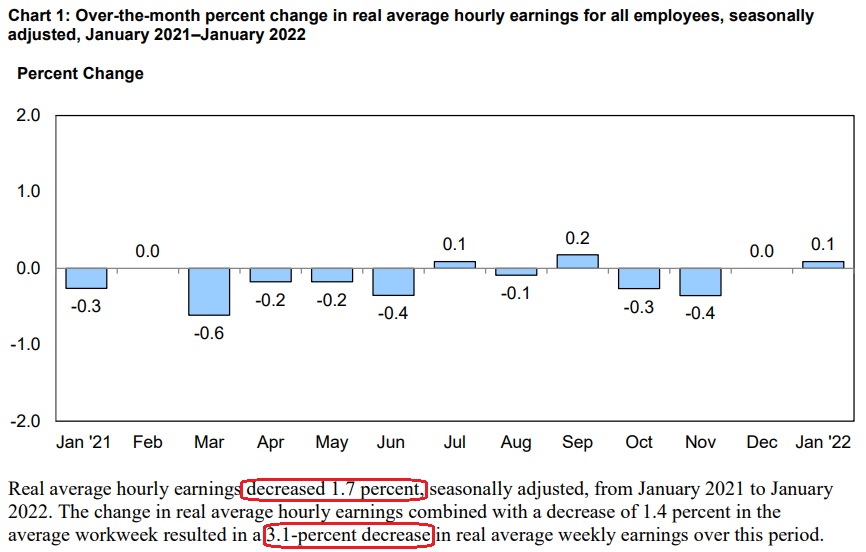
On this basis, Joe Biden is doing a bad job. Here’s Chart 1 from the Bureau of Labor Statistics’ report on what happened to hourly earnings in 2021, adjusted for inflation.

At the risk of stating the obvious, it’s not good news if most of the bars are in negative territory. I’ve also highlighted (in red) the key takeaways for the year.

Sophisticated observers will point out that hourly earnings are only one piece of the compensation puzzle.

So I then went to the Bureau of Labor Statistics’ report that also includes fringe benefits.

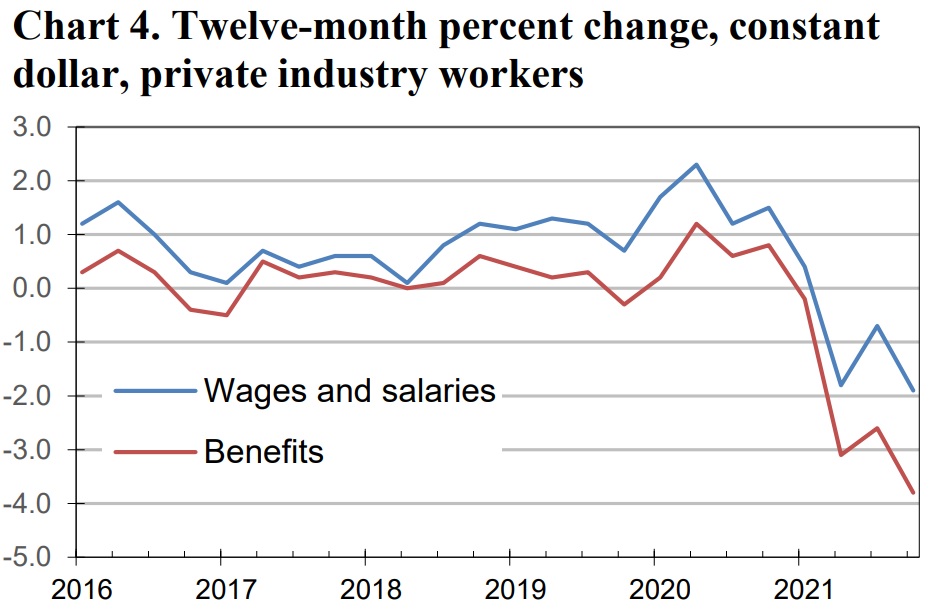
And if you look at Chart 4, which measures compensation after adjusting for inflation, you’ll notice very depressing data for 2021.

Now that we’ve looked at some grim data, let’s contemplate whether Joe Biden deserves blame.

The answer is probably yes, but I’ll share five caveats.

  • First, it’s just one year of data, so always be wary of statistical blips (maybe inflation is just transitory).
  • Second, only a few Biden policies have actually been enacted (though I’m not a fan of his biggest achievement).
  • Third, those policies may not have been in place long enough to have a meaningful effect on the economy.
  • Fourth, keep in mind that the pandemic scrambled economic data (though perhaps in a way that should have meant a boom in 2021).
  • Fifth, bad news in 2021 could merely be a continuation of a preexisting trend, in which case Trump maybe deserves blame.

Regarding the final point, notice in Chart 4 that the data was heading south at the end of 2020, when Trump was still in the White House.

Was that merely a statistical blip? If not, were the numbers bad because of something Trump did, or were they related to the pandemic? Or perhaps the bad numbers at the end of 2020 were related to investors and entrepreneurs fearing a future Biden agenda?

The bottom line is that we should ignore partisan labels and instead focus on policy. If government is becoming a bigger burden, then we can expect slower growth.

As such, it is very reasonable to think that 2021’s bad data is – at least in part – a consequence of Biden’s dirigiste policy agenda.

P.S. If he is able to resuscitate his so-called Build Back Better plan, expect more bad data in 2022.

P.P.S. For previous columns in this series, click herehere, and here.

Milton Friedman

Biography: 

Click here to see the Hoover project showcasing the works of Milton and Rose Friedman.

Milton Friedman, recipient of the 1976 Nobel Memorial Prize for economic science, was a senior research fellow at the Hoover Institution from 1977 to 2006. He passed away on Nov. 16, 2006. (Link to obituary.) He was also the Paul Snowden Russell Distinguished Service Professor Emeritus of Economics at the University of Chicago, where he taught from 1946 to 1976, and a member of the research staff of the National Bureau of Economic Research from 1937 to 1981.

Friedman was awarded the Presidential Medal of Freedom in 1988 and received the National Medal of Science the same year.

He was widely regarded as the leader of the Chicago School of monetary economics, which stresses the importance of the quantity of money as an instrument of government policy and as a determinant of business cycles and inflation.

In addition to his scientific work, Friedman also wrote extensively on public policy, always with a primary emphasis on the preservation and extension of individual freedom. His most important books in this field are (with Rose D. Friedman) Capitalism and Freedom (University of Chicago Press, 1962); Bright Promises, Dismal Performance (Thomas Horton and Daughters, 1983), which consists mostly of reprints of columns he wrote for Newsweek from 1966 to 1983; (with Rose D. Friedman) Free to Choose (Harcourt Brace Jovanovich, 1980), which complements a ten-part television series of the same name shown over the Public Broadcasting Service (PBS) network in early 1980; and (with Rose D. Friedman) Tyranny of the Status Quo (Harcourt Brace Jovanovich, 1984), which complements a three-part television series of the same name, shown over PBS in early 1984.

He was a member of the President’s Commission on an All-Volunteer Armed Force and the President’s Commission on White House Fellows. He was a member of President Ronald Reagan’s Economic Policy Advisory Board (a group of experts from outside the government named in 1981 by President Reagan).

Friedman was also active in public affairs, serving as an informal economic adviser to Senator Barry Goldwater in his unsuccessful campaign for the presidency in 1964, to Richard Nixon in his successful 1968 campaign, to President Nixon subsequently, and to Ronald Reagan in his 1980 campaign.

He has published many books and articles, most notably A Theory of the Consumption Function, The Optimum Quantity of Money and Other Essays, and (with A. J. Schwartz) A Monetary History of the United States, Monetary Statistics of the United States, and Monetary Trends in the United States and the United Kingdom.

He was a past president of the American Economic Association, the Western Economic Association, and the Mont Pelerin Society and was a member of the American Philosophical Society and the National Academy of Sciences.

He was awarded honorary degrees by universities in the United States, Japan, Israel, and Guatemala, as well as the Grand Cordon of the First Class Order of the Sacred Treasure by the Japanese government in 1986.

Friedman received a B.A. in 1932 from Rutgers University, an M.A. in 1933 from the University of Chicago, and a Ph.D. in 1946 from Columbia University.

Two Lucky People, his and Rose D. Friedman’s memoirs, was published in 1998 by the University of Chicago Press.

_

https://www.youtube.com/watch?v=1EwaLys3Zak

Related posts:

“The Power of the Market” episode of Free to Choose in 1990 by Milton Friedman (Part 1)

June 21, 2012 – 7:39 am

Milton Friedman The Power of the Market 1-5 How can we have personal freedom without economic freedom? That is why I don’t understand why socialists who value individual freedoms want to take away our economic freedoms.  I wanted to share this info below with you from Milton Friedman who has influenced me greatly over the […] By Everette Hatcher III | Posted in Milton Friedman | Tagged arnold schwarzenegger. | Edit | Comments (0)

“Friedman Friday,” EPISODE “The Failure of Socialism” of Free to Choose in 1990 by Milton Friedman (Part 1)

December 7, 2012 – 5:55 am

Milton Friedman: Free To Choose – The Failure Of Socialism With Ronald Reagan (Full) Published on Mar 19, 2012 by NoNationalityNeeded Milton Friedman’s writings affected me greatly when I first discovered them and I wanted to share with you. We must not head down the path of socialism like Greece has done. Abstract: Ronald Reagan […] By Everette Hatcher III | Posted in Milton FriedmanPresident Obama | Edit | Comments (1)

________________

“Friedman Friday” (“Free to Choose” episode 3 – Anatomy of a Crisis. part 3 of 7)

December 30, 2011 – 12:12 am

Worse still, America’s depression was to become worldwide because of what lies behind these doors. This is the vault of the Federal Reserve Bank of New York. Inside is the largest horde of gold in the world. Because the world was on a gold standard in 1929, these vaults, where the U.S. gold was stored, […] By Everette Hatcher III | Also posted in Current Events | Edit | Comments (0)

“Friedman Friday” (Part 16) (“Free to Choose” episode 3 – Anatomy of a Crisis. part 2 of 7)

December 23, 2011 – 12:07 am

  George Eccles: Well, then we called all our employees together. And we told them to be at the bank at their place at 8:00 a.m. and just act as if nothing was happening, just have a smile on their face, if they could, and me too. And we have four savings windows and we […] By Everette Hatcher III | Also posted in Current Events | Edit | Comments (0)

“Friedman Friday” (“Free to Choose” episode 3 – Anatomy of a Crisis. part 1of 7)

December 16, 2011 – 12:04 am

Milton Friedman’s Free to Choose (1980), episode 3 – Anatomy of a Crisis. part 1 FREE TO CHOOSE: Anatomy of Crisis Friedman Delancy Street in New York’s lower east side, hardly one of the city’s best known sites, yet what happened in this street nearly 50 years ago continues to effect all of us today. […]

By Everette Hatcher III | Also posted in Current Events | Edit | Comments (0)

____________________________ _____________


________________________________________________

_____________________________________________

Friedman Friday” Free to Choose by Milton Friedman: Episode “What is wrong with our schools?” (Part 3 of transcript and video)

November 18, 2011 – 7:08 am

Friedman Friday” Free to Choose by Milton Friedman: Episode “What is wrong with our schools?” (Part 3 of transcript and video) Here is the video clip and transcript of the film series FREE TO CHOOSE episode “What is wrong with our schools?” Part 3 of 6.   Volume 6 – What’s Wrong with our Schools Transcript: If it […] By Everette Hatcher III | Also posted in Vouchers | Tagged economic market.educational marketprivate universitiesstate collegesvalue of education | Edit | Comments (0)

Friedman Friday” Free to Choose by Milton Friedman: Episode “What is wrong with our schools?” (Part 2 of transcript and video)

November 11, 2011 – 12:50 am

Here is the video clip and transcript of the film series FREE TO CHOOSE episode “What is wrong with our schools?” Part 2 of 6.   Volume 6 – What’s Wrong with our Schools Transcript: Groups of concerned parents and teachers decided to do something about it. They used private funds to take over empty stores and they […]

By Everette Hatcher III | Also posted in Vouchers | Edit | Comments (1)

Friedman Friday” Free to Choose by Milton Friedman: Episode “What is wrong with our schools?” (Part 1 of transcript and video)

November 4, 2011 – 12:01 am

Here is the video clip and transcript of the film series FREE TO CHOOSE episode “What is wrong with our schools?” Part 1 of 6.   Volume 6 – What’s Wrong with our Schools Transcript: Friedman: These youngsters are beginning another day at one of America’s public schools, Hyde Park High School in Boston. What happens when […]

By Everette Hatcher III | Also posted in Vouchers | Tagged hidden weaponshyde park high schoolhyde park.state of vermontvivid illustration | Edit | Comments (0)

Friedman Friday” Free to Choose by Milton Friedman: Episode “Created Equal” (Part 3 of transcript and video)

September 30, 2011 – 7:46 am

Friedman Friday” Free to Choose by Milton Friedman: Episode “Created Equal” (Part 3 of transcript and video) Liberals like President Obama want to shoot for an equality of outcome. That system does not work. In fact, our free society allows for the closest gap between the wealthy and the poor. Unlike other countries where free enterprise and other […] By Everette Hatcher III | Posted in Milton Friedman | Tagged containment devicesequality of outcomeoil spillyoutube | Edit | Comments (0)

Free to Choose by Milton Friedman: Episode “Created Equal” (Part 2 of transcript and video)

September 30, 2011 – 7:41 am

Free to Choose by Milton Friedman: Episode “Created Equal” (Part 2 of transcript and video) Liberals like President Obama want to shoot for an equality of outcome. That system does not work. In fact, our free society allows for the closest gap between the wealthy and the poor. Unlike other countries where free enterprise and other freedoms are […] By Everette Hatcher III | Posted in Milton Friedman | Tagged equality of outcomemenuhin schoolnew millionairesworld war ii | Edit | Comments (0)

Free to Choose by Milton Friedman: Episode “Created Equal” (Part 1 of transcript and video)

September 20, 2011 – 11:58 am

 Milton Friedman and Ronald Reagan Liberals like President Obama (and John Brummett) want to shoot for an equality of outcome. That system does not work. In fact, our free society allows for the closest gap between the wealthy and the poor. Unlike other countries where free enterprise and other freedoms are not present.  This is a seven part series. […] By Everette Hatcher III | Posted in John BrummettMilton FriedmanRonald Reagan | Tagged dr friedmanequality of opportunityequality of outcomefreedom advocatespersonal freedom. | Edit | Comments (0)

Milton Friedman Friday: (“Free to Choose” episode 4 – From Cradle to Grave, Part 3 of 7)

September 23, 2011 – 12:11 am

 I am currently going through his film series “Free to Choose” which is one the most powerful film series I have ever seen. PART 3 OF 7 Worse still, America’s depression was to become worldwide because of what lies behind these doors. This is the vault of the Federal Reserve Bank of New York. Inside […]

By Everette Hatcher III | Edit | Comments (0)

Milton Friedman Friday:(“Free to Choose” episode 4 – From Cradle to Grave, Part 2 of 7)

September 16, 2011 – 12:10 am

 I am currently going through his film series “Free to Choose” which is one the most powerful film series I have ever seen. For the past 7 years Maureen Ramsey has had to buy food and clothes for her family out of a government handout. For the whole of that time, her husband, Steve, hasn’t […] By Everette Hatcher III | Edit | Comments (0)

Friedman Friday:(“Free to Choose” episode 4 – From Cradle to Grave, Part 1 of 7)

September 9, 2011 – 12:09 am

Friedman Friday:(“Free to Choose” episode 4 – From Cradle to Grave, Part 1 of 7) Volume 4 – From Cradle to Grave Abstract: Since the Depression years of the 1930s, there has been almost continuous expansion of governmental efforts to provide for people’s welfare. First, there was a tremendous expansion of public works. The Social Security Act […]

By Everette Hatcher III | Edit | Comments (0)

“Friedman Friday” (“Free to Choose” episode 1 – Power of the Market. part 3 of 7)

February 17, 2012 – 12:12 am

  _________________________   Pt3  Nowadays there’s a considerable amount of traffic at this border. People cross a little more freely than they use to. Many people from Hong Kong trade in China and the market has helped bring the two countries closer together, but the barriers between them are still very real. On this side […] By Everette Hatcher III | Posted in Current EventsMilton Friedman | Edit | Comments (0)

“Friedman Friday” (“Free to Choose” episode 1 – Power of the Market. part 2 of 7)

February 10, 2012 – 12:09 am

  Aside from its harbor, the only other important resource of Hong Kong is people __ over 4_ million of them. Like America a century ago, Hong Kong in the past few decades has been a haven for people who sought the freedom to make the most of their own abilities. Many of them are […] By Everette Hatcher III | Posted in Current EventsMilton Friedman | Edit | Comments (0)

“Friedman Friday” (“Free to Choose” episode 1 – Power of the Market. part 1of 7)

February 3, 2012 – 12:07 am

“FREE TO CHOOSE” 1: The Power of the Market (Milton Friedman) Free to Choose ^ | 1980 | Milton Friedman Posted on Monday, July 17, 2006 4:20:46 PM by Choose Ye This Day FREE TO CHOOSE: The Power of the Market Friedman: Once all of this was a swamp, covered with forest. The Canarce Indians […]

By Everette Hatcher III | Posted in Current EventsMilton Friedman | Edit | Comments (0)

“Friedman Friday,” EPISODE “The Failure of Socialism” of Free to Choose in 1990 by Milton Friedman (Part 1)

December 7, 2012 – 5:55 am

Milton Friedman: Free To Choose – The Failure Of Socialism With Ronald Reagan (Full) Published on Mar 19, 2012 by NoNationalityNeeded Milton Friedman’s writings affected me greatly when I first discovered them and I wanted to share with you. We must not head down the path of socialism like Greece has done. Abstract: Ronald Reagan […] By Everette Hatcher III | Posted in Milton FriedmanPresident Obama | Edit | Comments (1)

MUSIC MONDAY Meredith Andrews song ”Spirit of the Living God”

Andrews in 2008

Vertical Worship – Spirit of the Living God (Music Video)

Spirit of the Living God
We only wanna hear your voice
We’re hanging on every word
Spirit of the Living God
We wanna know you more and more
We’re hanging on every word
Speak to us
Spirit of the Living God
We’re leaning into all you are
Everything else can wait
Spirit of the Living God
Come now and breathe upon our hearts
Come now and have your way
‘Cause when you speak, when you move
When you do what only you can do
It changes us, it changes
What we see and what we seek
When you come in the room
When you do what only you can do
It changes us, it changes
What we see and what we seek
You’re changing everything
Spirit of the Living God
Come now and breathe upon our hearts
Come now and have your way
When you speak, and when you move
When you do what only you can do
It changes us, it changes
What we see and what we seek
When you come in the room
When you do what only you can do
It changes us, it changes
What we see and what we seek
You’re changing everything
When you move, you move all our fears
When you move, you move us to tears
When you move, you move all our fears
When you move, you move us to tears
When you fall, we fall on our knees
When you fall, we fall at your feet
God, when you fall, we fall on our knees
When you fall, we fall at your feet
When you speak and when you move
When you do what only you can do
It changes us, it changes
What we see and what we seek
When you come in the room
When you do what only you can do
It changes us, it changes
What we see and what we seek
You’re changing everything

Meredith Andrews – Not For A Moment (After All) – Live

Christ Is Enough

Open Up the Heavens

Strong God

Meredith Andrews “Not for A Moment” (Lyric Video)

Meredith Andrews

My favorite Christian music artist of all time is Keith Green.

Keith Green passed away on July 28th, 1982 almost 39 years ago to the day!!! I want to remember him with a series of posts!!!

Sunday, May 5, 2013

Keith Green – (talks about) Jesus Commands Us To Go! (live)

Uploaded on May 26, 2008

Keith Green talks about “Jesus Commands Us To Go!” live at Jesus West Coast ’82

You can find more info on http://www.keithgreen.com

If you want to buy this DVD go to the online shop on his website.

And if you want to know more about this man and why he followed Jesus look at my profile for the video about his life.

______________________________________________________

You are called to go
Keith’s concerts were evangelistic and exhortational. He was the Lecrae of the 70’s. Here is what he has to say about the great commission:

“The world isn’t being won today because we’re not doing it. It’s our fault. This generation of Christians is responsible for this generation of souls on the earth. And no where in the world is the gospel so plentiful as here in the United States. No where. And I don’t want to see us stand before God on that day ans say, ‘but God I didn’t hear you call me.’ Here is something for all you to chew on, you don’t need to hear a call, you’re already called. In fact, if you stay home from going into all nations you had better be able to say to God, ‘You called me to stay home God, I know that as a fact.'”

Keith Green – Asleep In The Light (live)

Uploaded on May 26, 2008

Keith Green performing “Asleep In The Light” live at Jesus West Coast ’82

You can find more info on http://www.keithgreen.com

_________________________

Keith wasn’t messing around, watch his biography and see how he backed up what he said with his life:

The Keith Green Story (FULL)

Uploaded on May 14, 2009

Keith Green was an intense and radical man of God. He was taken from this Earth at a relatively young age. His legacy lives on through his music and his sermons. This video is about his life.

Related posts:

My favorite Christian music artist of all time is Keith Green.

My favorite Christian music artist of all time is Keith Green. Sunday, May 5, 2013 You Are Celled To Go – Keith Green Keith Green – (talks about) Jesus Commands Us To Go! (live) Uploaded on May 26, 2008 Keith Green talks about “Jesus Commands Us To Go!” live at Jesus West Coast ’82 You can find […]

Keith Green’s article “Grumbling and Complaining–So You Wanna Go Back to Egypt?” (Part 4)

Keith Green – So You Wanna Go Back To Egypt (live) Uploaded by monum on May 25, 2008 Keith Green performing “So You Wanna Go Back To Egypt” live at West Coast 1980 ____________ This song really shows Keith’s humor, but it really has great message. Keith also had a great newsletter that went out […]

Keith Green’s article “Grumbling and Complaining–So You Wanna Go Back to Egypt?” (Part 3)

Keith Green – So You Wanna Go Back To Egypt (live) Uploaded by monum on May 25, 2008 Keith Green performing “So You Wanna Go Back To Egypt” live at West Coast 1980 ____________ This song really shows Keith’s humor, but it really has great message. Keith also had a great newsletter that went out […]

Keith Green’s article “Grumbling and Complaining–So You Wanna Go Back to Egypt?” (Part 2)

Keith Green – So You Wanna Go Back To Egypt (live) Uploaded by monum on May 25, 2008 Keith Green performing “So You Wanna Go Back To Egypt” live at West Coast 1980 ____________ This song really shows Keith’s humor, but it really has great message. Keith also had a great newsletter that went out […]

Keith Green’s article “Grumbling and Complaining–So You Wanna Go Back to Egypt?” (Part 1)

Keith Green – So You Wanna Go Back To Egypt (live) Uploaded by monum on May 25, 2008 Keith Green performing “So You Wanna Go Back To Egypt” live at West Coast 1980 ____________ This song really shows Keith’s humor, but it really has great message. Keith also had a great newsletter that went out […]

Keith Green Story (Part 9)

Keith Green – Easter Song (live) Uploaded by monum on May 25, 2008 Keith Green performing “Easter Song” live from The Daisy Club — LA (1982) ____________________________ Keith Green was a great song writer and performer.  Here is his story below: The Lord had taken Keith from concerts of 20 or less — to stadiums […]

Keith Green Story, includes my favorite song (Part 8)

Keith Green – Asleep In The Light Uploaded by keithyhuntington on Jul 23, 2006 keith green performing Asleep In The Light at Jesus West Coast 1982 __________________________ Keith Green was a great song writer and performer and the video clip above includes my favorite Keith Green song. Here is his story below: “I repent of […]

Keith Green Story (Part 7)

Keith Green – Your Love Broke Through Here is something I got off the internet and this website has lots of Keith’s great songs: Keith Green: His Music, Ministry, and Legacy My mom hung up the phone and broke into tears. She had just heard the news of Keith Green’s death. I was only ten […]

Keith Green Story (Part 6)

The Keith Green Story pt 7/7 I remember when I first Keith Green. He had a great impact on me. Below are some quotes on Keith: Quotes   “It’s time to quit playing church and start being the Church (Matt. 18:20)” — Keith Green, as quoted by Melody Green in the introduction to A Cry […]

Keith Green Story (Part 5)

The Keith Green Story pt 6/7 When I first heard Keith Green in 1978 it had a major impact on my life. Below is his story: LEGEND   Keith Green CBN.com – When musician Keith Green died in a plane crash on July 28, 1982, the world lost a special man whose heart was aflame […]

AFTER LIFE 3 Review and Open Letter to Ricky Gervais Part 31 Kath: What? Penny: Strong, confident, determined on the outside. But on the inside, you’re vulnerable and sensitive. You’re lonely. It’s tough, isn’t it? Being a strong woman in a man’s world. You feel you’ve lost a little of yourself, and you see needing comfort as a weakness they’ll pounce on. So you deny you need it. But you do need it, dear. Everyone does. TONY NEEDS EVIDENCE TO BELIEVE BUT KATH DOESN’T

After Life Season 3 is EMOTIONAL- Netflix Review

Bertrand Russell 1957.jpg

Russell in 1957

After Life

—-

After Life TV Show on Netflix: canceled or renewed?

—-

After Life TV Show on Netflix: canceled or renewed?

—-

After Life TV Show on Netflix: canceled or renewed?

World Exclusive: After Life Season 3: The First few Minutes

After Life | Season 3 Official Trailer | Netflix

episodes will be released on January 14th.

Just Three Things. Written for #Afterlife by Ricky Gervais and Andy Burrows

After Life TV Show on Netflix: canceled or renewed?

March 7, 2022

Ricky Gervais

London, W1F 0LE
UK

Dear Ricky,


Penny: Hmm. Let’s see. Interesting. 

Kath: What? 

Penny: Strong, confident, determined on the outside. But on the inside, you’re vulnerable and sensitive. You’re lonely. It’s tough, isn’t it? Being a strong woman in a man’s world. You feel you’ve lost a little of yourself, and you see needing comfort as a weakness they’ll pounce on. So you deny you need it. But you do need it, dear. Everyone does. ( sentimental music playing )

—-

TONY NEEDS EVIDENCE TO BELIEVE BUT KATH DOESN’T

Tony totally dismissed the palm reading abilities of Penny and I totally agree with his assessment, but I do think there is reason to believe the Bible is true!! Let me give you evidence and talk about a hero of yours!!!

Ricky you are a great admirer of Bertrand Russell.

Quote from Bertrand Russell:

Q: Why are you not a Christian?Russell: Because I see no evidence whatever for any of the Christian dogmas. I’ve examined all the stock arguments in favor of the existence of God, and none of them seem to me to be logically valid.Q: Do you think there’s a practical reason for having a religious belief, for many people?Russell: Well, there can’t be a practical reason for believing what isn’t true. That’s quite… at least, I rule it out as impossible. Either the thing is true, or it isn’t. If it is true, you should believe it, and if it isn’t, you shouldn’t. And if you can’t find out whether it’s true or whether it isn’t, you should suspend judgment. But you can’t… it seems to me a fundamental dishonesty and a fundamental treachery to intellectual integrity to hold a belief because you think it’s useful, and not because you think it’s true._Image result for francis schaefferFrancis Schaeffer noted concerning the IMPLICIT FAITH of Bertrand Russell:I was lecturing at the University of St. Andrews one night and someone put forth the question, “If Christianity is so clear and reasonable then why doesn’t Bertrand Russell then become a Christian? Is it because he hasn’t discovered theology?”It wasn’t a matter of studying theology that was involved but rather that he had too much faith. I was surrounded by humanists and you could hear the gasps. Bertrand Russell and faith; Isn’t this the man of reason? I pointed out that this is a man of high orthodoxy who will hold his IMPLICIT FAITH on the basis of his presuppositions no matter how many times he has to zig and zag because it doesn’t conform to the facts.You must understand what the term IMPLICIT FAITH  means. In the old Roman Catholic Church when someone who became a Roman Catholic they had to promise implicit faith. That meant that you not only had to believe everything that Roman Catholic Church taught then but also everything it would teach in the future. It seems to me this is the kind of faith that these people have in the uniformity of natural causes in a closed system and they have accepted it no matter what it leads them into. I think that these men are men of a high level of IMPLICIT FAITH in their own set of presuppositions. Paul said (in Romans Chapter One) they won’t carry it to it’s logical conclusion even though they hold a great deal of the truth and they have revolted and they have set up a series of universals in themselves which they won’t transgress no matter if they conform to the facts or not.Here below is the Romans passage that Schaeffer is referring to and verse 19 refers to what Schaeffer calls “the mannishness of man” and verse 20 refers to Schaeffer’s other point which is “the universe and it’s form.”Romans 1:18-20 Amplified Bible :18 For God’s [holy] wrath and indignation are revealed from heaven against all ungodliness and unrighteousness of men, who in their wickedness repress and hinder the truth and make it inoperative. 19 For that which is known about God is evident to them and made plain in their inner consciousness, because God [Himself] has shown it to them. 20 For ever since the creation of the world His invisible nature and attributes, that is, His eternal power and divinity, have been made intelligible and clearly discernible in and through the things that have been made (His handiworks). So [men] are without excuse [altogether without any defense or justification].We can actually see the two points makes playing themselves out in Bertrand Russell’s own life.Image result for bertrand russell[From a letter dated August 11, 1918 to Miss Rinder when Russell was 46]It is quite true what you say, that you have never expressed yourself—but who has, that has anything to express? The things one says are all unsuccessful attempts to say something else—something that perhaps by its very nature cannot be said. I know that I have struggled all my life to say something that I never shall learn how to say. And it is the same with you. It is so with all who spend their lives in the quest of something elusive, and yet omnipresent, and at once subtle and infiniteOne seeks it in music, and the sea, and sunsets; at times I have seemed very near it in crowds when I have been feeling strongly what they were feeling; one seeks it in love above all. But if one lets oneself imagine one has found it, some cruel irony is sure to come and show one that it is not really found.
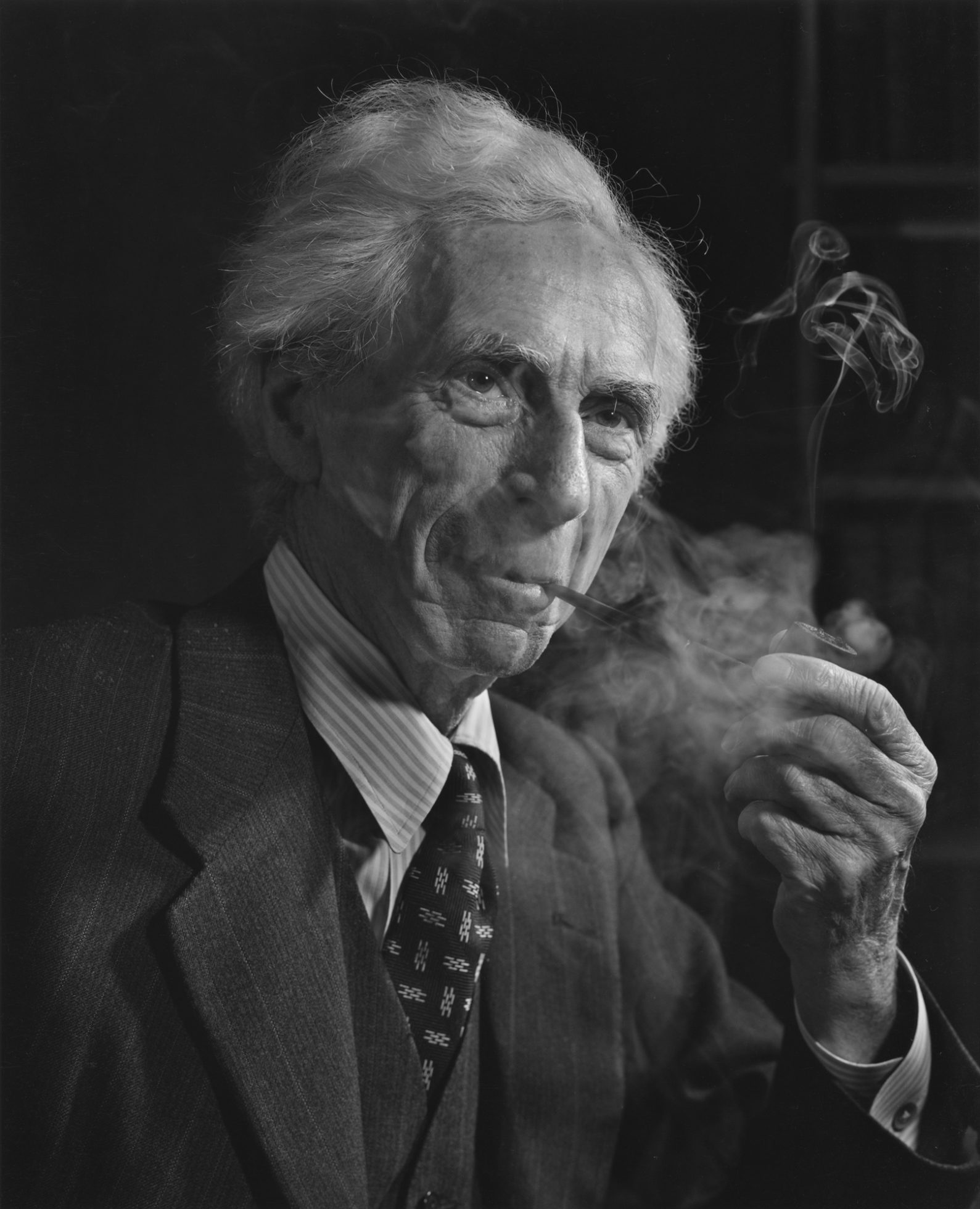
The outcome is that one is a ghost, floating through the world without any real contact. Even when one feels nearest to other people, something in one seems obstinately to belong to God and to refuse to enter into any earthly communion—at least that is how I should express it if I thought there was a God. It is odd isn’t it? I care passionately for this world, and many things and people in it, and yet…what is it all? There must be something more important, one feels, though I don’t believe there is. I am haunted—some ghost, from some extra-mundane region, seems always trying to tell me something that I am to repeat to the world, but I cannot understand the message. But it is from listening to the ghost that one comes to feel oneself a ghost. I feel I shall find the truth on my deathbed and be surrounded by people too stupid to understand—fussing about medicines instead of searching for wisdom. Love and imagination mingled; that seems the main thing so far.During Bertrand Russell’s lifetime (1872-1970) there lived another scholar who also doubted that the Bible was true and his name was Sir William Mitchell Ramsay (1851-1939. Ramsay taught from 1885 to until his retirement in 1911 but he continued writing books.Wikipedia notes:In 1880 Ramsay received an Oxford studentship for travel and research in Greece. At Smyrna, he met Sir C. W. Wilson, then British consul-general in Anatolia, who advised him on inland areas suitable for exploration. Ramsay and Wilson made two long journeys during 1881-1882.He traveled widely in Asia Minor and rapidly became the recognized authority on all matters relating to the districts associated with St Paul’s missionary journeys and on Christianity in the early Roman Empire. Greece and Turkey remained the focus of Ramsay’s research for the remainder of his academic career. In 1883, he discovered the world’s oldest complete piece of music, the Seikilos epitaph. He was known for his expertise in the historic geographyand topography of Asia Minor and of its political, social, cultural, and religious history. He was Fellow of Exeter College, Oxford, in 1882.From 1885 to 1886 Ramsay held the newly created Lincoln and Merton professorship of classical archaeology and art at Oxford and became a fellow of Lincoln College (honorary fellow 1898). In 1886 Ramsay was appointed Regius Professor of Humanity at the University of Aberdeen. He remained affiliated with Aberdeen until his retirement in 1911. What information did William Ramsay find out about the accuracy of the Bible? Francis Schaeffer discusses Ramsay’s life below:

TRUTH AND HISTORY (chapter 5 of WHATEVER HAPPENED TO THE HUMAN RACE?, under footnotes #97 and #98)

A common assumption among liberal scholars is that because the Gospels are theologically motivated writings–which they are–they cannot also be historically accurate. In other words, because Luke, say (when he wrote the Book of Luke and the Book of Acts), was convinced of the deity of Christ, this influenced his work to the point where it ceased to be reliable as a historical account. The assumption that a writing cannot be both historical and theological is false.The experience of the famous classical archaeologist Sir William Ramsay illustrates this well. When he began his pioneer work of exploration in Asia Minor, he accepted the view then current among the Tubingen scholars of his day that the Book of Acts was written long after the events in Paul’s life and was therefore historically inaccurate. However, his travels and discoveries increasingly forced upon his mind a totally different picture, and he became convinced that Acts was minutely accurate in many details which could be checked.What is even more interesting is the way “liberal” modern scholars today deal with Ramsay’s discoveries and others like them. In the NEW TESTAMENT : THE HISTORY OF THE INVESTIGATION OF ITS PROBLEMS, the German scholar Werner G. Kummel made no reference at all to Ramsay. This provoked a protest from British and American scholars, whereupon in a subsequent edition Kummel responded. His response was revealing. He made it clear that it was his deliberate intention to leave Ramsay out of his work, since “Ramsay’s apologetic analysis of archaeology [in other words, relating it to the New Testament in a positive way] signified no methodologically essential advance for New Testament research.” This is a quite amazing assertion. Statements like these reveal the philosophic assumptions involved in much liberal scholarship.A modern classical scholar, A.N.Sherwin-White, says about the Book of Acts: “For Acts the confirmation of historicity is overwhelming…Any attempt to reject its basic historicity, even in matters of detail, must not appear absurd. Roman historians have long taken this for granted.”When we consider the pages of the New Testament, therefore, we must remember what it is we are looking at. The New Testament writers themselves make abundantly clear that they are giving an account of objectively true events.(Under footnote #98)Acts is a fairly full account of Paul’s journeys, starting in Pisidian Antioch and ending in Rome itself. The record is quite evidently that of an eyewitness of the events, in part at least. Throughout, however, it is the report of a meticulous historian. The narrative in the Book of Acts takes us back behind the missionary journeys to Paul’s famous conversion on the Damascus Road, and back further through the Day of Pentecost to the time when Jesus finally left His disciples and ascended to be with the Father.But we must understand that the story begins earlier still, for Acts is quite explicitly the second part of a continuous narrative by the same author, Luke, which reaches back to the birth of Jesus.Luke 2:1-7 New American Standard Bible (NASB)2 Now in those days a decree went out from Caesar Augustus, that a census be taken of all [a]the inhabited earth. [b]This was the first census taken while[c]Quirinius was governor of Syria. And everyone was on his way to register for the census, each to his own city. Joseph also went up from Galilee, from the city of Nazareth, to Judea, to the city of David which is called Bethlehem, because he was of the house and family of David, in order to register along with Mary, who was engaged to him, and was with child. While they were there, the days were completed for her to give birth. And she gave birth to her firstborn son; and she wrapped Him in cloths, and laid Him in a [d]manger, because there was no room for them in the inn.In the opening sentences of his Gospel, Luke states his reason for writing:Luke 1:1-4 New American Standard Bible (NASB)1 Inasmuch as many have undertaken to compile an account of the things[a]accomplished among us, just as they were handed down to us by those whofrom the beginning [b]were eyewitnesses and [c]servants of the [d]word, it seemed fitting for me as well, having [e]investigated everything carefully from the beginning, to write it out for you in consecutive order, most excellentTheophilus; so that you may know the exact truth about the things you have been [f]taught.In Luke and Acts, therefore, we have something which purports to be an adequate history, something which Theophilus (or anyone) can rely on as its pages are read. This is not the language of “myths and fables,” and archaeological discoveries serve only to confirm this.For example, it is now known that Luke’s references to the titles of officials encountered along the way are uniformly accurate. This was no mean achievement in those days, for they varied from place to place and from time to time in the same place. They were proconsuls in Corinth and Cyprus, asiarchs at Ephesus, politarches at Thessalonica, and protos or “first man” in Malta. Back in Palestine, Luke was careful to give Herod Antipas the correct title of tetrarch of Galilee. And so one. The details are precise.The mention of Pontius Pilate as Roman governor of Judea has been confirmed recently by an inscription discovered at Caesarea, which was the Roman capital of that part of the Roman Empire. Although Pilate’s existence has been well known for the past 2000 years by those who have read the Bible, now his governorship has been clearly attested outside the Bible.

Kenneth S. Wuest

Luke, The Greek Historian“LUKE WAS a Greek, educated in the Greek schools, prepared for the medical practice which was held in high regard as a profession, and among the Greeks had attained to a place of eminence among the nations of the world. Greek doctors of medicine were in attendance upon many of the royal families of other nations. The Greeks were by nature and training, a race of creative thinkers who pursued their studies in a scientific manner. Their sense of what really constituted scientific accuracy and method in the recording of history was well developed.The writings of Luke, both his Gospel and The Acts, demonstrates Luke’s training as an historian. He writes his Gospel to a Gentile friend, Theophilus. The name means “a god-lover,” or “god-beloved,” and may have been given him when he became a Christian. The words “most excellent” according to Ramsay, were a title like “Your Excellency,” and show that he held office…Luke wrote the Gospel for Theophilus to use as a standard whereby to judge the accuracy of the many inspired accounts of our Lord’s life which were written in the first century.The facts he records were most surely believed by the first century church. Luke arranges the facts of our Lord’s life in historical order as they occurred. The other Gospels do not claim to do that. The arrangement of events was dictated by the purpose which each author had in writing his account. The sources of Luke’s information were oral and written, from eye-witnesses of the events recorded.He as a trained historian would carefully check over these accounts, investigating and verifying every fact. And this is what he has reference to when he uses the words “having had perfect understanding of all things from the very first.” The words “having had perfect understanding” are literally, “having closely traced.” The verb means “to follow along a thing in the mind.” The word was used for the investigation of symptoms. Thus it speaks of a careful investigation of all sources, oral and written, which purport to be accounts of our Lord’s life.Luke had the historian’s mind, a thing native to the educated Greek. Herodotus, the father of Greek history, exhibited the Greek determination to get at the truth no matter how much work it required, when he travelled to central Africa to verify the account of the annual rise and fall of the Nile River. In those days this was a long and difficult journey. Sir William Ramsey said, “I regard Luke as the greatest historian who has ever lived, save only Thucydides.” Thus we have no doubt but that Luke made a personal investigation of all the facts he had recorded. He interviewed every witness, visited every locality. If Mary was still alive, he, a doctor of medicine investigated the story of the virgin birth by hearing it from Mary’s own lips. And as Professor John A. Scott, a great Greek scholar has said, “You could not fool Doctor Luke.”But Luke was not dependent alone upon his personal investigations for the accuracy of his record. He says that he closely traced all things from above. The words “from above” are from a Greek word translated “from the very first,” in the Authorized Version. The word occurs in John 3:31; 19:11; James 1:17; 3:15, 17, and is in every instance translated “from above.” It is used often in contrast to a word which means “from beneath.” Paul had doubtless heard the account of the institution of the Lord’s Supper from the eleven, but he also had it by revelation from the Lord (I Cor. 11:23). He had received his gospel by direct revelation in Arabia, and this was his check upon the gospel he heard at Jerusalem from the apostles.SoLuke claims to have closely investigated the facts he had received, and to have done so through the inspiration of the Holy Spirit, which fact guarantees the absolute accuracy of the record (Luke 1:1-4).”

Kenneth S. Wuest, “Word Studies In The Greek New Testament” (Grand Rapids, MI: Eerdmans 1979) pp. 52-54

XXX

Now let us look again at this issue of miracles!!!

Penny tells Tony she can contact Lisa. I agree with Tony that this is stupid!!!


Below is the link to former atheist Lee Strobel’s book:

Click to access Case_for_+Faith.pdf


OBJECTION #2:
SINCE MIRACLES CONTRADICT SCIENCE, THEY CANNOT BE TRUE
The virgin birth, the Resurrection, the raising of Lazarus, even the Old Testament miracles, all are freely used for religious propaganda, and they are very effective with an audience of unsophisticates and children.
Richard Dawkins, atheist 1
It is not just a provocative rumor that God has acted in history, but a fact worthy of our intellectual conviction. The miracles of Christianity are not an embarrassment to the Christian worldview. Rather, they are testimony to the compassion of God for human beings benighted by sin and circumstance.
Gary Habermas, Christian 2
I’ve seen guilty defendants squirm and sweat on the witness stand as they feel the noose of justice slowly tightening around their neck. They try to lie their way out of their predicament. They concoct improbable stories in a futile effort to explain away incriminating evidence. They manufacture transparently false alibis; they cast blame on innocent people; they attempt to

discredit police and prosecutors; they rewrite history; they deny and obfuscate and try to hoodwink the judge and jurors.
But there’s one tactic I’ve never seen: a defendant claiming that the reason his fingerprints ended up on the murder weapon is-somehow, for some inexplicable reason, an act of God occurred, a mysterious, unrepeatable, supernatural event that made his fingerprints suddenly appear somewhere he had never touched.
Once a defendant tried a “Twinkie defense” by making the dubious assertion that his elevated sugar levels were somehow responsible for his criminal behavior, but not even the most audacious defendant would try a “miracle defense.”
Why? Because nobody would believe him! After all, we’re modern and scientific people living in the Third Millennium. We don’t subscribe to superstition, sorcery, or direct intervention from some unseen divine source. Claiming a miracle would be so blatantly silly that even the most desperate defendant wouldn’t resort to that strategy.
One time I saw Penn and Teller, the comedian-magicians, select a ten-year-old boy named Isaiah from the audience and show him a long strip of polyester, which they proceeded to knot and cut in the middle. Then, with a big flourish, they shook out the cloth and-voila!-it was in one piece again.
“What do you think?” Penn asked little Isaiah. “Was that a miracle or a magic trick?” Isaiah didn’t hesitate. “A magic trick,” he replied with confidence.
A mere child, it seems, is smart enough to know that when we can’t quite understand what
might have caused a mysterious event, there’s still undoubtedly a reasonable explanation apart from the miraculous.
I knew from my conversation with agnostic Charles Templeton that he had shed his belief in miracles many years ago. “Our early forefathers sought within the limits of their experience to interpret life’s imponderables, usually attributing the inexplicable to the intervention of one or more of their gods, demi-deities, and evil spirits,” he wrote. “But surely … it is time to have done with primitive speculation and superstition and look at life in rational terms.” 3
There are scientists who agree, predicting that the march of knowledge will ultimately trample belief in supernatural events. In 1937, German physicist Max Planck said: “Faith in miracles must yield ground, step by step, before the steady and firm advance of the forces of science, and its total defeat is indubitably a mere matter of time.”4
Atheist Richard Dawkins, professor of public understanding of science at Oxford University and author of The Selfish Gene, believes that time is rapidly coming. “We’re working on … a complete understanding of the universe and everything that is in it,” he said in a television interview.5
That means, viola! as with Penn and Teller’s magically restored sash, there would be no need to appeal to the miraculous in order to explain away what previously had been shrouded in mystery.
But can a person be scientifically sophisticated and still believe in the possibility of miracles? “My faith can be summed up in this one paradox: I believe in science, and I believe in God,” said nuclear physicist Hugh Siefken. “I plan to continue testifying to both.”6
He and many other scientists see no inherent conflict between their profession and their conclusion that a miracle-working God is responsible for creating and sustaining the universe.
Is that a form of professional denial? Can a person write off elves and fairies as being fanciful and yet at the same time embrace manna from heaven, the virgin birth, and the Resurrection as

being credible events of history? If miracles are direct violations of natural laws, then how can a reasonable person believe they could ever occur?
I knew that William Lane Craig was a rational man. And I was aware that he has used his considerable intellectual skills to defend the idea that God has-and does-intervene in the world through miraculous acts. I called him and asked whether he’d be willing to let me question him on the topic.
“Sure,” he said. “Come on down.”
I jotted down a long list of challenges and booked a flight to Atlanta. On the plane, I mused that primitive people probably would have considered jet travel to be a miracle. How else could fifty tons of metal be kept aloft in apparent defiance of the law of gravity? Surely God’s invisible hand must be beneath it.
People today know better. They understand aerodynamics and jet propulsion. But has our knowledge of science and technology really rendered all belief in miracles obsolete? Or would Craig be able to provide convincing evidence that a person can be sober-minded and discerning while at the same time maintaining the validity of the miraculous?
THE SECOND INTERVIEW: WILLIAM LANE CRAIG, PH.D.
My initial reaction to seeing Bill Craig was disbelief. His beard, which for twenty-three years had given him a serious and scholarly demeanor, was gone. My face must have registered my shock.
“I turned fifty,” he explained, “so I celebrated by shaving it off.”
Craig ushered me down a flight of stairs to his office, a well-organized room dominated by a dark wood desk and floor-to-ceiling bookshelves with neatly arranged rows of books and scholarly journals. I settled into a comfortable chair while Craig sat behind the desk, leaning back in a leather-clad office chair that protested with a loud squeak.
Craig has written extensively about miracles, especially the resurrection of Jesus. His books include Reasonable Faith, Knowing the Truth about the Resurrection, The Historical Argument for the Resurrection of Jesus, and Assessing the New Testament Evidence for the Historicity of the Resurrection of Jesus, and he contributed to In Defense of Miracles, Does God Exist? Jesus Under Fire, and The Intellectuals Speak Out about God.
He holds doctorates in philosophy from the University of Birmingham, England, and in theology from the University of Munich, and is currently a Research Professor of Philosophy at the Talbot School of Theology. He is the member of nine professional societies, including the American Academy of Religion, Society of Biblical Literature, and the American Philosophical Association, and he has written for New Testament Studies, Journal for the Study of the New Testament, Journal of the American Scientific Affiliation, Gospel Perspectives, Philosophy, and other scholarly publications.
Sans beard and wearing blue jeans, Craig looked a decade younger than his age, with piercing blue eyes, brown hair combed casually to the side, and a quick and enthusiastic laugh. He stroked his chin-subconsciously missing his beard, perhaps-as he listened intently to my first question, which admittedly came with an edge of challenge.
“Okay, Dr. Craig, you’re an intelligent and educated individual,” I began. “Tell me: how can a modern and rational person still believe in babies being born from virgins, people walking on water, and cadavers emerging alive from tombs?”

Craig smiled. “It’s funny you should ask specifically about the virgin birth,” he replied, “because that was a major stumbling block to my becoming a Christian. I thought it was totally absurd.”
“Really?” I said. “What happened?”
“When the Christian message was first shared with me as a teenager, I had already studied biology. I knew that for the virgin birth to be true, a Y chromosome had to be created out of nothing in Mary’s ovum, because Mary didn’t possess the genetic material to produce a male child. To me, this was utterly fantastic. It just didn’t make sense.”
“You’re not alone,” I observed. “Other skeptics have problems with it too. How did you proceed?”
Craig thought back for a moment. “Well, I sort of put that issue aside and became a Christian anyway, even though I didn’t really believe in the virgin birth. But then, after becoming a Christian, it occurred to me that if I really do believe in a God who created the universe, then for him to create a Y chromosome would be child’s play!”
I told Craig that I found it interesting he could have become a Christian despite misgivings about a doctrine as significant as the virgin birth.
“I guess the authenticity of the person of Jesus and the truth of his message were so powerful that they simply overwhelmed any residual doubts that I had,” he replied.
I pressed him by asking, “Weren’t you rushing headlong into something you didn’t totally accept?”
“No, I think this can be a good procedure,” he said. “You don’t need to have all your questions answered to come to faith. You just have to say, The weight of the evidence seems to show this is true, so even though I don't have answers to all my questions, I'm going to believe and hope for answers in the long run.' That's what happened with me." "Does a person have to suspend their critical judgment in order to believe in something as improbable as miracles?" Craig sat upright in his chair and raised his index finger as if to punctuate his point. "Only if you believe that God does not exist!" he stressed. "Then I would agree-the miraculous would be absurd. But if there is a Creator who designed and brought the universe into being, who sustains its existence moment by moment, who is responsible for the very natural laws that govern the physical world, then certainly it's rational to believe that the miraculous is possible." MIRACLES VERSUS SCIENCE We were already getting into the interview but we had not yet paused to define our terms. Before going any further, I knew it was important that we settled on what 'miracle' means. "We throw around the word pretty haphazardly," I said. Harking back to my day thus far, I added, "For example, I might say,It was a miracle I made my flight to Atlanta,’ or, `It’s a miracle I found your house.’ Is that being too loose with the word?”
“Yes, I think it’s a misuse to talk about these things as miracles,” he said. “They’re clearly natural events with natural consequences.”
“Then how do you define the term?”
Craig spelled out his definition with precision. “In the proper sense,” he said, “a miracle is an event which is not producible by the natural causes that are operative at the time and place that the event occurs.”

As he said it, I silently repeated the definition in order to cement it in my mind. I mulled it for a few moments before continuing with what I considered to be the next logical question.
“But then isn’t there a contradiction between science and miracles?” I asked. “Atheistic philosopher Michael Ruse said, Creationists believe the world started miraculously. But miracles lie outside of science, which by definition deals with the natural, the repeatable, that which is governed by law."7 "Notice that Ruse does not say miracles are contradictory to science," Craig pointed out. "He says miracles lie outside of science, and that's quite different. I think a Christian who believes in miracles could agree with him on that. He could say that miracles, properly speaking, lie outside the province of natural science-but that's not to say they contradict science." I tried to digest the distinction. "Can you think of another example of something like that?" I asked. Craig thought for a moment before answering. "Well, ethics, for instance, lie outside the province of science," he replied. "Science doesn't make ethical judgments. So I wouldn't necessarily object to Ruse's statement. He's saying that the goal of science is to seek natural explanations, and therefore miracles lie outside of the scientific realm." Before I could ask another question, Craig spoke up again. "I should add, though, that you can do a theistic form of science. For example, there's a whole movement of people like mathematician William Dembski and biochemist Michael Belie who infer by principled means that there is an Intelligent Designer of the universe and the biological world." They aren't being arbitrary-from a rational and scientific perspective, they're concluding from the evidence that there must be an intelligent Creator." "So," I said, "you're disagreeing with the great skeptic David Hume, who defined miracles as being violations of the laws of nature." "Yes, absolutely. That's an improper understanding of miracles," he said. "You see, natural laws have implicit ceteris paribus conditions-that's Latin meaning,all other things being equal.’ In other words, natural laws assume that no other natural or supernatural factors are interfering with the operation that the law describes.”
“Can you give me an example of that?”
Craig’s eyes swept the room in search of an illustration. He finally landed on one as near as his own body.
“Well, it’s a law of nature that oxygen and potassium combust when they’re combined,” he explained. “But I have oxygen and potassium in my body, and yet I’m not bursting into flames. Does that mean it’s a miracle and I’m violating the laws of nature? No, because the law merely states what happens under idealized conditions, assuming no other factors are interfering. In this case, however, there are other factors interfering with the combustion, and so it doesn’t take place. That’s not a violation of the law.
“Similarly, if there’s a supernatural agent that is working in the natural world, then the idealized conditions described by the law are no longer in effect. The law isn’t violated because the law has this implicit provision that nothing is messing around with the conditions.”
I told Craig that his explanation reminded me of a conversation I had several years earlier with J. P Moreland, the noted philosopher who wrote Christianity and the Nature of Science. He used an illustration of the law of gravity, which says that if you drop an object, it will fall to the earth. But, he said, if an apple falls from a tree and you reach out to catch it before it hits the ground, you’re not violating or negating the law of gravity; you’re merely intervening.

“Yes, that’s my point with the ceteris paribus conditions,” Craig said. “The law of gravity states what will happen under idealized conditions with no natural or supernatural factors intervening. Catching the apple doesn’t overturn the law of gravity or require the formulation of a new law. It’s merely the intervention of a person with free will who overrides the natural causes operative in that particular circumstance. And that, essentially, is what God does when he causes a miracle to occur.”
That made sense to me. I knew, however, that some scientists would nevertheless dismiss the miraculous as mere superstition. I decided to pursue this line of questioning further.
REAL ACTS OF GOD
I asked Craig what he thought about physicist Max Plank’s prediction that faith in miracles would inevitably yield ground to the advance of science and biologist Richard Dawkin’s remark that scientists would someday understand the workings of the universe and thus vanquish the need for miraculous explanations. Craig’s reaction surprised me.
“I think they’re right,” he declared.
I looked up from my notes, thinking perhaps he had misunderstood my question. “Excuse me?” I said.
“Really,” he insisted, “I think they’re correct-insofar as some superstitious people use miracles as an excuse for ignorance and sort of punt to God every time they can’t explain something. I think it’s a good thing that science will squeeze out that kind of simplistic thinking.
“But those aren’t the miracles I’ve been talking about. I’m referring to events by which, in a principled way, you could legitimately infer that there was a supernatural agent intervening in the process. Those miracles-real acts of God-won’t be squeezed out by the advance of science, because they’re not based on an appeal to ignorance. They’re substantiated by the weight of the scientific and historical evidence.
“Michael Belie does this in his book Darwin’s Black Box. Belie explores `irreducible complexity’ in nature-organisms that could not have evolved step-by-step by a gradual Darwinian process of natural selection and genetic mutation. Now, he’s not saying that this is merely scientifically inexplicable. He’s giving a principled inference to an Intelligent Designer based on what the evidence shows. This is rational. His conclusions are based on solid scientific analysis.”
Craig’s discussion of evidence for miracles prompted me to ask about another point that was made by Hume, the eighteenth-century Scottish skeptic and history’s most famous doubter of the miraculous. “Hume said the evidence for the uniformity of nature is so conclusive that any evidence for miracles would never be able to overcome it,” I pointed out. “For instance, look at the Resurrection. We have thousands of years of uniform evidence that dead people simply do not return from the dead. So Hume says no amount of evidence would be able to overcome that tremendous presumption.”
Craig shook his head. “There’s no contradiction between believing that men generally stay in their graves and that Jesus of Nazareth rose from the dead. In fact, Christians believe both of these. The opposite of the statement that Jesus rose from the dead is not that all other men remained in their graves; it’s that Jesus of Nazareth remained in his grave.
“In order to argue against the evidence for the Resurrection, you have to present evidence against the Resurrection itself, not evidence that everybody else has always remained in their grave. So I think his argument is simply fallacious.

“Now, I would agree with Hume that a natural resurrection of Jesus from the dead, without any sort of divine intervention, is enormously improbable. But that’s not the hypothesis. The hypothesis is God raised Jesus from the dead. That doesn’t say anything against the laws of nature, which say dead men don’t come back to life naturally.”
EXTRAORDINARY EVIDENCE
While I could see Craig’s point, I wanted to pursue this avenue further. “Some critics say that the Resurrection is an extraordinary event and therefore it requires extraordinary evidence,” I said. “Doesn’t that assertion have a certain amount of appeal?”
“Yes, that sounds like common sense,” he replied. “But it’s demonstrably false.”
“How so?”
“Because this standard would prevent you from believing in all sorts of events that we do rationally embrace. For example, you would not believe the report on the evening news that the numbers chosen in last night’s lottery were 4, 2, 9, 7, 8, and 3, because that would be an event of extraordinary improbability. The odds against that are millions and millions to one, and therefore you should not believe it when the news reports it. Yet we obviously believe we’re rational in concluding it’s true. How is that possible?
“Well, probability theorists say that you must weigh the improbability of the event’s occurring against the probability that the evidence would be just as it is if the event had not taken place.”
Craig rattled off that statement so fast that my mind was having trouble assimilating it. “Whoa,” I said, holding up my hand. “You’re going to have to slow down and give me an example.”
“Okay, look at it this way: if the evening news has a very high probability of being accurate, then it’s highly improbable that they would inaccurately report the numbers chosen in the lottery. That counterbalances any improbability in the choosing of those numbers, so you’re quite rational to believe in this highly improbable event.
“In the same way, any improbability that you might think resides in the resurrection of Jesus is counterbalanced by the improbability of the empty tomb, Jesus’ resurrection appearances, the sudden change in the first disciples taking place if there were no such event as the resurrection of Jesus. Do you see what I mean?”
Yes, I said, that illustration made his point clear. As improbable as the Resurrection might seem to skeptics, this has to be weighed against how improbable it would be to have all of the various historical evidence for its occurrence if it never actually took place.
“So,” Craig concluded, “it becomes quite rational to believe in an event like the miraculous resurrection of Jesus. Besides, I look at it this way: if God really exists, then in what sense is it improbable that he would raise Jesus from the dead? I can’t think of any.”
“Have you seen skeptics who have become believers in Christianity because of the quality and quantity of the evidence for the Resurrection?” I asked.
Craig’s eyes got wide. “Oh, yes, certainly!” he said. “I recently met a fellow who became a Christian out of the so-called free thought' movement. He looked into the Resurrection and concluded from the evidence that God raised Jesus from the dead. Of course, his free-thought colleagues bitterly railed against him. He said,Why are they so hostile? I merely followed the principles of free thought, and this is where the evidence and reason led me!”‘

I chuckled. “Are you saying some free thought' folks aren't as free thinking as they would have people believe?" "Frankly," he replied, "I think many skeptics act in a close-minded way." As a former skeptic myself, I have noticed the same phenomenon. "Are you referring to the fact that some of them rule out even the possibility of miracles from the outset?" I asked. "Precisely," Craig said. "Logicians have a term:inference to the best explanation.’ This means you have a body of data to be explained, and then you have a pool of live options or various explanations for that data. You need to choose which explanation from that pool would, if true, best explain the observed data.
“Some skeptics, however, will not allow supernatural explanations even to be in the pool of live options. Consequently, if there is no natural explanation for an event, they’re simply left with ignorance.
“That’s prejudice. Apart from some proof of atheism, there’s no warrant for excluding supernatural explanations from being a member of the pool of live options. If you do put them in that pool, then you’ve got to be an open, honest investigator to see which is the best explanation of any given event.”
THE MIRACLES OF JESUS
“Let’s say you’re an honest investigator,” I said, picking up on his last thought. “What would you look for to convince you that something miraculous has occurred?”
“You would have a number of criteria. You would have to investigate to see if something cannot be accounted for in terms of the natural forces that were operable at that time and place. And you’d look for a religio-historical context.”
I wanted to pursue this idea of context. Hume said that if historians uniformly agreed that the Queen of England died and then reappeared alive a month later, he would be inclined to accept any explanation other than God having performed a miracle. I asked Craig for his response to that.
“I would agree that a miracle without context is inherently ambiguous,” Craig replied. “The context of a miracle can help us determine if it’s from God or not. For instance, the Queen’s revivification would lack any religious context and would basically be a bald and unexplained anomaly.
“But that’s not the case with Jesus. His supernatural feats took place in a context charged with religious significance because he performed his miracles and exorcisms as signs of the in- breaking of the kingdom of God into human history, and they served as an authentication of his message. And his resurrection comes as the climax to his own unparalleled life and ministry and his radical claims to divine authority which got him crucified. This is why the Resurrection gives us pause, while the Queen’s return would only perplex us. Therefore, the religio-historical context is crucial in understanding miraculous events.”
But I pressed further: “Did Jesus perform miracles? What convinces you that he did?”
“The fact is that most New Testament critics today admit he performed what we would call miracles. Granted, they may not all believe these were genuine miracles, but the idea of Jesus of Nazareth as a miracle-worker and exorcist is part of the historical Jesus that’s generally accepted by critics today.”
With that, Craig swiveled his chair and withdrew a file from the shelf behind his desk. He flipped through some pages until he landed the one he was after. “Let me read you a quote from

Rudolf Bultmann, who’s recognized as one of the most skeptical New Testament critics of this century”:
The Christian fellowship was convinced that Jesus had done miracles and they told many stories of miracles about him. Most of these stories contained in the gospels are legendary or are at least dressed up with legend. But, there can be no doubt that Jesus did such deeds, which were, in his and his contemporaries’ understanding, miracles; that is to say, events that were the result of supernatural divine causality. Doubtless he healed the sick and cast out demons.9
Craig closed the file. “Even Bultmann says miracles and exorcisms belong to the historical Jesus. Now, in Bultmann’s day these stories were considered legendary because of the supposed influence of Greco-Roman mythology on the gospels, but scholars today realize this influence was virtually nil. They now believe the role of Jesus as a miracle-worker must be understood against the backdrop of first century Palestinian Judaism, where it fits right in.
“In fact,” he concluded, “the only reason to be skeptical that these were genuine miracles rather than psychosomatic healings would be philosophical-do you believe that such events can occur or not? The historicity of the events is not in doubt.”

The answer to find meaning in life is found in putting your faith and trust in Jesus Christ. The Bible is true from cover to cover and can be trusted.

Thanks for your time.

Sincerely,

Everette Hatcher, everettehatcher@gmail.comhttp://www.thedailyhatch.org, cell ph 501-920-5733, 13900 Cottontail Lane, Alexander, AR 72002


Taking on Ark Times Bloggers on various issues Part I “Old Testament Bible Prophecy” includes the film TRUTH AND HISTORY and article ” Jane Roe became pro-life”

April 12, 2013 – 5:45 am

I have gone back and forth and back and forth with many liberals on the Arkansas Times Blog on many issues such as abortion, human rights, welfare, poverty, gun control  and issues dealing with popular culture. Here is another exchange I had with them a while back. My username at the Ark Times Blog is Saline […]By Everette Hatcher III | Posted in Biblical ArchaeologyFrancis SchaefferProlife | Edit|Comments (0)

John MacArthur on fulfilled prophecy from the Bible Part 2

August 8, 2013 – 1:28 am

I have posted many of the sermons by John MacArthur. He is a great bible teacher and this sermon below is another great message. His series on the Book of Proverbs was outstanding too.  I also have posted several of the visits MacArthur made to Larry King’s Show. One of two most popular posts I […]By Everette Hatcher III | Posted in Adrian RogersCurrent Events | Edit|Comments (0)

John MacArthur on fulfilled prophecy from the Bible Part 1

August 6, 2013 – 1:24 am

I have posted many of the sermons by John MacArthur. He is a great bible teacher and this sermon below is another great message. His series on the Book of Proverbs was outstanding too.  I also have posted several of the visits MacArthur made to Larry King’s Show. One of two most popular posts I […]By Everette Hatcher III | Posted in Adrian RogersCurrent Events |Tagged Bible Prophecyjohn macarthur | Edit|Comments (0)

John MacArthur: Fulfilled prophecy in the Bible? (Ezekiel 26-28 and the story of Tyre, video clips)

April 5, 2012 – 10:39 am

Prophecy–The Biblical Prophesy About Tyre.mp4 Uploaded by TruthIsLife7 on Dec 5, 2010 A short summary of the prophecy about Tyre and it’s precise fulfillment. Go to this link and watch the whole series for the amazing fulfillment from secular sources. http://www.youtube.com/watch?v=qvt4mDZUefo________________ John MacArthur on the amazing fulfilled prophecy on Tyre and how it was fulfilled […]By Everette Hatcher III | Posted in Biblical Archaeology | Edit|Comments (1)

John MacArthur on the Bible and Science (Part 2)

August 1, 2013 – 12:10 am

John MacArthur on the Bible and Science (Part 2) I have posted many of the sermons by John MacArthur. He is a great bible teacher and this sermon below is another great message. His series on the Book of Proverbs was outstanding too.  I also have posted several of the visits MacArthur made to Larry […]By Everette Hatcher III | Posted in Current Events | Edit|Comments (0)

John MacArthur on the Bible and Science (Part 1)

July 30, 2013 – 1:32 am

John MacArthur on the Bible and Science (Part 1) I have posted many of the sermons by John MacArthur. He is a great bible teacher and this sermon below is another great message. His series on the Book of Proverbs was outstanding too.  I also have posted several of the visits MacArthur made to Larry […]By Everette Hatcher III | Posted in Current Events | Edit|Comments (0)

Adrian Rogers: “Why I believe the Bible is true”

July 9, 2013 – 8:38 am

Adrian Rogers – How you can be certain the Bible is the word of God Great article by Adrian Rogers. What evidence is there that the Bible is in fact God’s Word? I want to give you five reasons to affirm the Bible is the Word of God. First, I believe the Bible is the […]By Everette Hatcher III | Posted in Adrian RogersBiblical Archaeology | Edit|Comments (0)

The Old Testament is Filled with Fulfilled Prophecy by Jim Wallace

June 24, 2013 – 9:47 am

Is there any evidence the Bible is true? Articles By PleaseConvinceMe Apologetics Radio The Old Testament is Filled with Fulfilled Prophecy Jim Wallace A Simple Litmus Test There are many ways to verify the reliability of scripture from both internal evidences of transmission and agreement, to external confirmation through archeology and science. But perhaps the […]By Everette Hatcher III | Posted in Biblical ArchaeologyCurrent Events | Edit|Comments (0)

Taking on Ark Times Bloggers on various issues Part M “Old Testament prophecy fulfilled?”Part 3(includes film DEATH BY SOMEONE’S CHOICE)

April 19, 2013 – 1:52 am

  I have gone back and forth and back and forth with many liberals on the Arkansas Times Blog on many issues such as abortion, human rights, welfare, poverty, gun control  and issues dealing with popular culture. Here is another exchange I had with them a while back. My username at the Ark Times Blog is […]By Everette Hatcher III | Posted in Francis SchaefferProlife | Edit|Comments (0)

Evidence for the Bible

March 27, 2013 – 9:43 pm

Here is some very convincing evidence that points to the view that the Bible is historically accurate. Archaeological and External Evidence for the Bible Archeology consistently confirms the Bible! Archaeology and the Old Testament Ebla tablets—discovered in 1970s in Northern Syria. Documents written on clay tablets from around 2300 B.C. demonstrate that personal and place […]By Everette Hatcher III | Posted in Biblical Archaeology | E

On Saturday April 18, 2020 at 6pm in London and noon in Arkansas, I had a chance to ask Ricky Gervais a question on his Twitter Live broadcast which was  “Is Tony a Nihilist?” At the 20:51 mark Ricky answers my question. Below is the video:

Ricky Gervais 25/07/2021 Facebook Live at 28:29 mark Ricky answers my question about Sam Harris

March 7, 2022 READING A PROVERB A DAY (PROVERBS 7) The immoral woman

Proverbs 7 New Living Translation

Proverbs 7New Living Translation

Another Warning about Immoral Women

Follow my advice, my son;
    always treasure my commands.
Obey my commands and live!
    Guard my instructions as you guard your own eyes.[a]
Tie them on your fingers as a reminder.
    Write them deep within your heart.

Love wisdom like a sister;
    make insight a beloved member of your family.
Let them protect you from an affair with an immoral woman,
    from listening to the flattery of a promiscuous woman.

While I was at the window of my house,
    looking through the curtain,
I saw some naive young men,
    and one in particular who lacked common sense.
He was crossing the street near the house of an immoral woman,
    strolling down the path by her house.
It was at twilight, in the evening,
    as deep darkness fell.
10 The woman approached him,
    seductively dressed and sly of heart.
11 She was the brash, rebellious type,
    never content to stay at home.
12 She is often in the streets and markets,
    soliciting at every corner.
13 She threw her arms around him and kissed him,
    and with a brazen look she said,
14 “I’ve just made my peace offerings
    and fulfilled my vows.
15 You’re the one I was looking for!
    I came out to find you, and here you are!
16 My bed is spread with beautiful blankets,
    with colored sheets of Egyptian linen.
17 I’ve perfumed my bed
    with myrrh, aloes, and cinnamon.
18 Come, let’s drink our fill of love until morning.
    Let’s enjoy each other’s caresses,
19 for my husband is not home.
    He’s away on a long trip.
20 He has taken a wallet full of money with him
    and won’t return until later this month.[b]

21 So she seduced him with her pretty speech
    and enticed him with her flattery.
22 He followed her at once,
    like an ox going to the slaughter.
He was like a stag caught in a trap,[c]
23     awaiting the arrow that would pierce its heart.
He was like a bird flying into a snare,
    little knowing it would cost him his life.

24 So listen to me, my sons,
    and pay attention to my words.
25 Don’t let your hearts stray away toward her.
    Don’t wander down her wayward path.
26 For she has been the ruin of many;
    many men have been her victims.
27 Her house is the road to the grave.[d]
    Her bedroom is the den of death.

Last week I had the awkward privilege of teaching sex ed to four teenage boys.  Put that down in the “Things I Didn’t Think I Would Do as a Preacher” column.  It actually went very well when all was said and done.  The young men behaved very maturely, and we were able to talk through some relevant scriptures in the process.  The main text we discussed was Proverbs 5, the same text I would like to share with you now.  In this chapter, an aged King Solomon shares wisdom gained through experience with his son (likely Rehoboam).  Solomon’s advice is actually a warning against what he calls the immoral woman.

Preliminary Observations

Proverbs and Ecclesiastes are interesting to read after having read the histories of Solomon in 1 Kings and 2 Chronicles.  The earlier histories end the story of the world’s most decorated king on a bitter note, especially 1 Kings 11.  That’s where the Bible tells us how Solomon, “loved many foreign women,” (v. 1) had 700 wives, 300 concubines, and as a result he was influenced to worship false gods.  All I can hear when reading those words is the *Wah, Wah, Wahhhhhhh…* sound effect from movies when something disappointing happens.  Having been with 1,000+ women, I would venture to say that Solomon, out of everyone in the whole world, was most qualified to speak on what he calls in Proverbs– the immoral woman.  

Furthermore, it would appear that Solomon learned a thing or two from sleeping with all those women.  We learn as much from his advice in Proverbs 5:18, “Rejoice with the wife of your youth.”  I might break down v. 18 and its companion verses in a later article, but know for now that if Ole King Solly (I’ll call him Solly from now on) learned anything from his mistakes, it was this: God’s plan for marriage was one man and one woman in a closed and committed relationship.  But as I have already mentioned, it took him a lot of mistakes to learn this ultimate truth.

The Immoral Woman

Now, let’s crack the code and figure out who this immoral woman is that Solly speaks about so frequently in the book of Proverbs.  Proverbs has a lot to say about this lady of the night (see 2:16-19; 5:3-20; 6:24-35; 7:5-27; 22:14; 23:27-28; 29:3; 30:20).  Sometimes she is called by other names in the NKJV such as the harlot (23:27) and the adulterous woman (30:20).  But in Proverbs 5 Solly introduces her like this, “My son, pay attention to my wisdom; lend your ear to my understanding, that you may preserve discretion, and your lips may keep knowledge. For the lips of an immoral womandrip honey, and her mouth is smoother than oil,” (v. 1-3).  He draws attention to her lips for two reasons: lips are a literal object of seduction and it is with the lips that the immoral woman speaks words that weaken the young man so he is defenseless.  Just read Proverbs 7:13-20 to see what this woman says and does with her lips to earn the name she is given.  This woman has no moral compass.  She has endulged in promiscuity for so long that she doesn’t even have a conscience about this kind of stuff anymore.  And while all of this accurately describes the immoral woman, allow me to help you visualize what she looks like.  It might surprise you.

Certainly women that work in gentlemen’s clubs and the like are immoral women.  There’s no doubt about that.  No one has trouble identifying those women.  Growing up, I always thought of those kind of women whenever I read or heard someone else read about the harlot of Proverbs.  Today we call these women prostitutes, hookers, escorts, and other names I won’t mention.  But to be sure, these types of women only make up sample of what Solly is talking about.  Today millions of young ladies every year graduate from the school of How to Be an Immoral Woman.  Classes start in 1st grade and extend through high school.  The main curriculum is TV, peer pressure, low self esteem, and watching everyone else in society.  They usually start clinicals sometime in high school.  These women don’t just work in clubs.  No.  They take your order at McDonalds.  They are administrative assistants at the RE/MAX real estate office in town.  They workout right next to you at the local Planet Fitness.  Some of them sit next to you at church.  They are young, old and in between.   Hardly any of these women would take money for sexual services; they would even frown and snarl at the very notion.  But here’s what they will do for free.  They will tell you dirty jokes and stories to see how you respond.  They will purposefully wear clothes that accentuate their curves and everything else.  They will fill social media with pictures of themselves, pictures that 50 years ago you could only see in a gas station magazine.  They will send you pictures of their body.  They will test you to see how far you are willing to go in the front seat of your car.  And they have no qualms about going to bed or doing other stuff with you before saying, “I do.”  This last one has become so socially acceptable among “Christians” today that I recently saw a Christian podcast episode entitled, “Is it a sin to live with your boyfriend or girlfriend?”  I thought to myself, “Why is that even a question that deserves one whole hour of discussion?”  My point is, the immoral woman of Proverbs is your average woman today.  Things could very well have been the same culturally speaking in Solly’s day but especially today.  His words could just as well say, “The lips of the average woman drip honey, and her mouth is smoother than oil.”  And with this introduction the king goes on to give a solution to his young son about how to interact with this woman.

How the Young Man Should Respond

Solly says to his son, “Remove your way far from her (the immoral woman), and do not go near the door of her house,” (v. 8).  You will notice what he DIDN’T say.  He didn’t say, “Go ahead and date her.  Maybe in the process you can rub off on her and she will change.”  Nah dawg.  The king who had been with 1,000 women looked his son in the eye and said, “Don’t give that chick a single inch, because fore you know it, she will have you walking with her into the depths of hell,” (v. 5, my translation).   I’ve seen it way too much, I’ve even lived it, where a young man thinks he is strong enough to entertain the immoral woman without getting his hands dirty only to find out he was wrong.  You’re lying to yourself if you think you are stronger and wiser than Solomon.  As I admonished my graduating class in 2011, “Don’t be stupid, cuz that’s stupid.”  

The Wrap

Related posts:

Seeing Jesus in Proverbs, Ecclesiastes, and Job

July 16, 2013 – 1:28 am

Ecclesiastes 8-10 | Still Searching After All These Years Published on Oct 9, 2012 Calvary Chapel Spring Valley | Sunday Evening | October 7, 2012 | Pastor Derek Neider _______________________ Ecclesiastes 11-12 | Solomon Finds His Way Published on Oct 30, 2012 Calvary Chapel Spring Valley | Sunday Evening | October 28, 2012 | Pastor Derek Neider […]By Everette Hatcher III | Posted in Current Events | Edit | Comments (0)

John MacArthur on Proverbs (Part 10) Summing up Proverbs study

May 30, 2013 – 1:06 am

Over and over in Proverbs you hear the words “fear the Lord.” In fact, some of he references are Proverbs 1:7, 29; 2:5; 8:13; 9:10;14:26,27; 15:16 and many more. Below is a sermon by John MacArthur from the Book of Luke on 3 reasons we should fear the Lord. (I have posted John MacArthur’s amazing […]By Everette Hatcher III | Posted in Adrian RogersCurrent Events | Edit | Comments (0)

John MacArthur on Proverbs (Part 9) “Love your neighbor”

May 28, 2013 – 1:23 am

Over and over in Proverbs you hear the words “fear the Lord.” In fact, some of he references are Proverbs 1:7, 29; 2:5; 8:13; 9:10;14:26,27; 15:16 and many more. Below is a sermon by John MacArthur from the Book of Luke on 3 reasons we should fear the Lord. (I have posted John MacArthur’s amazing […]By Everette Hatcher III | Posted in Adrian RogersCurrent Events | Edit | Comments (0)

John MacArthur on Proverbs (Part 8) “Manage your money”

May 23, 2013 – 1:35 am

Over and over in Proverbs you hear the words “fear the Lord.” In fact, some of he references are Proverbs 1:7, 29; 2:5; 8:13; 9:10;14:26,27; 15:16 and many more. Below is a sermon by John MacArthur from the Book of Luke on 3 reasons we should fear the Lord. (I have posted John MacArthur’s amazing […]By Everette Hatcher III | Posted in Adrian RogersCurrent Events | Edit | Comments (0)

John MacArthur on Proverbs (Part 7) “Pursue your work”

May 21, 2013 – 1:05 am

Over and over in Proverbs you hear the words “fear the Lord.” In fact, some of he references are Proverbs 1:7, 29; 2:5; 8:13; 9:10;14:26,27; 15:16 and many more. Below is a sermon by John MacArthur from the Book of Luke on 3 reasons we should fear the Lord. (I have posted John MacArthur’s amazing […]By Everette Hatcher III | Posted in Adrian RogersCurrent Events | Edit | Comments (0)

John MacArthur on Proverbs (Part 6) “Enjoy your wife and watch your words”

May 16, 2013 – 1:23 am

Over and over in Proverbs you hear the words “fear the Lord.” In fact, some of he references are Proverbs 1:7, 29; 2:5; 8:13; 9:10;14:26,27; 15:16 and many more. Below is a sermon by John MacArthur from the Book of Luke on 3 reasons we should fear the Lord. (I have posted John MacArthur’s amazing […]By Everette Hatcher III | Posted in Adrian RogersCurrent Events | Tagged Gene BartowJohn Wooden | Edit | Comments (0)

John MacArthur on Proverbs (Part 5) “Control your body”

May 14, 2013 – 1:44 am

Over and over in Proverbs you hear the words “fear the Lord.” In fact, some of he references are Proverbs 1:7, 29; 2:5; 8:13; 9:10;14:26,27; 15:16 and many more. Below is a sermon by John MacArthur from the Book of Luke on 3 reasons we should fear the Lord. (I have posted John MacArthur’s amazing […]By Everette Hatcher III | Posted in Adrian RogersCurrent Events | Edit | Comments (0)

John MacArthur on Proverbs (Part 4) “Bad company corrupts…”

May 9, 2013 – 1:10 am

Over and over in Proverbs you hear the words “fear the Lord.” In fact, some of he references are Proverbs 1:7, 29; 2:5; 8:13; 9:10;14:26,27; 15:16 and many more. Below is a sermon by John MacArthur from the Book of Luke on 3 reasons we should fear the Lord. (I have posted John MacArthur’s amazing […]By Everette Hatcher III | Posted in Adrian RogersCurrent Events | Edit | Comments (0)

John MacArthur on Proverbs (Part 3) “Guard your mind and obey your parents!!”

May 7, 2013 – 1:43 am

Over and over in Proverbs you hear the words “fear the Lord.” In fact, some of he references are Proverbs 1:7, 29; 2:5; 8:13; 9:10;14:26,27; 15:16 and many more. Below is a sermon by John MacArthur from the Book of Luke on 3 reasons we should fear the Lord. It is tough to guard your […]By Everette Hatcher III | Posted in Adrian RogersCurrent Events | Edit | Comments (0)

John MacArthur on Proverbs (Part 2) What does it mean to fear the Lord?

May 2, 2013 – 1:13 am

Over and over in Proverbs you hear the words “fear the Lord.” In fact, some of he references are Proverbs 1:7, 29; 2:5; 8:13; 9:10;14:26,27; 15:16 and many more. Below is a sermon by John MacArthur from the Book of Luke on 3 reasons we should fear the Lord. What does it mean to fear […]By Everette Hatcher III | Posted in Current EventsUncategorized | Edit | Comments (0)

The Wisdom of Solomon and the Book of Ecclesiastes

July 8, 2013 – 12:01 am

Ecclesiastes 6-8 | Solomon Turns Over a New Leaf Published on Oct 2, 2012 Calvary Chapel Spring Valley | Sunday Evening | September 30, 2012 | Pastor Derek Neider _____________________ I have written on the Book of Ecclesiastes and the subject of the meaning of our lives on several occasions on this blog. In this series on Ecclesiastes I […]By Everette Hatcher III | Posted in Current Events | Edit | Comments (0)

Why is Solomon so depressed in Ecclesiastes? by Brent Cunningham

July 3, 2013 – 7:00 am

Ecclesiastes 1 Published on Sep 4, 2012 Calvary Chapel Spring Valley | Sunday Evening | September 2, 2012 | Pastor Derek Neider _____________________ I have written on the Book of Ecclesiastes and the subject of the meaning of our lives on several occasions on this blog. In this series on Ecclesiastes I hope to show how […]By Everette Hatcher III | Posted in Current Events | Edit | Comments (0)

Robert Leroe on Ecclesiastes (Mentions Thomas Aquinas, Princess Diana, Mother Teresa, King Solomon, King Rehoboam, Eugene Peterson, Chuck Swindoll, and John Newton.)

June 19, 2013 – 1:30 am

Ecclesiastes 1 Published on Sep 4, 2012 Calvary Chapel Spring Valley | Sunday Evening | September 2, 2012 | Pastor Derek Neider _____________________ I have written on the Book of Ecclesiastes and the subject of the meaning of our lives on several occasions on this blog. In this series on Ecclesiastes I hope to show how […]By Everette Hatcher III | Posted in Current Events | Edit | Comments (0)

Solomon was the author of Ecclesiastes

June 11, 2013 – 1:55 am

Ecclesiastes 8-10 | Still Searching After All These Years Published on Oct 9, 2012 Calvary Chapel Spring Valley | Sunday Evening | October 7, 2012 | Pastor Derek Neider _______________________ Ecclesiastes 11-12 | Solomon Finds His Way Published on Oct 30, 2012 Calvary Chapel Spring Valley | Sunday Evening | October 28, 2012 | Pastor Derek Neider […]By Everette Hatcher III | Posted in Current Events | Edit | Comments (0)

Ecclesiastes: Solomon with Life in the Fast Lane

June 3, 2013 – 1:19 am

Ecclesiastes 6-8 | Solomon Turns Over a New Leaf Published on Oct 2, 2012 Calvary Chapel Spring Valley | Sunday Evening | September 30, 2012 | Pastor Derek Neider _____________________ I have written on the Book of Ecclesiastes and the subject of the meaning of our lives on several occasions on this blog. In this series […]By Everette Hatcher III | Posted in Current Events | Edit | Comments (0)

Ecclesiastes a scathing and self-deprecating attack on hedonism and secular humanism by Solomon

May 31, 2013 – 1:17 am

Ecclesiastes 4-6 | Solomon’s Dissatisfaction Published on Sep 24, 2012 Calvary Chapel Spring Valley | Sunday Evening | September 23, 2012 | Pastor Derek Neider ___________________ I have written on the Book of Ecclesiastes and the subject of the meaning of our lives on several occasions on this blog. In this series on Ecclesiastes I hope […]By Everette Hatcher III | Posted in Current Events | Edit | Comments (0)

Solomon was right in his cynicism–unless……unless there is a God who created us and cares about us

May 22, 2013 – 1:34 am

Ecclesiastes 8-10 | Still Searching After All These Years Published on Oct 9, 2012 Calvary Chapel Spring Valley | Sunday Evening | October 7, 2012 | Pastor Derek Neider _______________________ Ecclesiastes 11-12 | Solomon Finds His Way Published on Oct 30, 2012 Calvary Chapel Spring Valley | Sunday Evening | October 28, 2012 | Pastor Derek Neider […]By Everette Hatcher III | Posted in Current Events | Edit | Comments (0)

The Humanist takes on Solomon and the Book of Ecclesiastes

May 20, 2013 – 1:13 pm

Ecclesiastes 8-10 | Still Searching After All These Years Published on Oct 9, 2012 Calvary Chapel Spring Valley | Sunday Evening | October 7, 2012 | Pastor Derek Neider _______________________ Ecclesiastes 11-12 | Solomon Finds His Way Published on Oct 30, 2012 Calvary Chapel Spring Valley | Sunday Evening | October 28, 2012 | Pastor Derek Neider […]By Everette Hatcher III | Posted in Current Events | Edit | Comments (0)

Tom Brady , Coldplay, Kansas, Solomon and the search for satisfaction (part 3)

December 23, 2011 – 11:12 am

Tom Brady “More than this…” Uploaded by EdenWorshipCenter on Jan 22, 2008 EWC sermon illustration showing a clip from the 2005 Tom Brady 60 minutes interview. _______________________ Tom Brady ESPN Interview Tom Brady has famous wife earned over 76 million dollars last year. However, has Brady found lasting satifaction in his life? It does not […]By Everette Hatcher III | Posted in Current Events | Edit | Comments (0)

Adrian Rogers on gambling

July 18, 2013 – 12:44 am

Adrian Rogers: How to Be a Child of a Happy Mother Published on Nov 13, 2012 Series: Fortifying Your Family (To read along turn on the annotations.) Adrian Rogers looks at the 5th commandment and the relationship of motherhood in the commandment to honor your father and mother, because the faith that doesn’t begin at home, […]By Everette Hatcher III | Posted in Adrian RogersCurrent Events | Edit | Comments (0)

Book of Ecclesiastes

July 17, 2013 – 1:40 am

Ecclesiastes 1 Published on Sep 4, 2012 Calvary Chapel Spring Valley | Sunday Evening | September 2, 2012 | Pastor Derek Neider _____________________ I have written on the Book of Ecclesiastes and the subject of the meaning of our lives on several occasions on this blog. In this series on Ecclesiastes I hope to show how secular humanist man […]By Everette Hatcher III | Posted in Current Events | Edit | Comments (0)

Adrian Rogers: Are fathers necessary?

July 16, 2013 – 12:43 am

Adrian Rogers – How to Cultivate a Marriage Another great article from Adrian Rogers. Are fathers necessary? “Artificial insemination is the ideal method of producing a pregnancy, and a lesbian partner should have the same parenting rights accorded historically to biological fathers.” Quoted from the United Nations Fourth World Conference on Women, summer of 1995. […]By Everette Hatcher III | Posted in Adrian RogersCurrent Events | Edit | Comments (0)

Tom Brady, Coldplay, Kansas, Solomon and the search for satisfaction (part 2)

December 22, 2011 – 11:56 am

Tom Brady “More than this…” Uploaded by EdenWorshipCenter on Jan 22, 2008 EWC sermon illustration showing a clip from the 2005 Tom Brady 60 minutes interview. To Download this video copy the URL to http://www.vixy.net ________________ Obviously from the video clip above, Tom Brady has realized that even though he has won many Super Bowls […]

Dan Mitchell noted, “it’s disappointing that Biden is continuing Trump’s protectionist policies. It’s even more disappointing that he wants to expand upon them. This is one area where people thought Biden might move policy in the right direction!”

The Failure of Bidenomics, Part III

In Part I of this series, I pointed out that Biden’s plethora of proposed handouts and subsidies would lead to higher prices and more inefficiency. And in Part II, I explained that his discussion of inflation was embarrassingly inaccurate.

In today’s column, we’re going to analyze his strident support for protectionist “Buy America” provisions, which drive up costs for taxpayers by making it harder for foreign firms to compete for government contracts and thus give American firms the ability to charge higher prices.

How much of a burden are these policies? How much more are taxpayers having to pay because governments can’t opt for the lowest qualified bidder?

According to research shared by the Peterson Institute for International Economics (PIIE), American taxpayers lose $94 billion per year.

The good news (if we have a very generous definition of “good”) is that procurement protectionism “only” pushes up costs in the United States by 5.6 percent.

Our dirigiste friends in the European Union suffer much more. Their procurement protectionism results in average markups of 17.6 percent, costing European taxpayers a staggering $471 billion.

But taxpayers are not the only losers.

In a 2017 study for PIIE, Gary Hufbauer and Euijin Jung explain that nations also lose exports because of procurement protectionism.

Buy American provisions are often enacted because politicians associate the patriotic slogan with the creation of domestic jobs. In fact, these laws are counterproductive: They are costly for taxpayers, they curtail exports, and they lose more jobs than they create. “Buy American” was bad policy in 1930 and does even more harm today. …Buy American dulls competition for everything that federal, state, and local governments purchase.Consequently, taxpayers pay inflated prices for new infrastructure, the latest information technology, and routine maintenance of subways, bridges, and airports. …Quantification is difficult, but the major federal Buy American laws probably equate to tariff equivalent barriers of at least 25 percent on federal purchases. State laws vary in scope and protective degree, but on average they probably entail at least 10 percent tariff equivalent barriers. …When Buy American policies are championed at home they are emulated abroad—in the form of Buy European, Buy Mexican, Buy Japanese, and other local content laws and policies. Consequently, US goods and services face severe barriers in foreign procurement markets. …US exports could expand by $189 billion annually if OECD countries all repealed their existing local content laws.

The Heritage Foundation’s Tori Smith authored a report when Trump was pushing his version of procurement protectionism. Here’s some of what she wrote.

Domestic content requirements, like those found in the Buy American Act, the Berry Amendment, and various other laws, result in additional regulatory burdens for producers, and increase costs for American taxpayers. All for little or no gain: The policies are unlikely to stimulate job growth in target industries. …Existing laws and provisions regarding domestic content requirements…are extremely onerous and complicated burdens. They have three main effects: (1) creating additional regulatory hurdles for producers; (2) costing American taxpayers more than they would otherwise pay for government projects; and (3) they are unlikely to yield job growth in target industries like the steel sector.

Here are the most important passages from her report.

…to eliminate all existing domestic content requirements….would create hundreds of thousands of American jobs across the country and contribute billions of dollars to U.S. gross domestic product.

And this chart shows how various states would benefit if there was open competition for government procurement.

I’ll close with three additional points.

First, it’s disappointing that Biden is continuing Trump’s protectionist policies. It’s even more disappointing that he wants to expand upon them. This is one area where people thought Biden might move policy in the right direction.

For some historical perspective on the failure of the Trump-Biden approach, the National Taxpayers Union helpfully shared the views of Harry Truman and Dwight Eisenhower.

Second, some national security experts make a very reasonable argument that the Pentagon should not make itself dependent on purchases from nations such as China.

But this is at most an argument for “Buy from Allied Nations,” not an argument for “Buy America.”

Third, Biden is perversely consistent. Everything he is doing will increase costs for taxpayers and consumers in order to bestow undeserved benefits on special-interest groups.

P.S. The argument for competition in the market for government procurement is the same as the general argument for free trade. And since we’re on the topic of trade, remember that dollars sent overseas as part of a procurement contract will come back to the United States, either to purchase American exports or as part of investment in the U.S. economy.

P.P.S. None of this changes the fact that the public sector should be much smaller. In a libertarian society, there would be far lower levels of government procurement.


Larry Elder wrote in 2016: “As economist Milton Friedman says, protectionism discriminates against low prices!”

The pandemic has shocked every sector of the economy. Trade restrictions enacted by the Trump administration and maintained by President Biden have rippled through the U.S. economy but have particularly impacted U.S. ports. The pandemic highlighted that American ports have broader efficiency problems and could use some serious policy and management reforms.

On the west coast in particular, ship congestion has caused severe delays, wreaking havoc on the supply chain. While factories and ports in Asia are working 24/7 to supply American consumers with valuable goods, U.S. ports have been open for far fewer hours because labor union contractsdictate the hourly terms. However, after months of backlog, the ports of Los Angeles (LA) and Long Beach (LB) are finally switching to 24/7 shifts to move goods more quickly.

As a result of these union contracts, government offices are also not open 24/7. The ports of LA and LB account for almost half of all U.S. imports. The Customs and Border Protection (CBP) officials who must clear and admit goods do not work nights or weekends. These limits create additional pressure to have goods shipped to the United States during a prohibitive time frame, or leave ships idling around the ports until they can get in. The latter is the most common response. Recently, ships have been waiting an average of 12.5 days to enter the LA port. Ship idling has caused other problems too. Orange County, CA was affected by an oil spill that is suspected to have been caused by a pipeline hit with idling ship anchors. These differences in operating hours have caused huge ports efficiency losses that are felt across the country.

While it is positive that retailers, couriers, and the International Longshore and Warehouse Union (ILWU) are making changes to run ports more efficiently, permanent trade policy changes would help ease America’s coastal shipping problems.

The best policy would be to unilaterally remove tariffs by the United States. Simply eliminating tariffs would reduce an administrative burden both for traders and CBP officials. Duty‐​free trade would increase imports and exports but all other things equal, the freed‐​up CBP resources would help to move goods more swiftly through the ports.

However, a few smaller reforms could be implemented now that would considerably help the efficiency of U.S. ports. Removing Section 232 tariffs on steel and aluminum imports could temper the current domestic scarcity of some transportation‐​related goods, including chassis (the frame of a vehicle that holds containers). Thesematerials are vital inputs for such products and the Section 232 tariffs are affecting American manufacturers’ ability to meet domestic demand. Eliminating duties and tariffs on transportation‐​related goods, including the 221 percent antidumping and countervailing (AD/CVD) duties and 25 percent Section 301 tariffs on Chinese chassis, could help increase the U.S. supply of chassis. While some freighters are paying the higher prices for Chinese chassis, the supply of transportation is still constrained, which has resulted in higher sticker prices on consumer goods.

As LA and LB move to 24/7 shifts, CBP offices should also be open 24/7. Given the sheer volume of trade these two ports process, it would seem sensible to make staffing 24/7 a permanent change at these ports, and at others depending on trade volumes.

Reforming the Jones Act could also help. All freight moved between U.S. ports must useU.S.-built, -crewed, and -flagged ships. As a result, traders circumvent these regulations by using alternative modes like trucks and trains. It would be prudent to reform the Jones Act to allow ships not in compliance with the Jones Act to pick up shipments in one U.S. port and unload at another. This would reduce pressure on inland transit that is currently being impacted by the aforementioned tariffs.

These bottlenecks have provided insight into the problems that exist at U.S. ports and with coastal shipping more broadly. Improvements in trade policy have a role to play and policymakers would be remiss not to consider permanent changes that would be beneficial now and could preempt pressures during future economic shocks.

Milton Friedman – Free Trade vs. Protectionism

Free to Choose Part 2: The Tyranny of Control (Featuring Milton Friedman

Donald Trump: Clueless about free trade

Larry Elder rebuts candidate’s ‘they’re taking our jobs’ claim

Published: 02/03/2016 at 6:39 PM

One of Donald Trump’s talking points and biggest applause lines is how “they” – Japan, China and Mexico – are “beating us in trade” and are “taking our jobs.” He proposes tariffs, for example, on Chinese goods in retaliation for that country’s alleged “cheating.”

To someone who is out of work in an industry where foreign workers do what he or she once did, Trump-like protectionism sounds appealing. But Trump actually proposes punishing the American consumer. As economist Milton Friedman says, protectionism discriminates against low prices.

It is certainly true that many countries prop up or subsidize companies or even whole industries by providing capital or special privileges. This allows them to produce goods and services “below cost” – or at prices below what a competitor could charge and still make a profit. But doing so also means that taxes in that country, which could have gone to a more productive use, are squandered to keep a company in business that otherwise wouldn’t exist or would have gone out of business. This means consumers in other countries with which the “cheater” country trades can buy those imported goods at a cheaper price.

Trump proposes to retaliate by placing tariffs on those imported goods. But this prevents American consumers from benefiting from the “cheater” country’s folly of propping up companies that would not survive but for the taxes spent to keep it alive. Why compound the stupidity?

Another justification for this kind of protectionism is that a foreign country “exploits” America through the use of “slave labor” which, as to wages, causes a “race to the bottom.” Certainly forced labor, as when “blood diamonds” are mined by workers with guns pointed to their heads, is criminal and immoral. But free laborers offering to work for less money than others is how poor countries become wealthier – by allowing other countries to buy goods more cheaply.

NAFTA, the North American Free Trade Agreement, established in 1994, has become exhibit A on how “we lose” on trade. After all, many American jobs have been “outsourced” to Mexico. But that looks at but one side of the ledger. That an American pays less for certain things frees up capital to spend on something or on someone else. A machinist sees his job “shipped to Mexico,” but the planner or analyst hired by a company with the “savings” might not see the direct relationship between free trade and the fact that he or she has this new job. When NAFTA was debated, businessman and presidential candidate Ross Perot predicted “a giant sucking sound” as jobs and incomes would be lost to Mexico.

The American Enterprise Institute writes: “It is an article of faith among protectionists that NAFTA harmed American workers. … The justification may be that NAFTA went into force at the beginning of 1994 and the U.S. trade balance with Canada and Mexico, two of our top partners, then deteriorated.

“But the American job market improved as these trade deficits grew. Unemployment fell more than two points from the beginning of 1994 through the middle of 2000. Already high labor force participation edged higher to its all-time record by early 2000. Manufacturing employment rose until mid-1998 and was above its pre-NAFTA level until April 2001. Manufacturing wages rose. The strength in the American job market from 1994 to 1999 is not due primarily to NAFTA, but it is plain that the job market, including manufacturing, strengthened after NAFTA.”

Trump is also schizophrenic on this issue. On the one hand, he opposes illegal immigration, which most often is an economic decision where, for example, a poor, unskilled worker from Mexico sneaks into America to make money. On the other hand, Trump deems it unfair and a form of “cheating” if an American company relocates to or builds a factory in Mexico to take advantage of that unskilled Mexican worker’s willingness to work for less.

If Trump were talking about the excessive taxes or regulations that induce American companies to leave the U.S. or to put factories in foreign countries, that would be one thing. The U.S. general top marginal corporate income tax rate is the highest in the industrialized world – and, worldwide, is only exceeded by Chad and the United Arab Emirates. Unnecessary regulations also increase the cost of doing business stateside. But this is not Trump’s argument.

About free trade, the father of modern economics, Adam Smith, in 1776 wrote in “The Wealth of Nations”: “In every country it always is and must be in the interest of the great body of the people to buy whatever they want of those who sell it cheapest. The proposition is so very manifest that it seems ridiculous to take any pains to prove it; nor could it ever have been called in question had not the interested sophistry of merchants and manufacturers confounded the common sense of mankind. Their interest is, in this respect, directly opposite to that of the great body of the people.”

Trump means well. But so what?

Trump vs Friedman – Trade Policy Debate

Related posts:

FRIEDMAN FRIDAY Milton Friedman’s FREE TO CHOOSE “The Tyranny of Control” Transcript and Video (60 Minutes)

Milton Friedman’s FREE TO CHOOSE “The Tyranny of Control” Transcript and Video (60 Minutes) In 1980 I read the book FREE TO CHOOSE by Milton Friedman and it really enlightened me a tremendous amount.  I suggest checking out these episodes and transcripts of Milton Friedman’s film series FREE TO CHOOSE: “The Failure of Socialism” and […]

FRIEDMAN FRIDAY “The Tyranny of Control” in Milton Friedman’s FREE TO CHOOSE Part 7 of 7 (Transcript and Video) “I’m not pro business, I’m pro free enterprise, which is a very different thing, and the reason I’m pro free enterprise”

In 1980 I read the book FREE TO CHOOSE by Milton Friedman and it really enlightened me a tremendous amount.  I suggest checking out these episodes and transcripts of Milton Friedman’s film series FREE TO CHOOSE: “The Failure of Socialism” and “What is wrong with our schools?”  and “Created Equal”  and  From Cradle to Grave, […]

FRIEDMAN FRIDAY “The Tyranny of Control” in Milton Friedman’s FREE TO CHOOSE Part 6 of 7 (Transcript and Video) “We are the ones who promote freedom, and free enterprise, and individual initiative, And what do we do? We force puny little Hong Kong to impose limits, restrictions on its exports at tariffs, in order to protect our textile workers”

In 1980 I read the book FREE TO CHOOSE by Milton Friedman and it really enlightened me a tremendous amount.  I suggest checking out these episodes and transcripts of Milton Friedman’s film series FREE TO CHOOSE: “The Failure of Socialism” and “What is wrong with our schools?”  and “Created Equal”  and  From Cradle to Grave, […]

FRIEDMAN FRIDAY “The Tyranny of Control” in Milton Friedman’s FREE TO CHOOSE Part 5 of 7 (Transcript and Video) “There is no measure whatsoever that would do more to prevent private monopoly development than complete free trade”

In 1980 I read the book FREE TO CHOOSE by Milton Friedman and it really enlightened me a tremendous amount.  I suggest checking out these episodes and transcripts of Milton Friedman’s film series FREE TO CHOOSE: “The Failure of Socialism” and “What is wrong with our schools?”  and “Created Equal”  and  From Cradle to Grave, […]

FRIEDMAN FRIDAY “The Tyranny of Control” in Milton Friedman’s FREE TO CHOOSE Part 4 of 7 (Transcript and Video) ” What we need are constitutional restraints on the power of government to interfere with free markets in foreign exchange, in foreign trade, and in many other aspects of our lives.”

In 1980 I read the book FREE TO CHOOSE by Milton Friedman and it really enlightened me a tremendous amount.  I suggest checking out these episodes and transcripts of Milton Friedman’s film series FREE TO CHOOSE: “The Failure of Socialism” and “What is wrong with our schools?”  and “Created Equal”  and  From Cradle to Grave, […]

FRIEDMAN FRIDAY “The Tyranny of Control” in Milton Friedman’s FREE TO CHOOSE Part 3 of 7 (Transcript and Video) “When anyone complains about unfair competition, consumers beware, That is really a cry for special privilege always at the expense of the consumer”

In 1980 I read the book FREE TO CHOOSE by Milton Friedman and it really enlightened me a tremendous amount.  I suggest checking out these episodes and transcripts of Milton Friedman’s film series FREE TO CHOOSE: “The Failure of Socialism” and “What is wrong with our schools?”  and “Created Equal”  and  From Cradle to Grave, […]

FRIEDMAN FRIDAY “The Tyranny of Control” in Milton Friedman’s FREE TO CHOOSE Part 2 of 7 (Transcript and Video) “As always, economic freedom promotes human freedom”

In 1980 I read the book FREE TO CHOOSE by Milton Friedman and it really enlightened me a tremendous amount.  I suggest checking out these episodes and transcripts of Milton Friedman’s film series FREE TO CHOOSE: “The Failure of Socialism” and “What is wrong with our schools?”  and “Created Equal”  and  From Cradle to Grave, […]

FRIEDMAN FRIDAY “The Tyranny of Control” Milton Friedman’s FREE TO CHOOSE Part 1 of 7 (Transcript and Video) “Adam Smith’s… key idea was that self-interest could produce an orderly society benefiting everybody, It was as though there were an invisible hand at work”

In 1980 I read the book FREE TO CHOOSE by Milton Friedman and it really enlightened me a tremendous amount.  I suggest checking out these episodes and transcripts of Milton Friedman’s film series FREE TO CHOOSE: “The Failure of Socialism” and “What is wrong with our schools?”  and “Created Equal”  and  From Cradle to Grave, […]

Open letter to President Obama (Part 654) “The Tyranny of Control” in Milton Friedman’s FREE TO CHOOSE Part 7 of 7 (Transcript and Video) “I’m not pro business, I’m pro free enterprise, which is a very different thing, and the reason I’m pro free enterprise”

Open letter to President Obama (Part 654) (Emailed to White House on July 22, 2013) President Obama c/o The White House 1600 Pennsylvania Avenue NW Washington, DC 20500 Dear Mr. President, I know that you receive 20,000 letters a day and that you actually read 10 of them every day. I really do respect you […]

Open letter to President Obama (Part 650) “The Tyranny of Control” in Milton Friedman’s FREE TO CHOOSE Part 6 of 7 (Transcript and Video) “We are the ones who promote freedom, and free enterprise, and individual initiative, And what do we do? We force puny little Hong Kong to impose limits, restrictions on its exports at tariffs, in order to protect our textile workers”

Open letter to President Obama (Part 650) (Emailed to White House on July 22, 2013) President Obama c/o The White House 1600 Pennsylvania Avenue NW Washington, DC 20500 Dear Mr. President, I know that you receive 20,000 letters a day and that you actually read 10 of them every day. I really do respect you […]

__________

March 6, 2022 READING A PROVERB A DAY (PROVERBS 6) Take a lesson from the ants, you lazybones.    Learn from their ways and become wise!7 Though they have no prince    or governor or ruler to make them work,8 they labor hard all summer,    gathering food for the winter.9 But you, lazybones, how long will you sleep?    When will you wake up?

Lessons for Daily Life

My child,[a] if you have put up security for a friend’s debt
    or agreed to guarantee the debt of a stranger—
if you have trapped yourself by your agreement
    and are caught by what you said—
follow my advice and save yourself,
    for you have placed yourself at your friend’s mercy.
Now swallow your pride;
    go and beg to have your name erased.
Don’t put it off; do it now!
    Don’t rest until you do.
Save yourself like a gazelle escaping from a hunter,
    like a bird fleeing from a net.

Take a lesson from the ants, you lazybones.
    Learn from their ways and become wise!
Though they have no prince
    or governor or ruler to make them work,
they labor hard all summer,
    gathering food for the winter.
But you, lazybones, how long will you sleep?
    When will you wake up?
10 A little extra sleep, a little more slumber,
    a little folding of the hands to rest—
11 then poverty will pounce on you like a bandit;
    scarcity will attack you like an armed robber.

12 What are worthless and wicked people like?
    They are constant liars,
13 signaling their deceit with a wink of the eye,
    a nudge of the foot, or the wiggle of fingers.
14 Their perverted hearts plot evil,
    and they constantly stir up trouble.
15 But they will be destroyed suddenly,
    broken in an instant beyond all hope of healing.

16 There are six things the Lord hates—
    no, seven things he detests:
17 haughty eyes,
    a lying tongue,
    hands that kill the innocent,
18 a heart that plots evil,
    feet that race to do wrong,
19 a false witness who pours out lies,
    a person who sows discord in a family.

20 My son, obey your father’s commands,
    and don’t neglect your mother’s instruction.
21 Keep their words always in your heart.
    Tie them around your neck.
22 When you walk, their counsel will lead you.
    When you sleep, they will protect you.
    When you wake up, they will advise you.
23 For their command is a lamp
    and their instruction a light;
their corrective discipline
    is the way to life.
24 It will keep you from the immoral woman,
    from the smooth tongue of a promiscuous woman.
25 Don’t lust for her beauty.
    Don’t let her coy glances seduce you.
26 For a prostitute will bring you to poverty,[b]
    but sleeping with another man’s wife will cost you your life.
27 Can a man scoop a flame into his lap
    and not have his clothes catch on fire?
28 Can he walk on hot coals
    and not blister his feet?
29 So it is with the man who sleeps with another man’s wife.
    He who embraces her will not go unpunished.

30 Excuses might be found for a thief
    who steals because he is starving.
31 But if he is caught, he must pay back seven times what he stole,
    even if he has to sell everything in his house.
32 But the man who commits adultery is an utter fool,
    for he destroys himself.
33 He will be wounded and disgraced.
    His shame will never be erased.
34 For the woman’s jealous husband will be furious,
    and he will show no mercy when he takes revenge.
35 He will accept no compensation,
    nor be satisfied with a payoff of any size.

Footnotes

Over and over in Proverbs you hear the words “fear the Lord.” In fact, some of he references are Proverbs 1:7, 29; 2:5; 8:13; 9:10;14:26,27; 15:16 and many more. Below is a sermon by John MacArthur from the Book of Luke on 3 reasons we should fear the Lord. (I have posted John MacArthur’s amazing sermon on the fulfillment of Old Testament scripture before on my blog.)

PART 7 of Proverbs series

I remember like yesterday when I first heard my former pastor Adrian Rogers first preach on the topic “God’s Grace in the Workplace.” That was the first time in his first 35 years of ministry that he had dedicated a complete message to the subject of how a Christian should look at his secular job.

Rogers noted, “Does work have eternal significance? Daniel may have wondered the same thing, as he was handling taxation, public relations, law enforcement, building projects, meetings and diplomacy. But yet he served God continually (see Daniel 6:16 and 20).”

Daniel 6:16-20

The Message (MSG)

16 The king caved in and ordered Daniel brought and thrown into the lions’ den. But he said to Daniel, “Your God, to whom you are so loyal, is going to get you out of this.”

17 A stone slab was placed over the opening of the den. The king sealed the cover with his signet ring and the signet rings of all his nobles, fixing Daniel’s fate.

18 The king then went back to his palace. He refused supper. He couldn’t sleep. He spent the night fasting.

19-20 At daybreak the king got up and hurried to the lions’ den. As he approached the den, he called out anxiously, “Daniel, servant of the living God, has your God, whom you serve so loyally, saved you from the lions?”

___________

It is during this time that Daniel became my favorite Bible character and I have spent lots of time studying about him.

John MacArthur

I remember hearing Dr. Adrian Rogers say that if he had to do it over again he would read from Proverbs every day to his kids. They turned out to be great kids and they were raised right. Nevertheless, if he had to do it over again he thought a more emphasis on Proverbs is the way to go. That is why I am spending so much time in Proverbs with my kids today.

John MacArthur does a great job on Proverbs and here is a portion of his sermon on Proverbs.

Number eight. Teach your sons…”Son, pursue your work…pursue your work.” Teach your boys how to work, father, by word and example. Look at the ant, he says in chapter 6, he’s giving this lesson to his son…Son, go to the ant, in verse 6 in chapter 6, and look at this ant, observe her ways and be wise, which having no chief officer or ruler. The first thing you want to do is teach your children how to work without a boss around, even an ant does that. Now your children will work if you stand there with a whip. But the issue is…will they if you won’t? Because they’re going to have to in life. And they also need to be taught how to plan ahead. The ant even knows to prepare her food in the summer anticipating the coming winter. She gathers her provision in the harvest. Teach them to work. How long will you lie down, O lazy son? When will you arise from your sleep? Get your children up. And they’ll say…a little sleep, a little slumber, a little folding of the hands to rest. Sure. And your poverty will come in like a vagabond and your need like an armed man.

You’re going to make yourself poor if you don’t learn how to work. Teach them to pursue work. A sluggard is a lazy man. He’s just an ordinary man really, with too many excuses, too many refusals, too many postponements. According to Proverbs the lazy man will suffer hunger, poverty, failure. Why? Because he sleeps through the harvest. He wants but he won’t work. He loves sleep, is glued to his bed and will follow worthless pursuits trying to get rich quick. On the other hand, the man who pursues his work earns a good living, has plenty of food, is rewarded for his effort and earns respect even before kings…it says in chapter 22 verse 29. Teach your sons to pursue their work…so very important.

Chapter 10 verse 4, “Poor is he who works with a negligent hand but the hand of the diligent makes rich. He who gathers in summer is a son who acts wisely. But he who sleeps in harvest is a son who acts shamefully. Teach your son to work and to plan ahead in his work.”

___________

Adrian Rogers: God’s Grace in the Workplace [#1019] (Audio)

God’s Grace In the Workplace

In all labour there is profit: but the talk of the lips tendeth only to penury.
Proverbs 14:23

So many people wake up in the morning, take a shower, scald their throat with a cup of coffee because they’re running a little late, fight traffic, and get to work. Then, they come home, take a couple of aspirin, watch the evening news, perhaps discuss a few things with a roommate or spouse, maybe putter around the house or yard a little bit, then go to bed.

Now, I’m not saying they don’t love and serve God, perhaps they do. But most of these people think the only time they serve God is when they get off work! They end up giving their prime time to the employer and their leftovers to God!

Jesus said, “No man can serve two masters: for either he will hate the one, and love the other; or else he will hold to the one, and despise the other. Ye cannot serve God and mammon” (Matthew 6:24). I call this split-level living.

You may think there’s nothing exciting about you or your job, but God takes ordinary people and He gives them extraordinary power to do extraordinary things for His glory!

Your job may be putting hub caps on tires. You may be keying data at a computer. You may be digging ditches or washing dishes. You may be doing one of a myriad of what you think are mundane things. But I want to tell you, if you are a Christian, your work is to be the temple of your devotion and the platform of your witness. Every Christian is a minister doing full-time Christian service.

The Sacredness of Everday Work

Your job does not become sacred when you become a minister, missionary, or a staff member of a Christian organization! Every job, if it is done in the power of the Holy Spirit, is a sacred job. Every one!

Let’s look at someone who lived this out from the Word of God – his name was Daniel. In the book of Daniel, we learn that he was taken captive by Nebuchadnezzar and carried to Babylon from Israel. There, he found a secular job as a government bureaucrat (see Daniel 8:27). The government trained him, then pressed him into service.

In this ordinary line of work, Daniel served the Lord Jesus. When Daniel was thrown into the lions’ den because he refused to bow to another god, King Nebuchadnezzar and many others came to believe in our Almighty God.

If you work in the name of Jesus, unto His glory, and in the power of the Holy Spirit, you will receive the same reward for doing that job that I receive for doing my job. God knows about you and is watching you. Every Christian, wherever he serves, is in full-time Christian work.

The SERVICE of Everday Work

Does work have eternal significance? Daniel may have wondered the same thing, as he was handling taxation, public relations, law enforcement, building projects, meetings and diplomacy. But yet he served God continually (see Daniel 6:16 and 20).

Even the home of Jesus was the cottage of a workingman. And whether He was mending plows or mending souls, Jesus was doing the work of God because people need houses to live in and furniture to sit on.

If you know you’re serving the Lord, that’ll put dignity in whatever you are doing: running a machine, greasing automobiles, typing letters, carrying mail, painting houses, digging ditches, cutting yards. Tell the Lord, “I’m doing it for You! And I’ll do it with all my might! As much as any missionary or preacher or evangelist!” That kind of attitude will put a spring in your step.

Simply said, God wants His people to prosper wherever He plants them. You are a priest of God, a minister of God, and in full-time Christian service, and if that doesn’t ring your bell, your clapper’s broken.

Remember, God uses ordinary people to do extraordinary things. Ephesians 3:20 promises that, “God is able to do exceeding abundantly above all that we ask or think, according to the power that worketh in us.”


This article is taken from a sermon by Adrian Rogers

One final question: WHAT DOES THIS VERSE MEAN?

Proverbs 14:23

Amplified Bible (AMP)

23 In all labor there is profit, but idle talk leads only to poverty.

The Message (MSG)

23 Hard work always pays off;
mere talk puts no bread on the table.

March 5, 2022 READING A PROVERB A DAY (PROVERBS 5) Adrian Rogers “THE PLAYBOY’S PAYDAY”

In the sermon ‘THE PLAYBOY’S PAYDAY” in 1984 Adrian Rogers discussed Proverbs 5. In that message he gave an example about a man who loved oranges and he compared that love of oranges to the way some men treat women sexually. I remember a visit in 1976 that Adrian Rogers made to our Junior High Chapel service at EVANGELICAL CHRISTIAN SCHOOL. He gave a message on Solomon’s search for satisfaction and when he got to the issue of LOVE/LUST he gave the same example concerning oranges and here it is:

Solomon happens to be talking to his son; that’s why he’s talking to his son about the girls. But I just want to say a word to some of you girls, also, about some of these guys.  You know what a man will do? He’ll come to a girl and date a girl and take her out and wine her and dine her and then he’ll begin to say to her, I love you.  I really love you. He’ll tell her that several times.  He’ll just pour the sugar in her ear, and then he’ll say to her, Do you love me?  And if she says, Yes, then he’ll say, Prove it.   And what he means by that is he wants her to show her love, to prove her love by sexual immorality.  If there’s one thing that doesn’t prove love, it’s that.    

https://bidding-test.devops.iponweb.net/automattic/dio-passback.html

Do you know what proves love? Do you know what really proves love? You are able to  appreciate and enjoy a person and that person’s character without having to sully their purity by doing it.  

This guy says to this gal, Oh, I just can’t wait.  I just can’t wait! I just can’t wait! The Bible says Jacob waited for Rachel seven years because of the love that he had for her, and it seemed as a few days.  You see, lust can’t wait.  Love can wait.  Lust wants to get.  Love wants to give.  And when that guy says, I love you, I love you, I love you, what he really means is I love me, I love me, I love me.   Oh, he loves you, but not with Bible love. 

A man goes out here in an orange grove.  He gets one of those big succulent oranges.  He takes his pin knife and cuts a plug out of it, puts it up to his mouth, and squeezes all of the juice out of it.  Then he throws it on the ground like a piece of garbage, wipes his mouth and says, Man, I just love oranges. Young lady, that’s the way he loves you! And when you’re left like a piece of garbage, he says, Boy, that was wonderful.  Aren’t oranges good! But what he really means is, I love me.

Proverbs 5New Living Translation

Avoid Immoral Women

My son, pay attention to my wisdom;
    listen carefully to my wise counsel.
Then you will show discernment,
    and your lips will express what you’ve learned.
For the lips of an immoral woman are as sweet as honey,
    and her mouth is smoother than oil.
But in the end she is as bitter as poison,
    as dangerous as a double-edged sword.
Her feet go down to death;

    her steps lead straight to the grave.[a]
For she cares nothing about the path to life.
    She staggers down a crooked trail and doesn’t realize it.

So now, my sons, listen to me.
    Never stray from what I am about to say:
Stay away from her!
    Don’t go near the door of her house!
If you do, you will lose your honor
    and will lose to merciless people all you have achieved.
10 Strangers will consume your wealth,
    and someone else will enjoy the fruit of your labor.
11 In the end you will groan in anguish
    when disease consumes your body.
12 You will say, “How I hated discipline!
    If only I had not ignored all the warnings!
13 Oh, why didn’t I listen to my teachers?
    Why didn’t I pay attention to my instructors?
14 I have come to the brink of utter ruin,
    and now I must face public disgrace.”

15 Drink water from your own well—
    share your love only with your wife.[b]
16 Why spill the water of your springs in the streets,
    having sex with just anyone?[c]
17 You should reserve it for yourselves.
    Never share it with strangers.

18 Let your wife be a fountain of blessing for you.
    Rejoice in the wife of your youth.
19 She is a loving deer, a graceful doe.
    Let her breasts satisfy you always.
    May you always be captivated by her love.
20 Why be captivated, my son, by an immoral woman,
    or fondle the breasts of a promiscuous woman?

21 For the Lord sees clearly what a man does,
    examining every path he takes.
22 An evil man is held captive by his own sins;
    they are ropes that catch and hold him.
23 He will die for lack of self-control;
    he will be lost because of his great foolishness.

Related posts:

Seeing Jesus in Proverbs, Ecclesiastes, and Job

July 16, 2013 – 1:28 am

Ecclesiastes 8-10 | Still Searching After All These Years Published on Oct 9, 2012 Calvary Chapel Spring Valley | Sunday Evening | October 7, 2012 | Pastor Derek Neider _______________________ Ecclesiastes 11-12 | Solomon Finds His Way Published on Oct 30, 2012 Calvary Chapel Spring Valley | Sunday Evening | October 28, 2012 | Pastor Derek Neider […]By Everette Hatcher III | Posted in Current Events | Edit | Comments (0)

John MacArthur on Proverbs (Part 10) Summing up Proverbs study

May 30, 2013 – 1:06 am

Over and over in Proverbs you hear the words “fear the Lord.” In fact, some of he references are Proverbs 1:7, 29; 2:5; 8:13; 9:10;14:26,27; 15:16 and many more. Below is a sermon by John MacArthur from the Book of Luke on 3 reasons we should fear the Lord. (I have posted John MacArthur’s amazing […]By Everette Hatcher III | Posted in Adrian RogersCurrent Events | Edit | Comments (0)

John MacArthur on Proverbs (Part 9) “Love your neighbor”

May 28, 2013 – 1:23 am

Over and over in Proverbs you hear the words “fear the Lord.” In fact, some of he references are Proverbs 1:7, 29; 2:5; 8:13; 9:10;14:26,27; 15:16 and many more. Below is a sermon by John MacArthur from the Book of Luke on 3 reasons we should fear the Lord. (I have posted John MacArthur’s amazing […]By Everette Hatcher III | Posted in Adrian RogersCurrent Events | Edit | Comments (0)

John MacArthur on Proverbs (Part 8) “Manage your money”

May 23, 2013 – 1:35 am

Over and over in Proverbs you hear the words “fear the Lord.” In fact, some of he references are Proverbs 1:7, 29; 2:5; 8:13; 9:10;14:26,27; 15:16 and many more. Below is a sermon by John MacArthur from the Book of Luke on 3 reasons we should fear the Lord. (I have posted John MacArthur’s amazing […]By Everette Hatcher III | Posted in Adrian RogersCurrent Events | Edit | Comments (0)

John MacArthur on Proverbs (Part 7) “Pursue your work”

May 21, 2013 – 1:05 am

Over and over in Proverbs you hear the words “fear the Lord.” In fact, some of he references are Proverbs 1:7, 29; 2:5; 8:13; 9:10;14:26,27; 15:16 and many more. Below is a sermon by John MacArthur from the Book of Luke on 3 reasons we should fear the Lord. (I have posted John MacArthur’s amazing […]By Everette Hatcher III | Posted in Adrian RogersCurrent Events | Edit | Comments (0)

John MacArthur on Proverbs (Part 6) “Enjoy your wife and watch your words”

May 16, 2013 – 1:23 am

Over and over in Proverbs you hear the words “fear the Lord.” In fact, some of he references are Proverbs 1:7, 29; 2:5; 8:13; 9:10;14:26,27; 15:16 and many more. Below is a sermon by John MacArthur from the Book of Luke on 3 reasons we should fear the Lord. (I have posted John MacArthur’s amazing […]By Everette Hatcher III | Posted in Adrian RogersCurrent Events | Tagged Gene BartowJohn Wooden | Edit | Comments (0)

John MacArthur on Proverbs (Part 5) “Control your body”

May 14, 2013 – 1:44 am

Over and over in Proverbs you hear the words “fear the Lord.” In fact, some of he references are Proverbs 1:7, 29; 2:5; 8:13; 9:10;14:26,27; 15:16 and many more. Below is a sermon by John MacArthur from the Book of Luke on 3 reasons we should fear the Lord. (I have posted John MacArthur’s amazing […]By Everette Hatcher III | Posted in Adrian RogersCurrent Events | Edit | Comments (0)

John MacArthur on Proverbs (Part 4) “Bad company corrupts…”

May 9, 2013 – 1:10 am

Over and over in Proverbs you hear the words “fear the Lord.” In fact, some of he references are Proverbs 1:7, 29; 2:5; 8:13; 9:10;14:26,27; 15:16 and many more. Below is a sermon by John MacArthur from the Book of Luke on 3 reasons we should fear the Lord. (I have posted John MacArthur’s amazing […]By Everette Hatcher III | Posted in Adrian RogersCurrent Events | Edit | Comments (0)

John MacArthur on Proverbs (Part 3) “Guard your mind and obey your parents!!”

May 7, 2013 – 1:43 am

Over and over in Proverbs you hear the words “fear the Lord.” In fact, some of he references are Proverbs 1:7, 29; 2:5; 8:13; 9:10;14:26,27; 15:16 and many more. Below is a sermon by John MacArthur from the Book of Luke on 3 reasons we should fear the Lord. It is tough to guard your […]By Everette Hatcher III | Posted in Adrian RogersCurrent Events | Edit | Comments (0)

John MacArthur on Proverbs (Part 2) What does it mean to fear the Lord?

May 2, 2013 – 1:13 am

Over and over in Proverbs you hear the words “fear the Lord.” In fact, some of he references are Proverbs 1:7, 29; 2:5; 8:13; 9:10;14:26,27; 15:16 and many more. Below is a sermon by John MacArthur from the Book of Luke on 3 reasons we should fear the Lord. What does it mean to fear […]By Everette Hatcher III | Posted in Current EventsUncategorized | Edit | Comments (0)

The Wisdom of Solomon and the Book of Ecclesiastes

July 8, 2013 – 12:01 am

Ecclesiastes 6-8 | Solomon Turns Over a New Leaf Published on Oct 2, 2012 Calvary Chapel Spring Valley | Sunday Evening | September 30, 2012 | Pastor Derek Neider _____________________ I have written on the Book of Ecclesiastes and the subject of the meaning of our lives on several occasions on this blog. In this series on Ecclesiastes I […]By Everette Hatcher III | Posted in Current Events | Edit | Comments (0)

Why is Solomon so depressed in Ecclesiastes? by Brent Cunningham

July 3, 2013 – 7:00 am

Ecclesiastes 1 Published on Sep 4, 2012 Calvary Chapel Spring Valley | Sunday Evening | September 2, 2012 | Pastor Derek Neider _____________________ I have written on the Book of Ecclesiastes and the subject of the meaning of our lives on several occasions on this blog. In this series on Ecclesiastes I hope to show how […]By Everette Hatcher III | Posted in Current Events | Edit | Comments (0)

Robert Leroe on Ecclesiastes (Mentions Thomas Aquinas, Princess Diana, Mother Teresa, King Solomon, King Rehoboam, Eugene Peterson, Chuck Swindoll, and John Newton.)

June 19, 2013 – 1:30 am

Ecclesiastes 1 Published on Sep 4, 2012 Calvary Chapel Spring Valley | Sunday Evening | September 2, 2012 | Pastor Derek Neider _____________________ I have written on the Book of Ecclesiastes and the subject of the meaning of our lives on several occasions on this blog. In this series on Ecclesiastes I hope to show how […]By Everette Hatcher III | Posted in Current Events | Edit | Comments (0)

Solomon was the author of Ecclesiastes

June 11, 2013 – 1:55 am

Ecclesiastes 8-10 | Still Searching After All These Years Published on Oct 9, 2012 Calvary Chapel Spring Valley | Sunday Evening | October 7, 2012 | Pastor Derek Neider _______________________ Ecclesiastes 11-12 | Solomon Finds His Way Published on Oct 30, 2012 Calvary Chapel Spring Valley | Sunday Evening | October 28, 2012 | Pastor Derek Neider […]By Everette Hatcher III | Posted in Current Events | Edit | Comments (0)

Ecclesiastes: Solomon with Life in the Fast Lane

June 3, 2013 – 1:19 am

Ecclesiastes 6-8 | Solomon Turns Over a New Leaf Published on Oct 2, 2012 Calvary Chapel Spring Valley | Sunday Evening | September 30, 2012 | Pastor Derek Neider _____________________ I have written on the Book of Ecclesiastes and the subject of the meaning of our lives on several occasions on this blog. In this series […]By Everette Hatcher III | Posted in Current Events | Edit | Comments (0)

Ecclesiastes a scathing and self-deprecating attack on hedonism and secular humanism by Solomon

May 31, 2013 – 1:17 am

Ecclesiastes 4-6 | Solomon’s Dissatisfaction Published on Sep 24, 2012 Calvary Chapel Spring Valley | Sunday Evening | September 23, 2012 | Pastor Derek Neider ___________________ I have written on the Book of Ecclesiastes and the subject of the meaning of our lives on several occasions on this blog. In this series on Ecclesiastes I hope […]By Everette Hatcher III | Posted in Current Events | Edit | Comments (0)

Solomon was right in his cynicism–unless……unless there is a God who created us and cares about us

May 22, 2013 – 1:34 am

Ecclesiastes 8-10 | Still Searching After All These Years Published on Oct 9, 2012 Calvary Chapel Spring Valley | Sunday Evening | October 7, 2012 | Pastor Derek Neider _______________________ Ecclesiastes 11-12 | Solomon Finds His Way Published on Oct 30, 2012 Calvary Chapel Spring Valley | Sunday Evening | October 28, 2012 | Pastor Derek Neider […]By Everette Hatcher III | Posted in Current Events | Edit | Comments (0)

The Humanist takes on Solomon and the Book of Ecclesiastes

May 20, 2013 – 1:13 pm

Ecclesiastes 8-10 | Still Searching After All These Years Published on Oct 9, 2012 Calvary Chapel Spring Valley | Sunday Evening | October 7, 2012 | Pastor Derek Neider _______________________ Ecclesiastes 11-12 | Solomon Finds His Way Published on Oct 30, 2012 Calvary Chapel Spring Valley | Sunday Evening | October 28, 2012 | Pastor Derek Neider […]By Everette Hatcher III | Posted in Current Events | Edit | Comments (0)

Tom Brady , Coldplay, Kansas, Solomon and the search for satisfaction (part 3)

December 23, 2011 – 11:12 am

Tom Brady “More than this…” Uploaded by EdenWorshipCenter on Jan 22, 2008 EWC sermon illustration showing a clip from the 2005 Tom Brady 60 minutes interview. _______________________ Tom Brady ESPN Interview Tom Brady has famous wife earned over 76 million dollars last year. However, has Brady found lasting satifaction in his life? It does not […]By Everette Hatcher III | Posted in Current Events | Edit | Comments (0)

Adrian Rogers on gambling

July 18, 2013 – 12:44 am

Adrian Rogers: How to Be a Child of a Happy Mother Published on Nov 13, 2012 Series: Fortifying Your Family (To read along turn on the annotations.) Adrian Rogers looks at the 5th commandment and the relationship of motherhood in the commandment to honor your father and mother, because the faith that doesn’t begin at home, […]By Everette Hatcher III | Posted in Adrian RogersCurrent Events | Edit | Comments (0)

Book of Ecclesiastes

July 17, 2013 – 1:40 am

Ecclesiastes 1 Published on Sep 4, 2012 Calvary Chapel Spring Valley | Sunday Evening | September 2, 2012 | Pastor Derek Neider _____________________ I have written on the Book of Ecclesiastes and the subject of the meaning of our lives on several occasions on this blog. In this series on Ecclesiastes I hope to show how secular humanist man […]By Everette Hatcher III | Posted in Current Events | Edit | Comments (0)

Adrian Rogers: Are fathers necessary?

July 16, 2013 – 12:43 am

Adrian Rogers – How to Cultivate a Marriage Another great article from Adrian Rogers. Are fathers necessary? “Artificial insemination is the ideal method of producing a pregnancy, and a lesbian partner should have the same parenting rights accorded historically to biological fathers.” Quoted from the United Nations Fourth World Conference on Women, summer of 1995. […]By Everette Hatcher III | Posted in Adrian RogersCurrent Events | Edit | Comments (0)

Tom Brady, Coldplay, Kansas, Solomon and the search for satisfaction (part 2)

December 22, 2011 – 11:56 am

Tom Brady “More than this…” Uploaded by EdenWorshipCenter on Jan 22, 2008 EWC sermon illustration showing a clip from the 2005 Tom Brady 60 minutes interview. To Download this video copy the URL to http://www.vixy.net ________________ Obviously from the video clip above, Tom Brady has realized that even though he has won many Super Bowls […]

How Heritage’s Budget Blueprint Would Make Social Security Solvent, Better Deal for Workers 

How Heritage’s Budget Blueprint Would Make Social Security Solvent, Better Deal for Workers

 width=

Social Security urgently needs systemic reforms if it is to avoid benefit cuts to current and future recipients and tax increases to retain solvency. Pictured: The Sebring, Florida, offices of the Social Security Administration. (Photo: Jeffrey Greenberg/Education Images/Universal Images Group/Getty Images)

Social Security is extremely popular, but most people don’t realize how much more income and opportunity they could have without Social Security’s high taxes, lack of ownership, and limits on when people can access money and how much they can receive.

Moreover, Social Security has long been unsustainable. Beginning just 11 years from now, Social Security’s past and current excesses will have caught up with it, and the program will only be able to pay out about 75% of scheduled benefits.

Protecting people already receiving benefits at that time from immediate and permanent cuts would require everyone who is 55 or younger today to receive only 55% of their scheduled Social Security benefits, while still paying 100% of Social Security’s 12.4% tax rate throughout their entire working lives.

Add to that numerous other constraints imposed by Social Security. The program’s high taxes make it difficult for many people to have money left to save on their own and spend across their lifetimes based on what’s best for them.

And the fact that people’s access to Social Security benefits is determined by when politicians say they can access them and how much they can get means that people who have lower life expectancies (disproportionately blacks and lower-income earners) can lose out on tens of thousands, if not hundreds of thousands, of dollars that they paid in taxes and otherwise would have had to pass on to their children or grandchildren.

That’s a raw deal, and Americans deserve better.

Americans also deserve to have not so much as another penny added to the $19.8 trillion in unfunded obligations that Social Security has accumulated. With Social Security already having $154,000 in unfunded obligations for every household in the U.S., Americans can’t afford further delay.

That’s why The Heritage Foundation’s Budget Blueprint tackles Social Security reform head-on, with the goal of creating a better system that protects the most vulnerable and minimizes the drag on the economy. (The Daily Signal is the news outlet of The Heritage Foundation.)

Heritage’s Budget Blueprint would gradually shift Social Security toward a universal benefit that would keep more people out of poverty, use a more accurate inflation measure, increase its normal retirement age to account for changes in life expectancy, and eliminate parts of the program that discourage older Americans from working.

To address the Disability Insurance program’s many failures, inefficiencies, and lack of integrity, the Budget Blueprint calls for more than a dozen reforms, including eliminating factors such as age, education, and work experience from the qualification factors and instead relying solely on physical and mental capabilities; strengthening continuing disability reviews; and providing better-targeted and needs-based benefits.

These changes would not only make the programs solvent for the long run, they also would allow for a roughly 25% reduction in Social Security’s tax rate over time, and a nearly 40% reduction compared with what would be required to keep Social Security solvent through tax increases alone.

Worth noting is that Social Security originally took 2% of workers’ paychecks, and promised to never take more than 6%, but it currently takes 12.4%, and it requires an immediate increase to 15.8% to remain solvent over the next 75 years.

A key component of a better Social Security program should be ensuring that Americans can keep more of their earnings, to save and spend as is best for them, instead of what a one-size-fits-all government program claims is best.

In addition to making the program solvent and reducing the tax burden it imposes on working Americans, it would also help grow the economy.

The Penn Wharton budget model estimates that a bigger Social Security program—higher taxes and higher benefits—would cause the economy to be 2% smaller in 2049. On the other hand, the model predicts that a smaller, better-targeted Social Security program similar to what we propose in Heritage’s Budget Blueprint would cause the economy to be 5.3% larger in 2049.

That difference, of 7.3% of gross domestic product, translates into $10,740 more income per household, per year across the U.S.

A solvent, smaller, and better-targeted Social Security program is crucial to protecting the most vulnerable while also limiting Social Security’s restrictions over people’s lives.

But for most people, Social Security will always be a raw deal, because it strips people of the opportunity to earn a positive rate of return on their savings, and it prevents them from accumulating wealth that they own and can pass on to their families.

For example, a Heritage Foundation analysisshowed that a low-income earner would have $4,300 more per year in retirement than Social Security can provide, if only they were allowed to keep their Social Security taxes and invest them in a conservative mix of stocks and bonds. And a middle-income earner would have nearly $48,000 more per year during retirement, if they were allowed to keep and invest their Social Security taxes.

Thus, we also propose giving workers the option to stop accumulating additional Social Security benefits and to instead be allowed to put part of their Social Security taxes into a retirement account that they own and can control, including being able to pass it on to others.

With Social Security expanding from a program that took 2% of workers’ paychecks and sent benefits to fewer than 2% of the population to one that now takes 12.4% of workers’ paychecks and sends benefits to more than 20% of the population, the program has done more to limit Americans’ paychecks and restrict their retirement incomes than to truly protect individuals from poverty.

Social Security’s fiscal shortfalls tripled over just the past decade. They will only continue to get worse.

Policymakers must act immediately to make Social Security solvent for those who need it, and less of a burden on the incomes and opportunities of current and future Americans.

Have an opinion about this article? To sound off, please email letters@DailySignal.com and we’ll consider publishing your edited remarks in our regular “We Hear You” feature. Remember to include the url or headline of the article plus your name and town and/or state.

Social Security: Universal or selective? (1971) – with Milton Friedman …

Is Social Security Worth Its Cost?

July 10, 2018 25 min read Download Report

SUMMARY

Americans would be better off keeping their payroll tax contributions and saving them in private retirement accounts than having to contribute to the government’s broken Social Security system. Social Security’s design has, over the decades, presumed that many Americans are too incompetent to make informed decisions for themselves, but few Americans believe that the government knows better than they do what is best for them and their families. Moreover, Social Security’s financial structure effectively guarantees that workers will receive extremely low—or even negative returns—on their payroll taxes.

KEY TAKEAWAYS

This report compares what Social Security can provide and what workers could receive if they had ownership of their Social Security payroll taxes.

This information can help individuals of all ages understand what they can expect to receive from Social Security or from private savings.

Virtually all Americans would be better off keeping their payroll taxes and saving them in private retirement accounts.

Social Security began as an anti-poverty insurance program, aimed at preventing workers from outliving their savings when they were no longer physically able to work. As such, Social Security was limited in nature, beginning as only a 2 percent payroll tax—and promising to never take more than 6 percent of workers’ pay. Today, Social Security’s Old Age and Survivors Insurance (OASI) retirement program takes 10.6 percent of workers’ pay, and its Disability Insurance (DI) program takes another 1.8 percent, for a combined total of 12.4 percent. This is more than most Americans pay in income taxes.

As Social Security has grown in size and scope, it has become more than just an insurance and poverty prevention program—and with millions of seniors living below the federal poverty line, it is not doing a great job even at that. Having reduced the incentive to save for retirement, Social Security now represents a significant portion of most workers’ retirement savings. Despite the fact that Social Security was intended to be an insurance program, providing a secure retirement income, individuals have no legal claim to their scheduled Social Security benefits, as the program can only pay out as much money as it has on hand and Congress can change benefit levels if it wants. Not surprisingly, more than 60 percent of workers under the age of 50 do not think Social Security will be able to pay them a benefit when they retire.

With Social Security consuming such a large component of workers’ paychecks and offsetting their own private savings, it is important that workers receive a valuable benefit from Social Security—one at least as good as they, as a whole, could obtain from saving on their own. This analysis looks across the United States and across generations to see if Social Security does in fact provide that.

Get exclusive insider information from Heritage experts delivered straight to your inbox each week. Subscribe to The Agenda >>

Utilizing federal government data on life expectancy and earnings in each state, Heritage analysts found that:

  • On average, personal retirement savings significantly outperform the current Social Security system. Taking an average of all 50 states and the District of Columbia, the average worker receives significantly less from Social Security than he would have if he had conservatively invested his Social Security payroll taxes in the market.
  • Foregone benefits vary across generations.For average-earner males in Florida (a median-income state), lost investment earnings equal over $600,000 for those born in 1955; over $700,000 for those born in 1975; and over $1.1 million for those born in 1995. For average-earner females living in Florida, Social Security will provide over $190,000 less in lifetime income than personal savings for those born in 1955; over $230,000 less for those born in 1975; and over $420,000 less for those born in 1995. (See Appendix Tables.)
  • Individuals with lower life expectancies often lose greatly. This occurs because they receive little or nothing in benefits and cannot pass along all their lost contributions to their surviving family members. Consequently, certain areas of the country, including Washington, DC, have significantly lower returns from Social Security.
  • Younger workers face lower, and even negative, returns from Social Security compared to older workers. This comes as a result of paying higher average Social Security tax rates over their lifetimes, coupled with a two-year increase in Social Security’s normal retirement age—as well as the benefit cuts that will occur if Social Security’s trust fund runs dry.

To see if Social Security is a worthwhile program for Americans—across generations and states—researchers at The Heritage Foundation’s Center for Data Analysis created a statistical model, The Heritage Foundation Social Security Rate of Return Model, to examine Social Security’s costs and benefits. We compare these results to what workers would have earned (including estimates on what younger workers likely would earn) in personal retirement savings accounts.

Social Security: Origin and Intent

Established during the Great Depression in the 1930s as part of President Franklin Delano Roosevelt’s New Deal, Social Security is a federal program designed to protect against poverty in old age. At that time, Social Security’s eligibility age of 65 was higher than the average life expectancy.1

Centers for Disease Control, “United States Life Tables, 1998,” National Vital Statistics Reports, Vol. 48, No. 18 February 7, 2001, Table 11, https://www.cdc.gov/nchs/data/nvsr/nvsr48/nvs48_18.pdf (accessed April 20, 2018).

Social Security’s payroll tax began at a rate of 2 percent and was never intended to rise above 6 percent.2

Social Security Administration, “Social Security and Medicare Tax Rates,” https://www.ssa.gov/OACT/ProgData/taxRates.html (accessed October 3, 2016).

Those taxes seemed sufficient because life expectancy was 17 years lower then than it is today; not many people lived long enough to collect benefits, and those who did collected them for less time than retirees today.3

Life expectancy for men in 1935 was 59.42 years compared to 76.07 in 2016; for women it was 63.32 years in 1935 compared to 80.45 years in 2016. See Felicity C. Bell and Michael L. Miller, Life Tables for the United States Social Security Area: 1900–2100, Social Security Administration, Table 10, pp. 162–166, https://www.ssa.gov/oact/NOTES/pdf_studies/study120.pdf (accessed April 20, 2018).

However, what started out small has morphed into a nearly $1 trillion annual program that redistributes income to 61 million people—or about one out of every five people in the United States (including about 50 million OASI beneficiaries and 11 million DI beneficiaries).4

Social Security Administration, The 2017 Annual Report of the Board of Trustees.

When Social Security first began, there were 42 workers paying into the system for every one retiree receiving retirement checks. Today, there are only 3.4 workers per OASI beneficiary.5

Ibid., Table IV.B3, p. 61.

The program has long been on an unsustainable path and will run out of funds to pay promised benefits in 2029 according to the Congressional Budget Office6

Congressional Budget Office, “CBO’s 2016 Long-Term Projections for Social Security: Additional Information,” Exhibit 8, p. 9, https://www.cbo.gov/sites/default/files/114th-congress-2015-2016/reports/52298-socialsecuritychartbook.pdf (accessed April 20, 2018).

and in 2035 according to the Social Security Trustees.7

Social Security Administration, The 2017 Annual Report of the Board of Trustees.

Absent reforms, benefits will decline by over 20 percent across the board after the Trust Fund runs dry.8

Ibid.

Knowing the estimated benefits workers will get from Social Security versus what they could get by saving on their own can help workers and policymakers better assess what types of Social Security reforms would be most beneficial.

Social Security’s payroll tax consumes 12.4 percent of workers’ paychecks (10.6 percent for the OASI program and 1.8 percent for the DI program)—but that is not enough to sustain the programs.9

For the period between 2016 and 2018, 0.57 percent of the 10.6 percent OASI , or retirement, program payroll tax is being reallocated to the DI program, meaning the OASI payroll tax is temporarily 10.03 percent and the DI tax is 2.37 percent. However, for the purposes of this analysis, we assume that the OASI payroll tax remains constant at 10.6 percentage points and the DI tax remains constant at 1.8 percentage points. See Social Security Administration, “Social Security Tax Rates,” https://www.ssa.gov/oact/progdata/oasdiRates.html (accessed October 14, 2016).

Maintaining current benefit levels for both OASI and DI would require the payroll tax to rise to 15.33 percent.10

Social Security Administration, The 2017 Annual Report of the Board of Trustees, Table IV.B5, p. 70. Although the stated actuarial deficits for the OASI and DI are 2.59 percentage points and 0.24 percentage points of taxable payroll (a combined total of 2.83), the Social Security Trustees note that the combined OASDI payroll tax would have to rise by 2.93 percentage points because of behavioral responses. We distribute the additional 0.10 percentage point increase proportionally across the OASI and DI programs, resulting in tax increases of 2.68 percentage points and 0.25 percentage points, respectively.

Unfortunately, the payroll tax reduces workers disposable incomes and provides many with an incentive to save less. Therefore, a significant percentage of older individuals today rely primarily on Social Security for retirement income.11

More than 33 percent of aged beneficiaries receiving Social Security benefits had less than 10 percent additional income to their social security checks during retirement. Social Security Administration, “Income of the Aged Chartbook, 2014,” https://www.ssa.gov/policy/docs/chartbooks/income_aged/2014/iac14.html#chart9 (accessed July 29, 2016).

Because Social Security no longer functions primarily as a poverty-prevention program for individuals who are too old to work, and since it consumes so much of workers’ savings capacity, it is important to quantify whether or not Social Security is a valuable savings program.

Why Rates of Return Matter

“Rate of return” is a widely used metric to measure the performance of an investment—that is, how much a given dollar returns over a specified period of time. If $100 invested today is worth $110 in one year, then it has a 10 percent annual rate of return that year. Since workers contribute payroll taxes and expect to receive something in return, Social Security is considered an investment by many people.

In reality, however, Social Security is not an investment. For starters, today’s cash-flow deficits within the program mean that all incoming payroll taxes go immediately out the door to pay promised benefits. Moreover, Congress ultimately determines what workers pay into the system and receive from it—leaving workers with no control.

Social Security’s rate of return, or what workers get back in comparison to what they pay in, is entirely determined by Social Security’s benefit calculation formula as well as its Trust Fund assets. Consequently, the “returns” individuals receive from their Social Security contributions vary wildly across individual workers and across generations. While Social Security provided a high return on payroll taxes to its early beneficiaries, it promises a much lower return to future beneficiaries—and, under certain scenarios, the actual return that it can currently afford to pay to millions of future retirees can even be negative.

We used the Heritage Foundation Social Security Rate of Return Model to compute the program’s internal rate of return under two scenarios: (1) current law (which assumes the trust fund runs dry in 2035 and benefits are cut by over 20 percent);12

Social Security Administration, The 2017 Annual Report of the Board of Trustees of the Federal Old-Age and Survivors Insurance and Federal Disability Insurance Trust Funds, Table IV.B1, p. 54.

and (2) maintaining promised benefits through an across-the-board payroll tax increase. Although some individuals do not live long enough to collect Social Security benefits, we only report rates of return for those who live to at least age 66 (the current full, or normal retirement age). Consequently, our results overstate Social Security’s actual rate of return because they exclude individuals who die before age 66 and receive little, if anything, in return for their Social Security contributions.13

Unlike a retirement account that can be passed on, the Social Security death benefit consists of just $255.00. Social Security Administration, “Frequently Asked Questions: Who Can Get a Lump-Sum Death Benefit?” https://faq.ssa.gov/link/portal/34011/34019/Article/3768/Who-can-get-a-lump-sum-death-benefit (accessed August 21, 2017).

We compare these Social Security returns to a third scenario in which workers are hypothetically able to invest their payroll taxes in private accounts made up of stocks and bonds, as opposed to relying on benefits paid from other workers. These private account simulations assume that workers conservatively invest 50 percent of their existing payroll taxes in federal government bonds and the other 50 percent in large stocks.14

Large stocks are based on those of the Standard & Poor’s (S&P’s) 500 Composite index as used in Roger G. Ibbotson, 2017 SBBI Yearbook: Stocks, Bonds, Bills, and Inflation: U.S. Capital Markets Performance by Asset Class, 1926–2016 (Hoboken, NJ: John Wiley and Sons, Inc., 2017), Chapter 4. Returns for large stocks are the inflation-adjusted capital gains or losses plus reinvested dividends of large-cap stocks as reported therein. Government bonds are those used by Ibbotson to calculate annual returns on long-term government bonds, and usually consist of 20-year treasury bonds.

We applied historical rates of return for stocks and bonds through 2016 and projected forward the historical average (from 1954–2016) for 2017 and beyond (2.75 percent for government bonds and 7.04 percent for large-cap stocks). Full details are available in our methodological appendix.

Key Assumptions and Methodology of Heritage Foundation Social Security Rate of Return Model15

See, infra, “Appendix: Basic Assumptions and Methodology,” for a more complete explanation of the methodology of these calculations.

This analysis utilized the Heritage Foundation’s Social Security Rate of Return Model, which incorporates the following assumptions:

  • The hypothetical amount invested in personal retirement savings accounts equals Social Security’s payroll tax, which is 10.6 percent under current law (which requires benefit cuts beginning in 2035 to maintain solvency of the Social Security Trust Fund), and 13.28 percent under a financially solvent system that can maintain “promised” benefits. We do not make any changes to Social Security’s Disability Insurance (SSDI) program in this exercise, nor do we include the 1.8 percentage point SSDI payroll tax in workers’ hypothetical personal retirement account contributions.
  • We display results separately for both male and female individual workers with: (1) average earnings; (2) 50 percent of average earnings; and (3) the taxable maximum ($127,200 in 2017).
  • For state-by-state analysis, we make use of the fact that average incomes and life expectancies vary by state.
  • We account for future increases in life expectancy and wages. Unless otherwise stated, we use the intermediate assumptions reported in the Social Security Trustees’ 2017 annual report.16

    Social Security Administration, The 2017 Annual Report of the Board of Trustees, Table VI.G6, pp. 216–217. AWI for years not presented in the five-year forecast were interpolated based on the growth rates of these forecasts themselves.

  • We adjust all Social Security benefits for inflation according to the Social Security Administration’s use of the Consumer Price Index for Urban Wage Earners and Clerical Workers (CPI-W). For discounting previous and future values of wages, investments, and returns, we use the Consumer Price Index for All Urban Consumers (CPI-U) to remain consistent with our source for inflation-adjusted returns (2017 SBBI Yearbook).17

    Ibbotson, 2017 SBBI Yearbook, Chapter 4.

    We use the Congressional Budget Office’s January 2017 projections for future inflation in the CPI-U.18

    Congressional Budget Office, “The Budget and Economic Outlook: 2017 to 2027,” January 24, 2017, p. 54, https://www.cbo.gov/publication/52370 (accessed May 5, 2017).

  • We include both the employee’s and employer’s shares of payroll taxes in the calculations.19

    We do not address taxation issues upon withdrawal of retirement funds. We treat investments in personal savings accounts the same as payroll taxes under current law, meaning the employee portion of taxes is not tax deductible (Roth treatment), while the employer portion is tax deductible. Both these accounts, as well as some Social Security benefits, may be subject to post-retirement income taxes.

  • The rate of return on private investments listed in the tables assume a conservative mix of 50 percent large-cap U.S. stocks and 50 percent U.S. Treasury bonds. We also provide information about how much workers pay in OASI payroll taxes over their careers and how much they receive in Social Security benefits (assuming they live the average life expectancy), compared to how much they could have accumulated in a private retirement account had they invested their payroll tax dollars.

National Analysis

We used the Heritage Foundation Social Security Rate of Return Model to determine how American workers born in 1995 and with differing life expectancies fare in terms of the expected rate of return they receive from Social Security (the amount they receive from Social Security compared to what they paid in payroll taxes, all in 2017 dollars):

BG3324 Table 1

BG3324 Table 2

These results illustrate that Social Security provides extremely poor—often negative—rates of return for younger workers all across the country, especially for individuals with lower life expectancies. In comparison to the current system, private retirement accounts would provide significantly higher returns to Americans, regardless of their life expectancies.

State-by-State Analysis

We also used The Heritage Foundation Social Security Rate of Return Model to conduct a state-by-state analysis of the rate of return of Social Security versus a hypothetical simulation assuming payroll taxes used for Social Security were instead invested in private accounts. The following tables provide, by state of residence, the rate of return of Social Security compared to private accounts.

These tables, as well as the more detailed tables in our appendix, show workers’ estimated total lifetime Social Security benefits compared to their accumulated personal retirement account balances under two scenarios—tax increases or benefit cuts—that would make Social Security solvent over the long run. We also break total benefits and accumulated account balances down into monthly benefits and monthly annuities that workers could purchase using their personal retirement account balances. For both measures, we show workers by state, gender, and income level:

BG3324 Table 3

BG3324 Table 4

BG3324 Table 5

BG3324 Table 6

BG3324 Table 7

BG3324 Table 8

BG3324 Table 9

BG3324 Table 10

Our results demonstrate that younger workers (born in 1995) of all income levels would receive between two and seven times as much in retirement income from personal savings as they would from Social Security. Because Social Security paid out more in benefits than it collected in tax revenues to earlier generations, the gains would not be as large for older workers (those born in 1955 and 1975); however, they would still receive more from personal retirement accounts than from Social Security.

Why Private Savings Produce Higher Retirement Incomes than Social Security

Our results establish that personal investment accounts provide a significantly greater rate of return compared both to what Social Security can afford to pay as well as what it has promised to pay. Prior research comes to the same conclusion.20

Davis and Lacoude, What Social Security Will Pay. See, for example, Thomas A. Garrett and Russell M. Rhine, “Social Security Versus Private Retirement Accounts: A Historical Analysis,“ Federal Reserve Bank of St. Louis Review, Vol. 87 (March/April 2005), pp. 103–121, https://research.stlouisfed.org/publications/review/05/03/part1/GarrettRhine.pdf (accessed September 30, 2016), and Michael Tanner, “Still a Better Deal: Private Investment vs. Social Security,“ CATO Institute Policy Analysis No. 692, February 13, 2012, http://www.cato.org/publications/policy-analysis/still-better-deal-private-investment-vs-social-security (accessed October 4, 2016).

1. Higher Returns and Larger Retirement Incomes. Investment returns in the private market are two to three times the rate of return of U.S. Treasuries (what Social Security used to invest in when it ran surpluses). Consequently, even most low-income earners who get the most back from Social Security (relative to what they contribute) would end up with higher retirement incomes if they had personal investment accounts. This phenomenon was not always true in the past under Social Security’s unsustainable promises, but it is true for anyone in their 40s or younger today.

For example, a 23-year-old female, born in 1995, living in Florida and earning the average wage can expect a monthly Social Security check of $1,393 in 2017 dollars when she retires at age 67 in 2062. However, if her payroll taxes had been invested half in large-cap stocks and half in Treasury bonds, based on historical averages she could buy an inflation-adjusting annuity (similar to Social Security) that would provide $2,524 per month in year 2017 dollars.21

The single female earner in Florida would have $709,461 saved at retirement in 2017 dollars. If she purchased an annuity paying her a monthly payout until death, which adjusts for CPI-U each year, it would pay her an estimated $2,524 in monthly income in 2017 dollars. Rate is based on ImmediateAnnuities.com annuity quotes in effect October 21, 2016, https://www.immediateannuities.com/ (accessed May 5, 2017).

This amount represents almost twice the amount Social Security will be able to pay.

The same is true for other earners. A 23-year-old male, born in 1995, living in Florida and earning only half the average wage throughout his working years would accumulate enough in a personal account to receive an annuity that would pay $3,093 per month in 2017 dollars. Social Security can only provide him significantly less at $1,551 per month.22

The single male earner in Florida would have $781,910 saved up at retirement in 2017 dollars. If he purchased an annuity paying him a monthly payout until death, which adjusts for CPI-U each year, it would pay him an estimated $3,093 in monthly income in 2017 dollars. Rate is based on ImmediateAnnuities.com annuity quotes in effect October 21, 2016, https://www.immediateannuities.com/ (accessed May 5, 2017).

Even low-earning females (born in 1995) who tend to receive the most bang-for-the-buck from Social Security would receive 40 percent more from a personal account than from Social Security ($1,262 per month from a personal account vs. $902 from Social Security).

BG3324 Table 11

BG3324 Table 12

2. Continued Wealth Growth Post-Retirement.A second advantage of private retirement savings is that savings that are not withdrawn at retirement can continue to earn investment returns during retirement. Even with conservative investments, savings can continue to grow and provide for larger disbursements in subsequent years and bequests to help support family members, friends, or charities after death.

3. The Ability to Leave Bequests. Social Security prevents workers from passing on their “saved” payroll taxes to their heirs if they die before collecting benefits or shortly afterwards. Under the current system, a mean-income worker pays about $4,700 per year into Social Security’s retirement program.23

In the first quarter of 2017, the mean usual weekly earnings of full-time wage and salary workers was $855. This translates into $44,460 annually and would amount to $212,074 over a 45-year career, assuming the worker begins at age 22 and retires at age 67. Mean earnings come from U.S. Department of Labor, Bureau of Labor Statistics, “Table 1: Mean Usual Weekly Earnings of Full-Time Wage and Salary Workers by Sex, Quarterly Averages, Seasonally Adjusted,” https://www.bls.gov/news.release/wkyeng.t01.htm (accessed June 29, 2017).

Over a 45-year career, that is up to $212,000 that he could potentially lose if he dies before collecting benefits. Personal savings, on the other hand, do not disappear if their owners die before using them. Shifting some or all of Social Security’s taxes to personal savings could have a particularly large and positive impact on lower-income earners as well as on many other groups that tend to have lower life expectancies and are more likely to get little to nothing back from their Social Security taxes. Bequests can serve as more than windfall benefits; they can change individuals’ and families’ lifetime trajectories by providing money that can help a child or grandchild attend college, start a business, or make other investments in their futures.

4. Larger Paychecks, Greater Incomes, and Increased Wealth. Social Security could accomplish the goal of preventing poverty in old age with significantly lower taxes than it currently extracts. A smaller Social Security program would leave workers with bigger paychecks that they could use for current consumption, gaining education, pursuing business opportunities, building wealth, and generating higher retirement incomes. More income and wealth would make low- and middle-income communities more dynamic and prosperous places to live and work.

5. Increased Productivity. Personal savings that support private investments allow companies to create productivity-enhancing capital in the form of new machines, technology, and facilities. This increases the output of workers, which leads to better jobs and higher wages.24

For a discussion of what capital is and how it increases output, see Marginal Revolution University, “Physical Capital and Diminishing Returns,“ http://www.mruniversity.com/courses/principles-economics-macroeconomics/law-diminishing-returns-marginal-product-capital (accessed June 29, 2016). For a discussion of how workers’ income increases when the supply of capital increases, see James Sherk, “Labor’s Share of Income Little Changed Since 1948,“ Heritage Foundation Backgrounder No. 3111, May 31, 2016, http://www.heritage.org/research/reports/2016/05/labors-share-of-income-little-changed-since-1948.

The current Social Security system—which immediately spends all incoming revenues on retirees’ benefits—fails to accomplish the same productivity- and opportunity-enhancing effects.

Conclusion

This report provides workers with a comparison between what Social Security can provide and what they could receive if they had ownership of their Social Security payroll taxes. This information can help individuals of all ages understand what they can expect to get from the program in the long run.

The results are overwhelmingly clear. Americans would be better off keeping their payroll tax contributions and saving them in private retirement accounts than having to sacrifice them to the government’s broken Social Security system. Social Security’s design has, over the decades, presumed that many Americans are too incompetent to make informed decisions for themselves, but few Americans believe that the government knows better than they do what is best for them and their families. Moreover, Social Security’s financial structure effectively guarantees that workers will receive extremely low, or even negative, returns on their payroll taxes.

—Kevin Dayaratna, PhD, is Senior Statistician and Research Programmer in the Center for Data Analysis, of the Institute for Economic Freedom, at The Heritage Foundation. Rachel Greszler is Research Fellow in Economics, Budget, and Entitlements in the Thomas A. Roe Institute for Economic Policy Studies of the Institute for Economic Freedom. Patrick Tyrrell is Research Coordinator in the Center for International Trade and Economics of the Kathryn and Shelby Cullom Davis Institute for National Security and Foreign Policy, at The Heritage Foundation.

The Real (and Growing) Problem with Social Security

In an ideal world, Americans would have personal retirement accounts, just like workers in Australia, Sweden, Chile, Hong Kong, Israel, Switzerland, and a few dozen other nations.

But we’re not in that ideal world. We are forced to participate in a Ponzi Scheme known as Social Security.

By the way, that’s not necessarily a disparaging description. A Ponzi Scheme can work if there are always enough new people in the system to pay off the old people.

But because of demographic changes (increasing lifespans and decreasing birthrates), that’s not what we have in the United States.

And this is why Social Security faces serious long-run problems.

How serious? The Social Security Administration finally released the annual Trustees Report. This document has a wealth of data on the program’s financial condition, and Table VI.G9 is where the rubber meets the road.

As you can see from this chart, there will be an ever-increasing burden of Social Security taxes and spending over the next 75 years. And these numbers are adjusted for inflation!

The good news (relatively speaking) is that the economy also will be growing over the next 75 years, both in nominal terms and inflation-adjusted terms.

The bad news is that spending on Social Security will grow at a faster rate, so the program will consume a larger share of the economy’s output.

And because Social Security spending is growing faster than the economy (and also faster than tax revenue), this next chart shows there is going to be more and more red ink in the future. Once again, you’re looking at inflation-adjusted data.

As indicated by the chart’s title, the cumulative shortfall over the next 75 years is nearly $48 trillion. That’s a lot of money, even by Washington standards.

And with each passing year, the problem seems to worsen. The 75-year shortfall was $44.7 trillion according to the 2020 report and $42.1 trillion according to the 2019 report.

I’ll conclude by observing that today’s column focuses on the big-picture fiscal problems with Social Security.

But let’s not forget the program’s second crisis, which is the fact that Americans are deprived of the ability to enjoy much higher levels of retirement income.

Certain groups are particularly harmed by this aspect of the current program, including minorities, women, older workers, and low-income workers.

P.S. Our friends on the left argue that the program’s fiscal problems (the first crisis) can be solved with tax increases. Perhaps that is true, but it will mean a weaker economy and it will exacerbate the second crisis by forcing workers to pay more to get less.

P.P.S. I once made a $16 trillion dollar mistake on national TV when discussing Social Security’s shaky finances.

P.P.P.S. Much of the news coverage about the Trustees Report has focused on the year the Social Security Trust Fund supposedly runs out of money. But this is sloppy journalismsince the Trust Fund has nothing but IOUs (as illustrated by this joke).

America’s Future Fiscal Crisis Can Be Averted

I’m not optimist about America’s fiscal future. Thanks primarily to entitlement programs, the long-run outlook shows an ever-increasing burden of government spending.

And rather than hit the brakes, Biden wants to step on the gas with new giveaways, especially his plan to gut Bill Clinton’s welfare reform by creating new per-child handouts that would subsidize idleness and family dissolution.

But that doesn’t mean the problems can’t be fixed. We simply need to replace fiscal profligacy with spending restraint.

To set the stage for this discussion, here’s a look at what’s happened to the budget over the past several decades.  You can see how the burden of federal spending has steadily increased, with noticeable one-time bumps in 2008-2009 (TARP and Obama’s so-called stimulus) and 2020-2021 (coronavirus).

The chart also includes projections between 2021 and 2031, based on new numbers from the Congressional Budget Office.

For today’s column, I want to focus on the next 10 years and show how the current fiscal mess can be averted with some modest spending restraint.

This second chart shows that spending actually drops over the next two years as coronavirus-related spending comes to an end. But once we get to 2023, the orange line shows that “baseline” spending (what happens to the budget if things are left on autopilot) climbs rapidly, more than twice the rate needed to keep pace with inflation.

But if there’s any sort of fiscal restraint (a freeze or some sort of spending cap), then the numbers look much better.

More specifically, a freeze or a 1-percent spending cap would actually produce a budget surplus by the year 2031.

But I’m not fixated on getting to a balanced budget. What’s more important is that the burden of government spending shrinks when the budget grows slower than the private sector.

In other words, we get good results when policy makers follow fiscal policy’s Golden Rule.

P.S. While it’s difficult to convince politicians to support spending restraint, it’s worth noting that the nation enjoyed a five-year spending freeze between 2009-2014.

P.P.S. In the long run, a spending freeze almost certainly requires genuine entitlement reform.

Open letter to President Obama (Part 712)

(Emailed to White House on 6-25-13.)

President Obama c/o The White House 1600 Pennsylvania Avenue NW Washington, DC 20500

Dear Mr. President,

I know that you receive 20,000 letters a day and that you actually read 10 of them every day. I really do respect you for trying to get a pulse on what is going on out here.

The federal government debt is growing so much that it is endangering us because if things keep going like they are now we will not have any money left for the national defense because we are so far in debt as a nation. We have been spending so much on our welfare state through food stamps and other programs that I am worrying that many of our citizens are becoming more dependent on government and in many cases they are losing their incentive to work hard because of the welfare trap the government has put in place. Other nations in Europe have gone down this road and we see what mess this has gotten them in. People really are losing their faith in big government and they want more liberty back. It seems to me we have to get back to the founding  principles that made our country great.  We also need to realize that a big government will encourage waste and corruptionThe recent scandals in our government have proved my point. In fact, the jokes you made at Ohio State about possibly auditing them are not so funny now that reality shows how the IRS was acting more like a monster out of control. Also raising taxes on the job creators is a very bad idea too. The Laffer Curve clearly demonstrates that when the tax rates are raised many individuals will move their investments to places where they will not get taxed as much.

______________________

I have written my Congressmen and Senators over and over about the debt ceiling increase requests by you and I have urged them to turn them down. This video below shows why I wanted them turned down.

What Is The Debt Ceiling?

Published on May 19, 2013

What is the debt ceiling and why does it matter? Find out:http://BankruptingAmerica.org/DebtCei…

Congress’s dance with the debt limit can be confusing and, frankly, the details can be a real snooze fest for many Americans. Sometimes a little humor clarifies the absurdities of Washington antics better than flow charts and talk of trillions.

The 31-second video and accompanying infographic “The Debt Ceiling Explained” by Bankrupting America offers the facts, leavened with a dose of levity. The conclusion is serious, however: The country’s debt threatens economic growth, and spending cuts are the answer.

_________________________

Senator John Boozman, 320 Hart Senate Office Building Washington, DC 20510 Phone: (202) 224-4843 Fax: (202) 228-1371
Dear Senator Boozman,

I want to thank you for taking the time out of your busy day to respond to my earlier letter to you on this same subject.

It is obvious to me that if President Obama gets his hands on more money then he will continue to spend away our children’s future. He has already taken the national debt from 11 trillion to 16 trillion in just 4 years. Over, and over, and over, and over, and over and over I have written Speaker Boehner and written every Republican that represents Arkansans in Arkansas before (Griffin, Womack, Crawford, and only Senator Boozman got a chance to respond) concerning this. I am hoping they will stand up against this reckless spending that our federal government has done and will continue to do if given the chance.

Why don’t the Republicans  just vote no on the next increase to the debt ceiling limit. I have praised over and over and over the 66 House Republicans that voted no on that before. If they did not raise the debt ceiling then we would have a balanced budget instantly.  I agree that the Tea Party has made a difference and I have personally posted 49 posts on my blog on different Tea Party heroes of mine.

What would happen if the debt ceiling was not increased? Yes President Obama would probably cancel White House tours and he would try to stop mail service or something else to get on our nerves but that is what the Republicans need to do.

I have written and emailed Senator Pryor over, and over again with spending cut suggestions but he has ignored all of these good ideas in favor of keeping the printing presses going as we plunge our future generations further in debt. I am convinced if he does not change his liberal voting record that he will no longer be our senator in 2014.

I have written hundreds of letters and emails to President Obama and I must say that I have been impressed that he has had the White House staff answer so many of my letters. The White House answered concerning Social Security (two times), Green Technologies, welfare, small businesses, Obamacare (twice),  federal overspending, expanding unemployment benefits to 99 weeks,  gun control, national debt, abortion, jumpstarting the economy, and various other  issues.   However, his policies have not changed, and by the way the White House after answering over 50 of my letters before November of 2012 has not answered one since.   President Obama is committed to cutting nothing from the budget that I can tell.

 I have praised over and over and over the 66 House Republicans that voted no on that before. If they did not raise the debt ceiling then we would have a balanced budget instantly.  I agree that the Tea Party has made a difference and I have personally posted 49 posts on my blog on different Tea Party heroes of mine.

TRY BORROWING AT A BANK WITH A FINANCIAL CONDITION LIKE THE USA HAS:

The problem in Washington is not lack of revenue but our lack of spending restraint. This video below makes that point. WASHINGTON IS A SPENDING ADDICT!!!

Please take the time to read Mo Brooks’ words and respond to me and tell me if you will vote against the debt ceiling increase. It is the only leverage we have on President Obama. Others have responded to me in the past including you and for that I am very grateful.

Thank you for your time.

Sincerely,

Everette Hatcher, 13900 Cottontail Lane, Alexander, AR 72002, cell ph 501-920-5733, lowcostsqueegees@yahoo.com, www.thedailyhatch.org

_____________

Thank you so much for your time. I know how valuable it is. I also appreciate the fine family that you have and your commitment as a father and a husband.

Sincerely,

Everette Hatcher III, 13900 Cottontail Lane, Alexander, AR 72002, ph 501-920-5733, lowcostsqueegees@yahoo.com

Related posts:

Sixty Six who resisted “Sugar-coated Satan Sandwich” Debt Deal (Part 49)

Sixty Six who resisted “Sugar-coated Satan Sandwich” Debt Deal (Part 49) This post today is a part of a series I am doing on the 66 Republican Tea Party favorites that resisted eating the “Sugar-coated Satan Sandwich” Debt Deal. Actually that name did not originate from a representative who agrees with the Tea Party, but […]

Sixty Six who resisted “Sugar-coated Satan Sandwich” Debt Deal (Part 48)

Sixty Six who resisted “Sugar-coated Satan Sandwich” Debt Deal (Part 48) This post today is a part of a series I am doing on the 66 Republican Tea Party favorites that resisted eating the “Sugar-coated Satan Sandwich” Debt Deal. Actually that name did not originate from a representative who agrees with the Tea Party, but […]

Sixty Six who resisted “Sugar-coated Satan Sandwich” Debt Deal (Part 47)

Sixty Six who resisted “Sugar-coated Satan Sandwich” Debt Deal (Part 47) This post today is a part of a series I am doing on the 66 Republican Tea Party favorites that resisted eating the “Sugar-coated Satan Sandwich” Debt Deal. Actually that name did not originate from a representative who agrees with the Tea Party, but […]

Sixty Six who resisted “Sugar-coated Satan Sandwich” Debt Deal (Part 46)

  Sixty Six who resisted “Sugar-coated Satan Sandwich” Debt Deal (Part 46) This post today is a part of a series I am doing on the 66 Republican Tea Party favorites that resisted eating the “Sugar-coated Satan Sandwich” Debt Deal. Actually that name did not originate from a representative who agrees with the Tea Party, […]

Sixty Six who resisted “Sugar-coated Satan Sandwich” Debt Deal (Part 45)

Sixty Six who resisted “Sugar-coated Satan Sandwich” Debt Deal (Part 45) This post today is a part of a series I am doing on the 66 Republican Tea Party favorites that resisted eating the “Sugar-coated Satan Sandwich” Debt Deal. Actually that name did not originate from a representative who agrees with the Tea Party, but […]

Sixty Six who resisted “Sugar-coated Satan Sandwich” Debt Deal (Part 44)

Sixty Six who resisted “Sugar-coated Satan Sandwich” Debt Deal (Part 44) This post today is a part of a series I am doing on the 66 Republican Tea Party favorites that resisted eating the “Sugar-coated Satan Sandwich” Debt Deal. Actually that name did not originate from a representative who agrees with the Tea Party, but […]

Sixty Six who resisted “Sugar-coated Satan Sandwich” Debt Deal (Part 43)

Sixty Six who resisted “Sugar-coated Satan Sandwich” Debt Deal (Part 43) This post today is a part of a series I am doing on the 66 Republican Tea Party favorites that resisted eating the “Sugar-coated Satan Sandwich” Debt Deal. Actually that name did not originate from a representative who agrees with the Tea Party, but […]

Sixty Six who resisted “Sugar-coated Satan Sandwich” Debt Deal (Part 42)

Sixty Six who resisted “Sugar-coated Satan Sandwich” Debt Deal (Part 42) This post today is a part of a series I am doing on the 66 Republican Tea Party favorites that resisted eating the “Sugar-coated Satan Sandwich” Debt Deal. Actually that name did not originate from a representative who agrees with the Tea Party, but […]

Sixty Six who resisted “Sugar-coated Satan Sandwich” Debt Deal (Part 41)

Sixty Six who resisted “Sugar-coated Satan Sandwich” Debt Deal (Part 41) This post today is a part of a series I am doing on the 66 Republican Tea Party favorites that resisted eating the “Sugar-coated Satan Sandwich” Debt Deal. Actually that name did not originate from a representative who agrees with the Tea Party, but […]

Sixty Six who resisted “Sugar-coated Satan Sandwich” Debt Deal (Part 40)

Sixty Six who resisted “Sugar-coated Satan Sandwich” Debt Deal (Part 40) This post today is a part of a series I am doing on the 66 Republican Tea Party favorites that resisted eating the “Sugar-coated Satan Sandwich” Debt Deal. Actually that name did not originate from a representative who agrees with the Tea Party, but […]

Sixty Six who resisted “Sugar-coated Satan Sandwich” Debt Deal (Part 39)

Sixty Six who resisted “Sugar-coated Satan Sandwich” Debt Deal (Part 39) This post today is a part of a series I am doing on the 66 Republican Tea Party favorites that resisted eating the “Sugar-coated Satan Sandwich” Debt Deal. Actually that name did not originate from a representative who agrees with the Tea Party, but […]

Sixty Six who resisted “Sugar-coated Satan Sandwich” Debt Deal (Part 38)

Sixty Six who resisted “Sugar-coated Satan Sandwich” Debt Deal (Part 38) This post today is a part of a series I am doing on the 66 Republican Tea Party favorites that resisted eating the “Sugar-coated Satan Sandwich” Debt Deal. Actually that name did not originate from a representative who agrees with the Tea Party, but […]

Sixty Six who resisted “Sugar-coated Satan Sandwich” Debt Deal (Part 37)

Sixty Six who resisted “Sugar-coated Satan Sandwich” Debt Deal (Part 37) This post today is a part of a series I am doing on the 66 Republican Tea Party favorites that resisted eating the “Sugar-coated Satan Sandwich” Debt Deal. Actually that name did not originate from a representative who agrees with the Tea Party, but […]

Sixty Six who resisted “Sugar-coated Satan Sandwich” Debt Deal (Part 36)

Sixty Six who resisted “Sugar-coated Satan Sandwich” Debt Deal (Part 36) This post today is a part of a series I am doing on the 66 Republican Tea Party favorites that resisted eating the “Sugar-coated Satan Sandwich” Debt Deal. Actually that name did not originate from a representative who agrees with the Tea Party, but […]

Sixty Six who resisted “Sugar-coated Satan Sandwich” Debt Deal (Part 35)

Sixty Six who resisted “Sugar-coated Satan Sandwich” Debt Deal (Part 35) This post today is a part of a series I am doing on the 66 Republican Tea Party favorites that resisted eating the “Sugar-coated Satan Sandwich” Debt Deal. Actually that name did not originate from a representative who agrees with the Tea Party, but […]

Sixty Six who resisted “Sugar-coated Satan Sandwich” Debt Deal (Part 34)

Sixty Six who resisted “Sugar-coated Satan Sandwich” Debt Deal (Part 34) This post today is a part of a series I am doing on the 66 Republican Tea Party favorites that resisted eating the “Sugar-coated Satan Sandwich” Debt Deal. Actually that name did not originate from a representative who agrees with the Tea Party, but […]

Sixty Six who resisted “Sugar-coated Satan Sandwich” Debt Deal (Part 33)

Sixty Six who resisted “Sugar-coated Satan Sandwich” Debt Deal (Part 33) This post today is a part of a series I am doing on the 66 Republican Tea Party favorites that resisted eating the “Sugar-coated Satan Sandwich” Debt Deal. Actually that name did not originate from a representative who agrees with the Tea Party, but […]

Sixty Six who resisted “Sugar-coated Satan Sandwich” Debt Deal (Part 32)

Sixty Six who resisted “Sugar-coated Satan Sandwich” Debt Deal (Part 32) This post today is a part of a series I am doing on the 66 Republican Tea Party favorites that resisted eating the “Sugar-coated Satan Sandwich” Debt Deal. Actually that name did not originate from a representative who agrees with the Tea Party, but […]

Sixty Six who resisted “Sugar-coated Satan Sandwich” Debt Deal (Part 31)

Congressmen Tim Huelskamp on the debt ceiling Sixty Six who resisted “Sugar-coated Satan Sandwich” Debt Deal (Part 31) This post today is a part of a series I am doing on the 66 Republican Tea Party favorites that resisted eating the “Sugar-coated Satan Sandwich” Debt Deal. Actually that name did not originate from a representative […]

Sixty Six who resisted “Sugar-coated Satan Sandwich” Debt Deal (Part 30)

Sixty Six who resisted “Sugar-coated Satan Sandwich” Debt Deal (Part 30) This post today is a part of a series I am doing on the 66 Republican Tea Party favorites that resisted eating the “Sugar-coated Satan Sandwich” Debt Deal. Actually that name did not originate from a representative who agrees with the Tea Party, but […]

The Sixty Six who resisted “Sugar-coated Satan Sandwich” Debt Deal (Part 29)

 Sixty Six who resisted “Sugar-coated Satan Sandwich” Debt Deal (Part 29) This post today is a part of a series I am doing on the 66 Republican Tea Party favorites that resisted eating the “Sugar-coated Satan Sandwich” Debt Deal. Actually that name did not originate from a representative who agrees with the Tea Party, but […]

The Sixty Six who resisted “Sugar-coated Satan Sandwich” Debt Deal (Part 28)

The Sixty Six who resisted “Sugar-coated Satan Sandwich” Debt Deal (Part 28) This post today is a part of a series I am doing on the 66 Republican Tea Party favorites that resisted eating the “Sugar-coated Satan Sandwich” Debt Deal. Actually that name did not originate from a representative who agrees with the Tea Party, […]

The Sixty Six who resisted “Sugar-coated Satan Sandwich” Debt Deal (Part 27)

The Sixty Six who resisted “Sugar-coated Satan Sandwich” Debt Deal (Part 27) This post today is a part of a series I am doing on the 66 Republican Tea Party favorites that resisted eating the “Sugar-coated Satan Sandwich” Debt Deal. Actually that name did not originate from a representative who agrees with the Tea Party, […]

The Sixty Six who resisted “Sugar-coated Satan Sandwich” Debt Deal (Part 26)

The Sixty Six who resisted “Sugar-coated Satan Sandwich” Debt Deal (Part 26) This post today is a part of a series I am doing on the 66 Republican Tea Party favorites that resisted eating the “Sugar-coated Satan Sandwich” Debt Deal. Actually that name did not originate from a representative who agrees with the Tea Party, […]

The Sixty Six who resisted “Sugar-coated Satan Sandwich” Debt Deal (Part 25)

Uploaded by RepJoeWalsh on Jun 14, 2011 Our country’s debt continues to grow — it’s eating away at the American Dream. We need to make real cuts now. We need Cut, Cap, and Balance. The Sixty Six who resisted “Sugar-coated Satan Sandwich” Debt Deal (Part 25) This post today is a part of a series […]

The Sixty Six who resisted “Sugar-coated Satan Sandwich” Debt Deal (Part 23)

The Sixty Six who resisted “Sugar-coated Satan Sandwich” Debt Deal (Part 23) This post today is a part of a series I am doing on the 66 Republican Tea Party favorites that resisted eating the “Sugar-coated Satan Sandwich” Debt Deal. Actually that name did not originate from a representative who agrees with the Tea Party, […]

The Sixty Six who resisted “Sugar-coated Satan Sandwich” Debt Deal (Part 22)

The Sixty Six who resisted “Sugar-coated Satan Sandwich” Debt Deal (Part 22) This post today is a part of a series I am doing on the 66 Republican Tea Party favorites that resisted eating the “Sugar-coated Satan Sandwich” Debt Deal. Actually that name did not originate from a representative who agrees with the Tea Party, […]

The Sixty Six who resisted “Sugar-coated Satan Sandwich” Debt Deal (Part 21)

The Sixty Six who resisted “Sugar-coated Satan Sandwich” Debt Deal (Part 21) This post today is a part of a series I am doing on the 66 Republican Tea Party favorites that resisted eating the “Sugar-coated Satan Sandwich” Debt Deal. Actually that name did not originate from a representative who agrees with the Tea Party, […]

The Sixty Six who resisted “Sugar-coated Satan Sandwich” Debt Deal (Part 20)

The Sixty Six who resisted “Sugar-coated Satan Sandwich” Debt Deal (Part 20) This post today is a part of a series I am doing on the 66 Republican Tea Party favorites that resisted eating the “Sugar-coated Satan Sandwich” Debt Deal. Actually that name did not originate from a representative who agrees with the Tea Party, […]

The Sixty Six who resisted “Sugar-coated Satan Sandwich” Debt Deal (Part 19)

The Sixty Six who resisted “Sugar-coated Satan Sandwich” Debt Deal (Part 19) This post today is a part of a series I am doing on the 66 Republican Tea Party favorites that resisted eating the “Sugar-coated Satan Sandwich” Debt Deal. Actually that name did not originate from a representative who agrees with the Tea Party, […]

The Sixty Six who resisted “Sugar-coated Satan Sandwich” Debt Deal (Part 18)

The Sixty Six who resisted “Sugar-coated Satan Sandwich” Debt Deal (Part 18) This post today is a part of a series I am doing on the 66 Republican Tea Party favorites that resisted eating the “Sugar-coated Satan Sandwich” Debt Deal. Actually that name did not originate from a representative who agrees with the Tea Party, […]

The Sixty Six who resisted “Sugar-coated Satan Sandwich” Debt Deal (Part 17)

The Sixty Six who resisted “Sugar-coated Satan Sandwich” Debt Deal (Part 17) This post today is a part of a series I am doing on the 66 Republican Tea Party favorites that resisted eating the “Sugar-coated Satan Sandwich” Debt Deal. Actually that name did not originate from a representative who agrees with the Tea Party, […]

The Sixty Six who resisted “Sugar-coated Satan Sandwich” Debt Deal (Part 16)

The Sixty Six who resisted “Sugar-coated Satan Sandwich” Debt Deal (Part 16) This post today is a part of a series I am doing on the 66 Republican Tea Party favorites that resisted eating the “Sugar-coated Satan Sandwich” Debt Deal. Actually that name did not originate from a representative who agrees with the Tea Party, […]

By Everette Hatcher III | Posted in spending out of control | Edit | Comments (0)

Dan Mitchell “Biden has embraced a reckless Bernie Sanders-type agenda of budget profligacy, class-warfare taxes, regulatory excess, and crass protectionism that is too extreme for sane people on the left”

[

The Failure of Bidenomics, Part II

Yesterday’s column explained that Biden’s proposals to expand the welfare state were bad news, in part because government subsidies often lead to inefficiency and higher prices.

That’s not a smart strategy when inflation already is at 40-year highs.

President Biden did address the topic of rising prices during his speech, but his approach was so incoherent that even Larry Summers (Treasury Secretary for Bill Clinton and head of the National Economic Council for Barack Obama) felt compelled to share some critical tweets.

This is remarkable. I’ve spent the past three decades fighting against some of Summers’ bad ideas on fiscal policy (he was a big supporter of the OECD’s anti-tax competition project, for instance).

But now we’re sort of on the same side (at least on a few issues) because Biden has embraced a reckless Bernie Sanders-type agenda of budget profligacy, class-warfare taxes, regulatory excess, and crass protectionism that is too extreme for sane people on the left.

Along with a head-in-the-sand view of monetary policy.

In a column for Canada’s Fraser Institute, Robert O’Quinn and I addressed Biden’s strange comments on inflation.

Here’s some of what we wrote on that topic.

After a disastrous first year pursuing an agenda that became increasingly unpopular, President Biden had an opportunity to reset his administration in a centrist direction as part of his first State of the Union Address. But he didn’t.On every domestic issue, he catered to the Democratic Party’s hardcore left-wing activists… Inflation, as Nobel laureate Milton Friedman observed, is always and everywhere a monetary phenomenon. …In his speech, Biden ignored the true cause of inflation. Instead, he offered a grab bag of statist ideas such as aggressive antitrust enforcement, price controls on prescription drugs, and tax credits for energy conservation and green energy—policies that, whatever their merits, have little or nothing to do with inflation.

Our basic message is that Biden ignored the real cause of inflation (bad monetary policy by the Federal Reserve) and instead came up with ideas (either bad or irrelevant) to addresses the symptom(s) of inflation.

We also noted that Biden’s nominees to the Federal Reserve are underwhelming.

Moreover, he has been pushing three controversial nominees to the Federal Reserve Board—Sarah Bloom Raskin, Lisa Cook and Philip Jefferson—who lack monetary expertise and are generally regarded as inflation doves. Raskin’s primary “qualification” is her support for using the Fed’s regulatory powers to divert credit away from oil and natural gas production. Cook and Jefferson have primarily written about poverty and race, which are outside of the Fed’s legislative mandate.

What we need is a president – like Ronald Reagan – who understands that the inflation genie needs to be put back in the bottle and thus pushes the Federal Reserve in the right direction.

Instead, we have a president who thinks it’s a place where left-leaning activists should get patronage appointments.

P.S. If you have the time and interest, here’s an 40-minute videoexplaining the Federal Reserve’s track record of bad monetary policy.

P.P.S. If you’re constrained for time, I recommend this five-minute video on alternatives to the Federal Reserve and this six-minute video on how people can protect themselves from bad monetary policy.

The Best President in Recent History

Since I view Ronald Reagan as an honorary libertarian, I was very happy back in 2013 to see that he won a landslide victory over Barack Obama in a hypothetical poll.

This meant that voters either were old enough to personally experience the benefits of Reaganomics, or they managed to learn some history (in spite of a biased education establishment).

Well, now I have another reason to be happy. According to a new poll shared by Paul Bedard of the Washington Examiner, nearly 70 percent of respondents have a favorable impression of Reagan, easily the best result for all recent presidents.

Reagan also is disliked by the smallest percentage of respondents, a fact that almost surely irks some of my Reagan-hating friends.

And definitely irks Paul Krugman.

My two cents for today is that the current fight between Trumpism and establishment Republicanism is merely stylistic. If you crunch the numbers, you’ll see that both camps are big spenders.

I much prefer Reaganism.

Let’s wrap up with this cartoon strip that captures my sentiments.

P.S. Here’s an amusing story from Reagan about socialism (h/t: Don Boudreaux).

Not quite as good as this video, and it’s not even good enough to get added to this collection of Reagan videos, but it is a good description of why socialism is a failure.

P.S. There was one other president in the 20th century who deserves praise and applause.

Tax Cartels Mean Ever-Higher Tax Rates

When President Biden proposed a “global minimum tax” for businesses, I immediately warned that would lead to ever-increasing tax rates.

Ross Kaminsky of KHOW and I discussed how this is already happening.

I hate being right, but it’s always safe to predict that politicians and bureaucrats will embrace policies that give more power to government.

Especially when they are very anxious to stifle tax competition.

For decades, people in government have been upset that the tax cuts implemented by Ronald Reagan and Margaret Thatchertriggered a four-decade trend of lower tax rates and pro-growth tax reform.

That’s the reason Biden and his Treasury Secretary proposed a 15 percent minimum tax rate for businesses.

And it’s the reason they now want the rate to be even higher.

Though even I’m surprised that they’re already pushing for that outcome when the original pact hasn’t even been approved or implemented.

Here are some passages from a report by Reuters.

Treasury Secretary Janet Yellen will press G20 counterparts this week for a global minimum corporate tax rate above the 15% floor agreed by 130 countries last week…the global minimum tax rate…is tied to the outcome of legislation to raise the U.S. minimum tax rate, a Treasury official said.The Biden administration has proposed doubling the U.S. minimum tax on corporations overseas intangible income to 21% along with a new companion “enforcement” tax that would deny deductions to companies for tax payments to countries that fail to adopt the new global minimum rate. The officials said several countries were pushing for a rate above 15%, along with the United States.

Other kleptocratic governments naturally want the same thing.

A G7 proposal for a global minimum tax rate of 15% is too low and a rate of at least 21% is needed, Argentina’s finance minister said on Monday, leading a push by some developing countries… “The 15% rate is way too low,” Argentine Finance Minister Martin Guzman told an online panel hosted by the Independent Commission for the Reform of International Corporate Taxation. …”The minimum rate being proposed would not do much to countries in Africa…,” Mathew Gbonjubola, Nigeria’s tax policy director, told the same conference.

Needless to say, I’m not surprised that Argentina is on the wrong side.

And supporters of class warfare also are agitating for a higher minimum rate. Here are some excerpts from a column in the New York Times by Gabriel Zucman and Gus Wezerek.

In the decades after World War II, close to 50 percent of American companies’ earnings went to state and federal taxes. …it was a golden period. …President Biden should be applauded for trying to end the race to the bottom on corporate tax rates. But even if Congress approves the 15 percent global minimum corporate tax, it won’t be enough. …the Biden administration to give working families a real leg up, it should push Congress to enact a 25 percent minimum tax, which would bring in about $200 billion in additional revenue each year. …With a 25 percent minimum corporate tax, the Biden administration would begin to reverse decades of growing inequality. And it would encourage other countries to do the same, replacing a race to the bottom with a sprint to the top.

I can’t resist making two observations about this ideological screed.

  1. Even the IMF and OECD agree that the so-called race to the bottom has not led to a decline in corporate tax revenues, even when measured as a share of economic output.
  2. Since companies legally avoid rather than illegally evade taxes, the headline of the column is utterly dishonest – but it’s what we’ve learned to expect from the New York Times.

The only good thing about the Zucman-Wezerek column is that it includes this chart showing how corporate tax rates have dramatically declined since 1980.

P.S. For those interested, the horizontal line at the bottom is for Bermuda, though other jurisdictions (such as Monaco and the Cayman Islands) also deserve credit for having no corporate income taxes.

P.P.S. If you want to know why high corporate tax rates are misguided, click here. And if you want to know why Biden’s plan to raise the U.S. corporate tax rate is misguided, click here. Or here. Or here.

P.P.P.S. And if you want more information about why Biden’s global tax cartel is bad, click here, here, and here.

I enjoyed this article below because it demonstrates that the Laffer Curve has been working for almost 100 years now when it is put to the test in the USA. I actually got to hear Arthur Laffer speak in person in 1981 and he told us in advance what was going to happen the 1980’s and it all came about as he said it would when Ronald Reagan’s tax cuts took place. I wish we would lower taxes now instead of looking for more revenue through raised taxes. We have to grow the economy:

What Mitt Romney Said Last Night About Tax Cuts And The Deficit Was Absolutely Right. And What Obama Said Was Absolutely Wrong.

Mitt Romney repeatedly said last night that he would not allow tax cuts to add to the deficit.  He repeatedly said it because over and over again Obama blathered the liberal talking point that cutting taxes necessarily increased deficits.

Romney’s exact words: “I want to underline that — no tax cut that adds to the deficit.”

Meanwhile, Obama has promised to cut the deficit in half during his first four years – but instead gave America the highest deficits in the history of the entire human race.

I’ve written about this before.  Let’s replay what has happened every single time we’ve ever cut the income tax rate.

The fact of the matter is that we can go back to Calvin Coolidge who said very nearly THE EXACT SAME THING to his treasury secretary: he too would not allow any tax cuts that added to the debt.  Andrew Mellon – quite possibly the most brilliant economic mind of his day – did a great deal of research and determined what he believed was the best tax rate.  And the Coolidge administration DID cut income taxes and MASSIVELY increased revenues.  Coolidge and Mellon cut the income tax rate 67.12 percent (from 73 to 24 percent); and revenues not only did not go down, but they went UP by at least 42.86 percent (from $700 billion to over $1 billion).

That’s something called a documented fact.  But that wasn’t all that happened: another incredible thing was that the taxes and percentage of taxes paid actually went UP for the rich.  Because as they were allowed to keep more of the profits that they earned by investing in successful business, they significantly increased their investments and therefore paid more in taxes than they otherwise would have had they continued sheltering their money to protect themselves from the higher tax rates.  Liberals ignore reality, but it is simply true.  It is a fact.  It happened.

Then FDR came along and raised the tax rates again and the opposite happened: we collected less and less revenue while the burden of taxation fell increasingly on the poor and middle class again.  Which is exactly what Obama wants to do.

People don’t realize that John F. Kennedy, one of the greatest Democrat presidents, was a TAX CUTTER who believed the conservative economic philosophy that cutting tax rates would in fact increase tax revenues.  He too cut taxes, and he too increased tax revenues.

So we get to Ronald Reagan, who famously cut taxes.  And again, we find that Reagan cut that godawful liberal tax rate during an incredibly godawful liberal-caused economic recession, and he increased tax revenue by 20.71 percent (with revenues increasing from $956 billion to $1.154 trillion).  And again, the taxes were paid primarily by the rich:

“The share of the income tax burden borne by the top 10 percent of taxpayers increased from 48.0 percent in 1981 to 57.2 percent in 1988. Meanwhile, the share of income taxes paid by the bottom 50 percent of taxpayers dropped from 7.5 percent in 1981 to 5.7 percent in 1988.”

So we get to George Bush and the Bush tax cuts that liberals and in particular Obama have just demonized up one side and demagogued down the other.  And I can simply quote the New York Times AT the time:

Sharp Rise in Tax Revenue to Pare U.S. Deficit By EDMUND L. ANDREWS Published: July 13, 2005

WASHINGTON, July 12 – For the first time since President Bush took office, an unexpected leap in tax revenue is about to shrink the federal budget deficit this year, by nearly $100 billion.

A Jump in Corporate Payments On Wednesday, White House officials plan to announce that the deficit for the 2005 fiscal year, which ends in September, will be far smaller than the $427 billion they estimated in February.

Mr. Bush plans to hail the improvement at a cabinet meeting and to cite it as validation of his argument that tax cuts would stimulate the economy and ultimately help pay for themselves.

Based on revenue and spending data through June, the budget deficit for the first nine months of the fiscal year was $251 billion, $76 billion lower than the $327 billion gap recorded at the corresponding point a year earlier.

The Congressional Budget Office estimated last week that the deficit for the full fiscal year, which reached $412 billion in 2004, could be “significantly less than $350 billion, perhaps below $325 billion.”

The big surprise has been in tax revenue, which is running nearly 15 percent higher than in 2004. Corporate tax revenue has soared about 40 percent, after languishing for four years, and individual tax revenue is up as well
.

And of course the New York Times, as reliable liberals, use the adjective whenever something good happens under conservative policies and whenever something bad happens under liberal policies: ”unexpected.”   But it WASN’T ”unexpected.”  It was EXACTLY what Republicans had said would happen and in fact it was exactly what HAD IN FACT HAPPENED every single time we’ve EVER cut income tax rates.

The truth is that conservative tax policy has a perfect track record: every single time it has ever been tried, we have INCREASED tax revenues while not only exploding economic activity and creating more jobs, but encouraging the wealthy to pay more in taxes as well.  And liberals simply dishonestly refuse to acknowledge documented history.

Meanwhile, liberals also have a perfect record … of FAILUREThey keep raising taxes and keep not understanding why they don’t get the revenues they predicted.

The following is a section from my article, “Tax Cuts INCREASE Revenues; They Have ALWAYS Increased Revenues“, where I document every single thing I said above:

The Falsehood That Tax Cuts Increase The Deficit

Now let’s take a look at the utterly fallacious view that tax cuts in general create higher deficits.

Let’s take a trip back in time, starting with the 1920s.  From Burton Folsom’s book, New Deal or Raw Deal?:

In 1921, President Harding asked the sixty-five-year-old [Andrew] Mellon to be secretary of the treasury; the national debt [resulting from WWI] had surpassed $20 billion and unemployment had reached 11.7 percent, one of the highest rates in U.S. history.  Harding invited Mellon to tinker with tax rates to encourage investment without incurring more debt. Mellon studied the problem carefully; his solution was what is today called “supply side economics,” the idea of cutting taxes to stimulate investment.  High income tax rates, Mellon argued, “inevitably put pressure upon the taxpayer to withdraw this capital from productive business and invest it in tax-exempt securities. . . . The result is that the sources of taxation are drying up, wealth is failing to carry its share of the tax burden; and capital is being diverted into channels which yield neither revenue to the Government nor profit to the people” (page 128).

Mellon wrote, “It seems difficult for some to understand that high rates of taxation do not necessarily mean large revenue to the Government, and that more revenue may often be obtained by lower taxes.”  And he compared the government setting tax rates on incomes to a businessman setting prices on products: “If a price is fixed too high, sales drop off and with them profits.”

And what happened?

“As secretary of the treasury, Mellon promoted, and Harding and Coolidge backed, a plan that eventually cut taxes on large incomes from 73 to 24 percent and on smaller incomes from 4 to 1/2 of 1 percent.  These tax cuts helped produce an outpouring of economic development – from air conditioning to refrigerators to zippers, Scotch tape to radios and talking movies.  Investors took more risks when they were allowed to keep more of their gains.  President Coolidge, during his six years in office, averaged only 3.3 percent unemployment and 1 percent inflation – the lowest misery index of any president in the twentieth century.

Furthermore, Mellon was also vindicated in his astonishing predictions that cutting taxes across the board would generate more revenue.  In the early 1920s, when the highest tax rate was 73 percent, the total income tax revenue to the U.S. government was a little over $700 million.  In 1928 and 1929, when the top tax rate was slashed to 25 and 24 percent, the total revenue topped the $1 billion mark.  Also remarkable, as Table 3 indicates, is that the burden of paying these taxes fell increasingly upon the wealthy” (page 129-130).

Now, that is incredible upon its face, but it becomes even more incredible when contrasted with FDR’s antibusiness and confiscatory tax policies, which both dramatically shrunk in terms of actual income tax revenues (from $1.096 billion in 1929 to $527 million in 1935), and dramatically shifted the tax burden to the backs of the poor by imposing huge new excise taxes (from $540 million in 1929 to $1.364 billion in 1935).  See Table 1 on page 125 of New Deal or Raw Deal for that information.

FDR both collected far less taxes from the rich, while imposing a far more onerous tax burden upon the poor.

It is simply a matter of empirical fact that tax cuts create increased revenue, and that those [Democrats] who have refused to pay attention to that fact have ended up reducing government revenues even as they increased the burdens on the poorest whom they falsely claim to help.

Let’s move on to John F. Kennedy, one of the most popular Democrat presidents ever.  Few realize that he was also a supply-side tax cutter.

Kennedy said:

“It is a paradoxical truth that tax rates are too high and tax revenues are too low and the soundest way to raise the revenues in the long run is to cut the rates now … Cutting taxes now is not to incur a budget deficit, but to achieve the more prosperous, expanding economy which can bring a budget surplus.”

– John F. Kennedy, Nov. 20, 1962, president’s news conference


“Lower rates of taxation will stimulate economic activity and so raise the levels of personal and corporate income as to yield within a few years an increased – not a reduced – flow of revenues to the federal government.”

– John F. Kennedy, Jan. 17, 1963, annual budget message to the Congress, fiscal year 1964

“In today’s economy, fiscal prudence and responsibility call for tax reduction even if it temporarily enlarges the federal deficit – why reducing taxes is the best way open to us to increase revenues.”

– John F. Kennedy, Jan. 21, 1963, annual message to the Congress: “The Economic Report Of The President”


“It is no contradiction – the most important single thing we can do to stimulate investment in today’s economy is to raise consumption by major reduction of individual income tax rates.”

– John F. Kennedy, Jan. 21, 1963, annual message to the Congress: “The Economic Report Of The President”


“Our tax system still siphons out of the private economy too large a share of personal and business purchasing power and reduces the incentive for risk, investment and effort – thereby aborting our recoveries and stifling our national growth rate.”

– John F. Kennedy, Jan. 24, 1963, message to Congress on tax reduction and reform, House Doc. 43, 88th Congress, 1st Session.


“A tax cut means higher family income and higher business profits and a balanced federal budget. Every taxpayer and his family will have more money left over after taxes for a new car, a new home, new conveniences, education and investment. Every businessman can keep a higher percentage of his profits in his cash register or put it to work expanding or improving his business, and as the national income grows, the federal government will ultimately end up with more revenues.”

– John F. Kennedy, Sept. 18, 1963, radio and television address to the nation on tax-reduction bill

Which is to say that modern Democrats are essentially calling one of their greatest presidents a liar when they demonize tax cuts as a means of increasing government revenues.

So let’s move on to Ronald Reagan.  Reagan had two major tax cutting policies implemented: the Economic Recovery Tax Act (ERTA) of 1981, which was retroactive to 1981, and the Tax Reform Act of 1986.

Did Reagan’s tax cuts decrease federal revenues?  Hardly:

We find that 8 of the following 10 years there was a surplus of revenue from 1980, prior to the Reagan tax cuts.  And, following the Tax Reform Act of 1986, there was a MASSIVE INCREASEof revenue.

So Reagan’s tax cuts increased revenue.  But who paid the increased tax revenue?  The poor?  Opponents of the Reagan tax cuts argued that his policy was a giveaway to the rich (ever heard that one before?) because their tax payments would fall.  But that was exactly wrong.  In reality:

“The share of the income tax burden borne by the top 10 percent of taxpayers increased from 48.0 percent in 1981 to 57.2 percent in 1988. Meanwhile, the share of income taxes paid by the bottom 50 percent of taxpayers dropped from 7.5 percent in 1981 to 5.7 percent in 1988.”

So Ronald Reagan a) collected more total revenue, b) collected more revenue from the rich, while c) reducing revenue collected by the bottom half of taxpayers, and d) generated an economic powerhouse that lasted – with only minor hiccups – for nearly three decades.  Pretty good achievement considering that his predecessor was forced to describe his own economy as a “malaise,” suffering due to a “crisis of confidence.” Pretty good considering that President Jimmy Carter responded to a reporter’s question as to what he would do about the problem of inflation by answering, “It would be misleading for me to tell any of you that there is a solution to it.”

Reagan whipped inflation.  Just as he whipped that malaise and that crisis of confidence.

________

The Laffer Curve, Part III: Dynamic Scoring