Monthly Archives: January 2021

Biden, Harris accused of ‘gaslighting’ for suggesting Capitol Hill rioters, ‘peaceful’ BLM double standard

Tucker Carlson Tonight 1/7/21 | FOX BREAKING TRUMP NEWS January 7 ,2021

Biden, Harris accused of ‘gaslighting’ for suggesting Capitol Hill rioters, ‘peaceful’ BLM double standard

Both suggested law enforcement went easier on pro-Trump mob

By Joseph A. Wulfsohn | Fox News

President-elect Biden and Vice President-elect Harrisare facing intense pushback for suggesting that there has been a double standard between how law enforcement treated the Capitol Hill rioters on Wednesday versus the “peaceful” Black Lives Matter protesters last summer. 

Trump supporters sparked unrest on the steps of the Capitol Building as a joint session of Congress was certifying Biden’s Electoral College victory, causing lawmakers to go into lockdown. The riot left four dead, including one pro-Trump demonstrator who was shot and killed by Capitol Hill police, and at least 68 arrests, according to D.C. police.  

However, while addressing the nation on Thursday, both the incoming president and vice president indicated that there was a great disparity between what took place on Capitol Hill and the violence that took place across the country last year following the death of George Floyd on May 25 while in the custody of Minneapolis police.

Biden blasted the “clear failure” to “carry out equal justice,” alluding to a message he said he received from his granddaughter, who had sent him an image of “military people in full military gear” in front of the Lincoln Memorial “because of protests by Black Lives Matter.”

“She said, ‘Pop, this isn’t fair,'” Biden said. “No one can tell me that if it had been a group of Black Lives Matter protesting yesterday, they wouldn’t have been treated very, very differently than the mob of thugs that stormed the Capitol. We all know that’s true, and it is unacceptable. Totally unacceptable.”

Harris offered a similar message when she took to the podium moments later.

“We witnessed two systems of justice when we saw one that let extremists storm the United States Capitol, and another that released tear gas on peaceful protesters last summer,” Harris said. “The American people had expressed, rightly, outrage. We know this is unacceptable. We know we should be better than this.”

Critics slammed both Biden and Harris for pushing such a narrative, many noting their lack of condemnation of the violence that took place last year. 

“Four people are dead after what happened yesterday. And you know what? People died last summer, too. Countless businesses destroyed. People’s livelihoods set on fire and stolen. You refused to condemn that violence. Yesterday was horrific, but you’ve lost your right to moralize,” National Review writer Alexandra DeSanctis scolded the incoming president. 

“This is complete nonsense,” conservative writer A.G. Hamilton reacted to Biden’s remarks. “It’s gaslighting that requires ignoring what we actually witnessed on a nightly basis last summer.”

“They really just know how to make everything so much worse. This is untrue, divisive race-baiting, and absolutely no one in the media will call her out for this lie,” podcast host Allie Beth Stuckey tweeted in reaction to Harris. “This is the same woman who tweeted out a BAIL FUND for rioters who burned down Minneapolis.”

As someone who has covered many of the riots last year, I can say this narrative is simply false,” TownHall.com journalist Julio Rosas similarly pushed back towards Harris. “Tear gas, pepper balls, pepper spray, and flashbangs were all used yesterday, just as they were used on rioters in 2020.”

“THEY DID USE TEAR GAS YESTERDAY,” National Review contributor Pradheep J. Shanker exclaimed. “Furthermore, 4 people died. We largely did not seen any death tolls like that all summer. Again, these are Democrats IGNORING FACTS AND REALITY, and gaslighting America on race instead. Didn’t we have enough of a President doing that already?”

“Law enforcement let protesters set up CHOP all summer and yesterday, an unarmed woman was killed,” The Federalist contributor Kelsey Bolar wrote. 

Philadelphia Riots Are Another Case of Street Violence Used to Advance Radical Political Agendas

James Carafano @JJCarafano / October 28, 2020 / 4 Comments
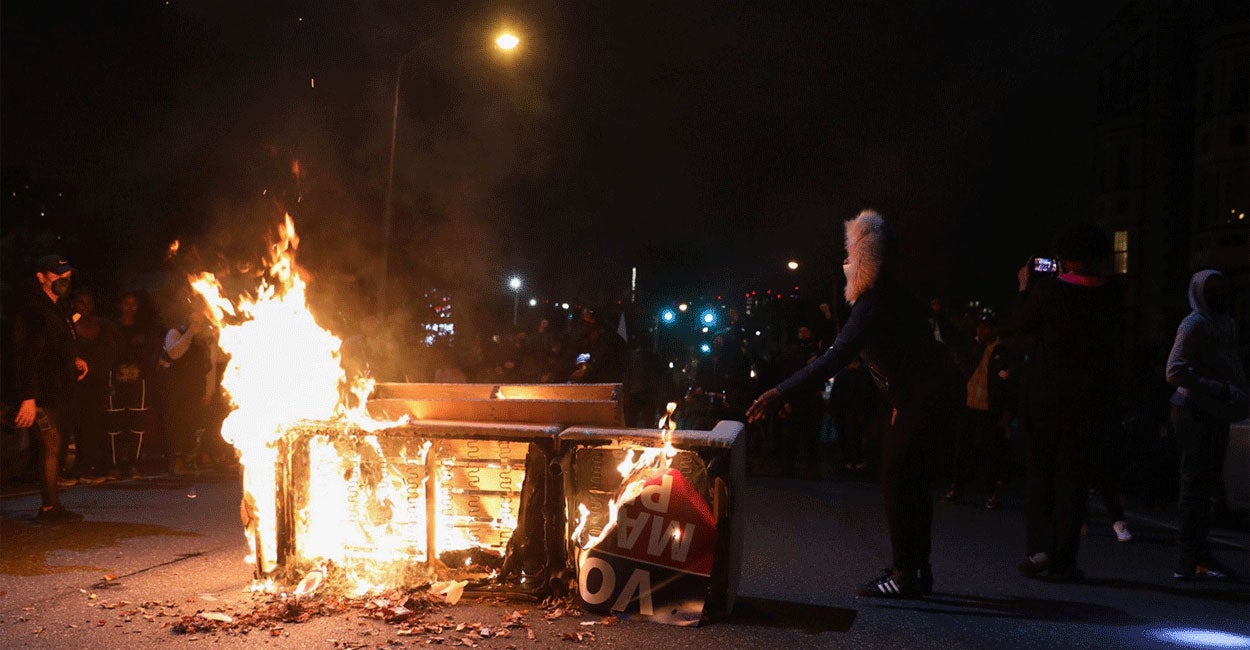
Philadelphia Riots

In Kenosha, Portland, Seattle, and Chicago, city officials have tolerated criminal activity performed by mobs for politically motivated reasons. Philadelphia appears to be the next hotspot for mob violence to go unchecked. Pictured: A barricade is set on fire during a night of looting and violence in Philadelphia on Oct. 27. (Photo: Gabriella Audi/AFP/Getty Images)

COMMENTARY BY

James Carafano@JJCarafano

James Jay Carafano, a leading expert in national security and foreign policy challenges, is The Heritage Foundation’s vice president for foreign and defense policy studies, E. W. Richardson fellow, and director of the Kathryn and Shelby Cullom Davis Institute for International Studies. Read his research.

Like the replay of a bad movie, a law enforcement incident in Philadelphia triggered an excuse for violence and looting. It remains to be seen whether the City of Brotherly Love will become the next “Kenosha,” where city officials moved quickly to restore order and seek state and federal support—though sadly after 48 hours of opportunistic looting, violence, and destruction devastated the city.

Or perhaps Philadelphia will be the next PortlandSeattle, or Chicago, where systemic attacks seem to be a daily occurrence.

Police in Philadelphia are fully capable of restoring peace. The open question is whether the mayor and Larry Krasner, the former defense attorney-turned elected rogue prosecutor, will do their job and hold people accountable for their crimes.

When local, state, and federal governments work together, act quickly, and demonstrate no tolerance for organized violence to advance radical agendas, communities are kept safe and equal protection under the law is afforded for all citizens.

The left is actively working to undermine the integrity of our elections. Read the plan to stop them now. Learn more now >>

On the other hand, when local officials, the media, and politicians ignore, excuse, normalize, and enable violence, everyday Americans pay the price.

There is a plague sweeping this country that many don’t want to talk about: The deliberate use of street violence to advance radical political agendas, often under a smoke screen of campaigning for civil liberties. The evidence of organized criminal activity at the root of the outbreaks in American cities is mounting.

The list of people enabling this violence sadly includes some public officials, who are principally responsible for ensuring public safety. For example, a growing threat to peaceful communities is “rogue prosecutors,” former criminal defense attorneys recruited and funded by liberal billionaire backers, who—once elected—abuse their office by refusing to prosecute entire categories of crimes.

These rogue prosecutors are usurping the power of the legislature in the process, and ignoring victim’s rights—all to advance their politics.

Baltimore is a perfect  example. Since being sworn into office, under the watch of Baltimore City State’s Attorney Marilyn J. Mosby.

Rogue prosecutors fuel street violence by refusing to prosecute rioters and looters. When confronted with the rising crimes rates, Mosby called the statistics “rhetoric.”

The only way to break the cycle of violence is for local and state officials to work with each other, and if necessary, the federal government. They need to stop enabling the destruction of property and lives on their streets, and start investigating and prosecuting the individuals (and organizations) behind the riots.

It’s time to start shaming and calling out the media, politicians, and advocates who excuse and normalize the violence.

There is a proven action plan for making our streets safe. It is past time for officials to start following this blueprint.

There is no time—zero time to waste. There are already fears of more violence in our streets, regardless of the outcome of the national elections.

In my hometown of Washington, D.C., downtown buildings are already boarding up in anticipation of violence on our streets after the election. If Trump wins, violence. If Biden wins, violence. This makes no sense, and it’s time for it to stop.

It is time for every official and public figure, every political party, in every part of the country to publically reject violence on American streets as a legitimate form of protected speech. Violence is not protected speech, period.

The notion of deliberately destroying the lives and property of our neighbors to advance a radical political agenda is abhorrent. American leaders—of all stripes—should stand up now as one and reject these violent acts. It has gone on for too long, well before the death of George Floyd.

Leaders in Philadelphia and across America must take a principled stand to demand the end to this violence, and they need to do it before the election. In one voice, they should demand: “Leave our streets alone.”

—-


https://youtu.be/7AhRCyBB_sU

Philadelphia Sees More Unrest After Police Shoot, Kill Walter Wallace Jr. 

Police said about a thousand people were looting businesses northeast of downtown


By

Scott CalvertUpdated Oct. 28, 2020 1:41 am ET

Looters hit businesses in Philadelphia on Tuesday for a second straight night, as authorities struggled to contain civil unrest sparked by a video showing police fatally shooting Walter Wallace Jr., a Black man who was holding a knife.

Police said late Tuesday about a thousand people were looting businesses northeast of downtown, miles from the West Philadelphia neighborhood where the violence was concentrated a night earlier. 

Police urged residents in several parts of the city to stay indoors because those areas were experiencing widespread demonstrations that had turned violent with looting. 

Police had arrested 91 people late Monday and early Tuesday, most in connection with looting of pharmacies, shoe stores and other retail outlets, police said. Thirty officers were injured, mostly from hurled bricks and other projectiles, police said, and a sergeant’s leg was broken when she was hit by a pickup truck.

Like other large U.S. cities, Philadelphia had already been preparing for potential violence around the Nov. 3 election, Police Commissioner Danielle Outlaw said at a news conference Tuesday. The city is the most-populous in Pennsylvania, a state viewed as key to deciding the presidential election.

Ms. Outlaw said unrest caused by Monday’s shooting of Mr. Wallace could spill into election-related disturbances. “There may be some bleeding together, just given the timeline, as far as how close we are to Election Day and the days after,” she said.

To help manage tensions, city officials have requested assistance from law-enforcement agencies in surrounding counties and from the state government. The Pennsylvania National Guard said Tuesday it was sending several hundred members to Philadelphia at the request of Gov. Tom Wolf.

“We are exploring all of our options at this time to do everything that we can to ensure that all of our PPD resources are focused on what’s in front of us, whether it’s the actual civil unrest or even again the crime that continues to occur throughout the city,” Ms. Outlaw said.

The White House said the Trump administration would deploy federal resources if requested.

Bystander video that captured the episode in West Philadelphia was distributed on social media. The video shows Mr. Wallace standing on a sidewalk with two police officers pointing their guns at him. At one point a woman appeared to try to stop Mr. Wallace as he crossed the street. Officers fired several times when he re-emerged onto the street from between two parked cars and walked toward them.

A demonstrator shouts at police during a protest near where Walter Wallace, Jr. was killed.
A demonstrator shouts at police during a protest near where Walter Wallace, Jr. was killed.PHOTO: MARK MAKELA/GETTY IMAGES

A police spokesman said officers ordered Mr. Wallace to drop the knife before they fired their guns.

The two officers, whose names haven’t been released, each fired about seven rounds, police Chief Inspector Frank Vanore said. He said he didn’t know how many bullets struck Mr. Wallace. Mr. Vanore said police received a call about a man who was screaming and armed with a knife.

Speaking at a news conference Tuesday evening, Shaka Johnson, a lawyer for the Wallace family, said Mr. Wallace had mental health problems and was taking lithium under a doctor’s care.

“The man was suffering,” he said. “When you come to a scene where somebody is in a mental crisis, [and] the only tool you have to deal with it is a gun, that’s a problem.”

Mr. Johnson said police had been called to the Wallace home twice earlier Monday. Their third appearance, which ended with the deadly confrontation, came after Mr. Wallace’s brother had requested an ambulance, Mr. Johnson said, but the police officers got there first.

Mr. Wallace’s father, Walter Wallace Sr., decried the looting and called for justice for his son. “I can’t even sleep at night,” he said. “Every time I close my eyes, I get flashbacks about multiple shots.” 

Ms. Outlaw, noting that the two officers hadn’t yet been interviewed, didn’t answer a number of questions about the incident, such as whether the officers had any information ahead of time about possible mental-health concerns and whether police had contact with Mr. Wallace before Monday.

“There are many questions that demand answers. Residents have my assurance that those questions will be fully addressed by the investigation,” Ms. Outlaw said. “Everyone involved, including the officers, will forever be impacted by this tragedy.”

District Attorney Larry Krasner said his office will investigate the incident along with the police department. 

Law enforcement and the state of U.S. cities have drawn attention in this year’s presidential election. Speaking in West Salem, Wis., on Tuesday, President Trump said he supported “the heroes of law enforcement.” 

“Last night Philadelphia was torn up by Biden-supporting radicals,” he said. 

Former Vice President and Democratic presidential candidate Joe Biden and his running mate, Sen. Kamala Harris, said in a statement Tuesday, “Walter Wallace’s life, like too many others,’ was a Black life that mattered—to his mother, to his family, to his community, to all of us.” At the same time, they said, there was no excuse for attacking police officers and vandalizing businesses.

Philadelphia Mayor Jim Kenney said that he had spoken with Mr. Wallace’s wife and parents. 

“I have watched the video of this tragic incident, and it presents difficult questions that must be answered,” he said. “We need a speedy and transparent resolution for the sake of Mr. Wallace, his family, the officers and for all Philadelphia.”

John McNesby, president of the local police union, asked the public for patience while the investigation proceeds.

“Our police officers are being vilified this evening for doing their job and keeping the community safe, after being confronted by a man with a knife,” Mr. McNesby said Monday. “We support and defend these officers, as they too are traumatized by being involved in a fatal shooting.”

Demonstrators in Philadelphia confront police during a march Tuesday protesting the death of Walter Wallace.
Demonstrators in Philadelphia confront police during a march Tuesday protesting the death of Walter Wallace.PHOTO: MATT SLOCUM/ASSOCIATED PRESS

As word of the incident spread late Monday, protesters took to the streets. Looters hit businesses around the city, including on 52nd Street, a West Philadelphia commercial corridor that sustained major damage on May 31 and June 1 during protests over the killing of George Floyd in Minneapolis. Ms. Outlaw said the people who gathered to protest the incident weren’t the same people whom police later arrested.

Among the businesses hit were five SunRay pharmacies in West Philadelphia, said owner Marc Tancredi. In June, two SunRay locations were looted, including the one on 52nd Street.

“They broke into the pharmacy and stole the drugs like they did last time,” Mr. Tancredi said Tuesday. “Not as much physical damage to the location.”

Some looting was still occurring at 8 a.m. Tuesday, said Jabari Jones, president of the West Philadelphia Corridor Collaborative, a business association. He said he had examined the damage.

“It’s just another day where unfortunately the situation has boiled to the point where people have resorted to vandalism and looting,” he said.

Mr. Jones described the video of Mr. Wallace’s killing as “sickening” and wondered why officers didn’t take less-lethal steps to resolve the situation.

“I can understand the pent-up anger and rage,” Mr. Jones said. But he said damaging businesses hurts owners and residents who rely on them. “It is a balance of making sure neighborhood stores and places that provide products and services for residents in the community can still be open and provide those things.”

A looted store following protests in Philadelphia.
A looted store following protests in Philadelphia.PHOTO: DAVID DELGADO/REUTERS

Write to Scott Calvert at scott.calvert@wsj.com


Portland protesters topple Lincoln, Roosevelt statues during ‘Day of Rage’

The unrest was reportedly tied to the ‘Day of Rage’ on the eve of Columbus Day

Edmund DeMarche

 By Edmund DeMarche | Fox News

Portland absorbed another night of violent protests Sunday that resulted in the toppling of two statues in the city and reports of numerous buildings with their windows smashed in, including the Oregon Historical Society.

The unrest was reportedly tied to the “Day of Rage” on the eve of Columbus Day.

Andy Ngo, a journalist who has been documenting the unrest in the city, posted images of the destruction on Twitter. The Oregonian reported that protesters managed to bring down statues of Abraham Lincoln and Theodore Roosevelt.

Ngo posted a video of what he identified as the protesters toppling the statue of Roosevelt, which depicts the former president riding on horseback. The video showed a rope tied around the statue and protesters could be heard cheering when the statue shifted.https://www.google.com/amp/s/www.foxnews.com/us/portland-protesters-topple-lincoln-roosevelt-statues-during-day-of-rage.amp

Jussie Smollett

Justin “Jussie” Smollett[1] (/ˈdʒʌsi/ JUSS-ee,born June 21, 1982)[1] is an American actor and singer. He began his career as a child actor in 1987 acting in films including The Mighty Ducks (1992) and Rob Reiner‘s North (1994). In 2015, Smollett portrayed musician Jamal Lyon in the Fox drama series Empire, a role that was hailed as groundbreaking for its positive depiction of a black gay man on television. Smollett has also appeared in Ridley Scott‘s science fiction film Alien: Covenant (2017) as Ricks and in Marshall (2017) as Langston Hughes.

Jussie Smollett
Smollett at the 2016 PaleyFest
BornJustin Smollett
June 21, 1982 (age 38)
Santa Rosa, California, U.S.
OccupationActor singer songwriter
Years active1991–present
RelativesJake Smollett (brother)
Jurnee Smollett-Bell(sister)

Smollett was indicted in February 2019, for disorderly conduct for allegedly staging a fake hate crime assault;[2] the charges were dropped the following month.[3] In February 2020, he was indicted on six counts of making false police reports.[4][5][6]

2019 alleged hate crime hoax

Main article: Jussie Smollett alleged assault

On January 29, 2019, Smollett told police that he was attacked outside his apartment building by two men in ski masks. He reported they called him racialand homophobic slurs and said “this is MAGA country,” a reference to President Donald Trump‘s slogan “Make America Great Again.”[36] He claimed they used their hands, feet, and teeth as weapons in the assault.[37][38] According to a statement released by the Chicago Police Department, the two suspects then “poured an unknown liquid” on Smollett and put a noose around his neck.[39]Smollett said that he fought them off. Smollett was treated at Northwestern Memorial Hospital; not seriously injured, he was released “in good condition” later that morning.[36][40][41] The police were called after 2:30 a.m.;[42] when they arrived around 2:40 am, Smollett had a white rope around his neck.[43] Smollett said that the attack may have been motivated by his criticism of the Trump administration[44] and that he believed that the alleged assault was linked to the threatening letter that was sent to him earlier that month.[35]

On February 20, 2019, Smollett was charged by a grand jury with a class 4 felony for filing a false police report.[45][46][47] The next day, Smollett surrendered himself at the Chicago Police Department’s Central Booking station.[48] Shortly thereafter, CPD spokesman Anthony Guglielmi stated that Smollett “is under arrest and in the custody of detectives”.[49] On March 26, 2019, all charges filed against Smollett were dropped, with Judge Steven Watkins ordering the public court file sealed.[3][50] First Assistant State’s Attorney Joseph Magats said the office reached a deal with Smollett’s defense team in which prosecutors dropped the charges upon Smollett performing 16 hours of community service[51][52][53] and forfeiting his $10,000 bond.[54][55][56]

On April 12, 2019, the city of Chicago filed a lawsuit in the Circuit Court of Cook County against Smollett for the cost of overtime authorities expended investigating the alleged attack, totalling $130,105.15.[57][58][6][59] In November 2019, Smollett filed a counter-suit against the city of Chicago alleging he was the victim of “mass public ridicule and harm” and arguing he should not be made to reimburse the city for the cost of the investigation.[60] On February 11, 2020, after further investigation by a special prosecutor was completed, Smollett was indicted again by a Cook County grand jury on six counts pertaining to making four false police reports.[4][6] On June 12, 2020, a judge struck down Smollett’s claim that his February charge violated the principle of double jeopardy.[61]

Last Update 3 hrs ago

AOC to VP Pence: ‘It’s Congresswoman Ocasio-Cortez to you’

Ocasio-Cortez appeared bothered by what she saw as “gender dynamics” at work during the debate, in which Pence was the only male participant

By Dom Calicchio | Fox News

U.S. Rep. Alexandria Ocasio-Cortez appeared to be closely watching the vice presidential debateWednesday night, tweeting several responses to comments by Vice President Mike Pence during his confrontation against Sen. Kamala Harris.

Particularly irking the New York Democrat seemed to be Pence’s reference to her by her widely used nickname “AOC.” 

“For the record @Mike_Pence, it’s Congresswoman Ocasio-Cortez to you,” Ocasio-Cortez responded on Twitter.


Alexandria Ocasio-Cortez@AOCUS House candidate, NY-14For the record @Mike_Pence, it’s Congresswoman Ocasio-Cortez to you.9:29 PM · Oct 7, 2020

Ocasio-Cortez also appeared bothered by what she saw as “gender dynamics” at work during the debate, in which Pence was the only male participant. She accused Pence of demanding answers for the questions he posed to Harris, while trying to avoid directly answering questions put to him by the debate moderator, Susan Page of USA Today.

“Why is it that Mike Pence doesn’t seem to have to answer any of the questions asked of him in this debate?” she wrote.


Alexandria Ocasio-Cortez@AOC
US House candidate, NY-14Why is it that Mike Pence doesn’t seem to have to answer any of the questions asked of him in this debate?9:06 PM · Oct 7, 2020

“Pence demanding that Harris answer *his* own personal questions when he won’t even answer the moderator’s is gross, and exemplary of the gender dynamics so many women have to deal with at work,” she added.


Alexandria Ocasio-Cortez@AOCUS House candidate, NY-14Pence demanding that Harris answer *his* own personal questions when he won’t even answer the moderator’s is gross, and exemplary of the gender dynamics so many women have to deal with at work.9:18 PM · Oct 7, 2020

But perhaps the most touchy subject for Ocasio-Cortez – a member of so-called “Squad” of far-left lawmakers on Capitol Hill — was climate change.

During the debate, Pence had suggested that the Green New Deal – the signature legislative proposal of Ocasio-Cortez – was a product of “climate alarmists” that would be expensive and cost many Americans their jobs. Estimates have placed the deal’s price tag at more than $90 trillion.

Pence claimed that the Democratic presidential ticket of former Vice President Joe Biden and Harris would fully embrace the plan if elected.

“Now, Joe Biden and Kamala Harris would put us back in the Paris climate accord, they’d impose the Green New Deal, which would crush American energy, would increase the energy costs of American families in their homes, and literally crush American jobs,” Pence said.

Ocasio-Cortez responded by claiming the Green New Deal “has been lied about nonstop.”

“It’s a massive job-creation and infrastructure plan to decarbonize & increase quality of work and life,” she wrote.

The vice president also accused Biden and Harris of wanting to steer the U.S. away from traditional energy sources and ban fracking – a process that has helped contribute to the nation’s resurgence in the energy sector but has been a divisive topic among Democrats, who are split between the economic benefits of the process and what many see as its potentially harmful environmental impact.

The debate performance of Vice President Mike Pence drew close scrutiny by U.S. Rep. Alexandria Ocasio-Cortez, D-N.Y.

The debate performance of Vice President Mike Pence drew close scrutiny by U.S. Rep. Alexandria Ocasio-Cortez, D-N.Y.

Harris quickly shot down Pence’s assertion about fracking.

“The American people know Joe Biden will not ban fracking,” Harris said. “That is a fact. That is a fact.”

Ocasio-Cortez – perhaps mindful of accusations that she was less than enthusiastic for the Biden-Harris ticket after preferring progressive Sen. Bernie Sanders for president earlier in the campaign – kept her fracking response limited to a single sentence.


Alexandria Ocasio-Cortez@AOC
US House candidate, NY-14Fracking is bad, actually8:43 PM · Oct 7, 2020498.3K92.1K people are Tweeting about this

“Fracking is bad, actually,” she wrote.Dom Calicchio is a Senior Editor at FoxNews.com. Reach him at dom.calicchio@foxnews.com.


—-

​Amy Coney Barrett was appointed to the U.S. Court of Appeals for the Seventh Circuit in November 2017. She serves on the faculty of the Notre Dame Law School, teaching on constitutional law, federal courts, and statutory interpretation, and previously served on the Advisory Committee for the Federal Rules of Appellate Procedure. She earned her bachelor’s degree from Rhodes College in 1994 and her J.D. from Notre Dame Law School in 1997. Following law school, Barrett clerked for Judge Laurence Silberman of the U.S. Court of Appeals for the D.C. Circuit and for Associate Justice Antonin Scalia of the U.S. Supreme Court. She also practiced law with Washington, D.C. law firm Miller, Cassidy, Larroca & Lewin.

—-

—-


—-Related posts:

Taking on Ark Times Bloggers on various issues Part P “Freedom of speech lives on Ark Times Blog” (includes the video ABORTION OF THE HUMAN RACE) (editorial cartoon)

April 25, 2013 – 6:49 am

I have gone back and forth and back and forth with many liberals on the Arkansas Times Blog on many issues such as abortion, human rights, welfare, poverty, gun control  and issues dealing with popular culture. Here is another exchange I had with them a while back. My username at the Ark Times Blog is Saline […]By Everette Hatcher III | Posted in Francis SchaefferProlife | Edit | Comments (0)

Taking on Ark Times Bloggers on various issues Part O “Without God in the picture there can not be lasting meaning to our lives” (includes film ABORTION OF THE HUMAN RACE)

April 23, 2013 – 7:04 am

I have gone back and forth and back and forth with many liberals on the Arkansas Times Blog on many issues such as abortion, human rights, welfare, poverty, gun control  and issues dealing with popular culture. Here is another exchange I had with them a while back. My username at the Ark Times Blog is Saline […]By Everette Hatcher III | Posted in Francis SchaefferPresident ObamaProlife | Edit | Comments (0)

Taking on Ark Times Bloggers on various issues Part K “On what basis do you say murder is wrong?”Part 1 (includes film ABORTION OF THE HUMAN RACE)

April 16, 2013 – 5:49 am

I have gone back and forth and back and forth with many liberals on the Arkansas Times Blog on many issues such as abortion, human rights, welfare, poverty, gun control  and issues dealing with popular culture. Here is another exchange I had with them a while back. My username at the Ark Times Blog is Saline […]By Everette Hatcher III | Posted in Francis SchaefferPresident ObamaProlife | Edit | Comments (0)

Taking on Ark Times Bloggers on various issues Part J “Can atheists find lasting meaning to their lives?” (includes film ABORTION OF THE HUMAN RACE)

April 15, 2013 – 7:48 am

I have gone back and forth and back and forth with many liberals on the Arkansas Times Blog on many issues such as abortion, human rights, welfare, poverty, gun control  and issues dealing with popular culture. Here is another exchange I had with them a while back. My username at the Ark Times Blog is Saline […]By Everette Hatcher III | Posted in Francis SchaefferProlife | Edit | Comments (0)

Taking on Ark Times Bloggers on various issues Part H “Are humans special?” includes film ABORTION OF THE HUMAN RACE) Reagan: ” To diminish the value of one category of human life is to diminish us all”

April 10, 2013 – 6:43 am

I have gone back and forth and back and forth with many liberals on the Arkansas Times Blog on many issues such as abortion, human rights, welfare, poverty, gun control  and issues dealing with popular culture. Here is another exchange I had with them a while back. My username at the Ark Times Blog is Saline […]By Everette Hatcher III | Posted in Francis SchaefferProlife | Edit | Comments (0)

Taking on Ark Times Bloggers on various issues Part G “How do moral nonabsolutists come up with what is right?” includes the film “ABORTION OF THE HUMAN RACE”)

April 9, 2013 – 6:36 am

I have gone back and forth and back and forth with many liberals on the Arkansas Times Blog on many issues such as abortion, human rights, welfare, poverty, gun control  and issues dealing with popular culture. Here is another exchange I had with them a while back. My username at the Ark Times Blog is Saline […]By Everette Hatcher III | Posted in Francis SchaefferProlife | Edit | Comments (3)

Taking on Ark Times Bloggers on various issues Part E “Moral absolutes and abortion” Francis Schaeffer Quotes part 5(includes the film SLAUGHTER OF THE INNOCENTS) (editorial cartoon)

April 7, 2013 – 6:25 am

I have gone back and forth and back and forth with many liberals on the Arkansas Times Blog on many issues such as abortion, human rights, welfare, poverty, gun control  and issues dealing with popular culture. Here is another exchange I had with them a while back. My username at the Ark Times Blog is Saline […]By Everette Hatcher III | Posted in Francis SchaefferProlife | Edit | Comments (2)

“Sanctity of Life Saturday” Abortion supporters lying in order to further their clause? Window to the Womb (includes video ABORTION OF THE HUMAN RACE)

April 6, 2013 – 12:01 am

It is truly sad to me that liberals will lie in order to attack good Christian people like state senator Jason Rapert of Conway, Arkansas because he headed a group of pro-life senators that got a pro-life bill through the Arkansas State Senate the last week of January in 2013. I have gone back and […]By Everette Hatcher III | Posted in Arkansas TimesFrancis SchaefferMax BrantleyProlife | Edit | Comments (0)

Taking on Ark Times Bloggers on various issues Part D “If you can’t afford a child can you abort?”Francis Schaeffer Quotes part 4 includes the film ABORTION OF THE HUMAN RACE) (editorial cartoon)

April 5, 2013 – 6:30 am

I have gone back and forth and back and forth with many liberals on the Arkansas Times Blog on many issues such as abortion, human rights, welfare, poverty, gun control  and issues dealing with popular culture. Here is another exchange I had with them a while back. My username at the Ark Times Blog is Saline […]By Everette Hatcher III | Posted in Francis SchaefferProlife | Edit | Comments (0)

Daniel Mitchell article “The Suddenly Real Threat of a Higher Corporate Income Tax Rate”

The Suddenly Real Threat of a Higher Corporate Income Tax Rate

After November’s election, I figured we would have gridlock. Biden would propose some statist ideas, but they would be blocked by Republicans in the Senate.

All things considered, not a bad outcome.

But Democrats won the run-off elections yesterday for both Georgia Senate seats, which means they now have total control of Washington.

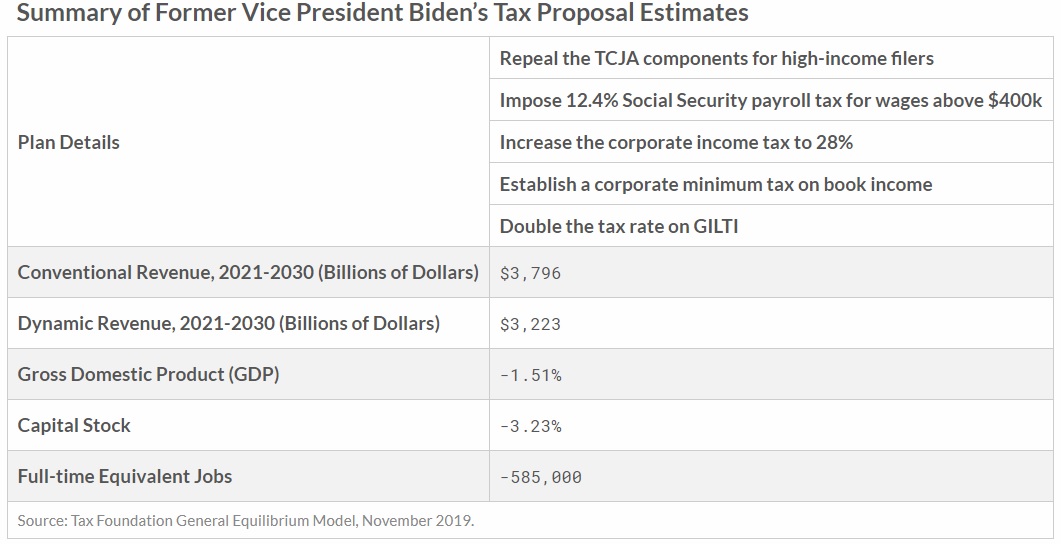
And that means, as I recently warned, a much bigger threat that Biden’s proposed tax increases may get enacted.

That won’t be good news for America’s economy or American competitiveness.

Today, let’s focus on the biggest tax increase that the President Elect is proposing.

In an article for National Review, Joseph Sullivan writes about the adverse impact of Biden’s increase in the corporate tax rate.

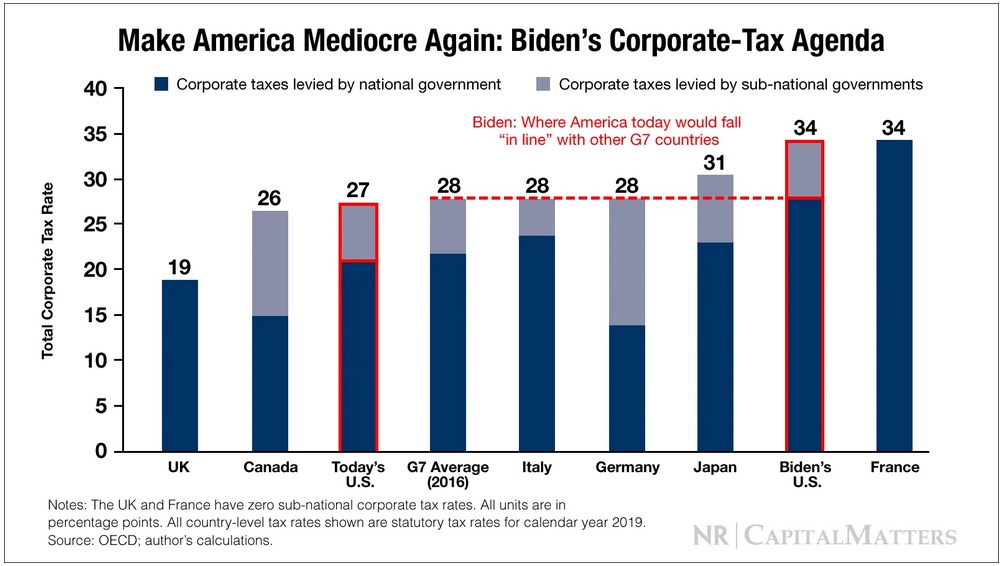
Biden’s corporate-tax proposal is remarkable. …If the U.S. adopted Biden’s proposed federal tax rate, its overall corporate-tax rate would not be “in line” with the rest of the G7. Assuming U.S. state and local corporate taxes stayed the same, Biden’s proposal would result in nearly the highest overall corporate-tax rate in the G7, according to data from the OECD. The U.S. would be tied with France. …The average overall corporate rate among the G7 has fallen to 25 percent… With the G7 average trending in one direction, Biden would move the U.S. in the opposite direction.

In other words, while the Biden team claims that a higher corporate tax won’t be too damaging because it will be similar to the rate in other major nations, the U.S. actually will be tied with France once you include the impact of state corporate tax burdens.

Here’s the chart included with the article.

And don’t forget that there are many other economies where the corporate tax rate is well below the G7 average.

The bottom line is that the United States currently ranks only #19out of 35 nations in the Tax Foundation’s competitiveness ranking for OECD nations.

The good news is that being #19 is much better than being #31, which is where the U.S. was in 2016.

The bad news is that Biden wants to undo much of the 2017 reform, as well as impose other tax increases. And that means a much lower competitiveness score in the future.

Which ultimately means lower wages for American workers.

P.S. Although the proposed increase in the corporate rate is theoretically the biggest revenue raiser in Biden’s tax plan, I will safely predict that it won’t raise nearly as much revenue as projected by static revenue estimates. I wasn’t able to educate Obama on this issue, and I’m even less hopeful of getting through to Biden.

—-

Three Economics Risks for 2021 and Beyond

In an interview with Fox Business last week, I touched on three policies (easy money from the Fed, Biden’s class-warfare tax agenda, and the ever-increasing burden of federal spending) that create risks for the economy in 2021.

I didn’t have a chance to elaborate in the interview, but it’s worth noting that Biden will inherit two of the aforementioned problems.

Trump has been profligate with our money, and he was that way even before the coronavirus became an excuse to open the budgetary spigot. Moreover, he was just like Obama in pressuring the Federal Reserve for Keynesian-style monetary policy.

Unfortunately, there’s no reason to think Biden will try to reverse those mistakes.

Indeed, he wants expand the burden of federal spending. And, regarding monetary policy, appointing Janet Yellen as Secretary of Treasury certainly suggests he is comfortable with the current approach.

And to make matters worse, he definitely wants a more punitive tax system. We will shortly learn whether Democratstake control of the Senate, which presumably would give Biden more leeway to enact his class-warfare tax agenda.

As I said in the interview, that would create economic headwinds.

P.S. I mentioned in the interview that we have “three Americas” with regards to coronavirus. I’m not sure I was completely clear, so here’s what I was trying to get across.

  1. Tourism-reliant states – They are going to be in bad shape until coronavirus is in the rear-view mirror and people feel comfortable with traveling and socializing.
  2. Lock-down states – They have higher unemployment rates because more businesses are shut down.
  3. Laissez-faire states – These are the states that generally allow businesses to remain open and have lower unemployment rates.

For what it’s worth, I think it’s best to let businesses stay open and to allow them and their customers to assess safety risks. It will be interesting to see whether any link is discovered between state policy and coronavirus rates.

P.P.S. At the risk of over-simplification, bad fiscal policy erodes the economy’s long-run growth rate. Bad monetary policy, by contrast, is what causes economic volatility and downturns.


Another Leftist Has an Epiphany on Guns

I’m (unfortunately) not a rich person, but that doesn’t stop me from opposing punitive taxes on successful entrepreneurs, investors, and small business owners.

Likewise, I’m not a gun aficionado, but that doesn’t stop me from opposing efforts to restrict the rights of law-abiding people to own and bear arms.

In part, my views on guns are driven by cost-benefit analysis. Simply stated, the evidence is fairly clear that there is less crime when bad people have to worry that potential victims have the ability to defend themselves.

But I also very much agree with the constitutional argument for gun ownership, as well as the “societal disarray” argument.

Interestingly, it seems that more folks on the left are coming to their senses on the issue of gun control, generally for practical reasons rather than philosophical reasons.

  • In 2012, I shared some important observations from Jeffrey Goldberg, a left-leaning writer for The Atlantic. In his column, he basically admitted his side was wrong about gun control.
  • Then, in 2013, I wrote about a column by Justin Cronin in the New York Times. He self-identified as a liberal, but explained how real-world events have led him to become a supporter of private gun ownership.
  • In 2015, I shared a column by Jamelle Bouie in Slate, who addressed the left’s fixation on trying to ban so-called assault weapons and explains that such policies are meaningless.
  • More recently, in 2017, Leah Libresco wrote in the Washington Post that advocates of gun control are driven by emotion rather empirical research and evidence.
  • Last but not least, Alex Kingsbury in 2019 acknowledged the futility of gun control in a column for the New York Times.

Today, we’re going to add to the collection.

Charles Blow of the New York Times recently wrote about how he has become more understanding of why fellow blacks want to own guns.

Growing up in rural northern Louisiana, everyone I knew, at least every household, seemed to have guns. …Gun ownership was the norm in those parts, including in the Black community. It was not associated with danger but with safety. …Indeed, one could argue that the right to bear arms in this country has never been so brazenly and openly abridged as it has against Black people. Many state codes prohibited Black gun ownership before the Civil War and allowed for the disarmament of Black people after. …When I moved north, first to Detroit and then to New York, I moved into a mental space of more stringent gun control. …city dwellers simply didn’t have the same need for weapons as the people in the rural community where I was raised… I, like many, were convinced that fewer guns in the Black community would make it safer. But, for many Black people, that sentiment has turned. …gun sales to Black people are surging. …I, as much as anyone, would like to live in a society in which all citizens felt safe without the need of personal firearms. America could have created such a society. However, it chose not to. …many Black people feel the need to defend themselves from their own country.

To be sure, Mr. Blow can’t be considered a full convert to the 2nd Amendment. That being said, I think it’s nonetheless remarkable that even a committed, hard-core leftist has (partially) seen the light.

Though I can’t resist quibbling with one point in his column.He wrote, “America could have created” a society where gun control would be desirable because no guns would be needed, but “it chose not to.”

I would replace “it chose not to” with “our government is not sufficiently competent.”

Heck, I would probably add “or trustworthy” as well. Given the unsavory history of gun control, Mr. Blow should be among the first to appreciate that argument.

P.S. In 2018, I shared the story of Ryan Moore, another leftist who changed his mind on gun control. But since he also evolved away from being a leftist, I don’t include him

—-

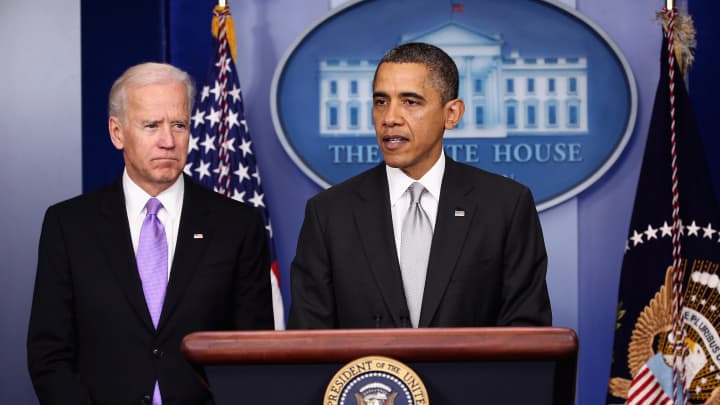
Reusable: biden obama gun control speechPresident Barack Obama announces the creation of an interagency task force for guns as as Vice President Joseph Biden listens on.Getty Images


Is Gun Control Dead?

In recent months, governments released prisoners and announced that some laws wouldn’t be enforced because of the coronavirus. Now, with protests against police misbehavior, we’re seeing governments fail to maintain law and order.

As suggested by this excellent Reason video, these developments bolster the case against gun control.

But does this mean politicians will be more supportive of the 2nd Amendment?

The answer (at least for anyone with an IQ above room temperature)should be yes.

From an economic perspective, one major goal is to change the cost-benefit analysis for criminals. If bad guys have to worry that good guys may be armed, that significantly increases the potential cost of illegal behavior.

A well-functioning system of law enforcement can help, of course, but that’s not a description of how things work in some communities – even in normal times, much less when there’s civil unrest.

But all this evidence and analysis doesn’t seem to matter for Joe Biden. A look at his campaign website shows support for a wide range of gun-control laws from the soon-to-be Democratic nominee.

…gun violence is a public health epidemic. …In 1994, Biden – along with Senator Dianne Feinstein – secured the passage of 10-year bans on assault weapons and high-capacity magazines. As president, Joe Biden will defeat the NRA again. …As president, Biden will: …Ban the manufacture and sale of assault weapons and high-capacity magazines. …Regulate possession of existing assault weapons under the National Firearms Act. …Biden supports legislation restricting the number of firearms an individual may purchase per month to one. …End the online sale of firearms and ammunitions. …Give states incentives to set up gun licensing programs.

What’s especially discouraging is that Biden apparently hasn’t learned anything about so-called assault weapons since 1994.

In a 2019 column for Reason, Jacob Sullum dissected Biden’s incoherent views on the topic.

Joe Biden…is still proud of the ban on “assault weapons”… Biden argues that it made mass shootings less common…, citing a study reported in The Journal of Trauma and Acute Care Surgery last January. But that is not what the researchers, led by New York University epidemiologist Charles DiMaggio, actually found.…The study…looked not at the number of mass shootings, as Biden claims, but the number of mass-shooting deaths as a share of all firearm homicides. The difference in total fatalities during the period when the ban was in effect amounted to 15 fewer deaths over a decade, or 1.5 a year on average, including mass shootings that did not involve weapons covered by the ban. …The causal mechanism imagined by Biden is even harder to figure out. He describes “assault weapons” as “military-style firearms designed to fire rapidly.” But they do not fire any faster than any other semi-automatic. …Under the 1994 ban, removing “military-style” features such as folding stocks, flash suppressors, or bayonet mounts transformed forbidden “assault weapons” into legal firearms, even though the compliant models fired the same ammunition at the same rate with the same muzzle velocity as the ones targeted by the law.

I wonder if Biden understands the policy he’s advocating.

Does he think that “assault weapons” are actual machine guns, capable of firing multiple rounds with one pull on the trigger (a remarkably common misconception among gun-control advocates)?

Or, if he understands that a so-called assault weapon is just like any other gun (firing one round each time the trigger is pulled), then why would he think anything would be achieved by banning some guns and leaving others (that work the same way) legal?

Perhaps most relevant, does he even care what the evidence shows?

The bottom line is that people are “voting with their dollars” for gun ownership for the simple reason that they know it’s unwise to trust government (either to protect them from crime or to respect their rights).

But that doesn’t mean their constitutional freedoms will be secure if Biden wins the 2020 election.

P.S. The good news is that there will be widespread civil disobedience if politicians push for new gun bans.

P.P.S. Another silver lining is that we’ll get more and more clever humor mocking gun control.

The Case Against Biden’s Class-Warfare Tax Policy, Part II

In Part I of this series, I expressed some optimism that Joe Biden would not aggressively push his class-warfare tax plan, particularly since Republicans almost certainly will wind up controlling the Senate.

But the main goal of that column was to explain that the internal revenue code already is heavily weighted against investors, entrepreneurs, business owners and other upper-income taxpayers.

And to underscore that point, I shared two charts from Brian Riedl’s chartbook to show that the “rich” are now paying a much larger share of the tax burden – notwithstanding the Reagan tax cuts, Bush tax cuts, and Trump tax cuts – than they were 40 years ago.

Not only that, but the United States has a tax system that is more “progressive” than all other developed nations (all of whom also impose heavy tax burdens on upper-income taxpayers, but differ from the United States in that they also pillage lower-income and middle-class residents).

In other words, Biden’s class-warfare tax plan is bad policy.

Today’s column, by contrast, will point out that his tax increases are impractical. Simply stated, they won’t collect much revenue because people change their behavior when incentives to earn and report income are altered.

This is especially true when looking at upper-income taxpayers who – compared to the rest of us – have much greater ability to change the timing, level, and composition of their income.

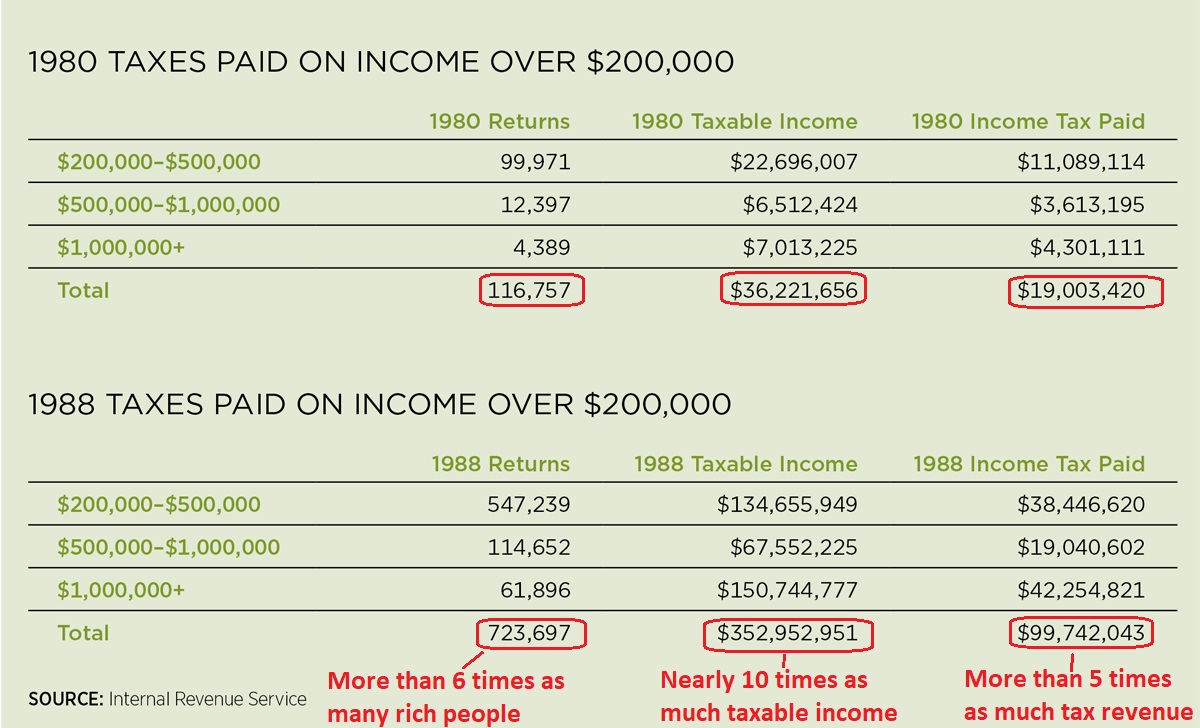
This helps to explain why rich people paid five times as much tax to the IRS during the 1980s when Reagan slashed the top tax rate from 70 percent to 28 percent.

When writing about this topic, I normally use the Laffer Curve to help people understand why simplistic assumptions about tax policy are wrong (that you can double tax revenue by doubling tax rates, for instance). And I point out that even folks way on the left, such as Paul Krugman, agree with this common-sense view (though it’s also worth noting that some people on the right discredit the concept by making silly assertions that “all tax cuts pay for themselves”).

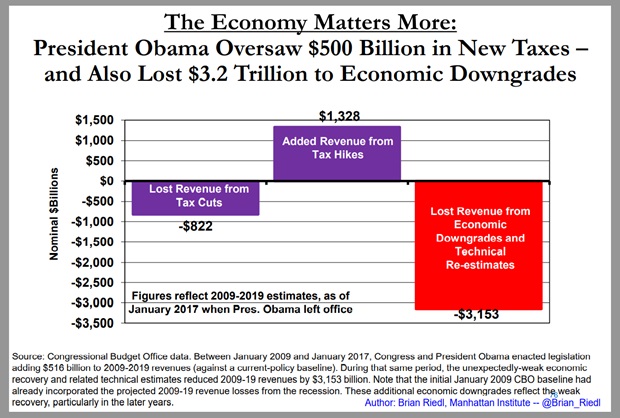
But instead of showing the curve again, I want to go back to Brian Riedl’s chartbook and review his data on of revenue changes during the eight years of the Obama Administration.

It shows that Obama technically cut taxes by $822 billion (as further explained in the postscript, most of that occurred when some of the Bush tax cuts were made permanent by the “fiscal cliff” deal in 2012) and raised taxes by $1.32 trillion (most of that occurred as a result of the Obamacare legislation).

If we do the math, that means Obama imposed a cumulative net tax increase of about $510 billion during his eight years in office

But, if you look at the red bar on the chart, you’ll see that the government didn’t wind up with more money because of what the number crunchers refer to as “economic and technical reestimates.”

Indeed, those reestimates resulted in more than $3.1 trillion of lost revenue during the Obama years.

don’t want the politicians and bureaucrats in Washington to have more tax revenue, but I obviously don’t like it when tax revenues shrink simply because the economy is stagnant and people have less taxable income.

Yet that’s precisely what we got during the Obama years.

To be sure, it would be inaccurate to assert that revenues declined solely because of Obama’s tax increase. There were many other bad policies that also contributed to taxable income falling short of projections.

Heck, maybe there was simply some bad luck as well.

But even if we add lots of caveats, the inescapable conclusion is that it’s not a good idea to adopt policies – such as class-warfare tax rates – that discourage people from earning and reporting taxable income.

The bottom line is that we should hope Biden’s proposed tax increases die a quick death.

P.S. The “fiscal cliff” was the term used to describe the scheduled expiration of the 2001 and 2003 Bush tax cuts. According to the way budget data is measured in Washington, extending some of those provisions counted as a tax cut even though the practical impact was to protect people from a tax increase.

P.P.S. Even though Biden absurdly asserted that paying higher taxes is “patriotic,” it’s worth pointing out that he engaged in very aggressive tax avoidance to protect his family’s money.

President Joe Biden Will Be Bad, but a President Kamala Harris Would Be Worse

Joe Biden has a very misguided economic agenda. I’m especially disturbed by his class-warfare tax agenda, which will be bad news for American workers and American competitiveness.

The good news, as I wrote earlier this year, is that he probably isn’t serious about some of his worst ideas.

Biden is a statist, but not overly ideological. His support for bigger government is largely a strategy of catering to the various interest groups that dominate the Democratic Party. The good news is that he’s an incrementalist and won’t aggressively push for a horrifying FDR-style agenda if he gets to the White House.

But what if Joe Biden’s health deteriorates and Kamala Harris – sooner or later – winds up in charge?

That’s rather troubling since her agenda was far to the left of Biden’s when they were competing for the Democratic nomination.

And it doesn’t appear that being Biden’s choice for Vice President has led her to moderate her views. Consider this campaign ad, where she openly asserted that “equitable treatment means we all end up at the same place.”

The notion that we should strive for equality of outcomes rather than equality of opportunity is horrifying.

For all intents and purposes,Harris has embraced a harsh version of redistributionism where everyone above average is punished and everyone below average is rewarded.

This goes way beyond a safety net and it’s definitely a recipe for economic misery since people on both sides of the equationhave less incentive to be productive.

I’m not the only one to be taken aback by Harris’ dogmatic leftism.

Robby Soave, writing for Reason, is very critical of her radical outlook.

Harris gives voice to a leftist-progressive narrative about the importance of equity—equal outcomes—rather than mere equality before the law. …Harris contrasted equal treatment—all people getting the same thing—with equitable treatment,which means “we all end up at the same place.” …This may seem like a trivial difference, but when it comes to public policy, the difference matters. A government shouldbe obligated to treat all citizens equally, giving them the same access to civil rights and liberties like voting, marriage, religious freedom, and gun ownership. …A mandate to foster equity, though, would give the government power to violate these rights in order to achieve identical social results for all people. 

And, in a column for National Review, Brad Polumbo expresses similar reservations about her views.

Whether she embraces the label “socialist” or not, Harris’s stated agenda and Senate record both reveal her to be positioned a long way to the left on matters of economic policy. From health care to the environment to housing, Harris thinks the answer to almost every problem we face is simply more government and more taxpayer money — raising taxes and further indebting future generations in the process.…Harris…supports an astounding $40 trillion in new spending over the next decade. In a sign of just how far left the Democratic Party has shifted on economics, Harris backs more than 20 times as much spending as Hillary Clinton proposed in 2016. …And this is not just a matter of spending. During her failed presidential campaign, Harris supported a federal-government takeover of health care… The senator jumped on the “Green New Deal” bandwagon as well. She co-sponsored the Green New Deal resolution in the Senate that called for a “new national, social, industrial, and economic mobilization on a scale not seen since World War II and the New Deal era.” …she supports enacting price controls on housing across the country. …The left-wing group Progressive Punch analyzed Harris’s voting record and found that she is the fourth-most liberal senator, more liberal even than Massachusetts senator Elizabeth Warren. Similarly, the nonpartisan organization GovTrack.us deemed Harris the furthest-left member of the Senate for the 2019 legislative year. (Spoiler alert: If your voting record is to the left of Bernie Sanders, you might be a socialist.)

To be fair, Harris is simply a politician, so we have no idea what she really believes. Her hard-left agenda might simply be her way of appealing to Democratic voters, much as Republicans who run for president suddenly decide they support big tax cuts and sweeping tax reform.

But whether she’s sincere or insincere, it’s troubling that she actually says it’s the role of government to make sure we all “end up at the same place.”

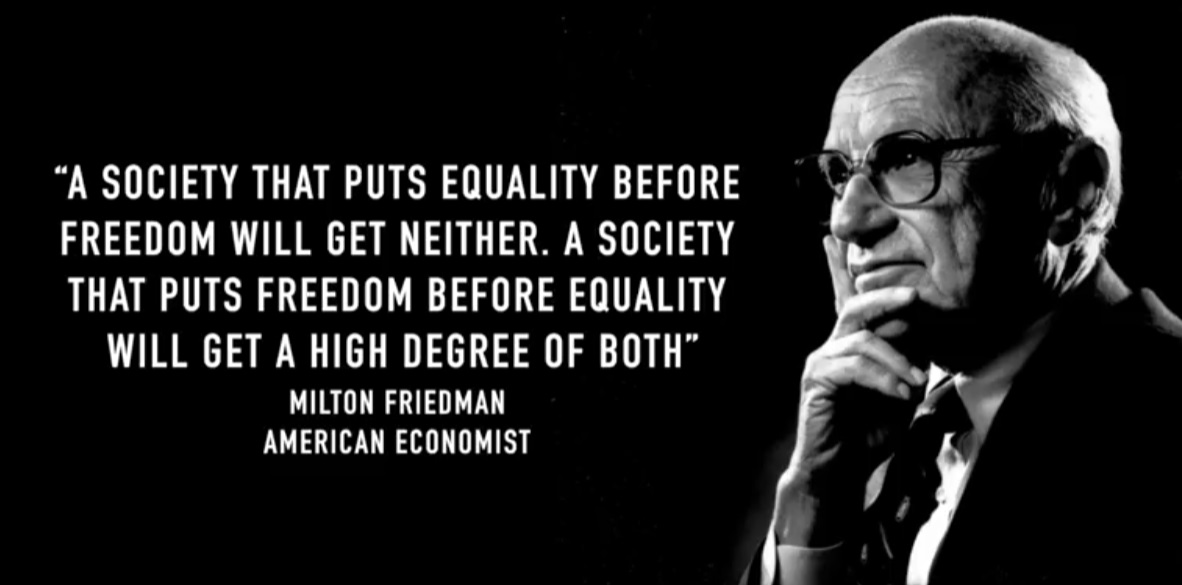
Let’s close with a video clip from Milton Friedman. At the risk of understatement, he has a different perspective than Ms. Harris.

Since we highlighted Harris’ key quote, let’s also highlight the key quote from Friedman.

Amen.

P.S. It appears Republicans will hold the Senate, which presumably (hopefully?) means that any radical proposals would be dead on arrival, regardless of whether they’re proposed by Biden or Harris.

P.P.S. Harris may win the prize for the most economically illiterate proposal of the 2020 campaign.

——

Will Biden’s Class-Warfare Tax Plan Lead to an Exodus of Job Creators?

After Barack Obama took office (and especially after he was reelected), there was a big uptick in the number of rich people who chose to emigrate from the United States. 

There are many reasons wealthy people choose to move from one nation to another, but Obama’s embrace of class-warfare tax policy (including FATCA) was seen as a big factor.

Joe Biden’s tax agenda is significantly more punitive than Obama’s, so we may see something similar happen if he wins the 2020 election.

Given the economic importance of innovatorsentrepreneurs, and inventors, this would be not be good news for the American economy.

The New York Times reported late last year that the United States could be shooting itself in the foot by discouraging wealthy residents.

…a different group of Americans say they are considering leaving — people of both parties who would be hit by the wealth tax… Wealthy Americans often leave high-tax states like New York and California for lower-tax ones like Florida and Texas. But renouncing citizenship is a far more permanent, costly and complicated proposition. …“America’s the most attractive destination for capital, entrepreneurs and people wanting to get a great education,” said Reaz H. Jafri, a partner and head of the immigration practice at Withers, an international law firm. “But in today’s world, when you have other economic centers of excellence — like Singapore, Switzerland and London — people don’t view the U.S. as the only place to be.” …now, the price may be right to leave. While the cost of expatriating varies depending on a person’s assets, the wealthiest are betting that if a Democrat wins…, leaving now means a lower exit tax. …The wealthy who are considering renouncing their citizenship fear a wealth tax less than the possibility that the tax on capital gains could be raised to the ordinary income tax rate, effectively doubling what a wealthy person would pay… When Eduardo Saverin, a founder of Facebook…renounced his United States citizenship shortly before the social network went public, …several estimates said that renouncing his citizenship…saved him $700 million in taxes.

The migratory habits of rich people make a difference in the global economy.

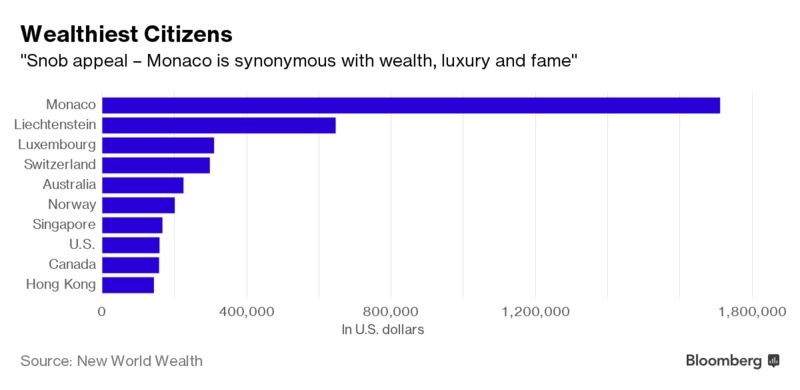
Here are some excerpts from a 2017 Bloomberg story.

Australia is luring increasing numbers of global millionaires, helping make it one of the fastest growing wealthy nations in the world… Over the past decade, total wealth held in Australia has risen by 85 percent compared to 30 percent in the U.S. and 28 percent in the U.K… As a result, the average Australian is now significantly wealthier than the average American or Briton. …Given its relatively small population, Australia also makes an appearance on a list of average wealth per person. This one is, however, dominated by small tax havens.

Here’s one of the charts from the story.

As you can see, Australia is doing very well, though the small tax havens like Monaco are world leaders.

I’m mystified, however, that the Cayman Islands isn’t listed.

But I’m digressing.

Let’s get back to our main topic. It’s worth noting that even Greece is seeking to attract rich foreigners.

The new tax law is aimed at attracting fresh revenues into the country’s state coffers – mainly from foreigners as well as Greeks who are taxed abroad – by relocating their tax domicile to Greece, as it tries to woo “high-net-worth individuals” to the Greek tax register.The non-dom model provides for revenues obtained abroad to be taxed at a flat amount… Having these foreigners stay in Greece for at least 183 days a year, as the law requires, will also entail expenditure on accommodation and everyday costs that will be added to the Greek economy. …most eligible foreigners will be able to considerably lighten their tax burden if they relocate to Greece…nevertheless, the amount of 500,000 euros’ worth of investment in Greece required of foreigners and the annual flat tax of 100,000 euros demanded (plus 20,000 euros per family member) may keep many of them away.

The system is too restrictive, but it will make the beleaguered nation an attractive destination for some rich people. After all, they don’t even have to pay a flat tax, just a flat fee.

Italy has enjoyed some success with a similar regime to entice millionaires.

Last but not least, an article published last year has some fascinating details on the where rich people move and why they move.

The world’s wealthiest people are also the most mobile. High net worth individuals (HNWIs) – persons with wealth over US$1 million – may decide to pick up and move for a number of reasons. In some cases they are attracted by jurisdictions with more favorable tax laws… Unlike the middle class, wealthy citizens have the means to pick up and leave when things start to sideways in their home country. An uptick in HNWI migration from a country can often be a signal of negative economic or societal factors influencing a country. …Time-honored locations – such as Switzerland and the Cayman Islands – continue to attract the world’s wealthy, but no country is experiencing HNWI inflows quite like Australia. …The country has a robust economy, and is perceived as being a safe place to raise a family. Even better, Australia has no inheritance tax

Here’s a map from the article.

The good news is that the United States is attracting more millionaires than it’s losing (perhaps because of the EB-5 program).

The bad news is that this ratio could flip after the election. Indeed, it may already be happening even though recent data on expatriation paints a rosy picture.

The bottom line is that the United States should be competing to attract millionaires, not repel them. Assuming, of course, politicians care about jobs and prosperity for the rest of the population.

P.S. American politicians, copying laws normally imposed by the world’s most loathsome regimes, have imposed an “exit tax” so they can grab extra cash from rich people who choose to become citizens elsewhere.

P.P.S. I’ve argued that Australia is a good place to emigrate even for those of us who aren’t rich.

—-


Question of the Week: Which Department of the Federal Government Should Be the First to Be Abolished?

I was asked last week which entitlement program is most deserving of reform.

While acknowledging that Social Security and Medicare also are in desperate need of modernization, I wrote that Medicaid reformshould be the first priority.

But I’d be happy if we made progress on any type of entitlement reform, so I don’t think there are right or wrong answers to this kind of question.

We have the same type of question this week. A reader sent an email to ask “Which federal department should be abolished first?”

I guess this is what is meant when people talk about a target-rich environment. We have an abundance of candidates:

But if I have to choose, I think the Department of Housing and Urban Development should be first on the chopping block.

Raze the building and put a layer of salt over the earth to make sure it can never spring back to life

I’ve already argued that there should be no federal government involvement in the housing sector and made the same argument on TV. And I’ve also shared some horror stories about HUD waste and incompetence.

Heck, I even made HUD the background image for my video on the bloated and overpaid bureaucracy in Washington.

It’s also worth noting that there’s nothing about housing in Article I, Section VIII, of the Constitution. For those of us who have old-fashioned values about playing by the rules, that means much of what takes place in Washington – including housing handouts – is unconstitutional.

Simply stated, there is no legitimate argument for HUD. And I think there would be the least political resistance.

As with the answer to the question about entitlements, this is a judgment call. I’d be happy to be proven wrong if it meant that politicians were aggressively going after another department. Anything that reduces the burden of government spending is a step in the right direction


Milton Friedman on Spending

October 3, 2020 by Dan Mitchell

I identified four heroes from the “Battle of Ideas” video I shared in late August – Friedrich Hayek, Milton Friedman, Ronald Reagan, and Margaret Thatcher. Here’s one of those heroes, Milton Friedman, explaining what’s needed to control big government.

Why Milton Friedman Saw School Choice as a First Step, Not a Final One

On his birthday, let’s celebrate Milton Friedman’s vision of enabling parents, not government, to be in control of a child’s education.

Wednesday, July 31, 2019
Kerry McDonald
Kerry McDonald

EducationMilton FriedmanSchool ChoiceSchooling

Libertarians and others are often torn about school choice. They may wish to see the government schooling monopoly weakened, but they may resist supporting choice mechanisms, like vouchers and education savings accounts, because they don’t go far enough. Indeed, most current choice programs continue to rely on taxpayer funding of education and don’t address the underlying compulsory nature of elementary and secondary schooling.

Skeptics may also have legitimate fears that taxpayer-funded education choice programs will lead to over-regulation of previously independent and parochial schooling options, making all schooling mirror compulsory mass schooling, with no substantive variation.

Milton Friedman had these same concerns. The Nobel prize-winning economist is widely considered to be the one to popularize the idea of vouchers and school choice beginning with his 1955 paper, “The Role of Government in Education.” His vision continues to be realized through the important work of EdChoice, formerly the Friedman Foundation for Education Choice, that Friedman and his economist wife, Rose, founded in 1996.

July 31 is Milton Friedman’s birthday. He died in 2006 at the age of 94, but his ideas continue to have an impact, particularly in education policy.

Friedman saw vouchers and other choice programs as half-measures. He recognized the larger problems of taxpayer funding and compulsion, but saw vouchers as an important starting point in allowing parents to regain control of their children’s education. In their popular book, Free To Choose, first published in 1980, the Friedmans wrote:

We regard the voucher plan as a partial solution because it affects neither the financing of schooling nor the compulsory attendance laws. We favor going much farther. (p.161)

They continued:

The compulsory attendance laws are the justification for government control over the standards of private schools. But it is far from clear that there is any justification for the compulsory attendance laws themselves. (p. 162)

The Friedmans admitted that their “own views on this have changed over time,” as they realized that “compulsory attendance at schools is not necessary to achieve that minimum standard of literacy and knowledge,” and that “schooling was well-nigh universal in the United States before either compulsory attendance or government financing of schooling existed. Like most laws, compulsory attendance laws have costs as well as benefits. We no longer believe the benefits justify the costs.” (pp. 162-3)

Still, they felt that vouchers would be the essential starting point toward chipping away at monopoly mass schooling by putting parents back in charge. School choice, in other words, would be a necessary but not sufficient policy approach toward addressing the underlying issue of government control of education.

In their book, the Friedmans presented the potential outcomes of their proposed voucher plan, which would give parents access to some or all of the average per-pupil expenditures of a child enrolled in public school. They believed that vouchers would help create a more competitive education market, encouraging education entrepreneurship. They felt that parents would be more empowered with greater control over their children’s education and have a stronger desire to contribute some of their own money toward education. They asserted that in many places “the public school has fostered residential stratification, by tying the kind and cost of schooling to residential location” and suggested that voucher programs would lead to increased integration and heterogeneity. (pp. 166-7)

To the critics who said, and still say, that school choice programs would destroy the public schools, the Friedmans replied that these critics fail to

explain why, if the public school system is doing such a splendid job, it needs to fear competition from nongovernmental, competitive schools or, if it isn’t, why anyone should object to its “destruction.” (p. 170)

What I appreciate most about the Friedmans discussion of vouchers and the promise of school choice is their unrelenting support of parents. They believed that parents, not government bureaucrats and intellectuals, know what is best for their children’s education and well-being and are fully capable of choosing wisely for their children—when they have the opportunity to do so.

They wrote:

Parents generally have both greater interest in their children’s schooling and more intimate knowledge of their capacities and needs than anyone else. Social reformers, and educational reformers in particular, often self-righteously take for granted that parents, especially those who are poor and have little education themselves, have little interest in their children’s education and no competence to choose for them. That is a gratuitous insult. Such parents have frequently had limited opportunity to choose. However, U.S. history has demonstrated that, given the opportunity, they have often been willing to sacrifice a great deal, and have done so wisely, for their children’s welfare. (p. 160).

Sign-Up: Receive Kerry’s Weekly Parenting and Education Newsletter!

Today, school voucher programs exist in 15 states plus the District of Columbia. These programs have consistently shown that when parents are given the choice to opt-out of an assigned district school, many will take advantage of the opportunity. In Washington, D.C., low-income parents who win a voucher lottery send their children to private schools.

The most recent three-year federal evaluationof voucher program participants found that while student academic achievement was comparable to achievement for non-voucher students remaining in public schools, there were statistically significant improvements in other important areas. For instance, voucher participants had lower rates of chronic absenteeism than the control groups, as well as higher student satisfaction scores. There were also tremendous cost-savings.

In Wisconsin, the Milwaukee Parental Choice Program has served over 28,000 low-income students attending 129 participating private schools.

According to Corey DeAngelis, Director of School Choice at the Reason Foundation and a prolific researcher on the topic, the recent analysis of the D.C. voucher program “reveals that private schools produce the same academic outcomes for only a third of the cost of the public schools. In other words, school choice is a great investment.”

In Wisconsin, the Milwaukee Parental Choice Program was created in 1990 and is the nation’s oldest voucher program. It currently serves over 28,000 low-income students attending 129 participating private schools. Like the D.C. voucher program, data on test scores of Milwaukee voucher students show similar results to public school students, but non-academic results are promising.

Recent research found voucher recipients had lower crime rates and lower incidences of unplanned pregnancies in young adulthood. On his birthday, let’s celebrate Milton Friedman’s vision of enabling parents, not government, to be in control of a child’s education.

According to Howard Fuller, an education professor at Marquette University, founder of the Black Alliance for Educational Options, and one of the developers of the Milwaukee voucher program, the key is parent empowerment—particularly for low-income minority families.

In an interview with NPR, Fuller said: “What I’m saying to you is that there are thousands of black children whose lives are much better today because of the Milwaukee parental choice program,” he says. 
“They were able to access better schools than they would have without a voucher.”

Putting parents back in charge of their child’s education through school choice measures was Milton Friedman’s goal. It was not his ultimate goal, as it would not fully address the funding and compulsion components of government schooling; but it was, and remains, an important first step. As the Friedmans wrote in Free To Choose:

The strong American tradition of voluntary action has provided many excellent examples that demonstrate what can be done when parents have greater choice. (p. 159).

On his birthday, let’s celebrate Milton Friedman’s vision of enabling parents, not government, to be in control of a child’s education.

Kerry McDonald

Milton Friedman

Related posts:


“Friedman Friday” (“Free to Choose” episode 1 – Power of the Market. part 7 of 7)

March 16, 2012 – 12:25 am

  Michael Harrington:  If you don’t have the expertise, the knowledge technology today, you’re out of the debate. And I think that we have to democratize information and government as well as the economy and society. FRIEDMAN: I am sorry to say Michael Harrington’s solution is not a solution to it. He wants minority rule, I […] By Everette Hatcher III | Posted in Current Events, Milton Friedman | Edit | Comments (0)

“Friedman Friday” (“Free to Choose” episode 1 – Power of the Market. part 6 of 7)

March 9, 2012 – 12:29 am

PETERSON: Well, let me ask you how you would cope with this problem, Dr. Friedman. The people decided that they wanted cool air, and there was tremendous need, and so we built a huge industry, the air conditioning industry, hundreds of thousands of jobs, tremendous earnings opportunities and nearly all of us now have air […] By Everette Hatcher III | Posted in Current Events, Milton Friedman | Edit | Comments (0)

“Friedman Friday” (“Free to Choose” episode 1 – Power of the Market. part 5 of 7)

March 2, 2012 – 12:26 am

Part 5 Milton Friedman: I do not believe it’s proper to put the situation in terms of industrialist versus government. On the contrary, one of the reasons why I am in favor of less government is because when you have more government industrialists take it over, and the two together form a coalition against the ordinary […] By Everette Hatcher III | Posted in Current Events, Milton Friedman | Edit | Comments (0)

“Friedman Friday” (“Free to Choose” episode 1 – Power of the Market. part 4 of 7)

February 24, 2012 – 12:21 am

The fundamental principal of the free society is voluntary cooperation. The economic market, buying and selling, is one example. But it’s only one example. Voluntary cooperation is far broader than that. To take an example that at first sight seems about as far away as you can get __ the language we speak; the words […] By Everette Hatcher III | Posted in Current Events, Milton Friedman | Edit | Comments (0)

“Friedman Friday” (“Free to Choose” episode 1 – Power of the Market. part 3 of 7)

February 17, 2012 – 12:12 am

  _________________________   Pt3  Nowadays there’s a considerable amount of traffic at this border. People cross a little more freely than they use to. Many people from Hong Kong trade in China and the market has helped bring the two countries closer together, but the barriers between them are still very real. On this side […] By Everette Hatcher III | Posted in Current Events, Milton Friedman | Edit | Comments (0)

“Friedman Friday” (“Free to Choose” episode 1 – Power of the Market. part 2 of 7)

February 10, 2012 – 12:09 am

  Aside from its harbor, the only other important resource of Hong Kong is people __ over 4_ million of them. Like America a century ago, Hong Kong in the past few decades has been a haven for people who sought the freedom to make the most of their own abilities. Many of them are […] By Everette Hatcher III | Posted in Current Events, Milton Friedman | Edit | Comments (0)

“Friedman Friday” (“Free to Choose” episode 1 – Power of the Market. part 1of 7)

February 3, 2012 – 12:07 am

“FREE TO CHOOSE” 1: The Power of the Market (Milton Friedman) Free to Choose ^ | 1980 | Milton Friedman Posted on Monday, July 17, 2006 4:20:46 PM by Choose Ye This Day FREE TO CHOOSE: The Power of the Market Friedman: Once all of this was a swamp, covered with forest. The Canarce Indians […]

Milton Friedman The Power of the Market 1-5

Debate on Milton Friedman’s cure for inflation

September 29, 2011 – 7:24 am

If you would like to see the first three episodes on inflation in Milton Friedman’s film series “Free to Choose” then go to a previous post I did. Ep. 9 – How to Cure Inflation [4/7]. Milton Friedman’s Free to Choose (1980) Uploaded by investbligurucom on Jun 16, 2010 While many people have a fairly […]

By Everette Hatcher III | Also posted in Current Events | Tagged dr friedman, expansion history, income tax brackets, political courage, www youtube | Edit | Comments (0)

“Friedman Friday” Milton Friedman believed in liberty (Interview by Charlie Rose of Milton Friedman part 1)

April 19, 2013 – 1:14 am

Charlie Rose interview of Milton Friedman My favorite economist: Milton Friedman : A Great Champion of Liberty  by V. Sundaram   Milton Friedman, the Nobel Prize-winning economist who advocated an unfettered free market and had the ear of three US Presidents – Nixon, Ford and Reagan – died last Thursday (16 November, 2006 ) in San Francisco […] By Everette Hatcher III | Posted in Milton Friedman | Edit | Comments (0)

What were the main proposals of Milton Friedman?

February 21, 2013 – 1:01 am

Stearns Speaks on House Floor in Support of Balanced Budget Amendment Uploaded by RepCliffStearns on Nov 18, 2011 Speaking on House floor in support of Balanced Budget Resolution, 11/18/2011 ___________ Below are some of the main proposals of Milton Friedman. I highly respected his work. David J. Theroux said this about Milton Friedman’s view concerning […] By Everette Hatcher III | Posted in Milton Friedman | Edit | Comments (0)

“Friedman Friday,” EPISODE “The Failure of Socialism” of Free to Choose in 1990 by Milton Friedman (Part 1)

December 7, 2012 – 5:55 am

Milton Friedman: Free To Choose – The Failure Of Socialism With Ronald Reagan (Full) Published on Mar 19, 2012 by NoNationalityNeeded Milton Friedman’s writings affected me greatly when I first discovered them and I wanted to share with you. We must not head down the path of socialism like Greece has done. Abstract: Ronald Reagan […] By Everette Hatcher III | Posted in Milton FriedmanPresident Obama | Edit | Comments (1)

Defending Milton Friedman

July 31, 2012 – 6:45 am

What a great defense of Milton Friedman!!!!   Defaming Milton Friedman by Johan Norberg This article appeared in Reason Online on September 26, 2008  PRINT PAGE  CITE THIS      Sans Serif      Serif Share with your friends: ShareThis In the future, if you tell a student or a journalist that you favor free markets and limited government, there is […]

Dan Mitchell article “Bob Dylan and the Capital Gains Tax”

Bob Dylan and the Capital Gains Tax

A “capital gain” occurs when you buy something and later sell it for a higher price. A capital gains tax is when politicians decide they get to grab a slice of that additional wealth.

I’ve repeatedly explained that it is economically foolish to have such a tax because it punishes saving, investment, risk taking, and entrepreneurship.

Simply stated, the capital gains tax is “double taxation,” which is what happens when there are additional layers of tax on income that is saved and invested.

I’m motivated to address this issue again because of a recent column in the Washington Post by Charles Lane.

He wants us to believe that singer-songwriter Bob Dylan has been rewarded by the capital gains tax.

Bob Dylan…just sold the rights to “Blowin’ in the Wind” and 600 other songs to Universal Music Publishing Group for a reported $300 million. …This is a tribute to his genius and, on the whole, to a political and economic system that rewards artists… Nevertheless, some socially conscious musician could write a song protesting the Dylan deal,because of what it reveals about that engine of irrationality and inequality known as the U.S. tax system. A cardinal defect of the system is highly favorable treatment of capital gains relative to ordinary income. The top rate on the former stands at 20 percent; on the latter, it is 37 percent. …the obscure 2006 law known as the Songwriters Capital Gains Tax Equity Act, which permits songwriters — but not painters, video game makers or novelists — to treat the proceeds from selling their copyrights as capital gains, too. …The capital gains break, for him and for others similarly situated, is basically a windfall. …President-elect Joe Biden supports equalizing capital gains and ordinary income rates, at least for households earning more than $1 million. If kept, Biden’s promise would restore a measure of equity and efficiency to the tax system.

At the risk of understatement, I disagree.

What Mr. Lane doesn’t appreciate or understand is that the Universal Music Publishing Group purchased the rights to Dylan’s music for $300 million because they expect his songs to generate more than $300 million of income in the future.

And that future income will be taxed when (and if) it actually materializes.

In other words, a capital gains tax is – for all intents and purposes – an added layer of tax on the expectation of future income. Double taxation in every possible sense.

This is why I’ve pointed out that Biden’s plan will make the tax code more punitive, not more equitable and efficient as Lane asserted.

Since we’re on the topic of capital gains taxation, I’ll also cite some relatively new research from the San Francisco Federal Reserve.

Here are the key findings in the working paper from Sungki Hong and Terry Moon.

This paper quantifies the aggregate effects of reducing capital gains taxes in the long run. We build a dynamic general equilibrium model with heterogeneous firms facing discrete capital gains tax rates based on firm size. We calibrate our model by targeting relevant micro moments and the difference-in-differences estimate of the capital elasticity based on the institutional setting in Korea.We find that the reform that reduced the capital gains tax rates from 24 percent to 10 percent for the firms affected by the new regulations increased aggregate investment by 2.6 percent and 1.7 percent in the short run and in the steady state, respectively. Moreover, a counterfactual analysis where we set a uniformly low tax rate of 10 percent shows that aggregate investment rose by 6.8 percent in the long run. …Our findings suggest that reducing capital gains tax rates would substantially increase investment in the short run, and accounting for dynamic and general equilibrium responses is important for understanding the aggregate effects of capital gains taxes.

And here are two of the key charts from the study.

And here’s the part of the study that explains the above charts.

Panel A in Figure 2…shows the parallel trend in investment between the affected and unaffected firms…positive and statistically significant coefficients after the year 2014 indicate that lower tax rates induced the affected firms to increase investment. Panel B in Figure 2…shows the parallel trend in investment between the affected and unaffected firms…positive and statistically significant coefficients after the year 2014 indicate that lower tax rates induced the affected firms to increase the size of tangible assets.

The bottom line is that is that you get higher wages with more productivity…and you get more productivity with more investment…and you get more investment if you don’t impose harsh tax policies on people who invest.

Which is why the correct capital gains tax rate is zero, whether you’re looking at theory or evidence.

Which is the core message in my video on capital gains taxation.

P.S. There’s also a video explaining why it’s especially wrong to impose the capital gains tax on “gains” that are solely the result of inflation.

P.P.S. And somebody needs to do a video on why it’s an awful idea for the government to tax capital gains that only exist in theory.

bob dylan  plays harmonica on the song I PLEDGE MY HEAD TO HEAVEN on this Keith Green album below

I pledge my head to heaven

Published on Mar 26, 2010

And extremely god fearing text! i’d rather be found dead to love my wife more than he who saved my soul…
Check out the text here:
Well, I pledge my head to heaven for the Gospel,
And I ask no man on Earth to fill my needs.
Like the sparrow up above, I am enveloped in His love,
And I trust Him like those little ones, He feeds.

Well I pledge my wife to heaven, for the Gospel,
Though our love each passing day just seems to grow.
As I told her when we wed, I’d surely rather be found dead,
Than to love her more than the one who saved my soul.

I’m your child, and I want to be in your family forever.
I’m your child, and I’m going to follow you,
No matter whatever the cost, I’m gonna count all things lost.

Well I pledge my son to heaven for the gospel.
Though he’s kicked and beaten, ridiculed and scorn.
I will teach him to rejoice, and lift a thankful praising voice,
And to be like Him who bore the nails and crown of thorns.

I’m your child, and I want to be in your family forever.
I’m your child, and I’m going to follow you,
No matter whatever the cost, I’m gonna count all things lost.
Oh no matter whatever the cost, I’m gonna count all things lost.
Well I’ve had the chance to gain the world, and to live just like a king,
But without your love, it doesn’t mean a thing.

Oh no matter whatever the cost, I’m gonna count all things lost,
Oh no matter whatever the cost, I’m gonna count all things lost.
Well I pledge my son, I pledge my wife, I pledge my head to heaven,
I pledge my son, I pledge my wife, I pledge my head to heaven, for the gospel.

_

Man who led Bob Dylan to Christ says legendary singer is still walking with Jesus

October 2, 2012

69485904

22K

By Dan Wooding

Bob Dylan

Brooklyn-born Messianic Jew Al Kasha, 75, the double Oscar winning songwriter who in 1978 prayed with Bob Dylan at a Bible study in his Beverly Hills home to receive Christ, believes that Dylan never lost his faith despite many rumors to the contrary.

Bob Dylan made a well-publicized conversion to Christianity, went through a discipleship course at a Southern California Calvary Chapel, and produced three strongly Christian albums, “Slow Train Coming” – written in Kasha’s home — “Saved” and “Shot of Love”.

However, when a fourth “Christian” album failed to materialize in 1983, a rumor was circulated that Dylan had “renounced” his faith.

His new album, “Tempest,” is replete with Christian lyrics, as Kasha notes: “I am absolutely thrilled that Bob has shown through this new record that he has never lost God’s calling in life,” he said. “He’s never given up.

“I get upset when people think that he has because you don’t write all these songs just out there. It takes time to write them and they’re all about Christ so I’ve said this in the past — the media has hurt rather than helped him.”

Kasha went on to say, “I have known Dylan since 1960 when I was at Columbia as their youngest-ever record producer and they were going to drop him from the label as his first CD only sold 7,000 copies.

“I was 22 years old and they had all of these great artists like Rosemary Clooney, Guy Mitchell as well as Johnny Mathis and Tony Bennett, and when I heard this in a meeting, I stood up and, with my legs shaking, and told all of these veteran record producers, “We can’t drop him. He’s a great song writer and they finally agreed and now the rest is history.”

Despite all of his success, having won two Oscars for the theme songs from The Poseidon Adventure (The Morning After) and The Towering Inferno (We May Never Love Like This Again), (both with Joel Hirschhorn), he had a secret that was destroying his life – he was suffering from agoraphobia.

He told me that it was destroying his life, but then one night, in the bedroom which he woulnd’t leave, he tuned into a late Christian TV show and realized that Jesus was indeed his Messiah. He prayed in his room and gave his life over to Christ and was healed of his agoraphobia.

Not long after, Kasha met up with Jess Moody, pastor of the First Baptist Church of Van Nuys, an independent congregation with some 10,000 members, who Kasha said “was very sensitive to people in Hollywood.” It was Moody who then suggested that Kasha begin studying at theological seminary, and he became an ordained Southern Baptist pastor, and started his weekly Bible study in his home where he would teach with his two Oscars on the piano, as I well know as I often would attend, as would people like Bob Dylan, Donna Summer and Mel Carter.

“We had them all coming along to my home Bible study, and that would include struggling actors and actresses, singers and dancers, but also these big stars as well,” he told me. “At that time, there was no place for them to go so we would try to solve some problems that they were facing that were biblically based.”

He then spoke about Bob Dylan who he said had been told about the study by some friends who had shared about this Jewish man who was teaching about Jesus.

“He came to the house every week for six months. In fact he wrote the album, ‘Slow Train Coming’ in in our house. Bob was, at that time, going through a spiritual search and if you look at his track record as a writer, he was always seeking after Jesus and he finally realized that Jesus was his Savior.”

Kasha said that the night that Dylan prayed the “Sinners Prayer” with him, he was with his friend called Clark Mathias and his wife, Ceil.

I asked Ceil if she could remember what happened and she replied, “I sure do, like it was yesterday. There was an amazing warm feeling in our home and in our hearts, and he [Dylan] just opened up and said [after Al Kasha had asked him if he wanted to receive Jesus into his life], ‘Yes I do, yes I do, yes I do,’ and that was that.”

Al Kasha then added, “And he wrote his whole entire ‘Slow Train Coming’ Album in front of our fireplace.”

Did Bob Dylan ever share those songs with you when he was writing them?

“Yes he did,” said Kasha. “We gave him a key to the house because we were song writers and song writers feel a sense of spirit in a room. You know, Dan, you’re a writer yourself and I am sure you would say, ‘I want to sit where I feel something good.’ So he [Dylan] had a key to our house and we trusted him. I heard the guitar playing some nights but I wouldn’t bother him. It was an incredible experience.”

Kasha added, “He [Dylan] said that he felt out home was ‘spiritually anointed’. So many other people also got saved at our home and I see many of them here tonight for this affair. I could hug every one of them.”

I asked Al Kasha what his all-time favorite of the ones Bob Dylan wrote in his home.

“He has a song called ‘Jesus is Lord’ and I love that one,” he said. “However, there are many that I love and I don’t really want to pick out one because I want everyone to buy the album, but I love a lot of them.”

Kasha said that Bob Dylan was baptized after his conversion in Santa Monica, near Malibu, by people from the Calvary Chapel affiliated church.

“So is Bob Dylan a believer?” I again asked him.

“The answer is yes,” he said firmly, “and I think the world doesn’t like to see someone like him being a believer because he’ll bring other people to the Lord, which he’s done.”

Al Kasha concluded by saying, “Looking back, it is an amazing thing that happened in our home. It’s been all these years and our Bible study eventually wound up seeing people like Donna Summer and Bob Dylan accepting Christ.”

If you would like to know God personally, here are four steps

Related posts:

MUSIC MONDAY 1st album of WASHED OUT

_ Washed Out – Within and Without (Full Album) Published on Aug 16, 2013 Within and Without is the 2011 debut album by the artist Washed Out. Track List: 1. “Eyes Be Closed” 00:00 2. “Echoes” 4:48 3. “Amor Fati” 8:56 4. “Soft” 13:23 5. “Far Away” 18:54 6. “Before” 22:55 7. “You and I (Ft. Caroline Polachek)” 27:41 8. “Within and […]

MUSIC MONDAY A look at WASHED OUT

Washed Out – It All Feels Right (Live on KEXP) Washed Out – Eyes Be Closed (Live on KEXP) Published on Feb 8, 2012 Washed Out performs “Eyes Be Closed” live in the KEXP studio. Recorded on 10/11/2011. Host: DJ El Toro Engineer: Kevin Suggs Cameras: Jim Beckmann, Shelly Corbett & Scott Holpainen Editing: Christopher […]

MUSIC MONDAY the song FEEL IT ALL AROUND by WASHED OUT

_ Feel It All Around by Washed Out – Portlandia Theme Published on Dec 24, 2011 This is the song Feel It All Around used in the opening for the TV Series on IFC called Portlandia. I claim no rights to the song or any rights to the show. All rights go to IFC, the […]

“Music Monday” The Thompson Twins and the song “If you were here” from the movie “16 Candles”

____________________ Sixteen Candles Final Scene Movie Ending Video if you were here i could deceive you and if you were here you would believe but would you suspect my emotion wandering, yeah do not want a part of this anymore The rain water drips through a crack in the ceiling and i’ll have to spend […]

MUSIC MONDAY Elvis Presley and Ann Margret in scenes from “Viva Las Vegas”

________ Elvis Presley – Scene from “Viva Las Vegas” (MGM 1964) Elvis & Ann Margret Elvis Presley, Ann Margret – The Lady Loves Me – Viva Las Vegas Come On Everybody – Elvis and Ann-Margret HD. Hollywood Legend Ann-Margret on Faith, Love and Recovery Julie Blim – 700 Club Producer Scott Ross Ann-Margret interview on […]

MUSIC MONDAY Barry McGuire Eve of Destruction [1965]

__ Barry McGuire – Eve Of Destruction Barry McGuire Eve of Destruction [1965] Eve of Destruction (song) From Wikipedia, the free encyclopedia This article needs additional citations for verification. Please help improve this article by adding citations to reliable sources. Unsourced material may be challenged and removed. (April 2010)(Learn how and when to remove this […]

MUSIC MONDAY Vietnam War Protest Songs

Barry McGuire – Eve Of Destruction   Machine Gun by Jimi Hendrix Marvin Gaye ” What’s Going On ” Live 1972     Bob Dylan – Knockin’ On Heaven’s Door “Blowin’ in the Wind” – Bob Dylan | Vietnam War Montage Edwin Starr – War (Original Video – 1969) Uploaded on Dec 6, 2007 Original […]

MUSIC MONDAY “Stay with Me” by THE FACES

__ Faces “Stay With Me” The Faces – Had Me A Real Good Time Stay with Me (Faces song) From Wikipedia, the free encyclopedia “Stay with Me” Single by Faces from the album A Nod Is As Good As a Wink… to a Blind Horse B-side “You’re So Rude” (US) “Debris” (Intl.) Released December 1971 […]

MUSIC MONDAY : Song IT IS ENOUGH by the band THE WAITING

__   It is Enough – The Waiting Published on Feb 26, 2014 John 3:16-17 King James Version (KJV) 16,For God so loved the world, that he gave his only begotten Son, that whosoever believeth in him should not perish, but have everlasting life. 17,For God sent not his Son into the world to condemn […]

MUSIC MONDAY Religious Songs That Secular People Can Love: Bob Dylan, The Byrds, Sam Cooke, Johnny Cash & Your Favorites in Music, Religion| December 15th, 2015

__ Religious Songs That Secular People Can Love: Bob Dylan, The Byrds, Sam Cooke, Johnny Cash & Your Favorites in Music, Religion| December 15th, 2015 7 Comments There are good reasons to find the onslaught of religious music this time of year objectionable. And yet—though I want to do my part in the War on […]

OPEN LETTER TO BARACK OBAMA ON HIS AUTOBIOGRAPHY “A PROMISED LAND” Part 47 “The financial system was in a meltdown and taking the American economy with it… By 2007, the American economy was not only producing greater inequality than almost every other wealthy nation but also delivering less upward mobility. I believed that these outcomes weren’t inevitable, but rather were the result of political choices dating back to Ronald Reagan”

Former U.S. President Ronald Reagan (L) presents then, president-elect Bill Clinton (R) with a jar of jelly beans during Clinton's visit to Reagan's office in Los Angeles in this November 27, 1992

Ronald Reagan Bill Clinton with a jar of jelly beans in November of 1992. 

January 7, 2021

Office of Barack and Michelle Obama
P.O. Box 91000
Washington, DC 20066

Dear President Obama,

I wrote you over 700 letters while you were President and I mailed them to the White House and also published them on my blog http://www.thedailyhatch.org .I received several letters back from your staff and I wanted to thank you for those letters. 

I have been reading your autobiography A PROMISED LAND and I have been enjoying it. 

Let me make a few comments on it, and here is the first quote of yours I want to comment on:

The financial system was in a meltdown and taking the American economy with it.
 As I saw it, the combination of globalization and revolutionary new technologies had been fundamentally altering the American economy for at least two decades…. By 2007, the American economy was not only producing greater inequality than almost every other wealthy nation but also delivering less upward mobility.
     I believed that these outcomes weren’t inevitable, but rather were the result of political choices dating back to Ronald Reagan. Under the banner of economic freedom—an “ownership society” was the phrase President Bush used—Americans had been fed a steady diet of tax cuts for the wealthy and seen collective bargaining laws go unenforced. There had been efforts to privatize or cut the social safety net, and federal budgets had consistently underinvested in everything from early childhood education to infrastructure. All this further accelerated inequality, leaving families ill-equipped to navigate even minor economic turbulence.
     I was campaigning to push the country in the opposite direction. I didn’t think America could roll back automation or sever the global supply chain (though I did think we could negotiate stronger labor and environmental provisions in our trade agreements). But I was certain we could adapt our laws and institutions, just as we’d done in the past, to make sure that folks willing to work could get a fair shake. At every stop I made, in every city and small town, my message was the same. I promised to raise taxes on high-income Americans to pay for vital investments in education, research, and infrastructure. I promised to strengthen unions and raise the minimum wage as well as to deliver universal healthcare and make college more affordable.
     I wanted people to understand that there was a precedent for bold government action. FDR had saved capitalism from itself, laying the foundation for a post–World War II boom.

—-

Clinton and not Reagan was responsible for the 2008 housing bubble crisis because of home buying subsidies! Take a look at this quote from the article below:

The sordid tale begins in 1994, with President Bill Clinton and his National Partners in Homeownership. U.S. politicians long have sought to win votes with homebuying subsidies, but Mr. Clinton took the strategy to new levels. “It was unheard‐​of for regulators to team up this closely with those they were charged with policing,” observe the authors.

Book Review: Fannie and Freddie’s Bubble 

By Doug BandowThis article appeared in The Washington Timeson July 25, 2011.

  • Related Content

Reckless Endangerment: How Outsized Ambition, Greed, and Corruption Led to Economic Armageddon
By Gretchen Morgenson and Joshua Rosner
Times Books, $30.00, 352 pages

The government did it — cause the economic meltdown. Of course, there were other factors. But in Reckless Endangerment, reporter Gretchen Morgenson and analyst Joshua Rosner point the biggest finger at Fannie Mae and Freddie Mac. These so‐​called government‐​sponsored enterprises (GSEs) used any means — fair or foul — to create a housing bubble. When it popped, economy‐​wide havoc resulted.

Although the financial meltdown lies three years in the past, we continue to pay a high price for past follies. The housing market continues to look for its bottom as the GSEs, now under direct government control, continue to lose money. Bailouts have become the new norm. America faces rising spending, continuing deficits and mounting debt.

It is time to respect George Santayana’s dictum and learn from the past. Reading Reckless Endangerment is a good place to start.

Ms. Morgenson and Mr. Rosner have done what is uncommon: produce a book that is substantive but also readable, even entertaining. The result is a Washington “whodunit” story — the authors report not only what happened, but who did what. They explain: “the American economy was almost wrecked by a crowd of self‐​interested, politically influential, and arrogant people who have not been held accountable for their actions.”

The sordid tale begins in 1994, with President Bill Clinton and his National Partners in Homeownership. U.S. politicians long have sought to win votes with homebuying subsidies, but Mr. Clinton took the strategy to new levels. “It was unheard‐​of for regulators to team up this closely with those they were charged with policing,” observe the authors.

Few paid attention to the dangerous incentives created. When Massachusetts Democrat Rep. Barney Frank, long one of Fannie Mae’s Capitol Hill champions, was asked about the risks of inflating the housing market, he responded: “We’ll deal with that problem if it happens.”

The result, as they say, is history. Write Ms. Morgenson and Mr. Rosner: “By 2008, the American economy was in tatters, jobs were disappearing, and the nation’s middle class was imperiled by free‐​falling home prices and hard‐​hit retirement accounts. Perhaps most shocking, homeownership was no longer the route to a secure spot in middle‐​class America. For millions of families, especially those in the lower economic segments of the population, borrowing to buy a home had put them squarely on the road to personal and financial ruin.”

The chief miscreant in Reckless Endangerment is James A. Johnson, chief executive officer of Fannie Mae. His objectives were money and power. He was determined, ruthless and manipulative.

The story of how Mr. Johnson bought politicians, neutralized academics and acquired partners — through generous campaign contributions, professional fees and shared profits — vividly demonstrates how Washington works. Few people have gained so much benefit by causing so much harm.

One of Mr. Johnson’s most successful ploys was to ensure that Fannie Mae was regulated by the Office of Federal Housing Enterprise Oversight rather than the Treasury Department and to keep the OFHEO — located within the Department of Housing and Urban Development — weak and underfunded. This, write the authors, “allowed Fannie to shift the power of oversight to congressional subcommittees, run by members who could be easily swayed by the company’s lobbying efforts and campaign contributions.”

For years, Fannie Mae, joined by Freddie Mac, launched nuclear strikes against any individual or institution criticizing the two institutions’ increasingly risky activities. One of the heroines of the story is June O’Neill, head of the Congressional Budget Office, who refused to back down from a critical review of Fannie and Freddie.

The villains, alas, are far more numerous. The GSEs more easily made friends among Democrats, like Mr. Frank. But House Speaker Newt Gingrich and Missouri Republican Sen. Christopher Bond were two notable Republican allies.

Others to blame include Angelo Mozilo, head of Country‐​wide Financial, which wildly and dishonestly degraded lending standards, Goldman Sachs, which steered investors into the subprime market while reducing its own exposure, and rating agencies, which followed fees rather than facts to stamp triple A on securities filled with junk mortgages.

At least this depressing tale would have been redeemed by justice being done. But no. Tragically, “the cast of characters that helped create the mess continues to hold high positions or are holding jobs of even greater power,” note Ms. Morgenson and Mr. Rosner.

That’s bad enough. However, Reckless Endangerment ends on an even more pessimistic note. The authors write: “Will a debacle like the credit crisis of 2008 ever happen again? Most certainly, because Congress decided against fixing the problem of too‐​big‐​to‐​fail institutions when it had its chance.”

Those most deeply involved in nearly wrecking the American economy ended up writing “reform” legislation that did not even mention the two GSEs that did so much to spark the crisis. Such is the way of Washington.

Books often are called “must‐​read.” But Reckless Endangerment really is “must‐​read” for anyone who wants to understand the crash of 2008 and why more government‐​created economic crises are likely in the future.

Media Name: bandow-cropped.jpg

DOUG BANDOW

Doug Bandow, a senior fellow at the Cato Institute, is the author of Foreign Follies: America’s New Global Empire (Xulon, 2006).

Sincerely,

Everette Hatcher III, 13900 Cottontail Lane, Alexander, AR 72002, ph 501-920-5733 everettehatcher@gmail.com

Related posts:

Open letter to President Obama (Part 293) (Founding Fathers’ view on Christianity, Elbridge Gerry of MA)

April 10, 2013 – 7:02 am

President Obama c/o The White House 1600 Pennsylvania Avenue NW Washington, DC 20500 Dear Mr. President, I know that you receive 20,000 letters a day and that you actually read 10 of them every day. I really do respect you for trying to get a pulse on what is going on out here. There have […]By Everette Hatcher III | Posted in David BartonFounding FathersPresident Obama | Edit |Comments (0)

The Founding Fathers views concerning Jesus, Christianity and the Bible (Part 5, John Hancock)

May 8, 2012 – 1:48 am

There have been many articles written by evangelicals like me who fear that our founding fathers would not recognize our country today because secular humanism has rid our nation of spiritual roots. I am deeply troubled by the secular agenda of those who are at war with religion in our public life. Lillian Kwon quoted somebody […]By Everette Hatcher III | Posted in David BartonFounding Fathers | Edit | Comments (0)

The Founding Fathers views concerning Jesus, Christianity and the Bible (Part 4, Elbridge Gerry)

May 7, 2012 – 1:46 am

There have been many articles written by evangelicals like me who fear that our founding fathers would not recognize our country today because secular humanism has rid our nation of spiritual roots. I am deeply troubled by the secular agenda of those who are at war with religion in our public life. Lillian Kwon quoted somebody […]By Everette Hatcher III | Posted in David BartonFounding Fathers | Edit | Comments (0)

The Founding Fathers views concerning Jesus, Christianity and the Bible (Part 3, Samuel Adams)

May 4, 2012 – 1:45 am

There have been many articles written by evangelicals like me who fear that our founding fathers would not recognize our country today because secular humanism has rid our nation of spiritual roots. I am deeply troubled by the secular agenda of those who are at war with religion in our public life. Lillian Kwon quoted somebody […]By Everette Hatcher III | Posted in David BartonFounding Fathers | Edit | Comments (0)

The Founding Fathers views concerning Jesus, Christianity and the Bible (Part 2, John Quincy Adams)

May 3, 2012 – 1:42 am

There have been many articles written by evangelicals like me who fear that our founding fathers would not recognize our country today because secular humanism has rid our nation of spiritual roots. I am deeply troubled by the secular agenda of those who are at war with religion in our public life. Lillian Kwon quoted somebody […]By Everette Hatcher III | Posted in David BartonFounding Fathers | Edit | Comments (0)

The Founding Fathers views concerning Jesus, Christianity and the Bible (Part 1, John Adams)

May 2, 2012 – 1:13 am

There have been many articles written by evangelicals like me who fear that our founding fathers would not recognize our country today because secular humanism has rid our nation of spiritual roots. I am deeply troubled by the secular agenda of those who are at war with religion in our public life. Lillian Kwon quoted somebody […]By Everette Hatcher III | Posted in Founding Fathers | Edit | Comments (0)

President Obama and the Founding Fathers

May 8, 2013 – 9:20 am

President Obama Speaks at The Ohio State University Commencement Ceremony Published on May 5, 2013 President Obama delivers the commencement address at The Ohio State University. May 5, 2013. You can learn a lot about what President Obama thinks the founding fathers were all about from his recent speech at Ohio State. May 7, 2013, […]By Everette Hatcher III | Posted in Founding FathersPresident Obama | Edit | Comments (0)

Francis Schaeffer’s own words concerning the founding fathers and their belief in inalienable rights

December 5, 2012 – 12:38 am

Dr. C. Everett Koop with Bill Graham. Francis Schaeffer: “Whatever Happened to the Human Race” (Episode 4) THE BASIS FOR HUMAN DIGNITY Published on Oct 7, 2012 by AdamMetropolis The 45 minute video above is from the film series created from Francis Schaeffer’s book “Whatever Happened to the Human Race?” with Dr. C. Everett Koop. This […]By Everette Hatcher III | Posted in Founding FathersFrancis SchaefferProlife | Edit |Comments (1)

David Barton: In their words, did the Founding Fathers put their faith in Christ? (Part 4)

May 30, 2012 – 1:35 am

America’s Founding Fathers Deist or Christian? – David Barton 4/6 There have been many articles written by evangelicals like me who fear that our founding fathers would not recognize our country today because secular humanism has rid our nation of spiritual roots. I am deeply troubled by the secular agenda of those who are at […]By Everette Hatcher III | Posted in David BartonFounding Fathers | Tagged governor of connecticutjohn witherspoonjonathan trumbull | Edit | Comments (1)

Were the founding fathers christian?

May 23, 2012 – 7:04 am

3 Of 5 / The Bible’s Influence In America / American Heritage Series / David Barton There were 55 gentlemen who put together the constitution and their church affliation is of public record. Greg Koukl notes: Members of the Constitutional Convention, the most influential group of men shaping the political foundations of our nation, were […]By Everette Hatcher III | Posted in Founding Fathers | Edit | Comments (0)

John Quincy Adams a founding father?

June 29, 2011 – 3:58 pm

I do  not think that John Quincy Adams was a founding father in the same sense that his  father was. However, I do think he was involved in the  early days of our government working with many of the founding fathers. Michele Bachmann got into another history-related tussle on ABC’s “Good  Morning America” today, standing […]By Everette Hatcher III | Posted in David BartonFounding Fathers | Edit | Comments (0)

“Sanctity of Life Saturday” Taking on Ark Times Bloggers on various issues Part E “Moral absolutes and abortion” Francis Schaeffer Quotes part 5(includes the film SLAUGHTER OF THE INNOCENTS) (editorial cartoon)

July 6, 2013 – 1:26 am

I have gone back and forth and back and forth with many liberals on the Arkansas Times Blog on many issues such as abortion, human rights, welfare, poverty, gun control  and issues dealing with popular culture. Here is another exchange I had with them a while back. My username at the Ark Times Blog is Saline […]By Everette Hatcher III | Posted in Arkansas TimesFrancis SchaefferProlife | Edit |Comments (0)

Article from Adrian Rogers, “Bring back the glory”

June 11, 2013 – 12:34 am

I truly believe that many of the problems we have today in the USA are due to the advancement of humanism in the last few decades in our society. Ronald Reagan appointed the evangelical Dr. C. Everett Koop to the position of Surgeon General in his administration. He partnered with Dr. Francis Schaeffer in making the […]By Everette Hatcher III | Posted in Adrian RogersFrancis Schaeffer | Edit | Comments (0)

“Schaeffer Sundays” Francis Schaeffer’s own words concerning the possibility that minorities may be mistreated under 51% rule

June 9, 2013 – 1:21 am

Francis Schaeffer: “Whatever Happened to the Human Race” (Episode 4) THE BASIS FOR HUMAN DIGNITY Published on Oct 7, 2012 by AdamMetropolis ____________ The 45 minute video above is from the film series created from Francis Schaeffer’s book “Whatever Happened to the Human Race?” with Dr. C. Everett Koop. This book  really helped develop my political […]By Everette Hatcher III | Posted in Francis Schaeffer | Edit | Comments (0)

—-

My rough draft letter to President Elect Biden that will be mailed on March 21, 2021! (Part 61) Negative income tax

Ep. 4 – From Cradle to Grave [6/7]. Milton Friedman’s Free to Choose (1980)

March 21, 2021

President Biden c/o The White House
1600 Pennsylvania Avenue NW
Washington, DC 20500

Dear Mr. President,

With the national debt increasing faster than ever we must make the hard decisions to balance the budget now. If we wait another decade to balance the budget then we will surely risk our economic collapse.

The first step is to remove all welfare programs and replace them with the negative income tax program that Milton Friedman first suggested.

Milton Friedman points out that though many government welfare programs are well intentioned, they tend to have pernicious side effects. In Dr. Friedman’s view, perhaps the most serious shortcoming of governmental welfare activities is their tendency to strip away individual independence and dignity. This is because bureaucrats in welfare agencies are placed in positions of tremendous power over welfare recipients, exercising great influence over their lives. In addition, welfare programs tend to be self-perpetuating because they destroy work incentives. Dr. Friedman suggests a negative income tax as a way of helping the poor. The government would pay money to people falling below a certain income level. As they obtained jobs and earned money, they would continue to receive some payments from the government until their outside income reached a certain ceiling. This system would make people better off who sought work and earned income.

Here is a  portion of the trancript of the “Free to Choose” program called “From Cradle to Grave” (program #4 in the 10 part series):

DISCUSSION

Participants: Robert McKenzie, Moderator; Milton Friedman; James R. Dumpson, Chief Administrator, Human Resources Admin., NYC; Thomas Sowell, Professor of Economics, UCLA; Robert Lampman, Professor of Economics, Institute of Poverty; Helen Bohen O’Bannon, Secretary of Welfare, State of Pennsylvania

LAMPMAN: I think it’s a viable approach to some part of the problems of poverty. It involves, first of all, cash payments rather than in kind payments as I understand it? It involves payments on a non-categorical basis.

MCKENZIE: What do you mean non-categorical?

LAMPMAN: That is to say, it doesn’t matter whether you’re a female-headed family or a male-headed family or whether you’re young or old, you’re sick or well.

MCKENZIE: If your income falls below a certain level you __

LAMPMAN: Pay some guaranteed income level for people based on family size and then it has a take-back rate which is modest, I suppose, by definition. Now, the question is: How many things you want to use that program to replace? How many things you want to replace with such a negative income tax program.

MCKENZIE: Would you replace everything with it __ just __ we clear that point up. Would you virtually wipe out the remaining forms of welfare if you got this program going?

FRIEDMAN: Yes, I would not __ I think its purpose is precisely to provide a transition between where we are now and where we would like to go because while __ because I agree with you, that given that we’ve corrupted the people on welfare and gotten them on there. We do have an obligation not to throw them out in the street and put them in the difficult adjustment you’ve made. We’ve got to ease the __

MCKENZIE: Yeah. Okay. Right.

FRIEDMAN: __ ease it off __

MCKENZIE: Sure. Yeah.

FRIEDMAN: __ and so __ but I would want to replace all __

MCKENZIE: Yeah. Okay.

FRIEDMAN: __ present welfare programs.

MCKENZIE: Let’s get reactions to this and then we’ll come back to you.

SOWELL: Well, I saw some figures recently which said that if you took all the money spent on poverty in the United States and divided it by all the poverty families you’d come out with a figure of $32,000 per family. Now, the average poverty family is apparently not getting the $32,000 and so clearly someone in between the treasury and those families is getting an awful lot of that money and I think if you simply eliminated the middle man, as they say in the commercials, that there’d be an awful lot of benefit both to the poor and to the taxpayers.

DUMPSON: I’m supportive of the negative income tax concept and the objective of it. I’d like to point out, however, that administratively we have another bureaucracy set up. Somebody has to take into account earnings. Someone has to decide when to pay back that which they’re entitled to. There’s a time lag between the paying back __ the earning and the paying back. There are a variety of problems in there that I will be prepared to accept but I want you to know that government intervention is not going to be eliminated.

O’BANNON: The issue that I have is: Where do children come in? What are their rights under a negative income tax? And are we, by building in a negative income tax, in fact subsidizing the illegitimacy that Tom Sowell is so concerned about?

FRIEDMAN: The major reason it is not feasible today to have a negative income tax is because the present welfare bureaucracy would be out of work. They are the major objectors and as Senator Pat __ he’s now a senator, Pat Moynihan demonstrated in his book on the Nixon program, the chief obstacle to getting it enacted was the welfare bureaucracy. So that I don’t believe these administrative problems, if you got it enacted, would be at all serious.

O’BANNON: I think the other assumption under the negative income tax, and it’s one that I’m not sure I can buy, is that everybody has a minimum level of understanding about how to spend money. In other words, how to use the marketplace to satisfy wishes. And I, as an economist, would say, yes, we do. We __ everybody from age four to a hundred knows how to use money to satisfy wants and that’s the __

FRIEDMAN: But they don’t. They don’t. There are all sorts of problems of people who are not going to be able to. But that’s a minority problem. That’s a problem for private activity and private charity. One thing is sure: They’re spending __ they would be spending their own money and that however knowledgeable you are about money __

O’BANNON: They would be spending my money.

FRIEDMAN: They would be spending my money, but it would be one stage less then. Right now, the welfare worker is spending Mr. A’s money to help Mr. C. And there’s a big takeoff in the middle as Tom Sowell said.

SOWELL: The question is not whether the people on welfare or low incomes can all spend their money effectively; the question is: How effectively do they spend it as compared to how effectively the bureaucrats spend it for them. Comparing anything to perfection or to some arbitrary standard settles nothing. The same thing is true in the education area. They’re saying “Would families be able to spend their __ select schools for their kids under a voucher system,” for example. Well, the question is: Could they possibly do much worse than the current bureaucrats are doing in the public school system.

O’BANNON: Oh __

MCKENZIE: We’ve run on education on another program. Bob Lampman.

(Laughing)

LAMPMAN: I want to quibble with something you said, Tom, about half of the money not going to the poor or something. That doesn’t __ shouldn’t leave the viewer to think that all the money is going to the administrators of programs. A lot of what you are talking about goes to non-poor recipients. For example, social security, as a program, pays a roughly half of its benefits to people who otherwise would not be poor. Unemployment insurance pays about two-thirds of its benefits or so to non-poor persons. And those are, in some definitions, welfare or anti-poverty programs and that’s how statisticians come up with this horrendous sounding discrepancy between the total amount of money spent and the total cash benefits that go to the poor.

SOWELL: Well, I think, I think it’s a perfectly valid point though, because supposedly we were not setting up unemployment benefits and social security in order to keep the affluent.

LAMPMAN: Well, this goes back to its big philosophy, debate we might have. I think that it’s easy to oversimplify things and say that all these programs, including the public schools are there to be a help to the poor and poor only.

FRIEDMAN: Yeah, but I was saying __

LAMPMAN: But let me mention that the negative income tax has some of its impetus in that it would be a way of confining benefit payments to people who are __

SOWELL: Yes. Yes.

LAMPMAN: __ and it would cut out benefits for an awful lot of people who now have expectations that they’re going to get them, not in the form of public assistance, but in the form of social insurance as we use the term.

SOWELL: Well, in order to be made for not disappointing the expectations on which people have built their lives for one generation, but not of continuing for eternity in order to avoid one generation of transition.

MCKENZIE: What are the other hurdles toward getting underway. Now, you said, I don’t know how seriously, the biggest almost the only hurdle is the welfare bureaucracy.

FRIEDMAN: No. Now, there’d be the biggest immediate group of lobbyists that will lobby against it.

MCKENZIE: Yep.

FRIEDMAN: The biggest hurdle in getting it over at the moment is that there is no way of constructing a sensible negative income tax system that will not hurt some people. There will be some people who will get less money than they are now getting under __ particularly those in the upper income groups. Particularly the affluent who are now being subsidized by the welfare and they, will make it politically difficult for the people to put it into effect. The attempt is to put a negative income tax in effect which costs less money, is easier to administer, and yet which doesn’t pay anybody in the society one dollar less than he’s now getting. There’s no way in which you can construct such a program. But, although it’s not politically feasible now, the force of history is on its side, it’s going to become political __

MCKENZIE: Dr. James Dumpson.

DUMPSON: Let’s not say that the __ give the impression that welfare administrators were against negative income tax, the fat program for example, as Moynihan says, because they would lose their jobs, for example. Many of us were opposed to it because of certain features in that program: A $24 __ $2,400 level for a family of four. We were opposed to that. And if one goes down the Congressional record, those who testified, will be shown to be saying, “Yes, we’re for it conceptually. But we’re against this piece and this piece, if you change that you’ll have our support.”

FRIEDMAN: I was in the same position. I first proposed the negative income tax twenty-five years ago but I testified against the final version of the Nixon plan. Why? Because the welfare bureaucrats had led them to introduce changes in it which converted it from a decent satisfactory negative income tax to one which would have been just as bad as what you have now. Would have been added on top of everything else.

O’BANNON: Cold reality.

FRIEDMAN: It’s political reality __

O’BANNON: That’s right.

_____________

Thank you so much for your time. I know how valuable it is. I also appreciate the fine family that you have and your commitment as a father and a husband.

Sincerely,

Everette Hatcher III, 13900 Cottontail Lane, Alexander, AR 72002, ph 501-920-5733

Williams with Sowell – Minimum Wage

Thomas Sowell

Thomas Sowell – Reducing Black Unemployment

By WALTER WILLIAMS

—-

Ronald Reagan with Milton Friedman
Milton Friedman The Power of the Market 2-5

FRANCIS SCHAEFFER ANALYZES ART AND CULTURE Part 353 “Can Dawkins Disprove God in 5 Steps?” by Ken Ham (Schaeffer v. Richard Dawkins) Featured artist is Thomas Schutte

_

Bill Maher and Richard Dawkins

Image result for richard dawkins obama

__

Image result for francis schaeffer

__

Image result for richard dawkins peter singer

__

Image result for francis schaeffer

Francis and Edith Schaeffer at their home in Switzerland with some visiting friends

__

Image result for richard dawkins young

Schaeffer with his wife Edith in Switzerland.


Image result for john lennox and richard dawkins

Richard Dawkins and John Lennox

_

DawkinsWard

_

January 10, 2018

Richard Dawkins c/o Richard Dawkins Foundation, 
Washington, DC 20005

Dear Mr. Dawkins,

I have read many of your books in the past and I have read your book  The God Delusion several times. I especially enjoyed your autobiographies  The God DelusionAn Appetite for Wonder: The Making of a Scientist, and Brief Candle in the Dark: My Life in Science. I also recently enjoyed watching both you and Dr.  Dennett on Jonathan Miller’s BBC program Atheism: A Rough History of Disbelief. 

I recently read the article Can Dawkins Disprove God in 5 Steps?by Ken Ham which was originally published on December 16, 2015. This article started off by stating, “Can the idea of a Creator God be easily dismissed in just five steps? Well, atheist and anti-theist Richard Dawkins certainly thinks so!” Then the article goes through the five assertions and here below we will examine one of them:

He (Richard Dawkins)  recently appeared on a Norwegian-Swedish television show called Skavlan where he quickly dismissed the idea of God by ticking off on his fingers five arguments for God.

Dawkins starts by equating God with fairies, and then says that “the onus is not upon an atheist to say why there is not something, the onus is on a theist to say why there is.” Well, Dr. Richard Dawkins, the onus will actually be on each person on judgment day when he stands before God. And no excuses will be enough when we stand before Him. In the end, every person will bow before Christ and acknowledge Him as Lord (Philippians 2:10–11). You can either do so voluntarily now or by compulsion later.

Dawkins then says that “there simply are no reasons for the existence of a God.” But, of course, this doesn’t mean there actually aren’t any reasons for God’s existence. It simply shows his anti-God bias. He then mentions a few of the common arguments used to demonstrate that there is a God.

Design Exists Because of Darwinian Natural Selection?

Dawkins begins with the argument from design. Now, Scripture is clear that everyone is without excuse for not believing in God because His creation clearly shows that He exists (Romans 1:20). But Dawkins dismisses the powerful argument from design in nature simply by saying that we should expect design because that’s what Darwinian natural selection does, “it makes them look as though they’re designed.” According to Dawkins, “Darwin has exploded once and for all the argument from design.” Dawkins recognizes that things do look designed, but says that the most likely explanation, a Designer, isn’t the case—natural selection simply does it. But what he never explains is how natural selection—a process that only works by decreasing or re-shuffling existing genetic information—is supposed to add the massive amounts of new information that are required to get the complexity we see today from a simple single-celled organism over millions of years. How do you get from simple pond scum to highly complex people without adding massive amounts of new genetic information? You can’t!

Skeptics are always asserting  that Christians do not have any evidence for what they believe. Francis Schaeffer has correctly argued:

The universe was created by an infinite personal God and He brought it into existence by spoken word and made man in His own image. When man tries to reduce [philosophically in a materialistic point of view] himself to less than this [less than being made in the image of God] he will always fail and he will always be willing to make these impossible leaps into the area of nonreason even though they don’t give an answer simply because that isn’t what he is. He himself testifies that this infinite personal God, the God of the Old and New Testament is there. 

Instead of making a leap into the area of nonreason the better choice would be to investigate the claims that the Bible is a historically accurate book and that God created the universe and reached out to humankind with the Bible. Below is a piece of that evidence given by Francis Schaeffer concerning the accuracy of the Bible.

TRUTH AND HISTORY (chapter 5 of WHATEVER HAPPENED TO THE HUMAN RACE?)

In the previous chapter we saw that the Bible gives us the explanation for the existence of the universe and its form and for the mannishness of man. Or, to reverse this, we came to see that the universe and its form and the mannishness of man are a testimony to the truth of the Bible. In this chapter we will consider a third testimony: the Bible’s openness to verification by historical study.

Christianity involves history. To say only that is already to have said something remarkable, because it separates the Judeo-Christian world-view from almost all other religious thought. It is rooted in history.

The Bible tells us how God communicated with man in history. For example, God revealed Himself to Abraham at a point in time and at a particular geographical place. He did likewise with Moses, David, Isaiah, Daniel and so on. The implications of this are extremely important to us. Because the truth God communicated in the Bible is so tied up with the flow of human events, it is possible by historical study to confirm some of the historical details.

It is remarkable that this possibility exists. Compare the information we have from other continents of that period. We know comparatively little about what happened in Africa or South America or China or Russia or even Europe. We see beautiful remains of temples and burial places, cult figures, utensils, and so forth, but there is not much actual “history” that can be reconstructed, at least not much when compared to that which is possible in the Middle East.

When we look at the material which has been discovered from the Nile to the Euphrates that derives from the 2500-year span before Christ, we are in a completely different situation from that in regard to South America or Asia. The kings of Egypt and Assyria built thousands of monuments commemorating their victories and recounting their different exploits. Whole libraries have been discovered from places like Nuzu and Mari and most recently at Elba, which give hundreds of thousands of texts relating to the historical details of their time. It is within this geographical area that the Bible is set. So it is possible to find material which bears upon what the Bible tells us.

The Bible purports to give us information on history. Is the history accurate? The more we understand about the Middle East between 2500 B.C. and A.D. 100, the more confident we can be that the information in the Bible is reliable, even when it speaks about the simple things of time and place.

The site of the biblical city called Lachish is about thirty miles southwest of Jerusalem. This city is referred to on a number of occasions in the Old Testament. Imagine a busy city with high walls surrounding it, and a gate in front that is the only entrance to the city. We know so much about Lachish from archaeological studies that a reconstruction of the whole city has been made in detail. This can be seen at the British Museum in the Lachish Room in the Assyrian section.

There is also a picture made by artists in the eighth century before Christ, the Lachish Relief, which was discovered in the city of Nineveh in the ancient Assyria. In this picture we can see the Jewish inhabitants of Lachish surrendering to Sennacherib, the king of Assyria. The details in the picture and the Assyrian writing on it give the Assyrian side of what the Bible tells us in Second Kings:

2 Kings 18:13-16

New American Standard Bible (NASB)

13 Now in the fourteenth year of King Hezekiah, Sennacherib king of Assyria came up against all the fortified cities of Judah and seized them. 14 Then Hezekiah king of Judah sent to the king of Assyria at Lachish, saying, “I have done wrong. Withdraw from me; whatever you impose on me I will bear.” So the king of Assyria required of Hezekiah king of Judah three hundred talents of silver and thirty talents of gold. 15 Hezekiah gave him all the silver which was found in the house of the Lord, and in the treasuries of the king’s house. 16 At that time Hezekiah cut off the gold from the doors of the temple of the Lord, and from the doorposts which Hezekiah king of Judah had overlaid, and gave it to the king of Assyria.

________

We should notice two things about this. First, this is a real-life situation–a real siege of a real city with real people on both sides of the war–and it happened at a particular date in history, near the turn of the eighth century B.C. Second, the two accounts of this incident in 701 B.C. (the account from the Bible and the Assyrian account from Nineveh) do not contradict, but rather confirm each other. The history of Lachish itself is not so important for us, but some of its smaller historical details

The answer to find meaning in life is found in putting your faith and trust in Jesus Christ. The Bible is true from cover to cover and can be trusted.

Thank you again for your time and I know how busy you are.

Everette Hatcher, everettehatcher@gmail.comhttp://www.thedailyhatch.org, cell ph 501-920-5733, Box 23416, LittleRock, AR 72221, United States

Image result for francis schaeffer c. everett koop whatever happened to human race?

_

Dawkins, Hitchens, Dennett, Harris 

Image result for four horsemen richard dawkins

Canary Islands 2014: Harold Kroto and Richard Dawkins

Image result for harry kroto richard dawkins

__

Francis Schaeffer pictured below:

The Basis of Human Dignity by Francis Schaeffer

Richard Dawkins, founder of the Richard Dawkins Foundation for Reason and Science. Credit: Don Arnold Getty Images

Francis Schaeffer in 1984

Christian Manifesto by Francis Schaeffer

Francis Schaeffer in 1982

—-

Whatever Happened to the Human Race? Episode 1

Image result for richard dawkins brief candle in the dark

Garik Israelian, Stephen Hawking, Alexey Leonov, Brian May, Richard Dawkins and Harry Kroto

—-

—-

—-

—-

Featured artist is Thomas Schutte

Thomas Schutte

Thomas Schutte was born on November 16, 1954, in Oldenburg, Germany. He went to study at Kunstakademie Düsseldorf under Benjamin Buchloh and Gerhard Richter. The artist lives and works in Düsseldorf, Germany. 

From 1998 to 2000, Thomas Schutte was the subject of a three-part survey at the Dia Center for the Arts in New York City. He is working with media in print, watercolor, and installation. Thomas Schutte’s sculptures/figures range from miniatures to large-scale public works. The works are often unsettling or uncomfortable. He is exploring the artist’s role in contemporary society. His project, Schutte created a series of architectural models, among them Model for a Hotel (2003), which occupied the Fourth Plinth in London’s Trafalgar Square in 2007. His awards include the Golden Lion at the 2005 Venice Biennial and the 2010 Düsseldorf Prize. 

His work is held in the collections of the Tate Modern in London, The Museum of Modern Art in New York, and the Art Institute of Chicago. 

—-

Related posts:

RESPONDING TO HARRY KROTO’S BRILLIANT RENOWNED ACADEMICS!! Part 48 Nobel Prize Winner and Global Warming Denier Ivar Giaever “I think religion is to blame for a lot of the ills in this world!”

October 20, 2015 – 5:20 am

  On November 21, 2014 I received a letter from Nobel Laureate Harry Kroto and it said: …Please click on this URL http://vimeo.com/26991975 and you will hear what far smarter people than I have to say on this matter. I agree with them. Harry Kroto _________________ Below you have picture of 1996 Chemistry Nobel Prize Winner […]

FRANCIS SCHAEFFER ANALYZES ART AND CULTURE PART 78 THE BEATLES (Breaking down the song TOMORROW NEVER KNOWS) Featured musical artist is Stuart Gerber

September 24, 2015 – 5:42 am

The Beatles were “inspired by the musique concrète of German composer and early electronic music pioneer Karlheinz Stockhausen…”  as SCOTT THILL has asserted. Francis Schaeffer noted that ideas of  “Non-resolution” and “Fragmentation” came down German and French streams with the influence of Beethoven’s last Quartets and then the influence of Debussy and later Schoenberg’s non-resolution which is in total contrast […]

RESPONDING TO HARRY KROTO’S BRILLIANT RENOWNED ACADEMICS!! Part 42 Peter Singer, Professor of Bioethics at Princeton University, THE PROBLEM OF EVIL

September 8, 2015 – 5:10 am

  _______ On November 21, 2014 I received a letter from Nobel Laureate Harry Kroto and it said: …Please click on this URL http://vimeo.com/26991975 and you will hear what far smarter people than I have to say on this matter. I agree with them. Harry Kroto _________________ Below you have picture of 1996 Chemistry Nobel Prize […]

RESPONDING TO HARRY KROTO’S BRILLIANT RENOWNED ACADEMICS!! Bart Ehrman “Why should one think that God performed the miracle of inspiring the words in the first place if He didn’t perform the miracle of preserving the words?”

September 2, 2015 – 8:42 am

On November 21, 2014 I received a letter from Nobel Laureate Harry Kroto and it said: …Please click on this URL http://vimeo.com/26991975 and you will hear what far smarter people than I have to say on this matter. I agree with them. Harry Kroto ____________________ Below you have picture of 1996 Chemistry Nobel Prize Winner Dr. […]

Victorious Georgia Senator Warnock should remember Star Parker’s warning, “Raphael Warnock chooses to zero in on Israel, the very model of success through personal responsibility, as a problem”

Victorious Georgia Senator Warnock should remember Star Parker’s warning, “Raphael Warnock chooses to zero in on Israel, the very model of success through personal responsibility, as a proble
 Sadly last night the Democrats won control of Senate!

A Pastor’s Misguided Attack on Israel

Raphael Warnock chooses to zero in on Israel, the very model of success through personal responsibility, as a problem. Pictured: Warnock gestures to a staffer Oct. 21 after casting his ballot at State Farm Arena in Atlanta. (Photo: Elijah Nouvelage/Getty Images)

What would our nation look like if every day, every American—of every background and ethnicity—were to wake up with the conviction that they are 100% responsible for the circumstances of their lives?

No blame, no victimhood, no excuses saying that what is happening to them is because of someone else.

It touches, I believe, the heart of Christianity.

At any given moment, you may not have control of what is outside of you. But you have control over what is inside of you. Change what is inside first, and then you will change what is outside.

Stand for your principles in 2021—even in the face of Congress, the media, and the radical Left ganging up on conservatives and our values. Learn more now >>

We have faith in a loving God who wants us to take responsibility, and when there is failure, there is forgiveness and another chance.

Too many in our country are paying a great price by listening to politicians on the left who are telling them the opposite.

Consider the Rev. Dr. Raphael Warnock, who is now running as a Democrat in one of the two U.S. Senate runoff elections in Georgia.

Warnock, who is black, is a poster child of the left, which embraces the view that the world is unfair, controlled by racists and exploiters.

And for some reason, Warnock, like so many of this point of view, chooses to zero in on Israel, the very model of success through personal responsibility, as a problem rather than a solution.

Just last year, after visiting Israel, he affixed his signature to a Group Pilgrimage Statement on Israel and Palestine.

That statement identifies Israel as an “oppressive” regime, accuses Israel of segregation, speaks of militarization “reminiscent of the military occupation of Namibia by apartheid South Africa” and of “excessive use of force” by Israel in Gaza.

These total distortions of the truth in service of a left-wing political agenda should be a wake-up call.

Regarding the reality of Israel, we can turn to the nonpartisan organization Freedom House in Washington, D.C., which annually rates 210 nations around the world as being “free,” “partly free,” or “not free.”

Israel is the only nation in the Middle East rated “free.”

But Warnock and his colleagues ignore oppression throughout the region and only choose to attack the one country that is free.

This freedom is enjoyed not only by the Jewish citizens of Israel but also by the nearly 2 million Arab citizens of the country. In my first visit to Israel, I couldn’t help but notice the amazing diversity, with Jews from all over the world—white, brown, and black.

Regarding the situation in the West Bank and Gaza, where Palestinian Arabs live, their absence of freedom and prosperity is their own choosing. They control their future, not Israel. Rather than aspiring to build better lives for their citizens, they choose regimes that set a priority to destroy Israel.

In 2005, for example, Israel unilaterally withdrew its presence from Gaza. The Palestinian regime there was free to start building a nation. Rather than doing this, it started lobbing missiles into Israel. The Palestinian Authority prime minister announced, “We are telling the entire world: today Gaza and tomorrow Jerusalem.”

Israeli settlers who were displaced when Israel withdrew moved inland, started irrigating the desert with desalinized water, and, within five years, were exporting $50 million worth of organic potatoes, carrots, and peppers a year.

I wrote about it then, quoting the late Art Linkletter, television personality and outspoken Christian, who observed: “Things turn out best for people that make the best of the way things turn out.”

I said then that Linkletter’s observation captured why Israel has grown and prospered and why Palestinians have languished.

The same is true in America.

At Christmastime, let’s choose freedom and personal responsibility.

COPYRIGHT

______________
Embedded image permalink

Bill Kristol

Published on Jul 20, 2014

The Weekly Standard editor and publisher Bill Kristol discusses Clintons, Pryor-Cotton and 2016.

_____________________________________________________________________

On Friday July 18, 2014 I had the opportunity to visit personally with Bill Kristol who is the founder of THE WEEKLY STANDARD MAGAZINE. I told him that I had the privilege to correspond with both his father, Irving Kristol, and his father’s good friend Daniel Bell back in 1995. I actually gave him a copy of both letters I received back from them and he read them both as we stood there. I told him that those copies were his to keep, and he thanked me for that.
I went on to explain how the correspondence started.  I had come across several quotes from Daniel Bell when I was reading the books HOW SHOULD WE THEN LIVE?  and WHATEVER HAPPENED TO THE HUMAN RACE? by Francis Schaeffer (and this second book was co-authored by Dr. C. Everett Koop). Dr. Koop’s name caught Mr. Kristol’s attention and he said he found that interesting. I pointed out those quotes by Bell led me to eventually begin a correspondence with both Bell and Kristol’s father Irving on the subject of what the Old Testament scriptures have to say about the Jews being returned from all over the world back to the land of Israel.
Finally, I asked how his mother was doing and he said that she was doing very well in fact. I told him how much I respected her work as a historian.
Let me make a few observations about Irving Kristol who I was very fascinated with because of some of his comments in the 1990′s. First, isn’t it worth noting that the Old Testament predicted that the Jews would regather from all over the world and form a new reborn nation of Israel. Second, it was also predicted that the nation of Israel would become a stumbling block to the whole world. Third, it was predicted that the Hebrew language would be used again as the Jews first language even though we know in 1948 that Hebrew at that time was a dead language!!!Fourth, it was predicted that the Jews would never again be removed from their land.
________________

Bill Kristol opines on Pryor-Cotton race, talks about Clinton in 2016

story from Talk Business & Politics, a content partner with The City Wire

The Weekly Standard founder, publisher and editor Bill Kristol says Arkansas is “almost” a must-win for Republicans if they are to take back the U.S. Senate. Appearing on this week’s Talk Business & Politics TV program, Kristol said the Mark Pryor-Tom Cotton U.S. Senate battle is high on national political watch lists and that a Cotton victory is crucial to GOP ambitions. “If Republicans want to win the Senate in November, this one is almost a must-win,” said Kristol, who was in Arkansas as a keynote speaker at the Arkansas GOP’s Reagan-Rockefeller dinner. Kristol said he expects a close race this fall in the high-profile match-up and that there are two reasons why the contest is so tight. “Incumbents are hard to beat and, I gather from my friends in Arkansas, that a Pryor is hard to beat,” Kristol said. He added that outside Democratic group attacks have been effective in tainting Cotton, although he disagrees with their accuracy. Kristol offered his take on why Arkansas has not shifted into a Republican stronghold like other Southern states such as Mississippi, Alabama or Texas. One reason, he said, is the political power of Bill Clinton whom he described as a “very different kind of Democrat” as governor and as president. Clinton “tacked to the center” often unlike President Barack Obama. “Barack Obama is not the kind of Democrat that traditional Arkansas Democrats are interested in supporting,” Kristol said, citing Clinton’s bipartisan budget deals, welfare reforms, and foreign policy efforts. ARKANSAS IMPORTANCE Kristol also said that Arkansas has always carried much sway in U.S. politics owing to its larger-than-life, influential state politicians who’ve made big impacts on the national stage. “Arkansas has always been a state of outsized interest and importance nationally,” he said. Kristol grew up studying Sen. J. William Fulbright, and he’s long watched the careers of other politicians like Bill Clinton and Mike Huckabee. “For a small state, it has always produced nationally significant politicians. I think people in Washington kind of remember that,” said Kristol.

While 2014 will be a monumental election year, it’s hard not to think about 2016. Kristol said it’s too early to predict the GOP Presidential nominee, but he sees a reversal of fortunes in what he describes as a “wide-open” Republican field. “Republicans used to nominate the next in line, the second place finisher from four or eight years before. Democrats usually have interesting wide-open races,” he said. “It looks like this time, the Democrats are nominating the next in line — the person who ran second in 2008, Hillary Clinton. Republicans are having more of what looks like a classic Democratic primary — governors, senators, former candidates. A lot of them young, a lot of them untested nationally. As a Republican, I like that.”

Advertisement:

While he voted for Dole, McCain and Romney, he said those Presidential nominees weren’t the best match-ups versus Bill Clinton and Barack Obama. “The irony in 2016 is the Republicans will have the younger, fresher face and the Democrats will be nominating someone whose been around for awhile,” he said.

______________

_______________

Related posts:

Jews and Christians should both support the State of Israel and also the pro-life view! (Plus profile of Norman Podhoretz)

___________________ Dr. Francis schaeffer – The flow of Materialism(from Part 4 of Whatever happened to human race?) Norman Podhoretz – Reflections of a Jewish Neoconservative Jews and Christians should both support the State of Israel and also the pro-life view!!!! I understand that Francis and Edith Schaeffer were good friends with like minded Jews such as Norman […]

Adrian Rogers on Revelation 12 and the Country of Israel!!!

____________ __________________________________   ___________________________________ In light of recent developments in the news the future fulfillment of Revelation chapter 12 does not look so far-fetched. Obviously Israel is the mother that produced the Messiah (verse 1) and Satan is the dragon that dragged 1/3 of the angels out of heaven with him. Jesus is the child who […]

Who are the good guys: Hamas or Israel?

Zechariah 12:3 (KJV) notes, “And in that day will I make Jerusalem a burdensome stone for all people: all that burden themselves with it shall be cut in pieces, though all the people of the earth be gathered together against it.” It is amazing how up to date the Bible can be in many ways. […]

My correspondence with Daniel Bell and Irving Kristol about the rebirth of Israel!!!!

Irving Kristol pictured below: In 1980 I read the books HOW SHOULD WE THEN LIVE? by Francis Schaeffer and WHATEVER HAPPENED TO THE HUMAN RACE? by both Schaeffer and Dr. C. Everett Koop and I saw the film series by the same names. In those two books Daniel Bell was quoted. In HOW SHOULD WE […]

The nation of Israel and Genesis 12:3 (Series on Israel part 1)

The Birth Of Israel (2008) – Part 1/8 I can’t say I agree with every word from Chuck Colson’s words below but it is a good article though. Covenant and Conflict Israel’s Place in the World Today By Chuck Colson|Published Date: February 18, 2003 When our BreakPoint Managing Editor Jim Tonkowich returned from this year’s […]

Candidate #8 Michele Bachmann , Republican Presidential Hopefuls (“Obama…a betrayal of our friend Israel.″ ,Part 3)

One News Now reports on Friday Obama’s comments a ‘gross error’ GOP lawmaker and Tea Party Caucus founder Michele Bachmann says President Obama has defined his Middle East policy: “blame Israel first.” Supporters of Israel are expressing outrage over President Barack Obama’s call yesterday that Israel give back territory it gained when attacked by Arabs […]

Candidate #8 Michele Bachmann , Republican Presidential Hopefuls (“America has stood with Israel since 1948″ ,Part 2)

  Michele Bachmann released this statement yesterday: Washington, May 19 – Congresswoman Michele Bachmann (MN-06) released the following response after President Obama’s speech today on his Middle East policy, which included a dramatic shift away from support of Israel: “Today President Barack Obama has again indicated that his policy towards Israel is to blame Israel first. […]

Candidate #8 Michele Bachmann , Republican Presidential Hopefuls (“We will do well to…support ..Israel..”,Part 1)

“Drink Your Energy Drink & Away We Go!” Michele Bachmann Federal Spending & Jobs Summit Michele Bachmann Wikipedia notes: She married Marcus Bachmann in 1978.[17] They have five children (Lucas, Harrison, Elisa, Caroline, and Sophia), and have also provided foster care for 23 other children.[18][19] Bachmann and her husband own a Christian counseling practice in […]

Transcript of President Obama’s speech of May 19, 2011 on Israel

President Barack Obama addresses an audience during a campaign fundraising event, in Boston, May 18, 2011.  (AP Photo/Steven Senne)     Secretary of State Hillary Rodham Clinton greets President Obama before his speech at the State Department. Clinton introduced Obama, who joked that she has been accruing quite a few frequent-flier miles.   Below is […]

RESPONDING TO HARRY KROTO’S BRILLIANT RENOWNED ACADEMICS!! (PART 4 NOBEL LAUREATE Douglas Osheroff, physicist, Stanford )

_________________ On November 2

Georgia Democrats who won Senate in 2021 should remember Dan Mitchell’s words, “Politicians such as Alexandria Ocasio-Cortez and Bernie Sanders would like us to believe the answer involves never-ending tax increases. But such an approach is a recipe for more debt because the economy will weaken and governments will spend more money (look at what’s been happening in Europe, for instance)”

—-

Georgia Democrats who won Senate in 2021 should remember Dan Mitchell’s words, “Politicians such as Alexandria Ocasio-Cortez and Bernie Sanders would like us to believe the answer involves never-ending tax increases. But such an approach is a recipe for more debt because the economy will weaken and governments will spend more money (look at what’s been happening in Europe, for instance)”

 Sadly last night the Democrats won control of Senate!

Historical Evidence on Reducing Large Debt Burdens

The long-run fiscal outlook for most developed nations is very grim thanks to demographic change and poorly designed entitlement programs.

For all intents and purposes, we’re all destined to become Greece according to long-run projections from the International Monetary FundBank for International Settlements, and Organization for Economic Cooperation and Development.

Are there any solutions to this “most predictable crisis“?

Politicians such as Alexandria Ocasio-Cortez and Bernie Sanders would like us to believe the answer involves never-ending tax increases. But such an approach is a recipe for more debt because the economy will weaken and governments will spend more money (look at what’s been happening in Europe, for instance).

A more sensible approach is a spending cap. I’ve pointed out, for instance, how Swiss government debt has plummeted ever since voters imposed annual limits on budgetary growth.

We also can learn lessons from history according to new research from the International Monetary Fund.

The report contains some very interesting economic history and the evolution of government finance, including the Bank of England being created and given a monopoly so the government would have a vehicle for borrowing money (as I observed in my video on central banking).

But it mostly tells the story of how governments and public finance simultaneously evolved.

Although the written record points to instances of public borrowing as long as two thousand years ago, recent scholarship points to 1000-1400 A.D. as when borrowing agreements with states were concluded with regularity and debt contracts entered into by sovereigns were standardized.…The supply of loans from city-states and territorial monarchies was driven by the need to finance military campaigns and secure borders. …From the 16th century, Europe’s political geography coalesced into the nation states recognized at the Peace of Westphalia in 1648. In parallel, many European states evolved from absolutist regimes to more limited government. …Fiscal states thus evolved in response to the efforts of rulers to secure borders, expand territory and survive. After 1650, larger, more centralized states increasingly possessed the fiscal machinery to raise revenue in uniform ways and had a veto player, such as a parliament, to monitor and discipline public expenditure.

There’s also lots of information in the report about how some governments, primarily outside of Europe, began to borrow money.

In many cases, this produced bad results, with defaults and economic crisis. As the authors wrote, “Debasement and restructuring also have a long history.”

But the part of the report that caught my eye was the description of how three advanced nations – the United Kingdom, the United States, and France – successfully dealt with large debt burdens before World War I.

…we describe three notable debt consolidation episodes before World War I: Great Britain after the Napoleonic Wars, the United States in the last third of the 19th century, and France in the decades leading up to 1913. While the colorful debt crises and defaults of the first era of globalization have been much discussed, less attention has been paid to these successful consolidation episodes. We focus on these three cases because they involved three of the largest economies of the period, but also because their debt burdens were among the heaviest. British public debt as a share of GDP was higher in the aftermath of the Napoleonic Wars, for example, than Greek public debt in 2018. But in all three cases, high public debts were successfully reduced relative to GDP.

In each case, war-time spending was the cause of the debt buildup.

The Napoleonic Wars, Franco-Prussian War and U.S. Civil War were the three most expensive conflicts of the 19th century. …debt accounted for the single largest share of wartime financing.

Here’s a table showing that these nations dramatically reduced their debt burdens.

To be sure, there were differences in the three nations.

The reduction in the British debt-GDP ratio was by far the largest and longest: the debt ratio fell from 194 percent in 1822 to 28 percent nine decades later. …The French public-debt-GDP ratio fell from 96 percent in 1896 to 51 percent in 1913… This case ranks second in size but first in pace. U.S. (federal or union) government debt was not as high at the end of the Civil War, and the subsequent consolidation was more leisurely; however, the process is notable for having reduced the debt-GDP ratio to virtually zero by World War I.

When the authors investigated how these nations reduced their debt burdens, they found that limited government was a common answer.

This was true in the United Kingdom.

Britain achieved the impressive feat of maintaining an average primary surplus of 1.6 percent of GDP for nearly a century (the only deficit in Figure 2 is at the time of the Boer War). One of the political legacies of Peel and Gladstone was a fiscal theory or philosophy of “sound finance” emphasizing budget surpluses, low taxes and minimal government expenditure. …demands for spending on welfare relief from the disenfranchised masses were kept in check. In exchange, the self-taxing class of income-tax-paying electors relieved the non-electors from the burden of direct taxation… Budget surpluses then made feasible further reductions in tariffs and taxes, which reduced the cost of living for the working class

It was true in the United States.

In the U.S., primary surpluses were consistently achieved… Southern states opposed an expansive role for the federal government, while entitlements limited to Civil War pensions contained pressure for public spending.

And it was true even in France.

In France, debt reduction was entirely accounted for by primary surpluses. Those surpluses exceeded British levels, reaching 2.5 percent of GDP on average, albeit over a shorter period.

Remember, this was a period when total government spending only consumed about 10 percent of economic output.

And this was a period when there was no welfare state. Redistribution was virtually nonexistent. Not even in France.

So it shouldn’t be a surprise that debt quickly fell in all three countries.

The common thread was small government.

…in all three of these large-scale debt consolidations, governments and societies went to great lengths to service and repay heavy debts. …it reflected prevailing conceptions of the limited functions of government, and limited popular pressure for public programs, entitlements and transfers.

What’s equally important is to note what didn’t happen.

No default. No inflation. No indirect confiscation.

…there was no restructuring or renegotiation of official or privately-held debts in these cases. Nor was there financial repression, i.e., measures artificially depressing interest rates. …Governments for their part did little to bottle up savings at home or to otherwise use regulation and legislation to artificially depress yields. …None of these three governments undertook involuntary restructurings despite the inheritance of heavy debt.

Now let’s shift from the past to the future

The authors point out how debt is rising today because of the welfare state rather than war.

The end of the last century also saw, for the first time, a secular increase in public-debt-to-GDP ratios in a variety of countries in conjunction not with wars and crises but in response to popular demands on governments for pensions, health care, and other often unfunded social services.

Given the demographic changes I mentioned at the beginning of the column, this does not bode well.

So what are the likely implications? As the authors note, there are two ways of dealing with high debt levels.

Countries have pursued two broad approaches to debt reduction. The orthodox approach relies on growth, primary surpluses, and the privatization of government assets. In turn this encourages long debt duration and non-resident holdings. Heterodox approaches, in contrast, include restructuring debt contracts, generating inflation, taxing wealth and repressing private finance.

At the risk of understatement, I fear Robert Higgs is right and that today’s politicians (and today’s voters!) will choose the latter approach.

Given that those policies will make a bad situation even worse, I’m not overflowing with confidence about the future.

—-


Joe Biden: An Incrementalist Version of Bernie Sanders

Hardly anybody noticed because the nation has been focused on protests about police misbehavior, but Joe Biden officially clinched the Democratic nomination this past week.

And he’s now comfortably ahead in the political betting marketsas well as public polling.

If Biden wins in November, what does that mean for the nation’s economic policy?

According to folks on the left, a Biden presidency means bigger government and more statism.

For instance, opining for the New York Times, Jamelle Bouie applauds Biden’s leftist agenda.

…if the goal is to move America to the left…then a Biden candidacy…represents an opportunity. …If Biden goes on to win the White House, there’s real space for the pro-Sanders left to work its will on policy. …It can fulfill some of its goals under the cover of Biden’s moderation, from raising the minimum wage nationally to pushing the American health care system closer to single-payer. …Biden…is a creature of the party. He doesn’t buck the mainstream, he accommodates it. He doesn’t reject the center, he tries to claim it. …the center of the Democratic Party as far left as it’s been since before Ronald Reagan, then Biden is likely to hew to that center, not challenge it.

His colleague at the NYT, Michelle Goldberg, is similarly enthused about the prospects for bigger government under a Biden Administration.

Biden’s proposals go far beyond his call for a $15 federal minimum wage — a demand some saw as radical when Sanders pushed it four years ago. While it’s illegal for companies to fire employees for trying to organize a union, the penalties are toothless. Biden proposes to make those penalties bite and to hold executives personally liable. …should Biden become president, progressives have the opportunity to make generational gains. …To try to unite the party around him, he’s making serious progressive commitments. …he’s moving leftward. Biden recently came out for tuition-free college for students whose families earn less than $125,000. He endorsed Elizabeth Warren’s bankruptcy plan…His climate plan already went beyond any of Barack Obama’s initiatives, and he’s pledged to make it even more robust.

According to (supposedly) neutral analysts, a Biden presidency means bigger government and more statism.

In an article for Newsweek, Steve Friess discusses Biden’s shift to the left.

Being stuck running for the presidency from the basement of his home in Wilmington, Delaware, had given the former vice president a lot of time to think, he told them, and he wanted bigger ideas. Go forth, he urged his financial brain trust, and bring back the boldest, most ambitious proposals they’d ever dreamed of to reshape the U.S. economy…Biden began issuing a raft of new proposals that move his positions closer to the progressive wing of the Democratic Party, with a promise to unveil an even more transformative economic plan this summer. …It’s a yes to adding $200 a month to Social Security benefits and lowering the qualifying age for Medicare from 65 to 60. Yes to trillions in new spending, yes to new regulations on banks and industry, yes to devil-may-care deficits. …the leader he most often invokes—in interviews, in public addresses, on his podcast—is no longer Barack Obama but Franklin Delano Roosevelt. …Biden has already made a series of significant leftward policy shifts since effectively sewing up the nomination in March.

Perry Bacon, in a piece for fivethirtyeight, analyzes Biden’s statist agenda.

…if Biden is elected in November, the left may get a presidency it likes after all…if American politics is moving left, expect Biden to do the same. …Biden’s long record in public office suggests that he is fairly flexible on policy — shifting his positions to whatever is in the mainstream of the Democratic Party at a given moment. …Biden is likely to be a fairly liberal president, no matter how moderate he sounded in the primaries. …Biden’s 2020 primary platform…adopted fairly liberal policies…more liberal than his pre-campaign record suggested. The Democratic Party is more liberal now than it was when Bill Clinton took office, or even when Obama was inaugurated, and Biden’s platform reflects that shift. …Biden and his advisers are now…rolling out more liberal policy plans, speaking in increasingly populist terms and joining forces with the most progressive voices in the party. …“Joe Biden is running on the most progressive platform of any Democratic nominee in recent history. But given the pandemic, he has to look at the New Deal and Great Society traditions in the Democratic Party and go bigger,” said Waleed Shahid, the communications director for Justice Democrats, a left-wing group aligned with Ocasio-Cortez.

Writing for the Washington Post, Sean Sullivan documentsBiden’s leftward drift.

Joe Biden sought to appeal to liberal supporters of Sen. Bernie Sanders on Thursday with a pair of new proposals to expand access to health care and curtail student loan debt. Biden proposed lowering the eligibility age for Medicare coverage from 65 to 60. He also came out in favor of forgiving student loan debt for people who attended public colleges and universities and some private schools and make up to $125,000 a year. …In another peace offering to liberals, Biden proposed paying for his student debt plan by repealing a provision in the recent coronavirus legislation that Congress passed and President Trump enacted. “That tax cut overwhelmingly benefits the richest Americans and is unnecessary for addressing the current COVID-19 economic relief efforts,” he wrote… Biden endorsed a bankruptcy plan put forth by Sen. Elizabeth Warren (D-Mass.), another rival who ran to his left.
And, according to more market-friendly sources, a Biden presidency means bigger government and more statism.

The Wall Street Journal editorialized about Biden’s leftist agenda.

Already Medicare is scheduled to be insolvent by 2026. …In 1970, life expectancy in the U.S. was 70.8. Now it’s about eight years longer. By lowering the age of eligibility instead, Mr. Biden would begin shifting Medicare’s focus from seniors to everybody else.Don’t worry about the funding, he insists, since the extra costs would be “financed out of general revenues.” …Mr. Biden’s new left turn on student loans is equally sharp. …Cancel all federal undergraduate tuition debt for many borrowers who went to public schools, including four-year universities. This forgiveness would be given to anyone who earns $125,000 a year or less. …How much would it cost? There’s no explanation.

Jeff Jacoby analyzed Biden in a column for the Boston Globe.

Biden…is running on a platform far more progressive — i.e., far less moderate — than any Democratic presidential nominee in history. …on issue after issue, Biden has veered sharply from Obama’s path. On health insurance, for example, Obama rejected a public option as part of the Affordable Care Act and repeatedly stressed the importance of maintaining private coverage. But Biden favors a public option open to everyone… Biden supports government-funded health care even for unauthoritzed immigrants, something Obama never came close to proposing. …No Democratic presidential nominee ever endorsed anything like the radical Green New Deal, with its price tag in the tens of trillions of dollars and its goal of eliminating the use of all fossil fuels. But Biden does. No Democratic nominee ever called for a national minimum wage of $15 an hour. But Biden does. …Sanders may not end up on the November ballot, but it will unmistakably reflect his influence. For he and his band of progressives have pushed their party to the left with such success that even the “moderate” in the race would be the most liberal Democrat ever nominated for president.

Here’s some of what Peter Suderman wrote for Reason.

Biden is a moderate compared to Sanders, but he is notably to the left of previous Democratic standard-bearers. …Biden has proposed a significant expansion of the Affordable Care Act that his campaign estimates would cost $750 billion over a decade… Biden has proposed a $1.7 trillion climate planthat is similar in scope to many candidates on his left and a $750 billion education plan… He favors an assault weapons ban and other gun control measures, a national $15 minimum wage, and a raft of subsidies, loans, and other government-granted nudges designed to promote rural economies. Has proposed $3.4 trillion worth of tax hikes—more than double what former Secretary of State Hillary Clinton proposed when she ran in 2016. …Biden’s leftward drift is thus the party’s leftward shift…, a big-government liberal, a candidate whose current incarnation was shaped and informed by progressive politics, if not wholly captured by them.

The Tax Foundation examined the former Vice President’s tax plan and the results are not encouraging.

Former Vice President Joe Biden would enact a number of policies that would raise taxes, including individual income taxes and payroll taxes, on high-income individuals with income above $400,000. …According to the Tax Foundation’s General Equilibrium Model, the Biden tax planwould reduce GDP by 1.51 percent over the long term. …The plan would shrink the capital stock by 3.23 percent and reduce the overall wage rate by 0.98 percent, leading to 585,000 fewer full-time equivalent jobs. …On a dynamic basis, we estimate that Biden’s tax plan would raise about 15 percent less revenue than on a conventional basis over the next decade. …That is because the relatively smaller economy would shrink the tax base for payroll, individual income, and business income taxes. …The plan would lead to lower after-tax income for all income levels.

Here’s a table summarizing the findings.

So what does all this mean?

At the risk of oversimplifying, Biden unquestionably would move tax policy to the left (he actually said higher taxes are patriotic, even though he engages in aggressive tax avoidance), and the same thing would happen on regulatory issues.

His spending agenda is terrible, though it’s worth noting that Democrat presidents usually don’t spend as much as Republicans (with the admirable exception of Reagan).

And, to be fair, there’s no way he could be as bad on trade as Trump.

Let’s close by looking at some hard data. Back in January, I sifted through the vote ratings prepared by the National Taxpayers Union and the Club for Growth and showed that Biden was not a Bill Clinton-style moderate.

I went back to those same sources an put together this comparison of Biden and some other well-known Democrats (scores on a 0-100 scale, with zero being statism and 100 being libertarian).

In both measures, he’s worse than Crazy Bernie!

Moreover, a lifetime average of zero from the Club for Growth is rather horrifying. His average from the National Taxpayers Union isn’t quite so bad, but the trend is in the wrong direction. Biden’s post-2000 average was less than 10, while his score for the preceding years averaged more than 23.

That being said, my two cents on this topic is that Biden is a statist, but not overly ideological.

His support for bigger government is largely a strategy of catering to the various interest groups that dominate the Democratic Party.

The good news is that he’s an incrementalist and won’t aggressively push for a horrifying FDR-style agenda if he gets to the White House.

The bad news is that he will probably allow Nancy Pelosi and other statist ideologues to dictate that kind of agenda if he wins the presidency.

P.S. My collection of Biden-oriented humor is rather sparse (see hereherehere, and here), an oversight that I’ll have to address in the near future.

—-

A Victory for Biden, a Defeat for the Left

The day after the election, I wrote that “left-wing goals are now very unlikely” because Republicans almost certainly will retain control of the Senate.

But perhaps I should have been ever bolder and argued that the election was a rejection of the left-wing agenda.

An editorial from the Wall Street Journal points out that voters did not vote for bigger government or more statism.

…the closer we inspect the nationwide election returns, the more the result looks like a defeat…for the progressive agenda. …Democrats lost seats in the House, giving up some of the suburban gains they made in 2018 while continuing to struggle in rural areas. …A GOP Senate may compromise with Mr. Biden around centrist ideas, but the aggressive House agenda of the last two years would die again.This result is all the more remarkable given that Democrats had nearly all of the media, Silicon Valley billionaires, and all of the leading cultural figures and institutions helping them. …The lack of coattails was also evident in the states, where Democrats spent heavily to flip legislatures. …The GOP flipped both legislative bodies in New Hampshire, despite Mr. Trump’s loss in the Granite State, and Republicans protected their advantage nearly everywhere else. …There was no blue wave, and certainly no mandate for progressive change. …in their considerable wisdom, the voters may have elected Mr. Biden but they left his party and its radical ideas behind.

Some readers may think that the Wall Street Journal‘s editors are engaging in spin. In other words, because of their pro-market views, they’re trying to make it seem like a defeat wasn’t really a defeat.

But what about Helaine Olen, a reliably left-wing columnist for the Washington Post, who reached the same conclusion when opining about election results from California.

Proposition 22 — which would allow gig-economy companies such as Uber, Lyft and DoorDash to continue treating drivers as independent contractors — passed handily. On the other hand, Proposition 16, which would have restored affirmative action to California’s public college and university admissions, has gone down in defeat. …Let’s take Proposition 22. Activists have been unhappy with the tech giants of the sharing economy for years, pointing out repeatedly that they are using venture capital to subsidize an unprofitable industry and that, moreover, they offer almost nothing in either the way of labor or consumer protection. The entire business model is designed to get around government regulations. …Voters did not appear particularly concerned that allowing a major employer to override state regulationand effectively set its own working conditions is a terrible precedent — not when a few extra dollars per ride was at stake. When it came down to worker welfare vs. short-term convenience and financial gain, it wasn’t even a contest. …Proposition 16…supporters roundly outspent opponents and hoped the increased attention to issues of systemic racial inequities in the wake of the killing of George Floyd would help them garner support. …The biggest obstacle might have been the traditional antipathy toward affirmative action reasserting itself — a survey last year found that 3 out of 4 Americans opposed using race or ethnicity as a factor in college admissions.

And the New York Times isn’t exactly a bastion of right-wing thinking, yet an article by Thomas Fuller, Shawn Hubler, Tim Arango and Conor Dougherty also acknowledges that the election results were not great for the left.
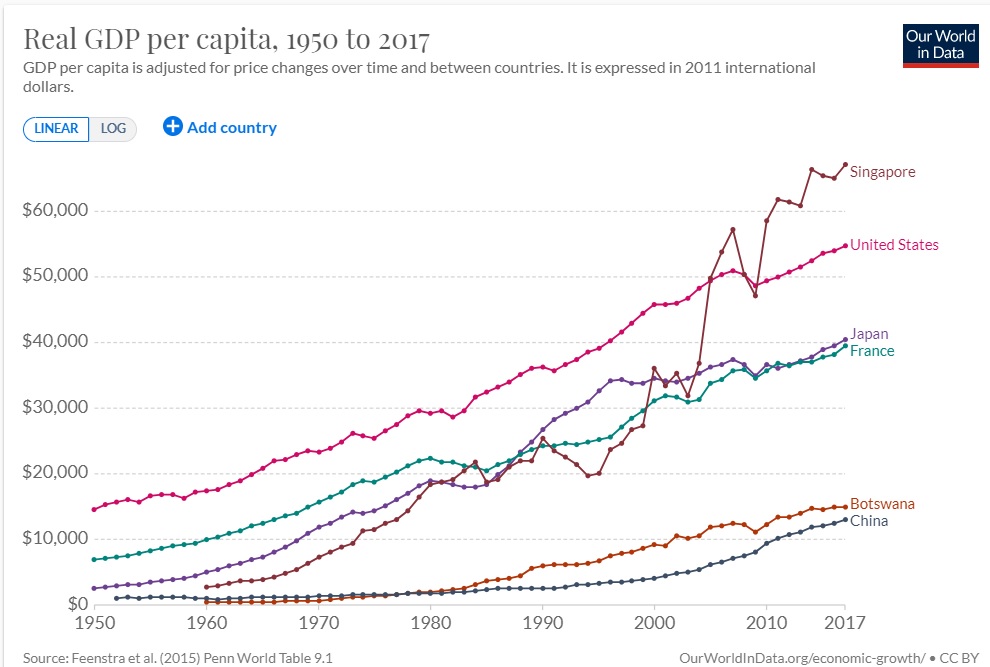
…the nation’s most populous state put up mammoth numbers for the Democrats. But dig a little deeper into the results and a more complex picture of the Golden State voter emerges, of strong libertarian impulses and resistance to some quintessentially liberal ideas. In a series of referendums, voters in California rejected affirmative action, decisively shot down an expansion of rent control and eviscerated a law that gives greater labor protections for ride-share and delivery drivers, a measure that had the strong backing of labor unions. A measure that would have raised taxes on commercial landlords to raise billions for a state that sorely needs revenue also seemed on track for defeat. …said Bob Shrum, a former Democratic strategist…“California is a very liberal state that is now resistant to higher taxes.” …For all their liberal leanings on issues like the environment, California voters have long been less welcoming to new taxes… Proposition 15, would have removed the Proposition 13 tax limits on commercial properties like office buildings and industrial parks, continuing to shield homeowners while raising an estimated $6.5 billion to $11.5 billion a year for public schools and local governments. The measure was trailing on Thursday.. More than $100 million was also spent on another hot-button measure, rent control. Polls showed that the housing crisis was the No. 1 concern for state voters… And yet voters up and down the state resoundingly rejected efforts to expand tenants’ rights and rent control. …What do voters think about voting for Democrats and at the same time not supporting Democratic-led initiatives? José Legaspi, a Los Angeles resident…voted for Mr. Biden and did not think twice about opposing the measure that would raise taxes on commercial properties. “I truly believe in paying taxes,” he said. “However there is a point at which one should limit how much more in taxes one should personally pay.”

The bottom line is that Joe Biden won the White House (barring some dramatic and unexpected developments), but not because of his statist agenda.

It’s more accurate to say that voters wanted to end the sturm and drang of Trump, but without embracing bigger government.

P.S. I’m not going to pretend that voters are rabid libertarians who are clamoring for my preferred policies (such as shutting down departmentsgenuine entitlement reform, etc). But I also think that it’s safe to say that they don’t want the left’s agenda (class warfareMedicare for allgreen new deal, etc) of bigger government and more dependency

Daniel Mitchell quotes Milton Friedman on minimum wage and contrasts Trump a d Biden approach!

Trump vs. Biden on the Minimum Wage

In another display of selfless masochism, I watched the TrumpBiden debate last night.

The candidates behaved better, for whatever that’s worth, but I was disappointed that there so little time (and even less substance) devoted to economic issues.

One of the few exceptions was the brief tussle regarding the minimum wage. Trump waffled on the issue, so I don’t give him any points, but Biden fully embraced the Bernie Sanders policyof basically doubling the minimum wage to $15 per hour.

This is very bad news for low-skilled workers and very bad news to low-margin businesses.

The economic of this issue are very simple. If a worker generates, say, $9 of revenue per hour, and politicians say that worker can’t be employed for less than $15 per hour, that’s a recipe for unemployment.

Earlier this month, Professor Steven Landsburg on the University of Rochester opined for the Wall Street Journal on Biden’s minimum-wage policy.

It isn’t only that I think Mr. Biden is frequently wrong. It’s that he tends to be wrong in ways that suggest he never cared about being right. He makes no attempt to defend many of his policies with logic or evidence, and he deals with objections by ignoring or misrepresenting them. …Take Mr. Biden’s stance on the federal minimum wage, which he wants to increase to $15 an hour from $7.25. …So why does Mr. Biden want to raise the minimum wage…?He hasn’t said, so I have two guesses, neither of which reflects well on him. Guess No. 1: He’s dissembling about the cost. …The minimum wage…comes directly from employers but indirectly (after firms shrink and prices rise) from consumers. A minimum wage is a stealth tax on eating at McDonald’s or shopping at Walmart. …Mr. Biden should acknowledge the cost of wage hikes and argue for accepting it. Instead he’s silent about the cost, hoping he can foist it on people who won’t realize they’re footing this bill. Guess No. 2: He’s rewarding his friends and punishing his enemies. New York is going to vote for Mr. Biden. The state also has a high cost of living and high wages—so New Yorkers would be largely unaffected by the minimum-wage hike. Alabama is going to vote against Mr. Biden. Alabama has a low cost of living and relatively low wages—so under the Biden plan Alabama firms would shrink, to the benefit of competitors in New York. Alabama workers and consumers would pay a greater price than New Yorkers.

And Mark Perry of the American Enterprise Institute recently highlighted some of the adverse effects for unskilled workers.

It’s an economic reality that workers compete against other workers, not against employers, for jobs, and higher wages in the labor market. And it’s also true that lower-skilled, limited-experience, less-educated workers compete against higher-skilled, more experienced, more educated workers for jobs. …If the minimum wage is increased…, that will…take away from unskilled workers the one advantage they currently have to compete against skilled workers – the ability to offer to work for a significantly lower wage than what skilled workers can command. …Result of a minimum wage hike to $15 an hour? Demand for skilled workers goes up, demand for unskilled workers goes down, and employment opportunities for unskilled workers are reduced.

Since I recently shared videos with Milton Friedman’s wisdom on both taxes and spending, here’s what he said about the minimum wage.


Let’s share one last bit of evidence. Mark Perry’s article referenced some new research by Jeffrey Clemens, Lisa Kahn, and Jonathan Meer.

Here’s what those scholars found in a study published by the National Bureau of Economic Research.

We investigate whether changes in firms’ skill requirements are channels through which labor markets respond to minimum wage increases. …Data from the American Community Survey show that recent minimum wage changes resulted in increases in the average age and education of the individuals employed in low-wage jobs. Data on job vacancy postings show that the prevalence of a high school diploma requirement increases at the same time. The shift in skill requirements begins within the first quarter of a minimum wage hike. Further, it results from both within-firm shifts in postings and across-firms shifts towards firms that sought more-skilled workers at baseline. Given the poor labor market outcomes of individuals without high school diplomas, these findings have substantial policy relevance. This possibility was recognized well over a century ago by Smith (1907), who noted that the “enactment of a minimum wage involves the possibility of creating a class prevented by the State from obtaining employment.” Further, negative effects may be exacerbated for minority groups in the presence of labor market discrimination.

So why do politicians push for higher minimum wages, when all the evidence suggests that vulnerable workers bear the heaviest cost?

Part of the answer is that they don’t understand economics and don’t care about evidence.

But there’s also a more reprehensible answer, which is that they do understand, but they want to curry favor with union bosses, and those union bosses push for higher minimum wages as a way of reducing competition from lower-skilled workers.

P.S. Here’s my CNBC debate with Joe Biden’s top economic advisor on this issue.

P.P.S. Here’s a rather frustrating discussion I had on the minimum wage with Yahoo Finance.

P.P.P.S. But if you’re pressed for time, don’t listen to me pontificate. Instead, watch this video.

—-

Milton Friedman on Taxation

October 4, 2020 by Dan Mitchell

Yesterday’s column featured some of Milton Friedman’s wisdom from 50 years ago on how a high level of societal capital (work ethic, spirit of self-reliance, etc) is needed if we want to limit government.

Today, let’s look at what he said back then about that era’s high tax rates.

His core argument is that high marginal tax rates are self-defeating because the affected taxpayers (like Trump and Biden) will change their behavior to protect themselves from being pillaged.

This was in the pre-Reagan era, when the top federal tax rate was 70 percent, and notice that Friedman made a Laffer Curve-type prediction that a flat tax of 19 percent would collect more revenue than the so-called progressive system.

We actually don’t know if that specific prediction would have been accurate, but we do know that Reagan successfully lowered the top tax rate on the rich from 70 percent in 1980 to 28 percent in 1988.

So, by looking at what happened to tax revenues from these taxpayers, we can get a pretty good idea whether Friedman’s prediction was correct.

Well, here’s the IRS data from 1980 and 1988 for taxpayers impacted by the highest tax rate. I’ve circled (in red) the relevant data showing how we got more rich people, more taxable income, and more tax revenue.

The bottom line is that Friedman was right.

Good tax policy (i.e., lower rates on productive behavior) can be a win-win situation. Taxpayers earn more and keep more, while politicians also wind up with more because the economic pie expands.

Something to keep in mind since some politicians in Washington want a return to confiscatory taxes on work, saving, investment, and entrepreneurship.

—-

Why Milton Friedman Saw School Choice as a First Step, Not a Final One

On his birthday, let’s celebrate Milton Friedman’s vision of enabling parents, not government, to be in control of a child’s education.

Wednesday, July 31, 2019
Kerry McDonald
Kerry McDonald

EducationMilton FriedmanSchool ChoiceSchooling

Libertarians and others are often torn about school choice. They may wish to see the government schooling monopoly weakened, but they may resist supporting choice mechanisms, like vouchers and education savings accounts, because they don’t go far enough. Indeed, most current choice programs continue to rely on taxpayer funding of education and don’t address the underlying compulsory nature of elementary and secondary schooling.

Skeptics may also have legitimate fears that taxpayer-funded education choice programs will lead to over-regulation of previously independent and parochial schooling options, making all schooling mirror compulsory mass schooling, with no substantive variation.

Milton Friedman had these same concerns. The Nobel prize-winning economist is widely considered to be the one to popularize the idea of vouchers and school choice beginning with his 1955 paper, “The Role of Government in Education.” His vision continues to be realized through the important work of EdChoice, formerly the Friedman Foundation for Education Choice, that Friedman and his economist wife, Rose, founded in 1996.

July 31 is Milton Friedman’s birthday. He died in 2006 at the age of 94, but his ideas continue to have an impact, particularly in education policy.

Friedman saw vouchers and other choice programs as half-measures. He recognized the larger problems of taxpayer funding and compulsion, but saw vouchers as an important starting point in allowing parents to regain control of their children’s education. In their popular book, Free To Choose, first published in 1980, the Friedmans wrote:

We regard the voucher plan as a partial solution because it affects neither the financing of schooling nor the compulsory attendance laws. We favor going much farther. (p.161)

They continued:

The compulsory attendance laws are the justification for government control over the standards of private schools. But it is far from clear that there is any justification for the compulsory attendance laws themselves. (p. 162)

The Friedmans admitted that their “own views on this have changed over time,” as they realized that “compulsory attendance at schools is not necessary to achieve that minimum standard of literacy and knowledge,” and that “schooling was well-nigh universal in the United States before either compulsory attendance or government financing of schooling existed. Like most laws, compulsory attendance laws have costs as well as benefits. We no longer believe the benefits justify the costs.” (pp. 162-3)

Still, they felt that vouchers would be the essential starting point toward chipping away at monopoly mass schooling by putting parents back in charge. School choice, in other words, would be a necessary but not sufficient policy approach toward addressing the underlying issue of government control of education.

In their book, the Friedmans presented the potential outcomes of their proposed voucher plan, which would give parents access to some or all of the average per-pupil expenditures of a child enrolled in public school. They believed that vouchers would help create a more competitive education market, encouraging education entrepreneurship. They felt that parents would be more empowered with greater control over their children’s education and have a stronger desire to contribute some of their own money toward education. They asserted that in many places “the public school has fostered residential stratification, by tying the kind and cost of schooling to residential location” and suggested that voucher programs would lead to increased integration and heterogeneity. (pp. 166-7)

To the critics who said, and still say, that school choice programs would destroy the public schools, the Friedmans replied that these critics fail to

explain why, if the public school system is doing such a splendid job, it needs to fear competition from nongovernmental, competitive schools or, if it isn’t, why anyone should object to its “destruction.” (p. 170)

What I appreciate most about the Friedmans discussion of vouchers and the promise of school choice is their unrelenting support of parents. They believed that parents, not government bureaucrats and intellectuals, know what is best for their children’s education and well-being and are fully capable of choosing wisely for their children—when they have the opportunity to do so.

They wrote:

Parents generally have both greater interest in their children’s schooling and more intimate knowledge of their capacities and needs than anyone else. Social reformers, and educational reformers in particular, often self-righteously take for granted that parents, especially those who are poor and have little education themselves, have little interest in their children’s education and no competence to choose for them. That is a gratuitous insult. Such parents have frequently had limited opportunity to choose. However, U.S. history has demonstrated that, given the opportunity, they have often been willing to sacrifice a great deal, and have done so wisely, for their children’s welfare. (p. 160).

Sign-Up: Receive Kerry’s Weekly Parenting and Education Newsletter!

Today, school voucher programs exist in 15 states plus the District of Columbia. These programs have consistently shown that when parents are given the choice to opt-out of an assigned district school, many will take advantage of the opportunity. In Washington, D.C., low-income parents who win a voucher lottery send their children to private schools.

The most recent three-year federal evaluationof voucher program participants found that while student academic achievement was comparable to achievement for non-voucher students remaining in public schools, there were statistically significant improvements in other important areas. For instance, voucher participants had lower rates of chronic absenteeism than the control groups, as well as higher student satisfaction scores. There were also tremendous cost-savings.

In Wisconsin, the Milwaukee Parental Choice Program has served over 28,000 low-income students attending 129 participating private schools.

According to Corey DeAngelis, Director of School Choice at the Reason Foundation and a prolific researcher on the topic, the recent analysis of the D.C. voucher program “reveals that private schools produce the same academic outcomes for only a third of the cost of the public schools. In other words, school choice is a great investment.”

In Wisconsin, the Milwaukee Parental Choice Program was created in 1990 and is the nation’s oldest voucher program. It currently serves over 28,000 low-income students attending 129 participating private schools. Like the D.C. voucher program, data on test scores of Milwaukee voucher students show similar results to public school students, but non-academic results are promising.

Recent research found voucher recipients had lower crime rates and lower incidences of unplanned pregnancies in young adulthood. On his birthday, let’s celebrate Milton Friedman’s vision of enabling parents, not government, to be in control of a child’s education.

According to Howard Fuller, an education professor at Marquette University, founder of the Black Alliance for Educational Options, and one of the developers of the Milwaukee voucher program, the key is parent empowerment—particularly for low-income minority families.

In an interview with NPR, Fuller said: “What I’m saying to you is that there are thousands of black children whose lives are much better today because of the Milwaukee parental choice program,” he says. 
“They were able to access better schools than they would have without a voucher.”

Putting parents back in charge of their child’s education through school choice measures was Milton Friedman’s goal. It was not his ultimate goal, as it would not fully address the funding and compulsion components of government schooling; but it was, and remains, an important first step. As the Friedmans wrote in Free To Choose:

The strong American tradition of voluntary action has provided many excellent examples that demonstrate what can be done when parents have greater choice. (p. 159).

On his birthday, let’s celebrate Milton Friedman’s vision of enabling parents, not government, to be in control of a child’s education.

Kerry McDonald

Milton Friedman

Related posts:


“Friedman Friday” (“Free to Choose” episode 1 – Power of the Market. part 7 of 7)

March 16, 2012 – 12:25 am

  Michael Harrington:  If you don’t have the expertise, the knowledge technology today, you’re out of the debate. And I think that we have to democratize information and government as well as the economy and society. FRIEDMAN: I am sorry to say Michael Harrington’s solution is not a solution to it. He wants minority rule, I […] By Everette Hatcher III | Posted in Current Events, Milton Friedman | Edit | Comments (0)

“Friedman Friday” (“Free to Choose” episode 1 – Power of the Market. part 6 of 7)

March 9, 2012 – 12:29 am

PETERSON: Well, let me ask you how you would cope with this problem, Dr. Friedman. The people decided that they wanted cool air, and there was tremendous need, and so we built a huge industry, the air conditioning industry, hundreds of thousands of jobs, tremendous earnings opportunities and nearly all of us now have air […] By Everette Hatcher III | Posted in Current Events, Milton Friedman | Edit | Comments (0)

“Friedman Friday” (“Free to Choose” episode 1 – Power of the Market. part 5 of 7)

March 2, 2012 – 12:26 am

Part 5 Milton Friedman: I do not believe it’s proper to put the situation in terms of industrialist versus government. On the contrary, one of the reasons why I am in favor of less government is because when you have more government industrialists take it over, and the two together form a coalition against the ordinary […] By Everette Hatcher III | Posted in Current Events, Milton Friedman | Edit | Comments (0)

“Friedman Friday” (“Free to Choose” episode 1 – Power of the Market. part 4 of 7)

February 24, 2012 – 12:21 am

The fundamental principal of the free society is voluntary cooperation. The economic market, buying and selling, is one example. But it’s only one example. Voluntary cooperation is far broader than that. To take an example that at first sight seems about as far away as you can get __ the language we speak; the words […] By Everette Hatcher III | Posted in Current Events, Milton Friedman | Edit | Comments (0)

“Friedman Friday” (“Free to Choose” episode 1 – Power of the Market. part 3 of 7)

February 17, 2012 – 12:12 am

  _________________________   Pt3  Nowadays there’s a considerable amount of traffic at this border. People cross a little more freely than they use to. Many people from Hong Kong trade in China and the market has helped bring the two countries closer together, but the barriers between them are still very real. On this side […] By Everette Hatcher III | Posted in Current Events, Milton Friedman | Edit | Comments (0)

“Friedman Friday” (“Free to Choose” episode 1 – Power of the Market. part 2 of 7)

February 10, 2012 – 12:09 am

  Aside from its harbor, the only other important resource of Hong Kong is people __ over 4_ million of them. Like America a century ago, Hong Kong in the past few decades has been a haven for people who sought the freedom to make the most of their own abilities. Many of them are […] By Everette Hatcher III | Posted in Current Events, Milton Friedman | Edit | Comments (0)

“Friedman Friday” (“Free to Choose” episode 1 – Power of the Market. part 1of 7)

February 3, 2012 – 12:07 am

“FREE TO CHOOSE” 1: The Power of the Market (Milton Friedman) Free to Choose ^ | 1980 | Milton Friedman Posted on Monday, July 17, 2006 4:20:46 PM by Choose Ye This Day FREE TO CHOOSE: The Power of the Market Friedman: Once all of this was a swamp, covered with forest. The Canarce Indians […]

Milton Friedman The Power of the Market 1-5

Debate on Milton Friedman’s cure for inflation

September 29, 2011 – 7:24 am

If you would like to see the first three episodes on inflation in Milton Friedman’s film series “Free to Choose” then go to a previous post I did. Ep. 9 – How to Cure Inflation [4/7]. Milton Friedman’s Free to Choose (1980) Uploaded by investbligurucom on Jun 16, 2010 While many people have a fairly […]

By Everette Hatcher III | Also posted in Current Events | Tagged dr friedman, expansion history, income tax brackets, political courage, www youtube | Edit | Comments (0)

“Friedman Friday” Milton Friedman believed in liberty (Interview by Charlie Rose of Milton Friedman part 1)

April 19, 2013 – 1:14 am

Charlie Rose interview of Milton Friedman My favorite economist: Milton Friedman : A Great Champion of Liberty  by V. Sundaram   Milton Friedman, the Nobel Prize-winning economist who advocated an unfettered free market and had the ear of three US Presidents – Nixon, Ford and Reagan – died last Thursday (16 November, 2006 ) in San Francisco […] By Everette Hatcher III | Posted in Milton Friedman | Edit | Comments (0)

What were the main proposals of Milton Friedman?

February 21, 2013 – 1:01 am

Stearns Speaks on House Floor in Support of Balanced Budget Amendment Uploaded by RepCliffStearns on Nov 18, 2011 Speaking on House floor in support of Balanced Budget Resolution, 11/18/2011 ___________ Below are some of the main proposals of Milton Friedman. I highly respected his work. David J. Theroux said this about Milton Friedman’s view concerning […] By Everette Hatcher III | Posted in Milton Friedman | Edit | Comments (0)

“Friedman Friday,” EPISODE “The Failure of Socialism” of Free to Choose in 1990 by Milton Friedman (Part 1)

December 7, 2012 – 5:55 am

Milton Friedman: Free To Choose – The Failure Of Socialism With Ronald Reagan (Full) Published on Mar 19, 2012 by NoNationalityNeeded Milton Friedman’s writings affected me greatly when I first discovered them and I wanted to share with you. We must not head down the path of socialism like Greece has done. Abstract: Ronald Reagan […] By Everette Hatcher III | Posted in Milton FriedmanPresident Obama | Edit | Comments (1)

Defending Milton Friedman

July 31, 2012 – 6:45 am

What a great defense of Milton Friedman!!!!   Defaming Milton Friedman by Johan Norberg This article appeared in Reason Online on September 26, 2008  PRINT PAGE  CITE THIS      Sans Serif      Serif Share with your friends: ShareThis In the future, if you tell a student or a journalist that you favor free markets and limited government, there is […]

2021 Democrats control Government but has our National Debt reached a Tipping Point? (Thomas Sowell on Biden!)

_

A.F. Branco for Oct 21, 2021

 Sadly last night the Democrats won control of Senate!

2021 Democrats control Government but has our National Debt reached a Tipping Point?

Is America Approaching the Tipping Point of Too Much Debt?

Yesterday, the Congressional Budget Office released updated budget projections. The most important numbers in that report show what’s happening with the overall fiscal burden of government – measured by both taxes and spending.

As you can see, there’s a big one-time spike in coronavirus-related spending this year. That’s not good news, but more worrisome is the the longer-run trend of government spending gradually climbing as a share of economic output (and the numbers are significantly worse if you look at CBO’s 30-year projection).

Most reporters and fiscal wonks overlooked the spending data, however, and instead focused on the CBO’s projection for government debt.

Since government spending is the problem and borrowing is merely a symptom of that problem, I think it’s a mistake to fixate on red ink.

That being said, Figure 3 from the CBO report shows that there’s also an upward-spike in federal debt.

And it is true (remember Greece) that high levels of debt can, by themselves, produce a crisis. This happens when investors suddenly stop buying government bonds because they think there’s a risk of default (which happens when a government is incapable or unwilling to make promised payments to lenders).

I think some nations are on the verge of having that kind of crisis, most notably Italy.

But what about the United States? Or Japan? And how’s the outlook for Europe’s welfare states?

In other words, what nations are approaching a tipping point?

A new study from the European Central Bank may help answer these questions. Authored by Pablo Burriel, Cristina Checherita-Westphal, Pascal Jacquinot, Matthias Schön, and Nikolai Stähler, it uses several economic models to measure the downside risks of excessive debt.

The 2009 global financial and economic crisis left a legacy of historically high levels of public debt in advanced economies, at a scale unseen during modern peace time. …The coronavirus (COVID-19) pandemic is a different type of shock that has dramatically affected global economic activity… Fiscal positions are projected to be strongly hit by the crisis…once the crisis is over and the recovery firmly sets in, keeping public debt at high levels over the medium term is a source of vulnerability… The main objective of this paper is to contribute to the stabilisation vs. sustainability debate in the euro area by reviewing through the lens of large scale DSGE models the economic risks associated with regimes of high public debt.

Here’s what they found, none of which should be a surprise.

…we evaluate the economic consequences of high public debt using simulations with three DSGE models… Our DSGE simulations also suggest that high-debt economies…can lose more output in a crisis…have less scope for counter-cyclical fiscal policy and…are adversely affected in terms of potential (long-term) output, with a significant impairment in case of large sovereign risk premia reaction and use of most distortionary type of taxation to finance the additional public debt burden in the future.

Here’s a useful chart from the study. It shows some sort of shock on the left (2008 financial crisis or coronavirus being obvious examples), which then produces a recession (lower GDP) and rising debt.

That outcome isn’t good for nations with “low” levels of debt, but it can be really bad for nations with “high” debt burdens because they have to deal with much higher interest payments, much bigger tax increases, and much bigger reductions in economic output.

For what it’s worth, I don’t think the study actually gives us any way of determining which nations are near the tipping point. That’s because “low” and “high” are subjective. Japan has an enormous amount of debt, yet investors don’t think there’s any meaningful risk that Japan’s government will default, so it is a “low” debt nation for purposes of the above illustration.

By contrast, there’s a much lower level of debt in Argentina, but investors have almost no trust in that nation’s especially venal politicians, so it’s a “high” debt nation for purposes of this analysis.

The United States, in my humble opinion, is more like Japan. As I wrote last year, “We probably won’t even have a crisis in the next 10 years or 20 years.” And that’s still my view, even after all the spending and debt for coronavirus.

The study concludes with some common-sense advice about using spending restraint and pro-market reforms to create buffers (some people refer to this as “fiscal space“).

Overall, once the COVID-19 crisis is over and the economic recovery firmly re-established, further efforts to build fiscal buffers in good times and mitigate fiscal risks over the medium term are needed at the national level. Such efforts should be guided by risks to debt sustainability. High debt countries, in particular, should implement a mix of fiscal discipline and wide-ranging growth-enhancing reforms.

Needless to say, there’s an obvious and successful way of achieving this goal.

P.S. Here’s another chart from the ECB study that is worth sharing because it confirms that not all tax increases do the same amount of economic damage.

We see that consumption taxes (red line) are bad, but income taxes on workers (green line) are even worse.

And if the study included an estimate of what would happen if there were higher income taxes on saving and investment, there would be another line showing even more economic damage.

P.P.S. History shows that nations can reduce very large debt burdens if they follow my Golden Rule.

P.P.P.S. There’s a related study from the IMF that shows how excessive spending is a major warning sign that nations will be vulnerable to fiscal crisis.

Great article below from Daniel Mitchell!!

Positive Rights vs Negative Rights

Back in 2017, I compared the welfare state vision of “positive rights” with the classical liberal vision of “negative rights.”

To elaborate, here’s a video from Learn Liberty that compares these visions.

For what it’s worth, I don’t like the terms “positive rights” and “negative rights” for the simple reason that an uninformed person understandably might conclude that “positive” is good and “negative” is bad.

Needless to say, I don’t think it’s good for people to think they have a right to other people’s money.

That’s why I prefer Professor Skoble’s use of the terms “liberties” and “entitlements,” which we also find in this slide from Professor Imran Ahmad Sajid of the University of Pakistan.

As you might expect, there are plenty of politicians who try to buy votes with an agenda of “positive rights.” Bernie Sanders, for instance, constantly argued that people have a “right” to all sorts of goodies.

But he wasn’t the first to make the case for unlimited entitlements.

Franklin Roosevelt was one of America’s worst presidents, in part because his policies deepened and lengthened the Great Depression. But also because he pushed the idea that people have the right to get all sorts of taxpayer-financed handouts.

Let’s see what some other people have to say about this topic.

In his National Review column, Kevin Williamson looks at the logical fallacy of positive rights.

Positive rights run into some pretty obvious problems if you think about them for a minute, which is why so much of our political discourse is dedicated to moralistic thundering specifically designed to prevent such thinking. Consider, in the American context, the notion that health care is a right. Declaring a right in a scarce good such as health care is intellectually void, because moral declarations about rights do not change material facts.If you have five children and three apples and then declare that every child has a right to an apple of his own, then you have five children and three apples and some meaningless posturing — i.e., nothing in reality has changed, and you have added only rhetoric instead of adding apples. In the United States, we have so many doctors, so many hospitals and clinics, so many MRI machines, etc. This imposes real constraints on the provision of health care. If my doctor works 40 hours a week, does my right to health care mean that a judge can order him to work extra hours to accommodate my rights? For free? If I have a right to health care, how can a clinic or a physician charge me for exercising my right? If doctors and hospitals have rights of their own — for example, property rights in their labor and facilities — how is it that my rights supersede those rights?

And here’s what he says about “negative rights.”

A negative right is a right to not be constrained. The right to free speech, for example, implies only non-interference. The right to freedom of the press doesn’t mean the government has to give you a press. The good of negative freedom is, in the economic sense, not rivalrous — your exercise of free speech doesn’t leave less freedom of speech out there for others to enjoy

And Larry Reed opines on the issue for the Foundation for Economic Education.

America is a nation founded on the notion of rights. …Despite the centrality of rights in American history, it’s readily apparent todaythat Americans are of widely different views on what a right is, how many we have, where rights come from, or why we have any in the first place. …if you need something, does that mean you have a right to it? If I require a kidney, do I have a right to one of yours? Is a right something that can or should be granted or denied by majority vote?

He helpfully provides a list of negative rights (a.k.a., liberties).

And he argues that positive rights (a.k.a., entitlements) are not real rights.

The bottom line, he explains, is that so-called positive rights impose obligations on other people.

Indeed, they can only be provided by coercion.

The first list comprises what are often called both “natural rights” and “negative rights”—natural because they derive from our essential nature as unique, sensate individuals and negative because they don’t impose obligations on others beyond a commitment to not violate them. The items in the second are called “positive rights” because others must give them to you or be coerced into doing so if they decline. …while I believe neither you nor I have a right to any of those disparate things in the second list, I hasten to add that we certainly have the right to seek them, to create them, to receive them as gifts from willing benefactors, or to trade for them. We just don’t have a right to compel anyone to give them to us or pay for them.

There’s not much I can add to this issue, given the wisdom contained in the video and in the articles by Williamson and Reed.

So I’ll close with the should-be-obvious point that a system based on entitlements only works if there are enough people pulling the wagon to support all the people riding in the wagon.

But that kind of society contains the seeds of its own downfall(think Greece or Venezuela) because it subsidizes dependency and penalizes production.

Which means, as Margaret Thatcher warned us, that positive rights can’t be provided when politicians run out of other people’s money.

-_

Free-market economics meets free-market policies at The Heritage Foundation’s Tenth Anniversary dinner in 1983. Nobel Laureate Milton Friedman and his wife Rose with President Ronald Reagan and Heritage President Ed Feulner.

Free-market economics meets free-market policies at The Heritage Foundation’s Tenth Anniversary dinner in 1983. Nobel Laureate Milton Friedman and his wife Rose with President Ronald Reagan and Heritage President Ed Feulner.

Since the passing of Milton Friedman who was my favorite economist, I have been reading the works of Daniel Mitchell and he quotes Milton Friedman a lot, and you can reach Dan’s website here.

Mitchell in February 2011.
Wikipedia noted concerning Dan:

Mitchell’s career as an economist began in the United States Senate, working for Oregon Senator Bob Packwood and the Senate Finance Committee. He also served on the transition team of President-Elect Bush and Vice President-Elect Quayle in 1988. In 1990, he began work at the Heritage Foundation. At Heritage, Mitchell worked on tax policy issues and began advocating for income tax reform.[1]

In 2007, Mitchell left the Heritage Foundation, and joined the Cato Institute as a Senior Fellow. Mitchell continues to work in tax policy, and deals with issues such as the flat tax and international tax competition.[2]

In addition to his Cato Institute responsibilities, Mitchell co-founded the Center for Freedom and Prosperity, an organization formed to protect international tax competition.[1]

January 29, 2020

President Biden, c/o The White House 1600 Pennsylvania Avenue NW Washington, DC 20500

Dear Mr. President,

The FOUNDERS never intended the government to get into the welfare business!!!!

The federal government debt is growing so much that it is endangering us because if things keep going like they are now we will not have any money left for the national defense because we are so far in debt as a nation. We have been spending so much on our welfare state through food stamps and other programs that I am worrying that many of our citizens are becoming more dependent on government and in many cases they are losing their incentive to work hard because of the welfare trap the government has put in place. Other nations in Europe have gone down this road and we see what mess this has gotten them in. People really are losing their faith in big government and they want more liberty back. It seems to me we have to get back to the founding  principles that made our country great.  We also need to realize that a big government will encourage waste and corruptionThe recent scandals in our government have proved my point. In fact, the jokes you made at Ohio State about possibly auditing them are not so funny now that reality shows how the IRS was acting more like a monster out of control. Also raising taxes on the job creators is a very bad idea too. The Laffer Curve clearly demonstrates that when the tax rates are raised many individuals will move their investments to places where they will not get taxed as much.

______________________

One is the growing welfare state. I have posted an article below about what the welfare state is doing to England because we need to learn from their mistakes.

Welfare state may drag England down the tubes!!!!

I’ve shared this bit of political incorrect terrorism humor from England, as well asthis somewhat un-PC bit of tax humor.

But perhaps motivated by the scandal of giving welfare to terrorists, this new video is the most amusing thing I’ve seen from across the ocean.

I almost didn’t post this because it singles out immigrants from the developing world, but since I’ve shared horror stories from home-grown moochers in the U.K., as well as examples of scroungers from Europe who are robbing British taxpayers, I think I’ve covered all the bases.

But in the spirit of inclusiveness, here are other satirical videos worth sharing.

My all-time favorite video satire is from Iowahawk, featuring the Pelosimobile.

And I’ve always thought this left-wing attack against libertarianism is very funny.

And this Tim Hawkins video on the government Candyman is great, as isanother version of the song.

Speaking of Tim Hawkins, his home-schooling video is superb.

This spoof of the Chevy Volt also is extremely well done.

Last but not least, here are two brutal Obama teleprompter videos.

_____________

Related posts:

Milton Friedman’s Free to Choose (1980), episode 3 – Anatomy of a Crisis. part 1

“The Power of the Market” episode of Free to Choose in 1990 by Milton Friedman (Part 5)

Milton Friedman The Power of the Market 5-5 How can we have personal freedom without economic freedom? That is why I don’t understand why socialists who value individual freedoms want to take away our economic freedoms.  I wanted to share this info below with you from Milton Friedman who has influenced me greatly over the […]

“The Power of the Market” episode of Free to Choose in 1990 by Milton Friedman (Part 4)

Milton Friedman The Power of the Market 4-5 How can we have personal freedom without economic freedom? That is why I don’t understand why socialists who value individual freedoms want to take away our economic freedoms.  I wanted to share this info below with you from Milton Friedman who has influenced me greatly over the […]

“The Power of the Market” episode of Free to Choose in 1990 by Milton Friedman (Part 3)

Milton Friedman The Power of the Market 3-5 How can we have personal freedom without economic freedom? That is why I don’t understand why socialists who value individual freedoms want to take away our economic freedoms.  I wanted to share this info below with you from Milton Friedman who has influenced me greatly over the […]

“The Power of the Market” episode of Free to Choose in 1990 by Milton Friedman (Part 2)

Milton Friedman The Power of the Market 2-5 How can we have personal freedom without economic freedom? That is why I don’t understand why socialists who value individual freedoms want to take away our economic freedoms.  I wanted to share this info below with you from Milton Friedman who has influenced me greatly over the […]

“The Power of the Market” episode of Free to Choose in 1990 by Milton Friedman (Part 1)

Milton Friedman The Power of the Market 1-5 How can we have personal freedom without economic freedom? That is why I don’t understand why socialists who value individual freedoms want to take away our economic freedoms.  I wanted to share this info below with you from Milton Friedman who has influenced me greatly over the […]

Washington is lecturing us about eating too much when they are spending addicts!!!!

Washington is lecturing us about eating too much when they are spending addicts!!!! Let’s Fix the Real Obesity Problem in Washington May 11, 2013 by Dan Mitchell Whenever someone proposes that we need more intervention from the federal government, I always go to the Constitution and check Article I, Section VIII. This is because I’m old fashioned and […]

Dan Mitchell of the Cato Institute:HUD has to go!!!! (includes political cartoon)

You want a suggestion on how to cut the government then start at HUD. I would prefer to eliminate all of it. Here are Dan Mitchell’s thoughts below: Sequestration’s Impact on HUD: Just 358 More Days and Mission Accomplished March 12, 2013 by Dan Mitchell As part of my “Question of the Week” series, I had […]

Open letter to President Obama (Part 138 B)

Real Time with Bill Maher March 16 2012 – Alexandra Pelosi Interviews Welfare Recipients in NYC Published on Mar 18, 2012 by vclubscenedotcom Real Time with Bill Maher March 16 2012 – Alexandra Pelosi Interviews Welfare Recipients __________ President Obama c/o The White House 1600 Pennsylvania Avenue NW Washington, DC 20500 Dear Mr. President, I […]

Are conservatives generous or are liberals?

Real Time with Bill Maher March 16 2012 – Alexandra Pelosi Interviews Welfare Recipients in NYC Published on Mar 18, 2012 by vclubscenedotcom Real Time with Bill Maher March 16 2012 – Alexandra Pelosi Interviews Welfare Recipients __________ Liberals like the idea of the welfare state while conservatives suggest charity through private organizations serve the […]

Democrats lied about spending cuts in 1982 and 1990

Washington Could Learn a Lot from a Drug Addict What kind of intervention does Congress need to get it to spend with its spending addiction? Back in 1982 Reagan was promised $3 in cuts for every $1 in tax increases but the cuts never came. In 1990 Bush was promised 2 for 1 but they […]

Senator Pryor asks for Spending Cut Suggestions! Here are a few!(Part 1) (Al Green, Famous Arkansan)

  Senator Mark Pryor wants our ideas on how to cut federal spending. Take a look at this video clip below: Senator Pryor has asked us to send our ideas to him at cutspending@pryor.senate.gov and I have done so (at 4:04 pm CST on April 7th, 2011, and will continue to do so in the […]

Victorious 2021 Georgia Democrats should remember Dan Mitchell’s words, “In the real world of Washington (as opposed to blackboard theorizing), higher taxes lead to higher deficits and more debt!” (Thomas Sowell on Biden)

 Sadly last night the Democrats won control of Senate!

Victorious 2021 Georgia Democrats should remember Dan Mitchell’s words, “In the real world of Washington (as opposed to blackboard theorizing), higher taxes lead to higher deficits and more debt!”

Debt, Deficits, and Goldilocks

At the risk of oversimplification and exaggeration, these six principles tell you everything you need to know about fiscal policy.

For purposes of today’s column, let’s focus on Principle #3, which is that “Deficits and debt are symptoms of the underlying problem” of excessive spending.

I’ve been making that point over and over and over and over and over again, but I feel motivated to address the issue again after reading two columns about government debt.

First, here’s some of what Paul Krugman wrote on the topic for his column in the New York Times.

…we’ve learned a lot about the economics of government debt over the past few years — enough so that Olivier Blanchard, the eminent former chief economist of the International Monetary Fund, is talking about a “shift in fiscal paradigm.” And the new paradigm suggests both that public debt isn’t a major problem and that government borrowing for the right purposes is actually the responsible thing to do.…It made some sense, nine or 10 years ago, to worry that the financial crisis in Greece was a harbinger of potential debt crises in other countries. …What briefly seemed like a spread of Greek-style problems across southern Europe turned out to be a temporary investor panic, quickly ended by a promise from the European Central Bank that it would lend money to cash-short governments if necessary. …We weren’t and aren’t anywhere close to that kind of crisis, and probably never will be. …But what about the longer term? …The important point for current discussion is that government borrowing costs are now very low and likely to stay low for a long time. …given what we’ve learned and where we are, it’s clear that the U.S. government should be investing heavily in the nation’s future, and that it’s OK, indeed desirable, to borrow the money we need to make those investments.

Second, Brian Riedl of the Manhattan Institute provides a different perspective in a column for today’s Washington Post, .

The election of Joe Biden to the presidency has prompted liberal calls to set aside pesky budget deficit concerns and go deeper into debt to finance large new spending initiatives… All these writers share the view that the persistence of low interest rates — currently about 1 percent for a 10-year Treasury bill — means the rules of the fiscal game have fundamentally changed. …But…deficit advocates must face two fundamental realities: First, the debt is already set to soar in the absence of any new spending. And second, these bloated debt levels will mean that any future rise in interest rates could bring a full-scale debt crisis. …Deficit doves are essentially gambling the future of the U.S. economy on the expectation that interest rates never again exceed 4 percent or 5 percent. …they are wrong to assume that state of affairs will continue. …Exceeding the projections by two or three points would mean annual interest costs consuming all projected tax revenue, leaving no taxes to finance normal federal programs. These debt spirals become nearly impossible to escape, as rising interest costs necessitate more borrowing, which in turn brings higher interest costs… Deficit doves would gamble America’s economic future on the hope that interest rates will never again top 4 or 5 percent. Are you feeling lucky?

At the risk of sounding like a muddle-headed, finger-in-the-wind moderate, I’m going to disagree with both of them (I’m like Goldilocks, who doesn’t want the porridge too hot or too cold).

I have a fundamental disagreement with Krugman because he’s overtly arguing for a bigger burden of government. Based on his past writings, he is willing to use higher taxes to finance some additional spending.

But the aforementioned column confirms that he’s in favor of a big amount of additional debt-financed spending as well.

He presumably wants to move the country into the lower-right quadrant of this 2×2 matrix, but doesn’t mind getting there by detouring through the lower-left quadrant.

My disagreement with Brian is probably more a matter of rhetoric. Based on his past writings, I think he wants to be in the upper-left quadrant, but he has an unfortunate tendency to fixate on the symptom of debt and deficits when he should be focusingon the underlying disease of excessive government spending.

My bottom line if that bigger government is a bad idea when it’s financed by debt, but it’s an equally bad idea if it’s financed by taxes.

Moreover, I worry when well-meaning people grouse about red ink because that creates an opening for not-so-well-meaning people to say, “I agree with you, so let’s raise taxes.”

P.S. In the real world of Washington (as opposed to blackboard theorizing), higher taxes lead to higher deficits and more debt.

P.P.S. Assuming they’re both sincere and guided by empiricism, people who care about red ink should support a spending cap.

P.P.P.S. Maintained for a sufficient period of time, spending restraint can even eliminate huge debt burdens.

Economic Growth and the “Size of the Pie”

My recent three-part series (here, here, and here) explained why policy makers should seek to reduce poverty rather than inequality.

I want to expand on that point today by showing why growing the pie is more important than how it is sliced.

I’ve previously opined on why economic growth is important, showing that the United States today would be almost as poor as Mexico if our rate of economic growth since 1895 was just one-percentage point less than it actually was.

Moreover, I also showed in that 2017 column how much smaller increments of additional growth over time can mean thousands of dollars of additional income for an average household.

And, the previous year, I shared two excellent videos from Marginal Revolution University while writing about Hong Kong’s remarkable jump from poverty to prosperity.

For today’s column, I want to expand on this point using the economic growth page from Max Roser’s great site, Our World in Data. We’ll start with this chart showing how per-capita economic output dramatically increased a few hundred years ago.

This kind of data won’t be news to regular readers. I’ve already shared great videos from Deirdre McCloskey and Don Boudreaux that make the same point about the explosion of prosperity in the modern era.

And if anyone somehow thinks this growth doesn’t matter, Roser’s page shows that there are countless ways of graphing the relationship between economic output and good outcomes, such as how long we live, child mortality, access to electricity, hunger, and literacy.

The bottom line is that we are unimaginably rich compared to prior generations, largely thanks to the rule of law, expanded trade, and limited government.

That recipe for growth and prosperity works anywhere and everywhere it is tried. Here’s another chart showing how other parts of the world are being to prosper thanks to economic liberalization.

I want to cite two additional charts from Roser’s page.

First, here’s a chart showing productivity rates in selected nations. Why is this important? Because economic prosperity is basically driven by how much we work and how productive we are.

There are all sorts of interesting things embedded in the above chart.

Our final chart shows the importance of convergence.

Once again, there are some important observations embedded in the above chart.

  • Very poor nations such as Botwsana and China can enjoy meaningful gains with partial economic liberalization.
  • Western nations can enjoy more prosperity over time, but they won’t catch the United States so long as they are burdened with too much government.
  • Singapore shows that full convergence is not only possible, but also that laissez-faire countries can even surpass the United States.

P.S. I can’t resist recycling my “never-answered question” in hopes of getting any of my left-leaning friends to cite a single example of their policies producing mass prosperity.

Open letter to President Obama (Part 702)

(Emailed to White House on 6-25-13.)

President Obama c/o The White House 1600 Pennsylvania Avenue NW Washington, DC 20500

Dear Mr. President,

I know that you receive 20,000 letters a day and that you actually read 10 of them every day. I really do respect you for trying to get a pulse on what is going on out here.

The federal government debt is growing so much that it is endangering us because if things keep going like they are now we will not have any money left for the national defense because we are so far in debt as a nation. We have been spending so much on our welfare state through food stamps and other programs that I am worrying that many of our citizens are becoming more dependent on government and in many cases they are losing their incentive to work hard because of the welfare trap the government has put in place. Other nations in Europe have gone down this road and we see what mess this has gotten them in. People really are losing their faith in big government and they want more liberty back. It seems to me we have to get back to the founding  principles that made our country great.  We also need to realize that a big government will encourage waste and corruptionThe recent scandals in our government have proved my point. In fact, the jokes you made at Ohio State about possibly auditing them are not so funny now that reality shows how the IRS was acting more like a monster out of control. Also raising taxes on the job creators is a very bad idea too. The Laffer Curve clearly demonstrates that when the tax rates are raised many individuals will move their investments to places where they will not get taxed as much.

______________________

Some people doubt that Ronald Reagan conservatism still works today like it did in the 1980’s and that those kind of conservatives can still win today but they can!!!! That is the message that the USA loves.

Among the right-leaning policy wonks and intellectuals in Washington, there’s a lot of attention being given to the something called “reform conservatism.”

Underlying this school of thought is the notion that the Reagan-era message no longer works since Republicans have lost the popular vote in five out of the last six elections.

A few people have asked my opinion about this movement, and since Ross Douthat of the New York Times just put together a good description of this school of thought, it makes it easy for me to offer my thoughts.

But before digging into his column, I think that some of the angst on the right is misplaced. Why blame a Reagan-era message for GOP electoral problems when all the Republicans presidential nominees in recent years have favored big government? Does anybody really think that Bush 41, Dole, Bush 43, McCain, and Romney were Reaganites?!?

Could any of those candidates have given these remarks, at least with any credibility?

President Reagan on Big Government and Personal Freedom

Uploaded on Dec 23, 2010

The surge in nostalgia for President Reagan over the past two years is no surprise. When the American people are faced with tyrannical government, arrogant leadership, and failed policies, they tend to cling to good memories (along with their guns and religion). They also tend to take action, hence the Tea Party movement and the 2010 revolution. Watch this clip from 1982 and remember.

_____________________

Or made these comments in a sincere fashion?

Ronald Reagan on Individual Freedom

Uploaded on Mar 6, 2010

The Founding Fathers fought tyranny, we must come together to fight again. Ronald Reagan believed that it was individual freedom that made America great

___________________________

It’s much more plausible to say that Republicans have lagged because they didn’t have candidates with a Reagan-style message.

But let’s assume, for the sake of argument, that Republicans would have fared poorly even if Reaganites had been nominated. Does “reform conservatism” offer a path to electoral salvation.

Here’s what Douthat identifies as the “two major premises” of reform conservatism.

1. First, he writes that the “core economic challenge facing the American experiment is not income inequality per se, but rather stratification and stagnation — weak mobility from the bottom of the income ladder and wage stagnation for the middle class.” Conservatives, he says, should strive to make “family life more affordable, upward mobility more likely, and employment easier to find.”

2. Second, he warns that the “existing welfare-state institutions we’ve inherited from the New Deal and the Great Society, however, often make these tasks harder rather than easier: Their exploding costs crowd out every other form of spending, require middle class tax increases and threaten to drag on economic growth.”

I’m not an expert on income mobility, so I’m not sure I would identify stratification and stagnation as the nation’s core economic challenge, but he may be right. Regardless, it’s definitely a good idea to have more mobility.

And I definitely agree that the welfare state hinders upward mobility by creating dependency. And he’s right that this is a drag on growth. That being said, I disagree with his assertion that rising entitlement expenditures crowd out other spending and lead to middle class tax hikes. Those things may happen at some point, particularly once we get into the peak years for retiring baby boomers, but they haven’t happened yet.

The more important question, at least to me, is what sort of policies do reform conservatives embrace? Here’s Douthat’s list, bolded, followed by my thoughts.

a. A tax reform that caps deductions and lowers rates, but also reduces the burden on working parents and the lower middle class, whether through an expanded child tax credit or some other means of reducing payroll tax liabilityTax Distribution CBOI obviously like the idea of lowering rates and reducing deductions since that moves the system closer to a flat tax. That being said, it’s difficult to reduce the tax burden on the lower middle class since they pay very little income tax under the current system (see accompanying table from CBO). But I like the idea of addressing the payroll tax, though I disagree with their approach (see section “c” below).

b. A repeal or revision of Obamacare that aims to ease us toward a system of near-universal catastrophic health insurance, and includes some kind of flat tax credit or voucher explicitly designed for that purpose. I fully agree with repeal of Obamacare, and I think an unfettered marketplace would evolve into a system of near-universal catastrophic insurance, but I don’t want the federal government subsidizing or coercing that approach (though current healthcare policy has far more subsidies and coercion, so Douthat’s plan would be a big improvement over the status quo).

c. A Medicare reform along the lines of the Wyden-Ryan premium support proposal, and a Social Security reform focused on means testing and extending work lives rather than a renewed push for private accounts. I’m glad they embrace Medicare reform, but I’m puzzled by the hostility to personal retirement accounts.  If you increase the retirement age and/or means test, youforce people to pay more and get less, yet Social Security already is a bad deal for younger workers. So why make it worse? How can that be good for those with low mobility? Personal accounts would be akin to a tax cut for such workers since the payroll tax would be transformed into something much closer to deferred compensation.

d. An immigration reform that tilts much more toward Canadian-style recruitment of high-skilled workers, and that doesn’t necessarily seek to accelerate the pace of low-skilled immigration. As I noted in this interview, I very much favor bringing more high-skilled people into the country.

e. A “market monetarist” monetary policy as an alternative both to further fiscal stimulus and to the tight money/fiscal austerity combination advanced by many Republicans today. I try to avoid monetary policy. That being said, I’m a bit skeptical of “market monetarism.” No nation has ever tried this system, so it’s uncharted territory, and I’m reluctant to embrace an approach which is premised on the notion that bubbles can’t exist (what about the tech bubble of the late 1990s or the housing bubble last decade?!?). I’m also suspicious of a system which requires an activist central bank. Watch this George Selgin video if you want to know why.

f. An attack not only on explicit subsidies for powerful incumbents (farm subsidies, etc.) but also other protections and implicit guarantees, in arenas ranging from copyright law to the problem of “Too Big To Fail.” Amen. I fully agree.

Since I’m a tax policy wonk, let me address in greater detail some of the tax reform proposals put forward by reform conservatives.

Jim Pethokoukis of the American Enterprise Institute is identified in the column as a reform conservative, and he recently expressed skepticism about the flat tax in a column for National Review.

It’s an elegant, compelling model that might work  splendidly if you were creating a tax code ex nihilo. …America, however, is in a much different place. Millions of individuals and businesses have made long-term plans based on expectations that the tax code will remain more or less the same. Half the nation, thanks to all those deductions and credits, pays no income tax. …it’s unlikely the U.S. can keep spending down at historical levels of 20 percent to 21 percent of GDP while also maintaining a floor for defense spending at 4 percent of output. The best a group of AEI scholars could manage was limiting spending to 23 percent of GDP by 2035.

The clear implication of his column is that we need a tax system that raises more revenue. I obviously disagree. We should never “feed the beast” by giving politicians more money to spend.

Pethokoukis also says the flat tax is politically unrealistic. Since I’m not expecting a flat tax in my lifetime, I obviously can’t argue with that statement. But he then proposes another plan that would be far less popular – and far more dangerous.

One solution is to take the essentially flat consumption tax devised by economists Robert Hall and Alvin Rabushka and give it a progressive rate structure. Or we could combine a consumption tax with a flat income tax on wealthier Americans, as suggested by Yale’s Michael Graetz.

So we should keep the income tax as a vehicle for class warfare and augment it with a VAT?!? Yeah, good luck trying to sell that idea. And Heaven help us if it ever succeeded since politicians would have another major source of tax revenue.

Another plan, which Douthat explicitly cites in his paper, was put together by Robert Stein, a former Bush Treasury official. He thinks traditional supply-side policies today are either irrelevant or unpopular.

Lowering tax rates today could still enhance the incentives to invest, particularly in the corporate sector. But the distortions caused by marginal tax rates are not nearly as great as they were in 1980. And attempts to solve other problems caused by the tax code itself — like the biases in favor of consumption over saving, or home building over business investment — could never in themselves garner the public support necessary for a major overhaul.

As I noted, I’m not holding my breath for a flat tax, so I can’t disagree with Stein’s prognostication.

He also has a very novel way of defining the problem we should be trying to fix.

…it is time to rethink how the tax code treats ­parents. …raising children is hardly just another pastime: It is one of the most important services any American can perform for our country. …even as Social Security and Medicare depend on large numbers of future workers, they have created an enormous fiscal bias against procreation, undermining an important motive for raising children: to safeguard against poverty in old age. ……our system of taxes and entitlements not only fails to reward parents — it actively discourages Americans from having children. …Recent studies (especially work by Michele Boldrin, ­Mariacristina De Nardi, and Larry Jones and by Isaac Ehrlich and Jinyoung Kim) show that Social Security and Medicare actually reduce the fertility rate by about 0.5 children per woman. In European countries, where retirement systems are larger, the effect is closer to one child per woman.

As a libertarian, the beginning section of that passage grated on me. My children are individuals, not a “service” to prop up entitlement programs. I agree with Stein that these programs are a problem, but the solution is to reform entitlements, not to rejigger the tax code in hopes of pumping out more taxpayers.

Stein disagrees.

Unfortunately, these negative effects on fertility cannot be cured simply by converting old-age entitlement programs into mandatory savings programs, as the Bush administration proposed for Social Security in 2005. After all, requiring workers to save for retirement through private financial instruments would also crowd out the traditional motive to raise kids.

Instead, he wants to change the tax system based on the notion that today’s kids are tomorrow’s taxpayers.

…the present value of future Social Security and Medicare contributions for a typical worker born today is about $150,000. Rewarding parents for creating these future contributions suggests annual tax relief of about $8,500 per child. To correct for this inadequate treatment of households with ­children, the existing dependent exemption for children, the child credit, the ­child-care credit, and the adoption credit should be replaced with one new $4,000 credit per child that can be used to offset both income and payroll taxes. (This amount is set much closer to the $3,250 figure than the $8,500 one mostly to reduce the plan’s negative impact on federal revenue.)

I have no philosophical objection to some form of exemption – or even credit – based on family size. Almost all flat tax systems, for instance, have some sort of family allowance.

But it’s also important to realize that bigger family allowances generally don’t have pro-growth effects. It’s the marginal tax rate that impacts incentives.

And Stein, unfortunately, would “pay” for his credits by raising marginal tax rates on a significant share of taxpayers.

Some of these costs would be offset by eliminating itemized deductions (other than mortgage interest and charitable contributions). The rest would have to be offset by ­allowing the top rate of 35% to touch more taxpayers than it currently affects. …who pays more? Primarily high-income workers, but also upper-middle-class taxpayers who do not have children in the home (either because they have decided not to raise children at all, or because their children have already turned 18). To be blunt, the plan is a tax hike on the rich and makes the tax code even more progressive than it is today.

To be fair, Stein also proposes some good policies such as AMT repeal and reductions in double taxation, so he’s definitely not in the Obama class-warfare camp. But it’s also fair to say that his plan won’t do much for growth. Some tax rates are lowered but others are increased.

Yet if you really want families to be in stronger shape, more growth is the only long-run solution.

Moreover, it’s not clear that Stein’s agenda would be terribly popular. Though I confess that’s just a guess since no politician has latched onto the idea in the years since the proposal was unveiled.

Returning to the broader issue of “reform conservatism,” it’s difficult to assign an overall grade to the movement since I’m not sure whether we’re supposed to interpret it as a political strategy or an economic plan.

Regardless, I guess I’m generally sympathetic. I assume the RCers want government to be smaller than it is today and I don’t think you have to be a 100 percent libertarian to be my ally in the fight to restrain excessive government. And I also think it’s a good idea for people to be thinking of how to best articulate a message of smaller government. Heck, I do that every time I go on TV or give a speech.

So I reserve the right to object to any of the specific proposals that reform conservatives put forward (such as the tax plans discussed above), but I like the project.

_____________

Thank you so much for your time. I know how valuable it is. I also appreciate the fine family that you have and your commitment as a father and a husband.

Sincerely,

Everette Hatcher III, 13900 Cottontail Lane, Alexander, AR 72002, ph 501-920-5733, lowcostsqueegees@yahoo.com

Related:

Are the Republicans in Arkansas true Tea Party Ronald Reagan Republicans?

Ronald Reagan said, “We will never compromise our principles and standards.” Are the Republicans in Arkansas true Tea Party Ronald Reagan Republicans? According to Americans for Prosperity in the last 5 years Arkansas’ current Medicaid program has run a deficit of a billion dollars. Why expand it willingly with Obama? The “Do Nothing” expansion plan increases […]

Barack Obama would lose badly to Ronald Reagan!!!

Barack Obama would lose badly to Ronald Reagan!!! The Spirit of Reagan Is Still With Us: The Gipper Crushes Obama in Hypothetical Matchup April 13, 2013 by Dan Mitchell Barack Obama has stated that he wants to be like Reagan, at least in the sense of wanting to be a transformational figure. But almost certainly he has […]

“Friedman Friday” Transcript and video of Milton Friedman on Bill Clinton and Ronald Reagan (Part 2)

Below is a discussion from Milton Friedman on Bill Clinton and Ronald Reagan. February 10, 1999 | Recorded on February 10, 1999 audio, video, and blogs » uncommon knowledge PRESIDENTIAL REPORT CARD: Milton Friedman on the State of the Union with guest Milton Friedman Milton Friedman, Senior Research Fellow, Hoover Institution and Nobel Laureate in […]

“Friedman Friday” Transcript and video of Milton Friedman on Bill Clinton and Ronald Reagan (Part 1)

Below is a discussion from Milton Friedman on Bill Clinton and Ronald Reagan. February 10, 1999 | Recorded on February 10, 1999 audio, video, and blogs » uncommon knowledge PRESIDENTIAL REPORT CARD: Milton Friedman on the State of the Union with guest Milton Friedman Milton Friedman, Senior Research Fellow, Hoover Institution and Nobel Laureate in […]

Ronald Reagan and the Founding Fathers

I really enjoyed this article. A Constitutional President: Ronald Reagan and the Founding By Edwin Meese III , Lee Edwards, Ph.D. , James C. Miller III and Steven Hayward January 26, 2012 Abstract: Throughout his presidency, Ronald Reagan was guided by the principles of the American founding, especially the idea of ordered liberty. In the opening of his first inaugural address in 1981, […]

March for Life March in Little Rock on Jan 20, 2013!!!Ronald Reagan’s videos and pictures displayed here on the www.thedailyhatch.org

Ronald Reagan was the greatest pro-life president ever. He appointed Dr. C. Everett Koop to his administration and Dr. Koop was responsible for this outstanding pro-life film below: I was thinking about the March for Life that is coming up on Jan 20, 2013 in Little Rock and that is why I posted this today. […]

Ronald Reagan’s pro-life tract

1/30/84 Part 1 of a speech to the National Religious Broadcasters. June 10, 2004, 10:30 a.m. Abortion and the Conscience of the Nation Ronald Reagan’s pro-life tract. EDITOR’S NOTE: While president, Ronald Reagan penned this article for The Human Life Review, unsolicited. It ran in the Review‘s Spring 1983, issue and is reprinted here with permission. The case […]

Ronald Reagan’s videos and pictures displayed here on the www.thedailyhatch.org

President Reagan, Nancy Reagan, Bill Clinton and Hillary Clinton attending the Dinner Honoring the Nation’s Governors. 2/22/87. Ronald Reagan is my favorite president and I have devoted several hundred looking at his ideas. Take a look at these links below: President Reagan and Nancy Reagan attending “All Star Tribute to Dutch Reagan” at NBC Studios(from […]

Ronald Reagan and Johnny Carson discussing Balanced Budget Amendment on “Tonight Show”

Ronald Reagan Talks About Balancing the Budget on “The Tonight Show” Uploaded by johnnycarson on Jul 30, 2011 Ronald Reagan talks about balancing the budget on “The Tonight Show” in 1975. _____________ Ronald Reagan was one of my favorite presidents. Mike Lee is one of my favorite lawmakers of today!!! Look at what he says about […]

Ronald Reagan and Milton Friedman supported Balanced Budget Amendment

Remarks at a Rally Supporting the Proposed Constitutional Amendment for a Balanced Federal Budget For more information on the ongoing works of President Reagan’s Foundation, please visit http://www.reaganfoundation.org _______________ Ronald Reagan was a firm believer in the Balanced Budget Amendment and Milton Friedman was a key advisor to Reagan. Friedman’s 1980 film series taught the […]