
It is with sadness that I write this post having learned of the death of Sir Harold Kroto on April 30, 2016 at the age of 76. He was a scientist of remarkable abilities and a man of great humor too. In this series I posted the Memorial by Richard Dawkins for Dr. Kroto and a letter I wrote him about Israel and I also looked at Kroto’s membership in CSICOP and his admiration for Bertrand Russell and his 2 emails he sent to me on 9-18-14. Peter Coles, Head of the School of Mathematical and Physical Sciences at the University of Sussex gave an excellent tribute Dr. Kroto which I posted and also I inclued a February 16, 2009 post from the blogger Rob from the blog THINKING MATTERS about Dr. Kroto.
Next in part F of PAUSING TO LOOK AT THE LIFE OF HARRY KROTO, I take a closer look at one of Dr. Kroto’s favorite books: THE DEMON-HAUNTED WORLD: Science as a Candle in the Dark by Carl Sagan. New York: Random House, 1995. 457 pages, extensive references, index. Hardcover; $25.95. PSCF 48 (December 1996): 263. In part G, I look at Sam Harris on the Bill Maher Show stating that there is no comparison to Islam and Christianity today concerning killing in the name of religion and then I look at some of Dr. Kroto’s comments on that and then my response.
In part H of PAUSING TO LOOK AT THE LIFE OF HARRY KROTO, I respond to his statement, “How anyone can believe that an ALL-POWERFUL ENTITY, with even an iota of humanitarian sensitivity, could have created a living system that is so blatantly, intrinsically CANNIBALISTIC is beyond my belief.” In part I, in an hour long video Dr. Kroto discusses the work of Fred Hoyle and I include some comments from others on Fred Hoyle.
I did not know Harry Kroto personally but I did have the opportunity to correspond with him in 2014. I sent him a letter in the spring and two in the summer and he responded with an email on 9-18-16 and I thanked him for responding in an email and then he emailed me again and even sent me a letter on 11-21-14. In that 11-21-14 letter he referred me to the You Tube film series Renowned Academics Speaking About God which has over 300,000 views on You Tube and that prompted me on 11-29-14 to start my blog series RESPONDING TO HARRY KROTO’S BRILLIANT RENOWNED ACADEMICS!! Below are the links to the posts I have already done on previous Tuesdays in this series:
Arif Ahmed, Haroon Ahmed,Sir David Attenborough, Mark Balaguer, Horace Barlow, Michael Bate, Sir Patrick Bateson,Patricia Churchland, Aaron Ciechanover, Noam Chomsky,Alan Dershowitz, Hubert Dreyfus, Bart Ehrman, Stephan Feuchtwang, David Friend, Riccardo Giacconi, Ivar Giaever , Roy Glauber, Rebecca Goldstein, David J. Gross, Brian Greene, Susan Greenfield, Stephen F Gudeman, Alan Guth, Jonathan Haidt, Theodor W. Hänsch, Brian Harrison, Hermann Hauser, Roald Hoffmann, Bruce Hood, Herbert Huppert, Gareth Stedman Jones, Steve Jones, Shelly Kagan, Michio Kaku, Stuart Kauffman, Lawrence Krauss, Harry Kroto, George Lakoff, Elizabeth Loftus, Alan Macfarlane, Peter Millican, Marvin Minsky, Leonard Mlodinow, Yujin Nagasawa, Alva Noe, Douglas Osheroff, Jonathan Parry, Saul Perlmutter, Herman Philipse, Carolyn Porco, Robert M. Price, Lisa Randall, Lord Martin Rees, Alison Richard, Oliver Sacks, John Searle, Marcus du Sautoy, Simon Schaffer, J. L. Schellenberg, Lee Silver, Peter Singer, Walter Sinnott-Armstrong, Ronald de Sousa, Victor Stenger, John Sulston, Barry Supple, Leonard Susskind, Raymond Tallis, Neil deGrasse Tyson, C.J. van Rijsbergen, Alexander Vilenkin, Sir John Walker, Frank Wilczek, Steven Weinberg, and Lewis Wolpert,
Dear Everette
Thank you for your letter
re your question
“How does our life have any ultimate meaning”
I have no idea how others deal with this question
and do not even know whether it “means” anything
to ask such a question…I do not ask it of myself
re “ultimate meaning”
I give my own life “personal meaning” by doing “what I do”
that is all that matters to me
David Hume whom I consider to be a great philosopher said
“The life of man is of no greater importance to the universe than that of an oyster.”
….other good quotes for you here:
http://www.goodreads.com/author/quotes/45726.David_Hume
The simple words of Dust in the wind…seems to makes sense to me
I do not need to analyse the words any more deeply
as I have said above…yes I agree with Myers re “my significance”
harry
PS NB
Thank you for writing to me but note that
I really am sorry that I have nothing more to say on any of the matters
which seem to interest you…
_____________________
I grew up at Bellevue Baptist Church in Memphis, Tennessee and recently I got to listen to a CD with the sermon entitled WHY AM I HERE? by Steve Gaines the current pastor of Bellevue Baptist. This sermon really does describe those who like TONY CURTIS who are looking for life’s meaning in liquor, luxuries or lust. Here is an excerpt:
Today we are going to do a very quick overview of the Book of Ecclesiastes. If you want to describe Ecclesiastes then you could describe it with these words BEEN THERE DONE THAT, NOW WHAT?
Ecclesiastes was written by a frustrated old man who had wasted his life on this earth. Solomon wrote three books. He wrote THE SONG OF SOLOMON when he was a young man in love and he was in love with a precious wife and would to God that he would have stayed in that vein. Then as an older man he wrote Book of Proverbs and he showed that he was indeed a very wise man at the moment he wrote those words inspired by the Holy Spirit. But at the end of his life when he had turned his heart from the Lord and he had married all these women from many different religions and he had all these different concubines and he had tried everything in life then he sat down and wrote his opus call Ecclesiastes. It is a book of frustration written by a man who had wasted his life.
Let’s look first at why we are not here.
FIRST, we are not here primarily for scholarship or learning.
Ecclesiastes 1:12-13 New American Standard Bible (NASB)
12 I, the Preacher, have been king over Israel in Jerusalem. 13 And I set my [a]mind to seek and explore by wisdom concerning all that has been done under heaven.It is [b]a grievous task which God has given to the sons of men to be afflicted with.14 I have seen all the works which have been done under the sun, and behold, all is[c]vanity and striving after wind.
SECONDLY, we are not here primarily for possessions and pleasure.
Ecclesiastes 2:3-11 New American Standard Bible (NASB)
3 I explored with my [c]mind how to stimulate my body with wine while my [d]mind was guiding me wisely, and how to take hold of folly, until I could see what good there is for the sons of men [e]to do under heaven the few [f]years of their lives. 4 I enlarged my works: I built houses for myself, I planted vineyards for myself;5 I made gardens and parks for myself and I planted in them all kinds of fruit trees; 6 I made ponds of water for myself from which to irrigate a forest of growing trees. 7 I bought male and female slaves and I had [g]homeborn slaves. Also I possessed flocks and herds larger than all who preceded me in Jerusalem.8 Also, I collected for myself silver and gold and the treasure of kings and provinces. I provided for myself male and female singers and the pleasures of men—many concubines.
9 Then I became great and increased more than all who preceded me in Jerusalem. My wisdom also stood by me. 10 All that my eyes desired I did not refuse them. I did not withhold my heart from any pleasure, for my heart was pleased because of all my labor and this was my reward for all my labor. 11 Thus I considered all my activities which my hands had done and the labor which I had[h]exerted, and behold all was [i]vanity and striving after wind and there was no profit under the sun.
(Verse 8 is put this way by THE MESSAGE, “I gathered a chorus of singers to entertain me with song, and—most exquisite of all pleasures— voluptuous maidens for my bed.”)
THIRDLY, we are not here primarily for work.
Ecclesiastes 2:22-23 New American Standard Bible (NASB)
22 For what does a man get in all his labor and in [d]his striving with which he labors under the sun?23 Because all his days his task is painful and grievous; even at night his[e]mind does not rest. This too is vanity.
FOURTHLY, we are not here primarily for money.
Ecclesiastes 5:10-12 New American Standard Bible (NASB)
10 He who loves money will not be satisfied with money, nor he who loves abundance with its income. This too is [a]vanity. 11 When good things increase, those who consume them increase. So what is the advantage to their owners except to [b]look on? 12 The sleep of the working man is pleasant, whether he eats little or much; but the [c]full stomach of the rich man does not allow him to sleep.
If we are not here primarily for scholarship, possessions, pleasures, work or money then what are we here for?
We are here primarily for God.
Ecclesiastes 12:1, 13-14 New American Standard Bible (NASB)
12 Remember also your Creator in the days of your youth, before the evil days come and the years draw near when you will say, “I have no delight in them”;
13 The conclusion, when all has been heard, is: fear God and keep His commandments, because this applies to every person. 14 For God will bring every act to judgment, everything which is hidden, whether it is good or evil.
You see Solomon is the one who wrote in Proverbs:
Proverbs 9:10 Amplified Bible (AMP)
10 The [reverent] fear of the Lord [that is, worshiping Him and regarding Him as truly awesome] is the beginning and the preeminent part of wisdom [its starting point and its essence],
And the knowledge of the Holy One is understanding and spiritual insight.
But then Solomon wasted his life. He didn’t fear and revere and serve the living God, and then he comes back full circle and says he was right when he first wrote Proverbs 9:10.
Jesus said we are here to focus on the king and his kingdom. “But seek first the kingdom of God and his righteousness, and all these things will be added to you.” (Matt 6:33). Jesus when he was praying to the Father said, “And this is eternal life, that they know you the only true God, and Jesus Christ whom you have sent,”(John 17:3).
WHAT IS OUR PURPOSE?
My life is supposed to be about Jesus.
Matthew 22:35-38 English Standard Version (ESV)
35 And one of them, a lawyer, asked him a question to test him.36 “Teacher, which is the great commandment in the Law?” 37 And he said to him, “You shall love the Lord your God with all your heart and with all your soul and with all your mind.38 This is the great and first commandment.
We are here everyday to enjoy God and to have fellowship with God. To get to know God, to worship God, to serve God and to prepare to meet our God and who we are going to stand before and give account of the life he has given us. That is why we are here. Not primarily for scholarship, possessions, money and career.
(END OF SERMON)
__________________
Saul Perlmutter: “There are so many places we could go with that same information that I am not sure it nails the case of is there a purpose that is written in the universe.”
|
Saul Perlmutter |
|

Without God in the picture there is no lasting meaning to our lives and no lasting purpose either. Words like HOPE disappear in a purely materialistic point of view such as Saul Perlmutter and his atheist friends believe. The comic Doug Stanhope’s life demonstrates in a logical way the conclusions that atheists should have according their own views concerning the issue of purpose and hope in the world and that conclusion is NIHILISM.
Uploaded on Oct 1, 2011
No description available.
______________________
I have so much respect for the hard work that goes into stand up comedy because I have a son named Hunter who has been involved with a local comedy club and even presented several full length shows himself. He is always using just original material from his own life and that involves the constant study of life itself. The absurdities inside life are always being carefully examined. Today I am writing because I want to take a close look at the comedy of an atheist comic and breakdown his nihilistic views on life.
Since I have lived and worked in Little Rock many years, I used to run into Bill Clinton quite a lot in downtown Little Rock. It was quite remarkable to me when he chose to emphasize that the small town of Hope was his home town even though he had only lived there 3 or 4 years. Of course, he did so because of the power of the word “HOPE.” I wanted to talk to you about three men and the subject of nihilism: Comedian DOUG STANHOPE, Bass player DAVE HOPE of the 1970’s rock band Kansas and King Solomon of Israel who wrote Richard Dawkins’ favorite book of the Bible which is Ecclesiastes. There is a thread of nihilism that can be compared in these three men’s stories, and nihilism is the opposite of HOPE.
Ten Sacred Cows Destroyed By Doug Stanhope

From sex to religion, nothing’s off-topic for the fearless comedian. Posted December 12th, 2012, 1:12 PM by Andy Hunsaker
Last year, on Louis C.K.’s breakout hit series “Louie,” Doug Stanhope played Eddie, an old friend and peer of Louie’s who hadn’t found any success in comedy, nor any happiness in life. Sharing Louie’s low tolerance for bull$#!@, Eddie confided in him that he was just passing through town on his way to Boston, where he would do his final show before killing himself. Every argument Louie tries to muster to convince him otherwise is quickly and brutally shot down, and eventually, he has to just acquiesce to Eddie’s intentions and bid him farewell. With a strong performance from both men, they destroyed the common wisdom that suicide should never be a viable option.
The more viscerally affecting part of that episode is that Eddie doesn’t seem all that far removed from Stanhope himself, aside from the quality of his comedy. Stanhope’s stage persona is a nihilistic man who has to blind himself on alcohol and drugs to enjoy any small part of the bleak, unending hellscape of existence, but as he often says, he’s funnier when he’s drunk, which means he’s not blinding himself at all.
________________________________________________
So some humanists act as if they have a great advantage over Christians. They act as if the advance of science and technology and a better understanding of history (through such concepts as the evolutionary theory) have all made the idea of God and Creation quite ridiculous.
This superior attitude, however, is strange because one of the most striking developments in the last half-century is the growth of a profound pessimism among both the well-educated and less-educated people. The thinkers in our society have been admitting for a long time that they have no final answers at all.
Take Woody Allen, for example. Most people know his as a comedian, but he has thought through where mankind stands after the “religious answers” have been abandoned. In an article in Esquire (May 1977), he says that man is left with:
… alienation, loneliness [and] emptiness verging on madness…. The fundamental thing behind all motivation and all activity is the constant struggle against annihilation and against death. It’s absolutely stupefying in its terror, and it renders anyone’s accomplishments meaningless. As Camus wrote, it’s not only that he (the individual) dies, or that man (as a whole) dies, but that you struggle to do a work of art that will last and then you realize that the universe itself is not going to exist after a period of time. Until those issues are resolved within each person – religiously or psychologically or existentially – the social and political issues will never be resolved, except in a slapdash way.
Allen sums up his view in his film Annie Hall with these words: “Life is divided into the horrible and the miserable.”
Many would like to dismiss this sort of statement as coming from one who is merely a pessimist by temperament, one who sees life without the benefit of a sense of humor. Woody Allen does not allow us that luxury. He speaks as a human being who has simply looked life in the face and has the courage to say what he sees. If there is no personal God, nothing beyond what our eyes can see and our hands can touch, then Woody Allen is right: life is both meaningless and terrifying. As the famous artist Paul Gauguin wrote on his last painting shortly before he tried to commit suicide: “Whence come we? What are we? Whither do we go?” The answers are nowhere, nothing, and nowhere. The humanist H. J. Blackham has expressed this with a dramatic illustration:
On humanist assumptions, life leads to nothing, and every pretense that it does not is a deceit.79
One does not have to be highly educated to understand this. It follows directly from the starting point of the humanists’ position, namely, that everything is just matter. That is, that which has existed forever and ever is only some form of matter or energy, and everything in our world now is this and only this in a more or less complex form.
In the Book of Ecclesiastes what are all of the 6 “L” words that Solomon looked into? He looked into learning (1:16-18), laughter, ladies, luxuries, and liquor (2:1-3, 8, 10, 11), and labor (2:4-6, 18-20). IRONICALLY, DOUG STANHOPE HAS MADE ALL FIVE OF THESE BUTTS OF HIS NIHILISTIC JOKES!!!
Schaeffer noted that Solomon took a look at the meaning of life on the basis of human life standing alone between birth and death “under the sun.” This phrase UNDER THE SUN appears over and over in Ecclesiastes. The Christian Scholar Ravi Zacharias noted, “The key to understanding the Book of Ecclesiastes is the term UNDER THE SUN — What that literally means is you lock God out of a closed system and you are left with only this world of Time plus Chance plus matter.” This puts him in the same place that DOUG STANHOPE finds himself.
If you are an atheist then you have a naturalistic materialistic worldview, and this short book of Ecclesiastes should interest you because the wisest man who ever lived in the position of King of Israel came to THREE CONCLUSIONS that will affect you.
FIRST, chance and time have determined the past, and they will determine the future. (Ecclesiastes 9:11-13)
These two verses below take the 3 elements mentioned in a naturalistic materialistic worldview (time, chance and matter) and so that is all the unbeliever can find “under the sun” without God in the picture. You will notice that these are the three elements that evolutionists point to also.
Ecclesiastes 9:11-12 is following: I have seen something else under the sun: The race is not to the swift or the battle to the strong, nor does food come to the wise or wealth to the brilliant or favor to the learned; but time and chance happen to them all. Moreover, no one knows when their hour will come: As fish are caught in a cruel net, or birds are taken in a snare, so people are trapped by evil times that fall unexpectedly upon them.
SECOND, Death is the great equalizer (Eccl 3:20, “All go to the same place; all come from dust, and to dust all return.”)
THIRD, Power reigns in this life, and the scales are not balanced(Eccl 4:1, 8:15)
Ecclesiastes 4:1-2: “Next I turned my attention to all the outrageous violence that takes place on this planet—the tears of the victims, no one to comfort them; the iron grip of oppressors, no one to rescue the victims from them.” Ecclesiastes 8:14; “ Here’s something that happens all the time and makes no sense at all: Good people get what’s coming to the wicked, and bad people get what’s coming to the good. I tell you, this makes no sense. It’s smoke.”
Solomon had all the resources in the world and he found himself searching for meaning in life and trying to come up with answers concerning the afterlife. However, it seems every door he tries to open is locked. Today men try to find satisfaction in learning, liquor, ladies, luxuries, laughter, and labor and that is exactly what Solomon tried to do too. None of those were able to “fill the God-sized vacuum in his heart” (quote from famous mathematician and philosopher Blaise Pascal). You have to wait to the last chapter in Ecclesiastes to find what Solomon’s final conclusion is.
In 1978 I heard the song “Dust in the Wind” by Kansas when it rose to #6 on the charts. That song told me that Kerry Livgren the writer of that song and a member of Kansas had come to the same conclusion that Solomon had. I remember mentioning to my friends at church that we may soon see some members of Kansas become Christians because their search for the meaning of life had obviously come up empty even though they had risen from being an unknown band to the top of the music business and had all the wealth and fame that came with that. Furthermore, Solomon realized death comes to everyone and there must be something more.
Livgren wrote:
“All we do, crumbles to the ground though we refuse to see, Dust in the Wind, All we are is dust in the wind, Don’t hang on, Nothing lasts forever but the Earth and Sky, It slips away, And all your money won’t another minute buy.”
Take a minute and compare Kerry Livgren’s words to that of the late British humanist H.J. Blackham:
“On humanist assumptions, life leads to nothing, and every pretense that it does not is a deceit. If there is a bridge over a gorge which spans only half the distance and ends in mid-air, and if the bridge is crowded with human beings pressing on, one after the other they fall into the abyss. The bridge leads nowhere, and those who are pressing forward to cross it are going nowhere….It does not matter where they think they are going, what preparations for the journey they may have made, how much they may be enjoying it all. The objection merely points out objectively that such a situation is a model of futility“( H. J. Blackham, et al., Objections to Humanism (Riverside, Connecticut: Greenwood Press, 1967).
_____________________________________
Both Kerry Livgren and the bass player DAVE HOPE of Kansas became Christians eventually. Kerry Livgren first tried Eastern Religions and DAVE HOPE had to come out of a heavy drug addiction. I was shocked and elated to see their personal testimony on The 700 Club in 1981 and that same interview can be seen on youtube today. Livgren lives in Topeka, Kansas today where he teaches “Diggers,” a Sunday school class at Topeka Bible Church. DAVE HOPE is the head of Worship, Evangelism and Outreach at Immanuel Anglican Church in Destin, Florida. IT IS TRULY IRONIC THAT TWO MEN WITH THE WORD “HOPE” IN THEIR NAMES HAVE SUCH DIFFERENT APPROACHES TO THE 3 PROBLEMS THAT MAN MUST FACE IN ECCLESIASTES.
DOUG STANHOPE believes three things. FIRST, death is the end and SECOND, chance and time are the only guiding forces in this life. FINALLY, power reigns in this life and the scales are never balanced. In contrast, DAVE HOPE believes death is not the end and the Christian can face death and also confront the world knowing that it is not determined by chance and time alone and finally there is a judge who will balance the scales.
Solomon’s experiment was a search for meaning to life “under the sun.” Then in last few words in the Book of Ecclesiastes he looks above the sun and brings God back into the picture: “The conclusion, when all has been heard, is: Fear God and keep His commandments, because this applies to every person. For God will bring every act to judgment, everything which is hidden, whether it is good or evil.”
The answer to find meaning in life is found in putting your faith and trust in Jesus Christ. The Bible is true from cover to cover and can be trusted.
Today I have demonstrated that atheists should agree with the comics Doug Stanhope and Woody Allen that nihilism should be embraced by atheists or they should consider the fact that God does exist and that will change everything!!!!
_______________________________________________________
Is the Bible historically accurate? Here are some of the posts I have done in the past on the subject: 1. The Babylonian Chronicle, of Nebuchadnezzars Siege of Jerusalem, 2. Hezekiah’s Siloam Tunnel Inscription. 3. Taylor Prism (Sennacherib Hexagonal Prism), 4. Biblical Cities Attested Archaeologically. 5. The Discovery of the Hittites, 6.Shishak Smiting His Captives, 7. Moabite Stone, 8. Black Obelisk of Shalmaneser III, 9A Verification of places in Gospel of John and Book of Acts., 9B Discovery of Ebla Tablets. 10. Cyrus Cylinder, 11. Puru “The lot of Yahali” 9th Century B.C.E., 12. The Uzziah Tablet Inscription, 13. The Pilate Inscription, 14. Caiaphas Ossuary, 14 B Pontius Pilate Part 2, 14c. Three greatest American Archaeologists moved to accept Bible’s accuracy through archaeology.,
You can hear DAVE HOPE and Kerry Livgren’s stories from this youtube link:
(part 1 ten minutes)
(part 2 ten minutes)
Kansas – Dust In The Wind
Uploaded on Nov 7, 2009
Music video by Kansas performing Dust In The Wind. (c) 2004 Sony Music Entertainment Inc.
Message from Harold Kroto
Friday, February 29, 2008
E2.0: Sir Harold Kroto: Issues on Science vs. Religion
This is the 20th in a new series of weekend posts taken from the presentations at the Salk Institute’s “Beyond Belief: Enlightenment 2.0.”. I have placed an index of essays in this series in an introductory post, Enlightenment 2.0: Introduction.
Sir Harold Kroto, Chairman of the Board of the Vega Science Trust, gave a presentation that was very similar to his presentation last year. It concerned a project of using the internet to pread a love of science and math that, ultimately, is the best way of defeating religious dogma. Noting that there is a positive correlation between academic achievement and believing that there is no God, Kroto draws the conclusion that educating people on how the universe really works (in math and science) is our best defense against religious dogma.
Teaching
One of the claims that Kroto made in giving this presentation is that we should not wait until we have better science and math teachers. Instead, we should devote ourselves to improving the math and science teachers we already have. So, his project includes a task of creating collections of math and science teaching materials that teachers can find on the internet and download for free.
Of course, this has one obvious drawback – that it requires that there be teachers who are interested in learning how to teach math and science. Many high school math and science teachers – and particularly biology teachers – do not see their position as being one of teaching biology. They have entered into the profession specifically for the purpose of making sure that the students learn about creationism – and learn only as much (or as little) about evolution as is necessary to pass the tests. Even here, creationists are constantly struggling to change the standards so that they can teach creationism in science class – turning high school biology class into a bible study group.
These types of teachers are too common, and will almost certainly not look towards Kroto’s web site for information on how to teach biology to tenth graders. Instead, they are going to be looking to the Discovery Institute and similar organizations for ways of sneaking creationism into the science class.
The first line of attack is to make sure that the high school curriculum requires that students learn biology in biology class (and not religion in biology class), and to make sure that students appreciate their obligation to teach according to those standards. This, then, will provide teachers with an incentive to go out and find materials that will better allow them to do the job assigned, and to keep teachers who inclined to abuse their positions as science teachers from entering into that profession.
In addition to his own project’s work, Kroto advertised other things that are happening on the Internet that are useful in fighting religion. For example, he mentioned Pat Condell’s videos. Condell used to be a stand-up comedian who recently started to produce podcasts that serious blast religious beliefs. In his video casts, he shows no respect for those who hold dangerous religious ideas, and no respect for atheists who are against speaking disrespectfully towards those people and their dangerous ideas.
Blaming Religion
Kroto is like Condell. He has nothing good to say about religion. The first part of his presentation was substantially a rant about all of the bad things that can be associated with religion.
Listening to his presentation made me want to make clear a very subtle distinction that I have used in my writings that I think a lot of people miss. One of the views that many atheists take towards religion is to make an inference like, “9/11 was caused by people who were acting on religious belief; therefore, all religion is bad.” I argue against this implication precisely because it is invalid and it does not demonstrate the devotion to logical and critical analysis that many atheists say should be a part of our culture.
(Those atheists are right, by the way People generally do have good reason to promote a love of reason and an aversion to sophistry and rhetoric. Sophistry and rhetoric keeps us away from the truths that could, in some cases, easily save our life, health, and well-being. Whereas superstitious and foolish thinking is likely to lead us into error – causing us to devote resources to activities that are not in our interests.)
I want to distinguish this inference to the conclusion that “X is a bad thing that comes from religion, period.” Saying that the first inference is invalid is not the same as saying that there are good religions. An individual could agree with the position that each religion should be evaluated on its own merits, yet also find that each and every religion has something it it that justifies significant demerits.
This is true in the same way that a person can hold that a group of 10 people should each be judged by their individual actions, yet discover that every one of those 10 people are guilty of a serious crime. The fact we have rejected the proposition, ‘P1 is a bad person, so all ten people are evil” does not imply that we must reject the conclusion, “all ten people are evil.”
Harold Kroto has a lot of bad things to say about many of the more common forms of religion. Though he does not provide enough evidence to show that all religion is evil, he does show that several subsets of religion are evil. This is comparable to showing that 7 out of 10 people in our groop are evil. It is substantially the same thing that Richard Dawkins and Sam Harris had done in their books.
However, even in showing that 7 out of the 10 people in our group had committed a crime, we are not yet justified in condemning the remaining 3. Each person has a right to be judged on his or her own merits. Justice requires this type of individual assessment. Any time people speak of whole groups being guilty of some wrongdoing, merely because a subset are guilty, they are treating the others unjustly, and proving that they have their own moral flaws in the process.
The Templeton Foundation
An item of debate in this presentation was the work done by the Templeton Foundation. Kroto portrayed the organization as one that is using its vast stores of wealth to blur the line between religion and science and of confusing public thinking on matters of science. Ultimately, he called for a boycott of anything having to do with the Templeton Foundation, or at least praised those who would not accept their money.
He criticized a Templeton Foundation advertisement concerning the question of whether the universe had a purpose. The Foundation’s advertisement had comments by about a dozen scientists, of which about half believed in a definite purpose, and a few others argued for some purpose.
Kroto portrayed the advertisement as deceptive. If one takes the opinions of the members of the National Academies of Sc9ience, one would find that over 90% of these people (and over 95% of those thoat are biologists) do not believe in God. An advertisement that accurately represented the thinking of the scientific community would have been one where 11 out of 12 respondents answered “no” – not one in which a single respondent answered ‘no.’. to Kroto, this is an example of deceptive advertising – an attempt to manipulate people into adopting a view of science that is not true.
Michael Shermer challenged Kroto on the fact that the Templeton Foundation funded a study that showed the effects of prayer on medical care. The study showed that prayer had no effect unless the patient knew that he was being prayed for – in which case it made the patient’s condition worse than that of a control group. It is as if those who knew tht they were being prayed for suffered from some type of additional stress or anxiety which adversely affected their health.
The fact that the Templeton Foundation was willing to do this shows that they do objective research.
There is actually no dispute here. The fact of the matter is that the advertisement that Kroto talked about was poorly done, and showed an intent to convince others of a view that was false. In addition, the Templeton Foundation provided at least one example of an objective study.
There is nothing at all inconsistent in complaining that the Templeton Foundation’s behavior was deceptive and manipulative in the first case, and objective in the second. There is nothing inconsistent with saying, “Here, you did as you should; but, over there, your behavior was intellectually and morally worthy of contempt.” It’s just another example of the same policy of judging each case (as one judges each person) on its own merits.
HARRY KROTO’S LEGACY INTERVIEW
To be a scientist, you have to be resilient like a punching ball
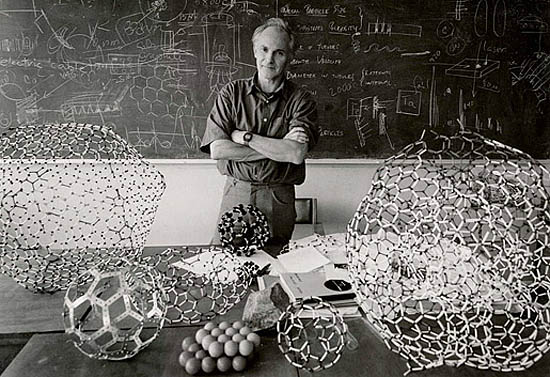
When Euroscientist met with Nobel Laureate Harold Kroto in June 2015 at the Lindau Nobel Laureate Meeting, he was sitting in a wheel chair, next to his wife Margaret. Kroto suffered from Lou Gehrig’s disease; the same condition which affects Stephen Hawking, as Kroto light-heartedly used to say in his last months. Complications of this disease led to his death on 30th April 2016. He was 76.
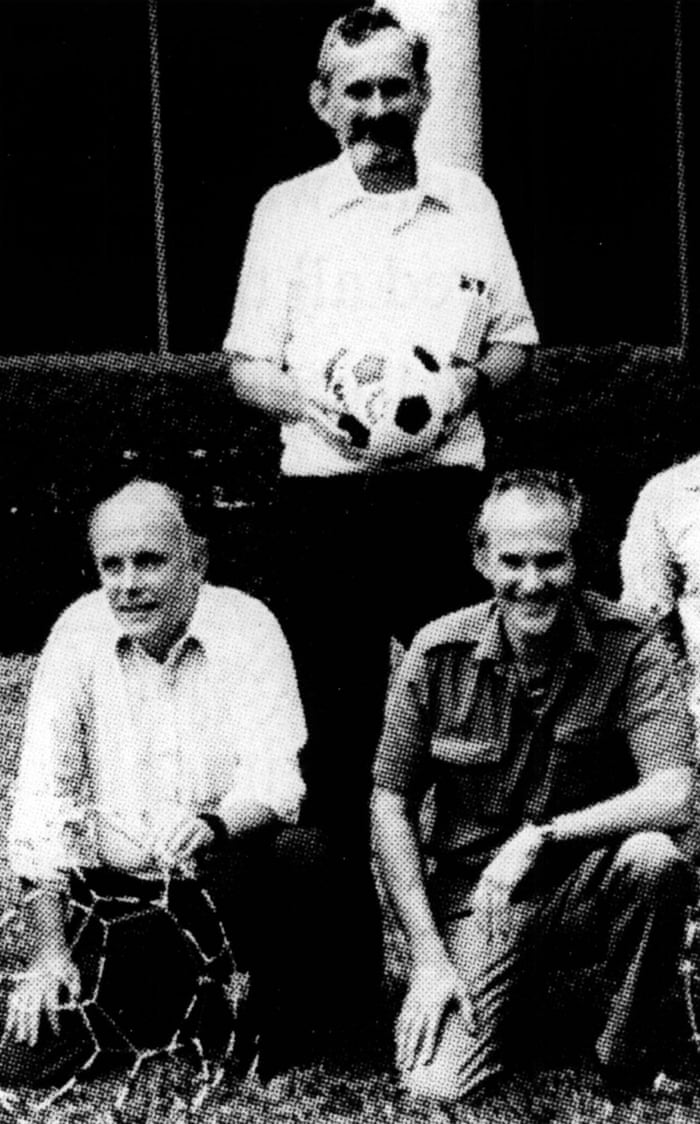
The British scientist shared the 1996 Chemistry Nobel Prize with Robert Curl and Richard Smalley for their discovery of the football-shaped molecules called fullerenes, because of an art-magazine right in front of him at the time of discovery, as he explains in this exclusive interview. Few weeks before, he had left the United States to go back to his native England, where he was born in 1939 to two German refugees.
Taking about his youth, he recalls being a brilliant and very versatile student, “The reports said I was tireless,” he told EuroScientist. His interests spanned from Geography, to Math and English writing. “people tell me I write well, with a sense of humour,” he confesses – drawing, music, and also sports, especially tennis. He jokingly admits, “I wanted to be a Wimbledon champion but I kept being beaten.”
He has a rather unconventional suggestion for young students: “I think it’s important for students to keep your options open, not to be focussed.”
And for chemistry, he said he did not have a passion, but rather a “ration”, a rational passion. “It was part of my life, and I never felt I was anything special,” he said humbly.
He, however, admits that, “In order to be a scientist, you have to be resilient like a punching ball, that comes back and hits you.” But his curiosity is what kept him trying even though “four out of five things I did, did not work.”
And he concludes with a monition that can be considered his legacy: “The universe is so beautiful – it’s just a pity that people are prepared to make weapons out of scientific discoveries1.”
Luca Tancredi Barone
_____

Related posts:
RESPONDING TO HARRY KROTO’S BRILLIANT RENOWNED ACADEMICS!! John Dunn, political theorist, Cambridge, “I am interested in how religious belief works and what it has meant but it is not [my] belief”
On November 21, 2014 I received a letter from Nobel Laureate Harry Kroto and it said: …Please click on this URL http://vimeo.com/26991975 and you will hear what far smarter people than I have to say on this matter. I agree with them. Harry Kroto I have attempted to respond to all of Dr. Kroto’s friends arguments […]

RESPONDING TO HARRY KROTO’S BRILLIANT RENOWNED ACADEMICS!! Pausing to take a look at the life of HARRY KROTO Part A
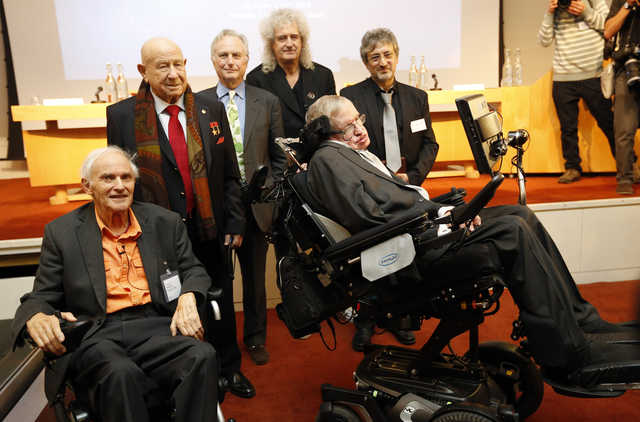
Communication at the The Royal Society Featuring: Professor Sir Harry Kroto, Alexei Leonov, Dr Richard Dawkins, Dr Brian May, Professor Stephen Hawking It is with sadness that I write this post having learned of the death of Sir Harold Kroto on April 30, 2016 at the age of 76. He was a scientist of […]

RESPONDING TO HARRY KROTO’S BRILLIANT RENOWNED ACADEMICS!! Haroon Ahmed, Physics Dept, Cambridge “I decided then as a thinking child that religion was not good for one”
On November 21, 2014 I received a letter from Nobel Laureate Harry Kroto and it said: …Please click on this URL http://vimeo.com/26991975 and you will hear what far smarter people than I have to say on this matter. I agree with them. Harry Kroto Nick Gathergood, David-Birkett, Harry-Kroto I have attempted to respond to all of […]
(The Nobel chemistry laureates Harold Kroto, Robert Curl and Richard Smalley)

RESPONDING TO HARRY KROTO’S RENOWNED ACADEMICS!! C.J. van Rijsbergen, Dept of Computing Science, University of Glasgow, “Martin Rees said, ‘I am a non-believing Christian.’ I thought yeah that is exactly quite close to what I am. In other words, I understand and I accept the culture that we have has come out of Christianity, but just because I accept it and go along with it and admire it actually, doesn’t mean to say that I have to also believe in God”
On November 21, 2014 I received a letter from Nobel Laureate Harry Kroto and it said: …Please click on this URL http://vimeo.com/26991975 and you will hear what far smarter people than I have to say on this matter. I agree with them. Harry Kroto I have attempted to respond to all of Dr. Kroto’s friends arguments […]

RESPONDING TO HARRY KROTO’S BRILLIANT RENOWNED ACADEMICS!! Part 80 Alison Richard, Yale University, Professor of Anthropology, “I would classify myself as an agnostic. You can not know enough to know that there is nothing you don’t understand…To sign up to a fully elaborated religious system of beliefs is something I can’t do.”
On November 21, 2014 I received a letter from Nobel Laureate Harry Kroto and it said: …Please click on this URL http://vimeo.com/26991975 and you will hear what far smarter people than I have to say on this matter. I agree with them. Harry Kroto I have attempted to respond to all of Dr. Kroto’s friends arguments […]
(Kroto and his wife, Margaret)

RESPONDING TO HARRY KROTO’S BRILLIANT RENOWNED ACADEMICS!! Part 79 Sir Patrick Bateson, biologist and science writer, emeritus professor of ethology at Cambridge “Darwin’s response when he was asked whether he was an atheist was …I think agnostic, I’m actually an atheist when all is said and done, I really don’t believe in a God!”
On November 21, 2014 I received a letter from Nobel Laureate Harry Kroto and it said: …Please click on this URL http://vimeo.com/26991975 and you will hear what far smarter people than I have to say on this matter. I agree with them. Harry Kroto Nick Gathergood, David-Birkett, Harry-Kroto I have attempted to respond to all of […]
RESPONDING TO HARRY KROTO’S BRILLIANT RENOWNED ACADEMICS!! Part 78 John Sulston, University of Manchester, “All the religions are in conflict with each other”
On November 21, 2014 I received a letter from Nobel Laureate Harry Kroto and it said: …Please click on this URL http://vimeo.com/26991975 and you will hear what far smarter people than I have to say on this matter. I agree with them. Harry Kroto I have attempted to respond to all of Dr. Kroto’s friends arguments […]
(Margaret and Harry Kroto with students at Lindau 2005)

RESPONDING TO HARRY KROTO’S BRILLIANT RENOWNED ACADEMICS!! Part 77 Gareth Stedman Jones, Centre for History and Economics, Magdalene College, “I quite like the rituals of the Church of England, but I don’t believe in God and all that; my position was reinforced by reading Hegel, at school I did read Bertrand Russell’s explanation of why he was not a Christian”
On November 21, 2014 I received a letter from Nobel Laureate Harry Kroto and it said: …Please click on this URL http://vimeo.com/26991975 and you will hear what far smarter people than I have to say on this matter. I agree with them. Harry Kroto Nick Gathergood, David-Birkett, Harry-Kroto I have attempted to respond to all of […]

RESPONDING TO HARRY KROTO’S BRILLIANT RENOWNED ACADEMICS!! Part 76 Lisa Jardine, Historian, University of London, “I received no religious training of any sort from my family… we are a secular family…”
On November 21, 2014 I received a letter from Nobel Laureate Harry Kroto and it said: …Please click on this URL http://vimeo.com/26991975 and you will hear what far smarter people than I have to say on this matter. I agree with them. Harry Kroto Nick Gathergood, David-Birkett, Harry-Kroto I have attempted to respond to all of […]
RESPONDING TO HARRY KROTO’S BRILLIANT RENOWNED ACADEMICS!! Part 75 Roger Penrose, Oxford University, mathematical physicist, “I tend to call myself an atheist versus agnostic but that doesn’t mean that I don’t have doubts…[though I don’t think religions are correct]…particularly the Christian religion”
On November 21, 2014 I received a letter from Nobel Laureate Harry Kroto and it said: …Please click on this URL http://vimeo.com/26991975 and you will hear what far smarter people than I have to say on this matter. I agree with them. Harry Kroto I have attempted to respond to all of Dr. Kroto’s friends arguments […]

RESPONDING TO HARRY KROTO’S BRILLIANT RENOWNED ACADEMICS!! Steven Pinker, Professor of Psychology, Harvard, and proponent of DETERMINISM, “THE MIND IS THE PRODUCT OF THE BRAIN, THE BRAIN IS THE PRODUCT OF EVOLUTION, THERE IS NO NEED TO INVOKE AN IMMATERIAL SOUL in understanding how the mind works”
On November 21, 2014 I received a letter from Nobel Laureate Harry Kroto and it said: …Please click on this URL http://vimeo.com/26991975 and you will hear what far smarter people than I have to say on this matter. I agree with them. Harry Kroto I have attempted to respond to all of Dr. Kroto’s friends arguments […]
(With his son Stephen in Joshua Tree)

RESPONDING TO HARRY KROTO’S BRILLIANT RENOWNED ACADEMICS!! John Sulston, University of Manchester, “All the religions are in conflict with each other”
__ On November 21, 2014 I received a letter from Nobel Laureate Harry Kroto and it said: …Please click on this URL http://vimeo.com/26991975 and you will hear what far smarter people than I have to say on this matter. I agree with them. Harry Kroto I have attempted to respond to all of Dr. Kroto’s friends […]

RESPONDING TO HARRY KROTO’S BRILLIANT RENOWNED ACADEMICS!! Part 74 VS Ramachandran, neuroscientist UC San Diego, “Things like creativity may go up to a certain point in explaining (the brain) or you have to start saying the divine sparkle or something that we scientists don’t believe in, eventually the answer is yes, we are going to explain many different aspects by brain function”
On November 21, 2014 I received a letter from Nobel Laureate Harry Kroto and it said: …Please click on this URL http://vimeo.com/26991975 and you will hear what far smarter people than I have to say on this matter. I agree with them. Harry Kroto Sir Harry Kroto, FSU’s Francis Eppes Professor of Chemistry I […]
(Marg Kroto with two sons Stephen and David)

RESPONDING TO HARRY KROTO’S BRILLIANT RENOWNED ACADEMICS!! Roger Penrose, Oxford University, mathematical physicist, “I tend to call myself an atheist versus agnostic but that doesn’t mean that I don’t have doubts…[though I don’t think religions are correct]…particularly the Christian religion”
On November 21, 2014 I received a letter from Nobel Laureate Harry Kroto and it said: …Please click on this URL http://vimeo.com/26991975 and you will hear what far smarter people than I have to say on this matter. I agree with them. Harry Kroto I have attempted to respond to all of Dr. Kroto’s friends arguments […]

RESPONDING TO HARRY KROTO’S BRILLIANT RENOWNED ACADEMICS!! Part 73 Mahzarin Banaji, Harvard, “I was born into a Zoroastrian family, and I stopped believing roughly around the age of 8!”
On November 21, 2014 I received a letter from Nobel Laureate Harry Kroto and it said: …Please click on this URL http://vimeo.com/26991975 and you will hear what far smarter people than I have to say on this matter. I agree with them. Harry Kroto Wikipedia notes: Mahzarin Banaji From Wikipedia, the free encyclopedia [hide]This article has […]
(With Marg in 1964)

RESPONDING TO HARRY KROTO’S BRILLIANT RENOWNED ACADEMICS!! A.C.Grayling, Philosopher, “If you think that the reasons you have for believing in fairies are very poor reasons; that it is irrational to think that there are such things, then the belief in supernatural agencies in general is equally as irrational”
On November 21, 2014 I received a letter from Nobel Laureate Harry Kroto and it said: …Please click on this URL http://vimeo.com/26991975 and you will hear what far smarter people than I have to say on this matter. I agree with them. Harry Kroto Wikipedia notes: Anthony Clifford “A. C.” Grayling (/ˈɡreɪlɪŋ/; born 3 April 1949) […]
RESPONDING TO HARRY KROTO’S BRILLIANT RENOWNED ACADEMICS!! Part 72 Riccardo Giacconi, Nobel Prize-winning astrophysicist, Johns Hopkins University. ” Irrational thinking of any kind is very dangerous”
On November 21, 2014 I received a letter from Nobel Laureate Harry Kroto and it said: …Please click on this URL http://vimeo.com/26991975 and you will hear what far smarter people than I have to say on this matter. I agree with them. Harry Kroto _________________ Below you have picture of Dr. Harry Kroto: ______________ I have […]

__________


 The Daily Hatch