Monthly Archives: December 2013

The Pilgrims, George Washington, Reason TV, Al Mohler and the Purpose of Thanksgiving!!!!

The Pilgrims, George Washington, Reason TV, Al Mohler and the Purpose of Thanksgiving!!!!

_____________

I want to make three points today. 1. When the colonists created the Plymouth Colony, they used a socialist model but they soon found out that capitalism works much better than socialism and people will always act in their own self-interest. 2.  In 1789, President George Washington declared the first national day of Thanksgiving by asking Americans to “unite in most humbly offering our prayer and supplications to the great Lord and Ruler of nations” and many presidents have followed suit in recognizing that thanking God is the purpose of Thanksgiving in the USA. 3. Atheists are always frustrated by the Thanksgiving holiday.

Let me start off with point 3. Notice in this video below by Reason TV that they suggest we thank the pilgrims for recognizing that capitalism works better than socialism. Although I agree that the Pilgrims discovered this we don’t need to abandon the true purpose of Thanksgiving. Al Mohler rightly notes:

Millions of Americans will, no doubt, celebrate an essentially secular festival. For them, it might as well be “Turkey Day” or something equally vacuous. This reveals the most important contrast between the Pilgrims and the current generation. The Pilgrims were driven by a worldview that was centered in the worship of the one true and living God, the Creator of the universe, the Father of the Lord Jesus Christ. They understood His providential rule over the universe to explain everything that happened to them–and everything that blessed them. They did not attribute their survival in New England to their own fortitude–nor to the help of the Indians–but to God.

Secularized Americans are driven by no impulse to give thanks, and wouldn’t know to whom thanks should be addressed. They think of themselves as self-sufficient, self-directed, and self-reliant. Their horizon of thankfulness is, to say the least, rather low.

The civic holiday may not mean a great deal to many moderns–but that doesn’t mean that it is meaningless. At the very least, it implies that we cannot really take care of ourselves. That is just as true today as it was in Pilgrim New England.

Christians understand that the call to thanksgiving is far more urgent than a holiday, and far more important than the calendar. True thanksgiving cannot be limited to a day or a season. We recognize that God has given us everything that we have–and everything that we need. We acknowledge our unconditional dependence upon Him for every second of our lives, every morsel we will eat, and every joy we will ever experience.

The genius of capitalism is that there is a link between effort and reward. In a genuine market economy (as opposed to cronyism), people can only make themselves rich by working harder and smarter to satisfy the needs and wants of others.

The blunder of statism is that the link between effort and reward is damaged. Punitive tax rates, for instance, punish people for producing. Redistribution programs, meanwhile, create incentives for dependency. And regulation throws lots of sand in the gears of the economy, while also creating big opportunities for corrupt cronyism.

I sometimes try to make this clear by citing the failure of communism. And by failure, I’m not talking about the brutality of Soviet-style dictatorships. Instead, I’m referring to the basic failure of state-controlled economies. Heck, places such as Cuba and Venezuela can’t even produce enough toilet paper!

And North Korea is such a basket case that it reduced physical requirements for military service after pervasive famine led to a stunted generation.

But I don’t want anyone to accuse me of red-baiting, so let’s pretend communism never existed and look at an unfortunate episode from American history.

When the colonists created the Plymouth Colony, they used a socialist model. This video from Reason TV explains how that system foundered.

The Pilgrims and Property Rights: How our ancestors got fat & happy

Uploaded on Nov 23, 2010

The Pilgrims founded their colony at Plymouth Plantation in December 1620 and promptly started dying off in droves.

As the colony’s early governor, William Bradford, wrote in “Of Plymouth Plantation”:

“That which was most sadd & lamentable was, that in 2. or 3. moneths time halfe of their company dyed.”

When the settlers finally stopped croaking, they set about creating a heaven on earth, a society without private property, where all worked for the common good. Everything was shared. Especially bitching and moaning about working for the common good. Bradford again:

“Yong-men that were most able and fitte for labour and service did repine that they should spend their time and streingth to worke for other mens wives and children, with out any recompense….And for men’s wives to be commanded to doe service for other men, as dresing their meate, washing their cloaths, etc., they deemed it a kind of slavery, neither could many husbands well brooke it.”

With nobody working, everybody was suffering. And in case you think nobody was working simply because they couldn’t understand a damn thing Bradford was saying, chew on this: In 1623, Bradford and the other leaders

“Assigned to every family a parceel of land…this had very good success; for it made all hands very industrious, so as much more torne was planted then other waise would have bene by any means the Govr or any other could use, and saved him a great deall of trouble, and gave farr better contente.”

The Pilgrims, George Washington, Reason TV, Al Mohler and the Purpose of Thanksgiving!!!!

In no time at all “any generall wante of famine hath not been amongest them since to this day.”

America would never go hungry again. So this week, before you drift into your annual tryptophan-induced coma, don’t forget to give thanks to the true patron of this holiday feast: property rights.

For more on this topic, including controversy over whether the pilgrims were proto-communists, go to http://reason.tv/video/show/1515

Approximately 2.30 minutes.

Produced by Meredith Bragg and Nick Gillespie. Voices by Meredith Bragg and Austin Bragg.

Go to http://reason.tv for downloadable versions of all our videos.

Subscribe to Reason.tv’s YouTube channel to receive automatic notification when new material goes live.

_________________________________________

Gee, what a surprise. Socialism was the problem and capitalism was the solution. When you give people property rights and establish a clear link between effort and reward, good things happen.

As Bono now understands. More remarkable, even Obama once said we should “let the market work.” So maybe there’s hope.

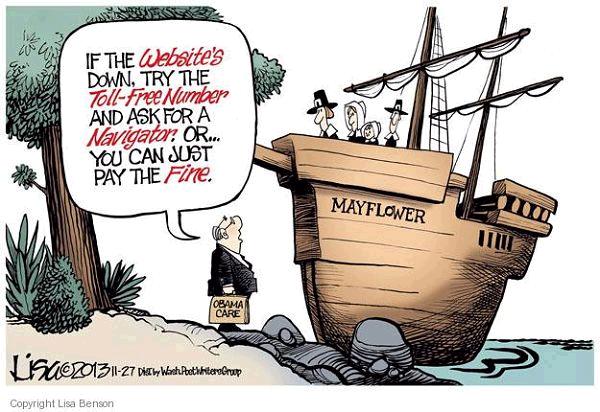
In honor of the season, let’s share a few more Thanksgiving cartoons, all of which – as you might expect – make fun of Obamacare.

Continuing a theme from some of yesterday’s cartoons, we have the Turkey of the Year.

TG II Cartoon 1

And an observation on how well the law is working.

TG II Cartoon 2

This Lisa Benson cartoon is very appropriate since the Mayflower carried the first colonists to Plymouth.
TG II Cartoon 3

P.S. I don’t want to pass up this opportunity for some well-deserved mockery of the evil philosophy of communism,. You can see some great Reagan jokes in the fourth video of this link and the first video in this link. And this doctored image makes a very powerful point in an amusing fashion.

P.P.S. Back in 2010, I also debunked the leftist counter-argument in a post that included the Reason video and a John Stossel column on the topic of the Pilgrims and property rights.

_____________

The article below is by Al Mohler:

Wednesday • November 23, 2005

Why Thanksgiving Matters

The holiday police are at it again–looking for violations of the nation’s new policy of separating faith and civic celebrations. The same folks who will soon be trolling courthouse squares looking for manger scenes are now calling on Americans to have a happy Thanksgiving . . . but leave God out of it.

School textbooks filled with revisionist history tell children that the first Thanksgiving was a celebration at which the Pilgrims thanked the Indians for teaching them how to survive the harsh New England climate and plant successful crops. God is simply not part of the picture.

Some educators, worried that even the word “thanksgiving” might be too controversial, have renamed the holiday “Turkey Day.” Of course, this implies that the central thrust of the celebration comes down to poultry.

The revisionist historians want to have it both ways. They present the Pilgrims as wild-eyed religious fanatics–precursors to the Religious Right–and then suggest that the first Thanksgiving was essentially a secular holiday.

The historical basis for the Thanksgiving observance is clear. In 1621, the Pilgrims celebrated “the goodness of God” as they feasted with friendly local Indians. In reality, the Pilgrims had faced far greater adversity than had been expected. The climate was harsh, the crops were sparse, the native peoples were often hostile, and their ranks were thinning. Hunger, disease, discomfort, and discouragement were ever close at hand.

Aiming for Virginia, these Christians–dissenting from the Church of England and determined to establish a truly Christian community–actually landed in New England. That miscalculation meant that disaster was almost certain. Nevertheless, they “fell upon their knees and blessed the God of heaven who had brought them over this vast and furious ocean,” recorded Governor William Bradford.

In 1789, President George Washington declared the first national day of Thanksgiving by asking Americans to “unite in most humbly offering our prayer and supplications to the great Lord and Ruler of nations.”

Later presidents followed Washington’s example. Abraham Lincoln issued moving Thanksgiving proclamations during the Civil War. Franklin Roosevelt, who regularized the holiday on the national calendar, called the nation to thankfulness in the middle of World War II: “The Almighty God has blessed our nation in many ways. He has given our people stout hearts and strong arms with which to strike mighty blows for freedom and truth…. So we pray to Him now for a vision to see our way clearly–to see the way that leads to a better life for ourselves and for our fellow men–to the achievement of His will, to peace on earth.”

Is all this just a demonstration of civil religion? Do most Americans really follow the example of the Pilgrims in expressing thankfulness to God, or is it just another holiday with emotional overtones–and an orgy of overeating?

Millions of Americans will, no doubt, celebrate an essentially secular festival. For them, it might as well be “Turkey Day” or something equally vacuous. This reveals the most important contrast between the Pilgrims and the current generation. The Pilgrims were driven by a worldview that was centered in the worship of the one true and living God, the Creator of the universe, the Father of the Lord Jesus Christ. They understood His providential rule over the universe to explain everything that happened to them–and everything that blessed them. They did not attribute their survival in New England to their own fortitude–nor to the help of the Indians–but to God.

Secularized Americans are driven by no impulse to give thanks, and wouldn’t know to whom thanks should be addressed. They think of themselves as self-sufficient, self-directed, and self-reliant. Their horizon of thankfulness is, to say the least, rather low.

The civic holiday may not mean a great deal to many moderns–but that doesn’t mean that it is meaningless. At the very least, it implies that we cannot really take care of ourselves. That is just as true today as it was in Pilgrim New England.

Christians understand that the call to thanksgiving is far more urgent than a holiday, and far more important than the calendar. True thanksgiving cannot be limited to a day or a season. We recognize that God has given us everything that we have–and everything that we need. We acknowledge our unconditional dependence upon Him for every second of our lives, every morsel we will eat, and every joy we will ever experience.

Deserving nothing but God’s wrath, we were granted forgiveness through the Son. Needing all things, we have been given everything needful for our salvation and eternal life. To these God has added joys, comforts, and provision beyond our imagination–”far more abundantly than all that we ask or think.” [Ephesians 3:20]

So, gather together to give thanks to God. While others celebrate “Turkey Day” and ponder poultry, direct your thoughts to the God of Heaven, by whose hand we have been brought near and given more than we can even remember.

The Pilgrims knew to whom they were praying–and why. Let’s follow their example and remember that their dependence upon God was no greater than our own.

Related posts:

Proclamation – Thanksgiving Day – 1863

Abraham Lincoln (Daniel Day-Lewis) Spielberg’s film follows 56-year-old Abraham Lincoln, the 16th president of the United States, from January of 1865 until his death in April. The portrait on the left was taken in 1864. _________- From David Barton’s website: Proclamation – Thanksgiving Day – 1863 Abraham Lincoln – 10/03/1863 v\:* { BEHAVIOR: url(#default#VML) } o\:* […]

John Hancock’s Thanksgiving proclamation

America’s Founding Fathers Deist or Christian? – David Barton 1/6 I enjoyed this and wanted to pass it on from Wallbuilders: John Hancock – 10/05/1791 The following is the text of a Proclamation for a Day of Thanksgiving and Praise, issued by John Hancock (Signer of the Declaration of Independence), while he was serving as […]

Open letter to President Obama (Part 467) (Saving Schaeffer by Jackson Watts)

Open letter to President Obama (Part 467)

(Emailed to White House on 5-3-13.)

President Obama c/o The White House 1600 Pennsylvania Avenue NW Washington, DC 20500

Dear Mr. President,

I know that you receive 20,000 letters a day and that you actually read 10 of them every day. I really do respect you for trying to get a pulse on what is going on out here. I have a pro-life point of view because I am a Christian and I base my views on an interpretation of the Bible. Francis Schaeffer’s teachings probably influenced me more in this area than any other person. In 1979 he teamed up with Dr. C. Everett Koop and put together the film series WHATEVER HAPPENED TO THE HUMAN RACE? and here is the first episode with covers the issue of abortion. Since you are also a Christian Mr. President I thought would take a great interest in what they had to say.

Francis Schaeffer Whatever Happened to the Human Race (Episode 1) ABORTION

Francis Schaeffer: What Ever Happened to the Human Race? (Full-Length Documentary)


Part 1 on abortion runs from 00:00 to 39:50, Part 2 on Infanticide runs from 39:50 to 1:21:30, Part 3 on Youth Euthanasia runs from 1:21:30 to 1:45:40, Part 4 on the basis of human dignity runs from 1:45:40 to 2:24:45 and Part 5 on the basis of truth runs from 2:24:45 to 3:00:04

Below you will see more about my pro-life views.

____________________

Episode 8: The Age Of Fragmentation

Published on Jul 24, 2012

Dr. Schaeffer’s sweeping epic on the rise and decline of Western thought and Culture

_______________________

I love the works of Francis Schaeffer and I have been on the internet reading several blogs that talk about Schaeffer’s work and the work below by Jackson Watts was really helpful. Schaeffer’s film series “How should we then live?  Wikipedia notes, “According to Schaeffer, How Should We Then Live traces Western history from Ancient Rome until the time of writing (1976) along three lines: the philosophic, scientific, and religious.[3] He also makes extensive references to art and architecture as a means of showing how these movements reflected changing patterns of thought through time. Schaeffer’s central premise is: when we base society on the Bible, on the infinite-personal God who is there and has spoken,[4] this provides an absolute by which we can conduct our lives and by which we can judge society.  Here are some posts I have done on this series: Francis Schaeffer’s “How should we then live?” Video and outline of episode 10 “Final Choices” episode 9 “The Age of Personal Peace and Affluence”episode 8 “The Age of Fragmentation”episode 7 “The Age of Non-Reason” episode 6 “The Scientific Age”  episode 5 “The Revolutionary Age” episode 4 “The Reformation” episode 3 “The Renaissance”episode 2 “The Middle Ages,”, and  episode 1 “The Roman Age,” .

In the film series “WHATEVER HAPPENED TO THE HUMAN RACE?” the arguments are presented  against abortion (Episode 1),  infanticide (Episode 2),   euthanasia (Episode 3), and then there is a discussion of the Christian versus Humanist worldview concerning the issue of “the basis for human dignity” in Episode 4 and then in the last episode a close look at the truth claims of the Bible.

Saving Schaeffer

Nov 26, 2012 by 

On a shelf in the library archives of Southeastern Baptist Theological Seminary is a box. Inside is an aging, well-worn Bible. Finding a Bible in a library is nothing special—but this one is. It, along with thousands of letters, cassette tapes, and videos comprise the Francis Schaeffer literary estate.

While many Christians aren’t familiar with his books, many have heard his name. Some have even seen pictures of this unique man donning knickers and a scraggly goatee, who has been dead nearly 30 years [1]. Unfortunately, a number of writers in recent years have criticized him. Some of these critiques relate to his early life in American fundamentalism. Others concern his association with Religious Right politics. Still others criticize his brand of Reformed theology, claiming that it was undermined by his apologetic tactics.

Though debate concerning Schaeffer’s legacy will continue, his influential ministry was marked by an emphasis on the Christian worldview and Reformation thought. Because of this, a summary of Schaeffer’s contributions is a fitting way to conclude this emphasis month. My hope is also that this essay will have some collateral impact on the portraits of Schaeffer that often obscure his important contributions to evangelical faith.

Community

The Schaeffers’ most significant contribution didn’t occur pastoring in America. Though he began and ended his life on American soil, their most fruitful ministry occurred in the Swiss Alps. There Francis and Edith ministered to countless seekers, skeptics, and young Christians at their retreat center known as L’Abri (French for “shelter”). Many who visited were either converted or prompted to significant achievement, including Os Guinness (prolific author), William Edgar (Westminster Seminary), Jerram Barrs (Covenant Seminary), Nancy Pearcey (Houston Baptist University), and countless others.

It was within the context of L’Abri that many experienced love, authentic community, and engagement with serious ideas. Despite the commitment to Christian thought and persuasion, “there was more going on at L’Abri than merely an intellectual defense of the Christian faith” [2]. The Schaeffers’ work began there in 1955 and continued until they were detained in the states for ministry and Francis’ battle with cancer. Today, L’Abri has spawned study centers in over half a dozen other foreign countries.

Influence

In God and the Philosophers, Thomas Morris presents a collection of essays by professional philosophers in which they describe their religious and intellectual journeys. Interestingly, Schaeffer was an early influence on four of the contributors. Jerry Walls explains, “Reading Schaeffer transformed my understanding of Christianity. He helped me to think of my faith in a much more comprehensive fashion than I had done before” [3].

Besides the Schaeffers’ ministry in Switzerland, Francis occasionally lectured on American university campuses—Christian and secular. While not all would be equally congenial to Schaeffer’s generalist approach, he would gain the admiration of Chuck Colson (1931-2012) and others through public lectures and private correspondence.

There were others with whom Schaeffer partnered who God used to assist Schaeffer in his ministry. Several stand out. For instance, during Schaeffer’s travels, he met Hans Rookmaaker who eventually became a significant art critic. Rookmaaker contributed to the aesthetic analysis Schaeffer offered in both Art & the Bible (1973) and How Should We Then Live? (1976).

Another important collaborator was C. Everett Koop, the eventual Surgeon General during the Reagan administration. Koop administered care to two of Schaeffer’s children and eventually helped him produce Whatever Happened to the Human Race? This book/film brought attention to the crisis surrounding abortion, infanticide, and euthanasia in a way that few had until this point. Schaeffer’s influence in the political realm eventually extended to both President Gerald Ford and Senator Jack Kemp.

Like all significant figures, some of Schaeffer’s relationships were strained due to disagreement. His early break from the Orthodox Presbyterian Church was reflective of the separatism common to fundamentalism. Although the Schaeffers served as missionaries and worked with several organizations, they believed separation was sometimes spiritually warranted.

Some of Francis Schaeffer’s most contentious disputes occurred nearer to the end of his life. His A Christian Manifesto (1981) was indicative of a deeply held conviction about America’s Christian heritage and how that should inform public policy. This led to a lengthy exchange between himself and historians Mark Noll and George Marsden. Francis would also have a brief, sharp correspondence with Karl Barth as he saw a new form of liberalism gaining traction in American thought.

Apologetics

Schaeffer’s apologetics was peculiar such that it has prompted much evaluation. His approach combined a nuanced use of logic and attention to the existential crisis of man. His apologetics was “pre-evangelistic” in that it always had conversion as the ultimate aim. Though Schaeffer was taught by Cornelius Van Til, his approach was more eclectic. While he drew from his former teacher’s emphasis on presuppositions, he practiced what Gordon Lewis calls “verificationism.” Christian truth claims are tested against the metaphysical, epistemological, and moral necessities that Schaeffer felt many would acknowledge.

The lasting legacy of his approach is two-fold. First, his concept of “taking the roof off” is valuable. In this, Schaeffer would attempt to show how the conceptual framework within which many attempted to live was inadequate. This approach forced unbelievers to see how their faulty worldviews led to consequences they weren’t prepared to accept.

Schaeffer’s second apologetic emphasis was sharing the truth with love [4]. While it would be easy to reduce this to winsomeness, it is tied closely with the prior contribution. Schaeffer used everything from popular music, the regnant drug culture, or other aspects of society to show the futility of false worldviews. Yet this was always coupled with a loving demeanor—much like the one Schaeffer taught in The Mark of a Christian (1970) and The Church Before the Watching World (1971).

Today

That Schaeffer needs “saving” rests on the assumption that his work is of little-to-no value today. The proverbial page needs to be turned. Jeff Jordan of the University of Delaware notes that while he profited from reading nearly every Schaeffer book during college, he concedes that “it seems to me today that Schaeffer’s work, in the end, is too general and of limited value.” Yet Jordan follows this by saying, “Nonetheless, he had a powerful effect on many people of my generation, opening our eyes to the rich interplay possible between Christian faith and the great ideas of philosophy” [5].

Many acknowledge that Schaeffer’s most important contribution was inspiring a generation to realize that Christianity speaks to all of life. However, he accomplished this because of his ability to evaluate the trajectory of ideas. He understood their consequences and antecedents. Furthermore, he knew how to equip Christians to make sense of them. Consider the following:

– Schaeffer never wrote a treatise on postmodernity, but he certainly anticipated it as he spoke of despair, synthesis, and the contradictions of life and theology not founded on Christian premises.

– He warned of a coming generation that would be characterized by relativism of the likes of which the church had never seen.

– In works such as Death in the City (1969) and Pollution and the Death of Man (1970) he offered insight into the coming ecological crisis, the complexity of modern, industrial life, and how Christianity addressed it. In other words, Schaeffer was talking about creation care before evangelicals were having conferences on the subject [6].

 In No Final Conflict (1975) he anticipated the coming conflict over the Scriptures that would endure beyond his time. Additionally, his Genesis in Space and Time (1972)would address the corollary issue of the historicity of the Genesis account—an issue still sparking great controversy.

– Schaeffer introduced many idiosyncratic phrases such as “true truth,” the “line of despair,” the “final apologetic,” as well as the difference between “upper-story” and “lower-story” truths.

Though Schaeffer was a generalist who erred in his analysis (particularly of Aquinas and Kierkegaard), no other evangelical has offered such an overarching Christian assessment of Western thought and culture.

Tomorrow

Holding Francis Schaeffer’s Bible was surreal. It reminded me of a simpler portrait of Schaeffer—one of a thoughtful evangelist whose books gave young Christians permission to think about how Christianity touched all of life. It is “true truth,” as he would say. In his award-winning book, Barry Hankins says,

Many Christian scholars today criticize Schaeffer, not only because of [his] reliance on modern rationalism, but even more because of his interpretation of the course of western intellectual history, what he called ‘the flow’, was problematic in its details. Some Christian scholars who critique Schaeffer’s arguments, however, might not be scholars at all if not for his influence [7].

Twenty-first century Christians should likewise consider the influences that have forged the legacy they have inherited. For those wanting an instructive example for ministry in contemporary culture, Schaeffer’s legacy offers much. Alongside the contributions of Luther, Kuyper, and Lewis, Schaeffer’s work remains a valuable component for cultivating a Christian worldview in the spirit of the Reformation.

_______________________________________

[1] (b. 30 January 1912; d. 15 May 1984)

[2] Barry Hankins, Francis Schaeffer and the Shaping of Evangelical America (Grand Rapids, Eerdmans, 2008), 72.

[3] Jerry L. Walls, “On Keeping the Faith,” in God and the Philosophers: the Reconciliation of Faith and Reason, ed. Thomas V. Morris (New York: Oxford University Press, 1994), 107.

[4] Bryan Follis’ work found in the bibliography below is the best book-length summary of Schaeffer’s apologetic. However, there are many other articles and individual book-chapters that speak to this.

[5] Jeff Jordan, “Not in Kansas Anymore,” in God and the Philosophers, 132.

[6] Ironically, the annual meeting of the Evangelical Theological Society was held on November 14-15 in Milwaukee, WI. The theme: Caring for Creation.

[7] Hankins, xiv-xv.

_______________________________________

Selected Biographical Works:

Scott Burson & Jerry Walls, C. S. Lewis & Francis Schaeffer: Lessons for a New Century from the Most Influential Apologists of Our Time (IVP Books, 1998).

Lane T. Dennis, editor. Letters of Francis Schaeffer: Spiritual Reality in the Personal Christian Life (Crossway, 1986).

Colin Duriez, Francis Schaeffer: An Authentic Life (Crossway, 2008).

Bryan Follis, Truth with Love: The Apologetics of Francis Schaeffer (Crossway, 2006)

Bruce A. Little, ed. Francis Schaffer: A Mind and Heart for God (P&R, 2010)

Thomas V. Morris, Francis Schaeffer’s Apologetics: A Critique (Baker Books, 1987)

David Outlaw, “An Overview of Francis Schaeffer’s Worldview.” Integrity: A Journal of Christian Thought (FWB Commission for Theology Integrity, 2006).

Louis Gifford Parkhurst, Francis Schaeffer: The Man and His Message (Kingsway, 1986).

Ronald W. Ruegsegger, editor. Reflections on Francis Schaeffer (Zondervan, 1986)

_______________________________________

Selected Works of Schaeffer:

The God Who is There (1968)

Escape from Reason (1968)

He is There and He is Not Silent (1972)

The Mark of a Christian (1970)

True Spirituality (1971)

How Should We Then Live? (1976)

The Great Evangelical Disaster (1984)

Francis Schaeffer

__________________________

______________________

Thank you so much for your time. I know how valuable it is. I also appreciate the fine family that you have and your commitment as a father and a husband.

Sincerely,

Everette Hatcher III, 13900 Cottontail Lane, Alexander, AR 72002, ph 501-920-5733, lowcostsqueegees@yahoo.com

Related posts:

Taking on Ark Times Bloggers on various issues Part A “The Pro-life Issue” (Francis Schaeffer Quotes Part 1 includes the film SLAUGHTER OF THE INNOCENTS) (editorial cartoon)

I have gone back and forth and back and forth with many liberals on the Arkansas Times Blog on many issues such as abortion, human rights, welfare, poverty, gun control  and issues dealing with popular culture. Here is another exchange I had with them a while back. My username at the Ark Times Blog is Saline […]

“Schaeffer Sunday” Francis Schaeffer: “Whatever Happened to the Human Race” (Episode 1) ABORTION OF THE HUMAN RACE

It is not possible to know where the pro-life evangelicals are coming from unless you look at the work of the person who inspired them the most. That person was Francis Schaeffer.  I do care about economic issues but the pro-life issue is the most important to me. Several years ago Adrian Rogers (past president of […]

The movie “Les Miserables” and Francis Schaeffer

I got this off a Christian blog spot. This person makes some good points and quotes my favorite Christian philosopher Francis Schaeffer too. Prostitution, Chaos, and Christian Art The newest theatrical release of Victor Hugo’s 1862 novel “Les Miserables” was released on Christmas, but many Christians are refusing to see the movie. The reason simple — […]

“Schaeffer Sunday” Francis Schaeffer is one of the great evangelical theologians of our modern day

Francis Schaeffer was truly a great man and I enjoyed reading his books. A theologian #2: Rev. Francis Schaeffer Duriez, Colin. Francis Schaeffer: An Authentic Life. Wheaton, IL: Crossway Books, 2008. Pp. 240. Francis Schaeffer is one of the great evangelical theologians of our modern day. I was already familiar with some of his books and his […]

“Schaeffer Sundays” Francis Schaeffer’s own words concerning infanticide and youth enthansia

Francis Schaeffer: “Whatever Happened to the Human Race?” (Episode 2) SLAUGHTER OF THE INNOCENTS Published on Oct 6, 2012 by AdamMetropolis ___________ The 45 minute video above is from the film series created from Francis Schaeffer’s book “Whatever Happened to the Human Race?” with Dr. C. Everett Koop. This book  really helped develop my political views […]

Francis Schaeffer’s wife Edith passes away on Easter weekend 2013 Part 7 (includes pro-life editorial cartoon)

The Francis and Edith Schaeffer Story Pt.1 – Today’s Christian Videos The Francis and Edith Schaeffer Story – Part 3 of 3 Francis Schaeffer: “Whatever Happened to the Human Race” (Episode 1) ABORTION OF THE HUMAN RACE Published on Oct 6, 2012 by AdamMetropolis ________________ Picture of Francis Schaeffer and his wife Edith from the […]

The Mark of the Christian by Francis Schaeffer Part 1

  THE MARK OF A CHRISTIAN – CLASS 1 – Introduction Published on Mar 7, 2012 This is the introductory class on “The Mark Of A Christian” by Francis Schaeffer. The class was originally taught at Redeemer Presbyterian Church in Overland Park, KS by Dan Guinn from FrancisSchaefferStudies.org as part of the adult Sunday School hour […]

“Schaeffer Sundays” Francis Schaeffer’s own words concerning humanist dominated public schools in USA even though country was founded on a Christian base

Francis Schaeffer: “Whatever Happened to the Human Race?” (Episode 2) SLAUGHTER OF THE INNOCENTS Published on Oct 6, 2012 by AdamMetropolis The 45 minute video above is from the film series created from Francis Schaeffer’s book “Whatever Happened to the Human Race?” with Dr. C. Everett Koop. This book  really helped develop my political views concerning […]

“Schaeffer Sundays” Francis Schaeffer’s own words concerning where the Bible-believing Christians been the last few decades

Francis Schaeffer: “Whatever Happened to the Human Race” (Episode 1) ABORTION OF THE HUMAN RACE Published on Oct 6, 2012 by AdamMetropolis The 45 minute video above is from the film series created from Francis Schaeffer’s book “Whatever Happened to the Human Race?” with Dr. C. Everett Koop. This book  really helped develop my political views […]

Taking on Ark Times Bloggers on various issues Part E “Moral absolutes and abortion” Francis Schaeffer Quotes part 5(includes the film SLAUGHTER OF THE INNOCENTS) (editorial cartoon)

I have gone back and forth and back and forth with many liberals on the Arkansas Times Blog on many issues such as abortion, human rights, welfare, poverty, gun control  and issues dealing with popular culture. Here is another exchange I had with them a while back. My username at the Ark Times Blog is Saline […]

“Schaeffer Sundays” Francis Schaeffer’s own words concerning religious liberals and humanists

Francis Schaeffer: “Whatever Happened to the Human Race” (Episode 5) TRUTH AND HISTORY Published on Oct 7, 2012 by AdamMetropolis The 45 minute video above is from the film series created from Francis Schaeffer’s book “Whatever Happened to the Human Race?” with Dr. C. Everett Koop. This book  really helped develop my political views concerning abortion, […]

By Everette Hatcher III | Posted in Francis Schaeffer | Edit | Comments (0)

“Woody Wednesday” Discussing Woody Allen’s movie “Crimes and Misdemeanors” and various other subjects with Ark Times Bloggers (Part 4) “ON WHAT BASIS COULD YOU CONVINCE JUDAH IT WAS WRONG FOR HIM TO MURDER?”

Crimes and Misdemeanors: A Discussion: Part 1

Uploaded by on Sep 23, 2007

Part 1 of 3: ‘What Does Judah Believe?’
A discussion of Woody Allen’s 1989 movie, perhaps his finest.
By Anton Scamvougeras.

http://camdiscussion.blogspot.com/
antons@mail.ubc.ca

I have gone back and forth and back and forth with many liberals on the Arkansas Times Blog on many issues such as abortionhuman rightswelfarepovertygun control  and issues dealing with popular culture . This time around I have discussed morality with the Ark Times Bloggers and have used the examples given in Woody Allen’s movie “Crimes and Misdemeanors” to do so. With out God in the picture to punish the evildoers  in an afterlife, then can people do anything they want because “might makes right.”

Without the infinite-personal God of the Bible to reveal moral absolutes then man is left to embrace moral relativism. In a time plus chance universe man is reduced to a machine and can not find a place for values such as love. Both of Francis Schaeffer’s film series have tackled these subjects and he shows how this is reflected in the arts.

Here are some posts I have done on the series “HOW SHOULD WE THEN LIVE? : Francis Schaeffer’s “How should we then live?” Video and outline of episode 10 “Final Choices” episode 9 “The Age of Personal Peace and Affluence”episode 8 “The Age of Fragmentation”episode 7 “The Age of Non-Reason” episode 6 “The Scientific Age”  episode 5 “The Revolutionary Age” episode 4 “The Reformation” episode 3 “The Renaissance”episode 2 “The Middle Ages,”, and  episode 1 “The Roman Age,” .

In the film series “WHATEVER HAPPENED TO THE HUMAN RACE?” the arguments are presented  against abortion (Episode 1),  infanticide (Episode 2),   euthenasia (Episode 3), and then there is a discussion of the Christian versus Humanist worldview concerning the issue of “the basis for human dignity” in Episode 4 and then in the last episode a close look at the truth claims of the Bible.

In July of 2013 I got into this discussion about morality and the meaning of life with the Arkansas Times Bloggers:

I asserted:

Mudturtle, I want to personally thank you for answering the question, ON WHAT BASIS IS MURDER WRONG?

Your response is:

Because I think it is wrong for me. Internally….Yes. Apparently Christians can sit around saying, “Is it OK to murder? I don’t know yet, I’m only on Genesis” whereas every other culture seems to know it inherently, whether they believe in the God of Abraham or not.

_________________

Why do you have that belief internally that murder is wrong? 

The Bible tells us, “{God} has also set eternity in the hearts of men…” (Ecclesiastes 3:11 NIV). The secularist calls this an illusion, but the Bible tells us that the idea that we will survive the grave was planted in everyone’s heart by God Himself. Romans 1:19-21 tells us that God has instilled a conscience in everyone that points each of them to Him and tells them what is right and wrong (also Romans 2:14 -15). THAT IS WHY YOU (MUDTURTLE) SAY THAT MURDER IS WRONG AND THAT OTHER CULTURES SAY THAT TOO!!!

It’s no wonder, then, that one of your own fellow humanists would comment, “Certain moral truths — such as do not kill, do not steal, and do not lie — do have a special status of being not just ‘mere opinion’ but bulwarks of humanitarian action. I have no intention of saying, ‘I think Hitler was wrong.’ Hitler WAS wrong.” (Gloria Leitner, “A Perspective on Belief,” THE HUMANIST, May/June 1997, pp. 38-39)

Here Leitner is reasoning from her God-given conscience JUST LIKE YOU DO MUDTURTLE, and not from humanist philosophy. It wasn’t long before she received criticism. Humanist Abigail Ann Martin responded, “Neither am I an advocate of Hitler; however, by whose criteria is he evil?” (THE HUMANIST, September/October 1997, p. 2)

THIS IS EXACTLY WHAT HAPPENED IN THE MOVIE ‘CRIMES AND MISDEMEANORS” WHEN JUDAH STRUGGLED AT FIRST WITH THIS CONSCIENCE BUT THEN KILLED HIS OWN CONSCIENCE IN ORDER TO TAKE THE EASY WAY OUT. Look at how Romans 1 describes this process:


18 For God’s [holy] wrath and indignation are revealed from heaven against all ungodliness and unrighteousness of men, who in their wickedness repress and hinder the truth and make it inoperative.

19 FOR THAT WHICH IS KNOWN ABOUT GOD IS EVIDENT TO THEM AND MADE PLAIN IN THEIR INNER CONSCIOUSNESS, BECAUSE GOD (HIMSELF) HAS SHOWN IT TO THEM. 

20 FOR EVER SINCE THE CREATION OF THE WORLD His invisible nature and attributes, that is, His eternal power and divinity, HAVE BEEN MADE INTELLIGIBLE AND CLEARLY DISCERNIBLE in and through the things that have been made (His handiworks). So [men] are without excuse [altogether without any defense or justification],

21 Because when they knew and recognized Him as God, they did not honor and glorify Him as God or give Him thanks. But instead they became futile and [a]godless in their thinking [with vain imaginings, foolish reasoning, and stupid speculations] and their senseless minds were darkened.

22 Claiming to be wise, they became fools [professing to be smart, they made simpletons of themselves].

(By the way did you notice the two evidences given every person that God exists? In verse 19 we see the conscience put in everyone that tells a person that there is more than just breath in their body and in verse we see the testimony of the creation that everyone sees around them!!!)

Judah ‘s final conclusion was that might did make right. He observed that one day, because of this conclusion, he woke up and the cloud of guilt was gone. He was, as his aunt said, “home free.”

Woody Allen has exposed a weakness in his own humanistic view that God is not necessary as a basis for good ethics. There must be an enforcement factor in order to convince Judah not to resort to murder. Otherwise, it is fully to Judah ‘s advantage to remove this troublesome woman from his life.


The secularist can only give incomplete answers to these questions: HOW COULD YOU HAVE CONVINCED JUDAH NOT TO KILL? ON WHAT BASIS COULD YOU CONVINCE JUDAH IT WAS WRONG FOR HIM TO MURDER?

As Christians, we would agree with Judah ‘s father that “The eyes of God are always upon us.” Proverbs 5:21 asserts, “For the ways of man are before the eyes of the Lord, and He ponders all his paths.” Revelation 20:12 states, “…And the dead were judged (sentenced) by what they had done (their whole way of feeling and acting, their aims and endeavors) in accordance with what was recorded in the books” (Amplified Version). The Bible is revealed truth from God. It is the basis for our morality. Judah inherited the Jewish ethical values of the Ten Commandments from his father, but, through years of life as a skeptic, his standards had been lowered. Finally, we discover that Judah ‘s secular version of morality does not resemble his father’s biblical-based morality.

Related posts:

“Woody Wednesday” Another look at Woody Allen’s movie Crimes and Misdemeanors

I have spent alot of time talking about Woody Allen films on this blog and looking at his worldview. He has a hopeless, meaningless, nihilistic worldview that believes we are going to turn to dust and there is no afterlife. Even though he has this view he has taken the opportunity to look at the weaknesses of […]

“Woody Wednesday” In 2009 interview Woody Allen talks about the lack of meaning of life and the allure of younger women

Ecclesiastes 1 Published on Sep 4, 2012 Calvary Chapel Spring Valley | Sunday Evening | September 2, 2012 | Pastor Derek Neider _____________________ Ecclesiastes 2-3 Published on Sep 19, 2012 Calvary Chapel Spring Valley | Sunday Evening | September 16, 2012 | Derek Neider _____________________________ I have spent alot of time talking about Woody Allen films on […]

Another look at Woody Allen’s movie Crimes and Misdemeanors

I have spent alot of time talking about Woody Allen films on this blog and looking at his worldview. He has a hopeless, meaningless, nihilistic worldview that believes we are going to turn to dust and there is no afterlife. Even though he has this view he has taken the opportunity to look at the weaknesses of […]

Ecclesiastes and the subject of atheism

Ecclesiastes 8-10 | Still Searching After All These Years Published on Oct 9, 2012 Calvary Chapel Spring Valley | Sunday Evening | October 7, 2012 | Pastor Derek Neider _______________________ Ecclesiastes 11-12 | Solomon Finds His Way Published on Oct 30, 2012 Calvary Chapel Spring Valley | Sunday Evening | October 28, 2012 | Pastor Derek Neider […]

Ecclesiastes, Purpose, Meaning, and the Necessity of God by Suiwen Liang (Quotes Will Durant, Madalyn Murray O’Hair, Stephen Jay Gould,Richard Dawkins, Jean-Paul Sartre,Bertrand Russell, Leo Tolstoy, Loren Eiseley,Aldous Huxley, G.K. Chesterton, Ravi Zacharias, and C.S. Lewis.)

Ecclesiastes 2-3 Published on Sep 19, 2012 Calvary Chapel Spring Valley | Sunday Evening | September 16, 2012 | Derek Neider _____________________________ I have written on the Book of Ecclesiastes and the subject of the meaning of our lives on several occasions on this blog. In this series on Ecclesiastes I hope to show how secular […]

Ecclesiastes: Philosophical Atheist, Before you Commit Suicide Read Ecclesiastes (Quotes Sharon Rocha, Erik Wielenberg, the Declaration of Independence, Stephen Hawking, and Alan Sandage)

Ecclesiastes 1 Published on Sep 4, 2012 Calvary Chapel Spring Valley | Sunday Evening | September 2, 2012 | Pastor Derek Neider _____________________ I have written on the Book of Ecclesiastes and the subject of the meaning of our lives on several occasions on this blog. In this series on Ecclesiastes I hope to show how […]

Taking on Ark Times Bloggers on the “Absurdity of Life without God!!” Part 23 (The atheist without a moral lawgiver can not base his or her moral views on anything but moral relativism)

The Bible and Science (Part 03)

There Is A Difference Between Absolute and Objective Moral Values

Published on Dec 6, 2012

For more resources visit: http://www.reasonablefaith.org

The Bethinking National Apologetics Day Conference: “Countering the New Atheism” took place during the UK Reasonable Faith Tour in October 2011. Christian academics William Lane Craig, John Lennox, Peter J Williams and Gary Habermas lead 600 people in training on how to defend and proclaim the credibility of Christianity against the growing tide of secularism and New Atheist popular thought in western society.

In this session, William Lane Craig delivers his critique of Richard Dawkins’ objections to arguments for the existence of God, followed by questions and answers from the audience. In this clip, Dr Craig addresses a question about objective moral values and distinguishes them from absolute moral values.

Dr. Francis Schaeffer – The Biblical Flow of Truth & History (part 2)

Francis Schaeffer pictured below:

______________________________

_________________

Life without God in the picture is absurdity!!!. That was the view of King Solomon when he wrote the Book of Ecclesiastes 3000 years ago and it is the view of many of the modern philosophers todayModern man has tried to come up with a lasting meaning for life without God in the picture (life under the sun), but it is not possible. Without the infinite-personal God of the Bible to reveal moral absolutes then man is left to embrace moral relativism. In a time plus chance universe man is reduced to a machine and can not find a place for values such as love. Both of Francis Schaeffer’s film series have tackled these subjects and he shows how this is reflected in the arts.

Here are some posts I have done on the series “HOW SHOULD WE THEN LIVE? : Francis Schaeffer’s “How should we then live?” Video and outline of episode 10 “Final Choices” episode 9 “The Age of Personal Peace and Affluence”episode 8 “The Age of Fragmentation”episode 7 “The Age of Non-Reason” episode 6 “The Scientific Age”  episode 5 “The Revolutionary Age” episode 4 “The Reformation” episode 3 “The Renaissance”episode 2 “The Middle Ages,”, and  episode 1 “The Roman Age,” .

In the film series “WHATEVER HAPPENED TO THE HUMAN RACE?” the arguments are presented  against abortion (Episode 1),  infanticide (Episode 2),   euthenasia (Episode 3), and then there is a discussion of the Christian versus Humanist worldview concerning the issue of “the basis for human dignity” in Episode 4 and then in the last episode a close look at the truth claims of the Bible.

I have discussed many subjects with my liberal friends over at the Ark Times Blog in the past and I have taken them on now on the subject of the absurdity of life without God in the picture. Most of my responses included quotes from William Lane Craig’s book THE ABSURDITY OF LIFE WITHOUT GOD.  Here is the result of one of those encounters from June of 2013:

I wrote:

Vanessa, thank you for your thoughts. You wrote, “The afterlife: there’s good and there’s evil. Most people fall on one side or the other. The part of you that’s left when your earthly body turns to dust, or begins to turn to dust, becomes one with good or one with evil. The force. The force has nothing to do with the bible, which is still a decent history book and an outline for living a good life if you don’t get too literal with it.”
___________

Your view of the afterlife is a very popular view that is spreading to more parts of the world than ever before, but is it right? I have defended the truthfulness of the Bible and have given evidence to show that it is the revealed word of God. On what basis do you make your claims? WHAT IS EVIL AND WHAT IS GOOD ACCORDING TO YOU AND ON WHAT BASIS CAN YOU MAKE THOSE CLAIMS?

Evidently you do not believe in the infinite-personal God of the Bible. It sounds like to me that you are similar in your religious views to Steve Jobs. His views were based on evolution and he did not believe in a personal God. I have written about his views many times in the past.

https://thedailyhatch.org/2011/10/31/steve-…

The sad fact is that without a moral lawgiver then you can not base your moral views on anything but moral relativism. An atheistic religion just doesn’t cut it.

William Lane Craig noted:

The dilemma of modern man is thus truly terrible. The atheistic worldview is insufficient to maintain a happy and consistent life. Man cannot live consistently and happily as though life were ultimately without meaning, value, or purpose. If we try to live consistently within the framework of the atheistic worldview, we shall find ourselves profoundly unhappy. If instead we manage to live happily, it is only by giving the lie to our worldview.

Confronted with this dilemma, modern man flounders pathetically for some means of escape. In a remarkable address to the American Academy for the Advancement of Science in 1991, Dr. L. D. Rue, confronted with the predicament of modern man, boldly advocated that we deceive ourselves by means of some “Noble Lie” into thinking that we and the universe still have value.28 Claiming that “the lesson of the past two centuries is that intellectual and moral relativism is profoundly the case,” Dr. Rue muses that the consequence of such a realization is that one’s quest for personal wholeness (or self-fulfillment) and the quest for social coherence become independent from one another. This is because on the view of relativism the search for self-fulfillment becomes radically privatized: each person chooses his own set of values and meaning. “There is no final, objective reading on the world or the self. There is no universal vocabulary for integrating cosmology and morality.” If we are to avoid “the madhouse option,” where self-fulfillment is pursued regardless of social coherence, and “the totalitarian option,” where social coherence is imposed at the expense of personal wholeness, then we have no choice but to embrace some Noble Lie that will inspire us to live beyond selfish interests and so achieve social coherence. A Noble Lie “is one that deceives us, tricks us, compels us beyond self-interest, beyond ego, beyond family, nation, [and] race.” It is a lie, because it tells us that the universe is infused with value (which is a great fiction), because it makes a claim to universal truth (when there is none), and because it tells me not to live for self-interest (which is evidently false). “But without such lies, we cannot live.”

This is the dreadful verdict pronounced over modern man. In order to survive, he must live in self-deception. But even the Noble Lie option is in the end unworkable. For if what I have said thus far is correct, belief in a Noble Lie would not only be necessary to achieve social coherence and personal wholeness for the masses, but it would also be necessary to achieve one’s own personal wholeness. For one cannot live happily and consistently on an atheistic worldview. In order to be happy, one must believe in objective meaning, value, and purpose. But how can one believe in those Noble Lies while at the same time believing in atheism and relativism? The more convinced you are of the necessity of a Noble Lie, the less you are able to believe in it. Like a placebo, a Noble Lie works only on those who believe it is the truth. Once we have seen through the fiction, then the Lie has lost its power over us. Thus, ironically, the Noble Lie cannot solve the human predicament for anyone who has come to see that predicament.

The Noble Lie option therefore leads at best to a society in which an elitist group of illuminati deceive the masses for their own good by perpetuating the Noble Lie. But then why should those of us who are enlightened follow the masses in their deception? Why should we sacrifice self-interest for a fiction? If the great lesson of the past two centuries is moral and intellectual relativism, then why (if we could) pretend that we do not know this truth and live a lie instead? If one answers, “for the sake of social coherence,” one may legitimately ask why I should sacrifice my self-interest for the sake of social coherence. The only answer the relativist can give is that social coherence is in my self-interest—but the problem with this answer is that self-interest and the interest of the herd do not always coincide. Besides, if (out of self-interest) I do care about social coherence, the totalitarian option is always open to me: forget the Noble Lie and maintain social coherence (as well as my self-fulfillment) at the expense of the personal wholeness of the masses. Generations of Soviet leaders who extolled proletarian virtues while they rode in limousines and dined on caviar in their country dachas found this alternative quite workable. Rue would undoubtedly regard such an option as repugnant. But therein lies the rub. Rue’s dilemma is that he obviously values deeply both social coherence and personal wholeness for their own sakes; in other words, they are objective values, which according to his philosophy do not exist. He has already leapt to the upper story. The Noble Lie option thus affirms what it denies and so refutes itself.

Related posts:

Francis Schaeffer’s “How should we then live?” Video and outline of episode 10 “Final Choices” (Schaeffer Sundays)

E P I S O D E 1 0   Dr. Francis Schaeffer – Episode X – Final Choices 27 min FINAL CHOICES I. Authoritarianism the Only Humanistic Social Option One man or an elite giving authoritative arbitrary absolutes. A. Society is sole absolute in absence of other absolutes. B. But society has to be […]

Francis Schaeffer’s “How should we then live?” Video and outline of episode 9 “The Age of Personal Peace and Affluence” (Schaeffer Sundays)

E P I S O D E 9 Dr. Francis Schaeffer – Episode IX – The Age of Personal Peace and Affluence 27 min T h e Age of Personal Peace and Afflunce I. By the Early 1960s People Were Bombarded From Every Side by Modern Man’s Humanistic Thought II. Modern Form of Humanistic Thought Leads […]

Francis Schaeffer’s “How should we then live?” Video and outline of episode 8 “The Age of Fragmentation” (Schaeffer Sundays)

E P I S O D E 8 Dr. Francis Schaeffer – Episode VIII – The Age of Fragmentation 27 min I saw this film series in 1979 and it had a major impact on me. T h e Age of FRAGMENTATION I. Art As a Vehicle Of Modern Thought A. Impressionism (Monet, Renoir, Pissarro, Sisley, […]

Francis Schaeffer’s “How should we then live?” Video and outline of episode 7 “The Age of Non-Reason” (Schaeffer Sundays)

E P I S O D E 7 Dr. Francis Schaeffer – Episode VII – The Age of Non Reason I am thrilled to get this film series with you. I saw it first in 1979 and it had such a big impact on me. Today’s episode is where we see modern humanist man act […]

Francis Schaeffer’s “How should we then live?” Video and outline of episode 6 “The Scientific Age” (Schaeffer Sundays)

E P I S O D E 6 How Should We Then Live 6#1 Uploaded by NoMirrorHDDHrorriMoN on Oct 3, 2011 How Should We Then Live? Episode 6 of 12 ________ I am sharing with you a film series that I saw in 1979. In this film Francis Schaeffer asserted that was a shift in […]

Francis Schaeffer’s “How should we then live?” Video and outline of episode 5 “The Revolutionary Age” (Schaeffer Sundays)

E P I S O D E 5 How Should We Then Live? Episode 5: The Revolutionary Age I was impacted by this film series by Francis Schaeffer back in the 1970′s and I wanted to share it with you. Francis Schaeffer noted, “Reformation Did Not Bring Perfection. But gradually on basis of biblical teaching there […]

Francis Schaeffer’s “How should we then live?” Video and outline of episode 4 “The Reformation” (Schaeffer Sundays)

Dr. Francis Schaeffer – Episode IV – The Reformation 27 min I was impacted by this film series by Francis Schaeffer back in the 1970′s and I wanted to share it with you. Schaeffer makes three key points concerning the Reformation: “1. Erasmian Christian humanism rejected by Farel. 2. Bible gives needed answers not only as to […]

“Schaeffer Sundays” Francis Schaeffer’s “How should we then live?” Video and outline of episode 3 “The Renaissance”

Francis Schaeffer’s “How should we then live?” Video and outline of episode 3 “The Renaissance” Francis Schaeffer: “How Should We Then Live?” (Episode 3) THE RENAISSANCE I was impacted by this film series by Francis Schaeffer back in the 1970′s and I wanted to share it with you. Schaeffer really shows why we have so […]

Francis Schaeffer’s “How should we then live?” Video and outline of episode 2 “The Middle Ages” (Schaeffer Sundays)

  Francis Schaeffer: “How Should We Then Live?” (Episode 2) THE MIDDLE AGES I was impacted by this film series by Francis Schaeffer back in the 1970′s and I wanted to share it with you. Schaeffer points out that during this time period unfortunately we have the “Church’s deviation from early church’s teaching in regard […]

Francis Schaeffer’s “How should we then live?” Video and outline of episode 1 “The Roman Age” (Schaeffer Sundays)

Francis Schaeffer: “How Should We Then Live?” (Episode 1) THE ROMAN AGE   Today I am starting a series that really had a big impact on my life back in the 1970′s when I first saw it. There are ten parts and today is the first. Francis Schaeffer takes a look at Rome and why […]

Francis Schaeffer: “Whatever Happened to the Human Race” (Episode 5) TRUTH AND HISTORY

Francis Schaeffer: “Whatever Happened to the Human Race” (Episode 5) TRUTH AND HISTORY Published on Oct 7, 2012 by AdamMetropolis This crucial series is narrated by the late Dr. Francis Schaeffer and former Surgeon General Dr. C. Everett Koop. Today, choices are being made that undermine human rights at their most basic level. Practices once […]

Francis Schaeffer: “Whatever Happened to the Human Race” (Episode 4) THE BASIS FOR HUMAN DIGNITY

The opening song at the beginning of this episode is very insightful. Francis Schaeffer: “Whatever Happened to the Human Race” (Episode 4) THE BASIS FOR HUMAN DIGNITY Published on Oct 7, 2012 by AdamMetropolis This crucial series is narrated by the late Dr. Francis Schaeffer and former Surgeon General Dr. C. Everett Koop. Today, choices […]

Francis Schaeffer: “Whatever Happened to the Human Race” (Episode 3) DEATH BY SOMEONE’S CHOICE

Francis Schaeffer: “Whatever Happened to the Human Race” (Episode 3) DEATH BY SOMEONE’S CHOICE Published on Oct 6, 2012 by AdamMetropolis This crucial series is narrated by the late Dr. Francis Schaeffer and former Surgeon General Dr. C. Everett Koop. Today, choices are being made that undermine human rights at their most basic level. Practices […]

Francis Schaeffer: “Whatever Happened to the Human Race?” (Episode 2) SLAUGHTER OF THE INNOCENTS

Francis Schaeffer: “Whatever Happened to the Human Race?” (Episode 2) SLAUGHTER OF THE INNOCENTS Published on Oct 6, 2012 by AdamMetropolis This crucial series is narrated by the late Dr. Francis Schaeffer and former Surgeon General Dr. C. Everett Koop. Today, choices are being made that undermine human rights at their most basic level. Practices […]

Francis Schaeffer: “Whatever Happened to the Human Race” (Episode 1) ABORTION OF THE HUMAN RACE

It is not possible to know where the pro-life evangelicals are coming from unless you look at the work of the person who inspired them the most. That person was Francis Schaeffer.  I do care about economic issues but the pro-life issue is the most important to me. Several years ago Adrian Rogers (past president of […]

Ecclesiastes, Purpose, Meaning, and the Necessity of God by Suiwen Liang (Quotes Will Durant, Madalyn Murray O’Hair, Stephen Jay Gould,Richard Dawkins, Jean-Paul Sartre,Bertrand Russell, Leo Tolstoy, Loren Eiseley,Aldous Huxley, G.K. Chesterton, Ravi Zacharias, and C.S. Lewis.)

Ecclesiastes 2-3 Published on Sep 19, 2012 Calvary Chapel Spring Valley | Sunday Evening | September 16, 2012 | Derek Neider _____________________________ I have written on the Book of Ecclesiastes and the subject of the meaning of our lives on several occasions on this blog. In this series on Ecclesiastes I hope to show how secular […]

Robert Leroe on Ecclesiastes (Mentions Thomas Aquinas, Princess Diana, Mother Teresa, King Solomon, King Rehoboam, Eugene Peterson, Chuck Swindoll, and John Newton.)

Ecclesiastes 1 Published on Sep 4, 2012 Calvary Chapel Spring Valley | Sunday Evening | September 2, 2012 | Pastor Derek Neider _____________________ I have written on the Book of Ecclesiastes and the subject of the meaning of our lives on several occasions on this blog. In this series on Ecclesiastes I hope to show how […]

Super Bowl, Black Eyed Peas, and the Meaning of Life and Ecclesiastes

Ecclesiastes 8-10 | Still Searching After All These Years Published on Oct 9, 2012 Calvary Chapel Spring Valley | Sunday Evening | October 7, 2012 | Pastor Derek Neider _______________________ Ecclesiastes 11-12 | Solomon Finds His Way Published on Oct 30, 2012 Calvary Chapel Spring Valley | Sunday Evening | October 28, 2012 | Pastor Derek Neider […]

Abortion debating with Ark Times Bloggers Part 7 “Deitrick Bonhoeffer took up for those who had been declared non-persons by the state”(includes video “Slaughter of the Innocents” and editorial cartoon)

I have debated with Ark Times Bloggers many times in the past on many different subjects. Abortion is probably the most often debated subject and I have noticed that many pro-life individuals are now surfacing on the Arkansas Times Blog.  Here are some examples. Arhogfan501 asserted: This is the beginning of the end for recreational abortion in Arkansas. Songbird777 noted: Babies have a right to live and not be chopped up for someone else’s convenience. The person using the username “baker” commented: Planned Parenthood (PPA) does not nor cannot provide mammograms, indeed no affiliate has the necessary license. PPA is an abortion provider and at some 900 plus killings a day rather prolific.

Here is another debate I got into recently on the Arkansas Times Blog and I go by the username “Saline Republican”:

On 3-22-13 on the Arkansas Times Blog Kimocat said, “Wow, Saline — you sure spend a lot of your life worrying about other people’s zygotes. But it still all boils down to whether one considers an implanted fertilized egg to be the same as a living, breathing person. I do not, and most objective people do not either. If your crazy religion thinks a fertilized egg is “a gift from God.” Fine, believe that. But stop trying to force everyone to believe it too. Your self-righteous indignation is really wearing thin.”

I responded:

I could compare this to the arguments put forth by those who wanted the abolitionists to shut up or to those like Deitrick Bonhoeffer who wrote the famous paper in April of 1933 ““The Church and the Jewish Question.”

Bonhoeffer was explicit about the church’s obligations to fight political injustice. The church, he wrote, must fight evil in three stages: The first was to question state injustice and call the state to responsibility; the second was to help the victims of injustice, whether they were church members or not. Ultimately, however, the church might find itself called “not only to help the victims who have fallen under the wheel, but to fall into the spokes of the wheel itself” in order to halt the machinery of injustice.

______________
Believe it or not lots of the opposition to Bonhoeffer came from the church. This is a human life issue and many nonbelievers have lined up to take up for the unborn children.

____________

The person using the username “Sound Policy” wrote:

Everette’s sole reason for living is to ensure that when a sperm and egg do the do si do that the end product must be carried to term. At the moment of forced birth he is finished with that end product and moves on to the next one. It’s assembly line work. Inspected by No. 666.

Malnutrition, childhood diseases, abusive parents-he doesn’t [care]!

Everette, you’re a poor excuse for a human being. And your cut and paste jobs are laughable. Never learned to think for yourself, huh?

I responded:

Sound policy said I am poor excuse for a human being. I respect you as a human being and I will continue to take up for the smallest and weakest in our society. Today that is the unborn child.

It is sad that in Jan of 1973 with the Roe v. Wade decision struck down almost every abortion law in the nation.

Proverbs 31:8-9 – Speak up for those who can’t speak for themselves

_________________

I truly believe that many of the problems we have today in the USA are due to the advancement of humanism in the last few decades in our society. Ronald Reagan appointed the evangelical Dr. C. Everett Koop to the position of Surgeon General in his administration. He partnered with Dr. Francis Schaeffer in making the video below. It is very valuable information for Christians to have.  Actually I have included a video below that includes comments from him on this subject.

In the film series “WHATEVER HAPPENED TO THE HUMAN RACE?” the arguments are presented  against abortion (Episode 1),  infanticide (Episode 2),   euthenasia (Episode 3), and then there is a discussion of the Christian versus Humanist worldview concerning the issue of “the basis for human dignity” in Episode 4 and then in the last episode a close look at the truth claims of the Bible.

Francis Schaeffer and his wife Edith pictured below.


Francis Schaeffer Whatever Happened to the Human Race (Episode 1) ABORTION

Francis Schaeffer: What Ever Happened to the Human Race? (Full-Length Documentary)


Part 1 on abortion runs from 00:00 to 39:50, Part 2 on Infanticide runs from 39:50 to 1:21:30, Part 3 on Youth Euthanasia runs from 1:21:30 to 1:45:40, Part 4 on the basis of human dignity runs from 1:45:40 to 2:24:45 and Part 5 on the basis of truth runs from 2:24:45 to 3:00:04

Francis Schaeffer and Abortion

There is no question about it: Francis Schaeffer was a prophet. Clear indicators of being a prophet of God include the following traits:
-speaking boldly and uncompromisingly about biblical truth;
-going against the grain and challenging convention;
-speaking truths well ahead of the time, and leading the people of God to where they must be;
-proclaiming unpleasant but necessary truths, etc.

Francis Schaeffer did all this and more. He had such a vitally important ministry, and millions have been impacted by him, including myself. Such an important figure as this deserves all the promotion and endorsement that we can give him. Indeed, I wrote about him in more detail earlier: www.billmuehlenberg.com/2009/10/14/notable-christians-francis-schaeffer/

In many of his books, talks, lectures and articles he hammered home the need for believers to stand strong and loud for the unborn. Many in the evangelical world were simply sleeping through the abortion holocaust, which was especially unleashed with the 1973 Roe v Wade Supreme Court decision.

Here I just want to summarise some of his many words on the issue of abortion. Let me begin with his very important 1981 volume, A Christian Manifesto. In his chapter on “Revival, Revolution, and Reform” he begins this way: “As we turn to the evangelical leadership of this country in the last decades, unhappily, we must come to the conclusion that often it has not been much help. It has shown the mark of the platonic, overly spiritualized Christianity. Spirituality to the evangelical leadership often has not included the Lordship of Christ over the whole spectrum of life.”

He looks at how previous leadership did indeed get involved in the pressing battles of the day. For example, the revivals of Wesley and Whitefield impacted the whole nation, not just the spiritual landscape. The work of Wilberforce and Shaftesbury was not just about saving souls, but transforming society.

“Our evangelical leadership seems to have forgotten its heritage” he says. “Many of the evangelical leadership either were totally silent about abortion, or qualified what they did say about abortion to such an extent that they really said nothing, or less than nothing, as far as the battle for human life was concerned.”

He goes on to write: “We must understand that the question of the dignity of human life is not something on the periphery of Judeo-Christian thinking, but almost in the center of it (though not the center because the center is the existence of God Himself). But the dignity of human life is unbreakably linked to the existence of the personal-infinite God.”

And of course he rightly argued that abortion was just one part of the bigger battle we have with secular humanism: “Certainly every Christian ought to be praying and working to nullify the abominable abortion law. But as we work and pray, we should have in mind not only this important issue as though it stood alone. Rather, we should be struggling and praying that this whole other total entity – the material-energy chance worldview – can be rolled back with all its results across all of life.”

In his earlier 1976 volume, How Should We Then Live (and the 10-part film series that went with it), he looked at the 1973 ruling in some detail. He talked about the decline of absolutes in American law, and how this decision was completely arbitrary. First, it was medically arbitrary, denying the clear understanding of biology and science.

Second, it was legally arbitrary, “disregarding the intent of the Thirteenth and Fourteenth Amendments of the Constitution.” And third, it was at “complete variance with the past Christian consensus. In the pagan Roman Empire, abortion was freely practiced, but Christians took a stand against it. In 314 the Council of Ancyra barred from the taking of the Lord’s Supper for ten years all who procured abortions or made drugs to further abortions.”

If this arbitrary law is accepted by “most modern people, bred with the concept of no absolutes but rather relativity, why wouldn’t arbitrary absolutes in regard to such matters as authoritarian limitations on freedom be equally accepted as long as they were thought to be sociologically helpful? We are left to sociological law without any certainty of limitation.”

Yes he certainly got that right. It was a prophetic insight into where things would lead, and we have certainly arrived, with euthanasia legalised in various places, and academics arguing for the acceptability of infanticide. Indeed, he made the warning quite clear back then: “The door is open. In regard to the fetus, the courts have arbitrarily separated ‘aliveness’ from ‘personhood,’ and if this is so, why not arbitrarily do the same with the aged? So the steps move along, and euthanasia may well become increasingly acceptable.”

In 1979 his book and film series, Whatever Happened to the Human Race?, co-authored with C. Everett Koop, appeared. It looked at the issues of abortion, infanticide, and euthanasia, and sounded a clear alarm for evangelicals to wake up to their social responsibilities. It also argued that abortion rights logically lead to euthanasia and infanticide rights.

In The Great Evangelical Disaster written in 1984 he continues these themes. As he had done elsewhere, he warned about the dangers of accommodation. He said “we must ask where we as evangelicals have been in the battle for truth and morality in our culture. Have we as evangelicals been on the front lines contending for the faith and confronting the moral breakdown over the last forty to sixty years?

Have we been aware that there is a battle going on – not just a heavenly battle, but a life-and-death struggle over what will happen to men and women and children in both this life and the next? . . .Truth demands confrontation. It must be loving confrontation, but there must be confrontation nonetheless.

“Sadly we must say that this has seldom happened. Most of the evangelical world has not been active in the battle, or even been able to see that we are in a battle. And when it comes to the issues of the day the evangelical world most often has said nothing; or worse has said nothing different from what the world would say.

“Here is the great evangelical disaster – the failure of the evangelical world to stand for truth as truth. There is only one word for this – namely accommodation: the evangelical church has accommodated to the world spirit of the age.”

Quite so. And he was fully aware that to win some of these battles we will need to get out of our evangelical ghettoes and start working together with others wherever possible. Some of these battles are just too big and too important to simply lose by default because we are so concerned about our ecclesiastical or theological purity.

Thus Schaeffer saw no problem whatsoever in working with, say, Catholics on the abortion issue, even though he of course had theological differences with them. As he told two British journalists, “I have two words which I would recommend to anybody . . . and they are ‘ally’ and ‘co-belligerent.’ An ally is a person who is a born-again Christian with whom I can go a long way down the road . . . now I don’t say to the very end, because I’m a Presbyterian and I might not be able to form a church with a strong Baptist . . . but we can go a long way down the road – and that’s an ally.

“A co-belligerent is a person who may not have any sufficient basis for taking the right position but takes the right position on a single issue. And I can join with him without any danger as long as I realize that he is not an ally and all we’re talking about is a single issue.”

Those who find this to be a radical, novel, or alarming concept are urged to look here where I develop this concept in much more detail: www.billmuehlenberg.com/2010/09/02/on-co-belligerency/

Perhaps more than any other individual Schaeffer helped to put the abortion issue (and its wider implications) on the map of the evangelical world. He stirred a generation of believers to see their faith must extend beyond pietism and privatism into other areas where it really matters.

In closing, I repeat part of the quote I cited above: “We must understand that the question of the dignity of human life is not something on the periphery of Judeo-Christian thinking”. He understood that 35 years ago. Do we?

Dr. Koop with Francis Schaeffer in their film WHATEVER HAPPENED TO THE HUMAN RACE? made it clear that unborn babies have the right to life. That point is made well in this political cartoon about abortion:

___________

Related posts:

Francis Schaeffer’s prayer for us in USA

 Francis Schaeffer: “Whatever Happened to the Human Race” (Episode 1) ABORTION OF THE HUMAN RACE Published on Oct 6, 2012 by AdamMetropolis The 45 minute video above is from the film series created from Francis Schaeffer’s book “Whatever Happened to the Human Race?” with Dr. C. Everett Koop. This book  really helped develop my political views […]

Francis Schaeffer’s “How should we then live?” Video and outline of episode 10 “Final Choices” (Schaeffer Sundays)

E P I S O D E 1 0   Dr. Francis Schaeffer – Episode X – Final Choices 27 min FINAL CHOICES I. Authoritarianism the Only Humanistic Social Option One man or an elite giving authoritative arbitrary absolutes. A. Society is sole absolute in absence of other absolutes. B. But society has to be […]

Francis Schaeffer’s “How should we then live?” Video and outline of episode 9 “The Age of Personal Peace and Affluence” (Schaeffer Sundays)

E P I S O D E 9 Dr. Francis Schaeffer – Episode IX – The Age of Personal Peace and Affluence 27 min T h e Age of Personal Peace and Afflunce I. By the Early 1960s People Were Bombarded From Every Side by Modern Man’s Humanistic Thought II. Modern Form of Humanistic Thought Leads […]

Francis Schaeffer’s “How should we then live?” Video and outline of episode 8 “The Age of Fragmentation” (Schaeffer Sundays)

E P I S O D E 8 Dr. Francis Schaeffer – Episode VIII – The Age of Fragmentation 27 min I saw this film series in 1979 and it had a major impact on me. T h e Age of FRAGMENTATION I. Art As a Vehicle Of Modern Thought A. Impressionism (Monet, Renoir, Pissarro, Sisley, […]

Francis Schaeffer’s “How should we then live?” Video and outline of episode 7 “The Age of Non-Reason” (Schaeffer Sundays)

E P I S O D E 7 Dr. Francis Schaeffer – Episode VII – The Age of Non Reason I am thrilled to get this film series with you. I saw it first in 1979 and it had such a big impact on me. Today’s episode is where we see modern humanist man act […]

Francis Schaeffer’s “How should we then live?” Video and outline of episode 6 “The Scientific Age” (Schaeffer Sundays)

E P I S O D E 6 How Should We Then Live 6#1 Uploaded by NoMirrorHDDHrorriMoN on Oct 3, 2011 How Should We Then Live? Episode 6 of 12 ________ I am sharing with you a film series that I saw in 1979. In this film Francis Schaeffer asserted that was a shift in […]

Francis Schaeffer’s “How should we then live?” Video and outline of episode 5 “The Revolutionary Age” (Schaeffer Sundays)

E P I S O D E 5 How Should We Then Live? Episode 5: The Revolutionary Age I was impacted by this film series by Francis Schaeffer back in the 1970′s and I wanted to share it with you. Francis Schaeffer noted, “Reformation Did Not Bring Perfection. But gradually on basis of biblical teaching there […]

Francis Schaeffer’s “How should we then live?” Video and outline of episode 4 “The Reformation” (Schaeffer Sundays)

Dr. Francis Schaeffer – Episode IV – The Reformation 27 min I was impacted by this film series by Francis Schaeffer back in the 1970′s and I wanted to share it with you. Schaeffer makes three key points concerning the Reformation: “1. Erasmian Christian humanism rejected by Farel. 2. Bible gives needed answers not only as to […]

“Schaeffer Sundays” Francis Schaeffer’s “How should we then live?” Video and outline of episode 3 “The Renaissance”

Francis Schaeffer’s “How should we then live?” Video and outline of episode 3 “The Renaissance” Francis Schaeffer: “How Should We Then Live?” (Episode 3) THE RENAISSANCE I was impacted by this film series by Francis Schaeffer back in the 1970′s and I wanted to share it with you. Schaeffer really shows why we have so […]

Francis Schaeffer’s “How should we then live?” Video and outline of episode 2 “The Middle Ages” (Schaeffer Sundays)

  Francis Schaeffer: “How Should We Then Live?” (Episode 2) THE MIDDLE AGES I was impacted by this film series by Francis Schaeffer back in the 1970′s and I wanted to share it with you. Schaeffer points out that during this time period unfortunately we have the “Church’s deviation from early church’s teaching in regard […]

Francis Schaeffer’s “How should we then live?” Video and outline of episode 1 “The Roman Age” (Schaeffer Sundays)

Francis Schaeffer: “How Should We Then Live?” (Episode 1) THE ROMAN AGE   Today I am starting a series that really had a big impact on my life back in the 1970′s when I first saw it. There are ten parts and today is the first. Francis Schaeffer takes a look at Rome and why […]

Francis Schaeffer: “Whatever Happened to the Human Race” (Episode 5) TRUTH AND HISTORY

Francis Schaeffer: “Whatever Happened to the Human Race” (Episode 5) TRUTH AND HISTORY Published on Oct 7, 2012 by AdamMetropolis This crucial series is narrated by the late Dr. Francis Schaeffer and former Surgeon General Dr. C. Everett Koop. Today, choices are being made that undermine human rights at their most basic level. Practices once […]

Francis Schaeffer: “Whatever Happened to the Human Race” (Episode 4) THE BASIS FOR HUMAN DIGNITY

The opening song at the beginning of this episode is very insightful. Francis Schaeffer: “Whatever Happened to the Human Race” (Episode 4) THE BASIS FOR HUMAN DIGNITY Published on Oct 7, 2012 by AdamMetropolis This crucial series is narrated by the late Dr. Francis Schaeffer and former Surgeon General Dr. C. Everett Koop. Today, choices […]

Francis Schaeffer: “Whatever Happened to the Human Race” (Episode 3) DEATH BY SOMEONE’S CHOICE

Francis Schaeffer: “Whatever Happened to the Human Race” (Episode 3) DEATH BY SOMEONE’S CHOICE Published on Oct 6, 2012 by AdamMetropolis This crucial series is narrated by the late Dr. Francis Schaeffer and former Surgeon General Dr. C. Everett Koop. Today, choices are being made that undermine human rights at their most basic level. Practices […]

Francis Schaeffer: “Whatever Happened to the Human Race?” (Episode 2) SLAUGHTER OF THE INNOCENTS

Francis Schaeffer: “Whatever Happened to the Human Race?” (Episode 2) SLAUGHTER OF THE INNOCENTS Published on Oct 6, 2012 by AdamMetropolis This crucial series is narrated by the late Dr. Francis Schaeffer and former Surgeon General Dr. C. Everett Koop. Today, choices are being made that undermine human rights at their most basic level. Practices […]

Francis Schaeffer: “Whatever Happened to the Human Race” (Episode 1) ABORTION OF THE HUMAN RACE

It is not possible to know where the pro-life evangelicals are coming from unless you look at the work of the person who inspired them the most. That person was Francis Schaeffer.  I do care about economic issues but the pro-life issue is the most important to me. Several years ago Adrian Rogers (past president of […]

The following essay explores the role that Francis Schaeffer played in the rise of the pro-life movement. It examines the place of How Should We Then Live?, Whatever Happened to the Human Race?, and A Christian Manifesto in that process.

This essay below is worth the read. Schaeffer, Francis – “Francis Schaeffer and the Pro-Life Movement” [How Should We Then Live?, Whatever Happened to the Human Race?, A Christian Manifesto] Editor note: <p> </p> [The following essay explores the role that Francis Schaeffer played in the rise of the pro-life movement.  It examines the place of […]

Who was Francis Schaeffer? by Udo Middelmann

Great article on Schaeffer. Who was Dr. Francis A. Schaeffer? By Francis Schaeffer The unique contribution of Dr. Francis Schaeffer on a whole generation was the ability to communicate the truth of historic Biblical Christianity in a way that combined intellectual integrity with practical, loving care. This grew out of his extensive understanding of the Bible […]

Truth Tuesday:Article on Francis Schaeffer by Fred Sanders

Article on Francis Schaeffer by Fred Sanders

Episode 8: The Age Of Fragmentation

Published on Jul 24, 2012

Dr. Schaeffer’s sweeping epic on the rise and decline of Western thought and Culture

_______________________

I love the works of Francis Schaeffer and I have been on the internet reading several blogs that talk about Schaeffer’s work and the work below   by Fred Sanders was really helpful. Schaeffer’s film series “How should we then live?  Wikipedia notes, “According to Schaeffer, How Should We Then Live traces Western history from Ancient Rome until the time of writing (1976) along three lines: the philosophic, scientific, and religious.[3] He also makes extensive references to art and architecture as a means of showing how these movements reflected changing patterns of thought through time. Schaeffer’s central premise is: when we base society on the Bible, on the infinite-personal God who is there and has spoken,[4] this provides an absolute by which we can conduct our lives and by which we can judge society.  Here are some posts I have done on this series: Francis Schaeffer’s “How should we then live?” Video and outline of episode 10 “Final Choices” episode 9 “The Age of Personal Peace and Affluence”episode 8 “The Age of Fragmentation”episode 7 “The Age of Non-Reason” episode 6 “The Scientific Age”  episode 5 “The Revolutionary Age” episode 4 “The Reformation” episode 3 “The Renaissance”episode 2 “The Middle Ages,”, and  episode 1 “The Roman Age,” .

In the film series “WHATEVER HAPPENED TO THE HUMAN RACE?” the arguments are presented  against abortion (Episode 1),  infanticide (Episode 2),   euthanasia (Episode 3), and then there is a discussion of the Christian versus Humanist worldview concerning the issue of “the basis for human dignity” in Episode 4 and then in the last episode a close look at the truth claims of the Bible.

Francis Schaeffer

Today is Francis Schaeffer’s Birthday

January 30, 2009 By

Francis Schaeffer Francis Schaeffer (1912-1984) has been gone for a quarter of a century now, and responsible evaluation of his impact on Christian culture is just getting underway. Two major biographies have been published recently: Barry Hankins’ Francis Schaeffer and the Shaping of Evangelical America (Eerdmans, 2009) and Colin Duriez’s Francis Schaeffer: An Authentic Life (Crossway, 2008).

Perhaps the evangelical culture at large has passed through some of the same stages I passed through in appreciating Schaeffer. When a friend gave me my first Francis Schaeffer book (How Should We Then Live), it knocked my socks off so far that I had to read it barefoot. This author exuded passion and confidence as he opined about Michelangelo, John Cage, Thomas Aquinas, and the Beatles. He was full of wonder about all these things that I had never heard a Christian critic talking about, and he read the world as if every cultural artifact were a clue that led inexorably to solving his big presuppositional apologetic crime of the century. Here was a renaissance man who could explain Renaissance Man.

Then as I studied more of these things myself, I began to see how tendentious many of Schaeffer’s interpretations were. Whereas at first I had been forced to take his word for it, as I became more familiar with art and philosophy and culture, I was able to render independent judgments on my own, and compare them to his. He hadn’t quite grasped what Aquinas was up to, had he? And the way he described Kant… peculiar. Was cubism really all about the dissolving of form? Had he actually read a single page of Karl Barth, or did he just dismiss him unread? And so on. I think my first judgments about all those things had been pretty facile, and as I refined and developed my understanding, I imputed my facile judgments to Schaeffer’s bold simplifications and generalizations, and told myself I had outgrown Francis Schaeffer.

But when I finally pulled the dusty volumes of Schaeffer’s books back down from the shelf, I had to admit this was still powerful stuff. Anybody who moved as nimbly as Schaeffer over so much territory was bound to work by intuition and rough-and-ready summary. For what it is, this is great stuff. He was fundamentally right about existentialism in its many guises, wasn’t he? And that actually did explain a lot of modern art and music –not all of it, but a lot. Time after time, Schaeffer scored direct hits and said what mattered most for his audience:

It is not more spiritual to believe without asking questions. It is not more biblical. It is less biblical and eventually it will be less spiritual, because the whole man will not be involved… It must be the whole man who comes to understand that the gospel is truth and believes because he is convinced on the basis of good and sufficient reason that it is truth.

I think Schaeffer’s published work continues to speak to new audiences today, and the many students whose lives were changed by personal interaction with him continue to be important influences in the world.

Related posts:

Francis Schaeffer’s wife Edith passes away on Easter weekend 2013 Part 7 (includes pro-life editorial cartoon)

The Francis and Edith Schaeffer Story Pt.1 – Today’s Christian Videos The Francis and Edith Schaeffer Story – Part 3 of 3 Francis Schaeffer: “Whatever Happened to the Human Race” (Episode 1) ABORTION OF THE HUMAN RACE Published on Oct 6, 2012 by AdamMetropolis ________________ Picture of Francis Schaeffer and his wife Edith from the […]

The Mark of the Christian by Francis Schaeffer Part 1

  THE MARK OF A CHRISTIAN – CLASS 1 – Introduction Published on Mar 7, 2012 This is the introductory class on “The Mark Of A Christian” by Francis Schaeffer. The class was originally taught at Redeemer Presbyterian Church in Overland Park, KS by Dan Guinn from FrancisSchaefferStudies.org as part of the adult Sunday School hour […]

Francis Schaeffer’s wife Edith passes away on Easter weekend 2013 Part 6 (includes pro-life editorial cartoon and tribute from son-in-law Ranald Macaulay)

The Francis and Edith Schaeffer Story Pt.1 – Today’s Christian Videos The Francis and Edith Schaeffer Story – Part 3 of 3 Francis Schaeffer: “Whatever Happened to the Human Race” (Episode 1) ABORTION OF THE HUMAN RACE Published on Oct 6, 2012 by AdamMetropolis ________________ Picture of Francis Schaeffer and his wife Edith from the […]

Francis Schaeffer’s wife Edith passes away on Easter weekend 2013 Part 5 (includes pro-life editorial cartoon)

The Francis and Edith Schaeffer Story Pt.1 – Today’s Christian Videos The Francis and Edith Schaeffer Story – Part 3 of 3 Francis Schaeffer: “Whatever Happened to the Human Race” (Episode 1) ABORTION OF THE HUMAN RACE Published on Oct 6, 2012 by AdamMetropolis ________________ Picture of Francis Schaeffer and his wife Edith from the […]

Francis Schaeffer’s wife Edith passes away on Easter weekend 2013 Part 4 (includes pro-life editorial cartoon)

The Francis and Edith Schaeffer Story Pt.1 – Today’s Christian Videos The Francis and Edith Schaeffer Story – Part 3 of 3 Francis Schaeffer: “Whatever Happened to the Human Race” (Episode 1) ABORTION OF THE HUMAN RACE Published on Oct 6, 2012 by AdamMetropolis ________________ Picture of Francis Schaeffer and his wife Edith from the […]

Francis Schaeffer’s wife Edith passes away on Easter weekend 2013 Part 3 (includes pro-life editorial cartoon)

The Francis and Edith Schaeffer Story Pt.1 – Today’s Christian Videos The Francis and Edith Schaeffer Story – Part 3 of 3 Francis Schaeffer: “Whatever Happened to the Human Race” (Episode 1) ABORTION OF THE HUMAN RACE Published on Oct 6, 2012 by AdamMetropolis ________________ Picture of Francis Schaeffer and his wife Edith from the […]

“Schaeffer Sundays” Francis Schaeffer’s own words concerning humanist dominated public schools in USA even though country was founded on a Christian base

Francis Schaeffer: “Whatever Happened to the Human Race?” (Episode 2) SLAUGHTER OF THE INNOCENTS Published on Oct 6, 2012 by AdamMetropolis The 45 minute video above is from the film series created from Francis Schaeffer’s book “Whatever Happened to the Human Race?” with Dr. C. Everett Koop. This book  really helped develop my political views concerning […]

“Schaeffer Sundays” Francis Schaeffer’s own words concerning where the Bible-believing Christians been the last few decades

Francis Schaeffer: “Whatever Happened to the Human Race” (Episode 1) ABORTION OF THE HUMAN RACE Published on Oct 6, 2012 by AdamMetropolis The 45 minute video above is from the film series created from Francis Schaeffer’s book “Whatever Happened to the Human Race?” with Dr. C. Everett Koop. This book  really helped develop my political views […]

Taking on Ark Times Bloggers on various issues Part E “Moral absolutes and abortion” Francis Schaeffer Quotes part 5(includes the film SLAUGHTER OF THE INNOCENTS) (editorial cartoon)

I have gone back and forth and back and forth with many liberals on the Arkansas Times Blog on many issues such as abortion, human rights, welfare, poverty, gun control  and issues dealing with popular culture. Here is another exchange I had with them a while back. My username at the Ark Times Blog is Saline […]

“Schaeffer Sundays” Francis Schaeffer’s own words concerning religious liberals and humanists

Francis Schaeffer: “Whatever Happened to the Human Race” (Episode 5) TRUTH AND HISTORY Published on Oct 7, 2012 by AdamMetropolis The 45 minute video above is from the film series created from Francis Schaeffer’s book “Whatever Happened to the Human Race?” with Dr. C. Everett Koop. This book  really helped develop my political views concerning abortion, […]

The bigger government gets the sloppier it acts!!!!

_____

The bigger government gets the sloppier it acts!!!!

November 22, 2013 3:43PM

Why We Shouldn’t Expand Government

Fareed Zakaria’s new column is titled (at least on the Washington Post website) “Why Americans Hate Their Government” or (in the paper) “Why We Hate our Government.” But some of the points he makes might better be seen as reasons not to keep on expanding a government that has grown beyond its competence.

Washington is having one of its odd debates as to whether the Obama administration’s rollout of HealthCare.gov was worse than the Bush administration’s response to Hurricane Katrina. But whatever the answer, if there is one, the real story is that both are examples of a major, and depressing, trend: the declining competence of the federal government. Paul Volcker, former chairman of the Federal Reserve, has been saying for years that most Americans believe their government can no longer act effectively and that this erosion of competence, and hence confidence, is a profound problem.

“The federal service is suffering its greatest crisis since it was founded in the first moments of the republic,” scholar Paul Light writes in his book “A Government Ill Executed.”

Over the past decade, the federal government has had several major challenges: Iraq, Afghanistan, a new homeland security system, Katrina and Obamacare. In almost every case, its performance has been plagued with mismanagement, massive cost overruns and long delays.

Zakaria argues that this was not always the case: “In the 1940s, ’50s and ’60s, federal agencies were often lean, well managed and surprisingly effective.” Maybe so, depending on your metric. But of course in those decades the federal government had not yet undertaken cradle-to-grave responsibilities. Maybe the lesson is that if you want competent government, you should limit it to manageable tasks.

On the other hand,

If you want the federal government to tax (and borrow) and transfer $3.6 trillion a year, if you want it to build housing for the poor and give special benefits to Alaska Natives, if you want it to supply Americans with health care and school lunches and retirement security and local bike paths, then you have to accept that such programs come with incentive problems, politicization, corruption, and waste.

In that case, this is the business you have chosen.

Related posts:

Open letter to President Obama (Part 432) A suggestion to cut some wasteful spending out of the government Part 2 (includes editorial cartoon)

(Emailed to White House on 3-15-13.) President Obama c/o The White House 1600 Pennsylvania Avenue NW Washington, DC 20500 Dear Mr. President, I know that you receive 20,000 letters a day and that you actually read 10 of them every day. I really do respect you for trying to get a pulse on what is […]

Dear Senator Pryor, here are some spending cut suggestions (“Thirsty Thursday”, Open letter to Senator Pryor)

Senator Pryor pictured below:  Why do I keep writing and email Senator Pryor suggestions on how to cut our budget? I gave him hundreds of ideas about how to cut spending and as far as I can tell he has taken none of my suggestions. You can find some of my suggestions here, here, here, here, here, here, here, here, here, here, here, here, here, here, here, here, here, here, here,  here, and  here, and they […]

Open letter to President Obama (Part 430) A suggestion to cut some wasteful spending out of the government Part 1 (includes editorial cartoon)

(Emailed to White House on 3-15-13.) President Obama c/o The White House 1600 Pennsylvania Avenue NW Washington, DC 20500 Dear Mr. President, I know that you receive 20,000 letters a day and that you actually read 10 of them every day. I really do respect you for trying to get a pulse on what is […]

The Dysfunction in Washington is Republicans and Democrats that are unwilling to cut spending in order to vote for more programs (Democrats want more food stamps etc but Republicans vote for their pet programs and wars too like No Child Left Behind Act, the Iraq war, the prescription drug entitlement, and the TARP bailout).

The Dysfunction in Washington is Republicans and Democrats that are unwilling to cut spending in order to vote for more programs (Democrats want more food stamps etc but Republicans vote for their pet programs and wars too like No Child Left Behind Act, the Iraq war, the prescription drug entitlement, and the TARP bailout). If […]

Dear Senator Pryor, here are some spending cut suggestions (“Thirsty Thursday”, Open letter to Senator Pryor)

Senator Pryor pictured below:  Why do I keep writing and email Senator Pryor suggestions on how to cut our budget? I gave him hundreds of ideas about how to cut spending and as far as I can tell he has taken none of my suggestions. You can find some of my suggestions here, here, here, here, here, here, here, here, here, here, here, here, here, here, here, here, here, here, here,  here, and  here, and they […]

If you want to cut wasteful spending then the disability program must be reformed radically!!!

If you want to cut wasteful spending then the disability program must be reformed radically!!! October 7, 2013 1:19PM 60 Minutes Disability Investigation By Chris Edwards Share The abuse and overspending in government disability programs is so bad that even National Public Radio and 60 Minutes have taken notice. On the heels of this excellent […]

If you really want to cut wasteful spending then why not shut down Dept of Housing and Urban Development, Dept of Education and SBA?

If you really want to cut wasteful spending then why not shut down Dept of Housing and Urban Development, Dept of Education and SBA? There are many other areas that should be cut but these should be shut down!!!   October 7, 2013 4:57PM Close Washington to Dismantle the Welfare-Warfare State By Doug Bandow Share […]

Dear Senator Pryor, here are some spending cut suggestions (“Thirsty Thursday”, Open letter to Senator Pryor)

Senator Pryor pictured below:  Why do I keep writing and email Senator Pryor suggestions on how to cut our budget? I gave him hundreds of ideas about how to cut spending and as far as I can tell he has taken none of my suggestions. You can find some of my suggestions here, here, here, here, here, here, here, here, here, here, here, here, here, here, here, here, here, here, here,  here, and  here, and they […]

We need to stop wasteful government spending by privatizing the post office!!

We need to stop wasteful government spending by privatizing the post office!! Postal Service Won’t Shut Down but Will Default on Its Debt James Gattuso October 1, 2013 at 9:30 am Newscom The U.S. Postal Service (USPS) defaulted on its debt last night. No, it has nothing to do with the partial shutdown of the […]

We need to stop the stupid spending by Bureaucrats!!!

We need to stop the stupid spending by Bureaucrats!!!   Bureaucrats Gone Wild: Government Spends Recklessly as Fiscal Year Ends Rob Bluey September 29, 2013 at 1:55 pm Credit: Tetra Images/Newscom Washington’s reckless spending is driving America into debt — and yet federal bureaucrats continue their wasteful and frivolous ways. The latest example comes courtesy […]

By Everette Hatcher III | Posted in spending out of control | Edit | Comments (0)

Pro-life Atheist Nat Hentoff: Mr. President, did you mean what you said at Notre Dame about “working together to reduce the number of women seeking abortions”?

Pro-life Atheist Nat Hentoff: Mr. President, did you mean what you said at Notre Dame about “working together to reduce the number of women seeking abortions”?

Nat Hentoff is an atheist, but he became a pro-life activist because of the scientific evidence that shows that the unborn child is a distinct and separate human being and even has a separate DNA. His perspective is a very intriguing one that I thought you would be interested in. I have shared before many   cases (Bernard Nathanson, Donald Trump, Paul Greenberg, Kathy Ireland)    when other high profile pro-choice leaders have changed their views and this is just another case like those. I have contacted the White House over and over concerning this issue and have even received responses. I am hopeful that people will stop and look even in a secular way (if they are not believers) at this abortion debate and see that the unborn child is deserving of our protection.That is why the writings of Nat Hentoff of the Cato Institute are so crucial.

In the film series “WHATEVER HAPPENED TO THE HUMAN RACE?” the arguments are presented  against abortion (Episode 1),  infanticide (Episode 2),   euthanasia (Episode 3), and then there is a discussion of the Christian versus Humanist worldview concerning the issue of “the basis for human dignity” in Episode 4 and then in the last episode a close look at the truth claims of the Bible.

Francis Schaeffer

__________________________

I truly believe that many of the problems we have today in the USA are due to the advancement of humanism in the last few decades in our society. Ronald Reagan appointed the evangelical Dr. C. Everett Koop to the position of Surgeon General in his administration. He partnered with Dr. Francis Schaeffer in making the video below. It is very valuable information for Christians to have.  Actually I have included a video below that includes comments from him on this subject.


Francis Schaeffer Whatever Happened to the Human Race (Episode 1) ABORTION

Francis Schaeffer: What Ever Happened to the Human Race? (Full-Length Documentary)


Part 1 on abortion runs from 00:00 to 39:50, Part 2 on Infanticide runs from 39:50 to 1:21:30, Part 3 on Youth Euthanasia runs from 1:21:30 to 1:45:40, Part 4 on the basis of human dignity runs from 1:45:40 to 2:24:45 and Part 5 on the basis of truth runs from 2:24:45 to 3:00:04

An Obama I Can’t Believe In, Yet

President Obama’s Notre Dame speech on abortion was applauded by the mainstream media, quoting his call for more “open hearts, open minds, fair-minded words.” But except for the pro-life, and some conservative forums, there was no mention of Obama’s omission of his own documented, chilling record on abortion that proves what he also said on that Sunday:

“No matter how much we want to fudge it … the fact is that at some level, the views of the two camps are irreconcilable.” I watched the full-scale coverage of the speech on Fox News; and the reporting, before and after, did not inform the viewers – as one glaring example – that when Obama was an Illinois state senator, he voted three times against a Born-Alive Infants Protection Act that required medical care for an infant, born alive human being, during a botched abortion.

When, during his Notre Dame speech, a protester – before being removed – called Obama a “baby killer,” he was making a literal point.

Obama has also clearly pledged a “litmus test” for his choices for the Supreme Court. In a July 17, 2007, speech to the Planned Parenthood Action Fund, he stated: “With one more vacancy on the Supreme Court, we could be looking at a majority hostile to a woman’s fundamental right to choose for the first time since Roe v. Wade. The next president may be asked to nominate that Supreme Court justice.”

Is this what he means by the need for “open minds” in the debate on abortion?

At Notre Dame, Obama glided away from the truth when he said: “Let’s honor the conscience of those who disagree with abortion, and draft a sensible conscience clause, and make sure that all of our health care policies are grounded in clear ethics and sound science, as well as respect for the equality of women.”

Compare those seemingly “fair-minded words” with this Feb. 27, 2009, headline in the Washington Post: “Obama Administration to Rescind Bush’s ‘Conscience’ Regulation.” The accompanying story began:

“The Obama administration has begun the process of rescinding sweeping new federal protections that were granted in December to healthcare workers who refuse to provide care that violates their personal, moral or religious beliefs.” How do you define “conscience,” Mr. President?

Also absent from Obama’s Notre Dame address, when he paid honor to Dr. Martin Luther King Jr., was what Jesse Jackson, a pro-lifer before deciding to run for president, called “black genocide.” A credible source of abortion statistics, Guttmacher Institute, reported in “Abortion and Woman of Color: The Bigger Picture” by Susan Cohen, its director of government:

“In the United States, the abortion rate (number of abortions per 1,000 women of childbearing age) for black women is almost five times that of white women.”

Three days after Obama was inaugurated, at the annual March for Life in Washington, Luke Robinson, a black pastor from Frederick, Maryland, said to our first black president:

“Please, Mr. President, be that agent of change that can commute the sentence of over 1,400 African American children and over 3,000 children from other ethnic groups, sentenced to die every day in this country by abortion…

“At the conclusion of your term in office, may it never be said that you presided over the largest slaughter of innocent children in the history of the country and that African Americans became an ever-increasing minority under your hand.”

To be fair to the president, he did say at Notre Dame, as he has often before: “So let us work together to reduce the number of women seeking abortions. Let’s reduce unintended pregnancies. Let’s make adoption more available. Let’s provide care and support for women who do carry their children to term.”

There is just such a bill that has been introduced by two Democrats, Mr. President, in Congress: Lincoln Davis of Tennessee in the House and Robert P. Casey Jr. in the Senate. As reported in the valuable Catholic Weekly “Our Sunday Visitor” (May 24, 2009):

“The Pregnant Women Support Act includes a number of provisions to help women faced with … Establish a federally funded, toll-free hot line to direct women to services that can provide them with assistance during and after their pregnancy. Provide support, including education grants and child care, to parents who are teenagers or college students. …

“Require institutions that offer abortions to provide accurate information to pregnant women about their options, including adoption, and the potential short-term and long-term complications associated with abortion.”

My column next week will provide more information about this measure, which should have been a law long ago. As of this writing, the offices of both Casey and Davis tell me there has been no word from the White House about supporting The Pregnant Women Support Act.

Mr. President, did you mean what you said at Notre Dame about “working together to reduce the number of women seeking abortions”?

Nat Hentoff is a nationally renowned authority on the First Amendment and the Bill of Rights. He is a member of the Reporters Committee for Freedom of the Press, and the Cato Institute, where he is a senior fellow.

Related posts:

Al Mohler on Kermit Gosnell’s abortion practice

Francis Schaeffer: “Whatever Happened to the Human Race” (Episode 1) ABORTION OF THE HUMAN RACE Published on Oct 6, 2012 by AdamMetropolis ________________ Picture of Francis Schaeffer and his wife Edith from the 1930′s above. I was sad to read about Edith passing away on Easter weekend in 2013. I wanted to pass along this fine […]

Taking on Ark Times Bloggers on various issues Part U “Do men have a say in the abortion debate?” (includes the film SLAUGHTER OF THE INNOCENTS and editorial cartoon)

I have gone back and forth and back and forth with many liberals on the Arkansas Times Blog on many issues such as abortion, human rights, welfare, poverty, gun control  and issues dealing with popular culture. Here is another exchange I had with them a while back. My username at the Ark Times Blog is Saline […]

Taking on Ark Times Bloggers on various issues Part T “Abortion is a dirty business” (includes video “Truth and History” and editorial cartoon)

I have gone back and forth and back and forth with many liberals on the Arkansas Times Blog on many issues such as abortion, human rights, welfare, poverty, gun control  and issues dealing with popular culture. Here is another exchange I had with them a while back. My username at the Ark Times Blog is Saline […]

“Sanctity of Life Saturday” Abortion supporters lying in order to further their clause? Window to the Womb (includes video ABORTION OF THE HUMAN RACE)

It is truly sad to me that liberals will lie in order to attack good Christian people like state senator Jason Rapert of Conway, Arkansas because he headed a group of pro-life senators that got a pro-life bill through the Arkansas State Senate the last week of January in 2013. I have gone back and […]

Taking on Ark Times Bloggers on various issues Part D “If you can’t afford a child can you abort?”Francis Schaeffer Quotes part 4 includes the film ABORTION OF THE HUMAN RACE) (editorial cartoon)

I have gone back and forth and back and forth with many liberals on the Arkansas Times Blog on many issues such as abortion, human rights, welfare, poverty, gun control  and issues dealing with popular culture. Here is another exchange I had with them a while back. My username at the Ark Times Blog is Saline […]

Taking on Ark Times Bloggers on various issues Part C “Abortion” (Francis Schaeffer Quotes part 3 includes the film SLAUGHTER OF THE INNOCENTS) (editorial cartoon)

I have gone back and forth and back and forth with many liberals on the Arkansas Times Blog on many issues such as abortion, human rights, welfare, poverty, gun control  and issues dealing with popular culture. Here is another exchange I had with them a while back. My username at the Ark Times Blog is Saline […]

Taking on Ark Times Bloggers on various issues Part B “Gendercide” (Francis Schaeffer Quotes Part 2 includes the film ABORTION OF THE HUMAN RACE) (editorial cartoon)

I have gone back and forth and back and forth with many liberals on the Arkansas Times Blog on many issues such as abortion, human rights, welfare, poverty, gun control  and issues dealing with popular culture. Here is another exchange I had with them a while back. My username at the Ark Times Blog is Saline […]

SANCTITY OF LIFE SATURDAY “AngryOldWoman” blogger argues that she has no regrets about past abortion

Sometimes you can see evidences in someone’s life of how content they really are. I saw  something like that on 2-8-13 when I confronted a blogger that goes by the name “AngryOldWoman” on the Arkansas Times Blog. See below. Leadership Crisis in America Published on Jul 11, 2012 Picture of Adrian Rogers above from 1970′s […]

“Sanctity of Life Saturday” The Church Awakens: Whatever Happened to the Human Race? (includes the video ABORTION OF THE HUMAN RACE)

In the film series “WHATEVER HAPPENED TO THE HUMAN RACE?” the arguments are presented  against abortion (Episode 1),  infanticide (Episode 2),   euthenasia (Episode 3), and then there is a discussion of the Christian versus Humanist worldview concerning the issue of “the basis for human dignity” in Episode 4 and then in the last episode a close […]

Taking on Ark Times Bloggers on various issues Part H “Are humans special?” includes film ABORTION OF THE HUMAN RACE) Reagan: ” To diminish the value of one category of human life is to diminish us all”

I have gone back and forth and back and forth with many liberals on the Arkansas Times Blog on many issues such as abortion, human rights, welfare, poverty, gun control  and issues dealing with popular culture. Here is another exchange I had with them a while back. My username at the Ark Times Blog is Saline […]

Taking on Ark Times Bloggers on various issues Part G “How do moral nonabsolutists come up with what is right?” includes the film “ABORTION OF THE HUMAN RACE”)

I have gone back and forth and back and forth with many liberals on the Arkansas Times Blog on many issues such as abortion, human rights, welfare, poverty, gun control  and issues dealing with popular culture. Here is another exchange I had with them a while back. My username at the Ark Times Blog is Saline […]

Taking on Ark Times Bloggers on various issues Part E “Moral absolutes and abortion” Francis Schaeffer Quotes part 5(includes the film SLAUGHTER OF THE INNOCENTS) (editorial cartoon)

I have gone back and forth and back and forth with many liberals on the Arkansas Times Blog on many issues such as abortion, human rights, welfare, poverty, gun control  and issues dealing with popular culture. Here is another exchange I had with them a while back. My username at the Ark Times Blog is Saline […]

Francis Schaeffer’s “How should we then live?” Video and outline of episode 10 “Final Choices” (Schaeffer Sundays)

E P I S O D E 1 0   Dr. Francis Schaeffer – Episode X – Final Choices 27 min FINAL CHOICES I. Authoritarianism the Only Humanistic Social Option One man or an elite giving authoritative arbitrary absolutes. A. Society is sole absolute in absence of other absolutes. B. But society has to be […]

Francis Schaeffer’s “How should we then live?” Video and outline of episode 9 “The Age of Personal Peace and Affluence” (Schaeffer Sundays)

E P I S O D E 9 Dr. Francis Schaeffer – Episode IX – The Age of Personal Peace and Affluence 27 min T h e Age of Personal Peace and Afflunce I. By the Early 1960s People Were Bombarded From Every Side by Modern Man’s Humanistic Thought II. Modern Form of Humanistic Thought Leads […]

Francis Schaeffer’s “How should we then live?” Video and outline of episode 8 “The Age of Fragmentation” (Schaeffer Sundays)

E P I S O D E 8 Dr. Francis Schaeffer – Episode VIII – The Age of Fragmentation 27 min I saw this film series in 1979 and it had a major impact on me. T h e Age of FRAGMENTATION I. Art As a Vehicle Of Modern Thought A. Impressionism (Monet, Renoir, Pissarro, Sisley, […]

Francis Schaeffer’s “How should we then live?” Video and outline of episode 7 “The Age of Non-Reason” (Schaeffer Sundays)

E P I S O D E 7 Dr. Francis Schaeffer – Episode VII – The Age of Non Reason I am thrilled to get this film series with you. I saw it first in 1979 and it had such a big impact on me. Today’s episode is where we see modern humanist man act […]

Francis Schaeffer’s “How should we then live?” Video and outline of episode 6 “The Scientific Age” (Schaeffer Sundays)

E P I S O D E 6 How Should We Then Live 6#1 Uploaded by NoMirrorHDDHrorriMoN on Oct 3, 2011 How Should We Then Live? Episode 6 of 12 ________ I am sharing with you a film series that I saw in 1979. In this film Francis Schaeffer asserted that was a shift in […]

Francis Schaeffer’s “How should we then live?” Video and outline of episode 5 “The Revolutionary Age” (Schaeffer Sundays)

E P I S O D E 5 How Should We Then Live? Episode 5: The Revolutionary Age I was impacted by this film series by Francis Schaeffer back in the 1970′s and I wanted to share it with you. Francis Schaeffer noted, “Reformation Did Not Bring Perfection. But gradually on basis of biblical teaching there […]

Francis Schaeffer’s “How should we then live?” Video and outline of episode 4 “The Reformation” (Schaeffer Sundays)

Dr. Francis Schaeffer – Episode IV – The Reformation 27 min I was impacted by this film series by Francis Schaeffer back in the 1970′s and I wanted to share it with you. Schaeffer makes three key points concerning the Reformation: “1. Erasmian Christian humanism rejected by Farel. 2. Bible gives needed answers not only as to […]

“Schaeffer Sundays” Francis Schaeffer’s “How should we then live?” Video and outline of episode 3 “The Renaissance”

Francis Schaeffer’s “How should we then live?” Video and outline of episode 3 “The Renaissance” Francis Schaeffer: “How Should We Then Live?” (Episode 3) THE RENAISSANCE I was impacted by this film series by Francis Schaeffer back in the 1970′s and I wanted to share it with you. Schaeffer really shows why we have so […]

Francis Schaeffer’s “How should we then live?” Video and outline of episode 2 “The Middle Ages” (Schaeffer Sundays)

  Francis Schaeffer: “How Should We Then Live?” (Episode 2) THE MIDDLE AGES I was impacted by this film series by Francis Schaeffer back in the 1970′s and I wanted to share it with you. Schaeffer points out that during this time period unfortunately we have the “Church’s deviation from early church’s teaching in regard […]

Francis Schaeffer’s “How should we then live?” Video and outline of episode 1 “The Roman Age” (Schaeffer Sundays)

Francis Schaeffer: “How Should We Then Live?” (Episode 1) THE ROMAN AGE   Today I am starting a series that really had a big impact on my life back in the 1970′s when I first saw it. There are ten parts and today is the first. Francis Schaeffer takes a look at Rome and why […]

By Everette Hatcher III | Posted in Francis Schaeffer | Edit | Comments (0)

Open letter to President Obama (Part 466) (Laffer curve will kill liberals’ plan to raise taxes includes editorial cartoon)

Open letter to President Obama (Part 466)

(Emailed to White House on 4-9-13.)

President Obama c/o The White House 1600 Pennsylvania Avenue NW Washington, DC 20500

Dear Mr. President,

I know that you receive 20,000 letters a day and that you actually read 10 of them every day. I really do respect you for trying to get a pulse on what is going on out here.

___________

When I see taxes go up then I expect to see people try to avoid paying the higher taxes. Why can’t liberals see that is going to happen? Look at this stats below.

Cigarette butt, to be more specific.

All over the world, governments impose draconian taxes on tobacco, and then they wind up surprised that projected revenues don’t materialize. We’ve seen this in Bulgaria and Romania, and we’ve seen this Laffer Curve effect in Washington, DC, and Michigan.

Even the Government Accountability Office has found big Laffer Curve effects from tobacco taxation.

And now we’re seeing the same result in Ireland.

Here are some details from an Irish newspaper.

…new Department of Finance figures showing that tobacco excise tax receipts are falling dramatically short of targets, even though taxes have increased and the number of people smoking has remained constant…the latest upsurge in smuggling…is costing the state hundreds of millions in lost revenue. Criminal gangs are openly selling smuggled cigarettes on the streets of central Dublin and other cities, door to door and at fairs and markets. Counterfeit cigarettes can be brought to the Irish market at a cost of just 20 cents a pack and sold on the black market at €4.50. The average selling price of legitimate cigarettes is €9.20 a pack. …Ireland has the most expensive cigarettes in the European Union, meaning that smugglers can make big profits by offering them at cheaper prices.

I have to laugh at the part of the article that says, “receipts are falling dramatically short of targets, even though taxes have increased.”

This is what’s called the Fox Butterfield effect, when a leftist expresses puzzlement about something that’s actually common sense. Named after a former New York Times reporter, Irish Tax Kisswho was baffled that more people were in prison at the same time that crime rates were falling, it also shows up in tax policy when statists are surprised that tax revenues don’t automatically rise when tax rates become oppressive.

Ireland, by the way, should know better. About the only good policy left in the Emerald Isle is the low corporate tax rate. And as you can see in this video, that policy has yielded very good results.

The Laffer Curve, Part II: Reviewing the Evidence

My favorite example from that video, needless to say, is what happened during the Reagan years, when the rich paid much more to the IRS after their tax rates were slashed.

P.S. You won’t be surprised to learn that a branch of the United Nations is pushing for global taxation of tobacco. To paraphrase Douglas McArthur, “Bad ideas never die, they become global.”

____________

This fellow in the cartoon below will not stick around to pull the sled will he?

You can see one of my favorite political cartoons, produced by Chuck Asay, by clicking this link. It shows how a burdensome welfare state undermines growth by creating too heavy a load for the economy to carry.

Here’s a Lisa Benson cartoon that makes a similar point, but it focuses on Obama’s class-warfare tax policy.

Cartoon Grinch Spending

What makes the cartoon especially effective is that it not only shows that higher tax burden is designed to finance more spending, but also it makes clear that soaking-the-rich won’t be enough.

I’ve already cited a bunch of semi-honest leftists who admit that their real goal is taxing the middle class (probably with a value-added tax!), so we can’t say we haven’t been warned.

P.S. My two other favorite Lisa Benson cartoons can be enjoyed here and here.

P.P.S. For Chuck Asay fans, my two other top choices for his work can be seen here and here.


___________________

Thank you so much for your time. I know how valuable it is. I also appreciate the fine family that you have and your commitment as a father and a husband.

Sincerely,

Everette Hatcher III, 13900 Cottontail Lane, Alexander, AR 72002, ph 501-920-5733, lowcostsqueegees@yahoo.com

Video of Auburn’s last play against Bama with radio Rob Bramblett announcer (Will Ohio St or Auburn have chance for BCS Championship?)

__________

Auburn Announcer Rob Bramblett Goes Crazy On 109-Yard Missed Field Goal Return

Auburn 2013 Iron Bowl Miracle, Unbelievable Ending: Defeat Crimson Tide 34-28

______

Auburn won a big game and went up a lot in the BCS and are ready to jump Ohio State in the last BCS standing. I predict that will happen if Auburn can get a win over Missouri. I don’t think Florida State will lose to Duke but Ohio State will have a hard time beating Michigan State. If they beat State by 20 then I think they will play in the national championship game but if Auburn wins over #5 Missouri then the Tigers will jump Ohio State in my view. The funny thing is that I predicted that this year will be the year that the SEC does not win the national championship and I still stand by that prediction. It appears to me that it will be Florida State’s year!!!

Ohio State‘s stress level was at a high today when it barely made it out of its game with Michigan with a W. Think about how tense the room was when they watched the Alabama and Auburn game, which had BCS-related ramifications for them. So the 12-0 team was understandably hyped when they watched Chris Davis take it to the house for the 34-28 win over the Crimson Tide. Reason says Alabama’s loss should move Ohio State to No. 2 in the standings. But of course, reason doesn’t always prevail when it comes to sports.

Related posts:

SEC Football Schedule has in past and still is benefitting Alabama and Georgia

Alabama last year had to play Tennessee and Kentucky from the East and their conference record was 1-15 while LSU had to play Florida and Georgia and their record was 14-2. Doesn’t seem fair does it? In the old days Tennessee would have been a top 10 team almost every year and playing them as […]

David Climer: Titles can’t erase SEC football’s weaknesses

SEC has proved how good we are, but it doesn’t mean every team in the SEC could win a national title in 2013. David Climer: Titles can’t erase SEC football’s weaknesses Alabama players celebrates after their 32-28 win in the Southeastern Conference championship NCAA college football game against Georgia, Saturday, Dec. 1, 2012, in Atlanta. (AP […]

SEC football recruiting Part 1

ESPN’s final recruiting rankings are not as good as others as I have seen. I do have a hard time with Missouri (38) having such a good ranking when other services had the tigers tanking their class this year compared to other SEC schools. However, Kentucky (36) is almost as bad when there is vast […]

SEC football recruiting roundup 2013

Nick Saban Streeter Lecka We finally found a Top 25 in which the SEC is more dominant than the USA Today Coaches’ Poll: the post-Signing Day recruiting class rankings. ________   I have to say the SEC is really doing well these days. Everyone expects Alabama is going to be on top on most years […]

SEC Football Recruiting

I am not so mad anymore about Arkansas being ranked number 64 in recruiting this year while Auburn is #20 and Tennessee is #30 and even Kentucky is doing better than us. That is because they racked up lots of players when they had coaches during the year while we had John L. Smith. What […]

SEC football coaches on the hot seat

It is no surprise that John L. Smith and Derek Dooley may be heading out the door at the end of this season. That was expected by most people that watch SEC football. However, could Gene Chizik of Auburn being out the door too? If that happens then I must admit that I did not […]

SEC Football Schedules for 2013 Part 1

I am very happy with the new football schedules that the SEC released for next year. It is a stand alone schedule that will not affect the final decision that make concerning the rotation in the 2014 schedule and beyond. 2013 Georgia Bulldogs Football Schedule Date   Opponent Time/TV Tickets Saturday 04/06/13 G-Day Spring Game […]

SEC Football roundup for Sept 29, 2012

Tour of SEC Football Sept 22, 2012 (Lester McClain honored)

Photo by Michael Patrick, copyright © 2012 Tennessee’s A.J. Johnson (45) takes down Arkron’s Jawon Chisholm (7) during during first half action against Akron Saturday, Sep. 22, 2012. (MICHAEL PATRICK/NEWS SENTINEL) Photo by Michael Patrick, copyright © 2012 Akron head coach Terry Bowden during second half of their 47-26 loss to Tennessee Saturday, Sep. 22, […]

SEC football as strong as ever

Arkansas defensive tackle Jared Green (57) and linebackers Alonzo Highsmith (45), and Tenarius Wright (43) attempt to tackle Alabama running back Eddie Lacy (42) as offensive lineman Barrett Jones (75) looks on during second quarter action of an NCAA college football game in Fayetteville, Ark., Saturday, Sept. 15, 2012. (AP Photo/David Quinn) ___________ When you […]